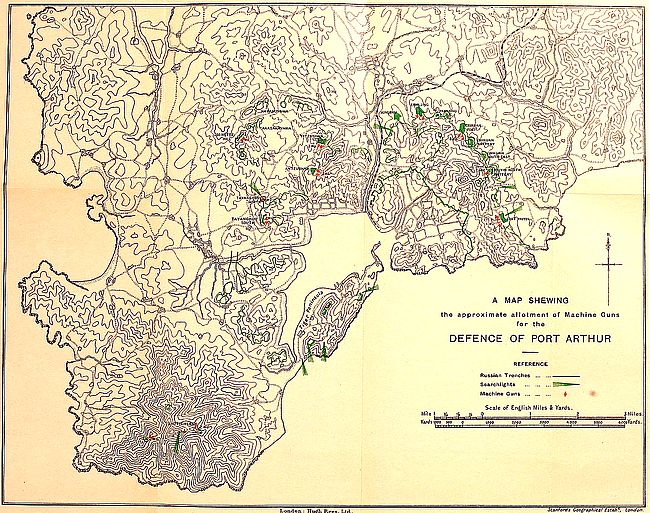
Footnote anchors are denoted by [number],
and the footnotes have been placed at the end of the book.
Basic fractions are displayed as ½ ⅓ ¼ etc; other fractions are shown
in the form a/b, for example 1/25.
All changes noted in the ERRATA on page vii have been applied to the
etext. Each change is indicated by a dashed blue underline.
The cover image was created by the transcriber
and is placed in the public domain.
Some minor changes to the text are noted at the end of the book.These are indicated by a dotted gray underline.
MACHINE-GUN TACTICS
BY
CAPTAIN R. V. K. APPLIN, D.S.O.
14th (King’s) Hussars
LONDON
HUGH REES, LTD., 119 PALL MALL, S.W.
1910
PRINTED BY
HAZELL, WATSON AND VINEY, LD.,
LONDON AND AYLESBURY.
PREFACE
This book, which was begun five years ago, is
now published because I feel that, with all its
faults, it may bring into greater prominence the
latent possibilities of the machine gun, and the
vital necessity for the most complete organisation
and tactical training of the detachments.
I desire to express my great indebtedness to
Captain C. O. Place, D.S.O., Royal Engineers,
who undertook the work of editing and preparing
the book for the press at a moment’s
notice on my sailing for India.
The modern machine gun is essentially an
automatic weapon of small-arm calibre, capable
of firing from 100 to 600 shots a minute from
a light mounting of extreme mobility, and should
fulfil the following qualifications:
1. It should be able to deliver about 400
shots a minute without loss of accuracy, even
with prolonged “continuous” firing.
2. It should be capable of accompanying
cavalry and infantry wherever these arms can
go; it should occupy the smallest space, and be
able to come into action quickly at rifle range.
3. It should have a firm mounting, upon which
the gun is steady, and from which it can be
aimed rapidly and fired while kneeling, sitting,
or lying.
4. The gun and its mounting must present
a small target, and be light enough for each,
and if possible, both, to be carried by one man
for a considerable distance, and should admit
of being dragged by a man crawling or crouching
for short distances.
5. It should be in constant readiness for
action, and able when limbered up to open fire
in less than thirty seconds.
6. It should be simple, strong, and durable.
Mobility and constant readiness for action are
indispensable with cavalry, while lightness and
smallness of target are essential factors.
There are eight main types of machine guns
at present in use in the armies of the world,
viz.:
Gun.
In use in
Maxim
Great Britain, Germany, Russia, Italy, Portugal, Turkey, Switzerland, and U.S.A.
Hotchkiss
France, Japan, Belgium, Norway, Sweden, Spain, and Portugal.
Perino
Italy.
Puteaux
France.
Schwarzlose
Austria.
Skoda
Japan and China.
Madsen
Russia, Denmark (Rekyl pattern), and China (for cavalry).
Colt
By several countries in addition to adopted gun.
The principal differences between these guns
are: (a) The automatic mechanism. (b) Method
of loading.
(a) may be divided into two classes: 1.
Recoil action—the Maxim, Perino, and the Madsen.
2. Gas-pressure action—the Schwarzlose,
Hotchkiss, Skoda, and Colt.
(b) consists of three classes: 1. Belt loaders—the
Maxim, Schwarzlose, and Colt. 2. Metal
clip loaders—Hotchkiss, Madsen, Perino, and
Puteaux. 3. Hopper loaders—the Skoda.
Several of the above countries—notably
Russia, Japan, France, and Austria—have more
than one pattern of gun in their service, and it
is difficult to say which they intend finally to
adopt; but Russia, since the war, has ordered
several thousand Madsen guns, and Japan is
said to be trying this gun, one of which during
the war fired 25,000 shots in a single day.
The Rexar gun has been purposely omitted;
it only weighs 17½ lb., but is fired from the
shoulder, and is therefore more of the nature of
an automatic rifle than a machine gun. It
would take too long to deal with each of these
weapons separately, therefore the Maxim has
been selected as the type with which to discuss
the question of tactics.
In order thoroughly to understand the methods
that should govern the tactical employment of
machine guns, and their place in the battlefield,
it is first necessary clearly to realise their nature
and potentialities, and for this purpose we will
examine their principal characteristics. Guns
of this class are capable of firing service small-arm
ammunition at the rate of 800 shots in
one minute, but this very high rate of fire is
obviously undesirable for several reasons—the
principal, from a military point of view, being
that, however skilfully the gun is handled, a
great waste of ammunition must ensue, and
hundreds of shots be wasted in space, however
accurate the fire. These guns are, therefore,
regulated to fire at a maximum rate of from
400 to 500 rounds a minute, or seven to eight
shots a second, but even this is greater than is
necessary to obtain the maximum fire effect;
at ordinary targets 100 to 250 rounds a minute,
according to the nature of the target, has been
found to give the best results in practice. The
“rate of fire” of a gun must not be confused
with the number of rounds that can be fired
from it effectively in one minute; the necessity
for frequent pauses to observe the effect, to
correct the elevation and direction of the fire,
prevent a greater number than from 150 to 250
shots being fired effectively in one minute from
a gun whose rate of fire is 450 shots a minute.
Colonel Mayne, in his book The Infantry
Weapon and its Use in War, says: “The
machine gun now in use can fire about 600
rounds a minute, or ten a second. This is a far
greater rapidity of fire than is really necessary,
for it means that a man or horse is struck
several times before falling. It is a good thing
to be able to fire 600 rounds a minute on occasions
(such as for range
finding), but a far slower rate
of fire (say 100 rounds or even less a minute)
is ample for all ordinary tactical purposes
against living beings and animals, whilst causing
an enormous saving of ammunition.”
The extreme range of this type of gun is for
all practical purposes the same as the infantry
rifle—about 3,500 yards—though it is more
effective at the longer ranges than an equal
volume of rifle fire, owing to the ease with which
the firer can elevate and aim the gun on its
mountings and the stability of this mounting,
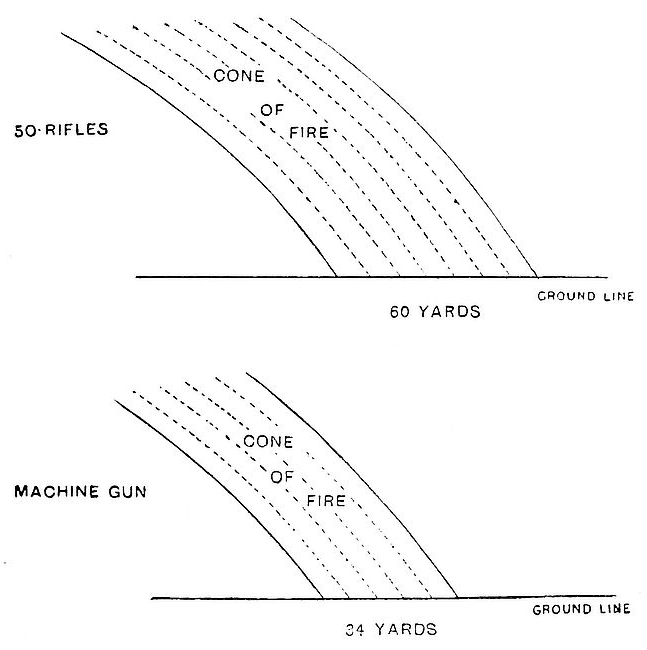
which causes it to have a beaten zone of only
half the depth and nearly half the width of that
of infantry firing the same number of rounds.
This has been proved again by actual experiment
at the schools of musketry in England, India,
and South Africa, while very elaborate experiments
and trials carried out in Germany with the
Maxim gun on the carriage adopted for that
service proved that the beaten zone was only
one-sixth of that obtained by infantry, probably
because of the greater stability of their mounting.
Diagram I
TO SHOW THE ZONE BEATEN BY 50 PER CENT. OF BULLETS
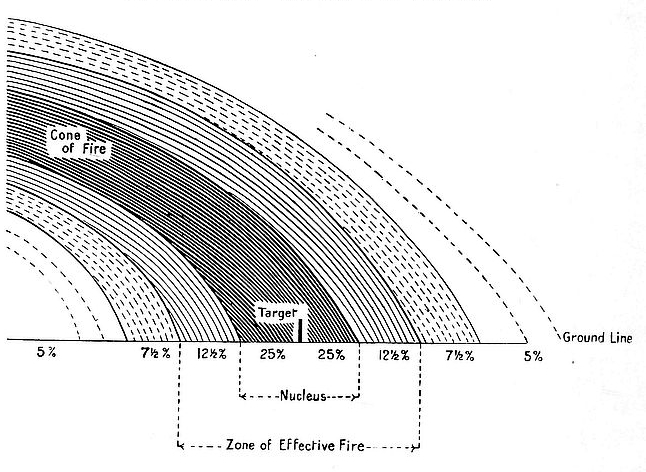
In order that “fire” may be “effective,” it
is necessary to bring the enemy within the zone
beaten by 75 per cent. of shots, and it has been
found by experiment that 25 per cent. of shots
fall immediately in front and behind the
target, then 12½ per cent., 7½ per cent., and,
finally, 5 per cent. scattered far in front and
behind.
Diagram II
TO SHOW THE DISPERSION OF BULLETS
Infantry usually fire at the rate of three rounds
a minute “slow,” and fifteen rounds a minute
“rapid”; “slow” fire is the ordinary rate, and
“rapid” fire can only be effectually maintained
for about four minutes; but this is when the
firer is fresh, and has not been subjected to
several hours’ marching and fighting as would
be the case in battle, and it is doubtful if “rapid”
fire can be kept up on service for more than
one-and-a-half to two minutes without becoming
wild and consequently ineffective. On the
other hand, “rapid” fire is less tiring to the
machine gunner than “deliberate” fire; the gun
is held for him by the mounting, it loads and
fires itself, while elevation and direction are
maintained without the least exertion on his
part by the elevating and traversing gears.
In comparing the volume of fire of the machine
gun with that of a body of infantry, it is obvious
that “rapid” cannot be taken as the normal
rate of infantry fire, as it can only be used for
the shortest periods, and even then it reduces
the users to a state of inefficiency as regards
accuracy in two or three minutes. On the other
hand, “rapid” fire can only be used by the
machine gunner on special occasions, for tactical
reasons which will be explained later, so that it
will be necessary to compare “slow” infantry
fire with “deliberate” fire from the machine
gun, in order to arrive at the mean fire volume
of each. Seventy shots a minute can easily be
fired “deliberately” from a machine gun, and
this could be increased to 120 by highly trained
gunners, but, taking the lower figure, deliberate
fire equals in volume the fire of twenty-four
men using rifles. But it must be always remembered
that the object of the fire fight
is to bring a concentrated and overwhelming
fire to bear at the right moment on certain
positions of the enemy, and when the moment
arrives machine guns can and will use the
most rapid rate of fire possible, which will be
from 250 to 300 rounds a minute or equal to
that of 50 or 100 riflemen. Mere volume of fire,
however, is useless without control, accuracy,
and concentration, and it is here that the machine
gun is so vastly superior to the rifle; for amongst
50 men using their rifles there can only be a
small percentage of good shots, while even
among the good shots unforeseen factors, such
as fatigue, bad fire positions, excitement, wrong
sighting, failure to see the target, etc., cause a
large percentage of the shots to go astray, and
make it very difficult to concentrate the fire on
any particular position of the enemy.
An object-lesson to illustrate this superiority
of the machine gun has been carried out during
each course at the South African school of
musketry under circumstances most favourable
to the rifles. The record of one such test,
carried out on September 21st, 1904, between
a Maxim gun mounted on Mark III. tripod and
42 rifles (Lee Enfield), was published. The
machine gun was worked by two sergeant-instructors,
while the 42 rifles were fired by
students who were all, at least, 1st Class shots
before joining the school, and who for five weeks
had been receiving daily instruction in musketry,
and had just completed a course of firing both
on the ranges (Table B) and in field-firing, and
had gone through a course of judging distance.
The range was unknown—the number of rounds
unlimited, and the rate of fire “rapid.” The
time was limited to one minute, and the firers
were allowed to charge their magazines before
starting. The targets were figures representing
infantry in line extended to two paces. The
following was the result:
Rounds fired.
Hits.
Percentage.
Figures hit.
Percentage of loss.
Rifles
408
62
15·1
27
54
Maxim
228
69
30·2
32
64
The small number of rounds fired by the
Maxim was due to the necessity of picking up
the range by firing small groups of five or ten
shots and observing the strike of the bullets.
What is most interesting is that although the
rifles fired nearly twice as many shots as the
machine gun, the latter made actually more
hits, while the percentage of loss inflicted was
10 per cent. greater. The actual range was
1,000 yards. A similar experiment was carried
out during the annual training for 1908 in the
U.S.A. between 42 “sharpshooters” and a
Maxim at the regulation “L” target. The
ranges were 600, 800, 1,000 yards; the sharpshooters
fired an average of 750 rounds at the
three distances and made an average of 429 hits,
which gave a collective figure of merit of 59·09.
The machine gun also fired 750 rounds, made
601 hits, giving a collective figure of merit of
79·54, being 22·45 in favour of the machine gun.
The troops were armed with new rifles, and fired
the new “S” bullet, while the machine gun
used the old pattern ammunition and a barrel
that had fired at least 7,000 shots. The gun
squad had no previous practice at this target,
and the gun was fired by different men at the
several ranges. The collective fire of the troop
was “slow aimed,” while the fire of the machine
gun was “rapid continuous” for the number
of rounds at each range. The machine gun took
30 seconds to fire 250 shots at each range, or a
quarter that of the troop.[1]
The two experiments are particularly interesting,
as showing how closely the results agree,
although the conditions are dissimilar in one
respect: viz. that in the first case the number of
rounds was unlimited and the result had to be
obtained within one minute; while in the second
case time was unlimited, but the number of
rounds fired by each was the same. The result
of the two experiments show that both in
accuracy and rapidity a machine gun is much
superior to 42 picked shots, whether firing the
same number of rounds at known ranges or
firing an unlimited number of shots in a given
time at an unknown range. We shall not be
wrong, then, if we say that a machine gun is
at least equal to 50 rifles in fire value,[2] but
there are other factors to be considered as well
as fire effect in determining its tactical value,
and it is in these other factors that machine
guns are so far superior to riflemen as to make
a reliable estimate of their relative value almost
impossible; these factors are: (1) Mobility;
(2) Visibility; (3) Vulnerability.
Mobility.—The mobility of the infantry soldier
is limited to the rate at which he can march, which
on the battlefield is about 100 yards a minute
or less than three-and-a-half miles an hour.
Doubling may be left out of the question, as it
quickly reduces fire efficiency to a minimum. An
experiment made in the Austrian Army showed
that the percentage of hits which was 76·5 per
cent. after an advance in quick time, fell to 51
per cent. after doubling.[3] The mobility of the
machine gun will depend almost entirely on the
way it is carried, and must not be judged by any
particular carriage which may happen to be in
use for the time being in our own service. A
short description of these mountings and their
method of transport will be found in Chapter IX.,
but none of them are entirely satisfactory.
The infantry carriages are heavy, clumsy, and
conspicuous, and are the least mobile of all;
they can hardly be moved out of a walk without
risk, and Marks III. and IV. cannot come into
action without first unharnessing the mule or
horse, and they then have to be dragged into
position by the whole detachment—thus presenting
a most conspicuous and vulnerable
target at the moment when least desired and
when concealment and invisibility are essential
to tactical success.[4] In the German Official
Account of the late Boer War, issued by the
General Staff, is the following criticism of this
carriage:
“Both sides have machine guns, but the
rather clumsy mountings of those used by the
British offered too high a target, and so prevented
their being advanced from position to position
during the attack.”
The tripod mounting, which is light and inconspicuous,
is carried with the gun on a limbered
wagon; but the advantages of its lightness
and portability are almost neutralised by being
carried on a wagon, thus reducing its mobility
by confining it to ground suitable for wheeled
vehicles.
If used on a pack-saddle the difficulty of
managing a led animal on foot in the stress of
battle may become insuperable, and moving
the gun in and out of action is entirely dependent
on the docility of the pack-animal. The gun
weighs anything from 40 to 60 lb., while the
mountings need not weigh more than 34 lb.
The combined weight of a gun and mounting
should never exceed 120 lb. and can be as little
as 74 lb.
In whatever way it is decided to carry the
gun, it is a sine quâ non that it must be at least
as mobile as horse artillery. There is no reason
why it should not be as mobile as cavalry, and
the choice remains between a pack-horse with a
mounted detachment or a galloping carriage;
and the former is in every way preferable,
principally because it can carry the gun and
ammunition across any country, and can come
into action in less than 30 seconds on an adjustable
tripod, which can be carried by hand
into any position and presents a very small,
inconspicuous target.
The majority of foreign countries have adopted
pack transport for their machine guns. It is
desirable with infantry and absolutely essential
with cavalry. A suitable saddle is, of course,
indispensable, and strong spiral springs to the
hooks which hold the gun and tripod on either
side will entirely prevent horses from straining
their backs when galloping across country or
jumping obstacles with the guns. These hooks
must be leather-covered and made to fit the
gun exactly, and, in order to do away with the
present cumbersome straps and buckles, they
should have a hinged attachment to close over
the gun and lock automatically in such a way
as to admit of its being opened by a single
movement when it is required to dismount the
gun. The Swiss and the Americans have permanently
adopted pack transport for the
machine guns with their cavalry, which are able
to accompany them over any country without
detriment to either horses or guns; and in the
American army the average time for a well-trained
cavalry machine-gun detachment to go
into action front, from mounted formation,
unpack, and set up the guns, load, aim, and
open fire, is 25 seconds; while at the departmental
meeting for 1908 the machine guns of
the 10th Cavalry, from the halt in line, moved
forward in section column at a gallop for 200 yards
and went into action and fired a blank shot in
31 seconds.[5]
This brings us to the second factor—Visibility.
It is absolutely necessary for the successful
tactical employment of machine guns that they
should be as inconspicuous as possible when in
action; the gun itself is a very small object
when close to the ground, and its visibility will
depend almost entirely on the nature of mounting
and its adaptability for use behind cover
of varying heights. All our infantry carriages
are so conspicuous as to be quite unconcealable
except in defence, the wheels being 4 ft. 8 in.
in diameter and the gun axis 3 ft. 6 in. above
the ground. The Mark IV. tripod is the handiest
and least conspicuous of the mountings at
present in use in our service, and although it
weighs 48 lb. it can be carried into almost any
position and easily concealed. It can be adjusted
to fire at any desired height between
14½ and 30 in. above the ground level, and
consequently can be used from behind any
suitable cover.
Vulnerability.—The question of vulnerability
would appear at first to depend entirely on
visibility; or, in other words, on the target presented
to the enemy’s fire, but this is only true
to a certain extent. To obtain the minimum
vulnerability it is of course necessary to have
the gun as low and inconspicuous as possible,
because the less it can be seen and the better cover
it can obtain, the more difficult it will be to locate
and hit. But the true vulnerability of the gun
in comparison with infantry lies in the amount
of front they occupy respectively; or in other
words, the breadth of the target exposed to the
enemy and the percentage of loss they can each
sustain without their fire effect being reduced.
Infantry will never again fight in two ranks in
civilised warfare, and the closest formation possible
for a firing line is one pace per man;
50 men will therefore occupy a front of, roughly,
50 yards; in other words, the target presented
to the enemy is 50 yards in breadth, and, provided
the elevation is correct, shots striking
anywhere within this 50 yards will be effective.
The machine gun, however, only occupies a
front of from 4 ft. to 5 ft. 2 in., or 1/25th the front
offered by infantry having equal fire effect. It is
on this point that the wonderful tactical possibilities
of the machine gun rests: the maximum
of rifle fire from the minimum of front. It is
obvious that 10 per cent. of casualties in the
infantry firing line reduce the fire effect by
just that amount, while from 30 to 40 per cent.
will probably silence its fire altogether or render
it ineffective. The machine gun, on the other
hand, is unaffected by even 50 per cent. of loss,
while it can suffer 80 per cent. of loss without
diminishing its fire effect, though such a loss
would of course cause it to lose its mobility and
seriously affect the morale of the gunners. A
machine-gun detachment consists of from 16 to
24 men, but only two of them actually work
the gun, and one man alone can fire the gun
once it is in action, the second man merely
assisting him with the ammunition, etc., but he
is not absolutely necessary to the firing of the
gun. Thus we see that the killing of the gunner
only causes a momentary cessation of fire until
another man takes his place, when the fire is
resumed without loss of intensity, accuracy, or
concentration.
We are now in a position to form an accurate
estimate of the potentialities of the machine
gun and its true tactical value as compared with
infantry, and we find:
1. Its fire effect
50 rifles at least.
2. Its mobility
Cavalry.
3. Its visibility
A file (2 men).
4. Its vulnerability
Unaffected by 50% of loss.
Before discussing their place in battle and
tactical use it will be necessary to say a few
words on the best methods of grouping the guns
and organising their detachments and the training
of the personnel in peace for the duties they
will have to perform in war. In our service
two machine guns are issued to each regiment
of cavalry and battalion of infantry, and the
detachment consists of:
Cavalry.
Infantry.
Subaltern
1
1
Sergeant
1
1
Corporal
1
1
Privates
12
12
Drivers
8
2
Bâtmen
2
-
—
—
25 (1 officer)
17 (1 officer)
This section of two guns is therefore the
smallest tactical unit, and the officer in command
is solely responsible for the training and
efficiency of his section. It is therefore absolutely
essential that the machine-gun section
commander should be a subaltern of not less
than three years’ service, specially selected for
his keenness, efficiency, and self-reliance, who
has passed the examination “C” for promotion,
and who holds the special machine-gun certificate
from a School of Musketry. A “destroyer” in
the Royal Navy is commanded by a very junior
officer, but he is most carefully selected for
similar qualities to those mentioned, and is in
addition required to possess the necessary professional
qualifications—consequently it is a
command much sought after, and competition
enables the authorities to appoint the pick of
the service and thus obtain the maximum
efficiency where efficiency is the essence of successful
employment in war. The best and nothing
but the best is necessary to the successful employment
of machine guns, and the importance
of obtaining the very best officers as section
commanders is so great that there is reason to
doubt the utility of having machine guns at all
if they are not commanded and handled by
those who are in every way expert in their use.
In order to enable machine-gun sections to be
trained in tactics and to co-operate with larger
units in war, it is essential that they should be
trained under a senior officer during peace.
The late Colonel Henderson said of the Volunteers
in Mexico: “The ideal of the battle is a
combined effort directed by a well-trained
leader: as individuals they fought well; as organised
bodies capable of manœuvring under
fire and of combined effort, they proved to be
comparatively worthless.” This is precisely the
case of regimental machine guns. It is easy
enough to use a section or even a single gun
apart from its battery should occasion require,
but it is impossible to improvise a battery from
a number of separate sections. It is therefore
essential before attempting the tactical training
of machine guns, much less their tactical use,
to organise them in batteries during peace.
For this purpose it is suggested that when a
battalion is brigaded with others, either for
administration or training, the six or eight guns
should be formed into one or two batteries, under
a selected field officer, who would be solely
responsible for their peace training and tactical
efficiency, and who would command them on
manœuvres and on service. There would be
little or no innovation in this, as our regimental
signallers are at present trained and commanded
on similar lines under the divisional signalling
officer. A cavalry brigade under the present
organisation (1909) would have one battery
of six guns, and an infantry brigade two batteries
of four guns each. The batteries of a Division
would be commanded by the divisional machine-gun
commander. While such organisation
would in no way prevent the regimental machine-gun
section being used with its own unit as at
present, it would ensure a very high standard
of tactical training, and enable the Divisional
General to have a splendid reserve in his own
hands for use at the critical moment of the fight
as mobile as cavalry, in fire action more powerful
than infantry, occupying the smallest possible
front, yet capable of delivering a storm of some
10,000 bullets a minute with the maximum of
accuracy and concentration.
The tactics in this book are based on the
understanding that the machine guns are trained
on this system, and that they are mounted on
light, adjustable tripods and carried on trained
pack-horses with the entire detachment mounted.
The failure of machine guns is due to two
principal causes: (1) Insufficient training in
working the guns. (2) Improper tactical employment.
It will be obvious that unless the gun can be
depended upon to open fire with certainty and
accuracy, and maintain it continuously without
jamming or mechanical failure, it is useless to
consider its tactical employment. The mechanism
of the Maxim is somewhat complicated and
delicate, and depends for its proper working
upon the exact adjustment of each part; but
no more so than any other piece of modern
machinery—it is far less complicated and certainly
far less delicate than the modern motor-car.
Indeed, the comparison is analogous in
several respects, as both require highly trained
operators to ensure their smooth and continuous
working, and each individual machine, whether
gun or motor, has its own peculiarities and
requires special study to obtain the best results.
Both are capable of hard and constant employment
for long periods, without breakdown or
failure, in the hands of an expert.
No one would think for one moment of engaging
a chauffeur for a high-class motor-car
who had less than six months’ training and
experience, and who was not capable of stripping
and adjusting the motors and effecting minor
repairs. It would be difficult to find a machine-gun
detachment with a single man who possessed
even these minimum qualifications. Apart from
the mechanical knowledge it must be remembered
that the man who fires the gun, known as
No. I. in our service, has in his own hands the
fire from 50 rifles, and on his own judgment and
skill as a shot will entirely depend the effectiveness
or otherwise of this fire; it stands to reason
therefore that he should be chosen primarily
for his good shooting, but, in addition to his
skill in aiming, he must be a good judge of
distance and possess considerable intelligence,
initiative, and self-reliance; for although he will
usually receive orders as to target, range, rate
of fire, and the moment for opening or ceasing
fire, it will often happen that he has to use his
own judgment in these very important matters.
As the gun is generally required to move and
come into action independently of other troops,
it must find its own scouts, who not only have
to safeguard it from surprise when moving, but
must be trained to select good positions whence
it can come into action. For this reason the
men of the detachment must be trained scouts.
To summarise:
(1) Only marksmen should be chosen.
(2) Trained scouts should be given the preference.
(3) The whole detachment must be trained
as range-finders and scouts.
(4) The whole detachment must be proficient
in judging distance.
(5) Only strong men should be selected.
The strength of a machine-gun detachment
is given in Chapter IX. With the tripod
mountings and pack transport the best working
strength for a machine-gun section will be found
to be the following:—
1 officer, 1 sergeant, 2 corporals, and 20
privates—that is, 1 N.C.O. and 10 men to each
gun. It is almost superfluous to say that the
whole detachment must be trained to work
and fire the gun, and should have a very
thorough knowledge of its parts and mechanism,
and be experts at remedying failures and
effecting minor repairs. Until the whole detachment
are so trained and can detect the cause
of any failure instantly and remedy the same in
the minimum time required, it is useless to
attempt tactical training in the field. The preliminary
training will take from three to six
months, according to the ability of the instructor
and the time available daily for work.
It will be found that certain men of the
detachment are far more skilful in laying and
firing the gun than others, and it is undoubtedly
sound to specially train these men as gun-layers
and to permanently allot to the two best layers
the duties of Nos. 1 and 2 (i.e. the firer and his
assistant). This should be the post of honour
and coveted accordingly, and the two best gun-layers
should be awarded a distinguishing badge.
As no badge is authorised by our regulations,
a lance stripe might be given to the best No. 1
of each gun.
In training the men of the section in the preliminary
details of working the guns, the following
points may be found of use. First frame a
course of instruction for each day which will
give systematic and progressive individual instruction
in the following points: mechanism,
name and use of every part, the working of the
mechanism, care of gun, stripping and fitting,
loading and firing; spare-part box, the name of
each of its contents and recognition of every
part when out of the box; failures, their recognition
and remedy; gun-laying and firing, co-operation
between layer, loader, and observer. This course
should last at least three months, provided not
less than two hours a day are available. Drills
may be combined with preliminary instruction
at the end of the first month, and must aim at
extreme quickness in dismounting the gun
and opening aimed fire and remounting the gun
again. The chief points in the preliminary
training are that all the detachment are equally
instructed. Training on the 20-yard range in
barracks should take place during the third
month, and special targets should be used to
teach laying the gun, slow use of elevating gear
and combined sights, traversing fire, fire control,
rapid change of target, indirect fire. During
this short-range practice the failures should be
practically demonstrated, and firing on the range
should never take place without making a few
artificial failures to test the efficiency of the
detachment. These failures should be introduced
by the officer himself without the knowledge
of the detachment, and should be so
arranged as to occur naturally while firing. They
should be timed by him in each case, and the
record time for the remedy of each failure posted
up in the barrack-room with the man’s name.
Artificial failures can easily be made by filing
round the base of a cartridge so that it is torn
off when fired; by loosening a bullet in a
cartridge, by slightly flattening a cartridge so
as to cause it to jam in the chamber, by wedging
a cartridge in the belt, by introducing a blank
cartridge, and by repacking the asbestos with
dry packing. It will be found that by making
two or three such jams every time the gun is
taken out to fire the detachment will soon
become expert in recognising and remedying
failures.
The men should be taught that failures may
be divided into two classes, viz. avoidable and
unavoidable. The occurrence of an avoidable
failure should be looked upon as a disgrace to
the firer. The unavoidable failures so seldom
occur that they are negligible.
The avoidable failures are those due to (1)
Fuzee spring adjustment. (2) Want of oil. (3)
Dirt. (4) Want of water. (5) Bad packing.
(6) Damaged ammunition. (7) Faults in feed
due to badly filled, new, or damaged belts.
Each machine gun will be found to work best
with a certain weight of fuzee spring which can
only be found by trial, and this weight will
change from time to time as the gun wears.
The machine gunner cannot be considered fit
for further training until he has become so
familiar with his gun that he can instantly tell
by the sound if it is working at its best; just
as a chauffeur knows at once if his engines are
running perfectly, and can instantly detect the
slightest defect and make the necessary adjustment
of the spark, petrol, or oil to ensure smooth
running. The unavoidable failures are so few
and rare that they will seldom be met with, and
can be quickly remedied, except the breaking
of an important part. Failures due to defective
ammunition are extremely rare provided ordinary
precautions are taken to avoid placing
damaged cartridges in the belt. A breakage
in any part of the lock can be remedied in a
few seconds by substituting the spare lock which
should always be on the gun in action. The
breaking of any other part of the gun will be an
accident of rare occurrence and, provided the
gun is properly inspected before use, may be
more properly classified under accidents than
failures. A modern machine gun in the hands
of experts should never jam, while failure of
automatic fire will be rare and momentary.
Until this standard has been reached a machine-gun
detachment cannot be considered fit to
begin tactical training. The Japanese in the
late war were obliged to improvise the detachments
for their hastily acquired machine guns;
and Captain Matsuda, who commanded the
machine guns with Prince Kanin’s Cavalry
Brigade, says: “Whereas at the battle of Peu-si-lau
on October 12th we had some trouble after
firing 1,800 rounds, on March 3rd the guns of
one section after firing 11,000 rounds continued
to work perfectly. The gunners were absolutely
familiar with their weapons.” Lieut.-General Sir
C. J. Burnett, K.C.B., remarked: “Like a good
chauffeur, the Japanese machine gunner knows
all the peculiarities of the weapon he fires and
can tell almost by instinct when anything is
going wrong.” It is almost superfluous to say
that the men of the machine-gun detachment
must never be changed or taken for any other
work. Nothing has been said of the necessity for
training the detachment in the all-important
duties of scouting, range-taking, and horsemastership
during this period, but of course
they are vital to ultimate success and must not
be neglected.
Range practices will follow, and the peculiarities
of the gun and its fire effect must be carefully
taught during this period. The use of
traversing and sweeping fire, combined sights,
and observation of fire and the use of deliberate
fire in imitation of rifle fire should be perfected
during range practice, so that they may be
carried out under service conditions during the
field practices which follow.
The tactical training should commence as
soon as the field practices have been completed.
The course for this should be carefully mapped
out beforehand and should be based upon the
principles given in Chapter II. and in the chapter
dealing with the arm to which the section
belongs, and should culminate in divisional
manœuvres. This course might follow the
following headings:
(1) Drill over rough country.
(2) Selecting a position.
(3) Selecting alternate positions.
(4) Taking up a position.
(5) Screening guns.
(6) Making artificial cover.
(7) Mutual support (movement and fire).
(8) Indirect fire.
(9) A battery working on a wide front in
mutual support.
No drill for a battery has been authorised yet
(1909), but the simple formations of a troop as
laid down in Cavalry Training will be found
admirably suited for a battery of machine guns
on pack-horses with mounted detachment.
The writer is fully aware of the condition
under which machine guns are officered and
manned at present, and that a great error has been
made in estimating the time required to train
the detachments. The Germans, who have
studied the question of machine guns with a
thoroughness far greater than that of any other
nation, have made them a separate arm of their
service, under trained and permanent gunners,
and they evidently consider that only specialists
can attain the necessary efficiency.
However this may be, it is certain that the
officer, whether commanding a section or the
batteries of a Division, must be a specialist and
a highly trained one.
An officer commanding a company of Russian
machine guns in the Russo-Japanese War, writing
his experiences to the Nouskin Invalid, says:
“I have spent three years in studying machine
guns, and consider myself proficient in their
use, but I have always been convinced that the
requisite skill and knowledge cannot be acquired
in a shorter time.”
The commanding officer who at present
looks upon his machine guns in much the same
light as he regards any other portion of his first-line
transport—a necessary encumbrance taking
away an officer and several men from their
proper duties, and a source of anxiety when the
regiment goes into action—would regard them
with very different feelings if assured of their
efficiency and relieved of the responsibility
for their tactics and safety. That this is possible
without altering the present organisation has
been shown; that it is absolutely essential for
their efficient use in war it is hoped to demonstrate
in the chapters that follow.
CHAPTER II GENERAL PRINCIPLES — FIRE EFFECT — TAKING UP A POSITION — COVER — COVERING FIRE — INDIRECT FIRE — EXPERIMENT IN INDIRECT FIRE — SUMMARY OF GENERAL PRINCIPLES
“Each arm has its special characteristics and
functions, and is dependent on the assistance of
others; the full power of an army can be exerted
only when all its parts act in close combination,
and this is not possible unless the members of
each arm understand the characteristics of the
other arms.”
The above paragraph from Field Service
Regulations, Part I., 1909, aptly illustrates a
principle which should be impressed upon every
serious machine-gun student, for the principles
of machine-gun tactics are based upon those of
the arm with which they are co-operating.
The machine gun cannot yet be regarded as a
separate “arm” in our service, nevertheless it
possesses a power peculiar to itself; and until
this power is studied and thoroughly understood,
the principles that should govern its employment
in the field cannot be grasped, and consequently
its effective use is dependent on chance
or accident, and for every success scored a dozen
failures will occur, any one of which may be
fatal. The preceding chapter has dealt with
the peculiarities and power of the machine gun,
and it will be seen that it possesses the fire effect
of the infantry arm while it has several of the
characteristics peculiar to artillery; for instance,
it is fired from a mounting by one man, and
is moved from position to position by draught
or pack animals.
We have seen that the chief characteristic
of the machine gun is its power of delivering the
“maximum fire from the minimum front”;
this fire is of great volume and is highly concentrated,
while it can also be made to sweep
a wide lateral surface of ground. The gun’s
narrow frontage in action renders it easy to
conceal, and when discovered it presents a very
small and difficult target to the enemy’s riflemen;
on the other hand, when once discovered
if it cannot be moved unseen to another position
it is liable to suffer a prolonged and concentrated
fire from the widely scattered riflemen of the
enemy, to which it cannot effectively reply,
and which must in time cause loss. Again, its
range being limited, it is powerless against
artillery except under special circumstances at
effective rifle range.
The general principles governing its tactical
employment depend upon three factors, viz.
(1) the target, (2) the range, (3) the position.
The volume and concentration of its fire
necessitate a large and vulnerable target, or
ammunition will be expended without adequate
results. The first essential is therefore to obtain
this description of target and to avoid firing on
others which may present themselves.
A large and deep target might justify fire
being opened at long range, but such targets rarely
present themselves on the modern battlefield,
and its vulnerability will partly depend on the
closeness of the range and partly on its formation.
To obtain a suitable target of this description
surprise is essential, and to effect a
surprise it will be necessary to conceal the gun
and its detachment in a well-chosen position.
Thus we see the three cardinal points for
tactical success are—suitable target at close range
from a concealed position.
Napoleon’s maxim, that “fire is everything—the
rest is of small account,” is only applicable
to the machine gun when the fire is effective.
Nothing is so useless and wasteful as ineffective
machine-gun fire, and the careful study of fire
effect and how to obtain the best results is
imperative with this weapon. The principles
so ably stated in Colonel Mayne’s excellent book,
The Infantry Weapon and its Use in War, apply
almost equally to machine guns, and should be
carefully studied by machine gunners, particularly
those chapters dealing with the employment
of fire in the field.
We have already seen that the range of the
machine gun is practically the same as that
of the infantry rifle, but that the beaten zone
is only half the depth and about half the width
of the collective fire of infantry, partly owing
to the rigidity of the mounting, and partly to
the fact that the human error is greatly reduced
by being concentrated in the person of a single
individual, instead of being spread over some
50 men of varying temperament, nerves, and
aiming powers.
In addition to these factors, the fire from
machine guns is always “collective” and “concentrated”
unless deliberately dispersed by the
firer, while infantry fire is always “individual”
and “dispersed” unless controlled by fire discipline
under a leader. Fire discipline and fire
control are in the hands of one man—there is
no need to point out the target to a scattered
firing line, and there is no delay in passing orders
down the line, or in the setting of 50 different
sights for the correct elevation. Thus fire can
be opened far more rapidly and accurately than
with rifles, and can be at once directed on a
fresh target without ceasing fire, while the effect
can be seen by the firer, who can instantly change
the rate or cease fire altogether.
The beaten zone is perhaps the most important
factor in obtaining effective fire, and the
following table, compiled from Musketry Regulations,
1909, gives the zone beaten by 75 per
cent. at four ranges.
RANGES
Zone containing 75 per cent. of shots (effective zone).
500 yards.
1,000 yards.
1,500 yards.
2,000 yards.
Depth
150 yds.
70 yds.
60 yds.
50 yds.
Lateral Dispersion
4 ft.
8 ft.
13 ft.
19 ft.
It will be seen that the 75 per cent., or effective
zone, is deepest at 500 yards, and gradually decreases
as the range increases up to 2,000 yards;
beyond this distance it increases again in about
the same ratio up to 3,000 yards.
The following formula will give the effective
zone (75 per cent. of shots) approximately for all
ranges up to 1,500 yards inclusive:
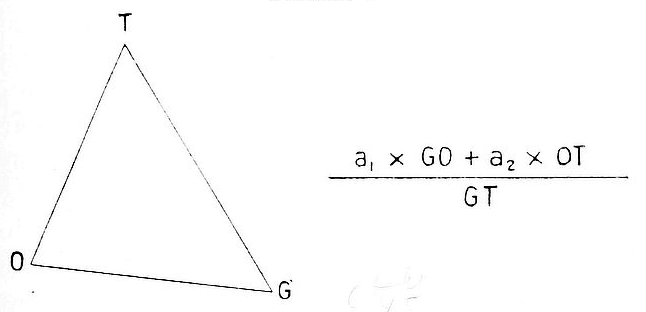
50,000Range + 20.
Example for 1,000 yards:
50,0001,000 + 20 = 70 yards,
which is the depth of the area swept by 75 per
cent. of shots, or the “effective” beaten zone.
For ranges beyond 1,500 yards this formula is
useless, and after 2,000 the beaten zone increases
in depth, while the angle of descent of
the bullets becomes so steep that the “dangerous
space” is reduced to a minimum; and consequently
the zone beaten by 75 per cent. of shots
is no longer the “effective zone,” and it will be
necessary to get the target within the zone beaten
by the nucleus, or 50 per cent. of the shots. This
zone at 2,500 yards range is about 50 yards in
depth, so an error in estimating the range of
more than 25 yards over or under the correct
distance will render the fire “ineffective.”
Even at 1,500 yards the “effective zone”
(75 per cent.) is but 60 yards deep, which only
allows an error of 30 yards over or under the
correct range—a very small margin, even when
using a range-finding instrument, but without
an instrument it is obviously impossible to
“estimate” or “judge” the distance with
sufficient accuracy to ensure bringing the “effective
zone” on the target.
For ranges over 500 yards it is absolutely
necessary to know the range accurately or to
find some other method of bringing the
“effective zone” on to the target.
The machine gunner may be likened to the
fireman with his hose-pipe, whose object is to
bring the base of his jet of water to play on a
certain spot some distance away from the nozzle
of his pipe. He does not trouble about the
distance, he does not require to know the range;
but pointing the nozzle in the direction of the
spot he desires to strike, he elevates or depresses
it until he observes the base of the cone of water
falling on the right spot, and then he holds his
pipe so that it continues to fall where he desires;
he does not trouble about the smaller streams
and drops of water that fall short or go beyond,
but devotes his whole attention to keeping the
nucleus of the stream—the 75 per cent. or
50 per cent. zone—falling on his “target.” In
precisely the same way the machine gunner
must look upon his stream of bullets as a stream
of water from a hose-pipe, and his object must
be to cause the centre of that stream to play on
the target, or, in other words, to bring the effective
cone of fire on the target so that it is the
centre of the beaten zone. This can be done by
“observing” the strike of the nucleus of the
shots and altering the elevation accordingly.
On favourable ground fire can be observed by
No. 1 up to 800 yards, but No. 2 with the
aid of good glasses can observe fire on favourable
ground up to 1,500. This observation of
fire is the best method of obtaining the correct
elevation at “effective” ranges (i.e. 1,400 to
600), if the ground is suitable. The procedure
should be as follows: The range should be
“estimated” by No. 1, who should then adjust
his sight for 100 or 200 yards less elevation than
the supposed distance, and fire “groups” of
8 or 10 shots; No. 2 observing the strike of the
bullets and saying “short” or “over,” as the
case may be, while No. 1 alters the elevation
between each group until No. 2 says “on,”
when fire may be continued, still observed by
No. 2, until the desired effect has been attained.
No. 1 must be careful to fire his first group of
shots short of the target, as they are much
easier to locate than shots which fall “over.”
If the target is only visible for a short time,
the groups may be “rapid,” but as a rule
“deliberate” fire at the quickest rate should be
used, and “rapid” only used when the range
has been found. If the ground is not favourable
for the observation of fire, or the range is too
great, this method cannot be used, and it will
be necessary to obtain the range by instruments;
but it will not always be possible to do so, and
it is necessary to find some other reliable way
of ensuring that the target is within the “effective”
zone.
Supposing the range to be estimated at 1,400
yards, the effective zone is about 60 yards in
depth—therefore an error of only 30 yards in
estimating the range can be permitted. There
is but one way to overcome the difficulty, and
that is by increasing the effective zone; and this
can be done by using “combined sights,” thus
making two or more beaten zones which touch
each other and overlap where the effective
75 per cent. of shots of both ends.
There are two ways of using combined sights:
(a) The “single gun” method.
(b) The “battery” method.
In (a), with an estimated range of 1,400
yards, the sights will be set for 1,300 and aim
taken; then the sights will be again set for 1,500
yards, but without altering the original aim,
and then “rapid” fire opened and the elevating
wheel slowly turned to elevate the gun until the
1,500 yards sighting is aligned on the target.
The result of this operation is to sweep the whole
ground from 1,270 to 1,530 yards with effective
fire; and if an error of 125 yards over or under
the correct range has been made, the target is
nevertheless brought within the effective zone
by the combined elevations used. This is the
best method for sections or single guns, and a
section can vary this by one gun using 1,250
yards elevation and working up to 1,400, while
the other gun begins at 1,350 and works up to
1,550. The choice of the amount over and
under the estimated range must depend upon
the ability of the person estimating the range
and circumstances of the case, but less than
100 yards over or under should never be used.
The second method (b) is only used where at
least four guns are available, and requires six
guns to obtain the best results. The range is
estimated as before, and then each gun uses an
elevation differing by 25 yards from the next:
thus, taking 1,400 yards again as an example of
the estimated distance, No. 1 gun will use 1,300;
No. 2, 1,325; No. 3, 1,350, and so on, No. 6
using 1,425 yards.
In this way the effective zone of No. 1 gun,
which is 60 yards in depth, will just overlap the
effective zone of No. 2 gun, and so on right up
to No. 6 gun. Thus instead of one small zone
of 60 yards of effective fire, we have six guns
joining to make one big effective zone 185 yards
deep.
Care must be taken not to use more than
25 yards between sights at ranges over 1,400
yards, otherwise there will be gaps between
each effective zone, and the fire would be ineffective
should the target happen to be at a
spot between any two zones.
The methods of firing the gun are laid down
in the official Handbook, but it may be added
that in using “deliberate” fire the double
button should be pressed irregularly so as to
imitate rifle fire, and with a little practice a
rate of 120 shots a minute can easily be attained.
This kind of fire, although it should seldom be
used, will occasionally be serviceable in ranging
for observation when it is desired to do away
with the peculiar sound of the machine gun
and thus not disclose its presence prematurely.
In covering a retirement it may also be found
useful to deceive the enemy into believing they
are only opposed by riflemen, while reserving its
full fire power until a good target presents itself
at close range.
“Continuous” fire should be used in “gusts”
or bursts of from 15 to 30 shots, a momentary
pause being made to observe the effect, and,
if necessary, to correct the aim. The great
expenditure of ammunition caused by “continuous”
fire renders its use only justified when
the effect obtained is commensurate, and it
should seldom be adopted until the circumstances
justify it. But when a really good target
is found at close range, the ammunition need
no longer be considered until there is nothing
left alive to fire at. Annihilation should always
be the final aim of machine-gun fire.
Except under special circumstances, such as
for covering fire or a demonstration, the battery
will not move as such into position, but each
section will be given its approximate place and
move there independently, keeping touch, however,
by signal or connecting files with the
battery commander and acting in close co-operation
with the other sections.
Positions are of two kinds, viz. (1) positions
of observation, (2) positions of readiness.
The position of observation will usually precede
the position of readiness, and the principal
points are the concealment of the guns and
detachments, the facilities for observing the
enemy and for movement in any direction.
The position of readiness will be in the immediate
vicinity of the fire positions, and the
guns may be actually in position awaiting the
target.
When moving alone on the march, scouts
working in pairs must be pushed well out ahead
and on the exposed flank or flanks, and they
should be trained to use a system of signals to
indicate the following: (1) “All clear”; (2)
“Enemy in sight”; (3) “A good target in
sight”; (4) “Cavalry” (prepare for); (5)
“Artillery within range”; (6) “A good gun
position.”
Six simple and unmistakable signals can
easily be arranged and learned during peace
training, which might prove invaluable in war,
for “opportunity” is everything to the machine
gunner, and is usually so fleeting as to demand
instant action in order to obtain success. On
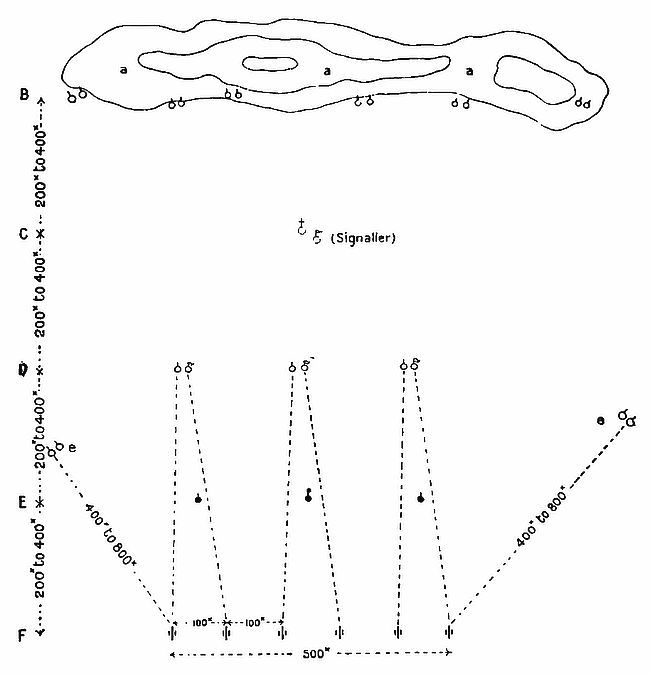
moving to occupy a position as a battery, the
guns will usually be in line at from 10 to 100
yards interval, with the section commanders
leading their sections and the scouts well ahead;
the flank guns must arrange for the protection
of the flanks by scouts in the same manner.
Diagram III
TO SHOW FORMATION WHEN COMING INTO POSITION
aaa. The Position. B. Ground Scouts. C. Battery Commander.
D. Connecting files.
E. Section Commanders. ee. Flankers. F. Guns & Detachments.
The Germans consider that ground scouts
should never go into the proposed position, as
they are likely to expose themselves to the
enemy, and thus “give the position away,” and,
as already pointed out, “surprise” is the
essence of success. They say that the commander
of the battery or section, whichever the
unit may be, should alone examine the position
and select the place for his battery or section
to come into action—and this is the right method
as a general principle; but in broken or hilly
country, where cover is abundant, and where
the position is extensive, a battery commander
can do no more than indicate generally the
positions to be occupied by the sections, and it
will then be advisable for the section commanders
to personally select the positions for their guns.
If the cover is good, the range-finders may next
occupy the gun positions and proceed to take
ranges. They must be most careful not to show
themselves in the least and should work from
cover to cover, some distance from the gun
positions and not on the same alignment. The
ranges must be noted on proper range cards,
and when complete sent to the section commanders.
In open country, where there is no
good cover in the position, the scouts will only
approach it sufficiently to ensure that it is not
occupied by the enemy, and will then halt and
find a good position for the guns to be dismounted;
the commander, passing through
the scouts, will then reconnoitre the position
himself, and select the place for coming into
action. There are two methods of taking up
a position, which depend for their choice upon
the proximity of the enemy and the time at
which fire is to be opened. The first is the
“deliberate” method, when the guns are brought
up and the range taken before the target appears.
In this case cover is essential to success,
and the guns must be most carefully concealed,
the whole object being to surprise the enemy
when the moment arrives, and thus concealment
is of the first importance. The second method
is used when the enemy is in the immediate
vicinity, when the country is open and the
position without cover, or when the position is
within artillery range of the enemy. The guns
unlimber and prepare for action immediately
in rear of the gun positions, and as close to
them as possible and completely out of sight of
the enemy. The commander alone goes into
the position, and having selected approximately
where each gun is to go, he stations them immediately
in rear of their intended places out
of sight and then creeps into the position himself
and watches for the opportune moment;
when this arrives, a blast on his whistle brings
the guns up with a rush, no concealment is
attempted, but, fully exposed, each gun opens
fire on the nearest target. If the moment has
been rightly judged and the range properly
estimated, 60 to 90 seconds is sufficient time to
obtain the desired effect, and before the enemy’s
artillery can get the range a second signal from
the commander sends the guns out of action
again as rapidly as they appeared. This is one
of the most successful methods of employing
machine guns: there is no risk of being seen
before the target appears, there is no “giving
away the position” by careless scouts, and
there is no chance that a powerful pair of glasses
will discover the guns in position before they
open fire and turn the tables by surprising them
instead. On the other hand, it requires very
highly trained detachments and a vast amount
of peace practice to ensure its success in war.
Alternative positions are always necessary
when the deliberate method is used, and must
be carefully practised in peace—the principal
points to be observed being: (1) That the
second position is suitable for bringing effective
fire to bear on the enemy, and (2) that the
gun is able to gain the position without
exposure.
Scouts so often forget that they can work
with ease where it is impossible to carry a gun;
and unless the above conditions are fulfilled,
the alternative position will be useless.
The place for dismounting the guns must
always be as close to the fire position as possible
without exposing the teams to fire or view; the
reserve ammunition must be brought up to
this spot, and precautions must be taken to
prevent the teams being surprised from the
flanks or rear if exposed. Machine guns should
never be advanced for a short distance. If it
is desired to obtain a closer range, nothing
is gained by moving two or three hundred
yards, while the guns are exposed to considerable
risk. The guns are just as effective at 1,000
yards as at 800, and when a closer range is
necessary they must await the opportunity for
moving up to close range, i.e., 300 or 400 yards,
where their fire may be decisive.
Cover may be of two kinds:
(1) Cover from fire.
(2) Cover from view.
Cover from fire must be proof against the
projectiles likely to be used against it—that is,
against rifle fire and shrapnel. “Cover from
fire” should also be “cover from view” if
possible; it must be inconspicuous, and should
be of the same colour and material as the background
and locality. It must be as low as is
compatible with command, and must never be
on the skyline. The following points in the
order given constitute good “cover from fire”:
(1) Bullet proof.
(2) Good field of fire.
(3) Invisibility.
(4) Protection from enfilade fire.
(5) Good line of retreat (under cover).
“Cover from view” is often not cover from
fire, and must be used with great caution; it is
the principal means by which guns are brought
up to the fire position without the enemy’s
knowledge, thus effecting a surprise. Cover
may be either (1) natural, (2) artificial, (3) a
combination of both.
“Cover from fire” will generally be artificial
or a combination of natural and artificial cover,
because natural cover will seldom be found that
is suitable for machine guns, although partial
cover from fire may often be found behind a
bank, a rock, or in a ditch.
“Cover from view” will generally be natural
cover, and will be used to conceal the guns while
approaching a position to occupy it and, when
in position, to effect a surprise. When used in
position to effect a surprise, it must be remembered
that the moment the guns open
“rapid” fire the cover is no longer any protection—indeed,
it may be a source of great danger
should it be isolated or conspicuous, such as a
patch of scrub in a plain, or a clump of bushes on
a hillside, as it will form a mark to aim at for
every gun and rifle within range. “Cover from
view” may be also “cover from fire,” as when
folds in the ground or a ravine are used to
conceal the guns. It may also be artificial cover,
such as screens of boughs and brushwood as
used by the Japanese at Liao-yang to conceal
their march, or to hide guns in position. Hurdles
covered with grass, reeds, bush, or branches of
trees to closely imitate the surrounding growth,
and placed as screens to hide the guns until
the moment arrives for opening fire, will often
prove a most valuable method of concealing
guns in position, and under favourable circumstances
the guns may even open fire from
behind the screens without being discovered.
This method requires constant practice in peace
to attain success on service—indeed, the necessity
for the most thorough peace training and constant
practice in all the details of bringing guns
into action, making cover, taking up alternative
positions, retiring under mutual support,
etc., cannot be too strongly urged on section
commanders. Little ammunition is available
for practice in our own service, it is true, but there
is nothing to prevent constant practice in this
vital duty of the machine gunner; and by getting
a few men to represent the enemy, with an intelligent
officer and a pair of good glasses, most
valuable help can be given by criticising the
manner the guns are handled, and the amount
of exposure or concealment of the gun and
detachment in taking up a position or making
cover.
Artificial cover may be either excavated or
built up, or a combination of both. Excavated
cover will usually take the form of a pit of
sufficient size to hold the tripod, ammunition,
and three men, and deep enough to conceal
the gun and men not only from view, but
from fire at “effective” range. This form
of cover is particularly good on a level plain,
the muzzle of the gun being just above the
surface of the ground. The rear side of the pit
may require to be enlarged to take the long
leg of the tripod where time is limited and the
pit has not been made large enough to take the
tripod in any position, but it is advisable to
make the pit of sufficient area to allow the gun
to be worked in any direction. With an adjustable
tripod, the pit should be so deep that
the gun is completely concealed below the surface
of the ground, and it is only raised when
it is intended to open fire.
Other forms of cover consist of epaulements,
trenches, sangars, etc., which will not differ
essentially from those given in the manual of
Military Engineering. In all types of “cover
from fire” care must be taken that the cover is
high enough to protect No. 1 from bullets
fired at ranges up to 1,400 yards, taking into
consideration the angle of descent of the bullets
at that range and the distance of No. 1 from
the cover.
Cover can seldom, if ever, combine all the
points enumerated here, and it will lie with
the section commander to discriminate between
them and decide what points he will sacrifice in
favour of others more important: thus it may
be necessary, where concealment is the chief
object, to forgo “cover from fire” at the longer
ranges in favour of a low parapet or even none
at all. It is only possible to indicate in outline
the principles that should be followed; practice
in training and the experience thus gained
alone will make the reader an expert.
Shields will be found of great value in the
final stages of the battle, when machine guns
are pushed up to close range to assist in the
final assault. They are too heavy to carry on
the guns, and should be with the ammunition
in the first-line transport, where they are easily
obtained if required.
Machine guns will often be used to cover the
advance of infantry from “long” to “effective”
range when the artillery is still occupied in the
artillery duel and the infantry first come under
effective rifle fire from the enemy. The ease
with which they can instantly open and cease
fire, concentrate on a particular spot, or sweep
a line of trenches, renders them particularly
suited for this purpose, and the Japanese constantly
used them to keep down the enemy’s
rifle fire in this manner during the late war.
The narrow beaten zone enables them to
fire safely over the heads of advancing infantry
from all ranges beyond 800 yards, provided the
infantry are at least 200 yards from the enemy
fired at. A study of the table of trajectory
in the Appendix to Manual of Military Training
will enable the machine gunner to decide the circumstances
under which the fire is safe in each
case.
Positions on the flanks and if possible to the
front of the advancing infantry will render
covering fire most effective, but these positions
will rarely be possible. The first consideration
is the concealment of the gun from the enemy’s
artillery, which can easily silence them if exposed.
It is also necessary that the positions
selected should be sufficiently commanding to
enable the battery commander to see the attacking
infantry during the whole advance, so as to
fire only when they are moving, while at the
same time he must be able to see the position
of the enemy’s trenches and thus direct the fire
on any part desired.
The best method of using covering fire in the
early stages of the attack is by indirect fire from
the reverse slopes of a hill or from behind a
ridge or other feature. This is not difficult to
carry out and in no way lessens the accuracy of
the fire or endangers the troops in front, as the
following experiment will prove.
The following is an extract from an article
by First Lieutenant A. E. Phillips of the 10th
Cavalry, from the Journal of the United States
Cavalry Association for July 1909:
“To determine how many, if any, of the
bullets from the machine gun would strike
troops in front of an assumed ‘hill’ over which
the gun was to fire, canvas frames were used to
represent such objects, the targets being concealed
from view.
“The target consisted of a strip of target cloth
6 ft. high and 15 yards wide, along the bottom
edge of which is pasted a row of kneeling figures
with an interval of a yard from centre to centre.
Across the target and parallel to its top edge was
drawn a narrow black line tangent to the tops
of the heads of the figures. Value of hits on
any figure = 5; value of hits on the cloth below
the line = 3; value of hits on the cloth above
the line = 1. Canvas frame, 8 ft. high, placed
200 yards in front of the gun. Rapid fire:
First Experiment
Range 800 yards
No. of shots.
No. of Hits.
Remarks.
Figs.
5’s.
3’s.
Total.
30
5
10
12
22
Line of sight was 5 ft. below top of obstruction. All shots over.
30
8
10
9
19
Second Experiment
Range 1,000 yards
No. of shots.
No. of Hits.
Remarks.
Figs.
5’s.
3’s.
Total per cent. of figs. hit.
30
9
11
4
60
Line of sight was 3 ft. below top of obstruction. All shots over.
30
12
17
7
80
Third Experiment
Range 1,200 yards
No. of shots.
No. of Hits.
Remarks.
Figs.
5’s.
3’s.
Total per cent. of figs. hit.
30
2
2
5
13
Line of sight was 3 ft. below top of obstruction. All shots over.
30
4
5
13
27
30
8
11
9
53
“It will be noticed no 1’s were made.
Assuming the height above the ground of the
average mounted soldier as 8 ft., had a troop
of cavalry mounted been 200 yards in front of
the machine guns in the third experiment, the
line of sight would have struck about the backs
of their horses, and all bullets would have gone
over the riders with at least 4 feet to spare,
as proved by the experiment.... The troop
mounted could have moved forward to within
100 yards of the target and would not have
been struck by the bullets.”
The methods of carrying out indirect covering
fire will vary according to the nature of the
position selected and the way the guns are to be
laid. This is one of the few occasions when a
battery or two may have all their guns in line
close together. If the slope is a steep one, they
may be pushed up close to the crest, but on a
gentle slope they must be placed sufficiently
far back to avoid the forward effect of shrapnel
bursting on the crest line.
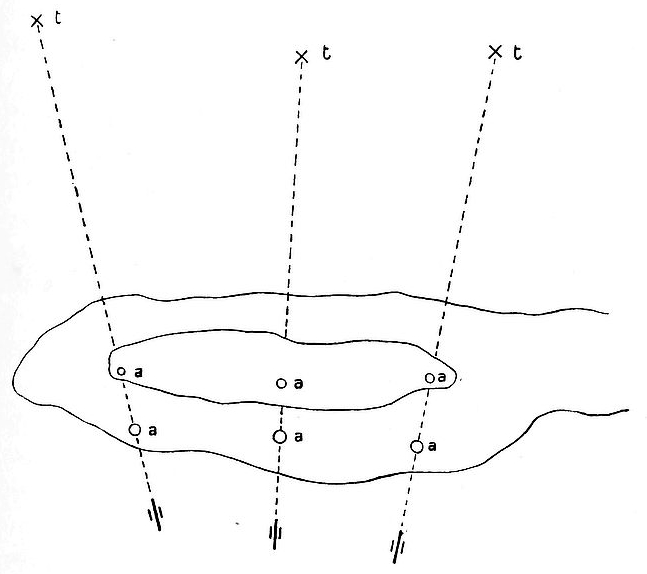
The battery commander will select the position
for the guns and will then give each gun
or section a section of front to fire on. The
method of marking off this section is as follows:
two iron rods about 3 ft. long for each gun are
painted white, and are then “laid off” from the
gun to the target, in an exact line, the first being
on the reverse slope a few yards short of the
crest; the next on or just behind the crest line.
By aligning the gun on the rods, fire is brought
on the centre of the target; should traversing
fire be required, the limits may be marked by
similar sticks on either side.
There are two methods of laying the gun.
(1) By observation of fire. (2) By quadrant
elevation. The first method has been already
described, and the second must be done by using
the following table in conjunction with an instrument
for elevating the gun at the required
angle; but it must be remembered that each
gun will require adjusting to its own angle of
elevation to suit its known error at each range.
Thus a gun which is known to require sighting
at 900 yards when firing at 1,000 should receive
1° 10½ and not 1° 25½. When proper instruments
are not obtainable, very fair results may
be obtained by using an ordinary clinometer.
The necessary allowance for the height the gun
is above the target must be made, or, in other
words, the angle of sight as shown by the clinometer
must be deducted from the quadrant
elevation given on the gun.
Diagram IV
TO SHOW METHOD OF LAYING BY AIMING POSTS
aa. Aiming Posts (about 15x apart and some distance in front of gun.)
ttt. Targets.
TABLE OF ELEVATION FOR MAXIM ·303 USING
AMMUNITION GIVING 2,000 F.S.
Range.
Angles of elevation on the Maxim gun.
200
yards
0
4·0
0 1
300
”
0
9·5
”
400
”
0
17·0
”
500
”
0
25·5
”
600
”
0
35·5
”
700
”
0
45·5
”
800
”
0
57·5
”
900
”
1
10·5
”
1,000
”
1
25·5
”
1,100
”
1
41·5
”
1,200
”
1
57·5
”
1,300
”
2
16·5
”
1,400
”
2
37·5
”
1,500
”
2
59·5
”
1,600
”
3
22·5
”
1,700
”
3
47·5
”
1,800
”
4
14·5
”
1,900
”
4
43·5
”
2,000
”
5
14·5
”
2,100
”
5
42·0
”
2,200
”
6
22·0
”
2,300
”
6
59·0
”
2,400
”
7
40·0
”
2,500
”
8
25·0
”
2,600
”
9
16·0
”
2,700
”
10
18·0
”
2,800
”
11
18·0
”
What is required is the angle of quadrant
elevation to be put on the gun in order that the
shots may strike the target at a known range.
From range table obtain angle of tangent elevation;
now if the target is below the guns we must
subtract the angle of sight (m), if the target is
above the guns we must add the angle of sight
(m) to obtain correct angle of quadrant elevation.
To obtain angle of sight m
(1) When target is visible from the immediate
vicinity of guns the angle may be measured by
pocket clinometer or other mechanical means;
or, if heights can be obtained from a contoured
map, from the formula:
m =
h × 1146R
where h = difference in feet of height between
guns and target; R = range in yards.
(2) When target is not visible from immediate
vicinity of guns, m may be found from the
following formula:
Diagram V
a1 × OG + a2 × OT GT
Where a1 is the angle of sight from O to G; a2 is the angle of sight
from O to T.
Angles of elevation are read plus, angles of
depression minus; T being the target, G the
gun, and O the observer.
Before firing it is necessary to ascertain that
the trajectory will clear the intervening crest—i.e.
see that the angle of slope to the top of crest
is less than the angle of Q.E. at which the gun is
likely to be fired. If there is an obstacle some
distance in front of the guns, to ascertain if the
trajectory will clear it make a liberal estimate
of the range to the obstacle and ascertain if the
quadrant elevation to be fired at is greater than
that which would be required to hit the obstacle.
If it is possible to place a mark to aim at
near the crest with a given elevation which
will ensure the fire striking the target, this will
much simplify indirect fire, but the combination
of circumstances required to enable this to be
done will not often be found.
When all is ready to open fire the battery
commander will take up a position from which
to direct it, and will give the orders to open
and cease fire and name the guns or sections
to fire. The section commanders will watch
the fire effect of their guns and give the orders
necessary for correcting elevation or direction.
The battery captain will assist the commanding
officer by noting the fire effect.
It will be seen from the foregoing that considerable
practice is required to enable indirect
fire to be efficiently carried out; but the results
obtained in covering the advance of infantry
and thus enabling them to push up quickly to
close range, without the delay and exhaustion
caused by a prolonged fire fight, will more than
repay the time spent in perfecting machine-gun
detachments in this duty.
With Cavalry.—To enable it to retain its
mobility and do away with the necessity of
dismounting whole squadrons for fire action.
To give it greater power both in attack and
defence, and enable small detachments to hold
important strategical or tactical points. To
act as escort to artillery and to assist in the
pursuit.
With Infantry.—To cover the first advance
with fire. In attack they should be held back
until the last reserve has been thrown in, when
they must be used to bring an overwhelming
fire to bear on the point selected for assault.
Owing to their narrow beaten zone and great
accuracy, they can safely fire over the heads
of prone infantry within 100 yards of the position.
A Japanese officer who commanded a machine-gun
battery at the battle of Mukden said on
one occasion he “continued this fire until their
attacking infantry were within 30 metres of the
enemy’s position.”[6]
They may also be used to reinforce threatened
points, when their mobility will enable them to
arrive at a distant part of the battlefield with
the rapidity of cavalry. They should rarely
be used in the firing line, where their fire, being
dispersed, is less effective than an equal volume
of rifle fire, and where they are at once the
target for every rifle. Machine guns can never
engage artillery, and should avoid engaging other
machine guns or firing on a line of skirmishers.
They are particularly useful at night with the
outposts, and can be trained by day on roads,
defiles, or bridges, and thus can be used in the
dark to sweep the approaches with accurate
fire.
The Golden Rule for Machine Gun Tactics
may be thus expressed:
“Conceal your guns, utilise cover, and operate
by surprise—for surprise is the essence of tactical
success.”
CHAPTER III EMPLOYMENT IN THE FIELD WITH THE INDEPENDENT CAVALRY — IN THE PURSUIT — TO COVER RETIREMENT — COVER IN FIRING LINE — EXAMPLE FROM RUSSO-JAPANESE WAR — IN THE BATTLE — EXAMPLE OF MACHINE GUNS USED IN PURSUIT
The Germans have resolutely adopted the plan of attaching
machine guns to cavalry, and they seem thus to understand the
modern combination of fire and shock tactics. To the machine gun
the fire action, to the horseman the
morale action—so much the more
easy and productive of results, as the machine gun is the more
powerful.—Chief of 2nd Bureau, French General Staff.
Since this was written it has been generally
recognised by the leading military authorities
of the world that the machine gun is essentially
a cavalry weapon; and Colonel Zaleski in a
recent article on the lessons of the Russo-Japanese
War goes so far as to say, “Even their
addition to squadrons cannot be carried out too
rapidly, and this weapon would now appear to
be indispensable to cavalry.”
The truth of this statement is obvious to the
student of modern tactics who is also acquainted
with the machine gun as organised and equipped
on the Continent and in the United States,
where it is as mobile as the cavalryman himself
and as quick in coming into action.[7] When its
true rôle is understood and its tremendous fire
power made full use of, it will go far to render
cavalry independent of the rifle, and to restore
to them that dash and independence of action
which made them the terror of the battlefields
of the past.
The following extract from an article in The
Times newspaper of August 23rd, 1905, by
their special correspondent with the Japanese
Army in Manchuria, shows the necessity for
machine guns by emphasising the danger of
training cavalry to fight as infantry.
“The prime value of cavalry lies in its mobility.
As an actual fighting unit in battle a
body of cavalry is much inferior to an equal
body of infantry. The discrepancy is less
marked if the cavalryman carries a rifle, but
there is always the encumbrance of the horses,
which require the attention of one man in every
four when the rifle is employed. It being
postulated that tactics evolve themselves into
the effort to obtain a superiority of rifle fire,
it is evident that the necessity of dispensing
with one quarter of a body of mounted riflemen
before their weapons can be brought to bear
greatly lessens the value of that body. On the
other hand, the mobility of the mounted rifleman
compensates for his comparative ineffectiveness
to such a degree, it is believed in the
British Army, that elaborate arrangements have
been made for the provision and training of what
is known as mounted infantry. Granted the
value of mounted and mobile men as an auxiliary
to infantry, the question arises, What is the
weapon with which they shall be armed, and
what the nature of the training to which they
shall be subjected? These things depend upon
whether the mobility of a mounted man is regarded
as secondary to his function as a rifleman,
or whether his weapon be merely adapted to
his mobility. In other words, are mounted men
wanted for their riding or their shooting? The
arming of our cavalry with rifles, and certain
modifications in its training, together with the
formation of corps of mounted infantry, show
that those who held the ear of the Secretary of
State for War a few years ago pinned their faith
to the superior value of shooting, and regarded
mobility in a mounted man only as a means to
an end. If we turn to the conflict now proceeding
in Manchuria, it is found that in one respect
it differs considerably from other great wars,
particularly those which have been fought on
level ground. Cavalry has been conspicuous
not by its absence, but by its utter and astonishing
ineffectiveness. From Liao-yang northwards
both armies have occupied part of the
level plain traversed by the Liao River. The
right of the Russian Army and the left of the
Japanese have faced each other for nearly
twelve months, in country as flat as a billiard-table
and as suitable for cavalry evolutions as
any of the low countries in which the famous
leaders of last century made their reputations.
Here have been conditions ideal for the employment
of shock tactics; a veritable jousting-ground
where the vaunted Russian cavalry
might have run a-tilt at the sword-worshipping
Japanese. Yet no single instance has been
recorded of combat between mounted men, and
to the best of my belief none has occurred.
“Is it, then, that those who advocate the
substitution of mounted infantry for cavalry are
in the right; that the lancer, hussar, and
dragoon of picturesque memory have become
obsolete in these days of the breechloading
rifle? Almost it would seem so. But for two
important considerations, the case for mounted
infantry might well be deemed as proved.
These considerations, however, are of such a
nature as to lead the observer to directly opposite
conclusions: to conclude actually that
cavalry pure and simple is as useful to the army
of to-day as it was to the army of Napoleon’s
day; and that it is totally erroneous to suppose
that mounted infantry can be an efficient substitute
for cavalry. The cause of the effectiveness
of Japanese cavalry is not far to seek. The
men are the most intelligent of Japanese soldiers,
and their many fine patrol performances are
evidence of the sound methods in which they
have been trained. Their weakness lies in the
poor quality of the horses, and the fact that the
Russian cavalry outnumbers them by six to one.
Marked inferiority of force, in all forms of
rivalry, is a fatal disadvantage, and it is for this
reason that the Japanese have failed to shine
in the rôle which experience has assigned to
cavalry. The Russian cavalry, on the other
hand, is estimated to number 30,000 sabres, a
force of mounted men which, in the circumstances,
ought to have made the lives of the
Japanese commanders on the flank of the army
a burden to them. Instead of which, life in the
rear of the Japanese front has been a sinecure,
a positive dolce far niente, undisturbed even by
the distant flash of any of these sabres. Is
this a proof that, if the sabres had been rifles,
something could have been accomplished? Very
far from it. It is because the Russian cavalry,
armed as it is with rifle and—shade of Seydlitz!—bayonet,
is trained to fight only on foot, thereby
throwing away its most valuable weapon, mobility,
that it has proved no more effective in
the field than a flock of sheep. That the microscopic
force of Japanese cavalry has held the
Russian throughout the campaign—an exceedingly
remarkable performance when it is remembered
how indifferently the Japanese are
mounted—testifies clearly enough that there
must be something futile about the arming and
training of the Russians.... They failed as
cavalry and they failed as riflemen, and the
reason of the failure was that they are neither
fish, flesh, fowl, nor good red herring. They
are organised as cavalry, but have been trained
to dismount on service. In peace they are
armed with lance and sword, and in war they are
asked to fight with rifle and bayonet. Truly an
absurdity, worthy of one of those nebulous units
evolved by our own Parliamentary reformers.
Last month Mishchenko, marching forty-five
miles in four long summer days, again descended
on the Japanese flank, accounted for a couple
of companies and a field hospital, frightened a
number of Chinese carters, and stopped before
a thin line of infantry guarding the approaches
to Hsin-minting, where Japanese supplies are
stored sky-high. Had he known it, he was
within an ace of picking up a number of distinguished
British officers, besides newspaper
correspondents, and a famous general whom the
Emperor William has specially delighted to
honour. But an inferior number of riflemen
checked the advance, and no use was made of
the mobility of the column, except to retire by
a circuitous route.... So far as my information
goes, the Russian cavalry west of Mukden
never once took the offensive during the battle.
Strapped up with rifle and bayonet, they are
incapable of wielding the sword; their lances,
except in the case of a small proportion of the
Cossacks, have been left in Russia. So it was
useless to contemplate old-fashioned cavalry
work. But the Japanese communications were
an easy mark, and it is one of the most singular
features of Russian tactics that they did not
avail themselves of so glaring an opportunity.
Even as mounted infantry they should have been
able to destroy Nogi’s communications. Yet
they never made a single attempt at interference.
“The deduction is obvious: either the training
or arming must be at fault. When a mounted
man dismounts he sacrifices his mobility to
become a weak infantryman. The Russian
cavalry has been trained to fight dismounted,
and the result is that the Russians have divested
themselves of the one arm which, many keen
observers believe, might have availed to turn
the tide in their favour. The battle of Mukden
was a great defeat, though not an overwhelming
disaster. At one period the result hung in the
balance, and it is no wild statement to say that
if the Russian cavalry had been trained and
armed in orthodox cavalry fashion, and handled
in a manner consistent with cavalry tradition,
Mukden would have proved a drawn battle.
It is my firm belief—a belief shared with many
others more competent to judge—that if French,
with 10,000 British cavalry, had been given a
free hand early in the war on the Russian side,
there would have been no necessity for Kuropatkin
to retire from his strong position at Liao-yang,
and I have no less hesitation in saying that
if the same able commander, with such a cavalry
force as I have mentioned, had been attached
to the Japanese side at Liao-yang or at Mukden,
there would be no Russian army in Manchuria
to-day. En passant it may be remarked that
if the Japanese cavalry had been capable of
pursuit at Mukden, it would have proved a
terrible thorn in the already bleeding Russian
side. As it was, the Japanese were out-numbered
and hence completely ineffective.”
If the writer of this article is correct in his
deduction of the lesson to be learned by cavalry
from this war—and his opinion has since been
confirmed by military opinion generally,—it
would appear that the machine gun is just the
one thing needed to give cavalry the fire power
of infantry, while retaining mobility and their
proper rôle in all the circumstances of the modern
battlefield. It will therefore be instructive to
study the possibilities of machine guns with
cavalry in the various situations which may
arise in the course of a campaign.
The use of machine guns in certain stages of
an action is similar whatever the scale of the
operations may be; and to avoid unnecessary
repetition, such phases as the Pursuit, the Retreat,
etc., have only been dealt with once. The
tactics of the various bodies of cavalry are based
on the principles laid down in the Training
Manuals, the Independent cavalry being treated
in this chapter, the Divisional and Protective
in the next.
While the opposing armies are still at a considerable
distance apart, the Independent Cavalry
will gain touch with the enemy and endeavour
to find out such information as may clear up
the strategical situation and afford the main
army strategical freedom of action; they may
also carry out special missions such as cutting
the enemy’s communications, carrying out raids,
or seizing important strategical points. This
can usually only be accomplished when the
enemy’s cavalry has been defeated. It will
therefore be the first duty of the Independent
Cavalry to seek out and defeat the cavalry of
the enemy in order to be free to carry out its
mission.[8]
This Independent Cavalry will never be less
than a Division, while it may consist of two or
three Divisions in the case of a war between any
of the Great Powers. The nation that is weak
in cavalry will therefore do well to make up for
this deficiency by the employment of great
numbers of machine guns so organised and
equipped that they will be able not only to
accompany their cavalry anywhere, but, in
addition, to operate and manœuvre as self-contained
units. They will thus free the
cavalry from the necessity of dismounted
action when met by superior numbers, and from
being compelled to detach squadrons to secure
tactical positions to check the enemy, or strategical
points of importance which it may be vital
to possess. In addition to this, detached machine
guns may be used in the place of mounted escorts
to the Horse Artillery, and to enable single
troops to be used in the place of contact squadrons
without detracting from their offensive or
defensive strength.
The Divisional General of Cavalry will have
24 machine guns under the present organisation,
viz. two guns with each regiment; and it must
be assumed that they have been organised and
trained to work together, as suggested in
Chapter I., in order to enable them to be
used as fire units in co-operation with their
brigades or the Division. It will depend upon
the nature of the country, the tactical situation
and the strength and morale of the opposing
cavalry, whether the G.O.C. retains all four
batteries in his own hands or gives one or more
to the brigade commanders. Every situation
requires its own special treatment, and the
following is only given as one of many possible
methods of using machine guns in the preliminary
stages of the cavalry combat. We will
assume that a Cavalry Division is acting as
Independent Cavalry and is operating against
an unknown but superior force of cavalry as yet
unlocated, in country such as will be met with
in a European campaign.
The formation for the march towards the
enemy will of course depend on the roads available
and the general nature of the country, but
an advanced guard of one brigade would be sent
out with orders to push forward tactical reconnoitring
patrols supported by contact troops
or squadrons. This brigade might be given
two batteries of machine guns, while the G.O.C.
retained two batteries with the main body,
which would probably move as concentrated as
possible in two wings with flank guards, and a
battery of machine guns on each flank. The
advanced guard commander would use one
battery of machine guns to give each “contact
squadron” a section of two guns and thus
enable it to retain its mobility if held up by
rifle fire. He would keep one battery intact to
use in the manner to be indicated later with his
main guard.
We will follow one of these “contact squadrons”
and see how the machine guns may be
employed to assist it. In the first place the
squadron now possesses the fire power of an
extra hundred rifles and can therefore afford to
send out stronger patrols and give them more
support. The contact squadron, having sent
out its patrols and any detachments necessary
for special services, will sooner or later be called
upon to afford active support to one of its patrols
when the latter come in touch with the enemy.
Upon the information furnished by this patrol,
as to the strength of the enemy and the nature of
the country, will depend the action to be taken.
The necessity for brushing aside all opposition
and pushing forward will probably cause the
commander of the contact squadron to attack
with vigour, and such a course will compel the
enemy to accept the engagement mounted, or
if inferior in strength or morale, to take up a
position for dismounted action and hold the
squadron by rifle fire.
In the first case the squadron with scouts in
front will move in column of troops ready to
wheel into line for the attack. The machine
guns should move in line immediately in rear
of the rear troop and as close as possible, so
as not to be seen from the front. The subsequent
action of the machine guns must of
course depend on the method of attack of the
squadron and the nature of the country; but
the objects in view will be (1) to support the
attack by fire up to the moment of the collision,
and then to bring fire to bear upon the retreating
enemy and prevent their rallying; (2) to take
up a position to cover the retirement of the
squadron and enable it to re-form if worsted
in the encounter. It is likely that if the
first object is successfully attained and the fire
of the section brought to bear on the enemy’s
squadron, from any range under 800 yards, for
only 30 seconds, the effect on the closed body
of horsemen, whether in column or line, would
be such as to throw them into considerable
confusion at the moment of the charge, while
any attempt to charge the guns, even by a
second squadron, must be abortive and result
in disaster. The squadron leader should have
arranged beforehand with his machine-gun commander
to manœuvre with a view to this co-operation,
and will give the signal a few moments
before wheeling into line to attack, when the
machine guns will gallop out to the most suitable
flank, and come into action as rapidly as possible
so as to enfilade the enemy’s advance. The
moment the charging squadrons mask the fire
of the guns, they must remount and gallop to a
fresh position in anticipation of the pursuit, in
order to bring fire to bear on the retreating
enemy and prevent a rally; or to cover the
retirement of the squadron and enable it to rally
and reform. The effect of his fire and the success
or otherwise of the first collision will enable the
section commander to decide instantly which
of these two actions will be necessary. It will
be seldom that the country is so flat that some
feature cannot be found giving a good field of
fire or commanding a road, or bridge, or other
defile by which the enemy must retreat, or which
they must pass in pursuit, and the use of such
features will greatly assist the action of machine
guns. Although both guns will fire together
before the collision, their subsequent action must
be made in mutual support, one gun firing while
the other races to a new position from which it
can overtake and flank the retiring enemy, so
that, if possible, one gun is always firing at
effective range while the other is moving. In
the same way, if covering the retreat of their
own squadron, one gun will fire while the other
retires to a second position and in turn covers
the retirement of the first. The guns must not
hesitate to separate widely in order to obtain
unseen the best possible positions from which
to fire, but must always be able to support
each other. If the country is much broken,
opportunities will be found for concealing the
gun in a position from which to enfilade the
pursuing cavalry at short range, or for bringing
a cross fire to bear from both guns on a defile.
Such an opportunity skilfully utilised, when the
range has been accurately taken, and fire reserved
until the main body is within close range (600
yards or less), should be so decisive in its result
as to check the pursuit altogether and possibly
turn defeat into victory, if the retiring squadron
has had time to re-form and is in a position to
launch a counter-attack at this moment.
To make full use of machine guns with a
squadron, it is necessary for the squadron leader
thoroughly to understand their power and capabilities,
and to anticipate their action and the
result likely to ensue; otherwise he will be unable
to do more than passively accept their support,
and will fail to reap the advantage of their
principal characteristic—their ability to surprise
and their power suddenly to overwhelm with
fire a superior body of troops.
Should the enemy’s squadron be reinforced or
be so superior in numbers that an attack appears
inadvisable, it may be possible with the assistance
of machine guns to equalise matters by
concealing the guns in a donga or behind a ridge,
a clump of trees, or group of rocks, and then
manœuvring the squadron so as to draw the
enemy across the front of the guns at close
range. The best method of doing this is to lead
the squadron, formed in column of troops, past
the cover selected at a sharp pace, the guns
being concealed on the outer flank or behind the
rear troop as circumstances may require. As
the squadron passes the selected spot, the machine
guns will be dropped; and the squadron at the
same moment wheeling into line towards the
enemy, will hide the guns from view until they
are concealed by the cover.
The gun horses and the rest of the detachment
not actually required to fire the guns should
move on with the squadron, so that no indication
is given the enemy that the guns are not
still with the squadron. If this manœuvre is
successfully accomplished, it will not be difficult
to draw the enemy across the guns at close range.
It is a manœuvre well worth practice in peace,
but an opposing squadron
should always be used
to try to detect the guns and thus ensure that
the concealment is properly carried out.
We will now suppose a case where the enemy
takes up a defensive position and the contact
squadron has to force its way through. The
squadron leader’s method of attack must entirely
depend on the strength of the position, the force
holding it, and the natural features of the country
in the immediate vicinity; and on his plan of
attack must depend the details of the action
of the machine guns. The general principles
governing their employment will remain the
same, however much they may vary in the
method of carrying out: the first is to supplement
the rifle fire of the squadron so as to enable
as many men as possible to remain mounted,
while holding the enemy to his position; and
the second is to gain superiority of fire for the
squadron at the time and place selected by the
squadron leader. We will suppose the position
to be strong and the enemy to possess machine
guns, and that the squadron leader’s plan is to
hold the enemy to his position by a vigorous
frontal attack, while he turns the weaker flank.
To do this he may decide to use his guns for the
containing attack supported by a troop, or to
use his squadron for the containing attack and
his guns to turn the flank. Having machine
guns in position against him, it might be advisable
to choose the latter course, because machine
guns are less effective against a skirmishing line
of attackers, while his own machine guns are
more effective if they can gain the flank or
rear of the enemy’s position and thus enfilade
them, and any movement of mounted troops to
repulse the turning movement, or take their
attackers in flank, will afford the machine guns
an opportunity for decisive fire action. Should
the machine guns or one of them succeed in
stalking the led horses of the enemy, their
action will probably be decisive, as nothing
affords a machine gun such an easy and effective
target as the horses of a dismounted squadron,
while the effect of fire on them is to render the
squadron immobile and to place them out of
action as cavalry altogether.
The method of attack will probably be as
follows. Scouts (dismounted) having been sent
forward to reconnoitre and draw fire to disclose
the extent of the position, two troops dismounted
and widely extended will advance to the attack
and open a heavy fire and push the attack as
hotly as possible; at the same moment one
troop (mounted) will move slowly round the
flank which it is not intended to attack, keeping
wide of the position and closed up, and in signalling
communication with the squadron leader.
This will probably draw attention to this flank,
and the troop should report by signal any movement
made by the enemy to check them. Rapid
fire should now be ordered all along the line, and
the troop on the flank should wheel and open out
towards the enemy, but not approach within
range if it can be avoided. Under cover of this
demonstration, the machine guns with the remaining
troop will work round the flank selected
for attack, the guns being concealed on the
outer flank of the troop and using every bit
of cover possible to prevent being seen. Scouts
must precede them, and the troop should screen
their movements and engage the enemy with
fire if opposed. Engagement with the enemy
should be avoided as far as possible until the
place selected for attack is reached, and the
position turned. Even now the machine guns
must avoid opening fire with the troop, and must
endeavour to find a position from which an
enfilading fire can be brought to bear at close
range. Under cover of the surprise caused by
the sudden burst of machine-gun fire, the second
gun must push farther round to the rear, and
try to fire on the led horses or catch the enemy’s
guns on the move, for they will certainly be
moved to meet this fresh attack. If the horses
cannot be reached, the second gun must seek the
best position to bring a reverse fire in support
of the first gun; and unless a really good target
is obtained, fire should be reserved until the
first gun is discovered and attacked, when its
intention to retire must be the signal for a
burst of heavy fire which must be kept up
until the first gun is in a fresh position and
ready to open fire to cover the retirement of
the second.
This action will enable the squadron leader to
use the troop feinting on the other flank, which
he will have recalled on the first sign of firing
by the flank attack, in order to reinforce the
point where the attack can be pressed home.
The machine guns must avoid engaging those
of the enemy, while always endeavouring to catch
them limbered up, i.e. when changing position
or while coming into or going out of action, for
then they are most vulnerable. The situation
at the moment of the flank attack is this: The
front of the position is attacked by a strong but
widely extended firing line which overlaps the
flanks and compels a strong defensive firing
line to check its advance. If the defender decides
to put his machine guns into position
here and to reserve half the squadron for defence
of the flanks, the great extension of the attack
renders their fire of little effect as long as the
attack utilises cover and advances by rushes
from the right or left of sections; on the other
hand, if he decides to put the squadron into the
firing line and to use his machine guns to protect
his flanks, he has either to divide his guns or
wait till he can see which flank is threatened, and
he cannot ignore the troop which is moving
against one. Consequently, he must either be
weaker than the flank attack—in which case
it is likely to succeed; or he must withdraw
troops from his position to strengthen the
threatened flank—in which case there should
be no difficulty in pushing home the front attack
with the aid of the extra troop; while the position
of the machine guns on the flank and rear
should render his retirement from the position
very costly. In all probability the threat of
turning a flank either by mounted troops or by
machine guns will compel the enemy to abandon
the position in the case of a minor engagement
between squadrons—especially where a counter-attack
is rendered impossible by the strength of
the frontal attack.
When touch has been gained by the contact
squadrons and the enemy found in force, they
will either be compelled by superior numbers
to fall back or they must be at once supported;
in either case the advanced guard will now
become engaged and will endeavour to break
through the advanced guard of the enemy, or, if in
touch with the main body of the enemy’s cavalry,
will endeavour to prevent him breaking through
till their own Cavalry Division comes up.
If it is decided to attack, the action will follow
much the same lines as that of the contact
squadrons, but on a larger scale and with the
addition of artillery; and the machine guns
will be used in much the same way to support the
mounted attack up to the moment of the charge,
for which purpose the machine guns working
in pairs on the opposite flank to the artillery
must be pushed forward to occupy positions
from which to bring fire to bear on the hostile
squadrons while manœuvring prior to the attack.
The whole battery may be used for this purpose
if the ground favours their action; or a single
section only, while the remainder are held back
as a reserve to complete a successful charge or to
cover the retirement of the brigade in the event
of failure.
The officer commanding the machine-gun
battery will remain with the brigadier and must
be perfectly acquainted with his plans, and will
receive from him direct orders as to the way the
guns are to be employed to support the attack.
The details for carrying out these orders should
be left to the battery commander, who will issue
his own instructions to the section commanders,
who should also be told the brigadier’s plans.
The section commanders must be given a free
hand in selecting fire positions and in all details
relating to coming into action and opening and
ceasing fire—the battery commander’s orders
only indicating the flank and extent of the
positions of observation for each section, the
method of action and the object to be attained.
Under special circumstances he may order
certain specific action such as reservation of fire,
simultaneous fire on a given signal, or concentration
of fire of a certain target; but it must be
remembered that definite orders of this nature
tie the hands of section commanders, and tend
to paralyse their action and destroy initiative,
and can be justified on rare occasions only.
Should the enemy take up a defensive position,
the machine guns will be used to economise dismounted
men and to bring a sudden and intense
fire to bear on the defenders when they attempt
to retire from the position. Cavalry will not
“assault” a position, but rather try to compel
the defender to retire from it by turning a flank
and threatening his led horses or his line of
retreat, while he is held to his ground by fire.
Some guns should also be held in reserve to meet
a counter-attack or to be launched in pursuit
when the enemy attempts to retire. The
machine guns with the contact squadrons will
be available, as these squadrons become merged
in the main guard, and they must now be
used to hold tactical positions of importance
and to hinder the march of the main body of the
enemy by seizing all rising ground in front or to
a flank of the approaching cavalry.
The Division will now have concentrated and
joined the advanced guard, and will be
manœuvring in anticipation of the cavalry
combat. All the machine guns, except those
holding positions in front, will now be concentrated
under the Divisional General. They
will be used at this stage in conjunction with the
artillery—but not in their vicinity—to support
the deployment of the Division by their fire, and
they must necessarily be concentrated and
employed as batteries in order not to hinder the
deployment and free manœuvre of their own
cavalry. The flank opposite to that of the
artillery must be used, and “positions of observation”
must be maintained where the guns
are concealed from view and if possible from
artillery fire.
The officer commanding the machine guns of
the Division should remain with the G.O.C., and
must be perfectly acquainted with his plans and
intentions. As a rule fire will not be opened in
the first instance except by his order. Officers
commanding batteries must be where they can
best direct their fire and at the same time be
in signalling communication with their Chief.
Ranges will be taken from the “position of
observation,” but should the guns have to gallop
to a fresh position and fire at once, the opportunity
for using combined sights by the battery
if the range be unknown and the time limited
should not be neglected. Rising ground is very
important at this stage, for it enables fire to be
maintained until just before the collision.
Should the ground permit of the machine-gun
batteries approaching the enemy unseen,
and enable them to reserve their fire from a
concealed position until the closed bodies of the
enemy’s squadrons come within effective range,
the result should be so decisive as to render the
attack of the Division successful, even against
greatly superior numbers. The machine guns
should render the envelopment of a flank by
a superior force impossible, and their great
mobility will enable them to meet easily any
movement of this kind.
They should avoid the enemy’s artillery, which
alone can put them out of action, but they must
boldly engage it within effective ranges should
it open fire on the cavalry.
The defeat of the independent cavalry alone
will be of little value, and it will be necessary to
ensure their complete destruction to enable the
exact situation of the enemy’s forces to be discovered.
A close and relentless pursuit is therefore
imperative, and it must be remembered that
machine guns with cavalry are far more effective
in the pursuit than cavalry alone, because they
move with the same speed; but whereas cavalry
can only use the sword or lance against others
similarly armed and capable of defending themselves,
and both men and horses are equally
subject to exhaustion, the machine guns on
overtaking the enemy are able to shoot down
men and horses without any more effort than
is needed to set up the guns and work the
elevating and traversing gear. The exhaustion
of men and horses has no effect upon the
accuracy or intensity of the fire, while the
result is further to scatter and disperse bodies
that may still retain any cohesion.
There are many instances in war when cavalry
flushed with victory and exhausted in the pursuit
have been themselves caught and ridden
down by troops that have rallied or by fresh
supports; but machine guns have nothing to fear
from cavalry, and can confidently await their
attack while covering the retirement of their
own cavalry. The longer they are in action,
the more time there is for their own horses to
recover their “wind,” and be ready to carry
their guns out of action at a speed which renders
pursuit useless. It must be remembered also
that the machine guns with cavalry cannot be
distinguished from that arm at a distance even
when moving alone, while it is impossible to do
so when they are with their regiment or brigade.
The machine guns must anticipate the pursuit
and race off to positions on the flanks and rear
from which they can best cut off, and if possible
annihilate, the retreating squadrons; no effort
must be spared to inflict the maximum loss,
and guns must be pushed up to close range even
at the risk of being ridden down.
The troops reserved for the pursuit should
have their machine guns with them, as their
co-operation will be of the greatest service, and
regiments will probably act separately, and may
be directed to special points to intercept the
enemy or prevent reinforcements coming up.
The Independent Cavalry, having defeated
and scattered the enemy’s cavalry, are now in a
position to send out strategical patrols; and
having “torn aside the veil” are able to see the
dispositions of his main armies, and are free
to undertake raids on his communications and
to harass and delay the march of his columns.
Raids are only justified when some specific
object can be attained, and are only likely to be
effective during the course of operations, when
both armies are in touch and awaiting reinforcements
to renew hostilities.
The cavalry will in most cases be more profitably
employed in attacking the enemy’s main
columns in flank or rear, and thus hindering
their march by causing premature deployment.
This action will bring the independent cavalry
in contact with infantry. The machine guns
can now be used to supplement the fire action
and to enable as many squadrons as possible
to remain mounted. They should be employed
as separate units or attached to squadrons
according to the nature of the engagement and
the force to which they are opposed. Usually
they will be held back in the preliminary stages
of the dismounted fight, until the action has
developed sufficiently to enable the general
situation to be seen, when they will be sent
forward under cover to positions from which
they can develop superiority of fire, by concentrating
against the enemy’s strongest points.
This will not prevent the use of a few guns
with the advanced guard to seize and hold
important points, and nothing should prevent
machine guns from seizing the key of the position,
the moment this can be discovered.
The four batteries of machine guns of the
Division may be allotted as follows: With the
advanced guard, one battery; with the main
body (for use in firing line), two batteries; with
the G.O.C. (in reserve), one battery.
This reserve battery will enable the G.O.C.
not only to reinforce a particular point or cover
the retirement with a rapidity and effectiveness
that no other form of reserve could do, but to
use it to turn a flank or to meet a counter-attack
without exposing his squadrons to fire
during the movement. The security they are
able to afford to the horses of the squadrons in
the firing line will justify their occupying
“positions of observation” on the rear flanks,
from which they can protect them while waiting
other employment. The deployment of the
enemy’s infantry and the development of his
fire will compel the cavalry commanders to
break off the engagement; and to do this without
loss under the heavy rifle fire to which he will
now be subjected, this fire must be temporarily
checked or rendered ineffective. Every machine
gun will therefore be brought up to such positions
as will enable them to sweep the enemy’s
firing lines, and under a simultaneous fire from
the 24 guns the dismounted men will be able
to retire from the firing line and regain their
horses. The retirement of the machine guns
must be effected in the usual way, each section
acting independently and retiring by alternate
guns—no gun moving till the other is ready in
a fresh position to open fire. The sections on
the flanks should retire first, as they are better
able to protect the centre by a cross fire.
When the country is flat or the features devoid
of natural cover, it will be necessary to provide
pits for the machine guns practically in the firing
line. If this is carried out with skill, the guns
may be perfectly concealed, and protected even
from artillery fire. These pits should be made
along the whole front and as widely scattered as
possible, and when a gun is discovered by the
artillery it should immediately be lowered into
the pit, out of sight, where it will be perfectly
safe, until the artillery directs its fire elsewhere.
The following instance from the Russo-Japanese
War is an illustration of the skilful handling of
machine guns under such conditions.
On June 8th, 1905, at Wan-ching, General
Samsonov had two cavalry regiments and a
machine-gun section of four guns. During the
dismounted action these machine guns were
concealed in the firing line, two in the centre
100 yards apart, and one on each flank about
400 yards away. When the firing line retired, the
machine guns opened fire and held the position
alone; and so well had they been posted, that
although attacked by infantry, which advanced
to within 300 yards of the position, supported by
artillery which brought a heavy fire to bear on the
front occupied by the machine guns, they were
able to hold their ground for nearly three hours,
when the Japanese abandoned the attack and
fell back. It would be interesting to know if
this astonishing success of machine guns, enabling
the cavalry to defeat infantry supported by
artillery in a fight of several hours’ duration,
without risking their personnel or abandoning
their mobility, was due to the use of natural
cover or, as seems more probable, to the use of
pits which would have afforded protection from
artillery fire as well as concealment.
The hostile columns having arrived within
striking distance, the battle will now take place,
during which the Independent Cavalry will
usually occupy a position in front and on the
flank of the main line of battle. From here they
will be able to co-operate by attacking on the
flank, from which they can bring fire to bear
concentrically with the main attack, while such
a position favours pursuit on parallel lines, and
is also a suitable one from which to prevent
pursuit in the event of a retreat.[9] The machine
guns will now assemble in batteries under their
G.O.C., who will use them, as the occasion may
demand, to hold “positions of observation,” to
protect his front and flank in the early stages
of the battle, and later, in conjunction with
a few dismounted squadrons, to envelop the
enemy’s flank and bring a powerful volume
of fire to assist the main infantry attack, or to
draw troops away from the point selected for
assault.
“The climax of the infantry attack is the
assault which is made possible by superiority
of fire,”[10] and the cavalry commander will be
justified in using his 24 machine guns in
assisting to attain this object, provided that
in doing so they remain under his immediate
orders and in a position from which they are
instantly available for the pursuit.
We have already seen how machine guns
should co-operate in the pursuit, and their
mobility will render them even more effective
when pursuing infantry. The following example
from the Russo-Japanese War may be of interest
in this connection.
A Russian infantry battalion which was retreating
by a pontoon bridge across the Taitzu
River was almost annihilated by a Japanese
cavalry regiment, accompanied by machine guns,
which swept the bridge; “and for the first time
in this war,” adds the Standard correspondent
with Kuroki’s army, “a machine gun was used
with decisive effect.”
CHAPTER IV EMPLOYMENT IN THE FIELD WITH THE PROTECTIVE CAVALRY — USE OF MACHINE GUNS IN A RETREAT — ESCORT TO ARTILLERY
Each army will usually be divided into several
columns, each preceded by its advanced guard,
the whole covered by the Protective Cavalry.
The bulk of the latter will be scattered or remain
concentrated according to the size of the zone
in which it is to operate, the nature of the ground,
and the first dispositions of the enemy. The
veil thus formed will only be torn aside when
the artillery and infantry of the advanced
guards open fire.[11]
It is probable that the side which is weak in
cavalry will dispense with Independent Cavalry
altogether, and will meet the Independent
Cavalry of the enemy with their Protective
Cavalry supported by machine guns. The
Japanese, who were outnumbered by six to one,
were unable to use Independent Cavalry, and
during the early stages of the war supported
their cavalry by infantry. The Russians, who
possessed masses of cavalry, used them principally
as Protective Cavalry, if we except the
raids made by the Division under Lieutenant-General
Mishchenko after the fall of Port Arthur.
The Protective Cavalry will therefore, in such
a case, not only have to prevent the enemy’s
Independent Cavalry from obtaining information
by penetrating their screen, but will also have
the task of obtaining information as to the
enemy’s numbers and direction of march. That
they are able to do this even in the face of greatly
superior numbers has been proved by the
Japanese, whose cavalry, outnumbered and badly
horsed as they were, succeeded throughout the
war in a remarkable degree in penetrating the
enemy’s screen and obtaining information. The
Russians, on the other hand, in spite of their
masses of cavalry, failed not only to destroy the
diminutive force opposed to them, but even to
penetrate their thin veil or obtain any information
of what was taking place behind it.
Are we not in precisely the same position as
the Japanese in our numerical weakness in
cavalry, and should we not be confronted by
the same problem in the event of war with a
military nation?
Let us, then, see how the Japanese Protective
Cavalry was able to fulfil its mission in spite of
the vastly superior numbers of its opponents.
In the first place the Japanese cavalry is trained
in the orthodox cavalry spirit, which is highly
developed; suppleness and power to manœuvre
for the delivery of the attack is the chief aim,
while the charge is regarded as the culmination
of manœuvre. Swordsmanship, horsemanship,
and independent scouting are the features of
individual training, while only thirty rounds per
annum are fired in the musketry course, from
the carbine with which they are armed in
addition to the sword. The consequence is that
the whole cavalry is saturated with a spirit of
enterprise and daring, and a firm belief in its
superiority to all other arms in manœuvre and
offence. It was this spirit and confidence that
enabled them, when outnumbered and deprived
of their swordsmanship, to retain their dash and
mobility, while using their carbines from behind
village walls against the hosts they were unable
to ride down. It must be remembered that the
Japanese had practically no machine guns at the
beginning of the war, and those hastily purchased
after hostilities broke out were required
at Port Arthur. Consequently, the Japanese
had to solve the problem of how to oppose the
masses of Russian cavalry with their few but
highly trained squadrons, and their solution was
to hold up the Russian cavalry by fire on
every possible occasion, and to be held up by
them as seldom as possible. For this purpose
they were closely supported by infantry; and
it is of interest to remember how our own light
infantry were used in much the same way in the
Peninsula—the 13th Light Infantry being actually
mounted for the purpose. Can we ignore
the lesson? Is it not plain that machine guns
would not only have done the work of the
carbine and rifle far more effectively, but
instead of depriving the cavalry of much of
their mobility and preventing them from being
made full use of—as undoubtedly was the case—they
would have enabled them to go anywhere
with the certainty of being able to defend
themselves against a greatly superior force of
cavalry.
The action of Protective Cavalry on a large
scale is so similar to that of Independent Cavalry—especially
in the matter of patrols and contact
squadrons—that it will be unnecessary to reconsider
these duties. In speaking of the duties
of the Protective Cavalry, Field Service Regulations,
1909, Part I., Chapter V., observes:
“These functions of the Protective Cavalry will
entail principally defensive action, and will
necessitate extension over a considerable front;
but the commander must dispose his force in
sufficient depth to enable it, with the assistance
of the advanced guards of the columns in rear,
to check any attempt to break through and
surprise the main body.”
It is obvious that fire action is here indicated,
and a preceding paragraph states that mounted
infantry will usually accompany the Protective
Cavalry, though it is to be doubted if it will be
found possible to provide horses for this purpose
in time of war.
Machine guns, however, will provide the
necessary fire power without requiring many
men or horses, and the use of a few extra batteries
of machine guns with the Protective Cavalry
would give them all the stiffening and defensive
power of infantry without detracting from their
mobility as cavalry. If the Japanese have
taught us anything, it is this—that our cavalry,
small as it is, if properly supported by strong
and well-trained batteries of mobile machine
guns, will be able to more than hold its own
against greatly superior numbers in a European
campaign. To attain such an end we should at
once organise cavalry machine-gun batteries,
and attach two batteries to each brigade in
addition to the guns they already possess. This
would give each cavalry brigade the fire power
of a battalion of infantry (900 rifles), while in
no way detracting from their mobility, as they
would only occupy the road space of two extra
squadrons, and move just as rapidly over any
country. The alternative is to follow Colonel
Zaleski’s advice and attach two machine guns
to each squadron, which would give the same
number of guns, but would be likely to detract
from the efficiency of both guns and squadrons.
We are, however, dealing with existing organisation,
and, however much we may desire to
increase the efficiency of our Protective Cavalry,
we have only one battery of six guns with each
brigade instead of the visionary three. Let us
see how we may use them to the best advantage.
Supposing the Protective Cavalry to consist
of one brigade, they will probably be extended
to form a screen over a considerable front. The
exact formation and method of advance will
entirely depend upon the proximity of the
enemy, his strength, and the nature of the
country. We will suppose the country open
and both flanks exposed and the enemy in the
immediate vicinity, the contact squadrons or
patrols having gained touch with him. The
duties of the Protective Cavalry are the tactical
reconnaissance, and the occupation of positions
of tactical importance to the infantry and
artillery.
With so small a number of machine guns as
a single battery, it will be necessary to decide
where they may be most usefully employed, and
a great deal must depend on the particular
situation. If the tactical reconnaissance is incomplete,
they may be used in the first instance
to hold the enemy in front while the squadrons
move round the flanks to complete the information
required. If used in this manner, they
must be handled with dash, and, working in
widely extended pairs—two in the centre and
two on each flank—must push forward and try
to surprise the enemy in close formation, moving
from position to position and never remaining
stationary after fire has been opened, provided
cover exists to hide movement. Six guns co-operating
in a vigorous offensive, unopposed by
artillery, can push up to close range and do
immense damage, while the enemy should be
quite unable to decide what numbers are opposed
to him. A ridge, a gully, a road with good
hedges parallel to the front, is sufficient to conceal
the movement of machine guns; and as they
have nothing to fear from cavalry and can
always retire if galled by rifle fire, they can
dominate the situation if handled according to
the principles already laid down for them.
Where the tactical reconnaissance has already
been completed and the principal object is to
protect the force covered, machine guns will be
found most valuable to support the flanks should
an attempt be made to turn them, as their
mobility enables them to be sent to a distant
point with great rapidity, and their concentrated
fire at once makes itself felt at a threatened
point and turns the scale in a fire fight with
astonishing suddenness. This mobility renders
them particularly suitable for seizing and holding
positions until the main body comes up.
When used for this duty the battery or section
commander, as the case may be, should receive
definite orders as to the importance of the
position he is sent to hold and how long he is
expected to remain there. The position should
be carefully reconnoitred by scouts before the
guns approach it, and steps should be taken
at once to entrench the guns and teams against
artillery fire if the position is to be held for any
time. Alternative positions for each gun, with
concealed approaches, should be constructed,
and the guns carefully hidden by erecting
screens in front of them, or by placing them
behind bushes, which are then cut almost through
the stem, so that they can be instantly removed
to open fire. Ranges must be taken and carefully
written down, with their compass bearings
to conspicuous marks. The flanks must be
protected, and dead ground made good by
posting one gun to sweep it. The gun horses and
detachment not on duty should be posted well
to the flank and rear where they can obtain
the best shelter from view and fire. Signalling
communication should be established with the
rear and flanks when possible.
Very definite instructions must be given as to
when and on what targets fire is to be opened,
and the temptation to fire at patrols or small
bodies of the enemy must be resisted. Fire
should only be opened in the first instance by
the order of the senior officer present, and in all
cases should be reserved as long as possible.
The battery of machine guns may also be used
during the cavalry combat as already described
in the last chapter, and when used as a reserve
on a flank, should take up “positions of observation”
if the ground permits, from which they
can repulse a flank attack, while remaining
ready to move off at a moment’s notice to any
point where they may be required.
Machine-gun commanders with the Protective
Cavalry must bear in mind that their object
must always be to help their cavalry in attaining
the end in view, be it reconnaissance, attack, or
resistance, and that close co-operation with
the cavalry commander is essential. The most
brilliant action causing loss or defeat to a portion
of the enemy is useless if it does not directly
further the object of the Protective Cavalry;
and if we are unable to give here many examples
from recent campaigns, it is principally due to
this want of co-operation and consequent inability
to make effective use of the machine
guns.
The report made by Captain Golochtchanov,
who commanded a detachment of six machine
guns attached to the 11th Orenburg Cossacks
during the last few months of the war, contains
a vivid description of the reconnaissance of the
Japanese position made on August 14th, 1905,
at Sitasi, by the regiment forming the advanced
guard of Major-General Grêkow. “At about
4 a.m. the Russian cavalry attacked the Japanese
outposts, consisting of three companies of infantry
and two squadrons. While waiting for
the situation to be cleared up, the machine guns
were kept in reserve. Two and then four were
sent against the enemy’s flank; the Japanese
retired from position to position. At one o’clock
the fight stopped; the Russians had carried
three villages and determined the line and
direction of the enemy’s trenches. Their task
was accomplished. On the Russian side there
were only 100 rifles in the firing line, with four
machine guns.”[12]
“Instead of marching at a uniform rate and
distance in front of the main army it may be
advantageous at times for portions of the
Protective Cavalry to move rapidly forward to
some natural feature, such as a ridge or river,
along which it will establish posts of observation,
the intervening country being watched by patrols,
the line being divided into sections with suitable
supports for each. The remainder of the force
will continue to maintain a line of observation
in rear, until the new line of observation is taken
up; it will then concentrate and move up to
support the latter, or pass through it to form
a more advanced line.”[13]
When this method of advance is used the
machine guns working as independent sections
should be used to hold important features,
such as bridge-heads, defiles, passes, and villages
in the line of observation. If positions are
carefully selected whence effective fire can be
brought to bear on points which the enemy must
pass in close order, and the usual procedure
as to cover, concealment, and range-taking is
observed, the mounted troops may be spared
much fatigue and given opportunities for resting
men and horses.
During the battle the Protective Cavalry will
be used in the way already described in the
previous chapter, in which we also dealt with
the Pursuit; we will therefore now see how they
may be used to assist a Retreat.
“When retreat appears inevitable the routes
to the rallying position should never be so close
to the battlefield as to come at once under the
fire of the enemy. It should be occupied as soon
as possible by some portion of the artillery, and
by complete infantry units. The cavalry and
other mounted troops, aided by a strong force of
artillery, will meanwhile check the enemy’s advance,
and the remainder of the force, with the
exception, if possible, of a rear guard in support
of the mounted troops, will move as rapidly as
possible to the shelter of the rallying position and
there reorganise. Steps should be taken immediately
to secure any bridges, defiles, or other
vital points on the line of retreat, at which the
enemy’s mounted troops might intercept the
force. Commanders of retreating troops must
recognise that their greatest danger will arise
from attacks in flank delivered by the enemy’s
mounted troops and horse artillery; if possible,
therefore, they should take precautions that all
ground commanding their line of retreat is occupied
by flank guards.”[14] The action of the Protective
Cavalry is indicated in the first paragraph
quoted in italics, while the second gives the only
method by which a retreat can be rendered
successful or secure. In no phase of modern
war are machine guns so valuable as during a
retreat, and it is quite probable that, properly
organised and handled, they may make the
pursuit so difficult and costly as to render the
retreat a far less dangerous undertaking than
it has been in the past. It is not difficult to
realise that an arm possessing such great mobility,
together with rapidity and concentration
of fire, before which no closed bodies can exist
at effective range, will be able not merely to
check and delay pursuing cavalry, but may even
prevent any effective pursuit by mounted men
alone.
The lack of machine guns on the side of the
Russians in the late war renders this point still
to be proved by a future campaign; but it is
well known that the machine guns with the
1st Siberian Army Corps constantly checked the
Japanese pursuit, and more than once rendered
a flanking movement abortive.
The moment that it is evident that a retreat
is necessary it will be the duty of the Protective
Cavalry commander immediately to collect all
his cavalry, with a view to checking the enemy’s
advance, and at the same time he should apply
to the G.O.C. for as many machine guns as he
can spare, and this is certainly the occasion when
all the mounted machine-gun batteries should be
sent to the commander of the rear guard.
The first step will be to allot one or more
batteries to the troops forming the two flank
guards and to the main guard covering the
centre. The general situation at this moment
will of course govern their use. “The commander
will determine, in accordance with the
features of the ground, whether delay is best
brought about by the occupation of positions
blocking or flanking the enemy’s line of advance
and the employment of fire action, or by a
vigorous and timely attack by a body of horsemen.
Frequently, however, opportunities may
be offered for acting wide on the flanks, where
even the threat of a mounted attack or a sudden
dash from ambush may cause the enemy’s
pursuit to be delayed without the force becoming
too deeply committed.”[15] In either case the
important thing for machine guns to do at this
stage is quickly to seize ground from which to
bring effective fire to bear across a wide extent
of front. Dealing first with the commander of
the batteries allotted to the centre, he will consult
the O.C. cavalry and arrange with him his
plan of action. It is of the first importance to
stop the forward movement of the enemy on the
direct line of retreat, as this is the easiest line
of pursuit and the one upon which the most
shaken portion of the troops will be found.
The probable course of action for the machine
guns here will be to break up into sections and
form a line along the nearest feature of ground
immediately in rear, from which fire can be
brought to sweep the front and check direct
pursuit. The more broken the country and the
more commanding the ridge or other features,
the more effectual will be the check, for at this
stage guns will certainly be prominent in the
pursuit and shelter from their fire will be very
necessary.
The fact that the machine guns are working
in pairs on a very wide front should make it
exceedingly difficult for artillery to locate them,
except singly, and thus it will take them a
considerable time to silence more than one or
two of the scattered line of guns. Alternative
positions and the constant change to a fresh one
after opening fire will render the majority of
the machine guns capable of remaining in action
until closely engaged by the infantry. This
will cause considerable delay, and by the time
a serious infantry attack develops the machine
guns will be able to retire to a fresh position.
In anticipation of this, the battery commanders
will have sent scouts to the rear directly the
guns are in position, and they should personally
examine the new line to be taken up, and select
the gun positions for each section. One scout
should remain in the new position of each section
and the other return to the gun horses of his
section, to guide them when the moment for
retiring takes place.
The gun horses should be as near the guns in
action as possible; but should the position be
such that this is impossible without exposing
the horses to fire, then all the spare rifles of the
gun-team must be used to open rapid fire to
conceal the fact that the gun is being moved.
The guns of each section must arrange with each
other to cover their own retirement, but the
battery commander must issue the order in the
first instance and will arrange which sections
move first.
Where the pressure is great and co-operation
difficult, it may be advisable to retire by half
sections along the whole front at the same
moment; thus the right guns of sections may
be ordered to retire on a given signal, while the
left guns cover them by a heavy continuous fire.
If this method of retirement is adopted, it will
be necessary for the second position to be within
long range of the first, which is not always
advisable in covering a retreat. It will seldom
be possible to select a concealed position in the
early stages of the retreat, but it must be borne
in mind that if a concealed position can be
occupied, and fire reserved until the pursuing
cavalry are at close range, the effect of such a
surprise will do much to check the pursuit, and
impose such caution on the enemy that they
will hesitate to press on without those precautions
which necessitate deployments and thus cause
much delay.
The machine guns allotted to the flanks
should form the supports to the cavalry there;
and if two batteries are available on each flank,
one should accompany the cavalry to enable it
to remain mounted, while they provide the fire
action necessary to support it in the attack and
to cover its retirement in the face of superior
numbers. The detail of such action has already
been given with the Independent Cavalry. The
other batteries will break up into sections and
move parallel to the line of retreat in single
file at wide intervals, keeping touch with the
cavalry by scouts on the outer flank. The
object of this battery is to seize and hold good
positions on the flank of the line of retreat until
the main body has passed. The scouts of the
rear section of this battery should get into touch
with the scouts of the flank gun of the centre
battery from time to time, to ensure proper
co-operation between the various batteries.
The importance of concealed positions from
which to ambush the pursuers must not blind
machine-gun commanders to the necessity for
seizing and holding to the last possible moment,
even at the risk of capture, every position from
which the retreat can be effectually covered and
the pursuit delayed. Should a river or other
natural obstacle be encountered on the line of
retreat, machine guns must freely sacrifice themselves
in covering the retirement of the cavalry
across the bridge or beyond the obstacle.
Cavalry is the most costly of all arms, and
cannot be replaced during a campaign; machine
guns are the least expensive in proportion to
their fire value, and the easiest to renew; they
must consequently save the cavalry when they
can, even if they sacrifice themselves in doing so.
There is one important duty which machine
guns are able to perform better than any other
arm, and that is escorting artillery, but more
especially horse artillery. When cavalry are
detailed for this purpose they not only deprive
squadrons of much-needed men, but can only
provide three rifles in action to every four men
of the escort, owing to the necessity of providing
horse-holders. In addition to this drawback,
the horses provide a costly fire-trap for the shells
of the enemy’s guns which may go wide of the
battery. For these reasons, where it is possible
to spare them, a section of machine guns should
be allotted to each battery of artillery when an
escort is necessary.
They should march in the rear of the battery
when on a road, and on the outer flank when in
open country and away from cavalry. The sole
object of the machine guns is to afford protection
to the battery from cavalry, and to prevent
rifle fire from being brought to bear on them
from effective range; therefore the section
commander must devote his whole attention to
this object, and he is not justified in opening
fire on any target that does not directly threaten
the battery—this especially applies to that stage
of the mounted combat immediately before the
collision, when the guns are firing on the opposing
squadrons.
The section commander will be under the
immediate orders of the battery commander,
and should be acquainted with his plans and
intentions. He should remain with him until
the position for action has been selected, when
he will immediately seek the best position from
which to cover the guns, taking particular care
not to mask or limit their radius of fire nor
hinder their line of advance or retreat. This
will necessitate a careful but rapid survey of the
ground in the vicinity of the position, in which
good ground scouts, who have been previously
trained in this work, will materially assist. The
most suitable positions will usually be found well
to the front and on the inner flank of the battery
from 200 to 600 yards’ distance. It may be
occasionally possible to place a machine gun
on each flank from which a cross fire can be
brought to bear on ground in front of the guns;
but such a position on either side of the battery,
unless the ground is particularly favourable, has
the disadvantage of rendering fire control difficult,
and may hamper the fire or movement of
the battery. The principal considerations which
should govern the choice of a position are as
follows:
(1) Good field of fire to protect the battery
from attack.
(2) Position clear of the fire and movement
of the battery.
(3) Immunity from artillery firing on the
battery.
(4) Concealment.
(5) Cover from fire.
There should be no dead ground in front or
on the flanks of the battery, and with two
machine guns this condition can generally be
satisfied. In cases where one flank remains
exposed and cannot be protected by the fire of
the machine guns, or where a portion of the front
or one flank cannot be seen, scouts must be
placed well out in this direction, where they can
see anything approaching and signal timely
warning of it, and a position must be selected
beforehand to which to move a machine gun
should the warning be given. It has already
been pointed out in a previous chapter, and may
be repeated here, that machine guns have nothing
to fear from cavalry under any circumstances,
and when in a selected position with ranges
accurately known, as they would be in this case,
a single gun properly handled could easily stop
a squadron. When selecting the place for the
led horses, it must be remembered that fire from
the enemy’s guns is likely to search the reverse
slopes of the position immediately in rear of the
battery.
The machine guns must not be re-horsed until
after the battery has limbered up and moved
off, as they are then most vulnerable. They
should endeavour to come into action before the
battery unlimbers—though this will seldom be
possible with horse artillery.
CHAPTER V EMPLOYMENT IN THE FIELD WITH INFANTRY — ADVANCED GUARDS — THE ATTACK — IN THE DEFENCE
The employment of machine guns with infantry
seems at first sight to be obvious, for they fire
the same ammunition and have the same range
and kinetic effect. Nevertheless the first machine
gun was used by the French in 1870 as artillery,
and its name “mitrailleuse” indicates “grape
shot” rather than rifle bullets. This initial
error in its tactical employment, together with
its crude mechanism, artillery carriage, and
short range (about 500 yards), enabled the
artillery to silence it early in the battle, so that
it rarely proved of any use.
On the few occasions when it was concealed from
the artillery and used at short range against
the infantry, its effect was as astonishing as it
was decisive. At Gravelotte several batteries
of mitrailleuses concealed near St. Hubert’s
Farm reserved their fire until the attacking
infantry was on the glacis within close range.
The result was decisive, and the German attack
was repulsed with terrific loss. Again at Mars
la Tour, the German official account describes
the repulse of the 38th Prussian Brigade by
mitrailleuse batteries placed on the crest of the
hill, as causing them such losses as to amount
almost to annihilation. The brigade lost more
than half its numbers and two-thirds of its
officers.
When it is remembered that this mitrailleuse
was not automatic, but had to be operated by
hand, that it had 25 barrels and a maximum
effective range of only 500 yards, and that it
cheerfully engaged in the artillery duel at ranges
between 2,000 and 4,000 yards, the only wonder
is that, having accomplished so much, the reasons
for its failure were not immediately apparent,
and that it has taken nearly forty years to convince
the world that tactics are as necessary for
the effective employment of machine guns as
for infantry. The general principles for their
tactical employment have already been dealt
with in Chapter II., but they are so excellently
condensed in Sect. 187 of the German Regulations,
that at the risk of repetition they may
be quoted here.
“Machine guns enable commanders to develop
at fixed points the maximum volume of infantry
fire on the smallest possible front. Machine
guns can be employed over any country that is
practical for infantry, and when they are unlimbered
they must be able to surmount considerable
obstacles. In action they offer no
greater target than riflemen fighting under like
conditions, and they can, in proportion to their
fire value, support far greater losses than infantry.
They can utilise all cover that infantry
are able to use. Cover which is barely sufficient
for a section of infantry (60 men) can protect
an entire machine-gun detachment (six guns).”
In order to see in more detail how machine
guns should be employed with infantry and the
limitations of their tactics, it will be necessary
to follow the sequence of the infantry combat
in attack and defence, and to assume such
situations as seem likely to arise.
The action of the infantry of an advanced
guard will follow the same lines whatever the
dimensions of the force, and the battalion is a
convenient unit with which to deal. There are
four battalions in a brigade, and three brigades in
a Division; consequently the Divisional General
will have six batteries of four guns each, or 24
machine guns, under his command. We will
assume that the battalion we are dealing with
forms the advanced guard of its brigade, and
that the Brigadier has given it a battery of four
machine guns, two of which will probably belong
to the battalion.
Field Service Regulations, 1909, page 79, says:
“An advanced guard is divided into a vanguard
and a main guard.... The special duty of the
vanguard is reconnaissance. It will therefore
generally be composed of the advanced guard
mounted troops, with or without a body of infantry
as a support. By day, when the country
is open and the advanced guard is strong in
mounted troops, infantry will not as a rule form
part of the vanguard.... The main guard
comprises the troops of the advanced guard not
allotted to the vanguard.”
We will first take the case of infantry with the
vanguard as a support to the mounted troops,
and suppose that two companies are allotted
for this duty and have been given a section of
machine guns. The formation of the infantry
of the vanguard will largely depend on the
nature of the country and the proximity of the
enemy. Where the country is open plain they
will probably be extended in a long line of
skirmishers, in which case the machine guns
should march close in rear of the centre on the
road. Should the country be close or broken,
the vanguard infantry may be confined to the
road—with small parties pushed out to the
front and flanks—in which case the machine
guns should march in rear of the advanced party,
and not in rear of the vanguard. It must be
remembered that machine guns are able to come
into action and open a heavy and accurate fire
in less time than it would take infantry of equal
fire power to deploy and to open fire from a
position; it is therefore the machine guns of
the vanguard that should be the first to open
fire and give the infantry time to deploy and
find fire positions. When the enemy is encountered
the object of the vanguard infantry
must be to support the cavalry as quickly as
possible, and enable them to mount and push
forward round the flanks.
The section commander must go forward at
once with scouts from each gun, and quickly
grasp the situation, consulting the officer commanding
the troops engaged as to the action to
be taken; he must then select the positions for
his guns to come into action. The scouts should
take ranges and have everything ready for the
guns to open fire on arrival. The moment the
guns open fire, the section commander should
send scouts off to find alternative positions to
the front and flank from which it may appear
possible to enfilade the enemy. Should the
target be unsuitable, e.g. a line of well-concealed
skirmishers, etc., fire must be reserved, and the
guns should take up positions of observation
while the section commander and scouts seek
for a position on the flanks from which to bring
an effective fire.
As soon as the vanguard infantry are deployed
the section commander must co-operate with
them entirely, and must take his instructions
from the vanguard commander, who should
leave him a free hand, merely telling him his intentions
and how the guns may best assist him.
When the main guard comes up, in the case
where the vanguard is checked, the section
commander should take the earliest opportunity
of placing himself under the battery commander,
and at this stage the guns should be used to
seize and hold positions of importance, especially
artillery positions. If the advanced-guard action
discloses the fact that the main body of the
enemy has been encountered, and the G.O.C
decides to engage, the advanced guard will be
required to seize all positions of tactical value
and to hold off the enemy until the main body
has had time to arrive and deploy. Their action
will vary according to whether the G.O.C. decides
to act on the offensive or defensive. The
latest German Regulations say: “On becoming
engaged, that side will have the advantage which
gains the start over its opponents in readiness
for action, and thus reaps the benefit of the
initiative.” No arm is better able to assist in
this than the machine gun, and every available
battery should be brought up at this stage to
take part in the advanced-guard engagement.
The Germans say: “The advanced guard will
fight on a wider front than that ordinarily
allotted to a force of its size, so as to seriously
engage the enemy. It will be disposed in groups
more or less detached, which will occupy those
positions the possession of which will most
protect the deployment of the main body. It
will be assisted by detachments of machine guns,
which will be placed for preference on those
positions which it is most necessary to prevent
the enemy from capturing.”[16]
The commander of the machine guns of the
advanced guard is under the immediate orders
of the O.C. advanced guard, and must co-operate
with him throughout the engagement. All
officers with machine guns must remember that
isolated action is useless, and that however
effective their fire may be locally, unless it
directly furthers the object of the action, it is
an unjustifiable waste of fire power.
The seizure of ground likely to be of use to the
main body—particularly artillery positions—must
be the first consideration of machine guns
with the advanced-guard infantry, once the
infantry are in action. That they can hold these
unsupported is certain. “There never has been
and cannot be such a thing as a successful attack
on a line of machine guns in a favourable position
in action, until the machine guns have been well
battered by artillery fire,” says Lieutenant Parker
in his book Tactical Organisation and Uses of
Machine Guns in the Field.
In the cases where the infantry of the advanced
guard forms the main guard, the battery of
machine guns should march with the foremost
body of troops and should never march in rear,
where they are useless, and where, if on a road,
they can only be moved up with difficulty. The
battery commander should remain with the
O.C. advanced guard until he is fully acquainted
with the situation and his intentions.
Should the situation be such as to enable the
advanced guard to brush aside the opposition,
the machine guns must be used vigorously to
support the infantry attack, and should be
pushed forward to seize positions before the
infantry deploy, and cover their deployment by
fire. In the preliminary stages these positions
will probably be on the immediate front, and
the four guns should be able to occupy a front
roughly coinciding with the first deployment
of the infantry. As soon as the infantry come
into action the machine guns may be withdrawn
and used on the flanks to bring a cross fire to
bear, and to fire on any closed bodies, led horses,
etc., that may offer a target. At this stage the
guns should work in pairs in mutual support,
and may be used on one or both flanks as the
situation requires.
Machine guns should rarely be used in the firing
line after the infantry deploy, as they offer a
rather marked target and can be far more
profitably employed in pressing the attack on
the flanks.
There are several instances of the successful
use of machine guns with the advanced guard
in South Africa in 1900 to support the mounted
vanguard, and on many occasions they were
able to brush the enemy aside without deploying
the main guard or delaying the march of the
column.
Under cover of the advanced-guard action
and the subsequent artillery duel the infantry
will deploy for the attack. The first advance of
the infantry will probably be covered and supported
by the artillery, and they will generally
be able to push forward to within long range of
the enemy’s infantry, without the necessity of
covering their advance by rifle fire. From here,
however, the firing line will begin to suffer from
rifle fire, and it will be necessary to reply to
this fire in order to cover the further advance.
“To enable the attack to be prosecuted it is
clear that from this moment the hostile fire
must be met by fire of greater power, its intensity
and duration being dependent on the effect produced.
Moreover, from this point forward movement
will as a rule be contingent on the mutual
fire support afforded to one another by neighbouring
bodies, and on the effects produced by
the covering fire brought to bear on the enemy’s
line wherever the ground admits of such action,
by supports, reserves, and the troops specially
told off for this purpose. Covering fire should
be delivered so as to strike the enemy, disturb
his aim, and compel him to seek shelter when the
assailant is exposed or in difficulties. In such
circumstances intensity of fire is of the first importance;
but fire should be reserved when the
assailants’ progress is satisfactory, or when he is
under cover.”[17]
No one who has controlled the covering fire of
infantry, even on manœuvres, will dispute the
immense difficulty of timing the opening and
ceasing of such a fire, with even a company, to
coincide with the advance of the troops covered;
while the necessity for observation of fire and its
concentration on certain parts of the enemy’s
position make it still more difficult effectively to
cover the advance of troops with rifle fire at long
range.
That machine guns will be able to perform
this duty far more effectively and easily than
infantry is manifest from the nature of the fire
required, the features being intensity, control,
and concentration, all of which are characteristic
of machine guns. When required to cover the
advance of infantry, machine guns should be used
in batteries and must be so placed that they are
able to see the infantry they are covering, and
to sweep those portions of the enemy’s position
from which fire can be brought to bear on the
advancing troops. If the enemy’s artillery is not
silenced or at least dominated by that of the
attackers, it will be necessary to conceal the
machine guns from view and provide cover from
fire. That machine guns well concealed and provided
with cover (pits) are able to remain in action
under artillery fire for considerable periods, is
proved by instances in the Russo-Japanese War
(see Chapter III. p. 28). Major Kuhn, who was
with the Japanese Army in Manchuria, in his
report states: “Importance is laid on concealing
the guns, and it was claimed that none had
been knocked out by the Russian artillery.”
Covering fire from the flanks is more likely to be
effective than frontal fire, because it will enfilade
entrenchments, reach men behind natural cover
and have a more disconcerting
morale effect than
frontal fire. It will not always be possible to
find suitable fire positions on the flanks for
machine guns at this stage of the attack, and it
will then be necessary to place them in rear of
the attacking infantry and fire over their heads.
This can be done with perfect safety—indeed,
there is far less danger of accidentally hitting the
attacking infantry with machine guns than with
artillery fire. Direct fire should only be used
when it is impossible to use indirect fire on
account of the nature of the ground in the
vicinity.
Indirect fire from the reverse slope of a hill
has the advantage of concealing the guns and
rendering them immune from artillery fire. The
position must be carefully selected with due
regard to the slope in its relation to fire from
the enemy as laid down in chap. ii. p. 67, of
Training Manuals Appendix, 1905. The best
position is just below the crest of a steep slope,
as observation of fire is rendered easier and the
effect of shrapnel minimised. The safety of the
infantry in front will depend entirely on the
range, height of the guns above the infantry,
and the position of the target (enemy). On
level ground the range must not be less than
800 yards,[18] and the infantry will be perfectly
safe at all distances between 200 yards from
the guns and 200 yards from the enemy. (See
table, Appendix A.) The methods of employing
indirect fire have been given at the end of
Chapter II., and its success will depend largely
upon the careful observation of fire by the
section commanders, who must concentrate
their attention on this alone—the battery commander
giving the signal for opening and ceasing
fire, and the target or direction of fire for each
section. Machine guns used as covering fire have
ample time for preparation; and as ranges can
be accurately taken, and great deliberation used
in selecting positions, observing fire, and correcting
errors, the maximum of accuracy should
be attained. If the enemy is entrenched against
frontal fire, good results may be expected from
accurate distant fire, owing to the angle of
descent of the bullet causing the low parapet
or shallow trench to be no protection.
They were successfully used by the Japanese
as covering fire for infantry in the attack, as
the following examples will show: “At Mukden
on March 1st all the machine guns of a whole
Japanese division (12 to 18 guns) were brought
into action upon a Russian point d’appui. The
Russian fire was silenced, but burst out again
whenever the machine-gun fire slackened. The
Japanese infantry used these pauses in the
enemy’s fire to press forward to close range
under cover of their machine-gun fire.”[19] On
March 2nd the three machine guns of the 10th
Japanese Infantry Regiment acted in the same
way against a Russian fieldwork. This method
of employing machine guns requires the closest
co-operation with the infantry from the commencement
of the attack.
Again, during the Japanese attack on Namako
Yama the infantry were greatly assisted by
covering fire from their machine guns directed
on the Russian trenches. These guns were used
from behind screens, and their success was largely
due to their being well concealed.
It will rarely be advisable for machine guns
to follow infantry into the firing line, where they
present a conspicuous target which attracts fire
and renders their withdrawal difficult.
We made this mistake in the South African War
more than once. At Rietfontein the machine-gun
detachment of the Gloucester Regiment,
which had followed the battalion into the firing
line, was almost annihilated. At Modder River
the Scots Guards Maxim gun accompanied the
firing line, and the detachment was annihilated
by pom-pom fire, and the gun was left on the
field alone all day.[20] In the attack on Cronje’s
laager at Paardeberg, machine guns were used in
the firing line on the left bank of the river, and
when the attack failed the machine guns, having
suffered severe losses, could not be withdrawn
and had to be abandoned till nightfall.
When the covering fire of machine guns is
no longer considered necessary, they should be
withdrawn and concentrated in batteries in rear
of the reserve or in such other convenient
position as the G.O.C. may direct. They should
take this opportunity of refilling belts, replenishing
ammunition, water, etc., and if the guns
have fired many thousand rounds, of exchanging
barrels.[21] They are now at the immediate disposal
of the G.O.C. and will be used by him as
a mobile reserve. Circumstances vary so in war
that it is impossible to particularize in their use
at this stage, but their great mobility will render
them extremely valuable in the following cases:
1. To assist a turning movement.
2. To reinforce a distant flank.
3. To repel a counter-attack.
4. To hold a captured position.
When the infantry reach close range, the point
for the assault will have been selected and the
reserves massed behind this point. When the
reserves have been thrown in, and the fire fight
has reached its height, the moment will have
arrived when one side or the other will obtain
superiority of fire. “The climax of the infantry
attack is the assault which is made possible by
superiority of fire.”[22] To assist in the attainment
of this superiority of fire is the true rôle of
machine guns with infantry, and, as their beaten
zone at short ranges is so small, they can safely
fire over the heads of prone infantry, even when
the latter are within a hundred yards of the
target. The guns should now be pushed up to
the closest ranges, and fire of the most rapid
description concentrated on the point of assault.
When it is remembered that the machine guns
of a single Infantry Division, as at present
organised, can bring a fire of more than ten
thousand shots a minute from close range where
its accuracy is assured, at this crisis, there will
be no need to say any more on the tactical
importance of the probable result.
In bringing machine guns into action for this
purpose, they will generally be used in batteries,
but may come into action in sections or even
single guns once the objective has been pointed
out. The object being to obtain superiority of
fire regardless of cost, rapidity and concentration
of fire must be the principal points. The guns
must therefore press forward to the closest
range, and where it is possible to bring a cross
or enfilading fire to bear, the opportunity must
not be neglected. It may be necessary to fire
over the heads of the infantry or even to push
guns into the firing line itself, though this is
seldom desirable if good positions can be found
in rear. When any portion of the line advances
to the assault, fire must be concentrated over
their heads on the position assaulted; and when
they are so close to the position as to render
such fire impossible, fire must not cease, but be
directed over the position so as to strike the
enemy as they retreat. Fire from machine guns
may be kept up from 500 yards’ range over the
heads of prone infantry within 100 yards of
the target with perfect safety, and from 800
yards over infantry advancing to within the
same distance. General Nogi, speaking of the
use of machine guns in the attack, says: “Our
troops trained machine guns on the most advanced
lines of infantry to overwhelm with fire
the points at which resistance was greatest. Sacks
of earth were used to mask them. They have
often enabled the infantry to advance with success.”
M. Ullrich, war correspondent of the Gazette
de Cologne, was present in many engagements
in which machine guns were pushed up to
support the firing line in the final stage. He
says: “In the offensive the Japanese frequently
made successful use of machine guns. When the
infantry were carrying out a decisive attack, they
were supported by their machine guns, which
concentrated their fire on points arranged beforehand.... When
machine guns have been
skilfully employed, their action has been infinitely
more effective than that of field artillery,
more especially when they fire at infantry
ranges.” The following is an example of their
actual use in this way. “The Japanese,” says
a Russian eye-witness of the fighting round
Mukden, “brought up during the night dozens
of machine guns with hundreds of thousands of
cartridges to their front line of skirmishers, from
400 to 500 yards from our positions, and entrenched
them there. When the assault commenced,
at dawn, the machine guns opened fire
with fatal accuracy on the parapets of our trenches
and on our reserves, preventing them from coming
up. We could do nothing with the enemy,
because when the machine guns showed the
least vulnerability, they were at once protected
by shields of bullet-proof steel.”[23]
The machine guns of the enemy will all be in
action during the final stages, but they should
not be engaged by the machine guns of the
attack except when exposed. They are very
difficult to put out of action by small-arm fire
at any time, and when employed by the defence
are sure to be well concealed and provided with
cover. It is the duty of the artillery to silence
machine guns, and this was so far recognised in
the war between Russia and Japan that the
latter brought up mountain guns on more than
one occasion to silence the Russian machine
guns.
At Kinsan on June 26th, 1905, when the Japanese
were attacking the position, the Russians
brought up two machine guns against the 43rd
Regiment and a mountain battery at 3 p.m.
The battery at once silenced the machine guns,
and by 5.30 p.m. the hill was in the hands of
the Japanese.[24] Captain Niessel, of the Russian
Army, gives another instance. “It was on
August 31st at 7 p.m. that the Japanese decided
to drive the machine guns out of the village of
Goutsiati by artillery fire. Knowing that their
infantry had been checked, they posted at the
village of Datchaotsiati a battery which showered
on us shrapnel and high explosive shell.
Although the men had taken cover behind a
wall of earth, we had many wounded and could
not breathe freely until nightfall, when the
enemy ceased their fire, to which we could not
reply on account of the distance. At 9 p.m. I
was ordered to evacuate the position.”[25]
The moment the infantry assault is successful,
the machine guns must be pushed forward into
the captured position to secure the ground
gained and to repel counter-attacks. As the
confusion at this moment will be considerable,
it will seldom be possible for the machine-gun
commander to receive orders from the G.O.C.,
but this must not prevent him from immediately
directing guns to occupy and quickly entrench
themselves in positions which it may appear
vital to secure, and to order the remainder of
the guns not so required to follow and fire on
the enemy wherever he may show signs of
rallying. In order that these two distinct duties
may be carried out instantly and without
confusion, it will be advisable to tell off beforehand
those batteries that are to pursue the
enemy.
Theoretically every available gun should be
launched in the pursuit, but the recent war
between Russia and Japan has shown how often
a position that has been stormed and captured
has been retaken by a rapid counter-attack
before the attackers have had time to rally and
prepare to hold what they have taken. Machine
guns can render a position safe from counter-attack
so quickly and effectually that this duty
should be the first consideration of a machine-gun
commander with infantry in the assault.
Fresh ammunition must be brought up, and
every endeavour made to conceal the guns and
construct good cover from any material found
in the position.
“During the battle of Mukden, on the evening
of March 1st, a position at Sha-shan was captured
by the Japanese. The Russians had taken
up another position some 500 yards in rear,
from which they opened an effective fire upon
the Japanese infantry in the captured position.
Another Russian force about 1,000 yards further
to the west threatened their flank. The Japanese,
however, succeeded in bringing up the
machine guns which had taken part in the attack,
and brought them into action under cover of a
number of sandbags abandoned by the Russians.
The effect was decisive: all counter-attacks
failed before the annihilating fire of the machine
guns.”[26]
When infantry are acting on the defensive,
it is advisable that the majority of the machine
guns should be held in reserve, and used to
check turning movements, to reinforce distant
portions of the line of defence, and to deliver
counter-attacks, but their principal rôle will be
the repelling of the assault. Guns allotted for
this purpose must be placed in very carefully
selected positions in the line of defence, from
which they can command narrow approaches,
and sweep ground in front of trenches or important
works by cross fire, especially any dead
ground likely to afford temporary cover to the
attackers. Concealment is of the first importance,
and cover from fire absolutely necessary,
but the combination of the two requires great
skill both in choosing positions and in constructing
an inconspicuous shelter. In certain positions
where the country is flat or undulating
and has no abrupt features, pits will be found
the best form of cover; but where the ground
presents marked features, emplacements providing
overhead cover will not only conceal the
guns, but render them immune from shrapnel.
The Japanese used these emplacements with
great success, the guns often remaining concealed
even when the enemy were within 300 yards.
The positions for machine guns should not
be in one and the same line, and they should be
placed at wide intervals. At least two positions
should be provided for each gun, and a second
series of positions in rear, commanding those
in front, should also be provided. The machine
guns should be allotted to their positions by
sections, each gun being so placed that its fire
crosses that of the other when possible. Section
commanders should be responsible for having
all ranges from their respective positions taken
and written up in each emplacement. They
must arrange with the O.C. of that portion of
the position to which they are allotted the time
and signal (if any) for opening fire; the exact
moment should be left to the discretion of the
section commander as a rule, the O.C. merely
indicating the stage of the attack up to which
fire is to be reserved, and great care should be
taken not to open fire before this stage has been
reached. Every endeavour should be made to
ensure co-operation between the machine-gun
units in reserving fire till the shortest range has
been reached by the attack and a really good
target presented. Nothing can justify a machine
gun opening fire from a concealed position until
its fire will give the best results that can be
expected from that place, and to ensure this it
is necessary that the target is big and vulnerable,
the range close, and the fire unexpected by the
enemy. Captain von Beckmann, speaking of
the Russo-Japanese War, says: “Premature fire
upon unsuitable targets at long range is to be
deprecated. The greater the surprise, and the
shorter the time within which heavy loss is
inflicted, the greater the
morale effect produced.
At the battle of Hai-kou-tai on January
27th, 1905, a Japanese company attacked
Sha-shan. Four Russian machine guns opened
fire at about 1,100 yards upon the extended firing
line, without causing any serious loss or affecting
its advance. On the other hand, the Japanese
on March 1st had approached to within 200
or 300 yards of the Russian position at Wang-chia-wo-pang
and were beginning the final
assault. Two Russian machine guns suddenly
came into action, and the Japanese assault was
repulsed with heavy loss owing to the annihilating
fire.”
These two instances well illustrate the right
and wrong way of using machine guns in the
defence. Where a battery is allotted to one
section of the defence the guns should be distributed
two or four along the front and one
or more on each flank. Single guns may be
used in the defence where a section cannot
be spared, as the assistance of a supporting gun
is not essential to its safety when behind entrenchments.
In the first instance guns may
be kept in rear of the position until the direction
of the attack has been ascertained, provided
they are able to occupy their positions unseen.
Machine guns at salients and on the flanks
are of great value in defending a position.
If sufficient machine guns are available, one
or two batteries should be reserved for the
counter-attack. They should in this instance
be pushed right into the firing line when necessary
and used with the greatest boldness. It
will be their duty to cover the retirement of the
Infantry in the event of a repulse, and for this
purpose positions in rear should have been
selected beforehand.
Although the principle of reserving machine
guns in the defence must be strictly adhered
to, there may be occasions when the use of a
battery or two well in front of the defensive
position will compel the enemy to deploy
prematurely, cause him loss, and delay his
advance. Machine guns so used may also find
opportunities for surprising artillery while unlimbering,
and thus render great service to the
defence. They should be withdrawn when their
mission is accomplished, and be reserved for
further use as already indicated. The following
are examples from the Russo-Japanese War of
the use of machine guns in the defence of a
position.
General Nogi has written: “Our most formidable
foes were wire entanglements placed
100 yards in front of the Russian trenches, well
lit up by search-lights and covered by the
murderous fire of machine guns. The defenders
made use of them to flank dead ground in their
front and also had them at other points, kept
carefully in reserve and under good cover, to
make use of continuous fire against the attackers
at the moment of the assault.”
“On January 28th, 1905, near Lin-chin-pu
at about 7 p.m. the Japanese attacked the forts
of Vosnesenski and the trenches near by, in
which were posted two machine guns. These
latter opened fire at 200 or 300 yards on a Japanese
company in line. In one or two minutes they
fired about 1,000 rounds, and the Japanese company
was annihilated.”[27]
“At Mukden on March 1st, the left of a
Japanese Division being within 300 yards of the
enemy’s position and about to assault, the
Russians suddenly opened a very heavy machine-gun
fire from cleverly concealed positions, causing
such loss that the Japanese attack was temporarily
suspended. On August 20th, 1904, the Japanese
captured a lunette near the village of Shin-shi
after severe fighting. The Russians made a
counter-attack with three machine guns, and
drove the Japanese out again with a loss of
over 300. The three machine guns retired from
the lunette before the attackers got home, and,
taking up a position behind the open gorge of
the work, showered such a hail of bullets on the
victorious Japanese that they were compelled
to retire.”[28]
“On February 27th, 1905, the Russians
tried to surprise the railway bridge over the
Sha-ho on a very clear night, when one could
see as far as 500 yards. Four Japanese machine
guns opened fire on a company of the 10th
Light Infantry, which was almost wiped out.”[29]
At the battle of Hei-kow-tai, the Russians
at Shen-tan-pu made no less than five determined
attacks against the Japanese entrenchments, in
which was a machine gun, but were repulsed
each time. The machine gun is said to have
done great execution, and one thousand dead
Russians were reported to have been found before
it.[30]
The 8th Division of the Japanese Army are
reported to have made several fine attacks upon
Hei-kow-tai, but were each time repulsed mainly
by the fire of the Russian machine guns.[31] The
same report says, “Throughout the campaign
in Manchuria the Japanese have suffered severely
in attacking those points of the Russian
front which have been armed with machine
guns,” and proceeds to quote an episode in the
operations of the 5th Division at the battle of
Mukden, to show to what lengths the Japanese
went in order to silence these weapons. It
appears that the Japanese were so galled by the
fire of four machine guns that the attack was
materially affected. They decided to bring up
two mountain guns to within 500 yards of these
machine guns, to try to destroy them. The
mountain guns were brought up behind a wall
and fired through two holes bored for the
muzzles. Two machine guns were at once
destroyed, but so well had the others been
concealed that they were able to be withdrawn
in safety.
Sufficient has been quoted to show that both
the Japanese and Russians made the greatest
use of machine guns in the defence, and that
when employed on sound tactical principles
they not only afforded material assistance, but
were often the predominant factor. On the
other hand, when these principles were neglected
or ignored, the machine guns merely wasted
ammunition and were impotent to affect the
situation. The lesson to be learned is this:
that machine guns are only useful when their
tactical handling is thoroughly understood, and
then their effect is more decisive than that of any
other arm.
CHAPTER VI EMPLOYMENT IN THE FIELD WITH INFANTRY ( contd. ) — THE RETREAT — REAR GUARDS — OUTPOSTS
The reply of the British drummer-boy when
asked by the great Napoleon to beat the “Retreat,”
is historical, and, following the traditions
of the British infantry, the word will not be
found in the index of Infantry Training. Nevertheless,
although British infantry never retreat,
they may be called upon to perform that most
difficult operation of war—“a retirement in the
face of the enemy.”
Field Service Regulations, Part I., 1909, speaking
of the retreat says: “The cavalry and other
mounted troops, aided by a strong force of
artillery, will meanwhile check the enemy’s advance,
and the remainder of the force, with the
exception, if possible, of a rear guard in support of
the mounted troops, will move as rapidly as possible
to the shelter of the rallying position and there
reorganise. Steps should be taken immediately
to secure any bridges, defiles, or other vital points
on the line of retreat at which the enemy’s mounted
troops might intercept the force. Commanders
of retreating troops must recognise that their
greatest danger will arise from attacks in flank
delivered by the enemy’s mounted troops and
horse artillery; if possible, therefore, they should
take precautions that all ground commanding
their line of retreat is occupied by flank guards.”
There are three distinct ways of employing
machine guns with infantry to assist in covering
the retreat, as will be seen from the portions of
the above quoted in italics, viz. (1) With the
rear guard. (2) To secure vital points on the
line of retreat. (3) To occupy commanding
positions on the flanks. The use of machine
guns with the rear guard will be dealt with
separately, so we will see how they should be
employed to fulfil the two latter duties.
Let us suppose that the moment has arrived
when the commander of the force decides to
break off the engagement and to effect a retreat.
We have already seen how the cavalry and
their machine guns will co-operate, and we may
assume that their intervention will enable the
infantry to break off the fight under cover of
the fire of the rear guard and their machine guns.
In anticipation of this, the commander of the
machine-gun batteries—other than those allotted
to the rear guard—will assemble them in a
central position and receive from the commander
of the force his plan of action and instructions
for the co-operation of the machine guns.
These instructions should definitely state the
positions to be occupied on the line of retreat,
and for how long such positions are to be held
(e.g. until the infantry are past such-and-such a
place, or to the last possible moment, etc.); but
they should leave all details as to unit of guns,
fire positions, opening fire, etc., to the machine-gun
commander, who should be given a free hand
in carrying out his instructions. The machine-gun
commander will then issue his orders to
battery commanders, allotting the battery for
the flank and the battery which is to occupy
positions on the line of retreat. In like manner
the battery commander will tell off sections to
occupy certain positions, if these have already
been selected, and if not he will direct his
battery to a position of readiness and will gallop
off with his section commanders to select the
positions for each section and explain the course
of action to be taken. The position of readiness
must be in the vicinity of the position to be
occupied, and section commanders must take
steps to ensure that their sections keep in
signalling connection with them and can be
brought up by signal to the position selected.
The choice of the position will depend upon
the nature of the country and the features
favourable to delaying the enemy, but it may
be laid down that the machine guns should not
be placed in one line, but should be broken up
as much as possible, so that no two guns are at
the same range. In the same way, guns placed
in well-concealed positions on the lower slopes
of hills should have the other guns of their
sections higher up, where they can command a
wide extent of country and at the same time
cover the retirement of the guns below. All
guns must be so placed that they can be retired
under cover of the ground immediately they move.
The guns on the higher ground will open fire at
long range, and the opportunity may be afforded
at this stage for using “deliberate” fire at the
most rapid rate possible, in imitation of rifle
fire, for the double purpose of concealing the
guns and deceiving the enemy by causing them
to believe that the position is held by infantry.
The guns at the lower position should watch
their opportunity for opening fire on a large
and vulnerable target; but should none be presented,
it is possible by reserving fire to catch
the enemy in close formation should they press
on when the guns have ceased fire, thinking the
position has been vacated.
It may be possible to surprise the enemy from
close range at bridge-heads or on roads through
defiles leading to the line of retreat, if guns are
carefully concealed in positions commanding
such approaches. Indeed, the opportunities for
ambushing pursuing cavalry or infantry will
be frequent during the early stages of a retreat,
and no chance must be lost in making the enemy
pay dearly for his temerity during the pursuit.
One successful ambush by machine guns is
worth more than the most stubborn stand, for
it imposes caution as nothing else can; and
caution in the pursuit means delay, and delay
spells failure. When machine guns get a really
good target at close range, the result is little
short of annihilation, and the
morale effect of such
a heavy loss, totally unexpected and inflicted in
a few moments, takes the life out of the pursuit
more completely than even a long stand.
The machine guns allotted to the flanks will
find positions in the way already described.
These positions must be chosen along the line
of retreat so as to hold all ground from which
fire can be brought to bear on the retreating
columns, and from which the enemy can be
successfully repulsed when he attempts to break
through. If there has been time to form infantry
flank guards, the machine guns will
assist in strengthening their resistance, and in
covering their withdrawal. When acting alone
they should open fire on suitable targets at the
longest ranges, but when supporting infantry
they may be able to reserve fire and surprise the
enemy from close range. Guns working together
on a flank must keep in touch with each
other by signal, and guns should work in sections
in mutual support. A battery acting as a
flank guard to a force retreating must be prepared
to occupy a front of some two or three
miles, and sections will often be in positions a
mile apart in open ground. Directly the guns
have taken up positions the battery commander
should go off with scouts from each gun and
select fresh positions along the line of retreat.
He will give the signal for retirement, and if
in action at the time one gun of each section
should move off first under cover of the fire of
the others; or where the situation permits, a
flank section may be ordered to move first. It
must sometimes occur that the cavalry on the
flanks will be compelled to retire by a superior
force, and when this is the case machine guns
in position may be able to inflict considerable
loss, should the pursuing cavalry follow them
too closely while retiring.
As soon as it is known that the main body has
reached the rallying position and is ready to
hold it, the machine guns can be withdrawn.
This will not usually be possible in daylight, and
as a rule it will take place after dark. The
dispositions of the machine guns in the rallying
positions will be the same as in the case with
infantry in the defence.
The prime necessity for the machine guns with
a rear guard of a retreating force is mobility,
and without this they will be of little service and
become a hindrance rather than a help.
“A rear guard carries out its mission best
by compelling the enemy’s troops to halt and
deploy for attack as frequently and at as great
a distance as possible. It can usually effect this
by taking up a succession of defensive positions
which the enemy must attack in turn. When
the enemy’s dispositions are nearly complete,
the rear guard moves off by successive retirements,
each party as it falls back covering the
retirement of the next by its fire. This action is
repeated on the next favourable ground....
A rear guard may also effectually check an
enemy by attacking his advanced troops as they
emerge from a defile or difficult country.”[32]
Machine guns, by reason of their concentrated
fire and shallow beaten zone, are peculiarly
suited for compelling troops to deploy at long
range. They are also suited for quickly taking
up a defensive position, and, when mobile, can
instantly cease fire and move off in a few moments
with considerable rapidity.
Their power for suddenly developing an intense
fire will enable them quickly to overwhelm
an enemy caught “emerging from a defile or
difficult country.” It would appear therefore
that the machine guns are far more fitted than
infantry to perform the duties of a rear guard
as quoted above.
“The first consideration in selecting a position
for the artillery is that it shall be able to open
fire on an enemy at long range, and thus compel
his infantry to assume an extended formation
at the greatest possible distance. The second
is that it should be possible to withdraw without
difficulty.”[33]
When the infantry arrive within effective
rifle range of the artillery, the latter will be compelled
to retire, especially if the former are
supported by cavalry. This will also be the
moment when the infantry will require to retire
to a fresh position in rear. Machine guns that
have been well concealed, or which have taken
up fresh positions in good cover in rear of the
infantry line, should be able to unmask and by
their fire hold off the enemy until both guns and
infantry have effected their retreat. The facility
with which they can traverse and sweep widely
extended lines, and instantly concentrate fire
on any portion of it, make them of great service
in covering a retirement at effective range, as
they can render the hottest fire ineffective and
aimed fire impossible for a short time.
Machine guns with a rear guard must be
prepared to work from place to place with great
rapidity, and for this purpose they must arrange
to bring the gun horses close up to their fire
position. Alternative positions are essential, but
must be reached under cover and unobserved by
the enemy. Sections will act independently,
using their guns in mutual support; but the
retirement of one section may often afford
another the opportunity, from a well-chosen
position on a flank, to surprise the enemy from
close range as they press forward to occupy the
abandoned position.
A ruse that may sometimes be successful
where guns are really well concealed is to bring
up the gun horses and retire at a gallop by a
pre-arranged signal all along the position, but
leaving one gun of each section still in position
but flat on the ground, where it will be completely
concealed even from glasses. This is
almost certain to draw a hot pursuit, especially
if the artillery and infantry have retired previously,
and if fire is reserved till close range
a severe check may be administered to the
enemy. “Skilfully laid ambushes will cause
the enemy to move with caution in pursuit.”[34]
Machine guns should never retire for a few
hundred yards, except where absolutely necessary
for covering the retirement of those in front.
Once in position, they should only be moved to
alternative positions when discovered, and these
will usually be more or less on the same general
alignment. When they retire they should move
to such a distance in rear as to give them time
to select, or if necessary improvise, good cover
in the new positions and to replenish ammunition,
etc. “The positions should be sufficiently far
apart to induce the enemy, after seizing one, to
re-form column of route before advancing against
the next.”[35]
General Alderson, speaking at the Aldershot
Military Society in 1904 and referring to the
South African War, said: “I had two Maxims
with tripod mountings on pack-saddles, which
belonged to the 1st Battalion Mounted Infantry.
These guns had well-trained mounted detachments,
and a pushing officer, with a good eye for
ground, in command. They were most useful,
and more than once saved the flank of their unit
from being turned by galloping up and coming into
action on the flank of the out-flanking Boers....
I am of opinion that if the most is to be got out
of the guns, the detachments, even with infantry,
should be mounted.... With the detachment
mounted ... there is no question about the
guns not keeping up, and they can be sent
quickly to any desired position. They can hold
on to any such position as long as required to
cover the advance or retirement of their infantry,
and then easily catch them up or get into another
position. In fact, if the detachment is mounted
the value of the guns is more than doubled.”
Machine guns with the rear guard will certainly
be exposed to artillery fire, and they will seldom
have the time or opportunity for making sufficient
cover to protect themselves. It will be necessary
therefore either to withdraw the gun on coming
under artillery fire or to find shelter from it.
If good natural cover has been obtained, it will
only be necessary to lower the gun flat on the
ground behind it, and for the detachment to lie
flat close against it, when they will be practically
safe. The artillery will cease fire as soon as they
find there is nothing to fire at, but the detachment
should not move for some time after this,
as the guns, having got the range, will be able
to inflict considerable damage if the detachment
exposes itself.
It is always advisable to keep one or two sections
in reserve with a rear guard to be used to
protect the flanks or any point where the pursuit
threatens to break through in the manner
mentioned by General Alderson. These sections
should remain with the rear-guard commander
and be under his immediate command; they
should be in readiness for instant action.
The duties of the outposts are:
(1) To provide protection against surprise.
(2) In case of attack, to gain time for the
commander of the force to put his plan of
action into execution.[36]
The first duty of outposts, which is reconnaissance,
cannot be assisted by machine guns;
but their second duty, which is resistance, may
be materially strengthened and aided by them,
as we have already seen in dealing with the
defence. Little can be said about tactics, and
it will be necessary to use the guns in positions
on the line of resistance where their fire power
is most likely to be of value. In order clearly
to understand where and how machine guns
should be used with outposts, it will be necessary
first to examine the composition and distribution
of outposts of a force of all arms.
Field Service Regulations, Part I., 1909, says:
“When there is any possibility of a force coming
in conflict with an enemy, its commander,
when halting for the night, should first decide
on his dispositions in case of attack, and then
arrange the quartering of his command and
the position of the outposts accordingly....
Command, co-operation, and inter-communication
will be facilitated by placing the advanced
troops along well-defined natural features, such
as ridges, streams, the outer edges of woods,
etc., or in the vicinity of roads, but this must
not be allowed to outweigh the necessity for
making the best tactical dispositions possible.
In enclosed country, and at night, the movements
of troops are generally confined to the roads and
tracks, which should be carefully watched. If
the outpost position is extensive, it may be
divided into sections, each section being numbered
from the right. The extent of a section
depends upon the amount of ground which can
be supervised conveniently by one commander.
The extent of frontage to be allotted to each
company will depend on the defensive capabilities
of the outpost position, and, where they
exist, on the number of approaches to be
guarded. The outpost position will invariably
be strengthened and communications improved
where necessary. Piquets and supports will do
this without waiting for definite orders.... The
outposts of a force of all arms consist of outpost
mounted troops, outpost companies, and, where
necessary, the reserve. Machine guns will generally
be included and sometimes artillery....
When stationary, the duty of local protection
will fall almost entirely on the infantry, most of
the outposts mounted troops being withdrawn,
their place in this case being with the reserve,
if there be one. In certain cases, however,
standing mounted patrols may be left out at
night with advantage....
“Machine guns with outposts may be employed
to sweep approaches, and to cover
ground which an enemy in advancing may be
compelled to pass or occupy.”[37]
Machine guns must be used on the principles
given above, which naturally fall under two
distinct headings, viz. use by day and use by
night. Machine guns with outposts by day
will not occupy their fire positions unless an
attack is imminent, but should be posted with
the reserves in their own section of the defence.
This must not prevent emplacements or pits
for the guns being made, ranges carefully taken
and written up, and everything being ready
in case of action. These positions and the
subsequent action will correspond so closely
with those already suggested for infantry in the
defence in the last chapter, that they need not
be repeated. By night, however, the case is
very different, and it is necessary to select very
carefully the position of each gun, so that it
commands a road, a bridge, or other ground
which the enemy in advancing may be compelled
to pass or occupy. These places must be
selected in order of importance, and an endeavour
made to leave no approach by which a body
of troops might move uncovered by fire. The
machine guns must occupy their positions before
dark and be carefully laid to sweep the area of
ground necessary for protecting the position,
the angle of elevation of the gun being taken
by clinometer afterwards in order that it may
be relaid if necessary in the dark. Great care
must be taken to conceal these guns from
observation when bringing them into position
or withdrawing them, and it is worth while
going to some considerable trouble to do this.
One method of many is suggested to show what
is meant. Field guns might be placed in the
positions by day and withdrawn before night,
the machine guns being brought up on the
limbers and dropped in the position behind a
screen of brushwood, and withdrawn again in
the morning when the field gun is brought up.
The detachment of each machine gun must find
two double sentries and their reliefs, who will
remain at their posts with the gun, which should
have the belt ready in the feed block, but not
actually loaded. These men may either take
it in turn to stand to the gun or both be directed
to watch. When there are no infantry sentries
on piquet duty in front of the gun, it will be
necessary to detail two who will be posted in
the usual way some little distance in front of
the gun to prevent it being rushed in the dark.
The method of preparing the sights and laying
the gun for night work is given in Chapter VII.
The value of machine guns with the outposts
at night is shown by an incident at the Battle
of Mukden, March 6th, 1905. Two Russian battalions
made a night attack against the hill
north of Tung-chia-wen, which was occupied by
the 2nd Japanese Regiment. There was no moon
and the night was very dark. Two Japanese
machine guns did great execution at ranges
between 50 and 100 yards, and the Russians
were repulsed with a loss of 450 men, the
Japanese casualties being only 48.
CHAPTER VII EMPLOYMENT IN FORTRESS WARFARE
The siege of Port Arthur by the Japanese and
its defence by the Russians have thrown an
entirely new light on Fortress Warfare. Although
the main principles of the attack and defence
remain unchanged and the primary armament
of both is still the heavy artillery, the improvement
of small-arms, their great range, and
rapid fire have materially altered the nature
of the fighting in the later stages and during
the assault. The result of this has been to
prolong the defence after the fortress has been
dismantled by the bombardment, and to render
the storming of a single breach an operation no
longer possible in war. The machine gun is
largely responsible for this; and when high-explosive
shells have destroyed the fortifications
and disabled the artillery, the stormers will be
met by rifle fire and that of machine guns
concealed among the ruins of the works. The
intensity and accuracy of this fire will be such
as to result frequently in the complete repulse
of the assault, and even when the glacis of a
work has been occupied it may be several weeks
before the capture of the work itself is effected.
Machine guns are particularly suited to the
defence of fortresses during this period, and
Sir G. S. Clarke, in his book Fortification, says:
“The fire of the Maxim gun, delivering about
700 bullets a minute,[38] can be directed by one
man, who need not show more than his head
(easily shielded) above the parapet, the feed
being tended by another man completely under
cover. In the special qualities of the machine
gun there is a distinct advantage to the defence,
arising from the fact that an intense fire over
a particular area can be suddenly developed by a
few men occupying a small space. This, in the
case of night attacks especially, is a valuable
quality. At Port Arthur the Russians in some
cases employed machine guns with good effect,
concealing them so that their fire came as a
surprise to the assaulting parties. Their portability
renders them well suited for the defence
of positions, and they will doubtless form an
important element in the armament of fortresses.”
Speaking of the difficulty of “storming” the
modern fortress, the same author says: “The
vive force school proposed therefore—on paper—to
shell them heavily and then storm, trusting
to incomplete organisation and general unpreparedness.
There is little or nothing in
military history to bear out the views of this
school, and modern experience is entirely against
them. Only one such attempt was made in
1870-1, against the indifferent provisional works
of Belfort, garrisoned mainly by Gardes Mobiles—and
this failed completely. The tremendous
assaults on the defences of Port Arthur may
have been partially inspired by the German
teaching; but the results were discouraging,
although the devoted and sustained gallantry
of the Japanese could not be surpassed and
probably would not be equalled by any European
army.”
The machine guns of a fortress should be
divided into two classes—the stationary and
the mobile guns. To the former will be allotted
the defence of distinct portions of the permanent
works, and they will be provided with cone and
parapet mountings,[39] the former being fixed and
the latter capable of being moved within the
work to which it is allotted.
The mobile guns should be mounted on a
light tripod and carried in a low-wheeled handcart,
or they may be mounted on a very light
two-wheeled carriage capable of being drawn
by one man and having wheels of small track,
which can move over the narrowest roads in
the fortress. These mobile guns should not be
allotted to any particular work, but to the
garrison other than those within the forts, for
use in repelling assaults and making counter-attacks.
We will deal first with the stationary machine
guns. It will not be necessary to provide a
machine gun for each cone mounting, as the
guns can be easily carried from one cone to
another as required. Shields should be used
with all stationary mountings, but must be
detachable, and should not be placed in position
until required, as they indicate the situation of
the gun and are easily destroyed by artillery.
The positions for machine-gun mountings in
a fort must depend on the size and construction
of the work, the nature of the outer defences,
and particularly on the supporting works in
the immediate vicinity. Positions commanding
the glacis and the entanglements, on salients of
works and enfilading ditches, and any dead
ground where the enemy may effect a lodgment,
are suitable. Counterscarp galleries at the angles
of works flanking the ditch should invariably
have machine-gun positions, with a special loophole,
long and shallow, to enable them to sweep
a wide area with fire.
The selection of the positions for machine
guns in permanent works belongs to the art of
the engineer, and there is little that can be said
of their tactical employment. Fire should be
reserved until the attack has reached close range,
and then only opened when the target is large
and vulnerable. Guns must be concealed by
every possible device and all the loopholes must
be blinded. By night all guns should be
mounted and trained to sweep ground by which
the enemy must approach; when search-lights
are not in use, the elevation should be checked
by the use of a clinometer and the amount of
traverse may be shown by chalk lines on the
parapet, or white stones placed in two rows.
In this way accurate fire may be brought to
bear on the assault on the darkest night, and
many night attacks were repulsed with machine-gun
fire by the Russians at Port Arthur. Sir
G. S. Clarke says: “The front faces of the forts
were retrenched in some cases by obstacles and
a line of field parapet across the terre-plein.
These, with the assistance of machine guns brought
up at the last moment, enabled assaults of the
breaches formed by the mines to be repulsed.”
Again, “The Russians used machine guns with
effect, frequently concealing them in light blindages,
so that their positions could not be detected
until they were brought to bear upon an attacking
force.”
The war correspondent Mr. F. Villiers, in his
book Three Months with the Besiegers, speaking
of the storming of West Panlung Redoubt,[40]
says: “The death-dealing machine guns of the
Russians in the casemates of the fort are playing
ghastly havoc—such havoc that only a score
or more of Ouchi’s battalions reached the first
ditch of the fence, where they threw themselves
panting into the grateful cover of the pits their
own artillery have torn.”
The number of machine guns allotted to the
permanent works of Port Arthur is given as
38 by the United States Official Report, while
Nojine, in The Truth about Port Arthur, gives
them in detail as 28, the distribution of which
is shown in red figures on the map at the
end of Chapter IX. The ten guns unaccounted
for were probably mobile, and used
for the defence of the harbour and the various
landing-places in the neighbourhood of the
fortress.
The mobile machine guns of the fortress will
be used on the advanced line of defence with the
mobile troops, and should be divided into two—those
allotted to the outposts and those allotted
to the local reserve.[41] Those allotted to the
outposts must be placed in carefully selected
positions commanding the approaches to the
section of the defence to which they have been
posted. These positions will usually be in minor
works such as redoubts, emplacements, and
lunettes, and they will be selected for their good
field of fire, particular attention being paid to
their command of dead ground in front of other
works. Great care and trouble must be taken
in concealing the guns and providing them with
good cover, not only from rifle fire, but also
from artillery. An endeavour should be made
to command all wire entanglements along the
front with machine guns, and the angles of
traverse of each gun should be carefully laid off
and marked in white paint or tape, so that they
may be used in the dark accurately to sweep
their area of ground. Too much stress cannot
be laid on the importance of the accurate laying
and sighting of machine guns by day for use at
night, and it must be remembered that they are
the only weapons which are capable of bringing
a rapid and concentrated rifle fire on a particular
spot in the dark, and are therefore invaluable
to the defence during a night attack.
The detachments of guns on outpost duty at
night should be told off into three watches of
two men each, whose duty it will be to remain
with the gun in readiness for instant action.
The gun should be loaded and laid, and the men
on duty should watch the front. Where the
gun is in an emplacement or other loop-holed
work, one man should watch through the loophole
in turns of half an hour at a time. The
strain of peering into the dark and listening for
the sound of an approach at night is so great
that no man should be required to do this duty
for more than half an hour at a time, while the
chance of a man dozing during a short spell is
much reduced and the acuteness of the senses
has not time to get dulled. Very strict orders
must be given to insure that fire is not opened
prematurely; and where infantry sentries are
on duty near the gun, it may be advisable not
to load the gun, but merely to insert the belt
in the feed-block in readiness.
It is always advisable to have the gun ready
for any emergency at night, and the following
will be found an effective method of preparing
the sights for aiming in the dark. Cut a piece
of white paper, previously prepared with luminous
paint, into the shape of a triangle, and
paste it on the slide of the tangent sight so that
the apex of the triangle touches the bottom of
the V of the sight. Cut also a circular piece of
a size that will fit on the foresight just below
the tip, and paste this on the foresight. On
looking over the sights in the dark, when the
luminous ball on the foresight is seen resting
on the apex of the luminous triangle on the
tangent sight, the gun will be truly laid for the
range for which the sight is set.
Machine guns with the local reserves must
be light and mobile; they will be used in a
similar way to those with infantry, and to assist
in counter-attacks, particularly against the
advanced infantry positions and sap-heads of
the besiegers. They may also have opportunities
of enfilading a trench or firing into a work
that has been captured by the enemy. When
used for this purpose they must be brought up
by hand under cover and open fire at close
range from a position that commands the
interior of the trench or work, and if possible
enfilades it. Great risks are justified in bringing
up machine guns for this purpose, as the results
of a successful fire action will usually be decisive
and far-reaching.
The following is an example of their use in
this manner during the siege of Port Arthur:
“On the attack on 203-Metre Hill, machine
guns on Akasakayama flanked the position and
enfiladed the attackers. Four hundred Japanese
were sheltered together in a parallel, where they
were completely screened from fire from any
part of 203-Metre Hill. Suddenly two machine
guns, which had been concealed on Akasakayama,
where they could fire directly into the parallel,
opened fire. Within a few seconds it was turned
into a veritable pandemonium, a seething mass
of humanity, where men were wildly fighting
to get away, trampling on the wounded, climbing
over piles of corpses which blocked the entrance,
and trying to escape down the coverless hillside.
But the Maxims did their work as only Maxims
can, and within a few moments practically the
whole force was wiped out; a few men were shot
dead as they ran down the hillside, but nearly
all the others were killed in the narrow trench.
It took the Japanese days to extricate and carry
away the fearfully intermingled corpses.”[42]
There are so many instances of the successful
use of machine guns in the defence of Port
Arthur that it will be impossible to quote
more than a few of the most striking to illustrate
the principle on which they should be employed.
At the third general attack on November
26th, at 2 p.m., a large force of Japanese
assaulted Sung-shu fort, and having crossed
the moat through a bomb-proof passage, they
gained the parapet of the rampart and swarmed
over it. “Into this seething mass of humanity
the machine guns of the forts and batteries on
An-tzu Shan poured such a tremendous fire
that the attackers were mowed down, crushed,
dispersed, and sent head over heels to the moat
again in less than half a minute, before a single
man had reached the interior of the fort. The
same fate befell a fresh attempt undertaken at five
o’clock.”[43]
Here we see the importance of machine guns
being able to command the parapet of neighbouring
works, and the necessity of reserving
fire until the best possible target is presented,
even though the enemy is permitted actually to
scale the parapet. The same thing occurred at
the storming of Erh-lung Fort. At midnight
on November 26th the Japanese “made a
desperate attempt to storm the upper battery,
but the assailants were mown down by machine
guns, as soon as they appeared on the parapet.”[44]
This is a good illustration of the use of machine
guns at night, and no doubt these guns had been
trained by day to sweep the parapet in anticipation
of an attack after dark. “On January
28th, 1905, near Linchinpan at about 7 p.m.
the Japanese attacked the forts of Vosnesenski
and the trenches near by in which were posted
two machine guns. These latter opened fire at
200 or 300 yards on a Japanese company in line.
In one or two minutes they fired about 1,000
rounds and the Japanese company was annihilated.”[45]
During the attack on North Chi-kuan Fort on
December 19th, by the 38th Regiment under
General Samayeda, which took place at 5 p.m.,
the men were sent over the parapet man by man
from different points, to make it more difficult
for the Russian machine gunners. “As soon as
there was a little interval in the rattling of the
machine guns, a man would jump up and run
for his life, and seek shelter behind the débris
piled up in the terre-plein after the explosion,
or in the holes which the big howitzer shells
had made in the ground. Though many of the
men were shot down in the short race, little by
little a force of about 150 men were assembled
in the front part of the fort, and the commander,
Captain Iwamoto, then led them against the
sandbag trenches at the rear.... The fighting
was mostly hand-to-hand, but the Russian
machine guns took an important part in the
defence, their galling fire making fearful ravages
amongst the attacking party. The Japanese,
therefore, got a couple of mountain guns hauled
up on the parapet, and with them succeeded in
silencing the Maxims.”[46]
Speaking of the use of machine guns in the
defence of Port Arthur, Norregaard says: “As
an active means of defence the search-light and
machine guns undoubtedly come in the first rank.
The Japanese acknowledge the immense value
of machine guns to the defence. The search-lights
are stationary, they say, and the ground
round Port Arthur is broken, so that they can
avoid them; but the machine guns can be
moved about anywhere and can easily be shifted
from place to place by a couple of men. It is
nearly impossible to detect them and put them
out of action; their effect on the Japanese was
most disastrous and time after time enabled the
Russians to beat off their attacks, inflicting
severe losses. Nothing can stand against them,
and it is no wonder that the Japanese fear them
and even the bravest have a chilly feeling
creeping down their backs when the enemy’s
machine guns beat their devil’s tattoo. They
shoot with amazing precision even at very long
range, and they were splendidly served.”
The U.S.A. Official Report on the siege of
Port Arthur states: “Machine guns played an
important part in the siege, being freely used
by both sides.... The guns were used with
telling effect against the Japanese in the numerous
bloody assaults, being trained to cover all the
approaches with murderous fire.” These last
words condense into a single sentence their
tactics in the defence of a fortress.
The Russians used the Maxim of ·312 calibre
manufactured by Vickers, Sons & Maxim, of
London, while the Japanese used the Hotchkiss
of ·253 calibre made at the Arsenal at Tokyo.
The Japanese had 72 of these weapons at Port
Arthur, immediately under the command of the
Divisional General, viz. 24 guns with each
Division.
The use of machine guns in the siege of a
fortress will cover a far wider field than in the
defence, and much that has already been written
of their employment both in the attack and
defence, of positions will apply to the attack
on a fortress. It cannot be claimed for machine
guns that they are as vital to the success of the
besiegers as they are to the garrison, but that
they often afford material assistance during
assaults, in holding sap-heads and repelling
sorties, cannot be denied.
The details of their tactical employment with
the besiegers will differ greatly in accordance
with the nature of the operations, and particularly
with the situation of the fortress and the
surrounding country. In the case of Port Arthur
the broken and mountainous nature of the
terrain, the deep ravines, and rocky watercourses
all lent themselves to the employment of machine
guns, and consequently the Japanese were able
to make greater use of them than would have
been the case under less favourable conditions.
It will be impossible here to do more than
briefly indicate how machine guns may be
used to assist in siege operations generally, and
then show how the Japanese used them before
Port Arthur.
“When the enemy’s advanced troops have
been driven in and the preliminary reconnaissance
has enabled the line of investment to be fixed,
this line will be divided into sections, to which
commanders will be appointed and troops allotted....
Outposts will be established as
closely as possible round the fortress in order
to cut it off from outside communication and
to protect the operations in rear.[47] Machine
guns should be allotted to these sections in
proportion to their importance in the line of
investment. The commander of the section
should use them according to the circumstances
of the situation, but as a rule a large proportion
of the guns should be distributed to the outposts....
The duties of outposts in siege operations
are even more important and exacting than
they are in the field operations; in the case
both of an investment and of a regular siege the
brunt of the work throughout will fall upon
the outposts.... They must therefore have
greater power of resistance than outposts in
field warfare in order to prevent the troops in
rear from being disturbed by every skirmish.
The outposts of a section which is maintaining
a close investment should be about one quarter
of the total infantry allotted to the section,
together with a proportion of artillery, machine
guns, and engineers.”[48]
The positions for the machine guns should
be along the line of resistance, which will usually
be the piquet line. It will be necessary to
provide bomb-proof emplacements for the
machine guns, and alternative emplacements
should be made for each gun. The temptation
to engage in the fire fight must be resisted, and
the machine guns should be solely employed for
resisting attacks and their fire reserved till close
range. Once they have been unmasked, it will
be advisable to move them to a fresh position,
leaving a dummy gun in the old position.
In the second phase of the siege the machine
guns not required for the outpost line should be
allotted to the local reserves and the general
reserve, and will be used as circumstances
require in assisting attacks on outlying works
and in repelling counter-attacks. In the third
phase machine guns must be pushed up to secure
sap-heads and to assist the infantry in the
assault; they will be found specially useful
in covering the advance of assaulting infantry
by sweeping parapets with fire and in securing
captured works against counter-attacks. Sandbags
should always be carried with machine
guns supporting infantry in the assault, and
the first consideration should be to secure the
guns from fire on reaching a position. It must
be remembered that machine guns in siege
operations are always exposed to their worst
enemy—artillery—and that their only hope of
success is by concealment and cover. An example
of their use in repulsing a counter-attack at
Port Arthur is given by Nojine in his book The
Truth about Port Arthur. Speaking of the
attempt by the Russians to retake Chien-shan,
he says: “The 13th Regiment took two-thirds
of it, but could not advance further, as the
Japanese threw in heavy reinforcements and
brought up a number of machine guns. On the
night of the 5th we had to withdraw and abandon
further attempts to retake the position, as one
attack alone had cost us 500 men.”
The following account from the U.S.A. Official
Report of the storming of Fort Erh-lung, one
of the principal forts of Port Arthur, shows how
machine guns can be used to assist in the final
assault. “On December 28th the parapet of
Fort Erh-lung was blown up at 10 a.m. by five
mines being simultaneously sprung.... When
the smoke cleared sufficiently, the exterior slope
at the salient of the fort was seen to be filled
with a dense crowd of Japanese infantry, who
closely hugged the ground.... It appears that
the Russians had occupied the heavy gun line
which lies in the interior of the fort and with
machine guns raked the front parapet and thus
made it impossible for the Japanese infantry
to leave their cover on the exterior slope. Meanwhile
the Japanese brought up three machine
guns, and with these replied to the Russian fire
from the heavy line.... The bombardment
kept up without diminution until about 1 p.m.,
when it slackened perceptibly on both sides....
About 4 p.m. the Japanese infantry could be
seen working along the flanks of the work on the
outside of the parapet. The Russians retired
to the gorge parapet which had been arranged
to fire to the front, and maintained themselves
for several hours longer. By 7.30 p.m. the
Japanese had fully mastered the position, and
the largest and strongest of the permanent works
on the front of attack fell into their possession....
A large number of field and machine guns[49]
were included in the spoils of Fort Erh-lung.
The assault entailed a loss of about 1,000 men
to the Japanese.”
During the attack on Wangtai Fort the
Japanese used machine guns from the high ridge
N.E. of the fort, and thus brought a heavy fire
against the Russian interior line.
The Japanese invariably brought up their
machine guns with the assault and lost no time
in placing them in position to hold captured works.
This is indeed their true rôle in the assault,
as they will seldom be able to support the
actual stormers with fire, but once a foothold
is gained in a work, they may be invaluable for
the purpose of holding it and thus set free the
storming party for another advance.
CHAPTER VIII EMPLOYMENT IN THE FIELD IN MINOR OPERATIONS — SMALL WARS — MOUNTAIN WARFARE — CONVOYS — BLOCKHOUSES — ENCLOSED COUNTRY
Callwell, in his well-known work on this
subject, defines the small war in the following
terms: “It comprises the expeditions against
savages and semi-civilised races by disciplined
soldiers, it comprises campaigns undertaken to
suppress rebellions and guerilla warfare in all
parts of the world where organised armies are
struggling against opponents who will not meet
them in the open field, and it thus obviously
covers operations very varying in their scope and
in their conditions.”[50]
The British Empire, “upon which the sun
never sets,” is seldom without its small war in
some remote part of the globe, and it is safe
to affirm that there is never a small war in which
the machine gun does not play a prominent
part.
Wars against savages or semi-civilised peoples
differ fundamentally in principles and tactics
from war against a civilised enemy, and the
tactics adopted will be governed by the object
of the expedition and the tactics and arms of the
enemy to be dealt with. Callwell says: “The
tactics of such opponents differ so greatly in
various cases that it is essential that these be
taken fully into consideration. The armament
of the enemy is also a point of extreme importance.”
In dealing with machine-gun tactics in small
wars, it is obviously impossible to treat with all
the situations that may be met with or to attempt
to lay down definite rules for their use under
all the varying conditions of country, race, and
arms before mentioned. It will therefore be
sufficient for our purpose to show how machine
guns may be used generally in warfare in uncivilised
countries, and then to take a single
typical campaign to illustrate their employment.
“Against an enemy who fights outside stockades,
machine guns are very efficacious; and in
any case against all uncivilised people a sudden
burst of fire from these is often most paralysing.”[51]
After speaking of the jamming of non-automatic
machine guns at Ulundi, Abu Klea,
Dogali, and Tofreck, Callwell says: “On the other
hand, Maxims, which can be easily handled and
moved, have done excellent service in East
Africa, in Matabililand, and in the campaigns on
the North-West Frontier of India. There can
be no doubt that machine guns of an easily
portable and thoroughly trustworthy class may
be most valuable in small wars, and they will
probably be freely used in such operations in
the future, especially when the enemy is inclined
to attack in mass. In hill warfare these
weapons scarcely get a proper chance, as they
are not very well suited for picking off individuals
and as it is dangerous to thrust them too far
to the front with the small parties which are
so much used in operations of this class. In
bush warfare also the want of a fair target is
unfavourable to them, and when the shooting is
at short range the detachment is likely to be
put hors de combat, as it offers such a good
target; this happened at Owikokaro. An open
field of fire and a well-defined object to aim at
are almost more necessary to machine guns than
to artillery. On the defensive, machine guns
can hardly fail to be valuable. In laager,
zarebas, and detached posts of all kinds they
are always likely to be of service, and to a certain
extent they may take the place of guns for such
work. During the operations in Rhodesia in
1896 they were found very useful as a protection
to the small laagers left behind by the columns
when they moved out for a fight. Two of them
did tremendous execution in Chakdara Fort
during the siege of that post in 1897. It is
interesting to note that at the fight on the
Shangani River in Matabililand after the attempt
to capture the king had failed, the troops,
although they were in a bad position, could not
move to a better one for a while, simply because
the machine guns would have been thrown out
of action during the change of position. Against
rushes of Zulus, Ghazis, or other fanatics the
effect of such weapons is tremendous, as long
as the fire is well maintained. In the excitement
of the moment the best infantry may fire
unsteadily; but machine guns can be absolutely
trusted to commit destructive havoc in the
hostile throng, provided that their mechanism
does not go out of order.”[52]
The above is interesting as showing the wide
field for their use in small arms and yet how
narrow the method of tactical employment.
It may be summed up in a few words: a good
target, a good field of fire, constant readiness for
action, and sufficient protection to enable the
gun to be handled with confidence.
Machine guns should form an integral part
of the arm to which they are attached, and must
be used with them to supplement their fire
power. In attack they must seek positions from
which to bring to bear a concentrated and overwhelming
fire on the main body of the enemy,
and against savages this must be from the flanks
or rear to be successful, as the object is to
prevent flight and insure decisive results. Their
real value in small wars lies in their enormous
defensive powers, which may be employed in
clearing the way for columns in enclosed country,
in stopping a charge of fanatics whether mounted
or on foot, and in preventing small columns on
the march from being overwhelmed by superior
numbers.
It will be found that, although it is the invariable
rule for the disciplined force in a small
war to assume the initiative and attack with
vigour on every possible occasion, the uncivilised
enemy, by reason of his primitive arms and
tactics, generally avoids the encounter until he
is able to make an attack at a time and on ground
of his own choosing. Thus we find the disciplined
force thrown on the defensive in the
early stages of the expedition and the very
heavy losses inflicted then often directly lead
to a speedy termination of the campaign.
Callwell says: “The tactics adopted by the
Zulus and Mahdists when flushed with confidence
were best met at a halt in close formation, even
on ground where arms of precision could not
tell with full effect. In the jungles of Dahomey
the sudden hostile attacks on flanks and rear
could be confronted most satisfactorily by the
troops on the spot acting on the defence until
the edge was taken off the hostile appetite for
combat.... Where a small force of regular
troops is opposed to great hostile masses, no
matter how ill-armed or how deficient in morale
the masses may be, circumstances render it
almost imperative to act on the defensive.”
For this reason alone machine guns form the
most valuable arm in encounters of this nature,
and their tremendous effect cannot be better
illustrated than at Omdurman, where they
literally mowed down the attacking masses in
great swathes.
The first consideration when employing
machine guns in a small war is the method of
carrying the gun and its ammunition, which
must be suited to the country in which the operations
are to take place.
In the majority of cases it will be found that
the usual transport of the country is the most
suitable, and a tripod-mounted gun can be
adapted to almost any form of carriage. In
mountainous open country such as the North-West
Frontier of India mules or ponies are
suitable; in the desert the camel has been used;
while in the forests of East Africa machine guns
have been carried by porters on their heads,
strapped on their backs, or slung beneath a pole
by two men. Whatever method is adopted, it is
essential that the gun can be brought into action
easily and quickly, and that it is at least as
mobile as the troops it accompanies.
The operations in Somaliland in 1901-4 are
an excellent example of one of our typical small
wars, and will serve to illustrate the use of
machine guns against a savage enemy in a bush
country.
The camel is the transport animal of the
country and riding camels were used to carry
the machine guns with the infantry of the
force. In the first expedition, under Lieut.-Colonel
Swayne, there were three Maxim guns—two
of which were ·450 bore and one a ·303.
On June 2nd, 1901, Captain McNeil, who was
left in zareba at Smala to guard the live stock,
was attacked by about 3,000 Somalis, who increased
to about 5,000 on the 3rd. His force
consisted of three British officers and 500 native
troops, many of whom were native levies and
only 370 of whom were armed with rifles. There
were about 3,500 camels, 100 horses, and some
cattle and goats in a separate zareba from the
men who were above and able to command it.
The Maxim, under Lieutenant Younghusband
and served by Somalis, was placed on a cairn of
stones at the top of the men’s zareba and commanded
a good field of fire all round. The
ground was fairly open all round, and clear of
bushes for about 150 yards from the zareba.
Before the camels could be driven in, the enemy’s
horsemen appeared and threatened to capture
a large head of camels, to prevent which a section
under a Jemada was sent out to try to keep
off the enemy until these camels could be driven
in. Captain McNeil says: “I supported him by
turning the Maxim on the nearest horseman....
Some of the horsemen had got round by
now a good way out, but by keeping the
Maxim on them, supported by long-range volleys
from the Punjabis, we did much to check
them.”[53]
On June 3rd at about 9 a.m. a very large
force of footmen attacked in one long line
several ranks deep and enveloped the south
and west sides of both zarebas. They came on
at a steady pace and opened fire at about 400
yards. Fire was reserved until the enemy were
at about 500 yards range, when heavy fire was
opened by both rifles and Maxim, with the
result that no one got within 150 yards of the
zareba, though they advanced most pluckily.
180 dead were found around the zareba, and the
enemy’s loss was estimated at 500.
The danger of rushing machine guns up to the
front while still mounted is shown in an incident
that occurred on June 17th during a successful
attack on the Mullah’s villages near Feriddin.
During the reconnaissance the mounted corps
became somewhat heavily engaged, and Colonel
Swayne sent forward the reserve company and
the Maxims to bring fire to bear from a commanding
spur about two miles to the front. On
reaching the spur they came under a heavy fire,
and the Maxim camels and some ponies were
shot down. The Somalis, however, were able
to disentangle the Maxims from the dead camels
and bring them into action on commanding
ground.[54] Colonel Swayne, in his official report,
said: “Mekometers were badly wanted for the
Maxims.... The Maxims had a trick of
jamming at critical moments, but were quickly
set right again. The fault may have been due
to the belts.”
When the Maxim gun jams without a breakage
of the mechanism, the fault is usually want of
experience on the part of the gunner.
During the third expedition the machine guns
were increased to eleven and were carried by
porters with the infantry.
The disaster to Colonel Plunkett’s force at
Gumburu on April 17th was due to ammunition
running short. The force, consisting of about
200 men with two machine guns, was attacked
by a large force of horse and foot. They at
once formed square, and took up a position in
an open spot surrounded by dense bush at from
300 to 600 yards’ distance. For some two hours
they were able to hold off the enemy, but on
the ammunition being exhausted they were
overwhelmed.
On April 22nd, 1903, Major Gough’s force of
about 200 men with one machine gun was
attacked in thick bush by a large force under
very similar conditions to Colonel Plunkett.
The attack began at 10.30 a.m. from all sides,
and was continued with great determination
until 2 p.m. Square was formed, and fire
opened at very close range (20 to 50 yards),
owing to the dense bush. “The Maxim, under
Sergeant Gibb, was moved from place to place
as occasion arose, the enemy always giving way
when it opened fire.”[55]
In the fourth expedition, under General
Egerton, the ammunition per machine gun was
30,200 rounds in garrison, 10,400 rounds with the
brigade, and 2,200 rounds in second-line transport;
6,000 rounds with each gun was carried
ready in belts.
During the action at Jidbali on January 10th,
1904, the force engaged, which consisted of about
2,500, including native levies, the infantry, about
1,299 strong, formed the usual hollow square
round the transport. The enemy consisted of
the pick of the Mullah’s fighting Dervishes, and
were about 6,000 to 8,000 strong. The Dervishes
advanced in regular skirmishing order,
rushing from cover to cover, and lying down.
A few got within 400 yards of the square, but
were unable to face the heavy rifle and Maxim
fire that met them, and this attack failed. Then
two determined rushes were made on the front
and right flank of the square, but they were met
with such a terrific fire from rifles and Maxims
that the charging enemy could not face it. At
10 a.m. the whole mass of the enemy broke and
fled, followed by fire till it was masked by the
pursuing mounted troops. Six hundred and
sixty-eight dead were counted round the position
two days later.[56]
“Much execution was done by the Maxim
worked in the right corner of the square by Sergeant
Gibbs, 1st Bn. King’s African Rifles, on the
groups of Dervishes taking cover behind the
scattered clumps of bushes surrounding the square.
One entire group of nine men was wiped out in
a moment by this Maxim.”[57]
It will be seen that machine guns are a very
useful auxiliary in bush warfare, especially in
holding posts and defending squares from the
rush of fanatics. They must always march
with the main body of the arm to which they
are attached, and be used as circumstances
require. A high state of efficiency in working
the gun, a thorough knowledge of its mechanism,
and ability to bring it into action with great
rapidity are of more importance in bush warfare
than tactical handling, which is usually of the
simplest description.
“The principle of always having bodies of
men in rear or on the flanks, covering by their
fire the advance or retirement of the troops
nearest the enemy, is specially important in
hill fighting. On nearly every ridge and spur
positions will be found where this can be done,
and advantage can also often be taken of parallel
features, from which covering and cross fire
may be used with effect.”[58]
It will seldom be possible to make much use
of machine guns with the advanced guards, as
mountaineers usually oppose the advance by
bands of skirmishers who fire from the cover of
rocks and scattered sangars, and while affording
a bad target to the machine gun, can quickly
put it out of action by concentrating their fire
upon it. They are also unsuitable for piqueting
the heights, on account of the difficulty of getting
them into position and of rapidly withdrawing
them again. They are, however, very useful to
strengthen small fortified posts on the lines of
communications, and for the defence of camps
by night, being trained by day and the sights
prepared as suggested in Chapter VII., page 150.
Callwell says: “It is a good plan, if night attacks
are at all probable, to train guns and machine
guns by daylight upon points where the enemy
may be expected to mass, or from which assault
is to be anticipated. This was done at the
defence of Chakdara in 1897 with excellent results.”
Machine guns are invaluable to the rear guard
of a force retiring, which is an exceedingly
difficult undertaking in mountain warfare, because
hillmen invariably await this opportunity
to swoop down and make a vigorous attack.
The very nature of the operations necessitates
frequent retirements. Callwell says: “Columns
have to visit outlying valleys for punitive
purposes, and must then rejoin the main body;
and even when penetrating into the heart of a
hostile mountain district, the rear of the army,
as it passes successively the homes of different
tribes and clans, draws these down upon it, and,
as a result of the general direction of its march,
retires before them.”
Field Service Regulations, 1909, speaking of
rear guards in mountain warfare, says: “Mountain
artillery should usually form part of a
rear guard, and machine guns may be usefully
employed. The withdrawal of the artillery is
usually an encouragement to the enemy to press
on, and on such occasions machine guns will
often find scope for action....” “If the
rear-guard commander considers it impossible
to reach camp before nightfall, it will generally
be advisable for him to halt and bivouac for the
night in the most favourable position for
defence.” Here, again, machine guns will be
most useful in defending the bivouac after dark
if trained by daylight to sweep approaches, while
the
morale effect of its accurate fire in the dark
will be considerable. There are many instances
from our wars on the North-West Frontier
where machine guns might have been used
profitably in covering the retreat; but to be
successfully employed in such cases, they must
be far more mobile and better trained for rapid-fire
practice than they have been in the past.
Lieut.-Colonel Haughton’s retreat from the Iseri
Kandeo Pass is typical of such operations. “A
brigade had been sent on detached duty into
the Warais Valley, and after completing its work
there was rejoining the rest of the army in
Maidan. In doing so the brigade had to cross
the Iseri Kandeo Pass over the hills which
separate the two valleys. As the force quitted
its bivouacs the Ghurkas were left as rear guard,
while the 15th Sikhs were told off to hold the
Kotal, which was about half-way. The main
body and baggage moved off early, and the
latter reached the maidan almost unnoticed.
The Ghurkas, however, were pressed from the
commencement of the retirement right up to the
top of the Kotal; then they marched on, leaving
the 15th Sikhs to cover the retirement. As the
Sikhs began to draw in their piquets from the
heights above the pass, the Afridis, as was their
wont, grew bolder and bolder, and, taking
advantage of the cover of a wood hard by, they
crept down close to the rear guard. One company
as it withdrew was suddenly charged by
a crowd of swordsmen.... But those who
participated in this rush paid dearly for their
temerity, the Sikh company meeting them with
steady musketry and being most opportunely
reinforced by another company. The carrying
off of the wounded was, however, becoming a
matter of serious difficulty, so reinforcements
were asked for. These arrived in the shape of
two companies of Dorsets and of several companies
of the 36th Sikhs under Lieut.-Colonel
Haughton, who assumed command, and who
withdrew his force down the hill without much
loss.”[59] It is easy to imagine how machine
guns might have been used here, and how their
presence might even have rendered the reinforcements
unnecessary; but unless they are
capable of coming into action and opening fire
in thirty seconds, and of packing up and moving
off again after ceasing fire in the same time, the
rear guard in mountain warfare is no place for
them and they had best march with the baggage.
During the expedition to Tibet some trouble
arose with the machine guns owing to the
extreme cold, which not only froze the water
in the barrel-casing of the Maxims, but froze the
lubricating oil in the lock and recoiling parts
and thus rendered the gun useless. When very
low temperatures are encountered in high latitudes,
alcohol or spirit should be added to the
water to prevent it freezing; and as potable
spirit is liable to “evaporate,” a little paraffin
oil should be added. Glycerine may be substituted
for lubricating oil in temperatures
where even Russian petroleum will freeze.
Callwell defines a convoy as “a column of
non-combatants guarded by a comparatively
speaking small escort.” The object of this
escort is to hold off all hostile parties and to get
the convoy to its destination in safety. Escorts
will generally have to be reduced to the smallest
possible size in order not to deprive the fighting
force of men. They will therefore always act
on the defensive, while endeavouring to keep
moving with the convoy, which will only be
halted when compelled to do so for its own
safety. When the escort consists of the three
arms, machine guns may be used to reduce the
number of infantry required very considerably,
while adding to the defensive power of those
necessary.
In minor operations where every available
rifle is required with the fighting force, machine
guns will be found invaluable to replace infantry.
Their exact position with the convoy must
depend upon its composition and length and
the number of guns available. The principle
of having a machine gun, or where possible a
section, at the head and another at the rear end
of the line of wagons or pack animals is sound, as
these are the vital points, and an attack on the
centre can be met by a cross fire from these
positions. If the convoy is unduly long, another
gun or section may be placed in the centre.
Should it be necessary to form laager, the
machine guns in the front and rear enable this
to be done under their converging fire. Where
wagons or carts are used and the enemy is unprovided
with arms of precision, machine guns
may be mounted on the tops of wagons, so that
they can open fire instantly and fire while
moving forward with the convoy; this position
not only provides them with a good field of fire,
but also affords protection to the detachments
from a sudden charge home of savages from an
ambush.
“The success of an attack upon a convoy
usually depends upon the defeat of the protecting
troops. This will involve a combat, which will
be governed by the principles already laid down
in this manual.... If fighting is inevitable,
the enemy should be engaged as far from the
convoy as possible.”[60]
For this reason machine guns should open fire
on any body of the enemy presenting a good
target, even at long range, if they are moving to
attack the convoy. The presence of machine
guns with a convoy will free the infantry to
move out wide on the flanks in open country,
and to push ahead to piquet hills, clear bush,
and occupy heights on the line of march, without
exposing the convoy to danger during their
absence.
Blockhouses have been much used in warfare
in uncivilised countries ever since the introduction
of firearms, to enable small detachments
on a frontier or on the lines of communication
to maintain themselves in the midst of the
enemy when unsupported by other troops, and
also to form a chain of posts across an enemy’s
country for the capture or suppression of
guerilla bands.
Looking back to the South African War, it
appears inexplicable that little or no use was
made of machine guns to hold the long blockhouse
lines which stretched for so many hundreds
of miles in every direction during the latter
stages of the war. Time after time the Boers
succeeded in breaking through this line, even
in places where the blockhouses were within
effective range of each other and the intervening
space guarded by elaborate barbed-wire entanglements.
The reason for this is not difficult
to discover. Screened by the darkness, the fire
of the small garrisons of these blockhouses was
neither sufficiently powerful nor accurate to
stop the majority of the enemy from breaking
through, even though stopped by the entanglements
and compelled to use a single gap. The
annihilating and concentrated fire of machine
guns which had been laid by day to sweep the
entanglements should render the forcing of a
similar blockhouse line impossible in the future.
Machine guns in detached blockhouses should be
sited as low as is compatible with a good field
of fire, and should have long narrow loopholes
prepared for them for at least two positions on
every face. Constant change of position within
the blockhouse after firing will prevent the
enemy from being able to “snipe” the gunners
through the loopholes.
The great variety of conditions and circumstances
under which minor operations take place
renders it impossible to do more than show how
they may be used in certain selected instances.
The machine gunner must be prepared to modify
and adapt his tactics to suit the special circumstances
of the expedition with which he is
employed, and he cannot do better than study
Callwell’s Small Wars, their Principles and
Practice, which has been so freely quoted in
this chapter.
This chapter would not be complete without
some reference to the use of machine guns in
enclosed country such as is found in the United
Kingdom. Clery, in his Minor Tactics, p. 118,
says that cultivated country is the most favourable
to the attack, while in defence the country
to the front cannot be too open. “In the first,
infantry gains a succession of covered positions
by means of which it comes on more equal terms
with the defence. In the second, the infantry
of the defence has a clear field to destroy the
assailants as they approach.”
Apart from civil war, the only possible occasion
for the use of machine guns in the British
Isles is against an invader, and it is well known
to students of modern war that the prospects
of a successful invasion do not depend upon the
strength or weakness of our fleet, but on that
of our army for home defence. The duty of a
fleet in time of war is to go to sea and destroy
the enemy’s ships, and while it is absent on this
mission an opportunity for invasion may occur,
the success of which will wholly depend upon
the force the invader will meet on landing.
The Japanese recently landed in Manchuria
in spite of Russia’s superior naval strength; but
because it was the case of an island invading
a continent, we do not apply the lesson to
ourselves, and are content to believe that a
continent cannot invade an island.
It is obvious to the military student that no
invasion will be attempted unless its success is
reasonably certain, and the presence of four
divisions of regular troops at home renders
such an enterprise extremely difficult, if not
impossible, without permanent command of the
sea. But these four divisions are not the Home
Defence Force, and form that part of our
Expeditionary Army for service outside the
United Kingdom. We may, therefore, rest assured
that as long as we retain command of the
sea, no invasion can take place until we are
involved in an over-seas war which requires a
more or less large portion of our Expeditionary
Force—an event which has happened almost every
decade.
It will be safe, therefore, to assume that in
the event of an invasion we shall have to rely
on our Territorial Army to meet the enemy,
and it will be doing this force no injustice to
assume that they will be compelled to act on
the defensive in the face of a highly trained and
disciplined Continental Army. Indeed, it is
difficult for a soldier to realise how a Volunteer
force, trained for fourteen days in the year and
unacquainted with military discipline, can hope
to meet on equal terms, even if superior by
three to one in numbers, the pick of Continental
manhood trained under an iron discipline for
the minimum of two years.
Be that as it may, it is necessary to realise
the difficulties to be faced, not the least of
which is the question of training, for, as already
pointed out, it is absolutely essential to the
successful use of machine guns that the personnel
should be very highly trained, and this
applies to their use in enclosed country even
more than elsewhere.
Although as a general principle enclosed
country benefits the attacker and is disadvantageous
to the defender, this is not always
the case with machine guns, and provided the
golden rule of “concealment, cover, and surprise”
is intelligently applied, enclosed country
is particularly suited for the use of machine guns
in the defence.
For this purpose machine guns should be
trained to work in pairs in mutual support.
They must be so mounted that they can be
carried by hand for considerable distances into
position, and must be capable of firing from a
low siting when they must be inconspicuous. If
mounted, as at present, on a wheeled carriage,
a light tripod may be carried on the carriage,
which will render the gun far more inconspicuous
and useful.
While all the principles for the tactical handling
of machine guns with infantry hold good,
there are several points of importance to be
noted in using them in the defence in enclosed
country. The advance of any formed bodies
of the enemy will be confined to the roads;
consequently machine guns must endeavour to
command all roads leading from the enemy,
especially where they become defiles.
The hedgerows, standing crops, woods, and
lanes must be used to afford concealment in
advancing or retiring from position to position,
and scouts must be specially trained in finding
the easiest concealed way from field to field by
gates, gaps, or through stiles. The way from
the road or lane to the selected position must
be always marked by sticks or broken branches
which are placed to indicate the direction of
gates or gaps, or where a turning has to be
made. The usual procedure will be for the
scouts to work across country on one or both
sides of the road. The section commander,
who should be mounted, will select the position
for the guns, and scouts from each gun will be
sent out to guide them to the positions. The
carriages and ammunition cart must move up
the road to the nearest point to the position,
and scouts should select and mark the easiest
way to the carriages. Careful co-operation
between the guns and carriages will often enable
the latter to greatly facilitate movement, by
pushing up by-lanes or across fields to a position
near the guns. Ammunition will usually have
to be carried to the guns by hand, so that great
pains must be taken to get the cart as near the
position as possible. The selection of the position
will be governed by the facilities it presents
for surprising the enemy in close formation at
effective range. The range must be accurately
found, and fire must only be opened by order
of the section commander. In selecting a
position care must be taken that it offers perfect
concealment from view, and that the guns can
retire under cover to their carriages. The
neighbourhood of conspicuous objects, such as
single trees, a gap in a fence, etc., must be
carefully avoided, and care must be taken to
secure a good field of fire for as great a distance
as possible to the front, while the flanks and
any cover within effective range which the
enemy might occupy must be watched by
scouts. It is in this matter of careful reconnaissance,
of selecting ground and occupying or
watching all neighbouring cover, that the successful
use of machine guns in enclosed country
mainly depends. The enemy is obliged by the
nature of the country to move in close formation
to pass defiles, roads, gaps, or to avoid crops,
woods, and villages, and it is the intelligent
anticipation of where this will occur that gives
the machine gun its chance for decisive action.
The hedges, orchards, lanes and woods, and
other features will afford endless opportunities
for bringing flanking fire to bear on the enemy.
Nothing is so effective, and the
morale effect on an enemy who is enfiladed at close range renders
it usually decisive.
Cover will generally be provided by the spade,
and ditches require little work to turn them into
excellent pits, the only thing necessary as a
rule being to excavate a hole in rear for the
back leg of the tripod. Where there is a ditch
with a hedge in front of it, the ditch should be
improved so as to provide a pit for the gun to
fire through the hedge about six inches above
ground level. If the hedge is too thick to fire
through, it should not be cut down, but a hole
should be cut in the growth for the muzzle of
the gun sufficiently large to aim through. If it
is necessary to cut a gap in the hedge, the
growth should be cut through close to the
ground, but without removing it until the moment
for opening fire.
Alternative positions in the same hedgerow
should be avoided, as it is certain to be discovered
immediately, and the range is probably already
known.
The edge of the wood, if it commands suitable
ground, is an excellent position for machine
guns; but if the carriages remain in the wood
they must be provided with cover. When time
and material are available, a good field of fire
may be obtained by erecting a platform ten to
twelve feet above the ground in the trees, and
placing a machine gun on this; not only is the
field of fire much increased, but the gun will be
almost impossible to discover. This was done
on one occasion in the Spanish-American War,
when it met with considerable success.
When machine guns are used for the defence
of villages or farms, they should be placed
outside the village or farm buildings well clear
of the walls. The salient angle will usually be
the most suitable place, a good field of fire
being the chief object. The guns should be
placed so as to flank one side of the village, and
must be most carefully concealed, a pit being
usually the best form of cover. Walls should
as a rule be avoided, as they are very easily
destroyed by artillery fire and always afford a
conspicuous target.
When time permits the pits should be deepened
and hollowed out in front to afford the
firers protection from artillery fire. Similar
protection may be provided for the rest of the
detachment by making a narrow and deep
trench connected with each side of the gun pit.
Should it be necessary to defend the village to
the last, a second position should be provided
in the centre of the village, commanding the
main avenues, and the church tower, or roof,
may afford a suitable site, provided artillery is
not present.
Although machine guns have never been used
in England, they were employed by the French
in 1871 during General Chanzy’s retreat from
the Loire to Le Mans with great success, and
this campaign is particularly interesting to us
because the country greatly resembles England.
Dr. Miller Maguire, in his lecture given at the
Royal Artillery Institute on this campaign,
quotes the German official account as follows:
“The entire country is covered with the densest
cultivation of long-standing growth, with vineyards,
orchards, and vegetable gardens....
Owing to the extensive subdivision of land
customary in this country, every property is
surrounded by hedges, ditches, and walls. There
are, consequently, numerous positions and
isolated points at which even moderate troops
could defend themselves behind good cover.
Although the superior effect of the chassepot
here ceased to avail, the mitrailleuses were in
their true element, and became a dangerous
weapon in the narrow passes.” Dr. Maguire
remarks: “I do not know how far you will be
inclined to apply those remarks to the circumstances
of your own country in the event of
invasion. It might be a good lesson to try;
for the several arms could be handled between
Dover and London step by step.” Later on he
quotes from a British officer, who says: “In
fact, Kent and Surrey combined, with vineyards
instead of hop gardens, would be an exact
picture of the country through which the
Germans were pushing on.”
There are numerous instances in this campaign
where the mitrailleuse caused great loss
to the Germans, and enabled the French to delay
their advance and hold on to villages and
positions with greatly inferior forces.
Remembering that the mitrailleuse of 1870
was a clumsy and primitive weapon, worked by
hand and mounted on a field carriage, there is
every reason to suppose that the modern automatic
machine gun, on its light and mobile
tripod, will be still more valuable in fighting
in enclosed country.
CHAPTER IX MACHINE GUNS IN THE ARMIES OF THE WORLD — AMERICA (UNITED STATES) — AUSTRIA — CHINA — DENMARK — FRANCE — GERMANY — GREAT BRITAIN — ITALY — JAPAN — PORTUGAL — RUSSIA — SPAIN — SWITZERLAND
Gun.—At present there are three machine
guns in use in the United States, viz.:
(a) The Gatling.
(b) The Maxim Automatic.
(c) The Colt Automatic.
(a) The Gatling.—Calibre ·3 in., and takes the
service rifle bullet. It has 10 barrels, and is fed
by a rotating cylinder. The gun is mounted on
a shielded carriage with limber. The rate of
fire is about 600 rounds per minute.
(b) The Maxim Automatic.—This is similar to
the one in use in our own service, and takes the
·3 in. U.S. service ammunition.
Mounting.—For infantry and cavalry, a tripod
mounting. For use in fortified works, a two-wheeled
shielded carriage.
The transport is by means of pack-animals.
A complete outfit consists of five packs, e.g. the
gun and tripod form one pack, and the remaining
four packs carry 1,500 rounds of ammunition
and accessories for the gun, including water for
filling the water-jacket.
For firing blank it is fitted with an attachment
called the “drill and blank-fire attachment.”
(c) The Colt Automatic.—Calibre ·3 in., and
takes the service rifle bullet. The gun is fed by
means of a cartridge belt, and fires 400 rounds
a minute.
The weight is 40 lb., and the gun is mounted
either on a tripod mounting or a wheeled
carriage.
A “silencer” for the Maxim was tested in
March, 1909, and the results compared with
those obtained from the gun without the silencer.
As regards accuracy of fire there was nothing
to choose between the two. The silencer,
however, reduced the noise to that of a ·22 in.
long cartridge, and when used at night the flash
was entirely obliterated.
Organisation.—Infantry.—One battalion in
each regiment has a machine-gun platoon consisting
of 1 sergeant, 2 corporals, and 18 privates,
and 2 guns.
Cavalry.—In a regiment of 3 squadrons, 1
squadron has a machine-gun platoon of 3 corporals
and 18 privates.
Gun.—In 1907 after prolonged trial the
Austrians definitely adopted the Schwarzlose.
It is a very simple weapon and very reliable,
firing 375 rounds per minute from a tripod
mounting.
Organisation.—A section of machine guns
is attached to each regiment of cavalry and
infantry; there are also mountain companies of
machine guns.
With infantry the section consists of 2 guns;
10,000 rounds are carried per machine gun.
The detachment consists of 14 men per gun,
7 for actually working the gun and 7 to lead
the horses. There are 7 horses to each gun, of
which 1 carries the gun and 500 rounds, 5 carry
from 1,500 to 2,000 rounds each, and 1 carries
the shields. There is also a spare horse. For
hand transport one man carries 2 belts of 250
cartridges, another the gun and 1 belt, a third
the mounting and 1 belt, a fourth 2 belts, a
fifth the water-jacket, etc. The shields are left
on the horse. It will be seen that when the
machine gun is taken forward in this way it
has ready for immediate use 1,500 rounds.
With cavalry the section consists of 4 guns
without shields. On account of the great independence
of cavalry, the machine guns have
with them 15,000 rounds each, of which 5,000
are on pack-animals and 10,000 in wagons.
These wagons usually march in rear of the
column. The detachment, which is all mounted,
consists of 9 men per gun with 4 pack-horses
(1 for the gun and 3 for ammunition). Hand
transport is provided for as with the infantry
machine guns.
The mountain machine-gun company consists
of 3 officers and 64 other ranks. There are 4
guns carried on pack-horses, with 2 pack-horses
per gun for ammunition (4,000 rounds per gun).
Tactical (taken from a précis of the Austrian
Regulations, 1908; published in Streffleurs
militärische Zeitschrift, April, 1908).—(a) With
Infantry.—During the advance it is well to
give some machine guns to the principal units
of the covering force, for they add to their resisting
power, and in the many phases of the
preparatory fight they are sure to have opportunities
of effecting surprise. The place for the
section leader is then near the O.C. detachment.
When the machine guns leave the column it is
always advisable to detail a few cavalry to
cover them.
To take up a position it is necessary to observe
the following:
(1) To manœuvre out of sight of the enemy.
This will often necessitate unloading and carrying
forward the matériel by hand.
(2) Not to keep the guns too close together,
which may cause additional losses. The “position
of observation” will play an important part
in the machine-gun fight.
The narrow effective zone of the machine
guns allows them to fire over the heads of other
troops. Such fire will be advantageously employed
when machine guns occupy high positions.
But it is only allowed at ranges greater
than 1,000 yards, and when the troops over
whom they are firing are at least 400 yards
from the guns. Under these circumstances the
use of searching fire is forbidden.
Both in attack and defence it is necessary to
remember that machine guns are not suitable
for a continuous fight of long duration. If
during the preparatory fight the machine guns
have found opportunities of opening fire, they
ought, when the general engagement has begun,
to be withdrawn from the firing line and held
ready to act again under certain circumstances
of importance.
These circumstances are:
In attack: to act on the enemy’s flank to
facilitate the infantry advance; to open fire
on the decisive point, whether flank or front,
from a dominating position, either over the
heads of the infantry or by carrying the machine
guns up into the firing line.
In defence: to reinforce threatened points;
to stop enveloping movements; to repulse an
assault; to take part in a counter-attack.
In most cases these tasks will necessitate
the machine guns being at once carried into the
firing line to fight side by side with the infantry.
(b) With Cavalry.—The rôle of machine guns
with cavalry is thus determined:
(1) To take part in dismounted action: if
pushed forward, they allow the number of men
dismounted to be limited; if kept in reserve
or pushed against a flank, they facilitate the
success of the frontal attack.
(2) To add considerably to the offensive and
defensive power of patrols by replacing the
battalions of chasseurs which used to be attached
to the cavalry.
(3) Finally, to take part in the cavalry fight;
for this they should be judiciously divided
among the troops of the advanced guard, and
should make use of their mobility. This will
allow them to open fire from well-chosen positions
before the moment of contact, and help
to obtain the desired result.
The place for the machine-gun commander
is near the General. If the machine guns have
been well placed in the column, they will—thanks
to their mobility, which is equal to that of any
cavalry detachment—be able to make use of the
considerable time required by a large force of
cavalry to get into battle formation.
Whereas with infantry the surprise of the
enemy is always effected by making use of the
features of the ground, the best method for
cavalry guns is to utilise their rapidity of motion
and their resemblance to other cavalry units,
for which at a distance they are easily mistaken.
The widest power of initiative is left to the
commander for the grouping of his units in the
fight. Very often he will only bring up near
the firing line the horse carrying the gun and
one carrying ammunition, in order to be able
to escape rapidly. At other times all the horses
will be brought up close under cover. At
others the whole section will dash up to their
position at full speed; the guns will be unloaded
at once, and the horses will disappear to
the rear. The one important thing is to open
fire as a surprise.
To sum up: the Austrian Regulations only
confirm the rules already laid down by very
competent writers who have published works
on the subject. They enunciate in a clear and
concise form the principles which should govern
the employment of machine guns in various
circumstances, laying particular stress on the
necessity for constant readiness for action in a
position of observation.
In Les Mitrailleuses à l’Etranger Lieutenant M.
quotes certain Austrian officers who, writing before
the publication of the Regulations of 1908,
considered that the value of machine guns lay
chiefly in their use as a reserve of fire. Lieut.-Colonel
Berndt says: “In offence, as in defence,
machine guns must be held back as a
reserve of fire to be used at the moment when
the rapid development of heavy fire is required.”
Lieutenant Binder is of the same opinion,
and also recommends their being used in the
closest co-operation with the infantry. Lieutenant
Hayeck-Liprandi, a cavalry officer, fully
realises the importance of machine-guns, as relieving
cavalry to a large degree of the necessity
for dismounted action. He also advocates the
attachment of machine-gun sections to regiments
at the disposal of the regimental commanding
officer.[61]
Gun.—The Chinese have bought numbers of
Maxims for attachment to their infantry. With
cavalry they have adopted the Madsen.
Their organisation is at present in process of
evolution, and no official views on their tactical
employment have been published hitherto.
Gun.—In 1904 Major-General Madsen, the
Danish War Minister, invented the Rekyl (recoil)
machine gun. The gun weighs only 13½ lb.,
is not much longer than the service rifle, and
in case of need can be served by one man. It
has a rate of fire of 750 rounds per minute with
a muzzle velocity of 2,350 ft. per second.
Organisation.—Every Hussar Squadron in
the Danish Army is to have a section of three
guns attached. The gun is carried on a horse
together with 300 rounds of ammunition, and
with each gun there is a led horse with reserve
ammunition.
Tactics.—The gun detachment can easily
and rapidly follow all the movements of the
body of horse to which they are attached, even
through woods. It is therefore argued that
the possession of this weapon will do away with
the necessity for dismounted cavalry action.
Gun.—France has adopted both the Puteaux
and Hotchkiss patterns of machine gun without
shields. With cavalry the question of mounting
has not yet been definitely settled, but experiments
have been carried out with wheeled
carriages drawn by four horses. The infantry
sections have been provided with a tripod
mounting (70 lb.), which can be adjusted to
two heights, either 1 ft. 6 in. or 2 ft. 6 in. above
the ground.
Organisation.—At present (1909) every brigade,
both of cavalry and of infantry, has a
two-gun section attached. It is intended to
provide every regiment with a section as soon
as possible.
With cavalry the detachment for each gun
consists of 24 men, who are all mounted.
The carriage carries 16,500 rounds of ammunition
in addition to the gun.
The infantry section is commanded by a
lieutenant, who has under him one N.C.O. and
23 men, armed with rifles. There are two gun
horses, which each carry a gun, tripod, and one
box of ammunition; and eight ammunition
horses, which each carry seven boxes, three on
each side and one on top. A box contains 150
rounds, so that each section has 8,700 rounds.
The “Souchier” telemeter is carried.
Tactical.—The French Regulations are at
present under consideration, and the tendency
seems to be to follow the principles laid down
by the Germans.
M. le Commandant Niessel, in his preface to
Les Mitrailleuses à l’Etranger, by Lieutenant M.,
says: “There is one principle which should
dominate the whole subject and never be lost to
view. It is that machine guns are condensed
infantry, and that therefore it is as infantry that
they should be used in battle. Together with
accuracy and power of fire, the characteristic
which should especially distinguish infantry
in battle is their utilisation of every feature of
the ground. Machine guns, then, to exert to
the full their powers of effecting surprise and
developing great intensity of fire, should reach
effective and, if possible, close range without
being observed.
“Machine guns ought, then, in battle to be
carried forward by hand by the detachment, in
order to take up positions as much under cover
as possible; this does not in any degree lessen
their opportunities of offensive action, for there
can be no hope of decisive success for the infantry
whom they are supporting except in a vigorous
offensive.”
Gun.—Germany has adopted the Maxim gun.
The guns are mounted on sleighs which are
themselves mounted on limbered gun-carriages,
being clamped into grooves. They can either
be fired from the carriage or be dismounted and
fired from the sleigh. The gun on the sleigh
can be adjusted to fire from a height of 1 ft. 6 in.,
2 ft. 6 in. or 3 ft. 6 in. above the ground by a
simple lattice-work arrangement. The gun can
easily be dragged to almost any position where
men can go, and can be fired by men lying down
under cover.
Organisation.—Machine guns have been organised
into 16 batteries (called Sections), which
are independent, and 216 companies, which are
attached to infantry regiments.
The battery consists of six machine guns, drawn
by four horses and divided into three sections
(called Divisions). There are three ammunition
wagons and one battery wagon (1st line).
There are three 2nd-line wagons. The detachment
consists of:
The men wear a special greyish-green uniform,
and are armed with carbine and bayonet; the
carbines are carried in the limbers. 87,300
rounds are carried with each battery.
Each company consists of six guns drawn by
two horses, three wagons, and one cart. The
detachment consists of:
1 lieutenant (in command); 3 second lieutenants;
9 N.C.O.’s; 74 men; 28 horses
(7 saddle, 18 draught, and 3 spare).
All the officers and 3 warrant officers are
mounted. The men are armed with automatic
pistols. 72,000 rounds are carried with each
company, as follows:
With the guns
18,000
With the wagons
42,000
With the reserve cart
12,000
Total
72,000
On going into action each gun is made up
to 5,000 rounds. The infantry pattern range-finder
is used.
Tactical.—Regulations for Machine-Gun Detachments
in the German Army.
Para. 187.—Machine guns enable commanders
to develop at fixed points the maximum
volume of infantry fire on the smallest possible
front. Machine guns can be employed in any
country which is practicable for infantry, and
when once they are unlimbered they must be
able to surmount considerable obstacles. In
action they offer no greater target than riflemen,
fighting under like conditions, and they can in
proportion to their fire value support far greater
losses than infantry.
When movements over the battlefield are
contemplated, and the machine guns (unlimbered
as soon as hostile fire is expected) are pulled or
carried forward, they can utilise all cover which
infantry is able to use. Cover that is barely
sufficient for a section of infantry can protect
an entire machine-gun detachment. The construction
of the carriage on which guns, ammunition,
and men can be conveyed, and the
capabilities of the team, enable machine guns
to keep up with mounted troops on the march.
Para. 188.—The range and striking effect of
the machine gun is identical with that of the
infantry rifle. The rapid succession of shots
and the narrow concentration of the cone of
dispersion, together with the possibilities of
uniting several guns on a limited front, render
it feasible for machine guns to obtain rapidly
a decisive success in certain positions, and even
at long ranges to inflict heavy losses in a short
time on large and deep targets. Machine guns,
however, are of small use to a commander
fighting a protracted rifle-fire engagement.
Para. 189.—An engagement with a thin line
of skirmishers under good cover should be
avoided. It demands a heavy expenditure of
ammunition which is not commensurate with
the result obtained. During a lengthy rifle-fire
action the detachments with their guns
should be withdrawn temporarily from their
position, so as to save their effect for a decisive
moment.
Para. 190.—The engagement of hostile machine
guns that offer a difficult target is by no
means the chief duty of machine-gun detachments;
in most cases it will be more profitable
to leave this to other arms. When engaging
hostile machine guns the most accurate information
should be sought regarding the enemy’s
position.
Para. 191.—Machine-gun detachments can at
all times and under all conditions confidently
await the attacks of hostile cavalry. To meet
these any formation can be adopted which allows
of a well-directed and calmly delivered fire
being poured into the advancing cavalry. Both
when firing from the carriage and from the gun
dismounted the fire must be distributed all
along the advancing line of cavalry; special
attention must be paid to the supporting lines,
to one’s own flanks, and to the defence of the
carriages when the guns are separated from
them. Machine-gun detachments are able to
advance in the open fields without any fear of
the enemy’s cavalry, provided the latter is not
supported by artillery or infantry, or is not in
such force as to be able to attack simultaneously
from different sides in several lines.
Para. 192.—In action against artillery it
should be remembered that at long ranges the
superiority of fire will always remain with this
branch. If machine guns are to engage artillery,
the sleighs must be brought as near as
possible to it. The rapidity of movement of
machine guns due to their being horsed will
enable them to start the action from a flank,
and thus produce a sensible increase of effect.
Scattering the fire from all the machine guns
along the entire line of a battery is as useless as
it is purposeless.
Para. 193.—Machine-gun detachments should
generally be employed undivided; on special
occasions separate sections may be made to act
independently. The detachment commander
will decide as to the distribution of the ammunition
train to the individual sections. The employment
of single machine-gun detachments will
be seldom advisable. In such cases the senior
detachment leader will command the entire
force of machine guns.
Para. 194.—In view of the uses to which
machine-gun detachments may be applied, and
with the object of increasing their independence
of action, it is desirable that a few mounted
men should be attached to them for reconnaissance.
Otherwise the readiness of machine
guns is such that it is only in very obstructed
and overgrown country that they require special
protection. Here it may be necessary, in order
to secure the threatened flanks and rear, and to
protect the carriages left behind, to detail small
parties of cavalry or infantry. An application
for such from a machine-gun commander should
be complied with by any infantry or cavalry
commander in the vicinity.
Para. 196.—Machine guns can never replace
artillery.
Para. 197.—Machine guns will always find
their chief work to be at the place where their
powerful fire effect, together with their mobility
(on the march) and the advantage of being
able to get across country when separated from
their carriage, can best be utilised.
Para. 198.—For the correct manœuvring of
machine guns it is necessary to possess a clear
knowledge of the general situation, of the aims
of the commander, and of the state of the action.
The disposal of the machine-gun detachments
rests with the superior command. By attaching
machine-gun detachments to stated bodies of
troops, the full value of the former in action can
only be realised in exceptional cases.
Para. 199.—All commanders must quickly
make their dispositions to suit the situation,
and must always realise that neglect and delay
are a more serious hindrance to success than
an error in the choice of means.
Para. 200.—At the commencement of an
action the commander will proceed to the O.C.
troops, or to the commander of the force to
which his detachment is detailed, and receive
the necessary orders for the impending action.
It is his duty, in case of emergency, to act on his
own initiative. During the progress of the
action he will remain in constant communication
with that commanding officer, in order to
keep him constantly informed of what he is
doing, and in turn to be posted in the progress
of the fight.
Para. 201.—In choosing a position the first
condition to fulfil is to obtain the best possible
fire effect for the task in hand; then secondly
one may think of cover.
Para. 202.—The choice of every position must
be preceded by special reconnoitring, the opportune
and skilful performance of which is essential
to success. This includes ascertaining what
the targets are, where there are suitable fire
positions, and the facilities for approach, the
nature of the ground to be crossed, and lastly
what security is offered against surprises.
Para. 203.—In the advance and in defensive
positions the commander reconnoitres himself.
During retirements the commander remains
with the detachment so long as it is within
effective range of the enemy, but sends back for
reconnoitring purposes a senior officer. Before
occupying a position the commander, if possible,
must have examined it himself.
Para. 205.—The attention of the enemy must
not be previously directed to the position
selected. A personal inspection is often to be
carried out only on foot, leaving all escort
behind.
Para. 206.—The following points guide the
choice of position: an open field of fire; a
front lying as far as possible at right angles to
the line of fire; plenty of space; possibility of
sweeping all the ground right up to the closest
range; concealment, and facilities for communication
along and behind the line of fire.
Para. 207.—Positions close to or on a level
with a point to which the enemy has ranged
are to be avoided as much as possible. Similarly
it is not advisable to take up a position in close
proximity to prominent objects, still less straight
in front of them, as they facilitate the enemy’s
ranging. On the other hand, a position in
front of a dark background or in a place covered
with vegetation hinders the enemy from picking
up the target.
Every kind of concealment, even of an artificial
nature, offers advantages, because the observation
of the enemy is thereby impeded.
Para. 208.—During the advance and in
moving into position security should not be
overlooked. On threatened flanks special scouts
must be sent out by the officer who is bringing
up the troops, especially in close country.
These should not ride far ahead, but should
bear in mind to keep in touch with the troops.
During the advance roads should be used as
long as possible.
Para. 210.—The pace of the advance and the
moment of unlimbering depend on the object
of the commander, the state of the action, the
nature of the country and the state of the ground.
Para. 211.—The dispositions for taking up
a position must be made in time to avoid any
delay in opening fire. Every effort must be
made to take up a position unobserved, and to
open fire by surprise. Both of these are, however,
only possible if special attention is paid
to the utilisation of cover during the advance
to the position, thus keeping the enemy in
ignorance of the locality which it is intended
to occupy. In the absence of cover, or when
immediate entry into action is required, the
surprise of the enemy must be effected by
rapidity in occupying a position.
Para. 213.—The most favourable position
must be sought for each individual weapon with
regard to fire effect and cover. As a rule there
is an interval of 20 paces between guns, but
the direction and regularity of the intervals in
the detachment are not to be insisted upon. It
must be considered, however, that the losses
caused by the enemy’s fire will be heavier in
proportion as the machine guns are posted
closer together. Care must be taken that the
individual guns do not interfere with one
another’s fire. Placing single guns in echelon
may offer advantages where the flanks are
threatened.
When the nature of the ground or of the
target renders a more careful choice necessary
for each gun, it is recommended that this be
carried out by the No. 1 of the gun.
Para. 214.—The decision to open fire must
not be made too hastily. It is to be borne in
mind that the fire can only have a decisive
effect when it is directed against troops situated
within effective range. The arm to which they
belong has little to do with the question; the
decisive point in choice of target is first and
foremost the momentary tactical importance
of that target. Afterwards fire must be turned
on to those targets which, owing to their height,
depth, breadth, and density, render a high
percentage of hits probable.
Para. 215.—Good results from indirect fire
can only be achieved if the range and position
of the target are known, or if the fall or the
effect of the shots can be observed from a
point close to the detachment.
Para. 216.—Firing over one’s own troops is
only permissible when the nature of the ground
renders possible the deployment of several firing
lines one above the other.
Para. 217.—Firing by night can only promise
success if the guns can be trained by daylight
on to points where the enemy is expected, or
if well-lit objects are taken as targets, such as
bivouacs or camps.
Para. 218.—From the very beginning of an
action it must be remembered that the number
of cartridges carried is limited, and that the
consumption of ammunition implies an expenditure
of power which should only be made
when it will meet with success. Should the
decision be taken, however, to fire on a given
target, the ammunition necessary to attain the
object of the action must be expended. Fire
with an insufficient effect weakens the morale
of the troops, whilst it encourages the enemy.
Para. 219.—The losses inflicted on the enemy
will affect him more if he incurs them in a short
space of time, than if they are distributed over
a long period; it is advisable therefore in most
cases, even in the face of a weaker enemy, to
open fire with the whole detachment rather than
with one or two sections only.
The expenditure of ammunition necessary for
the silencing of the enemy will in both cases be
about the same, but in the former case one’s
own loss will be appreciably smaller.
Para. 220.—A change of objective should
not be made until the result aimed at against
the first target has been fully realised. A frequent
change of objective weakens the fire, and
should therefore be avoided.
Para. 221.—A distribution of fire over several
objectives cannot be avoided under all circumstances,
but it must not resolve itself into
an aimless scattering of fire.
Para. 222.—In every case coolness, marksmanship,
and strict fire discipline are necessary
to get full value in fire effect. In an engagement,
should the majority of those in command
be put out of action, fire discipline must still
be preserved. With well-trained and well-disciplined
troops, the presence of mind of the
individual soldier, and the example of stout-hearted
and cool-headed men will ensure a successful
conclusion to an engagement fought
against an enemy in a similar plight.
Para. 223.—The officer commanding the
troops announces the object of the action, and
also the objective in a general way.
Para. 224.—The machine-gun detachment
commander selects the positions, determines the
range, names the targets in detail together with
the nature of attack on them, and orders the
opening of fire.
Para. 225.—The section commander passes
on the orders. He decides the place for each
gun, also the portion of the objective to be
fired at, and the range for each individual
weapon. He observes the service of the guns,
and is especially responsible that the correct
target is fired at and for the fire action of his
section.
Para. 226.—The No. 1 of the gun selects the
spot to place his gun, and the most suitable
height for it to stand above ground, follows in
detail all orders, and ensures (using in case of
necessity independent measures) that the centre
of the cone of dispersion falls on the target.
He is responsible for the service of the gun in
detail, and attentively watches the weapon so
as to remedy any defects which might interfere
with its fire effect.
Para. 227.—By a correct utilisation of the
degree of independence allotted to each individual
commander, by a rapid and accurate
ascertaining of ranges, by a correct judgment
of the influence of the weather on the cone of
dispersion, it is possible to avoid an interruption
of the fire of the whole detachment
for an alteration of the sights. Any such
interruption must be especially avoided when
it is obvious from the nature of the objective
that it will only be in view a short time.
Again, when firing at such objectives, no time
must be lost by giving a long and detailed
description of the target.
A well-trained detachment should be able to
get quickly on to the target, and to distribute its
fire advantageously on receiving brief words of
command. If one part of the enemy is silenced
or has vanished, the fire must at once be independently
directed on the still visible and active
part of the objective.
Para. 228.—The position of the commander
is of importance for issuing commands and
controlling the fire. In peace exercises all commanders
must issue their orders from the same
positions and in the same attitude they would
adopt in actual warfare. The commander may
allow himself to depart from this rule, and order
the subordinate commanders to do the same,
in so far as such a step is necessary for instructional
purposes. Moreover, it must be strongly
insisted upon that no man should expose himself
more than is absolutely necessary for the
observation of the general situation, the service
of the guns, the conveyance of ammunition, and
the taking of ranges.
Para. 242.—In an action of two forces meeting,
the advanced guard must secure time and
space for the main body to deploy. As the
accomplishment of this duty depends essentially
on the rapid occupation of favourable points
on the ground, the allotment of machine guns to
the advanced guard will be highly advantageous.
On the arrival of the infantry the machine guns
must be withdrawn from the firing line, and
kept in readiness for further employment.
Para. 243.—In an attack on a fully developed
and defended front, the machine guns will as a
rule be kept back. They constitute a highly
mobile reserve at the disposal of the G.O.C.,
which may be used for the speedy reinforcement
of threatened points, for acting against the
flanks of an enemy, and for the preparation of
an attempt to break his line. The attack in
view has a chance of success only when superiority
of fire is established. For this purpose machine
guns possess ample mobility to enable them
to follow infantry advancing to the attack.
That they should join in the rushes of the
firing line is no more required of them than
that they should join in the charge.
Under skilful and judicious leadership they
will nevertheless be able to come so close to the
enemy as to take part in the decisive fire engagement;
the temporary increase of distance from
the carriages need not be considered.
It is of exceptional advantage to direct the
fire against the point of the enemy’s line selected
for the attack from a commanding position, or
from a flank, since under these circumstances
it is not necessary to cease fire when the infantry
continue their advance, and prepare for the
final rush. Should such a position be reached
at a range which admits of the maximum fire
effect (800 yards or under) any further forward
movement of the machine guns is wrong; it
interrupts the fire effect and entails fresh laying
and ranging.
Para. 244.—In the event of a successful issue
of the action, the machine guns must co-operate
with the first pursuit by a lavish use of their
fire power. As soon as the victory is assured
they will be hurried forward into the captured
position to support the infantry in their occupation
of the same, and to crush the last powers
of resistance of the enemy.
Para. 245.—Should the attack fail, the
machine guns must support the retiring troops.
Para. 246.—In using machine guns in defence,
one must consider that the guns are not suitable
for conducting a protracted action for any
space of time, and that the advantage of the
machine guns’ mobility cannot be utilised if a
fixed part of the position is handed over to them
for defence at the outset. It is to be recommended
generally, and particularly in the defence,
to keep the guns at first with the reserve, and to
utilise them as the need arises—to strengthen
the defending line at threatened points, to
hinder outflanking, and to repel an attempt at
storming the position, or for offensive movements.
This does not always exclude machine
guns from entering into action at the commencement
of an engagement, e.g. if it is
necessary to command certain important approaches.
Also, if a covered retreat for the
machine guns is assured, it will be possible to
place them to the front or to the side of the
main line of defence, so that they can sweep
with their fire the country which the enemy
will presumably occupy with his artillery.
At times a flanking machine-gun fire can be
used to sweep dead ground in front of the line
of battle.
Para. 247.—In all cases where machine guns
are placed in positions selected beforehand,
cover must be constructed. If the time is not
sufficient for this, an attempt must at least be
made to arrange some artificial concealment,
to improve the field of fire, and to determine
ranges.
Para. 248.—After a successful action machine-gun
detachments must be utilised in the boldest
fashion, to turn the victory to account during
the pursuit. They are highly suitable for this
purpose, as they unite great power of fire with
rapidity of movement. The pursuit must be
continued as long as strength permits. The
machine guns will approach to within effective
range of the enemy, and hinder every attempt
of the adversary to re-form and take up a position.
Flanking fire is especially effective. A liberal
supply of ammunition must be pushed forward,
this being necessary for the energetic maintenance
of fire in pursuit.
Para. 249.—When breaking off an action in
the event of an unsuccessful issue, the machine-gun
detachment can render considerable service
by opposing the enemy, regardless of the possible
loss of the guns, and by pouring a vigorous fire
into him. For keeping the enemy in check,
positions behind defiles with covered lines of
retreat are especially suitable.
Special importance must be attached to the
provision of sufficient ammunition, to the thorough
reconnaissance of the lines of retreat,
and to the correct estimation of the moment
for beginning to retire, especially when the
movement is to be carried out in echelon. To
avoid obstruction the ammunition wagons must
be moved away at the right moment. Increased
attention must be paid to the flanks,
since it is from these that danger most threatens
during a retreat. If suitable positions can be
occupied on the flanks, increased facilities for
conducting the retreat will be obtained by
utilising them.
Para. 250.—Machine guns attached to independent
cavalry might be used to increase the
power of cavalry, mounted and dismounted, and
on the offensive and defensive. The duties that
will fall on machine guns in this service demand
great mobility and the strictest fire discipline.
Para. 251.—The commander of the independent
cavalry will make all decisions regarding
the employment of machine guns. He communicates
all his plans of action to the machine gun
commander, and provides him further with
special orders concerning the first entry into
action of the machine guns. If the machine
guns are not to be used, it is advisable to leave
them behind in a suitable covering position.
Para. 252.—On reconnaissance duty with the
cavalry, machine guns will be most frequently
employed in breaking down the resistance of
the enemy at small posts or defiles which they
have occupied, or vice versa—to stiffen the
opposition made by the cavalry at such points.
On such an occasion even the assistance of a
single section with its ammunition will be of
use to the cavalry detachment.
Para. 253.—In the advance of cavalry against
cavalry the machine-gun detachments must
take up their positions as soon as possible, so as
to support first the deployment, and then the
attack of the cavalry. The most advantageous
position will be well to the front and to a flank
of the advancing cavalry, since from there a
continuation of the fire is rendered possible up
to the moment almost of the charge, and at the
same time an outflanking movement of the
enemy is prevented on that side. A position
secure against direct attack is to be desired, yet
a consideration of the effect gained by the
position described above precedes all thought
of cover. A change of position is almost always
out of the question, owing to the rapid development
of a mounted action.
Para. 254.—A wide separation of the sections
is not advisable, since several lines of fire hamper
the movements of cavalry.
Para. 255.—In a forward movement of the
machine guns when limbered up, decreasing the
intervals to less than 10 paces must be avoided,
since smaller spaces render difficult the passage
of the limbers to the rear.
Para. 256.—During the fight the detachment
commander will have to act on his own responsibility,
according to the state of the action.
He must not wait for orders, and must always
watch the cavalry engagement; he must use
every opportunity to join in the issue at stake
and make preparation for decisive action in case
of either a successful or an unsuccessful termination
of the struggle. Under certain conditions
it may be advantageous to await events with his
guns ready to march.
Para. 257.—In the event of a favourable
issue of the action, it will be his duty to follow
the beaten enemy with his fire and to prevent
him from offering further resistance.
Para. 258.—The nature of a cavalry engagement
will often render it necessary to keep the
carriages close to the guns or to shoot from the
wheeled carriages. Since the massing of several
carriages in rear of the detachment offers the
enemy a favourable opportunity for attack
and impedes firing towards the rear, the question
will arise whether the ammunition wagons
should be kept back in a secure place.
Para. 260.—The machine-gun detachments
attached to the cavalry divisions remain with
them in action. They will find occasion to
prove of service in the varied duties of cavalry
during and especially after action.
Para. 261.—Also for protecting batteries in
position, machine guns can be profitably employed,
if infantry are not forthcoming for this
duty.
Extract from “Field Service Regulations, 1908”
“The fire effect of machine guns is influenced
primarily by correct sighting, possibility of
observation, size and density of target, and
methods of fire.”
“It is further affected by the suddenness with
which fire is opened, by the number of machine
guns firing at the same target, and by the
enemy’s fire. The high rate of fire concentration
of the bullet-sheaf, and the possibility of
bringing several machine guns into action on a
narrow front, enable great effect to be produced
in a short time even at long ranges. When the
front of the target is broken and irregular, the
effect is reduced. A wrong sighting elevation
or an imperfect observation of fire may render
the fire completely ineffective.”
“Dense lines of skirmishers standing suffer
heavy losses at ranges of 1,650 yards and under.
At lines of skirmishers lying, good effect is to
be expected at 1,100 yards and under, provided
that the observation of fire is good. Against
artillery in action the fire is similar to that of
infantry. Owing to the mobility of machine-gun
batteries they are especially adapted for
securing the increased fire effect due to oblique
fire.”
“At short ranges under hostile fire machine
guns can only be brought up and withdrawn
under cover.”
The German Cavalry Drill Book of 1909 has
some interesting paragraphs on the employment
of machine guns, which are here given:
Para. 497.—Horse artillery and machine guns,
by reason of their fire, enhance the offensive
and defensive powers of cavalry. In defence
and against unexpected opening of fire they
form the most effective portion of the force.
Para. 498.—Horse-artillery fire will often be
the first thing to make the enemy disclose his
dispositions, and thus is useful for reconnaissance.
In conjunction with machine guns it can break
down the enemy’s resistance in defiles, and thus
save the cavalry the necessity of dismounted
action.
Para. 498.—Artillery and machine guns
enable the cavalry, ... especially by fire effect
upon their flanks, to distract hostile columns
from their line of march.
Para. 500.—Detached forces of the Division
may be allotted artillery and machine guns to
increase their powers of offensive action....
The employment of single machine guns is
forbidden.
Para. 501.—The commanders of artillery and
machine guns must be kept informed of the
situation and of the cavalry commander’s intentions.
They remain with him until the
employment of their commands has been
arranged for; and, if necessary, it is their duty
to bring this question of employment to his
notice. At later stages they must keep in
constant communication with him. Guns and
machine guns come into action for the first time
by order of the leader.
Para. 502.—As a general principle, fire is to
be opened on those portions of the enemy the
defeat of which is likely to influence the decision
of the fight. Under anything like equal conditions,
a duel with the hostile artillery cannot
lead to rapid results. But should the hostile
artillery expose itself, the opportunity must be
seized with rapidity and energy. It may be also
necessary to engage hostile artillery in order to
draw their fire from the cavalry.
Para. 503.—Fire control is facilitated by
keeping the batteries together, nor is any great
dispersion of the machine-gun sections, as a
rule, to be recommended. Many lines of fire
cramp the movements of cavalry during the
mounted combat. The conditions of the fight,
however, or the configuration of the ground, may
necessitate dispersions and separate positions....
Machine guns only require an escort when
the field of view is very restricted.
Para. 507.—In the mounted cavalry combat
guns and machine guns must be brought into
action so as to support, firstly, the deployment;
secondly, the attack. Positions for the machine
guns, to a flank and in front of the advancing
cavalry, all on rising ground, will allow fire to
be maintained until immediately before the
collision, and will make it difficult for the
enemy to envelop a flank. On the other hand,
the disadvantage is that any large flank movement
takes time, and sometimes so much time
that the decisive moment may pass while it is
being carried out, and the guns may arrive too
late.... It is desirable that artillery positions
should be secured from direct attack by the
nature of the ground. But if circumstances
demand it, artillery and machine guns must
come into action on the spot, without regard
for cover or other advantages.
Para. 509.—Unless fresh bodies of cavalry
offer a tempting target, fire will be turned
on to the hostile batteries and machine guns
immediately after the collision of the cavalry
masses.
Para. 510.—During the fight the leaders of
artillery and machine guns will for the most
part have to act on their own initiative. They
must seek every opportunity for intervention,
and, according to the course of the fight, must
make preparations for action under favourable
or unfavourable conditions. On occasions it
may be necessary to remain limbered up and
ready to move.
Para. 511.—After a successful attack artillery
and machine guns advance rapidly to follow
up the beaten enemy with fire, and to prevent
his rallying for renewed opposition. If the
result be unfavourable, artillery and machine-gun
leaders must come to a timely decision
whether the circumstances call for a retirement
to a covering position, or whether they should
not hold on to their fire position even at the
risk of losing the guns.
Para. 512.—Owing to the character of the
cavalry encounter, it is often advisable to keep
the limbers with the guns. And it may sometimes
be well to leave a portion of the second-line
wagons and the carts of the machine-gun
detachments behind in a place of security, and
to order the light-ammunition column to march
at the head of the second-line transport. Yet
another question may arise for the machine-gun
detachments; whether to take the wheeled
carriage or only the sleigh mountings into the
firing line.
Para. 513.—If the assault succeeds, guns and
machine guns hurry to the captured position
to take part in the pursuit.
Should their own attack fail, or should that
of the enemy succeed, artillery and machine
guns must endeavour to cover the retirement,
and, disregarding the hostile artillery, must turn
their fire into pursuing riflemen.
In a recent article in the Jahrbücher für die
Deutschen Armeen und Marine Captain von Beckmann
gives the following summary of the tactical
use of machine guns:—
1. Machine guns must take up the smallest
possible space, and be capable of quickly coming
into action (at rifle ranges). They must be
capable of accompanying infantry and cavalry
wherever these arms can go.
2. They can never take the place of artillery,
though capable, especially at short ranges, of
affording effective support to the latter.
3. The fire of one machine gun is approximately
equivalent to that of 80 infantrymen.
The dispersion of fire is considerably less; therefore
while the effect is greater with an accurate
sight, it is less if the range is not accurately
known.
4. The most suitable targets are those of some
size and depth—e.g. infantry columns, cavalry
in all formations, and artillery when limbered
up. At medium ranges, extended firing lines
may be fired upon, but little effect can be produced
upon men lying down, even at the shortest
ranges—though the
morale effect may be considerable.
5. Short bursts of heavy fire are especially
effective. On the other hand, long-continued
fire is unsuitable, owing to the expenditure of
ammunition and the heating of the barrel.
6. Artillery in position provided with shields
can only be effectively damaged by enfilade
or oblique fire.
7. Machine guns may either be employed
directly under the orders of the G.O.C. or be
attached to certain units. In the first case they
will usually act in complete machine-gun units.
In the second case they will generally do so
only at suitable targets at long and medium
ranges. In the later stages they will mostly
be used in sections. The use of single machine
guns is to be avoided.
8. The intervals between machine guns in
action must depend on circumstances. They
should not be too small if the guns are to hold
their ground for any length of time. When a
section (2 guns) is acting alone, the guns must
be able to afford effective mutual support in all
directions.
9. Ammunition must be carefully husbanded,
especially at the longer ranges, while a good
supply of ammunition is essential. Even at
long ranges, this ammunition will have to be
carried by men specially equipped for the
purpose.
10. When the enemy is unexpectedly met with
while on the march, machine guns will be of
special value to the advance guard in rapidly
seizing points in order to hold the enemy at a
distance. The occupation of such points at wide
intervals will often effectively deceive the enemy
as to the strength of the force. Machine guns
thus employed will be withdrawn as soon as the
infantry come up and deploy, so as to be available
for other work.
11. The wide extensions of modern armies will
often make it impossible for any but mounted
troops to be concentrated at decisive points—either
to make the most of favourable opportunities,
or to ward off an unexpected danger.
Mounted machine-gun detachments will be very
valuable for such purposes.
12. In the attack of a defensive position
deliberately occupied, part of the machine guns
will at first be held in reserve, but, according to
the latest opinions formed from the lessons of the
Russo-Japanese War, the majority of the machine
guns will support the advance of the infantry.
They are especially effective in keeping down
the defenders’ fire during the last stage of the
attack when the artillery is no longer able to
fire over the heads of the infantry.
13. On the defensive it is advisable that a
considerable number of machine guns should
be held in reserve, especially with a view to
preventing any unexpected turning movements,
repelling assaults, delivering counter-attacks,
and in case of such reinforcing any threatened
points in the line of defence. In fortified
positions machine guns may be usefully employed
in front of the position to force the
enemy to deploy prematurely. His artillery as
it comes into action will frequently offer very
suitable targets. The majority of machine guns,
however, will be placed in the line of defence
(or at least immediately in rear of the sections
to which they are allotted) as soon as the
direction of the enemy’s attack has been ascertained.
This presence in the front line will make
it possible to reduce the number of men actually
in that line and will thus economise troops.
14. In the pursuit machine guns will be
especially effective against the flanks and rear
of the retiring enemy. Again, in covering a
retirement and checking the enemy’s pursuit,
machine guns with cavalry and artillery will
delay the enemy’s advance and enable their own
infantry to break away. In this case the first
duty will be to protect their own artillery.
15. With the Independent Cavalry machine
guns form a very valuable addition to the effective
strength both for defence and offence.
Even in reconnaissance work they will be able
to break down the enemy’s resistance at certain
points (villages) and to increase the tenacity of
their own forces in the defence of similar points.
Light machine guns carried on the saddle would
be of the greatest assistance to smaller bodies
of cavalry in such circumstances. Machine
guns are also valuable in purely cavalry engagements,
especially when it is possible for them to
take the enemy in flank. If this be impossible,
they can effectively follow up a success, or cover
the retirement of their own cavalry. If some
of the machine guns act as escort to the artillery,
the cavalry escort can be dispensed with. This
will increase the effective strength of the cavalry
and also give the artillery a wide choice of
position and great security, thus increasing its
efficiency. Even if at the beginning the cavalry
commander himself directs the working of the
machine guns, the officer commanding the
latter will have to act on his own initiative later
on, in accordance with the tactical situation of
the moment.
Organisation.—Great Britain was one of the
earliest countries to adopt machine guns, and
the Maxim has been in use for the last twenty
years. Machine guns are organised in sections
of two guns, and a section forms part of each
regiment of cavalry and battalion of infantry,
who provide and train the personnel.
The organisation is as follows:—
A SECTION WITH A CAVALRY REGIMENT
Personnel.
Riding horses.
Draught horses.
Lieutenant
1
3
—
Sergeant
1
1
—
Corporal
1
1
—
Privates
12
12
—
Drivers
8
—
16
Bâtman
2
—
—
25
(1 officer)
17
16
Equipment.—6 pack-saddles (the two lead
horses of each wagon are provided with pack
saddlery); 4 G.S. limbered wagons (2 for guns
and 2 for ammunition); 2 machine guns with
tripods and pack-saddles on limbered G.S.
wagons, each drawn by 4 horses.
Ammunition.—3,500 rounds with each gun;
16,000 with regimental reserve; 10,000 with
brigade ammunition column; 10,000 with
divisional ammunition column for each gun
respectively.
SECTION WITH AN INFANTRY BATTALION
Personnel.
Riding horses.
Draught horses.
Subaltern
1
1
—
Sergeant
1
—
—
Corporal
1
—
—
Privates
12
—
—
Drivers (1st-line transport)
2
—
4
Total
17
(1 officer)
1
4
MACHINE GUN ON ADJUSTABLE TRIPOD BEHIND COVER. FRONT VIEW. By Permission of Messrs. Vickers, Sons & Maxim, Ltd.
MACHINE GUN ON ADJUSTABLE TRIPOD BEHIND COVER. VIEW FROM REAR. By Permission of Messrs. Vickers, Sons & Maxim, Ltd.
Equipment.—2 machine guns with tripods on
1 limbered G.S. wagon drawn by 2 horses.
Ammunition.—3,500 rounds with each gun;
8,000 with regimental reserve; 10,000 with
brigade ammunition column; 10,000 with
divisional ammunition column for each gun
respectively.
TERRITORIAL FORCE: SECTION WITH AN INFANTRY
BATTALION
Personnel.
Riding horses.
Draught horses.
Subaltern
1
1
—
Sergeant
1
—
—
Rank and File
15
—
2
Total
17
(1 officer)
1
2
Equipment.—2 machine guns on field carriages
each drawn by 1 horse.
Ammunition.—4,000 with the guns; 6,000
with regimental reserve; 10,000 with brigade
ammunition column.
SECTION WITH A YEOMANRY REGIMENT
Personnel.
Riding horses.
Draught horses.
Subaltern
1
2
—
Sergeant
1
1
—
Corporal
1
1
—
Privates
12
12
—
Drivers
4
—
8
Bâtman
2
—
—
Total
21
16
8
Equipment.—2 carts for guns, tripods, and
2 sets of pack-saddlery; and 2 carts for
machine-gun ammunition.
Ammunition.—3,500 rounds with each gun;
6,000 with regimental reserve; 10,000 with
brigade ammunition column.
Mounting.—There are five English patterns
of tripods in use and one Indian. Marks I.
and II. English pattern and the Indian pattern
are exceedingly clumsy, and have been largely
replaced by Marks III., III.A, and IV. Mark III.
weighs 49 lb., and consists of a crosshead and
pivot mounted on three legs with a saddle for
firer, and has elevating and traversing gears.
A traverse of 25 degrees can be obtained. The
two front legs of the tripod are pivoted in
sockets and secured by wing nuts, and can be
splayed to lower the gun, and fold up for transport.
The legs are fitted with shoes to steady
the mounting by gripping the ground. When
firing, the ammunition box is placed on the
ground on the right side of the gun.
On the pack-saddle the gun and tripod are
carried on either side of the saddle on hooks and
secured by straps. The tool box is carried on
the top of the saddle. With this mounting
4,000 rounds of ammunition are carried in eight
boxes, four on each side of the ammunition pack-saddle
on a second animal.
Mark III.A tripod weighs 56 lb., and differs
from Mark III. as follows:
1. The pivot has a bearing surface to support
the rear end of crosshead arm.
2. The hand nut of elevating gear is formed
with four small radial holes.
3. The rear leg is telescopic, and consists of an
inner and outer tube. The inner tube has a
shoe, and the rear end of the outer tube has a
bracket for the saddle and a handle to clamp the
inner to the outer tube.
The Mark IV. tripod weighs 48 lb., and the
mounting consists of a crosshead, elevating gear,
and socket mounted on three legs. It has
13 degrees elevation and 25 degrees depression,
but by arranging the position of legs 43 degrees
and 55 degrees can be had. It has an all-round
traverse. The elevating gear is actuated by a
hand-wheel, which consists of an inner and an
outer screw. The legs are of tubular steel,
the lower ends being fitted with shoes to steady
the mountings, and the upper ends have a joint
with serrations; the rear leg has a joint pin with
nut and jamming handle. Joint studs with
disc springs and jamming handles are fixed to
the front legs, by which the legs are securely
clamped in the required position. Numbers
are stamped on the legs to show the relative
position of the legs to their normal position.
The legs are secured by a leather strap for
transport. When firing, the ammunition box
is placed on the ground on the right side of
the gun. The gun can be fired at heights
varying from 14½ inches to 30 inches above the
ground.
Tactical.—Directions for the use of machine
guns are found in the various textbooks issued
for each arm. Training is dealt with in the
Handbook for ·303 Machine Guns, 1907, and
in the Training Manuals Appendix, 1905. The
following directions for their employment in the
field are from the latter, ch. vi. pp. 157-63:
Para. 2.—Surprise is a powerful factor in
the effective employment of the machine gun;
every effort must therefore be made to avoid
the enemy’s observations both when advancing
to a position and when in action. The machine
gun possesses the power of delivering, from a
very narrow front, a practically uninterrupted
volume of closely concentrated rifle fire, which
can be directed against any desired object
with the least possible delay. The delivery of
such fire cannot, however, be long sustained,
because of the heavy expenditure of ammunition
involved and the difficulty of replacing it.
It is necessary, therefore, for its effective
use, that its movements and fire action should
be so regulated as to enable it to open fire
rapidly whenever a favourable target presents
itself, for the losses inflicted on an enemy will
affect him in proportion to the suddenness and
rapidity with which they are experienced. As
the rôle of machine guns is to assist the particular
body of troops to which they belong,
the machine-gun commander should be fully
acquainted with the orders issued to such
troops. He should also carefully watch and
conform to their movements, and assist them
by every means in his power. As a rule the
guns belonging to a unit will be employed
singly in order to obviate the concentration of
hostile fire against them, the most favourable
position being sought for each weapon with
regard to fire effect and cover; this, however,
should not prevent the guns being used together
when the circumstances of the moment demand
the adoption of such a course. The massing of
guns should be rarely resorted to. When it
is desired to bring an overwhelming fire to bear
on any locality, it should be accomplished by
the concentration of fire from dispersed guns.
The selection of a fire position should be preceded
by careful reconnaissance on the part
of the machine-gun commander. The following
points should be looked for:
(a) A good field of fire.
(b) Concealment.
(c) Cover from the hostile fire.
(d) Possibilities for advancing to the position
unobserved, and facilities for ammunition supply.
(e) Security against a covered hostile approach.
If a position affording concealment is not
available, one should be selected which from
the nature of its background will be difficult
for the enemy to locate. As the opportunities
for the effective action of machine guns will
often be very brief, and as the guns will usually
be employed singly, the non-commissioned officer
in charge of each gun will, as a rule, have to
act on his own initiative in choosing the objective,
judging the range, and in deciding when
to open fire. As a general rule, machine guns
are best adapted for action at effective ranges;
at these it is usually possible to distinguish
the target, to ascertain its range, and to observe
the effects of the fire. When, however, concealment
and protection from fire exist, it may
sometimes be advisable to bring machine guns
into action at decisive range. If a sufficiently
large target be offered and the range be known,
the concentration and rapidity of their fire
will enable guns to be employed, with considerable
effect, at long ranges. Machine guns
should seldom engage artillery at long rifle
range, for in such circumstances superiority of
fire will always rest with the latter if the machines
are located. Within effective range, however,
machine guns, if concealed, should inflict considerable
loss on hostile artillery. Engagements
with their lines of skirmishers should be avoided,
for the risk of disclosing the position of the
guns and the heavy expenditure of ammunition
involved will rarely be justified by results.
Since the gun is not well adapted for keeping
up protracted fire, it may be often expedient
to withdraw it from action, move it elsewhere,
or hold it in reserve for a more favourable
opportunity.
The selection of a target upon which to fire
should be governed by (a) its tactical importance;
(b) its dimensions and vulnerability.
It is essential that due regard to economy of
ammunition should be observed. When, however,
it is decided to open fire, the ammunition
necessary to secure the results sought must be
expended without hesitation. “Deliberate fire”
will rarely be resorted to. In cases where a
favourable target is offered, prolonged “rapid
fire” may be employed, but the most suitable
description of fire will usually be “rapid”
in series of from 25 to 30 rounds.
The range should be taken by a range-finder
or ascertained from neighbouring infantry or
artillery. Ranging by observation of fire should
be employed only when the nature of the
soil is very favourable and when no other
method is practicable. When a reserve ammunition
cart is provided for the machine guns
it will be under the orders of the machine-gun
commander, who will arrange that it is
placed where it can most conveniently supply
the guns with ammunition; it should be
screened from view, and if possible sheltered
from fire. All belts shall be refilled as soon as
possible after they are emptied. Should the
machine-gun commander consider an escort
necessary, he will at once bring the fact to the
notice of his commanding officer.
With Infantry in the Attack
Para. 3.—The machine guns will cover the
advance of the firing line by engaging the
enemy from positions in close support of it.
In ordinary open ground it would rarely be
advisable to push them into the firing line,
where they would offer a conspicuous target to
the enemy; but in a broken or enclosed country,
where the guns can be brought up under cover,
occasions may arise when they can be usefully
employed in a forward position. When the
ground is favourable the gun may with advantage
accompany that portion of reserves told
off to cover the advance of the remainder by
long-range fire. Machine guns will co-operate
with the attacking infantry in the decisive
fire action in endeavouring to obtain a superiority
of fire. Positions on the flank of the attacking
battalions or on commanding ground, if available,
should be selected, as they admit of the
guns remaining in action whilst the firing line
is pushing forward. A position on the flank
of the attacking infantry has the further advantages
that oblique or flanking fire, which
from machine guns is particularly effective,
can be brought to bear against the enemy,
whilst guns so placed are less likely to draw
fire upon the attacking infantry. A change of
position during the decisive fire action interrupts
the fire and entails fresh laying and ranging,
and therefore should be seldom resorted to
unless an increased fire effect is to be obtained.
At the decisive stage of the attack, fire of the
greatest intensity should be continued as long
as is compatible with the safety of the advancing
firing line. In the event of the attack succeeding,
the guns should be pushed forward
at once in order to pursue the retreating enemy
with their fire. In the event of failure, every
effort should be made to cover the retirement
of the firing line. They will assist in repelling
counter-attacks to which the firing line may
suddenly become exposed, and in the protection
of the flanks against cavalry or counterstroke.
They may be employed to give effect to holding
attacks or feints, by rapid fire directed against
successive portions of the enemy’s line; also
to make good positions secured in the course
of an action.
In the Defence
Para. 4.—It is more important to shield
machine guns from artillery fire than to obtain
a long range for them. Their position, therefore,
should be always concealed, and cover
from fire should be provided. They are best
utilised to sweep with their fire spaces which
are particularly exposed, but which the enemy
is compelled to cross; to flank salients, cover
obstacles, deny the passage of roads and defiles,
or to guard the flanks of the position. It will
be at times expedient to retain the guns in
reserve until the enemy reaches effective ranges.
In such cases, emplacements should be prepared
previously and covered approaches provided.
Machine guns may also be held as a reserve of
fire to check the advance of hostile reinforcements,
to meet turning movements, or to prepare
and cover the counter-attack. When
their retirement is not likely to be compromised,
machine guns may be utilised in positions in
front of the main line to delay the enemy’s
advance.
In Pursuit and Retreat
Para. 5.—In pursuit machine-gun commanders
should act with great boldness, and it should
be their endeavour to come into action against
the enemy’s flanks at decisive range. In retirements
they should avoid close engagements,
and should take up successive fire positions,
from which to delay the enemy’s advance and
protect the flanks of the rear guard.
With Advanced and Rear Guards
and with Outposts
Para. 6.—With an advanced guard machine
guns may often be pushed forward to assist
in dispersing small bodies of the enemy who
might delay the advance; they may also be
employed in opposing the enemy’s advance
and in preventing the occupation of important
positions until the arrival of the main body.
With the outposts they may be used to sweep
the approaches, and to dominate certain points
which an enemy, in advancing, is likely to
pass or to occupy.
With Cavalry
Para. 7.—As a general principle machine
guns should be employed to supplement the
fire action of cavalry. During the cavalry
combat they may be suitably employed in
protecting the flanks or in directing an oblique
fire against the hostile cavalry. When the
charge is successful they should press forward
and engage the hostile cavalry at close range.
In event of defeat they should form rallying
points and endeavour to check the enemy’s
pursuit. In reconnaissance, or other detached
duties, the machine guns should be retained by
the commander of the unit as a reserve, ready
to move to any point where their presence may
be required. They may be utilised for such
purposes as to induce the enemy to expose
his position; to drive in hostile patrols; to
check the pursuit of victorious cavalry; to
delay the enemy’s infantry, etc. When their
fire has achieved its object they should be
withdrawn temporarily. In other circumstances
their action should be guided by the principles
set forth in the case of infantry.
From “Field Service Regulations,” Part I.,
Operations, 1909
The machine gun possesses the power of
delivering a volume of concentrated rifle fire
which can be rapidly directed against any
desired object. Rapid fire cannot be long
sustained, owing to the expenditure of ammunition
involved, and it is therefore necessary
that the movements and fire action of the
weapons should be regulated so as to enable
them to open fire immediately a favourable
opportunity arises. Surprise is an important
factor in the employment of machine guns,
which should be concealed, and whenever possible
provided with cover from fire. The massing of
machine guns is likely to attract hostile artillery
fire. For this reason it is usually better to
employ them in pairs in support of the particular
body of troops to which they belong.
When an overwhelming fire on a particular
point is required it can be provided by concentrating
the fire of dispersed pairs of guns.
The guns of two or more units may, if required,
be placed under the command of a specially
selected officer and employed as a special
reserve of fire in the hands of a brigade commander.
Machine guns are best adapted for
use at effective infantry ranges, but when
good cover from view and fire exists they may
be usefully employed at close infantry ranges.[62]
With Outposts
Machine guns with outposts may be employed
to sweep approaches, and to cover ground which
an enemy in advancing may be compelled to
pass or occupy.[63]
During the Battle
Machine guns will be especially valuable
in bringing a sudden fire to bear from such
positions, both in order to cover a further
advance and to assist in defeating counter-attacks.
Machine guns can normally support
an attack most efficiently from well-concealed
positions provided with good cover, and within
effective infantry range of the enemy. Occasionally,
when good opportunities for a concealed
advance present themselves, they may
be established within close infantry range of
the objective.[64]
From “Cavalry Training,” 1907
Machine guns afford a means of developing
fire without dismounting men from the squadrons.
During the cavalry fight they will usually
be massed under one commander, but may be
employed in pairs when necessary. They will
co-operate with the horse artillery, the great
volume of fire which they are able to bring to
bear from a narrow front being particularly
effective. Their presence with the artillery
will often admit of the latter dispensing with
any other escort.[65]
Position of Machine Guns
During the approach march the machine
guns will usually accompany the artillery, to
whom they may act as escort when necessary.[66]
From “Infantry Training, 1908” (AMENDMENT,
AUGUST, 1909)
General Characteristics
1. The machine gun possesses the power of
delivering rapidly from a narrow front a volume
of closely concentrated fire which can be controlled
easily, be turned readily in any desired
direction, or be distributed by traversing.
2. The effective range of machine guns is
the same as that of the rifle; they are therefore
not suited for employment in place of artillery.
On the other hand, the effect of machine-gun
fire at effective infantry and close infantry
ranges is very great, and at close infantry
ranges it may, with favourable conditions, be
annihilating. Machine guns are very suitable
for the development of covering fire within
the limits of effective rifle range. They can
accompany the troops to which they may be
attached over any country.
3. The action of the mechanism is liable to
temporary interruption by jams. Machine guns
should not therefore be used singly under
normal conditions. They are organised in
sections of two guns, which should rarely be
broken up.
4. Machine guns are essentially weapons of
opportunity. The expenditure of ammunition
involved and the nature of the mechanism
make long periods of rapid fire unsuitable.
The power of the gun is best used to develop
unexpected bursts of fire.
The Organisation and Training of Infantry
Machine-Gun Sections
1. The strength and composition of a machine-gun
section are shown in War Establishments.
An infantry machine-gun section is an integral
portion of an infantry battalion, but two or
more sections may be brought together by the
brigade commander and used under the command
of a brigade machine-gun officer.
The two non-commissioned officers and twelve
privates shown in the establishment will be
trained as first-class machine gunners. Two
non-commissioned officers and twelve men will
be trained, as opportunity offers, as second-class
machine gunners to replace casualties
among first-class machine gunners.
2. A subaltern officer, other than the assistant
adjutant, will be selected in each battalion to
command and train the machine-gun section,
under the orders of the commanding officer.
Should a brigade commander desire to train
the machine guns of his brigade to act together
when massed, an officer, who is not the machine-gun
officer of one of the battalions of the brigade,
may be selected to supervise the firing practice
and to conduct the brigade training of machine-gun
sections.
3. Officers, non-commissioned officers, and men
detailed for machine-gun training should be
changed as little as possible; the two non-commissioned
officers and twelve men trained as
first-class machine gunners will fire the practices
prescribed in the Musketry Regulations with
one of the companies of the battalion,[67] but will
at other times be at the disposal of the machine-gun
officer for instruction.
4. Details as to the mechanism of the gun,
and the drill of machine-gun sections are contained
in the handbook of the gun. Instructions
as to the course of firing are contained
in the Musketry Regulations.
5. The preliminary training, which may be
carried out in the neighbourhood of barracks,
will consist in instruction in the mechanism of
the gun; in the drill and methods of laying,
ranging, and firing; in packing and unpacking
with limbered wagons.
6. As soon as the men of a section are thoroughly
conversant with the mechanism, are
able to recognise without delay the cause
of any failure and to remedy it at once, and
can drill and handle the gun with precision,
their further training will be carried out in
open country away from barracks. During
this training the sections should be practised
in bringing the gun into action; in fire discipline;
in fire control; in laying and ranging
in every variety of country; in utilising natural
cover when advancing into action; and in constructing
cover from both view and fire. The
men should also be trained in range-finding,
judging distance, and in the use of field-glasses.
7. When the section is proficient in these
branches of training, the commanding officer
will arrange for it to be trained with one or
more companies which have reached the more
advanced stages of company training, in order
that it may be practised in co-operating with
other troops and in dealing with such situations
as would confront it in war. The periods of
preliminary training should be arranged so that
the section may be ready for this training,
without hurrying through the more elementary
work. To enable this to be done it will usually
be necessary to begin the preliminary training
during the winter training season.
General Principles of the Employment of Infantry
Machine Guns
1. The normal duty of the infantry machine
gun in war is to assist infantry in every way
by its fire, but it may be given an independent
rôle at any time, if the tactical situation makes
it advisable to do so.
2. The effective use of a machine gun depends
largely upon the skill with which it has been
brought into action. Surprise and concealment
are very important factors in its employment;
for the effect of the gun is much increased by
sudden bursts of fire from concealed positions.
The tripod mounting makes it possible to
take advantage of small features of the ground
to obtain cover and to escape an enemy’s observation.
In order to develop the power of the
gun to the utmost the fullest use should be
made of natural and artificial cover.
3. The depth of the beaten zone of the
machine gun is small as compared with that of
collective rifle fire. This makes the effect of
small errors in sighting for elevation proportionately
greater. A section of machine guns
cannot therefore be relied upon to make its
fire effective when first opening fire, at distances
beyond about 1,000 yards. If observation of
fire is possible, elevation may be rapidly corrected,
and the fire of the two guns may in
that case be very effective up to 2,000 yards,
or up to the limit of observation. If there is
no observation it will be necessary to employ
several guns and expend a large quantity of
ammunition in order to obtain adequate assurance
of effect beyond about 1,000 yards.
4. By massing the machine guns of a brigade
the assurance of fire effect at ranges beyond
1,000 yards is increased, and it is easier to
control and direct fire. At shorter ranges massed
machine guns may form a conspicuous target,
and the control of more than two guns then
becomes difficult. Occasions will, however, often
arise when the massed guns of a brigade can
be brought into action in a well-concealed
position within the limits of effective rifle
range. Under such circumstances massed guns
may produce great effect both in attack and
defence.
5. The general considerations which govern
the selection of a target for machine guns are—its
tactical importance, its range, and its vulnerability.
Machine guns should seldom engage artillery
with direct fire beyond effective rifle range, for
in such circumstances superiority of fire will
always rest with the artillery if the machine guns
are located. Within effective range machine
guns, if concealed, should inflict considerable
loss on artillery, while oblique fire may be
usefully employed up to the limits of long rifle
range.
Engagements with thin lines of skirmishers
should be avoided unless the range is accurately
known, as the risk of disclosing the position of
the gun and the expenditure of ammunition
involved will rarely be justified by results.
6. It is very important that fire should not
be opened until there is a reasonable probability
of obtaining the desired result. A section commander
must have a thorough knowledge of the
capabilities of his guns to enable him to decide
when he is justified in opening fire.
7. Machine guns should as a rule only open
fire upon targets which are sufficiently large
and dense to promise an adequate return for
the ammunition expended. Special circumstances
may, however, warrant the opening of
fire upon less favourable targets. When a
machine-gun commander has decided to open
fire, the ammunition necessary to secure the
results sought should be expended without
hesitation.
8. If there is no satisfactory indication of
effect, and no special justification for firing
at long range exists, it will usually be better
to withdraw from action and to await opportunities
for effective intervention.
9. A machine-gun commander should be given
definite orders as to his action, but should be
allowed full liberty, within the limits assigned
to the commander of the body of troops with
whom he is co-operating, in carrying out his
orders. He should be kept informed of all
changes and developments of the situation
which may affect his action. Initiative and
enterprise are essential to the effective handling
of machine guns.
10. Machine guns will usually be sufficiently
protected by the dispositions of the troops
with whom they are acting. Should a machine-gun
commander find himself in an exposed
position, he should consult the nearest infantry
commander, who is responsible for providing
a suitable escort, if in his opinion one is necessary.
11. When a machine gun is in action only
those numbers required to work the gun should
be with it. Spare numbers, when not employed
as range-finders, ground scouts, ammunition-carriers,
or on similar duties, should be in
covered positions in the vicinity. Groups of
men close to machine guns do not facilitate the
working of the gun, and make a vulnerable
target.
The limbered wagons will be unloaded in
positions where they are screened from the
enemy’s fire and observation.
The commander of the machine-gun section
will select a covered position for his small-arm
ammunition cart, as close to his guns as possible.
(see Section 174).
Choice of Fire Positions
1. Reconnaissance is of special importance
in the handling of machine guns. Before bringing
his guns into action the brigade machine-gun
officer if the machine guns are brigaded,
or the battalion machine-gun officer if the
sections are working independently, accompanied
by range-takers and orderlies, should
usually be well in advance of his guns, where
he can observe the action of the body of infantry
with which he is co-operating. He should
carefully reconnoitre suitable fire positions and
make all preparations for bringing his guns
rapidly into action. During this reconnaissance
the machine guns should normally be placed
in concealed positions. In any case they should
not follow the machine-gun commander so
closely as to expose their movements. Alternative
positions to which the guns may be
moved to meet changes in the situation or to
avoid artillery fire should always be prepared.
2. The choice of a fire position must depend
upon the tactical requirements of the situation,
and upon the object in view; for example, it
must depend upon whether it is desired to use
covering enfilade or flanking fire, or to act by
surprise.
A commanding position is favourable for the
development of covering fire, while for other
purposes the gun should be sited as low as
is compatible with obtaining the necessary
field of fire.
3. A clear field of fire, facilities for observation,
a covered approach, concealment and cover
for the guns and their detachments, and facilities
for ammunition supply are advantages to be
looked for in a good fire position, but one
position will rarely unite them all. In arranging
for the concealment of the guns it is important
to consider the background. The neighbourhood
of landmarks and the tops of prominent
features should be avoided.
4. Their power of all-round traversing and
their great effect against deep targets make
machine guns specially suitable for position
on a flank, whence they can bring enfilade fire
to bear. A position in the firing line is rarely
suitable, as the fire of the guns may be masked
and the enemy’s fire drawn on the firing line.
5. The interval between guns in action should
be as large as is compatible with effective
control, but the front occupied by the massed
guns of a brigade should rarely exceed 150 yards.
Machine Guns in Attack
1. Since machine guns are unsuited for maintaining
a continuous fire, they will usually
best assist the infantry by withholding their
fire during the earlier stages of the battle, so as
to be able to intervene at more critical periods.
Machine guns allotted to a protective detachment
will, however, always be employed so as
best to assist the detachment in its special
duties (Field Service Regulations, Part I.,
Chap. V.).
2. It will depend upon the general situation
whether the machine guns should be placed
under the control of the brigade machine-gun
officer or left with the battalions to which they
belong. When the facilities for concealment
and control at effective range are good, and
the brigade is engaged in a decisive attack,
the best results will usually be obtained by
unity of command. By a timely concentration
of fire machine guns may thus be the deciding
factor in the struggle for superiority of fire.
When control is difficult, or when the brigade
is extended over a wide front, it will usually
be better to leave guns with their units.
3. It will often be advisable to employ both
methods and to leave their machine guns with
the battalions which are first extended, while
those of reserve battalions are placed under the
command of the brigade machine-gun officer.
4. Although machine guns can move with
deployed infantry under fire, they should rarely
attempt to keep pace with attacking infantry.
When they have gained a position from which
they can effectively support their infantry in
the struggle for fire superiority and in the
assault, they should only be moved for good
and sufficient reasons. The difficulties of ranging
and of concealment on the move usually
outweigh the advantages of decreasing the
range.
5. Machine guns will usually find opportunities
for employment in the attack in assisting
the advance of their infantry by means of
covering fire; in protecting attacking infantry
against counter-attack or against cavalry; in
assisting the infantry in the fire fight, and in
preparing for the assault by sudden bursts of
converging fire against the objective of the
attack. They will also be of value in securing
localities which have been seized during the
advance, and can assist local reserves in acting
as points of support to the attack.
Machine Guns in Defence
1. In defence, as in attack, the fire of machine
guns should usually be withheld until the
more critical stages of the battle. Premature
opening of fire is liable to expose the position
of the machine guns to the enemy’s artillery.
2. Machine guns may either be dispersed
to command approaches, defiles, exits from
woods, etc., by which the enemy may advance,
to occupy advanced posts, and to bring enfilade
fire to bear upon salients and upon the ground
in front of weak parts of the position, or they
may be massed and employed under the orders
of commanders of sections.
3. When the guns are massed the alternative
positions, Sec. 167 (D) 1, should be such that the
firing line can be assisted during the crisis of
the fight, and the advance of local and decisive
counter-attacks can be covered and prepared.
When covered approaches can be provided,
massed machine guns should usually be withdrawn,
after they have achieved their immediate
object, and should await another favourable
opportunity for action.
Gun.—The Perino machine gun has been
adopted. The barrel is surrounded by a cooling
tube containing water, and the gun fires the
same cartridge as the infantry rifle. It is
regulated to fire 425 rounds a minute, and has
a maximum rate of 500 rounds. It can be
fired continuously with the automatic action,
or intermittently. It is loaded by a ridged
metal clip containing 25 cartridges, 10 of which
clips are formed into a magazine. It is claimed
that this clip is superior to the belt on account
of the ease with which it can be recharged. The
gun weighs 27 kilograms, which will be reduced
to 23 in future manufacture. It is mounted
on a provisional tripod, which is of a good
pattern, but is said to be too heavy, and the
weight is to be reduced to 20 kilograms.
The gun can be fired from any height above
the ground by moving the legs of the tripod.
The mechanism is strong and simple, the
range is the same as the rifle, and it is very
accurate at all ranges.
The Perino machine gun was adopted on the
recommendation of a Commission, who tested
it against the Maxim and reported it to be
more efficient.
They recommended the following organisation:
Organisation.—Four machine guns are attached
to each regiment of cavalry and infantry,
and two guns to each Alpine battalion. The
detachments recommended are:
For cavalry: 1 N.C.O., 5 men, 7 horses, per gun.
For infantry: 1 N.C.O., 4 men, 2 mules,
per gun.
Ammunition.—No details have been settled
as to the amount or method of carrying.
Tactical.—No official instructions for the
tactical handling of machine guns have yet
been issued.
Gun.—The Japanese have adopted the Hotchkiss,[68]
the barrel of which is air-cooled, having
seven radiating gills on the breech to absorb the
heat. The bore is ·256, being the same as
the rifle; the weight is 70 lb. It is regulated
to fire at a maximum rate of 600 rounds a
minute. It is loaded by brass clips containing
30 cartridges inserted into the left side of the
gun. The empties are ejected on the right
side. The gun is sighted up to 2,187 yards,
with a tangent sight, and is mounted on a tripod
weighing 40 lb., which has an all-round traverse,
and can be adjusted to fire from two heights.
Shields were used in the late war, but were
discarded on account of the weight. It is
probable that detachable shields, large enough
to cover the detachment, will in future be
issued with machine guns for use as the situation
requires.
Diagram VI
Diagram of Japanese Machine Gun—Tripod Mount.
a-b Front and Rear Sights. A Piston rod. m Gas Vent. e Gas chamber. d Regulating nut. e Strong spiral spring. s Feed Slot. R Radiator.
The Japanese machine gun is of home design
and manufacture, and belongs to that class in
which the mechanism is actuated by the action
of gas pressure operating upon a plunger or
piston and not by the direct force of recoil as
in the Maxim. It uses the same ammunition
as the infantry rifle (murata calibre ·256), and is
rated as firing 600 rounds a minute. Two
forms of mountings are employed, the tripod
and the wheeled; the former for fortress use,
and the latter for mobile troops. Referring to
the plate, a gas vent m communicates with a
gas chamber c attached laterally to the barrel.
The pressure in the gas chamber is regulated,
within limits, by the nut d, which varies the
capacity of the chamber. The piston-rod A is
acted upon by the gas pressure at its forward
end, and is driven to the rear against a strong
spiral spring o, which moves the piston end
forward after the gas pressure has ceased to
act. The reciprocating motion of the piston-rod
actuates the mechanism, which is entirely
enclosed in the housing, and performs the
various operations of feeding, firing, and ejecting
through a suitable train of gearing. Cooling is
effected by the radiator R, a circumferentially
grooved mass of metal attached to the barrel.
The cartridges are mounted on a strip of sheet
brass from which clips are punched and bent
round the cartridges to hold them in position.
A series of holes along the edges of the brass
strip engage the teeth of pinions which feed
the strip forward as the piston A moves backward
and forward. The cartridges are fired
from their clips by fingers, and drop into position
when the bolt is withdrawn. Thirty cartridges
are mounted on one strip, which is fed into
the slot s, from the left side. The trigger
must be kept down by pressure all the time,
otherwise the spring o cannot operate to return
the block forward. The gun is provided with
a shoulder piece and gunner’s seat, as shown.
The gun alone weighs about 73 lb., and with
tripod 115 lb. It is sighted to 2,000 metres.
The gun is stated to work very satisfactorily,
and, owing to the positive motions, jamming
does not occur easily.
Organisation.—At the close of the war
each of the two cavalry brigades was equipped
with 6 machine guns and each infantry regiment
with 3 guns, and it was contemplated to increase
the allowance to 6 guns for each regiment,
infantry or cavalry. The guns are served by
infantrymen who are extra-regimental and
selected from men having mechanical knowledge.
Guns are organised as follows:
Infantry.—Batteries of 6 guns, each subdivided
into 3 sections; each infantry regiment
has one battery attached to it.
The personnel of the battery consists of
1 captain (or lieutenant), 1 W.O., 1 bugler.
Each gun has 1 commander (sergeant or
corporal), 1 firer, 1 loader, 3 ammunition
carriers.
Tactical.—Tactically, the guns are used primarily
for defence, and reserve their fire for
short ranges up to 600 or 800 metres. On the
defensive line of the Third Army after the
battle of Mukden many machine-gun emplacements
were noted. These consisted mainly of
blinded casemates, 8 ft. wide, 10 ft. deep, and
3 ft. 6 in. high, and from 18 to 24 in. of
overhead cover. Importance is attached to
concealing the guns, and it was claimed that
none had been knocked out by Russian artillery.
In the cavalry brigades the machine guns
were organised into sections of 2 guns under an
officer, so that sections could be detached with
squadrons.
In the First Cavalry Brigade, General Akiyama,
4,000 rounds per gun per day was the
greatest rate of fire attained. Machine guns
were popular in the Japanese army, and were
highly spoken of by the officers.[69]
Cavalry.—Each cavalry brigade has an 8-gun
battery, which is divided into half batteries
of 4 guns each. The personnel of the battery
consists of 1 captain, 2 subalterns, 1 W.O.
(sergeant-major), 2 N.C.O.’s, 2 trumpeters.
The gun detachments are the same as for
infantry, with 3 mounted men per gun in
addition.
Transport.Infantry.—30 horses, 6 of which
carry guns and tripods, and 24 carry the ammunition.
One ammunition horse follows each gun,
and the remaining 18 under the W.O. form the
battery ammunition column. Each ammunition
horse with the guns carries 15,000 rounds in
two boxes, and each horse with the ammunition
column 2,160 rounds in four boxes.
Cavalry.—Guns and tripods are carried on
horses with 32 ammunition horses, each carrying
2,400 rounds.
Total establishment: 3 officers; 87 rank and
file.
Note.—The organisation during the war was
as follows:
Each cavalry brigade had a battery of 6
guns (Hotchkiss pattern made in Japan). These
were mounted on a heavy limbered carriage with
pole draught and 4 horses; these carriages were
clumsy, heavy, and conspicuous, and weighed
15 hundredweight. There was a fixed shield on
each carriage and a rough tripod was also
carried.
Tactical
The Japanese have issued a well-illustrated
drill book for the use of machine-gun batteries,
with cavalry and with infantry respectively,
with a view to enable them to manœuvre
accurately and easily in all situations. Their
tactics are at present (1909) under revision, and
it is understood that there are likely to be
many changes introduced owing to the lessons
of the late war.
The following is the most recent summary of
the principles of their tactics:
Machine guns are used as batteries, but may
be broken up into sections or even single guns.
It is thought wrong to employ “slow” fire,
and 800 yards is considered the most useful
range. Well-hidden lines of skirmishers and
other machine guns are unsuitable targets, and
they are never to be used to replace artillery or
to fire at artillery at long range, though they
may do so at close range or from the flanks or
rear. Concealed positions are recommended,
and the use of alternative positions advocated,
and change of position should be made on
the initiative of the commander. Wide intervals
between the guns should be used, but
the battery front should not exceed 110 yards.
The guns should be used on the flanks or rear
of the enemy when possible. All ranges should
be measured.
Machine guns should be used in the attack
just before the final assault, and in the defence
when repelling the assault or to reinforce a
threatened flank. In both attack and defence
they are to be held back, and fire reserved for
the crisis of the action.
Use with the advance guard is not desirable
as a rule. It is strongly advocated with a
rear guard, owing to their intense fire, rapidity
in ceasing fire (breaking off action), and mobility.
The officer commanding machine guns must be
accurately acquainted with the plans of the
G.O.C., but must act on his own initiative in
forwarding the general scheme according to the
situation. Communication with the G.O.C. is
considered vital. The guns are considered especially
valuable in covering the retreat of infantry.
Concealment from the enemy while manœuvring
and surprise by sudden fire are considered essential
to their success.
Regulations with the Infantry, 1907
Art. 67.—In the offensive the battery is at
first kept in reserve; but when its intervention
becomes necessary during the general engagement,
to prepare the assault on a point in the
enemy’s position, they will be given orders to
come into action.
The employment of machine guns is especially
advantageous to prepare an infantry attack.
They can co-operate with this attack even under
heavy fire, without, however, being obliged to
follow the infantry. The battery ought often
to change its position, at the discretion of its
commander, to lend its support to the infantry.
The battery will, if possible, take up a dominating
position or will establish itself on a flank
in order to open fire on the selected point of
attack, in such a way as not to be marked by
its own infantry.
Art. 69.—In the offensive in case of success:
The machine guns will rapidly and boldly
move to a favourable position to pursue the
enemy with their fire and to make their infantry
powerless to attempt a counter-attack.
The energetic action of the machine guns after
the position has been carried will force the
enemy to scatter.
Art. 70.—In the offensive in case of failures:
The machine guns will sacrifice themselves, if
necessary, to cover their infantry. They will
break down the morale of hostile troops by
riddling them with fire without care for their
own losses, and will thus facilitate the retreat of
their own infantry.[70]
Machine Guns in the late War
All officers are enthusiastic about machine
guns. All agree that their chief rôle is defence,
even at night, and they are extremely useful in
attack. During the battle of Mukden machine
guns were used very much in the attack by the
Japanese, but it seems that the casualties of the
machine-gun detachments were very heavy
indeed; one commander thought them especially
useful in pursuit.[71]
Remarks by Lt.-Gen. Sir C. J. Burnett, K.C.B.
The value of machine guns is fully recognised.
I had a long conversation with the brigade
machine-gun officer. He has six machine guns
formed as a separate detachment, extra-regimental,
and attached to the brigade. Two guns
under an officer form the subdivision of his
command, and can be detached at will, but no
machine gun is ever employed singly. The
guns are usually kept at the disposal of the
brigadier, and have been used more in defence
than attack; they seldom open at long ranges
unless on an exceptionally good target. It is
rather the rule to reserve the machine-gun fire
for decisive ranges. In many actions which
cavalry officers described to me, the practice has
been to allow the enemy to come within 600
yards before opening fire, and then suddenly
to overwhelm him. The principle with such
well-trained troops is sound, for
the morale “knock-out” of a 10-per-cent. loss suffered in a
few minutes is far greater than a similar loss
spread over the advance from 1,000 to 600
yards, and the expenditure of ammunition is
less. Concealment is an essential feature of the
Japanese machine-gun tactics, and the officer
told me he had not a single gun put out of
action by opposing artillery. The guns have
shields; the manipulators of the machine guns
are very expert, and there is now seldom a jam.
Like a good chauffeur, the Japanese machine
gunner knows all the peculiarities of the weapon
he fires, and can almost tell by instinct when
anything is going wrong. Four thousand rounds
is the most that has been fired in a day by three
machine guns of the 1st Cavalry Brigade; the
number is now increased to six. Throughout
the Japanese Army the machine guns introduced
during the war are very popular, and instead of
three per regiment, six per regiment are being
provided.
Report by U.S.A. Officers on Russo-Japanese
War
These guns were highly thought of in the
Japanese Army, and the propriety of attaching
them to the infantry was never questioned.
Four or six guns per battery and one battery per
regiment were usually suggested, although good
arguments have been heard for eight guns in a
battery, and the wish for twelve was sometimes
expressed.... On the outbreak of war the
Japanese expected largely to limit the use of
the machine gun to the defensive, but experience
soon taught them to widen its field, and
later it was used to great advantage on the
offensive. Their rapid fire frequently silenced
the fire of the Russian infantry, and caused the
latter to crouch down in their trenches. When
the guns stopped firing the Russians could be seen
again popping their heads above the parapet.
If the flanks of a line be weak, these weapons
can be used advantageously to strengthen
them. Six guns were generally recommended
for a battery, thus permitting an assignment
of two per battalion. One officer of high rank,
however, who was heard to discuss this question
ably, said he preferred eight guns, and
that he would divide these into two equal
sections and assign each section to a battalion,
thus leaving the third battalion without any.
His idea was to use these guns both on the
offensive and defensive. On the offensive he
would send them forward among the first lines
of the battalion to which they were attached, or
reinforce these lines by the guns at an early
stage of the action. In this way he would use
them as a substitute for infantry reinforcements.
This system will enable the regimental commander
to hold the third battalion much longer
intact for a decisive effort when an opportunity
offers. Officers who have had experience with
machine guns were opposed to using them
singly, saying that never less than two should
be at any position not only to obtain volume
of fire, but also because a gun can so easily be
put out of action. In order to reduce the losses
among the men from shrapnel fire to a minimum,
they recommend that the guns in a platoon be
separated by 20 metres and the platoons by
100 to 200 metres. Artillery fire is looked upon
as the most dangerous foe of the machine gun,
and in fact the most effective use of the latter
on the offensive presupposes the enemy’s artillery
has been silenced, or at least that its
attention is well occupied by friendly batteries.
The machine gun is believed to be especially
useful in mountainous districts, where the elevated
ground often discloses the close formation
of the enemy. The Japanese frequently fired
it from an elevated position over the heads of
their infantry, and in this way, as their battalions
advanced, they at times kept down the
fire from the Russian trenches.
An officer who commanded one of these
batteries at the battle of Mukden, and who
later was detailed to lecture to the attachés
with the First Army, said that on one occasion
there he continued this fire until the advancing
infantry had arrived within 30 metres of the
enemy’s position. It is claimed the fire should
almost invariably be directed against the opposing
infantry. The gun is comparatively heavy,
and when in action the battery is advancing
with the infantry it is sometimes difficult to
keep up with the latter, and moreover the men
carrying the gun offer a good target; and for
these reasons the guns should frequently remain
in position as the echelons make their rushes,
provided cover is provided and a free field of
fire secured. It is not essential that they
should be at all times immediately on the
line occupied by the infantry, although when
the latter, after a considerable advance, meets
with determined opposition, some guns should
be brought up. This will give a feeling of
confidence, and if need be help to check a counter-attack.
When advancing under fire, it is often
a good plan to move one gun at a time. Battery
commanders report good results when firing at
long ranges—that is, between 1,200 and 1,800
metres. One thousand five hundred shots per
gun is the greatest number I heard of being
fired in one hour. These guns were sometimes
attached to outposts. The loss among men
serving machine guns is usually great, and
this requires that a large number be trained
in each regiment to use them. One officer of
experience with these weapons thought all
officers and men selected to work with them
should be trained at division headquarters, or
at some other central point, in order to secure
uniformity of instruction and service.
On a previous occasion I reported that the
shield was not generally desired. I wish to modify
this statement, as further investigation showed
that while different views were entertained on
this subject, the consensus of opinion was
favourable to the retention of the shield. The
objections to it are that it offers a good target
and is more or less difficult to handle on the
offensive. Some officers were in favour of
using it on the defensive, but not on the offensive.
In general, however, it was thought that
both on the offensive and defensive it gives
material cover and adds confidence and composure.
The guns were almost invariably transported
on pack-ponies, except, of course, when
effecting changes of position under heavy fire,
when they were carried by hand. It is understood
wheels were occasionally used in some
parts of the army, but I never saw the guns
transported that way....
Machine guns were also added to the cavalry
after the outbreak of the war, there being six
to each brigade, divided into sections of two
guns under one officer. Sections may be attached
to squadrons as required. The guns are
used primarily for defence, and their fire reserved
for short and mid ranges....
Machine guns played an important part in
the siege of Port Arthur, being freely used by
both sides. The Japanese gun was a single-barrelled
gun of home manufacture, while the
Russians used mainly the Maxim automatic.
The Russian guns were used with telling effect
against the Japanese in the numerous bloody
assaults, being trained to cover all the approaches
with a murderous fire.
On mobilisation machine-gun foot batteries
are formed, the personnel being provided from
the division to which the batteries are subsequently
attached. Each battery consists of
6 guns, and is commanded by a captain. It
is subdivided into 3 sections of 2 guns each,
commanded by a subaltern.
The gun is provided with a shield and has
a tripod mounting, the whole being carried
on a wheeled carriage on the march. When
coming into action the gun and tripod are taken
out of the carriage and carried into position
by 4 men.
The weight of the gun, tripod, and shield,
amounting to about 175 lb., is unevenly distributed
and renders rapid marching impossible,
as it must be carried as one piece owing to
the complicated attachment of gun and tripod.
The tripod is heavy and rather high, making
the gun conspicuous in action, and on steep
slopes the mounting is unstable.
The elevating and traversing gear do not
give sufficient scope.
The cartridge belt contains 250 rounds. Each
section (2 guns) has an ammunition wagon
carrying 14,000 rounds for each gun.
Guns.—Rexar and Maxim, but the former
are being discarded and Maxims alone will be
used in future. They are sighted up to 2,000
yards.
Organisation.—Each regiment (4 battalions)
has 4 machine guns, and it is intended to increase
this to 8 in the future.
The detail of the personnel to each battery
of 4 guns is as follows: 2 officers, 50 N.C.O.’s
and men, and 35 horses if the guns are on wheeled
carriages (36 horses if the guns are carried
on pack-horses).
The detachment is armed with the carbine.
For each gun 13 belts of ammunition are
carried, each belt containing 450 rounds.
The weight of the gun is 68 lb., and of the
tripod 45 lb.; the total weight carried by
the pack-horse being 198 lb.
has 6 groups of Maxim and Hotchkiss guns, which
have been recently subdivided into 2 sections.
Two new sections were raised in September
1908.
The 14 sections are attached to the infantry
brigades.
Pack transport has been adopted.
There are 4 companies, each having 8 guns,
which are subdivided into sections of 2 guns
each.
The detachments are mounted and the guns
are allotted to the cavalry.
The Maxim is the gun adopted by the Swiss
Army, and in the Regulations three kinds of
machine-gun fire are recognised, viz.:
(1) Salvoes, for range-finding.—The 2 guns
of a section fire short salvoes of 20 to 25 rounds
alternately to get the right range.
(2) Quick fire.—This is the normal method,
and consists in firing about 100 rounds at a
time.
(3) Rapid fire by individual guns.—Each gun
fires as rapidly as possible; used only as a
last resort, or against a specially favourable
target.
The section (2 guns) is regarded as the unit,
and the spirit of the Regulations is that the
machine guns are particularly for use with
cavalry, and must possess to the full the mobility
and dash of that arm.
Dismounted action for the cavalry is not
favourably regarded, and the machine guns
are expected to relieve the cavalry of this
duty.
PRINTED BY
HAZELL, WATSON AND VINEY, LD.
LONDON AND AYLESBURY.
[67] They should fire with their own companies if it can be arranged
that they complete the various parts of the range practice on approximately
the same date.
[68] The Hotchkiss loses accuracy after 600 rounds, and becomes red-hot
after 14,000 rounds.
[69] U.S.A. Official Reports on Russo-Japanese War.
[71] Officer’s report, U.S.A., Russo-Japanese War.
TRANSCRIBER’S NOTE
Obvious typographical errors and punctuation errors have been
corrected after careful comparison with other occurrences within
the text and consultation of external sources.
Except for those changes noted below, all misspellings in the text,
and inconsistent or archaic usage, have been retained.
Pg 57: ‘moral action’ replaced by ‘morale action’. Pg 70: ‘should aways’ replaced by ‘should always’. Pg 114: ‘moral effect’ replaced by ‘morale effect’. Pg 119: ‘M. Ulrich’ replaced by ‘M. Ullrich’. Pg 125: ‘moral effect’ replaced by ‘morale effect’. Pg 133: ‘moral effect’ replaced by ‘morale effect’. Pg 152: ‘same fate befel’ replaced by ‘same fate befell’. Pg 173: ‘moral effect’ replaced by ‘morale effect’. Pg 183: ‘moral effect’ replaced by ‘morale effect’. Pg 220: ‘moral effect’ replaced by ‘morale effect’. Pg 222: ‘he held in’ replaced by ‘be held in’. Pg 258: ‘the moral “knock-out”’ replaced by ‘the morale “knock-out”’.