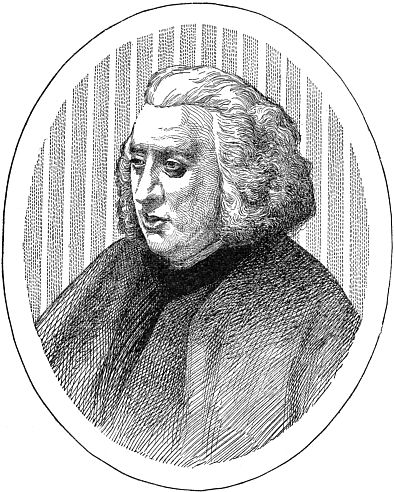
1. Samuel Johnson, one of the most eminent English
writers of the eighteenth century, was the son of Michael
Johnson, who was, at the beginning of that century, a magistrate
of Lichfield, and a bookseller of great note in the midland
counties. Michael's abilities and attainments seem to 5
have been considerable. He was so well acquainted with
the contents of the volumes which he exposed to sale, that the
country rectors of Staffordshire and Worcestershire thought
him an oracle on points of learning. Between him and the
clergy, indeed, there was a strong religious and political 10
sympathy. He was a zealous churchman, and, though he had
qualified himself for municipal office by taking the oaths to
the sovereigns in possession, was to the last a Jacobite in heart.
At his house, a house which is still pointed out to every
traveller who visits Lichfield, Samuel was born on the 18th of 15
September 1709. In the child, the physical, intellectual, and
moral peculiarities which afterwards distinguished the man were
plainly discernible; great muscular strength accompanied by
much awkwardness and many infirmities; great quickness of
parts, with a morbid propensity to sloth and procrastination; 20
a kind and generous heart, with a gloomy and irritable temper.
He had inherited from his ancestors a scrofulous taint, which
it was beyond the power of medicine to remove. His parents
were weak enough to believe that the royal touch was a specific
for this malady. In his third year he was taken up to London,
inspected by the court surgeon, prayed over by the court
chaplains, and stroked and presented with a piece of gold by
Queen Anne. One of his earliest recollections was that of a
stately lady in a diamond stomacher and a long black hood. 5
Her hand was applied in vain. The boy's features, which
were originally noble and not irregular, were distorted by his
malady. His cheeks were deeply scarred. He lost for a time
the sight of one eye; and he saw but very imperfectly with
the other. But the force of his mind overcame every impediment. 10
Indolent as he was, he acquired knowledge with such
ease and rapidity that at every school to which he was sent he
was soon the best scholar. From sixteen to eighteen he resided
at home, and was left to his own devices. He learned much at
this time, though his studies were without guidance and without 15
plan. He ransacked his father's shelves, dipped into a multitude
of books, read what was interesting, and passed over what
was dull. An ordinary lad would have acquired little or no useful
knowledge in such a way: but much that was dull to ordinary
lads was interesting to Samuel. He read little Greek; for his 20
proficiency in that language was not such that he could take
much pleasure in the masters of Attic poetry and eloquence.
But he had left school a good Latinist; and he soon acquired,
in the large and miscellaneous library of which he now had the
command, an extensive knowledge of Latin literature. That 25
Augustan delicacy of taste which is the boast of the great public
schools of England he never possessed. But he was early
familiar with some classical writers who were quite unknown
to the best scholars in the sixth form at Eton. He was peculiarly
attracted by the works of the great restorers of learning. 30
Once, while searching for some apples, he found a huge folio
volume of Petrarch's works. The name excited his curiosity;
and he eagerly devoured hundreds of pages. Indeed, the
diction and versification of his own Latin compositions show
that he had paid at least as much attention to modern copies
from the antique as to the original models.
2. While he was thus irregularly educating himself, his family
was sinking into hopeless poverty. Old Michael Johnson was
much better qualified to pore upon books, and to talk about 5
them, than to trade in them. His business declined; his debts
increased; it was with difficulty that the daily expenses of his
household were defrayed. It was out of his power to support
his son at either university; but a wealthy neighbour offered
assistance; and, in reliance on promises which proved to be of 10
very little value, Samuel was entered at Pembroke College,
Oxford. When the young scholar presented himself to the
rulers of that society, they were amazed not more by his ungainly
figure and eccentric manners than by the quantity of extensive
and curious information which he had picked up during many 15
months of desultory but not unprofitable study. On the first
day of his residence he surprised his teachers by quoting Macrobius;
and one of the most learned among them declared that
he had never known a freshman of equal attainments.
3. At Oxford, Johnson resided during about three years. 20
He was poor, even to raggedness; and his appearance excited
a mirth and a pity which were equally intolerable to his haughty
spirit. He was driven from the quadrangle of Christ Church
by the sneering looks which the members of that aristocratical
society cast at the holes in his shoes. Some charitable person 25
placed a new pair at his door; but he spurned them away in a
fury. Distress made him, not servile, but reckless and ungovernable.
No opulent gentleman commoner, panting for one-and-twenty,
could have treated the academical authorities with
more gross disrespect. The needy scholar was generally to be 30
seen under the gate of Pembroke, a gate now adorned with
his effigy, haranguing a circle of lads, over whom, in spite of
his tattered gown and dirty linen, his wit and audacity gave
him an undisputed ascendency. In every mutiny against the
discipline of the college he was the ringleader. Much was
pardoned, however, to a youth so highly distinguished by abilities
and acquirements. He had early made himself known
by turning Pope's Messiah into Latin verse. The style and
rhythm, indeed, were not exactly Virgilian; but the translation 5
found many admirers, and was read with pleasure by
Pope himself.
4. The time drew near at which Johnson would, in the
ordinary course of things, have become a Bachelor of Arts:
but he was at the end of his resources. Those promises of 10
support on which he had relied had not been kept. His
family could do nothing for him. His debts to Oxford tradesmen
were small indeed, yet larger than he could pay. In the
autumn of 1731, he was under the necessity of quitting the
university without a degree. In the following winter his father 15
died. The old man left but a pittance; and of that pittance
almost the whole was appropriated to the support of his widow.
The property to which Samuel succeeded amounted to no more
than twenty pounds.
5. His life, during the thirty years which followed, was 20
one hard struggle with poverty. The misery of that struggle
needed no aggravation, but was aggravated by the sufferings
of an unsound body and an unsound mind. Before the young
man left the university, his hereditary malady had broken forth
in a singularly cruel form. He had become an incurable 25
hypochondriac. He said long after that he had been mad all
his life, or at least not perfectly sane; and, in truth, eccentricities
less strange than his have often been thought grounds
sufficient for absolving felons, and for setting aside wills. His
grimaces, his gestures, his mutterings, sometimes diverted and 30
sometimes terrified people who did not know him. At a dinner
table he would, in a fit of absence, stoop down and twitch off
a lady's shoe. He would amaze a drawing-room by suddenly
ejaculating a clause of the Lord's Prayer. He would conceive
an unintelligible aversion to a particular alley, and perform a
great circuit rather than see the hateful place. He would set
his heart on touching every post in the streets through which he
walked. If by any chance he missed a post, he would go back
a hundred yards and repair the omission. Under the influence 5
of his disease, his senses became morbidly torpid, and his
imagination morbidly active. At one time he would stand poring
on the town clock without being able to tell the hour. At
another, he would distinctly hear his mother, who was many
miles off, calling him by his name. But this was not the 10
worst. A deep melancholy took possession of him, and gave
a dark tinge to all his views of human nature and of human
destiny. Such wretchedness as he endured has driven many
men to shoot themselves or drown themselves. But he was
under no temptation to commit suicide. He was sick of life; 15
but he was afraid of death; and he shuddered at every sight
or sound which reminded him of the inevitable hour. In religion
he found but little comfort during his long and frequent
fits of dejection; for his religion partook of his own character.
The light from heaven shone on him indeed, but not in a 20
direct line, or with its own pure splendour. The rays had
to struggle through a disturbing medium; they reached him
refracted, dulled and discoloured by the thick gloom which
had settled on his soul; and, though they might be sufficiently
clear to guide him, were too dim to cheer him. 25
6. With such infirmities of body and mind, this celebrated
man was left, at two-and-twenty, to fight his way through the
world. He remained during about five years in the midland
counties. At Lichfield, his birthplace and his early home, he
had inherited some friends and acquired others. He was kindly 30
noticed by Henry Hervey, a gay officer of noble family, who
happened to be quartered there. Gilbert Walmesley, registrar
of the ecclesiastical court of the diocese, a man of distinguished
parts, learning, and knowledge of the world, did
himself honour by patronising the young adventurer, whose
repulsive person, unpolished manners, and squalid garb moved
many of the petty aristocracy of the neighbourhood to laughter
or to disgust. At Lichfield, however, Johnson could find no
way of earning a livelihood. He became usher of a grammar 5
school in Leicestershire; he resided as a humble companion
in the house of a country gentleman; but a life of dependence
was insupportable to his haughty spirit. He repaired to Birmingham,
and there earned a few guineas by literary drudgery.
In that town he printed a translation, little noticed at the 10
time, and long forgotten, of a Latin book about Abyssinia.
He then put forth proposals for publishing by subscription the
poems of Politian, with notes containing a history of modern
Latin verse: but subscriptions did not come in; and the volume
never appeared. 15
7. While leading this vagrant and miserable life, Johnson
fell in love. The object of his passion was Mrs. Elizabeth
Porter, a widow who had children as old as himself. To ordinary
spectators, the lady appeared to be a short, fat, coarse
woman, painted half an inch thick, dressed in gaudy colours, 20
and fond of exhibiting provincial airs and graces which were
not exactly those of the Queensberrys and Lepels. To Johnson,
however, whose passions were strong, whose eyesight was
too weak to distinguish ceruse from natural bloom, and who
had seldom or never been in the same room with a woman of 25
real fashion, his Titty, as he called her, was the most beautiful,
graceful, and accomplished of her sex. That his admiration
was unfeigned cannot be doubted; for she was as poor as
himself. She accepted, with a readiness which did her little
honour, the addresses of a suitor who might have been her 30
son. The marriage, however, in spite of occasional wranglings,
proved happier than might have been expected. The lover
continued to be under the illusions of the wedding-day till the
lady died in her sixty-fourth year. On her monument he
placed an inscription extolling the charms of her person and
of her manners; and when, long after her decease, he had
occasion to mention her, he exclaimed, with a tenderness half
ludicrous, half pathetic, "Pretty creature!"
8. His marriage made it necessary for him to exert himself 5
more strenuously than he had hitherto done. He took a
house in the neighbourhood of his native town, and advertised
for pupils. But eighteen months passed away; and only three
pupils came to his academy. Indeed, his appearance was so
strange, and his temper so violent, that his schoolroom must 10
have resembled an ogre's den. Nor was the tawdry painted
grandmother whom he called his Titty well qualified to make
provision for the comfort of young gentlemen. David Garrick,
who was one of the pupils, used, many years later, to throw
the best company of London into convulsions of laughter by 15
mimicking the endearments of this extraordinary pair.
9. At length Johnson, in the twenty-eighth year of his age,
determined to seek his fortune in the capital as a literary
adventurer. He set out with a few guineas, three acts of the
tragedy of Irene in manuscript, and two or three letters of 20
introduction from his friend Walmesley.
10. Never, since literature became a calling in England, had
it been a less gainful calling than at the time when Johnson
took up his residence in London. In the preceding generation
a writer of eminent merit was sure to be munificently 25
rewarded by the government. The least that he could expect
was a pension or a sinecure place; and, if he showed any aptitude
for politics, he might hope to be a member of parliament,
a lord of the treasury, an ambassador, a secretary of state. It
would be easy, on the other hand, to name several writers 30
of the nineteenth century of whom the least successful has
received forty thousand pounds from the booksellers. But
Johnson entered on his vocation in the most dreary part of
the dreary interval which separated two ages of prosperity.
Literature had ceased to flourish under the patronage of the
great, and had not begun to flourish under the patronage of
the public. One man of letters, indeed, Pope, had acquired
by his pen what was then considered as a handsome fortune,
and lived on a footing of equality with nobles and ministers of 5
state. But this was a solitary exception. Even an author
whose reputation was established, and whose works were popular,
such an author as Thomson, whose Seasons were in every
library, such an author as Fielding, whose Pasquin had had a
greater run than any drama since The Beggar's Opera, was 10
sometimes glad to obtain, by pawning his best coat, the means
of dining on tripe at a cookshop underground, where he could
wipe his hands, after his greasy meal, on the back of a Newfoundland
dog. It is easy, therefore, to imagine what humiliations
and privations must have awaited the novice who had 15
still to earn a name. One of the publishers to whom Johnson
applied for employment measured with a scornful eye that
athletic though uncouth frame, and exclaimed, "You had
better get a porter's knot, and carry trunks." Nor was the
advice bad; for a porter was likely to be as plentifully fed, 20
and as comfortably lodged, as a poet.
11. Some time appears to have elapsed before Johnson
was able to form any literary connection from which he could
expect more than bread for the day which was passing over
him. He never forgot the generosity with which Hervey, who 25
was now residing in London, relieved his wants during this
time of trial. "Harry Hervey," said the old philosopher
many years later, "was a vicious man; but he was very
kind to me. If you call a dog Hervey I shall love him."
At Hervey's table Johnson sometimes enjoyed feasts which 30
were made more agreeable by contrast. But in general he
dined, and thought that he dined well, on sixpenny worth
of meat, and a pennyworth of bread, at an alehouse near
Drury Lane.
12. The effect of the privations and sufferings which he
endured at this time was discernible to the last in his temper
and his deportment. His manners had never been courtly.
They now became almost savage. Being frequently under the
necessity of wearing shabby coats and dirty shirts, he became a 5
confirmed sloven. Being often very hungry when he sat down
to his meals, he contracted a habit of eating with ravenous
greediness. Even to the end of his life, and even at the tables
of the great, the sight of food affected him as it affects wild
beasts and birds of prey. His taste in cookery, formed in 10
subterranean ordinaries and alamode beefshops, was far from
delicate. Whenever he was so fortunate as to have near him
a hare that had been kept too long, or a meat pie made with
rancid butter, he gorged himself with such violence that his
veins swelled, and the moisture broke out on his forehead. 15
The affronts which his poverty emboldened stupid and low-minded
men to offer to him would have broken a mean spirit
into sycophancy, but made him rude even to ferocity. Unhappily
the insolence which, while it was defensive, was pardonable,
and in some sense respectable, accompanied him into 20
societies where he was treated with courtesy and kindness. He
was repeatedly provoked into striking those who had taken
liberties with him. All the sufferers, however, were wise
enough to abstain from talking about their beatings, except
Osborne, the most rapacious and brutal of booksellers, who 25
proclaimed everywhere that he had been knocked down by the
huge fellow whom he had hired to puff the Harleian Library.
13. About a year after Johnson had begun to reside in
London, he was fortunate enough to obtain regular employment
from Cave, an enterprising and intelligent bookseller, who 30
was proprietor and editor of The Gentleman's Magazine. That
journal, just entering on the ninth year of its long existence,
was the only periodical work in the kingdom which then had
what would now be called a large circulation. It was, indeed,
the chief source of parliamentary intelligence. It was not then
safe, even during a recess, to publish an account of the proceedings
of either House without some disguise. Cave, however,
ventured to entertain his readers with what he called
"Reports of the Debates of the Senate of Lilliput." France 5
was Blefuscu; London was Mildendo; pounds were sprugs; the
Duke of Newcastle was the Nardac Secretary of State; Lord
Hardwicke was the Hurgo Hickrad; and William Pulteney
was Wingul Pulnub. To write the speeches was, during several
years, the business of Johnson. He was generally furnished 10
with notes, meagre indeed, and inaccurate, of what had been
said; but sometimes he had to find arguments and eloquence
both for the ministry and for the opposition. He was himself
a Tory, not from rational conviction—for his serious
opinion was that one form of government was just as good or 15
as bad as another—but from mere passion, such as inflamed
the Capulets against the Montagues, or the Blues of the Roman
circus against the Greens. In his infancy he had heard so
much talk about the villanies of the Whigs, and the dangers
of the Church, that he had become a furious partisan when 20
he could scarcely speak. Before he was three he had insisted
on being taken to hear Sacheverell preach at Lichfield Cathedral,
and had listened to the sermon with as much respect,
and probably with as much intelligence, as any Staffordshire
squire in the congregation. The work which had been begun 25
in the nursery had been completed by the university. Oxford,
when Johnson resided there, was the most Jacobitical place
in England; and Pembroke was one of the most Jacobitical
colleges in Oxford. The prejudices which he brought up
to London were scarcely less absurd than those of his own 30
Tom Tempest. Charles II. and James II. were two of the
best kings that ever reigned. Laud, a poor creature who
never did, said, or wrote anything indicating more than the
ordinary capacity of an old woman, was a prodigy of parts and
learning over whose tomb Art and Genius still continued to
weep. Hampden deserved no more honourable name than
that of "the zealot of rebellion." Even the ship money, condemned
not less decidedly by Falkland and Clarendon than by
the bitterest Roundheads, Johnson would not pronounce to 5
have been an unconstitutional impost. Under a government,
the mildest that had ever been known in the world—under a
government, which allowed to the people an unprecedented
liberty of speech and action—he fancied that he was a slave;
he assailed the ministry with obloquy which refuted itself, and 10
regretted the lost freedom and happiness of those golden days
in which a writer who had taken but one-tenth part of the
license allowed to him would have been pilloried, mangled
with the shears, whipped at the cart's tail, and flung into a
noisome dungeon to die. He hated dissenters and stock-jobbers, 15
the excise and the army, septennial parliaments, and
continental connections. He long had an aversion to the
Scotch, an aversion of which he could not remember the
commencement, but which, he owned, had probably originated in
his abhorrence of the conduct of the nation during the Great 20
Rebellion. It is easy to guess in what manner debates on
great party questions were likely to be reported by a man
whose judgment was so much disordered by party spirit. A
show of fairness was indeed necessary to the prosperity of the
Magazine. But Johnson long afterwards owned that, though 25
he had saved appearances, he had taken care that the Whig
dogs should not have the best of it; and, in fact, every passage
which has lived, every passage which bears the marks of
his higher faculties, is put into the mouth of some member
of the opposition. 30
14. A few weeks after Johnson had entered on these
obscure labours, he published a work which at once placed
him high among the writers of his age. It is probable that
what he had suffered during his first year in London had often
reminded him of some parts of that noble poem in which
Juvenal had described the misery and degradation of a needy
man of letters, lodged among the pigeons' nests in the tottering
garrets which overhung the streets of Rome. Pope's
admirable imitations of Horace's Satires and Epistles had 5
recently appeared, were in every hand, and were by many
readers thought superior to the originals. What Pope had
done for Horace, Johnson aspired to do for Juvenal. The
enterprise was bold, and yet judicious. For between Johnson
and Juvenal there was much in common, much more certainly 10
than between Pope and Horace.
15. Johnson's London appeared without his name in
May 1738. He received only ten guineas for this stately and
vigorous poem: but the sale was rapid, and the success complete.
A second edition was required within a week. Those 15
small critics who are always desirous to lower established reputations
ran about proclaiming that the anonymous satirist
was superior to Pope in Pope's own peculiar department of
literature. It ought to be remembered, to the honour of Pope,
that he joined heartily in the applause with which the appearance 20
of a rival genius was welcomed. He made inquiries about
the author of London. Such a man, he said, could not long
be concealed. The name was soon discovered; and Pope,
with great kindness, exerted himself to obtain an academical
degree and the mastership of a grammar school for the poor 25
young poet. The attempt failed, and Johnson remained a
bookseller's hack.
16. It does not appear that these two men, the most
eminent writer of the generation which was going out, and
the most eminent writer of the generation which was coming 30
in, ever saw each other. They lived in very different circles,
one surrounded by dukes and earls, the other by starving
pamphleteers and indexmakers. Among Johnson's associates
at this time may be mentioned Boyse, who, when his shirts
were pledged, scrawled Latin verses sitting up in bed with his
arms through two holes in his blanket, who composed very
respectable sacred poetry when he was sober, and who was at
last run over by a hackney coach when he was drunk; Hoole,
surnamed the metaphysical tailor, who, instead of attending 5
to his measures, used to trace geometrical diagrams on the
board where he sate cross-legged; and the penitent impostor,
George Psalmanazar, who, after poring all day, in a humble
lodging, on the folios of Jewish rabbis and Christian fathers,
indulged himself at night with literary and theological 10
conversation at an alehouse in the city. But the most remarkable
of the persons with whom at this time Johnson consorted
was Richard Savage, an earl's son, a shoemaker's apprentice,
who had seen life in all its forms, who had feasted among blue
ribands in Saint James's Square, and had lain with fifty pounds' 15
weight of iron on his legs in the condemned ward of Newgate.
This man had, after many vicissitudes of fortune, sunk at last
into abject and hopeless poverty. His pen had failed him.
His patrons had been taken away by death, or estranged by
the riotous profusion with which he squandered their bounty, 20
and the ungrateful insolence with which he rejected their
advice. He now lived by begging. He dined on venison
and champagne whenever he had been so fortunate as to
borrow a guinea. If his questing had been unsuccessful, he
appeased the rage of hunger with some scraps of broken meat, 25
and lay down to rest under the Piazza of Covent Garden in
warm weather, and, in cold weather, as near as he could get
to the furnace of a glass house. Yet, in his misery, he was still
an agreeable companion. He had an inexhaustible store of
anecdotes about that gay and brilliant world from which he 30
was now an outcast. He had observed the great men of both
parties in hours of careless relaxation, had seen the leaders
of opposition without the mask of patriotism, and had heard
the prime minister roar with laughter and tell stories not over
decent. During some months Savage lived in the closest
familiarity with Johnson; and then the friends parted, not
without tears. Johnson remained in London to drudge for
Cave. Savage went to the West of England, lived there as
he had lived everywhere, and, in 1743, died, penniless and 5
heart-broken, in Bristol gaol.
17. Soon after his death, while the public curiosity was
strongly excited about his extraordinary character, and his
not less extraordinary adventures, a life of him appeared
widely different from the catchpenny lives of eminent men 10
which were then a staple article of manufacture in Grub
Street. The style was indeed deficient in ease and variety;
and the writer was evidently too partial to the Latin element
of our language. But the little work, with all its faults, was
a masterpiece. No finer specimen of literary biography existed 15
in any language, living or dead; and a discerning critic might
have confidently predicted that the author was destined to be
the founder of a new school of English eloquence.
18. The life of Savage was anonymous; but it was well
known in literary circles that Johnson was the writer. During 20
the three years which followed, he produced no important
work; but he was not, and indeed could not be, idle. The fame
of his abilities and learning continued to grow. Warburton
pronounced him a man of parts and genius; and the praise
of Warburton was then no light thing. Such was Johnson's 25
reputation that, in 1747, several eminent booksellers combined
to employ him in the arduous work of preparing a
Dictionary of the English language, in two folio volumes. The
sum which they agreed to pay him was only fifteen hundred
guineas; and out of this sum he had to pay several poor men 30
of letters who assisted him in the humbler parts of his task.
19. The prospectus of the Dictionary he addressed to the
Earl of Chesterfield. Chesterfield had long been celebrated
for the politeness of his manners, the brilliancy of his wit,
and the delicacy of his taste. He was acknowledged to be
the finest speaker in the House of Lords. He had recently
governed Ireland, at a momentous conjuncture, with eminent
firmness, wisdom, and humanity; and he had since become
Secretary of State. He received Johnson's homage with the 5
most winning affability, and requited it with a few guineas,
bestowed doubtless in a very graceful manner, but was by no
means desirous to see all his carpets blackened with the London
mud, and his soups and wines thrown to right and left over
the gowns of fine ladies and the waistcoats of fine gentlemen, 10
by an absent, awkward scholar, who gave strange starts and
uttered strange growls, who dressed like a scarecrow, and ate
like a cormorant. During some time Johnson continued to
call on his patron, but after being repeatedly told by the
porter that his lordship was not at home, took the hint, and 15
ceased to present himself at the inhospitable door.
20. Johnson had flattered himself that he should have completed
his Dictionary by the end of 1750; but it was not till
1755 that he at length gave his huge volumes to the world.
During the seven years which he passed in the drudgery of 20
penning definitions and marking quotations for transcription,
he sought for relaxation in literary labour of a more agreeable
kind. In 1749 he published the Vanity of Human Wishes,
an excellent imitation of the Tenth Satire of Juvenal. It is
in truth not easy to say whether the palm belongs to the 25
ancient or to the modern poet. The couplets in which the
fall of Wolsey is described, though lofty and sonorous, are feeble
when compared with the wonderful lines which bring before us
all Rome in tumult on the day of the fall of Sejanus, the laurels
on the doorposts, the white bull stalking towards the Capitol, 30
the statues rolling down from their pedestals, the flatterers of
the disgraced minister running to see him dragged with a hook
through the streets, and to have a kick at his carcase before
it is hurled into the Tiber. It must be owned too that in the
concluding passage the Christian moralist has not made the
most of his advantages, and has fallen decidedly short of
the sublimity of his pagan model. On the other hand, Juvenal's
Hannibal must yield to Johnson's Charles; and Johnson's
vigorous and pathetic enumeration of the miseries of a literary 5
life must be allowed to be superior to Juvenal's lamentation
over the fate of Demosthenes and Cicero.
21. For the copyright of the Vanity of Human Wishes
Johnson received only fifteen guineas.
22. A few days after the publication of this poem, his 10
tragedy, begun many years before, was brought on the stage.
His pupil, David Garrick, had, in 1741, made his appearance
on a humble stage in Goodman's Fields, had at once risen to the
first place among actors, and was now, after several years of
almost uninterrupted success, manager of Drury Lane Theatre. 15
The relation between him and his old preceptor was of a very
singular kind. They repelled each other strongly, and yet
attracted each other strongly. Nature had made them of very
different clay; and circumstances had fully brought out the
natural peculiarities of both. Sudden prosperity had turned 20
Garrick's head. Continued adversity had soured Johnson's
temper. Johnson saw with more envy than became so great
a man the villa, the plate, the china, the Brussels carpet, which
the little mimic had got by repeating, with grimaces and
gesticulations, what wiser men had written; and the exquisitely 25
sensitive vanity of Garrick was galled by the thought that,
while all the rest of the world was applauding him, he could
obtain from one morose cynic, whose opinion it was impossible
to despise, scarcely any compliment not acidulated with scorn.
Yet the two Lichfield men had so many early recollections in 30
common, and sympathised with each other on so many points
on which they sympathised with nobody else in the vast population
of the capital, that, though the master was often provoked
by the monkey-like impertinence of the pupil, and the
pupil by the bearish rudeness of the master, they remained
friends till they were parted by death. Garrick now brought
Irene out, with alterations sufficient to displease the author,
yet not sufficient to make the piece pleasing to the audience.
The public, however, listened with little emotion, but with 5
much civility, to five acts of monotonous declamation. After
nine representations the play was withdrawn. It is, indeed,
altogether unsuited to the stage, and, even when perused in
the closet, will be found hardly worthy of the author. He had
not the slightest notion of what blank verse should be. A 10
change in the last syllable of every other line would make the
versification of the Vanity of Human Wishes closely resemble
the versification of Irene. The poet, however, cleared, by
his benefit nights, and by the sale of the copyright of his
tragedy, about three hundred pounds, then a great sum in 15
his estimation.
23. About a year after the representation of Irene, he
began to publish a series of short essays on morals, manners,
and literature. This species of composition had been brought
into fashion by the success of the Tatler, and by the still more 20
brilliant success of the Spectator. A crowd of small writers
had vainly attempted to rival Addison. The Lay Monastery,
the Censor, the Freethinker, the Plain Dealer, the Champion,
and other works of the same kind, had had their short day.
None of them had obtained a permanent place in our literature; 25
and they are now to be found only in the libraries of
the curious. At length Johnson undertook the adventure in
which so many aspirants had failed. In the thirty-sixth year
after the appearance of the last number of the Spectator
appeared the first number of the Rambler. From March 30
1750 to March 1752, this paper continued to come out every
Tuesday and Saturday.
24. From the first the Rambler was enthusiastically admired
by a few eminent men. Richardson, when only five numbers
had appeared, pronounced it equal, if not superior, to the
Spectator. Young and Hartley expressed their approbation
not less warmly. Bubb Dodington, among whose many faults
indifference to the claims of genius and learning cannot be
reckoned, solicited the acquaintance of the writer. In consequence 5
probably of the good offices of Dodington, who was
then the confidential adviser of Prince Frederic, two of His
Royal Highness's gentlemen carried a gracious message to
the printing office, and ordered seven copies for Leicester
House. But these overtures seem to have been very coldly 10
received. Johnson had had enough of the patronage of the
great to last him all his life, and was not disposed to haunt
any other door as he had haunted the door of Chesterfield.
25. By the public the Rambler was at first very coldly
received. Though the price of a number was only twopence, 15
the sale did not amount to five hundred. The profits were
therefore very small. But as soon as the flying leaves were
collected and reprinted they became popular. The author
lived to see thirteen thousand copies spread over England
alone. Separate editions were published for the Scotch and 20
Irish markets. A large party pronounced the style perfect, so
absolutely perfect that in some essays it would be impossible
for the writer himself to alter a single word for the better.
Another party, not less numerous, vehemently accused him of
having corrupted the purity of the English tongue. The best 25
critics admitted that his diction was too monotonous, too obviously
artificial, and now and then turgid even to absurdity.
But they did justice to the acuteness of his observations on
morals and manners, to the constant precision and frequent
brilliancy of his language, to the weighty and magnificent 30
eloquence of many serious passages, and to the solemn yet pleasing
humour of some of the lighter papers. On the question
of precedence between Addison and Johnson, a question
which, seventy years ago, was much disputed, posterity has
pronounced a decision from which there is no appeal. Sir
Roger, his chaplain and his butler, Will Wimble and Will
Honeycomb, the Vision of Mirza, the Journal of the Retired
Citizen, the Everlasting Club, the Dunmow Flitch, the Loves
of Hilpah and Shalum, the Visit to the Exchange, and the 5
Visit to the Abbey, are known to everybody. But many men
and women, even of highly cultivated minds, are unacquainted
with Squire Bluster and Mrs. Busy, Quisquilius and Venustulus,
the Allegory of Wit and Learning, the Chronicle of the Revolutions
of a Garret, and the sad fate of Aningait and Ajut. 10
26. The last Rambler was written in a sad and gloomy
hour. Mrs. Johnson had been given over by the physicians.
Three days later she died. She left her husband almost
broken-hearted. Many people had been surprised to see a
man of his genius and learning stooping to every drudgery, 15
and denying himself almost every comfort, for the purpose of
supplying a silly, affected old woman with superfluities, which
she accepted with but little gratitude. But all his affection
had been concentrated on her. He had neither brother nor
sister, neither son nor daughter. To him she was beautiful as 20
the Gunnings, and witty as Lady Mary. Her opinion of his
writings was more important to him than the voice of the
pit of Drury Lane Theatre or the judgment of the Monthly
Review. The chief support which had sustained him through
the most arduous labour of his life was the hope that she would 25
enjoy the fame and the profit which he anticipated from his
Dictionary. She was gone; and in that vast labyrinth of
streets, peopled by eight hundred thousand human beings,
he was alone. Yet it was necessary for him to set himself, as
he expressed it, doggedly to work. After three more laborious 30
years, the Dictionary was at length complete.
27. It had been generally supposed that this great work
would be dedicated to the eloquent and accomplished nobleman
to whom the prospectus had been addressed. He well
knew the value of such a compliment; and therefore, when
the day of publication drew near, he exerted himself to soothe,
by a show of zealous and at the same time of delicate and
judicious kindness, the pride which he had so cruelly wounded.
Since the Ramblers had ceased to appear, the town had been 5
entertained by a journal called The World, to which many men
of high rank and fashion contributed. In two successive numbers
of the World the Dictionary was, to use the modern phrase,
puffed with wonderful skill. The writings of Johnson were
warmly praised. It was proposed that he should be invested 10
with the authority of a Dictator, nay, of a Pope, over our
language, and that his decisions about the meaning and the
spelling of words should be received as final. His two folios,
it was said, would of course be bought by everybody who could
afford to buy them. It was soon known that these papers were 15
written by Chesterfield. But the just resentment of Johnson
was not to be so appeased. In a letter written with singular
energy and dignity of thought and language, he repelled the
tardy advances of his patron. The Dictionary came forth without
a dedication. In the preface the author truly declared that 20
he owed nothing to the great, and described the difficulties with
which he had been left to struggle so forcibly and pathetically
that the ablest and most malevolent of all the enemies of his
fame, Horne Tooke, never could read that passage without tears.
28. The public, on this occasion, did Johnson full justice, 25
and something more than justice. The best lexicographer
may well be content if his productions are received by the
world with cold esteem. But Johnson's Dictionary was hailed
with an enthusiasm such as no similar work has ever excited.
It was indeed the first dictionary which could be read with 30
pleasure. The definitions show so much acuteness of thought
and command of language, and the passages quoted from poets,
divines, and philosophers are so skilfully selected, that a leisure
hour may always be very agreeably spent in turning over the
pages. The faults of the book resolve themselves, for the most
part, into one great fault. Johnson was a wretched etymologist.
He knew little or nothing of any Teutonic language
except English, which indeed, as he wrote it, was scarcely a
Teutonic language; and thus he was absolutely at the mercy 5
of Junius and Skinner.
29. The Dictionary, though it raised Johnson's fame, added
nothing to his pecuniary means. The fifteen hundred guineas
which the booksellers had agreed to pay him had been advanced
and spent before the last sheets issued from the press. It is 10
painful to relate that, twice in the course of the year which
followed the publication of this great work, he was arrested
and carried to spunging-houses, and that he was twice indebted
for his liberty to his excellent friend Richardson. It was still
necessary for the man who had been formally saluted by the 15
highest authority as Dictator of the English language to supply
his wants by constant toil. He abridged his Dictionary. He
proposed to bring out an edition of Shakspeare by subscription;
and many subscribers sent in their names and laid down their
money; but he soon found the task so little to his taste that 20
he turned to more attractive employments. He contributed
many papers to a new monthly journal, which was called the
Literary Magazine. Few of these papers have much interest;
but among them was the very best thing that he ever wrote, a
masterpiece both of reasoning and of satirical pleasantry, the 25
review of Jenyns's Inquiry into the Nature and Origin of Evil.
30. In the spring of 1758 Johnson put forth the first of a
series of essays, entitled The Idler. During two years these
essays continued to appear weekly. They were eagerly read,
widely circulated, and, indeed, impudently pirated, while they 30
were still in the original form, and had a large sale when collected
into volumes. The Idler may be described as a second
part of the Rambler, somewhat livelier and somewhat weaker
than the first part.
31. While Johnson was busied with his Idlers, his mother, who
had accomplished her ninetieth year, died at Lichfield. It was
long since he had seen her; but he had not failed to contribute
largely, out of his small means, to her comfort. In order to
defray the charges of her funeral, and to pay some debts which 5
she had left, he wrote a little book in a single week, and sent
off the sheets to the press without reading them over. A
hundred pounds were paid him for the copyright; and the
purchasers had great cause to be pleased with their bargain;
for the book was Rasselas. 10
32. The success of Rasselas was great, though such ladies
as Miss Lydia Languish must have been grievously disappointed
when they found that the new volume from the circulating
library was little more than a dissertation on the author's
favourite theme, the Vanity of Human Wishes; that the Prince 15
of Abyssinia was without a mistress, and the Princess without a
lover; and that the story set the hero and the heroine down
exactly where it had taken them up. The style was the subject
of much eager controversy. The Monthly Review and the
Critical Review took different sides. Many readers pronounced 20
the writer a pompous pedant, who would never use a word of
two syllables where it was possible to use a word of six, and
who could not make a waiting woman relate her adventures
without balancing every noun with another noun, and every
epithet with another epithet. Another party, not less zealous, 25
cited with delight numerous passages in which weighty meaning
was expressed with accuracy and illustrated with splendour.
And both the censure and the praise were merited.
33. About the plan of Rasselas little was said by the
critics; and yet the faults of the plan might seem to invite 30
severe criticism. Johnson has frequently blamed Shakspeare
for neglecting the proprieties of time and place, and for ascribing
to one age or nation the manners and opinions of another.
Yet Shakspeare has not sinned in this way more grievously
than Johnson. Rasselas and Imlac, Nekayah and Pekuah, are
evidently meant to be Abyssinians of the eighteenth century:
for the Europe which Imlac describes is the Europe of the
eighteenth century; and the inmates of the Happy Valley
talk familiarly of that law of gravitation which Newton discovered, 5
and which was not fully received even at Cambridge
till the eighteenth century. What a real company of Abyssinians
would have been may be learned from Bruce's Travels.
But Johnson, not content with turning filthy savages, ignorant
of their letters, and gorged with raw steaks cut from living 10
cows, into philosophers as eloquent and enlightened as himself
or his friend Burke, and into ladies as highly accomplished as
Mrs. Lennox or Mrs. Sheridan, transferred the whole domestic
system of England to Egypt. Into a land of harems, a land of
polygamy, a land where women are married without ever being 15
seen, he introduced the flirtations and jealousies of our ballrooms.
In a land where there is boundless liberty of divorce,
wedlock is described as the indissoluble compact. "A youth
and maiden meeting by chance, or brought together by artifice,
exchange glances, reciprocate civilities, go home, and dream 20
of each other. Such," says Rasselas, "is the common process
of marriage." Such it may have been, and may still be, in
London, but assuredly not at Cairo. A writer who was guilty
of such improprieties had little right to blame the poet who
made Hector quote Aristotle, and represented Julio Romano 25
as flourishing in the days of the oracle of Delphi.
34. By such exertions as have been described, Johnson
supported himself till the year 1762. In that year a great
change in his circumstances took place. He had from a child
been an enemy of the reigning dynasty. His Jacobite prejudices 30
had been exhibited with little disguise both in his works
and in his conversation. Even in his massy and elaborate
Dictionary, he had, with a strange want of taste and judgment,
inserted bitter and contumelious reflections on the Whig party.
The excise, which was a favourite resource of Whig financiers,
he had designated as a hateful tax. He had railed against the
commissioners of excise in language so coarse that they had
seriously thought of prosecuting him. He had with difficulty
been prevented from holding up the Lord Privy Seal by name 5
as an example of the meaning of the word "renegade." A
pension he had defined as pay given to a state hireling to betray
his country; a pensioner as a slave of state hired by a stipend
to obey a master. It seemed unlikely that the author of these
definitions would himself be pensioned. But that was a time 10
of wonders. George the Third had ascended the throne; and
had, in the course of a few months, disgusted many of the old
friends and conciliated many of the old enemies of his house.
The city was becoming mutinous. Oxford was becoming loyal.
Cavendishes and Bentincks were murmuring. Somersets and 15
Wyndhams were hastening to kiss hands. The head of the
treasury was now Lord Bute, who was a Tory, and could have
no objection to Johnson's Toryism. Bute wished to be thought
a patron of men of letters; and Johnson was one of the most
eminent and one of the most needy men of letters in Europe. 20
A pension of three hundred a year was graciously offered, and
with very little hesitation accepted.
35. This event produced a change in Johnson's whole way
of life. For the first time since his boyhood he no longer felt
the daily goad urging him to the daily toil. He was at liberty, 25
after thirty years of anxiety and drudgery, to indulge his
constitutional indolence, to lie in bed till two in the afternoon,
and to sit up talking till four in the morning, without fearing
either the printer's devil or the sheriff's officer.
36. One laborious task indeed he had bound himself to 30
perform. He had received large subscriptions for his promised
edition of Shakspeare; he had lived on those subscriptions
during some years; and he could not without disgrace omit
to perform his part of the contract. His friends repeatedly
exhorted him to make an effort; and he repeatedly resolved
to do so. But, notwithstanding their exhortations and his
resolutions, month followed month, year followed year, and
nothing was done. He prayed fervently against his idleness;
he determined, as often as he received the sacrament, that 5
he would no longer doze away and trifle away his time; but
the spell under which he lay resisted prayer and sacrament.
His private notes at this time are made up of self-reproaches.
"My indolence," he wrote on Easter eve in 1764, "has sunk
into grosser sluggishness. A kind of strange oblivion has 10
overspread me, so that I know not what has become of the last
year." Easter 1765 came, and found him still in the same
state. "My time," he wrote, "has been unprofitably spent,
and seems as a dream that has left nothing behind. My
memory grows confused, and I know not how the days pass 15
over me." Happily for his honour, the charm which held him
captive was at length broken by no gentle or friendly hand.
He had been weak enough to pay serious attention to a story
about a ghost which haunted a house in Cock Lane, and had
actually gone himself with some of his friends, at one in the 20
morning, to St. John's Church, Clerkenwell, in the hope of
receiving a communication from the perturbed spirit. But the
spirit, though adjured with all solemnity, remained obstinately
silent; and it soon appeared that a naughty girl of eleven had
been amusing herself by making fools of so many philosophers. 25
Churchill, who, confident in his powers, drunk with popularity,
and burning with party spirit, was looking for some man of
established fame and Tory politics to insult, celebrated the
Cock Lane Ghost in three cantos, nicknamed Johnson Pomposo,
asked where the book was which had been so long 30
promised and so liberally paid for, and directly accused the
great moralist of cheating. This terrible word proved effectual;
and in October 1765 appeared, after a delay of nine
years, the new edition of Shakspeare.
37. This publication saved Johnson's character for honesty,
but added nothing to the fame of his abilities and learning.
The preface, though it contains some good passages, is not in
his best manner. The most valuable notes are those in which
he had an opportunity of showing how attentively he had 5
during many years observed human life and human nature.
The best specimen is the note on the character of Polonius.
Nothing so good is to be found even in Wilhelm Meister's
admirable examination of Hamlet. But here praise must end.
It would be difficult to name a more slovenly, a more worthless 10
edition of any great classic. The reader may turn over play
after play without finding one happy conjectural emendation,
or one ingenious and satisfactory explanation of a passage
which had baffled preceding commentators. Johnson had, in
his prospectus, told the world that he was peculiarly fitted for 15
the task which he had undertaken, because he had, as a
lexicographer, been under the necessity of taking a wider view of
the English language than any of his predecessors. That his
knowledge of our literature was extensive is indisputable. But,
unfortunately, he had altogether neglected that very part of 20
our literature with which it is especially desirable that an editor
of Shakspeare should be conversant. It is dangerous to assert
a negative. Yet little will be risked by the assertion, that in
the two folio volumes of the English Dictionary there is not a
single passage quoted from any dramatist of the Elizabethan 25
age, except Shakspeare and Ben. Even from Ben the quotations
are few. Johnson might easily, in a few months, have
made himself well acquainted with every old play that was
extant. But it never seems to have occurred to him that this
was a necessary preparation for the work which he had undertaken. 30
He would doubtless have admitted that it would be
the height of absurdity in a man who was not familiar with
the works of Æschylus and Euripides to publish an edition of
Sophocles. Yet he ventured to publish an edition of Shakspeare,
without having ever in his life, as far as can be discovered,
read a single scene of Massinger, Ford, Decker, Webster,
Marlow, Beaumont, or Fletcher. His detractors were noisy
and scurrilous. Those who most loved and honoured him had
little to say in praise of the manner in which he had discharged 5
the duty of a commentator. He had, however, acquitted himself
of a debt which had long lain heavy on his conscience;
and he sank back into the repose from which the sting of satire
had roused him. He long continued to live upon the fame
which he had already won. He was honoured by the University 10
of Oxford with a Doctor's degree, by the Royal Academy
with a professorship, and by the King with an interview, in
which his Majesty most graciously expressed a hope that so
excellent a writer would not cease to write. In the interval,
however, between 1765 and 1775 Johnson published only two 15
or three political tracts, the longest of which he could have
produced in forty-eight hours, if he had worked as he worked
on the Life of Savage and on Rasselas.
38. But, though his pen was now idle, his tongue was active.
The influence exercised by his conversation, directly upon 20
those with whom he lived, and indirectly on the whole literary
world, was altogether without a parallel. His colloquial talents
were indeed of the highest order. He had strong sense, quick
discernment, wit, humour, immense knowledge of literature
and of life, and an infinite store of curious anecdotes. As 25
respected style, he spoke far better than he wrote. Every sentence
which dropped from his lips was as correct in structure
as the most nicely balanced period of the Rambler. But in
his talk there were no pompous triads, and little more than a fair
proportion of words in osity and ation. All was simplicity, 30
ease, and vigour. He uttered his short, weighty, and pointed
sentences with a power of voice, and a justness and energy of
emphasis, of which the effect was rather increased than diminished
by the rollings of his huge form, and by the asthmatic
gaspings and puffings in which the peals of his eloquence generally
ended. Nor did the laziness which made him unwilling
to sit down to his desk prevent him from giving instruction or
entertainment orally. To discuss questions of taste, of learning,
of casuistry, in language so exact and so forcible that it might 5
have been printed without the alteration of a word, was to him
no exertion, but a pleasure. He loved, as he said, to fold his
legs and have his talk out. He was ready to bestow the overflowings
of his full mind on anybody who would start a subject,
on a fellow-passenger in a stage coach, or on the person who 10
sate at the same table with him in an eating-house. But his
conversation was nowhere so brilliant and striking as when he
was surrounded by a few friends, whose abilities and knowledge
enabled them, as he once expressed it, to send him back every
ball that he threw. Some of these, in 1764, formed themselves 15
into a club, which gradually became a formidable power in the
commonwealth of letters. The verdicts pronounced by this
conclave on new books were speedily known over all London,
and were sufficient to sell off a whole edition in a day, or to
condemn the sheets to the service of the trunk-maker and the 20
pastry-cook. Nor shall we think this strange when we consider
what great and various talents and acquirements met in the
little fraternity. Goldsmith was the representative of poetry
and light literature, Reynolds of the arts, Burke of political
eloquence and political philosophy. There, too, were Gibbon, 25
the greatest historian, and Jones, the greatest linguist, of the
age. Garrick brought to the meetings his inexhaustible pleasantry,
his incomparable mimicry, and his consummate knowledge
of stage effect. Among the most constant attendants
were two high-born and high-bred gentlemen, closely bound 30
together by friendship, but of widely different characters and
habits; Bennet Langton, distinguished by his skill in Greek
literature, by the orthodoxy of his opinions, and by the sanctity
of his life; and Topham Beauclerk, renowned for his amours,
his knowledge of the gay world, his fastidious taste, and his
sarcastic wit. To predominate over such a society was not
easy. Yet even over such a society Johnson predominated.
Burke might indeed have disputed the supremacy to which
others were under the necessity of submitting. But Burke, 5
though not generally a very patient listener, was content to
take the second part when Johnson was present; and the
club itself, consisting of so many eminent men, is to this
day popularly designated as Johnson's Club.
39. Among the members of this celebrated body was one 10
to whom it has owed the greater part of its celebrity, yet who
was regarded with little respect by his brethren, and had not
without difficulty obtained a seat among them. This was
James Boswell, a young Scotch lawyer, heir to an honourable
name and a fair estate. That he was a coxcomb and a bore, 15
weak, vain, pushing, curious, garrulous, was obvious to all who
were acquainted with him. That he could not reason, that
he had no wit, no humour, no eloquence, is apparent from
his writings. And yet his writings are read beyond the Mississippi,
and under the Southern Cross, and are likely to be 20
read as long as the English exists, either as a living or as a
dead language. Nature had made him a slave and an idolater.
His mind resembled those creepers which the botanists call
parasites, and which can subsist only by clinging round the
stems and imbibing the juices of stronger plants. He must 25
have fastened himself on somebody. He might have fastened
himself on Wilkes, and have become the fiercest patriot in the
Bill of Rights Society. He might have fastened himself on
Whitfield, and have become the loudest field preacher among
the Calvinistic Methodists. In a happy hour he fastened himself 30
on Johnson. The pair might seem ill matched. For
Johnson had early been prejudiced against Boswell's country.
To a man of Johnson's strong understanding and irritable
temper, the silly egotism and adulation of Boswell must have
been as teasing as the constant buzz of a fly. Johnson hated
to be questioned; and Boswell was eternally catechising him
on all kinds of subjects, and sometimes propounded such
questions as "What would you do, sir, if you were locked up
in a tower with a baby?" Johnson was a water drinker; and 5
Boswell was a wine-bibber, and indeed little better than a
habitual sot. It was impossible that there should be perfect
harmony between two such companions. Indeed, the great
man was sometimes provoked into fits of passion in which he
said things which the small man, during a few hours, seriously 10
resented. Every quarrel, however, was soon made up. During
twenty years the disciple continued to worship the master:
the master continued to scold the disciple, to sneer at him, and
to love him. The two friends ordinarily resided at a great
distance from each other. Boswell practised in the Parliament 15
House of Edinburgh, and could pay only occasional
visits to London. During those visits his chief business was
to watch Johnson, to discover all Johnson's habits, to turn the
conversation to subjects about which Johnson was likely to
say something remarkable, and to fill quarto note books with 20
minutes of what Johnson had said. In this way were gathered
the materials out of which was afterwards constructed the most
interesting biographical work in the world.
40. Soon after the club began to exist, Johnson formed a
connection less important indeed to his fame, but much more 25
important to his happiness, than his connection with Boswell.
Henry Thrale, one of the most opulent brewers in the kingdom,
a man of sound and cultivated understanding, rigid principles,
and liberal spirit, was married to one of those clever,
kind-hearted, engaging, vain, pert young women, who are 30
perpetually doing or saying what is not exactly right, but who, do
or say what they may, are always agreeable. In 1765 the
Thrales became acquainted with Johnson, and the acquaintance
ripened fast into friendship. They were astonished and
delighted by the brilliancy of his conversation. They were
flattered by finding that a man so widely celebrated, preferred
their house to any other in London. Even the peculiarities
which seemed to unfit him for civilised society, his gesticulations,
his rollings, his puffings, his mutterings, the strange way 5
in which he put on his clothes, the ravenous eagerness with
which he devoured his dinner, his fits of melancholy, his fits of
anger, his frequent rudeness, his occasional ferocity, increased
the interest which his new associates took in him. For these
things were the cruel marks left behind by a life which had 10
been one long conflict with disease and with adversity. In a
vulgar hack writer such oddities would have excited only disgust.
But in a man of genius, learning, and virtue their effect
was to add pity to admiration and esteem. Johnson soon had
an apartment at the brewery in Southwark, and a still more 15
pleasant apartment at the villa of his friends on Streatham
Common. A large part of every year he passed in those
abodes, abodes which must have seemed magnificent and luxurious
indeed, when compared with the dens in which he had
generally been lodged. But his chief pleasures were derived 20
from what the astronomer of his Abyssinian tale called "the
endearing elegance of female friendship." Mrs. Thrale rallied
him, soothed him, coaxed him, and, if she sometimes provoked
him by her flippancy, made ample amends by listening to his
reproofs with angelic sweetness of temper. When he was 25
diseased in body and in mind, she was the most tender of
nurses. No comfort that wealth could purchase, no contrivance
that womanly ingenuity, set to work by womanly compassion,
could devise, was wanting to his sick-room. He
requited her kindness by an affection pure as the affection of 30
a father, yet delicately tinged with a gallantry which, though
awkward, must have been more flattering than the attentions
of a crowd of the fools who gloried in the names, now obsolete,
of Buck and Maccaroni. It should seem that a full half of
Johnson's life, during about sixteen years, was passed under
the roof of the Thrales. He accompanied the family sometimes
to Bath, and sometimes to Brighton, once to Wales, and once
to Paris. But he had at the same time a house in one of the
narrow and gloomy courts on the north of Fleet Street. In 5
the garrets was his library, a large and miscellaneous collection
of books, falling to pieces and begrimed with dust. On
a lower floor he sometimes, but very rarely, regaled a friend
with a plain dinner, a veal pie, or a leg of lamb and spinage,
and a rice pudding. Nor was the dwelling uninhabited during 10
his long absences. It was the home of the most extraordinary
assemblage of inmates that ever was brought together. At
the head of the establishment Johnson had placed an old
lady named Williams, whose chief recommendations were her
blindness and her poverty. But, in spite of her murmurs and 15
reproaches, he gave an asylum to another lady who was as poor
as herself, Mrs. Desmoulins, whose family he had known many
years before in Staffordshire. Room was found for the daughter
of Mrs. Desmoulins, and for another destitute damsel, who was
generally addressed as Miss Carmichael, but whom her generous 20
host called Polly. An old quack doctor named Levett,
who bled and dosed coal-heavers and hackney coachmen, and
received for fees crusts of bread, bits of bacon, glasses of gin,
and sometimes a little copper, completed this strange menagerie.
All these poor creatures were at constant war with each 25
other, and with Johnson's negro servant Frank. Sometimes,
indeed, they transferred their hostilities from the servant to
the master, complained that a better table was not kept for
them, and railed or maundered till their benefactor was glad to
make his escape to Streatham, or to the Mitre Tavern. And 30
yet he, who was generally the haughtiest and most irritable
of mankind, who was but too prompt to resent anything which
looked like a slight on the part of a purse-proud bookseller,
or of a noble and powerful patron, bore patiently from
mendicants, who, but for his bounty, must have gone to the
workhouse, insults more provoking than those for which he had
knocked down Osborne and bidden defiance to Chesterfield.
Year after year Mrs. Williams and Mrs. Desmoulins, Polly, and
Levett continued to torment him and to live upon him. 5
41. The course of life which has been described was
interrupted in Johnson's sixty-fourth year by an important
event. He had early read an account of the Hebrides, and
had been much interested by learning that there was so near
him a land peopled by a race which was still as rude and 10
simple as in the middle ages. A wish to become intimately
acquainted with a state of society so utterly unlike all that he
had ever seen frequently crossed his mind. But it is not
probable that his curiosity would have overcome his habitual
sluggishness, and his love of the smoke, the mud, and the 15
cries of London, had not Boswell importuned him to attempt
the adventure, and offered to be his squire. At length, in
August 1773, Johnson crossed the Highland line, and plunged
courageously into what was then considered, by most Englishmen,
as a dreary and perilous wilderness. After wandering 20
about two months through the Celtic region, sometimes in
rude boats which did not protect him from the rain, and
sometimes on small shaggy ponies which could hardly bear
his weight, he returned to his old haunts with a mind full of
new images and new theories. During the following year he 25
employed himself in recording his adventures. About the
beginning of 1775, his Journey to the Hebrides was published,
and was, during some weeks, the chief subject of conversation
in all circles in which any attention was paid to literature.
The book is still read with pleasure. The narrative is 30
entertaining; the speculations, whether sound or unsound, are
always ingenious; and the style, though too stiff and pompous,
is somewhat easier and more graceful than that of his
early writings. His prejudice against the Scotch had at
length become little more than matter of jest; and whatever
remained of the old feeling had been effectually removed by
the kind and respectful hospitality with which he had been
received in every part of Scotland. It was, of course, not to
be expected that an Oxonian Tory should praise the Presbyterian 5
polity and ritual, or that an eye accustomed to the
hedgerows and parks of England should not be struck by the
bareness of Berwickshire and East Lothian. But even in
censure Johnson's tone is not unfriendly. The most enlightened
Scotchmen, with Lord Mansfield at their head, were 10
well pleased. But some foolish and ignorant Scotchmen were
moved to anger by a little unpalatable truth which was
mingled with much eulogy, and assailed him whom they chose
to consider as the enemy of their country, with libels much
more dishonourable to their country than anything that he 15
had ever said or written. They published paragraphs in the
newspapers, articles in the magazines, sixpenny pamphlets,
five-shilling books. One scribbler abused Johnson for being
blear-eyed; another for being a pensioner; a third informed
the world that one of the Doctor's uncles had been convicted 20
of felony in Scotland, and had found that there was in that
country one tree capable of supporting the weight of an
Englishman. Macpherson, whose Fingal had been proved
in the Journey to be an impudent forgery, threatened to take
vengeance with a cane. The only effect of this threat was 25
that Johnson reiterated the charge of forgery in the most
contemptuous terms, and walked about, during some time,
with a cudgel, which, if the impostor had not been too wise
to encounter it, would assuredly have descended upon him,
to borrow the sublime language of his own epic poem, "like 30
a hammer on the red son of the furnace."
42. Of other assailants Johnson took no notice whatever.
He had early resolved never to be drawn into controversy;
and he adhered to his resolution with a steadfastness which
is the more extraordinary, because he was, both intellectually
and morally, of the stuff of which controversialists are made.
In conversation, he was a singularly eager, acute, and pertinacious
disputant. When at a loss for good reasons, he
had recourse to sophistry; and, when heated by altercation, 5
he made unsparing use of sarcasm and invective. But, when
he took his pen in his hand, his whole character seemed
to be changed. A hundred bad writers misrepresented him
and reviled him; but not one of the hundred could boast of
having been thought by him worthy of a refutation, or even 10
of a retort. The Kenricks, Campbells, MacNicols, and Hendersons
did their best to annoy him, in the hope that he would
give them importance by answering them. But the reader will
in vain search his works for any allusion to Kenrick or Campbell,
to MacNicol or Henderson. One Scotchman, bent on 15
vindicating the fame of Scotch learning, defied him to the
combat in a detestable Latin hexameter.
"Maxime, si tu vis, cupio contendere tecum."
But Johnson took no notice of the challenge. He had learned,
both from his own observation and from literary history, 20
in which he was deeply read, that the place of books in
the public estimation is fixed, not by what is written about
them, but by what is written in them; and that an author
whose works are likely to live is very unwise if he stoops to
wrangle with detractors whose works are certain to die. He 25
always maintained that fame was a shuttlecock which could
be kept up only by being beaten back, as well as beaten forward,
and which would soon fall if there were only one battledore.
No saying was oftener in his mouth than that fine
apophthegm of Bentley, that no man was ever written down 30
but by himself.
43. Unhappily, a few months after the appearance of the
Journey to the Hebrides, Johnson did what none of his
envious assailants could have done, and to a certain extent
succeeded in writing himself down. The disputes between
England and her American colonies had reached a point at
which no amicable adjustment was possible. Civil war was
evidently impending; and the ministers seem to have thought 5
that the eloquence of Johnson might with advantage be
employed to inflame the nation against the opposition here,
and against the rebels beyond the Atlantic. He had already
written two or three tracts in defence of the foreign and
domestic policy of the government; and those tracts, though 10
hardly worthy of him, were much superior to the crowd of
pamphlets which lay on the counters of Almon and Stockdale.
But his Taxation no Tyranny was a pitiable failure. The very
title was a silly phrase, which can have been recommended
to his choice by nothing but a jingling alliteration which he 15
ought to have despised. The arguments were such as boys
use in debating societies. The pleasantry was as awkward as
the gambols of a hippopotamus. Even Boswell was forced to
own that, in this unfortunate piece, he could detect no trace
of his master's powers. The general opinion was that the 20
strong faculties which had produced the Dictionary and the
Rambler were beginning to feel the effect of time and of
disease, and that the old man would best consult his credit
by writing no more.
44. But this was a great mistake. Johnson had failed, not 25
because his mind was less vigorous than when he wrote Rasselas
in the evenings of a week, but because he had foolishly
chosen, or suffered others to choose for him, a subject such as
he would at no time have been competent to treat. He was
in no sense a statesman. He never willingly read or thought 30
or talked about affairs of state. He loved biography, literary
history, the history of manners; but political history was
positively distasteful to him. The question at issue between
the colonies and the mother country was a question about
which he had really nothing to say. He failed, therefore, as
the greatest men must fail when they attempt to do that for
which they are unfit; as Burke would have failed if Burke
had tried to write comedies like those of Sheridan; as Reynolds
would have failed if Reynolds had tried to paint landscapes 5
like those of Wilson. Happily, Johnson soon had an
opportunity of proving most signally that his failure was not
to be ascribed to intellectual decay.
45. On Easter eve 1777, some persons, deputed by a meeting
which consisted of forty of the first booksellers in London, 10
called upon him. Though he had some scruples about doing
business at that season, he received his visitors with much civility.
They came to inform him that a new edition of the English
poets, from Cowley downwards, was in contemplation, and to ask
him to furnish short biographical prefaces. He readily undertook 15
the task, a task for which he was pre-eminently qualified.
His knowledge of the literary history of England since the
Restoration was unrivalled. That knowledge he had derived
partly from books, and partly from sources which had long been
closed; from old Grub Street traditions; from the talk of 20
forgotten poetasters and pamphleteers who had long been lying
in parish vaults; from the recollections of such men as Gilbert
Walmesley, who had conversed with the wits of Button's; Cibber,
who had mutilated the plays of two generations of dramatists;
Orrery, who had been admitted to the society of Swift; and 25
Savage, who had rendered services of no very honourable kind
to Pope. The biographer therefore sate down to his task with
a mind full of matter. He had at first intended to give only
a paragraph to every minor poet, and only four or five pages
to the greatest name. But the flood of anecdote and criticism 30
overflowed the narrow channel. The work, which was originally
meant to consist only of a few sheets, swelled into ten
volumes, small volumes, it is true, and not closely printed.
The first four appeared in 1779, the remaining six in 1781.
46. The Lives of the Poets are, on the whole, the best of
Johnson's works. The narratives are as entertaining as any
novel. The remarks on life and on human nature are eminently
shrewd and profound. The criticisms are often excellent, and,
even when grossly and provokingly unjust, well deserve to be 5
studied. For, however erroneous they may be, they are never
silly. They are the judgments of a mind trammelled by prejudice
and deficient in sensibility, but vigorous and acute.
They therefore generally contain a portion of valuable truth
which deserves to be separated from the alloy; and, at the 10
very worst, they mean something, a praise to which much of
what is called criticism in our time has no pretensions.
47. Savage's Life Johnson reprinted nearly as it had
appeared in 1744. Whoever, after reading that life, will
turn to the other lives will be struck by the difference of 15
style. Since Johnson had been at ease in his circumstances
he had written little and had talked much. When, therefore,
he, after the lapse of years, resumed his pen, the mannerism
which he had contracted while he was in the constant habit
of elaborate composition was less perceptible than formerly; 20
and his diction frequently had a colloquial ease which it had
formerly wanted. The improvement may be discerned by a
skilful critic in the Journey to the Hebrides, and in the Lives
of the Poets is so obvious that it cannot escape the notice of
the most careless reader. 25
48. Among the lives the best are perhaps those of Cowley,
Dryden, and Pope. The very worst is, beyond all doubt,
that of Gray.
49. This great work at once became popular. There was,
indeed, much just and much unjust censure: but even those 30
who were loudest in blame were attracted by the book in
spite of themselves. Malone computed the gains of the publishers
at five or six thousand pounds. But the writer was
very poorly remunerated. Intending at first to write very
short prefaces, he had stipulated for only two hundred guineas.
The booksellers, when they saw how far his performance had
surpassed his promise, added only another hundred. Indeed,
Johnson, though he did not despise, or affect to despise, money,
and though his strong sense and long experience ought to 5
have qualified him to protect his own interests, seems to have
been singularly unskilful and unlucky in his literary bargains.
He was generally reputed the first English writer of his time.
Yet several writers of his time sold their copyrights for sums
such as he never ventured to ask. To give a single instance, 10
Robertson received four thousand five hundred pounds for
the History of Charles V.; and it is no disrespect to the
memory of Robertson to say that the History of Charles V.
is both a less valuable and a less amusing book than the Lives
of the Poets. 15
50. Johnson was now in his seventy-second year. The
infirmities of age were coming fast upon him. That inevitable
event of which he never thought without horror was brought
near to him; and his whole life was darkened by the shadow
of death. He had often to pay the cruel price of longevity. 20
Every year he lost what could never be replaced. The strange
dependents to whom he had given shelter, and to whom,
in spite of their faults, he was strongly attached by habit,
dropped off one by one; and, in the silence of his home, he
regretted even the noise of their scolding matches. The kind 25
and generous Thrale was no more; and it would have been
well if his wife had been laid beside him. But she survived
to be the laughing-stock of those who had envied her, and
to draw from the eyes of the old man who had loved her
beyond anything in the world tears far more bitter than he 30
would have shed over her grave. With some estimable and
many agreeable qualities, she was not made to be independent.
The control of a mind more steadfast than her own
was necessary to her respectability. While she was restrained
by her husband, a man of sense and firmness, indulgent to
her taste in trifles, but always the undisputed master of his
house, her worst offences had been impertinent jokes, white
lies, and short fits of pettishness ending in sunny good humour.
But he was gone; and she was left an opulent widow of forty, 5
with strong sensibility, volatile fancy, and slender judgment.
She soon fell in love with a music-master from Brescia, in
whom nobody but herself could discover anything to admire.
Her pride, and perhaps some better feelings, struggled hard
against this degrading passion. But the struggle irritated her 10
nerves, soured her temper, and at length endangered her
health. Conscious that her choice was one which Johnson
could not approve, she became desirous to escape from his
inspection. Her manner towards him changed. She was
sometimes cold and sometimes petulant. She did not conceal 15
her joy when he left Streatham; she never pressed him
to return; and, if he came unbidden, she received him in a
manner which convinced him he was no longer a welcome
guest. He took the very intelligible hints which she gave.
He read, for the last time, a chapter of the Greek Testament in 20
the library which had been formed by himself. In a solemn
and tender prayer he commended the house and its inmates
to the Divine protection, and, with emotions which choked
his voice and convulsed his powerful frame, left for ever that
beloved home for the gloomy and desolate house behind Fleet 25
Street, where the few and evil days which still remained to
him were to run out. Here, in June 1783, he had a paralytic
stroke, from which, however, he recovered, and which
does not appear to have at all impaired his intellectual faculties.
But other maladies came thick upon him. His asthma 30
tormented him day and night. Dropsical symptoms made
their appearance. While sinking under a complication of
diseases, he heard that the woman whose friendship had been
the chief happiness of sixteen years of his life had married an
Italian fiddler; that all London was crying shame upon her;
and that the newspapers and magazines were filled with
allusions to the Ephesian matron, and the two pictures in
Hamlet. He vehemently said that he would try to forget her
existence. He never uttered her name. Every memorial 5
of her which met his eye he flung into the fire. She meanwhile
fled from the laughter and hisses of her countrymen
and countrywomen to a land where she was unknown, hastened
across Mount Cenis, and learned, while passing a merry
Christmas of concerts and lemonade parties at Milan, that 10
the great man with whose name hers is inseparably associated
had ceased to exist.
51. He had, in spite of much mental and much bodily
affliction, clung vehemently to life. The feeling described
in that fine but gloomy paper which closes the series of his 15
Idlers seemed to grow stronger in him as his last hour drew
near. He fancied that he should be able to draw his breath
more easily in a southern climate, and would probably have
set out for Rome and Naples, but for his fear of the expense
of the journey. That expense, indeed, he had the means of 20
defraying; for he had laid up about two thousand pounds,
the fruit of labours which had made the fortune of several
publishers. But he was unwilling to break in upon this hoard,
and he seems to have wished even to keep its existence a
secret. Some of his friends hoped that the government might 25
be induced to increase his pension to six hundred pounds a
year, but this hope was disappointed, and he resolved to stand
one English winter more. That winter was his last. His
legs grew weaker; his breath grew shorter; the fatal water
gathered fast, in spite of incisions which he, courageous against 30
pain, but timid against death, urged his surgeons to make
deeper and deeper. Though the tender care which had mitigated
his sufferings during months of sickness at Streatham
was withdrawn, he was not left desolate. The ablest physicians
and surgeons attended him, and refused to accept fees from
him. Burke parted from him with deep emotion. Windham
sate much in the sick-room, arranged the pillows, and sent his
own servant to watch at night by the bed. Frances Burney,
whom the old man had cherished with fatherly kindness, stood 5
weeping at the door; while Langton, whose piety eminently
qualified him to be an adviser and comforter at such a time,
received the last pressure of his friend's hand within. When
at length the moment, dreaded through so many years, came
close, the dark cloud passed away from Johnson's mind. His 10
temper became unusually patient and gentle; he ceased to
think with terror of death, and of that which lies beyond
death; and he spoke much of the mercy of God, and of the
propitiation of Christ. In this serene frame of mind he died
on the 13th of December 1784. He was laid, a week later, 15
in Westminster Abbey, among the eminent men of whom he
had been the historian,—Cowley and Denham, Dryden and
Congreve, Gay, Prior, and Addison.
52. Since his death the popularity of his works—the Lives
of the Poets, and, perhaps, the Vanity of Human Wishes, 20
excepted—has greatly diminished. His Dictionary has been
altered by editors till it can scarcely be called his. An allusion
to his Rambler or his Idler is not readily apprehended in
literary circles. The fame even of Rasselas has grown somewhat
dim. But, though the celebrity of the writings may have 25
declined, the celebrity of the writer, strange to say, is as great
as ever. Boswell's book has done for him more than the best
of his own books could do. The memory of other authors is
kept alive by their works. But the memory of Johnson keeps
many of his works alive. The old philosopher is still among 30
us in the brown coat with the metal buttons and the shirt which
ought to be at wash, blinking, puffing, rolling his head, drumming
with his fingers, tearing his meat like a tiger, and swallowing
his tea in oceans. No human being who has been more
than seventy years in the grave is so well known to us. And
it is but just to say that our intimate acquaintance with what
he would himself have called the anfractuosities of his intellect
and of his temper serves only to strengthen our conviction that
he was both a great and a good man. 5