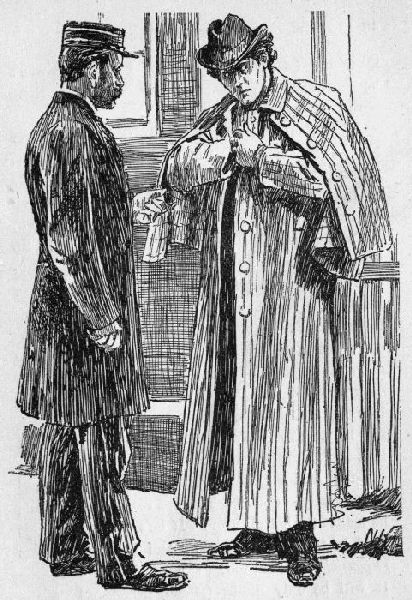
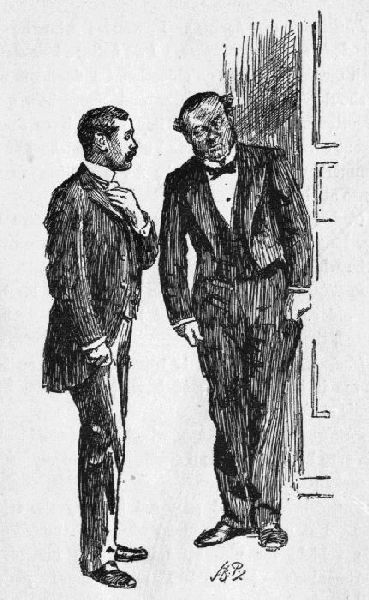
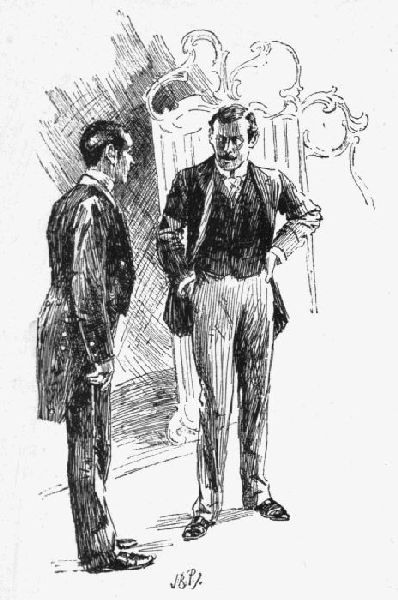
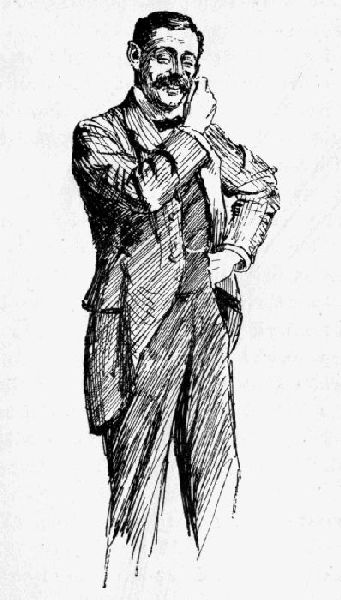
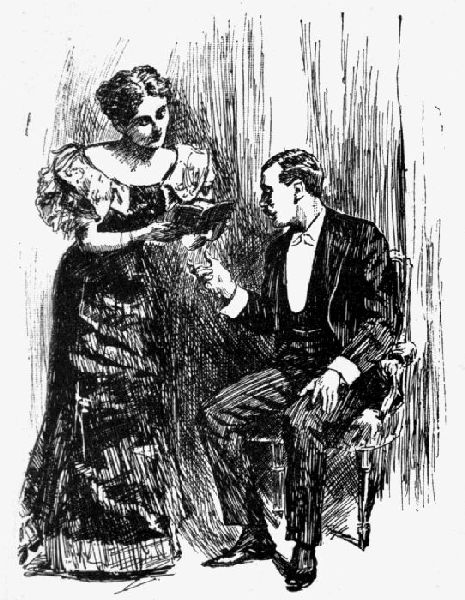
"Perhaps it was right to dissemble your love, but——"
In the Morning-room. Time—About 1 P.M.
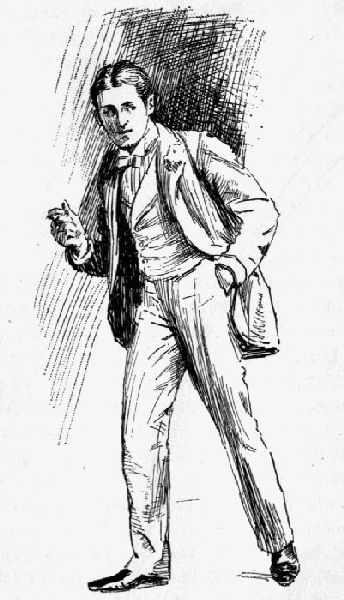
Undershell (to himself alone). I'm rather sorry that
that Miss Spelwane couldn't stay. She's a trifle
angular—but clever. It was distinctly sharp of her
to see through that fellow Spurrell from the first,
and lay such an ingenious little trap for him. And
she has a great feeling for Literature—knows my
verses by heart, I discovered, quite accidentally. All
the same, I wish she hadn't intercepted those snowdrops.
Now I shall have to go out and pick some
more. (Sounds outside in the entrance hall.) Too
late—they've got back from church!
Mrs. Brooke-Chatteris (entering with Lady Rhoda,
Sir Rupert and Bearpark). Such a nice, plain,
simple service—I'm positively ravenous!
Lady Rhoda. Struck me some of those chubby
choir-boys wanted smackin'. What a business it
seems to get the servants properly into their pew—as
bad as boxin' a string of hunters! As for you,
Archie, the way you fidgeted durin' the sermon was
downright disgraceful!... So there you are, Mr.
Blair; not been to church; but I forgot—p'raps you're
a Dissenter, or somethin'?
Undershell (annoyed). Only, Lady Rhoda, in the
sense that I have hitherto failed to discover any form
of creed that commands my intellectual assent.
Lady Rhoda (unimpressed). I expect you haven't
tried. Are you a—what d'ye call it?—a Lacedemoniac?
Undershell (with lofty tolerance). I presume you
mean a "Laodicean." No, I should rather describe
myself as a Deist.
Archie (in a surly undertone). What's a Deast
when he's at home? If he'd said a Beast, now!
(Aloud, as Pilliner enters with Captain Thicknesse.)
Hullo, why, here's Thicknesse! So you haven't gone,
after all, then?
Captain Thicknesse. What an observant young
beggar you are, Bearpark! Nothin' escapes you.
No, I haven't. (To Sir Rupert, rather sheepishly.)
Fact, is, sir, I—I somehow just missed the train,
and—and—thought I might as well come back,
instead of waitin' about, don't you know.
Sir Rupert (heartily). Why, of course, my dear
boy, of course! Never have forgiven you if you
hadn't. Great nuisance for you, though. Hope you
blew the fool of a man up; he ought to have been
round in plenty of time.
Captain Thicknesse. Not the groom's fault, sir. I
kept him waitin' a bit, and—and we had to stop to
shift the seat and that, and so——
Undershell (to himself). Great blundering booby!
Can't he see nobody wants him here? As if he hadn't
bored poor Lady Maisie enough at breakfast! Ah, well,
I must come to her rescue once more, I suppose!
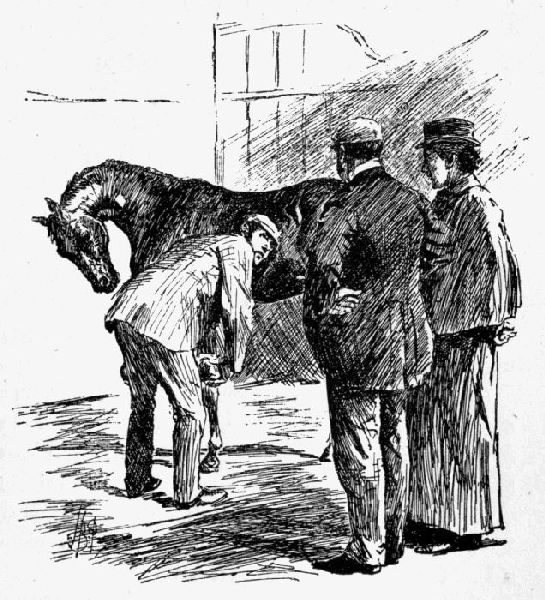
Sir Rupert. Half an hour to lunch! Anybody like
to come round to the stables? I'm going to see how
my wife's horse Deerfoot is getting on. Fond of horses,
eh, Mr.—a—Undershell? Care to come with us?
Undershell (to himself). I've seen quite enough of
that beast already! (Aloud, with some asperity.)
You must really excuse me, Sir Rupert. I am at
one with Mr. Ruskin—I detest horses.
Sir Rupert. Ah? Pity. We're rather fond of 'em
here. But we can't expect a poet to be a sportsman, eh?
Undershell. For my own poor part, I confess I
look forward to a day, not far distant, when the
spread of civilisation will have abolished every form
of so-called Sport.
Sir Rupert. Do you, though? (After conquering
a choke with difficulty.) Allow me to hope that you
will continue to enjoy the pleasures of anticipation
as long as possible. (To the rest.) Well, are you
coming?
[All except Undershell follow their host out.
Undershell (alone, to himself). If they think I'm
going to be patronised, or suppress my honest convictions——!
Now I'll go and pick those——
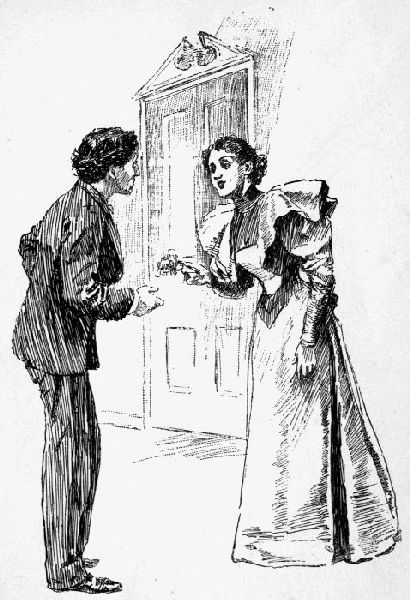
(Lady Maisie enters from the conservatory.) Ah,
Lady Maisie, I have been trying to find you. I had
plucked a few snowdrops, which I promised myself
the pleasure of presenting to you. Unfortunately
they—er—failed to reach their destination.
Lady Maisie (distantly). Thanks, Mr. Blair; I am
only sorry you should have given yourself such
unnecessary trouble.
Undershell (detaining her, as she seemed about to
pass on). I have another piece of intelligence which
you may hear less—er—philosophically, Lady Maisie.
Your bête noire has returned.
Lady Maisie (with lifted eyebrows). My bête noire,
Mr. Blair?
Undershell. Why affect not to understand? I
have an infallible instinct in all matters concerning
you, and, sweetly tolerant as you are, I instantly
divined what an insufferable nuisance you found our
military friend, Captain Thicknesse.
Lady Maisie. There are limits even to my tolerance,
Mr. Blair. I admit I find some people insufferable—but
Captain Thicknesse is not one of them.
Undershell. Then appearances are deceptive indeed.
Come, Lady Maisie, surely you can trust me!
[Lady Cantire enters.
Lady Cantire (in her most awful tones). Maisie, my
dear, I appear to have interrupted an interview of a
somewhat confidential character. If so, pray let me
know it, and I will go elsewhere.
Lady Maisie (calmly). Not in the very least,
mamma. Mr. Blair was merely trying to prepare
me for the fact that Captain Thicknesse has come
back; which was quite needless, as I happen to have
heard it already from his own lips.
Lady Cantire. Captain Thicknesse come back!
(To Undershell.) I wish to speak to my daughter.
May I ask you to leave us?
Undershell. With pleasure, Lady Cantire. (To
himself, as he retires.) What a consummate actress
that girl is! And what a coquette!
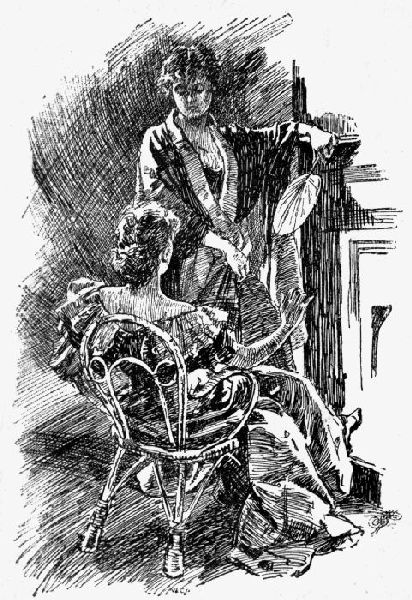
Lady Cantire (after a silence). Maisie, what does
all this mean? No nonsense, now! What brought
Gerald Thicknesse back?
Lady Maisie. I suppose the dog-cart, mamma. He
missed his train, you know. I don't think he minds—much.
Lady Cantire. Let me tell you this, my dear. It
is a great deal more than you deserve after—— How
long has he come back for?
Lady Maisie. Only a few hours; but—but from
things he said, I fancy he would stay on longer—if
Aunt Albinia asked him.
Lady Cantire. Then we may consider that settled;
he stays. (Lady Culverin appears.) Here is your
aunt. You had better leave us, my dear.
Somewhat later; the Party have assembled for Lunch.
Sir Rupert (to his wife). Well, my dear, I've seen
that young Spurrell (smart fellow he is, too, thoroughly
up in his business), and you'll be glad to hear he
can't find anything seriously wrong with Deerfoot.
Undershell (in the background, to himself). No
more could I, for that matter!
Sir Rupert. He's clear it isn't navicular, which
Adams was afraid of, and he thinks, with care and
rest, you know, the horse will be as fit as a fiddle in
a very few days.
Undershell (to himself). Just exactly what I told
them; but the fools wouldn't believe me!
Lady Culverin. Oh, Rupert, I am so glad. How
clever of that nice Mr. Spurrell! I was afraid my
poor Deerfoot would have to be shot.
Undershell (to himself). She may thank me that
he wasn't. And this other fellow gets all the credit
for it. How like Life!
Lady Maisie. And, Uncle Rupert, how about—about
Phillipson, you know? Is it all right?
Sir Rupert. Phillipson? Oh, why, 'pon my word,
my dear, didn't think of asking.
Lady Rhoda. But I did, Maisie. And they met
this mornin', and it's all settled, and they're as happy
as they can be. Except that he's on the look out
for a mysterious stranger, who disappeared last
night, after tryin' to make desperate love to her.
He is determined, if he can find him, to give him a
piece of his mind.
[Undershell endeavours to conceal his extreme
uneasiness.
Pilliner. And the whole of a horsewhip. He
invited my opinion of it as an implement of castigation.
Kind of thing, you know, that would impart
"proficiency in the trois temps, as danced in the most
select circles," in a single lesson to a lame bear. (To
himself.) I drew my little bow at a venture, and
I'm hanged if it hasn't touched him up! There's
something fishy about this chap—I felt it all along.
Still, I don't see what more I can do—or I'd do it,
for poor old Gerry Thicknesse's sake.
Undershell (to himself). I don't stir a step out of
this house while I'm here, that's all!
Sir Rupert. Ha-ha! Athletic young chap that.
Glad to see him in the field next Tuesday. By the
way, Albinia, you've heard how Thicknesse here
contrived to miss his train this morning? Our gain,
of course; but still we must manage to get you back
to Aldershot to-night, my boy, or you'll get called
over the coals by your colonel when you do put in
an appearance, hey? Now, let's see; what train
ought you to catch?
[He takes up "Bradshaw" from a writing-table.
Lady Cantire (possessing herself of the volume).
Allow me, Rupert, my eyes are better than yours.
I will look out his trains for him. (After consulting
various pages.) Just as I thought! Quite impossible
for him to reach North Camp to-night now. There
isn't a train till six, and that gets to town just too
late for him to drive across to Waterloo and catch
the last Aldershot train. So there's no more to be
said.
[She puts "Bradshaw" away.
Captain Thicknesse (with undisguised relief). Oh,
well, dessay they won't kick up much of a row if I
don't get back till to-morrow,—or the day after, if it
comes to that.
Undershell (to himself). It shan't come to that—if
I can prevent it! Lady Maisie is quite in despair, I
can see. (Aloud.) Indeed? I was—a—not aware
that discipline was quite so lax as that in the
British Army. And surely officers should set an
example of——
[He finds that his intervention has produced a
distinct sensation, and, taking up the discarded
"Bradshaw" becomes engrossed in
its study.
Captain Thicknesse (ignoring him completely). It's
like this, Lady Culverin. Somehow I—I muddled
up the dates, don't you know. Mean to say, got it
into my head to-day was the 20th, instead of only
the 18th. (Lamely.) That's how it was.
Lady Culverin. Delightful, my dear Gerald. Then
we shall keep you here till Tuesday, of course!
Undershell (looking up from "Bradshaw," impulsively).
Lady Culverin, I see there's a very good
train which leaves Shuntingbridge at 3.15 this afternoon,
and gets——
[The rest regard him with unaffected surprise
and disapproval.
Lady Cantire (raising her glasses). Upon my word,
Mr. Blair! If you will kindly leave Captain
Thicknesse to make his own arrangements——!
Lady Maisie (interposing hastily). But, mamma,
you must have misunderstood Mr. Blair! As if he
would dream of—— He was merely mentioning
the train he wishes to go by himself. Weren't you,
Mr. Blair?
Undershell (blinking and gasping). I—eh? Just
so, that—that was my intention, certainly. (To
himself.) Does she at all realise what this will
cost her?
Lady Culverin. My dear Mr. Blair, I—I'd no
notion we were to lose you so soon; but if you're
really quite sure you must go——
Lady Cantire (sharply). Really, Albinia, we must
give him credit for knowing his own mind. He tells
you he is obliged to go!
Lady Culverin. Then of course we must let you
do exactly as you please.
Pilliner (to himself). Lady Maisie's a little brick!
No notion she had it in her. No occasion to bother
myself about the beggar now. "Let him alone and
he'll go home, and carry his tail beneath him!"
[All except Miss Spelwane breathe more freely;
Tredwell appears.
Lady Culverin. Oh, lunch, is it, Tredwell? Very
well. By the bye, see that some one packs Mr.
Undershell's things for him, and tell them to send
the dog-cart round after lunch in time to catch the
3.15 from Shuntingbridge.
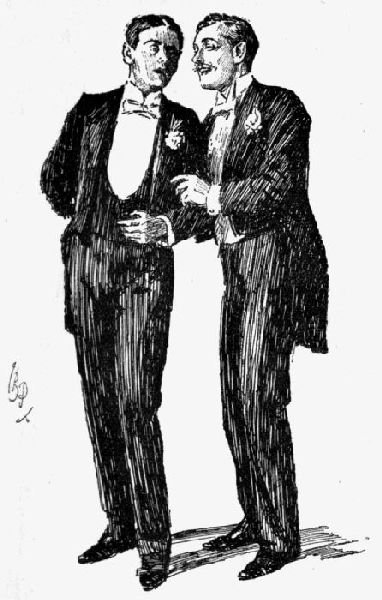
Archie (sotto voce, to Pilliner). We don't want any
more missin' of trains, eh? I'll go round and see
the cart properly balanced myself this time.
Pilliner (in the same tone). No, dear boy, you're
not to be trusted! I'll see that done, then the bard
and his train will be alike in one respect—neither of
'em 'll be missed!
Miss Spelwane (to herself, piqued.) Going already!
I wish I had never touched his ridiculous snowdrops!
Lady Culverin. Well, shall we go in to lunch,
everybody?
[They move in irregular order towards the
dining-hall.
Undershell (in an undertone to Lady Maisie, as
they follow last). Lady Maisie, I—er—this is just a
little unexpected. I confess I don't quite understand
your precise motive in suggesting so—so hasty a
departure.
Lady Maisie (without looking at him). Don't you,
Mr. Blair? Perhaps—when you come to think over
it all quietly—you will.
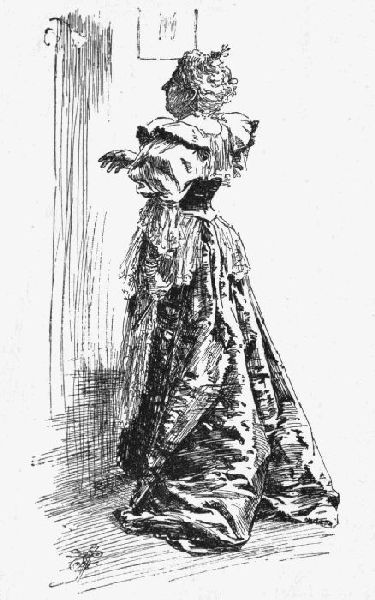
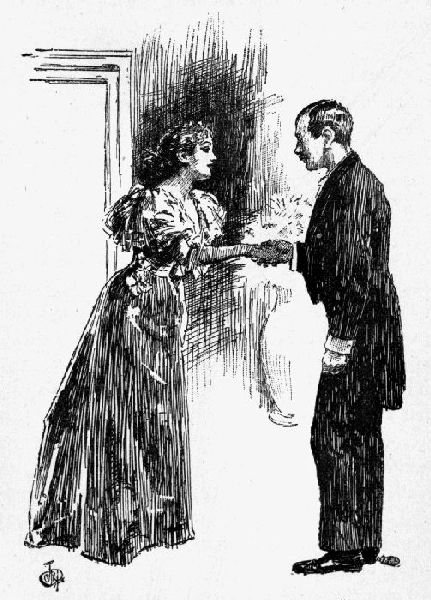
[She passes on, leaving him perplexed.
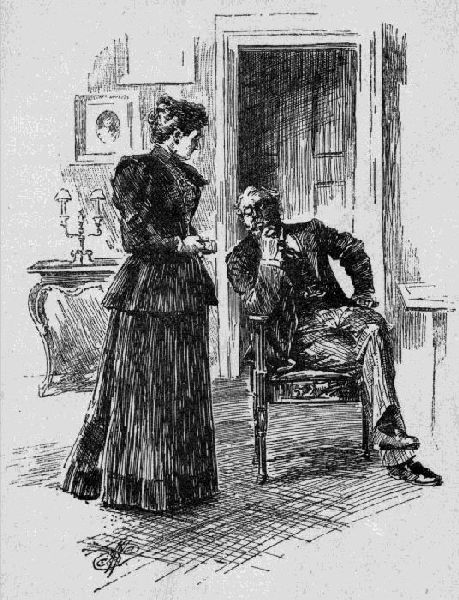
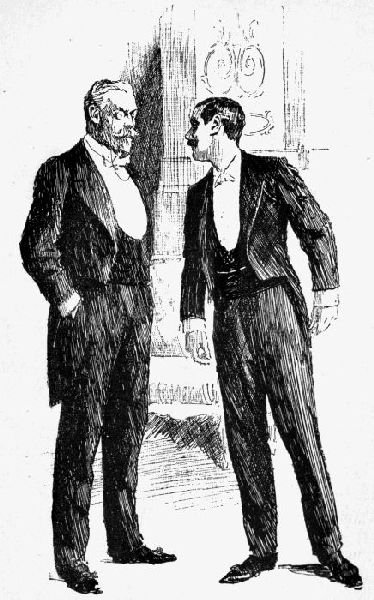
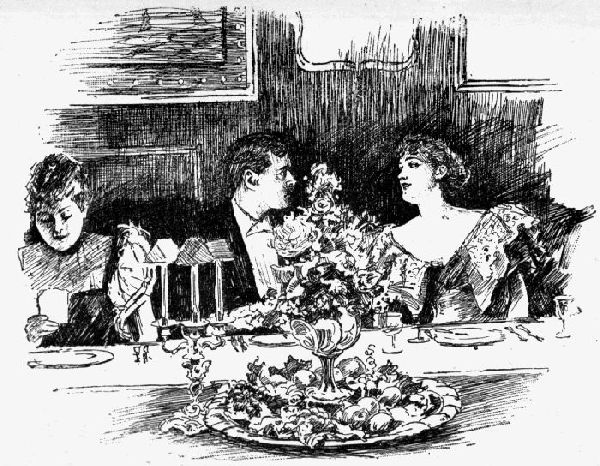
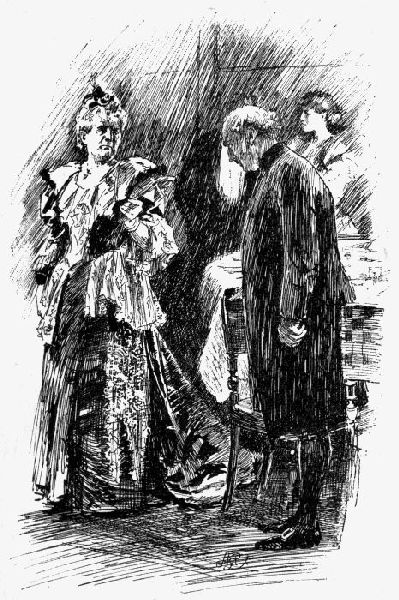
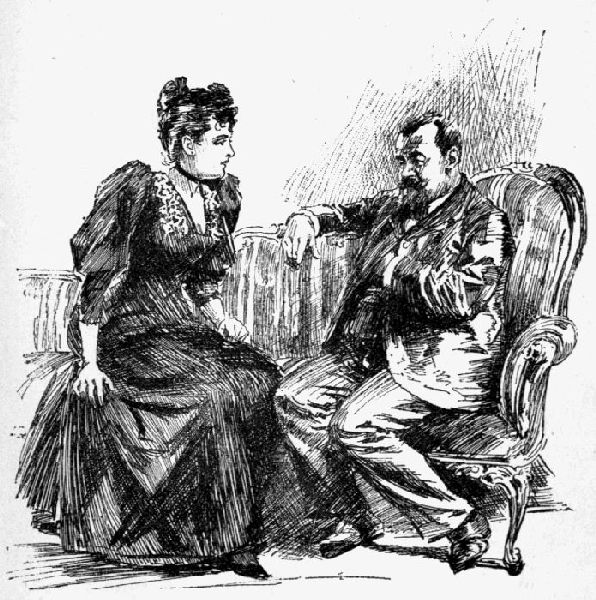
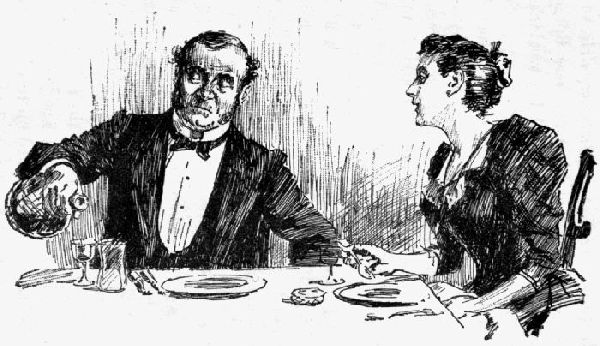
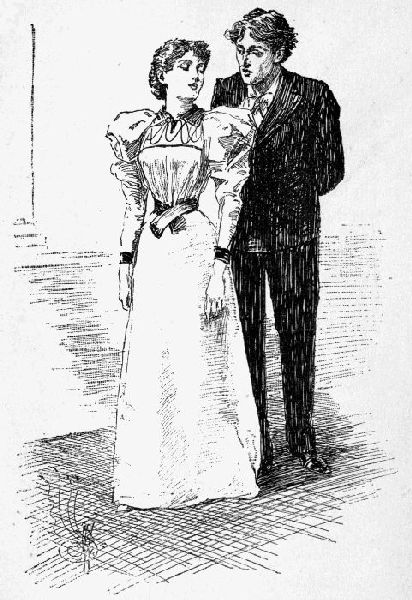 "PERHAPS—WHEN YOU COME TO THINK OVER IT ALL QUIETLY—YOU WILL."
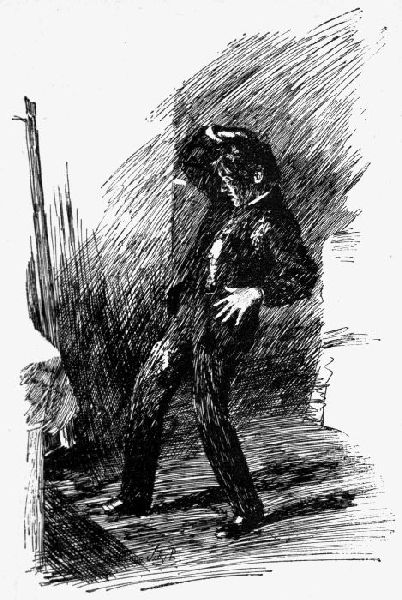
Undershell (to himself). Shall I? I certainly can't
say I do just—— Why, yes, I do! That bully
Spurrell with his horsewhip! She dreads an
encounter between us—and I should much prefer to
avoid it myself. Yes; that's it, of course. She is
willing to sacrifice anything rather than endanger
my personal safety! What unselfish angels some
women are! Even that sneering fellow Drysdale
will be impressed when I tell him this.... Yes, it's
best that I should go—I see that now. I don't so
much mind leaving. Without any false humility, I
can hardly avoid seeing that, even in the short time
I have been amongst these people, I have produced
a decided impression. And there is at least one—perhaps
two—who will miss me when I am gone.
[He goes into the Dining-hall, with restored
complacency.
THE END.
PRINTED BY WILLIAM CLOWES AND
SONS, LIMITED, LONDON AND BECCLES.
THE NOVEL SERIES.
☞ This is a series of works, each in One Volume, by the best Writers of
the day, English and American. The Volumes are suitable for the pocket
and the shelf; they are convenient to handle, being of the square 16mo size,
while from their appearance, as well as from their literary merit, they deserve
a place in the library. The volumes are bound in cloth, and are uniform,
except in thickness and in price. The prices will be 2s., 3s., and 4s.
Volume 1 of the Series, Price 2s.
THE STORY OF BESSIE COSTRELL,
By Mrs. HUMPHRY WARD.
The CHRISTIAN WORLD.—"Mrs. Ward has done nothing finer than this brief story.
The sustained interest, which does not permit the reader to miss a line; the vivid clearness
in which each character stands out in self-revelation; the unfailing insight into the familiar
and confused workings of the village mind—all represent work of the highest class. 'The
Story of Bessie Costrell' will become an English classic."
The TIMES.—"There are masterly touches and striking sentences in many pages of
this little volume.... Mrs. Humphry Ward's admirers will say that she has seldom
written with more force than in describing the tardy remorse of the hard, unrelenting
husband."
The MANCHESTER GUARDIAN.—"As full of power as anything Mrs. Ward has written,
and the impetus of its style, together with the charm belonging to many of its turns of
thought, as well as of phrase, would of themselves suffice to hold any reader who takes it
up until he has turned its last page."
The DAILY TELEGRAPH.—"An admirable example of Mrs. Humphry Ward's literary
power; a brief, decided, and masterful sketch."
Volume 2 of the Series, Price 3s.
LYRE AND LANCET. By F. Anstey.
With Twenty-Four Full-page Illustrations.
The SCOTSMAN.—"The story makes most delightful reading, full of quiet fun."
The titles and particulars of Works by
HENRY SETON MERRIMAN, Author of "With Edged Tools," etc.
Mrs. L. B. WALFORD, Author of "Mr. Smith," etc.
SYDNEY CHRISTIAN, Author of "Sarah" and "Lydia."
Miss ELIZA ORNE WHITE, Author of "Winterborough," "Miss
Brooks," etc.
and by other writers of high reputation, who will contribute to the Series,
will be announced in due course.
London: SMITH, ELDER & CO., 15, Waterloo Place.
WORKS BY F. ANSTEY.
POPULAR EDITION, Crown 8vo, 6s.
CHEAP EDITION, Crown 8vo, limp red cloth, 2s. 6d.
THE TALKING HORSE;
AND OTHER TALES.
From THE SATURDAY REVIEW.—"A capital set of stories, thoroughly clever
and witty, often pathetic, and always humorous."
From THE ATHENÆUM.—"The grimmest of mortals, in his most surly mood,
could hardly resist the fun of 'The Talking Horse.'"
POPULAR EDITION, Crown 8vo, 6s.
CHEAP EDITION, Crown 8vo, limp red cloth, 2s. 6d.
THE GIANT'S ROBE.
From THE PALL MALL GAZETTE.—"The main interest of the book, which is
very strong indeed, begins when Vincent returns, when Harold Caffyn discovers the secret,
when every page threatens to bring down doom on the head of the miserable Mark. Will
he confess? Will he drown himself? Will Vincent denounce him? Will Caffyn inform
on him? Will his wife abandon him?—we ask eagerly as we read and cannot cease
reading till the puzzle is solved in a series of exciting situations."
POPULAR EDITION, Crown 8vo, 6s.
CHEAP EDITION, Crown 8vo, limp red cloth, 2s. 6d.
THE PARIAH.
From THE SATURDAY REVIEW.—"In 'The Pariah' we are more than ever
struck by the sharp intuitive perception and the satirical balancing of judgment which
makes the author's writings such extremely entertaining reading. There is not a dull
page—we might say, not a dull sentence—in it.... The girls are delightfully drawn,
especially the bewitching Margot and the childish Lettice. Nothing that polish and finish,
cleverness, humour, wit, and sarcasm can give is left out."
CHEAP EDITION, Crown 8vo, limp red cloth, 2s. 6d.
VICE VERSÂ;
OR, A LESSON TO FATHERS.
From THE SATURDAY REVIEW.—"If ever there was a book made up from
beginning to end of laughter, and yet not a comic book, or a 'merry' book, or a book of
jokes, or a book of pictures, or a jest book, or a tomfool book, but a perfectly sober and
serious book, in the reading of which a sober man may laugh without shame from
beginning to end, it is the book called 'Vice Versâ; or, a Lesson to Fathers.'... We
close the book, recommending it very earnestly to all fathers in the first instance, and
their sons, nephews, uncles, and male cousins next."
CHEAP EDITION, Crown 8vo, limp red cloth, 2s. 6d.
A FALLEN IDOL.
From THE TIMES.—"Mr. Anstey's new story will delight the multitudinous public
that laughed over 'Vice Versâ'.... The boy who brings the accursed image to
Champion's house, Mr. Bales, the artist's factotum, and above all Mr. Yarker, the ex-butler
who has turned policeman, are figures whom it is as pleasant to meet as it is impossible
to forget."
London: SMITH, ELDER & CO., 15, Waterloo Place.
Transcriber's Notes
Obvious typographical errors repaired.
Hyphenation inconsistencies retained (booby trap and booby-trap).
Illustrations have been re-positioned to the corresponding action in
the scene.