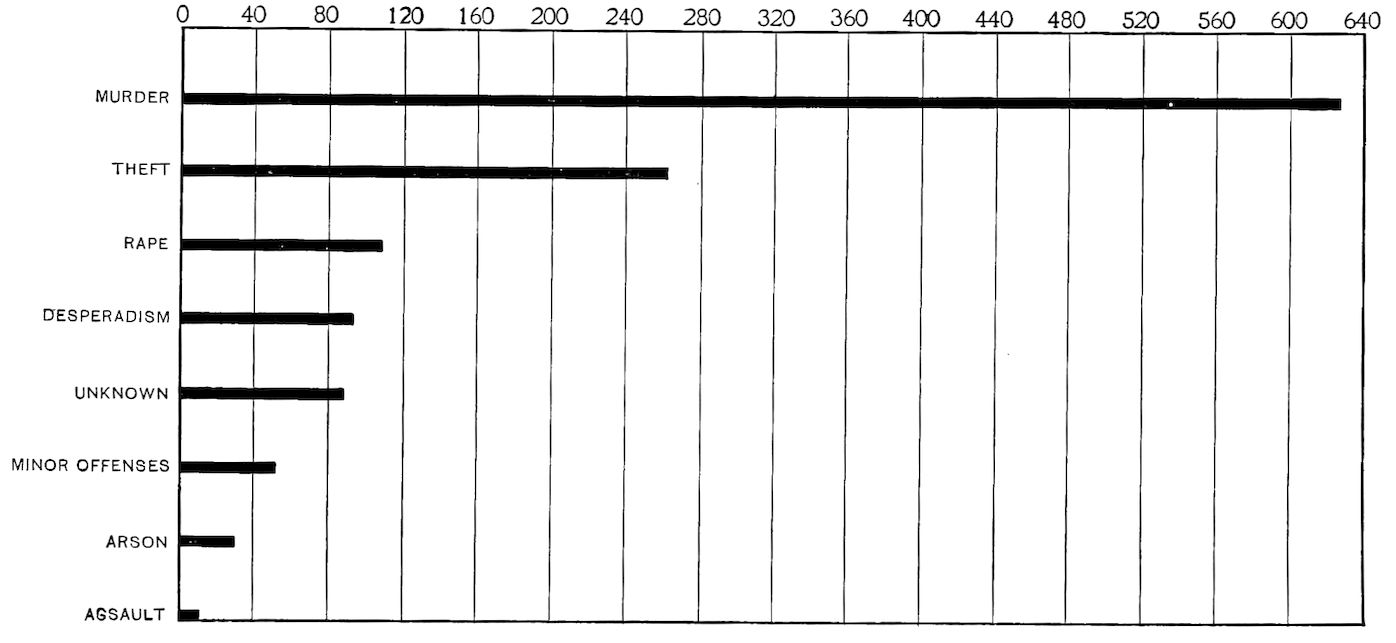
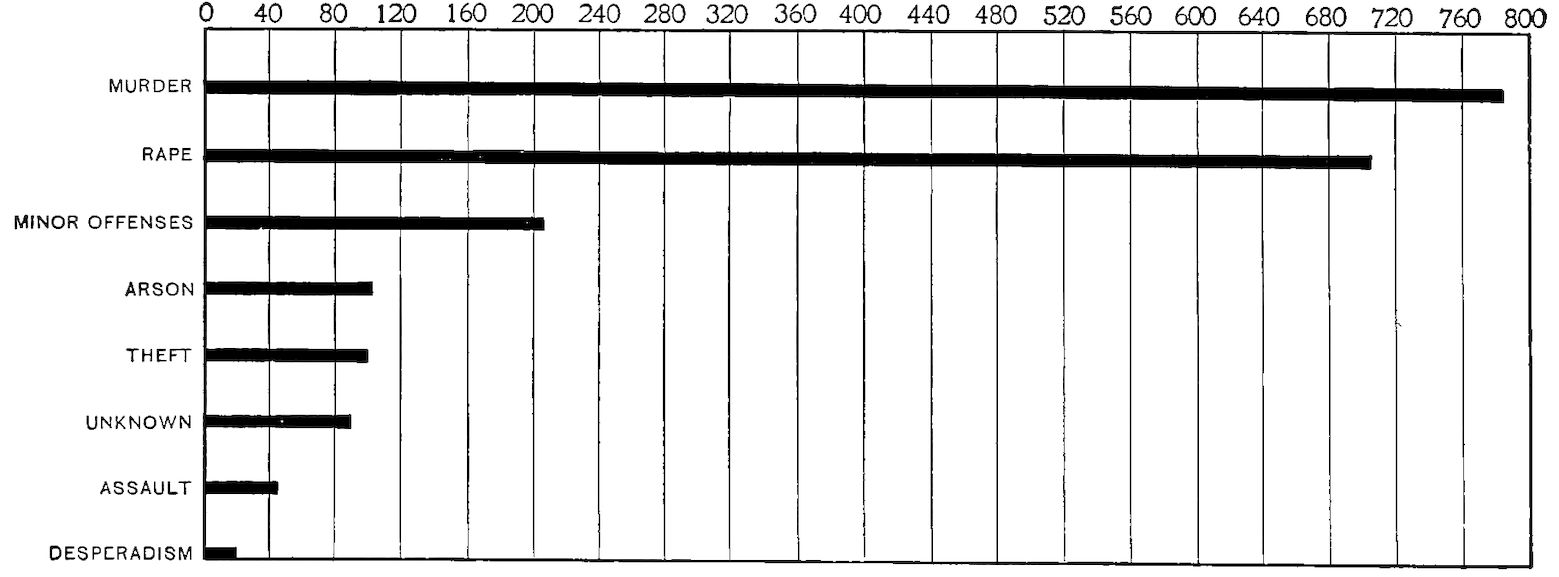
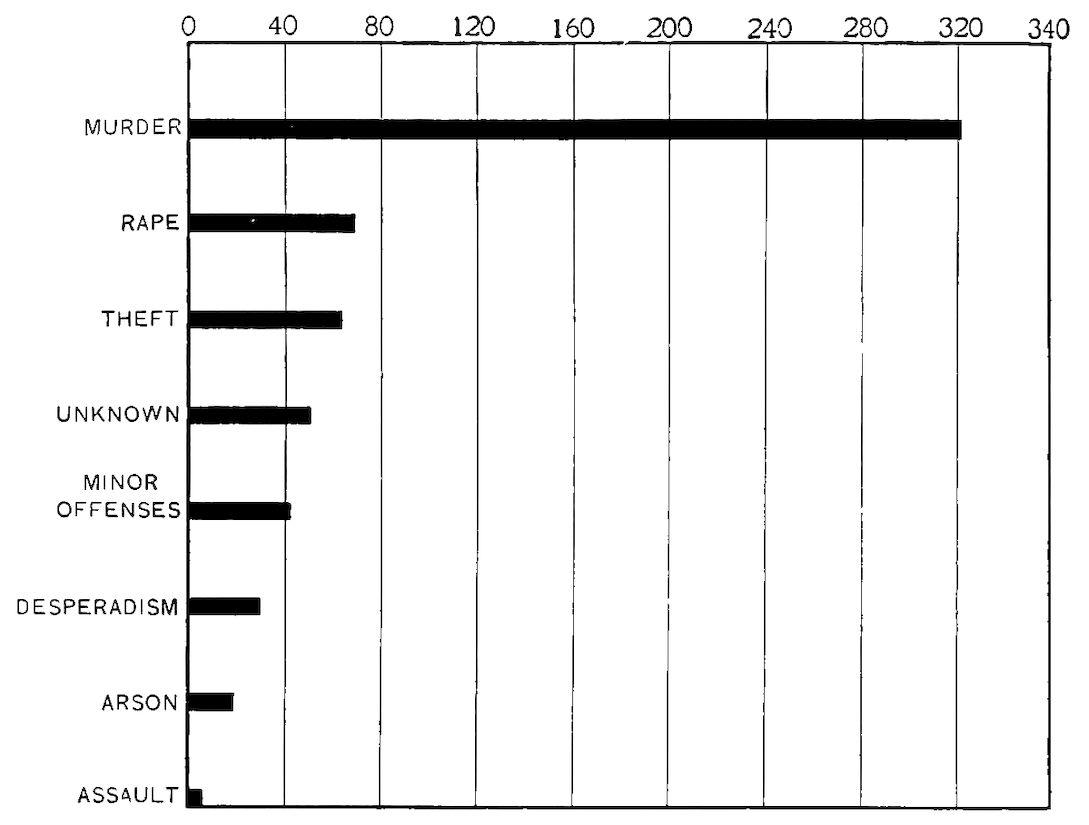
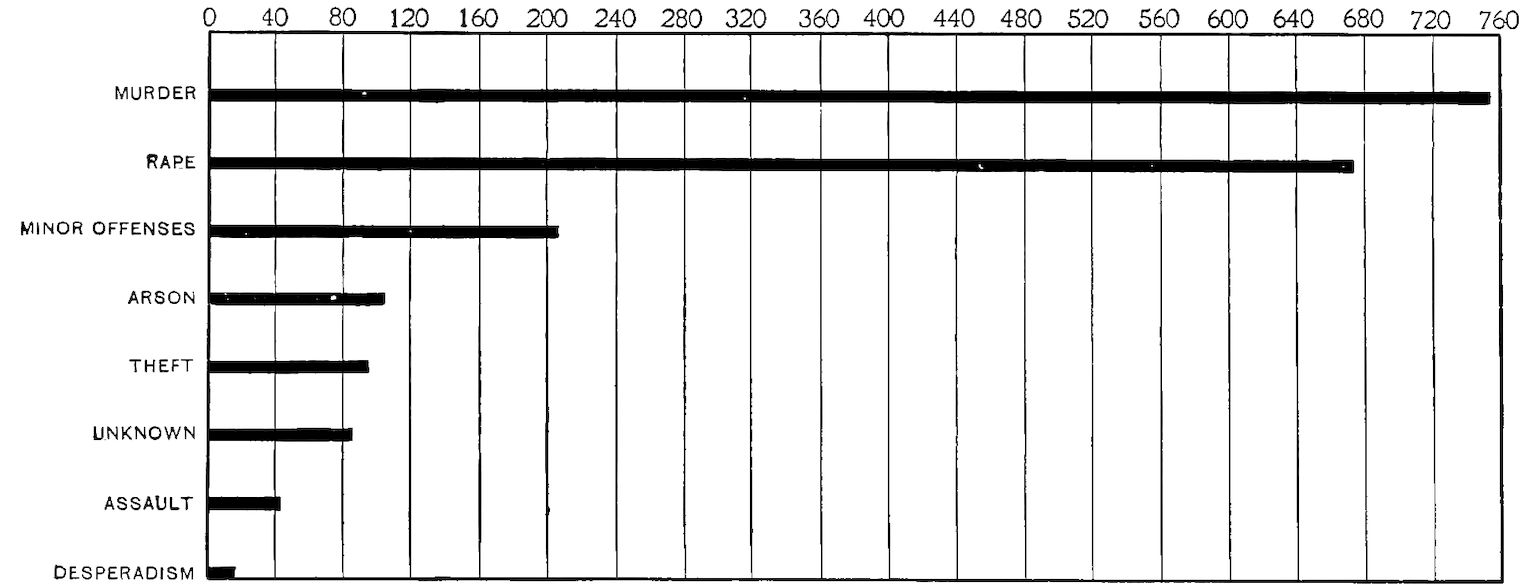
LYNCH-LAW AN INVESTIGATION INTO THE HISTORY OF LYNCHING IN THE UNITED STATES
Transcriber’s Note:
The cover image was created by the transcriber and is placed in the public domain.
BY
JAMES ELBERT CUTLER, Ph.D.
Instructor in Economics in Wellesley College; sometime Henry C. Robinson Fellow and Instructor in Political Economy in Yale University
❦
LONGMANS, GREEN, AND CO.
91 AND 93 FIFTH AVENUE, NEW YORK
LONDON AND BOMBAY
1905
Copyright, 1905
By Longmans, Green, and Co.
All rights reserved
The Plimpton Press Norwood Mass.
FOREWORD
v
Few people are able to read about lynch-executions,
with atrocious forms of torture and cruel death, such as
have occurred from time to time within ten years in this
country, without a feeling of national shame. It is necessary
that facts should be known and that public opinion
should be corrected as to the ethics of that mode of dealing
with crime. Lynch-law is a very different thing where
laws and civil institutions are in full force and activity
from what it is where they are wanting. It is not admissible
that a self-governing democracy should plead the
remissness of its own selected agents as an excuse for
mob-violence. It is a disgrace to our civilization that
men can be put to death by painful methods, which our
laws have discarded as never suitable, and without the
proofs of guilt which our laws call for in any case whatsoever.
It would be a disgrace to us if amongst us men
should burn a rattlesnake or a mad dog. The badness of
the victim is not an element in the case at all. Torture
and burning are forbidden, not because the victim is not
bad enough, but because we are too good. It is on account
of what we owe to ourselves that these methods are
shameful to us, if we descend to them. It is evident,
however, that public opinion is not educated up to this
level. The reader of the present book will learn very
interesting facts about the causes alleged for lynching,
and about the public view of that crime. Many current
errors will be corrected, and many notions which are
irrelevant, although they are popularly believed to be
germane and important, will be set aside.
W. G. SUMNER.
New Haven, Conn., February, 1905.
PREFACE
vii
In making this investigation into the history of lynching
in the United States, my point of view has been that of a
student of society and social phenomena. The purpose
of the investigation has not been primarily to write the history
of lynching, but to determine from the history the
causes for the prevalence of the practice, to determine what
the social conditions are under which lynch-law operates,
and to test the validity of the arguments which have been
advanced in justification of lynching.
At the present time many positive opinions are held with
reference to lynching, and these are quite at variance one
with another. Any one who attempts to investigate a subject
under such conditions cannot hope to escape criticism;
neither can he hope to have given the subject equal consideration
from every standpoint. The most that one can
say is that he has pursued the investigation with perfect
honesty of purpose and with openness of mind. To this
study of the history of lynching I have brought no theories
to prove and no conscious prejudices to confirm. My
first endeavor has been to obtain all the facts possible; my
final endeavor has been to point out the conclusions clearly
warranted by such facts.
The material for a study of this nature is found in a wide
range of sources and I gratefully record here my obligations
viiito those who have aided me in the task of collecting
and sifting this material. For some very valuable notes
on the early history of lynch-law I am indebted to Mr.
Albert Matthews, of Boston, Massachusetts. Of his notes
I have made free use, indicating my obligation to him in
each instance, either by the use of the letter (M) or by
special mention. Six of the chapters have been read by
him in the manuscript, and he has given me much encouragement
and kindly criticism during the preparation
of these pages for publication.
For many valuable suggestions during the prosecution
of this study I am indebted to members of the Faculty of
the Social Sciences of Yale University, especially to Professors
Sumner, Farnam, Bourne, and Keller. The editors
of the Yale Review have very courteously permitted
me to use in Chapter VIII the material which was published
in a condensed form in the Yale Review for August,
1904. To many others whom I cannot here mention by
name I desire to express my thanks and acknowledge my
indebtedness for information given in response to inquiries.
The number of requests which have come to hand for
copies of this study, from persons living in various sections
of the United States as well as in Europe, and the attention
that has been given the subject of lynchings in newspapers
and magazines, indicate a desire on the part of the
general public to learn the facts concerning lynchings.
By many it is believed that in no other respect to-day is
American civilization so open to reproach as in its toleration
of the practice of lynching, and there is an increasing
demand that this summary method of administering justice
ixbe suppressed and utterly abolished. That this book
may contribute in some measure to a better understanding
of this most serious and difficult problem is the hope with
which it is placed in the hands of the reader.
It has been said that our country’s national crime is
lynching. We may be reluctant to admit our peculiarity
in this respect and it may seem unpatriotic to do so,
but the fact remains that lynching is a criminal practice
which is peculiar to the United States. The practice
whereby mobs capture individuals suspected of crime, or
take them from the officers of the law, and execute them
without any process at law, or break open jails and hang
convicted criminals, with impunity, is to be found in no
other country of a high degree of civilization. Riots and
mob executions take place in other countries, but there
is no such frequent administration of what may be termed
popular justice which can properly be compared with
lynch-law procedure in the United States. The frequency
and impunity of lynchings in the United States is justly
regarded as a serious and disquieting symptom of American
society.
In general, it may be said that the practice of summarily
punishing public offenders and suspected criminals is
found in two distinct types of society: first, the frontier
type where society is in a formative state and the civil
regulations are not sufficiently established to insure the
2punishment of offenders; and second, the type of society
which is found in older communities with well established
civil regulations, the people of which are ordinarily
law-abiding and conservative citizens. In this second
type of society, recourse to lynch-law procedure may be
had either in times of popular excitement and social disruption,
or when there is a contrast in the population
such as is to be seen in the South between the whites and
the negroes, or against disreputable characters in the
community for whose punishment under the law no
tangible evidence can be adduced, or against persons
guilty of committing some heinous offense which on
account of its atrocity and fiendishness is particularly
shocking to the community.
In other countries one or more of these conditions has
at times existed, and summary methods of punishment
to which lynch-law procedure in the United States bears
a close resemblance have been followed. In the course
of the settlement and development of this country, however,
all of these conditions have existed almost side by
side. From colonial times down to the present day there
has been a section of the country where the frontier type
of society was to be found. At the same time there has
been an older, better settled section of the country,
forming a different type of society, where, though the
judiciary was well established and the apprehension and
punishment of public offenders was well provided for in
the law, circumstances have arisen of such a nature that
the regular and legal administration of justice was deemed
inadequate or defective, and was therefore disregarded.
As will be made clear in the following pages, lynch-law
3has been resorted to in the United States in times of
popular excitement and social disruption; it has been
inflicted upon negroes, Indians, Italians, Mexicans; it
has been inflicted upon disreputable characters; it has
been inflicted upon persons guilty of heinous offenses.
The practice of lynching does not prevail in Canada[1];
nor is a similar practice to be found in England, France,
or Germany. The nearest approach that can be found
in Europe to the American practice of lynching exists in
the rural districts of little Russia where the peasants
sometimes adopt summary measures against horse-thieves.
The Russian law provides only a light punishment
for horse-stealing, and, since the peasant’s horse
is almost his only property and is his chief instrument of
labor, summary methods seem necessary in order to check
the veritable plague of horse-stealing which breaks out
every year as soon as the dark nights of autumn begin.
When a thief is caught, the common way is for the men
of the village to club him to death, each trying to strike
in such a way as to inflict no injury more serious than a
bruise. Another method is to tie the criminal by the
feet to the tail of a young and active colt which is then
ridden at a gallop until little is left of the horse-thief.
There is also a mode of execution whereby the thief is
bound hand and foot to a bench or log, and the women
of the village thrust needles and pins into the soles of the
victim’s feet and other sensitive parts, until death ensues.[2]
Aside from this instance which is found in the loosely
organized society of the peasants in the rural districts
4of Russia, nothing like lynch-law can be said to prevail
in Europe. Occasionally mobs put persons to death
who have committed some brutal and outrageous crime.
A newspaper report states that the burgomaster of Stujhely,
Hungary, was lynched in November, 1902, for having
set fire to his home in which were his wife, father,
mother, and three sisters, all of whom were burned to
death. The burgomaster had become angry at the
members of his family for some trifling cause, and his
method of revenge so enraged his neighbors that they
immediately “took summary measures and lynched him.”[3]
A similar report tells of the lynching of a Bohemian village
schoolmaster who suddenly became insane and began
shooting his revolver right and left among his pupils,
killing three and dangerously wounding three others.[4]
People in the lower stages of civilization, such as the
Melanesians, Micronesians, and the inhabitants of the
Guinea Coast of Africa, often have secret societies which
take control of important functions, such as the initiation
of young persons arriving at maturity, or the exaction
of penalties for the transgression of customs and traditions.
In most cases these societies form an essential
part of the state, holding quite the place of the chief.
Occasionally they degenerate and create a reign of terror
by their extortions and exactions. Secret tribunals for
thieves and robbers, like the society of the “Old Ox,”
have existed in China.[5] Such instances, however, merely
illustrate the general truth that summary methods of
5punishing offenders are sometimes resorted to in every
country in times of great popular excitement or when
some peculiarly atrocious crime has been perpetrated.
They in no way invalidate the assertion that the practice
of lynching is peculiarly an American institution.
Historically some parallels may be cited showing the
execution of summary justice under frontier conditions in
other countries. In Brande’s Dictionary of Science, Literature,
and Art, published in 1842, it was stated that
“lynch law may be called a democratic imitation of the
old feudal Vehmgerichte.” Reference was there made to
the “irregular and revengeful species of justice administered
by the populace in some parts of the United States,”
evidently meaning the operation of lynch-law on the western
frontier at that time. Lynch-law in the United States
has never been administered by an organization so perfect
and extensive as that of the Vehmic courts.[6] The
feudal conditions have been lacking which made that
organization possible. It is only in its raison d’être that
the frontier type of lynch-law may be compared to the
Vehmic courts. The early settlers in this country felt
themselves compelled to resort to summary proceedings
as a means of protection; the civil government was not
sufficiently organized and established to insure the punishment
of violators of the public peace and security. In
the fourteenth and fifteenth centuries utter lawlessness
and disregard of authority was prevailing in Germany,
and for a time the Vehmic courts afforded some protection
against the outrages of the princes and nobles. With
the increasing strength of the regular governments, however,
6the need of special protection diminished and these
tribunals gradually disappeared. Like the Vehmic courts,
with the establishment of the judiciary and a more effective
execution of the laws by the officials, the administration
of lynch-law in the western half of the United States
has declined.
The tendency, it may be noted, for societies secretly
organized for the arbitrary punishment of offenders to
pass into the control of the persons against whom they
were originally directed, is to be seen not only in the history
of the Vehmic courts but also in the history of the
Ku-Klux Klan and numerous vigilance societies in the
United States. The proceedings of such societies necessarily
awaken distrust and fear among the more quiet
in the community, while the rogues, whose characters are
not yet known, hasten to obtain admittance, both as a
shield against enemies and a cloak to cover their own
misdeeds. Soon their vindictive actions and their rascalities
excite the indignation of the community; a counterparty
of “moderators” must be formed to check the
“regulators”; then begins a deadly struggle for supremacy.
Such, in brief, is the abuse of lynch-law on the frontier.
The tyranny of the Vehmic courts becomes the taking of
private vengeance, the feud and the vendetta, under lynch-law.
The Vehmic courts, however, give no explanation for
the presence of lynch-law as an institution in American
society. No connection can be traced further than a few
similarities in the methods adopted to put down lawlessness
at a time when the civil government proved weak
and inefficient.
7Some writers have stated that lynch-law was anciently
known in England by the name of Lydford law and
Halifax law, and that the same thing was known in Scotland
as Cowper justice and Jeddart or Jedburg justice.
Lydford law is defined in a dictionary of the seventeenth
century as “a certain Law whereby they first hang a Man
and afterwards indite him.”[7] One of Grose’s Proverbs
reads:
“First hang and draw,
Then hear the cause by Lidford law.”
Westcott, in his “History of Devonshire,” has preserved
some droll verses about the town of Lydford.
The first twelve lines are as follows:
It has been asserted, therefore, that “Lydford law became
a proverbial expression for summary punishment
8without trial.”[9] This, however, is going further than the
facts will allow, and is wholly misleading when thus used
to show the connection between Lydford law and lynch-law.
It would seem to imply that Lydford law in England
was once as well known, as a name for summary punishment,
as lynch-law has become in this country. As a
proverbial expression Lydford law never came into
general use; it was confined to one section of England
and never became more than a localism.
In another part of England a certain summary procedure
was known by the name of Halifax law. In this
case there was a trial followed by immediate punishment.
The trial was of a summary nature without adequate
opportunity of defense, and the punishment was irrevocable.
The name, Halifax law, originated from the
so-called gibbet law or custom in the forest of Hardwick,
coextensive with the parish of Halifax, under which the
frith burghers summarily tried any one charged with
stealing goods to the value of 13½ d., and could condemn
him to be beheaded on the market-day.[10]
Cowper justice is defined by Jamieson to mean “trying
a man after execution; the same with Jeddart, or Jedburgh
justice,” and the latter he defines as “a legal trial
after the infliction of punishment.” Jeddart justice refers
to Jedburgh, a Scotch border town, where many of
the border raiders are said to have been hanged without the
formality of a trial. It is said that “in mockery of justice,
assizes were held upon them after that they had suffered.”[11]
9All of these expressions, however, were entirely provincial.
They were merely different names used to
characterize the methods employed in various parts of
England and Scotland for executing popular justice.
These practices differ from the administration of lynch-law
in not dispensing with all regular proceedings. Further,
as will appear later, the death penalty was not at
first inflicted under lynch-law; originally, lynching was
synonymous with whipping. It is impossible, therefore,
to trace lynch-law back to these mediæval practices and
find in them any explanation for the existence of the
practice of lynching in the United States.
A general idea of the history of lynch-law in the United
States is obtained by noting the definitions of the term
that have appeared from time to time in the dictionaries.
Brande’s Dictionary of Science, Literature, and Art
(1842)[12] contains the following: “Lynch Law. The irregular
and revengeful species of justice administered by the
populace in some parts of the United States is said to
have been so called from a Virginian farmer of the name
of Lynch, who took the law into his hands on some occasion,
by chasing a thief, tying him to a tree, and flogging
him with his own hands.” A “University Edition” of
Webster’s Dictionary (1845) defines “Lynch-law” as
“The practice of punishing men for crime by private,
unauthorized persons, without a legal trial”; and gives
the verb lynch meaning “to inflict punishment without
the forms of law, as by a mob.” Worcester’s Dictionary
(1846) has “Lynch-law. An irregular and revengeful
10species of justice, administered by the populace or a mob,
without any legal authority or trial. Brande.” For the
verb lynch the meaning is given, “To condemn and execute
in obedience to the decree of a multitude or mob,
without a legal trial; sometimes practiced in the new
settlements in the southwest part of the United States.
Qu. Rev.” In Webster’s Dictionary (1848) “Lynch-law”
is defined as “The practice of punishing men for
crimes or offenses by private, unauthorized persons,
without a legal trial. The term is said to be derived from
a Virginia farmer, named Lynch, who thus took the law
into his own hands. (U. S.)”[13]
Some important changes are noticeable in the definitions
attached to lynch-law forty years later. The Progressive
Dictionary of the English Language, edited by
Samuel Fallows and published at Chicago in 1885, gives
this definition for the verb lynch: “To punish without the
forms of law; specifically to hang by mob-law.” In a
note it is stated that more than one etymology is claimed
for the word. John S. Farmer in his “Americanisms,”
published at London in 1889, says the origin of the term
lynch-law “is wrapped in mystery; many explanations
11have been put forward; none, however, are conclusive.”
In Webster’s Dictionary, edition of 1893, the following
definition is found: “Lynch: To inflict punishment upon,
especially death, without the forms of law, as when a mob
captures and hangs a suspected person.” Lynch-law is
defined in a general way as “The act or practice by private
persons of inflicting punishment for crimes or offenses,
without due process of law,” but this note is added: “The
term Lynch law is said to be derived from a Virginian
named Lynch, who took the law into his own hands.
But the origin of the term is very doubtful.”[14]
There are two differences between the definitions formulated
in the forties and those formulated in the eighties
and in recent years. In the later definitions the operation
of lynch-law is described as being much more harsh
and severe, and there is an expression of doubt as to the
origin of the term. In the earlier definitions death is not
mentioned as the ordinary penalty administered by
lynch-law and the American origin of the term is accepted
without question. The doubt as to the origin probably
arose because of the number of stories which have appeared,
all claiming to account for its origin, and also
because of the lack of any careful investigation to determine
the question authentically from historical sources.
The increased harshness expressed in the definitions is,
of course, due to the fact that the punishment inflicted
under the name of lynch-law has become more severe and
inexorable. Lynching is now practically synonymous
12with summary and illegal capital punishment at the hands
of a mob. In the following pages the history of this
change will be traced and the conditions noted which
have led to the continuance of the practice of lynching
and given to it its increased severity.
In the above citations to various definitions that have
been given for lynch-law it was noted that more than one
origin has been claimed for the term. An investigation
into the circumstances surrounding its origin will throw
considerable light on the early history of lynch-law procedure
in the United States, and this question will therefore
be taken up in some detail.
CHAPTER II Origin of the Term Lynch-law
13
Many and various explanations of the origin of the
term Lynch’s law, or lynch-law, have been offered.
Some of these explanations are evidently nothing more
than the offspring of minds fertile in resources; others
have the support of tradition and are entitled to consideration.
Not infrequently confusion and apparent contradiction
have resulted from the failure to distinguish
clearly between the practice itself and the name by which
it has been known. To follow back through history the
successive outbreaks of such practices is not to discover
the origin of “lynch-law,” the term which has now become
so firmly established in the English language. The origin
is to be found at that time when these practices first came
to be known by the name Lynch’s law or lynch-law.
According to one account, given more or less indorsement
in the encyclopedias, lynch-law owes its name to
James Fitzstephen Lynch, mayor and warden of Galway,
Ireland. He was the famous “Warden of Galway” who
tried, condemned, and executed his own son in the year
1493. The story is told with varying details. One tradition
has it that the mayor sent his son to Spain to purchase
a cargo of wine. The young man squandered the
money intrusted to him, but succeeded in obtaining a
cargo on credit from a Spanish friend of his father. This
14gentleman’s nephew accompanied him on the return
voyage to Ireland where the money was to be paid.
Young Lynch, to conceal his misuse of the money, caused
the Spaniard to be thrown overboard and returned home
in triumph with his cargo of wine. But a sailor, on his
death-bed, revealed to the mayor of Galway the crime
which his son had committed. The young man was tried
before his father, convicted and sentenced to be hanged.
Another tradition states that the son of the Spanish
friend of his father was visiting him at his home in Ireland.
This son was fast supplanting him in the affections of a
Galway lady to whom he was engaged. One night, in a
fit of jealous passion, he stabbed the Spaniard to the
heart and threw his body into the sea. The crime was
quickly discovered, and on being brought before his
father for trial he was condemned to die as a sacrifice to
public justice. Public sympathy, however, turned in
favor of the young man, and every effort was made to
effect his pardon. The father “undauntedly declared
that the law should take its course.” On the way to the
place of execution a mob appeared, led by members of
the mother’s family, demanding mercy. The father,
finding that he could not “accomplish the ends of justice
at the accustomed place and by the usual hands,” conducted
his son up a winding stairway to a window overlooking
the public street. “Here he secured the end of a
rope, which had been previously fixed around the neck of
his son, to an iron staple which projected from the wall,
and, after taking from him a last embrace, he launched
him into eternity.” The people, “overawed by the magnanimous
act, retired slowly and peaceably to their
15several dwellings.” In the council books of Galway
there is said to be a minute that “James Lynch, mayor
of Galway, hanged his own son out of the window for
defrauding and killing strangers, without martial or common
law, to show a good example to posterity.” In commemoration
of this “Roman act of justice,” a stone
sculptured with a skull and crossbones was erected in
Lombard Street, Galway, in 1524, and in 1854 was reerected
on the wall of St. Nicholas Churchyard.[15]
This “Galway story” may be dismissed with but little
consideration. Howell Colton Featherston of the Lynchburg
(Va.) Bar has clearly shown that this act of the
mayor of Galway was entirely without any definition
ever attached to lynch-law and that there was no reason
for bestowing upon it any name, and more particularly
his name. Mayor Lynch was the legally constituted
authority presiding over the tribunal in which his son had
had, presumably, a fair and regular trial. He merely
persisted in executing the laws in the face of popular
opposition and tumult. Lynch-law has always been considered
as operating wholly without, or in opposition to,
established laws of government.[16]
Equally fanciful and fictitious but less romantic is the
“pirate story” of the origin of the name lynch-law. It
is said that about 1687 one Lynch was sent to this country
from England under a commission to suppress piracy.
He is credited with having faithfully executed, without
16the formality of a trial, every pirate that he captured.
It is presumed that owing to the difficulty of adhering to
the usual forms of law in the colonies, this Judge Lynch
was empowered to proceed summarily against pirates
and thus gave rise to the term.[17] But whatever the facts
may be about the methods employed by this man Lynch
to suppress piracy,[18] there is no evidence to show that they
were ever known as Lynch’s law or had any connection
whatever with lynch-law.
On its etymological side the word lynch has been traced
to an old Anglo-Saxon verb linch, meaning to beat severely
with a pliable instrument, to chastise or to maltreat,
which is said to have survived in this cognate meaning
in America, as have many other words and expressions
long obsolete in Great Britain.[19] For this derivation,
however, there seems to be no authority. There is no
evidence that such a verb “survived” in America; nor is
there any evidence that such an Anglo-Saxon verb ever
existed.[20] According to Skeat the name Lynch is from
17hlinc, an Anlgo-Saxon word meaning a ridge of land.[21]
Furthermore, as was noted in the preceding chapter,
when the word lynch first came into general use, it was
stamped as of American origin.[22] No English lexicographer
recognized the terms lynch or lynch-law until 1848,
and in 1849 Craig gave the verb “lynch” as meaning
“to punish summarily without judicial investigation,
as by a mob.—An American word.”[23] The fact that
Wright’s English Dialect Dictionary (1902) does not
contain the word lynch, and the further fact that Murray’s
Oxford Dictionary (1903) states that the term was originally
used in the United States, may be regarded as conclusive
evidence that the origin of “lynch-law” is not to
be sought in England.
There is a tradition in the Drake family of South
Carolina which ascribes the origin of the term to the
precipitate hanging, to prevent a rescue, of a Tory named
Major Beard, on Lynch Creek in Franklin County, North
Carolina. The following account of it is given by John
H. Wheeler, to whom it was communicated by Hon. B.
F. Moore, who received it from the Drake family:
“The origin of lynch-law: During the revolution there was a
noted tory ... in that portion formerly called Bute County,
now embraced within the counties of Franklin and Nash,
called Major Beard. Major John H. Drake lived near Hilliardston;
he and his family were decided whigs. He had a
18daughter, beautiful and accomplished, by whose charms Beard
was captivated; and the tradition runs, that the handsome
figure and commanding air of Beard had its effect on the young
lady, notwithstanding the difference in politics between him
and her father. On one occasion, Beard encamped for the
night near a mill on Swift Creek. This became known to
Major Drake and other whigs, and they organized a force ...
and captured him.... After some consultation it was resolved
to take him as a prisoner to headquarters of Colonel
Seawell, commanding in camp at a ford on Lynch Creek, in
Franklin County, about twenty miles off. He was tied on his
horse and carried under guard. After reaching camp, it was
determined to organize a court-martial, and try him for his
life. But before proceeding to trial, a report came that a
strong body of tories were in pursuit to rescue him; this created
a panic, for they knew his popularity and power, so they hung
him. The reported pursuit proved a false alarm, and it being
suggested that as the sentence had been inflicted before the judgment
of the court had been pronounced, therefore it was illegal.
The body was then taken down, the court reorganized, he was
tried, condemned and re-hung by the neck until he was dead.
“The tree on which he was hung stood not far from Rocky
Ford, on Lynch’s Creek; and it became a saying in Franklin,
when a person committed any offence of magnitude, that ‘he
ought to be taken to Lynch Creek’; and so the word ‘Lynch
law’ became a fixture in the English language.”[24]
In passing, the resemblance of this affair to Lydford
law rather than lynch-law is to be noted, and also the
fact that Wheeler, in his “History of North Carolina,”
published thirty-three years earlier, gives an account
of the hanging of “Captain Beard about 1778,” but says
19nothing about its being in any way connected with the
origin of the term lynch-law. Indeed, according to this
earlier account there was nothing irregular in the proceeding;
he was hung in accordance with the ordinary
rules of war. Beard and one of his band, named Porch,
who had been captured with him, “were tried by a court-martial
and both were forthwith hung. Such was the
end of Captain Beard.”[25] The two accounts vary somewhat,
but there is no room for doubt as to their having
reference to the same occurrence. In short, the “tradition”
in the Drake family must have arisen between 1851
and 1884. There is no evidence, further than this statement
found in Wheeler’s book, that “Lynch law” became
a fixture in the English language because of a saying
common in Franklin County, North Carolina, that
any one who committed a grave offense “ought to be
taken to Lynch Creek.”
Some evidence has recently been brought forward indicating
that lynch-law may have derived its name from
Lynch’s Creek, South Carolina.[26] Some extracts from
Boston newspapers in the year 1768, dated Charlestown,
South Carolina, show the existence of “Regulators” at
that time, and mention is made of a meeting that they
were to have on Lynch’s Creek “where it was expected
1,200 would be assembled.” It is also evident that one
of their methods of inflicting punishment was by whipping.
One extract states that “the people called regulators
have lately severely chastised one Lum, who is
come to town; but we have not yet learnt the real cause
20of this severity to him.” The assertion has been made,
therefore, that lynch-law derived its name from Lynch’s
Creek, South Carolina, because at that place the practice
of lynching began.
The practice which came to be known as “regulating”
had its beginning earlier than 1768, however, and this beginning
was not in the neighborhood of Lynch’s Creek.
As early as 1766 it had begun in North Carolina and had
extended from Granville County into Orange and Anson
counties. Up to April, 1768, those who had taken part
in these proceedings in North Carolina were designated
by the appellation of the “Mob,” and seem to have adopted
it themselves. But on April 4, 1768, at a general meeting,
they dropped this name and formally adopted the name
of “Regulators.”[27] When this practice of “regulating”
was started in South Carolina it was instituted by Thomas
Woodward, Joseph Kirkland, and Barnaby Pope,[28] who
lived in the region between the Catawba and the Saluda
Rivers, and not on the Pedee or Lynch’s Creek. Thus,
a name—that of “Regulation,” not “Lynch Law,”—had
been given this practice before it reached the Pedee
section of the Province. If the conduct of the Regulators
in South Carolina was to give the name to the practice of
illegal punishment, it would have been called, not “Lynch
Law,” but “Broad River Justice” or “Savannah Law.”[29]
21No evidence has yet been found which shows any connection
between “Lynch Law” and “Regulation” at
this time.[30] Alexander Gregg, writing of the Regulator
movement in the Carolinas, makes the statement: “They
called themselves ‘Regulators’; and thus ‘Lynch law’
had its origin at this period.”[31] Dr. R. W. Gibbes had
written eight years earlier than Gregg: “The Regulation,
an association of respectable planters, took the matter
in hand, and enforced order by a system of Lynch law.”[32]
Neither of these writers, however, implies that the Regulation
in South Carolina had anything to do with the
origin of the term lynch-law. Joseph Johnson, in a book
22published in 1851, gave a brief account of the Regulators
and Schofilites. He says, “the most respectable inhabitants
united to inflict summary justice on the depredators
and called themselves Regulators.”[33] In this connection
he does not refer to lynch-law at all. In another connection
he writes: “This process, in what is now called
‘lynch law,’ was then designated ‘regulating,’ and the
associates for this purpose were called ‘Regulators.’”[34]
No reference to lynch-law is to be found in Ramsay’s
History of the Revolution in South Carolina which was
published in 1785. Both of the accounts given by Wheeler
of the occurrence at Lynch Creek, North Carolina, referred
to above, imply that the term lynch-law was not in
use any time previous to the Revolutionary War. As
will appear later, the terms regulation and lynch-law are
not found together until a much later date, and then they
are not used in connection with events in the Carolinas.
Still another “Origin of Lynch’s law” is given in Niles’
Register for August 8, 1835.[35] An anecdote is related of
an occurrence “in Washington County, Pa., many years
ago.” A poaching vagabond, long under suspicion, was
finally detected and told to leave the neighborhood in
twenty-four hours on penalty of prosecution. The
poacher refused to comply and a party of five or six of his
neighbors went to his home and “proceeded to try him in
due form, choosing one of their number, a farmer named
Lynch, to be judge.” The judge “decided that the
poacher should be tied up and receive three hundred
lashes, ‘well laid on,’ and then be given twenty-four hours
23to leave the place under penalty of receiving three hundred
more if found after that time. The first part of the sentence
was inflicted on the spot, with such good intent as
to render its repetition unnecessary. The culprit made
off as fast as his lacerated limbs would permit him.”
Nothing further is known of this farmer named Lynch,
who acted as judge at this impromptu trial, and there is no
reason for regarding this incident as in any way connected
with the origin of lynch-law. It is merely an instance
of recourse to summary procedure against an unpopular
individual. It may or may not have been known at the
time as punishment by Lynch’s law.
We now come to the explanation of the origin of the
term which has been most frequently given and which
was for years accepted without question. It is to the
effect that lynch-law originally had reference to the
kind of law administered by Charles Lynch, in Virginia,
during the latter part of the Revolutionary War.
It is needless to recount here all the variations in the
stories connecting the origin of lynch-law with the
Lynch family in Virginia.[36] In certain accounts Charles
Lynch has been confused with his older brother, John
Lynch, who remained a Quaker all his life and was the
founder of Lynchburg, Virginia. Some accounts refer
vaguely to a Virginia farmer, or planter, by the name of
24Lynch, whose vigorous methods of punishing wrongdoers
gave rise to the term lynch-law.[37] Haydn’s Dictionary
of Dates (1860) apparently is responsible for the
fiction that this mode of administering justice began
about the end of the seventeenth century and derives its
name from John Lynch, a farmer, who exercised it upon
the fugitive slaves and criminals dwelling in the Dismal
Swamp, North Carolina, when they committed outrages
upon persons and property which the law could not
promptly repress. This story is repeated in the editions
of 1873 and 1885, and is also given in Harpers’ Popular
Cyclopædia of the History of the United States,[38] and
seems to have become generally accepted in France.[39]
It is, however, wholly erroneous.
The movement for independence had from the first a
great many opponents in the mountainous sections of
Virginia, and there was a considerable number of Tories
in Bedford County, where Charles Lynch lived.[40] The unsettled
25condition of affairs also led many desperadoes to
resort to this section of Virginia. Both Tories and desperadoes
26harassed the Continentals and plundered their
property with impunity.[41] The prices paid by both
27armies for horses made horse-stealing a lucrative practice,
and the inefficiency of the judiciary made punishment
practically out of the question. The county courts
were merely examining courts in all such cases, and the
single court for the final trial of felonies sat at Williamsburg,
more than two hundred miles away. To take the
prisoners thither, and the witnesses necessary to convict
them, was next to impossible. Frequently the officers in
charge of prisoners would be attacked by outlaws and
forced to release their men, or be captured by British
troops and themselves made prisoners.
It was under these circumstances that Colonel Lynch
conferred with some of his neighbors as to what was best
to be done. After deliberation they decided to take
matters into their own hands, to punish lawlessness of
every kind, and so far as possible restore peace and
security to their community. For the purpose of attaining
these ends they formed an organization with Mr.
Lynch at the head. Under his direction suspected persons
were arrested and brought to his house, where they
were tried by a court composed of himself, as presiding
justice, and his three neighbors, William Preston, Robert
Adams, Jr., and James Callaway, sitting as associate
justices.
The practice of this court was to have the accused
brought face to face with his accusers, permit him to hear
the testimony against himself, and to allow him to defend
himself by calling witnesses in his behalf and by showing
mitigating and extenuating circumstances. If acquitted,
he was allowed to go, “often with apologies and reparation.”
If convicted, he was sentenced to receive thirty-nine
28lashes on the bare back, and if he did not then shout
“Liberty Forever,” to be hanged up by the thumbs until
he did so. The execution of the sentence took place
immediately upon conviction. The condemned was
tied to a large walnut tree standing in Mr. Lynch’s
yard and the stripes inflicted—with such vigor, it is
said, that even the stoutest hearted Tory shouted for
“Liberty” without necessitating a resort to further
punishment.[42]
The news of the invasion of Virginia by Cornwallis
gave the Bedford Tories strong encouragement and a
conspiracy was formed to overthrow the county organization
and seize, for the use of Cornwallis on his arrival, the
stores that Lynch had collected for Greene’s army in North
Carolina. The conspirator’s plans, however, became
known to Colonel Lynch, tradition says through one of
their own number, and he had them all arrested. In the
case of these conspirators, who were guilty of a treasonable
offense, a more serious situation presented itself. Lynch
himself was on the point of setting out with his regiment
for the east to oppose the British under Benedict Arnold.
It was not wise to inflict the usual punishment and then
give the conspirators their freedom again; neither could
he take them as prisoners along with him on the rapid
march that he was forced to make. After careful deliberation,
Colonel Lynch, as the presiding justice, sentenced
them to terms of imprisonment varying from one to five
years. Robert Cowan, who had formerly been a fellow
justice on the county bench and who seems to have been
29the ringleader, was sentenced to a year’s imprisonment
and a fine of £20,000.[43]
This court, even though it be considered as still the
regular county court, had clearly transcended its powers;
the General Court alone had jurisdiction in cases of treason.
After the war, therefore, the Tories who had suffered
at his hands threatened to prosecute Colonel Lynch
and his friends. To avoid lawsuits and as a means of
finally settling the affair, Lynch brought the whole matter
before the Virginia legislature. After a lengthy debate,
which, according to Mr. Page, “aroused the interest of
the whole country,” the following act was passed in
October, 1782:
“An act to indemnify certain persons in suppressing a conspiracy
against this state.
I. Whereas divers evil-disposed persons in the year one
thousand seven hundred and eighty, formed a conspiracy and
did actually attempt to levy war against the commonwealth;
and it is represented to the present general assembly, that
William Preston, Robert Adams, junior, James Callaway, and
Charles Lynch, and other faithful citizens, aided by detachments
of volunteers from different parts of the state, did, by
timely and effectual measures, suppress such conspiracy: And
whereas the measures taken for that purpose may not be
strictly warranted by law, although justifiable from the imminence
of the danger;
II. Be it therefore enacted, That the said William
Preston, Robert Adams, junior, James Callaway and Charles
Lynch, and all other persons whatsoever, concerned in
30suppressing the said conspiracy, or in advising, issuing, or
executing any orders, or measures taken for that purpose,
stand indemnified and exonerated of and from all pains, penalties,
prosecutions, actions, suits, and damages, on account
thereof. And that if any indictment, prosecution, action, or suit,
shall be laid or brought against them, or any of them, for any
act or thing done therein, the defendant, or defendants may
plead in bar, or the general issue, and give this act in evidence.”[44]
“The proceedings in Bedford, which the legislature
thus pronounced to be illegal, but justifiable, were imitated
in other parts of the State, and came to be known by the
name of Lynch’s Law. In justice to Colonel Lynch,
it should be remembered that his action was taken at a
time when the State was in the throes of a hostile invasion.
The General Court, before which the conspirators should
have been tried, was temporarily dispersed. Thomas
Jefferson, then the governor of the State, was proving
himself peculiarly incompetent to fill the position. The
whole executive department was in a state of partial
paralysis. It was, therefore, no spirit of insubordination
or disregard of the law that induced Lynch to act as he
did. There were few men living more inclined than this
simple Quaker farmer to render due respect in word and
deed to the established authorities.”[45]
The old walnut tree on which lynch-law is said to have
been first administered was still standing, in 1900,[46] on
31the lawn of the Lynch homestead, two miles from the
village of Lynch Station on the Southern Railway. A
part of it was dead but the rest was still vigorous and
bore its annual crop of nuts. The death penalty, however,
was never inflicted under its shadow. Some say
that the Quaker proclivities of “Judge Lynch”[47] prevented
him from passing sentence of death; others say
that it was due to his native sense of humanity. Mr.
Page presents some evidence showing that “both custom
and sentiment were violently opposed to visiting capital
punishment upon the detected Tory conspirators.”[48]
32In the determination of origins it is frequently impossible
to obtain direct evidence bearing on the point in
question. In this case there is direct evidence for connecting
the name of Charles Lynch with the origin of
“lynch-law.”[49] In 1817 Judge Spencer Roane wrote in
a letter to William Wirt: “In the year 1792 there were
many suits on the south side of James River, for inflicting
Lynch’s law.” Mr. Wirt adds, in a note explanatory of
the words “Lynch’s law,” “Thirty-nine lashes, inflicted
without trial or law, on mere suspicion of guilt, which
could not be regularly proven. This lawless practice,
which, sometimes by the order of a magistrate, sometimes
without, prevailed extensively in the upper counties on
James River, took its name from the gentleman who set
the first example of it.”[50] Though Wirt does not mention
Charles Lynch by name, he does say that the lawless
practice “prevailed extensively in the upper counties on
James River,” and Charles Lynch was for years closely
identified with the interests of Campbell[51] and Bedford
counties—two of the upper counties on the James
River.
33Henry Howe, in his “Historical Collections of Virginia,”
in a section entitled “Lynch Law,” says: “At that time
(the time of the Revolution), this country (Campbell
County and vicinity) was very thinly settled, and infested
by a lawless band of tories and desperadoes. The necessity
of the case involved desperate measures, and Col.
Lynch, then a leading whig, apprehended and had them
punished, without any superfluous ceremony. Hence the
origin of the term ‘Lynch Law.’ This practice of Lynching
continued years after the war, and was applied to
many cases of mere suspicion of guilt, which could not
be regularly proven.”[52]
In a book written a few years later than the above,
Howe has the following to say on the same subject: “The
Lynch Law, as it is termed, originated in Virginia at the
time of the American Revolution, and was first adopted
by Colonel Lynch against a lawless band of tories and
desperadoes, who infested the country at the base of the
Blue Ridge. This plan was afterwards followed in the
west, and its operation was salutary in ridding the country
of miscreants whom the law was not strong enough
to punish. The tribunal of Squire Birch, as the person
who personated the judge was called, was established
under a tree in the woods; the culprit being usually found
guilty was tied to a tree and lashed without mercy, and
then expelled from the country. In general, ‘the regulators’
34only exercised this law upon the most base and
vile characters.”[53]
This account given by Howe cannot be considered as
wholly independent of the influence of Wirt. In his
“Historical Collections of Virginia,” Howe quotes from
Wirt’s book in substantiation of his statement that the
“practice of Lynching continued years after the war.”
On the other hand, however, the fact that he repeated
his assertions in regard to the origin of “Lynch Law”
in emphatic terms in his later book, and therewith described
the operation of “Lynch Law” in the west, is
strong evidence that he had other sources of information
than Wirt’s book on the matter.[54]
An account, entirely independent of any influence from
either Wirt or Howe, is found in “Colonel William
Martin’s Narrative of Frontier Life,” prepared about
1842 for Dr. Lyman C. Draper and now in the Draper
MS. Collections in the Wisconsin State Historical Society
Library. It is as follows:
“In those times there were a great many bad men settled
along the frontiers who by their thefts annoyed the country
greatly. Insomuch that the people entered into combinations
to suppress them and formed companies called regulators.
They formed in military style, with officers, etc.
“They also organized a court and appointed some three or
four of their aged, discreet men judges to try criminal causes,
award punishment, etc. The company would bring up suspected
fellows and the court would try them. But they seldom
35extended punishment beyond whipping and driving them from
the country, sometimes making them pay for property stolen,
when they had the means.
“This method of breaking up combinations of rogues was
first set on foot by Col. Charles Lynch, of Bedford county, Va.,
where I was raised. He and my father were acquainted.
(The same man for whom Lynchburg was named.) This
plan was started some seventy or eighty years ago.[55]
“The measure seemed to be called for from the situation of
the country at the time. And it has been practiced more or
less in the settling of new countries from that time until within
a few years past, since the laws operate with more efficiency.
The authorities generally connived at it from the necessity of
the case. And perhaps nowhere has it been more common
than in Tennessee. Lynch at first punished with thirty-nine
stripes, taking, as I suppose, Moses for his model. And this
was for a great while called Lynch’s law, meaning all unlawful
whipping. Any of the old men now in the South and West
can tell the meaning of Lynch’s law.
“Lynch, however, has been improved upon and more severe
punishments sometimes inflicted. I have given this feature of
Western history from the presumption that you may not have
known it.”[56]
Such is the strongest evidence bearing directly on the
point under consideration. It is true that Martin’s
36account, as well as Howe’s, was not written until more
than forty years after the death of Charles Lynch. It is
true, also, that many stories have referred to a man by
the name of Lynch in Virginia, sometimes specifically
mentioning Charles Lynch or Colonel Lynch, at other
times naming some other Lynch.[57] But it is likewise
true that it is in this way that tradition has been persistent
in attributing the origin of lynch-law to a member of
the Lynch family in Virginia. Furthermore, since no
evidence whatsoever has been found for tracing the beginning
of lynch-law to any other member of that
family, it may be said that tradition has thus persistently
pointed to Colonel Charles Lynch as the first lyncher.
Traditions are in general far from trustworthy, but, on
the other hand, they usually have some basis in fact. In
this case Wirt’s statement gives, at the very least, a presumption
in favor of the tradition, which facts to the contrary
only can remove.[58]
The earliest use of the expression “Lynch’s law” that
37is known at the present time is this one found in Wirt’s
book which was published in 1818. Judge Roane wrote
that there were many suits in the year 1792 for inflicting
Lynch’s law. From his statement it does not follow that
the term Lynch’s law was in use in the year 1792. It
does follow, however, that the term was at least a localism
in Virginia in the year 1817.
Other terms were also in use for summary and illegal
punishment in the period 1780–1830. The following
appeared in the Salem Gazette of October 2, 1812:
“People who clamored violently against Mr. Adams’
‘gag law’ in ‘99, see nothing to disapprove in the ‘club
law’ enacted at Baltimore, as a substitute for it.—Messenger.”[59]
In the year 1819 two passages entitled “Summary
justice” appeared in Niles’ Register. They read as follows:
“Summary justice.—A tin pedlar at Easton, Pa.
was discovered to have two negro children in his cart.
On examination, one of the little sufferers was found to
have been crammed in such a manner, that his ear was
rubbed off! The people indignantly rose and cut off
the fellow’s ear. I am no advocate for the violation of
the laws, but from my heart I can’t feel sorry for him.—Village
Recorder.”[60] “Summary justice. After a late
extensive fire which happened at Charleston, a fellow was
found secreting some goods that had been stolen during
the calamity. The alternative was offered to him, whether
he would be prosecuted at law, or suffer punishment on
38the spot; he chose the latter, was tied to a tree, received
fifty lashes well laid on, and got off clear, having restored
the stolen goods.”[61]
In the year 1822 Niles’ Register contained the following:
“Riot. A parcel of Irish laborers employed in the
navy yard at Charlestown, lately attempted to rescue
some property of one of their fellows out of the hands
of the sheriff. The affray was a severe one—but ‘club
law’ did not prevail. Captain Hull exposed himself considerably
to quell the riot.”[62]
Writing under the date of November 29, 1819, W.
Faux describes an instance of the use of summary methods
against an unpopular individual in Princeton, Indiana,
and says: “The people of the place deputed four persons
to inform him, that unless he quitted the town and the
state immediately, he should receive Lynch’s law, that is,
whipping in the woods.”[63] Under the date of December
16, 1819, referring to “the Rowdies of Kentucky,” the
same author writes: “These regulators are self-appointed
ministers of justice, to punish or destroy those whom the
law cannot touch.”[64]
On July 17, 1824, Niles’ Register published the information
that several murders had been committed in Kentucky
“by persons who called themselves ‘regulators.’”[65]
W. N. Blane published in London in 1824 an account
of his travels in America and described “the practice of
Regulating” that then existed in parts of Kentucky,
39Indiana, and Illinois. He tells how the bands of Regulators
were organized and their methods of inflicting
punishment, but does not use the term lynch or lynch-law.[66]
Judge James Hall, in his “Letters from the West,”
published in 1828, uses the following words: “No commentator
has taken any notice of Linch’s Law, which
was once the lex loci of the frontier. The citizens formed
themselves into a ‘regulating company.’ Sometimes the
sufferers resorted to courts of justice for remuneration,
and there have been instances of heavy damages being
recovered of the regulators.”[67]
It thus appears that summary and illegal methods of
punishing offenders were known under various names
between 1780 and 1830. The term Lynch’s law was not
exclusively applied to such practices. The evidence
obtainable at present, therefore, indicates that at some
time between 1780 and 1817 the term Lynch’s law became
a localism in Virginia in the region of the James
River. By the year 1819 it had spread as far west as
Indiana, and by 1828 it had become still more widely
used but had not superseded all other terms for the
popular administration of justice.
To the question why or how Lynch’s name came to be
attached to this practice, there is at present no conclusive
answer. It may be said that Colonel Charles Lynch was
a prominent man in his community, and when he adopted
extra-legal methods of punishing public offenders during
40the troublous times of the Revolution, he no doubt attracted
considerable attention to himself, and thus his
name became identified with such practices. It may
also be said that the uniqueness of some of his punishments,
such as compelling the Tories to shout “Liberty
forever,” probably brought his name into prominence
with the practice. The fact remains, however, that no
contemporaneous evidence has yet been discovered which
will explain why Lynch’s name came to be applied to the
practice. We know definitely only that the form of the
expression was at first Lynch’s law, and that tradition,
supported by all the evidence that we have, ascribes its
origin to Colonel Lynch. Equally certain it is that
Lynch’s law originally signified a whipping for reformatory
purposes with more or less disregard for its legality,
and was so used at a time subsequent to the American
Revolution and not before that time. Evidently the
term originated in Virginia, and as the tide of emigration
moved westward it was carried along the frontier where
conditions were such as to encourage the use of extra-legal
methods against public offenders.
This becomes more evident when the early history of
the popular administration of punishment in the United
States is taken into account. A consideration of early
lynch-law, or lynch-law down to 1830, constitutes the
following chapter.
CHAPTER III Early Lynch-law
41
In the preceding chapter we have been concerned with
the origin of the term by which the practice has come to
be known. In this chapter we are concerned with the
practice itself. Something of the nature of lynch-law
procedure during the Revolutionary epoch has already
become apparent, but a more detailed investigation into
the early history of such procedure will reveal other
characteristics.
It has been said by some that the first instance of the
operation of lynch-law in America was in December,
1763, at Paxtang (now Harrisburg), Pennsylvania.
Indian scalping parties had been laying waste the settlements
with relentless fury, and the appeals of the settlers
to the Quaker government for help had been treated with
contempt. Exasperated at the policy pursued by the
Quakers toward the Indians, the Scotch-Irish who had
settled in Lancaster and Cumberland counties formed
several companies of Rangers to patrol the borders and
give protection. “About the middle of December, word
was brought to the settlers living at Paxtang, that an
Indian known to have committed depredations in the
vicinity had been traced to Conestoga. Matthew Smith,
a man of influence and popularity among his associates,
called together a number of the Paxtang Rangers, and
42led them to the Conestoga settlement. One of the men
saw an Indian issuing from a house, and thought that he
recognized him as the savage who had killed his own
mother. Firing his rifle, he brought the Indian down.
Then, with a loud shout, the furious mob rushed into the
cabins, and killed all the Indians whom they found there,
some six in number. Fourteen of the Conestogas managed
to escape, and, fleeing to Lancaster, were given a
place of refuge in the county jail. While there, word
was again carried to the Paxtang men that an Indian,
known to have murdered the relatives of one of their
number, was among those who had received the protection
of the Lancaster magistrates. This again aroused a
feeling of rage and resentment amongst the Rangers.
On December 27, some fifty of them, under the leadership
of Lazarus Stewart, marched to Lancaster, broke
open the jail, and with the fury of a mob massacred every
Indian contained therein, man, woman, and child.”[68]
In connection with this incident it has been suggested
that the Scotch-Irish are to blame for the introduction
of lynch-law in America; that they brought with them
traditions of the administration of summary justice in
Mediæval Scotland, and, amidst the perils of the frontier,
quickly resorted to the ancient methods of suppressing
violence and depredation. The case of the Regulators in
the Carolinas is also cited as an instance of the Scotch-Irish
backwoodsmen taking the administration of justice
into their own hands, when their rulers failed to provide
for them a safe government. It is said that this same
self-reliant spirit is exhibited in the “family feuds of Kentucky,
43which for the most part seem peculiar to families
bearing Scottish names.”[69]
Undoubtedly the Scotch-Irish played an important part
in the early history of lynch-law in the United States.
But it was rather because they were the vanguard of a
new civilization than because they were of Scottish descent
that they played this important part. Environmental
influences of old had made them pioneers. Before
coming to this country they had behind them a century
of frontier life. Their experience in Ireland, where the
soil was poor and where by reason of the difference in
religion they lived apart from, and often in open hostility
to, the natives, led them to be self-reliant and self-assertive.
Their training had thus made them sturdy frontiersmen,
quite the sort to subdue the wilderness and become
the founders of a new civilization. Amid the vicissitudes
incident to settlement in a virgin territory it was
often necessary, as a matter of self-preservation, to use
prompt and decisive measures against depredators. That
the early settlers did not always observe “due process of
law” can scarcely be urged as deserving condemnation.
They merely adopted the means which seemed to them
the most expedient under the existing circumstances.
The adoption of summary measures by Scotch-Irish
Rangers in Pennsylvania in 1763, however, does not
furnish an isolated instance, nor indeed the earliest instance,
of the use of such measures against Indians.
The provincial governments were not infrequently called
upon to take note of such occurrences in order to preserve
amicable relations with the various Indian tribes, and
44considerable difficulty was commonly experienced when
the attempt was made to bring to justice white men who
had murdered Indians.
In the Province of New Hampshire in June, 1753, two
white men killed two Indians who were accused of having
carried off two negroes the preceding year. After several
months the men were arrested, indicted for the murder,
placed in the jail at Portsmouth, and their trial set for
March 21, 1754. The night previous to the day appointed
for the trial a party of their neighbors appeared in Portsmouth,
broke open the jail and set them free. “This
outrage produced great excitement in the community—some
endeavoring to discover and retake the murderers,
and others favoring their escape. Both the murder and
the rescue, however, were generally justified in the community.
And, although rewards were offered by Governor
Wentworth for the apprehension of Bowen and
Morrill, yet in a short time they went openly about their
business, without fear of molestation, and the men engaged
in breaking the jail at Portsmouth, though well
known, were never called to account, but, on the contrary,
were considered as having performed a most meritorious
act. In fact, some of the most substantial men in the
country were engaged in the rescue,—by act or advice,—and
the Government could not have made an arrest
had they made the attempt. Presents were afterwards
made to the relatives of these Indians by the Government
of New Hampshire, and thus the ‘blood was wiped away’
to the satisfaction of the Indians.”[70]
In May, 1795, in the county of St. Clair in the Illinois
45country, two Indians were murdered while they were in
the custody of the sheriff who was conveying them to jail
upon warrant. An effort was made to bring the murderers
to justice, but although “the most positive evidence
was adduced to the grand jury against two persons,
inhabitants of the county of St. Clair, that the murder
was committed by them,” no bill of indictment was found
against them. Three attempts were made to secure an
indictment from the grand jury, all of which were unsuccessful.
Referring to another instance where Indians
were murdered by whites, which occurred at about the
same time but the circumstances of which were “not
only not blameable but laudable,” Governor St. Clair
wrote, in his report to the Secretary of State, “had the
affair been ever so criminal in its nature, it would have
been, I believe, impossible to have brought the actors
to punishment.”[71]
In several respects there is a resemblance between the
means which were employed by the early settlers for protection
against Indian depredators and the methods which
have been adopted in more recent years for the punishment
of public offenders. In their purpose, in their
organization, and in their summary infliction of the death
penalty, the Rangers were not unlike the vigilance committees
which have been closely identified with the later
operation of the frontier type of lynch-law. In breaking
open jails, and, as in Lancaster, Pennsylvania, in massacring
inmates against whom there was a strong popular
resentment, or, as in Portsmouth, New Hampshire, in
46liberating prisoners whose criminal conduct was generally
justified in the community, there appear some of the distinctive
features which have marked the later operation
of lynch-law in well settled communities. It is also
probably true that the antagonistic relations which existed
between the whites and the Indians during the early
history of this country directly encouraged a popular
disregard of all legal procedure on the part of the whites
when dealing with Indians. But the use of summary
measures against Indians and the attendant occurrences
can scarcely be said to mark the beginning of the operation
of lynch-law in America. The meaning which was
at first attached to the term Lynch’s law and the nature
of the practice which first came to be known by that name
preclude such a beginning for the practice. Lynch’s law
originally corresponded much more closely to what was
known as “regulating,” a practice which was early
adopted not only where the frontier type of society existed,
but also where there was the stable and better organized
form of society characteristic of older communities.
The following appeared in the New York Gazette of
December 18, 1752: “We hear from Elizabeth-Town,
that an odd Sect of People have lately appeared there,
who go under the Denomination of Regulars: there are
near a Dozen of them, who dress themselves in Women’s
Cloaths, and painting their Faces, go in the Evening to
the Houses of such as are reported to have beat their
Wives: where one of them entering in first, seizes the
Delinquent, whilst the rest follow, strip him, turn up his
Posteriors and flog him with Rods most severely, crying
out all the Time, Wo to the Men that beat their Wives:—It
47seems that several Persons in that Borough, (and ’tis
said some very deservedly) have undergone the Discipline,
to the no small Terror of others, who are in any
Way conscious of deserving the same Punishment.
’Twere to be wish’d, that in order for the more equal
Distribution of Justice, there wou’d arise another Sect,
under the Title of Regulatrixes who should dress themselves
in Mens Cloathes, and flagilate the Posteriors of
the Scolds, Termagants, &c., &c.”[72]
In a letter dated December 7, 1753, “Prudence Goodwife,”
after relating how her husband beats and maltreats
her, writes as follows: “My Case being happily
nois’d abroad, induced several generous young Men to
discipline him. These young Persons do stile, or are
stiled, Regulators: and so they are with Propriety: for
they have regulated my dear Husband, and the rest of
the bad Ones hereabouts, that they are afraid of using
such Barbarity; and I must with Pleasure acknowledge,
that since my Husband has felt what whipping was, he
has entirely left off whipping me, and promises faithfully
he will never begin again. Tho’ there are some
that are afraid of whipping their Wives, for fear of dancing
the same Jigg; yet I understand, they are not afraid of
making Application, in order to have those dear Regulators
indicted; and if they should it might discourage
them for the future, to appear to the Assistance of the
Innocent and Helpless; and then poor Wives who have
the unhappiness to be lockt in Wedlock with bad Husbands,
48take care of your tender Hides; for you may depend
upon being bang’d without Mercy.”[73]
These may be regarded as sporadic cases of “regulating,”
as illustrations of the kind of “regulating” which
is found in a stable and well organized form of society.
They are instances of the infliction of summary corporal
punishment upon individuals for whose punishment
under the law little tangible evidence can be adduced, and
the nature of whose offense is such that legal penalties
are popularly believed to be inapplicable.
In North Carolina, from 1765 to 1771, under frontier
conditions combined with political dissension, “regulation”
assumed a well-organized form and gained considerable
strength.[74] The movement was inaugurated in
the north-central part of the province to resist what was
considered oppressive exactions laid by government
officials. Specifically, the grievances were excessive
taxes, dishonest sheriffs, and extortionate fees. A meeting
“to inquire into the abuse of power and take proper
measures for amendment” was held at Maddock’s mill
on October 10, 1766, and several resolutions were drafted
and adopted.[75] Nothing was done by the authorities to
alleviate the grievances, however, and a general meeting
was held on April 4, 1768, at which the organization into
49a body of Regulators was perfected. An agreement was
drawn up and the members bound themselves by oath to
its observance. This agreement reads as follows:
“We the subscribers do voluntarily agree to form ourselves
into an association, to assemble ourselves for conference for
regulating public grievances and abuses of power, in the following
particulars, with others of the like nature that may
occur.
“1. That we will pay no more taxes until we are satisfied
they are agreeable to law, and applied to the purposes therein
mentioned; unless we cannot help it, or are forced.
“2. That we will pay no officer any more fees than the law
allows, unless we are obliged to it; and then to show our dislike,
and bear an open testimony against it.
“3. That we will attend our meetings of conference as often
as we conveniently can, and is necessary, in order to consult
our representatives on the amendment of such laws as may be
found grievous or unnecessary; and to choose more suitable
men than we have done heretofore for burgesses and vestrymen;
and to petition the houses of assembly, governor, council,
king and parliament, &c., for redress in such grievances as in
the course of the undertaking may occur; and to inform one
another, learn, know, and enjoy all the privileges and liberties
that are allowed and were settled on us by our worthy ancestors,
the founders of our present constitution, in order to preserve it
on its ancient foundation, that it may stand firm and unshaken.
“4. That we will contribute to collections for defraying
necessary expenses attending the work, according to our abilities.
“5. That in case of difference in judgment, we will submit
to the judgment of the majority of our body.
“To all which we solemnly swear, or being a quaker, or
otherwise scrupulous in conscience of the common oath, do
50solemnly affirm, that we will stand true and faithful to this
cause, till we bring things to a true regulation, according to the
true intent and meaning hereof, in the judgment of the majority
of us.”[76]
As this agreement indicates, this organization was
primarily for the purpose of “regulating public grievances
and abuses of power,” not for the purpose of bringing to
justice public offenders beyond the reach of law, such as
horse thieves and desperadoes. Their methods of procedure,
however, closely resembled those that have been
adopted by other bands of Regulators for the purpose of
meting out justice to frontier criminals. Their favorite
method seems to have been to administer whippings. In
an intercepted letter from Rednap Howell to James
Hunter, both leading Regulators, the following passage
occurs: “I give out here that the Regulators are determined
to whip every one who goes to law, or will not pay
his just debts, or will not agree to leave his cause to men,
where disputed. That they will choose representatives,
but not send them to be put in jail. In short, to stand in
defence; and as to thieves, to drive them out of the country.”[77]
From time to time, however, serious disturbances
and riots occurred. In September, 1770, about 150
Regulators attacked the superior court which was in
session at Hillsboro, severely whipped several men who
had incurred their enmity, and destroyed considerable
property. New laws were hurriedly enacted by the
legislature and the leaders of the riots were arrested,
51but the Regulators were not easily subdued or conciliated.
In 1771 Governor Tryon called out the militia, and a
battle took place between the Regulators and the militia,
in which the Regulators were utterly defeated and their
organization broken up. Each side, however, had several
men killed and many wounded.
A similar attempt at “regulating” was made in South
Carolina at about the same time.[78] The “Back Country,”
as it was called, had become infested with robbers and
brigands. Prior to the year 1769 the only court of criminal
and civil jurisdiction in the Province—except the courts
of Justices of the Peace, which had jurisdiction in civil
causes as high as twenty pounds current money—“was
holden in Charlestown.” This gave practical immunity
from punishment to those who were lawlessly inclined
in the distant parts of the Province. As early as the year
1752, the inhabitants along the Pedee River near the
mouth of Lynche’s Creek petitioned the Upper House of
Assembly for the creation of a new county in which
twelve or more Justices should be appointed who should
have a general jurisdiction over both civil and criminal
causes. This and other petitions which were presented
in the following years from different parts of the Province
received scant attention on the part of the Provincial
Government. For several years the Government did not
seem to comprehend the real nature of the evils, or the
remedies necessary to be applied. Consequently, there
52was a very decided opposition between the Regulators
and the Government.
The earliest account we have of the operations of the
organization which became known as the Regulators is
in the South Carolina Gazette of May 26, 1767, in an
extract from a letter from Pine Tree Hill (Camden),
dated May 14, 1767. It is as follows: “On the 6th inst.,
a number of armed men, being in search of Horse Stealers,
robbers, &c., discovered a parcel of them in camp on
Broad River, where an engagement soon ensued, and the
Thieves were put to flight; and though none of them were
taken, it is reasonable to suppose, from the quantity of
blood on the ground, that some of them were killed.
They left behind them ten horses, thirteen saddles, some
guns, &c.”[79]
The South Carolina Gazette of July 27–August 3,
in the same year, made this statement: “The gang of
Villains from Virginia and North Carolina, who have for
some years past, in small parties, under particular leaders,
infested the back parts of the Southern Provinces, stealing
horses from one, and selling them in the next, notwithstanding
the late public examples made of several
of them, we hear are more formidable than ever as to
numbers, and more audacious and cruel in their thefts
and outrages. ’Tis reported that they consist of more
than 200, form a chain of communication with each other,
and have places of general meeting; where (in imitation
of Councils of War) they form plans of operation and
defence, and (alluding to their secrecy and fidelity to
each other) call their places Free Mason Lodges. Instances
53of their cruelty to the people in the back settlements,
where they rob or otherwise abuse, are so numerous
and shocking, that a narrative of them would fill
a whole Gazette, and every reader with horror. They at
present range in the Forks between Broad, Saludy, and
Savannah Rivers. Two of the gang were hanged last
week at Savannah, viz., Lundy Hart and Obadiah Greenage.
Two others, James Ferguson and Jesse Hambersam,
were killed when these were taken.”[80]
Apparently, it was for the purpose of breaking up and
bringing to justice this “gang of Villains” that Thomas
Woodward, Joseph Kirkland, and Barnaby Pope “instituted
the Regulation.”[81] At any rate, an organization
had been formed in the region surrounding the Broad
River, and, as early as 1767, the members of this organization
had come to be known as Regulators. In an
address to both Houses of Assembly, November 5, 1767,
the Governor of the Province, referring to the “unhappy
situation in the Back Parts of this Country,” made the
following statement: “The means to suppress those
licentious spirits that have so lately appeared in the distant
parts of the Province, and, assuming the name of
Regulators, have, in defiance of Government, and to the
subversion of good order, illegally tried, condemned, and
punished many persons, require an attentive deliberation.”[82]
The courts that were asked for by the inhabitants were
54not established, however, and the “regulation” continued.
The following is taken from the South Carolina Gazette
of June 13, 1768: “It seems hardly probable that the disturbances
in our back settlements will entirely subside,
notwithstanding all the prudent steps that have been
taken, or can be taken, by the Government to suppress
them, until the late Act of the General Assembly of this
Province for establishing Circuit Courts,[83] takes effect:
for we daily hear of new irregularities committed by the
people called Regulators, who, seeming to despair of
rooting out those desperate villains that remain among
them any other way, still take upon themselves to punish
such offenders as they can catch. We hear, that within
this month, one Watts and one Distoe, have received
500 lashes each by their direction; and that an infamous
woman has also received corporal punishment. We hear,
also, that one John Bowles has lately lost his life in attempting
to take Mr. Woodward, one of the leaders of
the people called Regulators. According to our account,
Woodward, refusing to surrender himself, Bowles fired
at, and would have killed him, but the ball struck the
barrel of a gun which he held across his breast, upon
which, some people in company with Woodward, fired,
and killed Bowles.”[84]
On July 25, the following intelligence was given in the
South Carolina Gazette: “The last accounts from the
Back Settlements say, that the People called the Regulators
were to have a meeting at Lynche’s Creek, on last
55Friday, where it was expected 1200 would be assembled.
The occasion of this meeting is said to be, a Party of them
lately having been roughly used by a Gang of Banditti,
consisting of Mulattoes, Free Negroes, &c., notorious
Harborers of runaway slaves, at a place called Thompson’s
Creek, whom they ordered to remove. It is added,
they anxiously wait to hear the fate of the Act for establishing
Circuit Courts in this Province, sent home for the
Royal approbation, which, if it obtains, will restore good
order in those parts.”[85]
The Governor of the Province, not understanding the
situation in the remote settlements, made an attempt to
enforce order and compel obedience to law by sending
an officer with full discretionary power against the Regulators.
The course of events is described by Ramsay in
the following words: “The extreme difficulty of bringing
criminals from the remote settlements to a legal condemnation
had induced a number of men, who called
themselves regulators, to take the law into their hands.
They, by their own authority, inflicted corporal punishment
on sundry persons without any regular condemnation.
To remedy abuses of this kind, lord Charles
Greville Montague, then governor of the province, advanced
to the rank of colonel a man of low character,
of the name of Scovil, and employed him to enforce
regular law among these self-constituted regulators. In
execution of his commission he adopted severe measures,
which involved multitudes in great distress.”[86] This
56Colonel Scovil (or Schovel—his name is written in
various ways), instead of redressing the grievances on
both sides, armed the depredators and paraded them for
battle. Before a battle took place, however, between the
Regulators and the Schofilites, as they were known from
the name of their leader, wiser counsels prevailed and
both parties sent delegates to the Governor asking for
his intervention.[87] In this way the disastrous results of
the conflict in North Carolina between the Regulators
and the Government were avoided in South Carolina.
Finally, the necessity for courts in the interior of the
Province could no longer be denied. The Royal approval
was given, and in the year 1769 seven new courts, with
suitable jails and court-houses, were established in different
parts of the interior.[88] This marked the end of the
57Regulation movement in South Carolina. The condition
of affairs which had called it into existence had
ceased to prevail and the practice of “regulating” was,
therefore, discontinued.
A single quotation will conclude all that need here be
said in regard to the Regulation in South Carolina. It
is an “extract of a letter from a Gentleman at Pedee, to
his friend in Town,” and appeared in the South Carolina
Gazette, September 2, 1768. It reads as follows:
“I wish you would inform me what is generally thought in
town of the Regulators, who now reign uncontrolled in all the
remote parts of the Province. In June, they held a Congress
at the Congarees, where a vast number of people assembled;
several of the principal settlers on this River, men of property,
among them. When these returned, they requested the most
respectable people in these parts to meet on a certain day;
they did so, and, upon the report made to them, they unanimously
adopted the Plan of Regulation, and are now executing
it with indefatigable ardour. Their resolution is, in general,
effectually to deny the Jurisdiction of the Courts holden in
Charlestown over those parts of the Province that ought to
be by right out of it; to purge, by methods of their own, the
country of all idle persons, all that have not a visible way of
getting an honest living, all that are suspected or known to be
guilty of malpractices, and also to prevent the service of any
writ or warrant from Charlestown; so that a Deputy Marshal
would be handled by them with severity. Against those they
breathe high indignation. They are every day, excepting
Sundays, employed in this Regulation work, as they term it.
They have brought many under the lash, and are scourging
and banishing the baser sort of people, such as the above, with
universal diligence.
58“Such as they think reclaimable, they are a little tender of;
and those they task, giving them so many acres to tend in so
many days, on pain of flagellation, that they may not be reduced
to poverty, and by that be led to steal from their industrious
neighbours. This course, they say, they are determined
to pursue, with every other effectual measure, that will answer
their purpose; and that they will defend themselves in it to the
last extremity. They hold correspondence with others in the
same plan, and are engaged to abide by and support each other
whenever they may be called upon for that purpose. This, it
seems, they are to continue till County Courts, as well as
Circuit Courts, shall be rightly established, that they may
enjoy, by that means, the rights and privileges of British subjects,
which they think themselves now deprived of. They
imagine that, as the Jurisdiction of the Courts in Charlestown
extends all over the Province, Government is not a protection,
but an oppression; that they are not tried there by their Peers;
and that the accumulated expenses of a law-suit, or prosecution,
puts justice out of their power; by which means the
honest man is not secure in his property, and villainy becomes
rampant with impunity.
“Indeed, the grievances they complain of are many, and the
spirit of Regulation rises higher and spreads wider every day.
What this is to end in, I know not; but thus matters are situated;
an account of which, I imagine, is not unacceptable,
though perhaps disagreeable to hear.”[89]
This letter may be regarded, upon the whole, as an
impartial account of the Regulation movement in South
Carolina.[90] It exhibits the character of those who were
taking the lead in the matter, and indicates the objects
which they proposed to accomplish. It also indicates
59that their usual procedure was to whip and banish all persons
whom they considered inimical to the interests of
the community. In this respect the Regulation movement
in South Carolina closely resembled the Regulation
movement in North Carolina. It may be said, therefore,
that lynch-law was in operation at this time in the Carolinas,
though not known by that name. The practice
of administering corporal punishment for reformatory
or corrective purposes, the practice of “regulating” public
offenders and public grievances, is the essence of lynch-law
procedure.
As events shaped themselves for the outbreak of the
Revolution in 1775, conditions became such as to encourage
the frequent use of summary methods of redressing
grievances in all of the colonies. The increasing dissatisfaction
among the colonists with the way they were
being governed by the mother country, the obnoxious
Stamp Act and other measures which they thought to be
unjustly imposed upon them, rendered recourse to summary
procedure not only easy but popularly justifiable.[91]
It was a time of excitement when neighbor looked upon
neighbor with suspicion and the slightest offense was
60deemed worthy of severe punishment. Social conditions
were unsettled; the civil authorities were fast losing the
respect and support of the people in the community;
threats and taunts, satire and insult, were prevalent.[92]
Under such conditions it is not strange that summary
procedure came to be in vogue from Maine to Georgia.
Furthermore, during the entire period of the Revolutionary
War not only were the usual unsettled conditions
incident to a war prevailing, but, in addition, there was
disaffection and disagreement among the colonists themselves.
Almost every community had its Tories who
frequently sought, openly or secretly, to further the Royal
cause and injure the American cause. In return, the
American sympathizers often adopted retaliatory measures
against the Tories. In such cases it was hopeless to
appeal to the civil or the judicial powers for they were
badly disorganized. Not infrequently conditions were
such as to preclude action under martial law, and thus
the only recourse possible was the popular administration
of justice in the form of summary procedure of one sort
or another.
Particularly characteristic of the Revolutionary period
was the practice of tarring and feathering.[93] It has been
61said that “this singular punishment” was begun in
America by British troops who tarred and feathered an
inhabitant of the town of Billerica, Massachusetts, on
March 9, 1775.[94] But a number of instances may be cited
showing that this punishment had been administered in
more than one of the colonies several years earlier. It
is probable that many of the early immigrants knew of
this manner of punishment before they left their native
shores[95]; at any rate, they did not wait until 1775 for the
British troops to set them an example.[96]
On September 7, 1768, at Salem, Massachusetts, a
“Custom-House Waiter” informed an officer of the customs
that some measures had been taken on board a
vessel, in the harbor to elude the payment of certain
62duties. This “engaged the Attention of a Number of
the Inhabitants. Between the Hours of Ten and Eleven,
A.M. he was taken from one of the Wharves, and conducted
to the common, where his Head, Body and Limbs
were covered with warm Tar, and then a large Quantity
of Feathers were applied to all Parts. The poor Waiter
was then exalted to a Seat on the Front of a Cart, and in
this Manner led into the Main Street, where a Paper,
with the Word Informer thereon, in large Letters, was
affixed to his Breast, and another Paper, with the same
Word, to his Back. This Scene drew together, within
a few Minutes, several Hundred People, who proceeded,
with Huzzas and loud Acclamations, through the Town.”[97]
On Saturday, September 10, 1768, “two Informers, an
Englishman and a Frenchman, were taken up by the
Populace at Newbury-Port, (Mass.) who tarred them
& feathered them; but being late they were hand-cuffed
and put into custody until the Sabbath was over:—Accordingly
on Monday Morning, they were again tarred
and rolled in Feathers, then fixed in a Cart with Halters,
and carried thro’ the principal Streets of the Town.”[98]
Upon his release the Englishman, Joshua Vickery by
name, went before a justice of the peace and took oath
“that he never did directly or indirectly make or give any
Information to any Officer of the Customs nor to any
other Person either against Capt. John Emmery, or any
other Man whatever; that he was no ways concerned with
Francis Magno in his Information, nor ever wrote one
63Line for the said Francis, on that Account.”[99] These
statements were corroborated by the Frenchman and it
was shown that the only ground for suspicion against
Vickery was the fact that he had been in the company
of the Frenchman on the day that the “Information”
was given.
On the evening of May 18, 1769, at Providence, Rhode
Island, Jesse Saville, “a Tidesman belonging to the
Custom-House” who was accused of “Informing,” was
seized by a number of people, stripped naked, covered
from head to foot with turpentine and feathers and
severely beaten. “For the better bringing to Justice and
condign Punishment the Authors of this daring &
atrocious Outrage, the Commissioners of His Majesty’s
Customs” offered a reward of fifty pounds sterling for
their discovery and conviction.[100]
A similar case of tarring and feathering, the offender
being “a Person who had informed against a Merchant,
respecting a Vessel then in the West-Indies,” occurred in
New Haven, Connecticut, in September, 1769.[101]
In New York, in October, 1769, “one Kelly, an Oysterman,
Mitchner, a Tavern-keeper, and one or two more,
having, it is said, made an Information to the Custom-House
Officers, which occasioned the Seizure of a few
Casks of Wine belonging to the Mate of a Vessel, and was,
it is said, the whole Saving he had made of three Years
Wages: The Populace being greatly incensed against
the Informers, after several Days Search, found and seized
64them, placed and tied them in Carts, and carried them
thro’ great Part of the City, attended with many Thousand
People, who huzza’d, insulted and treated them with
the utmost Indignity, often besmearing their Faces and
Clothes with Tar, and sprinkling them with Feathers....
The Magistrates interposed, but were for some Time
unable to stop the Cavalcade, till the Populace had in
some Measure satiated their Resentment.”[102]
The Boston Chronicle for October 26–30, 1769,[103] contained
the following under the heading of “Boston”:
“Last Saturday evening, a person suspected to be an informer,
was stripped naked, put in a Cart, where he was
first tarred, then feathered, and in this condition, carried
through the principal streets of the town, followed by a
great concourse of people.”
During the year 1770 there was much popular feeling
against merchants who imported goods contrary to the
non-importation agreement. Such importers were threatened
with many dire punishments including tar and
feathers, and in several instances the threatened punishments
were administered.[104]
At Philadelphia, in October, 1773, a certain Ebenezer
Richardson, accused of “seeking an opportunity to distress
the Trade of Philadelphia,” was publicly notified,
65by “Tar and Feathers,” of the punishment which was in
store for him, a punishment which he narrowly escaped by
leaving the city “closely pursued by many well-wishers to
peace and good order.”[105]
On November 1, 1773, John Malcolm who had rendered
himself obnoxious “by being an Informer” was “genteely
Tarr’d and Feather’d” by “about 30 Sailors” at Pownalborough
(Mass.).[106] On January 25, 1774, Malcolm was
in Boston, and when some taunting remarks were made
to him to the effect that he had been tarred and feathered
but not in the proper manner, he dared any one to do it
better and assaulted one man, slightly injuring him.
In the evening a number of people took Malcolm out,
stripped him, tarred his head and his body, feathered
him, set him in a chair in a cart, and thus carried him
through the streets, finally whipping and beating him before
they let him go.[107] On the morning of January 30
the following handbill[108] was found pasted up in the most
public places:
Brethren, and Fellow-Citizens!
This is to Certify, That the modern Punishment lately
inflicted on the ignoble John Malcolm, was not done by
66our Order—We reserve that Method for bringing Villains of
greater Consequence to a Sense of Guilt and Infamy.
JOYCE, junr.
(Chairman of the Committee for Taring and Feathering.)
☞ If any Person should be so hardy as to tear this
down, they may expect my severest Resentment.
J. jun.
During the years 1773 and 1774 tea commissioners
and tea consignees, in addition to customs informers and
importers of British goods, fell into popular disfavor,
and thus became subjects for tarring and feathering.
“Tiewaghnodago” in the Boston Gazette, December 20,
1773,[109] said that he had been informed that “some little
Shopkeepers in this Town,” finding that tea was not
likely to be used, had raised the price of coffee a few coppers
per pound, and he asked “whether Tar and Feathers
would not be a constitutional encouragement for such
eminent Patriotism.”
In the period 1765–1775 there were likewise cases of
mob violence where houses were attacked and damaged
by having missiles thrown at them and where property
was destroyed.[110] In one instance at least the owner of
goods which were destroyed by a mob recovered damages
in the courts. Early in the year 1772, according to S. G.
Arnold,[111] there occurred “a memorable instance of the
triumph of law over popular prejudice.” One David
Hill was detected in selling goods included in the non-importation
agreement, and the goods were seized and
destroyed by a mob. Hill brought action in the Rhode
67Island courts, and the superior court confirmed the judgment
of the inferior court and gave the plaintiff two hundred
and eighty-two pounds damages and costs.
Tarring and feathering was not reserved for certain
informers and importers or for tea consignees alone,
however. This punishment was administered in at least
two instances for offenses other than those growing out
of the political controversies of the time.
The Boston Gazette for November 6, 1769,[112] contained
the following item: “Last Thursday Afternoon a young
Woman from the Country was decoyed into one of the
Barracks in Town, and most shamefully abused by some
of the Soldiers there:—the Person that enticed her
thither with promises of disposing of all her marketing
there (who also belonged to the Country) was afterwards
taken by the Populace and several times duck’d in the
Water at one of the Docks in Town; but luckily for him
he made his escape from them sooner than was intended;—however,
we hear, that after he had crossed the Ferry
to Charlestown, on his return home, the People there
being informed of the base part he had been acting, took
him and placed him in a Cart, and after tarring and
feathering him (the present popular Punishment for
modern delinquents) they carted him about that Town
for two or three Hours, as a Spectacle of Contempt and a
Warning to others from practising such vile Artifices for
the Delusion and Ruin of the virtuous and innocent:
He was then dismissed, and permitted to proceed to the
Town where he belonged, for them to act with as they
should see fit.”
68In January, 1774, smallpox became prevalent in
Marblehead, Massachusetts, and an inoculating hospital
was erected on Cat Island as a private enterprise. This
hospital, however, was popularly regarded with suspicion
and disfavor, for it was thought to be a source of contagion.
When four men were detected in the act of stealing
clothing from the hospital, they were promptly tarred and
feathered, and, after being placed in a cart and exhibited
through the principal streets of the town, were carried
to Salem, accompanied by a procession of men and boys,
marching to the music of a fife and several drums. A
number of new cases of smallpox developed soon after
this affair, and popular indignation ran so high against
the proprietors of the hospital that they were openly
threatened with personal violence and were finally compelled
to close its doors. Subsequently a rumor that the
hospital was to be opened again awakened fresh opposition,
and on January 26 a party of disguised men
visited the island, and as a result of their visit the building
was completely destroyed by fire. Two men were
arrested as being implicated in the incendiarism and were
confined in the Salem jail, but a large number of men
from Marblehead marched to Salem, surrounded the jail,
broke open the doors, overpowered the jailer and his
assistants, released the two prisoners and conducted them
home in triumph. A force of citizens was later organized
by the sheriff for the purpose of going to Marblehead to
recapture the men, but when it became known that an
equally large force was organizing and arming in Marblehead
to protect them, the sheriff abandoned his purpose
and no further effort was made to prosecute the incendiaries.
69Before the trouble connected with the hospital
was finally ended, however, one of the four men who had
been tarred and feathered was again the subject of popular
indignation because of his bringing away clothing from
Cat Island. He was taken from his bed one night by a
mob and carried to the public whipping-post where he
was severely whipped and beaten.[113]
During the year 1775, when the spirit of rebellion rose
to the height of armed resistance and open warfare, there
was increased occasion for recourse to summary procedure.
In that year mobs gathered in many places,[114] riots were
numerous and cases of tarring and feathering occurred
in several of the colonies.
In June, 1775, Laughlin Martin and James Dealy were
stripped of their clothes, tarred and feathered, and carted
through the Streets of Charleston, South Carolina, by
order of the “Secret Committee,” one of the committees
which had been formed to carry on an independent
government in that Province.[115] In August of the same
year, this committee had another man, “a Mr. Walker,
Gunner of Fort Johnston,” treated in the same way.[116]
70In September, 1775, James Smith, a judge of the Court
of Common Pleas for Duchess County, New York, together
with Coen Smith of the same place, were “handsomely
tarred and feathered” for acting in open contempt
of the resolves of the County Committee. “The judge
undertook to sue for, and recover the arms taken from
the Tories by order of said committee, and actually committed
one of the committee, who assisted at disarming
the Tories, which enraged the people so much, that they
rose and rescued the prisoner, and poured out their resentment
on this villanous retailer of the law.”[117]
In December, 1775, “at Quibbletown, New Jersey,
Thomas Randolph, cooper, who had publicly proved
himself an enemy to his country, by reviling and using
his utmost endeavors to oppose the proceedings of the
continental and provincial conventions, in defence of
their rights and liberties; and being judged a person not
of consequence enough for a severer punishment, was
ordered to be stripped naked, well coated with tar and
feathers, and carried in a wagon publicly around the
town—which punishment was accordingly inflicted.
As soon as he became duly sensible of his offence, for
which he earnestly begged pardon, and promised to atone,
as far as he was able, by a contrary behavior for the
future, he was released and suffered to return to his home,
in less than half an hour. The whole was conducted
with that regularity and decorum that ought to be observed
in all public punishments.”[118]
In the later years of the Revolution, also, there were
71cases of tarring and feathering. At Charleston, South
Carolina, in 1776, “John Roberts, a dissenting minister,
was seized on suspicion of being an enemy to the rights
of America, when he was tarred and feathered; after
which, the populace, whose fury could not be appeased,
erected a gibbet on which they hanged him, and afterwards
made a bonfire, in which Roberts, together with
the gibbet, was consumed to ashes.”[119]
During the campaign of April to December, 1776, for
the possession of the Hudson River, Tryon, who when
governor of North Carolina had led the militia against
the Regulators, was “fomenting plots of a most dastardly
character against the persons and property of patriots.
One of these was the seizure of Washington himself.
The plotters were sometimes discovered, and, when they
were, such was the exasperation of the New York patriots
that they did not hesitate to cruelly maltreat them, a coat
of tar and feathers being among the lightest penalties.”[120]
In Virginia the manner of punishing by tarring and
feathering was likewise sometimes followed. According
to Wirt, “The name of ‘British tory’ was of itself enough,
at that period (the close of the Revolution), to throw
almost any company in Virginia into flames, and was
pretty generally a signal for a coat of tar and feathers;
a signal which was not very often disobeyed.”[121]
The practice of tarring and feathering was thus mainly
confined to cases in which popular indignation was aroused
72against Tories, or against persons expressing Tory sentiments
and conspiring to injure the American cause. It is
this fact that makes tarring and feathering particularly
characteristic of Revolutionary times. It is to be remembered,
however, that summary punishment was also
administered in other ways. Various other forms of
corporal punishment, as well as the occasional infliction
of capital punishment, were very frequently adopted
during the period of the Revolution.
In the preceding chapter, in the discussion of the
origin of the term lynch-law, the legislative act was cited
which indemnified Charles Lynch and some others for
the part which they had taken in suppressing a conspiracy.
A similar act of indemnification was passed
by the legislature of Virginia in the year 1779. This act
reads as follows:
“Whereas divers evil disposed persons on the frontiers
of this commonwealth had broke out into an open insurrection
and conspiracy, and actually levied war against the commonwealth,
and it is represented to the present general assembly,
that William Campbell, Walter Crockett, and other liege subjects
of the commonwealth, aided by detachments of the militia
and volunteers from the county of Washington, and other parts
of the frontiers did by timely and effectual exertion, suppress
and defeat such conspiracy: And whereas the necessary measures
taken for that purpose may not be strictly warranted by
law, although justifiable from the immediate urgency and
imminence of the danger: Be it therefore declared and enacted,
That the said William Campbell, Walter Crockett, and all
other persons whatsoever concerned in suppressing the said
conspiracy and insurrection, or in advising, issuing or executing
any orders or measures taken for that purpose, stand
73indemnified and clearly exonerated of, and from all pains,
penalties, prosecutions, actions, suits, and damages on account
thereof: And that if any indictment, prosecution, action, or
suit, shall be laid or brought against them, or any of them, for
any act or thing done therein, the defendant or defendants may
plead in bar, or the general issue, and give this act in evidence.”[122]
In the year 1836 the editor of the Southern Literary
Messenger said that frequent inquiry had been made in
the preceding year as to the origin of Lynch’s law. After
an allusion to the historical interest of the subject, he
answered the inquiry in the following words:
“It will be perceived from the annexed paper, that the law,
so called, originated in 1780, in Pittsylvania, Virginia. Colonel
William Lynch, of that county, was its author; and we are
informed by a resident, who was a member of a body formed
for the purpose of carrying it into effect, that the efforts of the
association were wholly successful. A trained band of villains,
whose operations extended from North to South, whose
well concerted schemes had bidden defiance to the ordinary
laws of the land, and whose success encouraged them to persevere
in depredations upon an unoffending community, was
dispersed and laid prostrate under the infliction of Lynch’s
law. Of how many terrible, and deeply to be lamented consequences—of
how great an amount of permanent evil—has
the partial and temporary good been productive!
“‘Whereas, many of the inhabitants of the county of Pittsylvania,
as well as elsewhere, have sustained great and intolerable
74losses by a set of lawless men who have banded themselves
together to deprive honest men of their just rights and property,
by stealing their horses, counterfeiting, and passing paper
currency, and committing many other species of villainy, too
tedious to mention, and that those vile miscreants do still
persist in their diabolical practices, and have hitherto escaped
the civil power with impunity, it being almost useless and unnecessary
to have recourse to our laws to suppress and punish
those freebooters, they having it in their power to extricate
themselves when brought to justice by suborning witnesses
who do swear them clear—we, the subscribers, being determined
to put a stop to the iniquitous practices of those unlawful
and abandoned wretches, do enter into the following association,
to wit: that next to our consciences, soul and body, we
hold our rights and property, sacred and inviolable. We
solemnly protest before God and the world, that (for the future)
upon hearing or having sufficient reason to believe, that any
villainy or species of villainy having been committed within
our neighborhood, we will forthwith embody ourselves, and
repair immediately to the person or persons suspected, or those
under suspicious characters, harboring, aiding, or assisting
those villains, and if they will not desist from their evil practices,
we will inflict such corporeal punishment on him or them,
as to us shall seem adequate to the crime committed or the
damage sustained; that we will protect and defend each and
every one of us, the subscribers, as well jointly as severally,
from the insults and assaults offered by any other person in
their behalf: and further, we do bind ourselves jointly and
severally, our joint and several heirs &c. to pay or cause to
be paid, all damages that shall or may accrue in consequence
of this our laudable undertaking, and will pay an equal proportion
according to our several abilities; and we, after having
a sufficient number of subscribers to this association, will convene
75ourselves to some convenient place, and will make choice
of our body five of the best and most discreet men belonging
to our body, to direct and govern the whole, and we will
strictly adhere to their determinations in all cases whatsoever
relative to the above undertaking; and if any of our body
summoned to attend the execution of this our plan, and fail so
to do without a reasonable excuse, they shall forfeit and pay
the sum of one hundred pounds current money of Virginia, to
be appropriated toward defraying the contingent expenses of
this our undertaking. In witness whereof we have hereunto
set our hands, this 22d day September 1780.’”[123]
The only indication of the source from which the editor
obtained this agreement is found in the reference to “a
resident, who was a member of a body formed for the
purpose of carrying it into effect.” It is upon this reference
that its authenticity depends. The agreement
sounds genuine and is not out of harmony with the
condition of affairs at that time in Virginia. Nothing
is known, however, of any Colonel William Lynch in
the county of Pittsylvania, Virginia.[124] It is possible that
76the man referred to was Colonel Charles Lynch of Bedford
County.
An instance of summary corporal punishment occurred
in Virginia on October 10, 1783, as is shown by the
following act entitled “An act of indemnity to certain
persons”: “Be it enacted by the General Assembly, That
all and every person or persons who either directly or indirectly
committed any insult or injury against the person
of a certain Joseph Williamson, on the tenth day of
October, in the year one thousand seven hundred and
eighty three, or breach of the peace on that occasion, and
which was previous to the ratification of the definitive
treaty between Great Britain and America, shall be,
and they are hereby respectively indemnified for the
same, and shall be exonerated and discharged of and from
any fines, penalties, or forfeitures, which they might have
incurred thereby.”[125]
Judge Roane’s statement that there were many suits
in 1792 for inflicting Lynch’s law indicates that there
were many cases of its infliction in the years preceding
that date. It seems probable, therefore, that the practice
of administering corporal punishment in a summary
manner was very prevalent in Virginia from 1780 to 1792.
During the period 1792–1819 accounts of lynch-law
procedure are very rare. There are but few sources of
information on the subject during that period. Indeed,
it is true that the chief source of information on the subject
from 1792 to 1830 is the writings of travelers who have
chanced to witness or hear of instances of such procedure.
Under the date of November 29, 1819, W. Faux
77describes the treatment given a young Yankee, of the name
of Williams, near Princeton, Indiana, two years earlier.
He was suspected of having robbed a store, but only circumstantial
evidence could be adduced against him and
he was acquitted. “The people of the place, however,
prejudiced against him, as a Yankee, deputed four persons
to inform him, that unless he quitted the town and
state immediately, he should receive Lynch’s law, that is,
a whipping in the woods. He departed, with his wife
and child, next day, on foot; but in the woods, four miles
from Princeton, they were overtaken by two men, armed
with guns, dogs, and a whip, who said they came to whip
him, unless he would confess and discover to them the
stolen money, so that they might have it. He vainly expostulated
with them; but, in consideration of his wife’s
entreaties and cries, they remitted his sentence to thirteen
lashes. One man then bound him to a tree and lashed
him with a cow-hide whip, while the other held and
gagged him; the alarmed wife, all the time, shrieking
murder. He was then untied, and told to depart from
the state immediately, or he should receive another whipping
on the morrow, as a warning and terror to all future
coming Yankees.
“This poor fellow was of respectable parents at Berlin,
in the state of New York, and possessed a well-informed
mind. He quitted the state, and returning, soon after,
to prosecute his executioners, died at Evansville, before
he had effected so desirable an object.”[126]
In “Letters from Illinois,” the second edition of which
was published in London in 1818, Morris Birkbeck writes:
78“There is nothing that I anticipate with so much satisfaction
and security as the rapid development of society in our new
country. Its elements are rude certainly, and heterogeneous.
The first settlers, unprotected, and unassisted amid dangers
and difficulties, have been accustomed from early youth to
rely on their own powers; and they surrender with reluctance,
and only by halves, their right of defence against every aggression,
even to the laws which themselves have constituted.
“They have been anxiously studious of mildness in the forming
of these laws, and when, in practice, they seem inefficient,
they too frequently proceed with Indian perseverance to acts of
vengeance, inconsistent with the duty of forbearance essential to
social man. Hence deeds of savage and even ferocious violence
are too common to be viewed with the abhorrence due to them.
“This disposition is evinced continually, and acted on without
any feeling of private or personal animosity.
“If a man, whom the public voice has proclaimed a
thief or a swindler, escapes from justice for want of a legal
proof of his guilt, though the law and a jury of his fellow citizens
have acquitted him, ten to one but he is met with before
he can quit the neighborhood, and, tied up to a sapling, receives
a scourging that marks him for the rest of his life.
“In Kentucky, whose institutions have acquired greater
maturity, such events have taken place some years ago; but
now they would scarcely be tolerated, and they will soon be
matter of history only, in Indiana and Illinois.
“No crime but murder ‘of the first degree’ is punished with
death, in any of the western states, nor, I believe, in the Union.
In Kentucky there is a general penitentiary, for the punishment
of other offences by imprisonment and labour.”[127]
William Newnham Blane, who traveled through the
United States and Canada in the years 1822 and 1823,
79described the lynch-law procedure of that time as
follows:
“After leaving Carlyle, I took the Shawnee town road, that
branches off to the S. E., and passed the Walnut Hills, and
Moore’s Prairie. These two places had a year or two before
been infested by a notorious gang of robbers and forgers, who
had fixed themselves in these wild parts, in order to avoid
justice. As the country became more settled, these desperadoes
became more and more troublesome. The inhabitants
therefore took that method of getting rid of them, that had
been adopted not many years ago in Hopkinson and Henderson
counties Kentucky, and which is absolutely necessary in new
and thinly settled districts, where it is almost impossible to
punish a criminal according to legal forms.
“On such occasions therefore, all the quiet and industrious
men of a district form themselves into companies, under the
name of ‘Regulators.’ They appoint officers, put themselves
under their orders, and bind themselves to assist and stand by
each other. The first step they then take, is to send notice to
any notorious vagabonds, desiring them to quit the State in a
certain number of days, under the penalty of receiving a domiciliary
visit. Should the person who receives the notice refuse
to comply, they suddenly assemble, and when unexpected, go,
in the night time, to the rogue’s house, take him out, tie him to
a tree, and give him a severe whipping, every one of the party
striking him a certain number of times.
“This discipline is generally sufficient to drive off the culprit;
but should he continue obstinate, and refuse to avail himself of
another warning, the Regulators pay him a second visit, inflict
a still severer whipping, with the addition probably of cutting
off both his ears. No culprit has ever been known to remain
after a second visit. For instance, an old man, the father of a
family, all of whom he educated as robbers, fixed himself at
80Moore’s Prairie, and committed numerous thefts, &c. &c. He
was hardy enough to remain after the first visit, when both he
and his sons received a whipping. At the second visit the
Regulators punished him very severely, and cut off his ears.
This drove him off, together with his whole gang; and travellers
can now pass in perfect safety, where it was once dangerous to
travel alone.
“There is also a company of Regulators near Vincennes,
who have broken up a notorious gang of coiners and thieves
who had fixed themselves near that place. These rascals,
before they were driven off, had parties settled at different distances
in the woods, and thus held communication and passed
horses and stolen goods from one to another, from the Ohio to
Lake Erie, and from thence into Canada or the New England
States. Thus it was next to impossible to detect the robbers,
or to recover the stolen property.
“While I was staying at the house of a Mr. Mulligan in
Illinois, thirty miles from St. Louis, one of the men, who had
belonged to the gang near Vincennes, was taken up on the
charge of passing counterfeit money....
“This practice of Regulating seems very strange to an European.
I have talked with some of the chief men of the Regulators,
who all lamented the necessity of such a system. They
very sensibly remarked, that when the country became more
thickly settled, there would no longer be any necessity for such
proceedings, and that they should all be delighted at being able
to obtain justice in a more formal manner. I forgot to mention,
that the rascals punished, have sometimes prosecuted the
Regulators, for an assault. The juries however, knowing the
bad characters of the prosecutors, would give but trifling
damages, which divided among so many, amounted to next to
nothing for each individual.”[128]
81In a book entitled “Letters from the West,” which was
published in London in 1828, Judge James Hall wrote
on the subject of lynch-law as follows:
“Among the early settlers there was a way of trying causes,
which may perhaps be new to you. No commentator has
taken any notice of Linch’s Law, which was once the lex loci
of the frontiers. Its operation was as follows: When a horse
thief, a counterfeiter, or any other desperate vagabond, infested
a neighborhood, evading justice by cunning, or by a
strong arm, or by the number of his confederates, the citizens
formed themselves into a ‘regulating company,’ a kind of holy
brotherhood, whose duty was to purge the community of its
unruly members. Mounted, armed, and commanded by a
leader, they proceeded to arrest such notorious offenders as
were deemed fit subjects of exemplary justice; their operations
were generally carried on in the night. Squire Birch, who was
personated by one of the party, established his tribunal under
a tree in the woods, and the culprit was brought before him,
tried, and generally convicted; he was then tied to a tree,
lashed without mercy, and ordered to leave the country within
a given time, under pain of a second visitation. It seldom
happened, that more than one or two were thus punished; their
confederates took the hint and fled, or were admonished to
quit the neighborhood. Neither the justice nor the policy of
this practice can be defended; but it was often resorted to from
necessity, and its operation was salutary, in ridding the country
of miscreants whom the law was not strong enough to punish.
It was liable to abuse, and was sometimes abused; but in general,
it was conducted with moderation, and only exerted upon
the basest and most lawless men. Sometimes the sufferers
resorted to courts of justice for remuneration, and there
have been instances of heavy damages being recovered of
the regulators. Whenever a county became strong enough
82to enforce the laws, these high-handed doings ceased to be
tolerated.”[129]
In the above extracts we have a fair description of the
operation of lynch-law as it was carried westward by the
emigrants from Virginia and the neighboring States. The
weakness and inadequacy of the civil regulations, and the
presence of such criminals as the horse-thief, the counterfeiter,
the robber, and the desperado, who find the frontier
both a retreat from the consequences of past crime and a
new theater for the perpetration of crime, gave a constant
justification for recourse to lynch-law.
The usual manner of proceeding was for the settlers
to consult together and in a more or less formal way to
establish “the institution of Regulators.” Sometimes
the Regulators were small bodies of men chosen by the
people to look after the interests of the community—in
effect, they were committees of safety. At other times,
the Regulators were bodies of men who voluntarily
assumed the duty of policing a district. The duties of
such companies, whether known as Regulators or as
Rangers or by some other name, were to ferret out and
punish criminals, to drive out “suspicious characters,”
and to exercise a general supervision over the interests
of the settlements in which they lived. Their statute-book
was the “code of his honor, Judge Lynch”[130]; their
83order of trial was similar to that of a “drum-head court-martial”;
the principles of their punishment were certainty,
rapidity, and inexorability. They were in themselves
judges, juries, witnesses, and executioners.
These bodies of men bound themselves by a regular
compact, to the people and to each other, to rid the community
of all thieves, robbers, plunderers, and villains of
every description. Such compacts were usually verbal
but they were sometimes in writing.[131] The compact entered
into by the Regulators of North Carolina has already
been cited. If the agreement of 1780 in Virginia, to
which the editor of the Southern Literary Messenger
gave his indorsement, be accepted as genuine, we have a
record of another such compact. There is recorded,
also, a compact entered into by a company of Regulators
in Illinois in 1820. It reads as follows:
“Know all men by these presents:
“That we (here follow twelve names), citizens of ——
settlement, in the state of Illinois, have this day, jointly and
severally, bound themselves together as a company of Rangers
and Regulators, to protect this settlement against the crimes
and misdemeanors of, all and singular, every person or persons
whomsoever, and especially against all horse-thieves, and renegades,
and robbers. And we do by these presents, hereby bind
ourselves, jointly and severally as aforesaid, unto each other,
and to the fellow-citizens of this settlement, to punish, according
to the code of his honor, Judge Lynch, all violations of the
law, against the peace and dignity of the said people of ——
settlement; and to discover and bring to speedy punishment,
84all illegal combinations—to rid the country of such as are
dangerous to the welfare of this settlement—to preserve the
peace, and generally to vindicate the law, within the settlement
aforesaid. All of which purposes we are to accomplish as
peaceably as possible: but we are to accomplish them one way
or another.
“In testimony whereof, we have hereunto set our hands and
affixed our seals, this twelfth day of October, Anno Domini,
eighteen hundred and twenty.
(Signed by twelve men.)
“Acknowledged and subscribed in the presence of
“C——T. H——n,
“J——P. D——n,”
and five others, who seem to have been a portion of
“the fellow-citizens of this settlement,” referred to in the
document.[132]
The companies of Regulators were generally organized
only temporarily to meet some emergency in particular
communities. The one striking exception is the Regulation
movement in the Carolinas. The circumstances
surrounding that movement, however, were not paralleled
elsewhere. The duration and strength of the organization
85there, was undoubtedly due to the prominence of
the political factor in its existence. Leaving out of consideration
the Carolina Regulation and the summary
practices which were incident to the Revolutionary War,
there existed almost exclusively down to 1830 what may
be called the frontier type of lynch-law pure and simple.
This form of lynch-law procedure has always been justified
on the ground of necessity, and has been condemned
only because of its liability to abuse. As one writer has
said, referring to the Regulators: “Their acts may sometimes
have been high-handed and unjustifiable, but on
the whole—and it is only in such a view that social
institutions are to be estimated—they were the preservers
of the communities for whom they acted. In
time, it is true, they degenerated, and sometimes the corps
fell into the hands of the very men they were organized
to punish.
“Every social organization is liable to misdirection,
and this, among others, has been perverted to the furtherance
of selfish and unprincipled purposes; for, like prejudices
and habits of thought, organized institutions
frequently survive the necessities which call them into
existence. Abuses grow up under all systems; and,
perhaps, the worst abuse of all, is a measure or expedient,
good though temporary, retained after the passing away
of the time for which it was adopted.”[133]
If it be said that “all law emanates from the people,
and is, in fact, whether written or not, nothing more or
less than certain rules of action by which a people agree
to be governed,” then the frontier type of lynch-law is
86scarcely more than one step removed from genuine law.
For instance, in the year 1834, a large number of persons,
citizens of the United States, but of no particular state
or territory, and beyond the pale of the regular operations
of the law, were collected at a place called Dubuque’s
mines, west of the Mississippi, and north of the State of
Missouri. On May 29 of that year, Patrick O’Conner,
who had the reputation of being a desperate character,
shot and killed George O’Keefe. O’Conner “was
arrested by mutual consent of all parties, and, on the next
day, was duly tried, by a jury of twelve citizens, taken
from the multitude. Privilege was given to the prisoner
to object to all such as he chose not to be tried by, and
he made no objections to the mode of trial. He was
allowed the privilege of choosing a friend to counsel with
him, and assist in conducting the trial.”
After hearing the testimony of the witnesses that were
called, the jury retired, and “after a session of about
two hours,” returned the following verdict: “We, the jury
selected to try Patrick O’Conner, for the murder of
George O’Keefe, on the 29th inst. after examining the
witnesses on oath, and attentively hearing and considering
the testimony against the prisoner, do unanimously
agree that the said O’Conner is guilty of murder in the
highest degree, and are of opinion that the said O’Conner
has done an act which, in a land of laws, would forfeit
his life. And inasmuch as the security of the lives of
the good citizens of this country requires that an example
should be made, to preserve order and convince evil disposed
persons that this is not a place where the lives of
men may be taken with impunity—we are of opinion
87that the said O’Conner should be carefully secured until
the 20th day of June, and that, at the hour of 12 o’clock,
of said day, the said Patrick O’Conner be conducted to
the place of execution, and there be hung by the neck
until he is dead.” This verdict was signed by the twelve
members of the jury.
Pursuant to a public notice, a meeting of the citizens
was held on June 17 to make arrangements for the execution
of O’Conner on June 20. L. Wheeler was requested
to take command of a company of volunteers to act as a
guard. A committee of three was appointed to make
the necessary arrangements for the execution and burial
of O’Conner. Henry Adams was requested to act as
sheriff on the day of the execution. A committee of three
was appointed to collect sums to defray the necessary
expense “for the keeping, executing, burial, &c., of said
O’Conner.” It was voted that the sheriff be allowed
the sum of twenty-five dollars for the keeping and execution
of said O’Conner; and that if there were anything
over and above that amount, after all necessary expenses
were paid, the same should go to the executioner.
“At 12 o’clock, on the day of the execution, the prisoner
was taken from his place of confinement, under a guard
of a company of volunteers, commanded by L. Wheeler,
to the place of execution, where had assembled about
1,500 citizens. He was placed on a cart, the rope was
made fast to the gallows, when the cart was driven away,
leaving the prisoner suspended between the heavens and
the earth.
“The whole proceedings were carried on with the
utmost regularity and good order. By mutual consent
88of all, every coffee house was kept closed, and not a drop
of spirits was sold until after the execution.”[134]
At the time of this affair no judicial or civil regulations
were yet established in that region. Under these circumstances,
then, was Patrick O’Conner legally executed
or was he executed by lynch-law? Doubtless most men
will agree that he was, to all intents and purposes, legally
executed, and yet many instances of the operation of
lynch-law on the frontier were scarcely less justifiable,
though the trial and infliction of punishment may have
been far more summary.
In general, the punishments administered under lynch-law
previous to 1830 were not severe, usually consisting
of a whipping, or some other form of corporal punishment,
and banishment after a specified time. Niles’
Register for July 17, 1824 (26: 326) contains the following:
“Kentucky.—Several murders have lately been
committed in this state by persons who call themselves
‘regulators’—but effectual measures have been taken to
arrest and punish them.” This case was evidently an
abuse of lynch-law; a band of desperadoes, presumably,
adopted the name of “regulators” as a cloak for their
misdeeds, and thus sought immunity from punishment.
Capital punishment was very rarely inflicted by the
substantial and respectable settlers who sometimes found
it necessary to use lynch-law methods at this early period.
It thus appears that the summary and extra-legal
methods of punishment adopted during colonial times,
and the summary practices of the time of the Revolution,
were carried by the emigrants from the original colonies
89as they pushed the line of the frontier further and further
to the westward. Frequent occasion was found on the
frontier for the use of such methods and practices to curb
the activity of the lawless and the vicious. When the
legislature of Virginia authoritatively declared that circumstances
may arise under which measures, though not
strictly warranted by law, are justifiable from the imminence
of the danger, it gave expression to a principle
which found ready acceptance among the early settlers
exposed to the dangers and vicissitudes of frontier life.
Though the statement of the principle by the legislature
of Virginia may not have been known, and probably was
not known, to very many of those who took an active
part in the subsequent history of lynch-law, nevertheless
the principle itself was a matter of common knowledge,
for it was in the air, as it were, and it was repeatedly
embodied in action. In reality, the subsequent history
of lynch-law is but the working out of this principle under
varying conditions.
CHAPTER IV Lynch-law 1830–1860
90
With the exception of the summary practices characteristic
of Revolutionary times, the lynch-law procedure
that prevailed prior to 1830 was largely of the frontier
type. Even in Revolutionary times, however, when war
and political controversies had brought about a state of
social disruption leading to the adoption of lynch-law
procedure in well settled communities, many of the instances
of such procedure might properly be classified
under the frontier type. In remote parts of many of the
colonies the civil regulations had never been sufficiently
established to insure the punishment of public offenders,
and recourse was had to summary and extra-legal methods
on the ground that there was a lack of courts and other
requisites for legal procedure. The Regulation movement
in the Carolinas, though stimulated by political
dissension, had its basis and origin in frontier conditions;
and it is obvious that lynch-law operated under frontier
conditions in the rough-and-ready methods of administering
justice which were adopted by the pioneers who
moved westward over the Alleghanies into the valley of
the Mississippi. Before about the year 1830, then,
lynch-law was confined almost entirely to the border
settlements, and was generally excused and justified on
the ground of necessity. It was not regarded as a serious
91menace to law and order. It was adopted merely as a
temporary expedient which was expected to fall into
disuse when the civil government and the judiciary became
firmly established.
Soon after 1830 a change took place. The anti-slavery
agitation was accompanied by a revival of lynch-law,
and the practice spread throughout the country. Not
only did lynch-law continue to be exercised occasionally
in the border settlements, but it was revived in well-established
communities for the purpose of putting down
abolitionism. The early thirties witnessed many acts
of violence. The following appeared in the Massachusetts
Journal in the year 1831: “Progress of Violence.—It
ought to be observed that there never was a time of peace
in which violence was so common in this country as at
this period.... Citizens who feel offended take the law
into their own hands without ceremony.” Then follows
a recital of thirteen cases of violence which occurred
within two or three months, including riots, duels, insurrections
of negroes, persecutions of abolitionists, &c.[135]
The following instances, selected with reference to the
localities in which they occurred, indicate the extent of
territory over which lynch-law practices prevailed at this
time:
“Wilmington, N. C., Sept. 28.—Three ringleaders
of the late diabolical conspiracy were executed at
Onslow Court House, on Friday evening last, 23d inst.
92by the people. There was a fourth, who escaped during
the tumult.”[136] The editor of the Liberator adds: “‘Executed
by the people’ doubtless means executed by a mob,
on suspicion of guilt, without investigation or trial.”
A Mr. Robinson was lashed on the bare back at Petersburg,
Virginia, for saying “that black men have, in the
abstract, a right to their freedom.” After the scourging
he was told to leave Petersburg and never return or he
would be treated “worser.”[137]
In Georgia, a man, named John Lamb, was severely
treated because he had subscribed to the Liberator. “A
mob of unprincipled vagabonds assembled around his
house and violently took him out and tarred and feathered
him. They then poured oil on his head and set fire to
it. They next carried him on a rail to the river and
ducked him. And then they returned with him to a
post near Darraugh and Simms’ Tavern, and whipped
him.”[138]
The slave insurrection in Virginia under the leadership
of Nat Turner took place in August of the year 1831.
The nature and extent of this insurrection has been frequently
misunderstood. On the one hand, it has been
represented as having been confined to a magisterial
district; on the other hand, its leader is said to have recruited
his forces through all Eastern Virginia and through
North Carolina. Both of these views are in a measure
true.[139]
93Nat was a negro endowed with a mind capable of high
attainments. He was a careful student of the Bible and
a Baptist preacher. He read the newspapers and every
book within his reach, and he was an attentive listener at
discussions of the political and social questions of the
day. But his mind grappled with things beyond its
reach. The example of Toussaint L’Ouverture in the
island of Hayti, and that of Gabriel Prosser in Richmond
in 1800, together with the speeches and writings of abolitionists,
inspired him to make an attempt to “call the
attention of the civilized world to the condition of his
race.” He became a complete fanatic and believed
that the Lord had destined him to free his race. The
red tint of the autumn leaves was a sign of the blood
which was to be shed. The eclipse of the sun in February
and its peculiar appearance in August, 1831, were
to him omens indicating that the time had come for him
to put his plans into operation.
For several years plans for insurrection had been maturing
in Nat’s mind, and by February, 1831, he had so
far determined upon his scheme that he related it to four
of the most influential negroes of his section. From that
time every effort was made to enlist the co-operation of
other slaves, but with the greatest patience and prudence.
He deemed it possible to conquer the county of Southampton,
march to the Dismal Swamp, collecting the slaves
94as he went, and so gradually overcome the State, as the
Americans had the British in the Revolutionary War.
On the night of Sunday, August 21, Nat opened the
insurrection. A misunderstanding in regard to the date
deprived him of a few of his followers, but, at the head
of a small party which increased in numbers as it proceeded,
he went from house to house murdering every
white person that could be found. It is characterized as
a massacre “barbarous beyond degree.” Depredations,
murders, and the most revolting crimes were committed
in cold blood. Before the insurrection was put down
about sixty whites,—men, women and children,—were
slaughtered. The condition of affairs in Southampton
for about ten days after the massacre is best described
by a committee of citizens in a letter to President Jackson,
on the 29th of August, of which the following is an
extract: “Most of the havoc has been confined to a
limited section of our county, but so inhuman has been
the butchery, so indiscriminate the carnage, that the
tomahawk and scalping knife have now no horrors.
Along the road traveled by our rebellious blacks, comprising
a distance of something like twenty-seven miles,
no white soul now lives to tell how fiendlike was their
purpose. In the bosom of almost every family this enemy
still exists. Our homes, those near the scenes of havoc,
as well as others more remote, have all been deserted
and our families gathered together and guarded at public
places in the county; and, still further, the excitement is
so great that were the justices to pronounce a slave innocent,
we fear a mob would be the consequence.”[140]
95Many of the rebellious slaves were shot on sight and
some innocent negroes suffered. Some prisoners taken
near Cross Keys were shot by the Murfreesboro troops
and their heads were left for weeks stuck up on poles as a
warning to all who should undertake a similar plot. The
captain of the marines, as they marched through Vicksville
on their way home, bore upon his sword the head of
a rebel. A negress who attempted to kill a Mrs. Francis
was dragged out, after she had been taken prisoner, tied
to an oak tree, and her body riddled with bullets. It is
said that some of the slaves suffered fearful torture, being
burnt with red-hot irons and their bodies being horribly
mutilated, before death came to their relief. Nat was
persecuted with pin-pricks and soundly whipped before
he was put in jail to await his trial.
According to Drewry, however, although “much excitement
and rashness had prevailed in the pursuit and
capture of the rebels, the cases of mercy and humanity
overshadow those of barbarity and leave the decision in
favor of the former.” Fifty-three of the sixty or seventy
negroes connected with the massacre were brought before
the county court. Of these seventeen were executed
and twelve transported. The rest were discharged,
except the four free negroes who were sent on to the
Superior Court, three of whom were executed. Nat and
his three associate-leaders, Hark, Nelson, and Sam, were
hung according to the sentence of the court. “The
bodies of those executed, with one exception, were buried
in a decent and becoming manner. That of Nat Turner
was delivered to the doctors, who skinned it and made
grease of the flesh.”
96The execution of the plot was thus confined to a magisterial
district of three thousand inhabitants. Yet every
effort had been made to rouse the negroes of neighboring
counties in Virginia and North Carolina. The influence
of the insurrection was wide-spread, extending to the
North as well as the South. The immediate result in
many parts of the South was the greatest excitement,
alarm, and confusion. “Men went about in groups, the
militia drills were renewed, and the arms called in a few
months before, reissued.” Thomas Gray, who lived in
Southampton, said: “It is the first instance in our history
of an open rebellion of the slaves, and attended with such
atrocious circumstances of cruelty and destruction as
could not fail to leave a deep impression, not only on the
minds of the community where the fearful tragedy was
wrought, but throughout every portion of our country in
which this population is found.” In the North the immediate
effect was a more pronounced conviction of the
evils of slavery. In general, the effect of the Southampton
insurrection was to center public consideration on the
slave question.[141] Its influence was indirect, rather than
direct, in stimulating recourse to lynch-law in the country.
97During the spring and summer of 1834 there was a
great deal of rioting in which Irishmen were principally
concerned. Several riots occurred in New York City
and in Philadelphia between whites and blacks, which
were said to be due to the abolitionists having stirred
up the blacks.[142] The following appeared in the Boston
Whig in October, 1834: “The history of the proceedings
of the past year furnishes examples of outrage and violence
altogether unprecedented in the annals of our
country. It would seem that the supremacy of the laws
is to be no farther regarded than it coincides with the
caprices and prejudices of an infuriated and misguided
and ignorant populace.... Mobs, which now seem to
be the order of the day, are of recent origin among us....
Our newspapers now, with a few honorable exceptions,
encourage these outrages and barbarous proceedings,
and by the inflammatory articles in their columns, incite
to the commission of the most heinous crimes.”[143]
The expression “Lynch’s law” first appears in the
Liberator in the issue of September 27, 1834 (4: 153), in
an extract from the Lancaster (Pennsylvania) Journal.
The passage quoted is as follows: “In our quiet village
of New Holland, we understand Lynch’s law was carried
into execution last week, against a stranger who had
given some offence to the inhabitants. The man was
taken from his domicile, tarred and feathered in the true
Yankee style, marched out of town and let run. We
have not heard the cause of this summary proceeding.”
98Another extract from the Lancaster Journal reads as
follows: “We have heard of another case of an appeal to
Lynch’s code. A celebrated Philadelphia doctor, a disciple
of the Tappan school, who could not find room for
the overflowings of his milk of human kindness in the
city of brotherly love, paid a visit to Columbia, in this
county, a few days since, prepared, it is said, to deliver
a course of amalgamation lectures. A barrel of tar was
purchased, and a pillow well stuffed with feathers procured
for the occasion. A hint of these proceedings was
given to the learned Doctor’s friends, who did not keep
the secret, and the Doctor not wishing to be exhibited in
the costume of a goose, took wing in an eastern direction,
and has not been heard of since.”[144]
The expression “Lynch’s law” first appears in Niles’
Register under the date of October 5, 1833 (45: 87), in an
extract from the St. Louis Republican. The quotation
is as follows: “‘Lynch’s Law.’ We have heard, that
capt. Slick summoned his corps the other night, and
obtained possession of a man with whose misdeeds they
had become familiar, carried him to the prairie near
town, and administered ‘Lynch’s Law’ upon him in fine
style. He received about fifty lashes—and was ordered
to decamp. The offence consisted in cheating at the
gaming table—whereof he was over-fond.... Several
very effective demonstrations have been made upon the
gamblers in and about town, and they have been obliged
to make themselves scarce. This is as it should be.”
Lynch-law proceedings were inaugurated against gamblers
in Virginia about a year later. Niles’ Register for
99October 4, 1834 (47: 66) says: “Large nests of gamblers
in Richmond and Norfolk were completely routed, a
short time ago, by summary processes—numerous
bodies of young men having taken the matter in charge.
They broke into the gambling houses, and destroyed all
the apparatus and furniture—but farther than this,
committed no acts of violence. Some curious disclosures
of the great profits made by the knaves have been brought
to light by these proceedings.”
The most notorious case of an appeal to summary
procedure against gamblers occurred in July, 1835, at
Vicksburg, Mississippi. Professional gamblers had for
years made Vicksburg their rendezvous and certain sections
of the city were almost wholly given over to them.
Frequently, in armed bodies, they disturbed the good
order of public assemblages, insulted citizens on the
streets, and openly defied the civil authorities. The laws
were found ineffectual for their punishment; their numbers
and their crimes continually increased.[145] At a barbecue
on the Fourth of July one of these gamblers, named
Cakler, became insolent and created a disturbance.
Later a meeting was held and an anti-gambling society
was organized. “It was determined to take him (Cakler)
into the woods and Lynch him—which is a mode of
punishment provided for such as become obnoxious in a
manner which the law cannot reach. He was immediately
carried out under a guard, attended by a crowd of respectable
citizens—tied to a tree, punished with stripes—tarred
100and feathered; and ordered to leave town in forty-eight
hours.” The following morning public notice was
given that all gamblers must leave the town in twenty-four
hours. That night another was “Lynched.” The
next morning the citizens understood that a noted gambler,
named North, had defied them, barricaded his house, and
together with some of his fellows had made preparations
to stay in the town. The volunteers were immediately
assembled and, followed by a crowd of citizens, marched
to North’s residence and demanded an unconditional
surrender. This was refused. The house was then surrounded
and an attempt made to force an entrance. Just
as the door was burst open, Dr. H. S. Bodley, a highly
respected citizen, was shot and instantly killed by the
gamblers. Greatly incensed at this, the crowd rushed
into the building and dragged out the inmates, one of
whom had been seriously wounded, hurried them without
ceremony to the common gallows and hanged them. Five
gamblers were thus executed at this time and their bodies
left suspended for twenty-four hours.[146]
About the time of the Vicksburg affair suspicion was
aroused in Madison County, Mississippi, that the Murrell
gang had organized the blacks for an insurrection.[147]
“Two individuals, by name Cotton and Saunders, both
of them steam doctors by profession,” were thought to
be prominently connected with the scheme. A “committee
of investigation” was appointed by a mass-meeting
101of the citizens and as a result of the investigation the
two “steam doctors” and three other white men were
hanged, and also several negroes, “some ten or fifteen,”
without any process at law.[148]
J. H. Ingraham, writing of conditions in Mississippi
at about this time, after describing a “chain gang” of
negroes, uses the following language: “In Natchez, negro
criminals only are thus honored—a coat of tar and
feathers’ being applied to those white men who may require
some kind of discipline not provided by the courts
of justice. This last summary process of popular justice,
or more properly excitement, termed ‘Lynch’s law’, I
believe, from its originator, is too much in vogue in this
state. In the resentment of public as well as private
wrongs, individuals have long been in the habit of forestalling
and improving upon the decisions of the courts,
by taking the execution of the laws into their own hands....
The want of a penitentiary has had a tendency to
keep this custom alive in this state longer than it would
otherwise have existed. When an individual is guilty
of any offence, which renders him amenable to the
laws, he must either be acquitted altogether or suffer
death.”[149]
Lynch-law was also known in the eastern states at this
time. Not only were there mobs which dealt summarily
with offenders, as in the year 1831, but their proceedings
were known by a different name. It was now no longer
simply “mobs” and “mobocracy,” but “Lynch’s law,”
102and “Judge Lynch’s court” as well. The Boston Daily
Advertiser in July, 1835, gave expression to the following,
under the heading “Lynch’s Law”: “We have had occasion
of late to advert to the use of this term in our paper,
as indicating punishments, wantonly and in disregard of
law, applied in certain portions of our country to individuals
suspected or guilty of crime.”[150] On the night of
September 10, 1835, a gallows was erected in Brighton
Street, Boston, in front of Mr. Garrison’s house, with
two ropes suspended therefrom. On the crossbar was the
inscription “Judge Lynch’s law.”[151]
The following appeared in Niles’ Register, October 3,
1835 (49: 76–7): “Our village (Kanawha Salines, W. Va.)
was thrown into considerable commotion on Friday
morning last in consequence of the arrival of judge Lynch
among us. His business was soon ascertained, and by
his authority four white men from Ohio were soon arrested
and tried before 12 intelligent persons of our county,
for endeavoring to persuade several slaves to leave their
masters, for some free state.... These congenial spirits
of Garrison, Tappan & Co. were arrested in the neighborhood
of our village, tried, condemned, and received
the sentence pronounced on them by the jury. That is
to say, Joe Gill and the elder Drake to receive nine and
thirty lashes each, and leave the county in 24 hours; the
younger Drake, with Ross, to be discharged for want of
evidence, but with a promise from them that they would
also quit the county in 24 hours. The evidence ... produced
an unanimous verdict on the part of the jury, that
103two should be lynched and the other two excused, provided
they would leave this part of the country.”
The following appeared in Niles’ Register, December 5,
1835 (49: 228): “Lynch law in Colerain. The sect known
as perfectionists have recently been making some converts
in Colerain (Franklin County, Mass.), and holding meetings
there considerably to the annoyance of the majority
of the inhabitants. We learn that one of the leaders ...
who was suspected of taking with his female disciples
some liberties inconsistent with the holiness of his profession,
was taken out a few days since, ridden nearly
three miles upon a rail, tarred and feathered, and dismissed,
with an admonition to quit the town—a piece
of advice with which he has since complied.”[152]
Some idea of the prevalence of mob violence and
lynch-law procedure in 1835 is obtained from the following
editorials in Niles’ Register:
“Meetings have been held at Danville, Kentucky; at Richmond
and Petersburg and many other towns in Virginia; at
Charleston, South Carolina; at many places in Mississippi;
and, indeed, it may be generally said in all the south and southwest
in consequence of the flood of incendiary publications let
loose by a few ‘anti-slavery’ men of the north, inciting the
negroes to insurrection, and murder, and desolation; and, at
as many places, perhaps, a like spirit has been shown against
gamblers. Anti-gaming societies have been introduced in a
number of cities and towns. Executions by ‘Lynch law,’ have
been numerous. Acts of personal violence, on other accounts,
104some of which are terrific, also abound. Society is in an
awful state. What is the cause of it?”[153]
“During the last and the present week we have cut out and
laid aside more than 500 articles, relating to the various excitements
now acting on the people of the United States, public
and private! Society seems everywhere unhinged, and the
demon of ‘blood and slaughter’ has been let loose upon us!
We have the slave question in many different forms, including
the proceedings of kidnappers and manstealers—and others
belonging to the free negroes: the proscription and prosecution
of gamblers; with mobs growing out of local matters—and a
great collection of acts of violence of a private, or personal
nature, ending in death; and regret to believe, also, that an
awful political outcry is about to be raised to rally the ‘poor
against the rich’! We have executions, and murders, and
riots to the utmost limits of the union. The character of our
countrymen seems suddenly changed, and thousands interpret
the law in their own way—sometimes in one case, and then
in another, guided apparently only by their own will!... We
lately gave, by way of a specimen, a few articles of a nature
similar to those now in our possession. We cannot consent to
hold up our country to the contempt and scorn of the old
world, and shall, therefore, generally suppress them, though
some cases of peculiar atrocity must be inserted. Let the
laws rule. And let no one do anything that may have a
tendency to bring them into popular disrespect!”[154]
Even though some allowance for exaggeration in the
above statements may be necessary, there yet remains
unquestionable evidence of a very unsettled state of
affairs.[155] An editorial written in a less sensational style
105appeared in the Register in October. The first sentences
are as follows: “Meetings of the people have been held in
nearly all the chief cities and towns in the northern states—at
which the proceedings of the abolitionists were rejected
and disavowed, with great unanimity and much
zeal. And in the south we almost daily hear of ‘judge
Lynch,’ and of persons who are flogged and driven away,
or ‘executed,’ under sentences rendered by him.”[156]
Judge Jay in a charge to a Grand Jury at White Plains,
New York, in November, 1835, referred to the “spirit of
lawless violence” that was abroad in the land, and spoke
of the danger to civil and religious liberty if it were not
arrested. About the same time, Judge Cranch, in a
similar charge to a Grand Jury in the District of Columbia,
spoke of the “state of excitement” which existed in some
parts of the country.[157]
Some attributed the cause of all this excitement to the
abolitionists.[158] A correspondent of the Medina (Ohio)
Free Press early in the year 1836 wrote as follows: “When
a body of men with such feelings and principles, begin to
distract the nation with their mad schemes, it is high
time for a community to notice them. I am no advocate
of Lynch law, but I must say that if Lynch law must be
practised, I know of no fitter subjects for its operation
than such fanatics.”[159] The following appears in an
106article on Lynch Law in America published in England
in 1877: “Among the institutions specially American,
few have had worse odour in England than what is commonly
known as ‘Lynch law.’ In the time of the anti-slavery
agitation the recourse to Lynch law by the
supporters of ‘the domestic institution,’ or ‘involuntary
servitude,’ as it was euphoniously called, caused just indignation.
It was by Lynch law that men who dared to
speak against slavery were silenced in the Slave States.”[160]
Thus, the defenders of slavery in the Southern States were
highly incensed at the interference of abolitionists whom
they felt knew but little about the actual conditions, and
laid upon the shoulders of these “fanatics” the blame
for the necessity of resorting to lynch-law; the abolitionists,
on the other hand, said that lawless violence was the
direct result of slavery[161] and the attempt of the South to
put down free discussion by means of force.
The years of Jackson’s presidency, 1829–1837, have
been distinguished by political writers as the Jacksonian
period,—a period in which there was an unusual amount
of turbulence and violence. It has been repeatedly suggested
that Jackson’s own arbitrary temperament and example
did something to set this fashion. “It is, however,
more just to see, both in the President himself and in the
mobs of his time of power, symptoms of one and the same
thing; namely, a great democratic upheaval, the wilful
self-assertion of a masterful people, and of a man who
was their true representative.... During Jackson’s eight
107years everything is changing; both society and politics
are undergoing revolution; deep organic processes are
in progress; significant atmospheric changes are setting
in.”[162] “It is not possible that a growing nation should
spread over new territory, and feel the thrill of its own
young energies contending successfully with nature in all
her rude force, without social commotions and a certain
recklessness and uproar. The contagion of these forms
of disorder produces other and less excusable forms.”[163]
The cause for all the turbulence and violence lay deeper
than abolitionism, slavery, or the character of political
leaders. These were merely the manifestations of the
disruption of underlying social forces which were warring
against each other while seeking to come to a stable
equilibrium under new and changed conditions. Society
was in process of reorganization. It was a time of social
readjustment. This was the condition of society which
existed, and it was a condition conducive to the spread
of lynch-law.
It was due to this fact that the term lynch-law gained
a permanent place in the English language. Early
in the forties, as mentioned in the introduction, the dictionaries
admitted the term to their list and thus gave to
it the seal of their approval. A writer in Harper’s Magazine
for May, 1859 (p. 794) says: “I think I had never
heard of lynch-law until about the year 1834, when the
citizens of Vicksburg organized themselves into a Court
of Uncommon Pleas, with special reference to certain
108men in their midst who were, or were said to be, ‘living
on the borders of the law.’ And I well remember, boy as
I was, the sensation with which the news of the hanging
of the Vicksburg gamblers was received in the old States,
and how soon the terms ‘Lynch law’ and ‘lynching’ became
familiar as household words.” It was the application
of lynch-law, then, to the gamblers infesting the
towns along the Mississippi River that familiarized the
public with the term, and it was the constant exercise of
summary methods of punishment against abolitionists
and other unpopular individuals in various parts of the
country that furnished the occasion for its continued use.
In the month of May, 1835, two negroes were burned
to death near Mobile, Alabama, for “most barbarously
murdering” two children. The murderers had their
trial, the result of which is given in the following paragraph
taken from a Mobile paper: “As the Court pronounced
the only sentence known to the law—the
smothered flame broke forth. The laws of the country
had never conceived that crimes could be perpetrated
with such peculiar circumstances of barbarity, and had
therefore provided no adequate punishment. Their lives
were justly forfeited to the laws of the country, but the
peculiar circumstances demanded that the ordinary
punishment should be departed from—they were seized,
taken to the place where they had perpetrated the act,
and burned to death.”[164]
A case of burning alive, which on account of the subsequent
events gained great notoriety, occurred at St. Louis,
Missouri, April 28, 1836. One writer designated it as
109“the execution of ‘Lynch Law’ upon a yellow fellow, by
means of a slow fire.” A colored man was arrested on
board a boat by a deputy sheriff and a constable. Another
colored man, a free mulatto, assisted him to escape, and
the officers immediately arrested the mulatto. He, however,
turned upon the officers, drew a knife and stabbed
Deputy Sheriff Hammond, killing him instantly, and also
seriously wounded Mr. Mull, the constable. He was
finally captured, however, and locked up in the jail.
Later the people assembled and, after threatening to tear
down the jail if he was not delivered to them, secured the
prisoner, conducted him to the outskirts of the city,
placed a chain round his neck and a rope round his body,
and thus fastened him to a tree a few feet from the ground.
A fire was then placed round the tree and he was roasted
alive.[165]
When this case came up for consideration before the
Grand Jury of St. Louis County, Judge Lawless—according
to subsequent comments rightly named—made
the following charge:
“I have reflected much on this matter, and after weighing
all the considerations that present themselves as bearing upon
it, I feel it my duty to state my opinion to be, that whether the
Grand Jury shall act at all, depends upon the solution of this
preliminary question, namely, whether the destruction of
McIntosh was the act of the ‘few’ or the act of the ‘many.’
“If on a calm view of the circumstances attending this
110dreadful transaction, you shall be of opinion that it was perpetrated
by a definite, and, compared to the population of St.
Louis, a small number of individuals, separate from the mass,
and evidently taking upon themselves, as contradistinguished
from the multitude, the responsibility of the act, my opinion is
that you ought to indict them all, without a single exception.
“If on the other hand, the destruction of the murderer of
Hammond was the act as I have said, of the many—of the
multitude, in the ordinary sense of those words—not the act
of numerable and ascertainable malefactors, but of congregated
thousands, seized upon and impelled by that mysterious,
metaphysical, and almost electric phrenzy, which, in all nations
and ages, has hurried on the infuriated multitude to deeds of
death and destruction—then, I say, act not at all in the matter—the
case then transcends your jurisdiction—it is beyond
the reach of human law.”[166]
It was for denouncing the burning of this colored man
and violently attacking Judge Lawless in his Observer
that the Rev. E. P. Lovejoy had his printing-office destroyed
by a mob in St. Louis, and was forced to remove
his paper to Alton, Illinois. He did not cease to express
his convictions, however, and neither did his persecutions
cease. Three times his press was destroyed by mobs.
On November 7, 1837, while endeavoring to protect his
property, he met his death at the hands of an Alton
mob.
In an address on “The Perpetuation of our Political
Institutions,” delivered before the Young Men’s Lyceum
of Springfield, Illinois, on January 27, 1837, Abraham
Lincoln characterized the spirit of the times in the following
way:
111“Accounts of outrages committed by mobs form the everyday
news of the times. They have pervaded the country from
New England to Louisiana; they are neither peculiar to the
eternal snows of the former nor the burning suns of the latter;
they are not the creature of climate, neither are they confined
to the slaveholding or the non-slaveholding States. Alike they
spring up among the pleasure-hunting masters of Southern
slaves, and the order-loving citizens of the land of steady
habits. Whatever then their cause may be, it is common to
the whole country.
“It would be tedious as well as useless to recount the horrors
of all of them. Those happening in the State of Mississippi
and at St. Louis are perhaps the most dangerous in example
and revolting to humanity. In the Mississippi case they first
commenced by hanging the regular gamblers—a set of men
certainly not following for a livelihood a very useful or very
honest occupation, but one which, so far from being forbidden
by the laws, was actually licensed by an act of the legislature
passed but a single year before. Next, negroes suspected of
conspiring to rise an insurrection were caught up and hanged
in all parts of the State; then, white men supposed to be leagued
with the negroes; and finally, strangers from neighboring
States, going thither on business, were in many instances subjected
to the same fate. Thus went on this process of hanging,
from gamblers to negroes, from negroes to white citizens, and
from these to strangers, till dead men were literally dangling
from the boughs of trees by every roadside, and in numbers
almost sufficient to rival the native Spanish moss of the country
as a drapery of the forest.
“Turn then to that horror-striking scene at St. Louis. A
single victim only was sacrificed there. This story is very
short, and is perhaps the most highly tragic of anything of its
length that has ever been witnessed in real life. A mulatto
112man by the name of McIntosh was seized in the street, dragged
to the suburbs of the city, chained to a tree, and actually burned
to death; and all within a single hour from the time he had
been a freeman attending to his own business and at peace
with the world.
“Such are the effects of mob law, and such are the scenes
becoming more and more frequent in this land so lately famed
for love of law and order, and the stories of which have even
now grown too familiar to attract anything more than an idle
remark.”[167]
The following paragraph appeared in the Southern
Literary Messenger in the year 1839 (5: 218): “Forty
years ago, the practice of wreaking private vengeance,
or of inflicting summary and illegal punishment for crimes,
actual or pretended, which has been glossed over by the
name of Lynch’s Law, was hardly known except in sparse,
frontier settlements, beyond the reach of courts and legal
proceedings.”
The above quotations set forth clearly the condition
of affairs in the United States at this time. It was the
spirit of the times, rather than any particular cause,
which brought about recourse to lynch-law practices.
Lynch-law was invoked for no particular offense to the
exclusion of all other offenses; neither was it peculiar to
any one section of the country. From having been practised
only in the border settlements as a temporary means
of suppressing lawlessness until the civil regulations
could be established, lynch-law methods had come to
prevail even in well settled communities. Those writers
who expressed the opinion about 1830 that lynch-law was
113dying out did not foresee the great popular excitement
which existed during Jackson’s administration. The
anti-slavery agitation acted as a spark in a tinder-box and
seemed to beget a spirit of lawlessness in every part of the
country. To the inflamed imagination of the popular
mind the slightest provocation seemed a serious offense.
The law did not reach such offenses, or they were deemed
to be inadequately punished by the law, and this seemed
to the people a justification for summary punishment.
In the slave States such punishment was generally a
whipping or flogging, often followed by tarring and
feathering, inflicted upon abolitionists or any persons
suspected of “tampering with the slaves,” or distributing
“incendiary tracts.” In cases of a suspected conspiracy
for an insurrection among the slaves the supposed leaders
were often summarily punished, sometimes by the infliction
of the death penalty.
Along the Mississippi River, the gamblers had aroused
the resentment of the peace-loving portion of the community
by their vices and excesses of various kinds. In
many places they were able to bid defiance to the civil
authorities and laugh at threats of enforcing the law
against them. Here again the exigencies of the situation
seemed to the people to justify the adoption of lynch-law.
This case of the summary treatment of the gamblers may
be regarded as a transition from the frontier type of
lynch-law to the sporadic and epidemical type which
later prevailed in the well settled States.
The author of a book published in London in 1837
wrote: “The Lynch-law, is not, properly speaking, an
opposition to the established laws of the country, or, is at
114least, not contemplated as such by its adherents; but
rather as a supplement to them,—a species of common
law, which is as old as the country, and which, whatever
may be the notion of ‘the learned in the law,’ has nevertheless
been productive of some of the happiest results.”[168]
In 1839, F. Marryat wrote: “The Lynch law of the
present day, as practiced in the States of the West and
South, may be divided into two different heads: the first
is, the administration of it in cases in which the laws of
the States are considered by the majority as not having
awarded a punishment adequate, in their opinion, to the
offence committed; and the other, when from excitement
the majority will not wait for the law to act, but inflict
the punishment with their own hands.”[169]
Occasionally innocent persons suffered the violence of
lynching mobs,[170] and sometimes damages were secured
through the courts for having suffered lynch-law. Cases
of this nature were not uncommon in the early history
of the operation of lynch-law in Virginia,[171] and in the later
thirties similar suits were instituted in the courts. On
September 4, 1835, certain inhabitants of Brownsville,
Tennessee, constituted themselves a lynch court for the
trial of Anson Moody, suspected of being a kidnapper,
or slave stealer. They seized him in the dead of night,
tried him, convicted him, and then proceeded to punishment
by inflicting one hundred lashes with a “cowskin,”
115branding him on the cheek with the letter R and commanding
him to leave the country. A jury in the Circuit
Court of the United States for the District of West Tennessee
gave him a verdict of $2,000 and costs against
five of the members of the Lynch court.[172]
In Yazoo, Mississippi, a Mr. Harris, for some real or
supposed offense, was “severely lynched” by H. W.
Dunn, C. W. Bain, and others. He prosecuted those
two individuals for the outrage, and the case was tried in
the circuit court of Yazoo County. The jury returned a
verdict for the plaintiff of $20,000.[173]
Two young men in Fayette County, Tennessee, were
sentenced to three months’ imprisonment and to pay a
fine of $50 each for assisting to ride John T. Foster on a
rail. The said Foster died in consequence of the injuries
he received during the outrage.[174]
Sherman Thompson and Samuel Thompson, of Meriden,
Connecticut, were sentenced to pay a fine of $20 each and
to suffer imprisonment in the common jail for the term of
six months for having participated in an outrage upon
the Rev. Mr. Ludlow in October, 1837.[175]
The Grand Jury of Alton, Illinois, found bills of indictment
against a number of individuals concerned in
the affair of November 7, 1837, when Lovejoy was killed,
but the suits were evidently not pushed against them.
In the trial of Rock, one of the assailants, which came up
before the municipal court, the jury returned a special
116verdict that the defendant, in their opinion, was guilty
of the various charges in the indictment, but that they
return him not guilty on a question of jurisdiction.[176]
Previous to 1840 the verb lynch was occasionally used
to include capital punishment, but the common and general
use was to indicate a personal castigation of some sort.
“To lynch” had not then undergone a change in meaning
and acquired the sense of “to put to death.”[177] Webster’s
Dictionary, edition of 1848, gives: “Lynch, v. t. To inflict
pain, or punish, without the forms of law, as by a
mob, or by unauthorized persons,” and “Lynched, pp.
Punished or abused without the forms of law.” These
same definitions still stand in the edition of 1876. It was
not until a time subsequent to the Civil War that the verb
lynch came to carry the idea of putting to death. Men
were punished with death “by Lynch-law” and “by order
of Judge Lynch,” but it is so stated in every such case
that death was inflicted.
A few typical instances of the use of the word will
illustrate the point. The St. Louis Bulletin, November
21, 1835, contained the following item: “Fuller and
Bridges, the men suspected of having kidnapped Major
Dougherty’s slaves ... were soundly flogged, or in
other words—Lynched, and set on the opposite side of
the river, with the positive assurance that, if they were
again found within the limits of the State of Missouri,
their fate should be death by hanging.”[178]
117Niles’ Register for December 5, 1835 (49: 228) heads
a paragraph taken from the Louisiana Advertiser “More
Lynching.” The paragraph tells of the murder of John
W. Brock by John Joseph Short, who was “tried in a
summary manner, and executed, by hanging.”
Under the title “Lynchers Lynched” the following
language was used in the Liberator for September 24,
1836 (6: 155): “A party of from 6 to 12 persons proceeded
to the house of Judge Bermudez last night ... their object
being, as it is supposed, to assault or Lynch the Judge.”
The following passage is from the Liberator, August 17,
1838 (8: 131): “Lynching. A man named John Miles,
who hails from Cincinnati, received 100 lashes in Adams
county, Mississippi, for endeavoring to entice negroes
away.”
Under the heading “Horrible Lynching” the following
item, taken from the Southern Mississippi Sun of the
19th ult., appears in Niles’ Register for December 14, 1839
(57: 256): “Crook and Carter who were confined in the
jail of Scott county for murder, have been taken by force
from prison by some of the citizens of that county and
hung! It will be recollected that they once made their
escape from the jail and were retaken.—They were
brought to Rankin county two or three weeks since for
trial, but were remanded for want of some testimony.
The people have taken the law into their own hands, and
executed them without a trial.”
The ordinary use of the term at this time was very well
stated by Philip Hone when he wrote in his diary on
August 2, 1835: “A terrible system prevails in some of the
Southern and Western States, which consists in ... beating,
118tarring and feathering, and in some cases hanging
the unhappy object of their vengeance, and this is generally
called ‘Lynch’s Law.’”[179]
Instances may be cited showing that the term continued
to be used in this way down to 1860. Niles’ Register for
August 24, 1844 (66: 428) has this paragraph: “Judge
Lynch. Four men, Rea, Mitchell, White and Jones, were
tried and condemned before his honor, Chief Justice
Lynch, on the 16th inst. at South Sulphur, Texas, for
killing two men and one boy of the Delaware tribe of
friendly Indians. They were executed under said sentence,
the next day, in the presence of a large number of
persons.”
In the year 1845 there were some lawless proceedings
in Scott County, Missouri. Niles’ Register for July 26,
1845 (68: 325) describes the occurrence in the following
way: “A party of men ... were charged with burning
the houses, stocks, etc. and doing other injuries to a man
named Lane. Some of his neighbors collected and
caught several of the persons charged, lynched them, and
ordered them to leave the county, which they did. A few
days ago, they returned with a considerable party and
avowed their determination to drive out or be avenged
on Lane and those who had assisted to lynch and drive
them away.”
The following item is taken from the St. Louis Reveille
for October 2, 1845: “It is reported that the two men
named Redman, brothers, with five others, were recently
arrested in the vicinity of Davenport, charged with the
murder of Colonel Davenport. Suspicion was strong as
119to their guilt. We have heard rumors that Lynch law
had been inflicted upon both the Redmans since their
arrest—that they both were hung.”[180]
Niles’ Register for January 17, 1846 (69: 320) gives the
following: “Lynching in Florida. A man by the name of
Yeoman, accused of being a noted slave stealer—having
been discharged by Judge Warren, of Baker County,
Georgia, on a writ of habeas corpus ... on his arrival
at Jefferson County, Florida, ninety citizens assembled
and took a formal vote, which stood 67 for and 23 against
hanging him. He was executed accordingly at 12 o’clock,
on the 2d inst.”[181]
In 1855 several negroes were summarily executed by
mobs in Tennessee. The Liberator gives an account of
these occurrences under the heading, “Hanging Negroes
in Tennessee by Judge Lynch’s Code.”[182]
In the Liberator, January 18, 1856 (p. 12), it is stated
that “Judge Thomas Clingman, of Carroll county,
Missouri, was murdered, about the middle of October,
by one of his field slaves. The murderer was instantly
hung by Lynch law.”
The Liberator, May 2, 1856 (p. 72), contains this paragraph,
taken from the Western Herald: “Lynch Law in
Virginia.—A man named William Hornbeck, living in
Lewis County, Virginia, for the alleged ill-treatment of
his family, was lynched by the young men in the neighborhood,
one night last week.—Stripped of his clothing,
120rode on a rail, made to run through a briar patch, a stout
paddle used to keep him going, and a coat of tar and
feathers applied.”
The Liberator, December 4, 1857 (p. 196) copies the
following account of the manner in which an abolitionist
was lynched in Mississippi: “... A crowd took him
to the woods, told him to strip, carried to a hollow and
tied around a tree. He was then told what was their intention:
to lynch him until he told something. The lashing
was commenced by two who used straps fastened to
sticks about 10 in. long....”
The same issue of the Liberator contains the following:
“Lynch Law Proceedings.—In Barton County,
Southwestern Missouri, great excitement has recently
existed on account of the doings of a set of lawless wretches
called ‘Slickers,’ who pretended to be after a horse-thief,
but who ‘slicked’[183] or barbarously beat several men until
their lives were despaired of, and when women interfered,
some were badly beaten and others violated....”
The following paragraph appeared in the Liberator,
December 31, 1860 (p. 211): “Lynch Law Again.—Two
white men named Waters and a mulatto named Wilson,
at Mosely Hall, a village in North Carolina, were arrested
a few days ago for hurraing for Lincoln and the Abolitionists
and severely beating a citizen who remonstrated
with them. They were immediately tried by a jury, who
ordered them to be whipped, and to have their heads
shaved. The verdict was carried out on the spot.”
121The use of the word lynch in a story entitled “Jack
Long; or lynch-law and vengeance,” which appeared in
the American Whig Review for February, 1845, purporting
to be a true story of frontier life in Shelby County,
Texas, fully bears out the assertion that “to lynch” was
generally understood at that time to mean to whip or to
maltreat. According to the story a band of men calling
themselves “Regulators,” led by a ruffian, terrorized the
county. Once they lynched, that is, lashed to a tree,
whipped and beat, Jack Long, leaving him for dead.
He recovered and left the county in obedience to their
orders, but later came back and shot all but two of the
“Regulators.”
It should be said, however, that the instances of the
application of lynch-law which are given in Niles’ Register
and the Liberator from 1830 to 1860 show an increase
in the severity of the punishment administered. As the
slavery controversy went on and the breach widened between
the North and the South, it was but natural that
such should be the case. Many people in the South felt
that no punishment was quite severe enough for an abolitionist.
Crimes committed by negroes were also treated
with greater severity. The following extract from a private
letter, dated Houston, Texas, August 23, 1860, to
a friend in Hartford, Connecticut, expresses a sentiment
felt at that time in many sections of the South: “Tell
your abolition friends to go on and soon they will have
the pleasure of seeing the negro reduced to such a state
of hopeless bondage that they may well pity them. I
solemnly declare that to-day the negro is not as free as he
was two or five years ago; and why? Simply because his
122master has been goaded on to desperation by incendiary
acts and speeches. Now he fears the negro, and binds
him down as you would a savage animal. One year ago,
all was peace and quietness here. The negro was allowed
to go out, to have dances and frolics; to-day one dare not
show his head after nine o’clock in the evening. Seven
companies of patrols are organized and guard the city
each night, sixteen horse-patrol scour the country around.
Forty-eight vigilance men say live, banish or die, as the
proof may go to show. And so it is all over the country.
Men are hung every day by the decision of planters,
lawyers, judges and ministers. It is no hot impetuous
act, but cool, stern justice. It is the saving of wife and
daughter, mother and sister from the hand of desecration.
It is the stopping of scenes that would make the Druses
and Turks blush for shame.”[184]
At the time this letter was written, and during the three
years preceding, there was a great deal of excitement in
Texas. Vigilance societies were in active operation
against desperadoes and abolitionists. In 1857 a vigilance
committee in the “upper country,” as it was then
called, was “raking the country fore and aft and swinging
every horse-thief and murderer,” that could be found.
A traveler saw twelve bodies suspended from one tree
and on another tree five.[185] In the summer of 1860 there
was an insurrection and conspiracy in Dallas, Ellis,
Tarrant and Denton counties, in northern Texas. The
three ringleaders, Sam, Cato, and Patrick, were hung by
a vigilance committee on July 24. Twenty-two insurrectionists
123in all were said to have been hanged.[186] This condition
of affairs must be taken into consideration in connection
with the statements made in the above letter and
the fears and prejudice therein expressed.
When drawing any conclusions from the instances recorded
in the newspapers as to the history of lynch-law
during this period, there is another fact to be kept in
mind. During the later years the facilities for obtaining
news were greatly increased; the means of communication
between different parts of the country were very much
improved and the number of newspapers published had
rapidly increased. There were no doubt many cases of
the administration of summary justice in the remote districts
during the thirties and the early forties which never
came to the notice of either the Liberator or Niles’ Register.
There is, however, abundant evidence to make the conclusion
a safe one that lynch-law was more and more
resorted to during this period and that the punishments
administered under that name by vigilance committees
and mobs came to be more and more severe, death being
frequently inflicted during the later years.
The Parkville (Mo.) Democrat made the following
statement in the year 1856: “Deeds of daring and outrages
perpetrated by negroes, are constantly becoming
more frequent. We hope that the proper authorities
will see to it that all such cases are punished to the extent
of the law.”[187] The Liberator for May 2, 1856 (p. 72) contains
an item which reads in this way: “In Hancock
County, La., Samuel L. Watson, a negro overseer, whipped
124one of the negroes under him, and a few days after, the
negro caught him in a field and beat him with a club till
he died. The tragedy closed in the usual way, by the
summary hanging of the negro by the populace.” There
are indications, therefore, that crime was on the increase
among the negroes at this time and that the whites had
cause for inflicting more rigorous punishment.
The following editorial appeared in the Liberator,
December 19, 1856 (p. 204): “A record of the cases of
‘Lynch Law’ in the Southern States reveals the startling
fact, that within twenty years, over three hundred white
persons have been murdered upon the accusation—in
most cases unsupported by legal proof—of carrying
among slave-holders arguments addressed expressly to
their own intellects and consciences, as to the morality
and expediency of slavery.” If this figure may be accepted
as reliable for the whites, it is within the truth to
say that a considerably larger number of negroes met
with summary capital punishment during the various
insurrection excitements which occurred.
The summary execution of negroes did not, however,
become a serious evil previous to the Civil War. So long
as the negroes were valuable as slaves, it was a direct
economic loss to the slave-holder if an able-bodied slave
were put to death. In general, it was only in cases of
real or supposed conspiracy against the whites, or in
cases of insurrection, that the negroes were killed in a
summary manner. Such was the case in Virginia at the
time of the Nat Turner insurrection; such was the case in
Mississippi in 1835 when it was discovered that the Murrell
gang had laid plans for a general uprising among the
125slaves. A similar condition of affairs existed in northern
Texas in 1860, when it was thought that strychnine had
been distributed among the negroes and they had been
instructed to put it in the wells and in the food of their
masters.
Damages were sometimes claimed by owners for the
loss of their slaves through illegal procedure. A suit was
instituted in the year 1857 in the Jefferson Circuit Court
of Kentucky against the city of Louisville for the value
of the slaves George, Bill, and Jack, the murderers of the
Joyce family. George and Bill had been hung by an infuriated
mob, and Jack had cut his own throat in jail, in
order to escape the fate which befell his companions.
$1,500 each was claimed as damages by the owners of
the negroes. The Louisville Courier in commenting
upon the case said the suit would be of interest and importance,
involving some delicate principles of law.[188] In
1858 a vigilance committee was established in Shelby
County, Kentucky, whose method of procedure was described
as follows: “They order white men and free
negroes who have been concerned in evil deeds, to leave
the county within three days. Any property belonging
to a white man is to be appraised by three disinterested
persons, and the price paid, after such person has been
directed to leave the county. Slaves who are vicious
must be removed, also, from Shelby county, by their
masters.”[189] The property right in the slaves was generally
recognized in cases where they committed offenses against
a neighbor or a neighbor’s slaves. A common way of
126settling such matters was for a number of the planters to
meet together and decide upon the amount of damages
to be paid and what should constitute an equitable settlement,
without going through any formal legal procedure.
In Louisiana a tribunal formed in this way tried and gave
sentence of death upon two negroes for violating the person
of a young white girl on Christmas eve, 1856.[190]
An examination of the files of the Liberator shows that,
during the ten years 1830–1840, in cases where masters,
overseers, or mistresses were murdered by slaves, the law
was allowed to take its course almost without exception.
The same is true in the case of rape committed upon
white women by negroes. The record stands, three
slaves and one free negro legally executed for rape and
two slaves legally executed for attempted rape. There
are some instances reported of summary punishment,
not death, being administered to negroes for inducing
white girls to run away with them, or for living with
white women.
There were also three instances of burning negroes at
the stake during this period. These cases have been
described above: one was the burning of two slaves near
Mobile, Alabama, for murdering two children; another
was the burning of the free mulatto at St. Louis for killing
an officer; and the other was the burning of a slave in
Arkansas for the murder of his master.
For the ten years 1850–1860, the record is somewhat
different. Out of forty-six negroes put to death for the
murder of owners or overseers, twenty were legally executed
and twenty-six were summarily executed. Of the
127latter, one was a female slave who was taken from the
constable and hanged upon a tree for the crime of beating
her mistress to death, and another was a negro woman
who was burned to death for poisoning her master.
Eight of the remaining twenty-four negroes were summarily
executed by being burned at the stake. For the
crime of rape upon white women, three negroes were
legally executed, and for attempted rape two were legally
executed; while twelve negroes were more or less brutally
put to death by mobs for having committed the crime.
Of the latter, four were burned at the stake, three of whom
had committed the double crime of rape and murder.
Some other instances of rape and of attempted rape are
reported, but no statement is made as to the manner or
the nature of the punishment inflicted.
It cannot be said, however, that these cases of the infliction
of capital punishment upon negroes without
process of law were anything more than sporadic and
isolated cases. They were scarcely more than local in
their influence. The most important thing brought to
light by the above comparison of the two ten-year periods
is the tendency, in the later period, toward less reliance
on legal procedure and toward greater readiness on the
part of the people to take matters into their own hands.
The newspapers in the fifties not only frequently excused
summary procedure but often openly advocated it. One
instance only will be cited and it is from a southern newspaper.
In 1856, a Mr. Pearce, residing in Morgan
County, Georgia, attempted to give one of his negroes a
flogging for some misdemeanor. The negro picked up
an ax and at one blow split his master’s head open. He
128then fled. While he was still at large the Madison Messenger
printed the following: “Beyond doubt he will be
captured before many hours. If he is, although we admire
submission to the course pointed out by the law of
the land, in this case so much of the brute has been manifested,
we should be glad to see our citizens rise en masse,
and avail themselves of Lynch law, and hang the rascal
without court or jury.”[191]
The preceding paragraphs have made it clear that
negroes occasionally suffered death under lynch-law previous
to the Civil War. It was not common, however,
to characterize the summary hanging of negroes as lynching.
Such occurrences were neither common nor general enough
to give to the verb lynch its modern meaning, even though
they had been always designated as lynchings.
It was with reference to the lawless proceedings which
took place in the western and southwestern portions of
the United States in the fifties that the term lynch was
first used in its modern sense. The vigilance committees
which were then common in that section of the country
often hung desperadoes and horse-thieves, and frequently
when such persons were thus executed they were said to
have been lynched. A paragraph in the Liberator,
November 9, 1860 (p. 179), has the heading: “Four men
Lynched in Texas.” The paragraph contains a clipping
from a Texas paper describing the circumstances under
which four men were found one morning hung in the
129public square of a town in Navarro County, and refers to
the “many accounts of lynchings in Texas.”
Howitt’s Journal for February 12, 1848 (3: 109), contains
an article entitled “American Lynching—The
Desperadoes of the South-West.” The article is really a
review of a book published under the title “The Desperadoes
of the South-West,” which, according to the
reviewer, gives a picture of the state of society in that
section of the United States. Quotations from the book
are given in which the author outlines the way the West
was settled up and the difficulty of keeping prisoners until
a regular trial could be had, and the exasperating delays
and postponements brought about by pettifogging lawyers.
The author describes the operation of lynch-law at that
time in the following words:
“Then, after all other means of redress have been exhausted,
the honest, hard-working portion of the community organize
themselves into a community of lynchers, elect a captain, appoint
a committee, and, as they say, ‘take justice into their own
hands.’... The company of lynchers once formed, they proceed
to the execution of summary justice. It is easy to see
what sad work they must make of it, rendered furious, as they
have been, by multitudinous wrongs. And accordingly, they
whip, bang, torture, burn, flay alive; and however they may
begin, end at last by acting like a band of savages. What else
could be expected of such men, however honest, however merciful,
stung to ungovernable rage by so many injuries, and now
placed as judges in their own case, in a position beyond responsibility?
By and by, the more cunning rogues take
shelter under their protection, and bawl out the loudest for
justice. Then the fruit of ruin is ripe. Men accuse their
enemies of the most appalling crimes, in order to glut feelings
130of private revenge. A hypocritical zeal for honesty becomes
the cloak for rapine and murder. Vengeance supplants law,
and brute force and fury trample down all show of order....
But the force is never wholly on one side only. The lynchers,
or ‘regulators,’ as they are often called, soon find that their
foes organize also; arm themselves, and prepare for systematic
resistance, under the denomination of ‘moderators.’ Then
commences a guerilla warfare as dark and deadly in its hate, as
the old English contest between the Red and the White Roses.
It is a war of utter extermination.”
Chambers’ Journal for February 17, 1855 (23: 101) contains
an article entitled “American Jottings. Eccentricities
in criminal jurisprudence—Lynch Law.” The following
quotations are both illustrative and instructive:
“A respect for law and order is as conspicuous in general
circumstances in the greater part of the United States as it is
in England. This much may be said without prejudice to the
fact, that very strange things occasionally come to pass, particularly
in the south and west, in violation of the regular
course of justice.... It is doubtless the perfunctoriness in the
administration of justice which at times arouses the indignation
of the public and causes them to have recourse to what is
called Lynch Law, in which respect American society, in the
more newly settled parts of the country, may be said to be at
the stage of the rough populace of Edinburgh when they
interrupted the ordinary course of justice, and laid violent
hands on Captain Porteous. It is thus interesting to note how
long it is before a people acquire the habit of implicit submission
to the maxims of law—the time, of course, being proportioned
according as the administrators of that law are in themselves
unworthy of respect. The ancient venality of judges
and juries in Scotland, now the theme of romance, would
131appear to be still matched on the banks of the Mississippi, and
sometimes, as popular feeling inclines, it leads to similar results....
Objectionable and dangerous as lynching may be
considered in the abstract there can be little doubt of its propriety
practically in certain conditions of American society.
When judges and courts are leagued with desperadoes, or when
peculiar difficulties stand in the way of a prompt administration
of justice, the public, in self-defense, feel impelled to interfere.
At the settlement of California, and before society had time to
establish regular tribunals, or to give due efficacy to the law,
life and property would not have been safe for a moment,
unless a Vigilance Committee had charged itself with the duty
of lynching. Even when, in such newly opened territories,
judges are appointed, only a small advance is made towards a
vigorous legal administration. Of American judges it needs
to be recollected that their position is often not such as to
command respect. A judge of the supreme courts in England
is a being aloof in every respect from the people, and he scrupulously
abstains from interference personally in matters which
might by possibility come before him in his judicial capacity.
An American judge, on the other hand, is not dissevered from
the ordinary action of society; and if he looks forward to a
governorship, or some other high function, he requires to cultivate
a certain popularity.”
In these extracts there is presented very clearly the
character of the illegal and summary proceedings to
which the term lynch-law was generally and commonly
applied in the fifties. The quoted passages likewise indicate
the attitude of public sentiment at that time toward
such proceedings and the frequency of their occurrence.
The tendency for vigilance societies organized in the interests
of law and order to pass quickly into the control
132of the lawless and the vicious, or for counter-organizations
to be formed by the lawless element in the population,
is also given due prominence.
The Vigilance Committee movement in the West attained
its highest state of organization and effectiveness
under the San Francisco Committees of Vigilance of 1851
and of 1856. The discovery of gold in 1848 had brought
to California in a few years men from all parts of the world.
National characteristics came into conflict. Mexicans,
Frenchmen, Irishmen, and Americans were suddenly
thrown together in a virgin territory. The establishment
of civil government and judicial tribunals could not
keep pace with the rapid increase in population. When
such civil government was begun, the control which the
vicious and corrupt element in the population was able
to exercise over it rendered it ineffectual. It was a time
of social irresponsibility, and serious crimes were of common
occurrence. Out of five hundred and thirty-five
homicides which occurred in California during the year
1855, there were but seven legal executions.[192] It was
under these conditions and on the ground that some such
organization was necessary to bring about order and
security, that the two San Francisco Vigilance Committees
were organized. “Each hanged four men and
banished about thirty. Each rescued two prisoners from
133the county jail by means of surprise parties.... The
crimes committed by the victims of the first tribunal were
against property and life, while those of the second were
strongly tinctured with political immorality.... The
reformation of 1851 was superficial and temporary; that
of 1856 radical and permanent.”[193] On the whole, though
the measures taken seem extreme, these committees
accomplished their end remarkably well, and it is to their
credit that they promptly disbanded when their time of
usefulness had passed.
Committees of Vigilance were formed elsewhere than
in the city of San Francisco, however. Many places in
California during the early history of the State had similar
committees, though outside of San Francisco they were
usually organized only temporarily to deal with particular
cases. Similar “Popular Tribunals” existed in Utah,
Nevada, Oregon, Washington, Idaho, Montana, Arizona,
New Mexico, and Colorado during the early period of
their settlement. Bancroft says at the close of his first
volume on Popular Tribunals: “I have given in this
volume many examples of Popular Tribunals, but the
half has not been told. It is safe to say that thus far in
the history of these Pacific States far more has been done
toward righting wrongs and administering justice outside
the pale of law than within it.”
Further evidence of the prevalence of lynch-law during
the colonization of the territory west of the Mississippi
River is furnished by an editorial in the New York Times
of March 19, 1864, written under the title “Judge Lynch.”
The opening sentences are as follows: “Our fellow-citizens
134in the far West, in the mineral territories bordering upon
the Rocky Mountains, and in those on the other side of
the mountains, are holding Lynch courts in extraordinary
number, and carrying out the decrees of that ferocious
judge with unprecedented energy. Our latest files from
the distant regions of Idaho, Nevada, Utah, &c., contain
accounts of executions in numbers that we think were
never equalled even in the early days of California settlement,
nor in any part of the West.” Then follows a recital
of various instances, twenty or more robbers and
murderers hung in Idaho Territory, four murderers hung
by a “Citizens Association” in the Territory of Nevada,
&c. It is stated that on Thursday of that week bills were
passed in Congress enabling Nevada and two other Territories
to form constitutions preparatory to their admission
to the Union as States. As a condition to their admission
an irrevocable ordinance was provided prohibiting slavery,
and the writer of the editorial remarks, “we think lynching
might have been added.”
Lynch-law prevailed to a large extent, also, during the
border troubles attending the outbreak of the Civil War.
Particularly was this the case in Kansas where, along
with the guerrilla warfare that went on for a number of
years, many instances of summary procedure occurred
that may be properly classified under lynch-law. A
correspondent of the New York Tribune in Lawrence,
K. T., wrote on May 30, 1858: “There is a very general
disposition to pass over the helplessly useless forms of
Territorial law and corrupt Federal courts, and try these
parties (i.e., horse-thieves) by Lynch law.”[194]
135The lynch-law procedure of the fifties that was most
commonly mentioned and described in the newspapers
and periodicals was that that prevailed in the western
part of the United States. Bodies of citizens, organized
secretly or openly under the names of “vigilance committees,”
“vigilance societies,” “vigilantes,” “regulators,”
“law-and-order men,” “Citizens’ Associations,” &c.,
punished with summary severity horse-thieves, cattle-thieves,
highway robbers, counterfeiters, burglars, and
swindlers, as well as murderers. Certain rude forms of
trial were generally observed, acquittals were rare but
not entirely unknown, and the punishment was usually
death by hanging. The frequency with which lynch-law
was resorted to at this time is to be referred, both to the
lack of a well established civil government, and to a doubt
on the part of the people as to the adequacy of the ordinary
legal machinery.
It was the use of the word lynching in connection with
these summary proceedings against white men of desperate
character, the criminals of the frontier region west
of the Mississippi, during the period of settlement, that
first gave to it its modern meaning of putting to death.
After the Civil War, when the Southern States were being
reconstructed and the whites were threatened with negro
domination, summary practices were adopted against the
negroes. The negro had ceased to be valuable as property
and was looked upon as a dangerous political factor in
the community; to take his life was thought to be the
easiest and quickest way to dispose of him. The adoption
of this plan in many parts of the South gave for the
word lynching a new application. Since the Reconstruction
136Period, then, to lynch has generally meant to put to
death. The infliction of any minor punishment without
legal trial still constitutes lynch-law, but the simple term
“lynching” usually implies capital punishment. It is in
this sense that the term will be used throughout the remainder
of this investigation.
CHAPTER V The Reconstruction Period
137
A civil war is worse in many respects than a foreign
war. When the members of a society are forced to settle
any differences that they may have and come together in
order to resist the aggressions of a foreign foe, the internal
organization of the society is strengthened. A civil war,
on the contrary, shakes the very foundations of the social
structure. The antagonism of interests which brings on
and attends a civil war weakens every social bond and
tends to disorganize the society. Hence, a longer period
of time is required for the effects of internal dissension
to be obliterated. The feelings engendered by such a
war are not easily overcome either by the victors or by
the vanquished. For men who have fought against each
other on the battle-field, quietly to lay aside their arms
and at once enter into business and social relations, requires
an amount of magnanimity and forbearance that
human nature in general does not possess.
At the close of the Civil War in the United States, the
South was in a much weaker condition than the North.
An attempt had been made to set up a new and separate
government, but the attempt had failed utterly. The
Union armies had overrun whole sections of the South
and left the country desolate. The Emancipation Proclamation
had put an end to the institution of negro slavery
138on which the whole organization of Southern society had
rested. Out of the ruins of the old must arise a new society
organized on an entirely different basis. It was inevitable
that there should be social disturbances and acts of
violence while so great a change was in progress.[195]
Before the passions of war had subsided, however, and
an opportunity had been given the Southerners to accommodate
themselves to the new order of things, new causes
for irritation and animosity appeared. Politically, the
reconstruction policy adopted by the Federal Congress,
by its lack of wisdom and of efficient leadership, brought
continued humiliation and annoyance. Socially, there
were two causes of vexation and exasperation which the
people were in no mood to bear. The class of individuals
known as “carpet-baggers,” by reason of their mercenary
and malicious conduct, aggravated the people beyond
endurance. The second disturbing element was the
negroes.[196]
The history of the reconstruction period—the mistakes,
the misunderstandings, the hostility as between
the whites of the North and of the South; the criminal
139dishonesty and knavery of the “carpet-bag governments”;
the ignorance and lawlessness prevailing among the
negroes—all this may be read elsewhere. Without attempting
to fix the blame for the anomalous condition of
affairs, it is sufficient here to point out that the administration
of civil law was only partially and imperfectly
re-established, and that for that reason, and for other
reasons, there was an unusual amount of disorder and
violence prevailing over the country. The proof of this
is to be found not only in the daily newspapers, but also
in the records of the proceedings and debates in Congress
during the twelve years from 1865 to 1877, and especially
in the thirteen volumes embodying the report of the joint
select committee appointed by Congress to investigate
affairs in the insurrectionary States with reference to the
Ku-Klux conspiracy.[197] It is to this so-called Ku-Klux
conspiracy that attention is here to be directed. The
mystery connected with the organization known as the
Ku-Klux Klan and the peculiar history and subsequent
influence of the organization makes it necessary to speak
of it here in some detail.[198]
In May, 1866, a number of young men in the town of
Pulaski, in Giles County, Tennessee, formed a secret
140society for the purpose of diversion and amusement to
which they gave the name “Ku-Klux Klan.”[199] The
mystery connected with the name—mysterious because
it was meaningless and alliterative—gave it a peculiar
potency. This was manifest not only in the impression
made by it on the general public, but likewise in the weird
influence that it had on the members of the Klan themselves.
They had adopted a mysterious name; thereupon
the original plan was modified so as to make everything
connected with the order harmonize with the name.
Amusement was kept as the end in view, but the methods
by which they were to obtain it were those of secrecy and
mystery. When the report of the committee on rules and
ritual came up for consideration, the recommendations
were modified to adapt them to the new idea. The report
as finally adopted provided for the following officers:
a Grand Cyclops or President, a Grand Magi or Vice-President,
a Grand Turk or Marshal, a Grand Exchequer or
Treasurer, and two Lictors who were the outer and inner
guards of the “Den,” as the place of meeting was designated.
141The members bound themselves by oath to maintain
profound and absolute secrecy with reference to the order
and everything pertaining to it. This obligation prohibited
those who assumed it from disclosing that they
were Ku Klux, or the name of any other member, and
from soliciting any one to become a member. Each
member was required to provide himself with the following
outfit: A white mask, a tall cardboard hat so constructed
as to increase the wearer’s apparent height, a
gown or robe of sufficient length to cover the entire person.
The matter of color and material was left to the
individual’s taste and fancy, and each selected what in
his judgment would be the most hideous and fantastic.
Each member carried also a small whistle with which,
by means of a code of signals agreed upon, they held
communications with one another.
The “den” was at first in the law office of a member
of the Pulaski bar, where the suggestion for the formation
of the Klan had been made. But the room was small,
and it was too near the business portion of the town to be
a suitable place for meeting. On the brow of a ridge
that runs along the western outskirts of the town there
stood at that time the ruins of an old residence that had
been partially demolished by a cyclone. Underneath
the portion that remained standing was a large cellar.
No other houses stood near, and around these ruins were
the storm-torn, limbless trunks of trees which had once
formed a magnificent grove. This dreary, desolate and
uncanny place was in every way most suitable for a “den,”
and the Klan appropriated it. When a meeting was held
one Lictor was stationed near the house and the other
142fifty yards from it on the road leading into the town.
These were dressed in the fantastic regalia of the order
and bore tremendous spears as the badge of their office.
At the close of the war, when the young men of the
South who had escaped death on the battle-field returned
to their homes, they passed through a period of enforced
inactivity. They could not engage at once in business or
professional pursuits. In the case of many, business
habits were broken up. Few had capital to enter mercantile
or agricultural enterprises. There was also a
total lack of the amusements and social diversions which
prevail wherever society is in a normal condition. The
reaction, therefore, which followed the excitement of
army scenes and service was intense.
It is not strange, then, that this secret society with its
mysterious name and grotesque disguises should awaken
profound curiosity in the town of Pulaski. By means of
subterfuges members were easily secured without direct
solicitation and the order rapidly increased in size. By
the time the eligible material in the town had been used
up, the young men from the country, whose curiosity had
been inflamed by the newspaper notices, began to come
in and apply for admission to the Klan. Then “dens”
were established at various points in the country. Sometimes
a stranger from other parts of Tennessee, or from
Mississippi, Alabama, or Texas, visiting in a neighborhood
where the order prevailed, would be initiated and
on his departure carry with him permission to establish
a “den” at home. In fact this was often done without
such permission, and thus the connecting link between
these “dens” was very fragile. It was only by a sort of
143tacit agreement that the Pulaski Klan was regarded as
the source of power and authority. This was the condition
of affairs in April, 1867. During the fall and
winter of 1866, the growth of the Klan had been rapid,
and it had spread over a wide extent of territory. So
far there had appeared no need for a compact organization,
rigid rules, and close supervision. The leading
members of the Klan were contemplating nothing more
serious than amusement. They enjoyed the baffled
curiosity and wild speculations of a mystified public
even more than the rude sport afforded by the ludicrous
initiations.
About this time the combined operation of several
causes led to the transformation of the Ku-Klux Klan
into a band of “regulators.” These causes may be
grouped under three heads: (1) The impressions made by
the order upon the minds of those who united with it; (2)
The impressions upon the public by its weird and mysterious
methods; (3) The anomalous and peculiar condition
of affairs in the South at this time.
The prevalent idea seems to have been that the Klan
contemplated some great and important mission. When
admitted to membership this conclusion, in the case of
many, was deepened rather than removed by what they
saw and heard. There was nothing in the ritual or the
obligation or in any part of the ceremony to favor such a
conclusion; but the impression still remained that this
mysteriousness and secrecy, the high-sounding titles of
the officers, the grotesque dress of the members, and the
formidable obligation, all meant more than mere sport.
Each had his own speculations as to what was to be the
144character of the serious work which the Klan had to do,
but many were satisfied that there was such work.
When the meetings first began to be held in the dilapidated
house on the hill passers-by were frequent. Most
of them passed the grim and ghostly sentinel by the roadside
in silence, but always with a quickened step. Occasionally
one would stop and ask: “Who are you?” In
awfully sepulchral tones the invariable answer was: “A
spirit from the other world. I was killed at Chickamauga.”
Such an answer, especially when given to a
superstitious negro, was extremely terrifying and if, in
addition, he heard the uproarious noises issuing from the
“den” at the moment of a candidate’s investiture with
the “regal crown,” he had the foundation for a most
awe-inspiring story. There came from the country
similar stories. The belated laborer, passing after nightfall
some lonely and secluded spot, heard horrible noises
and saw fearful sights. These stories were repeated with
such embellishments as the imagination of the narrator
suggested until the feeling of the negroes and of many of
the white people, at mention of the Ku-Klux, was one of
awe and terror.
In the country it was noticed that the nocturnal perambulations
of the colored population diminished or
entirely ceased wherever the Ku-Klux appeared. In
many ways there was a noticeable improvement in the
habits of a large class which had hitherto been causing
great annoyance. In this way the Klan gradually realized
that the most powerful devices ever invented for controlling
the ignorant and superstitious were in their hands.
Even the most highly cultured were unable wholly to resist
145the weird and peculiar feeling which pervaded every
community where the Ku-Klux appeared. Circumstances
made it evident that the measures and methods
employed for sport might be effectually used to subserve
the public welfare—to suppress lawlessness and protect
property. The very force of circumstances carried the
Klan away from its original purpose, so that in the summer
of 1867 it was virtually a band of regulators, honestly, but
in an injudicious and dangerous way, trying to protect
property and preserve peace and order.
It was this conception of the mission of the Klan which
led to its reorganization on a plan corresponding to its
increased size and new purpose. Some abuses of what
was by common consent the law of the Klan and some
other evils had already made their appearance. It was
hoped also that this danger could be effectually guarded
against by reorganization. With these objects in view
the Grand Cyclops of the Pulaski “den” sent out a request
to all the “dens” of which he had knowledge, to
appoint delegates to meet in convention at Nashville,
Tennessee, early in the summer of 1867. At the time
appointed this convention was held and delegates were
present from a number of States.
A plan of reorganization, previously prepared, was
submitted to this convention and adopted. The territory
covered by the Klan was designated as the “Invisible
Empire.” This was subdivided into “realms” coterminous
with the boundaries of the States. The “realms”
were divided into “dominions,” corresponding to congressional
districts, the “dominions” into “provinces”
coterminous with counties, and the “provinces” into
146“dens.” The officers were the Grand Wizard of the Invisible
Empire and his ten Genii, the Grand Dragon of
the Realm and his eight Hydras, the Grand Titan of the
Dominion and his six Furies, the Grand Cyclops of the
Den and his two Night Hawks, and other minor officers.
The declaration of principles and objects prescribed loyalty
to the United States government and opposition to lawlessness
and violence of every kind. No material change was
made in the methods of the Klan’s operations. The
essential features of mystery, secrecy, and grotesqueness
were retained, but steps were taken with a view to deepening
and intensifying the impressions already made upon
the public mind. Henceforth the Ku-Klux courted
publicity as assiduously as they had formerly seemed to
shun it. They appeared at different points at the same
time and always when and where they were least expected.
Devices were multiplied to deceive people in
regard to their numbers and to play upon the fears of the
superstitious. On the night of July 4, 1867, public
parades were made in many towns in Tennessee.
For several years there existed in the South a spurious
and perverted form of the “Union League.” Against
this organization the Ku-Klux directed their efforts, and
this has given color to the assertion that the Ku-Klux
Klan was a political organization having only political
ends in view. The “Union Leagues” in the South, or
the “Loyal Leagues” as they were sometimes called,
were generally composed of the disorderly element of the
negro population and led by white men who were then
considered the basest and meanest of men, the “carpet-baggers”
and “scalawags.” The depredations committed
147by members of these organizations and the general lawlessness
then prevailing constitutes the justification for
the Ku-Klux Klan taking upon itself the duty of a vigilance
society. In justification of the devices which were
used to terrorize the negroes, it was held that it was not
only better to deter the negroes from theft and other lawlessness
in this way than to put them in the penitentiary,
but it was the only way at this time by which they could
be controlled. The jails would not contain them; the
courts could not or would not try them.
At first the Klan seemed to exercise a wholesome influence,
but the good effect was short-lived. The order
contained within itself sources of weakness. The devices
and disguises by which the Klan deceived outsiders
enabled all who were so disposed, even its own members,
to practice deception on the Klan itself. It placed in the
hands of its own members the facility to do deeds of violence
for the gratification of personal feeling and have
them credited to the Klan. Many deeds of violence were
thus done by men who were Ku-Klux, but who, while
acting under cover of their connection with the Klan, were
not under its orders. In addition to this the very class
which the Klan proposed to hold in check and awe into
good behavior soon became wholly unmanageable. Those
who had formerly committed depredations to be laid to
the charge of the negroes, after a brief interval of good
behavior, assumed the guise of Ku-Klux and returned
to their old ways. Outrages were committed by masked
men in regions far remote from any Ku-Klux organizations.
Secrecy was the strength of the Ku-Klux Klan so
long as it was conjoined with mystery, but when the masks
148and disguises ceased to be mysterious, secrecy was its
greatest weakness.
Causes were at work also which led the Klan to adopt
measures of greater severity. It had come to pass that
all the disorder done in the country was charged upon the
Ku-Klux because done under disguises which they had
invented and used. They felt that the charge of wrong
was unfairly brought against them, and, as is frequently
the case, they were carried beyond the limits of prudence
and right by a hot zeal for self-vindication against unjust
aspersions. The mystery and secrecy that had been
courted by the Klan led to the Klan and its objects being
wholly misunderstood and misinterpreted. Many people
were sure that the Klan meant treason and revolution.
A feeling of intense hostility succeeded the first impressions
of awe and terror which the Klan had inspired.
The negroes formed organizations of a military character
the avowed purpose of which was “to make war upon and
exterminate the Ku-Klux.” On several occasions the
Klan was fired into. The effect of such attacks was to
provoke counter hostility from the Klan, and so there was
irritation and counter irritation till in some places the state
of things was little short of open warfare.
Matters continued to grow worse until it was imperatively
necessary that there should be interference on the
part of the government. In September, 1868, the legislature
of Tennessee, in obedience to the call of Governor
Brownlow, assembled in extra session and passed a most
stringent anti-Ku-Klux statute. In some sections of the
State a reign of terror followed and the governor was compelled
to send troops and proclaim martial law in certain
149counties. In March, 1869, the Grand Wizard of the
Invisible Empire issued a proclamation to his subjects.
This proclamation recited the legislation directed against
the Klan and stated that the order had in large measure
accomplished the objects of its existence. At a time
when the civil law afforded inadequate protection to life
and property, when robbery and lawlessness of every
description were unrebuked, when all the better elements
of society were in constant dread for the safety of their
property, persons, and families, the Klan had afforded
protection and security to many firesides and in many
ways contributed to the public welfare. But greatly to
the regret of all good citizens, some members of the Klan
had violated positive orders; others, under the name and
disguises of the organization, had assumed to do acts of
violence, for which the Klan was held responsible. The
Grand Wizard had been invested with the power to determine
questions of paramount importance to the interests
of the order. Therefore, in the exercise of that power,
the Grand Wizard declared that the organization that
had been known as the Ku-Klux Klan was dissolved and
disbanded.
For several years after March, 1869, the papers reported
and commented on “Ku-Klux outrages” committed
at various places.[200] The authors of these outrages
no doubt acted in the name of the Klan and under its
disguises, and it may be that in some cases they were men
who had been Ku-Klux, but it cannot be charged that
150they were acting by the authority of the order. The report
of the joint committee of Congress appointed to investigate
the “Ku-Klux conspiracy” records a great deal
of lawlessness and violence during the period 1866–71,
a part of which may be justly attributed to the Klan.
The greater part of the outrageous conduct attributed to
the Klan belongs to a date subsequent to its disbandment,
and is chargeable merely to the influence of the
operations of the Klan. As one writer has put it, the
birth of this order was an accident, its growth a comedy,
and its death a tragedy. Its existence can be explained
only when the anomalous condition of social and political
affairs in the South during the years immediately succeeding
the war is taken into account.
In this discussion of the conditions in the Southern
States which promoted recourse to lynch-law, it must
not be forgotten that at the same time the frontier type
of lynch-law was in vogue in the West. The tide of
immigration toward that part of the United States, which
had set in early in the fifties, continued with increased
vigor after the close of the Civil War. While the establishment
of Territorial government, followed by admission
to the Union and State government, was remarkably
expeditious in the West, yet there was constant occasion
for recourse to lynch-law against desperadoes and persons
guilty of stealing live stock. In other sections of the
country, also, lynch-law was in operation.[201] The following
statistics, obtained from an examination of the files
151of the New York Times for the three years, 1871–73,
give some idea of the distribution and character of lynchings
at that time[202]:
Kentucky: 2 negroes hung for rape, 1 white hung for rape,
1 negro hung for murder, 3 negroes shot by masked
men, 1 negro “murdered” by Ku-Klux.
Tennessee: 2 negroes hung for robbery and arson, 1 negro
shot and hung for robbery and murder, 1 negro shot
for attempted outrage, 1 negro hung and shot for murder,
1 white shot for murder of wife.
Missouri: 5 horse thieves hung, 1 negro hung for outrage,
1 white hung for murder, 3 whites hung for murder
and robbery, 3 whites shot for defending and being
bondsmen of county officials accused of peculation.
California: 2 whites hung for murder, 1 white hung and
shot for murder, 1 Indian hung for murder, 1 Malay
(steward of steamer) shot and thrown overboard near
coast of California for ravishing sick girl, eleven years
old.
Montana: 2 whites hung for murder.
Louisiana: 4 negroes hung for murder, 3 horse thieves
hung.
Virginia: 1 desperado, horse thief and murderer hung.
Alabama: 1 white shot for murder.
South Carolina: 2 whites shot for murder, 10 negroes shot
and hung by Ku-Klux.
Nevada: 1 desperado hung, 1 white hung for killing man
in saloon row.
152Wisconsin; 1 white hung for murder.
Indiana: 3 negroes hung for murder, 1 white hung for
murder.
Nebraska: 1 negro and 1 white man “killed” for robbery
and shooting woman.
Kansas: 2 whites hung for murder, 1 desperado and 1
horse thief “killed in jail.”
Colorado: 2 whites hung for keeping gambling outfit.
Michigan: 2 whites died from beating which they received
for killing a man in a German-Irish riot on the streets.
Ohio: 2 whites hung for murder.
Maryland: 1 negro hung for arson.
Total: 41 whites, 32 negroes, 1 Malay, 1 Indian.
The majority of those lynched in these three years, as
given by the Times, were forcibly taken from the custody
of officers of the law. In some instances, the jails were
broken into, and the prisoners were taken out and hanged
or were killed in the jail; in other instances, the prisoners
were taken from the officers and put to death before they
could be taken to the jail. Some of the lynchings were
carried on by vigilance societies, others by mobs of masked
persons or by “Ku-Kluxes.” With two exceptions,
nothing is said in the reports of these lynchings about any
attempts to take legal action against the lynchers. In
the two instances where attempts were made to prosecute
the lynchers, it does not appear that there was any measure
of success.
It thus appears that lynch-law was in operation in
nearly every part of the United States during the years
immediately following the close of the Civil War, and that
153the ordinary penalty inflicted was death. It was, however,
the application of lynch-law under the anomalous
conditions in the South that rendered the reconstruction
period a distinctive period in the history of lynch-law.
The reconstruction of the Southern States has been rightly
characterized as “one of the worst periods of misgovernment
and maladministration in the history of any civilized
community.”[203] The emancipation of the slaves and the
reconstruction policy carried out by the political leaders
in Congress not only brought about a changed relation
between the two races, but made negro domination a real
evil and an imminent danger. The Southern planters
considered themselves justified in resorting to summary
measures as a means of protecting their property and their
families. Both the social and the political conditions in
the South were such as to give a distinctively new impulse
to the lynching spirit.[204]
It is true that the extreme measures taken under Ku-Klux
disguises never received the approval of the mass
of the Southern people, but, on the other hand, few determined
efforts were made by the civil authorities in the
Southern States to bring Ku-Klux offenders to justice.
The outrage upon freedmen, persons of Northern origin
154and Southerners accused of favoring the reconstruction
acts of Congress, were not stopped until after Congress
had passed the so-called “force bill” in 1871. By this
measure the jurisdiction of the Federal courts was extended
to Ku-Klux cases, and the President was authorized
to suspend the writ of habeas corpus when necessary to
preserve order. The Federal troops were not entirely
withdrawn from the South until 1877.
As a result of the doings of reconstruction times, habits
of lawlessness have been perpetuated at the South, the
effect of which is still to be seen. The disguises introduced
by the Ku-Klux[205] have frequently given security against
identification at lynchings in recent years. The modern
“White Caps,” so well known in the central and eastern
States as well as in the South, though they are merely
local and generally only temporary organizations, use
the same methods that were employed by the Ku-Klux.
The “White Caps” may be regarded as the successors
of the Ku-Klux.
CHAPTER VI Lynchings
155
In recent years, particularly since about the year 1891,
much has been said and written upon the subject of lynching.
Explanations and excuses have been offered for the
prevalence of the practice in the South and in other parts
of the country. Remedies and means for the suppression
of lynchings have been freely and widely discussed.
Most of the literature, however, shows a strong sectional
or partisan spirit, and is, in reality, but little more than
the expression of personal opinion. Scarcely any attempt
has been made to present the general facts relating to the
practice of lynching for any considerable length of time.
The perusal of more than seventy-five magazine articles
discussing recent lynchings and dealing with different
phases of the subject left upon the writer’s mind no impression
more distinct than this, that some facts of a
statistical nature were very much needed.
The first plan that suggested itself was to make a personal
investigation of the cases of lynching that have
occurred in recent years, to interview personally or to
correspond with individuals acquainted with the facts in
such occurrences, and thus get some reliable data. Such
a plan, however, has by trial been found impracticable.
Mr. George C. Holt of New York had an examination
made of the index and files of the New York Daily Times
156for the first six months of the year 1892, and a record made
of all the instances of lynching reported there. His experience
can best be given in his own words. He says:
“After obtaining a list of the cases reported in the Times,
I drafted a circular letter of inquiry asking for information
in respect to the name, age, residence, and occupation of
the man lynched, the charge against him, his possible
guilt, the circumstances of the lynching, and what steps,
if any, were afterwards taken. In each reported case of
lynching I mailed three copies of the circular letter, with a
stamped envelope for reply, addressed one to the district
attorney of the county, one to the postmaster, and
one to any clergyman of the city or town where the lynching
occurred.
“To the printed circulars sent out answers were received
in relation to 16 out of the 30 cases of lynching.
No answers were received in 14 of the cases, although the
envelopes bore the usual direction to the postmaster to be
returned if not delivered, and only one of them was returned.
Of the 16 cases in respect to which answers were
received, there were 3 cases in which 3 answers were returned,
5 in which 2 were returned, and 8 in which one
was returned. Most of the answers were unsigned;
many were very vague; a few declined to state the facts;
and several requested secrecy. The general impression
derived from the attempt to obtain information by the
circular was that there was, in many cases, a strong disinclination,
for some cause, to give any information.”[206]
In an attempt to verify some reports of lynchings in
157the years 1902 and 1903, the writer has met with a similar
experience. A letter addressed to the mayor of a town in
Arkansas was returned with the following penciled at
the bottom of the sheet: “if you will give me some idea as
to your reasons for wanting this information I might
give you some information regarding same.” A letter
addressed to the mayor of a town in Georgia was returned
with the following written at the bottom of the
sheet: “In answer to the above I will say that I don’t know
anything about it.” No name was signed in either case.
These two replies, together with Mr. Holt’s experience,
are sufficient to indicate the difficulties attendant upon
the collection, by any such method, of data in regard to
lynchings covering any considerable period of time.
For more than twenty-two years the Chicago Tribune
has published at the close of each year an itemized summary
of the disasters and crimes in the United States for
the year. An editorial in the Tribune for January 1,
1883, reads as follows: “Elsewhere in this issue will be
found a series of reviews of the happenings during 1882.
A necrological table is furnished, also a list of the more
important crimes, casualties, suicides, lynchings, and
judicial executions for the last year. The tables have
been prepared with great care from the columns of The
Tribune, and furnish as complete a review of the unpleasant
features of the dead year as could possibly be
obtained.”
This annual review published by the Tribune supplies
the most available and practically the only source for
statistics of lynchings. The following facts are given:
the date of the lynching, the name of the victim, his
158color and his nationality, the alleged crime for which he
was lynched, and the town and State where the lynching
took place. Only the names of those who have
suffered death at the hands of mobs are included. No
account is taken of attempted lynchings or of persons to
whom mob violence was done but who recovered from
their injuries.
In using this record as the basis of this investigation
such means as were available have been employed for
purposes of correction and verification. In every case
where an error was apparent, or there was any reason for
doubt, the original report of the lynching has been examined
in some newspaper of the proper date, either the
Chicago Tribune, or the New York Times, or the New
York Tribune. Only a very few points have been left
unsettled because of insufficient information. The Cyclopedic
Review of Current History gives confirmatory evidence
for a period covering the last twelve years. It,
however, mentions only the “notable crimes” and this
evidence, therefore, applies to a comparatively small
number of cases.
For the last six months of the year 1902 a subscription
to a newspaper clipping agency was maintained as a
further means of determining the reliability and completeness
of the Tribune record. The agency selected was an
old and well established one. Instructions were given
the readers to send full accounts of every lynching, together
with a few editorial comments from various parts of the
country. Clippings on lynchings were received from
newspapers in every section of the United States. Out
of the fifty-three victims of lynching given in the summary
159published by the Chicago Tribune for the six months,
July-December, 1902, forty-six were reported by the newspaper
clipping agency and no errors of any importance
were shown. A few additional cases were mentioned in
the clippings, but they were mainly on the border line
between murder and lynching and could rightly be disregarded.
Undoubtedly there are errors and inaccuracies in particular
cases in the Tribune record.[207] Any one who has
endeavored to sift the truth from conflicting newspaper
reports will readily appreciate the difficulty of obtaining
an accurate account of a lynching from such a source.
For the purpose of this investigation, however, only the
most general facts are required, and it is believed that in
regard to these the reporter or the newspaper correspondent
is less likely to indulge his imaginative powers.
Furthermore, by reason of the popular excitement which
usually attends lynching-bees and the extraordinary
methods of execution oftentimes employed, it is fair to
presume that but few lynchings escape the reporter; the
details of most lynchings exhibit so clearly the journalistic
idea of facts of contemporaneous human interest that the
publication of such news is not often intentionally omitted.
There is neither the motive nor the opportunity to keep
lynchings from the newspapers that there often is in the
case of suicides and murders; not only indeed is every
160such motive for secrecy absent, but there is usually, more
or less strongly expressed, a public sentiment approving
or excusing a lynching.
What the likelihood is of every lynching in the United
States having been reported to the Chicago Tribune during
the last twenty-two years, and whether the probability
has been uniform throughout the period, there is no means
of determining. The annual review of disasters and
crimes has, however, been made a special feature throughout
the period, and this gives at least a presumption in
favor of fullness and completeness in the record. It is at
any rate safe to say that the cases of lynching actually
reported probably afford a fair average basis of cases for
statistical investigation.
In view of these considerations, together with the corrections
and verifications that have been made, it is believed
that the Tribune record has reliability sufficient
for its examination to lead to the deduction of trustworthy
and valuable conclusions.
On January 1, 1904, the Chicago Tribune published
the following “table of lynchings” covering the last
nineteen years[208]:
1885
184
1886
138
1887
122
1888
142
1889
176
1890
127
1891
192
1892
235
1893
200
1894
190
1611895
171
1896
131
1897
166
1898
127
1899
107
1900
115
1901
135
1902
96
1903
104
After carefully going over the lists of names, as published
each year, of the persons lynched during the last
twenty-two years, the writer obtained the following table
which is based throughout on the number of persons
lynched. If only the number of lynchings were taken
into account the numbers given would be considerably
smaller.[209]
NUMBER OF PERSONS LYNCHED
1882
114
1883
134
1884
211
1885
184
1886
138
1887
122
1888
142
1889
176
1890
128
1891
195
1892
235
1893
200
1894
197
1895
180
1896
131
1897
165
1898
127
1899
107
1900
115
1901
135
1902
97
1903
104
Total
3337
This table agrees with the Tribune table for the nineteen
years with the exception of the years 1890, 1891,
1894, 1895, 1897 and 1902. In some of these cases the
difference is due merely to an error which had been made
in footing up the lists. Some instances are given of a
father and son being lynched, or of five horse thieves,
or of two negroes, and each of these instances had been
162counted as one in making up the totals. In other cases
an error was found in the instance reported. In 1902, a
report of a negro having been lynched for murder in Alabama
was found later to be untrue and his name was
dropped from the list.[210] Two names have been added
to the list for 1902 from information which the writer
obtained through the newspaper clipping agency and
subsequent correspondence.
In 1903 a record of persons lynched, kept by the writer
from newspapers other than the Chicago Tribune,[211] contained
sixty-three out of the one hundred and four reported
by the Tribune, and corroborated the Tribune
record with reference to these sixty-three. In the writer’s
record seven lynchings were reported which did not
appear in the Tribune record. Letters of inquiry in regard
to these resulted in only four replies, one denying
that the reported lynching had taken place, the remaining
three not stating definitely whether any lynching
whatsoever had taken place. No alteration, therefore, has
been made in the Tribune record for 1903.
I. NUMBER LYNCHED COMPARED WITH NUMBER LEGALLY EXECUTED 1882–1903
II. NUMBER LYNCHED ACCORDING TO MONTHS IN DIFFERENT SECTIONS OF THE U.S. 1882–1903
163Chart I has been prepared from the above table and
shows at a glance the relative prevalence of lynching
during the twenty-two years, 1882–1903.[212] The solid line,
representing the number of persons lynched, begins at
114 in 1882, goes up to 211 in 1884, falls to 122 in 1887,
rises again to 176 in 1889, falls again the following year
to 128, and then rises to 235 in the year 1892. From
1892 on the line shows a general downward tendency.
The large number in 1884 was due to the work of
vigilantes in Montana and Colorado. According to the
record, 40 horse thieves and cattle thieves received summary
justice in Montana during the year and the lynching
of seventeen cattle thieves was reported from Colorado.
The large number in 1892 was due to the lynching of
negroes in the South. These facts are shown in another
form in Chart IV.
For purposes of comparison the broken line has been
drawn on Chart I to represent the number of persons
legally executed during the twenty-two years. The
figures for legal executions have also been taken from the
Tribune record, but no further verification has been made
of them than merely to foot up the lists of names and
verify the totals. The Tribune record of legal executions
is no doubt incomplete, but it is here given for what it is
worth. In a general way the broken line follows the
solid line with the exception of the year 1892 and the last
five years. In the review of the year 1881, the Tribune
reported ninety-one legal executions but gave no record
of lynchings. To indicate the direction of the broken
line previous to 1882 a short line has been drawn at the
left of the chart.
On the whole, Chart I seems to indicate a relationship
between legal executions and lynchings. There is an
indication that the upward tendency in the broken line
164since 1887 may have contributed to the downward tendency
in the solid line since 1892—the punishment of
crimes by law may tend to make recourse to lynching
less frequent. Another factor is needed, however, to
make this reasoning conclusive; some way of measuring
the amount of crime in the country during these several
years is requisite. For this purpose the writer took the
number of murders reported by the Tribune and plotted
them on a trial chart in connection with the number
lynched and the number legally executed. The result
was so unsatisfactory and inconclusive, however, that any
attempt to make such a comparison was abandoned.[213]
In Chart II is shown the number of persons lynched
according to months throughout the twenty-two years,
1882–1903. Because of the difference in the characteristics
of lynchings in different sections of the United
States, and because of the differences in climate, the
States have been divided into three groups as follows:
(1) The Southern Group, comprising Maryland, Virginia,
West Virginia, North Carolina, South Carolina, Georgia,
Florida, Kentucky, Tennessee, Alabama, Mississippi,
Missouri, Arkansas, Louisiana, and Texas; (2) The
Western Group, comprising all the other States and Territories
west of the Mississippi River; (3) The Eastern
Group, comprising all the other States east of the Mississippi
River.
In the Southern Group the fewest are lynched in the
months of January, February, and November. The
165largest number are lynched in June, July, and December.
By dividing the twenty-two years into three periods and
drawing lines to show the monthly fluctuations for each
of these periods, it can be shown that these same tendencies
are characteristic of shorter periods of time, the tendency
toward an increase in December being less marked, however,
in the period 1896–1903. Several explanations suggest
themselves. Perhaps the best explanation of the
fall in the line from the high point in June and July to a
much lower point in August is suggested by the fact that
since most of the persons lynched in the Southern Group
are negroes and their time is largely occupied with their
camp-meetings and various religious exercises during
the month of August,—a custom which originated in
the time of slavery,[214]—they commit a smaller number of
crimes against the whites and thus there is less occasion
for lynching during that month. During the months of
June and July, on the other hand, when there is work to
be done in tending the growing crops, disagreements and
quarrels frequently arise between the whites and the
blacks, the latter often retaliating upon the former by
some offense against property or person, thus giving
greater occasion for lynching. The increase in December
is possibly due to indulgence in excesses and to the commission
of a greater number of offenses by the negroes
in connection with their celebration of Christmas. Idleness
on the part of the negroes probably has much to do
with the whole matter. It has long been true that “the
Devil finds work for idle hands to do.”
166In the Western Group there is comparatively little
variation in the number lynched in the different months.
The drop in the line in the months of February and
November is probably explained by the fact that those
two months are the busy seasons of the year for the cattlemen.
The “fall round-up” takes place in November
and the “spring round-up” about February.
In the Eastern Group the line shows very little variation
in the number lynched in the different months. A
slight increase in the month of June is indicated.
Chart III shows the percentages lynched for various
causes by months for the entire period of twenty-two
years and for the total number of persons lynched in the
United States during that time.
Before proceeding to an analysis of this chart a word
of explanation is necessary concerning the classification
of causes that has been adopted. The various causes
assigned for the lynchings in the Tribune record have been
grouped into eight classes as follows: Murder, Rape,
Assault, Minor Offenses, Desperadism,[215] Theft, Arson,
Unknown.
The class Murder includes murder, attempted murder,
accessory to murder, suspected murder, alleged murder,
conspiracy to murder, complicity in murder.
The class Rape includes rape, attempted rape, alleged
rape.
The class Minor Offenses includes race prejudice, miscegenation,
167and various minor offenses; such as (for whites)
wife beating, cruelty, kidnapping, saloon keeping, turning
state’s evidence, refusing to turn state’s evidence,
being obnoxious, swindling, political prejudice, seduction,
giving information, frauds, informing, protecting a
negro, giving evidence, mob indignation, illicit distilling,
disorderly conduct, incest, elopement, revenue informer,
disreputable character, arrest of a minor, aiding escape
of murderer, suspected of killing cattle, prospective elopement;
(for negroes) grave robbery, threatened political
exposures, slander, self-defense, wife beating, cutting
levees, kidnapping, voodooism, poisoning horses, writing
insulting letters, incendiary language, swindling, jilting a
girl, colonizing negroes, turning state’s evidence, political
troubles, gambling, quarreling, poisoning wells, throwing
stones, unpopularity, making threats, circulating scandals,
being troublesome, bad reputation, drunkenness, strike
rioting, rioting, insults, supposed offense, insulting women,
fraud, criminal abortion, alleged stock poisoning, enticing
servant away, writing letter to white woman, asking white
woman in marriage, conspiracy, introducing smallpox,
giving information, conjuring, to prevent evidence, being
disreputable, informing, concealing a criminal, slapping a
child, shooting at officer, passing counterfeit money, felony,
elopement with white girl, refusing to give evidence, giving
evidence, disobeying ferry regulations, running quarantine,
violation of contract, paying attention to white girl, resisting
assault, inflammatory language, resisting arrest, testifying
for one of his own race, keeping gambling-house,
quarrel over profit sharing, forcing white boy to commit
crime, lawlessness.
168The cause “race prejudice” is given, almost without
exception, only in the case of the lynching of negroes by
whites and does not appear at all in the earlier years of
the period 1882–1903. The probable reason for giving
race prejudice as a cause for lynching is that no offense
had been committed which was considered worthy of
mention as a cause. This is borne out by the following
instances. On February 22, 1898, a negro by the name
of F. B. Baker was lynched at Lake City, South Carolina,
for accepting the office of postmaster. In the Tribune
record the cause is given as “race prejudice.” On
February 10, 1894, a negro named Collins was lynched
in Georgia for “enticing servant away.” One newspaper
in reporting this occurrence gave “race prejudice”
as the cause. The colored victims credited to “race
prejudice” in 1902 by the Tribune were lynched because
they were supposed to have made some insulting remarks
about several white men. In December, 1903, Eli
Hilson, colored, was killed by “Whitecaps” in Lincoln
County, Mississippi, because he refused to leave the
county in response to their warning. In the Tribune
record “race prejudice” is given as the cause for the
lynching of Hilson. These facts constitute the justification
for placing “race prejudice” under Minor Offenses.
The class Theft includes theft, larceny, burglary, robbery,
suspected robbery, safe breaking, cattle stealing,
horse stealing, mule stealing.
The class Desperadism includes the action of desperado,
outlaw, highway robber, train wrecker, train robber.
The class Arson includes arson, incendiarism, barn
burning.
169The class Assault includes assault, murderous assault.
The class Unknown includes unknown offense, no
offense, without cause, mistaken identity, by accident,
no cause given. There are in the lists only a few cases
of mistaken identity and only one by accident. They
have been put in this class merely because there was no
other place to put them.
Where more than one cause was given the following
principles of classification have been observed: rape and
murder under Rape, robbery and murder under Murder,
arson and murder under Murder, assault and robbery
under Assault, robbery and arson under Arson.
Throughout this chapter, whenever any one of the above
eight classes is meant the word for the class will be begun
with a capital letter. This will avoid the danger of confusing
the present use of the terms with their ordinary
and general use.
In an analysis of Chart III, it appears that smaller
percentages of persons are lynched for Murder in the
summer months than in the winter months, and that
larger percentages are lynched for Rape in the summer
months than in the winter months, but that if Murder
and Rape be taken together larger percentages are lynched
for those crimes in the summer than in the winter. The
percentage lynched for Assault shows little variation
throughout the year. The percentage lynched for Minor
Offenses is also fairly uniform throughout the year.
With regard to Desperadism a marked difference is
shown between the summer months and the winter
months. Only about one per cent of the lynchings
in the summer are for Desperadism, there being none in
170the month of April, while in January 6.4 per cent,
in February 10.5 per cent, in October 4.2 per cent, in
November 4.5 per cent, and in December 11.2 per cent
are for that cause. The percentage lynched for Theft is
relatively high in May, June, and July, but especially
high in October. Nearly 20 per cent of the lynchings in
October are for Theft. There is a relatively small percentage
for Arson in the summer. The larger percentage
of lynchings for Arson are in March, September, October,
and November.
As to the influence of the seasons on crime, Mayo-Smith
states that it has been pretty well determined that
crimes against the person are more numerous in summer
than in winter, and that crimes against property are more
numerous in winter than in summer.[216] Chart III shows
conformity to this law of crimes.[217] A larger percentage is
lynched for Murder, Rape, and Assault—crimes against
the person—in summer than in winter. A larger percentage
is lynched for Desperadism, Theft, and Arson,—crimes
against property,—in winter than in summer.
III. PERCENTAGES LYNCHED FOR VARIOUS CAUSES BY MONTHS 1882–1903
IV. NUMBER OF WHITES, NEGROES AND OTHERS LYNCHED ACCORDING TO YEARS 1882–1903
171Chart IV shows the relative number of whites, negroes,
and other persons lynched each year during the last
twenty-two years. The largest number of whites were
lynched in the year 1884, the majority of them being in
the Western Group of States. Since that year there has
been a general but irregular decline in the lynching of
whites. If the tops of the columns representing the whites
were joined together by a line, the line would rise and
fall with more or less regularity, suggesting the conclusion
that lynchings tend to recur in groups from year to year,
or, in other words, that the lynching mania spreads in
successive waves over the country. If the tops of the
columns representing the negroes were joined together
by a line, the same tendency would be noticeable, but the
waves would appear less regular and less marked. The
waves for the whites and the negroes do not correspond
at all from year to year, but this perhaps can be explained
by the fact that the lynching of negroes is characteristic
of the Southern States while the lynching of whites is
characteristic of the Western States. There is no psychic
connection between the lynching of a negro in the South
and the lynching of a murderer or cattle thief in the West.
For the lynching of negroes, 1892 and 1893 are the years
in which the largest number were lynched, the numbers
being 156 and 155 respectively. The chart shows a
general increase in the lynching of negroes from 1882 to
1892, and a general decline from 1893 to 1903. In 1903,
however, nearly twice as many negroes were lynched as
in 1882. The chart also shows an increase in the proportion
of negroes lynched to whites lynched during the
period 1882–1903.
The total number of negroes lynched during the twenty-two
years is 2,060, an average of 93⁷⁄₁₁ per year. The
total number of whites lynched during the twenty-two
years is 1,169, an average of 53³⁄₂₂ per year.
Chart IV also shows, under the title of Others, the comparatively
small number (108) of Indians, Mexicans,
and foreigners that have been lynched during the twenty-two
years. In the years when the larger numbers were
172lynched they were distributed as follows: in 1883, seven
Mexicans, four Indians, and one Chinaman; in 1884, six
Mexicans, one Indian, one Japanese, and one Swiss; in
1885, six Chinese and two Indians; in 1891, eleven Italians
(at New Orleans), two Indians, and two Chinese; in 1893,
five Italians, two Indians, two Mexicans, and one Bohemian;
in 1895, five Italians (at Walsenburg, Colorado),
two Indians, and two Mexicans. In all, forty-five Indians,
twenty-eight Italians, twenty Mexicans, twelve Chinese,
one Japanese, one Swiss, and one Bohemian were lynched
during the period 1882–1903.
Chart V shows the number of females, both white and
colored, lynched each year during the twenty-two years.
With the exception of the years 1882, 1883, 1887, and 1899
one or more were lynched each year. In the year 1895,
thirteen were lynched, eight colored and five white women.
The majority of the colored females were lynched in the
five years 1891–95. In all, forty colored and twenty-three
white females, or a total of sixty-three females were
lynched during the period 1882–1903.
The lower half of Chart V shows the causes for which
the females were lynched. Of the whites, nine were
lynched for murder or complicity in murder, one for
being a disreputable character, one because of mob indignation,
one for race prejudice, one for miscegenation,
one for arson, two for theft, and seven for unknown
reasons.
Of the colored, twenty were lynched for murder or
complicity in murder, two for alleged well poisoning,
eight for race prejudice, five for arson, one for theft, and
four for unknown reasons.
V. NUMBER OF WOMEN (WHITES AND NEGROES) LYNCHED ACCORDING TO YEARS 1882–1903
PROPORTION LYNCHED FOR VARIOUS CAUSES 1882–1903 WOMEN (WHITES AND NEGROES)
VI. PERCENTAGES LYNCHED FOR VARIOUS CAUSES BY YEARS 1882–1903 WHITES AND OTHERS
173Chart V really supplements Chart IV. In Chart IV,
the 3,337 persons who have been lynched during the
twenty-two years are classified according to race only.
In Chart V the number of females in Chart IV is shown
and also the causes for which they were lynched. In the
further investigation sex will be disregarded and the
whites, Indians, Mexicans, and foreigners will be grouped
together under the head of Whites and Others, this making
a classification into negroes and those not negroes.
Chart VI shows the percentages lynched for various
causes by years, 1882–1903, for Whites and Others. The
percentages lynched for the various causes vary greatly
from year to year. The percentage lynched for Murder
varies from 24 per cent to 70 per cent. The percentage
lynched for Theft varies from 3.9 per cent to 46.5 per cent.
In the three years 1898–1900, and in the year 1903, none
were lynched for Theft. The percentage lynched for
Rape varies from 1.8 per cent to 20 per cent, none being
lynched for that cause in 1902. Rape is not particularly
important as a cause. The chief value of Chart VI is
seen by contrasting it with Chart VII.
Chart VII shows the percentages lynched for various
causes by years, 1882–1903, for Negroes. The percentage
lynched for Murder does not vary greatly from year to
year, the extreme variation being from 28.2 per cent in
the year 1882 to 53 per cent in the year 1898. Rape
appears as an important cause, the percentage varying
from 22.6 per cent in the year 1901 to 56.5 per cent in the
year 1882. The chart indicates in a general way a decrease
in the importance of Rape as a cause for the lynching
of Negroes since 1882. Minor Offenses, on the
174contrary, have increased in importance as a cause for the
lynching of Negroes. In the later years, also, a larger
percentage has been for Assault.
Comparing Charts VI and VII it appears that there is
greater uniformity in the percentages lynched for the
different causes from year to year in the case of the
Negroes than in the case of the Whites and Others. A
smaller percentage is lynched for Murder and a much
larger percentage is lynched for Rape in the case of the
Negroes than in the case of the Whites and Others. For
the Negroes, Theft is largely larceny and burglary while
for the Whites and Others it is stealing live stock. Desperadism
figures to a very limited extent as a cause for
lynching Negroes. Assault figures to a very limited extent
as a cause for lynching Whites and Others.
Chart VIII shows the proportion lynched for various
causes, 1882–1903, for Whites and Others. This chart,
like Chart VI, covers the total number of Whites and
Others that have been lynched during the period, without
reference to particular sections of the country. Murder
with 628 stands highest, and Theft, with 264, second.
Rape with 109 ranks third as a cause, and Desperadism,
with 93, fourth. Minor Offenses is credited with 52, Arson
with 31, and Assault with 11. The number lynched which
fall under the class Unknown is 89. Of the total number,
49.2 per cent were lynched for Murder, 20.6 per cent for
Theft, 8.5 per cent for Rape, 7.3 per cent for Desperadism,
4 per cent for Minor Offenses, 2.4 per cent for Arson,
.8 per cent for Assault, and 7 per cent is credited to Unknown.
Of those lynched for Theft, nearly 90 per cent
were lynched for the crime of stealing live stock.
VII PERCENTAGES LYNCHED FOR VARIOUS CAUSES BY YEARS 1882–1903 NEGROES
VIII. PROPORTION LYNCHED FOR VARIOUS CAUSES 1882–1903 WHITES AND OTHERS
175Chart IX shows the proportion lynched for various
causes, 1882–1903, for Negroes. This chart, like the
preceding chart, covers the total number of Negroes that
have been lynched during the period, without reference
to particular sections of the country. By far the greater
number of Negroes have been lynched either for Murder
or for Rape. Murder is credited with 783 and Rape with
707. Minor Offenses with 208 ranks third as a cause
for the lynching of Negroes, and Arson, with 104, fourth.
Theft with 101 ranks fifth. Assault is credited with
47 and Desperadism with 20. To the class Unknown
90 are credited. Of the total number, 38 per cent were
lynched for Murder, 34.3 per cent for Rape, 10.1 per
cent for Minor Offenses, 5 per cent for Arson, 4.9 per
cent for Theft, 2.3 per cent for Assault, .9 per cent for
Desperadism, and 4.3 per cent is credited to Unknown.
Of the Negroes lynched for Theft only 14 per cent were
lynched for stealing live stock, the remaining 86 per cent
being lynched for causes that may be fairly classed under
petty larceny.
By comparing Charts VIII and IX the characteristic
differences in the reasons assigned for the lynching of
Negroes and for the lynching of Whites and Others are
readily seen. The larger number in each case is under
Murder, but further than that the order of the arrangement
of the causes does not agree. Rape which occupies
second place in the chart for the Negroes and is nearly
equal to Murder, drops to third place on the chart for the
Whites and Others. Comparatively speaking, Theft,
particularly the stealing of live stock, and Desperadism
are much more important as causes for the lynching of
176Whites and Others than for the lynching of Negroes.
In the case of the Negroes, Rape, Minor Offenses, and
Arson are much more important as causes than in the
case of the Whites and Others. Assault is also more important
as a cause for lynching Negroes than for lynching
Whites and Others.
Chart X shows the proportion lynched for various
causes in the Southern Group of States, 1882–1903, for
Whites and Others. The majority of the Whites and
Others that have been lynched in this section of the
country have been lynched for Murder. The numbers
lynched for the various causes are as follows: Murder 321,
Rape 69, Theft 63, Minor Offenses 42, Desperadism 30,
Arson 19, Assault 6, Unknown 50. The percentages
lynched for the various causes are as follows: Murder
53.5 per cent, Rape 11.5 per cent, Theft 10.5 per cent,
Minor Offenses 7 per cent, Desperadism 5 per cent, Arson
3.2 per cent, Assault 1 per cent, Unknown 8.3 per cent.
Chart XI shows the proportion lynched for various
causes in the Southern Group of States, 1882–1903, for
Negroes. As might be expected, the causes arrange
themselves in the same order as in Chart IX. The numbers
lynched for the various causes are as follows: Murder
753, Rape 675, Minor Offenses 206, Arson 104, Theft 96,
Assault 46, Desperadism 18, Unknown 87. The percentages
lynched for the various causes are as follows:
Murder 38 per cent, Rape 34 per cent, Minor Offenses
10.3 per cent, Arson 5.2 per cent, Theft 4.8 per cent,
Assault 2.3 per cent, Desperadism .9 per cent, Unknown
4.3 per cent.
IX. PROPORTION LYNCHED FOR VARIOUS CAUSES 1882–1903 NEGROES
X. PROPORTION LYNCHED FOR VARIOUS CAUSES IN SOUTHERN STATES 1882–1903 WHITES AND OTHERS
177A comparison of Charts X and XI shows how greatly
the lynching of Negroes in the South predominates over
the lynching of Whites and Others. Against 600 Whites
and Others lynched during the twenty-two years, 1,985
Negroes were lynched. With regard to the causes assigned
for the lynchings a wide variation is observed.
Only 38 per cent of the Negroes, against 53.5 per cent of
the Whites and Others, were lynched for Murder. Rape
stands next to Murder in order of importance in both
cases, but while 34 per cent of the Negroes were lynched
for Rape, only 11.5 per cent of the Whites and Others
were lynched for that cause. Minor Offenses, Arson,
Theft, and Assault appear as of much more importance
as causes for the lynching of Negroes than for the lynching
of Whites and Others.
Those who assume that the majority of the negroes
lynched in the South are lynched for the crime of rape
against white women, and that the lynching of negroes is
therefore justifiable, will find very little satisfaction in an
examination of Chart XI. In the classification of the
cases the writer has put every case where both rape and
murder were assigned as the cause, under Rape. It is
possible that if a careful investigation were made of all
the cases credited to Murder, it might be found that the
motive in some cases was rape but that the actual crime
committed was murder, and that it was for rape as well
as for murder that the negroes in such cases were lynched.
The lynchers may have considered themselves the avengers
of the crime of rape as well as of the crime of murder.
The statistics, however, cannot be made to show that more
than thirty-four per cent of the negroes lynched in the South
during the last twenty-two years have been lynched for
178the crime of rape, either attempted, alleged, or actually
committed; and it is safe to say that if rape were connected
with the offense in any case, that fact would ordinarily
be stated in the report.
Chart XII shows the proportion lynched for various
causes in the Western Group of States, 1882–1903. This
chart covers the total number of persons lynched in that
section of the country during the twenty-two years, no
distinction being made either as to race or nationality.
The numbers lynched for the various causes are as follows:
Murder 279, Theft 199, Desperadism 64, Rape 34,
Arson 12, Minor Offenses 9, Assault 4, Unknown 31.
The total number lynched for all causes is 632. The
percentages lynched for the various causes are as follows:
Murder 44.1 per cent, Theft 31.5 per cent, Desperadism
10.1 per cent, Rape 5.4 per cent, Arson 1.9 per cent,
Minor Offenses 1.4 per cent, Assault .6 per cent, Unknown
4.9 per cent. Lynchings for Theft and Desperadism are
particularly characteristic of the Western States. Of the
199 lynched for Theft, 189 or 95 per cent were lynched
for stealing live stock.
Chart XIII shows the proportion lynched for various
causes in the Eastern Group of States, 1882–1903. The
chart covers the total number of persons, without distinction
as to race or nationality, who have been lynched
in that section of the country during the twenty-two years.
The majority have been lynched for Murder and Rape.
The numbers lynched for the various causes are as follows:
Murder 58, Rape 38, Theft 7, Minor Offenses 3, Assault 2,
Desperadism 1, Unknown 11. None were lynched for
Arson. The percentages lynched for the various causes
are as follows: Murder 48.3 per cent, Rape 31.7 per cent,
Theft 5.8 per cent, Minor Offenses 2.5 per cent, Assault
1.7 per cent, Desperadism .8 per cent, Unknown 9.1 per
cent.
XI. PROPORTION LYNCHED FOR VARIOUS CAUSES IN SOUTHERN STATES 1882–1903 NEGROES
XII. PROPORTION LYNCHED FOR VARIOUS CAUSES IN WESTERN STATES 1882–1903
179Thus far in this investigation the question of the distribution
of lynchings has only entered to the extent of
dividing the United States into three sections, the Southern
Group of States, the Western Group, and the Eastern
Group.[218] The following tables show the distribution of
lynchings by States on the basis of the number of persons
lynched, these persons being classified into Whites,
Negroes and Others.
NUMBER OF PERSONS LYNCHED IN SOUTHERN STATES, 1882–1903
WHITES
NEGROES
OTHERS
TOTAL
Mississippi
39
294
1
334
Texas
114
199
11
324
Louisiana
34
232
19
285
Georgia
28
241
269
Alabama
46
198
244
Arkansas
60
139
1
200
Tennessee
49
150
199
Kentucky
64
103
167
Florida
19
115
134
South Carolina
8
109
117
Missouri
49
42
91
Virginia
21
70
91
North Carolina
15
48
1
64
West Virginia
19
27
46
Maryland
2
18
20
Total
567
1985
33
2585
180
NUMBER OF PERSONS LYNCHED IN WESTERN STATES, 1882–1903
WHITES
NEGROES
OTHERS
TOTAL
Indian Territory (Oklahoma)
73
7
15
95
Montana
80
1
4
85
Colorado
55
3
6
64
Nebraska
52
2
2
56
Kansas
34
17
51
California
29
12
41
Wyoming
37
37
Dakota (North and South)
28
1
6
35
New Mexico
30
1
3
34
Arizona
25
3
28
Washington
20
6
26
Idaho
14
5
19
Oregon
15
1
3
19
Iowa
15
1
16
Alaska
4
4
8
Utah
4
1
2
7
Minnesota
5
1
6
Nevada
3
2
5
Total
523
34
75
632
NUMBER OF PERSONS LYNCHED IN EASTERN STATES, 1882–1903
WHITES
NEGROES
OTHERS
TOTAL
Indiana
41
11
52
Ohio
10
11
21
Illinois
11
10
21
Michigan
7
1
8
Pennsylvania
2
5
7
Wisconsin
6
6
New York
1
1
2
New Jersey
1
1
Connecticut
1
1
Delaware
1
1
Total
79
41
120
TOTAL NUMBER OF PERSONS LYNCHED, 1882–1903
WHITES
NEGROES
OTHERS
TOTAL
Southern
567
1985
33
2585
Western
523
34
75
632
Eastern
79
41
120
Total
1169
2060
108
3337
XIII. PROPORTION LYNCHED FOR VARIOUS CAUSES IN EASTERN STATES 1882–1903
181Excluding the New England States there are no States
in the Union in which lynchings have not taken place
during the last twenty-two years. In forty-five of the
States and Territories, as they are at present organized,
one or more persons have been lynched during this period.
In the Southern Group of States more than three times as
many negroes as whites have been lynched. In Texas
the “Others” were Mexicans, with the exception of one
Indian; in Louisiana the “Others” were all Italians. In
the Western Group of States only about five per cent of
the persons lynched were negroes while nearly twelve
per cent were “Others,” the majority of whom were Indians,
but there were also Chinamen, Mexicans, Italians,
a Japanese, a Swiss, and a Bohemian. In the Eastern
Group of States about thirty-four per cent of the persons
lynched were negroes and the rest were whites, there
being no “Others.”
Only one lynching with one person lynched is credited
to the New England States. In July, 1886, in Litchfield
County, Connecticut, Charles Lockwood, a farm-hand,
was found early one morning hanging from the limb of
a tree, evidently having been dead for several hours.
According to the New York Times,[219] public opinion was
divided as to whether he had been lynched or had committed
182suicide. The coroner’s verdict said that it was a
case of suicide. To a disinterested party, however, the
evidence appears very strong in favor of the former view.
Lockwood had brutally murdered “pretty Mattie Randell,”
of Morris, Connecticut, and escaped. Searching parties
were organized and were scouring the country, and feeling
ran high in the community against him. Threats
were repeatedly made against his life. His body was
found one morning dangling from the limb of a tree. In
the writer’s opinion, formed from reading various newspaper
accounts of the occurrence, the Chicago Tribune
rightly included Charles Lockwood in the list of persons
lynched in the year 1886.
For the purpose of studying the distribution of lynchings
with a view to determining what particular characteristics
of the population, if any, promote and foster the
practice of lynching, it is the number of lynchings that
have occurred in specified districts which should be considered
rather than the number of persons who have been
lynched in those districts. Not infrequently several persons
have been lynched at one time and such cases would
tend to vitiate any conclusions drawn from an investigation
made on the basis of the number of persons lynched.
The circumstances which surround lynchings do not vary
in any respect according to the number of victims at
particular lynchings. The following tables have therefore
been prepared to show the distribution of lynchings
by States on the basis of the number of lynchings. In
making up these figures it was found necessary to establish
some standard length of time for a lynching. There
were a number of cases where persons were lynched on
succeeding or subsequent days at or near the same place,
and the question arose as to whether there was one lynching
or more than one lynching in such cases. It would
seem that ordinarily, if one whole day intervened between
the lynching of one person and the lynching of another
person, sufficient time had elapsed for the excitement over
the lynching of the first person to abate somewhat and
that the lynching of the second person in such a case
could not rightfully be considered a part of the preceding
act of mob violence. Using this as a criterion, all cases
in which persons were lynched on two succeeding days
at or near the same place have been classified as one
lynching, but all cases in which at least a day intervened
in the lynching of two or more persons at or near the same
place have been classified as two or more lynchings.
183
NUMBER OF LYNCHINGS BY YEARS IN SOUTHERN STATES, 1882–1903
’82
’83
’84
’85
’86
’87
’88
’89
’90
’91
’92
’93
’94
’95
’96
’97
’98
’99
’00
’01
’02
’03
Total
Mississippi
3
10
10
12
12
10
10
22
11
20
11
12
14
13
6
15
12
11
15
11
9
14
263
Georgia
3
5
5
9
6
4
12
9
17
11
13
11
16
14
8
13
12
17
14
13
9
10
231
Texas
10
13
15
20
14
6
10
10
22
13
8
8
10
17
4
14
3
6
2
7
5
6
223
Louisiana
5
3
5
2
6
9
7
8
8
14
18
12
11
4
21
10
8
9
9
14
10
11
204
Alabama
5
4
3
4
4
4
9
6
8
14
14
17
12
10
13
16
8
5
8
12
4
2
182
Tennessee
2
6
9
6
4
6
5
8
12
20
14
12
11
12
5
7
2
6
9
4
4
164
Arkansas
2
7
6
7
3
8
2
5
6
10
20
9
6
7
4
10
10
5
6
5
6
10
154
Kentucky
6
4
6
3
5
6
6
8
5
7
9
11
16
12
6
7
5
3
1
4
8
2
140
Florida
2
1
2
3
4
3
2
3
8
7
6
7
8
7
6
1
4
7
5
3
6
95
South Carolina
6
3
1
1
4
2
2
5
4
1
5
11
5
5
4
6
5
1
2
5
2
5
85
Missouri
3
2
3
6
4
1
1
7
1
1
5
4
5
4
5
3
5
3
2
4
4
3
76
Virginia
2
1
5
4
2
1
3
7
3
4
5
8
5
2
5
4
1
5
2
4
73
North Carolina
2
3
6
2
3
6
3
2
2
5
2
1
1
1
2
2
2
3
1
3
1
53
West Virginia
1
2
1
3
3
2
4
2
5
2
1
1
1
2
1
2
1
34
Maryland
2
3
1
2
1
1
1
1
3
1
1
2
1
20
Total
50
61
68
90
76
66
78
100
98
120
146
125
123
111
93
113
85
70
83
93
73
75
1997
184
NUMBER OF LYNCHINGS BY YEARS IN WESTERN STATES, 1882–1903
’82
’83
’84
’85
’86
’87
’88
’89
’90
’91
’92
’93
’94
’95
’96
’97
’98
’99
’00
’01
’02
’03
Total
Indian Territory (Oklahoma)
1
3
3
2
3
4
2
1
5
6
5
4
1
3
1
3
47
Kansas
2
2
2
5
5
1
3
2
3
3
3
1
1
3
1
2
1
40
Nebraska
2
6
1
3
4
4
6
2
2
2
3
35
Colorado
6
1
3
1
3
4
2
2
1
1
2
2
3
1
32
Montana
5
9
2
3
2
3
1
1
1
2
3
32
California
3
2
2
1
3
3
1
2
1
4
1
1
4
1
2
31
New Mexico
5
2
4
3
1
2
1
4
1
23
Dakota (North & South)
1
1
3
2
3
1
2
1
1
1
1
2
1
20
Washington
2
1
2
2
1
1
3
1
1
1
1
1
1
18
Arizona
4
1
1
1
2
2
1
2
2
1
17
Wyoming
2
1
1
3
1
4
1
1
2
16
Iowa
3
2
2
1
2
2
12
Oregon
4
3
1
2
1
11
Idaho
1
1
2
1
1
1
1
8
Alaska
2
3
1
6
Minnesota
2
2
1
5
Utah
3
2
5
Nevada
1
1
2
1
5
Total
25
27
40
29
16
16
28
22
12
16
18
22
17
18
7
11
8
4
4
10
5
8
363
185
NUMBER OF LYNCHINGS BY YEARS IN EASTERN STATES, 1882–1903
’82
’83
’84
’85
’86
’87
’88
’89
’90
’91
’92
’93
’94
’95
’96
’97
’98
’99
’00
’01
’02
’03
Total
Indiana
4
3
3
5
5
2
4
3
2
2
1
1
1
2
1
1
40
Ohio
2
1
1
3
2
1
1
4
2
2
1
20
Illinois
1
2
1
2
1
1
2
1
1
1
1
1
2
3
20
Michigan
2
1
1
1
1
1
7
Pennsylvania
1
1
1
2
1
1
7
Wisconsin
1
1
1
2
1
6
New York
1
1
2
Connecticut
1
1
Delaware
1
1
New Jersey
1
1
Total
7
7
6
5
10
6
5
4
4
10
6
5
7
3
3
3
2
1
2
1
4
4
105
TOTAL NUMBER OF LYNCHINGS BY YEARS, 1882–1903
’82
’83
’84
’85
’86
’87
’88
’89
’90
’91
’92
’93
’94
’95
’96
’97
’98
’99
’00
’01
’02
’03
Total
Southern States
50
61
68
90
76
66
78
100
98
120
146
125
123
111
93
113
85
70
83
93
73
75
1997
Western States
25
27
40
29
16
16
28
22
12
16
18
22
17
18
7
11
8
4
4
10
5
8
363
Eastern States
7
7
6
5
10
6
5
4
4
10
6
5
7
3
3
3
2
1
2
1
4
4
105
Total
82
95
114
124
102
88
101
126
114
146
170
152
147
132
103
127
95
75
89
104
82
87
2465
186If much that has been said and written in recent years
on the subject of lynching is true; if the presence of the
colored race, because of the character of the crimes which
negroes commit, is largely responsible for the practice
of lynching; if the immigration into this country of “the
scum of Europe” is also responsible for the practice; if
lynching is, in addition, a relic of barbarism and a sign of
degeneracy in American civilization,—then there ought
to be some correlation between the distribution of lynchings
and the proportion of the white element to the colored
and the foreign elements in the population, and also between
the distribution of lynchings and the degree of
illiteracy in the population. With this idea in mind an
attempt has been made to find out whether any such correlations
exist with reference to the lynchings that have
occurred during the last twenty-two years in the Southern
187Group of States and in the three States of the Eastern
Group in which lynchings have been most numerous.
In the following table the percentage which the total
number of lynchings bears to the total population of
these several States has been placed alongside the percentage
of the negroes in the population, the percentage
of foreign born in the population, and the percentage of
illiterates in the population. In the same table also there
have been given the percentage of the persons lynched in
these several States who were whites, and the percentage
of the persons lynched who were negroes.
From this table there appears to be no distinct correlation
between the distribution of lynchings and the percentage
of negroes in the population. In a general way
the percentage of lynchings to the population is highest
in the States where the negro element is largest, but Virginia,
North Carolina, and notably South Carolina, are
exceptions. So far as any correlation at all can be traced
between the percentage of lynchings and the percentage
of foreign born, the latter varies inversely to the former.
The percentage of illiterates varies from State to State
in about the same way that the percentage of negroes does;
and hence there is the same general conclusion to be
drawn with reference to the correlation of lynchings to
illiteracy as with reference to the correlation of lynchings
to the percentage of negroes, namely, that there is no distinct
correlation. When the percentage of the persons
lynched who were negroes is compared with the percentage
of negroes in the population, however, it is at once
apparent that there is a correlation between them. If
plotted graphically the lines representing the two percentages would rise and fall in almost perfect uniformity,
only Georgia and Tennessee presenting slight exceptions
to the general tendency.
189For the purpose of further investigating the subject of
the distribution of lynchings in relation to particular
characteristics of the population, the lynchings which
have occurred during the last twenty-two years in the
Southern Group of States and in the three States of the
Eastern Group in which lynchings have been most numerous
were classified according to the counties in which
they occurred in these several States. On the basis of
this classification a careful study was made of the same
characteristics of the population by counties as were
considered above with reference to the population by
States. The percentage of lynchings to the population
in the several counties where lynchings have taken place
was compared with the percentage of negroes, the percentage
of foreign born, and the percentage of illiterates
in those several counties.[221] To facilitate comparison, trial
charts were drawn on which the percentages were plotted
in graphic form, and the results were carefully noted.
In the comparison of the percentage of lynchings with
the percentage of negroes in the population by counties
no correlation can be clearly distinguished. In many
counties where the negroes constitute between sixty per
cent and eighty per cent of the population the percentage
190of lynchings is high, but there are also numerous
exceptions.
In the comparison of the percentage of lynchings with
the percentage of foreign born in the population by
counties there appears to be no distinguishable correlation.
It is shown pretty conclusively, however, that there
is no tendency for the percentage of lynchings to increase
where the percentage of foreign born in the population
is large.
In the comparison of the percentage of lynchings with
the percentage of illiterates in the population by counties
there appears to be not the slightest correlation.
The net result of this investigation into some characteristics
of the population in relation to the distribution
of lynchings is negative rather than positive. The proportion
between the white and colored elements in the
population does not seem to affect the prevalence of lynchings.
It is only the proportion of whites lynched to
negroes lynched that seems to bear any relation to the
proportion between the white and colored elements in
the population. The percentage of foreign born in the
population does not seem to influence the prevalence of
lynchings and there is not the slightest indication that
the practice of lynching is anything else than a thoroughly
American practice. So far as the percentage of illiterates
in the population is an indication of the degree of culture
and civilization possessed by a community, it does not
appear that lynchings are confined to backward communities.
The deductions which may be drawn as a
result of this investigation afford no explanation why,
for instance, a greater number of lynchings occurred in
191Decatur County, Georgia, than in any other county in
that State, or why there were ten lynchings in Dallas
County, Alabama, but only one lynching in Lowndes, an
adjoining county. It is probably true that the distribution
of lynchings is largely affected by entirely local
conditions, conditions which cannot be represented by
statistics.[222]
In this chapter nothing has been said about the methods
adopted for lynching during the twenty-two-year period.
In the record of lynchings published by the Chicago
Tribune no mention is made of the manner of death which
the victims suffered. It is probably true that most of the
lynchings were either by hanging or by shooting, or by
both hanging and shooting. Additional indignities and
cruelties have not infrequently been inflicted, however,
and there have been a number of cases where the victims
have been burned alive. The following cases of lynching
by burning alive have come to the writer’s notice: in
1884, one in Texas; in 1891, one in Texas, one in Louisiana;
in 1892, one in Arkansas; in 1893, one in Texas; in 1894,
one in Kentucky; in 1895, one in Texas; in 1897, one in
North Carolina; in 1899, one in Georgia, one in Mississippi,
one in Kentucky; in 1901, one in Kansas; in 1902,
three in Mississippi, one in Arkansas, one in Texas, one
in Colorado; in 1903, one in Illinois, one in Delaware; in
1904, one in Mississippi, one in Georgia, at each of which
192two persons were burned at the stake, in the former
instance one of them being a woman. In all these cases the
victims were negroes and they were believed to be either
guilty of several crimes or of a single atrocious crime.
The majority were lynched for the double crime of rape,
or attempted rape, and murder.
If these cases of burning alive form a list that is at all
complete, there is ground for believing that as the practice
of lynching continues the punishments inflicted tend
to increase in severity and the victims are tortured more
and more before death comes to their relief.
While the exact figures have been given in this investigation
of lynchings in recent years based on the Chicago
Tribune record, it is to be remembered that these figures
are probably only approximations. It is extremely doubtful
whether exactly 3,337 persons have been lynched in
the United States during the last twenty-two years, or
whether there have been exactly 2,465 lynchings. It is
probable, however, that these approximations are as
nearly correct and as reliable as any that we shall ever
get, and there seems to be no reason why they should not
form a sound basis for the statistical study attempted in
this chapter.
CHAPTER VII Lynch-law and its Justification
193
For more than a century the principle laid down by
the legislature of Virginia has been appealed to as a justification
for recourse to lynch-law. In Revolutionary
times it was held that the immediate urgency and imminent
danger of the situation justified the summary and extra-legal
measures that were taken to suppress conspiracies
against American patriots. On the frontier it was urged
that the imminence of the danger warranted summary
procedure against desperadoes and marauders, at first
merely whipping and banishment, later hanging and
summary execution. In the time of the anti-slavery
agitation circumstances had arisen under which measures,
though not strictly warranted by law, were held to be
justifiable from the nature of the offense. In the opinion
of the slave-holder summary treatment in the form of
flogging, tarring and feathering, and banishing the abolitionist
was wholly justifiable. The doctrine that “when
the law is inefficient to take hold of a man the people
should” was again and again referred to in support of the
summary punishment of the abolitionists.
Hidden away in Judge Lawless’s charge to the St.
Louis grand jury is the same principle.[223] If the lawless
violence was the work of the “many,” if it was committed
194by a representative number of the citizens while in a state
of frenzy and excitement, it must be considered beyond
the reach of human law. In 1839, W. E. Channing
stated the principle in the following words: “Undoubtedly
there may be crimes, so unnatural, so terrible to a community,
that a people may be forgiven, if, deeming the
usual forms of justice too slow, they assume the perilous
office of inflicting speedy punishment.... There is, indeed,
as I have intimated, one case where popular commotion
does comparatively little harm, I mean that which
is excited by some daring crime, which the laws sternly
forbid, and which sends an electric thrill of horror through
a virtuous community. In such a case, the public without
law do the work of law, and enforce those natural,
eternal principles of right, on which all legislation should
rest.”[224]
Governor Lynch, of Mississippi, in his message to the
State legislature in 1836, used the following language
with reference to the hanging of the Vicksburg gamblers:
“However we may regret the occasion, we are constrained
to admit that necessity will sometimes prompt a summary
mode of trial and punishment unknown to the law.”[225]
A few years later Captain Marryat wrote:
“Englishmen express their surprise that in a moral community
such a monstrosity as Lynch law should exist; but
although the present system, which has been derived from the
original Lynch law, cannot be too severely condemned, it must,
in justice to the Americans, be considered that the original
custom of Lynch law was forced upon them by circumstances....
195In its origin the practice was no more blameable than were
the laws established by the Pilgrim fathers on their first landing
at Plymouth, or any law enacted amongst a community left to
themselves, their own resources, and their own guidance and
government. Lynch law, as at first constituted, was nothing
more than punishment awarded to offenders by a community
who had been injured, and who had no law to refer to, and
could have no redress if they did not take the law into their
own hands; the present system of Lynch law is, on the contrary,
an illegal exercise of the power of the majority in opposition to
and defiance of the laws of the country, and the measure of
justice administered and awarded by those laws.
“It must be remembered that fifty years ago, there were but
few white men to the westward of the Alleghany Mountains;
that the States of Kentucky and Tennessee were at that time
as scanty in population as even now are the districts of Ioway
and Columbia; that by the institutions of the Union a district
required a certain number of inhabitants before it could be
acknowledged as even a district; and that previous to such
acknowledgment, the people who had squatted on the land had
no claim to protection or law. It must also be borne in mind,
that these distant territories offered an asylum to many who
fled from the vengeance of the laws, men without principle,
thieves, rogues, and vagabonds, who escaping there, would
often interfere with the happiness and peace of some small yet
well-conducted community, which had migrated and settled
on these fertile regions. These communities had no appeal
against personal violence, no protection from rapacity and
injustice. They were not yet within the pale of the Union....
“It was, therefore, to remedy the defect of there being no
established law, that Lynch law, as it is termed, was applied
to; without it, all security, all social happiness would have been
in a state of abeyance. By degrees, all disturbers of the public
196peace, all offenders against justice met with their deserts; and
it is a query, whether on its first institution, any law from the
bench was more honestly and impartially administered than
this very Lynch law, which has now had its name prostituted
by the most barbarous excesses and contemptuous violation of all
law whatever. The examples I am able to bring forward of Lynch
law, in its primitive state, will all be found to have been based
upon necessity, and a due regard to morals and to justice.”[226]
In 1843 the practice of employing lynch-law in frontier
settlements was justified in the following way: “Until the
law ... is completely established the Lynch tribunals
assert a concurrent jurisdiction, so to speak, with the
ordinary courts; and this jurisdiction they preserve until
the population loses the habit of resorting thereto, and
acquires that of confiding in the protection afforded by
the legal tribunals; a change of habit which takes place,
we believe, as soon as those tribunals have power to protect.
In a new and thinly peopled country every man
feels that he may at any time be called upon to act as his
own protector. A habit of self-reliance is thus generated
which time alone can convert into a habit of relying upon
the law.”[227]
In a book descriptive of border life in Texas, which was
published in 1852, the frontier type of lynch-law received
the following justification:
“It is the stern primary law of self-preservation—this border
custom of bringing criminals before the whole body of
197citizens for judgment—from which men sitting beside law-guarded
hearths recoil in dismay, and hearing only its cruel
side, stigmatize as the utterly unpardonable Lynch Law.
Most true it is, that nothing but urgent and deplorable necessity
will drive a just and merciful man to participate in its
tribunals, but it is not less true that in frontier settlements, if
the fear of its quick vengeance did not overawe the wicked,
the innocent and peaceful would be in hourly danger of wrong
and outrage....
“The wild verdicts borderers sometimes enact, in the faith
that they are just and needful, sound uncouthly to those fenced
round with regular courts, and must seem dreadful to Christian
men accustomed to the solemn decorum with which constituted
courts deal out their legal awards of chains, lashes, and hangings;
yet, seen close at hand, with a knowledge of the situation
of the community, and of the life and deeds of the evil-doer,
many of Judge Lynch’s verdicts will appear more just and
necessary than half of the sentences of the regular courts....
“Statute law is but the formal expression of what the larger
community deems wisest and most just for the general welfare,
the small, crude, remote settlement does the same for itself;
only without writing down its enactments, and in the more
summary way enforced by its peculiar situation. It has no
prison houses in which to detain a criminal, no courts in which
to try him, no funds wherewith to support him in long duress.
If a crime is committed the accused has the whole community
for judges and jury, and if he is found guilty by common
suffrage they proceed to execute the verdict.”[228]
198Another writer carries the vindication of the frontiersmen
and pioneers still further by attributing culpability
to the United States government for not providing remote
settlements with legal tribunals, so that recourse to lynch-law
would have been unnecessary. He writes: “The
greater share of the sin and disgrace falls upon the government,
which leaves to its citizens a heavy and responsible
office, that ought to be guarded by all the solemnities
and securities of law.”[229]
Such are the arguments and the lines of reasoning by
which the operation of lynch-law previous to the Civil
War was generally justified.[230] Vindication was urged on
grounds of necessity or self-preservation and the nature
of the offense, and it was lynch-law as applied to whites
that was thus vindicated.
The anti-slavery agitation and the emancipation of the
slaves brought to the support of lynch-law procedure
another factor—that of race prejudice. The number
199of negroes lynched in recent years as compared with the
number of whites lynched has indicated so clearly the
existence of race prejudice that many writers have given
to it the chief place among the causes of lynchings. It is a
mistake, however, to consider this race prejudice as of
recent origin in the United States.
Race prejudice between the whites and the negroes in
this country began with the landing of the first ship-load
of slaves in Virginia. In describing the condition of the
negroes in the colony of Virginia, George W. Williams
says: “It was not a mitigating circumstance that the white
servants of the colony who came into natural contact with
the Negroes were ‘disorderly persons,’ or convicts sent to
Virginia by an order of the King of England. It was
fixed by public sentiment and law that there should be no
relation between the races. The first prohibition was
made September 17, 1630. Hugh Davis, a white servant,
was publicly flogged ‘before an assembly of Negroes
and others,’ for defiling himself with a Negro. It was
also required that he should confess as much on the following
Sabbath.... All intercourse was cut off between
the races. Intermarrying of whites and blacks was prohibited
by severe laws. And the most common civilities
and amenities were frowned down when intended for a
Negro. The plantation was as religious as the Church,
and the Church was as secular as the plantation. The
‘white Christians’ hated the Negro, and the Church bestowed
upon him a most bountiful amount of neglect.”[231]
The importation of negroes from Africa into this country
brought a stream of racial heredity from the torrid
200zone to mingle with a similar stream which had its origin
and development in the north temperate zone. When
these two streams met, the chief characteristics of the
former were: civilization of a very low level; no letters or
art or science, language in the agglutinative state; industries
confined to a very elementary agriculture, fishing,
a little hunting, and some simple handicrafts; no religion
except that which explains all natural phenomena by
reference to spirits, mostly ill-disposed towards man;
physical and psychic characteristics substantially uniform,
only trained observers being able to detect differences
here and there. The stream from the north temperate
zone, on the contrary, was characterized by an hereditary
endowment delicately adjusted to the highest civilization
recorded in history. A difference and contrast better
adapted to bringing about racial antagonism can scarcely
be conceived.[232]
On both physical and psychic grounds there is reason
for an antagonistic feeling between the white race and the
black race. Physically there is great diversity between
the racial types of the two races. The color of the negro’s
skin, his kinky hair, and his general physiognomy, especially
his flat nose and protruding lips with receding
(actual or apparent) forehead,—all are widely diverse
from the white man’s standard of beauty and symmetry.
Measured by the Caucasian ideal the features of the
negro are coarse and animal-like. To most white persons,
201also, the odor arising from an assemblage of negroes
is extremely disagreeable, and some negroes say that they
find the odor of white persons similarly distasteful.[233]
With reference to the psychic characteristics of the two
races, their intellectual and moral traits, there is even
greater diversity. In their religion, and essential manners,
customs, and habits of thought, the differences are so great
as to constitute almost opposite extremes. There is a
total lack of anything like a community of interest between
the two races. Members of the white race and of the
black race do not find satisfaction in intermarriage and
mingling together around the hearthstone. The whites
and the blacks never have associated and do not to-day
associate together in public and in private as one people.[234]
202When two races, occupying the same territory and
living side by side, differ so widely in their physical
features, in their interests and in their attainments, as do
the white and colored races in this country, it is most
natural and indeed almost inevitable that prejudice should
arise between them. The institution of slavery has no
doubt created a caste feeling on the part of the master
race, and yet this is but the strengthening and deepening
of a natural race antipathy, the causes for which are
evident. Slavery merely intensified a feeling that was
due to other causes. It is an error to say that slavery
has been the cause of all the prejudice against the negro.[235]
It is true that the black race long wore the chain of slavery
and was regarded as an inferior race, and this was true in
the United States as well as elsewhere; but the reason for
the antagonistic feeling lies deeper than that fact.[236]
An indication of the existence of racial prejudice during
the period of slavery is found in a report adopted at
the “Second Annual Convention of the People of Color”
which met at Philadelphia in June, 1832. This convention,
composed of free negroes, adopted a resolution
in which the following passage occurs: “The recent occurrences
at the South have swelled the tide of prejudice
203until it has almost revolutionized public sentiment, which
has given birth to severe legislative enactments in some
of the States, and almost ruined our interests and prospects
in others, in which, in the opinion of your Committee,
our situation is more precarious than it has been at any
other period since the Declaration of Independence.
The events of the past year have been more fruitful in
persecution, and have presented more inducements than
any other period of the history of our country, for the
men of color to fly from the graves of their fathers, and
seek new homes in a land where the roaring billows of
prejudice are less injurious to their rights and privileges.”[237]
To this view of the matter there is an apparent objection.
It would seem that if race prejudice existed during
the time of slavery, it should have manifested itself in
the form of summary treatment of the negroes more frequently
than it did. In general, however, there was no
occasion for its manifestation. So long as the blacks
were valuable as slaves and accepted their inferior position
without protest, no one wanted to get rid of them or
put them to death. The fact that slaves were property,
and in that capacity were amenable to the laws, made recourse
to unlawful procedure against them both unwise
and unnecessary. It was only in cases of insurrection
among the slaves, or when some especially brutal and
barbarous crime was committed by a negro, that summary
measures were adopted prior to the Civil War. At
such times negroes were killed without mercy, sometimes
they were tortured and their bodies mutilated while still
204alive, and occasionally they were burned to death. But
these were extraordinary occasions; ordinarily the law
was allowed to take its course.[238]
A careful study of the relations which existed between
the two races from 1619 to 1860 will reveal the presence
of more or less racial antipathy. The institution of
slavery, however, acted as a check to the manifestation
of this antagonistic feeling as regards the manner of procedure
for the punishment of negroes accused of serious
offenses. “Slavery was, in its way, a thoroughgoing
school; the negro race was educated in the cotton-fields
and cabins of the South. In the Old South there was
very little negro crime and no negro idleness. The negro
worked under direction; he was taught how to work; he
cheerfully accepted his work, and he was the soul of
fidelity, as the history of the war proved.”[239] Restraints
were placed around him; he received protection and
guardianship; and, above all, he received an industrial
training which gave him some degree of control over his
own impulses and actions. He was looked upon and
governed as a child, and he was punished as a child when
he committed a breach of the peace or some serious
offense against person or property. The legal procedure
for the punishment of negroes, based upon the property
right in slaves, was in perfect accord with the order of
society that had been established during two hundred
years or more of slavery.
When the institution of slavery was attacked in the
205early thirties and during the years of controversy which
followed, and still more when it was finally overthrown
in the sixties, race prejudice began to manifest itself in
the manner of treatment accorded negro criminals. By
the emancipation of the slaves in 1863, under the existing
conditions, absolutely no restriction was left upon its
manifestation, for the property right in the negro had
been swept away and the great mass of the negroes, finding
all the old restraints suddenly removed, naturally
mistook liberty for license and committed many excesses.
Large numbers of negroes ceased to work. “The worst
instincts of the negro came to the front; the percentage
of criminals among negroes increased to an alarming
extent; many were guilty of crimes of violence of the most
heinous and repulsive kind.”[240] The result of emancipation
had not been fully anticipated and no adequate legal
provision was made for the control of the freedmen.
The foundation had been removed from the old legal
system and no new system was established in the place
of the old one which to any degree could cope with the
condition of affairs.
Further, not only did the emancipation of the slaves
leave no restriction upon the manifestation of race prejudice
in the form of summary procedure against negro
criminals, but the sudden elevation of the negroes to
political equality with the whites directly encouraged its
display. “Two hundred years or more of slavery educated
both the white and the black to a fixed order of
society, in which the negro was the servant and the white
man the master. In one generation, through as devastating
206a war as any country ever experienced, slavery was
abolished, the vast property interests in the slave destroyed,
the structure of society reversed, the master put at the
bottom and the slave at the top.”[241] In the light of subsequent
history a greater mistake could scarcely have
been made than that of giving the elective franchise to
the newly emancipated slave. He was far from being
a fully developed man capable of exercising the duties
of citizenship in a democratic government, but in the legal
institutions which were established in the South during
the period of Reconstruction it was assumed that he was
entitled to an equal share in the government with his
former master. A legal system was established which
had no basis in the order of society then existing. The
result was enmity and bitterness between whites and
blacks at a time when there should have been sympathy
and forbearance, and summary and illegal measures
were adopted by the whites to prevent negro
domination.
Any one who would deal intelligently with the questions
presenting themselves in the South to-day must recognize
the existence of a racial prejudice. In some respects it is
an unreasoning prejudice, a prejudice in the extreme
sense of the word, but there is also a real and substantial
basis for such racial antipathy, and it is a feeling which
is not likely to disappear for generations to come. It
must be taken into account in the consideration of all
remedies proposed for existing evils in the South. It is
something that cannot be removed by legislative enactments;
neither can it be destroyed by constant crying out
207against it. While it does not justify the lynching of
negroes, it does furnish a standpoint from which justification
is easy, and it is a fact which makes the prevention
of such lynchings extremely difficult, particularly
where brutal crimes are committed upon whites by
negroes.
The commonest justification for lynching negroes in
recent years, the plausibility of which rests very largely
on race prejudice, is the crime of rape as directed against
white women. According to Tillinghast this crime has
come into existence since the Civil War, and its perpetrators
are overcome in many cases by primitive passions
which master the criminal’s whole being, a great fear
being present also which impels to murder.[242] Strictly
speaking, this crime has not come into existence since the
Civil War. It is not a new crime to the negro. It has
merely increased and become more common along with
the general increase in criminality manifest in the negro
race since emancipation.[243]
In colonial times laws were in force in a number of the
colonies providing for the punishment of rape committed
208by negroes on white women, and there were numerous
instances of the perpetration of this crime.[244]
In the year 1705 the Assembly of the Province of Pennsylvania
enacted that “Whereas some Difficulties have
arisen within this Province, about the Manner of Trial
and Punishment of Negroes committing Murder, Manslaughter,
Buggery, Burglary, Rapes, Attempts of Rapes ... it shall and may be lawful for two justices of the
Peace of this Province, who shall be particularly commissionated
by the Governor for that Service, within the
respective Counties thereof, and Six of the most substantial
Freeholders of the Neighbourhood to hear, examine,
try and determine ... and shall be punished by
Death. And for an Attempt of Rape or Ravishment on
any white Woman or Maid, and for robbing, stealing, or
fraudulently taking and carrying away any Goods, living
or dead, above the Value of Five Pounds, every Negroe,
upon Conviction of any of said Crimes, shall be whipped
Thirty-nine Lashes, and branded on the Forehead with
the Letter R or T, and exported out of this Province by
the Master or Owner, within Six Months after Conviction,
never to return into the same, upon Pain of Death,
and shall be kept in Prison till Exportation at their Masters
or Owners or their own Charge.”[245]
By an act passed December 10, 1712, the colony of
209New York provided that “all and every Negro Indian or
other Slave, who ... shall murder or otherwise kill ... or conspire or attempt the Death of any of Her
Majesty’s liege people, not being Slaves, or shall commit
or attempt any rape on any of said Subjects, or shall
wilfully burn any dwelling-house, barn, etc. ... or shall
wilfully mutilate, mayhem or dismember any of the said
Subjects not being Slaves as aforesaid, or shall wilfully
murder any Negro, Indian or Mallatto Slave within this
Colony, and shall thereof be convicted before three or
more of Her Majesty’s Justices of the Peace ... in Conjunction
with five of the principal ffreeholders of the
County wherein such fact shall be committed, ... or
before any Court of Oyer and Terminer or General Gaole
Delivery ... shall suffer the pains of Death in such
manner and with such circumstances as the aggravation
or enormity of their Crimes in the Judgment of the Justices
of those Courts aforesaid, or as in the judgment of
Seven of the said Justices and ffreeholders they shall
merit and require.”[246]
By an act passed March 11, 1713–14, the General
Assembly of the Province of New Jersey made the above
enactment the law of New Jersey, and added the provision
that “if any Negro, Indian or Mulatto Slave shall
attempt to ravish any white Woman or Maid ... any
two Justices of the Peace are hereby authorized to inflict
210such corporal Punishment, not extending to Life or Limb,
upon such Slave or Slaves so offending, as to the said
Justices shall seem meet.”
In 1721 Delaware passed “An Act for the Trial of
Negroes” the provisions of which were similar to those
of the law of Pennsylvania enacted in 1705. Two justices
of the peace, “particularly commissionated by the Governor
for that service within the respective counties thereof,”
and six of the most substantial freeholders of the
neighborhood, were to hear, examine, try and determine
offenses committed by negro or mulatto slaves, and it was
provided that “if any Negro or Mulatto slave ... shall
attempt to commit a rape on a white woman or maid,
they shall be tried in manner aforesaid, and shall be
punished by standing four hours in the pillory at the
Court-House on some court day, with both ears nailed
to the pillory, and before he be taken down from the same
shall have both his ears cut off close to his head.”[247]
By an act of June 8, 1751, it became the law of Maryland
“that if any slave or slaves shall at any time consult,
advise, conspire or attempt to raise any insurrection
within this province, or to murder or poison any person
or persons whatsoever, or to commit a rape upon any
white woman, or to burn any house or houses, and be
thereof convict by confession or verdict ... shall suffer
death, as in cases of felony, without benefit of clergy.”[248]
In North Carolina, in 1758, the Assembly resolved to
211try “a plan which would save the lives of the slaves and
still act as a deterrent from further crimes.” It was
enacted “that except for rape or murder no male slave
who had committed a crime which was ordinarily punished
by death should suffer death for the first offence; but
that on due conviction such an offender should be castrated,
the sheriff to be allowed for the operation twenty
shillings to be paid by the public. The court must fix
the value of the slave before the execution of this sentence,
so that if it should be the cause of his death there might
be no dispute as to the value to be paid his master. Three
pounds were allowed by the public for the curing of the
slave’s wounds. For the second offence death might be
the penalty.”[249]
Foregoing further quotation and reference, the statement
may be made that in the colonial period, when laws
were enacted for the trial and punishment of offenses
committed by negroes upon whites, rape was usually one
of the offenses for which capital punishment was provided,
and considerable discretion was generally allowed
the judicial authorities as to the manner in which the
penalty should be inflicted, the methods of hanging and
burning alive both being employed.
In Massachusetts, in the year 1676, Basto, a negro slave,
212was sentenced to be hanged for rape on the daughter of
his master.[250]
In New Jersey, in the year 1731, “a negro slave called
Harry, ravished Annatye Pryers, but, apparently without
exercising much force; sentenced to receive forty-one
lashes and to be branded on the right shoulder with the
letter ‘B.’”[251]
In Maryland, in 1739, “two slaves of Anne Arundel
were executed, one for burglary, the other for rape on a
white woman; and the body of the second, who had been
a notorious offender, was hung in chains at some distance
from the gallows.”[252]
In Somerset County, New Jersey, in the year 1744, a
young negro was burnt alive for ravishing a white child
about nine years old.[253]
The punishment of burning alive, which was sometimes
applied to negroes by the courts during the colonial period,
was, however, usually inflicted for other offenses than
rape, such as murder or conspiracy to murder (particularly
by the use of poison), insurrection, and arson.[254] But
this punishment was never applied to negroes during the
213colonial period except by judicial decree. Indeed, with
the possible exception of the slave insurrection in South
Carolina in 1740,[255] there are no instances recorded in
colonial history where slaves were publicly executed
without trial.[256] Both by law and by public sentiment
slaves were recognized as chattels, and when they were
executed for crimes for the commission of which the owners
could in no way be held responsible, such owners were
entitled to indemnification and could enter suit at law for
damages. It was customary for the courts when passing
sentence of death upon a slave to fix the valuation of
the slave, and this sum was then paid to the owner.
214There is evidence to show that this crime directed
against white women continued to be perpetrated down
to the time of the Civil War. The Salem (Mass.) Gazette
for October 5, 1813, contained this item: “At the late
term of the Supreme Judicial Court, holden at Northampton,
Peter Pyner, a black man, was convicted of a Rape,
committed on the body of a white female. The circumstances
of the case were of a very distressing nature, and
the evidence of his guilt clear beyond a question. Sentence
of Death was pronounced by his Honor Chief
Justice Parsons, in a solemn and affecting manner.”
The Richmond Enquirer of December 14, 1813, gives
an account of the killing of a negro slave by a white woman
in defense of her virtue.[257]
The following passages are taken from Niles’ Register
in the years 1821 and 1822. “A Monster. A negro
fellow, armed with a gun, seized upon a respectable
married lady, near Cartersville, Va., and attempted to
commit a rape on her. After a long contest, she succeeded
in getting out of his clutches, when he fired at her,
but missed his aim. About an hour afterwards, he in
like manner attacked another married lady—not succeeding,
after a desperate struggle, he attempted to kill
her with a knife, but she wrested it from him, and getting
released, ran away, when he fired at her and lodged many
shot in the back of her neck and head—and yet, thus
wounded, she escaped. The fellow declared his intention
of thus serving all the white women he could meet
with. A reward is offered for his apprehension.”[258]
215“A negro, near Winchester, in Virginia, lately assailed
two young ladies, tied them to trees and compelled them
to endure his loathsome caresses; but was happily frustrated
as to his ultimate design.”[259]
“Trial of Ned. A negro fellow so named, was tried
and condemned at Norfolk on the 19th inst. for the crime
of committing a rape on the person of a respectable white
woman. He was found guilty, and the decision of the
court was received with a burst of applause.”[260]
“These remarks were chiefly induced by reflecting on
the late conspiracy at Charleston, and certain shocking
enormities committed near Norfolk and in North Carolina
on the persons of white women, for which the perpetrators
were put to death, the relation of which is too
disgusting for our pages. Thirty-five have been hung
and others remain for execution at Charleston, and many
were sentenced to transportation, &c. yet it appears that
the trials are not yet over. The plot seems to have been
well devised, its operation was extensive, and its intent
terrific.... When the plan was nearly ripe, the conspiracy
was made known, and a large number of the
supposed principals were arrested—twenty-two of whom
were executed in one day!... The system of slavery involves
in itself a state of dreadful severity, for it is sustained
only by force—and about 60 years ago, thirteen
blacks were burnt alive in the then colony of New York
for insurrectionary movements.”[261]
216The following item appeared in Niles’ Register for
July 16, 1831 (40: 345): “A young lady, in Duplin County,
North Carolina, about fourteen years old, while proceeding
to pay a visit to a neighbor between eleven and twelve
o’clock, noon, was violated and murdered close to the
road, after an apparently severe struggle, the ground at
the place being much trodden. The Infernal, after
accomplishing his first purpose, cut her throat! No clue
had been discovered by which to trace the villain.”
Niles’ Register for August 24, 1833 (44: 423) contained
the following: “A free negro calling himself James Warfield,
has been committed to the jail of Harford county,
Maryland, charged with the commission of a rape upon
a little girl aged nine years, the daughter of Mr. William
Adams, a respectable resident of that county.”
Such evidence shows that the crime of rape directed
against white women was not unknown prior to 1860.[262]
As regards other crimes frequently committed by negroes
during the period of slavery, apparently it formed a
rather small proportion. It was far from being a crime
that was more frequently committed than any other, and
yet it was one for the perpetration of which the negroes
showed a marked propensity whenever an opportunity
presented itself. Under the institution of slavery, however,
such opportunities were few. From the nature of
slavery, the negro seldom had an opportunity to ravish
a white woman. The strong, burly negro who was considered
dangerous and likely to commit violence was
ordinarily put at hard labor in the fields and kept under
217strict surveillance. Also, the discipline to which the
negro was subjected when a slave gave him a mastery
over himself which it has been extremely difficult for him
to obtain by his own efforts. Habits of obedience and
industry, however inculcated, go very far toward restraining
criminal impulses. The good effects of the discipline
of the slave régime were particularly manifest during the
progress of the Civil War, when the Southern planters
were obliged to leave their families with no other protectors
than the slaves, and these slaves discharged their
trust with uniform faithfulness and loyalty.
From the colonial period to the beginning of the anti-slavery
agitation in the early thirties, the law was regularly
allowed to take its course in dealing with negro
criminals. Very little inclination was shown on the part
of the people to inflict punishment otherwise than as was
then provided by law. With regard to the crime of rape
two instances may be cited where summary measures
were employed.
Niles’ Register for November 15, 1823 (25: 176) contained
this item: “Negro Frank was lately tried at Frederick,
Maryland, for having defloured a young white
female. That the fact had taken place, and as stated,
in the most brutal manner, was admitted; but Frank was
acquitted for the want of sufficient proof of his person.
Some of the people, however, thought he was guilty—and,
after his release, he was beaten so severely, as almost
to deprive him of life.”
The following item appeared in Niles’ Register for
March 10, 1832 (42: 22): “A negro fellow lately committed
a horrid outrage on the body of a girl twelve or thirteen
218years old, the daughter of a respectable gentleman in
Dinwiddie county, Virginia, who was almost killed by his
brutality. The ravisher was caught by the father, and
instantly punished with 150 lashes, of which it was believed
that he would die—if not he would be brought
to trial.”
That there was an increasing disposition to resort to
summary methods for the punishment of negroes during
the period 1830–1860 has been shown in the evidence
cited in Chapter IV; but so far as the infliction of summary
capital punishment was concerned, that did not
become a serious evil until the time of the Reconstruction
of the Southern States. Comparatively few negroes
were lynched until after the close of the War. It may
be said, therefore, that while race prejudice and the
crime of rape against white women both existed as
causes for the summary treatment of negroes prior to the
Civil War, both were held in check by the institution
of slavery.
It thus appears that throughout the period of slavery
there was a greater reliance on legal procedure for the
treatment of negroes accused of heinous offenses than has
been manifest since that time; and not only did the institution
of slavery directly bring about this greater reliance
on legal procedure, by the suppression of the strongest
incentives toward adopting summary and illegal procedure,
but it made possible the enactment of special laws
providing for a more expeditious trial and execution of
sentence in the case of negro offenders.
In the year 1740, South Carolina made the following
provision for the trial of slaves:
219“And whereas, natural justice forbids that any person, of
what condition soever, should be condemned unheard, and the
order of civil government requires that for the due and equal
administration of justice, some convenient method and form
of trial should be established; Be it therefore enacted by the
authority aforesaid, That all crimes and offences which shall
be committed by slaves in this Province, and for which capital
punishment shall or lawfully may be inflicted, shall be heard,
examined, tried, adjudged and finally determined by any two
justices assigned to keep the peace, and any number of freeholders
not less than three or more than five, in the county
where the offences shall be committed, and who lives in the
parts adjacent, and can be most conveniently assembled; either
of which justices, on complaint made or information received
of any such offence committed by a slave, shall commit the
offender to the safe custody of the constable of the parish where
such offence shall be committed, and shall without delay, by
warrant under his hand and seal, call to his assistance and
request any one of the nearest justices of the peace to associate
with him, and shall, by the same warrant, summon such a
number of the neighboring freeholders as aforesaid, to assemble
and meet together with the said justices, at a certain day and
place, not exceeding three days after the apprehending of
such slave or slaves[263]; and the justices and freeholders being so
assembled, shall cause the slave accused or charged, to be
brought before them, and shall hear the accusation which shall
be brought against such slave, and his or her defence, and
shall proceed to the examination of witnesses and other evidences,
and finally to hear and determine the matter brought
220before them, in the most summary and expeditious manner;
and in case the offender shall be convicted of any crime for
which by law the offender ought to suffer death, the said
justices shall give judgment, and award and cause execution
of their sentence to be done, by inflicting such manner of death
and at such time, as the said justices, by and with the consent
of the freeholders, shall direct, and which they shall judge will
be most effectual to deter others from offending in the like
manner.
“And be it further enacted by the authority aforesaid, That
if any crime or offence not capital, shall be committed by any
slave, such slave shall be proceeded against and tried for such
offence in the manner hereinbefore directed, by any one justice
of the peace and any two freeholders of the country where the
offence shall be committed, and can be most conveniently
assembled; and the said justice and freeholders shall be assembled,
summoned and called together, and shall proceed upon
the trial of any slave who shall commit any offence not capital,
in like manner as is hereinbefore directed for trying of causes
capital. And in case any slave shall be convicted before them
of any offence not capital, the said one justice, by and with the
consent of the said freeholders, shall give judgment for the
inflicting any corporal punishment, not extending to the taking
away life or member, as he and they in their discretion shall
think fit, and shall award and cause execution to be done
accordingly. Provided always, that if the said one justice and
two freeholders, upon examination of any slave charged or
accused before them for an offence not capital, shall find the
same to be a greater offence, and may deserve death, they
shall, with all convenient speed, summons and request the
assistance of another justice and one or more freeholders, not
exceeding three, which said justice and freeholders newly assembled,
shall join with the justice and freeholders first assembled,
221and shall proceed in the trial, and unto final judgment
and execution, if the case shall so require, in manner as is
hereinbefore directed for the trial of capital offences.
“And be it further enacted by the authority aforesaid, That
two justices and one freeholder, or one justice and two freeholders,
of the said two justices and three freeholders, shall
make a quorum, and the conviction or acquittal of any slave
or slaves by such a quorum of them shall be final in all capital
cases; but on the trial of slaves for offences not capital, it shall
and may be sufficient if before sentence or judgment shall be
given for inflicting a corporal punishment, not extending to
life or member, that one justice and any one of the freeholders
shall agree that the slave accused is guilty of the offence with
which he shall be charged....
“And whereas, slaves may be harbored and encouraged to
commit offences, and concealed and received by free negroes,
and such free negroes may escape the punishment due to their
crimes, for want of sufficient and legal evidence against them;
Be it therefore further enacted by the authority aforesaid, That
the evidence of any free Indian or slave, without oath, shall in
like manner be allowed and admitted in all cases against any
free negroes, Indians (free Indians in amity with this government,
only excepted,) mulattoe or mustizoe; and all crimes and
offences committed by free negroes, Indians, (except as before
excepted,) mulattoes or mustizoes, shall be proceeded in, heard,
tried, adjudged and determined by the justices and freeholders
appointed by this Act for the trial of slaves, in like manner,
order and form, as is hereby directed and appointed for the
proceedings and trial of crimes and offences committed by
slaves; any law, statute, usage or custom to the contrary
notwithstanding.”[264]
222Few of the other colonies made such careful and comprehensive
provision for expediting the trial of slaves,
whether accused of minor or of capital offenses. A number
of the other colonies, however, made similar provision
for the prompt trial of slaves and followed the same general
principles in their legislation affecting the punishment of
offenses committed by slaves.[265] Indeed, it was generally
true throughout the period of slavery that a special form
of trial was provided in the case of slaves accused of
serious offenses, and that special penalties were imposed
upon such offenders. It is to be noted in the South
Carolina Act of 1740 that free negroes were given the
same form of trial as the slaves, and that the whole purport
and spirit of the statute was merely that justice might
be done.
So long as the negro race was in bondage to the white
race, then, not only were the inciting causes of negro
lynching largely held in check, but such provisions were
made for the trial and punishment of miscreant slaves
that resort to lynching was wholly without justification.
Even after the anti-slavery agitation had begun in the
early thirties and summary measures were occasionally
taken against negro offenders, justification was claimed
on the ground of the incendiary publications and utterances
of the abolitionists rather than the specific crimes
223committed by the blacks. The fact that during the
period of slavery, in the case of the raping of white women,
as well as of other crimes, the law was generally allowed
to take its course, goes far toward refuting the argument
that lynching is necessary to repress crime among the
negroes in the South to-day.
History has shown it to be a fundamental mistake to
assume that illegal and summary procedure against a
particular offense will deter from that offense. As one
writer has very forcibly said, if an argument based on
this assumption were put into plain language, it would
read: “Let past crime be met with present crime in order
that future crime may be prevented.”[266] All revengeful
dealing with crime has increased crime rather than
lessened it. The only deterrent from crime that men
have found is the prompt and certain and solemn punishment
by law, sustained and supported by a confident,
unyielding body of public opinion.[267]
The attempt to justify the lynching of negroes on the
plea that lynching for rape committed upon white women
is necessary to repress that crime is without support in
any respect. Frederick Douglass lessened the force of
this plea very considerably when he pointed out that there
have been three distinct excuses offered for the persecution
of negroes in the United States. First, it was because
of insurrections; then, it was the fear of negro
domination and supremacy; then, when neither of these
was any longer defensible as an excuse, the crime of
224assault upon white women was put forward to justify
their persecution.[268] The fact that not more than thirty-four
per cent of the negroes lynched in the last twenty-two
years have been lynched for that crime likewise
vitiates such a plea of justification. The facts as known
indicate that lynching for that crime, instead of having
a repressive influence, has directly stimulated its perpetration.
Assaults on white women have occurred again and
again immediately following a lynching for such crime,
and they have so occurred in the same neighborhood
where the lynching took place.[269] It has been publicly
stated that in one instance a negro who had witnessed a
lynching for this crime actually committed an assault on
his way home.[270]
The lynching of negroes in recent years can be justified
on no other ground than that the law as formulated and
administered has proved inadequate to deal with the
situation—that there has been governmental inefficiency.
Not that guilty negroes frequently escape conviction in
the Southern courts, or that they fail to receive punishment
to the full extent of the law, but rather that the law
and its administration seem utterly unsuited to the function
of dealing with negro criminals. A judicial system
225adapted to a highly civilized and cultured race is not
equally applicable to a race of inferior civilization, and
the failure to realize this fact and act upon it, by making
special provision for the control of the negro population
in the Southern States since slavery was abolished, is a
fundamental reason for the disrepute into which legal
procedure has fallen as regards negroes accused of offenses
against the whites.[271]
The mistakes of Reconstruction times are not yet
blotted out in the South. Abstractions still control
where racial characteristics, circumstances, and conditions
should be the determining factors. Ever since the Civil
War the Southern people have been blindly groping after
some system other than slavery whereby two races of
widely different interests and attainments can live together
in peace and harmony under a republican form of
government, and at the same time a vast number of
Northern people have been misinterpreting their motives
and watching every move with a critical and suspicious
eye, ready at any moment to shout across Mason and
Dixon’s line that the negroes must have their rights under
the Constitution of the United States and the amendments
thereto.[272] Under such conditions it has been practically
impossible for the South to find a satisfactory solution of
its problem, and herein lies all the justification that can
be found for the use of summary measures in dealing
226with the increasing criminality which has manifested
itself in the younger generations of the colored race.
In the last analysis lynch-law in this country is without
any justification whatsoever. In a government founded
on the idea that ultimate power and authority shall rest
with the people, and in which sufficient facility has been
given to the expression of the collective will of the people
so that the acts of the government, the formulation of the
law, and the administration of justice, ought adequately
to represent this collective will, there is no tenable ground
on which to vindicate the practice of punishing criminals
other than by the regularly constituted courts and the
officers of the law. But if circumstances and conditions
be taken into consideration and the history of the practice
carefully noted, it is possible to see how justification
has come about through the different points of view that
have been taken. From the standpoint of the frontiersmen
and pioneers summary procedure in certain cases
was wholly justifiable. From the standpoint of the
Southerners during the period of Reconstruction summary
procedure was likewise wholly justifiable. To men living
in a community where a particularly brutal and barbarous
crime is committed upon a white person by a
negro, the prompt lynching of the negro, even with some
torture and cruelty, seems entirely defensible. Thus,
while we cannot justify the practice of lynching on any
ground whatever, yet the fact remains that it has been
repeatedly justified in one way or another.
CHAPTER VIII Remedies
227
In the consideration of remedies for lynching it is to
the type of lynch-law procedure which prevails in well
settled communities that attention is to be directed.
The type of lynch-law procedure which is characteristic
of a frontier society naturally ceases to exist with the disappearance
of that unorganized form of society. The
changed social conditions incident to an increasing density
of the population in a frontier region, and the establishment
of a regular and adequate judiciary, remove
every cause for the existence of the frontier type of lynch-law.
The rapid colonization of the western section of
the United States has thus made that phase of the lynching
question no longer a serious matter. But how to
put an end to the practice of lynching in older communities
possessing well established civil regulations is a
problem for which the people of the United States have
not yet found a satisfactory solution.
As has been pointed out in the preceding chapter, there
has been a strong popular sentiment in the United States,
even down to the present day, excusing and apologizing
for lynch-law procedure. On the other hand, however,
there has not been wanting at the same time a spirit of
denunciation and disapprobation[273]; although it was not
228until the early nineties, when public attention was directed
to the subject by reason of the occurrence of a number of
flagrant cases of lynching, that determined efforts were
put forth to check the practice. Previous to that time
such discussion as there was of the subject brought no
effective restraint to bear on the continuance of the practice,
either because of the intensely partizan character of
the discussion as between the North and the South, or
because, while the practice in general was denounced,
particular instances of lynching were excused.[274] The
newspapers and magazines took comparatively little
notice of lynchings until after the year 1890. The newspapers
printed accounts of such occurrences, but the
editorial protests were few, and the magazine literature is
almost barren on the subject.
On March 14, 1891, the eleven Italians who were
accused of complicity in the murder of the chief of police
of New Orleans were summarily put to death by a mob.
On May 30, 1891, Tump Hampton, colored, was burned
at the stake in the parish of St. Tammany, Louisiana.
On January 31, 1893, a negro by the name of Henry
Smith was publicly burned at the stake with extreme torture
at Paris, Texas.[275] Excursion trains were run for
the occasion and there were many women and children
in the throng which watched the sufferings of the victim.
These and other instances of a similar character, together
with the increased number of lynchings in the
years 1891, 1892, 1893 (See charts I and IV), focused
229the attention of the world upon the American practice
of lynching. Italy demanded from the United States an
indemnity for the lynching of the Italians at New Orleans.
Foreign newspapers and periodicals united in heaping
abusive censure upon the United States. Repeated and
insistent demands were made, in America as well as in
Europe, that lynchers be brought to justice and be punished
as other murderers are punished.
An effort was also made at this time to so organize
foreign public opinion that it would be directly effective in
putting an end to the practice of lynching. Miss Ida B.
Wells, colored, who was editor of the Free Speech published
at Memphis, Tennessee, and whose paper was
suppressed because she so fiercely denounced the lynching
of some colored young men and arraigned the authorities
for failing to punish the lynchers,[276] gave a series of
lectures in England in 1893–94, and started a crusade
against lynching by organizing anti-lynching societies,
enrolling as members several men of international prominence.[277]
These bodies proposed to send a committee to
this country “to collect statistics and quietly to investigate
the subject of lynchings in the United States.” The
South rose en masse against such a visit and the governors
of the Southern States with one or two exceptions vehemently
denounced the whole project. The statement of
Governor O’Ferrall of Virginia, himself an anti-lynching
man, is typical of the Southern sentiment. “Things
have come to a pretty pass in this country,” he said in the
230New York World, “when we are to have a lot of English
moralists sticking their noses into our internal affairs. It
is the quintessence of brass and impudence.”[278] The
English committee never came to this country, and Miss
Wells at length recognized the futility of further work in
England and returned home. She has since organized
anti-lynching societies in various parts of the North,[279] and
more recently, as chairman of the Anti-lynching Bureau
of the National Afro-American Council, has to all appearance
been working principally among her own
people, urging them to take steps to prevent lynching.[280]
Out of all this discussion, agitation, and censure there
came proposals for various remedies for lynching. Various
reasons were assigned for the prevalence of the practice
and consequently there was little agreement in the
measures which were proposed for its prevention or suppression,
but most of the proposed measures were of the
nature of new or additional laws directed specifically
against lynching or mob violence.
Early in the year 1894 a number of the citizens of
Louisiana petitioned the legislature of that State to enact
stringent laws against lynching, but the legislature adjourned
without fulfilling the request. A number of
governors at about this time, in messages to the State
legislatures, called attention to the subject and recommended
immediate legislation. Governor Hogg of Texas
made the matter of lynching the subject of a special message,
231denouncing the practice and strongly urging the
enactment of laws to prevent it. Governor O’Ferrall,
in a message to the legislature of Virginia, recommended
that the county in which a lynching occurs should be required
to pay to the State treasury a sum not exceeding
ten thousand dollars for the benefit of the public school
fund. Recommendations of a similar character were
subsequently made by the governors of Maryland and
Georgia. Governor Atkinson of Georgia made the unique
recommendation that if an officer in charge of a prisoner
is not required to protect his charge at the hazard of his
own life, he should be required to unshackle the prisoner,
arm him, and give him an opportunity to defend himself.
On the assumption that the law’s delay or slowness is the
principal cause for lynching, the governors of a number of
States offered suggestions for a more expeditious judicial
procedure. Of the many measures proposed, however,
and of the numerous recommendations that special
legislation be enacted against lynching, comparatively
few have received from the various legislatures sufficient
consideration to lead to the enactment of laws on the
subject.[281]
The legislature of Georgia, in the year 1893, passed an
act which authorized “any officer, charged with the duty
of preserving the peace and executing the lawful warrants”
of the State, who should have “knowledge of any violence
attempted to be perpetrated upon any citizen ... by
mob violence and without authority of law,” to summon a
posse of citizens, who must respond or be punished for a
232misdemeanor, whose duty it should be to use every means
in their power, even to the extent of taking human life,
to prevent such violence. It was made a misdemeanor
for said officer to fail to call together a posse in such an
emergency, and citizens who responded were authorized
to carry weapons in the performance of their duties.
Any person engaged in “mobbing or lynching any citizen ... without due process of law” should be arrested
and punished by imprisonment in the penitentiary for
not less than one nor longer than twenty years; and if
death resulted from such mob violence the person causing
said death should be subject to indictment and trial for
the offense of murder.[282]
The legislature of North Carolina in the year 1893
passed an act which provided that every person who
should conspire to break or enter, or who should engage
in breaking or entering, any jail or place of confinement of
prisoners for the purpose of killing or injuring any person
confined therein would be guilty of a felony and be punishable
by a fine of not less than five hundred dollars and by
imprisonment for not less than two nor more than fifteen
years. It was made the duty of the prosecuting officer of
the judicial district in which such a crime had been committed
to take immediate proceedings against the guilty
parties, and jurisdiction of the offense was conferred
upon the superior court of any county adjoining that in
which the violence was committed. It was also made a
misdemeanor punishable by fine and imprisonment, one
or both, at the discretion of the court, for a witness wilfully
to fail to comply with the process served on him, or,
233after being sworn, to refuse to answer questions pertinent
to the matter being investigated; nor was any person to be
excused from testifying on the ground that his evidence
might tend to criminate himself, for when he should be
thus examined as a witness for the State he became altogether
pardoned of any and all participation in the crime
concerning which he was required to testify. The entire
cost incurred in the prosecution was to be paid by the
county in which the crime was committed, and in case
the commissioners of the county failed to provide a
sufficient guard for a jail in response to the request of the
sheriff, and the jail should be entered and a prisoner
killed, the county became responsible in damages to be
recovered by the personal representatives of the prisoner
killed.[283]
In the year 1895 the General Assembly of Georgia
enacted additional legislation on the subject of lynching
by passing an act which made penal the offense of hindering,
obstructing, or interfering with sheriffs or their
deputies or constables in the execution of any order or
sentence of court after trial in criminal cases, and requiring
sheriffs and constables to present to the grand jury
any and all persons so interfering. Penalties were provided
for the offense and for failure to comply with the
provisions of the act, power being given the governor to
suspend a derelict sheriff or constable and to declare his
office vacant.[284]
In the constitution which South Carolina adopted in
1895, it was provided that “in case of any prisoner lawfully
234in the charge, custody or control of any officer, State,
County or municipal, being seized and taken from said
officer through his negligence, permission or connivance,
by a mob or other unlawful assemblage of persons, and
at their hands suffering bodily violence or death,” the
said officer should be deemed guilty of a misdemeanor,
and upon true bill found should be deposed from office
pending trial, and upon conviction should forfeit his
office, and, unless pardoned by the governor, should be
ineligible to hold any office of trust or profit within the
State. It was made the duty of the prosecuting attorney
within whose circuit or county the offense might be committed
to forthwith institute a prosecution against said
officer, who should be tried in such county in the same
circuit, other than the one in which the offense was committed,
as the attorney-general might elect. The fees
and mileage of all material witnesses both for the State
and the defense were to be paid by the State treasurer.
It was also provided that “in all cases of lynching when
death ensues, the county where such lynching takes place
shall, without regard to the conduct of the officers, be
liable in exemplary damages of not less than $2,000 to
the legal representatives of the person lynched,” and that
“any county against which a judgment has been obtained
for damages in any case of lynching shall have the right
to recover the amount of said judgment from the parties
engaged in said lynching in any court of competent jurisdiction.”[285]
235In 1896 Ohio entered the list of States that have adopted
anti-lynching laws. This Ohio act gave to lynching its
first legal definition. A lynching and a mob are defined
as follows: “That any collection of individuals, assembled
for any unlawful purpose, intending to do damage or injury
to any one or pretending to exercise correctional
power over other persons by violence, and without authority
of law, shall for the purpose of this act be regarded
as a ‘mob,’ and any act of violence exercised by them
upon the body of any person, shall constitute a ‘lynching.’”
Under this act any person who is taken from the hands
of the officers of justice in any county by a mob, and
is assaulted by the same with whips, clubs, missiles,
or in any other manner, may recover damages from
the county to the amount of one thousand dollars; any
person assaulted by a mob and suffering lynching at their
hands may recover from the county in which the assault
is made five hundred dollars, or, if the injury is serious,
one thousand dollars, or, if it result in permanent disability
to earn a livelihood by manual labor, five thousand
dollars; and the legal representative of any person suffering
death by lynching at the hands of a mob may recover
from the county in which such lynching occurs the sum
of five thousand dollars, provision being made for the
disposition of the recovery in such instances. Any person
suffering death or injury at the hands of a mob engaged
in an attempt to lynch another person is to be
deemed within the provisions of the act, he or his legal
representatives having the same right of action thereunder
as one purposely injured or killed by such mob.
An order to the commissioners of a county against which
236such recovery may be made, to include the same with
costs of action in the next succeeding tax levy of said
county, forms a part of the judgment in every such case.
The county, however, has a right of action to recover the
amount of any judgment against it, including costs,
against any of the parties composing such mob, and any
person present with hostile intent at such lynching is to be
deemed a member of the mob and is liable to such action.
In case a mob shall carry a prisoner into another county,
or shall come from another county to commit violence on
a prisoner brought from such county for safe keeping, the
county in which the lynching was committed may recover
the amount of the judgment and costs against the county
from which the mob came, unless there was contributory
negligence on the part of the officials of said county in failing
to protect the prisoner or disperse said mob. It is also
provided that nothing in the act shall be held to relieve
any person concerned in such lynching from prosecution
for homicide or assault for engaging therein.[286]
By an act of April 25, 1898, it is further provided in
the law of Ohio that whoever shall break into or attempt
to break into a jail or any prison, or to attack an officer,
with intent to seize a prisoner for the purpose of lynching,
shall be deemed guilty of a felony, and shall be confined
237in the penitentiary for not more than ten years nor less
than one year.[287]
In 1897, Tennessee, Kentucky, and Texas enacted laws
directed against lynching. By the Tennessee act it was
made a felony punishable by from three to twenty-one
years’ imprisonment, and by full judgment of infamy and
disqualification, for two or more persons to form or remain
in any conspiracy or combination, under any name,
or upon any pretext whatsoever, to take human life, or
engage in any act reasonably calculated to cause the loss
of life; or to inflict corporal punishment or injury; or to
burn or otherwise destroy property or to feloniously take
the same. It was likewise made a felony punishable in
like manner for any person either directly or indirectly
to procure or encourage any one to become or remain a
member of any such unlawful conspiracy or combination;
or for any person either directly or indirectly to aid, abet,
or encourage any person to engage or remain in such conspiracies
or combinations, or to aid or abet in the accomplishment
of any purpose or end of such conspiracies or
combinations. Any person guilty of any of these offenses
was declared to be incompetent to sit or serve on any
grand or traverse jury, and it was made the duty of the
court to carefully exclude all such persons from the juries,
both grand and petit. It was provided that indictments
framed under the act were not to be held insufficient
by reason of the general nature of the charges preferred,
or for embracing more than one of said offenses
in the same indictment, and the act was to “take effect
238from and after its passage, the public welfare demanding
it.”[288]
By the Kentucky “Act to prevent lynching, &c.,” which
was amended by the omission of three sections and thus
re-enacted in 1902, it was provided that if any two or
more persons should confederate or band themselves
together for the purpose of intimidating, alarming, disturbing,
or injuring any persons, or to rescue any person
or persons charged with a public offense from any officer
with the view of inflicting any kind of punishment on them,
or with the view of preventing their lawful prosecution for
any such offense or to do any felonious act, they, or either
of them, should be deemed guilty of felony, and upon
conviction should be confined in the penitentiary not less
than one nor more than five years. If any two or more
persons should confederate or band together and go forth
for the purpose of molesting, injuring, or destroying any
property, real or personal, of another person, persons or
corporation, whether the same be injured, molested or
damaged or not, they should be guilty of a felony punishable
by a like penalty; and if any injury should result to
the person or property of any person or persons, by reason
of any such unlawful acts, any one participating in, or
aiding or abetting, such unlawful acts should be guilty
of a felony, and upon conviction should be confined in
the State penitentiary not less than one nor more than
fifteen years, unless death should result, in which case
the penalty for such offense should be that prescribed by
law for murder. It was made no mitigation of the offense
239for any one upon his trial, that he may have acted through
heat or passion, or that he may have acted without malice,
and the judge trying the case should so instruct the jury
in writing. It was provided, also, that any officer or
person having the custody of a prisoner should have the
power and it should be his duty to summon to his aid as
many of the able-bodied male citizens of his county as
might be necessary to protect such prisoner, any person
who should fail or refuse to respond to such summons
being liable to a fine of not less than one hundred dollars
nor more than five hundred dollars; and when any officer
in charge of a jail had reasonable grounds to believe that
said jail would be attacked by a mob or persons confederated
or banded together for the purpose of inflicting
violence upon any inmate of said jail, he was authorized,
in his discretion, to arm said threatened inmates, with a
view to their own protection. Authority was given the
governor to offer a reward for the apprehension and
conviction of any offender of this law in any sum not exceeding
five hundred dollars, and also to employ detectives,
in his discretion, not exceeding two at any one time,
provided the cost thereof should not exceed three thousand
dollars in any one year. The judge of the county court
of any county in which this law should be violated was
also given power to offer a reward not exceeding two
hundred dollars, or supplement the governor’s reward,
for the arrest and conviction of any person violating the
act. It was also provided that any person who should
send, circulate, exhibit or put up any threatening notice
or letter, should upon conviction thereof be fined not less
than one hundred dollars nor more than five hundred
240dollars, and be imprisoned in the county jail not less
than three nor more than twelve months. In any prosecution
under the act it should be no exemption for a witness
that his testimony might incriminate himself; but
no such testimony should be used against him in any
prosecution except for perjury, and he should be discharged
from all liability for any violation of the act so
necessarily disclosed in his testimony.[289]
By the Texas law, which was enacted at a special session
of the legislature, it was provided that whenever two or
more persons should combine together for the purpose
of mob violence, and in pursuance of said combination
should “unlawfully and wilfully take the life of any
reasonable creature in being by such violence,” such person
should be deemed guilty of murder by mob violence,
and upon conviction thereof should be punished by death
or confinement in the penitentiary for life, or according
to the degree of murder, to be found by the jury. It was
made the duty of the district judges to give this law
specially in charge to the grand jury at the beginning of
each term of court, and prosecution for murder under the
act might be commenced and carried on in any county
of the judicial district in which the offense should be
committed, except the county of the offense. It was also
provided that if any sheriff, deputy sheriff, constable,
chief of police, city marshal or other officer in the State
should permit or suffer any person in his custody charged
with crime to be killed by one or more persons, or should
241permit or suffer any such person to be taken from his
custody and killed by one or more persons, he should be
deemed guilty of official misconduct, and be removed
from office, proceedings for removal to be conducted by
the attorney-general in accordance with the provisions
of the act, such cases taking precedence in all courts of
all other cases. Pending trial such officer should be
temporarily suspended from his office and should judgment
be rendered against him he should not thereafter be
elected or appointed to that office. The final section of
the act reads as follows: “The fact that there is no adequate
law in this State for the suppression of mob violence,
creates an emergency and an imperative public necessity
that the constitutional rule requiring all bills to be read
on three several days be suspended, and that this act take
effect and be in force from and after its passage, and it is
so enacted.”[290]
In 1899 an act dealing with the subject of lynching
and violence by mobs was passed by the legislature of
Indiana. In this act a mob and a lynching are defined as
follows: “Any collection of individuals assembled for any
unlawful purpose intending to injure any person by violence
and without authority of law shall, for the purpose
of this act, be regarded as a ‘mob,’ and any act of violence
exercised by such mob upon the body of any person shall
constitute the crime of ‘lynching,’ when such act or acts
of violence result in death.” It is provided that any
person who actively participates in or actively aids or
abets such lynching, upon conviction thereof, shall suffer
242death or be imprisoned during life, in the discretion of
the jury, and any person who, being a member of any
such mob and present at any such lynching, shall not
actively participate in the lynching, shall be guilty of
abetting such lynching, and upon conviction thereof
shall be imprisoned not less than two nor more than
twenty-one years. Every person who shall, after the
commission of the crime of lynching, harbor, conceal or
assist any member of such mob, with the intent that he
shall escape detention, arrest, capture, or punishment,
shall be deemed an accessory after the fact, and upon
conviction thereof shall be imprisoned not more than
twenty-one years nor less than two years. Provision is
made for the manner in which prosecutions shall be instituted
under the act, and in case any persons shall
come together in any county for the purpose of proceeding
to another county, with the view of lynching any person,
or in case any person or persons shall purchase or
procure any rope, weapon, or other instrument in one
county for the purpose of being used in lynching any
person in another county, such crime of lynching, if committed,
shall constitute a continuous offense from the time
of its original inception, and the courts of any county in
which such overt act has been committed shall have
jurisdiction over the person of any member of the mob
committing such overt act. Power is given the sheriff
to call bystanders and others to his assistance and arm
them for the protection of a prisoner, it being a misdemeanor
for such persons to refuse assistance, punishable
by a fine in any sum not less than one hundred dollars nor
more than one thousand dollars, and imprisonment in the
243county jail for a period not exceeding six months. If at
any time a sheriff has reason to believe that a prisoner
in his custody is in danger of being lynched, and that he,
with his deputies and assistants, is not able to protect
the life of such prisoner, it shall be his duty at once to
notify the governor of such facts; whereupon, the governor
shall be authorized to furnish such militia as shall
be necessary to preserve order and defend such prisoner.[291]
In 1901 the Indiana act received the following important
amendment: “If any person shall be taken from the hands
of a sheriff or his deputy having such person in custody,
and shall be lynched, it shall be conclusive evidence of
failure on the part of such sheriff to do his duty, and his
office shall thereby and thereat immediately be vacated,
and the coroner shall immediately succeed to and perform
the duties of sheriff until the successor of such sheriff
shall have been duly appointed, pursuant to existing law
providing for the filling vacancies in such office, and such
sheriff shall not thereafter be eligible to either election or
reappointment to the office of sheriff: Provided, however,
That such former sheriff may, within ten days after such
lynching occurs, file with the governor his petition for
reinstatement to the office of sheriff, and shall give ten
days’ notice of the filing of such petition to the prosecuting
attorney of the county in which such lynching occurred
and also to the attorney general. If the governor, upon
hearing the evidence and argument, if any, presented,
244shall find that such sheriff has done all in his power to
protect the life of such prisoner and performed the duties
required of him by existing laws respecting the protection
of prisoners, then such governor may reinstate such sheriff
in office....”[292]
In 1899 the legislature of Michigan enacted a law against
lynching modelled on the Ohio act of 1896, but in 1903
this law was repealed.[293]
In the constitution which was adopted by Alabama in
1901 this provision was made in regard to the responsibility
of sheriffs: “Whenever any prisoner is taken from
jail or from the custody of the sheriff or his deputy, and
put to death, or suffers grievous bodily harm, owing to
the neglect, connivance, cowardice or other grave fault
of the sheriff, such sheriff may be impeached under Section
174 of this Constitution. If the sheriff be impeached
and thereupon convicted, he shall not be eligible to hold
any office in this State during the time for which he had
been elected to serve as sheriff.”[294]
In response to a general and a special message from the
governor of West Virginia calling attention to the fact
that within a year several persons had been “brutally
murdered at the hands of riotous and lawless mobs,”
the legislature of that State adopted a joint resolution on
February 3, 1903, condemning “such riotous and lawless
acts” and empowering the governor, by and with the aid
and advice of the attorney-general, to investigate and
245place on foot such means as in his judgment were necessary
to bring the guilty parties to justice.[295]
Prompted by the flagrant case of lynching which
occurred at Pittsburg, Kansas, on December 25, 1902,[296]
the legislature of Kansas early in 1903 authorized county
commissioners to offer and pay a reward in any sum not
exceeding five hundred dollars for the discovery, arrest,
and conviction of the perpetrator or perpetrators of the
“murder or lynching of a human being committed in
their county,”[297] and also enacted a statute against lynching
modelled on the Indiana act of 1899 and the amendment
of 1901.[298]
From this review of the legislation that has been enacted
against lynching it appears that an application of the
following remedies has been sought: first, an increase of
the power of sheriffs and of their responsibility for the
proper discharge of the duties of their office; second,
heavier penalties for sheriffs and other officers who fail
to protect from mob violence any person lawfully in their
custody; third, heavier penalties for citizens who break
into jails, or attack officers, or hinder or obstruct legal
procedure; fourth, adequate provision in the law for
the discovery, prosecution, and punishment of lynchers;
fifth, fixing responsibility upon a community by making
246the county in which a lynching occurs liable for damages,[299]
and giving a right of recovery to the legal representatives
of the person lynched.
Direct and definite information as to the effectiveness
of these measures in particular instances is somewhat
meager, but the few cases that have arisen in the courts
afford a basis for argument.[300]
On January 6, 1897, Lawrence Brown, colored, was
lynched in Orangeburg County, South Carolina, for
suspected arson. Isaac Brown, administrator of the estate
of Lawrence Brown, deceased, entered suit against
Orangeburg County in the common pleas circuit court of
that county for the recovery of damages under Section 6,
Article 6, of the constitution, and the act to prevent lynching
247which was passed in 1896.[301] Judgment was rendered
for the defendant, the presiding judge directing the jury
to find a verdict in his favor, on the ground that the
provision in the constitution and the act of the legislature
conferred upon the plaintiff no right to recover damages
against the defendant, as the person lynched was not a
prisoner. An appeal from this decision was taken to
the supreme court where the judgment of the lower court
was reversed and the case was remanded for trial. The
supreme court, construing the constitutional provision
broadly and in connection with the act of the legislature,
ruled that the judge had been in error in his directions to
the jury, that the correct construction of the constitutional
provision made a county liable for damages when the
person lynched was not in the custody of the law as a
prisoner. While the court declared a consideration of
the question of the power of the legislature to pass such
an act, independently of the constitutional provision, to
be unnecessary in the case in hand, an opinion in regard
to the matter was expressed in the following words: “It
has been held that statutes making a community liable
248for damages in cases of lynchings, and giving a right of
recovery to the legal representatives of the person lynched,
are valid, on the ground that the main purpose is to impose
a penalty on the community, which is given to the
legal representatives, not because they have been damaged,
but because the legislature sees fit thus to dispose of the
penalty. Such statutes are salutary, as their effect is to
render protection to human life, and make communities
law-abiding.”[302]
At the January term of the supreme court of Ohio in
the year 1900 a decision was rendered on the constitutionality
of the “Act for the Suppression of Mob Violence”
which was passed April 10, 1896.[303] Two cases were before
the court. Benjamin F. Church, as the administrator
of Charles W. Mitchell, deceased, filed a petition
against the board of commissioners of Champaign County
to recover five thousand dollars for the lynching of said
Mitchell, at Urbana, in said county.[304] Defendant demurred
to the petition and the demurrer was sustained
by the court of common pleas and the petition dismissed.
The circuit court reversed the judgment of the court of
common pleas and the case then came before the supreme
court. In the other case, J. W. Caldwell brought action,
under the same statute, against the board of commissioners
of Cuyahoga County, to recover the sum of one thousand
dollars for an injury which he alleged that he had received
at the hands of a mob in that county. A demurrer to the
249petition, on the ground that the petition did not state
facts sufficient to constitute a cause for action and that
said act was unconstitutional, was sustained by the court
of common pleas, and the judgment of the court of common
pleas was affirmed by the circuit court. Both cases
came up to the supreme court on petitions in error to
reverse the respective judgments of the circuit court.
In the opinion delivered on April 10, 1900, the supreme
court fully discussed and upheld the principle involved
in the act, affirming the judgment of the circuit court in
Commissioners v. Church, administrator of Mitchell,
and reversing the judgment of the circuit court and the
judgment of the court of common pleas in Caldwell v.
Commissioners. Church recovered from Champaign
County five thousand dollars with interest and costs for
the lynching of Mitchell, and Caldwell’s action was sustained
for the recovery of one thousand dollars for injuries
received at the hands of a mob in Cuyahoga County.[305]
The court in its opinion stated specifically that the act
was constitutional; that the recovery authorized by said
act was penal in its nature, and it was within the legislative
power to provide therefor; that such legislation was
not an exercise of judicial power, nor was it a violation
of the right of trial by jury[306]; that such recovery, and the
tax levy authorized and required by said act, were within
the general powers of the legislature.[307]
One case has arisen under the Indiana act as amended
250in 1901. On November 20, 1902, James Dillard, a negro
who had committed the crime of rape, was taken from the
custody of John S. Dudley, the sheriff of Sullivan County,
Indiana, and “lynched by hanging until dead.” Dudley
had been elected sheriff at the general election held in
November, 1900, and William P. Maxwell had been
elected coroner of Sullivan County. At the general election
held in November, 1902, each had been elected as
his own successor. On the day following the lynching
of Dillard, Governor Durbin notified Maxwell that the
office of sheriff of Sullivan County was vacant, and that he,
as coroner, under the law succeeded to the duties of the
office. Maxwell thereupon demanded of Dudley the
possession of the office. This Dudley refused to give, and
within ten days after the lynching occurred, as provided
for in the statute, filed with the governor a petition for
reinstatement in the office. After hearing the petition
and the evidence in support of it, Governor Durbin denied
the petition and refused to reinstate him. Governor
Durbin then notified the board of commissioners of Sullivan
County of the vacancy in the office of sheriff and
suggested that the board appoint a successor to Dudley.
The board of commissioners took no action, however,
and Maxwell brought suit under a quo warranto statute,
to oust Dudley from the office. In the circuit court of
Sullivan County a judgment for the defendant was rendered,
and on an appeal to the supreme court of Indiana
the judgment of the circuit court was affirmed. The
issues in the case were purely questions of law, it being
held that Maxwell did not have ground for action under
the quo warranto statute, and the supreme court expressed
251no opinion on the constitutionality of the
amendatory act of 1901.[308]
Thus, the outcome of this case was, in effect, to nullify
the operation of the statute which removes a sheriff from
office when he allows a prisoner to be taken from his
custody and lynched. The fact that Dudley continued
to exercise the duties of his office after the lynching
occurred, and successfully refused to vacate the office in
response to the demands of the coroner, indicates that
public sentiment in the community did not support the
execution of the provisions of the law. Newspaper reports
of the case intimate, however, that politics entered
into the question to some extent.
Perhaps the present situation with reference to remedial
legislation on the subject of lynching can be summed up
in these few words: Comparatively few States have
enacted laws defining and punishing lynching, or have
enacted any statutes the specific purpose of which is to
prevent lynching. Where such statutes exist very few
attempts have been made to enforce them, and the validity
of some is still in doubt. From the supreme court
decisions in South Carolina and Ohio it would seem that
the courts are likely to uphold statutes giving recovery of
damages from counties in cases of lynching. The constitutionality
of statutes fixing upon sheriffs the penalty
of removal from office for failure to protect prisoners is
open to considerable doubt, however, and no such measure
has yet been enforced. In both South Carolina and
Alabama provision has been made in the body of the constitution
for the removal of a sheriff from office under such
252circumstances, but neglect, connivance, or other grave
fault must be proved against the sheriff.
As to the effect that this remedial legislation has had
on the practice of lynching, opinions may differ, but it is
difficult to point out in what way these laws have brought
about a decrease in the number of lynchings.[309] It is true
that not nearly so many lynchings occurred in the years
1901, 1902, 1903, as occurred in the years 1891, 1892,
1893, but it is also true that a marked decline in the
number of lynchings per year began several years before
the greater number of the anti-lynching laws were enacted.
It is likewise true that the number of lynchings per year,
in States other than those possessing anti-lynching
statutes has declined in recent years. The truth would
seem to be, therefore, if it be assumed that the number
of crimes or offenses which occasion lynchings has been
fairly uniform from year to year, that the same causes
which led to the enactment of the laws also brought about
the decline in the number of lynchings, namely, public
discussion and condemnation of the practice of lynching,
a stronger public sentiment against it, a deeper realization
of the seriousness of the lynching problem in the
United States.
That the measures adopted in South Carolina for the
prevention of lynching, even though upheld and strongly
indorsed by the supreme court, have not been altogether
effective becomes apparent from a special message sent
to the General Assembly of South Carolina, on January
20, 1904. Governor Heyward wrote as follows: “In my
annual message to your honorable body reference was
253made to lawlessness in our State, the frequent occurrence
of lynchings being dealt with particularly. You, the
lawmakers, had not been assembled here a week when
another evidence of this lawless spirit is given in the
lynching at Reevesville. The Governor is popularly
credited with the power to prevent or punish these outrages
against the State. In reality he is practically
powerless. When the crime has been committed his
hands are practically tied. The meager rewards he has
been empowered to offer out of his contingent fund have
proved ineffectual, and this is as far as he is permitted to
go. In the meantime the spirit of lawlessness is unchecked.
“Any band of men may feel secure in taking the life
of a fellow-being on almost any pretext. This deplorable
condition ought to be remedied. To compel the proper
respect for the majesty of the law I recommend the enactment
of special legislation in reference to lynching, that
the great responsibility of officials directly charged with
enforcing the law be brought home to them, and that more
effectual measures be taken for the apprehension of persons
who take the law in their own hands. In lieu of
some such legislation, I suggest that the Governor be
provided with an adequate fund for the purpose of suppressing
lynching.”[310]
On March 7, 1904, Richard Dixon, a negro, was taken
from the jail and lynched at Springfield, Ohio. This
occurred in Clark County which adjoins Champaign
254County on the south. In at least two other instances
lynchings would have taken place in Ohio, since the
decision of the supreme court which established the
validity of the law holding counties liable in damages,
had it not been for the vigilance and prompt action of
the sheriffs. The possibility of an increase in the rate of
taxation does not seem as yet to have had any restraining
influence on the actions of people in Ohio when occasion
has arisen for a lynching.
It is only within the last three or four years that determined
efforts have been put forth to arrest and punish
persons who have participated in lynchings, but these
efforts have not been confined to the States which have
special laws against lynching. Lynchers may be punished
through statutory provisions defining homicide, manslaughter,
murder, conspiracy, riot, malicious mischief,
assault, and the like.
In November, 1903, eleven persons were indicted in
St. Clair County, Illinois, for participating in the lynching
of a negro school teacher the preceding June.[311]
More than twenty persons were indicted in Vermilion
County, Illinois, for participation in the lynching of a
negro at Danville on July 25, 1903, and verdicts of guilty
of engaging in an attack on the county jail were found
against eleven men and one woman, the penalty being an
indeterminate sentence in the penitentiary.[312]
In January, 1903, twenty-eight white citizens of Attala
County, Mississippi, were indicted for the lynching of
two negroes.[313]
255In Alabama, in 1902, some men were given a term in
the penitentiary for lynching a negro, they being “the
first like offenders,” according to Governor Jelks, “to
serve the state since the great war. No man had heretofore
gone to the penitentiary for lynching a negro.”[314]
On June 4, 1903, Samuel Mitchell, white, who led the
mob that lynched Thomas Gilyard, a negro, at Joplin,
Missouri, on April 15, preceding, was sentenced to ten
years’ imprisonment in the penitentiary, and two other
men were still to be tried for their part in the burning of
negro houses following the lynching.[315]
In California nineteen indictments were returned
against persons who engaged in the lynching of four men
and a boy on May 31, 1901, at Lookout, in Modoc
County, and it was said that the State’s attorney worked
up the case against great opposition.[316]
There were several persons under indictment in
Wyoming in February, 1904, for connection with a lynching
which occurred in Big Horn County on July 19, 1903.[317]
No convictions of persons participating in lynchings
in either Tennessee, Kentucky, or Texas have been brought
about under the anti-lynching laws which were enacted
by those States in 1897.[318] The case of the State vs.
Hughes, charged with participating in a lynching, came
256up in DeKalb County, Tennessee, in July, 1902, but it
was found impossible to get a jury to try the case. The
court exhausted a venire of three hundred and fifty, and
“found every man in the lot disqualified—probably having
themselves aided in the affair.”[319] On November 13,
1902, John Davis, colored, was lynched in Marshall
County, Tennessee. Two men, W. P. Hopwood and W.
H. L. Johnson, were later arrested on the charge of participating
in the lynching. On January 7, 1903, thirty
masked men appeared at the jail where the prisoners
were confined, obtained the keys to the jail, and released
the prisoners.[320]
The measures adopted by Georgia and North Carolina
for the suppression of lynchings have likewise remained
inoperative. Numerous lynchings have taken place in
both of these States since 1893, but no lyncher has yet
suffered any of the penalties prescribed by law. A resident
of North Carolina recently made this statement with
reference to the punishment of lynchers in his State:
“Judges have charged juries against the crime, and
Governor Aycock—risking his political fortunes for his
convictions—recently offered a reward of $400 each for
the conviction of a party of seventy-five who lynched a
257negro near Salisbury. But never yet has the law punished
a North Carolina lyncher.”[321]
In general it may be said that the laws proposed far
outnumber the laws enacted against lynching, and that
wherever such laws have been enacted their enforcement
has not as yet been such as to warrant any great reliance
on their effectiveness to prevent lynching. It can scarcely
be said that the remedy for lynching lies at present in the
direction of additional State legislation specifically directed
against it.
By many it is thought that a federal law on the subject
would be most effective in the suppression of lynchings,
and several bills have been introduced in Congress
with this end in view.[322] On January 13, 1902, Mr. Crumpacker
of Indiana introduced a bill in the House of Representatives
for the punishment of persons taking part in
the lynching of aliens. The bill was designed to cover
cases similar to the lynching of the Italians at New Orleans,
and jurisdiction over such offenses was given to the federal
courts, persons who had taken part in lynchings being
disqualified from serving as jurors.[323]
Others would have Congress enact a law making all
who lynch, whether the victims be citizens or aliens, and
all who instigate, aid, abet, or shield lynchers, guilty of a
crime against the United States. In support of such a
law it is urged that a lyncher could be as easily discovered
and punished as a moonshiner, or a counterfeiter, or a
258mail robber; that if the object of our constitution is to
insure domestic tranquility, promote the general welfare
and secure the blessings of liberty to ourselves and our
posterity, it ought to include the power to punish those
who defy the government established by the constitution
and take life without due process of law; and that if it
was worth while to amend the constitution to prevent the
denial of the electoral franchise, it is also worth while to
amend the constitution to prevent and punish the denial
of justice.[324]
A further ground for bringing lynching within the
jurisdiction of federal courts and federal law is the fact
that the lynching of an alien may involve the United
States in international complications, although the federal
government can take no action in the premises. Diplomatic
intercourse was actually broken off between Italy
and the United States during the controversy over the
matter of an indemnity for the lynching of Italian citizens
at New Orleans in 1891.[325] In a number of other instances
foreign countries have successfully demanded indemnities
from the United States through the Department of
State for injuries done their citizens by mob violence.
The following table gives the sums of money that have
been paid to foreign countries since 1880 in the settlement
of such claims.
With the exception of the payment to China in 1887,
“in consideration of the losses unhappily sustained by
certain Chinese subjects by mob violence at Rock Springs,
in the Territory of Wyoming, September 2, 1885,” these
indemnities have been paid “out of humane consideration,
without reference to the question of liability therefor.”
While they have thus not been paid in discharge
of an express obligation recognized by the United States,
there has been a moral obligation recognized and the
federal government has felt it to be incumbent upon itself
to redress grievances of this nature.[328]
It is a peculiar situation when the United States can
260thus be called upon to pay indemnities for lynchings and
yet cannot take steps in the several States to prevent their
occurrence and cannot in any way hold the State governments
responsible. That this defect in the federal constitution
should be remedied seems, from this standpoint,
wholly desirable. It is very doubtful, however,
whether such an object could be accomplished at the
present time, and still more doubtful whether a federal
law could be enacted and enforced against lynching at
the present time, without reviving the sectionalism and
many of the evils of the Reconstruction Period. When
Senator Gallinger of New Hampshire offered a resolution
in the 57th Congress that the Committee on the Judiciary
be directed to make an inquiry into the subject of lynchings
and to report whether there be any remedy for the
evil, his reference to a recent lynching in a Southern State
was instantly resented by the senators from that State,
and the course which the debate took upon the resolution
made it apparent at once that an attempt to make such
an investigation would be an unwise step. The matter
was dropped by Senator Gallinger’s making the request
that the resolution lie on the table subject to his call.[329]
Of the numerous proposals that have been made for
reform in the system of legal procedure in the United
States, as a remedy for lynching, none is more noteworthy
or fundamental than that put forward by Justice
Brewer of the United States Supreme Court. He argues
that men are afraid of the law’s delays and the uncertainty
of its results; that if all were sure that the guilty
261ones would be promptly tried and punished, the inducement
to lynch would be largely taken away. He suggests,
therefore, the taking away of the right of appeal in
criminal cases as one means of checking lynching.[330]
While the law’s delays in criminal cases are probably
not so great as they are popularly believed to be, the
popular impression being due to over-emphasis of flagrant
cases,[331] still the fact that such an impression is a
prevalent one makes it extremely easy for a community to
countenance the summary and illegal punishment of the
perpetrator of a crime which has been particularly shocking
to the community, a crime for which many persons
in the community really feel that no punishment can be
quite adequate. A case in point is that of the lynching
of George White, colored, at Wilmington, Delaware, on
June 22, 1903. A refusal by the judges to grant an immediate
trial on the ground that the accused could not
then have a fair and impartial trial because of the excited
state of public feeling, was publicly urged as a reason for
the people taking the law into their own hands and “upholding
the majesty of the law.” The outcome was that
White was burned at the stake and those who participated
in the lynching were allowed to go free, the coroner’s jury
returning a verdict that the deceased came to his death
at the hands of persons unknown.
It is in this way that the popular idea that the law’s
delays are so great as frequently to defeat the ends of
justice, whether it have much or little basis in fact,[332]262contributes to the continuance of the practice of lynching.
If to abolish the right of appeal in criminal cases, or to
limit it to a considerable extent, will further the ends of
justice, as there seems to be good reason for believing
that it will, such a step will have a tendency to check
lynching by making void one of the excuses most frequently
urged in extenuation of the practice. Lynching
is a phenomenon in American society too deeply rooted to
be destroyed by merely taking away the right of appeal in
criminal cases, but that a measure will render less plausible
a prominent excuse for its existence and continuance
makes such a measure worthy of serious consideration.
The governors of several States have recently asked
that they be given more power, and that more resources
be placed at their command, in order that they may take
the initiative both in preventing lynchings and in punishing
lynchers. Something may be accomplished by granting
their requests. During the fourteen years immediately
preceding Governor O’Ferrall’s inauguration
there were sixty-two lynchings within the bounds of the
State of Virginia, but during the four years of his administration
there were but three, and in neither case
was the chief executive in a position either to prevent the
crime or punish the offenders.[333] The most hopeful sign
at the present time is the stand which the governors and
minor officers in a number of States, in the South as well
as in the North, have taken against lynching.[334] Governor
263Vardaman, of Mississippi, in his recent rather sensational
rescue of a negro murderer from a mob,[335] has at least
demonstrated the possibility of preventing lynchings and
enforcing the law. Governor Jelks, of Alabama, and
Governor Durbin, of Indiana, have not only been outspoken
in their denunciation of lynchings but have taken
active measures to prevent them. A number of sheriffs
in various States have within the last two years prevented
lynchings by courageously facing mobs and making it
clear that they would defend their prisoners at the hazard
of their own lives.[336]
So long, however, as coroner’s juries empanelled to
inquire into the death of victims of lynching continue to
render the verdict that “the deceased came to his death
at the hands of persons unknown to the jury,” and so
long as it is true that the coroner’s verdict commonly
marks the end of all legal procedure with reference to the
occurrence, it is not to be expected that sheriffs and jailers
will hazard their lives in the protection of prisoners.[337]264Prisoners are taken from officers of the law and lynched,
not because the officers are cowards, but because they are
in sympathy with the sentiment in the community which
demands immediate punishment. The public sentiment
revealed in the following citations is not found in isolated
instances, but is typical, although equal frankness of
statement cannot always be secured.
A verdict rendered by a coroner’s jury in Wayne County,
North Carolina, in August, 1902, over the body of a negro
rapist, read as follows: “We the undersigned, empanelled
as a jury to inquire into the cause of the death of Tom
Jones, find that he came to his death by gun shot wounds,
inflicted by parties unknown to jury, obviously by an
outraged public acting in defense of their homes, wives,
daughters and children. In view of the enormity of the
crime committed by said Tom Jones, alias Frank Hill,
we think they would have been recreant to their duty as
good citizens had they acted otherwise.”[338]
In December, 1899, Richard Coleman, a negro ravisher
and murderer, was burned at the stake at Maysville,
Kentucky. In response to a letter from the governor of
the State, asking for particulars, a Maysville lawyer
wrote as follows: “The whole thing took place in broad
daylight and in the presence of thousands. The parties
to it are known, Mr. Lashbrook (husband of Coleman’s
victim) himself being the leader, but it will be fruitless
to attempt any prosecution of them. The people of this
community are as good as the people of any other community
265in the State, or, for that matter, elsewhere, and
they are shocked, and, I may say, well-nigh paralyzed by
this gruesome happening in their midst, but I am satisfied
they will not take kindly to any attempt to hold the
parties to the transaction to any responsibilities therefor.”[339]
The only ultimate remedy for lynching is a strong
public sentiment against it. It is necessary, in the United
States particularly, to depend very largely upon public
sentiment for the enforcement of law, and until there is a
sentiment, in every community where a lynching occurs,
which will demand the punishment of those who take part
in such lynching, it can scarcely be expected that sheriffs
will risk their lives to protect prisoners, or that prosecuting
attorneys, judges, and juries will co-operate to secure
the conviction of lynchers and to make them feel the full
penalty of the law. A member of the Maryland Bar
writing in 1900 said that less than a dozen lynchers had
ever been tried for their crime, and only one or two had
been punished. The present writer has been able to
obtain no information which would warrant the statement
that as many as twenty-five persons have been convicted
of a crime and punished for participating in the
lynching of over three thousand persons in the last twenty-two
years.[340]
From the greater number of indictments that have
been secured against lynchers during the last two years it
266would seem that the practice of lynching is receiving
stronger public condemnation now than formerly, but it
must be remembered that the creation of a public sentiment
on any subject is a slow process, particularly with
reference to lynching. Lynching as a crime against
society is not yet distinguished from lynching as the
justifiable infliction of a deserved punishment by private
citizens. Furthermore, it is difficult to create a public
sentiment against lynching because of the racial antipathy
which aggravates the evil in certain sections of the United
States. Time will be required for the effectual application
of a remedy for lynching. Any anti-lynching measures
that may be adopted must be considered as palliatives
rather than as remedies.
No single statute can be enacted which will put an end
to the practice of lynching; nor is it likely that any single
measure can be adopted which will effectually suppress
lynching. Every measure which will tend to invalidate
the excuses offered for the adoption of lynch-law procedure,
every measure which will tend to prevent the commission
of crimes provoking resort to lynch-law procedure,
every measure which will tend to strengthen and
maintain a popular reliance on legal procedure, every
measure which will in any way tend to create a strong,
uncompromising public sentiment against lynching, all
of these must be adopted if the practice of lynching is to
be made a thing of the past in the United States.
CHAPTER IX Some Conclusions
267
The question naturally arises, what is the peculiarity
about American society which fosters and tolerates
lynching? Why is lynching a peculiarly American institution?
It has been suggested that the explanation lies
along racial lines. Some have said that the Scotch-Irish
are responsible for the introduction into this country of
the practice of illegally punishing public offenders. Others
say that it is race prejudice, a result of the coming together
of many races in one country, and particularly that it is
the racial antagonism between the white race and the
negro race, which explains the matter. Looking at the
history of the practice in the United States from colonial
times down to the present day, one can scarcely regard
such an explanation as either adequate or conclusive.
The real explanation lies along a somewhat different line,
and it can be pointed out best by drawing some contrasts
between the administration of the law in the United States
and its administration in the older countries of Europe.
The American people are not any more disposed
toward lawlessness—they are not less law-abiding—than
European peoples; it is rather that they maintain a
wholly different attitude toward the law. Social and
political conditions are different, and the law, instead of
being something in itself to reverence and respect, is
268little more than a device for securing freedom. The
value of laws as rules of conduct is not minimized but
there is no sense of sanctity pertaining to them. To outwit,
avoid, defy, or forget the laws is not a serious offense
so long as an appeal can be made to the individual sense
of justice in support of such courses of action.
In Europe, where the statutes have grown up from
tradition and ancient custom, the law is regarded as a
more sacred institution; in a very real sense it is the product
of a superior authority. Law in its institutional sense is
as much a predetermined factor in daily affairs as is one
of the laws of nature. Social and political conditions are
fixed. Politics do not enter into the enforcement of law.
Civilization is distributed in a more nearly equal measure
and the law is enforced with equal vigor over the whole
country.[341] The judicial and administrative officers are
persons socially and politically distinct from the masses,
and their individuality is so completely subordinated to
their representative capacity that the law thus comes to
have a majesty and dignity which can be given it in no
other way.
In the United States, on the contrary, the body of the
law lacks the support of long tradition and ancient practice.
The early immigrants brought with them the
European conception of law, but in the midst of new conditions,
with no strong government to enforce it with an
impartial and an iron hand, along with the growth of the
democratic spirit, a new esprit des lois, as Montesquieu
would call it, has been developed. Where the people,
either directly or through their representatives, make the
269laws and then elect the officers who are to enforce them,
it is inevitable that the legal machinery will prove powerless
to control popular excitements. Politics also enter
very largely into the whole question. In remote districts,
too, the people seldom have occasion to meet any other
officers of the law than their own neighbors and friends
whom they have elected to minor civil offices. It is for
this reason that the execution of the law varies so greatly
in different parts of the United States, being either vigorous
or lax, in accordance with the moral sentiment of the
community.
In a monarchy or a highly centralized form of government,
the law is made for the people and enforced against
them by officials who are in no sense responsible to them.
In a democracy with a republican form of government,
like the United States, such is not the case. The people
consider themselves a law unto themselves. They make
the laws; therefore they can unmake them. Since they
say what a judge can do, they entertain the idea that they
may do this thing themselves. To execute a criminal
deserving of death is to act merely in their sovereign
capacity, temporarily dispensing with their agents, the
legal administrators of the law. While not always expressed
in language so unmistakable in meaning, yet this
is the spirit exhibited, the vague and perhaps unconscious
attitude toward the law, which seems particularly to pervade
the United States.
The tendency toward public disorder has existed in
this country from its earliest settlement, and as the line
of the frontier has slowly moved westward there has always
been a region on the border where the forces of law
270were unorganized. There has thus been a constant
opportunity for a plea of necessity in certain cases for
resorting to the popular execution of justice. In recent
years the customary explanations of lynchings attribute
them to mob rule, emotional insanity of the crowd, race
prejudice, contempt for the “niggers,” intense community
feeling, vivid hatred of crime, lex talionis and the like.
It is often asserted that lynchings occur because the courts
are slow, uncertain, and unduly sympathetic with the
rights of the accused, because corrupt jurymen, shrewd
lawyers, the technicalities of the law or the undue sympathies
of the pardoning powers frequently prolong and
save a guilty person’s life. While it is true on psychological
grounds that punishment to be effective must be
prompt and certain, and while such explanations have
validity in particular cases, the fundamental explanation
lies deeper. It is to be found in the peculiar and distinctively
American attitude toward those institutions
connoted by the term “the law.”[342] There is a readiness
on the part of the people in the United States to take the
law into their own hands which is not found in other
countries, and the consequent immunity from punishment
which is generally accorded to lynchers renders an
American mob exceedingly open to the suggestion of
lynching.
It is on such grounds that the existence of lynching as a
peculiarly American institution is to be explained. Such
are the conditions and such has been the conception of
271the law which has fostered a public sentiment in the
United States excusing and apologizing for lynchings.
The writer of a book published in London in 1837 was
not far wrong when he wrote: “The Lynch law, is not,
properly speaking, an opposition to the established laws
of the country, or, is at least, not contemplated as such
by its adherents; but rather as a supplement to them,—a
species of common law, which is as old as the country.”[343]
To the same effect is this “Scotch View of Lynch law”
which was occasioned by the lynching of the Italians at
New Orleans in 1891. After reviewing the facts and
circumstances connected with that lynching, the following
comments were made: “This is crude and it is primitive.
It is to be deplored and condemned. But it is not
without a foundation of reason and justice. The people
have committed the administration of justice to a certain
machinery; so long as that machinery works without
flagrant injustice, it will be left to do the work; but when it
utterly breaks down, or goes in the teeth of what is right
according to the rough-and-ready ideas of the Americans,
the people will resume the function of dealing out punishment
direct. The ultimate sanction is brought in. That
is the American method. The Briton, when he thinks the
ordinary tribunals have failed, writes to the Times, or
gets up a monster petition to the Home Secretary, or asks
a question of the Houses of Parliament.”[344]
In certain sections of the United States this readiness
on the part of the people to take the law into their own
272hands receives constant support and encouragement from
the racial antipathy which exists between the whites and
the negroes. It cannot be said that the lynching of
negroes is due to “race prejudice” alone, but it is true
that the antagonistic feeling between the two races aggravates
the tendency to lynch, when offenses are committed
against white persons by negroes. Other racial contrasts
in the population have likewise promoted the
adoption of extra-legal methods of punishment. From
colonial times down to the present day the contemptuous
attitude of the whites toward the Indians has undoubtedly
been a potent factor in the not infrequent failure to observe
due process of law in the treatment of Indians. In
the summary treatment of Italians, Mexicans, Chinese,
and other aliens, differences in racial characteristics have
also played an important part. In very many cases of
lynching a racial antipathy has acted as the most prominent
contributory cause, and it is this fact that has induced
many writers to find in “race prejudice” the ultimate
explanation of lynching as an American institution.
The lynching of negroes is now so distinctively an
American practice largely because of the racial contrast
in the population which is peculiar to this country. Nowhere
else in the temperate zone does a colored race
of tropical origin come into contact in such numbers
with a highly civilized race of European stock. The
“native question” of tropical regions has here been transplanted,
as it were, to the temperate zone.[345] Furthermore,
273the difficulties arising from ethnic contact within
the tropics have been intensified rather than lessened by
this change of environment. There are the same fundamental
differences in racial characteristics and in racial
heredity, but these become accentuated and seem even
more adverse in a climate where the struggle for existence
is of necessity much more vigorous and exacting. In
addition, there has developed between the white race and
the colored race in the United States an intolerant, inconsiderate
spirit directly promoted by an unwise and
short-sighted political policy. A great many years will
doubtless be required for the effacement of the unfortunate
results of past errors, involving as it does a very
general understanding and recognition of the ethnic and
“societal” factors which enter vitally into the “race question.”
Only in so far as this comes about, however, will
it be possible to establish a new order of society with an
appropriate legal system in the place of that which formerly
existed on the basis of the institution of slavery.
The assumption made by many writers that more
negroes are lynched for the crime of rape against white
women than for any other crime is without foundation in
fact. Statistics show that not more than thirty-four per
cent of the negroes summarily put to death during the
last twenty-two years have been lynched for that crime,
either alleged, attempted, or actually committed. Lynching
for that crime, however, leads to lynching for other
crimes and also furnishes a ground for an appeal to public
sentiment to condone the practice of lynching.
Since the negroes were made free American citizens a
large class of the younger generation has become utterly
274shiftless and worthless, many of them being vicious and
dangerous individuals in a community. Professor DuBois,
than whom there is probably no man better qualified
to make a careful and conservative estimate, says
that at least nine per cent of the county black population
in the Black Belt are thoroughly lewd and vicious.[346]
Lynching has been resorted to by the whites not merely
to wreak vengeance, but to terrorize and restrain this
lawless element in the negro population. Among the
Southern people the conviction is general that terror is
the only restraining influence that can be brought to bear
upon vicious negroes. The negroes fear nothing so much
as force, and should they once get the notion that there is a
reasonable hope of escape from punishment, the whites
in many parts of the South would be at their mercy.[347]
There is no evidence, however, to show that the punishment
of negroes by mob violence tends to decrease lawlessness
among the negroes, or even tends to restrain the
vicious element from committing offenses against the
whites. On the contrary, lawlessness seems to beget lawlessness
and the publicity given to revolting crimes by
lynching the perpetrators of them seems really to incite
others to commit similar crimes, or at least suggests to
others like crimes when opportunity offers.
The frightful tortures and the burnings which have
taken place in the last few years in connection with the
lynching of negroes is partly to be accounted for by the
fact that lynchings are now carried on by a lower class of
275whites than formerly.[348] The power of suggestion as an
incentive to crime is also evident in this barbarous conduct
of lynching mobs. The publicity given in the newspapers,
particularly the sensational ones, to the details
of such tragic scenes has undoubtedly been largely responsible
for the frequency of their recurrence.[349] The
relations between the younger generations of the two races
are, besides, much less cordial and amicable than were
those which existed between the generations immediately
preceding; there is less of a mutual understanding. The
relation of master and slave has been destroyed and no
new relation has yet been firmly established in its place.
In the process of adjustment to a new order of things
there has been constant friction between the two races,
and when an offense has been committed upon a white
person by a negro, particularly if an assault has been
made upon the person of a white woman or child, the
exasperation of the whites has known scarcely any bounds.
While the decrease in the number of lynchings per year
since the early nineties affords some hope for the future
with reference to the suppression of lynchings, still the
number of burnings and the number of cases in which
the victims are subjected to extreme torture indicate that
too much reliance cannot be placed upon any apparent
decline in the tendency to lynch. The fact also that
lynchings frequently occur in communities where such
summary and illegal procedure had not previously been
276permitted forebodes more lynchings in the future. The
seriousness of the situation with reference to the practice
of lynching in the United States is not yet fully realized.
There is no little ground for apprehension in the fact that
it is becoming common for cries of “Lynch him,” “Hang
him,” “Get a rope and string him up,” &c., to be heard,
even on the streets of New York City, whenever a crowd
gathers in response to a feeling of popular excitement and
indignation over the perpetration of some atrocious crime.
In the course of this investigation into the history of
lynching it has become evident that there is usually more
or less public approval, or supposed favorable public
sentiment, behind a lynching. Indeed, it is not too
much to say that popular justification is the sine qua non
of lynching. It is this fact that distinguishes lynching,
on the one hand, from assassination and murder, and, on
the other hand, from insurrection and open warfare. A
lynching may be defined as an illegal and summary execution
at the hands of a mob, or a number of persons, who
have in some degree the public opinion of the community
behind them. When the term first came into use it
meant the infliction of corporal punishment, particularly
whipping. The term is now used exclusively to
signify the infliction of the death penalty in a summary
fashion, usually by hanging. But whatever the penalty
imposed or the manner of its imposition, the sentiment
frequently expressed in a community where a lynching
has occurred is to the effect that the victim or victims got
no more than was deserved.
It further appears from this investigation that no one
cause or crime can be assigned for lynching. Lynchings
277take place for various causes. At one time there may
be a lack of ordinary tribunals of justice, at another time
there may be doubt as to the efficiency of the legal machinery.
Lynchings may take place because the offense
is outside the law but is deemed serious enough to merit
severe punishment. They may occur because of the
barbarity and fiendish nature of the crime committed.
They may occur for one reason or for another; the only
factor that is always present is a disorganized state of society
or a condition of popular excitement and resentment
when reliance on ordinary legal procedure is at a minimum.
Of the legal remedies for lynching which have been
proposed, few have been enacted into laws, and where
such measures have been placed upon the statute-books
they have not as yet been so effectively administered as to
inspire confidence in them as an ultimate means of suppressing
the practice. The problem of finding a remedy
for lynching is really a problem of increasing and maintaining
a popular reliance on the formulation and the
administration of the law. Every measure which will in
any way promote such a reliance, either by invalidating
the excuses offered in justification of the practice or by
developing a strong public sentiment against it, deserves
serious consideration, and every such measure, unless
likely to be productive of other evils possibly greater,
should be immediately adopted and put into operation.
The existence of the practice of lynching in the United
States is a national disgrace and should be so considered
by every citizen no matter in what part of the country
his home may be. This, however, does not justify citizens
of the Northern section in violently attacking citizens
278of the Southern section every time that a lynching occurs
in that section, or vice versa. Each section and indeed
each community must hold itself responsible for the prevention
of lynchings. Neither European philanthropists
nor the Northern press or pulpit can do very much toward
preventing such occurrences in the South. It is a question
with which the South alone can properly deal and it
is a problem which the intelligent men of the South are
best able to solve. The efforts of the Southern Education
Board and the General Education Board to educate both
the whites and the blacks and lift them to a higher plane
of living will do much toward preventing lynchings. The
work done by such schools as the Hampton Institute and
the Tuskegee Normal and Industrial Institute, and the
principles advocated by such men as Booker T. Washington,
also lead in the same direction.
It has been well suggested that the Northern papers
and the Southern papers should exchange texts—the
Northern press should preach against negro crime, the
Southern press should preach against lawlessness and race
prejudice. That this has been done in a few instances
gives hope for the future.
To the extent that the colored race increases its industrial
efficiency and becomes economically strong in the
South will there be a decrease in negro lawlessness and
viciousness, and likewise will it merit respect and confidence
on the part of the white race. More than anything
else the colored race needs wise and able leaders at
the present time. The false notions and ideals of the
Reconstruction Period have now been largely eradicated.
The race is in a position to make substantial and material
279progress, if under able leadership, and such progress will
tend to eliminate the conditions which foster lynching
in the South.
If the United States had a monarchical form of government
the most practicable means for the suppression of
lynchings would consist merely in the publication of an
edict by the monarch for the better enforcement of the
law. Most lynching mobs could be easily dispersed were
the officers of the law resolute and determined men intent
upon protecting their prisoners and letting the law take
its course; if they were responsible only to their superior
officers and not more or less directly responsible to the
people, and if they were not in sympathy with the mob to a
greater or less degree. Our system of government, however,
is in form representative and popular, and all our
traditions are against a highly centralized form of government.
In the United States it is therefore necessary to
depend very largely upon public sentiment for a strict
enforcement of the law. Lynch-law will not cease to
exist in this country until there is a strong and uncompromising
public sentiment against it in every community,
a public sentiment which, with a full recognition of the
ethnic and “societal” factors involved in the “race question,”
and of the necessity for a legal system consistent with
these factors instead of one based on abstract principles
concerning the rights of all men, will invariably condemn
lynchings because they are a crime against society, if for
no other reason, and will under no circumstances countenance
them because they may be the administration of
deserved and well-merited punishments.
LIST OF PERIODICALS CITED
280
American Journal of Social Science.
American Law Review.
American Whig Review.
Annals of the American Academy of Science.
Annual Reports of the American Historical Association.
Atlantic Monthly.
Boston Chronicle.
Boston Daily Advertiser.
Boston Evening Post.
Boston Evening Transcript.
Boston Gazette.
Boston News-Letter.
British and Foreign Review.
Brooklyn Standard Union.
Chambers’ Journal.
Chattanooga Times.
Chicago Tribune.
Congressional Record.
Cyclopedic Review of Current History.
Denver Republican.
Essex Gazette.
Fortnightly Review.
Forum.
Green Bag.
Harper’s Magazine.
Harvard Law Review.
Houston Post.
Howitt’s Journal.
Independent.
International Monthly.
Johns Hopkins Historical Studies.
Journal of Proceedings of American Social Science Association.
Leisure Hour.
Leslie’s Weekly.
Liberator.
Literary Digest.
London Gazette.
London Gazetteer.
Massachusetts Spy.
Modern Philology.
Nation.
New England Gazette.
New England Magazine.
New York Commercial Advertiser.
New York Evening Post.
New York Evening Sun.
New York Evening Telegraph.
New York Gazette.
New York Times.
New York Tribune.
New York World.
Niles’ Register.
North American Review.
Notes and Queries.
Our Day.
281Outlook.
Publications of the American Economic Association.
Publications of the Southern Historical Association.
Public Opinion.
Raleigh News-Observer.
Review of Reviews.
Richmond Planet.
Salem Gazette.
Saturday Review.
Southern Literary Messenger.
Spectator.
Washington Times.
Yale Review.
Citations are made also to statutes, historical records,
colonial archives, encyclopedias, dictionaries, etc. Full references
are given in the foot-notes. For authors quoted see
index.
11. John Jamieson: “Etymological Dictionary of the Scottish Language”
(1879).
12. An American edition, bound under the title, “Brande’s Encyclopædia,”
was published in 1843.
13. The English Dictionary, edited by Rev. John Boag and published
at Glasgow in 1848, gives for the verb lynch, “To inflict punishment
without the forms of law, as by a mob.” The definitions given for the
words “lynched” and “lynching” are also very similar to the ones given
by Webster. It is fair to presume that Boag consulted Webster and
followed his authority, although he did not mark the term as an American
word. John Craig’s Dictionary of the English Language (London,
1849) gives “lynch, v. a. To punish summarily without judicial investigation,
as by a mob.—An American word.” The London edition of
Nuttall’s Dictionary (published about 1863) gives “Lynch, v. a. To
inflict pain, or punish without the forms of law, as by an American mob.”
The dictionaries published in Great Britain previous to 1848 do not contain
the verb lynch.
14. The edition of 1901 has the same. The Century Dictionary is the
only recent authoritative work that states unequivocally that lynch-law
was originally the kind of law administered by Charles Lynch of Virginia.
15. See Hardiman’s History of Galway (Dublin, 1820), p. 70. Also,
Spectator (London), April 13, 1889 (62: 511). The story can be traced
back as far as the year 1674. See Miscellany of the Irish Archæological
Society (1846), I, 44–80. (M.)
17. See “lynch law,” The American Cyclopædia (edition of 1875). See
also, Notes & Queries, 2d Series, Oct. 23, 1858 (6: 338), where reference
is made to London Gazette, 6–9 February, 1687–8, No. 2319.
18. That he succeeded in making himself thoroughly unpopular with
every one is shown in the Calendars of State Papers, Colonial Series,
America & West Indies, 1685–1688, and 1688–1692. (M.)
19. See “lynch law,” Encyclopædia Britannica (9th edition); also, under
“to lynch,” Bartlett’s Dictionary of Americanisms (4th edition, 1877).
C. A. Bristed, in an essay on The English Language in America (Cambridge
Essays, 1855, p. 60) says: “Linch, in several of the northern-county
dialects, means to beat, or maltreat. Lynch Law, then, would be
simply equivalent to club-law; and the change of a letter may be easily
accounted for by the fact that the name of Lynch is as common in some
parts of America as in Ireland.”
20. No such verb as linch or linge is found in Bosworth’s Dictionary of
the Anglo-Saxon Language, or in Stratmann’s Middle-English Dictionary.
Murray’s Oxford Dictionary (1903) gives the verb linch as a variant
of linge, a word “of obscure origin.”
22. Although Bristed ingeniously traces lynch-law back to the verb linch,
he remarks, in passing, that “if there ever was a phrase deemed particularly
Trans-atlantic in origin, it is that of Lynch Law for summary and
informal justice.”
26. See article by Albert Matthews in the Nation, Dec. 4, 1902 (75: 439).
27. Alexander Gregg: “History of the Old Cheraws” (1867), p. 120.
F. X. Martin: “History of North Carolina” (1829), II, 228, 233. Hugh
Williamson: “History of North Carolina” (1812), II, 128, 131.
28. J. B. O’Neall: “Annals of Newberry” (1859), p. 76. It is not stated
by O’Neall at what time these gentlemen instituted this practice in South
Carolina. From the evidence that Gregg gives, it apparently took place
in the summer of 1767. See the following chapter, p. 53.
29. See article by Edward McCrady, in the Nation, Jan. 15, 1903
(76: 52). This article as originally written was published in full in the
Sunday News, Charleston, S. C., Jan. 11, 1903. In a letter published
in the Nation, March 19, 1903 (76: 225), Mr. George S. Wills cites an
example of the use of the word lynch in connection with this creek,
which is found in a journal kept by the Rev. William H. Wills, a Methodist
minister of North Carolina, who traveled in his sulky from Tarboro,
North Carolina, to Alabama, in the early summer of 1837. After describing
a narrow escape from drowning in an attempt to cross Lynch’s
Creek while it was swollen, the Rev. Mr. Wills writes in his journal:
“Probably I shall never forget Lynches Creek; for it had well nigh Lynchd
me.”—See “Publications of the Southern Historical Association,” November,
1902 (6:479). This example, however, shows no original connection
between the term lynch-law and Lynch’s Creek, South Carolina.
As will appear in the following pages, by the year 1837 the word lynch
had come to be widely used to indicate summary punishment. Evidently
the writer in this case merely noticed the similarity between the name of
the creek and the word which had recently come into use, and so made
this play upon words, using the word lynch in a somewhat figurative
sense.
30. See article by Albert Matthews in the Nation, Jan. 29, 1903 (76: 91).
In a monograph by William A. Schaper, on “Sectionalism and Representation
in South Carolina,” the statement is made, in reference to the
Regulators of 1768, that “the settlers agreed to rely on lynch law, which
received its name at this time.”—Annual Report of the American Historical
Association (1900), I, 337. The author of this statement that
lynch-law received its name at this time was, however, unable to cite
facts to support it. (M.)
36. One such story will be found in the following chapter on p. 73. For
an account of the Lynch family in Virginia, see Mrs. Julia Mayo Cabell:
“Sketches and Recollections of Lynchburg” (1858), pp. 9–23. The
chief available sources of information for the facts and events pertaining
to the life of Charles Lynch are an article by Thomas Walker Page in the
Atlantic Monthly, December, 1901 (88: 731), and one by Howell Colton
Featherston in the Green Bag, March, 1900 (12: 150). Both of these
articles have been largely drawn upon in the following pages.
37. A writer (“Claverhouse”) in the New York Evening Post for June
2, 1864, says: “In America, the term ‘Lynch law’ was first used in Piedmont,
on the western frontier of Virginia. There was no court within
the district, and all controversies were referred to the arbitrament of prominent
citizens. Among these was a man by the name of Lynch, whose
decisions were so impartial that he was known as Judge Lynch, and the
system was called ‘Lynch law,’ and adopted in our pioneer settlements
as an inexpensive and speedy method of obtaining justice.”
38. Edited by Benson J. Lossing, published in 1882.
39. See article by Arthur Desjardins, Revue des Deux Mondes, May,
1891.
40. Charles Lynch was born in 1736, at Chestnut Hill, his father’s
estate, upon a part of which the city of Lynchburg now stands. His
father was a “redemptioner” who came to Virginia from Ireland about
1725. The young adventurer subsequently married the daughter of the
planter to whom the captain of the ship that brought him over had sold
him, took up a large tract of land lying between the James and the Staunton
rivers, and became a tobacco planter on a large scale. At his death
the home on the James fell to his eldest son, John, and Charles took the
part of the family lands that lay nearer the frontier. The mother, Sarah
Lynch, then a widow, had joined the sect of the Quakers at the Cedar
Creek meeting on April 16, 1750, and it is in the records of this congregation
of Quakers that the following item appears: “14 of Dec., 1754.
Charles Lynch and Anne Terrill published for the first Time their Intentions
of Marriage.” The young couple established their home on
the Staunton, in what is now the southwestern part of Campbell County.
For years Charles followed his mother’s teachings and was an active
member of the Society of Friends; for some time he was “Clerk of the
monthly meetings.” Later, however, the exigencies of the times caused
him to forego some of his scruples and accept public office. In 1767 he
became “unsatisfactory” to the peace-loving Quakers and he was “disowned
for taking solemn oaths, contrary to the order and discipline of
Friends.” It was in this year, 1767, that he was elected to the Virginia
House of Burgesses, where he held a seat till the colony became an independent
State. He was prominent in the earliest organization of Bedford
County, formed from Lunenburg County in 1753 (Henry Howe:
“Historical Collections of Virginia” (1845), p. 188; Hening’s Statutes
at Large, VI, 381), and was a member of the Virginia convention of 1776,
which, by sending instructions to the delegates from Virginia in the Continental
Congress, exercised a decisive influence on the movement for
independence. He had been made a justice of the peace under a commission
from Governor Dunmore in 1774, and when the county court
was reorganized, according to the ordinance of the Convention, passed
on the 3d of July, 1776, he retained the position.
At the beginning of the Revolutionary War his Quaker principles
seemed still to influence his actions to an extent sufficient to keep him
out of active military service. His loyalty was well known, however.
Mr. Page says: “He did not enlist in the army, partly because of his
Quaker principles, but chiefly because his presence was imperatively
necessary at home. He had to rouse the spirit of his constituents to
support the action he had advocated in the convention. He had to raise
and equip troops for the army. He had, as it were, to mobilize the forces
of his country, and attend to all the duties of a commissary department.
In addition, he had to make some provision in the event of an attack from
hostile Indians.” In 1778 the court of Bedford recommended him to
the Governor for the office of Colonel of Militia in that county. He
accepted the commission and organized a regiment, but the call to the
front did not come till two years later when the war was shifted to the
south and Lord Cornwallis was sent to co-operate with General Philips
and Benedict Arnold in the invasion of Virginia.
The records of the court of Bedford County, the minutes of various
Quaker meetings, the journals of the Virginia House of Burgesses and
of the first Constitutional Convention, taken together with family documents
and traditions, show Charles Lynch to have been a thoroughly
capable and highly respected man, a leader among the men in his community. Before the close of the war he made a record for himself as an
officer in the army. At the battle of Guilford Court House, March 15,
1781, a battalion of riflemen under his command behaved with much
gallantry and aided in bringing considerable credit to the Virginia militia.
[Henry Howe: “Historical Collections of Virginia” (1845), p. 212.
W. G. Simms: “Life of Nathanael Greene” (1859), p. 186. Henry Lee:
“Memoirs of the War” (1812), I, 341, 345. William Johnson: “Sketches
of Life and Correspondence of Nathanael Greene” (1822), II, 3. Banastre
Tarleton: “History of the Campaigns of 1780 and 1781” (1787),
p. 272. C. Stedman: “History of the American War” (1794), II, 338.]
He lived for a number of years after peace had been declared with
England, and voted for the new constitution. In the family burying-ground
on his homestead plantation a tombstone bears the simple inscription:
“In memory of Colonel Charles Lynch, a zealous and active patriot.
Died, October 29, 1796; aged 60 years.”
Many anecdotes are still in circulation among the old inhabitants of
his neighborhood illustrative of his habits and character. The chorus
of a once popular patriotic song runs as follows:
“Hurrah for Colonel Lynch,
Captain Bob and Callaway!
They never turned a Tory loose
Until he shouted ‘Liberty’!”
Another version of this refrain runs this way:
“Hurrah for Captain Bob,
Colonels Lynch and Callaway!
Who never let a Tory off
Until he cried out ‘Liberty!’”
41. Mr. Page makes no mention of any trouble with desperadoes. Referring
to the Tories in Bedford County, he says: “Numerous records
of the county courts, taken together with other sources of information,
show that here, as in many other western counties, there was a strong
and influential party opposed to the struggle for independence. For the
most part they were quiet, thrifty men, far different from the ruffians and
desperadoes that prejudice has since represented them to be.” That
there were cliques of depredators and that much lawlessness prevailed
in Virginia and the Carolinas at about this time is undoubtedly true,
however. William Wirt, in his “Sketches of the Life and Character of
Patrick Henry” (p. 217), cites the case of Josiah Philips who, at the head of
a band of banditti, spread terror in the counties of Norfolk and Princess
Anne, and was made an outlaw by an act of the legislature of Virginia, by
which act it became lawful for any person to kill him whenever opportunity
offered. Lyman C. Draper presents the record of a great deal of lawlessness
and depredation in his “King’s Mountain and its Heroes.”
See pp. 241, 331, 332, 336, 340 note, 343 note, 384, 448–449.
42. It is to be understood that these statements are based on tradition
and not on contemporary evidence.
43. Mr. Page remarks that the fine was not so heavy as it seems, for in
that year the prices fixed by the court were: rum and brandy per gallon,
£40, corn and oats per gallon, £2 8s., dinner at an “ordinary,” £4 10s., &c.
45. Quoted from the article by Mr. Page. No evidence is cited in support
of the statement that the proceedings in Bedford were imitated in
other parts of the State and came to be known by the name of Lynch’s
Law.
46. See article by Mr. Featherston. A drawing of this tree “from a sketch
from nature” may be found in the Green Bag, December, 1892 (4: 561).
47. Mr. Featherston states that Charles Lynch was often called “Judge
Lynch” by his neighbors. He seems to have been more commonly
known as “Colonel Lynch.”
48. “The infliction of capital punishment was extremely rare. There
were only three instances of it, and these for most heinous offenses, between
the organization of the county (Bedford) and the Revolution. The
first case was on May 24, 1756, when the court assembled ‘to hear and
determine all Treasons, Petit Treasons, Murders, and other Offenses
committed or done by Hampton and Sambo belonging to John Payne of
Goochland, Gent.’ ‘The said Hampton and Sambo were set to the Bar
under Custody of Charles Talbot (then sheriff) to whose Custody they
were before committed on Suspicion of their being Guilty of the felonious
Prepairing and Administering Poysonous Medicines to Ann Payne, and
being Arraigned of the Premises pleaded Not Guilty and for their Trial
put themselves upon the Court. Whereupon divers Witnesses were
charged and they heared in their Defence. On Consideration thereof
it is the Opinion of the Court that the said Hampton is guilty in the Manner
and Form as in the Indictment. Therefore it is considered that the
said Hampton be hanged by the Neck till he be dead, and that he be afterwards
cut in Quarters, and his Quarters hung up at the Cross Roads.
And it is the Opinion of the Court that the said Sambo is guilty of a Misdemeanor.
Therefore it is considered that the said Sambo be burnt in
the Hand, and that he also receive thirty-one Lashes on his bare Back
at the Whipping Post. Memo: That the said Hampton is adjudged at
forty-five Pound which is ordered to be certified to the Assembly (that
his owner may be remunerated according to law).’ That it was a convincing
proof of his guilt, and not race prejudice, that led the court to
impose this savage punishment is evident from the fact that in the
same year a negro was tried for murder, another for poisoning, and
a third for arson, and all were cleared.”—Quoted from the article by
Mr. Page.
49. This evidence has been presented by the present writer in a communication
to the Nation. See issue of May 21, 1903 (76: 415).
50. William Wirt: “Sketches of the Life and Character of Patrick Henry”
(1818), p. 372. Mr. Matthews, in his article in the Nation, Dec. 4,
1902 (75: 439), remarks that it is uncertain whether the note was written
by Roane or Wirt. In William Wirt Henry’s “Life of Patrick Henry,”
Vol. II, p. 482, the “MS. Letter of Judge Roane to Mr. Wirt” is given,
but the note is not included. The note was undoubtedly written by Wirt.
51. An act for dividing the county of Bedford into two distinct counties,
the new county to be known by the name of Campbell, was passed by the
General Assembly in 1782.—Hening’s Statutes at Large, X, 447; Journal
of the House of Delegates, Jan. 5, 1782, p. 73. Howe says that Campbell
County was formed from Bedford in 1784, and named in honor of
General William Campbell, a distinguished officer of the American Revolution.—“Historical
Collections of Virginia.” p. 210.
52. Published at Charleston, South Carolina, in 1845. See p. 212 for
the quotation. See Mrs. Julia Mayo Cabell: “Sketches and Recollections
of Lynchburg” (1858), pp. 9–10, for a similar account of the connection
of Colonel Charles Lynch with the origin of “the celebrated code
called ‘Lynch Law.’” This account is taken from the St. Louis Republican,
but neither the author’s name nor the date of its publication is
given.
53. Henry Howe: “The Great West” (Cincinnati, 1852), p. 183.
54. The writer is indebted to Mr. Matthews for the suggestion that
Howe’s allusion to “Squire Birch” points to Judge James Hall’s “Letters
from the West” as one such source. See Chapter III. p. 81.
55. There are two errors here. Lynchburg was not named for him but
for his brother, John Lynch, and the plan was started later than “some
seventy or eighty years ago.” Mr. Matthews disagrees with the writer
in saying that this account is entirely independent of what Wirt had written
on the subject. It seems to the writer, however, that these two inaccuracies
indicate that Martin was drawing wholly from his own
sources of information. He was, apparently, merely writing down what
was considered a matter of common knowledge among the older men in
that section of the country, many of whom were emigrants from Virginia.
56. “Publications of the Southern Historical Association,” November,
1900, (4: 463).
57. Charles Augustus Murray, in his “Travels in North America during
the years 1834, 1835, and 1836” (2 vol., N. Y., 1839), gives a traditional
account of the origin of the term “lynch-law,” such a one as might be
given around a camp-fire. He also describes the operation of lynch-law
at that time in the Mississippi Valley. See Vol II, p. 79. G. W. Featherstonhaugh,
in his “Excursion through the Slave States” (N. Y., 1844),
gives “An account of the first Judge Lynch, and the state of Legal Practice
in his Court,” pp. 89–90. He speaks of a certain Judge Lynch in
Arkansas and of “a famous Virginia ancestor of his.” He says that
“this ancestor, the first Judge Lynch, was a miller and a justice of the
peace in the back woods,” and then gives a traditional account of his
methods of inflicting punishment. See also David Schenck: “North
Carolina, 1780–81” (1889), pp. 309–310. L. P. Summers: “History of
Southwest Virginia and Washington County” (1903), p. 243.
58. Mr. Matthews holds a somewhat different view. See article, “The
Term Lynch Law,” Modern Philology, Vol. II, No. 2, October, 1904.
This article should be consulted by any one desiring to investigate this
matter further.
59. In the Salem Gazette, July 17, 1812, p. 3, the rise and domination of
mobs in a community was characterized as “Mob Law.” (M.)
66. “An Excursion through the United States and Canada,” pp. 233–236.
(M.) An extended extract is given in the following chapter on p. 79.
67. pp. 291, 292. A more extended extract is given in the following chapter
on p. 81.
68. C. A. Hanna: “The Scotch-Irish” (1902), p. 60.
69. C. A. Hanna: “The Scotch-Irish” (1902), p. 60.
70. New Hampshire Provincial Papers, VI, 262–266. (M.)
71. W. H. Smith: “The St. Clair Papers” (1882), II, 351, 374, 376,
396–397. (M.)
72. New Jersey Archives (1897), XIX, 225–226. (M.)
73. New Jersey Archives (1897), XIX, 326–327. New York Gazette,
December 31, 1753. (M.) This is the earliest use of the word regulate in
connection with illegal punishment for corrective purposes that has come
to the writer’s notice.
74. See monograph on “The Regulators of North Carolina,” by Professor
John S. Bassett of Trinity College, N. C., for a full and complete
account of this organization. It was published in the Annual Report of
the American Historical Association for 1894.
75. F. X. Martin: “History of North Carolina” (1829), II, 218–219.
H. Williamson: “History of North Carolina” (1812), II, 130–131, 261.
76. H. Williamson: “History of North Carolina” (1812), II, 262–263.
J. H. Wheeler: “History of North Carolina” (1851), II, 306.
77. H. Williamson: “History of North Carolina” (1812), II, 270–271.
78. See Alexander Gregg: “History of the Old Cheraws” (1867), Ch.
VII. This chapter contains quotations from original sources on the
Regulation movement in South Carolina, and has, therefore, considerable
value.
79. See Gregg’s “History of The Old Cheraws,” p. 134.
80. See Gregg’s “History of The Old Cheraws,” p. 134.
81. J. B. O’Neall: “The Annals of Newberry” (1859), pp. 75–76.
82. See Gregg’s “History of the Old Cheraws,” p. 136. This is the
earliest use of the word Regulator in connection with the disturbances
in the Carolinas known to the present writer.
83. On April 18, a Circuit Court Act was passed, but afterwards failed
to become a law.
84. See Gregg’s “History of The Old Cheraws,” p. 138.
85. See Gregg’s “History of The Old Cheraws,” p. 139.
86. David Ramsay: “History of the Revolution in South Carolina”
(1785), I, 63–64. According to this author these events took place
“about the year 1770.” O’Neall says (Annals of Newberry, p. 75):
“The Regulators and Scofelites, in 1764, met in battle array,” &c. Johnson
says (Traditions and Reminiscences, p. 92): “In 1769 great commotions
arose in the upper parts of the State, between what were called ‘Regulators’
and ‘Schofilites.’” In reality, the crisis in the strife between the
Regulators and Schofilites occurred in March, 1769. This is shown by
the following extract, dated Charlestown, (South Carolina), April 6, which
appeared in the Boston Chronicle of May 11–15, 1769 (No. 92, II, 155):
“The prudent conduct of government, in ordering Joseph Coffill, who
had assumed the title of Colonel, and some extraordinary powers, and
with his party had committed divers excesses, to disperse, has had the
happy effect of once more restoring peace and good order amongst the
inhabitants of the western settlements, who, exasperated by the tyrannical
conduct of this man, has assembled in a large body towards the close
of last month, in order to compel him to shew what powers he was invested
with, and if they had found that he was not cloathed with authority,
to have brought him to justice, at all events. Both parties were incamped
within musket shot of each other, on Saludy river, when the
orders to Coffill arrived, and thus a great deal of bloodshed was prevented.
The Colonels Richardson, Thompson, and M’Girt, gentlemen
of great reputation, and highly esteemed by the whole body of honest
back settlers, we are told, exerted themselves upon this occasion, with
great spirit, discretion, and success.”
87. Joseph Johnson: “Traditions and Reminiscences” (1851), p. 45.
91. In the year 1765 and for several succeeding years the “Sons of Liberty”
were particularly active in stirring up resistance to the acts of the
British government, which were considered oppressive. The “Sons of
Liberty,” elsewhere as well as in Boston, seem to have been regularly
organized and to have held secret meetings at which resolutions were
adopted and definite plans of action were determined upon for either
driving away or punishing certain “Stamp Masters,” “infamous importers,”
and “informers.” Warning notices were frequently posted
and published, signed by “P. P., Clerk,” “M. Y., Secretary,” &c. Hanging
and burning in effigy, flagellation, tarring and feathering, and ducking,
were the punitive measures generally threatened and not infrequently
carried into effect.—These statements are based on a collection of notes
on “Sons of Liberty” which were loaned to the writer by Mr. Albert
Matthews.
92. For an exposition of the condition of society, its state of dissolution
and lack of organization, during the Revolutionary period and subsequent
to that period, see W. G. Sumner: “Alexander Hamilton” (1890).
On page 13 this statement is made: “The Union was from the start at
war with the turbulent, anarchistic elements which the Revolution had
set loose.”
93. A correspondent of the New England Gazette in 1776 asked “whether
it would be featherable for a man to be detected with one of them (pardons
from the king) in his pocket.”—Frank Moore: “Diary of the Revolution
(1875), p. 226. Paul Leicester Ford, when writing his historical
novel “Janice Meredith,” treated tarring and feathering as an ordinary
incident of Revolutionary times. See Chapters XVII, XXXVIII.
94. John Drayton: “Memoirs of the American Revolution” (1821), I,
273. Frank Moore: “Diary of the Revolution” (1875), p. 44. Joseph
Johnson: “Traditions and Reminiscences” (1851), p. 70. Edward
McCrady: “South Carolina in the Revolution 1775–1780” (1901), p. 24.
The date on which the tarring and feathering of Thomas Ditson of the
town of Billerica took place was March 9, not March 8, as given by the
above writers. For an explanation of the discrepancy in the date and
for a description of the occurrence, see Boston Gazette, March 13, 1775
(No. 1039, p. 3); March 20, 1775 (No. 1040, p. 3).
95. Joseph Johnson: “Traditions and Reminiscences” (1851), p. 71.
“The punishment of banishment, preceded by the more dreadful operation
of tarring and feathering,” was put in execution by a “judicial Association”
in the early days of a settlement on the Bay of Islands, New
Zealand. See R. G. Jameson: “New Zealand, South Australia, and
New South Wales” (London, 1842), pp. 190–191.
The Yankee, June 4, 1813, p. 4, cited one of the laws of the naval code
established during the reign of Richard I as the “Origin of Tarring and
Feathering.” By this law any one lawfully convicted of stealing should
have his head shorn, and boiling pitch poured upon his head, and feathers
or down strewed upon the same, whereby he might be known until the
next landing place was reached, where he was to be left.—See Hakluyt’s
“Voyages,” II, 21.
96. The writer is indebted to Mr. Albert Matthews for the facts which
are here presented in regard to the practice of tarring and feathering
previous to the year 1775.
97. Salem Gazette, Sept. 6–13, 1768 (No. 7, p. 27). Boston Evening Post,
Sept. 12, 1768 (No. 1720, p. 3). “Diaries of B. Lynde & B. Lynde, Jr.”
(1880), p. 192.
98. Boston Evening Post, Sept. 19, 1768 (No. 1721, p. 3).
99. Essex Gazette, Sept. 20–27, 1768 (No. 9, p. 37).
100. Boston Evening-Post, June 19, 1769 (No. 1760, p. 3).
101. Boston Gazette, Sept. 25, 1769 (No. 755, p. 3).
102. Boston Gazette, Oct. 16, 1769 (No. 758, p. 2).
104. Boston Gazette, Jan. 1, 1770 (No. 769, p. 1); June 11, 1770 (No. 792,
p. 2); July 2, 1770 (No. 795, p. 2); August 20, 1770 (No. 802, p. 1); Boston-Gazette
Supplement July 30, 1770 (No. 799, p. 2); Aug. 6, 1770 (No.
800, p. 2); Boston News-Letter, June 21, 1770 (No. 3480, p. 3); Essex
Gazette, June 19–26, 1770, II, p. 191; June 26–July 3, 1770, II, p. 195;
Aug. 7–14, 1770, III, p. 11; London Gazetteer, Nov. 17, 1770 (No. 13016,
p. 2); “The Letters of James Murray, Loyalist,” edited by Nina Moore
Tiffany (1901), pp. 165, 175–178.
105. Boston Gazette, Nov. 1, 1773 (No. 969, pp. 1, 3). See also Boston
News-Letter, Jan. 27, 1774 (No. 3669, p. 2).
106. Boston Gazette, Nov. 15, 1773 (No. 971, p. 3).
107. Boston News-Letter, Jan. 27, 1774 (No. 3669, p. 2); Feb. 3, 1774
(No. 3670, p. 2); Massachusetts Spy, Jan. 27, 1774 (No. 156, p. 3).
108. Boston Gazette, Jan, 31. 1774 (No. 982, p. 3); Massachusetts Spy,
Feb. 3, 1774 (No. 157, p. 2).
On January 17 a handbill signed in the same way had been distributed,
giving notice that any “Tea Consignees” who should come to reside
again in Boston would be given “such a Reception as such vile Ingrates
deserve.”—Boston Gazette, Jan. 17, 1774 (No. 980, p. 3); Boston
Evening Transcript, Feb. 27, 1903, p. 14.
113. Boston News-Letter, Jan. 27, 1774 (No. 3669, p. 2); Massachusetts
Spy, Jan. 27, 1774 (No. 156, p. 2); Essex Gazette, Jan. 25–Feb. 1, 1774
(No. 288, VI, p. 107); March 1–8, 1774 (No. 293, VI, p. 127); Boston
Gazette, Feb. 28, 1774 (No. 986, p. 2); March 14, 1774 (No. 988, p. 1).
For a brief account of the whole affair see S. Roads, Jr.: “History and
Traditions of Marblehead” (1880), pp. 91–94.
114. For an account of the doings of mobs in Massachusetts see Frank
Moore: “Diary of the American Revolution” (1875), pp. 37–42.
115. John Drayton: “Memoirs of the American Revolution” (1821), I,
273–274. Frank Moore: “Diary of the Revolution” (1875), pp. 90–91.
Edward McCrady: “South Carolina in the Revolution, 1775–1780”
(1901), p. 24.
116. John Drayton: “Memoirs of the American Revolution” (1821),
II, 17.
117. Frank Moore: “Diary of the Revolution” (1875), p. 138.
For an account of the measures taken which were not strictly warranted
by law, see L. C. Draper: “King’s Mountain and its Heroes” (1881),
pp. 384–387.
“An act to indemnify Thomas Nelson, Junior, esquire, late governor
of this commonwealth, and to legalize certain acts of his administration,”
was passed in 1781.—Hening’s “Statutes at Large,” X, 478.
123. Southern Literary Messenger, II, 389 (May, 1836).
This reference comes to the present writer through Mr. J. P. Lamberton
of Philadelphia, Mr. Edward Ingle, the author of “Southern Sidelights”
(See pp. 191–193), and Mr. Albert Matthews.
124. The name of one of the younger sons of John Lynch, the founder of
Lynchburg, was William, and Mrs. Cabell says that he was a “Colonel
in the late war.” This William Lynch, however, married in early life
and made his home in the city of Lynchburg. See Mrs. Julia Mayo
Cabell: “Sketches and Recollections of Lynchburg” (1858), p. 20.
A writer in Harper’s Magazine for May, 1859 (p. 794) refers to a “Mr.
Lynch” who “was for many years the senior and presiding Justice of the
County Court of Pittsylvania.” This writer also says that Lynchburg
was named for this Mr. Lynch, and that his advanced age prevented him
from taking the field during the War of Independence. This, however,
is an account from memory of a story heard when a mere boy from an
old man, and, as there are inaccuracies in several particulars, it cannot
be regarded as reliable.
128. W. N. Blane: “An Excursion through the United States and Canada,
1822–1823” (London, 1824), pp. 233–236.
129. See pp. 291–292 for this extract. The letters which compose Judge
Hall’s book were mostly printed in The Port Folio between 1821 and
1825, but the letter in which he speaks of lynch-law first appeared in the
printed volume of 1828. (M.)
130. This expression is used in the Illinois agreement of 1820 (see below),
and that document, if genuine, furnishes the earliest instance of its use
known to the present writer.
131. This statement is made on the authority of McConnel (see below),
but compare C. J. Latrobe: “Ramble in America,” (N. Y., 1836, 2d
ed.), Let. VII, I, 96.
132. J. L. McConnel: “Western Characters or Types of Border Life in
the Western States” (1853), pp. 244–245. (M.) This extract is copied
verbatim, the names of the twelve men being omitted by McConnel.
Of the genuineness of the document McConnel says: “I am not sure that
I can vouch for its authenticity, but all who are familiar with the history
of those times, will recognise, in its peculiarities, the characteristics of
the people who then inhabited this country. The affectation of legal
form in such a document as this would be rather amusing, were it not
quite too significant; at all events, it is entirely ‘in keeping’ with the constitution
of a race who had some regard for law and its vindication, even
in their most high-handed acts. The technical phraseology, used so
strangely, is easily traceable to the little ‘Justice’s Form Book,’ which
was then almost the only law document in the country; and though the
words are rather awkwardly combined, they no doubt gave solemnity to
the act in the eyes of its sturdy signers.”
133. J. L. McConnel: “Western Characters,” &c., p. 176.
The publication of this paper was begun in Boston in 1831, by William
Lloyd Garrison, the enthusiastic agitator of the anti-slavery cause.
His efforts to make his lists of “Southern Atrocities” as large as possible
render his paper a valuable source of information on the subject of lynch-law,
particularly lynch-law as applied to negroes prior to the Civil War.
139. For the fullest and, on the whole, most trustworthy account of
this insurrection, see W. S. Drewry: “Slave Insurrections in Virginia”
(1900). This book has been very largely drawn upon for what is here
said on the subject.
141. The slavery question was the subject of prolonged debate at the next
session of the Virginia House of Delegates. See Niles’ Register,
Jan. 28, 1832 (41: 393).
In a speech made during the course of this debate, William H. Broadnax
said: “I have certainly heard, if incorrectly, the gentleman from
Southampton will put me right, that of the large cargo of emigrants lately
transported from that county to Liberia, all of whom professed to be willing
to go, were rendered so by some such severe ministrations as these I
have described. A lynch club—a committee of vigilance—could
easily exercise a kind of inquisitorial surveillance over any neighborhood,
and convert any desired number, I have no doubt, at any time, into a
willingness to be removed.” See W. L. Garrison: “Thoughts on African
Colonization” (1832), p. 74. This reference comes to the present writer
through Mr. W. P. Garrison and Mr. Albert Matthews.
145. Conditions were apparently much like those which existed recently
in Memphis, Tennessee, when a Committee of Public Safety was organized
and a crusade started against gambling. See New York Times,
July 14, 1904; July 17, 1904.
146. See Niles’ Register, July 25, 1835 (48: 363); Aug. 1, 1835 (48: 381).
Also Liberator, Aug. 8,1835 (5: 126–7).
147. For a brief account of the conspiracy led by Murrell, see Niles’ Register,
Aug. 8, 1835 (48: 403–4). A complete account may be found in the American
Whig Review, November, 1850 (12: 494); March, 1851 (13: 213).
152. Similar punishments have been inflicted upon Mormons. Joseph
Smith, Jr., and Sidney Rigdon were tarred and feathered on the night of
March 25, 1832.—See W. A. Linn: “The Story of the Mormons”
(1902), pp. 133–137.
Also Liberator, May 14, 1836 (6: 79), and May 21, 1836 (6: 83).
A negro slave was burned to death in a similar way in Arkansas in
November, 1836, for murdering his master and several negroes. See
extract from the Arkansas Gazette in Niles’ Register, Dec. 31, 1836
(51: 275).
170. Harriet Martineau: “Retrospect of Western Travel” (1838), I,
236–237. Marryat: “Diary in America” (1839), II, 201. Liberator,
Aug. 24, 1838 (8: 135), &c.
177. This is not wholly in accord with the opinion expressed by Mr. Albert
Matthews in the Nation, Dec. 4, 1902 (75: 441), but in a private
letter to the writer Mr. Matthews has accepted this modification.
179. Philip Hone: “Diary 1828–1851” (1889), I, 150. (M.)
180. See Niles’ Register, Oct. 25, 1845 (69: 115).
181. Sir Charles Lyell, who was in Macon, Georgia, a short time after
this occurred, gives an account of it in his book, “A Second Visit to the
United States of America” (1850), II, 31–32.
183. During the period 1830–1860 the word “slick” was occasionally
used at places in the Mississippi Valley, in the same sense as “lynch.”
See Liberator, Oct. 3, 1835 (5: 157), and compare Niles’ Register, Oct.
5, 1833 (45: 87).
191. See Liberator, Dec. 19, 1856 (26: 204). It is possibly to this case
that F. L. Olmsted refers in “A Journey in the Back Country” (N. Y.,
1860), pp. 442–443. He says a negro killed his master “a few months
since in Georgia or Alabama”; and “was roasted, at a slow fire, on the
spot of the murder, in the presence of many thousand slaves, driven to
the ground from all the adjoining counties.”
192. See H. H Bancroft: “Popular Tribunals” (1887), I, 749. In his
two volumes on “Popular Tribunals” this author presents very forcibly
the arguments and the conditions urged in justification of the acts of these
“Tribunals.” He also exhibits the methods and inner workings of these
organizations. In “Literary Industries” (1890), pp. 655–663, he tells
how he obtained his knowledge of what went on behind the scenes.
For a somewhat different view of the Vigilance Committee movement
in California, see Josiah Royce: “California” (1886), Chapters IV and V.
See also, John S. Hittell: “History of the City of San Francisco.”
193. Quoted from Bancroft: “Popular Tribunals” (1887), II, 666.
195. In a message written by Governor Clarke of Mississippi in 1865, this
passage occurs: “The terrible contest through which the country has just
passed has aroused in every section the fiercest passions of the human
heart. Lawlessness seems to have culminated in the assassination of
Mr. Lincoln.”—Quoted in J. W. Garner’s “Reconstruction in Mississippi”
(1901), p. 59. The message is printed in the New York Times
of June 11, 1865.
196. See “Report on the Condition of the South,” No. 261 of Reports of
Committees of House of Representatives for 2d Sess., 43d Cong., 1874–75.
See, also, article on “The Southern Question” by Charles Gayarré
in North American Review, November and December, 1877 (125: 472).
For a comprehensive view, briefly stated, of the great social changes
begun in the South during the reconstruction period, see editorial “The
Way Out,” in Outlook, Dec. 26, 1903 (75: 984).
197. See Reports of Committees of House of Representatives for 2d
Sess., 42d Cong., 1871–72.
198. The best apparently reliable source for information as to the character
and purpose of this organization is a little book entitled “The Ku-Klux
Klan,” written by J. C. Lester and D. L. Wilson, and published
at Nashville, Tennessee, in 1884. See also, article “The Ku-Klux Klan,”
signed D. L. Wilson, published in the Century Magazine, July, 1884
(6: 398).
A less valuable but an interesting book is “K. K. K. Sketches,” by
J. M. Beard, published at Philadelphia in 1877.
Many writers make incidental reference to the Ku-Klux Klan; for
example, Charles Stearns: “The Black Man of the South and the Rebels”
(1872), Chap. 39; James Bryce: “The American Commonwealth,”
II, 479.
An account of “The Ku-Klux Movement” is given in W. G. Brown’s
“Lower South in American History” (1902).
Some of the characteristic, possibly exaggerated, features of the “Ku-Klux
Movement” have been presented in fiction. See, for example,
A. Conan Doyle: “Adventures of Sherlock Holmes, The Five Orange
Pips” (1902), p. 104; Thomas Nelson Page: “Red Rock, a chronicle of
Reconstruction” (1898).
199. The committee appointed to select a name reported among others
the name “Kukloi,” from the Greek word kuklos, meaning a band or
circle. At mention of this some one cried out: “Call it ‘Ku Klux.’”
The word “Klan” at once suggested itself, and was added to complete
the alliteration. It has been said that the society was named in imitation
of the click heard in cocking the rifle, but this seems to be without foundation
in fact.
200. See, for example, Nation, March 23, 1871 (12: 192); New York
Times, Feb. 15, 1871; New York Times, Aug. 26, 1873; New York
Tribune, July 31, 1878.
201. For a list of the “Molly Maguire” outrages in the mining region of
Pennsylvania, and for an exposition of the origin, growth, and character
of that organization, see F. P. Dewees: “The Molly Maguires” (1877).
202. No claim for completeness is made in regard to these statistics. Particularly
in the case of lynchings in the West they are doubtless incomplete.
204. Compare the opinion expressed in the Nation, Sept. 7, 1876 (23: 145)
on the subject of “intimidation” at the South. In the year 1879, a
“Negro exodus from the Southern States” took place, which, on account
of its size and character, attracted considerable attention. Numerous
reasons were assigned as the cause. See F. L. Hoffman: “Race Traits
and Tendencies of the American Negro.”—Publications of the American
Economic Association, August, 1896 (11: 1); Nation, April 10, 1879
(28: 239, 242); Report and Testimony of the Select Committee of the
U. S. Senate to investigate the causes of the removal of the negroes from
the Southern States to the Northern States, 2d Sess., 46th Cong. (Washington,
1880).
205. It is of interest to note that the Sons of Liberty of the period 1765–1775
seem to have had a regular organization and that in their use of
disguises and in their methods they were not wholly unlike the Ku-Klux.
206. “Lynching and Mobs,” American Journal of Social Science, No. 32,
p. 67 (November, 1894).
207. Edward Leigh Pell, writing on “Prevention of Lynch-law Epidemics,”
in the Review of Reviews, March, 1898 (17: 321), questions the accuracy
of the Tribune figures for Alabama, Florida, and Virginia in the
year 1897. It is to be noted, however, that he refers to lynchings and
seems to have regarded number of lynchings as synonymous with number
of persons lynched.
208. In a recent article, entitled “The Facts about Lynching,” written
by George P. Upton, who for a number of years has been associate-editor
of the Tribune, a similar table may be found. [See the Independent,
Sept. 29, 1904 (57: 719)]. In this table, however, there are numerous
inaccuracies, and the fact that Mr. Upton does not discriminate between
number of lynchings and number of persons lynched detracts materially
from the value of all of his statistical summaries on the subject.
210. The negro had escaped from the mob and gone to a neighboring
county where he gave himself up to the authorities for protection. Later,
according to a letter received by the writer from the mayor of the town
where he sought protection, he was taken back by the sheriff and brought
before a justice for a preliminary hearing. The evidence was considered
insufficient to bind him over to the grand jury and he was released.
211. Principally New York City and New Haven, Conn., papers.
212. To be strictly accurate the number of lynchings should be taken
rather than the number of persons lynched, but for the purpose of comparison
from year to year the latter may be considered sufficiently exact.
See p. 185.
213. Henry M. Boies has shown from the Tribune record of murders that
there has been, within the last twenty years, “an alarming increase of
homicides, accompanied by a proportionate decrease of executions by
law and lynching.”—“Science of Penology” (1901), p. 120.
214. See W. S. Drewry: “Slave Insurrections in Virginia” (1900), pp.
22–25.
215. The liberty has been taken of coining this word to designate the cause
for lynching the class of individuals known as desperadoes. No other
word seems to express the idea so clearly. The word “brigandage” is
too narrow in meaning and too nearly obsolete; the word “outlawry” is
not sufficiently inclusive and is generally used only in its technical sense.
219. See the daily issues from July 23 to July 27, 1886.
220. These figures are taken from the Twelfth Census, where the term “illiterates” is used to designate all persons ten years of age and
over who can neither read nor write, or who can read but cannot write.
221. The figures given by the Twelfth Census were used. The figures of
the Eleventh Census would be more nearly typical for the period under
consideration than those of the Twelfth Census, but a difficulty was met
with in an attempt to use them, owing to the fact that new counties have
been formed since 1890. It was found that counties in which lynchings
have occurred did not appear at all in the Eleventh Census, and that for
the sake of completeness it was necessary to use the Twelfth Census.
222. Alfred Holt Stone, In a paper read before the American Economic
Association in December, 1901, attributed the amicable relations existing
between the whites and the negroes in the Yazoo-Mississippi delta to
the absence of a white laboring class, particularly of field laborers. In
his opinion one of the gravest causes of trouble between the two races is
contact on a common industrial plane.—“Publications of the American
Economic Association,” February, 1902 (3d Ser., Vol. III, No. 1, p. 235).
For a description of the beginnings of legal procedure in isolated
settlements on the frontier, see “Narrative of the Life of David Crockett,”
written by himself (1843), pp. 132–135. (M.)
228. Cora Montgomery (Jane M. Cazneau): “Eagle Pass; or Life on the
Border” (1852), pp. 153, 164–167.
Compare the justification of the frontier type of lynch-law given by
Owen Wister in his recent novel, “The Virginian.” After describing
the lynching of some Wyoming cattle-thieves, and emphasizing the fact
that “many an act that man does is right or wrong according to the time
and place which form, so to speak, its context,” the author puts into the
mouth of “Judge Henry” these words: “They (the ordinary citizens) are
where the law comes from, you see. For they chose the delegates who
made the Constitution that provided for the courts. There’s your machinery.
These are the hands into which ordinary citizens have put the
law. So you see, at best, when they lynch they only take back what they
once gave.... We are in a very bad way, and we are trying to make that
way a little better until civilization can reach us. At present we lie beyond
its pale. The courts, or rather the juries, into whose hands we have
put the law, are not dealing the law. They are withered hands, or rather
they are imitation hands made for show, with no life in them, no grip.
They cannot hold a cattle-thief. And so when your ordinary citizen sees
this, and sees that he has placed justice in a dead hand, he must take
justice back into his own hands where it was once at the beginning of all
things. Call this primitive, if you will, but so far from being a defiance
of the law, it is an assertion of it—the fundamental assertion of self-governing
men, upon whom our whole social fabric is based.”—pp.
435–436.
229. C. A. Murray: “Travels in America” (1839), II, 81.
230. Bancroft’s justification of popular tribunals and vigilance societies
has been referred to above. See Chapter IV, p. 133.
231. “History of the Negro Race in America” (1883), I, 121, 131.
232. See J. A. Tillinghast: “The Negro in Africa and America”—Publications
of the American Economic Association, May, 1902 (3d Ser.,
Vol. III, No. 2). This monograph presents an admirable historical
perspective of the native characteristics and of the acquirements of the
colored race in America.
233. Fanny Kemble, writing in 1838–39, attributed the “personal
offensiveness” of negroes to dirt and habits of uncleanliness, asserting
that the negroes had no respect for their personal appearance, and that
this lack of respect was due to slavery. In her journal, these words are
found: “The stench in an Irish, Scotch, Italian, or French hovel are quite
as intolerable as any I ever found in any of our negro houses.” In
another connection, however, when describing a certain negro named
Isaac, she refers particularly to his strong physical resemblance to a monkey,
and says that she is much comforted by the fact that this individual
“speaks.” See “Journal of a Residence on a Georgian Plantation”
(1863), pp. 23–24, 219.
In describing “The Negro in General,” Ratzel writes: “The specific,
but hardly definable negro smell is certainly possessed by all, in varying
degrees. Falkenstein refers it to the somewhat more oily composition
of the sweat, which with uncleanly habits easily develops rancid acids.”—“History
of Mankind” (Trans. from 2d German ed. by A. J. Butler,
1897), II, 315; see also II, 266, 301.
A practising physician in the city of New Haven, Conn., has assured
the writer that the peculiar odor is again apparent very soon after a negro
patient has been given a bath and a change of clothing.
234. Compare statements made in “An Apology for the Short Shrift”—Saturday
Review, May 28, 1898 (85: 717).
The following passage is found in “The Selling of Joseph,” by Chief-Justice
Samuel Sewall, printed in Boston, June 12, 1700, the first printed
protest against slaveholding in Massachusetts: “and there is such a disparity
in their Conditions, Colour & Hair, that they can never embody
with us, and grow up in orderly Families, to the Peopling of the Land:
but still remain in our Body Politick as a kind of extravasat Blood.”—See
“Proceedings of the Massachusetts Historical Society” for October,
1863 (Vol. 1863–64, p. 161).
235. William Wells Brown makes this statement in his book, “The Negro
in the Rebellion,” pp. 361–362.
236. Compare the manifestation of race prejudice in South Africa, in
Australia, and in the Philippines. See article “The Negro Problem in
South Africa,” by Arthur Hawkes, Review of Reviews, September, 1903
(28: 325), and the editorial comments on pp. 264–265 of the same issue.
See also, article “Race Prejudice in the Philippines,” by James A. Le Roy,
Atlantic Monthly, July, 1902 (90: 100).
237. George W. Williams: “History of the Negro Race in America”
(1883), II, 72.
238. Evidence for this statement has been presented above. See Chapter
IV.
242. See p. 200 of monograph “The Negro in Africa and America,” referred
to above. That this crime is of recent origin is either stated or
assumed by almost every writer who discusses the lynching of negroes.
See, for example, article by Thomas Nelson Page in The North American
Review, January, 1904 (178: 33).
243. From a study of the prison statistics furnished by the United States
census, Professor Walter F. Willcox came to the positive conclusion that
“a large and increasing amount of negro crime is manifested all over the
country.”—See an address on “Negro Criminality,” delivered before
the American Social Science Association, on Sept. 6, 1899—“Journal of
Proceedings,” No. 37, p. 97.
A like opinion is expressed by many writers. See, for example, Forum,
October, 1898 (16: 167); Outlook, Oct. 31, 1903 (75: 493); Outlook,
Dec. 26, 1903 (75: 984).
244. For a number of references on the subject of rape and its punishment,
and also on the subject of burning alive as a legal punishment for crime,
during the colonial period, the writer is indebted to Mr. Albert Matthews.
245. “Acts of Assembly of the Province of Pennsylvania” (1775), pp.
45–46.
On May 5, 1722, it became the law of Pennsylvania that importers of
servants who have been convicted of rape must pay a duty and enter
security for good behavior for one year.—Statutes at Large of Pennsylvania,
III, 264.
Compare law of Aug. 8, 1688, in the Island of Barbadoes, which provided
that two justices and three freeholders were to “give sentence of
Death upon” negroes, for murder, rape, burning houses, &c.—Acts
of Assembly Passed in the Island of Barbadoes, From 1648, to 1718
(1721), pp. 140–141.
247. Laws of the State of Delaware (1797), I, 102–105.
By an act passed in January, 1797, thirty-nine lashes well laid on were
added to the punishment for an attempted rape on a white woman or
maid.—Laws of the State of Delaware (1797), II, 1321–1324.
249. See John S. Bassett: “Slavery and Servitude in the Colony of North
Carolina”—Johns Hopkins Historical Studies (1896), XIV, 199.
In Virginia the punishment of castration was so frequently inflicted upon
slaves by the county courts that the Assembly deemed it necessary to
enact that “it shall not be lawful for any county or corporation court, to
order and direct castration of any slave, except such slave shall be convicted
of an attempt to ravish a white woman, in which case they may
inflict such punishment.”—See Hening: “Virginia Statutes at Large,”
VI, 3; VIII, 358; Samuel Sheperd: “Virginia Statutes at Large” (New
Series, 1835), I, 125.
250. “Records of the Court of Assistants of the Colony of the Massachusetts
Bay” (J. Noble, 1901), p. 74.
The following passage is taken from the Boston Chronicle, Sept. 26–Oct.
3, 1768 (No. 42, I, 383): “We hear that a negro fellow was tried at
the Assizes held lately at Worcester, for a rape, and found guilty, and received
sentence of death.—A white man was also tried and found guilty
of the same crime, and sentenced to sit on the gallows.”
251. See “Proceedings of the New Jersey Historical Society” (1874),
2d Series, III, 178.
252. See J. R. Brackett: “The Negro in Maryland” (1889), p. 131.
253. Pennsylvania Gazette, Dec. 14, 1744 (N. J. Archives, XII, 244).
254. The basis for these statements is a collection of notes on legal burning
alive made by Mr. Albert Matthews. Compare John Fiske: “Old Virginia
and her Neighbours” (1897), II, 265.
255. Section LVI of “An Act for the better Ordering and Governing
Negroes and other Slaves in this Province,” dated the 10th day of May,
1740, reads as follows: “And whereas, several negroes did lately rise in
rebellion, and did commit many barbarous murders at Stono and other
parts adjacent thereto; and whereas, in suppressing the said rebels, several
of them were killed and others taken alive and executed; and as the
exigence and danger the inhabitants at that time were in and exposed to,
would not admit of the formality of a legal trial of such rebellious negroes,
but for their own security, the said inhabitants were obliged to put
such negroes to immediate death; to prevent, therefore, any person or
persons being questioned for any matter or thing done in the suppression
or execution of the said rebellious negroes, as also any litigious suit,
action, or prosecution that may be brought, sued or prosecuted or commenced
against such person or persons for or concerning the same; Be it
enacted by the authority aforesaid, That all and every act, matter and
thing, had, done, committed and executed, in and about the suppressing
and putting all and every the said negro and negroes to death, is and
are hereby declared lawful, to all intents and purposes whatsoever, as
fully and amply as if such rebellious negroes had undergone a formal
trial and condemnation, notwithstanding any want of form or omission
whatever in the trial of such negroes; and any law, usage or custom to the
contrary thereof in any wise notwithstanding.”—“Statutes at Large of
South Carolina” (edited by D. J. McCord, 1840), VII, 416–417.
256. Instances are recorded where Indians who had committed the crime
of rape on white females were legally dealt with. See “Records of the
Colony of the Massachusetts Bay in New England,” II, 23; “New Haven
Colonial Records” (Hoadly, 1858), p. 543; “Rhode Island Colonial
Records,” II, 420, 427, 428; “Records of the Court of Assistants of the
Colony of the Massachusetts Bay” (J. Noble, 1901), pp. 21–22; “Plymouth
Colony Records,” VI, 98.
261. Niles’ Register, Sept, 14, 1822 (23: 18). It was in the year 1741 that
the thirteen blacks were burned at the stake in New York by judicial
decree.
262. Additional evidence has been given above in another connection.
See Chapter IV.
263. By an act passed the 11th day of May, 1754, power was given the
justice to postpone the trial to such time as he thought proper, owing to
the frequent difficulty of procuring the justice and the freeholders and
the witnesses to attend the trial within the three days.—“Statutes at
Large of S. C.” (edited by D. J. McCord, 1840), VII, 426–427.
264. “Statutes at Large of South Carolina” (edited by D. J. McCord,
1840), VII, 400–402. It was also provided by this act, which was passed
the 10th day of May, 1740, that an oath for the faithful discharge of duty
be taken by the freeholders when they assembled with the justices for the
trial of prisoners, that the evidence of slaves, without oath, be admitted
against slaves, that for certain offenses certain penalties be imposed, that
compensation be allowed the owners of slaves executed, that masters and
other persons be compelled to give evidence, that the constables execute
or punish slaves according to the judgments rendered, &c., &c.
265. The laws of Pennsylvania, New York, New Jersey, and Delaware
have been cited above.
266. “Negro Outrage no Excuse for Lynching”—Forum, November,
1893 (16: 300).
267. Walter H. Page: “The Last Hold of the Southern Bully”—Forum,
November, 1893 (16: 303).
268. “Lynching of Black People because they are Black”—Our Day,
13: 298 (1894).
269. The following passage is taken from an editorial in the Houston
(Texas) Post of October 23, 1902: “From the same telegraph pole from
which the two negroes were hanged at Hempstead on Tuesday, a rapist
was hanged less than two months ago. The circumstances of the first
execution were fully known to the victims of the second mob. This
teaches very plainly that lynching does not deter.”
270. See “The Epidemic of Savagery,” Outlook, Sept. 7, 1901 (69: 9);
also, “The Lynching of Negroes,” by Thomas Nelson Page, North
American Review, January, 1904 (178: 33).
271. Compare the conclusion arrived at by a Georgia lawyer in an article
in the Forum, October, 1893 (16: 176).
272. Even such a discriminating and estimable journal as the Nation still
makes use of every possible occasion to preach the rights of man in general
and of the negro in particular, utterly ignoring the question of capability
and responsibility.
273. See, for example, J. H. Ingraham: “The South-West” (1835), II,
185–189.
274. See, for example, Southern Literary Messenger, March, 1839
(5: 219).
277. See Haydn’s “Dictionary of Dates” (1898), p. 681. Also, “The
Cyclopedic Review of Current History” (1894), p. 647.
278. The New York World secured “interviews” with nineteen governors
on the subject of the proposed visit of the committee. See American Law
Review, November-December, 1894 (28: 904).
283. Public Laws of North Carolina, 1893, ch. 461.
284. Georgia Laws, 1895, Part I, Title 7, No. 209.
285. Constitution of South Carolina, Section 6, Article 6. This article
of the constitution with additional provisions necessary to make its operation
effective was passed by the legislature in 1896 as “An Act to Prevent
Lynching.” See Acts of South Carolina, 1896, p. 213.
286. 92 Ohio Laws 136. In this the original act the amount of damages
that could be recovered was fixed at a certain sum; for assault, “the sum
of $1000,” for suffering lynching “the sum of $500,” &c. In thus fixing
the amount of damages it was said that the legislature had assumed judicial
power and had thus rendered the act unconstitutional. To remedy
this defect, the legislature on April 21, 1898, amended the act so that the
amount of damages that might be recovered should be, for assault “any
sum not exceeding $1000,” for suffering lynching “any sum not exceeding
$500,” &c. See 93 Ohio Laws 161. Being Sections 4426–4 to 4426–14
of the Revised Statutes.
287. 93 Ohio Laws 411. Being Section 6908 of Title I, Part Fourth, Revised
Statutes, Crimes and Offenses.
288. Acts of Tennessee, 1897, Chapter 52. This act was approved
March 24, 1897.
289. Laws of Kentucky, 1897, Chapter 20. For the amendment and
re-enactment of this law see Laws of Kentucky, 1902, Chapter 25.
In the above résumé of the law nothing has been included from the sections
which were repealed in 1902.
290. Laws of Texas, 1897, Chapter 13. This act was approved June
19, 1897.
291. Acts of Indiana, 1899, Chapter 218. Being Sections 2065a–2065d,
2065f of the Revised Statutes (1901).
By an act approved Feb. 24, 1899, boards of county commissioners in
Indiana are authorized to pay five hundred dollars reward for the arrest
and conviction of a murderer or lyncher.—Acts of 1899, Chapter 100.
292. Acts of Indiana, 1901, Chapter 140. Being Section 2065e of the
Revised Statutes (1901).
293. Public Acts of Michigan, 1899, No. 252. Repealed by Public
Acts of Michigan, 1903, No. 26.
295. Acts of West Virginia, 1903, p. 305; Joint Resolution, No. 12,
adopted Feb. 3, 1903.
296. See newspapers of the date Dec. 26, 1902, and subsequent dates.
297. Laws of Kansas, 1903, Chapter 407. This act was approved
March 10, 1903.
298. Laws of Kansas, 1903, Chapter 221. This act was approved
March 11, 1903.
299. As early as the year 1796, this measure was suggested as a means of
preventing the administration of popular justice by extra-legal methods.
In that year Governor St. Clair, in a report to the Secretary of State concerning
“Official Proceedings in the Illinois Country,” after describing
an affair in which some Indians were summarily put to death, the circumstances
of which he characterized as “not only not blameable but
laudable,” continued in these words: “I am sorry however, to add that,
had the affair been ever so criminal in its nature, it would have been, I
believe, impossible to have brought the actors to punishment. The difficulties
that have occurred in cases of that nature in various parts of the
United States, as well as in this Territory, and the stain it fixes on the
national character, has often led me to consider whether justice could
not be secured to the Indians by adding some sanction to the law beyond
what is usual between the citizens, and it has occurred to me that, were a
pretty heavy pecuniary fine to be set upon the murder of an Indian, and a
proportional one for lesser injuries, to be levied upon the counties where
the offense was committed if the offenders were not brought to justice, it
would probably have the effect, for it is often seen that the minds of men
little tinctured with justice or humanity, have a pretty strong sympathy
with their pockets, and I believe it to be a subject within the province of
the general legislature.”—The St. Clair Papers (1882), Vol. II, p. 397.
300. For the purpose of obtaining accurate and complete information on
the subject of anti-lynching laws the writer asked the following questions
of thirty-three attorneys-general in the United States, inclosing in each
letter a self-addressed and stamped envelope for reply:
1. What anti-lynching laws have been enacted in your State since
1890? (Please give citation to statutes.) If there are no anti-lynching
laws in your State, mention any attempts that have been made to enact
such laws.
2. Have any cases been tried under any of such laws or any attempts
been made to that effect, and what has been the record and the outcome
in each case?
3. Are such laws effective in any respect?
Twenty-four replies were received to the thirty-three letters sent, and
upon examination a fact became evident which is probably rather more
than a coincidence—the nine unanswered letters were the ones which
were sent to the attorneys-general of the States, with one exception, in
which the greater number of lynchings have occurred. The exception
is scarcely worth noting, however, because it was a reply which was very
tardy and very non-committal.
310. New York Times, Jan. 21, 1904. Governor Sayers of Texas made
similar statements in his annual message to the legislature of Texas on
Jan. 16, 1903.
316. After a trial which lasted three months, the first man tried was acquitted.—Denver
(Colo.) Republican, Feb. 28, 1902.
317. Attorney-general of Wyoming in letter to the writer.
318. A woman whose husband was hanged by a mob has recently filed
suit against twenty-six “prominent citizens” of Fleming County, Kentucky,
for $50,000 damages, claiming that they were members of the mob
which lynched her husband.—New York Times, July 14, 1904.
319. Chattanooga (Tenn.) Times, July 27, 1902. It will be remembered
that by the Tennessee act any person guilty of direct or indirect participation
in a lynching was declared to be incompetent to serve on a jury, and
that the court was to carefully exclude all such persons from both grand
and petit juries. See p. 237.
320. Despatch from Lewisburg, Tennessee, in New York Commercial
Advertiser, Jan. 8, 1903.
In October, 1903, a grand jury in Moore County, Tennessee, indicted
twenty-two members of a lynching mob.—See Outlook, Oct. 24, 1903
(75: 427).
334. Governor Newton C. Blanchard, at his inauguration on May 16,
1904, at Baton Rouge, Louisiana, stated his position with reference to
lynchings in unmistakable language. “Lynchings,” he said, “will not
be permitted under any circumstances, if it be possible for the military at
the command of the Governor to get there in time to prevent them. And
if they occur before the intervention of the Executive can be made effective,
inquiry and investigation will be made and prosecution instigated.
Sheriffs will be held to the strictest accountability possible under the law
for the safety from mob violence of persons in their custody.... The courts
are adequate to the prompt vindication of the law and the punishment of
crime.”—Outlook, May 28, 1904 (77: 197).
335. Governor Vardaman ordered out two companies of militia and went
himself to the scene of the trouble in a special train, bringing the negro
away in his private car, at a cost to the State, it was said, of $250,000.
See New York Times, Feb. 29, 1904.
336. Vigilance and prompt action on the part of the officers of the law,
together with the presence of the militia, probably prevented the lynching
of the three negroes who assaulted Mrs. Biddle at Burlington, New Jersey,
on July 5, 1904.—See New York Times, July 16, 1904.
337. Governor Jelks, of Alabama, in his message of Jan. 14, 1903, said in
reference to the lynching in Pike County of a negro who was taken away
from a constable: “His offense was probably swearing contrary to one of
his white neighbors in a justice trial on a proof of character. This was a
cold-blooded murder and without excuse at all.... The murderers go
about. None of them will be hanged as they should be.”
338. The News-Observer, Raleigh, North Carolina, Aug. 27, 1902.
339. American Law Review, March—April, 1900 (34: 238).
340. For a discussion of the problem of punishing lynchers and for some
statistics with reference to the punishment of persons who participated
in lynchings during the first six months of the year 1892, see paper by
George C. Holt, on “Lynching and Mobs,” American Journal of Social
Science, No. 32, p. 67 (November, 1894).
341. Carroll D. Wright: “Outline of Practical Sociology” (1899), p. 357.
342. This view of the matter is ably set forth in the Green Bag for September,
1900 (12: 466), by O. F. Hershey of the Maryland Bar.
The same idea is expressed in a different way in an article on “American
Quality,” by N. S. Shaler. See International Monthly, July, 1901.
343. Francis J. Grund: “The Americans in their moral, social, and political
relations” (London, 1837), I, 323. (M.)
344. Quoted from the Journal of Jurisprudence (Edinborough). See
American Law Review, May—June, 1891 (25: 461).
345. For a comprehensive discussion of the “native question,” see “A
Sociological View of the ‘Native Question,’” by Albert G. Keller, Yale
Review, November, 1903.
346. W. E. B. DuBois: “The Souls of Black Folk” (1903), p. 143.
347. William Hayne Levell: “On Lynching in the South.”—Outlook
Nov. 16, 1901 (69: 731).
348. “Lynching and the Franchise Rights of the Negro,” Annals of the
American Academy of Science, May, 1900 (15: 493).
349. On the suggestibility of crowds, see Gustave LeBon: “The Crowd.
A Study of the Popular Mind” (2d ed., 1897).
See also Boris Sidis: “The Psychology of Suggestion” (1898), Part III.
TRANSCRIBER’S NOTES
Silently corrected obvious typographical errors and variations in spelling.
Retained archaic, non-standard, and uncertain spellings as printed.
Re-indexed footnotes using numbers and collected together at the end of the last
chapter.