We shall next show approximately what are the death-rates
in establishments for lying-in women.
We will give an abstract of mortality statistics for a number
of these institutions, the general results of which may be
stated as follows:—
In eight military lying-in hospitals (Table IV.), in which
5575 deliveries took place, in periods of from 2 to 12 years,
there were 50 deaths (excluding a death before admission)—a
death-rate of 8·8 per 1,000.
12
| Table IV.—Return of the Number of Admissions for Parturition, and Deaths occurring in the undermentioned Women’s Hospitals (Military). (Supplied by the Director-General, Army Medical Department.) |
|---|
| Station |
Period |
No. of Deliveries |
Causes of Death |
Total Deaths |
| Puerperal Feve and Peritonitis, Pyæmia, Phlebitis, &c. |
Scarlatina |
Puerperal Convulsions |
Hæmorrhage, Effects of |
Ruptured Uterus |
Syncope and Exhaustion |
Premature Labour and Adherent Placenta |
Craniotomy |
Inversion of Uterus |
Embolism |
Metritis |
Pneumonia and Bronchitis |
Phthisis |
Dropsy |
Cause not recorded |
| Devonport |
April 1861 to Dec. 1869 |
158 |
|
|
1 |
|
|
|
|
|
|
|
|
|
|
|
|
1 |
| Colchester |
1865 to Oct. 187 |
252 |
|
|
|
|
|
|
|
|
|
|
|
|
|
|
|
|
| Portsmouth |
1861 to Dec. 1869 |
302 |
2 |
|
1 |
|
|
|
|
1 |
|
|
|
|
|
|
|
4 |
| Aldershot |
1857 to Dec. 1869 |
3,028 |
14 |
|
1 |
4 |
1 |
4 |
1 |
1 |
|
|
1[3] |
2 |
1 |
|
1 |
31 |
| Shorncliffe |
Up to Dec. 1869 |
702 |
|
1 |
|
1 |
|
|
|
2 |
|
|
|
|
|
|
|
4 |
| Chatham |
Dec. 1863 to Dec. 1869 |
342 |
|
2 |
|
|
|
|
|
|
1[4] |
|
|
|
|
|
|
3 |
| Woolwich |
Nov. 1863 to Dec. 1869 |
751 |
5[5] |
|
|
|
|
1 |
|
|
|
1 |
|
|
|
1 |
|
8 |
| Curragh |
1868 and 1869 |
40 |
|
|
|
|
|
|
|
|
|
|
|
|
|
|
|
|
| Total |
|
5,575 |
21 |
3 |
3 |
5 |
1 |
5 |
1 |
4 |
1 |
1 |
1 |
2 |
1 |
1 |
1 |
51 |
13In Liverpool workhouse lying-in wards (Table V.), with an
approximate number of 6,396 deliveries in 13 years, there
were 58 deaths from all causes—a mortality of 9·06 per 1,000.
| Table V.—Statistics of Midwifery Wards in Liverpool Workhouse for Thirteen Years, 1858–70 inclusive. (Abstracted from data supplied by Dr. Barnes, Liverpool.) |
|---|
| Approximate Total Deliveries |
Causes of Death |
Total Deaths |
| Puerperal Peritonitis |
Puerperal Fever |
Metritis |
Phlegmasia Dolens |
Convulsions |
Debility and Exhaustion |
Obstructed Labour |
Hæmorrhage |
Rupture of Uterus |
Typhus and Relapsing Fever |
Measles |
Pneumonia |
Laryngitis |
Phthisis |
Heart Disease |
Nephritic Disease and Dropsy |
Jaundice and Bowel Disease |
Not Stated (Inquest) |
| 6396 |
16 |
4 |
1 |
1 |
5 |
5 |
1 |
2 |
1 |
2 |
1 |
3 |
1 |
4 |
5 |
3 |
2 |
1 |
58 |
And in 27 London workhouse infirmaries (Table VI.),
amongst which deaths took place, having 9,411 deliveries
in five years, there were 93 deaths from all causes. The
death-rate was 9·8 per 1,000.[6]
| Table VI.—Mortality after Childbirth in Five Years, up to the end of 1865, in Forty London Workhouse Infirmaries in which Deliveries took place. (Abstracted from Report on Metropolitan Workhouses.) |
|---|
| Deliveries |
Deaths from Puerperal Diseases |
Deaths from Accidents in Childbirth |
Deaths from Miasmatic Diseases |
Deaths from Consumption and Chest Diseases |
Deaths from all Other Causes |
Total Deaths |
| 27 |
workhouses: |
9,411 |
39 |
20 |
0 |
15 |
19 |
93 |
| 13 |
„ |
2,459 |
0 |
0 |
0 |
0 |
0 |
0 |
14The City of London Lying-in Institution, during ten years,
1859–1868, had 4,966 deliveries, and 54 deaths—a rate of
10·9 per 1,000.
The British Lying-in Institution had 1,741 deliveries, and
25 deaths, in 11 years, 1858–1868, giving a death-rate of
14·3 per 1,000 (Table VIII.).
The mortality in Queen Charlotte’s Lying-in Hospital:
9,626 deliveries, and 244 deaths, from 1828 to 1868 (Table
VII.), was 25·3 per 1,000.
| Table VII.—Mortality in Queen Charlotte’s Lying-in Hospital, 1828 to 1868. |
|---|
| Deliveries |
Deaths from Puerperal Diseases |
Deaths from Accidents in Childbirth |
Deaths from Miasmatic Diseases |
Deaths from Consumption and Chest Diseases |
Deaths from all Other Causes |
Total Deaths |
| 9,626 |
138 |
51 |
8 |
32 |
15 |
244 |
The Rotunda Hospital, Dublin, with 6,521 deliveries in
the years 1857–1861, yielded 169 deaths—a death-rate of
26 per 1,000. But, if we take the years 1828–1861, with
63,621 deliveries, we find that the deaths were 924, and
the death-rate only 14·5 per 1,000—the average annual
number of deliveries being almost as many thousands as in
Queen Charlotte’s Hospital were hundreds.
| 15 |
| Table VIII.—Mortality per Thousand from all Causes after Delivery. (Abstracted from Official Reports and Returns.) |
|---|
| Places |
Deliveries |
Deaths |
Deaths per Thousand Deliveries |
| 12 Parisian hospitals |
{1861 |
7,309 |
|
95·1 |
| {1862 |
7,027 |
|
69·7 |
| {1863 |
7,289 |
|
70·3 |
| King’s College Hospital, 1862–7 |
780[7] |
26 |
33·3 |
| Rotunda Hospital, Dublin, 1857–61 |
6,521 |
169 |
26·0 |
| Queen Charlotte’s Lying-in Hospital, 1828–68 |
9,626 |
244 |
25·3 |
| British Lying-in Institution, 11 years, 1858–68 |
1,741 |
25 |
14·3 |
| City of London Lying-in Hospital, 1859–68 |
4,966 |
54 |
10·9 |
| 8 military lying-in hospitals, 2 to 12 years |
5,575 |
50 |
8·8 |
| Liverpool Workhouse Lying-in Wards, 13 years, 1858–70 |
6,396 |
58 |
9·06 |
| 40 London workhouse infirmaries, 5 years |
11,870 |
93 |
7·8 |
| 1 military lying-in hospital (a wooden hut) 1865–70 |
252 |
0 |
0 |
| All England, 1867 |
768,349 |
3,933 |
5·1 |
The lying-in wards of King’s College Hospital, years
1862–1867 (Table IX.), gave 27 deaths—a death-rate of
33·3 per 1,000 on 780 deliveries.
| Table IX.—Mortality after Childbirth in Lying-in Ward, King’s College Hospital, 1862 to 1867. |
|---|
| Deliveries |
Deaths from Puerperal Diseases |
Deaths from Accidents in Childbirth |
Deaths from Miasmatic Diseases |
Deaths from Consumption and Chest Diseases |
Deaths from all Other Causes |
Total Deaths |
| 781[8] |
23 |
1[8] |
0 |
1 |
2 |
27 |
16Lamentable as are these death-rates in many British
institutions, they are small in comparison with those which
have ruled in many foreign hospitals.
Table X. contains an abstract from Dr. Le Fort’s work of
the statistics of 58 lying-in institutions in nearly every country
of Europe, and extending in many cases over a considerable
number of years. There is only one hospital (at Bourg) in
which there was no death in 4 years, out of 461 deliveries.
There is one hospital (at Troyes), with a death-rate of 4
per 1,000 on 460 deliveries in 4 years.
There are two instances of death-rates of 7 per 1,000.
There is one of 9, and there are two of 10 per 1,000.
In every other case the death-rates have exceeded these
amounts, rising higher and higher in different institutions,
until they culminate in a death-rate of no less than 140 per
1,000, at Strasburg, on a four years’ average among 556 deliveries.
Le Fort’s data show a striking variation in the
death-rates of the same hospitals in different years, as will
presently be seen to be the case in hospitals in this country.
There are instances in these foreign hospitals of the death-rates
varying from 4 to 7–fold in different groups of years
in the same hospital.
Le Fort’s data show that in lying-in hospitals in various
countries and climates, scattered over nearly the whole of
Europe, out of 888,312 deliveries there were no fewer than
30,394 deaths, giving an average death-rate of 34 per 1,000,
a rate exceeding the high mortality which led to the discontinuance
of our school for training midwifery nurses in
King’s College Hospital.
| 17 |
| Table X.—Table Showing the Death-rate from all Causes amongst Women Delivered in Lying-in Hospitals. (Abstracted from Dr. Le Fort’s ‘Des Maternités.’) |
|---|
| Maternity Hospitals |
No. of Years of Observation |
Deliveries |
Deaths |
Deaths per Thousand |
| Vienna Maternité |
|
50 |
103,731 |
2,811 |
25 |
| Students’ Clinique |
30 |
104,492 |
5,560 |
53 |
| Midwives „ |
30 |
88,083 |
3,064 |
34 |
| Académie Joséphine |
1 |
277 |
24 |
86 |
| Prague |
Maternité |
15 |
41,477 |
1,383 |
33 |
| Munich |
„ |
4 |
4,064 |
86 |
21 |
| Göttingen |
„ |
8 |
1,029 |
32 |
32 |
| Gratz |
„ |
3 |
3,089 |
97 |
31 |
| Greifswald Clinique |
4 |
316 |
18 |
56 |
| Bremen Hospital |
6 |
139 |
10 |
71 |
| Halle Clinique |
1 |
102 |
3 |
29 |
| Berlin Clinique de l’Université |
1 |
401 |
11 |
27 |
| Frankfort-on-Main Maternité |
7 |
1,213 |
13 |
10 |
| Leipzig |
Ancienne „ |
46 |
5,137 |
89 |
17 |
| Nouvelle „ |
3 |
594 |
20 |
33 |
| Pesth Clinique |
5 |
2,571 |
86 |
33 |
| Moscow Maternité de la Maison des Enfans Trouvés |
11 |
11,556 |
230 |
19 |
| Ditto |
10 |
16,721 |
436 |
26 |
| Ditto |
10 |
27,759 |
776 |
28 |
| St. Petersburg |
Clinique de la Faculté |
6 |
376 |
34 |
90 |
| Hospital Kalinkin |
15 |
1,288 |
20 |
15 |
| Institut des Sages |
|
|
|
|
| Femmes |
15 |
8,036 |
238 |
29 |
| Maternité des Enfans |
|
|
|
|
| Trouvés |
15 |
16,011 |
825 |
51 |
| Dublin Maternité |
58 |
84,390 |
875 |
10 |
| Ditto |
7 |
21,867 |
309 |
14 |
| Ditto |
5 |
12,885 |
198 |
15 |
| Ditto |
7 |
16,391 |
158 |
9 |
| Ditto |
7 |
13,167 |
224 |
17 |
| Ditto |
7 |
13,699 |
179 |
13 |
| Ditto |
7 |
13,748 |
163 |
11 |
| London Lying-in Hospital |
28 |
5,883 |
172 |
29 |
| Edinburgh Hospital |
1 |
277 |
3 |
10 |
| Stuttgart „ |
1 |
424 |
3 |
7 |
| Zurich Maternité |
1 |
200 |
20 |
100 |
| Stockholm „ |
1 |
650 |
37 |
56 |
| Göttenburg „ |
1 |
223 |
18 |
80 |
| Lund „ |
1 |
33 |
2 |
60 |
| Freiburg en Breisgau |
3 |
281 |
10 |
35 |
| 18Jéna Clinique |
4 |
308 |
21 |
67 |
| Dresden Maternité |
51 |
15,356 |
373 |
27 |
| Paris Maternité |
8 |
15,307 |
610 |
39 |
| Ditto |
10 |
23,484 |
1,114 |
47 |
| Ditto |
10 |
25,895 |
1,293 |
49 |
| Ditto |
10 |
26,538 |
1,125 |
42 |
| Ditto |
10 |
34,776 |
1,458 |
41 |
| Ditto |
10 |
25,094 |
1,298 |
51 |
| Ditto |
5 |
9,886 |
1,226 |
124 |
| Total for ditto |
63 |
160,704 |
8,124 |
56 |
| Paris Clinique de la Faculté |
5 |
1,654 |
117 |
70 |
| Ditto |
10 |
9,079 |
359 |
39 |
| Ditto |
10 |
9,462 |
379 |
40 |
| Ditto |
5 |
4,100 |
288 |
70 |
| Total for ditto |
30 |
24,295 |
1,143 |
47 |
| Paris, St. Antoine |
9 |
28 |
5 |
178 |
| Ditto |
10 |
32 |
15 |
468 |
| Ditto |
10 |
129 |
20 |
155 |
| Ditto |
10 |
788 |
65 |
82 |
| Ditto |
10 |
2,359 |
134 |
56 |
| Ditto |
5 |
1,868 |
110 |
58 |
| Total for ditto |
54 |
5,204 |
349 |
67 |
| Paris, Hôtel Dieu |
8 |
833 |
36 |
43 |
| Ditto |
10 |
658 |
34 |
51 |
| Ditto |
10 |
1,757 |
81 |
46 |
| Ditto |
10 |
2,338 |
17 |
7 |
| Ditto |
10 |
3,012 |
106 |
35 |
| Ditto |
10 |
11,744 |
325 |
27 |
| Ditto |
5 |
4,972 |
232 |
46 |
| Total for ditto |
63 |
25,314 |
831 |
32 |
| Paris, St. Louis |
3 |
4 |
0 |
0 |
| Ditto |
10 |
128 |
2 |
15 |
| Ditto |
10 |
1,282 |
51 |
39 |
| Ditto |
10 |
2,832 |
173 |
61 |
| Ditto |
10 |
2,736 |
102 |
37 |
| Ditto |
10 |
7,244 |
200 |
27 |
| Ditto |
5 |
3,812 |
252 |
66 |
| Total for ditto |
58 |
19,038 |
780 |
40 |
| Paris, La Charité |
3 |
648 |
84 |
126 |
| Lyons „ |
4 |
3,325 |
91 |
17 |
| |
Hôtel Dieu |
4 |
2,016 |
33 |
16 |
| Rouen Hôpital Général |
4 |
1,275 |
9 |
7 |
| Bordeaux Maternité |
4 |
714 |
30 |
42 |
| Lille |
4 |
683 |
25 |
35 |
| Rheims |
4 |
646 |
15 |
23 |
| 19Strasburg |
4 |
556 |
78 |
140 |
| Grenoble |
4 |
554 |
20 |
36 |
| Bordeaux, St. André |
4 |
547 |
36 |
65 |
| St. Etienne |
4 |
515 |
8 |
15 |
| Toulouse |
4 |
493 |
9 |
18 |
| Bourg |
4 |
461 |
0 |
0 |
| Troyes |
4 |
460 |
2 |
4 |
| Marseilles |
4 |
444 |
16 |
36 |
| Châteauroux |
4 |
423 |
20 |
47 |
| Amiens |
4 |
396 |
5 |
12 |
| Colmar |
4 |
396 |
26 |
65 |
| Nantes |
4 |
340 |
17 |
50 |
| Nancy |
4 |
320 |
9 |
28 |
| Orleans |
4 |
301 |
3 |
9 |
| Total for all hospitals |
|
888,312 |
30,394 |
34 |
The absolute loss of life in Parisian lying-in wards has
been greater than in those of any other capital city.
This is clearly shown in the ‘Statistique médicale des
Hôpitaux de Paris,’ kindly supplied to me by M. Husson,
the Director of the General Administration of ‘Public Assistance’
at Paris, of whose many proofs of ability, activity,
and benevolence, it is not here the place to speak. From
this the following facts are abstracted. The death-rates are
therein given for 12 hospitals receiving lying-in cases, only one
of which, however, is a lying-in hospital (the ‘Maison d’accouchement’),
and will be found in Tables XI., XII., XIII.
In 1861 the average death-rate in these establishments
was no less than 95·1 per 1,000.
In 1862 it was 69·7 per 1,000.
In 1863 it was 70·3 per 1,000.
| 20 |
Table XI.—Mortality per Thousand among Lying-in Women at the undermentioned Parisian Hospitals during the Year 1861.
(Abstracted from ‘Statistique Médicale des Hôpitaux,’ 1861.) |
|---|
| Hospital |
Total Deliveries |
Mortality per Thousand |
| Puerperal |
Non-Puerperal |
Total Deaths |
| Hôtel Dieu |
1,057 |
43·5 |
16·1 |
59·6 |
| Pitié |
468 |
72·6 |
34·2 |
106·8 |
| Charité |
253 |
154·2 |
39·7 |
193·7 |
| St. Antoine |
350 |
71·4 |
34·3 |
105·7 |
| Necker |
234 |
29·9 |
29·9 |
59·8 |
| Cochin |
56 |
142·9 |
35·7 |
178·6 |
| Beaujon |
276 |
43·5 |
3·6 |
47·1 |
| Lariboisière |
782 |
69·1 |
15·3 |
84·4 |
| St. Louis |
802 |
58·6 |
13·7 |
72·3 |
| Lourcine |
41 |
24·4 |
|
24·4 |
| Cliniques |
875 |
75·4 |
34·3 |
109·7 |
| Maison d’Accouchements |
2,115 |
99·8 |
12·8 |
112·5 |
| Total |
7,309 |
75·2 |
19·8 |
95·1 |
| Table XII.—Mortality per Thousand among Lying-in Women at the undermentioned Parisian Hospitals during the Year 1862. (Abstracted from ‘Statistique Médicale des Hôpitaux de Paris,’ 1861, 2, 3.) |
|---|
| Hospital |
Total Deliveries |
Mortality per Thousand |
| Puerperal |
Non-Puerperal |
Total Deaths |
| Hôtel Dieu |
975 |
35·8 |
9·2 |
45·1 |
| Pitié |
462 |
45·4 |
10·8 |
56·2 |
| Charité |
270 |
62·9 |
25·9 |
88·8 |
| St. Antoine |
311 |
61·0 |
19·2 |
80·3 |
| Necker |
190 |
52·6 |
21·0 |
73·6 |
| Cochin |
24 |
41·6 |
83·3 |
124·9 |
| Beaujon |
257 |
38·9 |
19·9 |
58·8 |
| Lariboisière |
816 |
34·3 |
13·5 |
47·8 |
| St. Louis |
704 |
79·5 |
8·5 |
88·0 |
| Lourcine |
45 |
22·2 |
|
22·2 |
| Cliniques |
769 |
79·3 |
14·3 |
93·6 |
| Maison d’Accouchements |
2,204 |
63·5 |
11·3 |
74·9 |
| Total |
7,027 |
56·7 |
12·9 |
69·7 |
| 21 |
| Table XIII.—Mortality per Thousand among Lying-in Women at the undermentioned Parisian Hospitals during the Year 1863. (Abstracted from ‘Statistique Médicale des Hôpitaux’, 1863.) |
|---|
| Hospital |
Total Deliveries |
Mortality per Thousand |
| Puerperal |
Non-Puerperal |
Total Deaths |
| Hôtel Dieu |
925 |
26·7 |
4·1 |
30·8 |
| La Pitié |
544 |
44·1 |
1·8 |
46·0 |
| Charité |
256 |
66·4 |
19·5 |
85·9 |
| St. Antoine |
410 |
63·4 |
11·6 |
78·0 |
| Necker |
232 |
38·8 |
21·6 |
60·3 |
| Cochin |
68 |
73·5 |
14·7 |
88·2 |
| Beaujon |
313 |
19·2 |
12·8 |
31·9 |
| Lariboisière |
870 |
31·0 |
9·2 |
40·2 |
| St. Louis |
871 |
23·0 |
9·2 |
32·1 |
| Lourcine |
43 |
27·9 |
|
27·9 |
| Clinique |
751 |
30·6 |
18·6 |
49·3 |
| Maison d’Accouchements |
2,006 |
130·1 |
7·4 |
137·6 |
| Total |
7,289 |
60·6 |
9·7 |
70·3 |
The next thing is to endeavour to show to what causes
these death-rates are to be attributed. Unfortunately Dr.
Le Fort’s tables do not enable us to distinguish the causes
of death. But the data supplied by British and Parisian
hospitals allow the causes to be classified to a certain extent
under the heads adopted by the Registrar-General in his
Reports.
A classified arrangement of this kind is given in Table II.,
and may be resumed, with the view of showing the enormous
differences in death-rates among puerperal women
under different conditions, as follows:—
| 22 |
| Mortality per 1,000. |
|---|
| |
|
|
|
|
|
|
Puerperal diseases |
Accidents of childbirth |
Puerperal diseases and accidents of childbirth |
| All England, 13 years |
1·61 |
3·22 |
4·83 |
| England (healthy districts), 10 years, 312,402 deliveries |
|
|
4·3 |
| England, 11 large towns, 10 years, 1,402,304 deliveries |
|
|
4·9 |
| Liverpool workhouse |
3·4 |
2·2 |
5·6 |
| 27 London workhouses having deaths |
4·1 |
2·1 |
6·2 |
| 8 military female hospitals |
3·9 |
3·4 |
7·3 |
| Queen Charlotte’s Lying-in Hospital |
14·3 |
5·3 |
19·6 |
| King’s College Hospital lying-in ward |
29·4 |
none |
29·4 |
| 12 Parisian hospitals |
{ 1861 |
|
|
75·2 |
| { 1862 |
|
|
56·7 |
| { 1863 |
|
|
60·6 |
We have already seen, as a result of Dr. Le Fort’s tables,
that the mortality among women delivered at home, as deduced
by him, is 4·7 per 1,000; while in the hospital it is 34
per 1,000, or nearly 7½–fold. Making any reasonable allowance
for inaccuracy in the data, still we can hardly escape
from his conclusions any more than we can rid ourselves from
the consequences which follow from the data given above.
We must confront the question called up by the data taken
as a whole, viz., What can be the reason of this ascending
scale of fatality shown on Table VIII.? Why is it that
these death-rates from all causes in childbirth, beginning
at 5·1 per 1,000 for all England (town and country),
successively become, among the same people 9·, 10·9, 14·3,
25·3, 33·3; and if we cross the channel, why should they
mount up to 69, 70, and 95 per 1,000?
Again, why should fevers and inflammations of the
puerperal class, which, as we have seen above, give a death-rate
23for all England of 1·61 per 1,000, mount up in English
hospitals to 3·4, 4·1, 14·3, and 29·4? There must be some
reason, besides the fact of childbirth, why diseases and
accidents of this condition should be 4 times more fatal in
a London lying-in hospital, and 15 times more fatal in
Parisian hospitals, than they are in towns of England. What,
then, are the immediate causes of these excessive death-rates?
The determining causes of these death-rates need to be
discussed most cautiously;—our information concerning
them being so scanty.
We know from Statistics that these Deaths occur, but
why they occur and why they vary are questions not yet to
be fully answered in our present stage of knowledge (or of
ignorance).
At one time a sufficient cause seems to present itself; but
the very next outbreak of Puerperal disease may occur
under quite different conditions. For years an Institution
may escape excessive Mortality; and then it may suffer
severely under the same apparent circumstances. All that
we can do at present is to see whether there are removable
causes in cases where the Mortality is excessive, and to
remove them. Fully recognising how much we have need
of caution, this subject will be next considered generally
24and as far as possible in its practical bearings on the points
at issue.
There are some important remarks in Dr. Le Fort’s book,
bearing on this subject, which may find a place here.
Puerperal Fever.—Dr. Le Fort states, as the result of his
enquiry, that the frequency of obstetrical operations modifies
the general mortality only in a slight degree; that the excessive
mortality in lying-in hospitals is much greater than
can be attributed to ordinary hospital influences; that it
depends neither on the social condition of the women, nor
on the moral conditions under which delivery may occur;
that it may be more or less influenced by the insalubrity of
particular hospitals, but that puerperal fever is the principal
cause of death after delivery; that this disease shows itself
in all hospitals, in all maternity institutions, in all climates,
in the south of France as it does at St. Petersburg, in
Dublin as in Vienna, in London as in Moscow. It exists in
America as in Europe.
It is less frequent and fatal during the summer months,
attributable in part at least to greater facilities of ventilation
following on higher temperature (in other words, to having
your windows open instead of shut).
This disease develops itself spontaneously under certain
unknown circumstances. When it is about to become
epidemic, it is sometimes preceded by the prevalence of
erysipelas.
Dr. Le Fort points out that what was considered a severe
epidemic in the British Lying-in Hospital, in the year 1770,
25is ‘unfortunately less than the mean mortality of the Maternité
at Paris.’
While admitting that puerperal fever may originate de
novo, Dr. Le Fort dwells strongly on the communicability
of the disease as an efficient cause of its prevalence.
He adduces opinions of the following physicians—Oppolzer,
Rokitansky, and Skoda, of Vienna; Virchow, of
Berlin; Lange, of Heidelberg; Schwarz, of Göttingen;
Löschner, of Prague; and Hecker, of Munich—on the nature
and origin of this fatal disease. Generally they testify to
the propagation of puerperal fever by contagion, but they
also state that it is a blood disease—a product of foul air,
putrid miasms, and predisposition to malignant inflammatory
action.
Dr. Le Fort also cites a number of interesting facts,
showing that the indiscriminate visiting by attendants of
lying-in women and patients suffering from disease, either
within or outside the same establishment, has been a means
of exciting puerperal fever action.
Admission of Students.—It is one of the contingencies
necessarily due to connecting together the teaching of midwifery
to students, with other portions of clinical instruction,
that no precautions can prevent a student passing from a
bad surgical case, or from an anatomical theatre, to the
bedside of a lying-in woman, while sad experience has
proved that the most fatal results may ensue from this circumstance.
Of course risks of this kind are greatly increased when
26there are lying-in wards in general hospitals—especially
if a medical school be attached to such a hospital.
This risk had not been overlooked in the arrangements
for the lying-in wards at King’s College Hospital, under
which, while intended solely for the training of midwifery
nurses, provision was made for a limited and regulated
attendance of students; but, when enquiries came to be
made into the probable cause of the high death-rates, it was
found that the restrictions laid down as to the admission of
students had been disregarded; also that there was a post-mortem
theatre almost under the ward windows.
Effect of Numbers.—Dr. Le Fort has examined the influence
exercised by numbers—or, in other words, by the
size of hospitals—on the mortality after childbirth. His
general results may be briefly stated as follows:—
In hospitals receiving annually more than 2,000 lying-in
cases, comprising the two Cliniques of Vienna, 1834–63; the
Maternités of Paris, 1849–59; of Prague, 1848–62; and
of Moscow, 1853–62; and the Lying-in Hospital of Dublin,
1847–54, the death-rate is 40·7 per 1,000.
In hospitals receiving between 1,000 and 2,000 cases a
year, including the Enfans Trouvés at Petersburg, 1845–59;
the Maternité at Munich, 1859–62, and other places, the
death-rate is 36 per 1,000.
In hospitals receiving from 500 to 1,000 cases a year,
including Pesth and the Maternité of Dresden, the death-rate
is nearly 27 per 1,000.
In hospitals where the number of deliveries is between
200 and 500 per annum, comprehending several places
27cited, among the rest Edinburgh and the London Lying-in
Hospital, 1833–60, the death-rate is 30½ per 1,000.
In hospitals receiving between 100 and 200 cases, as
at Frankfort and Göttingen, the death-rate is 27·6 per 1,000.
And in three small establishments receiving fewer than
100 a year, as at Lund, the death-rate is above 83½ per
1,000.
From these facts Dr. Le Fort concludes that the relative
mortality in small and large establishments is not favourable
to small hospitals, per se. The benefit of subdivision
may be neutralised by other circumstances.
We must also protest against massing hospitals, alike only
in one circumstance, together for the sake of taking their
statistics in bulk in this way, except for the most general
purposes—which is indeed all Dr. Le Fort has in view here—especially
as our own lying-in institutions of these islands,
which come out best individually, appear here confounded
amongst the greatest sinners. But Dr. Le Fort’s general
conclusion, against the influence of size per se, is no doubt
correct.
As a general rule, statistics appear to show that the great
mortality of lying-in hospitals is of periodical occurrence.
Puerperal women, as everyone knows, are the most
susceptible of all subjects to ‘blood-poisoning.’ The smallest
transference of putrescing miasm from a locality where
such miasm exists to the bedside of a lying-in patient is
most dangerous. Puerperal women are, moreover, exposed
to the risks of ‘blood-poisoning’ by the simple fact of being
brought together in lying-in wards, and especially by being
28retained a longer time than is absolutely necessary in lying-in
wards after being delivered, while to a great extent they
escape this entire class of risks by being attended at home.
There are no doubt difficulties in assigning the exact
effect of every condition to which a lying-in woman may
be exposed in contributing to these death-rates, but there
are, nevertheless, a few great fundamental facts which arrest
attention in such an enquiry.
It is a fact, for instance, that however grand, or however
humble, a home may be in which the birth of a child takes
place, there is only one delivery in the home at one time.
Another fact is, that a second delivery will certainly not
take place in the same room, inhabited by the same couple,
for 10 months at least, and may not take place in the same
room for years. The Registrar-General has shown us that
under these conditions the death-rate among lying-in women
all over England, and from all registered causes, is about
5·1 per 1,000.
In many London workhouses the number of deliveries
yearly is so small that, so far as concerns annual deliveries,
they approach more closely to dwelling-houses divided
among a number of families than they do to lying-in
hospitals properly so called.
Let us now see what relation there is between the annual
deliveries and the death-rates in these workhouse wards.
Assuming that the London workhouse lying-in wards
have certain conditions in common, we find that twenty-seven
infirmaries suffered from lying-in deaths in five years,
and that in thirteen there were no deaths in the same
29years. Now, in each of these twenty-seven hospitals
yielding deaths, the deliveries averaged 29 per annum,
while in the thirteen infirmaries without deaths the deliveries
averaged under 16 per annum.
Again, in twenty-one infirmaries with deaths, the average
disposable space for each occupied lying-in bed was 2,246
cubic feet; while in nine infirmaries without deaths the
space per occupied bed averaged 3,149 cubic feet. These,
however, are only averages, and as such may be taken for
what they are worth. There were exceptions to these
rules in particular cases.
The facts regarding Waterford Lying-in Institution have
a very important bearing on this question of subdivision.
In the years from 1838 to 1844 this hospital consisted of
two rooms in a small house. One room was a delivery
ward. The other held eight lying-in beds. The total
deliveries in this house amounted to 753, and there were
6 deaths = 8 per 1,000. Half this mortality was due to
puerperal fever.
In October 1844 this hospital occupied another small
house, in which the eight lying-in beds were placed in two
rooms instead of one as formerly—four beds per room.
Up to October 1867 there had been 2,656 deliveries in this
house, and 9 deaths—a mortality of 3·4 per 1,000.
There were only two puerperal fever deaths in these 2,656
deliveries.
These facts appear to show that subdivision among lying-in
cases has a certain influence in warding off mortality.
But, on the other hand, the death-rates among lying-in
30cases in particular hospitals are not always in the ratio of
the number of occupied beds. A few illustrations of this
will suffice.
Thus, in the year 1861, there were in the Rotunda
Hospital, Dublin, 1,135 deliveries, on which the death-rate
was 51·9 per 1,000. In 1828 the deliveries were 2,856,
and the death-rate 15 per 1,000. In the four years
1830 to 1833, the deliveries varied from 2,138 to 2,288, and
the death-rates were a little more than 5 per 1,000. In
Queen Charlotte’s Hospital the highest death-rate occurred
in 1849, during which year there were 161 deliveries.
The death-rate was 93·2 per 1,000, while in 1832, with
217 deliveries, the death-rate was just one tenth of this
amount.
In the Maison d’Accouchement at Paris, during the five
decennial periods between 1810 and 1859,[9] there were
141,476 deliveries, among which there occurred 6,288
deaths, giving a death-rate of 44·4 per 1,000. The lowest
death-rate in any of the decennial periods occurred
between 1840 and 1849, when it amounted to 41·9 per
1,000. The largest number of deliveries of any period in
the half century was during this ten years. They amounted
to 34,776; while, in the period from 1850 to 1859, the
deliveries were 24,944, and the death-rate 52 per 1,000.
The Dublin Rotunda approximates most to this Paris
Maternité in the large number of deliveries, vibrating
around 2,000 a year; while, in Queen Charlotte’s Hospital,
31where, even since its reconstruction, the mortality has been
in many years higher than in the Dublin Rotunda, the
number of annual deliveries has varied around 200.
Danger of Puerperal Epidemics.—These facts have a
very important bearing on the whole question of lying-in
institutions, for they show that, with scarcely an exception,
while the lowest death-rate in any given year greatly
exceeds the average mortality among lying-in women
delivered at home, the inmates of these institutions are
exposed to the enormous additional risk of puerperal
epidemics.
Take, for instance, Queen Charlotte’s Hospital. There is
no reason to believe that less care and solicitude for the
welfare of its inmates is exercised than would be the case
if they were delivered at home. And yet we find that
year by year, from 1828 down to the present time, the
institution has only escaped deaths for four years. The
lowest death-rate it ever had was in 1835, when it
amounted to 4·6 per 1,000. In other years it has been
11, 15, 21, 30, 50, 70, 81, 86, and in one year it rose to
the immense death-rate of 93·2 per 1,000.
In 1849 there were, as above said, 161 deliveries out of
which fourteen women died from puerperal fever, being a
death-rate of 87 per 1,000 from this disease alone.
The statistics of other lying-in institutions afford corresponding
data. It is a lamentable fact that the mortality
in lying-in wards from childbirth, which is not a disease,
approaches closely to the mortality from all diseases and
accidents together in general hospitals, and in many
32instances even greatly exceeds this mortality. It is the
more lamentable, because, as need scarcely be stated, the
causes of a higher mortality in infancy and old age cannot
exist at childbearing ages. Also, childbirth ought certainly
not to be a ‘miasmatic disease.’ Unless, then, it
can be clearly shown that these enormous death-rates can
be abated, or that they are altogether inevitable, does
not the whole of the evidence with regard to special
lying-in hospitals lead but to one conclusion, viz. that they
should be closed? Is there any conceivable amount of
privation which would warrant such a step as bringing
together a constant number of puerperal women into the
same room, in buildings constructed and managed on the
principles embodied in existing lying-in institutions?
Fatality of Lying-in Wards in General Hospitals.—Besides
special lying-in hospitals, there are general hospitals
which receive lying-in cases. Fortunately, there are not
many such in England. But in Paris there are 11[10] general
hospitals which receive midwifery cases. A reference to
Tables XI., XII., XIII., will show how great the risks are
to lying-in women under the same roof with medical and
surgical cases; a fact which may be further illustrated by a
reference to data for particular hospitals. For example, in
1861, 253 lying-in cases in La Charité gave a total death-rate
of 193·7 per 1,000, of which no less than 154·2 was
due to puerperal causes. These tables tell their own story,
33and they throw altogether into the shade the lamentable
losses at King’s College Hospital.
The only amende that could be made was to shut up the
ward; and having done this in the interest of womankind,
need it be said that the impression produced by these
statistics confirms the conclusion just stated in regard to
existing lying-in wards generally, and is that not a single
lying-in woman should ever pass within the doors of a
general hospital? Is not any risk which can be incurred
outside almost infinitely smaller? And as a general hospital
must always be a hospital, must not this verdict be an
absolute one, not one which can be altered or reversed?
Before, however, surrendering entirely the principle of
special lying-in institutions, it is only fair to enquire whether
the construction, management, and arrangements of existing
hospitals of this class may possibly have had any influence
upon the mortality, apart from the mere fact of bringing
lying-in cases together under one roof.
This question is the more important because we now know
that construction and arrangement of buildings exert a
notable effect on the death statistics of general hospitals.
It is at last universally admitted that airy open site, simplicity
of plan, subdivision of cases under a number of separate
pavilions, large cubic space, abundant fresh air, mainly from
windows on the opposite sides of the wards, drainage arrangements
34entirely outside the hospital, are essential conditions
to the safety of all general hospitals. But, as already stated,
it is likewise admitted that lying-in women are peculiarly
susceptible to ‘blood-poisoning.’
This being the case, have we any reason to expect other
than a high death-rate if we collect lying-in women into
such wards, or rather rooms, as are found in many old hospitals?
Nobody with ordinary knowledge of the subject, and
desirous simply of benefiting suffering people, would now
dream of appropriating buildings of this kind as hospitals
for sick. But it is to be feared that the same scruple
has not always existed with regard to lying-in women.
And as we now know that such buildings give high death-rates
among sick and wounded people, there is every reason
to fear that they have had their share in raising the death-rate
among lying-in women to a greater extent than that
due merely to the fact of agglomeration. As instances of
the existence of danger from such causes, and also from
grave errors in administration, two or three illustrations
are here introduced from existing lying-in establishments.
Maternité, Paris.—We have seen from the statistics that
the chief of chief offenders in times past has been the
Maternité at Paris. This establishment was in former
times the monastery of ‘Port Royal de Paris.’ It is situated
in one of the most healthy open spots on the outskirts
of the French capital, and, as far as situation is concerned,
ought to be healthy. The building was devoted to its
present destination in 1795, and has undergone many
35changes since that date. It contains 228 beds for lying-in
women, and, besides, accommodation for 94 pupil midwives.
From 1,000 to 2,200 deliveries and upwards take place
here annually: from 1840 to 1849 there were as many as
3,400 annually. Until recently it consisted properly of three
divisions, delivery wards, cells for delivered women in the
process of recovery, and an infirmary.
The delivery ward is well-lighted on two sides, and communicates
with an operation theatre, where lectures are also
given.
The woman, if progressing favourably after delivery,
was removed to one of the cells in what may be called the
recovery ward. The construction of these cells was as
follows:—a long corridor, with windows on opposite sides,
was divided into separate cells, each cell having its own
window, by partitions stretching one third across the
corridor, but not cut off on the end towards the middle of
the corridor. Each cell was provided with a bed and a
cradle, so that in walking up the centre of the corridor the
divisions, or rather the cells, opened right and left from the
passage, like the stalls of a stable. This construction
rendered it almost impossible to open the windows. The
infirmary consisted of small wards of three or four beds
each, into which were moved indiscriminately patients
suffering with all classes of disease. And it appears, from
Dr. Le Fort’s account, that pupil midwives had at the same
time patients in the infirmary, and healthy women, both
delivered and not delivered, under their care. Pregnant
women are often admitted weeks, and even months before
36delivery, at the Maternité. [So also at the Midwives’
Clinique at Vienna.]
Recently the cells have been removed from the corridor,
and glass partitions have been thrown across from back to
front, each division containing six beds, but communicating
with the adjoining divisions by means of doors intended to
be used only when the service requires it.
The infirmary has been completely separated from this
portion of the establishment, but all classes of cases are
still transferred into the infirmary as before.
As consequences of these arrangements, we have in the
Maternité the following conditions:—
1. The agglomeration of a number of lying-in women
under the same roof.
2. An internal construction of the building not suited to
give fresh air, to say the least of it.
3. The infirmary until recently connected with the other
portions of the building, and even now receiving all classes
of cases among lying-in women, whether febrile or not, for
treatment.
4. One class of attendants devoted indiscriminately to all
classes of inmates.
5. As already mentioned, women admitted and retained
within the walls of the establishment before and after the
time simply required for delivery and convalescence.
Lastly, an enormous death-rate mainly from puerperal
diseases.
Hôpital de la Clinique, Paris.—This establishment is part
of the hospital for clinical instruction, close to the buildings
37of the École de Médecine. The hospital consists of a parallelogram
with a central court, containing not only the
clinical surgery wards, but also an amphitheatre devoted to
anatomical studies, with a mean number of fifty corpses in
the course of dissection.
There are six wards devoted to the midwifery department,
arranged in a complicated manner, partly across
the corridor, and partly on each side of the corridor, all
of them entered from a central passage lighted by the
open doors of the wards along the sides. They contained
54 lying-in beds. From 800 to 900 deliveries took place
here annually. 18 to 20 days appear to be the average
stay. The beds must, therefore, have been pretty constantly
full.
The wards devoted to women who have been delivered
communicate freely with one another by open doors. The
beds are curtained, and the curtains are washed only once
in six months, even though the occupants of the bed may
have died of puerperal fever. The beds are of iron, and are
provided with a spring mattress, over which is a wool
mattress. The latter is removed after each delivery,
cleansed, and renewed. There is no infirmary for diseases;
whether cases of puerperal fever or others, all are treated
in the beds in which they are placed after delivery.
The female staff performs its duty to all classes of cases.
Students entered upon the roll for midwifery practice
are called into the wards from other parts of the establishment
by signals placed in a window.
It is quite unnecessary to search for any more recondite
38causes of the past excessive mortality of this establishment
than these simple facts.
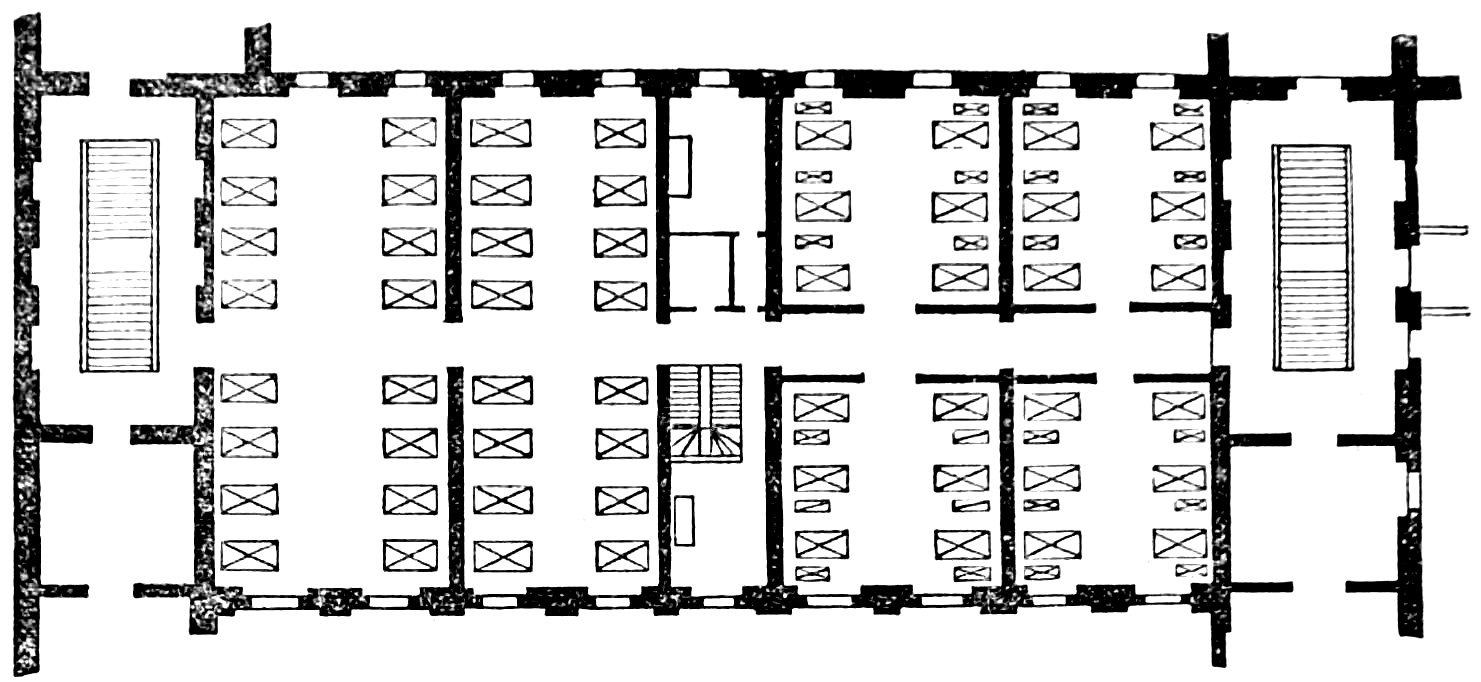
HÔPITAL DE LA CLINIQUE, PARIS.
(Former arrangement of Lying-in Wards.)
The above plan, taken from M. Husson’s ‘Étude sur
les Hôpitaux,’ will show the arrangement of wards and beds
in this place. [Dr. Le Fort says that the number of beds
in each ward has since been reduced by a third.]
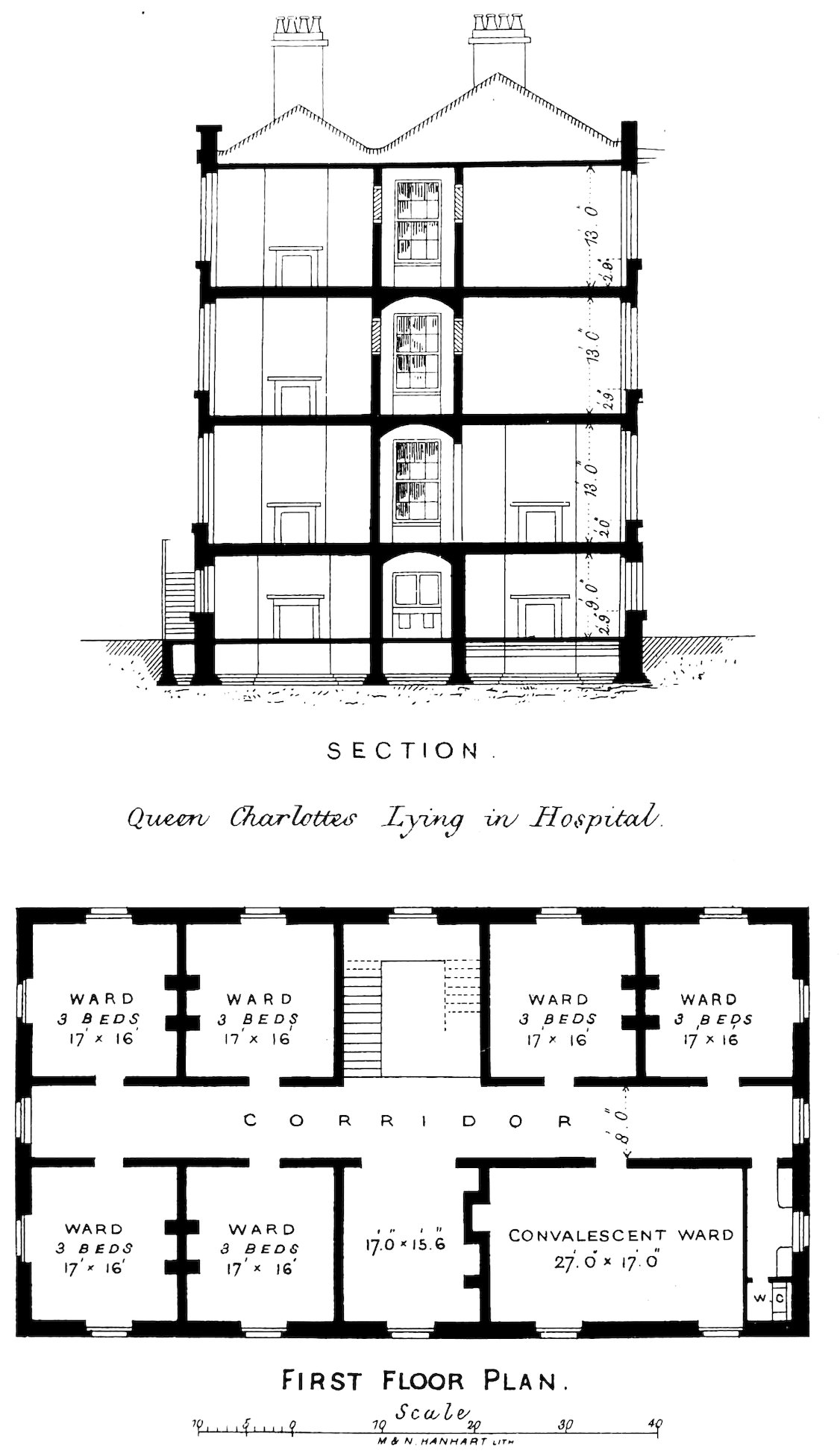
Queen Charlotte’s Lying-in Hospital, London.—Plate I.
shows a plan and section of Queen Charlotte’s Hospital, as
rebuilt in 1856.
On each floor are 6 wards, containing 3 beds each, in
which the patients are delivered, with an average of 1,000
cubic feet to each patient. On each floor, also, is one convalescent
ward, containing 6 beds. Two floors are devoted
to patients: one for married, and one for single women.
As soon as 3 patients have been delivered in a ward, it
remains vacant for 8 or 10 days, and is cleansed. Patients
are removed as soon as possible to the convalescent ward.
When a case of fever occurs, the ward is freshly whitewashed,
and not occupied again for at least a month.
PLAN I
SECTION.
Queen Charlotte’s Lying-in Hospital.
First Floor Plan.
Scale
M & N HANHART, LITH.
39In this building we have three floors and a basement.
A drain runs from back to front of the building, right across
the basement—a most unsafe course for a drain in any inhabited
building.[11]
It will be seen that the rooms are placed on opposite
sides of a main corridor running the lengthway of the
building on each floor; that the corridors of the different
floors communicate by the stairs; that the ventilation of
each room communicates with the ventilation of every other
room through the corridors; that none of the rooms have
windows on opposite sides, and that there are water-closets
having a ventilation common to that of the building. Now
every one of these structural arrangements is objectionable,
and would be considered so in any good hospital, and
nobody now-a-days would venture to include all of them in
a general hospital plan. They are hence à fortiori altogether
inadmissible in a building for the reception of lying-in
women.
We have thus, in Queen Charlotte’s Hospital, the following
defects:—
1. Agglomeration of a number of cases under the same
roof.
2. A form of construction unsuited for hospital purposes.
3. No means of removing outside the building febrile
or other cases of puerperal diseases from the vicinity of
patients recovering after delivery.
40Since 1856, notwithstanding the great improvements, the
death-rates per 1,000 have been 12·2, 8·8, 81·2, 70·3, 54·2,
39·2, 15·5, and so on: in several years very considerably
larger than the mortality which led to the closing of the
lying-in wards in King’s College Hospital. These varying
deaths lead to the exercise of much caution in drawing conclusions
as to their causes; but the main fact remains, namely,
there are the death-rates, and they are many times greater
than occur among London poor women delivered at home.
Midwifery Wards, King’s College Hospital.—The following
plan shows the provision which existed for training
midwifery nurses at King’s College Hospital.
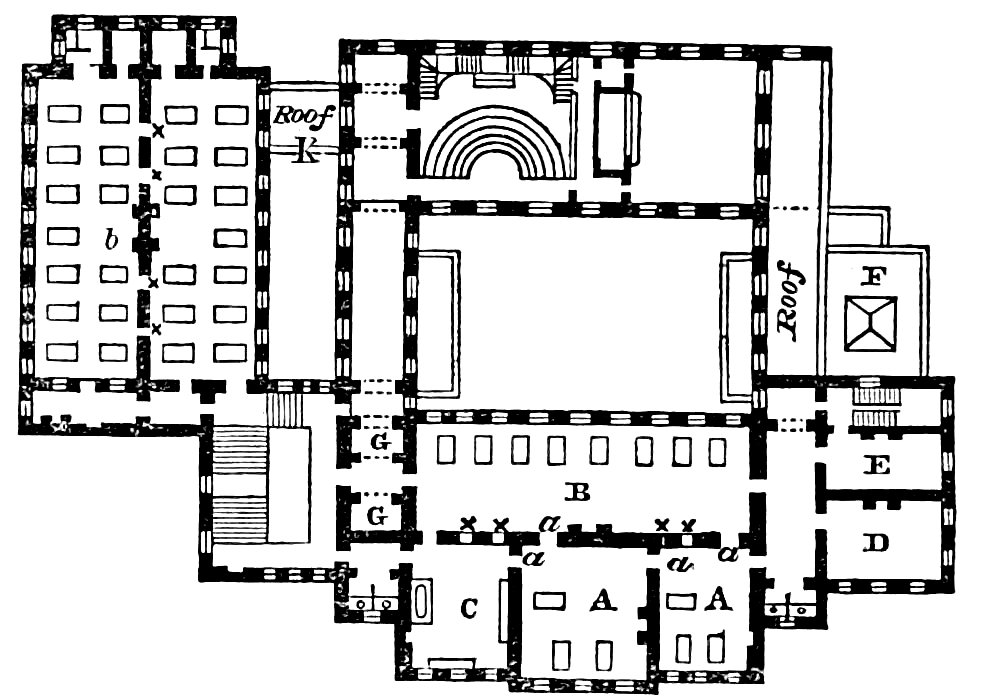
MIDWIFERY WARDS, KING’S COLLEGE HOSPITAL.
(Plan of Third Floor.)
- A, A.
- Accouchement Wards, used alternately.
- B.
- Recovery Ward.
- C.
- Contains Linen Presses, and Infants’ Baths, &c., for Ward use.
- D.
- Superior’s Bed-room.
- E.
- Midwife’s Room.
- F.
- Post-mortem Theatre.
- G, G.
- General and Provision Hoists.
- K.
- This roof is not higher than the basement.
- x.
- Ventilating openings on a level with upper part of
opposite window.
- a, a, a, a.
- Doors cutting off communication with either Accouchement
Ward when necessary.
- b.
- No. 4 Ward.
41The plan shows the relation of the delivery wards to the
recovery ward, and to the other parts of the hospital; to
the lecture room, post mortem theatre, &c. The main defects
in the construction are: the back to back wards; proximity
of these wards to the general wards of the hospital; the large
staircase, common to both sets of wards, although its size
and openness, and the windows opposite each other and on
each floor, ensured ventilation, and separated the respective
blocks; the position of the post-mortem theatre, the smell
from which, as stated on the best authority, could be distinctly
detected in the wards. As already stated, students
were admitted from other parts of the hospital to the midwifery
wards.
A few instances of improved lying-in ward construction,
together with the death-rates in these establishments, will
next be given.
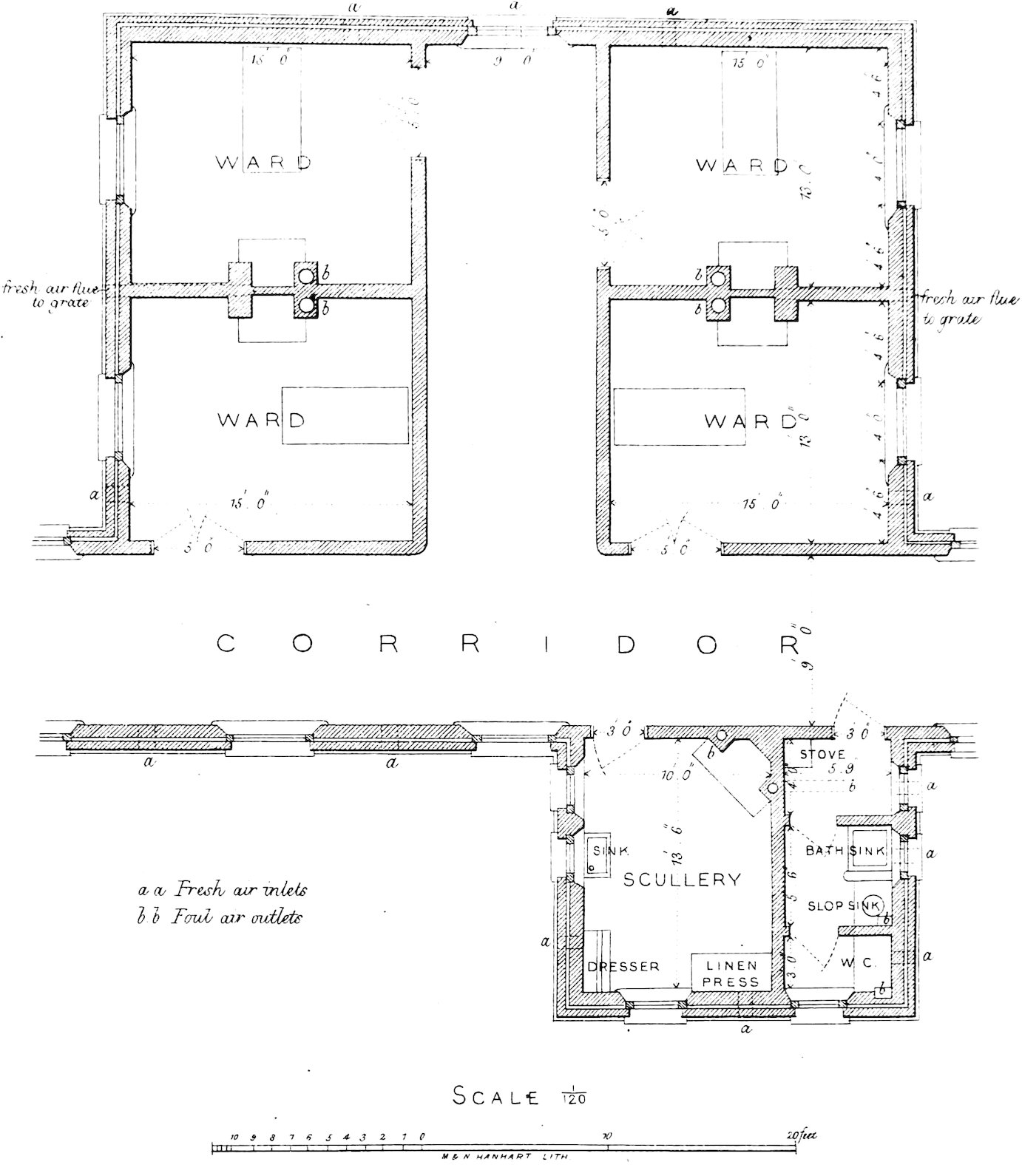
Military Female Hospitals.—These buildings vary in constructive
arrangements. Some are much better than others,
and during recent years lying-in wards of improved construction
have been provided in connection with several
newly erected military female hospitals. The earlier plans
of the new female hospitals consist of a block formed of two
pavilions joined end to end, with a passage across the block
to separate the pavilions from each other. Each pavilion
contains a single ward, with its own separate offices and
nurses’ rooms. It has windows on opposite sides, with one
42large end window, and abundant means of warming and
ventilation. One pavilion is devoted to general cases, the
other to lying-in cases.
The midwifery ward has space for twelve beds. Each
bed has a superficial area of ninety square feet, and a cubic
space of 1,350 feet. The wards are fifteen feet high.
Two hospitals on this plan have been in use at Woolwich
and Chatham for upwards of six years. During this period
there have been at the two 1,093 deliveries, and 11 deaths.
At Chatham there was one accidental death from removal
of the patient to hospital, and out of 342 deliveries there
have been no deaths from puerperal diseases. There were,
however, two deaths from scarlet fever, occurring while
this disease was prevalent in soldiers’ families in the garrison.
At Woolwich, among 751 deliveries, there have been 8
deaths, of which five were from puerperal diseases, but of
these five deaths one took place in a woman who had
gastric fever at the time of admission, and in other two
women puerperal peritonitis came on after instrumental
delivery. There was one death from embolism, one from
exhaustion, and one from dropsy. The total death-rate in
these two hospitals has been under 10 per 1,000. The
deaths due to diseases and accidents of childbirth have been
6, or at the rate of 5½ per 1,000.
Of the other military hospitals, the statistics of which are
given in Table IV., Devonport and Portsmouth are unsuitable
adapted buildings. Aldershot Hospital consists of
a number of huts joined together as a general female hospital,
with accommodation for all kinds of cases, including
43lying-in cases. This arrangement is a very undesirable one,
and the results have been unsatisfactory.
Table XIV. shows that the total mortality in this hospital
has been 10·1 per 1,000. Of the total deaths 27 are
attributed to diseases and accidents of childbirth, affording
a mortality of 8·8 per 1,000, or double that of the
healthy districts of England.
If we exclude Aldershot as being unfit for childbirth cases,
we find that in the other seven hospitals the total mortality,
as shown in Table XIV., has been 7·4 per 1,000. The mortality
from puerperal diseases in these hospitals has been
2·7 per 1,000, and from diseases and accidents of childbirth
5·4 per 1,000.
| Table XIV. |
|---|
|
All Women’s Hospitals (Military) |
|
Puerperal Diseases |
Accidents of Childbirth |
Diseases and Accidents of Childbirth |
Others |
Total Mortality |
| Deaths per 1,000 deliveries |
3·9 |
3·4 |
7·3 |
1·5 |
8·8 |
| |
|
Aldershot Women’s Hospital |
|
Puerperal Diseases |
Accidents of Childbirth |
Diseases and Accidents of Childbirth |
Others |
Total Mortality |
| Deaths per 1,000 deliveries |
4·9 |
3·9 |
8·8 |
1·3 |
10·1 |
| |
|
Other Women’s Hospitals, excluding Aldershot |
|
Puerperal Diseases |
Accidents of Childbirth |
Diseases and Accidents of Childbirth |
Others |
Total Mortality |
| Deaths per 1,000 deliveries |
2·7 |
2·7 |
5·4 |
2·0 |
7·4 |
There are two camp hospitals for lying-in cases, consisting
only of wooden huts, appropriated for the purpose, which
have yielded very important experience. One of these is at
Colchester, the other at Shorncliffe.
The Shorncliffe Hospital is an old wooden hut of the
simplest construction, with thorough ventilation. It is
situated on a rising ground close to the sea, and facing it,
44so that the sea breeze sweeps right through it. It is scarcely
more than a makeshift. And here are the results.
Table IV. shows that up to December 1869, there had
been 702 deliveries in the hut, among which there was one
death from scarlet fever, and one from hæmorrhage, besides
two deaths following on craniotomy. There was not a
single death from any puerperal disease.
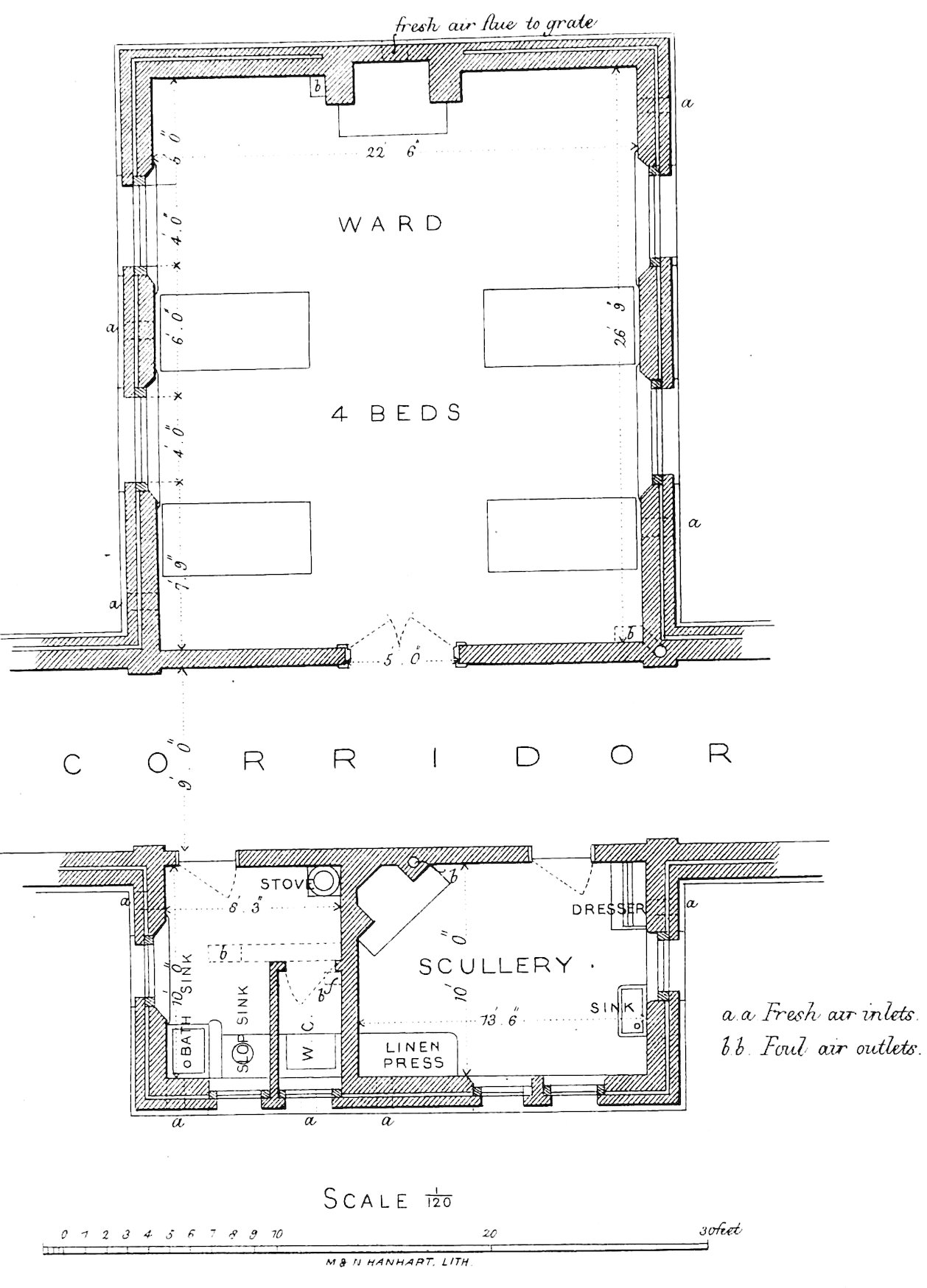
Colchester Lying-in Hospital, of which a plan and section
are given on Plate II., is nothing more than an ordinary
officer’s wooden hut, divided by partitions into four compartments,
with a transverse passage cutting them off from
each other. This hut has been in use for a considerable
number of years as a place of lying-in for soldiers’ wives
living in the camp, and there have been altogether between
500 and 600 deliveries in it. The matron states that
during the whole time the hut has been in use for its present
purpose, no death has taken place in it. But as statistics
have only been kept since 1865, we shall limit our attention
to them. They show that, up to the end of October 1870,
there had been 252 registered deliveries, and no deaths.
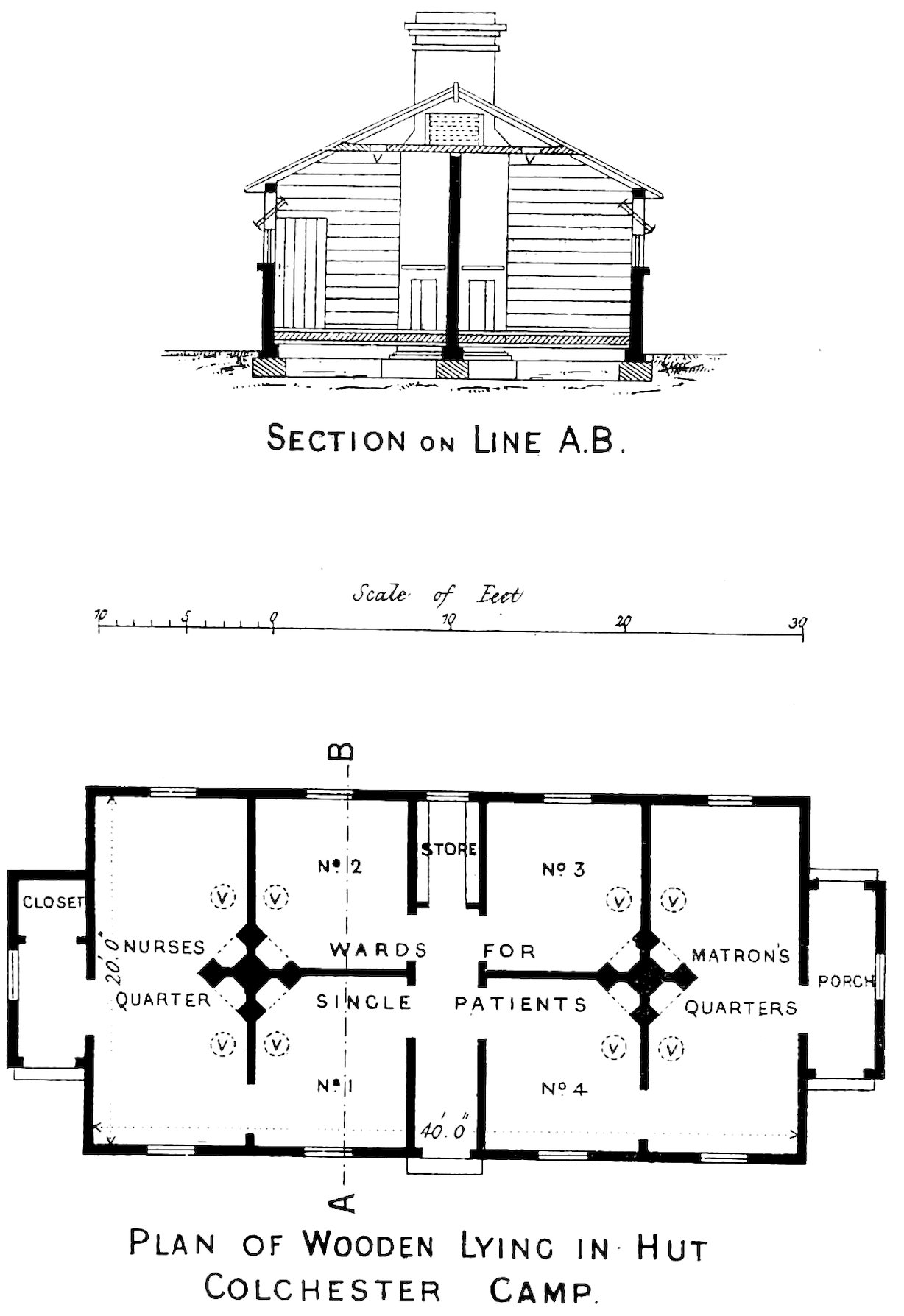
PLAN II
Section on Line A.B.
Scale of Feet
Plan of Wooden Lying-in Hut Colchester Camp.
v. Foul air outlets.
45The results of these two makeshift hospitals, when compared
with the figures already given for lying-in establishments
generally, are certainly remarkable. They are both
detached buildings, having no connection with any general
hospital. Their construction ensures a plentiful supply of
fresh air at all times. They contain very few beds, and
these beds are occupied, seldom or never, all at one time.
Indeed, it is stated that in the Colchester hut there is
scarcely more than one, or at most two beds, constantly
occupied throughout the year. Also, soldiers’ wives lying-in
rarely remain more than ten days, though sometimes
twelve in hospital. There is, therefore, no crowding;
scrupulous cleanliness is observed; there are no sources
of putrid miasm in or near the lying-in huts; and they
have their own attendants. The data in Table IV. show
that there have been 954 registered deliveries in the two
huts, and four deaths, of which three were due to puerperal
accidents, and none to puerperal diseases.
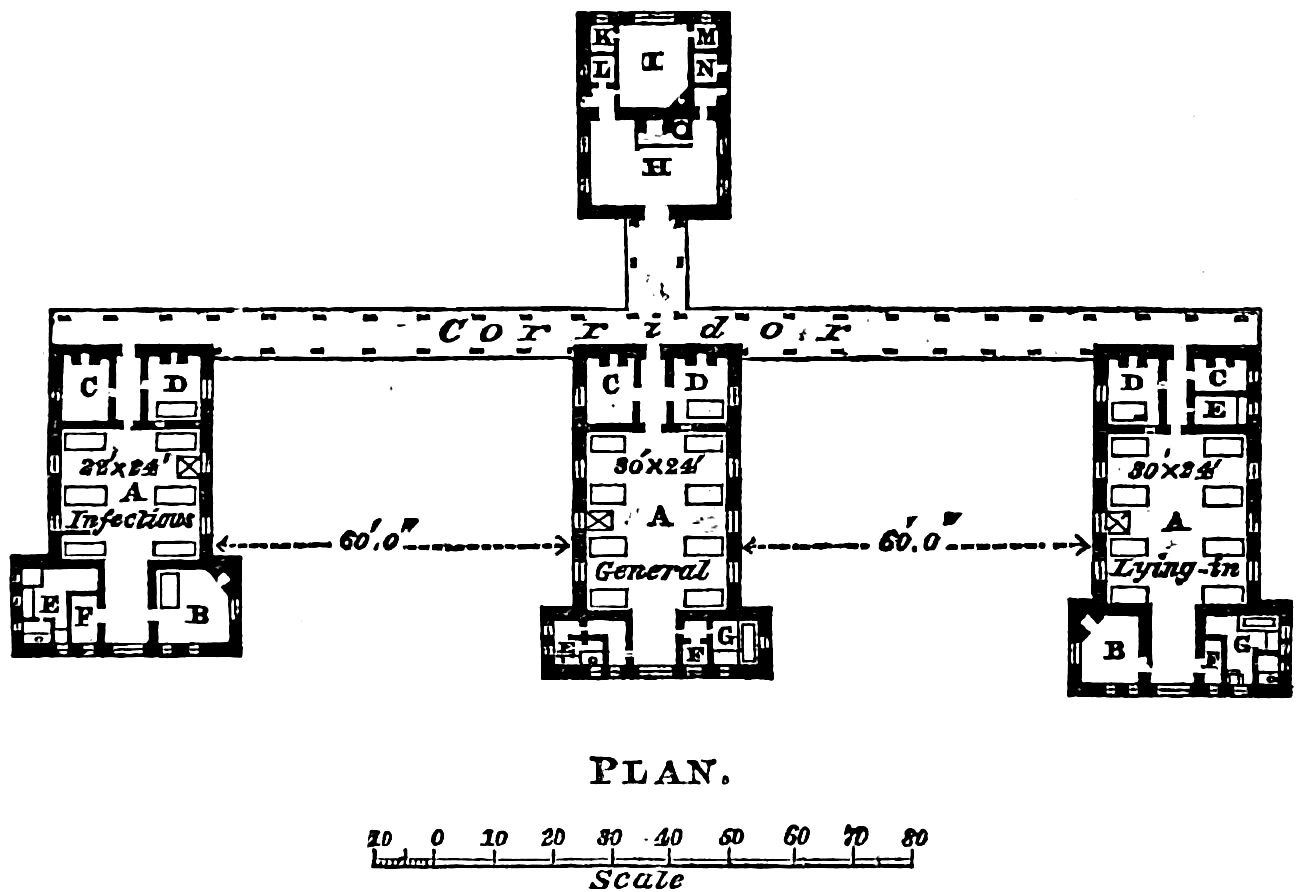
PROPOSED HOSPITAL FOR WOMEN, PORTSMOUTH.
- A.
- Wards.
- B.
- Spare Wards.
- C.
- Sculleries.
- D.
- Nurses.
- E.
- Lavatories.
- F.
- Linen.
- G.
- Baths.
- H.
- Kitchen.
- I.
- Cook’s Room.
- K.
- Store.
- L.
- Medical Comforts.
- M.
- Store.
- N.
- Coals.
Proposed new Female Hospital at Portsmouth.—When
military female hospitals were first designed, it was intended
46that they should receive only lying-in and general cases
from married soldiers’ families in separate pavilions. But
at a subsequent date zymotic cases were admitted into the
same pavilion with general cases. Very decided objections
were, however, urged against this step by medical officers,
and the next hospital planned was divided into three distinct
pavilions. It was intended for Portsmouth garrison, and is
shown in the annexed figure.
A female hospital on this plan has been erected at Dublin,
with the two end wards built in the line of the corridor
beyond the ends of it, in place of at right angles to the corridor,
as shown in the proposed Portsmouth plan. By this
form of construction the cases received from soldiers’ families
can be divided into three classes: general, infectious,
and midwifery—each class in its own separate building.
Such, however, has been the feeling of medical officers as to
the undesirableness of trusting even to this amount of separation,
that at Dublin the ‘infectious’ cases have been removed
to another locality altogether. The same separation
had been already effected at Chatham and Woolwich.
Close observation of lying-in cases has led to further
change in the construction, and it is now proposed to adopt
for lying-in wards in female hospitals a different form of
arrangement altogether: namely, to divide the lying-in
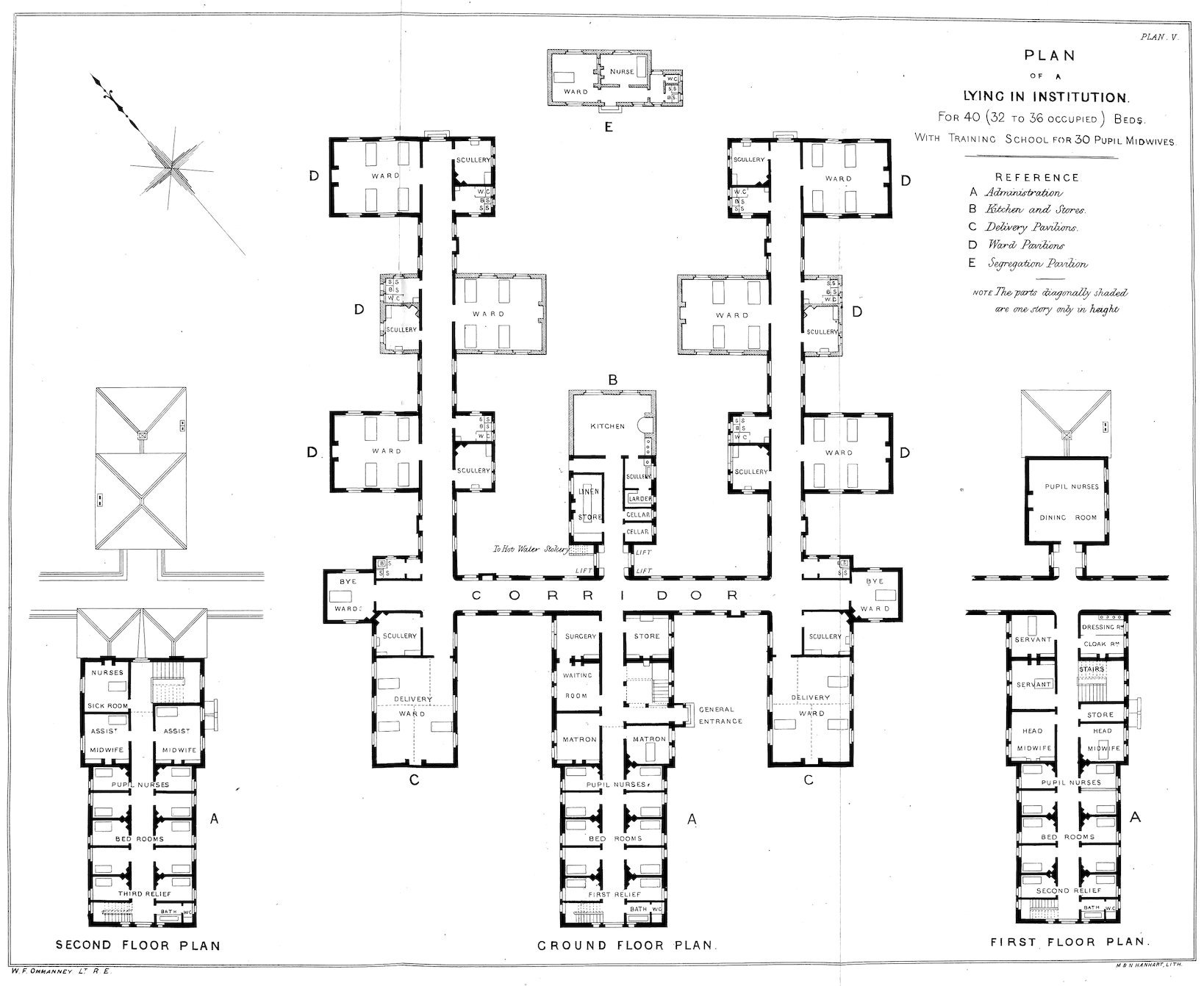
pavilion into separate one-bed rooms, as shown on Plan IV.
The experience of these small military female lying-in
hospitals has shown the favourable effect of simplicity of
construction, plenty of space, light, and fresh air, perfect
cleanliness, a small number of lying-in beds, not by any
47means constantly occupied, administration separate from
that of general hospitals, and allowing the lying-in women
to return to quarters in as few days after delivery as their
recovery admits.
But there is one remarkable instance in which a plan of
construction, on the principle of the earlier British military
female hospitals described above, has been adopted without
having led to equally satisfactory results.
The new ‘Maternité’ belonging to the Hôpital Cochin at
Paris has been constructed on a ground-plan similar to that
at Woolwich, viz., with two pavilions projecting in line
from a centre, and containing two ten-bed wards. It is in
two floors, with small wards on the upper floor. Part of its
sanitary arrangements are certainly not what we should
adopt in this country, but there are many hospitals in
which there are worse defects.
Puerperal fever appeared in this hospital within a month
of its being opened.
Where so much attention had been paid to construction,
the causes of the fever must be looked for somewhere else
than in the ward plan.
Dr. Le Fort has stated that puerperal fever cases had been
retained temporarily in the wards after the development
of the disease; that the same nurses took charge, not only
of cases of disease in the isolated wards, but also of women
making healthy recoveries; and that there is nothing to prevent
the medical attendant passing almost directly from the
autopsy of a puerperal fever case to render assistance to a
healthy woman.
48This experience is very important. It shows how much
the safety of lying-in hospitals depends on common-sense
management, and that it would be disastrous to trust to
improved construction alone, while everything else is left to
take its own course.
We now arrive at the consideration of an elementary
point:—
This is a very grave question. Medical students were admitted
to the lying-in wards at King’s College Hospital. Was
this one cause of the occurrence of puerperal diseases there?
There are facts, it is true, such as those supplied by the
Maternité and Clinique at Paris (the latter only admitting
medical students), in both of which establishments the mortality
is excessive, which on first sight appear to show that
the presence of medical students in a lying-in hospital is
not necessarily a cause of adding to a mortality already
excessive. But on the other hand there are facts, such as
those given by Dr. Le Fort, admitting of a comparison being
made between the mortality in lying-in wards to which
medical students are admitted with the mortality in other
wards of the same establishment not admitting students,
which appear to establish the point conclusively. The
special case he cites is the following:—
At Vienna there are two lying-in cliniques, one for
students and one for midwives. They are both situated in
49the same hospital, and their external conditions are insufficient
in themselves to explain the facts now to be noted.
Puerperal fever prevailed in the hospital during the same
months in ten separate years, from 1838 to 1862, and the
following table gives the mortality per 1,000 in each set of
clinical wards:—
| Years |
Months |
Mortality per 1,000 |
| 1st Clinique Students |
2nd Clinique Midwives |
| 1838 |
June |
9 |
247 |
| 1839 |
July |
150 |
34 |
| 1840 |
October |
293 |
58 |
| 1842 |
December |
313 |
37 |
| 1844 |
November |
170 |
33 |
| 1844 |
March |
110 |
7 |
| 1845 |
October |
148 |
13 |
| 1846 |
May |
134 |
4 |
| 1847 |
April |
179 |
7 |
| 1856 |
September |
13 |
105 |
| 1862 |
December |
63 |
2 |
Is it not quite clear that some bad influence was at work
in this case on the students’ side, which was not in force on
the pupil midwives’ side? That there was something else in
operation besides epidemic influence is shown by the much
greater frequency and severity of puerperal diseases in the
one clinique than in the other. We may assume the fact
without attempting to explain it, as a proof of the necessity
of separating midwifery instruction altogether from ordinary
hospital clinical instruction; and does not this Vienna history
throw fresh light on the experience already alluded to
of our midwives’ school in King’s College Hospital?
50
This very important element in the question of mortality
has been already referred to. There appear to be no
extant statistics to show the relation of the death-rate to the
period of residence. This much, however, is known—that in
the establishments where the death-rate is highest the probable
effect of length of residence appears not to be considered,
while in the cases cited where the death-rates are
lowest the women leave the hospital as soon as they are able
to do so.
Dr. Le Fort, however, quotes Tarnier and Lasserre of
Paris, and Späth of Vienna, as holding that the death-rate is
lower among women admitted some time before labour.
‘They become acclimatised’ (an odd expression, when
applied to the foul air of an establishment where there
should be no foul air). He also says that puerperal fever is
very rare among women brought into hospital after delivery,
and he asks whether ‘contamination does not take place
principally and almost solely at the moment of accouchement.’
One can only repeat, what indeed Le Fort states, that in
these most important points of enquiry, the very elements
are yet wanting to us.
Some hospitals have rather plumed themselves on their
humanity in giving shelter to poor lying-in women as long
as possible, while in military lying-in hospitals soldiers’
wives are obliged to go home as soon as they can, to help
the domestic earnings. In the first class the death-rate is
high, in the last it is low.
The low death-rates in workhouse lying-in wards appear
51to support this conclusion also. These do not retain together
women not yet in labour, women in labour, women
delivered, and convalescent women. Their principle, on the
contrary, is to receive women when labour is imminent, and
to send them out of the ward as speedily as possible.
A moment’s consideration will be sufficient to show how
important a point in management this is. If there is any
danger at all to puerperal women in a lying-in institution (a
fact which has been proved), is it not clear that the danger
must become cumulative? It will increase in a certain
ratio as the length of residence increases.
Blood-poisoning, if once begun, will not stop of itself
unless the subject of it be removed from the cause, or the
cause from the subject, if it stop even then. To retain both
subject and cause together is simply to render certain that
which under better management might have been evanescent.
The more this question is considered the more important
does it appear, as involving an element exercising a
very considerable influence on the ultimate fate of inmates
of lying-in institutions. The institution, by retaining its
inmates, becomes a hospital; and, as such, subjects its
inmates to hospital influences while in the most susceptible
of all conditions.
The absence of information in almost all published statistics
on the point would be grotesque, if it were not alarming from
the carelessness it shows. With some difficulty the following
few meagre data have been scraped together as to the
average number of days lying-in women spend in the undermentioned
institutions:—
| 52 |
| Soldiers’ Wives’ Hospitals |
10 to 12 |
days |
| Liverpool Workhouse Lying-in Wards |
14 |
„ |
| London Workhouse Lying-in Wards |
14, 18, 21 |
„ |
| Paris Maternité |
17, 18 |
„ |
| Paris Clinique |
18, 20 |
„ |
| King’s College Hospital |
16 |
„ |
This involves the question of management, which is next to
be considered.
The most important experience which can be had as to
the effect of good management in preventing the development
of puerperal diseases is afforded by the results of midwifery
cases in workhouse infirmaries. In none of these
institutions is there any great refinement of construction or
of sanitary appliances, and nevertheless their death-rates
have been much lower than those of maternity institutions
generally.
In Table V. are given the statistics of the lying-in wards
of Liverpool workhouse for thirteen years. During this
period there were an approximate number of 6,396 deliveries
and 58 deaths, giving a total death-rate of 9·06 per 1,000.
Of these deaths 22 were from puerperal diseases—equal
to a death-rate of 3·4 per 1,000. There were
14 deaths from accidents of childbirth—equal to a death-rate
of 2·2 per 1,000. The aggregate death-rate from
puerperal diseases and accidents of childbirth was 5·6 per
1,000.
These deaths are said to include all among puerperal
women delivered in these lying-in wards, whether occurring
within or without the maternity division. Mr. Barnes, the
53medical officer of the establishment, states that he can
‘answer for this with certainty’ during the last 5 years.
Also, that no lying-in woman is discharged out of the workhouse
unless in perfect health, so that no puerperal death can
have happened after discharge. Mr. Barnes has farther
been kind enough to supply data for the following 3 years’
statistics, to show the general character of the cases which
have furnished these low death-rates.
| Summary of Cases Delivered in the Lying-in Wards of Liverpool Workhouse 1868–9–70. |
|---|
|
Years |
Total |
| 1868 |
1869 |
1870 |
|
| Number of women attended in labour: natural |
511 |
443 |
442 |
1,396 |
| Number of women attended in labour: premature |
4 |
1 |
15[12] |
20 |
| Number of women attended in labour: married |
164 |
159 |
142 |
465 |
| Number of women attended in labour: single |
351 |
285 |
300 |
936 |
| Males born |
295 |
223 |
228 |
746 |
| Females born |
216 |
225 |
223 |
664 |
| Mothers who died in or from labour |
2[13] |
2[14] |
2[15] |
6 |
| Children born dead |
79 |
58 |
58 |
195 |
| Women confined at or above 40 years of age |
8 |
4 |
9 |
21 |
| Women confined at or below 20 years of age |
105 |
98 |
81 |
284 |
| Greatest age at delivery |
46 |
42 |
44 |
|
| Youngest age at delivery |
17 |
16 |
15 |
|
| Number of first confinements |
223 |
207 |
105 |
535 |
| Twin births |
1 |
5 |
7 |
13 |
| Triplets |
0 |
0 |
1 |
1 |
| Labours followed by flooding |
3 |
0 |
0 |
3 |
| Labours accompanied by convulsions |
2 |
1 |
2 |
5 |
| Labours accompanied by retained placenta |
3 |
0 |
3 |
6 |
| Forceps cases |
7 |
4 |
4 |
15 |
| Craniotomy cases |
1 |
0 |
0 |
1 |
| Version cases |
2 |
0 |
1 |
3 |
| Presentations: head |
484 |
426 |
425 |
1,335 |
| Presentations: breech |
22 |
12 |
15 |
49 |
| Presentations: feet |
4 |
10 |
11 |
25 |
| Presentations: arm |
1 |
0 |
0 |
1 |
54Subjoined is also a Table of the deaths and causes of death
year by year for 13 years:—
| Summary of Deaths and Causes of Death in the Lying-in Wards of Liverpool Workhouse for Years 1858–1870. |
|---|
|
1858 |
1859 |
1860 |
1861 |
1862 |
1863 |
1864 |
1865 |
1866 |
1867 |
1868 |
1869 |
1870 |
| Morbus cordis |
2 |
|
1 |
|
|
1 |
|
|
|
|
|
|
1 |
| Pneumonia |
1 |
|
|
|
|
1 |
|
|
|
1 |
|
|
|
| Puerperal peritonitis |
1 |
1 |
|
1 |
6 |
|
2 |
2 |
3 |
|
|
|
|
| Phthisis |
1 |
|
|
|
1 |
|
1 |
|
|
1 |
|
|
|
| Debility |
2 |
|
|
|
|
|
|
|
|
|
|
|
|
| Epileptic convulsions |
|
1 |
2 |
1 |
|
|
|
|
|
|
1 |
|
|
| Puerperal fever |
|
1 |
1 |
1 |
|
|
|
|
|
|
|
|
|
| Jaundice |
|
1 |
|
|
|
|
|
|
|
|
|
|
|
| Phlegmasia dolens |
|
1 |
|
|
|
|
|
|
|
|
|
|
|
| Exhaustion |
|
|
2 |
|
|
|
1 |
|
|
|
|
|
|
| Relapsing fever |
|
|
1 |
|
|
|
|
|
|
|
|
|
|
| Measles |
|
|
1 |
|
|
|
|
|
|
|
|
|
|
| Inquest |
|
|
1 |
|
|
|
|
|
|
|
|
|
|
| Laryngitis |
|
|
|
1 |
|
|
|
|
|
|
|
|
|
| Obstructed labour |
|
|
|
1 |
|
|
|
|
|
|
|
|
|
| Typhus, post partum |
|
|
|
1 |
|
|
|
|
|
|
|
|
|
| Hæmorrhage |
|
|
|
1 |
|
|
|
|
1 |
|
|
|
|
| Uræmia |
|
|
|
|
|
|
1 |
|
|
|
|
|
|
| Rupture of uterus |
|
|
|
|
|
|
|
1 |
|
|
|
|
|
| Bright’s disease |
|
|
|
|
|
|
|
|
|
1 |
|
|
|
| Invaginated bowel |
|
|
|
|
|
|
|
|
|
|
1 |
|
|
| Instrumental labour (fever) |
|
|
|
|
|
|
|
|
|
|
|
1 |
|
| Metritis |
|
|
|
|
|
|
|
|
|
|
|
1 |
|
| Dropsy |
|
|
|
|
|
|
|
|
|
|
|
|
1 |
| Deaths |
7 |
5 |
9 |
7 |
7 |
2 |
5 |
3 |
4 |
3 |
2 |
2 |
2 |
| Approximate deliveries:[16] average estimated at 500 per ann. |
450 |
625 |
511 |
443 |
442 |
Let us now see what the arrangements are for this class
of cases. The lying-in department of Liverpool workhouse
is situated in a wing of the female general hospital, contiguous
55to the surgical wards. The wing has windows along the
two opposite sides and at one end; but the space is so
divided off by partitions as to form five wards, each of which
has windows along one side only. The wards are allotted
in the following manner:—
Two of them, opening into each other, and facing the same
way, contain each twelve double beds, affording accommodation
for 24 inmates per ward, 48 in all, at 345 cubic feet
per inmate. These two wards are devoted to the reception
of pregnant women before delivery. The opposite half of
the wing is divided into two wards, corresponding to the
two pregnant wards; one of these is the delivery ward, and
contains seven beds, at nearly 1,200 cubic feet per bed.
Entering from this delivery ward is the lying-in ward,
lighted by windows at the end. This ward contains 14
beds, at 900 cubic feet per bed. The other ward, entering
from the delivery ward in the same line, is for convalescents,
and contains eleven beds, at 762 cubic feet per bed. The
W. C.’s, &c., are between the wards in the wing, in a very
objectionable position.
For these and the following details I am indebted to the
kindness of Mr. Barnes, who also supplied me with the
statistics abstracted on Table V.
The following is the routine management of this establishment:—
All the wards are lime-washed three or four times a year.
They are shut up and fumigated after the occurrence of any
serious case of illness. The floors are washed daily.
The beds in the pregnant, lying-in, and convalescent wards,
56are generally all or most of them occupied; but the number of
occupied beds in the delivery ward rarely exceeds four or
five.
The bed clothes are changed after each delivery, and the
beds, which are of straw, after every third delivery.
The patients consist for the most part of unmarried women.[17]
They are admitted into the pregnant wards, where they
remain for a varying interval of from days to months, from
whence they are removed to the delivery ward; about a fifth
part of the women are admitted directly from the town to
the delivery ward.
They remain on an average eight hours in the delivery
room, whence they are removed to the lying-in ward, where
they remain five or six days. They are then admitted to the
convalescent ward, and are finally discharged fourteen days
after labour, one half to the town, the other half into other
parts of the workhouse.
An important part of the management is that the inmates
of the pregnant wards only inhabit those wards at night,
being engaged during the day in various occupations within
the workhouse, but not about the lying-in women, as in the
Paris Maternité.
Cases are not taken into the lying-in division unless labour
has begun, or is supposed to be imminent.
Any case of illness occurring in the lying-in department is
57at once removed to the ‘class sick nursery,’ to the lock or
other division.
The nurses engaged in the lying-in division attend also
cases in the ‘class sick nursery,’ and are periodically changed.
Any case which they cannot manage is referred to the resident
medical officer on duty.
There are three of these officers, who relieve each other
every eight hours day and night. The officer on duty is liable
to be called on to visit any part of the workhouse or hospital
during his turn of duty, so that it might happen occasionally
that the medical officer might be called from the hospital to
the lying-in division.
If feverish symptoms show themselves in any patient in
the lying-in division, the practice is to isolate the case or
to transfer it to some other division of the workhouse. The
ward is then closed, fumigated, cleansed, and lime-washed,
before being again used.
This proceeding has only been necessary twice within the
last four years.
Until recently, the whole of the deliveries, which amounted
to an average of about 500 a year, were under the charge of
one paid officer and a pauper who, without any payment
or extra diet, delivered nearly every case and worked both
night and day.
There are several points in this procedure which are of
great importance, as bearing on the general question of successful
management of lying-in establishments:—
1. The building, although situated in a large commercial
town, is on a high, isolated, and freely ventilated locality.
582. It is not connected with a general hospital or medical
school, or with any of their risks.
3. There is a constant change of wards:—pregnant ward,
delivery ward, lying-in ward, recovery ward, body of the
house. There is, in short, as little risk as possible of the
cumulative blood-poisoning process already referred to.
4. Frequent cleansing and lime-washing.
5. Passing women who have been delivered as speedily
as possible out of the division altogether, either into the
house or outside.
6. The deliveries being conducted by a woman specially
attached to the delivery ward, and no part of whose duty it
is to attend sick.
7. The immediate isolation or removal of all cases exhibiting
feverish symptoms and their treatment out of the
division.
8. The reduction of intercommunication between the
lying-in and hospital divisions to the smallest possible
degree on the part of medical officers and nurses.
The practical result of this system of management has
been, as we have seen, that the lying-in division of this workhouse,
although working under many singular disadvantages,
has escaped the usual fatality of special lying-in hospitals.
During the thirteen years included in the tables there has
been no epidemic, and the deaths have almost always been
single and disconnected.
The experience of lying-in wards in London workhouses
somewhat resembles the experience of Liverpool workhouse.
In the report of the committee appointed to consider the
59cubic space of metropolitan workhouses, 1867, is given a
table, No. 11, shewing the number of deliveries and deaths
after delivery during five years in forty metropolitan
workhouses.
The leading facts are abstracted in Table VI. Workhouses
in which deaths after delivery took place, during the
five years, are separated in the abstract from workhouses
in which no deaths took place.
There were during these five years in all the workhouses
11,870 deliveries and 93 deaths, giving a death-rate of
7·8 per 1,000. The deaths from puerperal diseases
amounted to 39, giving a death-rate of 3·3 per 1,000.
There were 20 deaths from accidents of childbirth; being a
death-rate of 1·7 per 1,000. The total death-rate due to
both classes was 5 per 1,000.
The largest number of deliveries took place in Marylebone
and in St. Pancras. In the former, on an average of
243 deliveries per annum, the death-rate was 8·2 per 1,000.
One half of this, however, was due to consumption. Of
the remaining deaths 3 were due to puerperal diseases
(2·4 per 1,000) and 2 to accidents. The death-rate due
to puerperal diseases and accidents of childbirth was thus
4·1 per 1,000.
In St. Pancras workhouse, on an average of 200 deliveries
per annum, the death-rate was 11 per 1,000, of which
9 per 1,000 were due to puerperal diseases. Recent
disclosures with regard to St. Pancras workhouse may to
some extent account for this high death-rate. The number
of deliveries in these two workhouses bring them almost
within the category of lying-in hospitals.
60There are four other workhouses in which the annual
deliveries are respectively 171, 120, and two of them 111,
while in all the others the numbers fall much below 100.
In one such instance (Holborn), where the deliveries have
averaged fifty a year, the death-rate was exceptionally
high, 24 per 1,000, one half of which was due to
puerperal disease. In another instance, St. Mary’s, Islington,
with seventy-five deliveries per annum, the death-rate
averaged 29 per 1,000. But the causes are not stated,
and cannot now be ascertained. In Whitechapel, where
there were 111 deliveries per annum, the death-rate was
10·8 per 1,000, one half being due to puerperal
diseases.
It is possible that local enquiry might elucidate the
causes of this mortality. The cases are, however, exceptional
to the experience of London workhouses, viz. that the
death-rates from puerperal diseases and accidents of childbirth
are scarcely higher than they are in all England, town
and country. Let us try to ascertain how far the management
adopted may have led to these comparatively favourable
results.
The conditions for recovery in a great majority of the
London workhouse lying-in wards are at least as favourable as
they are in the Liverpool workhouse; in most cases undoubtedly
more so, as will immediately be seen when we
consider that the average annual number of deliveries in
Liverpool workhouse is more than twice that of the two
largest London workhouses, and from five to ten times
most of the others; that in the London workhouses the rule
61is to have many unoccupied beds, while this is the exception
in the Liverpool workhouse.
The cardinal principle in the management of these
London workhouse lying-in wards appears to be this: their
occupants are a fluctuating number; often the wards have
but one woman at a time, and the cubic space for each of
these women is ‘in fact the cubic space of the whole ward.’[18]
Sometimes, but only for brief periods, all the lying-in beds
may be occupied. For much longer intervals the occupants
are very few in number, so that each has a large
proportion of cubic space, and sometimes the wards in some of
the workhouses are empty. There are no medical schools
attached to the institutions, and no medical students who
may have passed from a case of erysipelas or from the post-mortem
theatre to the lying-in bedside; there is the
possibility of removing immediately any case of febrile or
other disease which may occur in the lying-in ward into
the general sick wards of the workhouse; there is discharge
of convalescent cases at the earliest possible period, either to
their own homes or to other parts of the establishment;
these conditions, together with the paucity of numbers
and the occasional vacating and rest of the wards, appear
to constitute the main difference between a workhouse
lying-in ward and a lying-in hospital.
In both classes of establishments the same attention is
doubtless bestowed on ventilation, cleanliness, and frequent
change of bedding.
62
The lying-in arrangements provided for soldiers’ wives
are as follows:—
The rule is that women shall be delivered in quarters,
provided there be decent accommodation. At a number of
the larger stations, where suitable married quarters have not
yet been fully provided, there are female hospitals, attached
to which, as we have already seen, is a delivery and lying-in
ward, with the usual offices. In the specially constructed
hospitals the wards are of a good size, well-lighted, warmed
and ventilated. If all the beds were occupied, the space
would be 1,300 cubic feet per patient. But this is an event
which rarely or never happens, so that there is always
plenty of room and good ventilation.
If[19] a woman requires admission, her husband applies to
the medical authorities for a ticket. No woman with a
disease considered to be infectious is admitted. The
women usually follow their ordinary avocations until obliged
to proceed to hospital by imminent labour. They are
taken there in cabs, all the necessary arrangements for the
lying-in having been made, if possible, by previous intimation.
The woman is delivered in the delivery ward, and
is thence transferred to the lying-in ward. As a rule, the
lying-in pavilion in these female hospitals is distinct in
all its arrangements for nursing from the pavilion for
general cases. Infectious cases are not received into the
same hospital, except at Aldershot.
63In these hospitals for soldiers’ wives the time which
elapses from the admission to the discharge of the women is
usually ten, and in some cases twelve days.
At Aldershot four ‘Sisters’ are now at work in the
soldiers’ wives’ hospital. One was trained as midwife, and
took charge of the midwifery cases early in 1867. The
Sister midwife has sole charge of the lying-in women for
five or six days. They are then passed into a third ward,
and are nursed by the Sisters who attend the ordinary cases
(which are, however, of course in a separate ward).
The Sisters do not help the midwife, as a rule. Only the
Superior, on an emergency, and one for scrubbing floors
periodically, enter the midwifery wards (i.e. the delivery
and lying-in wards).
In 1869 Aldershot had no fatal case among the lying-in
women.
[The ‘infection wards’ are nursed by ordinary nurses,
and in cases of children by the parents.]
It will be seen, therefore, that at Aldershot the midwife
has nothing to do with the general cases, and the matron
is not now the midwife. Both there and at Woolwich the
lying-in nursing is quite separate from the general nursing.
The medical officer remarks, as to the two deaths in
1869 at Woolwich: ‘Two cases of puerperal peritonitis
after bad labours, requiring instrumental and other assistance,
died, but the disease did not extend. My opinion is that
the coldness of the wards, though objectionable, has a great
deal to do with the comparative immunity hitherto enjoyed
as regards the germination and extension of contagious
diseases.’
64It need scarcely be said that these new hospitals are
models of cleanliness.
In the Colchester Hut the patient is received into a separate
compartment, of which there are four, where she is
delivered and remains until discharged to quarters.
It is very rarely indeed, if ever, that all the four compartments
are occupied simultaneously. The average stay is ten
days; the average number of deliveries a year under 50.
This hut does not form part of a hospital. It is a separate
establishment, solely for lying-in women, as such accommodation
should always be.
Note.—There is another reason, though it may be termed a
fanciful one, for altogether disconnecting lying-in institutions
with general hospitals, and even with the name and idea of
hospital. It is this: there must be a certain death-rate
in a general hospital, receiving as it does fatal diseases and
fatal accidents, as long as men and women have fatal diseases
and fatal accidents.
But lying-in is not a fatal disease, nor a disease at all. It
is not a fatal accident, nor an accident at all.
Unless from causes unconnected with the puerperal state,
no woman ought to die in her lying-in; and there ought, in a
lying-in institution, to be no death-rate at all.
It is dangerously deadening our senses to this fact—viz.,
that there ought to be no deaths in a lying-in institution—if
we connect it in the least degree with the name of hospital,
so long as a hospital means a place for the reception of
diseases and accidents.
In French statistics, this confusion of ideas, were it not
65ghastly, would be ludicrous. ‘Admissions,’ under the head
‘Malades,’ include not only the lying-in women, but the
new-born infants, which appear to be ‘admitted’ to life and
to hospital together, as if life were synonymous with disease,
so that, e.g. 4,000 ‘Admissions,’ in such a year, to the
Paris Maternité would mean 2,000 deliveries, 2,000 births—[and—how
many deaths?]
In summing up the evidence regarding excessive mortality
in lying-in institutions and its causes, it appears:—
1. That, making every allowance for unavoidable inaccuracies
in statistics of midwifery practice, there is sufficient
evidence to show that in lying-in wards there reigns a
death-rate many times the amount of that which takes place
in home deliveries.
2. That a great cause of mortality in these establishments
is ‘blood-poisoning,’ and that this arises from the greater
susceptibility of lying-in women to diseases connected with
this cause. From whence it follows that in many lying-in
wards, as at present arranged and managed, there must be
conditions and circumstances apart from those belonging to
the inmates personally, which aid in the development of this
morbid state.
3. That the risks to which lying-in women are exposed
from puerperal diseases are increased by crowding cases in
all stages into the same room or under the same roof; by
retaining them for too long a period in the same room;
66by using the same room for too long a period without
cleansing, evacuation, rest, and thorough airing: but that
the death-rate is not always in proportion to the number of
lying-in cases which have passed through the hospital.
It follows from this that, other things being equal, a high
death-rate may take place in a small hospital constantly used
up to its capacity as well as in a large hospital constantly
used up to its capacity.
4. That there are superadded causes in some establishments
which add greatly to their dangers. Among these
may be reckoned the following:—
- (a)
- Prevalence of puerperal fever as an epidemic outside the hospital.
- (b)
- Including midwifery wards within general hospitals, thereby incurring the risk of
contaminating the air in midwifery wards with hospital emanations.
- (c)
- Proximity to midwifery wards of post-mortem theatres or other external sources of
putrescence.
- (d)
- Admitting medical students from general hospitals or from anatomical schools to practice
or even to visit in midwifery wards without special precautions for avoiding injury.
- (e)
- Treating cases of puerperal disease in the same ward, or under the same roof, with
midwifery cases.
- (f)
- Permitting the same attendants to act in infirmary wards and in lying-in wards, and using
the same bedding, clothing, utensils, &c., in both.
- (g)
- Most probably also—especially in certain foreign hospitals—want of scrupulous attention
to ventilation, 67and to cleanliness in wards, bedding, clothing, utensils, and
patients, and in the clothing and personal habits of attendants.
In short, the entire result of this enquiry may be summed
up, in a very few words, as follows:—A woman in ordinary
health, and subject to the ordinary social conditions of her
station, will not, if delivered at home, be exposed to any
special disadvantages likely to diminish materially her
chance of recovery. But this same woman, if received into
an ordinary lying-in ward, together with others in the
puerperal state, will from that very fact become subject to
risks not necessarily incident to this state. These risks in
lying-in institutions may no doubt be materially diminished
by providing proper hospital accommodation, and by care,
common sense, and good management. And hence the real
practical question is, whether it is possible to ensure at all
times the observance of these conditions.
The great mortality in lying-in hospitals everywhere is
no doubt a strong argument against such a result being
attainable; so much so that, in the absence of this security,
the evidence in the preceding pages appears sufficient to
warrant the question being raised, whether lying-in hospitals,
arranged and managed as they are at present, should not be
forthwith closed?
Can any supposed advantages to individual cases of destitution
counterbalance the enormous destruction of human
life shown by the statistics?
Without vouching for the entire accuracy of Le Fort’s
data, they may still be taken generally as showing approximately
68the penalty which is being paid for the supposed
advantages of these institutions. It is this: (see Table XV.)
for every two women who would die if delivered at home,
fifteen must die if delivered in lying-in hospitals. Any
reasonable deduction from this death-rate for supposed
inaccuracy will not materially influence the result.
| Table XV., abstracted from Tables III. and X., showing Comparative Mortality among Lying-in Women in Hospitals and at Home. |
|---|
| |
|
|
|
|
Deliveries |
Deaths |
Deaths per Thousand |
| Total for all hospitals |
888,312 |
30,394 |
34 |
| Total delivered at home |
934,781 |
4,405 |
4·7 |
| Excess of deaths per thousand delivered in hospitals |
|
|
29·3 |
The evidence is entirely in favour of home delivery, and
of making better provision in future for this arrangement
among the destitute poor.
Must we, then, surrender the principle of lying-in institutions
altogether, and limit the teaching of midwifery nurses
solely to bedside cases at home, notwithstanding the well-known
difficulties of teaching pupils at the beginning of
their course elsewhere than in an institution? We will try
to reply to this question; and, in doing so, perhaps some
69light may be thrown on another question, viz.: how to improve
existing lying-in establishments so as to reduce the
mortality in them.
Evidence sufficient has been collected to show that no one
panacea will enable us either to possess a perfectly healthy
building, or to improve existing hospitals.
Much has been written about the saving effect of small
hospitals; but it is certain, from what has been already said,
that the small-hospital idea is not sufficient of itself. It is,
however, a very important idea, because all hospital problems
are simplified by subdivision of the buildings. So far
as we know, every one who has carefully studied the subject
has given a preference to small lying-in establishments over
large ones; but we should certainly be disappointed if we
trusted to smallness of size alone for reducing the mortality.
The evidence further shows that in any new plan infirmary
wards must be kept quite detached from lying-in
wards. They should be in another part of the ground, and
should be provided with their own furniture, bedding,
utensils, stores, kitchen, and attendants.
The same arrangement, at least in principle, should be
carried out at all existing lying-in establishments, and every
case of disease should at once be removed from the lying-in
wards to the infirmary, and be separately attended there.
In our proposed midwifery school the whole attendance
would be supplied by midwives and pupil midwives, with a
physician accoucheur, to make his visit twice a day, to be
sent for in time of need, and to give instruction to the pupil
70midwives by lectures and otherwise; and in this way we
should escape the dangers of introducing medical students.
Applying the same principle to lying-in wards to which
medical students are admitted, there can be no doubt that a
responsibility of the very gravest kind attaches to all
teachers and managers of lying-in hospitals who do not
satisfy themselves that students admitted as pupils have
nothing to do, either with general hospital practice, or with
anatomical schools, during the period. Midwifery instruction
should be treated as a matter quite apart.
What has been already said need scarcely be repeated,
about the dangers of connecting midwifery wards with
general hospitals. The simple facts are sufficient to show
that all midwifery wards of this class should be at once
closed.
As a general result of this enquiry, applicable to all lying-in
wards, the evidence shows that very much indeed of the
success depends on good and intelligent administration and
management.
Suppose that all these precautions could be carried out,
will the cost and difficulty of giving effect to them necessarily
lead to the abolition of all accommodation for midwifery
cases, or for teaching midwifery?
We reply, No. The facts already adduced clearly show
what may be done in this matter.
They prove, in the first place, that lying-in women should,
as a rule, be delivered at home. And, as a consequence,
that whatever provision may be made for cases of special
destitution, or for midwifery teaching, such provision should
71be assimilated as far as practicable to the conditions which
surround lying-in women in fairly comfortable homes.
These conditions are realised, and in some instances no
doubt improved on, in the better class of workhouse lying-in
wards, and of lying-in huts for soldiers’ wives.
The favourable results arrived at in many of these institutions
appear to show that a little more care would lower
the death-rate still further.
In every instance where it is considered necessary to
organise lying-in accommodation by voluntary effort, the
same principles should be kept in view.
The success which has attended Waterford Lying-in Hospital,
already mentioned, shows how much may be done in
rendering such accommodation a real boon to the poor.
A single hut, like the Colchester Hut, erected in a needy
locality, would supply, and that safely, all the accommodation
wanted. But for a training school of midwives and
midwifery nurses other accommodation is required, and of
a far more costly character.
It is true that any sort of building may be leased or
bought and altered, or added to, and told off as a training
school; but after what has been said, to take such a course
would be to ensure killing a certain number of mothers for
the sake of training a certain number of midwives. If we
are to have a training school at all, we must, before all
things, make it as safe for lying-in women to enter it as to
be delivered at home; and having made up our minds what
is necessary for this purpose, we must pay for it.