The cover image was created by the transcriber and is placed in the public domain.
(Fourth Edition) A SKETCH BY ANDREW W. TUER: 1880.
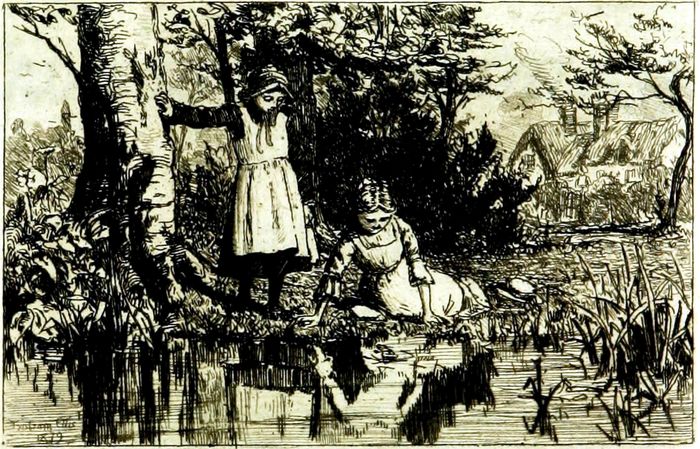
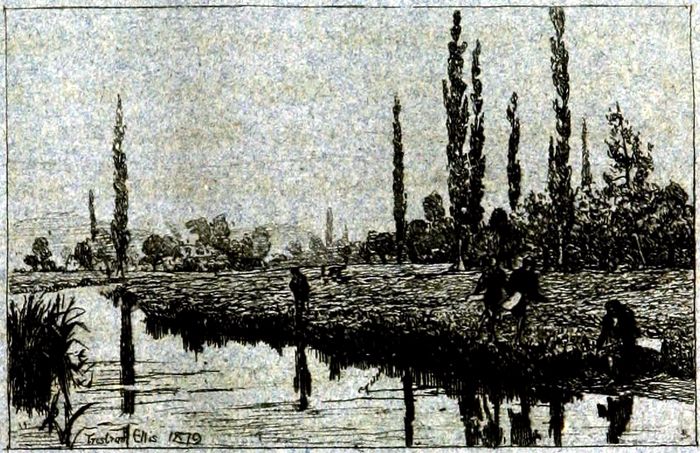
Shadows in the pond.
EIGHT ETCHINGS BY TRISTRAM ELLIS. 5⁄−
London: Field & Tuer, Ye Leadenhalle Presse, E.C.
New York: Scribner & Welford, 743 & 745, Broadway.
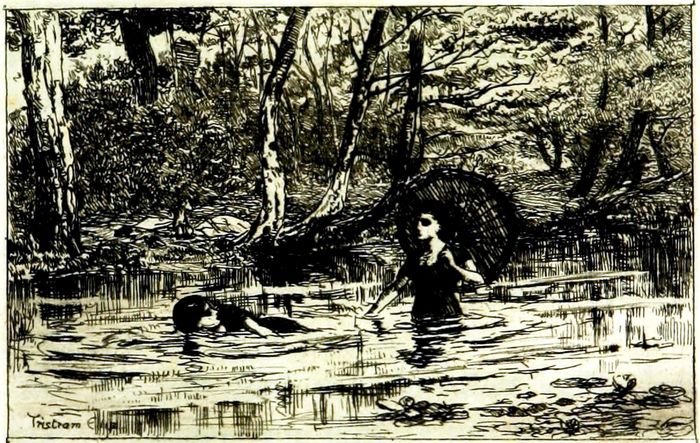
Luxurious Bathing.
(The First Edition was published in folio form with Etchings by Mr. Sutton Sharpe, at Three Guineas:
Proofs Seven Guineas.)
“Remarque” Proofs (signed) six only printed, Three Guineas.
Proofs before Letters, Japanese paper (signed) 20 copies only printed, One Guinea.
Proofs, white hand-made paper, 100 copies only printed, Half-a-Guinea.
Note.—The copper-plates having been steel-faced suffer little or no deterioration in printing.
ITS PRACTICE.
1
Treatises and disquisitions sufficient to
form a library of no inconsiderable dimensions
have been written during the last
three centuries on the subject of baths:
boiling, freezing, variously medicated—including
tar-water, steam, and spray; milk,
whey, broth, mud, sand, and even earth-baths—in which the
patient for hours together was buried up to his neck in a
2fallow field—have all had their exponents and upholders;
then there is the vapour-bath of the Russian, the dry, hot air
or Turkish-bath, besides the cold air-bath recommended by
Franklin, and those who like it may follow the example of
the elder Pliny who used to indulge in a bath of sunshine.
Now-a-days it is a common practice, on the shores of the
Mediterranean, for many of the inhabitants, during the hot
months, to pass a considerable portion of their time sitting
on chairs placed a few feet from the shore, the calm water,
without even the nuance of a ripple, reaching to the neck,
while the head is protected from the scorching sun by an
immense grass hat.
3The inference may be too hastily drawn that what is
advocated in this Sketch is unnecessary, being simply what
everyone now-a-days practises in one form or another—cleanliness;
on consideration, however, this will be found
to be hardly the fact. We are a cleanly nation, or at any
rate more cleanly than we were, but bathing with hot or
cold water as ordinarily practised is not so enjoyable and
luxurious as it might be, and moreover, to the weakly, is
often harmful in its action.
Perhaps the very acme of luxurious bathing is reached
in the Soap-bath, an application of hot water and soap to
4the whole body, followed immediately by a cold plunge,
or a sponge-bath. A bath is at once a necessity and a
luxury, and in order to obtain the greatest number of
benefits, including increased health, appetite, vigour, and
good spirits, the Soap-bath is the most effectual, and moreover
the pleasantest and least trying to the weakly or over
sensitive constitution.
It is a simple and invigorating luxury as compared
with the self-inflicted half-painful ordeal the cold bath is to
many, which latter is too often taken, not for its own sake,
but for the good supposed to follow its use. After a
Soap-bath, however, one is ready for the duties or pleasures
of the day: duty in fact becomes a pleasure, and pleasure
itself is intensified.
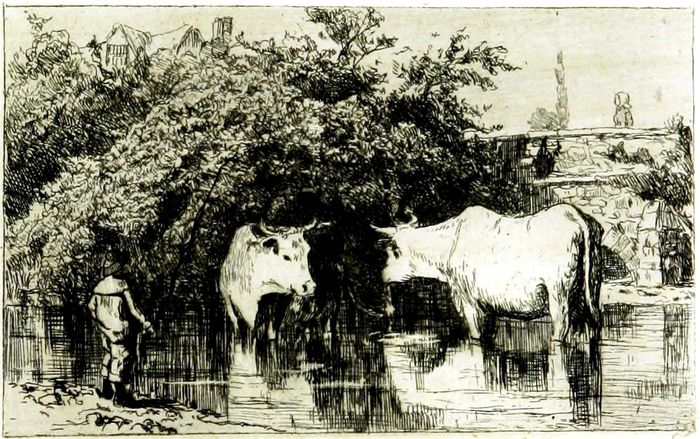
A hot Afternoon.
5The Soap-bath obtains a rapidly increasing number of
adherents, and when once the habit of taking it is formed,
it will not readily be abandoned, as it forms one of the
pleasures, if not the pleasure of the day, and moreover, can
be indulged in all the year round.
The fair sex will find the Soap-bath vastly superior to
any cosmetic: it renders the skin as soft as an infant’s, and,
with increased health, the complexion will appear more
6delicate and clear, tinged with a healthy colour beyond the
power of art to produce.
It appears from the evidence obtained by modern
scientific research, that hot water destroys the germinating
power of malignant contagious diseases, and that soap
chemically poisons it. These germs or spores are carried
about by every wind that blows: and when it is borne in
mind that, roughly speaking, a million of such germs will
lie on a threepenny-piece; the value, as a preventive of
contagion, of a thorough daily ablution with soap, may be
estimated.
7The Romans, according to Pliny, raised the temperature
of their air baths to almost boiling point, and they
were apparently well acquainted with the grateful and
invigorating after-application of cold water.
It is no slight recommendation of the Soap-bath, that
while being an absolute luxury both for the feeble and
robust, it cannot be resorted to as a mere indolent indulgence:
the lungs and muscles are called into full action, a
moderate though pleasant shock is encountered, and the
bather has the satisfaction of knowing that all the pleasure
and advantages gained are actually earned.
8The application of the Soap-bath is very simple: the
bather is armed with a large lump of good ordinary yellow
soap, and a loose washing glove (the white and very soft
“Turkish” is the pleasantest, or if a hard glove be preferred,
the “Baden” may be used) big enough to come over the
wrist, and standing découvert in front of the washing basin
containing hot water, quickly and vigorously covers the body
from head to foot with a thick and abundant lather. By
using hot water, chills are avoided, and the body is kept
sufficiently warm to avoid the unpleasantness, and often harm,
following repeated applications of mere handfuls of cold
liquid.
9The soap application may take about three or four
minutes at most; the very robust may use tepid water, but
most persons will find warm or hot more agreeable; and
more delicate persons whose finger-tips have the unpleasant
habit of turning numb and white upon the application of
cold water, will find in the Soap-bath an agreeable means of
bathing otherwise perhaps unattainable.
Cold bathing promotes vigour in the young and
healthy, and the Soap-bath has the same effect in an
intensified degree, with the further inestimable advantage—except
where there are positive indications of
10lung or heart disease—of being alike suitable to the
robust and weakly.
With the body thoroughly warm comes the plunge
into cold water, which must be got over quickly—once,
twice, or thrice, overhead—but a couple of rapid dips are
sufficient to remove every particle of soap.
A Plunge-bath sunk below the surface of the bath-room,
lined with white glazed tiles, and nearly full of clear
water, into which one can take a header, and clamber out
by the aid of a rope and gently sloping ladder, is perhaps
the best and most luxurious form; it is to be regretted that
there are few such baths in modern houses.
11There are persons who habitually bathe in tepid water,
and remain splashing about for a considerable time, but
much greater benefit is to be derived, and the body
becomes infinitely more refreshed and invigorated by a
shorter immersion in water of a lower temperature.
The head must remain uncovered and receive the full
benefit of the cold water. This may be a serious consideration
for ladies, but there is no choice: the penalty for
keeping the head dry will usually be a violent headache
with the probable complaint that “baths don’t suit me,”
but whether, in the absence of wetting the head, headache
follows or not, the health must suffer.
12The momentary shock of the cold dip is succeeded by
a delightful feeling of vital internal warmth—a delicious
triumphant glow. It is highly unadvisable to be leisurely
over this part of the bath, however one may dawdle in
dressing: the coldness of the water would gain upon the
warmth of the body, but without waiting for this, the
bather at once quits the cold bath, and proceeds to make
ample use of dry towels.
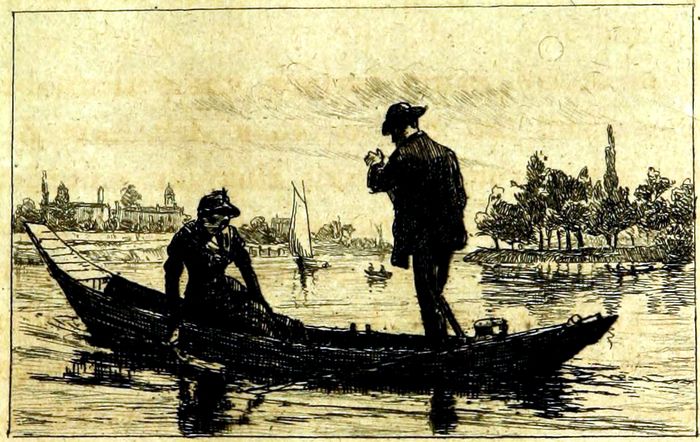
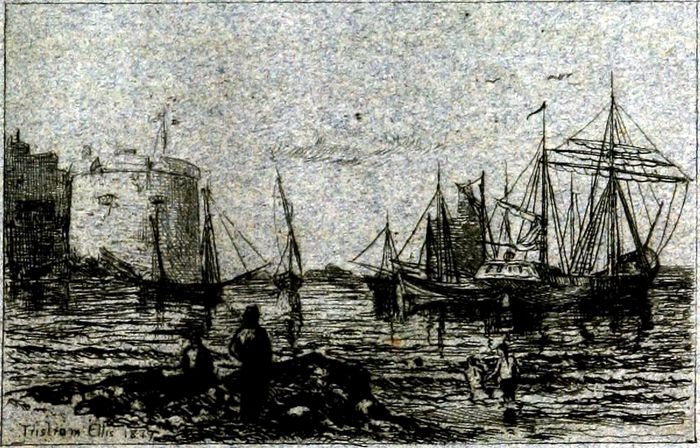
A Water-gate of Bruges.
13Some bathers with tough cuticles affect the use of
towels bearing to the touch a strong resemblance to rasps
or wire brushes, and affirm that everyone ought to use the
very roughest that can be procured: there are others, on
the contrary, possessing an outer epidermis so delicately soft
and velvet-like, that very rough towels would, if used,
cause insufferable agony, and almost flay them alive; what
would be thought a rough towel by one, producing after
use a full glow, would have no effect upon another.
The use of the flesh-brush, after a thorough rub down
with towels, is to be commended for producing a more
vigorous reaction; there are many persons, however, whose
skins are too delicate to allow of the application of the
flesh-brush, but this is of little moment, as a moderately
14rough towel will with them produce as strong a reaction,
or as great a glow, as the flesh-brush would with those
possessing less sensitive skins.
AFTER THE BATH.
15
A Bath-Room, if possible should certainly
receive the benefit of the sun, and
in warm and genial weather the enjoyment
of the bath will be heightened if
the window be opened wide at the top.
When, however, the thermometer is
in the neighbourhood of freezing point, the atmosphere of
the bath-room is to many intolerably cold, and one may
16perhaps be sometimes tempted to raise the temperature of
the cold water in the bath too high to produce the
necessary shock with its pleasant and health-promoting
reaction. It is better, by some means, in cold weather, to
warm the bath-room and to keep the temperature of the
cold water sufficiently low to produce the desired reaction.
Drying and dressing may be comfortably gone through in
front of a fire, the use of which for this purpose is a
positive advantage, and will by no means, as might perhaps
be imagined, tend to enervate or enfeeble, or in any way
lessen the pleasure and benefits to be derived from the
17bath; a good fire on the contrary, will act as a help in
laying in an agreeable and valuable supply of warmth, the
advantage of which will be felt during the whole day.
Only a very weakly person should take the bath in
the bed-room, as the air of the sleeping chamber must
necessarily be more or less vitiated. Still, better there
than not at all, and very likely, after a few trials, sufficient
courage and energy will be found to enable the bather to
get into fresher air.
The surface of the human body is protected by an oily
film deposited by innumerable vessels, so that after a dip
18into water the skin is not thoroughly wetted, most of the
water running from the body as from a duck’s back. After
a Soap-bath, the bather will find himself thoroughly wet all
over, the skin being apparently saturated as if it were
blotting paper; both natural secretions and foreign matter
will have yielded to the warm and cleansing bath of yellow
soap and the after-application of cold water.
In conjunction with the Soap-bath, daily exercise after
breakfast is not only desirable but necessary: half-an-hour’s
ride, a brisk walk, or an open air game helps to circulate
the blood and raise the spirits for the day. If the
19accumulated effects of three hundred and sixty-five
morning walks could be seen and judged, perhaps business
men would not be in quite so great a hurry, after bolting
their breakfast, to rush into the omnibus or train. Half-an-hour
apparently thus wasted is gained twice over during
the day in better work more easily done.
A celebrated physician was once heard to say that he
did not much care what atmosphere his patients lived in
during the day so long as they breathed pure air at night;
but whether one resides in town or country, it is impossible
to breathe fresh air if the bed-room window be kept closed.
20Many people appear to be afraid of taking cold if they
sleep with the bed-room window open: never was a
greater mistake. The most delicately constituted maiden
may, with ordinary precaution, and without the slightest
fear of injury, sleep with the bed-room window open almost
all the year round, and with the certainty of health and
vigour being materially improved. Even this uncertain
climate is seldom bad enough to compel complete closing
up of the windows: the bed must of course not be placed
in a direct draught: i.e. between the open window and the
fireplace.
SPONGE & SHOWER BATHS.
21
Many persons have to content themselves
with a Sponge-bath, and although its invigorating
effects are great, and cold
water daily applied externally—no matter
how—hardens the body, and keeps the
system up to that high condition which
makes the mere sense of living enjoyable, the application
of cold water—sometimes nearly freezing—by fits and
22starts as it were, is not the most comfortable method of
taking a bath, and the preference will generally be given
to that which enables one to dip overhead at once.
However, after a long continued course of the Plunge,
the Sponge-bath will sometimes be found a positive relief,
and, like a change of food, will act as a whet to the
appetite. In taking such a bath it is desirable that the
sponge be of large size, and it should be placed in the bath,
charged with water, ready for immediate use.
To obtain the fullest benefit in the most agreeable
manner, the charged sponge, as the bather steps into the
23bath, should be lifted and carried quickly to the back of
the head, which should be slightly inclined forward, so that
the bulk of the water will run down the spine and back;
the next spongeful should be almost instantaneously
applied, leaning forward, to the top of the head, and the
third, standing quite upright, to the chest; the arms and
legs may then be separately treated: and if desire be felt
for more, the application may be repeated to the back of
the head and chest.
The species of cold bath following the hot is really of
little moment, it is simply a matter of taste and convenience;
24and whether a plunge, shower, hip, sitz, or sponge-bath be
used, the pleasurable and beneficial results will be very
much the same.
There are bathers who prefer a Shower-bath, and, to
those able to stand it, nothing can be more agreeable and
refreshing, but it may be safely questioned whether a
Shower-bath taken on a cold wintry morning, with the
water all but freezing, can possibly prove salutary even to
the most robust.
Nearly freezing water from a shower-bath produces
a feeling something akin to what might be imagined to
25result from a shower of red-hot lead; the shock is tremendous,
and the shower, if continued for any length of time,
would assuredly cause asphyxia. Professor Jamin shews
conclusively that although ice is always at an uniform temperature
of 32°, water may remain liquid at a very much
lower temperature if guarded from external disturbance.
The nerves must be thoroughly braced up to take such
a bath: the writer has a lively recollection of stepping
into a shower-bath one intensely cold morning, when, the
string being pulled, not a drop of water descended; the
connections were all frozen, and the bath was empty; the
26shock resulting on that occasion from the absence of the
water, though of a negative and totally different description,
was really greater than would have been produced by
the cold shower itself.
The Shower-bath should be taken warmer than the
ordinary cold bath; the water may be advantageously
placed in the bath on the previous evening, and, if
necessary, a little warm water added in the morning.
If headache follow, or reaction be slow, accompanied
by shivering, the shower must be discontinued, and a milder
bath resorted to.
SEA-BATHING & SWIMMING.
27
Sea-bathing—at least in these islands—is
generally believed in and largely
practised, and some persons, by means
of salts sold for that purpose, produce
a close imitation of sea-water for
their daily tubbing. A Salt-bath thus
prepared, when its use conduces to the enjoyment and
health of the bather, is by no means to be discouraged,
28and may advantageously follow the soap application in
place of fresh water.
Most of us must have noticed how renovating to
enfeebled constitutions is the effect of even a short course
of sea-bathing, but it is equally patent that the good effects
quickly wear off, the physique returning shortly to its
perhaps normal condition of relaxation and lassitude.
The daily use of the Soap-bath keeps the constitution
permanently braced up to that delightful condition experienced
by so few, that makes mere existence an
absolute pleasure. A preliminary course of Sea-bathing29is by no means necessary to bring about this pleasant
condition of things.
Salt-water is more energetic in its action on the skin
than fresh, and, after a dip in the sea, there is not the
same liability to take cold from insufficient drying as after
a fresh-water bath. Some bathers go so far as to habitually
only half-dry themselves, the saline particles left on the
skin further exciting its action, and producing a healthy
and more vigorous glow. Children at the sea-side may
safely be allowed, without the slightest fear of taking cold,
to dabble and patter about in the little pools left by the
30receding tide: their constitutions will be positively invigorated
and improved.
A love of cold-water bathing can perhaps be carried
to excess, as in the case of those self-devoted Spartan
swimmers, who, every morning, even in winter, assemble
on the banks of the Serpentine, and audaciously defying
their own instinct, plunge into the freezing water, even
though they have first to break through the icy covering
under which it is concealed by nature: the strongest constitution
must suffer sooner or later from this treatment.
Taking the Plunge.
31Boys and girls ought to be taught swimming at school
as they are taught gymnastics and calisthenics—as a matter
of course. We ought, as islanders, to be swimmers, and
it is to be regretted that we are not: swimmers are of
necessity bathers, but bathers are not always, as they
should be, swimmers. The percentage of swimmers in
this country is perhaps considerably less than might be
expected by those who have not given any thought to
the subject, and yet the art itself is a necessary one, easy
to acquire, healthy, and sometimes of the greatest possible
service.
When once learned the action of swimming comes as
32naturally as walking, and doubtless man in a state of nature,
would, like a dog, swim at once if thrown into the water.
Swimming is an art which seems to incorporate itself into
the physique, and become part of one’s being—at any rate,
it can never be forgotten, and a person finding himself
unexpectedly in deep water, after a twenty years’ rest
from swimming, will strike out as naturally and surely,
and with little more effort, than if the practice had never
been given up.
Rowing-men are usually swimmers, or they ought to
be. To appreciate river life one must go to bed early and
33get up early; ten o’clock should be the latest hour at
which to turn in, but after an extra hard day’s pull the
sheets will be welcome by nine. To enjoy thorough fatigue
one must do a hard day’s work in the open air. Up in the
morning betimes, garments hastily donned, a sharp pull to
the nearest bathing place, where one can dive in and have
a few minutes delicious swim, and back to breakfast—and
such a breakfast! Or possibly the way lies through the
fields where the grass is knee-deep and saturated with refreshing
dew: then off come shoes and socks, the trousers
are well tucked-up, and one gets what a hydropath would
34possibly term a leg-bath—in reality a delicious, fragrant
dew-bath, which, though more than cool, is mightily
enjoyable and never seems to give cold.
The dew-bath.
35Small-boned and fleshy persons naturally make the best
swimmers, but it must not be supposed that thin people
cannot learn to swim, and swim well. The writer well
remembers seeing one morning at Brill’s swimming baths,
Brighton, a young fellow who had just stepped from his
dressing-box ready for a plunge. He was standing where
the water is deepest, and judging by his appearance he
literally could not have had an ounce of flesh to spare. It
was absurd to suppose that so thin a man could swim, and
his movements were curiously watched. After hesitating an
instant, apparently measuring the size of the bath, he shot
into the water head first as if propelled from a catapult,
and shortly reappeared half-way across the bath, having
swum the distance under water; he proved himself a
thorough master of the element. It appeared that although
passionately fond of the water he could only keep himself
afloat by constant muscular exertion of both arms and
legs; he was too thin to float naturally, and could not
venture to swim out a greater distance than he felt sure of
covering on his return.
36Tuition in swimming has been for some time past, and
is now, given gratuitously in town by the London
Swimming Club, from the persevering and enthusiastic
Honorary Secretary of which—Mr. J. Garrett Elliott, 14,
Finsbury Square—particulars may be obtained.
NOTES.
37
Bathing after hard exercise must be
indulged in judiciously: a bath after a
day’s shooting or cricketing, or an afternoon
at lawn-tennis—to an enthusiast,
who really plays, by far the hardest and
most tiring form of amusement of the
three—is pleasant and invigorating, and better understood
than when it was an article of faith that to plunge into
38cold water, when heated, was almost equivalent to committing
suicide.
Our grandmothers who adopted this view, were not
like some of the present generation of girls educated at
Girton and Zurich, or they might have called to mind
Homer’s graphic description of the nocturnal expedition of
Ulysses and Diomede to the Trojan camp, and their
refreshing plunge into the sea when they returned reeking
with heat and moisture from their successful raid; certainly
none need fear to follow the example of such an old
soldier as the cautious Ithacan.
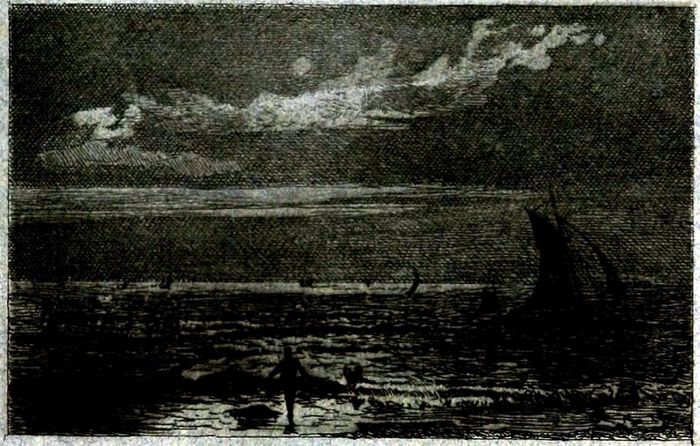
A Midsummer Night’s dip.
39A plunge into cold water when one is warm from
exercise is intensely grateful, and may be indulged in with
impunity even when much heated, provided the plunge
be taken the moment the clothes are removed; the danger
is in standing about on the brink, during which time the
body rapidly cools, and cold may be taken.
Although perfectly safe to plunge into cold water, no
matter how much the body may be heated, care must be
taken to avoid it if there are feelings of lassitude and
exhaustion; these are sure signs of over fatigue, and a cold
bath under such circumstances is not only weakening, but
40might prove absolutely dangerous. A complete change of
clothing must be ready, both for comfort, and to prevent
any chance of taking cold through putting on clothes
rendered damp by previous exercise.
The morning-bath forms a tolerably sure index as to
the manner in which the previous evening has been spent.
Morning exhaustion, and antipathy to cold water, may
follow after an evening’s dancing with its attendant late
hours, and nature will probably protest against too great a
shock: it will be advisable to take the cold bath from five
to ten degrees warmer than usual, or it may be deferred
two or three hours.
41The much vexed question as to the advisability of
continuing the bath through a severe and prolonged, or
even an ordinary winter, must be left open, as it is not only
unadvisable but absolutely impossible to lay down fixed
rules. Each bather must be guided entirely by his own state
of health and sense of vitality.
Even among the well-to-do, the bath is by no means
so universal or so well appreciated as might be desired, the
daily thorough ablution being looked upon by too many as
a necessarily unpleasant process to be shunned or superficially
hurried through, with no enjoyment and little
42advantage: thorough ablution in the form of the Soap-bath
is an absolute luxury, and moreover is followed by an
immediate increase of health, strength and mental vigour.
The primary object of taking a bath is cleanliness, and
it is now better understood that the mere application of
cold water to the skin does not cleanse, but merely closes
the pores, the after vigorous use of towels doing so still
further by rubbing in the impurities and natural secretions
of the skin.
Cleanliness in connection with the bath should be
strictly enforced: it should be cleaned and dried daily and
43occasionally scrubbed, and the washing glove well rinsed
after use.
The delicately-soft skin of Egyptian women is said to
be produced by the habitual use of the loofah, a fibrous
flesh-glove woven by Dame Nature, the use of which is to
be commended for finally cleansing the skin after the soap
application with the ordinary washing glove. The loofah
not only readily removes every particle of soap, but acts as
a mildly invigorating flesh-glove, increases the suppleness of
the skin in a marked degree, and moreover possesses the
happy faculty of completely rinsing itself the moment it is
44dipped into water. Some persons discard the washing
glove altogether, and use a loofah for applying the soap to
the body: loofahs are of different degrees of texture, and
when thus used, a fine close quality should be selected.
The sponge after use should be dipped in clean water
and pressed out—not wrung, which tends to tear it—as
nearly dry as possible: if habitually left charged with water,
or—as sometimes done with a vague idea of sweetening—put
out wet in the sun to dry, it will not only rot quickly
but probably smell offensively, and even become unpleasant
to the touch. To restore its sweetness, the sponge should
45be placed for a day or so in a basin of water in which a
large piece of washing soda has been dissolved: the water
should be changed once or twice, or oftener if necessary,
and the sponge well squeezed out each time.
A word about the soap:—the best, perhaps, is that
known as “John Knight’s Primrose,” an ordinary yellow
soap, sweet and sound, and apparently containing none of
the foreign matter sometimes found in soaps of a commoner
and cheaper description. Scented soap must be avoided,
especially for using habitually and liberally over the whole
body.
46Decidedly unpleasant feelings, in some cases amounting
to a positive loathing, occasionally follow the preliminary
wetting of the feet on stepping into cold water: it may be
taken for granted that such antipathy is by no means
imaginary, but simply nature’s protest. The use is recommended,
in conjunction with the Sponge-bath, of a broad
stool (heavily weighted at the bottom, to prevent risk of
upsetting) covered loosely with carpet, and high enough to
reach above the level of the water when placed in the
middle of the bath: the piece of carpet may be dried each
day after use; or a Sponge-bath may be readily constructed
47with a fixed raised centre of metal forming a portion of the
bath, the bather standing as it were on an island: the feet
may thus at first be kept dry, and the preliminary shock
received on the head and shoulders; persons who in despair
had almost given up the Soap-bath, are by this means
enabled to enjoy it without discomfort.
The temperature of the warm water with the soap
application may vary from 75 to 95, or even 100°; it
ought to be hot enough for the bather to feel it thoroughly
grateful and comforting. The cold may vary from 30 to
70°, and it may be borne in mind that as great a shock will
48be produced with the higher temperature on an enfeebled
or weakly constitution, as with the lower on a strong and
robust: the bather must be guided by his own feelings.
As a rough guide for those in moderate health, 90° for the
warm and 60° for the cold may be taken as convenient.
Cyprus—ware sharks.
49The necessity of getting quickly over the second or
cold application must be strongly urged: in and out again
must be the rule and not the exception. Any one may
observe what takes place when the body is immersed in cold
water: first comes the sharp, half-pleasing, half-painful sensation
of cold, almost immediately followed by a consciousness
of internal warmth, the duration of which will be in proportion
to the power of the organization to keep up this
counteraction. The cold water slowly but surely absorbs
and extracts the vital heat; if the bath be unduly prolonged,
chilliness, shivering, numbness, and exhaustion
follow, and although the unpleasant symptoms will probably
shortly disappear, the bather will have lost rather than
gained in point of health.
No notion of “getting used to it,” or of cultivating
hardiness and endurance, should induce one to venture near
the stage commencing with chilliness; by so doing the
50stock of health is wasted instead of increased: the mere
patient endurance of cold cannot possibly do good, although
it may unquestionably do a great deal of harm.
Many persons suffer severely in winter from cold feet,
with the attendant penalties of chilblains, colds, sore throat,
and personal discomfort. It is well known to medical men
that, when the feet are cold, the system is far more readily
accessible to the attacks of disease, and to keep them warm,
more especially during the early hours of the morning
and after the bath, is, with some persons, almost an
impossibility. Singers—both amateur and professional—suffer,
51certainly in this climate, more or less severely from
affections—difficult to guard against—of the throat, induced
in the majority of cases by cold, which first attacks the
extremities. In lately consulting Dr. Llewelyn Thomas,
he suggested as a future safeguard the wearing of shoes or
slippers (made by Whiteley, of Westbourne Grove) of a
description calculated not only to retain the natural heat
of the body but to absolutely exclude cold and draughts.
The material is a dark felt, lined with thick white fur;
the shoes are open down the sides, but the openings are
heavily covered with a dark fur, effectually excluding
52draughts. There are no laces or fastenings of any kind,
and the shoes are slipped on or off in a moment.
It need not be imagined that because the daily application
of cold water in the luxurious form of the Soap-bath
be strongly urged, it is desirable to inure the body in the
manner advocated at the early part of this century, when
bare-kneed little children—robust or weakly—were exposed
insufficiently clothed to the inclemency of the weather
under the mistaken idea of hardening them—hardening
some, no doubt, but killing a great many more. The power
to resist cold means the power to resist disease, and to be
53proof against intense cold, one must not only be well fed,
and warmly clad, but thoroughly warm before exposure to
the cold atmosphere out of doors. Protected by sufficient
clothing, the body acts as a sort of store-house of heat, and
a sufficiently large stock of warmth absorbed in the morning
will last all day, and fresh supplies will be drawn from the
heat-producing food consumed. A shivering child sent out
of doors for violent exercise may certainly get warm, but it
does so at the expense of its own vital energy.
The essential that must not only be looked for, but
positively and rapidly attained, is the reaction from the
54shock produced by the cold water: the heart is actively
excited, and the blood propelled with unusual force through
the system; the temperature of the body rapidly rises, and
a general glow supervenes, accompanied with mixed feelings
of increased vitality, buoyancy and exhilaration, difficult to
describe. With the non-robust the stay in the cold water
can hardly be made too short: the principal shock is produced
from the first application, and the endeavour ought
rather to be to get out as quickly as possible, than to stay
in under the mistaken notion of deriving increased benefit.
Should the stay be even a trifle too prolonged, the
55reaction will be proportionately slow, and by no means so
pleasant; or proper reaction may be made almost impossible,
with the result of coldness, shivering, violent headache,
slow pulse and probable sickness. It must, however, never
be lost sight of that these unpleasantnesses are absolutely
under the control of the bather, and never arise except
with the very ignorant or very foolish: speedy reaction
must be attained and can invariably be secured, even by the
most feeble, provided the unpardonable and suicidal sin of
too long a stay in the cold water be avoided.
Should the reaction after a Sponge-bath be very slow, it
56may be hastened by the previous addition to the water of
a small wine-glassful of eau-de-cologne, spirits of wine, or
spirits of any description, whiskey being perhaps best.
The Soap-bath may be commenced at any period of the
year, and if children are induced to take it as a treat, rather
than from any other point of view, they will soon become
as partial to its use as their elders.
In slight colds the bath may be continued, but in the
rare case of an extremely violent one, or affection of the
throat, the bather, however much against his will, must
perforce give it up for a time.
Taking the waters.
57Those who habituate themselves to the indulgence of
the Soap-bath become, as it were, case-hardened, and can
seldom be persuaded to forego their daily pleasure, much
less to abandon the habit: by its use the body arrives and
remains at its highest state of physical vigour; the power
of resisting sudden changes of temperature is greatly
increased, and liability to colds correspondingly lessened,
while there is an almost absolute freedom from danger of
infection and epidemic attacks. The Soap-bath is a source
of immense and constant physical gratification; food is
keenly enjoyed, the muscles get hard and firm, and the
58skin soft as satin, while vigorous health and feelings of
mental and animal enjoyment are produced attainable
perhaps by no other means. Existence becomes what it
was intended, and what it certainly ought to be—a positive
pleasure: the numerous unpleasantnesses and dyspeptic
ailments incidental to a low state of bodily health glide
into the past, and their very recollection almost disappears.
ADDENDA.
59
Since going to press the author’s attention
has been drawn—not over-courteously
perhaps—by certain manufacturers to
the sweeping denunciation in this Sketch
of the habitual use of scented soaps; but
after a careful examination and trial of
various kinds, one alone—known as Pears’ transparent soap—may
in his opinion be safely indicated as a pure detergent
in every way suitable for Luxurious Bathing.
60Field & Tuer,
Ye Leadenhalle Presse,
London, E.C.
61“Hundreds of clever young men, who are now living at home and doing nothing, might be earning very tolerable incomes by their pens if they only knew how.”—The Nineteenth Century.
Journals and Journalism:
With a Guide for Literary Beginners,
BY
JOHN OLDCASTLE.
Contents:
Literary Amateurs.
Introductions to Editors.
Returned with thanks.
How to begin.
Pounds, Shillings and Pence.
The Literary Career:
I. The Fair Side.
II. The Seamy Side.
In an Editor’s Chair.
A Miscellaneous Chapter.
Literary Copyright.
Ten Journalistic Commandments.
How to Correct Proofs.
“This volume,” says the Athenæum, “will be studded with the autographs of literati, and is written by a practical journalist.”
PRICE THREE SHILLINGS AND SIXPENCE.
LONDON:
Field & Tuer, ye Leadenhalle Presse, 50, Leadenhalle Street, E.C.
TRANSCRIBER’S NOTES
Silently corrected typographical errors and variations in spelling.
Archaic, non-standard, and uncertain spellings retained as printed.