LUCY HARDING A ROMANCE OF RUSSIA — CHAPTER I. NICOL PATOFF.
0
Transcriber’s Note:
New original cover art included with this eBook is granted to the public domain.
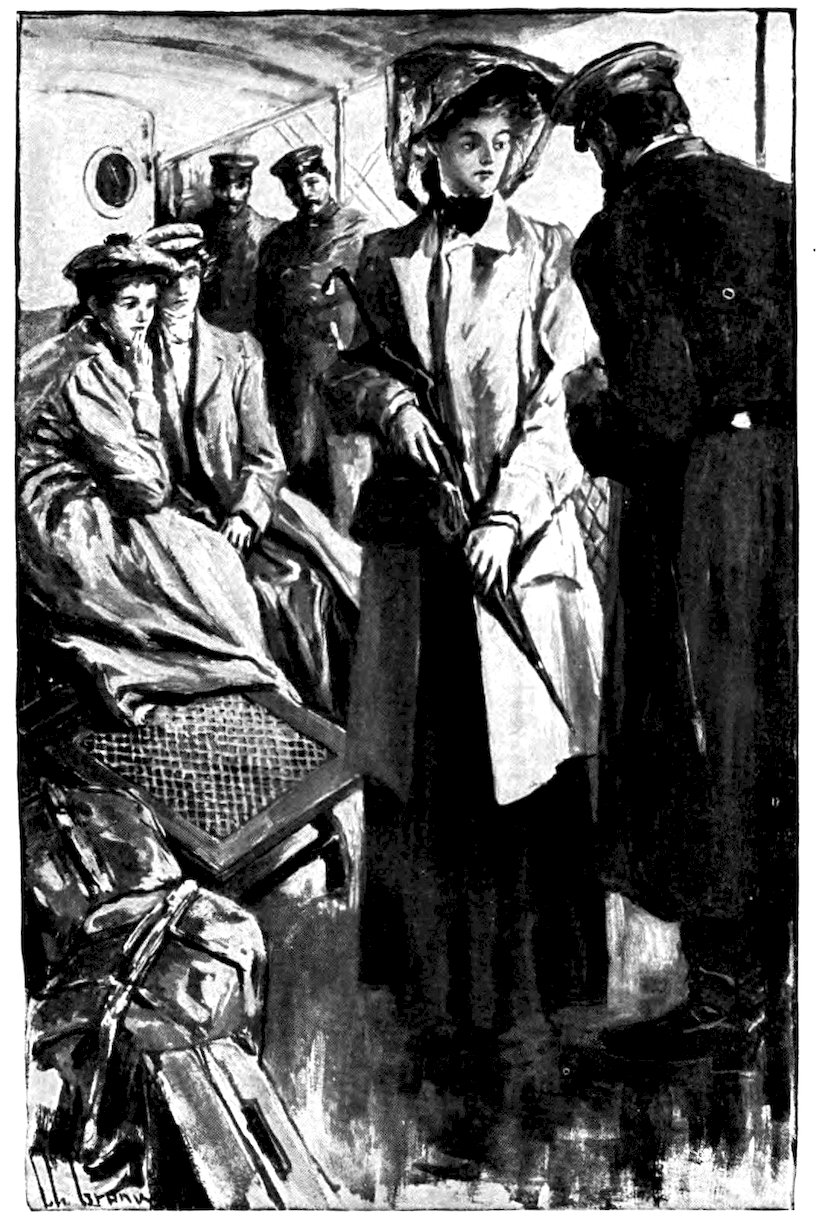
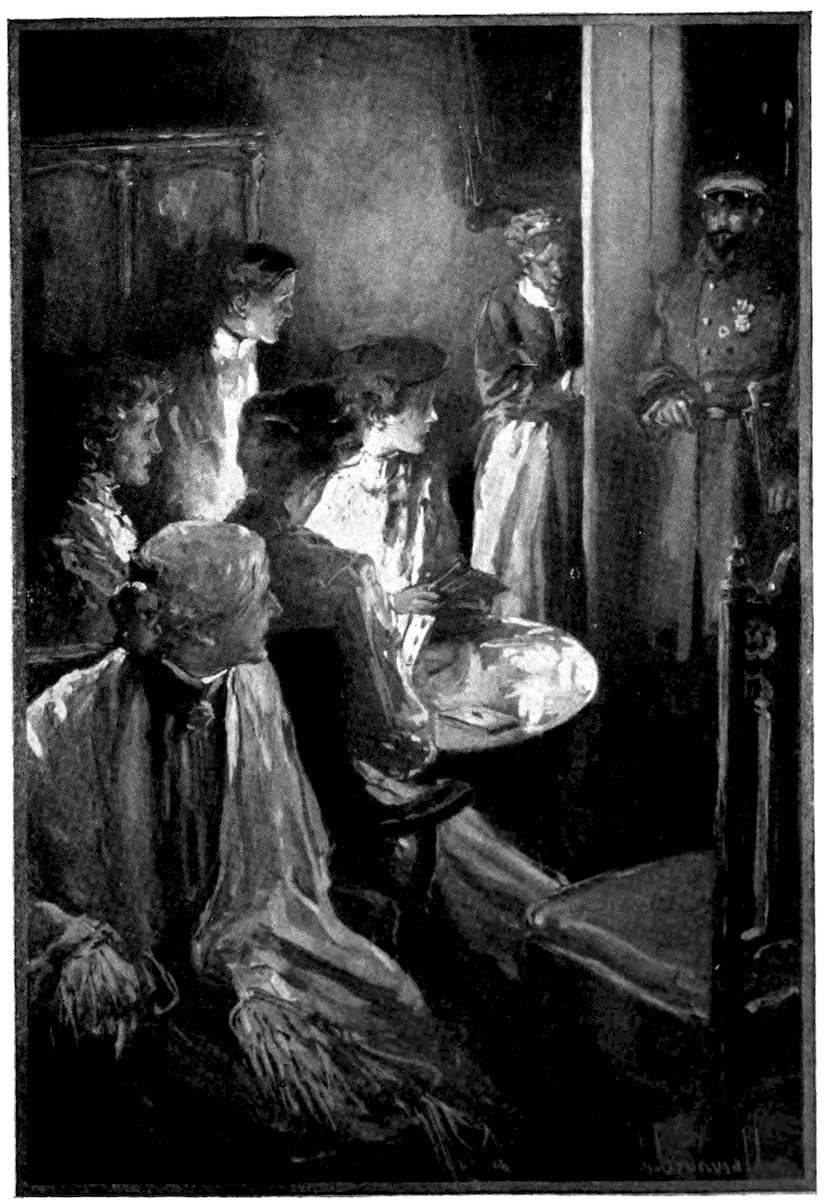
“Nicol Patoff! Do you know him? Where is he?”
BY
MARY J. HOLMES
AUTHOR OF
“Edna Browning,” “The Homestead on the Hillside,” “Maggie Miller,” “Tempest and Sunshine,” etc.
THE AMERICAN NEWS COMPANY
PUBLISHERS’ AGENTS
NEW YORK
Copyright, 1905
By Mary J. Holmes
Lucy Harding
LUCY HARDING.
11
In the summer of 189– I was one of a party of
tourists who were going to St. Petersburg. There were
eight of us, all women, strong, fearless and self-reliant,
and all natives of Massachusetts. Two were from Boston,
three from its suburbs, and three, including myself,
from Ridgefield, a pretty little inland town among the
Worcester hills. We had a guide, of course, Henri
Smeltz, a German, and if his credentials, which I now
think he wrote himself, were to be believed, he was
fully competent to take charge of eight women with
opinions of their own and as much knowledge of the
country they were to visit as he had. It had been the
dream of my life to see the water-soaked city, and when
the opportunity came I accepted it eagerly, with, however,
some dread of the fatigue of the long journey and
the annoyances I might meet in the capital of the czar.
I was not a good sailor and I had a great dislike for train
12travel, and by the time we had crossed the Atlantic
and the Continent and were on the Gulf of Finland, I
was in a rather limp and collapsed condition. But I
rallied as the bright July day wore on, and when the
Russian officers came on board I was quite myself and
felt able to cope with them all if necessary. I had
nothing to fear. I was an American citizen and wore
the colors of my country in a knot of ribbon on my dress.
My passport was all right, so far as I knew. But better
than this was the fact that I could speak Russian with
a tolerable degree of accuracy. I was fond of languages,
and during my school days had mastered German and
French to the extent of reading and writing them fluently.
My teacher was Nicol Patoff from St. Petersburg,
who, outside of his school hours, had a class in
Russian which I joined, and astonished both Nicol and
myself by the readiness with which I acquired the difficult
language which the most of my companions gave
up in despair after a few weeks’ trial and in spite of
the entreaties of Nicol, who assured them that with
a little patience what seemed so hard would be very
easy.
He was a tall, handsome young man, with large, dark
eyes which seemed always on the alert, as if watching
13for or expecting something which might come at any
moment. All we knew of him was that he was from
St. Petersburg. That his father, who was dead, had
once been wealthy, in fact had belonged to the minor
nobility, but had lost most of his money, and this necessitated
his son’s earning his own living, which he could
do better in America than elsewhere. This was the
story he told, and although he brought no credentials
and only asked to be employed on trial, his frank, pleasing
manners and magnetic personality won him favor
at once, and for two years he discharged his duties as
teacher of languages in the Ridgefield Academy to the
entire satisfaction of his employers. Many conjectured
that he was a nihilist, but there was about him a quiet
reserve which kept people from questioning him on the
subject, and it was never mentioned to him but once.
Then a young girl asked him laughingly if he had ever
known a nihilist intimately.
“But, of course, you haven’t,” she added. “I suppose
they only belong to the lower classes. You might
see them without knowing them well.”
For a moment the hot blood surged into Patoff’s face,
then left it deadly pale as he replied: “I have seen and
known hundreds of them. They belong to all classes,
14high and low, rich and poor—more to the rich, perhaps,
than the very poor. They are as thick as those raindrops,”
and he pointed to a window, against which a
heavy shower was beating. “There is much to be said
on both sides,” he continued, after a few moments.
“You are subjected to tyranny and surveillance, whichever
party you belong to. It is a case of Scylla and
Charybdis. Of the two it is better to be with the government
than to be hounded and watched wherever you go
and suspected of crimes you never thought of committing.
A nihilist is not safe anywhere. His best friend
may betray him, and then the gendarmes, the police.
You have no idea how sharp they are when once they
are on your track.”
This was a great deal for him to say, and he seemed
to think so, for he stopped suddenly and, changing the
conversation, began to speak to me in German and to
correct my pronunciation as he had never done before.
During the next few weeks he received several letters
from Russia, and grew so abstracted in his manner that
once when hearing our lesson in Russian he began to
talk to us in French, then in German, and finally lapsed
into English, saying with a start: “I beg your pardon.
My thoughts were very far away.”
15“Where?” the girl asked who had questioned him on
nihilism.
He looked at her a moment with a peculiar expression
in his eyes, and then replied: “In Russia, my home, where
I am going at the end of this quarter.”
We were all sorry to lose him, and no one more so
than I, although I said the least. There was something
in his eyes when they rested upon me and in his voice
when he spoke to me which told me I was his favorite
pupil, but if he cared particularly for me he never
showed it until the day before he left town, when he
called to say good-by. I had been giving my hair a bath
and was brushing and drying it in the hot sun when he
came up the walk. I disliked my hair and always had.
It was very heavy and long and soft and wavy, and I
had the fair complexion which usually goes with its
color; but it was red, not chestnut or auburn, but a decided
red, which I hated, and fancied others must do the
same, and when I saw Nicol coming up the walk I
shrank back in my seat under the maple tree, hoping he
would not see me. But he did; and came at once to
me, laughing as I tried to gather up into a knot my
heavy hair, which, being still damp, would not stay where
I put it. I know he said something about Godiva, then
16checked himself with “I beg your pardon,” as he saw
the color rising in my face; and, lifting up a lock which
had fallen down, he said: “I wish you would give me a
bit of this as a souvenir.”
“Are you crazy,” I asked, “to want a lock of my hair?
Why, it is red!”
“I know that,” he said; “but it is beautiful, nevertheless,
especially in the sunlight. I like red. Can I have
a bit?”
He took from his vest pocket a small pair of scissors,
and handed them to me. I was too confused for a moment
to speak. No one before had praised my hair. I
had made faces at it in the glass. My brother, who was
a few years older than myself, called me Carrots and
Red-top, and, when in a very teasing mood, pretended to
light a match on it. And Nicol called it beautiful, and
wanted a lock of it as a souvenir. My first impulse was
to give him the whole, if I could, and be rid of it; but,
as I gathered the shining mass in my hand, and saw how
the sunlight made it brighten and glisten, I began to
have a certain feeling of pride in it, it was so long and
thick and glossy, and curled around my fingers like a
living thing.
“Yes, you can have some of the old, red stuff, if you
17want it,” I said, laughingly; and, taking his scissors, I
cut a tress where it could not be missed and handed it
to him.
He was my teacher, my friend; he was going away,
and I felt I scarcely knew how toward him, as, with my
hair still down my back—for it was not yet dry, sat beside
him, while he talked of Russia, and the difference
between life there and in America, appearing all the
while as if there was something he wished to say, but
could not, or dared not.
“Domestic life there is not what it is here. You would
not like it,” he said.
“I know I shouldn’t,” I answered, quickly, and he went
on: “But it is home to me. My people are well born,
and I must cast my lot with them, whether for good or
bad.”
“I hope not for bad,” I said, with a little lump in my
throat.
“That depends upon the standpoint from which you
look,” he replied. “If I join the nihilists, and you sympathize
with them, you will think I go for good. If I
side with the government, and help hunt the nihilists
down, and your sympathies are there, you will say I go
for good.”
18“Never!” I answered, hotly, stamping my foot upon
the ground. “Nihilism may be wrong, but I detest the
government, with its iron heel upon the poor people, and
in a way upon your czar, who is kept more in ignorance
of what is taking place than I am. You are all slaves,
every one of you, from the czar in his palace to the poor
serf in his mud house on the barren plain. I wish I
could give your grand dukes a piece of my mind!”
Nicol laughed at my heat, and answered: “You didn’t
have that red hair given you for nothing, did you? I
wish you might give them a piece of your mind, but
am afraid it would do no good. Russia is pretty firm in
her opinion of herself. I wish she was different. I have
learned many things in your country which I shall not
forget. My life has been very pleasant here, and my
thoughts will often travel back to Ridgefield, and the
freedom such as we Russians do not know.”
“Why not stay, then?” I asked, the lump in my throat
growing larger, and making my voice a kind of croak.
“That is impossible,” he replied. “Russia may be bad,
but I can no more stay away from it than the bird can
stay away from the nest where its young are clamoring
for the food it is to bring them.”
“You have friends to whom you are going!” I said;
19and he replied: “Friends? Yes; thick as the leaves on
the trees in summer, and they are waiting for me. I
am going into danger or honor. I have not quite made
my choice.”
“You are not a nihilist?” I exclaimed, starting to my
feet, as if to get away from him.
With a low, musical laugh, habitual to him when he
laughed at all, which was seldom, he put up his hand and
drew me back upon the seat.
“I thought you sympathized with the nihilists?” he
said.
“I do,” I answered; “but it is hard to associate you
with one. I think of them as a kind of desperadoes,
made so by oppression.”
“There you are mistaken,” he replied. “I told you
once that the nihilists are found with the rich as often
as with the poor. Some time you may, perhaps, read of
a gang of people starting for Siberia, and I may be with
them. If not, there will be others in it just as heartbroken
at leaving their homes as I should be. Pray for
them, but do not be troubled for me. I shall escape. I
was not born to be a slave, a prisoner, and there is not
power enough in all Siberia to keep me, if I choose not
to stay.”
20He stood up, tall and straight, and his eyes flashed
with a fire I had never seen in them before. After a
moment he resumed his seat, and continued: “There is
no doubt that Russia is hovering on the crater of a volcano,
which may, at any moment, burst out like Vesuvius.
But St. Petersburg is a right jolly place, after all,
and it is my home. I hope you will go there some day.
Your knowledge of the language will make it easy for
you, and you will not find us a bad lot, or know a nihilist
from a partisan of the government. They are all mixed
in together. If you go, I may or may not be there, but
find No. — Nevsky Prospect. It was once my home,
where we kept forty servants, falling over each other
and doing less work than half a dozen do in America.
It is part of the system. Here is my card. Good-by, and
God bless you!”
He passed his hand caressingly over my hair, and,
stooping, kissed me on my forehead. Then he left me,
and I put my head upon the back of the seat, and cried,
with a feeling that something had gone out of my life
which had made it very pleasant.
For a long time I expected to hear from him, but no
word had ever come, and years had gone by, and I was
a woman of nearly thirty-five, with my schooldays behind
21me, but with a vivid remembrance of that part of
them when Nicol was my teacher. His card was all I
had left of the handsome young Russian who had stirred
my girlish heart as no other man had ever done. I had
never forgotten what he said to me of the gang bound
for Siberia, asking me to pray for them, and, in imagination,
I had often seen that gang, and he was always in
it, and when I prayed I am afraid it was for him—for
Nicol alone. And now I was going to his country, and
might possibly meet him, if he was there. He would be
older, and probably married. But that did not matter.
The pain in my heart and the lump in my throat when he
bade me good-by were gone. That chapter was closed,
but I was thinking of it, and of him, when I had my
first meeting with a Russian gendarme.
CHAPTER II. THE GENDARME.
22
I had pictured them as old, or middle-aged, with gray
or white hair, hard faces and fierce eyes, which could
look through one and see if there was anything concealed.
But the tall man, who bowed so deferentially,
and hesitated a little before speaking, as if he thought
I would not understand, was quite different. He was
neither very old nor grizzled, although his heavy beard,
which covered the most of his face, was streaked with
gray. I could not judge well with regard to his eyes,
as the lids were partially closed, the result of some
chronic trouble with them, I afterward learned. I knew
they were looking at me sharply—so sharply, indeed, that
I felt my face growing red with resentment, and, as he
continued to scrutinize me, coming close to do so, all
my dread of him and his craft vanished, and, with a
proud turn of my head, I said: “Why do you stare at me
as if you thought me a smuggler, or a nihilist? I am
neither.”
Instantly there came upon all I could see of his face
23for the heavy beard and into all I could see of eyes for
the drooping lids a smile, which made my brain whirl,
and for a moment I asked myself if theosophy were not
true, after all, and I had lived another life somewhere,
and been in the position in which I now found myself,
face to face with a gendarme, who, as the smile disappeared
under his heavy mustache, said: “Madame speaks
Russian well.”
“Thanks!” I replied. “I ought to, with so good a
teacher as I had in Nicol Patoff.”
I don’t know what spirit possessed me to mention
Nicol’s name. I had never rid myself of an impression
that he would rather I should not speak of him to
strangers, and I had blurted it out to this gendarme, who
started visibly, and repeated: “Nicol Patoff! Do you
know him? Where is he?” he asked, and, with every
sense alert lest my old teacher’s safety was in danger, I
answered: “The last time I saw him he was in America.”
“In America. Yes; but what do you know of him
now? Where is he?” was his next question.
“I know nothing of him, except what is good, and,
if I did, I should keep it to myself, if the telling it would
harm him. He was my teacher and friend, and a gentleman,”
I said, rather hotly.
24I did not know what right he had to be asking me
about Nicol Patoff, and was very angry as I confronted
the gendarme, who, I fancied, was laughing at me.
“You don’t know where he is now?” he continued, in
good English, and, to my look of surprise, continued:
“You see, I can speak your language, though not as well
as you speak mine. Nicol Patoff must have been a good
teacher, and you an apt scholar.”
I did not reply, but, with a formal bow, left him and
joined my companions, who were curious to know what
I had been saying to the gendarme. But I was noncommittal,
and gave some evasive answer, as I watched
him in the distance, with his staff, of which he seemed
to be the head. Standing near the purser, later on, I
said to him, rather indifferently: “Who is that officer
with the queer eyelids? He carries himself as if he
owned the ship and all the passengers.”
Glancing stealthily around, as if to make sure no one
was listening—a habit I noticed in many of the Russians—he
spoke very low, and said: “That! Oh, that is
Michel Seguin, one of the very highest of the police.
The suspects dread him as they would the plague. He’s
a regular sleuthhound, and can detect a criminal and
unearth a plot when everyone else has failed. I don’t
25know why he was sent here to-day, unless they had
heard there was a suspect on board. You can’t escape
Michel Seguin, when once he is on your track.”
He looked hard at me, as if he thought I might be
the suspect Michel Seguin was sent to arrest. He had
certainly talked with me longer than with anyone else,
and I had been rather saucy to him. But I was not
afraid of him, and had a feeling of quiet and safety just
because I had talked with him. We were through with
the police for the present, and were free to look upon
the frowning fort of Cronstadt, bristling with guns and
threatening destruction to any enemy’s vessel which
might venture near it.
From Cronstadt we could see in the distance the golden
dome of St. Isaac’s towering against the sky, and around
it the turrets and spires and roofs of the city I had
come so far to see, and where I was destined to meet
with so many adventures. The sail up the Neva to the
wharf was soon accomplished, and we were in the whirl
and hubbub of a great town, where Henri, our guide,
nearly lost his wits in the confusion, and finally left the
ordering of affairs to me, as I could speak the language
so much better than he. Most of our party chose to take
a large conveyance from the station to our hotel, but
26I preferred a drosky, as I had heard so much of them
from Nicol Patoff, and wished to try one. Half a dozen
were ready for me in a moment, and, after my choice
was made, I said to the coachman, who looked like a
small haystack, or rather like a feather bed with a rope
tied around its center: “Don’t drive fast. I shall fall
out.”
He nodded that he understood me, gathered up his
reins, which looked like two narrow strips of leather,
shook them at his horse, and we were off like the wind,
jolting over the cobblestone pavement, now in one rut
and now in another, while I tried in vain to find something
to hold to. There was nothing; neither side nor
back was of any use. To clutch the padded garment of
the driver was impossible. It was like holding so much
cotton wool in my hands. There was no alternative but
to pound him with my fists, which I did, in imminent
danger of being thrown from the drosky. At last the
point of my umbrella reached him, and, slacking his
speed, he asked: “What will little madame have?”
“Drive slower,” I said. “You have nearly broken
every bone in my body, and I have nothing to hold to.”
“Very well,” he replied, and started again, faster than
before, it seemed to me, as I swayed from side to side.
27A breeze had blown up from the Neva, and this, added
to the motion of the drosky, took my hat from my head
and carried it along, with little swirls of dust and dirt,
until it was some distance in front of us. The blows I
dealt that padded figure in front were fast and furious,
but of no avail. Nothing availed, not even my umbrella,
till I sprang to my feet and clutched him around his
neck, as if about to garrote him. Stopping his horse with
a suddenness which drew the beast upon his haunches, he
gasped: “In Heaven’s name, what will little madame
have now?”
“I’ll have my hat!” I cried, pointing to my crumpled
headgear, which some little girls had picked up and were
examining, one of them trying it on and turning her
head airily.
I think the driver swore, but am not sure.
“Madame shall have her hat,” he said, and was about
to plunge on, when I stopped him again, by saying: “Let
me out. I will walk the rest of the way. We are almost
there,” and I pointed to what I was sure was our hotel,
for I had studied St. Petersburg so carefully before
coming that it seemed to me I knew every street and
alley and public building.
“As the little madame likes,” was his polite rejoinder,
28followed by a call to the girl who was still sporting my
hat, to the evident admiration of her companions.
“Drop it, or it will be the worse for you!” he cried,
with a flourish of his whip. “It is madame’s.”
But I did not need his interference, for, as I came up to
the girl, breathless and panting, a tall gendarme crossed
from the other side of the street, and at sight of him the
children fled in haste, leaving my hat behind them. Picking
it up and brushing some particles of dust from it, and
straightening the crushed flower with a deftness I hardly
expected in a man, he handed it to me, and said: “You
will not wear it again, after it has been on her head,”
and he motioned toward the girl, who, with her two
companions, was scampering away as fast as her little,
bare legs and feet could carry her. I had another hat in
my trunk, and, remembering what I had heard of the
condition of Russian heads, answered, emphatically:
“Never! She can have it. Here, girl, come back!” I
screamed to the child just disappearing in the distance.
I doubt if my call would have reached her if the gendarme
had not sent after her a short, shrill, peremptory
whistle, which brought her to a standstill as quickly as if
she had been shot. Turning round, she saw me beckoning
to her, and holding at arm’s length my hat, as if
29there was contagion in it. In a few moments she had it,
or, rather, the three had it, pulling and fighting over it,
until the last I saw of it one little girl was dangling a
long ribbon, a second appropriating the bunch of forget-me-nots,
while the eldest was wearing the poor, shorn
thing as proudly as if it were a great acquisition.
I had scarcely realized till then, in my excitement, that
the gendarme who had come to my aid was the one who
on the boat had questioned me of Nicol Patoff. Would
he ask me about him again, I wondered, and was relieved
that he did not even act as if we had met before.
Glancing at my hair, which I was beginning to rearrange,
he said: “Madame must go bareheaded.”
“Only from here to the hotel. I have another hat,” I
answered, thinking of the day Nicol Patoff had found
me drying my hair, and complimented its beauty.
It was darker now, with a wonderful sheen upon it in
the sunlight, and I could not help feeling that the man
was admiring it through his half-closed eyes, and scanning
me very closely. He had certainly been going in
the opposite direction when I first saw him across the
street, but he turned now and went with me to the hotel,
where my friends gathered round me, asking what had
happened, and why I had come on foot and without my
30hat. While I was explaining to them, the gendarme was
speaking to the clerk about me, I was sure, as he glanced
toward me, and nodded that he understood. Then, with
a bow in my direction, which included those of my party
standing near me, the gendarme walked away.
I had learned by this time that our German conductor,
Henri, was of very little use, except to smoke and take a
glass of beer when he could get it, and, if I wanted a
thing done, I must do it myself. I could speak Russian
much better than he could, and, as I wished to ask some
questions, and was particular about my room, I went to
the desk to register. After I had written my name,
“Miss Lucy Harding, Ridgefield, Massachusetts, U. S. A.,”
the clerk called a young boy, whom he designated
“Boots,” and bade him show Miss Garding and her
friend, who was to room with her, to a certain number.
If there is in the English alphabet one letter which puzzles
a Russian more than another, it is the letter “H,” and
he usually ends by putting “G” in its place. Consequently,
I became Miss or Madame Garding, developing,
finally, into a Garden, and remaining so during
my stay in St. Petersburg. From what we had heard
of Russian hotels, we were not prepared for palatial
apartments, and I was surprised at the large, airy corner
31room into which I was ushered. Turning to Boots, I
asked if there was not some mistake. Was he sure this
room was intended for us, and if it were not the best in
the house?
When he found I could speak his language, Boots became
communicative and familiar, although, evidently,
he had no intention to be pert. It was one of the best
rooms, he said, and tourists did not often get it, as it
was reserved for Russian gentry when they came to town
from the country.
“I heard Monsieur Seguin ask the clerk to do his best
by you. I guess he thinks you are some great lady at
home.”
Just then there was a hurried call for Boots, and he
left me wondering what possible interest Michel Seguin
could have in me. I had been rude to him on the boat,
and had not shown myself very friendly since. Probably
any special attention he might pay me was prompted
by a wish to learn something of Nicol Patoff. But forewarned
was forearmed, and Nicol, who undoubtedly was
under some ban and in hiding, was safe so far as I was
concerned.
32“I’ll take the good the gods provide,” I thought, as I
unpacked my trunk in my spacious, airy room, and then
went down to dinner, where I found several tourists, all
eagerly discussing what they had seen and what they expected
to see.
CHAPTER III. THE DOG CHANCE.
33
As the sun was not down—for we were in the midst
of the long, northern days, when darkness and daylight
almost kiss each other in a parting embrace—I
suggested that we take a little stroll and look at St.
Isaac’s and other points of interest. As we were leaving
the hotel, we met the gendarme, Michel, who, I
found, came often to the hotel, inquiring after passports
and any newcomers, or those who had changed their
quarters. A civil bow was all I awarded him, as I hurried
outside, where I found my friends crowded around
a huge mastiff, sitting upon his haunches, as if waiting
for some one—his master, probably. He was of a species
which, in America, we call a Russian collie, and esteem
for their fidelity and gentleness. He was the handsomest
dog I had ever seen, with his fine, intelligent face, and
long, silky mane, and, as I was fond of animals of all
kinds, I stooped to caress him, while he beat his bushy
tail in token of appreciation and good will.
34“You are a beauty,” I said. “I wonder whose dog
you are, and what is your name?”
“Chance, and he belongs to me,” came in quick response,
which made the dog start up, while I turned to
meet the drooping eyes of the gendarme fixed on me
with a quizzical expression.
“Chance,” I repeated, still keeping my hand buried in
the soft wool of the animal, who was stamping his feet
and shaking his head, as if ready for action of some
kind, if he only knew what it was. “Chance,” I said,
again. “It is a strange name for a Russian dog. I had
a little poodle, years ago, which I called Chance. I’ve
never heard the name since.”
“No, it is not common; and it came to him from a
friend,” the man replied. “He is a noble fellow. His
grandmother was from the royal kennels, so, you see, he
has kingly blood in him. I was offered a thousand dollars
for him by one of your countrymen, and would not
take it. He is young, but is already my factotum on
whom I depend.”
“Do you mean he is like a bloodhound, whom you put
on the track of the poor wretches you are hired to run
down?” I asked, thinking of Nicol Patoff, and recoiling
35from the dog, who put up his big paw, as if to shake my
hand, and thus conciliate me.
The gendarme laughed, and replied: “I have little
need of a dog, except in case of murder. If the czar
were killed, for instance, and the assassin were hiding,
I might call in Chance’s help; and he would find him,
too, if he had ever seen him before, or anything belonging
to him. You are not afraid of him?”
“No,” I answered, and, before I could say more, the
officer continued, to the dog: “Salute the lady!”
In an instant two great paws were on my shoulders,
and Chance was looking into my face, with an expression
so human that I began to feel cold and sick, and tried to
free myself from him, and in my effort dropped my
handkerchief.
“Down, Chance! That will do,” his master said, and
then to us: “He will know you now wherever he meets
you, especially after I have shown him this.”
He had picked up my handkerchief, a soiled and torn
one, I saw, with a pang, and, handing it to the dog, bade
him give it to Miss Harding. He mastered the “H,”
and I was not a “Garden” to him. Obediently, Chance
brought it to me, shaking his head and holding it a while
in his teeth, as if loath to let it go.
36“It is all right,” the gendarme said, taking it from the
dog, but not returning it to me. “Chance has looked on
your face,” he continued, “and smelled an article of
your wardrobe. I could track you now to Siberia, if
necessary, if I had this handkerchief to show him.”
I shuddered, and put out my hand to take my property,
but, with a kind of authoritative air I had never
seen in him before, he put it in his pocket, saying,
quietly: “Allow me to keep it as a means of safety to
you and your party. I have met many Americans; they
are all alike; they wish to see everything, and go everywhere,
and never think of danger, or, if they do, it does
not deter them. That Dutch guide of yours, lounging
on a settee and smoking cigarettes, is no good. He will
take to vodka next, and be more stupid than ever.
Madame, with her knowledge of Russian, is a better
guide than he. May as well give him up, and run your
own canoe. You see, I am up in Yankee slang. I have
heard a good deal of it. But don’t risk too much. St.
Petersburg is as safe as most cities, but be a little
cautious where you go and when you go. As a rule, our
women are not often seen in the streets unattended. But
we expect different things from tourists, particularly
Americans, who dare anything to satisfy their curiosity.
37You are intending to go out this evening, and the sun
is nearly down. Wait till to-morrow, and, if Chance
happens to join you, don’t think it strange, either to-morrow
or next day. In the summer, when the city is
full of sightseers and the court and nobility are away,
there is frequently a set of impostors and marauders
from the country, who come into town for theft and
spoil, thinking to find the visitors an easy prey. Chance
knows them by instinct, and will keep them at a distance.
If he growls, you will know there is danger, and the
beggar a fraud.”
He turned abruptly and was gone, followed by Chance,
bounding at his side and occasionally picking up a stick,
or whatever he could find, and taking it to his master,
expecting it to be thrown for him to catch and take back.
For a moment we watched him in silence; then the
tongues of the party were loosened, and they began to
wonder why this gendarme had seemingly taken us under
his protection and given us the service of his dog. I
offered no opinion. I was still morbidly jealous for
the safety of Nicol Patoff, if he were alive and on Russian
soil, as I thought probable, and Michel Seguin’s interest
in us was really centered in me, with a hope that
he might yet learn something of his enemy. It was a
38part of his method, which usually proved successful, but
would fail for once.
It was beginning to get a little chilly, and I suggested
that we should return to the hotel. We found our guide,
Henri, snoring loudly, with his mouth open, his arms
falling at his side and a half-burned cigarette held fast
between his thumb and fingers.
“The lout! We ought to get rid of him; he is of no
earthly use, except to draw his pay. We do not need
him. You can do all he can, and more, too; and then
we shall have Chance,” my companions said, as we went
to our rooms.
As a result of this conversation, after a few days, during
which Henri showed a greater liking for vodka than
for attending to us, we separated by mutual consent, but
not until he had done some pretty hard swearing, saying
“he was not hired to carry the satchels and shawl straps
and wraps and umbrellas of eight old maids, no two of
whom wished to see the same thing at the same time, or
go to the same place, and who were the hardest-to-please
women it had ever been his lot to conduct.” “Red-head,”
as he called me, was the worst of all, and, if she didn’t
look out, she would find herself in the clutches of the
39police, romping round as she did, looking into everything
and talking to everybody.
We laughed, and left him to his vodka and his pipe
and cigarettes, and his stupid sleep in the armchair of
the office, from which he occasionally roused enough to
inquire about the “eight old maids, and what they were
up to now.”
CHAPTER IV. NICOL’S HOUSE.
40
We had been told that the time to visit St. Petersburg
was in the winter, when the city is in its glory. The
nobility have then returned from their summer homes.
The czar is at his palace. The Nevsky Prospect is gay
with equipages of every description, from the common
sledge to the carriages of the aristocracy, while the Neva,
frozen to the thickness of three or four feet, rivals the
Nevsky, with its crowds of sledges and skates and lookers-on,
its colored lights, its bazaars and booths filled
with a laughing crowd till long after the coachmen and
horses, who have stood for hours in the cold before the
Winter Palace, where a ball was in progress, have gone
home.
All this I saw later, and was a part of most of it during
my second visit to St. Petersburg; but now, not
knowing the difference, I was satisfied to be there in the
summer, although the streets seemed deserted, and most
of the great houses were closed, or left in charge of a
few old domestics, who were faithful to their trust as
41watchdogs. The czar, with his family, was at Gatschina,
in the great, gloomy palace, where I was told that, although
there were six hundred rooms, the royal family
confined themselves to only six, as they could thus feel
more secure from attacks of nihilists. Whether this was
true or not, I do not know. One hears many wonderful
rumors in St. Petersburg of plots and counterplots,
and prying gendarmes, and arrests and banishment to
the fortress or Siberia; but these did not concern us.
We were there to see, and we made good our time,
going everywhere we could go, and pushing our way
into some places which at first seemed impossible to
enter.
And nearly always Chance was with us. Just where
he came from I did not at first know. We usually found
him outside the hotel waiting for us, and attaching himself
to me as if I were his mistress. His master we did
not see until the fifth day, when we met him in front of
the house where Nicol Patoff had once lived. I remembered
the number on the card Nicol had given me, and
was anxious to visit it alone, to inspect it at my leisure,
and possibly ring the bell boldly, and ask if the Patoff
family were at home. But this I could not do, for, as I
42was the only one who spoke the language, it seemed necessary
that our party should keep together.
Still, I must see the house, and give it more than a
passing glance, and at last I took the ladies into my
confidence, telling them why I wished particularly to see
the place. None of them had ever heard of Nicol, except
the girls from Ridgefield, and, as these were much
younger than myself, they only knew of him as some
one who taught in the academy for a time and then disappeared.
They were, however, ready to go with me,
and on a sunny afternoon we started along the Nevsky
on our tour of discovery, with our escort, Chance, who
seemed to know just where we were going, and forged
ahead at a rapid pace until he reached the Patoff house,
where he stopped and waited for us to come up.
It was very large, and built of brick, as are most
of the houses in St. Petersburg. In front was the inevitable
porter, or servant, of the proprietor, who keeps
guard over the premises and over all who come in or
go out. The one of our party most interested in Nicol
Patoff after myself was Mary, my roommate, who was
usually bubbling with enthusiasm, and who thought it
would be great fun if we could get inside a real Russian
house, and see what it was like.
43“Aren’t you going to ask that porter if Mr. Patoff
lives here? He looks harmless and sleepy,” she said,
while Chance was making various signs that he expected
us to enter.
What I might have done I do not know, if upon the
scene a new actor had not appeared, in the person of the
gendarme Michel, who came upon us rather suddenly, as
we stood huddled together on the sidewalk. There was
no mistaking the pleasure on his face when he saw us.
“Good-afternoon!” he said, speaking in English.
“Sight-seeing, I suppose? What place are you bound for
now, if I may ask? I hope you find Chance a good
escort. I tell him every morning to find Miss Harding,
and he goes;” and he patted the head of the beautiful
dog, who began to leap upon him, with little cries of
delight.
This, then, was the reason why Chance always came to
me when he appeared at the hotel. My handkerchief,
which the gendarme still kept, was the cue which guided
him, and I ought to have been flattered, but I was not, for
I always felt as if there was something sinister behind
the officer’s attentions which I could not fathom. It was
Mary who replied, in her breezy way:
“Chance is splendid; he goes with us everywhere, and
44just now we are looking at the house where Nicol Patoff
used to live, and where, perhaps, he lives now.”
I tried to catch her eyes, and stop her, but she was
turned partly from me, and went on: “Do you know
who lives here?”
“Not Patoff,” the gendarme said, with the same expression
I had seen on his face when I spoke of Nicol on
the boat. Then he added, quickly: “Do you, too, know
Nicol Patoff?”
“Oh, no,” Mary replied. “I was a little girl when he
taught in Ridgefield. Miss Harding was his favorite
pupil, and that is why she speaks Russian so well. I
have heard he was a splendid-looking man, with an air
of mystery about him. Some thought him a nihilist.
Do you know him, and was he a nihilist?”
I gave a gasp as I waited for the answer, which was
spoken very deliberately: “He was a nihilist, and has
given me a great deal of trouble.”
“Are you trying to find him?” was Mary’s next remark.
“Why don’t you put Chance on his track?”
I was very fond of the girl, but I could have throttled
her to hear her speaking thus of Nicol Patoff, and suggesting
that Chance be put to find him.
45“Mary!” I exclaimed. “Are you crazy, to suggest so
diabolical an act? Nicol Patoff was a gentleman! What
has he done to you that you should wish to throw him
into the hands of his foes, and have him condemned, unheard,
and sentenced either to the fortress or to Siberia,
where every foot of the soil has been wet with the tears
of exiles, some guilty, of course, but more innocent!”
“Madame is very eloquent in her defense of Nicol
Patoff, and her tirade against our government,” the gendarme
said, and I answered:
“Eloquent for the right, you mean! Nicol Patoff was
my friend, and incapable of crime, unless it was that of
detesting your atrocious government, which I do most
heartily. I am glad I am an American, and not a Russian,
subject to your laws!”
Womanlike, I was half crying, and my voice sounded
croaky, and I hated myself for it, and hated the gendarme,
who was certainly laughing at me, while my
companions stood aghast, wondering what would be the
result of my outburst. We had nothing to fear, for
however stern and uncompromising the gendarme might
be in the discharge of his duty, he was very kind to us,
and, after I ceased speaking, he said: “If I ever find
Patoff, and I may do so, I will tell him your opinion of
46him and our government. It will please him vastly, if
all I know of him is true.”
“What do you know of him?” I demanded. “You
have questioned us about him, and now I ask you, what
has he done?”
“Nothing which I can tell you now,” was the good-humored
reply. “I can only tell you what you probably
know—that this is the house you are looking for, but no
Patoffs live here now.” He hesitated a moment, then
added: “It belongs to my family—to me! Would you
like to go in?”
We had stood upon the sidewalk so long that the few
passers-by began to look at us curiously and with suspicion,
as if the presence in our midst of a gendarme
boded evil to some of us, and one or two stopped to see
what would follow. It was to me that Michel had addressed
his invitation, and before I could answer and
decline, as I meant to do, although I wished very much
to see Nicol’s old home, he said: “It is perfectly proper
for you to do so. Tourists not infrequently visit private
houses when the owner is gone—for a compensation, of
course. In this case there is no compensation. The
owner is here, and invites you to enter. Will you
come?”
47“Yes, Miss Lucy, do. It will be something to tell at
home,” Mary entreated, while Chance leaped upon me
and then ran ahead, as if he were adding his invitation
to his master’s.
I could not well resist, and gave a rather unwilling
assent, wondering whom we should meet inside—what
woman, I meant. This question was soon settled by the
gendarme, who said, as he ushered us into a long reception
room, which, to my Yankee eyes, looked untidy and
uncared for: “You must excuse whatever is amiss, and
I am afraid there is a great deal out of order, according
to your code of housekeeping. I am just now living a
bachelor’s life, as my mother has gone into the country
for the summer, and Russian servants are not like the
Yankees. I don’t suppose the house has all been swept
since she went away. Now, what would you like to see
most?” he asked, as we stood looking around us rather
awkwardly.
“Oh, everything,” Mary replied; “the bedrooms and
the kitchen. I’ve heard the latter was awful; not yours,
especially, but everybody’s.”
She was certainly irrepressible and rude, and I tried to
stop her, but the gendarme, who seemed pleased with her
sprightliness, laughed good-naturedly, and said: “You
48are right, I think, and a Russian kitchen is a terror, particularly
when the mistress is gone, and Chance and I
keep house. As to bedrooms, my mother and I are civilized
enough each to have one, but in some grand houses
the master and mistress ignore such trivial things as bedrooms,
and sleep on couches improvised as beds, while
the servants sleep on the floor, or where they can find a
place.”
“Horrible!” was Mary’s exclamation, as she held up
her short dress, as if fearful of contamination.
Evidently the gendarme was proud of his house, leaving
the kitchen out of the question. That we did not
see, nor madame’s bedroom, nor his; but he took us
through suites of rooms on the walls of which were some
fine pictures, while the massive furniture had once been
very handsome and costly. But the heavy brocade upholsterings
were faded and frayed; the solid rosewood
and mahogany tables and chairs were tarnished and
scratched; there was dust everywhere, and one of the
small, silken couches was evidently Chance’s bed, when
he chose to make it so, for he sprang upon it and lay
down, with his tongue lolling and his eyes watching us
intently.
“I think it awful untidy. Where are the servants, I
49wonder?” Mary said to me, in a low tone, but not so low
that the gendarme did not hear her, and reply: “I think
it is rather untidy, but mother will soon right it up when
she comes; she is a raging housekeeper. As to servants,
there are plenty of them, such as they are. I dare
say the most of them are asleep in the sunshine.”
Up to this time I had said but little. Something was
choking me, as I went through the rooms where Nicol
used to live, and I tried to imagine him there, with his
fastidious ideas and his dainty dress, free from spot or
blemish.
“It must have been different then,” I thought, and I
said: “Mr. Patoff told me they sometimes had as many
as forty servants in his day.”
“Oh, yes,” the gendarme replied. “No doubt of it. I
think we at one time had sixty, before the emancipation
of the serfs, when labor cost nothing.”
“Sixty!” Mary repeated. “Why, at home if we have
one we do well. What did sixty do?”
“I hardly know,” the gendarme answered her. “I
think they fell over each other, and quarreled, mostly,
and only did one thing, and then their duties were over
for that day. We have fewer servants now and better
service.”
50Mary arched her eyebrows, as she looked around for
signs of service, and finally wrote with her finger the
word “shiftless” in the dust which lay thickly on the
highly polished surface of a handsome inlaid table. If
the gendarme saw it, he made no sign, but took us to the
next floor through other rooms filled with old and expensive
furniture, but in none of which I could have sat
down with a homelike feeling. I was beginning to get
tired, and showed it, when he said: “I must take you to
my den, and then I am through.”
He opened a door into a large, airy room looking out
upon the Nevsky and the Neva.
“This is something like it!” Mary exclaimed, pirouetting
across the floor and seating herself in a large easy-chair
near the window. “This is like home,” and she
looked around her admiringly.
“I am glad you like it. I come here to rest after a
worry with passports and nihilists,” the gendarme said,
with a look which was lost on me.
My attention had been attracted from the first by a
full-length portrait of a young man hanging over the
mantel.
“Nicol Patoff!” I exclaimed, clasping my hands with
a firm grip, and feeling the tears spring to my eyes, as
51my thoughts went back to the old schoolroom, the lessons
learned there, and the handsome young Russian
whom this portrait brought so vividly to my mind.
It must have been taken before he came to America,
when he was not more than twenty, but there was no
mistaking the fair, smooth face, the lines of the mouth
just breaking into a laugh, or the expression of the soft,
brown eyes, with that far-away look in them.
“You recognize it?” the gendarme said, and I answered,
quickly: “Recognize it! Of course I do! I
should know Nicol wherever I met him, whether in his
old home or in the wilds of Siberia. He was younger
when this was taken than when I knew him. He is an
old man now.”
“Yes, very old,” the gendarme replied, sarcastically.
“Forty-five, at least. Old enough to die, if he is not already
dead.”
By this time my companions had crowded around the
picture, commenting upon it and wondering where the
original was, and how his portrait came into the possession
of the Seguins. It was Mary, as usual, who asked
direct questions.
“Funny his portrait should be here, if he had anywhere
52to put it. How came you by it, and where is
he?” she asked.
The gendarme did not answer at once, but seemed to
be considering what to say. Then he suddenly grew
very communicative.
“As you are so interested in the Patoffs, and some of
you knew Nicol,” he said, “I may tell you that the family
was once very wealthy, but reverses came, and they
sold this house to us, with all there was in it. They were
leaving the city for Constantinople, and did not care to
take anything with them. Some time they might return,
they said, but they never have.” He was sitting near an
old-fashioned writing desk of mahogany, and, putting
his hand upon it, he continued: “This was Nicol’s desk,
and in it are some souvenirs he must have picked up in
America, and perhaps forgot to take with him, or intended
to come back for them. There is a dollar greenback,
a fifty-cent piece, a little silk flag with stars and
stripes, and——!” he hesitated a moment, and then went
on: “In a small, pearl box, and tied with a white ribbon,
is a long curl of hair—a woman’s hair. Please let me
open that window. You look faint, and it is very warm
here,” he said, breaking suddenly from his talk of Nicol’s
53treasures, and raising a sash behind me, as he saw me
gasp for breath.
The cool air from the river revived me, or I should
have fallen, the atmosphere grew so thick and the room
so black as I saw myself a young girl, under the maple
tree, giving a lock of my hair to Nicol Patoff, who had
seemed so eager to get it, and who had cared so little
for it as to leave it with strangers when the house was
sold.
“You do look spotted and queer, and it is awful hot
in here,” Mary said, fanning me with her hat; then, turning
to the gendarme, she continued: “A lock of hair, a
greenback, a fifty-cent piece and a flag! There is a romance
hidden in this desk. What is the color of the
hair?”
She looked at my heavy braids, but her countenance
fell when the gendarme replied: “Black as night!”
I knew he lied, but blessed him for it, feeling sure that
he guessed on whose head the hair once grew, and wished
to spare me from Mary’s badinage.
She was very young and irrepressible, and went on:
“Funny he should have left them, unless he had to run
away. Can we see them?”
“Certainly not,” he replied. “It was wrong in me to
54speak of them, perhaps, and it would be a greater wrong
to show them.”
“I guess you are right,” Mary said, while I made a
move toward the door.
The sight of Nicol’s picture, and the mystery attending
him, had affected me strangely, making me faint and
sick, and I longed to be in the fresh air outside.
“You will stay for a cup of tea? Ludovic will prepare
it at once, and we have some rare old china,” the
gendarme said, but I declined the tea, and hurried from
the room. As we emerged from the gloomy vestibule
into the summer sunshine, the gendarme said to me, in a
tone too low for even Mary to hear: “You have seen
Nicol Patoff’s old home. Could you ever have lived
here with him?”
He had no right to ask me such a question, and I felt
my face grow red and my hair prickle at the roots, as I
answered, promptly: “Never with him, nor anyone else!”
Why I added the last clause I do not know. There
had been no reference to my living there with anyone
but Nicol, and that was an impossibility. The gendarme
laughed, and said: “Yankee habits and Russian customs
would not affiliate well, I am sure. It is better for you
to be as you are, and Nicol as he is.”
55“Where is he, and of what is he suspected?” I asked,
looking the officer square in his face, while his lids
drooped lower over his eyes, and the ridge on his forehead
grew deeper.
“It is too long a story, and madame would believe
nothing against Nicol, if I told her,” he said.
He seemed to take my liking for Nicol for granted,
and it made me angry, but my reply was to thank him
for his courtesy in showing us the house, saying I knew
my companions had enjoyed it, and that some of them
would undoubtedly make it a subject for a paper for
some of the clubs to which they belonged.
“Clubs, yes!” he rejoined, with animation. “I hear
your country is full of them. And of societies called for
letters of the alphabet, ‘D. A. R.’s,’ and ‘G. A. R.’s,’ and
‘Y. M. C. A.’s’ and ‘W. C. T. U.’s,’ and ‘Y. P. S. C. E.’s,’
and a host more. I got an American to give me the list,
and what they all meant, and tried to commit it to memory,
but gave it up. I’d like to see an article any of you
might write on our house. I hope you will omit the general
untidiness. It is better when mother is at home,” he
said, with a bow, as he bade us good-by, saying we were
welcome to call again whenever we chose. The old
56porter knew us now for friends, and would let us in at
any time.
“I don’t know why we should ever care to go into
that old house again, smelling of must and rats. Forty
servants! And I don’t think the windows had been
washed this summer, or the big salon dusted,” was
Mary’s comment, as we walked rapidly toward our hotel,
for it was getting near dinner time.
During the next week we scoured St. Petersburg as
well as eight women without a guide could scour it, and
by some means gained access to places which our whilom
conductor, Henri, who still lounged at the hotel, told us
were impossible to be seen without permits from the
highest authorities. We had no permits, and just walked
in, as a matter of course.
Everything seemed to give way to us, and we went
about far more fearlessly, I think, than the czar, when he
occasionally drove into town, with his armed police beside
him. We had no guards—even Chance had deserted
us, and we saw nothing of him or his master after the
day we visited the Patoff house. We passed the place
two or three times, and always stopped a moment to look
at it, but there was nothing attractive in its gloomy,
shut-up appearance. The master was evidently absent
57from the city, and I was not willing to admit that I
missed him; but I did, and missed Chance more, feeling
always a sense of security when he was with us.
But this did not prevent us from going wherever the
fancy took us—sometimes on the beautiful river, Neva,
the glory of the city; sometimes in droskies, which were
not so terrible as the first one I had tried; but oftener on
foot, feeling sure that our numbers and nationality protected
us, and gaining courage and daring, until suddenly
confronted with an experience we had not counted
upon.
CHAPTER V. THE HIGHWAYMAN.
58
Of all our party, next to myself, Mary was the fondest
of walking, and went with me oftenest on long excursions.
We had driven up and down the Nevsky two or
three times, but had never walked its entire length, as
I proposed doing a few days before our intended departure
from the city. It was one of those bright, sunshiny
afternoons, which almost make amends for the ice
and snow in which the city is wrapped a great portion
of the year. There were very few in the street, either
in the fashionable or common part of the Nevsky, and
the air was so invigorating that we felt no fatigue, but
walked on and on, past the Patoff house, which showed
some signs of life.
A door and windows were open, and we saw a lackey
or two dodging in and out. Probably the master had
returned, and I felt a little thrill of pleasure at the
thought of meeting him again. It was impossible not to
like him for his great friendliness and the many times
he had made it easy for us in a city hedged round with
59rules and spies and officials ready to take advantage
of us.
For a long time after passing the Patoff house we went
on, until at last we turned into quarters where I had
never been. A glance told me that it was peopled by
the poorest class; still, I kept on, noticing how hard were
the faces of the women, and how squalid and dirty were
the children playing by the doors of the houses. I had
been anxious to talk with this class of people, and hear
from their own lips a history of their lives and their
much-vaunted adoration of the czar, who could do no
wrong!
Here was my opportunity, and I was about to accost
a tired-faced woman, and had bowed to her smilingly,
when suddenly I was confronted by a shabbily dressed
young man, whose cringing manner bespoke the professional
beggar. Not knowing that I could understand
him, he held out his hand, and then put it to his mouth,
in token of hunger, a trick I had seen many times in
Italy.
“What do you want?” I asked, drawing back from
him, as he came so near to me that I smelled his breath
of bad tobacco and vodka.
60At the sound of his own language, his face brightened,
and he exclaimed: “God be praised, madame speaks
Russian! She is kind, I know, and was sent to help me,
and will give me a few kopecks for my sick wife and two
starving children. I came from Moscow a few weeks
ago to get work, but can find none, with everybody out of
the city. Fifty kopecks are all I ask.”
He was still holding his hand very close to me, and
once touched my arm, while I was thinking what to do,
and doubting the propriety of giving the man the fifty
kopecks asked for. It was not a large sum—about twenty-five
cents—for a sick wife and two starving children.
In my weakness—for I am weak where poverty is concerned—I
might have yielded if Mary had not pulled
my sleeve, and whispered, frantically: “Come away,
Miss Lucy! The man is an impostor! I believe we are
among thieves!”
He could not have understood her words, but he divined
their import, and instantly his manner changed,
from a hungry beggar to that of a resolute bandit, sure
of his prey. Snatching with one hand at the bag at my
side, in which I was supposed to carry money, with the
other he clutched at the ring on my ungloved hand, trying
to wrench it from my finger. It was not a large
61stone, but a fine one, and its brilliancy in the sunlight
had attracted his notice.
I held to my bag with one hand, but with the other I
was powerless, for he held it as in a vise. I felt there
was no use appealing to the women near us for help.
They were looking on stolidly, as if a theft in open day
was nothing new to them. One, however—the tired-faced
woman to whom I had bowed—seemed agitated,
and suggested that I call the police.
But there were none in sight. The street seemed deserted.
Even the butki, or box, on the far corner of the
street, or square, where three men are always supposed
to be stationed, to keep order, seemed also deserted, and
I was left to fight my antagonist alone, with the probable
result of being defeated. Suddenly, like an inspiration,
Chance came into my mind. If he were there, I was
safe. I did not know that he was home, but in my desperation
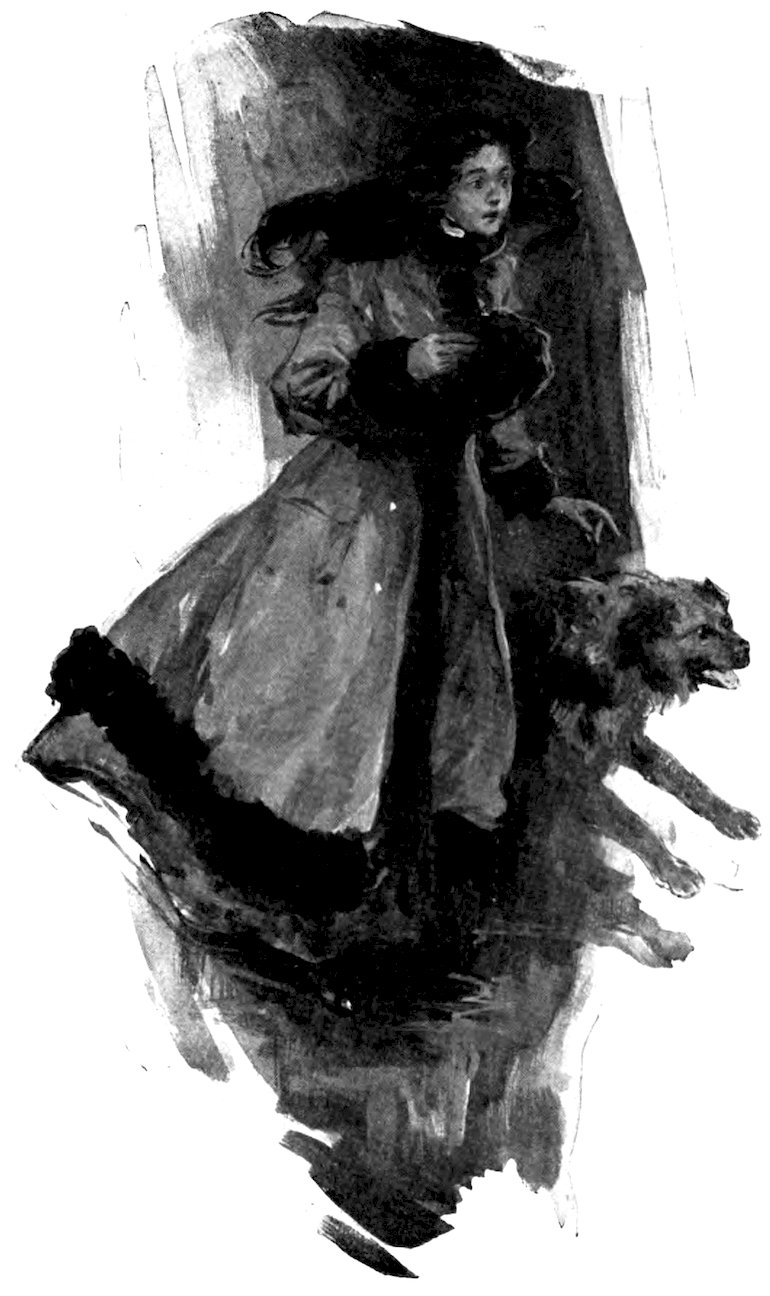
I called, with all my might: “Chance, Chance,
I want you!”
Almost before his name had left my lips, I heard the
thud of his feet, like the hoofbeats of a horse, and knew
that he was coming, but not the Chance I had ever seen
before—mild-eyed and gentle as a baby. Every part of
his body was bristling with rage, making him twice as
62big as usual. His eyes were red as balls of fire, and his
teeth showed white between his open jaws. If I had not
known him, I should have thought him mad, and, as it
was, I felt a little shiver of fear as he came rushing on,
with a low, angry growl, and his head low down.
The bandit’s back was to him, and he did not know
the danger threatening him until Chance came round in
front and two big feet struck him in the stomach, stretching
him upon the ground, with Chance standing over
him and looking at me for instructions as to what he
should do next. I had heard some Russian oaths, but
never any quite so fierce as those which came from the
lips of the prostrate young man, who had wrenched my
bag from my side, and kept it, with a tight grip.
“Chance,” I said, pointing to the bag, “that is mine.
Get it for me!”
He understood, and in a moment the bag was in my
hand, and on that of the bandit was an ugly wound,
where Chance’s teeth had been. The dog still kept his
place over the fallen man, growling angrily whenever his
foe attempted to rise.
“Please, lady, call him off!” the man pleaded, his face
white and his teeth chattering with terror.
63I was nearly as white as he was, and trembling in
every limb, as I stood looking at him.
“Oh, please let me go before he nabs me!” he continued,
as, lifting up his head, he looked down the long
street, where a policeman was just appearing in response
to a tardy summons from the butki. “I’ve been in a
dungeon, I’ve had the knout, and they did not make me
any better. Let me go,” he said. “I did wrong, and am
sorry!”
The knout and dungeon had an ugly sound. All my
womanly pity awoke for the wretch, who was little more
than a boy.
“I’ll give you another chance to do better,” I said, bidding
the dog come to me, which he did rather unwillingly,
growling savagely as the man sprang up, and,
picking up his hat, exclaimed: “Thanks, lady! I’ll not
forget it!” and then disappeared into some den or alley.
The women began to gather around me by this time,
all talking together, and evidently so pleased at the escape
of the thief that I was almost as much afraid of
them as of him. The tired-faced woman, however, who
had suggested the police, was different, and, when she
asked me to sit down, I assented, for I was very tired, and
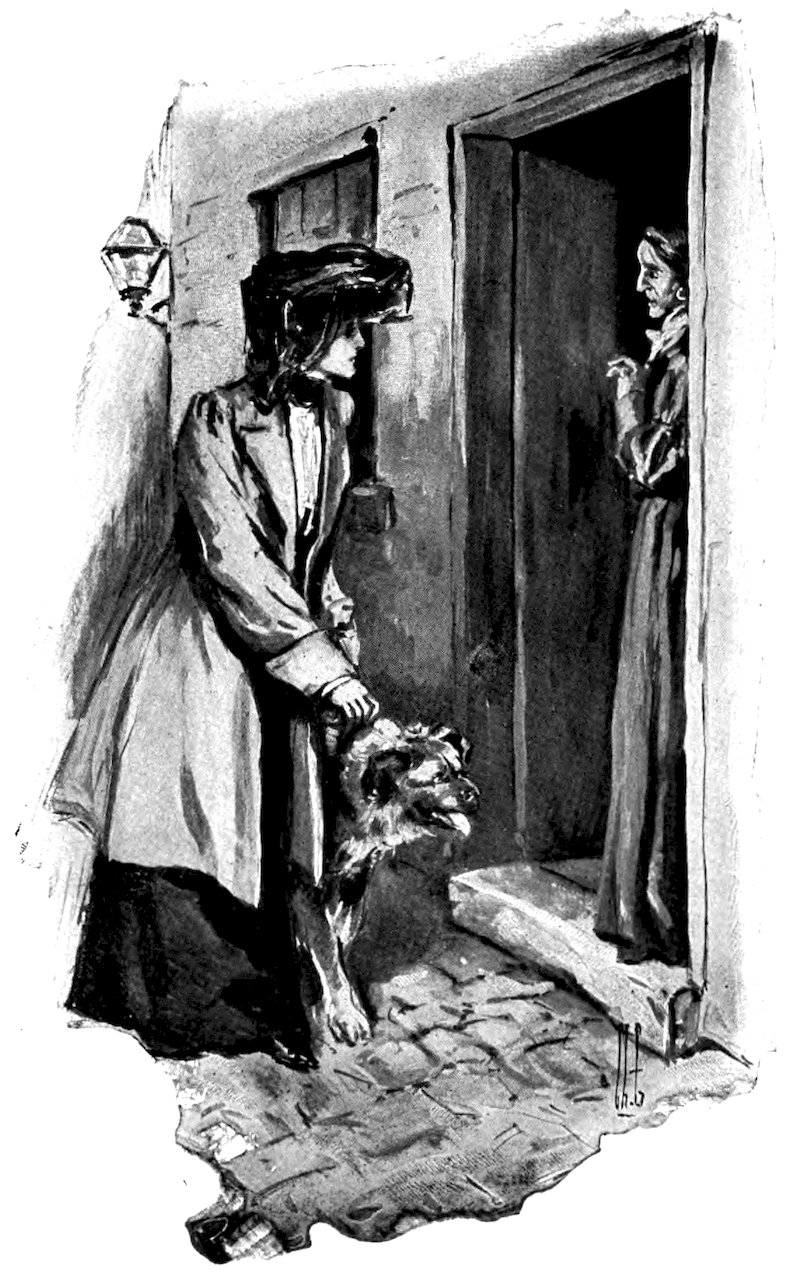
went toward her door.
64“Wait a moment,” she said, as she saw me about to
sit upon the doorstep, which was rather dusty, but which
I preferred to a seat inside, because it was in the open
air.
Bringing a broom, she swept the step clean, and, taking
off her apron, folded it and laid it down for a cushion
for Mary and me, while she took a seat inside the door.
Mary was nearly in a state of collapse with fright, and
did not refuse a drink of the vodka a woman offered her
in a broken cup. The strong liquor, which nearly strangled
her, did her good, for she sat up in a moment and
began to pull her dress away from contact with those
near her.
Chance had stretched himself at my feet, but his head
was up and alert, as if scenting mischief. Evidently he
did not like the neighborhood, for he looked at me occasionally,
as if asking why I was here, and why I did
not leave. Several children gathered round him, timidly
at first; then, as they gained courage, putting their little,
dirty hands on his shaggy side, and calling him Chance,
and a good dog, to which attention he responded rather
indifferently, with a whack or two of his bushy tail.
“Do they all know him?” I asked, in some surprise,
and forgetting that they had heard me call his name.
65“Oh, yes,” the woman answered. “We all know
Michel Seguin’s dog—a better detective, they say, than
his master, if he chooses to use him, which he not often
does.”
The policeman now came up, and began to question the
crowd as to the recent disturbance. At sight of him, the
children drew back and huddled closely together, but
the women stood their ground, and began to tell the story,
but shielded the thief as much as possible. A man had
snatched at madame’s purse, and she had set the dog on
him, was the amount of information, until a child called
out, in a little piping voice, as she pointed toward me:
“Ask her. She talks our way.”
Scanning me very closely, as if I had been some rare
curiosity, the man said: “You are the American madame
who speaks our language so well?”
I did not like his face or his manner. He was brusque
and rough, and different from any gendarme with whom
I had come in contact, but I replied that I was from
America, and could speak his language.
“Tell me, then,” he said, “the right of this row. I can
make nothing from the jargon of these cattle, who evidently
wish to shield their friend.”
66I told him the story briefly, and described the man as
well as I could.
“Carl Zimosky, by Heaven!” he exclaimed, bringing
his fist down upon his side, and addressing himself to the
women, one of whom nodded.
Then, turning to me, with an angry frown, he continued:
“And you let him escape! You let Carl Zimosky
go, when you might have kept him so easily! Carl
Zimosky is one of the worst felons we have, and is slippery
as an eel—a thief and a pickpocket. A sick wife
and two starving children! He has no wife, nor children.
He is not twenty-one. We have had him up
twice.”
“Yes, he told me he had been in a dungeon and under
the knout, and they made him worse,” I said, looking at
him very calmly and coolly.
“And perhaps that is the reason you let him go. You
thought him a nihilist, and I’ve been told you sympathize
with them. Madame,” he continued, his voice growing
louder and his manner so offensive that Chance got up,
looked at him and growled, shook his sides, looked at me,
and lay down again, nearer to me, with his head stretched
forward, as if listening, while the gendarme went on:
“Madame, these things may do in the United States, but
67not here in Russia! You may get into trouble, if you
are a woman and an American!”
He fairly swelled with importance as he delivered this
threatening speech, which did not move me, except to
make me angry. I was not afraid. I knew that, at a
word from me, Chance would have him by the throat,
and of what might come after that I did not think or
care.
“Sir!” I began, rising to my feet, in order to look over
the heads of the women, who at the man’s angry words
had gathered in front of me, like a fence, to keep me
from harm. “Sir! do you think I am going to stay all
the afternoon keeping guard over Carl Simpsy, or Simpson,
or whatever his name is, waiting for you, or some
other laggard, to come? Where were you, that you were
not attending to your business? I have seen policemen
in all parts of the city except here, where, it seems, they
are needed——”
“And where you ought never to have come,” he interrupted,
in a much lower tone than he had at first assumed.
“It is no place for women, alone, and I don’t believe
you’d got away with any money or jewelry you
may have about you now, if it were not for that dog.
Where, in Heaven’s name, did he come from? I thought
68Seguin was out of town. This Zimosky is suspected of
robbing his house last night, and we are looking for
him.”
“Robbed Michel Seguin’s house!” I exclaimed, a half
wish throbbing through my brain that I had detained the
man.
The gendarme must have guessed my thought, for he
said, with a sneering smile: “Madame feels differently
now that Seguin is concerned. I have heard you were
very friendly with him.”
I was too angry to answer, and I felt that my face
was as red as my hair. The women began at once to
ask questions concerning the robbery, but the gendarme
did not deign to answer them. They were cattle, as he
had designated them, and, as just then there came a
whistle which he understood, with a scowl at the women
and children and a look I did not like at myself, he
walked away in pursuit of some poor wretch—Carl, perhaps,
I thought, as I sat down again upon the doorstep,
faint and tired from my recent encounter.
Only the woman on whose doorstep and on whose
apron I was sitting was willing to talk. She seemed
superior to her neighbors, with a look upon her face as if
69nothing mattered to her now. In reply to my questions,
she said that Paul Strigoff, the gendarme who had
just left us, was one of the hardest and cruelest of the
lot, and he was more a German than a Russian. Carl
had been in prison, and nearly killed with the knout, but
he had his good parts, and would share his last crust or
kopecks with a friend.
“He is”—and she hesitated a moment; then began, in
tolerably fair English; and, when I looked at her in surprise,
she explained that she had once lived in England
for a year, and learned the language. “I was not always
what I am now,” she said. “It is a great fall from
the Court Quay to this place, but I have made the descent,
and was so bruised and stunned that life holds
nothing for me now—nothing—and what goes on around
me rather amuses me. I have been a suspect—arrested
as such, and put in prison. Oh, the horror and shame of
it, and I as innocent as you! My husband is in Siberia—sent
there rightfully, I suppose, according to the laws
of this land. I have no children, thank God, but”—and
red spots began to come out on her thin face—“it is not
known to many here—but Carl is my nephew. A good
boy once as ever the sun shone on. But they arrested
him for something he never heard of, and nearly killed
70him with the knout to make him confess what he knew
nothing of. When satisfied that they could get nothing
from him, they let him go, and he crept to me in the
night, with his poor back all gashed and bleeding, and
every particle of manhood crushed out of him. There is
nothing like the knout administered wrongfully to take
the pride from a man and make him a fiend. Carl is
pretty bad now, and does not care. I am sorry he attacked
you, and wonder that he did. He must have
had too much vodka. You should not have come here,
and the sooner you go, the better. Your friend is greatly
upset.”
She looked at Mary, who was very white and very
busy trying to keep herself from the children who were
pressing round her, and who had been joined by other
children from some quarter. Among them I recognized
my hat, which I had discarded on the first day of my arrival.
The same girl I had then seen with it on was
wearing it, and had twisted a piece of faded blue tarleton
around it in place of the ribbon and flower, which, I
suppose, some other child was wearing. At sight of it, I
laughed. The world seemed so small, with many wires
converging to the same point, and just now to this neighborhood,
where I knew I ought not to be. But I must
71ask the woman a question before I left, and, turning to
her, I said: “Do you know Michel Seguin?”
“Only as a terror to the nihilists and thieves. I’ve
never spoken to him,” she said. “I hear that, although
he is quick to catch ’em, he is kind after they are caught.
Very different from Paul Strigoff, who has come up
from the scum of Moscow, and feels his importance as a
gendarme, while Michel Seguin is a gentleman, and
comes of a good family.”
“Do you know where he lives?” I asked her next, and
she replied: “Yes; on the Nevsky. He has money, and
his mother is a lady.”
“And did you ever know or hear of the Patoff family,
who first owned the house? There was a Nicol Patoff,
a young man. Did you ever hear of him?”
“Patoff?” she replied. “No, I don’t know them. They
must have left before I came to St. Petersburg. The
Seguins lived there then.”
“Thanks!” I said; “and now I really must go. Come,
Mary.”
I stooped to help her up, and, before I got her to her
feet and away from the woman, who was again offering
her vodka, I was conscious that some new impulse had
been given to the crowd, which had pressed disagreeably
72near to me as I bent over Mary. The children began to
scatter, and in the distance I saw my hat, worn hindside
before, and bobbing up and down on the frowsy head
of the peasant girl. The women, too, began to move
off toward their own homes, while Chance started up,
and, with a joyous bark, ran swiftly up the street, where
a tall gendarme was coming toward us with rapid strides
and swinging a little cane, which I had heard could, on
occasion, make itself felt.
“Michel Seguin!” I almost screamed, as I clutched
Mary’s arm and drew her along with me. “Oh, I am so
glad,” I said, stretching out my disengaged hand to
Michel, who took it, while with his other hand he relieved
me of Mary, who, at sight of him, began to recover her
strength and courage.
And so, without a word of inquiry or explanation, we
walked away from that quarter to the Nevsky, which had
never seemed so bright and pleasant as it did when we
at last sat down upon a bench, with Michel between us,
still holding our hands, as if he had us in custody.
“Now, tell me,” he said, “how came you in that quarter,
of all others? It is no place to walk. What took you
there?”
“My miserable curiosity,” I said, with a sob in my
73voice. “I wanted to explore new places, and see all sorts
and conditions of people.”
“I think you probably saw them,” he answered. “I
reached home about noon. I saw you go by, but was
too busy to speak to you. Knowing your fondness for
long walks, I concluded you were taking one, but as
time passed, and you did not return, I sent Chance to
find you. But what happened to upset you so?”
It was Mary who began to tell the story. I could not.
The thought of it made me faint again, and, without
knowing it, I leaned rather heavily against Michel,
while, in a voice half choked with nervous tears, Mary
related our experience with the thief, and the part Chance
had in it.
The dog seemed to know what she was saying, for he
stamped his feet and shook his head, turned a somersault
or two, and finally came and, putting his nose in
his master’s lap, looked earnestly at him for commendation.
“Good Chance,” was all the return he could get,
for both the gendarme’s hands were in use, one holding
me, the other holding Mary, while he listened with rapt
attention, and, when she mentioned the name of the thief,
he started and let go my hand.
“Carl Zimosky!” he repeated. “He is the most expert
74thief we have. I never knew him openly attack one in
daylight before. Such things are not common. There
are too many police around, besides the three in the
butkis.”
“Great good they did us!” I exclaimed. “I don’t believe
they were on guard, or else they were asleep, and
your fine policeman, Paul Strigoff, took his time to get
to us, and, when he came, he was exceedingly insolent
because I had let the thief go.”
“Paul Strigoff!” and Michel laughed; “and so you
fell in with him, too! You did have an adventure! Paul
and Carl! I wish myself you could have kept the latter
till we found whether he had my watch.”
“Your watch!” I repeated, remembering, suddenly,
what I had heard of his house being robbed. “Was your
house really entered? Strigoff said so.”
“Yes,” he answered. “When I reached home, I found
the servants in a great commotion. My house had been
entered by some one, a quantity of silver taken, and a
gold watch, which I prized very highly, because—because——”
he hesitated, then went on: “It is an American
watch, made in Waltham, and, you know, they are
valuable. It was Nicol’s. He brought it home with him,
75and it has ‘Ridgefield’ on it, and the date when he
bought it.”
“How came you by it?” I asked, rather sharply, and
he replied: “Just as I came by the house and the other
articles. All fair, as I once told you. The Patoffs were
not cheated.”
Here was a new complication, with Nicol in it. I remembered
the watch perfectly. It was bought at a jeweler’s
in Ridgefield, who kept only the best wares. Nicol
had seemed rather proud of it and consulted it frequently
if the day was hot, the lessons hard and his pupils
stupid and anxious to be free.
“And you suspect Carl Zimosky?” I asked, in an unsteady
voice.
“Yes, we always suspect him. He is what you Americans
call a bad egg—into one scrape as soon as he is out
of another.”
“And I let him go!” I said. “He begged so hard and
looked so scared; but I’ll try and get the watch for you
if he has it.”
“You!” and he laughed derisively. “Will you turn
detective, and go into the dives after him? He eludes
us every time.”
“No,” I answered, thinking of the tired-faced woman,
76his aunt, whom they called Ursula. I should work
through her, but I did not say so, as I did not wish to
bring her into the trouble if I could help it.
“I do not know for sure that he has the watch, but
I am sure you cannot get it if he has,” the gendarme
said.
“Let me try, and don’t go after him until I have given
him up,” I said. “He has been in prison once and under
the knout, and his back is all cut and scarred. It is
horrible, and I hate the whole system, and am glad we
are going away in a few days.”
“Going away so soon?” the gendarme asked, and in his
voice there was genuine regret such as we feel when
parting from a friend.
“Yes,” I answered, not quite in the tone I had at first
assumed.
I could not understand the influence this man had
over me, or the sense of restfulness I felt as I walked
beside him on the Nevsky, till we reached his house,
which, at his invitation, we entered, hearing from the
porter and a head servant an account of the robbery,
which was so adroitly done as to leave in their minds
no doubt that the thief was Carl Zimosky.
“But we’ll get him, we’ll get him,” the porter said, with
77a shake of his gray head, “and the knout will soon make
him give up the plunder, if he has it.”
I shuddered, but made no remark. I meant to get
the watch, if Carl had it, though how I scarcely knew.
It was growing late, and I was too tired to walk the remaining
distance to the hotel. I would take a drosky,
I said, and, with Mary, was soon being hurled along the
street in an old vehicle and at a pace which threatened
the dislocation of our limbs, if indeed we were not
thrown into the street.
If anyone at the hotel had heard of the robbery at
Michel Seguin’s house, nothing was said of it, and by
mutual consent Mary and I kept our own counsel with
regard to our adventure. We had had a long walk and
been in a queer part of the city, we said, when questioned,
and that was all. I was more tired and excited than
I had ever been in my life, and I made my fatigue an
excuse for retiring early to my room, where I lay awake
far into the night, devising means for getting Michel’s
watch, if possible, from the hands of Carl Zimosky, if
he had it, or through him from the one who did have it.
CHAPTER VI. THE WATCH.
78
I changed my mind with regard to leaving St. Petersburg
in three days, and decided to stay a week longer.
For this change I made no explanation except to Mary,
whom I took into my confidence, telling her of my intended
visit to Ursula and asking her to go with me. At
first she shrank from the idea in alarm, but finally consented,
and on the afternoon of the second day after
our adventure, we started again for what Mary called
the thieves’ quarters. To save time we took a drosky
nearly to the end of the Nevsky, and walked the rest of
the way. It was a warm afternoon and the street was
swarming with children who, at sight of us, set up a
clamor. “She’s come again—the madame who talks as
we do,” and they began to gather around us; but I
waved them off so imperatively that they did not even
touch us with their hands as I went forward to where
Ursula was again sitting in her door mending some
garments which I knew intuitively belonged to her scapegrace
nephew. She looked surprised when she saw us,
79but arose at once and asked us to come in instead of
sitting upon the steps, as we had done before. Her
room was neat and clean and homelike, although poorly
furnished and showing signs of poverty.
“Please keep them out,” I said, motioning to the children,
some of whom followed us in. “My business with
you is private.”
An expression I did not quite like came upon her
face as she sent the children away, and then, speaking
in English, said: “What is it? Why have you come
again?”
I told her very briefly that everything pointed to Carl
as the thief who had entered Michel Seguin’s house, and
why I was interested to get the watch, if possible. “Do
you think Carl has it?” I asked.
Her needle came unthreaded just then, and after biting
the end of her thread several times and making
several jabs at the eye of her needle, she took up the
poor old coat, patched in many places, and replied: “I
don’t think—I never know what he has, nor what he
does except as I hear it. I’ll not deny that the police
have been here after him, but they didn’t get him. He’s
cute,” and she smiled in a proud kind of way at the
boy’s cuteness in eluding the vigilance of the gendarmes.
80“Do you see him often?” I asked, and she replied:
“Yes, and no; if he is hard pressed he stays where they
can’t find him. Late at night he comes in to see me.”
“Can you communicate with him when you wish to?”
I asked next, and she replied: “Yes, we have ways and
means—a kind of underground railroad such as your
people used to have when you had a slavery not half as
crushing as ours.”
“You are a nihilist,” I said, and instantly her face
flamed up, then grew pale, as she replied: “Of course
I am. Half of us are nihilists at heart. Not that we
want to kill the czar. That’s murder. We want a freer
government, like yours, where we dare call our souls our
own and are not watched at every turn.”
We were getting away from the object of my visit,
and I came back to it by saying: “Will you see Carl
and ask him to bring you the watch? I don’t care for
the silver; it is the watch I want. I let him go when
I might have kept him till the gendarme came. I think
there is enough good in him to do me this favor.”
“He may do it for you. He was very grateful. Paul
Strigoff is a devil,” she said; then she added, suddenly:
“You and Michel Seguin are great friends.”
81
“Marry him! Marry a Russian! Never!”
83I did not know whether we were or not, but it was
safe to answer in the affirmative and that he had been
very kind to us all since we first met him.
“He is of a good family and ought to be something
better than a hunter of criminals. People wonder he
took it up. Would you marry him?” was her next question.
“Marry him! Marry a Russian! Never!” I exclaimed,
so loud that she started in her chair. Her
spectacles fell off and her needle came unthreaded again.
“They are not so bad if you get the right one,” she
said, adjusting her glasses and making more jabs at the
eye of her needle.
I threaded it for her, and as there was nothing to gain
by stopping longer, I took my leave, after bidding her
let me know at once if she had good news for me.
“To-morrow,” was her reply, and I left her patching
the old coat which made me faint to look at, it spoke
so plainly of poverty and the scenes it must have been
in, for I believed it was the one Carl had worn when
I met him, and that the rent which Ursula was mending
was made by Chance’s big paws.
Quite a retinue of children attended us for a ways,
and among them my old hat was conspicuous again,
worn this time right side before, with a piece of an old
84blue veil twisted round it and round the girl’s face.
That night seemed interminable as I waited for the
to-morrow and what it might bring from Ursula. It
brought a note addressed in a fair hand, and containing
only the words: “Come this afternoon at two o’clock,
and alone.”
I did not quite like the word alone, but did not hesitate
a moment. But how should I manage it? What
excuse should I make to my friends who were already
looking upon me as something of a crank? At last I
decided to make no excuse except that I was going out
on business and alone, with the exception of Chance,
who was already waiting outside the hotel, as he had
waited every morning since my adventure with Carl.
Mary suspected where I was going, but said nothing,
and at a little before two I was driving along the Nevsky
till I reached a point where I alighted, telling the driver
I would walk the rest of the way. Chance was in high
spirits, sometimes running far ahead of me and then
bounding back to my side. The moment I turned into
the street, or square, where Ursula lived his whole attitude
changed. His fur seemed rough and his head
was lowered to the ground as he started on a racing
gallop as if in pursuit of something. He was usually
85obedient to my call, and I succeeded in getting him back
and kept my hand upon his neck until I reached Ursula’s
house. There were not as many children in sight
as usual. They had gone on a picnic and the street
was very quiet. Ursula was watching for me, but her
countenance fell when she saw Chance pulling to get
free.
“I thought you would come alone,” she said. “I am
afraid of that dog.”
“He is harmless if there is nothing to be harmed,” I
replied, taking the chair she offered me and still holding
Chance, who tugged to get away from me, and
finally did so, beginning to run in circles around the
room and to scratch at a door which, I think, opened into
a bedchamber and in which I heard a rustling sound
as of some one moving. “Carl is in there,” I said to
Ursula, who replied, after listening a moment, while
Chance continued banging at the door with his huge
paws: “He was there. He is not now, thank God! He
has a way of leaving the place unknown to anyone but
ourselves. And he has taken it. He saw the dog coming
with you and was afraid like myself. I sent for
him last night and told him what you wanted. He had
the watch and promised to bring it this afternoon and
86give it to you himself. He wanted to thank you personally
for letting him go that day and to tell you he
was not all bad and was going to do better. He brought
the watch, but dare not face the dog.”
She arose and went into the bedroom, followed by
Chance, who acted as if he would tear up the floor and
ceiling, until I quieted him by the first blow I had ever
given him, and which wrung from him a look of intense
surprise as he crouched at my feet with his nose on the
floor as if scenting something.
“Do you recognize it?” Ursula asked, putting the watch
in my hands. “It has a name and date on the lid.”
I knew it was Nicol’s without the name, and the touch
of it was like the touch of a vanished hand not dead
in reality to my knowledge, but dead to me except so
far as memory was concerned, and the sight of it brought
Nicol as vividly to mind as when I was the pupil and
he the teacher—young, handsome and strong in all that
makes a man strong mentally and physically, and I
could hear his voice calling me Lucy, as he did once
or twice when we were alone, and his soft, brown eyes
looked at me as no other eyes since had ever looked.
Where was he now, and what the mystery surrounding
him? And——
87
“I thought you would come alone. I am afraid of that dog.”
89There came over me a flash of heat which made my
blood boil, as I thought: “Could Chance find him from
this clew?” Then as quickly I answered: “No. I will
get the truth from Michel Seguin when I give him back
his property.”
As I turned to go I offered Ursula money for Carl.
But with a proud gesture she refused it. “He thought
you might do it and said he should not take it. He was
not as mean as that,” she said, giving me a box in which
to put the watch which was ticking as loudly and evenly
as it had done years ago in the schoolhouse in Ridgefield.
I wanted to give the woman something to show
my gratitude to her, and offered her the stick pin which
held my scarf. But she declined it; then, with a wistful
look at the knot of red, white and blue ribbon which
I always wore, she asked if I had another like it. I
had, and at once gave her the knot, which she took with
thanks.
“It is the badge of a free country,” she said, “where I
once thought to go. It is too late now for me, but if
Carl could get there it might make a good man of him.
Here he can do nothing but hide—hide—till he is caught
again, and then Siberia, or a dungeon!”
I was sorry for the woman, whose dim old eyes were
90full of tears as she bade me good-by, saying: “You
will not betray my boy by telling where he was when
you got the watch?”
“Never!” I answered, and kissed the tired, white face
which I might never see again.
I did not know what Mrs. Grundy would say when she
saw a lone woman stop at Michel Seguin’s house, nor did
I care. I was at a point where Mrs. Grundy’s opinion
did not matter, and I bade the driver of the drosky leave
me at Monsieur Seguin’s door, after ascertaining that
he was at home. His face was one of intense surprise
when he saw me, and mingling with the surprise was a
look of pleasure as he came forward to meet me.
“What is it? What has happened?” he asked, for I
was shaking with excitement.
“Let me go to your room—Nicol’s room, and I will
tell you,” I said.
He led the way to his den, and opening the box, I put
the watch upon the table without a word.
“What!” he exclaimed, springing forward and taking
it up. “My watch! Where did you find it?”
“I didn’t find it,” I said. “I got it through Carl.
No matter how, nor when. He brought it to me, but
the silver I did not get.”
91“I don’t care for the silver,” he said, a little impatiently.
“It was the watch I prized, because——”
He stopped abruptly and seemed to be thinking, while
I was nerving myself for what I meant to do.
“You would make a splendid detective,” he said at
last. “How can I thank you?”
Here was my chance. “You can thank me first,” I
replied, “by letting that boy alone for a while, and if he
is arrested again, don’t be harsh or cruel with him.
There is good there which the knout will never improve.”
“Promised!” he said. “I’ll look after the lad myself,
for your sake.”
The tone of his voice said what his half-shut eyes could
not express, and I felt the blood tingling in my veins
as I went on hurriedly:
“You can also tell me the mystery surrounding Nicol
and why he is in hiding where even you cannot find
him. You are a man and I am a woman—no longer
young, and so I do not mind telling you that I liked
Nicol Patoff very much, and I should be so glad to see
him, and—and——”
Here I began to choke; but I swallowed hard, put
92aside all shame, and went on: “You have a lock of hair
which he left when he went away. You said it was
black; I know better; it is red, bright red—the color
mine was when a young girl. It is darker now. He
asked me for it, and I gave it to him. I want it back.
It is mine, not yours. Will you give it to me?”
His eyes were wider open now than I had ever seen
them, and startled me with an expression I could not
define, but which made me wish I was not there talking
to him.
“As Nicol’s property I must keep it with the watch until
such time as he can claim them openly,” he said at
last. “I know he thought more of the hair than of the
watch. I cannot give it up.”
His manner was decided, and I felt my temper rising,
but forced it down; for there was one more favor I
would ask, and then I would say good-by to him forever.
“You have refused to give me the hair, but you have
promised to be kind to Carl for my sake. Will you be
equally lenient toward Nicol, should he be arrested and
under your authority? Do you think you could do anything
to help him? They say you are all powerful with
your friends. Will you try to have Nicol’s punishment
a little lighter? I don’t know what he has done, but
93don’t let them give him the knout, nor the dungeon, nor
Siberia, nor anything.”
I was choking now and standing up, with my hands
clinched so tightly that my nails hurt my flesh, while
he, too, stood with his eyes closed, his chin quivering,
and his teeth pressed tightly over his under lip. When
he spoke his voice was strained and unnatural, as he
said: “Pardon me for what I am going to say. Do you
love Nicol Patoff? Would you marry him if he stood
high in St. Petersburg?”
He had asked me a similar question once before, and,
as then, I now answered quickly: “No, I could not
marry a Russian. I hate your government machinery.
I should be a nihilist in a month, and my house would
be a rendezvous for them.”
“Yes,” he replied, “but you have not answered my
most important question: ‘Do you love Nicol Patoff?’
I have no right to ask you, but do you?”
He seemed terribly in earnest, and I recoiled a step
from him as I answered: “No! I esteemed him as a
friend, nothing more; and since I have known he was
in danger I have felt a great interest in him; but love
him—marry him—I couldn’t. I have answered you, and
now tell me, can you shield him if he is found?”
94“I think I can,” was his reply.
“And will you?”
“I will.”
“And will you tell him that I have not forgotten him?”
“I will,” were the replies and answers which followed
rapidly as we walked side by side to the street, where
I gave him my hand and said: “We shall certainly
leave in two or three days, and I may not see you again.
I must thank you for all the kindness you have shown
us, helping us over rough places and in many ways,
but most I thank you for Chance, who has been invaluable
at times.”
He was still holding my hand and looking at me as
if there was something he wished to say and was struggling
to keep back. Whatever it was he did not say it,
but, dropping my hand quickly, hailed a drosky, into
which he put me, and, with a simple “Good-by,” turned
back to his house. I made no explanation to anyone
as to where I had been. I was too tired; my head
ached, and I did not wish for any dinner, I said, and
went to bed early, deciding to leave St. Petersburg as
soon as possible. With a woman’s instinct I felt tolerably
sure of the nature of M. Seguin’s feeling
for me, but could not analyze my feelings for him. He
95both fascinated and repelled me. I liked him and feared
him, for something in his personality always influenced
me more than I cared to be influenced, and I wished to
get away from it.
“We will have just one more day of looking around
and then let’s go,” I said, at breakfast, to my friends,
who acquiesced readily, for they longed for new scenes.
St. Petersburg was monotonous and vexatious. They
had shown their passports and sworn to their nationality
and ages and occupations until they were tired of it, and
were quite ready to leave.
CHAPTER VII. ON THE QUAY.
96
That day we kept together until late in the afternoon,
when Mary and I went for a short walk on the Court
Quay. I had seen a few beggars, and had nearly always
given them something, until I believe I was pretty
well known to them as one who could easily be imposed
upon, and now as I saw one coming toward me I began
to harden my heart, and involuntarily put my hand upon
the bag Carl had wrenched from me.
But something in the man’s face and attitude struck
me as different from the ordinary beggar; and into the
outstretched palm I put a few kopecks, and was asking
where he lived and his name, when a hand was laid
roughly on his shoulder and a harsh voice said: “I can
tell you, madame; it is——”
I did not catch the name. I only knew I was standing
face to face with Paul Strigoff, the gendarme, whom I
had met after my encounter with Carl Zimosky.
There was a taunting sneer on his face as he said
to me:
97“So madame is playing the charitable? But it is not
necessary. She is mistaken in her man. He is no beggar.
We have been looking for him and have found
him at last. His disguise is pretty good, but it did not
deceive me.”
He spoke with the utmost pomposity and self-conceit;
and I wanted to knock him down, while I pitied the poor
wretch who had fallen into his clutches and in whose
appearance a great change was taking place. His face
grew pale, but took on a very different expression from
the one it had worn when he asked me for alms. Then
it had been the face of a hungry peasant, with little intelligence
in it. Now it was that of a man resolute and
defiant, but refined and educated. He had evidently been
playing a hazardous game and had lost. His disguise
was detected. He was a prisoner, with no way of escape,
unless——
There was a quick glance toward the Neva, as if
help lay in that swift stream, if he could only reach it.
But the gendarme’s grip was firm, and the man seemed
half his size as he cowered in his rags.
Extending his hand to me with the kopecks I had
given him, he said, in fair English:
“Thank you, lady, but take them back; I shall not
98need them. We have little use for money where I am
going. Please write to No. — Nevsky, and tell her
I have been arrested, and tell Sophie and Ivan——”
He did not finish the sentence, for the gendarme shook
him roughly, commanding him to stop, or speak Russian.
As he could not understand a word of English, he
evidently suspected we might be hatching some plot,
and sternly demanded to know what we were saying. I
told him all except that I was to write to No. — Nevsky.
It was well to withhold this, I thought, and there was
a gleam of intense satisfaction in the man’s eyes, which
thanked me more than words could have done.
“God bless you!” he said, in much the same tone of
old Ursula when she bade me good-by, and then he was
started for the gloomy fortress.
In my excitement I stepped in front of him and, stopping
him for an instant, grasped his hand and said:
“Good-by and God pity you! I shall pray for you
every day.”
It was a bold thing to do in the teeth of Paul Strigoff,
who scowled at me threateningly and asked again what
I had been saying, and if I knew I was sympathizing
with one of the most notorious nihilists alive.
99“He is more dangerous than your thief, Carl Zimosky,”
he added.
The prisoner made no sign that he heard or cared,
until Carl was mentioned; then he looked up quickly,
with a flash of resentment, it seemed to me, at being
classed with a thief. It was then that I noticed more
particularly his finely-cut features and dark, expressive
eyes, which, in spite of his courage, had in them such
a look of terror and despair as I shall never forget.
I made no reply to the gendarme and walked away,
not knowing but I might be arrested as a suspect and
sympathizer with anarchists.
Arrived at our hotel I wrote my promised letter, with
no clew to guide me except the number, “Ivan,” “Sophie”
and “her.” The “her” was probably his wife, and I
addressed her as madame and told her the particulars of
the arrest and that the man had evidently wished to send
some word to “Ivan” and “Sophie.” I would not trust
my note to the mail, but sent it by a private messenger
from the hotel to the number on the Nevsky, which I
found was in a more fashionable quarter than M.
Seguin’s house.
The excitement of the last few days, added to the heat,
which was intense, proved too much for me, and instead
100of leaving St. Petersburg the next day, I was in bed
with what would have proved a case of nervous prostration
if I had not fought it with all my will power.
At first I rebelled against the detention, for I was
anxious to leave St. Petersburg behind me; but as the
days went by I was glad of the illness which brought me
so many unknown friends. These were not tourists—they
were too busy with sight-seeing to do more than
ask how I was and pass on—but the citizens, people
whom I did not know, who surprised me by their frequent
inquiries and the profusion of flowers they sent,
until my room was like a great garden, and the doctor
ordered some of them to be taken out, as the perfume
was so strong. No name ever came with the flowers
but once, and that touched me closely.
Around a bunch of pinks a paper was twisted, and
on it was written:
“Carl is doing better. He has sent the silver back,
and seen the gendarme.
Ursula.”
I cried when Mary read me the note, which I still
have, together with a few of the faded pinks pressed
between the leaves of my Bible. I cried again when
another bouquet came, this time beautiful hothouse roses,
tied with a broad white ribbon, to which was attached a
card with the words: “To our friend, A. N.”
101
“‘God Bless You!’ he said ... and then he was started for the gloomy fortress.”
103“A. N.,” I repeated. “Who is ‘A. N.’? I know no
one with those initials.”
“I have it!” Mary exclaimed, after a moment. “‘A. N.,’
a nihilist! That is what it is, and all these flowers
are from the same source—nihilists, I mean. They
have heard a lot about you and wish to show their gratitude.”
“But I am not a nihilist!” I said.
“No,” Mary replied, “but you have got your name
mixed up with them, defying Paul Strigoff to his face,
and letting Carl somebody go, and calling on an old
lady who was once in prison, and a lot more we have
heard, until I believe the hotel people begin to think
they are harboring a suspect and will be glad when we
are gone.”
“Not more than I shall be!” I exclaimed, while Mary
went on:
“I have not told you that Chance comes every morning
and looks at me so inquiringly that I give him a
card, with the words ‘About the same,’ ‘Improving,’ or
‘Better’ on it, and he goes off on the run, with the card
held in his mouth. The first time I gave it to him a
104miserable censor happened to be outside and demanded
to see it. I motioned him to get it if he could. He
tried, but the dog held on till the card was torn in
shreds, and I am not sure that the censor’s hand was not
scratched a little. I wrote another at the desk and held
it up to the censor, who of course could not read it;
but he pretended he could, and nodded very patronizingly,
while Chance growled at him and then set off on
a gallop for home. M. Seguin has not been here
that I know of, but he has sent you flowers every day—expensive
ones, too, the best he could find—and, oh!
I came near forgetting, a frowsy-headed girl, wearing
your old hat, came bringing a few violets she must have
gathered in the country, and an old drosky driver, looking
like a barrel, inquired for ‘little madame’ at the office,
saying he was the first to drive you in the city. He
seemed to think it an honor. I did not tell you all this
at the time, as you were too weak to hear it.”
I turned my face to the wall and cried, until Mary
became alarmed and sent for the doctor. I did not know
what I was crying for, but as a thunder shower clears
the sultry atmosphere, tears did me good, and I was
better the next day and the next, and was soon able to
start on the long overland journey to the frontier. Many
105kind wishes were expressed by the people in the hotel,
and I was the recipient of so many flowers that I was
obliged to leave some of them behind. The old barrel-shaped
man who boasted of having given me my first
drive in the city stood outside, smartened up with a new
wadded garment tied around the waist with a piece of
red cord like that with which we sometimes hang pictures.
“Would little madame do him the honor to let him
drive her to the train? He would promise to go slowly,
and not break her bones!”
I could not refuse, and so it came about that in the
same old rattletrap in which I first rode through the
streets of St. Petersburg, I was driven to the station, the
old man stopping occasionally to ask if the little madame
was comfortable and was he driving too fast.
“No, no,” I cried, “go on; we may be late.”
“All right!” and he shook the strips of leather which
could not have restrained his horse a moment had he
chosen to use his strength.
Near the station there was quite a motley crowd of
people, some well dressed, some otherwise. My hat was
bobbing up and down in the midst as if the wearer were
trying to get a sight of me, and I caught a glimpse of
106Ursula and, near her, Carl, who boldly waved his hat. A
moment after, my old hat went up in the air, showing
two streamers of some soiled stuff at the back.
What did it mean? Had they come to see me off, and
were these the people who had sent me so many flowers?
The possibility brought a big lump into my throat. Then
I wondered if M. Seguin would be there to say good-by,
not caring to confess how disappointed I should be if he
were not.
He was there with Chance, who put his big paws on
my shoulders, with a low kind of woof, as if he knew
I was going and was sorry. In my weak state tears
came easily, and they fell like rain as I put my arms
around the noble brute’s neck and bade him good-by.
M. Seguin was there ostensibly on official business, but
he attended to our tickets and passports and made it
very easy for us to leave.
“Do you know you are having a unique send off?” he
said. And when I asked what he meant, he replied:
“Do you notice that group of people in the streets?
They are your friends. I saw the tangle-haired girl to
whom you gave your hat among them, with Ursula and
Carl Zimosky. He brought back the silver himself,
knowing the risk he ran. He said he was trying to do
107better for your sake, because you kept him from Paul
Strigoff. I believe every mother’s son and daughter
there in the street is a nihilist at heart, and they think
you are one with them and are showing their gratitude.”
I could not answer for that lump in my throat, but at
the very last I put a limp, clammy hand into his broad,
warm one and tried to thank him again for all his kindness
to us.
“Don’t, please,” he said, very low. “For anything I
have done I have been more than repaid in knowing
you—the fearless American woman who dares say what
she thinks. I shall not forget you, and some time you
will come again.”
I shook my head and hurried toward my companions,
who were motioning me to make haste. There was not
much need of haste, I thought, as the trains seldom start
on time, but this one did, and in a few minutes we were
on our long journey of five hundred and sixty miles to
the frontier. It was monotonous and wearisome, with
nothing to interest us or to look at except the brown
plains and forests of pines and silver birches, and at
rare intervals a village of twenty mud cottages or more,
with a few peasants working in the fields. It was very
tiresome, and when at last it ended and we crossed the
108frontier into Germany eight women simultaneously said:
“Thank God!” And yet in the heart of one of the eight
there was a lingering regret for all she was leaving; and
she felt, too, a throb of sympathy and gratitude for the
strangers in the street who had waved her a farewell
and sent after her, she was sure, a fervent “God bless
you!”
CHAPTER VIII. SOPHIE SCHOLASKIE.
109
Three years later I was again in Europe, traveling
with my nephew and niece, Katy and Jack, the motherless
children of my only sister. We had seen a great
deal, for the young people were full of life and health,
and eager to see everything—not once, but twice and
sometimes three times. I was getting tired and glad of
a rest in Paris, where at the Bellevue I was taking my
breakfast one morning in our salon, while Katy and Jack
were looking up some route presumably to Italy, our
next objective point. They were evidently greatly interested
and even excited, but were talking so low that
I could not catch a word, as I sat and watched them
with feelings of pride and half envy of their youth and
spirits which could enjoy everything and endure everything.
Katy was a beautiful girl of eighteen, with large blue
eyes and a sweet, flower-like face, and hair something
the shade mine had been when young, but much darker,
with glints of reddish gold showing on it in the sunlight.
110I was very proud of Katy and of her brother
Jack, with his frank, handsome face and a manliness
about him one would hardly expect in a lad of fifteen.
He had constituted himself the leader of our party and
usually had the best route and trains and hotels picked
out, and I felt sure the subject of their discussion now
was the journey to Italy. It was the last of November
and the wind was blowing cold and raw through the
boulevards, and the basket of wood Louis brought us
gave but little heat.
I was always cold, and was longing for Naples and
Sorrento, and was upon the point of suggesting that we
start at once, when Katy, whose dead mother looked at
me through her blue eyes, and to whom I seldom refused
a request, startled me by saying, a little hesitatingly, as
if she did not quite know how I would take it:
“Jack and I have been looking up the route and how
long it will take, and we want to go to Russia. You
remember those people from Boston whom we met last
week at the Louvre. Well, we met them again yesterday,
when you were not with us. They were in Russia
last winter, and, say, you might as well not come to
Europe at all as not to go there in the winter. I don’t
care for Rome and the pope and the Vatican and the
111Forum and the house where Paul lived. I want to see
Russia!”
“See Russia!” I gasped. “Have you any idea how
cold it is there, or will be soon?”
“Oh, yes,” she replied, “the Boston people told us
ever so much and loaned us a book. Jack and I read
up about it last night after you went to bed. You wondered
why we were up so late. We read till midnight,
and, like the girl who had been in Rome eight days and
knew it thoroughly, we know Russia pretty well—St.
Petersburg, I mean. That’s where we want to go—the
place where your hat freezes to your head, your veil to
your face, and if you shut your eyes when they are full
of water your lids freeze together. That’s what some
writer says, and I want to know if it is true, and see
St. Isaac’s and the fortress, and the Winter Palace, and
skate on the Neva. It’s such fun, the Hales said. That’s
the name of the Boston family—Hale——”
“And I,” Jack began, coming forward with a map in
his hand, “I want to see the czar and his wife and the
grand dukes and all his folks, and the funny old coachmen,
stuffed till they look like barrels, and I want an
adventure with a gendarme and a nihilist, such as you
had; and oh! I want to see Chance, if he is still alive.
112And I want to see the three houses so big that it takes
you half an hour to walk past them. I don’t believe it,
but I want to see them just the same. Russia will be
jollier than Italy. Will you go? It will cost a lot, I
know, but father will send us the money. I heard him
tell you when we left home to let us see everything, as
it was a part of our education, and we might never
come again. Will you go?”
I was too much surprised to give a direct answer.
“I will think about it,” I said. “Go to the Louvre,
or where you like, and when you come back I will tell
you.”
“All right,” Jack said, in the tone of one who has
won a victory, while Katy stooped and kissed me, saying:
“Auntie always means ‘yes’ when she says she will
think about it; so, think hard and fast.”
Then they left me, and I was thinking hard—not so
much, I am afraid, of the proposed trip to Russia as of
the incidents of my former visit there, and I was surprised
to find how my heart went out to that far-off
city, which I had never expected to see again, and from
which I had heard but once since my return to America
113three years ago. Not long after Christmas there had
come to me a package containing eight photographs of
Chance, looking just as he had looked when waiting for
me at the hotel. There was also a letter from M.
Seguin, which I read with an eagerness of which I was
ashamed. It was written in a cramped back hand, not
very plain, and began:
“Dear Miss Harding: I send you eight pictures of
Chance—one for each of the Massachusetts women who
were here last summer and made a little diversion in my
life. I hope you will like the picture. I had some difficulty
in making him keep still, until I spoke of you,
when he quieted down at once and assumed the attitude
he used to take when waiting for you. I believe that
at the sound of your name he thought he was waiting
again, and that you would soon appear. For three or
four days after you left he went regularly each morning
to the hotel, and sat for an hour or two watching everyone
who came out, and when you did not come he started
for the station where he had last seen you and where
he waited until, growing discouraged, he came home and
stretched himself out upon the floor with his head between
his paws. Poor, disappointed Chance! I was
sorry for him, for I knew how he felt.
“I see I have mentioned the dog first when I ought to
have spoken of your friend, Nicol Patoff. He remains
114in statu quo, and I have given him up. I often see the
old drosky driver, and two or three times have taken
his rattletrap. He always asks for the little madame
whom he drove first and last in the city, and says you
were a ‘frisky little thing’! I think he meant nervous.
Occasionally I see your hat on the head of that tangle-haired
girl. Zaidee is her name. Perhaps you never
knew. The last time I saw her she was sporting a
long blue veil picked up in some quarter. Ursula has
gone to Siberia to join her husband, and Carl, her
nephew, has gone with her. He brought back the silver
himself, and said he was going to turn over a new leaf
and be a man, and all because you called off the dog and
did not let him fall into the hands of Paul Strigoff.
How they all hate that man! I gave Carl a ruble, more
for your sake than his, although he has not a bad face.
I saw them at the station when they went away.
Ursula had a knot of tri-colored ribbon on her dress, such
as you used to wear. I asked her where she got it. She
bridled at once and replied: ‘I didn’t steal it. It was
given me by the best and sweetest woman the Lord ever
made.’ I nodded that I fully agreed with her, as she
continued: ‘If you ever see her, tell her I have never forgotten
her kindness to Carl, and I shall pray for her every
day in Siberia.’
“‘What will you take for that knot of ribbon? I’d
like to buy it,’ I said; and she fired up like a volcano,
115telling me I had not money enough, nor the czar either,
to buy it!
“I have a good deal of respect for Ursula, and the last
glimpse I had of her the tri-colors, red, white and blue,
were showing conspicuously on her black dress. My
mother returned home in September, and I am no longer
keeping bachelor’s hall. I have told her of you and
your interest in Nicol Patoff, in whom she is also greatly
interested.”
There were a few more commonplace sentences and the
letter closed with: “Your sincere friend, Michel Seguin.”
There was no intimation that he expected an answer
to his letter, but common courtesy required that I should
acknowledge the receipt of the photographs, which I
did, directing my letter to “M. Seguin, Nevsky Prospect,
St. Petersburg.” Whether he received my letter
or not I did not know. He did not write again, and
with the passing of time my visit to Russia was beginning
to seem like a dream, when I found myself trying
to decide whether to go there again, and wondering
why my inclination leaned so strongly to that ice-bound
city, and why the tall figure of a gendarme always stood
in the foreground as an attraction. He might not be
there, and Nicol Patoff had disappeared, or was dead.
I could have no hope of seeing him. Why then was I
116willing to go? I asked myself, and answered as quickly:
“To see Chance, if he is there still.”
And so, the die was cast; and two weeks later we
took the train in Paris en route for St Petersburg. We
were hoping to have our compartment to ourselves for a
while at least, and had each taken possession of a corner,
when at the last moment a tall, fine-looking young lady
came hurrying to the door which was still open, although
Jack, who was nearest to it, had wished to shut it.
There was a close, searching glance at each of us, and
then the young lady entered with her cloak and gripsack,
while Jack scowled a little. He always scowled if he
did not like anything, and he evidently did not like the
companionship of this young lady, who took her seat by
the window opposite him, after greeting us with a smile
which lighted up her face wonderfully and smoothed the
scowl from Jack’s forehead.
She had put her bag on the seat beside her and then
glanced up at the rack opposite. Jack, who was always
a gentleman, rose at once for her. Of course she was
French, he thought, and so did Katy and I, her dress was
in such perfect taste, while there was about her an air
altogether Parisian. Summoning his best French, which
117was pretty bad, Jack said: “I will put up your bag, if it
is in your way.”
The words were jumbled together in an atrocious manner;
but the young lady understood and thanked him
in perfect French and with a smile which showed her
white, even teeth and brought into play a dimple on her
cheek. Then she relaxed into silence, and, leaning back
in her corner, closed her eyes and drew down her fur
cap as if she were asleep. But when we passed the city
limits and were speeding through the country miles from
Paris she became very much awake, and her eyes flashed
upon each of us, resting longest and very admiringly
upon Katy, who certainly made a pretty picture in her
suit of brown with a scarlet wing in her hat. I had
impressed upon my nephew and niece that they were not
to talk to strangers unless spoken to first, and then to
be rather reticent. This rule Katy carried to an extent
which sometimes made her seem haughty and cold, while
Jack was always ready to talk and ask questions and
find out about things, as he expressed it. On this occasion,
as the day wore on, I often saw him casting glances
at the young lady who slept a good deal, or seemed to,
and who, when awake, paid no attention to what we were
saying.
118“She does not understand us,” I thought; but when at
last we began to speak of Russia she roused up, and I
felt sure she understood and was interested.
Still she remained silent, and we talked on, or Jack
did, of St. Petersburg and the Nevsky and the Neva, and
the nihilists, whose acquaintance he hoped to make, wondering
if there was any way by which he could tell one.
Then he spoke of the dog Chance, hoping he was still
alive, and finally of his master, M. Seguin, wondering
if we should meet him.
“You and he were quite friendly, weren’t you, auntie?”
he asked, but I did not reply.
I was fascinated by the expression of the young lady’s
face, or rather of her eyes, which from brown seemed
to have turned to black and were blazing with a fierce,
angry light. Did she know Michel Seguin that she was
so excited at the mention of his name, and who was she?
My curiosity was roused, and still I said nothing, except
to answer Jack, who finally asked if I had ever heard
what became of the poor wretch who asked alms of me
on the Court Quay and who proved to be a notorious
nihilist and was arrested.
“You wrote a note to his wife, didn’t you?” Jack continued.
“Do you suppose he was sent to Siberia?”
119The window on Jack’s side had been shut, but now the
young girl opened it quickly and thrust her head out for
air. Then withdrawing it, she electrified us by saying,
in excellent English, although with an accent:
“Excuse me if I keep the window open a moment. I
have sudden spells of being faint, and it seems rather
close.”
“Oh,” Jack said. “You speak English! I thought you
were French.”
“Oh, no,” and she laughed, showing her white teeth
again, “I am not French. I am a Russian from St.
Petersburg.”
“A Russian!” Katy and Jack repeated in a breath.
“I’m so glad,” Jack went on. “We are going to
Russia, to St. Petersburg, and you can tell us a lot.”
She smiled at the boy’s enthusiasm, and smiled more
as, forgetting that he was not to talk to strangers, he
continued: “We—that is, Katy and I—are Katy and Jack
Barton. She is Katy, and I am Jack. Mother died
when I was born. We live in Washington, where father,
who was a colonel in the army, has something to do in
the Pension Office. Aunt Lucy Harding is our aunt.
She has been in St. Petersburg and speaks the language
120like a native. She had lots of mixups with nihilists and
things, and a big dog, Chance.”
He stopped to take breath, while the young lady put
her head from the window again to get the air. She was
very white when she sat back in her corner and closed
her eyes, in which I was sure there were tears, for she
held her handkerchief to them for a moment. Then she
recovered herself and smiled very brightly upon the loquacious
boy, who rattled on: “That dog Chance must
be a case. Auntie has a picture of him. Did you ever
see him?”
“I have heard of him as a remarkable dog, who, once
on the scent of a fugitive, seldom fails to find him; but
I don’t think he is often used for that purpose. Indeed,
I know he is not,” she replied, and I was sure her fine
face darkened for a moment as if Chance were not an
interesting topic.
The air was getting chilly and damp, for a rain was
coming on, and the young lady closed the window; and
after a moment, during which she seemed to be thinking,
she said, addressing herself to me:
“Your nephew has introduced your party, and as we
are bound for the same destination, I will present myself.”
121Then she told us that her name was Sophie Scholaskie,
that she was born in St. Petersburg, where her mother,
who was a widow, was now living. Her grandmother
lived in London, where Sophie had been at school two
years, and this accounted for her good English. She had
a twin brother—Ivan, who at present was employed at
the Bon Marché, in Paris.
“You have been there, of course?” she said.
I had a very vivid remembrance of many hundred
francs spent at the Bon Marché, and said so, while she
continued:
“You may have seen him then. He is at a silk counter—an
English speaking clerk as well as Russian. He
meets many Americans, and is, I believe, quite popular
with them. We look very much alike. If we exchanged
clothes you could hardly tell one from another, although
he is rather small for a man—five feet seven—and I am
big for a woman—too big! We can wear each other’s
clothes and gloves,” and she laughingly held up two large
white hands. “No. 7, and very strong!”
Now that she had commenced to talk she was very
communicative, and seemed anxious to tell us about herself
and family. Her grandfather on her father’s side
had been one of the minor nobility before the emancipation
122act, by which he lost his serfs and a large proportion
of his land. After that with many others he migrated
to St. Petersburg, where he received an office
under the government. His home was on the Nevsky,
where her father and grandfather lived together until——
She stopped a moment and looked out upon the dusky
landscape with an expression I did not like, it was so
full of resentment and hatred. Drawing a long breath,
she continued:
“My father, who was one of the best and noblest of
men and would scorn to do a mean act, died—in—Siberia,
where he was sent!”
“Oh, jolly!” Jack exclaimed, springing to his feet.
“He was a nihilist! And you are one! I am so glad!
I wanted to see you; but did not suppose they were
like you.”
“Sit down, Jack, and be quiet,” I said.
Sophie’s face underwent many colors, but finally subsided
into a pallid hue as she tried to laugh, and said:
“My father was a nihilist, though not the murderous
kind. He did not believe in that. He was not an anarchist,
and when the czar was killed in ‘81 no one regretted
it more than he did. I scarcely know of what
he was suspected. It takes so little to put one under a
123ban, and when the bloodhounds are on your track, you
are doomed. For a time my father eluded them, but he
was caught at last and sent at once to Siberia, with
scarcely a hearing and no chance to defend himself. I
believe the dreadful journey was made as easy for him as
possible, and he was not put to hard labor; indeed, he
did not labor at all, for he died within three months.
He was the idol of his father, who died of a broken heart
soon after hearing the sad news that his son was dead.
Pride, I think, had something to do with it, for the
Scholaskies are a proud race; and the dear old man, with
his long white hair and majestic appearance and courtly
manners, sank under the blow which had humiliated him
so much. We lost the greater part of our money and
our handsome house on the Nevsky, where Ivan and I
were once so happy, with no care or thought for the
morrow. Now we live in an apartment house on another
street, and Ivan and I work for our living. He is a
salesman and I am a teacher of music—German, Russian
and English—in Paris, so that we keep our mother in
comfort, if not in the luxury to which she was once
accustomed. I have told you my history in brief, and
shall be glad to be of any assistance to you while you
are in the city.”
124She seemed tired and heated and took off the fur cap
she wore and wiped the drops of sweat which had gathered
so thickly upon her face. She was handsomer with
her cap off, for one could see her white, well-shaped
forehead and mass of soft, brown, wavy hair, which was
brought up just over her ears and twisted in a large,
flat knot in her neck.
During her recital, which had taken some time, as she
stopped often, as if talking were painful, Jack had given
vent to many exclamations of anger and disgust, and
had once clinched his fists as if ready to fight some one.
Katy sat perfectly still and scarcely gave a sign that she
had heard; but when the story was finished she left her
seat by the window and sat down beside Sophie, whose
hand she took in hers, pressing it in token of her sympathy.
“I am so sorry for you,” she said; “and I don’t know
that I want to go to Russia.”
“I do!” Jack exclaimed. “I want to lick ’em.”
This created a diversion, at which we all laughed, and
no one more heartily than Sophie.
“Better keep quiet, my boy,” she said. “You can do
no good. No one can help us but God, and sometimes
it seems as if He had forgotten. But He will remember;
125there will be a change, I don’t know how or when,
but old men and women who pretend to read the future
see a heavy cloud over Russia—a cloud red with the
blood of her children, yet with a silver lining which means
liberty to the oppressed. May I live to see it!”
Her face glowed with intense excitement as she talked,
and the hand which Katy had taken withdrew itself from
her grasp and Sophie’s arm went across the young girl’s
shoulder with so firm a grip that she winced under the
embrace. Releasing herself as soon as possible Katy
went back to her seat in the corner, where she sat very
quiet the rest of the day, while Sophie and Jack had
the most of the conversation, Jack asking questions and
Sophie answering them to the best of her ability.
When at last we reached the frontier the first word we
heard was “Passports,” spoken rather peremptorily by
a tall, uniformed soldier, who motioned us into a side
room where our baggage was brought with that of the
other passengers. I was glad now for Sophie’s help.
My first entrance into Russia had been by water and
with comparatively little trouble. I had been met by
M. Seguin, and I found myself looking round involuntarily
in hopes of seeing him now, although I knew
the hope was futile. The officers were very different in
126looks and manner from him. They were rather cross,
and there were a good many passengers clamoring for
passports to be returned and their baggage to be examined
and viséed. I was tired, like the officials, and impatient
at the delay, as I saw no reason why business
should not be dispatched as it is in America instead of
the leisurely way natural to the Russians. Jack was
very much excited, and if he could have spoken the language
he would have given the lazy officials fits, he said.
As it was he caught hold of one who was leisurely inspecting
my trunk and said: “Look here, you, sir; that
is my auntie’s and there’s nothing in it, and she wants
it some time to-day. Do you speak English?”
The officer stared blankly at him and shook his head,
while Jack, who felt himself the man of the party, continued:
“Parlez vous Français, then, if you don’t speak
English?”
There was a second head shake, and Jack went on:
“Sprechen Sie Deutsch?”
A third shake of the head, with a laugh which exasperated
the boy.
“Confound you!” he said. “What do you speak? I
tell you we are in a hurry to get out of this stuffy hole
into the next room, and we are Americans—Americans!”
127He screamed the last two words as if the man were
deaf, and somehow they had their effect, or would have
had without my help, for the word American goes a long
way toward insuring respect from a Russian. The
room was crowded with first, second and third-class
passengers, and my head was in a whirl, aching badly,
and this had kept me quiet for a time while the babel
went on. Now, however, I rallied, not knowing how
much the officials could understand, or to what lengths
Jack might go. He had been rather free during all our
journeyings to inform people that he was an American,
from Washington, where his father, who was a colonel,
held an office; and I was expecting him to give this last
piece of information to the crowd when both Sophie
and I went to the rescue. She had been attending to her
own trunk, and I was very sure that more than one or
two rubles had changed hands. Her baggage was
examined, or pretended to be, her trunk viséed, and then
she turned toward us. What she said I don’t know, it
was spoken so low, but I heard the word America, and
our passports were at once given to us, our trunks examined
in a perfunctory way, and we were free to enter
the waiting room. Some of Sophie’s friends had come
to meet her, both men and women, and that she was
128held in high favor was shown by their evident delight at
meeting her. I heard Ivan’s name and supposed they
were inquiring for him, but did not hear her reply, as
she stood with her back to me. We were to separate
here, as she was to go with her friends, while we were
to have our own private compartment, telegraphed for
in advance.
“I shall see you soon again,” Sophie said to us as she
bade us good-by and stood for a moment with her fur
cloak wrapped round her and her cap drawn down upon
her face.
There was something about her which puzzled me and
made me think it might be safe not to be too intimate
with her. I believed her a nihilist of a pronounced type,
who might unwittingly get us into trouble; but I did
not say so, for Jack and Katy were full of her praises.
They lamented greatly that she was not to be with us in
the long, dreary journey to St. Petersburg, with nothing
to look at but snow, snow everywhere and more coming,
first in large, feathery flakes, which gradually grew
smaller until they came sifting down in clouds which
the wind sometimes took up and sent whirling across
the bleak plains in a blizzard. Whenever we stopped
and there was time, Sophie came to our section, bringing
129with her a world of cheer to the young people, who,
without her calls, would have found the journey depressing.
As it was, it seemed interminable, and we were
glad when we at last rolled into the station at St. Petersburg.
I had recovered from my headache and was able
to see to my own baggage without Jack’s loud assurance
that we were Americans and Sophie’s offer of assistance.
There seemed to be a good many of her
friends to meet her here as there had been at the frontier,
and she was attended like a princess to the smartly
equipped sleigh waiting for her. For a moment we stood
watching her as she moved along holding up her cloth
skirt to avoid the snow and showing her tightly fitting
boots with their French heels.
“Almighty big feet for a girl, but then she is big all
over,” was Jack’s comment as we turned to the sledge
which was to take us to our hotel.
It was the same where I had stopped three years before,
and as I had telegraphed for the room I had then
occupied I found it ready for me, with a small one
adjoining for Jack, who insisted upon registering, and
made a great flourish of Washington, D. C., U. S. A.,
as if that would insure us attention. We did not need
it, for the employees were ready to serve madame, whom
130they remembered, while Boots, who was still at his post
and not much grown, nearly fell down in his eagerness to
show me to my room, which was warm and comfortable
and brightened with a bouquet of hothouse flowers standing
on a little table near a window.
The feeling of homesickness and dread of some calamity
I was to meet, which had been tightening around
my heart ever since I reached the snow-girt city, began
to give way.
I was ashamed of myself for having felt disappointed
at not seeing M. Seguin either at the station, or in
the street, or at the hotel. He did not know I was
coming, and how could he be there? Besides, why
should he be there, anyhow? I was a mere acquaintance
of three years ago. I had passed out of his life
and he out of mine. The memory of those in whom I
had been interested in St. Petersburg had faded. Probably
Nicol Patoff was dead, and if he were not, my heart
did not beat as rapidly at thought of him as it once had
done. Of all the crowd who had waved me a good-by
when I left the city there was not one to greet me on
my return, and I had felt a positive ache all the way from
the station to the hotel, and wanted to cry when I entered
the old familiar room which brought back so many
131memories. But the flowers changed everything. Somebody
had thought of me. Somebody had sent me a welcome.
Who was it? I asked Boots; but he did not
know. They had come a few hours before for the
American lady, Madame Garden—that was all he knew,
and I was left to my own conjectures.
Katy and Jack were delighted with the hotel and
wanted to go at once into the street. But I was too tired
to go with them. Jack would have gone alone, armed
with Washington and America, and possibly Abraham
Lincoln, as defenses against any danger. But I kept him
in, and was glad when the short wintry afternoon drew
to a close and the night came down upon the great city
and its gay, animated streets.
CHAPTER IX. SOPHIE AS GUIDE.
132
We had been in St. Petersburg nearly a week, and
during that time Jack and Katy had seen a great deal
under the guidance of Sophie, who, true to her promise,
came to us the day after our arrival and offered to take
us wherever we wished to go. I had thought I knew
St. Petersburg well, but with its dress of snow and ice,
and the thermometer twenty below zero, it seemed to me
a new city, and I was glad of her escort. I had, however,
taken the precaution to ask the landlord confidentially
if he knew the Scholaskies.
“Oh, yes,” he answered. “Madame Scholaskie is well
known. Her husband died in Siberia,” and he gave his
shoulders a shrug. “They are fine people; once among
the first—that is, the medium first. I hear Mademoiselle
Sophie is home for a little visit. Splendid-looking girl!”
After this I felt quite at ease when Sophie took the
young people out sight-seeing, while I stayed at home
by the fire, for I was cold in the open air and glad to
keep out of it. St. Petersburg was not much like what
133it had been in summer when sometimes scarcely a person
was to be seen on its long, wide streets. Now these
same streets buzzed with life, and no one seemed to mind
the cold any more than they had the heat. The czar
was at the palace, and the Nevsky and Court Quay were
full of gay equipages, driving at a headlong pace. The
tinkle of the bells filled the frosty air with a kind of
monotonous music not altogether unpleasing. The Neva,
which in winter is the great highway of the city, was
frozen solid, and although the Blessing of the Waters had
not yet taken place, it was crowded with the best and
worst people in town. There were spaces for skating,
race courses for sledges and artificial hills down which
bold persons could guide their sledges alone to the imminent
peril of their lives. And all this Katy and Jack
saw, and much more, and came home crammed with
knowledge and unloaded it to me—for I was supposed to
know nothing whatever of all they told me. Jack had
commenced keeping a journal in which, boylike, he jotted
down incidents as they came to his mind, without much
attention to order. This he frequently gave me to read
when I was shut in by the cold, saying it would amuse
me, and it did. This is how he began:
“St. Pe——, Russia!” he began. “Most thundering
134cold day you ever knew, and they are all just like it.
Wednesday Sophie came for us at eleven o’clock. That’s
early here. The sun doesn’t get up till nine. Nobody
gets up. The gold ball on St. Isaac’s is over three hundred
feet from the ground. It’s an all-fired big building;
built on piles driven into the mud. Had to bring a
whole forest of ’em from the country. All the houses are
on wooden legs, and sometimes the legs give out; then
they tip.
“Saw the emperor to-day. Not much to see more than
any man. Didn’t look as if he enjoyed his drive. I believe
he was all the time thinking there might be a bomb
somewhere. I wouldn’t be emperor of Russia. No, sir!
I’d rather be Jack Barton, from Washington, D. C., U.
S. A. Yes, sir! They say he has six hundred rooms
at his palace in Gatschina and only lives in six for fear
of being killed. Poor emperor! I don’t wonder he looks
sorry and scared. Has to have two hundred cooks to
prepare a meal, they say. What a lot he must eat! and
at Tzarsko Selo he has six hundred men to work his
farm. Must take something to pay ’em! I tell you the
Nevsky is a case! and the Neva is bigger, and Sophie
is about as big as both of ’em! She knows the city, root
and branch, and the people, too, and they know her, but
135sometimes she acts queer, as if in a hurry to get away
from them. I saw a gendarme looking at her pretty
sharp, and told her so. She laughed and said: ‘Let him
look!’ Well, she is something to look at; she is so tall
and big. I like her, and so does Katy, and she likes
Katy, and once or twice, all on a sudden, she has hugged
Katy as if she wished to eat her, and Katy is awful pretty
in her scarlet hood with the ermine trimming. People
look at her hard. Men, too, and then Sophie gets angry
and hurries us along.
“Chance is not at home. Sophie found that out for
me. He is in Moscow with his master. I hope he will
come pretty soon. To-morrow we are going to drive,
Sophie and auntie, Katy and I. Auntie don’t go out
much; just sits by the fire and mopes. She isn’t half as
up and coming as she used to be. I wonder what ails
her!”
The day after Jack made his last entry we took the
drive in a smart turnout, for we were Sophie’s guests for
the time and she did nothing small. All along the
crowded Nevsky we went until we came to the street
where I had my encounter with Carl.
“Would you mind driving down that way a little?”
I asked.
136Sophie looked her surprise, but was too well-bred to
refuse or ask why I wished to go into so unfashionable a
quarter.
“I knew an old lady who lived in that house,” I said,
pointing to the door where Ursula had sat when Carl
made his attack on me.
It was closed now, with no sign of life about it, and
the untrodden snow was piled high against it.
“No one lives here. She is in Siberia still. We may
as well go back,” I said.
At the mention of Siberia Sophie became excited at
once, asking who Ursula was and how I came to know
her. I told her all I cared to, keeping back as much as
possible the part M. Seguin and Chance had played
in the matter. Evidently she did not care to hear of
them, but as we were coming near the house on our return,
I asked if she knew Madame Seguin.
“Only by reputation,” she answered. “They say she
is very aristocratic—sees few people, but sits in her
great house nursing her pride in what she used to be
before they lost so much property when the serfs were
emancipated. We lost, too, but we kept up a brave,
cheerful heart till father was arrested. There is Madame
Seguin now, just returning from her drive,” she continued,
137nodding toward a handsome sledge drawn by two
spirited horses, with a coachman in livery.
The lady in the sledge was wrapped in the richest of
furs and sat up as erect as a young girl. Only her eyes
were visible, and they were beady and black and not at
all like what I could see of Michel’s eyes. She did not
glance toward us, but held her head high as we passed
each other.
“They say she does not like her son’s occupation,”
Sophie said. “Not that she is unwilling to have people
arrested, but she wants some one to do it besides her son.
No one knows why he took it up. There was no need
of it, as they have money enough, I am told, outside their
losses.”
Somehow I did not like to hear Sophie talk of Michel
or his family, and was glad when she changed the conversation
by saying, as we approached a large building:
“This was once our house, where we lived until father
was sent away and grandfather died. We were very
happy there.”
At her command the coachman was driving slowly, that
we might have a better look at her old home. It was
larger and more pretentious than the Seguins’, and I could
understand what Sophie’s feeling were as she looked at
138it and knew it had gone from her forever. Withdrawing
her hand from her muff I saw Katy put it into
Sophie’s, and knew the two hands had met in a warm
clasp of sympathy.
After a moment she added with a laugh:
“I believe you Americans have a saying, ‘It is of no
use to cry over spilled milk,’ and I don’t cry now, though
I did at first till I was nearly blind. Mother never cried;
she couldn’t, and that made it harder for her. By the
way, I had nearly forgotten my message from her. She
sends her compliments to you and hopes you will waive
the ceremony of her calling, as she seldom goes out, but
she will be very glad if you will take supper with us
to-morrow night at six o’clock. We have given up ceremonious
dinners since we lived in apartments, and have,
instead, the old-fashioned supper, with one servant to
wait upon us. You will come?”
“Of course we will!” Jack spoke up, promptly, while I
hesitated a little, not knowing whether to accept or not.
“Yes, we’ll go,” Katy said, nestling closer to Sophie,
between whom and herself a warm friendship had risen.
Sophie’s magnetism had conquered Katy’s shyness, and
they were fast friends, and when she said “We’ll go,” I
assented, after asking if we were to meet any strangers.
139“You will meet no one but my mother, who is very
anxious to see you,” Sophie replied, and, with that, we
bade her good-by at the door of the hotel.
That night Jack wrote in his journal:
“Had a drive with Sophie in a dandy turnout. Everybody
was out, and everybody looked at us, especially at
Sophie.
“I tell you what, that girl is a brick! And what a lot
of people she bowed to on the Nevsky, and down in that
street where we went hunting for Ursula. Everybody
seemed to know her. I’ll bet she’s a real nihilist, and has
a whole crowd of followers. I’m glad that gendarme is
not at home. He might be nabbing her. We are going
there to-morrow night to supper. Auntie does not act as
if she wanted to go; says she feels as if something was
going to happen. What rot! I’m afraid she’s getting
old and nervous. I wish something would happen.”
CHAPTER X. ONE EVENING.
140
Madame Scholaskie’s rooms were on a side street in
an apartment house, which was in striking contrast to the
house on the Nevsky, where fifty or sixty servants had
done their mistress’ bidding. There seemed to be but
one here, a woman wrinkled and old, but straight as an
arrow, with a keen look in her eyes as if she were always
on the alert and ready for whatever might come.
The Scholaskies’ rooms were on the third floor, and surprised
us with their handsome furnishings, from the
golden-framed icon to the ivy-covered screen which
shut off one end of the salon. Madame, too, was a surprise,
as, with her snow-white hair, her piercing, black
eyes, and faded, velvet gown, which told of better days,
she came forward to greet us. If not an aristocrat, as
the Russians understand the term, she was a lady born,
and showed it in her manner, her language and her voice.
Supper was announced soon after our arrival, and, if
there were not many courses, it had been daintily cooked,
and was served by old Drusa with the deftness of a
141younger person. Everything was perfect, from the linen
to the silver and china.
When supper was over, and we returned to the drawing
room, where we had tea, madame took from her
pocket a paper, yellow and worn, and, holding it toward
me, said:
“You sent me this three years ago.”
I recognized it as the note I had written for the beggar,
and answered in the affirmative.
“But how do you know I am the one who sent it?” I
asked.
“Your nephew let it out in the train, and Sophie told
me. She telegraphed me that you were coming, and I
sent some flowers for you to the hotel. I hope you received
them? They are sometimes careless in such
matters.”
“I never knew who sent them, and I thank you so
much,” I said.
After a moment, madame continued:
“I run no risk in telling you that the man you befriended
was my husband, and a nihilist, who had long
eluded detection. He was fond of disguises. I think it
is in the family,” and her eyes rested for a moment on
Sophie, who stood with her back to her mother. “That
142of a beggar was his favorite, and had done him good
service many times, but failed him at the last. He was
arrested and tried, and sent to Siberia, where he died
within three months. His father, who lived with us, did
not long survive him, and we were left alone. He had
spent a great deal of money for the cause he believed
to be right. Our house on the Nevsky was heavily mortgaged.
We lost it, and came here. It is a special Providence
which has thrown you in my way, to thank you
for your kindness to him. I try to be cheerful, but I
know we are living over a volcano, which may engulf
us at any time.”
“But what harm can come to you, living here alone?”
I asked.
Before she could reply, Sophie said:
“None whatever. She is nervous, and has been so
ever since they took my father away. It has a different
effect on me. It makes me—— But why talk about it?
Do you all play cards?”
She turned to Jack, who, knowing the Russian habit,
answered:
“Yes; but not for money, as you do.”
“I know. You play for fun. Then let it be fun;
Drusa, bring the table!”
143
“Drusa had opened the door and a tall gendarme entered the room.”
145Madame would not play, and I took her place, with
Katy for my partner, and Jack and Sophie for our opponents.
Sophie was an expert player, and chafed a
little under Jack’s blunders. But, on the whole, we were
getting on very well, and Sophie was dealing for the
third hand, when old Drusa came in, unannounced, twisting
her apron in her hands, and standing with her back
to the door, as if to keep some one out.
“What is it, Drusa?” madame asked, and her voice
shook a little.
“There is an officer here, asking to see you,” Drusa
replied, in a whisper, which, nevertheless, seemed to me
to fill the room from corner to corner with its dread
meaning.
For an instant madame’s face blanched to the color of
a corpse, and there was a look of anguish in her eyes, as
she glanced at her daughter.
“An officer to see me! What does he want?” she
whispered, for I was sure she could not speak aloud.
Sophie was perfectly calm, except for the hard expression
on her face and the defiant look in her eyes.
“Don’t whisper,” she said, loud enough to be heard by
anyone outside the door, if he were listening. “We have
nothing to fear from a hundred officers. Show him in!”
146“Oh, Sophie!” her mother gasped, but she was too
late.
Drusa had opened the door, and a tall gendarme entered
the room, briskly at first, with an air of assurance,
but stopping short when his eyes fell on me.
“Michel Seguin!” I exclaimed, in what seemed to me
a whisper, but he heard me, and the expression of his
face changed to one of perplexity, as if his next step was
hard to take.
“Miss Harding!” he replied, with more surprise than
pleasure in his voice. “I heard you were in the city, but
did not expect to meet you here. How came you here
to-night, of all places?”
He had given me his hand, and was standing close
to Jack, who looked at him in wonder, not understanding
what it all meant.
“And why shouldn’t she be here, may I ask?” Sophie
proudly demanded. “What is there here to contaminate
her, that you lay such emphasis on it?”
The officer did not answer her. He was evidently
nerving himself to do his duty, and turning to madame,
who sat like one dead, he said:
“I did not know you had company; I would have
waited, in that case, for what I come to do will be exceedingly
147unpleasant to Miss Harding. I am sent here
to arrest your son, Ivan Scholaskie, for aiding and abetting
in a plot which we have been trying to unearth for
some time.”
Again that corpselike pallor spread over madame’s
face, and, drawing herself up, with a regal air, she
replied:
“When my son last wrote me, he was in Paris. You
will have to seek him there.”
“He might have been in Paris when he last wrote you,
but at twelve o’clock last night and the night before he
was seen coming from a suspected quarter, and he entered
this house. It is my duty to search for him, although,
I assure you, I am sorry to give you trouble, and
before your friends, too.”
He looked at me in an apologetic kind of way, as if
he wished himself anywhere but there. I was horrified,
and trembled like a leaf; while Katy and Jack, although
they could not understand what was said, knew something
was wrong, and looked anxiously at me. I explained,
in a few words, whereat Jack eyed the gendarme
scowlingly, clinching his fist once, as if ready to fight, if
necessary. Sophie alone was calm, although her face
was pale and there was a bluish look around her lips.
148She had turned up the ace of spades, and was adjusting
her cards, as if nothing unusual were happening.
“Let him search! You can’t prevent it,” she said to
her mother. “But, as I have a good hand and want to
play it, there’s no reason why we should not go on with
our game, unless you wish to look under the table first!”
This to the gendarme, as, with her large, white hand
she swept aside the folds of her dress, disclosing nothing
worse than four pairs of feet huddled together in a
small space, for the table was not a large one. Sophie’s
eyes blazed with scorn as they rested on the gendarme,
who must have been impressed with her beauty. She
had never looked handsomer than she did that night, in
her dress of crimson satin and velvet, which fitted her
perfectly. It was trimmed with knots of old lace here
and there. A small diamond pin was the only ornament
she wore. Her ears had never been pierced, and
there were no rings on her fingers, at which I wondered
a little, for her hands, though large, were white and well-shaped,
and showed no signs of work.
Regarding her fixedly for a moment, while a peculiar
smile flitted across his face, the gendarme said:
“Allow me, mademoiselle, to say that Paris agrees
with you. I have never seen you looking better. You
149must have gained a good many pounds in that gay city.
The last time I had the pleasure of meeting you, you
were not as stout as you are now.”
It was a strange speech, and I rather resented it.
Sophie did not deign to reply, but sat with her skirts
drawn back, that he might see under the table.
“I do not think he is there,” he continued; “and, I assure
you, I have no special desire to arrest him, but I
must do my duty. Your servant, perhaps, will take me
through the rooms?”
“Certainly,” Sophie replied, mockingly. “I’d do it
myself, but, you see, I am busy. Drusa,” and she turned
to the old woman, who all the time had been standing by
the door, with her jaw dropped and her eyes distended.
“Drusa, show this man wherever there is a chance for
anyone to be hiding; but, first, tell me, were you awake
at midnight last night?”
“Yes, mademoiselle, wide awake. I mostly am.”
“Did you hear anyone enter the house?”
“No, mademoiselle; I heard footsteps go by; that
might have been the man they tracked and thought was
Mr. Ivan.”
“That will do,” Sophie said, motioning Drusa to conduct
the gendarme into the adjoining rooms. “It’s your
150lead, I believe, and spades are trumps,” she continued,
turning to me. I was shaking so I could scarcely hold
my cards.
“Did you find him?” she asked, mockingly, when the
gendarme returned from a search I knew had been of the
most formal kind.
“Not this time, but later on,” he replied, with a look
which made her face nearly the color of her dress.
At this point there came a scratching and pounding at
the outer door, such as I had heard in old Ursula’s room.
“It is Chance,” I said, involuntarily, while Jack sprang
up, nearly upsetting the table in his haste.
“Chance!” he repeated. “I must see him.”
I bade him sit down and be quiet, for it seemed to me
that Chance’s advent into that room would be fraught
with evil.
“You did a manly thing to bring your dog to hunt my
brother! I would not have believed it of you!” Sophie
said; and the officer replied: “I did not bring him, nor
know that he followed me.”
“Then you will not let him in. I am afraid of dogs,”
Sophie continued, her face now white with terror, as the
scratching and whining went on, and in her eyes there
was a piteous appeal.
151“No, I will not let him,” said the gendarme. “I think
he would knock Miss Harding down in his delight at
seeing her again.”
He looked at me, but I could not reply, except with
an inclination of my head. I had never been so unstrung
and nervous in my life.
“Oh, I wish I could see Chance, just for a minute!
Can’t I go out?” Jack pleaded; but I shook my head.
Then the gendarme said to him, speaking in English
for the first time:
“I will send him to the hotel to-morrow, or perhaps
come with him and call.”
“That is better,” I said.
Jack, finding that M. Seguin spoke English, started up,
exclaiming:
“Look here, you, sir! Auntie has told me you are
looking for Miss Scholaskie’s brother. I tell you he is
in Paris, at the Bon Marché. It is a shame to frighten
us so.”
“When did you last see him at the Bon Marché?”
Michel asked.
This was a puzzler. Jack had never seen him, but had
taken Sophie’s word for it. He could not tell a lie, and
he finally stammered: “He was there ten days ago,
152when his sister left Paris. She came in the train with
us. That’s the way we know her.”
“Your argument is very conclusive,” Michel said; “but
I still think he is in this city.”
Again Sophie’s eyes blazed with something more than
anger, and there was a quaver of fear in her voice, as she
said:
“Please let me know when you find him.”
“I certainly will,” was his reply, as he bowed politely
and left the room.
Outside, we heard him whistle to Chance, and the two
went rapidly down the walk. We sat silent for a moment.
Jack was the first to speak.
“By George!” he exclaimed. “I shall get mixed up in
a nihilist scrape, after all, I do believe—and that is what
I wanted.”
“Would you like to be one of the chief actors?” Sophie
asked.
“No, sir!” said Jack, emphatically; “and I wonder
you could keep so cool, with that man hunting for your
brother.”
“I knew he would not find him,” she said; “I know
him, and I once knelt at his feet, asking permission to
see my father before he started for Siberia, but was denied.
153Still, he is kind, in his way, they say, and he was
kind to father.”
She tried to smile, but it was forced, as were all her
actions after that. Katy said nothing. She was very
pale, and so absent-minded that she at last threw down
her cards, saying she was tired, and wanted to go home.
As she stood in the dressing room, with her scarlet
hood tied under her chin, Sophie stooped over her, and
said:
“May I kiss you once, as a dear, little girl from over
the sea, where I wish to Heaven I had been born?”
I thought Katy hesitated a moment; then she lifted
her face for the kisses Sophie gave her—passionate
kisses, such as women seldom give to each other. Very
little was said by either of us on our way home, or after
our return to the hotel. We were puzzled and troubled,
and half wished we had never seen Sophie Scholaskie.
In his journal that night Jack wrote: “Well, sir, I am
getting what I wanted—a sprat with a gendarme.” Then
followed a short account of the “sprat,” and Jack continued:
“I was awful mad, but I rather liked the looks
of Mr. Seguin. I wonder if Ivan was in the house? I
kind of believe he was, don’t you?”
CHAPTER XI. A RUSSIAN FETE.
154
The next morning about ten o’clock Chance appeared,
with his master, who had hard work to keep him from
knocking me down. When he first saw me, he sprang
upon me with both his paws; then ran round the room
in circles and back again to me, licking my hands and
face until M. Seguin called him off. Jack now took his
attention, for dogs like boys, and the two were rolling
over the floor, sometimes with Jack’s arms around the
dog, and sometimes with Chance’s big paws encircling
Jack. The noise they made enabled M. Seguin to say a
few words to me of the occurrence of the previous night.
“I was so sure of him,” he said, “but I would not
have gone had I known you were there. I only returned
yesterday from Moscow, and heard at once that
Ivan was in the city, and also that you were here. Zaidee
told me that.”
“Zaidee!” I repeated, inquiringly.
“The girl to whom you gave your hat,” he explained.
“I believe I have really done one good deed in my life.
155She stopped me one day and asked for you. Something
in her face appealed to me. I knew she was from the
lowest slums—a thief, most likely, and a nihilist, so far
as she knows what that means. But I took a fancy to
her, and she is now my mother’s waiting maid, becapped
and white-aproned, and all that sort of thing—and bright
as a guinea. She finds out everything that is going on,
and I believe she knew Ivan was in town, but she would
not tell me that. She’d warn him, if she could. I think
she wants to come herself and thank you for the hat.
She has it still among her treasures.”
Jack and Chance were tired out by this time—or the
dog was—and, taking advantage of the lull, M. Seguin
addressed the three of us, Katy, Jack and myself, saying
his mother would like to see us at dinner that evening
at seven o’clock.
“She has sent her card, and hopes you will take it for
a call. She goes out very little, except to drive. She
is quite old—seventy-five. I hope you will come.”
Katy and Jack looked their eagerness, and I felt constrained
to accept, feeling a little anxious to see the inside
of Nicol’s house again.
“Thanks. And now I must be off, as I am very
busy.”
156“Hunting for Ivan?” Jack asked, with the recklessness
of a boy.
“No,” Michel replied. “I can find him when I want
him. Good-by.”
What did he mean? Did he really know where Ivan
was? I hoped not, for my sympathy was with the woman
whose face had worn such a look of despair when the
gendarme appeared.
Katy was very silent all day, and very nervous, and
once I saw tears in her eyes, as she stood looking out
upon the snow-clad streets.
“Do you think Siberia much colder than it is here?”
she asked, turning from the window, with a shiver.
I guessed then that she was thinking of Ivan, and his
possible fate, if he were in the city. It was time now
to dress for the grand dinner, which, I felt sure, would
be grand, if there were only three guests present. Nor
was I mistaken. At half-past six the two black horses
and handsome sleigh in which we had seen madame came
for us, and we were soon in the reception room of the
Seguin house, which had undergone a great transformation
since I was there three years before. Everything
was in perfect order, showing the presence of a mistress,
who met us at the door of the drawing room, stately and
157grand, in velvet and satin and lace and diamonds, and
whose manner was that of a queen receiving her subjects,
as she gave us the tips of her fingers. I felt that
she was examining me critically with her sharp, black
eyes. But I did not care. I knew I was a very presentable,
and even handsome, woman. My dress was in perfect
taste, and fitted me as only a French modiste could
fit, and I felt fully madame’s equal in everything. My
assurance must have impressed her, for she unbent a
little. She was not rude; she was simply cold and distant
and patronizing in her manner. I felt that in some
way she did not approve of me, although she made an
effort to be gracious. When dinner was announced, M.
Seguin took me to the handsomely appointed table, with
its profusion of flowers, its solid silver service and cut
glass, with many courses, elaborately served by a waiter
who knew his business perfectly. Close behind madame’s
chair Zaidee stood—but it was a transformed Zaidee,
whom I would never have recognized. Baths and clean
clothes and comb and brush had done wonders for her,
and, as she smiled a greeting to me, I said, involuntarily:
“How do you do, Zaidee? I am glad to see you here.”
It was bad taste, of course, according to madame’s
standard of etiquette, and her black eyes flashed a look
158of surprise and rebuke, while in her mind she put it
down as a piece of American democracy for which she
had no use. Zaidee knew enough not to answer me, but
her bright eyes, which saw everything, twinkled, as she
straightened herself behind her mistress’ chair, where
she stood like an automaton through the dinner.
Why she stood there I did not know, unless it was
to be within call if madame needed her for anything.
Once, when madame was about to take sherry, she
touched her arm very lightly, and the glass was put
down.
Seeing that I noticed the act, madame said:
“I am apt to forget that sherry gives me a headache,
and Zaidee helps me to remember. She is quite invaluable.
I often wonder where Michel found her. He says
‘in the street,’ and she says ‘nowhere,’”
She evidently did not know about my old hat, or the
flowers the girl had sent me. Neither did she or Michel
know that the girl could speak a little English, and understood
more; and it was not for me to enlighten them.
Afterward I heard that more than once the sherry or
champagne had made such havoc with madame’s head
and feet that Zaidee had led her from the table to her
room, where she had gone off into a heavy sleep, which
159lasted for hours. Zaidee kept guard over her like a
watchdog, making excuse, if anyone called, that madame
was suffering from one of her nervous headaches, and
must not be disturbed.
She seemed invaluable to madame, who liked just such
homage as the girl paid her. She was an out-and-out
aristocrat, believing fully in absolute imperialism, and
that every nihilist or anarchist who was caught received
his just desert.
“Siberia or the knout for the whole of ’em!” she said,
with a great deal of bitterness, when speaking of them;
and I wondered how her son could be as kind as he was.
She was very proud of him, but very sorry he had taken
up a profession she felt was beneath him.
“Why did he do it?” I asked; and again the black eyes
flashed upon me a look which made me feel that I had
been impertinent.
“Ask him,” was her reply.
This was after dinner, when we were sitting in the
drawing room by the fire, and Michel was smoking in
the dining room by himself. As madame could speak
English fairly well, she did so most of the time, for the
sake of the children, to whom she seemed more favorably
disposed than toward me. But Jack fell very low in her
160opinion as the conversation went on, and she spoke of
Monte Carlo, where she hoped to go very soon, saying
she usually went there every winter.
Jack, who had been strictly brought up to look upon
gambling as wicked and low, said to her:
“You never play, of course?”
“Why not?” she asked, with a snap in her eyes and
voice. “Why shouldn’t I play? Why do I go there except
to play?”
Jack was not to be put down where his principles were
concerned, and he answered, fearlessly, but politely:
“I did not suppose nice people like you played there.
I have been taught that it was wrong, just like any
gambling.”
“Puritan, as well as American,” madame said, with a
look which ought to have silenced the boy; but he stood
his ground, and answered:
“I am not a Puritan; I am an Episcopalian, and father
is a vestryman.”
Michel had come in time to hear the last remark, and
he burst into a hearty laugh, in which even madame
joined, although she scarcely saw the point. Puritans
and Episcopalians and vestrymen were the same to her.
161They were all Americans, whom she disliked and looked
down upon. It was impossible to be very social with her,
and, if it had ever occurred to me to ask her about Nicol
Patoff, I should have abandoned the idea. But the house
seemed full of him, and I could not help feeling that it
was this way it had looked when he lived there. We did
not go into Nicol’s den, where the portrait was; the door
was shut, and I dared not take the liberty of asking to
have it opened. Michel was a very different-looking man
at home in evening dress from what he was on the street
as a gendarme. Now he was the host, and a delightful
one, as he talked mostly to Jack, asking him of life in
Washington, and seeming greatly amused at the boy’s
enthusiasm and patriotism, which would not admit that
there was any land so fair as his own country.
“That’s right, my boy; stand up for your own. I half
wish I were a citizen of the United States, and sometimes
think I may yet go to them to live.”
He looked first at me, and then at his mother, whose
eyes flashed with scorn, as she said:
“Are you crazy, to talk such rubbish?”
“Not at all, mother, dear,” he replied, laying his great
hand on the small one resting on the arm of her chair,
and caressing it until the frown disappeared from her
162face. “I have had serious thoughts of emigrating to
America, and, but for you, I think I should.”
“Thank God for me, then! America, indeed!” she
said, and her voice indicated her opinion of our country.
Just then Zaidee came in with a card, which she
handed to Michel, and then courtesying to me, left the
room.
“I am sorry,” Michel said, after reading the card, “but
I am needed, and must go.”
“Is it that Scholaskie affair again?” madame asked,
while my heart began to beat violently, and Katy turned
pale.
“It is not. I am through with that,” Michel replied,
with a look at me which was meant to reassure me.
After he was gone, madame said, more to herself than
to us: “That young Scholaskie is giving the police a
world of trouble. Michel was sure of him last night, but
jailed. I hope he will be found, and the nest broken up.”
“What has he done?” I asked, and she replied, with a
haughty toss of her head: “I am sure, I don’t know. I
never ask what they have done. Plotted, of course, and
stirred up bitter feelings against their superiors. The
Scholaskies are a bad lot. The father was sent to Siberia,
and the son will probably follow. I hear the
163daughter is at home, driving around in fine equipages,
with a host of friends—all anarchists, I dare say, if the
truth was known. I wish they were all——”
She did not finish the sentence, for just then Zaidee
came in again on some whispered errand, and Chance
bounded in after her, but was at once ordered out by
my lady, who did not think a dog’s place was in the
drawing room.
“I am told,” she said, “that, when I was gone, Michel
had him at the table, and even let him sleep on one of
the silken lounges in the daytime. The whole house
seemed like a dog kennel when I came home, but we are
having different arrangements now, and Chance must
keep his place.”
Poor Chance! He sneaked into the hall and lay down
on a mat, with his head between his paws and a cowed
look in his brown eyes. Katy, Jack and I all stooped to
caress him, as we came from the drawing room, for we
left soon after Michel’s departure, and madame did not
urge us to stay, or ask us to come again. She had done
her duty to her son’s plebeian friends, and I had no
doubt that, as the carriage which was to take us to the
hotel rolled from the door, she said, or thought, “Thank
Heaven, that is over!” just as we did.
CHAPTER XII. ON THE NEVA.
164
The next day Jack went out alone, hoping to meet
Chance. On his return, he told us he had missed the
dog, but had called on Sophie, who was suffering from
a cold, and had not left the house since we had taken
supper with her.
“She seemed awfully nervous,” he added. “I guess it
was the search for Ivan that has upset her, though she
didn’t speak of it. Her mother was sick in bed, and the
house blue generally.”
He had asked Sophie to go with us that evening to
the Neva. It was to be a kind of gala night, with fireworks
and more bands of music than usual, and it was
rumored that some of the court dignitaries were to be
present, and Jack was very anxious to go. Sophie had
hesitated at first, he said, saying she was tired of everything,
and was going back to Paris as soon as her mother
was better. At last, however, she was persuaded, and
agreed to join us at a certain hour and place she named.
Jack was in high spirits, but Katy was very quiet, just as
165she had been since the evening at Madame Scholaskie’s.
She would like to see the fine sight, she said, but she
was sorry Jack had persuaded Sophie, against her will, to
join us. Two or three times she seemed on the point of
telling me something, or asking something.
Twice she got as far as to begin: “Say, auntie——”
and when I answered, “Yes. What is it?” she replied:
“Oh, nothing. I only had a queer thought.”
What the thought was she did not tell me then, and by
the time we were ready for the expedition she was as
bright as usual, and had never looked lovelier. There
was an eagerness in her manner which I had seldom
seen. She could scarcely wait for us to start, and was
more impatient than Jack, who had been counting the
hours. Outside the hotel we found Chance, shaking his
head, with a note in his mouth for me.
“Don’t go to the Neva to-night,” it read; “it is too
cold. Wait till some other time!”
I was perplexed and mystified, and wondered how M.
Seguin knew we were going upon the river.
“I know,” Jack said. “I met that girl Zaidee, who
stood behind madame’s chair during the dinner. She can
speak some English, and I talked with her, and asked
166if she was ever on the river at night. She nearly turned
a somersault in the street trying to express her delight.”
We laughed, and Jack continued:
“Ye-us; be-u-tiful! be-u-tiful!” she said, and then I
told her we were going to-night with Miss Sophie.
“‘Oh!’ she almost screeched, and nearly turned another
somersault, and ran toward home. She told him,
of course, and he must meddle and dictate! Come on!
I’m going, and so is Chance; it will be fun to see him
run up and down.”
Here Katy interposed, suggesting that we take M.
Seguin’s advice and stay at home. “He had some reason
besides the cold,” she said. But Jack was determined,
and began to call back the dog, who had started for
home.
“Jack,” Katy said, and I never saw her so firm, “if
Chance comes, I shall stay at home. Miss Sophie”—and
her voice shook—“does not like him, nor anything
pertaining to the Seguins. She was white as a corpse
when Chance was at the door clamoring to get in. She is
afraid of dogs.”
“That’s so!” Jack said. “She was like a piece of chalk.
Chancey, you will have to go home, but you must send
him,” he said, turning to me. “He won’t budge for me.”
167The dog had crouched at my feet, and was looking up
earnestly at me as I stroked his head and bade him go
home. He did not want to go, but I persisted until he
started off very slowly, looking back occasionally, to see
if he might not be recalled.
“If we had known,” I often said to myself afterward—“if
we had only known, the events of that dreadful night
might have been prevented.”
But we didn’t know, and we went forward blindly, our
spirits rising as we joined the throng, all seemingly hurrying
in the same direction—to the Neva.
Only those who have seen the Neva in the height of
its glory can imagine the beauty of that night, when the
frozen river was full of gayly costumed people, some
skating, some driving, some gliding swiftly down the
steep toboggans, others sitting in the little booths, looking
on. Over all was the full moon, which, with the
many lanterns and torches, made it nearly as light as
day. We had seen nothing like it since we had been in
the city, and Jack was wild with delight, as we hurried
on to where Sophie was waiting for us at the foot of
some stairs leading down to the river.
At first we did not see her, as she stood a little back in
168the shadow; but, at the sound of our voices, she came
forward, wrapped in furs, with her cap drawn so closely
over her face that only a very small part of it was visible.
I noticed, too, that she had on eyeglasses, which
I had seen her wear once or twice in the street, and
which I thought very becoming to her. By way of explanation,
she said to me that her eyes were so weak from
the effects of her cold that she was wearing the glasses
as a protection from the wind and the glare of light on
the river. I remembered afterward, when many things
came to me, that there were no signs of her cold in her
voice, which was natural, but very low, as we walked side
by side to one of the shelters, where we took a seat.
Her mother was a good deal upset, she said, with the
visit of the gendarme looking for Ivan, while she herself
was nervous to an extent she did not understand.
“That it should have happened before you humiliated
us greatly,” she said. “You saw my father arrested; you
saw them searching for Ivan. Fate seems to have drawn
us together in a strange manner. You may see me arrested
before you leave this accursed country.”
She laughed, but there was bitterness in the laugh, and
her voice had a hard ring in it I had never heard before.
I wanted to ask her if she knew of what her brother
was suspected, and if she had any reason to think he
was in the city; but a feeling of delicacy restrained me.
169
“And with her a big dog, jumping and leaping.”
171I spoke of the dinner with Madame Seguin, and she
said:
“Yes, I know; and you ought to feel honored. Madame
does not often entertain. She is proud and hard—harder
than her son, whose vocation does not suit her.”
“Do you know why he took it up?” I asked, and she
replied:
“Only by hearsay, which is not always reliable. I
have heard that he was once a nihilist, or a sympathizer
with them, and sought after by the police. To save himself,
he left the ranks and became what he is. Just what
he believes I do not know. He stands high with his employers
as a faithful and competent officer. I think, too,
that he means to be kind to the poor wretches who are so
unfortunate as to be caught by him.”
I don’t know why I did it, but I told of the note sent
me by Chance, asking me not to go out that night, it was
so cold. With no apparent reason that I could see,
Sophie was disturbed or annoyed.
“No colder to-night than to-morrow night,” she said.
“How did he know of your intention, and did he know
I was to be with you?”
172I told her of Jack’s interview with Zaidee, and I presumed
he had said Sophie was to accompany us.
“Zaidee!” she repeated. “She hears everything and
knows everything! She is madame’s right hand, picked
from the street, as you may have heard. She is the
brightest girl I have ever seen, with as many sides to her
as the occasion seems to require, but at heart I believe
she is an anarchist. She was born in a hotbed of them.
Madame makes much of her—takes her to Monte Carlo,
where she stands or sits by her mistress, watching the
play, which she frequently directs, telling madame where
to put her money and taking charge of it after it is
gained. Sometimes madame plays recklessly, and loses,
when Zaidee scolds her sharply; then she plays recklessly
again, and wins, and Zaidee makes her quit and
come home before she loses it all. All this, of course, is
gossip; but, somehow, we have a good deal of it with
regard to families like the Seguins, once in the swim,
now hovering around the edge. Not Michel. I do not
think he cares a sou for society. His mother does, but
she is too old to get a foothold again, and does not
like it.”
During this conversation Jack and Katy had been taking
a spin on the skating track, and some gendarmes
173had passed us, looking a little curiously at us, as we sat
by ourselves. One of these was Paul Strigoff.
“I detest him!” Sophie said. “He is cruel and feelingless,”
and it seemed to me that she drew back into the
shadow until the officers had gone by.
At this point Katy and Jack came back, flushed with
the exercises, which Jack was eager to try again. But
Katy was tired, and sat down between myself and Sophie,
who took her hand, rubbing it and asking if she were
cold.
“Oh, no; it was delightful,” Katy said. “I am only
tired,” and I fancied that she leaned a little on Sophie,
or that Sophie drew her to herself.
“I think it is time we went home,” Sophie said, at last.
“There will be no more dukes or duchesses here to-night.
You have seen all the notables you will see, and it must
be nearly eleven. I told mother I would not stay late.
She is very nervous if I am out of her sight.”
Jack protested that it was not late, and the sight too
fine to lose. Sophie was firm.
“I think I must go,” she said, and was about to rise,
when our attention was arrested by the sight of a girl,
bareheaded, with her black hair streaming in the wind,
as she came bounding across the ice, and with her a big
174dog, jumping and leaping, sometimes behind her, sometimes
in front, but never very far from her. It was
Zaidee, who came to my side, and took me by the arm.
“Zaidee!” I said, trying to shake her off. “What is
it? Why are you here?”
She was breathing so heavily that at first she could
not speak, and, when at last she did, it was in long-drawn
gasps.
“I’ve come,” she began, “to—tell—you—tell her—tell
him”—and she pointed to Sophie—“tell him—to—go—now!
They are after him! Too late! They’ve got
him!” she wailed, and dropped at my side, exhausted.
Sophie had understood, and I shall never forget the
expression of her face when, from some unseen quarter,
a man appeared in front of us, and, laying his hand on
her shoulder, said: “Ivan Scholaskie, I have found you
at last!”
She was still holding Katy’s hand, and clung to it as
if in this frail girl there was some hope of help. She
had thrown back the collar of her coat, revealing her face
more fully, and, rising to her feet, stood up erect, and
taller than I had ever seen her. She had played a desperate
game, and lost, and was now every inch a man in
word and gesture.
175“You have done a fine thing, Paul Strigoff! I congratulate
you!” she said, with bitter scorn; “but I am
sorry it should have occurred before these friends of
mine,” and she turned toward me. I felt my strength
leaving me for a moment, and I leaned on Zaidee for
support.
Jack did not understand the gendarme’s words, but he
did the action, and, with all his impulsive, American
blood, sprang to the rescue.
“Let her go, I tell you! You don’t arrest girls, do
you? Shame on you! Let her go! We know her well.
She is our friend. She came with us from Paris.”
He held on to the officer’s arm with all his might,
while Chance, who knew something was wrong, and that
the feeling was against the gendarme, growled ominously,
ready to spring, if told to do so. I think the gendarme
was amused, or he would have walked off at once with
his prisoner. As it was, he waited a few moments, while
Sophie said to Jack: “No use, my boy! The game is
up! I am not Sophie Scholaskie. I am Ivan, her
brother!”
Then Katy, who still held Sophie’s hand, stood up,
and, though she could not speak the gendarme’s language,
nothing could have been more eloquent than her
176upturned face, on which the moonlight fell, bringing out
all its outlines of beauty, while her blue eyes were full
of tears and entreaty, as she looked steadily at the gendarme.
She knew he could not understand her, but her
lips framed the words, “Be merciful!”
She could not speak loud, and was obliged to whisper;
but I heard it distinctly, and so did Sophie, who
smiled upon the excited girl pleading for her. I was on
my feet by this time, and felt Zaidee’s strong arm around
me as I stood. I recognized the man whom I had encountered
twice before, and I knew he recognized me.
There was a sneer on his face, as he said:
“Madame has brought with her two fine advocates for
her friends. I wish I could do their bidding, but I cannot.
The law must take its course, and Ivan Scholaskie
has baffled us a long time.”
“Of what is he accused?” I asked; and Paul replied:
“A nihilist, steeped to the dregs, and plotting for the
assassination of the present czar, just as the last one was
assassinated.”
“Paul Strigoff,” and Sophie’s voice rang out with all
the force of a strong, insulted man, “it is a lie! I am
not a murderer! I know of no plot against the czar. If
I did, I should try to stop it, even by giving information.
177I sympathize with the nihilists, but I did not come from
Paris to meet them. I came to see my mother, and very
foolishly went twice to one of the old haunts, in my
proper guise as a man.”
This last she said to me, and continued:
“Tell my mother, please. Comfort her, if you can,
and don’t feel too anxious about me. The fortress cannot
hold me, nor Siberia keep me always. I shall escape—not
at once, perhaps, but later on. They can prove
nothing against me except sympathy. And now, one
word of warning: Leave St. Petersburg! This is the
second time you have been mixed up with the Scholaskies.
A third time might be fatal. We are dangerous
acquaintances. I am glad I have met you. I shall never
forget it. Something tells me I shall see you again.
Good-by!”
She still held Katy’s hand, and now she stooped and
kissed her, just as she had done once before. It was a
long, passionate kiss, which told me the truth, and made
me shudder a little.
“Forgive me!” she said; “it will be something to remember
in the days of banishment and loneliness to
come.”
Katy did not resent it, and it seemed as if her quivering
178lips wished to return it; but they didn’t. Meanwhile,
Chance had pushed himself up close to Sophie, who recoiled
from him in terror.
“Did you set the dog on me?” she asked the officer,
while I answered, quickly:
“No; he came with Zaidee, and she came to warn you.
Don’t you remember?”
“Yes; I do now,” Sophie said; and, taking her hand
from Katy, she reached it out to the peasant girl, down
whose face tears were falling, and almost freezing as
they fell.
“Thank you, Zaidee,” she said. “How did you know
I was to be arrested?”
“Oh, I knows, and hears, and acts,” was Zaidee’s
reply, while Sophie continued:
“Did M. Seguin know you were coming?”
Zaidee shook her head. “I tells no secrets,” she said.
“Only monsieur did not want any of you to come to-night.
He sent Chance to tell you.”
She looked at me, and I now understood the purport
of the note, as did Sophie.
“Thank him for me,” she said to Zaidee; and then, as
people were beginning to gather near us, and whisper
her identity, and the officer was growing impatient, and
179muttering that she had talked quite long enough with
those Americans, she said to him: “I am ready, but don’t
escort me as a prisoner. I shall go quietly. I know there
is no escape.”
She looked at us, with the most pitiful smile I ever saw
on a human face; then walked away, with a firm step, by
the officer’s side, while Chance, who had sniffed mischief
in the atmosphere, set up a most unearthly howl, which
went echoing across the river and was heard above the
noise of a band not far away. It was Chance’s farewell,
and Zaidee put her hand over his mouth, to keep it from
being repeated.
“How did Paul know just where to find us?” I said to
Zaidee.
She shrugged her shoulders, and replied:
“Somebody knew he was coming with you; not Monsieur
Seguin; he had nothing to do with it. But his
mother—eh! eh!” and she grated her little, sharp teeth.
“They knew she was to be with the three Americans—madame,
a young lady and a boy—and the young lady
would probably wear a scarlet cloak and hood.”
“Oh, auntie, it was my cloak which betrayed her, and
I’ll never wear it again!” Katy exclaimed; and, laying
her head in my lap, she sobbed bitterly.
180Jack was growing cold, and standing first on one foot,
then on the other, while Zaidee’s teeth were chattering,
and she had taken off her apron and tied it around her
head and ears. Chance was getting almost beyond control,
with his low yelps of disapprobation. Many curious
eyes were upon us, and I felt that we must leave.
“I will go with you to the hotel, and help lead her,”
Zaidee said; and it was her strong arm which kept Katy
up and moving until we reached the hotel, where she
went into violent hysterics for half an hour, during which
I found Zaidee of great service.
It was late before Zaidee left us, saying: “Old madame
will look at the clock, and blow; but I’m used to it, and
I’m not afraid. She can’t do without me. I’ll tell you
if I hear things about him. Good-by!”
CHAPTER XIII. WHAT FOLLOWED.
181
The next day the hotel, which was full of guests of
various nationalities, was humming with excitement. A
man dressed in woman’s clothes had been arrested on the
ice the previous night, and was lodged in the fortress,
waiting examination. This was the first piece of gossip
which came to my ears as I sat, with Jack, taking my
breakfast at a small table a little apart from the others.
Katy had a violent headache, and could not come down,
and I was glad, as she thus escaped the scrutiny of the
many eyes turned toward us as the talk flowed on in low
tones, but not so low that I did not catch much of it.
The man arrested was Ivan Scholaskie, masquerading
as his sister, and a noted nihilist and head of every plot
which had been hatched in Russia for the last twenty
years, one would suppose, to hear the remarks made in
Russian, German and Italian, all of which I understood,
but was glad Jack did not, especially when, in lowered
tones and gestures, we were indicated as the Americans
who had been with Ivan—three of them, they said, and
182one a young lady, who had fainted and been carried off
the ice. Hurrying through my breakfast, I went to Katy,
whose face was very white and whose eyes were red with
weeping.
“We must do something to save him”, she said, while
Jack reëchoed her words.
He was in a very defiant mood, and ready to fight the
entire Russian Government, if necessary. But what
could we do? I thought of M. Seguin, whose influence
was great. But he had once searched for Ivan himself.
There could be no help from that quarter, and I sat down
by Katy, trying to soothe her, and ascertain why she was
so unstrung, and whether it were possible that in her
heart there had been born a feeling for Ivan different
from what she had felt for Sophie. But she was noncommittal
on that point.
“She never seemed quite like a woman,” she said, “and
the night we were at her mother’s and the officer was
looking for Ivan, something told me he was sitting by
me, and I nearly fell off my chair. Then I rallied, and
tried to think I was mistaken; but, when she kissed me in
the dressing room, I was sure she was a man. No girl
ever kissed me like that. Oh—oh!” and she burst into a
183paroxysm of tears, while Jack walked the room, raging
like a young lion, and declaring he’d do something!
There was nothing we could do, except to see the poor
mother, and this fell to me. She had heard of the arrest,
and was very glad to see me.
“The girl Zaidee came here on her way home,” she
said, “knowing I would be very anxious when Sophie
did not come. She gave me her account; perhaps yours
is different.”
I told her all I could recall, and tried to comfort her.
But she shook her head sadly.
“There is no bright spot,” she said, “and I must bear
it. They have wanted Ivan for a long time. He is
shrewd and eloquent, and makes stirring speeches. I
don’t know of anything worse. But, when once they
suspect a person, there is little hope, for every act, every
movement, is exaggerated. You are kind to come here,
but you must not stay. I, too, am a suspect, though
Heaven only knows why! When Ivan’s father was banished,
he took an oath that he would do what he could
to help the nihilists. He was only twenty-one—a rash
boy, with his father’s love for secrecy and adventure and
hate of the government. He is short for a man, with a
184fair, smooth face, on which he could never make a beard
grow. He was in England at school two years, with his
sister Sophie, and conceived the idea there of personating
her, which he did to perfection, and he has often eluded
the police in that guise. He has been in Paris two years,
at the Bon Marché. Sophie is in Paris, too. I wanted
to see him, and he wanted to see me. He is a great
mother’s boy, and he came, choosing a woman’s dress
partly for safety and partly because the excitement
pleased him. His own hair is light and rather thin. The
hair you saw was a wig, made in Paris, and so natural
that it could not be detected. He is very popular, and
has many friends. Some met him at the frontier, others
at the station here, and they have called on him in greater
crowds than I liked. I was always dreading some evil,
and now it has come. If he had kept in Sophie’s clothes,
the evil might have been averted, but he would go to
their meetings in his own dress, and this is the result.
The night you were here, and Michel Seguin came, I felt
my life strings snap, for I was nearly sure he knew it
was Ivan, and refrained from arresting him for your
sake. He can be very stern on occasion, but is also kind.
He was kind to my husband, and will be to Ivan, if he
is sent to Siberia, as is probable. I shall follow him in
185time, and die there. When I can, I will write you, if you
will leave me your address.”
I gave it to her, and asked if there was anything more
I could do.
“Yes,” she said; “bring me your niece. I can tell you
in confidence, Ivan was very fond of her. From the
moment he saw her, she took so strong a hold of him
that he could think of little else. ‘If I were an American,
I’d try to win her,’ he often said; and, as it was,
he thought of going to America, and becoming one of its
citizens, hoping this might help his cause. Poor Ivan!
My dear boy! All his hopes blasted! Nothing but Siberia
now!”
She didn’t cry—she couldn’t—but her face quivered,
and her red eyes had in them a look I did not like. The
next day I took Katy to see her, and found her with the
same drawn expression on her face; but it relaxed at
sight of Katy, and it seemed to me there was a faint
moisture in her tired, sunken eyes. Katy saw it, and
with her soft hand she closed the lids gently, and saying
to the poor woman: “Try to cry; it will do you good.”
I watched the process anxiously, and was delighted, at
last, to see a great tear force its way under the lids and
roll down her cheek. It was succeeded by another and
186another, until they fell like rain, amid moans and gasps,
as if crying gave her pain.
“I believe you have saved my life,” she said, when the
paroxysm had subsided. “I had not cried before since
they took my husband away, and there was a pressure
like fire in my head and eyes.”
She did seem better, and at last fell asleep, with Katy
smoothing her white hair and forehead.
That night M. Seguin called, seeming at first under
some restraint, as if he had lost favor with us. He did
not mention Ivan until I asked where he was, and what
would probably be his fate.
“Siberia, undoubtedly; but not for a long time, as
they can find nothing criminal against him,” he said.
“He is an agitator—a stirrer-up. He kept the thing
simmering wherever he went. A very fine fellow, but a
dangerous man, with his principles and pleasing personality.
We had to arrest him to keep him out of mischief.
I am sorry that you were present at the arrest.”
I think he said all this on Katy’s account, but she
made no comment. There were two red spots on her
cheeks, and her eyes were unnaturally bright, as she
listened to him.
“Since you have been so intimate with Ivan, and came
187from Paris with him, you will probably be questioned
as to what you know of his movements,” Michel said
to us.
“Oh, no!” Katy gasped, and the red on her cheeks faded
to a deadly pallor. “I can’t be questioned. I have done
enough. My scarlet cloak betrayed him.”
Michel looked pityingly at her, as he tried to reassure
her by saying the examination would be a mere formality
and she had nothing to dread. He did not stay long
after this, but before he went he told us his mother was
soon going to Monte Carlo, and would take Zaidee with
her. “She is very fond of Monte Carlo, and very successful,
as a rule—or Zaidee is. I am told she frequently
tells my mother where to put her money, and
mother listens to her as she never listens to anyone else.
You did a good thing when you gave your hat to that
girl! She has it yet, and wears it sometimes, I believe;
at least, I occasionally see her with a most wonderful
headgear.”
After he was gone Katy began to cry. She dreaded
the ordeal that lay before her, should we be questioned
with regard to our acquaintance with Ivan. Jack rather
anticipated it.
“All you have to do is to tell the truth, the whole truth,
188and nothing but the truth,” he said, adding, with a boy’s
bravado, “but I shall do more. I shall tell ’em what I
think of ’em. I’ve wanted a chance at ’em.”
The next day he had his chance, and we were questioned
separately and individually with regard to our
connection with the Scholaskies, and, as each told the
same story, without any variation, we were believed,
and not molested as partisans. I heard that Jack called
the officials fools, and said some very uncomplimentary
things of the Russian Government, and when the officers
laughed, and called him a silly boy to fall in love with a
man, he called them liars, and, when one of them threatened
him for contempt, he told them to do their worst, if
they wanted his father about their ears, with the U. S. A.
and a war ship and the President, and a lot more.
M. Seguin was present, acting as interpreter, and softening
a good deal that Jack said, but the officers knew he
was a reckless boy, and were more amused than angry.
Poor little Katy was white as a sheet at first, but, gathering
courage as the examination proceeded, told what
she knew in a straightforward way, and then, with
streaming eyes, pleaded for Ivan, that his punishment
might be of the mildest form. She was not taunted with
being in love, as Jack had been, but was treated with a
189kindness and deference one would hardly expect from
those grim Russians. Try as we might, we could hear
nothing definite of Ivan, until Zaidee brought us the
news that he was to go to Siberia for three or four years,
and his mother would follow him as soon as she was
able.
“I’d go, too, and see to ’em, if I didn’t have to look
after old Madame Seguin, and keep her from drinking
too much,” she said, with a queer grimace. “She is very
fond of wine, and would get as drunk as a fool if I did
not stop her. I touch her arm, and she knows what I
mean. That’s why I stand behind her, and, when I think
she has had enough, I go for her. At Monte Carlo she
gets so excited that she don’t know anything, and I have
to tell her to put up the money she has won, and when
to put it down. She’s a queer one.”
For Michel she had only words of praise. “A splendid
man that! No one need be afraid of him, except
they are bad,” she said, forgetting the time when, a poor
street waif, she used to run at the sight of him.
We tried to see Ivan, but that was impossible. We
could only send him a message and a good-by through
Michel Seguin, who promised to do for him all he consistently
could do.
190“Perhaps he may write to you,” he said, looking at
Katy, who had been like a wilted flower ever since the
arrest, caring for nothing, except to leave the city as
soon as possible. She went once alone to call on Madame
Scholaskie, and when she returned she seemed much happier.
Madame had promised to write, if Ivan could not,
and sundry messages, I was sure, were given to his
mother for him.
Two days later we left St. Petersburg, with only M.
Seguin at the station to say good-by. He was there
officially, and was looking tired and worn, I thought, and
sorry that we were leaving. As I stood by him for a
moment, when no one was near, I said: “Do you think
Nicol Patoff is in Siberia?”
“I know he isn’t,” he replied, and I continued: “It is
very strange that he should disappear so absolutely and
for so long a time.”
“Yes, very strange!” he said; and I went on: “When
you do hear from him, whether for good or bad, will
you let me know?”
“Certainly,” he said; and added: “You have not forgotten
him, I see.”
“No,” I answered. “I shall never forget him. If I
have said less of him during this visit to your city, it is
191because so many exciting things have taken place. You
remember the messages I gave you for him?”
“Yes!”
“You will give them to him?”
“Yes; and shall I tell him that, if he were a free man
among men, you might possibly listen to his suit, if he
cared to press it?”
“No—oh, no!” I said, quickly, feeling as I never had
before that Nicol’s place had been taken by the man before
me, and between whom and myself there could never
be anything but friendship.
“I am sorry for Nicol,” he said; “and now you must
go; but you will come again?”
I nodded negatively, as I gave him my hand, which he
held till the last moment; and I felt his warm clasp long
after our train had left the city and we were plunging
into the snow and ice which lined our way to the frontier.
As we crossed it and shook off the Russian soil or
snow from our feet, I said, “Thank God!” with more
fervency than I had done before when I left the country
behind me.
In his journal, at our first stopping place, Jack wrote:
“Thank the Lord, we are out of Russia, and can sneeze,
if we want to. I have had a jolly time, too. An adventure
192with a real nihilist, and seen him arrested. I always
said she had big feet and hands. But she was
game, and I liked her. I don’t understand Katy, unless
she was in love with him. She says she suspected it was
Ivan, and not Sophie, that night at Mme. Scholaskie’s.
Well, I had a squabble with some gendarmes, and told
’em what I thought of ’em, and I guess I just missed
Siberia. I ought to be satisfied with my Russian trip,
and I am, and don’t care to repeat it; but what a lot I
shall have to tell when I get home!”
CHAPTER XIV. LETTERS.
193
From St. Petersburg we went to Italy for the rest of
the winter; and April found us again in Paris, at our old
quarters, the Bellevue. As soon as we were settled, we
looked up Sophie Scholaskie, whom we found up three
long flights of stairs, in a very pretty little apartment,
where she lived alone, with a woman to come morning
and night to see to her rooms. She was a very handsome
young woman, and so much like Ivan that I did
not wonder he could pass for her so easily. She was
delighted to see us, especially Katy, in whom she seemed
to feel she had a particular right of ownership, and
whom she scrutinized very closely all the time we were
with her, and kissed at parting, saying, “For Ivan’s
sake!”
She talked a great deal, but in a pleasant, ladylike
way, asking many questions about her mother and Ivan.
She had tried to keep him from going to St. Petersburg,
she said, knowing how hot-headed he was when among
his own friends. But nothing could deter him, and Siberia
194was the result. He had been there some time. Indeed,
she believed he had started on his northern journey
the day we left the city. He had been treated with
a good deal of kindness, thanks to Michel Seguin, who
had used his influence all along the line. Did we know
Michel?
The color in my face was a sufficient reply, and she
went on: “Of course you do. I remember hearing of
the American lady whom he would marry, if she were
willing and it were not for his termagant old mother.”
“No!” I exclaimed. “M. Seguin neither wants me nor
I him. We are friends; that’s all, and his mother need
have no fear of me.”
Sophie laughed, and replied: “It would be good, pious
work to live with her, I think. She is here now, at the
Grand Hotel, with her maid, spending what she won at
Monte Carlo. Perhaps you’d like to call upon her? This
is her day.”
“Never!” I answered, quickly, with a vivid remembrance
of her manner toward me the night I dined with
her.
I had had enough of Madame Seguin, but did not express
myself to Sophie, who spoke next of her grandmother,
who lived in London.
195“I think old ladies all get queer,” she said, “and
grandma is the queerest of all, but I want you to call
upon her. In fact, she expects you. She is half English,
you know. Her mother was a Londoner, but her father
was a Russian. She may amuse you.”
I was not in a very good mood to be amused, but I
took Madame Reynaud’s address, and promised to call,
if I had time, and the next day we left Paris. There
was some misunderstanding with regard to our passage,
which we had thought secured, and we were obliged to
stay in London several days.
As time hung rather heavily upon our hands, I suggested
one afternoon that we call on Madame Reynaud,
and see what she was like. We found her in a fine
apartment on Piccadilly, near Hyde Park, and attended
by a butler, cook and maid. She was a little, wizened-up,
old woman, painted and powdered, with many rings on
her shriveled hands and large solitaires in her ears. She
received us with a great deal of ceremony, and ordered
tea at once. She had heard of us from her daughter and
from Sophie, whom she supposed we had seen at her
treadmill work, she said. Then began a tirade against
Sophie for earning her own living, “teaching every kind
of brat, when she might live with me, and be something
196besides a breadwinner. I see a good deal of society, for
there is blue blood in my veins, English as well as Russian,
and I am as proud of the one as of the other.”
I thought I should greatly prefer Sophie’s life to one
with that blue-blooded woman. She took up Ivan next,
but not until she had nearly thrown Katy into hysterics
by saying, in a very brusque way: “And this is the little
girl Ivan fancied when masquerading as Sophie? And
did you fancy him?”
“Madame,” Katy replied, with great dignity, “I liked
your grandson, as Sophie, very much. I have never
known him as Ivan.”
“Well put—well put!” and madame laughed, with a
kind of cackle, which I detested.
“You’d better never know him as Ivan,” she continued.
“I’ve warned him what he’d come to, and he
has come to it. I have no patience with a nihilist, or
anarchist, or striker of any kind. They deserve Siberia,
or something worse, and I’m glad Ivan has his deserts
at last—masquerading in petticoats! Yes, he has his
deserts. It’s the Scholaskie blood, not mine—not the
Rubenstein on the Russian side, nor the Burnells on the
English. I’m proud of both. And my daughter is going
to join her scapegrace son? Well, let her; her husband
197died there. He played the rôle of a beggar, and was
caught; Ivan played the fine lady, and was caught—served
’em right—served ’em right! I would not turn
my hand to save him. Have some more tea?”
She spoke to me, but I declined. She suggested that
I should drive with her in the park, but I was anxious
to get away from the dreadful old woman. As we were
leaving, she put her hand on Katy’s shoulder, and said:
“You are a bonnie little lassie, as the Scotch say, and, if
Ivan were not such a fool, and you were not an American,
I think it would do, and I should know where to
leave my diamonds. I lie awake nights thinking about
it. There is no one but Ivan’s wife and Sophie, and
diamonds would be out of place on her, as a music
teacher. They are worth having, eh?”
She touched the large pendants in her ears, and held
up both her hands, on which seven rings were sparkling.
Katy made no reply; she was as anxious to leave the
house as I was, and we both breathed more freely when
out in the open air in the bustle of Piccadilly.
A few days later we sailed for home, and, as my
brother’s house in Washington was rented for the year,
Jack and Katy came with me to Ridgefield, where Jack
found ample scope for his talent in narrating to the boys
198of the place his adventures in Russia. Katy was very
reticent. Something had come over her spirits, and for
hours she would sit silent, with a look on her face as if
her thoughts were far away. Once I spoke of Ivan,
when there came a look of intense pain on her face, and
she said: “Don’t, auntie. I can’t bear it. To think we
are so happy here, and so free, and he is a prisoner in
Siberia, doing I don’t know what—working in a chain
gang, maybe.”
I disabused her mind of that idea, and a few days later
there came to me a letter, worn and soiled, as if it had been
long on the way and had passed through many hands.
It was from Ivan, who was in Southern Siberia, and
his mother was with him. He was happier, he wrote,
than he had thought it possible for him to be as an exile
and prisoner. He had met his fate, and it was not as
bad as he had expected. Southern Siberia was not like
the dreary north. He was a prisoner, it was true, and
under surveillance, but he scarcely felt it, as he had nothing
to conceal, and since his mother joined him he was
tolerably content. He had heard of Jack’s daring defense
and Katy’s earnest appeal for him, and thanked
them for it.
Then he spoke of Katy particularly, saying:
199“Under my woman’s dress a man’s heart was beating,
and I was not insensible to the loveliness of your niece.
She attracted me the moment I saw her in the train, and
the attraction grew until I think I was as much in love
with her as a man ever is with a pure, innocent girl, and
my love was intensified from the fact that I had to conceal
its nature. It was not Sophie who kissed her, but
Ivan, the man who longed to take her in his arms, and
who sees her now shrinking from me as if she half divined
the truth. Did she, I wonder, and is there in her
heart anything which responds to my love? I am a Russian,
but I can live in America, and conform to American
customs. I am a prisoner, but that does not count.
There are many men here who stood higher in the social
world than I did. Four years—the term for which I am
banished—pass quickly, and, when I am free, I shall
come to America, if Katy gives me the least encouragement
to do so. She may not care to write to me, as
other eyes than mine would see her letter, but tell her
to write to mother a friendly letter, making no mention
of what I have written. I shall take it as an answer in
the affirmative, and nothing in Siberia can trouble me
again. By the way, you have some old friends here—Ursula
and her nephew, Carl, who, I imagine, is naturally
a hard ticket. But he is doing his best as a farmer, and
will be quite a respected citizen in time. Mother joins
me in love to you all, and says tell you that old Drusa
200is with us, and we are not very unhappy. She knows
what I have written, and will look anxiously for Katy’s
letter. God bless you all!
Ivan Scholaskie.
“I heard, from Sophie, that you called on my grandmother
in London, and that she gave you her opinion
of myself quite freely. She is a holy terror!”
This letter Katy read several times, but it was some
days before I spoke of it to her, and asked if she intended
writing to Madame Scholaskie. For some moments
she made no reply, and when, at last, she did, her
voice was very low and her face flushed, as if she were
ashamed.
“To write to madame will be encouraging Ivan, and I
don’t know as I ought to do that, I have such peculiar
feelings with regard to him. I loved Sophie as I have
never loved any other girl, and yet there was always
something queer about it; and, when I knew she was
Ivan, I recoiled from her for a while. I have never
known Ivan as a man; never seen him in a man’s clothes.
If I had, I should know better what to do. I must
think.”
She took a week to think, and then one day surprised
me with a letter she had written to Madame Scholaskie.
It was very short, very commonplace, I thought, and had
201in it no mention of Ivan, except at the last, when she
wrote:
“Please remember us all to your son. We are glad he
finds Siberia endurable.”
I thought it very cold, but it was a letter, and would
answer Ivan’s question. For three days it lay upon the
library table, directed and stamped, and then one morning
I missed it as I came to breakfast after the postman’s
call, and Katy said to me: “I have committed
myself. The letter has gone, but may never reach its
destination.”
Weeks passed, and months, and no answer came to
Katy’s letter. Her face wore a look of disappointment,
but she never mentioned Russia voluntarily. Jack, on
the contrary, was never tired of airing his exploits, and
telling of Ivan’s arrest in a woman’s clothes, and what
he said to the gendarme in Ivan’s defense; and, when
these topics failed, Chance was a fertile theme. Unknown
to any of us, he wrote to M. Seguin, and received
an answer, written, I think, as much for my benefit as
for Jack’s. There was a long account of Chance and
his doings, which pleased Jack.
“You will, of course, show this letter to your aunt,”
202Michel wrote, “and tell her she is not forgotten, and that
I have only to mention her name to Chance, telling him
to find her, when he springs up, racing all over the house,
and, if the door is open, rushing into the street, in his
mad search for her; and, when he fails, he comes back
and puts his head in my lap, with a sorry, human look
in his eyes, as if asking where she is, and why she does
not come. I ask that, too, sometimes. I am very lonely
now, as mother is in Monte Carlo, with Zaidee, who is
growing to be a tall girl, quite unlike the frowzy head to
whom your aunt gave her hat. That hat is still in existence,
hanging in Zaidee’s room, in place of an icon, I
verily believe. The girl says she does not believe in icons.
She believes in the religion of the United States, and
when I asked her which one, telling her there were many
creeds and isms there, she promptly answered: ‘Miss
Harding’s religion, of course.’
203
“She was a little, wizened-up old woman, painted and powdered.”
205“I have heard of Ivan—that he is doing well and feeling
well. His sister has been to St. Petersburg to dispose
of the furniture of the house. Some of it she sold,
some was rented with the house, and some she stored, in
case her mother should return, which is doubtful, as she
is very feeble. Tell your aunt that I bought the square
table at which she was playing cards when I came looking
for Ivan. I hardly know why I bought it, when our
house is full of tables, but I did, and it has a place in
what I call my den. Tell her, too, that I am writing on
Nicol Patoff’s desk, and that I know no more of him
now than when she was here. Your sister was a beautiful
little girl. Give her my love, if she cares to take it
from an old man like me. And give it to your auntie,
too. I always think of her as a girl, she looks so young.
Tell her that the old drosky man, who, the winter she
was here, was keeping his bones warm in his mud hut
on the plains, has come back, with a new establishment
and new horse, and loudly laments that he did not have
the pleasure of driving little madame. He thinks he
lost a great deal—not so much in kopecks as in honor.
He took Zaidee out one day, rather against his will, as
he remembered the touzle-haired girl who had your
aunt’s hat, and hardly thought it fit that she should ride
in his new drosky, even if she is transformed into a fine-looking
girl, with a tongue in her head, he said, and a
devil in her eyes! He nearly upset her, he drove so
fast, and she was glad to escape with whole bones. Zaidee
is what you call a case—a rank nihilist at heart, I believe,
but she covers it so well that mother does not suspect.
If she did, she would not tolerate the girl a moment.
She is death on anarchy of any kind.”
There was more in the same strain, and Jack did not
think much of the letter as a whole. It was more for
me, he said, than for himself, and I’d better answer it.
But I didn’t, and time went on, and Russia seemed to me
206far in the past, and as something I should never see
again, when, in the summer two years after our winter’s
experience, I was there again, the companion, or guest, of
a lady who took me with her because I could speak the
difficult language. There was no Sophie Scholaskie with
us this time—no M. Seguin at the frontier. Instead,
there were plenty of officials, rather brusque and rough,
as they examined our baggage and passports and scrutinized
me curiously, as if they had seen me before, and
wondered why I was there so often. I wondered, too,
before the long, dreary journey came to an end, and St.
Petersburg, with its gilded dome and spires and palaces,
loomed into sight. Then I began to feel at home, for I
knew nearly every foot of the great city, and I recognized
some of the officials whom I had seen before. The
hotel did not suit my friend, who wished for a more
quiet place, and, after a few inquiries, we found it by
a strange chance in the very house where the Scholaskies
had lived, and where M. Seguin had come searching for
Ivan.
CHAPTER XV. MRS. BROWNE.
207
It was a boarding house, kept by a Mrs. Browne, an
English woman, who had seen better days, as she constantly
reminded her boarders, whom she preferred to
call guests. She was particular to impress upon her
guests that she spelled her name with a final “e.” That
was more aristocratic! Many of her boarders were
away, and for this reason, perhaps, I was offered as a
sitting room the one where madame had received us and
we had played whist with Sophie. I could almost have
sworn that some of the furniture was the same, especially
the chair in which madame had sat, clutching the arms
so tightly, with a look of terror on her face which I
could see so plainly, and a kind of creepy feeling came
over me, as if the place were haunted.
“Yes, this is very nice,” I said; “but have you no
other rooms I can look at?”
Mrs. Browne was a woman with a square jaw, and it
fell at once, as she repeated, “Other rooms? Yes; but
the likes of you don’t want them. Ain’t you an American,
208and don’t they always want the best? What ails
the room? It has been occupied by nobility!”
I saw that she must be conciliated, and hastened to
assure her that the room was all that could be desired by
nobility or Americans.
“In Heaven’s name! what’s the matter, then?” she
asked; and I replied that to me it seemed haunted by
the people whom I once knew.
Her shriek might have been heard on the Nevsky, as
she fell against an old serving woman, who was just entering
the room, and kept her mistress from falling.
“Haunted? Explain! What do you mean? What do
you know of the people who once lived here? I was told
by the proprietor, of whom I rented it a year ago, that
it was perfectly respectable every way. There isn’t a
more first-class house in St. Petersburg. Do you think
I would have anything that was not first-class—I, who
wasn’t brought up to keep boarders?”
“Of course not,” I said, taking a chair and removing
my hat, for the day was very warm.
The woman’s manner was so offensive that I resolved
to tell her the truth about her first-class house, and was
rather anxious to see the effect, especially as her first
question to us, after learning that we were Americans,
209was to ask if we sympathized with the anarchists, of
whom America was full, and who were always killing a
President or somebody, just like the nihilists. She detested
them, she said, and would not have one in her
house, if she knew it. She did have one, as she found
after he had left, and she burned sulphur candles in his
room for two days, to remove the taint. Her servants
were all loyal to the government, such as it was. She
thought it might be improved, but it was the duty of its
citizens to stand by it. All this she had said, and more,
and I was wondering if she knew that nihilists had occupied
her house, and were now in Siberia.
“Did you ever hear of the Scholaskies?” I asked, when
I could get in a word.
“Scholaskies?” she repeated. “The name sounds familiar.
Alex!” and she turned to the old woman, against
whom she was still propped, and who seemed to be her
prime factor. “Alex,” she screamed, saying, apologetically
to us, “She is deaf as a post,” “Alex, did you ever
hear of the Scholaskies?”
The old woman shook her head, and Mrs. Browne
continued, in Russian, which she had no idea I understood:
“This American woman speaks as if the Scholaskies
210had something to do with this house—this room.
Think hard!”
The old woman looked at my friend, Mrs. Whitney,
and myself curiously, as if we were some rare specimens,
while she seemed to be thinking, and her tan-colored
face wrinkled up into folds; then she shook her head
again, and Mrs. Browne said to me: “Alex never heard
of them; but, then, she has only been a year here from
Moscow, have you, Alex?”
Alex didn’t answer, and the question was screamed
into her ear.
“Faith of my fathers!” she exclaimed, backing away
from her mistress. “Madame needn’t yell like that.
Take my good ear,” and she turned her right toward
Mrs. Browne, “and I hear fairly well. I don’t know the
Scholaskies. Shall I dust now? I see some on the furniture.”
Mrs. Browne nodded, and the old woman began her
dusting, moving very slowly, and not letting a particle
escape her, I was sure. Addressing us again, but watching
her servant narrowly, to see that she was doing her
duty, Mrs. Browne continued:
“These Scholaskies could not be disreputable, or Alex
would have heard of them. She knows everything, deaf
211as she is. She was highly recommended by a titled English
family, who had her for a short time, but long
enough to know her value. She is old, to be sure, though
not as old as she looks, I imagine. I have never asked her
age. She was worked to death as a serf on a farm when
young—was abused, I believe, though she never talks
about it. She does not talk much, anyway, and is true
as steel to her friends, poor thing! She has had so few.
I asked her once if she had seen a great deal of trouble,
and she replied, ‘I have been in hell; don’t ask me any
more.’ Dreadful, wasn’t it? I dare say they beat her
on the farm. They used to, before the emancipation,
you know.”
I began to think I should never get the Scholaskies in,
if Mrs. Browne kept on with her eulogy of Alex, when
there came a little break, as Mrs. Browne went forward
to show Alex a spot of dust she had missed.
“I know the Scholaskies,” I said. “They once lived
here. They were nihilists, all of them—father, mother,
son and daughter!”
As Alex was not near enough to lean upon, Mrs.
Browne fell back into her chair, with a scream which
Alex’s good ear must have heard, for she came at once
to her mistress, asking what she could do for her, and
212fanning her with the feather duster she had been using,
the effect of which was to make the lady sneeze vigorously.
“Go ‘way—go ‘way!” she said, pushing Alex aside;
then, turning to me, she continued: “You must excuse
me, I have such delicate nerves. It is in our family.
But tell me what you know of the Scholaskies.”
I told her of meeting Sophie on the train; of all she
was to us as a friend; of the evening when, with my
nephew and niece, I sat in that room, playing whist, and
a gendarme came in——
“In here? In this room?” and there was a gurgling
sound in her throat, as she called for Alex, whose good
ear was at the end of the room, and did not hear. “Go
on,” she said, at last. “I shall throw up the lease. Gendarmes
and nihilists both in this room!”
I went on and told her the whole story, in which she
at last became greatly interested, especially in the arrest
on the Neva.
“Dreadful! Horrible!” she exclaimed. “Didn’t you
die with fright and shame?”
“Oh, no,” I replied. “I was shocked and astonished,
but not ashamed. I would have saved Ivan, if I could.”
213“You would!” she exclaimed. “Are you a nihilist, or
an anarchist?”
“Neither,” I answered her. “Ivan was my friend, and
I was sorry for him—a young man in his prime, to be
banished from all that made life worth living for. But
suppose we come to business about the rooms? I’ve told
you why they seemed haunted, but sitting here as long as
I have, that feeling has vanished, and I rather think I’d
like them, for the sake of old times, if my friend is agreeable,”
and I turned to Mrs. Whitney, a frail little body,
who had been an amused listener to the conversation, and
who left everything to me.
She was quite willing, she said, but what was it about
giving up the lease because the house had been contaminated
by nihilists? She would not like to get settled
and then have to move.
Mrs. Browne was taken by surprise. She had made
a good bargain with the landlord. The house was well
situated for boarders. Those she had had in the last
winter were to return the coming winter. She could
not afford to throw up the lease, as half her rent was
paid in advance. This she explained, and added: “I’m in
a tight place.”
I think it is in my nature to give advice, whether asked
214for or not, and I said to her: “If you burned sulphur
candles two days for one nihilist, burn them eight days
for four—Monsieur and Madame Scholaskie, Ivan and
Sophie. That, surely, would clear the atmosphere.”
I felt nearly certain that I heard a chuckle from Alex,
who was wiping a window, but, as her bad ear was
toward me, I might have been mistaken. For a moment
Mrs. Browne’s gray eyes shone angrily; then she
laughed, and said: “It is so long since those people were
here that I think I’ll risk the house without the candles.
Will you take the rooms?”
She was coming to business, which was settled at once,
although I thought her price rather exorbitant, but Mrs.
Whitney paid the bills without a murmur. Indeed, I
don’t know that I should have dared protest, under any
circumstances. I was somewhat cowed by Mrs. Browne,
with her blue blood and the “e” at the end of her name.
She was a wiry little woman, with a tongue; and, after
we had agreed upon the rooms—to her evident satisfaction
and surprise that we had not tried to beat her down—she
began very volubly to descant upon the great privileges
we enjoyed as her guests—the best the market
could produce, the cleanest house and most attentive servants,
especially Alex, whose virtues she began again to
extol. Incidentally, she called our attention to the fact
that Alex never went out but once a week, and not always
that.
215
“Fanning her with the feather duster she had been using, the effect of which was to make the lady sneeze vigorously.”
217“To-night happens to be her evening out,” she said.
“Where she goes I don’t know. She is never late, and
when she comes in she takes off her shoes, so as not to
make a noise. She will not disturb you. Come, Alex,
you have dusted this room enough.”
With a bow, she left us, followed by Alex, who was a
little lame, and limped as she walked.
“Broke her leg at hard work, and it was not set right,”
Mrs. Browne explained, as she saw us looking after her.
“Poor thing, she has been through fire and water, but is
strong as an ox. Can pick me up as if I were a little
child. Good-morning!”
I was glad when she was gone, with her enumeration
of Alex’s virtues. I had taken a prejudice against the
old woman, and believed she could hear more than she
pretended. That afternoon we moved into our new
quarters, and took our first dinner with Mrs. Browne.
Everything was homelike, well cooked and well served.
The linen was spotless, the china pretty, and the silver
real—as Mrs. Browne took pains to inform us, saying
she would have no shams about her house, if she knew it.
218That night was warm and bright, with a full moon, but
I could not sleep for the thoughts crowding so fast upon
my brain. Where were Madame Scholaskie and Ivan?
And where was Michel Seguin, and should I see him
again? I would not ask Mrs. Browne if she knew anything
of him. I would wait and let him find me. Attracted
by the beauty of the night, I arose at last and
went to a window, where I stood looking out, when, just
as a clock struck twelve, I saw Alex stealing softly up
to the house, and taking off her shoes, as her mistress
had said.
“She is not a very early bird, with all her virtues,” I
thought; but I heard no sound as she entered the house;
and, going to bed, I fell asleep at last, and dreamed of M.
Seguin and his dog.
CHAPTER XVI. MADAME’S DEATH.
219
The next day I went for a drive with Mrs. Whitney
along the Court Quay and the Nevsky Prospect, and past
the Seguin house, which had an air of being shut up.
The old porter was, however, at his post, and in the
third story a window was open, and a bird cage standing
in it, with a bird straining his little throat with his
song, while near him was a vase of flowers.
“Somebody is home,” I thought. “Zaidee, probably,
and that is her room. If so, she will find me.”
Then I wondered if Chance was there, and, like a foolish
young schoolgirl, I called his name twice as we
passed the house. There was an answering roar from
some quarter—a rush of feet and a tussle with the porter,
whose voice was very high, mingled with another, which
I recognized as Zaidee’s, and then, when we were some
distance from the house, the dog broke away and came
rushing after us, with barks of delight. He had recognized
my voice, and was in hot pursuit. I knew it would
not do for him to overtake us, as I didn’t know what he
220might do in his excitement, and Mrs. Whitney was afraid
of dogs.
“Drive fast, and don’t let him overtake us,” I said to
the coachman, who had turned his head, and needed no
second bidding to hurry, so that it was now a race between
the horse and the dog, and the horse beat, for it
seemed to dawn on Chance that he was doing a ridiculous
thing, and he began to slacken his speed, while
Zaidee came running, bareheaded and bare-armed, along
the Nevsky till she reached the animal, and, seizing him
by the mane, led him back to the house.
I knew then that Zaidee would find us very soon; nor
was I mistaken, for that evening, as it began to grow
dark, Mrs. Browne appeared at my door, saying there
was a young person who wished to see me.
“I think she is some lady’s maid, or upper servant,”
she said. “I thought she might have some message, and
asked her, but she said no; she came to see Miss Harding—that
you were her friend. She is in the kitchen. Will
you see her there?”
“It’s Zaidee,” I said. “I’m sure it’s Zaidee. Bring her
in here.”
“Here in your sitting room?” Mrs. Browne asked, with
a look of surprise; and I knew that, with her blue blood
221and the “e” at the end of her name, she did not approve
of what she probably attributed to American democracy.
“Well, if you say so,” she said, and in a moment Zaidee
came in, taller than when I last saw her, and improved in
every way.
There was still a pleasant air about her, but there was
also an air as if she had lived with cultivated people, and
profited by it. She was in mourning for some friend,
and my heart gave a great thump with fear of what she
might tell me. In her hand were the flowers I had seen,
in a window of the Seguin house.
“I brought these to you,” she said, putting them into
a vase which stood on a small table in the center of the
room.
She was very quick and handy in what she did, and,
I could understand why Madame Seguin liked her so
much. I was about to ask her some questions, after
thanking her for the flowers, when there came upon the
door the same pounding and scratching and whining I
had heard twice before.
“Chance!” I exclaimed. “He came with you. Let him
in. I must see him!”
I thought Zaidee looked frightened, as she cast hurried
glances around the room.
222“Chance! The wretch!” she said. “I didn’t know he
followed me. I must send him home.”
“No; let him in,” I insisted.
Mrs. Browne now appeared, armed with a cane and
looking very scared.
“There’s a brute of a dog as big as a cow pounding
at the door enough to tear it down. Did you bring him?
If so, send him home at once. I will not have him here,”
she said to Zaidee.
“But, Mrs. Browne,” I interposed, “he is an old friend
of mine, and harmless as a kitten. He has come to
see me.”
The pounding and pawing was very loud by this time.
Chance was in earnest. He had heard my voice, and he
meant to come in. Opening the door just a crack, Mrs.
Browne stood behind it, out of harm’s way, while, with
a bound, Chance was in the room, making the circuit of
it first, and with his bushy tail knocking over a chair
and upsetting the little table, which went down with a
crash, taking with it the vase of flowers, which rolled on
the carpet, while the water followed in little puddles.
Having paid his respects to the room, Chance turned
to me, and, putting both paws on my shoulders, looked
me steadily in the face a moment, then dropped his head
223on my neck, with a satisfied bark. Mrs. Browne was in
the midst of the débris, with her cane upraised to strike
the dog; but, when she saw him with his paws around
my neck, her jaw dropped, and her cane dropped with it.
“Well, if that don’t beat anything!” she said. “Ain’t
you afraid of him?”
“Afraid! No,” I answered, putting his paws from
me, but keeping my hand on his mane, as I thought I
saw in him signs of another circuit around the room.
“Where’s Alex? She must clear up this litter,” Mrs.
Browne said, and Zaidee answered, quickly: “Don’t call
her, nor anyone. I can do it.”
But Mrs. Browne was bent upon having Alex, and
went in quest of her, while Zaidee stopped in her work
of picking up the flowers and bits of the vase and laid
her hand very firmly on Chance’s collar. Why, I did
not then know. He was quiet enough with me, but
Zaidee held him with a strong grip until Mrs. Browne
came back with another maid, whom she ordered to wipe
up the water and remove the table, a leg of which had
fallen out. I had a suspicion that it was just ready to
fall, for it had swayed a little when I placed it in the
center of the room for the lamp, which, fortunately, had
not been put upon it.
224“Alex has gone to bed, with a bad headache, and I told
her to stay there, poor thing,” Mrs. Browne said, and
instantly Zaidee’s hand relaxed its hold on Chance’s collar,
and she seemed relieved as she dropped into a chair.
“Whose brute is this?” Mrs. Browne inquired; and
Zaidee replied: “Monsieur Seguin’s. You’ve heard of
the Seguins, on the Nevsky?”
Mrs. Browne shook her head. The Seguins were as
strange to her as the Scholaskies.
“Are they nihilists?” she asked, sharply; and I replied:
“No, indeed! Madame Seguin is as bitter against them
as you are, and her son is a gendarme.”
“Oh!” she said. “And he owns this beast? Seems to
me I have heard of him. He can track anybody, if he
has once known them and smelled their clothes or hands?
He seems very fond of you.”
“Yes,” I answered; “I believe he’d do anything I told
him to do, even fly at you!”
“Oh, good Lord!” and she threw up both her hands,
and, picking up her cane, left, as I hoped she would, for
I wished to be alone with Zaidee.
Mrs. Whitney, who was not strong, and very nervous,
had gone to her room at the first sound of Chance at the
door, and so I had the girl to myself as soon as the maid
225had wiped the floor and left the room, with a look at
Zaidee which made me think they were not strangers.
“How did you know I was here?” I asked, when we
were alone.
“Alex told me. I met her last night,” was her answer.
“Do you know Alex?” I asked, in some surprise.
“Slightly,” replied Zaidee. “Everybody does who ever
saw her once, she looks so queer; but she is a good old
woman. And then, you know, you called Chance when
you were opposite our house. I saw you, and we had a
great tussle with the dog—the porter and I—to keep him
in. The porter fell down, and swore so hard and I
laughed so that Chance got away and followed you. I
did not mean to have him come with me to-night, and
didn’t know he had till I heard him at the door. He is
hard to manage when his master is away. He is in
Moscow, and the house is like a tomb without him.”
I was conscious of a feeling of happiness in knowing
that Zaidee’s black was not worn for Michel, and my
next question was for Madame Seguin.
“Dead and buried,” was the response, while Zaidee
tried to look sorry.
“Dead!” I repeated. “When did she die?”
“Last winter, at Monte Carlo. We went there early
226in November,” Zaidee said, beginning her story, and surprising
me with the good language she used.
Madame had certainly taken a great deal of pains to
teach her, and Zaidee had been quick to learn.
“Madame was in her usual good spirits,” she said,
“and in a hurry to get to Monte Carlo. She played every
night, in the same place, at the same table, and lost at
first; then she began to win, and played so high that I
was frightened, and tried to stop her.
“‘Let me be,’ she said. ‘My good angel is helping
me,’ and I guess he was, or something else, she had such
luck, and won more than she had ever done before.
Then she began to lose, and, when I asked where
the good angel was now, she answered, ‘Gone to heaven,
and the devil has taken his place; but I’ll outwit him
yet.’
“I believe the devil was there, for she lost every franc
she had gained, and I led her from the room a ruined
woman. She was sick three days; then she rallied, and,
in spite of all I could say, she went back to the Casino.
“She had grown so old in the few days; her face was
like a corpse, and she was bent over and sat huddled up,
wrapped in furs like a mummy, and said she was going
to break the bank or die. It was awful to see her, so
227white and trembly, her head shaking and her hands like
claws as she put down her money, small sums at first;
then, as she won, more and more and more, winning all
the time, till people stopped to look at the old Russian
woman breaking the bank.
“I don’t know but she would have done it if she hadn’t
got dizzy with the awful big lot she made at her last
venture. The croupier looked surprised, as if he wondered
how long he could hold out. But madame’s time
had come. She’d made her last play, and fell back
against me, with a cry, ‘Zaidee! Zaidee! I can’t breathe!’
“We got her into the open air, and up to the hotel and
in bed, with hot-water bags around her, for she was
cold and stiff as a stone, and clinched tight in her hand
was some gold she was going to put on the table when
the spell took her. I pried it out, and she snarled at me
like a dog, and talked all night of breaking the bank.
She was much better the next day, and made me figure
up how much she had made, and she looked so queer,
sitting up in bed, shaking all over, with her teeth out
and her nightcap on, chuckling when I told her the
amount.
“‘You have been a good girl,’ she said to me. ‘You’ve
helped me win many times, when I would have put my
228pile somewhere else. I’m going to make you a present,
and then make my will.’
“She gave me—how much do you guess?”
“A hundred rubles?” I ventured, in reply.
“A hundred!” Zaidee exclaimed. “A thousand! And
she counted it all out and handed it to me. Then she
said, ‘That is your dot when you marry.’ Then she asked
for pen and paper, and made her will. Everything here
belongs to her son. She’d nothing to will but the money
she had won at Monte Carlo, and this, after a few rubles
to each of the servants, she gave to monsieur, on condition
that he did not marry that woman. ‘He will know
what woman,’ she said. ‘I’ve kept him from her a good
while,’ If he married her, the money was to go to some
charities.”
As Zaidee said “that woman,” she gave me a knowing
look, and I felt a chill run down my back, for I was sure
I knew who was meant by “that woman!” and that she
had thrust out her hand to strike me from her grave.
She need not have worried, I thought. He does not
want that woman, and she does not want him.
“She was to have her will executed the next day,”
Zaidee continued, “but she grew worse that night, and
raved about monsieur, and breaking the bank, which she
229meant to do the next day, but just before morning she
died. The bank had broken her. I did not think it
worth while for monsieur to come all that distance for
her, and I took her home alone. I sewed my money into
my petticoat, for fear of losing it. They put madame in
a lead coffin, and we started. I had always gone second-class
in the train as her maid, but, with a thousand rubles
in my skirt, I could afford something better. I came
first-class, and she as baggage—and liked it!
“They gave her a big funeral, with piles of flowers,
and nobody cried but Chance, who was shut up in his
kennel, to keep him out of the way. They gave the
money to monsieur, and I handed him the will, which
she had given me to keep till it was signed and witnessed.
“I saw him read it, with a queer look on his face, and
then he threw it into the fire, and watched it burn to
ashes. It was no good, of course, anyway, and the
money was his. I am quite sure he has given every
ruble of it in charity, and he seems like a different man.
Everything is different, house and all.”
“Who keeps it?” I asked.
“We all keep it,” said Zaidee; “but I do the most of the
ordering. He wished me to wear black, because his
230mother liked me so much, and he gave me my clothes, and
we get on fine, with no dread of anybody. I told him
about the money madame gave me, and he takes care of
it, and sees to the interest. I feel quite rich!”
“Do you ever hear from Carl?” I asked.
I saw a flush on her face, as she answered: “He wrote
to me once. He is on a farm, and doing well, and is respected,
he says. He wants me to write to him. Do you
think it would do?”
I knew what she meant, and, contrasting the tall, well-dressed,
well-mannered girl with the young man whom
I only remembered as trying to snatch my bag from me,
I didn’t know whether it would “do” or not.
“Do you care for him?” I asked; and she replied:
“Not much. I used to like him when I was a little girl,
and he was always kind—ready to divide his last crust.
Many a time I have warned him when the police were
coming, and once I hid him from them, and lied. How
I did lie for him! We were both brought up in dirty
mud puddles. Mine were dirtier than his, but I think
some of the mud has been rubbed off me; don’t you?”
“Yes, a great deal,” I answered, thinking of the tangle-haired
girl I had first seen on the Nevsky, barefooted,
231and bare-legged. “You are greatly improved,” I said;
“and possibly Carl is the same. Write for him to come
to St. Petersburg. You can soon tell if it will ‘do.’”
She shook her head. “Carl mustn’t come here,” she
said. “The old places and friends might tempt him. He
has a kind of itching at the end of his fingers. I have
thought I’d like a trip to Siberia, and see how the land
lies. I have money, you know.”
She spoke with the air of a millionaire, and I think
her thousand rubles made her feel like one.
“That is better,” I said; and, as I saw her making a
move to go, I detained her, and, speaking very low, said:
“Zaidee, you know everything. Have you ever heard of
the Scholaskies since Ivan was sent to Siberia?”
Zaidee’s face grew pale for a moment, and her eyes
were unnaturally bright, as she looked at me and then
at the door opening into the hall. It was shut, but under
it was a wide crack, where it had shrunk, admitting light
from the hall, and across that bar of light it seemed to
me a shadow fell. Zaidee saw it, and, to my surprise,
asked if I spoke French.
“I picked up quite a little in Monte Carlo. It came
easy. I speak it some, and understand it better. If madame
is willing, we will try that language. Mrs. Browne
232does not understand it, and can listen all night. It is
like her, I know.”
She nodded toward the door, where the shadow had
moved. Some one was there, and I said: “I understand
you. Go on.”
She spoke very low, and in very bad French, but I
comprehended, and my blood curdled as I listened.
“Madame Scholaskie had died within a few months
after reaching Siberia,” she said. “Sophie—the real
Sophie—was with her when she died, and then went back
to Paris, leaving Ivan alone, and after a while he escaped,
and he is in the city, and has been over a year, and has
cheated the police every time, so they didn’t dream he
was here till lately, when they learned it somehow, and
I believe that is why they have sent for M. Seguin to
come home. They have faith that he can find anybody.
But he’ll not find Ivan! No, ma’am!”
She spoke in a low whisper, with her head bent toward
me, and a strange light in her black eyes.
“Zaidee,” I said, “do you know where Ivan is?”
She did not answer me, only her eyes grew larger and
brighter and more defiant.
“Have you seen him?” was my next question.
“Yes, at some of our meetings; he speaks, and we believe
233all he says. He has a wonderful way with him. You
ought to hear him. He’d make you believe your black
gown was white. That’s why they are afraid of him
and want to get him again.”
“Zaidee,” I said, “what do they want—the nihilists,
the agitators?”
“A different government,” she answered, promptly.
“One more like yours, and the English. One in which
we have a voice. We have no wish to shed blood, nor
harm the czar—the weak, timid man, ruled by the grand
dukes. We want some rights to make us free and intelligent
and educated, like the poor in your country. Instead
of that, we are almost as much slaves as we were
before the emancipation. You ought to see the poverty
and misery on the farms in the country. We are held
down with an iron hand; but it must open—it will open—and
Russia be free!”
She was very eloquent, and showed the effect of the
meetings she had attended, and where Ivan probably
charmed the people with his eloquence.
“Where do you meet?” I asked.
She was silent a moment. Then she laughed till the
tears ran down her cheeks.
“I must tell you,” she said. “It is too good to keep.
234Every one of monsieur’s servants believes as I do, and
we met once in madame’s drawing room, when monsieur
was in Moscow, and there was nothing to be feared from
him. I think it was too bad, and wonder madame did
not appear to us, she hated us so. The room was packed,
and Ivan spoke, and such a speech! But he advised us
never to meet there again. We should respect the dead,
he said, and it was a wrong to Monsieur Seguin. I think
we are ashamed of it, but it seemed a big joke at the time.
We shut Chance in his kennel, so he wouldn’t see any
of them, and recognize them again, especially Ivan.”
“When was this?” I asked, with some sternness in
my tone.
“Last night,” she answered, after a little hesitancy, and
suddenly I remembered how late old Alex was out.
“Was Alex there?” I asked. “Is she one of you?”
Zaidee’s face was a study for a moment; then she said:
“Yes, Alex was there—that queer-looking old woman!
It makes me laugh to think of her. But I have talked too
much,” she continued. “Mrs. Browne would not keep
Alex an hour if she knew she sometimes came to our
meetings, but I can trust you; and now I must go.”
She put her hand on Chance, who had been sleeping
at my feet, and went noiselessly to the door, opening it
235so swiftly that Chance nearly fell over good Mrs.
Browne, who was in a crouching position, and had not
time to straighten.
“Oh, my conscience!” she exclaimed, picking herself
up. “You here yet? I was just coming to see if the
ladies wanted anything before shutting up the house.”
Zaidee said nothing, except “Good-night,” as she left
the house, with her hand on Chance’s collar, for he
showed signs of not being very happy, and growled a
little at Mrs. Browne. I knew the woman had been listening,
and knew, too, that she could not have understood
Zaidee’s French, which was spoken very low and
sometimes in a whisper. Ivan was safe, so far as she was
concerned.
“I hope that girl is not a plotter,” she said, as she
brought me the fresh water I asked for.
“She is in Monsieur Seguin’s employ, and he is a
gendarme. That ought to vouch for her,” I answered,
feeling myself a plotter and hypocrite and everything
bad as I went to bed, but not to sleep.
Ivan escaped, and in the city, and making speeches in
Madame Seguin’s drawing room! It made my head
whirl, and I wondered how it would end. He would be
captured, of course, and sent back, or to the fortress, or
the knout. I shuddered and grew sick as I thought of it.
236Where was he, and what was there about this girl Zaidee
that she should know so much and be in the thick of
everything, as she seemed to be?
I laughed to myself as I thought of a nihilist meeting
in Madame Seguin’s drawing room, but resolved to speak
seriously to Zaidee on the subject the next time I saw
her. She was carrying matters with too high a hand in
her master’s house, and reminded me of the lines about
putting a beggar on horseback.
I could understand now, I thought, why Ivan had never
answered Katy’s letter. He had left Siberia, perhaps,
before it reached there, or he had been too busy taking
care of himself to think of writing. He had escaped detection
for more than a year, and I began at last to have
some faith in Zaidee’s assurance that he would never be
caught. I hoped not. I could not think of him hiding
here and there, with this cloud on his young life, unless
he escaped to America, and I was not quite sure whether
I wanted him there or not. I had never known him as a
man. It was Sophie—a handsome young girl, with a
pleasing personality and gracious address—who always
came before me, and it was her voice that was sounding
in my ears when I at last fell into a troubled sleep just
as daylight was beginning to show in my room.
CHAPTER XVII. ALEX SPEAKS.
237
I had my breakfast in my room the next morning, for
my head ached and I was still in a bewildered state of
mind with what Zaidee had told me. It was Alex who
brought my breakfast, stumbling as she came in, for she
was not very steady on her feet.
“Corns, a whole bushel,” she said, when I pointed to
her feet swathed in big cloth shoes.
I had conceived a prejudice against her, for no reason
unless it were that Mrs. Browne lauded her so high and
she was so uncouth in her appearance. She had evidently
been overworked when young, for her back was
bent as backs are not usually bent at her age, which, I
guessed, was between fifty and sixty.
She was stiff and slow in her motions, as if moving
her arms and feet was difficult. Her hair was gray, and
twisted into a knot at the back of her head. Across her
forehead it was cut square, and worn low, and was rather
bushy in its style, as if it might curl with coaxing. Over
her head and tied under her chin was a silk handkerchief,
238with the side pulled up over her good ear. Her dress
was black and short, and was protected by a wide, gingham
apron.
Everything about her was faultlessly clean, and, as she
put my breakfast tray upon the table, I noticed that her
hands, though large, were not as rough and knotty as one
might have expected in a common peasant. Her eyes I
could not see distinctly, because of the bluish spectacles
she wore, fastened with a string over her ears; but it
struck me that they were very bright and piercing; they
certainly looked very sharp at me as she stood a moment
awaiting orders. I thought she wished me to speak to
her, and I said, at last:
“Is your head better? Mrs. Browne said it was aching
last night.”
“Much better, thank you,” she replied.
Apparently she heard me, although I didn’t raise
my voice very loud. Her good ear was toward me, it is
true, and my voice was of that quality which is readily
heard. She stepped outside a moment, and returned
with two dusters—feather and silk—her weapons of warfare,
I called them—and attacked a chair near me, while
I studied her curiously from her swathed feet to her
head tied up in a handkerchief. I laughed mentally as
239I thought of her in Madame Seguin’s drawing room
among the brocade-covered sofas and chairs. How much
did she hear of Ivan’s speech? I longed to question her,
but did not know how to begin.
At last a happy thought came to me, and I said:
“Zaidee was here last night. You know Zaidee?”
“Yes, I know her,” she answered.
“She told me of a meeting in Madame Seguin’s drawing
room,” I continued. “You were there.”
I could see the old woman’s eyes flash under her spectacles
as she stood with her feather duster uplifted, and
said: “Zaidee is a tattler; she talks too much.”
“But I am safe; she knows that,” I answered; “and so
would you, if you knew me better.”
She went on with her dusting, and I continued: “I
believe Madame Seguin would turn in her coffin if she
knew of the meeting. I wonder she didn’t appear to you.
It was wrong in Zaidee to allow such a thing.”
“I know it,” the old woman said. “We all knew it,
but she insisted. She’s a child of the Old Nick, I do believe,
but smart as a whip.”
“She said you had a very fine speaker. Did you like
him?” was my next question.
Alex did not reply for a moment, but rubbed a table
240leg with her silk duster, as if she would take off all the
varnish, if possible. Then she said:
“I didn’t think much of him. I wouldn’t go across
the street to hear him again. I tell you what,” and she
straightened up and turned toward me. “We want something
besides talk, talk of what a government should be.
We want the government itself. We want to act—rise
in a body and march upon the grandees, and make them
give us our rights! That’s what we want, and mean to
have!”
She was flourishing her feathers in one hand and her
silk duster in the other, and looked as if she were ready
to lead a mob at any time against the Winter Palace and
Hermitage and Gatschina and Tsarselo, if necessary.
Just then Mrs. Browne appeared, to see what kept
Alex so long, and instantly the feathers moved rapidly
across a window stool and mirror, and then the old
woman declared the room done, and asked what next she
should “fly at.”
I did not see Alex again that day, and for the next
few days I was busy taking my friend to different parts
of the city. I knew that Alex had her night out, and
came in late, with her shoes off. She had been to a
nihilist séance, of course; but where? And was Ivan
241there? And why didn’t Zaidee appear, and report, if she
knew anything?
I was getting so nervous that at last I resolved to
question Alex, at any risk, and ascertain what she knew.
My opportunity came with the dusting process, which
took place every day at nearly the same hour.
She was a little more bent than usual that morning;
had a “catch in the back,” she said, and, contrary to
her usual manner, she grumbled some about hard work
and poor pay.
To these complaints I made no reply, but let her talk
on, or, rather, mutter to herself, until she was very near
me, when I asked: “What do you know of Ivan Scholaskie?
Where is he?”
The catch in her back must have left her suddenly,
for she straightened herself to her usual position, and
answered: “Madame is Ivan’s friend?”
“Yes,” I said; “I knew him as Sophie, his sister. I
was present when he was arrested. I know that he is
in the city, or was, and is hiding from the police. I am
greatly interested in him. Where is he?”
“Safe, quite safe. Madame need have no fear,” she
replied. “Zaidee told you he was here?” she continued.
“Zaidee talks too much.”
242“Yes,” I assented; “but where is Zaidee? I thought
she might bring me some news of Ivan.”
“She is busy cleaning up,” Alex said. “The house is
a sight, and Monsieur Seguin is expected home. That
dog had the run of everything—sleeping where he liked,
but mostly on a silk lounge, where he has left his mark.
We have had another meeting there.”
“You have!” I exclaimed, with a feeling of resentment
that the mistress’ memory should be thus outraged.
“Zaidee should not have allowed it.”
“She didn’t want to,” Alex said; “but the pressure
was great, and she had to yield. And such a rabble as
came! Even I was ashamed, and made a speech
against it.”
“You did?” I said, smiling, as I fancied that old woman
standing on a chair, as she said she had done, to harangue
the crowd, threatening to report them to the master in
some way, if the thing was repeated.
“Some of them hissed me,” she said, “and charged
me with being a half and half—one half for the aristocrats
and one half for my party. I tell you, nihilism is a
hard road to travel!”
“Was Ivan there?” I asked. And she replied: “Yes;
he was the big card, and he didn’t like it, and said so,
243and they hissed him. They are like shuttlecocks, some
of them, shouting for the czar to-day and ready to kill
him to-morrow, if the right leader could be found. It’s
a volcano with a thin crust we are on.”
I looked at the woman in surprise at her language and
manner. They did not agree with her appearance.
“Alex,” I said, “you have not always been what you
are now?”
“Maybe not; but it is the present which tells,” she replied;
and as just then Mrs. Browne’s voice came along
the corridor, like a foghorn, calling for Alex, the old
woman gathered up her dusters and left me in a maze of
perplexity.
Nearly a week passed, and was spent by Mrs. Whitney
and myself in sight-seeing. Alex had another night
out, but did not stay late, and it seemed to me she was
a little absent-minded the next morning when she came
to do her work.
“Have you seen Ivan?” I asked her.
“Yes,” she replied. “Don’t worry about him. He is
safe; but the police think they are on the track of a gang
of nihilists, and are busy searching for them like needles
in a haymow. They can save themselves the trouble.
There are more nihilists in the city than they dream of.
244They are everywhere, in every rank, and ready to shield
each other.”
That night Zaidee came for a short time. She could
talk of nothing but the renovation of the house for the
master, who had returned the night before.
“You ought to see the drawing room,” she said; “swept
and cleaned, with fresh curtains and flowers; no signs
of the meeting, when old Alex talked to us standing in a
chair, with her shoes off. Did she tell you? I nearly
split my sides laughing, and so did some of the others.
Chance was with us, barking his approval when we
cheered, and sitting on the silk couch the rest of the time.
Monsieur does not suspect it yet, and praises me for a
good housekeeper. I feel pretty mean and ashamed.
But”—and her voice dropped—“they are hot after Ivan,
and have put monsieur on the scent. I have an idea they
will search this house. I came to tell you, and Alex, if I
can see her. That dragon, Mrs. Browne, watches me
pretty closely.”
At that moment Mrs. Browne appeared, a dark frown
on her face when she saw Zaidee.
“Oh, you here yet?” she said, and, taking a seat, began
to talk with me as unconcernedly as if Zaidee were not
in the room.
245After this Zaidee left, first asking Mrs. Browne very
meekly if Alex were home, and if she could see her.
Nothing could have been more forbidding than the sound
of Mrs. Browne’s voice as she replied that she presumed
Alex had gone to bed; she “kept good hours, as all domestics
should.”
Zaidee bowed, and said good-night, with a courtesy
to Mrs. Browne. Whether she saw Alex or not, I did
not know. I think she did, and it was later than usual
when the old woman came to do my work the next morning,
armed this time with water for the hearth, as well
as her dusters.
Mrs. Whitney was sitting with me, and this, I think,
repressed Alex, although the moment she entered the
room I felt a thrill of expectancy, as if something out of
the common order was going to happen.
Putting down her pail of water, she turned toward me,
and was about to speak, when Mrs. Browne rushed in,
her face flushed, her eyes protruding, and the false piece
she wore on the front of her head all awry, as if she had
put her hand suddenly to her hair and pushed it aside.
“What do you think?” she began, dropping into a
chair, and wiping her face with her apron, “that a peace-abiding
woman should be so disgraced and insulted! The
246police, or one of them—that high-up one, Seguin—is here
in my kitchen, questioning the servants as to whether
they had seen Ivan Scholaskie about the premises!
“Ivan Scholaskie, indeed! How would they know him,
or harbor him, when they are true as steel to the czar?
I told the fellow so, and he laughed, and said: ‘Maybe,
but I’d like to see them. There may be some acquaintances
among them, or possibly they have means of secreting
a comrade. Can I see their rooms?’ I was so
mad! And I wish I had never rented this Scholaskie
house. I believe it reeks with the very atmosphere of
them. Ivan here, indeed! Where is he?”
I could not enlighten her, and she went on: “I called
the servants together, and told him to ask them what he
pleased.”
“‘Are these all you have in your employ?’ he asked,
and I told him all, except old Alex, who was in Miss
Harding’s room. I’d call her.
“‘No,’ he said. ‘It does not matter. I must go to
Miss Harding’s room; to all the rooms, in fact.’
“Then I gave him a piece of my mind; insulting me,
an English woman! And I come to warn you not to be
scared. He really acts like a gentleman, and as if he
hated his work. I must go now and tell the other guests.
247Alex, be cool, if he questions you, and be sure and clean
that mantel and hearth as they ought to be cleaned, and
have not been in a week.”
She hurried away, and as Mrs. Whitney, at the first
mention of police, had fled to her room, I was alone with
old Alex, who turned her face toward me with a reassuring
smile, and then went on with her work.
“Alex,” I said, “if he asks you if you have seen Ivan,
what will you tell him?”
“A lie, of course,” was the prompt reply. “We all
have to do that, and ask forgiveness afterward.”
Just then Michel appeared, his face lighting up as he
saw me, and extended his hand.
“I knew you were here,” he said. “Zaidee told me,
and that is why I came on the unpleasant duty of inquiring,
instead of sending Paul Strigoff, who is most
anxious to try his luck again with Ivan. I am glad to
see you, and to find you as young as you were five years
ago, when we met in the Gulf of Finland.”
He was still holding my hand, and his whole manner
toward me was different from what it ever had been.
There was no apparent repression about him now, as if
keeping something back. He was genuinely glad to see
me, and showed it in his voice and manner, as he asked
248after Katy and Jack, and laughed as he recalled the fearless
boy, who was going to set the United States Government
against Russia if the officials did not let Ivan go.
“And the young girl?” he said. “She was very lovely,
and must be lovelier now than she was then. I wish
this scamp Ivan, who escaped from Siberia—Heaven
only knows how!—and has kept himself from the law
for more than a year, I wish, I say, that he was in
America, where such as he belongs, and where he could
make something of himself better than hiding like a rat
in a hole, or in many holes. He has a rare faculty of
attracting people to him. Not a nihilist in the city would
betray him. Zaidee did let out something accidentally,
which made me think she knew where he was, but, when
I asked her, she replied: ‘No, sir! I’d be broiled on a
gridiron before I’d tell where he was, if I knew—and so
would the rest of us!’ From the word ‘us,’ I knew she
was one of them, as I had suspected. You know, perhaps,
why I am here?”
“Yes; you are looking for Ivan,” I replied. “And I
am glad you came, instead of that terrible Strigoff.”
“Do you know where Ivan is?” he asked, abruptly.
And I answered, quickly: “No. I do not know; and, if
I did—I am somewhat like Zaidee—I should not tell!”
249He bowed, and went on: “I suppose I ought to search
your rooms; but, if you say he is not here, I will take
your word, and question this old woman a little. What
is her name?”
“Alex,” I replied, feeling my blood grow cold as I
wondered how Alex would pass the ordeal.
But there was no need for fear in that direction. She
was polishing the hearth, and had given no sign that she
heard a word we had said.
“Alex,” the officer said to her, but she did not turn her
head.
“She is deaf,” I said. “You must speak very loud.
Her right ear she calls her good one.”
“Alex!” he screamed.
“Heavens and earth! What is it?” she exclaimed,
turning her head a little.
“Stand up! I want to speak to you,” he said.
She stumbled to her feet like one very lame, and in so
doing partly upset her pail of suds, while little streams of
water went slowly over her clean hearth.
“Do you know Ivan Scholaskie?” was the first question,
while Alex clutched the piece of soap in her hand,
and looked ruefully at the water on the hearth, as she
answered: “Yes, sir.”
250“Do you know where he is?”
“If I did, I would not tell,” was the reply, and it
seemed to me the old woman’s bent form straightened a
good deal, and her head was held high, nor did it droop
in the least at the next question, which made me choke
with alarm.
“Were you at my house while I was gone?”
“Yes, sir.”
“Were you there twice?”
“Yes, sir.”
“Was Ivan there?”
“Yes, sir.’”
“Did he make a speech?”
“Yes, sir.”
“A good one?”
“Fair.”
“About assassinating the czar and the grand dukes,
and the nobility generally?”
Alex’s soapy hand was raised so high that the suds
trickled from her wrist to her elbow, as, in a loud, indignant
voice, she exclaimed: “It’s a lie! The czar was
not mentioned, nor his precious uncles. He told us the
kind of government we ought to have to make us an educated,
251free people, daring to call our souls our own. He
is not an anarchist!”
“And you met in my drawing room?”
“Yes,” and Alex laughed at the remembrance of it.
“I knew it wasn’t right, and I made a speech
against it——”
“And stood up on one of my satin-covered chairs, and
left the print of your feet on it!” was the gendarme’s
next remark, at which Alex laughed again, but answered,
promptly: “I had to stand on something to look over
their heads, and I took off my shoes.”
“But left the outline of your feet, the same. That is
the way I tracked the affair,” M. Seguin said, and this
time more sternly than he had before spoken.
“I am sorry about the chair,” Alex said; “and, as soon
as I can save enough, I’ll pay for it.”
A wave of the hand was Michel’s reply.
“Anything more, sir?” Alex asked.
“Not this time,” was the answer; and then Michel
turned to me, and said: “You knew Ivan as Sophie, and
liked him. Everybody likes him, and that is where he
is dangerous. I believe this old woman—Alex is her
name? Yes, Alex—knows where he is. Tell her to urge
him, from you, to get out of the country and go to
252America. That may sound strangely from me, a gendarme,
but I have no wish to arrest him. Still, I must
do it, later, if we find him.”
He spoke the last words very loud, so that Alex could
hear them. A low grunt showed that she did.
“I must go, now, and quiet that landlady, who is nearly
insane because I am here,” Seguin said to me, offering
his hand, and saying good-by, with a promise to see me
again, and, perhaps, give me good news of Nicol Patoff.
CHAPTER XVIII. IVAN.
253
So much had happened that Nicol Patoff was scarcely
more than a pleasant memory, and now, as I thought of
him, it was not exactly as I had done years before. He
had gone out of my life, and another had taken his place,
and my cheeks burned with both regret and shame, that
I could not feel happier to hear news of him. But any
delight I might have felt was swallowed up by what happened
as M. Seguin left the room.
Alex had finished her hearth, and, with a politeness I
had often noticed in her, opened the door for him, and
bowed him out, bending very low, and straightening so
quickly that her crooked back began to move down toward
her waist, leaving a flat surface where the ridge
had been.
She knew it as soon as I did, and put up her hands to
readjust herself, but she was too late, and she stood
staring at me, while I sat for a moment unable to speak
or move.
Everything connected with Alex flashed like a revelation
254into my mind, and, when I could articulate, I whispered:
“Ivan!”
“Yes,” he said, removing his spectacles, and showing
me Sophie’s eyes, which I remembered so well. “Ivan, in
another guise, which has worked well, and I must continue
to assume the character of Alex till I get away to
America, as I mean to.”
“How?” I asked; and he replied: “Through you. I
was almost in despair when you came, and so tired of
these petticoats and the wadding on my back, to make me
look bent and old, and the gray wig, and Mrs. Browne’s
praise of me as a faithful servant. I have been faithful to
her, and shall be till I get away. I am going with you, as
your serving woman, I mean. You will get me across the
frontier; after that it will be easy.”
I listened, with my heart thumping so loud that I could
hear it, and with my whole strength recoiling from the
task assigned.
“How did you escape from Siberia?” I asked, feeling I
must say something.
“Oh, easy,” he answered. “Sometimes I was one
thing, sometimes another, but mostly a woman. I succeed
best in that guise, and, as old Alex, I am safe. I
must go now to my room and fix my back. I will see
255you again, and arrange. I heard you say you were to
leave in a week.”
This was true, and I wished it were the next day, so
anxious was I to escape from the mysteries and masquerades
and plots of which I seemed a part, and of
which I should be a part, if I tried to smuggle Ivan
across the frontier as my maid. I couldn’t do it, I said,
when next Ivan came to my room. But he was so hopeful
and anxious for freedom—and here was his chance—that
I began to consider the matter, aided and abetted by
Zaidee, who, as she knew everything, knew of Ivan’s
plan, and was eager to have it carried out.
“I’d go, too,” she said, “as your friend’s maid, if I
wasn’t going to Siberia to see Carl, and see if it will do.
I don’t much believe it will, and, in that case, I shall find
my way to America. A lot of us want to go, Ivan has
said so much of it in his speeches.”
I listened in dismay to this prospect of a colony of
nihilists swooping down upon quiet Ridgefield some day,
and began to wish I had never seen Russia.
“How did M. Seguin know of your meetings?” I
asked; and she replied: “You see, Ivan took off his
shoes, and the rags twisted round them for corns. He
has no more corns than I have. His feet are beautiful.
256He had to get in a chair to be heard, there was such a
jam, and his socks must have been damp, for there are
the prints of two feet plain as day on the cushion. I
tried to get them off, but couldn’t, and monsieur went
for me so fierce I had to tell him. Wasn’t he mad,
though? His eyes actually opened wide. He tried to
make me tell where Ivan was, but I wouldn’t. I told
him it was Alex who stood in the chair, scolding us for
having a meeting there. ‘Good for her!’ he said, and,
when I told him you were at Mrs. Browne’s, he quieted
down like a lamb. He is going to Paris soon, to see
about his eyes. I believe he will go on the same train
with you, and I shall be off for Siberia. I must go now.
I hear the dragon coming. She hates me.”
My brain was in such a whirl that I cannot narrate
correctly all that occurred that week, my last in St.
Petersburg.
What with sight-seeing and Alex and Zaidee and Mrs.
Browne, I had a hard time. At first madame was furious
at the thought of losing Alex. What did I want of that
old woman, and what would my friends say when they
saw her? She didn’t think much of people who would
coax one’s servants away; no, she didn’t; and her face
wore a most vinegary expression, until Alex broke two
257dishes and spilled a pail of milk over the floor, and took
twice the usual time to do my room and Mrs. Whitney’s.
After that the popularity of Alex waned a little. She
was old and careless and slow, and grew worse all the
time, and I was welcome to her, Mrs. Browne said, and
that made matters easier.
Quite to my surprise, Monsieur Seguin approved of
the plan, and seemed quite elated over the prospect. He
came but once to see me, and was then in a hurry. He
was going to Paris, he said, to see a famous oculist with
regard to his eyes, and he was planning to leave on the
same train with myself. I was afraid my delight showed
in my eyes, and, to cover it, I said: “What of Nicol?
Can I see him before I go?”
“Perhaps,” he answered. “Leave it to me. I will tell
you everything in time.”
I did not see him again till I met him at the station.
Zaidee came to say good-by, bringing Chance with her.
I felt it was my final farewell to him, for I should never
visit St. Petersburg again, and I was weak enough to
cry as I put my arms around him and held him close for
a moment. Mrs. Browne had allowed him to come into
my room, and I made the most of my time, and petted
and caressed him and talked to him until it was time for
258him to go. Then I said good-by to him and Zaidee, the
girl promising to write from Siberia, and tell me if it
would or would not “do.”
“I have your hat yet,” were her last words, as she left
the house, pulling Chance with her.
He didn’t want to go, and only my peremptory command
started him at last. When he was gone, and I
heard the thud of his feet on the walk, I sat down and
cried again, partly for Chance, partly for Nicol, whom I
had no hope now of seeing, and partly because I was
nervous and sick at heart with excitement and fear lest
Ivan would get me into trouble. He had no fear, and
sometimes whistled softly to himself as he made his few
preparations, tying up his belongings in two handkerchiefs.
He was out nearly all night before we started,
but he seemed fresh as ever in the morning, and I think
he wanted to tell Mrs. Browne who he was when, in response
to his good-by, she replied she had no good-bys
for ingrates!
I got him away safely to the station, where, to my delight,
M. Seguin was waiting for us.
CHAPTER XIX. NICOL PATOFF.
259
I had half hoped Nicol might be with Michel, but he
was alone, and came eagerly forward to meet us, seeing to
our tickets and passports and comfort generally, and
taking particular care of the supposed Alex, at whom
the officials looked suspiciously.
“Madame’s maid,” he explained, and then they looked
more surprised, as if questioning my taste; but my “serving
woman” was not molested, and my heart beat more
freely when at last the train moved off, and we were
leaving St Petersburg. Altogether, it was a big farce,
and a risky one, for the police were eagle-eyed, and I was
glad when we crossed the frontier and were on German
soil. With Mrs. Whitney present, I could not question
Michel of Nicol until we stood for a moment alone on
the platform; then I said to him: “What of Nicol?
Where is he? I hoped I might see him.”
“Wait till we get to Paris, and you shall hear the
whole story. Be content to know that he is safe and
well,” he replied.
260After this there was nothing to do but wait until Paris
was reached, where I went to the Bellevue, after depositing
Ivan with his sister, where he was to stay until we
decided in what guise he was to cross the ocean, as he
was resolved to go with us, if he went as steerage. The
second evening after our arrival Mrs. Whitney, who retired
early, had gone to her room, when Michel, who was
stopping at the Grand, was announced. He had seen a
famous oculist, and been assured there was help for his
eyes, and was very cheerful and happy.
“I have seen Ivan, too,” he said, “and he has come out
quite a swell from his tailor’s hands. He couldn’t wait
to throw off that disguise, which had made him feel so
humiliated. I assure you, there is no danger,” he continued,
as he saw the pallor on my face.
“Ivan!” I exclaimed. “How did you know it was he?”
“I knew it all the time!” and he laughed immoderately.
“The Scholaskies have given the police a world of trouble,
especially Ivan, who, I believe, could deceive his own
mother. As Sophie, he was magnificent; but I knew it
was Ivan that night I came and found you there. I was
sure of it, but I could not arrest him in your presence.
I think that boy would have torn my eyes out, and you
261would never have forgiven me, so I left it for Paul
Strigoff, and tried, even then, to prevent it, for that night,
at least. You remember the note I sent you, asking you
not to go on the ice?”
I bowed, and he went on: “I wished to spare you, if
possible, but failed. Ivan was arrested and sent to Siberia,
and escaped, no one knows how but himself. As
old Alex, he passed a year in St. Petersburg, and no one
suspected him until I got a clew, no matter how, and
went to Mrs. Browne’s. The moment I saw him I
guessed I had my man, and, the more I saw of him, the
more certain I became. But I would not arrest him before
you. I would wait, I said, and, when I heard he
was going to America, I made up my mind to let the
poor fellow go, and I kept Paul Strigoff from the scent,
and I’ve got him across the frontier and into Paris,
where he is safe. You should have seen his face when
he first saw me at his sister’s, and a few minutes after.
when I told him the truth. I think he would have gone
on his knees to me, if I had let him. As it was, he cried.
It is dreadful to see a strong man cry, and he is a manly
fellow, and has endured so much, that the reaction
brought the tears in showers, while his sister kept company
with him. He will come and see you to-morrow
262night. Don’t cry. I have seen tears enough,” he continued,
as I began to sob hysterically.
“Let me cry!” I said. “You have been so kind to me,
since the first time I saw you, that I cannot help it; but
there is one favor more I must ask. What of Nicol?”
He did not speak for a minute; then, taking my hand
in his, he said, very low: “Lucy! Lucy!”
I nearly fainted, in my surprise. The name, and the
voice in which it was spoken, carried me back to a time
when Nicol had said “Lucy” just as this man said it.
Incident after incident crowded upon me, until the chain
was complete, and I said: “You are Nicol Patoff!”
“Of course. Who should I be?” he answered, laughingly.
“I am the so-called Nicol Patoff, once your teacher
and always your lover.”
“Oh, what is it? How is it?” I asked, looking to see
if I could recognize any likeness to Nicol. I should have
known his eyes, but they were half closed, and his beard
covered so much of his face that he was nearly as well
disguised as Ivan had been as Alex.
“It is a long story, but I will make it as brief as possible,”
he said, still holding my hand. “The Patoffs once
lived in our house, and they had a son, Nicol, a friend of
mine, through whom I imbibed nihilistic sympathies. I
263attended their meetings. I became convinced that they
were right in many respects, but did not join them, thanks
to my mother, who heard of my intention, and kept me
locked up till my zeal abated somewhat. The Patoffs
went to Constantinople, where Nicol died, and I became
a little tired of the nihilist tyranny—and it is a terrible
tyranny.
“I was suspected of being in a plot of which I never
heard. But it made no difference. I was a suspect, and
I conceived the idea of going to America until the storm
blew over. Why I took Nicol’s name I hardly know,
unless it was to escape being followed, if the officials got
on my track. I think they were more severe then than
they are now. Nicol was still alive, but dying from consumption.
I wrote him I was going to take his name,
and why, and he replied, ‘All right. Use me any way
you like. I shall soon be gone.’
“The next day he died, and I started for America, and
finally drifted to Ridgefield, and turned teacher of languages—the
only thing for which I was fitted. You were
my favorite pupil from the first, and I came to love you
as men like me love but once. I could not tell you of
my love. You were too young, and that cloud of nihilism
was over me. You have seen my mother, but you do not
264know half how strong a character she was. She had
influence, and finally arranged that, if I renounced my
connection entirely with the nihilists, I could return in
safety. I did so, but carried a thought of you with me
always.
“I am a restless character. If I could not be a nihilist—and
I confess to you that my sympathy has, in a way,
always been on that side—I would be a gendarme, and
that would insure me against suspicion of any kind, and
after my return I was looked at askance by my old
friends who had known of my principles before I left the
country. As a gendarme I was safe, but always felt myself
a coward and hypocrite.
“My mother was furious, and was never reconciled to
my position. But I know I have done some good to the
poor, cowering wretches who have been arrested and sent
to Siberia, where, if I had kept on my way, I might
have gone.
“I could not marry while my mother lived. She would
have made both myself and my wife unhappy. So I
gave up thoughts of matrimony, but not thoughts of
you.
“Years passed on, and I stood high in my calling as a
detective. The day you came on the boat the authorities
265were expecting a famous anarchist, and I was sent to
arrest him. He was not there, but you were, and I
knew you in a moment, although you could not recognize
me.
“When you confronted me with Nicol Patoff, my heart
gave a bound, for I had not heard the name in years,
and no one except my mother knew I had ever taken
that name. I could not explain to you on the boat, and
a sudden temptation came over me to mystify you, as I
did, without dreaming you would take matters with so
high a hand. I would explain later, I thought, but I
began to enjoy the mystery, and I liked to hear what you
had to say of Nicol Patoff, and your eager defense when
you thought him in danger.”
“But you deceived me shamefully!” I said, indignantly;
and he replied: “I know I did, and felt like a monster
and liar, and still I never really lied but once, and then
to save you, I told that Massachusetts friend of yours,
whose tongue was like a mill wheel, that the lock of hair
I had was black instead of red. You remember it?”
I bowed, and he went on: “I have no good excuse
which you can fully understand. Several times I was on
the point of declaring myself, but you always upset my
plans. You told me you did not love Nicol, and that you
266could never live with him, or anyone else, in his house, or
in Russia. If you did not care for him enough to live
with him, I had no reason to think you would care
for me.
“And, then, my mother was an obstacle in the way.
She would never have received you, or treated you well.
She disliked Americans on general principles. But she
is dead, and I am free, so far as she is concerned. Providence
has thrown you in my way three times. I believe
there is luck in the third time, and I ask you now to be
my wife.”
At first I could not speak. I did not like the thought of
having been deceived so long, and of having expended
so much sympathy on something which did not exist, and
I said so, pretty hotly. He laughed, and, laying his hand
on my head, said: “Your hair hasn’t lost all its red yet,
has it?”
“No, and never will, where deceit is concerned. It was
a wicked, foolish farce, and I don’t like it,” I said.
“Neither do I,” he answered, with his hand still on
my hair. “It was unworthy of me, but I rather enjoyed
it, after all, for I liked to hear you talk of Nicol, knowing
I was he. And now, can you forgive the past, and
think of me as you used to do? I will try to make you
267very happy—not in Russia,” he said, quickly, as he saw
me about to speak. “Whether you marry me or not, I
shall leave the country and go to America. Many predict
trouble for Russia in the future. There is unrest
everywhere, and treachery. You don’t know whom to
trust. Every servant of mine is a nihilist, and Zaidee the
worst of all. But mother never suspected it. If she
had, she would have flayed them alive, if she could. I
am tired of it, and shall go to a free country, where, as
Carl Zimosky once said, one can sneeze without being
made to tell why he did so. And, if I come to Ridgefield
some day, will you be my wife?”
Every word he said was telling upon me, for there was
a wonderful magnetism about him, and I felt much as I
did when he came to me under the maple tree to say
good-by. That was years ago, when I was young, and it
seemed ridiculous that people of our age should be making
love, and I said so.
“Why not?” he answered. “I am fifty, and you are
forty, and look thirty. You see, I have kept your age,
and I know no reason why middle-aged people should
not be in love as well as young ones, especially when the
germs have been maturing for years, as mine have for
you. Can I come to Ridgefield? Will you be my wife?”
268He was very persistent, and repeated his question till
I answered: “You can come to Ridgefield, and I will
think of it, and, like Zaidee, see if it will do.”
“Then you are mine,” he said, kissing my hands passionately.
“I’ll not kiss your face,” he added, “till some
of my beard is off, and I am more like the Nicol you
knew.”
It was late when he left, and two or three times he
turned back from the door to kiss my hands and say
good-night.
The next evening the cards of Mr. and Miss Scholaskie
were brought to me, and, after a few moments, a
young man, faultlessly attired, was offering me his hand
and asking if I knew him. I should never have recognized
him as the girl I had seen arrested, or the old
woman who had cleaned my hearth and dusted my chairs.
He was in high spirits, and said he shouted aloud when
he dropped off Alex’s disguise and felt he was a man
again.
“Free, free,” he kept repeating, until I asked if there
were no danger of his being inquired for.
Then, for a moment, a shadow darkened his face; but
he soon brightened, and replied: “I think not, and so
269does Seguin. He is a brick, as you Americans say. He
is going to America later on, he said.”
I felt my cheeks burn, and wondered if he knew what
had passed between Michel and myself. If he did, he
gave no sign, but asked how soon we expected to sail,
and if it was from Havre. I told him, and he continued:
“I shall secure my passage to-morrow. Then I shall run
over to London to say good-by to my grandmother. You
have seen the old lady, and can judge the time I’ll have
with her. She will dislike my going to America to become
a citizen nearly as much as she disliked my being
a nihilist. Mais n’importe. I am going, just the same.”
I did not see him again until his passage was taken and
he had been to see his grandmother.
“Pretty fine old lady, after all,” he said, in speaking of
her. “Her bark is worse than her bite. She called me a
fool several times, and said it was the Scholaskie blood
that ailed me, and that, if I went to America, the first
she would hear, I would be leading an anarchist mob in
Chicago, and get shot—and serve me right, too! When
I was ready to leave, she cried a little, and told me
I was not to mind all she had said, and asked how much
money I had. I told her, and she declared none of her
kin should ever go to America with so little, and, going
270to her desk, she wrote a check for a thousand pounds!
Think of it! ‘Alex’ with a thousand pounds! I hugged
the old lady, who pushed me off, and said: ‘No slobbering
over me. I’m not made that way.’ Then, as I stood
in the hall she took both my hands and said: ‘Ivan, you
are a bad boy, and your father was bad before you, or
you and he might be living in your old home on the
Nevsky, instead of one dead in Siberia, the other an
escaped prisoner going to America—after a girl, I know,’
she continued. ‘I’ve seen her—a pretty little thing, but
an American. If you marry to suit me I shall give your
wife my diamonds, and they are worth something, let me
tell you. Pin, earrings, pendant and all these.’ She held
up her hands and I counted six rings. I made her let me
kiss her and told her I should probably marry to suit
myself if I could. Then I left, but she stood in the doorway
and watched me till I turned a street corner. What
do you think of that for a grandmother?”
He was wild with delight over his thousand pounds,
and full of speculation as to what he should do with it
when he reached New York.
One week from that day we sailed from Havre, and
Ivan was with us, happy as a schoolboy on a vacation.
The horrors of Siberia, the hiding and dodging and masquerading—old
271Alex with her humpback and gray hair,
and the many other disguises he had assumed on his
escape from Siberia were behind him. Before him was
a free country, and a pair of blue eyes was beckoning
him across the water. Michel went with us to Havre.
I had only seen him three times since our first interview,
and then some one was always present. He seemed
nearly as happy as Ivan. There was hope for his eyes,
and he was sure of me, he said, when we stood on the
ship together for a few minutes a little apart from the
crowd and with our backs to it.
“Don’t be too sure. I have not promised,” I said,
while he laughed, and when the call came for “All ashore
who are going ashore,” he stooped and kissed me, saying:
“Beard or no beard, this once; yes, twice,” and I
felt his lips on both my cheeks.
“God bless you,” he said, and hurried away, while I
watched him with a sense of loneliness I could not repress.
He was one to lean upon and trust to the death, and
I missed him so much. Ivan was very kind, but he was
young and full of his freedom and Katy, of whom he
talked very freely.
Except for his face and smile he did not seem like
272the Sophie I had known. He was a man, with a man’s
ways and voice and manners and talk, and I could scarcely
make him seem real. What would Katy think of him?
I had told him of the letters she wrote and which he
never answered. There was a great joy in his eyes as
he exclaimed: “She did write, then? I am so glad. I
looked for it days and days, or mother did. It must
have come after mother died and I was on my way to
St. Petersburg, skulking like a dog in the daytime and
moving on at night. I tell you I could write a book of
my adventures, and perhaps I shall.”
I had written to Katy of Alex’s transformation and
telling her that Ivan was in Paris, but not that he was
coming with us. I wished to surprise her. With Jack
she came to meet us and looked wonderingly at the young
man helping Mrs. Whitney and myself off the ship and
carrying our bags and wraps. Evidently she did not
know him, but Jack did, and with a bound he was at
Ivan’s side, exclaiming “Sophie, Alex, Ivan! Which
are you now? The biggest joke I ever heard of!
Auntie’s waiting maid! Hello, Katy! Where are you?
This is Ivan, his own self, in coat and trousers, instead of
dresses.”
This broke the ice, but Katy was rather stiff as she
273went forward to meet him, and she remained so during
our drive to the hotel and the lunch we had there. But
when she and Jack were ready to leave for their train she
gave him a smile which atoned for all her coldness, and
said: “Father will be glad to see you in Washington
whenever you choose to come.”
“Father! Thunder, Katy! Why don’t you say we
shall be glad? You know we shall,” Jack exclaimed.
“We, then,” Katy answered, with a second smile which
took Ivan with them across the ferry to their train, and
we did not see him again, as before his return we had
left for Ridgefield.
CHAPTER XX. MRS. SCHOLASKIE.
274
Just how Ivan’s wooing of Katy sped I had no means
of knowing except through Jack, who wrote:
“Ivan has been here and gone. I tell you he is the
right kind. I took him everywhere and introduced him
to everybody, and told them he was an escaped nihilist,
and had been disguised as a lady in satins and silks, and
as an old woman with a hump on her back and a gray
wig. That made him a lion at once and folks stared
at him till he got tired and said: ‘Please drop Alex and
Sophie and the escaped nihilist. It sounds too much
like “escaped convict.” I am an American citizen, or
going to be as soon as I can be naturalized.’ So I
dropped ’em. What a handsome fellow he is, with manners
which take you right off your feet! Where did
he get ’em? I wonder. Father likes him. Katy was
stiff as a ramrod at first, but she—I did not mean to listen,
but I got in a trap where I could not help myself
and heard something about a letter she wrote and he
never got. After that they made up. Oh, my! I just
275doubled up to hear the silly talk—and—kisses! Yes,
sir! kisses! loud as firecrackers! and Katy such a modest
little girl. I wouldn’t have believed it of her!”
After Ivan’s return to New York he made the acquaintance
of some influential Russians through whom
he secured a tolerably lucrative position and was able
to keep his grandmother’s gift intact. He came once to
Ridgefield during the summer, and I was struck anew
with his appearance as a polished gentleman, with the
qualities of a splendid man, and when he said “Katy has
promised to be my wife,” I congratulated him most sincerely
and felt that Katy had chosen well. Sometime
in October there was a quiet wedding at my brother’s.
Among the wedding presents was a box within a box
sent by Ivan’s grandmother and containing all her diamonds
except one ring and a small stick pin. She
wrote:
“I am getting too old to wear them. My neck is too
wrinkled and my hands too full of veins. They will look
better on your bride. Give her my love and an old,
cranky woman’s blessing. I’m not pleased with the
match. Don’t think I am. You ought to have married
in your own sphere and not have turned clerk, or something.
276What have you done with the money I gave you?
There is more where that came from. God bless you
and your wife.
Your Grandmother.”
The diamonds were a fortune in themselves, and Katy
said she should never wear them, but the next winter,
when Ivan and Katy spent several weeks in Washington,
I read notes of the beautiful Mrs. Scholaskie and
her exquisite diamonds, “heirlooms of her husband’s family,”
and concluded Katy had changed her mind.
It is nearly two years since I came from Europe, and
a warm May sunshine has tempted me to the seat under
the maple tree where Nicol bade me good-by. He is
here beside me reading the morning news of the troubles
in poor distracted Russia over which war clouds are
hanging so darkly. He came last fall—a new Michel,
with his eyes wide open and full of the tender, loving
light I remembered so well in Nicol’s soft brown eyes.
Much of his beard was gone and he looked younger than
when he wore the uniform of a gendarme. That life he
had left behind him with his old home, which, as he could
not sell it to advantage, he had shut up.
277“Maybe she will come here with me some time,” he
thought. I never shall. He did not ask me if I would
marry him, but when, and was so persistent and masterful
that we were married at Christmas time and went to
Washington for a part of the winter.
My father is old, and as he has a good deal of property
both in town and in the country, where he has a
large farm, he has asked Michel to stay with him and
look after his business; so, for the present, we are settled
in Ridgefield.
And now, as we sit in the sunshine, Chance lies
stretched on the ground between us, his tongue out and
breathing as hard as if he had been running miles instead
of chasing a neighbor’s cat across the garden to
the barn. After we were married Michel wrote for him
to be sent by express, with injunctions that he should
be well cared for. We both went to New York to meet
him as he came from the ship, rather gaunt and sorry-looking
and tugging hard at the chain by which he was
held. At sight of us he gave a cry between a bark and
a howl, and wrenching himself from the man who was
holding him, he sprang upon us, putting one paw on my
shoulder and one on Michel’s, and looking at us reproachfully,
as if asking why he had been made a prisoner.
278And behind him came Zaidee, to our great surprise.
“You didn’t expect me, I know,” she said, half crying
and half laughing; “but I had to come. I went to Siberia
and saw Carl, and it wouldn’t do! I tried hard to
have it, but no use. I do not think he would steal a
penny now, but somehow it wouldn’t do! He said I
was ‘airy,’ living so long with old madame. Maybe I
am, but I couldn’t stay with him and came back to St.
Petersburg and hired out to Mrs. Browne to do the work
Alex did. I tried hard to suit, but nothing I did was
ever quite as well as Alex did it. I wanted to tell her
who Alex was, especially when she wondered if they had
ever found that fellow the gendarme came hunting for
in her house; but I didn’t. I was that lonesome with
the old house shut up and M. Seguin away that I
couldn’t stand it, and when I heard you and monsieur
were married and had sent for Chance, I said: ‘I’ll go,
too, with the dog,’ thinking I might see if they used him
well. I came second-class, but they wouldn’t let me see
the dog. I knew about where he was, and once I went
as close to him as I could and called ‘Chance! Chance!’
at the top of my voice. You never heard such a roar as
went through the ship, scaring the passengers, who
279thought some wild beast was let loose. I was told to
mind my business, and I did. The creature looks half
starved, but here we are, all of us, and I am so glad. I
must go now and look after my baggage.”
She went back to her poor little hair trunk, which was
gone through from top to bottom, where lay my hat
nearly rimless and crushed out of all shape. She kept it,
she said, because but for it she would still have been in
the slums, or in Siberia.
She took it for granted she was to live with us, and a
more faithful servant I have never had. She is nearly
as much interested in the war as Michel. He says very
little, except that he is glad he is not in St. Petersburg.
Zaidee is more pronounced. She does not think much
of the government, she says, but it makes her mad to
have great giants of Russians whipped by little bits of
Japs, and madder still to have the people burst up right
after the czar has told them they might pray to any god
they pleased. Zaidee’s ideas are rather crude, but, on the
whole, pretty sound. Ivan is very decided and makes
no secret of his sympathy with the Japs, and but for
Katy he might perhaps join the army.
But Katy’s quiet, gentle influence helps to keep his hot
blood down, and now that there is in the household a
280little Sophie, who came on Easter, he does not talk as
much of the war as he did, and is settling down into a
very domestic husband and father.
And so, after a series of rather stormy scenes in a
far-off land, the curtain drops on the homes of four happy
people; two of them middle-aged but loving each other
with all the fervor of youth, and two young, with the
world before them—a world Ivan with his restlessness
says he means to see as soon as Jack is out of school
and can go with him. When he heard this Jack threw
up his cap and hurrahed for his Russian brother-in-law,
and might have hurrahed for Russia generally if Ivan
had not stopped him.