The cover image was created by the transcriber and is placed in the public domain.
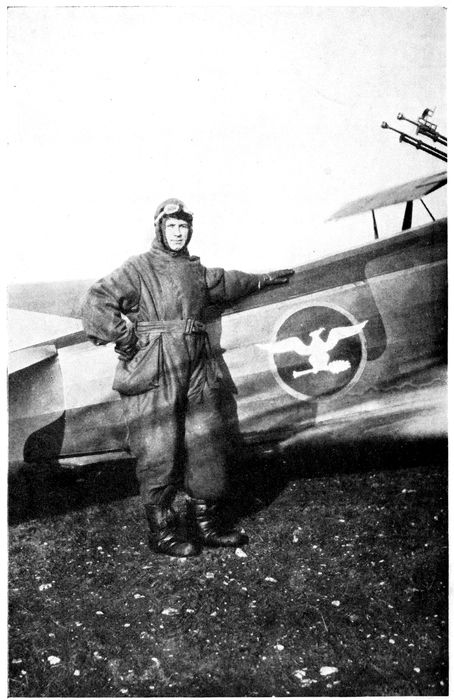
Gen. William Mitchell, Commander-in-Chief of the American Air Forces at the Front
BY
ELMER HASLETT
Major, Air Service, U. S. Army. Distinguished Service Cross. Croix de Guerre Française. Recipient of two special citations by General Pershing for conspicuous bravery and exceptionally meritorious service. Operations Officer U. S. Air Service, First Army Corps at Château-Thierry and of First Army Observation Wing at St. Mihiel and the Argonne.
NEW YORK
E. P. DUTTON & COMPANY
681 FIFTH AVENUE
Copyright, 1920.
By E. P. DUTTON & COMPANY
All Rights Reserved
Printed in the United States of America
TO MY MOTHER
SOME WORDS IN EXPLANATION
vii
If any one should be interested enough to inquire
as to the reason for my becoming a sky spy, an aërial
observer, a deuce, or whatever one chooses to call it,
I should certainly speak the truth and affirm that
it was not the result of calm, cool and deliberate
thought. I have always had a holy horror of airplanes
and to this day I cannot say that I exactly
enjoy riding in them. My sole reason for flying
now is that I am still in the Air Service and there is
not an excuse in the world for a young man being
an air officer if he does not spend a part of his time
in that element. Every boy in his own heart wants
to be a soldier whether his mother raises him that
way or not: as a boy and as a man I wanted to
be an infantryman. Upon being commissioned in
Infantry following the First Officers’ Training
Camp, I was about to have a lifetime’s ambition
gratified by being placed in charge of a company at
Camp Lewis, Washington, when along with two hundred
other new officers I was ordered to Fort Sill,
Oklahoma, for assignment with the Missouri and Kansas
troops. I had been enthusiastic over the infantry,
I liked it fine, and most of all I wanted to
train my company and lead them into action. Arriving
at Fort Sill, we found that the troops had
viiinot arrived and would not come for at least a month.
Meanwhile we stagnated and lost our pep. The
papers were full of the pressing need of help at the
battle front and still all around I could see nothing
but destructive delay. It was the old call of the
individual—for though my heart was set upon the
ideal of training my own men for the supreme test
yet I could not stand the delay. I was determined
to get to the Front and with that as my paramount
ideal, I would take the first opportunity that would
lead to its realization.
The chance came one morning early in September,
1917, when one of my friends, Lieut. Armin Herold,
caught me going out of the mess hall late (as usual)
for breakfast and excitedly told me that the Division
Adjutant had just tacked a little notice on
the door at Headquarters, in response to an urgent
request from General Pershing, that ten officers who
ranked as First or Second Lieutenants would be
detailed at once for training as airplane observers,
and would be sent to France immediately upon completion
of their training. Volunteers were requested.
That part about “training as airplane observers”
was Greek to me—I did not know that
such things existed—but at the word “France” I
pricked up my ears like a fire horse at the sound of
a bell. My decision was formed then and there. I
was going to be an aërial observer, whatever that
was, and nothing was going to keep me from taking
that chance, my first opportunity, to go to France.
I almost lost my breakfast at the thought of
ixhaving to ride in an airplane, but that promise to
send me to France at once was an anesthetic to my
better judgment, and I right away made my first
flight, au pied, covering that ten acres of plowed
ground over to the Division Headquarters in ten
flat. I rushed in and made application.
The Divisional Signal Officer was a Major who felt
that aërial observation was an extremely technical
branch. He did not know a terrible lot about it,
and told me that he had placed the bulletin on the
board only a few minutes before and was surprised
that I had responded so quickly. He asked me a
lot of trick questions as to my technical training,
and now, since I have made a fair record as an
aërial observer, I don’t mind making the confession
that I, along with other conspirators desiring early
action, made several “for the period of the emergency”
statements. The Major wanted to know if I
knew anything about civil engineering. I told him
I did, but, as a matter of fact, I hardly knew the
difference between a compass and a level. He asked
me if I got sick in an airplane. I flinched a little,
but told him “No,” the presumption of innocence
being in my favor. He then asked me if I had ever
ridden in one. I laughed so heartily at this joke
that he was convinced that I had. The truth of the
matter was that previous to that time if anyone had
ever got me in an airplane they would certainly have
had to hog-tie me and drag me to the ordeal. He
then wanted to know what experience I had with
mechanical engines. I told him that my experience
xwas quite varied and that I considered myself an
expert on mechanical engines, having had a course
in mechanical engineering. This was all true, yet I
do not, to this day, know the principles surrounding
the operations of an engine, and if anything ever
should go wrong, the motor would rust from age
before I could fix it.
My application was hasty and unpremeditated
and I did not actually realize what I had done until
I got outside—then, just as after the unpremeditated
murder, the murderer will turn from the body and
cry, “What have I done?”—so I turned from that
house with exactly the same thought, and as I walked
back to my barracks I kept repeating to myself,
“What have I done!” “What have I done!”
The big question then was to find out the nature of
the new job for which I had volunteered. The first
question I asked of the two hundred officers when I
returned to the barracks was: “What is an airplane
observer?” No one present could enlighten me.
I had volunteered for so many things in this man’s
army which had never panned out either for me or
for any one else, that I was naturally apprehensive
as to the result. Having in mind such dire consequences
should the thing turn out, and yet hopeful
of a more pleasant outcome, I alternately anticipated
and naturally brooded a great deal over the thing.
The next morning I learned that the telegram had
actually been sent to the War Department at Washington
and that my name had been first on the list.
xiThe package of fate was not only sealed, but clearly
addressed, and I was the consignee.
In a remarkably short time the orders came from
Washington and ten of us were loaded in a Government
truck and transported to Post Field. Of
those ten Lieutenants it is interesting to note that
seven got to the Front, and from those seven one
can pick five of America’s greatest sky spies. Every
one of the seven was decorated or promoted in the
field. They were Captain Len Hammond, of San
Francisco; Captain Phil Henderson, of Chehallis,
Oregon; Captain Steve Barrows, of Berkeley, California;
Captain How Douglas, of Covina, California;
First Lieut. Armin Herold of Redlands, California,
and First Lieutenant “Red” Gunderson, of
Spokane, Washington. These were the first officers
detailed in the United States to “Aërial Observation.”
The Observation School at Fort Sill was just being
started and was yet unorganized, so after a very
extensive course covering four weeks of about one
hour a day, in which we learned practically nothing
of real help, we were ordered to France for duty.
After an unusually short stay in the S.O.S., or
Zone of the Rear, we get to the Zone of Advance at
a place named Amanty, where we were stationed at
an observer’s school, and, after a very incomplete
course there, we were distributed among French
squadrons operating over the Front, in order that
we might get some actual experience, since the
Americans had no squadrons yet ready for the Front.
xiiBut a word as to the reason for this book. Here is
how it happened. We were at this school at Amanty,
hoping each day for orders to move us on up to the
real front. It was in February, 1918, and one day,
by a great streak of good fortune, Major Schwab,
the school adjutant, picked on me as I was passing
the headquarters. “Hey, what’s your name!” he
said, to which I replied, with a “wish-to-make-good”
salute.
“Here!” he continued, in a most matter-of-fact
way, “you are excused from classes this morning.
Take the commanding officer’s car, go down to
Gondrecourt, and pick up three Y.M.C.A. girls who
are going to give an entertainment out here this
afternoon. Report them to me.”
This was an unexpected pleasure, so, with all
pomp and dignity, I seated myself in the rear of a
huge Cadillac, with “Official” painted all over the
sides of it. It was my first ride in the select government
transportation—I had previously drawn
trucks. Then we whisked along the ten miles to
Gondrecourt. The surprise was a happy one, because
the three girls were peaches, and, an aviator
being a scarce article in those days (and I wore my
leather coat to let them know that I was one), I was
received most cordially.
We had just started back to the camp, and I
was Hero Number One of Heroes All, when they
all harped as of one accord, demanding if I would
not take them up in an airplane. This is a feminine
plea which never seems to become old, because every
xiiigirl you see nowadays still asks the same question.
But I maintained silence on the subject of taking
them up. So, they talked about aces, seemingly
positive that I was one of those things—what a
wonderful flyer I must be—and a lot of other bunk,
until I began to feel exalted as if I were of the
royalty, for it seemed that I was being worshipped.
I interrupted their wild rambling to ask if they
objected to my smoking. Of course, being a hero
aviator, there was no chance for objection. So, as
I unbuttoned my leather coat, threw back the left
lapel, and pulled out a stogie from my pocket, the
eyes of one cute little frizzle-haired girl fell upon my
aviation insignia, which, of course, consisted of only
one wing. Wild eyed and with marked disdain, she
exclaimed sneeringly to the others, “Oh, he’s only
an observer! A half aviator!”
Actually I had not claimed otherwise, but, as long
as I live, I shall never forget the sting of those
words, and especially the biting insinuation on the
word “only.” To their minds I was a branded
hypocrite. Talk about the poor man standing before
the criminal judge and being sentenced to the
impossible “99 years” in the penitentiary; well,
take it from me, this was worse, for my foolish pride
had been embellished to an acute cockishness by this
preliminary adoration, but my soaring little airplane
of selfish egoism took a decided nose-dive—it
smashed my whole day’s happiness.
The other girls, and in fact this little frizzle-topped
girl, too, realized immediately the impropriety
xivof the remark, and tried in the most sincere way to
temper the sting and alleviate my apparent embarrassment.
The only hollow remark I could offer,
in my futile attempt at indifferent repartee, was to
the effect that pilots would be aces always, and observers,
being the lowest card of the deck, must be
deuces. They laughed—I don’t know why—perhaps
to jolly me along. I intended to say something else,
but they took advantage of the necessity of my taking
a breath—by laughing—so I dropped the
“deuce” gag, but, as the conversation went on, the
more chagrined I became.
When we finally got to camp, I turned over the
precious cargo to the camp adjutant, and then
struck out for a long hike by my lonesome to walk
it off.
But, like an “ignorant idealist,” heeding the call
of the fair sex, I went to the entertainment that
afternoon, and, as I left the hut with several other
observers, we met the entertainers who were now
walking along in company with the commanding
officer. Of course, we all saluted, the commanding
officer sloppily returned it, and the party passed on.
Then this same little frizzle-top, red-headed girl, as
if by afterthought, recognized me, turned around,
and begrudgingly nodded as if meeting a disgraced
member of the family. She disdainfully called the
attention of the commanding officer and the other
girls to my humble presence by saying, “He is the
observer that came out with us in the car—you know
the ‘deuce,’” and, I might add, she laughed lightly
xvand shrugged her shoulders. I’ll tell the world it
hurt my pride, and I was off with all of womankind
for the time being. I had labored under the impression
that an observer was some big gun in aviation.
Believe me, she took it out of me.
In fact, these two incidents with this young lady
revealed to me for the first time the real insignificance
of my position as an aërial observer. A thousand
times afterwards, when I still wore an observer’s
insignia, people would look at it and, for
some psychological reason or other, they always
seemed to say either by sound or facial expression,
“only an observer.” Even to-day, as throughout
the war, the same haunting epithet follows the observer.
In fact, in the American Expeditionary
Force, we had an unofficial rating of military personnel
which classified the various grades as follows:
general officers, field officers, captains, lieutenants,
pilots, sergeants, corporals, privates, cadets, German
prisoners and last aërial observers. And no matter
which way one considered it, the aërial observer was
the lowest form of human existence. For a long
time he was not even eligible for promotion or command.
Indeed, in the game of war, he was the
deuce—the lowest card of the deck—and the first
to be discarded.
So far as official recognition is concerned the
observer is gradually coming into his own. After
comparing the fatalities in the various branches of
aviation, it is agreed as one of the lessons of the war
that the observer has had a hard deal as have also
xviobservation pilots and bombardment pilots. In
recognition of this principle, the Director of Air
Service in a letter of January 5th, 1920, in declining
to sanction the word “ace,” wrote as follows: “The
United States Air Service does not use the title ‘Ace’
in referring to those who are credited officially with
five or more victories over enemy aircraft. It is not
the policy of the Air Service to glorify one particular
branch of aeronautics, aviation or aero-station at
the expense of another.... The work of observation
and bombardment is considered equally as hazardous
as that of pursuit, but due to the fact that
the observation and bombardment pilots are not
called upon merely to destroy enemy aircraft, it
should not be allowed to aid in establishing a popular
comparison of results merely by relatives victories.”
I notice that the Director, in spite of the nice things
he said about the observation and bombardment
branches of the service, has expressly referred to
“pilots,” which of course makes me peevish. But
so it is. The Director undoubtedly intended to include
observers; indeed, the observer is the man who
does the shooting from observation and bombardment
planes—but it is the same old story—the
observer is so insignificant that he was just naturally
overlooked. Indeed, an observer is only a quasi-aviator,
as a friend with a legal mind once said—and
after he used that word “only,” I hated him.
And in public appreciation, they consider the observer
as the deuce—the card without value—with
no definite status, just an inexplicable freak habitating
xviiaround aviation. The common acceptation of an
aërial observer is a mild, passive, sort of a guy, who
wears nose glasses, is mathematically inclined, and
who, in battle, is privileged to run from the enemy,
being, as it were, tamed and “too proud to fight.”
Thus, to present to the public a more consistent
version of the real life of the observer at the Front
in his various rôles, and hoping in a way to dispel
this very unfortunate public misunderstanding, this
book of my own modest experiences as an observer
is presented for consideration under the title “Luck
on the Wing.”
Major Elmer Haslett has made a valuable addition
to the literature of the World’s War in writing
the volume to which these lines must serve as introduction.
“Luck on the Wing” has two distinct sources
of value: first it presents a clear, graphic picture
of the life led by our fighting airmen during the
three great actions in which American soldiers
played so important a part—Château-Thierry, St.
Mihiel, and the Argonne—and best of all the picture
is a truthful one: and, second, it, all the more forcibly
because often quite unconsciously, brings out
clearly the lack of understanding of the functions of
Air Service, a lack which in the final analysis was
responsible for the greater part of whatever of dissatisfaction
and disappointment with this branch of
the Military Service there existed in the American
Expeditionary Forces in France.
Since the Armistice there have been published a
great number of books on the War, the majority of
which have been the work of actual participants—of
officers and enlisted men. But so far as the Air
Service of the United States is concerned Major Haslett
has, in my opinion, in the relation in simple narrative
form of some of the adventures he himself met
with Overseas provided not only the most interesting
story but one of the very few which the future historian
xxivwill find of considerable value when he sets
himself to the task of compiling Air Service History.
“Luck on the Wing” is the story of an American
observer. The claims to fame of the fighting pilot
were early recognized in the World War. The Ace
soon became a public favorite. The War Correspondents
were quick indeed to realize the news potentialities
inherent to the “Knight of the Air” and
their dispatches made the world familiar with his extraordinary
and ordinary adventures. The peoples
of the World followed with the zest that the American
baseball fanatic follows the baseball victories,
the scores of the World’s great Aces. But to the
observer fame came in rather homeopathic doses, if
it came at all. And most observers are willing to
take oath it came not at all.
That there were exceptions to this rule, that the
very important work of the observer was not entirely
lacking of official and public recognition, is a
source of personal gratification to me because as
Commander of the American Air Forces at the Front
I personally knew and fully appreciated the great
value of the work done by this class of Air Service
officers. Major Haslett is deservedly one of the exceptions.
The variety of his war service qualifies
him better perhaps than any other American Air
Service Observer to write of Air Observation: the
efficiency of his work is attested sufficiently by the
fact that he was rapidly promoted from Lieutenant
to Captain and from Captain to Major. His personal
daring and courage, and the extent of both, need
no testimony and indeed could have none more eloquent
than the citations he received and the decorations
awarded him.
xxvTo say that this officer or that officer was the
“greatest” fighting pilot or the “greatest” observer
in the American Air Service overseas would, assuming
that it were possible, and many hold that it is
impossible, assuredly be improper; but of Major Haslett
it may be said with entire propriety that the
value of his services was certainly not exceeded by
the services rendered by any other observation officer
in the American Air Service. And it must always
in after life be a source of great pride and satisfaction
to this officer to know that he successfully executed
every mission upon which he was sent up to
the day that he was shot down far behind the enemy
lines in the Argonne after an unequal but protracted
combat with superior enemy forces.
Few men even in the Air Service had so many
and so astounding adventures as befell the author
of “Luck on the Wing,” and of these, fewer still
lived to tell the story. In simple but vivid language
Major Haslett tells in this book of many of his
astonishing experiences. Life at the Front with him
was just one adventure after another—from his first
trip over the lines when he sat in the observer’s seat
in a French plane perfectly at ease and in blissful
ignorance of a French battery’s desperate efforts to
signal him that there was a squadron of seven German
Fokkers over him. Through this first adventure
his amazing luck carried him safe (or was it a Divine
Providence moving as ever inscrutably?). And this
same amazing luck carried him safely through an even
more remarkable adventure. While under heavy
ground fire on an artillery mission he was thrown
out of his “ship” but caught the muzzle of his machine
gun as he went over, and in some way managed
xxvito pull himself back into the airplane—and then
completed his mission. But on September 30, 1918,
even Major Haslett’s luck deserted him and he was
shot down and captured. The rest of the war he
spent mainly in unsuccessful efforts to escape from
German prisons.
“Luck on the Wing” tells of these adventures—and
others.
It is appropriate in concluding this brief introduction
to tell of some of the work of Major Haslett
overseas which he himself cannot well mention. Much
of this officer’s service at the Front was spent as
Operations Officer. As such his duties did not require
him to execute missions over the lines himself.
Major Haslett insisted always on doing not only the
full share of such perilous work as would fall to an
officer not in an executive position, but more. His
argument to his commanding officer was that only by
experience over the lines could an operations officer
thoroughly master his work—a theory that he went
far toward proving.
Whenever ultra-dangerous work presented itself
this officer was quick to volunteer. Major Haslett
was more than an observer, he was a student of air
operations. He was among the first of the American
officers to prove that low flying over German trenches
was not only possible but was a method of effective
attack for airplanes. At the time that he was shot
down he was engaged in working out the problems of
adjustment of artillery fire on moving targets by
airplanes—a question of prime importance in warfare
of movement.
This officer during the course of his service at the
Front not only contributed exceptionally distinguished
xxviipersonal services over the lines and as an
operations officer but he also contributed ideas and
suggestions of considerable value in the development
of Air tactics and Air strategy, and as I have mentioned
before he had the proud record of successfully
executing every mission which he undertook during
his entire service at the Front with the single exception
of the mission he was on when he was shot down
by superior enemy forces.
With entire frankness Major Haslett has told the
story of how he succeeded in getting an assignment as
an observer and in later getting duty with Colonel
Brereton’s squadron at the Front. And by his own
account he has shown with equal frankness that he
had no hesitation in overcoming obstacles to this accomplishment
by any means that came to hand. Perhaps
some of the fastidious may find something to
criticize in this. But Major Haslett’s all-impelling
motive was to serve his country by meeting his
country’s enemies on the battlefield. And it was this
same all-impelling motive which gave inspiration to
the personnel of the American Air Service, which
brought to the Air Service proud achievement and
dauntless courage in action. Service against the
enemy is a good soldier’s ambition. This motive carried
Major Haslett to the very front rank of all
American observers, and gave him the adventure of
which he tells in “Luck on the Wing.”
William Mitchell,
Brigadier-General United States Army.
Washington,
Feb. 24, 1920.
LUCK ON THE WING
I BEGINNER’S LUCK
1
We had been up with the French Squadron for
about three weeks and it had rained every
day or something else had happened to prevent flying.
We had a wonderful social time, but our flying
had been so postponed that I actually began to
think that the French did not want us to fly, probably
lacking confidence in our ability, so, one day I
walked up to the Captain and by means of his imperfect
English and my perfectly inelegant French
we managed to perfect some close, cordial and personal
liaison. I told him that we appreciated the
long, drawn-out dinners and the very excellent quality
and quantity of the red wine and the white wine,
but that actually we came up to take our first trips
over the line and learn a little about observation.
He shrugged his shoulders and said that he felt
quite sure that we would be there for three or four
months and that there was absolutely no hurry. I
told him he did not know the American Army, for
while I would admit that we had not shown much
2speed up to the present time in getting squadrons on
the Front, or in the manufacture of our ten thousand
airplanes a month, or our five thousand Liberty
Motors, at the same time, somewhere, someplace,
somehow, someday, we were going to make a start
and that I was quite positive that we were not
going to have any observers unless the French got
busy and trained some for us, and that in my mind
we would be leaving mighty soon and it might look
sort of suspicious on paper if we had been with
the squadron a month and had never taken a trip
over the lines.
This sort of impressed the Captain and dear, old
fellow that he was, he immediately ordered “Mon
Lieutenant Dillard,” who was his Operations Officer,
to arrange for me to accompany the next mission
over the lines, as a protection. This was scheduled
for the next day. A French Lieutenant by the
name of Jones was to do an adjustment of a battery
of 155’s, and I was to accompany him in another
plane to protect him from any attack by German airplanes.
That night we played Bridge until midnight,
whereupon we all shook hands, as is the French custom,
and departed for our various billets. My
Bridge had been rotten—my mind was on a different
kind of bridge: How was I to bridge that next day—What
did it hold? The night was chilly as the devil
and as I picked my way in the darkness I could hear
very plainly the rumble of guns and could see the
artillery flashes very clearly, although the front was
3twenty kilometers away. I began to think about my
first trip over the lines that was soon to come. I
was mentally lower than a snake. I hadn’t prayed
for some time and I was just wondering whether
or not I would pray that night. My solemn idea of
prayer was that it was an emergency measure. I
was always reverently thankful to the Maker for
His blessings, but He knew that for He must have
known my mind. I believed that God helped him
who helped himself, but when the question was too
big for man to control, then it was the time to invoke
the help of the Supreme Being. I was inclined
to think this case was only a duty of war in which
man should help himself. So, I had decided that
I would go ahead and handle it as a man to man
proposition, reserving invocation for a more serious
situation, but as I was getting pretty close to my
billet I heard a sudden noise that gave me a real
thrill—a big cat jumped out of a box and ran directly
in front of me. It was too dark, of course,
to tell the color of that cat, but the condition of my
mind convinced me that it could be no other color
than black and that it was an omen that bad luck
was sure to come my way. When that cat ran in
front of me my Man theory was gone, absolutely;
I knew quite well that I was going to pray.
I lay abed for fully three hours, going over in
detail every piece of the machine gun, what I was
to do in case of a jam of the machine gun, and what
I was to do in case of stoppage of the gun. I was
trying to picture in my mind silhouettes of the different
4German airplanes that had been on the wall
at school, and which I, to my regret, had not
studied. Then I remembered reading stories of how
poor boys were shot down, and most of them on their
first flight, and I thought of airplane accidents and
I thought of my girl. In fact, I had such a variety
of thoughts that when I finally dozed off, that
quasi sleep was a nightmare, and when from nervous
and physical exhaustion about three-thirty o’clock in
the morning I reached the point where I was really
sleeping, I was suddenly shaken, and, of course, I
jumped as if branded by a hot poker. It was my
French orderly telling me it was time to get up to
make my flight. I first realized the truth of that
little saying, “There is always somebody taking the
joy out of life.” He was crying, “Mon lieutenant!
Mon lieutenant! Il est temps de se lever,” which is
French for “It is time to get up.” I had a notion
to direct him to present my compliments to the
Captain and to tell him that I was indisposed that
morning but I couldn’t speak French well enough
to express myself, so, there was only one thing to
do and that was to make a stab at it. I dressed and
took my nice, new flying clothes which I received
at Paris, and hobbled the kilometre and a half out
to the field. The crews were already there and also
the other flying personnel. Of course, I put on a
sickly smile as if to help things along, but honestly
there wasn’t much warmth in my hand-shake. The
Frenchmen were all excited, standing around a telephone
in the hangar and I found out from one of
5them who spoke English, that they were trying to
get the balloon to find out about the visibility. This
pleased me for my feet were already chilling and I
was as strong as horseradish for each moment’s delay.
In a few moments the Lieutenant put the
receiver on the telephone and with some sort of an
ejaculation I saw the face of Lieutenant Jones, who
was to do the adjustment, assume a very dejected
attitude, for while these Frenchmen are the strongest
people in the world for lying abed in the morning,
yet they certainly hate to have their trouble in rising
come to naught by reason of impossibility to perform
the mission assigned and in this case I found that
the visibility was “mauvais,” or “no good.” So,
we just hung around.
In a few moments one of the enlisted men came
up to me and saluted me smartly, and mumbled a lot
of stuff about “voulez vous” something, “voulez
vous” being all I could understand, so I beckoned
one of the Lieutenants who spoke a little English
and he asked me if I wanted a “Raelt Saeul” or
“ordinary open sight.” I had never had a course
in aerial gunnery and I did not know the difference;
in fact, my experience in machine guns consisted
of two lectures by a guy who didn’t know
much about it, at Fort Sill, the dismantling of one
gun and about an hour and six minutes in an open
firing butt at Amanty, France. I was afraid “Raelt
Saeul” would be something technical, in which case
I would certainly demonstrate my ignorance, and to
my dazed mind “open sight” certainly sounded frank
6and on-the-square, so, of course, I just shrugged my
shoulders and pointed as if I were perfectly familiar
with both but under the circumstances I would take
the “open sight.” They were both quite surprised
and tried to open the discussion upon the relative
merits of each, but I passed this up and made it
emphatic that “open sight” it would be. I found
afterwards that the “Raelt Saeul” was a great deal
more accurate. So, they put the machine guns on the
plane with “open sight.” I wanted in the worst way
to get around and monkey with those machine guns,
but I knew if I did I would certainly shoot some one
up or kill myself, so I laid off. It was a terrible
predicament; I knew I had no business going up
and my conscience began to hurt me for the sake
of the Frenchmen I was supposed to be protecting.
Incidentally I must admit, in capital letters, that
I had my own personal safety somewhat in mind.
But it was too late—I had to go through with it.
It was the proposition now of luck, and lots of it.
We kept on with preparations; it was still foggy.
At nine o’clock we went in an automobile and
got our breakfast, which for the Frenchmen always
consisted of hot chocolate and a piece of bread, but
for me it usually consisted of ham and eggs, and
potatoes, and jelly, and bread, and butter and coffee,
and as it usually consisted of that—as this was probably
my last breakfast it certainly would not consist
of less this time. So, I hied me forth after having
my “chocolate” with the Frenchmen, and gave my
7landlady her usual two francs, in return for which
I had the repast above accurately described.
We went back to the flying field and waited until
about eleven o’clock. I had made up my mind that
I was going through with it and the nervousness was
beginning to wear off. About noon it got real cloudy
and at twelve twenty-six and a half the first drop
of rain fell. Believe me, the exhaust action of my
sigh of relief was not unlike one of these carnival,
rubber balloons when it is dropped in hot water.
They, of course, called it a day, came in and had
“déjeuner” and gathered around the Bridge tables,
while Dillard played some very classical airs upon
the automatic piano which this squadron carried
with it.
In the middle of the afternoon the shower completely
ceased, while Sol came out in all his magnificent
glory; magnificent I say, to the farmer who
wants to till the soil, to the sweethearts who want to
go on a picnic, and to the washerwoman who wants
to dry her clothes, but for me, it was just like an
April shower on a new silk hat—I lost all my gloss—for
in a few moments “mon capitaine” came in and
announced that he felt we could get the planes
off the ground. We called up the battery and they
were ready so we climbed into the automobile and
went out to the field again. The mechanics rolled
those two dilapidated Sopwith planes out of the
hangars and gave those rotary engines a turn and
they began to burr. That whirr and burr felt to
8me just like the whirr and burr of the dentist’s burr
that gets in the middle of a wisdom tooth and hits
the nerve.
The other two American student observers were
out on the field. Phil Henderson, who always was
the head of his class and very mechanical by nature,
gave me a few added remarks about some technical
points of the machine gun, how to do in case of a
jam, etc., while Hopkins, the other American, jollied
me along. It was the first time I had ever had a
ride in a Sopwith. I do not know whether it was
from the fact that I was not used to climbing into
the Sopwith or that I did not know what I was doing,
but anyhow I stepped on that one particular part
of the fuselage which is supposed to withstand only
wind pressure and as a consequence my one hundred
and eighty-two pounds made a nice hole in the
canvas. Of course the Frenchmen had complex fits
but the pilot merely shrugged his shoulders as if to
say that it wouldn’t impair the flying qualities of
the boat. I honestly felt that the tearing of the
canvas was an omen that I ought not to go. But
already the other plane was taxiing out to take off,
and it was like a drowning man grasping for the
last straw. They came up to see if I was fixed
all right. I was fixed, and in more ways than one.
I was holding on to the fuselage for all I was worth.
Fortunately they noticed that I was not strapped in
and so they proceeded to strap me.
They said something about the “mitrailleuse” but
the “mitrailleuse” did not worry me—I said it was
9all right. I did not know what they were talking
about, although I afterwards learned that they meant
machine guns, but what they wanted me to do was
to shoot a couple of bursts into the ground to see if
the guns were working. I tried to twist the tourelle
(the revolving base upon which the machine gun
turns) around to shoot in the proper direction, but it
would not budge. The Corporal came around and
pressed a little lever which released the mechanism
and, of course, the tourelle turned just as easy as a
roulette wheel. Then they told me by means of sign
language to point it at the ground and pull the
trigger. I did, but I almost broke the forefingers of
both hands trying to pull the trigger. The pilot was
getting nervous; I think he clearly saw that I was
probably like the American airplanes that they had
heard and read so much about—I was not coming
across. The Corporal came around to determine the
trouble. I shrugged my shoulders, French fashion,
as if to say “ça ne marche pas,” that is, “it doesn’t
work,” but lovely as that gun lad was he did not
give away my ignorance but simply said “Vous avez
oublié”—“you have forgotten something,” and he
proceeded to pull down the little latch on both guns
which unlocks the entire mechanism. Then he
stepped out of my way and I pointed the guns.
Having, as I said before, almost broken both my
forefingers trying to pull the trigger, I pulled in the
same manner, force and fashion, and before I could
get my fingers off of the triggers I had almost shot
both of the magazines full. I thought those guns
10never were going to stop firing. The Frenchmen
surely oil their guns and have a similar high strung
technique in pulling the trigger that our high-grade
artists on the piano have with staccato notes. I
could see by the expression on the faces around me
that they were indeed surprised at American methods
but anyway the guns worked, so I said “tres
bien,” and my pilot taxied the plane out, gave it the
gun, and took off.
This plane did not have telephones; if it did they
would have been useless, because I did not Speak
French understandably, and the pilot did not know
a word of English, and we had not agreed upon
any signs.
The other plane had gained considerable altitude
and after about fifteen minutes I was able to orient
myself by means of my map and to know that the
aerodrome was directly beneath me. We had gotten
about three hundred meters above and two hundred
meters behind the first plane. In a few moments
the first plane headed due north and we followed.
Over to my right I saw very plainly Souilly, which
was later destined to play such an important part in
the history of the American Army, being the Headquarters
of our First Army in the Argonne drive.
In a few moments more I saw below me the shell-torn
country and the two peaks known as “Hill 304” and
“Dead Man Hill”—to the French they are known as
“Trois Cent Quatre” and “Mort Homme”—which
were so prominent in the fighting around Verdun.
Only a few days before I had visited these same
11places on the ground and I had seen the myriads of
human bones in that mighty cemetery which, though
originally properly interred, were being continually
brought to the surface by the constant and incessant
artillery fire. I thought at the time how terrible
it must be to live day and night in the trenches of
that graveyard, knowing not but that in the next
instant you, yourself, might be the one destined to
replace the remains which, from four years of exposure,
were crumbling into the dust. On that visit
the thing that impressed me was the minuteness of
the individual, for both German and French, though
the deadliest of enemies in life, found a common
resting place, side by side, in the same yard of earth
for which they had given their lives to gain.
While on the ground I had seen an airplane high
in the heavens and I thought how much more wonderful
it was to fight in that broad, open expanse of
atmosphere where the extent of one’s endeavor is
not limited by a section of a trench, but only by the
blue heaven, the reliability of the motor and the
accuracy of the machine gun. It is strange how
one’s outlook can change. Man is the slave of temperament
and romantic dissatisfaction. Excite him
and he pleads for quiet, give him solitude and it
becomes unbearably monotonous. I was enwrapped
by environment. When in the trenches of that
bleached boneyard the monotony and horror were
agony to me—so many bones and those huge trench
rats—I wanted in the worst way to get out of those
trenches and back to the airdrome, to take my
12chances mid those silver-winged birds that floated
so gracefully above. But, when I actually got over
this same graveyard at six thousand feet altitude
that same picture again entered my mind. I knew
I would soon be crossing the lines. I began to think
of the terrible fall of six thousand feet before hitting
that cemetery, and then I thought what I would
look like after I did hit. In fact, cold shudders crept
through me like a continued electric shock. For
once I was downright scared and if I could have
changed places with the stalwart guardians of those
trenches in the rat-ridden graveyard beneath I would
have run for the opportunity. I would, at least,
have something solid to stand upon.
We were going straight toward the lines and directly
in front of Hill 304 and “Mort Homme.”
They stood out extremely clear and plain. The perpetual
shell fire had left its mark for while the surrounding
country was green with vegetation, yet
these two hills bulged forth, bald and barren. Hill
304, or “Trois cent quatre” was the worse. It had
nothing growing on it at all. In fact, it was so bad
that one of the polite, French jokes on a bald-headed
man was to call him “Trois cent quatre.” After
flying parallel to the line for a few minutes we
turned back toward our own lines. I determined
that the French observer had found his target and
would soon be calling his battery.
This trip was a complete surprise because I understood
from my meager instructions that even when
crossing the line the enemy anti-aircraft artillery,
13commonly called “the archies,” would certainly open
fire, but everything was calm and peaceful—except
my mind. I looked at my map to find where the panels
were displayed. Panels are large, horizontal strips
of cloth which are placed on the ground in various
symbols near the battery and are used as a means
of communication between the battery and the airplane.
The airplane communicates with the battery
largely by means of the radio telegraphy, but as it
was not practicable to receive the radio signals in
the plane from the ground, we used these panels.
Among the signals formed by these white panels,
which are quite clearly discernible from the air, are
those meaning that the “Battery is ready to fire,”
“Battery has fired,” “Fire by Salvo,” “Change
target,” and many, many others including the signal
“There is an Enemy Plane near you,” which is the
most dreaded panel that can be displayed. I might
incidentally mention that there is another panel
which means “There is no further need of you; you
can go home.” Now this may not have a great
deal of significance to the average layman, but I’ll
say that when the sky spy has been tossed about
for a couple of hours on the archie billows he joins
the union which says that “go home, you’re fired”
is the greatest little panel of the whole panel alphabet.
So, in a few minutes I picked up the location
of the panels and I had a little chart on my map
board showing the meaning of these many panels.
I had had some instructions upon them while at
Observation School, but I had depended on crossing
14the bridge only upon arrival thereat, so I did not
pay a great deal of attention to them. The descriptive
chart on my map board interpreted the panels
in French so I was not sure that the chart would
do me any good after all for my knowledge of technical
or any other kind of French was less than
meager. I saw the panel “Battery is ready,” and
then the plane headed toward the lines and in a
moment the panel changed to “Battery has fired,”
so I looked over in Hunland but I could not find
where the shells had hit. In my mind they were
hitting everywhere so how could I pick out the particular
ones that Jones was directing. In a moment
I again saw “Battery is ready,” and again I looked
directly toward the supposed target. Suddenly I
saw four shells strike real close by and my vigilance
was rewarded for I was to witness an actual
adjustment of artillery fire against a real enemy.
Then I took a genuine interest in the adjustment
and paid very close attention to every detail. In
fact, I was so attentive that I was oblivious to the
fact that my mission was to protect the leading plane.
Delving into this new game I indulged in certain
psychological conclusions which took my mind off of
the thing that had been troubling me; namely, the
unpeaceful condition of my mind. This was most interesting.
They had fired about six or seven salvos
and were coming very near to the target, which was
a cross-road. I thought it must be a wonderful observer
to guide the battery with such unfailing
accuracy and I looked forward to the time when I
15too might be a genuine sky spy and with American
batteries seek out the enemy and destroy him, for
after all was not the position of the aerial observer
one of the most dangerous of the army, the spy—for
his greatest mission was to find out the intentions
of the enemy and if he succeeded in bringing
back the information without being seen all would
be well, and if he was seen it meant he had to fight
for his life. Like the spy he, too, lived within the
lines of the enemy.
This was the gist of my thoughts when I suddenly
looked down at the panels and saw a huge “Y” displayed.
I did not pay much attention to the “Y”
but I saw Jones’ plane taking a steep spiral toward
the earth. I did not call the attention of my pilot to
it because I thought “Y” was something usual,
meaning, perhaps, that the signals were not understood
so Jones was going down low to get closer to
the battery in order that his wireless could be heard,
but Jones kept going right on down near the battery
and finally kept circling around close by at about
three hundred feet altitude. I looked around and
did not pay any great heed; I thought Jones would
soon climb up again. In a few moments I saw the
battery take in their “Y” and put it out again; take
it in and put it out, as if to attract my attention.
Then I saw them running back and forth with individual
panels in different directions, which had
a sort of cinema effect. Then they brought out
double panels and made a great, huge “Y.” Then
I thought “Y” must mean something if they were
16making all that fuss about it, so I thought “Y”—“Y”—“Y”—“Y.”
It was a memory test for me.
I felt I should remember some of those panels and
here was the chance to think clear and quick. I went
through the various fake memory courses I had
taken and tried in every way to determine the meaning
of “Y,” so after trying to figure it out by the
law of association, the law of likeness of sound, the
law of impress and five other such hopeless laws I
began to regret that I had paid so much for that
memory course. Then I casually took out my map
chart to find out what “Y” meant. As I ran slowly
down the list of signals I came to “Y” and looking
across it I saw “Attention! Ennemi avion pres de
vous,” which in English means “Look out! Enemy
plane close to you.” I thought I did not know
French but I certainly acquired it with the speed of
lightning. I dropped my map board like a shot,
jumped up in my cockpit, grabbed my machine guns,
released the tourelle, and whether I knew anything
about that tourelle or not, it followed me as I
spun around three times in a complete circle of three
hundred and sixty degrees with the speed of a ballet
dancer—I was bent on getting anything near me.
I stopped—looked frantically at the pilot, expecting
to find him dead. He had turned around to find out
what the rumpus was about. I did nothing but to
give him a sickly smile for I had nothing else to
give. They had a signal commonly used among observers
to describe a cross with the forefinger and
point when the observer saw a German plane, but
17this was among the thousand things I had not learned
about aerial observation. So, he went on, straight
flying, just aimlessly drifting on.
I gradually calmed myself and looked into the sky
above me and I saw seven airplanes which were hidden
from the view of the pilot on account of the
position of the wing above him. I was quite sure
from the lectures I had had in America from instructors
who had never been at the Front, that one
could easily distinguish an enemy airplane by the
huge black cross that is painted all over it, and so
I skimmed my eyes over them trying to discern the
cross. I could not, and yet the airplanes stayed
about six hundred meters above me and kept on
circling around. I decided that I was being duped
and that there was some under my tail, so I hung
my anatomy over the fuselage and after a hasty
examination I was convinced that the only airplanes
in that sky, except our own, were the seven above
me, and Jones, who was down by the battery still
circling around. I looked down at the panels and
they were still frantically waving that “Y” and
peering at the planes above me I saw that they were
still circling around. I did not know what to do. In
fact, I did not do anything for fully thirty seconds,
except to watch those planes, but they did not make
any sudden maneuvers or show any inclination to
attack. I looked down again and they were still
putting out that big “Y” and my pilot was just
floating along as if nothing had ever happened; in
fact he had never seen the panels and was not paying
18any attention, having undoubtedly an abundance
of confidence in the ability of the American observer,
and as I could not disappoint him in his splendid
judgment as to my ability I just used my perfectly
splendid logic and decided that if they were German
planes they certainly would have attacked me before
this time, and since they had not attacked, they could
be no other than French; and the solution was that
the battery had probably received notice from the
Squadron Commander that there was a green observer
up and so they were undoubtedly flashing this
“Y” trying to play a joke on me, believing that I
would run home, and thinking, perhaps, that I had
not seen Jones go down in his rapid spiral. So, I
decided to show them that they could not fox me
and I just stayed up there, floating around. After
I had stayed up there for about fifteen minutes Jones
pulled out for home, and when I saw him shoot off in
that direction I decided that perhaps the signal had
been changed and “Y” meant that “there is no further
need for you,” and that they were just trying to
attract my attention so that we would start home.
I decided I would not show any more ignorance
than I had and would say nothing of the incident.
So we went home and I felt pretty good that I
was in sight of the airdrome again and still alive
and that nothing unusual had happened after all.
Jones got there about five minutes ahead of me.
Meanwhile the battery had called up the Squadron
and told them that the observer in that second plane
was either the bravest man they had ever seen or the
19biggest idiot, that he had stayed up there daring
seven Germans to attack him single handed, while
they had toiled feverishly for fifteen minutes with
“Y’s” and double “Y’s” trying to give him warning
and that his utter disregard of their signals
had so unnerved the crew that fifty per cent. would
be sick for a week. So, of course, the entire flying
personnel, including Adjutants, Sergeants, Corporals,
Lieutenants and Aspirants (Cadets) were
there, as well as the Capitaine, to meet and greet
us. Jones, of course, had gotten out and also told
them about our narrow escape from the seven Huns
and you can imagine the excitement and ejaculating
of a bunch of Frenchmen when anything so preposterous
as this should happen, especially with a
new American who as yet was untried in valor on
the battlefields of France.
They were thoroughly convinced that I was an
unusually hardboiled soldier and that I had just
dared the Germans to come down, and knew all the
time that they were Germans and that I was really
seeking a fight with the seven. Imagine the reception—they
all ran up to the plane, double time, including
the rather heavy Captain, waving their
hands and shouting, but their remarks were so jumbled
that I could not grasp the entire meaning.
They all came up and shook my hand and patted me
on the back and said “Bravo!” “Tres Fort!” and
“Vive l’Americain!” and a lot of other stuff. I
was not much excited about it because I thought
perhaps that was customary as it was my first trip.
20Then, just as suddenly as if they were waiting to
hear a pin drop, everything became quiet, and they
demanded my story. Strangely enough I was perfectly
convinced that we had done nothing wrong, so
I asked one of the Lieutenants who spoke a little
English to tell me what it was all about. He threw
his head back in great surprise and demanded in
low tones, “Did you not see those seven planes above
you?” I quietly answered, “Certainly, I saw those
seven planes,” for I did. Then he continued in the
same low voice, “And did you not see the battery
putting out the ‘Y’ with the panels?” I said, “Certainly!”
Everybody and everything was as quiet as
death, and then the light began to come to me just
as the sun’s rays so suddenly and rapidly dispel
a fog, and I knew exactly what the next question
was going to be. He said, “Those were German
planes, didn’t you know it?” At those words I
almost faded away but this was the real time for a
little “emergency” drama, so I assumed the rôle
of a modern Daniel emerging from the Den and
shrugging my shoulders with a very much emphasized
forward motion of the chest, I bellowed, “Sure, I
knew they were Germans all the time. I didn’t run
(emphasizing “I”) because I wanted to say I had
shot down some Boche on my first trip over the
lines.” Their fond expectations of the bravery of
the Americans and incidentally my prowess were
met. They were proud of their new ally. Then
came many cries of “Bravo! Bravo!” and indiscreet
whispers of “Croix de Guerre,” and we all went
21home, with the American Sky Spy about the most
popular fellow he has ever been.
That night we had a real banquet at which I
bought the champagne and the red wine. While
we were celebrating I was going over the whole
matter and long before I went home that night I
realized that it was more than luck and a “handful
of Marines” that had saved me from those seven
Huns. It was manifest destiny, for I found that
the reason those German planes did not attack when
they had me cold was that one of the aerial tactics
in vogue at that time, was to send one plane low as
I was, with a strong pursuit patrol high in the clouds
above so that when the enemy attacked the lower
plane the pursuit planes high above could dive on
the enemy, thus having the great advantages of position,
speed and surprise. The seven Huns thought
I was a dupe—I was, but not the kind they thought.
Mine was a case of ultra-distilled beginner’s luck.
II HARDBOILED
22
Every soldier from the General to a private
sooner or later gets his reputation. It comes
through observation of a man’s action and attitude
by his fellow soldiers. Those who early in the game
get a favorable reputation are indeed fortunate
while those who get in bad, so to speak, are generally
strictly out of luck for reputations are like postage
stamps—when once stuck on they are hard to take
off.
There was one reputation which many sought but
which represented to me exactly what a real man’s
nature ought not contain—this was the common prefix
to one’s name of “hardboiled.” The accepted
meaning of this word varied with localities, but I
did not like it even in its most liberal and favorable
interpretation.
In every locality except the front, the common
acceptance of the term “hardboiled” indicated one
who in any position of authority was a pinheaded,
tyrannical crab, who was so engrossed in himself and
his big stick position that he was entirely oblivious
to the feelings and rights of those he commanded.
In other words, one who neither sought counsel nor
23permitted argument. At the front, however, common
usage had changed the meaning of this famous term.
There it ordinarily referred to the soldier who had
the maximum quantity of bravery and the minimum
amount of common sense and who purposely
flirted with death for the fun of it and who valued
life somewhere between eight cents and two bits,
war tax not included. I paraphrase Mr. Shakespeare
in that some people are naturally hardboiled,
others acquire it and still others have it thrust upon
them. I must add another class which has grown
quite common since the war is over; that is, assumed
hardboiledness, and it is ordinarily recognized in the
blowing of one’s own horn lest it be not blown for
true enough the genuine hardboiled soldier in the
fighting interpretation of that word, is strictly a man
of action and not words.
It is, of course, safe now for the parlor sofa soldier
to explain to his audience just how much help
the rest of the Army gave him in winning the war.
I sometimes pull this gag myself when there is a
good chance to get away with it. For those who,
during the war, were in the rear waiting for the
chance to get to the front it was also healthy to
emphatically emphasize just what wonders they
would accomplish when fortune favored them by
sending them to the lines. There it was entirely a
matter of environment for there was no likelihood
of those perfectly harmless bluffs being called since
there was no possible opportunity at hand to demonstrate
the modest announcements of their prowess.
24But take it from me as the greatest lesson I ever
learned, it is the most ill-advised speech possible
when one arrives at the front and begins to scatter
broadcast promiscuous remarks either about one’s own
particular courage or any one else’s lack of it, for,
believe me, you will no more than get the words
into sound than they will be called and called
strong. At the front they have the peculiar faculty
of making immediately available full opportunity
for demonstrating daring, bravery, or any other
manly virtue that the newcomer claims as a part of
his makeup.
The now famous 12th Aero Squadron formed, with
the 1st Aero Squadron, the first American Observation
Group at the front. It was located near a little
village called Ourches, about fifteen kilometres northwest
of Toul. Upon completion of my training with
the French, during which time I had just the one trip
over the lines, I was assigned to the 12th Aero
Squadron. My time over the lines amounted to only
fifty-five minutes. The only thing I knew about sky-spying
was what I had read in my books and what
I had picked up in our embryonic course of instruction
at the schools. Just as soon as I had gotten
to the squadron I began to hear wild rumors of how
the Commanding Officer was going to send back to
the rear all those observers who did not have sufficient
experience over the lines and that he expected
them all to have had, at least, ten trips over the
lines. I immediately realized that I had no chance
25whatsoever with that standard, so my only hope was
that the Commanding Officer would be a nice man
and that I could talk him into making an exception
in my case. I found out that the squadron was
commanded by a young Regular Army officer by the
name of Major Lewis Hyde Brereton. No one I
could ask seemed to know a lot about him, for the
squadron was just being organized and would not
operate over the front lines for a couple of days, at
least. So I had no dope on the manner of man I was
to approach and who fortune had destined should
become the leading and controlling influence of my
life at the front.
Captain “Deacon” Saunders, who has since been
killed, had been one of my instructors at school and
he had been designated by Brereton as Chief Observer.
“Deac” was a wonder. It was his duty
to round up the wild observers and present them
to the Commanding Officer, who cross-questioned
them as to their experience and the like. So, “Deac”
grabbed me eventually during the morning of the
second day and took me over to meet His Royal
Majesty, the Commanding Officer of an actual American
Squadron at the front. He was quartered in a
wooden hut commonly known as an “Adrian
Barrack.”
Saunders gave a sharp military knock of three
raps and I, of course, expected to hear a nice, soft,
cultured voice say, “Won’t you come in?” What
I heard, however, was considerably different. “Who
26in the hell’s there?” The voice was sharp and impatient,
and it suddenly made me feel “less than the
dust beneath thy chariot wheel.”
Captain Saunders spoke up, “Sir, I have a new
observer reporting and would like to present him to
you.”
“Who in the devil asked for him?” came from the
inside.
“Sir,” said my godfather, “he was included in
the list sent down by Headquarters.”
“Well! Is he there now?” said the power within.
“Yes, sir, right with me now,” was the reply, and
I began to pull down my blouse and otherwise mill
around in preparation for my entrance, for this last
question was encouraging.
“Well,” came the growl, after a discomforting
hesitation, “I don’t want to see him. I’m writing a
letter to my wife and I can’t be bothered.”
I felt about as welcome as a skunk in a public
park. In all my military experience I cannot remember
anything that really hurt me so much. I
wanted like a starving man wants food, to be a plain
buck private in the Infantry, for this was the most
inconsiderate sort of a bruise; it hurt me more,
of course, because I was an officer and was wearing
my pride on my coat sleeve. The only thing
that bolstered me up was the fact that I had finally
27gotten to the American front and I was willing to
sacrifice practically anything to stay there, but I
certainly realized that the man who put the “boiled”
in “hardboiled” was no other than Major Lewis
H. Brereton.
At noon I saw Brereton for the first time. Some
one was kind enough to point him out to me, and I
remember thinking at the time, “How can a pleasant-faced
youngster like that be so hardboiled?”
That afternoon, around three o’clock, “Deac”
Saunders said we would again attempt to get an
audience, and just as he introduced me, for some
reason, Saunders was called away, and I had no
friend to sponsor my cause before a hard judge.
Brereton had just finished his after-dinner nap and
was in the act of dressing in flying clothes to take
a little flight around the field, so being in a hurry,
he began throwing out snappy questions at me, as if
trying to establish a record in getting rid of me.
He lost no time in continuing his dressing, and did
not even ask me to sit down or to allow me to relax
from my painfully rigid position of Attention.
“What’s your name?” he commanded.
“Lieutenant Haslett, Sir.”
“I’ve got eyes,” he snapped. “I can see your rank
all right. How does it happen you are Infantry?”
“I volunteered, Sir, for Aviation and was detailed.”
“Volunteered or was ordered to volunteer?” he
queried. This hurt for it had been strongly rumored
28that in the selection of aerial observers, many line
commanders had gotten rid of their undesirables by
sending them to aviation—as observers.
“Volunteered, Sir!” I replied, bluffed and bewildered.
His attitude showed plainly that I did not strike
him at all well. I was still standing at attention,
when he sharply commanded “Sit down!” Believe
me, I did.
“How many hours over the lines?” he fired next.
Hours! That word removed the floodgate and the
last ounce of my composure ebbed away. My time
over the lines was measured in minutes and here
was a man talking in terms of hours, already. This
was the one thing I must avoid, so I sought to evade
the question.
“I have had eight hours in the air, Sir.” But
I did not lay any stress on “in the air.”
“I don’t care how many hours you’ve had in the
air. I asked you how many hours you have had
over the lines. That’s what counts with me,” he said
emphatically.
There was no escape. If I lied he could look up
the record, so, I decided to tell the truth from
necessity for this was not the place or time for
“period of the emergency” statements.
“Fifty-five minutes, Sir,” I confessed.
“I thought so,” and he nodded his head in proud
self-approval just as does the cross-examining prosecutor
when he finally forces an admission from the
29man at bay. “How many adjustments over the
lines?”
“None, Sir.”
“None!” he said with a noticeable inflection.
“How many in the air at school?”
“None, Sir,” I said meekly enough.
“None!” he exclaimed emphatically. “How many
on paper?”
“One, Sir,” I said, hesitatingly, for my energy was
getting low.
“Well,” he snapped, as if glad to dispose of me
on my own lack of merit. “You don’t know a damn
thing about observation. How in the hell did you
get to the front, anyway? I might use you as a
mess officer, but if you ever intend to fly over the
front you’ve got to go back and learn something
about your job. This is a service squadron, operating
over the front. Whoever ordered you to Toul
intended to send you to Tours, so I’ll call up and
get orders for you to go back to the rear.”
Tours, by the way, was the great aviation primary
school of the American Forces—while Toul in those
early days signified the front.
My pride fell like a demonstration of Newton’s
law of gravity. This hardboiled man could not be
approached by man or beast; and it seemed the only
thing I could do was to say “Yes, sir” and beat it.
I had visions of returning to the rear for further
instruction, yet here I was at the front—I had
finally realized my ambition and yet was on the
30verge of having it strangled by this man’s inconsideration.
I could not endure the thought—my
attitude changed in a moment—I determined to assume
hardboiledness, for after I had gotten that
close to the front I certainly was not going back
without putting up some sort of a fight. Besides,
I had a few days before written my folks and my
friends that I was actually at the front, and what
kind of a legitimate reason could I give in my next
letter when I would have to tell them I was no longer
at the front. The only legitimate excuse a soldier
has for leaving the front after being fortunate
enough to get there, is an incapacitating wound, and
while Brereton had dealt me several wounds which
were sure enough incapacitating, yet they were not
the kind that would put pretty little gold wound
stripes on my arm. Sure enough—I was down and
about to take the count.
There is always a way to get out of the most
entangling net. Sometimes it narrows down to only
one way and if the captive fails to choose that one
particular hazard out of a thousand plausible ones,
he is out of luck. So it was, there was only one
way to extricate myself from the web that Brereton
had spun so quickly around my whole ambition.
Very, very fortunately I had picked the winner. It
was a long chance, but I was Houdini this time.
This hardboiled monster had to be met with his own
style. So, with an assumed rôle of the hardboiled,
man-eating cannibal, I right away cut out that “sir”
stuff, took out my pipe and calmly started to fill it
31with “Bull Durham” tobacco, which was the only
brand our little canteen had in stock, and we were
really mighty happy to get even that.
Brereton plainly saw that my temper had gotten
out of bounds and that I was preparing to come back
at his apparently final decision either with tears or
blasphemy or both. But just as the matador seeks
to infuriate the bull by waving a red flag before
slaughtering him, so Brereton seeing me about to fill
my pipe with this well-advertised and justly celebrated
brand of tobacco, ventured forth.
“Lieutenant,” he said, clearing his throat by way
of emphasis, “I take it that you are about to use
some Bull.”
He said this quite seriously, without even a follow-up
laugh to dull the cutting bluntness of it. It apparently
was his day, for like the infuriated bull, I
was seeing red already. I made the final run to
gore him or be stabbed myself by his waiting poniard
of arrogance.
“You can call it Bull, if you like,” I fairly cried,
“but, pardon my frankness, the fact that you classify
what I have to say even before you have heard
it shows your premature judgment, just as you
prematurely judged my ability or lack of ability as
an observer before even giving me an opportunity
to demonstrate it. Of course, I don’t know whether
you have ever been over the lines or not, but if you
have, you will concur with me that the greatest thing
an observer needs is ‘guts.’ I don’t say I’m a
world’s beater in experience, but one thing I have
32and which can be demonstrated nowhere else but
over the lines,” and here I threw out my chest, “and
that is ‘guts’ or politely ‘intestines.’ Now, if that
asset means anything to you, you will give me a
chance to stay with the 12th. All I want is an
opportunity to render good service, and to show the
stuff I am made of. Now if you don’t want to give
me a chance I can do nothing further except to tell
you that I will get the chance elsewhere and that I
know more about observation than most of your
observers ever will know.”
Major Brereton was dumbfounded. When he
recovered he gave a real, ringing, golden, genuine
laugh, came across and said, “Damn it all, my boy,
maybe you’re right. I haven’t been over the lines
myself yet.”
I knew quite well he hadn’t. If it had been otherwise
I would have mended my speech considerably.
“But, old man,” he said, “I was only thinking
for your own good. Hell, if you want to be a damn
fool and go on over the lines, knowing as little as
you do, it’s not my worry. Go ahead!”
I thanked him and told him that I had to start
some time and I would be all ready to go over at my
first opportunity.
Fully decided to make myself at home I went out
to the hangars and to my surprise, I saw the same
kind of old airplanes we had used in the observation
school in France. They were an obsolete type
of French service plane, known as “A.R.’s”—Avion
Renault—which in English meant “Renault Airplane.”
33The accepted meaning to the Americans,
however, was “Antique Rattletrap.” The only good
feature about the A.R. was the dependable motor,
but they were very slow and did not fly well. They
might in those days pass for a second class training
plane, but to have them on the line, functioning as
service planes, was a great surprise to me. The life
of the airman depends very largely on the bus he
drives. We all wanted Spads, Salmsons or Breguets,
and, of course, any prospect of an American plane
in those days was a myth, so there was noticeably
keen disappointment when we found that we must
fly over the front in those old, discarded and obsolete
A.R.’s. However, they were all we had and so far
as I was concerned, I knew that my stay in the
squadron was largely by sufferance and I could not
afford to kick lest I be also kicked out, so I immediately
decided to think a lot, but say nothing.
Those first few missions over the lines were tame
enough. Happily enough I got in as substitute on
the first mission of the squadron over the lines. The
only diversion was the anti-aircraft artillery fire, or
the “Archies,” and there was nothing tame about
that. However, there was more activity in sight
for in a few days Brereton announced that he wanted
his squadron to be a specialized one and that he
desired the names of a few observers who would
volunteer to specialize in “Infantry contact patrol.”
“Infantry contact patrol” to my mind meant nothing,
so from force of habit I volunteered. The only
other observers who volunteered were Lieutenant
34Emerson, a fine, young fellow who was killed a couple
of days later, and Captain “Deacon” Saunders, our
Chief Observer.
Though I was not previously known in the squadron
I somehow became prominent right off, and with
it went the title of “Hardboiled.” So, when several
of my newly formed acquaintances solemnly asked
me how long I expected to live doing “Infantry
Contact Patrols,” I hied me forth to the Operations
Room and asked the Chief Observer what it was all
about. I was handed a pamphlet written by Colonel
William Mitchell, who was Chief of Air Service at
the Front. It started out with these words, “Infantry
Liaison, or Infantry Contact Patrol is the
most hazardous, but most important of all missions.”
My eyes began to bat like a heavyweight’s before he
falls for the count, and as I read on I came rapidly
to the conclusion that the volunteer system was absolutely
all wrong and the next time any of these nice,
uncertain jobs were offered I’d take my place in the
draft.
I found that Infantry Contact Patrol indicated the
airplane that gains contact with the infantry in
battle, which is done by flying extremely low over
the troops, finding the advanced lines, transmitting
signals, calling for reinforcements, ammunition or the
like, attacking machine guns or anything else which
is holding up the advance of the infantry; further,
that the great drawback to this kind of work is that
the infantry airplane is constantly under fire from
enemy machine guns and enemy pursuit planes,
which, of course, concentrate to hinder this all important
work. I decided that with my huge body in
a slow A.R. plane my life on this work would be
measured in minutes. It was a real scare.
An operation room of an American Squadron at the Front, showing battle maps, war plans and photographs
35There was no backing down since I had already
volunteered, so I began to study the bulletins, with
the greatest care. No attacks, however, took place
in this quiet sector so I hit upon the brilliant idea
of trying out this new work in practice on the Germans,
then I would be properly experienced should
there ever actually be an attack. The trenches in the
Toul Sector were well marked, especially around
Layeyville and Richecourt. So I studied those
trenches from maps, photographs and from the air,
until I knew them perfectly.
One evening I had as my pilot, Lieutenant Jack
Kennedy, who was one of our flight commanders,
and who was in for anything new and exciting, so,
we fixed it up that we would try out a practice infantry
contact on the Germans. When we finished
our usual evening reconnaissance of the sector, we
played around looking for a good situation that
might be assumed. When we got just above Richecourt,
which was the beginning of the German lines,
I discerned quite clearly, about ten, big, fat Heinies
slowly wobbling down a communication trench. It
apparently was a relief going into place. The trench
was unusually long and was not intersected by any
other trenches for some length.
36“Those Germans are bringing up ammunition reinforcements
for the battle,” I assumed. “They
must be stopped!” The ammunition was soup.
I called Kennedy, pointed them out to him, and
told him my assumption. Without waiting for a
signal, he dived like the winged messenger of fate.
Kennedy had been trained with the English Pursuit
Pilots and he was handling that big, slow, lumbering
A.R. like a little fighting scout. We came out of that
dive with a quivering groan, and Kennedy, at about
one hundred meters altitude, began to circle over
that communicating trench, waiting for me to halt
the procession. He was too fast for me, but when
I finally got my heart gauged down a bit, and my
Adam’s apple released from its strangle hold on my
windpipe, I began to make my final estimate of the
situation. The Heinies had stopped and were eyeing
us like country boys at their first circus. It was
easy. All I had to do was to pull the triggers, for
my guns were directly on them and the enemy reinforcements
would never reach its intended destination.
They could not scatter—they were rats in my
trap. Then an intensely human appeal struck me—poor,
belated, unfortunate Heinies—they were not
my personal enemies, and if I pulled the triggers
it would be little short of murder. To balance this
was another series of thought—they were enemies of
my country—of the United States—and, if I allowed
them to live, would probably kill many of our own
brave doughboys; perhaps they belonged to machine
gun squads; perhaps it was they who had killed my
37pals, Angel and Emerson, a few days before. Such
were my thoughts when suddenly, Spiff! Spang!
and two bullets went between me and the gasoline
tank, tearing a hole in the top plate. Spiff!!! Another
went through the fuselage, smashing into bits,
my hard-rubber wireless reel. It was no time to
indulge in psychological deductions—I realized that
I was being fired at from the ground, and like my
lumbering old A.R., I was about to pass from obsolescence
to obsolete. The application of proper
psychology indicated that since I was being fired at,
the war between the United States and Germany had
not ended and below me was the enemy. I was
conscious of something within calling me to “Do my
duty!” I did. The bullets began to sing at the
rate of six hundred per minute, and my tracer bullets
did not betray me. They were finding their mark.
Measured by the standard that an Ace is one who
gets five or more Boche, I became an Ace in a day—and
also the first American Ace. However, strangely
enough, when my friends to-day ask me, “How many
boche did you get?” I can truthfully say, “Between
seventy-five and a hundred,” but when they say,
“How many boche planes did you shoot down?” I
have to renig for I am not an Ace.
I was quite certain that my assumed reputation
of “hardboiled” would be justified by this day’s
performance. The mechanics took a just pride in the
holes in our plane and patched them over, as was the
custom, with miniature Iron Crosses, showing the
date of the puncture. The next morning I noticed
38myself being pointed out by several officers of the
squadron and this gave me the rather satisfactory
feeling commonly described by the English as
“cocky.”
Brereton had nothing whatever to say about the
mission but Captain “Deac” Saunders said “Bully,”
and called me “Hardboiled,” but my reputation
lasted only two days, four hours and twenty minutes,
for the Group Commander threw ice-cold water
over everything by saying that he considered it very
poor work, that it had no military value and that it
only encouraged reprisals on the part of the Hun
who would soon do the same thing. So, I was temporarily
classed as bone-headed, and a “dud” and
was in dutch all round. There was one little spark
of encouragement in a remark that Brereton made,
which got to me through the medium of a friend,
and it took away the sting of the Group Commander’s
criticism, for to me the only boss I had was
Brereton, and what he said was law. The adverse
remarks of the Group Commander hurt at the time,
I admit, but when Brereton said he did not exactly
agree with him that the mission had no military
value, and also several months later, when this type
of mission had so developed that we had special
squadrons in the Saint Mihiel and Argonne offensives
that did nothing but this particular type of work,
I was happy indeed. Later, all types of planes were
ordered to fire at troops on the ground when their
assigned missions were completed, and the opportunity
presented itself.
39Shortly after this mission, Henderson, who was the
Operations Officer under Captain Saunders, the Chief
Observer, left for the aerial gunnery school in the
south of France, with three other observers, to take
a month’s course in firing and then return to the
Front. This left the much coveted position of
Operations Officer open and, of course, everyone was
wondering to whom it would fall. It was the biggest
job in the squadron next to the Commanding Officer
and the Chief Observer, and since the Operations
Officer dealt directly with the observers I was mighty
anxious to find out who my new boss would be, so
that I could make it a point to get along with him.
That night Saunders came around and called me
out of a little game we were having—I thought perhaps
I was scheduled to go on a special mission of
some kind, but there was a surprise, undreamed of,
awaiting me.
“Haslett,” he said, “Henderson is going to
Caseaux to-morrow and I have recommended you to
Brereton for appointment as Operations Officer. He
kicks like the devil that you haven’t had much experience,
but he likes that mission you got away with
and thinks you are ‘hardboiled,’ so he may come
across. He is going to decide before breakfast to-morrow.”
I could not believe what he had said and humbly
asked him to repeat it all over from the beginning.
I slept very little that night, for to me this was
the biggest thing in the world, it would clearly indicate
40that I had made good and that my stay at the
front was assured.
The announcement on the bulletin board the next
morning was signed by Charley Wade, the best
Squadron Adjutant I have ever seen, and stated that
I had been detailed as Acting Operations Officer.
I was the happiest lad in the world. I don’t believe
any success I can ever achieve will make me as happy
as I was when I read that order. The first thing
I did was to consult Brereton and Saunders as to
how they wanted it operated. Brereton gave me no
dope whatever, except “to run it as I darn pleased
and if it did not please him he would soon get some
one who would.”
Thus I started. As new pilots reported I always
took them over the lines for the initial trip. Saunders
asked me to do this for he felt that I was either
absolutely worthless or extraordinarily good. If I
was worthless there would be no loss if the green
pilot killed me, and if on my part, I succeeded in
getting the pilot back safe, it would be wonderful
training for the pilot. Some logic, I reasoned—thus
my job of official breaker-in of new pilots. I say
“breaker” for a new pilot coming to the front must
be broken in just the same as a horse has to be
broken for riding or driving. It is equally true in
both cases that the first ride is the worst.
We had one boy who had been with us since the
formation of the squadron, but who had been sick and
was unable to fly. His name was Phil Schnurr, a
young lieutenant from Detroit, Michigan. Phil did
41not get his first trip over the Front until some time
around the first of June. Of course, I was the goat
and took him across. It was not new for me as he
was about the sixth I had broken in.
I emphasized to him that in my experience over
the lines among other things I had found that the
best way to get away from the “archies” was to dive
when they got near you for the reason that it was
much easier for the “archies” to correct deflection
than it was for them to correct range. Whatever
that means, it’s all right. Phil knew.
I decided that we would call on a battery and
adjust the artillery on an enemy battery in a woods
close by, which was causing our troops considerable
trouble, so I explained to Phil just what we would
do, going largely into detail.
The plane was a little shaky even at the take off,
and I decided right away that Phil was not quite
in the class with Rickenbacker, but I attributed the
cause to his natural nervousness, which would soon
wear off. After calling our battery by wireless for
several minutes they finally put out their panels and
we immediately went over to look for the hostile
battery that had been reported the same day. I
found it and we just started to cross the lines to go
back into France when Fritz played one of his favorite
tricks. The Germans allow the observation plane
to cross the line and come in for not more than three
or four kilometers, then when you turn to come out,
having followed you all the time with their range
finders, they suddenly open up with all their anti-aircraft
42artillery and generally catch you in their
bracket at the first salvo. You are bracketed when
they have fired the first shots—one above, one below
and one on each side of you. It is not a pleasant
position in which to be caught. But they did more
than that to us—they not only bracketed us, but one
shot got us right under the tail and when Phil heard
that burst, known commonly as “Aviator’s Lullaby,”
which is the most rasping and exasperating noise it is
possible to imagine, he remembered my admonition
to dive if they got close, so just as the tail went
up from the force of the concussion of the shell directly
below us, Phil pushed forward for all he was
worth on the control stick. The sudden jarring
of the plane from the explosion and the more abrupt
dive, released the throttle, throwing the motor into
full speed. And with one mighty jerk like the sudden
release of a taut rubber band, all three forces working
in the same direction, and aided by the flyer’s
greatest enemy, Newton’s law of gravity, that A.R.
omnibus started straight down in one terrible dive.
Poor old Phil was thrown completely out of the
pilot’s seat and was only saved from going headlong
into the open air by his head striking the upper wing
of the plane, which knocked him back into the seat,
dazed and practically unconscious. The “hardboiled”
observer in the back seat did not have a
belt, for my famous A.R. plane was not equipped
with them. I went completely out of the cockpit
and in that brief second I had one of the rarest
thoughts I have ever had—I was sure I was going to
43be killed and I regretted that it was in such a manner,
for it was, indeed, unfortunate that I should be
killed in an airplane accident when I might have
died fighting in combat—there, at least, I would
have had an equal chance with the enemy. As I
shot out of that cockpit with the speed that a bullet
leaves the barrel of a gun, my foot caught on the wire
directly underneath the rim of the cockpit. With
superhuman effort doubled by the intuitive hope of
self-preservation, I grabbed the top gun which in
those days was mounted on the top of the upper
plane. Backward I fell. For a moment I was completely
free of the airplane, in midair; as I fell
my chin hit the outward pointing muzzle of the machine
gun; I threw my arms forward and closed
them in the grip of death. I had caught the barrels
of my machine guns and the next thing I was conscious
of was that I was hanging over the side of
the fuselage, below the airplane, but clinging on to
those machine guns for dear life. The old admonition
“to stand by the guns, boys” was tame compared
to me. My watchword was “hang on to the
guns, boy.”
The plane had fallen about one thousand feet and
was still going, but stunned as he was, Phil was
doing his best to level her off. I was sure if he ever
did level her off the strain would be so great that
it would fold or strip the wings. I cannot account
for the strength that came to me, but I do know
that if I ever should get into a good fight, I only
hope I may again be that superman, with the agility
44of the ape riding the flying horse at the three-ringed
circus.
I scrambled up on those machine guns, grabbed the
rim of the cockpit and the brace of the tourrelle
and climbed in. My ears were splitting; I was
certain that the top of my head had been shot away,
for there was nothing there but a stinging, painful
numbness. My heart was beating at the rate of nine
hundred and ninety-nine round trips per second. I
felt that my whole body was being flayed by sharp,
burning, steel lashes. Then I suddenly grew as cold
as ice and passed out. It was almost a literal case
of a man being scared to death. When I saw the
light again I was limp in the bottom of the fuselage.
My first sensation was that we had crashed and I was
alive in the wreckage, but the drone of the motor
brought me to the realization that we were still flying.
Evidently Phil had gotten control again, so I
pulled myself up to my seat in the cockpit and got
my bearings—we were headed toward home. Poor
Phil had his eyes set straight ahead. At his right he
had a mirror which reflected the movements of the
observer, thus obviating the necessity of continually
turning around. When Phil saw my reflection in
that mirror, however, he whirled around at top speed
to verify it. His countenance changed from being
horrified to complete surprise and then to genuine
delight. He had evidently looked around immediately
upon gaining control, and not seeing me, had
realized that I had been thrown from the plane. He
45was going back to the airdrome to tell the horrible
tale.
I could read the look in his eyes, and I do not
know what in the world possessed me to do it, but I
gave a huge, roaring laugh that would have made the
jovial laugh of the old southern mammy sound
meager in comparison. Phil did not laugh, he only
gave a sickly, sympathetic smile. The boy was thoroughly
convinced that I had suddenly become insane—he
had justification for his conviction for there
was nothing in the world at which I could find a
reason for laughing at that time—either in law, fiction,
fact, heaven or earth.
I was still sort of dazed, but we were fast approaching
our airdrome. The thing that preyed on
my mind was that we had started out to do an
aerial adjustment and had not finished it. What
would Brereton say—and I was now Operations
Officer—what would the Battery say? Could I ever
get the results from observers when I did not bring
home the bacon myself. There was only one thing
to do—the adjustment started must be finished. I
shook the plane and spoke to Phil through the old
rubber tubes we had in those days. I told him
what had happened, but that I was all right now.
Then he told me what happened to him.
“How’s your head feeling now, Phil?” I asked.
“It’s cracked open,” he answered.
“Can you go ahead and finish this adjustment?”
I demanded.
46“Yes, I can,” he said, “but I’m not going to,
I’m sick.”
“So am I, but you know that’s no excuse at all.
Let’s try it,” I ventured.
He said nothing but turned his plane toward
Germany and we were again speeding toward the
lines.
The battery must have realized what had happened
or almost happened, so when I began to wireless to
them the location of the target, they were sportsmen
just like all the rest of that 26th Division and
they immediately put out the panel meaning “There
is no further need of you, you can go home.”
This was commendable on their part and it sorely
tempted me to take them up, but I quite well knew
there was no excuse to make for going home now
since we had both decided to finish it, so I immediately
called back and asked “Is Battery
Ready?” They, of course, put out the signal that
it was. So I gave them the coördinates of the target
and we started to work. We were both extremely
nervous and weak and the anti-aircraft kept firing
with unceasing violence. We stayed in the air for
exactly an hour and fifty-five minutes and fired a
total of fourteen salvos. But luck was the reward
of our perseverance. On the fourteenth salvo we
struck the huge ammunition dump next to the enemy
battery and I have never in my experience seen such
a huge and magnificent explosion. Our plane, five
thousand feet above the explosion, even quivered at
47the concussion. We, of course, announced to the
battery that they had hit the target and then started
for home. The last wireless was unnecessary, however,
for they had seen the explosion. It was visible
for several miles around.
We were so confused and nervous that we fiddled
around another half hour before we could find our
airdrome. We finally landed and poor old Schnurr
was a nervous wreck. Pride forbids me from accurately
describing myself.
Schnurr confessed to me later that he barely knew
how to fly, having had only a few hours in a plane,
but that he was so anxious to get to the Front that
he managed to slip by the “Powers that be” and
finally got there. He begged me not to tell it for
fear he would be sent back to the rear. Phil was an
example of the high-spirited boys who first led the
way for America’s aerial fleets. These high-hearted
men were America’s first and greatest contribution.
However, for Schnurr’s own good I decided that
he should have more training. I got Brereton off on
the side and whispered some things in his ear. He
was furious at the fact that a pilot had been slipped
over on him who did not know everything about flying,
and said that he would send Schnurr to the
rear right away, but when I finished whispering these
things in his ear he changed his mind, for I repeated
to Brereton that in my opinion the greatest thing
an aviator can have is nerve, or to again use the
Army term, immodest as it is, “Guts;” ability is
48only secondary. Then I told him how Schnurr had
gone on and finished the work and had blown up the
ammunition.
Brereton agreed to keep Schnurr, and we gave
him several hours solo flying under the instruction
of more experienced pilots before again permitting
him to go over the lines.
What happened to Schnurr? Well, he turned out
to be, in my estimation, undoubtedly, the best observation
pilot on the entire front, and he went
through the hard fighting at Chateau Thierry, Saint
Mihiel and the Argonne, and although he had some
of the hardest and most discouraging missions ever
given to a pilot, he was one man who could always
be counted upon to deliver the goods if it was
humanly possible. In fact, he became known as “Old
Reliable,” for he never failed.
On the matter of promotions and decorations Phil
Schnurr had the worst deal that was ever handed
to any one. He started as a Second Lieutenant and
ended that. He was never decorated although recommended
to my knowledge, at least eight times.
Something always went wrong. Where several proposals
would go in, Schnurr’s would never go
through. If any one in the American Army in this
War should have his chest covered with medals and
crosses from the Congressional Medal of Honor on
down—it is Phil Schnurr.
From this mission, which is small compared to
some of Phil’s later accomplishments, we were both
49cited by General Edwards, commanding the 26th
Division, as follows:
HEADQUARTERS 26TH DIVISION
AMERICAN EXPEDITIONARY FORCE
France, September 17, 1918.
GENERAL ORDERS
No. 78
Extract
4. By his accurate registration of Battery F, 101st
Field Artillery, on June 10, 1918, First Lieut. Elmer
R. Haslett, 12th Aero Squadron, caused the destruction
of a large quantity of enemy ammunition, his
plane being pierced several times during this dangerous
work. The Division Commander takes great
pleasure in acknowledging the valuable aid of this
officer and congratulates him on his skill and daring.
C. R. Edwards,
Major General, Commanding.
After this mission Brereton, himself, classified
both Schnurr and me as “sufficiently hardboiled.”
The boys took up the refrain and thus, after assuming
the attitude necessary, I finally acquired the title
and had the emoluments and incidental responsibility
thrust upon me.
III MY FIRST SCRAP
50
The early days in the Toul Sector are remembered
by the aviators in the observation end of
the game as quiet ones. All the time I was there
with the Americans I had never even seen a Boche
plane. I understand they were around all right, but
all of our young pursuit pilots of the 94th and 95th
Squadrons were so determined, individually, to
become the first American Ace that they scoured the
sky from daylight to dusk, and to such a degree of
success that the Boche thought it rather risky to even
leave their own airdrome.
About the middle of June the Rainbow Division
was down in the Bacarrat-Lunéville Sector and
having been there some time without aviation, it was
decreed that the 12th Aero Squadron, which had done
most remarkable work in the Toul Sector, should
proceed at once to a little place called Flin, near
Bacarrat, to work with the 42nd Division—the Rainbow—in
order that they might have more experience
in aerial coöperation.
We still had our famous old A.R. training busses,
although we had been again promised everything
from Spads to Salmsons. So, with our eighteen
51pilots and eighteen observers and our eighteen A.R.
busses we started for our new station, which was
about one hundred and fifty kilometers distant.
We were supposed to begin work on the following
day, just as in actual battle, for we were simulating
a real, active battle move. Our trucks left in the
afternoon about three o’clock and without mishap,
should have arrived there about midnight. The
planes were to wait until the next morning and fly
down. The truck train got there all right, and got
busy fixing up quarters and getting ready for immediate
operations. We expected to see our famous
eighteen planes arrive in a well organized, close
formation at about eleven o’clock that morning, but
at eleven they did not arrive and we heard nothing
from them until about three o’clock, when one of
our young pilots came from somewhere out of the
sky and landed. We asked about the other seventeen,
to which question he showed the greatest surprise,
and explained that he had been detained by
motor trouble and had been unable to get off with
the main formation which had taken off four or five
hours before him. Immediately Dame Rumor
stepped forth, and the absence of the other planes
was attributed to everything from being lost in
Germany to being shot down by a German plane.
While we were discussing the matter some one
noticed two planes very high in the air. We thought,
of course, that they were our planes and were probably
lost. Ideas were rampant as to how we were
going to signal them to get them down, when suddenly
52we heard the splutter-splut-splut, intermittently,
of machine guns way up in the sky. This was
new to us. We thought, of course, that some one
was merely trying out his guns. These ideas were
soon dispelled for following this short, intermittent
sound we heard one, steady, singing stream of
sound—then we knew that an air fight was on. We
did not have time to realize exactly what was happening
for the steady stream of fire suddenly ceased
and we saw one of the planes falling, out of control.
It was swaying back and forth like a falling leaf, and
filling the air with a miserable swish-swish sound.
The horrible speed of the fall caused both wings to
collapse and fold, and the compact mass soon came
diving toward earth like a huge torpedo. It crashed
with a terrible thud on the very edge of our own
field. When the awful horror of the moment
passed, we all started to run to see the Boche that
had been shot down.
We dragged two crushed and lifeless bodies from
the debris and in contrite and humble reverence to
our hostile brothers of the air we removed our caps,
while the Surgeon began to take off their flying garments
in order to find their names. It is hard
to imagine the ghastly horror of the shock we received,
when, upon unfastening the collar of the
outer-garment the green uniform of the German
aviator was not revealed, but instead the Royal
Seal of the Crown of England. Two brave, British
lads had made the Supreme Sacrifice. It is a memory
that will never be obliterated from my mind,
53and I can well remember how the sentiment of the
crowd changed like a burning slap, from icy but
human feeling to one of fiery hatred and cold-blooded
revenge. High in the sky above the victor
was winging his way back to the land of the Hun.
Young Davidson was the only pilot we had there and
we had only one A.R. on the field. It was the one
in which Davy had just landed. We knew it would
be foolhardy to send that Antique Rattletrap up
against that Hun, but every man in the Squadron
from the Chief Mechanic to the Major’s orderly and
the second cook wanted to go with Davy to avenge
our British brothers. Davy and his Observer, however,
took off but only got several hundred feet when
the motor stopped. We had no more gasoline, but
the Hun was already too far toward home and our
A.R. could never have climbed the altitude at which
the Boche was flying, so we were obliged to give it up.
There was no loss of morale, however. Matters
were too serious to even think of that. The thing
that was worrying us was what had happened to
our other seventeen planes. Had they all met the
fate of the British Tommies? Had they too been
caught unawares, for a lot of them had flown with
mechanics at the observers’ guns. They had undoubtedly
lost their formation and in straggling
about it was quite easy to suppose that they, too,
had become an easy prey for the Hun in the Sun.
Believe me, we worried. Not very long afterwards a
French soldier came along and handed us some
messages which had been received at the French
54telegraph exchange in a nearby village. They were
all from our aviators and the wires indicated that
they were scattered all over that country from Nancy
to Chaumont, and from Colombey-les-Belles to Lunéville.
The whole bunch had gotten lost and in trying
to pick their separate ways they had certainly made
a mess of it. I expected to hear of some landing
at Paris or Bordeaux, but while they did not do
that, after we finally plotted their various locations
on our map, take it from me, it was a study in polka-dots.
One by one they drifted in and outside of
one valuable plane that had to be salvaged, in a
couple of days we were able to work.
Brereton did not arrive with the squadron. He
had been ordered to General Headquarters for a
conference of some importance, which occasioned him
some delay. The morning he arrived, however, he
brought Henderson, Herold and Hopkins along.
They had been detached from us at Toul in order
to take a Gunnery Course at Caseaux, in the south of
France.
Henderson again took over his duties as Operations
Officer. Brereton called me in his office and
told me a big secret. He stated that there were big
things ahead—that we were going to Chateau Thierry
quite soon—that he would be Chief of the Air Service
for the First Corps and that I would be made a
Captain and the Operations Officer for the Corps.
He asked me how many times I had been over the
lines in the last month to which I answered that it
was about thirty times. He said that was too much
55and that I needed a rest. He then told me I should
not fly any more for a couple of weeks, so, I took him
at his word and settled down for a rest, meanwhile
forming plans for my new job. I strutted around
the Squadron and gave as my reasons for retiring,
that it was for my nerves and the doctor had so
ordered. The boys all fell for this line and they
were very thoughtful of me and asked me many
times each day as to the condition of my nerves.
In a few days, the 42nd Division was ordered out
of the line in order to prepare themselves for the
affair which we afterwards learned was Chateau
Thierry, and the 77th, which was the first National
Army unit to go in the trenches, was ordered in the
line. Their Artillery was not yet ready for work,
so, some of the 42nd Artillery stayed over to support
them. The first morning after the 77th took its
place in the trenches the Germans pulled off a raid,
the result of which put about six hundred of the
77th in the hospital from gas and wounds.
When the raid came off, the first reports we got
were from the French at daybreak. They said that
the boche had attacked along the entire divisional
front from Domévre to Badonvillers, and that we
should send out a plane at once and find the line in
order that the General might know where to send
reinforcements. It was Lieut. Hopkins’ turn on alert
duty, so, he took off right after daylight in the execution
of his first mission over the lines. Hopkins
had lots of courage—he was a brave fellow—he got
tangled up with the “archies” and a huge piece of
56shell tore away a part of his knee, but he stayed right
up there trying to execute his mission until he
realized he was losing consciousness from loss of
blood. I knew nothing about the attack and was
still in bed when they dragged old Hoppy in.
This looked like exciting business for us so when
they dragged Hoppy in, I got up and began to pay
attention. Meanwhile they had got the next man
on the “H” list—Lieutenant Armin F. Herold—whom
I knew quite well and he had already been
sent out to get the line. I helped lift Hopkins into
the ambulance to be taken to the hospital and then
went over to get my breakfast. I was about half
finished when some one rushed in and said that
Herold was also coming in. Of course, we hurried
out just as the plane taxied up to the hangar. The
mechanics lifted Herold out of the plane with his
right leg shattered at the ankle by machine gun
bullets fired from the ground. He, of course, had
been unable to get the line of our troops, but
gamely stated he had gone the limit to find our
troops having flown most of the time at about two
hundred meters.
I saw Brereton looking around for a new crew to
send out. I knew my name began with “H,” but I
knew also that I had been put on the resting list,
and furthermore was sick, according to the doctor,
so my mind was perfectly at ease. There were others
in our squadron whose names began with “H”—among
them, Henderson, Harwood and Hinds, and
we were not restricted to “H’s.” But Major
57Brereton was known to do funny things. I was
starting into the mess shack to finish my breakfast
when I heard that familiar voice and its equally
familiar inflection demand with a tone of final decision,
“Where’s Haslett?” I had a creepy feeling
run all over my ribs for I knew it was an off-day.
Brereton came into the mess hall after me. I certainly
had not gone out to seek him. Then he showed
the first and only sign of weakness I ever knew him
to display—“Haslett,” he said, “do you want to
go and finish this mission?” Always before he
would have said “Haslett, go and do this mission.”
I neither answered “Yes” or “No” for I could not
honestly answer “Yes” and I dared not answer
“No.” I simply started to get my flying clothes.
Johnny Miller, who had been the pilot for Hopkins
on the first attempt, and who afterwards was killed
at Chateau Thierry, begged Brereton to be permitted
to finish the job. Brereton agreed.
We got into an A.R. plane and I fairly filled the
cockpit with signal rockets for the Infantry. I was
determined that there should be no reason for the
Infantry claiming that they did not see any rockets.
Johnny gave her the gun, but as we left the ground
the engine failed. We got the plane back to earth
without a crash, although we were quite near to one,
and that was a premonition for me. I had always
figured that if anything mechanical failed, it was
certainly, a sign that I had no business in the air
that day. When that engine failed I told myself
“Goodbye.” I felt my time had come.
58We jumped out and got into another plane which
was the one they had brought Herold back in. The
cockpit was spattered from one end to the other with
blood, but we did not have much choice in planes,
so, we had to take what would run. The sight of
that blood and honest-to-goodness, downright fear
caused me to grow momentarily weak. I wanted
to get out, take the count, and worse. As we were
getting ready to take off one of my very dearest,
old friends ran out to the plane, all excited, as if
the spirit had suddenly moved him. It was Captain
“Pop” Hinds, who was killed later that same
day, in an airplane accident. “Haslett, God bless
you, old boy,” he said, fairly weeping—“something
tells me this is an off-day, and that you’re not
going to come back. You’ve taken too many chances
already. I don’t want you to go, old man.” Believe
me, that took all the pep I ever had out of
me. I leaned over the side of the fuselage and patting
him on the back said, “Pop, don’t let it worry
you. I’m the luckiest guy in the world—they can’t
get me.” And in my soul I thought, “Well, those
are my last words—they’re not half bad at that.
How will they look on my tombstone?”
So, I gave Johnny the high sign and we took off.
I could see Johnny was nervous because in taking
off, the wing almost scraped the ground. Herold
had told me where he thought he had seen a panel
displayed by the Infantry, so I first looked that
place over and then we flew along the Front at
exactly five hundred meters above where the line was
59supposed to be. I began shooting off my fire rocket
signals to the Infantry in order to get them to put
out their white panels from which I could mark
their location on my map, but regardless of the many
rockets I fired they did not put out a single panel.
We went down to four hundred meters, flew along
the line for fully twenty-five minutes and fired
rockets, rockets, rockets. Still there was no sign of
a panel on the ground. Down to three hundred we
went—no panels yet. I felt like going home because
I thought three hundred meters was plenty low
enough, especially on an off-day, but there was only
one thing to do—that line had to be located somehow
so, we went on down to one hundred. No
wonder they got Herold, the machine gun fire was
something terrible. I had already fired my last
rocket and was never so disgusted in my life for
there was no response. Finally with the naked eye
we located our troops at less than one hundred
meters. I hastily plotted their position. If ever a
man feels he needs a friend it is when he is going
through that awful machine gun fire at two hundred
feet and trying to be composed enough to accurately
mark on his map the location of things he is seeing
on the ground. We developed some very fine observers
like Wright, Baucom, Bradford, Powell and
Fleeson, who got to be wonders at this work, which
is, after all, the greatest work of aviation.
We had been up for about two hours, so, when
we landed the whole bunch came rushing out to meet
us, including Brereton. It was the only time I ever
60saw him run. I showed him the line and told him
how we got it—the holes in the plane from machine
gun bullets convinced him of the truth. I told him
I would hazard my little reputation that the doughboys
did not have any panels to put out, for if
they had displayed them I would certainly have seen
them.
He was genuinely peeved and after telephoning
the location of the line to appease the growing anxiety
of the French, we got into Brereton’s car to go
to Divisional Headquarters to find out what was the
matter with the Infantry.
We arrived at Bacarrat, went to the Division
Headquarters, and the Signal Officer, in reply to our
inquiry, told us quite unconcernedly, that the Division
had panels all right, but this had been their
first occasion to use them and they had not been
issued for the doughboys would get them soiled, or
might use them for handkerchiefs or the like.
Brereton, of course, was in a rage and we demanded
to see the Commanding General of Infantry. On duty
at the Infantry Post of Command was a Lieutenant
Colonel in the National Army, who had probably
held some big job in civilian life, but who was certainly
not born a soldier. He said that the General
had been awake all night and had just gotten to
sleep after the morning raid and so he did not care
to awaken him under any circumstances. Brereton
began to cuss in great style and said he’d be blamed
if he’d send his aviators out any more to be killed
unless he got some coöperation from the Infantry
61and it was a terrible note when the Chief of a
Service could not see the General when an all-important
matter was pending and that if this Brigade
wanted the Air Service to work with them they
had better show some willingness to help. He then
demanded that the panels be issued at once. The
Lieutenant Colonel began to show a little concern,
and although he was looking right straight at our
wings, he asked, “Are you aviators?” Brereton
said, “Yes, of course. What did you think we
were?” The old boy then showed some speed; he
got hold of the telephone and after saying “Sir”
many times in order to appease the wrath of the
General who had been so rudely awakened and so
as not to increase his disfavor, proceeded to tell him
that the Airplane Major was here, and wanted to
talk to him. Brereton was forced to laugh at this
new title and for some time afterwards we all called
him the “Airplane Major.” The General of course
realized the gravity of the situation and was also
mighty peeved about the failure to provide the
troops with panels. The mission ended with the
agreement that the panels would be issued immediately
and the General expressed his sincere regret
at the loss of our aviators, and, I believe, became
converted to the fact that the Air Service was also
a factor to be considered in winning a war.
On our way back to the airdrome we stopped at
Artillery Headquarters and they wanted us to go up
that afternoon and do an artillery adjustment, as
a couple of batteries were sorely in need of more
62accurate regulation in View of further raids by the
Germans. When the Artillery Colonel asked who
would do the work Brereton looked at me and I
looked at Brereton, and I knew it was settled.
“Why, Lieutenant Haslett here has been worked
pretty hard and I wanted him to rest up, but I guess
he can do this one and then take a rest.” The Artillery
Colonel was surprised, but I was more surprised
at what he said—“So you are Haslett! Well,
well, I’m glad to know you. Colonel Sherburne of
the 26th Division Artillery told one of our Majors
about a big mission you pulled off for him in the
Toul Sector. We sure will be glad to have you
work with us.” This was the first recognition of
this kind that I had ever gotten and coming from
Sherburne it was like a million dollars to me, for he
was one of the greatest men with whom I had ever
worked. Of course, after that compliment I was
delighted and I certainly would not have let any one
else do the adjustment at all. I felt like a hero
with three wings. I was determined to do the best
adjustment I had ever done in my life.
When we got to Bacarrat on the way to the airdrome,
an orderly handed Brereton a message which
dampened my spirit and determination completely.
It read that Captain Hinds—Pop Hinds—the old
man who that morning had told me about his premonition
that it was an off-day and that I ought not
go for I would not come back—was himself killed
while taking off from the airdrome, his plane having
gone into a tailspin. His observer, another “H”—Henderson,
63the Operations Officer, was seriously injured.
This news hurt me more than any I had ever
received. Pop was about forty-six years old and
had gone into the flying game simply from the desire
to help along American Aviation, having had some
little amateur training before the War. We had
tried our best to get him back from the front because
we realized that the old fellow didn’t have
much of a show against the Hun and under actual
fighting conditions, but Pop would not go back. He
was always the first to volunteer for any mission. A
braver man I have never seen. He was a real daddy
to us all and his great human understanding and
sympathy caused us to pay him a marked deference
and respect. He often won a lot of money from
the officers playing poker, but in his characteristic
unselfishness, he spent it all for candy, cigars, cigarettes
and tobacco for the enlisted men and mechanics.
He was their idol and there was little, if
anything, that they would not do for him.
Henderson was one of my best friends and happily
though he was not killed, it had a peculiar significance
to me that one hundred per cent of the day’s
casualties were “H’s.” It looked like an off-day
for the “H’s” without a doubt. There were only
three of us left—one was the Ordnance Officer, Hall
by name, who was not a flyer; Harwood, who was
busy as could be on some assignments; and myself.
The only “H” left was to do an artillery adjustment
that afternoon. I thought it might be a good
idea to put off that adjustment until the next day,
64but I could not get up the courage to tell Brereton
my honest convictions.
When we got to the airdrome every one was feeling
mighty low, because these were our first casualties,
outside of the loss of Angel and Emerson in the
Toul Sector. The bunch all felt that though the
sun was still shining and it was a good day for
flying that there were better days ahead. Even the
squadron surgeon sent out the recommendation that
the flying be suspended for the day. I felt quite
relieved for I could not conceive of any one going
against the recommendation of the “Medico.” But
this did not appeal to Brereton. In his characteristic
manner he loudly and emphatically announced
that he was not going to let a little thing like that
stop the War; if a squadron went to the Front they
must expect some casualties and that flying would
go right on. I did not eat any dinner; I did not
care for it; for, as usual, I did not agree with
Brereton. I honestly felt that flying ought to be
suspended in deference to old “Pop” Hinds if for
no other reason at all.
I really dreaded that flight and even the praise
of that Artillery Colonel meant nothing in my life.
No one came out to see us off. It was the wrong
atmosphere. There was gloom in the sky, gloom on
the ground, and gloom within our own beings. In
fact, the whole world looked like a dark cloud. The
ordinarily jovial mechanics were all acting like a
bunch of pall bearers.
Brereton gave me a pilot by the name of West,
65which to my mind seemed particularly pertinent for
I sure felt as though I were going in that direction.
For protection they sent a plane piloted by
Schnurr with whom I had previously had a narrow
escape and as his observer they sent Thompson
against whom I had no complaint at all, for Thompson
on his first flight over the lines with the French,
shot down an enemy plane. His presence, of course,
was no meager consolation, for while I did not want
any drawing cards along, I felt that if the Germans
were going to attack it would be a good thing to
have some one along who could do the fighting, because
my experience in actual fighting up to this
time put me in about the same class that the St.
Louis Nationals generally have in the Baseball Club
standing. I was at the bottom of the list. In fact,
Thompson was the only one in the squadron who had
so far had a fight and that was while he was with
the French.
When we got over our battery I began to call them
on the radio and they put out their panels. We
picked out the target which we had agreed upon
and sent the signal to fire. I had promised to adjust
two batteries. The plan was to finish the adjustment
of the first battery and then begin the second. So,
after an hour and a half I completed the first adjustment
after about fifteen salvos, which, I admit,
was rather rotten work, then I started on the second.
The name of my second target was “Travail
Blanc” which consisted of a section of the trench
which was especially heavily fortified with machine
66guns, having a sweep on our lines in the ravine
beneath. I had just given them their first signal
to fire, and of course, these batteries not having had
a great deal of experience in adjusting artillery fire
by airplane, were very, very slow in firing. Ordinarily
the observer can time the firing, as a prompt
battery fires immediately upon getting the signal
from the airplane, and the observer can see the burst
almost immediately thereafter. It is extremely important
to get the first salvo bursts, for from this
the observer knows approximately where to look for
the next. So, having pressed the key, I was oblivious
to all else in the world except the area immediately
surrounding Travail Blanc. I must have eyed it
for fully thirty seconds, which is an unusually long
time to watch one particular spot on the earth, for
with the speed of a modern German airplane against
my antique A.R., in thirty seconds the Hun could
get in a very advantageous place from out of a cloud
or the sun. I was still straining my eyes on Travail
Blanc when I heard the rat-a-tat-tat of something.
It was the first time I had heard machine
guns firing in the air while in the air myself, so
I felt that we had probably lost altitude and that
they were firing at us from the ground. I knew
that I could not remedy the situation now, so I again
turned my eyes toward Travail Blanc, when I saw
the four bursts of the salvo strike about two hundred
yards from the target. I had just started to
reach for my key to send the correction to the battery
when again I heard the long, continuous rata-tat-tat
67of a machine gun getting louder and louder.
I leaned over the fuselage to take a look at the
ground beneath me. I thought we should be high
enough so that they could not possibly be firing at
me and I could not figure what it was. I wondered
where Schnurr and Thompson, my protectors, were,
so I began to scan the air directly above me. As I
threw my head backwards a streak of fire crossed my
face barely missing me. I realized that “White
Work” (Travail Blanc) was all wrong; my immediate
target was “Dirty Work,” for instead of seeing
my protecting plane above me there was bearing
down upon us, with a speed that was indescribable,
and spitting a thousand balls of deadly fire at me
every minute, a German Albatros Scout Fighter,
and directly behind it were two others of the same
type. The Hun was already not over a hundred
feet from me and was coming on every iota of a
second with the speed of lightning and with a deadly
accuracy of fire that seemed to preclude any defense.
I had been caught napping and it was now only
a question of which one of the thousands of bullets
that were flashing all around me that would get me
first. He was so close that had it been necessary
for me to move my machine gun one particle of an
inch he would have finished with me before I could
have fired a single shot. The Hun very well knew
that he had caught me unawares and that I could
not possibly do anything to defend myself. Like a
flash my finger flew to the trigger of my machine
gun, which was resting in its ordinary position on
68the tourrelle. I did not move it an inch for fortune
had pointed it directly in line with the oncoming
German. Already the bullets began singing
from my gun and by the grace of good fortune they
were going directly into him. On he came and it
seemed that a collision was unavoidable, then with
the speed of lightning he dived under me. West
saw this dive and sharply banked the plane to keep
me in a firing position and as the boche began to
zoom to a position under my tail I again let him
have it. I was surprised at the apparent accuracy
of my guns. The Hun made a loop and dived
toward home. I knew he was disabled and could
not come back. There were still two other enemy
planes coming on, but strange things happen in the
air, for the other two did not fire a single shot, but
turned and flew toward a light fringe of clouds high
above us. I have never, however, been able to account
for their failure to attack simultaneously with
the attack of the first. For once I was close enough
to a Hun to see not only the Iron Maltese Cross but
also the fatal cross that stared me squarely in the
face. It is not a pleasant feeling. The first plane
got to Germany all right, but I am quite sure he was
forced to land before he reached his airdrome. I
have a hunch, too, that he took his machine guns
out on a cement sidewalk and broke them to pieces,
for if ever an aviator had the death grip on his
adversary they all had it on me. In a moment I saw
Schnurr and Thompson, who were flying quite low.
It seems that they were attacked first, which accounts
69for the first gun shots I heard, and the Hun,
having gotten on their tail first, they were forced to
dive. In a few minutes the two Huns in the cloud
were joined by a third, but fortunately the sun was
on our side, so the only thing to do was to watch that
cloud. Regardless of these Huns, Schnurr and
Thompson began climbing and soon reached their
position directly behind us.
I wanted to go home in the worst way but the first
law we had learned was that the presence of enemy
planes is no excuse in observation for failure to
perform the mission assigned. For once in my
career I had completely lost my courage and pointed
toward home. The starch had been taken out of me
completely and it was quite immaterial to me what
any one wanted to think about our quitting. I felt
that enough was enough and I had more than
enough. As we passed over our battery, however,
my mind turned to that new Division which had
just come in that morning and who were doing their
first service in the lines; in fact, it was the first time
one of our National Army divisions had been placed
in the line. They had been gassed on their first day.
What would they think?
This thought of what those lads in the trenches,
who, of course, had seen the entire fight, would say
when they saw an American aviator quit, changed
my whole attitude and, to be frank, saved me from
becoming a downright coward. I knew that nothing
helped the morale of the doughboys more than to
see American nerve displayed in the air and, on the
70other hand, nothing pulled them down more than to
see the lack of it. So, I shook the plane and motioned
West to turn around. I threw my switch in,
clutched the key and with an unsteady hand proceeded
to send the correction of the first salvo which
I had seen, but which I almost had not lived to
report.
I afterwards learned that the boys at the radio
receiving set at the Artillery checked each other up
on the receipt of this message, so dubious were they
that it had been sent from our plane. In a few
minutes the battery put out the signal “Received
and battery is ready.” I then told West to fly in
the direction of the line and the three Huns, although
I knew quite well if we flew that way we
were going to be attacked, but it would be a sportier
combat, at least, for I had been caught asleep for
the first and only time. I gave the wireless signal
to the battery to fire, but I confess I was not looking
at the “White Work” target, I was keeping an eye
on the three Boche in the sky, looking for more dirty
work. The Huns made no sign whatever to attack—they
simply kept circling above us in that slender
line of clouds.
This was the worst adjustment I have ever been
guilty of performing. I simply could not watch the
target. We went ahead for an hour and fifteen
minutes and during that time we fired a total of
seventeen salvos, of which I saw but seven, for my
mind was not on the work—I was busy with the
cloud. At the end of the seventeen salvos, the Huns
71came out of the sky and started in our direction,
then playfully changed their course and flew back
into Hunland. I watched them until they were
completely out of sight for I knew they would have
to go home some time. Actually I was never so
relieved in my life, not for the reason that we were
safe from further interruption, but from the fact
that we had buffaloed them and were the winners of
the day’s combat against great odds.
But I was certain that it was only a question of
time before they would have to leave that cloud for
a chasse (pursuit) plane does not carry the same
large amount of gasoline as an observation plane,
and can not stay in the air as long in a single flight.
I was delighted and beaming all over, and especially
happy to think, or rather imagine, what was taking
place in the trenches below us—those hardboiled
doughboys were, perhaps, congratulating themselves
that they too were Americans.
Our gas was running extremely low and it was getting
late in the evening, but with two additional
salvos, when my mind was free from “enemy
planes,” we succeeded in putting the battery directly
on the target. We then signaled for destruction fire
and signaled we were going home. Right above the
airdrome the motor stopped and we had to glide
in. We had used our last drop of gasoline.
As the airdrome was only twelve kilometers from
the line every one had seen the fight and had seen
us stick it out. It was really a joyous time and we
all got a real welcome. Even Brereton came across.
72It was the first and only time in my life I ever heard
him compliment any one or anything. What he
praised, however, was not “us” but the plane, in
that the Antique Rattletrap was not such a bad old
bus after all. Then every one got around the plane
to count the holes made by the enemy airplane. I
did not wait to see how it came out for I wanted
to get to my bunk and collect myself. I was told
later, however, that twenty-one holes were counted—then
the mechanics got tired and quit.
IV BRERETON’S FAMOUS FLIGHT
73
The one characteristic above all others that made
Major Lewis Hyde Brereton respected by both
those under him, and his superiors, was the fact
that he flew over the lines continuously and he
never assigned any one to a mission that he would
not do himself. All the boys were acquainted with
his record for he not only fought in the air, but also
on the ground. He kept his remarkable hold on
men for they knew he was a fighter from the word
“Go.” His whole career had been marked by a
series of brilliant ideas which were so radical and
revolutionary that they always took him into a fight
before obtaining their adoption.
For instance, he came to France with a large number
of other officers—about two hundred in all—who
accompanied Brigadier General Foulois, the latter
having come over to take command of the Air
Service of the American Expeditionary Force. The
majority of the officers in the party were Brereton’s
superiors, and it seemed that he was going to be
swallowed up with many others in the service of
supply, or in those days, what was called line of
communications, which was in the rear, for out of
74that large number it seemed that but few were destined
to reach the Front. Brereton immediately
asked for the command of a squadron at the front.
The authorities, of course, laughed at him and politely
informed him that the Americans only had one
squadron at the front and it had gone forward only
a few days ago and that all the other squadrons in
France had competent officers assigned to them; besides,
the other squadrons could not go to the front
for a long, long time on account of not having the
proper planes and equipment, the production
scheme in America having fallen down. This did
not sound encouraging to Brereton so he arranged to
have himself assigned to a tour of inspection at
Amanty, near Gondrecourt, which was the place
designated for our future observation squadrons to
assemble before going to the Front. When he got
there he found that it was true that only one squadron
had, as yet, gone to the Front, but that there
were three other squadrons then at Amanty—the
12th, 88th and 91st waiting for service airplanes
before moving up for action. All these squadrons
had old training planes, the A.R.’s—Avion Renaults.
The squadrons were to leave in the order of the
88th first, then the 91st and then the 12th, according
to the rank of the Commanding Officers of each.
Major Harry Brown was then in command of the
12th Squadron and Brereton found by accident, that
Brown was extremely anxious to get into the bombardment
end of the game and was more or less
dissatisfied that the 12th was to be made an Observation
Squadron. Brereton found that an assignment
to bombardment would more than please
Brown so he wasted no time on further inspection.
He had happened onto his great opportunity, and
he departed immediately for Colombey-les-Belles,
which was the Headquarters of the Air Service, Zone
of Advance.
The village of Vaux on the day preceding the Battle of Vaux
75Arriving at Headquarters, he presented Major
Brown’s request to be transferred to Clermont-Ferrand
to take a course in Bombardment in order that
he might command our first Bombardment Squadron.
This visit resulted in two orders being issued—the
first relieved Major Harry Brown from the
12th and ordered him to Clermont, and the other
designated as Commanding Officer of the 12th Aero
Squadron, an officer previously unheard of in aviation
at the front—Lewis Hyde Brereton.
Brereton asked permission to take his squadron to
the front immediately, whereupon they thought him
insane. It was pointed out to him that on account
of not having service planes the squadron could not
possibly get to the front before six weeks. Brereton
went into one of his famous “pouts,” in which
he puckers up his face like a baby about to cry, and
said that we would never have an Air Service on
the Front if they were going to be that particular.
His idea was to take what we had and use it. He
argued that since the squadron was going to work
over a quiet sector they could operate just as well
with training planes as with service planes, providing
they had machine guns.
76Fortunately, he had hit upon the psychological
argument for at that time every one in America was
demanding the reason why we did not have squadrons
at the front. There was a terrible mess going
on about the Liberty motor and the other airplane
scandals, so those in power agreed that it would
help conditions materially to be able to say that we
had squadrons at the front, rather than one squadron,
so after considerable argument Brereton was
authorized to take his squadron to the front at once
with such equipment as they had.
So, the 88th and 91st were left at Amanty and
the new comer arrived with orders in his hand to
move the squadron forward for action.
Thus when it came time to pick a leader for offensive
operations, General Mitchell knew what he
was about when he selected Brereton for the Château-Thierry
affair. He wanted a fighter and he
got a fighter, for with his characteristic foresight
Brereton prepared for any eventuality. He quite
well knew that something would likely happen any
day and he did not intend to let the observation
end fall down if it was humanly possible to prevent
it. His job was to accomplish the impossible; our
“quiet sector” units must be prepared for a great
and long offensive, and they must be gotten ready
quick.
Brereton selected Lieutenant Ben Harwood as his
Liaison Officer, Lieutenant Mathis as his Information
Officer and put me in charge of the Operations,
so, we were gone from morning until late at night,
77traveling between the squadrons, corps headquarters
and the various divisional headquarters, getting
proper coöperation worked up and, in fact, getting
some semblance of organization. The covetous eye
of the Hun already looked on Paris. It was only a
question of days until the German hand would be
extended to grasp what the eye had seen.
The Huns held complete supremacy of the air.
They dominated in the ratio of five to one and flew
about in droves of fifteen and twenty. Where a
fight on a mission had previously been the rare
exception to our flyers it was now the common rule.
We were very short of pursuit planes. Our Pursuit
Squadrons—four in number—were trying to
take care of not only our own Corps area, but also
other areas held by the French and which adjoined
us. As a result, very little direction protection was
furnished to the Observation planes. So, the boys
knew pretty well when they went out for a mission
that it meant a scrap.
There was only one time at Château-Thierry when
the Boche did not have the complete supremacy of
the air. This was on July first at the Battle of Vaux,
at which place Johnny Miller and I did the preliminary
adjustment and Brereton and I did the artillery
control for the Americans during the battle.
We had every American pursuit and observation
plane we could get off of the ground. There were
not less than ninety-six planes in that formation—their
mission being to protect the Infantry plane
and to protect Brereton and me, who were doing the
78artillery work. There was such a swarm of planes
above us that we practically never looked into the
sky, but kept our attention entirely on the work
before us. This was my idea of real protection. It
was the nearest we ever came to our big threat to
literally blacken the skies by droves of American
airplanes. However, none of these were American
airplanes, although the aviators were Americans.
This was the first time in the war that the doughboy
was brought to realize that there were really other
American aviators than those famous ground flyers
who took off and landed so often at the famous Hotel
Crillion Bar Airdrome in Paris and who were so
accurately described by Irvin Cobb.
The Vaux affair seemed to me just like the practice
control of artillery fire that I once did on the
blackboard in school exercises. It was really one of
the easiest jobs I ever did and for which I probably
received more credit. The previous day I had
passed over the town and was happy for the poor
peasants that it had been spared, for even though
in the hands of the enemy it was practically intact.
Now it was a shell-torn blot of destroyed homes,
made more desolate by the scattered bodies of the
German dead—and I had been one of the guiding
masters of its ruin.
The village of Vaux during the Battle of Vaux, July 1, 1918
79From the first of July to the fifteenth we were
continuously engaged in making the best possible
preparations for what we knew must come. On the
morning of the fifteenth it came. It came from
Château-Thierry along to Rheims. The first day we
did not worry a great deal for we confidently felt
that the Germans would never be able to cross the
Marne as all the bridges had been blown up, but on
the morning of the sixteenth day things were mighty
blue. An American pursuit plane immediately after
daylight, reported that the Germans had constructed
pontoon bridges in different places and were already
sweeping across the Marne.
This flight by a pursuit plane and the resulting
information was, I think, unquestionably one of
the greatest flights of the entire war. I did not
learn until several days later who the aviator really
was. No one seemed to know, nor could we find any
record on the regular reports. The French Army
Commander told me the source from which he had
gotten this timely information as to the presence of
the pontoons. It seems that General William
Mitchell, who commanded all American Aviation at
the Front, had been at the French Army Headquarters
during the night of the fifteenth, getting
the reports from the Front and making his aërial
dispositions accordingly. An hour before daybreak
on the morning of the sixteenth he left the French
Headquarters and without telling any one his intended
movements he drove his high-powered automobile,
with all haste, to the American Pursuit Airdrome
about fifty kilometers away. Climbing into
a single place Spad, the General hastily drew out a
pocket notebook and scribbled a few words to his
chief of staff, and handed this note to his mechanic.
Then the General headed his plane into the wind
80and with whirring motor sailed off into the somber
darkness. At the first glimpse of dawn he was over
Fere-en-Tardenois, fifteen miles within the German
lines. He saw the glare of the village, but the usual
whiteness of the roads was not there—they were of
a greenish hue, like the morning mist surrounding
them. It was hard to comprehend the magnitude of
this view. Heading south for five miles, the roads
presented the same aspect. From fifteen thousand
feet the General swept down to three thousand.
Here he could realize the awful fact of what was
taking place below him—the whitened roads were
green with the thousands of German troops driving
on toward the Marne with the steadiness and determination
of a huge caterpillar. On south he flew—the
Germans were everywhere—infesting the
whole salient like a plague of locusts. Reaching the
Marne, it was certain the inevitable had happened—one,
two, three, four, five—five pontoon bridges
already across and the onrushing Huns were marching
across in terrible precision.
It was singularly fortunate that the man who
undertook this hazardous mission was a rare tactician
and strategist. He realized the awful truth
where the ordinary airman would not have conceived
the possibilities of such a situation. The General
knew that the biggest German Army ever concentrated
was on the move in a final effort to intimidate
and conquer the world.
He made a landing in a small wheat field at the
French Army Headquarters. It would have been
81folly to go on to the American Airdrome for if ever
seconds were golden this was the time. He told the
supreme commander the extent of his observation
and how far back the Germans were concentrated.
It was realized that it would be absolutely inconceivable
to attempt to hold back this advance by a
frontal attack. There was only one thing to do—we
must flank the German Army and force them
to withdraw or be annihilated. This must be done
within three days or the Germans would break the
line of our armies and march unmolested to Paris,
coming up and flanking our own Northern forces.
Going to his own Headquarters, the General was
handed the note he had written to his distinguished
chief of operations, Captain Phil Roosevelt. It simply
stated that if he did not return by eight o’clock
that morning to notify Brereton to take command of
the American Aviation at the Front. The distinguished
Roosevelt had also been out doing some
rough riding so the note had never reached his
hands.
This flight of General Mitchell’s needs no comment—it
was no less than wonderful, and when the
flyers finally heard who had made it, our morale was
strengthened one hundred per cent. We felt we had
a fighting General sure enough.
The Germans continued their crossing on the sixteenth,
sweeping on down toward Epernay on the
seventeenth and on the night of the seventeenth it
rained. It rained all night; and all night long, passing
our headquarters were troops going up to the
82front; all night long we could hear their continuous
tramping; the roads were hydraulically jammed
with cannons, ammunition trains, supplies and
troops. They were going to Château-Thierry. They
were retreating from the south it seemed, but why
did they come to this side of the salient? Why not
stop the Germans by a frontal defense?
In a few hours we knew why for on the night of
the seventeenth, at nine o’clock we received orders
from General DeGouttes of the French Army that
the French Army, in connection with the First American
Army Corps, would attack all the way from
Soissons to Château-Thierry in an effort to flank the
German advance and would continue at any and all
costs until the Germans were forced to withdraw
from the salient or face annihilation.
The attack was to start at daybreak on the following
morning. Then I heard of Mitchell’s flight
and information. His recommendations had been
concurred in by Marshal Foch and General Pershing.
There was some activity in our headquarters. We
got hold of our squadron and balloon commanders
and ordered them to report immediately. By the
time they all got there it was eleven thirty at night.
Harwood was still up at the line where he had been
all day in liaison with the line units. Brereton was
over in conference with the Corps Commander, General
Liggett. Lieutenant Mathis was busy getting
out the necessary maps, so, I took the orders for the
battle and, like a young Napoleon, I told the whole
story and made the aërial dispositions for the first
83day. Fortunately the squadron and balloon units
had already been assigned to the various line units
and had made some arrangements. Of course, the
suddenness of the attack, and the short time we had
been there, had caused many details to be incomplete.
I told them that they would still have to go
up to the lines that night and see the units to which
they were assigned in order to be on the job at
daybreak. This was absolutely necessary and yet it
did not seem that they could possibly be able to
get there due to the roads being packed with the
on-marching troops. It was a great question, but
it was the only way possible. Ben Harwood, our
liaison officer, saved the day, for he came in just as
I was about to dismiss them. Ben had shown his
natural initiative and resourcefulness, and had already
been to every American unit. He had gotten
the big news while still at the front lines and had,
very fortunately, obtained all the necessary liaison
information. Harwood took over the meeting, explained
everything he had learned from the line
units, and by one-thirty o’clock all the squadron and
balloon commanders were on their way back to their
organizations to get out the necessary orders and to
see that the planes were at the lines at zero hour.
The rain stopped just before daybreak. It seemed
that even the heavens were effecting a close, immediate
and personal liaison with us, as Harwood
would say. When the barrage lifted and the boys
went over the top in America’s first big effort, they
found there to cheer them and to assist them the
84drone of airplanes, upon the wings of which was
painted the American cocarde. It was the real
launching of American aviation—it was truly the
beginning of the end.
We were tremendously handicapped by the shortage
of pilots and observers and during the entire
period of the offensive we were unable to get replacements
for our casualties. In our office we were taking
care of the transmission of every order pertaining
to the Air Service, taking care of the aviation
movements, issuing of instructions, getting out the
necessary reports and information. Our office personnel
consisted of Colonel Brereton, Lieutenant
Harwood, Lieutenant Mathis and Sergeant “Spike”
Marlin, of whom I cannot speak too highly for sticking
to the job throughout that prolonged period.
The boy was sick at the time, but knowing we had
no one else, he stayed right with it and worked on
the average of twenty hours a day for two weeks
straight. I might incidentally say that all of the
rest did the same. In fact, our real activities began
when the Germans made their attack on the fifteenth
and with our Shortage of personnel it was necessary
that some one be on the job day and night. Our
losses were terrible. It began to tell on me for I
was losing all my dearest friends.
Tired and exhausted under this three days’ strain,
in which we had about two hours sleep nightly, on
the third day of our own drive, namely, the twentieth
of July, at about ten in the morning, it was
deemed necessary by the American and French High
85Commanders that a long distance reconnaissance
should be made immediately in order to determine as
near as possible the intention of the enemy. The
Americans did not have an Army Reconnaissance
Squadron at Château-Thierry at the time so the mission
came to us for proper action.
I talked it over with Brereton and we agreed that
in order to do the mission properly with full justice
to every one concerned it would take not less than
twenty-five planes and considering the distance of
the mission, the time necessary in the air to complete
it, and the supremacy of the air held by the
Germans, based upon the average of our casualties,
we decided we would lose not less than eight of these
planes, with a minimum of sixteen officers.
But things were in a very peculiar situation. We
had been temporarily stopped and it was necessary
to find out whether the Germans intended to make
a firm stand or whether their stand was only temporary,
in order to give them time to withdraw their
forces from the south. When we came to our decision
we consulted the high command, telling them
the number of planes it would take and what our
minimum losses would be. We impressed upon them
our already heavy casualties and how short we were
of airplanes. The answer was that the importance
of the mission would justify all losses should the desired
information be gained.
At this answer I suddenly became a tactician and
strategist. I hit Brereton with the suggestion that
if we could find a pilot and an observer who were
86overloaded with “guts” and properly “hardboiled”
and who did not care much for their lives, they
might be able to get in fine by going very low and
thus get the information. My idea was that if we
went in with twenty-five planes this would be such a
force that the Germans would be able to concentrate
practically their entire Richtofen circus against us
before we would have had time to make the large
circuit assigned and get out, while if one plane went
in, extremely low, several favorable suppositions
might be possible; namely, the German Chasse
Patrols, high in the heavens above, seeing a plane
so far behind the line, would not think that it could
possibly be other than a friendly plane; and being by
itself, the anti-aircraft and the command reporting
it would not call out so much pursuit as they otherwise
would; and, furthermore, being alone the pursuit
planes would not have so much chance of finding
it. I agreed with Brereton that it was practically
hopeless, but at the same time it was a long chance
and as it was in the middle of the day, if this mission
failed we could have another mission of the twenty-five
planes required, in readiness to take off to
perform the mission in compliance with the original
plan. This large formation could leave as soon as
definite news was obtained that the first plane had
been shot down, or that it had failed to return after
a reasonable time. Brereton laughed sarcastically
and said, “That idea is just about as feasible as a
single aviator trying to fly to Berlin, picking out
87the Kaiser from the rest of the squareheads and
hitting him with a bomb.”
I accused him of being arbitrary for not giving
valid reasons against the plan whereupon he sprang
to his feet and puckering up in his singular way, exclaimed,
“I am running this Air Service, Lieutenant,
and I don’t need any suggestions from First Lieutenants.”
Tired and exhausted from lack of sleep, a court
martial didn’t matter any more to me than five cents
does to a millionaire, and Brereton, who had suffered
the same loss of sleep and, of course, more serious
irritation on account of his responsibility, did not
care any more for a poor Lieutenant than an elephant
does for a fly. The dog’s hair had been
rubbed the wrong way for I reared up on my hind
legs and began to paw air and it looked like the
Corps Air Service was to have a slight disruption.
I was so sore that I almost bawled. I hotly informed
Brereton that if I was to hold the job of
Operations Officer I intended to express my opinion,
and if it wasn’t approved, he had a right to say
so in a military manner, and in no other.
Then came my downfall. I raved on, “I’m getting
good and tired of this proposition of being stuck
up on one of these bullet-proof jobs when all my
buddies are flying two and three times a day and
getting killed,” and after a moment of silence, I
continued, “I came over to be a fighter and I want
88to go to the Squadron and take my chances with the
rest of them.”
Brereton was worn out and was in no mood to
be irritated. “Well,” he sharply and decisively replied,
“if you want to go down to the Squadron,
go ahead, no one’s holding you.”
This made me more peevish than ever, for I had
in some way or other acquired the idea that the
Corps Air Service could not possibly exist without
me. My pride was bruised forever. With even
more irony he went on as if to leave no opportunity
for a repetition of such bluffing on my part, “If
you’re so hardboiled and brave, why don’t you
tackle the mission you just outlined. Go ahead and
win yourself the Croix de Bois (Cross of Wood).”
I was serious about the proposition; I was pretty
sure of getting killed, but after that last sneering
remark my decision was formed. Momentarily, I
hated Lewis Hyde Brereton more than I ever hated
any one in my life, but I knew his weakness, so, I
was determined that we should die together.
“Well, why don’t you go on?” he hotly demanded.
It was up to me; I did not have the composure of
a jack-rabbit, and I began to paw air again, pound
the table and turn red, and said, “Well, Major L. H.
Brereton, I’ll go, you know that, and I’ll get the
information, but I can’t pilot a plane. I am the
observer. If you will order,” and I accentuated
“order,” “a pilot for me, there will be no further
delay.”
I knew he would do it. He only needed to be
89brought to the psychological moment. I knew his
big nature would not permit him to order any one
on such a mission. Changing from his irritant,
harsh and denouncing manner, his face registered the
greatest possible human kindness and the merry
twinkle in his eye told the world we were friends
again.
“Well, Elmer,” he said, in a sharply pitched
voice, which, however, carried deepest respect and
utmost conviction, “we have never asked any one
yet to do what we would not do ourselves. If you
want to go on that mission, I’ll go with you.”
We hopped into Brereton’s motor car and were
off to the airdrome. Mathis called the squadron and
instructed them to have the command plane in readiness.
On the way to the airdrome the trip was
marked by a prolonged silence. We were not particularly
fisty; at least, I was not, because I was beginning
to realize the magnitude of our undertaking.
It seemed to me that we were already making the
flight. Just as a flyer keeps a cool and level head
when actually engaged in a combat, even though at
great odds, so, as we sped on, I did not feel any
particular nervousness. It was not necessary to talk
over the mission for Brereton knew as well as I what
we were supposed to do, and the route we must take.
Arriving at the airdrome we found the plane
ready. Only a few officers were on the field and to
these we said nothing more than the ordinary greeting
between flyers when leaving on a mission. We
climbed into our places. Brereton played with the
90throttle for a few moments, then he turned around
and in the usual way preparatory to taking off he
asked, “All clear, Elmer?” I looked around to see
if any other planes were in the air, whose landing
might interfere with our taking off; seeing none, I
answered as cheerfully as possible, “All O.K., Sir.”
But he did not take off; he allowed the motor to idle
away. Suddenly he turned his head and in a tone
that indicated profound sincerity, and at the same
time extreme uncertainty, he said, “Elmer, we’re a
couple of boobs. We’ve got no business doing this
job. If they do get us who in the devil is going
to run this Air Service? Your darned hunch is all
wrong this time.”
Here was a thought that had not entered my mind
for we alone were familiar with every detail of the
organization of the operations for the drive and our
loss at that particular time would really have been
felt. I personally felt it was too late then to change,
but this was a question which I felt was up to the
Chief himself to decide, so after thinking it over a
moment I said, “Use your own judgment, Sir.”
He hesitated a few seconds, then shrugged his shoulders
and turned loose, “Well, I guess Bill Mitchell
can handle it all right, and as he made that flight
the other day by himself, I guess we, together, can
make this one.” He pulled his goggles down over
his eyes, hastily adjusted his helmet, motioned the
mechanics to remove the blocks.
“All clear, Elmer?” he questioned.
“All clear, Sir,” I replied.
91He gave her the gun and we were off. We headed
straight over Coulommiers, to La Ferte sous Jouarre,
which was the headquarters of the 1st U. S. Army
Corps, and followed the Marne on to Château-Thierry.
We lost no time in climbing, but in a
steady path like the crow flies we went directly over
the lines. We were only nine hundred feet high and
every feature on the ground seemed to stand out
perfectly. Our course carried us straight north
along the road from Château-Thierry to Roucourt;
from here we branched off toward Fere-en-Tardenois,
and from Fere-en-Tardenois we hovered along the
road to Grandes Loges and St. Remy. Leaving St.
Remy we clung to the road leading north and finally
reached Soissons. Banking to the right we skimmed
along the River Vesle, searching the roads on both
banks to Misy-sur-Aisne. We followed the Vesle
down to Braisne and Fismes. At Fismes we were
thirty kilometers within the German lines, and had
reached our farthest objective; it was now only necessary
to get out without being caught.
I cannot remember the exact route we took in
getting out. I only remember that Brereton asked
me at Fismes, which way home and I answered,
“south with the wind.” I remember that we
crossed the Marne again at Dormans and headed
toward La Ferte to drop our message of information.
In fact on the trip out I was not concerned with the
route particularly—I knew that south meant home
and we already had the information wanted, so, to
92me, life and happiness meant home by the shortest
possible route.
ROUTE · COVERED · BY · ‘BRERETON’S · FAMOUS · FLIGHT’
In undertaking such a mission as this, that is, in
being so far behind the lines without protection, I
fully realized the utter futility of trying to concentrate
93my attention on the sky in search of enemy
planes and at the same time do justice to the importance
of the mission which would require practically
constant attention to the ground. I quite
well know that if we were caught so far back we
would have no possible chance to get away with our
lives, so, in my mind, it was of no importance to
watch the sky. My watching the heavens would not
help us from being seen, but at the same time, as
we were carried along, I was also carried off with
a multitude and variety of thoughts. About the biggest
question I was attempting to solve was just how
long I would last after a German patrol started after
me. Then, I figured myself falling in flames. It is
strange the many thoughts that will play upon one’s
mind in similar circumstances. The sudden pangs
of regret that you ever left the airdrome and even
more sincere sorrow that you ever got into the Air
Service; the wondering what the boys in the Squadron
are doing, and how the folks back home are, and
whether you will ever see them again, and what the
preacher in the village church will say at your
memorial services and whether the Commander of
the Army will write your mother a nice letter of
condolence and whether the girl who jolted you will
be sorry; and you wonder what you would finally
have turned out to be if you had not been killed,
and other such trivial, little things; and the fact
that you had wished you had burned all your letters
before you left and a lot of little things you
should have attended to before—for instance, on that
94flight I remembered that I was directed to call up the
Corps Artillery Squadron and relieve them from two
flights during that day. I brooded over the thought
that if that Squadron went on with those flights and
one of the flyers got killed how sorry I would be—how
sorry I was that I had not attended to that
before going out on this fool trip myself.
I was certainly thankful that I had $10,000 worth
of Government life insurance and was wondering
how my mother would get along on $57.50 per month
for twenty years, and I wished I had taken out
$20,000 worth in private life insurance instead of
spending two hundred dollars last month in Paris.
All these more serious thoughts were going through
my mind, having practically no one dependent upon
me and with only the expendable rank of First Lieutenant
upon my shoulders, and then I thought of
poor, old Brereton with a wife and two children,
and a Major’s responsibility. Very shortly before
this, Major Brown, in command of the 96th Squadron,
had gotten lost in Germany and had landed
with five other American planes and their crews, and
this matter had occasioned unfavorable remarks as
to his judgment. None of Brereton’s friends would
ever be able to explain why, in his responsible position,
he ever even started out on such a hazardous
mission as this.
Well, I came to the conclusion that one has two
brains—one constructive and the other retrospective,
for actually while I was thinking all of those things
I was at the same time intently watching the ground
95and carefully noting the location of all my information.
That trip, from a standpoint of a war panorama,
was a sight-seeing tour of wonder. Imagine the
solid and continuous barrage of thousands and thousands
of shells bursting in a line for miles and miles,
the barking cannons on each side, like so many ferocious
dogs spitting fire, roads filled with on-marching
troops, coming up in formation from both sides,
walking as it were, into that veritable valley of death
and destruction; the air filled with hostile planes
and our whole safety depending upon the supposition
of being alone and so far behind the lines that
the Germans would not realize the presence of an
enemy plane.
We must have seen between a total of seventy-five
and one hundred German airplanes during the
entire flight, for do not think that we kept our eyes
glued to the ground all the time; at least I did not;
and in one place we were so near a Boche airdrome
that we saw the German planes on the field milling
around about ready to buzz up after us. Yet even
at such a low altitude we were only fired at once
or twice by machine guns from the ground. At
the front the machine guns were busy firing forward
and in the rear there did not seem to be any available.
Our mission had been a long one and one of the
few in which the crew can use their own judgment.
So, when he circled over La Ferte, the Headquarters
of the Corps, and dropped our message, we had not
96only stated the facts as we had seen them, but also
our conclusions, taking the whole aspect as it presented
itself.
When we got back to the field Brereton circled the
field twice before he could land. He was considerably
discomposed—personally, I was the living
Wreck of the Hesperus. Brereton’s car was waiting
and we rushed up to headquarters. The boys
on the field were still ignorant as to where we had
been and what we had done. Neither Brereton nor
I said very much about the mission for we didn’t
know whether we would be condemned for undertaking
it or congratulated upon its successful completion.
Of course, the line units around Corps
Headquarters did not realize exactly the importance
of such an undertaking, although I admit that Lieutenant
Colonel Williams, whom we affectionately
called “Houdini,” and who was in charge of G-2
Information Group, stated that night, at the nine
o’clock conference, that it was good dope and whoever
got it, he certainly wanted to congratulate
them. Brereton kept closed like a clam, while the
position of my mouth was not unlike an oyster.
However, when the French Air Service Commander,
Commandant Gerard, heard of it, and he knew of it
almost immediately, he came right over and offered
his congratulations and was very profuse in his
praise. Then we began to think we had really done
something. The French told General Mitchell about
it and he came right up to Headquarters and patted
me on the back. Brereton was out, but when General
97Mitchell did that I knew we had done something.
In a very short time came the famous order of the
great French officer who commanded our Army—General
De Gouttes. It was as follows:
SECRET
VIth Army 24 July 21h 50.
TELEPHONE ORDER.
The enemy is in retreat on all our front. I give
the order to march without stopping in such a way
as to lay hands upon the enemy, to accelerate his
retreat and not to lose contact with him under any
pretext.
DE GOUTTES.
136/G3 Headquarters 1st A. C.
24 July 1918.
Copy transmitted for your information and thorough
compliance.
By Command of Major General Liggett:
MALIN CRAIG,
Chief of Staff.
Hq. First Army Corps
Official
Operations Section
Afterwards, when we were around French Headquarters
we were always pointed out as “tres fort”
and “tres brave” and were treated with a great deal
of consideration by the French, for they considered
the flight as about the greatest thing they had seen
pulled off for some time, especially since the information
98had been accurate and had been of great assistance.
In fact, they thought it was so good that
they did not hesitate to decorate Brereton with the
Legion of Honor and the Croix de Guerre. At that
time I was only a Lieutenant so I was decorated with
the Croix de Guerre and, as Brereton expressed it,
as long as I was with him I was in the Region of
Honor. However, I received stacks of approbation
that I feared for a while would be condemnation,
but those are the chances one takes in undertaking
any flight which is revolutionary in the form of tactics
or strategy. In fact, if we had been shot down
on the mission and had been unsuccessful we would
probably have been referred to, even at this late date,
as the participants in “Brereton’s Famous Flight,”
only there would have been a different accent of insinuation
on the word “Famous” than there now is
in its common acceptance.
V TROUBLES ON THE GROUND
99
Here is a story dedicated to the boys who
fought the war on the ground, the holders of
the famous “Croix de Chair,” who were commonly
known as swivel chair artists, or “Waffle Seaters.”
I was engaged in this duty myself at times and I
know what it means. It is the most exacting and
yet least appreciated task of the war. We used to
call these staff officers “Waffle Seaters” for the reason
that they sat so long on cane bottomed chairs that
the seats of their trousers were beginning to take
on the impression of a waffle.
There were troubles in the air and troubles on the
ground. One of the reasons that made it extremely
difficult to get a proper understanding between the
units on the ground and the Air Service was that
the ground units had never had an opportunity to
work with the Air Service and they, therefore, could
not understand the possibilities and the limitations
of aviation. Neither the airman nor the ground soldier
could be brought to realize that many of the
troubles encountered were common to both. This
lack of understanding and coöperation gradually
100was eliminated as the units became more experienced
in working with each other.
However, for a long time the airman could not
possibly comprehend how the same faults that bothered
the flyer could also bother those on the ground.
The contrary is also true—many on the ground
thought the airman would not be bothered by the
same elements that would hinder ground work.
An incident illustrating this occurred between a
couple of air officers, a Colonel who was in charge
of American Balloons at the Front, and a Lieutenant,
a Balloon Observer. This superior officer was
a full-blooded German, born in Berlin. He spoke a
German-American language that was mostly German.
His name was Lieutenant Colonel John Paegelow.
Paegelow was a Regular, and a regular fellow.
We all liked him very much for he was very jovial
and good natured. Anyway, his loyalty was unquestionable
for he was about the worst Hun-Hater among
us. However, he had the Prussian idea of discipline
and he took it out on the balloonatics whenever he
felt they needed it. At Château-Thierry the balloons
were under orders to remain in ascension day and
night, and the personnel of the balloon companies
had become noticeably fatigued from this prolonged
vigilance; the balloon observers, especially, were worn
out and naturally cross and irritable. It was a rainy
night and Paegelow was standing on the ground holding
the telephone in communication with the balloon
observer two thousand feet above. This observer had
been up for fourteen consecutive hours and was about
101all in, and the rain had made it a desolate and disagreeable
night, adding considerable more woe to the
occasion.
“Colonel,” the young observer telephoned, in a
very disgusted voice.
“Vat?” alertly answered Paegelow, thinking the
lad had spied something.
“It’s pitch dark up here, I can’t see a damn thing
and it’s raining to beat Hell up here,” spoke the
observer.
“Iss dot up dare all de trouble you got?” said
Paegelow, indicating his overruling of the demurrer.
“Well, what are you going to do about it?” demanded
the exasperated Lieutenant.
Paegelow hesitated a second, then replied, “Vell,
vill you shut up and go on and vork. It iss pitch dark
down here, und I can’t see a damn ting down here
either, und it iss raining to beat ’ell down here too.”
When we started to work with new Infantry and
Artillery units some were pleased and others did not
want to have anything to do with us. It was at
Château-Thierry that such lack of liaison became a
serious matter and at the same time was the basis
for several amusing incidents. The line units were
prone to blame the Air Service for everything that
went wrong. The reason was that they considered
an airplane so experimental and uncertain in itself
that that fact alone would preclude any argument as
to the proper placing of blame for every failure.
One of the hardest things we had to contend with
was impressing upon the line units the fact that the
102Corps Observation and the Corps Air Service Commander
had absolutely nothing to do with the Pursuit
and Attack planes; that all these came directly under
the French Army Commander.
Several times I answered the telephone to receive
the scathing denunciation that “the Hun was over
shooting up some of our Posts of Command and that
none of our d—d airplanes had been seen in the air
all day.” Whereupon we tried to explain that we did
not control the pursuit planes; that it should have
been reported to the Army Headquarters and that
we, of course, would report it immediately. The
ground units considered this rather poor tactics and
a very unsatisfactory answer, for to their minds all
planes were offensive fighters. Had the line units realized
the actual number of planes we had on the
front and the area they were patrolling they might
have realized why our planes were not seen oftener.
We did not have them to be seen.
One of the greatest difficulties we had was in teaching
the doughboy to recognize the American insignia.
Our publications were responsible for this, for every
magazine published in the United States pictured the
American airplane with a big star painted on its
wings, while the insignia actually adopted was a
cocarde—three circles of red, white and blue, within
one another, the center circle being white, the British
center circle being red, and the French center circle
being blue. As a matter of fact, the star in the air,
at a reasonably long distance, looks exactly like the
German Maltese Cross. In fact, a French airman
103once remarked that if the American had gone into
combat with that much advertised star and the Germans
failed to get him, a friendly airman, misjudging
the star for a cross, certainly would have given a real
battle.
Our doughboys actually thought that the American
insignia was a huge star, for all the magazines
had firmly implanted that on their minds. They
didn’t care about the insignia of any other nation
outside of the American and German. To them one
was a star and the other a cross, anything else was
either friendly or enemy; and they would take a
chance on it being enemy and fire at it.
One day before the Château-Thierry drive I was
flying low along the lines and from my map I was
quite sure which was our own territory, and which
was that occupied by the Germans. I was well in the
edge of our own territory when I heard machine guns
firing at me from the ground. My first thought was
that the Germans had advanced, so I directed the
pilot to dive down to investigate. As we dived the
machine gunners became convinced that we were going
to fire upon them, so they turned loose upon us.
As we flew on back, other gun crews having seen those
machine guns firing at us, began firing too and
although the pilot kept banking the plane up so that
they might see our American cocarde, they kept on
firing. About a half a kilometer back of the lines
we began circling for altitude, and I kept hearing a
few shots from a gun. Then, in a few seconds I saw
a bullet go through the fuselage. Looking down on
104the edge of an old trench I saw about three lads with
rifles firing at us, and they were good, old Yankee
doughboys; I was sure of it.
I felt like turning loose a burst of about fifty
rounds, aiming close to this group in order to give
them a real scare, then I realized that there might
be other troops around who might be grazed by a
stray bullet, so I marked the place very definitely on
my map, flew back to the airdrome and landed.
This was a serious matter, so I immediately made
a trip up to the Front to find out about it. I trudged
around the trenches for an hour before any plane
came in sight, then one of our own airplanes came
along, flying very low. Suddenly I heard a rifle firing
close by. I immediately ran in the direction of the
shooting and I discovered a half-grown kid surrounded
by a couple of his companions, coolly taking
pot shots at this American airplane. In a rage I
jumped on him with all fours.
“Don’t you know that’s an American plane?” I
demanded in a manner neither affable nor pleasant.
To my great surprise he responded that he knew it
was an American plane.
“Well,” I continued, speaking even more severely,
“what do you mean by firing on an American
plane?”
This doughboy casually continued chewing his tobacco
and looking at the ground for some reason,
apparently not from lack of composure, for he would
take an occasional spit at an old, rusty helmet about
six feet up the trench. The presence of an officer
105bothered him about as much as the presence of a king
affects a bolshevik.
“Well,” I again asked, “where do you get that
noise of firing at a friendly plane?”
This was just the opening he wanted, for he threw
out his chest in all his independent dignity and said,
“There ain’t no friendly planes around here. I ain’t
seen any, no how. Them American planes ain’t got
no business being back this far from the lines and if
them aviators ain’t got nerve enough to go over there
and scrap them Boche on their own ground, we’ll
force ’em over with our guns and put a little backbone
in ’em.”
Then the lad gave me a full explanation as to why
they had fired upon these American planes and he
claimed the American flyers always ran from the
Boche; the Boche came over and shot up the doughboys
and he had never seen an American plane going
over and shooting up the Boche. Then I asked him if
he knew the functions of the airplanes. I wanted
him to know that some planes had to stay behind the
lines at times.
“Yep,” he said, “they’re all fighters, all of ’em, or
supposed to be, but they don’t fight. They stay back
here; they’re scared to go over.”
Then I asked him if he had ever heard of an observation
plane and if an observation plane shot a
signal of six rockets to him what he would do. He
replied that he did not know anything about observation
planes and didn’t want to know anything about
them, but that several times large planes had flown
106back there and had fired fire rockets at the doughboys.
“How many rockets did they fire?” I asked.
“Oh,” he said, “lots of ’em. Sometimes three and
six at one time.” I knew six rockets was the official
signal from an airplane to the infantry, and that they
were supposed to put out white pieces of cloth, their
panels, to tell the airplane exactly where they were.
“Well, what did you do when the airplane fired six
rockets at you?” I questioned in a more tolerating
tone of voice.
“What did I do?” he answered as if surprised at
such a silly question. “What do you think I’d a
done? Why, I fired right back at ’em. There ain’t
nobody goin’ to fire at me and get off with it without
me firing back.”
The other buddies backed him up absolutely and I
spent a half hour explaining to them the real facts
about the airplane game. They finally came to my
way of thinking on every point except the courage of
the American airman. They could not be dissuaded;
they were convinced that most American flyers were
cowards and “yellow.”
I, of course, reported this firing on friendly airplanes
to Headquarters and an order was issued so
as to acquaint the Infantry with the Allied insignia.
However, it was not until late in the Argonne offensive
that this misapprehension of the doughboy was
entirely cleared away. Time and time again when I
would ask infantrymen, even officers, if they knew
the American airplane insignia, they would say it
107was a “Star,” but that they had never seen any
American planes on the front. Perhaps it is for this
reason that there are many doughboys who to-day declare
they never saw an American airplane over the
front. They undoubtedly saw many American planes,
but they never saw any with the much-advertised star
in the cocarde.
We had a great lot of trouble with wireless equipment
in our artillery adjustments. When anything
went wrong it was always blamed on the radio attached
to the airplanes and we, of course, always
attributed the fault to the artillery station on the
ground because our wireless sets were always tested
from the air to our own squadron station before
starting on any mission. If the radio was not working,
we always came down and fixed it. But this
continual, unsatisfactory coöperation on radio communication
was a serious affair all the way through
and it was a bone of contention between the Air
Service and the Artillery in many instances.
Finally radio officers were appointed to inspect the
equipment on the airplane and the equipment on the
ground and to determine where the fault lay. This
helped some, but the trouble was never actually overcome.
If the trouble was with the airmen, it was
perhaps due to failure to throw in their switch. An
experience I had, led me to believe that the trouble
was more with the personnel than the material. In
each artillery regiment in trench warfare, there was
one battery designated to fire upon a sudden call from
the airplane. This battery was known as the fugitive
108target battery and the wireless crew was supposed to
be constantly on duty from daybreak until nightfall
so that when an airplane called, the designated battery
could be immediately notified and the adjustment
of artillery fire undertaken at once.
One day I decided to make a thorough reconnaissance
of the Front and to call the fugitive target
battery to a certain regiment to make a rapid adjustment.
I crossed the line, found my target, which was
a small convoy on the road within a forest. I was
well within range of the fugitive target battery, so I
immediately began to call the wireless station of the
battery. I called it for fully twenty-five minutes but
I could get no response. They did not put out any
panel at all. I happened to know the location of the
wireless station in the next regiment, which was also
supposed to be looking out for fugitive target calls,
so I called them and they immediately displayed their
panel that they understood me. I was then certain
that my wireless was O. K., so I flew back to my first
battery and began to call them again. After another
fifteen minutes I still received no response whatsoever.
As the target had long since disappeared and
being without the range of the alert battery of the
next regiment, I flew home.
After making my report I called up the Colonel of
the Regiment in which the battery was located. He,
of course, being a very busy man, was not especially
anxious to talk to a Lieutenant, so he transferred me
to his wireless officer. I told the wireless officer that
I had called them for forty minutes and had gotten
109absolutely no response and that I was sure that my
wireless was all right. He, in a very nice way, responded
that he was quite sure that my wireless was
not all right, because he was certain that the battalion
concerned had their wireless in very good
shape. We got into quite an argument in which I
told him that I called the designated battery of the
next regiment and that they had answered and that
I called my home station both on leaving and returning
and that they answered, but the Captain repeated
that he didn’t give a continental how many
answered, he still knew his wireless stations were all
right and he didn’t want any argument over the telephone
about it. Whereupon I mentally cussed the
whole Army, but merely said, “Yes, Sir,” and
hung up.
I immediately dispatched another plane to call the
same battery and to keep on calling them until they
answered. Then I got into the car and drove up to
the battalion concerned. I paid my respects to the
Major commanding the battalion and told him the
trouble—that we had called and had received no response.
He was sort of peeved at the whole world so
he said he was getting disgustingly tired of these airplanes
hollering about the Artillery’s wireless; that
his wireless was all right and it was the inefficient
airplanes; that his wireless men were on duty and
had been from daybreak until night. I told him I
would like to go over, if I might, and look over his
wireless station. He became very indignant and said,
“Lieutenant, that is quite an unnecessary request. I
110know the efficient condition of my units and I know
my wireless is listening now and I know that they
have been listening in all day.”
I was beginning to become accustomed to these
rebuffs by this time so I smoothed it over the best
I could and finally he agreed to take the time to
walk over to the wireless station with me. The plane
I had dispatched ahead was circling above and I
knew he was calling. We went to the wireless station,
which was a sort of improvised one down in a dug-out.
The place was deserted and there was not a
person in sight. The Major was sore, but apologetic.
He remembered that Battery C was supposed to furnish
the detail and that they were supposed to be on
the job permanently. So we went over and found
the Captain of Battery C and the Battalion Signal
Officer, a Second Lieutenant, who were busily engaged
in a poker game. The Major, in a terrible
voice, demanded, “Where in ’ell are those radio operators?”
The poor Lieutenant meekly gave the only
answer he could think of. “Why, Major,” he said,
“they are right over there at the station; they have
been there all day.”
The Major calmly asked, “Lieutenant, have you
inspected the radio unit to-day?”
Whereupon the Lieutenant solemnly said, “No, Sir,
I have not inspected it, but I am positive that the
operators are right on the job,” and he described
definitely the place from which we had just come.
We asked him the name of his radio operators.
They were all privates. With the Captain and the
111Radio Officer we went over to the radio station. It
was still deserted. The Major began to tell the Lieutenant
in language that will not permit of repetition
just what he thought of him. The Lieutenant was
speechless, and out of sympathy for him I made the
suggestion that there was an airplane above which
was probably calling them now and that it might be
a good idea if we could get some one there at the
station to listen in. The Radio Officer grasped the opportunity,
jumped down and put the clickers to his
ears, and the first thing he said was, “Q-P-R, Q-P-R—that’s
our call!” I felt like a million dollars, for
this time the Artillery was forced to concede that
it was not the fault of the airplane. With the assistance
of the Major and the Captain we manipulated
the panels while the wireless officer took the calls and
the lad in the airplane did the adjustment. Then we
went back to find out where the radio operators were;
that is, the three privates.
The Captain dispatched an orderly to find the first
sergeant. In about five minutes the sergeant was
located and made his appearance. He was an old
non-commissioned officer and was seasoned by experience
in many climes and in dealing with many
classes of men. He was rather heavy, and had not
shaved for several days, which fact, in addition to
his heavy, disheveled mustache, gave him the appearance
of a hardboiled bulldog.
“Sergeant,” began the Captain, “do you know
where the radio operators are?”
“Yes, sir,” grumbled the top soak, affirmatively
112nodding his head with self-satisfaction that he quite
well knew where they were.
“Well,” went on the Captain, “I want to see them
at once. If you will show me their quarters it will
save time.”
“They ain’t in their quarters,” came the reply.
“They’re in the kitchen.”
We went to the kitchen and found the three expert
radio operators—two were scrubbing big, black
pans and the third was peeling spuds.
For moral effect, the Captain called the Top Sergeant
off to one side. The rest of us had to laugh.
“Why have you got these men in the kitchen?”
hotly demanded the Captain.
“Well, Sir,” replied the Sergeant, closing in his
jaws firmly in determination, “there ain’t no more
reason why the rest of the battery should do K. P.
and excuse the wireless men. I heard one of ’em say
yesterday that he ain’t never done no K. P. since
he’d been in this man’s army, and that kind er talk
is bad for the morale of the battery, so I just stuck
’em all on fer a few days to show the fellers they
ain’t no favors played in this battery.”
“Yes, but what about the radio?” asked the Captain.
“You should have left one of them on the
job.”
“Oh, well, Captain,” came back the “Top” Sergeant,
“it ain’t goin’ to make no difference; these
airplanes don’t call the station more than once every
two or three days and we ain’t got enough men to
113waste on sitting around awaiting for ’em to call and
they don’t do nothing for us when they do call.”
Thus I found one of the main reasons for this early
lack of results. These old timers did not take the Air
Service seriously. They had no faith in its present
capabilities nor its future development. To them an
Army was composed of Infantry, Cavalry and Artillery.
Every other arm or service was experimental.
I am glad to say, however, that later this
battery, in fact the entire regiment of Artillery, became
very proficient in the work with the Air Service
and the results were, indeed, satisfactory to all.
In the actual advance at Château-Thierry the
ground liaison—that is, the communication by telephone,
wireless telegraph and ground telegraph between
the line units and the Air Service—became
poorer and poorer as the troops advanced until it
was really in a deplorable state. The area over which
troops passed was all shell torn and it was impossible
to move our flying fields farther up because we
could not cease operations in order to make the move
since we had no reserve Air units, and worse, we had
no fields prepared and the Germans had destroyed
theirs in the retreat.
As the days advanced conditions became more terrible.
The entire corps headquarters had only one
telephone wire and one ground telegraph line to the
Corps Advance Headquarters and from there only
one out to the various Divisional Posts of Command
and in front of those Posts of Command almost
114everything was done by runners. Our little force at
the Corps Air Service Headquarters was all worked
down. After the first few days the drive ceased to
be exciting and it became purely drudgery and habit.
We were all irritable and cross. We were overworked
and loss of sleep was showing very much in
our dispositions. This particular day things were
getting pretty bad up the line. The German artillery
was making a strong defense and all of our Command
Posts were getting their full share of German artillery
fire. At noon our radio operator told me that
some one had been trying all morning to put through
a message to us, but that we had been unable to receive
it. Either the transmitting set at the line was
not working or our receiving set was not. At any
rate, something was urgently wrong somewhere at the
front or they would not have been so persistent.
About nine-thirty they started trying to call us and
they kept on until eleven-thirty, but the operator
could not get anything definite out of the sound. In
addition, at about a quarter of twelve they succeeded
in getting a telephone call through, but we
could not hear. We tried to relay it, but that did not
work. We worked an hour on that—until a quarter
of one. Then they managed to get a priority call
through on the ground telegraph, which telegram
was dated at the Post of Command at one-thirty in
the afternoon and was delivered to me at one-forty.
The telegram read as follows:
115“To Chief of Air Service. First Army Corps.
German artillery firing on my Post of Command.
Stop it!
General.”
Of course, we all had a real laugh at the situation;
that is, Mathis and I, for we were the only ones
there, Brereton being away on business and Harwood
being up at the front on liaison. Of course,
such a request was obviously impossible. An airplane
can spot certain batteries when firing, but when
there are fifteen hundred different guns firing continuously
on fifteen hundred different objectives one
can imagine what possibility an airplane would have
of picking out the particular battery that was firing
on this particular post of command. At the same
time, as it was signed in code by a General, it was
imperative that something be done because that unit
had not been any too friendly toward the Air Service,
and, of course, the wishes of a General must
always have immediate attention.
I knew there was no answer that I could send back
over the wire that would quiet the situation, so we
simply acknowledged the receipt of the message. At
the same time I knew there was no use to send a
special airplane for this request because we already
maintained a plane over the front every hour of the
day, the one duty of which was to report by wireless
the location of any enemy batteries seen firing. I
was mighty busy on a multitude of other things, but
still the General must be answered, so I finally decided
116the best thing to do was to go up to the Post
of Command and explain the entire situation, telling
why it could not be done. After an hour and a
half rough riding we finally approached the Post of
Command concerned. I left the car about a quarter
of a mile away so as to not attract the attention of
the German airplanes to the presence of a Command
Post. All the way up I had been considering just
what I would say, because, being a Lieutenant, I
wouldn’t have much chance with a General, and yet
I felt that since I had to do it I ought to have something
worth saying. I had decided upon my whole
speech—I would simply say that the mission was not
only impossible but such a request was preposterous—an
airplane was a great thing, but it had a limit
of activity. At the same time I was in great fear of
being laughed at and being balled out, because in a
great many cases a Lieutenant speaking with a General,
with the slight difference in rank, is at a disadvantage.
I knew I had to make some sort of a stab
so, though I was determined on my speech, I really
felt very much like a bashful school boy. As to procedure
I had it all fixed up that I would go in, click
my heels together, salute smartly and explain to the
General that I was the Operations Officer for the
Corps Air Service, whereupon I thought he would
certainly have some deference for me on account of
the important position I was holding with such low
rank. My greatest hope was that he would be reasonable
and would take my statement regarding the
situation as final and authoritative, without further
117argument. I concluded that the best way would be
to impress him with the knowledge I had on the particular
subject and not give him a chance to come
back. To do this I must be absolutely firm and convincing
in what I had to say, but at the same time,
way down deep in my heart I felt it was a hopeless
task, for these “higher ups” are inclined to consider
nothing but results—and since we could not
give him the results he wanted, he would conclude
that the Air Service had failed, and as the line units
had done on several other similar occasions, they
would merely remark, “the same old story,” shrug
their shoulders and pass it up. I, of course, expected
to find the General down in his dug-out, being
heavily shelled, but I was determined to show
him that I was a real hero by walking right through
the shell-fire and calmly explaining to him why we
couldn’t help him. This last decision really required
nerve on my part, for if there is any one thing I
cannot stand, it is shell-fire on the ground. It did not
worry me so much in the air, for there seemed to be
such a good chance to dodge, but on the ground—well,
I had been caught in it several times and, in
each instance, I made the necessary distance to safety
in considerable less than record time on the fastest
tracks.
I picked up a stray doughboy to guide me to the
Post of Command. To my absolute surprise I found
that everything was apparently quiet. However,
the surroundings bore the unmistakable evidence that
the region had undergone a very heavy and prolonged
118bombardment. I could not understand this;
in fact, I was certain that we had come to the wrong
Post of Command.
“Orderly,” I said to a lad standing at the door,
“is this the P. C. of General Blank?” using the
proper code name.
“That’s right, Sir,” he smartly answered.
“When did the bombardment stop?” I demanded.
“About two o’clock, Sir,” he replied.
“May I see the General?” I asked.
“What is the name, Sir?”
“Just tell the General or Chief of Staff that Lieutenant
Haslett of the Air Service would like to see
either of them at their convenience. There is nothing
urgent.”
The orderly stepped inside and almost immediately
a Lieutenant came out.
“I’m the General’s aide,” he said, extending his
hand. “The General will see you at once. Come
right in.”
The door opened and I was ready with my speech.
Out rushed the General and his Chief of Staff and
the rest of his staff around him—none of them less
in rank than a Lieutenant Colonel. Of course, I
stood at attention, stiff as an iceberg, but they
thawed me out by a cordial “Are you Haslett, the
Operations Officer of the Air Service?”
I had never before in my life spoken to such a
high ranking General and in a quivering, quick voice
which indicated that I expected to be crucified at the
next moment I said, “Yes, Sir.” The General advanced,
119put out his hand and said, “Lieutenant, I
want to congratulate you. That is the first time we
have ever had efficient service and coöperation from
your airplane crowd. All morning while we tried to
get you by wireless and we knew we had not succeeded,
for you did not answer—they were firing
upon us terribly; and then we tried to get you on the
telephone, but I think the bursting shells around us
was one of the reasons you could not hear; but when
we got that telegram through at one-thirty and you
acknowledged receiving it at a quarter of two—it was
simply fine. We saw an airplane circle overhead
promptly at two o’clock and that artillery stopped
firing at exactly five minutes after two. Now that’s
what I call splendid work, and I am going to tell the
Corps Commander about it.”
For the moment I was completely nonplussed.
There was nothing for me to say. I had a vision of
a young hero with a Distinguished Service Cross and
twenty-six and a half Croix de Guerre—I might not
have been the Ace of Aces, but I certainly was the
Deuce of Deuces. After a moment’s hesitation I
knew it was the time to act, so I shrugged my shoulders,
casually lighted a cigarette and nonchalantly informed
the General that I came to see that the airplane
had satisfactorily completed its mission and to
assure myself that he was satisfied and to tell him
that any time he had any trouble we wanted him to
feel that the Air Service was behind him, day and
night; that if they only got the word to us, we would
do our best.
120Believe me, every one of the staff, from the Lieutenant
Colonels up, shook my hand and individually
thanked me for the efficient work we had done in
stopping that artillery fire. This was the real case
of having fortune thrust upon one. Perhaps I should
have insisted upon explaining that we had nothing to
do with stopping that artillery fire, but somehow I
could not. It was a dream which was better undisturbed,
for the German Heavy Artillery had certainly
stopped of its own volition, not ours.
Forever afterwards that General and his entire
staff were strong boosters for the Air Service, and
when any one had anything to say against the Air
Service, if there was a member of that staff around
an argument was certain; and the General, I am told,
still tells of how the wonderful American Air Service
stopped the German Heavy Artillery on fifteen
minutes’ notice at Château-Thierry.
VI THE WILD RIDE OF A GREENHORN
121
One of the greatest experiences an observer can
have is to take a new pilot over the lines for
his first trip; in other words, “break him in.” I had
sort of specialized in this work in the early days in
quiet sectors, but when I was sent up to the Argonne
sector it was for an entirely different mission. I had
long since gotten past this preliminary stage. The
object of my being there was to carry on adjustments
of artillery on the moving enemy targets, for
I had been giving a great deal of attention to this
special work all through our experiences at Château-Thierry
and Saint Mihiel. At the opening of the
Argonne drive on the 26th of September my position
was that of Operations Officer for the Corps Observation
Wing of the First Army. It seemed that the
development of artillery adjustments on fugitive targets
had sort of been overlooked, so General Mitchell,
who was then Chief of Air Service of the First
Army, began to realize the importance of this work
and decided that it should be given more attention.
Of course, it was strictly a Corps Observation mission,
and so he passed the order down to Brereton
122and Brereton, of course, passed the “buck” on to me,
for the buck never passes up—it’s always down.
It was an important matter, especially for the
coming drive, and no satisfactory method of carrying
on this work had yet been worked out, so I proposed
to Brereton that I be authorized to visit each
of the Corps of the First Army during the drive in
order to carry on this work; then I could compile the
proper manual for future guidance of our observers.
The big three, consisting of General Mitchell, Colonel
Milling and Major Brereton, all approved, and so I
went first to the 5th Corps, whose airdrome was at
Foucoucourt, arriving there on September 25th, about
six o’clock in the evening. The big Argonne-Meuse
drive was to begin the next morning at daybreak.
The Corps Air Service Commander, Colonel Arthur
Christie, and the Group Commander, Major Joe McNarney,
and I had a talk about the entire situation.
They decided that I should work with the Hybrid
Squadron, which consisted of a Flight of the 104th
Squadron and a Flight of the 99th Squadron under
the command of Lieutenant Jeff Davis. The Operations
Officer was Lieutenant Britton Polly, whom I
knew quite well in the Observers’ School, so I told
Davis that I would like to take one of the first missions
the next morning, in order that I might get an
early start on my fugitive target ideas.
Polly told me the situation—they were up against
it, as they had several new pilots who had never been
over the front, so he wanted to know if I would help
him out by taking one of the new ones over. Ordinarily
123there is not much opportunity to do real work
when “breaking in” a green pilot, and although I
knew this would detract from my chances for success,
I agreed.
That night I worked quite late preparing a very
complete chart, showing the location of all our batteries
on the map, their radio call codes and a miniature
picture of each battery’s panels. I knew that
the batteries would soon be on the move, and my
scheme of adjustment had for its object the ability to
call any battery which had halted temporarily,
whether its location was permanent or not.
I got on the field about eight o’clock the next
morning and walked over to the Operations Room
of the 104th Squadron to find my pilot, who, for the
purposes of this story, we will call “Lieutenant
Greenhorn.” Inside the hut I found a tall, slender,
effeminate looking chap talking to Britton Polly. I
was unnoticed by either. The lad was inquiring as
to this new guy, Haslett, who was supposed to fly
with him at nine o’clock. I heard him tell Polly that
as it was his first trip over the lines he demanded
an old and experienced observer to take him over.
Since he didn’t know me, he said, and had never seen
me, he would rather have one of his own squadron go
over with him, as he would have more confidence in
some one whose experience he knew. Polly, who was
a sort of hardboiled war horse, told him that he
wouldn’t find any observers in the American Service
who were more experienced than Haslett and that he
had better take me while the taking was good.
124After “Greenhorn” left I had a good laugh over
the matter with Polly and then I followed the lad to
his room, went in, and disclosed my identity. He
was noticeably nervous and made me a confession
that he had had very little flying and that he really
had no business being at the Front; and, as this was
his first trip over, he didn’t want to stay long and
wanted to know how it felt to be up there, and what
to do when he was attacked, and what to do when
the enemy anti-aircraft artillery shot him, what to
do if his motor failed him over the lines, and a lot of
such odd and foolish questions. My experience with
Phil Schnurr on his first flight made me leary. I
didn’t object to taking a man over the lines for the
first time so long as he knew how to fly well, but when
a man did not even have confidence in his ability to
fly—well, it was a very different matter. I was not
seeking any thrills—observing had become a business
with me, so I felt very much like refusing to fly with
him, but on afterthought it came to me that perhaps
this lad was not such a bad sort after all and maybe
it was just his modesty and timidity that caused him
to talk so disparagingly of his ability. At any rate,
if he was going over, for his own good I would take
a chance and try to start him right.
I proceeded with a story something like this (the
same that I told all the new pilots I ever took over
the lines for their first trip):
“The pilot in an observation plane is, in one sense,
the chauffeur. On account of the fact that communication
between the pilot and the observer is ordinarily
125very poor, we refer to the pilot as the horse,
for he must be guided, and for that reason we append
to his arms directly under the armpits two pieces of
twine, string or cord which we extend back to the
observer. The observer holds the reins. The observer
is given the mission to perform and, while he
expects the utmost voluntary coöperation of the
pilot, when it comes to any matter of tactical decision
the observer’s word is final; for instance, in this
flight, should we see five planes and decide to attack
them, I would simply give the word and you would
direct the plane toward them; or if we are attacked
by them I would give the word whether to dive
toward the ground and run from the enemy or stay
and fight it out; or should I see a machine gun nest
on the ground which was holding up our advancing
troops, should I decide to go down and destroy that
machine gun nest it is your duty to direct your plane
down on the machine gun nest even though you know
it is certain death. The observer points out the direction
in which he wants to go, how long he wants to
stay there, how long he wants to stay at the line,
and, in fact, is the commander of the plane. As I
said before, he is the holder of the reins.
“Now, there is only one exception to this, and that
is when something is mechanically wrong with the
airplane. For instance, if the engine is failing or if
a strut is broken, or if flying wires are destroyed—in
such a case the pilot becomes responsible for the
command of the plane. The fear of failing to hear
clearly the directions given by the observer through
126the speaking tube is the reason we have the lines to
guide the pilot like a horse, and when the observer
wants to go up he points up and when he wants to
go down he points down; and should he want to go
to a certain place he would point to that place. It
is a sort of mental telepathy which is expressed in a
sign language and is ordinarily easily understood, so
don’t worry—just pay close attention and don’t lose
your head and you will get along all right, for after
all, flying over the front is not so full of thrills as
one ordinarily is led to believe, and whether you live
over your allotted twenty hours over the lines depends
largely upon your ability and good luck and
watchfulness.”
“Greenhorn” took it all in and said he understood
fully. After quite a little delay in getting a serviceable
airplane we finally made a stab at getting off.
I told Greenhorn to take me to a little town called
Avocourt, which was in No-Man’s-Land, and I carefully
pointed it out to him on the map. Of course,
Avocourt had been destroyed by shell fire and nothing
remained but the ruins of the town, but they
were plainly discernible from the air. I tested out
my wireless and everything was O. K., so I motioned
for him to head on up to the lines. I paid very little
attention to the ground, intending to sort of take it
easy until we got to Avocourt, thus getting a general
idea of the lay of the country over which we were
flying. I instructed him to let me know by shaking the
plane when he came to Avocourt. He seemed to be
flying along in good shape so I didn’t concern myself
127with our location until he finally shook the plane. He
pointed down to an extremely large city and motioned
his lips “Avocourt.” I looked down below me and recognized
very well the historic city of Verdun, as I had
flown over this sector one time with the French in
the early days. I shook my head and pointed toward
Avocourt. “Greenhorn” had missed Avocourt only
by about fifteen kilometers. However, the kid was
insistent and nodded his head in affirmation of his
own decision and he pointed to his map again and
pointed down and said “Avocourt.” I swelled out
my chest and pointed to myself to impress upon him
the lesson that I was running the plane as per our
previous conversation and that he was to go in the
direction pointed without further argument. He
hastily acquiesced and turned the plane in that direction,
and from that time on I used the cords attached
to his arms to guide him. When we got over
Avocourt I attracted his attention, pointed down and
said “Avocourt.” He gazed down at the shattered
ruins of what was once a town, but said nothing.
However, his eyes and face expressed very well the
fact that he would never have recognized Avocourt
from her photograph. I couldn’t blame him, for
from the air a ruined town is highly deceptive and
unless one had flown over that sector he could not
realize that the effect of artillery destruction could
be so complete. In a moment he gave some sort of a
shrug of his shoulders to indicate that he was entirely
lost, so I signaled to him and gave him his
directions. Then, taking my map, I pointed north
128and said “Montfaucon,” which is easily distinguished
from the air for miles, being situated on the
crest of a very high hill. “Greenhorn” immediately
headed toward Montfaucon, thinking that perhaps I
had pointed toward that town with the intention of
going there. I did not have this in mind, but since
one place was just about as good as another until we
found a target I let him go.
Tanks going into action, and the tracks left by them
129Just over Montfaucon we were opened up on by
the German anti-aircraft artillery. I heard a heavy
thud under our tail and at once the plane began to
side-slip and quiver. The “Greenhorn” was badly
frightened and began looking in every direction.
Then his eyes fell on me and I have never seen the
equal of the expression on his face when he saw me
laughing. He did not realize the significance until
I pointed to the anti-aircraft bursts, which were fully
three hundred yards behind us. I assured him that
everything was O. K. and he had done well. That
put him a little more at ease. After a while I spied
a splendid target, so I started him back toward the
line so that we could call our batteries. We then
played over our own lines for about an hour, as we
were having a great deal of trouble in getting any
batteries to answer, since they had all started to move
up farther to support the fast advancing doughboys.
I didn’t know whether “Greenhorn” appreciated
that ride or not, but believe me, that sight was beautiful.
The heretofore impassable region known as
No-Man’s-Land was now converted to Every-Man’s-Land,
for the whole shell riddled section was simply
covered with the advancing American doughboys—in
trenches, shell holes, everywhere. The mighty
tanks were slowly plugging and lumbering along
over the shell holes and we could easily see our most
advanced lines, the troops deploying, the German
machine gun crews at their nests vainly attempting
to hold back the advancing infantry, and farther
back we could see the retreating Germans, their supply
trains, artillery and convoys. I marked down the
location of our advance units, as this was important
information, and told “Greenhorn” to fly north. As
we circled over Montfaucon to the west we drew a
very heavy machine gun fire from the Bois de Beuges,
which had put several holes in the plane, and since
“Greenhorn” was getting more and more unsteady
in his flying I thought it well for our own safety and
comfort to get a little better altitude, so I motioned
up and “Greenhorn” started a steep climb right off
the bat. Of course, I did not intend for him to make
such a steep climb, and as we started our ascent the
machine practically stood still in the air in a stall.
This gave the German machine gunners a chance to
concentrate on us, and believe me, they certainly
made the best of their opportunity. Fortunately, beginner’s
luck was with the boy and we got out of it
after he finally heeded my frantic effort to get him to
fly ahead for speed and not for altitude. I looked
the plane over carefully when we were without the
range of the German machine guns. Other than a
few holes in the wings and the body of the plane I
could find nothing wrong with it; at least, all the
130flying wires and struts were still good and the engine
apparently was running perfectly. Upon getting
more altitude, however, the “Greenhorn” started
in the direction of home without any orders from me
at all.
Suddenly I heard a faint, indistinct put-put-put
and I began scouring the sky for the place from
whence came the familiar and unmistakable sound.
Away over to the right, north of Montfaucon, I saw
a genuine scrap going on. There must have been
fifteen planes and soon the faint put-put became a
continuous rattle like the roll of an over-tight snare
drum. I could very easily tell by their maneuvering
that it was a dog fight and if we could only get over
there in time we would undoubtedly get into it.
Maybe some of our boys needed help and sometimes
the arrival of one additional plane can turn the balance
of power in a scrap. So I shook the plane and
called to him to head over that way as fast as he
could. I expected some slight coercion would be
necessary, but to my surprise “Greenhorn” immediately
headed toward the show. As we were speeding
along like the assisting ambulance I decided to
try out my guns to make sure they were in trim condition
for a combat, so I pulled the triggers on both
machine guns for a short burst, not thinking to warn
the already irritated “Greenhorn.” Instantaneous
with the first report the plane began to go into a wild
spiral. I dropped the guns and turned around to
see “Greenhorn” twisting in every conceivable direction
and manipulating the joy stick right to left,
131forward to rear, with the same cadence that the jazz
orchestra leader handles his baton—while I was
thrown around in the cockpit like the contents of a
shaking highball. I had a similar trick played on me
myself one time while flying with Brereton at San
Mihiel. Brereton and I were alone on a mission photographing
a difficult area behind the lines. Brereton,
who was always a cautious flyer, ordinarily had
a small mirror attached just above the edge of his
cockpit in which my every movement was reflected.
Thus he could tell when I was looking the sky over
for enemy planes or watching the artillery or down
in the pit operating the camera. I used to stay
down in the cockpit too long at one stretch to suit
him. His idea was that the observer should spend
most of the time searching the sky in order that the
Hun could not pull a surprise attack. In this he was
right, but it was extremely difficult to do this and at
the same time do the mission well. Brereton had previously
been accustomed to getting me out of the
cockpit by shaking the plane, which merely consisted
of gently vibrating the control lever from right to
left. This day I was trying to get some very good
photographs and I admit in so attempting I was staying
down in the cockpit too long. Brereton shook
the machine several times, but I didn’t come out because
I wanted to finish my set of pictures, taking
my chances on an attack in the meantime. Brereton
was unusually irritable so he decided that I did not
have the right way of doing things. He immediately
turned loose his machine guns for a continuous burst
132of about twenty-five rounds, which sounded to me like
two hundred and twenty-five. Believe me, I came
out of that cockpit. I grabbed my machine guns and
swung the tourrelle upon which the guns were
mounted full around several times, up and down,
under my tail; in fact, in every conceivable direction,
for I was absolutely convinced that we were in a real
scrap. Finally I got a glimpse of Brereton’s beaming
countenance. He was in a perfect uproar of
laughter. The incident had its intended effect, for
always afterward when Brereton would shake the
plane, no matter how slightly, I would come out of
the cockpit right off, just as the ground squirrel
comes out of his hole when you give him sufficient
water, but with an uncomparable difference in rapidity.
So when I fired my guns poor “Greenhorn” was
pitifully fussed. I could see he was losing his nerve,
but I pointed in the direction of the fight and, obedient
to my instructions, he headed the plane that
way. It would never have done to have withdrawn
after getting this far, for in so doing he would never
again have been worth anything in the air.
We were still quite a distance from the show. I
was looking over the top wing to get a line on the
fight. They were still at it and it was just getting
good. It seemed to be the ordinary aerial dog fight
in which one allied plane is on the tail of the enemy
plane and two of the enemy planes are on the allies’
tails, and three of the allies on the tails of the two
enemies, and so on—all going round and round, exactly
133like a dog chasing its own tail. Suddenly one
of the planes dropped from the combat and, making
a steep dive, it burst into flames and fell toward
earth. I shook the plane violently and, pointing
toward the falling plane, I joyously cried to the
“Greenhorn,” “Boche! Boche!” He was not so enthusiastic
as might have been expected and I had no
more than gotten the words out of my mouth when
another plane started falling—also out of control.
At this point “Greenhorn” again suddenly headed
his plane toward home. In a rage I shook the plane
violently and with fury in my face I again pointed
toward the fight. He shook his head. I became more
infuriated and again pointed toward the fight, but
the “Greenhorn” just as furiously shook his head
and determinedly kept on going toward home.
This would never do—I would feel like a coward
the rest of my life, so I reached over the cockpit and
grabbed him by the shoulders and very affirmatively
pointed toward the fight. He motioned for me to put
on my speaking tube, and amid the pounding of the
motor, in his high, squeaky, girlish voice I could
hear him uttering something about “Motor bad. Mechanical
trouble.” It did not sound that way to
me, so I doubtfully shook my head. He vigorously
affirmed his statement, showing surprise that I should
doubt his word or question his decision on mechanical
matters. For the purpose of camouflage the
plane kept rocking from side to side and the motor
would become very strong and then suddenly die
away. It was my belief that it was being controlled
134from the throttle. There was nothing I could do.
I was not only disgusted with the “Greenhorn,” but
I was thoroughly ashamed of myself. I felt like a
sneaking coward.
As we crossed the lines our anti-aircraft artillery
suddenly began to fire violently and rapidly into the
heavens. Then I picked up a lone enemy plane
swiftly diving out of the clouds in order to attack
our balloons. Here was our opportunity—I knew
for a fact that a plane attacking balloons has not
much chance to see any other plane approaching, so
I shouted at the top of my voice, “See that plane
there,” and I pointed to it. “That is a Boche that’s
going to attack this first balloon. Then it’s going
over and attack the next one to the left. We won’t
have time to get him before he gets them both, but
we will get him after he leaves the second balloon, for
he won’t see us. We’ll get him sure. Here’s our one
chance to redeem ourselves. Nurse your motor along
for we are on our own side of the lines anyway.”
The man at the controls hesitated a moment and then
started in the proper direction with full motor. I
realized the danger of getting into a scrap with a
plane that has for its object the burning of balloons,
for they use nothing but incendiary bullets, and
while I had no serious fear of being killed by a clean
bullet, the idea of burning in midair was quite repulsive.
Then, too, there was a green pilot, but I
actually craved in the worst way a chance to redeem
our plane from its disgraceful conduct in the
dog fight—here was the chance.
135The balloon crews already were on the job and
were frantically attempting to haul the balloons
down to safety. No other planes were in sight. We
were the only hope of saving the day. In a few moments
I saw the observer of the first balloon jump
with his parachute, saw the Boche empty his fire into
the huge bag and then saw the balloon burst into
flames. I do not know why it was, but for some reason
at that particular minute our engine began to
die and grow strong, then die again. I appeared not
to notice the motor and excitedly pointed the “Greenhorn”
to the direction in which we could meet the
Boche most advantageously. His face registered a
doubtful hope that he might be able to comply with
my urgent request and then, as if his conclusion was
drawn after a consultation with his better judgment,
his expression changed to one of disappointed regret,
for he again pointed to the motor and began to utter
“Mechanical trouble.”
He headed the plane toward home and away from
the Boches. I knew what the people on the ground
would think at our performance after we had once
started after that Boche. They would be too ashamed
of us to say anything. I was thoroughly disgusted
and angered to the highest degree. Unmolested, except
by local defenses, the Hun burned the second
balloon and triumphantly flew back into Germany.
The “Greenhorn” was unbalanced by horrors he
had seen. The morning had his goat, for he kept
on looking back, time and time again, as if he were
136sure that he would be the next one to go down in
flames.
That ride back to our airdrome was the wildest I
ever got in my life as a flyer. The boy lost his head
completely and I was absolutely helpless, not having
a dual control, though I do not know much what I
would have done at that time even if I had been fortunate
enough to have had a dual control plane. We
would take sudden jerks in which I would go half
way out of the cockpit, nothing holding me in but my
belt. I knew the boy was getting worse and I was
figuring how I would look after the fall. When we
got directly over our own airdrome, to my surprise
he called back to me in a frantic voice, “I’m lost.
Which way now?”
“Take it easy,” I replied, “our airdrome is right
beneath us.”
The lad came down like a streak from the sky and
I knew we were going to hit the ground in one grand
smash. The “Greenhorn” tried to land and couldn’t,
so he gave her the gun again, circled the field, and in
attempting to land almost hit one of the huge
hangars with the tail. Death looked like a sure proposition
to me. I felt like jumping—anything to get
down to earth. In this second attempt he had a
good chance to effect a good landing, but for some
reason or other he kept on going. Then he foolishly
did a vertical bank and came in with the wind, intending
to land. To land with the wind is one of
the most dangerous things a pilot can do, but it did
not seem to affect our hero. Did he land with the
137wind? I’ll say he did. As we neared the ground
I was sweating blood, for I knew what was sure to
happen. Perspiration was flowing from my entire
body with the freedom that it rolls from the winner
of the fat man’s race at the old county fair. We hit
the field in the center, took a two-story bounce; the
wind caught us and as the wheels hit again,
S-P-L-O-W! We rolled over on our nose. Good fortune
alone kept us from doing worse. We stopped,
and I was up in the cockpit about twelve feet from
the ground, though I expected to be found underneath
the engine about ten feet under ground—and
the ambulance came rushing to pick up our remains.
They got me another plane ready and after considerable
hard luck I finally got the mission completed
with the help of a very wonderful pilot named
Lieutenant Weeks. Late that afternoon the “Greenhorn”
came around and asked me if I would mind
going with him again to-morrow. I was forced to
decline. He was relieved from further duty at the
front. It was his first and only trip over. I don’t
think the “Kid” was a coward—he simply could not
stand the gaff of air fighting.
There is nothing more nerve-racking or terrifying
than a ride in an airplane with a pilot at the stick
in whom you have no confidence, and especially so
when at war and in an active sector where the enemy
has control of the air. There are many times in my
young and blameless life in which I have been actually
scared, but never one in which I have been carried
in that state of fear and terror for such a long
138stretch as in that two hours, twenty-one minutes and
eighteen seconds in a Salmson airplane in the Argonne
Forest on September 26, 1918, with a green
Lieutenant, fictitiously named “Greenhorn.”
VII EILEEN’S INSPIRATION
139
Shortly after the great Argonne Offensive commenced,
the Fifth Corps Air Service was visited
by a small troop of Y. M. C. A. entertainers. I was
at their airdrome at the time. In the party were two
young ladies, one blonde and the other a brunette.
As I was a sort of special boarder myself, I was very
fortunately a guest at the Headquarters Mess, and
at the head of the table sat Lieutenant Colonel A.
R. Christie, who was the commander-in-chief of the
Corps Air Service. I had heard early in the afternoon
that these girls were coming, and it had been
so long since I had seen a real American girl that my
enthusiasm over their prospective arrival was not
exceeded by a country lad’s anticipation of his first
circus.
As luck would have it, at the dinner table I was
seated next to the brunette, which was just what I
had wanted. I must say she was a “Queen.” She
had eyes that were all eyes, and when she smiled it
seemed, as the poet would say, just like the flooding
of a dark and desolate dungeon with the glorious
light of day. She wore a daintily scented perfume
that made it all seem to be just like the environment
140of a wonderful rose garden and this girl was the
loveliest rose of them all.
I immediately felt my insignificance, for I was
only a Lieutenant, and around me were Colonels,
Majors and Captains, and on account of this subordinance
I knew my place demanded reticence
rather than verbosity. Therefore, when introduced
I merely told her quite formally how happy I was to
know her and then I closed shop with all the good
intentions of a huge, triple-locked, steel safe. However,
Eileen, for this was her name, had the master
combination for unlocking the deposit box of pentup
conversation. She started it, but after she had
been going for two or three minutes, rank did not
amount to anything to me, because I was quite sure,
as I had been several times before and have been
several times since, that this was the one girl God had
made for Elmer. So to me Rank was business and
Love was pleasure, and pleasure superseded business.
Versatility was this girl’s middle name, and to my
great surprise she even had a conversational knowledge
of aerial observation, which is, indeed, unusual
for a woman. Perhaps the reason she was so friendly
to me was that I had some knowledge of aviation
myself, and she wanted to learn more. She asked me
no questions, however, simply volunteered her own
information, so I felt she could not possibly be a spy,
but whether she was or not it didn’t matter to me,
for I was thoroughly convinced that there never before
had been a girl like this and there never could
be another afterwards.
141While dining, it developed that I was especially
anxious to get a method for the rapid adjustment
of artillery fire on moving targets. I explained to
her that while it was no easy matter to make an adjustment
on a moving target even in a quiet sector
in closed warfare, the observer, at least, had the advantage
of knowing where the battery was located,
what the battery’s signal panels would look like and
what code signals both would use and what method of
fire the battery would pursue. But in a war of movement
in which we were engaged, our own batteries
were constantly on the move, and even if we did find
a battery that was not moving there was no way of
finding what code call it had been assigned, for the
reason that they never displayed their panels as prescribed
when taking a temporary position. So I explained
in a careless way just what difficulties I had
to surmount before reaching a successful method
satisfactory for all conditions. Perhaps I said a little
more than I should, but I couldn’t help it. I simply
had to talk to this girl. She had the art of flattery
well in hand, for she delighted me by demanding
what business I had serving as an ordinary observer
with my superior knowledge of things, whereupon I
told her what a great man I really was—that I was
the Operations Officer for the Air Service of the
entire Wing, which consisted of six Corps, and that
I was only in this drive doing very special work.
This sounded bigger than it really was, but it seemingly
got by, for she seemed very sympathetic from
142the first. I was quite sure I had won my happy
home.
That night, upon an improvised stage in one of
our huge airplane hangars, she sang. Galli-Curci,
Breslau, Schumann-Heink or Farrar had nothing on
her. She trilled and as she trilled, I thrilled. I even
had wild ideas of a little home in California and
everything. After the performance was over I reported
for duty and we started to walk back to the
main quarters together, she having spurned the
proffer of one of my superior officer’s car. I had just
made a grand and glorious spiel about the beautiful
night, and the myriads of twinkling stars in the
heavens, and how wonderful it was to be walking
along in the lovely delight of it all with such a charming
and entertaining companion, and how I dreaded
to think that in the morning I must go out to fly
again and might never come back to all these wonderful
things.
I was raving and sputtering away, the enslaved
victim of temperament, sentiment and ephemeral
love. In brooding over the possible tragedy of the
next day I was, of course, fishing for sympathy, expecting
her to say, “Oh, don’t talk like that,” or
something similar to jolly me along, but she evidently
had had that line pulled on her before.
“You know, Lieutenant,” she smilingly said in a
voice as welcome as that of a dying aunt about to
give you a hundred thousand dollars, “I’ve been
thinking of the wonderful work you are doing, and
while I was singing my first song to-night I looked
143down at you and I had an inspiration which I think
will help you.”
This was the highest compliment I had ever been
paid in my life. I had disgusted people, displeased
them, and even been repulsive to some, but this was
the first time I had ever been the cause of inspiring
any one. I thought it was the psychological moment
to put the question. I had previously concluded that
when a woman begins to talk about inspiration she
has fallen in love herself, so without inquiring further
about this particular inspiration, I turned to
love.
“Eileen,” I said, and my voice quivered, for I had
not called her that before—it had been Miss ——,
“do you know, I want to ask you a question.”
She said nothing, and I did not look, though I was
certain that she had modestly turned her head away
from me, bashfully anticipating the fatal question
which was sure to come.
“Do you know, Eileen,” I stammered on, nodding
my head affirmatively in order to carry along with
my words additional evidence of my sincerity, “I
have been wondering why you have paid this attention
to me to-night and have been heedless of the
pressing attentions of the Colonels, the Majors and
the Captains. I don’t like to talk like this so soon,
but you are leaving to-morrow and I might never
have another opportunity.”
Then I thought of that song, “Just you, Dear, just
you,” and I knew quite well that she would say that
she had been giving me all this attention amidst the
144jealous and envious looks of my superior officers
because she, herself, individually wished to and because
she liked or maybe loved me. Whereupon I
was going to second the motion and say, “Ditto, I
love you, Eileen,” and all that sort of bunk and close
the contract. I pictured myself enfolding her in my
willing arms and making solemn vows such as I would
stand on my ear for her, etc.; all of this, of course,
being contingent upon her responding in the way I
fully expected.
Smiling—her teeth reflected glory in the moonlight—she
demurely asked me, “Why, don’t you
know?” That would have been all right ordinarily,
but it had a ringing inflection I failed to comprehend,
and being a man of words instead of action, I
said, “No, I don’t know.”
“Well,” she went on rather surprised at my stupidity,
“you see, our manager instructed us that the
higher officers do not need the attention and encouragement
of the young ladies because they do not
have to undergo any hardships, so we have been instructed
to pay as much attention as possible to the
junior officers, and as you were about the most
junior here—well——”
This was sufficient. I realized that I was on about
the fifty-fourth floor of the Woolworth Building and
had better catch the express elevator down, for it was
going to be an awful fall. I had hit the mat and was
already taking the count.
“I was telling you about the inspiration,” she went
on, and in a hollow voice I said, “Yes, Miss ——,”
145swallowing many cubic feet of chagrin and remorse,
yet still determined.
“I think I have a plan for adjusting your batteries.
I got the idea while I was singing to-night. Of
course, I know nothing about the practical part of it,
but why wouldn’t it work this way?” and she
roughly described a scheme that seemed about as
feasible as most military tactics that women conceive.
I offered her no encouragement, but she asked me if
I wouldn’t try it out and I told her I would do anything
for her. It would, at least, give me some excuse
for keeping in touch with her, since I could inform
her from time to time how her system was getting
along, and I was firmly bent, in spite of the
momentary rebuff I had just received, upon knowing
this charming and bewitching damsel better.
As usual, the night gave me the opportunity to
calm down considerably, so the next morning I took
off quite early, the same old guy as before, with no
domestic worries. Eileen was momentarily forgotten—my
ardor was perhaps but a passing fantasy.
At a little village several miles north of Montfaucon
there is quite a fork having two roads
branching off to the south and over which the Germans
were passing in their forced retreat. Flying
in that direction the approaching roads were dotted
with scattered German transports which consisted
of many horses and very few motor vehicles as the
Germans were short of gasoline and what they did
have of this scarce article they used for their airplanes—their
general transportation work was carried
146on largely by horses and a more extended use
of their steam locomotives and railroads. But,
coming from the south were several of these convoys
trudging along as fast as they could, which, at best,
was very slow. This was unusual for a retreat is
generally done under cover of darkness, but, I suppose
this material was such that it had to be moved
at all costs.
Ah! I thought, this is a splendid target. I’ll put
the artillery on. So, directing the pilot to go back
to our own battery, I began to make furious attempts
to get into communication with our artillery,
by flying low and finding the location with the naked
eye.
Again my theory of the previous day seemed to
be all wrong, for in spite of all I could do I couldn’t
get an answer from any of our batteries. Finally,
flying extremely low I found a couple of them and
threw them messages. Neither of them would fire.
Why? I don’t know. Perhaps they were about to
move up again. However, I knew that of all of the
batteries in our Division there must a few that could
work. Here was a wonderful target. I was to the
last straw—there didn’t seem to be anything else
to do but go home, so, pretty well disgruntled I motioned
the pilot to go on home. Thus, my mind being
freed of the cares and responsibilities of the mission,
it naturally began to turn toward the personal interests
of life, and, naturally enough I thought of my
recently acquired acquaintance, Eileen—and instantly
I remembered her inspiration—that silly, tactical
147dream she had conceived the night before. I
knew it was impossible to try it out as she had suggested
it, but the principle had possibilities, and
seemed to be worth taking a chance on. If it failed,
it would do no harm, and, at least, I could give her
some kind of a report.
Attracting the pilot’s attention, I motioned him to
turn around and although he gave me a look that
indicated he had some doubt as to my mental balance,
he followed the instructions. It was just a
hunch at most. Instead of calling the particular
batteries designated to fire on fugitive targets I
calmly proceeded to call each and all of the twenty-four
batteries assigned to the Division. In about
five minutes, to my extreme delight, I picked up a
new panel from a battery. Consulting my chart
I found its call. I immediately wired them a message
and instantly they put out the panel “I got
you” or “Understood.” Communication was established.
The inspiration was a success.
Over to my right, my eye caught another panel of
another battery. Consulting my chart again I found
that they were both Heavy Artillery—just what I
wanted! The only fault with this method was
that with so much wireless being flashed through the
air it would very likely interfere with any other
plane doing similar work in that sector. I knew of
no other aerial adjustments going on just then, so,
the chance was worth it.
Having gotten the two batteries ready to work I
wired to every other battery I had called, sending
148them the code message, “I have no further need
for you,” this, in order that they would not, by
any chance, hold up their firing on account of my
previous message. “Well,” I thought, “the nice
thing about Eileen is that she is not only beautiful
and can sing, but she is sane—she has a good bean.”
Even before I had done the work, which I felt sure
I would be able to accomplish, I was formulating
dreams of the way she would receive me when I
told her of the great success of her inspiration.
I did not register these two batteries on the road
fork, itself, for should the first few shells fall near
the road fork it would give a preliminary warning
and the Germans would, undoubtedly, stop their
traffic and scatter. A few shells, even if they did
happen to hit, would not serve the end I had in
mind. I was thinking of something bigger—a few
pot shots on the road would do more harm than
good. So, selecting a point about a quarter of a
mile, directly to the right of the road fork, I reported
the location to the battery. Of course, consulting
their maps, they could not find a legitimate
reason for my desire to fire on this particular point;
that is, from its natural location, but fortunately
they did not question my decision and presently
gave me the signal “O.K.” I immediately wired
them to fire. On account of the hasty advances it
had been necessary for these batteries to make, their
firing data was considerably off, so, it took me almost
an hour to get the two of them accurately placed on
my temporary target. This accomplished, I began
149to again pay attention to the road fork. Our firing
had not interrupted the traffic. Coming from the
south about a quarter of a mile down, there seemed
to be approaching quite a composite transport made
up of wagons drawn by about four horses each, and
coming from the north, approaching the same road
fork, were a body of men and some horses. The
men were not mounted, except in a few instances,
and I should say there were almost a hundred men
and about forty horses. To the best of my calculations,
the head of the column coming from the
south would pass this body of men with their horses
at the road fork within a few minutes. With the
road fork filled with passing troops and horses it
would be all the more advantageous as a target.
The mathematical calculations and mechanical adjustments
necessary for the batteries to correct a
difference of a quarter of a mile in deflection, are
considerable, I had been told, so, it was necessary
that they know their new target immediately in order
that they might fire immediately at my command.
I wired them to change their target three hundred
meters to the left and then I specified the exact
point by giving the coördinate location and last I
told them to be prepared to go into a “zone fire” at
signal. “Zone fire” is the deadliest of all destructive
fire. It consists of firing the guns as rapidly as
possible into an area, or zone, immediately adjacent
to the target specified. The object of zone fire is
that by the scattering of shells the target will certainly
be hit by at least a few of the shells and if
150the target is large, as was the case here, the results
would be disastrous.
To impress upon the batteries the urgency of speeding
up their corrections I continually wired them in
code, “Is battery ready?” “Is battery ready?”
They put out the panels “Wait a few minutes,” but
I continued to wire, “Is battery ready?” We had
no code for “Hurry up;” I wished many times we
had, for the columns were fast approaching each
other. In a few minutes it would be too late to get
both columns. I realized those battery commanders
had just cause to make use of an extended stream
of profane language when I gave them that large
correction of three hundred meters or a quarter of
a mile after adjusting them to such a fine point, for,
undoubtedly, they could not see the necessity for it.
Fortunately they both had confidence and stayed
with me. Just as the heads of the two columns began
to pass each other, which was just a little north of
the cross roads, the first battery put out a panel,
“Battery is ready.”
The airplane signal to fire was three long wireless
emissions so it was only necessary now to press the
key three times and the show would be on. I called
the battery rapidly, but before I gave the fatal signal
I thought of the warden of the penitentiary about
to press the fatal buzzer that sends the doomed soul
to his death. The simile naturally struck me for I
had a hundred men and more horses directly in my
trap. There was no way for them to escape. The
deadly zone fire, with the speed of lightning, would
151soon crush them. I could imagine our men at their
guns in the improvised battery pits, ready for the
minutes of strenuous work before them, waiting for
the radio buzzer to speak and command. As I looked
down I could see the troops and transports were
already passing each other—the road fork was filled—it
was now time to act. I felt as if I simply could
not bring myself to the point of pressing the key.
The men and the crushing out of their lives, the
blighting of the hopes of many fond sweethearts,
the wrecking of many homes and the grief of many
mothers were strangely enough only passing
thoughts, for it had to be done—“C’est la Guerre”—they
were the enemies of my country. But there was
another side of the story, the horses—for if there is
any one thing in my life I have always loved it is a
horse. Since I was a lad I have always picked up
with the worst old skate in the town just out of
sympathy, and to see a man abusing a horse would
draw me into a fist fight quicker than anything
else. The poor horses—dumb and senseless—they
were not my enemies, except from a cold-blooded
standpoint regarding them as war material of
the enemy.
Looking back I found that the other battery had
put out their panel “Battery is ready.” It sternly
called me back to my duty and the task before me
for it was not the time to indulge in sentimental
reveries—I must act! I hastily called the second
battery and again repeated my call to the first, then
directing my pilot to head toward home I took one
152last look at the slowly moving, unsuspecting columns—then,
setting my face homeward, I firmly
pressed the key—one, two, three times.
There was no doubt in my mind but that we
should call it a day, so, we were homeward bound
with that intention. From a strictly military standpoint
we were proud enough of our performance and
as we winged our way along I took things easy but
kept casually looking about the sky to see that we
were not taken unawares by any stray patrols.
Looking ahead I saw the friendly captive balloons
lolling along peaceably enough and my mind was
centered pretty largely upon the seemingly monotonous
existence of the men in the balloons who had to
stay in one position for hour after hour, but I
shuddered as I thought of being forced to jump from
one of those bags in case of attack. After all, I
was glad I was in an airplane instead of a balloon.
For quite a while it seemed that we were lower
than the balloons, then suddenly the balloons
seemed to be considerably below us. My impression
was that we were gaining altitude, but upon
consulting my altimeter I found that we were flying
at a constant height. One thing was certain, the
balloons were getting lower; they no longer lolled,
but everything seemed taut. For some reason they
were frantically being hauled down. I readily ascertained
the reason,—four German Fokkers coming
head-on from Hunland with the undeniable
intention of either burning the balloons or burning
me. I hesitated a moment; the Huns kept straight
153on and I heaved a big sigh of relief. They were
not going to burn me; at least, not for the present.
The balloons seemed to be going down mighty slow,
and the planes were coming fast. If the Huns could
be stopped for only a half-minute the balloons would
be safe. Here we were in a very happy position to
divert the attack should we care to and also in a very
unhappy position if we did not care to, for while
it was not our duty to attack, yet indeed, in this
case, it was our privilege. My mind was not made
up what to do. If we turned to the right we would
be directly in their path and above them. From
instinct I shook the plane and motioned toward the
four Fokkers and before I knew it, the pilot, thinking
I intended to attack, started directly toward
them.
Now there is a vast difference between maneuvering
for the purpose of diverting and maneuvering for
the purpose of attack, for had it been one or two
planes I would not have hesitated to attack under
the circumstances, but I want to say that I’ll wait
a long, long time before attacking four fast enemy
Fokkers of my own accord under any circumstances.
It is surprising how rapidly two planes, when approaching
each other from opposite directions, can
come together, for before I had time to actually
realize what was happening we were in the midst of
a one-sided running fight in which we were doing the
running and in which the Germans were peppering
lead into us from all sides.
We had accomplished our mission for when the
154German planes attacked us, it guaranteed that they
would not be able to attack the balloons, which would
have plenty of time to be hauled down to a position of
safety at their beds. While the diverting was successful,
the diversion of diverting was not, for we
still had to get ourselves out of the mess.
We were going in some direction, but which direction
it was I didn’t know and did not care. Right
after us were these four Fokkers. This was the first
opportunity I had ever had to make a comparison of
the Salmson plane in a running fight. It was wonderful,
for while the Germans were a little faster, it
was hardly noticeable. The horrible truth of our
predicament did not dawn upon me until, by some
hunch, I looked at the ground during the fight and
saw already considerably behind us, the village of
Montfaucon, which is so clearly and unmistakably
discernible from the air. I realized we had been completely
outmaneuvered, for we were headed straight
and going farther and farther into Germany. No
wonder the Boche had not closed in on us. They were
simply leading us to our slaughter on their own
ground, or even worse, if we did survive we would be
prisoners of war, a thought I had always dreaded
much more than death, for once in flying over
Pagny-sur-Meuse in the Saint Mihiel fight, I saw
the thousands of Huns we had captured packed in
bull pens like so many cattle. From this I preferred
death to prison. Dropping my machine guns for
the moment I violently pulled the cords that were
tied to the pilot’s arms and emphatically motioned
him to turn completely around. He seemed to think
that we were headed toward home and was extremely
obstinate. The situation was serious; it was no time
for discussion. I was sure of my direction. Reaching
over the cockpit I frantically struck him on the
shoulder and demanded that he turn around.
Pagny-sur-Meuse, showing prisoners captured by the Americans at St. Mihiel
155We turned and as we did the Germans realized
that we had found ourselves and the battle royal
ensued. The leader came first and behind him the
three others in good formation, throwing two singing
streams of fire from each plane, for in attacking
balloons they used incendiary bullets. The leader, to
my mind, was the only one that seemed to have had
experience—he was, indeed, good—but the rest of
them I thought were boobs—they did not seem to
have the least bit of initiative, always waiting for
the leader and doing exactly whatever he did first.
Then they tried a formation I had never seen before.
Climbing about two hundred feet above and
on all sides of us, they kept making a series of short
dives, each plane firing about twenty-five rounds at
each dive. The object of this was undoubtedly to
get our morale and if possible force us down without
taking a chance on coming close where machine gun
fire could become effective. This was to our advantage
for we were making time toward home and I
only had one full magazine of ammunition left and it
was all in my right gun.
Upon seeing that we were not falling for their
cunning ruse the leader became unusually bully and
came directly upon us. I let him have it for a
156burst of about forty rounds which I knew went into
his plane and at the end of which he had gone under
my tail in a dive. It looked as if I had gotten him.
With typical precision the other three came on. I
deliberately aimed my gun upon the nearest, greatly
encouraged in the belief that I had gotten the leader.
Their bullets of fire were going into my plane, but
with a most deliberate aim I again pulled the trigger.
It would not fire. At most I had only sixty rounds
left, but even in sixty rounds there was hope. The
gun was jammed and I could not get the magazine
off to put it on the other gun. I was desperate.
How close the three came I do not know, but seeing
my predicament they realized my helplessness and
pounced upon me like a toy target. Frantically I
worked at the gun, my hands bruised and bleeding,
hopelessly trying to unlock the jam for a last chance
with life. If I only had something to fit in the
cocking piece to give me enough leverage to clear
that jam. In my mad desperation and hopelessness
I looked around for something to hurl—anything to
get them away. There was nothing to be done—it
was all up with us. By chance I glanced into the
bottom of the cockpit and on the floor my eyes caught
sight of a Very pistol which had been left in the
plane by the observer on the previous mission whose
duty it had been to find the front line of our advanced
troops.
A Very pistol is a gun resembling an ordinary
pistol, except that it has a wide barrel. It is used
to eject brilliant fire rockets as a signal from the
157airplane to the infantry. These signals vary with
the number of stars fired. For instance, a rocket of
six stars means “Where are you? Show your
panels,” whereupon the Infantry displays its white
panels of cloth, while three rockets indicates “Understood”
upon which the Infantry takes in its panels
of white cloth.
I grabbed this Very pistol in a wild effort to throw
it as a last means of defense, but the three had
already passed under my tail, while to my disappointing
surprise, I discovered that I had not gotten the
leader as I had thought—he was coming up under my
tail, already firing. The others seemed to be getting
their formation behind him. As the leader came up
under me in a final blow of death, I madly drew the
pistol back in a position to hurl it at him when the
sudden idea struck me that if it were loaded I would
have a chance to set him afire. The cartridge was
intact—it was ready to be fired. Amidst his volley
of fire, I reached far over the cockpit and as the
leader passed beneath me, I fired. The charge missed
him completely, but directly behind him burst the
signal—six flaming stars which brilliantly floated
slowly on toward earth. My last chance had failed.
Suddenly resigned to my fate I awaited the onrush
of the other three—I was sure it was only a matter
of seconds—I had no defense. To my absolute surprise
the first of the three violently tilted his plane,
banked to the right, and the other two followed.
I was at a loss to understand this move; then came
another thought—there was still a chance. Rapidly
158ejecting the empty cardboard shell from the Very
pistol I attempted to adjust the barrel to the cocking
piece of my jammed machine gun. It fitted—here
was the needed instrument of leverage—with all my
force I jerked—something gave way and I fell to
the other side of the cockpit—from the side of the
gun there hung a mashed defective cartridge and the
jam was cleared. With luck, there were fifty or
sixty bullets left. Approaching me again was the
leader, but where were the other three? I glanced
back—they were still headed to the right—they had
left the fight. Calmly I waited his onslaught.
Boldly coming up with the certain knowledge that I
was still helpless and certainly his easy prey, he
came, for nothing but wonderful luck on our part
and rotten shooting on theirs had saved us so far.
This time he did not fire until he had dead aim,
nor did I fire until I had dead aim. Following his
approach with extreme care and closest possible adjusted
sights, I waited. When I was sure, I pulled
the trigger—I don’t know how many rounds he fired,
but only a few, for my aim had been true—his guns
suddenly stopped—his plane climbed steeply, even
up beyond me, then tumbled over in a sort of half
loop and began to swish away helplessly to one side
and then to the other, like a falling leaf—at last it
dived headlong and from its last dive it never
recovered.
My ammunition was gone, but to the greatest of
luck and horseshoes, I attributed the fact that the
other three planes were also gone. In a few moments
159more we again passed over Montfaucon and crossed
the lines. The balloons were just beginning to rise
again. “Well,” I thought as we passed them, “you
seem to be safe enough this time, and I must say I
admire you for going up again so soon after such a
narrow escape, but for me—never again! I’m going
to stay on the ground the rest of my life.”
Of course, I often wondered why those other three
Huns had left the fight. Here is the solution of the
mystery. At Christmas time, three months later, I
was in Coblenz, on the Rhine. The war was over and
we were a part of the Army of Occupation. Under
the terms of the Armistice the Germans had to turn
over two hundred airplanes to the Americans and
were to send twenty German flyers along to test the
planes in the presence of competent American judges
before they were accepted. Late in the evening, after
a joyous Christmas dinner, at which wine and merriment
abounded, an orderly came in and told us there
were two German officers to report. We found that
they were two of the flyers detailed by the German
Government to turn over the planes. One of them
was a lad named Donhauser, who claimed to have
shot down twenty-six allied planes, among them
Quentin Roosevelt; the other was a lad named
Teske, who also was an Ace. We invited them to
join us, and during the conversation that followed
it was interesting to note the many battle fronts
over which we had fought against each other. Upon
discussing the Argonne it developed that Donhauser’s
squadron was opposite the area in which I had this
160fight on the twenty-eighth of September, so, I took
occasion to clear up the incomprehensible reason
why these three had left the fight. I casually asked
him if at a certain hour, at a certain place, on a
certain date, he had a patrol, evidently bent upon
attacking balloons, diverted by a bi-place observation
plane. He took out a little book from his pocket
and after hastily scanning the well-kept notes, he
looked up and said, “Was one of the Deutschen planes
shot down?” I answered “Yes.” “Do you know if
it was the leader?” he inquired. I told him I thought
it was. He again verified the time and the place
and then opened up. This was his story:
“The leader, who was shot down, was an exceptionally
good flyer and had several victories to his
credit. There was something queer about it—in the
squadron it was known as the ‘Mystery Mission’ for
the reason that three of the German planes left the
fight when the Observation Plane was absolutely
helpless with jammed machine guns. They claimed
that the German leader had fired a signal rocket to
them, which was their signal for that day which
meant for all the planes to leave the fight at once
as larger allied patrols were approaching.”
He explained that the German theory was that in
obeying the signal the three German planes had left
the fight, but the leader, being a very daring fighter,
took a last chance, hoping to get away before the reinforcements
arrived, and in attacking the observation
plane alone, was shot down. He also said that
this was the story the three had told, who all claimed
161to have seen the signal fired by their leader. Even
at that they were threatened with court-martial for
cowardice in leaving the combat and deserting their
leader, and they were only saved by several German
officers, who had also seen the same signal from the
ground, testifying in their behalf.
Thus—the mystery was cleared—the Very pistol
had saved the day. It was, after all, better that I
had not set the leader afire with the flaming rockets.
Indeed, they had served a greater use.
What happened to Eileen? Naturally that should
be explained. Well, it’s this way: I had a lot to tell
her, so, when I got to the airdrome I hastened across
the field to the Headquarters to find her.
“Lad,” I said to the orderly standing in front of
the headquarters, “have the pretty girls of the Y. M.
C. A. gone yet?”
“Yep,” he replied, “that’s them goin’ down there
now—to Souilly,” and he pointed to a huge cloud
of dust following the trail of an army auto a half
mile down the road, and in that cloud of dust, seemingly
rising into the sky, floated also my fond hopes
and prospects of Eileen, for conditions, in a few
days, made it impracticable for me to follow her
movements for some time to come.
“Well,” I said, sort of sorry like that they had
gone, “they were sure pretty girls, weren’t they?”
“Yep,” he grinned.
“Especially the black-haired one,” I went on.
“Yep, she’s mine, Lieutenant. She’s been talking
162to me for a half an hour this morning,” and again
he grinned sheepishly, until his grin almost became
a smile, and we both looked longingly down the road
where the car was fast disappearing from view.
I looked at the orderly and the orderly looked at
me. “Talked to you half an hour, eh?” I questioned.
“Yep, fully that,” was the proud reply. I
put my hands in my pockets and started to walk
away muttering to myself “how do they do it? how
do they do it?”—for this soldier was about the
homeliest and most unattractive person I could imagine,
yet he had evidently put my hopes to rout in
quick order. Then came an idea: and I wheeled
around and called to the soldier, “Hey, boy, what’s
your rank?” “Ain’t got no rank, Sir,” he replied;
“I’m a buck private.” Whistling a light tune I
walked on. “I get it, I get it,” was my soliloquy.
“Eileen still following instructions on catering to the
junior ranks. She’s sour grapes.” And thus she
passed from my life—but I hope not forever.
VIII DOWN AND OUT AND IN
163
Eddie Rickenbacker told me a story while
we were a part of the Army of Occupation
which about expresses my idea of this narrative, the
fact that I lived through it being what I consider my
greatest accomplishment.
“Rick” had in his famous 94th Pursuit Squadron,
a hair-lipped pilot with whom I was earlier associated
in the equally prominent 12th Observation Squadron.
This lad was one of the few of our many airmen
who realized that the flyer at the front plays
ninety per cent in luck and not on good judgment.
His flying was daredevilish and reckless, which,
while it might be considered good form in pursuit
work, was such that it involved entirely too great
a risk for the two-place, or observation plane. So,
the kid was transferred to Pursuit where he made
good right off.
It was the day of the Armistice. The boys were
talking it all over, reminiscing and the like. Several
of the famous pilots of the 94th had given accounts
of some particular thrilling fight in which they had
finally won, naming it—their greatest accomplishment
of the war. So, as that was the topic of conversation,
164Eddie asked our friend what, after all,
he considered his greatest accomplishment. The boys
all listened attentively for the kid usually sprang
something. The hair-lipped lad puzzled for a moment,
then answered with his inimitable impediment,
“Well, Captain Rickenbacker, the war is now over,
isn’t it?”
“Yes,” replied Eddie, hopeful that this was the
correct reply.
“——which means no one else will get killed,
doesn’t it?” he added solemnly, and Rick solemnly
attested to this fact. “Well,” the lad went on, “you
see me; I’m still here.”
“That’s right!” said the great Ace of Aces.
“What about it?”
“Well, Captain Rickenbacker,” replied the boy
with evident surprise at Eddie’s apparent density.
“Look me over, Captain, I’m still alive. That is my
greatest accomplishment.”
And after all, I am sure that all of our fighting
men who have done actual service at the front—going
through its hazards and dangers for any length
of time, will agree that their greatest accomplishment
is the fact that they came out of the thing
alive; for while the code of military ethics at the
front taught that one’s own life should be secondary
to the accomplishment of one’s mission, yet there
could not help but be a justifiably selfish pride after
the mission was accomplished, that the participant
was also alive to tell the tale.
The 30th of September was a terrible day—there
165was very little flying, it was foggy and the clouds
were low, irregular and uncertain, while the wind
was almost a gale. We had no business going out—our
over-anxiety, which the French say is the greatest
fault of the American soldier, to get our work
accomplished was the only justifiable reason for the
trip.
But even at that on the morning of September
30th the Flying Corps had no reason for being in
the air unless the mission was of grave urgency, and
fortunately ours was urgent for I was still adjusting
our artillery on important enemy moving targets.
Here is how my greatest accomplishment happened:
I arrived at the hangars shortly after daybreak
and found Davis, who was assigned to fly with me,
ready and waiting. I had never flown with him
before, but I had heard of him and his reputation,
and it was a relief to know I was to get a genuine
pilot, such as Lieutenant Raymond Davis, whom we
called “Uncle Joe Davis, of Danville,” since he
hailed from the same well-known town as Uncle Joe
Cannon.
At first, the weather was impossible, so, we had
to wait for the atmosphere to clear a trifle and for
the clouds to lift some, as a high ceiling in heavy
artillery adjustments is not only advantageous but
necessary. So, we hung around and hobnobbed and
got acquainted. At about eight o’clock we decided
we would try it—for the importance of impeding the
retreat of the enemy as much as possible was imperative.
The advance through the Argonne was
166proving itself to be a hard enough tussle for the
doughboys, and we all felt that they certainly
merited all the assistance it was possible for aviation
to give them.
Luck was not our way, for it was not until after
trying four different planes, all of which failed for
one reason or another, that we found a bus that
would buzz. It looked like an off-day, for the gale
was so sweeping that we almost had a serious accident
even in taking off. There is safety in height, so,
when we got up three or four hundred feet our
morale also went up a trifle. The ground station signaled
that my radio wireless was O.K., so I jokingly
called to Davis, “All aboard for Hunland.”
He answered “Check,” and we headed toward the
line for our last mission of the great war.
I knew the wind was high, but I did not actually
realize its true velocity until I happened to look
toward the earth and to my surprise saw to our right
the familiar ruins of the village of Montfaucon sitting
high and distinct amid the surrounding ruins and
desolations. I had never flown so fast, for a strong
wind behind the airplane adds marvelous rapidity to
its speed. We were swept along like a feather in a
gale. In front, on the Bois de Beuges, there was
raining a tremendous artillery barrage, which we
knew extended all across the Argonne front. Almost
instantly, it seemed, we were over Romange, which
was Boche territory, and hastily I picked my target.
We would again pile up the German traffic by adjusting
our heavy artillery on their cross roads in
167front of our own 91st Division, whose batteries were
around Epionville. We would repeat our previous
successful adjustment and when the traffic was heaviest,
would call for fire. Imparting this information
to Davis, he turned the machine and we started back
toward the line to call our batteries and start the
fatal ball rolling.
A favorite trick of the Hun’s anti-aircraft
artillery, and our own, as far as that is concerned,
is to allow the entrance of observation planes to
a considerable depth within the lines without molesting
them, closely following it all the time with finely
adjusted sights, and just as the plane turns to go
back toward the lines the artillery opens up with
everything available.
I knew it was going to happen as soon as we
turned into the wind and that in bucking the wind
we would practically stand still in the air, making
us an easy target, especially since we were skimming
along low, heavy clouds upon which the artillery
could easily get accurate data as to range and direction.
It happened. The Archies opened up. As
luck would have it they realized our position and
had us in their deadly bracket. One high-explosive
shell burst directly under our tail, whereupon the
plane reflexed like a bucking broncho.
The airman is bracketed when the archies have
bursts on all sides of him, for in such a case he
knows not what direction to go for one is about as
bad as the other. One thing was certain, we did not
dare to stand still in the air hanging on the propeller,
168as we were doing in fighting the wind. We
must slip the deadly noose of the bracket and do
it before it was too late.
Realizing the necessity for quick action, Davis
sharply slipped the plane into the wind, and amid
a deafening applause of exploding shells, we plunged
to momentary safety behind the curtain of the low,
dark clouds with which the sky was filled. We were
in the cloud, perhaps, for five minutes and the wind
was with us. I knew we were covering a great deal
of territory and in the wrong direction. So, when
we emerged I quite well knew we were completely
off our course. I asked Davis if he knew his location.
He answered frankly that he did not—that it was
away off his map. I was in the same predicament exactly
as to the location, it being off my map as well,
but fortunately I recognized the bomb-shattered town
nearby as Dun-sur-Meuse, as I had many times
studied it as a very prominent bombing objective.
“Head due south along the river,” I cried through
the communicating tube, “We’ve got to hit the lines
sometime.”
Dun-sur-Meuse had been bombed very heavily in
the drive and I am sure the remaining inhabitants
thought we too had that intention, for in heading
south they certainly let us know we were not welcome.
This time it was not only artillery, but machine
guns in such a hail of fire that we would have
been brought down with little effort had we attempted
to fly a straight course. We didn’t attempt it. We
answered by sharp zig-zags, and it was the master
169job of my life to keep up with the snaps, jerks, slips
and dives of Davis’, in dodging the archies; and to
still keep our direction in mind. We attempted this
for fully ten minutes, but we were making no appreciable
headway. The firing was too heavy—we must
get higher as we could not expect to live at nine
hundred feet at a very long period. We had been
lucky to survive this long.
Davis headed due south by his compass which was
east by mine. It looked all wrong to me.
“Is your compass pointing south?” I asked feverishly,
for it was a question of life and death.
“Yes, due south,” he replied.
I knew one of the two was considerably off, but it
might be mine as well as his, so I decided to try his.
A constant mist of rifle fire and archies followed us
in our ascent into the clouds, which fortunately was
not long—thanks to the climbing power of the Salmson
airplane. We were in and above the clouds for
fully twenty-five minutes, and believe me, those
twenty-five minutes were prayers that Davis’s compass
was unerring.
Finally, considering the wind velocity, our probable
distance from the lines, and the speed of the
motor, I was convinced that if the compass were true
we should be well over the French lines, so, hoping
to encourage Davis, I called, “Well, Davis, if that
old pointer of yours is right we are in La Belle
France again. Let’s go down and see.”
He put the boat into a dive and we came out of
the clouds in a long, straight glide. In a jiffy I quite
170well knew we were not in France. A German balloon
with the Iron Cross was directly beneath us firmly
moored to its bed on the ground. Here we were at
less than a thousand feet. The excitement around
that balloon bed could easily be imagined when out
of a cloud, in such terrible weather, a huge and awkward
two-place enemy plane unexpectedly dropped.
I have been on the ground at our balloon beds when
they were attacked and know something of the awful
fire the attacking plane goes through in attempting
to burn the balloon even at the ordinary height, but
it is many times worse when it is moored to its bed,
for the lower the plane must come the greater the
hazard. It is for this reason that most armies consider
it a greater feat for an aviator to destroy a
balloon than an airplane. There we were like a great
ghost suddenly manifesting itself, and take it from
me, if the machine gunners were asleep on their
work at our unannounced arrival, they mighty suddenly
showed signs of speed for almost instantly,
from every angle came the put-put-put, while we
helplessly tried every conceivable maneuver to dodge
the many guns which were firing upon us at full
force. It is not strange that the airman does not
worry much over the regular steel ammunition of the
machine gun, for like other similar dangers, while
they are the most fatal, they cannot be seen, so, he
is oblivious to their presence; but when the guns are
using tracer and incendiary bullets, the stream of
fire is not unlike a miniature fire rocket and behind
each of the pretty fire rockets comes two silent, fatal
171ball cartridges, for, indeed, the very object of
“tracer” ammunition is to show the path the bullets
are taking. If there is anything that gets a flyer’s
wind up, it is tracer bullets from the ground. Our
wind was up and had been up for some time. But,
Davis did the right thing and again headed with the
wind, while “tracers” saw us, met us and almost
conquered us. It certainly is terrifying to watch
them come up at you for the helpless part of it is that
they come so fast you cannot even try to dodge them.
They were all around us; our right wing was perfectly
perforated with several accurate bursts and in
the diving and slipping I had been thrown around
in the cockpit like the dice in a dicebox. My seat had
slipped from beneath me about three times, but the
condition of my mind was such that I was positive
that it had been shot from beneath me. The sharp
turning with the wind left a wake of disheartening
tracers in our trail. It resembled a billion small
rockets for the flaming trajectories were easily followed.
The Fourth of July was not in it. I thought
at the time that it was a sight well worth seeing,
but dangerously unhealthful. Soon though as we shot
along we were again greeted by the high explosive
bursts of the artillery which was some relief for they
were considerably behind us and we were at least
away from the machine guns at the balloon bed.
The painful fact was that while we were going
through the air at a terrific speed, that speed was
carrying us farther and farther into Germany. The
situation was becoming more and more serious.
172What could we now do? We could not possibly
fight the wind below the clouds and make the long
distance home, so I told Davis to go into the clouds
again; at least, we would not be such an easy target.
This time we would try my compass, for while it
might be slightly untrue, if we went long enough we
surely could not fail reaching France at some point.
He started to climb and, well—those were long
moments. The climbing greatly decreased our
speed, while the machine guns again played upon us
most cruelly. But that climbing was a most wonderful
piece of work; poor Davis twisted that boat in
every conceivable manner, but the best part of it all
was that he continued the climb at all costs. There
was nothing so dear to me as those clouds—so near
and yet so far. Anything to again get out of that
constant and swarming bee-hive of fire bullets. Then
we penetrated the ceiling. My heart was again almost
normal for a few seconds. Here was the supreme
moment it seemed—truly to err was to die,
or worse, to finally land from shortage of gasoline
and be made prisoner. Hugging close to the compass,
oblivious to all else, lest we deviate a jot from
its true south reading, I slowly and distinctly called
the directions. For fully a half an hour we followed
this procedure—sometimes above the clouds and most
of the time in them, but never below them. At last
I was absolutely certain that we were well over dear
old France again; at least, somewhere between Paris
and Nancy, so, after another three minutes to be
sure, I called to Davis again.
173“This time we have sure foxed the Hun,” I said;
“let’s go down and look over the scenery.”
We had climbed quite a lot farther in the clouds
than we thought, and it took longer to come to light,
so, in our anxiety to see France again he put it into
a steeper dip and soon we emerged in almost a
straight dive. Below us to the right was another
balloon at its bed. It was our own balloon line, of
course. It could be no other for my compass had
been undoubtedly true and somehow the ground
looked like France. Furthermore, we had not been
fired upon.
“Davis,” I said, “look out for a place to land
and we’ll find where we are, then after dinner we’ll
fly on home.”
I had no more than gotten the words out of my
mouth when a machine gun started to fire at us,
again using tracer ammunition. I was convinced that
it was all a mistake and that when they saw who
we really were they would quit, so, I told Davis
to tilt the plane and show the colors of our cocarde
as the weather was not clear and any one might
make a similar mistake.
Our own aviation never, under any circumstances,
approached our balloons suddenly, for the reason
that the Germans one time used some allied captured
planes in the Château-Thierry offensive, and
with the French colors on their cocarde, approached
one of our balloons and, unmolested, burned it.
Since then all balloons had adopted the policy of
firing on any machine which came suddenly out of
174the clouds toward them. I was positive that this
was the case here. Suddenly other guns vigorously
began to take up the firing and by the time I saw
the foreboding black, German Cross painted on the
side of the sausage, the whole balloon machine gun
crews had us well in hand. When we went down on
the first balloon I was pretty well convinced that it
was all up with us, but this time there was no doubt
about it, for we had lost far too many of our best
pursuit pilots in attacking balloons at low altitudes
for me to even hope otherwise, and our pursuit
planes were smaller targets, were faster and more
maneuverable. What chance in the world, I thought,
has a lubberly, two-place observation plane in a hole
like this when few of the pursuit planes even ever
emerge with their lives?
Here I again hand it all to Davis, for with a
bravery and grit that I have seldom seen equaled,
and a skill that was uncanny, he did everything
imaginable with that plane, but wisest of all he again
headed with the wind, our only chance to get out of
the mess. That second in banking into the wind
was actually the longest of my life—the ground had
surely anticipated it for we were truly the apex of
the cone of lead and fire from the circular base of
guns surrounding the balloon bed. The plane was
almost a screen where so many bullets had perforated
it. I heard a snap with a dismal twanging sound.
One flying wire had been already cut by the barrage,
but Davis kept right on twisting the boat as
if nothing had happened.
175We still had life—something for which I had almost
ceased to hope. Like persecuted souls weak
from exhaustion, but strong in determination, we
went on, still with the wind unrelentlessly driving us
farther into Germany. Already we had been up
about two hours and the thought occurred to me
that we would soon be out of gasoline. We could
not take another chance. My calculation, which later
turned out to be accurate, was that we were then
about fifteen kilometers from the line.
The known splendid liaison of the Boche was already
in action; this we well knew and undoubtedly
several German planes were already up after us.
The solution was simple. There were only two
things we could possibly do. We knew the wind
direction when we left France, so, we could pick up
our direction from the smoke from locomotives,
chimneys and the like and fly below the clouds toward
the line. At best the condition of our plane
would but permit elementary maneuvering and at
that we stood but little chance of getting through
the continual machine gun fire at such constant low
altitude. Then, too, it was certain that if we kept
below the clouds on such a course we would soon have
enemy planes hot on our trail, although, personally,
I thought we would never get through two more
minutes of the gun firing even with our plane in
the best condition. The alternative was to land,
destroy the plane and try to escape. It all ran
through my mind like a flash. I thought of Davis.
I admit I thought of myself. One was justifiable
176life for the reason that the destruction of the plane,
at least, would be guaranteed, while if we were shot
down we would both die in the crash and the Boche
would get the salvage and design of the plane. The
impelling fighting chance of the second proposition
was enough. There was no more hesitation.
“Davis,” I shouted, “can you pick up the direction
from the smoke on the ground?”
He looked around doubtfully.
“I’ll try,” he more doubtfully replied.
“All right, head into the wind again—beneath the
clouds. This is our last chance. Fly straight into
the wind. We will have to scrap for our lives, but
luck is with us.”
Nodding his head with characteristic determination,
he swiftly steered the bus into the wind. For
several minutes the combined fire of anti-aircraft
artillery and machine guns played upon us. I will
not attempt to describe the horrors of those minutes
that seemed years—how we lived through it I do
not know. A piece of my tourelle was shot away
and my wireless reel was torn completely off. I
could hear the plane whine in its flight, the broken
wires even dolefully singing our requiem. Through
it all the motor was not hurt—it was turning like a
top. Indeed, it seemed just like the last moments
of the poor fowl which, with its neck wrung, will
continue to flop about. Veritably it seemed we were
flopping—it was the wonderful Davis doing his best
to dodge the myriads of deathly bullets coming at
us from all angles.
177Then suddenly all became quiet. The machine
guns and the archies had for some reason stopped
their firing. I had been there before—I knew. The
time had come. Looking over to the right I saw
what I expected—four German Fokkers had already
taken off the field and were coming up after us. We
could even see their airdrome and other planes ready
to take off if necessary. It was a sad day. I had
been in scraps before but such odds as these had
not faced me. This was, indeed, foreign—ten miles
from home, about out of gas, with a bunged-up plane
and yet forced to stand there with hands on the
guns and patiently await the seconds until they
steadily climbed up to get us. I wanted to throw
up the sponge in the worst way; it seemed but useless
murder of the two of us, for there could be no
possible chance to live through it. On the other
hand, we might get one or even two of them, so it
was the big game—the call of chance. We must
give combat—now to break the word to Davis. I
laughed hysterically.
“Davis,” I called, “have you ever had a fight?”
Puzzled as to the significance of this question he
turned around and answered, “No. Never.”
“Well,” and I again laughed for no reason in
the world, “you are going to have one now.” Of
course, the airplane did a strange shimmy, after
which I continued, “There are four Boche coming
up to the right rear. Fly straight ahead, and don’t
worry. Only keep me in a position to fire.”
Davis said nothing, but turning around he calmly
178eyed the oncoming Germans, then I saw his jaws set
in fierce determination and without another sign of
emotion he directed his attention to the damaged
plane.
While the Huns were in formation and at twelve
hundred feet, I leveled the guns and fired a burst of
thirty rounds in order to scatter them for I have
found that the Boche is not half so bold when he
knows he is seen. It had the effect I wanted; they
scattered and began firing at me from about one
thousand feet, hoping to get us by a chance shot, or
better, of frightening us into landing. They kept
this position for several minutes. I did not fire another
shot; I could ill afford to waste a single cartridge
and ever hope to make the lines. Seeing that
we intended to fight to a finish they separated; one
plane came from the left, the other three from the
right, and attempted to close in all at the same time.
At nine hundred feet they again began to fire, and
steadily close in. Still I did not pull the triggers.
At my reticence they became bolder and when the
right three got to about six hundred feet from me
I carefully leveled my right gun and turned loose a
well-directed burst of about fifty rounds. To me the
real fight had now begun for soon they would be at
close range where real fatalities occur. The lad at
my left required my attention so I swung the
tourelle and carefully laying the bead, I pulled the
trigger. It did not fire. Thinking perhaps the
locking mechanism had been caught by the sudden
swinging of the guns, I reached down to pull it into
179place. The lock was O.K. It was nothing else than
a plain jam. I did not feel so bad for I still had
my other gun untried and there was sufficient ammunition
yet for a good fight. So, as the left plane
closed in I aimed with unerring accuracy; and I was
sure I had him unless something unusual happened.
Something unusual did happen. The left gun fired
about seven shots and stopped. It was no time for
child’s play—team work was the one thing necessary
to save the situation. Davis realized it, for the moment
the guns stopped firing he knew something was
all wrong, and he took up the fight by a series of
remarkable acrobatics, in a vain effort to get his own
guns into play.
After many strenuous efforts, by brute force I succeeded
in clearing the jam. At least, I thought I
did, although things happened so fast from then on
that the gun never had a chance. Amidst the violent
jerking of the plane I frantically attempted to aim,
then there was no more jerking—the plane seemed to
be falling on its side toward earth and glancing
forward I saw flames. There was only one solution—they
had not only gotten Davis and we were rapidly
falling to our death, but they had also set us afire.
There were but the fractions of a second, and then
the crash, for I was powerless—I did not know how
to fly and, furthermore, the plane was not fitted
with a dual control. A multiplicity of active and
concrete thoughts took form in my brain in that
short space of time from the beginning of the descent
to the crash. I closed my eyes—the horror of it
180was too much for me. It was bad enough to face
certain death, but the thought of burning to death
closed the picture.
The plane struck and the next thing I knew we
had stopped; at least, I thought I knew it. To be
perfectly frank I was so scared I did not know
whether I was dead or alive. But, looking out, I
saw Davis already on the ground; Davis, who I
was sure had been killed. This brought me to my
real senses and in a second I was out of the plane
and running top-speed toward the crest of a hill
which was directly in front of us. Fifty feet to my
left and running in the same direction was Davis.
and swooping down from the skies, at an altitude
of from thirty to fifty feet, the four Fokkers continued
to fire upon us. This brought me still closer
to the realization that we were still very much alive,
though how long we would be I did not know. I
would run along about five yards and then fall on my
stomach, then jump up and scramble on for another
five yards and slide, the idea being that the planes,
sweeping down, could very well judge our speed
while running steadily, but when we stopped suddenly
they could not quickly dive their planes to
shoot straight down upon us, for in so doing they
would crash headlong on the ground.
The hill was not steep, but at the same time it
was not easy running. I think I beat Davis to the
top, even at that. As I got there I will never forget
the sight that met my eyes. Approaching us from
the other side was the proverbial mob, coming out to
181get us. There were officers on horseback, officers on
foot, soldiers, men, women and children with every
means of conveyance, from artillery trucks on down
to the antique oxen. There must have been five hundred
of them. Of course, the fight had easily been
followed from the ground and I suppose they were
all anxious to come out to see what was left of us.
Believe me, I had real stage fright when I saw that
crowd, so, I turned around and as I started to run
back down the hill to my surprise I saw that the
airplane had not burned.
There is one hard and fast rule that all flyers
are taught to follow and that is when shot down in
enemy territory, their duty is to burn the plane at
all costs, for otherwise the enemy not only gets the
airplane itself, but also the latest designs, inventions
and improvements which are a hundred times
more valuable.
“Davis,” I yelled at the top of my voice, as I
started running toward the plane. Instantaneously
he saw and followed. It was a bad trip back—the
Fokkers, surmising our mission, came down to where
they practically skimmed the ground, absolutely intent
upon taking our lives.
When we finally reached the plane I was puffing
like a steam engine, for my lungs were raw from
exhaustion as I still had on this heavy flying suit
which covered my entire body. The Fokkers were
able to very well judge their shots for they made
it extremely unpleasant.
“A match! A match! A match!” I kept calling,
182running around and not knowing what to do. Davis
hauled forth a box with about eight in it. We had
lost our heads absolutely for we were too excited
to remember that we had such a thing as gasoline
on board. Jumping around like a pair of ducks on
a hot stove, we blindly tried to light the fabric on
the wings which through the expenditure of a million
dollars on experimentation had been made practically
fireproof on the surface by the application of noninflammable
varnish. We were too dense to take
any cognizance of the fact that they continually
failed to burn, so, we went ahead making repeated
attempts to light the wings. In a minute the last
match was gone. There was no hope. I felt like
breaking down and crying like a baby. The right
side under the motor was still smoldering from the
flames in the air, which had been caused by an incendiary
bullet striking the carburetor, but had been
extinguished by the violent side-slipping of the plane,
just as a match is smothered out by being swept
through the air. Then Davis had a brilliant idea.
“Hell,” he said, “We’ve got gasoline.” And he
jumped up into the pilot’s pit and broke the main
gasoline lead and in a second gasoline was spluttering
all over the plane like a bubbling fountain.
“Look for another match!” I cried to Davis, and
although he knew he had no more, he began to throw
things out of his pockets right and left. Among
these things there fell a smudge cigarette lighter.
These instruments were devised by the French on
account of their extreme shortage of matches. The
183gadget consists of a tiny steel wheel, which strikes
a piece of flint, which in turn ignites the smudge.
The only trouble with these things is that they do
not always work. However, when this fell before
me, it was Heaven itself, for I made a high dive and
grasping it, began to strike the wheel. It would
not ignite. Running back and forth, trying to get
the smudge to burn, I began to strike it, pray over
it, and do everything else. My kingdom, such as it
was, for a light.
“Soak it in gas! Use your bean. Let me have
it,” cried Davis, and he snatched it out of my hand
and soaked it with gas, but still it would not work.
Disgusted, he threw it on the ground with a vehement
oath, and took his spite out by trying to kick the
rubber tire off one of the landing wheels. Snatching
it up again I struck it sharply against a piece of the
metal cowling on the motor with the hope that by
some miracle this hasty remedy might help it. It
was just luck, for something did the work. Whether
it was hitting it on the metal or not, I do not guess,
but when I gave it a brisk turn it bursted into flame,
and my hands also being covered with gasoline, began
to burn, too. I dropped it like a piece of hot steel
and Davis snatched it up and threw it into the gasoline
soaked cockpit. Soon the $20,000 plane was a
roaring furnace. It was like the last act of a big
motion picture—the criminals at bay were fighting
for time against the mob and like the hardboiled
leader of the villains laughs in the face of his pursuers
while he goes to his self-inflicted death rather
184than deliver himself, so I turned around, knowing
there was no escape from the mob, determined to die
in the wreckage. Already Davis was beating it across
the field to the left, crying “Come on! Come on!”
and so, while I did not have much pep left I started
to run toward a sort of rude embankment over toward
the left center, which was not over two hundred yards
away. Fortunately the burning plane momentarily
threw the crowd back, for they knew if there were
bombs aboard they would soon explode.
The heavy flying suit was causing me trouble, for
I was stumbling through the mud like an intoxicated
elephant, but even at that I am inclined, now, to
think that I beat the intercollegiate record for the
one hundred yards dash. As I rushed around this
embankment, I hit something which landed me on
the ground in a puddle of mud. What I hit was
a horse, which was one of five being ridden by four
officers and one sergeant, who had come from another
nearby village to get us. These horses stepped all
over and around me, and I thought at the time
how ironical it was to have endured and lived through
the hardships of the morning and have my life
crushed out by a horse’s hoofs. It was the same disgustingly
disgraceful death that I have always
feared since the war, namely of being hit by a Ford
automobile on a quiet, country road after coming
through the war in safety. However, the horses
showed true horse sense and did not step directly
upon me. Of course, I stopped. I was already
stopped—if not by this sudden impetus, then surely
185from sheer exhaustion. I got up literally covered
with mud.
The senior officer of the party was a true Hun, who
had undoubtedly been drinking, for I do not believe
otherwise any one, regardless of nationality, could
have been so cold-blooded and terrible. He could
not recognize that I was American as my flying suit
hid my uniform, so, he spoke up in French:
“Qui de vous a brulé l’avion, et ou est votre comrade?”
I quite well understood his French, but I
felt it would be better policy to say nothing, so I
looked absolutely blank. Again he demanded who
burned the airplane and where was my comrade,
which ultimatum he sharpened by a threatening
“Vite! Vite!” I realized that something was necessary
on my part, for deafness would be a very lame
excuse for any flyer, so, I told him in English that
I did not understand him.
“Ah,” he smiled in delight, finding his prize had
been even greater than he had expected, “then you
are English or American. Which?”
He said this in perfect English, which upset my
whole scheme of reticence, for it did not occur to
me that he spoke still a third language. I said nothing,
but looked at the ground, contemplating my
reply.
“American or British?” he demanded.
I was proud of my nationality, so, looking up, I
threw out my chest and exclaimed, “I’m American.”
I expected him to immediately recognize the
strength of my citizenship, just as the wise old Biblical
186character, whoever he was, got out of a tight hole
by saying that he was a Roman. I had a surprise
awaiting me, however, for he gave me a cynical laugh
that gave him an opportunity to divert from the
subject in mind.
“So you are an American, are you?” he sneeringly
went on. “Well, I’ve lived in your America
ten years, myself, and I know you all. You’re a
rotten bunch of lying hypocrites.”
Strange as it may seem I did not see fit to take
issue with him under the circumstances, so, he went
on with another little round of abuse of the Americans
that made my blood boil, but again I failed to
go to the bat for my country. Thinking he had
sufficiently riled me, he started on the subject of
more vital importance.
“Now, which one of you burned that plane?” he
sharply demanded.
Again I said nothing, but I thought a lot, for since
he was getting so individualistic about it, I was
convinced that we were in a pretty serious situation;
yet I knew I was going to have to answer that question.
I was hoping that if Davis was caught he
would say that he did it and I knew that Davis was
human, and was hoping that I would say that I
did it.
He interrupted my silent study. “Are you going
to answer?” he growled.
What would I say to get by? I decided to spar.
“It burned itself,” was my brilliant repartee.
187“Don’t lie to me,” he hissed. “It might have
been afire when you started down, but we saw you
go back and burn it.”
“Well, if you saw me go back and burn it, why
did you ask me who did it?” I unthoughtedly retorted,
and then I was sorry for if at first I thought
him fierce, he had now become an irate demon.
“You did do it then, eh?” he said persuasively,
as he slowly looked around to his companions in order
that they might bear witness to my confession.
“What’s the use,” I thought to myself, so, I
looked him squarely in the eyes and said, “Yes, I
did it.”
“Ah!” and he again looked around, shaking his
head with intermingled scorn and pride that he, the
Prussian, had been able to bulldoze an American.
“Didn’t you know that the moment that plane hit
the ground, it became German property and that you
wilfully destroyed German material?”
I most emphatically told him that I did not know
it, for while I convicted myself on my previous confession,
I didn’t intend to sign my own decree of
execution. He assumed a slightly conciliatory
attitude.
“Now,” he continued, “where is your partner,
or comrade?”
I told him that I did not know.
“Oh, yes you do,” he argued, coaxingly.
After a little dickering dispute, I looked him
squarely in the eyes and said, “I do not know.”
188Then he became fierce again. “Don’t lie to me,”
he snarled in rage. “You do know and you are
going to tell me.”
I became pretty well convinced that my days were
done for, so consequences momentarily did not matter.
It was more than I could stand, for this was
a matter that not only insulted my character as a
soldier, but my integrity as a man—that he should
call upon me to divulge the hiding place of my
friend and my comrade-in-arms. In spite of the
effort to control my temper, it flared up like a tire-pressure
indicator and in a daring attitude, I exclaimed,
“I don’t know and if I did know I would
not tell you.”
He flew into a white rage. “Is that so?” and he
quickly reached back to his hip and pulled out a
Leugger, the most deadly German automatic pistol,
and with fiery eyes he put it right at my heart, the
barrel even touching my clothing. I admit I inwardly
swooned; in fact, I almost fainted for, while
all the time I thought I was going eventually to be
killed, I had no idea that there was going to be any
snappy action like this. He meant business; there
was no argument about that. His very attitude and
the decisiveness with which he drew out the gun and
the way he put his finger on the trigger convinced
me that to spar was to die. If there was any chance
at all, it lay in silence. He must have time to cool
down or something else must intervene; so, like a
weak sister I looked at him, just hoping.
“Are you going to talk or not?” he began quietly
189and I have never heard words uttered more decisively.
I knew quite well that Davis had gone over
to the left. One thing was certain, while above all
things else I would not tell where he was, at the
same time I was not exactly prepared to die. Since I
was to die some time it could just as well be later,
so, looking over to the right, in exactly the opposite
direction in which Davis had gone, I noticed a clump
of trees about three hundred yards away. In an
attitude indicating that I was only telling to save
my own life, I pointed to the clump and breathlessly
whispered, “Over there.”
He hastily gave some directions in German, and
leaving me with one officer and the sergeant, he and
the other two officers hurriedly galloped off toward
the location I had pointed out. During this little
entertainment quite a crowd had gathered around
and as the tenseness was relieved, they immediately
began ejaculating and mumbling in great fashion,
completely surrounding me. Looking through the
crowd my gaze was following the horses and surmising
what my next move would be when they
reached there and found I had deliberately lied.
When they were almost to the spot I had designated,
we suddenly heard quite a noticeable scramble
over to the left and looking over that way I saw
that they had caught Davis and he was being escorted
toward town, followed by a portion of the
mob. Hearing the same noise, the arrogant Prussian
stopped his steed and wheeling around, saw Davis
had been caught in just exactly the opposite direction
190from that to which I had pointed. He knew
instantly that I had deliberately pranked him at
pistol’s point. In Western cowboy fashion he gave
his horse the spurs and drawing his Leugger back
over his shoulder came madly galloping toward me.
I knew what was going to happen. There was not a
chance in the world; and the crowd around me also
knew what was going to happen because they made
a clearing just as the gamblers miraculously disappear
when some one pulls a revolver in the game.
Standing alone I awaited the inevitable.
As the fatal moment approached—suddenly there
came from somewhere a sharp voice and from the
crowd there rode forth another officer with a flowing
purplish-gray cloak about him, the kind German
officers sometimes wear when mounted, crying
“Halte! Halte!” or something similar. It was a
voice of command. The onrushing Prussian, riding
past at his terrific momentum, dismounted and
saluted. In a fast and furious manner this superior
officer spoke to him in a well-modulated voice, but
with a manner and expression, which, though I could
not understand a word of German, I quite well knew
was nothing else than a plain balling-out.
After about three minutes, in which our would-be
assassin saluted ten or twelve times, he put his gun in
its holster, re-mounted his horse and slinkingly rode
away. Then this superior officer addressed something
generally to the crowd, in reply to which one soldier
stepped out, saluted smartly and after some
directions by the officer, proceeded to explain to me,
191in broken English, that the officer wanted to apologize
for the uncalled for conduct of the first German
officer. After a little hesitation, I was surrounded
by a proper German escort and marched over toward
Davis—going where and for what I did not know—but
trembling like a cur dog with delirium tremens—too
afraid to be frightened.
IX THE COURT OF INQUIRY
192
Like many other brazen Americans I felt
throughout the war that in spite of the loss of
my friends all about me, and the precautions repeatedly
urged, that I was the one bird, who, alone,
was exempt from mishap and misfortune. Undoubtedly
the good fortune that always attended me
caused me to adopt the viewpoint that my good luck
was perpetual. Well, as a matter of fact, I still
think that way to-day.
Such a thing as my ever becoming a prisoner of war
in Germany was absolutely foreign to me. It had
not even interested me, so, I had paid very little
attention to the reports on the treatment of prisoners
and I honestly did not know whether the prisoners
were slowly starved to death or killed for some act
which they had or had not individually committed,
or what not. It was terrible at best. At any rate,
I was convinced that it was bad enough that one
could well afford to be desperate in taking chances
to escape. So, when I finally, in spite of my confidence
in my continued good luck, was taken prisoner
on September 30, 1918, I immediately decided that I
would escape no matter what the cost.
193Upon being captured Davis and I were first
marched down to a nearby airdrome—the den of
our captors. There they dragged out a German
automobile, which had steel, spring wheels. A very
young and fat German boy, who, by the way, was
an officer, climbed in first and told us to follow. Of
course, we did; and soon we were off for somewhere.
This youngster was a genuine pighead—he
tried to be a Hun but did not know how and reminded
me very much of a newly made Second
Lieutenant. Like all other German officers he had
the Iron Cross, which he wore complete and as he
spoke a little English, I decided that the wisest move
for me, was to find out just how much.
I had a hunch that the kid had probably just
recently gotten his Iron Cross and might be glad to
make a few remarks at the proper opening. So,
pointing to the Cross and speaking rapidly, I asked,
“What does that signify?”
He did not get me. His answer was a cool stare
as if I had transgressed sacred laws. So, I again
smiled and tried this time very slowly, “What is
that?”
“Ach,” and his flabby cheeks shook like a mold of
jelly on a frosty morning, as we bounced along,
“dot iss der Deutschen Iron Cross.”
“Oh, my! The Iron Cross,” and I smiled with
evident pride at our association. “You are very
valiant.”
The youngster was flattered by my expression,
though he did not grasp the words. This was what
194I was after. I could now converse safely with Davis,
my pilot, if I spoke fast enough. So, turning to
Davis I started to talk, but the kid rose up in all
his dignity of rank and called a halt. In painful
English he told us that communication between
prisoners was absolutely “verboten.” We, of course,
acquiesced most gracefully. I wanted to ask Davis
especially if he had yet admitted burning the plane,
because I already had admitted that I did it myself
and if there was any one to be killed for the offense
I could see no reason for both of us dying. This
was information so vital that it had to be gotten to
Davis in spite of any rulings of any school kid,
German officer accompanying us. At the same time
it was not my intention to purposely antagonize
our friend at this particular time, so with a very
sweet smile I turned to this German and looking
directly into his eyes as if speaking only to him, I
rapidly, but convincingly orated:
“Davis, while I’m talking to this distinguished
young Prussian, looking him straight in the eye, and
I am talking so fast he has no idea what I’m saying,
I want to ask you an important question and I want
you to answer it right away and look at him as if
you were speaking to him when you answer it, for
he can speak about as much of our language as a
clam. These Germans claimed that when that plane
hit the ground it became German property and that
in burning it, we have wilfully destroyed German
property and the penalty is probably death. Now
I’ve already admitted that I burned it, so, if they
195ask you who destroyed it you must say that I did
it, in order that we may not both get stuck for the
same offense.”
Meanwhile I was making motions with my hands,
shoulders, face, brow, mouth, nose, and ears, and
looking directly at the German officer, as if I were
performing for his benefit. The kid was dumbfounded—things
were happening fast. Davis played
his part like a trained actor and began to address
this German, speaking very rapidly, and in a similar
manner, while the poor German was shaking
his head and hopelessly crying, “You are talking
too fast; I do not hear you; I cannot understand
what you say.”
But Davis told me that I was a damned fool,
that he had told them he had burned the plane and
that if there was going to be any suffering done we
would both do it together. Believe me, that boy’s
actions all through our experience endeared him to
me forever, as a brave man and an honest, genuine
fellow. However, when we got that one across our
first custodian, I felt pretty much relieved for a
great burden had been lifted from my mind. After
all, I guess, there is a great deal of comfort in companionship
even in trouble and misery.
We shot along those roads on that steel-wheeled bus
at a remarkable speed. Quite soon we were at Montmedy,
which was the headquarters of the 5th German
Army. Undoubtedly here we were to be interviewed
and sure enough we were taken into the large room
in the front of the headquarters building, but, to
196our great surprise we were left for a few moments
by ourselves as the force was out to lunch. I immediately
threw off my flying “teddy bear” and
hastily ran through my pockets and in spite of
standing orders for flyers never to have written
communications on their person, while flying over
the lines, I found one order which would have given
a great deal of aid and comfort to the enemy. I
took this order, which was on very thin paper, and
rapidly folding it, taking a match from the table I
lighted a cigarette and then burned the order. The
few other things I had were not important, but at
that I wanted to destroy everything. I had thrown
my map in the burning plane, so my conscience was
clear that I had done my duty all around as far as
I was able. We were quite sure that the room had
audiphones so we said nothing. As I was about to
throw such other stuff as I had in the stove, the kid
came in. I simply slipped my hand in my pocket and
looked innocent. Then a very suave, English-speaking
German Lieutenant came in and told us that
he had been a prisoner of war in Russia and had
just been released; that he felt sorry for all the
prisoners of war, and wanted to tell us not to believe
everything we had heard about the German atrocities
and that since we were Americans we would be well
taken care of, fed, etc., for Germany wanted America
to feel that America and “Deutschland” were the
best of friends. His line was so smooth that I was
sure that he told the same gag to everyone else, regardless
of nationality. This intelligence officer was
197a very smooth article for instead of talking shop, he
stated that if we would be so kind as to give him
such things as we had in our pockets there would be
no necessity to search us. By this time, he was
welcome to everything I had on me. Then he told
us that he wanted us to be his guests at tea that
afternoon at five o’clock. We had no choice in the
matter, so, told him we would be very pleased to
accept his kind invitation.
It was about one o’clock then, and the kid took
us in our steel-wheeled “lizzy” to the prison camp,
which was to be our new home. I must say that
ostensibly they treated us lovely in every way, and
outside of the fact that our home was not in the same
class with Riverside Drive or Orange Grove Avenue,
it wasn’t so bad. We were incarcerated without
ceremony and the kid left us after many assurances
of his kind offices. No one came in to attend to us,
so, I finally pounded on the door until some one did
come. It was the interpreter, who informed us that
we were too late for anything to eat as only enough
food was prepared for those on hand and they did
not know we were coming, whereupon Davis and I sat
down to wait until night for something real to eat,
meanwhile anticipating, with a great deal of pleasure
our tea we were to have in the afternoon.
As I sat there on that old bench I really had my
first opportunity for quiet reflection. In spite of the
convincing environments I could not bring myself to
believe that I was actually a prisoner of war.
This camp at Montmedy was some place. It was
198a rectangular affair, enclosing about an acre.
Around this rectangle was a very heavy barbed-wire
fence about twelve feet high, and about four feet
within this was another big high fence and within
this enclosure, at the four corners, were four separate
buildings, each of which was surrounded by two
huge wire fences, similar to those on the outside.
In one of these houses lived the lord of the domain,
the Director of the Prison Camp, a Sergeant in the
German Army; in the second was the kitchen
where they prepared the luscious food for the prisoners,
and in which there was also located the
quarters for the guards, where they lived, slept and
smoked their German tobacco; in the third building
there were bunks for enlisted men who were taken
prisoners; and in the fourth were the Non-Commissioned
and Commissioned officers who were
prisoners, and in this last named building were
Davis and I.
We had been so down in the mouth upon actually
entering this prison camp that we had little to say.
Finally I arose from my old bench, shook myself like
a dog after his nap, and in a graveyard tone of voice
said, “Davis, we’re prisoners of war,” and we wept
on each other’s shoulders like sob sisters. When we
got tired of that I walked to the door which was
solid, turned the latch and, since no one interfered,
walked on outside.
Walking about I took occasion to examine the
heavy barbed wire surrounding us. There was
nothing else to do, so, I kept walking along, glancing
199at the wire. It looked rather solid and was sunk
rather deep in the ground. It was not encouraging.
Then I had a real treat for as I walked along I saw
a bunch of American doughboy prisoners, most of
them privates, part of them barefooted, being escorted
by the camp guard. Believe me, they looked
good. I hollered to them and asked them how long
they had been in and they answered they had been
taken only a few days before, so, I told them I had
been taken only that morning. In great eagerness,
they demanded to know how the drive was coming
along.
“Oh, boy,” I yelled as they passed along, “we’ve
sure got the Hun on the run.”
About that time the German Sergeant Interpreter
rushed out—“The Hell you have,” he madly
screamed. “Get inside.” I took orders from a
Sergeant.
He came after me and I didn’t know whether he
was going to browbeat me or not, but I had a strong
hunch that it would be an advantageous idea to
change the subject, so, I started to talk about what
we were going to have to eat and he again surely
informed me that we were too late, that they had
not made any preparations for us and that we would
not get anything to eat until that night. That subject
apparently didn’t interest him. I tried another.
“Where’s the barber shop?” I asked
Here was a new field for him. He asked us if
we would like to buy a razor and some soap and
some cigarettes. The old boy liked a little money,
200that was clear. Here was a chance to eat perhaps,
so, I encouraged his mercenary inclinations.
“No,” I went on, “but I would gladly buy a ham
sandwich.”
He was taken back aghast at my not knowing it
was impossible to obtain food for love or money,
except as rationed by the Government. So, I thought
it would be a good idea to play up to the old boy,
and smiling, I told him, “Sure, I’ll buy a razor.”
We gave him some French money to get changed
into German marks and after a while he brought
our purchase—a very small piece of pure, lye soap,
which we used for both shaving and washing, and
which cost us exactly eighty-five cents. It was about
the size of the individual cakes of soap you get in a
hotel. I realized that the Germans must be quite
short on soap for this stuff left our faces in about
the same condition as one might expect from a massage
with Dutch Cleanser—indeed, this was the real
dutch cleanser.
A captured German photograph showing American prisoners
201In a little while an orderly came around and
brought us our beds, which consisted of a couple of
old blankets and one dilapidated mattress filled with
wood shavings. Then he brought some wood and
made a fire in the very heavy brick stove. We were
so chilly that when he made the fire I kept on feeding
it in order to get warm. It was not very long
until the orderly came back again and we persuaded
him to get us a little pack of cards, whereupon Davis
and I sat down and played Solitaire and Casino, and
meanwhile we took turns at getting up and putting
another little stick of wood on the fire. By about
four o’clock we had used up all the wood, so I went
out and hollered to the orderly, but he did nothing
but shake his head. The sergeant came and I told
him that we wanted some more wood. It did not
concern him, for he said that we had used our allowance
for twenty-four hours and could have no more
until noon the next day. I began to swear and asked
him why he had not told us that instead of freely
putting it in there as if we could have all we wanted.
He admitted it might have been more prudent to tell
us, but at the same time he wouldn’t give us any
more wood. After all he wasn’t a bad old duck, for
he wasn’t cruel—he was just over-imbued with this
old, German, military régime of austerity which believed
in the letter of the law absolutely. In other
words, it had his goat.
A little while later on the same steel-wheeled bus
came rolling up and in it were three immaculately
groomed officers with nice shoulder-straps, purplish-gray
cloaks, and everything. All spoke perfect English,
and as they were introduced they stood rigidly
at attention and gave a snappy salute. The leader
spoke up in the most elegant English and said perhaps
we were not so unfortunate after all, as we
would be well taken care of by the Germans; that
they were German-Americans who had come to Germany
at the outbreak of the war, long before
America had entered, and since they had not heard
from their folks for a long time they thought perhaps
we might be from their section of the country and
202could give them some idea as to the welfare of their
kinsmen. This did not sound fishy to me; at least, not
so far as I could see, so we did not lie to them—I told
them that the German people as a whole were being
well taken care of in America, being interned in well-kept
detention camps, and that no harshness was permitted
by the Government except in cases of spies or
traitors, in which case they were arbitrarily shot. I
did not know whether that affected any of their kinsmen
or not, but at the word “shot” they all looked
at one another in a very sickly way.
After some remarks about the awful weather they
started to leave, the leader remarking that they just
wanted to come out and pay their respects and see
that we were getting along all right, and that if at
any time we wanted anything just to let them know.
My mind was not on these empty formalities—it was
on the fact that we had a chance to provide for our
own welfare, so I took them at their word.
“That is so kind of you,” I smiled. “There are
several little things you might do for us now. We
would like to have some wood to keep us warm for
the rest of the night, we would like to have something
to eat, we would like to have some better
blankets to sleep on, we would like to have a better
mattress and would like to have some fresh water,
and if it would not be too much bother we would like
to have that slop pan outside cleaned up so that it
will not smell so bad—Oh, yes,” I went on, “we
would also like to have some exercise and some books
203or newspapers to read, and I, personally, would like
to write a letter to my folks.”
They looked somewhat dazed, so I ended my modest
requests and said, “I think that is all we need right
now.”
They again looked at one another in a funny manner,
as if to indicate that I was not lacking in the
power of expressing my wants. I thought their parting
sympathy was all bunk, but surprisingly enough
they gave instructions to the sergeant to give us
some more wood and promised that they would send
us some newspapers. When it came to eats, they
balked.
“Food is something,” they explained, “over which
we have no control.”
“But, as a matter of fact,” the leader went on,
“you really would not have time to eat anything, as
you are soon to go to headquarters to meet the Staff,
and you will undoubtedly have tea there.”
They left and after a while the tin-wheeled bus
came again and under proper escort we went back to
Montmedy. There we had “tea,” which consisted of
tea, about which the Germans constantly reminded
us that it was exceedingly hard to get on account of
the blockade, and that it was, indeed, a decided
luxury and that we should appreciate that we were
being served real tea. The rest of the “tea” was
German war bread, which the Intelligence Officer admitted
was bad for the stomach and was much better
toasted, and then we had diminutive portions of confiture
204and butter, served individually, and as a finale
we had cigarettes and sugar. They also offered us
some liquor, which neither of us accepted, for we
realized that the time of our interrogation was at
hand, and since the usual trend of liquor is toward
the tongue it was better not to imbibe, for we didn’t
want to talk any more than was absolutely necessary.
They did not insist on our breaking the water wagon
vows, and it’s a good thing they didn’t, for while I
cannot speak for Davis, I, personally, know that my
nervous and physical condition was such that I
could not have withstood a great deal of persuasion
on such sensitive subjects.
In the midst of our “tea bacchanal” the door
opened and we saw standing before us a full-fledged
German aviator, whose face was nicked and scarred
from the great German pastime of fencing. Although
wonderfully straight and well-built, with a face and
jaw that spelled determination and strength, his eyes
possessed all the hellishness and heinousness of a
Hun. We were introduced, whereupon this young
Flying Lieutenant clicked his heels together and gave
us a salute almost as perfect as the world-famous
salute of General Pershing.
After some sort of a framed-up conversation, the
flyer sat down and the Intelligence Officer explained
to us that the flyers and the anti-aircraft artillery
and the machine gun crews had been in a controversy
as to who should have the credit for bringing us
down and that this Lieutenant had contended that
the Squadron which he commanded was responsible;
205and he wanted to find out who it actually was that
gained this victory. This did not seem to interest the
other German-American officers present, so they excused
themselves and left. The only remaining officer
who spoke English was the Intelligence Officer;
the young, battle-scarred Lieutenant, to the best of
our knowledge, did not. So when the Intelligence
Officer stated that this Lieutenant was in one of the
four planes that was firing on us when we finally
went down, Davis went to pieces and snapped out
the impertinent question, “And was he one of the
four who fired on us after we were already shot
down?”
The flyer conceded that all four of them fired at
us, but that they were certainly not trying to kill us
but were merely trying to keep us from escaping.
This was too sad an excuse to get by. Davis told him
that he didn’t care a hang who got the credit for
shooting us down—we were down and that was all
there was to that subject—but that in the American
Army it was considered mighty poor to strike a man
when he was already down. The Intelligence Officer
was surprised and scornfully asked me if the Americans
did not do exactly the same thing. Davis reared
back like a rattlesnake about to strike and with eyes
flashing fire of indignation and contempt told them
that if an American Aviator was caught doing a thing
like that—firing on the enemy when he was already
down—that the Americans, themselves, would take
their own countryman out and, without giving him
the pleasure of being shot to death, would tar and
206feather him and hang him, for to an American, when
a fellow was down he was down, and whether we
were fighting a war or not, we wouldn’t stand for
murdering any one in cold blood. I saw we were
getting in Dutch, right off, and so did Davis, for as
the Intelligence Officer explained it to the high-spirited
flyer we could see his temples throb and his
eyes quiver from anger; and his jaws closed with
hatefulness and scorn. The Intelligence Officer, realizing
that the conversation was getting into deeper
channels than was especially desired for the occasion,
told the German aviator something and without
saluting or otherwise rendering military courtesy, he
left the room.
There remained only the Intelligence Officer, Davis
and myself. The court of inquiry was in session—the
suave Prussian on the bench and two obstinate
American jailbirds in the pit. The German told us
to help ourselves to the cigarettes, and believe me, we
realized that it might be the last time we would have
such a liberal invitation for, maybe, many months to
come. We accepted. Take it from me, we certainly
smoked—rapidly, but at the same time languidly.
We consumed those cigarettes like a Vacuum Cleaner
takes up dust. When we had depleted the supply of
twenty the Intelligence Officer produced twenty more.
As a hard and fast rule a prisoner should never
talk. In this way it is certain that no information
will be given out. Once in a great while a prisoner
can do some good by talking—I am sure that no
American ever told, deliberately, any true information,
207either voluntarily or under pressure or even
threat of execution; but a great deal of dope was
gained through subterfuge, or from the ordinary man
who foolishly tried to spar against the keen mind of
the officer who has made a life study of that particular
work. Thus our case was different, for as an
Operations Officer of an Army I also was versed in intelligence
work. At least, I had an equal chance.
As usual, the first ruse of the German was to find
the location of our airdrome, for, since they found an
identification tag on Davis, they knew his squadron
was the 104th. Of course, I didn’t belong to that
squadron, but I said nothing, for the reason that it
would serve no useful purpose to dispute this presumption.
He showed us some absolutely marvelous
photographs of our airdrome taken by German
cameras at extremely high altitudes and also pictures
of other airdromes close by. I recognized them all
right, but, believe me, I gave no signs of it.
After about thirty-five minutes of dickering with
those photographs in which he tried by every possible
manner and means to catch a clue as to the location
of our airdrome, he pulled the very subtle change in
conversation from airdromes to the general feeling
about the war. He wanted to know what schools
we had attended and what subjects we had taken, and
what Americans did for diversion in their colleges,
whether or not they fenced, and then he nicely asked
us to explain a little about football; in other words,
perfectly harmless questions. We gladly talked football,
but kept on the alert lest we be taken unawares.
208Suddenly in the midst of these immaterial questions
and discussions about our schools, customs and life in
general, from a clear sky and in a very nonchalant
manner, came a new surprise.
“Oh, about your relatives and friends,” he remarked
sympathetically—“they will be very worried
to hear that you have been reported missing in
action.” We both agreed to that, of course. “Well,”
he went on as if he had been inspired by a solution,
“if you wish to write a little note to some of your
friends back in the squadron the German flyers will
very gladly drop the messages over the lines on the
next patrol, which will be to-night. You see,” and he
cleared his throat by way of emphasis, “by this
method your parents and your friends will not
worry; otherwise, they may think you have been
killed.”
I was surprised, really, at this ostensible kindness—it
was attractive enough to bear investigating. As a
matter of fact, the recent illness of my mother convinced
me that she could not withstand the shock of
my reported casualty. I immediately decided that if
it was possible to adopt this expedient news service,
provided I did not have to give any military information,
I would do so. Like every boy, I knew that the
one person in the world who loved me most was my
mother. She had a right to know. So, accepting his
pencil, I wrote very rapidly:
“To Any Allied Officer or Man:
Kindly Notify American General Headquarters that
209Lieutenants Raymond Davis and Elmer Haslett, Air
Service, are safe prisoners of war in Germany.”
He took it, read it, and in a business-like manner
wrote something over it by way of endorsement,
which, he explained, meant “Censored,” and handing
it back to me I read what I had written to Davis.
Calling a man, who like all the other Germans we
had seen so far, gave a smart salute upon entering,
the officer handed him the note and muttered something
in German, then hypocritically smiling, he assured
us that he was sending the message direct to
the airdrome to be dropped over the lines by the next
patrol. His matter-of-fact attitude led us to believe
that everything was a matter of course, and the incident
was closed. However, after the soldier had
been gone a few seconds the officer jumped up,
hastened to the door and called him back. The man
handed him our note and, hastily glancing at the address,
the Lieutenant said smilingly, “Oh, you know,
you neglected to write on the note where you want it
dropped,” and handing me a pencil he continued
quite concernedly, “Lucky I thought of it, wasn’t
it?”
I began to see the gleam and color of the snake in
the grass. So I wrote on it “France.” I knew he
expected to see the name of our airdrome on there,
so after a cynical laugh he tried to look serious,
although he well realized that he was being outmaneuvered.
“Oh, you know,” he explained, “you must make
210it more definite than that. Where are your friends?
That would be the place to drop it.”
Whereupon I told him to write upon it “Paris.”
“Oh!” and he manifested complete surprise, “you
have come from Paris?”
I laughingly told him that I had been there, and
then he grew serious, but did not show any anger.
“Now really,” and he looked directly at Davis, as
if to solicit some aid from him, “you should tell us
your airdrome, for instance, which would be the best
place to drop it.”
Davis told him that we really did not know the
name of our airdrome, or its location. This was a
good hunch, and backing Davis up with our mutual
ignorance, I told him that if he dropped the message
anywhere over the lines it would certainly be found,
and while we, ourselves, were not very well known
in France, having been there only a very short time,
the American General Headquarters was well known
and our names were on record at Headquarters. He
was nonplussed, for his last card had been played and
the location of our airdrome had not yet been divulged.
The Germans were, of course, anxious to find out
the location of our airdrome for the reason that if
by collaboration of information they found that several
squadrons had been moved from other places to
airdromes opposite their own front they would know
that the forces were concentrating at a particular
point and that something was likely to pop. Thus, it
gave them the opportunity to distribute their own
211strength accordingly. He had failed on this, so he
started out on new tasks.
“How do you like Rickenbacker?” he said very
casually, by way of changing the subject.
“Who?” I questioned disinterestedly.
“Rickenbacker, your greatest flyer—Squadron
94,” he added in surprise at my ignorance, and corresponding
pride at his own intelligence.
“New one on me—never heard of it,” I replied.
“Never heard of the 94th?” he ejaculated, even
more surprised. “Well, the 94th is your best chasse
squadron and,” he continued, by way of demonstrating
his superior knowledge, “the 12th is your
best observation squadron, the 96th is your best
bombing squadron and the 91st is your best surveillance
squadron. As a matter of fact, by following
the movements of these four organizations we pretty
well know where your main body of aviation is concentrated.”
A hasty reflection taught me that the old boy had
the situation pretty well sized up, for, indeed, he had
accurately named our most famous squadrons in their
particular work.
However, I still professed ignorance.
“So you don’t know Rickenbacker?” he proceeded.
“I can also tell you something about him.” Whereupon
he enlightened me by the statement that Eddie
was a German, born in Germany and educated while
a boy in German schools—all of which he pointed out
as the reasons for Rickenbacker’s superior skill and
efficiency. But the Fatherland was completely off
212with “Rick” in spite of their proud—but, by the
way, unfounded—claim of nationality. The Intelligence
Officer told me that they considered him an
absolute traitor to the Fatherland.
Another potent reason, he explained, was that they
emphatically believed that Rickenbacker’s tactics of
burning balloons at night was inhuman, since the
poor balloon observers did not even have a chance to
get away with their lives. It was at this time that
Lieutenant Frank Luke was at the height of his marvelous
success of burning German balloons at night,
but they had blamed it all on “Rick.” In fact, it
could easily be gathered from what he said that Luke
had the German balloonists’ goat so well haltered that
many of them refused to go up for night observation,
and naturally the command was worried.
As I told Rickenbacker afterward, there certainly
would have been a crowd around the fire if he had
been shot down in Germany, for he was the one man
for whom they were all looking, for more reasons
than one.
After again emphatically denouncing “Rick” for
his “inhuman tactics” he changed the conversation
and asked me how many Americans we had in
France.
“That is a matter we do not care to discuss,” I
said in a manner indicating that while we knew positively
the exact number we wished to sidetrack the
issue.
He momentarily permitted it.
213“Your losses by our submarines must have been
appalling,” he said, not forcing the subject.
I told him that our losses by their submarines had
not been nearly so great as their losses by their own
submarines. This was Greek to him, so he asked me
what I meant, and I explained to him that while
their submarines were causing us some damage all
right, and a lot of worry, yet they were also responsible
for our being in France and that if the American
Army had not already caused them all the losses
and all the worry they could possibly withstand that
it soon would. He was very anxious to impress upon
us that he believed that the policy of Von Tirpitz was
all wrong and he admitted that Germany realized that
she could not win with America in the war. “To Germany,”
he said, “it is now a proposition of defense.”
Then Davis calmly proceeded to tell him that if
Germany ever wanted to save herself she had better
throw up her hands quick, because in 1920 the Allies
were certainly going to give her a walloping blow
from Switzerland to the sea.
“Ah,” he said, “1920 is a long way off. How many
Americans will you have here in 1920?”
I looked at Davis, hesitated a second as if calculating,
then said, “Let’s see—we have three million
five hundred thousand here now; we ought to have
seven million by that time.” Then I assumed a
sheepish-looking attitude, as if I had said something
which should have been kept secret. He looked at me
a moment in amazement, then laughingly said:
214“You are joking. You have not three million five
hundred thousand here now.”
I nodded my head affirmatively, while Davis
chirped up, “That’s right.”
“In France?” he gasped.
“Yes, in France,” I repeated.
“Oh, no. It is not possible. How do you know?”
he exclaimed.
With a perfectly straight face I told him that the
only way I knew was that every man who came across
was given a number as he sailed, and that I had been
in France only two weeks, and that my number was
3,246,807, and I was quite sure that the difference
had been made up. If he had asked me to repeat
those figures I couldn’t have done it to save my life.
He looked thoughtfully at the floor, which gave Davis
and me the opportunity to smile and wink at our
little joke.
“How long do you think the war will last?”
I bowed my head and rubbed along my temples as
if in deep thought, then suddenly looking up at him
as if some muse had given me a correct solution of
the problem, I told him that while it was very hard
to tell accurately, most Americans felt that it would
be not less than three years and not over five. The
officer threw back his hands in utter horror like a
spinster at her first view of a t. b. m. production.
“Three years more of this Hell?” he said. “Ugh!
It will be not more than three months.”
I agreed with him entirely, although I did not
say so.
215“Three months?” I said in surprise. “Do you
think you will win this war in three months?”
“No, Germany will not win the war,” he sighed in
apparent regret, “but we will quit, for we cannot
win. We lost our last chance when he failed to get
to Paris in July.”
Seeing that we were evidently interested, he
thought that it was the proper time to get down to
the real subject of “intelligence,” but we, too, were
prepared.
“Do your aviators know everything that is taking
place?” he asked. “Yes,” answered Davis, “our
aviators are very intelligent. The command has
great confidence in them”; “and,” I added, “in fact,
aviators see a copy of every Army order issued.”
“You knew, then,” he continued, “that you had
attacked from Verdun to Rheims and the French
from Rheims to Soissons and the British from Soissons
to the sea.”
“Yes,” I said, “I know that the Allies have attacked
all along.” And, as a matter of fact, I did,
but most of our flyers did not, and it was only on account
of the nature of my work that I knew this information.
But I also knew that for some time past
Marshal Foch had been pulling a big, strategic fake
down in the Vosges mountains from Lunéville to the
Swiss border, a very quiet sector, by displaying an
unusual amount of activity in the parading of empty
motor trucks back and forth to the front, which, of
course, could not have been unnoticed by the Germans
and necessarily caused them much concern. As
216a matter of fact, I knew that those trucks were empty
and were being paraded only to create the impression
that the Allies were getting ready to attack in
that sector. Intelligence reports that I had read previous
to my capture stated that the Germans were
looking forward to this attack and that some of the
newspapers had even mentioned it. So, when he fired
his next question I, too, had my little pop-gun all
ready, cleaned, oiled, primed, bored, trigger pulled,
cocked, aimed, set and loaded to the brim with T.N.T.,
triple forced dynamite, and I let him have it.
“Ah, if you are attacking all along here,” he said
as he pointed to the battle area on the map on the
table, “you are pushing us north. Now, you must
attack from Verdun east or you are leaving your
right flank unprotected, so unless you do attack
toward the east we will flank and annihilate you.”
Sweeping his hand over the big, broad map of
France, he assumed the air of a Napoleon.
I wasn’t worried about that flanking movement, for
I was all fixed for that; in fact, I was way ahead of
him. I was doing my best to figure out my location
and the way to the lines so that if there was any
chance of my escaping I would know, at least, the
general direction in which to go.
“Oh,” I said, apparently without thought, “you
haven’t the latest reports, have you? Well, since
it’s out I’ll tell you. Our latest communiques this
morning stated that we had attacked in the Vosges,
had surprised the Germans, and our troops will have
taken Mulhausen by to-morrow morning.”
217I have never seen a man so happy as this Intelligence
Officer—he was all smiles. He had made certain
a conjecture, for he had found out that we were
really going to attack in the Vosges, and he knew
that it had not yet taken place. I could see the
gleam in his eyes as he visioned the honor, prestige
and the like he would reap as the reward for his
wonderful discovery. He apparently could not wait
to get the news to headquarters. Abruptly closing
the conversation, he shook hands with us, rang the
bell and turned us over to a couple of officers who
took us out to the camp in our tin-wheeled bus,
and in a few minutes we were again in jail, where,
relieved from the presence of German officers, we
threw off the cloak of dignified propriety and, giving
vent to stored-up jollity, we laughed heartily and
long.
Indeed, we felt sure by the very affable manner in
which we had been released that the duck had
been royally fixed. I do not know how true it is,
but I afterwards heard that this Intelligence Officer
was so convinced and enthusiastic over his discovery
that the General was also convinced, and in turn reported
it to the Gros Headquarters at Treves, and
that the Supreme Command issued preliminary orders
to take two Divisions away from the Argonne
Reserve for duty in the Vosges. This may or may
not be so, though I am inclined to think it is not, but
it does not particularly matter. I do know, however,
that afterward, for some reason or other, when
I was transported by rail through Germany I was
218honored with extra guards, who had in their possession
a descriptive card which honored me to the
extent of remarking that I was a very dangerous
character, clever liar, and was to be especially well
watched.
X BECOMING KULTURED
219
I was born in a small town, and I’m a small town
guy. A small town always gets the full advantage
of propaganda, and as people in small towns do
not have a great variety of subjects to talk about
when they once get a good one it has a long season.
The folks around the towns where I had lived in the
West and Middle West had been led to believe that
while the ideal environment for the ground work of
stability of character was to be found in the broad,
open atmosphere of the country west of the Mississippi,
yet for further polish and refinement it was
necessary to seek the Eastern States, or better, to
sojourn a while in England or France. There was
some discussion as to which was the better of these
two places. However, for the final graduation in
culture, it was an entirely different story—there
were no two sides to the argument at all that the
post graduate course in refinement could be obtained
but at one place in the whole wide world. There
was no alternative. It was thoroughly agreed that if
one aspired to become a finished product with the
proper veneer, that person must beat it to Germany
and become Kultured. Perhaps this feeling was the
220result of well-directed German propaganda; at any
rate, it was a firmly established belief where I lived,
at least.
This “Kultur” bunk had never interested me, for
I always had felt that the United States was good
enough. A man who had good tips on the horse
races was a hundred times more interesting to me
than a much vaunted German Count who came from
the wonderful country of Wagner, Goethe and
Schiller. At that, though, I had studied German a
couple of years in preparatory school, but I want to
say here and now that the only reason for my doing
it was because the only other choice was Latin, which
was entirely beyond the possibilities of my mind. So
when I finished the laborious German course at school
I promptly proceeded to forget it.
Now fortune had thrust upon me the opportunity
for which many Americans before the war had vainly
wished—namely, a sojourn in Germany and a course
in Kultur, for, indeed, was I not being entertained
as a guest of the German Government—or was it the
jest of the German Government?
Thus in spite of the fact that I never aspired to
become Kultured, it was certain that I was going to
get it whether I wished it or not. It was like the
compulsory inoculations and vaccinations in the
army—there was no choice in the matter for the
poor guy who’s getting it.
Perhaps the condition of my appetite had something
to do with the shaping of my observations as
to the actual working of German Kultur, for I was
221hungry when I was made prisoner and that empty
feeling never left me from the time I was shot down
until several weeks after I was released.
All during the first day of our imprisonment we
had nothing to eat, except the dainty “tea of
bribery” at the session of the court of inquiry in the
afternoon, and the only effect of that tea was to
whet our already cutting appetites. So, having been
returned from the session of court, we sat down on
a rude bench in our dingy abode at the Montmedy
prison camp to brood over our misfortune and to
settle down for that course in Kultur. We were
thoroughly blue, for the only joys in life during that
day had been the facts that we had successfully lied
to the German Intelligence Officer and so far we had
not divulged any military information.
And here is a point that I noticed all through
Germany from the officers on down—with rare exceptions.
A German will promise you anything in
order to appear affable and pleasant. It is commonly
done, and they get off with it for a certain time.
From these continued observations of unfulfilled
promises I formed a definition of “Kultur.” In my
mind it is that superficial and subtle form of hypocrisy
practised by the German race and commonly
accepted by them as justifiable and necessary in their
state of affairs, which permits of the affording of
temporary satisfaction in meeting the emergency in
hand by giving indiscriminate promises—which
promises are never fulfilled nor intended to be fulfilled
at the time of making; and which further permits
222and justifies the explanation of nonfulfillment
of promises by the giving of more and similar empty
and insincere promises.
Our room was rather chilly, for in our absence the
fire had gone out. With the wood we had coerced
from the sergeant the orderly finally came in and
built us a little fire. We used French economy, for
we were quite sure that it was going to be cold before
the night was over, with the limited covering they
had given us.
I was getting as hungry as the snake which sleeps
all winter, or summer, whichever it is. So I put it
up to the orderly, who politely told us he would bring
our food at once. I am sure we waited a full hour
and a half for that food and I was experiencing all
sorts of sensations as to whether slow starvation was
about to begin. I remembered reading that starving
people were sometimes sustained by chewing shoe
leather, so I was wondering how long my poor shoes
would last at a ration of a square inch of leather to
chew each day. This hunger was getting my goat.
I had heard of walking off intoxication and seasickness
so I decided to try walking off hunger.
I opened the door and walked into the surrounding
boneyard, which was hemmed in by several high
fences of barbed wire. While most prison camps are
well lighted at night in order that there will be little
possibility of any one escaping without being seen
by one of the many guards, this was different, in that
it seemed totally dark. Perhaps the reason for this
was its proximity to the lines, or it might have been
223that it was too early for lights. I was just milling
around aimlessly when suddenly from somewhere
without the darkness came a voice in German and so
gruffly that it almost took me off my feet. I realized
that I was being addressed individually, and
while the words meant nothing to me, the tone of
voice in which they were spoken convinced me that it
could be nothing else than the familiar old “Halt!
Who goes there?” Not being well versed in the number
of times a German sentry calls his challenge before
he fires, I took a chance on one of the few words
I knew and quickly answered “Freund,” for, as I
figured it, “Friend” is a harmless word any way
you take it. The old squarehead only answered “Ja”
and quite unconcernedly walked on.
“Well,” I thought, “this is easy.” So, continuing
my tour, I got around to the side where I found that
during the day some prisoners had been working,
probably digging weeds, for to my pleasant surprise
I discovered, perhaps for their own purposes, they
had left their tools, including a couple of spades.
Such luck, for with those spades, on such a dark
night it would be easily possible to tunnel out. The
big rub was that the orderly told us that the door to
the hut would be locked at nine o’clock and that we
could not go out of the house until seven o’clock the
next morning. It was then about a quarter of nine,
so I went in and told Davis, and he, of course, agreed
to attempt to escape that night. The big point first
was to manage to get out of the house, which could
only be effected by crawling through a window.
224Davis was just in the act of testing the strength of
the window when the door opened and the orderly
came in with our sumptuous repast. In ravenous
anxiety we sized up the banquet—it consisted of a
piece of hard, mealy, black bread, dimensions two
inches by three inches by three inches, and in a pot
was the rest of the dinner, which consisted of soup.
I never did like soup, but I’ll say this much in
favor of it: I have never enjoyed a meal in my life
like I enjoyed that soup. We had two nice tin pans
in which to serve our soup. We put the pot on the
stove to keep it warm while I proceeded to dish it
out, spoonful by spoonful, the liquid coming first;
then we divided the remaining vegetables—two
dilapidated looking spuds and three little samples of
hard, gritty, grimy meat. I gave Davis one piece and
I took the other, then we matched three times to see
who would get the other piece. We matched, and
the first time I won; the next flip Davis won. Believe
me, small and insignificant as that piece of meat
was, I was too hungry to lose it, so I got cold feet.
“Davis,” I suggested, “this is damned foolishness.
We’ll cut that meat in two pieces. I’m scared I’m
going to lose.”
As Davis was cutting it this hard, gritty, grimy,
little piece of meat slipped and fell into a pail of
water which we had just lifted off the stove. Like
two South Sea Islanders diving for coins thrown by
the generous tourist from shipboard, we rescued the
meat by diving into the water with both hands,
making a beautiful splash all over the floor. Davis
225showed himself to be a religious sort of a guy, for he
suggested that since we had been so lucky in escaping
with our lives that we make a burnt offering of
this meat. I didn’t know whether he was joking or
not about the burnt offering, so I took no chance on
his not being serious and told him we had already
made one burnt offering that day in burning up that
airplane. Without further argument we sliced the
meat into two pieces and each had his portion.
I had eaten about half of my bread and was still
so hungry that I could have eaten puckery persimmons
with considerable relish when I realized that if
we intended trying to escape that night we had best
lay off mincing that bread, for we would certainly
need it the next day. We talked it over, then viewed
it from every angle, but since we were in occupied
French territory we decided that I could speak
enough French, and with Davis’s pathetic eyes we
could sure win enough favor with the “froggies” to
get by, although they probably had barely enough to
eat themselves.
We crawled into our bunks without removing our
clothes for the reason that it was too cold to sleep
without them and we also intended to get out during
the night. About two o’clock, after continued tossing
and tumbling, wondering just what process we would
follow in the attempt, I got up and awakened Davis;
then I crept to the window. After a good twenty
minutes of tinkering with that window, cautiously
moving it an eighth of an inch at a time, I finally got
it open to such a point that we could get out—at
226least, so I thought. Directly in front of us was one
of those little houses so commonly used at garrisons
in France and Germany, known as Sentry Boxes. I
figured the old boy would be in there all right, but he
would be fast asleep, so I stuck my head out, gave a
little spring, and as I brought my stomach up on the
sill like a flash from out the sentry box stepped this
hardboiled Boche. He had a huge flashlight and immediately
I was in the spotlight. The window was
the stage and I the star. There is some humor in the
situation, now as I look back upon it, but believe me,
there was none then. For when that German began
to excitedly ejaculate “Loze! Loze!” whatever
that is, I took my head to cover just like a tortoise
draws his protruding physiognomy into the secret
confines of his shell.
“It’s all right,” I called as we hit for our bunk,
“we’ve got to have a little air.”
That night we almost froze to death, for we didn’t
dare to close the window, for we did not know the
extent of the German sentry’s memory of foreign expressions,
and the fact that we left the window open
all night would be a good alibi for opening the window
in that we did need air. It was a hard result,
but since it was our story we shivered and stuck to
it. Take it from me, we were icebergs the next
morning.
Fortunately they served us an early breakfast,
which consisted of some hot German Ersatz coffee,
which is no coffee at all. It is made from acorns and
it doesn’t go well as a substitute. In fact, you must
227train your appetite and taste for Ersatz just as you
do for olives. They brought us a little confiture,
which was also imitation and it didn’t have any more
consistency than a marshmallow. The orderly started
to walk away and simultaneously Davis bawled out,
“Where is our bread?” The orderly explained that
they had given us our allowance last night for
twenty-four hours.
If this was to be our regular ration I could see
ourselves starving to death by degrees. It was useless
to say that they had not given us enough, for
that line does not appeal to the German. If each of
us received a piece of bread, that settled the argument,
but if the allowance for both of us was brought
in one piece there was room for discussion. The
orderly claimed he had brought two pieces of bread,
but I claimed that he had brought only one piece, so
how did we know it was supposed to be for the both
of us. Finally I said that I was going to tell an
officer. This got results, for after conferences between
the Sergeant of the Camp, the Corporal of the
Guard, the Orderly, the Cook and the Keeper of the
Official Storehouse they brought us in another little
piece of bread.
The next night they brought in a French pilot, who
was supposed to have been shot down the night before
on a bombing raid. We suspected right off that
he was a German spy trying to gain our confidence,
for the first thing he did was to tell us in French how
much he hated the Germans and to give us addresses
of people who could help us to escape when we got
228to Karlsruhe, which, he said, was the place they sent
all prisoners. He said he could speak but little English
and knew no German at all.
After venturing a lot of information about the
number of his squadron and its location he asked me
the number of my squadron. I told him the number
of my squadron was “2106” but that I had forgotten
the name of the airdrome, as we had only flown up
there. Then he began to suggest some of our prominent
airdromes to assist my memory. I did not bite
at his bait, but rapidly changed the subject. Then
he began to play solitaire with our cards, at the
same time paying very keen attention to our conversation.
I decided to justify my suspicion that he was a
German spy, so I made the suggestion that since I
was a prisoner it might help to know more German,
so as Davis had studied it more recently than I, I
asked him to give me a German lesson, as I especially
wanted to learn some words that might come in
handy. So as I would ask Davis for the German
words for a number of ordinary objects he would
give me the word and his pronunciation of it. We
worked hard for fully half an hour. The Frenchman
had said nothing, and as I noticed he was not paying
very close attention I indicated to Davis not to
tell me the next word. Davis did well, and I repeated,
“Dog—dog—dog,” several times. Davis said
he did not know, and then the Frenchman, seeing us
both puzzled, spoke up and said, “Dog. Qu’est que
ce ‘Dog’?” which in French means “What do you
229mean ‘Dog’?” I told him in French that I wanted
the word for dog in German, and just as natural as
could be he instantaneously replied, “Der Hund.”
He had fallen into our trap and we knew quite well
then that he was a German. It was too apparent for
argument. After that Davis and I said absolutely
nothing. In fact, we had nothing to do with him
whatsoever and later that night the Sergeant of the
Guard came in and told him that he had been ordered
to proceed to Karlsruhe, but that the orders
for us to be moved had not come. We afterwards
found that this same gag of French friendship had
been pulled on several other prisoners, some of whom
were, unfortunately, unsuspecting.
In a couple of days we were taken over to Montmedy,
or rather we walked over, for after having
once gotten our supposed information there was no
reason to be courteous enough to furnish us transportation.
At Montmedy we were to take the train
for the big prisoners’ concentration camp at Karlsruhe.
Before we left we were given our traveling
rations, which consisted of some boiled meat and
bread, and this was supposed to last two days.
On the trip and at the station at Montmedy I noticed
that the morale of the German Army must
have failed a good deal, for the discipline was not
what I had always supposed it to be. The proud
Prussian officers carried their own trunks while the
enlisted men stood around, and I actually saw a
crowd of enlisted men push aside an officer who was
trying to get into the train ahead of them. I realized
230then that the statement of the German Intelligence
Officer that it was a proposition of not more
than three months was actually more accurate than
I had been inclined to allow myself to believe.
There was one real character on the train—a hardboiled
Feldwebel, which was the German name for
Sergeant-Major, and corresponding pretty largely to
our First Sergeant of the line. He was in charge of
our party.
Feldwebels are actually the backbone of the German
Army. They are well trained and highly efficient.
This man had many decorations and physically
was a superman. He tried his best to be affable, and
though he did not speak good English he tried hard
enough and we tried our best to supplement his deficiencies
with our rather scant knowledge of German.
With great pride he told us of all the battles
he had been in since the beginning of the war, and
I must say he would be entitled to many bronze stars
on his service ribbon.
Finally the conversation drifted to the relative
fighting qualities of each Army. He said he was
quite sure that the American doughboy was the
nerviest fighter on the front, although he was seriously
handicapped by lack of experience. He, himself,
had specialized in bayonet fighting and proudly
stated that he was one of the best bayonet fighters
in the whole German Army, to which fact all the
others agreed. He said that with his blade he had
whipped four Russians single handed; that unassisted
he had cleaned up on four Italians, and he
231pointed to a coveted ribbon as a recognition of his
feat; that at Arras he had gotten the better of three
Englishmen, and he pointed to still another ribbon;
and that at Verdun, in the early days, he had even
bested three Frenchmen in a deadly bayonet combat;
and he had individual bayonet victories galore;
“but,” he said, throwing up his hands and laughing
good naturedly, “an American gave me this—a
negro,” and he showed me a bronze button that he
wore for having been wounded in defense of the
Fatherland. He opened his blouse and shirt collar
and showed us a long scar along his neck and
shoulder.
I had heard conflicting stories as to the fighting
qualities of the American negro, so I asked him to
explain how it happened. He said it was during a
raid near Verdun; the negroes were, undoubtedly, in
training with the French Foreign Legion in that sector.
It started with a regular bayonet fight in which
he quickly knocked the bayonet and rifle from the
negro’s hands, but as the Feldwebel was just about
to give the final fatal stab the negro pulled out the
proverbial razor from somewhere. The scar was the
final result. He dramatically summed it up by telling
us that he would willingly fight the Russians, the
Italians, the Englishmen and the Frenchmen at unequal
odds, at any time or place, but he was absolutely
through with all Americans because they were
crazy; they didn’t care whether they got killed or
not.
“The colored troops, as a whole, are poor fighters,”
232he said, in words to that effect, “but the American
negro is the exception—he fights, and fights dirty.”
After a more or less monotonous journey we arrived
at Karlsruhe and were just leaving the station
when we heard a big brass band coming down the
street, followed by great crowds, and then a detachment
of German soldiers swung into view, doing their
famous goose step. As they passed we could see that
they were just youngsters who did not look over sixteen
years of age. Clinging fondly to them and
showering flowers in their path were their mothers,
sisters and other relatives. There might have been
sweethearts, but the boys looked too young for that.
I was convinced that Germany was getting into pretty
hard straits when she had to send that class of men.
It seemed to me that the flower of her male population
had withered and that there were now only the
upstarts and old men left.
At Karlsruhe we were taken to an old hotel which
had been converted into a detention camp, and were
put into confinement for a while. I was fortunate
enough to be put into a room with several Britishers
who had just been released from German hospitals.
These lads had some food that had been sent them
from home while in the hospital. They were wonderful
fellows and if I had ever had any previous
misgivings as to the sportsmanship of the British
they certainly were removed in short order by the
splendid and generous conduct of these boys.
The second day at Karlsruhe we were again called
before an Intelligence Officer and again interrogated.
233This time I gave more beautiful demonstrations in
the art of prevarication, for there were more cigarettes
at stake. The examination here was confined
to technical matters, while before it had been tactical.
I became so interested in the subject in hand that I
told him about our new combination sound and
vibration recorder which did many things for us,
even accurately indicating the moment that the German
airplanes took off from their airdromes, what
direction they were going, their altitude and the
number of planes. By this instrument we were able
to follow their planes and shoot them down very
easily. It might have been a scientist’s dream, but
I blandly explained it all to him, while I rapidly
smoked his costly cigarettes, and the old boy took
notes of my misinformation. But before I left this
camp he had also found out that I was a liar, so he
too tacked his little report to my already shattered
reputation for truth and veracity.
After a week at the temporary detention camp we
were marched up, en masse, about fifty prisoners in
all, including British, French, Italian, Portuguese
and American, to the Main Prison Camp at Karlsruhe.
We had to have all our money changed into German
prison money at a terrible discount. I’ll say
those Germans are thorough. For the fifth time we
were searched. They even made one English Captain
take off his wooden leg to insure that he did
not have a compass or anything like that hidden
within it. They searched every stitch of clothing on
234us, and finally tried to make us sign a little statement
saying that we were not taking anything in
there that was forbidden and that we had read the
rules of war and would be guided thereby or pay the
penalty. The solemn word of an Allied officer did
not mean any more to the German than the ordinary
word of a German meant to us.
Our money was exchanged at the rate of five hundred
francs for three hundred marks in prisoners’
money, which was really worth about one hundred
marks.
To search us they took us into a separate room,
two at a time. As rumors will naturally leak out of
the most secret chambers, we soon found that they
were confiscating all leather goods, so in one accord
everybody began to cut their leather goods into bits
rather than turn it over to the Germans. I had my
Sam Browne belt next to my skin and then my undershirt,
then a woolen O. D. shirt, and then my blouse.
In addition I had a pair of leather gloves. I intended
to save them both and, if absolutely necessary, to
give them up only after a good fight.
Finally my turn came to go in. I took off my
blouse and my woolen shirt. The searcher demanded
that I also take off my undershirt. I didn’t have
a lot of choice in the matter, so without argument I
proceeded to remove my undershirt, and of course he
found my belt. He motioned for me to take it off,
for he spoke nothing but German. I balked and told
him in English that the belt was mine. We argued
for two or three minutes, but I refused to budge. He
235got real peeved at my stubbornness and called an interpreter.
The interpreter explained that all leather
goods were being confiscated on account of the shortage
of leather in Germany and that I would have to
give my belt up. I told him to tell the German that
I had paid for that Sam Browne belt out of my own
money and it wasn’t Government property and was
just as much mine as my trousers or my blouse. He
told this to the guy who was searching me, but he
merely shrugged his shoulders and mumbled something,
so the interpreter told me that it was ordered
and not to talk so much and hand over the belt.
I calmly proceeded to put on my undershirt, but
the searcher began to lay hands on me, saying to the
interpreter, “Nicht, nein, verboten,” etc. The interpreter
asked me to wait, he would request an officer
to come down. In quick order an officer arrived
to find out about the near riot. He spoke good English
and explained to me that it was a ruling of the
German Government that all leather goods were to be
confiscated.
This officer was very rushed and didn’t have the
time nor inclination to explain much, for explanations
were not often made in Germany in those days,
and especially not to prisoners. He told me it was
an order and therefore had to be done and there was
no use arguing about it. I politely told him the only
kind of orders I took were in writing, and I had a
right to see the written orders. I expected to see him
order the belt off of me by force, but to my surprise
he sent up to the Headquarters and got an order; at
236least, it looked like an order, for I could not read it
after he got it—so, after palavering around for
about five minutes I finally decided that the order
was O. K. and I would have to give up the belt. The
officer immediately sent the order back and I then
demanded a receipt for the belt. We had another
argument over this and I insisted that the order had
said that a paper receipt would be given for all
leather confiscated. I was trying to stall, but, true to
the traditions of German efficiency, they sent for the
order again. Hastily looking it over as if I read
German perfectly, I begged his pardon gracefully
and told him that I guessed I had read it so rapidly
the first time that I had mistaken a similar word for
receipt. In considerable disgust at this uncalled for
delay the officer left.
I put on my clothes and started out, taking my
gloves with me. The searcher came after me, calling,
“Nein, nein,” and attempted to take my gloves.
Going back into the searching room, I told the interpreter
that they did me out of my belt, but they
couldn’t have my gloves, for they were not flying
gloves—they were nice gloves, dress gloves, riding
gloves—and I had paid for them myself, and that
while they could take my belt under the provisions
of the order, yet the order had not said anything
about gloves and if they wanted the gloves they would
have to send for that officer again and get those
orders and show me. The searcher was getting
pretty indignant because there were a lot of others
waiting to be searched and if they overheard our
237conversation it would set a bad precedent for the
others, so far as he was concerned.
So he dispatched a soldier immediately to get the
order for the third time. After about a half hour it
did not come and I was just sticking around making
a general nuisance of myself when along came the
officer I had previously dealt with.
“Why are you still here?” he demanded.
I explained to him that we were waiting for the
order to see if it said gloves when they were privately
purchased, dress gloves. He must have had
a sense of humor, for he laughed outright and said,
“Keep your damned old gloves and get out of here.”
Whereupon I walked out of the room with a pair of
big, black, leather gloves which came in mighty
handy on several occasions afterward and which I
carried without further trouble throughout my trip
through German Prison Camps on the strength of
the precedent that they had been passed O. K. by
the searchers at Karlsruhe. The only trouble about
retaining those gloves was that I had a terrible time
convincing the rest of the guys that I really was
not a German spy, for they could not otherwise account
for ostensible favoritism.
XI ESCAPED ALMOST
238
I have little sympathy for any prisoner who,
having been so unfortunate as to have been taken
by the enemy, allowed himself to settle down to
prison discipline, practically a subject of the enemy,
without standing up like a man and at least trying
to escape.
Around a prison camp one hears many, many big
ideas of escaping, but there are comparatively few
actual attempts. In fact, this boasting habit got on
one man to such an extent that he was known as
“Wild Fugitive Bill,” for the reason that he was
always concocting some new and novel means of
escape and yet never had the nerve himself to put
it through. Always at the last moment he would
get cold feet and give up.
The real test of courage comes when mental plans
end and physical action begins. Some prisoners have
even prided themselves upon being model prisoners.
I have even heard a Captain of Infantry call the
Americans together and suggest that some of us
quit raising so much hell during roll call as our
actions were counted against all the Americans. I
pride myself on the fact that I “raised hell” at
239every opportunity from the time I was made prisoner
until I was released. The more trouble the
prisoners of war caused the enemy the more men
the enemy must keep away from the battle line to
guard the disturbers. Not many prisoners considered
this a point, but I believe that as long as there
is war the enemy should be fought and embarrassed—inside
and outside.
Karlsruhe seemed to be my ultimate destination,
so after a few days to allow me to catch up on food
which was more plentiful here on account of the
remarkable contribution of the American Red Cross,
I again began to set my mind to escaping.
I talked it over with all the old prisoners and
they said that no one had yet been able to escape
from Karlsruhe, so, in order to get the advantage
of experience I talked it over with everyone who had
ever tried it. It seemed that the camp was only
for concentration, and as statistics showed that the
majority of escapes were attempted by newly made
prisoners, this camp was especially guarded in order
to challenge all comers and to discourage them early
in the game. I looked over where every previous
attempt had been made and was told just how it had
failed to materialize.
The entire camp was certainly well guarded. It
had one inner, high fence of barbed wire and one
outside fence constructed of wood, about twelve feet
high and on top of it was a quarter arc of steel extending
inward, heavily covered with barbed wire.
They had several guards on the inside and quite a
240large number on the outside, and both the inside
and outside fences were well illuminated with electric
lights.
At one place along the high, back fence the guards
had constructed a sort of chicken house, which
threw a shadow against the fence, making it possible,
providing enough assistance was rendered, to
construct a small tunnel. The bunch, which consisted
of Oscar Mandel of New Jersey, a couple of
other birds and myself, got together right after the
evening meal and talked it over. After full deliberation
we decided to try. It was our intention to
have it as secret as could be, and we planned there
would be only four of us in that escape—and no
more; so, after we pledged to one another that we
would tell absolutely no one else about it, we shook
hands and started right away to make the preparations
for the dirty work. Of course, the big job at
first was to construct that tunnel for the man who
should draw that job would get the real lemon. The
beat of one of the guards took him about every three
minutes to within about ten feet of the place, and
of course, directly on the outside was another guard
whose movements would have to be largely guessed
at.
The approved plan was to put the “tunnel man”
over the barbed wire fence; station another man on
the inside, walking back and forth, whistling or
something of the like to give the proper signals; then
put the other two men at different corners near the
buildings close by in order to signal the movements
241of the watchman to the man walking back and forth.
Stepping into the light we got a deck of cards
and made the agreement that the man who got the
lowest card would go over the fence and dig the
tunnel and the man who got the next would do the
signaling. Mandel shuffled and Blacky, a little
English doughboy, drew the first card. It was a Two
of Diamonds. Mack, the second lad, drew a Queen.
Mandel, whom we called Mendelssohn as he was a
wonderful musician and also a past master in the
art of escaping, picked an Eight of Clubs. I had a
good chance for I didn’t think it likely that I could
get a lower card than Blackie’s “Two,” so I snapped
out a card just as unconcerned as could be and hastily
looked at it—it was the Ace of Hearts. Now the
question was whether the Ace was high or low. I
had lots of queer sensations. We had made no agreement
about it before drawing, so, I said nothing until
the other two boys spoke up and said it seemed to
them that Ace should be high. Mandel suggested
that in order to be fair that we draw over again,
it being agreed that the Ace would be high. This
time I drew first in order that all the high cards
would not get away. I picked a winner—the Three
Spot of something—just what didn’t worry me for
I knew the thing was settled and that I would have
to go and dig that tunnel. I was picturing myself
out there getting shot at when Blackie again saved
the day by pulling his same Two of Diamonds. Several
sighs of relief were registered by my heaving
lungs for my draw assigned me as outer Watchman
242where I had to give Blackie signals all the time. It
was quite different than being between two fences,
guns all around me and no place to hide.
We agreed to start at once, so, instead of putting
Mandel and Mack at the outer corners of the house
nearest the scene of operations, we decided to station
them at different windows in the house, so as
not to cause suspicion by having too many outside.
All the blinds were drawn on account of air raids,
so we arranged that as the boys walked back and
forth in front of the door, that they should quietly
keep me informed as to the exact location of the
guards.
My signals to Blackie were very simple: Whenever
I whistled a tune that sounded like ragtime he was
to lay off; when I whistled a tune that sounded
melancholy he was to work for all he was worth.
“Do you understand thoroughly, old man?” I
asked before he left to crawl over the first fence.
“Sure, you don’t think I’m deaf, do you?” he answered
in his incomparable English cockney, as he
shook my hand and started for the fence.
Blackie got over the first wire fence with remarkable
agility, but he was hardly over when he remarked
he had forgotten his little coal shovel which
was the only tool we had. Finally we found this for
him and as soon as I returned to my post Mandel
gave me the signal that all was clear, so I began
whistling the army funeral march, and I heard
Blackie plugging away. In a few minutes when the
boys signaled that the guard was again approaching,
243I began to whistle “In the Good Old Summer
Time,” but to my amazement I heard Blackie still
working away. Then, to get something real raggy
I whistled “Alexander’s Rag Time Band,” but still
Blackie worked on. The guard was fast approaching.
Something had to be done for if he kept on
working he would sure be caught, so, stepping right
out in front of the Guard, who, of course, could not
speak English, I began to sing a very sad and mournful
tune, with my own lyrics.
“Blackie,” I sang, “this guard is right behind me
and for the Love of Mike, lay off.”
Blackie stopped; I kept on singing, and the old
guard walked right on by. When he was on the
other side of the building I rushed up to Blackie.
“Blackie, you damn fool,” I softly exclaimed,
“can’t you tell ragtime from a classic?”
“Ragtime,” he said in barely audible cockney
English, “Why ragtime’s the name of a song, and
by the way, old fellow, if you don’t like the way
I’m digging this tunnel, come and try a hand at it
yourself. It’s beastly, you know.”
“Go ahead,” I argued, “but from now on I’ll whistle
only when he is coming. Get me?”
The next time the guard came around the corner
of the building I began to whistle. To my surprise
Blackie kept on working. I began to whistle louder
than ever, but he kept right on, so, as the Guard
approached me, I stopped whistling and instantly
Blackie quit working. As the guard passed on I
again went over to Blackie and said,
244“Hey, you poor fish! Didn’t you hear me say to
quit work when I whistled?”
“Oh, you’re wrong, old chap,” he insisted. “You
said very plainly to work only when you whistled.”
I began to think Blackie had to have it impressed
upon him, so, I said, “All right, now. Forget it all
and let’s start over. Next time remember that when
I whistle you work. See, when I whistle, I work;
and when I whistle, you work, too.”
He understood this illustration pretty well and
we kept this going successfully until about roll call,
which was at nine o’clock. Then I asked Blackie if
the tunnel was dug plenty deep enough. He was
quite sure it was deep enough to get through, so,
he crawled over the wire fence again, and we all
beat it to our quarters to pack up our few belongings
with the agreement that we would meet just outside
the assembly shack right after roll call had finished.
This escape, as I have stated, was to be between
four of us and no more; but I would swear, there
were a hundred eyes on me at roll call. And afterwards,
not more than fifteen guys came around and
wished me luck.
“Luck on what?” I asked one fellow.
“Why,” he said inquiringly at my question,
“you’re going to try to escape, aren’t you?”
So, my well-wishing friends all began to talk about
how they wished they had an opportunity to get
away too, and all that bunk. I have concluded that
a bunch of prisoners are the worst gossipers in the
world anyway. Tell one and you tell all. This first
245experience taught me at a dear cost, one of the most
valuable lessons of my life. When you are going
to escape, or, in fact, try anything else which from
its nature requires secrecy, never, under any circumstances,
take any one into your confidence, and at
most, if ever, only one trusted pal. I had heard the
same bluff before, so, I told them if they wanted to
get out after we had gotten away, to go ahead, they
knew where the hole was, but not to go around and
cackle about it like a bunch of old hens; either to get
their clothes ready and try to escape or else to go
to bed and let some one else try it.
In escaping, the first man to try has not only
the greatest opportunity to escape, but also takes
the greatest hazards in that if the plot is discovered
beforehand, the guards will be on the job waiting
for him, while if it is not discovered he has the best
chance to get farthest away before the hounds are
given the trail.
It was the same old test of passing from words to
action, and, so with that bunch of twelve or fifteen
who said they wanted to escape. When it came down
to the courage of action their wishes were merely
words. Of that number, including the four original
conspirators, only two went ahead with it. The other
fellow who kept faith with me was Oscar Mandel.
Most of the rest of the men all beat it to their
different bunks; some hung around to see the fun,
while Mandel and I stayed on the job. I took all of
my insignia off of my coat in order that there might
be nothing to reflect any rays of light that might
246strike us. Then, we mixed some mud and blacked
our faces and hands in order that they would not
stand out against the blackness of the night.
Mandel and I matched and it was decreed that I
should go first and that I would wait across the road
for him. If I got caught I was to make a lot of
noise and, if he was also unfortunate, he would do
the same.
An electric tram line ran right along by the camp
and we felt that by following this road we would,
at least, get out of the town. So, with a fond farewell
to the camp, as the Guard went around his
beat, I slunk along in the shadows of the building.
In the death-like stillness could be heard beyond the
other fence, the steady beat of the outer watchman.
Over to my right the guard of the inner camp was
just stepping out of sight. Could ever opportunity
be better than this? The time had arrived. I
stepped up to the first wire fence, and threw my little
sack over, then getting near a post I began to climb
over. I cut my hands a lot on the barbed wire, but
that was only incidental, and did not bother me. I
weighed too much to get over like Blackie. It
seemed to me that every wire I stepped on squeaked
like the high “E” string of a toy violin.
I dropped myself within the enclosure and ran
along, slinking in the shadows of the fence, until I
came to the tunnel. Here was a disappointment. I
could no more get through it than an elephant would
have a chance of entering a doll house. It might
have been O.K. for Blackie, but he miscalculated for
247me. It was not large enough for my shoulders, so,
peeping out I saw the other German sentry, not over
twenty feet away, and in his apparent unsuspecting
demeanor I also saw my first step toward liberty.
I realized it would be necessary to make the tunnel
considerably larger if I ever expected to get through
it. Blackie had made a bum job of it and worse,
he had taken the shovel with him, and I had no
implements whatsoever, except an unusually large
jack-knife. Whipping loose the big blade I began to
cut the frozen ground, taking a look around and
then chipping away like a beaver at a dam. I felt
like a real criminal and every motion picture play
I had ever seen, of escaping prisoners, played vividly
on my mind. I was working frantically and getting
along pretty well, too, in spite of my rude implement,
when all of a sudden I heard a tremendous noise
that made me think that I was knocking on the door
of Hades—it was a big siren blowing a warning for
an air raid. Our Allied bombers were coming over
to pay a visit to Karlsruhe. Believe me, I was for
them. The reverberation of that siren was deafening,
but I was certainly taking advantage of its tremendous
noise by chugging away with all my might,
when suddenly, not over a hundred and twenty-five
feet from me a huge 107 calibre anti-aircraft gun
exploded. I leaped like a squirrel against that fence
for I felt sure that the gun had been aimed at me,
and furthermore, that I had been hit. Pulling myself
together I realized that it was heavy artillery
instead of a short-barreled shotgun. Immediately
248other huge guns began to fire and for a few minutes
there was a real bombardment going on around
there—the whole earth was shaking. I kept right
on digging away for it was the chance of my life. Of
course, all the guards were frightened and confused
and were chasing back and forth, crying out strange
ejaculations and perfectly good German words of
profanity, mixed with earnest prayers from “Gott
Mitt Uns” to “Teufel Strafe ’em,” for, believe me,
they were acquainted with the variety of bombs
dropped by the Allies.
About this time everyone was out of the huts looking
for the airplanes in the sky, and the inner guards
were making a big rumpus and causing them to close
the doors so the lights would not show, which, of
course, would give away the presence of the
“enemy.”
In all this confusion and excitement I thought it
was a good time to duck, for while I did not feel that
the hole was quite big enough, yet I would try it anyhow
because I probably would never have such an
opportunity again. So, I started out. After considerable
grunting and labor I got my head and
shoulders through, and then my coat caught on a
nail on the bottom of the fence and in spite of
every imaginable maneuver from a wiggle to a
“shimmie,” I simply could not pull through. In
twisting and squirming I shook the fence, whereupon
the excited guard on the outside noticing me, came
running up at full speed ahead and with pointed
bayonet he frothed, “Loze! Loze! Vass is Dass?”
249He was more excited over me than he was the prospect
of a bomb dropping on the both of us. He
thought that Gehenna had surely been transferred to
Karlsruhe and that the whole camp was on the
march. I thought he was going to take me for a
practice dummy and judging from his speed I decided
that he could not possibly stop until he had
put that bayonet completely through me. He must
have realized that if he captured me alive he would
get more credit for it. Exasperated like a sick infant
with the mumps, excited like a school girl at her
graduation, and worked up like a Hebrew at a bargain,
he cried out, “Commen sie aus! Commen sie
aus!” making all sorts of ejaculations and motions,
indicating clearly that he wanted me to come on out.
He was making more noise than the archies.
About this time I began to feel my leg being violently
kicked and some one beating against the fence
from the inside, also crying out, “Commen sie
in!” This old boy on whose beat I had escaped
had real cause for concern, for he knew that he
would be placed in jail for allowing me to get away
should I get the rest of the way out. No wonder
he had an interest in the matter.
In a jiffy the two guards were in a dog fight over a
bone—yours truly being the bone and the bone of
contention—one was kicking me and the other pulling
me—one anxious to get the bonus for capturing
me and the other trying to save himself from jail. I
was not only under the fence, but I was on both sides
of it. I was afraid if I went on out the guard on
250the inside would shoot me, and if I backed in I knew
I would be punished and I did not know but that
the guard on the outside might become real excited
and stick me. So, while they were fighting between
themselves, one pulling and the other tugging at me,
I decided that if I did go on out I might have a
chance to hit this other guy on the bean and take a
run for liberty. The guns were firing all the time
and things were getting good and hot around there.
The boy on the inside was about as scared of the
guns as he was of my escaping, so, I began to tug and
with the help of the other sentry was pulling myself
through. Then the old boy on the inside administered
his trusty bayonet blade to my leg, and while
I cannot describe the particular motion through
which he went, I can certainly testify that he gave
me one mighty persuasive jab. For believe me, I
sure did back in at the rate of a mile a minute, for
I had no further inclination whatsoever to go on out.
I realized that duty called me at the camp, and
while it had taken me fully five minutes to get my
anatomy that far out—well, this little flying machine
had a reversible propeller, that’s all.
The old boy on the inside was terribly sore, because
in climbing the fence after me he had torn
his nice, new, green pants, yet he was over-delighted
that he had saved himself from jail. As we walked
up to the fence I attempted to climb the wire first,
whereupon the old boy said, “Nicht! Nein!” and
menaced me again with his bayonet. Needless to
say—I unhesitatingly obeyed. I had hoped, should
251I have gotten over the fence first, to run immediately
to my bunk and fool the foxy old boy, but when he
flashed that bayonet on me it was the halt sign of
my new fraternity. A little blood was beginning
to trickle down my leg and I began to feel pretty
much like a stuck pig, so, in courtesy, I let the old
boy climb over first and I went after him.
On the way to Headquarters, I realized that I had
a compass and a map and knowing what it would
mean if these were found on me, as we walked along,
I carefully slipped my hand in my pocket and crumpled
up the map. I then began to cough violently,
whereupon I took out my handkerchief with my left
hand and put it over my mouth, and in so doing I
managed to put the tiny map in my mouth; then I
chewed it up and swallowed it. I didn’t know what
gag to pull with that compass, and I didn’t dare to
swallow it. The old German who was taking me
along didn’t feel any sympathy for me, but kept
poking me along in spite of my overemphasized limping.
Finally I deliberately stumbled and fell, but as
I fell I threw that compass a good twenty yards
away, and into a section of the lot where it was not
likely to be found. Then after considerable moral
persuasion, I got up and went over to the headquarters
with the feeling that in spite of the worst I
had saved myself, at least, two weeks in jail.
In a very cold room, at Headquarters, they summoned
the Commander of the Camp, the Officer of
the Night, and the Officer of the Guard, and all the
Sergeants and Corporals at the camp. Then the
252joint board was in session. They gathered around
and proceeded to cause me a good deal of embarrassment
because they took off all of my clothes and did
not leave me enough in which to feel modest. Like
a poor, belated, half-soaked, blind owl, after an April
shower, naked from head to foot, with my face and
hands covered with mud, I stood there waiting for
them to finish searching my clothes, before I could
once more become a respectable looking German
prisoner. I also was patiently awaiting the announcement
of my penalty. It was my first attempt
and I expected almost anything from shooting to
hanging.
XII THE PRIVILEGES OF PRISONERS
253
A serious old philosopher once said that every
man had his price. That may be true but I
don’t agree with it in principle. My early training
taught me that the man who offers a bribe is a
lower parasite than the man who accepts it and
experience has not altered my views. But, a more
serious old philosopher came forth expounding the
doctrine that everything is fair in love and in war.
According to my way of thinking this second boy
was on the right track.
So, when my German captors took me down and
with a lot of ceremony, deposited me in the camp
calaboose, a hasty examination of the barred windows
and the tremendous lock on the door almost
convinced me that my only hope was to experiment
with that philosophy of price, as my biggest asset
happened to be a pocket full of prison money, which,
if acceptable at all, would have to be disposed of
at a discount. At any rate, I was determined to get
out—the means might require bribery and it might
require lies. Whatever was necessary to effect my
state of freedom, so long as it was honorable, was in
254my mind the privilege of the prisoner—for it was
fair in war.
The cell was not so bad; in fact, it was much better
than the quarters I had in camp, except that I
was alone. I had a German orderly who took care of
me, which convenience was something foreign in the
regular camp. First appearances were so attractive
that I thought it unfortunate I hadn’t discovered it
before. In the morning the interpreter came around
to see how things were going along. I told him
“Fine, except that I wanted something to eat,” an
habitual complaint among prisoners. There was the
rub, for he informed me that when in solitary imprisonment
in jail you only receive a portion of
German food and that under no circumstances are
you allowed any supplemental food from the Red
Cross.
So, about nine o’clock this orderly brought me my
breakfast which consisted of a bowl of Ersatz coffee
and that was all. Believe me, the scarcity left a
funny empty feeling in my stomach that decided the
question at once—bribery it would be.
In the afternoon, when one of the calaboose corporals
came around on his hourly inspection, I figured
that he was a pretty good guy to play up to,
so I knocked the old boy sick by offering him a pipeful
of my real, American tobacco, which had been
given me by a fellow prisoner, Lieutenant Shea of
the 26th Division, who handled the Red Cross supplies
at Karlsruhe. Shea was a real guy; he was
fearless and while under very strict German regulations,
255he always allowed his staunch Americanism to
be seen by Germans and Americans indiscriminately.
This German Corporal had a whopper of a pipe
for he made a big hole in my already slim sack and
tobacco was as scarce as desert icebergs. How his
eyes sparkled when he lighted it. These Germans
had been smoking ground cabbage leaves for almost
four years and were getting mighty tired of it.
“Sehr gut, sehr gut,” he ejaculated many times,
sniffing the old time aroma.
Then, he warmed up and we got to talking. It
finally dwindled from the war generally to our own
family histories. He was in great distress. He had
lost four sons in the war, and what he considered
much worse, his two daughters would probably never
be able to get husbands, for so many men had been
killed. I thoroughly sympathized with him and
agreed that it was all wrong to require such a sacrifice
of him. Then he told me what his army pay
was—it was very small—and he said he had been in
the war five years. I told him how much the American
soldiers received, which surprised him very
much and seemed fabulous.
His understanding was that only the poor people
had gone to war for America—the sons of the rich
men stayed at home; and further, that practically
all Americans of German descent had absolutely refused
to take up arms against the Fatherland. I
refuted this latter remark as well as the first—I told
him that both my father and mother were German,
having both been born in Berlin, and that my father
256was a very wealthy man, but I had to go into the
service because all the young men had to become soldiers—the
rich and poor alike had gone into the
war and it didn’t make any difference whether they
were German-Americans, or just plain Americans,
they had all gone. So, he asked me what I did before
the war, and being a pretender for the purpose
I had in mind, I assumed a thoroughly shocked attitude
at such a question, and informed him that
before the war, my father being very rich, I didn’t
do anything except go to college as “dad” came
across with twenty thousand marks a year for spending
money alone. The old boy’s eyes popped open
to the size of an owl’s. He thought such an allowance
fabulous and criminally extravagant. I filled
him full of a lot of this hot air about the war, and
especially my own financial stability, for I expected
to sooner or later establish my credit with him.
We parted the very best of friends and to cinch
it I gave him another pipeful of tobacco. The next
morning the rather expected happened; he came to
talk some more and to further test my depleted supply
of Red Cross tobacco. Our second conversation
ended with my parting with seventy-five marks cash,
and a promissory note for seven thousand five hundred
marks, payable three months after the war,
in consideration for which the old boy was to leave
the outer latch open that night and slip me a screw
driver with which to manipulate the inner latch, and,
at my request, he arranged a guard and that afternoon
I went out and took my first exercise. The
257guard was a measly, withered-up shrimp, who spoke
quite a little English, as he had been in America.
His knowledge of American people and of American
customs gave me a new field of activity. He told
me that he was on guard that night around this same
area, about eleven o’clock, so I cautiously sounded
him out as to whether he was particularly scrupulous
or whether he might accept a little bribe.
Laughingly, he told me that like all other men in
the world he supposed that he had his price, but
that it was high enough that it could not possibly
interest me.
“Well,” I said, manifesting surprise, “you’ve
heard of my father, haven’t you, since you’ve been
in America?”
“No,” he said.
“What!” I ejaculated. “Oh, you certainly have
heard of J. P. Morgan, Haslett & Co., of Wall
Street.”
Of course, he understood the first and last parts
and the old boy stood still in his amazement, for that
“J. P. Morgan” and my connection therewith had
simply hypnotized him. Suddenly he became cordial
to the extreme. After blushing in honest modesty
I got down to business.
“You’ve been in America long enough to know
what notes are, haven’t you? If you give your note
it’s as good as gold, any time, any place, any
where.”
“Ja,” he affirmed, nodding his head. “I know
that.”
258“Well,” I went on, “all that is necessary is a
little cash consideration given with a note and it is
good. Just like a contract.”
He agreed perfectly.
“Well,” I said, feeling like a street-corner politician,
“name your own price.”
After considerable hemming and hawing around
about it, he surprised me by naming five thousand
marks, which then was about one thousand dollars,
one hundred marks to be in cash, and my note for
the remainder.
He agreed to buy me a map and compass, to bring
them in, and leave them wrapped in an old rag at the
foot of an iron post which he pointed out; and he
agreed that as he was to be on duty that night about
eleven o’clock he would not see me as I went over
the fence on his post. He told me the exact spot
where he would be standing between eleven and
eleven ten, so that I could avoid him.
As to the financial arrangements he was to take
me to the jail and then go over to the canteen at
my request to buy me some paper, which purchase
was approved. In the meanwhile I was to prepare
the note and dig up the coin.
As he came in the Corporal came with him as no
one was supposed to enter the room without the
Corporal, but just as he laid my purchase on the
table the telephone rang and the Corporal had to
step away temporarily, which gave me the opportunity
I needed. I handed the guard the piece of
259I.O.U. paper and a hundred marks in prisoners’
money. The deal was closed.
All the remainder of the afternoon I carefully laid
my plans. This time it looked like a clean get-away,
but there is always something to take the joy out
of living, for about four o’clock the interpreter came
around with the prison paymaster, who told me to
turn in all my money for which they wrote me out
a receipt. I decided that I had been double-crossed
by the Corporal; the other guard would not have
had time since the act.
“You had more than this the morning after we
had you searched,” the paymaster said after perusing
a big ledger.
“Yes,” I stumbled, “but I sent some of it back
to one of my friends to whom I owed some money.”
Then they put all my fears to rout by telling me
that I was leaving at five o’clock with a transport
of prisoners, going to a permanent camp. This was
simply hard luck, because as I figured it, it was
absolutely impossible for either the other Corporal
or the weazened-up old guard to give this plan of
mine away. Furthermore, they would not have
dared.
Well, that was finished for me, so, I asked the interpreter
where we were going, and about my sentence.
Like all other Germans he pulled the Kultur
stuff by telling me that I was being sent to a fine,
big camp and that my penalty here was finished. So,
he and the officer left and the door was locked behind.
260Immediately it was again unlocked; the old German
Corporal came in, highly excited because he
thought the visit of the officer meant that they had
gotten something on him. I told him I was going
to leave at once for a permanent camp.
“Oh,” he whispered, really surprised, “then you
will not escape to-night.”
Upon affirming this statement that I was really
leaving, the old fellow, to my utter surprise, looked
around to see that no one was looking in the window,
then closed and bolted the door behind him and
handed me back my money and my note. Here was a
real, decent old guy. I believed in his sincerity, and
German or not, if I ever have a chance to do anything
for that old fellow I’d do my best to do it,
for he was absolutely honest, no matter what one
might say as to his patriotism. I gladly gave the old
fellow the last bit of tobacco I had and when I left
we parted real friends.
But, the other old fossil—of course, I didn’t have a
chance to see him, and my one hundred marks, together
with my large note, was gone to the devil.
Of course, I didn’t worry about the note; I never
intended to pay that any way, if for no other reason
than the fact that it would bankrupt me even though
the mark is not now worth much at all.
I marched down to the train with the rest of the
transport, and here again they sent a tag along with
me, telling of my bad record. They honored me
with several guards personally assigned, while the
rest of the party had about one guard for every
261four prisoners. We traveled for about thirty-six
hours in third-class coaches and were, indeed, tired
and worn out and sleepy. But, in spite of German
efficiency and secret service, within a few hours after
starting we all knew by well founded rumors that
we were going by way of Münich to a place called
“Landshut.”
At Münich we were taken off of the train and
given some food, which consisted of powerful limburger
cheese and a little piece of dog sausage, with
a hunk of dainty potato bread. In spite of their
intense hunger, some of the boys could not possibly
go that cheese so, showing resourcefulness, I made a
collection of it for I thought it might come in handy
later on. I gathered so much that I was a human
cheese factory; I had that cheese stuck in my
pockets, I was carrying it in my hands and I even
had some of it securely put away in my blouse, and
all the way from Münich to Landshut, Bavaria, as
I had nothing else to do, I ate cheese. Believe me,
people knew I was coming a mile away. When that
stuff began to get a little tepid, I was a man hated
among men; extremely unpopular for a strong
reason.
We were turned over to a new set of guards at the
Landshut station and I noticed that they had lost
my identity since I was not being given special attention,
so, I mixed right in with the rest of the prisoners;
that is, until they got a good whiff. The new
sergeant, after lining us up, walked along the lines
calling the names and checking up the prisoners.
262Standing directly in front of me, with his face about
two inches from mine, he gruffly called, “Oberleutnant
Haslett.”
“Here!” I bellowed, whereupon the German, getting
the full benefit of the cheese, staggered and
moved on.
I went up to the old abandoned estate known as
“Traunitz,” which was a very beautiful and historic
old court. However, we did not live in the
castle. I think it was the servants’ quarters we had,
for there were twenty-five of us in one room.
Landshut, itself, was a lovely little town; in fact,
one of the most beautiful I have ever seen. The
feature was the variety of church bells. They were
ringing day and night, and the sounds ranged several
octaves.
At this camp they took away our American uniforms
and gave us old Russian prisoners’ clothes,
with a big yellow stripe down the back of the blue
uniform. I don’t know whether that “yellow streak”
was supposed to have any real significance or not,
but anyhow it was there.
At Landshut was imprisoned Captain Jimmy Hall,
the James Norman Hall who was prominent for his
“Kitchener’s Mob” and other books, and a very
famous member of the Lafayette Escadrille. “Jimmy”
was quite a character as he hobbled around
the place—we all liked his wonderful democracy.
We had only been there a day or so when they
began to inoculate us for, I think, every known disease.
A big, fat, German Major stood there and in
263apparent delight, pumped serum into us like a baker
fills creampuffs. The worst part was that he stuck
us right in the chest. He was a good natured old
duck who didn’t seem to take things seriously. Not
only did he vaccinate us for smallpox, but he gave
us shots of typhoid, para-typhoid, triple typhoid,
typhus, tetanus and cholera, and what else I do not
know. We were to have five jabs of the stuff, but
when I took my first one I decided then and there
that when I took the next it would be when I was
held and given it by force. I never received another
jab, for every time afterwards I went in with the
in-going line, and after my chest had been painted
with iodine by the Assistant to the Doctor, as the
old boy would turn around to fill his needle for the
next man, I would quietly step over in the outgoing
line, and with many apparent indications of pain,
passed to my bunk.
Immediately after this first jab was given and
before the pain and fever had a chance to take effect
I was mixing around with the boys, having a good
time, when in came a Sergeant who, amidst considerable
pomp and display, stated that the Captain commanding
the Camp wanted to see Oberleutnant
Haslett at once. I asked him what the officer wanted
to see me about, but he didn’t know and I’m sure
I didn’t, although I had a good strong hunch. As
I still had my yellow-striped uniform, I put it on and
went over. On the way over the Sergeant sympathetically
ventured to tell me for fear that I did
not know it, that the German officers were terrible
264men, very strict and stern and it was to my advantage
to be very careful and to be absolutely military
and courteous.
After considerable palavering around, the Sergeant
ushered me in. Seated there at his desk was
this potentate, the Commander of the Camp. I
hardly knew how to figure him for he was a hard
looking customer with the squinty eyes of a Chinaman,
the pugnacious pug nose of a bull dog, and the
mouth and jaws of an ape. However, he was
groomed to the extreme. Take it from me, he was
some little fashion plate all of his own. This was
a combination, to my mind, extremely difficult to
tackle. To be perfectly frank, he almost had my
goat to start with. The thing that bothered me most
was the charge.
I was a soldier the day war was declared. The day
before I had been a hard plugging law senior in the
University of Southern California—just counting
the days until I could realize my life’s ambition—to
stand before a court and plead a righteous cause.
While like all other young Americans I was happy
to serve my country, yet at the declaration of hostilities
the thing that hurt me most was the fact that
my perfectly good legal education had all gone to the
rocks for, as a soldier, I could not see where my law
could possibly serve any useful purpose.
It was Lincoln, I think, who said to be prepared
for the opportunity so when it knocked it could be
accepted. Well, regardless of who said it, my life’s
ambition was before me. I had always wanted to
265plead a righteous cause before a court—but I had
never calculated that the righteous cause would be
my own. This was nothing more than a court and I
was to be the culprit appearing in my own behalf.
The proceedings had all the environment of a rural
police court with the solemnity and dignity of the
Supreme Court of the United States. So much
pomp and red tape I never saw before in my life.
The Sergeant went in, clicked his heels together,
saluted smartly and proceeded to babble away in
German. The Prussian officer looked up from his
desk and snarled, whereupon the Sergeant saluted
again. Then he faced about, walked four paces
toward me, saluted and said with great feeling, “The
Captain commanding the camp commands your
presence.” I wasn’t a soldier in the true sense of
the word. I was an aviator. I was a real snappy
soldier once, having been graduated from the New
Mexico Military Institute; and, having had some
training in the line on the border and in the early
training camps. Since my judge seemed so strong
on display, I decided to compete for the prize, so I
drew my shoulders back, put my chest out and pulled
my tummy in. As if by command and, by the numbers,
I marched four paces forward, clicked my
heels together and in perfect cadence brought my
hand forward in a salute. Instead of bringing it
down in the ordinary manner, I pushed it straight
forward and let it slap loudly against my trousers.
It sounded like the snapping of a champion bootblack’s
cloth as he finishes the job. The Captain
266stood, saluted and immediately sat down. I thought
he would ask me to have a chair, but it wasn’t being
done by the Prussians in those days so I stood there
strictly at attention looking directly at him like a
tiger ready to spring. In a few moments he got up
again, holding a document long and engrossed.
Clearing his throat like a Chief Justice about to render
an opinion, he proceeded to babble, “Der
Deutschen, etc.” After one mouthful, he turned to
the Sergeant and the Sergeant stiffened up even more
rigidly and began to interpret. I cannot repeat it
verbatim, of course, but it went something like this,
not vouching for the accuracy of the names:
“Whereas, I, Antonio Mark Snicklefritz, Captain of
the Imperial German Army, duly appointed and
ordained by the Imperial German Government
through Wilhelm, Emperor of Germany and Poland,
in his own name, am entrusted with the command
of and authority over this Prison Camp at Landshut,
Bavaria, including all allied prisoners of war therein,
do officially, on behalf of the Imperial German
Government, inform you, Oberleutnant Elmer
Haslett, Amerikaner, an Officer of the Air Service,
that the General of the Imperial German Army, Otto
von Beetpots, commanding the 37th Army Corps
of the Interior, has decreed, ordered, directed and
commanded that you have at Karlsruhe, Baden, on
or about the fifteenth of October, at night, disobeyed,
disregarded and broken all rules pertaining to prisoners
of war in that you did wilfully, maliciously,
deliberately, and with malice aforethought, attempt
267to escape the confines of the Prison Camp of the
Imperial German Government; and that in so
doing you wilfully and maliciously destroyed and
otherwise damaged official property of the Imperial
German Government in that you dug or otherwise
excavated earth from the confines of the Prison Camp
of the Imperial German Government. Whereupon, for
these acts you were duly sentenced to serve a period
of solitary imprisonment, upon which imprisonment
you entered and which sentence and imprisonment
have not been completed. Therefore, the General von
Beetpots, commanding the forces of the Imperial
German Government, and of the 37th German Army
Corps of the Interior, commands that you immediately,
without delay, be placed in solitary imprisonment
for the unfulfilled period of your sentence.”
This was interpreted in twenty different
relays and I swallowed it all and was getting pretty
tired of standing at attention, so, as the officer
spieled, I would stand on one foot and rest but when
the Sergeant started to talk, I would stiffen up and
look directly at him for the judge had his eyes focused
on none other than the prisoner. During this
entire ceremony, the Justice of the Peace did not
make one gesture with his hand, simply holding the
documents in his hands, standing constantly at attention.
He was more like a marble statue holding
a scroll.
Then, like most other courts, came the question,
“Have you anything to say?” My inoculation was
beginning to take effect; my lips were hot and my
268brow feverish, but, best, my brain was stimulated.
I didn’t intend to go to jail without a fight so I
pitched my voice as low as possible and sounded off
slow and deliberately for I was not talking for time.
Indeed it was more than that. The sound of my
voice gave me the moral courage I needed. Looking
straight at the Prussian and attempting to improvise
a proper form for my defense, I started out with
something on this order: “I,” and I threw out my
chest an extra inch, “Elmer Haslett, First Lieutenant
Air Service, Army of the Democratic Republic
of the United States of America, having been entrusted
as an officer of the Democratic Republic of
the United States of America with the duties, rights
and responsibilities of an accredited officer am, of
course, entitled to all the reciprocal courtesies of
captured officers of belligerent nations; and, therefore,
as the officially authorized and duly accredited
representative of the Democratic Republic of the
United States of America I have the honor to submit
to the Captain as the officially authorized and duly
accredited representative of the Imperial German
Government, the following answer to the matter he
has just officially communicated to me: That I, Elmer
Haslett, First Lieutenant, United States Air
Service, do admit that part of the facts of the case
stated by the General Commanding the 37th Army
Corps of the Interior are true, especially in that I
was captured in the act of escaping and had dug a
tunnel, thereby indirectly destroying the property of
the Imperial German Government, for which I was
269imprisoned at Karlsruhe. That during this imprisonment,
the officially authorized and duly accredited
representative of the Imperial German Government
was a Feldwebel named Schneider whom I, of course,
had the right to presume was vested with the authority
of the Imperial German Government for he had
given me commands in the name of the Imperial German
Government which I, of course, did not hesitate
to obey; he had given me privileges which I did not
hesitate to accept and when he made any statements
or promises, I took them as authorized and final statements
and promises of the Imperial German Government.
Now, may it please the Captain commanding
the Camp to know that on leaving Karlsruhe for
this camp, this same Feldwebel officially informed me
that I was leaving for a new camp and, furthermore,
that my penalty was complete for the reason that
misdemeanors against prison camps are local, which,
in law is known in Latin as the lex loci, and since
my offense had only been an offense against the prison
camp at Karlsruhe, the penalty could not be imposed
or served in any other camp; therefore, the
penalty for my offense was absolutely completed.
Therefore, since I, as the representative of the United
States of America, had dealt with no one officially
except this one representative of the Imperial German
Government, I had just as much authority for
going to jail at his command as I had
for leaving for this new camp at his command and
just as much right to believe that no other sentence could
be imposed for the misdemeanor committed. Now, may
270it please the Captain, in view of these statements
made to me, if any other penalty is now imposed upon
me, it will have to be for acts against the German
Government which I have committed at this Camp
and unless the Captain representing the forces of
the German Government can point out the offense I
have committed at Landshut, under his jurisdiction,
which warrants my further imprisonment, I, Elmer
Haslett, as the duly accredited representative of
the Democratic Government of the United States of
America, do consider the imprisonment as being without
cause and, therefore, absolutely illegal. Therefore,
if the Captain as representative of the Imperial
German Government cares to imprison me under these
circumstances, I here and now protest very
firmly before him and request that an opportunity
be given me to use the kind offices of the high plenipotentiary
minister of Switzerland, the high plenipotentiary
minister of Holland, the high plenipotentiary
minister of Spain, or other neutral representation in
order that efforts may be exercised in my behalf before
Wilhelm, the Emperor of the Imperial German
Government. And here and now, I request to be
put on record before this court that I have claimed
these rights under Article 26, Geneva Convention,
Article 23, London Agreement, Article 88, Hague
War Clause and Section 41, Article 12 of the International
Treaty of Paris, all respecting the rights
and privileges of prisoners of war. This concludes
my answer and I wish to thank the Captain for his
kind courtesy in hearing this official protest.”
271The old boy was taken off his feet. I couldn’t
have pulled an improvised spiel like that in ten
years had I not been keyed up with the high, raging
fever and when I finished the reaction left me weak.
But I was sure that the Captain commanding the
camp was fully convinced that I knew what I was
talking about. In fact, I felt that I could see it in
his very attitude. The Sergeant then told me that
the Captain would consider the proposition and let
me know his decision. Of course, I could not wait
to get back and tell the boys how I had foxed the
Germans. I was just in the act of repeating and acting
my long spiel to them when the door opened and
in came the Sergeant again. “Well,” I thought,
“the old boy has come to tell me that I do not need
to serve my penalty.” “Oberleutnant Haslett,”
he called before everybody, “the Captain commanding
the Camp has decided that you will go to jail
at once.” Well, believe me, I could have been
knocked over with a hair of a feather. The boys
gave me the merry titter and the royal ha! ha! I
tried to argue with the Sergeant but he evidently
had my number. “Come on, pack up,” he said,
“and don’t try to pull your line on me. I’m acting
under orders.” So amidst considerable personal embarrassment,
I picked up my few belongings, which
consisted of a note book, a wooden back toothbrush
and a quarter loaf of bread, and the Sergeant walked
me over to the guard house. Here he assigned me
a hard looking guard who, menacingly, loaded up
his rifle right before me which, admittedly, had the
272moral effect intended; and then, followed by every
boche youngster in the whole town, I was in military
fashion marched down through the old village and
lodged in the town jail.
It was a whopper of a jail for a small town. We
went up to the third floor back, after locking three
steel partitions behind us. We finally came to the
cell rooms and the guard rang for the key. After
a time, a hoary relic of the Napoleonic days shuffled
in and with great ceremony produced the fatal steel
and turned the lock. Whereupon I entered and automatically
the door was closed behind me. This cell
was about five feet wide and eight feet long. The
bed, or rather the bunk, folded up against the wall
and was locked. It couldn’t be opened, although I
tried many times. The walls were blank and bare
and at the rear was a high barred window with a
slanting projection which made it even impossible to
look out. The door was massive steel and one look
at it convinced me that I was in a real cell in a real
jail and I was a real jail bird. Not having had a
great deal of experience with jails, I naturally
thought it was a horrible place, although I am told
it was really a very nice jail, as far as jails are concerned,
but at that, it was damp, musty and cold.
At the door was an electric push button and since
there were no telephones or servants in attendance,
I naturally supposed this was to call the attendant.
Practically exhausted from my fever and the long
walk, I sat down on a wobbly old stool and stared at
the wall, gradually getting physically weaker, but
273seemingly mentally more alert. In a moment I began
to chill and I realized that I would have to lie down.
The bed was locked. The cold stone floor was not
inviting so I tried to ring the buzzer and I buzzed
intermittently for about five minutes. There was no
response. It was a desperate situation. I had to
lie down and still I must have some covers, so I
wedged a match in the buzzer in order that it would
keep on buzzing until some one answered. Then from
sheer exhaustion and faintness I fell to the floor. This
continued buzzing soon brought the attendant up
and, believe me, he was very, very peeved. He came
in, snatched the match from the push button and
began to swear and make some furious ejaculations
which I couldn’t understand and it wouldn’t have
made much difference anyway. In reply to my insistent
demands that he unlock the bed at once, he did
nothing but say, “Nein, Nein, Seben Heur,” that is,
“No, not until seven o’clock.” I asked him to
send for the prison officer but he insisted that the
officer would not come up. I told him that I was
an officer myself and that I was sick and had a right
to see an officer. He did nothing but slam the door
in my face. Something told me I was on my last
leg and I must soon get out of that place or something
would happen that I would never remember.
So summoning every ounce of my remaining
strength, shivering and chilly, I took my note book
and wrote an official protest couched in language
not proper for publication, addressing it to the Spanish
Minister. It was a last hunch. When I finished,
274I again put a match in the buzzer. This time the
old boy was certainly fierce but he had nothing on
me. I was in the same condition myself. Like two
tigers we came together. He cautiously opened the
door for he knew from my previous attitude that I
was liable to make a jump at his throat. Reaching
his hand back to his hip so that if I started anything
he could draw his gun, he demanded to know what
I meant by ringing the buzzer again. Insane with
rage and raging fever, I shook my fist in his face and
said, “For the Officer,” whereupon I madly slapped
myself on the chest and said, “Ich bin ein Officeren
Amerikaner,” which, if correct, is to say, “I am an
American Officer and must be treated as such.” Reluctantly
and disgustedly, he took the paper and
started to pull the door shut again. I staggered forward
to impress upon him the fact that I needed
medical attention at once. Too late, the door was
closed. Whether from pure anger or from actual
exhaustion, I don’t know, but for some reason I
simply went down to take the count.
I was awakened by some one shaking me. Dazed,
I got up. Three hours had elapsed. With head
swimming, I looked around. Before me was the
prison attendant, the Sergeant interpreter of the
Camp and the Commanding Officer of the Camp
with whom I had had the set-to that morning. It
was another court but this time the ceremony on my
part was lacking for I sat on the stool. The Captain
straightened and again stood stiffly at attention,
while the Sergeant interpreted: “I, Antonio Mark
275Snicklefritz, Captain Commanding the Prison Camp
at Landshut, am directed by the General Commanding
the German Military District of Münich to inform
you, Elmer Haslett, Oberleutnant, Air Service,
American Army, that the General has decreed that
you be released from solitary imprisonment until
further orders.” As expected, the “further orders”
never came.
XIII “COMING OUT”
276
The modern débutante looks forward with no
little anxiety to her “Coming Out.” It is
naturally quite an event for, veritably, she is imprisoned,
as it were, by the conventions which do
not permit her to take her place among the friends
of the inner circle until she has been formally presented
by her “coming out.”
So, the prisoners of war, even after the Armistice,
were withheld from their friends until the “coming
out,” which consisted of the formalities of turning
the prisoners over to their friends. Naturally, it was
quite an event. But, believe me, no débutante could
possibly anticipate her “coming out” with the keenness
and anxiety that the American prisoners of war
could theirs. We, too, had planned it all—of course,
not so much as to the clothes we would wear, but
more especially as to the things we would eat.
Several days previous to the signing of the Armistice,
we heard that the people of Bavaria had revolted,
and that the will of the “Soldiers and Workmen”
was paramount. Although locked in the confines
of a prison camp, the proverbial little bird
told us that something was in the air—indeed, one
277felt it in the atmosphere—for, if a new republic was
formed, they were certainly not the enemies of the
United States, so we would indeed soon be “coming
out.”
The regulation cap of the German officer and soldier
is adorned by two buttons in the front center—the
top and larger button having the colors of the
Imperial German Government in the form of a miniature
cocarde, while the lower and smaller button
is made up of the colors of the German State from
which the officer or soldier hails. Thus, all the soldiers
at our camp had the large German button and
the smaller one of green and white, the colors of the
State of Bavaria.
One day, around the first of November, we noticed
that all the officers and soldiers of the camp, including
the hardboiled Prussian Captain, had taken off
the prominent German button. Then there was a
definite certainty that the revolution was on. We
did not know how loyal to the new Government the
soldiers were going to be, and we were rather concerned
as to what the attitude of the new Bavarian
Republic would be toward us, for we had heard
nothing about our release. All sorts of rumors began
floating around that camp—some to the effect that the
soldiers and workmen were coming up to mob us
for being Americans, others, more popular, that they
were coming up to release us, others that we were
going to die of slow starvation on account of the
shortage of food, and still others that we were going
to be sent to Switzerland for protection.
278With all these things before us, a vigilance committee
was formed, and we all got together and had
a meeting. “Jimmy” Hall, being the senior officer
present, automatically became chairman. So, the big
question was “For whom would we declare?”—the
old German régime or the new Bavarian revolutionary
party. Naturally, on such a momentous subject,
we had quite a number of bursts of oratory,
and a lot of arguments were laid down on both sides
of the question, but, at the same time, neither of
us knew anything about either of them. We viewed
it from an economical and military phase, but most of
all, for the present at least, we looked at it from the
standpoint of “things to eat.”
But judged by the solemnity and seriousness of the
conference, the destiny of the world was seemingly
at stake, so we asked one bird, who was sort of a
jay, what he thought about it. “Mr. Chairman,”
he said seriously, “I make a resolution that we declare
that we are for the party that gets us out of
Germany the fastest, and we don’t give a damn
which one it is.” At that, the meeting almost ended
in a riot, though in my mind the jay had absolutely
the correct solution. Finally, it was decided that we
would leave our fate to the council of three—the
three most influential prisoners in camp, the controllers
of the food supply, namely, the Red Cross
Committee.
Shortly, conditions began to get real tense around
there, and we actually didn’t know what was going
to happen for, about our camp, the prison authorities
279had hoisted the red flag of Socialism. The few
days during which that flag stayed there were the
only days of my life that I have not been a
Republican—I was a Socialist like all the rest of our boys,
from force of circumstances.
Amid all this excitement, we were summoned together,
and the official representative of the new revolutionary
party came up to address us. Amid the
quietness of death, the great man announced to us
that he was now the great representative of the
Great Revolutionary Party, and that the Great
People of the Greater State of Bavaria had had a
greatest revolution—not a bloody revolution like the
Russians, but a quiet, orderly revolution, for realizing
that the old government had failed to take care
of the needs of the common people, the soldiers and
the workmen of Bavaria had gotten together and
had overthrown the monarchy. The outcome had
been the ideal democratic form of government—a
Republic—and the revolution had been entirely
successful, for the soldiers and workmen were in
complete authority and command and the old régime
had been entirely displaced. “Indeed,” he said,
“everybody realized the inevitable and made no
attempt to stop the onward movement, and such a
thing as mob violence or shooting has been unheard
of.”
He had just started on his next sentence when,
down in the town, a machine gun sputtered. We had
been hearing pot shots occasionally for some time.
So we all began to laugh. It was a rather embarrassing
280situation, and the old boy immediately modified
his statement to the effect that in rare instances
there had been a little shooting. Then he went on
and blabbered about fifteen minutes more as to the
aims of the new Government, what it had in mind,
how it wished especially to be the friend of America
and the good things it was going to do for the prisoners,
and, as a Republic, the prisoners would, of
course, be released. Here was the one thing that
interested us, so, at this with one voice the prisoner
colony responded, as if to a yell leader,
“When!” The great man was almost taken off his
feet by the anxious débutantes anticipating the
“coming out.”
“Of course,” he went on graciously, “those are
details that will have to be arranged later.” Our
release may have been simply regarded as a detail
to him, but we held it much more important. In
fact, the situation looked so serious to us that only
the continual talk of the general armistice kept the
bunch from attempting a wholesale “coming out.”
Finally, the armistice came, and that day was the
greatest of my whole life—not so much for the reason
that I would soon be released, but because I
was in a position to observe the Germans in absolute
misery. I have heard a lot of people say that
their arrogance was not affected by the armistice,
but that is all bunk. They were humiliated to the
extreme—they whined around like a pen of stuck
pigs—they thought the terms of the armistice were
terrible, inhumane, and impossible. As usual, they
281blamed it all on England. I could have stayed there
for months just enjoying their misery in crying over
the terrible terms laid down.
I was getting good and sick of the Germans, as
such, for they had worked some good gags on us at
that camp at Landshut. They took all our clothes,
including shoes, to have them fumigated in order,
as they said, to safeguard the health of the camp,
and, as a substitute, they issued us old Russian prisoner
uniforms. For shoes, they gave us some toy
paper bedroom slippers, which could be bought in
an American novelty store for a dime. To our surprise,
in a few days these clothes were returned to
us, unfumigated, in fact, untouched except
thoroughly searched. It was the typical shell game under
the guise of Kultur, for, at the end of the month,
we found that we had been charged three dollars for
the said shoes, and, since the Germans controlled
the prisoners’ exchequer, the transaction would not
permit of any argument.
Another time, I was soaked outright. The officer
at my previous prison camp at Karlsruhe gave me
a receipt for my fast dwindling purse. When I
presented this receipt at Landshut, the authorities
stated that they had no record of it, but that, if I
would turn over this receipt to them, they would
send it to Karlsruhe for verification. Like a boob,
I turned the receipt over, and I have never seen it
or the money since. I demanded the money several
times afterwards, but demands, when a prisoner, do
not carry a great deal of pull.
282Shortly after the armistice, the orders came for
us to be taken to another camp, preparatory to our
“coming out.” Our Red Cross food supply had
been running short for some time, and, just the way
things always happen, a carload of food arrived for
us the day we started for the new camp. On our
trip, they sent the customary number of guards
along, including the sergeant interpreter of the
camp, whose name was Kapp, and who was in charge
of the party. The railways were congested, as they
usually were in Germany, so Herr Kapp sat in our
compartment, and his presence eliminated the necessity
of the objectionable guards.
Herr Kapp was a well-to-do German of the middle
class, an artist by profession, well educated, and
about forty years old. The only objection I had to
Kapp was that, like most other Germans, he was an
habitual liar. However, he tried to be a good fellow,
which was decidedly in his favor, and there was one
other good thing about him—his unusually good
sense of humor.
Realizing the uniqueness of our position, which
happens only once in a couple of centuries, namely,
being a member of the victorious army about to
pass from the hands of the enemy, I sought to engage
Herr Kapp in honest, frank conversation, since
there could now be no reason for deceptions. After
a while, he opened up, so I asked him when he considered
the German cause was at its best. He said
that it was undoubtedly in the early part of the
War, when the Germans were at the gates of Paris.
283I asked him when he thought the tide had turned,
and he said that the German people realized, on July
18, 1918, when the Allies attacked between Château-Thierry
and Soissons, that thereafter Germany was
fighting the War on the defensive.
“What,” I asked, “was the attitude of the German
people toward their prospects of victory when
America entered the War?”
“Well,” he calmly replied, “to a large number of
the common people who, of course, read the Governmental
propaganda, they only considered it as a big
bluff, for they reasoned that it would be impossible
for America to transport her army overseas. You
see,” he went on, “the reports of the sinking of
allied ships by our submarines had been greatly exaggerated,
and the general public honestly thought
that America could do no more harm as a belligerent
than she could as a neutral, for she was so unprepared
that, before she could possibly raise an army,
the Von Tirpitz U-boat warfare would have brought
the Allies to their knees. But,” he continued emphatically,
“to us educated and thinking Germans,
we quite well knew that, when America declared war,
it was all over for us unless we succeeded in capturing
Paris, which, of course, would paralyze the
French Railway System, and cut off the Allies’
means of transportation and supply to the front.
This was the reason for our big spring drive. It was
a last hope, and we banked everything on its success.
America won the war for the Allies.”
“Herr Kapp,” I said, “do the German people
284realize that America entered the war from purely
unselfish reasons—only as a matter of principle—and
that they expect to gain nothing materially?”
“Oh,” he laughed sarcastically, “how could any
nation make the sacrifice that America was prepared
to make and yet expect to gain nothing material
from it. That is not to be expected. But,” he continued,
“the truth of the matter is this. Your
President had made us so many promises, so many
speeches in which he stated that he was the friend
of the German people that, when it came to the
worst, we took him up—for the German people expected
that he would make good on some of his utterances,
but, when the terms of the armistice were
made public, they knew that either Wilson had been
overruled, or that the German people had been a
bunch of suckers and had bitten the wrong bait.”
“But at that,” he emphasized, “the Germans feel
no natural animosity toward the Americans, but they
hate the French and despise the English.”
Kapp told us that our destination was Villingen,
which was a prison camp in the State of Baden.
The journey was very slow on account of the congestion,
so the day before we arrived there, as we were
sidetracked at one town, Kapp left us to call Landshut
on the long distance. When he returned, we
knew that something was terribly wrong—he was as
pale as a ghost. Poor old Kapp! I never saw a
man so nervous and upset. He acted like a rooky
after being bawled out by a drill sergeant, and he fidgeted
and twisted like an old maid about to say the
285words “I do.” Finally, I summoned enough courage
to ask him what it was all about, for I thought
perhaps that hostilities had been resumed.
“Anything wrong, Herr Kapp?” I asked.
“Wrong!” he ejaculated bitterly. “Hell, everything’s
wrong!”
“What do you mean?” we all anxiously asked, for
his attitude was just cause for alarm.
“Well,” he went on, “I have just called Landshut
and they are demobilizing the camp to-day, and
the men are all going to their homes.”
“What’s the matter with that?” I inquired, for
this was to my mind the natural thing to do.
“Oh, my,” he said, surprised at our lack of understanding,
“That car of Red Cross food arrived
for you prisoners, and the rest of the camp officials
will hook it all before I get back to get my share.”
All the way on the journey, Kapp had talked
about the very nice girl he knew in Villingen, and
that he was surely going to visit her for a few days
before he returned to Landshut. So, as we were
pulling into Villingen, I told Kapp that I certainly
hoped he would have a pleasant visit with his girl
friend at Villingen.
“Visit nothing,” he came back emphatically, “I’m
going to turn you prisoners over to the authorities
here and take the first train back to Landshut.
There may yet be a little of that Red Cross food
left.”
Villingen was a real prison camp—believe me it
was, compared to those we had been in. They had
286real spring mattresses, a prisoners’ orchestra, a couple
of pianos, a library, a tennis court, hand-ball
court, basket-ball court, nice place to walk in, and
a nice kitchen where prisoners could cook their own
recipes, and best of all, they had quite a lot of
Red Cross food, even butter. I regretted a plenty
that all my prison life had not been spent at that
camp, for it was the best I had seen.
When we got to Villingen, we received a fresh
supply of rumors as to just when we were going to
be released. With all this anticipation, the days
were unusually long, for every day was filled with
added promises which the Germans never fulfilled.
So, after we had been there a few days, I began to
think we never were going to get out if we waited
for the help of the Germans. So, I decided to have
my own “coming out.”
I tried to escape for three nights straight, even
getting so far as to breaking the lock on an abandoned
gate and cutting the barbed wire enclosing the
windows, but something always went wrong. Every
time we had to run on account of being discovered
by the guards. The fourth day, an American Artillery
colonel, who was the senior officer of the prisoners,
called a meeting and stated that the Germans
had turned the government of the prisoners over to
him, and, as commanding officer, he forbade any
more attempts to escape. I thought then and I think
now that the Colonel was entirely without his rights.
The armistice did not affect our status of prisoners,
for there was still a state of war, and, as long as
287there is a state of war, to my mind there is a corresponding
duty on the part of all prisoners to return
to their own forces; and no superior officer,
regardless of rank, has the right to excuse the failure
of any prisoner to perform this duty, and certainly
not to forbid even attempting the performance. This
Colonel stated that, as commanding officer, he had
given the parole of all the prisoners. This was again
absolutely the assumption of rights not his own.
This assumption of our personal privileges as men
and soldiers was the only thing that kept several of
us from again trying to escape, for a man’s word
of honor is too serious a thing to permit juggling
with, even when given away without his consent.
Finally, the orders came to leave, and one bright
morning they assembled us, the Air Service officers
being last—probably because that was where we
stood in the estimation of the American Artillery
colonel. The German officer in charge of the camp
came out and made a speech about the great friendship
of the German and American people, in which
he said that the Allies and Germans were both victorious—Germany’s
victory being in that she had
found a new Republic. But it was not a time for
speechmaking—it was a time for action for us, and,
like a bunch of race horses, we pawed the earth to
get a head start for that train.
To our surprise, they had first-class coaches to
carry us out of Germany, although they had taken
us in and moved us around in everything from cattle
cars to third and fourth class coaches.
288We got to Constanz, on the border of Switzerland,
and, of course, expected to change trains and go
right ahead. To our disappointment, we found that
the Americans had not made any preparations to
carry us through Switzerland, and we had to wait
at Constanz a couple of days until the Americans
showed some speed. Believe me, I damned America
right, left, laterally, and longitudinally for their lack
of preparation. I afterwards was very sorry and
found that it was not the fault of the Americans
at all. But I was mighty peeved to be forced to eat
“Bully Beef” in Germany on Thanksgiving.
I think it was about five o’clock, on the morning
of the thirtieth of November, that we crossed the
border, and believe me I never want to hear such
pandemonium again as those two hundred American
prisoners gave as we were pulled out of Germany,
and were actually again in the hands of
friends. We had shaken hands with our hostess at
the “coming out,” for I didn’t see a single house
along our railroad all through Switzerland from five
in the morning until midnight that did not have
the American flag waving. Everywhere were men,
women and children madly waving handkerchiefs
and flags as that train went by.
I felt as if I were in heaven. It was wonderful
of Switzerland, but, of course, it was the fact that
we represented the Great America which caused the
demonstration as they had a sincere respect for our
friendship.
At Berne, the ladies of the American Red Cross
289met us and served us hot roast chicken. Take it
from me, it was good. Everyone had a ravenous
appetite. When we were filled to the brim, the boys
got together and appointed me yell leader, and we
gave fifteen “raws” for the Red Cross, the Y. M.
C. A., the Salvation Army, Switzerland, Berne, the
Allies, and the U.S.A. The natives thought perhaps
that we were lunatics, but those who understood
America knew it was the only immediately available
way we had of expressing our appreciation. So we
repeated our performance at Lucerne, and at
Lausanne, and at Geneva.
Hours meant nothing to the austere Swiss on that
night, for when we pulled into Geneva at 11 P. M.,
there was the same tremendous crowd, with American
flags, good cheer, and things to eat. All the way
along, even from the first, it was the same. At one
little town where we stopped for the engine to get
water, there was only one little store near the railroad,
but the Swiss man who ran it gave us every
bit of wine he had in there, which was about thirty
bottles, and then began to feed us cookies. He could
speak nothing but German, which was “Alles for den
Amerikaner,” meaning “Everything for the Americans.”
And he seemed pleased to have the opportunity
to do it. In that part of Switzerland, they
speak German, but, of course, around Lausanne and
Geneva, French is the common tongue.
But it was a real “coming out.” In fact, it was
Cæsar’s Triumphal March, Woodrow Wilson’s entrance
into Paris, and Pershing on Fifth Avenue,
290all combined, for we were the King Bees when it
came to Swiss chocolate, and they certainly handed it
out. I became so ill that I could barely navigate,
but it all seemed so much like a dream that I continued
to consume chocolate whether I wanted to or
not for fear the dream would end.
On the morning of December first, we crossed the
border at Bellegarde. There was a big hospital
train waiting to meet us, but, for some reason or
other, their orders would not permit them to pull
out before six or seven that evening. Our destination
was some hospital near Dijon. That didn’t
sound interesting to me. I was tired of being confined,
and I felt that it was my duty to join my
organization for the war was still on. So, I took
some of my most valued friends into my confidence,
and relieved them of every cent of money they had,
from pfennigs to souvenirs, which I finally got exchanged,
and got enough French money to get a
third-class passage to Paris.
So, when the Geneva-Paris express pulled in, I
took my seat. My clothes must have been awful, for
I noticed the poor peasant women taking unpleasant
sniffs at me. However, my pride had long since
ceased to be on my sleeve, so I sniffed right back at
’em. Just before we left, I was sitting back there
in that third-class compartment, packed up in a corner
like an oiled sardine, when, outside in the companion
way I noticed a distinguished looking man,
well dressed, with a big diamond flashing. Certainly
he belonged in a first-class compartment, and I wondered
291what he was doing back there among us common
peasants. As he stood there a newsboy came
along, hollering “La Liberte,” and since the sight
of a well-dressed man had recalled to my mind the
fact that I, too, had once been more or less of a gentleman
who could afford a newspaper, I stopped the
boy. “Garcon,” I said, “donnez moi un journal.”
That is, “Give me a paper.” The lad handed me a
paper and also his hand, and so I reached in my
pocket and realized that I had spent my last sous
for that railroad ticket. Quite embarrassed, I handed
the paper back and told him I didn’t want the
paper after all. This man on the outside looked in,
and to my great surprise spoke up in English.
“Well,” he smiled, “you look like an American.”
“Yes, sir,” I replied, “I am an American.”
“Well,” he continued, offering his hand, “I’m an
American too. Boggs is my name.” I extended my
fist and said, “My name is Lieutenant Haslett.”
“Lieutenant?” he said, with surprise, looking for
my insignia of rank. “I must say you look more
like a buck private.” Whereupon I found it was
necessary to explain that I had been a prisoner and
had just gotten out. He bought the paper for me
from the anxious news kid and came across then and
offered to give me money or anything else I needed.
Modestly I responded that I really didn’t need it;
that I would be all right, for when I got back to
Paris the next morning I would soon be fixed up.
Mr. Boggs insisted that I come up to the first-class
compartment to meet some very charming American
292women and some French countesses. I must admit
that, even though I did have a lot of self-pride in
not wanting to make my appearance under such disadvantageous
conditions, yet the opportunity to talk
to a real American woman sounded like soft music
to my ears.
I was on the point of declining when he pulled
out a real Havana cigar, which certainly would have
cost him a couple of dollars at the Café de Paris or
“Ciro’s.”
“Here,” he said, handing it over, “you must want
this, since you have probably not had a real cigar for
a long time.”
I could not resist this invitation, and when I put
my teeth on that cigar and took the first puff I condescended
right away to permit the charming ladies
to be presented to me. The first thing the ladies did
was to offer me a piece of chocolate. I would not
have touched chocolate for a thousand dollars, for I
had had so much of it in Switzerland that it was
almost obnoxious. However, I could not tell them
that I had been fed up or they would not have had
so much sympathy for me, for what I especially
craved was sympathy and what I most especially desired
was to be petted. So I told them that I was
very sorry that I couldn’t accept their chocolate for
the reason that the doctor had told me not to eat anything
at all until I had gone to the specialist at Paris
to see if anything was wrong with my stomach.
I soon realized what a bonehead remark I had
made, for shortly afterwards Countess B—— pulled
293out some lovely club sandwiches. There were tears
of regret in my eyes as my mouth watered like a
spring—but that doctor gag was my story and I had
to stick to it.
We talked quite a while and I smoked another one
of this American’s good cigars, and then, by means
of my olfactory sense, I realized that my clothes
were making the air a little uncomfortable in there,
so I excused myself and told them that I wished to
go back to my compartment, as I felt awfully embarrassed
looking so poorly among such lovely and
refined people. Of course, they insisted that I stay
in their compartment the remainder of the night, as
there was plenty of room and I could stretch out and
rest my weary bones while they should, like good
angels, watch over me. This sounded real, but I
knew from a personal standpoint that my welcome
had expired as soon as they had seen the curiosity,
namely, the prisoner of war, and that it would be
more comfortable for all concerned that I hie me
back among the peasants.
I had been to Paris quite a number of times. The
old saying was that “all roads lead to Rome,” but
the new one of the American Army was “all Army
orders read to Paris,” it being an unwritten law that
all army travel orders were via Paris. So in my
visits I had naturally learned the customs and rules
with respect to reporting to our Military Police of
Paris.
The old rule upon entering Paris was that if you
intended to stay over twenty-four hours you must
294go to 10 Rue St. Anne, which was the headquarters
of the Provost Marshal of the American Military
Police, and register, stating your hotel, the nature
of your business, when you were leaving, and the
time. If you did not intend to stay twenty-four
hours or over you did not need to register. Of course,
I generally managed to stay twenty-three hours and
fifty-nine minutes, at which time I was generally
broke and had to leave. But this morning, when I
arrived at the Gare de Lyons, I was confronted with
a tremendous and complete surprise. Preceding me
was a line of about fifty officers, ranging in rank
from Colonel to Second Lieutenant, and on down to
privates, and in front of them was a big desk and
two bigger M. P.’s presided over by an officious looking
Second Lieutenant, and above them a sign:
“New Regulations, G.H.Q.—No officers or enlisted
men under the rank of Brigadier General will be allowed
to leave this station or enter Paris without first
registering here, giving authority for travel, hotel,
nature of business, and when officer or man will leave
the city.
“By order of General Pershing.”
Stunned and shocked, I stood on the side lines
and watched. Every one who passed this desk
showed written orders and was given a little blue
check which the M. P.’s seemed to honor. Things
sure looked both black and blue for me. I had no
insignia whatever—from appearances I was a private
and my uniform was as dirty as a coal scuttle, but
295at the same time they could tell I was an American.
I certainly looked like the last rose of summer after
the first winter frost. I figured the small chance I
would have of talking my way through that Lieutenant
Provost Marshal. Just as sure as could be
they would take me up to 10 Rue St. Anne and
quarantine me, fumigate me, and hold me for orders.
It was the old Army game of waiting for orders,
and, believe me, that wasn’t the object of my visit
to Paris. I realized that if I once got to my hotel I
could spend a couple of days there without even
being seen or known and could eat to the limit of my
bank account. I felt that under the circumstances
General Pershing would bear me out, provided I
could get that high up in presenting my case.
So I decided to make a reconnaissance of the
station, hoping for better luck. I sauntered around,
by every exit, and there was either a Frenchman
there who wouldn’t let me by or there was an American
who, of course, wouldn’t budge. I thought of
getting on an outgoing train and being pulled down
to the yards and leaving by that way. So I began to
walk down the tracks. Finally I found an open gate
where the tracks enter for the freight depot.
“Well,” I thought, “this will be easy!” I started
to walk through when I saw standing in the sentry
box a hardboiled buck private—an American. In
his hand he had a regular New York billy stick. He
saw me, and it was too late to turn back. He walked
out and stuck out his jaw, like a bulldog, and said,
“Hey, guy, where you goin’?” Of course, he
296couldn’t tell me from a private, so I got just as hardboiled
as he was and stuck out my jaw and said,
“Hello, Buddie! What are you doin’?” “Where
yuh going?” he demanded gruffly. “Damned if I
know, Bud,” I growled. “I’m getting tired of hanging
around Paris. I’m tired of it. I want to get to
the front or where the front was. You know, Buddie,
they told me when they drafted me into the Army
I’d get to the front. I’ve never even heard a gun
fire. I’ve been stationed in the rear all the time,
and now the blamed war is over, and I ain’t never
seen none of it. I’ll go back, and my girl will say,
‘Reuben, tell me about the war; what were you in?’
And, Buddy, won’t I feel like the devil when I have
to ’fess up and tell them that I was a soldier in
Paris?”
I looked at his arm, and I saw that he had a wound
stripe. “Looky there!” I snapped out proudly.
“You’ve got a wound stripe, ain’t yuh?” “Yep,”
he replied, equally proud. “Gosh, you’re lucky,” I
said assuringly. “You’ve been to the front; tell me
about it, for I ain’t never had no chance to talk to
a real red-blooded guy what’s been to the front yet.”
This was the prize stroke, for he broke loose and
told me his whole story. He said he had been at
Château-Thierry, in the Second Division, and was
sore because the Marines got all the credit for it,
while, as a matter of fact, it was his own regiment
that did all the dirty work. He himself, according
to his story, had attacked a machine gun nest alone,
had got ten prisoners, and, incidentally, got wounded
in the hip. I impressed upon him how lucky he was
to have gotten through it alive; then I glanced at
his chest and I saw upon it the green and yellow ribbon
meaning Mexican Border Service.
Colonel Brereton, Major Haslett and others being decorated at Coblenz
297“What decoration is that?” I asked, curiously,
“the Medal of Honor?” “No,” he said, boisterously
putting his finger on the ribbon. “You know what
that is, don’t you?” “No,” I affirmed, “I ain’t
never seen no decorations.” “Well,” he said, realizing
he had an easy one, “why, that’s the Croix de
Guerre.” I gripped him by the hand and slapped
him on the shoulder and told him he was the most
interesting man and the bravest man that I had ever
met and that I sure wanted to meet him again, but
that I had to browse on to-day and we would get together
some night when we got paid and go to the
Folies Bergère and see the theater. So the old boy
offered me a chew of tobacco, took one himself and
again proudly shaking his hand I passed on.
I had to walk all the way up to town because I
didn’t have any money to hire a taxi, nor could I
even pay my carfare. Finally I got up to the Place
de l’Opera, where I went into my American bank
and wrote out a check for about two hundred and
fifty francs, as I still had a little money on deposit
there. As is the custom with those very shrewd and
careful French bank clerks, the Frenchman took the
check back to consult the books to see if I had that
much money on credit. When he came back he looked
at me suspiciously over the top rims of his spectacles
and said accusingly, “Where did you get that
298check?” “Well,” I replied, surprised at his attitude,
“where do you suppose I got it. I just now
wrote it.” “Be careful,” he answered sarcastically,
“don’t lie.” “Where do you get that noise?” I demanded,
thoroughly insulted. “Well,” he insisted,
“we won’t cash that check. That man is dead.”
“Who’s dead?” I asked sharply. “Well, you see,”
he explained, “our books report that Elmer Haslett
was killed in action September 30, 1918.”
“Well,” I laughed, appreciating the joke, “I’m the
guy—been a prisoner of war and have just gotten
back and, as is to be expected, I’ve got to have some
money.” “All right,” he answered, as if about to
accommodate me, “you prove that you are Elmer
Haslett.” “I’ve no papers on me, of course,” and
I puzzled for a second. “You see, I’ve been a prisoner
of war, but just compare my signature with any
previous ones.” That wasn’t sufficient evidence for
him, so I asked him to suggest the means of identity.
“It is very simple,” he explained. “Get the Military
Police at 10 Rue St. Anne to state that you are Elmer
Haslett.” Of course, the prospect of appearing
at 10 Rue St. Anne was out of the question, for reasons
stated. I must try new means to obtain the
wherewithal. With new hopes, I walked over to the
Hotel Chatham. They had changed clerks there and
so when I asked for a room the clerk told me very
politely that they had none. I knew then they simply
considered me as an undesirable guest on account of
my appearance, but I also knew that if I had a
chance to get a room in Paris at all on my present
299appearance it would have to be at the Chatham,
where I had previously been known. I told the clerk
that I had been at the Chatham many times and that
they certainly knew me, that my name was Elmer
Haslett. “Oh, yes, yes,” he said politely, “we know
you, Mr. Haslett, but we simply have no rooms.” I
asked to see the proprietor, but he wasn’t in. Things
looked rather bad, when along came the dignified old
concierge. Just as big as could be, I walked up
and extended my hand to the concierge. “How are
you, Henry?” I said, about to embrace him.
He drew back in amazement, looking at me like
a powerful judge looks at an overfriendly bolshevik.
But I had his hand, so he couldn’t get
loose. “Well, sir,” he said sternly, “I don’t think
I’ve ever seen you before.” I thought of all the
woes of poor old Rip Van Winkle—I too had actually
changed. But I couldn’t give up. “Come on, Henry,
come on,” I said. “You know me—I’m Haslett, who
used to be here with Len Hammond.” “Oh,” he
blustered, equally shocked, “I know Lieutenant Haslett,
but you’re not Lieutenant Haslett.” “I beg
your pardon, but I am,” I replied, getting a little
heated. “I’m getting tired of having people tell me
I’m not. Now what I want, Henry, is a room, and
the clerk says he has no rooms, and I know damned
well he has. I look like the devil, I know. But
listen,” and I whispered in his ear. “Don’t tell it,
but I have just gotten back from Germany, where I’ve
been a prisoner of war, and I don’t want the newspapers
to know it because I want to have a few days
300rest. You go up and tell him I’m all right and want
a room. You know me, Henry. I’ll fix it up right
with you.” The prisoner sympathy stuff did not
have the pull with Henry as the magic little words
“I’ll fix it right with you.” That seems to get by
everywhere. So the old boy went over and fixed it up
and assigned me to one of the nicest rooms they had.
For the rest of the morning I kept two servants busy
bringing me food and charging it to my bill. Then
I wrote a check, dating it before my capture, and proceeded
to send it to the concierge. He cashed it and
then life was a little more easy.
Just as I was leaving the hotel I ran on to some
of my friends—the first boys I had seen since I left
Germany, and, of course, they wouldn’t let me leave,
but took me up and bought me a big dinner. They
took me to the Café de Paris and, believe me, I was
some sensation, for while I had been eating and had
eaten plentifully those few days, I still had a lot to
make up for and I had a huge appetite. In fact, it
was a continuing appetite. The bill at the Café for
the three of us was something like $45.00, because I
ordered everything they had, which, of course, included
the necessary emoluments, and fixtures, and
all the dainty and choice things both in season and
out. Finally I tore loose and took a taxi down to the
Gare de l’Est, where I found practically the same
situation as at the Gare de Lyons, only that you had
to show orders before you could purchase a ticket.
My train left at 3:00 o’clock and it was now about
five minutes before time for the train to pull out. I
301knew it would be impossible to go through the red
tape of getting a ticket O. K.’d, for I had the big
chance of being held. I rushed up to the ticket window
and asked for a ticket to Bar-le-Duc. The lady
shook her head and tried to tell me in English that
it was impossible to sell tickets to the Americans
without a purchase authorization check. With apparent
surprise I demanded in French that she speak
French or Belgian. Thinking that I was making remarks
about her rotten English, she proceeded to
tell me the same in French. “Ha! ha! ha! Madame,”
I laughed. “You make me laugh very much. That
is very funny. I am very pleased at your compliment.
Do you think I am American or Belgian?” I had
almost forgotten my French, but it came in very good
play, for she fell for it, demanded my pardon most
profusely and immediately forked over a ticket. It
was just about time for the train. I knew I couldn’t
pull any smooth gag on this hardboiled M. P., so I
started to rush through, handing him my railroad
ticket. “Hey,” and he grabbed me, “where are you
going?” “I’m going to take this train for Bar-le-Duc,”
I replied hurriedly. “Well,” he demanded,
“where’s your yellow ticket?” “What yellow
ticket?” I said, surprised that such a thing even
existed. “You’ve got to have a yellow ticket before
you can pass through this gate,” he said, emphatically
and not permitting argument. “Here, here’s
my railroad ticket,” I repeated nervously, casting my
eyes on the train. “I don’t care,” he said in a voice
indicating that his patience was about gone, “where’s
302your yellow ticket?” “I haven’t got one,” I replied.
“I didn’t know I had to have that.” “You
go back there,” and he pointed to one of the windows
and explained in detail as to one who was good
and dense, “see the M. P. and get your orders stamped
and he will give you a yellow ticket, and you can’t
get by this gate until you do.” “Oh, Hell! Come
on, Buddy,” I said, “I can’t do all that. I’m just
coming back from leave. If I do all that I’ll miss
my train. Come on, Bud, let me by. Why, I’ll get
K. P. for a week if I don’t get there to-night. It’s
my last chance. You wouldn’t hold up a buddy that
way, would you?” and believe me, I looked appealingly.
He looked at me a moment. The conductor
was already blowing his little whistle signal and then
he gave up. “Go on! The war is over,” he said.
It was the example of the American soldier and the
big soft spot they have for their buddies. He couldn’t
resist the chance to help a pal. So I passed the gates
and got on the train and went to Bar-le-Duc. On the
train I ran onto a guy I knew and we talked over old
times and I got to Chaumont-sur-Aire, which was the
old headquarters, and I ran in and saw my old friend,
Philip Roosevelt, who was then the Army Pursuit
Operations Officer. Then I got on the telephone and
called Brereton, who was then up at Longuyon preparing
to move to Treves with the Army of Occupation.
He was Chief of Staff for General Mitchell,
who was then commanding the Aviation of the Army
of Occupation. “Is this Major Brereton?” I said
from force of habit, for he was a Major when I knew
303him last. “Yes—Colonel Brereton,” he corrected.
“This is Lieutenant Haslett,” I called. “WHO?”
he fairly yelled. “Lieutenant Haslett,” I replied.
“Who do you mean,” he demanded—“Elmer?”
“Yep,” I said, “that’s right.” “Lieutenant Hell!”
he called in old form, “you’ve been promoted for
months and I’ve been waiting for a month to be
decorated with you for Château-Thierry.” “Well,
let’s not argue over technicalities,” I answered.
“How am I going to get up there?” “How are you
going to get up here?” he repeated, very surprised.
“Yes,” I replied, “how am I going to get up there?”
“Well, Elmer,” he said, in his same grand old voice,
“you’re going up in the King’s carriage.” So he
immediately sent one of General Mitchell’s cars all
that distance, and after traveling practically all
night over those terrible roads, the next morning at
breakfast I had my “coming out.” I was back among
friends—the dearest friends that man can have—those
who with you have upheld the flag and who
with an unfaltering trust have faced the common
enemy.
THE END
TRANSCRIBER’S NOTES
Silently corrected typographical errors and variations in spelling.
Retained anachronistic, non-standard, and uncertain spellings as printed.