To call the Lake of the Four Forest Cantons the Lake of Lucerne is as
correct locally as to call Lac Leman the Lake of Geneva; and it meets
with as much sympathy among the inhabitants. The Lake of Lucerne is
really but a modest portion of the whole, and the whole is so
delightfully irregular in form as almost to be three lakes, if not four.
The form of the Lake is sometimes likened to that of a cross, but this,
as any map will show, is a reckless definition, and has far less warrant
than the profile of Pilate’s face which some find in the outline of
Mount Pilatus, or the lion couchant which some see in the combined
outline of the two Mythen when viewed from Brunnen. As a matter of fact,
the Lake’s form is too eccentric to resemble anything but what it is—a
series of bays. And, speaking strictly, the Lake of Lucerne is just one
of these bays.
Where fascination and charm are so great and abundant, where places of
historical and natural interest are so many and famous, it is not easy
to decide what to see first; and yet, I suppose, comparatively few
visitors hesitate to make a bee-line for the Rigi. By right of conquest
the Rigi holds a prime place among the attractions of the district.
Thanks to sunrise, thanks to Mark Twain, to Tartarin, and a host of
others, thanks also to the fact of the railway to its summit being the
first of its kind in the field, the Rigi’s fame is as great as, if not
greater than, that of Tell’s Chapel on the Bay of Uri. Certainly it is
greater than that of Pilatus—though whether it is deservedly so is
another matter. So famous is it, that writers, carried far upon the
wave-crest of enthusiasm, have not shrunk from acclaiming it “Queen of
the Mountains”—a valuation which gives one furiously to think how
uncommonly crowded with royalties is this stanch republic. But whatever
may be thought of the Rigi as a monarch among mountains, it is, in any
case, a Mecca among mountains. Its summit, the Kulm, is deservedly
popular, not only for the intrinsic beauty of the vast panorama of Alp,
valley, lake, and plain, but also because it is an eminently suitable
spot from which to comprehend something of the rugged, tumbled country
whose stern exigencies upon life have bred that simple, direct, and
nobly independent spirit which broke the might of Austria and of
Burgundy and wrung—indeed, still wrings—respect from all enemies of
Freedom.
However, with all due respect for Her Majesty, I see no reason why her
illustrious presence, though it dominate the Bay of Küssnacht, should so
overwhelm the rights and reputation of that Bay. In course of sequence,
and moving, as is seemly, with the orbit of the sun, the Bay of
Küssnacht should come first upon the programme. But there stands the
Rigi, clothed in such bright repute that the Bay which laves its
northern base is, as far as tourists are concerned, comparatively
neglected. Little else do many see of its beauty-spots than the tiny
gleaming-white shrine to St. Nicholas, the fishermen’s patron saint, set
picturesquely upon one of the isolated rocks of Meggen; and this only as
the steamer passes on its way across to the royal presence at Vitznau.
And yet this Bay possesses a very charming individuality. There is
little that is wild and rugged about it, if the bold escarpments of the
Rigi be excepted. Handsome châteaux—particularly Neu-Habsburg, standing
by the ruins of an ancient seat of the Dukes of Hapsburg—and country
houses, orchards, and rich farm-pastures claim its shores. The verdure
of field and tree touches the water’s edge and merges in a velvet-rich
reflection of itself. Happy prosperity is the keynote of this Bay:
“Earth is here so kind, that just tickle her with a hoe and she laughs
with a harvest”—welcome complement to the wild, weird shores of Uri.
Moreover, at the end of the Bay is Küssnacht,
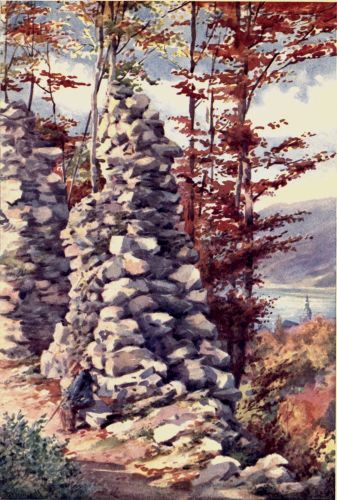
RUINS OF GESSLER’S STRONGHOLD AT KÜSSNACHT
as quaint and picturesque a town as there is in the Lake’s whole
district (despite the bold intrusion of “Auto Benzin” and “Afternoontea”
by the side of ancient heraldic decorations). Here Goethe stopped in
1797, at the Gasthaus zum Engel, containing the ancient Rathsaal, dating
from 1424; here, too, a little way back from the town, is the Hollow
Way, which figures so prominently in Schiller’s William Tell; and
here, crowning a steep wooded knoll near by, are the last remnants of
Gessler’s sinister stronghold in whose dungeon Tell was to have been
incarcerated—
“There, where no beam of sun or moon finds entrance”.
The ruins of this castle, composed largely of the Rigi’s pudding-stone,
are not in themselves impressive to-day, except in their associations
with the tragic past—associations strikingly symbolized by the bold
erect clumps of Atropa, the venomous Belladonna, so suggestively
established amid the crumbling debris. But the site is a fascinating and
beautiful one with the shady stream, the old water-mill and farmsteads
below, and glimpses of the Lake between the trees. It is especially
lovely in autumn when the beeches are a-fire, and one wonders then if
Longfellow, who knew Lucerne and neighbourhood, was here or hereabouts
inspired to write—
“Magnificent Autumn! He comes not like a pilgrim, clad in russet
weeds. He comes not like a hermit, clad in gray. But he comes like
a warrior, with the stain of blood upon his brazen mail.”
For the Bay of Küssnacht is a revelation of what the dying year can
achieve in colour-splendour.
The peculiar geography of the Lake has happily done much to guard
natural beauties and rural simplicities against certain of man’s
customary attacks. Only at four points upon its shores has the Federal
Railway found it convenient to break the peace. Communication is thus in
large part by the more fitting and picturesque service of steamboats.
Unless, therefore, we go round, via Küssnacht, to Arth-Goldau on the
eastern side of the Rigi and thence take the mountain-line to the
summit, it is by steamboat that we must reach Weggis or Vitznau, from
whence to make the ascent of the Monarch. Weggis, with its big old
chocolate-coloured chalets seated upon full-green slopes, and its
luxuriance of fig trees sweeping the water-line, was, before the
mountain-railway at Vitznau came into existence in 1871, the
starting-point for reaching the Rigi’s heights; even to-day the many who
prefer pedestrianism use this route, though Vitznau has become the
crowded centre. In whatever else she may have suffered from this change,
Weggis has lost nothing in beauty and repose by Vitznau being the
dumping-ground for some 120,000 tourists annually. But let it not be
thought that Vitznau has no charming moments, particularly in the spring
and autumn, when the ruddy conglomerate crags of the Rigi soar above
woods and orchards radiant with colour, and thin mists lend increasing
fascination to the “Pearl of the Lake”—the abrupt, cliff-like mass of
the Bürgenstock rising from the opposite shore, at all times an
arresting feature of the lake-side scenery despite its comparatively
modest proportions.
As for the Rigi and the ascent thereof, what more can be said than
countless pens have told already? Enthusiasm—easily and plentifully
acquired in such splendid surroundings—has dubbed it “without a rival
on the face of the earth”. Can I say more? Less, perhaps; but surely
never more! However, an abundant rapture is excusable. Language is poor
to explain the lavish beauty that Nature has assembled in the panorama
which unfolds itself as the train moves upwards; superlative exclamation
is wellnigh bound to creep into the expression of even the coldest of
temperaments. When, beyond a foreground in which trees and chalets are
so out of the perpendicular as to appear as though toppling over into
the abyss below, the giant Alps of the Bernese Oberland slowly rise
above the peaks of Unterwalden, and the distant Jura mountains come into
view upon the horizon far beyond Lucerne, lying map-like by the softly
iridescent Lake, whose complex contours gradually reveal themselves from
Alpnachstad to Küssnacht and from Buochs to Kehrsiten—when this
wide-flung landscape, bathed in slight blue-purple haze, is steadily
disclosed before the eager gaze of the tourist, whose imagination has
been already whipped into liveliness by all that he has read and heard,
small wonder if language is driven to hyperbole. And as the train creeps
up and up, over steep slopes covered with bracken-fern and stately
yellow Gentian; up and up, over rocky chasm and flower-filled pasture,
till at last, at some 6000 feet, the summit-station of the Kulm is
reached and the tourist steps out, and finds himself dominating an
Alpine landscape over which his eye can roam for miles in all
directions, then certainly may he be excused if his emotion runs riot
with his gift of weighty utterance.
“There are some descriptions”, wrote Alexandre Dumas, the elder,
about this very prospect, “which the pen cannot give, some pictures
which the brush cannot render; one has to appeal to those who have
seen them and content oneself with saying that there is no more
magnificent spectacle in the world than this panorama of which one
is the centre, and which embraces 3 mountain chains, 22 lakes, 17
towns, 40 villages, and 70 glaciers spread over a circumference of
250 miles. It is not merely a magnificent view, a splendid
panorama, it is a phantasmagoria.”
Here, at all events, distance lends enchantment to the view. Details are
blurred for the time being, for the brain at first has no use for them.
Large, unified impressions monopolize the senses; inquisitiveness and
criticism are swamped by acute though vague emotion, and we are content
to gaze at the vast expanse of lovely shaded colour rather than at any
formal object. But after a while, when the senses have drunk deeply of
these first impressions, enquiry, that dream-destroying faculty, asserts
itself; out come sundry maps and guidebooks, topography is to the front,
history is probed, and away to Memory’s secret treasury flies our
unambitious entrancement, only to invade us afresh in later quiet
moments at home. George Borrow, in the very characteristic Introduction
to his Wild Wales, considers that “scenery soon palls unless it is
associated with remarkable events, and the names of remarkable men”.
Possibly this opinion is upon all-fours with that other expressed by
Mason, one of Horace Walpole’s friends:—
“For what is Nature? Ring her changes round.
Her three flat notes are water, plants, and ground.
Prolong the strain and, spite of all your chatter,
The tiresome theme is still ground, plants, and water.”
Be this as it may—and both opinions are at least debatable—the scenery
here, around the Rigi, is so bound up with remarkable events and
remarkable men that, willy-nilly, some sort of acquaintance has to be
made with them.
Among the twenty-two lakes which go to the making of this wondrous
panorama are at least two that we shall hear of when we come into closer
contact with William Tell and his momentous age. Away to the left of the
Rossberg, and beyond and above the Lake of Zug, is the little
Aegeri-See, upon whose shores the epoch-marking battle of Morgarten was
fought in 1315, some seven years after the secret banding together of
the men of Schwyz, Uri, and Unterwalden to throw off the tyrannic yoke
of Austria. The trouble, which had been brewing through many years of
oppression, came to a head when the men of Schwyz attacked and pillaged
the Abbey of Einsiedeln (to the east of the Lake of Aegeri, and still a
famous place of pilgrimage), taking the monks prisoners, because the
Abbot, under a deed of gift from the Austrian Emperor, claimed the
mountain pastures of Schwyz for his cattle. Austria determined to crush
this revolt, and on November 15, 1315, the Duke Leopold I raised an army
20,000 strong and marched upon Schwyz.
“The Austrians”, says Alexandre Daguet, in his little primer used
in Swiss schools, “were so sure of victory that they had with them
carts full of rope with which to bind their prisoners. A noble of
the neighbourhood, Henri de Hünenberg, warned the Confederates of
the danger which menaced them, and 1300 armed peasants at once
posted themselves upon the heights dominating the Lake of Aegeri.
The Austrian army climbed laboriously the mountain path, when
suddenly blocks of rock were hurled upon
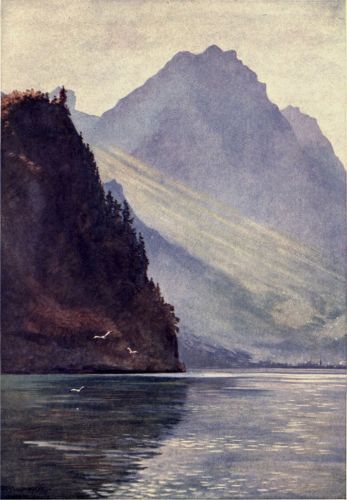
MOUNT PILATUS FROM STANSSTAD
them from the heights, causing frightful disorder in their ranks.
Others of the Confederates then attacked the Austrians with clubs
and halebards, slaughtering such as were not drowned in the lake. A
crowd of nobles bit the dust, and the Duke himself only narrowly
escaped death, arriving pâle et effaré the same evening at
Winterthour.”
This battle was the young Confederation’s baptism of blood, and on the
following 19th of December the secret pact made on the Rütli in 1307 was
publicly confirmed at Brunnen.
The Lake of Sempach, too, upon whose shores, in 1386, another heroic
victory was won from Austria, can be seen in the direction of Basle.
“The Swiss, to the number of 1400, knelt in prayer, then flung
themselves upon the enemy. But in vain did they strive against the
wall of pikes. Sixty of their number already lay bathed in their
own blood, and in another moment the little army would have been
enveloped by the enemy. Suddenly a man of Unterwalden, Arnold von
Winkelried, cried aloud to them: ‘Confederates, I will open a way
for you; take care of my wife and children’. Then, throwing himself
upon the enemy’s pikes, he gathered in his arms as many of these as
possible, and fell, opening a breach in the Austrian ranks, through
which the Confederates rushed. The Austrians resisted furiously.
The Duke Leopold himself fought with great bravery, but he was
killed by a man of Schwyz.”
At this battle the town of Lucerne lost its famous burgomaster,
Petermann von Gundoldingen, whose frescoed house still stands in the
Seidenhof Strasse. The coat of mail which Duke Leopold wore at Sempach
is kept in the Museum at the old Rathaus at Lucerne, together with
several banners taken from the Austrians.
To the south of the Lake of Zug, and lying beneath the precipitous
masses of the two Mythen, is the little Lowerz-See with the tiny Isle of
Schwanau, seeming like a mere boat upon its surface. This lake, also,
has its part in history. King Ludwig of Bavaria, Wagner’s far-sighted if
eccentric patron, sojourned for a time upon the Isle of Schwanau; so
also did Goethe. But history goes back further than this: back again to
the tyrannical Austrian governors, one of whom had his castle on the
island. And history (or is it legend?—hereabouts the line is often not
well marked between the two) tells of how this Governor “was smitten
with the charms of three beautiful but virtuous sisters, living in the
neighbourhood of Arth”, and of how these three sisters, to escape his
importunities, “fled to the pathless wilds of the Rigi”. Here, near a
spring of water, they built themselves “a little hut of bark” and
settled down to live, until one summer night some herdsmen noticed
“three bright lights hovering over the wooded rocks”, and, following
these lights, they reached the little hut where they discovered the
three good sisters wrapped in their last long sleep. The spot, near the
Rigi-Kaltbad Hotel, is still famous as the Schwesternborn, and its
waters are noted for their healing properties.
Between the Lakes of Zug and Lowerz rises the Rossberg, from whose side,
on September 2, 1806, descended the terrible fall of rock which
destroyed the town of Goldau. Ruskin speaks of it in Modern Painters,
and Lord Avebury, in The Scenery of Switzerland, gives the following
brief account:—
“The railway from Lucerne to Brunnen passes the scene of the
remarkable rockfall of Goldau. The line runs between immense masses
of puddingstone, and the scar on the Rossberg from which they fell
is well seen on the left. The mountain consists of hard beds of
sandstone and conglomerate, sloping towards the valley, and resting
on soft argillaceous layers. During the wet season of 1806 these
became soaked with water, and being thus loosened, thousands of
tons of the solid upper layers suddenly slipped down and swept
across the valley, covering a square mile of fertile ground to a
depth, it is estimated, in some places of 200 feet. The residents
in the neighbourhood heard loud cracking and grating sounds, and
suddenly, about 2 o’clock in the afternoon, the valley seemed
shrouded in a cloud of dust, and when this cleared away the whole
aspect of the place was changed. The valley was blocked up by
immense masses of rocks and rubbish, Goldau and three other
villages were buried beneath the debris, and part of the Lake of
Lowerz was filled up. More than 450 people were killed.”
In September, 1881, a similar catastrophe overtook the village of Elm,
in Canton Glarus (somewhat to the right of the Glärnisch, and almost in
a direct line with Brunnen, looking from the Rigi), when the
Plattenbergkopf fell: 10,000,000 cubic metres of rock. Sir Martin
Conway, in The Alps from End to End, has a long and vivid description
of this mountain-fall and of all the horrors which it entailed.
Enough! It would take volumes to hold all of moment that could be told
in connection with this panorama. But what of the Rigi itself? Well, it
serves what has become peculiarly its purpose—a nesting-place for
innumerable hotels and their parasitic incongruities, and a platform
from which thousands upon thousands witness the sunrise. Except, then,
in its remoter parts and around about its base it is so trampled on by
hosts of feet that the early spring crocus and the late autumn gentians
are almost alone among the lovely flowers to have a peaceful, profitable
time. Ask the Swiss Heimatschutz—the Society for the Protection of
Natural Beauty—what it thinks of the present state of the Rigi, the
Stanserhorn, and Mount Pilatus; it will give an answer couched in no
mixed terms. One of the most patent and painful paradoxes of our age is,
that our appreciation destroys so much of that which we appreciate.
Inconsequence links its arm in that of the holiday-maker. Hence the call
for the Eastern Labyrinth in the Glacier Garden at Lucerne, and the
extraordinary number of bead-necklace and bracelet shops crowded
together in that quarter of the town. True, on the Rigi “the
questionable melody of the Alpine horn” echoes through the early morning
darkness, and chamois finds a place upon the hotel menu—goat being
inadmissible at such an altitude; but are there
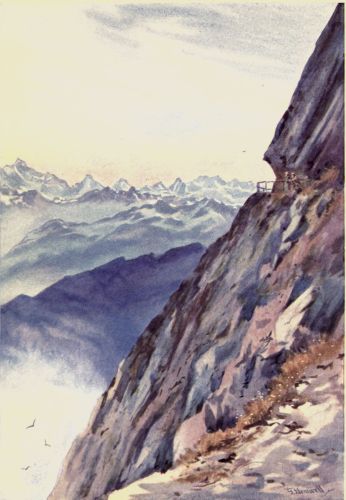
THE BERNESE ALPS FROM MOUNT PILATUS
not also the bazaars full of Brummagem trinkets and what not?—strange,
mysterious effect of Alpine air upon the human system!
From the Rigi it is well to turn to Mount Pilatus. The experience will
be in but small measure a repetition; for Pilatus has marked
individuality. Although Alpnachstad, the starting-point of the Pilatus
Railway, is one of the few places on the Lake which may be reached by
rail from Lucerne, not many people, I imagine, avail themselves of this
means of transit. To take the train, as being quicker than the
steamboat, is a false economy; in Switzerland less haste means wider
experience and finer views. The tree-clothed cliff of the Bürgenstock is
never seen to greater advantage than when the boat heads for Kehrsiten,
after leaving Kastanienbaum (where, by the way, it is said that the
first horse-chestnut trees on the Lake were planted); nor is Pilatus
ever more picturesque than when seen from the quay-side at Stansstad.
But more than this—for those who invariably see dignity and beauty in
man’s labours, and who think that “ugliness means failure of some
kind”—there is, from Kehrsiten, an admirable view of the open ironwork
shaft of the electric lift which decorates the lovely Hammetschwand; and
after passing the swing bridge which gives entrance to the
Alpnacher-See, there are the Cement Works of Rotzloch, where the gorge,
the trees, the whole hillside are as though dressed for some bal
poudre—even the piermaster.
It was in late October when I was last upon Pilatus. Fog ruled the roast
about Lucerne; a fog so dense, though white, that the steamboats moved
with the utmost caution, feeling their way as much by incessant
interchange of bell-signals with the shore as by the compass. That the
beech woods were ablaze with autumn’s waning energy was known, but
little besides grey, ghostlike objects could be seen as the train
started with a jerk upon its strenuous journey. Nor was there anything
but fog and phantoms for some twenty minutes or more. Then slowly the
fog lightened, the phantoms took on the form of trees, grew warmer in
tint, still warmer and still clearer, until the golden, red-brown woods,
purpled in part by distance, became revealed, all wreathed about with
trails of veil-like mist. Before the lower, rock-strewn pastures of the
Matt-Alp were reached, every vestige of the fog was left lying compact
below, and the train was labouring upwards towards a radiant, cloudless
sky. The Alps, of course, are rich in such experience as this, but I can
remember nothing that ever more nearly realized my conception of
fairyland. Indeed, if it were not like saying that a lovely hothouse
orchid is so natural as to seem to be made of wax, I would declare that
the piercing of the fogzone that day on the autumn-tinted sides of Mt.
Pilatus resembled nothing so much as the grand transformation scene of
our Christmas-time theatres, when gauze veil after gauze veil is slowly
rolled away, and from grey, then tinted mystery emerges brilliant,
spotless colour.
What a wonderful journey this railway provides! If any proof were needed
of the high eminence of Swiss engineers and of the indomitable spirit
and resource which the Alps breed in their children, here assuredly it
is. Beasts, plants, birds, and insects are not alone to feel the
influence of Alpine circumstance upon character; hare and saxifrage,
ptarmigan and fritillary are not the only pupils trained in Nature’s
Alpine school. Man, in common with the chamois and the edelweiss, the
eagle and the erebia, owes priceless capacity to the life imposed by
high-flung precipice and pasture. Nursed in all the rigour and
beneficence accompanying contact with high altitudes, he develops much
of that amazing efficiency, that impelling adaptiveness which is so
admired in “Alpines”. The will to master the worst and to enjoy the best
is never more alert than in the dweller among mountains. And this fact
is borne in upon the imagination as the train climbs panting up the face
of the Eselwand, in every way the culminating labour of its journey.
Here the track has been carved upon a sheer precipice, and it makes one
dizzy to think of the workmen’s initial efforts to gain a foothold. Some
idea of the resource and nerve that must have been required can be
gathered by standing upon the Kulm Station platform and turning to gaze
down the way the train came up; or, better still, on the rocks beyond
the hotel and facing the Esel’s fearsome cliff to which the line so
desperately clings; for from this vantage-ground the Titlis and the Alps
of Uri, Unterwalden, and the Grisons rise beyond and between the Esel
and the Matthorn, giving terrible depth to the gaunt masses of these
latter, and thus suggesting the magnitude of the task performed by the
railway builders.
A large part of the superiority of Pilatus over the Rigi lies in its
magnificent foreground: invaluable adjunct to the panorama. A vast,
unbroken horizon is well for a time, but it is all of a piece, and its
very immensity becomes wearisome. Humanity is more at home with
partially hidden views. To have everything simultaneously discovered is,
for many subtle but important reasons, to impose a limit upon interest.
A certain amount of interruption gives durability to pleasure.
Delightful combinations are present, and the eye can rest reposefully
upon portions which in themselves are perfect pictures. In this manner,
then, Pilatus is more attractive than either the Rigi or the
Stanserhorn. The panorama itself may be much the same from all three of
these eminences, but from Pilatus it is enhanced by the mighty
foreground. All about the summit are wild, weird places of fascination,
and this was particularly so during those late autumnal days, with the
dense, billowy sea of fog below, covering the whole Lake, stretching
away over the plain towards the Jura, straggling up the valleys towards
Engelberg and the Brünig Pass, and leaving such prominences as the Rigi,
the Bürgenstock, and the Stanserhorn like islands floating on a scarcely
moving ocean. The huge, abrupt escarpments of Pilatus looked the more
impressive for the purple shadows which they threw upon this milk-white
sea; and the choughs, circling and whistling about the crags, lent just
that eerie note which has been so fruitful of legend in the past.
For fiery dragons once had their lairs upon these heights. Renward
Cysart, town clerk of Lucerne in the sixteenth century, says so; and he
tells of how they were often seen flying backwards and forwards between
Pilatus and the Rigi. One day, he avers, a cooper from Lucerne, while
climbing Pilatus, missed his footing, fell into a cavern, and on coming
to his senses, found himself confronted with “two large, terrible, and
monstrous dragons”, which, however, did him no harm, but allowed him to
live with them until the return of summer, when he, clinging to the tail
of one of his delightful hosts, was landed in a safe place, from whence
he reached home and recounted his adventure, which recountal was handed
down through several generations until it came to Master Cysart who,
therefore, vouches for its accuracy, though regretting “that the day,
year, and name have, through carelessness, passed into forgetfulness”.
Dragons were common objects of the Alps in those and previous days. The
country between Stans and Kernwald (well seen from Pilatus) was ravaged,
about the year 1240, by an enormous specimen, which was slain by one
Winkelried, an ancestor of the hero of Sempach. Legend usually has
relative truth at the back of it, and although we may feel inclined to
dismiss dragons and their doings as unalloyed fabrications of primitive,
superstitious minds, yet certain authorities hold that the dragon was a
species of enormous serpent formerly inhabiting some parts of the Alps,
but now extinct there.
Pilatus is said to obtain its name from what is perhaps the most
important of the host of legends connected with the mountain. Although
there has been an attempt to derive Pilatus from pileatus, meaning
“hatted” (in reference to the “hat” or hood of cloud which so frequently
sits upon the summit), the more probable derivation seems to be from the
one-time belief that Pontius Pilate’s remains were buried in a lake near
the summit of the mountain. According to this legend, Pontius Pilate
committed
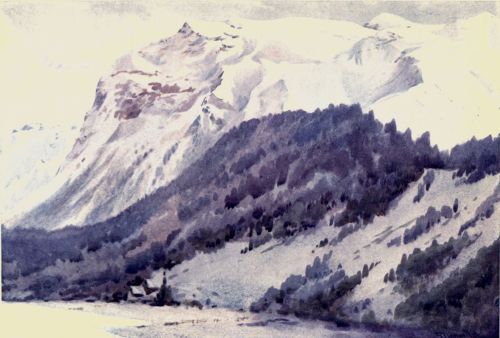
THE TITLIS FROM ENGELBERG—WINTER
suicide in prison in Rome, and his body was thrown into the Tiber, when
at once a terrific, devastating storm arose. The body was therefore
taken out, conveyed to Vienne, in France, and thrown into the Rhone,
here again causing disturbance. It was then transferred to Lausanne, but
a further repetition of its untoward behaviour caused it to be banished
to the little lake upon Mount Pilatus. Here it remained benign so long
as the lake was in no way interfered with. If, however, anything was
thrown into the water, “the lightnings flashed, the thunder rolled, and
desolation broke over the land”. The town council of Lucerne therefore
felt called upon to forbid all persons to approach the Lake, and it is
related how at least one wretched man was executed for disobedience. But
“by degrees the belief in the supernatural powers of the old Roman
began to decay,” says J. Hardmeyer, in his little work upon this
mountain, “and at last, in 1585, a certain Johannes Muller, rector
of Lucerne, brought about its complete overthrow. With numerous
companions he made his way to the lake on Mount Pilatus, boldly
challenged the evil spirit to show his might, threw stones into the
water, and made some of his people wade about in it, and behold,
neither storm nor tempest followed, not a wave rose, and the skies
remained as serene as before. This was the death-blow to the legend
of Pontius Pilate and his evil deeds. The council of Lucerne went
still further: they had the mountain lake drained off, so that
nothing remained of it but a small morass, where a little water
still collects after the melting of the snows, but soon
disappears.”
Thus perishes Romance before the onward march of prosaic understanding!