Erotic cults. Rites, Periapts. Phallic symbols. Ceremonials. Concepts. Greece. Asia Minor. Egypt. Literary and historical testimony. Erotic manifestations in various ethnic areas. Search for amatory stimulants. Condemnation of pagan mores. Biblical instances. Sacredness of genitalia. Herodotus on Egyptian cults. Bacchic cult in European countries. Pervasiveness of phallus. Phallic emblems. Biblical references. Incantations. Spells. Philtres. Egyptian love song. Near East. Hittite ritual. Babylon. Canaanites. Greece and Rome. Biblical ethics. Hellenistic Age. Baths. Phallic food. Drillipotae. Yellow. Figurae Veneris. Erotic poems. Phallic divinities. Philodemus of Gadara. Dress. Athens. Panders. Biblical—phallic. Power of woman. Woman as an evil. Aphrodite. Love as an end. Initiation. Rites of Venus. Essence of love. Mysticism. Priapic. Asia Minor. Variant names. Generation. Talisman. Floral.
Testimony of the poets. Obscene deities. Amatory philtres. Amatory foods. Bacchic worship. Ovid on erotic practices. Ovid on philtres. Roman generative deities. Rites of Bona Dea. Generative tutelary deities. Phallic breads. Magic love spells. Assignations. Fescennini versus. Lamps. Larentalia. Heliogabalus. Nonaria. Nose and lips. Ovid. Imperial Rome.
Hindu and Arab treatments and practices. Philtres. Other provocative preparations. Islam. Sterility. Potions. Perfume. Arab erotologist. Amatory principles.
Preparation of philtres. Illustrative legendary, historical, and literary anecdotes, allusions, and citations confirming potency of philtres. Divertive philtres. Medieval philtres. Macrobius. Herbs and plants. The Mill. Amatory procedures. French stimulant. Papyri. Lucian. River. Black Art potion. Inducements. Oriental. Flowers, etc. Variety of ingredients.
Philtres. Dispensers of preparations. Occultists and alchemists associated with preparations. Literary and historical references. Manuals and other erotic texts. Priapus as a saint. Phallic Society. Erotic mores in Europe. Clauder on philtres. Northern deities. Belts of chastity. The Congress: and other medieval practices. Divertive invocation. Privileges. Orgies. Boccaccio. Turkey. Loïstes. Shakespeare. Villon. Sects. Figurines. Demoniac unions. Astrological.
The amatory motif is pervasive, timeless, and universal.
In some of its phases and manifestations it has presented
age-old provocations and, not infrequently, problems that
are still unresolved.
Among such problems are involved the faculty of physiological
potency, the urge to attract amorously, and, conversely,
the problem of preventing such attraction in a
designated instance, or of diverting it to another objective.
That, in brief, is the essence of the material means of
effecting such a realization. In its various mutations, its
protean diversities, it is the love-potion, the philtre, the
mystic concoction that, once quaffed, will instil love and
passion and desire and lust, that will replenish erotic inadequacies,
that will awaken the ancient fons vitae, the symbol
of animate being, the source, as the antique Hellenes sensed
and exemplified, of all cosmic creation, of the totality of
living generation.
The potion, then, is at least a hypothetically efficacious
instrument for securing and preserving the amorous interests
of the desired object. It also serves as an apotropaic device
for diverting misplaced love, as the agent sees it, and redirecting
it to the proper and preferred channel.
The actual means for the fulfilment of these erotic purposes
vary with the ages, with ethnic groups and demographic
alignments, with legendary and folk traditions and
mores, with the disparate levels of culture of a specific
region. They present variations and adaptations in correspondence
with climatic and epichorial conditions. But they
retain the essentially common characteristic, the unchanging
property, of attempting to shape and mould the amatory
esurgences, in whatever degree, and whether transitory or
of more enduring permanence, by impersonal, palpable,
mechanistic and visual means.
It should be observed, as a terminus a quo, that the term
philtre itself stems from the Greek philtron, a love-potion
(from philein, to love, and tron, an instrumental suffix). It
means, then, a love-charm.
The term potion is derived immediately from the Latin
potio, a draught, whether of medicine or even of poison. The
ultimate source is the Greek potos, a drink. In a general
sense, therefore, a love philtre or potion is a concoction,
usually liquid in form, but not necessarily so, intended to
produce or promote amatory sensibilities. In a wide and
comprehensive denotation, the philtre will include any object
or charm or periapt that serves the same erotic purpose.
This present survey touches on the use of the potion
in the course of the centuries, in varying circumstances and
disparate countries: on the fantastic factors that composed
the final preparations; and on anecdotes, both apocryphal
and authenticated, and episodes and occasional allusions
that point up the treatment, its hazards, and even its humors.
With regard to the potions and similar concoctions and
preparations of an amatory nature, a caveat must here be
entered. All such philtres are considered in this book from
an exclusively traditional, historical, and academic viewpoint.
They are not recommended in any instance for personal
use, as they may involve unpredictable or even catastrophic
effects: in no sense, therefore, should such prescriptions
be utilized for empirical experimentation.
H.E.W.
LOVE POTIONS THROUGH THE AGES
CHAPTER I ANTIQUITY
1
In ancient Greece, the climatic conditions, the long unending
summer days, the broad spaciousness of the sea,
wine-dark and loud-sounding, as Homer describes it, the
secluded pools and fountains and glades, the remote valleys,
the snowy mountain summits were all alive, to the Hellenic
perceptive and imaginative mind, with graceful nymphs
and shaggy satyrs, with a multitude of anthropomorphic
divinities, and with the alluring pipes of Pan.
Under such conditions it was not difficult to conceive
human life as dominated by the cosmic creative force, and
to do homage and obeisance to the great god Dionysus,
divinity of the fruitful wine, protector of all procreative and
generative functions.
The generative and sexual activities of the Greeks were,
in general, so freed from contrived restrictions, so much in
harmony with their instinctive and developed sensitivity to
beauty of form, of movement, of rhythm, that artificial aids
and inducements to amatory performance were far less
necessary than they are in a highly complex and competitive
and in a sense exhausted contemporary social frame.
Hence we do not constantly hear of the ad hoc use of
philtres, potions, and analogous means of stimulation. Yet
2their existence is established, and in particular cases they
were brought into effective use. Xenocrates, a Greek physician
of the first century A.D., as Pliny the Elder records,
advised drinking the sap of mallows as a love-potion. Such
a philtre, together with three mallow roots tied into a bunch,
would inflame the erotic passions of women.
Again, Dioscorides of Cilicia, in Asia Minor, an army
physician who flourished in the first century A.D., produced
a Materia Medica that treated drugs, remedies, ingredients
in a rational, systematic manner. His text became a standard
work, used for centuries, in both the East and the West. He
recommends the roots of boy-cabbage, soaked in fresh goat’s
milk. A good draught of this drink would be productive of
intense excitation of the sexual impulse.
Many spices, plants, herbs that were described, either
by the encyclopedists and historians or incidentally mentioned
in dramatic literature, in occasional poems, anecdotes
or in epitomes of legends and folklore, were of such obscurity
and rarity that it is no longer possible to ascertain the
corresponding modern equivalent. There was, as an instance,
satyrion. It is frequently mentioned, both in Greek and
Roman contexts. Actually unidentifiable botanically, it may
have been analogous to the orchis. In Greek and also Roman
antiquity it was reputed to constitute a potent aphrodisiac,
and is mentioned in an accepted and traditional sense by
writers such as Petronius, who casually alludes to it in the
course of his Satyricon as a common erotic aid.
The name satyrion is evidently associated with the
Greek satyr, a wood spirit, partly goat-like, and partly
human. Attendants to the rustic god Pan, the satyrs were
known as bestial and lustful creatures, symbolic of the basic
sexual passion of man.
Botanically, satyrion is a plant with smooth leaves, red-tinted,
and equipped with a two-fold root. The lower part
of this root was credited anciently with promoting male
conception, while the other part was conducive to female
3conception. In its modern counterpart, satyrion has been
associated with the Iris florantina.
There is another variety of satyrion, called Serapias. This
has pear-shaped leaves and a tall elongated stem. Its root
consists of two tubers that have the appearance of testes.
Unquestionably, the association of the plant as an aphrodisiac
derives from the orchidaceous configuration of the
root.
Remarkable properties were attributed to the root of
satyrion. When it was dissolved in goat’s milk, the erotic
effect was so vigorous and urgent that, as the Greek philosopher
Theophrastus asserts in his Enquiry into Plants, the
potion produced, on a particular occasion, some seventy
consecutive coital performances.
Still another species of satyrion was erithraicon. This
plant had a peculiar virtue. The mere holding of it, or
carrying it, in the hand, occasioned a lustful desire. This
fact is attested by Pliny, in his Natural History, in Book 26,
96 and 98, as well as by Dioscorides in his Materia Medica
3. 134. When the libido became too intense, lettuce was
eaten to mitigate the effect, to allay the erotic provocation.
Greek mythology abounds in references to satyrion as an
efficacious stimulant. The prowess of Hercules, the lusty
warrior, as the Roman Petronius, Arbiter Elegantiarum, calls
him, is attested in an amatory sense by the story of his
visit to a certain Thespius. Entertained lavishly as a guest,
Hercules, fortified by satyrion, repaid the host’s entertainment
by having intercourse with all fifty daughters of
Thespius.
In Roman times the effectiveness of the root in arousing
erotic excitation was common knowledge. Petronius, the
voluptuary attached to the court of the Emperor Nero and
the author of the remarkable picaresque novel entitled the
Satyricon, alludes to the matter. One of his characters,
describing the frenzied activities in a brothel, remarks:
We saw many persons of both sexes, at work in the
4cells, so much every one of them seemed to have taken
satyrion.
In a more general direction, important testimonies to
manipulative and mechanistic means of arousing vigor are
the references in Petronius, particularly the episode involving
Quartilla:
Quartilla came up to me to cure me of the ague,
but finding her self disappointed, flew off in a rage,
and returning in a little while, told us, there were
certain persons unknown, had a design upon us, and
therefore commanded to remove us into a noble
palace.
Here all our courage fail’d us, and nothing but
certain death seem’d to appear before us.
When I began, “If, madam, you design to be more
severe with us, be yet so kind as to dispatch it
quickly; for whate’er our offence be, it is not so
heinous that we ought to be rack’d to death for it”:
Upon which her woman, whose name was Psyche,
spread a coverlet on the floor. Sollicitavit inguina mea
mille iam mortibus frigida. Ascyltos muffled his head
in his coat, as having had a hint given him, how
dangerous it was to take notice of what did not concern
him: In the mean time Psyche took off her
garters, and with one of them bound my feet, and
with the other my hands.
Thus fetter’d as I lay, “This, madam,” said I, “is
not the way to rid you of your ague.”
“I grant it,” answer’d Psyche, “but I have a Dose
at hand will infallibly do it” and therefore brought
me a lusty bowl of satyricon and so merrily ran over
the wonderful effects of it, that I had well-nigh
suck’d it all off; but because Ascyltos had slighted her
courtship, she finding his back toward her, threw the
bottom of it on him.
5Ascyltos perceiving the chat was at an end, “Am
not I worthy,” said he, “to get a sup?” And Psyche
fearing my laughter might discover her, clapped her
hands, and told him, “Young man, I made you an
offer of it, but your friend here has drunk it all out.”
“Is it so,” quoth Quartilla, smiling very agreeably,
“and has Encolpius gugg’d it all down?” At last also
even Gito laught for company, at what time the
young wench flung her arms about his neck, and
meeting no resistance, half smother’d him with kisses.
A peculiar situation in which erotic provocation or inducement
to passion is conditioned by the concept of social
prestige, or, in the contemporary idiom, status, is exemplified
in a later passage in Petronius’ Satyricon:
Going out full of these thoughts to divert my
concern, I resolv’d on a walk, but I had scarce got
into a publick one, e’re a pretty girl made up to me,
and calling me Polyaemus, told me her lady wou’d
be proud of an opportunity to speak with me.
“You’re mistaken, sweet-heart,” return’d I, in a
little heat, “I’m but a servant, of another country too,
and not worthy of so great a favor.”
“No, sir,” said she, “I have commands to you; but
because you know what you can do, you’re proud;
and if a lady wou’d receive a favor from you, I see
she must buy it: For to what end are all those allurements,
forsooth? the curl’d hair, the complexion advanc’d
by a wash, and the wanton roll of your eyes,
the study’d air of your gate? unless by shewing your
parts, to invite a purchaser? For my part I am neither
a witch, nor a conjurer, yet can guess at a man by
his physiognomy. And when I find a spark walking, I
know his contemplation. To be short, sir, if so be you
are one of them that sell their ware, I’ll procure you
6a merchant; but if you’re a courteous lender, confer
the benefit. As for your being a servant, and below,
as you say, such a favor, it increases the flames of
her that’s dying for you. ’Tis the wild extravagance
of some women to be in love with filth, nor can be
rais’d to an appetite but by the charms, forsooth of
some slave or lacquy; some can be pleased with nothing
but the strutting of a prize-fighter with a hacktface,
and a red ribbon in his shirt: Or an actor
betray’d to prostitute himself on th’ stage, by the
vanity of showing his pretty shapes there; of this
sort is my lady; who indeed,” added she, “prefers the
paultry lover of the upper gallery, with his dirty face,
and oaken staff, to all the fine gentlemen of the boxes,
with their patches, gunpowder-spots, and toothpickers.”
When pleas’d with the humor of her talk, “I
beseech you, child,” said I, “are you the she that’s so
in love with my person?” Upon which the maid fell
into a fit of laughing.
“I wou’d not,” return’d she, “have you so extremely
flatter yourself. I never yet truckl’d to a waiter, nor
will Venus allow I shou’d imbrace a gibbet. You must
address your self to ladies that kiss the ensigns of
slavery; be assur’d that I, though a servant, have too
fine a taste to converse with any below a knight.” I
was amaz’d at the relation of such unequal passions,
and thought it miraculous to find a servant, with the
scornful pride of a lady, and a lady with the humility
of a servant.
A still more elaborate scene concerns the techniques of
recovering the faculty of erotic consummation. Encolpius,
the narrator of the Satyricon, is attached homosexually to
the young Gito. He is in a state of incapacity. At this juncture
7he receives a note from Circe, the mistress of the maid
Chrysis, commenting on his inadequacy:
Chrysis enter’d my chamber, and gave me a billet
from her mistress, in which I found this written:
“Had I rais’d my expectation, I might deceiv’d
complain; now I’m obliged to your impotence,
that has made me sensible how much too long I
have trifl’d with mistaken hopes of pleasure. Tell
me, sir, how you design to bestow your self, and
whether you dare rashly venture home on your
own legs? for no physician ever allow’d it cou’d
be done without strength. Let me advise your
tender years to beware of a palsie: I never saw any
body in such danger before. On my conscience
you are just going! and shou’d the same rude
chilliness seize your other parts, I might be soon,
alas! put upon the severe trial of weeping at your
funeral. But if you would not suspect me of not
being sincere, tho’ my resentment can’t equal the
injury, yet I shall not envy the cure of a weak unhappy
wretch. If you wou’d recover your strength,
ask Gito, or rather not ask him for’t—I can assure
a return of your vigor if you cou’d sleep three
nights alone: As to myself I am not in the least
apprehensive of appearing to another less charming
than I have to you. I am told neither my glass
nor report does flatter me. Farewell, if you can.”
When Chrysis found I had read the reproach,
“This is the custom, sir,” said she, “and chiefly of this
city, where the women are skill’d in magick-charms,
enough to make the moon confess their power, therefore
the recovery of any useful instrument of love
8becomes their care; ’tis only writing some soft tender
things to my lady, and you make her happy in a kind
return. For ’tis confest, since her disappointment, she
has not been her self.”
I readily consented, and calling for paper, thus
addrest myself:
“’Tis confest, madam, I have often sinned, for
I’m not only a man, but a very young one, yet
never left the field so dishonorably before. You
have at your feet a confessing criminal, that deserves
whatever you inflict: I have cut a throat,
betray’d my country, committed sacrilege; if a
punishment for any of these will serve, I am ready
to receive sentence. If you fancy my death, I wait
you with my sword; but if a beating will content
you, I fly naked to your arms. Only remember,
that ’twas not the workman, but his instruments
that fail’d: I was ready to engage, but wanted
arms. Who rob’d me of them I know not; perhaps
my eager mind outrun my body; or while with an
unhappy haste I aim’d at all; I was cheated with
abortive joys. I only know I don’t know what I’ve
done: You bid me fear a palsie, as if the disease
you’d do greater that has already rob’d me of
that, by which I shou’d have purchas’d you. All I
have to say for my self, is this, that I will certainly
pay with interest the arrears of love, if you allow
me time to repair my misfortune.”
Having sent back Chrysis with this answer, to encourage
my jaded body, after the bath and strengthening
oyles had a little rais’d me, I apply’d my self
to strong meats, such as strong broths and eggs, using
wine very moderately; upon which to settle my self,
9I took a little walk, and returning to my chamber,
slept that night without Gito; so great was my care
to acquit my self honorably with my mistress, that I
was afraid he might have tempted my constancy, by
tickling my side.
The next day rising without prejudice, either to
my body or spirits, I went, tho’ I fear’d the place was
ominous, to the same walk, and expected Chrysis to
conduct me to her mistress; I had not been long there,
e’re she came to me, and with her a little old woman.
After she had saluted me, “What, my nice Sir
Courtly,” said she, “does your stomach begin to come
to you?”
At what time, the old woman, drawing from her
bosom, a wreath of many colors, bound my neck;
and having mixed spittle and dust, she dipt her finger
in’t, and markt my forehead, whether I wou’d or not.
When this part of the charm was over, she made
me spit thrice, and as often prest to my bosom enchanted
stones, that she had wrapt in purple; Admotisque
manibus temptare coepit inguinum vives.
Dicto citius nervi paruerunt imperio manusque aniculae
ingenti motu repleverunt. At ilia gaudio exsultans,
“Vides,” inquit, “Chrysis mea, vides quod aliis leporem
excitavi?”
Never despair; Priapus I invoke
To help the parts that make his altars smoke.
After this, the old woman presented me to Chrysis;
who was very glad she had recover’d her mistress’s
treasure; and therefore hastening to her, she conducted
me to a most pleasant retreat, deckt with all
that nature cou’d produce to please the sight.
10Where lofty plains o’re-spread a summer shade,
And well-trimm’d pines their shaking tops display’d,
Where Daphne ’midst the Cyprus crown’d her head.
Near these, a circling river gently flows,
And rolls the pebbles as it murmuring goes.
A place design’d for love, the nightingale
And other wing’d inhabitants can tell.
That on each bush salute the coming day,
And in their orgies sing its hours away.
She was in an undress, reclining on a flowry bank,
and diverting her self with a myrtle branch; as soon
as I appear’d, she blusht, as mindful of her disappointment:
Chrysis, very prudently withdrew, and
when we were left together, I approacht the temptation;
at what time she skreen’d my face with the
myrtle, and as if there had been a wall between us,
becoming more bold; “what, my chill’d spark,” began
she, “have you brought all your self today?”
“Do you ask, madam,” I return’d, “rather than
try?” And throwing myself to her, that with open
arms was eager to receive me, we last a little age
away; when giving the signal to prepare for other joys,
she drew me to a more close imbrace; and now, our
murmuring kisses their sweet fury tell; now, our twining
limbs, try’d each fold of love; now, lockt in each
others arms, our bodies and our souls are join’d; but
even here, alas! even amidst these sweet beginnings,
a sudden chilliness prest upon my joys, and made me
leave ’em not compleat.
Circe, enrag’d to be so affronted, had recourse to
revenge, and calling the grooms that belong’d to the
house, made them give me a warming; nor was she
satisfi’d with this, but calling all the servant-wenches,
and meanest of the house, she made ’em spit upon
11me. I hid my head as well as I cou’d, and, without
begging pardon, for I knew what I had deserv’d, am
turn’d out of doors, with a large retinue of kicks and
spittle: Proselenos, the old woman was turn’d out
too, and Chrysis beaten; and the whole family wondering
with themselves, enquir’d the cause of their
lady’s disorder.
I hid my bruises as well as I cou’d, lest my rival
Eumolpus might sport with my shame, or Gito be concern’d
at it; therefore as the only way to disguise my
misfortune, I began to dissemble sickness, and having
got in bed, to revenge my self of that part of me,
that had been the cause of all my misfortunes; when
taking hold of it,
With dreadful steel, the part I wou’d have lopt,
Thrice from my trembling hand the razor dropt.
Now, what I might before, I could not do,
For cold as ice the fearful thing withdrew;
And shrunk behind a wrinkled canopy,
Hiding his head from my revenge and me.
Thus, by his fear, I’m baulkt of my design,
When I in words more killing vent my spleen.
At what time, raising myself on the bed, in this
or like manner, I reproacht the sullen impotent: With
what face can you look up, thou shame of heaven and
man? that can’st not be seriously mention’d. Have
I deserv’d from you, when rais’d within sight of
heavens of joys, to be struck down to the lowest hell?
To have a scandal fixt on the very prime and vigor of
my years, and to be reduc’d to the weakness of an
old man? I beseech you, sir, give me an epitaph on
my departed vigor; tho’ in a great heat I had thus
said:
12He still continu’d looking on the ground,
Nor more, at this had rais’d his guilty head
Than th’ drooping poppy on its tender stalk.
Nor when I had done, did I less repent of my
ridiculous passion, and with a conscious blush, began
to think, how unaccountable it was, that forgetting all
shame, I shou’d contend with that part of me, that
all men of sense, reckon not worth their thoughts. A
little after, relapsing to my former humor: But what’s
the crime, began I, if by a natural complaint I was
eas’d of my grief? or how is it, that we blame our
stomachs or bellies, when ’tis our heads, that are
distemper’d? Did not Ulysses beat his breast, as if
that had disturb’d him? And don’t we see the actors
punish their eyes, as if they heard the tragic scene?
Those that have the gout in their legs, swear at them;
Those that have it in their fingers, do so by them:
Those that have sore eyes, are angry with their eyes.
Why do the strickt-liv’d Cato’s of the age,
At my familiar lines so gravely rage?
In measures loosely plain, blunt satyr flows,
And all the people so sincerely shows.
For whose a stranger to the joys of love?
Who, can’t the thoughts of such lost pleasures move?
Such Epicurus own’d the chiefest bliss,
And such fives the gods themselves possess.
There’s nothing more deceitful than a ridiculous
opinion, nor more ridiculous, than an affected gravity.
After this, I call’d Gito to me; and “tell me,” said I,
“but sincerely, whether Ascyltos, when he took you
from me, pursu’d the injury that night, or was chastly
13content to lye alone?” The boy with his finger at his
eyes, took a solemn oath, that he had no incivility
offer’d him by Ascyltos.
This drove me to my wits end, nor did I well
know what to say: For why, I consider’d, shou’d I
think of the twice mischievous accident that lately
befell me? At last, I did what I cou’d to recover my
vigor: and willing to invoke the assistance of the
gods, I went out to pay my devotions to Priapus,
and as wretched as I was, did not despair, but kneeling
at the entry of the chamber, thus beseecht the
god:
Bacchus and Nymphs delight, O mighty God!
Whom Cynthia gave to rule the blooming wood.
Lesbos and verdant Thasos thee adore,
And Lydians, in loose flowing dress implore,
And raise devoted temples to thy power.
Thou Dryad’s joy, and Bacchus’s guardian, hear
My conscious prayer, with an attentive ear.
My hands with guiltless blood I never stain’d,
Or sacrilegiously the gods prophan’d.
To feeble me, restoring blessings send,
I did not thee, with my whole self offend.
Who sins thro’ weakness is less guilty thought,
Be pacify’d, and spare a venial fault.
On me, when smiling fate shall smiling gifts bestow,
I’ll not ungrateful to thy godhead go.
A destined goat shall on thy altar lye,
And the horn’d parent of my flock shall dye.
A sucking pig appease thy injur’d shrine,
And hallow’d bowls o’re-flow with generous wine.
Then thrice thy frantick votaries shall round
Thy temple dance, with youth and garlands crown’d,
In holy drunkenness thy orgies sound.
14While I was thus at prayers, an old woman, with
her hair about her eyes, and disfigur’d with a mournful
habit, coming in, disturb’d my devotions; when
taking hold of me, she drew all fear out of the entry;
and “what hag,” said she, “has devour’d your manhood?
Or what ominous carcase have you stumbl’d
over in your nightly walks? You have not acquitted
your self above a boy; but faint, weak, and like a
horse o’re-charg’d in a steep, tyr’d have lost your
toyl and sweat; nor content to sin alone, but have
unreveng’d against me, provokt the offended gods?”
When leading me, obedient to all her commands,
a second time to the cell of a neighboring priestess
of Priapus, she threw me upon the bed, and taking up
a stick that fastened the door, reveng’d her self on
me, that very patiently receiv’d her fury: and at the
first stroak, if the breaking of the stick had not lessened
its force, she might have broke my head and
arm.
I groan’d, and hiding with my arm my head, in a
flood of tears lean’d on the pillow: Nor did she then,
less troubled, sit on the bed, and began in a shrill
voice, to blame her age, till the priestess came in upon
us; and “what,” said she, “do you do in my chappel,
as if some funeral had lately been, rather than a
holy-day, in which, even the mournful are merry?”
“Alas, my Enothea!” said she, “this youth was born
under an ill star; for neither boy nor maid can raise
him to a perfect appetite; you ne’re beheld a more
unhappy man: In his garden the weak willow, not the
lusty cedar grows; in short, you may guess what he is,
that cou’d rise unblest from Circe’s bed.”
Upon this, Enothea fixt her self between us, and
moving her head a while; “I,” said she, “am the only
one that can give remedy for that disease; and not to
15delay it, let him sleep with me to-night; and next
morning, examine how vigorous I shall have made
him:
“All Nature’s work my magick powers obey,
The blooming earth shall wither and decay,
And when I please, agen be fresh and gay.
From rugged rocks, I make sweet waters flow,
And raging billows to me humbly bow.
With rivers, winds, when I command, obey,
And at my feet, their fans contracted lay,
Tygers and dragons too, my will obey,
But these are small, when of my magick verse,
Descending Cynthia does the power confess.
When my commands, make trembling Phoebus reign,
His fiery steeds, their journey back again.
Such power have charms, by whose prevailing aid
The fury of the raging bulls was laid.
The Heaven-born Circe, with her magic song,
Ulysses’s men, did unto monsters turn.
Proteus, with this assum’d, what shape he wou’d.
I, who this art so long have understood,
Can send proud Ida’s top into the main,
And make the billows bear it up again.”
I shook with fear at such a romantick promise,
and began more intensively to view the old woman;
Upon which, she cry’d out, “O Enothea, be as good
as your word”; when, carefully wiping her hands,
she lay down on the bed, and half smother’d me
with kisses.
Enothea, in the middle of the altar, plac’d a
turf-table, which she heapt with burning coals, and
her old crack cup (for sacrifice) repair’d with temper’d
pitch; when she had fixt it to the smoaking-wall
16from which she took it; putting on her habit, she
plac’d a kettle by the fire, and took down a bag
that hung near her, in which, a bean was kept for
that use, and a very aged piece of a hog’s forehead,
with the print of a hundred cuts out; when opening
the bag, she threw me a part of the bean, and bid
me carefully strip it. I obey her command, and try,
without daubing my fingers, to deliver the grain from
its nasty coverings; but she, blaming my dullness,
snatcht it from me, and skilfully tearing its shells
with her teeth, spit the black morsels from her,
that lay like dead flies on the ground. How ingenious
is poverty, and what strange arts will hunger teach?
The priestess seemed so great a lover of this sort of
life, that her humor appear’d in every thing about
her, and her hut might be truly term’d, sacred to
poverty:
Here shines no glittering ivory set with gold,
No marble covers the deluded mold,
By its own wealth deluded; but the shrine
With simple natural ornaments does shine.
Round Cere’s bower, but homely willows grow.
Earthen are all the sacred bowls they know.
Osier the dish, sacred to use divine:
Both course and stain’d, the jug that holds the wine.
Mud mixt with straw, make a defending fort,
The temple’s brazen studs, are knobs of dirt.
With rush and reed, is thatcht the hut it self,
Where, besides what is on a smoaky shelf,
Ripe service-berries into garlands bound,
And savory-bunches with dry’d grapes are found.
Such a low cottage Hecale confin’d,
Low was her cottage, but sublime her mind.
Her bounteous heart, a grateful praise shall crown,
And muses make immortal her renown.
17After which, she tasted of the flesh, and hanging
the rest, old as her self, on the hook again; the
rotten stool on which she was mounted breaking,
threw her into the fire, her fall spilt the kettle, and
what it held put out the fire; she burnt her elbow, and
all her face was hid with the ashes that her fall had
rais’d.
Thus disturb’d, I arose, and laughing, took her
up; immediately, lest any thing shou’d hinder the
offering, she ran for new fire to the neighborhood,
and had hardly got to the door, e’re I was set upon
by three sacred geese, that daily, I believe, about
that time were fed by the old woman; they made an
hideous noise, and, surrounding me, one tears my
coat, another my shoes, while their furious captain
made nothing of doing so by my legs; till seeing my
self in danger, I began to be in earnest, and snatching
up one of the feet of our little table, made the
valiant animal feel my arm’d hand; nor content with
a slight blow or two, but reveng’d my self with its
death:
Such were the birds Alcides did subdue,
That from his conquering arm t’ward Heaven flew:
Such sure the harpyes were which poyson strow’d,
On cheated Phineus’s false deluding food.
Loud lamentations shake the trembling air,
The powers above the wild confusion share,
Horrors disturb the orders of the sky,
And frighted stars beyond their courses fly.
By this time the other two had eat up the pieces
of the bean that lay scatter’d on the floor, and having
lost their leader, return’d to the temple. When glad
of the booty and my revenge, I heal’d the slight
18old woman’s anger, I design’d to make off; and taking
up my cloaths, began my march; nor had I reach’d
the door, e’re I saw Enothea bringing in her hand an
earthen pot fill’d with fire; upon which I retreated,
and throwing down my cloaths, fixt my self in the
entry, as if I were impatiently expecting her coming.
Enothea, entring, plac’d the fire, that with broken
sticks she had got together, and having heapt more
wood upon those, began to excuse her stay, that her
friend wou’d not let her go before she had, against
the laws of drinking, taken off three healths together.
When looking about her, “What,” said she, “have you
been doing in my absence? Where’s the bean?”
I, who thought I had behav’d my self very honorably,
told her the whole fight; and to end her grief
for the loss of her bean, presented the goose: when I
shew’d the goose, the old woman set up such an outcry,
that you wou’d have thought the geese were
re-entering the place.
In confusion and amaz’d at so strange a humor,
I askt the meaning of her passion? or why she pity’d
the goose rather than me.
But wringing her hands, “you wicked wretch,”
said she, “d’ye speak too? D’ye know what you’ve
done? You’ve killed the gods delight, a goose the
pleasure of all matrons: And, lest you shou’d think
your self innocent, if a magistrate shou’d hear of it,
you’d be hang’d. You have defil’d with blood my cell,
that to this day had been inviolate. You have done
that, for which, if any’s so malicious, he may expel
me my office.”
She said, and trembling, rends her aged hairs,
And both her cheeks with wilder fury tears:
Sad murmurs from her troubl’d breast arise,
A shower of tears there issu’d from her eyes.
19And down her face a rapid deluge run,
Such as is seen, when a hills frosty crown,
By warm Favonius is melted down.
Upon which, “I beseech you,” said I, “don’t
grieve, I’ll recompence the loss of your goose with
an ostrich.”
While amaz’d I spoke, she sat down on the bed,
lamented her loss; at what time Proselenos came in
with the sacrifice, and viewing the murder’d goose,
and enquiring the cause, began very earnestly to cry
and pity me, as it had been a father, not a goose I
had slain. But tired with this stuff, “I beseech you,”
said I, “tell me, tho’ it had been a man I kill’d, won’t
gold wipe off the guilt? See here are two pieces of
gold: with these you may purchase gods as well as
geese.”
Which, when Enothea beheld, “Pardon me, young
man,” said she, “I am only concern’d for your safety,
which is an argument of love, not hatred; therefore
we’ll take what care we can to prevent a discovery:
You have nothing to do, but intreat the gods to forgive
the sin.”
Who e’re has money may securely sail,
On all things with all-mighty gold prevail.
May Danae wed, or rival amo’rous Jove,
And make her father pandar to his love.
May be a poet, preacher, lawyer, too:
And bawling win the cause he does not know:
And up to Cato’s fame for wisdom grow.
Wealth without law will gain at bar renown,
How e’re the case appears, the cause is won,
Every rich lawyer is a Littleton.
In short of all you wish you are possest,
All things prevent the wealthy mans’ request,
For Jove himself’s the treasure of his chest.
20While my thoughts were thus engag’d, she plac’d
a cup of wine under my hands, and having cleans’d
my prophane extended fingers with sacred leeks and
parsley, threw into the wine, with some ejaculations,
hazel-nuts, and as they sunk or swam gave her judgment;
but I well knew the empty rotten ones wou’d
swim, and those of entire kernels go to the bottom.
When applying herself to the goose, from its
breast she drew a lusty liver, and then told me my
future fortune. But that no mark of the murder might
be left, she fixt the rent goose to a spit, which, as she
said, she had fatten’d a little before, as sensible it
was to die.
In the mean time the wine went briskly round,
and now the old women gladly devour the goose,
they so lately lamented; when they had pickt its
bones, Enothea, half drunk, turn’d to me; “and now,”
said she, “I’ll finish the charm that recovers your
strength”: When drawing out a leathern ensign of
Priapus, she dipt it in a medley of oyl, small pepper,
and the bruis’d seed of nettles, paulatim coepit inserere
ano meo. Hoc crudelissima anus spurgit subinde
umore femina mea. Nasturcii sucum cum abrotano
miscet perfusisque inguinibus meis viridis urticae
fascem comprehendit, omniaque infra umbilicum
coepit lenta manu caedere. Upon which jumping from
her, to avoid the sting, I made off. The old woman in
a great rage pursu’d me, and tho’ drunk with wine,
and their more hot desires, took the right way; and
follow’d me through two or three villages, crying stop
thief; but with my hands all bloody, in the hasty
flight, I got off.
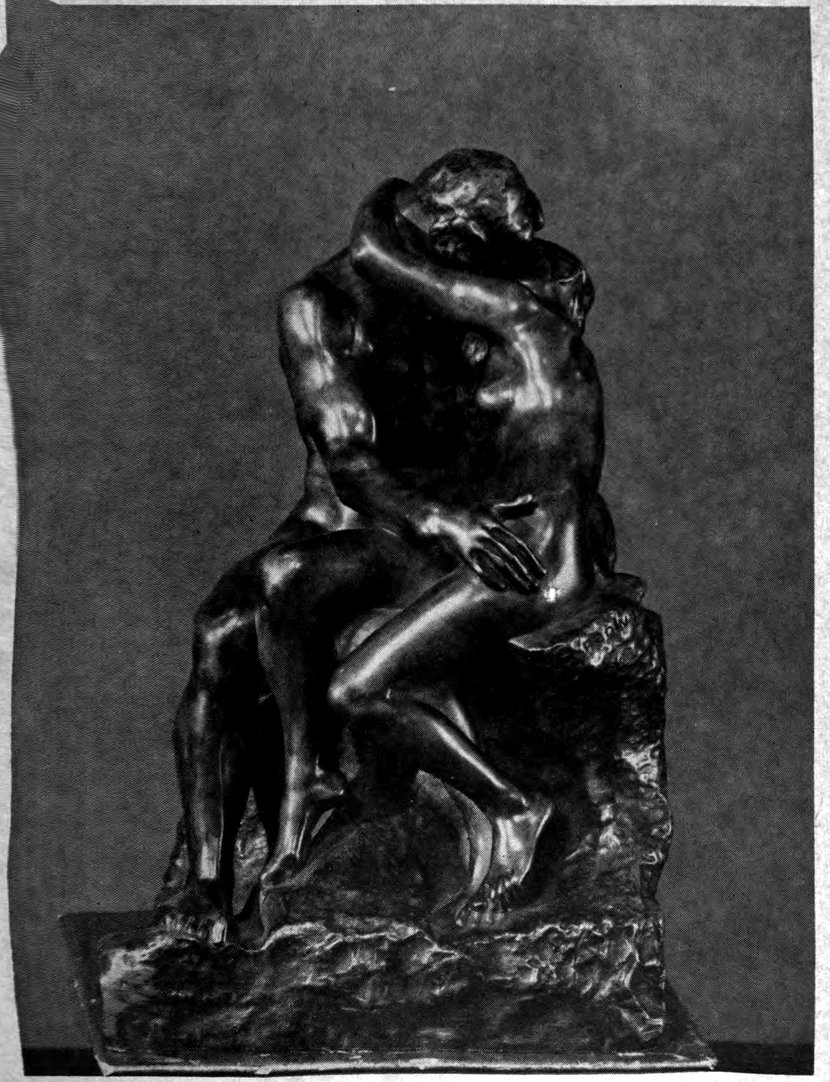
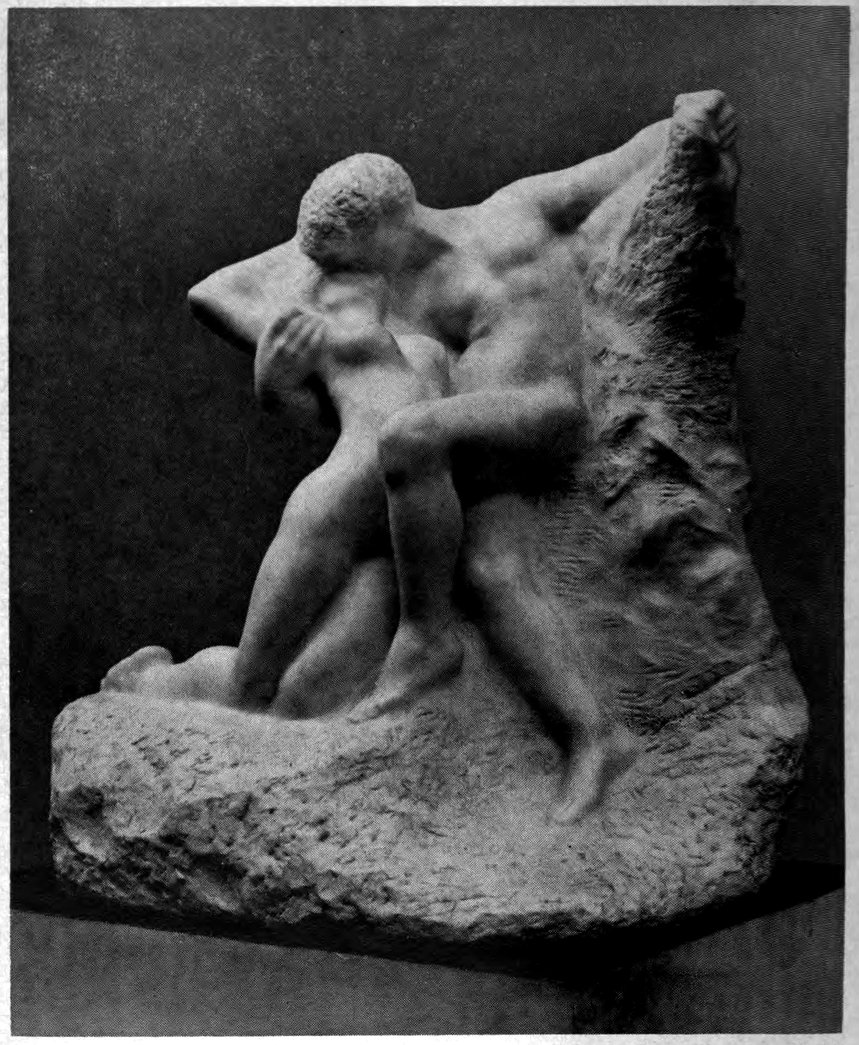
National Gallery of Art
THE KISS
by Rodin
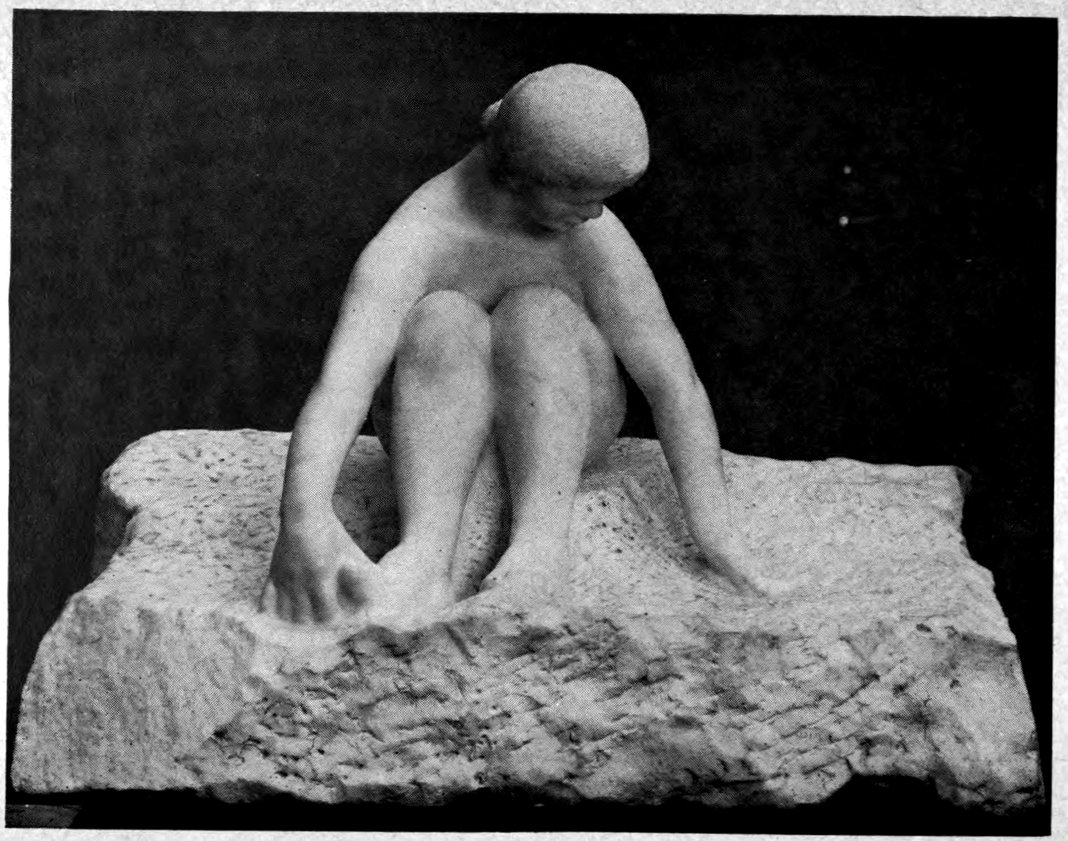
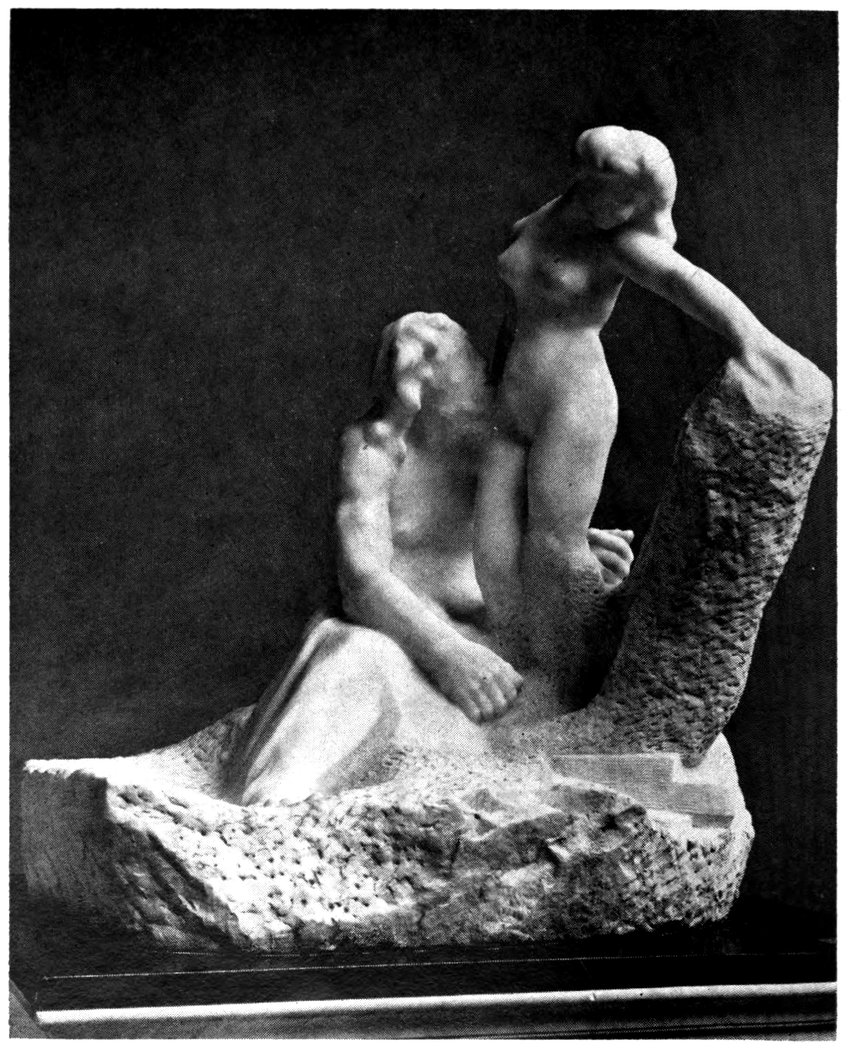
Metropolitan Museum of Art
BESIDE THE SEA
by Rodin
21Love manifestations and the passion for promoting
weakened or inadequate functional activity are familiar
themes in the most remote areas of the world. In the Arctic
circle as well as in the Marshall Islands. Among the Eskimo
of uttermost Greenland and among the Jibaro Indians of
Equador. The Orang Kubau of Sumatra and the Semang
and Senoi of Malacca are knowledgeable in this regard.
The natives of these disparate territories are familiar with
the plant and animal life of their regions, the nuts and fruits,
the herbs and leaves, and their properties and specific
virtues. They have tested them in food and drink, and in
other functional directions: and by long, groping, deductive
sequences they have come to definite practical conclusions.
They have managed to extract or to use certain essences
and elements in these roots and plants that they found conducive
to specific purposes, particularly to the primary function
of life, the erotic motif, the functional performance.
Oral traditions, the ways of the tribal society, derive,
pre-historically, from a matriarchal hierarchy. And to the
women of the tribe the obscure secrets of amorous practices
and devices are all-important. Because they are the conditions
of procreation, the source of fertility, the depositories
of life and continuity. The love mystique, then, is the primary
and virtually exclusive sacrosanct knowledge confined
to the female of the tribe. Hence, after the ages of oral
transmission, when we enter upon the centuries of writing,
verbal transcription, and recording, then the sagas and
chronicles, the legends and folk consciousness, invariably
dwell on the female, the wise old woman, the witch, the
adept, who possesses the arcana of erotic functions.
In the course of undetermined time, as literary mastery
grows and develops culturally to the degree attained by
Greece in the fifth century B.C., the witch, as guardian of
Aphrodite’s mysteries, is paramount. She is known to the
peasant and the hoplite, to the cobbler and the young
athlete, to the stroller in the agora, to the serious dramatist,
even to the philosophers, to Socrates, to Plato.
In classical legend, Phaon, a ferryman of Lesbos, was
22given a potent periapt by Aphrodite, that made him remarkably
handsome. The poetess Sappho consequently fell
passionately in love with him. According to the Roman
encyclopedist Pliny the Elder, author of the Historia Naturalis,
Phaon had found a mandrake root that resembled the
male genitalia. This root was an assurance of feminine love.
Sappho, however, is said, in the version of Ovid’s Heroides,
to have flung herself from the Leucadian rock on his account.
Xenophon, the Greek historian who belongs in the fourth
century B.C., recounts, in his Memorabilia, a dialogue between
the philosopher Socrates and a hetaira named Theodote.
The subject is the art of finding and retaining lovers.
Socrates: There are my lady friends, who will never let me
leave them, night or day. They would always be having
me teach them love-charms and incantations.
Theodote: Are you really acquainted with such things,
Socrates?
Socrates: Of course I am. What else is the reason, think
you, that Apollodorus and Antisthenes never leave my
side? Why have Cebes and Simmias come all the way
from Thebes to stay with me? You may be quite sure
that not without love-charms and incantations and magic-wheels
can this be brought about.
Theodote: Lend me your wheel, then, that I may use it on
you.
Socrates: Nay, I do not want to be drawn to you. I want
you to come to me.
Theodote: Well, I will come. But be sure to be at home.
Socrates: I will be at home to you, unless there be some lady
with me who is dearer than yourself.
A speech attributed to the Greek orator Antiphon, who
dates in the fifth century B.C., involves a belief that love
could be secured by the administration of a potion.
23The Attic orator is addressing the court:
The girl began to consider how she should administer
the potion to them, before or after dinner, and, on
reflection, she decided it would be better to give it
after the meal. I will endeavor to give you a brief
account of how the potion was actually administered.
The two friends partook of a good dinner, as you can
imagine, the host having a sacrifice to offer to the god
of his household and the guest being on the eve of a
sea voyage. When they had finished, they made a
libation and added thereto some grains of incense.
But while they were murmuring their prayer, the concubine
slipped the poison into the wine she was pouring
out for them: and furthermore, thinking that she
was doing something clever, she gave Philoneos an
extra dose, supposing that the more she gave the
warmer would be his love for her.
The important deduction that follows as a corollary
from the above passage is that the love-potion, mentioned
without elaborate comment, was already, in the fifth century
B.C., a matter of common knowledge and common use.
The plant called anciently telephilon was used by the
Greeks for amatory purposes. Botanically, it has been identified
with the poppy: and by some, with a kind of pepper
tree. Theocritus, the Greek bucolic poet, refers to its use in
the third Idyll. A goatherd goes to the cave of his sweet-heart
Amaryllis. He tries to re-awaken her former love:
I learned my fate but lately, when upon my bethinking
me whether you loved me, not even did the poppy
leaf coming in contact make a sound, but withered
away just so upon my soft arm.
Lovers were accustomed to guess by the poppy leaf
placed between forefinger and thumb of the left hand, and
24then struck by the right, whether their love was reciprocated.
If a loud crack was produced, it was a propitious amatory
omen.
Among the ancient authorities the virtues of plants and
herbs and spices and their medicinal curative powers and
also their amatory impacts were frequently enumerated,
described, and classified. In this group belongs Dioscorides,
a Greek army surgeon who flourished in the first century
A.D. His comprehensive treatise on the subject, De Materia
Medica Libri Quinque, was for centuries consulted and
used as a standard text. In the Middle Ages the famous
Portuguese Marrano physician Amatus Lusitanus produced
an excellent edition of Dioscorides. It was published, with
numerous woodcut illustrations, at Leyden in Holland, in
1558.
According to the Enquiry into Plants by Theophrastus,
and equally to the Materia Medica of the Greek army surgeon
Dioscorides, cyclamen, which is sowbread, had erotic
properties. The root of the plant was used as an ingredient
in love-potions.
The plant itself produces colorful flowers, while the
fleshy roots are favored by swine: hence the old name of
sowbread.
The Greek physician Dioscorides, who served as a surgeon
in the army of the Roman Emperor Nero, mentions,
in his Materia Medica, mandrake as being anciently considered
efficacious in love philtres. He also alludes to the
practice in his own days, when a concoction of the root of
mandrake steeped in wine was judged to be a favorable
love-potion.
In the furious and unceasing search for some product
25of the earth, some fabricated distillation, some suddenly
and miraculously discovered triumphant panacea that would
efficaciously induce virile activity, the ancients grasped at
any object that, by its mere outward and physical conformation,
might conceivably have some cryptic, symbolic association
with genital resemblances, and hence with amatory
functions.
Such a resemblance was readily and gratefully found in
the mandrake. The mandrake, even in Biblical times, was
credited with unique properties, not least, with amatory
stimulation.
Mandrake, or mandragore, which is botanically mandragora,
mandragora officinarum, is a tuber with purple flowers,
dark-leaved. It is native to Palestine, and hence has a Hebrew
name, mentioned in Biblical literature. It is called
there dudaim, an expression associated etymologically with
love.
The peculiarity of mandrake is that it often assumes
a human shape, the limbs in particular being formed like
human extremities.
From the earliest literary eras mandrake was a customary
ingredient in love-potions. Circe, the sorceress who appears
in Homer’s Odyssey, was traditionally an adept in concocting
brews with mandrake infusions. So intimately was
her name linked with this man-shaped plant, that it became
known as Circe’s plant.
As later Biblical confirmation of the significance of mandrake,
the strange and moving episode of Jacob and Rachel
and the employment of the very effective mandrake may
be mentioned.
There is a further suggestion of its use in the Song of
Songs.
The Greeks and the Romans likewise were acquainted
with mandrake and its virtues. The Greeks considered the
root an amatory excitant, and, by association, called Aphrodite,
26who presided over amatory functions, Mandragoritis,
She of the Mandrake. Plutarch, the Greek philosopher and
biographer, alludes to the plant and its resemblance to
human genitalia. In his monumental encyclopedia, the
Natural History, the Roman Pliny the Elder similarly dwells
on this likeness, and adds that when a mandrake root that
has grown into male genital form is found, it will unquestionably
secure feminine love.
Without interruption the tradition of the mandrake
lingered through the centuries. Old chroniclers allude to it.
Woodcuts and illustrations in medieval vellum-bound folios
present readers with the horrifyingly semi-human form of
the plant. Sinister and abhorrent legends have grown up
around the plant, many of them associated with death,
gibbets, hangings, thieves.
Medieval folklore trusted to the consumption of the
root as a reliable help in conception. This belief is also confirmed
by a seventeenth century traveler. Sorcerers and alchemists
and other occult practitioners concocted their elixirs
with the aid of mandrake.
The seventeenth century English herbalist, John Gerarde,
refers to mandrake in his Herball or General Historie of
Plantes, and to its use in conception, particularly in the case
of barrenness. He merely touches on its employment in
amatory practices, but he is repulsed by the prurient and
salacious nature of these devices.
In these days, too, mandrake evidently has not been
neglected as a possible invigorating agent. In Greece and
in Italy, folk beliefs in the plant still survive, and are put
into active practice.
Sexual and procreative capacity was such a primal,
essential factor in the old religious cults that, in classical
mythology, Greek and Roman, and in Egyptian and Asian
cults as well, the bull, the most potent among animals, was
27the ceremonial and pictorial symbol of this cosmic power.
The bull, in fact, was equated with divinity. The processional
sacrifice among the Romans, the taurobolium, highlighted
the preeminence and the reverence due to the bull. In
Egypt, he appears as Apis, the bull-god. He is also present
in the Mithraic cult, and Mithra himself is sculpturally represented
as holding a bull and cutting its throat. The bull
was an expiatory sacrifice among the Germanic tribes, and
also among the Northmen. In the Orient, too, the bull is
sacred among the Japanese. Cows, also, have been no less
venerated among the Greeks, the Hebrews, and the Hindus.
An ancient Egyptian record, the Doulaq Papyrus, reveals,
in the translation by the famous Egyptologist Sir William
Flinders Petrie, how even in antiquity sexual passion was
channeled, promoted, and controlled: and how the cult of
money and the phallic cult often went hand in hand and
were intimately linked together. So that religious prostitution,
the sacred erotic rites of pagan worship, transcended
the common activities of the public prostitute and assumed
a hieratic, reverential status.
This status is stressed and confirmed in the story of the
sacred prostitute or hierodule Thubui, who was approached
by Setna-Khamois, son of the Egyptian Pharaoh Usimares.
In the papyrus the lavish richness of the hierodule’s apartment
is described, and the bloody conditions she exacts from
her passionate prospective lover.
In the barber shops and the perfumers’, in the furtive
taverns and the baths and eating places, in Greece and later
on in Rome, the lower types of prostitute plied their trade.
They might ostensibly be musicians and singers of a sort,
but these qualifications were mere preliminaries to their
more intimate ministrations. The ways of these harlots, their
outlook, their training, their future, are described vividly
28in Lucian’s Dialogues of the Courtesans and in Alciphron’s
fictional letters. The poets, too, have their say about this
institution, and many of their pieces, sensuous and sensual,
erotic, scatological and lewd, are preserved in the Greek
Anthology and the Palatine Anthology. In the collection
known as The Girdle of Aphrodite, one of the pieces deals
with the theme of Lolita. Another describes the operations
of a masseuse. Others deal with amorous performances and
reflect on love and its price.
The ancient cult of Bacchus, the god of wine and fertility,
was marked by highly erotic rites and orgies and
phallic manifestations. Bacchus himself was equated with
the Greek god Dionysus, whose characteristics and functions
were identical. Dionysus himself was associated with
certain animals that were reputedly extremely lascivious by
nature or erotically exceptionally dominant. Among these
animals were: the bull, the ass, the panther, and the goat.
The right testis of the ass, for instance, worn in a bracelet,
was, according to the testimony of Pliny the Elder, who
produced an encyclopedic Natural History, and the Greek
physician Dioscorides, considered an effective sexual stimulant.
In many regions of ancient Greece, both on the mainland
but particularly in the islands of the Aegean Sea, the Dionysiac
cult was prevalent and passionately celebrated.
Euripides, the Greek tragic poet, presents a detailed and
authoritative picture of Bacchic ceremonies and beliefs in
his drama The Bacchae.
Among the priests of ancient Chaldea, noted for its
thaumaturgic practices and esoteric cults, there was a tradition
that the secretions of the liver of young boys would
be a restorative of physiological vigor.
Among professional Greek and Roman courtesans, there
29were special devices for provoking male interest. During
entertainments, for instance, drinking cups, made of earthenware,
emitted a perfumed aura, while the contents themselves,
containing myrrh and pepper, were direct stimulants.
In Asia Minor, some four millennia ago, the Sumerians
flourished and produced a high literary culture. There is
still extant a love song, chanted annually by the Sumerians,
that is in the manner of the Biblical Song of Songs. It is an
exultant amatory paean, dedicated to Inanna, the Sumerian
goddess of love and procreation, who may be equated with
the Babylonian Astarte and the Greek Aphrodite.
Storgethron, a plant used in ancient Greece as an amatory
medicine, has been identified as the leek.
The root called surag was, in antiquity, held to have a
stimulative virtue.
The aromatic leaves of tarragon, which grows in South
East Europe, is considered, in addition to its use as a flavoring
agent, as an amatory aid.
The oil extracted from the fresh leaves of the ruta
graveolens plant produces an amatory excitation.
Both in ancient and in medieval days amatory virtues
were attributed to the plant known botanically as radix
Chinae.
The juice of the plant spurge, in composition with other
items such as ginger, nettle seed, pellitory, cinnamon, and
cardamom, is considered, among Arabs, as highly provocative.
The aromatic leaves of sage had an amatory repute. So
30with tulip bulbs and savory which the Romans knew as
satureia.
Hierobota, or pisteriona, an herb mentioned by the
medieval philosopher Albertus Magnus, was credited with
such potency that its mere possession was said to act as a
stimulant.
Pimpinella anisum, which is the botanical designation of
anise, is native to the Eastern Mediterranean region. The
ancients knew anise, and it was equally familiar to the
Middle Ages, as a love attribute.
The testes of animals have always been popular in amatory
preparations, both for their symbolic implications and
also for their genesiac value. This was the case with the
testes of lamb, deer, ram, and ass.
The head of the perch contains a number of small stones.
These were included in the amatory preparations devised by
sorceresses.
A French physician, Mery, in a treatise entitled Traité
Universel des Drogues Simples, stated that the partes genitales
of a rooster served as a potent stimulus.
Partridge was, according to the old writer Platina, in
his De Valetudine Tuenda, believed, apart from its gastronomic
relish, to ‘arouse the half-extinct desire for venereal
pleasures.’
In antiquity, snails were consumed for amatory purposes.
The Roman poets refer to this practice. Even in
modern times a concoction of snails, boiled in parsley, garlic,
and onions, and fried in oil and again in red wine, is
reputed to serve as a rejuvenating factor.
31An ancient Egyptian device for achieving amatory
efficiency involves a magic procedure:
Take a band of linen, of sixteen threads. Four of them
white. Four, green. Four, blue. Four, red. Fasten all
strands into one band, and strain with hoopoe blood.
Bind with scarab posed as the sun-god wrapped in
byssus. Bind to the body of the boy attendant who
holds the sacred vessel.
The worship of the phallus in antiquity was not originally
the worship of the human generative organs, but of the
divine procreative faculty symbolized by the genitalia of
the sacred bull and the sacred goat: in Egyptian religious
terminology, by Apis and Priapis or Priapus respectively.
In Greece, the phallus, originally symbolic of the goat
or bull, was attached, disproportionately and a posteriori,
to a human figure: so that the phallus, in the course of
time, became erroneously associated with human capacity.
The Athenian orator Isocrates postulated a maxim: What
is improper to do is improper to say. Yet a rigid adherence
to this view would mean a cessation of investigations of
all kinds, of many historical records and archives, mores,
and often matter that would give enlightenment on human
traditions and the more intimate details of communal, tribal,
or national life, of ethnic distinctions, of cultural progression.
Hence it might be more advisable to adapt the postulate
of Isocrates and to introduce the proviso that whatever has
been done or said or written by men should normally and
regularly be transmitted to later generations or to wider
circles, provided that this transmission is intended as a contribution
to a knowledge of the past, or of contiguous races,
or of disparate mores, and as a revealing exposition of what
man performed in earlier ages, and not as a prurient and
lewd inducement to wallow in scatological or libidinous
32depths for mere light or indifferent or transitory entertainment.
The anthropologist, the archaeologist, the professional
scholar, the historian are, by virtue of their interests and
training and their occupations, constantly dealing with subjects
that have either been taboo in a general sense, or that
involve the most secretive physiological and emotional
human situations.
The ancient cult of the stars merged with religious
ceremonials and religious beliefs, emerging in the zodiacal
bull. This bull was anciently equated with the sun in its
most auspicious phase, in spring time. The sun bull later
became the actual bull itself, as in the Minoan and the
Mithraic cults, and also among the Egyptians. For the bull
was now definitely the symbol of creative potency, of cosmic
fecundity and perpetuation.
The energized, salient phallus was the supreme symbol
of being and fertility. In antiquity it had divine significance.
It was carried in religious processions in ancient Egypt,
in Greece, in the Greek islands, in Phoenicia, Assyria, and
in Chaldea and Ethiopia. In Egypt, phalli, made of porcelain,
were worn on the person as periapts.
In their fulminations against pagan mores and the
sexual and erotic licentiousness and aberrations that were
so prevalent in antiquity both socially and religiously, the
ancient writers themselves were so descriptively forthright
and detailed in their denunciations, that these very assaults
and condemnatory attacks constitute in themselves, cumulatively,
a vast corpus of circumstantial knowledge of ancient
salaciousness, prurience, perversions, and total abandonment
of amatory and sexual restraints. Among such witnesses
and authorities were the Church Fathers Tertullian,
Arnobius, and Clement of Alexandria.
33The religious practice of women submitting or rather
offering themselves to the priapic symbol, the phallus or
lingam, dates back to millennia before this era. Herodotus,
the Greek historian, mentions it; also Strabo the geographer,
and the Church Father Clement of Alexandria.
Among the ancient Moabites, the god Baal-Peor, that
was at one time worshipped by the Israelites and then
execrated, was an idol equated with the Greek and Roman
phallic Priapus.
The consciousness that in Nature, in the totality of the
cosmic scheme, and in human beings the love motif conditions
all existence and the continuance of being is manifest
in the images, the religious rituals, symbols, ceremonials,
and sacrificial offerings of all peoples, in every age, ancient
and modern, in Greece and among the Romans, in pre-conquered
Mexico and in India, throughout the East and
in the Pacific Islands, and among the early tribal and racial
denominations of Europe—the Germani and the Suevi, the
Galli and the Normanni.
On the banks of the Euphrates, in Syria, there was
anciently a vast, elaborate, richly decorated and endowed
temple. At the entrance rose two gigantic phalli, dedicated,
as the inscription ran, by Bacchus to the goddess Juno.
Offerings were made to the phalli by the thronging suppliants,
while within the building numerous wooden phalli
were dispersed throughout the spacious interior. Similar
images and rituals were manifest in contiguous countries,
in Phoenicia, Persia, and Phrygia.
Throughout every polis and colony and settlement of
ancient Greece, and also in the regions of the Mediterranean
littoral, in Egypt and the Middle East, the phallus was a
symbol of veneration always associated with religious
34ritual, with hieratic traditions, and temple worship on a wide
and enthusiastic scale.
In Greece, there were the phallic hermae, enormous
phalli attached to pedestals, tree-trunks, boundary-markers.
They were protective and apotropaic, and where the phalli
appeared, there would credibly be fecundity and erotic
consummation, generation and abundance, in man and beast
and throughout the cosmic design.
The phallus was variously named Priapus and Tutunus
and Mutunus and Fascinum and, in Hindu religious mythology,
the lingam. Among the esoteric Gnostics, Jao, the
sun-god, equipped with ithyphallic force, had properties
akin to those of Priapus. Thus the generative, energizing
organs of virility, of the cosmic erotic impulse and of its
purpose, are, despite variations of name and epichorial
traits and accretions, basically comprehended under one
concept, in all proto-history, in verifiable history, and, by
traditional progression, in later ages.
Antiquity, free from the modern attitude that makes
demarcations between what is obscene and what is not so,
venerated the sexual act, and its symbolic representation
of the phallus, as significant of the universal sense of generation
and procreation. As a consequence, all sexual, all amatory
performances, references, allusions were accepted as an
integral element in human life, and involved no intrusive
image of salaciousness, prurience, lewdness.
This phallic reverence, in its widest and most sweeping
sense, was especially prevalent among the ancient Greeks.
But it was not confined to this people. It was prevalent in
Asia Minor, among the Hittites and the Sumerians, the
Accadians and the Parthians, the Medes and the Babylonians
and the Phoenicians. It was prevalent in Egypt and the
North African littoral, and it was equally prevalent along
the Mediterranean coastal regions. In the Far East, particularly
but not exclusively in India, the cult of the phallus was
35a devout religious experience, equated with the dominant
cults of the cosmic deities.
In later ages, when the human body became as it were
dichotomous in function, the merely physiological acts
began to be held in lesser esteem, and even became condemnatory
in status, open to reproach and disdain, and even
violent abuse and ill-treatment. The body, in fact, became
obscene, invested with evil forces, compounded of malefic
and defiled factors. The body was to be crushed and tortured
and disfigured, in order to release the spiritual complements
of the human being. The amatory acts were now turned into
licentious and mephitic obscenities, into bestial defilements,
into unspeakable carnal and animal manifestations of the
lower nature. As a consequence, phallic worship, the glorification
of the creative principle embodied in the male and
female, went underground. And by the mere fact of going
underground, it persisted, with qualifications, acquiring
through the course of time veneers of secrecy, accretions of
furtiveness, elements of ribaldry as a kind of protective coat.
Essentially, the phallic symbol was anciently viewed as
an amatory agent, a generative stimulant, in as much as the
phallus was cosmically the source of all being. Therefore
offerings were made to the phallus in sacrificial rituals, just
as to any other potent deity from whom privileges and
favors were sought. Libations of milk were a normal form
of offering to Priapus. Women, anxious to become mothers,
stood reverently and suppliantly in puris naturalibus before
the all-potent phalli, and in a further urgent procedure,
performed the act of erotic consummation with the aid of
the lingam figure itself. For the phallus, in a pose of lubricity,
was the final appeal, the ultimate resort, of the pleading,
awed, reverential mortal.
Among cities where the generative force symbolized by
the phallus was held in deep veneration, were Orneae, Cyllene,
36and Colophon. Under the later impact of Christianity,
however, the phallic cult diminished in its influence and
extent, or was re-directed into other channels. In one specific
direction, the cult merged into the Orphic mysteries.
Erotic awareness never went further than in the case of
a city in Troas named Priapus, on account of its consecration
to the cult of the phallus. There were other cities too,
according to the testimony of Pliny the Elder, that were
named Priapus for identical reasons. In the Ceramic Gulf
there was an island named Priaponese: and an island in the
Aegean Sea called Priapus.
A notorious incident in Greek history involved the nocturnal
mutilation of hermae, in 415 B.C. Hermae were
bronze or marble pillars surmounted by a head and a
phallus. These marble figures appeared in the streets and
squares of Athens and other Greek cities.
Suspicion for the defilement and desecration of the hermae
fell upon the brilliant but wayward Athenian general
and statesman Alcibiades and his companions. As a result,
Alcibiades was condemned to banishment.
The cult of Priapus and his obscene association with the
genitalia of the ass, the symbol of unbridled lust, were expounded
in ancient fable and legend. Other commentaries
and explanations were added later by Hyginus, who flourished
in the first century A.D. Hyginus wrote on religious
subjects and mystic cults. Pausanias, the Greek traveler and
geographer, who belongs in the second century A.D., and
Lactantius, the fourth century Church Father, also dwelt
on the subject.
Of all cities of ancient Greece, Lampsacus, situated on
the banks of the Hellespont, was most dedicated to the
veneration of Priapus. In a legendary fable it was demonstrated
37that the origin of the priapic cult was Lampsacus
itself.
In the Greek festival called Thargelia, celebrated in May,
the rites were dedicated to Apollo, the sun god, and to
Diana, the moon goddess. At the ceremonial there was a
procession of youths who carried olive branches hung with
food, fruit, and images of phalli.
The genesiac theme, in its most lustful implication, was
so prevalent in early history that there was a sect, known
as the Baptae, dedicated to Cotytto, an obscene and lewd
goddess. They celebrated their nocturnal abominations at
Athens, Corinth, in Thrace, and on the island of Chios.
One of the peculiar features of the Baptae was their
custom of drinking from glass vessels shaped like a phallus.
Juvenal, the Roman satirist, in describing the Baptae and
their mystic and symbolic rites, refers to one participant
who drinks from a glass Priapus: vitreo bibit ille Priapo.
According to the testimony of the Greek historian Herodotus,
a certain Melampus brought the cult of Bacchus, the
worship of the generative capacity, to Greece, approximately
in the thirteenth century B.C. He expounded the
features of the Egyptian cult and established processional
rites and ceremonies adapted from Egyptian usage.
In ancient Greece Bacchus, the phallic divinity, was
equated with Dionysus. In the cities the Greater Dionysia,
or the Urban Dionysia, were celebrated in his honor for
three days. The locale was at Limnae in Attica, and the
season was the middle of the month of March.
In very early times, the Greek biographer and philosopher
Plutarch declares, the rites were of a simple but
joyous nature. But in his own time the celebration had
reached a lavish, extravagant splendor.
38Women, devotees of the Bacchic symbol and known as
Bacchantes, introduced the ritualistic procession. Chaste
maidens, impeccable in morality and of distinguished birth,
followed. These were the Canephoroi, the Basket-bearers
who bore on their heads baskets containing the sacred
utensils used at the celebration: together with mystic objects,
flowers, salt, sesame, and a flower-bedecked phallus.
A detachment came next to the Canephoroi: these were the
Phallophoroi. The Phallophoroi were the Phallus-bearers,
carrying, attached to long staffs, the phallic emblem.
Musicians were also in the march, chanting and accompanying
the choral odes with twanging strings, and at brief
intervals emitting loud exclamations in glorification of the
god.
There were other strange participants. The Ithyphalli,
men dressed in women’s garments, who chanted salacious
phallic songs. Scandalous satyrs led goats for sacrifice, while
Bacchantes performed obscene dance movements. There
was, over the entire celebration, an atmosphere of debauchery
and libidinous license consonant with the phallic context
of the cult.
In Carthage, a spot outside the city was consecrated to
Astarte, the goddess of generation, and called Sicca Veneria.
Among the Phoenicians a similar spot, intended for the
same purpose, that is religious fornication, was known as
Siccoth Venoth.
In Biblical antiquity, the primary concept was for man
to be fruitful and multiply, and replenish the earth. To this
end, concubinage was consequently not frowned upon and
was practiced pari passu with marriage. Maid servants were
commonly taken by their masters as concubines, as in the
case of Hagar, and also in that of Reumah. Lot even gave
his maiden daughters for the satisfaction of the lustful inhabitants
39of Sodom. Later, he committed incest with these
daughters.
The servant women of Jacob, Bilhah and Zilpah, became
his concubines. These are instances, among many others,
that illustrate cases of adultery and fornication that do not
appear to have had a condemnatory stigma or reproach
attached to them. For the object in these circumstances was
procreation and propagation and that was the primal function
enjoined upon man.
The corollary is that sterility is a personal reproach in
Biblical times, a social defect that is looked upon with
opprobrium, particularly in Oriental countries.
In Spain, the phallic cult was practiced under the name
of Hortanes. This cult is mentioned by the Roman epic poet,
Silius Italicus, in his Punica. He describes the orgiastic
revels of Satyrs and Maenads in nocturnal rites in honor of
the Hispanic fascinum.
In the South of France, also, and in Belgium, excavations
unearthed relics, monuments, amulets and other artifacts,
bas-reliefs and antiquities of various kinds, all testifying
to the ancient cult of Priapus and his functions and the
deep and wide reverence for his omnipotence. In Germany,
Priapus lost the somewhat indulgent character of a phallic
and generative deity responsive to supplication and promise,
and became a violent, blood-lusting monstrosity. In parts of
Eastern Europe, again, Priapus became Pripe-Gala, sanguinary
and destructive.
Ancient Armenia had a deity analogous to Priapus or
Aphrodite or Astarte. She was known as Diana Anaïtis, and
her cult involved temple prostitution. The same practice, on
the testimony of the Greek historian Herodotus, was in
vogue in Lydia. Another writer, the Roman geographer
Pomponius Mela, who belongs in the first century A.D., has
40similar references in the case of an African people called
the Augilae.
Again, the practice was prevalent at Naucratis, in Egypt.
The phallic cult, that was originally consecrated to the
propagation of all things, in as much as the fascinum itself
symbolized the sacred regeneration of all Nature, in time
degenerated so that only the phallus as such became the
symbol of lust and passion and debauchery. It became the
emblem of excesses in erotic encounters, the sign of the
prostitute. Priapus actually became an object of some contempt,
a humble scarecrow of the fields, chthonic guardian
of the orchards, a subject of coarse ribaldry, as is testified
in the Latin corpus of poems known under the name of
Priapeia.
The lascivious mores of the Egyptians under the guise of
veneration of the priapic bull Apis, and their obscene
dances, rituals, and similar performances are described and
commented on in great detail by Herodotus in his History
of the Persian Wars.
The genitalia and all references to the phallic image
were in very ancient times held in such sacred esteem and
reverence that in Biblical literature the inviolable sanctity
of an oath was ratified by touching the area of the genitalia,
or the thigh, to use the Biblical euphemism. The Hebrews
especially held the generative organs in the greatest respect,
socially, ethnically, and religiously: and nudity as a consequence
was a matter of shameful stigma and opprobrium.
Among the Moslems too the most binding oath was taken
with respect to the sanctity of the genitalia.
In Egypt, in the temple of Isis, sacred prostitution was
a regular religious practice. Reference to this circumstance
is made by the Roman satirist, Juvenal, who calls Isis a
41procuress and her shrine a rendez-vous for adulterous and
libidinous practices.
Among symbolic emblems that represented, in combination,
the male and female principles of generation and
fecundity, were the Egyptian crux ansata and the seal of
Solomon.
The phallic symbol was so pervasive, so potent, in the
lives of the ancients, that the priapic function and the erotic
variations of the generative performance were pictorially
represented in every conceivable form of reproduction:
scenes on vases representing perverted consummations:
baskets filled with phalli that were offered for sale to yearning
women: ithyphallic figures: monuments, lamps and other
objects depicting orgiastic lubricities.
In Ezekiel 16.17 there is a reference to the phallic figure:
Fecisti tibi imagines masculinas et fornicata es in eis.
In one of the bucolic Idyls of the Greek poet Theocritus
(c. 310–c. 250 B.C.) the maiden Simaetha, in love with
Delphis, who has abandoned her, attempts to regain his
love by performing certain magic rites and making invocations
to Selene, Aphrodite, and the horrendous Hecate.
She fashions a wax image of Delphis and by sympathetic
magic anticipates the melting of his heart in correspondence
with the melting of the image.
In addition, she makes use of the magic wheel, and her
refrain throughout the performance is:
My magic wheel, draw home to me
The man I love!
Intertwined with these rituals is the further refrain,
addressed to Selene, the moon goddess:
42Bethink thee of my love,
And whence it came,
My Lady Moon!
In his De Sanitate Tuenda Praecepta, Advice on keeping
Well, Plutarch, the Greek philosopher and biographer, comments
on lust and potions:
While we loathe and detest women who contrive philtres
and magic to use upon their husbands, we entrust our
food and provisions to hirelings and slaves to be all but
bewitched and drugged. If the saying of Arcesilaus, addressed
to the adulterous and licentious, appears too bitter,
to the effect that ‘it makes no difference whether a man
practices lewdness in the front parlor or in the back hall,’
yet it is not without its application to our subject. For in
very truth, what difference does it make whether a man
employ aphrodisiacs to stir and excite licentiousness for the
purpose of pleasure or whether he stimulate his taste by
odors and sauces to require, like the itch, continual scratchings
and ticklings.
(Loeb)
In Greek mythology, Andromache, the wife of the Trojan
warrior Hector, was accused by Hermione, wife of Neoptolemus,
of gaining his love by means of love-potions. Euripides,
the tragic poet (c. 485–406 B.C.), refers to the situation
in his drama Andromache:
Not of my philtres thy lord hateth thee,
But that thy nature is no mate for his.
That is the love-charm: woman, ’tis not beauty
That witcheth bridegrooms, nay, but nobleness.
Philtres were in actual use beyond mythological times.
43Xenophon (c. 430–354 B.C.), the Greek historian, author of
Memorabilia, alludes to the practice:
“They say,” replied Socrates, “that there are certain
incantations which those who know them chant to
whomsoever they please, and thus make them their
friends; and that there are also love potions which
those who know them administer to whomso they
will; and are in consequence loved by them.”
Propertius, however, the Roman elegiac poet (c. 48 B.C.–16
B.C.), refers to the futility of love potions:
Here herbs are of no avail,
nor nocturnal Cytaeis,
nor grasses brewed by the
hand of Perimede.
Cytaeis is the witch Medea: while Perimede is another
witch, called by Homer Agamede.
The Bacchic cult in Egypt is described by the Greek
historian Herodotus in Book 2 of his History of the Persian
Wars:
To Bacchus, on the eve of his feast, every Egyptian
sacrifices a hog before the door of his house, which
is then given back to the swineherd by whom it was
furnished, and by him carried away. In other respects
the festival is celebrated almost exactly as Bacchic
festivals are in Greece, excepting that the Egyptians
have no choral dances. They also use instead of
phalli another invention, consisting of images a cubit
high, pulled by strings, which the women carry round
to the villages. A piper goes in front, and the women
44follow, singing hymns in honor of Bacchus. They give
a religious reason for the peculiarities of the image.
In Book 5 of The History of the Persian Wars, Herodotus
describes some of the marital customs of the Thracians:
The Thracians who live above the Crestonaeans observe
the following customs. Each man among them
has several wives; and no sooner does a man die than
a sharp contest ensues among the wives upon the
question, which of them all the husband loved most
tenderly; the friends of each eagerly plead on her
behalf, and she to whom the honor is adjudged, after
receiving the praises both of men and women, is
slain over the grave by the hand of her next of kin,
and then buried with her husband. The others are
sorely grieved, for nothing is considered such a
disgrace.
The Thracians who do not belong to these tribes have
the customs which follow. They sell their children to traders.
On their maidens they keep no watch, but leave them altogether
free, while on the conduct of their wives they keep
a most strict watch. Brides are purchased of their parents
for large sums of money.... The gods which they worship
are but three, Mars, Bacchus, and Dian.
An ancient Hittite text contains invocations and rituals
intended to remedy conditions of incapacity or lack of
erotic desire.
A sacrifice is performed to Uliliyassis, continuing for
three days. Food is prepared: sacrificial loaves, grain, a
pitcher of wine. The shirt of the male suppliant is brought
forth.
The suppliant bathes. He twines cords of red and of
45white wool. A sheep is sacrificed. An invocation is made,
beseeching help and favor: Come to this man, the cry arises.
Come down to this man. Make his wife conceive and let
him beget sons and daughters.
An Egyptian love song, belonging in the second millennium
B.C., is still extant. The love song was usually
chanted to a musical accompaniment. The lover is addressed
as sister, or brother.
The heart is sick from love, laments the victim, and no
physician, no magician can heal this disease, except the
appearance of the sister. There is abundant reference to
spices, to myrrh and incense, and the tone of the amatory
supplications and yearnings is the tone of the Song of Songs.
Listlessness on the part of the love-sick suppliant is banished,
as soon as he beholds his beloved, as soon as her arms open
in embrace.
In ancient orgiastic cults, particularly those dedicated to
Dionysus and to the Syrian Baal, religious frenzies were
accompanied or stimulated by drugs, fermented drink, by
rhythmic dance movements, by tambourine, drum, and flute
music that culminated in ecstatic self-mutilation followed
by wild sexual debaucheries.
Passion, lust, incest, fornication, adultery, as well as
concubinage and polygamy, most of the sexual perversions
and aberrations that are now included under medico-psychiatric
categories, occur in the Bible, in both Testaments.
King David married eight women. On his flight from
Absalom he left ten concubines behind him. Jacob had two
wives. King Solomon had seven hundred wives and three
hundred concubines.
There are instances of enduring affection too, as in the
case of Jacob, who labored for Rachel for fourteen years.
There is sudden, rapturous love at first sight, at all costs:
46It happened, late one afternoon, when David
arose from his couch and was walking upon the roof
of the king’s house, that he saw from the roof a
woman bathing, and the woman was very beautiful.
And David sent and inquired about the woman. And
one said, “Is not this Bathsheba, the daughter of
Eliam, the wife of Uriah the Hittite?”
So David sent messengers and took her, and he
lay with her.
Amnon is overwhelmed by a passionate infatuation for
his half sister Tamar. He was so tormented that he made
himself sick because of his sister. He is advised by his
friend Jonadab to go to bed and claim illness. Tamar brings
him food and at this point Amnon attempts seduction. When
she suggests an approach to the king, for permission to
marry Amnon, his lust overpowers him, and he consummates
his passion. After which, in a frenzy of hate, he
banishes her.
The Song of Solomon is a paean to sexual love, an
erotic exultation, the apogee of amatory sensuality.
In the New Testament, too, there is frequent reference
to harlots and debauchees and to a variety of ‘sinners.’
Babylonian customs, in addition to the rites of temple
prostitution, included both male and female sacred concubines.
There was considerable pre-marital sexual freedom.
But there was also monogamous marriage involving rigid
fidelity. Trial marriage was acknowledged. Adultery was
punished by drowning the guilty wife. In the degenerative
days of Babylon, morality broke down. Male prostitutes
rouged their cheeks and bedecked themselves with jewelry,
while the poor exposed their daughters to prostitution.
Sensuality and erotic libertinage became dominant and
pervasive.
47Among the Canaanites the most potent deities—Baal
and El and Asherah—were the symbols of procreation and
sexuality. Hence, all acts, all objects, all rituals associated
with copulation, with the phallus, with fecundity were
divinely inspired and inherently sacred. Ceremonials dedicated
to the deities invariably included sexual activity,
sacred and ecstatic orgies. The voluptuous and sensual
character of the dedicatory rites was evidently so appealing
that they lured the Israelites into acceptance and imitation,
for the deity of the Israelites was one, supreme, without kin,
without consort, without sexuality.
The New Testament attacks pagans, particularly Roman
paganism, for unnatural sexual practices, lusts, and corrupt
and degenerate mores.
In primitive Greek society, under a primal matriarchy,
the male functioned as a kind of passive sexual partner, and
virtually thereafter as a domestic drudge.
But in the course of the centuries the male acquired
dominance, in the divine pantheon, and equally on a mortal
and earthly plane, politically, socially, and domestically.
But the concept of the inter-relationship of the sexes
grew into a concept of one primary harmonious principle of
aesthetics, of essential perfection of beauty, irrespective of
sex and hence irrespective of any compulsive admiration and
appreciation of such beauty by one sex or the other. Beauty
became an entity in itself, a sexless trait. In the Platonic
dialogue, in fact, in the Symposium, the theory is postulated
that man was at one time androgynous.
The Greek hetaira or male companion was virtually a
prostitute. Sometimes she acquired a more permanent status,
when she was bought by a master and became a pallakis
or concubine.
Homosexuality, on the other hand, brought no stigma
to the boys or young men involved in the practice. Because
48homosexuality was a corollary, applied in practice, of the
primary concept of aesthetic beauty irrespective of sex.
In the case of women, there was the corresponding
though possibly not so widespread cult of tribadism.
The Romans cultivated sexuality, particularly in a heterosexual
direction, with great vigor and lustfulness. It was
largely through the growing consciousness of Rome as an
imperial power, and through the increase in industry and
commerce, in wealth and consequent luxury and idleness,
that perversions of all kinds increased and multiplied to
such an abnormal extent that in the first century A.D. the
Romans themselves, through their own poets, commented
on the situation and contrasted it, with some sense of
nostalgia, with the severe and rigid and essentially stabilized
moral code that prevailed in the old pre-imperial days.
During the Roman Empire, with the increase of childless
families, women were able to give more scope to their
femininity, their sexual appeal, and their erotic allurements.
As a consequence, there was an upsurge of marital license,
on the part of both husband and wife, but notoriously so
in the case of the women. This situation reached the most
shameless depths, as the poet Juvenal testifies: and as the
Church Fathers later on asserted, in their wholesale condemnations
of pagan practices.
Early in the first century A.D. the insidious decline of
domestic morality became so manifest that imperial decrees
required marriage in the case of men under sixty and of
women under fifty: and these ordinances also restricted
the freedoms of bachelorhood.
Marriage was thus officially encouraged, and large families
were granted special privileges and monetary awards
from the imperial treasury. But these and similar measures
were abortive in their primary purpose. For prostitution
49flourished and grew and became so flagrant and yet so
characteristically identified with later Roman society that
there were at least a score of designations for the public
harlot, according to her social status, her price, and her
locale. Thus lust and eros were rampantly triumphant.
Harlotry was manifestly rife in Old Testament days,
for there is repeated allusion to the practice: in the symbolism
of Oholah and Oholibah, in the Psalms and in the
prophets, particularly Isaiah and Jeremiah, in the Book of
Judges, and in Samuel.
In addition, there is mention of the allurements of the
harlot: her chamber fragrant and enticing with spices and
perfumes, aloes and myrrh and cinnamon.
There is reference to the personal seductive persuasiveness
of the harlot’s coaxing words, the urgency of her erotic
devices.
The Old Testament mentions and illustrates the morality
involved in sexual impulses resulting in physiological consummations.
Under certain circumstances, stoning the guilty
pair was enjoined. In some cases, the man only was punished,
by death. In other situations the man who spurned
the woman after carnally knowing her was whipped and
fined one hundred shekels of silver. For fornication, the
death penalty was normally enforced. Sacred prostitution
in the temple, too, whether affecting male or female, was
prohibited.
Homosexuality and sacred male prostitution are both
known to the Bible. In Deuteronomy there is an injunction
against the sons of Israel becoming sacred prostitutes. The
abominations of Sodom receive ample treatment. Even
transvestism is prohibited, for it suggests sexual dubiety,
physiological ambiguity, and a possible merging of the sexes,
a potential elimination of the sexual demarcations. Other
50amatory abnormalities also appear in Biblical contexts,
among them: rape, voyeurism, and bestiality.
With the onset of the Hellenistic Age, concurrent with
Alexander the Great’s death in 323 B.C., the Mysteries, the
exclusive secretive cults, advanced in importance and in the
extent of their influence. Many of these cults came from
the East and merged, with adaptations and various amplifications
or modifications, into the Greek and Roman religious
sphere. The cult of Cybele, Magna Mater Deorum, the
Mighty Mother of the gods, was most dominant, transcending
all other cults and to some degree absorbing
them. In addition, there were the cults of Sabazios, of
Mithras, of Isis and Osiris. These cults bound the initiates
to close secrecy: and thus only occasional fragments, hints,
references from various sources can present any degree of
coherence and design in the cults. It is known that there
were dramatic presentations involving communion with
the deities, dark rites and ceremonials, even vague adumbrations
of the concept of immortality, as well as castigation and
castration, fertility symbolisms and seasonal fructifying cycles.
There were, further, the Gnostics, searchers for divine
knowledge. Some of these speculative cosmologists were
scrupulously ascetic in every sense, while others orgiastically
indulged, toward the attainment of the same end, in fleshly
passions.
At the Greek celebration of the Phallophoria, leather or
wooden representations of the phallus were carried processionally
through the public streets of the polis. It was the
thematic manifestation of all-embracing fertility, on land,
among the beasts of the fields, and in human relationships.
It was a kind of visual paean, in fact, to the primal sexual
impulse, to the basic erotic conflict.
One of the earliest instances of multiple incest occurs in
51Book 10 of Homer’s Odyssey, in which Odysseus describes
his visit to Aeolus. Aeolus has a family of six daughters and
six sons, and he has given his daughters in marriage to his
own sons.
In Greece the Aphrodision, and in Rome the Venereum,
were the private bordellos that were not used by the general
indiscriminate public.
Both in antiquity and in later ages the public baths, with
both sexes in nude contacts in the balnea mixta, were a
direct amatory stimulant. As further provocatives, there was,
in particular cases, bathing in asses’ milk, in essences of
myrtle and lavender, in rose water, in almond paste and in
honey water, and also in champagne.
In Greece, the phallus was so pervasive as a genesiac
symbol in every phase of daily life, that there were loaves
baked in phallic form. These loaves were known, for another
erotic reason, as olisbokolices.
Drillopotae were glass vessels in phallic form. They were
used, in ancient Rome, as drinking cups: and thus were an
added erotic reminder at banquets and similar gatherings.
In Roman antiquity the color yellow was associated with
prostitutes, and was a symbol of their profession. Yellow
still retained this significance in the Central European
countries in later ages. In Tsarist Russia, the yellow ticket
was the official prostitute’s occupational token. Alexander
Kuprin’s Yama the Pit describes the situation in a vivid and
grim narrative.
Figurae Veneris is a Latin expression meaning positions
of Venus. This phrase refers to the range of sexual positions.
The Greeks were familiar with some seventy such permutations
52and manipulations. There were the symplegma and
the catena, which involved more than two partners, and
the dodekamechanon. Hesychius the Greek lexicographer,
Philaenis, and, among the Romans, the poet Martial mention
these contortions. In the Middle Ages, the licentious
poet Pietro Aretino produced a poetic commentary on the
entire extent of erotic possibilities.
Among periapts and amulets that were credited with
promoting erotic activity were charms in the shape of an
extended hand, a wild boar, the head of a bull, astrological
signs; magic formulas too, inscribed on various objects; the
crux ansata, and genitalia.
Among erotic pieces that are no longer extant are certain
elegiac poems, of an amatory type, attributed formerly to
Plato the philosopher. An ancient Roman poet named Laevius
wrote an erotopaegnion. Apuleius, the Roman philosopher
and novelist, produced a number of amatory epigrams.
These references, together with others that include Vergil’s
Aeneid and the Georgics, are made by the Roman poet
Ausonius himself.
He adds, also, that, like Martial and other poets, his life
is unblemished though his verses may be dubious:
Igitur cui hic ludus noster non placet, ne legerit: aut
cum legerit, obliviscatur: aut non oblitus, ignoscat.
Phallic priests were called phallobatai. Not only Priapus,
but other deities as well in ancient Greece, were worshipped
with erotic fervor. Among these were Phanes, Lordon, and
Orthanes.
Metropolitan Museum of Art
LOVE AND PSYCHE
by Rodin
Philadelphia Museum of Art
THE ABDUCTOR
by Rodin
53Philodemus of Gadara, who flourished in the first century
B.C., was a Greek poet who settled in Rome. He became
an intimate of powerful political forces, and also
gathered around him a coterie of Romans interested in
philosophy and literature. Among other works, mostly of
a philosophical nature, Philodemus produced erotic pieces
marked by extreme lewdness. Some twenty-five of these
epigrams are still extant, collected in the corpus known as
the Anthologia Palatina. These poems became popular in
Rome and were imitated by both Horace and Ovid.
As an erotic stimulus, Greek women wore diaphanous
thin-spun robes made of silk from the island of Cos. In
Rome, similarly, prostitutes sometimes wore a toga vitrea—a
glassy or transparent toga. There were, too, vestes
sericae—silk dresses, in feminine use.
All such robes, of course, were of a purposely revealing
and tantalizing nature, acting upon the viewer in a marked
amatory direction. Seneca, the Roman Stoic philosopher,
makes blunt and condemnatory remarks on the custom.
In Athens, there was an old quarter of the city dedicated
to prostitution of the lowest type. This area was known as
the Ceramicus.
The agents who acted as intermediaries, as panders and
procurers and enticers in the furtive sexual commerce, in
the seamy undercurrents of ancient life, were known under
various descriptive designations. In Greece, there were the
maulis and the draxon, the karbis and the proagogos, the
mastropos, the prokyklis and the nymphagogos and the
pornoboscos. Romans had their own counterparts: the professional
procurer, the leno, the mercator meretricius, the
admissarius and the institor, the lenonum minister, the
perductor and the conductor: and, among the female operatives,
the agaga and the stimulatrix, the conciliatrix and
the stupri sequestra.
Phallic symbols enter into the Biblical context in I
54Kings, where Judah is described as building high places and
pillars on every high hill. These pillars were actually phallic
symbols, in the style of the abominations of the Canaanite
cults.
In antiquity, in Biblical and post-Biblical times, the
woman, in the widest sense, was the amatory slave of man.
But with the woman’s increase of knowledge in erotic skills
and practices, in the secrets of her potent physiological
attractions, in the use of unguents and cosmetics, potions
and concoctions, in corporeal and mechanistic allurements
and seductions, the woman’s status gradually rose and extended
and became all-embracing. Slowly, by virtue of these
very artifices and techniques, by means of gyrations and
gestures, provocative dances and tantalizing dress, silent
invitations and ocular speech, she began to dominate man,
to render him subservient and even obsequious, to control
his habits and inclinations and tendencies in social and
political directions: until woman, reaching the apogee of
her power, based primarily on her erotic compulsiveness,
became the woman behind the throne. She had attained her
highest end, her ultimate destiny, as the implicit director of
human activities. She usurped man’s status, and assumed
the regal baton. She manipulated kings and sultans, and her
endearments were bought at the price of nations. She decided
the fate of empires by her mere brusque whims, or
personal resentment, her unpredictable likes. Man exchanged
realms and justice for her amatory acquiescence, her erotic
beneficence.
In a formal religious-ceremonial sense, antiquity acknowledged
participation of women in the sacred temples.
In Asia Minor, in the cults of Baal-Peor, in the Egyptian
cults of Isis and Osiris, in the Mediterranean Hellenic islands
where the cult of Aphrodite in various forms and of
analogous deities of passion and lust and procreation was
55prevalent, in the case of the Vestal guardians of the Roman
state religion, priestesses took part in the hieratic rituals, in
festive ceremonials, in sacrificial and processional rites.
Even with the advent of Christianity the Greek church
in the East had its female votaries, while deaconesses were
normally attached to the Church in the West. In the course
of time, however, this acquiescence in a female priesthood
turned into resentment, into hate, and finally into bitter and
continuous official condemnation. Woman became the evil
daemon, the essence of every malefic, licentious, forbidden,
obscene practice, the sink of turpitude, the scourge of men,
the destruction of humanity. Thus many early Fathers of
the Church, Tertullian and Arnobius and Clement of Alexandria,
inveigh against the serpentine machinations of
woman. Hence this view and these attitudes were transmitted
into the Middle Ages. In these middle centuries
woman is depicted as the ally of Satanic forces, powerful
on account of her very femininity, her presumed innocent
frailty. She is essentially guileful and treacherous, amoral
and immoral, and bent on the spiritual subjugation and
desecration of perplexed man. Woman became the symbol
of all sin, the prototype of every sacrilegious concept. She
was stripped of a soul. She was in league with the demoniac
tenebrous forces, the Satanic legions that furtively and
thaumaturgically work their evil spells on man. She became,
in short, the Anti-Christ incarnate, the Abominable Witch,
consort of horned and hoofed Satan. And her attractions,
her feminine beauty, were merely distorted and insidious
forms of her fundamental iniquities.
Woman was conceived as attaining her sanguinary or
lustful purposes by means of feminine stratagems or conspiratorial
schemes, by personal ruthlessness that swept
aside all frustrations, all moralities, and stopped neither at
poisoning nor at murder. The roster of such women, in the
stream of universal history, is long and challenging. It
56includes, among many others equally notorious, equally
branded, Lilith and Cleopatra, Claudia and Messalina, Antonina
and Theodora, Catherine of Russia and Elizabeth
Bathory, Madame de Montespan and Lady Kyteler, the
Borgias and Isobel Gowdie, Jeannette Biscar: and, in goetic
contexts, Sagana, Canidia, and Oenothea.
Aphrodite had many forms, multiple aspects of her
functions and her patronage, numberless descriptive designations,
both in Greece itself and in the cults of Asia Minor
where her attributes were equated with the properties of
analogous and indigenous divinities. But basically she was
one, the universal, the cosmic force that dominates all
amatory contacts, that drives men, intent votaries of the
goddess and bent on adherent dedication to her offices, to
the realization of her injunctions at all costs, resorting to
charms and mystic recipes, to fantastic interpretations of
precious stones and flowers, to talismans and amatory
manuals, grimoires, exotic herbs and insidious preparations.
For centuries man and woman have displayed mutual
hostilities and resentments in a number of directions: personally
and socially, politically and spiritually. Yet there
appears a strange dichotomy in this human pair of male
and female. They have despised each other and have sought
each other, as Plato suggests in one of his more fanciful
moments. The mutual act of racial procreation merged and
was subsequently largely lost in the erotic consummations
itself. So that, as the complexities of life grew, and as its
manifestations multiplied and offered man a variety of experiences,
motifs, recreational facilities and diversions, the
woman as such came into her own, and Aphrodite established
her sacred and profane sanctuaries at the crossroads,
in sundered islands of the Aegean Sea, on the highways, in
luxurious retreats, and in rural fastnesses. And, casting aside
all spiritualities in man’s search for a teleological significance
57to existence, made Eros the alpha and omega, the final
purpose, of cosmic being.
Initiation into the cult of Aphrodite was known by the
Greek expression mysterion: the mystery. The participants,
the mystai, after bathing in the sea—and the sea itself was
symbolic, for it was the source of Aphrodite’s own birth—,
they assembled in the evening in the Mystery Hall. Torches
were lit, casting flitting shadows and tenebrous shapes
through the chamber.
Then the ritual began. There were recitals by the initiates.
Sacred objects were shown to the awed gathering, as
well as certain phenomena about which too little knowledge
has been transmitted. Then some kinds of performances
were presented, all associated with the portentous relation
between mortals, striving toward passionate intimacy with
the divinity, and the puissant deity herself.
Three degrees of initiation were in force: the first initiate
approach: the preliminary stage: and the highest rites.
This final ritual, it is believed, brought into communion the
adept and the deity. Erotic and sexual symbols were dominant
factors in this ceremonial.
In this mystic cult of the goddess, the hierodule, the
courtesan, is the intermediary between the suppliant and
the divinity. She is the sexual passport, so to speak, that
leads to the more secretive ritual of the Aphroditic temple.
There is, in the course of this rite, the necessity for a
purgation, a purification by water. There is a reference to
such an initiation in the Roman poet Juvenal’s second
satire. He speaks of a mystic sect called the Baptae. This
expression derives from the Greek baptizo, dipping in water.
The Baptae drank, as an element in their ritual, powerful
liquids from phallus-shaped vessels. These Baptae were devotees
of Cotytto, an obscene and salacious goddess.
Women were not admitted to the Aphroditic rites: but,
strangely, the men came robed as women, painted and
58powdered and reeking in exotic perfumes. Subsequently,
they dedicated themselves to every form of sexual subtlety.
In another more advanced stage of initiation, where
physical love became sublimated, Aphrodite was in this
phase the Syrian goddess Derceto or Atargatis: the half
woman, half fish deity. Basically she was a fertility goddess,
sometimes called Dea Syria, the Syrian goddess, the universal
divinity. Her cult is described by the Greek writer
Lucian: and Apuleius, the Roman philosopher and novelist,
speaks about her priests, the wandering Galli:
How the Priests of the Goddesse Siria Were
Taken and Put in Prison.
After that we had tarried there a few dayes at the cost
and charges of the whole Village, and had gotten much
mony by our divination and prognostication of things to
come: The priests of the goddesse Siria invented a new
meanes to picke mens purses, for they had certaine lofts,
whereon were written: Coniuncti terram proscindunt boves
ut in futurum laeta germinent sata: that is to say. The
Oxen tied and yoked together, doe till the ground to the
intent it may bring forth his increase: and by these kind
of lottes they deceive many of the simple sort, for if one
had demanded whether he should have a good wife or no,
they would say that his lot did testifie the same, that he
should be tyed and yoked to a good woman and have increase
of children. If one demanded whether he should
buy lands and possession, they said that he should have
much ground that should yeeld his increase. If one demanded
whether he should have a good and prosperous
voyage, they said he should have good successe, and it
should be for the increase of his profit. If one demanded
whether hee should vanquish his enemies, and prevaile in
pursuite of theeves, they said that this enemy should be tyed
and yoked to him: and his pursuite after theeves should be
59prosperous. Thus by the telling of fortunes, they gathered
a great quantity of money, but when they were weary with
giving of answers, they drave me away before them next
night, through a lane which was more dangerous and stony
then the way which we went the night before, for on the
one side were quagmires and foggy marshes, on the other
side were falling trenches and ditches, whereby my legges
failed me, in such sort that I could scarce come to the
plaine field pathes. And behold by and by a great company
of inhabitants of the towne armed with weapons and on
horseback overtooke us, and incontinently arresting Philebus
and his Priests, tied them by the necks and beate them
cruelly, calling them theeves and robbers, and after they
had manacled their hands: Shew us (quoth they) the cup
of gold, which (under the colour of your solemne religion)
ye have taken away, and now ye thinke to escape in the
night without punishment for your fact. By and by one came
towards me, and thrusting his hand into the bosome of
the goddesse Siria, brought out the cup which they had
stole. Howbeit for all they appeared evident and plaine they
would not be confounded nor abashed, but jesting and
laughing out the matter, gan say: Is it reason masters that
you should thus rigorously intreat us, and threaten for a
small trifling cup, which the mother of the Goddesse determined
to give to her sister for a present? Howbeit for
all their lyes and cavellations, they were carryed back unto
the towne, and put in prison by the Inhabitants, who taking
the cup of gold, and the goddesse which I bare, did put
and consecrate them amongst the treasure of the temple.
Aphrodite exacted from her devotees certain prescribed
ceremonies, testimonies to their communion with the goddess,
palpable evidences of their total mystic and spiritual
absorption in the sacraments she demanded of her votaries.
The ritual followed an established design. At sunset the
catechumen is conducted to the temple. Then, facing the
60East, the priest raises his left hand skyward and with his
right he seizes a bronze knife, plunges it into boiling
water, and then performs the ritual sexual rite with respect
to the catechumen.
Then followed solemn and hieratic instruction in the
amatory procedures, including the methods of arousing
erotic sensibilities, provocative postures and gestures, words
and formulas, osculation and its pervasive corporeal significance.
There were, furthermore, illustrative consummations,
considered without lewdness, but accepted as formal elements
in the grave cosmic scheme. There was a musical
accompaniment that softly intertwined in the sequence of
the various rituals and presentations, a kind of amatory,
seductive litany, enfolding the entire ceremonial in a sacred
aura of mysticism. In the concluding phase of these rites,
there appeared the phallic procession, the symbolic glorification
of the creative urge, and the actual illustration of
this potency culminated in an abandoned sexual orgy, indiscriminate
and incestuous, exultant and fleshly, carnal and
spiritual in one fervid syncretism. A concomitant of this
vast sensual exhibition, this release of the physical carapace,
was prostitution itself, which for long retained a ritualistic
character.
The next step in this genesiac process was sacred prostitution,
whereby the woman symbolized the solemnity and
the compulsiveness of the Aphroditic cult, while the man
was the visitant, a suppliant for the favor of the divinity.
And the hierodule thus was a kind of prototype, associated
with wise skills, a vestal of the goddess, initiating men into
secret amatory and sacred rituals: an adept too in concocting
love philtres to further genesiac exultation, to induce
total participation in a sort of Aphroditic gnosticism.
The Aphroditic injunction embraced, in a sense, the
entire cosmos. It involved primarily self-love, love of being,
awareness of the significant entity, the ego itself, marked by
61dignity, by esteem. Then followed the love of the social
milieu of which one formed part, and of the impulse to
maintain its equilibrium by contributing one’s own efforts,
one’s personal function, to the totality of the social frame.
Lastly, there was a kind of all-embracing, comprehensive
cosmic love, directed to a synthesis of corporeal love that
mystically rose to a sublimated spiritual-amatory zone.
In the mystic cults, it was postulated that the amatory
embrace partakes of both a human and a cosmic form of
attraction, and becomes, in a sublimated degree, an act of
prayer, an erotic supplication.
The priapic cult was the male counterpart of the Aphroditic
cult. Just as the hierodule was the official priestess of
the goddess, mentor in the feminine erotic and reverential
mysteries, so the priapic cult had for its primary objective
the exaltation of the male generative principle. In remote
antiquity, and particularly in Egyptian mysticism, the phallus
was the representative symbol of Osiris, the ultimate
creative potency. Gradually, in the course of the centuries,
the phallic symbol acquired a pejorative and degrading and
exclusively and narrowly functional nature associated with
the mere physical act. And Priapus, equated at one time
with Osiris, degenerated into a secondary and minor figure,
a mere rustic threat. Yet Priapus retained some semblance
of his former repute. He still had his temple and his priestly
ministrants. He still received favors and offerings. He still
made promises to his devotees and listened to their urgent
amatory pleas. He still maintained his sexual rituals, however
much they had lost their spiritual and cosmic values.
He still presided, in the actuality of performance, over marriage
initiations, over nuptial consummations. But with
time he disappeared as a member of the mystery cults. And
only in vestiges of legend, in old rites transmitted into the
Middle Ages, in sculptural presentations, in phallic symbolisms,
62did his former magnificence and his primary rank
retain any fragmentary reminiscence of his vanished glories.
In the smaller towns of Italy festive occasions in honor
of Priapus were perpetuated until far into the Middle Ages;
and Priapus, in some instances, particularly in Brittany, in
Belgium, and in France, merged with Christian saints, who
appropriated, in their turn, the genesiac properties of their
prototype.
In rural districts, shrines dedicated to Priapus defied the
spread of Christianity, while phallic forms, in marble and
stone, adorned public buildings, baths, columns, churches.
Priapus, to some extent, thus went underground. He became
a furtive and then an obsolescent and forgotten figure: but
in Switzerland and in Sweden, in Provence and in Germany,
Priapus clung tenaciously, if only in an etymological sense.
For Friday, Friga’s day, is merely a Teutonic or Anglo-Saxon
form of the Day of Priapus.
Strange how the antique charms and periapts, the old
Roman fascina, were still suspended from the necks of
children and women: often without any awareness of the
actual significance of the talisman, but just as frequently,
until late into the fourteenth century at least, ecclesiastical
ordinances and prohibitions made it evident that there was
official knowledge of the priapic survival.
Among the ancient Chaldeans, Assyrians, and Babylonians,
the erotic cult was dedicated to the fertility deities
Ishtar and Bel and Sin. Ishtar was the Mesopotamian Aphrodite:
a goddess of love and at the same time a warrior deity.
Bel is Baal-Peor, the phallic deity, while Sin is the moon
divinity.
Aphrodite, as a universal goddess, with universal erotic
functions that embrace all humanity, all elements of the
cosmos, appears in different regions and centuries under a
variety of names. She is Aphrodite Callipygos and she is
63Aphrodite Anosia: Aphrodite Peribaso and Aphrodite Anadyomene
and Aphrodite Hetaira. Sometimes she is designated
with reference to her beauty, or to her amatory functions,
or to her epichorial association with temple worship
dedicated to her person, or to the suppliants whom she intimately
protects. She is thus Aphrodite Pandemos and
Aphrodite Porne. She is Aphrodite Trymalitis and Aphrodite
Stratonikis. She is Aphrodite Pontia and Aphrodite
Urania.
Then she becomes, retaining her essential character but
merely transferring her rituals, Venus Fisica and Venus
Caelesiis and Venus Erycian. She is the Cytherean and the
Paphian, she is the Cyprian divinity.
She is known, again, as Anaïtis and as Astoreth. She
is Allat and Argimpasa and Atargatis. In later ages she is
Milda in Eastern Europe and Merta and Freya in the North.
But under whatever designation she appears, in Arabia
or Scythia, in the Greek Islands or in Carthage, she is fertility
incarnate and love. She is the alma Venus genetrix
that the Roman poet Lucretius reverently invokes.
Through the ages the concept of generation has undergone
progressively definitive changes. In proto-historical
times, when legend and myth, mingling with supernatural
fantasies, conceived imaginative unrealities in relation to
the medical and physiological facts, the ancient Hindu epics
assumed man as sprung from the forests, from aspen and
ash trees, sylvan creatures, in some sense, corresponding to
the half-human form of the ancient Hellenic satyrs. In
some regions of India there was a belief that the produce
of certain trees was human beings, male and female, and
that the mortals fell upon the earth like ripe fruit. Among
the Persians and contiguous races of antiquity, pregnant
women were given soma juice to drink, to ensure handsome
children. Soma is an intoxicating brew that is often mentioned
in Vedic religious rituals. According to Pliny the
64Elder’s testimony, water in which mistletoe has been steeped
encourages procreation in women and animals.
The oak tree and the chestnut also have been reputed
to aid in procreation. So with plants too, that have at all
times been treated as potential and actual amatory aids.
An African legend makes a girl, after drinking the juice of
a certain plant, give birth to a mighty warrior.
The chewing of lilies was considered conducive to fertility,
in medieval folklore. So, in still earlier times, with the
pomegranate and the almond. In many cases, the belief
arose from the similarity of the plant or flower or herb, in
certain respects, to the genitalia or the pudenda. This was
so in the case of the bean. So with mandrake, and cress, and
certain species of berries.
Another legendary mode of conception, prevalent in
ancient classical and Oriental mythology, was theriomorphic
theogamy: that is, generation by a divinity who assumes
animal form.
Instances are multiple. Zeus, in the shape of a bull,
pursues Europa in cow form. In Egypt, Apis the bull has
a similar function. The seductive serpent, again, is Zeus
once more, exercising his protean capacity. On occasion,
he becomes a swan, and associates with Leda. Or he becomes
a variety of creatures: an ant, or a dove, or a goat,
or an ass. Once, Neptune, for a similar purpose, turned into
a ram.
Sometimes, also, the divine serpent, sinuous and wily
and knowledgeable, is actually devoured by the woman, as
in Arab regions.
Not only animals and plants were associated with generative
capacities, but natural phenomena as well: the winds
and storms, hail and the sun and the rain. Some primitive
tribes attributed their origin to snow: some to lightning,
or to thunder, to the rainbow, to clouds, to the morning
star. A warm breeze, or a cyclone might equally well have
65been their source. Greek, Roman, and Chinese myths contain
numberless illustrations of astral or phenomenal association
with mortal generation.
There is a wry anecdote on this phase in Flavius Josephus,
the historian. An ingenious suitor performs the function
of the deity Anubis with complete faithful acceptance.
This type of mortal substitution in place of the divinity
was common in the priestly rituals of Egypt, and was not
unknown in Asia Minor, in India, and in China.
Periapts or talismans as an erotic provocation were
anciently devised in phallic form. They were carried on the
person, by both men and women, or were used to decorate
temples and shrines and public buildings.
In later ages, amatory talismans assumed a great variety
of forms, in the shape of rings, necklaces, plaques engraved
with formulas or astrological figures and signs of the Zodiac
or possibly a bull, a dove, a number or a series of mystic
numbers. A piece of parchment might be inscribed with
names, or the alphabetical sign of Venus. Precious stones
were talismans, each possessing an esoteric virtue or property
according to color or substance. A periapt might be set
in some strategic spot: buried underground, placed under a
pillow: or even ground into a powder.
The all-powerful goddess herself, Venus, had her own
minerals. Copper, associated with the love goddess, was
known to the Greeks as aphrodon. Tin also was of Aphroditic
significance: while sulphur springs were also, in a
legendary sense, related to Venus.
It has even been credited that floral nomenclature contains
amatory significance, and that certain plants have
their erotic symbolisms.
Flowers in antiquity as well as in modern times had
their erotic implications. To the Greeks and Romans, the
essence of areté, of beauty and perfection, was the rose,
66while the Egyptians too revered the rose as the prototype
of perfection.
To Aphrodite were consecrated the mistletoe and myrtle,
the lily, satyrion, the iris, celandine, sengreen, mallow, and
verbena.
CHAPTER II GREEK — Plato — Dioscorides — Nonnus
67
Plato (c. 429–347 B.C.), the Greek philosopher who developed
his metaphysical and cosmological theories through
a series of some twenty-five dialogues and the Apology, has
a great deal to say on the erotic theme.
In the Timaeus, he says of sexual excess:
He who has the seed about the spinal marrow too
plentiful and overflowing, like a tree overladen with
fruit, has many throes, and also obtains many pleasures
in his desires and their offspring, and is for the
most part of his life deranged because his pleasures
and pains are so very great; his soul is rendered foolish
and disordered by his body; yet he is regarded not
as one diseased, but as one who is voluntarily bad,
which is a mistake. The truth is that sexual intemperance
is a disease of the soul due chiefly to the
moisture and fluidity which is produced in one of the
elements by the loose consistency of the bones. And
in general, all that which is termed the incontinence
of pleasure and is deemed a reproach under the idea
68that the wicked voluntarily do wrong is not justly a
matter for reproach. For no man is voluntarily bad,
but the bad become bad by reason of an ill disposition
of the body and bad education—things which
are hateful to every man and happen to him against
his will.
Again, of sexual love, Plato says, in the Timaeus:
On the subject of animals, then, the following remarks
may be offered. Of the men who came into the
world, those who were cowards or led unrighteous
lives may with reason be supposed to have changed
into the nature of women in the second generation.
And this was the reason why at that time the gods
created in us the desire of sexual intercourse, contriving
in man one animated substance, and in woman
another, which they formed, respectively, in the
following manner. The outlet for drink by which
liquids pass through the lung under the kidneys
and into the bladder, which receives and then by
the pressure of the air emits them, was so fashioned
by them as to penetrate also into the body of the
marrow, which passes from the head along the neck
and through the back, and which in the preceding
discourse we have named the seed. And the seed,
having life and becoming endowed with respiration,
produces in that part in which it respires a lively
desire of emission, and thus creates in us the love of
procreation. Wherefore also in men the organ of generation
becoming rebellious and masterful, like an
animal disobedient to reason, and maddened with the
sting of lust, seeks to gain absolute sway, and the
same is the case with the so-called womb or matrix
of women. The animal within them is desirous of
procreating children, and when remaining unfruitful
69long beyond its proper time, gets discontented and
angry, and wandering in every direction through the
body, closes up the passages of the breath, and, by
obstructing respiration, drives them to extremity,
causing all varieties of disease, until at length the
desire and love of the man and the woman, bringing
them together and as it were plucking the fruit from
the tree, sow in the womb, as in a field, animals unseen
by reason of their smallness and without form;
these again are separated and matured within; they
are then finally brought out into the light, and thus
the generation of animals is completed.
In the Symposium, Plato postulates a philosophy of love:
Love is the love of beauty and not of deformity?
He assented.
And the admission has been already made that love is of that
which a man wants and has not?
True, he said.
Then love wants and has not beauty?
Certainly, he replied.
And would you call that beautiful which wants and does not possess beauty?
Certainly not.
Then would you still say that love is beautiful?
Agathon replied: I fear that I did not understand what I was saying.
Nay, Agathon, replied Socrates; but I should like to
ask you one more question:—is not the good also the
beautiful?
Yes.
Then in wanting the beautiful love wants also the
good? I can not refute you, Socrates, said Agathon.
And let us suppose that what you say is true.
70Say rather, dear Agathon, that you can not refute the
truth; for Socrates is easily refuted.
And now I will take my leave of you, and rehearse
the tale of love which I heard once upon a time from
Diotima of Mantineia, who was a wise woman in this
and many other branches of knowledge. She was the
same who deferred the plague of Athens ten years by
a sacrifice, and was my instructress in the art of love.
In the attempt which I am about to make I shall pursue
Agathon’s method, and begin with his admissions,
which are nearly if not quite the same which I made
to the wise woman when she questioned me: this will
be the easiest way, and I shall take both parts myself
as well as I can. For, like Agathon, she spoke first of
the being and nature of love, and then of his works.
And I said to her in nearly the same words which he
“As in the former instance, he is neither mortal
fair; and she proved to me as I proved to him that,
in my way of speaking about him, love was neither
fair nor good. “What do you mean, Diotima,” I said,
“is love then evil and foul?”
“Hush,” she cried; “is that to be deemed foul
which is not fair?”
“Certainly,” I said.
“And is that which is not wise, ignorant? do you
not see that there is a mean between wisdom and
ignorance?”
“And what is this?” I said.
“Right opinion,” she replied; “which, as you
know, being incapable of giving a reason, is not
knowledge (for how could knowledge be devoid of
reason? nor again, ignorance, for neither can ignorance
attain the truth), but is clearly something which
is a mean between ignorance and wisdom.”
71“Quite true,” I replied.
“Do not then insist,” she said, “that what is not
fair is of necessity foul, or what is not good evil; or
infer that because love is not fair and good he is
therefore foul and evil; for he is in a mean between
them.”
“Well,” I said, “love is surely admitted by all to
be a great god.”
“By those who know or by those who don’t know?”
“By all.”
“And how, Socrates,” she said with a smile, “can
love be acknowledged to be a great god by those who
say that he is not a god at all?”
“And who are they?” I said.
“You and I are two of them,” she replied.
“How can that be?” I said.
“That is very intelligible,” she replied; “as you
yourself would acknowledge that the gods are happy
and fair—of course you would—would you dare to
say that any god was not?”
“Certainly not,” I replied.
“And you mean by the happy, those who are the
possessors of things good and fair?”
“Yes.”
“And you admitted that love, because he was in
want, desires those good and fair things of which he
is in want?”
“Yes, I admitted that.”
“But how can he be a god who has no share in
the good or the fair?”
“That is not to be supposed.”
“Then you see that you also deny the deity of
love.”
“What then is love?” I asked; “Is he mortal?”
“No.”
72“What then?”
“As in the former instance, he is neither mortal
nor immortal, but in a mean between them.”
“What is he then, Diotima?”
“He is a great spirit, and like all that is spiritual he
is intermediate between the divine and the mortal.”
“And what is the nature of this spiritual power?”
I said.
“This is the power,” she said, “which interprets
and conveys to the gods the prayers and sacrifices
of men, and to men the commands and rewards of
the gods; and this power spans the chasm which
divides them, and in this all is bound together, and
through this the arts of the prophet and the priest,
their sacrifices and mysteries and charms, and all
prophecy and incantation, find their way. For God
mingles not with man; and through this power all
the intercourse and speech of God with man, whether
awake or asleep, is carried on. The wisdom which
understands this is spiritual; all other wisdom, such
as that of arts or handicrafts, is mean and vulgar.
Now these spirits or intermediate powers are many
and divine, and one of them is love.”
“And who,” I said, “was his father and who his
mother?”
“The tale,” she said, “will take time; nevertheless
I will tell you. On the birthday of Aphrodite there
was a feast of the gods, at which the god Poros or
Plenty, who is the son of Metis or Discretion, was
one of the guests. When the feast was over, Penia or
Poverty, as the manner was, came about the doors to
beg. Now Plenty, who was the worse for nectar (there
was no wine in those days), came into the garden
of Zeus and fell into a heavy sleep; and Poverty
considering her own straitened circumstances, plotted
to have him for a husband, and accordingly she lay
73down at his side and conceived love, who partly because
he is naturally a lover of the beautiful, and because
Aphrodite is herself beautiful, and also because
he was born on Aphrodite’s birthday is her follower
and attendant.”
(B. Jowett)
In Book 8 of The Laws, too, Plato discusses a variety
of subjects, among them festivals and contests in which
men and women meet together. This topic introduces the
question of the sexes, and Plato makes definitive statements
in this respect. Licentiousness, he declares, is abominable.
Men ought to live under controlled moderation.
That is what nature herself enjoins. Man otherwise would
fall below the level of beasts. Here the laws should be
restrictive. But if that is not possible, there must at least be
some adherence to decent mores.
Lust and desire are discussed in Book 6 of The Laws
and in the Greater Hippias. The three universal appetites
are food, drink, and lust of procreation, which is linked
with the imperious sexual frenzy and its concomitant excitements.
Sexual desire, the necessities of love, overflowing
into excesses, may be harmful to the welfare of the state.
Excesses must therefore be stemmed and controlled by
laws. In this manner evil may be diminished and the good
of the state as a whole will be promoted.
With regard to exhausted capacity and the loss of passion
as a corollary to old age, Plato says, in Book I of The
Republic:
I will tell you, Socrates, he said, what my own feeling
is. Men of my age flock together; we are birds of a
feather, as the old proverb says; and at our meetings
the tale of my acquaintance commonly is—I can not
eat, I can not drink; the pleasures of youth and love
74are fled away; there was a good time once, but now
that is gone, and life is no longer life. Some complain
of the slights which are put upon them by relations,
and they will tell you sadly of how many evils their
old age is the cause. But to me, Socrates, these complainers
seem to blame that which is not really at fault.
For if old age were the cause, I too being old, and
every other old man, would have felt as they do. But
this is not my own experience, nor that of others
whom I have known. How well I remember the aged
poet Sophocles, when in answer to the question,
How does love suit with age, Sophocles,—are you
still the man you were? Peace, he replied; most
gladly have I escaped from a mad and furious master.
His words have often occurred to my mind since,
and they seem as good to me now as at the time
when he uttered them. For certainly old age has a
great sense of calm and freedom; when the passions
relax their hold, then, as Sophocles says, we are freed
from the grasp not of one mad master only, but of
many. The truth is, Socrates, that these regrets, and
also the complaints about relations, are to be attributed
to the same cause, which is not old age, but
men’s characters and tempers; for he who is of a
calm and happy nature will hardly feel the pressure
of age, but to him who is of an opposite disposition
youth and age are equally a burden.
Of sexual appetite Plato declares, in Book 8 of
The Republic:
Are not necessary pleasures those of which we
can not get rid, and of which the satisfaction is a
benefit to us? And they are rightly called so, because
we are framed by nature to desire both what is
75beneficial and what is necessary, and can not help it.
True.
We are not wrong therefore in calling them necessary?
We are not.
And the desires of which a man may get rid, if he
takes pains from his youth upwards—of which the
presence, moreover, does no good, and in some cases
the reverse of good—shall we not be right in saying
that all these are unnecessary?
Yes, certainly.
Suppose we select an example of either kind, in
order that we may have a general notion of them?
Very good.
Will not the desire of eating, that is, of simple
food and condiments, in so far as they are required
for health and strength, be of the necessary class?
That is what I should suppose.
The pleasure of eating is necessary in two ways;
it does us good and it is essential to the continuance
of life?
Yes.
But the condiments are only necessary in so far
as they are good for health?
Certainly.
And the desire which goes beyond this, of more
delicate food, or other luxuries, which might generally
be got rid of, if controlled and trained in youth, and
is hurtful to the body, and hurtful to the soul in the
pursuit of wisdom and virtue, may be rightly called
unnecessary?
Very true.
May we not say that these desires spend, and
that the others make money because they conduce
to production?
76Certainly.
And of the pleasures of love, and all other pleasures,
the same holds good?
True.
And the drone of whom we spoke was he who
was surfeited in pleasures and desires of this sort,
and was the slave of the unnecessary desires, whereas
he who was subject to the necessary only was miserly
and oligarchical?
Very true.
(B. Jowett)
Nakedness, both of boys and girls, was not an obscenity
in ancient Greece. The statesman Lycurgus, for example,
established exercises in Sparta in which boys and girls,
in puris naturalibus, took part.
To the Greek philosopher Plato, too, nudity involved
no indecency. He actually advocated, in The Laws, naked
dances by boys and girls, for the purpose of mutual
acquaintance.
Pedanius Dioscorides, who flourished in the first century
A.D., was born in Anazarbus. He became an army
physician: but, in addition, he was deeply interested and
versed in pharmacological subjects. With the purpose of
compiling a kind of encyclopedic work in this field, Dioscorides
traveled widely throughout Greece, Asia Minor, and
the Mediterranean countries, collecting information, legends,
and prescriptions.
Dioscorides is the author of a systematic Materia Medica,
written with clarity and precision and with an informative
rather than a stylistic purpose. His work includes plants
and herbs, animals, minerals: all arranged in exact subdivisions,
and emphasizing the medicinal and pharmacological
77virtues of all the items included. The text is arranged
in five books, and covers some thousand drugs. An English
translation, under the title of the Greek Herbal of Dioscorides,
was produced by John Goodyer in 1655, and was
edited by Robert T. Gunther and first printed by the Oxford
University Press in 1934.
Apart from the fascination of the work in itself, Dioscorides
lists a number of herbs and roots that are of amatory
interest as philtres. Goodyer’s text, for the relevant items,
follows:
Greek Cyclamen: It is sayd also that the root is taken
amongst love-procuring medicines being beaten, and
soe made into Trochiscks. Trochiscks are pastilles.
Brassica Rapa: Turnip: Also called Gongule. The Romans
call it Rapum. The roote of it being sod is nourishing,
yet very windie, and breeding moist and loose flesh,
and provoking to Venerie.
(As an infusion) being dranck it is good against
deadly medicines, and doth provoke to Venerie.
Kuprinon: Oil of Cuperos. An invigorating oil.
Lolium Temulentum: Darnel: Being suffumigated with
polenta, or Myrrh, or Saffron, or Franckincense, it doth
help conceptions.
Cardamom Lepidium Sativum: Cress: Some call it Cynocardamom.
The best is found in Babylon. The seed is
effectual in inciting to copulation.
Orchis Rubra: Orchis Papilionacea: And of this root it is
said that if the greater roote is eaten by men, it makes
them beget males, and the lesser, being eaten by women,
to conceive females. It is further storied that ye women
in Thessalia do give to drink with goates milk ye tenderer
root to provoke Venerie, and the dry root for ye
suppressing, dissolving of Venerie. And that it being
drank ye one is dissolved by the other.
Satyrion: Also called Trifolium, because ‘it bears leaves in
78three’s, as it were,’ bending down to ye earth like to
Rumex or Lilium, yet lesser, and reddish. But a naked
stalk, long, as of a cubit, a flower like a Lilly, white; a
bulbous root, as bigg as an apple, redd, but within white,
like an egg, to ye taster sweet and pleasant to ye mouth.
This one ought to drink in black hard wine for ye Opisthotonon,
and use it, if he will lie with a woman. For
they say that this also doth stirr up courage in ye
conjunction.
Saturion Eruthronion: Called by the Romans Morticulum
Veneris. It hath a seed like to flax seed. It is said that it
doth stirr up conjunctions, like ye Scincus doth. It is
storied that the root being taken into ye hand doth provoke
to Venerie, but much more, being drank with wine.
Salvia Horminum: The Romans call it Geminales. It is an
herb like to Marrubium. In the wild it is found round
swart, but in the other somewhat long, and black, of
which there is use, and this also is thought being drank
with wine to provoke conjunction.
Galium Verum: Gallion. But ye root doth provoke to conjunction.
Katananke: The Romans call it Herba Filicula. The roots
are of two kinds. ‘But some report that both kinds are
good for Philters, and they say that the Thessalian
women do use them.’
Phuteuma: Also called Silene spurium. Phuteuma hath
leaves like to Radicula, but smaller, much seed, bored
through, little root, thin, close to the earth, which some
relate to be good for a love medicine.
Nonnus was a Greek epic poet of Panopolis, in Egypt. He
flourished in the fifth century A.D., and is the author of
Dionysiaca. This is a long epic poem describing, in abundant
79detail, with picturesque imagery, the triumphal progression
of Dionysus, god of wine and fertility, to India.
The poem is packed with quaint geographical lore, with
a miscellaneous mass of information on astrology and plants
and other subjects intertwined into the primary theme, and
it also contains many erotic incidents of a mythological
nature.
The Corybantes take a prominent place in the worship
of Dionysus. They are the frantic, orgiastic priests of Cybele,
the Mighty Mother of the Gods, and their passionate ceremonials
touch the erotic field.
The handsome, effeminate Cadmus appears—the cheeks
of his love-begetting face are red as roses, chants the poet:
and the sight of Cadmus is itself an amatory urge.
It is effective, too, in the case of Harmonia, destined
to be Cadmus’ mate. Aphrodite addresses the prospective
bride:
I will teach those grace-breathing kisses to women
unhappy in love.
There was, evidently, knowledge of potions and similar
excitants, for one character pleads:
Tell me what varied store of balsams can I apply in
my heart to cure the wound of love.
And again:
I shrink before a woman, for she shoots bright shafts
from her lovesmit countenance and pierces me with
her beauty.
In the sixth century A.D., Theodora, a public courtesan
whose name was a byword in Byzantium, became first the
80mistress and then the wife of the Roman Emperor Justinian.
Even as an Empress she did not abandon her profligate
ways. She had experienced and invited every possible
variety of erotic practice. She went out with bands of
youths and spent the night in their riotous company. Her
erotic frenzies drove her to public exhibitionism. Often she
had appeared in the theatre in puris naturalibus. Yet her
personal beauty made the Emperor her blind slave, while
her lusts extended in every direction.
The Greek chronicler Procopius describes the court of
the Roman Emperor Justinian and his consort Theodora.
The Imperial general attached to the court was Belisarius.
He had a wife, named Antonina, who was so passionate that
she consummated her erotic impulses, in relation to a youth
named Theodosius, in the full presence of her servants and
attendant maids.
The Byzantine general Belisarius, attached to the court
of the Emperor Justinian, in the sixth century A.D., was
again and again the victim of his wife’s flagrant infidelities.
Again and again, however, he forgave her. He permitted
himself self-deception, in spite, at times, of the evidence of
his own eyes. He was so deeply infatuated with her that
he preferred to retain her at all costs.
The Greek orator Demosthenes, in one of his famous
legal speeches, successfully pleaded for the death penalty in
the case of one of the mistresses of the dramatist Sophocles.
She was associated with a secret club, and was initiated in
the preparation of philtres and magic potions.
Among the Greeks, the concept of love in the modern
sense was rare. Nor was the medieval attitude to amatory
sensibilities, embodied in courtly love, any more prevalent.
Love, in a general sense, was treated as an aberration from
81normal life, a kind of sickness, a lack of balance in the
elements of the entity. Yet there was, of course, as the Greek
Anthology and other poetic testimony indicate, lust and passion
and erotic intimacy. There was, too, a greater freedom
in this relationship between men and public women, nor
did this association affect in a negative sense the marriage
relationship.
There were these professional public hetairae, female
companions who often had marked intellectual endowments,
whose association with poets and dramatists, statesmen
and philosophers brought not the slightest stigma on
such men in their artistic or public career. Aspasia of Miletus
was one of the most outstanding of this group. She was the
mistress of the statesman Pericles. Gnathaena and Lais
were equally known. It was said that Plato was in love
with the hetaira Archeanassa of Colophon. The comic poet
Menander was associated with Glycera. Phryne, the priestess
of Aphrodite, as she was termed, was the most beautiful of
them all, the model for the sculptor Praxiteles’ Aphrodite.
The seductive equipment of the hetaira was as various
as in modern times, and as effective. It included diaphanous
robes, of Coan silk, veils and scarves, mirrors and unguents
and rouge, jewelry for neck and ears and arms. And the
hetaira replenished her armory and refurbished her memory
of her techniques: for there were at hand, for her constant
use, manuals that contained guidance, amatory and financial
and social, specific instructions in a multiplicity of hypothetical
but more than probable cases, and ominous warnings
as well.
CHAPTER III ROMANS — Ovid
82
In the first century B.C. the licentiousness of the Roman
matron was already a subject for grim condemnation.
Horace, who was virtually the Poet Laureate of the Augustan
Age, laments the degeneration of morality. The temples are
abandoned, he bewails, and lie in ruins. The sacred marriage
vows are broken. The uprightness of the old domestic life
is gone. Our own generation is plunging headlong into
destruction. Against the women in particular he inveighs
as follows:
The matron, when bidden, arises and goes forth publicly,
not without the knowledge of her husband, whether
some pedlar invites her, or the captain of a Spanish sailing
vessel, who buys her shame at a high price.
A notorious, unsavory district in ancient Rome was
known as the Subura. It was a valley lying between the
Esquiline and the Viminal Hills of the city. This area was
clamorous with brothels, with the dregs of Romans, foreigners,
slavers, pimps, and harlots. Loads of marble passed
through the narrow alleys. The lanes were cluttered with
mules, dogs, goats, and sheep.
There were also shops of various kinds, practically
nothing but openings in the wall spaces, where provisions
were sold and various delicacies. Barbers and tailors plied
83their occupations, while minor trades, according to epigraphical
evidence, were also conducted here. Julius Caesar
himself resided in the Subura. There was also a Jewish
synagogue in this district. The Subura is mentioned frequently
in Roman literature, in a derogatory and contemptuous
sense, particularly by the poets Juvenal, Persius,
and Martial.
In the Subura all kinds of amatory contrivances, concoctions
and aids were offered to an eager clientele: amulets,
incantations, spells, philtres, drugs; and a flourishing market
in these commodities prevailed, at first furtively and warily:
then with more determined and acknowledged public
awareness.
The Roman satirist Juvenal, who dates in the first century
A.D., mentions potions and philtres used by women;
frequently, however, for purposes of torture or poisoning
their husbands. Again, describing the immoralities and
licentiousness of the frantic Roman matrons of his own
days, Juvenal thunders:
From one person she secures magic incantations.
From another, she buys Thessalian love-potions to
destroy her husband’s mind.
The Roman poet Lucan produced an epic poem entitled
Pharsalia. Book 6 contains a vivid, elaborate description of
magic scenes and practices. The capacities of the witch
are enumerated with a feeling of mounting horror. Her
skills come in for horrendous comment: brewing concoctions
for malefic purposes: pronouncing incantations that
inspire strange passions by virtue of their goetic potency.
These spells, the poet awesomely declares, are more effective
than even love goblets.
84The implication is that love philtres were manifestly
in common use for amatory purposes and in common
knowledge.
Certain deities were anciently associated with particular
sexual practices. Volupia, an old Roman goddess mentioned
by St. Augustine, encouraged voluptuous pleasures. Strenia
bestowed vigor on the male. Stimula aroused the erotic
desires of husbands.
The practice of amatory aids, among the Romans,
reached as far as the Imperial court. The Emperor Julian,
known as the Apostate, for instance, mentions, in a letter
to his friend Callixenes, mandrake as a love agent.
In antiquity, both Greek and Roman, Medea is the
arch sorceress, the supreme exemplar of witchcraft, the
most powerful adept in the Black Arts of Colchis.
Seneca, the Stoic philosopher and dramatist, who was
also the tutor of the Roman Emperor Nero, is the author
of a drama entitled Medea, in which he depicts the protagonist
herself in frenzied action.
Medea’s nurse appears upon the scene, speaking of her
mistress.
She describes Medea gathering potent herbs with her
magic sickle, by the light of the moon. Medea sprinkles
the herbs with venom extracted from serpents. Into this
compound she thrusts the entrails and organs of unclean
birds: the heart of the screech owl, vampire’s vitals, torn
from the living flesh. Over the entire foul brew she murmurs
her magic incantations, concocting her philtres.
In spite of the frenzied commerce in philtres and other
means of stimulation, both in ancient and in modern times,
Ovid himself, the Roman poet who produced the superlative
amatory guides in poetic form, asserts categorically that
85invocations and formulas, enchantments and sorcery, secretive
recipes and exotic philtres are ultimately of no avail in
their purpose. Even witches and enchantresses such as
Medea and Circe, for all their skill in the goetic arts, could
not circumvent man’s own personal perversities, or prevent
Jason, for instance, or Ulysses, from amatory unfaithfulness.
In the contest of love, then, concludes the poet, philtres
achieve nothing but imbalanced minds, wrecked health, and,
sometimes, death itself.
Love philtres were not infrequently fatal in their effects.
Such veneficia amatoria were forbidden by imperial decree.
But there were furtive ways of circumventing these
prohibitions.
Ingredients, apart from their poisonous nature, might
be nauseating and repulsive to administer. As an instance,
the milk of an ass mixed with the blood of a bat was considered
a genesiac encouragement. The ingredients, again,
might induce sickness, madness, and even death.
Among known ingredients that went to form the final,
putatively effective brew were herbs, organs of birds, insects,
blood, and genitalia.
With the ages, the range of ingredients and recipes was
extended. In Mediterranean regions old traditional amatory
philtres remained in folk use. In other areas, particularly
in the South American continent, the natives used concoctions
that were often virtual poisons. For they ceaselessly
ransacked the forests and jungles for amatory aids.
Among the Romans, the sepia octopus had a wide reputation
for its amatory potential. It is mentioned by the
Roman comedy writer Plautus. In a scene depicting an exhausted
elder, an octopus is bought by him at the market,
as a rejuvenating aid.
In his De Re Coquinaria, a cookery book produced by
86Apicius, a Roman of the first century A.D., there are many
recipes for the preparation of gourmet dishes as well as
less luxurious fare: fish and game, meats, vegetables, fruit,
dessert, cereals.
Among the herbs that Apicius includes as ingredients
in stews, roasts, pottages, soups, and sauces, there are many
that had and still have reputedly, an amatory reaction, as:
cumin and dill, aniseed, bay-berry, celery-seed, capers and
caraway, sesame, mustard, shallots, nard, thyme, ginger and
musk, wormwood, basil, parsley, origanum, pennyroyal,
rocket, safflower, rue-berry, flowers of mallow, rue-seed,
lovage, hyssop and garlic and capers.
Many vegetables, too, that are credited with genesiac
virtue are included in Apicius’ book, as: artichokes and
beans, asparagus, turnips, truffles, parsnips and leeks, beets
and bryony, cabbage, chicory, cucumbers, fenugreek, radishes,
and lettuce.
Apicius’ culinary directions and preparations include a
variety of fish that had, in Rome times and also in later
ages, provocative amatory properties. Among such piscatory
agents are: Grilled red mullet, young tunny, sea-bream,
murena, horse-mackerel, gold-bream. And, among sea food:
octopus and mussels, sea-urchin, oysters, cuttlefish, squid,
sea-crayfish, electric ray.
In some of the fragments and extant verses of the Roman
philosopher Seneca, there are illustrations of the erotic
theme. In one poem the partly obliterated verses run:
Love, my darling, and be loved in turn always,
So that at no instant may our mutual love cease ...
From sunrise to sunset,
And may the Evening Star gaze
upon our love
And the Morning Star too.
87An instance of abnormal lust also occurs:
Fortunate is she who caresses your neck.
Fortunate is the girl who presses close to you, body
To body,
And crushes her tongue against your soft lips.
Another fragment inveighs against a wealthy, beautiful,
noble matron, lustful and incestuous.
In ancient Italy the cult of Liber or Bacchus was so
widespread that festivals held in his honor and called Liberalia
were continued for an entire month. During this
period the phallus, carried in procession exultantly, to the
accompaniment of lewd songs, lascivious talk, and obscene
gestures, was decked with garlands, while erotic acts in their
final consummation were freely performed in public view,
as reverential testimony to the potency of the deity so
symbolized.
The cult of Bacchus and of his symbol the phallus was
introduced among the Romans by the priests of Cybele, the
Mighty Mother of the Gods, who were known as Corybantes.
Clement of Alexandria, the Church Father, also calls
these priests Cabiri.
In the Imperial Age of Rome, a certain distinguished
poet, Verginius Rufus, an elderly friend of Pliny the
Younger, was known for his erotic poems. These, however,
are no longer extant.
In Imperial Rome, the professors of grammar and of
rhetoric, two of the basic subjects taught to young Romans,
used many Greek and Roman authors in bowdlerized versions.
In the case of the lyric poets in particular, the suggestive
and erotic elements were minimized or excised.
88During the Imperial Age of Rome, writers appeared at
intervals who were cumulatively known as scriptores erotici—writers
on love themes. Their tales, elaborately expanded
and decked out with circumstantial details, were concerned
with the amatory adventures of mythological personalities,
among them, for instance, Acontius and Cydippe.
The Roman epigrammatist Martial (c. 40 A.D.–c. 104)
claimed that, despite his obscene verses, his own personal
life was unstained. He produced a large body of epigrams
and occasional poems dealing, to a very considerable extent,
with erotic and sexual topics: perversions, sodomy and incest,
adultery and pederasty. His pieces mention actual contemporary
figures, and thus present a realistic and intimate
picture of Roman salacious aberrations at all levels of society,
as well as the erotic degeneration of the age.
The Emperor Nero, with all his inhuman and vicious
traits and bloody crimes, was a versatile poet. He was the
author of sportive and also erotic pieces, none of which,
however, are now extant.
Among the rites practiced by the Romans with respect
to the cult of Priapus, there was the custom of the bride
who, seated before the phallic image, made at least a symbolic
contact, and most commonly an actual one, with a
view to encourage later marital fecundity. It was at the
same time an apotropaic measure as well. Married women
were included in this ritual, and participated in similar
practices. These rites, described in violently condemnatory
terms, are mentioned by St. Augustine and Lactantius and
Arnobius, who take occasion to point out the Roman pagan
abominations in sexual matters.
With respect to the cult of Bacchus, the god himself had
in his service women as priestesses. In the fanes dedicated
89to the phallic god, these priestesses celebrated nocturnal
mystic rites. This practice is described in some detail by
Petronius, the author of the remarkable Roman picaresque
novel entitled the Satyricon:
We had resolv’d to keep out of the broad streets, and
accordingly took our walk thro’ that quarter of the
city where we were likely to meet least company;
when in a narrow winding lane that had not passage
thro’, we saw somewhat before us, two comely
matron-like women, and followed them at a distance
to a chappel, which they entred, whence we heard an
odd humming kind of noise, as if it came from the
hollow of a cave: Curiosity also made us go in after
them, where we saw a number of women, as mad
as they had been sacrificing to Bacchus, and each of
them an amulet, the ensign of Bacchus, in her hand.
More than that we could not get to see; for they no
sooner perceived us, that they set up such a shout,
that the roof of the temple shook agen, and withal
endeavored to lay hands on us; but we scamper’d and
made what haste we could to the inn.
Nor had we sooner stuff’d our selves with the
supper Gito had got for us, when a more than ordinary
bounce at the door, put us into another fright;
and when we, pale as death, ask’d who was there,
’twas answered, “Open the door and you’ll see.”
While we were yet talking, the bolt drop’d off, and
the door flew open, on which, a woman with her head
muffl’d came in upon us, but the same who a little
before had stood by the country-man in the market:
“And what,” said she, “do you think to put a trick
upon me? I am Quartilla’s maid, whose sacred recess
you so lately disturb’d: she is at the inn-gate, and
desires to speak with ye: not that she either taxes
your inadvertency, or has a mind to so resent it, but
90rather wonders, what gods brought such civil gentlemen
into her quarters.”
We were silent as yet, and gave her the hearing,
but inclin’d to neither part of what she had said,
when in came Quartilla her self, attended with a
young girl, and sitting down by me, fell a weeping:
nor here also did we offer a word, but stood expecting
what those tears at command meant. At last when
the showre had emptied it self, she disdainfully turn’d
up her hood, and clinching her fingers together, till
the joints were ready to crack, “What impudence,”
said she, “is this? or where learnt ye those shamms,
and that sleight of hand ye have so lately been beholding
to? By my faith, young-men, I am sorry for ye;
for no one beheld what was unlawful for him to see,
and went off unpunisht: and verily our part of the
town has so many deities, you’ll sooner find a god
than a man in’t: And that you may not think I came
hither to be revenged on ye, I am more concern’d for
your youth, than the injury ye have done me: for
unawares, as I yet think, ye have committed an unexpiable
abomination.”
Among the Romans the symbol of satisfied and contented
love was the myrtle branch, offered in sacrifice, along
with milk and honey, to the obscene deity Priapus.
As a fetish, an apotropaic periapt, protective against all
kinds of mishaps, the Romans made use of an amulet in the
form of a fascinum. It was fashioned of various materials,
often in the shape of a phallic symbol in high relief, on a
plaque or medallion. The object was hung round children’s
necks, on garden walls, on doors, or chariots, and on public
buildings.
The Roman historian Julian Capitolinus, in his biography
91of the Emperor Pertinax, mentions glass vessels, phallic-shaped,
that were used by the Romans for drinking. These
vessels were known as phallovitroboli.
The ithyphallic concept as the source of creation was so
deeply ingrained in the Roman consciousness, that they
attached the ithyphallic device on all manner of objects:
stones, seals, rings, medals, and lamps. As an extension of
this concept, the Romans engraved on their drinking vessels
phallic designs, as well as lewd scenes that would create
in the drinker violent erotic provocations.
Sextus Pompeius Festus was a Roman lexicographer of
the second century A.D., who describes a shrine in Rome
dedicated to the obscene deities Mutunus and Tutunus. In
this religious cult the suppliants were women. With head
veiled, they came to offer sacrifice to the phallic powers.
The lewd rites of the phallic god Bacchus were celebrated
by the Romans in a sacred wood near the River
Tiber. Originally open to women only, the ceremonies were
later on extended to men also, particularly to young men
not over twenty years of age. At the nocturnal rituals there
was clashing of cymbals, beating of drums. After an interval
of excessive wine drinking, there ensued wild scenes of
sexual promiscuity and perversions unlimited. Those initiates
who seemed to have any scruples were sacrificed, and
their bodies were thrown into the depths of a cavern. Men
and women went frantic, shrieking their exultation to the
deity, performing abandoned dance sequences. Sinister plots
and furtive machinations also formed part of the aftermath
of these tenebrous rites, malefic in their intentions, often
fatal in their effects.
In addition to Priapus as the supreme generative deity,
the Romans were dedicated to a number of other divinities
92endowed with analogous properties. Venus herself was worshipped
at Rome in four temples.
A late Latin poem, entitled Pervigilium Veneris, The
Vigil of Venus, the date and authorship of which are unknown,
is dedicated to Venus and her spring festival. The
poem itself is full of vernal descriptions. The theme is a
paean to erotic passion. Its amatory refrain, the sense of
which pervades the entire poem, runs:
Cras amet qui numquam amavit,
Quique amavit cras amet.
He who has never loved will love tomorrow.
And he who has loved will love tomorrow.
A still older deity was Flora, associated with the blossoming
of plants and hence with cosmic generation. At her
festival, held during the month of April, lewd farces were
performed, all implicitly generative and genesiac in intent.
One of the most mysterious and libidinous cults in Rome
was that of the Bona Dea, the Good Goddess, to which
women only had access. An annual ceremonial was held in
her honor, when a sow was sacrificed to her.
Juvenal, the satiric poet, describes the excesses of the
initiates. Frenzied with intoxication, overwhelmed with
deafening and clamorous music, these women practiced the
most salacious dances. In their lubricity they were athirst for
erotic conflict, and were even willing, adds the poet, to
submit to bestial caresses.
Among the Roman deities associated with marriage rites
and connubial consummations were: Stimula, who aroused
the male erotic urges: Strenia, who furnished vigor: Virginiensis,
who detached the bride’s zona or girdle: Volupia,
who excited voluptuous sensations: Iugatinus, who united
93the marital partners. Also Domiducus, who conducted the
bride to her new home: Munturnae, who presided over her
settlement in her new position: and, more intimately involved
in the physiological performance, Liber and Libera,
Pertunda, Prema, and Subigus.
The Romans represented the male and female genitalia
in the shapes of their wheaten-flour loaves. The epigrammatist
Martial, in Book 9, 2, alludes to this priapic custom:
Illa siligineis pinguescit adultera cunnis.
The Roman poet Ovid (32 B.C.–17 A.D.) presents the
ancient witch Medea in action. She invokes aid in concocting
a potion to refurbish old age and induce youthful vigor:
Ye spells and arts that the wise men use; and thou,
O Earth, who dost provide the wise men with thy
potent herbs; ye breezes and winds, ye mountains
and streams and pools; all ye gods of the groves, all
ye gods of the night; be with me now. With your
help I stir up the calm seas by my spell; I break the
jaws of serpents with my incantations. I bid ghosts
to come forth from their tombs. Now I have need of
juices by whose aid old age may be renewed and
may turn back to the bloom of youth and regain its
earthly years.
The Roman elegiac poet Tibullus (c. 48 B.C.–19 B.C.)
addresses Delia, the girl who scorned him. He has employed
magic means to regain her love:
Thrice I with Sulphur purified you round,
And thrice the Rite, with Songs th’Enchantress bound:
The Cake, by me thrice sprinkled, put to flight
94The death-denouncing Phantoms of the Night,
And I next have, in linen Garb array’d,
In silent Night, nine Times to Trivia pray’d.
In one of the Eclogues of the Roman poet Nemesianus,
who flourished in the third century A.D., there is a dialogue
between two shepherds who discuss their amatory affairs
and love spells:
Mopsus: What does it benefit me that the mother of rustic
Amyntas has purified me thrice with fillets, thrice with a
sacred bough, thrice with the vapour of frankincense,
burning the crackling laurels with live sulphur, and pours
the ashes out into the stream with averted face, when
thus wretched I am every way inflamed for Meroë?
Lycidas: These same things the many-colored threads have
done for me, and Mycale has carried round me a thousand
unknown herbs. She has chanted the charm, by
which the moon swells, by which the snake is burst,
the rocks run and standing corn removes, and a tree is
plucked up. Lo! My handsome Iollas is nevertheless
more, is more to me.
Horace, the Roman poet (65 B.C.–8 B.C.) depicts, in
his Satires, a scene in which a love philtre is prepared.
As thus the boy in wild distress
Bewail’d, of bulla stripp’d and dress,
So fair, that ruthless breasts of Thrace
Had melted to behold his face,
Canidia, with dishevell’d hair
And short crisp vipers coiling there,
Beside a fire of Colchos stands,
And her attendant hag commands
95To feed the flames with fig-trees torn
From dead men’s sepulchres forlorn,
With dismal cypress, eggs rubb’d o’er
With filthy toads’ unvenom’d gore,
With screech-owl’s plumes, and herbs of bane,
From far Iolchos fetch’d and Spain,
And fleshless bones by beldam witch
Snatch’d from the jaws of famish’d bitch.
And Sagana, the while, with gown
Tucked to the knees, stalks up and down,
Sprinkling in room and hall and stair
Her magic hell-drops, with her hair
Bristling on end, like furious boar,
Or some sea-urchins wash’d on shore;
Whilst Veia, by remorse unstay’d,
Groans at her toil, as she with spade
That flags not digs a pit, wherein
The boy imbedded to his chin,
With nothing seen save head and throat,
Like those who in the water float,
Shall dainties see before him set,
A maddening appetite to whet,
Then snatch’d away before his eyes,
Till famish’d in despair he dies;
That when his glazing eyeballs should
Have closed on the untasted food,
His sapless marrow and dry spleen
May drug a philtre-draught obscene.
Nor were these all the hideous crew,
But Ariminian Folia, too,
Who with unsatiate lewdness swells,
And drags by her Thessalian spells
The moon and stars down from the sky,
Ease-loving Naples’ vows, was by;
And every hamlet round about
Declares she was, beyond a doubt.
96Now forth the fierce Canidia sprang,
And still she gnawed with rotten fang
Her long sharp unpared thumb-nail. What
Then said she? Yea, what said she not?
“O Night and Dian, who with true
And friendly eyes my purpose view,
And guardian silence keep, whilst I
My secret orgies safely ply,
Assist me now, now on my foes
With all your wrath celestial close!
Whilst, stretch’d in soothing sleep, amid
Their forests grim the beasts lie hid,
May all Suburra’s mongrels bark
At yon old wretch, who through the dark
Doth to his lewd encounters crawl,
And on him draw the jeers of all!
He’s with an ointment smear’d, that is
My masterpiece. But what is this?
Why, why should poisons brew’d by me
Less potent than Medea’s be,
By which, for love betray’d, beguiled,
On mighty Creon’s haughty child
She wreaked her vengeance sure and swift,
And vanish’d, when the robe, her gift,
In deadliest venom steep’d and dyed,
Swept off in flames the new-made bride?
No herb there is, nor root in spot
However wild, that I have not;
Yet every common harlot’s bed
Seems with some rare Nepenthe spread,
For there he lives in swinish drowse,
Of me oblivious, and his vows!
He is, aha! protected well
By some more skilful witch’s spell!
But, Varus, thou (doom’d soon to know
The rack of many a pain and woe!)
97By potions never used before
Shalt to my feet be brought once more.
And ’tis no Marsian charm shall be
The spell that brings thee back to me!
A draught I’ll brew more strong, more sure,
Thy wandering appetite to cure;
And sooner ’neath the sea the sky
Shall sink, and earth upon them lie,
Than thou not burn with fierce desire
For me, like pitch in sooty fire!”
On this the boy by gentle tones
No more essay’d to move the crones,
But wildly forth with frenzied tongue
These curses Thyestean flung.
“Your sorceries, and spells, and charms
To man may compass deadly harms,
But heaven’s great law of Wrong and Right
Will never bend before their might.
My curse shall haunt you, and my hate
No victim’s blood shall expiate.
But when at your behests I die,
Like the Fury of the Night will I
From Hades come, a phantom sprite—
Such is the Manes’ awful might.”
The Roman poet Vergil (70 B.C.–19 B.C.) depicts, in one
of his pastoral Eclogues, a love episode that involves magic
rites for the purpose of winning the love of Daphnis:
Scarce had night’s cold shade parted from the sky,
just at the time that the dew on the tender grass is
sweetest to the cattle, when leaning on his smooth
olive wand Damon thus began:
98Rise, Lucifer, and usher in the sky, the genial sky,
while I, deluded by a bridegroom’s unworthy
passion for my Nisa, make my complaint, and
turning myself to the gods, little as their witness
has stood me in stead, address them nevertheless,
a dying man, at this very last hour. Take up with
me, my pipe, the song of Maenalus.
Maenalus it is whose forests are ever tuneful,
and his pines ever vocal; he is ever listening to
the loves of shepherds, and to Pan, the first who
would not have the reeds left unemployed. Take
up with me, my pipe, the song of Maenalus.
Mopsus has Nisa given him; what may not we
lovers expect to see? Matches will be made by
this between griffins and horses, and in the age to
come hounds will accompany timid does to their
draught. Mopsus, cut fresh brands for to-night;
it is to you they are bringing home a wife. Fling
about nuts as a bridegroom should; it is for you
that Hesperus is leaving his rest on Oeta. Take
up with me, my pipe, the song of Maenalus.
O worthy mate of a worthy lord! There as you
look down on all the world, and are disgusted
at my pipe and my goats, and my shaggy brow,
and this beard that I let grow, and do not believe
that any god cares aught for the things of
men. Take up with me, my pipe, the song of
Maenalus.
It was in our enclosure I saw you gathering
apples with the dew on them. I myself showed
you the way, in company with my mother—my
twelfth year had just bidden me enter on it. I
could just reach from the ground to the boughs
that snapped so easily. What a sight! what ruin
to me! what a fatal frenzy swept me away! Take
up with me, my pipe, the song of Maenalus.
99Now know I what love is; it is among savage
rocks that he is produced by Tmarus or Rhodope,
or the Garamantes at earth’s end; no child of
lineage or blood like ours. Take up with me, my
pipe, the song of Maenalus.
Love, the cruel one, taught the mother to
embrue her hands in her children’s blood; hard
too was thy heart, mother. Was the mother’s heart
harder, or the boy god’s malice more wanton?
Wanton was the boy god’s malice; hard too thy
heart, mother. Take up with me, my pipe, the
song of Maenalus.
Aye, now let the wolf even run away from the
sheep; let golden apples grow out of the tough
heart of oak; let narcissus blossom on the alder;
let the tamarisk’s bark sweat rich drops of amber;
rivalry let there be between swans and screech-owls;
let Tityrus become Orpheus—Orpheus in
the woodland, Arion among the dolphins. Take up
with me, my pipe, the song of Maenalus.
Nay, let all be changed to the deep sea. Farewell,
ye woods! Headlong from the airy mountain’s
watchtower I will plunge into the waves;
let this come to her as the last gift of the dying.
Cease, my pipe, cease at length the song of
Maenalus.
Thus far Damon; for the reply of Alphesiboeus,
do ye recite it, Pierian maids; it is not for
all of us to have command of all.
Bring out water and bind the altars here with
a soft woolen fillet, and burn twigs full of sap and
male frankincense, that I may try the effect of
magic rites in turning my husband’s mind from its
soberness; there is nothing but charms wanting
here. Bring me home from the town, my charms,
bring me my Daphnis.
100Charms have power even to draw the moon
down from heaven; by charms Circe transformed
the companions of Ulysses; the cold snake as he
lies in the fields is burst asunder by chanting
charms. Bring me home from the town, my
charms, bring me my Daphnis.
These three threads distinct with three colours
I wind round the first, and thrice draw the image
round the altar thus; heaven delights in an uneven
number. Twine in three knots, Amaryllis,
the three colours; twine them, Amaryllis, do, and
say, ‘I am twining the bonds of Love.’ Bring me
home from the town, my charms, bring me my
Daphnis.
Just as this clay is hardened, and this wax
melted, by one and the same fire, so may my love
act doubly on Daphnis. Crumble the salt cake,
and kindle the crackling bay leaves with bitumen.
Daphnis, the wretch, is setting me on fire; I am
setting this bay on fire about Daphnis. Bring me
home from the town, my charms, bring me my
Daphnis.
May such be Daphnis’ passion, like a heifer’s,
when, weary of looking for her mate through
groves and tall forests, she throws herself down
by a stream of water on the green sedge, all
undone, and forgets to rise and make way for
the fargone night—may such be his enthralling
passion, nor let me have a mind to relieve it.
Bring me home from the town, my charms, bring
me my Daphnis.
These cast-off relics that faithless one left me
days ago, precious pledges for himself, them I
now entrust to thee, Earth, burying them even on
the threshold; they are bound as pledges to give
101me back Daphnis. Bring me home from the town,
my charms, bring me my Daphnis.
These plants and these poisons culled from
Pontus I had from Moeris’ own hand. They grow
in plenty at Pontus. By the strength of these
often I have seen Moeris turn to a wolf and
plunge into the forest, often call up spirits from
the bottom of the tomb, and remove standing
crops from one field to another. Bring me home
from the town, my charms, bring me my Daphnis.
Carry the embers out of doors, Amaryllis,
and fling them into the running stream over your
head, and do not look behind you. This shall be
my device against Daphnis. As for gods or charms,
he cares for none of them. Bring me home from
the town, my charms, bring me my Daphnis.
Look, look! the flickering flame has caught
the altar of its own accord, shot up from the
embers, before I have had time to take them up,
all of themselves. Good luck, I trust! Can I trust
myself? Or is it that lovers make their own
dreams? Stop, he is coming from town; stop now,
charms, my Daphnis!
A renewal of vigor by magic means is described in
Ovid’s Metamorphoses. The scene involves the witch Medea,
her lover Jason, and Jason’s aged father, Aeson:
Unaccompanied, she stepped uncertainly through the
still silence of midnight. Deep slumber had relaxed
men and birds and wild beasts. Without a sound,
the hedges, the motionless branches lay still. The
dewy air was still. Lonely, the stars glimmered.
Thrice extending her arms, she turned toward them.
102Thrice, taking some water, she copiously bedewed
her locks. Thrice she uttered howls from her lips.
Then, on bent knee, touching the hard ground, she
said:
“O night, most propitious for mysteries, and you,
golden stars, that, along with the moon, follow
the fiery day, and you, triple Hecate, who,
aware of our undertaking come forth to help in
incantation and magic art, and you, Earth, who
teach magicians the potency of herbs, and you,
zephyrs and winds and hills and streams and
lakes, and all you gods of the groves, be my aid.
By your aid, when I so willed, the streams returned
to their springs to the astonishment of the
river banks, and by your aid I stay the upturned
waters and upheave the stagnant straits by spells,
and I drive away the clouds and bring them back,
and banish and summon the winds and break the
jaws of snakes with my words and spells, and
move natural rocks and trees uprooted from the
ground and forests and I bid the mountains
tremble and the ground rumble, and the spirits
of the dead arise from the tomb. You also, O
Moon, I draw down, and Helios’ chariot too pales
at my incantation. The Dawn grows pale with my
poisons. All of you have quenched the flames of
the oxen for me and pressed their necks, reluctant
for the task, under the crooked plough. You
brought wars upon the serpent-born warriors and
sleep upon the grim guardian.
Now there is need of juices whereby old age
revived may bloom once more, and regain its
former years. And you deities will grant this request—for
not in vain is the chariot at hand,
drawn by winged dragons.”
103There was the chariot, sent from high heaven. No
sooner had she mounted and soothed the frenzied
necks of the dragons and shaken the reins lightly
with her hands than she was whisked off aloft, and
beheld the herbs growing on Mount Ossa and lofty
Pelion and Othrys and Pindus and Olympus greater
than Pindus. She plucked out suitable herbs by the
root, and some she cut away with the curved blade
of a bronze sickle. The herbs that grew thick on the
banks of the Apidanus caught her fancy too and
those on the banks of the Amphrysus. Nor were you
overlooked, Enipeus: and the Peneus and the waters
of the Spercheus contributed their quota, and the
reedy banks of the Boebeis. Medea gathered too the
sturdy grasses in Euboean Anthedon. And now when
the ninth day had seen her traversing all the fields
in her winged-dragon chariot, she returned.
As she advanced, she halted at the threshold and
the gate, and stood under the sky. And she shunned
contacts with men: and set up two altars of turf, on
the right of Hecate, on the left of Youth. After she
had wreathed them with vervain and wild foliage,
close by she made a sanctuary by means of two
ditches, and pierced the throat of a black ram with
the sacrificial knife, and soaked the wide ditches in
the blood.
Then she poured over it a beaker of flowing wine
and a bronze beaker of warm milk and at the same
time murmured words over it, and called upon the
divinities of the earth, and begged the King of the
Lower Regions and his stolen wife not to hasten to
rob the limbs of the aged soul.
When she had propitiated them with prayer and
many a chant, she bade that the exhausted body of
Aeson be carried out of doors, and on the strewn
herbs she extended the lifeless shape, relaxed by incantation
104in deep slumber. She bade Aeson’s son
stand clear away, and the attendants too, and she
admonished them to withdraw their profane sight
from the mysteries. So bidden, they scattered in
different directions. With disheveled hair, like a
Bacchante, Medea encircled the blazing altars. She
dipped finely split torches in the dark pool of gore,
and lighted the bloody brands on the two altars.
Thrice she encircled the aged body with fire, thrice
with water, thrice with sulphur.
Meanwhile the potent drug boiled in the bronze
kettle and leapt and whitened in the swelling froth.
She threw in roots cut in Thessalian valley and
seeds and blossoms and pungent spices. She added
pebbles secured from the remote East and sands
washed by the refluent Ocean stream. She added
too the frost caught in the full moon and the baleful
wings of a screech-owl together with the flesh itself,
and the entrails of a werewolf wont to change its
animal form into a man. Nor was there lacking the
scaly skin of a water-serpent, the liver of a living
stag. In addition, she threw in the head of a crow
nine centuries old. By these and a thousand other
unspeakable means she planned to delay the destined
function of Tartarus. With a dry twig of long softened
olive she stirred all the ingredients together,
turning them over from top to bottom.
Behold now the old twig stirring in the boiling
kettle first turned green, and presently put forth
leaves, and suddenly became loaded with heavy
olives. But wherever the fire belched out foam from
the hollow kettle and the drops fell hot on the
ground, the soil grew fresh, and flowers and soft
grass sprang up.
As soon as she beheld this sight, with drawn
sword Medea pierced the aged man’s throat and,
105allowing the old blood to exude, filled the spot with
juices. After Aeson had drunk them, either with his
lips or through his wound, his beard and hair, shedding
their greyness, quickly assumed a dark color.
The emaciation vanished, and the pallor and decay
disappeared, and the hollow wrinkles were filled up
in the fresh body, and the limbs grew rapidly.
Aeson stood amazed, recalling that this was how
he was forty years back.
Petronius, who belongs in the first century A.D., produced
a remarkable novel entitled The Satyricon, in which
he describes an instance of renewed virility by means of
witchcraft:
“This is the custom, Sir,” said she, “and chiefly
of this City, where the women are skill’d in Magick-charms,
enough to make the Moon confess their
power, therefore the recovery of any useful Instrument
of Love becomes their care; ’tis only writing
some soft tender things to my Lady, and you make
her happy in a kind return. For ’tis confest, since
her Disappointment, she has not been her self.”
I readily consented, and calling for Paper, thus
addrest myself:
“’Tis confest, Madam, I have often sinned, for
I’m not only a Man, but a very young one, yet never
left the Field so dishonorably before. You have at
your Feet a confessing Criminal, that deserves whatever
you inflict: I have cut a Throat, betray’d my
Country, committed Sacrilege; if a punishment for
any of these will serve, I am ready to receive sentence.
If you fancy my death, I wait you with my
Sword; but if a beating will content you, I fly naked
to your Arms. Only remember, that ’twas not the
106Workman, but his Instruments that fail’d: I was
ready to engage, but wanted Arms. Who rob’d me of
them I know not; perhaps my eager mind outrun my
body; or while with an unhappy haste I aim’d at all;
I was cheated with Abortive joys. I only know I don’t
know what I’ve done: You bid me fear a Palsie, as
if the Disease cou’d do greater that has already rob’d
me of that, by which I shou’d have purchas’d you.
All I have to say for my self, is this, that I will
certainly pay with interest the Arrears of Love, if
you allow me time to repair my misfortune.”
Having sent back Chrysis with this Answer, to
encourage my jaded Body, after the Bath and Strengthening
Oyles, had a little rais’d me, I apply’d
my self to strong meats, such as strong Broths and
Eggs, using Wine very moderately; upon which to
settle my self, I took a little Walk, and returning to
my Chamber, slept that night without Gito; so great
was my care to acquit my self honourably with my
Mistress, that I was afraid he might have tempted
my constancy, by tickling my Side.
The next day rising without prejudice, either to
my body or spirits, I went, tho’ I fear’d the place was
ominous, to the same Walk, and expected Chrysis to
conduct me to her Mistress; I had not been long
there, e’re she came to me, and with her a little Old
Woman. After she had saluted me, “What, my nice
Sir Courtly,” said she, “does your Stomach begin to
come to you?”
At what time, the Old Woman, drawing from
her bosome, a wreath of many colours, bound my
Neck; and having mixt spittle and dust, she dipt her
finger in’t, and markt my Fore-head, whether I wou’d
or not.
107In Rome the inns—the tabernae, the popinae, and the
ganea—were virtually, in addition to their primary purpose
in serving drink, houses of prostitution and assignation.
In wedding celebrations among the Romans, ribald and
licentious songs played no mean part. These songs were
known as Fescennini Versus, and were believed to have
apotropaic significance, while they also recalled the primary
purpose of the nuptial union.
At harvest festivals similar lewd verses were exchanged
between masked performers.
As visual guides to the lupanaria in ancient Rome, there
were lighted lamps, of phallic shape, near the doors. Seneca
the philosopher refers to this custom. Also the poet Juvenal
in the sixth satire:
fumoque lucernae
Foeda lupanaris
An old commentator adds: Prostabant autem meretrices
ad lucernas.
Acca Larentia was a Roman goddess whose festival—the
Larentalia or Larentinalia—fell on December 23. The
tradition was that she herself had been a prostitute. Her
festival was a fertility ritual, as in the case of Lupa and
Flora.
There was a tradition that the Emperor Heliogabalus
sponsored a brothel in Rome called Senatulus Mulierum:
The Little Senate of Women.
Nonariae were public prostitutes in Rome who were not
allowed to appear before the ninth hour. The satirist Persius
refers to this custom:
108Si Cynico barbam petulans Nonaria vellat.
The ancients believed that the feminine lips had some
relation to the genitalia: and likewise that a prominent nose
indicated a corresponding membrum virile. There is evidence
of this view in a short epigram by the Roman poet
Martial:
Mentula tam magna est quantus tibi, Papyle,
nasus, ut possis, quotiens arrigis, olfacere.
One of the richest sources of eroticism is the Roman
poet Publius Ovidius Naso, commonly called in English
Ovid. Born in 43 B.C., he reached the greatest literary and
social heights of his time, but, falling under imperial disfavor,
he ended his life in bleak and desolate banishment.
At Rome he acquired a deep knowledge of rhetoric,
both academic and applied, and then continued his studies
in Athens. As was then usual, he subsequently made the
grand tour of the East. Although he was destined, by his
family’s wishes, for a career in law, Ovid dedicated himself
to his supreme and exclusive love, the poetic Muse.
His output was tremendous. He addressed a certain
Corinna in a series of love elegies. He wrote fictional poetic
letters of enamoured women. His Metamorphoses describes
strange changes undergone by mortals and divinities in
pursuit of love. His Love Letters of Heroines, Directions
for a Lady’s Cosmetic Preparations, the Art of Love, and
the Remedies for Love belong in a common category.
The principal climactic situation in his life was his banishment,
by the imperial mandate of the Emperor Augustus,
109to the desolation of Tomis, on the Black Sea. He had to
abandon his wife and home—he had been married three
times—, his literary friends, and his social circle. It was a
kind of living death, a spiritual and intellectual cataclysm.
At Tomis, a wild, barbaric, inhospitable spot, Ovid spent
the remaining years of his life, in regret and supplications
fruitlessly addressed to the Emperor, and in writing, particularly
his Tristia, Sad Themes.
The reason for the banishment is still obscure, although
Ovid himself hints at a ‘poem and a blunder.’ The poem was
his Art of Love, which was frowned upon imperially and
excluded from the public libraries in the Roman capital.
The blunder of which Ovid was apparently guilty was associated,
as he declares, with his possession of eyes—that is,
he may have been a spectator or observer of some adulterous
act involving the imperial family. Whatever the factual
reason, the Emperor remained obdurate to the poet’s
pleas, and Ovid died in exile.
In the voluminous corpus of poetic accomplishment,
Ovid produced many major contributions to erotic literature.
His Ars Amatoria is a universal handbook to love and its
manifestations. His Amores is a sequence of amorous vignettes.
His Remedia Amoris, Remedies for Love, constitutes
a body of amatory expiations that in spite of their negative
tone are as voluptuously and cynically libidinous as his
forthright prescriptions. In all, here is a body of themes,
views, techniques that expound the most intimate secrets
of the boudoir and the salon, of the entire range of erotic
manifestations. Among his known contemporaries Ovid became
a kind of arch-consultant in love, the ultimate arbiter
of dalliance, the poetic confessor of sensual delights. And
continuously through the ages his poetic presentations,
descriptions, enumerations, his almost legalized counsel in
debauchery, translated into most European languages, have
served as a final, authoritative, cynical and libidinous source
book.
110Ovid probes into both normal and perverted forms of
amatory experience, and reveals in vivid and not infrequently
lurid detail, the sophisticated gallantries, the urbane
wantonness, the suave and polished salaciousness, and the
cultivated prurience of the Roman capital during the first
century before the Christian era.
In respect of the means of inspiring and promoting
amatory activity, both in men and women, Ovid has many
pointed things to say about potions. In Latin, the poculum
amatorium is the common expression used to designate the
potion, that is, the love-goblet.
Ovid’s primary theme, in these exciting productions of
his, is: Love is a campaign, long and ruthless. It requires
skill, training, equipment, strategy, vision. So, in his pleas
to Corinna his poetic offerings are in the nature of addresses
to Woman, tantalizing, shameless, an epitome of feminine
wiles and graces.
As stimuli toward erotic diversions, Ovid generously and
without resentment recommends, in addition to his own
poetic manuals, his Roman contemporaries Propertius and
Tibullus, the elegiac poets, as well as Vergil: and, among
the Greeks, the erotic lyrics and occasional pieces of Callimachus
and Philetas, Anacreon and Sappho.
In Book 3 of the Metamorphoses we have the story
of Narcissus, enamoured aphrodisiacally by his own image
reflected in a pool. The image of himself is so clearly defined,
the lips move so appealingly in response to his own pleas,
that he is ready to succumb amorously. Then he realizes
the truth, that he and his reflection are one, his own self,
his very identity. And he longs to free himself from himself,
to escape the duplication. By this imaginative and
symbolical mythological design, Ovid is unquestionably
stressing the erotic passion itself, the frenzied ecstasy to
detach oneself from one’s own being, the clamor of man
against his fettered self and his erotic agonies.
A potion may appear in various guises. A vision of beauty
111can itself act like an enriched, stimulating philtre. The
enraptured glance sends its erotic pronouncement to the
enraptured heart, and the potion is virtually consummated.
So, it seemed to Ovid, was the strange episode involving
the sculptor Pygmalion:
Pygmalion loathing their lascivious life,
Abhorr’d all womanhood, but most a wife:
So single chose to live, and shunn’d to wed,
Well pleas’d to want a consort of his bed.
Yet fearing idleness, the nurse of ill,
In sculpture exercis’d his happy skill;
And carv’d in iv’ry such a maid, so fair,
As nature could not with his art compare,
Were she to work; but in her own defence,
Must take her patterns here, and copy hence.
Pleas’d with his idol, he commends, admires,
Adores; and last, the thing ador’d, desires.
A very virgin in her face was seen,
And had she mov’d, a living maid had been:
One wou’d have thought she could have stirr’d; but strove
With modesty, and was asham’d to move.
Art hid with art, so well perform’d the cheat,
It caught the carver with his own deceit:
He knows ’tis madness, yet he must adore,
And still the more he knows it, loves the more:
The flesh, or what so seems, he touches oft,
Which feels so smooth, that he believes it soft.
Fir’d with this thought, at once he strain’d the breast,
And on the lips a burning kiss impress’d.
’Tis true, the harden’d breast resists the gripe,
And the cold lips return a kiss unripe:
But when, retiring back, he look’d again,
To think it iv’ry, was a thought too mean:
So wou’d believe she kiss’d, and courting more,
112Again embrac’d her naked body o’er;
And straining hard the statue, was afraid
His hands had made a dint, and hurt his maid:
Explor’d her, limb by limb, and fear’d to find
So rude a gripe had left a livid mark behind:
With flatt’ry now he seeks her mind to move,
And now with gifts, (the pow’rful bribes of love:)
He furnishes her closet first; and fills
The crowded shelves with rarities of shells;
Adds orient pearls, which from the conch he drew,
And all the sparkling stones of various hue:
And parrots, imitating human tongue,
And singing-birds in silver cages hung;
And ev’ry fragrant flow’r, and od’rous green,
Were sorted well, with lumps of amber laid between:
Rich, fashionable robes her person deck:
Pendants her ears, and pearls adorn her neck:
Her taper’d fingers too with rings are grac’d,
And an embroider’d zone surrounds her slender waist.
Thus like a queen array’d, so richly dress’d,
Beauteous she shew’d, but naked shew’d the best.
Then, from the floor, he rais’d a royal bed,
With cov’rings of Sidonian purple spread:
The solemn rites perform’d, he calls her bride,
With blandishments invites her to his side,
And as she were with vital sense possess’d,
Her head did on a plumy pillow rest.
The feast of Venus came, a solemn day,
To which the Cypriots due devotion pay;
With gilded horns the milk-white heifers led,
Slaughter’d before the sacred altars, bled:
Pygmalion off’ring, first approach’d the shrine,
And then with pray’rs implor’d the pow’rs divine:
“Almighty gods, if all we mortals want,
If all we can require, be yours to grant;
Make this fair statue mine,” he would have said,
113But chang’d his words for shame; and only pray’d,
“Give me the likeness of my iv’ry maid.”
The golden goddess, present at the pray’r,
Well knew he meant th’inanimated fair,
And gave the sign of granting his desire;
For thrice in cheerful flames ascends the fire.
The youth, returning to his mistress, hies,
And, impudent in hope, with ardent eyes,
And beating breast, by the dear statue lies.
He kisses her white lips, renews the bliss,
And looks and thinks they redden at the kiss:
He thought them warm before: nor longer stays,
But next his hand on her hard bosom lays:
Hard as it was, beginning to relent,
It seem’d, the breast beneath his fingers bent;
He felt again, his fingers made a print,
’Twas flesh, but flesh so firm, it rose against the dint:
The pleasing task he fails not to renew;
Soft, and more soft at ev’ry touch it grew;
Like pliant wax, when chafing hands reduce
The former mass to form, and frame for use
He would believe, but yet is still in pain,
And tries his argument of sense again,
Presses the pulse, and feels the leaping vein.
Convinc’d, o’erjoy’d, his studied thanks and praise,
To her who made the miracle, he pays:
Then lips to lips he join’d; now freed from fear,
He found the savor of the kiss sincere:
At this the waken’d image op’d her eyes,
And view’d at once the light and lover, with surprise.
The goddess present at the match she made,
So bless’d the bed, such fruitfulness convey’d,
That e’er ten moons had sharpen’d either horn,
To crown their bliss, a lovely boy was born;
Paphos his name, who, grown to manhood, wall’d
The city Paphos, from the founder call’d.
114The realism of the sculptured figure, together with the
aroused passion of the artist, produced a kind of symbiotic
philtre, a flaming, kinetic periapt.
In Book 1 of the Ars Amatoria Ovid introduces his basic
subject: love unrestrained, Aphrodite Pandemos, patroness
of free love, of passion unconfined:
Far hence, ye Vestals, be, who bind your hair;
And wives, who gowns below your ankles wear.
I sing the brothels loose and unconfin’d,
Th’unpunishable pleasures of the kind;
Which all alike, for love, or money find.
And, in a brief preface, he offers an epitome of early
Roman history, which is equated succinctly with military
prowess and sexual prowess:
Thus Romulus became so popular;
This was the way to thrive in peace and war;
To pay his army, and fresh whores to bring:
Who wou’d not fight for such a gracious king!
Now Ovid dwells on wine as an amatory stimulant, a
virtual flaming potion:
But thou, when flowing cups in triumph ride,
And the lov’d nymph is seated by thy side;
Invoke the God, and all the mighty pow’rs,
That wine may not defraud thy genial hours.
Then in ambiguous words thy suit prefer;
Which she may know were all addrest to her.
Practice all the variations conceivable in winning your
designated conquest, Ovid advises recurrently. Your wit
and suavity will prevail: far more, in fact, than artificial
115aids, such as philtres. Philtres, Ovid asserts from the richness
of his erotic experience, are futile in the contests of love:
Pallid philtres given to girls were of no avail.
Philtres harm the mind and produce an impact of
madness.
He enumerates many items that were popularly reputed
to possess aphrodisiac properties. But you should shun them,
he reiterates, for their effect is minimal. Hippomanes, the
excrescence on a new-born colt, is ineffectual: similarly with
the traditional magic herbs purchased furtively from some
wizened old hag. Reject, equally, formulas for exorcism and
similar enchantments. The best love philtre, in short, is the
lover’s own passion. Even the ancient enchantress Circe,
whom Homer describes so vividly, could not, by the aid of
her occult devices, prevent the unfaithfulness of Ulysses:
nor could the tumultuous Medea, practiced in the lore of
the sorceress, combat the waywardness of Jason.
It is true, the poet acknowledges, that in the popular
mind many objects, grasses, roots are associated with the
virtues of the love potion: but erroneously so, he adds. He
lists the items as follows:
Some teach that herbs will efficacious prove,
But in my judgment such things poison love.
Pepper with biting nettle-seed they bruise,
With yellow pellitory wine infuse.
Venus with such as this no love compels,
Who on the shady hill of Eryx dwells.
Eat the white shallots sent from Megara
Or garden herbs that aphrodisiac are,
Or eggs, or honey on Hymettus flowing,
Or nuts upon the sharp-leaved pine-trees growing.
116Morality, especially sexual morality, descended to its
most degenerative nadir in the period of the Roman Empire.
The poets and satirists, the historians and the moralists all
uniformly fulminate against the profligacies of Roman matrons,
particularly in the upper social levels and in the court
circles, and blast and condemn the utter licentiousness,
lewdness, and abandonment of all restraints.
Seneca the philosopher asserts:
Anything assailed by countless desires is insecure.
And the young and even more mature matrons, descendants
of distinguished figures in the tumultuous
sequence of Roman history, were exposed to every
kind of inducement to laxity, every urgent temptation,
domestically, publicly, and politically. There was a
vogue of indiscriminate flirtation, highly skilled, ingeniously
practiced, that led into violent passion and
into adultery, into incest and multiple perversions.
Lust became the primary satisfaction, and its consummation
was the most common, the most clamant
factor in the social frame.
Even the earlier days of the Roman Republic were, as
the poet Horace declares—and he was the Augustan Poet
Laureate—‘rich in sin.’ Propertius too confirms this view,
and goes one step further. The sea, he suggests, will be
dried up and the stars torn from heaven before women
reform their immoral ways.
The entire nation, rich and prosperous, masters of the
universe, overwhelmed and sated with exotic luxuries, attended,
for their every whim, by hordes of slaves, had
lost all human modesty, all human virtues. Yet all was not
entirely lost, for voices cried out, however feebly and
helplessly, in the midst of their successions of wantonness
and orgies.
The poet Ovid wryly says:
117Only those women are chaste who are unsolicited,
and a man who is enraged at his wife’s amours is
merely a boor.
Seneca says again, in respect of married women: A
woman who is content to have two lovers only is a paragon.
For adultery and divorce were the usual recreations of
many Roman matrons in Imperial times. Marriage itself
was often a mere formality, and it implied no loyalties, no
honor. Some women, declares Seneca, counted the years not
by the consuls, but by the number of husbands they had.
And the Church Father, Tertullian, added later, in the
same vein: Women marry, only to divorce. Ovid himself,
the archpoet of love, was married three times. Caesar had
four wives in succession. Mark Antony also had four.
Sulla the statesman and Pompey each had five wives.
Pliny the Younger had three wives. Martial the epigrammatist
mentions a certain Phileros who had seven wives.
Women were no better, no less restless. Tullia, Cicero’s
daughter, had three husbands. The Emperor Nero was the
third husband of Poppaea, and the fifth of Messalina. The
poet Martial refers to a woman who had eight husbands,
and to another who was suspected of murdering her seven
husbands, one after the other.
Every passion, every illicit amour, was a provocation to
the Roman women. They had intrigues with their slaves,
with actors and pantomimists, with jockeys, charioteers,
gladiators, and flute-players.
Roman temples were rendez-vous, and prostitution and
adultery were practiced among the altars and in the cells
that were heavy with incense. In a striking passage, Tertullian
personifies Idolatry, who confesses: My sacred groves
of pilgrimage, my mountains and springs, my city temples,
all know how I corrupt chastity.
Astrological and magic techniques contributed to the
already degenerate Romans of the Empire. Old hags practiced
118procuring and other dubious trades. They prepared
drugs and potions and salves for beauty and passion and
poisoning. In time, these practices assumed a mysterious
aura. They absorbed the secret cults of the Nile and the
Ganges and the Euphrates. Some of the practitioners were
actually reputable, dignified, eagerly sought after by women.
Lucian describes a certain Alexander of Abonuteichos—stately,
with well-trimmed beard, penetrating look, modulated
voice. He wore a wig of flowing locks. He was dressed
in a white and purple tunic, and a white cloak, and in his
hand he carried a scythe.
CHAPTER IV ORIENT
119
Ancient Hindu literature treats in startling detail every
conceivable aspect of erotic manifestations. There are guides
and manuals and elaborate treatises and monographs devoted
to particular topics: to coital procedures, to male and
female characteristics and tendencies, to strange stimuli,
and to amatory potions and philtres. Of all these manuals
possibly the Kama Sutra of Vatsyayana Malanaga, who is
presumed to belong in the fourth century A.D., is the best
known. It is, in fact, the most widely disseminated treatise
on all phases of erotic practices.
The Kama Sutra furnishes specific information on the
techniques of sexual relationships, the virtues and defects
of women, the degrees of sensuality among both men and
women, the criteria of beauty and attractiveness, the most
effective devices in the matter of dress and hair arrangement,
foods and cosmetics, perfumes, and the symbolic
language of love.
It also stresses potions, their component elements, their
preparation, and the type of philtres that are most favorable
to the erotic sensibilities.
The Hindu manuals also make special classifications of
women according to the degree and durability of their
120erotic sensations, their physical appearance, and the osphresiological
conditions arising from the pudenda muliebria.
Nothing is secretive, nothing is taboo. The primary and
universal activity, it is assumed, necessitates wide and
deep and exact and revelatory knowledge, so that the man
or woman may function to the fullest and most complete
extent.
The male is also subjected to analysis, in an amatory
direction, according to physiological and erotic categories.
The most personal, the most intimate, the most normally
cryptic and unspoken matters are subjected to forthright
description and comment. For example, one subject discussed
with the utmost candor is the intensity of the male
erotic potential and his general reactions to sexual conjugation.
Embraces and their varieties of erotic significance, postures
and degrees of proximity and physiological contiguity
come under observation and exposition. Especially the thirteen
types of kissing, each in its own way symptomatic
of the intensity of the passion. The art of kissing was itself
so important in both ancient classical and Asiatic eroticism
that, in the Middle Ages, it reached a literary climax.
Johannes Secundus, a Dutch scholar, wrote a passionate
amatory sequence of Latin poems entitled Basia, Kisses, in
which he exceeded the lyrical surge and sway and the
pulsating exultation of the Roman poet Catullus.
In the course of his surgical and medical experiences in
various countries, notably in the Orient, Dr. Jacobus X, the
French army surgeon who is the author of a voluminous
corpus of anthropological matter entitled Untrodden Fields
of Anthropology (2 volumes. Paris: Published by Charles
Carrington: 2nd. edition, 1898), the author gathered a great
deal of unique and miscellaneous and little known information
on sexual practices. In discussing potions, he dwells
121on cubeb pepper, a popular item in the love philtres of the
East.
A drink in which the leaves of cubeb pepper have been
steeped, according to Dr. Jacobus, produces pronounced
genital excitation.
The Arabs were astoundingly prolific in producing manuals
on erotic themes, ranging over the entire field of sexual
practices, normal and perverted, to which man is physiologically
bound.
The attitude adopted in such handbooks, however, is
free from the contrived prurient or lascivious tone that
might possibly have been expected, particularly in relation
to occidental erotic literature. There is apparent, on the
contrary, a certain reverential humility, as of one who treats
a sacred subject for which supreme gratitude is to be accorded
to the ultimate and beneficent Maker. In this sense,
therefore, erotic matters have inherently a sanctity that is
acknowledged by the Arab writers again and again. As in
the case of the Sheikh Nefzawi’s The Perfumed Garden.
Or in the amorous episodes that pervade the corpus of tales
of the Arabian Nights. Or in the Book of Exposition in the
Science of Coition, attributed to a certain theologian and
historian named Jalal al-Din al-Siyuti. Many Arab erotic
treatises actually introduce the subject with a devout invocation
to Allah as the creator and dispenser of such
beatific and voluptuous pleasures as are detailed in the text.
In one specific instance the Sheikh Nefzawi, after describing
a preparation for correcting amatory impairment,
adds: This preparation will make the weakness disappear
and effect a cure, with the permission of God the Highest.
A Chinese amatory concoction, whose base was opium,
was known as affion. Reputedly, it had decided erotic effects:
122which, however, were of an intensely violent nature accompanied
by flagrant brutality. The fact of opium as a
major ingredient, however, was evidently an inducement to
its use.
Often small creatures, insects, reptiles, formed the base
of amatory philtres. In Africa, for example, the amphibious
animal that belonged to the lizard species and was named
lacerta scincus was anciently ground into powder and taken
as a beverage.
This concoction was considered an aphrodisiac of remarkable
potency.
A cogently recommended prescription in the famous
Hindu manual, the Ananga-Ranga, consists of the juice of
the plant bhuya-Kokali, dried in the sun, and mixed with
ghee or clarified butter, honey, and candied sugar. This
potion, it is urged, is taken with great pleasurable anticipation.
In Arabia, a highly recommended beverage, designed
to strengthen and maintain amatory energy, is camel’s milk
in which honey has been poured. The prescription requires
consecutive and regular application.
Identical in intent, and somewhat similar in ingredients,
is a kind of broth prescribed by the Sheikh Nefzawi, the
erotologist. It consists of onion juices, together with purified
honey. This mixture is heated until only the consistency of
the honey remains. Then it is cooled, water is added, and
finally pounded chick-peas. To be taken in a small dose,
advises Nefzawi, during cold spells of weather, and before
retiring to bed, and for one day only. The result, he promises,
will be startlingly successful.
A Turkish recipe recommends olibanum, which is frankincense,
123mixed with rose water, along with camphor, myrrh,
and musk, all pounded and fricated together. The resultant
mixture is sealed hermetically in a glass. Then it is left for
a day or two in the sun. Now the preparation is ready for
use: as a spray over the hands in washing, or on the body,
or on the clothing, with consequent impacts on the person
and on the erotogenic areas.
In the Orient, honey normally and regularly takes the
place occupied by sugar in Western countries. Hence honey
is a common ingredient in many foods, pastries and drinks.
Basically, it appears repeatedly in prescriptions designed as
love-potions. It is, to take an instance, frequently mentioned
by Avicenna, the eleventh century Arab philosopher, physician,
and libertine, as well as by the erotologist the Sheikh
Nefzawi. Honey, compounded with pepper, or with ginger,
or with cubebs, in various proportions and variously formed
into a consistent brew, is a standard recipe in the amatory
pharmacopoeia of the East.
Indian manuals on erotology contain many directions,
suggestions, and specific prescriptions relative to the increase
of masculine potency. Some of these prescriptions
advise rare or unobtainable herbs. Others are hazardous,
and may occasion dangerous reactions. Some are merely
humorously and naively fantastic and impossible or futile
of realization: while occasional recommendations may be
warranted and may have some amatory validity.
A drink consisting of milk, with sugar added and the
root of the uchchata plant, piper chaba, which is a species
of pepper, and liquorice reputedly has strong support as an
energizing agent.
Another milk concoction contains seeds of long pepper,
seeds of sanseviera roxburghiana, and the hedysarum gangeticum
plant, pounded together.
124Still another recipe advocates milk and sugar, in which
the testes of a ram or goat have been boiled.
An Indian excitant, reputedly effective, is a kind of
liquid paste consisting of roots of the trapa bispinosa plant,
tuscan jasmine, the kasurika plant, liquorice, and kshirakapoli.
All these ingredients, most of them indigenous to
India, are crushed together and the conglomerate powder is
put into a mixture of milk, sugar, and clarified butter, that
is, ghee. The entire concoction is then slowly boiled. This
is considered a potent amatory beverage, and is so recommended
in the manuals.
Ghee is commonly used in Indian culinary practice. It
is also a frequent ingredient in potions and compounds that
are directed toward genital excitations. A reputedly forceful
agent of this sort is the following recipe, in which ghee
appears. Sesame seeds are soaked with sparrows’ eggs: then
boiled in milk, to which ghee and sugar, the fruit of the
trapa bispinosa plant and the kasurika plant, as well as
beans and wheat flour, have been added.
Sparrows’ eggs and rice, boiled in milk with an admixture
of honey and ghee, provide what is considered an
effective amatory stimulant.
A concoction of milk, honey, ghee, liquorice, sugar, and
the juice of the fennel plant is considered a provocative
beverage.
Boiled ghee itself, taken as a morning drink in spring
time, is believed, in Hindu erotology, to form a positive
excitant for amorous practices.
Certain oriental plants that have special erotic virtues
are mentioned frequently in Hindu amatory treatises. Among
such plants are: the shvadaustra plant, asparagus racemosus,
125the guduchi plant, liquorice, long pepper, and the
premna spinosa. These are often used in compounds to
form a potion.
Among the diversified prescriptions, compounds, and
philtres contained in the Ananga-Ranga or in similar erotic
manuals mentioned in this survey, not a few are merely innocuous
in action by virtue of their innocuous ingredients.
Others are merely ineffective, while still others may be decidedly
fraught with hazards and dangers in their reactions.
All potions and amatory concoctions, therefore, either alluded
to or described in greater detail in this present conspectus,
are treated from an academic or historical or solely
informative viewpoint, not as ad hoc specifics for any physiologically
amatory condition whatever.
The Ananga-Ranga usually includes, among amatory
items that form energizing concoctions, plants, roots, blossoms,
flowers that are indigenous to India. Many of these
plants have their modern botanical designations in Latin
terminology, while others still remain unidentifiable or extremely
rare.
Kuili powder, lechi, kanta-gokhru, kakri, and laghushatavari,
compounded as a mixture in milk, will, it is asserted,
create manifest physiological vigor.
An amatory drink concocted in the East is thus compounded:
Pith of the moh tree, well pounded and mixed
with cow’s milk. It constitutes a highly strengthening
potion.
Among wealthy Chinese, lavish dining includes a special
broth or soup. This soup is particularly favored for its energizing
and provocative excitation. The soup is prepared
from the nests of sea-swallows, highly spiced. These nests
are built from edible sea-weeds, to which cling fish—spawn
126particles rich in phosphorus. As an erotic beverage,
the soup is reputed to be extremely efficacious.
Among Chinese in low economic levels, nuoc-man is
used as a love stimulant. It is an extraction of decomposed
fish, prepared like cod-liver oil.
The leaves of cubeb pepper, in an infusion, are considered
in Chinese erotology to produce marked amatory
tendencies.
A very popular pill, whose composition, however, is not
revealed to the reader, appears again and again in the long
picaresque, erotic Chinese novel entitled Chin P’ing Mei.
One of the characters, a monk, recommends to the adventurous
hero that a certain pill, to be taken in a drop of
spirits, has remarkable potency, which is specified numerically
and in the degree of its voluptuousness. The erotic
effects, in fact, are described by the monk in verse. The
pill, yellow in hue, and ovoid in shape, is of the utmost
efficacy, over a long expanse of days, the masculine vigor,
described generously and enticingly, increasing with each
successive day and each amatory encounter.
From a genital gland of the musk-deer and also of a
species of goat that thrives in Tartary, a bitter, volatile
substance is extracted, that is termed musk. In the Orient,
notably in Tibet and in Iran, musk has been in use, in culinary
preparations, for its assumed erotic virtues.
Musk, in fact, is pervasively associated with amatory
sensations. To the ideal woman, according to Hindu erotology,
whose pulchritude and appeal are beyond criticism,
clings the aroma of musk, elusive, tantalizing.
Musk has long been involved in erotic practices, and
its virtue in this direction has been repeatedly emphasized
in amatory manuals, particularly among the Arabs. Even
127in tales and legends, in poetry and in chronicles, the perfume
of musk and its marked allure play no small part in
the creation of romantic episodes.
The tradition of musk as an amatory agent, arousing
mental and sensual erotic images and inclinations, lingers
on into contemporary times. In a popular mystery tale, The
Return of Dr. Fu-Manchu, by Sax Rohmer, the plot centres
around a sinister, super-intelligent Oriental operator named
Dr. Fu-Manchu. One of his hirelings is the woman called
Kâramanèh. Her nearness is sensed by the narrator, a certain
Dr. Petrie. He detects the perfume, which ‘like a breath of
musk, spoke of the Orient.’ It seemed to intoxicate the narrator,
disturbing his rational faculties, suggesting the beauty
of the villainous Kâramanèh.
In the inexhaustible richness of world literature, in every
country and in every century, there are texts, memoirs,
guides, novels, dramas, poetry, sagas and legends that are
devoted largely, occasionally exclusively, to the amatory
theme: from the Dialogues of Luisa Sigea to Pietro Aretino’s
lascivious sonnets, from the amatory epistles of Alciphron
to the lush and fantastic orgiastic extravagances of the
Marquis de Sade.
Among all this heterogeneous variety of treatment, viewpoint,
and exposition, there is the almost universally accepted
standard text, originally produced in Sanskrit by
Vatsyayana, of the Kama Sutra, the Apothegms on Love,
the essence of amatory science, the distillations of erotic
precepts.
A certain plant named Pellitory of Spain, and, in Latin
terminology, Anacyclus Pyrethrum, has a traditionally credited
amatory quality. The plant is so considered in Arab
erotological literature.
The Orient, knowledgeable in the virtues and characteristics
128of numberless extracts and distillations, unguents and
lotions, considered ambergris, as a perfume, to be endowed
with restorative, life-preserving properties. Anciently, among
the Persians, there was a tonic composed of precious stones—pearls,
and rubies, and gold, and powdered ambergris,
producing a pastille that was eaten with anticipatory amatory
prospects.
In modern times, too, in the East, coffee is often drunk
in which a touch of ambergris has been intruded.
Very anciently, ambergris had reputedly amazing qualities,
that would produce, temporarily, a state of rejuvenescence
in aged suppliants.
Almonds belong to the Orient. Their fragrance is entwined
in Oriental poetry, in Oriental legend, and in Oriental
modes of living. It is therefore not surprising that the
almond, variously prepared, whether powdered, or reduced
to an oil, is associated with invigorating tonics. The Perfumed
Garden, the erotic handbook written by the Arab
erotologist the Sheikh Nefzawi, describes a number of
preparations in which the base is almond.
He recommends the eating of some twenty almonds,
with a glassful of honey, and one hundred pine-tree grains,
just before retiring to bed. As an alternate, there is chicken
broth, with cream, yolk of eggs, and powdered almonds.
In Eastern Asia there has always been, for untold ages,
an awareness of the stimulating effects of certain foods. So,
among the Annamites, the chief food was fish, which,
according to certain anthropological studies and investigations,
gives an appreciably lascivious tendency to this
people.
Among other foods, they are addicted to garlic, which
they consume in large quantities, ginger, and onion, all
of which have aphrodisiac properties.
129There are other erotogenic means, contrivances and manipulative
devices, mentioned in Hindu manuals, that are
designed for ithyphallic inducements.
The Orient has always been a rich source for erotic
material. Formal manuals, anthologies, poetry all stress
amatory concepts, erotic situations, amorous encounters.
In 1907 the Mercure de France published an Anthologie
de L’Amour Asiatique, by a certain Thalasso. It ranges over
many countries of the Asiatic continent, describing the
traits and temperaments of the women of these countries
from an amatory viewpoint. The author quotes a Georgian
popular song, that contains the essence of the anthology.
It is that the purpose of every man, every husband, should
be to devise varying amatory pleasures. He should know
how to renew the enjoyments of Aphrodite. He should be
skilled in avoiding monotony and satiety. Every woman of
every country has her own peculiarities, her own coyness,
her own aggressiveness. The women of Egypt, he says, are
promiscuous, though beautiful. All the coquettish arts are
known to Persian women. The Abyssinians are slim and
well-formed and appealing in looks. The women of the
Hedjaz are apart; they maintain their honor and their
modesty, and there are no harlots among them. In Constantinople
all the women, in pulchritude, resemble Venus,
but they are of varying degrees of chastity. Circassian
women are like the moon. Georgian women are very
tender-hearted, and persistent pleas will win the day with
them.
The Orient is always prepared to experiment with strange
objects, unique devices, complicated contraptions, protracted
and difficult treatments, all for the ultimate purpose
of recovering the libido, or protracting the amatory span,
or maintaining full and effectual vigor.
Take, for instance, a man’s molar tooth: and the bone
130of a lapwing’s left wing. Place in a purse, under the woman’s
pillow. Tell her of your action. The result, presumably by
means of the implied sympathetic magic, will be very
favorable.
A plant belonging in the satyrion species, called Orchis
Morio, that is native to the South East of Europe, particularly
in the area near Istanbul, is used in Turkey as an
excitant.
The juice of the roots of the mandayantaka plant, the
clitoria ternateea, the anjanika plant, the shlakshnaparni
plant and the yellow amaranth, compounded into a lotion,
constituted an Oriental invigorating recipe.
Among the Japanese, a root highly esteemed for its
amatory potential is ninjin, which has properties analogous
to those of the mandrake.
The Chinese are fond of a sauce called nuoc-man. Spiced
with garlic and pimento, this fish extract, similar to the
Roman garum, is treated as a stimulant, containing, as it
does, genesiac elements: salt and phosphorus.
As the West inherited and absorbed many cultural
phases, views, concepts, practices, mores from the East, it
likewise acquired some of the amatory and medicinal
knowledge relating to electuaries and healing methods,
herbs and plants that might be contributory to health and
well-being, and, as an antique encyclopedic work suggests,
an exciter to venery. Thus Zacutus Lusitanus, Zacutus the
Portuguese, a medieval physician, author of a medical text
entitled Praxis Medica Admiranda, enumerates the ingredients
of an amatory preparation. The composition is as
follows: Musk and ambergris, pterocarpus santalinus, both
red and yellow, calamus aromaticus, cinnamon, bole Tuccinum,
131galanga, aloes-wood, rhubarb, absinthe, Indian myrobalon:
all pounded together.
The most remarkable literary erotic production of China
may reasonably be considered to be the picaresque novel
Chin P’ing Mei, the adventurous history of Hsi Men and his
six wives. It has been styled the Chinese Decameron, but
it transcends the scope, the contents, the variousness of
incident and characterization and sense of vivid reality
manifested in Boccaccio’s Decameron. The Chinese tale is
full of a variety of scenes and episodes, in the manner of
the European large-scaled, spacious novel. It is also permeated
by a tone of ribaldry, a vein of salacious eroticism,
and a large number of episodes describing amatory experiences.
One particular scene deals with a species of pill,
the composition of which is not revealed, that has unique
functional effects.
In China erotic perversions were as numerous as in
ancient Rome. The cinaedus, the Gito who is prominent in
Petronius’ Satyricon, is termed in China amasi. Dr. Jacobus
X, the French anthropologist, has a great deal to say on this
subject.
The Islamic concept of erotic practice is associated with
devoutness. It implies the transmission to man of the divine
creative force. Thus the erotic never becomes lewd or
lascivious or prurient for the mere purpose of lubricity.
The Koran counsels physiological intimacy as a sacred function,
an ordained and enjoined rite. Omar Haleby ibn Othman,
the Arab erotologist, likewise chants the erotic act
as an expression, a manifestation derived from sacred
sources. The erotic consummation has lost its fleshly, earthy
connotation. It has assumed a venerable and venerated
sanctity.
132In the ancient Orient and even in much later ages, the
phallus was an object of veneration not in a prurient or
lustful sense, but as the source of procreation, the emblem
of maternity. For sterility was the major, the primary curse.
Hence any means might be exercised to counteract this
catastrophic condition, this mark of divine disfavor, this
racial blight. Hence too among certain ethnic communities
as well as in Biblical literature the stranger, or the occasional
traveler, or the concubine, was offered conjugal
status, for the sole purpose of effecting generation.
Horror of sterility drove women to ceaseless supplications,
to priapic invocations, to priapic contacts, to secret
devices, and to magic aid. In the East, there was the belief
that to walk over certain stones was a remedy for such
sterility. In Madagascar a stone was held in reverence as
promoting both agricultural and human fertility. In obscure
regions of the Pyrenees Mountains, as well as in France,
similar stones were believed conducive to amatory excitation
and also to fertility. And these stones were merely
worn and weather-beaten vestiges of the original phallic
shapes or other analogous forms.
In India, too, the lingam and the yoni were pervasively
revered throughout the continent. There were temples
lined with hundreds of lingams, garlanded with flowers,
anointed with ghee in continuous adoration.
A mixture of rose water, powdered almonds, and sugar
is an old Arab drink that was commonly considered to
correct incapacity. So too with a mixture, cooked together,
of cloves, ginger, nuts, wild lavender, and nutmeg.
The Koran contains prescriptions that govern the daily
life, material and spiritual, of Moslems. For amatory purposes,
which in themselves imply a sacred function, certain
perfumes are recommended as stimulants. Musk is most
133frequently mentioned and used. Also camphor, essence of
rose, olibanum, and cascarilla.
The erotic theme in general is always associated, in
Arab texts, with reverence and sanctity, never with prurience.
The Arab erotologist Omar Haleby asserts that the
Prophet himself advised recourse to invocations in the case
of physiological incapacity.
The erotic consummation, repeats Omar Haleby, must
be considered as an act inspired by the divinity. It is the
why and the wherefore of the entire cosmos, the divine law
of the conservation of the human species.
To promote physiological vigor, Moslem tradition recommends
frequent cold ablutions. Nourishment also holds an
important position, and specific suggestions of food are
made. Fish caught in the sea are helpful. Also: lentils and
truffles, mutton boiled in fennel, cumin, and anise: eggs,
especially the yolk, and saffron. Dried dates have a value
in this respect, as well as honey and pigeon’s blood. Effective
electuaries may be compounded with these ingredients.
An old Oriental manual, putatively basing many of its
assertions on the secrets of the Kabbala, classifies various
types of love: Lust and passion and the rarer, ultimate,
absolute spiritual love. Amatory emotions are enumerated
and guidance is offered in several directions. Women are
placed in various categories, according to their physical
traits, their personal attractions, their sensibilities.
As a general counsel of perfection, particularly for celibates,
corporeal hygiene is enjoined at all times. The routine
of Nature itself, it is suggested, is an exemplary mentor,
involving alternations of rest and work in due moderation.
In the matter of consumption of food, too, restraint is
advised. Food should be taken in silence, slowly, and while
134facing the East. Adherence to such prescriptions, it is
stressed, will produce a corporeal and spiritual balance free
from violent entanglements.
In the case of the woman, there are thirty-two points
that, in their totality, produce perfection and beauty for
the allurement of men. These points include whiteness of
skin, dark hair, pink tongue, small ears, and moderate
height.
Other Oriental handbooks elaborate, on the other hand,
on all the possible permutations conducive to amatory consummations.
These almost exclusively follow Hindu, Arab,
and Turkish tradition.
CHAPTER V INDIA
135
India is a spacious land of astounding contrasts and
variations. It is a land of mystery and mysticism, and at the
same time it investigates reality with infinite patience. It is
a land of diversified, age-old cultures, and its ancient university
at Taxila in the Punjab ante-dated the Hellenic
Academy and Aristotle’s Lyceum by long centuries. Yet it
has had and still has illiterate villages, where legends and
sagas of antique doings are still transmitted orally. It is a
continent of abundant wealth, and its maharajas and princelings
and emperors have been resplendent in golden raiment,
exultant in their treasure houses where lakhs of rupees lie
heaped alongside rubies and emeralds, diamonds and pearls,
and a dozen other varieties of precious stones, almost beyond
human reckoning and evaluation. Yet, within this very
century, children have stood at lonely wayside stations,
from Bombay to Rawalpindi, in the Punjab and in Bengal, in
the North West Frontier and in Madras Presidency, clamoring
for roti and pani, bread and water. It is a land of lavish
fertility, and a land of recurrent famine and devastation. A
land of hieratic formalities and a land of innovation.
India is a country of artistic achievements of the highest
136order, of profound philosophical speculation, of monumental
poetic and literary production. It is dedicated to things of
the spirit, yet its Kali craves blood. It clings adhesively to
remote traditions, to ethnic and religious mores, to indurated
social ways. Yet it forges ahead, eager to maintain
itself in the forefront of industrial expansion. It maintains
old domestic and communal demarcations and rigidities,
yet it welcomes the novelties, the mutations of this restless
age. It is dedicated to intellectual, cosmological meditation,
yet it probes into sexual manners, into the characteristics
of lust and passion, and all the secretive unspoken
intimacies of carnality. It has practically made a monopoly
of texts and treatises on the subject of love and all its
darker and more intricate and subtle manifestations. It is a
country that has produced, in this field, six of the major
manuals, poetic eulogies or expositions, dealing with the
forms and practices of Aphrodite Pandemos.
The Ratirahasya, variously called the Koka Shastra, was
the work of the poet Kukkoka. It consists of some eight
hundred verses on love techniques.
The Ananga-Ranga, also called Kamaledhiplava, was
written by the poet Kullianmull, and belongs in the fifteenth
or sixteenth century A.D. The contents describe
factually and realistically the physical characteristics of
various types of women, their deportment, dress, facial and
bodily traits, their amatory responsiveness, together with
certain principles that establish objective amatory criteria.
The Rasmanjari was the work of the poet Bhanudatta.
It classifies men and women according to personal behavior,
age, physical type.
The Smara Pradipa, consisting of some four hundred
verses, expounds amatory laws or tendencies. It was the
work of the poet Gunakara.
The Ratimanjari is a brief poetic exposition on love,
whose author was the poet Jayadeva.
137The Panchasakya is considerably longer, and is divided
into five Arrows. The author was Jyotirisha.
Woman, in these treatises and poetic elaborations and
expositions, is the central theme, and her physical traits,
ideally considered, and the elements that, cumulatively,
constitute her dominant attraction, are minutely and imaginatively
depicted: the texture of the skin, the shape of the
moon face, the coloring of the hair, the brightness of eye
are measured and defined in relation to cosmic phenomena,
to flowers, to the lotus, to the mustard blossom, to the lily
and the fawn, and, above all, her devoutness is stressed, and
her impassioned worship of the Hindu pantheon, the totality
of the deities.
The Kama Sutra is an extended exposition of love and
its procedures and manipulations, in some 1200 verses divided
into sections in which various aspects and techniques
in amatory mores are treated.
And, like The Perfumed Garden and similar Oriental
excursions into sexual activities, it diffuses an aura of
religiosity, a solemn sense of reverence, a divine acknowledgment.
The tone is frank without prurience: the elaborate
classifications and injunctions are minute and lucid without
introducing an undercurrent, however unobtrusive, of deliberate
and gross scurrilities. It is not libidinous, then, in
intent, for the author himself, a profoundly contemplative
religious devotee, adumbrated his work, not as a salacious
and lewd inducement to debauchery, but as an exposition
of the physiological man who, while making concessions in
conformity with certain established amatory principles,
may yet transcend his carnal desires and, instead of being
enslaved by his erotic lusts, may become master of them
and use them under due control, but never without restraint
and a kind of Hellenic and Aristotelian moderation, a physiological
aurea mediocritas.
The floruit of the author of the Kama Sutra has not been
138determined definitively. It has been variously assigned between
the first and the sixth century A.D.
The entire work is pervaded by the three Hindu concepts
of Dharma, goodness or virtue, in the Greek sense,
Artha, which is wealth, and Kama, sensual pleasure.
The range of topics covers normal and abnormal conditions
and practices: wedded love and fellatio, public
harlotry and transvestism, courtship and the frenzies of
passion, the behavior of wives during a husband’s absence,
the artifices of feminine conquest, osculation and amatory
permutations, the employment of an intermediary, the ways
of the courtesan, and, finally, personal adornment, tonic
medicines, methods of exciting desire.
In respect of the latter, there are various recipes involving
oils, unguents, and juices. One unguent that has
amatory appeal is composed of tabernamontana coronaria,
costus speciosus, and flacourtia cataphracta.
Another aid is oil of hogweed, echites putrescens, the
sarina plant, yellow amaranth, and leaf of nymphae. This
salve is applied to the body.
Let the man eat the powder of the nelumbrium speciosum,
the blue lotus, the mesna roxburghii, together with
clarified butter, which is ghee, and honey.
The bone of a peacock, or of a hyena, covered with
gold and fastened on the right hand, has an exciting
effect.
Similarly with a bead made from the seed of the jujube
or a conch shell, that is enchanted by magic spells and
then fastened on the hand.
A mixture of powders of white thorn apple, black pepper,
long pepper, and honey is reputedly a means of female
subjugation.
So with an ointment made of the emblica myrabolens
plant.
A drink of milk and sugar, the pipar chaba, liquorice,
and the root of the uchchata plant is an invigorating agent.
139A liquid consisting of milk mixed with juice of the kuili
plant, the hedysarum gangeticum, and the kshirika plant
is likewise a stimulant.
A drink of a paste consisting of asparagus racemosus, the
guduchi plant, the shvadaushtra plant, long pepper, liquorice:
boiled in milk, ghee, and honey, and taken in the spring
time.
A man who plays on a reed pipe smeared with juices
of the bahupadika plant the costus arabicus, the euphorbia
antiquorum, the tabernamontana coronaria, the pinus deodora,
the kantaka plant, and the vajfa plant will effect
female subjugation.
A camel bone, dipped into the juice of the eclipta
prostata, then burned, and pigment from the ashes placed
in a box made of camel bone, and applied to the eyelashes
with a camel bone pencil are also a means of subjugation.
A drink of boiled clarified butter, in the morning, in
the spring time, is equally effective.
A drink of asparagus racemosus and the shvadaushtra
plant, with pounded fruit of premna spinosa, in water.
A drink composed as follows: The covering of sesame
seeds, soaked in sparrows’ eggs: boiled in milk, with ghee
and sugar, with fruit of the trapa bispinosa and the kasuriki
plant: with the addition of flour of beans and wheat.
Vigor is increased by a brew consisting of rice, with
sparrows’ eggs: boiled in milk, together with honey and
ghee.
The Kama Sutra suggests that the means of arousing
vigor may also be learned from medicine, from the Vedas,
and from adepts in Magic. Nothing that may be injurious
in its effects, however, should be employed, only such
means as are holy and recognized as good.
Other stimulants that are known to the Hindu manuals
of erotology include the following:
The anvalli nut is stripped of its outer shell. The juice
140is then extracted. It is dried in the sun and subsequently
mixed with powdered anvalli nut. The paste is eaten with
ghee, honey, and candied sugar.
A compound of hog plum, eugenia jambreana, and
flowers of the nauclia cadamba. These items are all indigenous
to India, as are so many of the ingredients mentioned
in the Indian treatises. In many cases, however, the
plants and fruits, herbs and extracts are not unknown and
are available in the Occident.
To gain amatory acquiescence and supremacy over the
person desired, the following Hindu preparation is recommended:
A few pieces of arris root are mixed with mango
oil. They are then placed in an aperture in the trunk of the
sisu tree. The pieces are left thus for some six months,
at which time an ointment is compounded, reputedly effective
in a genital sense.
The lotus, jasmine, and the asoka plant are in the opinion
of Hindu erotologists provocative of venery. With respect
to the lotus, this plant is associated with the ideal
feminine personality, supreme pulchritude and perfection
symbolized by the Lotus Woman.
Hemp contains elements productive of sexual stimuli.
In Hindu erotology, the leaves and seeds of the plant are
chewed in this expectation. On occasion, the seeds are
mixed with other ingredients: ambergris, sugar, and musk:
all of which are credibly of aphrodisiac quality.
An infusion of hemp leaves and seed capsules is drunk
as a liquor.
An extract of hemp, much used in India, is charas,
which is both smoked and eaten. Botanically, hemp is the
plant Cannabis Indica, from which are produced over 150
drug preparations.
141An Indian plant named bhuya—kokali and, in botanical
terminology, solanum Jacquini, is credited with erotic properties.
The juice is extracted and dried in the sun. This
is then mixed with ghee, candied sugar, and honey, and
taken as a potion.
Calamint, an aromatic herb, was used in India as an
amatory excitant.
Chutney, a characteristically Indian relish, is compounded
of fruits, herbs, and seasonings. Apart from its
culinary use, chutney is considered a sensual stimulant.
Erotic ingenuities have devised variations in physiological
relations. The Arab erotologist the Sheikh Nefzawi, in his
The Perfumed Garden, alludes to this ingenuity in the case
of Indian practices, where twenty-nine possible forms of
intimacy were in vogue.
An eye-salve called collyrium was known among the
Romans as, apart from its ophthalmological virtue, a sexual
aid. Collyrium was so considered in India too, where it was
also credited with possessing magic qualities that were
applicable to erotic manifestations.
Macabre concoctions have been the stock in trade of
the dispensers of philtres and excitants in all ages among
all races. A prescription that is urged in Hindu erotological
literature runs as follows: A compound consisting of flowers
thrown on a corpse that is being carried to a burning ghat
for disposal: along with a mixture compounded of the
powdered bones of the peacock and of the jiwanjiva bird,
and the leaf of the plant vatodbhranta. A genital application
promises, in the opinion of the Hindu manuals, marked
physiological vigor.
142Many Oriental treatises on erotology deal with the
physiological characteristics of men and women, temperamental
differences, erotic postures in multiple varieties, and
recommendations regarding local inguinal applications. The
topic of potions as such is far less extensively treated,
largely for the reason that the love-potion, innocuous and
effectual, is actually rare. Yet each manual is hopeful and
anticipatory in this respect.
The Ananga-Ranga, of which a French translation appeared
in Paris in 1920, in the Bibliothèque des Curieux,
was originally composed in Sanskrit in the sixteenth century
by the poet Kalyanamalla. It covers cosmetic hints and
amatory devices, hygienic suggestions, periapts and incantations
designed to attract and retain affection. It discusses
the four major types of women, their personal characteristics,
the hours and days most propitious for intimacy.
There are tables and statistics that go into minute detail
on these points. There is a table classifying and differentiating
the seats of passion, the erotogenic areas. There are
several pages of tables that expound different types of
embrace with different types of partners. Nothing is left
to chance. Nothing is omitted. The text marches forward,
with confidence and a sense of authority, from the uprising
of the libido to the ultimate consummation.
The characteristics of men, their physiological frame,
their capacities are evaluated, with a remarkable substantiation
of tables and statistics and measurements. The temperaments
of women are reviewed with equal thoroughness,
and the regions of India are considered geographically and
erotically in relation to this topic.
Aphrodisiacs, both external and internal, are treated:
drugs and charms, magic unguents, fascinating incense, incantations
and invocations.
An external application runs thus: Shopa or anise seed,
that is, anethum sowa, reduced to a powder. An electuary
143is made with honey. This application, according to the
Ananga-Ranga, promises effective results.
Or, Take Asclepias gigantea. Crush and beat in a
mortar with leaves of jai, until the juice has been extracted.
This too is an external application.
Again: The fruit of the Tamarinda Indica; crush in a
mortar, with honey and Sindura.
The seeds of Urid, in milk and sugar. Expose for three
consecutive days to the sun. Then crush to a powder.
Knead into cake form. Fry in ghee. Eat this concoction
every morning.
One hundred and fifty seeds of the inner bark of the
Moh tree. Heap in a mortar and beat. Drink it in cow’s milk.
On a Tuesday, extract the entrails of a blue jay—coracias
indica—and put into the body a little kama-salila.
Place the bird in an earthen pot and cover it with a second
pot moistened with mud: keep it in an uncluttered spot
for seven days. At the end of that time take out the contents
and reduce them to a powder. Make pills, and dry them.
One pill to be taken by a man or a woman: that will be
sufficient to promote vigor and libido.
Magic verses will be equally effective: also the chanting
of a mantra, for the efficacy resides in the Devata, the
deity therein. Or pronounce formulas and utter invocations,
such as:
Oh Kameshwar, submit this person to my will!
Utter the hallowed and mystic term Om! Mention the
144name of the woman who is the object of the passion. Then
conclude with Anaya! Anaya!
Pulverize kasturi, which is common musk, and wood of
yellow tetu. Mix with old honey, two months old, and apply
genitally.
Sandalwood and red powder of curcuma and alum and
costus and black sandalwood, together with white Vala and
the bark of the Deodaru. Powder, and mix with honey: then
allow to dry. This is now Chinta—mani Dupha: an incense
that will promote your efficiency, dominate all thought, and,
according to the promise of the manual, make you master
of the entire universe.
To prepare a powerful and alluring incense, mix equal
quantities of cardamom seeds, oliba, and the plant Garurwel,
sandalwood, the flower of jasmine, and Bengal madder.
Pulverize bombax heptaphyllum: macerate in milk. Then
apply the paste to the face. This will produce amatory
reactions.
Take bibva nuts and black salt, leaves of lotus. Reduce
to ashes and soak in solanum Jacquini. Apply with buffalo
excrement and the result will be most favorable.
Mix equal parts of the juice of rosa glanduifera, expressed
from the leaves, and ghee or clarified butter. Boil
with ten parts of milk, sugar, and honey. Drink this concoction
regularly. The result will be a state of active vigor.
Take saptaparna on a Sunday by mouth, with a prospect
of renewed vigor.
Soak the seeds of Urid in milk and sugar: dry in the sun
for three days. Reduce the whole to a powder. Knead into
145cake consistency. Fry in ghee. Eat this every morning. However
old the patient may be, he will acquire great vigor.
The seeds of white Tal-makhana, macerated in the juice
of the banyan tree. Mix with seeds of karanj and put into
the mouth.
Vajikarana. This agent restores strength and physical
vigor.
The Ananga-Ranga, like other Oriental erotic manuals,
concludes devoutly: May this treatise, Ananga-Ranga, be
dear to men and women, so long as the sacred River Ganges
flows from Siva’s breast with his wife Gauri by his left side:
so long as Lakhmi shall love Vishnu: so long as Brahma
shall be engaged in the study of the Vedas, and so long as
the earth shall endure, and the moon, and the sun.
Curry is especially associated with Indian culinary preparations.
It is a sauce compounded of a variety of spices in
varying proportions: coriander seeds, cumin, ginger, cardamom
seeds, turmeric, garlic, vinegar, and mustard seeds.
In addition to its use as a condiment, curry has been held
to possess a stimulative quality.
As a rule when physiological vigor is defective or ineffectual
in some respect, stimulants are advised to remedy
the condition. In a contrary sense, however, when the libido
is too intense and too active, a Hindu recommendation,
designed to modify the urgency, consists of a special application.
This application is compounded of the juice of the
fruits of the cassia fistula, eugenia jambolana, in a mixture
of powder of vernonia anthelmentica, the soma plant, the
lohopa—jihirka, and the eclipta prostata: all of these plants
being native to India.
146The plant botanically designated Emblica Myrabolens,
states the Hindu manual Kama Sutra, is conducive to the
vita sexualis, when the plant is compounded into an ointment.
The same manual, adding a goetic touch to a prescription,
asserts the stimulative value of a bead formed from
jujube seed or conch shell, over which an incantation had
been uttered. The bead is attached to the hand.
For a diminution of physiological vigor, or for its total
elimination in an amatory direction, Indian manuals suggested
a long, rigid treatment. It consisted of the daily
consumption of young leaves of mairkousi. Fakirs and other
holy men were subjected to this regimen until full manhood
was reached at the age of twenty-five.
Fennel, an aromatic plant, has long been in use in
culinary preparations. It has also a reputation for inspiring
energy in an aphrodisiac sense. In India, it is used for this
purpose in the following form: The juice of the fennel
plant is mixed with honey, milk, sugar, liquorice, and ghee
or clarified butter.
This concoction is viewed with a certain religious respect
and is associated with a drink fit for the gods.
Perfumes have at all times been included in the amatory
pharmacopoeia. Among Indian erotologists, perfumed fumigation
is considered a powerful excitant.
In India, ghee, which is clarified butter, is normally used
in cookery. At the same time it is credited with amatory
properties. A drink of boiled ghee, taken in the morning,
in the spring time, is among the erotic recipes of the Hindu
treatises.
147As a frequent base for love recipes, ginger, which is
also commonly used in the Orient for dietary purposes, is
generally present as an amatory item, and is taken by
mouth with pepper, honey, and other spices.
Every natural phenomenon, every product of the fields,
whatever dwells on sea or is hidden underground: all such
items have at some time or other been tested and recommended
for their potential contribution to amatory functions.
So even the breeze in spring time has had its eulogists
in Hindu erotology as an amorous inspiration: also
the flowers that are in bud, the songs and twitterings of
birds, and the humming sibilance of bees. Similarly, music
was recommended as promotive of desire. Even, on occasion,
the touch of a person, an aroma, a taste, a sound, a form
may stir longings. In a more earthy and domestic sense,
leeks and garlic, beans and onions have been found useful
as stimulants. Some concoctions are merely hinted at, without
being given a nomenclature. Thus an ancient Greek
historian is cited by the Greek encyclopedist Athenaeus himself,
in his Banquet of the Philosophers, as authority for a
certain Hindu preparation.
When applied to the soles of the feet, it created an immediate
and powerful amatory reaction. But this specific,
as so many others, has faded into oblivion.
The Kama Sutra recommends an ointment compounded
thus: Xanthochymus pichorius, honey, ghee, tabernamontana
coronaria, mesna roxburghii, nelumbrium speciosum, and
blue lotus.
Another compound, to be taken by mouth, is blue lotus
and powder of the nelumbrium speciosum, mixed with
honey and ghee.
Amatory provocation may be induced by certain powders
and ointments made from the following plants: Costus speciosus,
148tabernamontana coronaria, and flacourtia cataphracta,
compounded together.
For genital potency, preparations, mechanical devices,
electuaries, unguents, incantations, and brews have been
urged in Hindu manuals. In addition to the variety of ointments
herbs, spices, and animal secretions, surgical operations,
hazardous both physiologically and emotionally, have
been gravely prescribed.
An unusual procedure for strengthening vigor involves
a mixture that is to be thrown at the person desired. The
mixture is composed of powder of milk, kantaka plant, and
the hedge plant, with the powdered root of the lanjalika
plant and the excrement of a monkey.
A mixture of cowach and honey, along with the pulverized
remains of a dead kite and the prickly hairs of a
tropical plant. This is a means of amatory supremacy.
An application of Lechi, costus arabicus, kanher root,
chikana, gajapimpali, and askhand, pulverized and mixed
with ghee.
To strengthen and recover vigor, a drink is prepared as
follows: Lechi, kuili powder, asparagus racemosus, cucumber,
and kanta-gokhru: mixed with milk.
Applications that, in the estimation of the Ananga-Ranga,
are of value as phallic stimulants, include leaves of the jai,
rui seed, honey, lotus flower pollen, Hungarian grass, and
anise.
Loha-Bhasma is a preparation of ferrous oxide and is
used, according to Hindu erotologists, as a priapic stimulant.
149An herb indigenous to India, known botanically as
maerua arenaria, is considered beneficial in inducing amatory
inclination.
Despite Hindu proscriptions against the consumption of
meat, meat is frequently mentioned in Hindu texts as an
erotic agent, particularly red, lean meat.
Arrack is an Indian liquor prepared from the flowers of
the Moh tree, that are rich in sugar content. The Moh tree,
botanically Bassia latifolia, is used in a recipe for physiological
renewal. The pith is pounded and, with cow’s milk,
taken as a drink.
In India, opium, that is, papaver somniferum, has been
used as a phallic excitation, although a sixteenth century
Dutch traveler, Linschoten, who was familiar with the East
and the West Indies, asserted that it diminishes the libido.
A phallic application is costus arabicus, powdered raktabol,
which is myrrh, borax, aniseed, and manishil, mixed
with oil of sesame.
A lotion of juice of the roots of the madayanlika plant,
the anjanika plant, yellow amaranth, the shlakshnaparni
plant, and the clitoria ternateea.
A help in amatory experimentation is the following: The
sprouts of the vajnasunhi plant are cut into small strips.
They are then dipped in a mixture of sulphur and red
arsenic, and dried seven times. The resultant powder is
now burned at night; when the smoke rises, if a golden moon
is observed behind the fumes, success will attend the erotic
encounter.
A composition of long pepper, seeds of the plant sanseviera
150roxburghiana, and seeds of the plant hedysarum gangeticum,
pounded and mixed with milk.
Various soups are advised, in Hindu erotology, as
strengthing ministrants. Particularly so, soups in which the
ingredients are cheese, or fish, or celery, or mushrooms, or
lentils, or onions.
Dill, which botanically is anthum graveolens, is an
Eastern ingredient for furthering the libido.
To Hindu erotologists, all amatory acts, the cult of the
phallus, and erotic performances, are under the aegis of
the triune god Trimurti.
Trapa bispinosa, which is a nut belonging in the water
chestnut species, is frequently used in amatory composition.
The paste is prepared from the seeds or roots of the trapa
bispinosa, kasurika, tuscan jasmine, and liquorice, and a bulb
called kshirakapoli. The whole is mixed with milk, ghee,
and sugar: then boiled into a consistency.
Wine, in India, is considered conducive to priapic performance.
But only, as among the Greeks and the Romans
and the ancient Hebrews, when taken in moderation. Otherwise,
excessive drinking of wine is an object of condemnation.
A rule in Hindu ritual establishes the criterion of
sufficiency:
So long as the mind’s light flickers not,
For so long drink! Shun the rest!
Whoso drinks still more is a beast.
As a defensive measure against erotic aggressiveness,
Hindu erotology suggests the following procedure. The
151woman who is the prospective object of an amatory approach
should bathe in the buttermilk of a male buffalo.
The milk is mixed with powder of yellow amaranth, the
banu-padika plant, and the gopalika plant.
Cinnamon is the dried inner bark of an East Indian tree.
In addition to its use as a condiment, cinnamon has been
credited with amatory implications.
The Atharva Veda is a Sanskrit text dealing with thaumaturgic
procedures, magic formulas, incantations, and prescriptions
affecting various emotional circumstances. A magic
invocation, intended to excite feminine passion in a particular
woman, runs this:
With the all-powerful arrow of Love do I pierce thy
heart, O woman! Love, love that causes unease, that
will overcome thee, love for me! That arrow, flying
true and straight, will cause in thee burning desire.
It has the point of my love, its shaft is my determination
to possess thee!
Yea, thy heart is pierced. The arrow has struck
home. I have overcome by these arts thy reluctance,
thou art changed! Come to me, submissive, without
pride, but only longing! Thy mother will be powerless
to prevent thy coming, neither shall thy father
be able to prevent thee! Thou art completely in my
power.
O Mitra, O Varuna, strip her of will power! I,
I alone, wield power over the heart and mind of my
beloved!
A woman, on the other hand, may secure a man’s love
by the following supplication:
I am possessed by burning love for this man: and
152this love comes to me from Apsaras, who is victorious
ever. Let the man yearn for me, desire me, let his
desire burn for me! Let this love come forth from the
spirit, and enter him.
Let him desire me as nothing has been desired
before! I love him, want him: he must feel this same
desire for me!
O Maruts, let him become filled with love. O
Spirit of the Air, fill him with love. O Agni, let him
burn with love for me!
A variant supplication directed toward a similar purpose
is the following, from the same source as the two previous
invocations:
By the power and Laws of Varuna I invoke the
burning force of love, in thee, for thee. The desire,
the potent love-spirit which all the gods have created
in the waters, this I invoke, this I employ, to secure
thy love for me!
Indrani has magnetized the waters with this love-force.
And it is that, by Varuna’s Laws, that I cause to
burn!
Thou wilt love me, with a burning desire.
In its religious traditions, India has affinities with the
earliest known forms of sacred rites, concepts, and views.
In Hindu religious mythology, the cosmic power of creation,
of the generative capacity, is symbolized by the duality
of the hermaphrodite, the male and female intertwined,
sharing the properties of each other, representing the passive
and active principles that pervade all Nature.
From the testimony furnished by bas-reliefs in caves
such as the Ajanta caverns, by temple carvings, paintings,
153and sculptural adornments, the cult of the lingam, throughout
India, appears to date back to a very remote and undetermined
antiquity.
Among certain sects, the supreme power is worshipped
in the phallic form. In wayside lodges, on facades and
shrines, the genital figure of masculine dominance is everywhere
on view. In many instances this omnipresence and
insistence of the symbolic phallus assume monstrously obscene
forms and positions, writhing and contorted in erotic
frenzy, or entwined in serpentine coils and performing abominations
of the utmost lubricity in the name and under
the aegis of the cosmic creative force.
A remoter but still valid corollary is that the amatory
urge derives from this universal generative process and
strives to merge with it and hence seeks whatever erotic
measures and manipulations may be favorable to such a
consummation.
At Benares, Jagannath, and elsewhere in India, the
deities of generation were held in great reverence, and
were worshipped, notably by women, who symbolically, and
more frequently actually, consorted with, for instance, Vishnu,
at a nocturnal ceremony during the annual celebrations
held in his honor.
The Atharva Veda, the Sanskrit magic text, contains an
invocation whereby a woman appeals for a husband:
I seek a husband. Sitting here, my hair flowing loose,
I am like one positioned before a giant procession,
searching for a husband for this woman without a
spouse.
O Aryaman! This woman cannot longer bear to
attend the marriages of other women. Now, having
performed this rite, other women will come to the
wedding-feast of hers!
154The Creator holds up the Earth, the planets, the
Heavens.
O Creator, produce for me a suitor, a husband.
The Atharva Veda also recommends a talisman made
from sraktya wood, to be used in supplication to all the
divinities of the Hindu pantheon, with these words:
And this great and powerful talisman does strike to
victory wherever it is used. It produces children,
fecundity, security, fortunes!
Another Hindu invocation, in the text of the Atharva
Veda, contains an amatory appeal for a wife:
I take upon myself strength, strength of a hundred
men. I take up this power in the name of the spirit
that comes here, that is coming, that has come. O
Indra, give me that strength!
As the Asvins took Surya, the child of Savitar, to
be a bride, so has destiny said that here shall come a
wife for this man! Indra, with that hook of gold, of
power, bring here a wife for him that desires a wife.
CHAPTER VI VARIETIES AND OCCASIONS OF POTIONS
155
Alciphron, an Athenian writer who flourished during the
second century A.D., composed a number of light, unpretentious
letters dealing with simple daily occupations
and subjects and characters of everyday life: farmers, courtesans,
barbers, fishermen, parasites.
They deal with all sorts of intimate and personal matters,
and are a marvelous reflection of the lower strata of antiquity.
In one of these letters the girl Myrrhina writes to
her friend Nikippe. Myrrhina complains that her lover Diphilus
has abandoned her. He has been on a drinking spree
for four days. To make matters worse, he has fallen for
the jade Thessala.
Hence Myrrhina pleads with Nikippe to aid her in her
perplexity. Nikippe, it appears, has a love-potion, that she
has often used successfully on young but hesitant lovers.
That is what Myrrhina now wants. It will banish Diphilus’
interest in drink and rid him of his infatuation with
Thessala.
Myrrhina is going to write an endearing, enticing letter
to Diphilus. When, as a result, he comes to visit her, she
will use the love-potion on him. She admits, however, that
these love philtres are uncertain in their effects. Sometimes,
she adds, they cause sudden death. But what does Myrrhina
156care? Diphilus must either live for Myrrhina or die for his
Thessala.
Gestures and action, lascivious and lewd in intent, may
be virtual potions in their immediate provocations. So
Ovid, the arch-counsellor in amatory diversions, suggests
in Book 3 of the Amores. Archness assumed, prudery, coyness,
and an air of hesitation in acquiescence will prove all
the greater stimulants:
Be more advised, walk as a puritan,
And I shall think you chaste, do what you can.
Slip still, only deny it when ’tis done,
And, before folk, immodest speeches shun.
The bed is for lascivious toyings meet,
There use all tricks, and tread shame under feet.
When you are up and dressed, be sage and grave,
And in the bed hide all the faults you have.
Be not ashamed to strip you, being there,
And mingle thighs, yours ever mine to bear.
There in your rosy lips my tongue entomb,
Practice a thousand sports when there you come.
Forbear no wanton words you there would speak,
And with your pastime let the bedstead creak;
But with your robes put on an honest face,
And blush, and seem as you were full of grace.
Deceive all; let me err; and think I’m right,
And like a wittol think thee void of slight.
Why see I lines so oft received and given?
This bed and that by tumbling made uneven?
Like one start up your hair tost and displaced,
And with a wantons tooth your neck new-rased.
Grant this, that what you do I may not see;
If you weigh not ill speeches, yet weigh me.
157The erotic power, the essential property that possessed
the virtue of enflaming desire and exciting sensual emotions,
was believed, anciently and in later ages, to reside in growing
things, in the produce of the earth, in the teeming abundance
of the ocean, in metals, in essences, and in intricate
and cunningly contrived combinations, mixtures, and amalgams
of such matter.
The common onion, that normally was a part of a
simple daily meal, acquired, among the Greeks, amatory
virtues. The onion, in fact, rose from its lowly status as a
gastronomic item to a mystically-endowed root, that could
inspire and direct erotic sensations. Alexis, a writer of
comedies who flourished in the third century B.C., dwells
on its highly effective nature.
Another Greek comic writer, Diphilus, of the third century
B.C., likewise says of onions: They are hard to digest,
though nourishing and strengthening to the stomach. They
are cleansing also, but they have a weakening effect on the
sight. In addition, they stimulate sexual desire.
The pungency of pepper is relished gastronomically. But
pepper had another use apart from its function as a condiment.
It was pounded, then mixed with nettle-seed, and in
this form it was regularly taken by the Greeks as a means of
promoting intercourse.
Wine has for ages been lauded poetically and convivially,
and a vintage meant, as a rule, a matter for gastronomic appreciation.
But old wine, with the addition of ground pyrethron—which
is botanically feverfew or pellitory, was known
to the Hellenic people as a particularly powerful erotic
potion.
Such draughts, however, had then more sinister applications
as well, and not infrequently they were considered injurious
physiologically. This was, in fact, the considered
view of the Roman poet Ovid, of the first century B.C. In
contrast to such a potion, he asserts, there are quite innocuous
158aphrodisiac stimulants, among them: eggs, wild cabbage,
stone-pine apples, and honey.
To discover a plant that, unexpectedly and arousingly,
‘kindles the flame of love,’ must have been a revelation to
the ancient Greeks. Such a plant was pyrethron, so named
because it was such an inflammatory stimulant.
It was also known as pyrethrum parthenium, and was
largely used for medicinal purposes.
In modern terminology, this plant is identified with
pellitory.
In Arab countries pyrethrum was pounded and mixed
with lilac ointment and ginger: and the resultant compound
served to produce erotic stimulation in the genital area.
In his determined search for amatory satisfactions, man
has probed deeply into the material world and also into conceptual
zones. Thus erotic stimulation may be produced by
an inspired dream. This is the situation in a comedy by the
Greek poet Aristophanes, who flourished in the fifth century
B.C. The play has survived in fragments only, but
may be pieced together into some degree of cohesion, the
theme being the problem of an old man who has a young
wife. The aged husband makes a pilgrimage to the oracle
of Amphiaraus. As a result of his visit, the solution of the
marital perplexity is revealed in a dream, and the virility
of the elder is restored. In the scattered fragments, there is
a suggestion of the means adopted by the husband. It took
the form of a dish of lentils.
A visual spectacle may virtually act as a potion. This
is the view of a physician named Theodorus Priscianus. He
flourished in the fourth century A.D., and was the author
of a medical handbook, still extant, in which he gives realistic
advice for a cure of incapacity. Let the patient, he counsels,
in Book 2, be surrounded by beautiful girls or boys. Also,
159give him books to read that arouse lust and in which love
stories are insinuatingly treated.
Virtually, such treatment approximates a visual love-potion.
Physical therapy may be as affective as a potion. Hence
local massage, in the inguinal area, was often performed as
an aid in inducing virility. This was a highly popular manipulation.
It is alluded to in ancient writers, and particularly
so in the Greek comic poet Aristophanes. Petronius,
too, the author of the Latin novel entitled the Satyricon,
describes such an operation performed by an old beldam on
one of the characters, named Encolpius.
Blood has sinister and calamitous implications: yet it is
also associated with erotic deviations. Blood, the mere visual
presentation of it, may produce strong amatory symptoms.
The public brothels in ancient Rome, for instance, were
established over the Circus in which gladiatorial contests
were on view. The sight of the violent scenes enacted in
these conflicts manifestly bestirred the blood lust, and
equally the sexual urge of the masses of spectators, who
subsequently thronged the lupanaria. Similarly, in Spain,
brothels were built in close proximity to the bull-rings. There
was, here too, a manifest association between the frenzy of
the tauromachia and the resultant lustful esurgence among
the spectators.
Again, the perversion of flagellation involves blood. The
resultant flow of blood, after whippings and lashings had
been inflicted upon more or less willing victims by perverts
and sadists, produced extraordinary erotic excitations. Scenes
of this type are the stock in trade of the novelists the
Marquis de Sade and Sacher-Masoch.
Describing an amorous intrigue with the maid Fotis,
160Lucius, the protagonist of the Metamorphoses, Apuleius’
Roman novel, adds, in respect of the effect of wine;
We would eftsoones refresh our wearinesse and provoke
our pleasure, and renew our venery by drinking
of wine.
The primary, uncomplicated fact of life is its continuity
through physiological relationships. But on this basis man
has erected and developed ponderous and multiple ramifications
of such functional associations, involving more than
the primary purpose and activity of procreation. He has, in
addition, an instinctual urge toward affection, love, desire,
and lust. And these emotional manifestations have, in the
course of time, become refined or coarsened or diverted into
abnormal channels. In his efforts to achieve love or desire
or lust and its consummations, he has exposed himself to
the natural progressive degradation and impairment of his
physiological capacities: and he has no less abused, weakened,
or destroyed this force or energy.
Hence his febrile search for some undefined amelioration
of his condition or some method or contrivance, however
insecure, unwarranted, or barbaric, for recovering his instinctual
erotic sensuality.
Gullibly and trustingly man has proceeded in this quest
to restore the erosions and defects consequent on time
and excess. What direction does this quest take? It is ubiquitous.
It leaves no stone unturned, no faint possibility untested.
It is prepared to make a trial of every novel fantasy,
or any inspired scheme, any exploded myth, or every remote
and fragile clue. In temples dedicated for the purpose he
will repeat cryptic supplications to unknown, foreign, forbidding
gods. Or he assumes on his person, in constant
hope, periapts and amulets, inscribed with awesome symbols,
161gateways to the Mysteries. There arise occasions when
he urgently consults aged and knowledgeable enchantresses,
who reputedly possess the secrets of life and love. Or he
is encouraged to drink certain fertilizing waters, drawn
from mystic founts, from underground rivers. He may make
silent prayers at wishing wells. Appeals to the deities associated
with love or frantic lust, with prostitution and
sexual deviations are his constant practices, in all countries,
in Boeotia as well as in Bactria, in Egypt no less than in
Mesopotamia.
Erotic stimuli sometimes sprang from the human figure
itself, without the intrusion of contrived philtres or other
adventitious aids. The Greeks, in particular, in drama and
comedy, in poetry and sculpture, lavished endless praise on
the seductiveness of various areas of the feminine person.
The callipygian Greek girl was the subject of exultant
erotic paeans. Contests were held in which callipygian
rivals vied for public recognition and acclamation. There
was no sense of shamefulness, no prudish primness, and,
equally, there was no stimulated prurience, for beauty per
se had no restrictions, no taboos, no amorality attached to it.
The theme of callipygia, in fact, runs through Greek
life. The encyclopedist Athenaeus mentions two young
country girls whose attractions in marriage rested with
their callipygian forms. The citizens actually called these
women callipygoi. Even Aphrodite, in her temple at Syracuse,
was called Aphrodite Kallipygos. In one of the lively,
revealing letters of Alciphron, two girls, Myrrhine and Thryallis,
dispute over their own personal charms in this respect,
while a number of poems, including one in the Greek anthology,
laud the same area.
Sculptors and poets dwelt with an appreciative eye,
free from personal lustfulness, on the rhythmic flow and
alluring harmony of hip and thigh, of neck and ankles. The
female breasts were figuratively described as apples, or the
162fruit of the strawberry tree. In the pastoral poet Theocritus,
who belongs in the third century B.C. a young lover,
Daphnis, speaks of the heaving apples of his girl friend.
There is the story of the famous Athenian courtesan
Phryne, who was condemned to death in a court of law.
Her life was saved, however, when her counsel, who was
also her lover, Hyperides, exposed her beautiful bosom
before the overwhelmed judges.
The term potion was in itself so closely associated with
amatory proficiency or, on occasion, as a medicinal remedy
for some other physiological condition, that its use was
rarely questioned. The potion, however, might be deadly
and might be concocted as a rapid means for the elimination
of a rival, or a husband, or some enemy. Such a situation
occurs in Book 10 of Apuleius’ Metamorphoses:
The woman having lost the name of wife together
with her faith, went to a traiterous Physitian, who
had killed a great many persons in his dayes, and
promised him fifty peeces of Gold, if he would give
her a present poyson to kill her Husband out of
hand, but in presence of her husband, she feined
that it was necessary for him to receive a certaine
kind of drink, which the Maisters and Doctours of
Physicke doe call a sacred potion, to the intent he
might purge Choller and scoure the interiour parts of
his body. But the Physitian in stead of that drinke
prepared a mortall and deadly poyson, and when he
had tempered it accordingly, he tooke the pot in
the presence of the family, and other neighbors and
friends of the sick young man, and offered it to his
patient.
163To further the efficacy of potions, and also to act as indirect
yet acknowledged reinforcements, aischrological and
scatological allusions and references were frequent accompaniments
of the actual act of imbibing the philtre.
Omar Khayyam, the wise old tentmaker, eulogized, in
the Rubaiyat, food and love and wine in the memorable
lines:
A loaf of bread,
A jug of wine
And thou, beneath the bough,
Were paradise enow.
The medieval Latin songs of the Goliards, the wandering
students of the European universities, are full of paeans
to drink and its amatory effects. Love and wine are inextricably
mixed together in riotous and rollicking friendship.
Everyone, exclaims one chant, is drinking: man and
maid, master and serf, the sick and the healthy, young and
old:
Bibit hera, bibit herus,
Bibit miles, bibit clerus,
Bibit ille, bibit illa,
Bibit servus cum ancilla,
Bibit velox, bibit piger,
Bibit albus, bibit niger,
Bibit constans, bibit vagus,
Bibit rudis, bibit magus,
Bibit pauper et aegrotus,
Bibit exsul et ignotus,
Bibit puer, bibit canus,
Bibit praesul, et decanus,
164Bibit soror, bibit frater,
Bibit anus, bibit mater,
Bibit ista, bibit ille,
Bibunt centum, bibunt mille.
The intimate association between wine and love, as if
by a chain of causality, has been established since proto-historical
times. All ancient records, chronicles, supplications,
ceremonials abundantly exemplify this thematic synthesis.
Especially so in poetry, of all nations, and at all
times.
Drink to me only with thine eyes
and I will pledge with mine
is merely a transposed symbolic formula for the same theme.
All kinds of foods have in the course of history been
subjected to scrutiny and experiment for the purpose of
extracting therefrom any indications of amatory incitements.
Thus, out of the welter of magic undercurrents and legendary
beliefs, superstitious rites and alchemical offerings,
there arose a body of miscellaneous knowledge, largely orally
transmitted but in time consolidated into a permanently
durable form, dealing with periapts and panaceas that would
bring back or conserve manly vigor and genesiac capacities.
Among such potential means were anchovies, credited
with provoking lust, onion soup and herring roe, milk
pudding. Angel water also was so considered. It was shaken
together with rose water, myrtle water, orange flower water,
distilled spirit of musk, and spirit of ambergris. To the
genitalia of the stag were attributed amatory qualities.
Rockets, cakes and pastries of phallic and genital design,
chocolate and ices, pills compounded of vegetable extracts,
165burgundy and richly garnished game came under the same
energizing category.
In South East Asia, particularly in what was formerly
Cambodia, annual spring festivals were held during which
a gigantic lingam was carried processionally through the
streets. At the ghats in the holy cities of India, notably
at Benares, the sacred lingam was displayed publicly by
the Brahmin priests. Around these symbols clustered Hindu
women on pilgrimage, wreathing the phallic shape in
flowers, smearing it with ghee. And among the throngs
strode the priests, bearing phallic forms for the adoration
and prostration of the people. Temple girls, bedecked with
tinkling anklets, and with beringed fingers, advanced, swaying
and writhing voluptuously. In similar ceremonies there
was food to be consumed, and drink flowed; followed, on the
part of the initiates, by a general indiscriminate promiscuity
that was intended to represent spiritual identification with
the Hindu deities. The erotic urgencies never rested, never
rest: and the act becomes a sublimation.
The phallic cult, as the basic recognition of the creative
potency, is pervasively manifest, in every continent, throughout
all distinctions of society. In New Guinea, huts are
adorned with a phallus. In the South Sea Islands huge monolithic
columns testify to the indigenous worship of the generative
force. In some areas of Arabia tombs are adorned
with the phallus and are treated with sacrosanct adoration
by the women. The Druses, in ceremonial chants at night,
pay honor and homage to the yoni, and particularly to the
consummation on the sacred Friday, as enjoined by Islam.
In Tahiti, secret rites are held, in a corresponding sense,
in honor of the physiological act.
Greece had its processional mystai, male and female
votaries of Bacchus, leading asses or goats, while young
166maids carried baskets of first-fruits and genital-shaped
cakes. And a sequence of men, their heads wreathed in ivy
or acanthus, bore a fig-wood triple phallus of the god.
From Phrygia the cult had anciently spread to Etruria,
where the obscene deity, according to Augustine and Arnobius,
was the phallic Mutunus with his consort Mutuna.
From Etruria the cult extended riotously to Rome and
its far-flung frontiers, from Lambaesis to Dacia, from
Bithynia to Pannonia.
CHAPTER VII POTENCY OF PHILTRES
167
The potion is primarily the instrument of lust. Lust is
the universal driving force, the cosmic mainspring. The
pudenda muliebria, states the Bible, are among the insatiable
things on this earth. Plato, the Greek philosopher, in
his dialogue entitled Timaeus, confirms this eternally unappeased
genital passion:
In men the organ of generation, becoming rebellious
and masterful, like an animal disobedient to reason,
and maddened with the sting of lust, seeks to gain
absolute sway; and the same is the case with the
so-called womb or matrix of women; the animal
within them is desirous of procreating children, and
when remaining unfruitful long beyond the proper
time, gets discontented and angry, and wandering in
every direction through the body, closes up the passages
of breath, and, by obstructing respiration, drives
them to extremity, causing all varieties of disease,
until at length the desire and love of the man and the
woman bringing them together and as it were plucking
the fruit from the trees, sow in the womb, as in
a field, animals unseen by reason of their smallness
168and without form; these again are separated and
matured within; they are then finally brought out
into the light, and thus the generation of animals is
completed.
Of all potions, satyrion is associated, in legend and
mythology, with the most numerous and consecutive effects.
There was a story of an oriental king. It is related in Book 9
of the Enquiry into Plants, by Theophrastus, who flourished
in the third century B.C. The king had sent a gift of
satyrion to Antiochus, ruler of Syria. The slave-messenger
who carried the plant was himself so affected by it that he
performed seventy coital operations in succession.
In respect of this same root there was another anecdote
about a certain Proculus. After drinking a satyrion concoction,
Proculus performed on one hundred women in fifteen
days.
Wines, liqueurs, and in general all kinds of spirits are,
both in fictional contexts and in the chronicles of the
eighteenth century, considered as salacious tonics, and
were so used specifically. Even an occasional drink of wine
had an erotic repute.
In the salacious and scatological novels of the Marquis
de Sade, especially in Justine and in Les 120 Journées de
Sodome, food is repeatedly stressed as immediately contributory
to high amatory potency. Repletion, it appears,
corresponds directly to amatory responses. De Sade describes,
in lavish and appreciative detail, with a kind of
personal gusto and even participation, dinner after dinner,
in which courses follow each other in almost numberless
and uninterrupted sequence: roasts of all varieties, game in
season, and also out of season, hors d’oeuvre, pastries of
fantastic shape and ingredients, ices and chocolates. Each
169course is accompanied with appropriate wines and brandies.
Rhenish and Greek and Italian vintages, burgundy and
champagne, tokay and madeira.
And, both synchronously with the meal, and as an aftermath
of the banquets, the plenitude of food and drink and
the total satiety of the diners produce an enormously exciting,
urgent, and effective erotic reaction, in which not
only the guests but the maidservants as well are involved.
A soup compounded of celery and truffles was a favorite
and popular dish in eighteenth century France, when every
possible aphrodisiac aid was eagerly sought and tested.
No less so was lentil soup in great demand for the same
purpose. Bean soup, also, pea soup, and other vegetable
assortments were regularly employed in culinary ways, but
with a decided erotic suggestiveness.
Eighteenth century France, in fact, experimented in both
amatory and gastronomic directions, for one practice was
manifestly associated with the other. All manner of compounds,
then, prepared for amatory vigor, were produced
on a large scale. These concoctions invariably included
vinegars, perfumed lotions, electuaries, and strengthening
elixirs.
A Portuguese potion, that was in frequent use in the
eighteenth century, consisted of a pint of rose water, shaken
together with a pint of orange flower water and a half pint
of myrtle water. To this were added two thirds of spirit of
ambergris and two thirds of distilled spirit of musk. The
result was reputedly a potent concoction.
Asiatic races were long known for their sexual prowess.
Hence the West, through travelers and explorers and adventurers,
was eager to acquire such knowledge in its own
interests. In the case of the Asiatic Tartars, there were accounts
of their strange practices. In one instance, they used
170the membrum of the wild horse for its reputed high content
of vital fluid. The genitalia of the stag, itself considered
an extremely libidinous animal, were similarly regarded.
In the case of highly responsive natures, a mere inhalation
of a particular perfume, or the sight of a desired
person, may produce extreme erotic symptoms. This was
so with Antiochus, son of King Seleucus, who reigned in
the third century B.C. Merely hearing the name of his
mistress uttered aloud was sufficient to induce in him the
ultimate amatory reactions.
The amatory urge has been, in the history of man, of
such forceful and uninterrupted universality that, in special
cases and in specific areas of activity, there have been
devised anti-aphrodisiac means, formal prescriptions, herbal
and other concoctions, and well-meant counsel. Verbena in
a drink was formerly recommended as a specific preventive.
Also dried mint and vinegar and the juice of hemlock.
Cucumbers, too, and water melon have at various times
been considered effective in diminishing or allaying sensual
interests. In a general sense, whatever exhausts the body
physiologically or mentally has been considered as a feasible
amatory restriction. In this category are included laborious
and persistent work that occupies all the waking
energies: a minimum of sleep, or fasting, or a restricted diet,
or exercise of the body: even castigation.
The problem was equally well known to the ancients,
who advised, to counteract the heat engendered by passionate
excitation, a prescription involving cold. Hence the
cold bath was a common and recognized procedure and
was adopted, centuries later, as a regular feature in Anglo-Saxon
mores. Other Greeks, among them the philosophers
Plato and his successor Aristotle, suggested that going barefoot
would diminish the heat-producing physiological desire.
Another suggestion was to wear sheets of lead, beaten out
thin, near the kidneys or on the legs. Pliny the Elder, the
171Roman encyclopedist and author of the monumental Historia
Naturalis, and the eminent Greek physician Galen, both
coincided in this view.
A more difficult procedure, but one commended by the
seventeenth century Sir Thomas Browne, was self-restraint
in the ‘flaming days,’ as he calls them. Otherwise, there
remains one other remedy, that was adopted by Origen, the
third century A.D. Father of the Church. He cut the
Gordian knot, freeing himself from all carnal inducements:
Seeds genitalibus membris, eunuchum se facit.
Ingenious inventions, activities, devices for escaping
from or suppressing compulsive amatory inclinations have
been proposed in every age, from the arch poet of love
Ovid himself to the knowledgeable Dr. Nicolas Venette.
Shun idleness, for idleness tends to amatory thoughts,
warns the erotological poet. Be active, and you will not be
endangered. Occupy yourself constantly: with agricultural
pursuits, or fishing, or hunting. Or even take up the study
of law.
Avoid food that tends to stimulate: and, in general, live
an ascetic life removed from crowds, from visual provocations,
from social parties and clamorous public spectacles
and dramatic performances, from pictorial or sculptural objects
that induce amatory images.
Snuff taking is suggested, as well as concentrated mental
study, in later centuries. Or drink a concoction of the roots
and seeds of the water lily. That is soothing and cooling,
as the Turks seemed to have found it.
Aromatic herbs were, in ancient Rome, usually a preliminary
to more active amatory adventures. The osphresiological
sensitivity of men and women is such that in many
cases particular aromas, strong unguents and cosmetics,
arouse venereal impulses. In perverted and aberrational
situations, in fact, even repellent but powerful effluvia and
vapors, corporeal and genital, may create or induce erotic
172susceptibility. The Oriental manuals of erotology and certain
anthropological studies confirm this view.
A strange personality who was himself European in
origin but merged with the East was the writer Lafcadio
Hearn. In the course of his essays, translations, and interpretations
he produced a brief thesis on feminine osphresiological
influence.
The Roman novelist Apuleius, who belongs in the second
century A.D., was accused of marrying a wealthy widow
named Pudentilla, by magic rites. He thus answered his
accuser:
He said that I was the only one found capable of
defiling her widowhood, as if it were virginity, by my
incantations and love philtres.
Woman became so masterful, so pervasively dominant
in her relations with her masculine counterpart, that she
came to reflect man’s primary physiological desire. She became
equated with erotic passion and fulfillment, and her
urgency grew so intense that all roads were directed toward
her as the ultimate pleasure, the sensual summum
bonum. She was in the medieval dialectical sense, matter in
actu. And when the physiological and amatory capacities
of the male became, through excessive practice or through
incidental incapacities or aberrations and indiscretions,
markedly weakened and deficient, there was instant and
frantic resort to any means, to all means, whereby this defect
or incapacity might be corrected or possibly completely
remedied. Hence the febrile, the universal quest, in every
land and at all cultural levels, for aids and persuasive spells
and secret incantations, thaumaturgic formulas and brews,
elixirs and anticipated panaceas.
Springs, rivers, lakes, wells, and fountains have had at
various times a kind of miraculous or thaumaturgic repute
173as an efficacious amatory stimulant. The Khirgiz of Central
Asia, for instance, have a legend that a princess, after bathing
in a sacred lake, became enceinte. Waters may thus be
fruitful and fecundating. Aristotle himself relates that a
pool had the same effect on a bathing woman.
In the Middle Ages, the philosopher and occultist Albertus
Magnus describes similar instances and similar
potencies.
In India, barren women bathed in a sacred well. Similarly
with the waters of Sinuessa in Greece. Springs in
Germany and Morocco and in France were likewise venerated
for their traditional erotic efficacy.
In Hindu mythology, there are instances of women bathing
in the holy River Ganges and losing their sterility. So
in the aboriginal myths of Australia. In the Fiji islands barren
women bathe in the river and then take a drink of
saffron and carob bean.
A similar tradition lingers in China, in the history of the
Manchus. The lotus often appeared in their legends as a
kind of confirmatory aid. In Egypt, in fact, the lotus was
known as the wife of the Nile.
In both the West and the Orient, the personal will to be
admired or loved is believed to be instrumental, in a
perceptible degree, in producing a corresponding impact on
the object of the desire. Various procedures are specified,
each having its own effective possibilities. An offering of a
bouquet of red flowers, breathed upon three times by the
amorous giver, may prove highly favorable to his pursuit.
Or a musical serenade, equally in vogue in the Latin countries,
in medieval Europe, and in the Middle East.
CHAPTER VIII INGREDIENTS OF POTIONS. RECIPES. ANECDOTES. — Ingredients
174
What were the elements that, in combination, constituted
the potion? Was there a formal, hieratic prescription
for its composition, faithfully followed, scrupulously administered,
uniformly conclusive? Or was it a more or less
haphazard matter of collecting various essences and grasses,
roots and drugs and far-sought items, and then hopefully
thrusting them upon the tremulous suppliant, the desperate
lover, the urgent princeling or vagrant poet? The ancients,
both in the Mediterranean area and in the far-flung Asian
territories, used virtually the same species of ingredients,
the same or analogous roots and extracts, enwrapped, to
strengthen the efficacy, in goetic chants, in awesome invocations,
supplications, persistent pleas, and even menaces.
Sometimes the ingredients were abominable and repulsive
in character, for all growing and living things were
grist to the occultist’s mill. Animal and human excreta and
genitalia were frequently brought under contribution. Not
rarely, exotic spices were garnered: or leaves from trees
175that grew in distant regions: or objects otherwise difficult
to obtain? such as the hair, or nail parings, or even more
intimate and less mentionable items from the human body.
The traditions associated with the ingredients were manifestly
read and studied and pondered over and memorized
through the ages, and subsequently transmitted to later
centuries. So that by the Middle Ages there had been accumulated
an immense reservoir of available constituents:
human and animal matter, herbs, genitalia, liquefied elements,
excrement of ox and pig, of wolf, goat, dog, and
goose, of sheep, hen, mice, pigeon, and cow. To ensure the
validity of the potion, there would be a bewitchment of the
entire compound, accompanied by certain formal rituals.
Formulas would be inscribed on certain phials and objects.
Frog’s bones were popular in this regard. The mandrake,
that mystic root that was associated with sinister human
origins and characteristics, the plant that was reputedly
endowed with male and female properties, was a popular
ingredient in the love potion. Bryony was long used for the
purpose, and, in later days, tobacco as well. Entrails of
animals were no rarity. The more repellent the object, the
more salacious and lewd and priapic would be the effect.
For the gasping, excited recipient, nothing was too foul,
nothing too obnoxious, nothing too horrendous. What did
matter was its aphrodisiac value. Hence the powdered heart
of a roasted humming bird had its potency. Or the liver
of a sparrow. The kidney of a hare was a frequent addition
to the sum total of decayed and decaying tissue. Or the
womb of a swallow, that itself required minute preparation,
was a prompt aid. Human blood came into the picture, and
the human heart and the fingers, as well as viscera, excrement,
and urine, brain and skin and marrow. Even the
Roman poets give a literary shudder at the mention, and
in the medieval chroniclers and encyclopedists there is
equally a sense of repulsion yet attraction. For love and
176passion generated from death and offal, and desire sprang
from decay. Sappho, that ancient Greek poetess of Lesbos,
knew the supremacy of this passion. She called Aphrodite
deathless, because love and life are co-eval and co-existent.
The sweetest thing of all, she declares in one of her pieces,
is to find one’s lover. Ages later, Titus Lucretius Carus, the
Roman Epicurean poet who, in the first century B.C., produced
that remarkable, profound epic, De Rerum Natura,
The Nature of Things, begins his poem with an invocation
to fostering Venus, the delight of men and of gods.
The Orient, permeated by the same passions, had its
own range of contributory aphrodisiac elements. Betel-nut,
chewed and blood-red, was commonly a base for the philtre.
Ambergris, touched with something mystic and elusive,
played its creative, kinetic part. Some concoctions had more
earthy associations: for instance, the brains of a hoopee,
pounded into a cake, and devoured with hopeful zest. Or
the wicks of lamps were inscribed with thaumaturgic invocations
and then burned to ensure their amatory efficacy.
Despite the motivating force of love, it was, in some
instances, an object of dread. For it was a widely disruptive
agent, involving elements and features dangerous to the
succumbing man and also to man’s supremacy in his masculine
context, his virile world. Hence in Euripides’ tragedy
Medea the chorus, speaking for the heroine, chants:
When in excess and past all limits Love doth come,
he brings not glory or repute to man; but if the
Cyprian queen in moderate might approach, no goddess
is so full of charm as she. Never, O never, lady
mine, discharge at me from thy golden bow a shaft
invincible, in passion’s venom dipped.
Again, in confirmation of this view of passion, in Sophocles’
177Antigone the tragic and cataclysmic impact of love
is bewailed by the murmurous chorus:
Love unconquered in the fight, Love, who makest
havoc of wealth, who keepest thy vigil on the soft
cheek of a maiden; thou roamest over the sea, and
among the homes of dwellers in the wilds; no immortal
can escape thee, nor any among men whose
life is for a day; and he to whom thou hast come is
mad.
Thessaly, a region in northern Greece, was anciently
known for sorcery and magic potencies. It was associated
with witches and mystic practices, and its reputation for
goety was so widespread, so deeply embedded in the region,
that it continued far down into the Roman Imperial age.
At night, the dead had to be guarded with great care,
as these witches were in the habit of tearing off pieces and
shreds of flesh from the corpse, and using them in concocting
their potions.
Necromancy, the multiple phases of the black arts, were
normally believed to have come from Thessaly or to have
found their sources there. Thessaly, in fact, is, throughout
ancient Greek literature, the fountain-head of magic. The
Greek tragic poet Sophocles, for instance, and, later, the
comic writer Menander allude to Thessalian magicians.
The Thessalian witch became almost a stock character,
in bucolic poetry, in the drama, in legend. She is the
supreme adept, and is so acknowledged. Among the later
Romans, in particular, her stature is established. The elegiac
poets Tibullus and Propertius, as well as Ovid, Vergil, Horace,
and Lucan cite her for her ubiquity, her constant
participation in furtive manoeuvres, her intimacy with the
foul and obscene and malevolent forces of the cosmos.
178The Thessalian witch had notable skill in the selection
and preparation of love potions. One of the most effective
elements in such philtres was catancy, a plant often mentioned
in this connection. It should here be observed that
many factors in the composition of the potion are no longer
completely identifiable. Organic matter of course has universal
denotations: but obscure herbs, roots, spices, drugs
belonged to a secretive traditional pharmacopoeia that is no
longer available in its original intact form.
In the obscure depths and the furtive sinuosities of folk
traditions and transmitted superstitions and rites and formulas
that succeeding generations accepted and cherished, the
sex motif was always pervasive, unalterably dominant. The
quest for amatory power, for refreshment and recovery of
the physiological apparatus, was uniformly directed to the
tenebrous forces, the prescriptions and suggestions that
would arouse the erotic faculties and effect consummation of
the passions of love or affection or desire.
In the slow progression of time this oral corpus of
knowledge and these secretive means of amorous enchantment
and invigorating processes were coordinated. They
became imprinted in the written word. They were now
established, durable. These compilations, that were in essence
erotic handbooks, were primarily intended for all the
love-sick, the yearning youth, the disappointed and effete
libertine, the persistent aged debauchee, the warped, distorted,
and maleficent pursuers of Eros in his most naked
identity, of Priapus exultant and self-perpetuating. Nor was
this search for the remedial elixir delimited by time or
circumstances. It has, on the contrary, been continuous,
and has flowed down from shadowy ancientness through
the complexities of the Middle Ages, the tumultuous era of
the Renaissance, which made life and letters complementary
concomitants, down into these very present days, when
the search is no less unending, in the laboratories, in mystic
179and pseudo-mystic cults, in fantastic devices in the Chinese
hinterland, in the steaming Congo, in Haiti and in scattered
and sundered islands in the Pacific wastes.
In the misty ages, the formula for recovering or stimulating
sexual vigor was comparatively simple. In Accadian and
Chaldean, in Hittite and Sumerian rituals there was the
spell, the enchantment involving mystic terms, a sacred
logos, a philtre of recognized potency, a particular herb or
food enwrapped in entreaty and threats and injunctions to
the impalpable controlling forces and agencies.
Under the impact and influence of the esoteric science
of the lands of Asia Minor and of Egypt, the prescriptions
were extended, and assumed a variety of forms and ultimately
were collected and embodied in corpora of relevant
matter, destined for consultation, for succeeding ages.
Most of this matter, inscribed on papyrus, dates in the
fourth century A.D., and is preserved in the Bibliothèque
Nationale, in Paris.
A characteristic prescription gives directions for winning
and ensuring a girl’s love. Hecate is the motivating force:
Hecate, the triple goddess, the sorceress, equated with the
moon-goddess Selene, with Artemis, and with Persephone,
the goddess of the Underworld. The goddess Hecate then is
invoked with a plea: to ensnare the girl’s love by means
of torture, so that she will ultimately succumb to the urgencies
of the panting lover.
Once the ingredients are accumulated, the next step is
for the pleading lover to extol the effectiveness of the
recipe. In the ancient Greek magic papyri, and in papyri
containing particulars of love-charms, the offering itself is
described in detail and its virtues are enumerated. Scrupulous
adherence to the method of administering or treating
the charm is enjoined. There is now the supplicative prayer
to be intoned, while incense is sprinkled upon the sacrificial
flames. Warnings are uttered, precautions are postulated,
to prevent anything untoward from affecting the suppliant
180himself and bringing down upon his head any malefic consequences.
Directions are given for preparations of the
potion. Prayers and chants to the goddess Actiophis follow.
In her semi-oriental designation the goddess is again invoked:
Actiophis Ereschigal Nebutosualethi Phorphorbasa
Tragiammon. Emphasis is placed on wresting the girl into
a state of unconditional passion.
In mythological contexts, certain divinities, such as
Hecate, certain seers and warlocks, sorceresses and thaumaturgic
adepts, are associated with rejuvenative powers.
The ancient witch Medea belongs in this category. She is
foremost in her capacity for restoring masculine virility and
potency by means of her goetic techniques, her magical
charms, potions, and incantations.
Medea, the cunning one, as her Greek designation indicates
etymologically, is the universal witch par excellence.
She can renew the youthful vigor of Aeson by
boiling him in herbs endowed with special virtues. Thus
she is described by the Roman poet Ovid in Book 7 of the
Metamorphoses. She can re-create Aegeus, the aged king
of Athens, and bestow virility on him by virtue of her
secret philtres. In Medea, the tragic drama of the Greek
poet Euripides, she makes such an assertion and a promise:
Medea: I am undone, and more than that, am banished from
the land.
Aegeus: By whom? fresh woe this word of mine unfolds.
Medea: Creon drives me forth in exile from Corinth.
Aegeus: Doth Jason allow it? This too I blame him for.
Medea: Not in words, but he will not stand out against it.
O, I implore thee by this beard and by thy knees, in suppliant
posture, pity, O pity my sorrows; do not see me
cast forth forlorn, but receive me in thy country, to a
seat within thy halls. So may thy wish by heaven’s
grace be crowned with a full harvest of offspring, and
may thy life close in happiness! Thou knowest not the
181rare good luck thou findest here, for I will make thy
childlessness to cease and cause thee to beget fair issue;
so potent are the spells I know.
Hedylus was a Greek epigrammatist of the third century
B.C. In one of his pieces a girl makes her confession
that she was overcome and succumbed to wine and words
of love. The wine, in fact, was the operative potion.
Another Greek epigrammatist, chanting of love and
women, warns that man’s origin is lust itself.
The lyric poet Anacreon, who was born c. 570 B.C.,
suggests the attendant circumstances favorable to amatory
exercise:
Sculptor, wouldst thou glad my soul,
Grave for me an ample bowl,
Worthy to shine in hall or bower,
When springtime brings the reveler’s hour.
Grave it with themes of chaste design,
Fit for a simple board like mine.
Display not there the barbarous rites
In which religious zeal delights;
Nor any tale of tragic fate
Which History shudders to relate.
No—cull thy fancies from above,
Themes of heaven and themes of love.
Let Bacchus, Jove’s ambrosial boy,
Distill the grape in drops of joy,
And while he smiles at every tear,
Let warm-eyed Venus, dancing near,
With spirits of the genial bed,
The dewy herbage deftly tread.
Let Love be there, without his arms,
In timid nakedness of charms;
And all the Graces, linked with Love,
Stray, laughing, through the shadowy grove;
182While rosy boys, disporting round,
In circlets trip the velvet ground.
But ah! if there Apollo toys,
I tremble for the rosy boys.
Among the vast productions of the ancients, that included
poetry and memoirs, biographies and chronicles, essays
and dialogues, there are anecdotes, references of various
kinds, subtle hints and mere verbal references to domestic
or social life, from which we may glean items that
are relevant to our present purpose.
This is the case with Plutarch, the Greek philosopher
and biographer. He had a long, productive span of life, extending
from c. 46 A.D. to 120 A.D. Primarily he is a biographer,
and he is commonly so known. But he also produced
a series of literary, political, religious, and ethical studies
that are comprehensively included under the heading of
Moralia.
One of these pieces consists of marriage precepts, Advice
to Bride and Bridegroom: Polianus and Eurydice. It is,
as Plutarch himself states, a compendium of marital conduct,
and is packed with high ethical counsel, sober injunctions,
sprinkled and reinforced with pertinent comments,
apothegms, and anecdotes. Yet the matter of amorous
stimuli is confronted straightforwardly and adroitly.
The bride, Plutarch enjoins, should, according to the wise
old statesman Solon, nibble a quince before getting into
bed. It was an old tradition that quince, and particularly
quince jelly, exercised erotic effects. Plutarch continues:
Fishing with poison is a quick way to catch fish and
an easy method of taking them, but it makes the fish
inedible and bad. In the same way women who artfully
employ love-potions and magic spells upon their
husbands, and gain the mastery over them through
183pleasure, find themselves consorts of dull-willed, degenerate
fools. The men bewitched by Circe were of
no service to her, nor did she make the least use of
them after they had been changed into swine and
asses.
Evidently the normal procedure in Plutarch’s day was
to employ the love-potion without hesitation. It must have
been highly popular, a regular instrument of amorous
stimulation. Further, in addition to sexual excitation, the
potion manifestly induced other and less acceptable results,
and it also intruded on normal physiological and emotional
conditions. It was, in short, a malefic instrument. The most
wholesome advice, then, that Plutarch could now offer was
to shun such adventitious amatory aids, to rely primarily
on the inherent amorousness of the two marrying partners.
In medieval Spain, in the thirteenth century, a certain
Juan Ruiz, Archpriest of Hita, published a book entitled
Book of Good Love. Good love, that is, buen amor, is
spiritual love, divine love. Loco amor is the frenzied, carnal
love of women that St. Thomas Aquinas terms amor
naturalis.
Ruiz, familiar with the concept and practices of both
types of love, refers to the large body of erotic stimulants,
that the Arabs introduced into Europe. Among such potions
and aphrodisiacs were: citrus fruits, ginger, cloves, cummin
seeds, and carrots.
The actual composition of love-potions and analogous
amatory fortifiers is not known in each case in specific detail.
Erotologists, historians of ethnic mores, chroniclers, authors
of amatory manuals, and writers on similar topics make frequent
casual references to the fact of the potion itself,
with the implication that the individual ingredients, their
relationship to each other, the sources of supply, and the
184method of compounding them into one medicament are
either so well established in public knowledge as to dispense
with the enumeration of the component elements, or
are merely in the nature of traditional information, transmitted
to the reader without further comment, without the
personal or necessary intrusion of the writer.
Despite such strictures, however, there remains a sufficiently
substantial corpus of knowledge relative both to
the potion as such and to the elements of such a compound
elixir.
An immediate, rational, and fundamental explanation of
the dearth of details about the potion is that the draught
had a high economic value. The possessor of the mysterious
ingredients collected and compounded and distilled for
monetary gain. The selling of potions was a lucrative
business: in the Middle Ages it was a flourishing industry,
an indispensable production. And thus it was to the extreme
advantage of the dispenser of the amatory cup to guard
and retain the secret recipes with the most scrupulous care.
Perfumes and spices and aromatic roots were often included
in the composition of philtres, to give a particular
fragrance to the unguent or medicament. This was usually
the case among the Romans, who often, in large and luxurious
families, had special laboratories where the essences
were distilled. These essences contained, among other ingredients,
myrrh, cinnamon, marjoram, or spikenard.
Some philtres consisted of testicular and related matter,
as: the sperm of deer and other animals, and even menstrual
blood. The belief was that an intimate causal relationship
existed between the elements of the philtre and the anticipated
sexual implications.
One of the basic ingredients for a compound conducive
to amatory vigor is mastic, recurrently recommended in the
185Arab manuals. Mastic is a gum or resin used nowadays in
the manufacture of varnish. In some countries bordering
the Mediterranean, particularly in Greece and Turkey,
mastic is used to flavor a liquor.
The mastic shrub is an evergreen, multiple-branched,
and indigenous to the Greek island of Chios. In the Orient
mastic has been used as a kind of chewing gum. The fruit
itself is a red berry. This fruit, crushed and pounded and
mixed with honey, produces a drink that is reputed to be
of great amatory potency.
Garlic, too, is an amatory stimulant, and has been so
used in composition. It is repeatedly included in the enumeration
of aphrodisiac elements, in both Western and
Oriental erotic manuals. Among the aboriginal Ainu of
Northern Japan, garlic has the same gastronomic status as
nectar and ambrosia, the food of the gods, among the
ancient Greeks.
Similarly with syrup of vinegar, and nutmeg, with cardamom,
which, in a compound of onions, ginger, cinnamon
and peas, is reputed to be particularly efficacious in Arab
countries. Peppers, both white and red varieties, are credited
with arousing intense sexual inclinations.
In the Arab manuals laurel-seeds are frequently mentioned:
Indian cachou, cloves, gilly-flower. Instructions are
given for pounding various items together into some consistency,
then liquefying the compound with a broth, or
honey, or goat’s milk.
In all ages, alcohol has appealed to men for its aphrodisiac
possibilities. In moderate amounts, it has been at
various times and in varied circumstances commended as
a stimulant. In excessive doses, however, it appears to act
as a decided anaphrodisiac.
The French King Louis XIV, whose reign was marked
by the utmost sexual liberties, was accustomed to encourage
186his amatory inclinations with a drink of alcohol sweetened
with sugar.
Throughout the European countries, there was a folk
tradition that required a bride and a bridegroom to consume
cakes steeped in alcohol and sugar, to ensure nuptial
consummation.
According to some authorities, small doses of spirits
depress the higher centres of the brain and thus release emotional
inhibitions.
Biblical literature is full of allusions to alcoholic drinks
and spirits, and to their frequent use, but uniformly with
the proviso of due moderation.
A relevant allusion occurs in Romans 14.21:
Give strong drink unto him that is ready to perish
and wine unto those that be of heavy hearts. Let
him drink, and forget his poverty, and remember
his misery no more.
Since fish contain phosphorus and other elements highly
productive in amatory inducements, brews and soups and
chowders compounded of fish will equally contribute to
aid energizing vigor.
Curries and sauces may act as excitants and hence be
provocative, though by indirect means, of amatory urgencies.
The consumption of garlic, in any considerable quantity,
may readily and normally repel intimate contacts. But in
antiquity, and through the middle centuries, it was widely
in use as a pronounced aphrodisiac. This was and still is
especially so in the countries of the Mediterranean littoral.
In a fluid form, as distilled oil of garlic, it appears that it
has its use also, but with less invigorating effect.
Anise, which flourishes in the Eastern Mediterranean
187region, is used at the present time for gastronomic purposes.
But it was also reputed to increase amatory excitation.
In the cyclic search for erotic reinforcements, the most
horrific ingredients and means have been utilized. Even the
human body. One medieval compound, for instance, consisted
of the flesh of a human corpse, in a putrefied condition,
along with ovaries and testes, both human and animal,
soaked in alcohol.
The Marquis de Sade, author of Justine, Les 120
Journées de Sodome, and other novels dealing with sexual
orgies and perversions, presents a character called Minski,
a giant, who is himself anthropophagous and who eulogizes
the consumption of human flesh, dwelling with inhuman
relish on the texture, the taste, the continuous appeal of the
human body in a sexual sense:
Minski’s potency is such that, at the age of forty-five,
his faculty for lubricity is able to induce in one evening ten
manifestations. He admits that this physiological energy is
largely due to the quantity of human flesh that he consumes.
He advises this same regimen to those who would like to
triple their capacity, apart from the strength and health
and vigor that he will acquire through this diet. Once human
flesh is tasted, one will disdain all other foods. No animal
meat, no fish can compare with human flesh. Once the
initial repugnance is overcome, one can never have enough
of it.
That is the substance of Minski’s argumentation. In this
century, William Seabrook, the American writer who adventured
in West Africa, the Caribbean Islands, and Arabia,
himself describes the eating of human flesh in one of his
personal narratives.
In the opinion of the medieval Italian physician Johannes
Benedict Sinibaldus, author of the Geneanthropoeia, a compound
188of dried black ants was a frequent means of creating
amatory desire. The ants were soaked in oil and stored for
use in a glass jar.
Incense, particularly in the Orient, has immemorially
been considered a priapic stimulant. In Biblical literature,
in Exodus, the Lord gives directions for the preparation of
a sacred, divine incense. It is to be composed of onycha and
galbanum, stacte, pure frankincense, and spices: the whole
to be reduced to a fine powder.
The most potent philtre or potion is the instinctive,
natural, physiological desire. This maxim has been postulated
by many erotologists and sexologists. It is forcefully so
asserted by Robert Burton, the seventeenth century encyclopedist
who, while searching for a clue to the cure of melancholy,
in his Anatomy of Melancholy, simultaneously
searched through all the chronicles, histories, and treatises
of his predecessors.
Philtres, he asserts, and charms, amulets and figurines,
periapts and unguents are basically unlawful means: they
are, actually, the last resort in the amatory quest. Panders
and bawds and the attendants on erotic provocations give
some meagre aid in this respect. Beyond that, there is
nothing but magic enchantments, Satanic assistance. ‘I
know,’ confesses Burton, ‘that there be those that denye the
devil can do any such things, and that there is no other
fascination than that which comes by the eyes.’ He then
quotes from Pietro Aretino, the Italian erotic poet, in relation
to Lucretia’s amatory power:
One accent from thy lips the blood more warmes,
Than all their philtres, exorcisms, and charms.
Lucretia’s erotic faculty was such that she could accomplish,
merely by kissing and embracing, her sole philtre,
as she admitted, more than all the philosophers, astrologers,
alchemists, necromancers, and witches.
189Lucretia used neither potions nor herbs. With all my
science, she said, I could never stir the hearts of men: only
by my embraces, the warmth of my lips. I forced men to
rave like wild beasts, and countless among them I drove
into bestial stupefaction, with the result that they adored
me and my love like an idol.
In the weird and confused history of human mores,
there are noteworthy episodes and anecdotes, some apocryphal
and traditional, others warranted by authenticity and
verifiable historicity, relating to amatory experiences and
their effects. Many of such anecdotes, prevalent in Oriental
and classical literature, describe the amazing consequences
of the consumption of love-potions and similar concoctions.
There is the story of the wayward and untrustworthy but
brilliant Alcibiades, the fifth century B.C. political leader in
Greece. His amorous bouts, his erotic intrigues, were so frequent,
so forceful, and so indiscriminate that, as personal
insignia, he bore the design of Eros, the god of love and son
of Aphrodite. Eros was, in this instance, depicted as hurling
lightning bolts. Of this same Alcibiades the tale ran, according
to a later chronicler, that as a young man Alcibiades
had the faculty of diverting wives from their husbands.
Alcohol, like wine, in moderation, has regularly been
used as an amatory complement. King Louis XIV of France,
for instance, was accustomed to take alcohol, with the
addition of sugar, to arouse his jaded sensuality.
Brides and bridegrooms, too, in medieval Europe, followed
a folk custom of eating a cake dipped in alcohol and
sugar.
The embattled women known anciently as Amazons, on
taking prisoners in battle, broke the captives’ arms or legs.
The belief was that, by the deprivation of a limb, the erotic
functions of the captive would correspondingly be strengthened.
190One of the Amazon queens, Antiara by name, was the
author of a kind of apothegm, that the lame best performed
the amatory act.
Certain foods have urgent amatory reactions. Brillat-Savarin,
the arch gourmet who is the author of The Physiology
of Taste, a standard gastronomic classic, relates that as
a result of a repast that included truffles and game, erotic
manifestations among the guests were immediate and
evident.
Although the mandrake root involved amatory performances,
it was often used for analgesic effects. Theodoric,
King of the Ostrogoths, who ruled in the fifth century A.D.,
used to order mandrake to be inserted in wine, and the
drink to be administered to victims doomed to crucifixion.
In order to stimulate him doubly, both visually and
fluidly, Anaxarchus devised a suitable diversion. He was
a fourth century B.C. Greek philosopher, who was a friend
of Alexander the Great, accompanying him on his Eastern
expeditions. At the usual Greek symposium, which included
drinking, entertainment, and discussion on various themes,
Anaxarchus had his wine poured out for him by a young
and beautiful female attendant, in puris naturalibus.
In classical antiquity, apples were associated with amatory
connotations. Apples were regularly exchanged as gifts
among lovers. This custom is mentioned by the Roman
elegiac poet Catullus, and by Vergil in the Eclogues: Galatea
is after me with an apple. Again:
I sent ten golden apples.
Propertius, the elegiac poet, similarly writes:
191I gave her apples stealthily in the palms of my hands.
In the story of Ala-al Din abu-al, in the corpus of The
Arabian Nights, there is an incident that relates how a
druggist prepared a love-potion. He bought from a vendor
of hashish two ounces of concentrated Roumi opium, and
equal parts of cinnamon, Chinese cubebs, cardamoms,
cloves, ginger, and mountain shiek—which is a lizard with
aphrodisiac properties, and white pepper. After pounding
these varied ingredients together, he boiled them in sweet
olive oil, adding three ounces of male frankincense and a
cup of coriander seed. The mixture was then macerated, and
made into an electuary with bee-honey. The directions
given by the druggist were as follows: After a dinner of
house pigeon and mutton, well spiced, take a spoonful of
this electuary, wash it down with sherbet of rose conserve,
and await results.
King Henry IV of France, like other Gallic rulers, had
pronounced erotic tendencies, resulting in the possession of
many mistresses. On every occasion, before confronting one
of them, he fortified his system with a glass of armagnac,
a brandy distilled from wine.
An ancient Classical warning relating to the powerful
dominance of love is contained in the tragic story of
Arsinoe. Daughter of the King of Cyprus, she rejected her
lover Arceophon. In a fit of dejection, he committed suicide.
But Arsinoe was punished for her disdain. She was turned
into stone by Aphrodite herself.
Certain animals, in classical and Oriental mythology,
were associated with erotic symbolism. This was the case
192with the stag, the ass, the bull, the camel, the deer, the
mare. During a festival in honor of Dionysus, god of wine
and in general of fertility, Priapus, the god who represented
the active male principle, was on the point of exercising
his potency with the nymph Lotis. At the crucial moment,
however, an ass brayed, and saved Lotis. As a consequence,
the ass was doomed to become a sacrificial victim to Priapus.
Women were more rarely involved in experimenting with
invigorating agents. One woman, however, has gained historical
notoriety and infamy in this respect. She was the
Countess Elizabeth Bathory, a seventeenth century Hungarian.
In her passion for recovering her youthful energy, she
was said to have strangled some eighty peasant girls and
to have bathed in their blood. Retribution overtook her in
the act, and she was sentenced to imprisonment for life.
Flagellation, as an erotic symbol, was known to the
ancients and was frequently practiced in the Middle Ages.
Galen of Pergamum, the Greek gladiator-physician who
flourished in the second century A.D. under the Roman
Emperors, asserts that slave merchants used this practice in
order to make their slaves more appealing to prospective
buyers.
Many historical personalities have been addicted to
flagellation for their own purposes. Cornelius Gallus, administrator
of the Roman province of Egypt and a friend of
the Roman epic poet Vergil, resorted to scourging for the
purpose of amatory excitation.
One Italian, a noted libertine of the times, had the
scourge soaked in vinegar, to give the lashes greater pungency.
There is a strong probability that Abelard also used
flagellation. For he declares, addressing Héloise:
193Verbera quandoque dabat amor non furor, gratia
non ira, quae omnium unguentorum suavitatem
transcenderent. Again, he reminds her of his own
lascivious and libidinous ways: With threats and
scourges I often compelled thee who wast, by nature,
a weaker vessel, to comply, notwithstanding thy
unwillingness and remonstrances.
Tamerlane, the Asiatic master of the universe, the subject
too of one of Christopher Marlowe’s tremendous dramas,
was both a flagellant and a monorchis.
Finally, Jean Jacques Rousseau, in his Confessions,
acknowledges his condition:
I had discovered in pain, even in shame, a mixture
of sensuality that left me with a greater desire, rather
than a fear, of experiencing it again.
Sexual license, although restrained among the Semites,
among the Greeks and Romans under certain conditions,
and among other ancient nations, often broke all bounds
under particular circumstances, with resultant orgies involving
almost incredible erotic experiences. The Biblical
episode of the Golden Calf illustrates this situation, for it
was an absorption of pagan eroticism and then of pagan
idolatry.
The wife of the Roman Emperor Antoninus Pius, Faustina,
became enamoured of a gladiator. The Emperor consulted
the court magicians, who suggested, to diminish or
eliminate her passion, that she be required to drink the
gladiator’s blood. They promised that, as a consequence,
Faustina would conceive a lasting hatred for her erstwhile
lover. She drank the blood, and the magicians were justified
in their prediction.
194As an erotic performance, and, notably, as a means of
curing sterility in women, certain practices associated with
the phallic symbol were in force in many countries, in
all ages. The women of Brittany practiced phallic rites for
centuries, in order to end their sterility. In one town a
public phallic figure was often the scene of a peculiar act.
The women gathered some of the dust at the base of the
image and swallowed it, anticipating, through this form of
sympathetic symbolism, the favorable outcome of the priapic
implications.
There was an old legend that King Philip of Macedon
had been bewitched by a Thessalian maiden who had used
philtres to effect her passionate purpose. When Olympias,
the Queen, observed the girl’s beauty and breeding and
deportment, she declared that these qualities alone were
the philtres that had ensnared King Philip.
Antiquity consistently associated sexual performances
with sacred and divine rituals. So with the ancient Canaanites.
The Hebraic tribes that lived in contiguous regions
adopted this practice. They cohabited with the women of
Shittim, and associated with the daughters of Moab. They
went even further, and did obeisance to the gods of their
neighbors, particularly to the god Baal-peor. The full text
of this episode appears in Numbers 25, verses 1–3.
There was so much rivalry among the mistresses of
King Louis XV of France that each one resorted to the
most extreme means to hold his affection, or to regain his
love. Madame de Pompadour, for example, used a tincture
of cantharides. Cantharides is the beetle Mylabris or Lytta
Vesicatoria. The active principle of this insect is a white
powder called cantharidine: used as an amatory stimulant,
but dangerous, and, when taken internally, fatal to the
victim.
For Madame de Pompadour, however, and for many
195personalities notorious in history for their ruthless determination,
there was the old but still meaningful adage about
fairness in war and in love.
It is a popular belief that castration eliminates all amatory
inclination as well as capacity. The Greek author of
the encyclopedic Banquet of the Philosophers, however,
Athenaeus, states that the Medes practiced this operation
with their neighbors, for the purpose of arousing lustful
excitations.
Pearls, and other precious stones, were anciently credited
with amatory properties. In this connection, there was a
legend that Cleopatra used to dissolve pearls in vinegar.
She drank this mixture to excite her erotic sensualities.
Visual aphrodisiacs are virtually amatory philtres. The
girls of ancient Sparta wore a short knee-length garment
that was slit high at the side. The appellation given to these
girls, thigh-showers, confirmed their amorous allurement.
There was an ancient Greek named Ctesippus, who
had a notorious reputation for amorous exercises. He was
so libidinous that, frantic in his lustful urgencies, he sold
the stones from his father’s grave to purchase the wherewithal
for his pleasures.
Apuleius, the Roman philosopher and novelist, author
of the romantic tale entitled The Metamorphoses, who
flourished in the second century A.D., was involved in a
public trial. Accused of practicing witchcraft to win a widow’s
love, he was also credited with preparing love-potions
for this purpose. The love-potions, it was charged, contained
as ingredients highly erotic elements: spiced oysters, sea
hedge-hogs, cuttlefish, and lobsters. Apuleius, however, in
a speech that is still extant, defended the innocuous nature
of his offerings.
196Dancing among the Romans had erotic implications.
According to the Roman historian Sallust, a certain Sempronia
danced with more zest than a respectable matron
should.
Democritus, the Greek philosopher who belongs in the
fifth century B.C., was credited with the preparation of
love philtres.
The tyrant of Syracuse, in Sicily, Dionysius, who belongs
in the fourth century B.C., was reputed to be an extreme
libertine. He once filled a house with the fragrant herb
thyme, which is an erotic stimulant, and with roses in
profusion. Then he invited the young women of the city
to participate in an orgiastic sequence of libidinous performances.
Madame du Barry, eager to retain the royal favor at
the court of France, often prepared dishes that had amatory
possibilities. These dishes involved: stewed capon, terrapin
soup, crawfish, ginger omelettes, shrimp soup, and sweetbreads:
all of which are reputed to be salacious provocatives.
The goddess of the dawn, who in Greek mythology was
Eos, rhododactylos, rosy-fingered, was a divinity endowed
with such amorous intensity that, whomever she observed
favorably, she carried off for her amatory purposes. The
youth Tithonus, who became her husband, was so treated.
So with Clitus, Orion, and Cephalus.
There were, in antiquity, lascivious dances that were
sexually provocative. One such dance was the Sicinnis,
during which, in addition to lewd gestures, the clothes of
the dancer were stripped off. Another dance was called the
Dance of the Caleabides: also the Cordax, which involved
amatory exhibitionism, denudation, and erotic motions.
Herodotus, the first major Greek historian, relates an
197episode connected with terpsichorean performances. Cleisthenes,
ruler of Sicyon, had a daughter named Agariste.
Her beauty brought her numerous suitors, all unsuccessful,
in turn. Finally a wealthy young Athenian, a certain Hippoclides,
appeared, as a guest at a banquet given by Cleisthenes.
Having imbibed too generously, Hippoclides
mounted on a table, and performed several lascivious
dances. Cleisthenes was so shocked by the obscene movements
that he declared to Hippoclides: You have danced
away your bride.
Aphrodite, the Greek goddess of love, was widely worshipped
throughout the Hellenic territories, both on the
mainland of Greece, in Asia Minor, and in the Aegean
Islands. At Paphos, in Cyprus, an annual festival, attended
by both men and women, was held in her honor. The
ceremonials conducted during the festival included frenzied
sexual performances. In token of the goddess’ favor, each
member left for Aphrodite a coin, in return for which they
received a phallus and some salt.
Phallic figures were a common feature in ancient religious
cults. But even as late as the eighteenth century the
phallus appeared in public demonstrations. At the annual
three-day fair held in Isernia, in the Kingdom of Naples,
reproductions of a phallus were on sale. The customers were
usually barren women, who, through this phallic symbolism,
anticipated a favorable outcome for their sterility.
In classical mythology, erotic inducements were used
even by the divinities themselves. In the Greek epic poem
the Iliad, Hera, wife of the supreme deity Zeus, employs
such excitants, to arouse her husband. From Aphrodite, the
goddess of love, Hera secures Aphrodite’s magic girdle of
love and longing ‘which subdues the hearts of all the gods
and of mortal dwellers upon earth.’
198Aphrodite ‘loosed from her bosom a broidered girdle,
wherein are fashioned all manner of allurements; therein is
love, therein is longing and dalliance—beguilement that
steals the wits of the wise.’
And, however wise he might be, Zeus’ wits were thus
stolen.
Although the search for amatory potency is one of the
most dominant factors in human history, there are cases
where the opposite effect was desired. A Roman matron,
to cite one instance, named Numantina, wife of Plautius
Sylvanus, was charged with having effected incapacity in
her husband by magic means.
Magic played a part in medieval history too. Gregory
of Tours, the sixth century A.D. churchman and historian,
tells of a certain woman who was spell-bound by a number
of concubines. She had become the wife of Eulatius, and
had thus inspired the concubines of this Eulatius into
jealous retaliation.
Again, according to the chronicles, the medieval king
Theodoric was incapacitated by a magic spell.
Among the most lascivious women in all history was
Catherine II of Russia. Married to the grandson of Peter
the Great, and still childless, she was informed by her advisers
that an heir was urgent in order to preserve the
Empire.
Catherine consequently made a realistic decision. She
ordered a sturgeon, and caviar, to be prepared for a banquet.
Then she invited one of the officers of the Guard,
named Sattikoff. The outcome of the invitation, and of
the piscatory repast, was an heir to the Russian Empire.
The Emperor Saladin is concerned in a story that is
pointed in confirmation of the amatory value of a fish diet.
To verify the degree of continence of some holy dervishes,
199the Emperor invited two of them to an entertainment in
his palace, at which rich food was served. Odalisques too
took part in the banquet: but the dervishes succeeded in
resisting the female blandishments. Saladin, however, dissatisfied
with this reaction of the dervishes, and rather
astonished, ordered another repast to be prepared. This
consisted entirely of fish dishes. The dervishes were again
invited, and the odalisques were present as entertainers.
This time, Saladin was completely satisfied with his piscatory
experiment, for the dervishes reacted to the odalisques
as the Emperor had expected.
Francis I, King of France during the sixteenth century,
was, apart from his cultural interests, noted for his erotic
experiences, that he extended by provocative foods, drinks,
and concoctions of various kinds designed to prolong his
capacity. His mistresses were innumerable, and he died
exhausted by his amatory excesses.
George IV, King of England, was a gourmet who appreciated
the priapic properties of truffles. His Ministers
at the Courts of Naples, Florence, and Turin were given
special and unusual directions. They were to forward to
the Royal Kitchen in London any truffles that they discovered
to be of superior quality in delicacy or flavor or
size.
King Edward VI of England was the victim, according
to old historical chronicles, of bewitchment. The accused
was the scholarly but tragic Lady Jane Grey, who was
charged with concocting magic potions and employing
amatory charms to the King’s detriment.
An ancient view on incapacity derives from Hippocrates.
This famous Greek physician, who died in the same year
as Socrates, in 399 B.C., attributed the prevalence of genesiac
200incapacity among the Scythians to the fact of their
wearing breeches. He considered this sartorial custom as at
least a predisposing cause: and modern views largely confirm
his postulate.
Glorification of the sexual motif manifested itself on the
island of Cyprus, where the birth of Aphrodite was celebrated
riotously. The divine image was bathed in the sea
by the women of the island: then decked with garlands.
There was a session of bathing in the river by both sexes:
but this performance was a mere preliminary to subsequent
orgiastic licentiousness.
Brasica eruca has long been considered a provocative
agent. In a medieval monastery it was grown in the garden,
and used by the monks in a daily infusion. The intention
was to be roused from sluggish inactivity by this stimulating
beverage. The concoction, however, had such physiological
effects in an amatory sense that the monks climbed the
walls of the monastery and pursued their urgencies at the
expense of their devotions. They transgressed both ‘their
monastery walls and their vows,’ comments the medieval
chronicle.
Passion knows no bounds, no formalities, no conventions.
An anecdote related by the Greek philosopher and biographer
Plutarch illustrates this point. King Ptolemy II, who
reigned in the third century B.C., was so enamoured of his
mistress Belestiche that he built a temple in her honor. Then
he dedicated it and named his mistress Aphrodite Belestiche,
implicitly attributing to her divine characteristics.
Mixoscopy is an erotic perversion that involves secret
observation of amatory performances.
In Homer’s Greek epic, the Odyssey, there is an instance
of this aberration, in the form of invited voyeurism. Hephaestus,
201the husband of Aphrodite, goddess of love, surprised
his wife in intimacy with Ares, the war god. In revenge, he
summoned all the deities to observe the sight of his wife
in the amatory embrace of the god.
Another case of mixoscopy is related by Herodotus, the
first major Greek historian. King Candaules, proud of his
wife’s beauty, persuaded his friend Gyges to hide in the
sleeping chamber and observe the Queen while she was
preparing for bed. The Queen caught Gyges in the act of
observation and offered him this ultimatum: Either to kill
the King and become her husband and the ruler of the
Kingdom of Lydia: or to die on the spot. Gyges accepted
the first alternative, slew the King, married the Queen,
and became King of Lydia.
The sacred nature of the phallus as a symbol was transmitted
from antiquity into modern times. In the Kingdom
of Naples, for instance, at Trani, a Carnival was held in
which there was carried processionally a huge figure of
Priapus, ithyphallically posed, and termed by the participants
in the celebration Il Santo Membro, The Holy Member.
An ecclesiastical ordinance banished this pagan ceremony
at the beginning of the eighteenth century.
In Greek mythology Orion, represented as a hunter or
a monstrous giant, was so lascivious that when Oenopion,
King of Chios, was his guest, he ravished the King’s
daughter. Orion’s passion drove him to attack the goddess
Artemis, who punished him by sending a scorpion, that
stung Orion to death. There are other versions of this myth,
but basically they represent the forcefulness and pervasiveness
of the erotic motif in ancient Greek life.
The Duc de Richelieu, apart from his statesmanship,
had other, more unique interests. One of these concerned
amatory matters. He often entertained his guests and their
202mistresses at repasts called petits soupers. These little
suppers provided dishes so prepared as to be conducive to
amatory intimacies. In addition, the guests all appeared at
the meals in puris naturalibus.
Osphresiological conditions often have amatory reactions.
Henry III of Navarre, for example, inspired Maria of Cleves
with intense erotic inclinations on account of a perspiration-soaked
handkerchief. Such was the case also with Henry
IV of France and Gabrielle.
In the seventeenth century Katherine Craigie, a Scottish
witch, prepared love-potions for her clients. One such petitioner
was a widow who had conceived a passion for a
particular person. The witch promised her an herb that
would make the man exclude all other interests, all other
forms of affection, except love for the widow.
Titus Lucretius Carus, the first century B.C. Roman epic
poet, author of the remarkable De Rerum Natura, was, according
to legend and to the statement of St. Jerome, poisoned
by a love philtre administered by Lucretius’ own wife.
The Roman Emperor Caligula, according to ancient
chronicles, was given a potion by his wife Caesonia. Her
object was to induce in the Emperor amatory stimulation,
but the drink threw him into a fit.
Even animals may be affected by amatory potions.
There is an incident of a drake that belonged to a chemist.
In the chemist’s house there was some water in a copper
vessel that had contained phosphorus. Phosphorus has
aphrodisiac properties. When the drake drank the water, it
was affected with amatory tendencies that manifested themselves
until its death.
203When Louis XIV of France approached old age and the
disintegrating physiological effects associated therewith, he
still retained his libidinous inclinations. As an invigorating
drink, he was advised to take a mixture of distilled spirits,
orange water, and sugar.
The lewd and perverted Roman Emperor Tiberius was
so eager to experience all varieties of erotic possibilities
that, when he became familiar with the plant known as
Sandix ceropolium, he exacted from his Germanic subjects
a tribute that was partly paid in the form of the plant.
The Assyrian King Sardanapalus was known for his
forthright, unrestrained mode of living. He perpetuated his
memory in an inscription on a stone statue of himself:
Sardanapalus, son of Anacyndaraxes, who conquered
Anchiale and Tarsus on a single day. Eat! Drink
Love! For all else is naught.
In Hindu erotology, there are legends concerning magic
devices for overcoming sterility.
King Brihadratha, ruler of Magadha, was sensual and
libidinous. But his great regret was the lack of an heir. He
therefore consulted a holy ascetic, a certain Candakaucika.
The latter presented the king with a juicy mango that had
just fallen from its tree. The mango was given to the king’s
two wives. Each wife gave birth to half a child. The two
parts, being brought together, thus produced a complete
heir.
The Emperor Heliogabalus, according to the Historia
Augusta, a Latin collection of the biographies of thirty
Roman emperors, was notorious for his unsavory conduct:
It was said that in one day he visited all the harlots in
204the circus, the theatre, the amphitheatre, and every spot in
the city. He would cover his head with a muleteer’s hood,
in order to avoid recognition. After bestowing on all the
prostitutes pieces of gold, without consummating his lusts,
he would add: Let nobody know that the Emperor gave
you this.
The association of an Emperor and a harlot is described
in the Latin collection of imperial biographies known as the
Historia Augusta. The story concerns the Emperor Verus,
who reigned in the second century A.D. At the instigation
of a public harlot, he shaved off his beard while in Syria,
an act that created much hostile talk in Syria itself.
In the same Historia Augusta, the wild performances of
the Emperor Heliogabalus are retailed:
He usually coaxed his friends into a state of drunkenness
and suddenly at night let loose among them lions,
leopards, and bears. When they woke up in the same chamber
as the animals, and found lions, bears, and leopards
around them, in the morning, or, what was worse, at night,
they died of fright.
The Emperor would buy up harlots from all the pimps
and then set them free. He gathered together all the prostitutes
from the circus, the theatre, the stadium, and from
everywhere, and brought them into the public buildings,
and delivered military harangues, as it were, calling them
fellow-soldiers.
At similar gatherings he addressed ex-pimps that he assembled
from every quarter, as well as the most depraved
boys and youths. When he went to the prostitutes, he dressed
as a woman. At his banquets he and his friends performed
with women.
The story went that he bought a well-known and very
beautiful harlot for one hundred thousand sesterces.
205In balneis semper cum muliebribus fuit, ita ut eas
ipse psilothro curaret: ipse quoque barbam psilothro
adcurans: quodque pudendum dictu est, eodem, quo
mulieres adcurabantur, et eadem hora, rasit et virilia
subactoribus suis, novacula manu sua, qua postea
barbam fecit.
The Historia Augusta makes many revelations about the
intimate personal life of the Roman Emperors and their
erotic mores. Among the later rulers, Commodus, who belongs
in the second century A.D., defiled the temples of
the gods with fornication and human blood.
Of the Emperor Severus, who flourished in the second
century A.D., the Historia Augusta says:
Domestically, he was indifferent, and kept his wife
Julia, although she was a notorious adulteress and
an accomplice in the conspiracy against his own life.
Heliogabalus, whose biography appears in the Historia
Augusta and who ruled in the third century A.D., discovered
certain kinds of lustful pleasures, as the chronicle states, to
supersede the male prostitutes.
The younger Gordianus, the Roman Emperor who ruled
in the third century A.D., was particularly fond of wine, and
also of gastronomic delights. He had a great attachment to
women, and was said to have twenty-two concubines assigned
to him. He was called the Priam of his day, but
the popular name for him was the Priapus of his times.
The Roman general Lucullus, who belongs in the first
206century B.C., was also a renowned gourmet, and held lavish
and exotic banquets for his friends. The Greek biographer
and philosopher Plutarch, and the Roman historian Cornelius
Nepos both relate that Lucullus consumed love-potions,
that made him unconscious.
The increase of libidinous inclinations, along with the
physiological stimulus, was not invariably the sole, exclusive,
and predictable effect of the love-potion. There
were circumstances in which the potion might produce,
for instance, temporary conditions of insanity. Such was
the case, according to historical records, of the notable
Roman administrator Gallus, who belongs in the first century
B.C. He was driven mad through the excessive use of
aphrodisiac philtres. Again, there is a tradition that Titus
Lucretius Carus, the Roman poet who produced the remarkable
epic entitled The Nature of Things, was the occasional
victim of a potion administered by his wife with the intention
of producing temporary insanity. So, too, with Lucullus,
the Roman general and noted gourmet, who dates in the
first century B.C. He succumbed to a poison that was
contained as an ingredient in a love philtre.
In the Orient, the almond becomes an amatory agent:
either eaten whole, or ground into a powder, or mixed with
other ingredients. Powdered almonds with cream and egg
yolks and chicken stock act presumably as a stimulant. So
with honey taken with almonds and pine tree grains.
Minerals, precious stones have been constituents in exciting
preparations. The medieval centuries in particular
placed profound credence in their virtues. The agate was
thus reputed to promote genesiac activity. So with molten
gold taken in an infusion.
All sorts of brews are known and experimented with in
207the East. A stimulant that, although credited with amatory
effects, produced at the same time violent reactions, was a
Chinese concoction of opium and other ingredients, called
affion.
Herbs were always a contribution in love drinks. An
aromatic herb that was called by the Romans Venus’ plant
was known in the Middle Ages as Sweet Flag and was considered
an erotic excitation.
Animal flesh and organs have immemorially formed part
of the amatory apparatus. In the second century A.D. a
physician of Alexandria recommended the flesh of lizard
as a genesiac agent.
Cheese and cherries, dried shrimp and scallops, fried
spinach and noodles: chestnuts boiled with pistachio nuts,
pine kernels, sugar, rocket seed and cinnamon: chicken
gizzard: a compound of juice of powdered onion and ghee,
heated and then cooled and mixed with chick-peas and
water: a cider drink: cinchona bark: a liqueur distilled
from cinnamon: civet-perfumed candy: cod liver, and cod
roe: cockles: all these disparate items, some centuries ago,
others in our own contemporary times, East and West, have
been in use as generative provocations: sometimes traditionally
and hopefully: at other times, merely traditionally.
In the Hindu manuals there are enumerated and described
such varied potions and unguents and drugs that
masculine activity, according to legend, can be prolonged
continuously to the extent of hundreds of individual and
successive occasions.
In the South Seas a stimulating drink, consumed after
wedding ceremonies and other notable occasions, is made
from the roots of the plant kava piperaceae. The root is
208chewed and then the juice extruded into a bowl: the liquid
is then strained and served.
In the Orient, from the bird known as King’s Crow, the
extracted bile is compounded into an amatory philtre.
A certain perfume popular among Arabs for amatory
stimulus is known as dufz.
All sorts of drugs, both in their natural state and in
synthetic preparations, dangerous in their application and
fatal in their effects, have frantically been enlisted as erotic
attendants. The venereal passion has thus frequently transcended
health, sanity, and the continuance of life itself.
Among such drugs, draughts, and preparations are: damiana,
absinthe, yohimbine, adrenaline, brucine, aphrodisin, amanita
muscaria, belladonna, borax, hashish, cocaine, bhang,
mescaline, bufotenin, rauwiloid, harmine.
Among gruesome items used for libidinous purposes was
human dried liver. The Romans were familiar with this ingredient,
and Horace, the first century B.C. poet, makes
mention of it in describing the dark operations of a witch.
Formerly used as a love charm was dragon’s blood: a
red resin extracted from the fruit of a palm tree called
botanically calamus draco. Cast into a fire, dragon’s blood
was believed, when accompanied by a binding spell in the
form of a rhyming couplet, to induce an errant lover to
return to the object of his passion.
Dog-stones, tubers of the orchis species, are shaped
like the testiculi canis, and hence are so called. At one
time this plant was assumed to have an amatory virtue.
209In the case of women, darnel grass was considered an
amatory provocation, when mixed with barley meal, myrrh,
and frankincense.
The comparatively innocuous cucumber, used domestically
in salads, has sometimes been credited, mainly for its
phallic shape, with venereal properties.
In the Orient, the aromatic plant cumin, which is used
as a condiment, is also considered aphrodisiacally. So with
the pungent berry cubeb, native to Java, and used in cooking
and medicinally.
In the East, cubebs are chewed, sometimes powdered
and mixed with honey: sometimes made into an infusion
with cubeb leaves. The provocative virtues of cubeb peppers
are widely known and esteemed, from Arabia to China,
and have been used erotically since at least the thirteenth
century.
Periapts and amulets of various types, both inanimate
and organic, have been used with amatory prospects. Thus,
in the Orient, betel nuts were so used. Or a lock of woman’s
hair, over which a spell had been uttered. Or the human
liver, as in ancient Greece, was considered the source of all
desire and hence became a fetish. Or, in the East, a hyena’s
udder, tied on the left arm, would induce the longed-for
passion.
The aromatic plant basil, used as a condiment, was also
credited with exciting reactions. So much so, in fact, that
in Italy the herb was used by maidens as a love charm.
Beans, too, were thought at all times to be highly
amatory in their results. Hence the Church Father St.
Jerome forbade the use of beans to nuns.
Carrots, turnips, wild cabbage, and beets have also
210been included at various times in this category. Pliny the
Elder, the Roman author of the Historia Naturalis, states
that white beets are an amatory aid.
There was a long accepted tradition in the efficacy of
certain fish, especially the barbel, which is mentioned by
the Roman poet Ausonius in a poem dealing with various
species of fish.
The fat of a camel’s hump, melted down, and also
camel’s milk taken with honey are, in Oriental erotological
literature, considered of marked venereal value.
The brains of certain animals were at various periods
considered, apart from their food value, to possess erotic
effects. So with the brains of sheep, pig, and calf. In some
countries, notably in the Mediterranean area, animal brains
are prepared as a gastronomic delicacy.
At one time the milk of a chameleon was treated as a
generative excitation. The thirteenth century Arab physician
and philosopher Avicenna so recommended it.
Rhubarb and cinnamon, ginger and vanilla, mixed in
wine, produce a recipe that was prevalent in Italy, So with
curaçao, mixed with madeira wine: to which were added
pieces of sugar.
An old collection of unique recipes, entitled the Golden
Cabinet of Secrets, was formerly but incorrectly included
among the works of the Greek philosopher Aristotle. The
collection itself was long popular for its putative authority.
An amatory powder, described in the Cabinet, is compounded
thus: Flowers of seeds of elecampane, vervain,
mistletoe berries are crushed together and dried thoroughly
211in an oven. The powder is taken in a glass of wine, and the
effects, it was urged, would be most gratifying.
Usually, amatory concoctions were prepared individually,
for each suppliant. In the seventeenth century, however,
an Englishman by the name of Burton, an apothecary,
established a factory in the town of Colchester. Here he
produced on a large scale aphrodisiacs compounded of the
roots of sea holly.
There were for sale, in Rome, in the market place, in
booths and emporia, and in quarters where people of all
ranks and all ethnic origins congregated, philtres and
brews, and articles putatively endowed with provocative
and generative properties. Dried human marrow, and the
sucking-fish, star-fish and intimate genital secretions, both
male and female, were used in these concoctions. And
over the preparations arose supplications and invocations
and incantations directed to the divinities of the underworld,
entreating efficacy in the purchased potions.
Among plants that have both culinary uses and at least
presumed amatory implications are the artichoke and asparagus.
In France, artichokes were sold by vendors who, in
their street cries, added forthrightly that artichokes aroused
the genital areas.
Similarly, in the Orient, asparagus, fried with egg yolks,
and sprinkled with spices, constituted a decidedly amatory
dish.
The egg plant, too, split and boiled with a flour paste,
vanilla beans, pimentos, chives, and pepper-corns, and a
concoction known as bois bandé or tightening wood, containing
strychnine and hence highly dangerous, was commonly
in use in the West Indies, where it was credited with
excitant qualities.
212In China, again, bamboo shoots, usually an appetizing
culinary ingredient, are believed to have an aphrodisiac
value.
A shrub that, since Roman times, was used for inciting
desire was birthwort. In this respect it was quite familiar
to the Middle Ages.
Bitter sweet, too, like many herbs, was at one time
credited with erotic virtues.
The berry of the caper plant, that is, caperberry, belongs
in the same category. Its potency was reputedly so great
that the plant is equated, in Ecclesiastes, with erotic desire
itself.
Paprika, which is Hungarian red pepper, is prepared
from the plant capsicum annuum, and is both a spice and a
traditionally credited amatory aid.
A plant similar to the artichoke, and equally prickly,
is cardoon, considered a stimulating agent. In France, the
fleshy parts of the inner leaves are consumed with this
intent.
Caraway seeds, in the East, are valued erotically.
Stewed in milk sauce, carrots are endowed, in Oriental
manuals, with stimulating characteristics. In ancient Greece
the carrot, used as a venereal medicine, was called a
philtron.
Rosemary, the aromatic shrub, has leaves that are used
in perfumery, medicinally, and in cookery. Among the
Romans, it has an amatory virtue.
Some amatory doses are of such a nature that excess
may prove fatal. An urgent young man, invited to a dinner
prepared by a courtesan, ate too heartily. He died on the
following day, as all the dishes had been spiced with a
potent stimulus.
Ferdinand of Castile, too, died from an administration
of the same drug that had spiced the courses at the banquet.
213A medieval powder that was an energizing potential,
rejuvenating and refreshing, is described by the English
dramatist Ben Jonson (c. 1573–1637) in his comedy Volpone.
Volpone himself offers the beautifying powder thus:
Here is a powder concealed in this paper, of which,
if I should speak to the worth, nine thousand volumes
were but as one page, that page as a line, that line
as a word; so short is this pilgrimage of man (which
some call life) to the expressing of it. Would I reflect
on the price? Why, the whole world is but as
an empire, that empire as a province, that province
as a bank, that bank as a private purse to the purchase
of it. I will only tell you; it is the powder
that made Venus a goddess (given her by Apollo),
that kept her perpetually young, cleared her wrinkles,
firmed her gums, filled her skin, colored her hair;
from her derived to Helen, and at the sack of Troy
unfortunately lost, till now, in this our age, it was as
happily recovered, by a studious antiquary, out of
some ruins of Asia, who sent a moiety of it to the
court of France (but much sophisticated), wherewith
the ladies there, now, color their hair.
The innocuous cress, that is regularly used in salads, was
formerly consumed, either raw or boiled or as a juice, for
its invigorating value. Cress was prescribed, in Roman
times, in recipes intended to cure incapacity. In the Orient,
this property of cress as an aphrodisiac is stressed in the
erotic manuals.
Among many other herbs and plants that induce amatory
conditions are valerian and coriander and violet: these are
mentioned in this respect by Albertus Magnus, the medieval
philosopher.
214Another plant, botanically known as melampryum pratense
and commonly called cow wheat, was given as fodder
to cows. But it had also a reputation, according to Pliny
the Elder and the Greek physician Dioscorides, as a rousing
stimulus of passion.
The dried seeds of the Cola Nitida, a nut indigenous to
Africa, furnishes a drink called cola. This beverage is also
known as bichy. The cola nut itself, which is chewed, is
credited, among the Africans, with promoting vigor.
A brew compounded of the Indian root called galanga,
and cardamoms, laurel seeds, sparrow wort, nutmeg, cubebs,
cloves, in a fowl or pigeon broth, was held to be a
powerful stimulant, especially among Arabs.
Women esteemed, as an amatory incitement, the brains
of the mustela piscis.
To a plant with a root shaped like a claw, called lycopodium,
was formerly attributed the quality of inducing
desire.
In Eastern countries, the fruit of the mastic-tree, pounded
with oil and honey, makes a drink that is highly esteemed
among Arabs as a venereal provocation.
The Arab erotologist Umar ibn Muhammed al-Nefzawi,
author of The Perfumed Garden, a survey in amatory practices,
discusses the entire range of erotic experiences and
procedures among men and women. He treats of genital conditions,
medical problems, potions, sexual ceremonials, circumstances
favorable to amatory consummations, manipulations
and contrivances and preparations that affect amatory
potentialities. With all this mass of detail and particularization
215of venereal topics, the author emphasizes that his work
is not an exposition directed toward lewd and libidinous
ends, but a virtual glorification of the gifts bestowed upon
men by divine graciousness and indulgent beneficence.
Plutarch, the Greek historian and philosopher, in his
De Sanitate Tuenda Praecepta, Advice on Keeping Well,
tells of an amatory incident:
When the young men described by Menander were,
as they were drinking, insidiously beset by the pimp,
who introduced some handsome and high-priced concubines,
each one of them (as he says),
Bent down his head and munched his own dessert,
being on his guard and afraid to look at them.
The inventive genius of man has included in the preparation
of love philtres the most heterogeneous items, such as:
human fingers, hoopee brains, tobacco, human excrement,
snake bones, toads, skulls and intestinal fluids and organs.
Horace and Catullus, Pliny the Elder and Apuleius, among
the Romans, have frequent occasion to refer to philtres and
their ingredients and effects.
So too the medieval and later physicians and demonographers
have much to say on the subject: Martin Delrio
and Sprenger, Reginald Scott and Bodin, Johannes Muller
and Sinibaldus. A Roman recipe, composed by a witch,
runs as follows:
Bring the eggs and plumage foul
Of a midnight shrieking owl,
Be they well besmear’d with blood
Of the blackest venom’d toad,
Bring the choicest drugs of Spain,
216Produce of the poisonous plain,
Then into the charm be thrown,
Snatch’d from famish’d bitch, a bone,
Burn them all with magic flame,
Kindled first by Colchian dame.
John Gay, the eighteenth century playwright, in The
Shepherd’s Week, has one of the characters refer to a
philtre in a casual and incidental manner, implying that
the practice of this usage was in common vogue:
And in love powder all my money spent;
Behap what will, next Sunday after prayers,
When to the ale house Lupperkin repairs,
These golden flies into his mug I’ll throw,
And soon the swain with fervent love shall glow.
Shakespeare, too, in A Midsummer Night’s Dream, alludes
to the love philtre:
Yet mark’d I where the bolt of Cupid fell,
It fell upon a little western flower,
Before milk-white, now purple with love’s wound,
And maidens call it Love-in-Idleness.
Fetch me that flower; the herb I show’d thee once,
The juice of it on sleeping eyelids laid
Will make or man or woman madly dote
Upon the next live creature that it sees.
Again:
I’ll watch Titania when she is asleep,
And drop the liquor of it in her eyes,
The next thing then she waking looks upon,
Be it on lion, bear, or wolf, or bull,
217On meddling monkey, or on busy ape,
She shall pursue it with the soul of love.
Perfumes of all kinds, used on the person, on the genitalia,
on clothes, in beds, in foods, were considered arousing
stimulants. This procedure was in vogue both among the
ancient Greeks and Romans, in the Orient, and during
the Middle Ages: and is, of course, far from obsolescent
these days.
The Greek playwright Aristophanes mentions perfumes
in his comedy Lysistrata in connection with sexual enticements.
Horace the Roman lyric poet tells of an old lecher
‘scented with nard.’
Ambergris and civet were immensely popular. An ointment,
extracted from spikenard, was known as foliatum:
another, as nicerotiana. Cinnamon, sweet marjoram, myrrh,
were in use. So with aromatic oils. Perfumes, in fact, are
regularly mentioned in erotic and sexual situations and
contexts. The corpus of the Arabian Nights contains many
episodes involving the use and impact of scents. The Biblical
Song of Songs too makes apposite reference to the subject:
a bundle of myrrh is my well-beloved unto me ...
ointment and perfumes rejoice the heart ...
perfumes and sweet spices ...
beds of aromatic spices ...
Ben Jonson, the English dramatist, has Volpone, in the
comedy of that name, offer Celia perfumed baths:
The milk of unicorns, and panthers’ breath
Gathered in bags, and mixed with Cretan wines.
Our drink shall be prepared gold and amber.
218Onions in particular have for centuries possessed an
aphrodisiac reputation. Onion is recommended for such
intentions by the Greek and Roman poets. Ovid and Martial,
and the later bucolic poet Columella urgently stress
the eating of plenty of onions as both a rejuvenating and
an animating agent. The Greek physician Galen also considered
onions as having stimulating virtues.
In the East, onion seed is pounded, mixed with honey,
and taken while one is fasting, in the hope of physiological
urgency.
Among Arabs, onions boiled with spices, then fried in
oil with egg yolks, are, if taken successively on a number of
days, considered of high potency.
The seat of amorous passion was traditionally the liver.
This concept is exemplified in The Faithful Shepherdess, by
John Fletcher:
Amoret: Dear friend, you must not blame me, if I make
A doubt of what the silent night may do,
Coupled with this day’s heat, to move your blood.
Maids must be fearful. Sure you have not been
Wash’d white enough, for yet I see a stain
Stick in your liver: go and purge again.
Perigot: Oh, do not wrong my honest simple truth!
Myself and my affections are as pure
As those chaste flames that burn before the shrine
Of the great Dian; only my intent
To drag you thither was to plight our troths,
With interchange of mutual chaste embraces,
And ceremonious tying of our souls.
For to that holy wood is consecrate
A virtuous well, about whose flowery banks
The nimble-footed fairies dance their rounds
By the pale moonshine, dipping oftentimes
Their stolen children, so to make them free
219From dying flesh and dull mortality.
By this fair fount hath many a shepherd sworn,
And given away his freedom, many a troth
Been plight, which neither envy nor old time
Could ever break, with many a chaste kiss given
In hope of coming happiness; by this
Fresh fountain many a blushing maid
Hath crown’d the head of her long-loved shepherd
With gaudy flowers, whilst he happy sung
Lays of his love and dear captivity.
There grow all herbs fit to cool looser flames
Our sensual parts provoke, chiding our bloods,
And quenching by their power those hidden sparks
That else would break out, and provoke our sense
To open fires; so virtuous is that place.
Then, gentle shepherdess, believe and grant.
In troth, it fits not with that face to scant
Your faithful shepherd of those chaste desires
He ever aim’d at, and ...
Amoret: Thou hast prevail’d; farewell. This coming night
Shall crown thy chaste hopes with long-wish’d delight.
Perigot: Our great god Pan reward thee for that good
Thou hast given thy poor shepherd!
A medieval song, that appears in The Maid’s Tragedy,
by Beaumont and Fletcher, suggests that restraint in lust
may occasionally be a desideratum:
I could never have the power
To love one above an hour,
But my heart would prompt mine eye
On some other man to fly.
Venus, fix mine eyes fast,
Or, if not, give me all that I shall see at last!
220In Philaster, a play by Beaumont and Fletcher, mention
is made of an amatory provocative that was in common use
in the Middle Ages and later:
Cleremont: Sure this lady has a good turn done her against
her will; before she was common talk, now none dare
say cantharides can stir her. Her face looks like a warrant,
willing and commanding all tongues, as they will
answer it, to be tied up and bolted when this lady
means to let herself loose. As I live, she has got her a
goodly protection and a gracious; and may use her
body discreetly for her health’s sake, once a week,
excepting Lent and dog-days. Oh, if they were to be got
for money, what a great sum would come out of the
city for these licenses!
Foods and herbs that have a gastronomic appeal are
often empirically credited with amatory traits as well. For
instance, eel soup and preserves and sundry pies have been
brought into the field of such beneficial stimulants. Also
the herb eryngium maritimum or Sea Holly, whose fleshy
roots were candied and served hot in Elizabethan and later
days. Figs and fennel soup: tunny fish and plovers’ eggs,
halibut, plaice, mackerel and mullet. So with apples and
potatoes and garlic. Horseradish and sesame seeds, vanilla
and turmeric, frangipane cream and purslane: frogs’ legs
and peaches. Ghee, ginger-fruit jam. Goose-tongues and
grapes and guinea fowl. Hare soup and haricot beans. Soup
seasoned with thyme, pimento, cloves, and laurel. Lentils
and pomegranates and dates. Mutton, lamb, and rice. Mallows
boiled in goat milk. Or the sap of mallows. Aromatic
marjoram and marrow. Mint and onions, pineapple and
mushrooms. Peas, and pastries kneaded into phallic and
genital forms. All things, it appears, that are edible or
potable come at some time or other under the classification
of anticipatory amatory aids.
221Messalina, the wife of the Roman Emperor Claudius,
was infamous for her licentiousness, her intrigues, and her
obscene amours. Historical testimony relates that she had
amorous encounters with fourteen athletes, and in consequence
assumed the honorific of Invincible. In commemoration
of the episode she also dedicated fourteen wreaths to
the Priapic god.
Apuleius, the Roman novelist who flourished in the
second century A.D., alludes to an ancient Roman list of
ingredients in the preparation of love-potions:
They dig out all kinds of philtres
from everywhere:
they search for the agent that
arouses mutual love:
pills and nails and threads,
roots and herbs and shoots,
the two-tailed lizard,
and charms from mares.
A certain philtre, according to the testimony of Girolamo
Folengo in his Maccaronea, published in 1519, was composed
of black dust from a tomb, the venom of a toad,
the flesh of a brigand, the lung of an ass, the blood of a
blind infant, the bile of an ox, and corpses rifled from
graves.
It is unusual to discover a decided anti-aphrodisiac,
recommended as an antidote, for banishing lust. The following
prescription appears in the Secrets of Albertus Magnus,
a medieval magic manual:
Turtur, a Turtle, is a birde very well knowne. It is
called Merlon of the Chaldees, of the Greeks Pilax.
If the heart of this foule be borne in a Wolves skin, he
222that weareth it shall never have an appetite to commit
lechery from henceforth.
In the same magic manual attributed to Albertus Magnus
the medieval philosopher, there is a description of a philtre
that has a number of properties, both medicinal and
amatory:
The seventh is the herb of the planet Venus, and is
called Pisterion, of some Hierobotane, id est, Sterbo
columbaria et Verbena, Vervin.
The root of this herb put upon the neck healeth
the swine pockes, apostumus behinde the eares, and
botches of the neck, and such as cannot keepe their
water. It healeth cuts also, and swelling of the evil,
or fundament, proceeding of an inflammation which
groweth in the fundament.
It is also of great strength in veneriall pastimes.
If any man put it into his house or vineyard, or in the
ground, he shal have great store of increase.
Another love charm, from Albertus Magnus’ Book of the
Marvels of the World, is designed to stabilize a woman’s
affection:
If thou wilt that a woman bee not visious nor desire
men, take the private members of a Woolfe, and the
haires which doe grow on the cheekes or eyebrowes
of him, and the haires which bee under his
beard, and burne it all, and give it to her to drinke,
when she knoweth not, and she shal desire no other
man.
Macrobius, a Roman writer who flourished c. 400 A.D.,
is the author of a symposium entitled Saturnalia, in which
223he states that hot drinks, particularly wine, are provocative
of amatory exercise: deinde omnia calida Venerem provocant
et semen excitant et generationi favent. Hausto autem
mero plurimo fiunt viri ad coitum pigriores. That is, a long
draught of unmixed wine is a decided stimulant to genesiac
activity. On the other hand, like many of the ancient erotic
poets, Macrobius adds that excessive and cold wine is a
deterrent: vini nimietas ut frigidi facit semen exile vel
debile.
The plant verbena officinalis was known to Hippocrates
and later on to Pliny the Elder as an effective means of
inducing virile potency.
An Indian plant named Datroa, the juice of which was
used in a drink, was given as a physiological stimulant
In the eighteenth century an erotic concoction known
as Diavolini was popular in Italy. In France, these Diavolini
became equally popular under the name of diablotins—devil-pastilles.
The nettle, urtica urens, was a legendary and traditional
stimulus, credited with promoting decisive potency.
Ocimum Basilicum is a plant with labiate flowers. It
was known to the Egyptians and is mentioned by the Roman
encyclopedist Pliny the Elder. It was used as an aphrodisiac
as well as for other medicinal purposes.
Lycopodium Clavatum, a plant known by a variety of
other names, was formerly used in amatory practices.
The amethyst was anciently considered a stone whose
contact was a stimulus to passion.
224In the Middle Ages there was in Germany a kind of
humorous folk legend that was called the Old Wives’ Mill.
This legend extended into the eighteenth century. The
theme was the rejuvenation of old women into young
maidens and young women. There is an old print depicting
the Mill, with elderly females being carried into the Mill
and coming out young and comely.
The means of arousing erotic sensations and the devices
contrived for the furtherance of weird or furtive amatory
conditions have varied all the way from forthright bestialities,
sacrificial blood rituals, as described by the poet
Horace with reference to the witch Canidia’s practices,
down to more or less innocuous or ineffectual concoctions.
As far as ritual killing is concerned, and the extraction
of human organs for amatory purposes, such methods were
in vogue in Europe until far into the seventeenth century,
notably in France.
A French preparation, that promised a renewal of physiological
vigor, was known as Essence à l’usage des monstres.
Certain ancient Greek papyri contain suggestions and
recipes intended to promote physiological vigor and by
means of magic formulas to correct amatory deficiencies.
These papyri now belong in the Louvre, in Paris, and in
the British Museum.
Diagrams and symbols appear in the papyri. There are
invocations, magic ritualistic prescriptions. There are, also,
invocations and supplications to strange deities: among
them, Sabazios, a Thracian-Phrygian god who had affinities
with Dionysus, the god of wine, of fertility, and of procreation.
He was also equated with the deity called Curios
Sabaoth, mentioned in the Septuagint, and also Theos
Hypsistos.
The Greek writer Lucian’s Lover of Lies consists of a
collection of sketches on various contemporary superstitions
225and practices. There are descriptions of magic statues
endowed with animation, awesome apparitions, and also
charms for bringing back a lover who has strayed.
The River Scamander, in Greece, was reputed to be
such a potent amatory stimulus that maidens hopefully
bathed in its waters. On one occasion, according to the
testimony of the orator Aeschines, the beautiful Callirhoë,
on her way to bathing in the sacred Scamander, was met
by a young man who represented himself as an aide to
the river god. The young man then substituted himself
for the god and performed his divine function.
The medieval demonographer Martin Delrio, in his
Disquisitionum Magicarum Libri Sex, discusses love charms,
brews of all kinds, and other amatory inducements used by
practitioners in the Black Arts. He mentions formulas and
incantations, spells and alluring chants such as the seductive
croonings of the ancient sirens, as well as the hypnotic
music produced by Orpheus: also concoctions compounded
of viscera and blood and other more intimate secretions.
Amatory inducements may be merely sensuous, or bodily
proximity, as in dancing. Or excitation may be provoked
by listening to an appealing voice, or visually observing a
theatrical spectacle. Or recalling a fragment of song, a
forgotten melody.
Particularly in the Orient, amatory preparations often
run the gamut from oddities or puerilities to items that
are monstrous in themselves, or so rare as to preclude the
possibility of securing them: as, the scale of a tortoise, or
the secretions of a stag, or a corpse, or a hyena’s brains or
whiskers.
Yet, in the East, these ingredients might well be furtively
whispered to the love-sick suppliant by some aged
226crone who is the repository of legendary remedies, or by
an obscure apothecary, whose pharmacopoeia is medieval,
or by some wandering minstrel or trader.
Certain plants are associated with erotic consequences
and have been resorted to by those in restless quest of
amatory contentments. Among these plants are: the root
of narcissus, vervain, water lilies, and bamboo.
In one Hindu erotic manual, a kind of Rake’s Progress
entitled The Harlot’s Guide, certain ingredients are enumerated
as contributing to the potency of philtres. Included
in the items are fish soup, ghee, and indigenous
herbs.
In former times, in France, a dish of the testes of a kid
or a bull or a fox or a hare would be set before a man who
intended to embark on amatory ventures.
Love stimulants may be both material and psychic.
They may have physiological impacts that result in amatory
capacity, or they may heighten and arouse the emotional
awareness and sensitivity, with similar results.
Among the medieval investigators, philosophers, and
alchemists and occultists, Albertus Magnus held a dominant
position. He had a perception of scientific method, yet he
also dealt in unwarranted and legendary fantasies. He wrote
on physiology and astronomy. He investigated plant and
animal life. He equated the characteristics and properties
of certain stones, certain metals, certain creatures, with corresponding
human traits and faculties. He felt that such
stones, or the extraction of certain animal organs, would be
conducive to the realization of the virtues of these minerals
or viscera in relation to the human being. The lion’s bravery
resides in the lion’s heart. Hence the eating of the
heart, by a kind of sympathetic transference, will render
227the human consumer equally courageous. So the procedure
extends throughout the entire amatory field. Certain animals
and birds, as the pigeon and the ass and the goat and the
bull, are known for their lubricity. The testes, therefore,
and the genitalia of such animals will correspondingly
endow the man who consumes them with equally intense
capacity. Certain formulas, particular invocations and ritualistic
procedures, diagrams and symbols and periapts will
all contribute to the efficacy of the rite.
Thus, to stimulate desire in either sex, the genitalia
of the animals of the opposite sex are consumed.
In the nests of eagles are found stones called echites.
Worn on the left arm, these stones promote erotic sensations.
To ensure erotic continuance, the marrow of a wolf’s
left foot is advised. This is mixed with chypre and ambergris
and the resultant unguent is rubbed on the object of
affection.
Like a culinary direction, but usually with less promptness
or ease, one is enjoined to take the liver of a sparrow,
a swallow’s womb, a hare’s kidney, a pigeon’s heart. Dry
and crush into a powder. Add equal weight of one’s own
blood. Dry and mix in soup as an infallible potion.
For reinvigorating purposes, an ointment composed of
ash of star-lizard, civet oil, St. John’s wort oil is prepared.
This is smeared on the toe of the left foot and the loins.
The fat of a young buck, together with civet and ambergris,
is equally efficacious.
Goose testes and the stomach of a hare, well seasoned
with spices, are amatory aids.
Also: a salad made of satyrion, rocket, and celery,
soaked in oil and rose vinegar.
As, in rarer cases, an anaphrodisiac, on the other hand,
the powdered genitals of a mild bull are recommended, in
a soup containing veal, purslain, and lettuce.
The medieval grimoires, those manuals dedicated to
sorcery, also treated of philtres and amatory brews.
228Take two new knives. On a Friday morning—the day
that is consecrated to Aphrodite—go to a spot where you
can find earthworms. Take two, join the two knives together,
then cut the two heads and the two tails of the worms.
Keep the bodies. On returning home, smear them with
sperm: dry, and pulverize them.
Again: Pull out three pubic hairs and three from the
left armpit. Burn them on a hot shovel. Pulverize, and insert
in a piece of bread, that will be dipped in soup.
Or: With the left hand pluck a bunch of vervain and
repeat: I pluck you by the power of Lucifer, Prince of
the Infernal Regions, and of Beelzebub, mother of three
demons. Let her send Attos, Effeton, and Canabo to torment
X so that, within twenty-four hours, she may do my
will.
There is a prescription against cuckoldry, involving the
organs, the skin, and the eyes of a wolf: pounded and calcined
and composed into a drink.
Another prescription, designed for amatory purposes,
involves a loaf of warm bread into which nine drops of
blood are distilled. The bread is then dried, pulverized, and
taken with coffee.
Another recipe requires the fat and the bile of a goat,
dried, and mixed with oil. Its use will ensure faithful and
continuous attachment to the person loved.
Another device for maintaining enduring love requires
two turtle doves, male and female. After they are strangled,
the blood is poured into a cup never before used. One’s
own blood is added, together with some hair of the woman.
On the first white page of a new Bible there is now
written with a gold pen dipped in the turtle doves’ blood:
Where you go, I shall go. Where you stay, I shall stay.
Your people are my people and your god is my god. I
shall die where you die. Only death shall separate us. The
document is sprinkled with incense and placed under the
nuptial pillow. The brew is poured into another cup, never
229before used, and mixed with wine. Each of the two persons
concerned in the ceremony now takes a drink.
An elaborate potion, that involves many ingredients,
much time, and careful and scrupulous preparation, is as
follows:
On the first Friday after a summer new moon, go at
noon and look for a snake. Cut its head off, and carry it
away in a new silk bag. Once home, throw the stick used
for killing the snake toward the East, and hang the bag
in a dark, warm corner. The following night, go barefooted
to a meadow. Before midnight, gather two leaves
of white clover, two of red clover, and six stems of spurge.
Bring them back in a new basket. Then take a white bud
from two rose bushes, a red bud and a young leaf of each,
wrap in virgin parchment on which you write: Revarin
myrtol her kulbata with a new goose quill dipped in your
own blood.
The leaves, their contents, and the basket are set at the
head of the bed, on a table on which a lamp burns for at
least three hours. On waking up, spray the flowers and
leaves with cold well water and set them in the place where
the snake’s head is drying. Wait until night. About eleven
p.m. stretch out, on a table in the room, virgin parchment,
draw thereon with a fresh heated point a six-branched star,
by the light of an old church taper placed in a silver
holder.
Procure a new chopper, two new knives, a new porcelain
bowl, a new, well rinsed bottle, a black glass, a
carafe of cold water, a stick of new wax, a seal, a mortar,
and a new cork.
At midnight, make the sign of the cross three times.
Then put the snake’s head in the mortar with the leaves
and flowers crushed into a paste. Heap up into a consistent
mixture. Put the mortar on the flame until the contents
are dry: then pulverize, while the mortar is heating.
230With the new knives, let six drops of your blood fall
into the cup: add water, pour the contents of the mortar
into the cup, stir, and boil. Take three of your hairs, calcine
them and throw into the cup. Do likewise with the parchment
and the bag. Pour into the bottle, add water until
it overflows. Cork it and seal it, place it in the bed, put out
the light, pray and go to sleep.
After three days, after leaving it in the dark, by the
window, on the third midnight the brew will be ready. Five
drops for men, three for women, mixed with drink or food.
This elixir was reputed to be highly effective.
CHAPTER IX MIDDLE AGES AND LATER — Clauder
231
In the earlier Christian centuries, misogynistic attitudes
were markedly prevalent, especially among the dogmatizing
Church Fathers, and despite the traditions of the agape.
Clemens and Ambrose, Tertullian and Athanasius were impassioned
and vociferous, both in their oral denunciations,
and in their written invectives against the essentially evil
and malefic nature of woman.
Hence sexual love was anathema to them: and even
marriage, grudgingly conceded but rarely accepted, was
an object of horrified scorn. In consequence, it was not surprising
that sexual interests and activities should go underground,
as it were, and that amatory aids and encouragements
likewise developed their secretive hiding places,
their esoteric emporia, their identifiable but undisclosed
havens.
The result was that, as the Middle Ages advanced, two
basic views appeared to come into force. Laws that governed
the marriage ceremonial and its consequent domestic involvements
and possessive obligations. And laws that related
to love as such, to the amor naturalis, as defined by St.
Thomas Aquinas, both in its romantic sense as a kind of
232amatory but undefined ideal, and in its sexual implications
that reached as far as adultery, under certain subdued,
well-controlled, and unpublicized circumstances.
All these occasions created a hungry, frantic demand
for philtres and phials and nostrums of all varieties, of all
degrees of efficacy. They bloomed upon the markets, and
gave employment and a vast impetus to quacks and adventurers,
to alchemists and beldams, in furnishing the tantalizing
apparatus of love.
One of the most dominant humanists during the Middle
Ages was Albertus Magnus (1193–1280). Of Germanic
birth, he was educated in Padua and Bologna. On account
of his encyclopedic knowledge, he was generally known as
the Doctor Universalis.
Professor of theology, scientist, teacher, he achieved,
both by his voluminous writings and his lectures, an almost
legendary reputation. In one of his treatises, De Secretis
Mulierum, he expounds on feminine matters and then proceeds
to discuss, in his De Virtutibus Lapidum Quorundam
Libellus, the virtues and properties of certain precious and
semi-precious stones. In an amatory direction, Albertus
Magnus gives suggestions, as if they were prescriptive and
categorically assertive, on how to win the favor and affection
of a person:
Take the stone called Chalcedony. It may be black
or red, and is extracted from the stomach of swallows.
Wrap the red stone in a linen cloth or in calf
skin and place it under the left armpit.
Although the philtre that is intended to inspire erotic
excitations is normally a drink, a fluid, Albertus Magnus’
recipe is virtually and in its ultimate sense a potion. He
adds, on a later occasion in the same text:
233If you want to promote love between two people,
take the stone called Echites, by some termed Aquileus—because
eagles place it in their nests. It is
purple in color and is found on the sea shore: sometimes,
too, in Persia. And it always contains within
itself another stone that makes a sound when moved.
The ancient philosophers say that this stone, worn
suspended on the left arm, effects love between a
man and a woman.
In the thirteenth century, a certain Arnold of Villanova,
a physician who traveled widely throughout Europe and in
Africa, was reputed to be a powerful karcist, believed to
have occult contacts and interests. He dabbled, also, in
alchemy, and, as legend rumored, was proficient in actual
transmutations. In his medical practice he relied largely
on herbal concoctions, on magic formulas, on amatory
potions prepared according to traditional prescriptions.
Potions and love philtres pervaded all life, at all levels,
throughout the middle centuries. Peasant and pilgrim resorted
to aged creatures who were reputed to possess
cryptic formulas, hidden resources transmitted to them
orally by their forbears. Even in the Eucharistic rite the
poculum amatorium made its contorted intrusion. In the
Eucharistic rite, the wafer often became an ingredient in
love potions and acquired a particularly efficacious renown.
Most dealings in love devices, secret formulas, erotic
phials, were nameless, both the client and the practitioners
remaining unknown by name to each other. Until the
practitioner became so assertive, so prosperous and so
much in demand that people flocked from remote regions,
from distant cities, from foreign countries, to acquire the
ultimate elixir. Count Alessandro Cagliostro was shrewd
and unscrupulous enough to profit by such conditions. He
was an Italian alchemist, magician, and hermetic, but basically
234his qualifications and capacities were at least dubious.
What was not at all dubious was his facility in outwitting
all Europe, in amassing great wealth from gullible clients,
in escaping, on all but the ultimate occasion, from merited
penalties. His original name was Giuseppe Balsamo, and
his restless life extended from 1745 to 1795.
In the heyday of his quackery he became both known
and notorious throughout Europe. He was persona gratissima
among the most distinguished social circles and families.
With the aid of his wife Lorenza Feliccani he amassed
enormous wealth by the sale of alchemical compounds,
magic elixirs, and love potions. Scandals followed his movements
and implicated him in fantastic incidents, salacious
episodes. Hence, for security or secrecy, he was constantly
changing his abode. In his last years, he suffered imprisonment,
in the fortress of San Leo. And with his death, the
legends proliferated and multiplied. Strange feats were
recorded of him. Mystic phenomena appeared at his potent
will. According to such traditions, he was a necromancer,
having exorcised a dead woman. At a public banquet he
invoked the dead spirits of Diderot and Voltaire. And he was
the founder of a secret organization known as The Egyptian
Lodge, where goetic practices and sorcery were attempted
and consummated.
Cagliostro had a kind of counterpart in the arcane arts.
Catherine La Voisin was a notorious French fortune-teller,
as well as a reputed witch. For the most part, she was a
dispenser of love philtres, and plied her sinister trade in
low and high circles. In this capacity she was intimately
associated with the obscene and erotic operations of Madame
de Montespan. Madame de Montespan, mistress of
King Louis XIV of France, reached a point where her
amatory offerings no longer aroused the King. Steps had
to be taken, urgently and effectively, to recover that affection.
With the aid of Catherine La Voisin, she concocted
love philtres. She participated in magical rites, in amatory
235Masses, and even in child sacrifice, to gain her passionate
purpose. In this sinister machination she enlisted the support
of a notorious Abbé Guibourg. His scatological and
lascivious activities in this respect brought about his arrest,
and his summary execution.
The love-potion, then, could be, potentially, a tremendously
evil force, a malefic and fatal weapon, an instrument
of ruin and death. But usually the potion was associated
with soft and luxurious dalliance, with amorous
whisperings, with marital exchanges and sophisticated deceits.
So it was in Italy in particular. In the sixteenth century,
many Jewesses dabbled in love potions and amatory
charms. They practiced their skill in Rome itself, and acquired
an established reputation as purveyors of these
physiological stimuli. Ferdinand Gregorovius, who produced
a monumental history of Rome, declares that Jewish
women brewed love philtres in the dark of the night, for
their languishing customers, the ladies of Rome.
Lippold, a Jewish financier of the Elector Joachim II
of Brandenburg, who also belongs in the sixteenth century,
was accused, among other charges based on magic practices,
of dispensing recipes for the concoction of love philtres.
He was brutally tortured: then executed in Berlin.
The medieval era was a period of absorption of the
past, with occasional tentative gropings and some experimentation
in new directions. In the erotic sphere, the
Middle Ages adopted this antique heritage, at times
moulded and modified it, and sometimes made use of it
in new contexts. Thus there was in use an aromatic herb
called popularly Sweet Flag. This was the plant known
anciently as acorus calamus, that the Romans believed to
be endowed with erotic stimulus. It was appropriately
known to them by the alternate name of the plant of Venus.
In their tenebrous laboratories, equipped with weird
paraphernalia, lit by the glow of furnace fire, the experimenting
236alchemists busied themselves with their apparatus.
On tables and benches stood, in confused array, retorts of
fantastic shape, flasks and tubes, alembics and phials containing
strange viscous multi-colored fluids, fungus growths,
particles of obscene matter, unnameable secretions. Some
liquids, under the influence of tiny flames, hissed and spluttered
with cunning animation. All these brews were undergoing
action by fire and intermingling of chemicals, were
being forced into mutations and directions for horrendous
ends: and, dominantly among these objectives, was the
illusive mutation into gold, but also the discovery of the
source of being, the elixir of life, the rejuvenating creative
essence that would promote youthfulness and vigor, passion
and potency.
The medieval occultist and the alchemist did not always
remain, as tradition believed, secluded in their own
ivory tower, or rather in their laboratories. In many senses,
they were decided realists, and they made profitable use of
their knowledge and experimentations in the direction of
astrological horoscopes, fortune-telling, and the preparation
of philtres. There was, particularly, a potion in great demand
among amorous but disappointed swains of every degree
and rank. It was, according to general hearsay, a beverage
whose basic ingredient was gold. The preparation was consumed
daily, over a space of time, as a kind of amatory
potable gold.
Many types of potions were resorted to in the Middle
Ages. Some acted as physiological excitants, but involved
great circumspection in securing the ingredients. These ingredients
were often organic fragments: hair of the beloved
one obtained surreptitiously. Or nail parings. Or a shred torn
from an intimately worn garment. Such items were then
burned, and, when reduced to ashes, mixed with wine and
used as a philtre.
237In other cases, all sorts of putatively effective concoctions,
never of course analyzed as to the contents by the
passionate pursuer, were involved. They were freely sold
in the market towns of medieval Europe, in battlemented
castles, in remote hamlets. They were brought as elixirs
by returning travelers from distant countries, and were
eagerly purchased in the ports and capitals of the continent.
Especially when these travelers reinforced their importations
with tales and anecdotes that testified to the amazing
virtues of their brews.
The Elizabethan Age is noted for its tremendous intellectual
productivity, for its relish in living, its adventurous
ways on the high seas, in exploration, in colonization, in
discovery. In the drama, in the plays of Beaumont and
Fletcher, of Marlowe and Ford and Ben Jonson and Thomas
Dekker, the social and erotic phases of this tumultuous
era play no mean or insignificant role. In palace and hut,
in court and manor, the primary motif was love, in all its
tantalizing manifestations. Love pervaded all. And the instruments
for promoting love were all important, transcending
domesticity and tranquillity, honor and ethics. The
secretive drug, the rare pill, the poculum amatorium, the
brew distilled by the wizened alchemist, the imported
philtre, the dramatic potion are all made contributory to
the furtherance of love and lust, to erotic subjugation,
conquest, and mastery.
The corpus of Shakespearean plays, as an instance, contains
a number of allusions to concoctions relating to amorous
experiences. In A Midsummer Night’s Dream, Act 3,
Scene 2, Oberon, King of the Fairies, addresses Puck:
This falls out better than I could devise.
But hast thou yet latched the Athenian’s eyes
With the love-juice, as I did bid thee do?
238Puck: I took him sleeping—that is finished too— And the
Athenian woman by his side; That, when he waked,
of force she must be eyed.
Later, in the same play, another reference of the same
kind appears:
Oberon: What hast thou done? thou hast mistaken quite,
and laid the love-juice on some true-love’s sight.
Of thy misprision must perforce ensue
Some true love turned, and not a false-turned true.
Further on, in the same act, Lysander, in love with Hermia,
addresses her thus:
Lysander: Thy love! out, tawny Tartar, out!
Out, loathed med’cine! O, hated potion, hence!
In The Winters Tale, Act 1, Scene 2, Camillo, Lord of
Sicilia, addresses Leontes, King of Sicilia:
Camillo: Say, my lord,
I could do this, and that with no rash potion,
But with a ling’ring dram, that should not work
Maliciously like poison: but I cannot
Believe this crack to be in my dread mistress
(So sovereignly being honorable!)
T’have loved the ...
In The Merry Wives of Windsor, Act 3, Scene 1, the
Host says to Caius:
Shall I lose my doctor? no; he gives me the potions
and the motions.
In Pericles, Act 1, Scene 2, Pericles addresses Helicanus:
239Thou speak’st like a physician, Helicanus,
That ministers a potion unto me
That thou would’st tremble to receive thyself.
In Part 1, Henry IV, Act 5, Scene 3, the Prince of Wales
speaks:
The insulting hand of Douglas over you,
Which would have been as speedy in your end
As all the poisonous potions in the world.
And again, in Part 2, Act 1, Scene 1, Morton declares:
And they did fight with queasiness, constrain’d,
As men drink potions.
In these previously cited instances, in the Shakespearean
contexts, it is evident that the term potion had often a
malefic connotation, implying venom and destruction in its
use. But it was equally a term of amatory and sensual significance,
associated largely with physiological refreshment.
In Dr. Faustus, Christopher Marlowe’s drama, the protagonist,
passionately eager to embrace all knowledge that
offers power, that is, the thaumaturgic and necromantic
skills, exclaims:
’Tis magic, magic that hath ravished me.
He then proceeds, after his pact with Mephistopheles, to
demand the implementation of the conditions. He is aroused
erotically, and commands:
let me have a wife,
The fairest maid in Germany;
For I am wanton and lascivious,
And cannot live without a wife
240Mephistopheles, virtually a pander, suggesting provocative
amatory delights, promises:
Tut, Faustus,
Marriage is but a ceremonial toy;
And if thou lovest me, think no more of it.
I’ll cull thee out the fairest courtesans,
And bring them every morning to thy bed;
She whom thine eye shall like, thy heart shall have,
Be she as chaste as was Penelope,
And as wise as Saba, or as beautiful
As was bright Lucifer before his fall.
In a later scene, Robin the Ostler appears with one of
Dr. Faustus’ grimoires:
Robin: Oh, this is admirable! here I ha’ stolen one of Doctor
Faustus’ conjuring books, and i’ faith I mean to search
some circles for my own use. Now will I make all the
maidens in our parish dance at my pleasure, stark-naked
before me; and so by that means I shall see more than
e’er I felt or saw yet.
Enter Rafe calling Robin.
Rafe: Robin, prithee, come away; there’s a gentleman tarries
to have his horse, and he would have his things rubbed
and made clean: he keeps such a chafing with my mistress
about it; and she has sent me to look thee out.
Prithee, come away.
Robin: Keep out, keep out, or else you are blown up; you
are dismembered, Rafe: keep out, for I am about a roaring
piece of work.
Rafe: Come, what dost thou with that same book? Thou
cans’t not read.
Robin: Yes, my master and mistress shall find that I can
read, he for his forehead, she for her private study; she’s
born to bear with me, or else my art fails.
241Rafe: Why, Robin, what book is that?
Robin: What book! Why, the most intolerable book for conjuring
that e’er was invented by any brimstone devil.
Rafe: Can’st thou conjure with it?
Robin: I can do all these things easily with it; first, I can
make thee drunk with ippocras at any tavern in Europe
for nothing; that’s one of my conjuring works.
Rafe: Our Master Parson says that’s nothing.
Robin: True, Rafe; and more, Rafe, if thou hast any mind to
Nan Spit, our kitchenmaid, then turn her and wind her
to thy own use as often as thou wilt, and at midnight.
Rafe: O brave Robin, shall I have Nan Spit, and to mine
own use?
Frequently consulted on erotic difficulties were the
ubiquitous witches who flourished in the Middle Ages
throughout the European continent. In the literature of
these middle centuries their amatory brews are used in a
variety of passionate situations, to inspire love, to divert it
into strange channels, and, sometimes, to crush it. On occasion
the repulsive and abhorrent ingredients, both animal
and human, are noted with a land of macabre relish. But
the urgent suppliant, bent on his lustful self-appointed mission,
rarely hesitated on that account. On the contrary, the
rare or obscene nature of the brew was like an added spurt
to his frantic libido: and the more distasteful the composition,
the more intense the lustfulness that was so inspired.
It was not unusual for the philtres and preparations to
contain animal testes, genitalia, human excremental matter,
even fragments and shreds of human corpses, torn from
graveyards and charnel-houses.
An extreme type of potion, administered in febrile cases,
was actual blood, drunk by both man and woman.
The Middle Ages, particularly the eleventh century, was
noted for its loose morality, its amorous diversions, its disregard
242of the old rigid domestic or social prohibitions and
restraints. Achievement followed on desire, and sensuous
and sensual whims met with ready acquiescence. Returning
warriors, home from the Crusades in Palestine, or the campaigns
in Spain, had, during the course of their embattled
activities, come in contact with disturbing exotic women, so
different, in both physical appearance and temperament,
from the wives and women they had left in the châteaux
and manors. These exotic women were brought back by the
returning victors as captives. Once returned, the warriors
looked back with something of nostalgia to their colorful
days in foreign regions and in novel circumstances. Hence
the captive women became a kind of live substitute for such
meditations. The women consoled the warriors with murmurous
love songs of their own country, sorrowful and
prideful and exotic. And often the wives of these lords of the
manor were unpleasantly surprised when these strange
women were invited to domesticity as concubines. So that
the medieval nobility became, in the course of time, a complicated
series of relationships, tainted with harlotries and
illegitimacies.
In these libidinous and licentious conditions, when exhaustion
or age began to make perceptible appearance,
amatory aids were sought, and philtres and brews were
hopefully measured out by the furtive creatures, male and
female, peripatetic vendors, sorceresses, quacks and occultists,
who were always equipped, always prepared, to supply
the passionate clamor.
The medieval passion for love aroused complications.
Particularly, it aroused jealousy in the husband himself,
however gallant or wayward he might be. Lovers or husbands,
discovering the indiscretions and sportiveness of a
mistress, a concubine, or a wife, exacted the utmost and not
rarely the most barbaric penalties. A wife was compelled
to eat her dead lover’s heart. Another wife was forced to
243congregate with lepers because her conduct enraged her
lawful spouse. One husband served up the heart of the slain
adulterer in the form of a stew for his wife.
Yet the husband appeared to be exempt from any penalties
inflicted for divergent amorous experiences in which he
himself might be involved. For the man was dominant. The
husband was equated with the ineluctable law. And the
husband imposed that law upon his womankind. The male
might consequently indulge with more than a fair chance
of impunity in adultery, fornication, excessive lust.
And when these excitements seemed ultimately to approach
physiological impairment, there was always the
nostrum, and the extended hand of the aged crone, offering
her mystic potion, her amatory panacea.
The permutations of amatory complications in the social
frame of the Middle Ages, involving peasant and noble,
troubadour and harlot, occasional damsels, poets, mistresses
and concubines, resulted sometimes in a frantic movement
toward chastity. Renunciation of carnal delights, of the amor
naturalis that implied physical and sensual love only, became
a pose, then a principle, then a habit, however, at
times, it might be infringed or dishonored.
Chastity belts were devised by departing warriors to
enforce continence upon their wives. Chastity tests, ingeniously
contrived, became popular experiments in sexual
restraints. It was the vogue, and the vogue became mores.
Just as Tristan and Yseult slept with a naked sword between
them.
And in excessive cases there was the weird but apparently
effective device, for propagation purposes only,
of the chemise cagoule.
And always, in the wake of these temporary waves of
contrition or repentance, there followed, as a consequence
of plague, violence, political unrest, banditry and war, a
terrifying unleashing of all human inhibitions, a bacchanalian
244orgy of prolonged lechery and debauchery, reminiscent
of Thucydides’ dramatic account of the Athenian plague
during the Peloponnesian War.
In the aftermath of these lecheries there arose perplexities,
complications in erotic directions, incapacity through
perversions and excesses: and a consequent hungry, voracious
quest for remedial measures: drugs and drinks devised
by itinerant traders, nostrums compounded by wily serfs
and jongleurs, alchemical elixirs distilled in secret dens by
putative adepts.
Women, in an amatory sense, were far from neglected in
the Middle Ages. Many handbooks appeared that offered
hints and guidance on dress, deportment, osculation and its
limitations, social behavior, cleanliness, bathing and
washing.
And if the object of the woman’s passion was preoccupied
elsewhere, or hesitant, or indifferent to her insistence or her
personal charms, there was always recourse to the potion, by
means of which she could have her way.
In France, in the Middle Ages, prostitution was so rampant
and seeped into the life of the people and the nobility
to such an alarming extent that the pious King Saint Louis,
who flourished in the thirteenth century, promulgated a
series of stringent decrees against prostitutes.
Yet Paris was notoriously populated with prostitutes.
They practiced their occupation day and night, except on
sacred days, in the most obscure rendez-vous, in inns and
bath houses and cellars. François Villon, the poet of the
brothel, and one of the chief sources for these days, casts
a lurid but realistic light on this phase of the medieval
scene.
Philtres were a common commodity in these circumstances,
in spite of the spread of disease. For le mal de
245Naples, as it was virtuously called in France, but which the
Italians as virtuously termed le mal français, was ravaging
Europe. The disease, to give it its modern name, was
syphilis.
Although the Middle Ages were intimately familiar with
love and lust in all its lawful as well as its secretive phases,
the amatory state itself occasioned such temperamental and
physiological and characterial changes in the aspirant or the
postulant that the question arose: Was love itself worth
while?
This question was specifically asked by Andreas Capellanus,
who belongs in the thirteenth century. He produced
a handbook on the Art of Courtly Love, in which he listed
rules, and gave directions, in connection with the conduct
of the lover who is involved in a spiritual passion for the
knight’s wife, the queen, or a mistress of a manor.
Yet Andreas Capellanus also gives a sober, solemn warning
against the ill effects of love, for of all disastrous results,
it makes men old with untimely rapidity. Women,
then, the source of this malefic consequence, should be
shunned. They are avaricious. They are ruthless. They are
faithless. They are dishonorable. This invective recalls a remarkably
similar assault on women and their ways, the
thunderous, condemnatory, bitter satire on women by the
Roman satirist Juvenal.
In the Middle Ages amatory broths were in such demand
that the most obscure, the most nauseating, and sometimes
actually venomous items were indiscriminately compounded
into philtres. Intimate human secretions, blood, animal
semen and other discharges, formed the fluid basis for the
incorporation of genitalia of animals, macerated sparrow
brains, and analogous animal matter.
Such concoctions were designed to correct physiological
246disorders and natural weaknesses and defects in the person
so affected.
One of the most significant treatises on love, applicable
in its essential features to every age, although produced in
the Middle Ages, is Le Roman de la Rose. It is an erotic
allegory, begun in 1240 by Guillaume de Lorris, and completed
in 1280 by Jean de Meun: a remote partnership that
was nevertheless so effective as to make the book continuously
popular for several centuries.
There are numberless precepts and suggestions regarding
the material phases of love: personal appearance, social
accomplishments, and in a more general way the requisite
mode of behavior for the amatory suppliant. Above all, insistence
is on giving free rein to passion and on indulging
in every conceivable variety of erotic voluptuousness and
sensual pleasure. And women, the treatise reminds one, are
essentially as free as men in this respect. So that, when the
passions subside and require increased fuel, the potion could
be sought equally by men and women.
The philtre appears in imaginative literature no less than
in actuality. The Wagnerian opera based on the Tristan and
Yseult legend presents a heroine who is far from the submissive
and dutiful medieval female, subservient to her
amorous lord and master. She is highly selfish in her ways,
and her love for Tristan is conditioned by the administration
of a love-potion.
Medieval mortality distinguished between conjugal love
and sexual love that extended, on the part of both husband
and wife, beyond the domestic frontiers. Hence in many
instances an insistent lover would resort to some provocative
potion in order to bring the amatory objective into
submission.
247One of the most ravishing women in all history was
Diane de Poitiers, who for some three decades was the
mistress of the French king Henri II. Her beauty remained
untarnished far beyond the usually allotted span. She was
imitated by every woman: in her manner of walking, her
hair styles, her general behavior. All society, all France was
at her feet as the unattainable ideal woman. And she remained
so long after her death.
Those who were particularly inquisitive about Diane de
Poitiers’ method of prolonged beauty, whispered, and general
gossip supported the belief, that the continuance of her
appealing and attractive charms was due to certain potent
love philtres that she had regularly used.
Before her death, Diane de Poitiers revealed what was
evidently the composition of the potion. Every morning, she
declared, she had been in the habit of drinking a liquid
consisting of molten gold and certain unrevealed drugs that
had been recommended by alchemists.
It is curious to discover that sensual and sexual voluptuousness
and amorous contests, whether accepted according
to traditional principles or forbidden and experienced
secretly, could find a vociferous, articulate opponent. Yet in
1599 such an attack on loose morality and licentious freedom
was published under the title of Antidote for Love,
with a lengthy Discourse on the Nature and Causes thereof,
together with the most singular Remedies for the Prevention
and Cure of Amorous Passions. The author was a Frenchman,
a certain Dr. Jean Aubery.
To stimulate genital vigor, the French in the Middle
Ages advocated, as a complement to physiological activity,
verbal love making. Oral caresses, endearing diminutives,
the poetic battery of language that was so familiar to the
ancient poets, to Alciphron and Theocritus, to Plautus, to
Catullus, to Horace, came into popular use again. One
248chronicler devotes himself to some extent to this phase of
amorous conquest. He recommends erotic murmurings,
whisperings, coaxings, endearments. And without question
such recommendations were generally reinforced with anatomical
and sexual terms, obscene and scatological references,
that strengthened the lascivious gestures and contortions
of the participants. Similarly, in Spain and in Italy
perfumes began to acquire their amatory appeal and value,
and added their subtle allurements and insinuations to a
potion, or to an erotic phial.
Le Tableau de l’Amour Conjugal was a kind of amatory
encyclopedia, first published in 1696. The author was a
Frenchman, a Dr. Nicolas Venette. In addition to a great
deal of matter on amatory subjects, the effects of excesses,
the causes of the validity of marriage, continence and debauchery,
there were also discussions on physiological conditions,
sexual relations, theories on the humors, on male
and female temperaments and peculiarities.
In respect of stimulants, Dr. Venette recommended,
among other arousing potions, crocodile kidneys. These were
to be dried, then pounded into a powder, to which was
added sweet wine. The result, according to Dr. Venette,
was amazingly effective.
In eighteenth century France, la vie galante had grown
to such proportions socially that many clubs were established,
devoted exclusively and fantastically to licentious
erotic practices, to the dissemination of amatory gossip and
tales of well-known personalities, prominent in contemporary
life, who were addicted, orgiastically and with abandonment,
to amorous mores. There were even publications
that published spicy titbits about such characters, without
disguise of name or circumstance.
249Among such clubs were La Société Joyeuse, Les Sunamites,
La Paroisse, and Les Aphrodites. One group, called
Les Restauratrices, used the methods and manipulations and
stimulating potions and drugs that are so vividly described
in Petronius’ Roman novel of the Satyricon. It was evident,
then, that Les Restauratrices served men who had degenerated
physiologically through age or extreme excesses.
These clubs recognized no amatory restraints whatever.
They indulged in invented, ingenious permutations of amorous
exercises, both privately and publicly, and even held
competitions to decide the superior potency of members.
The frequenters were ranked, in regard to prestige and
distinction, according to the numerical extent of their
encounters.
Birds and game were commonly used in amatory tonics.
The medieval grimoires and manuals are packed with references
to preparations that involve all parts of the bird as
ingredients for erotic compounds. The philosopher and
occultist Albertus Magnus, as an instance, who wrote on a
vast number of allied subjects, prescribes, in one of his
treatises, the brains of partridge, calcined into powder form,
and steeped in red wine, as a prospective aid to vigor.
The licentious courts of France often experimented and
used whatever lotion, concoction, or substance might prove
effective in stimulating waning or exhausted capacities in
the members of the court, both male and female. This quest
grew to frantic and insidious proportions, for the entire court
was tainted with perversions, sexual excesses, and exploratory
monstrosities. For this purpose, then, ambergris, which
is an ash-colored substance secreted in the intestines of the
sperm whale, was used as a coating for chocolates, which
were in the nature of titbits designed to arouse the courtiers,
lechers, and gallants. As a perfume, ambergris was intended
250to provoke, through osphresiological channels, sensual attraction.
Madame du Barry notoriously used ambergris as a
means of ensuring Louis XV’s amatory interest.
Early chroniclers, herbalists, and compilers of miscellaneous
knowledge often refer to tonics, pastilles, and compounds
as amatory specifics, but provokingly do not name
them. Thus in the Geneanthropoeia, virtually a textbook on
anatomy and sexology, produced in 1642 by an Italian professor
of medicine named Johannes Benedict Sinibaldus,
there is reference to a plant indigenous to the Atlas Mountains
in North Africa. This plant was reputedly of great
erotic virtue. The difficulty lies in its identification.
Allusion is similarly and frequently made to certain trees,
shrubs, and herbs of India that have analogous properties.
The eighteenth century in Europe became an age of
debauchery and gluttony. It was the age of licentious
drama, of lewd poetry, of unbridled lusts, of the overthrow
of all moral and social restraints. This was the situation
notably in England, and in France.
It is known now, almost axiomatically, that foods, particularly
meats and game, stimulate sensual desires. Hence,
when there was an excess of sexual diversion, indiscriminate
and pervasive through all classes of society as a result of
over indulgence in food and equally in drink, there was correspondingly
a resultant physiological reaction, a weariness
and incapacity and expenditure of energy that clamored
for renewal, for stimulants, brews and philtres to remedy
this parlous situation.
Similarly, in the Orient, from Arabia to Japan, in the
South Seas no less than in Africa, the basic sustenance is not
animal flesh, but a diet that is largely though not exclusively
vegetarian.
Such a diet does not encourage erotic tendencies. In
consequence, in the East as well as in the West but for
251quite divergent reasons, there grew up, through the centuries,
corpora and manuals of prescriptions, contrivances,
suggestions, and a diversity of aids conducive to amatory
functions. In essence, the development was along the lines
of an entire aphrodisiac laboratory.
Every conceivable substance, every presumed juice or
blossom or spice was worthy of a trial, of being tested for its
impact on procreative activity. So with borax. Refined and
compounded into a beverage, borax was, in the seventeenth
century, reputed to pervade the entire organic frame, and to
produce highly favorable physiological reactions in the genital
areas.
At the same time, borax was considered extremely
dangerous in the view of practicing physicians, and its use
was urgently deprecated, on account of its concomitant
poisonous effects.
The seventeenth century was the century of the French
King, Louis XIV, Le Roi Soleil. And his reign and personal
life, and the society that encircled his court, were an incessant
round of lavish gaiety, gross and scatological obscenities,
and the most flagrant immoralities. Among other infamous
episodes that marked this period were the machinations
of Louis’ mistress, Madame de Montespan. She was
involved, according to contemporary records, in poisoning
one rival mistress and attempting the elimination of another
by the same means. But chiefly Madame de Montespan is
remembered for her febrile associations with sorceresses,
reputed witches, whom she consulted for help in retaining
King Louis’ affection. The principal aide and accomplice in
these furtive and insidious operations was Catherine La
Voison, a professed witch, a poisoner, a dealer in love-potions.
It was from La Voisin that Madame de Montespan
secured amatory charms and philtres.
In the issue, Madame de Montespan lost her intimate
252status with the King, while La Voisin was burned alive in
Paris.
In the seventeenth century there appears in France The
Great Almanach of Love. It contained directions for arousing
sensual feelings. It suggested music and songs, sonnets
and madrigals. But it also recommended, as more earthy
enticements, meals that included a dish of beans, turkey,
and sweets. These items were virtually love philtres.
An old medieval custom, that lasted until well into this
century in Europe, was in the nature of a nuptial love-potion.
After a wedding feast, members of the village community
set water to boil in a pot. Into the pot were thrown, in
addition to pepper, garlic, and salt—which are essentially
aphrodisiac in character—,less appetizing contributions,
such as spiders’ webs and soot. The entire compound was
stirred into an unsavory mixture, but both the bride and the
groom were required to take at least a mouthful.
In essence, this brew was designed to arouse excitations
on the part of the bridal pair, just as Plutarch refers to the
bride nibbling fruit before retiring to bed.
In place of actual potions, the Middle Ages at times used
what were essentially visual erotic stimulants. These were
lewd pictures and drawings that were in great vogue, extensively
so in the reign of King François I. Many among the
French nobility made private collections of such provocative
and scatological sketches that produced, in some cases,
marked inflammatory erotic reactions. In certain country
châteaux, also, stained glass windows depicted salacious
episodes, libidinous postures and embraces, just as the caves
of Ajanta in India portrayed amatory contortions in which
human and animal performers were involved.
253The subject of erotic practices, including perversions,
abnormalities, flagellation, as well as philtres and amatory
brews, was not limited to professional physicians. Many
demonographers, including Martin Delrio, mentioned erotic
techniques in their discussions and investigations of witchcraft
and the furtive operations of occultists. In 1520 there
was published a Latin text entitled Fustigationes, which
involves references to love philtres. The author was a certain
Grillandus, a Florentine and also a member of the Inquisition
at Arezzo.
Through the centuries, there were sporadic appearances
of pamphlets and miscellaneous pieces that had reference
to amatory aids. For instance, Le Jardin d’Amour, published
in 1798 by a certain Tansillo or Tanzillo.
Every century, every country, every religious sect, had
its own monstrous obscenities, its peculiar orgiastic ceremonials,
its gross and bestial manifestations, and its most
unhallowed erotic permutations. Some of these phenomena
were of a seclusive nature, confined to initiates only. Others,
more liberated or more daring, were associated with royal
courts, or temple worship, or even conventual life. Erotic
acts, bestial performances, tribadism and fellatio and every
other abnormality were all depicted in caves and church
windows, woven in tapestries, or represented in ornamental
furniture, etched in books, moulded in statuary.
The Middle Ages, in particular, were the milieu, but of
course not exclusively so, of political cataclysms and internecine
wars, of plagues and intrigues and famine, of splendor
and tournaments, jousts and crusades, and also of
servitude and witchcraft, gluttony and debauchery, monastic
life and religious reforms, art and poetry and lewdness.
All through the ages, notably during these middle eras,
this dichotomy was prevalent and manifest. And pervading
and transcending all civic conditions, all national issues, was
the erotic life of the teeming, inarticulate populace and the
highly literate and cultured minorities: wanton prelates and
254easy princesses, libidinous serving maids and poetic gallants,
romantic crusaders, lechers, perverts.
The history of these times is packed with religious lusts,
with worship of the genitalia, with female devotees of
Priapus, with amatory flagellations and erotic feasts, with
sexuality rampant in full public view, with chastity belts and
barbarous contraptions. The Latin chronicles and the Latin
satirical writings, the Wandering Scholars’ songs and the
anecdotes and tales that amused these centuries are filled
with abhorrent nudist practices, with adultery and incest,
with prostitution and unholy commerce of holy devotees,
with rape and sodomy. We hear of the most unbridled, the
most shameless doings from the chronicles of Godefroy and
of Froissart, of Benevente and Grecourt. We read of obscene
banquets under kingly sponsorship, of brothels under royal
patronage, of public gymnastic performances of harlots, of
the debaucheries of monks and canons and students, adventurers
and courtiers. We read of a monastery dedicated
to prostitution, of parades of harlots, of foul sexual privileges
exercised by the lords of the manor, of the ius primae noctis
and the droit de cuisse, and, in short, of an array, colossal
in bulk and unspeakable in content, of every conceivable
erotic fact.
Through the ages, the knowledge of sexual and amatory
artifices, contraptions, inducements grew and multiplied in
such variety, through legend and experiment, through the
accretions of poetic myths and hearsay, that a voluminous
corpus was achieved. It comprehended incantations and
fantasies, rare prescriptions, crude operative techniques,
formulas and incisions, superstitions and alchemical products,
astrological cryptograms and Satanic supplications that
were all assumed to be effective in guarding or in increasing
amatory potency.
Sexual procedures of all types and at varying levels were
255particularly prevalent in the Middle Ages. In addition, the
clergy, according to the testimony of contemporary songs
and monastic chronicles and incidental references in drama
and satire and history, were not altogether immune to such
diversions. To promote asceticism, therefore, to diminish
carnal lusts, various plants and drugs and other medicaments
were employed in monasteries to produce the desired anaphrodisiac
condition. Agnus castus, for example, which is
now identified with the chaste-tree or Abraham’s balm, was
credited with having decided cooling effects and eliminating
physiological urgencies.
An ingenious device that resulted in stifling the amatory
advances of a king is related in Boccaccio’s Decameron:
The Fifth Story of the First Day. King Phillippe of France,
learning of the beauty of the Marchioness of Monferrato,
journeys to her domain, in the absence of the Marquis. He
is invited to a banquet:
The ordinance of the repast and of the viands she
reserved to herself alone and having forthright
caused collect as many hens as were in the country,
she bade her cooks dress various dishes of these
alone for the royal table.
The king came at the appointed time and was received
by the lady with great honor and rejoicing.
When he beheld her, she seemed to him fair and
noble and well-bred beyond that which he had
conceived from the courtier’s words, whereat he
marvelled exceedingly and commended her amain,
waxing so much the hotter in his desire as he found
the lady over-passing his foregone conceit of her.
After he had taken somewhat of rest in chambers
adorned to the utmost with all that pertaineth to the
entertainment of such a king, the dinner hour being
come, the king and the marchioness seated themselves
256at one table, whilst the rest, according to their
quality, were honorably entertained at others. The
king, being served with many dishes in succession, as
well as with wines of the best and costliest, and to
boot gazing with delight the while upon the lovely
marchioness, was mightily pleased with his entertainment;
but, after awhile, as the viands followed one
upon another, he began somewhat to marvel, perceiving
that, for all the diversity of the dishes, they
were nevertheless of nought other than hens, and this
although he knew the part where he was to be such
as should abound in game of various kinds and
although he had, by advising the lady in advance of
his coming, given her time to send a-hunting. However,
much as he might marvel at this, he chose not
to take occasion of engaging her in parley thereof,
otherwise than in the matter of her hens, and accordingly,
turning to her with a merry air, ‘Madam,’ quoth
he, ‘are hens only born in these parts, without ever a
cock?’ The marchioness, who understood the king’s
question excellent well, herseeming God had vouchsafed
her, according to her wish, an oportune occasion
of discovering her mind, turned to him and
answered boldly, ‘Nay, my lord; but women, albeit in
apparel and dignities they may differ somewhat from
others, are natheless all of the same fashion here as
elsewhere.’
The King, hearing this, right well apprehended
the meaning of the banquet of hens and the virtue
hidden in her speech and perceived that words would
be wasted upon such a lady, and that violence was
out of the question; wherefore, even as he had ill-advisedly
taken fire for her, so now it behoved him
sagely, for his own honor’s sake, stifle his ill-conceived
passion.
257The medieval love poem, usually sung to an accompaniment
on the lyre or other musical instrument, was often, in
spite of its superficially innocuous tone, full of amatory
innuendoes and erotic provocations. The love song, in fact,
was virtually an amatory philtre intended to set the listener
afire, or to inspire the object of the implicit passion with an
equal fervor, or to divert a passion in the direction of the
songster. The concluding story of the fifth day, in Boccaccio’s
Decameron, contains a song of this nature:
O Love, the amorous light
That beameth from yon fair one’s lovely eyes
Hath made me thine and hers in servant-guise.
The splendor of her lovely eyes, it wrought
That first thy flames were kindled in my breast,
Passing thereto through mine;
Yea, and thy virtue first unto my thought
Her visage fair it was made manifest,
Which picturing, I twine
And lay before her shrine
All virtues, that to her I sacrifice,
Become the new occasion of my sighs.
Thus, dear my lord, thy vassal am I grown
And of thy might obediently await
Grace for my lowliness;
Yet wot I not if wholly there be known
The high desire that in my breast thou’st set
And my sheer faith, no less,
Of her who doth possess
258My heart so that from none beneath the skies,
Save her alone, peace would I take or prize.
Wherefore I pray thee, sweet my lord and sire,
Discover it to her and cause her taste
Some scantling of thy heat
To-me-ward,—for thou seest that in the fire,
Loving, I languish and for torment waste
By inches at her feet,—
And eke in season meet
Commend me to her favor on such wise
As I would plead for thee, should need arise.
A similar song, from the maiden’s viewpoint, appears at
the close of the last story on the sixth day:
Then Pamfilo having, at his commandment, set
up a dance, the king turned to Elisa and said courteously
to her, “Fair damsel, thou hast today done me
the honor of the crown and I purpose this evening to
do thee that of the song; wherefore look thou sing
such an one as most liketh thee.” Elisa answered,
smiling, that she would well and with dulcet voice
began on this wise:
Love, from thy clutches could I but win free,
Hardly, methinks, again
Shall any other hook take hold on me.
I entered in thy wars a youngling maid,
259Thinking thy strife was utmost peace and sweet,
And all my weapons on the ground I laid,
As one secure, undoubting of defeat;
But thou, false tyrant, with rapacious heat,
Didst fall on me amain
With all the grapnels of thine armory.
Then, wound about and fettered with thy chains,
To him, who for my death in evil hour
Was born, thou gav’st me, bounden, full of pains
And bitter tears; and syne within his power
He hath me and his rule’s so harsh and dour
No sighs can move the swain
Nor all my wasting plaints to set me free.
My prayers, the wild winds bear them all away;
He hearkeneth unto none and none will hear;
Wherefore each hour my torment waxeth aye;
I cannot die, albeit life irks me drear.
Ah, Lord, have pity on my heavy cheer;
Do that I seek in vain
And give him bounden in thy chains to me.
260An this thou wilt not, at the least undo
The bonds erewhen of hope that knitted were;
Alack, O Lord, thereof to thee I sue,
For, an thou do it, yet to waxen fair
Again I trust, as was my use whilere,
And being quit of pain
Myself with white flowers and with red besee.
Elisa ended her song with a very plaintive sigh,
and albeit all marvelled at the words thereof, yet was
there none who might conceive what it was that
caused her sing thus. But the king, who was in a
merry mood, calling for Tindaro, bade him bring
out his bagpipes, to the sound whereof he let dance
many dances.
Another song, sung by Pamfilo, who represents Boccaccio
himself, refers to the author’s amours with the Princess
Maria of Naples—Fiammetta.
The song occurs at the end of the eighth day:
At last, the queen, to ensue the fashion of her
predecessors, commanded Pamfilo to sing a song, notwithstanding
those which sundry of the company
had already sung of their free will; and he readily
began thus:
Such is thy pleasure, Love
And such the allegresse I feel thereby
That happy, burning in thy fire, am I.
261The abounding gladness in my heart that glows,
For the high joy and dear
Whereto thou hast me led,
Unable to contain there, overflows
And in my face’s cheer
Displays my happihead: for being enamoured
In such a worship-worthy place and high
Makes eath to me the burning I aby.
I cannot with my finger what I feel
Limn, Love, nor do I know
By bliss in song to vent;
Nay, though I knew it, needs must I conceal,
For, once divulged, I trow
’Twould turn to dreariment.
Yet am I so content,
All speech were halt and feeble, did I try
The least thereof with words to signify.
Who might conceive it that these arms of mine
Should anywise attain
Whereas I’ve held them aye,
Or that my face should reach so fair a shrine
As that, of favor fain
And grace, I’ve won to? Nay,
Such fortune ne’er a day
Believed me were; whence all afire am I,
Hiding the source of my liesse thereby.
This was the end of Pamfilo’s song, whereto albeit
it had been completely responded of all, there was
none but noted the words thereof with more attent
262solicitude than pertained unto him, studying to divine
that which, as he sang, it behoved him to keep
hidden from them; and although sundry went imagining
various things, nevertheless none happened
upon the truth of the case.
At the end of the ninth day, Neifile sings:
Supper at an end, they arose to the wonted
dances, and after they had sung a thousand canzonets,
more diverting of words than masterly of
music, the king bade Neifile sing one in her own
name; whereupon, with clear and blithesome voice,
she cheerfully and without delay began thus:
A youngling maid am I and full of glee,
Am fain to carol in the new-blown May,
Love and sweet thoughts-a-mercy, blithe and free.
I go about the meads, considering
The vermeil flowers and golden and the white,
Roses thorn-set and lilies snowy-bright,
And one and all I fare a-likening
Unto his face who hath with love-liking
Ta’en and will hold me ever, having aye
None other wish than as his pleasures be;
Whereof when one I find me that doth show,
Unto my seeming, likest him, full fain
263I cull and kiss and talk with it amain
And all my heart to it, as best I know,
Discover, with its store of wish and woe;
Then it with others in a wreath I lay,
Bound with my hair so golden-bright of blee.
Ay, and that pleasure which the eye doth prove,
By nature, of the flower’s view, like delight
Doth give me as I saw the very wight
Who hath inflamed me of his dulcet love,
And what its scent thereover and above
Worketh in me, no words indeed can say;
But sighs thereof bear witness true for me,
The which from out my bosom day nor night
Ne’er, as with other ladies, fierce and wild,
Storm up; nay, thence they issue warm and mild
And straight betake them to my loved one’s sight,
Who, hearing, moveth of himself, delight
To give me; ay, and when I’m like to say
“Ah come, lest I despair,” still cometh he.
264Again, on the tenth day, Fiammetta sings:
If love came but withouten jealousy,
I know no lady born
So blithe as I were, whosoe’er she be.
If gladsome youthfulness
In a fair lover might content a maid,
Virtue and worth discreet,
Valiance or gentilesse,
wit and sweet speech and fashions all arrayed
In pleasantness complete,
Certes. I’m she for whose behoof these meet
In one; for, love-o’erborne,
All these in him who is my hope I see.
But for that I perceive
That other women are as wise as I,
I tremble for affright
And tending to believe
The worst, in others the desire espy
Of him who steals my spright;
Thus this that is my good and chief delight
Enforceth me, forlorn,
Sigh sore and live in dole and misery.
If I knew fealty such
In him my lord as I know merit there,
I were not jealous, I;
But here is seen so much
Lovers to tempt, how true they be soe’er,
I hold all false; whereby
265I’m all disconsolate and fain would die,
Of each with doubting torn
Who eyes him, lest she bear him off from me.
Be, then, each lady prayed
By God that she in this be not intent
’Gainst me to do amiss;
For sure, if any maid
Should or with words or becks or blandishment
My detriment in this
Seek or procure and if I know’t, ywis,
Be all my charms forsworn
But I will make her rue it bitterly.
Scattered throughout the Decameron, there are other
erotic songs too. At the end of the first day:
Emilia amorously warbled the following song:
I burn for mine own charms with such a fire,
Methinketh that I ne’er
Of other love shall reck or have desire
Whene’er I mirror me, I see therein
That good which still contenteth heart and spright;
Nor fortune new nor thought of old can win
To dispossess me of such dear delight.
266What other object, then, could fill my sight,
Enough of pleasance e’er
To kindle in my breast a new desire?
This good flees not, what time soe’er I’m fain
Afresh to view it for my solacement;
Nay, at my pleasure, ever and again
With such a grace it doth itself present
Speech cannot tell it nor its full intent
Be known of mortal e’er,
Except indeed he burn with like desire.
And I, grown more enamoured every hour,
The straitlier fixed mine eyes upon it be,
Give all myself and yield me to its power,
E’en tasting now of that it promised me,
And greater joyance yet I hope to see,
Of such a strain as ne’er
Was proven here below of love-desire.
At the end of the second day, the ditty following was
sung by Pampinea:
What lady aye should sing, and if not I,
Who’m blest with all for which a maid can sigh.
267Come then, O love, thou source of all my weal,
All hope and every issue glad and bright
Sing ye awhile yfere
Of sighs nor bitter pains I erst did feel,
That now but sweeten to me thy delight,
Nay, but of that fire clear,
Wherein I, burning, live in joy and cheer,
And as my God, thy name do magnify.
Thou settest, Love, before these eyes of mine
Whenas thy fire I entered the first day,
A youngling so beseen
with valor, worth and loveliness divine,
That never might one find a goodlier, nay,
Nor yet his match, I ween.
So sore I burnt for him I still must e’en
Sing, blithe, of him with thee, my lord most high.
And that in him which crowneth my liesse
Is that I please him, as he pleaseth me,
Thanks to Love debonair;
Thus in this world my wish I do possess
And in the next I trust at peace to be,
Through that fast faith I bear
To him; sure God, who seeth this, will ne’er
The kingdom of His bliss to us deny.
268At the end of the third day, Lauretta began thus:
No maid disconsolate hath cause as I, alack!
Who sigh for love in vain, to mourn her fate.
He who moves heaven and all the stars in air
made me for His delight
Lovesome and sprightly, kind and debonair,
E’en here below to give each lofty spright
Some inkling of that fair
That still in heaven abideth in His sight;
But erring men’s unright,
Ill knowing me, my worth
Accepted not, nay, with dispraise did bate.
Erst was there one who held me dear and fain
Took me, a youngling maid,
Into his arms and thought and heart and brain,
Caught fire at my sweet eyes; yea, time, unstayed
Of aught, that flits amain
And lightly, all to wooing me he laid.
I, courteous, nought gainsaid
And held him worthy me;
But now, woe’s me, of him
I’m desolate.
269Then unto me there did himself present
A youngling proud and haught,
Renowning him for valorous and gent;
He took and holds me and with erring thought
To jealousy is bent;
Whence I, alack! nigh to despair am wrought,
As knowing myself,—brought
Into this world for good
Of many an one,—engrossed of one sole mate.
The luckless hour I curse, in very deed,
When I, alas! said yea,
Vesture to change,—so fair in that dusk wede
I was and glad, whereas in this more gay
A weary life I lead,
Far less than erst held honest, welaway!
Ah, dolorous bridal day,
Would God I had been dead
Or e’er I proved thee in such ill estate!
O lover dear, with whom well pleased was I
Whilere past all that be,—
Who now before Him sittest in the sky
Who fashioned us,—have pity upon me
270Who cannot, though I die,
Forget thee for another; cause me see
The flame that kindled thee
For me lives yet unquenched
And my recall up thither impetrate.
At the end of the fourth day Filostrato sang:
Weeping, I demonstrate
How sore with reason doth my heart complain
Of love betrayed and plighted faith in vain.
Love, whenas first there was of thee imprest
Thereon her image for whose sake I sigh,
Sans hope of succour aye,
So full of virtue didst thou her pourtray,
That every torment light accounted I
That through thee to my breast,
Grown full of drear unrest
And dole, might come; but now, alack! I’m fain
To own my error, not withouten pain.
Yea, of the cheat first was I made aware,
Seeing myself of her forsaken sheer,
In whom I hoped alone;
For, when I deemed myself most fairly grown
271Into her favor and her servant dear,
Without her thought or care
Of my to-come despair,
I found she had another’s merit ta’en
To heart and put me from her with disdain.
Whenas I knew me banished from my stead,
Straight in my heart a dolorous plaint there grew,
That yet therein hath power,
And oft I curse the day and eke the hour
When first her lovesome visage met my view,
Graced with high goodlihead;
And more enamoured
Than eye, my soul keeps up its dying strain,
Faith, ardor, hope, blaspheming still amain.
How void my misery is of all relief
Thou may’st e’en feel, so sore I call thee, sire,
With voice all full of woe;
Ay, and I tell thee that it irks me so
That death for lesser torment I desire.
Come, death, then; sheer the sheaf
Of this my life of grief
And with thy stroke my madness eke assain;
272Go where I may, less dire will be my bane.
No other way than death is left my spright,
Ay, and none other solace for my dole;
Then give it me straightway,
Love; put an end withal to my dismay;
Ah, do it; since fate’s spite
Hath robbed me of delight;
Gladden thou her, lord, with my death, love-slain,
As thou hast cheered her with another swain.
My song, though none to learn thee lend an ear,
I reck the less thereof, indeed, that none
Could sing thee even as I;
One only charge I give thee, ere I die,
That thou find love and unto him alone
Show fully how undear
This bitter life and drear
Is to me, craving of his might he deign
Some better harborage I may attain.
Weeping I demonstrate
How sore with reason doth my heart complain
Of love betrayed and plighted faith in vain.
273At the conclusion of the last story on the seventh day
Filomena sings:
Alack, my life forlorn!
Will’t ever chance I may once more regain
Th’estate whence sorry fortune hath me torn?
Certes, I know not, such a wish of fire
I carry in my thought
To find me where, alas! I was whilere.
O dear my treasure, thou my sole desire,
That holdst my heart distraught,
Tell it me, thou; for whom I know nor dare
To ask it otherwhere.
Ah, dear my lord, oh, cause me hope again,
So I may comfort me my spright wayworn.
What was the charm I cannot rightly tell
That kindled in me such
A flame of love that rest nor day nor night
I find; for, by some strong unwonted spell,
Hearing and touch
And seeing each new fires in me did light,
Wherein I burn outright;
Nor other than thyself can soothe my pain
274Nor call my senses back, by love o’erborne.
O tell me if and when, then, it shall be
That I shall find thee e’er
Whereas I kissed those eyes that did me slay.
O dear my good, my soul, ah, tell it me,
When thou wilt come back there,
And saying “Quickly,” comfort my dismay
Somedele. Short be the stay
until thou come, and long mayst thou remain!
I’m so love-struck, I reck not of men’s scorn.
If once again I chance to hold thee aye,
I will not be so fond
As erst I was to suffer thee to fly;
Nay, fast I’ll hold thee, hap of it what may,
And having thee in bond,
Of thy sweet mouth by lust I’ll satisfy.
Now of nought else will I
Discourse. Quick, to thy bosom come me strain;
The sheer thought bids me sing like lark at morn.
Rabelais (1490–1553), in his Gargantua and Pantagruel,
incorporates into his fantastic and satirical novel contemporary
views and personal attitudes on a large variety of subjects—religious
and cosmological, literary, metaphysical,
275and theological. Among the topics and discussions propounded
by some of his odd characters is the problem of
amatory stimuli:
When I say, quoth Rondibilis, that wine abateth lust,
my meaning is, wine immoderately taken; for by intemperance
proceeding from the excessive drinking
of strong liquor, there is brought upon the body of
such a swill-down bouser, a chilliness in the blood, a
slackening in the sinews, a dissipation of the generative
seed, a numbness and hebetation of the senses,
with a perversive wryness and convulsion of the muscles;
all of which are great lets and impediments to
the act of generation. Hence it is, that Bacchus, the
god of bibbers, tipplers, and drunkards, is most commonly
painted beardless, and clad in a woman’s
habit, as a person altogether effeminate, or like a
libbed eunuch. Wine, nevertheless, taken moderately,
worketh quite contrary effects, as is implied by the
old proverb, which saith,—That Venus takes cold,
when not accompanied with Ceres and Bacchus.
On another point in erotic investigations, Rabelais
continues:
The fervency of Lust is abated by certain drugs,
plants, herbs, and roots, which make the taker cold,
maleficiated, unfit for, and unable to perform the act
of generation; as hath been often experimented in the
water-lily, Heraclea, Agnus Castus, willow-twigs,
hemp-stalks, wood-bine, honey-suckle, tamarisk,
chaste-tree, mandrake, bennet, keck-bugloss, the skin
of a hippopotamus, and many other such, which, by
convenient doses proportioned to the peccant humor
and constitution of the patient, being duly and seasonably
received within the body, what by their elementary
276virtues on the one side, and peculiar properties
on the other,—do either benumb, mortify, and
beclumpse with cold the prolific semence, or scatter
and disperse the spirits, which ought to have gone
along with, and conducted sperm to the places destinated
and appointed for its reception,—or lastly,
shut up, stop, and obstruct the ways, passages, and
conduits through which the seed should have been
expelled, evacuated, and ejected. We have nevertheless
of those ingredients, which, being of a contrary
operation, heat the blood, bend the nerves, unite the
spirits, quicken the senses, strengthen the muscles,
and thereby rouse up, provoke, excite, and enable a
man to the vigorous accomplishment of the feat of
amorous dalliance.
Obstructions to such dalliance are now discussed:
The ardor of lechery is very much subdued and
check’d by frequent labor and continual toiling. For
by painful exercises and laborious working, so great a
dissolution is brought upon the whole body, that the
blood, which runneth alongst the channels of the
veins thereof, for the nourishment and alimentation
of each of its members, hath neither time, leisure, nor
power to afford the seminal resudation, or superfluity
of the third concoction, which nature most carefully
reserves for the conservation of the individual, whose
preservation she more heedfully regardeth than the
propagation of the species, and the multiplication of
human land.
Metropolitan Museum of Art
EVE
by Rodin
Metropolitan Museum of Art
ETERNAL SPRINGTIME
by Rodin
277On the other part, in opposition and repugnancy
hereto, the philosophers say, That idleness is the
mother of luxury. When it was asked Ovid, why
Aegisthus became an adulterer? he made no other
answer but this, Because he was idle. Who were able
to rid the world of loitering and laziness might easily
frustrate and disappoint Cupid of all his designs,
aims, engines, and devices, and so disable and appal
him that his bow, quiver, and darts should from
thenceforth be a mere needless load and burthen to
him, for that it could not lie in his power to strike, or
wound any of either sex, with all the arms he had.
Again:
The tickling pricks of incontinency are blunted by an
eager study; for from thence proceedeth an incredible
resolution of the spirits, that oftentimes there do not
remain so many behind as may suffice to push and
thrust forwards the generative resudation to the
places thereto appropriated, and there withal inflate
the cavernous nerve, whose office is to ejaculate the
moisture for the propagation of human progeny.
The English herbalist John Gerarde, who wrote a Herbal
that was published in 1633, suggests a stimulating drink
composed of juniper berries steeped in water. The juniper
shrub itself was used medicinally, in cordials, and as an
element in philtres.
The medieval writer Andreas Cisalpinus states that the
tree called gossypion produced a juice that aided amatory
efforts.
Emblica honey was, in the opinion of the thirteenth
century Arab philosopher Avicenna, endowed with venereal
virtues.
A plant that is native to both North and South Africa
278produces as an exudation a gum resin called euphorbium,
which was considered in the thirteenth century an invigorating
agent.
The medieval philosopher Albertus Magnus mentions
a stone called aquileus or echites, that is found near the
Mediterranean littoral and in Persia, in eagles’ nests. This
stone contains a smaller one that has an amatory character.
Babio, a twelfth century Latin comedy, presents the
priest Babio himself apostrophizing women: Oh! What a
guilty thing is a woman! The worst thing on earth. A seducer.
There is no guile in the world that is missing in her.
There is no evil so wicked as a long sequence of evils.
Nobody considers the perils of a snake that has long been
kept crushed. My wife is a thief. My slave is my guard.
It’s a case of trouble and trickery. She is a she-wolf. He’s
a lion. She holds me, while he fetters me. She casts me to
the ground, he crushes me. She presses on me, he strikes
me. She kills me, he crunches me.
In the medieval centuries the gum resin known as scammony,
native to the Middle East, was suggested as a stimulus
when mixed with honey.
A medieval potion that had Oriental ingredients was the
following compound: Amber, aloes, musk, powdered together
and soaked in spirits of wine. Heated in sand, then
filtered, distilled, and hermetically sealed. The prescription
required from three to five drops, taken in a broth.
In a number of twelfth century Latin comedies, particularly
De Nuntio Sagaci, The Wily Messenger, nubile age is
presented as in itself a strong amatory provocation. The
messenger says.
279Nubere tempus erat: iuveni tua forma placebat.
This was the theme of the medieval students, so vociferously
and consistently proclaimed in the Carmina Burana:
Iam aetas invaluit,
Iam umor incubuit,
Iam virgo maturuit,
Iam tumescunt ubera,
Iam frustra complacuit
Nisi fiant cetera.
Again, the same view is determinedly expressed:
Si puer cum puellula,
Moraretur in cellula,
Felix coniunctio.
Amore sucrescente,
Pariter et medio
Avulso procul taedio,
Fit ludus ineffabilis
Membris, lacertis, labiis.
Baucis et Traso, a Latin comedy belonging in the twelfth
century, presents the methods used in the Middle Ages for
the amatory enticements of the male. These methods, however,
have never differed in essence: whether in the fifth
century in Athens, in the second B.C. in Rome, or in contemporary
days.
Baucis, who knows where her interests lie, urged by the
hope of gain, acts as a counsellor to the maiden Glycerium.
She summons Glycerium, adorns her, pays her little attentions.
She shapes the girl’s lips, draws her cheeks down,
skilfully refreshes her beauty, gives her a wide brow, spreads
280out her hair in flowing tresses, makes her neck glow, makes
shoulders narrow, lengthens her nails, makes her hands
look shorter. With a needle, she shapes her arms, puts a
girdle on her to produce an effect of slenderness. Baucis
teaches her what she must do, how, and with whom.
And so Glycerium strolls up and down the streets,
glances around, looks for lovers. In some cases, she encourages
hope by her words, just as she herself has confidence
in her guile. She gives warnings, invitations, asks them to
observe her beautiful eyes. She promises them affection, delights,
wine, food. They will have with this maiden conversation
and intimacies, kisses and the final consummation
itself.
Baucis gives the girl imaginary names. Sometimes she is
called Glycerium, and again Philomena, as the whim takes
her. By means of such changes of name she multiplies her
gains.
Lovers come flocking in rivalry, some searching for
Glycerium, others for Philomena.
While she regales the young men with her words, while
she gives them a vain hope and meanwhile acquires monies,
Thraso comes upon her.
Thraso’s glory is drink. His stomach is his god. Venus
is his ever-ready companion. Baucis catches sight of him
and, overjoyed, she approaches:
Baucis: O soldier, nurseling of Cupid, love’s honor, what is it
you desire? Where are you off to? What fires inflame
you? If you need a maiden, I have one at home. A flower,
the true fruit of love. She has a maidenly glow, she shines
with every adornment of beauty.
Thraso: Baucis, let me see her.
Baucis: She is asleep and I can’t waken her. She is delicate
and a delicate girl needs much sleep. If she stays awake
too long, she is sick. If she sleeps badly, she suffers.
281Thraso burns up with restrained passion. He groans and
pleads. He gives his gold ring to Baucis. Baucis relents. He
buys provisions at the market and follows her home.
Suddenly, Baucis vanishes. All her talk, all her manoeuvers
have been designed merely to tantalize his libidinous
urgencies, to bring him suppliantly into her clutches.
Thraso is left lamenting:
Thraso: O woman, noxious flame, gnawing wound, enemy
to friendship. Woman, the sum of evil. Woman, deserving
of death. Woman, who produces the seeds of
putrefaction, who produces death. Foul procuress, monstrous
in appearance, the image of the Chimera.
Later on, Thraso approaches Glycerium herself, but she
refuses his advances. She is too young and inexperienced,
she pleads:
Sum rudis in Venerem nec adhuc mea nubilis aetas:
Intemerata manet dos mea virginea.
Non novi quid amor, quid amoris sentiat ictus.
Officium Veneris horreo, siste preces.
In Jay Fletchers play The Wild-Goose Chase, there is
mention of amber, a reputed amatory provocative. Mirabel,
one of the leading characters, is offering a portrait of
women:
Mirabel: Only the wenches are not for my diet;
They are too lean and thin, their embraces brawn-fallen.
Give me the plump Venetian, fat and lusty,
That meets me soft and supple; smiles upon me,
As if a cup of full wine leap’d to kiss me,
These slight things I affect not.
Pinac: They are ill-built;
282Pin-buttocked, like your dainty Barbaries,
And weak i’ the pasterns; they’ll endure no hardness.
Mirabel: There’s nothing good or handsome bred amongst us;
Till we are travell’d, and live abroad, we are coxcombs.
Ye talk of France—a slight unseason’d country,
Abundance of gross food, which makes us blockheads.
We are fair set out indeed, and so are fore-horses:—
Men say, we are great courtiers,—men abuse us;
We are wise, and valiant too,—non credo, signor;
Our women the best linguists,—they are parrots;
O’ this side the Alps they are nothing but mere drolleries.
Ha! Roma la Santa, Italy for my money!
Their policies, their customs, their frugalities,
Their courtesies so open, yet so reserv’d too,
As, when you think y’are known best, ye are a stranger.
Their very pick-teeth speak more than we do.
And season of more salt.
Pinac: ’Tis a brave country;
Not pester’d with your stubborn precise puppies,
That turn all useful and allow’d contentments
To scabs and scruples—hang ’em, capon-worshippers.
Belleur: I like that freedom well, and like their women too,
And would fain do as others do; but I am so bashful,
So naturally an ass! Look ye, I can look upon ’em,
And very willingly I go to see ’em,
(There’s no man willinger), and I can kiss ’em,
And make a shift—
Mirabel: But, if they chance to flout ye,
Or say, “Ye are too bold! Fie, sir, remember!
I pray, sit farther off—”
Belleur:’Tis true—I am humbled,
I am gone; I confess ingenuously, I am silenced;
The spirit of amber cannot force me answer.
283In Ben Jonson’s The Alchemist, there is reference to a
means of securing amatory and rejuvenating capacity. Sir
Epicure Mammon tries to impose his alchemical beliefs on
Surly:
Mammon: I assure you,
He that has once the flower of the sun,
The perfect ruby, which we call elixir,
Not only can do that, but by its virtue,
Can confer honor, love, respect, long life;
Give safety, valor, yea, and victory,
To whom he will. In eight and twenty days,
I’ll make an old man of fourscore, a child.
Surly: No doubt; he’s that already.
Mammon: Nay, I mean,
Restore his years, renew him, like an eagle,
To the fifth age; make him get sons and daughters,
Young giants; as our philosophers have done,
The ancient patriarchs, afore the flood,
But taking, once a week, on a knife’s point,
The quantity of a grain of mustard of it;
Become stout Marses, and beget young Cupids.
Surly: The decay’d vestals of Pickt-hatch would thank you,
That keep the fire alive there.
Mammon: ’Tis the secret
Of nature naturiz’d ’gainst all infections,
Cures all diseases coming of all causes;
A month’s grief in a day, a year’s in twelve;
And, of what age soever, in a month.
Past all the doses of your drugging doctors.
I’ll undertake, withal, to fright the plague
Out o’ the kingdom in three months.
Surly: And I’ll
Be bound, the players shall sing your praises then,
Without their poets.
284Mammon: Sir, I’ll do it. Meantime,
I’ll give away so much unto my man,
Shall serve th’ whole city with preservative
weekly; each house his dose, and at the rate—
Surly: As he that built the Water-work does with water?
Mammon: You are incredulous.
Surly: Faith, I have a humor,
I would not willingly be gull’d. Your stone
Cannot transmute me.
Mammon: Pertinax Surly,
Will you believe antiquity? Records?
I’ll show you a book where Moses, and his sister,
And Solomon have written of the art;
Ay, and a treatise penn’d by Adam—
Surly: How!
Mammon: Of the philosopher’s stone, and in High Dutch.
Surly: Did Adam write, sir, in High Dutch?
Mammon: He did;
Which proves it was the primitive tongue.
Surly: What paper?
Mammon: On cedar board.
Surly: O that, indeed, they say,
Will last ’gainst worms.
Mammon: ’Tis like your English wood
’Gainst cobwebs. I have a piece of Jason’s fleece too,
which was no other than a book of alchemy,
Writ in large sheepskin, a good fat ram-vellum.
Such was Pythagoras’ thigh, Pandora’s tub,
And all that fable of Medea’s charms,
The manner of our work; the bulls, our furnace,
Still breathing fire; our argent-vive, the dragon:
The dragon’s teeth, mercury sublimate,
That keeps the whiteness, hardness, and the biting;
In another scene, amatory potency is expressed in lavish
rhetorical imagery:
Mammon: Do we succeed? Is our day come? And holds it?
Face: The evening will set red upon you, sir;
You have color for it, crimson: the red ferment
Has done his office; three hours hence prepare you
To see projection.
Mammon: Pertinax, my Surly,
Again I say to thee, aloud, BE RICH.
This day thou shalt have ingots; and tomorrow
Give lords th’affront.—Is it, my Zephyrus, right?
Blushes the bolt’s-head?
Face: Like a wench with child, sir,
That were but now discover’d to her master.
Mammon: Excellent witty Lungs!—My only care is
Where to get stuff enough now, to project on;
This town will not half serve me.
Face: No, sir? Buy the covering off o’ churches.
Mammon: That’s true.
Face: Yes.
Let ’em stand bare, as do their auditory;
Or cap ’em new with shingles.
Mammon: No, good thatch:
Thatch will lie upo’ the rafters, Lungs.
Lungs, I will manumit thee from the furnace;
I will restore thee thy complexion, Puff,
Lost in the embers; and repair this brain,
Hurt wi’ the fumes o’ the metals.
Face: I have blown, sir,
Hard, for your worship; thrown by many a coal,
286When ’twas not beech; weigh’d those I put in, just
To keep your heat still even. These blear’d eyes
Have wak’d to read your several colors, sir,
Of the pale citron, the green lion, the crow,
The peacock’s tail, the plumed swan.
Mammon: And lastly,
Thou hast descried the flower, the sanguis agni?
Face: Yes, sir.
Mammon: Where’s master?
Face: At’s prayers, sir, he;
Good man, he’s doing his devotions
For the success.
Mammon: Lungs, I will set a period
To all thy labors; thou shalt be the master
Of my seraglio.
Face: Good, sir.
Mammon: But do you hear?
I’ll geld you, Lungs.
Face: Yes, sir.
Mammon: For I do mean
To have a list of wives and concubines
Equal with Solomon, who had the stone
Alike with me; and I will make me a back
with the elixir, that shall be as tough
As Hercules, to encounter fifty a night.—
Thou’rt sure thou saw’st it blood?
Face: Both blood and spirit, sir.
Mammon: I will have all my beds blown up, not stuft;
Down is too hard: and then, mine oval room
Fill’d with such pictures as Tiberius took
From Elephantis, and dull Aretine
But coldly imitated. Then, my glasses
Cut in more subtle angles, to disperse
And multiply the figures, as I walk
Named between my succubae. My mists
I’ll have of perfume, vapor’d ’bout the room,
287To lose ourselves in; and my baths, like pits
To fall into; from whence we will come forth,
And roll us dry in gossamer and roses.—
Is it arrived at ruby?—Where I spy
A wealthy citizen, or a rich lawyer,
Have a sublim’d pure wife, unto that fellow
I’ll send a thousand pound to be my cuckold.
Face: And I shall carry it?
Mammon: No, I’ll ha’ no bawds
But fathers and mothers: they will do it best,
Best of all others. And my flatterers
Shall be the pure and gravest of divines,
That I can get for money. My mere fools,
Eloquent burgesses, and then my poets,
Whom I shall entertain still for that subject.
The few that would give out themselves to be
Court and town-stallions, and, each-where, bely
Ladies who are known most innocent, for them,—
Those will I beg, to make me eunuchs of:
And they shall fan me with ten ostrich tails
A-piece, made in a plume to gather wind.
We will be brave, Puff, now we ha’ the med’cine,
My meat shall all come in, in Indian shells,
Dishes of agate set in gold, and studded
with emeralds, sapphires, hyacinths, and rubies.
The tongues of carps, dormies, and camels’ heels,
Boil’d i’ the spirit of sol, and dissolv’d pearl
(Apicius’ diet, ’gainst the epilepsy):
And I will eat these broths with spoons of amber,
Headed with diamond and carbuncle.
My foot-boy shall eat pheasants, calver’d salmons,
Knots, godwits, lampreys: I myself will have
The beards of barbel serv’d, instead of salads;
Oil’d mushrooms; and the swelling unctuous paps
Of a fat pregnant sow, newly cut off,
Drest with an exquisite and poignant sauce;
288For which, I’ll say unto my cook, There’s gold;
Go forth, and be a knight.
Face: Sir, I’ll go look
A little, how it heightens. (Exit)
Mammon: Do.—My shirts
I’ll have of taffeta-sarsnet, soft and light
As cobwebs; and for all my other raiment,
It shall be such as might provoke the Persian,
Were he to teach the world riot anew.
My gloves of fishes and birds’ skins, perfum’d
With gums of paradise, and Eastern air—
Surly: And do you think to have the stone with this?
Mammon: No, I do think t’have all this with the stone.
Surly: Why, I have heard he must be homo frugi,
A pious, holy, and religious man,
One free from mortal sin, a very virgin.
Mammon: That makes it, sir; he is so. But I buy it;
My venture brings it me. He, honest wretch,
A notable, superstitious, good soul,
Has worn his knees bare, and his slippers bald,
With prayer and fasting for it: and, sir, let him
Do it alone, for me, still. Here he comes,
Not a profane word afore him; ’tis poison.
Again, in the same play, there is an enumeration of
alchemical items, many of which were, both in ancient and
in medieval times, used in amatory brews:
Subtle: Sir?
Surly: What else are all your terms,
Whereon no one o’ your writers ’grees with other?
Of your elixir, your lac virginis,
Your stone, your med’cine, and your chrysosperm,
Your sal, your sulphur, and your mercury,
Your oil of height, your tree of life, your blood,
289Your marchesite, your tutie, your magnesia,
Your toad, your crow, your dragon, and your panther;
Your sun, your moon, your firmament, your adrop,
Your lato, azoch, zernich, chilbrit, beautarit,
And then your red man, and your white woman,
With all your broths, your menstrues, and materials
Of piss and egg-shells, women’s terms, man’s blood,
Hair o’ the head, burnt clouts, chalk, merds, and clay,
Powder of bones, scalings of iron, glass,
And worlds of other strange ingredients,
Would burst a man to name?
A number of herbs, some of which were reputed to produce
amatory benefits, are mentioned in Ben Jonson’s
Volpone:
Lady Politic Would-Be: Alas, good soul! the passion of the heart.
Seed-Pearl were good now, boil’d with syrup of apples,
Tincture of gold, and coral, citron-pills,
Your elecampane root, myrobalances—
Volpone: Ay me, I have ta’en a grasshopper by the wing!
Lady Politic Would-Be: Burnt silk and amber. You have muscadel
Good i’ the house—
Volpone: You will not drink, and part?
Lady Politic Would-Be: No, fear not that. I doubt we shall not get
Some English saffron, half a dram would serve;
Your sixteen cloves, a little musk, dried mints;
Bugloss and barley-meal—
In Ben Jonson’s Volpone Nano the Dwarf sings some
verses, in Act 2, scene 2, extolling an elixir that has remarkable
medicinal and amatory properties:
290You that would last long, list to my song,
Make no more coil, but buy of this oil.
Would you be ever fair and young?
Stout of teeth, and strong of tongue?
Tart of palate? quick of ear?
Sharp of sight? of nostril clear?
Moist of hand? and light of foot?
Or, I will come nearer to ’t,
Would you live free from all diseases?
Do the act your mistress pleases,
Yet fright all aches from your bones?
Here’s a med’cine for the nones.
An amatory appeal is made in a scene from Bussy
D’Ambois, a drama by the English playwright George Chapman
(c. 1559–c. 1634). Monsieur, brother of King Henry III
of France, addresses the Countess Tamyra:
Monsieur: And wherefore do you this? To please your husband?
’Tis gross and fulsome: if your husband’s pleasure
Be all your object, and you aim at honor
In living close to him, get you from Court;
You may have him at home; these common put-offs
For common women serve: “My honor! Husband!”
Dames maritorious ne’er were meritorious.
Speak plain, and say, “I do not like you, sir,
Y’are an ill-favor’d fellow in my eye;”
And I am answer’d.
Tamyra: Then, I pray, be answer’d:
For in good faith, my lord, I do not like you
In that sort you like.
The love charm in the form of a spell was a belief current
in the Elizabethan age. In the drama Friar Bacon and
Friar Bungay, by Robert Greene, Bacon, conceived as a
thaumaturgist, declares:
291Thou com’st in post from merry Fressingfield,
Fast-fancied to the Keeper’s bonny lass.
Fast-fancied is an Elizabethan expression meaning
bound by love.
The Elizabethan Fair, and all such traditional occasions
for barter, commercial interchange, and public gossip were
also and always an opportunity for amorous interludes. This
is the view expressed in Friar Bacon and Friar Bungay, by
Robert Greene (c. 1560–1592). Margaret, the fair maid of
Fressingfield, enters:
Margaret: Thomas, maids when they come to see the fair
Count not to make a cope for dearth of hay;
When we have turn’d our butter to the salt,
And set our cheese safely upon the racks,
Then let our fathers price it as they please.
We country sluts of merry Fressingfield
Come to buy needless naughts to make us fine,
And look that young men should be frank this day,
And court us with such fairings as they can.
Phoebus is blithe, and frolic looks from heaven.
In a scene from the Elizabethan dramatist George Peele’s
The Old Wives Tale, Zantippa is in search of a husband.
She and her ugly sister Celanta go to a well for water. A
Head, speaking from the well, promises her a love charm,
‘some cockell-bread’:
Zantippa: Now for a husband, house, and home: God send
a good one or none, I pray God! My father hath sent
me to the well for the water of life, and tells me, if I
give fair words, I shall have a husband. But here comes
Celanta, my sweet sister. I’ll stand by and hear what she
says.
Enter Celanta, the foul wench, to the well for
water with a pot in her hand.
292Celanta: My father hath sent me to the well for water, and
he tells me, if I speak fair, I shall have a husband and
none of the worst. Well, though I am black, I am sure
all the world will not forsake me; and, as the old proverb
is, though I am black, I am not the devil.
Zantippa: Marry-gup with a murrain. I know wherefore thou
speakest that: but go thy ways home as wise as thou
camest, or I’ll set thee home with a wanion.
Here she strikes her pitcher against her sister’s,
and breaks them both, and then exit.
Celanta: I think this be the curstest quean in the world. You
see what she is, a little fair, but as proud as the devil, and
the veriest vixen that lives upon God’s earth. Well, I’ll
let her alone, and go home and get another pitcher, and,
for all this, get me to the well for water. Exit.
Enter two Furies out of the Conjurer’s cell and
lay Huanebango by the Well of Life and then
exeunt.
Re-enter Zantippa with a pitcher to the well.
Zantippa: Once again for a husband; and, in faith, Celanta,
I have got the start of you; belike husbands grow by the
well-side. Now my father says I must rule my tongue.
Why, alas, what am I, then? A woman without a tongue
is as a soldier without his weapon. But I’ll have my
water, and be gone.
Here she offers to dip her pitcher in,
and a Head speaks in the well.
Head: Gently dip, but not too deep,
For fear you make the golden beard to weep.
Fair maiden, white and red,
Stroke me smooth, and comb my head,
And thou shalt have some cockell-bread.
In an old Elizabethan play there is reference to lunary
or moonwort as a contributory factor in amatory thoughts:
293I have heard of an herb called Lunary that being
bound to the pulse of the sick causes nothing but
dreams of weddings and dances.
In Endymion, a drama by the Elizabethan playwright
John Lyly (c. 1554–c. 1606), Endymion soliloquizes:
As ebony, which no fire can scorch, is yet consumed
with sweet savors, so my heart which cannot
be bent by the hardness of fortune, may be bruised
by amorous desires.
In the drama The Old Wives Tale, by George Peele,
the Elizabethan playwright, Frolic and Fantastic sing an
erotic chant:
Whenas the rye reach to the chin,
And chopcherry, chopcherry ripe within,
Strawberries swimming in the cream,
And school-boys playing in the stream;
Then, O then, O then, O my true-love said,
Till that time come again
She could not live a maid.
In Endymion, the Elizabethan drama by John Lyly, Sir
Tophas describes a desirable woman:
Sir Tophas: I love no grissels; they are so brittle they will
crack like glass, or so dainty that if they be touched they
are straight of the fashion of wax: animus maioribus
instat. I desire old matrons. What a sight would it be to
embrace one whose hair were as orient as the pearl,
whose teeth shall be so pure a watchet that they shall
stain the truest turquoise, whose nose shall throw more
beams from it than the fiery carbuncle, whose eyes shall
294be environ’d about with redness exceeding the deepest
coral, and whose lips might compare with silver for the
paleness! Such a one if you can help me to, I will by
piecemeal curtail my affections towards Dipsas, and walk
my swelling thoughts till they be cold.
In Philaster, a drama by Francis Beaumont (1584–1616)
and John Fletcher (1579–1625), Megra, a Lascivious Lady,
is thus described:
Dion: Faith, I think she is one whom the state keeps for
the agents of our confederate princes; she’ll cog and lie
with a whole army, before the league shall break. Her
name is common through the kingdom, and the trophies
of her dishonor advanced beyond Hercules’ Pillars. She
loves to try the several constitutions of men’s bodies;
and, indeed, has destroyed the worth of her own body
by making experiment upon it for the good of the
commonwealth.
In Endymion, John Lyly’s drama, Epiton and Sir Tophas
have a verbal bout on love:
Epiton: Sir, will you give over wars and play with that
bauble called love?
Tophas: Give over wars? No, Epi, Militat omnis amans, et
habet sua castra Cupido.
Epiton: Love hate made you very eloquent, but your face
is nothing fair.
Tophas: Non formosus erat, sed erat facundus Ulysses.
Epiton: Nay, I must seek a new master if you can speak
nothing but verses.
Tophas: Quicquid conabar dicere, versus erat. Epi, I feel all
Ovid De Arte Amandi lie as heavy at my heart as a load
of logs.
295In The Lady of Pleasure, a play by the English dramatist
James Shirley, Lady Bornwell is rebuked for her amorous
diversions by her husband Sir Thomas:
Another game you have, which consumes more
Your fame than purse; your revels in the night,
Your meetings called the “Ball,” to which repair
As to the Court of Pleasure, all your gallants
And ladies, whither bound by a subpoena
Of Venus, and small Cupid’s high displeasure;
’Tis but the Family of Love translated
Into more costly sin!
Amatory enticement is illustrated in a scene in The Lady
of Pleasure, by James Shirley:
Lord: Have you business, madam, with me?
Madam Decoy: And such, I hope, as will not be
Offensive to your lordship.
Lord: I pray speak it.
Madam Decoy: I would desire your lordship’s ear more private.
Lord: Wait i’ th’ next chamber till I call.—
Now, madam.
Exit Haircut.
Madam Decoy: Although I am a stranger to your lordship,
I would not lose a fair occasion offer’d
To show how much I honor, and would serve you.
Lord: Please you to give me the particular,
That I may know the extent of my engagement.
I am ignorant by what desert you should
Be encourag’d to have care of me.
Madam Decoy: My lord,
I will take boldness to be plain; beside
Your other excellent parts, you have much fame
296For your sweet inclination to our sex.
Lord: How d’ye mean, madam?
Madam Decoy: I’ that way your lordship
Hath honorably practis’d upon some
Not to be nam’d. Your noble constancy
To a mistress hath deserv’d our general vote;
And I, a part of womankind, have thought
How to express my duty.
Lord: In what, madam?
Madam Decoy: Be not so strange, my lord. I know the beauty
And pleasures of your eyes; that handsome creature
With whose fair life all your delight took leave,
And to whose memory you have paid too much sad
Tribute.
Lord: What’s all this?
Madam Decoy: This: if your lordship
Accept my service, in pure zeal to cure
Your melancholy, I could point where you might
Repair your loss.
Lord: Your ladyship, I conceive,
Doth traffic in flesh merchandize.
Madam Decoy: To men
Of honor, like yourself. I am well known
To some in court, and come not with ambition
Now to supplant your officer.
Lord: What is
The lady of pleasure you prefer?
Madam Decoy: A lady
Of birth and fortune, one upon whose virtue
I may presume, the lady Aretina.
Lord: Wife to Sir Thomas Bornwell?
Madam Decoy: The same, sir.
Lord: Have you prepar’d her?
Madam Decoy: Not for your lordship, till I have found your pulse.
297I am acquainted with her disposition,
She has a very appliable nature.
Lord: And, madam, when expect you to be whipt
For doing these fine favors?
Madam Decoy: How, my lord?
Your lordship does but jest, I hope; you make
A difference between a lady that
Does honorable offices, and one
They call a bawd. Your lordship was not wont
To have such coarse opinion of our practice.
Lord: The Lady Aretina is my kinswoman.
Madam Decoy: What if she be, my lord? The nearer blood
The nearer sympathy.
In A New Way to Pay Old Debts, by the English dramatist
Philip Massinger (1583–1640), there appears a description
of a love philtre:
Furnace: Here, drink it off; the ingredients are cordial,
And this the true elixir; it hath boil’d
Since midnight for you. ’Tis the quintessence
Of five cocks of the game, ten dozen of sparrows,
Knuckles of veal, potato-roots and marrow,
Coral and ambergris. Were you two years older
And I had a wife, or gamesome mistress,
I durst trust you with neither. You need not bait
After this, I warrant you, though your journey’s long;
You may ride on the strength of this till tomorrow morning.
Allworth: Your courtesies overwhelm me: I much grieve
To part from such good friends.
Later, in Act 3 of the same play, Allworth, the young
page, describes the amatory lure of Margaret:
Allworth: My much-lov’d lord, were Margaret only fair,
298The cannon of her more than earthly form,
Though mounted high, commanding all beneath it,
And ramm’d with bullets of her sparkling eyes,
Of all the bulwarks that defend your senses
Could batter none, but that which guards your sight.
But when the well-tun’d accents of her tongue
Make music to you, and with numerous sounds
Assault your hearing, (such as if Ulysses
Now liv’d again, howe’er he stood the Syrens,
Could not resist,) the combat must grow doubtful
Between your reason and rebellious passions.
And this too; when you feel her touch, and breath
Like a swift western wind when it glides o’er
Arabia, creating gums and spices;
And, in the van, the nectar of her lips,
Which you must taste, bring the battalia on,
Well arm’d, and strongly lin’d with her discourse,
And knowing manners, to give entertainment;—
Hippolytus himself would leave Diana,
To follow such a Venus.
Lord Lovell: Love hath made you poetical, Allworth.
In another scene, between Sir Giles Overreach, an extortioner,
and his daughter Margaret, the father gives his
daughter amatory but sinister advice that is tantamount to
the prescriptions of the Kama Sutra and similar manuals:
Margaret: There’s too much disparity
between his quality and mine, to hope it.
Overreach: I more than hope’t, and doubt not to effect it.
Be thou no enemy to thyself, my wealth
Shall weigh his titles down, and make you equals.
Now for the means to assure him thine, observe me:
Remember he’s a courtier and a soldier,
And not to be trifled with; and therefore, when
He comes to woo you, see you do not coy it:
299This mincing modesty has spoil’d many a match
By a first refusal, in vain after hop’d for.
Margaret: You’ll have me, sir, preserve the distance that
Confines a virgin?
Overreach: Virgin me no virgins!
I must have you lose that name, or you lose me.
I will have you private—start not—I say, private;
If thou art my true daughter, not a bastard,
Thou wilt venture alone with one man, though he came
Like Jupiter to Semele, and come off, too;
And therefore, when he kisses you, kiss close.
Margaret: I have heard this is the strumpet’s fashion, sir,
Which I must never learn.
Overreach: Learn any thing,
And from any creature that may make thee great;
From the devil himself.
Margaret (aside): This is but devilish doctrine!
Overreach: Or, if his blood grows hot, suppose he offer
Beyond this, do not you stay till it cool,
But meet his ardor; if a couch be near,
Sit down on’t, and invite him.
Margaret: In your house,
Your own house, sir! For Heaven’s sake, what are you then?
Or what shall I be, sir?
Overreach: Stand not on form;
Words are no substances.
Margaret: Though you could dispense
With your own honor, cast aside religion,
The hopes of Heaven, or fear of hell, excuse me,
In worldly policy this is not the way
To make me his wife; his whore, I grant it may do.
My maiden honor so soon yielded up,
Nay, prostituted, cannot but assure him
I, that am light to him, will not hold weight
Whene’er tempted by others; so, in judgment,
300When to his lust I have given up my honor,
He must and will forsake me.
Overreach: How! I forsake thee!
Do I wear a sword for fashion? or is this arm
Shrunk up or wither’d? Does there live a man
Of that large list I have encounter’d with
Can truly say I e’er gave inch of ground
Not purchas’d with his blood that did oppose me?
Forsake thee when the thing is done! He dares not.
Give me but proof he has enjoy’d thy person,
Though all his captains, echoes to his will,
Stood arm’d by his side to justify the wrong,
And he himself in the head of his bold troop,
Spite of his lordship, and his colonelship,
Or the judge’s favor, I will make him render
A bloody and a strict account, and force him,
By marrying thee, to cure thy wounded honor!
I have said it.
As late as the eighteenth century, in Italy, phallic amulets,
in the form of the fascinum itself and the obscene
digital gesture called in French la figue, were in common
use. They were worn by children as protective periapts.
Chapels too were decorated with wax images of phalli,
dedicated by devout women worshippers.
An esoteric club existed in England in the eighteenth
century that was associated with the British Navy. It was
called The Very Ancient and Very Powerful Order of
Beggars Benison and Merryland. On the seal of this Society,
among other and naval designs, was a phallic symbol. The
intent of the Society is still obscure, especially the relation
between naval matters and the phallus.
Amulets in the form of the male mandrake came into
vogue in the Middle Ages, especially in Central Europe, for
301apotropaic and amatory purposes. These charms were associated
with incantations and magic formulas and recitatives.
The phallus or fascinum, too, especially in France, was
used, as a meaningful protective agent, on buildings and
even on churches.
Phallic and other genital forms were also used for cakes
and breads: and are still so used, especially in Germany and
France.
In the Middle Ages Priapus assumed Christian characteristics
and in time was even endowed with sanctity,
although he still retained his functional properties. In many
cities of Southern France, for instance, Saint Foutin was
virtually a transferred Priapus. He aided sterile women and
renewed the amatory vigor of men. Images of genitalia were
included among the sacrificial objects dedicated to this
saint.
In medieval France a certain Saint Greluchon was a
cryptic Priapus, venerated among the members of the
saintly canon. When women made supplication to this saint,
they scraped off minute particles from the stone genitalia
and compounded these scrapings into an amatory potion,
and also as an aid to counteract sterility.
Other saints to whom were attributed the virtues and
functions of Priapus were: Saint Guignolet, Saint Regnaud,
Saint Gilles.
In Belgium, Priapus became Ters, equally venerated by
women. Ters, in Antwerp, was actually a synonym for
fascinum.
Among the gods of Northern Europe was Frikko, who
may be equated with Priapus, the phallic deity. The Saxons
had a similar god, called Frisco, endowed with the same
functions. An analogous deity was Frigga, goddess of voluptuousness.
Before the worship of this symbolic or actual
302phallus was the worship of the sun, represented by the
phallus as the creator of cosmic and human fecundity.
A German medieval scholar presented for his doctoral
thesis a brief monograph on Philtres, their essential characteristics,
the dangers involved in their use, the contents,
the purpose of their employment. The thesis, in Latin, is
entitled De Philtris, and was published in Leipzig in 1661.
The author is Johannes Clauder.
Although philtres were frequently used for erotic purposes,
the author asserts, the result rarely corresponded
to the intention. The reason for this was that the philtre
was concocted under evil auspices, without appeal to divine
aid and protection. Another reason for the inefficacy of the
potions was improper and defective preparation. The result,
he declares categorically, was very often madness for the
victim, or even death itself.
Some philtres are associated with Satanic and magic
practices, and are essentially poisons. Whores and panders
resort to such philtres, although some use what might be
termed natural remedies.
The best philtre, however, according to Clauder, is
love itself. In this regard, he quotes confirmatory statements
from the Romans. Seneca the philosopher, in one
of his 124 Epistles, advises: I shall show you a love philtre,
without medicaments, without herbs, without a witch’s
incantations. It is this: If you want to be loved, love.
Martial, the Roman epigrammatist, has something similar
to say: Marcus, in order to be loved, love.
And Ovid had already advised: Banish every evil, be
lovable, in order to be loved.
Paracelsus, the medieval scholar and alchemist, is quoted
in relation to the philtre and its content. Or, as Clauder
303suggests, the amatory inducement may take the form of
a magic inscription on a key, or a ring, or a necklace, or
an armlet. As for herbs, the Romans preferred the laurel
and the olive, in infusions. Vegetable and mineral and organic
matter is also in use; perspiration, urine, spittle. But
there is a sinister and hazardous element in such practices.
Prostitutes in particular, Clauder threatens, use philtres
that rob the victim of mind and soul and leave him a shallow
husk. So corroborates Paracelsus. There is one potion,
however, called Charisia, that may be innocuous. It has not
been identified. But possibly the name may have been invented
etymologically on the basis of the Greek charis,
which means grace or gratitude: and hence the nomenclature
is wishfully proleptic in significance.
With respect to a variety of lustful and amatory circumstances,
the Middle Ages were marked by strange social
mores, by monstrous obscenities and erotic barbarities.
There were practices designed primarily to preserve chastity
and marital and domestic purity, but they actually resulted
in greater indecencies than the circumstances that
induced these inventive prophylaxes. There was, first of
all, the girdle of chastity, a mechanical device to prevent
indiscriminate and unlawful lustful consummations in the
absence of the husband. The putative inventor of the device
was Francesco da Carrara, Provost of Padua, who belongs in
the latter part of the fourteenth century. He himself, it was
said, met with a miserable death, being strangled on the
scaffold for his many cruelties, in 1405, by order of the
Senate of Venice.
There was, too, the Congress, a kind of judicial body
that determined marital questions, quarrels, incompatibility,
by viewing the two participants in actu sexuali.
Men and women taken in adultery were compelled to
march through the public streets naked, sometimes mounted
on an ass, for centuries the bestial symbol of lust.
There was the libidinous ius primae noctis, the droit de
304cuisse, exercised by the lord of the manor, and on occasion
by monks and prelates, in the case of a newly wedded
couple.
In France, in the city of Toulouse, there was a notorious
brothel called The Great Abbey. There were, dispersed
through France, many such pseudo-abbeys, the madame of
which, in each case, was called Abbess. Such terms and such
practices, of course, heightened the lewd obscenity. There
was a similar type of dissolute haven that had an infamous
reputation in England.
This perversion, in which devout elements are linked
with the extremes of lust, to heighten the amatory impulse,
is described in abundant and salacious detail in the novels
of the Marquis de Sade and in other instances of erotic
literature.
Prostitution reached such a social importance, and the
practitioners acquired such influence in various directions,
that, in Paris, a kind of trade union was formed, to which
the practicing prostitutes prescribed. They established their
own procedures, their working hours, and similar regulations.
At many royal banquets, public entertainments, and
processional ceremonials, in Italy and in France, prostitutes
were prominent participants, some half-naked, often entirely
so.
There were, of course, fulminations against such and
similar indecencies, but without much immediate or effective
results. Preachers thundered, to no avail, against
the erotic provocations to adultery and fornication engendered
by the sight of women who, by the subtlety of their
dress, exposed various parts of their person. There was
public debauchery. There were genesiac performances in
the presence of the children in a household. There were
poems and tales, called fabliaux, that, reflecting the mores
of the age, dealt with nothing but cuckoldry and fornication,
adultery, sodomy, bestiality, and all the multiple varieties
of physiological perversions.
305Furthermore, houses, manors, large estates were decorated
with tapestries, paintings, sculpture, all depicting the
greatest obscenities. Even churches and chapels and abbeys
contained scenes, figures, statues of the utmost lewdness in
posture, presentation, and implication.
Among the barbarities of the medieval centuries, many
performances, processions, and rites contained an amazing
mingling of ecclesiastical elements and dissolute blasphemies
and libertinage: just as the Greek satyr plays and
the comedies of fifth century Athens were composites of
functional representations by human actors of the libidinous
and irreverent actions of the deities themselves.
The medieval scene contained secular and monastic
lubricity, and processions and rites in which the performers,
under the guise of nuns and prelates, presented shameless
and unspeakable obscenities. In addition, flagellation was
inflicted on penitents. In Germany, France, England, and
Italy, all ranks, of all ages, underwent phallic castigation
as an act of devotion.
In Girolamo Folengo’s Maccaronea, published in 1519,
there is mention of manuals that provide magic instruction
and prescriptions favorable in inducing or diverting erotic
urges:
He opens the manuals, or reads all that are open:
How to write arcane spells:
How to compel love;
How a husband can find out his wife’s adultery;
How virginal maidens can be forced to love;
How to make a hated husband impotent.
During the Italian Renaissance the women of Italy
306played a dominant and sometimes sinister part in both
social and political life. Courtesans, particularly in Rome,
had a position somewhat analogous to that of the Greek
hetairae. One such courtesan, Imperia, had skill in composing
sonnets. Most of them were literate and interested in
intellectual pursuits as well as in erotic interludes. Caterina
di San Celso played and sang. Many women of this type
are described by Giraldi in the novels of the Hecatommithi
and by Pietro Aretino in his Ragionamenti.
The Italian Renaissance was marked by both literary
and social indecencies and lewd lubricities and all kinds of
scatological productions and performances. In the lavish
public entertainments, in the Carnivals and Masques, apart
from contests, reviews, pantomimic presentations, the emphasis
was consistently on scandalous songs, with lascivious
undertones, innuendoes, suggestions.
In literature, the moral atmosphere of this period is
reflected in the depiction of the most common Renaissance
features—adultery and cuckoldry, all kinds of illicit amours,
lusts resulting in secrecies, gallantries, murder. To satisfy
her lusts, a woman poisons her husband. An adulteress has
her lover kill her husband, without hesitation, without
compunction. Love and lust, poison and death, infidelities
and vengeance followed each other in an abandoned, frenzied,
amoral sequence.
The Italian strega or witch was a powerful intermediary
in amatory affairs of all sorts. With her preparations, her
thaumaturgic skills, her secret concoctions, she aided
men and women in consummating erotic urges, arousing
lustful sensualities, securing the love of hesitant objects of
passion, promoting vigor and virility, arranging furtive
amatory assignations: acting, in short, as an amatory midwife,
an empirical guide in debauchery.
By her magical skill the strega was able to aid men
and women bent on amatory consummations. Some of these
skills were transferred to the prostitutes. Acquiring these
307techniques, and discovering the secrets of preparing potions,
they were able to retain a lover, to lure a new
admirer. For their concoctions and brews they used human
teeth and the eyes of dead men, skulls and ribs, scraps
of the flesh of corpses, hair and nails boiled in oil. They
made a fire of burning ashes, in the form of a heart.
Piercing the heart, they chanted their goetic invocation,
anticipating the surrender of the hesitant lover by this
means of sympathetic magic. In this sphere, in fact, the
Italian Renaissance had taken over, as it were, the entire
corpus of ancient magic rites, love brews, and concomitant
procedures in the art of erotic control.
A solemn love conjuration appears in a medieval manual
called the True Grimoire. The invocation itself is preceded
by special preparations during the waxing or the waning
of the moon. An inscription is written on virgin parchment,
by the light of a taper. The supplication runs:
I salute thee and conjure thee, O beautiful Moon,
O most beautiful Star, O brilliant light which I have
in my hand. By the air that I breathe, by the breath
within me, by the earth which I am touching: I
conjure thee. By all the names of the spirit princes
living in you. By the ineffable Name On, which created
everything! By you, O resplendent Angel Gabriel,
with the Planet Mercury, Prince, Michiael, and
Melchidael.
I conjure you again, by all the Holy Names of
God, so that you may send down power to oppress,
torture, and harass the body and soul and the five
senses of her whose name is written here, so that
she shall come unto me, and agree to my desires,
liking nobody in the world, for so long as she shall
remain unmoved by me. Let her then be tortured,
made to suffer. Go, then, at once! Go, Melchidael,
308Baresches, Zazel, Firiel, Malcha, and all those who
are with thee! I conjure you by the Great Living
God to obey my will, and I promise to satisfy you.
A technique involving the separation of husband and
wife, the converse of a love-potion intended to attract or
cement passion, appears in the following invocation from
a magic grimoire called the Sword of Moses:
I conjure you, luminaries of heaven and earth, as the
heavens are separated from the earth, so separate
and divide N from his wife N, and separate them
from one another, as life is separated from death, and
sea from dry land, and water from fire, and mountain
from vale, and night from day, and light from darkness,
and the sun from the moon; thus separate N
from N’s wife, and separate them from one another
in the name of the twelve hours of the day and the
three watches of the night, and the seven days of
the week, and the thirty days of the month, and
the seven years of Shemittah, and the fifty years of
Jubilee, on every day, in the name of the evil angel
Imsmael, and in the name of the angel Iabiel, and
in the name of the angel Drmiel, and in the name of
the angel Zahbuk, and in the name of the angel Ataf,
and in the name of the angel Zhsmael, and in the
name of the angel Zsniel, who preside over pains,
sharp pains, inflammation, and dropsy, and separate
N from his wife N, make them depart from one another,
and that they should not comfort one another,
swift and quickly.
National Gallery of Art
DIANA
by Renoir
Metropolitan Museum of Art
PYGMALION AND GALATEA
by Rodin
309In the middle centuries prostitution as a civic institution
had its distinction and its privileges. In Venice, all
kinds of secondary favors were granted to these practitioners.
They were favored with an indulgent and even eulogistic
Latin testimonial: nostrae bene merentes meretrices.
In France, there were orgiastic ceremonies in which the
participants performed in the nude. These rituals were associated
in a contorted sense with primal creation and
were known as Fêtes d’Adam.
In one of Boccaccio’s tales there is an instance of a
script intended as an erotic provocation:
Quoth Bruno, ‘Will thy heart serve thee to touch
her with a script I shall give thee?’
‘Ay, sure,’ replied Calandrino; and the other, ‘Then
do thou make shift to bring me a piece of virgin
parchment and a live bat, together with three grains
of frankincense and a candle that hath been blessed
by the priest, and leave me do.’
Accordingly, Calandrino lay in wait all the next
night with his engines to catch a bat and having at
last taken one, carried it to Bruno, with the other
things required; whereupon the latter, withdrawing
to a chamber, scribbled divers toys of his fashion
upon the parchment, in characters of his own devising,
and brought it to him, saying, ‘Know, Calandrino,
that, if thou touch her with this script, she will
incontinent follow thee and do what thou wilt.’
In Turkey, under the Sultanate, and notably in the
sixteenth century, erotic relations in the seraglio were stimulated
by a preparation known as pastilles de sérail.
In the sixteenth century there was a religious-erotic
cult in Europe whose members were called Loïstes. Their
rituals were marked by sexual orgies and erotic aberrations.
310The corpus of Shakespearean plays contains numberless
allusions and comments on sexual and amatory topics. The
language, however, in which these references are couched
is sometimes figurative, euphemistic, and seemingly innocuous
and ingenuous. Sometimes, again, they are so expressed
in the contemporary Elizabethan idiom as to have
an immediate and illuminating impact on the contemporary
audience: but, on a cursory perusal, the context may not
spontaneously reveal the underlying currency.
There is, throughout the plays, mention of the functional
processes and their media, of the organs of the
human body, including what are usually termed pudenda.
Shakespeare touches on the normal sexual functions and
also on deviations, on tribadism and coprophilia, on lust
and cuckoldry, on adultery and eunuchs, on all manner of
erotic encounters, embraces, and circumstances.
In Troilus and Cressida, to take an example, lust, libido,
and potency are illustrated:
Cressida: They say all lovers swear more performance than
they are able, and yet reserve an ability that they
never perform: vowing more than the performance of
ten, and discharging less than the tenth part of one.
They that have the voice of lions and the act of hares,
are they not monsters?
Act 3.2
Again:
Troilus: This is the monstrosity of love, lady—that the
will is infinite and the execution confined; that the
desire is boundless and the act a slave to limit.
Act 3.2
Troilus: What will it be
When that the watery palate tastes indeed
311Love’s thrice repured nectar?—death, I fear me,
Swooning distraction, or some joy too fine,
Too-subtle potent, tuned too sharp in sweetness,
For the capacity of my ruder powers:
Act 3.2
There are similar references in The Merry Wives of
Windsor, Twelfth Night, and A Midsummer Night’s Dream.
In Pericles Priapus is mentioned as a symbol of virility:
Pericles: Fie, fie upon her!
She’s able to freeze the god Priapus.
François Villon, the fifteenth century French lyric poet,
was not too happy in his loves. In his Double Ballade he
makes his personal confession on amatory exercises, and
gives due admonitions as to the possible effects of erotic
practices:
Then love until you have your fill,
Follow the ball and midnight feast,
The end will bring you naught until
You break your head, to say the least;
For foolish loves make man a beast:
Idolatrous was Solomon,
And thereby Samson’s vision ceased.
Happier those who all this shun!
And Orpheus, sweet troubadour,
Who piped his flute among the dead,
Risked mortal peril on its spoor
From Cerberus of the triple head;
And beautiful Narcissus fled,
Because of love too lightly won,
To seek his peace in a watery bed.
Happier those who all this shun!
312Sardana, once a valiant knight,
Who conquered all the realm of Crete,
Aped woman’s form and took delight
In girlish chores and things effete;
And David, quitting wisdom’s seat,
Forgot his fear of God for one
Whose perfumed thighs aroused his heat.
Happier those who all this shun!
And Amnon, drunk with carnal power,
Feigning to gorge himself the while,
Plucked lovely Tamar’s virgin flower,
A deed incestuous and vile;
Herod—and here I use no guile—
Had John the Baptist’s head undone
For a dance, a song, a dancer’s smile.
Happier those who all this shun!
Of my poor self I wish to speak:
Beaten like washing in a stream,
Entirely nude—no tongue in cheek—
Who made me chew such sour cream
But Kate Vausselles? Noël I deem
Made up the three to share the fun.
Such wedding mittens costly seem.
Happier those who all this shun!
But is this hot, young blood to spurn
Their tender love and flee their sight?
May God forbid! Such ought to burn
As witches do who ride the night.
Sweeter than civets their delight,
But not to put your trust upon:
For be they brown or be they white,
Happier those who all this shun!
313As late as the eighteenth century, in Central Europe,
there were secret cults that drew their basic tenets from
ancient priapic rites. Some of these orders practiced nudism
but rejected marriage. Some encouraged promiscuities in
their ritualistic assemblies. The Ebionites, for instance,
were of this type. Also the Basilidians, a Gnostic sect that
followed the principles of the founder Basilides, a Gnostic
who flourished in Alexandria in the second century A.D.;
also the Nicolaitans, an early Christian sect.
In Italy, in the eleventh century and the twelfth, there
was a similar sect known as the Patarini. They made obscene
obeisance to a black cat, evidently a variant Satanic form,
then abandoned themselves to scenes of frantic lubricity.
So too in many regions of France that still recalled
ancient pagan Gaul similar orgiastic performances occurred
under cover of darkness.
Even the Knights Templars, the military-religious members
of the Order that was founded early in the twelfth
century and was suppressed at the beginning of the fourteenth
century, were reputed to have aligned themselves
with foul obscenities that involved anal osculation, as in
the case of the witch members of the Satanic Sabbat, and
desecration of Christian ritual accompanied by erotic
perversions.
Sympathetic magic and the use of wax images were
common means of securing amatory ardor compulsively. The
ancients were intimately familiar with the procedures.
And the grimoires current in medieval times were similarly
repositories of dark and occult amatory techniques, and
likewise recommended a variety of rituals. Involved in the
ceremonials were of course darkness, the burning of incense,
the construction of special pentagrams and magic circles,
the shaping of the figurine, and the Latin invocation which
gave final assurance to the erotic effects.
314Amatory intimacies, especially but not exclusively in
the Middle Ages, were believed possible between human
beings and disembodied creatures, incubi and succubi,
sylphs and undines or water spirits, salamanders, various
types of Satanic emissaries and subordinates in the infernal
hierarchy, such as Isheth Zemunin, who presided over
prostitution.
Some of these mystic, occult unions, on the other hand,
were associated with beneficent spirits, with angelic embodiments,
saints, and similar personalities.
In the malefic traditions of the Black Arts and demoniac
relationships, there was widespread credence in intercourse
between witches and the members of the Satanic legions,
between sorceresses and Satan himself, and between the
practitioners of magic and all kinds of bestial and obscene
creatures. The medieval demonographers are soberly voluble
in recounting many such instances. They chronicle,
with precise supporting confirmatory testimony, tales that
brought the participants, the old and the young women so
accused of diabolic intimacies, to trial, to torture, and
finally to the gallows.
Ready and voluminous evidence comes from Guazzo
and Johannes Anania and Jean Bodin, from Henri Boguet
and Delrio, from Tartarotti, Stridtbeckh, Sinistrari and
Ricardus, Molitor, de L’Ancre, Elich, and Daugis.
At the Sabbats, the assemblies of witches and Satanic
forces, there were, according to the medieval chroniclers
and the old European folk traditions, frantic performances
of the most obscene nature, monstrous rituals, weird banquets,
culminating in lewd orgies characterized, according
to the grave testimonies of the demonographers, by copulation
of witches and materialized demoniac spirits.
The Aphroditic force and influence are all-pervasive.
Hence, in the field of astrological lore, Venus represents
love, in its most extended sense, normal, illicit, and aberrational.
Certain symbols, creatures, forms are regularly
315associated with her functions. The lubricities of the goat
and the bull are under her sway, while, botanically, many
plants, among them vervain and myrtle, are endowed with
aphrodisiac qualities.
CHAPTER X MODERN TIMES
316
Eros is triumphant in the twentieth century, in every
social frame, in every milieu, and in every country. Henri
Bergson, the French philosopher who is associated with
the concept of l’élan vital—the vital urge, or, as George
Bernard Shaw termed it, the life force, declared that this
twentieth century has become aphrodisiac.
The love-potion is not a matter of academic history
only: it is still flourishing. It still has its devotees. It is still
encountered in obscure places, where furtive secrecy is of
the essence of the amatory preparations. In the folk mind
in particular the love-potion can still be efficacious, sometimes
grim in its attendant effects, but unquestionably an
accepted and often employed means of directing erotic
feelings, imposing amatory impulses, on a beloved victim,
on the indifferent libertine, on the wayward and flighty
girl.
Ottokar Nemecek in his Die Wertschätzung der Jungfräulichkeit
(Verlag A. Sexl. Vienna, 1953) gives interesting
instances of erotic practices, rituals, religious ceremonials,
culled from many ethnic groups. In Fernando Po, for example,
a prayer is offered: May the woman and the man
317become as erotically entwined as the creepers in the forest
entwine around the tree trunks.
In Ethiopia a phallic provocation was the wearing on
the head of a band to which a horn was attached. Similarly
among many African tribes, where the chief wore a
phallus-crown with the same intention. As in Hellenic antiquity,
in ancient India and in modern India also, the
phallus is the symbol of might, of masculine sovereignty,
of cosmic creativeness.
Such customs and rites, such implicit amatory instigations,
have not died out. They appear in many forms and
guises, sometimes decorative, on other occasions in fanciful
culinary shapes. Amulets and figures in phallic and genital
form were sold, as late as 1894, in the shops of Tiflis, in
Caucasia, and in the United States migrants from the Central
European countries still reproduce, in their bake shops,
festive genital formations.
Traditional potions, aphrodisiacs, and similar means of
arousing genital impulses are in use even at the present
time. Carrots, for instance, were long listed by the Arabs
as a stimulant. In medieval Spain they were commonly
consumed for such a purpose. And in the United States
carrots are still reputed to have a marked erotic potency.
Current magazines of the more popular sort, contemporary
drug stores have their amatory allurements. Some
periodicals advertise exotic perfumes, sultry essences, seductive
cosmetics and similar feminine accessories, or insidious
unguents and lotions, whose avowed purpose is to attract
men in an amorous direction. In the drug stores, hormones
and gland extracts, transplantations and rejuvenative manipulations
and operations are publicized for similar purposes.
Among some primitive tribal communities in New
Guinea, powerful love charms take the form of genital secretions.
318Such secretions are then used in magic ceremonials
affecting both man and beast: the underlying intent being
procreational encouragement.
Virility and its concomitants have no frontiers, no temporal
restrictions. In Central India, in areas that have not
yet been significantly affected by the encroachments of
modern ways and procedures, virility has not become a
tribal or personal problem. It is so normal, in fact, and
sexual indulgence is so released from emotional or social
inhibitions and taboos that erotic encouragement in the
shape of unguents, liquids, potions is rare: although there
is, as a prelude to erotic excitations, a preliminary mamillary
exercise.
In the Orient, especially in the islands off South Eastern
Asia, erotic frustrations may be solved by resorting to the
tribal magician, who holds the communal secrets, the traditional
ways of the society, within his memory and his
jurisdiction. A maiden may be recalcitrant to the advances
of her lover. He will then approach the magician, who will
present him with an amulet, a disc or token. The girl who
has amatory intentions in the direction of a particular male
will likewise be given a disc to wear, on which there is a
design of a crescent moon, a moon-coin, as it is termed,
fashioned, according to indigenous traditions, by the ancient
gods themselves, indulgent to help mortals in their erotic
perplexities.
In extremely stubborn cases, love charms associated
with magic incantations and formulas are brought into
operation: certain fruits, such as bananas or cocoanuts, or
even a child’s tears.
The love-potion, in respect of its ingredients, is often
conditioned by geographical situation. The flora and fauna
of a particular region become the elements for the amatory
319goblet. Mediterranean reeds, roots, nuts, and plants naturally
become useful for the philtre. It is only in extreme cases
that exotic items, rare drugs, inaccessible roots are the
object of any particular composition. So, in Sikkim, a state
situated in the Eastern Himalayan region, water in which
a bird called indigenously Ken fo, or a chameleon, has
defecated, forms a potent love philtre. So powerful, in fact,
that it produces a condition of priapism in the male and
nymphomania in the female.
Absinthe is a popular drink in European countries, predominantly
in France. It is a liqueur distilled from a bushy
plant, that has a silk-like stem and small yellow flowers.
The plant is found among the valleys and foothills of
Europe and on the North African littoral, and prefers to
flourish among hedges and ditches.
The botanical name of the plant is Artemisia absinthium:
that is, wormwood. Wormwood itself was sacred to the
Greek divinity Diana, who was also Artemis: hence the
designation Artemisia.
Absinthe itself, distilled from the plant, is a green
liqueur to which are added aniseed oil, marjoram, and similar
aromatic elements.
Used regularly, absinthe is not only dangerous, but
when taken in large quantities produces insanity. Yet it has
been reputed to stimulate amatory excitation.
Many noted French writers, poets, and painters have
been addicted to the drink, notably the artist Amedeo
Modigliani.
The drink was first concocted by a Frenchman, a certain
Dr. Ordinaire, who resided in Switzerland. In 1797 the
recipe was sold to a M. Pernod. The name Pernod has
since then been continuously associated with the drink.
In the hinterland of folklore, in antique traditional sagas
transmitted through the ages to recent times, in areas that
320have been for centuries more or less unaffected by developments,
changes, and innovations, that is, largely, in rural
and secluded regions, old beliefs still cling. Old ways are
still followed. Old remedies, beverages, potions are still
used with anticipations of effective results. This view is illustrated
in the French film entitled L’Éternel Retour. As
its pervasive theme it stressed the rooted belief, among the
French peasantry, in the efficacy of the love-potion.
Currently, a great deal of writing appears constantly in
the press, in learned journals, in periodicals of a professional
nature, and in complete encyclopedias, all devoted to erotic
studies, analyses of society in terms of sexual life, and
investigations into sexual morality and sexual abnormalities.
In France, the Polish sponsored Biblioteki Kultury has
been established. This Press has recently produced a study
of Pornography and its involvements, by Witold Gombrowicz.
In France, too, many surveys on erotic practices in
the field of films, the stage, art have likewise made their
appearance, in addition to a History of Eroticism. Lavishly
produced folios are also on the market, in which maisons
closes are the subject of detailed treatment and description.
Their policies and mores are freely expounded, and the
texts are reinforced with photographs and illustrations of
persons and places and towns, along with paintings by
recognized artists.
A major project in this field is the Illustrated Encyclopedia
Erotica, to which a number of noted European sexologists
and erotologists have contributed. Published in ten
volumes, under the sponsorship of the Institute for Sexual
Research of Vienna, this comprehensive compendium is now
reprinted in a new edition by the Verlag für Kulturforschung
of Hamburg.
There are some 22,000 articles and 12,000 illustrations.
The contents range over all aspects of human sexual activity,
in their relation to psychology and biology, medicine
321and jurisprudence, sociology and psychotherapy. Folklore
and ethnography, marriage, prostitution, fertility rites, rites
of initiation, the deviations of society, secret amatory sects,
flagellation and biographical memoirs comprise the introductory
matter.
Other subjects discussed and examined include: erotic
sculpture, sex mythology, criminology and forensic medicine
as they affect perversions, and contemporary developments
along the lines of research.
Liquid and also solid nourishment, when essentially
compounded of wholesome ingredients, will unquestionably,
in the contemporary consensus of medical opinion, promote
amatory capacity.
To go one step further, any nourishing food or beverage
will, to the extent of its wholesomeness as an acceptable and
normally consumed commodity, contribute to the general
organic euphoria of the subject, and consequently to his
physiological vigor.
In a general sense, therefore, the fantastic or repellent
compounds, brews and stews, lotions, electuaries, ointments,
and philtres that, for long centuries, were transmitted either
in folk legend or imprinted in grave treatises, are, according
to medical authority, brusquely deprecated, and in many
cases entirely discounted.
Yet, as is well known, legend and saga, folklore and
tradition, often retain within themselves accumulated knowledge
based on tested validities.
With the increase in experimentation along medical,
pharmaceutical, and culinary lines, there is a corresponding
emphasis on food and preparations that promote physiological
well-being and act as tonics and stimulants.
For these purposes, extracts of the gonads or sex-glands,
and pituitary extracts, are medically recommended in certain
cases of physiological weakness.
322In a more gastronomic direction, there are wholesome
broths and soups, such as: mushroom soup, lentil soup,
celery soup, as well as salads, lobster dishes, and curries:
all of which contain elements that are traditionally reputed
to aid in increasing vigor.
In a novel by John Brophy entitled Windfall, and published
in London in 1951, the hero arrives in New York,
where he is confronted with the fact that the drive for
erotic aids is as urgent as ever:
It was true: where Broadway converged on, before it
crossed, the undeviating straightness of Sixth Avenue, the
wide double roadway was surrounded by theatres, cinemas,
hotels and restaurants and newspaper offices, indiscernible
behind huge, colored, epileptically moving signs advocating,
pictorially or by blunt lettered exhortation, whiskies and
pea-nuts, cigarettes, motor-cars, night-clubs, patent medicines
and proprietary brands of sexual stimulants.
In the same novel there is a description of a New York
Night Club, the Freudian Frolics. Here are presented amatory
stimulants and visual and palpable inducements in a
contemporary setting, basically identical with the Aristophanic
performances, the satires of Lucian, the sketches of
Alciphron and the more boisterous narratives of the Middle
Ages, the Renaissance, and, dominantly, eighteenth century
France. The scene is introduced with a generalization that
marks the activities of the place:
Beyond the swing-doors almost every erotic taste
not utterly perverted could be if not gratified at least
stimulated ... the majority made straight for the
primary erotogenic zones.
Again, there is a wildly farcical description of amatory
reinforcements. The character concerned is a degenerate
323multi-millionaire, an American named Mirabel Jones XVIII.
His problem is to achieve an heir to his vast interests. For
this purpose, he is undergoing a multiple variety of treatments
at the hands of his physician and his psychiatrist.
He is subjected to daily injections. He consumes all sorts
of tablets. He is regulated by calisthenic exercises, by vitamin
pills, by radio-therapy, by baths. All these various
means are regimented methodically into prospective erotic
channels. As a climax, he travels constantly, from one country
to another, to secure a climate favorable to his condition,
from South America to California to England.
The possibilities of the love-potion still intrude into
modern times. In a series of light sketches of Scottish life,
entitled Christina, the author, J. J. Bell, presents young
Christina herself, who is living with an aunt who runs a
small village store. To further a possible courtship between
the aunt and the commercial traveler Mr. Baldwin, Christina
conceives a plan to help the shy and hesitant Miss Purvis.
The book itself was published about forty years ago:
Christina greatly enjoyed looking at the shops without
supervision or restriction. She had made up her
mind to purchase a gift for her aunt, whose birthday
fell about a month later.
Christina enters a barber’s shop, because she has
seen the ideal gift:
She moistened her lips, and, in a tremulous
whisper, said—
“I want a—a potion.”
“A lotion, miss?”
“A potion.”
“A lotion—for the hair?” He smiled dreadfully—so
it seemed to Christina. Once more she all but
fled.
324Christina had been reading about potions, in a
periodical devoted to love stories. She tells her aunt,
Miss Purvis, about it. “It was a magic potion. A lass
got it frae a—a sosserer to gi’e to a young man that
wasna heedin’ aboot her. She gi’ed it to him, an’ it
charmed him, an’ afore she could say ‘Jack Robinson’
he was coortin’ her like fun, an’ their nuptails was
celebrated in—”
Now Christina is ready to employ the same means
in behalf of her aunt.
To the barber, then, Christina whispers: “A potion.
What—what’s the price o’ yer—yer Spirit o’
Love?”
The barber, momentarily nonplussed, finally
smiled with understanding:
A moment later he was brushing a cobweb from
a small bottle containing a yellowish fluid. A soiled
and faded label of floral design was affixed to the
bottle, and on it appeared, as in letters of fire, the
words “Spirit of Love.”
“One shilling, miss.”
“Would it—charm a lady?”
“Certainly! I have sold hundreds of bottles of
‘Spirit of Love’ to gentlemen for that very object.
Charms them like magic!”
“Like magic?”
“Like nothing else, miss. Do you wish the bottle
for a sick friend? Just so! In that case a few drops on
the pillow will prove a real charm.”
Christina nearly dropped. It was too wonderful!
He must be a sosserer!
Christina administers the potion in her own way.
While her aunt is asleep, she pours a few drops on
the pillow, but, disturbed by the sudden squalling
of a cat, lets the phial fall. It empties itself on the
pillow.
325The aunt, a sceptic, throws the empty bottle into
the fire, with the remark “Spirit of Fiddlesticks!”
Experimentation and research in the direction of rejuvenating
processes and invigorating vigor continue all
the time, without cessation. Some procedures involve surgical
operations: others are associated with the administration
of various hormones and extracts and glandular compositions.
Proprietary medicines are on the market, particularly
in France and in England. An advertisement in a
weekly magazine advocates The Royal Jelly Rejuvenating
Food Supplement.
In the early nineteenth century, in Edinburgh, there
were on sale Luckenbooth Brooches. They were in the
nature of amatory periapts. These brooches were sometimes
engraved with a lover’s initials. Or a plea or an amorous
inducement might appear thereon, such as:
Let me and thee
most happy be.
Or:
My heart ye have and thir I creve.
I fancie non but the alon.
Wrong not the heart whose joy thou art.
Analogous to philtres and similar amatory concoctions
is the indirect stimulus derived from reading teacups. A
popular Scottish weekly paper says: It’s fun, and there’s a
good deal in it, too, if the signs are read aright.
In relation to Love and Friendship, the column declares
that a ‘human’ figure seen in the form of the tea leaves,
whether man or woman, or the outline of a letter of the
326alphabet, indicates that the love and feeling of affection
will concern the person whose name begins with the tea
leaf letter.
This is, in essence, an innocuous variation of an amatory
inducement.
Among contemporary proprietary preparations reputed
to have amatory value is aphrodisin. This is a compound of
yohimbine, a substance indigenous to Central Africa and
derived from the bark of the yohimbe tree, along with extract
of miura pauma, aronacein, and other ingredients.
There are many instances of women, concubines, mistresses,
and harlots, who have become historically famous
or notorious through their own personal practices, or for
the influence they have exerted socially and politically. A
French courtesan who rose from minor and humble circumstances
was Céleste Mogador, who was born in 1824
and who died in 1909. She was a dancer, an actress, and an
equestrienne: and ultimately became the Comtesse Lionel
de Moreton de Chabrillan. She gained some additional
réclame by the publication of her Memoirs.
Charles Baudelaire (1821–1867), the French poet, in
his Les Fleurs du Mal, has a sequence of poems on passion,
macabre, violent, distorted, filled with fantastic imagery,
touched with the symbol of death, and putrefaction, and
unsated human longings. There are hymns to beauty that
border on disaster and cruelty, on ugliness and inhumanity.
There is a paean to exotic perfumes, a laudation of a woman’s
dark tresses. But these poetic effusions are stamped
with bitterness and a sense of reality aghast, unholy revelations.
There appears an entire distant, remote world, far-flung
and almost extinct, where the poet sees an aromatic
forest, where he dwells in the woman’s depths. She pleads
with her lover, for she is unsated and insatiable. He peers
327through those two dark eyes, the windows of your soul. O
ruthless demon, he clamors, pour less flame upon me. I am
not the dread and furtive Styx, capable of embracing you
nine times.
A putresent carcass, seen on a summer morning, is a
poetic memento mori, like an Egyptian skeleton at the feast,
a warning that lust and beauty and passion have their brief
day and are grimly evanescent, and an indirect injunction,
on the poet’s part, to adhere to the Roman poet Horace’s
hedonistic carpe diem.
In The Vampire Baudelaire exclaims at being enslaved
by a hateful but alluring woman, while in another piece he
stresses the potency of perfumes.
These poems, then, symbolize, in a comprehensive sense,
the intrusions of lust and passion in human relationships,
and the intimate contacts and associations of these lusts
with malefic forces and ominous impacts.
Ballads, street songs, and broadsides, belonging to a
wide and usually comparatively uncultured level, in all
ethnic communities, deal largely with physiological and
scatological functions, sexual and erotic intrusions and experiences
and experiments, without restraint, without reflection
and without moralizing corollaries thereon, but
with a forthright, direct verbal impact. Hence there are,
dispersed through such unsophisticated uncontrived versified
episodes, many matters relating to amatory enticements
and means of erotic provocations and challenges affecting
both male and female, in all types of occupation, in many
gradations of society, at every age level, from young and
urgent milkmaids and their swains to debauched lechers
and libertines.
Pastoral pieces, soldiers’ rollicking ditties, sailors’ chanties,
all the rhythmic, chthonic, usually crude but outspoken
exuberance of folk ways and currents, of peasantry and
burgher, tinker and servant, tipplers, ploughmen, and innkeepers—that
328is the colorful and various component of
the popular muse.
Sometimes the erotic impact is suggested by indirection:
sometimes by an innocuous expression used in a double
entendre context. Sometimes the idiom has the immediacy of
the Greek functional and genital significance exemplified in
the Aristophanic comedies.
Rakes and panders rub shoulders with guileless innocence
and feminine wiles, with lordly arrogance, authority,
and wealth, with humility and beggarliness, with want and
starvation. And pervasive through all the insinuating permutations
of street life and market place, of court and manor,
of fields and ocean, battle and stress, there runs the urgency
of amatory attraction: lust and passion and allurement, and
the means of satisfying and sating and continuing and
maintaining such erotic capacities, such animal lustfulness
and unbridled salaciousness and lewd ardor, prurience and
perverted depravities.
Yet there are instances, sudden outbursts, occasional
spurts of deeper feelings, brusque awareness: some latent
though possibly dishonored principle, a touch of wry humor,
in which blatant reality and some remote consciousness
of betterment peer through the vernacular crudities.
In one collection of such ballads, entitled Drolleries,
the amatory theme returns again and again, always lusty,
always sensual. The burgess who is off to the fair while her
good man is absent from home: the coy mistress: the
country maid on a visit to the City: the old lecherous beau
unrepentantly persistent: the lustful squire, the libidinous
courtier, the wayward maid: widows and lords, fiddlers
and coopers, cobblers and miners, merchants all conniving
in adultery and incest, in concocting potions for reluctant
lovers, in beseeching hesitant favors, in besmirching marriage
and domesticity and exultantly and indifferently glorifying
all the varieties of amatory diversions and perversions.
329In Today, a popular British weekly magazine, an article
appeared early in 1962, by a woman, accusing the contemporary
man of having lost his virility. She spoke of ‘sexually
moribund men,’ of man’s failure, in consequence, as a
marriage partner, and of his amatory deficiencies.
A response to these challenges appeared in a later issue.
It was written by a factory worker who, from his own experience
and that of his acquaintances and fellow-workers,
refuted the first attack. He denied physical exhaustion. He
asserted that the typical worker, by virtue of his constant
application to his job, is kept continuously physically fit
and capable. His knowledge, too, of the range of amatory
procedures and practices has been widened by war contacts,
by interchange of views and attitudes with many
groups, foreigners, visitors, refugees. He added that the
freedom of expression on such matters was an additional
encouragement toward enlightenment. If anything, this
typical worker concluded, it was the woman who was hesitant,
indifferent, and un-cooperative.
In Gilbert and Sullivan’s The Sorcerer, a farcical treatment
of the Black Arts, there is a scene involving love
philtres and their effects:
Mr. Wells: Love-philtre—we’ve quantities of it ...
Alexis: I have sent for you to consult you on a very important
matter. I believe you advertise a Patent Oxy-Hydrogen
Love-at-first-sight Philtre?
Mr. Wells: Sir, it is our leading article. (Producing a phial).
Alexis: Now I want to know if you can confidently guarantee
it as possessing all the qualities you claim for it
in your advertisement?
Mr. Wells: Sir, we are not in the habit of puffing our goods.
Ours is an old-established house with a large family
connection, and every assurance held out in the advertisement
is fully realized. (Hurt).
330Aline (aside): Oh, Alexis, don’t offend him! He’ll change us
into something dreadful—I know he will!
Alexis: I am anxious from purely philanthropical motives
to distribute this philtre, secretly, among the inhabitants
of this village. I shall of course require a quantity.
How do you sell it?
Mr. Wells: In buying a quantity, sir, we should strongly
advise you taking it in the wood, and drawing it off
as you happen to want it. We have it in four-and-a-half
and nine gallon casks—also in pipes and hogsheads for
laying down, and we deduct 10 per cent for prompt
cash.
Alexis: I should mention that I am a Member of the Army
and Navy Stores.
Mr. Wells: In that case we deduct 25 per cent.
Alexis: Aline, the villagers will assemble to carouse in a
few minutes. Go and fetch the tea-pot.
Aline: But, Alexis—
Alexis: My dear, you must obey me, if you please. Go and
fetch the tea-pot.
Aline (going): I’m sure Dr. Daly would disapprove of it.
(Exit Aline).
Alexis: And how soon does it take effect?
Mr. Wells: In twelve hours. Whoever drinks of it loses
consciousness for that period, and on waking falls in
love, as a matter of course, with the first lady he meets
who has also tasted it, and his affection is at once
returned. One trial will prove the fact.
Enter Aline with large tea-pot.
Alexis: Good: then, Mr. Wells, I shall feel obliged if you
will at once pour as much philtre into this tea-pot as
will suffice to affect the whole village.
Aline: But bless me, Alexis, many of the villagers are
married people!
Mr. Wells: Madam, this philtre is compounded on the
strictest principles. On married people it has no effect
331whatever. But are you quite sure that you have nerve
enough to carry you through the fearful ordeal?
Alexis: In the good cause I fear nothing.
Mr. Wells: Very good, then, we will proceed at once to
the Incantation.
In the South Sea Islands amatory aids and spells are
still in vogue. The following love incantation involves the
love-sick girl Taratake:
Mr. Hair-of-his-head, Mr. Hair-of-his-head,
Go you to him, to Taratake!
Whisper my name when he dreams,
when he wakes.
When he walks among the women.
Draw him by the hand,
Draw him by the foot,
Draw him by the heart and entrails to me.
He thinks only of me;
He dies for love of me;
There is no woman for him but me,
no love but mine,
no love-making but mine.
He comes to me, he comes, he is here with me,
With me, Laughter-of-Waves-o-o-o!
As recently as 1956, in the Flute of Sand, Lawrence Morgan
describes an experience among the Ouled-Naïl dancers
of North Africa:
Interwoven into their lives were sorcery, black magic,
and, most common of all, the use of love-philtres with
which they believed they could enslave any man.
In the pot of mint tea in Yacourte’s room had been a
332philtre intended to help the erring lover to make up
his mind.
The term bayadère is derived from the Portuguese baladeira,
associated with bailar, to dance. Originally, the expression
was applied to a Hindu dancing girl, noted for
erotic performances. The bayadère, in fact, like the nautsch
dancers, could be equated with prostitution.
The European newspapers and magazines, notably in
Germany, Austria, and France, until quite recent times,
advertised, in the interests of readers, all kinds of elixirs,
remedies, philtres, concoctions, and unguents, to correct
sexual deficiencies or to promote physiological capacity.
There was a cream called Vigor. Dragées des Fakirs were
‘scientific and immediate.’ A Parisian aphrodisiac powder
announced itself as ‘durable.’ It could be forwarded by mail,
from the Scientific Laboratories. Clients could be interviewed
at specified hours. Renox was a concoction that
was urged very persuasively: so too with the contrivance
Heureka. There was another contrivance called Samson,
implicitly suggesting a Biblical valor. Sexine and Stimulol
and Dragées de Vénus were both harmless and effective,
according to the laudatory testimony of the manufacturers
themselves.
There was a highly advertised preparation, called Testogan,
that implied stimulating amatory reactions.
A contrivance under the name of Amor Star was formerly
advertised in Europe as very effective, making the agent
another Casanova. In Paris, a preparation called Mono
promised rejuvenation for the male.
Many European restaurants practiced a dual role. In
333addition to their culinary purpose, they were in a basic
sense amatory rendez-vous. During the First World War
German eating-places, variety halls, dance palaces, and
cabarets advertised, with appropriately alluring illustrations:
Wein, Weib Gesang
In other instances, Teutonic gaiety was eulogized as
being highly imitative of Gallic ways. Leben à la Paris—ran
the posters:
Damenklub
Maskenbälle
Lustiger Abend
Café Dorian Gray.
These spots were instigations to perversions, amatory
practices, and promiscuities.
Numerous collections of erotica exist in varying degrees
of seclusion, in libraries, state archives, and museums. To
a large extent, such compilations were made during the
eighteenth and nineteenth century. The bibliophile, on his
death, usually bequeathed his books and manuscripts and
erotic objects and artifacts to a state or national library.
Among English specialists in this genre were James Campbell,
the pseudonym of J. C. Reddie, William S. Potter,
Henry Spencer Ashbee, better known under his pseudonym
of Pisanus Fraxi. In France, the Bibliothèque Nationale, in
its section known as L’Enfer, houses a large collection of
erotic matter.
In cosmopolitan cities like London and New York, the
sex theme is predominant in certain types of rather furtive
bookstores. They deal largely with paperbacks, stressing
sexual relationships, erotic magazines, and treatises, both
334authoritatively written and, in some cases, barely literate,
on erotic mores and variations of perversions. The paperbacks,
flaunting jackets that play a significant role in the
attraction of the text, range from lust to rape, from
masochism to tribadism, with all possible intermediate
permutations. Such fictional productions not infrequently
transcend the ingenuities of the Marquis de Sade.
Contemporary witches, sorceresses, and spell-binders of
varying degrees of reliability still use, as love potions, old,
traditional ingredients. One of these is hippomanes. Hippomanes
was well known among the ancients. It is a
fleshy excrescence that appears on a foal’s head at birth.
When dried, and swallowed by the person in search of the
amatory excitation, it produces, according to these dark
practitioners, a result that cannot be questioned.
The erotic merit of this equine aposteme is confirmed by
a number of authorities, from Vergil himself, the Roman
epic poet, to Pausanias, the second century A.D. Greek
geographer, and to the sixteenth century Neapolitan alchemist
and occultist Gambattista della Porta.
SELECTIVE BIBLIOGRAPHY
335
Benoit, H. The Many Faces of Love. New York: Pantheon,
c. 1955.
Bibliotheca Erotica Moniacensis. A German collection of
erotica.
Bibliotheca Roloffiana. A collection of erotica published in
Germany in the eighteenth century.
Decle, L. Three Years in Savage Africa. London: Methuen,
1898.
Dufour, H. Histoire de la Prostitution chez tous les Peuples
du Monde. Bruxelles: 1857.
Dulaure, Jacques-Antoine. The Gods of Generation. English
translation by A.F.N. Privately printed. New York: Panurge
Press, 1934.
Ellis, Havelock. Studies in the Psychology of Sex. 2 volumes.
New York: Random House, c. 1938–1942.
Epton, N. C. Love and the French. London: Cassell, 1959.
Epton, N. C. Love and the English. London: Cassell, 1960.
Epton, N. C. Love and the Spanish. London: Cassell, 1961.
Flacelière, Robert. Love in Ancient Greece. Trans. by J.
Cleugh. London: Muller, 1962.
336Gilbert, O. P. Men in Women’s Guise. London: John Lane,
1926.
Gilbert, O. P. Women in Men’s Guise. London: John Lane,
1932.
Goncourt, E and J De. La Femme au dix-huitième Siècle.
Paris, 1902.
Gregorovius, F. A. Der Ghetto und die Juden in Rom.
Berlin: Schocken Verlag, 1935.
Hervé-Piraus, F.R. Les Temples d’Amour au XVIIIe Siècle.
Paris, 1910.
King, L. W. Babylonian Magic and Sorcery. London: 1896.
Laurent, E. Magica Sexualis. New York: Anthropological
Press, 1934.
Mantegazza, Paolo. English translation under the title Sexual
Relations of Mankind. Privately printed. New York:
Anthropological Press, 1932.
Rodocanachi, E. P. La Femme italienne: avant, pendant et
après la Renaissance: sa vie privée et mondaine, son influence
sociale. Paris: Hachette, 1922.
Wolff, J. F. Dissertatio de Philtris. Wittenberg, 1726.
TRANSCRIBER’S NOTES
Silently corrected typographical errors and variations in spelling.
Archaic, non-standard, and uncertain spellings retained as printed.