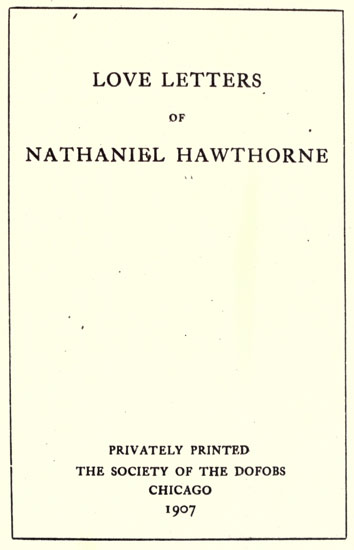
In "Hawthorne and His Wife" and "Memories
of Hawthorne" both Julian Hawthorne
and his sister, Rose Hawthorne Lathrop,
have given citations from the letters written by
Nathaniel Hawthorne to Miss Sophia Peabody
during their years of courtship. These excerpts
were free and irregular, often, and evidently with
specific intent, taken out of order and run together
as if for the purpose of illustrating a point or emphasizing
a particular phase of character. While
the extracts were sufficiently numerous for the
object desired, and while they gave an agreeable
glimpse of an interesting period of Hawthorne's
life, they were necessarily too fragmentary, too
lacking in continuity, to convey any adequate idea
of the simplicity, beauty, humor and tenderness
of the letters, even considered in the matter of a
literary style.
The original letters were acquired by Mr. William
K. Bixby of St. Louis, and, at the urgent
request of the Society of the Dofobs, of which he
is a highly esteemed and honored member, turned
over to the society with the understanding that
they should be published for presentation to members
only. It was specified also that great care
should be exercised in going over the letters, that
no apparent confidences should be violated and
that all private and personal references, which
might wound the feelings of the living or seem to
speak ill of the dead, should be eliminated. It is
indeed remarkable that in the large number of
letters presented there was practically nothing
which called for elision, nothing in the lighter
mood which breathed a spirit beyond the innocent
limits of good-natured banter. The work of the
editors was consequently easy and grateful, and
the task one of delight.
It is not claimed that these love letters, so-called,
comprise the entire correspondence on
Hawthorne's part between Miss Peabody and
himself during the three-and-one-half years of
courtship. Naturally a series of letters begun
sixty-eight years ago, with all the vicissitudes of
a shifting life, would not be preserved intact.
But while some letters have been lost or destroyed,
and others may not have been permitted for one
reason or another to leave the possession of the
family, the continuity here preserved is practically
as complete as could be desired and fully
illustrative of the qualities which make them so
worthy of publication. In giving these letters to
its members the society has conformed strictly to
the exactions of the manuscript save in a few cases
perhaps where haste on the part of the writer
omitted a word, slightly obscuring the sense. It
has been deemed advisible also to omit all notes
or paragraphs of explanation. Happily the letters
are sufficiently intelligible without such
notes, and the conclusion has been reached that
no needed purpose can be served by minor explanatory
details relating to individuals mentioned
or incidents suggested. It has been thought
best as well to add a few letters extending beyond
the period of courtship. No defence is necessary,
for to the last they are "love letters" in the purest
and truest sense of the words. This will be vindicated
in the perusal.
In selecting two letters for facsimile reproduction
the choice has fallen upon the letter from
Brook Farm under date of April 13, 1841, and that
from Salem written in the following year. Both
illustrate the quiet, quaint humor of Hawthorne.
In the Brook Farm letter he sketches drily his
thinly veiled impressions of the community, and
herein will be found the famous reference to
"Miss Fuller's transcendental heifer" which has
fallen little short of immortality. Writing from
the old home in Salem he makes his letter conspicuous
by the fact that he prophesies banteringly—doubtless
he little knew how truly—his own
coming fame and the public craze to inspect his
belongings. This humorous tribute to himself, in
its mock, self-satisfied strain, suggests not so much
the mental state of Horace predicting his metamorphosis
and immortality as the good-natured
prophecy of Burns that "you may expect henceforth
to see my birthday inscribed among the wonderful
events in the Poor Robin and Aberdeen
Almanacks, along with the Black Monday and
the Battle of Bothwell Bridge." Horace, Burns,
Hawthorne—how all exceeded their predictions,
whether gravely or lightly made!
It is true that to many persons of sensibility the
thought of publishing the love letters of men and
women however distinguished or in the public
mind is repugnant. It seems to them a violation
of a sacred confidence, a wanton exposure of a
tenderness not intended for the world as a part of
its literary diversion. The objection in many instances
is a fair one, and too often the obligation
of delicacy has been violated and the dictates of
gentle consideration have been unheeded. Of
recent years more persons have been shocked than
gratified by the exploitation of love letters of famous
women or men, and by the ruthless tearing
away of the veil which has concealed their happy
love life, and this emotion of disapprobation has
not been lessened by the apparent fact that a sordid
motive inspired the publication. At the outset
such impulse of disinclination possessed the
gentleman who owns the Hawthorne manuscript
and the members of the society with whom he
conversed with reference to its appearance in type.
It was only after the letters had been carefully
read, the motive governing their publication seriously
analyzed, and the respectful limits of their
circulation considered, that this doubting impulse
vanished.
That any one can read these letters without a
warmer, closer feeling for the "shy, grave Hawthorne"
seems impossible. To one who has perused
them in manuscript, transcription and proof
sheets there comes almost a conviction that he
wrote them not merely for the woman waiting for
the day when pledges should be sanctified, but
with the half wish that all sympathetic spirits
might see him and know him as he was. For gaily
he speaks of his own bashfulness and reserve;
hopefully he passes beyond the drudgery and disappointments
of his position in life to the future
which allures him; bravely he fights anxiety and
care; with quaint humor and lightness of touch
he pictures the scenes around that amuse and interest
him. And when in loving remembrance
he calls for the "Dove," or with mock seriousness
chides the "naughty Sophie Hawthorne," a strong
affection is breathed in gentleness, a manly tenderness
delights in every line.
And whether toiling with the measurer in the
vessel's hold, or chafing with him in the somberness
of the custom house, sharing now his relief
from distasteful tasks and now his dreams for a
happier day, the reader feels the spirit of the past.
And above all the shadowy ghostliness of the
threescore years seems to come the perfume of the
apple blossoms that fell around the Wayside,
with the gentle graciousness of a time well known
to all, when youth and love and hope are young.
Roswell Field.
TO MISS PEABODY
Wednesday Afternoon, March 6th, 1839
My dearest Sophie:
I had a parting glimpse of you, Monday forenoon,
at your window—and that image abides by
me, looking pale, and not so quiet as is your wont.
I have reproached myself many times since, because
I did not show my face, and then we should
both have smiled; and so our reminiscences would
have been sunny instead of shadowy. But I
believe I was so intent on seeing you, that I forgot
all about the desirableness of being myself seen.
Perhaps, after all, you did see me—at least you
knew that I was there. I fear that you were not quite
well that morning. Do grow better and better—physically,
I mean, for I protest against any spiritual
improvement, until I am better able to keep
pace with you—but do be strong, and full of life—earthly
life—and let there be a glow in your
cheeks. And sleep soundly the whole night long,
and get up every morning with a feeling as if you
were newly created; and I pray you to lay up a
stock of fresh energy every day till we meet again;
so that we may walk miles and miles, without
your once needing to lean upon my arm. Not but
what you shall lean upon it, as much as you choose—indeed,
whether you choose or not—but I would
feel as if you did it to lighten my footsteps, not to
support your own. Am I requiring you to work a
miracle within yourself? Perhaps so—yet, not a
greater one than I do really believe might be
wrought by inward faith and outward aids. Try
it, my Dove, and be as lightsome on earth as your
sister doves are in the air.
Tomorrow I shall expect a letter from you; but
I am almost in doubt whether to tell you that I
expect it; because then your conscience will reproach
you, if you should happen not to have
written. I would leave you as free as you leave
me. But I do wonder whether you were serious
in your last letter, when you asked me whether
you wrote too often, and seemed to think that you
might thus interfere with my occupations. My
dear Sophie, your letters are no small portion of
my spiritual food, and help to keep my soul
alive, when otherwise it might languish unto
death, or else become hardened and earth-incrusted,
as seems to be the case with almost all the
souls with whom I am in daily intercourse. They
never interfere with my worldly business—neither
the reading nor the answering them—(I am
speaking of your letters, not of those "earth-incrusted"
souls)—for I keep them to be the treasure
of my still and secret hours, such hours as
pious people spend in prayer; and the communion
which my spirit then holds with yours has something
of religion in it. The charm of your letters
does not depend upon their intellectual value,
though that is great, but on the spirit of which
they are the utterance, and which is a spirit of
wonderful efficacy. No one, whom you would deem
worthy of your friendship, could enjoy so large a
share of it as I do, without feeling the influence of
your character throughout his own—purifying his
aims and desires, enabling him to realise that this
is a truer world than the feverish one around us,
and teaching him how to gain daily entrance into
that better world. Such, so far as I have been
able to profit by it, has been your ministration to
me. Did you dream what an angelic guardianship
was entrusted to you?
March 7th. Your letter did come. You had not
the heart to disappoint me, as I did you, in not
making a parting visit, and shall again, by keeping
this letter to send by Mary. But I disappoint
you in these two instances, only that you may consider
it a decree of Fate (or of Providence, which
you please) that we shall not meet on the mornings
of my departure, and that my letters shall not
come oftener than on the alternate Saturday. If
you will but believe this, you will be quiet.
Otherwise I know that the Dove will flutter her
wings, and often, by necessity, will flutter them in
vain. So forgive me, and let me have my own
way, and believe (for it is true) that I never cause
you the slightest disappointment without pain and
remorse on my part. And yet, I know that when
you wish me to do any particular thing you will
always tell me so, and that if my sins of omission
or commission should ever wound your heart, you
will by no means conceal it.
I did enjoy that walk infinitely—for certainly
the enjoyment was not all finite. And what a
heavenly pleasure we might have enjoyed this
very day; the air was so delicious, that it seemed
as if the dismal old Custom House was situated in
Paradise; and this afternoon, I sat with my window
open, to temper the glow of a huge coal fire.
It almost seems to me, now, as if beautiful days
were wasted and thrown away, when we do not
feel their beauty and heavenliness through one another.
Your own friend,
N. H.
Miss Sophia A. Peabody,
Salem, Mass.
TO MISS PEABODY
Boston, April 2d, 1839
Mine own Dove,
I have been sitting by my fireside ever since teatime,
till now it is past eight o'clock; and have
been musing and dreaming about a thousand
things, with every one of which, I do believe, some
nearer or remoter thought of you was intermingled.
I should have begun this letter earlier
in the evening, but was afraid that some intrusive
idler would thrust himself between us, and so the
sacredness of my letter would be partly lost;—for
I feel as if my letters were sacred, because they are
written from my spirit to your spirit. I wish it
were possible to convey them to you by other than
earthly messengers—to convey them directly into
your heart, with the warmth of mine still lingering
in them. When we shall be endowed with our
spiritual bodies, I think they will be so constituted,
that we may send thoughts and feelings any distance,
in no time at all, and transfuse them warm
and fresh into the consciousness of those whom we
love. Oh what a bliss it would be, at this moment;
if I could be conscious of some purer feeling,
some more delicate sentiment, some lovelier
fantasy, than could possibly have had its birth in
my own nature, and therefore be aware that my
Dove was thinking through my mind and feeling
through my heart! Try—some evening when
you are alone and happy, and when you are most
conscious of loving me and being loved by me—and
see if you do not possess this power already.
But, after all, perhaps it is not wise to intermix
fantastic ideas with the reality of our affection.
Let us content ourselves to be earthly creatures,
and hold communion of spirit in such modes as
are ordained to us—by letters (dipping our pens
as deep as may be into our hearts) by heartfelt
words, when they can be audible; by glances—through
which medium spirits do really seem to
talk in their own language—and by holy kisses,
which I do think have something supernatural in
them.
And now good night, my beautiful Dove. I do
not write any more at present, because there are
three more whole days before this letter will visit
you: and I desire to talk with you, each of those
three days. Your letter did not come today.
Even if it should not come tomorrow, I shall not
imagine that you forget me or neglect me, but
shall heave two or three sighs, and measure salt
and coal so much the more diligently. Good
night; and if I have any power, at this distance,
over your spirit, it shall be exerted to make you
sleep like a little baby, till the "Harper of the
Golden Dawn" arouse you. Then you must finish
that ode. But do, if you love me, sleep.
April 3d. No letter, my dearest; and if one
comes tomorrow I shall not receive it till Friday,
nor perhaps then; because I have a cargo of coal
to measure in East Cambridge, and cannot go to
the Custom House till the job is finished. If you
had known this, I think you would have done your
[best] possible to send me a letter today. Doubtless
you have some good reason for omitting it.
I was invited to dine at Mr. Hooper's; with your
sister Mary; and the notion came into my head,
that perhaps you would be there,—and though I
knew that it could not be so, yet I felt as if it
might. But just as I was going home from the
Custom House to dress, came an abominable person
to say that a measurer was wanted forthwith
at East Cambridge; so over I hurried, and found
that, after all, nothing would be done till tomorrow
morning at sunrise. In the meantime, I had
lost my dinner, and all other pleasures that had
awaited me at Mr. Hooper's; so that I came back
in very ill humor, and do not mean to be very
good-natured again, till my Dove shall nestle
upon my heart again, either in her own sweet person,
or by her image in a letter. But your image
will be with me, long before the letter comes. It
will flit around me while I am measuring coal, and
will peep over my shoulder to see whether I keep a
correct account, and will smile to hear my bickerings
with the black-faced demons in the vessel's
hold, (they look like the forge-men in Retsch's
Fridolin) and will soothe and mollify me amid all
the pester and plague that is in store for me tomorrow.
Not that I would avoid this pester and
plague, even if it were in my power to do so. I
need such training, and ought to have undergone
it long ago. It will give my character a healthy
hardness as regards the world; while it will leave
my heart as soft—as fit for a Dove to rest upon—as
it is now, or ever was. Good night again, gentle
Dove. I must leave a little space for tomorrow's
record; and moreover, it is almost time that
I were asleep, having to get up in the dusky dawn.
Did you yield to my conjurations, and sleep well
last night? Well then, I throw the same spell
over you tonight.
April 4th. ½ past 9 P.M. I came home
late in the afternoon, very tired, sunburnt and
sea-flushed, having walked or sat on the deck of a
schooner ever since sunrise. Nevertheless, I
purified myself from the sable stains of my profession—stains
which I share in common with
chimney sweepers—and then hastened to the Custom
House to get your letter—for I knew there
was one there awaiting me, and now I thank you
with my whole heart, and will straight way go to
sleep. Do you the same.
April 5th. Your yesterday's letter is received,
my beloved Sophie. I have no time to answer it:
but, like all your communications, personal or
written, it is the sunshine of my life. I have been
busy all day, and am now going to see your sister
Mary—and I hope, Elizabeth. Mr. Pickens is
going with me.
Miss Sophia A. Peabody,
Salem, Mass.
TO MISS PEABODY
Wednesday, April 17th, 1839—4 o'clock P.M.
My Dearest:
If it were not for your sake, I should really be
glad of this pitiless east wind, and should especially
bless the pelting rain and intermingled
snowflakes. They have released me from the toils
and cares of office, and given me license to betake
myself to my own chamber; and here I sit by a
good coal fire, with at least six or seven comfortable
hours to spend before bed-time. I feel pretty
secure against intruders; for the bad weather will
defend me from foreign invasion; and as to Cousin
Haley, he and I had a bitter political dispute
last evening, at the close of which he went to bed
in high dudgeon, and probably will not speak to
me these three days. Thus you perceive that
strife and wrangling, as well as east winds and
rain, are the methods of a kind Providence to promote
my comfort—which would not have been so
well secured in any other way. Six or seven
hours of cheerful solitude! But I will not be
alone. I invite your spirit to be with me—at any
hour and as many hours as you please—but especially
at the twilight hour, before I light my
lamp. Are you conscious of my invitation? I
bid you at that particular time, because I can see
visions more vividly in the dusky glow of fire
light, than either by daylight or lamplight. Come—and
let me renew my spell against headache and
other direful effects of the east wind. How I
wish I could give you a portion of my insensibility!—And
yet I should be almost afraid of
some radical transformation, were I to produce a
change in that respect. God made you so delicately,
that it is especially unsafe to interfere with
His workmanship. If my little Sophie—mine
own Dove—cannot grow plump and rosy and
tough and vigorous without being changed into
another nature then I do think that for this short
life, she had better remain just what she is. Yes;
but you will always be the same to me, because we
have met in Eternity, and there our intimacy was
formed. So get as well as you possibly can, and
be as strong and rosy as you will; for I shall never
doubt that you are the same Sophie who have so
often leaned upon my arm, and needed its superfluous
strength.
I was conscious, on those two evenings, of a
peacefulness and contented repose such as I never
enjoyed before. You could not have felt such
quiet unless I had felt it too—nor could I, unless
you had. If either of our spirits had been troubled,
they were then in such close communion that
both must have felt the same grief and turmoil. I
never, till now, had a friend who could give me
repose;—all have disturbed me; and whether for
pleasure or pain, it was still disturbance, but peace
overflows from your heart into mine. Then I feel
that there is a Now—and that Now must be always
calm and happy—and that sorrow and evil
are but phantoms that seem to flit across it.
You must never expect to see my sister E. in
the daytime, unless by previous appointment, or
when she goes to walk. So unaccustomed am I to
daylight interviews, that I never imagine her in
sunshine; and I really doubt whether her faculties
of life and intellect begin to be exercised till
dusk—unless on extraordinary occasions. Their
noon is at midnight. I wish you could walk with
her; but you must not, because she is indefatigable,
and always wants to walk half round the
world, when once she is out of doors.
April 18th. My Dove—my hopes of a long
evening of seclusion were not quite fulfilled; for,
a little before nine o'clock John Forrester and
Cousin Haley came in, both of whom I so fascinated
with my delectable conversation, that they
did not take leave till after eleven. Nevertheless,
I had already secured no inconsiderable treasure of
enjoyment, with all of which you were intermingled.
There has been nothing to do at the
Custom House today; so I came home at two
o'clock, and—went to sleep! Pray Heaven you
may have felt a sympathetic drowsiness, and have
yielded to it. My nap has been a pretty long one,
for—as nearly as I can judge by the position of
the sun, it must be as much as five o'clock. I
think there will be a beautiful sunset; and perhaps,
if we could walk out together, the wind
would change and the air grow balmy at once. The
Spring is not acquainted with my Dove and me,
as the Winter was;—how then can we expect her
to be kindly to us? We really must continue to
walk out and meet her, and make friends with her;
then she will salute your cheek with her balmiest
kiss, whenever she gets a chance. As to the east
wind, if ever the imaginative portion of my brain
recover from its torpor, I mean to personify it as
a wicked, spiteful, blustering, treacherous—in
short, altogether devilish sort of body, whose principle
of life it is to make as much mischief as he
can. The west wind—or whatever is the gentlest
wind of heaven—shall assume your aspect, and be
humanised and angelicised with your traits of
character, and the sweet West shall finally triumph
over the fiendlike East, and rescue the
world from his miserable tyranny; and if I tell the
story well, I am sure my loving and beloved West
Wind will kiss me for it.
When this week's first letter came, I held it a
long time in my hand, marvelling at the superscription.
How did you contrive to write it?
Several times since, I have pored over it, to discover
how much of yourself was mingled with my
share of it; and certainly there is a grace flung
over the fac simile, which was never seen in my
harsh, uncouth autograph—and yet none of the
strength is lost. You are wonderful. Imitate
this.
Nath. Hawthorne.
Friday, April 19th. Your Wednesday's letter
has come, dearest. Your letters delight me more
than anything, save the sound of your voice; and
I love dearly to write to you—so be at peace on
that score. You are beautiful, my own heart's
Dove. Never doubt it again. I shall really and
truly be very glad of the extracts; and they will
have a charm for me that could not otherwise have
been. I will imagine your voice repeating them,
tremulously. The spell which you laid upon my
brow will retain its power till we meet again—then
it must be renewed.
What a beautiful day—and I had a double enjoyment
of it, for your sake and my own. I have
been to walk this afternoon, to Bunker's Hill and
the Navy Yard, and am tired, because I had not
your arm to support me.
God keep you from East winds and every other
evil.
Mine own Dove's own Friend,
N. H.
½ past 5 P.M.
Miss Sophia A. Peabody,
Salem, Mass.
TO MISS PEABODY
Boston, April 30th, 6 P.M., 1839
My beloved,
Your sweetest of all letters found me at the
Custom House, where I had almost just arrived,
having been engaged all the forenoon in measuring
twenty chaldrons of coal—which dull occupation
was enlivened by frequent brawls and amicable
discussions with a crew of funny little
Frenchmen from Acadie. I know not whether
your letter was a surprise to me—it seems to me
that I had a prophetic faith that the Dove would
visit me—but at any rate, it was a joy, as it always
is; for my spirit turns to you from all trouble
and all pleasure. This forenoon I could not wait
as I generally do, to be in solitude before opening
your letter; for I expected to be busy all the
afternoon, and was already tired with working
yesterday and today; and my heart longed to
drink your thoughts and feelings, as a parched
throat for cold water. So I pressed the Dove to
my lips (turning my head away, so that nobody
saw me) and then broke the seal. I do think it is
the dearest letter you have written, but I think so
of each successive one; so you need not imagine
that you have outdone yourself in this instance.
How did I live before I knew you—before I possessed
your affection! I reckon upon your love as
something that is to endure when everything that
can perish has perished—though my trust is sometimes
mingled with fear, because I feel myself unworthy
of your love. But if I am worthy of if
you will always love me; and if there be anything
good and pure in me, it will be proved by my always
loving you.
After dinner. I had to journey over to East
Cambridge, expecting to measure a cargo of coal
there; but the vessel had stuck in the mud on her
way thither, so that nothing could be done till tomorrow
morning. It must have been my guardian
angel that steered her upon that mud-bank,
for I really needed rest. Did you lead the vessel
astray, my Dove? I did not stop to inquire into
particulars, but returned home forthwith, and
locked my door, and threw myself on the bed, with
your letter in my hand. I read it over slowly and
peacefully, and then folding it up, I rested my
heart upon it, and fell fast asleep.
Friday, May 3d. 5 P.M. My dearest, ten
million occupations and interruptions, and intrusions,
have kept me from going on with my letter;
but my spirit has visited you continually, and
yours has come to me. I have had to be out a
good deal in the east winds; but your spell has
proved sovereign against all harm, though sometimes
I have shuddered and shivered for your sake.
How have you borne it, my poor dear little Dove?
Have you been able to flit abroad on today's east
wind, and go to Marblehead, as you designed?
You will not have seen Mrs. Hooper, because she
came up to Boston in the cars on Monday morning.
I had a brief talk with her, and we made
mutual inquiries, she about you, and I about little
C. I will not attempt to tell you how it rejoices
me that we are to spend a whole month together
in the same city. Looking forward to it,
it seems to me as if that month would never come
to an end, because there will be so much of eternity
in it. I wish you had read that dream-letter
through, and could remember its contents. I am
very sure that it could not have [been] written by
me, however, because I should not think of addressing
you as "My dear Sister"—nor should I
like to have you call me brother—nor even should
have liked it, from the very first of our acquaintance.
We are, I trust, kindred spirits, but not
brother and sister. And then what a cold and dry
annunciation of that awful contingency—the
"continuance or not of our acquaintance." Mine
own Dove, you are to blame for dreaming such
letters, or parts of letters, as coming from me. It
was you that wrote it—not I. Yet I will not believe
that it shows a want of faith in the steadfastness
of my affection, but only in the continuance
of circumstances prosperous to our earthly and external
connection. Let us trust in GOD for that.
Pray to GOD for it, my Dove—for you know how
to pray better than I do. Pray, for my sake, that
no shadows of earth may ever come between us,
because my only hope of being a happy man depends
upon the permanence of our union. I have
great comfort in such thoughts as those you suggest—that
our hearts here draw towards one
another so unusually—that we have not cultivated
our friendship, but let it grow,—that we have
thrown ourselves upon one another with such perfect
trust;—and even the deficiency of worldly
wisdom, that some people would ascribe to us in
following the guidance of our hearts so implicitly,
is proof to me that there is a deep wisdom within
us. Oh, let us not think but that all will be well!
And even if, to worldly eyes, it should appear that
our lot is not a fortunate one, still we shall have
glimpses, at least—and I trust a pervading sunshine—of
a happiness that we could never have
found, if we had unquietly struggled for it, and
made our own selection of the means and species
of it, instead of trusting all to something diviner
than our reason.
My Dove, there were a good many things that
I meant to have written in this letter; but I have
continually lapsed into fits of musing, and when
I have written, the soul of my thoughts has not
readily assumed the earthly garments of language.
It is now time to carry the letter to Mary. I kiss
you, dearest—did you feel it? Your own friend,
Nath. Hawthorne, Esq.
(Dear me! What an effect that Esquire gives to
the whole letter!)
Miss Sophia A. Peabody,
Care of Dr. N. Peabody,
Salem, Mass.
TO MISS PEABODY
Salem, May 26th, 1839
Mine own Self,
I felt rather dismal yesterday—a sort of vague
weight on my spirit—a sense that something was
wanting to me here. What or who could it have
been that I so missed? I thought it not best to go
to your house last evening; so that I have not yet
seen Elizabeth—but we shall probably attend the
Hurley-Burley tonight. Would that my Dove
might be there! It seems really monstrous that
here, in her own home—or what was her home, till
she found another in my arms—she should no
longer be. Oh, my dearest, I yearn for you, and
my heart heaves when I think of you—(and that
is always, but sometimes a thought makes me
know and feel you more vividly than at others,
and that I call "thinking of you")—heaves and
swells (my heart does) as sometimes you have felt
it beneath you, when your head was resting on it.
At such moments it is stirred up from its depths.
Then our two ocean-hearts mingle their floods.
I do not believe that this letter will extend to
three pages. My feelings do not, of their own
accord, assume words—at least, not a continued
flow of words. I write a few lines, and then I
fall a-musing about many things, which seem to
have no connection among themselves, save that
my Dove flits lightly through them all. I feel as
if my being were dissolved and the idea of you
were diffused throughout it. Am I writing nonsense?
That is for you to decide. You know
what is Truth—"what is what"—and I should
not dare to say to you what I felt to be other than
the Truth—other than the very "what." It is very
singular (but I do not suppose I can express it) that,
while I love you so dearly, and while I am so
conscious of the deep embrace of our spirits, still
I have an awe of you that I never felt for anybody
else. Awe is not the word, either; because it
might imply something stern in you—whereas—but
you must make it out for yourself. I do wish
that I could put this into words—not so much for
your satisfaction (because I believe you will understand)
as for my own. I suppose I should
have pretty much the same feeling if an angel
were to come from Heaven and be my dearest
friend—only the angel could not have the tenderest
of human natures too, the sense of which is
mingled with this sentiment. Perhaps it is because
in meeting you, I really meet a spirit,
whereas the obstructions of earth have prevented
such a meeting in every other place. But I leave
the mystery here. Some time or other, it may be
made plainer to me. But methinks it converts my
love into a religion. And then it is singular, too,
that this awe (or whatever it be) does not prevent
me from feeling that it is I who have the charge of
you, and that my Dove is to follow my guidance
and do my bidding. Am I not very bold to say
this? And will not you rebel? Oh no; because
I possess the power only so far as I love you. My
love gives me the right, and your love consents
to it.
Since writing the above I have been asleep; and
I dreamed that I had been sleeping a whole year
in the open air; and that while I slept, the grass
grew around me. It seemed, in my dream, that
the very bed-clothes which actually covered me
were spread beneath me, and when I awoke (in
my dream) I snatched them up, and the earth
under them looked black, as if it had been burnt—one
square place, exactly the size of the bedclothes.
Yet there was grass and herbage scattered
over this burnt space, looking as fresh, and
bright, and dewy, as if the summer rain and the
summer sun had been cherishing them all the time.
Interpret this for me, my Dove—but do not draw
any somber omens from it. What is signified [by]
my nap of a whole year? (It made me grieve to
think that I had lost so much of eternity)—and
what was the fire that blasted the spot of earth
which I occupied, while the grass flourished all
around?—And what comfort am I to draw from
the fresh herbage amid the burnt space? But it
is a silly dream, and you cannot expound any
sense out of it. Generally, I cannot remember
what my dreams have been—only there is a confused
sense of having passed through adventures,
pleasurable or otherwise. I suspect that you
mingle with my dreams, but take care to flit away
just before I awake, leaving me but dimly and
doubtfully conscious of your visits.
Do you never start so suddenly from a dream
that you are afraid to look round the room, lest
your dream-personages (so strong and distinct
seemed their existence, a moment before) should
have thrust themselves out of dream-land into the
midst of realities? I do, sometimes.
I wish I were to see you this evening. How
many times have you thought of me today? All
the time?—Or not at all? Did you ever read
such a foolish letter as this? (Here I was interrupted,
and have taken a stroll down on the Neck—a
beautiful, beautiful, beautiful sunshine, and
air, and sea. Would that my Dove had been with
me. I fear that we shall perforce lose some of our
mutual intimacy with Nature—we walk together
so seldom that she will seem more like a stranger.
Would that I could write such sweet letters to
mine own self, as mine own self writes to me.
Good bye, dearest self. Direct yours to
Nath. Hawthorne, Esq.
Custom-House, Boston.
Miss Sophia A. Peabody,
No. 4 Avon Place,
Boston.
TO MISS PEABODY
Boston, July 3d, 1839
Most beloved Amelia,
I shall call you so sometimes in playfulness, and
so may you; but it is not the name by which my
soul recognizes you. It knows you as Sophie; but
I doubt whether that is the inwardly and intensely
dearest epithet either. I believe that "Dove" is
the true word after all; and it never can be used
amiss, whether in sunniest gaiety or shadiest seriousness.
And yet it is a sacred word, and I should
not love to have anybody hear me use it, nor know
that GOD has baptised you so—the baptism being
for yourself and me alone. By that name, I
think, I shall greet you when we meet in Heaven.
Other dear ones may call you "daughter," "sister,"
"Sophia," but when, at your entrance into
Heaven, or after you have been a little while
there, you hear a voice say "Dove!" then you will
know that your kindred spirit has been admitted
(perhaps for your sake) to the mansions of rest.
That word will express his yearning for you—then
to be forever satisfied; for we will melt into
one another, and be close, close together then.
The name was inspired; it came without our being
aware that you were thenceforth to be my Dove,
now and through eternity. I do not remember,
how nor when it alighted on you; the first I knew,
it was in my heart to call you so.
Good night now, my Dove. It is not yet nine
o'clock; but I am somewhat aweary and prefer to
muse about you till bedtime, rather than write.
July 5th, ½ past seven P.M. I must, somehow
or other, finish this letter tonight, my dearest—or
else it would not be sent tomorrow; and then
I fear our head would ache, naughty head that it
is. My heart yearns to communicate to you; but
if it had any other means at hand, it certainly
would not choose to communicate by the scratchings
of an iron pen, which I am now compelled to
use. This must and will inevitably be a dull letter.
Oh how different from yours, which I received
today. You are absolutely inspired, my
Dove; and it is not my poor stupid self that inspires
you; for how could I give what is not in
me. I wish I could write to you in the morning,
before my toils begin; but that is impossible, unless
I were to write before daylight. At eventide,
my mind has quite lost its elasticity—my heart,
even, is weary—and all that I seem capable of doing
is to rest my head on its pillow and there lay
down the burthen of life. I do not mean to
imply that I am unhappy or discontented; for this
is not the case; my life is only a burthen, in the
same way that it is so to every toilsome man, and
mine is a healthy weariness, such as needs only a
night's sleep to remove it. But from henceforth
forever, I shall be entitled to call the sons of toil
my brethren, and shall know how to sympathise
with them, seeing that I, likewise, have risen at
the dawn and borne the fervor of the mid-day sun,
nor turned my heavy footsteps homeward till
eventide. Years hence, perhaps, the experience
that my heart is acquiring now will flow out in
truth and wisdom.
You ask me a good many questions, my Dove,
and I will answer such of them as now occur to
me; and the rest you may ask me again, when we
meet. First as to your letters. My beloved, you
must write whenever you will—in all confidence
that I can never be otherwise than joyful to receive
your letters. Do not get into the habit of
trying to find out, by any method save your own
intuition, what is pleasing and what is displeasing
to me. Whenever you need my counsel, or even
my reproof, in any serious matter, you will not
fail to receive it; but I wish my Dove to be as free
as a Bird of Paradise. Now, as to this affair of
the letters. I have sometimes been a little annoyed
at the smiles of my brother measurers, who,
notwithstanding the masculine fist of the direction,
seem to know that such delicately sealed and
folded epistles can come only from a lady's small
and tender hand. But the annoyance is not on my
own account; but because it seems as if the letters
were prophaned by being smiled at—but this is,
after all, a mere fantasy, since the smilers know
nothing about my Dove, nor that I really have a
Dove; nor can they be certain that the letters come
from a lady, nor, especially, can they have the remotest
imagination what heavenly letters they are.
The sum and substance is, that they are smiling at
nothing; and so it is no matter for their smiles. I
would not give up one letter to avoid the "world's
dread laugh,"—much less to shun the good-natured
raillery of three or four people who do not
dream of giving pain. Why has my Dove made
me waste so much of my letter in this talk about
nothing?
My dearest, did you really think that I meant
to express a doubt whether we should enjoy each
other's society so much, if we could be together all
the time. No, no; for I always feel, that our momentary
and hurried interviews scarcely afford us
time to taste the draught of affection that we drink
from one another's hearts. There is a precious
portion of our happiness wasted, because we are
forced to enjoy it too greedily. But I thought, as
you do, that there might be more communication
of the intellect, as well as communion of heart, if
we could be oftener together.
Your picture gallery of auxiliary verbs is an admirable
fantasy. You are certainly the first mortal
to whom it was given to behold a verb; though,
it seems as if they ought to be visible, being creatures
whose office it is (if I remember my grammar
aright) "to be, to do, and to suffer." Therein
is comprehended all that we mortals are capable
of. No; for, according to the definition, verbs do
not feel, and cannot enjoy—they only exist, and
act, and are miserable. My Dove and I are no
verbs—or if so, we are passive verbs, and therefore
happy ones.
(Rest of letter missing)
To Miss Sophia A. Peabody,
Care of Dr. N. Peabody,
Salem,
Massachusetts.
TO MISS PEABODY
Boston, Monday Eveg July 15th [1839]
My blessed Dove,
Your letter was brought to me at East Cambridge
this afternoon:—otherwise I know not
when I should have received it; for I am so busy
that I know not whether I shall have time to go to
the Custom-House these two or three days. I put
it in my pocket, and did not read it till just now,
when I could be quiet in my own chamber—for I
always feel as if your letters were too sacred to be
read in the midst of people—and (you will smile)
I never read them without first washing my hands!
And so my poor Dove is sick, and I cannot take
her to my bosom. I do really feel as if I could
cure her. [Portion of letter missing] Oh, my
dearest, do let our love be powerful enough to
make you well. I will have faith in its efficacy—not
that it will work an immediate miracle—but
it shall make you so well at heart that you cannot
possibly be ill in the body. Partake of my
health and strength, my beloved. Are they not
your own, as well as mine? Yes—and your illness
is mine as well as yours; and with all the pain
it gives me, the whole world should not buy my
right to share in it.
My dearest, I will not be much troubled, since
you tell me (and your word is always truth) that
there is no need. But, oh, be careful of yourself—remembering
how much earthly happiness depends
on your health. Be tranquil—let me be
your Peace, as you are mine. Do not write to me,
unless your heart be unquiet, and you think that
you can quiet it by writing.
God bless mine own Dove. I have kissed those
three last words. Do you kiss them too.
Miss Sophia A. Peabody,
Care of Dr. N. Peabody,
Salem, Mass.
TO MISS PEABODY
Wednesday eveg. July 17th [1839]
My Dearest,
I did not know but you would like another little
note—and I think I feel a strange impulse to
write, now that the whole correspondence devolves
on me. And I wrote my other note in such a hurry,
that I quite forgot to give you the praise which you
so deserved, for bearing up so stoutly against the
terrible misfortune of my non-appearance. Indeed,
I do think my Dove is the strongest little dove that
ever was created—never did any creature live,
who could feel so acutely, and yet endure so well.
This note must be a mere word, my beloved—and
I wish I could make it the very tenderest word
that ever was spoken or written. Imagine all
that I cannot write.
God bless you, mine own Dove, and make you
quite well against I take you to your home—which
shall be on Saturday eveg, without fail.
Till then, dearest, spend your time in happy
thoughts and happy dreams—and let my image be
among them. Good bye, mine own Dove—I
have kissed that holy word.
Your Own, Own, Ownest.
My Dove must not look for another note.
To Miss Sophia A. Peabody,
Care of Dr. N. Peabody,
Salem, Mass.
TO MISS PEABODY
Boston, July 24th, 1839—8 o'clock P.M.
Mine own,
I am tired this evening, as usual, with my long
day's toil; and my head wants its pillow—and my
soul yearns for the friend whom God has given it—whose
soul He has married to my soul. Oh,
my dearest, how that thought thrills me! We
are married! I felt it long ago; and sometimes,
when I was seeking for some fondest word, it has
been on my lips to call you—"Wife"! I hardly
know what restrained me from speaking it—unless
a dread (for that would have been an infinite
pang to me) of feeling you shrink back, and thereby
discovering that there was yet a deep place in
your soul which did not know me. Mine own
Dove, need I fear it now? Are we not married?
God knows we are. Often, I have silently given
myself to you, and received you for my portion of
human love and happiness, and have prayed Him
to consecrate and bless the union. Yes—we are
married; and as God Himself has joined us, we
may trust never to be separated, neither in Heaven
nor on Earth. We will wait patiently and
quietly, and He will lead us onward hand in hand
(as He has done all along) like little children,
and will guide us to our perfect happiness—and
will teach us when our union is to be revealed to
the world. My beloved, why should we be silent
to one another—why should our lips be silent—any
longer on this subject? The world might, as
yet, misjudge us; and therefore we will not speak
to the world; but why should we not commune together
about all our hopes of earthly and external
as well [as] our faith of inward and eternal
union? Farewell for tonight, my dearest—my
soul's bride!
July 25th. 8 o'clock, P.M. How does my
Dove contrive to live and thrive, and keep her
heart in cheerful trim, through a whole fortnight,
with only one letter from me? It cannot be indifference;
so it must be heroism—and how heroic!
It does seem to me that my spirit would
droop and wither like a plant that lacked rain and
dew, if it were not for the frequent shower of
your gentle and holy thoughts. But then there
is such a difference in our situations. My Dove
is at home—not, indeed, in her home of homes—but
still in the midst of true affections; and she
can live a spiritual life, spiritual and intellectual.
Now, my intellect, and my heart and soul, have
no share in my present mode of life—they find
neither labor nor food in it; everything that I do
here might be better done by a machine. I am a
machine, and am surrounded by hundreds of similar
machines;—or rather, all of the business people
are so many wheels of one great machine—and
we have no more love or sympathy for one another
than if we were made of wood, brass, or iron, like
the wheels of other pieces of complicated
machinery. Perchance—but do not be frightened,
dearest—the soul would wither and die
within me, leaving nothing but the busy machine,
no germ for immortality, nothing that could taste
of heaven, if it were not for the consciousness of
your deep, deep love, which is renewed to me with
every letter. Oh, my Dove, I have really thought
sometimes, that God gave you to me to be the salvation
of my soul.
(Rest of letter missing)
TO MISS PEABODY
Boston, July 30th, 8 (or thereabouts) P.M. [1839]
Beloved,
There was no letter from you to-day; and this
circumstance, in connection with your mention of
a headache on Sunday, made me apprehensive that
my Dove is not well. Yet surely she would write,
or cause to be written, intelligence of the fact (if
fact it were) to the sharer of her well-being and
ill-being. Do, dearest, give me the assurance that
you will never be ill without letting me know, and
then I shall always be at peace, and will not disquiet
myself for the non-reception of a letter; for
really, I would not have you crowd your other
duties into too small a space, nor dispense with
anything that it is desirable to do, for the sake of
writing to me. If you were not to write for a
whole year, I still should never doubt that you
love me infinitely; and I doubt not that, in vision,
dream, or reverie, our wedded souls would hold
communion throughout all that time. Therefore
I do not ask for letters while you are well, but
leave all to your own heart and judgment; but if
anything, bodily or mental, afflicts my Dove, her
beloved must be told.
And why was my dearest wounded by that silly
sentence of mine about "indifference"? It was
not well that she should do anything but smile at
it. I knew, just as certainly as your own heart
knows, that my letters are very precious to you—had
I been less certain of it, I never could have
trifled upon the subject. Oh, my darling, let all
your sensibilities be healthy—never, never, be
wounded by what ought not to wound. Our tenderness
should make us mutually susceptible of
happiness from every act of each other, but of
pain from none; our mighty love should scorn all
little annoyances, even from the object of that
love. What misery (and what ridiculous misery
too) would it be, if, because we love one another
better than all the universe besides, our only gain
thereby were a more exquisite sensibility to pain
for the beloved hand and a more terrible power of
inflicting it! Dearest, it never shall be so with
us. We will have such an infinity of mutual
faith, that even real offenses (should they ever occur)
shall not wound, because we know that something
external from yourself or myself must be
guilty of the wrong, and never our essential selves.
My beloved wife, there is no need of all this
preachment now; but let us both meditate upon it,
and talk to each other about it;—so shall there
never come any cloud across our inward bliss—so
shall one of our hearts never wound the other, and
itself fester with the sore that it inflicts. And I
speak now, when my Dove is not wounded nor
sore, because it is easier than it might be hereafter,
when some careless and wayward act or word of
mine may have rubbed too roughly against her tenderest
of hearts. Dearest, I beseech you grant me
freedom to be careless and wayward—for I have
had such freedom all my life. Oh, let me feel
that I may even do you a little wrong without
your avenging it (oh how cruelly) by being
wounded.
(Rest of letter missing)
TO MISS PEABODY
Custom House, August 8th, 1839
Your letter, my beloved wife, was duly received
into your husband's heart yesterday. I found it
impossible to keep it all day long, with unbroken
seal, in my pocket; and so I opened and read it on
board of a salt vessel, where I was at work, amid
all sorts of bustle, and gabble of Irishmen, and
other incommodities. Nevertheless its effect was
very blessed, even as if I had gazed upward from
the deck of the vessel, and beheld my wife's sweet
face looking down upon me from a sun-brightened
cloud. Dearest, if your dove-wings will not
carry you so far, I beseech you to alight upon such
a cloud sometimes, and let it bear you to me.
True it is, that I never look heavenward without
thinking of you, and I doubt whether it would
much surprise me to catch a glimpse of you among
those upper regions. Then would all that is
spiritual within me so yearn towards you, that I
should leave my earthly incumbrances behind, and
float upward and embrace you in the heavenly
sunshine. Yet methinks I shall be more content
to spend a lifetime of earthly and heavenly happiness
intermixed. So human am I, my beloved,
that I would not give up the hope of loving and
cherishing you by a fireside of our own, not for
any unimaginable bliss of higher spheres. Your
influence shall purify me and fit me for a better
world—but it shall be by means of our happiness
here below.
Was such a rhapsody as the foregoing ever
written in the Custom House before? I have almost
felt it a sin to write to my Dove here, because
her image comes before me so vividly—and the
place is not worthy of it. Nevertheless, I cast
aside my scruples, because, having been awake
ever since four o'clock this morning (now thirteen
hours) and abroad since sunrise, I shall feel
more like holding intercourse in dreams than
with my pen, when secluded in my room. I
am not quite hopeless, now, of meeting you
in dreams. Did you not know, beloved, that
I dreamed of you, as it seemed to me, all
night long, after that last blissful meeting? It is
true, when I looked back upon the dream, it immediately
became confused; but it had been vivid,
and most happy, and left a sense of happiness in
my heart. Come again, sweet wife! Force your
way through the mists and vapors that envelope
my slumbers—illumine me with a radiance that
shall not vanish when I awake. I throw my heart
as wide open to you as I can. Come and rest
within it, Dove.
Oh, how happy you make me by calling me
your husband—by subscribing yourself my wife.
I kiss that word when I meet it in your letters; and
I repeat over and over to myself, "she is my wife—I
am her husband." Dearest, I could almost
think that the institution of marriage was ordained,
first of all, for you and me, and for you and
me alone; it seems so fresh and new—so unlike
anything that the people around us enjoy or are
acquainted with. Nobody ever had a wife but
me—nobody a husband, save my Dove. Would
that the husband were worthier of his wife; but
she loves him—and her wise and prophetic heart
could never do so if he were utterly unworthy.
My own Room. August 9th—about 10 A.M.
It is so rare a thing for your husband to find himself
in his own room in the middle of the forenoon,
that he cannot help advising his Dove of that remarkable
fact. By some misunderstanding, I was
sent on a fruitless errand to East Cambridge, and
have stopped here, on my return to the Custom
House, to rest and refresh myself—and what can
so rest and refresh me as to hold intercourse with
my darling wife? It must be but a word and a
kiss, however—a written word and a shadowy
kiss. Good bye, dearest. I must go now to hold
controversy, I suppose, with some plaguy little
Frenchman about a peck of coal more or less; but
I will give my beloved another word and kiss,
when the day's toil is over.
About 8 o'clock P.M.—I received your letter,
your sweet, sweet letter, my sweetest wife, on
reaching the Custom House. Now as to that
swelled face of ours—it had begun to swell when
we last met; but I did not tell you, because I
knew that you would associate the idea of pain
with it, whereas, it was attended with no pain at
all. Very glad am I, that my Dove did not see
me when one side of my face was swollen
as big as two, for the image of such a monstrous
one-sidedness, or double-sidedness, might
have haunted her memory through the whole
fortnight. Dearest, is it a weakness that
your husband wishes to look tolerably comely
always in your eyes?—and beautiful if he
could!! My Dove is beautiful, and full of
grace; she should not have an ugly mate. But to
return to this "naughty swelling"—it began to
subside on Tuesday, and has now, I think, entirely
disappeared, leaving my visage in its former admirable
proportion. Nothing is now the matter
with me; save that my heart is as much swollen as
my cheek was—swollen with love, with pent-up
love, which I would fain mingle with the heart-blood
of mine own sweet wife. Oh, dearest, how
much I have to say to you!—how many fond
thoughts.
Dearest, I dare not give you permission to go
out in the east winds. The west wind will come
very often I am sure, if it were only for the sake
of my Dove. Have nothing to do with that hateful
east wind.
Miss Sophia A. Peabody,
Care of Dr. N. Peabody,
Salem, Mass.
TO MISS PEABODY
Boston, August 21st, 1839
My dearest will be glad to know that her husband
has not had to endure the heavy sunshine this
afternoon;—he came home at three o'clock or
thereabout, and locking the door, betook himself
to sleep—first ensuring himself sweet slumber and
blissful dreams (if any dreams should come) by
reperusing his sweet wife's letter. His wife was
with him at the moment of falling asleep, and at
the moment of awaking; but she stole away from
him during the interval. Naughty wife! Nevertheless,
he has slept and is refreshed—slept how
long he does not know; but the sun has made a far
progress downward, since he closed his eyes.
Oh, my wife, if it were possible that you should
vanish from me, I feel and know that my soul
would be solitary forever and ever. I almost think
that there would be no "forever" for me. I could
not encounter such a desolate Eternity, were you to
leave me. You are my first hope and my last.
If you fail me (but there is no such if) I might
toil onward through this life without much outward
change, but I should sink down and die utterly
upon the threshold of the dreary Future.
Were you to find yourself deceived, you would betake
yourself at once to God and Heaven, in the
certainty of there finding a thousand-fold recompense
for all earthly disappointment; but with me,
it seems as if hope and happiness would be torn
up by the roots, and could never bloom again,
neither in this soil nor the soil of Paradise.
August 22d. Five or six o'clock P.M. I was
interrupted by the supper bell, while writing the
foregoing sentence; and much that I might have
added has now passed out of my mind—or passed
into its depths. My beloved wife, let us make no
question about our love, whether it be true. Were
it otherwise, God would not have left your heart
to wreck itself utterly—His angels keep watch
over you—they would have given you early and
continued warning of the approach of Evil in any
shape.
Two letters has my Dove blessed me with, since
that of Monday—both beautiful—all three, indeed,
most beautiful. There is a great deal in all
of them that should be especially answered; but
how may this be effected in one little sheet?—moreover,
it is my pleasure to write in a more desultory
fashion.
Nevertheless, propound as many questions as
you see fit, in your letters, but, dearest, let it be
without expectation of a set response.
When I first looked at that shadow of the Passing
Hour, I thought her expression too sad; but
the more I looked the sweeter and pleasanter it
grew—and now I am inclined to think that few
mortals are waited on by happier Hours than is
my Dove, even in her pensive moods. My beloved,
you make a Heaven round about you, and
dwell in it continually; and as it is your
Heaven, so is it mine. My heart has not been
very heavy—not desperately heavy—any one
time since I loved you; not even your illness
and headaches, dearest wife, can make me desperately
sad. My stock of sunshine is so infinitely
increased by partaking of yours, that even when a
cloud flits by, I incomparably prefer its gloom to
the sullen, leaden tinge that used to overspread my
sky. Were you to bring me, in outward appearance,
nothing save a load of grief and pain, yet I
do believe that happiness, in no stinted measure,
would somehow or other be smuggled into the dismal
burthen. But you come to me with no grief—no
pain—you come with flowers of Paradise;
some in bloom, many in the bud, and all of them
immortal.
August 23d—between 7 and 8 P.M. Dearest
wife, when I think how soon this letter will greet
you, it makes my heart yearn towards you so much
the more. How much of life we waste! Oh,
beloved, if we had but a cottage somewhere beyond
the sway of the east wind, yet within the
limits of New England, where we could be always
together, and have a place to be in—what could
we desire more? Nothing—save daily bread, (or
rather bread and milk, for I think I should adopt
your diet) and clean white apparel every day for
mine unspotted Dove. Then how happy I would
be—and how good! I could not be other than
good and happy, when your kiss would sanctify
me at all my outgoings and incomings. And you
should draw, and paint, and sculpture, and make
music, and poetry too, and your husband would
admire and criticise; and I, being pervaded with
your spirit, would write beautifully and make myself
famous for your sake, because perhaps you
would like to have the world acknowledge me—but
if the whole world glorified me with one voice,
it would be a meed of little value in comparison
with my wife's smile and kiss. For I shall always
read my manuscripts to you, in the summer afternoons
or winter evenings; and if they please you I
shall expect a smile and a kiss as my reward—and
if they do not please, I must have a smile and kiss
to comfort me.
Good bye—sweet, sweet, dear, dear, sweetest,
dearest wife. I received the kiss you sent me and
have treasured it up in my heart. Take one from
your own husband.
Miss Sophia A. Peabody,
Care of Dr. N. Peabody,
Salem, Mass.
TO MISS PEABODY
Boston, August 25th, 1839
Dearest Wife,
I did not write you yesterday, for several reasons—partly
because I was interrupted by company;
and also I had a difficult letter to project
and execute in behalf of an office-seeker; and in
the afternoon I fell asleep amid thoughts of my
own Dove; and when I awoke, I took up Miss
Martineau's Deerbrook, and became interested in
it—because, being myself a lover, nothing that
treats earnestly of love can be indifferent to me.
Some truth in the book I recognised—but there
seems to be too much of dismal fantasy.
Thus, one way or another, the Sabbath passed
away without my pouring out my heart to my
sweet wife on paper; but I thought of you, dearest,
all day long. Your letter came this forenoon,
and I opened it on board of a salt-ship, and
snatched portions of it in the intervals of keeping
tally. Every letter of yours is as fresh and
new as if you had never written a preceding
one—each is like a strain of music unheard
before, yet all are in sweet accordance—all
of them introduce me deeper and deeper
into your being, yet there is no sense of surprise at
what I see, and feel, and know, therein. I am
familiar with your inner heart, as with my home;
but yet there is a sense of revelation—or perhaps
of recovered intimacy with a dearest friend long
hidden from me. Were you not my wife in some
past eternity?
Dearest, perhaps these speculations are not
wise. We will not cast dreamy glances too far
behind us or before us, but live our present life in
simplicity; for methinks that is the way to realise
it most intensely. Good night, most beloved.
Your husband is presently going to bed; for the
bell has just rung (those bells are always interrupting
us, whether for dinner, or supper, or bed-time)
and he rose early this morning, and must be
abroad at sunrise tomorrow. Good night, my
wife. Receive your husband's kiss upon your
eyelids.
August 27th. ½ past 7 o'clock. Very dearest,
your husband has been stationed all day at the
end of Long Wharf, and I rather think that he
had the most eligible situation of anybody in Boston.
I was aware that it must be intensely hot in
the middle of the city; but there was only a very
short space of uncomfortable heat in my region,
half-way towards the center of the harbour; and
almost all the time there was a pure and delightful
breeze, fluttering and palpitating, sometimes
shyly kissing my brow, then dying away, and then
rushing upon me in livelier sport, so that I was
fain to settle my straw hat tighter upon my head.
Late in the afternoon, there was a sunny shower,
which came down so like a benediction, that it
seemed ungrateful to take shelter in the cabin, or
to put up an umbrella. Then there was a rainbow,
or a large segment of one, so exceedingly
brilliant, and of such long endurance, that I almost
fancied it was stained into the sky, and
would continue there permanently. And there
were clouds floating all about, great clouds and
small, of all glorious and lovely hues (save that
imperial crimson, which was never revealed save
to our united gaze) so glorious, indeed, and so
lovely, that I had a fantasy of Heaven's being
broken into fleecy fragments, and dispersed
throughout space, with its blessed inhabitants yet
dwelling blissfully upon those scattered islands.
Oh, how I do wish that my sweet wife and I could
dwell upon a cloud, and follow the sunset round
about the earth! Perhaps she might; but my nature
is too earthy to permit me to dwell there with
her—and I know well that she would not leave me
here. Dearest, how I longed for you to be with
me, both in the shower and the sunshine. I did
but half see what was to be seen, nor but half feel
the emotions which the scene ought to have produced.
Had you been there, I do think that we
should have remembered this among our most
wondrously beautiful sunsets. And the sea was
very beautiful too. Would it not be a pleasant
life to—but I will not sketch out any more fantasies
tonight.
Beloved, have not I been gone a great while?
Truly it seems to me very long; and it [is]
strange what an increase of apparent length is always
added by two or three days of the second
week. Do not you yearn to see me? I know
you do, dearest. How do I know it? How
should I, save by my own heart?
Dearest wife, I am tired now, and have scribbled
this letter in such slovenly fashion that I fear
you will hardly be able to read it—nevertheless,
I have been happy in writing it. But now,
though it is so early yet, I shall throw aside my
pen, especially as the paper is so nearly covered.
My sweet Dove,
Good night.
Miss Sophia A. Peabody,
Care of Dr. N. Peabody,
Salem, Mass.
TO MISS PEABODY
Boston, September 23d 1839. ½ past 6 P.M.
Belovedest little wife—sweetest Sophie Hawthorne—what
a delicious walk that was, last
Thursday! It seems to me, now, as it I could
really remember every footstep of it. It is almost
as distinct as the recollection of those walks, in
which my earthly form did really tread beside
your own, and my arm upheld you; and, indeed,
it has the same character as those heavenly ramblings;—for
did we tread on earth ever then?
Oh no—our souls went far away among the sunset
clouds, and wherever there was ethereal
beauty, there were we, our true selves; and it was
there we grew into each other, and became a married
pair. Dearest, I love to date our marriage as
far back as possible, and I feel sure that the tie
had been formed, and our union had become indissoluble,
even before we sat down together on
the steps of the "house of spirits." How beautiful
and blessed those hours appear to me! True;
we are far more conscious of our relation, and
therefore infinitely happier, now, than we were
then; but still those remembrances are among the
most precious treasures of my soul. It is not past
happiness; it makes a portion of our present bliss.
And thus, doubtless, even amid the joys of
Heaven, we shall love to look back to our earthly
bliss, and treasure it forever in the sum of an infinitely
accumulating happiness. Perhaps not a
single pressure of the hand, not a glance, not a
sweet and tender tone, but will be repeated sometime
or other in our memory.
Oh, dearest, blessedest Dove, I never felt sure
of going to Heaven, till I knew that you loved
me; but now I am conscious of God's love in your
own. And now, good bye for a little while, mine
own wife. I thought it was just on the verge of
supper-time when I began to write—and there is
the bell now. I was beginning to fear that it had
rung unheard while I was communing with my
Dove. Should we be the more ethereal, if we
did not eat? I have a most human and earthly
appetite.
Mine own wife, since supper I have been reading
over again (for the third time—the two first
being aboard my saltship—the Marcia Cleaves)
your letter of yesterday—and a dearest letter it is—and
meeting with Sophie Hawthorne twice, I
took the liberty to kiss her very fervently. Will
she forgive me? Do know yourself by that
name, dearest, and think of yourself as Sophie
Hawthorne? It thrills my heart to write it, and
still more, I think, to read it in the fairy letters of
your own hand. Oh, you are my wife, my dearest,
truest, tenderest, most beloved wife. I would
not be disjoined from you for a moment, for all
the world. And how strong, while I write, is the
consciousness that I am truly your husband!
My little Dove. I have observed that butterflies—very
broad-winged and magnificent butterflies—frequently
come on board of the salt ship when
I am at work. What have these bright strangers
to do on Long Wharf, where there are no flowers
or any green thing—nothing but brick stores,
stone piles, black ships, and the bustle of toilsome
men, who neither look up to the blue sky, nor take
note of these wandering gems of air. I cannot
account for them, unless, dearest, they are the
lovely fantasies of your mind, which you send
thither in search of me. There is the supper-bell.
Good-bye, darling.
Sept. 25th. Morning.—Dove, I have but a single
moment to embrace you. Tell Sophie Hawthorne
I love her. Has she a partiality for her
own, own
Husband.
TO MISS PEABODY
Custom House, October 10th, 1839—½ past 2 P.M.
Belovedest, your two precious letters have arrived—the
first yesterday forenoon, the second
today. In regard to the first, there was a little
circumstance that affected me so pleasantly, that
I cannot help telling my sweetest wife of it. I
had read it over three times, I believe, and was
reading it again, towards evening in my room;
when I discovered, in a remote region of the sheet,
two or three lines which I had not before seen, and
which Sophie Hawthorne had signed with her
own name. It is the strangest thing in the world
that I had not read them before—but certainly it
was a happy accident; for, finding them so unexpectedly,
when I supposed that I already had the
whole letter by heart, it seemed as if there had
been a sudden revelation of my Dove—as if she
had stolen into my room (as, in her last epistle,
she dreams of doing) and made me sensible of her
presence at that very moment. Dearest, since
writing the above, I have been interrupted by
some official business; for I am at present filling
the place of Colonel Hall as head of the measurers'
department—which may account for my
writing to you from the Custom House. It is the
most ungenial place in the whole world to write
a love-letter in:—not but what my heart is full
of love, here as elsewhere: but it closes up, and
will not give forth its treasure now.
I do wish mine own Dove had been with me, on
my last passage to Boston. We should assuredly
have thought that a miracle had been wrought in
our favor—that Providence had put angelic sentinels
round about us, to ensure us the quiet enjoyment
of our affection—for, as far as Lynn, I
was actually the sole occupant of the car in which
I had seated myself. What a blissful solitude
would that have been, had my whole self been
there! Then would we have flown through space
like two disembodied spirits—two or one. Are we
singular or plural, dearest? Has not each of us a
right to use the first person singular, when speaking
in behalf of our united being? Does not "I,"
whether spoken by Sophie Hawthorne's lips or
mine, express the one spirit of myself and that
darlingest Sophie Hawthorne? But what a wilful
little person she is! Does she still refuse my
Dove's proffer to kiss her cheek? Well—I shall
contrive some suitable punishment: and if my
Dove cannot kiss her, I must undertake the task
in person. What a painful duty it will be!
October 11th—½ past 4 P.M. Did my Dove
fly in with me in my chamber when I entered just
now? If so, let her make herself manifest to me
this very moment, for my heart needs her presence.—You
are not here dearest. I sit writing in the
middle of the chamber, opposite the looking-glass;
and as soon as I finish this sentence, I shall look
therein—and really I have something like a shadowy
notion, that I shall behold mine own white
Dove peeping over my shoulder. One moment
more—I defer the experiment as long as possible,
because there is a pleasure in the slight tremor of
the heart that this fantasy has awakened. Dearest,
if you can make me sensible of your presence,
do it now!—Oh, naughty, naughty Dove! I
have looked, and saw nothing but my own dark
face and beetle-brow. How could you disappoint
me so? Or is it merely the defect in my own
eyes, which cannot behold the spiritual? My inward
eye can behold you, though but dimly.
Perhaps, beloved wife, you did not come when I
called, because you mistook the locality whence
the call proceeded. You are to know, then, that I
have removed from my old apartment, which was
wanted as a parlor by Mr. and Mrs. Devens, and
am now established in a back chamber—a pleasant
enough and comfortable little room. The
windows have a better prospect than those of my
former chamber, for I can see the summit of the
hill on which Gardner Greene's estate was situated;
it is the highest point of the city, and the boys
at play on it are painted strongly against the sky.
No roof ascends as high as this—nothing but the
steeple of the Park-street church, which points
upward behind it. It is singular that such a hill
should have been suffered to remain so long, in the
very heart of the city; it affects me somewhat as
if a portion of the original forest were still growing
here. But they are fast digging it away now;
and if they continue their labors, I shall soon be
able to see the Park-street steeple as far downward
as the dial. Moreover, in another direction, I
can see the top of the dome of the State-House;
and if my Dove were to take wing and alight
there (the easiest thing in the world for a dove to
do) she might look directly into my window, and
see me writing this letter. I glance thither as I
write, but can see no Dove there.
(Rest of letter missing)
TO MISS PEABODY
Boston, October 3d, 1839. ½ past 7 P.M.
Ownest Dove;
Did you get home safe and sound, and with a
quiet and happy heart? Providence acted lovingly
toward us on Tuesday evening, allowing us
to meet in the wide desert of this world, and mingle
our spirits. It would have seemed all a vision
then, now we have the symbol of its reality.
You looked like a vision, beautifullest wife, with
the width of the room between us—so spiritual
that my human heart wanted to be assured that
you had an earthly vesture on. What beautiful
white doves those were, on the border of the vase;
are they of mine own Dove's kindred? Do you
remember a story of a cat who was changed into a
lovely lady?—and on her bridal night, a mouse
happened to run across the floor; and forthwith
the cat-wife leaped out of bed to catch it. What
if mine own Dove, in some woeful hour for her
poor husband, should remember her dove-instincts,
and spread her wings upon the western breeze,
and return to him no more! Then would he
stretch out his arms, poor wingless biped, not having
the wherewithal to fly, and say aloud—"Come
back, naughty Dove!—whither are you going?—come
back, and fold your wings upon my
heart again, or it will freeze!" And the Dove
would flutter her wings, and pause a moment in
the air, meditating whether or no she should come
back: for in truth, as her conscience would tell
her, this poor mortal had given her all he had to
give—a resting-place on his bosom—a home in
his deepest heart. But then she would say to herself—"my
home is in the gladsome air—and if I
need a resting-place, I can find one on any of the
sunset-clouds. He is unreasonable to call me
back; but if he can follow me, he may!" Then
would the poor deserted husband do his best to fly
in pursuit of the faithless Dove; and for that purpose
would ascend to the topmast of a salt-ship,
and leap desperately into the air, and fall down
head-foremost upon the deck, and break his neck.
And there should be engraven on his tombstone—"Mate
not thyself with a Dove, unless thou hast
wings to fly."
Now will my Dove scold at me for this foolish
flight of fancy;—but the fact is, my goose quill
flew away with me. I do think that I have
gotten a bunch of quills from the silliest flock of
geese on earth. But the rest of the letter shall be
very sensible. I saw Mr. Howes in the reading-room
of [the] Athenaeum, between one and two
o'clock to-day; for I happened to have had leisure
for an early dinner, and so was spending a half-hour
turning over the periodicals. He spoke of
the long time since your husband had been at his
house; and so I promised, on behalf of that respectable
personage, that he would spend an evening
there on his next visit to Salem. But if I had
such a sweetest wife as your husband has, I doubt
whether I could find [it] in my heart to keep the
engagement. Now, good night, truest Dove in
the world. You will never fly away from me;
and it is only the infinite impossibility of it that
enables me to sport with the idea.
Dearest, there was an illegible word in your
yesterday's note. I have pored over it, but cannot
make it out. Your words are too precious to
be thus hidden under their own vesture. Good
night, wife!
October 4th.—5 or thereabout P.M. Mine
own Dove, I dreamed the queerest dreams last
night, about being deserted, and all such nonsense—so
you see how I was punished for that
naughty nonsense of the Faithless Dove. It
seems to me that my dreams are generally
about fantasies, and very seldom about what
I really think and feel. You did not appear
visibly in my last night's dreams: but they
were made up of desolation; and it was good to
awake, and know that my spirit was forever and
irrevocably linked with the soul of my truest and
tenderest Dove. You have warmed my heart,
mine own wife: and never again can I know what
it is to be cold and desolate, save in dreams. You
love me dearly—don't you?
And so my Dove has been in great peril since
we parted. No—I do not believe she was; it was
only a shadow of peril, not a reality. My spirit
cannot anticipate any harm to you, and I trust
you to God with securest faith. I know not whether
I could endure actually to see you in danger:
but when I hear of any risk—as, for instance,
when your steed seemed to be on the point of dashing
you to pieces (but I do quake a little at that
thought) against a tree—my mind does not seize
upon it as if it had any substance. Believe me,
dearest, the tree would have stood aside to let you
pass, had there been no other means of salvation.
Nevertheless, do not drive your steed against trees
wilfully. Mercy on us, what a peril that was of
the fat woman, when she "smashed herself down"
beside my Dove! Poor Dove! Did you not feel
as if an avalanche had all but buried you. I can
see my Dove at this moment, my slender, little
delicatest white Dove, squeezed almost out of
Christendom by that great mass of female flesh—that
ton of woman—that beef-eater and beer-guzzler,
whose immense cloak, though broad as a
ship's mainsail, could not be made to meet in
front—that picture of an ale-wife—that triple,
quadruple, dozen-fold old lady.
Will not my Dove confess that there is a little
nonsense in this epistle? But be not wroth with
me, darling wife;—my heart sports with you because
it loves you.
If you happen to see Sophie Hawthorne, kiss
her cheek for my sake. I love her full as well as
I do mine own wife. Will that satisfy her, do you
think? If not, she is a very unreasonable little
person.
It is my chiefest pleasure to write to you,
dearest.
Your Ownest Husband.
Miss Sophia A. Peabody,
Care of Dr. N. Peabody,
Salem, Mass.
TO MISS PEABODY
Boston, October 23d, 1839—½ past 7 P.M.
Dear little Dove,
Here sits your husband, comfortably established
for the evening in his own domicile, with a
cheerful coal fire making the room a little too
warm. I think I like to be a very little too warm.
And now if my Dove were here, she and that
naughty Sophie Hawthorne, how happy we all
three—two—one—(how many are there of us?)—how
happy might we be! Dearest, it will be a
yet untasted bliss, when, for the first time, I have
you in a domicile of my own, whether it be in a
hut or a palace, a splendid suit of rooms or an
attic chamber. Then I shall feel as if I had
brought my wife home at last. Shall Sophie
Hawthorne be there too? Yes, mine own Dove,
whether you like it or no. You would wonder,
were I to tell you how absolutely necessary she has
contrived to render herself to your husband. His
heart stirs at her very name—even at the thought
of her unspoken name. She is his sunshine—she
is a happy smile on the visage of his Destiny, causing
that stern personage to look as benign as
Heaven itself. And were Sophie Hawthorne a
tear instead of a smile, still your foolish husband
would hold out his heart to receive that tear
within it, and doubtless would think it more precious
than all the smiles and sunshine in the
world. But Sophie Hawthorne has bewitched
him—for there is great reason to suspect that she
deals in magic. Sometimes, while your husband
conceives himself to be holding his Dove in his
arms, lo and behold! there is the arch face of
Sophie Hawthorne peeping up at him. And
again, in the very midst of Sophie Hawthorne's
airs, while he is meditating what sort of chastisement
would suit her misdemeanors, all of a sudden
he becomes conscious of his Dove, with her wings
folded upon his heart to keep it warm. Methinks
a woman, or angel (yet let it be a woman, because
I deem a true woman holier than an angel)—methinks
a woman, then, who should combine the
characteristics of Sophie Hawthorne and my Dove
would be the very perfection of her race. The
heart would find all it yearns for, in such a
woman, and so would the mind and the fancy;—when
her husband was lightsome of spirit, her
merry fantasies would dance hand in hand with
his; and when he was overburthened with cares
he would rest them all upon her bosom.
Dearest, your husband was called on by Mr.
Hillard yesterday, who said that he intended soon
to take a house in Boston, and, in that case, would
like to take your respectable spouse to lodge and
breakfast. What thinks my Dove of this? Your
husband is quite delighted, because he thinks matters
may be managed so that once in a while he
may meet his own wife within his own premises.
Might it not be so? Or would his wife—most
preposterous idea!—deem it a sin against decorum
to pay a visit to her husband? Oh, no, belovedest.
Your unreserve, your out-gushing frankness,
is one of the loveliest results of your purity, and
innocence, and holiness. And now good night,
wife worshipful and beloved. Amid many musings,
nine o'clock has surprised me at this stage of
my epistle.
October 24th.—½ past 6 P.M. Dearest Dove,
your letter came to-day; and I do think it
the sweetest of all letters—but you must not
therefore suppose that you have excelled yourself;
for I think the same of each successive one. My
dearest, what a delightful scene was that between
Sophie Hawthorne and my Dove, when the former
rebelled so stoutly against Destiny, and the
latter, with such meek mournfulness, submitted.
Which do I love the best, I wonder—my Dove, or
my little Wild-Flower? I love each best, and
both equally; and my heart would inevitably
wither and dry up, and perish utterly, if either of
them were torn away from it. Yet, truly I have
reason to apprehend more trouble with Sophie
Hawthorne than with my Dove.
Miss Sophia A. Peabody,
Care of Dr. N. Peabody,
Salem, Mass.
TO MISS PEABODY
Custom House, Novr. 14th [1839]
My dearest Wife,
May God sustain you under this affliction. I
have long dreaded it for your sake. Oh, let your
heart be full of love for me now, and realise how
entirely my happiness depends on your well-being.
You are not your own, dearest—you must not give
way to grief. Were it possible, I would come to
see you now.
I will write you again on Saturday.
Your Own Husband.
My dearest, this note seems cold and lifeless to
me, as if there were no tenderness nor comfort in
it. Think for yourself all that I cannot speak.
Miss Sophia A. Peabody,
Care of Dr. N. Peabody,
Salem, Mass.
TO MISS PEABODY
Boston, Novr. 15th—very late [1839]
Dearest and best wife, I meant to have written
you a long letter this evening; but an indispensable
and unexpected engagement with Gen. M'Neil
has prevented me. Belovedest, your yesterday's
letter was received; and gave me infinite comfort.
Yet, Oh, be prepared for the worst—if this may
be called worst, which is in truth best for all—and
more than all for George. I cannot help
trembling for you, dearest. God bless you and
keep you.
I will write a full letter in a day or two.
Meantime, as your husband is to rise with peep of
day tomorrow, he must betake him to his mattress.
Good night, dearest.
Your Ownest.
Miss Sophia A. Peabody,
Salem.
TO MISS PEABODY
Boston, Nov. 17, 1839—6 P.M. or thereabout.
I received no letter from my sweetest wife yesterday;
and my heart is not quite at ease about
her. Dearest, I pray to God for you—and I pray
to yourself, too; for methinks there is within you
a divine and miraculous power to counteract all
sorts of harm. Oh be strong for the sake of your
husband. Let all your love for me be so much
added to the strength of your heart. Remember
that your anguish must likewise be mine. Not
that I would have it otherwise, mine own wife—your
sorrows shall be just as precious a possession
to me as your joys.
Dearest, if you could steal in upon your husband
now, you would see a comfortable sight. I
wish you would make a sketch of me, here in our
own parlour; and it might be done without trusting
entirely to imagination, as you have seen the room
and the furniture—and (though that would be
the least important item of the picture) you have
seen myself. I am writing now at my new bureau,
which stands between the windows; there are
two lamps before me, which show the polished
shadings of the mahogany panels to great advantage.
A coal fire is burning in the grate—not a
very fervid one, but flickering up fitfully, once in
a while, so as to remind me that I am by my own
fireside. I am sitting in the cane-bottomed rocking-chair
(wherein my Dove once sate, but which
did not meet her approbation); and another hair-cloth
arm-chair stands in front of the fire. Would
that I could look round with the assurance of seeing
mine own white Dove in it! Not that I want
to see her apparition—nor to have her brought
here by miracle, but I want that full assurance of
peace and joy, which I should have if my belovedest
wife were near me in our own parlor.
Sophie Hawthorne, what a beautiful carpet did
you choose for me! I admire it so much that I
can hardly bear to tread upon it. It is fit only to
be knelt upon; and I do kneel on it sometimes. As
you saw it only in narrow strips, I doubt whether
even you can imagine what an effect is produced by
the tout ensemble, spreading its fantastic foliage,
or whatever it is, all over the floor. Many times
today have I found myself gazing at it; and I am
almost tempted to call in people from the street to
help me admire it worthily. But perhaps they
would not quite sympathize with my raptures. I
am doubtless somewhat more alive to the merits
of this carpet, because it was your choice, and is
our mutual property. My Dove, there is an excellent
place for a bust over the bookcase which
surmounts my bureau; some time or other, I shall
behold a creation of your own upon it. At present,
I have no work of art to adorn our parlour
with, except an allumette-holder, on the mantel-piece
ornamented with drawings from Flaxman.
It was given me by Elizabeth; and, considerably
to my vexation, one of the glasses has been broken,
during the recent removal of my household gods.
My wife, I like sleeping on a mattress better
than on a feather-bed. It is a pity, however, that
a mattress looks so lean and lank;—it certainly
does not suggest such ideas of comfort and downy
repose as a well-filled feather-bed does; but my
sleep, I think, is of better quality, though, indeed,
there was nothing to complain of on that score,
even while I reposed on feathers. You need not
be afraid of my smothering in the little bed-room;
for I always leave the door open, so that I have
the benefit of the immense volume of air in the
spacious parlor.
Mrs. Hillard takes excellent care of me, and
feeds [me] with eggs and baked apples and other
delectable dainties; and altogether I am as happily
situated as a man can be, whose heart is wedded,
while externally he is still a bachelor.
My wife, would you rather that I should come
home next Saturday and stay till Monday, or that
I should come to Thanksgiving and stay the rest
of the week? Both I cannot do; but I will try to
do the latter, if you wish it; and I think I shall
finish the salt-ship which I am now engaged upon,
about Thanksgiving time—unless foul weather intervene
to retard our progress. How delightfully
long the evenings are now! I do not get intolerably
tired any longer; and my thoughts sometimes
wander back to literature and I have momentary
impulses to write stories. But this will not be, at
present. The utmost that I can hope to do, will
be to portray some of the characteristics of the
life which I am now living, and of the people with
whom I am brought into contact, for future use.
I doubt whether I shall write any more for the
public, till I can have a daily or nightly opportunity
of submitting my productions to the criticism
of Sophie Hawthorne. I have a high opinion of
that young lady's critical acumen, but a great
dread of her severity—which, however, the Dove
will not fail to temper with her sweetness.
Dearest, there is nothing at all in this letter;
and perhaps it may come to you at a time when
your heart needs the strongest, and tenderest, and
most comfortable words that mine can speak to it.
Yet what could I say, but to assure you that I love
you, and partake whatever of good or evil God
sends you—or rather, partake whatever good God
sends you, whether it come in festal garments or
mourning ones; for still it is good, whether arrayed
in sable, or flower-crowned. God bless
you, belovedest,
Your Ownest Husband.
Miss Sophia A. Peabody,
Care of Dr. N. Peabody,
Salem, Mass.
TO MISS PEABODY
Boston, Novr. 19th, 6 P.M., [1839]
Belovedest Wife,
My heart bids me to send you a greeting; and
therefore I do it, although I do not feel as if I had
many thoughts and words at command tonight,
but only feelings and sympathies, which must find
their way to you as well as they can. Dearest, I
cannot bear to think of you sitting all day long in
that chamber, and not a soul to commune with
you. But I endeavor, and will still endeavor, to
send my soul thither, from out of the toil and tedium
of my daily life;—so think, beloved, whenever
solitude and sad thoughts become intolerable,
that, just at that moment I am near you, and trying
to comfort you and make you sensible of my
presence.
Beloved, it occurs to me, that my earnest entreaties
to you to be calm and strong may produce
an effect not altogether good. The behests of
Nature may perhaps differ from mine, and be
wiser. If she bids you shed tears, methinks it will
be best to let them flow, and then your grief will
melt quietly forth, instead of being pent up till it
breaks out in a torrent. But I cannot speak my
counsel to you, dearest, so decidedly as if I were
with you; for then my heart would know all the
state of yours, and what it needed. But love me
infinitely, my wife, and rest your heart with all its
heaviness on mine. I know not what else to say;—but
even that is saying something—is it not,
dearest?
I rather think, beloved, that I shall come home
on Saturday night, and take my chance of being
able to come again on Thanksgiving-day. But
then I shall not be able to remain the rest of the
week. That you want me I know; and, dearest,
my head and heart are weary with absence from
you; so that it will be best to snatch the first
chance that offers. Soon, mine own wife, I shall
be able to spend much more time with you.
Your Lovingest Husband.
Does Sophie Hawthorne keep up my Dove's
spirits?
Miss Sophia A. Peabody,
Care of Dr. N. Peabody,
Salem, Mass.
TO MISS PEABODY
Boston, Novr. 20th, ½ past 8 P.M., [1839]
Dearest, you know not how your blessed letter
strengthens my heart on your account; for I know
by it that God and the angels are supporting you.
And, mine own wife, though I thought that I reverenced
you infinitely before, yet never was so
much of that feeling mingled with my love, as
now. You are yourself one of the angels who
minister to your departing brother—the more an
angel, because you triumph over earthly weakness
to perform those offices of affection. I feel, now,
with what confidence I can rest upon you in all
my sorrows and troubles—as confident of your
strength as of your love. Dearest, there is nothing
in me worthy of you. My heart is weak in
comparison with yours. Its strength, it is true,
has never been tried; for I have never been called
to minister at the dying bed of a dear friend; but
I have often thought, that, in such a scene, I
should need support from the dying, instead of being
able to give it. I bless God that He has made
Death so beautiful as he appears in the scene
which you describe—that He has caused the light
from the other side to shine over and across the
chasm of the grave.
My wife, my spirit has never yearned for communion
with you so much as it does now. I long
to hold you on my bosom—to hold you there silently—for
I have no words to write my sympathy,
and should have none to speak them. Sometimes,
even after all I have now learned of your
divine fortitude, I feel as if I shall dread to meet
you, lest I should find you quite worn down by
this great trial. But, dearest, I will make up my
mind to see you pale, and thinner than you were.
Only do not be sick—do not give me too much to
bear.
Novr. 21st, ½ past 5 P.M. Mine own Dove,
your fourth letter came today, and all the rest
were duly received, and performed their heaven-appointed
mission to my soul. The last has left
a very cheering influence on my spirit. Dearest,
I love that naughty Sophie Hawthorne with an
unspeakable affection, and bless God for her every
minute; for what my Dove could do without her,
passes my comprehension. And, mine own wife,
I have not been born in vain, but to an end worth
living for, since you are able to rest your heart on
me, and are thereby sustained in this sorrow, and
enabled to be a help and comfort to your mother,
and a ministering angel to George. Give my love
to George. I regret that we have known each
other so little in life; but there will be time
enough hereafter—in that pleasant region "on the
other side."
Beloved, I shall come on Saturday, but probably
not till the five o'clock train, unless it should
storm; so you must not expect me till seven or
thereabouts. I never did yearn for you so much
as now. There is a feeling in me as if a great
while had passed since we met. Is it so with
you?
The days are cold now, the air eager and nipping—yet
it suits my health amazingly. I feel as
if I could run a hundred miles at a stretch, and
jump over all the houses that happen to be in my
way. Belovedest, I must bring this letter to a
close now, for several reasons—partly that I may
carry it to the Post-Office before it closes; for I
hate to make your father pay the postage of my
wife's letters. Also, I have another short letter
of business to write;—and, moreover, I must go
forth into the wide world to seek my supper. This
life of mine is the perfection of a bachelor-life—so
perfectly untrammelled as it is. Do you not
fear, my wife, to trust me to live in such a way
any longer?
Belovedest, still keep up your heart for your
husband's sake. I pray to God for quiet sleeps
for my Dove, and cheerful awakings—yes, cheerful;
for Death moves with a sweet aspect into
your household; and your brother passes away
with him as with a friend. And now farewell,
dearest of wives. You are the hope and joy of
your husband's heart. Never, never forget how
very precious you are to him. God bless you,
dearest.
Your Ownest Husband.
Miss Sophia A. Peabody,
Care of Dr. N. Peabody,
Salem, Mass.
TO MISS PEABODY
Boston, Novr. 25th, 1839—6 P.M.
Belovedest Wife,
This very day I have held you in my arms; and
yet, now that I find myself again in my solitary
room, it seems as if a long while had already
passed—long enough, as I trust my Dove will
think, to excuse my troubling her with an epistle.
I came off in the two o'clock cars, through such a
pouring rain, that doubtless Sophie Hawthorne
set it down for certain that I should pass the day
and night in Salem. And perhaps she and the
Dove are now watching, with beating heart, to
hear your husband lift the door-latch. Alas, that
they must be disappointed! Dearest, I feel that
I ought to be with you now; for it grieves me to
imagine you all alone in that chamber, where you
"sit and wait"—as you said to me this morning.
This, I trust, is the last of your sorrow, mine own
wife; in which you will not have all the aid that
your husband's bosom, and the profoundest sympathy
that exists within it, can impart.
I found your letter in the Measurer's Desk; and
though I knew perfectly well that it was there,
and had thought of it repeatedly, yet it struck me
with a sense of unexpectedness when I saw it. I
put it in my breast-pocket, and did not open it till
I found myself comfortably settled for the evening;
for I took my supper of oysters on my way to
my room, and have nothing to do with the busy
world till sunrise tomorrow. Oh, mine own
beloved, it seems to me the only thing worth living
for that I have ever done, or been instrumental in,
that God has made me the means of saving you
from the heaviest anguish of your brother's loss.
Ever, ever, dearest wife, keep my image, or rather
my reality, between yourself and pain of every
kind. Let me clothe you in my love as in an armour
of proof—let me wrap my spirit round
about your own, so that no earthly calamity may
come in immediate contact with it, but be felt, if
at all, through a softening medium. And it is a
blessed privilege, and even a happy one, to give
such sympathy as my Dove requires—happy to
give—and, dearest, is it not also happiness to receive
it? Our happiness consists in our sense of
the union of our hearts—and has not that union
been far more deeply felt within us now, than if
all our ties were those of joy and gladness? Thus
may every sorrow leave us happier than it found
us, by causing our hearts to embrace more closely
in the mutual effort to sustain it.
Dearest, I pray God that your strength may not
fail you at the close of this scene. My heart is
not quite at rest about you. It seems to me, on
looking back, that there was a vague inquietude
within me all through this last visit; and this it
was, perhaps, that made me seem more sportive
than usual.
Did I tell my carefullest little wife that I had
bought me a fur cap, wherewith my ears may bid
defiance to the wintry blast—a poor image, by the
way, to talk of ears bidding defiance. The nose
might do it, because it is capable of emitting
sounds like a trumpet—indeed, Sophie Hawthorne's
nose bids defiance without any sound.
But what nonsense this is. Also (I have now
been a married man long enough to feel these details
perfectly natural, in writing to my wife)
your husband, having a particular dislike to flannel,
is resolved, every cold morning, to put on two
shirts, and has already done so on one occasion,
wonderfully to his comfort. Perhaps—but this
I leave to Sophie Hawthorne's judgment—it
might be well to add a daily shirt to my apparel
as the winter advances, and to take them off again,
one by one, with the approach of spring. Dear
me, what a puffed-out heap of cotton-bagging
would your husband be, by the middle of January!
His Dove would strive in vain to fold her
wings around him.
My beloved, this is Thanksgiving week. Do
you remember how we were employed, or what
our state of feeling was, at this time last year? I
have forgotten how far we had advanced into each
other's hearts—or rather, how conscious we had
become that we were mutually within one another—but
I am sure we were already dearest
friends. But now our eyes are opened. Now we
know that we have found all in each other—all
that life has to give—and a foretaste of eternity.
At every former Thanksgiving-day I have been so
ungrateful to Heaven as to feel that something
was wanting, and that my life so far had been
abortive; and therefore, I fear, there has often
been repining instead of thankfulness in my heart.
Now I can thank God that he has given me my
Dove, and all the world in her. I wish, dearest,
that we could eat our Thanksgiving dinner together;
and were it nothing but your bowl of
bread and milk, we would both of us be therewith
content. But I must sit at our mother's table.
One of these days, sweetest wife, we will invite
her to our own.
Will my Dove expect a letter from me so soon?
I have written this evening, because I expect to
be engaged tomorrow—moreover, my heart bade
me write. God bless and keep you, dearest.
Your Ownest Deodatus.
Miss Sophia A. Peabody,
Care of Dr. N. Peabody,
Salem, Mass.
TO MISS PEABODY
Boston, Novr. 29th, 1839—6 or 7 P.M.
Blessedest wife,
Does our head ache this evening?—and has it
ached all or any of the time to-day? I wish I
knew, dearest, for it seems almost too great a blessing
to expect, that my Dove should come quite
safe through the trial which she has encountered.
Do, mine own wife, resume all your usual occupations
as soon as possible—your sculpture, your
painting, your music (what a company of sister-arts
is combined in the little person of my Dove!)—and
above all, your riding and walking. Write
often to your husband, and let your letters gush
from a cheerful heart; so shall they refresh and
gladden me, like draughts from a sparkling fountain,
which leaps from some spot of earth where no
grave has ever been dug. Dearest, for some little
time to come, I pray you not to muse too much
upon your brother, even though such musings
should be untinged with gloom, and should appear
to make you happier. In the eternity where he
now dwells, it has doubtless become of no importance
to himself whether he died yesterday, or a
thousand years ago; he is already at home in the
celestial city—more at home than ever he was in
his mother's house. Then, my beloved, let us
leave him there for the present; and if the shadows
and images of this fleeting time should interpose
between us and him, let us not seek to drive
them away, for they are sent of God. By and
bye, it will be good and profitable to commune
with your brother's spirit; but so soon after his
release from mortal infirmity, it seems even ungenerous
towards himself, to call him back by
yearnings of the heart and too vivid picturings of
what he was.
Little Dove, why did you shed tears the other
day, when you supposed that your husband
thought you to blame for regretting the irrevocable
past? Dearest, I never think you to blame;
for you positively have no faults. Not that you
always act wisely, or judge wisely, or feel precisely
what it would be wise to feel, in relation to
this present world and state of being; but it is because
you are too delicately and exquisitely
wrought in heart, mind, and frame, to dwell in
such a world—because, in short, you are fitter to
be in Paradise than here. You needed, therefore,
an interpreter between the world and yourself—one
who should sometimes set you right, not in the
abstract (for there you are never wrong) but relatively
to human and earthly matters;—and such
an interpreter is your husband, who can sympathise,
though inadequately, with his wife's heavenly
nature, and has likewise a portion of shrewd
earthly sense, enough to guide us both through the
labyrinths of time. Now, dearest, when I criticise
any act, word, thought, or feeling of yours,
you must not understand it as a reproof, or as imputing
anything wrong, wherewith you are to burthen
your conscience. Were an angel, however
holy and wise, to come and dwell with mortals, he
would need the guidance and instruction of some
mortal; and so will you, my Dove, need mine—and
precisely the same sort of guidance that the
angel would. Then do not grieve, nor grieve
your husband's spirit, when he essays to do his office;
but remember that he does it reverently, and
in the devout belief that you are, in immortal
reality, both wiser and better than himself, though
sometimes he may chance to interpret the flitting
shadows around us more accurately than you.
Hear what I say, dearest, in a cheerful spirit, and
act upon it with cheerful strength. And do not
give an undue weight to my judgment, nor imagine
that there is no appeal from it, and that its
decrees are not to be questioned. Rather, make
it a rule always to question them and be satisfied
of their correctness;—and so shall my Dove be improved
and perfected in the gift of a human understanding,
till she become even earthly-wiselier
than her sagacious husband. Undine's husband
gave her an immortal soul; my beloved wife must
be content with an humbler gift from me, being
already provided with as high and pure a soul as
ever was created.
God bless you, belovedest. I bestow three
kisses on the air—they are intended for your eyelids
and brow, to drive away the head-ache.
Your Ownest.
Miss Sophia A. Peabody,
Care of Dr. N. Peabody,
Salem, Mass.
TO MISS PEABODY
Custom-House, Novr. 30th [1839]
Mine own Dove,
You will have received my letter, dearest, ere
now, and I trust that it will have conveyed the
peace of my own heart into yours; for my heart is
too calm and peaceful in the sense of our mutual
love, to be disturbed even by my sweetest wife's
disquietude. Belovedest and blessedest, I cannot
feel anything but comfort in you. Rest quietly
on my deep, deep, deepest affection. You deserve
it all, and infinitely more than all, were it only for
the happiness you give me. I apprehended that
this cup could not pass from you, without your
tasting bitterness among its dregs. You have
been too calm, my beloved—you have exhausted
your strength. Let your soul lean upon my love,
till we meet again—then all your troubles shall be
hushed.
Your ownest, happiest,
Deodatus.
How does Sophie Hawthorne do? Expect a
letter on Tuesday. God bless my dearest.
Miss Sophia A. Peabody,
Care of Dr. N. Peabody,
Salem, Mass.
TO MISS PEABODY
Boston, December 1st, 1839—6 or 7 P.M.
My Dearest,
The day must not pass without my speaking a
word or two to my belovedest wife, of whom I
have thought, with tender anxieties mingled with
comfortable hopes, all day long. Dearest, is your
heart at peace now? God grant it—and I have
faith that He will communicate the peace of my
heart to yours. Mine own wife, always when
there is trouble within you, let your husband know
of it. Strive to fling your burthen upon me; for
there is strength enough in me to bear it all, and
love enough to make me happy in bearing it. I
will not give up any of my conjugal rights—and
least of all this most precious right of ministering
to you in all sorrow. My bosom was made,
among other purposes, for mine ownest wife to
shed tears upon. This I have known, ever since
we were married—and I had yearnings to be your
support and comforter, even before I knew that
God was uniting our spirits in immortal wedlock.
I used to think that it would be happiness enough,
food enough for my heart, it I could be the life-long,
familiar friend of your family, and be allowed
to see yourself every evening, and to watch
around you to keep harm away—though you
might never know what an interest I felt in you.
And how infinitely more than this has been
granted me! Oh, never dream, blessedest wife,
that you can be other than a comfort to your husband—or
that he can be disappointed in you.
Mine own Dove, I hardly know how it is, but
nothing that you do or say ever surprises or disappoints
me; it must be that my spirit is so thoroughly
and intimately conscious of you, that there
exists latent within me a prophetic knowledge of
all your vicissitudes of joy or sorrow; so that,
though I cannot foretell them before-hand, yet I
recognize them when they come. Nothing disturbs
the preconceived idea of you in my mind.
Whether in bliss or agony, still you are mine own
Dove—still my blessing—still my peace. Belovedest,
since the foregoing sentence, I have been
interrupted; so I will leave the rest of the sheet
till tomorrow evening. Good night, and in writing
these words my soul has flown through the air
to give you a fondest kiss. Did you not feel it?
Decr. 2d.—Your letter came to me at the Custom-House,
very dearest, at about eleven o'clock;
and I opened it with an assured hope of finding
good news about my Dove; for I had trusted very
much in Sophie Hawthorne's assistance. Well, I
am afraid I shall never find in my heart to call
that excellent little person "Naughty" again—no;
and I have even serious thoughts of giving up all
further designs upon her nose, since she hates so
much to have it kissed. Yet the poor little nose!—would
it not be quite depressed (I do not mean
flattened) by my neglect, after becoming accustomed
to such marked attention? And besides, I
have a particular affection for that nose, insomuch
that I intend, one of these days, to offer it an oblation
of rich and delicate odours. But I suppose
Sophie Hawthorne would apply her handkerchief,
so that the poor nose should reap no pleasure nor
profit from my incense. Naughty Sophie Hawthorne!
There—I have called her "naughty" already—and
on a mere supposition, too.
Half a page of nonsense about Sophie Hawthorne's
nose! And now have I anything to say
to my little Dove? Yes—a reproof. My Dove
is to understand, that she entirely exceeds her jurisdiction,
in presuming to sit in judgment upon
herself, and pass such severe censure as she did
upon her Friday's letter—or indeed any censure
at all. It was her bounden duty to write that letter;
for it was the cry of her heart, which ought
and must have reached her husband's ears, wherever
in the world he might be. And yet you call
it wicked. Was it Sophie Hawthorne or the Dove
that called it so? Naughty Sophie Hawthorne—naughty
Dove—for I believe they are both
partakers of this naughtiness.
Dearest, I have never had the good luck to profit
much, or indeed any, by attending lectures; so
that I think the ticket had better be bestowed on
somebody who can listen to Mr. Emerson more
worthily. My evenings are very precious to me;
and some of them are unavoidably thrown away
in paying or receiving visits, or in writing letters
of business; and therefore I prize the rest as if the
sands of the hour-glass were gold or diamond dust.
I have no other time to sit in my parlor (let me
call it ours) and be happy by our own fireside—happy
in reveries about a certain little wife of
mine, who would fain have me spend my evenings
in hearing lectures, lest I should incommode her
with too frequent epistles.
Good bye, dearest. I suppose I have left a
dozen questions in your letter unanswered; but
you shall ask them again when we meet. Do not
you long to see me? Mercy on us,—what a pen!
It looks as if I had laid a strong emphasis on that
sentence. God bless my Dove, and Sophie Hawthorne
too.—So prays their ownest husband.
Miss Sophia A. Peabody,
Care of Dr. N. Peabody,
Salem, Mass.
TO MISS PEABODY
Boston, Decr. 5th, 1839—5 P.M.
Dearest wife,
I do wish that you would evince the power of
your spirit over its outward manifestations, in
some other way than by raising an inflammation
over your eye. Do, belovedest, work another miracle
forthwith, and cause this mountain—for I
fancy it as of really mountainous bulk—cause it
to be cast into the sea, or anywhere else; so that
both eyes may greet your husband, when he comes
home. Otherwise, I know not but my eyes
will have an inflammation too;—they certainly
smarted in a very unwonted manner, last evening.
"The naughty swelling!" as my Dove (or Sophie
Hawthorne) said of the swollen cheek that afflicted
me last summer. Will kisses have any efficacy?
No; I am afraid not, for if they were
medicinal, my Dove's eyelids have been so imbued
with them that no ill would have come there.
Nevertheless, though not a preventive, a kiss may
chance to be a remedy. Can Sophie Hawthorne
be prevailed upon to let me try it?
I went to see my wife's (and of course my own)
sister Mary, on Tuesday evening. She appeared
very well; and we had a great deal of good talk,
wherein my Dove was not utterly forgotten—(now
will Sophie Hawthorne, thinking the Dove
slighted, pout her lip at that expression)—well
then, my Dove was directly or indirectly concerned
in all my thoughts, and most of my words.
Mrs. Park was not there, being gone, I believe, to
some lecture. Mary and your husband talked
with the utmost hopefulness and faith of my
Dove's future health and well-being. Dearest,
you are well (all but the naughty swelling) and
you always will be well. I love Mary because
she loves you so much;—our affections meet in
you, and so we become kindred. But everybody
loves my Dove—everybody that knows her—and
those that know her not love her also, though unconsciously,
whenever they image to themselves
something sweeter, and tenderer, and nobler, than
they can meet with on earth. It is the likeness of
my Dove that has haunted the dreams of poets,
ever since the world began. Happy me, to whom
that dream has become the reality of all realities—whose
bosom has been warmed, and is forever
warmed, with the close embrace of her who has
flitted shadowlike away from all other mortals!
Dearest, I wish your husband had the gift of
making rhymes; for methinks there is poetry in his
head and heart, since he has been in love with you.
You are a Poem, my Dove. Of what sort, then?
Epic?—Mercy on me,—no! A sonnet?—no;
for that is too labored and artificial. My Dove
is a sort of sweet, simple, gay, pathetic ballad,
which Nature is singing, sometimes with tears,
sometimes with smiles, and sometimes with intermingled
smiles and tears.
I was invited to dine at Mr. Bancroft's yesterday
with Miss Margaret Fuller; but Providence
had given me some business to do; for which I was
very thankful. When my Dove and Sophie
Hawthorne can go with me, I shall not be afraid
to accept invitations to meet literary lions and
lionesses, because then I shall put the above-said
redoubtable little personage in the front of the
battle. What do you think, Dearest, of the expediency
of my making a caucus speech? A
great many people are very desirous of listening to
your husband's eloquence; and that is considered
the best method of making my debut. Now, probably,
will Sophie Hawthorne utterly refuse to be
kissed, unless I give up all notion of speechifying
at a caucus. Silly little Sophie!—I would not do
it, even if thou thyself besought it of me.
Belovedest, I wish, before declining your ticket
to Mr. Emerson's lectures, that I had asked whether
you wished me to attend them; for if you do,
I should have more pleasure in going, than if the
wish were originally my own.
Dearest wife, nobody can come within the circle
of my loneliness, save you;—you are my only
companion in the world;—at least, when I compare
other intercourse with our intimate communion,
it seems as [if] other people were the world's
width asunder. And yet I love all the world better
for my Dove's sake.
Good bye, belovedest. Drive away that
"naughty swelling."
Your Ownest Husband.
Do not expect me till seven o'clock on Saturday—as
I shall not leave Boston till sunset.
Miss Sophia A. Peabody,
Care of Dr. N. Peabody,
Salem, Mass.
TO MISS PEABODY
Boston, Decr. 11th, 1839—7 P.M.
Belovedest,
I am afraid you will expect a letter tomorrow—afraid,
because I feel very sure that I shall not
be able to fill this sheet tonight. I am well, and
happy, and I love you dearly, sweetest wife;—nevertheless,
it is next to impossibility for me to
put ideas into words. Even in writing these two
or three lines, I have fallen into several long fits
of musing. I wish there was something in the
intellectual world analogous to the Daguerrotype
(is that the name of it?) in the visible—something
which should print off our deepest, and subtlest,
and delicatest thoughts and feelings as minutely
and accurately as the above-mentioned instrument
paints the various aspects of Nature.
Then might my Dove and I interchange our reveries—but
my Dove would get only lead in exchange
for gold. Dearest, your last letter brought
the warmth of your very heart to your husband—Belovedest,
I cannot possibly write one word
more, to-night.
This striving to talk on paper does but remove
you farther from me. It seems as if Sophie Hawthorne
fled away into infinite space the moment I
try to fix her image before me in order to inspire
my pen;—whereas, no sooner do I give myself up
to reverie, than here she is again, smiling lightsomely
by my side. There will be no writing of
letters in Heaven; at least, I shall write none then,
though I think it would add considerably to my
bliss to receive them from my Dove. Never was
I so stupid as to-night;—and yet it is not exactly
stupidity, either, for my fancy is bright enough,
only it has, just at this time, no command of external
symbols. Good night, dearest wife. Love
your husband, and dream of him.
Decr. 12th—6 P.M. Blessedest—Dove-ward
and Sophie Hawthorne-ward doth your husband
acknowledge himself "very reprehensible," for
leaving his poor wife destitute of news from him
such an interminable time—one, two, three, four
days tomorrow noon. After seven years' absence,
without communication, a marriage, if I mistake
not, is deemed to be legally dissolved. Does it
not appear at least seven years to my Dove, since
we parted? It does to me. And will my Dove,
or naughty Sophie Hawthorne, choose to take advantage
of the law, and declare our marriage null
and void? Oh, naughty, naughty, naughtiest
Sophie Hawthorne, to suffer such an idea to come
into your head! The Dove, I am sure, would not
disown her husband, but would keep her heart
warm with faith and love for a million of years; so
that when he returned to her (as he surely would,
at some period of Eternity, to spend the rest of
eternal existence with her) he would seem to find
in her bosom the warmth which his parting embrace
had left there.
Very dearest, I do wish you would come to see
me, this evening. If we could be together in this
very parlour of ours, I think you, and both of us,
would feel more completely at home than we ever
have before in all our lives. Your chamber is but
a room in your mother's house, where my Dove
cannot claim an independent and separate right;
she has a right, to be sure, but it is as a daughter.
As a wife, it might be a question whether she has
a right. Now this pleasant little room, where I
sit, together with the bed-room in which I intend
to dream tonight of my Dove, is my dwelling, my
castle, mine own place wherein to be, which I have
bought, for the time being, with the profits of
mine own labor. Then is it not our home?
(Rest of letter missing)
TO MISS PEABODY
Boston, Decr. 18th, 1839—nearly 7 P.M.
Belovedest,
I wish you could see our parlour to-night—how
bright and cheerful it looks, with the blaze of the
coal-fire throwing a ruddy tinge over the walls,
in spite of the yellow gleam of two lamps. Now
if my Dove were sitting in the easiest of our two
easy chairs—(for sometimes I should choose to
have her sit in a separate chair, in order to realise
our individuality, as well as our unity)—then
would the included space of these four walls, together
with the little contiguous bed-room, seem
indeed like home.—But the soul of home is wanting
now. Oh, naughtiest, why are you not here to
welcome your husband when he comes in at eventide,
chilled with his wintry day's toil? Why
does he not find the table placed cosily in front of
the fire, and a cup of tea steaming fragrantly—or
else a bowl of warm bread and milk, such as his
Dove feeds upon? A much-to-be-pitied husband
am I, naughty wife—a homeless man—a wanderer
in the desert of this great city; picking up a precarious
subsistence wherever I happen to find a
restaurateur or an oyster-shop—and returning at
night to a lonely fireside. Dearest, have I brought
the tears into your eyes? What an unwise little
person is my Dove, to let the tears gather in her eyes
for such nonsensical pathos as this! Yet not nonsensical
either, inasmuch as it is a sore trial to your
husband to be estranged from that which makes
life a reality to him, and to be compelled to spend
so many God-given days in a dream—in an outward
show, which has nothing to satisfy the soul
that has become acquainted with truth. But,
mine own wife, if you had not taught me what
happiness is, I should not have known that there
is anything lacking to me now. I am dissatisfied—not
because, at any former period of my life, I
was ever a thousandth part so happy as now—but
because Hope feeds and grows strong on the happiness
within me. Good night, belovedest wife.
I have a note to write to Mr. Capen, who torments
me every now-and-then about a book which he
wants me to manufacture. Hereafter, I intend
that my Dove shall manage all my correspondence:—indeed,
it is my purpose to throw all sorts
of trouble upon my Dove's shoulders. Good
night now, dearest.—
December 20th—7 P.M. Blessedest wife—has
not Sophie Hawthorne been very impatient for
this letter, one half of which yet remains undeveloped
in my brain and heart? Would that she
could enter those inward regions, and read the letter
there—together with so much that never can
be expressed in written or spoken words. And
can she not do this? The Dove can do it, even
if Sophie Hawthorne fail. Dearest, would it be
unreasonable for me to ask you to manage my
share of the correspondence, as well as your own?—to
throw yourself into my heart, and make it
gush out with more warmth and freedom than my
own pen can avail to do? How I should delight to
see an epistle from myself to Sophie Hawthorne,
written by my Dove!—or to my Dove, Sophie
Hawthorne being the amanuensis! I doubt not,
that truths would then be spoken, which my heart
would recognise as existing within its depths, yet
which can never be clothed in words of my own.
You know that we are one another's consciousness—then
it is not poss—My dearest, George Hillard
has come in upon me, in the midst of the foregoing
sentence, and I have utterly forgotten what I
meant to say. But it is not much matter. Even
if I could convince you of the expediency of your
writing my letters as well as your own, still, when
you attempted to take the pen out of my hand, I
believe I should resist very strenuously. For, belovedest,
though not an epistolarian by nature, yet
the instinct of communicating myself to you
makes it a necessity and a joy to write.
Your husband has received an invitation,
through Mr. Collector Bancroft, to go to Dr.
Channing's to-night. What is to be done? Anything,
rather than to go. I never will venture
into company, unless I can put myself under the
protection of Sophie Hawthorne. She, I am sure,
will take care that no harm comes to me. Or my
Dove might take me "under her wing."
Dearest, you must not expect me too fervently
on Christmas eve, because it is very uncertain whether
Providence will bring us together then. If
not, I shall take care to advise you thereof by letter—which,
however, may chance not to come to
hand till three o'clock on Christmas day. And
there will be my Dove, making herself nervous
with waiting for me. Dearest, I wish I could be
the source of nothing but happiness to you—and
that disquietude, hope deferred, and disappointment,
might not ever have aught to do with your
affection. Does the joy compensate for the pain?
Naughty Sophie Hawthorne—silly Dove—will
you let that foolish question bring tears into your
eyes?
My Dove's letter was duly received.
Your lovingest
Husband.
Miss Sophia A. Peabody,
Care of Dr. N. Peabody,
Salem, Mass.
TO MISS PEABODY
Boston, December 24th, 1839. 6 or 7 P.M.
My very dearest,
While I sit down disconsolately to write this
letter, at this very moment is my Dove expecting
to hear her husband's footstep upon the threshold.
She fully believes, that, within the limits of the
hour which is now passing, she will be clasped to
my bosom. Belovedest, I cannot bear to have
you yearn for me so intensely. By and bye, when
you find that I do not come, our head will begin
to ache;—but still, being the "hopingest little person"
in the world, you will not give me up, perhaps
till eight o'clock. But soon it will be bed-time—it
will be deep night—and not a spoken
word, not a written line, will have come to your
heart from your naughtiest of all husbands. Sophie
Hawthorne, at least, will deem him the
naughtiest of husbands; but my Dove will keep
her faith in him just as firmly and fervently, as if
she were acquainted with the particular impossibilities
which keep him from her. Dearest wife,
I did hope, till this afternoon, that I should be able
to disburthen myself of the cargo of salt which
has been resting on my weary shoulders for a week
past; but it does seem as if Heaven's mercy were
not meant for us miserable Custom-House officers.
The holiest of holydays—the day that brought
ransom to all other sinners—leaves us in slavery
still.
Nevertheless, dearest, if I did not feel two disappointments
in one—your own and mine—I
should feel much more comfortable and resigned
than I do. If I could have come to you to-night,
I must inevitably have returned hither tomorrow
evening. But now, in requital of my present
heaviness of spirit, I am resolved that my next
visit shall be at least one day longer than I could
otherwise have ventured to make it. We cannot
spend this Christmas eve together, mine own wife;
but I have faith that you will see me on the eve
of the New Year. Will not you be glad when I
come home to spend three whole days, that I was
kept away from you for a few brief hours on
Christmas eve? For if I went now, I could not be
with you then.
My blessedest, write and let me know that you
have not been very much disturbed by my non-appearance.
I pray you to have the feelings of a
wife towards me, dearest—that is, you must feel
that my whole life is yours, a life-time of long
days, and therefore it is no irreparable nor very
grievous loss, though sometimes a few of those
days are wasted away from you. A wife should be
calm and quiet, in the settled certainty of possessing
her husband. Above all, dearest, bear these
crosses with philosophy for my sake; for it makes
me anxious and depressed, to imagine your anxiety
and depression. Oh, that you could be very
joyful when I come, and yet not sad when I fail to
come! Is that impossible, my sweetest Dove?—is
it impossible, my naughtiest Sophie Hawthorne?
TO MISS PEABODY
Boston, Jany. 1st, 1840. 6 o'clock P.M.
Belovedest wife,
Your husband's heart was exceedingly touched
by that little backhanded note, and likewise by
the bundle of allumettes—half a dozen of which
I have just been kissing with great affection.
Would that I might kiss that poor dear finger of
mine! Kiss it for my sake, sweetest Dove—and
tell naughty Sophie Hawthorne to kiss it too.
Nurse it well, dearest; for no small part of my
comfort and cheeriness of heart depends upon that
beloved finger. If it be not well enough to bear
its part in writing me a letter within a few days,
do not be surprised if I send down the best surgeon
in Boston to effect a speedy cure. Nevertheless,
darlingest wife, restrain the good little finger,
if it show any inclination to recommence its labors
too soon. If your finger be pained in writing,
your husband's heart ought to (and I hope would)
feel every twinge.
Belovedest, I have not yet wished you a Happy
New Year! And yet I have—many, many of
them; as many, mine own wife, as we can enjoy
together—and when we can no more enjoy them
together, we shall no longer think of Happy New
Years on earth, but look longingly for the New
Year's Day of eternity. What a year the last has
been! Dearest, you make the same exclamation;
but my heart originates it too. It has been the
year of years—the year in which the flower of our
life has bloomed out—the flower of our life and
of our love, which we are to wear in our bosoms
forever. Oh, how I love you, belovedest wife!—and
how I thank God that He has made me capable
to know and love you! Sometimes I feel, deep,
deep down in my heart, how dearest above all
things you are to me; and those are blissful moments.
It is such a happiness to be conscious, at
last, of something real. All my life hitherto, I
have been walking in a dream, among shadows
which could not be pressed to my bosom; but now,
even in this dream of time, there is something that
takes me out of it, and causes me to be a dreamer
no more. Do you not feel, dearest, that we live
above time and apart from time, even while we
seem to be in the midst of time? Our affection
diffuses eternity round about us.
My carefullest little wife will rejoice to know
that I have been free to sit by a good fire all this
bitter cold day—not but what I have a salt-ship
on my hands, but she must have some ballast, before
she can discharge any more salt; and ballast
cannot be procured till the day after tomorrow.
Are not these details very interesting? I have a
mind, some day, to send my dearest a journal of all
my doings and sufferings, my whole external life,
from the time I awake at dawn, till I close my
eyes at night. What a dry, dull history would it
be! But then, apart from this, I would write another
journal of my inward life throughout the
self-same day—my fits of pleasant thought, and
those likewise which are shadowed by passing
clouds—the yearnings of my heart towards my
Dove—my pictures of what we are to enjoy together.
Nobody would think that the same man
could live two such different lives simultaneously.
But then, as I have said above, the grosser life is a
dream, and the spiritual life a reality.
Very dearest, I wish you would make out a list
of books that you would like to be in our library;
for I intend, whenever the cash and the opportunity
occur together, to buy enough to fill up our new
book-case; and I want to feel that I am buying
them for both of us. When I next come to Salem,
you shall read the list, and we will discuss it,
volume by volume. I suppose the book-case will
hold about two hundred volumes; but you need
not calculate upon making such a vast collection
all at once. It shall be accomplished in small
lots; and then we shall prize every volume, and
receive a separate pleasure from the acquisition
of it.
Does it seem a great while since I left you,
dearest? Truly, it does to me. These separations
lengthen our earthly lives by at least nine-tenths;
but then, in our brief seasons of communion,
there is the essence of a thousand years. Was
it Thursday that I told my Dove would be the day
of my next appearance?—or Friday? "Oh, Friday,
certainly!" says Sophie Hawthorne. Well;
it must be as naughty Sophie says.
Oh, belovedest, I want you. You have given
me a new feeling, blessedest wife—a sense, that
strong as I may have deemed myself, I am insufficient
for my own support; and that there is a tender
little Dove, without whose help I cannot get
through this weary world at all. God bless you,
ownest wife.
Your Ownest Husband.
Miss Sophia A. Peabody,
Care of Dr. N. Peabody,
Salem, Mass.
TO MISS PEABODY
Boston, Jany. 3d, 1840—3 P.M.
What a best of all possible husbands you have,
sweetest wife, to be writing to you so soon again,
although he has heard nothing from you since the
latter part of the year 1839! What a weary length
of time that naughty finger has been ill! Unless
there are signs of speedy amendment, we must
begin to think of "rotation in office," and the left
hand must be nominated to the executive duties of
which the right is no longer capable. Yet, dearest,
do not imagine that I am impatient. I do indeed
long to see your delicatest little penmanship;
(what an enormity it would be to call my Dove's
most feminine of handwritings penmanship!) but
it would take away all the happiness of it, when I
reflected that each individual letter had been a
pain to you. Nay; I would not have you write, if
you find that the impediments of this mode of utterance
check the flow of your mind and heart.
But you tell me that the wounded finger will be
no hindrance to your painting. Very glad am I,
dearest; for you cannot think how much delight
those pictures are going to give me. I shall sit
and gaze at them whole hours together—and these
will be my happiest hours, the fullest of you,
though all are full of you. I never owned a picture
in my life; yet pictures have always been
among the earthly possessions (and they are spiritual
possessions too) which I most coveted. I
know not what value my Dove's pictures might
bear at an auction-room; but to me, certainly, they
will be incomparably more precious than all the
productions of all the painters since Apelles.
When we live together in our own home, belovedest,
we will paint pictures together—that is, our
minds and hearts shall unite to form the conception,
to which your hand shall give material existence.
I have often felt as if I could be a painter, only I
am sure that I could never handle a brush;—now
my Dove will show me the images of my inward
eye, beautified and etherealised by the mixture of
her own spirit. Belovedest, I think I shall get
these two pictures put into mahogany frames, because
they will harmonize better with the furniture
of our parlor than gilt frames would.
While I was writing the foregoing paragraph,
Mary has sent to inquire whether I mean to go to
Salem tomorrow, intending, if I did, to send a letter
by me. But, alas! I am not going. The inquiry,
however, has made me feel a great yearning
to be there. But it is not possible, because I have
an engagement at Cambridge on Saturday evening;
and even if it were otherwise, it would be better
to wait till the middle of the week, or a little
later, when I hope to spend three or four days with
you. Oh, what happiness, when we shall be able
to look forward to an illimitable time in each
other's society—when a day or two of absence will
be far more infrequent than the days which we
spend together now. Then a quiet will settle
down upon us, a passionate quiet, which is the consummation
of happiness.
Dearest, I hope you have not found it impracticable
to walk, though the atmosphere be so wintry.
Did we walk together in any such cold weather,
last winter? I believe we did. How strange,
that such a flower as our affection should have
blossomed amid snow and wintry winds—accompaniments
which no poet or novelist, that I know
of, has ever introduced into a love-tale. Nothing
like our story was ever written—or ever will be—for
we shall not feel inclined to make the public
our confidant; but if it could be told, methinks it
would be such as the angels might take delight to
hear. If I mistake not, my Dove has expressed
some such idea as this, in one of her recent letters.
Well-a-day! I have strolled thus far through
my letter, without once making mention of
naughty Sophie Hawthorne. Will she pardon
the neglect? Present my profound respects to
her beloved nose, and say that I still entreat her to
allow my Dove to kiss her cheek. When she complies
with this oft-repeated petition, I shall hope
that her spirit is beginning to be tamed, and shall
then meditate some other and more difficult trials
of it. Nonsense! Do not believe me, dear little
Sophie Hawthorne. I would not tame you for
the whole Universe.
But now good bye, dearest wife. Keep yourself
in good heart while I am absent, and grow
round and plump and rosy;—eat a whole chicken
every day;—go to bed at nine o'clock or earlier,
and sleep sound till sunrise. Come to me in
dreams, beloved. What should I do in this weary
world, without the idea of you, dearest! Give
my love to your father and mother, and to Elizabeth.
God bless you, darling.
Your Ownest Husband.
Miss Sophia A. Peabody,
Care of Dr. N. Peabody,
Salem, Mass.
TO MISS PEABODY
Boston, Jany. 24th, 1840—4 P.M.
Ownest Dove,
Your letter came this forenoon, announcing the
advent of the pictures; so I came home as soon as
I possibly could—and there was the package! I
naturally trembled as I undid it, so eager was I to
behold them. Dearissima, there never was anything
so lovely and precious in this world. They
are perfect. So soon as the dust and smoke of my
fire had evaporated, I put them on the mantelpiece,
and sat a long time before them with
clasped hands, gazing, and gazing, and gazing,
and painting a fac-simile of them in my heart, in
whose most sacred chamber they shall keep a place
forever and ever. Belovedest, I was not long in
finding out the Dove in the Menaggio. In fact,
she was the very first object that my eyes rested on,
when I uncovered the picture. She flew straightway
into my heart—and yet she remains just
where you placed her. Dearest, if it had not
been for your strict injunctions that nobody nor
anything should touch the pictures, I do believe
that my lips would have touched that naughty
Sophie Hawthorne, as she stands on the bridge.
Do you think the perverse little damsel would
have vanished beneath my kiss? What a misfortune
would that have been to her poor lover!—to
find that he kissed away his mistress. But, at
worst, she would have remained on my lips.
However, I shall refrain from all endearments, till
you tell me that a kiss may be hazarded without
fear of her taking it in ill part and absenting herself
without leave.
Mine ownest, it is a very noble-looking cavalier
with whom Sophie is standing on the bridge. Are
you quite sure that her own husband is the companion
of her walk? Yet I need not ask—for
there is the Dove to bear witness to his identity.
That true and tender bird would never have
alighted on another hand—never have rested so
near another bosom. Yes; it must be my very self;
and from henceforth it shall be held for an absolute
and indisputable truth. It is not my picture,
but the very I; and as my inner self belongs to
you, there is no doubt that you have caused my
soul to pervade the figure. There we are, unchangeable.
Years cannot alter us, nor our relation
to each other.
Ownest, we will talk about these pictures all
our lives and longer; so there is no need that I
should say all that I think and feel about them
now; especially as I have yet only begun to understand
and feel them. I have put them into my
bed-room for the present, being afraid to trust
them on the mantel-piece; but I cannot help going
to feast my eyes upon them, every little while. I
have determined not to hang them up till after I
have been to Salem, for fear of the dust and of the
fingers of the chamber-maid and other visitants.
Whenever I am away, they will be safely locked
up, either in the bureau or in my closet. I shall
want your express directions as to the height at
which they ought to be hung, and the width of the
space between them, and other minutest particulars.
We will discuss these matters, when I come
home to my wife.
Belovedest, there are several obstacles to my
coming home immediately. At present, two of
the Measurers are employed, and another is detained
at his home in Chelsea by the sickness of
his family, and Colonel Hall continues too unwell
to be at the Custom-House; so that I am the only
one in attendance there; and moreover I have a
coal vessel to discharge to-morrow. But this state
of affairs will not continue long. I think I cannot
fail to be at liberty by Tuesday or Wednesday
at furthest; and at all events, next week shall not
pass without our meeting; even if I should have
barely time to press you in my arms, and say goodbye.
But the probability is, that I shall come to
spend a week.
Dearissima, be patient—Sophie Hawthorne as
well as the Dove.
My carefullest little wife, I am of opinion that
Elizabeth has been misinformed as to the increased
prevalence of the small-pox. It could not
be so generally diffused among the merchants and
business-people without my being aware of it; nor
do I hear of its committing such fearful ravages
anywhere. The folks at the Custom-House know
of no such matter; nor does George Hillard. In
truth, I had supposed (till I heard otherwise from
you) that all cause for alarm was past. Trust
me, dearest, there is no need of heart-quake on my
account. You have been in greater danger than
your husband.
God be with you, blessedest and blessingest. I
did ...
(Remainder of letter missing)
Miss Sophia A. Peabody,
Care of Dr. N. Peabody,
Salem, Mass.
TO MISS PEABODY
Boston, February 7th, 1840—½ past 3 P.M.
Ownest Dove,
Can you reckon the ages that have elapsed since
our last embrace? It quite surpasses my powers
of computation. I only know that, in some long
by-gone time, I had a wife—and that now I am
a widowed man, living not in the present, but in
the past and future. My life would be empty indeed,
if I could neither remember nor anticipate;
but I can do both; and so my heart continues to
keep itself full of light and warmth. Belovedest,
let it be so likewise with you. You promised me—did
you not?—to be happy during our separation,
and really I must insist upon holding you to
your word even if it should involve a miracle.
Dearest, I have hung up the pictures—the Isola
over the mantel-piece, and the Menaggio on the
opposite wall. This arrangement pleased me better,
on the whole, than the other which we contemplated;
and I cannot perceive but that the light
is equally favorable for them both. You cannot
imagine how they glorify our parlor—and what a
solace they are to its widowed inhabitant. I sit
before them with something of the quiet and repose
which your own beloved presence is wont to impart
to me. I gaze at them by all sorts of light—daylight,
twilight, and candle-light; and when
the lamps are extinguished, and before getting into
bed, I sit looking at these pictures, by the flickering
fire-light. They are truly an infinite enjoyment.
I take great care of them, and have hitherto
hung the curtains before them every morning;
and they remain covered till after I have kindled
my fire in the afternoon. But I suppose this precaution
need not be taken much longer. I think
that this slight veil produces a not unpleasing effect,
especially upon the Isola—a gentle and tender
gloom, like the first approaches of twilight.
Nevertheless, whenever I remove the curtains I am
always struck with new surprise at the beauty
which then gleams forth. Mine ownest, you are
a wonderful little Dove.
What beautiful weather this is—beautiful, at
least, so far as sun, sky, and atmosphere are concerned;
though a poor wingless biped, like my
Dove's husband, is sometimes constrained to wish
that he could raise himself a little above the earth.
How much mud and mire, how many pools of unclean
water, how many slippery footsteps and perchance
heavy tumbles, might be avoided, if we
could but tread six inches above the crust of this
world. Physically, we cannot do this; our bodies
cannot; but it seems to me that our hearts and
minds may keep themselves above moral mud-puddles,
and other discomforts of the soul's path-way,
and so enjoy the sunshine.
I have added Coleridge's Poems, a very good
edition in three volumes, to our library. Dearest,
dearest, what a joy it is to think of you, whenever
I buy a book—to think that we shall read them
aloud to one another, and that they are to be our
mutual and familiar friends for life. I intended
to have asked you again for that list which you
shewed me; but it will do the next time I come. I
mean to go to a book-auction this evening. When
our book-case is filled, my bibliomania will probably
cease; for its shelves, I think, would hold
about all the books that I should care to read—all,
at least, that I should wish to possess as household
friends.
What a reprehensible husband am I, not to
have inquired, in the very first sentence of my letter,
whether my belovedest has quite recovered
from the varioloid! But, in truth, it seemed so long
since we parted, that none but chronic diseases can
have subsisted from that time to this. I make no
doubt, therefore, but that the afflicted arm is entirely
recovered, and that only a slight scar remains—which
shall be kissed, some time or other.
And how are your eyes, my blessedest? Do not
torture them by attempting to write, before they
are quite well. If you inflict pain on them for
such a purpose, your husband's eyes will be sensible
of it, when he shall read your letters. Remember
that we have now a common property in each
other's eyes.
Dearest, I have not seen Colonel Hall since my
return hither—he being gone to Maine. When
he comes back, or shortly thereafter, I will try to
prevail on your neglectful spouse to pay you a
short visit. Methinks he is a very cold and loveless
sort of person. I have been pestering him,
ever since I began this letter, to send you some
word of affectionate remembrance; but he utterly
refuses to send anything, save a kiss apiece to the
Dove's eyes and mouth, and to Sophie Hawthorne's
nose and foot. Will you have the kindness
to see that these valuable consignments arrive
at their destination? Dearest wife, the letter-writer
belies your ownest husband. He thinks
of you, and yearns for you all day long.
Miss Sophia A. Peabody,
Care of Dr. N. Peabody,
Salem, Mass.
TO MISS PEABODY
Boston, Feby. 11th, 1840—7 P.M.
Belovedest,
Your letter, with its assurance of your present
convalescence, and its promise (to which I shall
hold you fast) that you will never be sick any
more, caused me much joy.... Dearest,
George Hillard came in just as I had written the
first sentence; so we will begin on a new score.
Your husband has been measuring coal all day,
aboard of a black little British schooner, in a dismal
dock at the north end of the city. Most of
the time, he paced the deck to keep himself warm;
for the wind (north-east, I believe it was) blew up
through the dock, as if it had been the pipe of a
pair of bellows. The vessel lying deep between
two wharves, there was no more delightful prospect,
on the right hand and on the left, than the
posts and timbers, half immersed in the water, and
covered with ice, which the rising and falling of
successive tides had left upon them; so that they
looked like immense icicles. Across the water,
however, not more than half a mile off, appeared
the Bunker Hill monument; and what interested
me considerably more, a church-steeple, with the
dial of a clock upon it, whereby I was enabled to
measure the march of the weary hours. Sometimes
your husband descended into the dirty little cabin
of the schooner, and warmed himself by a red-hot
stove, among biscuit-barrels, pots and kettles, sea-chests,
and innumerable lumber of all sorts—his
olfactories, meanwhile, being greatly refreshed by
the odour of a pipe, which the captain or some of
his crew were smoking. But at last came the sunset,
with delicate clouds, and a purple light upon
the islands; and your husband blessed it, because
it was the signal of his release; and so he came
home to talk with his dearest wife. And now he
bids her farewell, because he is tired and sleepy.
God bless you, belovedest. Dream happy dreams
of me tonight.
February 12th—Evening.—All day long again,
best wife, has your poor husband been engaged in
a very black business—as black as a coal; and
though his face and hands have undergone a thorough
purification, he feels as if he were not altogether
fit to hold communion with his white Dove.
Methinks my profession is somewhat akin to that
of a chimney-sweeper; but the latter has the advantage
over me, because, after climbing up
through the darksome flue of the chimney, he
emerges into the midst of the golden air, and sings
out his melodies far over the heads of the whole
tribe of weary earth-plodders. My dearest, my
toil today has been cold and dull enough; nevertheless
your husband was neither cold nor dull;
for he kept his heart warm and his spirit bright
with thoughts of his belovedest wife. I had
strong and happy yearnings for you to-day, ownest
Dove—happy, even though it was such an
eager longing, which I knew could not then be fulfilled,
to clasp you to my bosom. And now here
I am in our parlour, aweary—too tired, almost, to
write.
Well, dearest, my labors are over for the present.
I cannot, however, come home just at present,
three of the Measurers being now absent; but
you shall see me very soon. Naughtiest, why do
you say that you have scarcely seen your husband,
this winter? Have there not, to say nothing of
shorter visits, been two eternities of more than a
week each, which were full of blessings for us?
My Dove has quite forgotten these. Oh, well!
If visits of a week long be not worth remembering,
I shall alter my purpose of coming to Salem for
another like space;—otherwise I might possibly
have been there, by Saturday night, at furthest.
Dear me, how sleepy I am! I can hardly write,
as you will discover by the blottings and scratchings.
So good-bye now, darlingest;—and I will
finish in the freshness of the morning.
February 13th—Past 8 A.M. Belovedest,
how very soon this letter will be in your hands.
It brings us much closer together, when the
written words of one of us can come to the heart
of the other, in the very same day that they flowed
from the heart of the writer. I mean to come
home to our parlour early to-day; so, when you
receive this letter, you can imagine me there, sitting
in front of the Isola. I have this moment
interrupted myself to go and look at that precious
production. How I wish that naughty Sophie
Hawthorne could be induced to turn her face
towards me! Nevertheless, the figure is her veritable
self, and so would the face be, only that she
deems it too beauteous to be thrown away on her
husband's gaze. I have not dared to kiss her yet.
Will she abide it?
My dearest, do not expect me very fervently
till I come. I am glad you were so careful of your
inestimable eyes as not to write to me yesterday.
Mrs. Hillard says that Elizabeth made her a call.
Good-bye. I am very well to day, and unspeakably
happy in the thought that I have a dearest
little wife, who loves me pretty well. God bless
her.
Miss Sophia A. Peabody,
Care of Dr. N. Peabody,
Salem, Mass.
TO MISS PEABODY
Boston, March 11th, 1840—2 P.M.
Blessedest,
It seems as if I were looking back to a former
state of existence, when I think of the precious
hours which we have lived together. And now
we are in two different worlds—widowed, both of
us—both of us deceased, and each lamenting ...
(Portion of letter missing)
Belovedest, almost my first glance, on entering
our parlor after my return hither, was at the pictures—my
very first glance, indeed, as soon as I
had lighted the lamps. They have certainly grown
more beautiful during my absence, and are still
becoming more perfect, and perfecter, and perfectest.
I fancied that Sophie Hawthorne, as she
stands on the bridge, had slightly turned her head,
so as to reveal somewhat more of her face; but if
so, she has since turned it back again. I was much
struck with the Menaggio this morning;—while I
was gazing at it, the sunshine and the shade grew
positively real, and I agreed with you, for the
time, in thinking this a more superlative picture
than the other. But when I came home about an
hour ago, I bestowed my chiefest attention upon
the Isola; and now I believe it has the first place
in my affections, though without prejudice to a
very fervent love for the other.
... Dove, there is little prospect for me, indeed;
but forgive me for telling you so, dearest—no
prospect of my returning so soon as next Monday;
but I have good hope to be again at liberty
by the close of the week. Do be very good, my
Dove—be as good as your nature will permit,
naughty Sophie Hawthorne. As to myself, I
shall take the liberty to torment myself as much
as I please.
My dearest, I am very well, but exceedingly
stupid and heavy; so the remainder of this letter
shall be postponed until tomorrow. Has my
Dove flown abroad, this cold, bright day? Would
that the wind would snatch her up, and waft her
to her husband.
How was it, dearest? And how do you do this
morning? Is the wind east? The sun shone on
the chimney-tops round about here, a few minutes
ago; and I hoped that there would be a pleasant
day for my Dove to take wing, and for Sophie
Hawthorne to ride on horseback; but the sky
seems to be growing sullen now. Do you wish
to know how your husband will spend the day?
First of the first—but there rings the bell for eight
o'clock; and I must go down to breakfast.
After breakfast;—First of the first, your husband
will go to the Post-Office, like a dutiful husband
as he is, to put in this letter for his belovedest
wife. Thence he will proceed to the Custom
House, and finding that there is no call for him on
the wharves, he will sit down by the Measurers'
fire, and read the Morning Post. Next, at about
half past nine o'clock, he will go to the Athenaeum,
and turn over the Magazines and Reviews
till eleven or twelve, when it will be time to return
to the Custom-House to see whether there be a letter
from Dove Hawthorne—and also (though this
is of far less importance) to see whether there be
any demand for his services as Measurer. At one
o'clock, or thereabouts, he will go to dinner—but
first, perhaps, he will promenade the whole length
of Washington street, to get himself an appetite.
After dinner, he will take one more peep at the
Custom-House, and it being by this time about two
o'clock, and no prospect of business to-day, he will
feel at liberty to come home to our own parlor,
there to remain till supper-time. At six o'clock
he will sally forth again, to get some oysters and
read the evening papers, and returning between
seven and eight, he will read and re-read his belovedest's
letter—then take up a book—and go to
bed at ten, with a blessing on his lips for the Dove
and Sophie Hawthorne.
Thine Ownest.
Miss Sophia A. Peabody,
Care of Dr. N. Peabody,
Salem, Mass.
TO MISS PEABODY
Boston, March 15th, 1840—Forenoon.
Best-belovedest,
Thy letter by Elizabeth came, I believe, on
Thursday, and the two which thou didst entrust
to the post reached me not till yesterday—whereby
I enjoyed a double blessing in recompense
of the previous delay. Nevertheless, it were desirable
that the new Salem postmaster be forthwith
ejected, for taking upon himself to withhold
the outpourings of thy heart, at their due season.
As for letters of business, which involve merely
the gain or loss of a few thousand dollars, let him
be as careless as he pleases; but when thou wouldst
utter thyself to thy husband, dearest wife, there is
doubtless a peculiar fitness of thy communications
to that point and phase of our existence, at which
they ought to be received. However, come when
they will, they are sure to make sweetest music
with my heart-strings.
Blessedest, what an ugly day is this!—and
there thou sittest as heavy as thy husband's heart.
And is his heart indeed heavy? Why no—it is
not heaviness—not the heaviness, like a great
lump of ice, which I used to feel when I was alone
in the world—but—but—in short, dearest, where
thou art not, there it is a sort of death. A death,
however, in which there is still hope and assurance
of a joyful life to come. Methinks, if my spirit
were not conscious of thy spirit, this dreary snow-storm
would chill me to torpor;—the warmth of
my fireside would be quite powerless to counteract
it. Most absolute little wife, didst thou expressly
command me to go to Father Taylor's
church this very Sabbath?—(Dinner, or luncheon
rather, has intervened since the last sentence)—Now,
belovedest, it would not be an auspicious
day for me to hear the aforesaid Son of Thunder.
Thou knowest not how difficult is thy husband to
be touched or moved, unless time, and circumstances,
and his own inward state, be in a "concatenation
accordingly." A dreadful thing would it be,
were Father Taylor to fail in awakening a sympathy
from my spirit to thine. Darlingest, pray let
me stay at home this afternoon. Some sunshiny
Sunday, when I am wide awake, and warm, and
genial, I will go and throw myself open to his
blessed influences; but now, there is but one thing
(thou being absent) which I feel anywise inclined
to do—and that is, to go to sleep. May I go to
sleep, belovedest? Think what sweet dreams of
thee may visit me—think how I shall escape this
snow-storm—think how my heavy mood will
change, as the mood of mind almost always does,
during the interval that withdraws me from the
external world. Yes; thou bidst me sleep. Sleep
thou too, my beloved—let us pass at one and the
same moment into that misty region, and embrace
each other there.
Well, dearest, I have slept; but Sophie Hawthorne
has been naughty—she would not be
dreamed about. And now that I am awake again,
here are the same snow-flakes in the air, that were
descending when I went to sleep. Would that
there were an art of making sunshine! Knowest
thou any such art? Truly thou dost, my blessedest,
and hast often thrown a heavenly sunshine
around thy husband's spirit, when all things else
were full of gloom. What a woe—what a cloud
it is, to be away from thee! How would my
Dove like to have her husband continually with
her, twelve or fourteen months out of the next
twenty? Would not that be real happiness?—in
such long communion, should we not feel as if
separation were a dream, something that never
had been a reality, nor ever could be? Yes; but—for
in all earthly happiness there is a but—but,
during those twenty months, there would be two
intervals of three months each, when thy husband
would be five hundred miles away—as far away
as Washington. That would be terrible. Would
not Sophie Hawthorne fight against it?—would
not the Dove fold her wings, not in the quietude
of bliss, but of despair? Do not be frightened,
dearest—nor rejoiced either—for the thing will
not be. It might be, if I chose; but on multitudinous
accounts, my present situation seems preferable;
and I do pray, that, in one year more, I
may find some way of escaping from this unblest
Custom-House; for it is a very grievous thraldom.
I do detest all offices—all, at least, that are held
on a political tenure. And I want nothing to do
with politicians—they are not men; they cease
to be men, in becoming politicians. Their hearts
wither away, and die out of their bodies. Their
consciences are turned to India-rubber—or to
some substance as black as that, and which will
stretch as much. One thing, if no more, I have
gained by my Custom-House experience—to know
a politician. It is a knowledge which no previous
thought, or power of sympathy, could have taught
me, because the animal, or the machine rather, is
not in nature.
Oh my darlingest wife, thy husband's soul
yearns to embrace thee! Thou art his hope—his
joy—he desires nothing but to be with thee, and
to toil for thee, and to make thee a happy wife,
wherein would consist his own heavenliest happiness.
Dost thou love him? Yes; he knoweth it.
God bless thee, most beloved.
Thine Ownest Husband.
Miss Sophia A. Peabody,
Care of Dr. N. Peabody,
Salem, Mass.
TO MISS PEABODY
(Fragment only)
And now good night, best, beautifullest, belovedest,
blessingest of wives. Notwithstanding
what I have said of the fleeting and unsatisfying
bliss of dreams, still, if thy husband's prayers and
wishes can bring thee, or even a shadow of thee,
into his sleep, thou or thy image will assuredly be
there. Good night, ownest. I bid thee good
night, although it is still early in the evening; because
I must reserve the rest of the page to greet
thee upon in the morning.
TO MISS PEABODY
Boston, March 26th, 1840—Afternoon.
Thou dearest wife,
Here is thy husband, yearning for thee with his
whole heart—thou, meanwhile, being fast asleep,
and perhaps hovering around him in thy dreams.
Very dreary are the first few centuries which
elapse after our separations, and before it is time
to look forward hopefully to another meeting—these
are the "dark ages." And hast thou been
very good, my beloved? Dost thou dwell in the
past and in the future, so that the gloomy present
is quite swallowed up in sunshine? Do so, mine
ownest, for the sake of thy husband, whose desire
it is to make thy whole life as sunny as the scene
beyond those high, dark rocks of the Menaggio.
Dearest, my thoughts will not flow at all—they
are as sluggish as a stream of half-cold lava. Methinks
I could sleep an hour or two—perhaps thou
art calling to me, out of the midst of thy dream, to
come and join thee there. I will take a book, and
lie down awhile, and perhaps resume my pen in
the evening. I will not say good bye; for I am
coming to thee now.
March 27th,—Before breakfast.—Good morning,
most belovedest. I felt so infinitely stupid,
after my afternoon's nap, that I could not possibly
write another word; and it has required a
whole night's sleep to restore me the moderate
share of intellect and vivacity that naturally belongs
to me. Dearest, thou didst not come into
my dreams, last night; but, on the contrary, I was
engaged in assisting the escape of Louis XVI and
Marie Antoinette from Paris, during the French
revolution. And sometimes, by an unaccountable
metamorphosis, it seemed as if my mother and sister
were in the place of the King and Queen.
I think that fairies rule over our dreams—beings
who have no true reason or true feeling, but mere
fantasies instead of those endowments.
Afternoon.—Blessedest, I do think that it is the
doom laid upon me, of murdering so many of the
brightest hours of the day at that unblest Custom-House,
that makes such havoc with my wits; for
here I am again, trying to write worthily to my
etherealest, and intellectualest, and feelingest, and
imaginativest wife, yet with a sense as if all the
noblest part of man had been left out of my composition—or
had decayed out of it, since my nature
was given to my own keeping. Sweetest
Dove, shouldst thou once venture within those
precincts, the atmosphere would immediately be
fatal to thee—thy wings would cease to flutter in
a moment—scarcely wouldst thou have time to
nestle into thy husband's bosom, ere thy pure spirit
would leave what is mortal of thee there, and flit
away to Heaven. Never comes any bird of Paradise
into that dismal region. A salt, or even a
coal-ship is ten million times preferable; for there
the sky is above me, and the fresh breeze around
me, and my thoughts, having hardly anything to
do with my occupation, are as free as air.
Nevertheless, belovedest, thou art not to fancy
that the above paragraph gives thee a correct idea
of thy husband's mental and spiritual state; for he
is sometimes prone to the sin of exaggeration. It
is only once in a while that the image and desire
of a better and happier life makes him feel the
iron of his chain; for after all, a human spirit may
find no insufficiency of food fit for it, even in the
Custom-House. And with such materials as these,
I do think, and feel, and learn things that are
worth knowing, and which I should not know unless
I had learned them there; so that the present
portion of my life shall not be quite left out of the
sum of my real existence. Moreover, I live
through my Dove's heart—I live an intellectual
life in Sophie Hawthorne. Therefore ought those
two in one to keep themselves happy and healthy
in mind and feelings, inasmuch as they enjoy more
blessed influences than their husband, and likewise
have to provide happiness and moral health
for him.
Very dearest, I feel a great deal better now—nay,
nothing whatever is the matter. What a
foolish husband hast thou, misfortunate little
Dove, that he will grieve thee with such a long
Jeremiad, and after all find out that there is not
the slightest cause for lamentation. But so it
must often be, dearest—this trouble hast thou entailed
upon thyself, by yielding to become my
wife. Every cloud that broods beneath my sky,
or that I even fancy is brooding there, must dim
thy sunshine too. But here is no real cloud. It
is good for me, on many accounts, that my life has
had this passage in it. Thou canst not think how
much more I know than I did a year ago—what a
stronger sense I have of power to act as a man among
men—what worldly wisdom I have gained, and
wisdom also that is not altogether of this world.
And when I quit this earthy cavern, where I am
now buried, nothing will cling to me that ought to
be left behind. Men will not perceive, I trust, by
my look, or the tenor of my thoughts and feelings,
that I have been a Custom-House officer.
Belovedest!—what an awful concussion was
that of our two heads. It was as if two worlds
had rushed together—as if the Moon (thou art my
Moon, gentlest wife) had met in fierce encounter
with the rude, rock-promontoried Earth. Dearest,
art thou sure that thy delicatest brain has suffered
no material harm? A maiden's heart, they
say, is often bruised and broken by her lover's
cruelty; it was reserved for naughtiest me to inflict
those injuries upon my mistress's head....
(Portion of letter missing)
To Miss Sophia A. Peabody,
Care of Dr. N. Peabody,
Salem, Mass.
TO MISS PEABODY
Boston, March 30th, 1840—5 or 6 P.M.
Infinitely belovedest,
Thy Thursday's letter came not till Saturday—so
long was thy faith fullest husband defrauded of
his rights! Thou mayst imagine how hungry was
my heart, when at last it came. Thy yesterday's
letter, for a wonder, arrived in its due season, this
forenoon; and I could not refrain from opening it
immediately; and then and there, in that earthy
cavern of the Custom-House, and surrounded by
all those brawling slang-whangers, I held sweet
communion with my Dove. Dearest, I do not believe
that any one of those miserable men ever
received a letter which uttered a single word of
love and faith—which addressed itself in any
manner to the soul. No beautiful and holy
woman's spirit came to visit any of them, save thy
husband. How blest is he! Thou findest thy
way to him in all dismallest and unloveliest
places, and talkest with him there, nor can the
loudest babble nor rudest clamor shut out thy gentle
voice from his ear. Truly, he ought not to bemoan
himself any more, as in his last letter, but to
esteem himself favored beyond all other mortals;—but
truly he is a wayward and incalculable personage,
and will not be prevailed with to know his
own happiness. The lovelier thou art, mine ownest,
the more doth thy unreasonable husband discontent
himself to be away from thee, though thou
continually sendest him all of thyself that can be
breathed into written words. Oh, I want thee
with me forever and ever!—at least I would always
have the feeling, amid the tumult and unsuitable
associations of the day, that the night
would bring me to my home of peace and rest—to
thee, my fore-ordained wife. Well—be patient,
heart! The time will come. Meantime, foolishest
heart, be thankful for the much of happiness
thou already hast.
Dearest, thy husband was very reprehensible,
yesterday. Wilt thou again forgive him? He
went not to hear Father Taylor preach. In truth,
his own private and quiet room did have such
a charm for him, after being mixed and tossed together
with discordant elements all the week, that
he thought his Dove would grant him indulgence
for one more Sabbath. Also, he fancied himself
unfit to go out, on account of a cold; though, as
the disease has quite disappeared to-day, I am
afraid he conjured it up to serve his naughty purpose.
But, indeed, dearest, I feel somewhat afraid
to hear this divine Father Taylor, lest my sympathy
with thy admiration of him should be colder
and feebler than thou lookest for. Belovedest
wife, our souls are in happiest unison; but we
must not disquiet ourselves if every tone be not
re-echoed from one to the other—if every slightest
shade be not reflected in the alternate mirror. Our
broad and general sympathy is enough to secure
our bliss, without our following it into minute details.
Wilt thou promise not to be troubled,
should thy husband be unable to appreciate the
excellence of Father Taylor? Promise me this;
and at some auspicious hour, which I trust will
soon arrive, Father Taylor shall have an opportunity
to make music with my soul. But I forewarn
thee, sweetest Dove, that thy husband is a
most unmalleable man;—thou art not to suppose,
because his spirit answers to every touch of thine,
that therefore every breeze, or even every whirlwind,
can upturn him from his depths. Well,
dearest, I have said my say, on this matter.
What a rain is this, my poor little Dove! Yet
as the wind comes from some other quarter than
the East, I trust that thou hast found it genial.
Good bye, belovedest, till tomorrow evening.
Meantime, love me, and dream of me.
March 31st.—Evening.—Best Wife, it is
scarcely dark yet; but thy husband has just lighted
his lamps, and sits down to talk to thee. Would
that he could hear an answer in thine own sweet
voice; for his spirit needs to be cheered by that
dearest of all harmonies, after a long, listless,
weary day. Just at this moment, it does seem as
if life could not go on without it. What is to be
done?
Dearest, if Elizabeth Howe is to be with you
on Saturday, it would be quite a calamity to thee
and thy household, for me to come at the same
time. Now will Sophie Hawthorne complain,
and the Dove's eyes be suffused, at my supposing
that their husband's visit could be a calamity at
any time. Well, at least, we should be obliged to
give up many hours of happiness, and it would not
even be certain that I could have the privilege of
seeing mine own wife in private, at all. Wherefore,
considering these things, I have resolved,
and do hereby make it a decree of fate, that my
present widowhood shall continue one week
longer. And my sweetest Dove—yes, and naughtiest
Sophie Hawthorne too—will both concur in
the fitness of this resolution, and will help me to
execute it with what of resignation is attainable
by mortal man, by writing me a letter full of
strength and comfort. And I, infinitely dear wife,
will write to thee again; so that, though my
earthly part will not be with thee on Saturday,
yet thou shalt have my heart and soul in a
letter. Will not this be right, and for the best?
"Yes, dearest husband," saith my meekest little
Dove; and Sophie Hawthorne cannot gainsay
her.
Mine unspeakably ownest, dost thou love me a
million of times as much as thou didst a week ago?
As for me, my heart grows deeper and wider every
moment, and still thou fillest it in all its depths
and boundlessness. Wilt thou never be satisfied
with making me love thee? To what use canst
thou put so much love as thou continually receivest
from me? Dost thou hoard it up, as misers
do their treasure?
Thine Own Blessedest Husband.
April 1st. Before breakfast.—Good morning,
entirely belovedest.
Sophie Hawthorne, I have enclosed something
for thee in this letter. If thou findest it not, then
tell me what thou art.
Miss Sophia A. Peabody,
Care of Dr. N. Peabody,
Salem, Mass.
TO MISS PEABODY
Boston, April 3d, 1840.—Evening.
Blessedest wife, thy husband has been busy all
day, from early breakfast-time to late in the afternoon;
and old Father Time has gone onward
somewhat less heavily, than is his wont when I
am imprisoned within the walls of the Custom-House.
It has been a brisk, breezy day, as thou
knowest—an effervescent atmosphere; and I have
enjoyed it in all its freshness, breathing air which
had not been breathed in advance by the hundred
thousand pairs of lungs which have common and
indivisible property in the atmosphere of this
great city.—My breath had never belonged to
anybody but me. It came fresh from the wilderness
of ocean. My Dove ought to have shared it
with me, and so have made it infinitely sweeter—save
her, I would wish to have an atmosphere all
to myself. And, dearest, it was exhilarating to
see the vessels, how they bounded over the waves,
while a sheet of foam broke out around them. I
found a good deal of enjoyment, too, in the busy
scene around me; for several vessels were disgorging
themselves (what an unseemly figure is this—"disgorge,"
quotha, as if the vessels were sick at
their stomachs) on the wharf; and everybody
seemed to be working with might and main. It
pleased thy husband to think that he also had a
part to act in the material and tangible business of
this life, and that a part of all this industry could
not have gone on without his presence. Nevertheless,
my belovedest, pride not thyself too much
on thy husband's activity and utilitarianism; he
is naturally an idler, and doubtless will soon be
pestering thee with bewailments at being compelled
to earn his bread by taking some little
share in the toils of mortal man.
Most beloved, when I went to the Custom-House,
at one o'clock, Colonel Hall held up a letter,
turning the seal towards me; and he seemed
to be quite as well aware as myself, that the long-legged
little fowl impressed thereon was a messenger
from my Dove. And so, naughtiest, thou art
not patient. Well; it will do no good to scold
thee. I know Sophie Hawthorne of old—yea, of
very old time do I know her; or rather, of very old
eternity. There was an image of such a being,
deep within my soul, before we met in this dim
world; and therefore nothing that she does, or
says, or thinks, or feels, ever surprises me. Her
naughtiness is as familiar to me as if it were my
own. But dearest, do be patient; because thou
seest that the busy days are coming again; and
how is thy husband to bear his toil lightsomely, if
he knows that thou art impatient and disquieted.
By and bye, as soon as God will open a way to us,
we will help one another bear the burthen of the
day, whatever it may be.
My little Dove, the excellent Colonel Hall,
conceiving, I suppose, that our correspondence
must necessarily involve a great expenditure of
paper, has imparted to thy husband a quire or two
of superfine gilt-edged, which he brought from
Congress. The sheet on which I am now writing
is a specimen; and he charged me to give thee a
portion of it, which I promised to do—but
whether I shall convey it to thee in the mass, or
sheet by sheet, after spoiling it with my uncouth
scribble, is yet undetermined. Which wouldst
thou prefer? Likewise three sticks of sealing-[wax]
did the good Colonel bestow; but unfortunately
it is all red. Yet I think it proper enough
that a gentleman should seal all his letters with
red sealing-wax; though it is sweet and graceful
in my Dove to use fancy-colored. Dearest, the
paper thou shalt have, every sheet of it, sooner or
later; and only that it is so burthensome to thy
foolish husband to carry anything in his hand, I
would bring it to thee. Meantime, till I hit upon
some other method, I will send it sheet by sheet.
Miss Sophia A. Peabody,
Care of Dr. N. Peabody,
Salem, Mass.
TO MISS PEABODY
Custom-House, April 6th, 1840. 5 P.M.
How long it is, belovedest, since I have written
thee a letter from this darksome region. Never
did I write thee a word from hence that was worth
reading, nor shall I now; but perhaps thou
wouldst get no word at all, these two or three
days, unless I write it here. This evening, dearest,
I am to have a visitor—the illustrious Colonel
Hall himself; and I have even promised him a bed
on my parlor floor—so that, as thou seest, the
duties of hospitality will keep me from communion
with the best little wife in the world.
Hearts never do understand the mystery of separation—that
is the business of the head. My
sweetest, dearest, purest, holiest, noblest, faithfullest
wife, dost thou know what a loving husband
thou hast? Dost thou love him most immensely?—beyond
conception, and dost thou feel, as he
does, that every new throb of love is worth all
other happiness in the world?
Dearest, my soul drank thy letter this forenoon,
and has been conscious of it ever since, in the
midst of business and noise and all sorts of wearisome
babble. How dreamlike it makes all my
external life, this continual thought and deepest,
inmostest musing upon thee! I live only within
myself; for thou art always there. Thou makest
me a disembodied spirit; and with the eve of a
spirit, I look on all worldly things—and this it [is]
that separates thy husband from those who seem
to be his fellows—therefore is he "among them,
but not of them." Thou art transfused into his
heart, and spread all round about it; and it is only
once in a while that he himself is even imperfectly
conscious of what a miracle has been wrought
upon him.
Well, dearest, were ever such words as these
written in a Custom-House before? Oh, and
what a mighty heave my heart has given, this very
moment! Thou art most assuredly thinking of
me now, wife of my inmost bosom. Never did I
know what love was before—I did not even know
it when I began this letter. Ah, but I ought not
to say that; it would make me sad to believe that
I had not always loved thee. Farewell, now,
dearest. Be quiet, my Dove; lest my heart be
made to flutter by the fluttering of thy wings.
April 7th. 6 P.M. My tenderest Dove, hast
thou lived through the polar winter of to-day; for
it does appear to me to have been the most uncomfortable
day that ever was inflicted on poor mortals.
Thy husband has had to face it in all its
terrors; and the cold has penetrated through his
cloak, through his beaver-cloth coat and vest, and
was neutralised nowhere but in the region round
about his heart—and that it did not chill him even
there, he owes to thee. I know not whether I
should not have jumped overboard in despair today,
if I had not sustained my spirit by the
thought of thee, most beloved wife; for, besides
the bleak, unkindly air, I have been plagued by
two sets of coal-shovellers at the same time, and
have had to keep two separate tallies simultaneously.
But, dearest, I was conscious that all this
was merely a vision and a phantasy, and that, in
reality, I was not half-frozen by the bitter blast,
nor plagued to death by those grimy coal-heavers,
but that I was basking quietly in the sunshine of
eternity, with mine own Dove. Any sort of
bodily and earthly torment may serve to make us
sensible that we have a soul that is not within the
jurisdiction of such shadowy demons—it separates
the immortal within us from the mortal. But the
wind has blown my brain into such confusion that
I cannot philosophise now.
Blessingest wife, what a habit I have contracted
of late, of telling thee all my grievances and annoyances,
as if such trifles were worth telling—or
as if, supposing them to be so, they would be the
most agreeable gossip in the world to thee. Thou
makest me behave like a child, naughtiest. Why
dost thou not frown at my nonsensical complaints,
and utterly refuse thy sympathy? But I speak to
thee of the miseries of a cold day, and blustering
wind, and intractable coal-shovellers, with just
the same certainty that thou wilt listen lovingly
and sympathisingly, as if I were speaking of the
momentous and permanent concerns of life.
Dearest, ... (portion of letter missing)
I do not think that I can come on Friday—there
is hardly any likelihood of it; for one of the
Measurers is indisposed, which throws additional
work on the efficient members of our honorable
body. But there is no expressing how I do yearn
for thee! The strength of the feeling seems to
make my words cold and tame. Dearest, this is
but a poor epistle, yet is written in very great
love and worship of thee—so, for the writer's
sake, thou wilt receive it into thy heart of hearts.
God keep thee—and me also for thy sake.
Thine Ownest.
Miss Sophia A. Peabody,
Care of Dr. N. Peabody,
Salem, Mass.
TO MISS PEABODY
Boston, April 15th, 1840.—Afternoon.
Belovedest—since writing this word, I have
made a considerable pause; for, dearest, my mind
has no activity to-day. I would fain sit still, and
let thoughts, feelings, and images of thee, pass before
me and through me, without my putting them
into words, or taking any other trouble about the
matter. It must be that thou dost not especially
and exceedingly need a letter from me; else I
should feel an impulse and necessity to write. I do
wish, most beloved wife, that there were some other
method of communing with thee at a distance; for
really this is not a natural one to thy husband. In
truth, I never use words, either with the tongue
or pen, when I can possibly express myself in any
other way;—and how much, dearest, may be expressed
without the utterance of a word! Is there
not a volume in many of our glances?—even in a
pressure of the hand? And when I write to thee,
I do but painfully endeavor to shadow into words
what has already been expressed in those realities.
In heaven, I am very sure, there will be no occasion
for words;—our minds will enter into each
other, and silently possess themselves of their natural
riches. Even in this world, I think, such a
process is not altogether impossible—we ourselves
have experienced it—but words come like an
earthy wall betwixt us. Then our minds are compelled
to stand apart, and make signals of our
meaning, instead of rushing into one another, and
holding converse in an infinite and eternal language.
Oh, dearest, have [not] the moments of
our oneness been those in which we were most silent?
It is our instinct to be silent then, because
words could not adequately express the perfect
concord of our hearts, and therefore would infringe
upon it. Well, ownest, good bye till tomorrow,
when perhaps thy husband will feel a
necessity to use even such a wretched medium as
words, to tell thee how he loves thee. No words
can tell it now.
April 15th. Afternoon.—Most dear wife,
never was thy husband gladder to receive a letter
from thee than to-day. And so thou didst perceive
that I was rather out of spirits on Monday.
Foolish and faithless husband that I was,
I supposed that thou wouldst not take any notice
of it; but the simple fact was, that I did not feel
quite so well as usual; and said nothing about it
to thee, because I knew thou wouldst desire me to
put off my departure, which (for such a trifle) I
felt it not right to do—and likewise, because my
Dove would have been naughty, and so perhaps
have made herself ten times as ill as her husband.
Dearest, I am quite well now—only very hungry;
for I have thought fit to eat very little for two
days past; and I think starvation is a remedy for
almost all physical evils. You will love Colonel
Hall, when I tell you that he has not let me do a
... (few words missing) ... and even to-day
he has sent me home to my room, although I assured
him that I was perfectly able to work.
Now, dearest, it thou givest thyself any trouble
and torment about this past indisposition of mine,
I shall never dare to tell thee about my future incommodities;
but if I were sure thou wouldst estimate
them at no more than they are worth, thou
shouldst know them all, even to the slightest prick
of my finger. It is my impulse to complain to thee
in all griefs, great and small; and I will not check
that impulse, if thou wilt sympathise reasonably,
as well as most lovingly. And now, ownest wife,
believe that thy husband is well;—better, I fear,
than thou, who art tired to death, and hast even
had the headache. Naughtiest, dost thou think
that all the busts in the world, and all the medallions
and other forms of sculpture, would be worth
creating at the expence of such weariness and
headaches to thee. I would rather that thy art
should be annihilated, than that thou shouldst always
pay this price for its exercise. But perhaps,
when thou hast my bosom to repose upon, thou
wilt no longer feel such overwhelming weariness.
I am given thee to repose upon, that so my most
tender and sensitivest little Dove may be able to
do great works.
And dearest, I do by no means undervalue thy
works, though I cannot estimate all thou hast ever
done at the price of a single throb of anguish to
thy belovedest head. But thou has achieved
mighty things. Thou hast called up a face which
was hidden in the grave—hast re-created it, after
it was resolved to dust—and so hast snatched from
Death his victory. I wonder at thee, my beloved.
Thou art a miracle thyself, and workest miracles.
I would not have believed it possible to do what
thou hast done—to restore the lineaments of the
dead so perfectly that even she who loved him so
well can require nothing more;—and this too,
when thou hadst hardly known his living face.
Thou couldst not have done it, unless God had
helped thee. This surely was inspiration, and of
the holiest kind, and for one of the holiest purposes.
Dearest, I shall long to see thee exceedingly
next Saturday; but having been absent from duty
for two or three days past it will not be right for
me to ask any more time so soon. Dost thou think
it would?
How naughty was thy husband to waste the
first page of this letter in declaiming against the
blessed art of writing! I do not see how I could
live without it;—thy letters are my heart's food;
and oftentimes my heart absolutely insists upon
pouring itself out on paper, for thy perusal. In
truth, if the heart would do all the work, I should
probably write to thee the whole time of my absence;
but thou knowest that the co-operation of
the hand and head are indispensable; and they,
not being able to comprehend the infinite necessity
of the heart's finding utterance, are sometimes
sluggish.
April 17th.—Before breakfast.—Ownest, I am
perfectly well this morning. Dost thou love me?
Dearest, expect not another letter till Tuesday.
Is thy weariness quite gone?
Thine Ownest, Ownest Husband.
Miss Sophia A. Peabody,
Care of Dr. N. Peabody,
Salem, Mass.
TO MISS PEABODY
Boston, April 19th, 1840.—Forenoon.
Dearest, there came no letter from thee yesterday;
and I have been a little disquieted with fears
that thou art not well and art naughty enough to
conceal it from thy husband. But this is a misdemeanor
of which my Dove ought not to be
lightly suspected. Or perhaps, ownest wife, thou
didst imagine that I might mean to surprise thee
by a visit, last evening, and therefore, instead of
writing, didst hope to commune with me in living
words. Best belovedest, if I could have come, I
would have given thee notice beforehand; for I
love not surprises, even joyful ones—or at least,
I would rather that joy should come quietly, and
as a matter of course, and warning us of its approach
by casting a placid gleam before it. Mine
own wife, art thou very well? Thy husband is
so, only love-sick—a disease only to be cured by
the pressure of a certain heart to his own heart.
Belovedest, what a beautiful day was yesterday.
Wert thou abroad in the sky and air?
Thy husband's spirit did rebel against being confined
in his darksome dungeon, at the Custom-House;
it seemed a sin—a murder of the joyful
young day—a quenching of the sunshine. Nevertheless,
there he was kept a prisoner,—till it was
too late to fling himself on a gentle wind and be
blown away into the country. I foresee, dearest,
that thou wilt, now that the pleasant days of May
and June are coming, be tormented quite beyond
thine infinite patience, with my groans and lamentations
at being compelled to lose so much of
life's scanty summertime. But thou must enjoy
for both of us. Thou must listen to the notes of
the birds, because the rumbling of wheels will be
always in my ears—thou must fill thyself with the
fragrance of wild flowers, because I must breathe
in the dust of the city—thy spirit must enjoy a
double share of freedom, because thy husband is
doomed to be a captive. It is thine office now,
most sweet wife, to make all the additions that
may be made to our common stock of enjoyment.
By and bye, there shall not be so heavy burthen
imposed upon thee. When I shall be again free,
I will enjoy all things with the fresh simplicity of
a child of five years old; thou shalt find thine husband
grown young again, made over all anew—he
will go forth and stand in a summer shower, and
all the worldly dust that has collected on him
shall be washed away at once. Then, dearest,
whenever thou art aweary, thou shalt lie down
upon his heart as upon a bank of fresh flowers.
Nearly 6—P.M. Thy husband went out to
walk, dearest, about an hour ago, and found it
very pleasant, though there was a somewhat cool
wind. I went round and across the common, and
stood on the highest point of it, whence I could
see miles and miles into the country. Blessed be
God for this green tract, and the view which it
affords; whereby we poor citizens may be put in
mind, sometimes, that all God's earth is not composed
of brick blocks of houses, and of stone or
wooden pavements. Blessed be God for the sky
too; though the smoke of the city may somewhat
change its aspect—but still it is better than
if each street were covered over with a roof. There
were a good many people walking on the mall,
mechanicks apparently and shopkeepers' clerks,
with their wives and sweethearts; and boys were
rolling on the grass—and thy husband would have
liked to lie down and roll too. Wouldst thou not
have been ashamed of him? And, Oh, dearest, thou
shouldst have been there, to help me to enjoy the
green grass, and the far-off hills and fields—to
teach me how to enjoy them, for when I view Nature
without thee, I feel that I lack a sense. When
we are together, thy whole mind and fancy, as
well as thy whole heart, is mine; so that all thy
impressions from earth, sea, and sky, are added to
all mine. How necessary hast thou made thyself
to thy husband, my little Dove! When he is
weary and out of spirits, his heart yearneth for
thee; and when he is among pleasant scenes, he
requireth thee so much the more.
My dearest, why didst thou not write to me,
yesterday? It were always advisable, methinks,
to arrange matters so that a letter may be sent on
each Saturday, when I am not coming home; because
Sunday leaves me free to muse upon thee,
and to imagine the state and circumstances in
which thou art—and the present Sunday I have
been troubled with fancies that thou art ill of body
or ill at ease in mind. Do not thou have any such
foolish fancies about me, mine ownest. Oh, how
we find, at every moment of our lives, that we
ought always to be together! Then there would
be none of these needless heartquakes; but now
how can they be avoided, when we mutually feel
that one-half our being is wandering away by itself,
without the guidance and guard of the other
half! Well; it will not be always so. Doubtless,
God has planned how to make us happy; but
thy husband, being of a rebellious and distrustful
nature, cannot help wishing sometimes that our
Father would let him into His plans.
TO MISS PEABODY
Boston, April 21st, 1840.—Custom-House.
I do trust, my dearest, that thou hast been enjoying
this bright day for both of us; for thy husband
has spent it in his dungeon—and the only
ray of light that broke upon him, was when he
opened thy letter. Belovedest, I have folded it
to my heart, and ever and anon it sends a thrill
through me; for thou hast steeped it with thy love—it
seems as if thy head were leaning against my
breast. I long to get home, that I may read it
again and again; for in this uncongenial region, I
can but half comprehend it—at least, I feel that
there is a richness and sweetness in it, too sacred
to be enjoyed, save in privacy. Dearest wife, thy
poor husband is sometimes driven to wish that
thou and he could mount upon a cloud (as we
used to fancy in those heavenly walks of ours) and
be borne quite out of sight and hearing of all the
world;—then, at last, our souls might melt into
each other; but now, all the people in the world
seem to come between us. How happy were
Adam and Eve! There was no third person to
come between them, and all the infinity around
them only served to press their hearts closer together.
We love [one] another as well as they:
but there is no silent and lovely garden of Eden
for us. Mine own, wilt thou sail away with me
to discover some summer island?—dost thou not
think that God has reserved one for us, ever since
the beginning of the world? Ah, foolish husband
that I am, to raise a question of it, when we have
found such an Eden, such an island sacred to us
two, whenever, whether in Mrs. Quincy's boudoir,
or anywhere else, we have been clasped in one another's
arms! That holy circle shuts out all the
world—then we are the Adam and Eve of a virgin
earth. Now good-bye dearest; for voices are babbling
around me, and I should not wonder if thou
wert to hear the echo of them, while thou readest
this letter.
April 22d—6 o'clock P.M. To-day, dearest,
I have been measuring salt, on Long-Wharf; and
though considerably weary, I feel better satisfied
than if I had been murdering the blessed day at
the Custom-House. Mine own wife, how very
good wast thou, to take me with thee on that sweet
walk, last Monday! And how kind-hearted was
that sensible old stump! Thou enquirest whether
I ever heard a stump speak before. No, indeed;
but "stump-speeches" (as thou mayst learn in
the newspapers) are very common in the western
country. Belovedest, I have met with an immense
misfortune. Dost thou sympathise from
the bottom of thy heart? Wouldst thou take it
upon thyself, if possible? Yea; I know thou
wouldst, even without asking the nature of it; and
truth to tell, I could be selfish enough to wish that
thou mightest share it with me. Now art thou
all in a fever of anxiety! I feel the fluttering of
thy foolish little heart. Shall I tell thee? No.—Yes;
I will. I have received an invitation to a
party at General McNeil's, next Friday evening.
Why will not people let your poor persecuted husband
alone? What possible good can it do for
me to thrust my coal-begrimed visage and salt-befrosted
locks into good society? What claim
have I to be there—a humble Measurer, a subordinate
Custom-House officer, as I am! I cannot
go. I will not go. I intend to pass that evening
with my wife—that is to say, in musings and
dreams of her, and moreover, it was an exceeding
breach of etiquette, that this belovedest wife was
not included in the invitation.
My duties began at sunrise, after a somewhat
scanty night's rest; for George Hillard and his
brother, from London, came to see me, when I was
preparing to go [to] bed; and I was kept up pretty
late. But I came home at about four o'clock, and
straightway went to bed! What a sinful way
was that of misusing this summer afternoon! I
trust, most dear wife, that the better half of my
being has drawn from the sweet day all the honey
that it contained. I feel as if it were not so much
matter, now, whether my days pass pleasantly or
irksomely, since thou canst be living a golden life
for both of us. Sometime or other, we will contribute
each an equal share of enjoyment.
Dearest, thou knowest not how I have yearned
for thee. And now there is but one day more of
widowhood! Sophie Hawthorne must not expect
me any more on Fridays, till the busy season
is over. If I can always come on the appointed
Saturday, it will be a great mercy of Heaven; but
I trust in Heaven's goodness, and the instrumentality
of Colonel Hall. Now God bless thee,
ownest wife. God bless us.
To Miss Sophia A. Peabody,
Care of Dr. N. Peabody,
Salem, Mass.
TO MISS PEABODY
Boston, May 15th, 1840.
Darlingest,
I did not reach home last night till candle-light,
and then I was beyond expression weary and
spiritless; and I could as soon have climbed into
Heaven without a ladder, as to come to see thee at
Mrs. Park's. So, instead of dressing to pay a
visit, I undressed and went to bed; but yet I doubt
whether I ought not to have gone, for I was restless
and wakeful a great part of the night; and it
seemed as if I had scarcely fallen asleep, when I
awoke with a start, and saw the gray dawn creeping
over the roofs of the houses. So then it was
necessary for thy poor husband to leave his pillow,
without enjoying that half-dreaming interval
which I so delight to devote to thee. However
the fresh morning air made a new creature of me;
and all day I have felt tolerably lively and cheerful—as
much so as is anywise consistent with this
intolerable position of near distance, or distant
nearness, in which we now find ourselves. Truly
Providence does not seem to have smiled on this
visit of thine, my dearest. The dispensation is
somewhat hard to bear. There is a weight and a
gnawing at my heart; but, belovedest, do let thy
heart be cheerful, for thy husband's sake.
Very reviving to me was thy letter, mine ownest.
Colonel Hall brought it at noon to the eating-house
where we had agreed to dine together;
and I forthwith opened it and read it while my
beefsteak was broiling. It refreshed me much
more than my dinner—which is a great deal for
a hungry man to say. Dearest, I am in admirable
health; it is not the nature of my present mode of
life to make me sick; and my nightly weariness
does not betoken anything of that kind. Each
day, it is true, exhausts all the life and animation
that there is in me; but each night restores as much
as will be required for the expenditure of the next
day. I think this week has been about as tough
as any that I ever experienced. I feel the burthen
of such constant occupation the more sensibly,
from having had so many idle intervals of late.
Oh, dearest, do not thou tire thyself to death.
Whenever thou feelest weary, then oughtest thou
to glide away from all the world; and go to sleep
with the thought of thy husband in thy heart.
Why do not people know better what is requisite
for a Dove, than thus to keep her wings fluttering
all day long, never allowing her a moment to
fold them in peace and quietness? I am anxious
for thee, mine ownest wife. When I have the
sole charge of thee, these things shall not be.
Belovedest, didst thou not bless this shower?
It caused thy husband's labors to cease for the
day, though it confined him in the cabin of the
salt-ship till it was over; but when the drops came
few and far between, I journeyed hither to our
parlor, and began this scribble. Really I did not
think my ideas would be alert enough to write half
so much; but I have scrawled one line after another;
and now I feel much revived, and soothed
and cheered in mind. I shall sleep the more
quietly, sweetest wife, for having had this talk
with thee—thou wilt bless my sleep. I wish that
thou couldst receive this letter to-night, because I
am sure thou needest it.
Let me know, mine ownest, what time thou intendest
to go to Salem; and if it be possible, I will
come to the Depot to see thee. But do not expect
me too fervently, because there are many chances
that it will not be in my power. What a time this
has been for my Dove and me! Never, since we
were married, have the fates been so perverse.
And now farewell, my dearest, dearest wife, on
whom I repose, in whom I am blest—whom I love
with all the heart that is in me, and will love more
and more forever, as I grow more worthy to love
thee. Be happy, dearest; for my happiness must
come through thee.
God bless thee, and let me feel his blessing
through thy heart.
Thy lovingest husband—
de l'Aubepine.
TO MISS PEABODY
Boston, May 19th, 1840
My dearest,
Where in the world art thou?—or hast thou
flown away to Paradise, naughtiest Dove, without
bidding thy husband farewell? I know not
whereabout this letter will find thee; but I throw
it upon the winds in the confidence that some
breeze of Heaven will bear it to thee; for I suppose
heart never spoke to heart, without being
heard, and sooner or later finding a response. Perhaps
some hearts that speak to other hearts here on
earth may find no response till they have passed
far into Eternity; but our hearts catch each other's
whispers even here. Happy we! But, belovedest,
how is it that thou hast sent me no token of
thy existence, since we parted on the Hoopers'
doorstep, when thou didst press my hand without
a word? It seems an age since then. Thou saidst,
on Sunday, that thou shouldst probably return to
Salem to-day; but surely thou hast not gone. I
feel lonely and not cheerful—my spirit knows not
whereabout to seek thee, and so it shivers as if
there were no Thou at all—as if my Dove had
been only a dream and a vision, and now had vanished
into unreality and nothingness.
But tomorrow I shall surely hear from thee:
and even should it be otherwise, I shall yet know,
with everlasting faith, that my Dove's heart has
been trying to make me sensible of its embraces
all this time. My dearest, was not that a sweet
time—that Sabbath afternoon and eve? But
why didst thou look up in my face, as we walked,
and ask why I was so grave? If I was grave I
know no cause for it, beloved. Lights and shadows
are continually flitting across my inward sky,
and I know neither whence they come nor whither
they go; nor do I inquire too closely into them.
It is dangerous to look too minutely at such phenomena.
It is apt to create a substance, where at
first there was a mere shadow. If at any time,
dearest wife, there should seem—though to me
there never does—but if there should ever seem to
be an expression unintelligible from one of our
souls to another, we will not strive to interpret it
into earthly language, but wait for the soul to make
itself understood; and were we to wait a thousand
years, we need deem it no more time than we can
spare. I speak only in reference to such dim and
intangible matters as that which suggested this
passage of my letter. It is not that I have any love
for mystery; but because I abhor it—and because
I have felt, a thousand times, that words may be
a thick and darksome veil of mystery between the
soul and the truth which it seeks. Wretched were
we, indeed, if we had no better means of communicating
ourselves, no fairer garb in which to array
our essential selves, than these poor rags and tatters
of Babel. Yet words are not without their
use, even for purposes of explanation,—but
merely for explaining outward acts, and all sorts
of external things, leaving the soul's life and action
to explain itself in its own way.
My belovedest, what a misty disquisition have
I scribbled! I would not read it over for sixpence.
Think not that I supposed it necessary to
sermonize thee so; but the sermon created itself
from sentence to sentence; and being written, thou
knowest that it belongs to thee, and I have no
right to keep it back. Dearest, I was up very
early this morning, and have had a good deal to
do, especially this afternoon. Let me plead this
excuse for my dulness and mistiness. I suspect
that, hereafter, my little Dove will know how to
estimate the difficulty of pouring one's self out in
a soul-written letter, amid the distractions of business
and society—she herself having experienced
these checks upon her outpourings.
Now good bye, mine ownest wife. God bless
us both—or may God bless either of us, and that
one will bless the other. Dost thou sleep well
now-a-nights, belovedest? Of whom dost thou
dream? Thy husband's long days and short
nights hardly leave him time to dream.
Thine Ownest.
Dearest, just as I was folding this letter, came
thy note. Do thou be at the Depot as soon as possible
after eleven; and I will move Heaven and
earth to meet thee there. Perhaps a little before
eleven.
Miss Sophia A. Peabody,
South Street.
TO MISS PEABODY
Boston, May 29th, 1840.—6 P.M.
My dearest,
Rejoice with thy husband, for he is free from a
load of coal, which has been pressing upon his
shoulders throughout all this hot weather. I am
convinced that Christian's burthen consisted of
coal; and no wonder he felt so much relieved when
it fell off and rolled into the sepulchre. His load,
however, at the utmost, could not have been more
than a few bushels; whereas mine was exactly one
hundred and thirty-five chaldrons and seven tubs....
Oh, my dearest, I feel the stroke upon
mine own head. Except through thee, I can
never feel any torment of that nature; for all these
burning suns have blazed upon my head, unprotected
except by a black hat, and yet I have felt no
more inconvenience than if I had been sitting in
the pleasant gloom of a dewy grot. Belovedest,
be a great deal more careful of thyself. Remember
always that thou art not thine own, but that
Providence has entrusted to thy keeping a most
delicate physical frame, which belongs wholly to
me, and which therefore thou must keep with infinitely
more care than thou wouldst the most precious
jewel. And yet, I would not have thee anxious
and watchful like an invalid; but thou
shouldst consider that thou wert created to dwell
nowhere but in the clime of Paradise, and wast
only placed upon this earth, because thy husband
is here and cannot do without thee—and that east-winds
and fierce suns are evil unknown in thy native
region, and therefore thy frame was not so
constructed as to resist them; wherefore thine own
wise precautions must be thy safeguard. Blessedest,
I kiss thy brow,—at least, I kiss the air thrice;
and if none of the three kisses reach thee, then three
very precious things will have gone forth from my
heart in vain. But if any of thy headache and bewilderment
have remained hitherto, and now thou
feelest somewhat like a breath of Heaven on thy
brow, we will take it for granted that my kisses
have found thee out. Good bye now, dearest
wife; for I am weary and stupid; and as I need
not be at the Custom-House before eight or nine
o'clock tomorrow, thou shalt have the rest of the
letter freshly written in the morning.
Now it will be lucky for thee if thou gettest the
last page of this letter entirely full. Dearest, thy
last letter had the fragrance of a bank of violets—yea,
all sorts of sweet smelling flowers and perfumed
shrubs. I can lie down and repose upon it,
as upon a bed of roses. It rejoices me to think
that my whole being is not enveloped with coal-dust,
but that its better half is breathing the
breath of flowers. Oh, do be very happy, mine
ownest wife, and fill thyself with all gentle pleasures
that lie within thy reach; because at present
thou hast a double duty to perform in this respect;
since, so far as my enjoyments depend on external
things, I can contribute nothing to the common
stock of happiness. And yet dearest, nothing that
I ever enjoyed before can come into the remotest
comparison with my continual enjoyment of thy
love—with the deep, satisfied repose which that
consciousness brings to me; a repose subsisting,
and ever to subsist, in the midst of all anxieties,
troubles and agitations.
Belovedest, I sometimes wish that thou couldst
be with [me] on board my salt-vessels and colliers;
because there are many things of which thou
mightst make such pretty descriptions; and in future
years, when thy husband is again busy at the
loom of fiction, he would weave in these little pictures.
My fancy is rendered so torpid by my ungenial
way of life, that I cannot sketch off the
scenes and portraits that interest me; and I am
forced to trust them to my memory, with the hope
of recalling them at some more favorable period.
For three or four days past, I have been observing
a little Mediterranean boy, from Malaga, not
more than ten or eleven years old, but who is already
a citizen of the world, and seems to be just
as gay and contented on the deck of a Yankee
coal-vessel, as he could be while playing beside his
mother's door. It is really touching to see how
free and happy he is—how the little fellow takes
this whole wide world for his home, and all mankind
for his family. He talks Spanish—at least,
that is his native tongue; but he is also very intelligible
in English, and perhaps he likewise has
smatterings of the speech of other countries, whither
the winds may have wafted this little sea-bird.
He is a Catholic; and yesterday, being Friday, he
caught some fish and fried them for his dinner, in
sweet oil; and really they looked so delicate that I
almost wished he would invite me to partake.
Every once in a while, he undresses himself and
leaps overboard, plunging down beneath the
waves, as if the sea were as native to him as the
earth; then he runs up the rigging of the vessel, as
if he meant to fly away through the air. Do thou
remember this little boy, dearest, and tell me of
him one of these days; and perhaps I may make
something more beautiful of him than thou
wouldst think from these rough and imperfect
touches.
Belovedest, is thy head quite well? Art thou
very beautiful now? Dost thou love me infinitely?
Miss Sophia A. Peabody,
Care of Dr. N. Peabody,
Salem, Mass.
TO MISS PEABODY
Boston, June 2d, 1840—Before Breakfast
My dearest,
Thy Friday's letter came in due season to the
Custom-House; but Colonel Hall could not find
time to bring it to the remote region of the earth,
where I was then an exile; so that it awaited me
till the next morning. At noon, came thy next
letter, at an interval of several hours from the receipt
of the former—a space quite long enough to
be interposed between thy missives. And yesterday
arrived thy letter of the Sabbath—and all
three are very precious to thy husband; and the
oftener they come the more he needs them. Now
I must go down to breakfast. Dost thou not wonder
at finding me scribbling between seven and
eight o'clock in the morning? I do believe,
naughtiest, that thou hast been praying for the
non-arrival of salt and coal—not considering that,
if thy petitions are heard, the poor Measurers will
not earn a sixpence.
Belovedest, I know not what counsel to give
thee about calling on my sisters; and therefore
must leave the matter to thine own exquisite sense
of what is right and delicate. We will talk it
over at an early opportunity. I think I can partly
understand why they appear cool towards thee;
but it is for nothing in thyself personally, nor for
any unkindness towards my Dove, whom everybody
must feel to be the loveablest being in the
world. But there are some untoward circumstances.
Nevertheless, I have faith that all will
be well, and that they will receive Sophie Hawthorne
and the Dove into their heart of hearts; so
let us wait patiently on Providence, as we always
have, and see what time will bring forth. And,
my dearest, whenever thou feelest disquieted
about things of this sort—if ever that be the case—do
thou speak freely to thy husband; for these
are matters in which words may be of use, because
they concern the relations between ourselves and
others. Now, good bye, belovedest, till night. I
perceive that the sun is shining dimly; but I fear
that there is still an east wind to keep my Dove in
her dove-cote.
Towards night—Ownest wife, the day has been
spent without much pleasure or profit—a part of
the time at the Custom-House, waiting there for
the chance of work,—partly at the Athenaeum,
and partly at a bookstore, looking for something
suitable for our library. Among other recent purchases,
I have bought a very good edition of Milton
(his poetry) in two octavo volumes; and I saw
a huge new London volume of his prose works,
but it seemed to me that there was but a small portion
of it that thou and I should ever care about
reading—so I left it on the shelf. Dearest, I have
bought some lithographic prints at auction, which
I mean to send thee, that thou mayst show them
to thy husband, the next afternoon that thou permittest
him to spend with thee. Thou art not to
expect anything very splendid; for I did not enter
the auction-room till a large part of the collection
was sold; so that my choice was limited. Perhaps
there are one or two not altogether unworthy to be
put on the walls of our sanctuary; but this I leave
to thy finer judgment. I would thou couldst peep
into my room and see thine own pictures, from
which I have removed the black veils; and there is
no telling how much brighter and cheerfuller the
parlor looks now, whenever I enter it.
Belovedest, I love thee very especially much today.
But then that naughty Sophie Hawthorne—it
would be out of the question to treat her with
tenderness. Nothing shall she get from me, at
my next visit, save a kiss upon her nose; and I
should not wonder it she were to return the favor
with a buffet upon my ear. Mine own Dove, how
unhappy art thou to be linked with such a mate!—to
be bound up in the same volume with her!—and
me unhappy, too, to be forced to keep such a
turbulent little rebel in my inmost heart! Dost
thou not think she might be persuaded to withdraw
herself, quietly, and take up her residence
somewhere else? Oh, what an idea! It makes
my heart close its valves and embrace her the more
closely.
Well, dearest, it is breakfast time, and thy husband
hath an appetite. What dost thou eat for
breakfast?—but I know well enough that thou
never eatest anything but bread and milk and
chickens. Dost thou love pigeons in a pie? I
am fonder of Dove than anything else—it is my
heart's food and sole sustenance. God bless us.
Thine Own Husband.
TO MISS PEABODY
Boston, June 11th, 1840—5 or 6 P.M.
My blessedest,
Thou hast strayed quite out of the sphere of my
imagination, and I know not how to represent thy
whereabout, any more than if thou hadst gone on
pilgrimage beyond the sea, or to the moon. Dost
thou still love me, in all thy wanderings? Are
there any east-winds there? Truly, now that
thou hast escaped beyond its jurisdiction, I could
wish that the east wind would blow every day,
from ten o'clock till five; for there is great refreshment
in it for us poor mortals that toil beneath
the sun. Dearest, thou must not think too unkindly
even of the east-wind. It is not, perhaps,
a wind to be loved, even in its benignest moods;
but there are seasons when I delight to feel its
breath upon my cheek, though it be never advisable
to throw open my bosom and take it into my
heart, as I would its gentle sisters of the South and
West. To-day, if I had been on the wharves, the
slight chill of an east wind would have been a
blessing, like the chill of death to a world-weary
man. But, dearest, thou wilt rejoice to hear that
this has been one of the very idlest days that I ever
spent in Boston. Oh, hadst thou been here! In
the morning, soon after breakfast, I went to the
Athenaeum Gallery; and during the hour or two
that I stayed, not a single visitor came in. Some
people were putting up paintings in one division
of the room; but we might have had the other all
to ourselves—thy husband had it all to himself—or
rather, he did not have it, nor possess it in fulness
and reality, because thou wast not there. I
cannot see pictures without thee; so thou must not
expect me to criticise this exhibition. There are
two pictures there by our friend (thy friend—and
is it not the same thing?) Sarah Clark—scenes in
Kentucky. Doubtless I shall find them very admirable,
when we have looked at them together.
The gallery of sculpture I shall not visit, unless I
can be there with thee.
From the picture gallery I went to the reading-room
of the Athenaeum, and there read the magazines
till nearly twelve—thence to the Custom-House,
and soon afterwards to dinner with Colonel
Hall—then back to the Custom-House, but
only for a little while. There was nothing in the
world to do, and so, at two o'clock, I came home
and lay down on the bed, with the Faery Queen in
my hand, and my Dove in my heart. Soon a
pleasant slumber came over me; it was not a deep,
sound sleep, but a slumbrous withdrawing of myself
from the external world. Whether thou
camest to me in a dream, I cannot tell; but thou
didst peep at me through all the interstices of
sleep. After I awoke, I did not take up the Faery
Queen again, but lay thinking of thee, and at last
bestirred myself and got up to write this letter.
My belovedest wife, does it not make thee happy
to think that thy husband has escaped, for one
whole summer day, from his burthen of salt and
coal, and has been almost as idle as ever his idle
nature could desire?—and this, too, on one of the
longest days of all the year! Oh, could I have
spent it in some shady nook, with mine own wife!
Now good-bye, blessedest. So indolent is thy
husband, that he intends now to relieve himself
even from the sweet toil of shaping his thoughts
of thee into written words; moreover, there is no
present need of it, because I am not to be at the
Custom-House very early, and can finish this letter
tomorrow morning. Good-bye, dearest, and
keep a quiet heart.
June 12th. ½ past 7 A.M.—Belovedest, art
thou not going to be very happy to-day? I hope
so, and believe so; and, dearest, if thou findest
thyself comfortable at Concord—and if the Emersonians
love thee and admire thee as they ought—do
not thou too stubbornly refuse to stay a week
longer than the term first assigned.
(Remainder of letter missing)
TO MISS PEABODY
Boston, June 22d, (Monday) ½ past 4 [1840]
Ownest, Colonel Hall put thy letter into my
hand at our eating-house, so that its reception was
timed very like that of mine to thee; but thy husband
cared not for ceremony, nor for the presence
of fifty people, but straightway broke the "long-legged
little fowl" asunder and began to read.
Belovedest, what a letter! Never was so much
beauty poured out of any heart before; and to read
it over and over is like bathing my brow in a fresh
fountain, and drinking draughts that renew the
life within me. Nature is kind and motherly to
thee, and taketh thee into her inmost heart and
cherisheth thee there, because thou lookest on her
with holy and loving eyes. My dearest, how
canst thou say that I have ever written anything
beautiful, being thyself so potent to reproduce
whatever is loveliest? If I did not know that
thou lovest me, I should even be ashamed before
thee. Sweetest wife, it gladdens me likewise that
thou meetest with such sympathy there, and that
thy friends have faith that thy husband is worthy
of thee, because they see that thy wise heart could
not have gone astray. Worthy of thee I am not;
but thou wilt make me so; for there will be time,
or eternity enough, for thy blessed influence to
work upon me. Would that we could build our
cottage this very now, this very summer, amid the
scenes which thou describest. My heart thirsts
and languishes to be there, away from the hot sun
and the coal-dust and the steaming docks, and the
thick-pated, stubborn, contentious men, with whom
I brawl from morning till night, and all the weary
toil which quite engrosses me, and yet occupies
only a part of my being which I did not know existed
before I became a Measurer. I do think that
I should sink down quite disheartened and inanimate
if thou wert not happy, and gathering from
earth and sky enjoyment for both of us; but this
makes me feel that my real, innermost soul is apart
from all these unlovely circumstances,—and that
it has not ceased to exist, as I might sometimes suspect,
but is nourished and kept alive through thee.
Belovedest, if thou findest it good to be there, why
wilt thou not stay even a little longer than this
week? Thou knowest not what comfort I have in
thinking of thee and those beautiful scenes; where
the east wind cometh not, and amid those sympathizing
hearts, which perhaps thou wilt not find
elsewhere—at least not everywhere. I feel as if
thou hadst found a haven of peace and rest, where
I can trust thee without disquiet, and feel that
thou art safe. It thou art well and happy, if thy
cheek is becoming rosier, if thy step is light and
joyous there, and if thy heart makes pleasant music,
then is it not better for thee to stay a little
longer? And if better for thee, it is so for thy husband
likewise. Now, ownest wife, I do not press
thee to stay, but leave it all to thy wisdom, and
if thou feelest that it is now time to come home,
most gladly will he welcome thee.
Dearest, I meant to have written to thee yesterday
afternoon, so that thou shouldst have received
the letter today, but Mrs. Hillard pressed her husband
and myself to take a walk into the country,
because his health needed such an excursion. So,
after taking a nap, we set forth over the western
avenue—a dreary, treeless, fierce-sunshiny, irksome
road; but after journeying three or four
or five miles, we came to some of the loveliest
rural scenery—yes, the very loveliest—that
ever I saw in my life. The first part of
our road was like the life of toil and
weariness that I am now leading; the latter
part was like the life that we will lead hereafter.
Would that I had thy pen, and I would give thee
pictures of beauty to match thine own; but I
should only mar my remembrance of them by the
attempt. Not a beautiful scene did I behold but
I imaged thee in the midst of it—thou wast with
me in all the walk, and when I sighed it was for
thee, and when I smiled it was for thee, and
when I trusted in future happiness, it was
for thee; and if I did not doubt and fear, it
was altogether because of thee. What else than
happiness can God intend for thee?—and if thy
happiness, then mine also. On our return, we
stopped at Braman's baths, and plunged in, and
washed away all stains of earth, and became new
creatures. Dearest, I sympathize with thee in thy
love of the bath, and conveniences for it must not
be forgotten in our domestic arrangements. Yet
I am not entirely satisfied with any more contracted
bath than the illimitable ocean; and to plunge
into it is the next thing to soaring into the sky.
This morning I rose early to finish measuring a
load of coal, which being accomplished in the
forenoon, and there being little prospect of anything
more to do, Colonel Hall, who perceived
that thy husband's energies were somewhat exhausted
by the heat, and by much brawling with
the coal-people, did send me home immediately
after dinner. So then I took a nap, with a volume
of Spenser in my hand, and awaking at four,
I re-re-reperused thy last letter, and sat down to
pour myself out to thee, and in so doing, dearest
wife, I have had great comfort. And now the
afternoon is beautiful in its decline; but my feet
are somewhat afflicted with yesterday's excursion;
so that I am in doubt whether to go out again, although
I should like a bath.
Belovedest, I must not forget to thank Mr. Emerson
for his invitation to Concord; but really it
will not be in my power to accept it. Do thou
say this in the way it ought to be said, and let him
know what a business-machine thy husband is.
Now, good-bye. Art thou very happy? I trust
so, dearest. Thou hast our whole treasure of happiness
in thy keeping. Keep it safe, ownest wife,
and add to it continually. God bless thee.
Miss Sophia A. Peabody,
Care of Rev. R. W. Emerson,
Concord, Massachusetts.
(Forwarded, Salem).
TO MISS PEABODY
Boston, July 10th, 1840—Morning
Belovedest,
Doubtless thou didst expect a letter from me
yesterday; but my days have been so busy, and my
evenings so invaded with visitants, that I have not
had a moment's time to talk with thee. Scarcely,
till this morning, have I been able to read thy letter
quietly. Night before last, came Mr. Jones
Very; and thou knowest that he is somewhat unconscionable
as to the length of his calls. Yesterday
I came home early; and had the fates been
propitious, thou shouldst have had a long letter;
but in the afternoon came Mr. Hillard's London
brother, and wasted my precious hours with a dull
talk of nothing; and in the evening I was sorely
tried with Mr. Conolly, and a Cambridge law-student,
who came to do homage to thy husband's
literary renown. So my sweetest wife was put
aside for these idle people. I do wish the blockheads,
and all other blockheads in this world,
could comprehend how inestimable are the quiet
hours of a busy man—especially when that man
has no native impulse to keep him busy, but is
continually forced to battle with his own nature,
which yearns for seclusion (the solitude of a united
two, my belovedest) and freedom to think,
and dream, and feel.
Well, dearest, thy husband is in perfect health
this morning, and good spirits; and much doth he
rejoice that thou art so soon to be near him. No
tongue can tell—no pen can write what I feel.
Belovedest, do not thou make thyself sick in the
bustle of removing; for I think that there is nothing
more trying, even to a robust frame and rugged
spirit, than the disturbance of such an occasion.
Now, good-bye; for I must hurry to the Custom-House
to see Colonel Hall, who is going out of
town for two days, and will probably leave the
administration of our department in my hands.
God bless thee, belovedest;—and perhaps thou
wilt receive another letter before thy advent, but
do not thou count upon it.
Thine ownest Husband,
De l'Aubepine.
Miss Sophia A. Peabody,
Care of Dr. N. Peabody,
Salem, Mass.
TO MISS PEABODY
54 Pinckney St., August 9th [1840]
Ownest Dove,
I have almost forgotten how to write letters—not
having put pen to paper for that purpose (or
any other, indeed) since my last to thee; but I
cannot help writing thee a few lines, now when I
had hoped to be listening to thy sweetest voice.
Art thou much changed in this intervening time?
Is thy hair grown gray? Art thou an old woman?
Truly, it does appear very, very long to thy husband—an
incomputable period. Belovedest, I
had been out this forenoon; and when I returned,
there was thy letter, lying on the threshold of my
chamber-door. I had a presage of calamity, as
soon as I saw it. Had I known of this visit of thine
aunt, I would have taken the opportunity to go to
Salem, and so we would have had next Sunday to
ourselves. Does thine aunt say that thou lookest
in magnificent health?—and that thou art very
beautiful? If she has not yet said so thou
shouldst ask her opinion on that point.
Belovedest, even if thine aunt Curtis should
stay a week, do not thou incommode thy mother
and sisters by trying to arrange a meeting. It is
very painful to me to disturb and derange anybody
in the world.
Thou dost not say whether thou art very well
to-day—and whether thou art light of heart. I
beseech thee never to write me even the shortest
note, without giving me a glimpse of thyself in
the very moment of writing;—and yet, I leave it
all to thee, and withdraw this last petition. Thou
knowest best what to write; for thou art an inspired
little penwoman.
Thy husband is to measure salt at the end of
Long Wharf tomorrow, and the next day, and
probably the next, and the next. It is as desirable
a place and employment as a Measurer can expect;
so let thy visions of me be rather pleasurable
than otherwise. I am in particularly good health;
but my heart hungers for thee—nevertheless, I
mean to be cheerful and content. Do thou be so
likewise, little Dove—and naughty Sophie Hawthorne
too. Now, good-bye. This is a very
empty letter—at least, it would be so, if it had not
an infinite love in it. God bless thee.
Miss Sophia A. Peabody,
No. 13 West street,
Boston.
TO MISS PEABODY
54 Pinckney St. August 24th, ¼ past 6 P.M. [1840]
Own belovedest,
I had a presentiment of a letter from thee this
morning; and so was not at all surprised when I
saw thy father in the long, low, darksome room
where thy husband was in durance. But I had
not the least anticipation of the intelligence which
thou didst send me; and it is the harder to be
borne, because—(do not be naughty, ownest
Dove)—I have an indispensable engagement at
Cambridge tomorrow afternoon and evening;
whereby our meeting must be delayed yet another
day. Dearest, do set me a lofty example of patience.
Be very good and very quiet, and enjoy thy
Aunt Curtis's society to the utmost, and press her
to stay with thee till Wednesday at six o'clock.
But not an hour longer! Thou must absolutely
eject [her] with thine own tender little hands, if
she propose to tarry that night also.
Belovedest, I went to the Hurley Burley last
evening; and considering that it was the first time
I had been there without thee since we were married,
I enjoyed it very well. We had a good deal
of talk; but I missed thy gentle voice, which is
surely the sweetest sound that was ever heard anywhere
save in Paradise. Thy husband talked
somewhat more than is his wont, but said nothing
that is at all worth repeating; and I think he
might as well have dispensed with saying anything.
He shows his wisdom and policy much
more in his general silence than in his occasional
loquacity. Dearest, if I had not so high a respect
for thy judgment, I should pronounce thy husband
but a tolerable person, at best; but as thou hast
been impelled to give thy precious self to such a
man, there must be more in him than ordinary
eyes can perceive. Miss Burley proposed to me
to write an address of some kind for the Bunker-Hill
fair; but I manifested no readiness to comply—neither
do I feel any. Has my Dove contributed
anything?
I went home in the midst of that beautiful rain,
and sat up two hours with Elizabeth and Louisa.
This has not been a toilsome day, my wife. Indeed,
I have had nothing to do; nor is it certain that
I shall be employed tomorrow morning. Quite unexpected
is this lull amid the tempest of business.
I left the Custom-House at about four o'clock, and
went to the bath, where I spent half an hour very
deliciously. Dearest, we must have all sorts of
bathing conveniences in our establishment. Thou
art a water-spirit, like Undine. And thy spirit is
to mine a pure fountain, in which I bathe my brow
and heart; and immediately all the fever of the
world departs. Thou art—but I cannot quite get
hold of the idea that I meant to express; and as I
want to leave a part of the page till tomorrow
morning, I will stop here. God bless thee. I
think I shall dream of thee to night, for I never
loved thee so much.
Miss Sophia A. Peabody,
No. 13 West street,
Boston.
TO MISS PEABODY
54 Pinckney St. Sept. 18th, 1840. 8 o'clock P.M.
Sweetest Dove,
Thy father, apparently, did not see fit to carry
thy letter to the Custom-House; and yet I think
my intuition informed me that a letter was written;
for I looked into the Desk very eagerly, although
Colonel Hall neither pointed with his finger
nor glanced with his eye, as is his custom when
anything very precious is in store. It reached me
here in mine own tabernacle, about half an hour
since, while I sat resting myself from the toils of
the day, thinking of thee, my Dove.
Thou didst make me happier, last evening, than
I ever hoped to be, save in Heaven—and still that
same happiness is around me and within me. I
am the happier for everything thou dost and sayest—thou
canst not possibly act so that I will not
love thee better and be the happier for that very
individual action.
Dearest, it was necessary that I should speak
to thee to-night; but thou must not look for such a
golden letter as thou didst write this morning; for
thy husband is tolerably weary, and has very few
thoughts in his mind, though much love in his
heart. I cannot do without thy voice—thou
knowest not what a sweet influence it has upon
me, even apart from the honied wisdom which
thou utterest. It thou shouldst talk in an unknown
tongue, I should listen with infinite satisfaction,
and be much edified in spirit at least, if
not in intellect. When thou speakest to me, there
is mingled with those earthly words, which are
mortal inventions, a far diviner language, which
thy soul utters and my soul understands.
Ownest Dove, I did not choose to go to Malden
this evening, to hear the political lecture which I
told thee of; for, indeed, after toiling all day, it
is rather too hard to be bothered with such nonsense
at night. I have no desire to go anywhither,
after sunset, save to see mine own wife; and as to
lectures, I love none but "curtain lectures";—for
such I suppose thine may be termed, although our
beloved so far hath no curtains. Dearest, when
we live together, thou wilt find me a most tediously
stay-at-home husband. Thou wilt be
compelled to rebuke and objurgate me, in order to
gain the privilege of spending one or two evenings
in a month by a solitary fireside.
Sweetest wife, I must bid thee farewell now,
exhorting thee to be as happy as the angels; for
thou art as good and holy as they, and have more
merit in thy goodness than they have; because the
angels have always dwelt in sinless heaven;
whereas thy pilgrimage has been on earth, where
many sin and go astray. I am ashamed of this
letter; there is nothing in it worthy of being offered
to my Dove; but yet I shall send it; for a
letter to one's beloved wife ought not to be kept
back for any dimness of thought or feebleness of
expression, any more than a prayer should be stifled
in the soul, because the tongue of man cannot
breathe it eloquently to the Deity. Love has its
own omniscience; and what Love speaks to Love
is comprehended in the same way that prayers are.
Ownest, dost thou not long very earnestly to
see thy husband? Well—thou shalt see him on
Monday night; and this very night he will come
into thy dreams, if thou wilt admit him there.
Thy very lovingest, and very sleepiest,
Husband.
Miss Sophia A. Peabody,
Care of Dr. N. Peabody,
Boston.
TO MISS PEABODY
Salem, Oct. 4th, 1840—½ past 10 A.M.
Mine ownest,
Here sits thy husband in his old accustomed
chamber, where he used to sit in years gone by, before
his soul became acquainted with thine. Here
I have written many tales—many that have been
burned to ashes—many that doubtless deserved
the same fate. This deserves to be called a
haunted chamber, for thousands upon thousands
of visions have appeared to me in it; and some
few of them have become visible to the world. If
ever I should have a biographer, he ought to make
great mention of this chamber in my memoirs, because
so much of my lonely youth was wasted
here, and here my mind and character were
formed; and here I have been glad and hopeful,
and here I have been despondent; and here I sat a
long, long time, waiting patiently for the world to
know me, and sometimes wondering why it did
not know me sooner, or whether it would ever
know me at all—at least, till I were in my grave.
And sometimes (for I had no wife then to keep
my heart warm) it seemed as if I were already in
the grave, with only life enough to be chilled and
benumbed. But oftener I was happy—at least,
as happy as I then knew how to be, or was aware
of the possibility of being. By and bye, the world
found me out in my lonely chamber, and called
me forth—not, indeed, with a loud roar of acclamation,
but rather with a still, small voice; and
forth I went, but found nothing in the world that
I thought preferable to my old solitude, till at
length a certain Dove was revealed to me, in the
shadow of a seclusion as deep as my own had been.
And I drew nearer and nearer to the Dove, and
opened my bosom to her, and she flitted into it,
and closed her wings there—and there she nestles
now and forever, keeping my heart warm, and renewing
my life with her own. So now I begin to
understand why I was imprisoned so many years
in this lonely chamber, and why I could never
break through the viewless bolts and bars; for if I
had sooner made my escape into the world, I
should have grown hard and rough, and been covered
with earthly dust, and my heart would have
become callous by rude encounters with the multitude;
so that I should have been all unfit to shelter
a heavenly Dove in my arms. But living in
solitude till the fulness of time was come, I still
kept the dew of my youth and the freshness of my
heart, and had these to offer to my Dove.
Well, dearest, I had no notion what I was going
to write, when I began, and indeed I doubted
whether I should write anything at all; for after
such communion as that of our last blissful evening,
it seems as if a sheet of paper could only be
a veil betwixt us. Ownest, in the times that I
have been speaking of, I used to think that I could
imagine all passions, all feelings, all states of the
heart and mind; but how little did I know what
it is to be mingled with another's being! Thou
only hast taught me that I have a heart—thou
only hast thrown a light deep downward, and upward,
into my soul. Thou only hast revealed me
to myself; for without thy aid, my best knowledge
of myself would have been merely to know my
own shadow—to watch it flickering on the wall,
and mistake its fantasies for my own real actions.
Indeed, we are but shadows—we are not endowed
with real life, and all that seems most real
about us is but the thinnest substance of a dream—till
the heart is touched. That touch creates us—then
we begin to be—thereby we are beings of
reality, and inheritors of eternity. Now, dearest,
dost thou comprehend what thou hast done for
me? And is it not a somewhat fearful thought,
that a few slight circumstances might have prevented
us from meeting, and then I should have
returned to my solitude, sooner or later (probably
now, when I have thrown down my burthen of
coal and salt) and never should [have] been created
at all! But this is an idle speculation. If
the whole world had stood between us, we must
have met—if we had been born in different ages,
we could not have been sundered.
Belovedest, how dost thou do? If I mistake
not, it was a southern rain yesterday, and, next to
the sunshine of Paradise, that seems to be thy element.
Miss Sophia A. Peabody,
Care of Dr. N. Peabody,
Boston, Mass.
TO MISS PEABODY
Salem, Novr. 27th, Friday [1840]
Dearest Wife,
Never was a wife so yearned for as thou art. I
wonder how I could have resolved to be absent
from thee so long—it is far too long a time to be
wasted in a suspension of life. My heart is sometimes
faint for want of thee—and sometimes it is
violent and tumultuous for the same cause. How
is it with thine, mine ownest? Dost thou not
feel, when thou goest to bed, that the day is utterly
incomplete?—that it has been an unsatisfactory
dream, wherein the soul groped wearily for
something that it could not obtain? Thus it is
with thy husband.
What a history wilt thou have to tell me, when
I come back! We shall be a week in getting
through it. Poor little Dove, I pity thee now:
for I apprehend that, by this time, thou hast got
thy husband's dullest of all books to read. And
how many pages canst thou read, without falling
asleep? Well is it for thee, that thou hast adopted
the practice of extending thyself on the sopha,
while at thy studies; for now I need be under no
apprehension of thy sinking out of a chair.
I would, for thy sake, that thou couldst find anything
laudable in this awful little volume; because
thou wouldst like to tell thy husband that
he has done well.
Oh, this weather!—how dismal it is. A sullen
sky above, and mud and "slosh" below! Thy
husband needs thy sunshine, thou cheerfullest little
wife; for he is quite pervaded and imbued with
the sullenness of all nature. Thou knowest that
his disposition is never the most gracious in the
world; but now he is absolutely intolerable. The
days should be all sunshine when he is away from
thee; because, if there were twenty suns in the unclouded
sky, yet his most essential sunshine would
be wanting. Well, there is one good in absence;
it makes me realise more adequately how much I
love thee—and what an infinite portion of me
thou art. It makes me happy even to yearn and
sigh for thee as I do; because I love to be conscious
of our deep, indissoluble union—and of the impossibility
of living without thee. There is something
good in me, else thou couldst not have become
one with me, thou holy wife. I shall be
happy, because God has made my happiness necessary
to that of one whom He loves. Thus is it
that I reason with myself; and therefore my soul
rejoices to feel the intermingling of our beings,
even when it is felt in this longing desire for thee.
Dearest, amongst my other reasons for wishing
to be in Boston, wouldst thou believe that I am
eager to behold thy alabaster vase—and the little
flower-vase, and thy two precious pictures? Even
so it is. Thou, who art the loadstone of my soul,
hast magnetised them, therefore they attract me.
I met Frederic Howes last evening, and promised
to go there to-night; although he seemed to
think that Miss Burley will be in Boston. Perhaps
thou wilt see her there. I wonder if she will
not come and settle with us in Mr. Ripley's Utopia.
And this reminds me to ask whether thou
hast drawn those caricatures—especially the one
of thy husband, staggering, and puffing, and toiling
onward to the gate of the farm, burthened
with the unsaleable remnant of Grandfather's
Chair. Dear me, what a ponderous, leaden load
it will be!
Dearest, I am utterly ashamed of my handwriting.
I wonder how thou canst anywise tolerate
what is so ungraceful, being thyself all grace.
But I think I seldom write so shamefully as in this
epistle. It is a toil and torment to write upon
this sheet of paper; for it seems to be greasy, and
feels very unpleasantly to the pen. Moreover
the pen itself is very culpable. Yet thou wouldst
make the fairest, delicatest strokes upon the same
paper, with the same pen. Thou art beautiful
throughout, even to the minutest thing.
Miss Sophia A. Peabody,
Care of Dr. N. Peabody,
Boston, Mass.
TO MISS PEABODY
Salem, Jany. 12th, 1841
Infinitely dearest, I went to the post office yesterday,
after dinner, and inquiring for a letter,
thy "visible silence" was put into my hands.
Canst thou remotely imagine how glad I was?
Hast thou also been gladdened by an uncouth
scribbling, which thy husband dispatched to thee
on Monday? Oh, belovedest, no words can tell
how thirsty my spirit is for thine! Surely I was
very reprehensible to conceive the idea of spending
a whole week and more away from thee. Why
didst thou not scold me? and go with me wherever
I went? Without thee, I have but the semblance
of life. All the world hereabouts seems dull and
drowsy—a vision, but without any spirituality—and
I, likewise an unspiritual shadow, struggle
vainly to catch hold of something real. Thou
art my reality; and nothing else is real for me, unless
thou give it that golden quality by thy touch.
Dearest, how camest thou by the headache?
Thou shouldst have dreamed of thy husband's
breast, instead of that Arabian execution; and
then thou wouldst have awaked with a very delicious
thrill in thy heart, and no pain in thy head.
And what wilt thou do to-day, persecuted little
Dove, when thy abiding-place will be a Babel of
talkers? Would that Miss Margaret Fuller
might lose her tongue!—or my Dove her ears, and
so be left wholly to her husband's golden silence!
Dearest wife, I truly think that we could dispense
with audible speech, and yet never feel the want
of an interpreter between our spirits. We have
soared into a region where we talk together in a
language that can have no earthly echo. Articulate
words are a harsh clamor and dissonance.
When man arrives at his highest perfection, he
will again be dumb!—for I suppose he was dumb
at the Creation, and must perform an entire circle
in order to return to that blessed state. Cousin
Christopher, by thy account, seems to be of the
same opinion, and is gradually learning to talk
without the use of his voice.
Jany. 15th. Friday.—Oh, belovedest, what a
weary week is this! Never did I experience the
like. I went to bed last night, positively dismal
and comfortless. Wilt thou know thy husband's
face, when we meet again? Art thou much
changed by the flight of years, my poor little
wife? Is thy hair turned gray? Dost thou wear
a day-cap, as well as a night cap? How long
since didst thou begin to use spectacles? Perhaps
thou wilt not like to have me see thee, now that
Time has done his worst to mar thy beauty; but
fear thou not, sweetest Dove, for what I have
loved and admired in thee is eternal. I shall look
through the envious mist of age, and discern thy
immortal grace as perfectly as in the light of Paradise.
As for thy husband, he is grown quite
bald and gray, and has very deep wrinkles across
his brow, and crowsfeet and furrows all over his
face. His eyesight fails him, so that he can only
read the largest print in the broadest day-light;
but it is a singular circumstance, that he makes
out to decypher the pygmy characters of thy epistles,
even by the faintest twilight. The secret is,
that they are characters of light to him, so that he
could doubtless read them in midnight darkness.
Art thou not glad, belovedest, that thou wast ordained
to be a heavenly light to thy husband,
amid the dreary twilight of age?
Grandfather is very anxious to know what has
become of his chair, and the Famous Old People
who sat in it. I tell him that it will probably
arrive in the course of to-day; and that he need
not be so impatient; for the public will be very
well content to wait, even were it till Doomsday.
He acquiesces, but scolds, nevertheless.
I saw thy cousin Mary Tappan yesterday, and
felt the better for it, because she is connected with
thee in my mind. Dearest, I love thee very
much!!!! Art thou not astonished? I wish
to ask thee a question, but will reserve it for the
extreme end of this letter.
I trust that thou art quite well, belovedest.
That headache took a very unfair advantage, in
attacking thee while thou wast away from thy
husband. It is his province to guard thee both
from head-ache and heart-ache; and thou performest
the same blessed office for him, so far as
regards the heart-ache—as to the head-ache, he
knows it not, probably because his head is like a
block of wood.
Now good-bye, dearest, sweetest, loveliest, holiest,
truest, suitablest little wife. I worship thee.
Thou art my type of womanly perfection. Thou
keepest my heart pure, and elevatest me above the
world. Thou enablest me to interpret the riddle
of life, and fillest me with faith in the unseen
and better land, because thou leadest me thither
continually. God bless thee forever.
Dost thou love me?
Miss Sophia A. Peabody,
Care of Dr. N. Peabody,
Boston, Mass.
TO MISS PEABODY
Salem, Jany. 27th, 1841—½ past 2 P.M.
Very dearest, what a dismal sky is this that
hangs over us! Thy husband doth but half live
to-day—his soul lies asleep, or rather torpid. As
for thee, thou hast been prating at a great rate,
and has spoken many wonderful truths in to-day's
conversation.
Belovedest, thou wast very sweet and lovely in
our walk yesterday morning; and it gladdens me
much that Providence brought us together. Dost
thou not think that there is always some especial
blessing granted us, when we are to be divided for
any length of time? Thou rememberest what a
blissful evening came down from Heaven to us, before
our last separation; insomuch that our hearts
glowed with its influence, all through the ensuing
week. And yesterday there came a heavenly
morning, and thou camest with it like a rosy vision,
which still lingers with me, and will not quite
fade away, till it be time for it to brighten into
reality. Surely, thou art beloved of Heaven, and
all these blessings are vouchsafed for thy sake; for
I do not remember that such things used to happen
to me, while I was a solitary sinner. Thou bringest
a rich portion to thy husband, dearest—even
the blessing of thy Heavenly Father.
Whenever I return to Salem, I feel how dark
my life would be, without the light that thou
shedst upon it—how cold, without the warmth of
thy love. Sitting in this chamber, where my
youth wasted itself in vain, I can partly estimate
the change that has been wrought. It seems as it
the better part of me had been born, since then.
I had walked those many years in darkness, and
might so have walked through life, with only a
dreamy notion that there was any light in the universe,
if thou hadst not kissed mine eye-lids, and
given me to see. Thou, belovedest, hast always
been positively happy. Not so thy husband—he
has only been not miserable. Then which
of us has gained the most? Thy husband,
assuredly.
When a beam of heavenly sunshine incorporates
itself with a dark cloud, is not the cloud benefitted
more than the sunshine? What a happy
image is this!—my soul is the cloud, and thine the
sunshine—but a gentler, sweeter sunshine than
ever melted into any other cloud.
Dearest wife, nothing at all has happened to
me, since I left thee. It puzzles me to conceive
how thou meetest with so many more events than
thy husband. Thou wilt have a volume to tell
me, when we meet, and wilt pour thy beloved
voice into mine ears, in a stream of two hours'
long. At length thou wilt pause, and say—"But
what has thy life been?"—and then will thy stupid
husband look back upon what he calls his life,
for three or four days past, and behold a blank!
Thou livest ten times as much [as] he; because
thy spirit takes so much more note of things.
I met our friend Mr. Howes in the street, yesterday,
and held a brief confabulation. He did
not inquire how my wife's health is. Was not
this a sin against etiquette? Dearest, thy husband's
stupid book seems to meet more approbation
here, than the former volume did—though
that was greeted more favorably than it deserved.
There is a superfluity of newspaper puffs here, and
a deficiency in Boston, where they are much
needed. I ought to love Salem better than I do;
for the people have always had a pretty generous
faith in me, ever since they knew me at all. I
fear I must be undeserving of their praise, else I
should never get it. What an ungrateful blockhead
thy husband is!
Miss Sophia A. Peabody,
Care of Dr. N. Peabody,
Boston, Mass.
TO MISS PEABODY
54 Pinckney St., 12 o'clock A.M. Monday [1841]
Truest Heart,
I cannot come to thee this evening, because my
friend Bridge is in town, whom I hardly have seen
for years past. Alas! I know not whether I am
a very faithful friend to him; for I cannot rejoice
that he is here, since it will keep me from my
Dove. Thou art my only reality—all other people
are but shadows to me: all events and actions,
in which thou dost not mingle, are but dreams.
Do thou be good, dearest love, and when I
come, tomorrow night, let me find thee magnificent.
Thou didst make me very happy, yesterday
forenoon—thou wast a south-west wind—or the
sweetest and wholesomest wind that blows, whichever
it may be. I love thee more than I can estimate;
and last night I dreamed of thee. I know
not exactly what; but we were happy.
God bless thee.
Thine ownest husband,
Theodore de L'Aubepine.
A Madame,
Madame Sophie Amelie de L'Aubepine,
Rue d'Ouest,
à Boston.
Miss Sophia A. Peabody,
West-street,
Boston.
TO MISS PEABODY
54 Pinckney St., March 12th,—Sunday [1841]
My Life,
I have come back to thee! Thy heart gives
thee no warning of my presence; yet I am here—embracing
thee with all the might of my soul.
Ah, forgetful Dove! How is it that thou hast
had no spiritual intelligence of my advent? I
am sure that if yearnings and strivings could have
brought my spirit into communion with thine,
thou wouldst have felt me within thy bosom.
Thou truest-Heart, thou art conscious of me, as
much as a heavenly spirit can be, though the veil
of mortality. Thou has not forgotten me for a
moment. I have felt thee drawing me towards
thee, when I was hundreds of miles away. The
farther I went, the more was I conscious of both
our loves. I cannot write how much I love thee,
and what deepest trust I have in thee.
Dearest, expect me at six o'clock this afternoon.
I have not the watch, as thou knowest, and so it
may be a few moments before or after six. Oh, I
need thee this very, very moment—my heart
throbs, and so does my hand, as thou mayst see
by this scribble. God bless thee! I am very
well.
Thine Ownest Husband.
Miss Sophia A. Peabody,
13 West-street,
Boston.
TO MISS PEABODY
Salem, March 18th, 1841
Dearest wife, here is thy poor husband, enduring
his banishment as best he may. Methinks all
enormous sinners should be sent on pilgrimage to
Salem, and compelled to spend a length of time
there, proportioned to the enormity of their offenses.
Such a punishment would be suited to
sinners that do not quite deserve hanging, yet are
too aggravated for the States-Prison. Oh, thy
naughty husband! If it be a punishment, he
well deserves to suffer a life-long infliction of it,
were it only for slandering his native town so
vilely. Thou must scold him well. But, belovedest,
any place is strange and irksome to me,
where thou art not; and where thou art, any place
will be home. Here I have made a great blot, as
thou seest; but, sweetest, there is, at this moment,
a portrait of myself in the mirror of that inkspot.
Is not that queer to think of? When it reaches
thee, it will be nothing but a dull black spot;
but now, when I bend over it, there I see
myself, as at the bottom of a pool. Thou must
not kiss the blot, for the sake of the image which
it now reflects; though, if thou shouldst, it will be
a talisman to call me back thither again.
Thy husband writes thee nonsense, as his custom
is. I wonder how thou managest to retain
any respect for him. Trust me, he is not worthy
of thee—not worthy to kiss the sole of thy shoe.
For the future, thou perfectest Dove, let thy
greatest condescension towards him, be merely an
extension of the tip of thy forefinger, or of thy
delicate little foot in its stocking. Nor let him
dare to touch it without kneeling—which he will
be very ready to do, because he devoutly worships
thee; which is the only thing that can be said in
his favor. But, think of his arrogance! At this
very moment.—
March 19th. Forenoon.—Dearest soul, thou
hast irrecoverably lost the conclusion of this sentence;
for I was interrupted by a visitor, and have
now forgotten what I meant to say. No matter;
thou wilt not care for the loss; for, now I think of
it, if does not please thee to hear thy husband
spoken slightingly of. Well, then thou shouldst
not have married such a vulnerable person. But,
to thy comfort be it said, some people have a much
more exalted opinion of him than I have. The
Rev. Mr. Gannet delivered a lecture at the Lyceum
here, the other evening, in which he introduced
an enormous eulogium on whom dost thou
think? Why, on thy respectable husband!
Thereupon all the audience gave a loud hiss.
Now is my mild little Dove exceedingly enraged,
and will plot some mischief and all-involving
calamity against the Salem people. Well, belovedest,
they did not actually hiss at the praises
bestowed on thy husband—the more fools they!
Ownest wife, what dost thou think I received,
just before I re-commenced this scribble? Thy
letter! Dearest, I felt as thou didst about our
meeting, at Mrs. Hillard's. It is an inexpressible
torment. Thy letter is very sweet and beautiful—an
expression of thyself. But I do trust thou
hast given Mr. Ripley a downright scolding for
doubting either my will or ability to work. He
ought to be ashamed of himself, to try to take
away the good name of a laboring man, who must
earn his bread (and thy bread too) by the sweat
of his brow.
Sweetest, I have some business up in town; and
so must close this letter—which has been written
in a great hurry, and is not fit to be sent thee. Say
what thou wilt, thy husband is not a good letter-writer;
he never writes, unless compelled by an internal
or external necessity; and most glad would
he be to think that there would never, henceforth,
be occasion for his addressing a letter to thee.
For would not that imply that thou wouldst always
hereafter be close to his bosom?
Dearest love, expect me Monday evening.
Didst thou expect me sooner? It may not be;
but if longing desires could bear me to thee, thou
wouldst straightway behold my shape in the great
easy chair. God bless thee, thou sinless Eve—thou
dearest, sweetest, purest, perfectest wife.
Thine Ownest.
Miss Sophia A. Peabody,
Care of Dr. N. Peabody,
Boston, Mass.
TO MISS PEABODY
Pinckney St., April 4th, [1841]
Very dearest-est,
I have hitherto delayed to send these stories, because
Howes' Masquerade was destroyed by the
printers: and I have been in hopes to procure it
elsewhere. But my own copy of the Magazine,
in Salem, is likewise lost; so that I must buy the
Boston Book and request Mary's acceptance of it.
Belovedest, how dost thou do this morning? I
am very well; and surely Heaven is one with
earth, this beautiful day. I met Miss Burley in
the street, yesterday, and her face seemed actually
to beam and radiate with kindness and goodness;
insomuch that my own face involuntarily brightens,
whenever I think of her. I thought she
looked really beautiful.
Oh, dearest, how I wish to see thee! I would
thou hadst my miniature to wear in thy bosom;
and then I should feel sure that now and then
thou wouldst think of me—of which now, thou
art aware, there can be no certainty. Sweetest, I
feel that I shall need great comfort from thee,
when the time of my journey to the far wilderness
actually comes. But we will be hopeful—thou
shalt fill thy husband with thy hopefulness, and
so his toil shall seem light, and he shall sing
(though I fear it would be a most unlovely sort of
screech) as he drives the plough.
Now, belovedest, good-bye. My visit to Salem
will be so brief, that a letter would hardly reach
thee, before I myself shall return; so it will not be
best for me to write. God bless thee and keep
thee; which he will do without my prayers, because
the good and pure, of which class my Dove
is the best and purest, always dwell within
the walls of Heaven. I am in great haste, most
beloved; so, embracing thee,
I remain thy lovingest husband,
Nath. Hawthorne.
Miss Sophia A. Peabody,
13 West street,
Boston.
Transcriber's Note:
Obvious typographical errors have been corrected.
Inconsistent spelling and hyphenation in the original
document have been preserved.