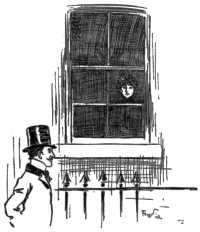
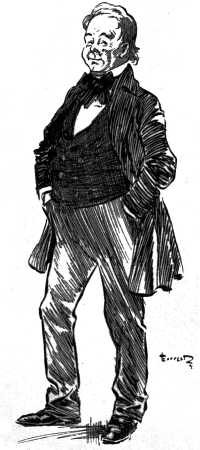
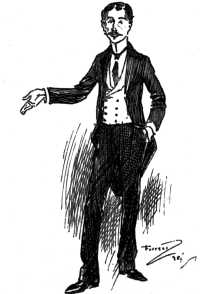
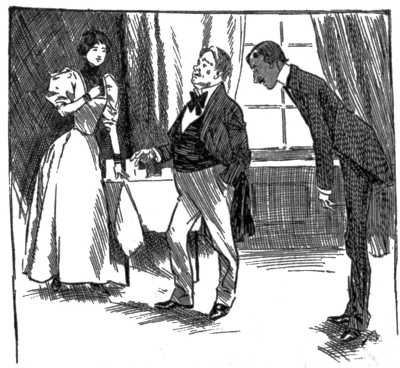
It was now the eve of my wedding-day, and it was generally taken for
granted that Lurana and I would be allowed to enter the lion-cage
without opposition from any quarter.
Whether we should find it as easy to come out again was a point on
which opinions differed considerably, but the majority must have been
confident that the ceremony would pass off without any unpleasant
interruption—for the rush to obtain seats was tremendous.
I was just as tranquil and collected as ever; I could not detect that
my valour had "ullaged," as wine-merchants say, in the slightest
degree, though Lurana was perpetually questioning me as to whether I
was sure I would not rather withdraw.
Of course, I indignantly repudiated the very idea, but it is well
known that a perfectly sober person, if suddenly taxed with being
drunk, will seem and even feel so, and it is much the same with any
imputation of cowardice.
I began to think that constant tea tasting, even though the infusions
are not actually swallowed, probably has some subtle effect upon the
nervous system, and that it would brace me up and also show me how
little cause I had to be uneasy, if I dropped into the Agricultural
Hall once more and saw Niono put his lions through their performances.
So I left the City early that afternoon and paid for my admission to
the hall like an ordinary sightseer; I did not ask Lurana to accompany
me, because I knew she must have plenty to keep her at home just then.
I was just in time for the performing lions, and found a place in the
outer edge of the crowd; it was strange to stand there unrecognised
and hear myself being freely discussed by all around; strange and
decidedly exhilarating, too, to think that in another twenty-four
hours I should be, not a spectator of what was to take place in that
arena, but one of the principal performers, the centre of breathless
interest, the hero of the hour!
But with the appearance of the cage, this unnatural exhilaration
suddenly died down. It was not so much the lions, though they struck
me as larger and less easy-tempered than on the first occasion, while
the lioness was as nearly in open revolt as she dared. What troubled
me most was that the cage contained another inmate, one whom I did not
remember to have seen before—a magnificent specimen of the Bengal
tiger.
It seemed perfectly clear to me that the brute was only about
half-trained; he went through his tricks in a sullen perfunctory way,
with a savage, snurring snap every now and then, which, even at that
distance, made my flesh creep.
And, whenever he snapped, clouds of steam issued from his great jaws;
I could see, too, that the lioness was secretly egging him on to fresh
acts of defiance, and that he was only watching his opportunity to
crouch and spring as soon as Niono's back was turned.
I was perfectly determined that I would not have that tiger at my
wedding; he would never keep still for a moment; he would upset all
the other animals, and how could I be expected to remain cool with a
great, hot, steaming beast like that at my elbow? Why, he must raise
the temperature of that cage to the atmosphere of a Turkish bath! For
Lurana's sake as well as my own, I really must draw the line at
tigers—they were not in the bond.
Another thing that annoyed me was the senseless tomfoolery of the
clowns, who persisted in running after the cage at the conclusion of
the performance, and teasing the poor defenceless animals by making
grimaces and dashing their ridiculous conical hats against the bars.
It was painful to think that any one could be found to smile at such
cheap buffoonery—if I had been the ring-master, I would have given
those cowardly idiots a taste of the whip!
I decided to go round afterwards and see Onion about that tiger.
I did not see the lion-tamer, as he had just left the hall, and Mr
Sawkins, I was told, was engaged, but I saw Mlle. Léonie, who was most
friendly.
Mademoiselle.
I remarked, carelessly, that I saw they had put a tiger into the cage.
Mademoiselle said he was a member of the troupe, but had been
indisposed and temporarily transferred to the hospital cage.
I hinted that a tiger, however convalescent, was hardly a desirable
addition to our wedding party. Mademoiselle was astounded; a so
gracious beast, a veritable treasure, with him present, the ceremony
would have a style, a cachet, an elegance. Without him—ah! bah! it
would be triste—banal, tame!
I admitted this, but urged that we were quiet people who wanted to be
married as quietly as possible, and that a tiger, for persons in our
condition of life, was a ridiculous piece of ostentation. It was
always better to begin as one meant to go on.
She differed from me totally. I was too modest, for, of course, it was
incredible that I, who was so full of sangfroid, could object to the
tiger for any other reason?
"Personally," I replied, "I had no prejudice against tigers
whatever—but Mademoiselle would understand that I was bound to
consider another person's convenience."
"Not possible!" exclaimed Mademoiselle, "a young lady with so much
verve to be timid! Why, Mons. Onion raved of her fearlessness!"
I said it was not timidity in Lurana's case—she merely happened to
have an antipathy for tigers. Some people, as Mademoiselle was
doubtless aware, were unable to remain in the same room with a cat;
Miss de Castro could not stay in the same cage with a tiger—it was
temperament.
"Ah," said Mdlle. Hortense, "I understand that. A sensitive?"
"Yes," I said, "a sensitive."
"But Niono says she is one of us!" objected Mademoiselle, "that she
was brought up amongst animals—that her mamma was herself an
animal-tamer."
"Of white mice and canary birds," I said, "but that is not quite the
same thing as tigers, and I am perfectly certain that if that tiger is
retained, the wedding will not take place."
Her keen grey eyes flashed with comprehension. Ah, the poor little
one! in that case it was another thing. She would speak to the
"Patron" and to Mons. Onion; the tiger should not be permitted to
trouble the fête. I could rely absolutely upon her—he should be
accommodated elsewhere.
I went back to Lurana in a somewhat relieved frame of mind, and when
she asked me where I had been, I mentioned, perhaps unwisely, that I
had dropped in at the Circus and had a little chat with Mlle. Léonie.
I did not say anything about the tiger, because there seemed to be no
object in disturbing her, now that the matter was comfortably settled,
not to mention that if Lurana had known I had directed the removal of
the tiger without consulting her, she was quite self-willed enough to
insist on his immediate restoration to the lion-cage.
Most girls would have been impressed by my courage in going near the
Circus at all at such a time; not so Lurana, who pretended to believe
that Mlle. Léonie was the attraction.
"Oh, I noticed she was making eyes at you from the very beginning,"
she declared; "you had better marry her, and then Mr Niono could
marry me. I daresay he would have no objection."
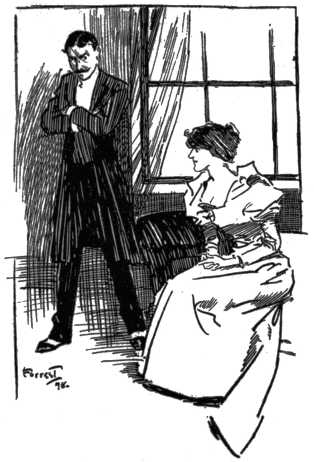
"My darling," I said, gently, "do not let us quarrel the very last
evening we may spend together on earth."
"You might take a more cheerful view of it than that, Theodore!" she
exclaimed.
"I think you are a little inclined to treat it too lightly," I
replied. "I have been studying those lions, Lurana, and it is my
deliberate opinion that they are in a condition of suppressed
excitement which will break out on the slightest pretext. Unless you
can trust yourself to meet their gaze without faltering, without so
much as a flicker of the eyelid you will, unless I am greatly
mistaken, stand a considerable chance of being torn to pieces."
"Nonsense, Theodore!" she said, "they can't possibly tell whether I am
meeting their gaze or not, or even shutting my eyes—for, of course, I
shall be wearing a veil."
But I should not—and it really did not seem fair. "I rather thought
of putting on a green shade myself," I said. It had only just occurred
to me.
"Don't be absurd, Theodore!" she replied. "What can you want with a
green shade?"
"My eyes are not strong," I said, "and with those electric lights so
close to the cage, I might blink or even close my eyes. A green
shade, like your bridal veil, would conceal the act!"
"As if anybody ever heard of a bridegroom with a green shade over
his eyes! I certainly will not enter that cage if I am to be made
publicly ridiculous!"
"Do I understand," I said, very gravely, "that you refuse to enter
the lion-cage?"
"With a man in a green shade? Most certainly I refuse. Not otherwise."
"Then you will sacrifice my life to mere appearances? Ah, Lurana, that
is only one more proof that vanity—not love—has led you to this
marriage!"
"Why don't you own at once that you'd give anything to get out of it,
Theodore?"
"It is you," I retorted, "you, Lurana, who are secretly dreading the
ordeal, and you are trying to throw the responsibility of giving up
the whole thing on me—it's not fair, you know!"
"I want to give up the whole thing? Theodore, you know that isn't
true!"
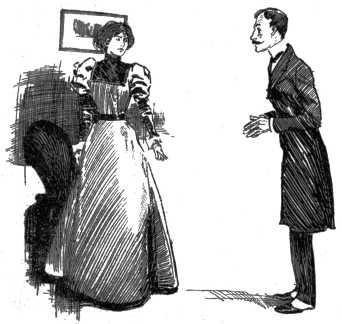
"Children, children!" said the Professor, who had been a silent and
unnoticed witness of our dispute till then, "What is this talk about
giving up the marriage? I implore you to consider the consequences, if
the wedding is broken off now by your default. You will be mobbed by a
justly indignant crowd, which will probably wreck the hall as a sign
of their displeasure. You are just now the two most prominent and
popular persons in the United Kingdom—you will become the objects of
universal derision. You will ruin that worthy and excellent man, Mr
Sawkins, offend Archibald Chuck, and do irretrievable damage to Miss
Rakestraw's prospects of success in journalism. Of myself I say
nothing, though I may mention that the persons who have paid me fancy
prices for the few seats which the management placed at my disposition
will infallibly demand restitution and damages. I might even be forced
to recover them from you, Theodore. On the other hand, by merely
facing a hardly appreciable danger for a very few minutes, you cover
yourselves with undying glory, you gain rich and handsome wedding
gifts, which I hear the proprietors intend to bestow upon you; you
receive an ovation such as is generally reserved for Royal nuptials;
and yet you, Theodore, would forfeit all this—for what? For a green
shade, which would probably only serve to infuriate the animals?"
This had not struck me before, and I could not help seeing that there
was something in it.
"I give up the shade," I said; "but I do think that Lurana is in such
a nervous and overstrung condition just now that it is not safe for
her to enter the cage without a medical certificate."
Lurana laughed. "What for, Theodore? To satisfy the lions? Don't
distress yourself on my account—I am perfectly well. At the appointed
time I shall present myself at the—the altar. If you are not there to
receive me, to stand by my side in the sight of all, you lose me for
ever. A de Castro can never marry a Craven."
She looked so splendid as she said this that I felt there was no peril
in the world that I would not face to gain her, that life without her
would be unendurable.
Since she was as resolved as ever on this project, I must see it out,
that was all, and trust to luck to pull me through. Onion would be
there—and he understood lions; and, besides, there was always the
bare chance of the ceremony being stopped at the eleventh hour.
I left early, knowing that I should require a good night's rest, and
Lurana and I parted, on the understanding that our next meeting would
be at the Agricultural Hall on the following afternoon.
Whether it was due to a cup of coffee I had taken at the Professor's,
or to some other cause, I do not know, but I had a wretched night,
sleeping very literally in fits and starts, and feeling almost
thankful when it was time to get up.
A cold bath freshened me up wonderfully, and, as they naturally did
not expect me in the City on my wedding-day, I had the whole morning
to myself, and decided to get through it by taking a brisk walk.
Before starting, I sent a bag containing my wedding garments to the
Agricultural Hall, where a dressing room had been reserved for me, and
then I started, viâ the Seven Sisters Road, for Finsbury Park.
As I passed an optician's shop, I happened to see, hanging in the
window, several pairs of coloured spectacles, one of which I went in
and bought, and walked on with a sense of reassurance. Through the
medium of such glasses a lion would lose much of his terrors, and
would, at the same time, be unable to detect any want of firmness in
my gaze; indeed, if a wild beast can actually be dominated by a human
eye, how much more should he be so when that eye is reinforced by a
pair of smoked spectacles!
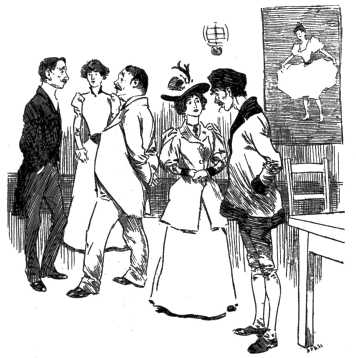
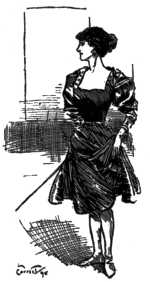
"A de Castro can never marry a Craven."
My recollection of the rest of that walk is indistinct. I felt no
distress, only a kind of stupor. I tried to fix my thoughts on Lurana,
on her strange beauty, and the wondrous fact that in a very few hours
the ceremony, which was to unite us, would be, at all events,
commenced. But at times I had a pathetic sense of the irony which
decreed that I, a man of simple tastes and unenterprising disposition,
should have fallen hopelessly in love with the only young woman in the
United Kingdom capable of insisting on being married in a wild-beast
cage.
It seemed hard, and I remember envying quite ordinary
persons—butchers, hawkers, errand-boys, crossing-sweepers, and the
like, for their good fortune in not being engaged to spend any part of
that afternoon in a den of forest-bred African lions.
However, though there was nothing about the intentions of the Home
Office in the early editions of the evening papers, the officials
might be preparing a dramatic coup for the last moment. I was
determined not to count upon it—but the thought of it kept me up
until the time when I had to think of returning, for the idea of
flight never for an instant presented itself to me. I was on parôle
as it were, and I preferred death by Lurana's side to dishonour and
security without her.
So anxious was I not to be late, and also to discover whether any
communication from the Home Secretary had reached the manager, that I
almost hurried back to Islington. I was admitted to the Hall by a
private entrance, and shown to the kind of unroofed cabin in which I
was to change, and which, being under the balcony and at some distance
from the gangway between the stables and the ring, was comparatively
private and secluded.
Here, after asking an assistant to let Mr Niono know I had arrived,
and would like to see him, I waited. The Circus had begun, as I knew
from the facts that the blare of the orchestrions was hushed, and that
a brass band overhead began and left off with the abruptness peculiar
to Circus music.
Screens of board and canvas hid the auditorium from view, but I was
conscious of a vast multitude on the other side, vociferous and in the
best of humours.
Between the strains of the orchestra and the rattling volleys of
applause, I heard the faint stamping and trampling from the stables,
and, a sound that struck a chill to my heart—the prolonged roar of
exasperation and ennui which could only proceed from a bored lion.
Then there was a rap at the door, which made me start, and Niono burst
in.
"So you've found your way here," he said. "Feeling pretty fit? That's
the ticket! The bride ain't arrived yet, so you've lots of time."
"You've heard nothing from the Home Office yet, I suppose?" I asked.
"Not a word—and, between you and me, I made sure they meant to crab
the show. You've the devil's own luck!"
"I have, indeed," I said, with feeling. "Still, we mustn't be too
sure—they may stop us yet!"
"They may try it on—but our men have got their instructions. If they
did come now, they wouldn't get near the ring till it was all over,
so don't you worry yourself about that."
I said everything seemed to have been admirably arranged. "By the
way," I added, "where have you put the tiger?"
"Do you mean old Rajah?" he said; and I replied that I did mean old
Rajah.
"Why, he's all right—in the cage along with the others—where did
you suppose he'd be—loose?"
"I particularly requested," I explained, "that he might be put
somewhere else during the wedding. Mademoiselle promised that it
should be seen to."
"It's nothing to do with Ma'amsell," he said, huffily; "she don't
give orders here, Ma'amsell don't."
"I mean, she promised to mention the matter to you," I said, more
diplomatically.
"She never said nothing about it to me," he replied; "I expect she
forgot."
"I can only say it was extremely careless of her," I said. "The fact
is, I have my doubts whether that tiger is to be trusted."
"Well, you never can trust a tiger same as you can a lion," he
replied, candidly, "so I won't deceive you. But old Rajah ain't so
particular nasty—as tigers go."
"He may not be," I said, "but, in Miss de Castro's interests, I must
beg you to shift him into some other cage till this affair is over. I
can't allow her to run any unnecessary risk."
"I don't say you're wrong," he answered, "I wish I'd known before, I'd
have asked the gov'nor."
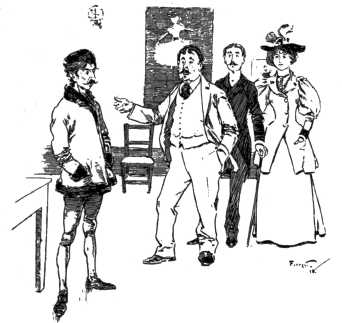
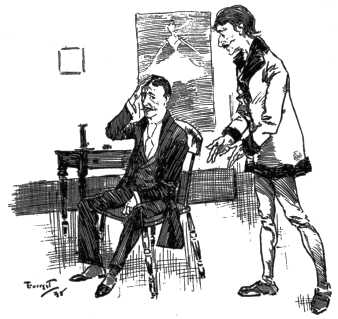
"If them two got together, there'd be the doose's delight."
"Ask him now," I urged, "surely you can put the tiger back in the
hospital cage for an hour or two."
"The Jaguar's in there," he said; "he was a bit off colour, so we put
him there this morning. And if them two got together, there'd be the
doose's delight!"
"Couldn't you put him somewhere else, then?" I suggested.
"I might ha' shunted him on to the Armadillo at a pinch," he said
thoughtfully, "he wouldn't ha' taken any notice, but the gov'nor
would have to be consulted first,—and he's engaged in the ring.
Besides, it would take too much time to move old Rajah now—you must
put up with him, that's all. You'll be right enough if you keep your
head and stick close to me. I've taken care they've all had a good
dinner. I say," he broke off suddenly, "you're looking uncommon blue."
"I don't feel nervous," I said, "at least, not more nervous than a
man ought to feel who's just about to be married. If you mean to
suggest that I'm going to show the white feather——!"
"Not you," he said, "what would you get by it, you know? After
billing this affair all over the town, we can't afford to disappoint
the public, and if I saw you hanging back—why I'm blest if I wouldn't
carry you into the cage myself."
I retorted angrily that I would not put him to that inconvenience,
that I was as cool as he was, and that I did not understand his remark
that I was looking blue.
"Lord, what a touchy chap you are!" he cried; "I meant looking blue
about the jaw, that's all. If I was you, I'd have a clean shave. It's
enough to put any lady off if she sees you with a chin like the barrel
of a musical-box."
Somehow I had omitted to shave myself as usual that morning, intending
to get shaved later, but had forgotten to look for a hairdresser's
shop during my walk.
"You'll find a razor in that drawer," he said, "if you don't mind
making shift with cold water, for there's no one about to fetch you
any hot. Now I must be off and get into my own togs. Make yourself at
home, you know. I'll give you another call later on."
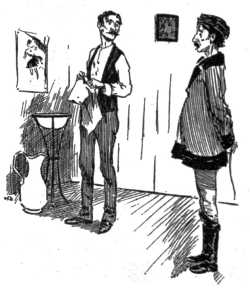
I was forlornly mopping
when Niono returned.
Perhaps the razor was blunt, perhaps it was the cold water, anyhow I
inflicted a gash on the extreme point of my chin which bled profusely.
I dabbed and sluiced, but nothing I could do seemed to check the flow;
it went on, obstinate and irrepressible. I was still forlornly mopping
when Niono returned in his braided jacket, tights and Hessian boots,
whistling a tune.
"The bride's just driven up," he announced, "looking like a
picture—what pluck she's got! I wish I was in your shoes! Ma'amsell's
taken her to her room. My word, though, you've given yourself a nasty
cut; got any spider's web about you? Stops it in no time."
As I do not happen to go about festooned in cobwebs, his suggestion
was of little practical value, and so I intimated rather sharply.
"Well, don't get in a fluster," he said, "we're only a couple of turns
off the Cage Act as it is; you slip into them spicy lavender trousers
and that classy frock-coat of yours as quick as you can, and I'll try
if I can't borrow a bit of courtplaster off one of our ladies."
I had just put on a clean shirt when he was back again; "I could only
get goldbeater's skin," he remarked, "and precious little of that, so
be careful with it. And the parson's come, and would like to have a
look at the licence."
I handed him the document, and tried to apply the goldbeater's skin,
which curled and shrivelled, and would stick to nothing but my
fingers—and still the hæmorrhage continued.
"It's all over your shirt now!" said the lion-tamer, as if I was
doing it on purpose. "I wouldn't have had this happen for something.
Why, I've known 'em get excited with the smell of blood, let alone
the sight of it."
"Do you mean the lions?" I inquired, with a faint sick sensation.
"Well, it was the tiger my mind was running on more," was his gloomy
reply.
My own mind began to run on the tiger too, and a most unpleasant form
of mental exercise it was.
"After all," said Niono with an optimism that sounded a trifle forced,
"there's no saying. He mayn't spot it. None of 'em mayn't."
"But what do you think yourself?" I could not help asking.
"I couldn't give an opinion till we get inside," he answered, "but
we'll have the red hot irons handy in case he tries on any of his
games. And if you can't stop that chin of yours," he added, taking a
wrapper from his own neck and tossing it to me, "you'd better hide it
in this—they'll only think you've got a sore throat or something. But
do hurry up. I'm just going to see the old elephant put in the shafts,
and then I'll come back for you, so don't dawdle."
Once more I was alone; I felt so chilly that I put on my old coat and
waistcoat again, for I did not venture to touch my new suit until my
chin left off bleeding, and it seemed inexhaustible, though the
precious minutes were slipping by faster and faster.
The great building had grown suddenly silent; I could almost feel the
air vibrating with the suppressed excitement of the vast unseen crowd
which was waiting patiently for the lions, and Lurana—and me.
Soon I heard a voice—probably a menagerie assistant's—in the passage
outside, and presently a shuffling tread approaching, and then I
perceived towering above the wooden partition, a huge grey bulk,
ridged and fissured like a mountain side, and touched where the light
fell on it with a mouldy bloom—it was the elephant on his way to be
attached to the lion-cage!
I stared helplessly up at his uncouth profile, with the knobby
forehead worn to a shiny black, and the sardonic little eye that met
mine with a humorous intelligence, as though recommending me to haste
to the wedding.
He plodded past, and I realised that I had no time to change now; my
new wedding suit was a useless extravagance—I must go to the altar as
I was. Niono would be back to fetch me in a moment. Lurana would never
forgive me for keeping her waiting.
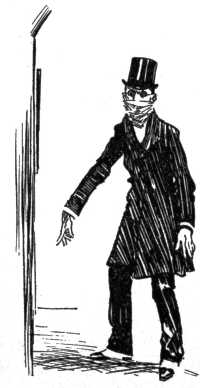
Hastily I wound the muffler round my neck till my chin was hidden in
its folds, and put on my hat. Could I have mislaid the spectacles? No,
thank heaven, they were in the pocket of my great coat. I put them on,
and my wedding toilet—such as it was—was complete.
Then I cast a hurried glance at myself in a tarnished mirror nailed
against the matchboarding, and staggered back in dismay. I was
not merely unrecognisable; I was—what is a thousand times
worse—ridiculous!
My wedding toilette
was complete.
Yes, no bridegroom in the world could hope to make a creditable
appearance with his nose only just showing above a worsted comforter
and his eyes hidden behind a pair of smoked spectacles. It was enough
to make any lion roar—the audience would receive me with howls!
I had been prepared—I was still prepared—for Lurana's dear sake, to
face the deadliest peril. But to do so with a total loss of dignity;
to be irresistibly comic in the supreme crisis, to wrestle with wild
beasts to the accompaniment of peals of Homeric laughter—would any
lover in the world be capable of heroism such as that?
True, I might remove the spectacles—but in that case I could not
trust my nerve; or I might take off the muffler but then I could not
trust the tiger. And in either case I should be courting not only my
own destruction, but that of one whose life was far dearer to me than
my own.
I asked myself solemnly whether I had the right to endanger her
safety, simply from a selfish unwillingness to appear grotesque in her
eyes and those of the audience. The answer was what every rightminded
reader will have foreseen.
And, seeing that the probability was that Lurana would absolutely
decline to go through the ceremony at all with the guy I now appeared
(for had she not objected even to my assuming a green shade, which
was, comparatively, becoming), it was obvious that only one
alternative remained, and that I took.
Cautiously opening the door of my cabin, I looked up and down the
passage. At one end I could just see the elephant surrounded by a
crowd of grooms and helpers, who were presumably harnessing him to the
cage and were too far away or too much engaged to notice me. At the
other were a few deserted stalls and rifle-galleries, whose
proprietors had all gone to swell the crowd of spectators who were
waiting to see as much as they could of my wedding, and it began to
seem likely that they would see very little indeed.
I was about to make for the nearest exit when I remembered that it
would probably be guarded, so, assuming as far as possible the air of
an ordinary visitor, I slipped quietly up a broad flight of stairs, on
each of which was a recommendation to try somebody's "Pink Pills for
Pale People," and gained the upper gallery without attracting
attention.
I felt instinctively that my best chance of escaping detection was to
mingle with the crowd, and besides, I was naturally curious to know
how the affair would end, so, seeing a door and pigeon-hole with the
placard "Balcony Seats, Sixpence," I went in, and was lucky enough to
secure the only cane bottom chair left in the back row.
After removing my spectacles, I had a fairly good view of the ring
below, with its brown tan enclosed by a white border cushioned along
the top in faded crimson. The reserved stalls were all full, and
beyond the barriers, the crowd swayed and surged in a dense black
mass. Nobody was inside the ring except a couple of nondescript grooms
in scarlet liveries, who hung about with an air of growing
embarrassment. The orchestra opposite was reiterating "The Maiden's
Prayer" with a perseverance that at length got upon the nerves of the
audience, which began to stamp suggestively.
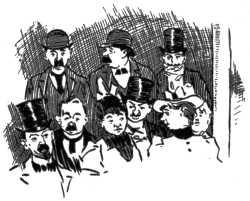
"It's a swindle," said a husky man, who was obviously inclined to
scepticism, and also sherry, "a reg'lar take in! There won't be nobody
married in a lion's cage—I've said so all along."
"Oh, it's too soon to say that yet!" I replied soothingly, though I
had reasons for being of the same opinion, "they're a little behind
time, that's all."
It's a swindle.
"I dunno what it is they're behind," he said,—"but they don't mean
comin' out. There, what did I tell you?"
One of the grooms, obeying instructions from without, had just gone to
the Indicator-post, removed the number corresponding with that of the
wedding programme, and substituted another, which was the signal for a
general uproar.
A carpet was spread for a performance by a "Bender," who made his
appearance in a tight suit of green spangles, as the "Marvellous Boy
Serpent," and endeavoured to wile away the popular discontent by
writhing in and out of the rungs of a chair, and making a glittering
pincushion of himself. In vain, for they would have none of him, and
the poor youth had to return at last amidst a storm of undeserved
hissing.
Another long wait followed, and the indignation grew louder. So
infectious is the temper of a mob that I actually caught myself
growing impatient, and banging loudly on the floor with my
umbrella—just as my neighbours were doing!
All at once, to my extreme bewilderment, the stamping and hooting
changed to tumultuous applause, the band began to bray out an air that
was apparently intended for "The Voice that Breathed," the barriers
were thrown open, and the great elephant lumbered into the arena
drawing the cage.
The brute had an enormous wedding favour attached to each side of his
tusks, and all the animals in the cage, down to the very tiger, were
wearing garlands of artificial orange-blossom, a touch of sentiment
which seemed to go straight to the hearts of the people.
But even while I looked down into the cage, with much the same
reflection as that of John Bradford of old, that there, but for
special grace, I might myself be figuring, I was astounded by the
audacity of the management.
Could they really imagine that an intelligent and enlightened audience
like this would be pacified by anything less than the spectacle they
had paid to witness—a marriage solemnised in a den of lions? And how
did they propose to perform a ceremony at which, as they must be fully
aware by this time, the bridegroom would be conspicuous by his
absence? No, it might be magnificent, but it was not business.
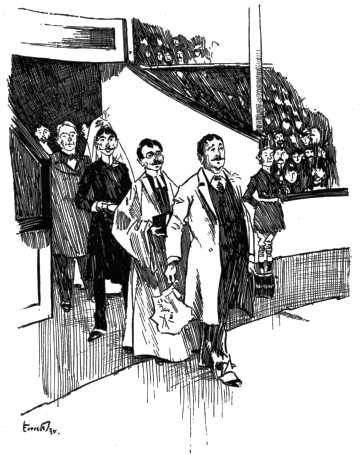
I was still speculating, when a kind of small procession entered the
arena. First came Mr Sawkins, with the Reverend Ninian, looking rather
like a cheap Cranmer; next was a smart-looking person in a well-cut
frock-coat and lavender trousers that I seemed to have seen before. It
was my wedding suit; the wearer had gummed on a moustache and short
side-whiskers which gave him a spurious resemblance to myself, but if
nobody else knew him, I did—it was Onion, the Lion King!
And the next moment, I received a still greater shock, as Professor
Polkinghorne followed with the lofty bearing of a Virginius, and on
his arm was a slender shrinking figure, which, in spite of the veil
she wore, I knew too well could be no other than Lurana.
"There's the bridegroom, d'ye see!" explained my hoarse neighbour;
"he's a deal better lookin' than the pictures they've drawed of him in
the papers. But he's as pale as plaster, he'll back out of it at the
last moment—you just see if he don't!"
But I knew Niono better. I remembered his open admiration of Lurana,
his envy at my good fortune, I felt convinced that his pallor was
merely due to the absence of rouge and the fear that he would not
succeed in his daring imposture. For I saw now that he had been
planning to supplant me from the first; hence his attempts to shake my
nerve, and, when they failed, hence his treacherous loan of a blunt
razor. He was staking everything on the chance that the bride's
natural agitation, and the thickness of her veil would prevent her
from suspecting that he was a fraudulent bridegroom until the ceremony
was over, while the audience, not expecting to see a Lion King in a
tall hat, would be equally deceived.
A kind of small procession entered the arena.
"Pore young things!" said a stout female in front, with a nodding
feather in her bonnet; "it's to be 'oped there won't be any
unpleasantness, I'm sure. I'm 'alf sorry I came."
There was time even yet; I had but to rise, denounce the usurper, and
take my rightful place at Lurana's side. I felt strongly impelled to
do so; I actually stood up and tried to speak. But I realised that it
was hopeless to attempt to make my feeble voice heard above the
thunders of applause, even if excitement and emotion had not rendered
me speechless. Besides, what satisfactory explanation of my present
position could I offer? I sat down again with a sense of spellbound
helplessness.
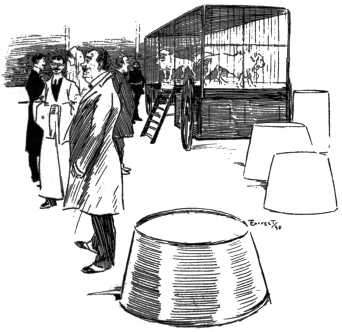
I looked on as the great arc-lamps were lowered, hissing and buzzing,
to the level of the cage, and the Reverend Mr Skipworth prepared to
ascend the inverted white tub that was to serve him as a reading-desk,
and the unscrupulous Onion took the bride by the hand and conducted
her to the steps which led to the door of the lion-cage.
"They're never goin' in among all them lions without nobody with
them!" cried the stout lady. "It's downright temptin' of Providence,
that it is!"
"Don't you be afraid," said the cynical man. "They ain't goin' in.
Just look at that now!"
As he spoke two persons in plain clothes, who had apparently been
waiting for this moment, stepped over the barrier from the shilling
stalls into the ring, and, from their gestures, seemed to be insisting
that the wedding should not take place inside the cage at all events.
There was an animated dispute in the ring; Niono blustered, Lurana
pleaded, Sawkins expostulated, and the professor and Archibald Chuck
(who had contrived to push himself into the party) argued, while Miss
Rakestraw filled page after page of her reporter's note-book, and the
Rev. Ninian sat upon his tub with meekly folded hands, looking more
than ever like a martyr who knew himself to be incombustible.
The audience booed, and hissed, and yelled with natural rage and
disappointment; the lions remained unmoved, blinking behind their
bars, with crossed forepaws, and an air of serene indifference.
"I told yer there wasn't going to be no blooming wedding!" said my
husky friend. "It's a reg'lar put-up job, that's what it is!"
It was possible; but whether the interrupters of the proceedings were
hired supers or genuine officials, it was equally clear that there
would be no wedding inside the cage.
How bitterly I regretted that by yielding to an irresistible impulse I
had forfeited the right to stand by Lurana's side at this supreme
moment! I could have done so with absolute impunity; I should have won
a lifelong reputation for courage; Lurana herself would have owned
that I had done all that was possible to gratify her whim, and would
have consented to marry me in the orthodox fashion.
Whereas, here I was, separated from her by impassable barriers, in the
ignominious seclusion of a back seat! However, this official
prohibition had at least solved one of my difficulties; it had
rendered it unnecessary for me to interfere personally.
The storm of indignation rose to a hurricane when the entire wedding
party filed out of the arena with the officials, doubtless to discuss
the matter in greater privacy.
The stout lady with the feather was particularly annoyed. "Why
shouldn't the two young parties be allowed to please themselves?" she
wanted to know. "It was their wedding, not the Government's. But it
was always the way whenever she came out for a little amusement.
Somethink was bound to go wrong."
Another long interval, during which the wildest disorder reigned
unchecked, the crowd, with the irrationality of an angry mob, actually
throwing pieces of orange-peel at the unoffending lions as the only
creatures within the range of their displeasure. The hubbub was at its
height when Sawkins reappeared and held up his hand for some time in
vain before he could obtain a hearing. Then he addressed the audience
as follows:
"Ladies and Gentlemen," he said, "certain individuals claiming to
represent the Home Office and the London County Council" (here there
were groans, and my neighbour remarked disgustedly, that "that was
what came of returning those Progressives") "have protested against a
wedding in the cage as involving danger to the principal parties
concerned." (Loud cries of "Shame!" and general uproar.) "I have the
honour and pleasure to announce that we have succeeded in convincing
these gentlemen that the proposed ceremony is no more open to
objection than the ordinary performance, and that they have no legal
power to prohibit it. Consequently the marriage will now be celebrated
in the cage of forest-bred African lions, as advertised."
Then he addressed the audience.
The revulsion of feeling after this most unexpected announcement was
instant and tremendous; all hearts seemed touched with generous
compunction for their uncharitable suspicions, and the hall rang with
tumultuous cheers.
For myself, I could not share the general exhilaration. This
preposterous wedding was permitted after all, and, unless Lurana's
heart failed her at the critical instant, she would inevitably be lost
to me for ever! I might still interpose; indeed I should have done so
at all costs, but for a timely remembrance that no action I took now
would regain her.
She might have been in ignorance before—but in the course of this
delay she must have learnt that I had failed her, she must have
accepted the lion-tamer as a substitute, and, even if I were to
present myself, she would only inform me that my place was already
filled. I had too much spirit to risk a public snub of that kind, so I
stayed where I was. It cannot have fallen to many men's lot to look on
as passive spectators at their own wedding—but what choice had I?
There was a deathlike silence as Niono slipt the bolt and gallantly
handed the bride into the cage. She stepped in as collectedly as if it
had been an ordinary Registry Office, and the great tawny beasts
retreated sullenly to the other end, where they stood huddled in a
row, while the Rev. Ninian, mounting his tub, read an abbreviated form
of service in a voice which was quite inaudible in the balcony.
I tried to turn my eyes away from the scene that was taking place in
that grim cage, and the two figures that were so calmly confronting
those formidable brutes—but I felt compelled to look. And it was
mortifying to see how trifling after all was the danger they incurred.
I am afraid I almost wished that one of the animals would give some
trouble—I don't mean of course by any actual attack—but by just
enough display of ferocity to make Lurana understand what they might
do.
But they never even attempted to cross the pole which had been thrust
across the cage as a barrier. I was never told there would be a
pole! They looked on, mystified—as well they might be—by proceedings
to which they were totally unaccustomed, but still impressed, and
sleepily solemn. Even the tiger behaved with irreproachable decorum.
I understood then what Onion had been careful not to mention; their
food had been doctored in some way. If I had only known! Anybody
could beard a hocussed lion!
And soon the words which made that couple man and wife were
pronounced, or rather mumbled—for the Rev. Ninian would have been
none the worse for a course of lessons from old Polkinghorne—and the
newly-wedded pair came out of the cage without so much as a scratch,
to the triumphant blare of the "Wedding March." There was frantic
applause as the Professor embraced the bride with an emotion that
struck me as overdone, while the Rev. Ninian, Miss Rakestraw, and
Chuck, offered their congratulations and Mr Sawkins presented the
happy couple with a silver biscuit-box (it may have been
electro-plated), and a Tantalus spirit case.
But for that unfortunate slip of the razor, those gifts would have
been mine—but I was in no mood to think of that just then, when I had
lost what was so infinitely more precious.
I looked on dully till the party left the arena, declining with
excellent taste to return in answer to repeated calls and bow their
acknowledgments, and then, as the electric lights were hoisted up
again and the elephant was led in to remove the lion's cage, I thought
it was time to go.
It was all over; there was nothing to stay for now, and most of the
people were leaving, so I joined the crowd which streamed down the
staircase and along the broad passage to the main exit. Once in the
open air, I hurried blindly past the flaring shops in the High Street,
neither knowing nor caring where I was going, with only one thought
possessing my numbed brain—how different it might all have been if
only things had happened otherwise!
Wherever I looked I saw Lurana's lovely scornful face and flashing
eyes painted with torturing vividness on the murky air. How flat and
stale all existence would be for me henceforth! Life with Lurana might
not have been all sunshine; it might have had its storms, even its
tempests—but at least it would never have been dull!
I cursed the treachery which had induced her to link herself for life
with a lion-tamer. Happy, I knew she could not be, for of one thing I
was confident—she loved me; not perhaps with the passionate
single-hearted devotion I felt for her, but still with a love she
would never feel for any other. Perhaps she was already beginning to
repent her desertion of me, and wishing she could undo that rash
irrevocable act.
I was pounding up Highgate Hill, with no object beyond escaping by
active motion the demons of recollection and regret that haunted
me—when suddenly, as I gained the top of the hill, a thought struck
me. Was the act irrevocable after all? Was it so absolutely certain
that this Onion had the legal right to claim her as his wife?
He had certainly personated me. Had he borrowed, not only my frock
coat, and trousers, but also my name for the ceremony? If he had, and
if Lurana was, as she could hardly help being, aware of the fact, it
did not require much acquaintance with the law to know that there was
a chance, at all events, of getting the Court to declare the marriage
null and void.
But he might have been married in his own name; I could not tell,
owing to the indistinctness of Mr Skipworth's utterance, only Lurana
or those in their immediate neighbourhood could say. I must know that
first; I must examine the register, if there was one, and then, if—if
Lurana wished to be saved, I might be able to save her.
I knew that a sort of wedding high-tea had been prepared at Canonbury
Square, where the whole party would be assembled by this time, and I
hurried back to Canonbury Square as fast as the tramcar would take me.
My blood was roused; she would not be Niono's if I could prevent it. I
would snatch her from him, even if I had to do so across the
wedding-cake!
But when I reached the well-known door and raised the familiar
knocker—a fist clutching a cast-iron wreath—in my trembling fingers,
there were no sounds of festivity within; the house was dark and
deserted.
I waited in the bitter January air; the street lamp opposite—the
identical one under which Lurana had first agreed to marry
me—flickered at every gust of the night wind, as though troubled on
my account. They must have transferred the feast to the Circus, or to
some adjacent restaurant; evidently there was no one there.
I was just turning hopelessly away, when I heard the bolt being
withdrawn, and the door was opened by a maid.
"Where is your mistress?" I asked breathlessly. I could not bring
myself to ask for Lurana as Mrs Onion.
"In the drawing-room, upstairs," was the unexpected reply, "with the
'istericks."
So long as she was not with Niono, I cared little; I bounded up, and
found her alone.
As I entered, she raised her flushed, tear-stained face from the
shabby sofa on which she had thrown herself. "Go away!" she cried,
"why do you come near me now? You have no right—do you hear?—no
right!"
"I know," I said humbly enough, "I deserve this, no doubt; and yet, if
you knew all, you would find excuses for me, Lurana!"
"None, Theodore," she said; "if you had really loved me, you would
never have deserted me!"
"I could not help myself," I retorted; "and really, Lurana, if it
comes to desertion——!"
"Ah, what is the use of wrangling about whose fault it was," she
moaned, "now, when we have both wrecked our lives! At least, I know
I've wrecked mine! Why was I so insane as to set my heart on our
being married in a den of disgusting lions? If you had only been
firmer, Theodore, instead of giving way as you did!"
"At least it was not cowardice," I said. "When I show you the state of
my chin——"
"Theodore!" she cried, with a little scream, "you are hurt! Tell me;
was it the tiger?"
"It was not the tiger," I said. "Never mind that now. I was betrayed
by that infernal Onion, Lurana. I never knew till it was too late—you
do believe me, don't you?"
"I do; we were both deceived, Theodore. I should never have acted as I
did if that horrid Frenchwoman hadn't told me—Oh, what would I not
give if all this had never been?"
"If you are truly sincere," I began, "in wishing this unlucky marriage
cancelled——"
"If I am! Are you, Theodore? Oh, if only there is a way!"
"There may be, Lurana. It all depends on whether my name was used at
the ceremony or not. Try to recollect and tell me."
"But I can't, Theodore. You were there—you must know!"
"Mr Skipworth wouldn't speak up; and I was much farther away than you
were."
"Than I was, Theodore! But—but I wasn't there at all!"
"Not present at your own wedding?" I cried, "but I saw you!"
"It was not me!" she said, "it was Mlle. Léonie. Is it possible you
didn't know?"
My heart leaped. "For heaven's sake, explain, Lurana; let us have no
more concealments."
"When I arrived," she said, "Mademoiselle explained about the tiger,
and how sorry she was it was too late to remove it, since she
understood I had an antipathy to tigers; and I said, not at all, I
adored tigers, so she took me to see the cage, and I—I only tried to
tickle the tiger, but he was so dreadfully cross about it—I nearly
fainted. And she said it was simply madness for me to go in, and that
you were every bit as frightened as I was."
"If only you had been firmer, Theodore."
"She had no right to say that," I said; "it's absolutely untrue!"
"I know, Theodore," she replied; "you have proved that you, at least,
are no coward—but I believed her then. And I wrote you a line to say
that I had altered my mind, and did not think it right to expose you
or myself to such danger, and that I would wait for you by the
Myddelton Statue. She promised to give you the letter at once!"
"I never got it," I said.
"No, she took care you should not. And I waited for you—how long I
don't know—hours, it seemed—but you never came! Then I saw the
people beginning to come out, and—and I went across and asked someone
whether there had been any marriage or not, and he said, 'Yes, it had
gone off without any accident, the bridegroom looked pale but was
plucky enough, and so was the bride, though he couldn't tell how she
looked, because of her veil.' And then of course, I knew that the
deceitful cat had taken my place and managed to make you marry her!
And at first I wanted to go back and stab her with my hat pin, but I
hadn't one sharp enough, so I came home instead. And oh, Theodore, I
do feel so ashamed! After boasting so much of my Spanish blood, and
taunting you with being afraid as I did, to think that you should have
shown the truer courage after all!"
I could not triumph over her then; I was too happy. "Courage, my
darling, is a merely relative quality," I said. "Heaven forbid that we
should be held accountable for the state of our nerves—even the
bravest of us."
"But this marriage, Theodore," she said, "what can you do to have it
set aside?"
"Do! Nothing," I replied; "after what you have told me, I no longer
care to try."
"You despise me, then, because I broke down at the critical moment?"
"Not at all. I can never be grateful enough to you!"
"Grateful! Then do you mean to say you prefer that coarse,
middle-aged, lion-taming person to me, Theodore?"
"Lurana," I said, "prepare yourself for a great surprise—a pleasant
surprise. If anybody is now that lady's lawful husband it is
Niono—not I; and a very suitable match too," I added (I saw now why
the authorities had been compelled to waive their objections to it).
"The fact is, I never went into the cage at all."
"You didn't go into the cage, Theodore! but how, why?"
"Do you imagine," I asked, "can you really suppose I should be capable
of entering that cage with anybody but yourself, Lurana? How little
you know me! Of course I declined!"
"But you didn't know I had run away then, Theodore! Why, you thought
only a few minutes ago I was the person Mr Niono married! Perhaps
you will kindly explain?"
For the moment I was in a fix, but I saw that the moment had arrived
for perfect candour, and accordingly I told her the facts pretty much
as they have been set down here.
She could hardly blame me for having behaved precisely as she herself
had done, or refuse to admit that by taking any other course I should
have imperilled our joint happiness, and yet I thought I could see
that, with feminine unreason, she was just a little disappointed
with me.
The true explanation of that marriage, if it was a marriage, in the
den of lions, I have never been able to discover, nor for that matter
have I been particularly curious to inquire whether Onion attempted to
get rid of me in order to secure Lurana; whether Mdlle. Léonie played
upon Lurana's fears with the hope of becoming my bride, or his; or
whether the Lion King and his fellow artist gallantly sacrificed
themselves to get the management out of a difficulty, I don't know,
and, as I say, I haven't cared to ask.
But however it was, they were ably seconded by old Polkinghorne, who
was naturally unwilling to be called upon to refund the money he had
got for his free tickets, and by Miss Rakestraw and Archibald Chuck,
whose reputations were also more or less concerned.
Nevertheless, although every effort was made to keep the public off
the scent, and the circus people behaved, I am bound to say, with
commendable discretion, sundry garbled versions of the facts did get
about, and altogether Lurana and I have found the task of denying or
correcting them such a constant nuisance that I have felt compelled,
as I said at starting, to furnish, once for all, a statement of what
actually occurred.
Now that it is written I have no more to add, except to append a
cutting from an announcement which appeared not long ago in the
principal papers. The arrangements for its publication were entrusted
to Archibald Chuck, who I think must have added the last two words on
his own responsibility.
Blenkinsop—De Castro.—On the 15th inst., at the Parish
Church of St Mary, Islington, by the Rev. Merton Sandford,
D.D., Vicar, Theodore Pidgley Blenkinsop, of Highbury, to
Lurana Carmen de Castro, only daughter of the late Manuel
Guzman de Castro, formerly Deputy Sub-Assistant Inspector of
Spanish Liquorice to the Government Manufactory at Madrid. No
lions.
THE END.
PRINTED BY
TURNBULL AND SPEARS,
EDINBURGH
Transcriber's Note:
Inconsistent spelling and punctuation retained.