The busy shuttle comes and goes
Across the rhymes, and deftly weaves
A tissue out of autumn leaves,
With here a thistle, there a rose.
With art and patience thus is made
The poet's perfect Cloth of Gold;
When woven so, nor earth nor mould
Nor time can make its colors fade.—T.B. Aldrich.
|
And others came,—Desires and Adorations;
Winged Persuasions and veiled Destinies;
Splendors and Glooms and glimmering Incantations
Of hopes and fears and twilight fantasies.—Shelley.
|
I see the Gleaming Gates and toward them press.—L.C.M.
MR. and Mrs. Moulton when they first set up their household gods
established themselves on Beacon Hill. A few years later, however, a
new part of the city was developed at the South End, and popular favor
turned in that direction. The broad streets and squares with trees and
turf were quiet and English-looking, and although fickle fashion has
in later years forsaken the region, it remains singularly attractive.
Here Mr. Moulton became the owner of a house, and for the remainder of
their lives he and his wife made this their home.
The dwelling was a four-story brick house, the front windows looking
out upon the greenery of a little park in the centre of the square. At
one end of the place was a stone church, defined against the sky and
especially lovely with the red of sunset behind it; and an old-world
atmosphere of retirement and leisure always pervaded the region. In
Rutland Square, No. 28 came to be well known to every Bostonian and to
whomever among visitors was interested in things literary. It was the
most cosmopolitan centre of social life in the city; and to it famous
visitors to this country were almost sure to find their way. For
thirty years Mrs. Moulton's weekly receptions through the winter were
notable.
The drawing-room and library where groups of charming and famous
people assembled were such as to remain pictured in the memory of the
visitor. They were fairly furnished, so to speak, with the tributes of
friends. There were water-colors from Rollin Tilton of Rome; a
vigorous sketch of a famous group of trees at Bordighera by Charles
Caryl Coleman; a number of signed photographs from Vedder; sketches in
clay from Greenough, Ezekiel, and Robert Barrett Browning; a group of
water-colors, illustrating Mrs. Moulton's poem, "Come Back, Dear
Days," by Winthrop Pierce,—one of these showing a brilliant sunrise,
while underneath was the line,
"The morning skies were all aflame;"
and another, revealing a group of shadow-faces, illustrated the line,
"I see your gentle ghosts arise."
There were signed photographs of Robert Barrett Browning's "Dryope," a
gift from the artist; a painting of singular beauty from the artist,
Signor Vertunni, of Rome; and from William Ordway Partridge three
sculptures,—the figure of a child in Carrara marble, a head tinted
like old ivory, and a portrait bust of Edward Everett Hale, a speaking
likeness. There was that wonderful drawing by Vedder, "The Cup of
Death" (from the Rubaiyat), which the artist had given to Mrs. Moulton
in memory of her sonnet on the theme, the opening lines of which
are:
She bends her lovely head to taste thy draught,
O thou stern "Angel of the Darker Cup,"
With thee to-night in the dim shades to sup,
Where all they be who from that cup have quaffed.
|
And among the rare books was a copy of Stéphane Mallarmé's translation
of Poe's "Raven," with illustrations by Manet, the work being the
combined gift to Mrs. Moulton of the poet-translator and the artist.
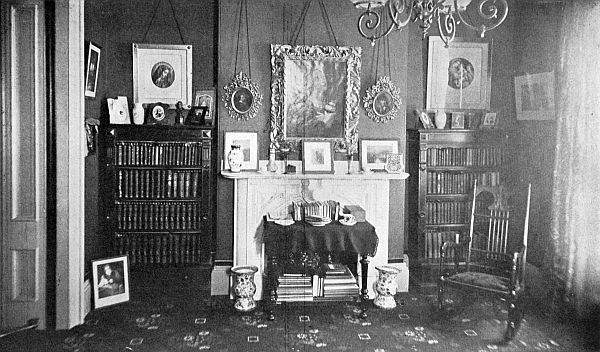
The Library in Mrs. Moulton’s Boston Home,
28 Rutland Square
Page 109
Many were the rare books in autograph copies given to Mrs. Moulton by
her friends abroad—copies presented by Lord Houghton, George Eliot,
Tennyson, Jean Ingelow, Christina Rossetti, Oswald Crawfurd, George
Meredith, Robert Louis Stevenson, Arthur O'Shaughnessy, and several,
too, which were dedicated to her,—the "Wind Voices" of Philip Bourke
Marston, inscribed: "To Louise Chandler Moulton, true poet and true
friend," and another by Herbert L. Clarke of London. The rooms were
magnetic with charming associations.
A correspondent from a leading New York daily, commissioned to write
of Mrs. Moulton's home, described her drawing-room as
"Long, high, and altogether spacious and dignified. A
library opening from the rear increases the apparent length
of the apartment, so that it is a veritable salon; the
furnishings are of simple elegance in color and design, and
the whole scheme of decoration quiet and not ultra-modern.
"But in this attractive room are more treasures than one
would dream of at first glance. The fine paintings that are
scattered here, there, and everywhere, are all of them
veritable works of art, presented to Mrs. Moulton by their
painters; the etchings are autograph copies from some of the
best masters of Europe. Almost every article of decoration,
it would seem, has a history. The books that have overflowed
from the dim recesses of the library are mostly presentation
copies in beautiful bindings, with many a well-turned phrase
on their fly leaves written by authors we all know and love.
"There could be no better guide through all this
treasure-house of suggestive material than Mrs. Moulton
herself. Without question she knows more English people of
note than does any other living American. As she spreads out
before the delighted caller her remarkable collection of
presentation photographs, she intersperses the exhibit with
brilliant off-hand descriptions of their originals—the sort
of word-painting that bookmen are eager to hear in
connection with their literary idols. It is the real
Swinburne she brings to the mind's eye, with his
extraordinary personal appearance and his weird manners; the
real William Watson, profoundly in earnest and varying in
moods; the real George Egerton, with her intensity and
devotion to the higher rights of womankind; the real Thomas
Hardy and George Meredith and Anthony Hope, and the whole
band of British authors, big and little, whom she marshals
in review and dissects with unerring perception and the
keenest of wit. Anecdotes of all these personages flow from
her tongue with a prodigality that makes one long for the
art of shorthand to preserve them."
From this home in the early eighties the daughter of the house was
married to Mr. William Henry Schaefer, of Charleston, South Carolina.
In her daughter's removal to that Southern city, Mrs. Moulton's life
found an extension of interests. She made frequent visits to
Charleston before what now came to be her annual spring sailings to
Europe. In her later years Mrs. Moulton and her daughter and
son-in-law often travelled together, though Mrs. Moulton's enjoyment
centred itself more and more, as the years went by, in her extensive
and sympathetic social life. Always was she pre-eminently the poet
and the friend; and travel became to her the means by which she
arrived at her desired haven, rather than was indulged in for its own
sake. Yet the lovely bits of description which abound in her writings
show that she journeyed with the poet's eye; as, for instance, this on
leaving Rome:
"The deep blue Italian sky seemed warm with love and life,
the fountains tossed high their white spray and flashed in
the sunshine. Peasants were milking their goats at the foot
of the Spanish Steps. Flower-girls had their arms full of
fresh flowers, with the dew still on them, loading the air
with fragrance."
Or this of Florence:
"I never cross the Ponte Vecchio, or Jewellers' Bridge, in
Florence, without thinking of Longfellow's noble sonnet, and
quoting to myself:
'Taddeo Gaddi built me,—I am old.'
Nor could I ever approach the superb equestrian statue of
the Grand Duke Ferdinand without thinking of Browning's 'The
Statue and the Bust.' 'The passionate pale lady's face'
wrought by Lucca della Robbia no longer 'watches it from the
square.'"
Just before her sailing in 1880 came this note from Mr. Longfellow:
Mr. Longfellow to Mrs. Moulton
Craigie House, Cambridge, March 2, 1880.
Dear Mrs. Moulton: ... Yes, surely I will give you a letter
to Lowell. I will bring it to you as soon as I am able to
leave the house.... It was a great pleasure to meet you at
Mrs. Ole Bull's, but I want to hear more about your visits
to England, and whom you saw, and what you did. What is it?
Is it the greater freedom one feels in a foreign country
where no Evening Transcript takes note of one's outgoings
and incomings? I can't attempt to explain it. Please don't
get expatriated.
Ah, no, life is not all cathedrals and ruined castles, and
other theatrical properties of the Old World. It is not all
scenery, and within the four walls of home life is much the
same everywhere.
Truly yours,
Henry W. Longfellow.
Of cathedrals and ruins she saw much, but people always interested her
more than any inanimate things. She records her talks with one and
another of the intellectual friends whom she met now in one city and
now in another. She records, for instance, a talk with Miss Anne
Hampton Brewster, so long the Roman correspondent of the Boston
Advertiser, the topic being the poetry of Swinburne. "She regarded
his 'Laus Veneris' as the most fearful testimony against evil she ever
read," Mrs. Moulton wrote; "and in 'Hesperia,' that glorious,
beautiful, poetic cry, she declared could be found the way to the
poet's meaning."
She visited the Roman studios, and in that of Mr. Story saw the busts
of Robert and Elizabeth Browning, and others, and the statue of
"Medea," just then completed. She wrote later that the concluding ten
lines of Swinburne's "Anactoria" "express the character of Story's
'Sappho.' It is as if the poem had been written for the statue, or the
statue was modelled to interpret the poem."
One result of her travels was the publication in 1881 of a charming
little collection of papers called "Random Rambles." The book
contained short chapters about Rome and Paris and Genoa and Florence
and Venice and Edinburgh and the London parks. A reviewer
characterized the volume aptly when he said:
"Mrs. Moulton seems to have gathered up the poetic threads
of European life which were too fine for other visitors to
see or get, to have caught and given expression to the
impalpable aromas of the various places she visited, so that
the reader feels a certain atmospheric charm it is
impossible to describe."
The little book was deservedly successful. Mrs. Moulton's writings
seemed always to conform to the standard set by Mr. Aldrich, who once
said to her: "Literature ought to warm the heart; not chill it." Her
readers were conscious without fail of a current of sympathetic
humanity.
It was this quality no less than her real critical power, or perhaps
even more than that, which made authors so grateful for her reviews of
their work. In reference to a newspaper letter in which she had spoken
of Wilkie Collins, the novelist wrote to her:
Mr. Collins to Mrs. Moulton
"90 Gloucester Place, Portman Square, W.
March 30, 1880.
"I have read your kind letter with much pleasure. I know the
'general reader' by experience as my best friend and
ally.... When I return to the charge I shall write with
redoubled resolution if I feel that I have the great public
with me, as I had then (for example) in the case of 'The New
Magdalen.' 'Her Married Life,' in the second part, will be
essentially happy. But the husband and wife—the world whose
unchristian prejudices and law they set at defiance will
slowly undermine their happiness, and will, I fear, make the
close of the story a sad one."
The letter referred to was one of a long series which Mrs. Moulton
contributed to the New York Independent. Many of these papers were
of marked literary value. A typical one was upon Mme.
Desbordes-Valmore, founded upon Sainte Beuve's memoir of that
interesting and unhappy French poet. Mrs. Moulton characterizes Mme.
Desbordes-Valmore as "the sad, sweet nightingale among the singers of
France, and as a tender, elegiac poet" without equal. She closes with
these words:
"Mme. Valmore passed away in July of 1859. 'We shall not
die,' she had said. In that hour a gate was opened to some
strange land of light, some new dawning of glory, and the
holy saints, to whose fellowship she belonged, received her
into the very peace of God."
Mrs. Moulton's witty essay on "The Gospel of Good Gowns" was one of
this series in The Independent, and a fine paper of hers on Thoreau
was widely quoted.
In a department which for some months she conducted under the title,
"Our Society," in a periodical called Our Continent, Mrs. Moulton
discoursed on manners, morals, and other problems connected with the
conduct of life. The incalculable influence of the gentle, refined
ideals that she persuasively imaged was a signal factor in the
progress of life among the younger readers. Mrs. Moulton's ideal of
the importance of manner was that of Tennyson's as expressed in his
lines,—
For manners are not idle, but the fruit
Of loyal nature and of noble mind.
|
Many of these papers are included in Mrs. Moulton's book called
"Ourselves and Our Neighbors," published in 1887. In one of these on
"The Gospel of Charm" she says:
"So many new gospels are being preached, and that so
strenuously, to the girls and women of the twentieth
century, that I have wondered if there might not be a danger
lest the Gospel of Charm should be neglected. And yet to my
mind there are few teachings more important. I would
advocate no charm that was insincere, none that would
lessen the happiness of any other woman; but the fact
remains that the slightest act may be done with a
graciousness that warms the day, or with a hard indifference
that almost repels us from goodness itself. It is possible
to buy a newspaper or pay a car-fare in such wise as to make
newsboy or car-conductor feel for the moment that he is in a
friendly world."
Certainly the "gospel of charm" never had a more signal illustration
than in her own attitude toward those with whom she came in contact.
In one of the chapters, "The Wish to Rise," she writes:
"The moment a strong desire for social advancement seizes on
a man or woman it commences to undermine the very
foundations of character, and great shall be the fall
thereof. 'To keep up appearances,' 'to make a show'—one of
these sentences is only more vulgar than the other. The
important thing is not to appear, but to be. It is true, and
pity 'tis, 'tis true, that many people are shut out by
limited and narrow fortunes from the society to which by
right of taste and culture they should belong. But nothing
proves more surely that they do not belong there than any
attempt to force their way there by means of shams.... If
our steady purpose is, each one, to raise himself, his own
mind and spirit, to the highest standard possible for him,
he will not only be too busy to pursue shams and shadows,
but he will be secure of perpetual good society, since he
will be always with himself.... Nothing more surely
indicates the parvenu than boastfulness. The man who brings
in the name of some fine acquaintance at every turn of the
conversation is almost certain to be one whose acquaintance
with any one who is fine is of yesterday. Really well-placed
people do not need to advertise their connections in this
manner.... It is essentially vulgar to push—to run after
great people, or to affect a style of living beyond one's
means—it is not only vulgar but contemptible to change
one's friends with one's bettering fortunes."
The book had a merited success, and even yet is in demand.
In the early eighties an enterprising publisher conceived the idea of
a book on "Famous Women," in which those exceptional beings should
write of each other. To Mrs. Moulton's pen fell Louisa M. Alcott, and
a request on her part for information brought to her the following
characteristic note, dated January, 1883:
Miss Alcott to Mrs. Moulton
"I have not the least objection to your writing a sketch of
L.M.A. I shall feel quite comfortable in your hands. I have
little material to give you; but in 'Little Women' you will
find the various stages of my career and experience. Don't
forget to mention that I don't like lion hunters, that I
don't serve autophotos and biographies to the hundreds of
boys and girls who ask, and that I heartily endorse Dr.
Holmes' views on this subject."
To this volume the sketch of Mrs. Moulton herself was written by the
graceful pen of Mrs. Harriet Prescott Spofford, who wrote with the
sympathetic appreciation of the poet and close friend.
While on a visit to Spain in 1883,—and "Spain," she wrote, "is a word
to conjure with,"—Mrs. Moulton made the acquaintance of Oswald
Crawfurd the novelist, when he was in the diplomatic service. From his
letters then and afterward might be taken many interesting passages,
of which the following may serve as examples:
"There is another writer whose acquaintance I have made,
through his books, I mean, for such interesting creatures as
authors seldom come to Portugal. We have to put up with
royalties, rich tourists, and wine merchants. For me, the
writers, the manipulators of ideas, the shapers of them into
human utterance, are the important people of the age, as
well as the most agreeable to meet, in their books or in
life. This particularly pleasant one I have just met is
Frank Stockton. You will laugh at the idea of my discovering
what other people knew long ago, but it happens that I have
only just read his books. The three notes that strike me in
him are his perfect originality, his literary dexterity, and
his new and delicate humor. I cannot say how he delighted
me."
"We are going to give you Andrew Lang to take you in [at the
dinner] on Friday, and on the other side you will have
either James Bryce or Mr. Chapman, the 'enterprising young
publisher' mentioned by Dickens. Regarding Lang, I know no
man who does so many things so very well,—journalist,
philologist, mythological researcher,—and to the front in
all these characters. To almost any one but yourself I
should call him a poet also. His face is very refined and
beautiful."
"I have been reading your poems again. You are as true a
lyric artist as Landor or Herrick. I admire your
sonnets,—they have a particular charm for me, and I am glad
that you do not despise the old English form with the two
last lines in rhyme. Shakespeare's, indeed, are so. I am
almost inclined to think that for our rhymeless language,
for an ear not attuned to the Italian perception for
delicate rhyme of sounds, the strong emphasis on the ending
couplet is right and good."
"I honestly like and admire the genius of Howells. I like
his novels immensely, but his theories not at all."
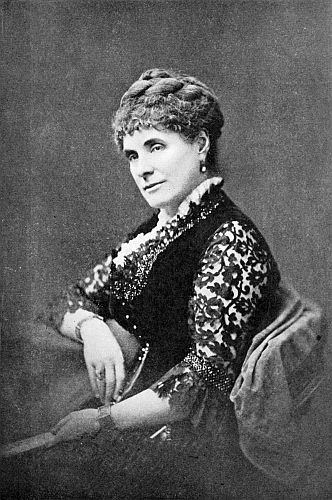
Louise Chandler Moulton
Page 122
The brief records in Mrs. Moulton's journal in these days suggest her
crowded life of social enjoyment and literary work. On New Year's day
of 1885 she notes having been the night before at a party at Mrs. Ole
Bull's; and on that day she goes to a reception at the Howard
Ticknors'; friends come to her in the evening. January second falls on
a Friday, and as she is about to visit her daughter and son-in-law in
Charleston, this is her last reception for the season. Naturally, it
is a very full one, and while she does not chronicle the list of her
guests, it is constructively easy to fancy that among them may have
been Dr. Holmes, Professor Horsford, the poet Aldrich and his lovely
wife; Dean Hodges, always one of her most dearly esteemed friends;
Mrs. Ole Bull, the Whipples, Oscar Fay Adams, Professor Lane of
Harvard, Arlo Bates, in whose work, even then, she was taking great
delight; Mrs. Kate Gannett Wells, Mrs. Julia Ward Howe, or her
daughter, Mrs. Maud Howe Elliott; Mrs. Harriet Prescott Spofford; Mrs.
Julius Eichberg and her brilliant daughter, Mrs. Anna Eichberg King
(now Mrs. John Lane of London),—these and many others of her Boston
circle who were habitués of her "Fridays," and seldom, indeed, was one
of these receptions without some guests of special distinction who
were visiting Boston. On one occasion it was Mr. and Mrs. Edmund Gosse
of London; or again, Matthew Arnold; W.D. Howells was to be met there
when in Boston; and not infrequently Colonel T.W. Higginson; Helen
Hunt, whom Mrs. Moulton had long known; Mary Wilkins (now Mrs.
Freeman), always cordially welcomed; Mrs. Clement Waters, the art
writer; President Alice Freeman of Wellesley College (later Mrs.
George Herbert Palmer); and Governor and Mrs. Claflin, at whose home
Whittier was usually a guest during his sojourns in Boston, were among
the familiar guests. Mr. Whittier could seldom be induced to appear
at any large reception; but from Mrs. Moulton's early youth he had
been one of her nearer friends, and his calls were usually for her
alone.
Bliss Carman and Edgar Fawcett from New York were sometimes to be met
in Mrs. Moulton's drawing-room; and there were also a group of Boston
artists,—Arthur Foote who had set to music several of Mrs. Moultons'
lyrics; B.J. Lang and his daughter, who had also set some of Mrs.
Moulton's songs; the painters, I.M. Gaugengigl, Winthrop Pierce, John
Enneking; Miss Porter and Miss Clarke, the editors of Poet-Lore;
Caroline Ticknor, the young author whose work continued the literary
traditions of her famous name; and often some of the clergy of
Boston,—the Rev. Dr. Charles Gordon Ames, with Mrs. Ames, both of
whom were among Mrs. Moulton's most dearly-prized friends;
occasionally Rev. Dr. Edward Everett Hale, and Bishop Phillips Brooks;
in a later decade, Rev. Dr. E. Winchester Donald, who succeeded
Phillips Brooks as rector of Trinity; Rev. Bernard Carpenter, a
brother of the Lord Bishop of Ripon; and beside the throngs of
representative people who, at one time or another through some thirty
years, were to be met at Mrs. Moulton's, the socially unknown guest
received from the hostess the same cordial welcome. Her sympathies had
little relation to social standing. No praise of the critics ever gave
her more happiness than did a letter from a stranger in the West,
written by a young girl who had for years been unable to move from her
bed, telling of the blessed ministry of a poem by Mrs. Moulton, of
which the first stanza runs:
We lay us down to sleep,
And leave to God the rest,
Whether to wake and weep
Or wake no more be best.
|
A book of Mr. Stedman's of which he sent to Mrs. Moulton a copy bore
on its fly-leaf the inscription:
My life-long, loyalist friend,
My sister in life and song.
|
In the winter of 1885 the journal notes a visit to Mrs. Schaefer in
Charleston, where amid all the festivities she finds time to send
"four short stories and a poem" to various editors. On her way North
she visited Washington, where dinners and receptions were given to her
in private and in diplomatic circles. Then she went on to New York,
and before sailing for Europe met Monsignor Capel at dinner, lunched
with the Lawrence Barretts, attended Mr. Barrett's performance of "The
Blot in the 'Scutcheon," which she found a "wonderful piece of
acting," and at last sailed, as usual lavishly remembered with flowers
and graceful tokens.
In Venice this year Mrs. Moulton wrote the charming pseudo-triolet,
IN VENICE ONCE.
In Venice once they lived and loved—
Fair women with their red gold hair—
Their twinkling feet to music moved,
In Venice where they lived and loved,
And all Philosophy disproved,
While hope was young and life was fair,
In Venice where they lived and loved.
|
It is interesting to feel in this a far suggestion of Browning's "A
Toccata of Galuppi's," because so seldom does any echo of her
contemporaries strike through Mrs. Moulton's verse.
With friends Mrs. Moulton visited Capri, Sorrento, Amalfi,
Castellamare, Pompeii, and then went on to Rome. Here she passed the
morning of her fiftieth birthday in the galleries of the Vatican.
Friends made a festa of her birthday, with a birthday-cake and
gifts; and she dined with the Storys, to go on later to one of Sir
Moses Ezekiel's notable musicales at his study in the Baths of
Diocletian. "The most picturesque of studios," she wrote, "and a most
cosmopolitan company,—at least fifty ladies and gentlemen,
representing every civilized race.... All languages were spoken.
Pascarella, the Italian poet, recited.... Professor Lunardi, of the
Vatican library, who has his Dante and Ariosto by heart, was talking
Latin to an American Catholic clergyman." Of this studio she gives a
picturesque description:
"Suspended from the lofty ceiling was a hanging basket of
flowers encircled by a score of lights; while around the
walls hundreds of candles in antique sconces were burning,
throwing fitful gleams over marble busts and groups of
statuary. The frescoes on the walls are fragments of the
walls of Diocletian, and the floor is covered with rich
antique tiles fifteen hundred years old. Eight elephants'
heads hold the candles that light the studio on ordinary
occasions. Two colossal forms claim the attention of the
visitor; one, the picture of a herald, drawn by Sir Moses,
holds in his right hand the shield of art; the other is the
figure of Welcome, holding in one hand a glass of wine,
while the other rests upon a shield. The most striking and
interesting work in the studio is the group of Homer. The
figure of the poet is of heroic size, and he is represented
sitting on the seashore, reciting the Iliad, and beating
time with his hands; even in his blindness, his face wears
an expression that seems to be looking into the future and
down through the ages of time. At his feet is seated his
guide, a youth with Egyptian features, who accompanies Homer
with strokes on the lyre."
In the studio was also a bronze bust of Liszt, the only one for which
he ever sat, and which Sir Moses modelled at the Villa d'Este.
After Rome came Florence, where Mrs. Moulton was the guest of Mrs.
Clara Erskine Clement Waters, who had taken a villa in that city.
Among other people whom Mrs. Moulton met at this time was "Ouida," who
unbent from her accustomed stiffness to Americans, and, yielding to
the charm of her guest, displayed her house and pets in a manner which
for her was almost without precedent. Mrs. Waters gave a brilliant
reception in her honor; she was the guest of the Princess Koltzoff
Massalsky (Dora d'Istria), and she visited Professor Fiske at the
Villa Landor, where she was "charmed by his wonderful library" with
its collections of the most notable editions of Dante and Petrarca;
and she was entertained by Professor and Madame Villari.
From Florence she went to Aix-les-Bains. Then she passed to England.
In London she saw constantly almost everybody of note in literary
circles. Her diary records visits to or from or meetings with the Lord
Bishop of Winchester, Mrs. Bloomfield Moore, Lord Morley, Thomas
Hardy, the Bishop of Ripon, Mr. Verschoyle of the Fortnightly
Review, William Sharp, Frederick Wedmore, Sir Frederic and Lady
Pollock, Dr. Furnival, and others, for a list too long to give entire.
Her journal shows how full were her days.
"Mrs. Campbell-Praed came to lunch; a lot of callers in the
afternoon, among them the Verschoyles, the Francillons, Mrs.
Cashel-Hoey, Mrs. Fred Chapman, and Mrs. Anna Lea Merritt.
"Went to the Chapmans' to luncheon; met George Meredith....
Meredith is a very brilliant and agreeable man.
"Francillon to luncheon. A lovely letter from Oswald
Crawfurd, praising Andrew Lang.... Went with Mrs. Marable to
see Mrs. Sutherland Orr; a very charming person."
Herbert E. Clarke, whom in a letter to Professor Bates she described
as "a wonderfully charming and fine fellow," accompanied a volume of
his poems which he sent to her with these graceful dedicatory verses:
TO LOUISE CHANDLER MOULTON.
(With “Verses on the Hillside.”)
Go forth, O little flower of song,
To her who found you fair;
After a winter black as night,
I plucked you when spring's smile brought light,
And April's winds were blithe and strong,
And Hope was in the air.
Poor stray of Autumn left to Spring,
I send you forth to be
'Twixt us a pledge of happier hours;
Yea, though she hath far fairer flowers
Always at hand for gathering,
Go forth undoubtingly.
For thou hast gained a happy meed,
And wert thou weed or worse,
With her praise for a light above,
Many should find thee fair, and love
Though not for thine own sake indeed,—
But her sake, O my verse.
Be weed or flower, and live or die,
To me thou art more dear
Than all thy sister flowerets are,
O herald of the single star
That rose above the lowering sky
Of my most hopeless year.
|
One particularly delightful day was that on which Mrs. Moulton
attended a garden-party at Lambeth Palace as the guest of the
Archbishop of Canterbury and Mrs. Benson. Another of the red-letter
days was an afternoon with the Holman Hunts, in their rambling,
fascinating house, filled with artistic treasures, when on the lawn a
Hungarian orchestra played their national airs. Among the guests were
Lewis Morris, Edwin Arnold, Hall Caine, Theodore Watts-Dunton, and
many others who bore names well known. The diary records, too, a
studio-reception given by Felix Moscheles, a coaching trip to Virginia
Water; and so on for a round of gay doings which make it amazing that
all this time Mrs. Moulton continued her literary work.
In the autumn Mrs. Moulton journeyed to Carlsbad, and there "made Lady
Ashburton's acquaintance in the morning and sat up in the wood with
her for a couple of hours." The acquaintance ripened into a warm
friendship between the two, and Mrs. Moulton was often a guest at Lady
Ashburton's place, Kent House, Knightsbridge. The sonnet "One
Afternoon" is the memory of this first meeting written at Carlsbad a
year after.
On her return to America in the autumn, Mrs. Moulton went to Pomfret
to visit her mother. While there she heard from Miss Guiney of the
death of a young poet, James Berry Bensel, of whom she wrote to Oscar
Fay Adams as follows:
Mrs. Moulton to Mr. Adams
28 Rutland Square, Sunday.
My dear Friend: Your letter just received draws my very
heart out in sympathy. I wish you were here, that I could
tell you all the feelings that it brought, for I know what
it is to lose my dearest friend. Louise Guiney said to me
when she came Friday afternoon: "I have something to tell
you. Bensel is dead. His brother has written me." And I was
not myself all the afternoon. I could not put aside the
thought that pleaded for my tears. And I grieved that I had
not yet written to him about his book. I find such fine
things in it. Come back and let us grieve for him
together,—not that I grieve as you do who loved him so, but
I do understand all you feel, and I felt his death very
unusually, myself. I wish, oh, how I wish, we could call him
back to life, and give him health, and the strength to work,
and more favorable conditions. But we do not know but that
he may now be rejoicing somewhere in a great gain, beyond
our vision. He has gone where our vision cannot find or our
fancy follow him; but he must either be better off in a new
birth or else so deeply at rest that no pain can pierce him
where he is. Good-bye and God bless you.
Yours most truly,
Louise Chandler Moulton.
The Boston winters were full always with social and literary
interests. The relations of Mrs. Moulton to the writers of her circle
were indicated when on her sailing in the spring of one of the late
eighties a post-bag was arranged which was delivered to her in
mid-ocean. The idea originated with Miss Marian Boyd Allen, and among
the contents were a manuscript book of poems for every day by Bliss
Carman; poems by Clinton Scollard, Arlo Bates, Willis Boyd Allen,
Minot J. Savage, Celia Thaxter, the Rev. Bernard Carpenter, Gertrude
Hall, Mary Elizabeth Blake, and Hezekiah Butterworth; a silver
vinaigrette from Professor James Mills Pierce; a book from Mrs. Clara
Erskine Clement Waters; two charming drawings from Winthrop Pierce;
with notes from Nora Perry, Colonel T.W. Higginson, and others. Miss
Guiney addressed as her "Chief Emigrant and Trans-Atlantic Gadder,
Most Ingenious Poet, and Queen of Hearts." Colonel Higginson wrote:
T.W. Higginson to Mrs. Moulton
Cambridge, May 3, 1887.
Dear Friend: I gladly join with others in this mid-ocean
post-bag. I hope you will take your instalments of
friendship in as many successive days. Few American
women,—perhaps none,—have succeeded in establishing such a
pleasant intermedian position before English and American
literature as have you, and as the ocean does not limit your
circle of friends, it seems very proper that we on this side
should stretch our hands to you across it. As one of your
oldest and best friends, I wish you not only "many happy
returns," but one, at least, in the autumn.
Ever cordially,
T.W. Higginson.
On the other side of the Atlantic Philip Bourke Marston and his friend
William Sharp greeted her return to London in three sonnets.
Philip Bourke Marston to Mrs. Moulton
UNDESCRIED.—TO L.C.M.
When from her world, new world, she sailed away,
Right out into the sea-winds and the sea,
Did no foreshadowing of good to be
Surprise my heart? That memorable day
Did I as usual rise, think, do, and say
As on a day of no import to me?
Did hope awake no least low melody?
Send forth no spell my wandering steps to stay?
Oh, could our souls catch music of the things
From some lone height of being undescried,
Then had I heard the song the sea-wind sings
The waves; and through the strain of storm and tide,—
As soft as sleep and pure as lovely springs,—
Her voice wherein all sweetnesses abide.
|
William Sharp to Mrs. Moulton
ANTICIPATED FRIENDSHIP
Friend of my friend! as yet to me unknown,
Shall we twain meeting meet and care no more?
Already thou hast left thy native shore,
And to thine ears the laughter and the moan
Of the strange sea by night and day unknown,
Its thunder and its music and its roar;
A few days hence the journey will be o'er,
And I shall know if hopes have likewise flown.
As one hears by the fire a father tell
His eager child some tales of fairy land,
Where no grief is and no funereal bell,
But thronging joys and many a happy band;
So do I hope fulfillment will be well,
And not scant grace, with cold, indifferent hand.
|
AFTER MEETING
Friend of my friend, the looked-for day has come,
And we have met: to me, at least, a day
Memorable: no hopes have flown away.
Bad fears lie broken, stricken henceforth dumb:
In the thronged room, and in the ceaseless hum
Of many voices, I heard one voice say
A few brief words,—but words that did convey
A subtle breath of friendship, as in some
Few scattered leaves the rose still gives her scent.
Thy hand has been in mine, and I this night
Have seen thine eyes reach answer eloquent
To unseen questions winged for eager flight.
And when, at last, our Philip and I went,
I knew that I had won a fresh delight.
|
The following letter from Mr. Sharp explains itself in this cluster of
greetings:
William Sharp to Philip Bourke Marston
19 Albert Street, Regent's Park.
Dear Philip: I couldn't be bothered going out anywhere, as
you suggested, and an hour or two ago I was able to complete
a second sonnet for the two on "Anticipated Friendship"
addressed to Mrs. Moulton. I told you how much I liked her,
and what a relief it was to find my hopes not disappointed.
In reading these sonnets (at least, the second one) remember
the dolorous condition I am in, and have mercy on all
short-comings that therein abound; and, please, if you think
the spirit of thankfulness in them not sufficient to
overbalance all deficiencies, throw them in the fire without
showing them to their unconscious inspirer, and thus earn
the future gratitude of
Your loving friend,
William Sharp.
In February of 1887 Philip Bourke Marston died. He bequeathed to Mrs.
Moulton his books and manuscripts, and many autographs of great
interest and value. Among them was the first page of the original
manuscript of the first great chorus in "Atalanta in Calydon"
corrected in Swinburne's own hand. Marston requested that she should
be his literary executor. Speaking of this work some years later, Mrs.
Moulton said:
"When I first knew the Marstons they were a group of
five,—dear old Dr. Marston, his son, Philip Bourke Marston,
his unmarried daughter Cecily, his married daughter Mrs.
Arthur O'Shaughnessy, and her husband. I edited a volume of
selections by O'Shaughnessy; and I was named by Mr. Marston,
in his will, as his literary executor. I brought out after
his death a volume whose contents had not been hitherto
included in any book, and which I called 'A Last Harvest.'
Then I put all his flower-poems together (as he had long
wished to do) in a volume by themselves, which was entitled
'Garden Secrets.' Finally I have brought out a collected
edition of his poems, including the three volumes published
before his death, and the ones I had compiled after he
died.
"Ah, you may well call his life tragic. He was only three
years old when he lost his sight. He was educated orally,
but his knowledge of literature was a marvel. The poets of
the past were his familiar friends, and he could repeat
Swinburne's poems by the hour. To recite Rossetti's 'House
of Life' was one of the amusements of his solitary days. But
he longed, beyond all things, to be constantly in touch with
the world—to know what every year, every month, was
producing. 'Can you fancy what it is,' he would say to me
sometimes, 'to be just walled in with books that you are
dying to read, and to have them as much beyond your reach as
if they were the other side of the world?' Yet he had,
despite his sad fate, the gayest humor—the most naturally
cheerful temperament; he could be so merry with his
friends—so happy 'when there was anything to be happy
about.' Of his work 'Garden Secrets' is uniquely charming.
Rossetti once wrote him, in a letter of which I am the
fortunate possessor, that he had been reading these 'Garden
Secrets,' the evening before, to William Bell Scott, the
poet-artist, and adds, 'Scott fully agreed with me that they
were worthy of Shakespeare, in his subtlest lyrical moods.'
Some of the best critics in London declared that the author
of 'Song-Tide' (Marston's first volume) should, by virtue
of this one book, take equal rank with Swinburne, Morris,
and Rossetti. Certainly his subsequent volumes fully
sustained the promise of this first one, and I feel that
when Philip Bourke Marston died, at the age of thirty-seven,
on the fourteenth of February, 1887, England lost one of her
noblest and subtlest poets—one whose future promise it were
hard to overrate. Sometimes I think I care most for some of
his sonnets; then the subtle beauty of his lyrics upbraids
me,—and I hardly know which to choose. Take him all in all,
he seems to me a poet whom future generations will recognize
and remember."
Regarding the death of Mr. Marston, Mr. Whittier wrote to the friend
who had brought so much brightness into the life of the blind poet:
Mr. Whittier to Mrs. Moulton
Centre Harbor, N.H., 7th month, 1887.
My dear Friend, Louise Chandler Moulton: It was very kind in
thee to send thy admirable little book and most welcome
letter. We have read thy wise and charming essay up here
among the hills, and under the shadow of the pines, with
hearty approval. It was needed, and will do a great deal of
good to young people, in the matter of manners and morals.
It seems a very long time since I had the great pleasure of
seeing thee, or of hearing directly from thee. I meant to
have been in Boston in the early spring, and looked forward
to the satisfaction of meeting thee, but I was too ill to
leave home, and I felt a real pang of regret when I learned
of thy departure. I am now much better, but although I
cannot say with the Scotch poet that
"the years hang o'er my back
And bend me like a muckle pack,"
|
I must still confess that they are getting uncomfortably
heavy. But I have no complaint to make. My heart is as warm
as ever, and love and friendship as dear.
I was pained by the death of thy friend, Philip Marston. It
must be a comfort to thee to know that thy love and sympathy
made his sad lot easier to be borne. He was one who needed
love, and I think he was one to inspire it also.
My old and comfortable hotel at Centre Harbor, where I have
been a guest for forty years, was burned to ashes a few days
ago, after we came away. But we are now in good, neat
quarters at a neat farm house, with large cool rooms on the
border of the lovely lake.
Good-bye, dear friend! While enjoying thy many friends in
London, do not forget thy friends here.
Ever affectionately thy old friend,
John G. Whittier.
Herbert E. Clarke, the warm and intimate friend of Marston, touchingly
alludes to his death in this sonnet.
TO LOUISE CHANDLER MOULTON.
Ah, friend, the die is cast,—life turns to prose.
My way lies onward—dusty, hot, and bare,
Through the wide plain under the noonday glare,—
A sordid path whereby no singer goes;
For yon the cloudy crags—the stars and snows—
Limitless freedom of ethereal air
And pinnacles near heaven. On foot I fare,
Halting foredoomed, and toward what goal who knows?
But though the singer who may sing no more
Bears ever in his heart a smothered fire,
I give Fate thanks: nor these my pangs deplore,
Seeing song gave first rewards beyond desire—
Your love, O Friend, and his who went before,
The sightless singer with his silver lyre.
London, 1st August, 1888.
|
To Arlo Bates, Mrs. Moulton, reading this, repeated the closing line
with a touching tenderness, and then without further word laid the
manuscript aside.
In the middle years of the eighties Mrs. Moulton began to send to the
Boston Herald a series of literary letters from London, and these
she continued for a number of years. She was especially well fitted
for the undertaking by her wide acquaintance with English writers, her
unusual power of appreciating work not yet endorsed by public
approval, and her sympathetic instinct for literary quality. The work,
while arduous, gave her pleasure, chiefly because it provided
opportunity for her to give encouragement and aid to others, and to
help to make better known writers and work not yet appreciated in
America. "I am sending a literary letter each week to the Boston
Herald," she writes Mr. Stedman. "It is hard work, but it gives me
the pleasure of expressing myself about the current literature. I
believe the letters are accounted a success."
Many were the letters of gratitude which came to her from those of
whom she had written. The sympathetic quality of her approval, so
rarely found in combination with critical judgment, made her praise
especially grateful. Not only did she interest and enlighten her
reading public, but she encouraged and inspired those of whom she
wrote.
Other letters of grateful recognition came now and then from
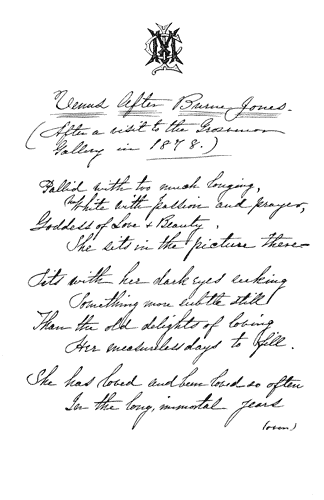
artists of whose work she had written in verse. After a visit to the
studio of Burne-Jones in London she was inspired to write the
admirable and subtle lyric "Laus Veneris," upon his picture of that
name.
Pallid with too much longing,
White with passion and prayer,
Goddess of love and beauty,
She sits in the picture there,—
Sits with her dark eyes seeking
Something more subtle still
Than the old delights of loving
Her measureless days to fill.
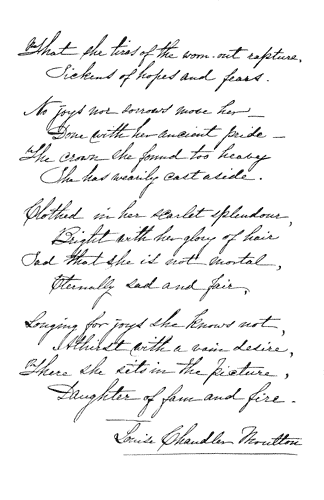
She has loved and been loved so often,
In the long, immortal years,
That she tires of the worn-out rapture,
Sickens of hopes and fears.
No joys or sorrows move her,
Done with her ancient pride;
For her head she found too heavy
The crown she has cast aside.
Clothed in her scarlet splendor,
Bright with her glory of hair,
Sad that she is not mortal,—
Eternally sad and fair,—
Longing for joys she knows not,
Athirst with a vain desire,
There she sits in the picture,
Daughter of foam and fire.
|
It is not to be wondered that the artist wrote in warm acknowledgment:
Mr. Burne-Jones to Mrs. Moulton
"I think you must know how glad all workers are of such
sympathy as you have shown me, and I don't know of any other
reward that one ever sets before one's self that can be
compared for a moment with the gratified sense of being
understood. It's like hearing one's tongue in a foreign
land. I do assure you I worked all the more confidently the
day your letter came. Confidence and courage do often fail,
and when all the senses are thoroughly tired with work, and
the heart discouraged, a tribute like the one you sent me is
a real refreshment."
During all these years Mrs. Moulton's mastery of technical form, and
especially her efficiency in the difficult art of the sonnet, had
steadily increased. George H. Boker wrote to her: "In your ability to
make the sonnet all it should be you surpass all your living, tuneful
sisterhood." Certainly after the death of Mrs. Browning no woman
writing English verse could be named as Mrs. Moulton's possible rival
in the sonnet save Christina Rossetti, and no woman in America, if
indeed any man, could rank with her in this.
In many of Mrs. Moulton's sonnets is found a subtle, elusive
suggestion of spiritual things, as if the poet were living between the
two worlds of the seen and the unseen, with half-unconscious
perceptions, strange and swift, of the unknown. With this spiritual
outlook are mingled human love and longing. The existence of any
genuine poet must be dual. He holds two kinds of experience, one that
has been lived in outward life; the other, not less real, that has
been lived intuitively and through the power of entering, by sympathy,
into other lives and varied qualities of experience.
Mrs. Moulton's imaginative work, both in her stories and her poems,
suggests this truth in a remarkable degree. Her nature presents a
sensitive surface to impressions. She has the artist's power of
selection from these, and the executive gift to combine, arrange, and
present. Thus her spiritual receptivity gives to her work that deep
vitality, that sense of soul in it that holds the reader, while her
artistic touch moulds her rare and exquisite beauty of finished
design.
In 1889 Mrs. Moulton published another volume of collected tales, the
last that she made. It was entitled "Miss Eyre from Boston, and Other
Stories." Her natural power and grace in fiction made these charming,
but it is by her poetry rather than by her prose that she will be
remembered. To her verse she gave her whole heart. To her short
stories only, so to say, her passing fancy.
On her way north from a visit to her daughter in Charleston, Mrs.
Moulton saw Walt Whitman. Little as she could be in sympathy with his
chaotic art-notions, she was much impressed by his personality. Her
diary records:
"Went with Talcott Williams to see Walt Whitman, a grand,
splendid old man. He sat in the most disorderly room I ever
saw, but he made it a temple for his greatness. He expounded
his theories of verse; he spoke of his work, of his boyhood;
of his infirmities merely by way of excuse for his
difficulty in moving, and he gave me a book. He was
altogether delightful."
From the diary one gets a curiously vivid impression that Mrs.
Moulton's work was done in the very midst of interruptions and almost
in an atmosphere so markedly social that it might seem to be utterly
incompatible with imaginative production. Of course, a large number of
those whom she saw most intimately were concerned chiefly with the
artistic side of life, and this in a measure explains the anomaly; but
the fact remains that she had an extraordinary power of doing really
fine work in scraps and intervals of time which would to most writers
have seemed completely inadequate.
"Full of interruptions, but managed to get written an
editorial entitled 'A Post Too Late.'"
"Went to Lady Seton's breakfast-party and sat beside Oswald
Crawfurd. In the morning before I went out at all I wrote a
sonnet commencing,
"Have pity on my loneliness, my own!"
"Finished Herald letter. Mr. F.W.H. Myers called. Lunched
at Walter Pater's and met M. Gabriel Sarrazin, the French
critic, who told me that Guy de Maupassant thought the three
disgraces for a French author were to be décoré, to belong
to the Academy, and to write for the Revue des Deux
Mondes."
"Jan. 1, 1889. Wrote poem, 'At Dawn,' or whatever better
title I can think of. Spent the time from 8 to 2 in
correcting my 13,000 words story."
"Louise Guiney came in to help me look over my poems. We
worked till night, then went to the Cecilia concert to hear
Maida Lang's quartet."
"Such a busy morning! Polished off a rondel to send to the
Independent. Read Herald proof; wrote letters. This
afternoon pleasant guests,—Mrs. Ole Bull, Mr. Clifford,
Percival Lowell, and others."
[In New York.] "Went over to Brooklyn and gave a Browning
reading.... Met the Russian Princess Engalitcheff. Lunched
at Mrs. Field's with the Princess and Mr. and Mrs. Locke
Richardson. Went in the evening to the Gilders'."
"Wrote a little.... Mrs. [John T.] Sargent and sweet Nellie
Hutchinson called in the forenoon; and in the afternoon ten
people, including Stedman."
[In London.] "Worked on poems in forenoon. Had a lovely
basket of flowers from dear old Mr. Greenough. Gave a little
dinner at night at the Grand Hotel, to the Oswald Crawfurds,
Sir Bruce Seton, Mrs. Trubner, and Mr. Greenough."
Extracts of this sort might be multiplied, and they explain why it was
that amid so much apparent preoccupation with social affairs Mrs.
Moulton kept steadily her place as a literary worker. Her genuine and
abiding love for letters was the secret of her ability thus to enter
with zest into the pleasures of life without losing her power of
artistic production.
Among the records of the year 1889 is this touching entry, with the
date April 27, at the close of a visit to her mother:
"Poor mother's last words to me were: 'I love you better
than anything in this world. You are my first and last
thought. Believe it, for it is the truth.'"
In London this summer Mrs. Moulton was considering a title for a new
volume of poems, and had asked advice of William Winter. He chanced to
be in England at the time, and wrote at once:
Mr. Winter to Mrs. Moulton
No. 13 Upper Phillimore Place,
High Street, Kensington,
August 14, 1889.
Dear Louise: Your letter has just come. Business affairs
brought me suddenly to town. I will seek to see you as soon
as they can be disposed of, Saturday or Sunday, perhaps.
But I deeply regret your not coming to the "Red Horse." He
might have led us a glorious fairy race. The only one of
your titles that hits my fancy is "Vagrant Moods," and that
is not good enough. Fancy titles are dangerous things. They
generally have been used before. I once made use of the word
"Thistledown," as a title for a collection of my poems, and
too late found it had been used by an American lady, Miss
Boyle, for a similar purpose. And Miss Boyle, or her
attorneys, threatened me with the terrors of the law for
infringement of copyright. I was also told that Miss Boyle's
book had recently passed through my hands; and this was
true, though I had not the least recollection of the book or
its title. In fact, I had never read a line of it, but only
at the request of a friend of hers turned it over to Bayard
Taylor for review. He wrote a notice of it in The Tribune.
And here, only lately, I learn from an Australian paper that
my title of "Shakespeare's England," used by me to indicate
the England of poetry, was used twenty-five years ago by a
writer about the active England of Shakespeare's time.
"Poems, by L.C.M." would be safer than any fancy title.
"Awfully hackneyed," I hear. Well, if you have a fancy
title, why not cull out a Shakespearian phrase? "The
Primrose Path," say? Think a little about this. I will think
further. Only look up clear, and so God bless you and good
night.—What a lonely place this with no one to speak to and
no one to hear.
Always,
Your old friend,
William Winter.
The solution of Mrs. Moulton's difficulty was found in the attractive
title, "In the Garden of Dreams." The volume appeared in the following
year.
Among the special friendships of Mrs. Moulton's life of both literary
and personal interest, one of the most important and enjoyable to her
was that with Professor Arlo Bates, the poet and romancist, whose work
she appreciated highly and whose sympathetic companionship gave her
great pleasure. With him she felt a peculiar sympathy, and to him she
wrote a series of letters, extending over many years, beginning in the
decade of the eighties. The extracts presented from these are here
grouped, as, while they thus lose a strict chronological thread, they
gain in a more complete representation, and their nature is such that
the precise date (rarely given, indeed, as they were mostly dated by
a month only) is, in any case, negligible in importance.
The extracts chosen deal almost exclusively with literary matters. The
only son of Professor Bates, in his twentieth year, afterward the
author of "A Madcap Cruise," whom Mrs. Moulton playfully called
"Prince Oric," and to whom in his sixth year she wrote a delicious
sonnet under that title, is alluded to, as well as is his mother, who
wrote over the pen-name Eleanor Putnam.
Mrs. Moulton to Arlo Bates
"... Thanks for the charming book. My love to the sweetest
wife I know. Thank her for her letter...."
"... Your letter about Marston's songs came to me when he
and William Sharp happened to be passing the evening with
me. I read it aloud, to Mr. Marston's great delight. It
quite went to his heart.... I am so sorry I shall not find
you and Mrs. Bates where you were last year. That desperate
flirtation with Master Oric is off entirely...."
"... I have just been reading 'Childe Roland,' and it
baffles me, as it has so often done before. I feel less sure
that I understand it than any other of Browning's poems. Is
the Black Tower Death, do you think? But what a wonderful
poem it is! I suppose spiritual judgments concern themselves
with spiritual states...."
"... I am delighted with what you say of Mr. Marston's poem
in Harper's, because I think the poem too subtle and
delicate to be appreciated, save by the very elect; and I am
also delighted because what you said gave him so much
pleasure. Marston said of you, 'What a wonderful
psychological vein, almost as powerful as that of Browning,
runs through many of the poems of Mr. Bates.'..."
"... I am so eager to see your novel of artistic Boston.
'The Pagans,'—a capital title. I am glad you have had the
courage to tell the truth in it as you see it. I don't see
it quite as you do, I fancy, but I am thankful when any one
has the courage of his opinions, for it seems to me that the
English and American writers are just now very much like
cats standing on the edge of a stream, and afraid to put in
their feet. They say what they think is expected of them to
say, and they reserve the truth for the seasons when they
enter their closets and shut the door on all the world. I
think there is more hypocrisy in novels than in religion."
"... I am ashamed that two weeks have gone by since I
received your noble book, 'Told in the Gate.' I have not
been so neglectful of it as it seems. I have not only taken
my own pleasure in it, but I have shown it to other poets
who are interested in knowing what is being done in America.
It is a beautiful book externally—how beautiful it is
internally I am sure the world of readers will eagerly
perceive; but never one of them can love it more than I do.
Even in print it is hard for me to say which poem I prefer.
There is not one among them that is not well done from the
point of art, and thrillingly interesting as a story. The
lyrics star the book like gems. They sing themselves over
and over to my listening mind.... I feel a glow of exultant
pride that the author is my friend. I am proud and glad to
have my name inscribed in a volume I so admire and love. I
am enjoying London as I always do.... I go toward the end of
August to pay some visits in Scotland, and then to visit
Lady Ashburton in Hampshire and after that to Paris. I
enclose some foreign stamps for the young Prince.... Your
poems are among the pleasures of my life."
Of the sonnets of Mr. Bates Mrs. Moulton wrote:
"... Dante breathed through the sonnet the high aspirations
of that love which shaped and determined his soul's life. By
sonnets it was that Petrarch wedded immortally his name to
that of his ever-wooed, never-won Laura of Avignon. Strong
Michael Angelo wrote sonnets for that noble lady, Vittoria
Colonna, whose hand he kissed only after Death had kissed
the soul from her pure lips.
"The one personal intimacy with Shakespeare to which any of
his worshippers have been admitted is such as comes from
loving study of his sonnets, in 'sessions of sweet, silent
thought.' The sonnets of Elizabeth Barrett Browning burned
with the pure flame of her perfect love. In the sonnets of
'The House of Life' Rossetti commemorated that love and loss
so passionate and so abiding that it seemed to him the whole
of life. In the sonnets of 'Song-Tide' Marston sang the
praises of his early love, as in those of 'All In All' he
bewailed her loss; and his sonnets of later years throb like
a tell-tale heart with the profoundest melancholy out of
whose depths a human soul ever cried for pity.
"Such and thus intimate have been the revelations made
through this form of verse—so rigid, yet so plastic and so
human.
"To the list of these sonneteers who have thus sounded the
deepest depths of love and sorrow, the name of Arlo Bates
has now been added, by the publication of his noble and
sincere 'Sonnets in Shadow.' Born of one man's undying pain,
these sonnets at once become, through the subtlety of their
research into the innermost depths of human emotion, the
property and the true expression of all souls who have loved
and suffered.
"A few of us know, personally, the rare charm, the exquisite
loveliness, of her thus royally honored and passionately
lamented; and all of us who read can feel that thus and thus
our own hearts might be wrung by such a loss—that in us,
also, if we have souls at all, such sorrow might bear fruit
in kindred emotion, even though for want of words our lips
be dumb. It seems to me that it is the dumb souls—who feel
all that the poet has sung, and yet cannot break the silence
with a cry—who owe the deepest debt to this, their
interpreter."
Mrs. Moulton to Mr. Bates
"October 27, 1889.
"I have been passing this rainy afternoon with your sonnets.
I had read some of them more than once before, but this
afternoon I have been quite alone save for their good
company. I have read the strong, noble sequence through,
from first to last, enjoying them more than ever. I like
every one of them, but I had a pencil and paper by me and
put down the numbers that most moved me. I see that my list
is not short; do you care to see what it includes? It begins
with the beautiful sonnet of dedication; then the first,
with its wonderful procession of the gray days passing the
torpid soul, and laying their 'curious fingers, chill and
numb,' upon its wounds. Then the sixth, with the
"... drowned sailors, lying lank and chill
Under the sirupy green wave.
|
And the fifteenth with its visions of love.
"Never can joy surmise how long are sorrow's hours,
ought to be, like certain lines of Wordsworth, among the
immortal quotations. I think your sonnets noble alike in
thought and in execution. They can have no more faithful
lover than I am; and I do believe that if there is anything
in which my opinion has any value, it is on the form of
poetry. I love it so sincerely and I have studied it so
devotedly....
"... Mrs. Spofford has been to stay over Sunday with me and
I read through to her your new volume of poems, with the
exception of 'The Lilies of Mummel See,' which she read to
me. I think you would be pleased; could you know how much we
both enjoyed and admired the book. To my mind, 'Under the
Beech Tree' is the finest romantic drama of the time. I like
it far better than I do 'Colombe's Birthday,' much as I like
that. Mrs. Spofford is quite wild with enthusiasm about 'The
Gift.' She said the last line,
"His heart is still mine, beating warm in my grave,
is not only the finest line in your book, but the finest
line that has been written by any one in a score of years."
"... Your suggestion as to national characteristics of women
struck me as a curious coincidence with the fact that the
editor of the Fortnightly has just asked me to write an
article on American and English women, contrasting and
comparing them, and discussing their differences. But the
differences; seem to me individual, not national.
"Thanks for your suggestion about the sonnet.
"Break through the shining, splendid ranks
seems to me simpler and more forcible, but then this
involves the 'I pray,' to which you greatly object.
"Break through their splendid militant array:
"I'll copy both, and see what you think. On the whole, I
like yours better.
"I have been arranging books all the afternoon, and I am so
tired that I wish I had the young prince here, or such
another,—only there is no other."
The same to the same
"Dear Pagan: I am on page 238 of 'The Puritans,' and I pause
to say how piteously cruel is your portrait of ——.
Sargent, at his best, was never so relentlessly realistic. I
pity Fenton so desperately I can hardly bear it. Why do I
sympathize so with him when he is so little worthy? Is it
your fault, or mine? I believe I am not pitiless enough to
write novels, even if I had every other qualification.
"Your character of Fenton is admirably studied. It is worthy
of the author of 'The Pagans' and 'A Wheel of Fire.'"
"... I have finished reading 'The Puritans,'—all the duties
of life neglected till I came to the end. I have not been so
interested in a book for ages. I am especially interested in
the conflict of the souls between degrees of agnosticism. It
is the keenest longing of my life to know what is truth."
"I have reason to be grateful for your birthday, since I
find you one of the most interesting persons I have ever had
the happiness to know."
"I have just finished reading 'The Diary of a Saint,' and I
cannot wait an hour to tell you how very greatly I admire
it. It has been said that all the stories were told. You
prove how untrue is this statement,—for your story, or
anything like it, has never been told before. It is
absolutely unique and original.... I am so interested in
every page of the book that I have an impatient desire to
know all the spiritual experiences that lead to it."
"Just now at Les Voirons (Haute Savoie) I have found a sort
of hilltop paradise. Four thousand and more feet above the
sea level, the air is like balm, and the views indescribably
lovely. I have never seen Mont Blanc half so well. It is far
more wonderful than the view from Chamounix. And just now at
night the white ghost of a young moon hangs above it, in a
pale, clear sky, and the lesser peaks all around shimmer in
the moonlight. This hotel is ten climbing miles from any
railroad station. You can buy nothing here but postage
stamps."
In a characteristic letter from Rome, Richard Greenough, the sculptor,
says:
Mr. Greenough to Mrs. Moulton
"The sidereal certainty of your movements impresses me. It
reminds me of the man who ordered his dinner in England a
year in advance, and when the time came he was there to eat
it.... Do I feel sure of a life after this? Was ever a note
charged with such heavy ballast? To attempt an answer would
take a volume,—to give an answer would require a
conscience.... While reading Cicero's Tusculan Disputations
'On Grief,' I found a quotation from Sophocles that reminds
me of your loss in Philip's death.
"No comforter is so endowed with wisdom
That while he soothes another's heavy grief,
If altered fortune turns on him her blow,
He will not bend beneath the sudden shock
And spurn the consolation he had given.
|
"I wonder if you know how poetic you are? Do what you
may,—read, write, or talk, you make real life seem ideal,
and ideal life seem real. Your sweet 'After Death' is above
all praise."
On the appearance of "Robert Elsmere" Mrs. Moulton read it with the
greater interest in that, as has already been noted, her own mind
constantly reverted to religious problems. Writing to Mrs. Humphry
Ward to congratulate her on the achievement, she received the
following reply:
Mrs. Ward to Mrs. Moulton
London, June 20, 1888.
Dear Mrs. Moulton: Thanks for your interesting letter in
re Robert Elsmere. There is no answer merely to the
problems of evil and suffering except that of an almost
blind trust. I see dimly that evil is a condition of good.
Heredity and environment are awful problems. They are also
the lessons of God.
Sincerely yours,
Mary A. Ward.
The publication in 1889 of the collection of poems entitled "In the
Garden of Dreams" added greatly to Mrs. Moulton's standing as a poet.
On the title-page were the lines of Tennyson:
Not wholly in the busy world, nor quite
Beyond it, blooms the garden that I love.
|
The book contained a group of lyrics "To French Tunes," which showed
that Mrs. Moulton had responded to the fashion for the old French
forms of rondel, rondeau, triolet, and so on which in the eighties
prevailed among London singers. They showed her facility in
manipulating words in metre and were all graceful and delicate; but
she was a poet of emotion too genuine and feeling too strong to be at
her best in these artificial and constrained measures. She wrote a few
in later years, which were included in the volume called "At the
Wind's Will," but although they were praised she never cared for them
greatly or regarded them as counting for much in her serious work. The
book as a whole showed how the natural lyric singer had developed into
the fine and subtle artist. The noblest portion of the collection, as
in her whole poetic work, was perhaps in the sonnets; but throughout
the volume the music of the lines was fuller and freer, the thought
deeper, the emotion more compelling than in her earlier work. With
this volume Mrs. Moulton took her place at the head of living American
poets, or, as an English critic phrased it, "among the true poets of
the day."
The voice of the press was one of unanimous praise on both sides of
the Atlantic. The privately expressed criticisms of the members of the
guild of letters were no less in accord. Mrs. Spofford said of
"Waiting Night":
"It is a perfect thing. The wings of flying are all through
it. It is fine, and free, and beautiful as the 'Statue and
the Bust.' It is high, and sweet, and touching."
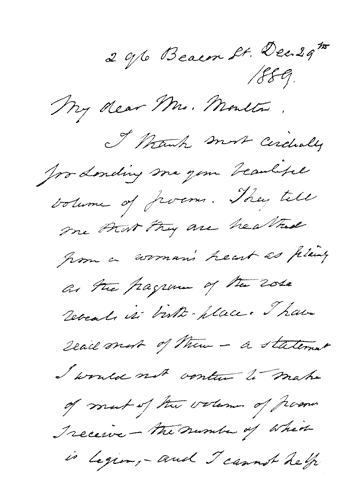
Dr. Holmes to Mrs. Moulton
296 Beacon St.,
December 29, 1889.
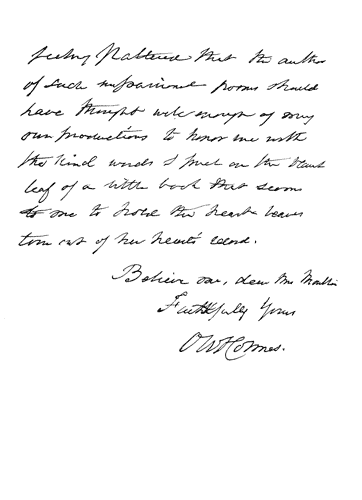
My dear Mrs. Moulton: I thank you most cordially for sending
me your beautiful volume of poems. They tell me that they
are breathed from a woman's heart as plainly as the
fragrance of a rose reveals its birthplace. I have read
nearly all of them—a statement I would not venture to make
of most of the volumes I receive, the number of which is
legion, and I cannot help feeling flattered that the author
of such impassioned poems should have thought well enough of
my own productions to honor me with the kind words I find on
the blank leaf of a little book that seems to me to hold
leaves torn out of the heart's record.
Believe me, dear Mrs. Moulton,
Faithfully yours,
O.W. Holmes.
Dr. Rolfe to Mrs. Moulton
Cambridge, Christmas, 1889.
Dear Mrs. Moulton: How can I thank you enough for giving me
a free pass to your "Garden of Dreams" with its delightful
wealth of violets, fresh and sweet; lilies and roses,
rosemary, and Elysian asphodel, and every flower that sad
embroidery weaves? Put your ear down close and let me
whisper very confidentially,—tell it not at our meetings at
the Brunswick, publish it not in the streets of Boston! that
I like your delicate and fragrant blossoms better than some
of the hard nuts that the dear, dead Browning has given us
in his "Asolando." Sour critics may tell us that the latter
will last longer,—they are tough enough to endure,—but I
doubt not that old Father Time,—who is not destitute of
taste, withal,—will press some of your charming flowers
between his ponderous chronicles, where their lingering
beauty and sweetness will delight the appreciation of
generations far distant. So may it be!
Luckily, one may wander at will with impunity in your lovely
garden, even if he has as bad a cold as at present afflicts
and stupefies your friend, though he may enjoy these all the
more when he recovers his wonted good health. If this poor
expression of his gratitude seems more than usually weak and
stupid, ascribe it to that same villainous cold, and believe
him, in spite of it, to be always gratefully and cordially
yours.
With the best wishes of the holiday time,
W.J. Rolfe.
Mr. Greenough to Mrs. Moulton
"December, 1889.
"I took a long walk in 'The Garden of Dreams.' What a
perfect title! Dr. Charles Waldstein is staying with me on
his way to Athens, and I read him some of these poems which
most pleased me, finding instant response.
"You will feel Browning's death very much. Story was with
him only a few weeks ago. They were making excursions, and,
despite remonstrances, Browning insisted on scaling heights,
though often obliged to stop. It was a great disappointment
to his son that he could not be buried by E.B.B., as he
desired to be.... Yes, positively and inexorably, the past
exists forever. We do not apprehend it, owing to the
limitations of our faculties, but once granting the removal
of these limitations by organic change (as by death), then
the past becomes awakened, and we are again alive in the
entity of our being. Then the latent causes of our actions,
for good or evil, are as patent to us as to the Author of
our being. The friends we long to see are present. This is a
practical glance at the thing...."
Such extracts might be extended almost indefinitely, for with Mrs.
Moulton's very large circle of friends the number of letters which
naturally came to her after the appearance of a new volume was
inevitably large, and "In the Garden of Dreams" was so notable an
achievement as to make this especially true. The closing decade found
her rich in fame and in friends with an acknowledged and indeed
undisputed place in the literary world, not only on this side of the
water but the other, and the consciousness that it had been won not
alone by her great natural gifts and marked personal charm, but by
sincere and conscientious devotion, untiring and unselfish, to her
art.
A pleasant closing note was a Christmas card adorned with violets, on
the back of which William Sharp had written the graceful lines:
TO L.C.M.
From over-sea
Violets (for memories)
I send to thee.
Let them bear thought of me,
With pleasant memories
To touch the heart of thee,
From over-sea.
A little way it is for love to flee.
Love winged with memories,
Hither to thither over-sea.
|