Louis Philippe had scarcely taken his seat upon the throne ere he
found himself involved in apparently inextricable embarrassments.
Legitimists and Republicans were alike hostile to his reign. That he
might conciliate the surrounding dynasties, and save himself from
such a coalition of crowned heads as crushed Napoleon I., he felt
constrained to avow political principles and adopt measures which
exasperated the Republicans, and yet did not reconcile the
Legitimists to what they deemed his usurpation. Notwithstanding the
most rigid censorship of the press France has ever known, the
Government was assailed in various ways, continuously and
mercilessly, with rancor which could scarcely be surpassed.
Death of General Lamarque.
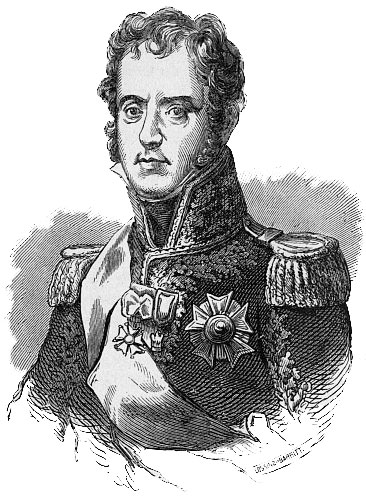
On the 1st of June, 1832, General Lamarque died—one of the most
distinguished generals of the Empire. He had gained great popularity
by his eloquent speeches in the tribune in favor of the rights of
the people. Napoleon, at St. Helena, spoke of him in the highest
terms of commendation. His death occurred just at the moment when
Paris was on the eve of an insurrection, and it was immediately
resolved to take advantage of the immense gathering which would be
assembled at his funeral to raise the banner of revolt. A meeting of
all the opposition had just been held at the house of the banker, M.
Lafitte, who had been so influential an agent in crowning the Duke of
Orleans. A committee had been appointed, consisting of Lafayette,
Odillon Barrot, M. Manguin, and others of similar influence and rank,
to draw up an address to the nation. All the leaders of the popular
committees were very busy in preparation for the outbreak, and arms
were secretly distributed and officers appointed, that they might act
with efficiency should they be brought into collision with the royal
troops.
The funeral.
The funeral took place on the 5th of June. It was one of the most
imposing spectacles Paris had ever witnessed—assembling, apparently,
the whole population of the metropolis, with thousands from the
provinces. A magnificent car, decorated with tri-color flags, bore
the remains. The procession moved from the house of the deceased
through the Rue St. Honoré to the Church of the Madeleine, and
thence, by way of the teeming Boulevards, to the Place of the
Bastile, where several funeral orations were pronounced, and where
the body was received, to be taken to its place of burial in the
south of France. All the Republican and Democratic clubs turned out
in full strength. The Chamber of Deputies was present. Banners,
inscribed with exciting popular devices, floated in the air.
Strength of the royal forces.
The police of Paris was maintained by two thousand municipal guards.
In anticipation of an outbreak, the Government had summoned into the
squares of the city an additional force of twenty-two thousand
troops, consisting of eighteen thousand infantry, four thousand
cavalry, and eighty pieces of cannon. And, as an additional
precaution, there was a reserve of thirty thousand troops stationed
in the vicinity of Paris who could in an hour be brought into the
streets. Apparently here was ample force to crush any uprising of the
populace.
But, on the other hand, the populace could easily rally an
enthusiastic mass of one hundred thousand men. Large numbers of
these were accustomed, in their clubs, to act in concert. Their
leaders were appointed—each one having his special duty assigned to
him. Not a few of these were veteran soldiers, who had served their
term in the army, and there were military men of distinction to lead
them. The forces, therefore, which might be brought into collision
were not very unequal.
Movement of the procession.
The immense procession commenced its movement at ten o'clock in the
morning. The whole city was in excitement. All hearts were oppressed
with the conviction that tumultuous scenes might be witnessed before
the sun should go down. When the head of the procession reached the
Place Vendôme, it was turned from its contemplated course, so as to
pass up through the Place and the Rue de la Paix to the Boulevards,
thus marching beneath the shadow of the magnificent column of
Austerlitz, which has given the Place Vendôme world-wide renown.
Cries of Vive la République began now to be heard. A hundred and
fifty pupils of the celebrated military school, the Polytechnic,
joined the procession, shouting "Vive la Liberte!" These shouts
were soon followed by the still more ominous cry, "A bas Louis
Philippe!" "Vive Lafayette!" The storm of popular excitement was
rapidly rising.
When the funeral-car had reached its point of destination, near the
bridge of Austerlitz, where the remains were to be transferred to
those who would carry them to their distant place of burial, several
brief funeral orations were pronounced, adroitly calculated still
more intensely to arouse popular feeling. A Polish refugee, General
Uminski, in an impassioned harangue, said:
Speech of General Uminski.
"Lamarque, you were the worthy representative of the people. You were
ours. You belonged to the human race. All people who love freedom
will shed tears at your tomb. In raising your noble voice for Poland,
you served the cause of all nations as well as France. You served the
cause of liberty—that of the interests dearest to humanity. You
defended it against the Holy Alliance, which grew up on the tomb of
Poland, and which will never cease to threaten the liberties of the
world till the crime which cemented it shall have been effaced by the
resurrection of its unfortunate victim."[AC]
 THE BARRICADE.
Advance of the cuirassiers.
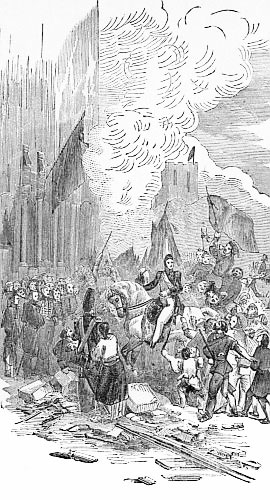
The agitation was now indescribable. General Lafayette was urged to
repair to the Hôtel de Ville and organize a provisional government.
The crowd unharnessed his horses and began, with shouts, to draw him
in his carriage through the streets. Suddenly the cry was raised,
"The Dragoons!" A mounted squadron of cuirassiers, with glittering
swords and coats of mail, in a dense mass which filled the streets,
came clattering down at the full charge upon the multitude, cutting
right and left. Blood flowed in torrents, and the wounded and the
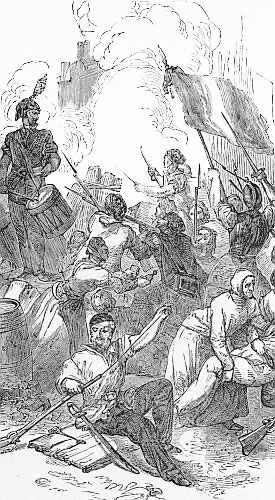
dead were strewn over the pavements. The battle was begun. Fiercely
it raged. Barricades were instantly constructed, which arrested the
progress of the troops. As by magic, fire-arms appeared in the hands
of the populace. Notwithstanding the general tumult and
consternation, order emerged from the chaos. Every house became a
citadel for the insurgents, and two armies were found confronting
each other.
The king and his council, in session at the Tuileries, were greatly
alarmed. At three o'clock the tidings were brought that one-third of
the metropolis, protected by barricades, was in the possession of the
insurgents, and that the aspect of affairs was threatening in the
extreme. Orders were transmitted for all the royal troops within
thirty miles of Paris to hasten to the capital. The night passed in
tumult and terror. Armed bands were surging through the streets. The
solemn boom of the tocsin floated mournfully through the air. The
shoutings of the populace, and the frequent explosions of artillery
and musketry, added to the general dismay and gloom. There was no
sleep in Paris that night. Fifty thousand troops of the line and
fifty thousand of the National Guard were marching to their appointed
places of rendezvous in preparation for the deadly strife which the
morrow would certainly usher in. The populace were no less busy,
organizing in military bands, collecting arms, throwing up
barricades, and seizing important posts. Both parties were alike
aware that the Government could place but little reliance upon the
National Guard, as many of them were known to be in sympathy with the
people.
The Provisional Government.
A provisional government had in reality, as it were, organized
itself. While Louis Philippe and his ministers were in session at the
Tuileries, Lafayette, M. Lafitte, and other distinguished men, who
but a few months before had placed Louis Philippe upon the throne,
were in secret assembly at the mansion of M. Lafitte, issuing orders
for the overthrow of that throne. Their orders were received by the
leaders of the populace, and thus there was unity and efficiency of
action.[AD]
During the night there were several bloody conflicts, in which the
populace were generally successful. With their head-quarters at the
Porte St. Martin, and pushing out their intrenchments on both sides
of the river, before the dawn a large part of the city was under
their control. The Government forces were mainly concentrated at the
Tuileries, the Louvre, and the Hôtel de Ville.
Marshal Soult in command.
Marshal Soult was in command of the royal troops. Wherever his
sympathies might be in the peculiar emergency which had risen, he
felt bound to be true to his oath and his colors. By ten o'clock in
the morning he had eighty thousand men under his command, including
six thousand cavalry, with one hundred and twenty pieces of
artillery. Strong as this force was, it was none too strong for the
occasion. There was great consternation at the Tuileries. To prevent
the soldiers of the National Guard from passing over to the people,
they were intermingled with the troops of the line.
The conflict.
The conflict which ensued was one of the most terrible ever recorded
in the history of insurrections. Thirty thousand compact royal
troops, cavalry, infantry, and artillery, slowly marched along the
Boulevards, battering down the barricades, and sweeping the streets
with musketry and grape-shot. Another band of thirty thousand
traversed, in an equally sanguinary march, the streets which bordered
the banks of the Seine. They were to meet at the bridge of
Austerlitz.
The houses of Paris are of stone, five or six stories high. Each
house became a citadel filled with insurgents, which kept up a deadly
fire upon the advancing columns. The slaughter on both sides was
dreadful; on either side was equal courage and desperation. A very
bloody struggle took place at the Cloister of St. Meri, which strong
position the insurgents held with the utmost determination.
The conflict at St. Meri.
"The tocsin," writes Sir Archibald Alison, "incessantly sounded from
the Church of St. Meri to call the Republicans to the decisive
point; and they were not wanting to the appeal. Young men, children
of twelve years of age, old men tottering on the verge of the grave,
flocked to the scene of danger and stood side by side with the manly
combatants. Never had there been, in the long annals of revolutionary
conflicts, such universal enthusiasm and determined resolution on the
part of the Republicans."
Before the terrific fire from the windows and from behind the
barricade the whole column of royal troops at first recoiled and fled
back in confusion. But heavy artillery was brought forward; a breach
was battered through the barricade; shells were thrown beyond to
scatter the defenders, while an incessant storm of bullets penetrated
every window at which an assailant appeared. The royal troops rushed
through the breach. Quarter was neither given nor asked. On both
sides the ferocity of demons was exhibited. This closed the conflict.
The insurrection was crushed. The royal troops admitted a loss in
killed and wounded of 417. The loss of the insurgents can never be
known, as both the dead and the wounded were generally conveyed away
and secreted by their friends.
The insurrection quelled.
On the morning of the 6th, the leaders of the Liberal party were
sanguine of success. But the unexpected display of governmental force
rendered the revolt hopeless. The leaders, who had been acting in
entire secrecy, dispersed, and Alison says that they quietly slipped
over to the other side, and sought only to mitigate the victor's
wrath. A deputation was appointed by some of the citizens to call
upon the king, congratulate him upon his victory, and implore him
to temper justice with mercy.
The king angrily replied, "Who is responsible for the blood which has
been shed? The miserable wretches who took advantage of the funeral
of General Lamarque to attack the Government by open force. The
cannons you have heard have demolished the barricades of St. Meri.
The revolt is terminated. I do not know why you should suppose that
violent measures are to be adopted; but, rely upon it, they are
loudly called for. I know that the press is constantly endeavoring to
destroy me; but it is by the aid of falsehood. I ask you, is there
any person of whom you have ever heard, against whom a greater
torrent of calumny has been poured forth than against myself?"[AE]
Severity of the Government.
The next morning a decree was issued ordering all the
printing-presses opposed to the Government to be broken to pieces,
and substituting courts-martial instead of the ordinary tribunals to
try all cases connected with the insurrection. The Government
regarded the movement as a combined attempt of the Republicans and
the Legitimists. Hence Garnier Pagés, the Democrat, and Viscount
Chateaubriand, the Bourbonist, found themselves arrested as
accomplices in the same rebellion.
Three days after, on the 10th of June, Chateaubriand wrote from his
prison to M. Bertin, editor of Le Journal des Débats, that he had
refused to take the oath of allegiance to Louis Philippe, first
because his government was not founded upon legitimate succession,
and second, that it was not founded on popular sovereignty.
A few weeks after this, upon his release, Chateaubriand visited the
young prince, Louis Napoleon, who, in studious retirement, was
residing with his mother, Queen Hortense, in their beautiful retreat
at Arnemberg, on the Lake of Constance. The prince had just published
a work entitled "Political Reveries," in which he took the ground
that the voice of the people is the legitimate foundation of all
government; that the people, in the exercise of universal suffrage,
should decide upon their form of government and choose their rulers.
Chateaubriand read this treatise with much interest, suggested the
substitution of the word nation for that of people, and became
personally the warm friend of the young prince, though still adhering
to the doctrine of legitimacy and to his allegiance to the
Bourbons.[AF]
Numerous prosecutions.
The government of Louis Philippe pursued and punished with the
greatest energy those engaged in the revolt. "The number of the
prosecutions," writes Alison, "exceeded any thing previously
witnessed, not merely in French, but in European history. The
restrictions complained of during the Restoration were as nothing
compared to it. From the accession of Louis Philippe to the 1st of
October, a period of a little more than two years, there occurred in
France 281 seizures of journals and 251 judgments upon them. No less
than 81 journals had been condemned, of which 41 were in Paris alone.
The total number of months of imprisonment inflicted on editors of
journals during this period was 1226, and the amount of fines levied
347,550 francs [$80,000]. This is perhaps the hottest warfare,
without the aid of the censorship, ever yet waged, during so short a
period, against the liberty of the press. The system of Louis
Philippe was to bring incessant prosecutions against the parties
responsible for journals, without caring much whether they were
successful or not, hoping that he should wear them out by the trouble
and expense of conducting their defenses."[AG]
The Duchess de Berri.
Thus terminated the Republican attempt to overthrow the throne of
Louis Philippe. And now let us turn to an attempt of the Legitimists
to accomplish the same end. About eleven months after the
enthronement of Louis Philippe, in March, 1831, the Duchess de Berri,
having obtained the reluctant consent of Charles X., set out from
Scotland for the south of France, to promote a rising of the Bourbon
party there in favor of the Duke of Bordeaux—whom we shall hereafter
call by his present title, the Count de Chambord—and to march upon
Paris. The Legitimist party was rich, and was supported generally by
the clergy and by the peasantry. In the south of France and in La
Vendée that party was very strong.
Statement of Louis Blanc.
"The idea of crossing the sea at the head of faithful paladins; of
landing after the perils and adventures of an unexpected voyage, in a
country of knights-errant; of eluding, by a thousand disguises, the
vigilance of the watchful enemies through whom she had to pass; of
wandering, a devoted mother and banished queen, from hamlet to
hamlet, and chateau to chateau; of testing humanity, high and low, on
the romantic side, and, at the end of a victorious conspiracy, of
rearing in France the standard of the monarchy—all this was too
dazzling not to captivate a young and high-spirited woman, bold
through very ignorance of the obstacles she had to surmount, heroic
in the hour of danger through levity; able to endure all but ennui,
and ready to lull any misgivings with the casuistry of a mother's
love."
[AH]The ex-king, Charles X., who, having abdicated, had no power to
nominate to the regency, still issued a decree, dated Edinburgh,
March 8th, 1831, by which he authorized "a proclamation in favor of
Henry V., in which it shall be announced that Madame, Duchess de
Berri, is to be regent of the kingdom during the minority of her
son."[AI]
The reception of the duchess in Italy.
The duchess, assuming the title of Countess of Segana, crossed over
to Holland, and, ascending the Rhine and traversing the Tyrol, safely
reached Genoa. The King of Sardinia, Charles Albert, received her
kindly, and loaned her a million francs. But the French consul
discovered her through her disguise, and by order of the French Court
the Sardinian king felt constrained to request her to withdraw from
his domains.
The Duke of Modena received her hospitably, and assigned to her use
the palace of Massa, about three miles from the sea. Here, with
confidential advisers, she matured her plans. Secret agents were sent
to all the principal cities in France, to organize royalist
committees and to prepare for a general uprising. The plan was for
the insurrection to break out first in the west of France, to be
immediately followed by all the southern provinces.
Abolition of the peerage.
While affairs were in this posture, a very curious measure was
adopted by the Government, which merits brief notice. The Chamber of
Deputies, composed of the bourgeoisie, voted the abolition of the
hereditary peerage. This was a constitutional amendment, which needed
to be ratified by the Chamber of Peers. But the Peers were not
disposed thus to commit suicide. Louis Philippe had been placed upon
the throne by the bourgeoisie. The nobles were Bourbonists. He felt
constrained to support the measures of his friends. He therefore
created, by royal ordinance, thirty-six new peers to vote the
abolition of the peerage, and thus the vote was carried.[AJ] A vote
was also passed banishing forever from the soil of France every
member of the elder branch of the house of Bourbon. These measures,
of course, exasperated the friends of the ancient régime, and
rendered them more willing to enter into a conspiracy for the
dethronement of the Citizen King.
At Massa the duchess had assembled several prominent men to aid her
with their advice and co-operation. But, as was to have been
expected, these men soon quarrelled among themselves. The brother of
the Duchess de Berri was now King of Naples. But he did not dare to
afford his sister an asylum, as the French Government threatened, in
that case, immediately to send a fleet and an army from Toulon and
bombard the city of Naples.
Proclamations and ordinances were prepared, to be widely distributed.
A provisional government, to be established in Paris, was organized,
on paper, to consist of the Marquis de Pastoret, the Duke de Bellino,
the Viscount Chateaubriand, and the Count de Kergarlaz.
Vigilance and severity of the Government.
In the mean time the officers of the Government were watching with
the utmost vigilance every movement in the south of France, and
punishing with terrible severity, by shooting, bayoneting, and
hanging, and often without trial, those who were suspected of being
implicated in the anticipated Bourbon uprising. The duchess was much
deceived by the flattering reports she was receiving from her
friends. Though they correctly described the intense dissatisfaction
of the country with the government of Louis Philippe, they greatly
exaggerated the numbers and the zeal of those whom they supposed to
be ready to rally around the banner of the Bourbons.
A midnight adventure.
The 24th of April, 1832, was fixed for the departure. The utmost
secrecy was necessary, as the spies of Louis Philippe were all
around. Arrangements had been made for a small steamer, the Carlo
Alberto, in the darkness of the night to glide into the harbor, take
on board the duchess and her suite, and convey them to Marseilles. It
was given out that the duchess was about to visit Florence. At
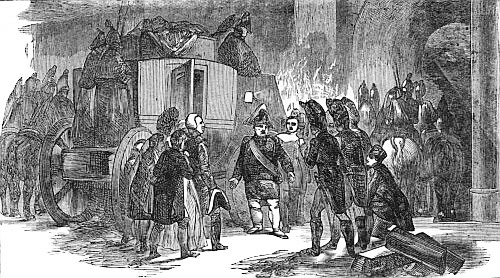
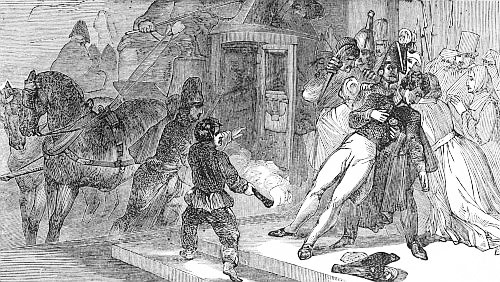
nightfall of the 24th a travelling carriage, with four post-horses,
was drawn up before the ducal palace. The duchess, with one gentleman
and three ladies, entered, and in the darkness the carriage was
rapidly driven a short distance from the gate of Massa, when, upon
some pretext, it stopped for a moment beneath the shadow of a high
wall. While some directions were given, to engage the attention of
the postilion, the duchess, with Mademoiselle Lebeschu and M. de
Brissac, glided out of the door unperceived, when the door was shut
and the horses again set out upon the gallop for Florence.
The embarkation.
The duchess and her friends stealthily moved along under the shadow
of the wall, until they reached a secluded spot upon the sea-shore
where the steamer was expected. The major of a body of troops in
that vicinity joined them, with a lantern, as a signal to guide the
boat from the expected steamer to the shore. Here they remained, in
breathless silence and in much anxiety, for an hour. Just as the
clocks in the distant churches were tolling the hour of midnight, a
feeble light was seen far away over the water. It was the Carlo
Alberto, the steamer for which they were waiting. Rapidly it
approached; a boat was sent ashore. The Princess Marie Caroline, worn
out with cares and anxieties, or—which is the more
probable—possessed of that gay, untroubled spirit which no cares
could agitate, was wrapped in her cloak and soundly asleep on the
sand. Her companions did not awake her till the boat was about to
touch the beach. It was three o'clock in the morning. The duchess and
her suite, composing a party of seven—Mademoiselle Lebeschu being
her only lady attendant—were soon transferred from the shore to the
deck of the Carlo Alberto.
All were conscious that the enterprise upon which they had embarked
was perilous in the extreme. Its success would greatly depend upon
what is called chance. The duchess appeared calm and cheerful, as if
determined not to doubt of a triumphant result, and manifestly
resolved to wipe from the Bourbon name the charge of pusillanimity
which it has so often incurred.
The night storm.
To avoid the French cruisers the Carlo Alberto kept far out to sea,
and did not reach Marseilles until midnight of the 28th. The party
was to be landed near the light-house, where a rendezvous had been
fixed for the small but determined band who were to meet her there.
The moment the steamer cast anchor the signal of two lanterns was
raised, one at the foremast head and the other at the mizzen-mast
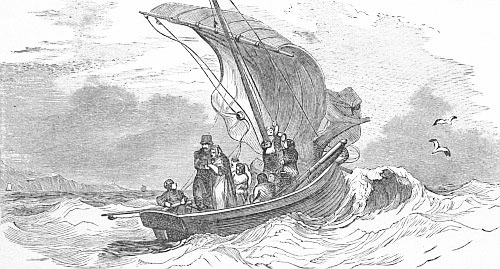
head, which signal was instantly responded to from the shore. Dark
clouds had gathered in the sky, and the moanings of a rising gale and
the dashings of the surge added to the gloom of the hour. The
gentlemen who were to accompany Marie Caroline to the shore were
dressed in the disguise of fishermen. The sea had become so high that
it was with difficulty and peril that the party could embark. At one
time the boat was dashed so furiously against one of the paddle-boxes
of the steamer that the destruction of all on board seemed
inevitable. Through all these trying scenes the fragile, sylph-like
duchess manifested intrepidity which excited the wonder and
admiration of every beholder. The little skiff which was to convey
her to the beach soon disappeared in the darkness of that stormy sea.
The landing at Marseilles.
The landing occurred without accident, and Marie Caroline scaled the
rocks, along a path which tried the nerves even of the boldest
smugglers, till she reached a temporary hut which had been reared to
afford her shelter. The vigilance, however, of the Government police
had not been entirely eluded. That very evening the authorities, in
some way, received the rumor that the duchess had landed, or was
about to land, at Marseilles, to commence the uprising there.
Immediate and vigorous preparations were adopted to quell it. The
force of every military post was doubled.
The insurrection.
A band of about two thousand of her partisans was the next morning
assembled at an appointed rendezvous in the city. They ran up the
white banner of the Bourbons upon the spire of St. Laurient, and
began shouting vociferously, "Vive Henri Cinq!"—hoping to excite a
general insurrection, and that the whole populace of the city would
join them. They did create intense agitation, and wonder, and
bewilderment. Men, women, and children ran to and fro, and the
alarm-bells were violently rung from the steeples. The duchess was
still in her hut, waiting for the favorable moment in which to make
her appearance. When she saw the Bourbon flag unfurled from St.
Laurient, she was deluded by the hope that the success of the
enterprise was secured.
But soon the regular troops appeared in solid battalions. The crowd
fled before them. A few of the insurgents who attempted to make a
stand were dispersed by a bayonet charge, their leaders captured, and
the Bourbon flag disappeared! By one o'clock it was all over—the
émeute had utterly and hopelessly failed!
Her despairing friends urged her immediately to repair to the
steamer, and to take refuge with the Bourbons of Spain. Heroically
she replied, "I am in France now, and in France will I remain." We
have not space here to enter into the detail of her wonderful
adventures, which she seemed to enjoy as if she were merely engaged
in a school-girl frolic. Probably she felt assured that if she were
taken prisoner, her royal blood, her relationship with the queen, as
her niece, and the sympathy of most of the courts of Europe in what
they deemed the righteousness of her cause, would save her from any
very severe treatment.
Wild adventures.
"Disguised as a peasant-boy, and accompanied by no one but Marshal
Bourmont, also in disguise, she set out on foot to walk across
France, through fields and by-paths, a distance of four hundred
miles, to the department of La Vendée, where the Bourbon party was in
its greatest strength. The first night they lost their way in the
woods. Utterly overcome by exhaustion, the duchess sank down at the
foot of a tree and fell asleep, while her faithful attendant stood
sentinel at her side.
"Little Peter."
"There is nothing in the pages of romance more wild than the
adventures of this frivolous yet heroic woman. She slept in sheds,
encountered a thousand hair-breadth escapes, and, with great
sagacity, eluded the numerous bands who were scouring the country in
quest of her. At one time, in an emergency, she threw herself upon
the protection of a Republican, boldly entering his house, and
saying, 'I am the Duchess of Berri: will you give me shelter?' He did
not betray her. After such a journey of fifty days, she reached, on
the 17th of May, the chateau of Plassac, near Saintes, in La Vendée,
where a general rising of her friends was appointed for the 24th.
Nearly all the Vendéan chiefs were then awaiting the summons. On the
21st of May, the duchess—still in the costume of a young peasant,
presenting the aspect of a remarkably graceful and beautiful boy, and
taking the name of 'Little Peter'—repaired on horseback to an
appointed rendezvous at Meslier."
[AK]Here her disappointment was bitter. The Government troops were on the
alert, fully prepared for any conflict. Her own friends were
despairing. There was no enthusiasm manifested to enter upon an
enterprise where defeat and death seemed inevitable. Passionately she
entreated her friends not to abandon her, delineating the great risks
she had run. It was all in vain. No general uprising could be
secured. There were a few despairing conflicts, but the feeble bands
of the insurgents rapidly melted away before the concentration of the
Government troops.
Perilous wanderings.
Still, the duchess herself escaped capture. Accompanied by a single
guide, and apparently insensible to hardship or peril, she wandered
through the woods, often sleeping in the open air, and occasionally
carried upon the shoulders of her attendant through the marshes.
"On one occasion," writes Alison, "when the pursuit was hottest, she
found shelter in a ditch covered with bushes, while the soldiers in
pursuit of her searched in vain, and probed with their bayonets every
thicket in the wood with which it was environed. The variety, the
fatigue, the dangers of her life, had inexpressible charms for a
person of her ardent and romantic disposition. She often said, 'Don't
speak to me of suffering. I was never so happy at Naples or Paris as
now.'"[AL]
She took great pleasure in a variety of disguises. Sometimes, in the
picturesque costume of a peasant-girl, with coarse wooden shoes on
her little feet, she would enter a town filled with Royalist troops,
and converse gayly with the gendarmes who guarded the gates. The
coasts of France were so watched by Governmental vessels as to render
her escape by water almost impossible. She consequently decided to
seek a retreat in Nantes, a city in which she had so few adherents
that no one would suspect her taking refuge there.
In the disguise of a peasant-girl, with one female companion, she
entered the city, and was concealed by a few friends who perilled
their lives in so doing. For several months she eluded all the
efforts of the Government to find her. In the mean time, the
partisans of the duchess were pursued and punished with the most
terrible severity. No mercy was shown them. The duchess, from her
retreat, kept up a lively correspondence with her friends, still
hoping that fortune might turn in her favor. Pleading in behalf of
these men, she wrote as follows to her aunt, the queen:
Letter to the queen.
"Whatever consequences may result for me, from the position
in which I have placed myself while fulfilling my duties as
a mother, I will never speak to you, madame, of my own
interests. But brave men have become involved in danger for
my son's sake, and I can not forbear from attempting
whatever may be done with honor, in order to save them.
"I therefore entreat my aunt, whose goodness of heart and
religious sentiment are known to me, to exert all her credit
in their behalf. The bearer of this letter will furnish
details respecting their situation. He will state that the
judges given them are men against whom they have fought.
"Notwithstanding the actual difference in our positions, a
volcano is under your feet, madame, as you know. I knew your
alarm—your very natural alarm—at a period when I was in
safety, and I was not insensible to it. God alone knows what
He destines for us, and perhaps you will one day thank me
for having had confidence in your goodness, and for having
given you an opportunity of exerting it in behalf of my
unfortunate friends. Rely on my gratitude. I wish you
happiness, madame, for I think too highly of you to believe
it possible that you can be happy in your present situation.
Marie Caroline."
The letter returned.
This letter was conveyed to the queen at St. Cloud. She probably read
it; but it was immediately returned to the bearer, who was in
waiting, with the declaration that the queen could not receive it.
Five months had now elapsed since the duchess entered Nantes. It is
by some supposed that Louis Philippe did not wish to have her
arrested. He would be fearfully embarrassed to know what to do with
her. It would hardly do to restore her to liberty while her
partisans were cruelly punished with death. It was not easy to decide
upon the tribunal which would sit in judgment upon her. The peerage
would have recoiled with horror from passing judgment upon a
princess, who endeavored to gain the throne for a child, who was
entitled to that throne by the avowed principles of legitimacy.
A renegade Jew, by the name of Deutz, at length betrayed her. By the
most villainous treachery he obtained an interview with the duchess,
and then informed the police of the place of her retreat. It was the
6th of November. In the following words Louis Blanc describes the
preparations made for her arrest:
Note from Louis Blanc.
The traitor Deutz.
"The first communication between M. Thiers and Deutz took place under
the following circumstances: M. Thiers one day received a letter
wherein a stranger begged him to repair in the evening to the Champs
Elysées, promising to make him a communication of the very highest
importance. At the appointed hour he proceeded to the Champs Elysées,
with a brace of pistols ready in his coat-pockets. At the spot
indicated in the letter he perceived a man standing, who seemed
agitated with fear and doubt. He approached and accosted this man.
It was Deutz. A conference was opened, which ended in a base crime.
The next night, by an arrangement of the police, Deutz was introduced
into the office of the Minister of the Interior. 'You can make a good
thing of this,' said M. Thiers. The Jew shook with agitation at the
idea; his limbs trembled under him, and his countenance changed. The
price of the treachery was settled without difficulty."
No sooner had Deutz withdrawn than bayonets glittered in every
direction, and commissioners of police rushed into the house, with
pistols in their hands. The duchess had barely time to take refuge,
with three companions, in a small recess behind the fire-place, which
was adroitly concealed by an iron plate back of the chimney. The
police commenced a minute search, calling masons in to aid them. The
walls were sounded with hammers, articles of furniture moved and
broken open. Night came while the search continued. The space in
which they were confined was very narrow, with but one small aperture
for the admission of air. They barely escaped suffocation by applying
their mouths in turn to this hole, but three inches in diameter.
Discovery and arrest.
The gendarmes, fully satisfied that the duchess must be concealed
somewhere in the house, took possession of the room and lighted a
fire in the chimney, which converted their hiding-place into a hot
oven. The heat soon became insupportable. The iron plate had become
red-hot. One of the prisoners kicked it down, and said, "We are
coming out; take away the fire." The fire was instantly brushed away,
and the duchess and her companions, after having endured sixteen
hours of almost insupportable torture, came forth in great
exhaustion, and yet the duchess almost gayly said, referring to the
ancient martyr roasted upon a gridiron,
"Gentlemen, you have made war upon me à la St. Laurent. I have
nothing to reproach myself with. I have only discharged the duty of a
mother to gain the inheritance of her son."[AM]
Imprisonment at Blaye.
The captive was treated with the respect due to her rank. After a
brief confinement at Nantes, she was transferred to the citadel of
Blaye, one of the most gloomy of prisons, on the left bank of the
Gironde. All the effects of this princess of royal birth, who had
entered France as regent, were tied up in a pocket-handkerchief.
Measures were apparently adopted to keep her in close captivity,
without trial, for a long time. The fortress was thoroughly manned
with nine hundred men, and put in a state of defense, as if
anticipating a siege. Three gun-boats were stationed in the river.
The small building within the walls of the citadel, which was
assigned to the duchess, was surrounded with a double row of
palisades ten or twelve feet high. The windows were covered with
strong iron bars, and even the apertures of the chimneys were closed
with an iron grating. Even the gay spirit of the princess was subdued
by the glooms in which she was enveloped.
Still, from many eminent men of her own party she received gratifying
proofs of fidelity. Chateaubriand issued an eloquent pamphlet which
won the applause of the Legitimists throughout Europe. In this he had
the boldness to exclaim, "Madame, your son is my king." In a letter
of condolence to the princess, in which he offered his professional
services in her defense, he said:
"Madame,—You will deem it inconsiderate, obtrusive, that
at such a moment as this I entreat you to grant me a favor,
but it is the high ambition of my life. I would earnestly
solicit to be numbered among your defenders. I have no
personal title to the great favor I solicit of your new
grandeur, but I venture to implore it in memory of a prince
of whom you deigned to name me historian, and in the name of
my family's blood. It was my brother's glorious destiny to
die with his illustrious grandfather, M. de Malesherbes, the
defender of Louis XVI., the same day, the same hour, for the
same cause, and upon the same scaffold. Chateaubriand."
The terrible secret.
But a terrible secret was soon whispered abroad, which overwhelmed
the princess with shame, and which filled the court of Louis Philippe
with joy, as it silenced all voices which would speak in her favor.
It became evident that the duchess was again to become a mother. For
a princess, the child, sister, and mother of a king, secretly to
marry some unknown man, was deemed as great a degradation as such a
person could be guilty of. The shame was as great as it would be in
New York for the daughter of a millionaire secretly to marry a negro
coachman. It consigned the princess to irremediable disgrace. But the
situation in which she found herself compelled her to acknowledge her
marriage. The universal assumption was that she had not been married.
Secrecy divests marriage of its sanctity.
The sufferings through which the princess passed were awful. No pen
can describe them. Could she but be released from prison, her shame
might be concealed. Her tears and entreaties were all unavailing.
Louis Philippe, unmindful that the princess was the niece of his
wife, deemed that the interests of his dynasty required that she
should be held with a firm grasp until the birth of her child should
consign her to ignominy from which there could be no redemption.
On the 22d of February, 1833, the duchess placed in the hands of
General Bugeaud, governor of the citadel of Blaye, the following
declaration:
The marriage announcement.
"Urged by circumstances, and by the measures ordered by the
Government, though I had the strongest reason to keep my marriage
secret, I think it a duty to myself and my children to declare that I
was secretly married during my residence in Italy."
To a friend, M. de Mesnard, she wrote: "I feel as if it would kill me
to tell you what follows, but it must be done. Vexatious annoyances,
the order to leave me alone with spies, the certainty that I can not
get out till September, could alone have determined me to declare my
secret marriage."
Humiliations of the duchess.
The humiliations to which the unhappy duchess was compelled to submit
were dreadful. The detail would be only painful to our readers. On
the morning of the 10th of May a daughter was born, whom God kindly,
ere long, removed to another world. The fact, minutely authenticated,
was proclaimed to all Europe. Thus far Marie Caroline had kept secret
the name of her husband. But it was now necessary that his name
should be given, to secure the legitimacy of her child. It was then
announced, by the officiating physician to the group of officials
which the Government had placed around her bed, that the father of
the child was Count Hector Sucheri Palli, gentleman of the chamber to
the King of the Two Sicilies.
Comments of Louis Blanc.
In commenting upon these events, Louis Blanc writes: "The partisans
of the new dynasty exulted with indecent zeal at the event of which
the ministers had so well prepared the scandal. The Republicans only
manifested the contempt they felt for this ignoble triumph. As for
the Legitimists, they were overwhelmed with consternation. Some of
them, however, still persisted in their daring incredulity; and they
did not hesitate to denounce the document, upon which their enemies
relied as the denouement of an intrigue which had begun with violence
and ended with a lie. Separated from her friends, deprived of their
counsels, dead to the world, to the laws, to society, was it possible
for Marie Caroline to make any valid deposition against herself, and
that, too, surrounded by her accusers, by her keepers, by the men who
had vowed her destruction?"
Thus, while one party affirmed that there was no truth in the alleged
birth or marriage, the Orleanists declared that the Duchess of Berri
had not only given birth to a child of no legitimate parentage, but
that the Duke of Bordeaux, who was born seven months after the
assassination of the Duke of Berri, was also the child of dishonored
birth, and had, therefore, no title whatever to the crown. Such is
the venom of political partisanship.
The duchess liberated.
On the 8th of June, Marie Caroline, who could no longer claim the
title of Regent of France, but who had sunk to the lowly condition of
the wife of an Italian count, was liberated from prison. She had
fallen into utter disgrace, and was no longer to be feared. With her
child and her nurse, abandoned by those friends who had gathered
around the regent, she sailed for Palermo. Her brother, the king,
received her kindly, and she was joined by Count Lucheri Palli. Few
troubled themselves to inquire whether she were ever married to the
count or not. We hear of her no more.
These events broke up the Legitimists into three parties. The one
assumed that, under the circumstances, the abdication of Charles X.
was not to be regarded as binding; that he was still king, and to him
alone they owed their allegiance. The second took the position that,
in consequence of the suspicions cast upon the birth of the Duke of
Bordeaux, the abdication in favor of the duke was null, and that the
dauphin, the Duke de Angoulême, was the legitimate heir to the crown.
The third party still adhered to the Duke of Bordeaux, recognizing
him as king, under the title of Henry V. Thus terminated in utter
failure the Legitimist endeavor to overthrow the throne of Louis
Philippe.
Death of the Duke of Reichstadt.
While these scenes were transpiring, the Duke of Reichstadt, the only
son of Napoleon I., and, by the votes of the French people, the
legitimate heir to the throne of the Empire, died in Vienna, on the
22d of July, 1832. Commenting upon this event, Louis Blanc writes:
"In a calm, lovely day, there was seen advancing through a perfectly
silent crowd, along the streets of that capital of Austria which once
looked down abashed and terror-struck beneath the proud eagles of
Napoleon, a hearse, preceded by a coach and a few horsemen. Some
attendants walked on either side, bearing torches. When they arrived
at the church, the court commissioner, in pursuance of a remarkable
custom of the country, proceeded to enumerate the names and titles of
the deceased. Then, knocking at the door, he solicited for the corpse
admission to the temple. The princes and princesses of the house of
Austria were there awaiting the body, and attended it to the vault,
into which the fortune of the Empire then descended forever. The
death of the son of Napoleon occasioned no surprise among the
nations. It was known that he was of a very sickly constitution, and
besides poison had been spoken of. Those who think every thing
possible to the fear or ambition of princes had said, He bears too
great a name to live."
Louis Napoleon.
The attempts subsequently made by Louis Napoleon for the restoration
of the Empire, which failed at Strasbourg and Bologne, but which
finally gave the Empire to France through twenty years of
unparalleled prosperity, we have not space here to record. They will
be found minutely detailed in Abbott's History of Napoleon III.
Statement of Louis Blanc.
In reference to these unsuccessful attempts, Louis Blanc writes: "Of
the two sons of the ex-king of Holland, Napoleon's brother, the
elder, we have seen, had perished in the Italian troubles, by a death
as mysterious as premature. The younger had retired to Switzerland,
where he applied himself unceasingly to the preparation of projects
that flattered his pride and responded to the most earnest
aspirations of his soul.
"Nephew to him whom France called the Emperor, the emperor par
excellence (imperator), and condemned to the vexations of an obscure
youth; having to avenge his proscribed kindred, while himself exiled
by an unjust law, from a country he loved, and of which it might be
said, without exaggeration, that Napoleon still covered it with his
shadow—Louis Bonaparte believed himself destined at once to uphold
the honor of his name, to punish the persecutors of his family, and
to open to his disgraced country some way to glory.
"His design was to make trial of the prestige of his name to
overthrow the Orleans dynasty, after which he would convoke the
people, consult and obey it. Nothing is more certain than that this
respect for the principle of the sovereignty of the people was
perfectly sincere and honest on the part of the young prince. But the
hopes with which he flattered his ambition were not the less grand on
that account. Heir to the imperial tradition, might he not be the
choice of the people?
"He was generous, enterprising, prompt in military exercises, and the
uniform sat upon him with a manly grace. There was no braver
officer—no more gallant cavalier. Though the expression of his
countenance was gentle, rather than energetic and imperious—though
there was an habitual languor in his looks, often dashed with
thought, no doubt the soldiers would love him for his frank bearing,
his honest and hearty speech, his small figure, resembling his
uncle's, and the imperial lightning which the passion of the moment
kindled in his blue eye. What a name, too, was his!"[AN]
Death of Charles X.
Charles X. was overwhelmed by his misfortunes. His health rapidly
failed. He was often heard to say, "The day is not far distant that
shall witness the funeral of the poor old man." On the morning of
November 4, 1836, he was seized with a chill, while temporarily
residing at Goritz, in Styria. It proved an attack of cholera. His
sufferings were severe, but he was calm and resigned, and conversed
freely upon the eternity opening before him. The Duke of Bordeaux and
his sister were brought into the room to receive his blessing. He
placed his trembling hands upon their heads and said, "God protect
you, my children. Walk in the ways of righteousness; do not forget
me; pray for me sometimes." A deep lethargy came upon him; and, after
a few hours of apparent insensibility, he breathed his last, at the
age of 79 years.