Larger versions of most illustrations may be seen by right-clicking them
and selecting an option to view them separately, or by double-tapping and/or
stretching them.
Steam has not banished from the deep sea the
ships that lift tall spires of canvas to win their
way from port to port. The gleam of their topsails
recalls the centuries in which men wrought with
stubborn courage to fashion fabrics of wood and
cordage that should survive the enmity of the implacable
ocean and make the winds obedient.
Their genius was unsung, their hard toil forgotten,
but with each generation the sailing ship became
nobler and more enduring, until it was a perfect
thing. Its great days live in memory with a peculiar
atmosphere of romance. Its humming shrouds
were vibrant with the eternal call of the sea, and in
a phantom fleet pass the towering East Indiaman,
the hard-driven Atlantic packet, and the
gracious clipper that fled before the Southern
trades.
A hundred years ago every bay and inlet of the
New England coast was building ships which fared
bravely forth to the West Indies, to the roadsteads
of Europe, to the mysterious havens of the Far
East. They sailed in peril of pirate and privateer,
and fought these rascals as sturdily as they battled
with wicked weather. Coasts were unlighted, the
seas uncharted, and navigation was mostly by guesswork,
but these seamen were the flower of an American
merchant marine whose deeds are heroic in
the nation’s story. Great hearts in little ships, they
dared and suffered with simple, uncomplaining fortitude.
Shipwreck was an incident, and to be adrift
in lonely seas or cast upon a barbarous shore was
sadly commonplace. They lived the stuff that
made fiction after they were gone.
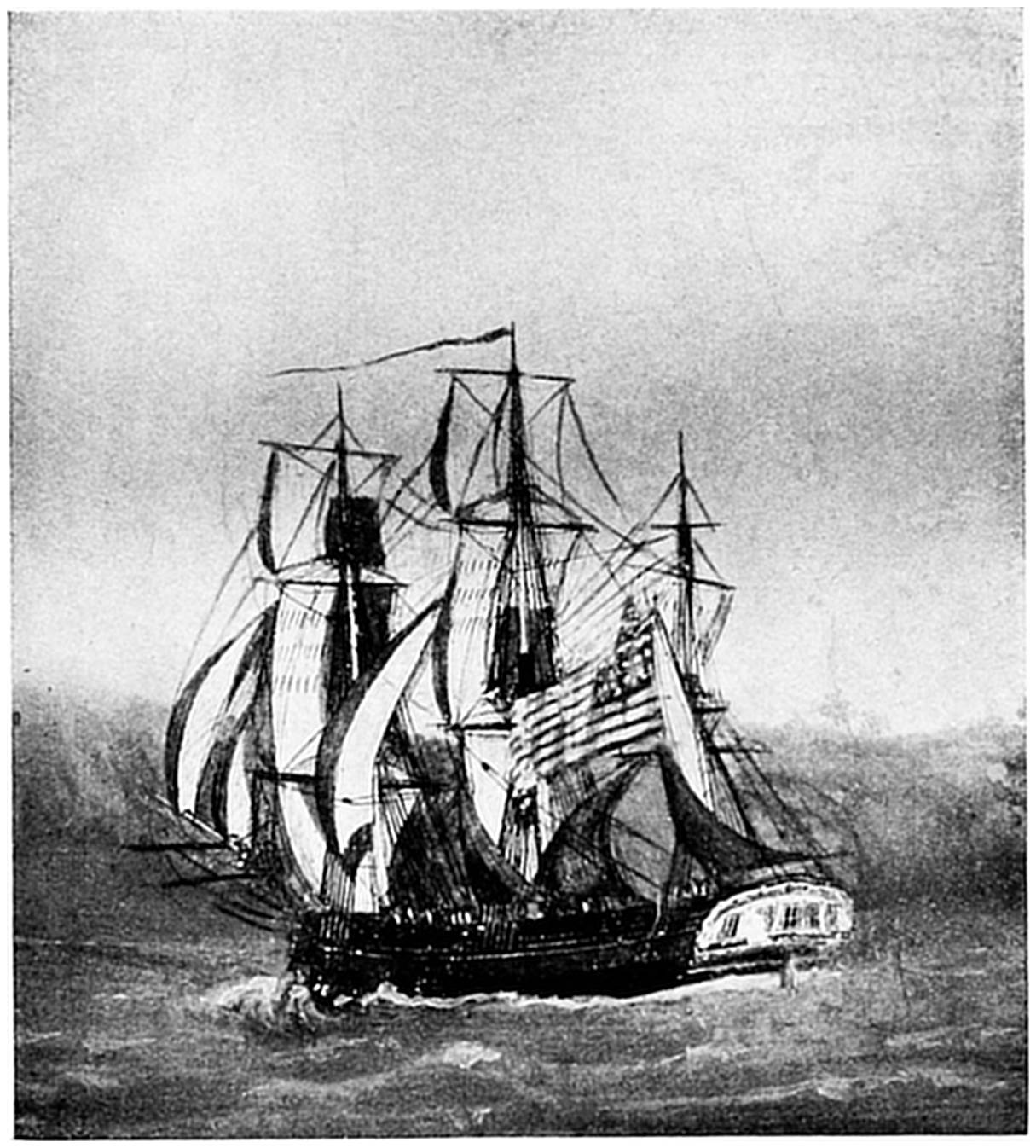
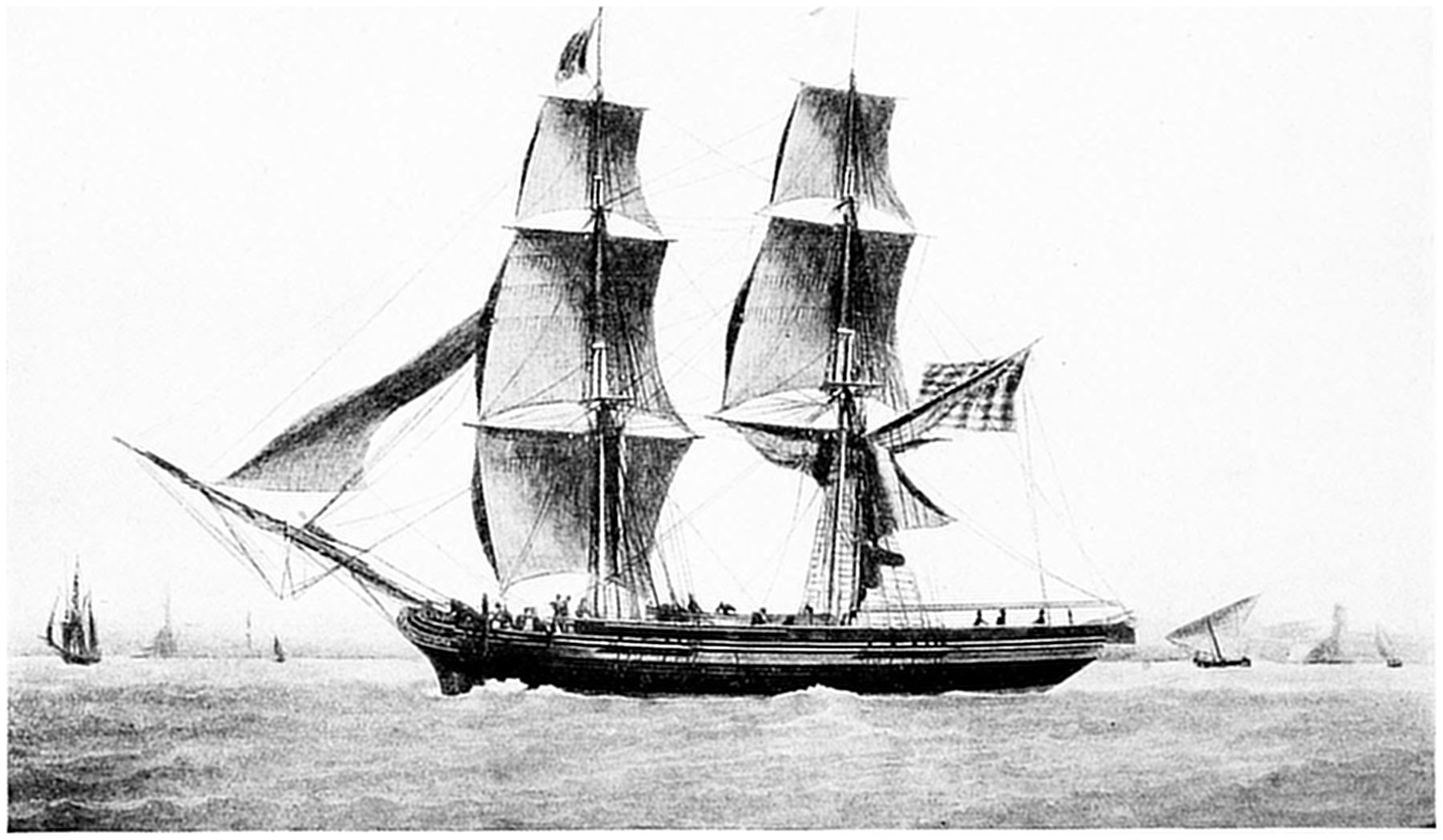
Your fancy may be able to picture the brig Polly
as she steered down Boston harbor in December,
1811, bound out to Santa Cruz with lumber and
salted provisions for the slaves of the sugar plantations.
She was only a hundred and thirty tons
burden and perhaps eighty feet long. Rather
clumsy to look at and roughly built was the Polly as
compared with the larger ships that brought home
the China tea and silks to the warehouses of Salem.
Such a vessel was a community venture. The
blacksmith, the rigger, and the calker took their pay
in shares, or “pieces.” They became part owners,
as did likewise the merchant who supplied stores
and material; and when the brig was afloat, the master,
the mate, and even the seamen were allowed
cargo space for commodities that they might buy
and sell to their own advantage. A voyage directly
concerned a whole neighborhood.
Every coastwise village had a row of keel-blocks
sloping to the tide. In winter weather too rough
for fishing, when the farms lay idle, the Yankee
Jack of all trades plied his axe and adz to shape the
timbers and peg together such a little vessel as the
Polly, in which to trade to London or Cadiz or the
Windward Islands. Hampered by an unfriendly
climate, hard put to it to grow sufficient food, with
land immensely difficult to clear, the New-Englander
was between the devil and the deep sea, and
he sagaciously chose the latter. Elsewhere, in the
early days, the forest was an enemy, to be destroyed
with great pains. The pioneers of Massachusetts,
New Hampshire, and Maine regarded it with favor
as the stuff with which to make stout ships and the
straight masts they “stepped” in them.
Nowadays, such a little craft as the Polly would
be rigged as a schooner. The brig is obsolete, along
with the quaint array of scows, ketches, pinks, brigantines,
and sloops which once filled the harbors
and hove their hempen cables short to the clank of
windlass or capstan-pawl, while the brisk seamen
sang a chantey to help the work along. The Polly
had yards on both masts, and it was a bitter task
to lie out in a gale of wind and reef the unwieldy
single topsails. She would try for no record passages,
but jogged sedately, and snugged down
when the weather threatened.
On this tragic voyage she carried a small crew,
Captain W. L. Cazneau, a mate, four sailors, and
a cook who was a native Indian. No mention is to
be found of any ill omens that forecasted disaster,
such as a black cat, or a cross-eyed Finn in the forecastle.
Two passengers were on board, “Mr. J. S.
Hunt and a negro girl nine years old.” We know
nothing whatever about Mr. Hunt, who may have
been engaged in some trading “adventure” of his
own. Perhaps his kinsfolk had waved him a fare-ye-well
from the pier-head when the Polly warped
out of her berth.
The lone piccaninny is more intriguing. She appeals
to the imagination and inspires conjecture.
Was she a waif of the slave traffic whom some benevolent
merchant of Boston was sending to Santa
Cruz to find a home beneath kindlier skies? Had
she been entrusted to the care of Mr. Hunt? She
is unexplained, a pitiful atom visible for an instant
on the tide of human destiny. She amused the
sailors, no doubt, and that austere, copper-hued
cook may have unbent to give her a doughnut when
she grinned at the galley-door.
Four days out from Boston, on December 15, the
Polly had cleared the perilous sands of Cape Cod
and the hidden shoals of the Georges. Mariners
were profoundly grateful when they had safely
worked offshore in the winter-time and were past
Cape Cod, which bore a very evil repute in those
days of square-rigged vessels. Captain Cazneau
could recall that somber day of 1802 when three fine
ships, the Ulysses, Brutus, and Volusia, sailing together
from Salem for European ports, were
wrecked next day on Cape Cod. The fate of those
who were washed ashore alive was most melancholy.
Several died of the cold, or were choked by the sand
which covered them after they fell exhausted.
As in other regions where shipwrecks were common,
some of the natives of Cape Cod regarded a
ship on the beach as their rightful plunder. It was
old Parson Lewis of Wellfleet, who, from his pulpit
window, saw a vessel drive ashore on a stormy Sunday
morning. “He closed his Bible, put on his outside
garment, and descended from the pulpit, not
explaining his intention until he was in the aisle,
and then he cried out, ‘Start fair’ and took to his
legs. The congregation understood and chased
pell-mell after him.”
The brig Polly laid her course to the southward
and sailed into the safer, milder waters of the Gulf
Stream. The skipper’s load of anxiety was lightened.
He had not been sighted and molested by
the British men-of-war that cruised off Boston and
New York to hold up Yankee merchantmen and
impress stout seamen. This grievance was to flame
in a righteous war only a few months later. Many
a voyage was ruined, and ships had to limp back to
port short-handed, because their best men had been
kidnapped to serve in British ships. It was an age
when might was right on the sea.
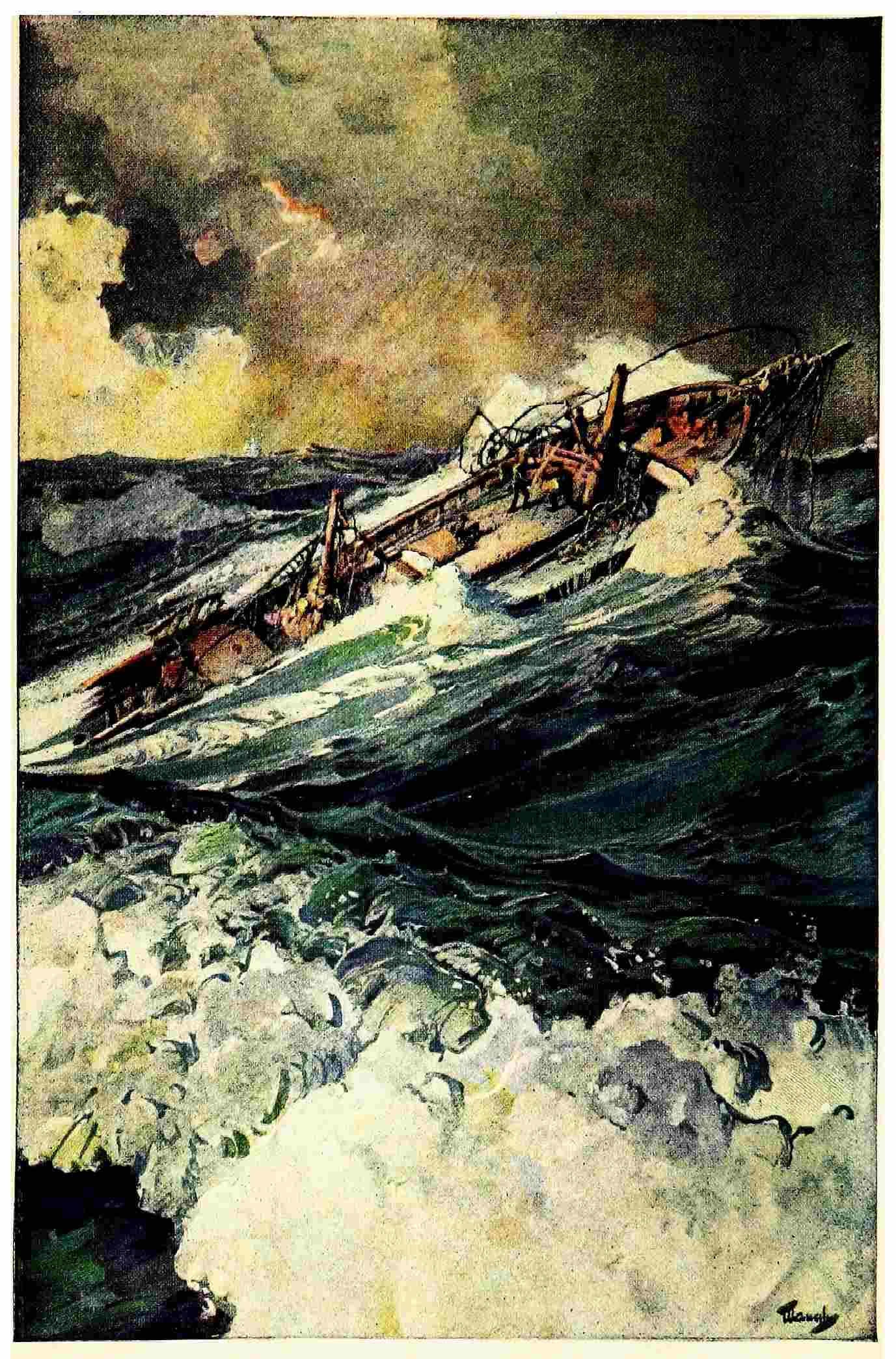
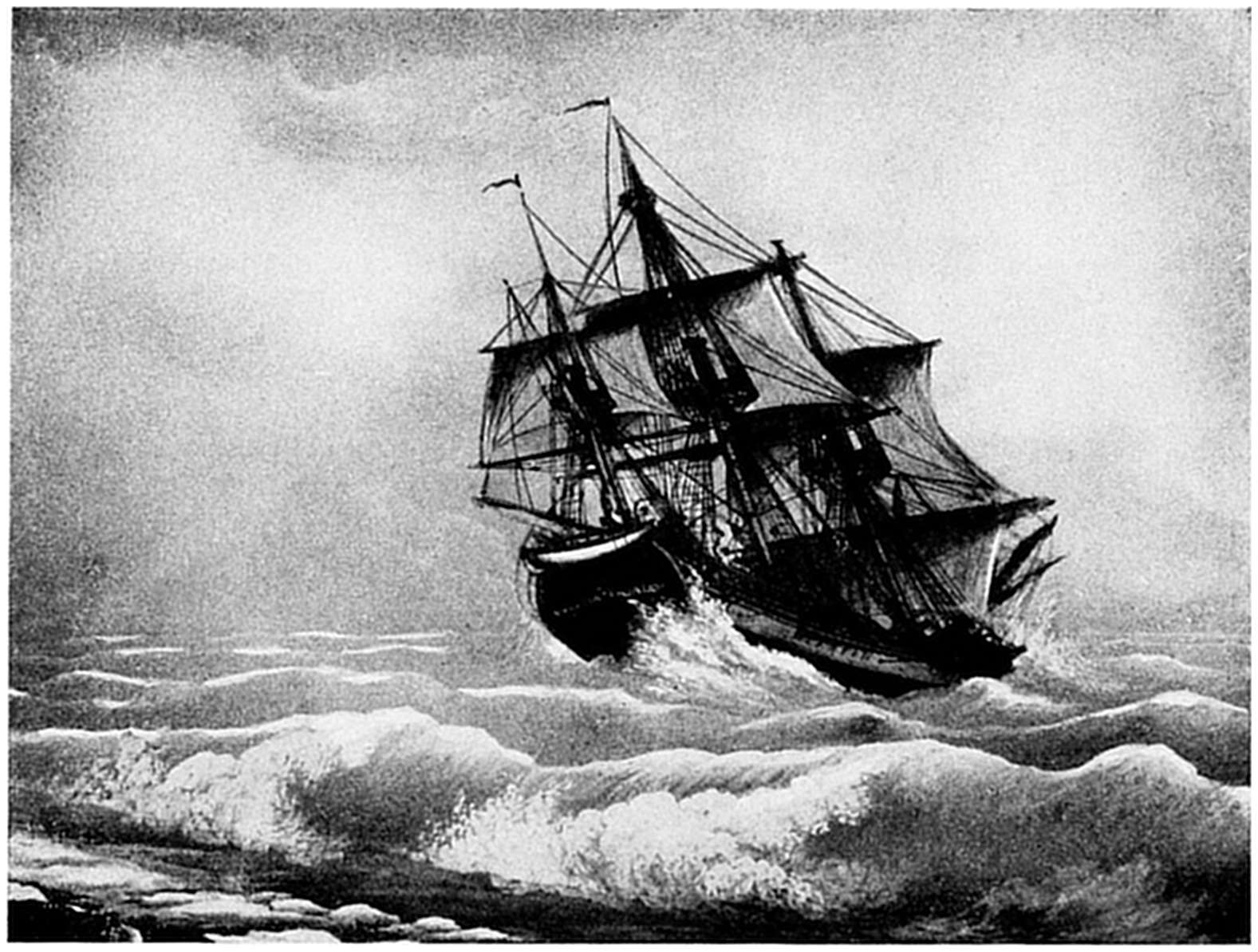
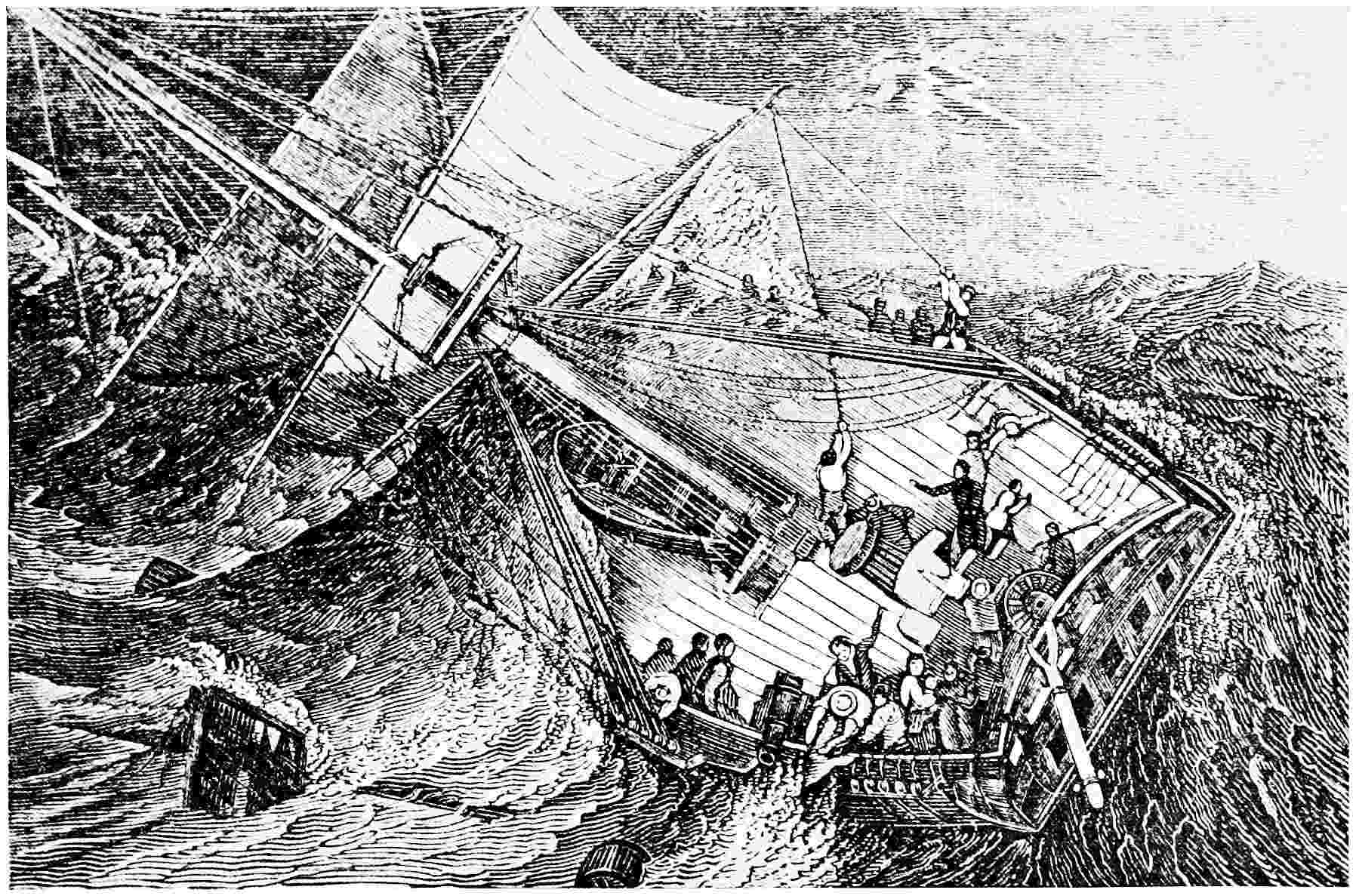
SEAMANSHIP WAS HELPLESS TO WARD OFF THE ATTACK OF THE STORM THAT LEFT
THE BRIG A SODDEN HULK
The storm which overwhelmed the brig Polly
came out of the southeast, when she was less than a
week on the road to Santa Cruz. To be dismasted
and waterlogged was no uncommon fate. It happens
often nowadays, when the little schooners creep
along the coast, from Maine and Nova Scotia ports,
and dare the winter blows to earn their bread.
Men suffer in open boats, as has been the seafarer’s
hard lot for ages, and they drown with none to hear
their cries, but they are seldom adrift more than a
few days. The story of the Polly deserves to be
rescued from oblivion because, so far as I am able to
discover, it is unique in the spray-swept annals of
maritime disaster.
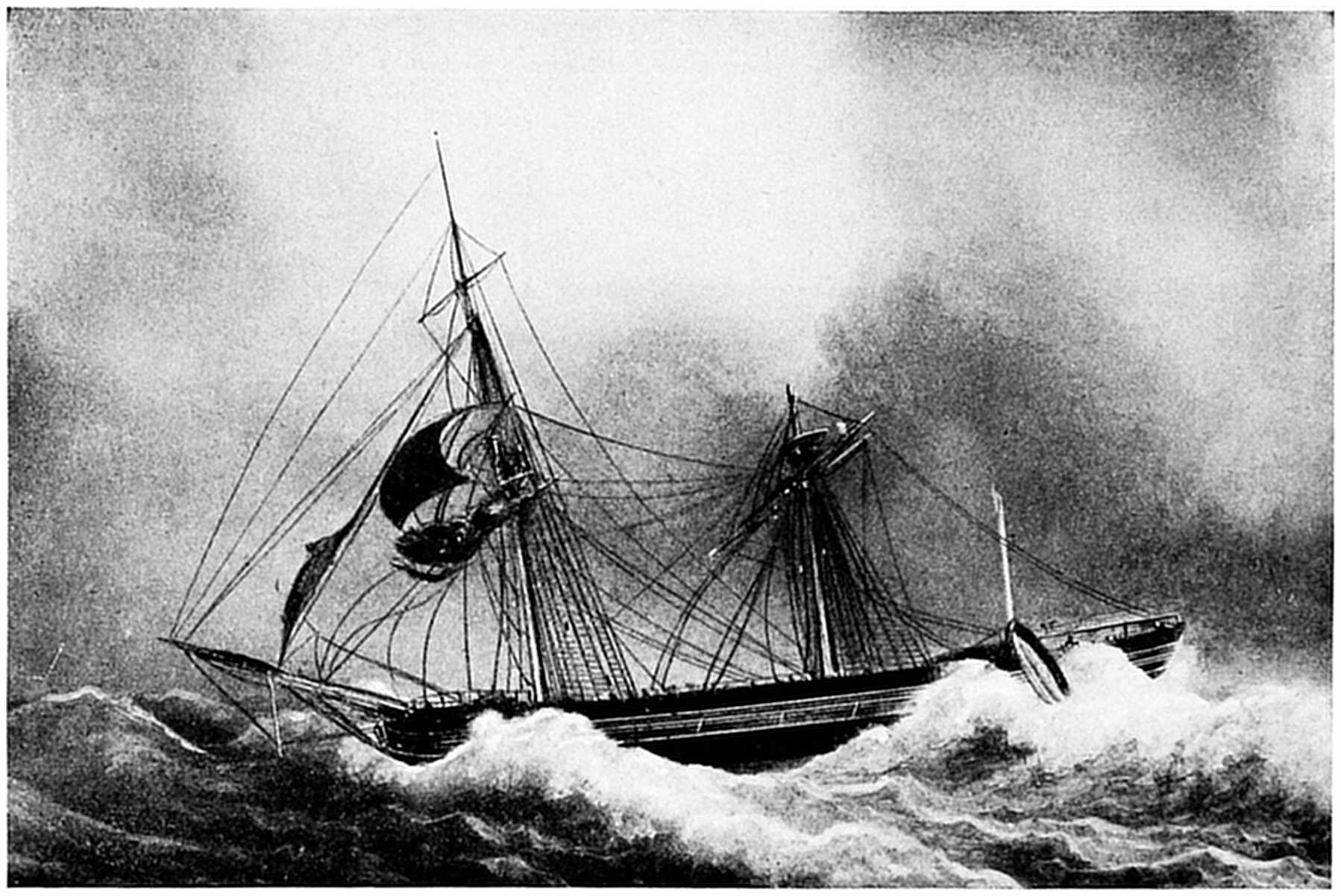
Seamanship was helpless to ward off the attack
of the storm that left the brig a sodden hulk. Courageously
her crew shortened sail and made all secure
when the sea and sky presaged a change of
weather. These were no green hands, but men seasoned
by the continual hazards of their calling.
The wild gale smote them in the darkness of night.
They tried to heave the vessel to, but she was battered
and wrenched without mercy. Stout canvas
was whirled away in fragments. The seams of the
hull opened as she labored, and six feet of water
flooded the hold. Leaking like a sieve, the Polly
would never see port again.
Worse was to befall her. At midnight she was
capsized, or thrown on her beam-ends, as the sailor’s
lingo has it. She lay on her side while the clamorous
seas washed clean over her. The skipper, the
mate, the four seamen, and the cook somehow clung
to the rigging and grimly refused to be drowned.
They were of the old breed, “every hair a rope-yarn
and every finger a fish-hook.” They even managed
to find an ax and grope their way to the shrouds in
the faint hope that the brig might right if the masts
went overside. They hacked away, and came up to
breathe now and then, until foremast and mainmast
fell with a crash, and the wreck rolled level. Then
they slashed with their knives at the tangle of spars
and ropes until they drifted clear. As the waves
rush across a half-tide rock, so they broke over
the shattered brig, but she no longer wallowed on
her side.
At last the stormy daylight broke. The mariners
had survived, and they looked to find their two passengers,
who had no other refuge than the cabin.
Mr. Hunt was gone, blotted out with his affairs and
his ambitions, whatever they were. The colored
child they had vainly tried to find in the night.
When the sea boiled into the cabin and filled it, she
had climbed to the skylight in the roof, and there
she clung like a bat. They hauled her out through
a splintered gap, and sought tenderly to shelter her
in a corner of the streaming deck, but she lived no
more than a few hours. It was better that this bit
of human flotsam should flutter out in this way than
to linger a little longer in this forlorn derelict of a
ship. The Polly could not sink, but she drifted as
a mere bundle of boards with the ocean winds and
currents, while seven men tenaciously fought off
death and prayed for rescue.
The gale blew itself out, the sea rolled blue and
gentle, and the wreck moved out into the Atlantic,
having veered beyond the eastern edge of the Gulf
Stream. There was raw salt pork and beef to eat,
nothing else, barrels of which they fished out of the
cargo. A keg of water which had been lashed to
the quarter-deck was found to contain thirty gallons.
This was all there was to drink, for the other
water-casks had been smashed or carried away.
The diet of meat pickled in brine aggravated the
thirst of these castaways. For twelve days they
chewed on this salty raw stuff, and then the Indian
cook, Moho by name, actually succeeded in kindling
a fire by rubbing two sticks together in some abstruse
manner handed down by his ancestors. By
splitting pine spars and a bit of oaken rail he was
able to find in the heart of them wood which had not
been dampened by the sea, and he sweated and
grunted until the great deed was done. It was a
trick which he was not at all sure of repeating unless
the conditions were singularly favorable. Fortunately
for the hapless crew of the Polly, their
Puritan grandsires had failed in their amiable endeavor
to exterminate the aborigine.
The tiny galley, or “camboose,” as they called it,
was lashed to ring-bolts in the deck, and had not
been washed into the sea when the brig was swept
clean. So now they patched it up and got a blaze
going in the brick oven. The meat could be boiled,
and they ate it without stint, assuming that a hundred
barrels of it remained in the hold. It had not
been discovered that the stern-post of the vessel was
staved in under water and all of the cargo excepting
some of the lumber had floated out.
The cask of water was made to last eighteen days
by serving out a quart a day to each man. Then an
occasional rain-squall saved them for a little longer
from perishing of thirst. At the end of forty days
they had come to the last morsel of salt meat. The
Polly was following an aimless course to the eastward,
drifting slowly under the influence of the
ocean winds and currents. These gave her also a
southerly slant, so that she was caught by that vast
movement of water which is known as the Gulf
Stream Drift. It sets over toward the coast of
Africa and sweeps into the Gulf of Guinea.
The derelict was moving away from the routes of
trade to Europe into the almost trackless spaces beneath
the tropic sun, where the sea glittered empty
to the horizon. There was a remote chance that she
might be descried by a low-hulled slaver crowding
for the West Indies under a mighty press of sail,
with her human freightage jammed between decks
to endure the unspeakable horrors of the Middle
Passage. Although the oceans were populous with
ships a hundred years ago, trade flowed on habitual
routes. Moreover, a wreck might pass unseen two
or three miles away. From the quarter-deck of a
small sailing ship there was no such circle of vision
as extends from the bridge of a steamer forty or
sixty feet above the water, where the officers gaze
through high-powered binoculars.
The crew of the Polly stared at skies which
yielded not the merciful gift of rain. They had
strength to build them a sort of shelter of lumber,
but whenever the weather was rough, they were
drenched by the waves which played over the wreck.
At the end of fifty days of this hardship and
torment the seven were still alive, but then the
mate, Mr. Paddock, languished and died. It
surprised his companions, for, as the old record
runs,
he was a man of robust constitution who had spent his
life in fishing on the Grand Banks, was accustomed to
endure privations, and appeared the most capable of
standing the shocks of misfortune of any of the crew. In
the meridian of life, being about thirty-five years old, it
was reasonable to suppose that, instead of the first, he
would have been the last to fall a sacrifice to hunger and
thirst and exposure, but Heaven ordered it otherwise.
Singularly enough, the next to go was a young
seaman, spare and active, who was also a fisherman
by trade. His name was Howe. He survived six
days longer than the mate, and “likewise died delirious
and in dreadful distress.” Fleeting thunder-showers
had come to save the others, and
they had caught a large shark by means of a running
bowline slipped over his tail while he nosed
about the weedy hull. This they cut up and doled
out for many days. It was certain, however, that
unless they could obtain water to drink they would
soon be all dead men on the Polly.
Captain Cazneau seems to have been a sailor of
extraordinary resource and resolution. His was
the unbreakable will to live and to endure which
kept the vital spark flickering in his shipmates.
Whenever there was strength enough among them,
they groped in the water in the hold and cabin in
the desperate hope of finding something to serve
their needs. In this manner they salvaged an iron
tea-kettle and one of the captain’s flint-lock pistols.
Instead of flinging them away, he sat down to cogitate,
a gaunt, famished wraith of a man who had
kept his wits and knew what to do with them.
At length he took an iron pot from the galley,
turned the tea-kettle upside down on it, and found
that the rims failed to fit together. Undismayed,
the skipper whittled a wooden collar with a seaman’s
sheath-knife, and so joined the pot and the
kettle. With strips of cloth and pitch scraped
from the deck-beams, he was able to make a tight
union where his round wooden frame set into the
flaring rim of the pot. Then he knocked off the
stock of the pistol and had the long barrel to use
for a tube. This he rammed into the nozzle of the
tea-kettle, and calked them as well as he could.
The result was a crude apparatus for distilling seawater,
when placed upon the bricked oven of the
galley.
Imagine those three surviving seamen and the
stolid redskin of a cook watching the skipper while
he methodically tinkered and puttered! It was
absolutely the one and final chance of salvation.
Their lips were black and cracked and swollen, their
tongues lolled, and they could no more than wheeze
when they tried to talk. There was now a less precarious
way of making fire than by rubbing dry
sticks together. This had failed them most of the
time. The captain had saved the flint and steel
from the stock of his pistol. There was tow or
tarry oakum to be shredded fine and used for tinder.
This smoldered and then burst into a tiny blaze
when the sparks flew from the flint, and they knew
that they would not lack the blessed boon of fire.
Together they lifted the precious contrivance of
the pot and the kettle and tottered with it to the galley.
There was an abundance of fuel from the lumber,
which was hauled through a hatch and dried on
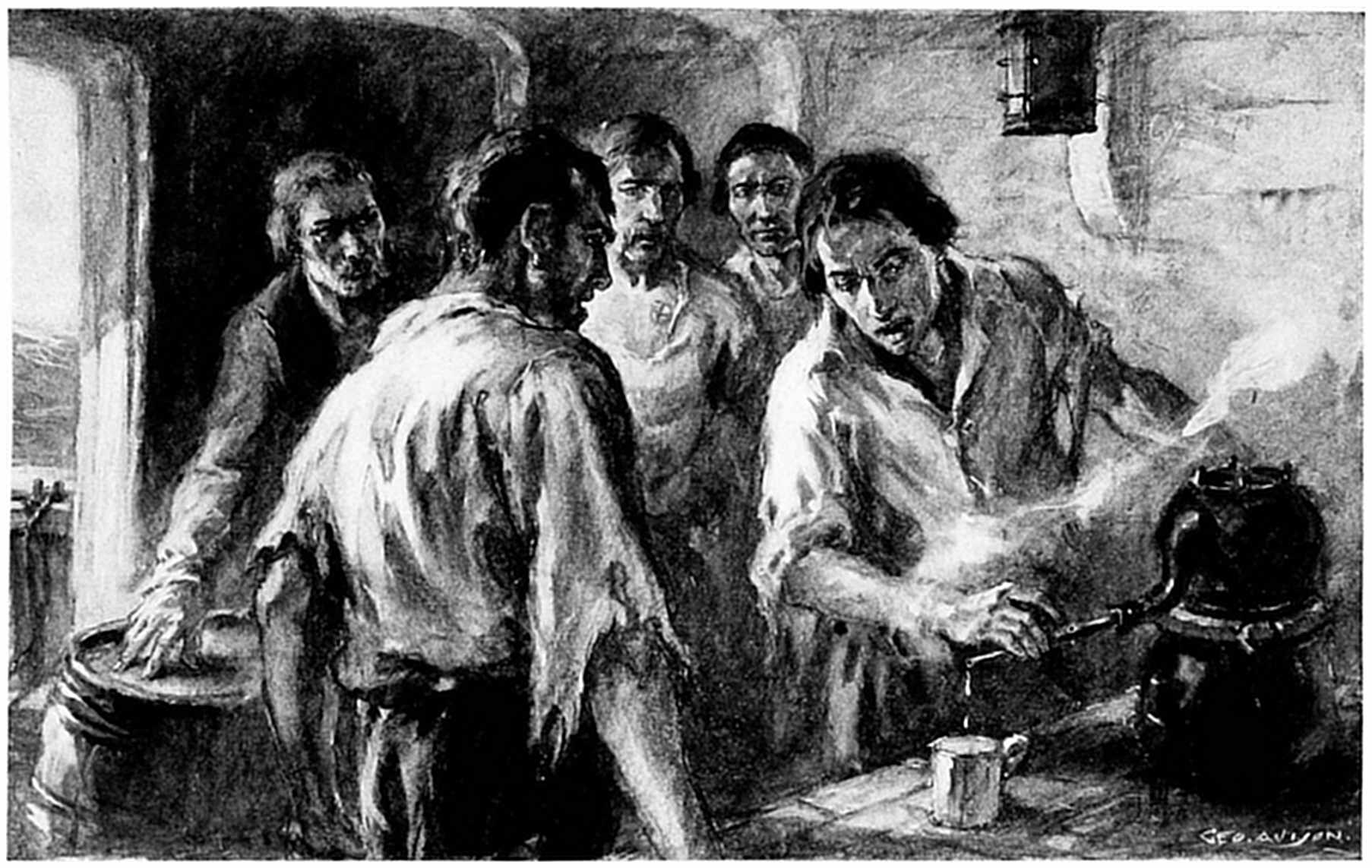
deck. Soon the steam was gushing from the pistol-barrel,
and they poured cool salt water over the upturned
spout of the tea-kettle to cause condensation.
Fresh water trickled from the end of the pistol-barrel,
and they caught it in a tin cup. It was
scarcely more than a drop at a time, but they stoked
the oven and lugged buckets of salt water, watch
and watch, by night and day. They roused in their
sleep to go on with the task with a sort of dumb instinct.
They were like wretched automatons.
So scanty was the allowance of water obtained
that each man was limited to “four small wine
glasses” a day, perhaps a pint. It was enough to
permit them to live and suffer and hope. In the
warm seas which now cradled the Polly the barnacles
grew fast. The captain, the cook, and the
three seamen scraped them off and for some time
had no other food. They ate these shell-fish mostly
raw, because cooking interfered with that tiny
trickle of condensed water.
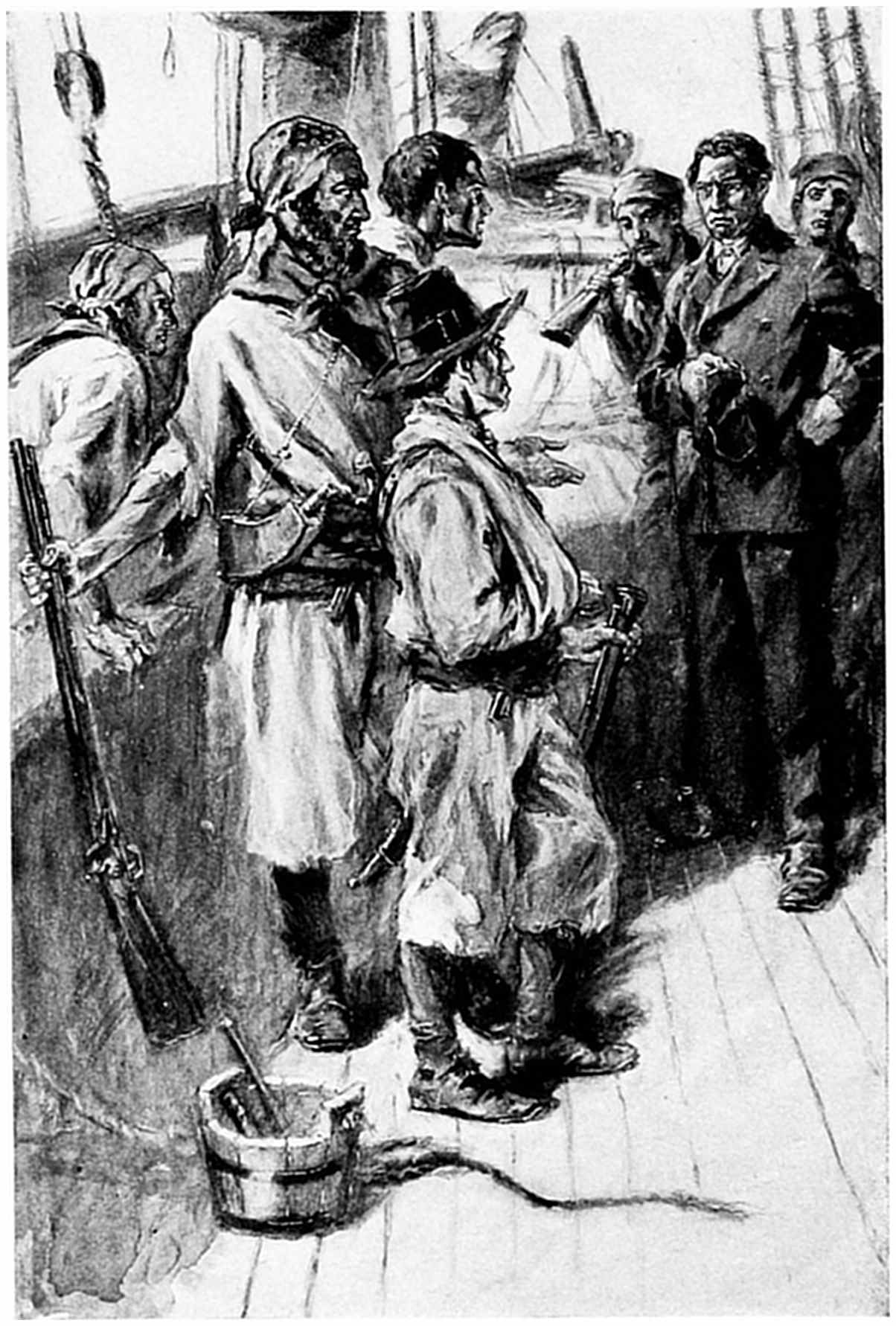
FRESH WATER TRICKLED FROM THE END OF THE PISTOL-BARREL, AND THEY CAUGHT IT IN A TIN CUP
The faithful cook was the next of the five to succumb.
He expired in March, after they had been
three months adrift, and the manner of his death
was quiet and dignified, as befitted one who might
have been a painted warrior in an earlier day. The
account says of him:
On the 15th of March, according to their computation,
poor Moho gave up the ghost, evidently from want
of water, though with much less distress than the others,
and in the full exercise of his reason. He very devoutly
prayed and appeared perfectly resigned to the will of
God who had so sorely afflicted him.
The story of the Polly is unstained by any horrid
episode of cannibalism, which occurs now and then
in the old chronicles of shipwreck. In more than
one seaport the people used to point at some
weather-beaten mariner who was reputed to have
eaten the flesh of a comrade. It made a marked
man of him, he was shunned, and the unholy notoriety
followed him to other ships and ports. The
sailors of the Polly did cut off a leg of the poor, departed
Moho, and used it as bait for sharks, and
they actually caught a huge shark by so doing.
It was soon after this that they found the other
pistol of the pair, and employed the barrel to increase
the capacity of the still. By lengthening the
tube attached to the spout of the tea-kettle, they
gained more cooling surface for condensation, and
the flow of fresh water now amounted to “eight
junk bottles full” every twenty-four hours. Besides
this, wooden gutters were hung at the eaves of
the galley and of the rough shed in which they lived,
and whenever rain fell, it ran into empty casks.
The crew was dwindling fast. In April, another
seaman, Johnson by name, slipped his moorings and
passed on to the haven of Fiddler’s Green, where
the souls of all dead mariners may sip their grog and
spin their yarns and rest from the weariness of the
sea. Three men were left aboard the Polly, the
captain and two sailors.
The brig drifted into that fabled area of the Atlantic
that is known as the Sargasso Sea, which extends
between latitudes 16° and 38° North, between
the Azores and the Antilles. Here the ocean currents
are confused and seem to move in circles, with
a great expanse of stagnant ocean, where the seaweed
floats in tangled patches of red and brown and
green. It was an old legend that ships once caught
in the Sargasso Sea were unable to extricate themselves,
and so rotted miserably and were never
heard of again. Columbus knew better, for his caravels
sailed through these broken carpets of weed,
where the winds were so small and fitful that the
Genoese sailors despaired of reaching anywhere.
The myth persisted and it was not dispelled until
the age of steam. The doldrums of the Sargasso
Sea were the dread of sailing ships.
The days and weeks of blazing calms in this
strange wilderness of ocean mattered not to the
blindly errant wreck of the Polly. She was a dead
ship that had outwitted her destiny. She had no
masts and sails to push her through these acres of
leathery kelp and bright masses of weed which had
drifted from the Gulf and the Caribbean to come to
rest in this solitary, watery waste. And yet to the
captain and his two seamen this dreaded Sargasso
Sea was beneficent. The stagnant weed swarmed
with fish and gaudy crabs and mollusks. Here was
food to be had for the mere harvesting of it. They
hauled masses of weed over the broken bulwarks
and picked off the crabs by hundreds. Fishing
gear was an easy problem for these handy sailormen.
They had found nails enough; hand-forged
and malleable. In the galley they heated and hammered
them to make fish-hooks, and the lines were
of small stuff “unrove” from a length of halyard.
And so they caught fish, and cooked them when the
oven could be spared. Otherwise they ate them
raw, which was not distasteful after they had become
accustomed to it. The natives of the Hawaiian
Islands prefer their fish that way. Besides
this, they split a large number of small fish
and dried them in the hot sun upon the roof of their
shelter. The sea-salt which collected in the bottom
of the still was rubbed into the fish. It was a bitter
condiment, but it helped to preserve them
against spoiling.
The season of spring advanced until the derelict
Polly had been four months afloat and wandering,
and the end of the voyage was a long way off.
The minds and bodies of the castaways had adjusted
themselves to the intolerable situation. The
most amazing aspect of the experience is that these
men remained sane. They must have maintained a
certain order and routine of distilling water, of
catching fish, of keeping track of the indistinguishable
procession of the days and weeks. Captain
Cazneau’s recollection was quite clear when he came
to write down his account of what had happened.
The one notable omission is the death of another
sailor, name unknown, which must have occurred
after April. The only seaman who survived to
keep the skipper company was Samuel Badger.
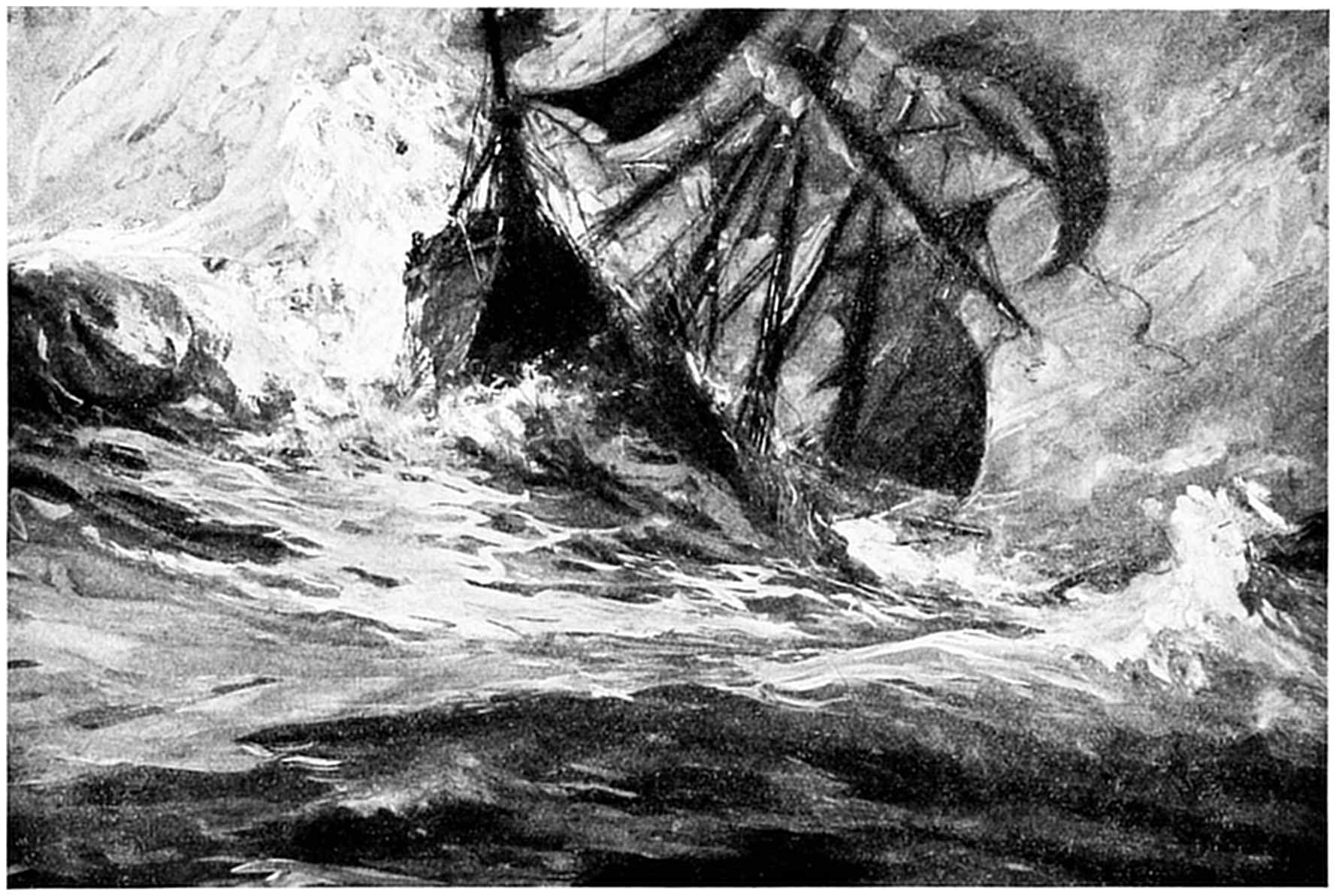
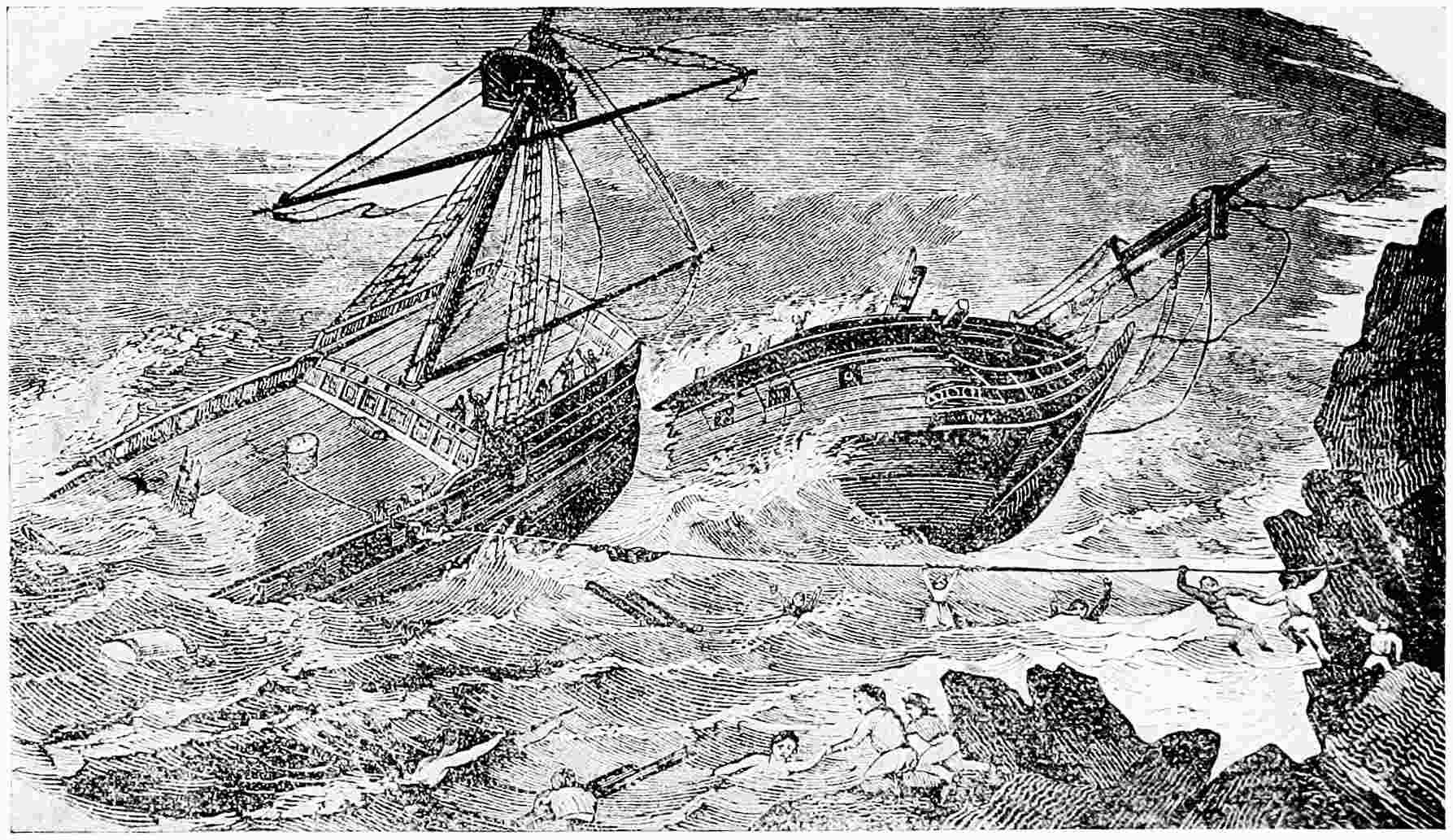
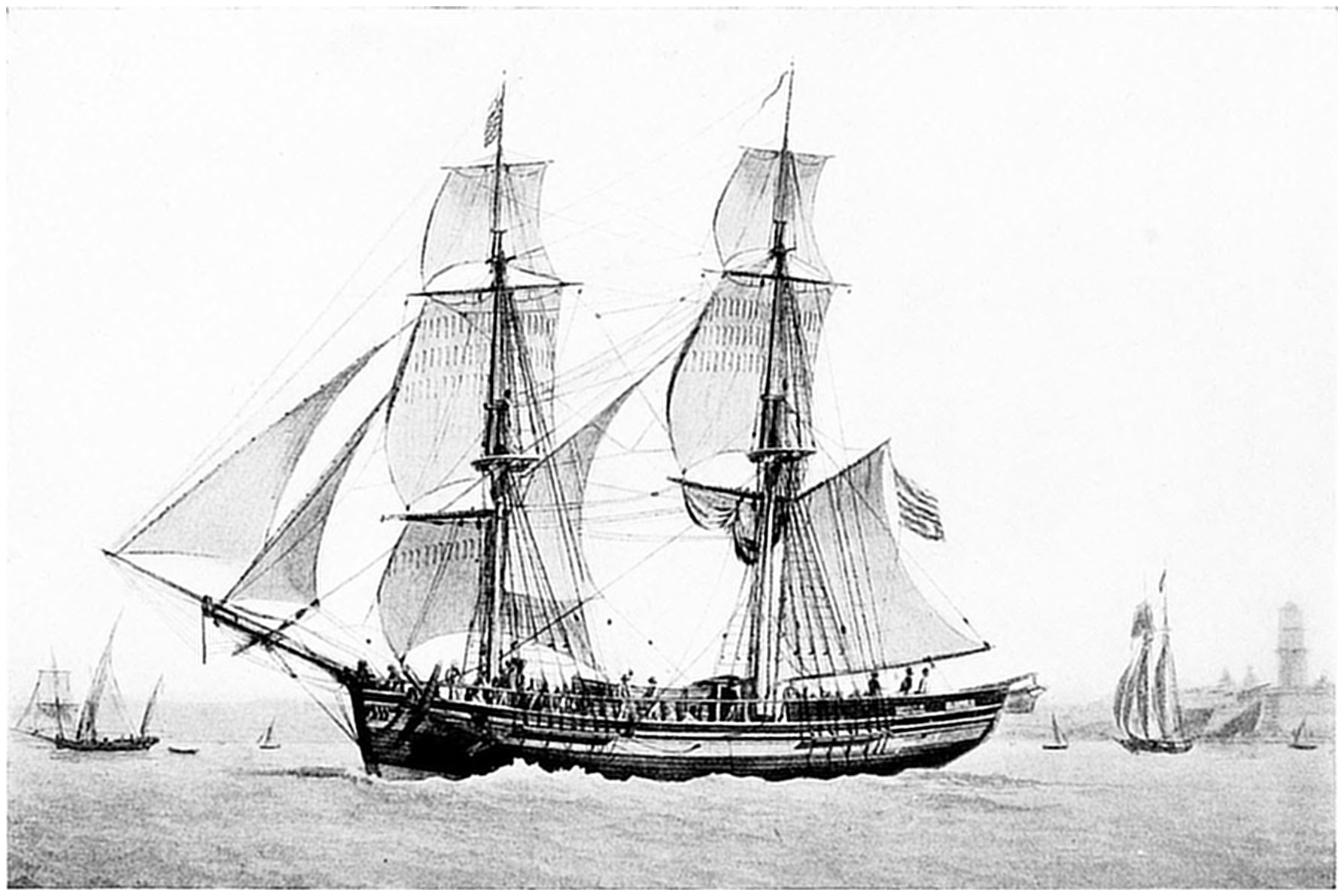
“VOLUSIA” OFF SALEM, BUILT AT FALMOUTH, MASS., IN 1801, AND WRECKED AT CAPE
COD IN 1802
From a painting in Marine Room, Peabody Museum, Salem
By way of making the best of it, these two indomitable
seafarers continued to work on their
rough deck-house, “which by constant improvement
had become much more commodious.” A few
bundles of hewn shingles were discovered in the
hold, and a keg of nails was found lodged in a
corner of the forecastle. The shelter was finally
made tight and weather-proof, but, alas! there was
no need of having it “more commodious.” It is obvious,
also, that “when reduced to two only, they had
a better supply of water.” How long they remained
in the Sargasso Sea it is impossible to ascertain.
Late in April it is recounted that “no
friendly breeze wafted to their side the seaweed
from which they could obtain crabs or insects.”
The mysterious impulse of the currents plucked at
the keel of the Polly and drew her clear of this region
of calms and of ancient, fantastic sea-tales.
She moved in the open Atlantic again, without
guidance or destination, and yet she seemed inexplicably
to be following an appointed course, as
though fate decreed that she should find rescue
waiting somewhere beyond the horizon.
The brig was drifting toward an ocean more frequented,
where the Yankee ships bound out to the
River Plate sailed in a long slant far over to the
African coast to take advantage of the booming
trade-winds. She was also wallowing in the direction
of the route of the East Indiamen, which departed
from English ports to make the far-distant
voyage around the Cape of Good Hope. None of
them sighted the speck of a derelict, which floated
almost level with the sea and had no spars to make
her visible. Captain Cazneau and his companion
saw sails glimmer against the sky-line during the
last thousand miles of drift, but they vanished like
bits of cloud, and none passed near enough to bring
salvation.
June found the Polly approaching the Canary
Islands. The distance of her journey had been
about two thousand miles, which would make the
average rate of drift something more than three
hundred miles a month, or ten miles per day. The
season of spring and its apple blossoms had come
and gone in New England, and the brig had long
since been mourned as missing with all hands. It
was on the twentieth of June that the skipper and
his companion—two hairy, ragged apparitions—saw
three ships which appeared to be heading in their
direction. This was in latitude 28° North and longitude
13° West, and if you will look at a chart you
will note that the wreck would soon have stranded
on the coast of Africa. The three ships, in company,
bore straight down at the pitiful little brig,
which trailed fathoms of sea-growth along her hull.
She must have seemed uncanny to those who beheld
her and wondered at the living figures that moved
upon the weather-scarred deck. She might have
inspired “The Ancient Mariner.”
Not one ship, but three, came bowling down to
hail the derelict. They manned the braces and
swung the main-yards aback, beautiful, tall ships
and smartly handled, and presently they lay hove
to. The captain of the nearest one shouted a hail
through his brass trumpet, but the skipper of the
Polly had no voice to answer back. He sat weeping
upon the coaming of a hatch. Although not
given to emotion, he would have told you that it had
been a hard voyage. A boat was dropped from the
davits of this nearest ship, which flew the red ensign
from her spanker-gaff. A few minutes later Captain
Cazneau and Samuel Badger, able seaman,
were alongside the good ship Fame of Hull, Captain
Featherstone, and lusty arms pulled them up the
ladder. It was six months to a day since the Polly
had been thrown on her beam-ends and dismasted.
The three ships had been near together in light
winds for several days, it seemed, and it occurred to
their captains to dine together on board the Fame.
And so the three skippers were there to give the
survivors of the Polly a welcome and to marvel at
the yarn they spun. The Fame was homeward
bound from Rio Janeiro. It is pleasant to learn
that Captain Cazneau and Samuel Badger “were
received by these humane Englishmen with expressions
of the most exalted sensibility.” The musty
old narrative concludes:
Thus was ended the most shocking catastrophe which
our seafaring history has recorded for many years, after
a series of distresses from December 20 to the 20th of
June, a period of one hundred and ninety-two days.
Every attention was paid to the sufferers that generosity
warmed with pity and fellow-feeling could dictate, on
board the Fame. They were transferred from this ship
to the brig Dromio and arrived in the United States in
safety.
Here the curtain falls. I for one should like to
hear more incidents of this astonishing cruise of the
derelict Polly and also to know what happened to
Captain Cazneau and Samuel Badger after they
reached the port of Boston. Probably they went
to sea again, and more than likely in a privateer to
harry British merchantmen, for the recruiting officer
was beating them up to the rendezvous with fife and
drum, and in August of 1812 the frigate Constitution,
with ruddy Captain Isaac Hull walking the
poop in a gold-laced coat, was pounding the
Guerrière to pieces in thirty minutes, with broadsides
whose thunder echoed round the world.
“Ships are all right. It is the men in them,” said
one of Joseph Conrad’s wise old mariners. This
was supremely true of the little brig that endured
and suffered so much, and among the humble heroes
of blue water by no means the least worthy to be
remembered are Captain Cazneau and Samuel
Badger, able seaman, and Moho, the Indian cook.
CHAPTER II HOW THE SCHOONER EXERTION FELL AMONG THIEVES
This is the story of a very shabby set of rascals
who wrecked and plundered an honest little
merchant vessel a hundred years ago and disgraced
the profession of piracy. In truth, even in the heyday
of the black flag and the Spanish Main, most
pirates were no better than salt-water burglars
who would rather run than fight. The glamour
of romance has been kinder to them than they deserved.
Their vocation had fallen to a low ebb
indeed in the early part of the nineteenth century,
when they still infested the storied waters of the
Caribbean and struggled along, in some instances,
on earnings no larger than those of a minister or
school-teacher of to-day. Ambitious young men
had ceased to follow piracy as a career. The distinguished
leaders had long since vanished, most
of them properly hanged in chains, and it was no
longer possible to become a William Kidd, a Captain
Ned England, or a Charles Vane.
The schooner Exertion, Captain Barnabas Lincoln,
sailed from Boston, bound to Trinidad, Cuba,
on November 13, 1821, with a crew consisting of
Joshua Brackett, mate; David Warren, cook; and
Thomas Young, George Reed, and Francis De
Suze as able seamen. There was nothing in the
cargo to tempt a self-respecting pirate; no pieces of
eight or doubloons or jewels, but flour, beef, pork,
lard, butter, fish, onions, potatoes, apples, hams,
furniture, and shooks with a total invoiced value of
eight thousand dollars. In this doleful modern era
of the high cost of living, such a cargo would, of
course persuade almost any honest householder to
turn pirate if he thought there was a fighting
chance of stowing all these valuables in his cellar.
The Exertion jogged along without incident for
a five weeks’ passage, which brought her close to
Cape Cruz and the end of the run, when a strange
sail swept out of a channel among the sandy Cuban
keys, with sweeps out and a deck filled with men.
There were forty of them, unkempt, bewhiskered,
and they appeared to be so many walking arsenals
of muskets, blunderbusses, cutlasses, pistols, and
dirks. Their schooner mounted two carronades,
and flew a blue-and-white flag of the Republic of
Mexico, which was a device popular among sea-rovers
who were no better than they should be.
It permitted liberty of action, something like a New
Jersey charter which corporations have found elastic
in times more recent.
Captain Lincoln hove the Exertion to and hoped
for the best, having only five men and seven muskets
with which to repel boarders. The United States
was at peace with Mexico and Spain, and he tried
to believe, as he tells us, that “the republican flag
indicated both honor and friendship from those who
wore it.” Alas! it was soon discovered that these
were common pirates, for they sent a boat aboard
in charge of the first lieutenant, Bolidar, with six or
eight Spaniards, “armed with as many of the aforementioned
weapons as they could well sling about
their bodies.” The Exertion was ordered to follow
the other schooner, the Mexican by name, and the
two vessels came to anchor off Cay Largo, about
thirty leagues from Trinidad.
There one of the pirates, the sailing-master, who
called himself Nikola, remained in the Exertion to
examine the captain’s papers. This forbidding
person was, in fact, a Scotchman, as his speech readily
disclosed, and he was curiously out of place
among the dirty crew of Spanish renegades. In
him the unlucky skipper of the Exertion had found
a friend, of whom he said:
This Nikola had a countenance rather pleasing, although
his beard and mustachios had a frightful appearance,—his
face, apparently full of anxiety, indicated
something in my favor. He gave me back my papers, saying,
“Take good care of them, for I am afraid you have
fallen into bad hands.”
The pirates then sent a boat to the Exertion with
more men and arms, leaving a heavy guard on board
and taking Captain Lincoln and his Yankee seamen
off to their own low, rakish craft, where they served
out the rum and vainly tried to persuade them to
enlist, with promise of dazzling booty. Captain
Lincoln was not at all attracted by this business
opportunity, and sadly he returned to his schooner,
where he found Lieutenant Bolidar in the cabin and
the place in a sorry mess. It is well known that,
whatever their other virtues, pirates as a class had
no manners. With a few exceptions the best of
them lived like pigs and behaved like hooligans.
The captain’s narrative declares:
They had emptied a case of liquors, and broken a cheese
to pieces and crumbled it on the table and the cabin floor
and, elated with their prize as they called it, they had
drunk so much as to make them desperately abusive. I
was permitted to lie down in my berth but, reader, if you
have ever been awakened by a gang of armed desperadoes
who have taken possession of your habitation in the midnight
hour, you can imagine my feelings. Sleep was a
stranger to me and anxiety was my guest. Bolidar, however,
pretended friendship and flattered me with the prospect
of being set at liberty, but I found him, as I suspected,
a consummate hypocrite. Indeed, his very looks
indicated it.
He was a stout and well-built man, of a dark swarthy
complexion, with keen, ferocious eyes, huge whiskers and
beard under his chin and on his lips. He was a Portuguese
by birth but had become a naturalized Frenchman,—had
a wife and children in France and was well-known
there as commander of a first-rate privateer. His
appearance was truly terrific. He could talk some English
and had a most lion-like voice.
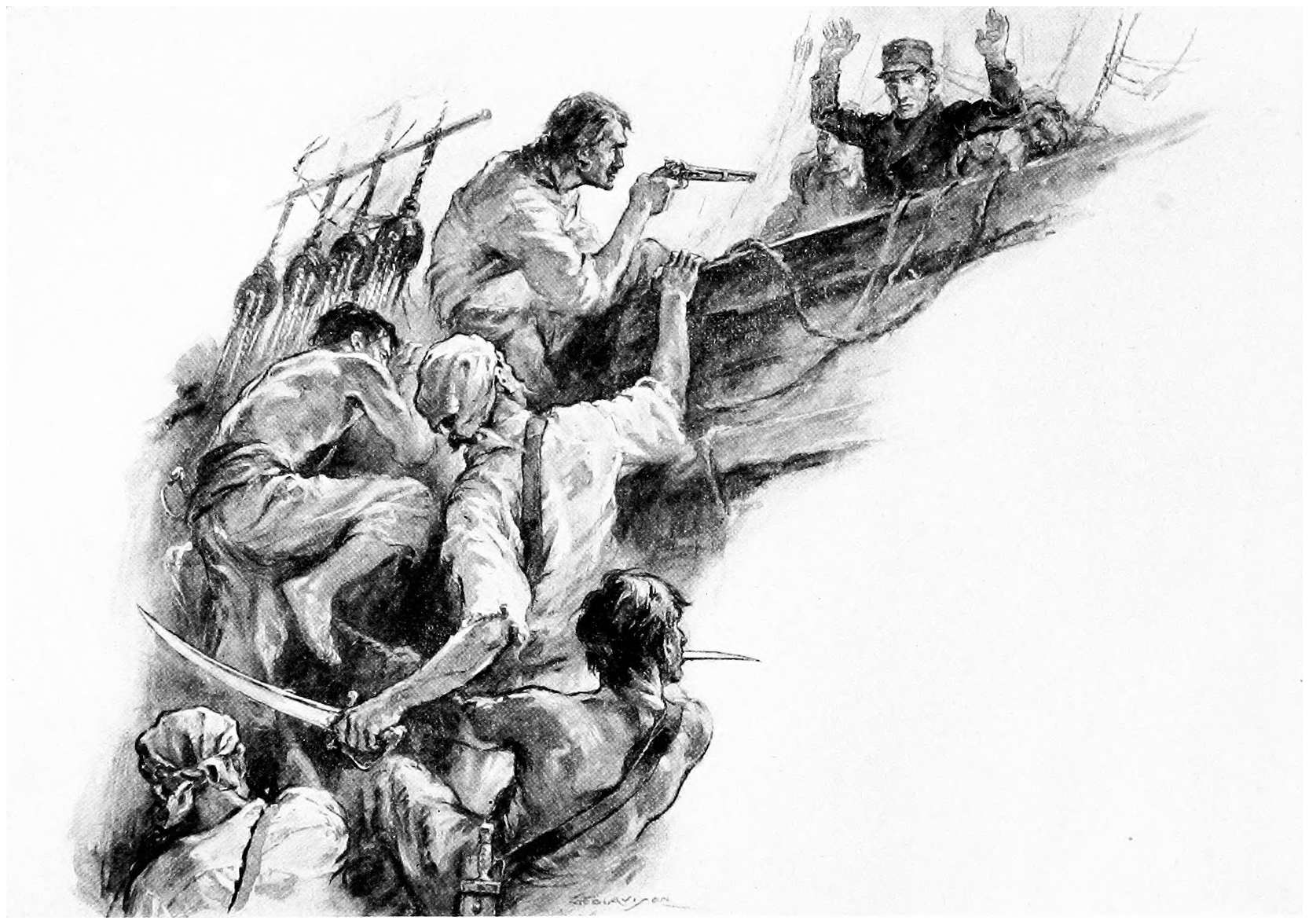
THE PIRATE CAPTAIN BOARDING THE CAPTURED “EXERTION”
Next day the scurvy knaves began plundering the
Exertion of her cargo of potatoes, butter, apples,
beans, and so on, ripped up the floors in search of
more liquor, found some hard cider, and guzzled it
until officers and men were in a fight, all tipsy
together, and then simmered down to sing sentimental
ditties in the twilight. Soon after this both
schooners got under way and sailed to another
haven in the lee of Brigantine Cay. Captain Lincoln
now saw something more of the roving scapegrace
of a Scotchman who called himself Nikola.
He was a pirate with a sentimental streak in
him and professed himself to be unhappy in his
lawless employment and declared he had signed
articles in the belief that he was bound privateering.
A theatrical person was the bewhiskered Nikola,
who properly belonged to fiction of the romantic
school. Sympathetic Captain Lincoln wrote that
he
lamented most deeply his own situation, for he was one of
those men whose early good impressions were not entirely
effaced. He told me that those who had taken me were
no better than pirates and their end would be the halter,
but he added, with peculiar emotion, “I will never be
hung as a pirate,” showing me a bottle of laudanum which
he had found in my medicine chest and saying, “If we are
overtaken, this shall cheat the hangman before we are
condemned.”
Another day’s cruise to the eastward and the
trim, taut little Exertion suffered the melancholy
fate of shipwreck, not bravely in a gale, but mishandled
and wantonly gutted by her captors.
First she stranded on a bar while making in for a
secluded creek, and was floated after throwing overboard
the deck-load of shooks for making sugar-barrels.
Then her sails were stripped, the rigging
cut to pieces, and the masts chopped over the side
lest they be sighted from seaward. After that the
pirates hewed gaps in the deck and bulwarks in
order to loot the rest of the cargo more easily, and
the staunch schooner was left to bleach her bones on
the Cuban coast.
The amiable Nikola found himself in trouble because
of his friendly feeling for Captain Lincoln.
The Spanish sailors tied him to a tree and were
about to shoot him as a soft-hearted traitor who was
guilty of unprofessional conduct, but a courageous
French pirate surged into the picture with several
men of his own opinion, and remarked that when
the shooting began there would be other targets
besides Nikola. This convinced the mob that it
might be healthier to let the Scotchman alone.
The captain and crew of the Exertion were
threatened and ill used, but there seemed to be no
intention of making them walk the plank or hewing
them down with cutlasses. What to do with them
was a problem rather perplexing, which was proof
that the trade of piracy had fallen from its former
estate. These were thrifty freebooters, however,
and the business was capably organized. There
were even traces of the efficiency management which
was to become the religion of the twentieth century.
The pirates’ largest boat was manned by a crew
which discarded some of its weapons, combed its
whiskers, even washed its faces, and set off for the
port of Principe in charge of the terrifying Bolidar.
The boat carried letters to a merchant by the
name of Dominico who acted as the commercial
agent of the industrious pirates and sold their plunder
for them. A representative of his was kept on
board the wicked schooner and went to sea with
her, presumably to make sure of honest dealings, a
sensible precaution in the case of such slippery
gentry. The whole arrangement was most reprehensible,
of course, but it had flourished on a much
larger scale in the godly ports of Boston and New
York during an earlier era.
It was to put a stop to such scandalous traffic
that Richard Coote, Earl of Bellomont, had been
sent out by King William III in 1695 as royal
governor of the colonies of New York and Massachusetts.
Colonial merchants, outwardly the pattern
of respectability, were in secret partnership
with the swarm of pirates which infested the American
coast and waxed rich on the English commerce
of the Indian Ocean.
“I send you, my Lord, to New York,” said King
William to Bellomont, “because an honest and intrepid
man is wanted to put these abuses down, and
because I believe you to be such a man.”
As a result of these instructions, Captain William
Kidd was employed to hunt the pirates down by sea
while Governor Bellomont made it hot for the unscrupulous
merchants ashore who were, no doubt,
the ancestors of the modern American profiteers in
food and clothing, who are also most respectable
men. Captain Kidd was a merchant shipmaster of
brave and honorable repute who had a comfortable
home in Liberty Street, New York, was married to
a widow of good family, and was highly esteemed by
the Dutch and English people of the town. A
shrewd trader who made money for his owners, he
was also a fighting seaman of such proved mettle
that he had been given command of privateers
which cruised off the coasts of the colonies and harried
the French in the West Indies. His excellent
reputation and character are attested by official
documents.
ARMED WITH AS MANY OF THE AFOREMENTIONED WEAPONS AS THEY COULD WELL SLING
ABOUT THEIR BODIES
How Captain Kidd, sent out to catch pirates, was
convicted of turning pirate himself rather than sail
home empty-handed is another story. Fate has
played strange tricks with the memory of this seventeenth-century
seafarer who never cut a throat or
scuttled a ship, and who was hanged at Execution
Dock for the excessively unromantic crime of
cracking the skull of his mutinous gunner with a
wooden bucket.
Poor Captain Barnabas Lincoln of Boston, having
lost his schooner and cargo, was righteously indignant
at discovering how the infamous business
was carried on. Said he:
I was informed by a line from Nikola that the pirates
had a man on board, a native of Principe, who in the garb
of a sailor was a partner with Dominico, but I could not
get sight of him. This lets us a little into the plan by
which this atrocious system has been conducted. Merchants
having partners on board of these pirates! Thus
pirates at sea and robbers on land are associated to destroy
the peaceful trader.
Nikola remained true to Captain Lincoln, even
sending him a letter from Principe to tell him about
the disposition of the stolen cargo and what prices
it was fetching. In this letter he revealed the fact
that his true name was Jamieson and concluded with
this romantic flight:
Perhaps in your old age, when you recline with ease in
a corner of your cottage, you will have the goodness to
drop a tear of pleasure to the memory of him whose
highest ambition should have been to subscribe himself,
though devoted to the gallows, your friend,
Nikola Monacre.
Another streak of sentiment was discovered in
one of the Exertion’s sailors, Francis De Suze, a
Portuguese, who finally weakened and decided to
join the outlaws. He was won over by the artful
persuasions of his fellow-countryman, Lieutenant
Bolidar of the ferocious mien and lion-like voice.
To Captain Lincoln he explained, with tears in his
eyes:
“I shall do nothing but what I am compelled to do and
will not aid in the least to hurt you or your vessel. I am
very sorry to leave you.”
The pious master of the Exertion bore up under
his troubles with a spirit truly admirable, but it was
one thing after another, and under date of Sunday,
December 30, he wrote in his diary:
This day, which particularly reminds Christians of the
high duties of compassion and benevolence, is never observed
by these pirates. This, of course, we might expect,
as they do not often know when Sunday comes and if
they do, it is spent in gambling. Early this morning, the
merchant, as they call him, came with a large boat for
more cargo. I was ordered into a boat with my crew,
without any breakfast, and carried about three miles to a
small island out of sight of the Exertion and left there by
the side of a pond of thick, muddy water with nothing to
eat but a few biscuits. One of the boat’s crew told us that
the merchant was afraid of being recognized, and when
he had gone the boat would return for us, but we passed
the day in the greatest anxiety. At night, however, the
boat came and took us again on board the Exertion where
to our surprise and grief we found they had broken open
the trunks and chests and taken all our wearing apparel,
not leaving me even a shirt or a pair of pantaloons, nor
sparing a small miniature of my wife which was in the
trunk.
The pirate schooner was employed a few days
later to fill her hold with cargo from the Exertion
and hoist sail for Principe. They lifted the stuff
out with a “Yo, ho, ho!” which made Captain Lincoln
so unhappy that he pensively wrote:
How different was this sound from what it would have
been had I been permitted to pass unmolested by these lawless
plunderers and been favored with a safe arrival at
the port of my destination where my cargo would have
found an excellent sale. Then would the “yo, ho, ho!” on
its discharging have been a delightful sound to me.
As a final touch to affect the modern reader with
a sense of comedy and the captain with additional
woe, the pirates fished out the Exertion’s consignments
of furniture and, for lack of space below,
sailed off with chairs lashed to the rail in rows and
tables hung in the rigging. There now appears the
figure of the pirate commander himself, for Bolidar
was merely the lieutenant, or executive officer. To
Captain Lincoln, gloomily watching the pirate
schooner in the offing, with her picturesque garniture
of hand-made New England furniture, came
Bolidar with five men, his own personal armament
consisting of a blunderbuss, cutlass, a long knife,
and a pair of pistols. This fearsome lieutenant
took Captain Lincoln by the arm, led him aside, and
imparted:
“My capitan sends me for your wash.”
Properly resentful, the master of the Exertion
replied:
“Damn your eyes! I have no clothes, nor any soap
to wash with. You have stolen them all.”
“Ah, ha, but I will have your wash, pronto!”
cried Bolidar, waving the blunderbuss. “What
you call him that makes tick-tock, same as the
clock?”
Disgustedly Captain Lincoln extracted his watch
from the place where he had hidden it. The cloud
had a silver lining, for Bolidar graciously handed
over a small bundle at parting.
It contained a pair of linen drawers sent me by Nikola,
also the Rev. Mr. Brooks’ Family Prayer Book. This
gave me great satisfaction. Soon after, Bolidar returned
with his captain who had one arm slung up, yet with as
many implements of war as his diminutive self could conveniently
carry. He told me (through an interpreter who
was his prisoner) that on his last cruise he had fallen in
with two Spanish privateers and beat them off, but had
fourteen of his men killed and was himself wounded in the
arm. Bolidar turned to me and said, “It is a d—n lie,”
which words proved to be correct for his arm was not
wounded and when I saw him again he had forgotten to
sling it up.
An accurate and convincing portrait, this, and
painted with very few strokes—the strutting little
braggart of a pirate chief who resorted to such
cheap and stagy tricks as bandaging his arm to
make an impression! Having disposed of the
cargo, it now transpired that the prisoners were to
be marooned and left to perish. After all, the traditions
of piracy had not been wholly lost and these
sordid rascals were running true to form. With an
inkling of this fate, Mr. Joshua Brackett, the mate
of the Exertion, was heard to say:
“I cannot tell what awaits us, but it appears to
me that the worst is to come.”
This is how Captain Lincoln quoted it in his
diary, but the mate of the schooner, sorely tried as
he must have been, was more likely to exclaim:
“I can’t fathom all their —— —— tricks, but it
looks to me as if the bloody rogues had made up
their minds to scupper us, and may they sizzle in
hell for a million years!”
The pirate chief and his officers held a whispered
conference and then spent the last night ashore in
gambling, the diminutive leader “in hopes of getting
back some of the five hundred dollars he had lost a
few nights before; which made him unusually
fractious.”
Before they were marooned, Captain Lincoln
took pains to note down that the pirates were sporting
new canvas trousers made from the light sails of
the Exertion and that they had cut up the colors
to make fancy belts to keep their money in, and he
added this vivid little touch to the portrait of the
chief, “The captain had on one of my best shirts, a
cleaner one than I had ever seen him wear before.”
At sunset the crew of the Exertion, with several
prisoners taken out of a Spanish merchant prize,
were put into a boat. At this lamentable moment,
Nikola stepped to the front again and said to Captain
Lincoln:
“My friend, I will give you your book,” (a volume
of Rev. Mr. Coleman’s sermons). “It is the
only thing of yours that is in my possession. I
dare not attempt anything more. Never mind, I
may see you again before I die.”
There were eleven prisoners in all, without arms,
and to sustain life only a ten-gallon keg of water,
part of a barrel of flour, one ham, and a little salt
fish, not forgetting the precious volume of Mr.
Coleman’s sermons. They were carried to a tiny
key, or islet, no more than a shoal of white sand an
acre in extent and barely lifted above high tide,
forty miles off the Cuban coast and well out of the
track of vessels. No wonder that Captain Lincoln
was moved to ejaculate:
“Look at us now, my friends, left benighted on a little
spot of sand in the midst of the ocean, with every appearance
of a violent thunder tempest and a boisterous night.
Judge of my feelings and the circumstances which our
band of sufferers now witnessed. Perhaps you can, and
have pitied us. I assure you we were very wretched,
and to depict the scene is beyond my power.”
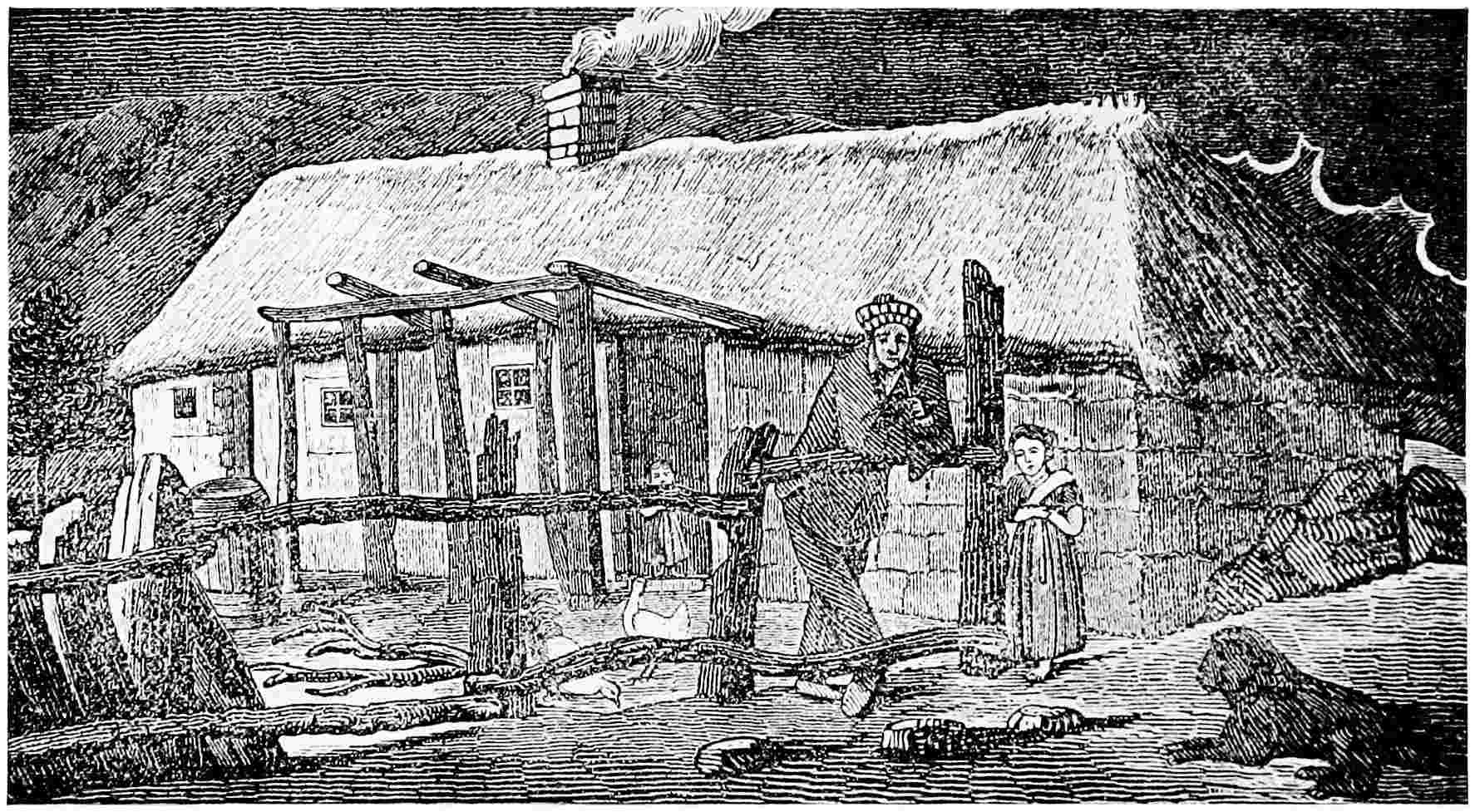
They found a fragment of a thatched hut built
by turtle fishermen, but now whipped bare by the
winds, and it served as a slight shelter from the
burning sun. Fire they kindled by means of a
piece of cotton-wick yarn and a flint and steel.
They dug holes for fresh water, but it was too salty
to drink. At bedtime the captain read aloud selections
from the Rev. Mr. Brooks’s Family Prayer-Book,
and they slept in the sand when the scorpions,
centipedes, lizards, and mosquitoes permitted.
Of driftwood, palmetto logs, and bits of board
they fashioned a little raft and so explored the key
nearest them. There they discovered some shooks,
planks, and pieces of spar which had been in the
Exertion’s deck-load and were thrown overboard
when she grounded on the bar. With the amazing
handiness of good seamen they proceeded to build a
boat of this pitiful material. “Some of the Spaniards
had secreted their long knives in their trouserlegs,
which proved very useful in fitting timbers,
and a gimblet of mine enabled us to use wooden
pins,” explains Captain Lincoln. “And now our
spirits began to revive, although water, water was
continually in our minds. Our labor was extremely
burdensome, and the Spaniards considerably peevish,
but they would often say to me, ‘Never mind,
Captain, bye-and-bye Americans or Spanish catch
’em and we go see ’em hung.’”
David Warren, the cook of the Exertion, had
been ailing, and the cruel ordeal of being marooned
was too much for him. The captain perceived that
he was soon to leave them and suggested, as they
sat by the fire:
“I think it most likely that we shall die here soon,
David, but as some one of us may survive to carry
the tidings to our friends, if you have anything to
say respecting your family, now is the time.”
The young sailor—he was only twenty-six—replied
to this: “I have a mother in Saco where I
belong—she is a second time a widow. To-morrow,
if you can spare a scrap of paper and a pencil, I
will write something.”
No to-morrow came to him. He passed out in
the night, and the skipper thought of his own wife
and children in Boston. They dug a grave in the
sand, made a coffin of shooks, and stood with bare
heads while Captain Lincoln read the funeral
prayer from the consolatory compilation of the Rev.
Mr. Brooks. One of the Spanish prisoners, an old
man named Manuel, made a wooden cross, and with
great pains carved upon it the words, “Jesus Christ
Hath Him Now,” and placed it at the head of the
grave. There was the old Puritan strain in Captain
Lincoln, who commented, “Although I did not
believe in the mysterious influence of the cross, yet
I was perfectly willing it should stand there.”
Enfeebled and lacking food and water, they stubbornly
toiled at building the boat, which was shaped
like a flat-iron. When at length they launched the
wretched little box, it leaked like a basket, and, to
their dismay, would hold no more than six of them
and stay afloat, four to row, one to steer, and one to
bail. Three Spaniards and a Frenchman argued
that they should go in search of help because they
were acquainted with the lay of the coast and could
talk to the people. This was agreed to, and Mr.
Brackett, the mate, was also selected to go, because
the captain considered it his duty to stay with his
men. The sixth man was Joseph Baxter, and there
is no other mention of him in the narrative, so he
must have been one of the prisoners who had been
brought along from another prize. They were
given a keg of water, “the least salty,” a few pancakes
and salt fish, and embarked with the best
wishes and prayers of the other survivors.
On the torrid key waited the captain, old Manuel,
Thomas Young, and George Reed, while the painful
days and the anxious nights dragged past until
almost a week had gone. The flour-barrel was
empty, and they were trying to exist on prickly
pears and shell-fish, while the torments of thirst were
agonizing. At last they sighted a boat drifting by
about a mile distant, and hope flickered anew. The
raft was shoved off, and two of them overhauled the
empty boat, which seemed to offer a way of escape.
Imagine their feelings at discovering that it was the
same boat in which Mr. Brackett and the five men
had rowed away to find rescue in the last extremity!
It was full of water, without oars or paddles. No
wonder that Captain Lincoln wrote in his journal
next day:
“This morning was indeed the most gloomy I had ever
experienced. There appeared hardly a ray of hope that
my friend Brackett could return, seeing the boat was lost.
Our provisions gone, our mouths parched extremely with
thirst, our strength wasted, our spirits broken, and our
hopes imprisoned within the circumference of this desolate
island in the midst of an unfrequented ocean,—all these
things gave to the scene the hue of death.”
Later in this same day a sail was seen against the
blue horizon. The sloop boldly tacked among the
tortuous shoals and was evidently heading for the
islet. Soon she fired a gun, and the castaways took
her to be another pirate vessel. She dropped
anchor and lowered a boat in which three men pulled
to the beach. “Thinking it no worse to die by
sword than famine,” Captain Lincoln walked down
to meet them. As the boat drove through the surf,
the man in the bow jumped out, waded ashore, and
rushed to embrace the captain.
It was none other than the Scotchman, Nikola
Monacre, henceforth to be known by the reputable
and rightful name of Jamieson! He had shorn off
his ruffianly whiskers and abandoned his evil ways.
The moment could have been no more dramatic, the
coincidence any happier, if it had been contrived
by a motion-picture director. To the modern
reader it will come as an agreeable surprise, I fancy,
for until now the character of Nikola, as conveyed
in glimpses by Captain Lincoln, fails to win one’s
implicit confidence. While among the pirates he
seemed a bit mushy and impressionable, not quite
the man to stand by through thick and thin and hew
a way out of his difficulties; but this was an unfair
judgment. He was leal and true to the last hair of
his discarded mustachios. As though he surmised
that Captain Lincoln might have formed the same
opinion of him, the first words of this worthy hero
were:
“Do you now believe that Jamieson is your
friend? And are these all that are left of you?
Ah, I suspected, and now I know what you were
put here for!”
Captain Lincoln explained the absence of the
mate and the five sailors who had vanished from the
waterlogged boat. Jamieson had heard nothing of
them and ventured the conjecture:
“How unfortunate! They must be lost, or some
pirates have taken them.”
He called to the two comrades who had come
ashore with him, Frenchmen and fine fellows, who
also embraced the castaways and held to their
parched lips a tea-kettle filled with wine, and then
fed them sparingly with a dish of salt beef and potatoes.
The others of the sloop’s crew were summoned
ashore, and while they all sat on the beach
and ate and drank, the admirable Jamieson spun
the yarn of his own adventures. The pirates had
captured four small coasting-vessels and, being
short of prize-masters, had put him in charge of
one of them, with a crew which included the two
Frenchmen. The orders were to follow the piratical
Mexican into a harbor.
His captured schooner leaked so much that
Jamieson abandoned her and shifted to a sloop, in
which he altered his course at night and so slipped
clear of the pirates. First he sailed back to the
wreck of the Exertion on the chance that Captain
Lincoln might be there. Disappointed in this, he
went to sea again and laid a course for the key on
which the prisoners had been marooned.
“We had determined among ourselves,” he explained,
“that, should an opportunity occur, we
would come and save your lives, as we now have.”
All hands went aboard Jamieson’s sloop, and left
the horrid place of their banishment over the stern.
The first port of call was the inlet in which the
Exertion lay stranded. She was a forlorn derelict,
stripped of everything, and Captain Lincoln bade
his luckless schooner a sorrowful farewell. While
beating out of this passage, an armed brig was
sighted five miles distant. She piped a boat away,
which fired several musket-balls through the sloop’s
mainsail as soon as they drew near each other, and it
was suspected that these might be the same old
pirates of the Mexican. Declining to surrender,
Jamieson and Captain Lincoln served out muskets,
and they peppered the strange boat in a brisk little
encounter until the brig sent two more boats away,
and resistance was seen to be futile.
The armed vessel turned out to be a lawful Spanish
privateer, whose captain showed no resentment
at the fusillade. Indeed, he was handsomely cordial,
a very gentlemanly sailor, and invited Captain
Lincoln and his men into the cabin for dinner,
where he informed them that he had commanded a
Yankee privateer out of Boston during the War of
1812. Jamieson and his crew, for reasons best
known to themselves, signed articles as privateersmen
and stayed in the brig. This was preferable
to risking the halter ashore.
Captain Lincoln was landed at Trinidad, Cuba,
where he found American friends and was soon able
to secure a passage to Boston. It was not until
months later that he learned of the safe arrival on
the Cuban coast of Mr. Brackett, the mate, and the
five men who had vanished in the open boat. What
befell them at sea, and how they were picked up, is
not revealed.
It would be a pity to dismiss the engaging Jamieson
without some further knowledge of his checkered
career. A year and a half after their parting,
Captain Lincoln received a letter from him. He
was living quietly in Montego Bay, Jamaica, and
at the captain’s very urgent invitation he came to
Boston for a visit. While in the privateer brig, as
he told it, they had fought a Colombian eighteen-gun
sloop-of-war for three hours. After a hammer-and-tongs
engagement, both ships drew off,
very much battered. The Spanish privateer
limped into Santiago for repairs, and Jamieson was
sent to a hospital with a bullet through his arm.
From there he had made his way to Jamaica,
where friends cared for him and kept him clear of
the law.
He had the pleasure of seeing several of his old
shipmates of the Mexican brought into Montego
Bay, whence they were carried to Kingston and
ceremoniously hanged by the neck. Among them
was Baltizar, pilot of the pirate schooner, and in
the words of Captain Lincoln:
“He was an old man, and as Jamieson said, it was a
melancholy and heart-rending sight to see him borne to execution
with those gray hairs which might have been venerable
in virtuous old age, now a reproach and shame to
this hoary villain, for he was full of years and old in
iniquity.”
You may be sure that the picaresque Scotch rover,
who had been so faithful and kind, found a warm
welcome at the fireside of Captain Lincoln and in
the taverns of the Boston waterside. He was contented
to lead the humdrum life of virtue and sailed
with the skipper as mate in a new schooner on several
voyages to the West Indies. In his later years
he tired of the offshore trade and joined the fishing-fleet
out of Hingham during the summer months,
while in the winter he taught navigation to the
young sailors of the neighborhood who aspired to
rise to a mate’s or master’s berth.
His grave is on the shore of Cape Cod, and as
Captain Lincoln wrote of him, “Peace to his ashes.
They rest in a strange land, far from his kindred
and his native country.”
According to his own account, Jamieson was of a
very respectable family in Greenock. His father
was a cloth merchant of considerable wealth, but
being left an orphan, he had run away to sea and engaged
in an astonishing variety of adventures. Of
him Captain Lincoln said:
He had received a polite education and was of a very
gentlemanly deportment. He spoke several languages
and was skilled in drawing and painting. He had travelled
extensively and his wide fund of information made
him a most entertaining companion. His observations
on the character of different nations were very liberal;
with a playful humorousness quite free from bigotry and
narrow prejudice.
An entertaining companion and philosopher, indeed,
whose outlook had been mellowed by the
broadening influence of piracy, and you and I would
like nothing better than to have sat down with this
reformed gentleman of fortune a hundred years ago
and listened to his playful comments on the virtues
and the vices of mankind, and his wondrous yarns
of men and ships and the winds that tramp the
world.
Perhaps as he moved so sedately in the ordered
life of Boston and Hingham, or fared to the southward
again as mate of a trading-schooner, he shivered
at recollection of that day in Kingston when
ten of his old shipmates of the Mexican dangled
from the gallows-tree and the populace crowded to
enjoy the diverting spectacle. And in his dreams
he may have heard the wailing voice of Pedro
Nondre, when the rope broke and he fell to the
ground alive: “Mercy! mercy! they kill me without
cause! Oh, good Christians, protect me. Is
there no Christian in this land? Muero innocente!
Adios, para siempre adios!”
A true tale this, every word of it, as are all the
others in this book, but lacking one essential thing
to make it complete. There is no mention in the
diary of Captain Lincoln to bring us the comforting
assurance that Bolidar, the swaggering lieutenant,
and his diminutive blackguard of a chief received
the solicitous attention of the hangman, as they
handsomely deserved.
CHAPTER III THE TRAGEDY OF THE FRIGATE MEDUSA
Among the countless episodes of disaster at
sea, the fate of the French frigate Medusa
and her people still possesses a poignant and mournful
distinction. Other ships have gone down with
much greater loss of life, including such modern
instances as the Titanic and the Lusitania, or have
been missing with all hands, but the story of the
Medusa casts a dark shadow across the chronicles of
human suffering, even though a century has passed
since the event. There are some enterprises which
seem foredoomed to failure by a conspiracy of circumstances,
as if a spell of evil enchantment had
been woven to thwart and destroy them. Of such a
kind was this most unhappy voyage.
As an incident of the final overthrow of Napoleon,
Great Britain returned to France the colonial
territory of Sénégal on the west coast of Africa,
between Cape Blanco and the Gambia River. A
French expedition was equipped and sent out to reoccupy
and govern the little settlements and clearings
which thinly fringed the tropical wilderness.
It included officials, scientists, soldiers, servants,
and laborers, who sailed from Rochefort in the
Medusa frigate and three smaller vessels on the
seventeenth of June, 1816.
The French Navy had been shattered and swept
from the seas by the broadsides of Nelson’s fleets,
and its morale had ebbed. This mission, moreover,
was not a strictly naval affair, and the personnel of
the frigate was recruited with no particular care.
The seamen were the scrapings of the waterfront,
and the officers had not been selected for efficiency.
They were typical neither of the French arms nor
people. It seemed a commonplace task, no doubt,
to sail with the summer breezes on a voyage not
much farther than the Cape Verd Islands and disembark
the passengers and cargo.
Captain de Chaumareys of the Medusa was a
light-hearted, agreeable shipmate, but he appears to
have been a most indifferent seaman and a worse
master of men and emergencies. When no more
than ten days out from port he discovered that his
reckoning had set him thirty leagues, or almost a
hundred miles, out of his course. This was not
enough to condemn him utterly, because navigation
was a crude art a century ago and ships blundered
about the high seas and found their way to port in
the most astonishing manner. But Captain de
Chaumareys was not made cautious by his error,
and he drove along with fatuous confidence in his
ability and would pay no heed to the opinions of
his officers. He also managed to lose touch with
the three smaller ships of the squadron, and they
vanished from his ken. It was one fatal mischance
after another.
On the first of July, when the frigate crossed the
tropic of Cancer, the debonair captain made it an
excuse for a holiday and took personal charge of the
gaieties which so absorbed him that he turned over
the command of the ship to M. Richefort, one of the
civilian officials who had seen naval service. There
was a feeling of uneasiness on board, for all the
fiddling and singing and dancing, and the officers
discussed it over their wine in the ward-room and
the passengers were aware of it in the cabins,
“while the crew performed the fantastic ceremonies
usual on such occasions although the frigate was
surrounded by all the unseen perils of the ocean. A
few persons, aware of the danger, remonstrated, but
without effect, even when it was ascertained that the
Medusa was on the bank of Arguin.”
The ship was, in fact, entrapped among the
shoals and reefs which extended like a labyrinth far
out from the African coast. It was an area of
many disasters to stout ships, whose crews had been
taken captive or killed by savage tribes, if they survived
the hostility of the sea. M. Richefort, who
was so obligingly acting as commander of the
Medusa, insisted that there were a hundred fathoms
of water under the keel and not the slightest cause
for anxiety, and they still danced on deck to the
scraping of the fiddles.
With a crash that flung the merry-makers this
way and that, and brought the spars tumbling about
their ears, the Medusa struck in only sixteen feet of
water, and the deadly sands had inextricably
gripped her. She was a lost ship on this bright day
of calm seas and sunny weather and the sailors
blithely tripping it heel-and-toe. It was soon realized
that the frigate might pound to pieces in the
first gale of wind, and that advantage had best be
taken of the quiescent ocean to get away from her.
The coast was known to be no more than forty miles
distant, and the hope of escape was strong.
There was ample time in which to abandon ship
with some order and method, to break out provisions
and water-barrels, to build a number of buoyant
rafts and carefully equip them, to safeguard
the lives of the people as far as possible. The frigate
carried carpenters, mechanics, and other artisans,
and all manner of tools for the colony of
Sénégal. Hundreds of people had been saved from
other ships in situations even more desperate than
this. There had been strong men, unwavering
authority, and disciplined obedience in them, however,
but this doomed frigate was like a madhouse,
and panic ran from deck to deck. The crew was
slack at best, but it could not be held altogether
responsible for the demoralization. The soldiers
and laborers were Spanish, French, Italian, and negroes,
many of whom had probably been in prison or
the convict hulks, and were sent to Africa for their
country’s good.
The frigate had five seaworthy boats, which were
hurriedly launched and filled with people whose
only thought was to save their own skins. In one
of them was the governor of Sénégal and his family,
and in another were placed four children and the
wives of the officials. In this respect the ancient
chivalry of the sea was lived up to. There were
heroes among the French army officers, as might
have been expected, for they kept clear of the struggle
for the boats, and succeeded in holding most of
their men, who were assigned to the one raft which
had been frantically thrown together.
The five boats shoved off and waited for the raft,
which it was proposed to take in tow. Barrels of
bread and wine and water had been hoisted on deck,
but in the confusion almost all the stores were
thrown into the boats. M. Correard, geographical
engineer attached to the expedition, had gallantly
volunteered to take chances with his own men on
the raft. He had kept his wits about him, and delayed
to ask Captain de Chaumareys whether navigation
instruments and charts had been provided for
the raft. He was assured that a naval officer was
attending to these essentials and would be in charge
of the party. Forgetting his duty entirely, this
faithless officer scrambled into one of the boats, and
the raft was left without means of guidance.
There are cowards in all services, afloat and
ashore, but they are seldom conspicuous. Among
those who fled away in the boats was the gay Captain
de Chaumareys, who oozed through a port-hole
without delaying a moment. In this manner he disappeared
from the narrative, the last glimpse of him
as framed in the port-hole while his ship was still
crowded with terrified castaways for whom there
were no boats. He was a feather-brained poltroon
who, by accident, happened to be a Frenchman.
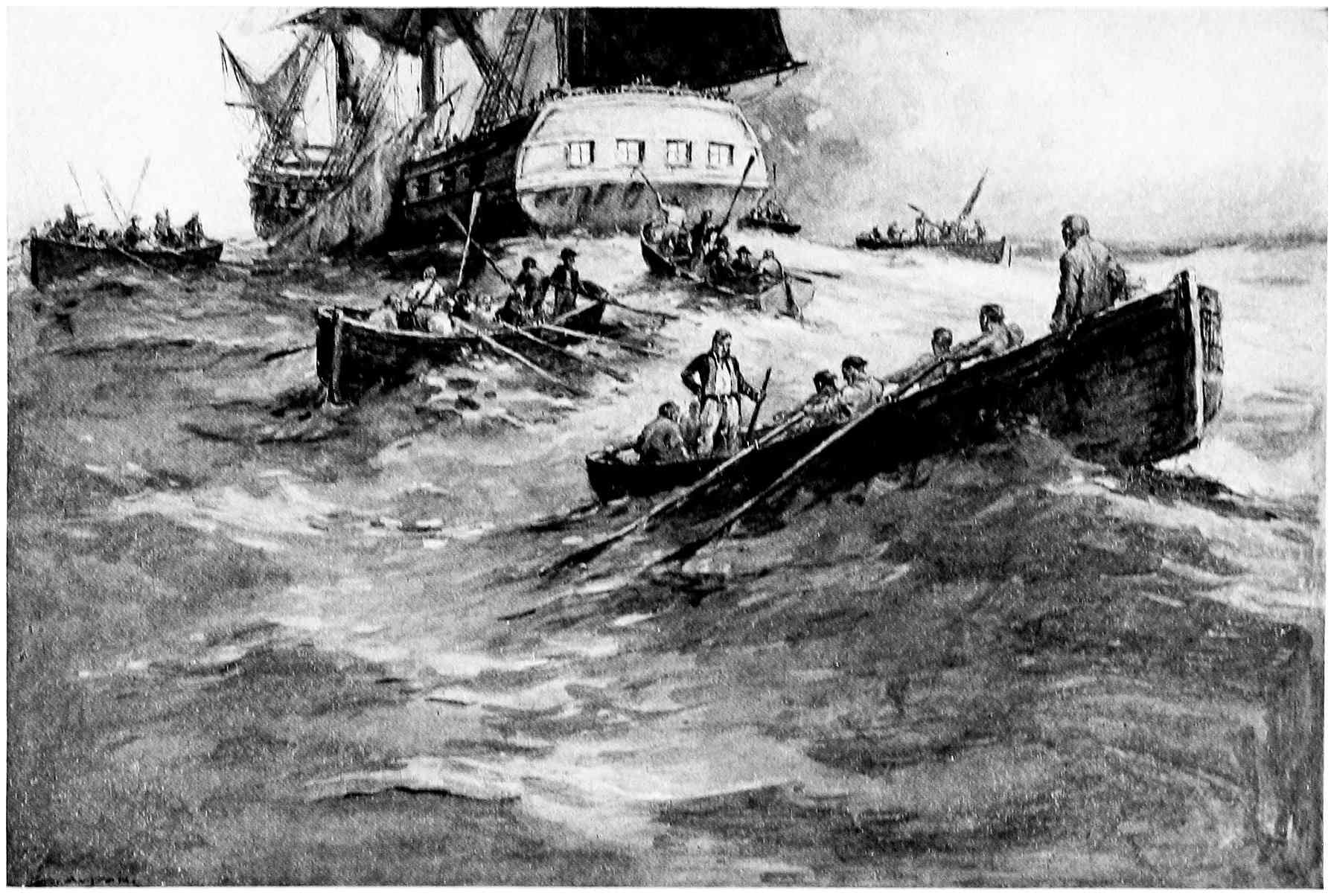
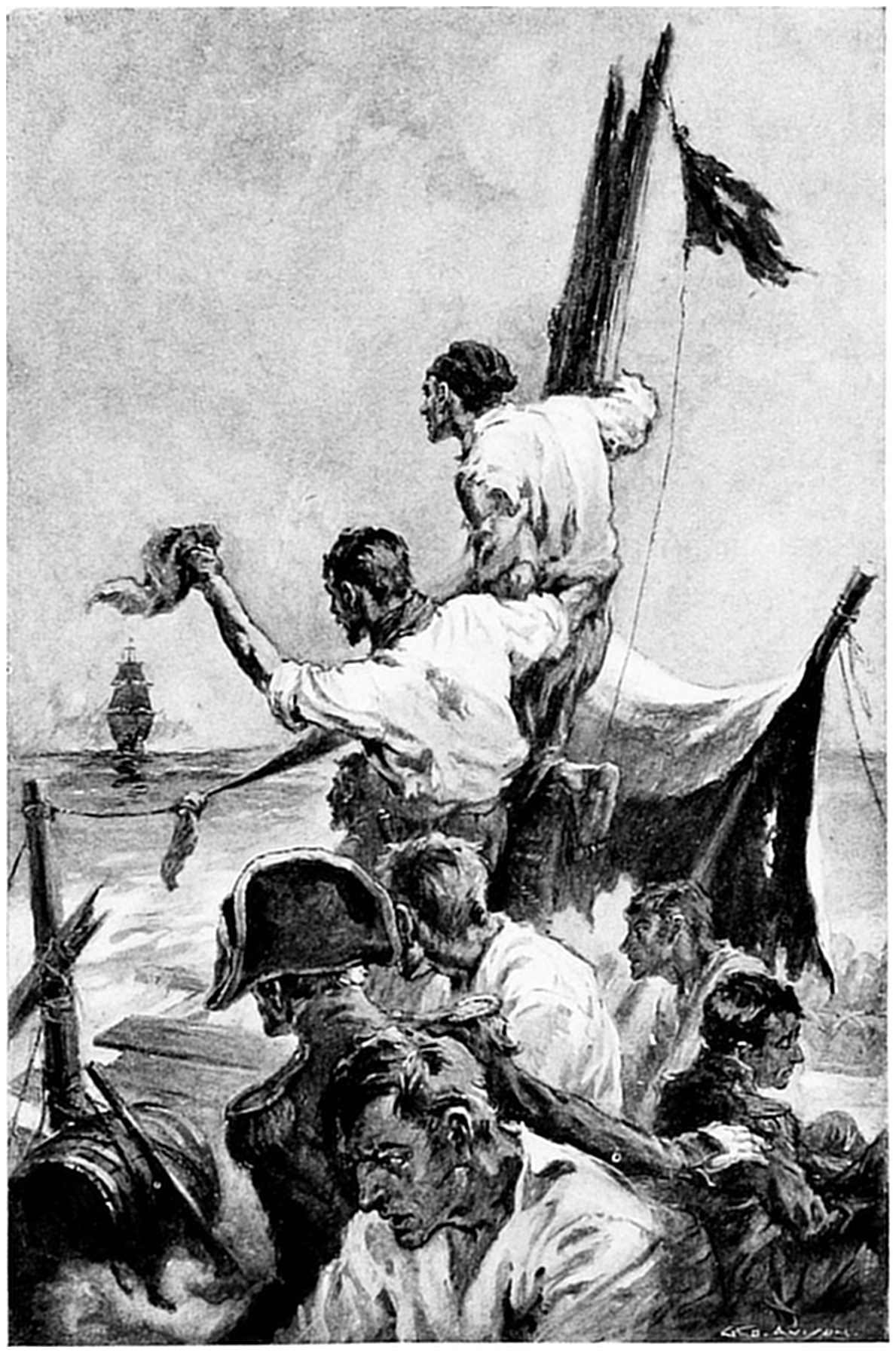
BOATS WERE FILLED WITH MEN WHOSE ONLY THOUGHT WAS TO SAVE THEIR SKINS
There were intrepid men in the Medusa who
bullied the others into helping make a raft. The
best that they could do was to launch a pitiful contrivance
of spars and planks held together by lashings.
It was sixty-five feet long and twenty broad,
not even decked over, twisting and working to the
motion of the waves which slapped over it or
splashed between the timbers when the ocean was
smooth. As soon as it floated alongside the frigate,
one hundred and fifty persons wildly jammed themselves
upon it, standing in water to their waists and
in danger of slipping between the spars and planks.
The only part of the raft which was unsubmerged
when laden had room for no more than fifteen men
to lie down upon it.
The weather was still calm, and the ship rested
solidly upon her sandy bed, the upper decks clear
of water. It seems incredible that no barrels of
beef and biscuit were lashed to the timbers of the
raft, no water-casks rolled from the tiers and swung
overside. A kind of mob hysteria swept these people
along, and the men of resolution were carried
with it. They were unaccustomed to the sea, and a
frenzied fear of it stampeded them. The flimsy,
wave-washed raft floated away from the Medusa
with only biscuit enough for one scanty meal and a
few casks of wine. The stage was set, as one might
say, for inevitable horrors.
One of the boats which was not so crowded as the
others had the grace to row back to the ship with
orders to take off a few, if there were men still
aboard. To the surprise of the lieutenant in the
boat, sixty men had been left behind because there
was not even a foothold for them upon the raft.
The boat managed to stow all but seventeen of
them, who were very drunk by this time and preferred
to stand by the ship and the spirit-room.
The fear of death had ceased to trouble them.
For the moment let us shift the scene to survey
the fate of these seventeen poor wretches who were
abandoned on board of the Medusa. The five boats
reached the African coast and most of their company
lived to find Sénégal. The governor bethought
himself that a large amount of specie had
been left in the wreck, and he sent a little vessel off;
but lack of provisions and bad weather drove her
twice back to port, so that fifty-two days, more than
seven weeks, had passed before the Medusa was
sighted, her upper works still above water.
Three of the seventeen men were found alive,
“but they lived in separate corners of the hulk and
never met but to run at each other with drawn
knives.” Several others had sailed off on a tiny raft
which was cast up on the coast of the Sahara, but the
men were drowned. A lone sailor drifted away on
a hencoop as the craft of his choice, and foundered
in sight of the frigate. All the rest had died of too
little food and too much rum, after the provisions
had been lost or spoiled by the breaking up of the
ship.
It was understood that the raft, with its burden of
one hundred and fifty souls, was to be taken in tow
by the five boats strung in a line, and this flotilla
would make for the nearest coast, which might
have been reached in two or three days of favoring
weather. After a few hours of slow, but encouraging,
progress, the tow-line of the captain’s boat
parted. Instead of making fast to the raft again,
all the other boats cast off their cables and, under
sail and oar, set off to the eastward to save themselves.
The miserable people who beheld this desertion
denounced it as an act of cruelty and perfidy
beyond belief. It may have been in the captain’s
mind to make haste and send a vessel to pick up the
castaways, but his previous behavior had been such
that he scarcely deserves the benefit of the doubt.
On the makeshift raft there were those who knew
how to die like Frenchmen and gentlemen. What
they endured has been handed down to us in the
personal accounts of M. Correard and M. Savigny,
colonial officials who wrote with that touch, vivid
and dramatic, which is the gift of many of their
race. Even in translation it is profoundly moving.
When they saw the boats forsake them and vanish
at the edge of the azure horizon, a stupor fell upon
these unfortunate people as they clung to one
another with arms locked and bodies pressed together
so that they might not be washed off the raft.
A small group in whom nobility of character
burned like an unquenchable flame assumed the
leadership, attempting to maintain some sort of
discipline and decency, to ration the precious wine,
to make the raft more seaworthy. One of the
artisans had a pocket compass, which he displayed
amid shouts of joy, but it slipped from his fingers
and was lost. They had no chart or any other resource
of the kind.
“The first day passed in a manner sufficiently tranquil.
We talked of the means by which we would save ourselves;
we spoke of it as a certain circumstance, which reanimated
our courage; and we sustained that of the soldiers
by cherishing in them the hope of being able, in a short
time, to revenge themselves on those who had abandoned
them.... In the evening our hearts and our prayers,
by a feeling natural to the unfortunate, were turned toward
Heaven. Surrounded by inevitable dangers, we addressed
that invisible Being who has established the order
of the universe. Our vows were fervent and we experienced
from our prayers the cheering influence of hope. It
is necessary to have been in similar circumstances before
one can rightly imagine what a solace to the hearts of
the sufferers is the sublime idea of a God protecting the
afflicted.”
Such were the reflections of a little group of
devout and high-minded Frenchmen whose example
helped to steady the rest of the castaways in the
early hours of their ordeal. During the first night
the wind increased, and the sea became so boisterous
that the waves gushed and roared across the raft,
most of which was three feet under water. A few
ropes were stretched for the people to cling to, but
they were washed to and fro, and many were caught
and killed or cruelly hurt between the grinding timbers.
Others were swept into the sea. Twenty of
the company had perished before dawn. Two
ship’s boys and a baker, after bidding farewell to
their comrades, threw themselves into the ocean as
the easier end. A survivor wrote:
“During the whole of this night we struggled against
death, holding ourselves closely to those spars which were
firmly bound together; tossed by the waves from one end
to the other, and sometimes precipitated into the sea;
floating between life and death, mourning over our misfortunes,
certain of perishing, yet contending for the
remainder of existence with that cruel element which had
determined to swallow us up. Such was our situation till
break of day.”
Already the minds of some of the castaways were
affected. When the day came clear and beautiful,
they saw visions of ships, of green shores, of loved
ones at home. While the ocean granted them a
respite, the emotion of hope strongly revived, and
their manifold woes were forgotten as they gazed
landward or waited for sight of a sail.
“Two young men raised and recognized their father
who had fallen and was lying insensible among the feet of
the soldiers. They believed him to be dead and their despair
was expressed in the most affecting manner. He
slowly revived and was restored to life in response to the
prayers of his sons who supported him closely folded in
their arms. This touching scene of filial piety drew our
tears.”
The second night again brought clouds and
squally weather, which agitated the ocean and swept
the raft. In a wailing mass the people were dashed
to and fro and were crushed or drowned. The ruffianly
soldiers and sailors broached the wine-casks,
and so lost such last glimmerings of reason as terror
had not deprived them of. They insanely attacked
the other survivors, and at intervals a battle raged
all night long, with sabers, knives, and bayonets.
The brave M. Correard had fallen into a swoon of
exhaustion, but was aroused by the cries of “To
arms, comrades! Rally, or we are lost!” He mustered
a small force of loyal laborers and a few officers
and led them in a charge. The rebels surrounded
them, but were beaten back after much
bloodshed. The scenes were thus depicted by the
pen of M. Savigny:
The day had been beautiful and no one seemed to doubt
that the boats would appear in the course of it, to relieve
us from our perilous state; but the evening approached
and none was seen. From that moment a spirit of sedition
spread from man to man, and manifested itself by the
most furious shouts. Night came on, the heavens were
obscured by thick clouds, the wind rose and with it the
sea. The waves broke over us every moment, numbers
were carried into the sea, particularly at the ends of the
raft, and the crowding towards the centre of it was so
great that several poor people were smothered by the pressure
of their comrades who were unable to keep their legs.
Firmly persuaded that they were all on the point of
being drowned, both soldiers and sailors resolved to soothe
their last moments by drinking until they lost their reason.
Excited by the fumes acting on empty stomachs
and heads already disordered by danger, they now became
deaf to the voice of reason and boldly declared their intention
to murder their officers and then cut the ropes which
bound the raft together. One of them, seizing an axe, actually
began the dreadful work. This was the signal for
revolt. The officers rushed forward to quell the tumult
and the mutineer with the axe was the first to fall, his
head split by a sabre.
The passengers joined the officers but the mutineers
were still the greater number. Luckily they were but
badly armed, or the few bayonets and sabres of the opposite
party could not have kept them at bay. One fellow,
detected in secretly cutting the ropes, was immediately
flung overboard. Others destroyed the shrouds and
halliards of the sail, and the mast, deprived of support,
fell upon a captain of infantry and broke his thigh. He
was instantly seized by the soldiers and thrown into the
sea, but the officers saved him. A furious assault was now
made upon the mutineers, many of whom were cut down.
At length this fit of desperation subsided into weeping
cowardice. They cried out for mercy and asked for forgiveness
upon their knees. It was now midnight and order
appeared to be restored, but after an hour of deceitful
calm the insurrection burst forth anew. The mutineers
ran upon the officers like madmen, each having a knife or
sabre in his hand, and such was the fury of the assailants
that they tore with their teeth the flesh and even the
clothing of their adversaries. There was no time for hesitation,
a general slaughter took place, and the raft was
strewn with dead bodies.
There was one woman on the raft, and the villains
had thrown her overboard during the struggle,
together with her husband, who had heroically defended
her. M. Correard, gashed with saber-wounds
as he was, leaped into the sea with a rope
and rescued the wife, while Lavilette, the head
workman, swam after the husband and hauled him
to the raft.
THE BRIG, WHICH HAD MADE A LONG TACK AND WAS NOW
STEERING STRAIGHT TOWARD THE RAFT
The first thing the poor woman did, after recovering
her senses, was to acquaint herself with the name of the
person who had saved her and to express to him her liveliest
gratitude. Finding that her words but ill reflected
her feelings, she recollected that she had in her pocket a
little snuff and instantly offered it to him. Touched with
the gift but unable to use it, M. Correard gave it to a
wounded sailor, which served him two or three days. But
it is impossible to describe a still more affecting scene,—the
joy this unfortunate couple testified when they were
again conscious, at finding they were both saved.
The woman was a native of the Swiss Alps who
had followed the armies of France as a sutler, or
vivandière, for twenty years, through many of Napoleon’s
campaigns. Bronzed, intrepid, facing
death with a gesture, she said to M. Correard:
I am a useful woman, you see, a veteran of great and
glorious wars. Therefore, if you please, be so good as to
continue to preserve my life. Ah, if you knew how often
I have ventured upon the fields of battle and braved the
bullets to carry assistance to our gallant men! Whether
they had money or not, I always let them have my goods.
Sometimes a battle would deprive me of my poor debtors,
but after the victory others would pay me double or triple
for what they had consumed before the engagement.
Thus I came in for a share of the victories.
It was during a lull of the dreadful conflict
among these pitiful castaways that M. Savigny was
moved to exclaim:
The moon lighted with her melancholy rays this disastrous
raft, this narrow space on which were found united
so many torturing anxieties, a madness so insensate, a
courage so heroic, and the most generous, the most amiable
sentiments of nature and humanity.
Another night came, and the crazed mutineers
made an attack even more savage. It was not
altogether impelled by the blind instinct of survival,
for again they tried to tear the raft apart and destroy
themselves with it. They were so many
ravening beasts. Those who resisted them displayed
many instances of brave and beautiful self-sacrifice.
One of the loyal laborers was seized by
four of the rebels, who were about to kill him, but
Lavilette, formerly a sergeant of Napoleon’s Old
Guard, rushed in and subdued them with the butt of
a carbine and so saved the victim of their rage.
A young lieutenant fell into the hands of these
maniacs, and again there were volunteers to rush in
against overwhelming numbers and effect a rescue,
regardless of their grievous wounds. Bleeding and
exhausted, M. Coudin had fallen upon a barrel, but
he still held in his arms a twelve-year-old sailor-boy
whom he was trying to shield from harm. The
rebels tossed them both into the sea, but M. Coudin
clung to the lad and insisted that he be placed upon
the raft before he permitted himself to be helped.
During these periods of hideous combat among
men who should have been brethren and comrades
in tribulation, as many as sixty of them were
drowned or died of their wounds. Only two of
these belonged to the little party of finely tempered
souls who had shown themselves to be greatly heroic.
They had withstood one onslaught after another,
and there were never more than twenty of them, in
honor preferring one another, untouched by the
murderous delirium which had afflicted the others.
True, they saw phantasms and talked wildly, but
the illusions were peaceful. M. Correard imagined
that he was traveling through the lovely, fruitful
fields of Italy. One of the officers said to him,
quite calmly, “I recollect that we were abandoned
by the boats, but there is no cause for anxiety. I
am writing a letter to the Government, and in a
few hours we shall be saved.” And while they were
babbling of the cafés of Paris and Bordeaux and
ordering the most elaborate meals, they chewed the
leather of the shoulder-belts and cartridges, and
famine took its daily toll of them. In these circumstances
it was inevitable that sooner or later they
would begin devouring one another for food.
The details are repugnant, and it is just as well to
pass over them. With this same feeling in mind,
one of the survivors confessed:
It was necessary, however, that some extreme measure
should be adopted to support our miserable existence.
We shudder with horror on finding ourselves under the
necessity of recording that which we put into practice.
We feel the pen drop from our hands, a deadly coldness
freezes all our limbs, and our hair stands on end. Readers,
we entreat you not to entertain, for men already too
unhappy, a sentiment of indignation; but to grieve for
them, and to shed a tear of pity over their sad lot.
On the fourth day a dozen more had died, and the
survivors were “extremely feeble, and bore upon
their faces the stamp of approaching dissolution.”
Shipwrecked crews have lived much longer than this
without food, but the situation of these sufferers was
peculiarly dreadful. And yet one of them could
say:
This day was serene and the ocean slumbered. Our
hearts were in harmony with the comforting aspect of the
heavens and received anew a ray of hope. A shoal of
flying fish passed under our raft and as there was an infinite
number of openings between the pieces which composed
it, the fish were entangled in great numbers. We
threw ourselves upon them and took about two hundred
and put them in an empty barrel. This food seemed delicious,
but one man would have required a score. Our
first emotion was to give thanks to God for this unhoped
for favor.
An ounce of gunpowder was discovered, and the
sunshine dried it, so that with a steel and gun-flints
a fire was kindled in a wetted cask and some of the
little fish were cooked. This was the only food
vouchsafed them, a mere shadow of substance
among so many, “but the night was made tolerable
and might have been happy if it had not been signalized
by a new massacre.”
A mob of Spaniards, Italians, and negroes had
hatched a plot to throw all the others into the sea
and so obtain the raft and what wine was left. The
black men argued that the coast was near and that
they could traverse it without danger from the natives
and so act as guides. The leader of this outbreak
was a Spaniard, who placed himself behind
the mast, made the sign of the cross with one hand,
waved a knife in the other, and invoked the name of
God as the signal to rush forward and begin the
affray. Two faithful French sailors, who were
forewarned of this eruption, lost not a moment in
grappling with this devout desperado, and he was
thrown into the sea along with an Asiatic of gigantic
stature who was suspected of being another ringleader.
A third instigator of the mob, perceiving
that the plot was discovered, armed himself with a
boarding-ax, hacked his way free, and plunged into
the ocean.
The rest of the mutineers were hardier lunatics,
and they fought wildly in the attempt to kill one of
the officers, under the delusion that he was a Lieutenant
Danglass, whom they had hated for his
harsh manners while aboard the Medusa. At
length they were repulsed, but when the morning
came only thirty persons remained alive of the one
hundred and fifty who had left the frigate. Occasional
glimpses of reason prevailed, as when two
soldiers were caught in the act of stealing wine from
the only cask left, and were put to death after a
summary courtmartial conducted with singular
regard for form and ceremony.
Among those who mercifully passed out at the
end of a week was the twelve-year-old sailor-boy,
whose name was Leon. M. Savigny describes it so
tenderly that the passage is worth quoting:
He died like a lamp which ceases to burn for want of
aliment. All spoke in favor of this young and amiable
creature who merited a better fate. His angelic form,
his musical voice, the interest inspired by an age so infantile,
increased still more by the courage he had shown and
the services he had performed, (for he had already made
a campaign in the East Indies), moved us all with the
deepest pity for this young victim. Our old soldiers, and
all the people in general, did everything they could to prolong
his existence. Neither the wine of which they deprived
themselves without regret, nor all the other means
they employed, could arrest his melancholy doom.
He expired in the arms of his friend, M. Coudin, who
had not ceased to give him the most unwearied attention.
Whilst he had strength to move he ran incessantly
from one side to the other, loudly calling for his mother,
for water and for food. He trod upon the feet and legs
of his wounded companions who in their turn uttered
cries of anguish, but these were rarely mingled with threats
or reproaches. They freely pardoned all that the poor
little lad caused them to suffer.
When the number of the living was reduced to
twenty-seven, a solemn discussion was held, and a
conclusion reached upon which it is not for us to
pass judgment. It was evident that fifteen of the
number were likely to live a few days longer, which
gave them a tangible hope of rescue. The other
twelve were about to die, all of them severely
wounded and bereft of reason. There was still
some wine in the last cask. To divide it with these
doomed twelve was to deprive the fifteen stronger
men of the chance of survival. It was decided to
give these dying people to the merciful obliteration
of the sea. The execution of this decree was undertaken
by three soldiers and a sailor, chosen by lot,
while the others wept and turned away their faces.
Among those whose feeble spark of life was
snuffed out in this manner was that militant woman,
the sutler who had followed Napoleon to the plains
of Italy. Both she and her husband had been fatally
wounded during the last night of the mutiny,
and so they went out of life together, which was as
they would have wished it. More than once in war
the hopelessly wounded have been put out of the
way in preference to leaving them in the wake of a
retreat or burdening a column with them. In this
tragedy of the sea the decision was held to be justifiable
when the French Government investigated
the circumstances.
With so few of them remaining, the fifteen survivors
were able to assemble themselves upon a little
platform raised in the center of the raft and to build
a slight protection of plank and spars. To rehearse
their sufferings at greater length would be to repel
the modern reader. It is only in fiction that shipwreck
can be employed as a theme for romance and
enjoyable adventure. The reality is apt to be very
stark and grim. It is more congenial to remember
such fine bits as this, when the handful of them
huddled upon the tiny platform in the final days of
their agony:
On this new theatre we resolved to meet death in a manner
becoming Frenchmen and with perfect resignation.
Our time was almost wholly spent in talking of our beloved
and unhappy country. All our wishes, our prayers, were
for the prosperity of France.
It was the gallant M. Correard who assured his
comrades that his presentiment of rescue was still
unshaken, that a series of events so unheard of could
not be destined to oblivion and that Providence
would certainly preserve a few to tell to the world
the melancholy story of the raft. In the bottom of
a sack were found thirty cloves of garlic, which were
distributed as a precious alleviation, and there was
rejoicing over a little bottle of tooth-wash containing
cinnamon and aromatics. A drop of it on the
tongue produced an agreeable feeling,
and for a short time removed the thirst which destroyed
us. Thus we sought with avidity an empty vial which
one of us possessed and in which had once been some essence
of roses. Every one, as he got hold of it, respired
with delight the odor it exhaled, which imparted to his
senses the most soothing impressions. Emaciated by privations,
the slightest comfort was to us a supreme happiness.
On the ninth day they saw a butterfly of a species
familiar to the gardens of France, and it fluttered
to rest upon the mast. It was a harbinger of land
and an omen of deliverance in their wistful sight.
Other butterflies visited them, but the winds and
currents failed to set them in close to the coast, and
there was never a glimpse of a sail. They existed in
quietude, with no more brawls or mutinies, until
sixteen days had passed since the wreck of the
Medusa. Then a captain of infantry, scanning the
sea with aching eyes, saw the distant gleam of
canvas.
Soon they were able to perceive that it was a brig,
and they took it to be the Argus of their own squadron,
which they had been hoping would be sent in
search of them. They made a flag out of fragments
of clothing, and a seaman climbed to the top
of the mast and waved it until his strength failed.
The vessel grew larger through half an hour of tears
and supplication, and then its course was suddenly
altered, and it dropped below the sky-line.
Despair overwhelmed them. They laid themselves
down under a covering of sail-cloth and refused
to glance at the ocean which had mocked them.
It was proposed to write their names and a brief
account of their experience upon a plank and affix
it to the mast on the chance that the tidings might
some day reach their government and their families
in France.
It was the master gunner who crawled out, two
hours later, and trembled as he stared at the brig
which had made a long tack and was now steering
straight toward the raft. The others dragged
themselves to their feet, forgetting their sores and
wounds and weakness, and embraced one another.
From the foremast of the brig flew an ensign, which
they joyously recognized, and they cried, as you
might have expected of them, “It is, then, to
Frenchmen that we shall owe our deliverance.”
The Argus, which had been sent out by the governor
of Sénégal, rounded to no more than a pistol-shot
from the raft while the crew “ranged upon the
deck and in the shrouds announced to us by the
waving of their hands and hats, the pleasure they
felt at coming to the assistance of their unfortunate
countrymen.”
Fifteen men were taken on board the brig of the
hundred and fifty who had shoved away from the
frigate Medusa a little more than a fortnight earlier.
There was no more fiddling and dancing on deck for
“these helpless creatures almost naked, their bodies
shrivelled by the rays of the sun, ten of them
scarcely able to move, their limbs stripped of skin,
their eyes hollow and almost savage, and the long
beards giving them an air almost hideous.”
They were most tenderly cared for by the surgeon
of the Argus, but six of them died after reaching
the African port of St. Louis. Only nine of
the castaways of the Medusa’s raft, therefore, lived
to return to France. Their minds and bodies were
marked with the scars of that experience, which you
will find mentioned very frequently in the old
records of shipwreck and disaster. It was an episode
in human history, the best and the worst of
it, and a reminder of man’s eternal conflict with the
sea.
CHAPTER IV THE WRECK OF THE BLENDEN HALL , EAST INDIAMAN
In this harassing modern age of a world turned
upside down and bedeviled with one more
problem after another, fancy turns with fond regret
to those lucky sailormen who lingered on little,
sea-girt isles and lorded it as monarchs of all they
surveyed. Many an old forecastle had a Robinson
Crusoe, hairy and brown and tattooed, who could
spin strange yarns of years serenely passed among
the untutored natives of the Indian Ocean or the
South Seas. Now and then one of them had lived
in more solitary fashion on some remote, unpeopled
strand, a hermit cast up by the sea, and was
actually contented because he had freed himself of
the tyranny of bosses and wages and trousers and
all the other shackles of civilization.
Alas! there are no more realms like these. The
wireless mast lifts above the palm-trees, and the
steamer whistle blows to recall the tourists from the
beaches where the trade-winds sweep. There are
still some very lonely places on the watery globe,
however, and one of them is the tiny group of three
volcanic islands in the South Atlantic which is
known as Tristan da Cunha. These bleak rocks
lie two thousand miles west of the Cape of Good
Hope and four thousand miles to the northeast of
Cape Horn. They loom abruptly from a tempestuous
ocean, which lashes the stark, black cliffs,
and there are no harbors, only an occasional fringe
of beach a few yards wide.
Tristan, the largest of the group, lifts a snow-clad
peak almost eight thousand feet above the sea
as a warning to mariners to steer wide of the cruel
reefs. It has a small plateau where green things
grow, and living streams and cascades of fresh
water. The islands were discovered as early as
1506 by the Portuguese admiral, Tristan da Cunha,
and in later years the Dutch navigators and the
pioneers of the British East India Company hove
to in passing, but it was not thought worth while
to hoist a flag over the group.
It remained for a Yankee sailor, Jonathan
Lambert of Salem, to choose Tristan da Cunha as
his abiding-place and to issue a formal proclamation
of his sovereignty to the other nations of the
world. Said he, “I ground my right and claim on
the sure and rational ground of absolute occupancy.”
This was undeniable, and the British Empire
rests upon foundations no more convincing.
Jonathan Lambert was of the breed of Salem seafarers
who had first carried the American flag to
India, Java, Sumatra, and Japan, who opened the
trade with the Fiji Islands and Madagascar, who
had been the trail-breakers in diverting the commerce
of South America and China to Yankee
ships. They had sailed where no other merchantmen
dared go, they had anchored where no one else
dreamed of seeking trade.
It was therefore nothing extraordinary for Jonathan
Lambert to tire of roving the wide seas and
to set himself up in business as the king of Tristan
da Cunha which had neither ruler nor subjects.
What his ambitions were and how a melancholy end
overtook them is to be found in the sea-journal of
Captain John White, who sailed the American brig
Franklin out to China in 1819. He wrote:
On March 12th we saw and passed the island of Tristan
da Cunha which was taken possession of in 1810 by Jonathan
Lambert. He published a document setting forth
his rights to the soil and invited navigators of all nations
whose routes might lie near that ocean to touch at his
settlement for supplies which he anticipated his industry
would draw from the earth and the adjacent sea. He
signified his readiness to receive in payment for his produce,
which consisted of vegetables, fruit and fish, whatever
might be convenient for the visitors to part with
which could be in any way useful to him.
In order to carry out his plan, Jonathan Lambert
took with him to the island various implements of husbandry,
seeds of the most useful plants, tropical trees
for transplanting, etc. After he had been on his island
for about two years it was apparent that his efforts would
be crowned with success, but unfortunately he was
drowned, with his one associate, while visiting one of the
nearby islands.
Another adventurous seaman, Thomas Currie,
succeeded to this lonely principality by right of occupation,
and was joined by two others. They
lived contentedly and raised wheat and oats and
pigs until in the War of 1812 the American naval
vessels began to use Tristan da Cunha as a base
from which to harry British commerce in the South
Atlantic. Then Great Britain formally annexed
the group, and kept a garrison of a hundred men
there for two years.
When the garrison was withdrawn, Corporal
William Glass of the Royal Artillery was left behind
at his own request, with his wife and children,
and two privates decided to join him as the beginnings
of a colony. A few other rovers or shipwrecked
sailors drifted to Tristan da Cunha from
time to time, and they found girls at St. Helena
and Cape Town who were willing to marry them,
so that there was created a peaceful, unworldly little
community on this far-away island over which
Corporal William Glass ruled as a wise and benevolent
patriarch.
The Blenden Hall was a stout ship bound out
from England to Bombay in 1820, an East Indiaman
of the stately fleet that flew the house flag
of the Honorable Company. Their era was soon to
pass, with all its color and romance, the leisurely
voyage, the ceremonious formality and discipline,
the pleasant sociability. The swifter Yankee merchant
ships, hard driven under clouds of cotton
duck, used to rush past these jogging East India
“tea-wagons,” which shortened sail at sunset and
snugged down for the night. They carried crews
for a man-of-war, what with the midshipmen, the
purser, the master-at-arms, the armorer, the calker,
the butcher, baker, poulterer, gunner’s mates, sail-maker,
six officers to assist the commander, and Indian
servants to wait on them.
The passengers enjoyed more comfort and luxury
in these handsome old sailing ships than the
modern reader might suppose. The cabins were
much more spacious than the liner’s state-rooms of
to-day, the saloon was ornate with rugs and teakwood,
with silver plate and the finest napery, and
dinner was an elaborate affair, with a band of music,
and the commander and the officers in the Company’s
dress uniform of blue coat and gold buttons,
with waistcoats and breeches of buff. Wines, ale,
beer, and brandy were served without cost to the
passengers, and the large staff of cooks and stewards
was able to find in the storerooms and pantries
such a varied stock of provisions as beef, pork,
bacon, and tongues, bread, cheese, butter, herrings,
and salmon, confectionery, oatmeal, oranges, and
dried and preserved fruits, while a live cow or two
supplied cream for the coffee, and the hen-coops
stowed in the long-boat contributed fresh eggs.
The Blenden Hall was commanded by Captain
Alexander Greig, a sailor and a gentleman of the
old school, who had laid by a comfortable fortune
during his long service. The trading ventures and
perquisites of the master of an East Indiaman often
yielded an income which a modern bank president
would view with profound respect. The captain’s
son, young Alexander Greig, sailed as a passenger
on this last voyage of the Blenden Hall. He was
a high-spirited lad, bound out to join the army in
India, and life was one zestful adventure after another.
The modern youngster may well envy him
his luck in being shipwrecked on a desert island,
where he wrote a diary, using penguin’s blood for
ink and quill feathers for pens.
If the tale were fiction instead of fact, the beginning
could be no more auspiciously romantic.
Captain Greig and his son left their English country
home in their “travelling carriage” for the
journey to Gravesend to join the ship. While
crossing Bexley Heath they made their pistols
ready, for the stretch of road was notorious for
highwaymen, and as young Alexander Greig enjoyably
tells us:
I soon observed that my father’s attention had been
attracted by two horsemen riding across the Heath at
full gallop, and notwithstanding the postilion was evidently
exerting himself to outstrip our pursuers, they
appeared to gain fast upon us. And in fifteen minutes
they called loudly to him to stop, one of them at the
same time discharging a pistol to bring us to. My father,
after urging the postilion to drive faster (and we seemed
then almost to fly across the Heath) told me to be prepared
to receive the man on the left, “for,” said he, “we
will give them a warm reception, at any rate.”
I was just about to follow his advice when I fancied
that the men allowed us to gain ground and were out of
pistol-shot, as I could see them curbing their horses while
they discussed the prudence of keeping up the pursuit.
It was fortunate for them that they did so, for one of
them would have received the contents of my Joe Manton,
as I was resolved not to fire till he came so close to the
carriage that I could make sure of my man.
At the next tavern they described the adventure,
and when young Greig mentioned that one of the
rascals wore a red waistcoat with white stripes, the
landlord exclaimed:
“Jem Turner, by the Lord Harry! Aye, as sure
as fate! There is two hundred pounds reward for
him, dead or alive. The boldest rascal that rides
the Heath!”
Captain Greig concluded, no doubt, that he was
safer at sea again. The Blenden Hall was ready
to sail, and several of her passengers came on board
at Gravesend, while the others were taken on from
Deal while the ship tarried in the Downs. Sixteen
in all were of a social station which permitted them
to meet at the cuddy table for dinner while the ship’s
band played “The Roast Beef of Old England”
and Captain Greig pledged their health in good
Madeira. With a most precocious taste for gossip,
young Greig managed to portray his fellow-voyagers
in an intimate manner that would be hard to
match in the true tales of the sea.
It is just as well to let you gain some slight acquaintance
with them before the curtain rises on the
tragedy of the shipwreck. The most conspicuous
figure was Mrs. Lock, wife of a commodore somewhere
on foreign service. She was very fat, with
a hurricane of a temper, and of mixed blood in
which the tar brush was undeniable. Her English
was badly broken, and her manners were startling.
She had been the commodore’s cook in his Indian
bungalow, so the rumor ran, until for reasons inscrutable
he decided to marry her. Such a person
was enough to set the ship’s society by the ears.
Social caste and station were matters of immense
importance. The emotions of Dr. Law, a fussy old
bachelor of a half-pay naval surgeon, were quite
beyond words, although he was heard to mutter:
“A vulgar black woman, by Jove! And, damme,
she flung her arms around me when she was taken
seasick at table.”
There was also consternation among such exclusive
persons as Captain Miles, and six assistant
surgeons in the Honorable Company’s military
service, Major Reid of the Poonah Auxiliary
Forces, and Quartermaster Hormby and his lady,
of his Majesty’s foot. The dignified commander
of the Blenden Hall felt it necessary to explain that
passage for the chocolate-hued spouse of the erring
commodore had been obtained under false pretenses.
As if this were not enough, another social shock was
in store.
Lieutenant Painter, a bluff, good-humored naval
man, had come on board at Gravesend. While the
ship was anchored in the Downs, he was one of the
passengers who asked the captain to set them ashore
in the cutter for a stroll in Deal. When they returned
to the boat, Lieutenant Painter was missing.
Nothing whatever was heard of him for two days,
and Captain Greig felt seriously alarmed. Then
a boatman brought off a letter in which the gallant
lieutenant explained that he had been
most actively engaged not only in beginning but in finishing
a courtship and that it was his intention to join the
ship before dinner when he would do himself the honor to
introduce Mrs. Painter to the captain and passengers.
He requested that a larger cabin could be prepared, in
which he could “stow away his better half.”
There was great excitement and curiosity in the
cuddy of the Blenden Hall as the dinner-hour drew
near. The impetuous romance of the brisk Lieutenant
Painter was sensational. At length a boat
was pulled alongside, and a chair rigged and lowered
from the lofty deck. The boatswain piped,
and the lovely burden was safely hoisted to the
poop, followed by the beaming lieutenant, who
scrambled up the gangway. First impressions
were favorable. The bride was young and handsome.
Her physical charms were so robust, however,
that she stood a foot taller than her
bantam of a husband, and the audience was
amused when she grasped his arm and heartily
exclaimed:
“Come, little Painter, let me see this fine cabin
of yours.”
It was soon perceived that the vigorous Mrs.
Painter was not a lady. The dreadful truth was
not revealed, however, until a grizzled Deal boatman
was discovered lingering at the gangway.
When one of the mates asked him his errand, he
answered:
“Why, I only want to say goodbye to my gel,
Bet, but I suppose the gold-buttoned swab of a
leftenant has turned her ’ead. Blowed if I reckoned
my own darter ’ud forget me.”
Hiding in her cabin, the daughter wished to avoid
such a farewell scene, but she could hear the old
man ramble on:
“She ’as no occasion to feel ashamed of her father.
I’ve been a Deal boatman these fifty years
and brought up a large family respectably, as Captain
Greig well knows.”
At this the emotional Mrs. Painter rushed on
deck to embrace her humble sire and weep in his
gray whiskers, a scene which the fastidious passengers
found too painful to witness. Henceforth,
through varied scenes of shipwreck and suffering,
the dominant figures were to be the youthful, upstanding
Mrs. Painter and the dusky and corpulent
Mrs. Lock, heroines of two rash marriages, and
foreordained to hate each other with a ferocity
which not even the daily fear of death could diminish.
In the presence of such protagonists as these,
the ship’s company was like a Greek chorus. There
was something almost superb in such a feminine
feud. It was no peevish quarrel over the tea-cups.
Moreover, it could have no dull moments,
because both women had vocabularies of
singular force and emphasis. The forecastle of the
Blenden Hall could do no better in its most lurid
moments.
It began with an affectionate intimacy, then
squalls and reconciliations, while the stately East
Indiaman jogged to the southward and the band
played on deck for dancing after dinner. How far
these two stormy women were responsible must be
left to conjecture, but there seems to have been a
vast deal of squabbling and bad blood among the
passengers, as indicated by the following entry in
the journal of young Alexander Greig, the captain’s
son:
Although I endeavored to detach myself, as much as
possible, from any particular party (by giving two entertainments
a week in my private cabin and sending
around a general invitation) I received one or two polite
requests to meet the writers at the first port we might
touch at and to grant them the satisfaction due from one
gentleman to another, &c., &c., for alleged affronts that
I had unconsciously committed. For the life of me I
could not have defined what the affronts were, but I
wrote each party an answer that I should be happy to
accept, and then deposited their beautiful gilt-edged little
notes in my desk.
There was an occasional diversion which patched
up a truce, such as meeting with an armed brig
which was suspected to be a pirate. The chief officer,
in the mizzen-rigging with a telescope, shouted
down that the brig was cleared for action. The
second mate rushed forward and yelled to the boatswain
to pipe all hands on deck. The gunner
served out pistols and cutlasses to the seamen and
the passengers, boarding-pikes were stacked along
the heavy bulwarks, and the battery of six eighteen-pounders
was loaded with grape and canister.
Things looked even more serious when the brig
hauled down a British ensign and tacked to get the
weather gage of the East Indiaman.
Some of the passengers were frightened, and
others professed an eagerness to engage in a
“set-to.” Dr. Law, the half-pay naval surgeon,
strode the deck with a drawn sword. He was filled
with valor and Scotch whisky, and offered to wager
any man a hundred guineas that he would be the
first to board the enemy. Mrs. Commodore Lock
waddled about uttering loud lamentations, and
vowed that a friend of hers had been eaten alive by
pirates. Nightfall closed down, however, before
the brig could overtake the Blenden Hall, which
surged before the wind with studding-sails spread.
Captain Greig was in some doubt as to his reckoning,
because of thick weather, when the ship had
entered the lonely expanse of the South Atlantic,
and he therefore steered for a sight of Tristan da
Cunha in order to make certain of his position.
He proceeded cautiously, but soon after breakfast,
on July 23, 1820, breakers were descried close at
hand. The wind died, and the ship was drifting.
Anchors were let go, but the water was too deep
to find holding-ground, and a dense fog obscured
the sea. The ship struck in breakers so violent that
the decks were swept, the boats smashed, and the
houses filled with water. The masts were promptly
cut away, but the Blenden Hall was rapidly pounding
to death with a broken back. All hands rushed
forward and crowded upon the forecastle just before
the rest of the ship was wrenched asunder and
floated away.
Two seamen had been killed by falling spars, but
all the rest of the ship’s company, eighty souls of
them, were alive and praying for rescue. After
several hours of misery, a few sailors managed to
knock a raft together and so reached the shore,
which had disclosed itself as frightfully forbidding
and desolate. The ship had been wrecked among
the reefs of Inaccessible Island, one of the Tristan
da Cunha group. By a sort of miracle the bow
of the ship finally detached itself from among the
rocks and washed toward the tiny strip of beach.
Clinging to the stout timbers of the forecastle, all
the survivors were safely delivered from the terrors
of the sea.
Through the first night they could only shiver in
the rain and wonder what fate had befallen them.
At dawn they began to explore the island, which
appeared to be no more than a gigantic rock, black
and savage, which towered into the clouds. Fresh
water was found, but hunger menaced them. The
first bit of flotsam from the wreck was a case of
“Hibbert’s Celebrated Bottled Porter,” which was
a beverage with a kick to it, and for the moment life
looked not quite so dismal. On the beach were
huge sea-lions, creatures twenty feet in length, but
there was no way to slay and use them for food.
Many sea-birds were killed with clubs and eaten
raw, which postponed famine for the time.
And now there floated ashore bales of red broadcloth,
which was promptly cut up for clothing. It
was grotesque to see the sailors and passengers
parading in gorgeous tunics and robes of crimson,
with white turbans fashioned from bolts of muslin.
With bamboo-poles, also washed from the ship,
Captain Greig set his men to making tents for the
women. There was very little material, however,
and most of the people sat around in a sort of
wretched stupor, drenched, benumbed, hopeless.
Several barrels of strong liquors came rolling in
with the surf, and the sailors, of course, drank all
they could hold. One of them, an old barnacle
named John Dulliver, showed a streak of marked
sagacity. After tapping a barrel of Holland gin
and guzzling to the limit of his stowage space, he
stove in one end, emptied the barrel, and crawled
snugly into it to slumber. This seemed such a
brilliant notion that as fast as the ship’s water-barrels
drifted ashore they were tenanted by castaways
who resembled so many hermit-crabs.
For six days the party forlornly existed in continuous
rain, with no means of kindling a fire, and
eating raw pork that was cast up by the sea and
such birds as they could obtain. Then a case of
surgical instruments was found on the beach, and
it contained a providential flint and steel. Fire
was made, and spears were contrived of poles, with
knives lashed to them, so that the monstrous sea-lions
could be killed and used for food. There
were millions of penguins, and their eggs could be
had for the gathering. It was hard, revolting fare,
but other castaways had lived for months and even
years on food no worse, and the horrors of famine
were averted.
Captain Greig was taken ill, and his authority
therefore amounted to little. His officers were not
the men for such a crisis as this, and they do not appear
to have been able to master it. The sailors
were insolent and lazy, no doubt of it, and young
Mr. Greig devotes many pages of his diary to abuse
of them. It is quite evident, however, that the officers
and passengers felt themselves to be superior
beings and expected the sailors to wait on them as
menials. In such a situation as this one man was
as good as another, and the doctrines of caste and
rank properly belonged in the discard. It was
rather pitiful and absurd, as one catches glimpses
of it in the ingenuous narrative of the very young
Mr. Greig.
For a few days after the wreck it was hail fellow, well
met, but Jack, once put upon an equality, began to take
unwarrantable liberties, and as familiarity is generally the
forerunner of contempt, so it proved in this case. Quarrels
soon began and the passengers now took the opposite
course of attempting to issue orders to the sailors and
treating them as servants. This exasperated the crew
and they swore that no earthly power should ever induce
them to render the least assistance to the passengers.
Large sums of money were offered the sailors to forage
for provisions, but I am firmly persuaded that the man
who accepted such an offer would have been murdered by
his comrades. Mrs. Lock, for instance, incensed a seaman
by telling him,—“You common sailor, why you no
wait on lady? You ought to wait on officer’s lady! You
refuse me, captain will flog you plenty.”
Inaccessible Island was properly named, and one
week after another passed without the sight of a
sail or any tangible hope of rescue. Flimsy shelters
were contrived, and nobody died of cold or hunger,
but they were a gaunt, unkempt company, with
much illness among them. Arrayed in their makeshift
garments of crimson broadcloth, the camp was
more like a travesty than a tragedy. No hardship
could dull the militant spirits of Mrs. Commodore
Lock and that young and handsome virago, Mrs.
Lieutenant Painter. During one of their clashes,
which was about to come to blows, the little lieutenant
was trying to drag his strapping spouse into
their tent while several passengers laid hold of the
ponderous Mrs. Lock. Poor Captain Greig was
heard to murmur:
“Thank God we have almost no respectable ladies
with us to witness such scenes as these!”
Mrs. Lock had two small children with her, and
it pleased the fancy of Mrs. Painter to say that, in
her opinion, the paternity of the offspring would
have been better established if the commodore had
offered marriage a few years earlier. Mrs. Painter
put it even more forcefully than this. At the
deadly insult Mrs. Lock broke out in impassioned
accents:
“What you think? That vile hussy of a Painter
woman, she say me no Commodore Lock’s wife. Me lose
my—what you call it—wedding ’tifcate on board ship, so
me no have proof now—but when we come to Bombay, my
commodore he kicks dirty little Painter out of the service,
and me get ten thousand rupees of defamation damage.
That Painter woman’s father am a common, dirty boatman!”
At this Mrs. Painter, with lofty disdain, let fall
the remark: “Behold the she-devil and her two
little imps!”
The sailors felt so little respect for the commodore’s
wife that one of them coarsely observed,
within her hearing:
“If we run short of them penguins’ eggs, Bill,
and there ain’t nothin’ else to eat, we’ll pop the
old girl’s young ’uns into the pot for a bit of broth.”
This was reported to Captain Greig by the explosive
Mrs. Lock, who declared that the sailors had
called her names much stronger than “old girl.”
The chivalrous commander was resolved that no
man of his crew should insult a woman and go unpunished,
wherefore he mustered the seamen loyal
to him, and they maintained order while the boatswain
gave the chief offender fifty lashes on the
bare back with a rope’s-end. The dreary exile was
further enlivened by the discovery that Lieutenant
Painter’s tent had been robbed of jewelry and other
valuables. A formal trial was held, with young
Alexander Greig as judge and a water-cask as the
official bench. A sailor named Joseph Fowler was
accused of the theft, and Mrs. Lock surged into the
proceedings by announcing that, in her opinion, the
relations of Mrs. Painter and this common sailorman
had been a public scandal.
“Very ladylike of you, I’m sure, Mrs. Lock,”
cried Mrs. Painter, “but what could a person expect?”
Such episodes as these were trivial when compared
with the tragic problem of survival and escape
from Inaccessible Island. Exploring parties
had climbed the lofty peak, and in clear weather
were able to discern the snow-clad summit of the
larger island of Tristan, only fifteen miles distant,
which was known to be inhabited. It might have
been a thousand miles away, however, for the lack
of tools and material had discouraged any efforts
to build a boat. In a mood of despair a flagstaff
was set up on the southwestern promontory, which
faced the open ocean, and a bottle tied to it which
contained this message:
On the N. W. side of this island are the remaining
part of the crew and passengers of the Blenden Hall,
wrecked 23rd July, 1821. Should this fall into the hands
of the humane, we trust, by the assistance of God, they
will do all in their power to relieve us, and the prayers of
many unfortunate sufferers will always be for them.
Signed, Alexander Greig, Commander.
This was a month after the shipwreck. Another
month passed, and the ship’s cook, Joseph Nibbs, a
colored man, had begun to build a clumsy little
cockle-shell which he called a punt. For tools he
managed to find a hand-saw, a chisel, a bolt for a
hammer, and a heavy iron hinge ground sharp on
the rocks for an ax. It seems extraordinary that
this enterprise should have been left to a sea-cook,
what with the carpenter and all the officers who
should have taken the initiative. At any rate, this
handy Joseph Nibbs pegged his boat together and
went fishing in it. This appears to have shamed
the others into activity, and the carpenter set about
building a larger boat. It was the heroic cook,
however, who decided to risk the voyage to Tristan
in his little floating coffin, and his farewell speech
was reported as follows:
GOVERNOR GLASS AND HIS RESIDENCE
“I little thought, Captain Greig, ever to see this
day; but I will bring relief to you and young Mr.
Alexander, if I perish in the attempt. If I never
see you again, sir, God bless you for your kindness
to me during the years we have been shipmates.”
In the punt with the cook went five volunteers,
three able seamen, the gunner, and the sail-maker,
but not one of the ship’s officers. These six fine
fellows were ready to risk their lives for others, but
the quarter-deck failed to share in the splendid action.
The punt hoisted sail, the cook and his comrades
shouted three cheers, and they stood out from
the lee of the island to face a heavy sea. This was
the last ever seen of them. They must have perished
soon after.
The castaways waited week after week, desperately
hungry and wholly discouraged. Meanwhile
the carpenter had finished his boat, but delayed his
voyage until certain of fine weather, and wasted
much time in skirting the island in the hope of finding
some trace of the cook. It was late in October,
almost three months after the loss of the Blenden
Hall, before the carpenter attempted to reach Tristan.
Nine men were with him, five able seamen,
the boatswain, the steward, a boatswain’s mate, and
a carpenter’s mate. Again the list was conspicuous
for the absence of an officer.
On the following day two boats were seen approaching
Inaccessible Island. They were stanch
whale-boats, in one of which was the ruler of Tristan
da Cunha, Corporal William Glass, late of the
Royal Artillery. He brought provisions and a
warm welcome to his kingdom. It was found that
more than one trip would be necessary to transport
the castaways to Tristan. In the first boat-load
were Mrs. Lock and Mrs. Painter, whose animosities
were lulled by the blessed fact of rescue. It
was an armistice during which they wept on each
other’s necks and mingled their prayers of thanksgiving
while the crew of the Blenden Hall sang
“God Save the King.”
All hands were safely landed at Tristan where
they found a neat hamlet of stone cottages thatched
with straw, and green fields of grain and potatoes.
Mrs. Glass was the only woman of the colony in
which there were five Englishmen and two American
sailors. To provide for eighty shipwrecked
people severely taxed their resources but the spirit
of hospitality was most cordially displayed. The
captain and the passengers signed an agreement
to pay Governor Glass at the rate of two shillings
and sixpence per day for board and lodging, which
was no more than fair, but nothing was said about
the sailors. They were expected to pay for their
keep by working as farm-hands. This rubbed the
long-suffering tars the wrong way, and as the diary
explains it:
“The passengers walking about at their ease was a
sight to which Jack could not long submit; at last they
all struck, declaring that they would not work unless their
‘mortal enemies’ were compelled to do the same. Upon
this, the captain begged Governor Glass to be firm with
them and on no account to serve out any provisions unless
they returned to their duty. Consequently several
meetings with a great deal of ill feeling took place upon
the subject, and when prayers were read the following
Sunday at Government House, every sailor absented himself.”
Food was refused the striking seamen until they
threatened to break into the potato sheds and then
burn the settlement. The boatswain and his lash
tamed the mutiny after Joseph Fowler had been
tied up and his back cut to ribbons with nine dozen
blows of the rope’s-end. After this the seamen
marched off to another part of the island and fed
themselves by fishing and hunting wild goats and
pigs. To their simple minds there was no good
reason why they should sweat at building stone
walls and digging potatoes while Captain Miles
and the six assistant surgeons of the Honorable
East India Company, Major Reid of the Poonah
Auxiliary Forces, and Quartermaster Hormby of
his Majesty’s foot were strolling about in idleness.
For lack of something better to do, the passengers
began to find fault with the food supplied
by the worthy Governor Glass, and this caused
much difficulty and several formal conferences and
protests. He promised to do better, and honestly
tried to, bearing the situation with unfailing good
humor and courtesy. If the rations were scrimped,
it was no doubt because he feared he might be eaten
out of house and home and left without reserve
supplies.
On New Year’s day there was a notable celebration,
when the four children of the Glass family
were formally christened by Dr. Hatch of the
Blenden Hall, who had taken holy orders in his
youth. Governor Glass wore his scarlet uniform
of the Royal Artillery, “Mrs. Lock stuck so many
white feathers in her hair that it resembled a cauliflower,
while Mrs. Painter sported a white turban
of such ample dimensions that the Grand Sultan
himself might have envied her.” Bonfires blazed,
flags flew from every roof, and the islanders were
dressed in their best.
On January 9 the English merchant ship
Nerinae hove to off Tristan da Cunha to fill her
water-casks. She was bound from Buenos Aires
to Table Bay with a hold filled with live mules.
Uncomfortable shipmates these, but the people of
the Blenden Hall were not in a captious mood.
They were taken on board, and sailed away from
Governor Glass after spending three months with
him, and it is to be fancied that he felt no profound
regrets.
A bit of romance touched the parting scenes.
The night before the Nerinae sailed from Tristan,
the pretty maid servant of Mrs. Lock slipped
ashore in a boat, with what few belongings she had,
and joined her sailor sweetheart, Stephen White,
who had decided to remain behind on the island.
This Peggy was a Portuguese half-caste from
Madras who is referred to in the diary as a “female
attendant.” Seaman White is called a worthless
fellow, but this may be taken for what it is worth.
The important fact is that he had found a sweetheart
during the weary exile on Inaccessible Island
and that they were resolved to stay together
and let the rest of the world go hang. Governor
Glass was quite competent to unite them in the
bonds of a marriage that was proper in the sight of
God.
There is one final glimpse of Mrs. Lock and Mrs.
Painter shortly before the good ship Nerinae, with
her freightage of mules and castaways, anchored in
Table Bay.
The two ladies having for a considerable time been
very quiet, Captain Greig thought he would make another
trial at reconciliation, and begged Mrs. Lock to
shake hands with Mrs. Painter which the latter was willing
to do, but the commodore’s wife declared, “Me do
anything Captain like, but me will bring action for defamation
against little Painter and his damn wife, please
God me ever get back to Bombay.”
Mrs. Lock used to say that she fully expected to find
her dear commodore dead with grief. Mrs. Painter repeatedly
retorted that it was far more likely she would
find him with another wife, but she might make up her
mind it would not be a black one.
Thus concludes the story of the Blenden Hall,
East Indiaman, but it is so interwoven with the
fortunes of Tristan da Cunha and its colonists that
further tidings of them may prove interesting. In
1824, four years after the wreck of the East Indiaman,
an author and artist of New Zealand,
Augustus Earle, was accidentally marooned at
Tristan, and stayed six months as the guest of Governor
Glass before another ship touched there. He
had sailed from Rio for Cape Town in a sloop, the
Duke of Gloucester, which passed so close to the
island in calm weather that the thrifty skipper concluded
to land and buy a few tons of potatoes for
the Cape market.
The artistic passenger went ashore to stroll about
with dog and gun while the sailors were loading
potatoes into the boat. A sudden storm swept the
sea, and the boat was caught offshore, but managed
to reach the sloop, which was driven far from the
island and gave up trying to beat back to it. The
skipper was a practical man and it was foolish to
delay the voyage for such a useless creature as an
author and artist. Mr. Augustus Earle was compelled
to make the best of the awkward situation,
and he seems to have enjoyed his protracted visit of
half a year.
The village then consisted of five or six thatched
cottages “which had an air of comfort, cleanliness,
and plenty truly English.” The young sailor
Stephen White, whom the Blenden Hall had left
behind with his precious Peggy, was still happy in
his bargain, and their babies were playing with the
lusty little flock of the Glass family. The island
was no longer a hermit’s retreat. The marooned
artist noted that “children there were in abundance,
and just one year older than another.” Small
wonder that he saw little of the two women, who
were fully occupied with their domestic duties.
The worthy Governor William Glass had a curious
yarn to tell of that first ruler of the island,
Jonathan Lambert of Salem, who had published
his grandiose proclamations and whose ambitious
dreams were so soon eclipsed. The accepted account
is that he was drowned while out in his boat,
but the British garrison had found on the island a
man who said he had been there with Lambert and
that he suspected another companion of the first
king of Tristan da Cunha of having made away
with him in order to secure his hoard of gold.
Afraid of discovery, the regicide had fled the island,
leaving the treasure behind him.
The ingenious inventor of this narrative had professed
to know where the treasure was buried,
and that he would some day reveal it to the man of the
garrison who pleased him most, thus insuring good treatment
from the men, each hoping to be favored. But one
day after drinking immoderately of liquor he was taken
suddenly ill and expired before he could explain to his
comrades where his treasure was concealed.
At any rate, the story sufficed to supply the imaginative
vagabond with free rum and tobacco,
which, no doubt, was the end in view.
Augustus Earle hunted the wild goats, which
had multiplied on the mountain-slopes, and he has
left us this pleasing picture of the simple and
righteous existence led by these dwellers on remote
Tristan da Cunha:
Governor Glass informed me that the last time they
had ascended the mountain after goats, one of the party
got too close to the precipice and fell down several hundred
feet. They found the corpse next day in a miserably
mangled state. They interred it in the garden
near their settlement and placed at the head of the grave
a board with his name and age, together with an account
of the accident which caused his death, and the remark
that it happened on a Sunday, a dreadful warning to
Sabbath-breakers. The people all say they will nevermore
ascend the mountain on that sacred day. Indeed,
from all I have seen of them, they pay every respect to
the duties of religion that lies in their power.
My clothes beginning to wear out, my kind host, who
was an excellent tailor, made me a pair of trousers consisting
of sail cloth and the rear of dried goat’s skin, the
hair outside, which they all assured me would be very
convenient in sliding down the mountains. I laughed
heartily when I first sported this Robinson Crusoe habiliment.
“Never mind how you look, sir,” said my kind
host, “His Majesty himself, God bless him, if he had been
left here as you were, could look no better.”
Governor William Glass ruled over the island for
thirty-five years, until his death in 1853. By that
time the population had increased to a hundred
souls, and a flourishing trade was carried on in provisioning
the fleet of American whalers out of New
Bedford and Nantucket which cruised in those
waters. A few years later, twenty-five of the
younger men and women emigrated to the United
States, stirred by a natural ambition to see more of
the world. At the death of Governor Glass, an
old man-of-war’s-man, William Cotton, who had
been for three years one of Napoleon’s guards at
St. Helena, became the head of the community.
To-day the settlement consists of a hundred people
or so, most of them of the old British strain, and
many of them descended from the families of Corporal
William Glass of the Royal Artillery and the
young seaman Stephen White and his devoted
Peggy who were wrecked in the Blenden Hall, East
Indiaman, a century ago. They manage their own
affairs without any written laws, and are described
by recent visitors as religious, hospitable to strangers,
industrious, healthy, and long-lived.
The British Government has kept a paternal eye
on them, and from time to time a minister of the
Church of England has served in the stone chapel
and the trim little school-house. Their worldly
wealth is in cattle, sheep, apple and peach orchards,
and they are unvexed by politics, the League of Nations,
or the social unrest. Enviable people of
Tristan da Cunha! And peace to the memories of
old William Glass and Jonathan Lambert, and the
faithful sweethearts of the stately old Blenden
Hall!
CHAPTER V THE ADVENTURES OF DAVID WOODARD, CHIEF MATE
Long before the art of Joseph Conrad created
Lord Jim to follow the star of his
romantic destiny to the somber, misty coast of
Patusan, an American sailor lived and dared amazingly
among the sullen people of those same mysterious
islands of the Far East. He was of the race
of mariners whose ships were first to display the
Stars and Stripes in those far-distant waters and to
challenge the powerful monopolies of the British
and Dutch East India companies. Only seven
years earlier, in fact, the American ship Empress
of China had ventured on the pioneering voyage to
Canton. The seas still swarmed with pirates and
every merchantman carried a heavy battery of guns
and a crew which knew to use them. Amid such
conditions were trained the sailors who were to man
the Constitution and the other matchless frigates of
1812.
The American ship Enterprise sailed from Batavia
for Manila on the twentieth of January, 1793,
and laid a course to pass through the Straits of
Macassar. Head winds and currents kept her
beating to and fro in this torrid passage for six
weeks on end, and the grumbling crew began to
wonder if they had signed in another Flying Dutchman.
Food was running short, for this protracted
voyage had not been expected, and while the Enterprise
drifted becalmed on the greasy tide, another
ship was sighted about five miles distant.
Captain Hubbard ordered the chief mate, David
Woodard, to take a boat and five seamen and row
off to this other vessel and try to buy some stores.
The men were William Gideon, John Cole, Archibald
Miller, Robert Gilbert, and George Williams.
Expecting to be gone only a few hours, they took no
food or water, and all they carried with them was an
ax, a boat-hook, two pocket-knives, a disabled
musket, and forty dollars.
It was sunset when they pulled alongside the
other ship, which was China bound and had no provisions
to spare. A strong squall and heavy rains
prevented them from returning to the Enterprise
that night, and they stayed where they were until
next morning. Then the wind shifted and blew
fresh from the southward to sweep the Enterprise
on her course, and she had already vanished hull
down and under. Stout-hearted David Woodard
guessed he could find her again, confident that Captain
Hubbard would not desert him, and his men
cheerfully tumbled into the boat after him.
The skipper of the China ship, a half-caste with a
crew of Lascars, was a surly customer who seemed
anxious to be rid of his visitors. As a friend in need
he was a glaring failure. Protesting that he had no
fresh water to spare, all that their money could buy
of him was a bottle of brandy and twelve musket-cartridges.
The Yankee sailors tugged at the oars
all day long, but caught never a glimpse of the
missing Enterprise. At nightfall they landed on
an island and found water fit to drink, but nothing
to eat. A large fire was built on the beach in the
hope of attracting the attention of their ship, but
there was no responsive signal.
It was the land of Conrad’s magic fancies, where
“the swampy plains open out at the mouth of rivers,
with a view of blue peaks beyond the vast forests.
In the offing a chain of islands, dark, crumbling
shapes, stand out in the everlasting sunlit haze like
the remnants of a wall broached by the sea.”
The chief mate and his five hardy seamen tightened
their leather belts another hole and shoved off
again in the small open boat. For six days they
sailed the Straits, blown along by one rain squall
after another, until they were within sight of the
coast of Celebes. Hunger and thirst then compelled
them to seek the land and risk death at the
hands of the savage Malays. It was their hope to
proceed by sea to Macassar, which they reckoned
lay about three degrees to the southward.
They must have had a little water during these
six days, but David Woodard’s statement that the
rations were a few cocoanuts is entirely credible.
Many a boat-load of castaways has died or gone
mad after privations no more severe, while on the
other hand a crew of toughened seamen, in the
prime of their youth, is exceedingly hard to kill.
Toward a cove on this unknown, hostile shore of
Celebes the gaunt sailors wearily steered their boat
and beached it in the languid ripple of surf. They
had no sooner crawled ashore than two proas
skimmed in from seaward, dropping anchor and
making ready to send off a canoe filled with armed
Malays. Woodard shouted to his men, and they
pushed the boat out and scrambled into it before
they were discovered. Skirting a bight of the shore,
they headed for the open sea and dodged away from
the proas.
Four miles beyond, after they had rounded a
green point of land, a feathery cocoanut-grove ran
to the water’s-edge, and they could go no farther.
The mate left two men to guard the boat, and the
three others went with him; but they were too weak
to climb the trees, and had to hack away at the
trunks with an ax. Two of them were mere lads
who made such bungling work of it that Woodard
sent for a couple of the stronger men in the boat,
leaving Archibald Miller alone with it. They were
busy gathering cocoanuts to carry to sea with them
when poor Miller was heard to “scream aloud in the
bitterest manner.” The mate ran to the beach and
saw his precious boat filled with Malays, who were
just shoving off in it. On the sand lay Miller,
who had been hacked to death with creeses.
David Woodard and four sailors were therefore
marooned with no resources whatever, but they
talked it over and agreed to try to get to Macassar
by land. Leaving the swampy coast, they slowly
toiled toward the blue mountains and, afraid of
discovery, concluded to hide themselves in the
jungle until night. Then with a star for their guide
they bore south, but progress was almost impossible,
and they lost their bearings in the dense growth.
After blundering about in this manner for several
nights, they turned toward the sea again in the hope
of finding some kind of native boat. They had existed
for thirteen days since losing their ship, and it
is evident that the indomitable spirit of the mate
kept the other men going.
“Woodard was himself stout in person,” explains
the narrative, “and much accustomed to fatigue and
exercise, whence he felt less exhausted, particularly
from keeping up his spirits and having his mind constantly
engaged.”
At length they came to a deep bay between the
mountains, and lay hidden all day in a leafy ambush
while they watched the Malay fishermen in their
canoes. Three of the sailors were taken desperately
ill after eating some yellow berries and
thought they were about to die; but the mate could
not tolerate this kind of behavior, “although his
comrades now resembled corpses more than living
men.” He used rough language, damned them as
worthless swabs if a stomach-ache was to make them
lie down and quit, and then went in search of water
for them until he found some in a hollow tree. But
his strength and courage could haul them along no
farther and reluctantly he admitted that they would
have to surrender themselves to the natives.
WOODARD RAISED HIS EMPTY HANDS TO ASK FOR PEACE AND MERCY
They went down to the beach of the bay, wondering
what their fate might be, John Cole, who was
a stripling lad of seventeen, blubbering that he
would sooner die in the woods than be killed by the
Malays. The canoes had gone away, but three
brown-skinned girls were fishing in a brook, and
they fled when they saw the tattered castaways.
Presently a group of men came down a forest path,
and Woodard walked forward to meet them, raising
his empty hands to ask for peace and mercy.
The Malays stood silent for a long time, and then
the chief advanced to lay down his creese and ceremoniously
accept the strangers as captives. They
were given food and conducted to a little town of
bamboo huts, there to await the pleasure of the rajah
in what Woodard called the judgment hall, while all
the villagers gathered about them.
Soon the rajah strode in, tall and straight and
warlike, a long, naked creese in his hand. These
were the first white men that had ever been seen in
his wild domain. He gazed admiringly at the stalwart
chief mate, who looked him straight in the eyes,
while the people murmured approval of the captive’s
bearing, for “he was six feet and an inch high, strong
in proportion, and the largest-boned person they
had ever beheld.”
These were two bold, upstanding men who stood
face to face in the judgment hall, and the rajah,
after consultation with his chiefs, gave each of the
five American sailors a betel-nut to chew as a token
of his gracious inclination to spare their lives.
For twenty days they were closely held as prisoners
in this forest settlement, during which time two
old men arrived from another town and displayed
a lively interest in the situation. They toddled off
into the jungle, but came again with a Mahomedan
priest called Tuan Hadjee, who was a bit of a
linguist in that he spoke a few words of English,
some Portuguese, and a smattering of the Moorish
tongue. He was a man of the world, having journeyed
to Bombay and Bengal on his way to Mecca,
and displayed a letter from the British governor of
Balambangan, on the island of Borneo, to show that
he was a good and trustworthy person and was empowered
to assist all distressed Englishmen.
This Tuan Hadjee lived up to his credentials,
for he offered the rajah a hundred dollars in golddust
as ransom for the five seamen, which price was
haughtily refused, and the kindly priest went away
to see what else could be done about it. Nothing
more was seen of this amiable pilgrim, and the
Americans were set to work in the forest to clear the
fields or to gather sago. After two months they
were left unguarded by day, but shut up in a house
at night. Week after week dragged by in this
wearisome drudgery, but they kept alive, and their
spirit was unbroken, although the food was poor
and scanty and the tropical heat scorched the very
souls out of them.
At the end of half a year of this enslavement another
rajah who seems to have been a kind of overlord
of the region summoned them into his presence
at a town on the sea-coast. There Woodard almost
died of fever, but a woman befriended him and
greatly helped to save his life. The episode suggests
a romance, and this viking of a sailor who
drifted in so strangely from an unknown world was
a man to win the love of women. In this respect,
however, he was discreetly silent when it came to
relating the story of his wanderings in Celebes, and
the interest which he inspired is sedately described
as follows:
At her first visit she looked at him some time in silence,
then went to the bazaar and bought some tobacco and
bananas which she presented to him, as also a piece of
money. Seeing him scantily clothed, she asked whether
he had no more clothing and whether he would have some
tea. Then carrying one of the other sick men home with
her, she gave him tea and a pot to boil it in. She likewise
sent rice and some garments, with a pillow and two
mats. This good woman was of royal blood and married
to a Malay merchant. These were not her only gifts, for
she proved a kind friend to the seamen while they were at
that place.
Another house being provided for the five men, Woodard,
unable to walk, was carried thither accompanied
by a great concourse of young females who immediately on
his arrival kindled a fire and began to boil rice. His fever
still continued very severe and on the morning of the
fourth day of his residence an old woman appeared with
a handful of boughs, announcing that she was come to
cure him and that directly. In the course of a few minutes
four or five more old women were seen along with her,
according to the custom of the country in curing the sick.
They spent the day in brushing him with the boughs of
the trees and used curious incantations. The ceremony
was repeated in the evening and he was directed to go
and bathe in the river. Although he put little faith in the
proceedings, the fever abated and he speedily began to
recover.
From a Dutch fort seventy miles away the commandant
came to see Woodard and invited him to
return with him, offering to buy him out of slavery.
The chief mate refused, because he was afraid of
being compelled to join the Dutch military service.
He was shrewd enough to perceive that this was
what the commandant had in mind, and he therefore
begged to be sent to Macassar, whence he could
make his way to Batavia. At this the commandant
lost interest in the castaways and made no more attempt
to help them.
Soon after this they were carried back to the village
of their first imprisonment, but Woodard had
seen blue water again and he was resolved to risk
his life for liberty. Eluding his guards, he took a
spear for a weapon and followed the forest paths
all night until he emerged on a beach, where he discovered
a canoe and paddled out to sea. Rough
water swamped the ticklish craft, and he had to
swim half a mile to get to land again. Back he
trudged to his hut on the mountain-side and crawled
into it before dawn.
Undiscouraged, he broke away again, and made
for a town called Dungalla, where he had a notion
that his friend Tuan Hadjee, the priest, might be
found. He somehow steered a course through the
forests and ravines and fetched up at the stockade
which surrounded Dungalla. As a disquieting
apparition he alarmed a nervous old gentleman, who
scampered off to shriek to the village that a gigantic
white devil was sitting on a log at the edge of the
clearing. The old codger turned out to be a servant
of Tuan Hadjee, who warmly welcomed the
chief mate and took him into his house as a guest.
The rajah to whom Woodard belonged got wind
of his whereabouts and wrathfully demanded that
he be sent back. The prideful rajah of Dungalla
refused in language no less provocative. Woodard
smuggled a message through to his men, urging
them to escape and join him. This they succeeded
in doing, and the people of Dungalla were delighted
to receive them. This episode strained the relations
of the two rajahs to the breaking-point, and war
was promptly declared.
Inasmuch as they were the bone of contention,
Woodard and his seamen promptly offered to fight
on the side of the rajah of Dungalla; so they proceeded
to imperil their skins in one of those tribal
feuds which eternally flicker and smolder in the
Malaysian forests. Woodard was placed in command
of a tower upon the stockade wall, where he
served a brass swivel and hammered obedience into
a native detachment. His sun-blistered, leech-bitten
sailors, clad only in sarongs, held the other barricade
with creeses and muskets, and were regarded
as supernatural heroes by the simple soldiery of the
rajah.
A drawn battle was fought, with about two hundred
men in each army, and a good many were killed
or wounded. After that the war dragged along
and seemed to be getting nowhere, and the chief
mate lost all patience with it; so he bearded the
rajah and flatly told him that his men would fight no
longer unless some assurance was given that they
would be conveyed to Macassar.
The rajah was stubborn and evasive and bruskly
commanded the high-tempered Yankees to return to
their posts on the firing-line. Woodard argued no
longer, but marched back to his watch-tower, sent
for his seamen, and told them to turn in their muskets.
Before the astonished rajah had decided how
to deal with this mutiny, the five mariners broke out
of the town under cover of darkness and stole a
canoe, carrying with them as much food as they
could hastily lay hands on. They were delayed in
a search for paddles, and a sentry gave the alarm.
Twenty soldiers surrounded them and dragged
them back to the rajah, who locked them up, while
he chewed betel-nut and meditated on the case of
these madmen who refused to be tamed. Just then
the priest Tuan Hadjee was sailing for another
port, and he vainly petitioned the royal assent to
taking the American sailors along with him. The
rajah’s wrathful refusal so annoyed the impetuous
chief mate that he organized another dash for freedom.
Captivity, privation, and disappointment
seemed to daunt him not at all.
This time the five mariners surprised the sentries
at the gates, deftly tied them up, and lugged them
to the beach. There a large canoe was discovered,
and the fugitives piled aboard and hoisted the sail
of cocoanut matting. Unmolested, they moved out
of the starlit bay and flitted along the coast until
sunrise. Then they hauled in to hide at an island
until night. While making sail again, one of the
men carelessly stepped upon the gunwale of the
cranky craft, and it instantly capsized almost a mile
from shore.
They climbed upon the bottom, managed to save
the paddles, and navigated the canoe back to the
island by swimming with it. There they rekindled
their fire, dried and warmed themselves, and were
ready to try it again. They had lost the sail and
mast, but they paddled all night and began to hope
that they had gone clear of their troublesome rajah.
In the morning, however, a proa swooped down
like a hawk, and again the unlucky seamen were
taken captive. They told the Malay captain that
they were bound to the port for which Tuan Hadjee
had sailed, as he was a friend and protector of theirs,
and requested that they be landed there. Apparently
the amiable priest had some power and influence
even among the cutthroats who manned these
proas, for the captain agreed to do as he was asked,
and he proved to be as good as his word.
In this manner the chief mate and his men were
carried to the port, which they called Sawyeh.
Tuan Hadjee was there, and he gave them a house
and was a genial host while they looked the situation
over and endeavored to unravel the strands of
their tangled destiny. The priest entertained them
with tales of his own career, which had been lurid in
spots. He was now sixty years of age, with a girl
wife of sixteen, and a man of great piety and much
respected, but in his younger days he had been a
famous pirate of the island of Mindanao.
Among his exploits was the capture of a Dutch
settlement in the Strait of Malacca, when he had
commanded a proa of ten guns and two hundred
men. He had been in a fair way of becoming one
of the most successful pirates of those seas, but
while chasing a merchant vessel his proa had turned
turtle in a gale of wind, and he thereby lost all his
property and riches. After this misfortune he had
forsaken piracy and turned to leading an honorable
life.
He was an excellent companion to these exiled
sailormen from faraway New England and even
gave them the use of an island where there was fruit
and wild game and a pleasant house to live in, but
they were no more contented. After several
weeks, Tuan Hadjee announced that he had some
business to attend to on another part of the coast,
but would return in twenty days and then attempt
to send the chief mate and his men to their own
people at Batavia. While he was gone, a merchant
proa came into port, and Woodard found that she
was bound to Sulu, in the Philippine Islands,
whence he felt certain he could get passage in some
ship trading with Manila. In high hopes he arranged
matters with the master of the proa, and the
five castaways sailed away from Celebes.
Alas! this Malay skipper was an honest man, according
to his lights, and the gossip of the town had
led him to draw his own conclusions. His inference
was that these white men belonged to Tuan Hadjee
and were bent on running away during his absence.
No hint was dropped to Woodard and his companions,
and they happily beguiled themselves with visions
of deliverance. But the captain of the proa
had taken pains to inform himself of the destination
of the absent Tuan Hadjee; wherefore he
shifted his helm and bore away, to turn his passengers
over to their proper owner. To their amazed
disgust, they sailed into a little jungle-fringed port
called Tomboa, and there, sure enough, was the no
less surprised Tuan Hadjee.
The honest Malay skipper explained the situation
and sailed away again, while Woodard and his
disconsolate shipmates stood on the beach and
cursed their luck and shook their fists at the departing
proa.
Their reunion with Tuan Hadjee was a painful
episode. As a reformed pirate he could swear
harder and louder and longer than a Yankee seaman.
He took the Malay skipper’s view of it, that
these guests of his had broken faith with him by absconding
while his back was turned. The chief
mate had learned to adorn his language with an
extra embroidery of Malaysian profanity, and the
interview was not only eloquent, but turbulent.
Then Tuan Hadjee, having exhausted his breath,
turned sulky, and the villagers took the cue. They
ignored the white visitors as though they were under
a ban of excommunication until Woodard delivered
a speech in the crowded market-place.
Speaking to them in their own tongue, he eloquently
declaimed that the unfortunate strangers
had been guilty of no other crime than that of yearning
to behold once more the faces of their own dear
wives and children. The feelings of Tuan Hadjee
were profoundly stirred by the oration. Amid the
applause of the fickle populace he clasped the chief
mate to his breast, and vowed that while a mouthful
of rice remained to him, his friends should share it
with him.
Nothing was said, however, about setting the captives
free, and these energetic sailors began to plan
another voyage on their own account. Tuan Hadjee
shrewdly suspected something of the sort, and
all the canoes were carried away from the beach and
guarded when the sun went down. A pirate proa
came winging it into the harbor of Tomboa to fill
the water-casks and give the crew shore liberty.
Woodard noticed that the men came ashore in a
canoe unusually large and seaworthy, and resolved
to steal it by hook or crook. He asked the sociable
pirates to let him use the canoe to go fishing in and
offered to share the catch with them. To this they
consented, providing he went out in the daytime and
stayed well inside the bay.
After several fishing trips, Woodard sauntered
down to the beach in the dusk as though to overhaul
the canoe for an early start next morning. The villagers
had ceased to watch his movements. The
proa rode at anchor only a few yards away, where
the channel ran close to a steep bank. The pirates
were lounging on deck and in the cabin, and none of
them happened to glance in the direction of the
canoe. Woodard waited a little, and slid the canoe
into the quiet water. As silent as a drifting leaf it
moved away with the tide, while he lay in the bottom
with a fishing-line over the side as a pretext if he
should be hailed from the proa.
Unobserved, he landed at another beach, where
his comrades awaited him. They embarked, and
stole out of the bay with food and water to last them
several days. At last they were bound for Macassar
and again ready to defy the devil and the deep
sea. For three days they held on their way and began
to think the luck had turned when a small proa
tacked out from the land and overtook the canoe.
Woodard recognized the crew as acquaintances of
his from Tomboa, and frankly told them where he
was going. They commanded him to fetch his men
aboard the proa, and they would be given up to the
rajah of Tomboa; but the odds were so nearly even,
five Americans against seven natives, that Woodard
laughed at them. Hoisting sail, he drove his canoe
to windward of the proa, and handled it so well that
he fairly ran away from pursuit.
The wind was too strong for the fragile canoe,
and they had to seek refuge in the mouth of a river,
where they built a fire to cook some rice. Here
they encountered two natives who had come ashore
from a trading proa, one of them a captain who had
seen the fugitives while at Tomboa. He insisted
that they surrender and return with him. Tired of
so much interference, the chief mate knocked him
down, and held a knife at his throat until the Malay
mariner changed his opinion.
The proa chased them, however, when the canoe
resumed its voyage; but night came on, and a thunder
squall enabled them to slip away undiscovered.
Eight days after leaving Tomboa they began to pass
many towns and a great deal of shipping on the
coast of Celebes, but they doggedly kept on their
course to Macassar. They fought off a war-canoe,
which attacked them with arrows and spears, but
had no serious misadventures until a large boat
came swiftly paddling out of an inlet and fairly
overwhelmed them by force of numbers.
Captives again, the five long-suffering seafarers
were carried into Pamboon, where the rajah found
them unsatisfactory to interview. David Woodard,
chief mate, was in no mood to be thwarted, and
it is related of him that “he was examined in the
presence of the rajah and all the head men of the
place. He made the same answers as before, saying
that he must not be stopped and must go on immediately,
thus being more desperate and confident
from the dangers and escapes he had experienced.
The rajah asked him if he could use a musket well,
which he denied, having formerly found the inconvenience
of acknowledging it. The rajah then
showed him a hundred brass guns, but he declined
taking charge of them. His wife, a young girl,
sat down by the mate and, calling her sister and
about twenty other girls, desired them to sit down,
and asked Woodard to select a wife from among
them. This he refused and, rising up, bade her
good night and went out of the house, where they
soon brought him some supper.”
In the morning this redoubtable Yankee mate
who, like Ulysses, was deaf to the songs of the
sirens and was also as crafty as he was brave, waited
on the rajah of Pamboon and very courteously addressed
him in the Malay tongue, requesting
prompt passage to Macassar on the ground that the
Dutch governor had urgently summoned him, and
if he were detained at Pamboon, it would be most
unpleasant for the rajah, whose proas would be
seized and his ports blockaded, no doubt, by way of
punishment.
This gave the haughty rajah something to think
about. The fearless demeanor and impressive stature
of this keen-eyed mariner made his words convincing.
After due reflection, the rajah sent for
the captain of a proa, and told him to take these
troublesome white men to Macassar with all possible
haste. Woodard was worn out, his bare
back terribly burned and festered, his strength almost
ebbed, and he had to be hoisted aboard the
proa upon a litter; but he was still the resolute, unconquerable
seaman and leader. The accommodations
were so wretched that after three days of suffering
he ordered the proa to set him ashore and to
send word to the nearest rajah.
This was done, and the dusky potentate who received
the message did all in his power to make the
party comfortable, fitting out a proa, which enabled
them to make the final run of the voyage with no
more hardship. Tales of Woodard had passed by
word of mouth along the coasts of Celebes until he
was almost a legendary character. It was on June
15, 1795, that these five wanderers reached their
goal of Macassar after two years and five months
of captivity among the Malays. They were not
only alive, every man of them, but not one was permanently
broken in health.
The Dutch governor of the island and the officers
of the garrison of the Dutch East India Company
treated them with the most generous hospitality,
providing clothes and money and refusing to listen
to promises of recompense. They soon sailed for
Batavia, where the four sailors, William Gideon,
John Cole, Robert Gilbert, and George Williams
signed articles in an American ship bound to Boston,
and resumed the hard and hazardous toil of the
sea to earn their bread. Their extraordinary experience
was all in the day’s work, and it is unlikely
that they thought very much about it.
Woodard took a berth as chief mate in another
American ship that was sailing for Calcutta and
while in that port was offered command of a country
ship engaged in the coastwise trade. During
one of his voyages he was strolling ashore when he
came face to face with Captain Hubbard of the Enterprise,
which had vanished in the Straits of Macassar
and left its unlucky boat adrift. The delighted
captain explained that he had waited and
cruised about for three days in a search for the missing
boat and had given it up for lost.
He warmly urged Woodard to join him in his
fine new ship, the America, and go to Mauritius.
The former chief mate gladly accepted the invitation,
for he was homesick for his own flag and
people. At Mauritius Captain Hubbard gave up
the command because of ill health and turned it
over to David Woodard. Thus the true story all
turned out precisely as should be, and it was Captain
Woodard who trod the quarterdeck of his taut
ship America as she lifted her lofty spars in the
lovely harbor of Mauritius.
Coincidence is often stranger in fact than in fiction.
Before he left Mauritius, Captain Woodard
ran across three of his old sailors of the open boat
and the two years of captivity among the Malays.
They had been wrecked on another China voyage,
and were in distress for lack of clothes and money.
Their old chief mate, now a prosperous shipmaster,
with a share in the profits of the voyage, outfitted
them handsomely and left them with dollars in their
pockets.
In later years Captain David Woodard traded
to Batavia, and met more than one Malay who had
seen him or had listened to fabulous tales of his
prowess during his long durance in the jungles and
mountains of Celebes. In 1804 this splendid adventurer
of the old merchant marine was able to retire
from the sea with an independent income.
Near Boston he bought a farm and lived on it, and
this was the proper way to cast anchor, for such is
the ambition of all worthy mariners when they cease
to furrow the blue sea.
CHAPTER VI CAPTAIN PADDOCK ON THE COAST OF BARBARY
The veterans of the Revolution of ’76, who had
won a war for freedom, were still young men
when American sailors continued to be bought and
sold as slaves for a few dollars a head on the farther
side of the Atlantic. It was a trade which had
flourished during the colonial period, and was unmolested
even after the Stars and Stripes proclaimed
the sovereign pride and independence of
this Union of States. Indeed, while hundreds of
American mariners were held in this inhuman bondage,
their Government actually sent to the Dey of
Algiers a million dollars in money and other gifts,
including a fine new frigate, as humble tribute to
this bloody heathen pirate in the hope of softening
his heart.
It was the bitterest touch of humiliation that this
frigate, the Crescent, sailed from the New England
harbor of Portsmouth, whose free tides had borne
a few years earlier the brave keels of John Paul
Jones’s Ranger and America.
The Christian nations of Europe deliberately
granted immunity to these nests of sea-robbers in
Algiers, Morocco, Tunis, and Tripoli in order that
they might prey upon the ships and sailors of
weaker countries and destroy their commerce.
This ignoble spirit was reflected in a speech of Lord
Sheffield in Parliament in 1784.
“It is not now probable that the American States will
have a very free trade in the Mediterranean. It will not
be to the interest of any of the great maritime powers to
protect them from the Barbary States. If they know
their interests, they will not encourage the Americans to
be ocean carriers. That the Barbary States are advantageous
to maritime powers is certain.”
It was not until 1803 that the United States, a
feeble nation with a little navy, resolved that these
shameful indignities could no longer be endured.
While Europe cynically looked on and forbore to
lend a hand, Commodore Preble steered the Constitution
and the other ships of his squadron into the
harbor of Tripoli, smashed its defenses, and compelled
an honorable treaty of peace. Of all the
wars in which the American Navy had won high
distinction, there is none whose episodes are more
brilliant than those of the bold adventure on the
coast of Barbary.
The spirit of it was typical of Preble, the fighting
Yankee commodore, who fell in with a strange ship
one black night in the Straits of Gibraltar. From
the quarterdeck of the Constitution he trumpeted a
hail, but the response was evasive, and both ships
promptly manœuvered for the weather gage.
“I hail you for the last time. If you don’t answer,
I’ll fire into you,” roared Preble. “What
ship is that?”
“His Britannic Majesty’s eighty-four gun ship-of-the-line
Donegal,” came back the reply. “Send
a boat on board.”
Without an instant’s hesitation the commodore
thundered from his Yankee frigate:
“This is the United States forty-four-gun ship
Constitution, Captain Edward Preble, and I’ll be
damned if I send a boat aboard any ship. Blow
your matches, boys!”
Until the hordes of Moorish and Arab cutthroats
and slavers were taught by force to respect the flag
flown by American merchantmen, there was no fate
so dreaded by mariners as shipwreck on the desert
coast of northern Africa. For a hundred and fifty
years they risked the dreadful peril of enslavement
under taskmasters incredibly inhuman, who lashed
and starved and slew them. In the seventeenth
century it was no uncommon sight in the ports of
Salem and Boston to see an honest sailor trudging
from house to house to beg money enough to ransom
or buy his shipmates held in Barbary.
The old records note many such incidents, as that
in 1700:
Benjamin Alford and William Bowditch related that
their friend Robert Carver was taken nine years before
a captive into Sallee, that contributions had been made
for his redemption, that the money was in the hands of
a person here, and that if they had the disposal of it they
could release Carver.
The expansion of American trade in far-distant
waters which swiftly followed the Revolution increased
the number of disasters of this kind, and
among the old narratives of the sea that were written
about 1800 no theme is more frequent, and few
so tragic, as the sufferings of the survivors of some
gallant American ship which laid her bones among
the breakers of the African coast. These personal
experiences, simply and movingly written by some
intelligent master or mate and printed as thin books
or pamphlets, were among the “best sellers” of their
day when the world of fact was as wildly romantic
as the art of fiction was able to weave for later generations.
Among these briny epics of the long ago is the
story of Captain Judah Paddock and his crew of the
ship Oswego. She sailed from Cork in March,
1800, for the Cape Verd Islands, to take on a cargo
of salt and hides and then to complete the homeward
voyage to New York. The Oswego was a
fast and able vessel of 260 tons, absurdly small to
modern eyes, and carried thirteen sailors, including
boys. After passing Cape Finisterre, Captain
Paddock began to distrust his reckoning because of
much thick weather, but felt no serious concern until
the ship was fairly in the surf, which pounded and
hammered her hull with one tremendous blow after
another.
Daylight disclosed what the old sea-songs called
“the high coast of Barbary” no more than a few
hundred yards distant. The Oswego was beating
out her life among the rocks, and it was time to
leave her. The boats were smashed in trying to
land, and the only refuge was this cruel and ominous
shore, the barren wastes of sand and mountain, the
glaring sun, the evil nomads.
With a few bottles of water and such food as they
could pack on their backs, these pilgrims set out to
trudge along the coast in the direction of Mogador,
where they hoped to find the protection of an English
consul. It was not an auspicious omen when
they discovered a group of roofless huts rudely built
of stone, a heap of human bones, and the broken
timbers of a large frigate washed up by the tide.
These relics were enough to indicate the fate of a
large company of seamen who had been cast away
in this savage region.
There were men of all sorts among these hapless
refugees of the Oswego, and most of them endured
their hard lot with the patient courage of the deep-water
mariner. The cook, however, was an exasperating
rascal of an Irishman called Pat who had
smuggled himself aboard at Cork as a ragged stowaway,
and he lost no time in starting trouble on the
coast of Barbary. In his pack was a bottle of gin,
which had passed the skipper’s inspection as water,
and while on sentry duty at night to watch for
prowling Arabs, Pat got uproariously drunk and
fought a Danish foremast hand who was tippling
with him. In the ruction they smashed several
precious bottles of water, and were too tipsy next
morning to resume the march.
The other sailors held an informal trial. This
was their own affair, and Captain Paddock’s protests
were unheeded. Pat was so drunk that he
could not appear in his own defense, and the sentence
was that his share of the bread and water
should be taken from him and he be left behind to
die. He was accordingly abandoned, blissfully
snoring on the sand, the empty gin bottle in his fist;
but after a mile or so of painful progress two of
the men relented and listened to the captain’s appeal.
Back they went, and dragged Pat along,
damning him bitterly and swearing to kill him on
the spot if he misbehaved again.
After three days the torments of thirst were severe,
and the heat blistered their souls. In the
wreck of the Oswego there was water in barrels,
plenty of it, and this was all that the fevered minds
of most of the sufferers could think of. Captain
Paddock urged them to keep on with him to the
eastward a few days longer toward Mogador, but
they were ready to turn and struggle back to the
ship, fifty miles, just to get enough water to drink.
It mattered not to them that they were throwing
away the hope of survival.
The captain was made of sterner stuff, and so
they amiably agreed to part company. A black
sailor, Jack, stepped forward and said with simple
fidelity:
“Master, if you go on, I go, too.”
The other negro of the crew grinned at his comrade
and exclaimed:
“If you go, Jack, I reckon I’s obliged to stand
by.”
The scapegrace Pat, regarding the captain as his
friend and protector, also elected to stay with him.
So Captain Judah Paddock was left to toil onward
with Black Sam and Black Jack and the impossible
Irish cook as his companions in misery
while the mate and the rest of the crew turned westward
to find the wreck of their ship. The parting
scene has a certain nobility and pathos, as the captain’s
narrative describes it.
The generosity of my fellow sufferers ought not to pass
by unnoticed. To a man they agreed that we should have
a larger share of the water remaining than those returning
to the ship. Furthermore, they invited us to join them in
taking a drink from their own stock and at the conclusion,
sailor-like, they proposed a parting glass, also from their
own bottles. All things arranged and our packs made up,
we took of each other an affectionate leave and thus we
separated. The expression of every man on this truly
trying occasion can never be erased from my memory as
long as my senses remain. Some of us could hardly speak
the word farewell. We shook hands with each other and
silently moved in opposite directions.
Captain Paddock and his little party were captured
by Arabs on the very next day. He met
them calmly, his umbrella under one arm, spy-glass
under the other, expecting instant death; but they
were more intent on plunder, and the four men were
stripped of their packs and most of their clothes in
a twinkling. It was soon apparent that shipwrecked
sailors were worth more alive than dead,
and they were hustled along by their filthy captors,
who gave them no more water and food than would
barely keep soul and body together.
The Arabs traveled in haste to reach the wreck
of the Oswego as a rare prize to be gutted. When
they arrived on the scene, another desert clan, two
hundred and fifty strong, had already swooped
down and was in possession. There was much yelling
and fighting and bloodshed before a truce was
declared and the spoils were divided. Meanwhile
Captain Paddock found opportunity to talk with
the mate of the Oswego and the band of sailors who
had returned to the wreck just in time to be made
miserable captives. Presently Captain Paddock
was dragged away from them. This was, indeed, a
last farewell, for of this larger party of American
castaways only one was ever heard of again.
Flogged and starved and daily threatened with
death, Captain Judah Paddock, Irish Pat, and the
two black seamen were carried into the desert until
their captors came to a wandering community of a
thousand Bedouins, with their skin tents and camels
and sheep and donkeys. Amid the infernal clamor
the Americans heard a voice calling loudly in English:
“Where are they? Where are they? Where
are the four sailors?” And then, as Captain Paddock
tells it,
A young man once white pressed through the crowd,
burnt with the sun, without hat or shoes, and his nakedness
covered only with a few rags. The first words spoken to
us by this frightful looking object were, “Who are you?
My friends! My friends!”
I would have arisen to greet him but was too feeble.
He sat down at my side, the tears streaming from his
eyes, while he gave an account of himself. His name was
George and he had been the steward of a ship called the
Martin Hall of London, cast away upon that coast more
than a year before. Part of the crew had been marched
in a southeasterly direction to a place they called Elic,
another part had been carried to Swearah and there ransomed,
and four of them yet remained among the wandering
Arabs who had been very cruel to them. He had no
doubt that some of the men had been murdered because it
was rumored that their owners could not find a ready sale
for them, or the prices offered were too small.
A few days after this, the chief of the tribe,
Ahamed, came back from a journey with two other
lads of this same English crew. One was Jack, a
cabin boy of thirteen, and the other was named
Lawrence, a year or two older. Curiously enough,
the English-born urchin, Jack, seemed contented
among these wild Bedouins, and was rapidly forgetting
his own people and the memories of childhood.
These three youngsters from the Martin
Hall had learned to speak Arabic quite readily, and
they informed Captain Paddock that all the white
slaves were to be sold at once and that bargaining
had already begun.
The captain of the Oswego and his two black seamen
were held at very high prices, and apparently
there was no immediate market for them. In this
year of 1800 thrifty New England skippers and
merchants were piling up money in the African
slave-trade, and there was logic in the argument of
Ahamed, the Bedouin chief:
“I do not wish to sell these two black men at any price.
They are used to our climate and can travel the desert
without suffering. They are men that you Christian
dogs stole from the Guinea coast, and you were going
there to get more of them. You are worse than the Arabs
who enslave you only when it is God’s will to send you on
our coast.”
Captain Paddock confessed that never did he feel
a reproach more sensibly; that a great many wearing
the Christian name did force away from their
homes and carry into perpetual slavery the poor
African negroes, and thereby did make themselves
worse than the Arabs. The English lads drove this
truth home by secretly admitting to him that their
ship, the Martin Hall, had been engaged in the
Guinea slave-trade when wrecked on the coast of
Barbary.
After much dickering with Ahamed, the captain
agreed to purchase freedom at the rate of forty dollars
per head, in addition to two looking-glasses,
two combs, two pairs of scissors, a large bunch of
beads, and a knife, as soon as he and his companions
should be safely delivered at a friendly port. This
price was not to include any official ransom which
the crafty Arabs might squeeze out of the representatives
of the British or American governments.
Several days of noisy haggling were necessary before
Captain Paddock, Irish Pat, and the three
English boys were transferred to a new owner, but
the chief retained Black Sam and Black Jack, and
his caravan moved off to the mountains with them.
“The looks of these poor fellows were so dejected,
it was painful to behold them,” wrote the skipper,
and in this forlorn manner vanished forever these
two seamen of the Oswego’s forecastle who had
served with a cheerful fidelity and whose hearts
were as white as their skins were black.
The Arabs drifted into a region more fertile,
where there was grain to reap with sickles and grazing
for the large flocks. The mariners were kept
at unremitting toil on the scantiest rations, and they
became mere skeletons; but their health bore up
astonishingly well, and not one of them died by the
wayside. The irrepressible Pat came nearest to
death when he sang Irish songs and danced jigs for
the Arab women, and so delighted them that they
fed him on porridge, or “stirabout,” as he called it,
until he swelled like a balloon.
That astute chieftain, Ahamed, reappeared on
some important errand of tribal conference, and
again held discourse with Captain Paddock concerning
the ethics of the slave-trade. In his stately
fashion he declaimed:
“You say that if I were in your country, your people
would treat me better than I treat you. There is no truth
in you; nothing but lies. If I were there, I should be
doomed to a life-time of slavery and be put to the hardest
labor in tilling your fields. You are too lazy yourselves to
work in your fields, and therefore you send your ships to
the negro coast, and in exchange for the worthless trinkets
with which you cheat those poor blacks, you take away
ship-loads of them to your country from which never one
returns. We pray earnestly to Almighty God to send
Christians ashore here in order that we may gain a little
profit of the same kind, and God hears our prayers and
often sends us some good ships.”
It was this same masterful Bedouin, lord of the
desert wastes, who enlightened Captain Paddock as
to what had befallen the frigate which drove ashore
where the Oswego’s crew had discovered the sea-washed
timbers, the roofless huts of stone, and the
heap of human bones. It was a very large warship,
French or British, and the crew of several hundred
men were able to land much property and to
make shelters for themselves before the Arabs found
them. A small tribe went down to despoil them of
all their belongings, as was righteous and proper,
but the armed men-of-war’s-men fired upon the
Arab visitors, who were enraged at the resistance of
these Christian dogs and fell upon them furiously.
Many were killed on both sides, and the Arabs, finding
the enemy so numerous and well disciplined,
sent for help, and another tribe went down to the
sea.
It was a great fight, for the Christian sailors shot
very straight and often, and the Arabs were not
able to close in with their long knives; so a third
tribe was summoned, and the command was turned
over to Ahamed. He said to Captain Paddock:
WRECK OF THE “GROSVENOR” ON THE COAST OF CAFFRARIA
“At daylight I made signs to the infidel dogs to lay down
their arms upon which their camp seemed all in confusion.
At the moment we were preparing to attack them, they
formed themselves in a close body and began to march off
eastward. We formed ourselves in three divisions, according
to the tribes, and the chief of each tribe led his own
men. We attacked them in front and in rear, and after
fighting a long time we killed half those dogs, and then the
remnant left alive laid down their arms. We now all
dropped our guns, and fell upon them with our knives, and
every one of them was killed, and the whole number we
found to be five hundred.”
After several months of heartbreaking toil and
hopes deferred, Ahamed concluded to take the business
in hand and to see what could be done about
getting rid of the captain and Pat and the three
English boys at a satisfactory profit. The harvests
had been gathered, and the demand for labor was
not urgent. Ahamed had been greatly pestered by
a hag of a sister who was anxious to get her hands
on a looking-glass, comb, and scissors which had
been mentioned as part of the bargain.
Accordingly they set out for the coast with
Ahamed in charge of a small escort, all mounted on
good Arab horses, the captives tortured by uncertainty,
for “avarice was the ruling passion of our
owners,” says Captain Paddock, “and if they could
have obtained as much money by putting us to
death as by selling us, I verily believe they would
not have hesitated to kill us on the spot, for of humane
feelings toward Christians they were completely
devoid.”
Near the coast they met two horsemen, who
halted to discuss conditions in the slave-marts, much
as modern salesmen meet in the lobby of a hotel.
One of these pilgrims advised Ahamed to stay away
from Swearah, telling him:
“It is not best to carry them there. At Elic the Jews
will give more for them than the consul at Swearah will
pay as ransom. Besides, the plague has been killing so
many people that you ought to keep these Christian slaves
until the next harvest, when there will be a great scarcity
of labor.”
This advice seemed plausible until Ahamed encountered
two acquaintances afoot, one of them a
very bald old man, who held an opinion quite the
contrary, explaining:
“In Elic the plague still rages, and if you carry
your Christian slaves there, they may all die before
you get rid of them. And just now they would
not fetch enough to reward you for the trouble of
taking them there.”
Evidently perplexed, Ahamed changed the course
of his journey, to the dismay of Captain Paddock,
who feared that he was to be conveyed into the interior
of Barbary, beyond all chance of salvation.
In a walled town Ahamed met his own brother, who
was also a tribal chief, and for once the wretched
captives were given enough to eat.
“Dear brother of mine,” was Ahamed’s greeting.
“I am bound off to find a market for these vile
Christians, who have been complaining incessantly
of hunger. And I promised that they should have
an abundance of victuals upon their arrival here.”
The brother gravely assented, and his hospitality
was so sincere that when one of his wives failed to
cook sufficient stew for the evening meal he felled
her with a club and proceeded to beat her to death
by way of reproof.
“I will see if my orders cannot be obeyed,” he remarked
to Ahamed, who viewed it as no affair of
his.
An exchange of gossip persuaded Ahamed to
seek the little Moorish seaport of Saint Cruz, or
Agadir, and try to dispose of them to the best advantage.
Four months after the wreck of the
Oswego, Captain Judah Paddock beheld a harbor
and ships riding at anchor. The governor of Agadir,
a portly, courteous Moor, commanded Ahamed
to take his captives to Mogador without delay and
deliver them up to the British consul. To Captain
Paddock he declared:
“These Arabs are a set of thieves, robbers, and
murderers, and from time immemorial they have
been at war with the Moors and with all others
within their reach. If there is any more trouble, I
will keep you here a few days, when I shall be going
myself to Mogador.”
The warlike Ahamed was somewhat abashed by
this reception, but he made great haste to obey the
governor’s decree. Mounted on camels, the party
crossed the mountain trails, and then halted to consider
breaking back into the desert with the captives
and seeking a more auspicious market for them.
Ahamed regretted that he had not sold them before
he foolishly strayed into the clutches of the accursed
Moorish governor of Agadir. More than
likely there would be no ransom forthcoming at
Mogador.
In the nick of time another Moorish gentleman
strolled into the little walled mountain town where
they tarried for the night, and demanded to know
what was going on. To him Ahamed sourly vouchsafed:
“These be Christians whom God in His goodness
cast upon our coast. We bought them on the edge
of the great desert from a tribe which had taken
them from the wreck. We had intended to carry
them on to Mogador, but to-day we have heard that
the consul has no money to buy Christians with.”
The Moor suggested that Captain Paddock dictate
a letter to the British consul at Mogador, naming
a ransom price of four hundred dollars each,
which message could be sent on ahead of Ahamed,
who might then await a reply before venturing into
the city. The messenger galloped away on a spirited
steed, but, alas! he soon came galloping back,
having met a friend on the road who read the letter
and swore that it would not do at all.
Captain Paddock was in the depths of despair
when the friendly Moor came to the rescue with another
plan. The American captain should be his
own messenger into Mogador, with Ahamed and an
escort to guard against escape, while the other sailors
were held in the mountains as hostages.
This idea was favorably received, and after a
wearisome journey Captain Judah Paddock rode
into Mogador to find the British consul. When he
entered the flat-roofed stone building above which
flew the red cross of St. George, six or eight hearty-looking
English sailors rushed forward to welcome
him as a shipwrecked seamen. They were survivors
of the Martin Hall, “and when I told them that
three of their crew were with my party,” relates
Captain Paddock, “their joy was loud and boisterous.
One lusty son of Neptune ran to the consul’s
door, shouting:
“‘Mr. Gwyn, Mr. Gwyn, an English captain is
here from the Arab coast, and the Arabs with
him!’”
The consul, an elderly man, hastened out in his
shirt and breeches, for the hour was early in the
morning, and to him Captain Paddock explained
that he was really an American shipmaster whose
only chance of rescue had been in calling himself an
Englishman. Mr. Gwyn invited him to sit down
to breakfast, and tactfully explained that there was
supposed to be an American consular agent in Mogador,
but the incumbent just then was a Genoese
who spoke no English, and had been bundled aboard
an outward-bound ship by command of the Emperor
of Morocco, who had conceived a dislike for
him. Mr. Gwyn went on to break the news that he
had no funds with which to ransom captive sailors
and that the nearest official resource would be the
American consul-general at Tangier.
At this Ahamed was for dragging his slaves back
to the desert, but the kindly Mr. Gwyn had no intention
of permitting it, and he introduced Captain
Paddock to a firm of British merchants, the brothers
William and Alexander Court, who promptly
offered to pay the amounts stipulated and to trust
to the American government for repayment.
It then transpired that even after paying the
price to the Arab tribes for the recovery of such
shipwrecked waifs as these, it depended upon the
whim and the pleasure of the Emperor of Morocco
whether they should be allowed to go home from
Barbary. He had been known to hold Christian
wanderers as prisoners until it suited him to issue
a special edict or passport of departure.
While dining at the house of a British resident in
Mogador, Captain Paddock met a Jewish merchant
recently returned from the Sahara coast who told a
yarn which brought a gleam of humor into the bitter
experience of the castaways. He had got wind
of a shipwreck and posted off to the scene on the
chance of a speculation. At the Oswego he found
two or three hundred Arabs industriously despoiling
the hulk of the ship. She had no cargo in her
when she went ashore, being merely ballasted with
Irish earth. The Arabs reasonably deduced that
this stuff must be valuable or a ship would not be
laden with it, and although they were unable to
comprehend what it was, they thriftily proceeded
to salvage every possible pound of it.
They requested the Jewish merchant to examine
the treasure which had cost them much labor, as they
had been compelled to dive for most of it. Every
Arab had been carefully allotted his rightful share
in order to prevent quarreling and bloodshed, and
it was guarded in a little heap inside his tent. They
were greatly mortified, the merchant recounted,
when he laughed and told them the ballast was
worth no more than the sand upon which they stood.
Ahamed returned to the mountain stronghold and
fetched to Mogador the other mariners who were
held as hostages awaiting the tidings of ransom.
The little British lad called Jack had no desire to
leave Barbary. He promptly ran away from Mr.
Gwyn and the consulate and lived with Moorish
friends in Mogador and even paraded an adopted
father. Much distressed, Captain Paddock consulted
the Moorish governor, who replied as follows:
You shall have all the indulgence that our laws permit,
which is this: examine the boy in my presence from day to
day, for three successive days, and if you can within that
time persuade him to return to the Christian religion, you
may receive him back. Otherwise, as he has voluntarily
come among us and gone through our ceremonies, we are
in duty bound to retain him.
The apostate sea urchin of the Martin Hall was
accordingly examined in Arabic, and declared that
he loved his adopted father, that he had become a
Mohammedan, and would never change from it.
Asked the reason, he said he liked this religion much
better, because all Christians were to be eternally
damned while a Mohammedan should see God and
be saved. He repeated the long prayer of Ramadan
in Arabic without stumbling over a word, and
was otherwise so proficient in the new faith that the
governor’s verdict favored his plea. There was
great rejoicing in Mogador over this conversion,
and a procession of true believers escorted young
Jack through the narrow streets.
Captain Judah Paddock waited in Mogador until
the word came from the imperial palace in Fez that
granted him the decree of liberty for himself and
any of his men who should be detained elsewhere in
Barbary. Soon after this an English brig stood
into the harbor, but there was no room for passengers
in her, and Captain Paddock lingered in tedious
exile until a Portuguese schooner came in
from Lisbon. Pat, the Irish cook, refused to leave
Mogador, but the reasons had nothing to do with
religion. He told his skipper that the mate and the
men of the Oswego had sworn to kill him wherever
they should cross his hawse, afloat or ashore, and if
any of them were lucky enough to escape from Barbary,
his life would not be worth a candle. He had
discovered another Irishman in Mogador who was
teaching him the cooper’s trade, and the Moorish
girls were very fond of his songs and his jig-steps.
From Lisbon Captain Paddock sailed homeward
bound in the good ship Perseverance of Baltimore,
and set foot on his native soil in November, almost
a year after his disaster on the coast of Barbary.
By invitation he called to see the Secretary of State,
John Marshall, and told his story, besides filing the
documents in the case.
Four years later than this he was walking through
Water Street in New York when he met John Hill,
one of the sailors of the ill-fated crew of the Oswego.
He was the sole survivor of the party of the mate
and a dozen men who had been carried away from
the wreck into the Barbary desert. He had been
sold separately, and often resold by one owner and
another, so that he had heard never a word of his
companions, who had been scattered among the
wandering tribes of the desert.
He had chanced to meet and talk with one other
Christian slave, a sailor from an American schooner
out of Norfolk who had swum ashore on a spar when
the vessel stranded, and was the only man saved.
Seaman John Hill of the Oswego and this poor derelict
from Norfolk had comforted each other for a
little spell, and then they were parted. Hill had
finally disguised himself as an Arab, and after a
series of wonderful escapes and adventures had
managed to reach Agadir, where he was promptly
sold to a Jew, who kept him at hard labor for twelve
months before the American consul-general heard
of his plight and obtained his release.
In concluding his narrative, Captain Judah Paddock
ventured this opinion, which was, no doubt, the
truth:
“All that I was able to learn while a slave in Barbary
confirmed my belief that many unfortunate
mariners have been wrecked on that shore and there
perished, who were supposed by their relatives and
friends to have foundered at sea.”
Another story, well known in its day, was that of
Captain James Riley of the American brig Commerce
which was lost on the Barbary coast in 1815.
The torments of his crew while in the hands of their
Arab captors are really too dreadful to describe in
detail. Captain Riley, a herculean sailor weighing
more than two hundred pounds, was a mere skeleton
of ninety pounds when he gained his liberty at
Tangier, but he recovered to command other ships
and lived to a ripe old age. His soul wrung with
the memories of the experience, he wrote:
“Not less than six American vessels are known to have
been lost on this part of the coast since the year 1800, besides
numbers of English, French, Spanish, Portuguese,
etc., which are also known to have been wrecked there, and
no doubt many other vessels that never have been heard
from,—but it is only Americans and Englishmen that are
ever heard from after the first news of the shipwreck.
The French, Spanish, Portuguese, and Italian governments,
it is said, seldom ransom their unfortunate shipwrecked
subjects, and they are thus doomed to perpetual
slavery and misery,—no friendly hand is ever stretched
forth to relieve their distresses and to heal their bleeding
wounds, nor any voice of humanity to soothe their bitter
pangs,—till worn out with sufferings indescribable they
resign their souls to the God who gave them, and launch
into the eternal world with pleasure, as death is the only
relief from their miseries.”
Farther to the southward on this African coast
was the land of the black folk, and toward the Cape
of Good Hope lay the country of the Kafirs,
against whom the Boer settlers waged a war of extermination.
All white men looked alike to these
savage warriors, and it ill befell the ship that was
cast away among them. There are scenes in the
wreck of the Grosvenor, East Indiaman, lost on the
Kafir coast in 1782, that are distinguished for
haunting pathos and somber tragedy. It was a
large ship’s company, with a total number of one
hundred and thirty-five men, women, and children,
and no more than a dozen survivors succeeded in
reaching the Dutch settlements after four months of
terrible suffering.
All the rest were killed or died or were missing,
and among those who vanished in the jungle were
the captain and his party, with which were most of
the women and children. There was no trace of
these English women until a Colonel Gordon explored
the country of the Kafir tribes in 1788, and
there met a native who said that a white woman
dwelt among his black people. “She had a child,”
related the informant, “which she frequently embraced,
and wept bitterly.”
Bad health compelled Colonel Gordon to return
homeward, but he promised to reward the native if
he would carry a letter to the white woman, and he
accordingly wrote in French, Dutch, and English,
desiring that some sign, such as a burnt stick or any
other token, might be sent back to him, and he
would make every exertion to rescue her. The
Kafir undertook the mission with eagerness, but
nothing more was ever heard of him. An account
of the wreck of the Grosvenor written before 1812
stated:
“It is said by officers who have resided at the Cape that
a general belief prevailed of the existence of some of the
unfortunate females who survived the wreck. It was surmised
that they might have it in their power to return and
leave the Kaffirs but, apprehending that their place in society
was lost and that they should be degraded in the
eyes of their equals after spending so great a portion of
their lives with savages who had compelled them to a temporary
union, they resolved not to forsake the fruits of
that union and therefore abode with the chiefs who had
protected them.”
In 1796 the American ship Hercules, Captain
Benjamin Stout, was wrecked on this same coast
where the Grosvenor had been lost. These castaways
were more fortunate, for the Kafirs and the
Boers happened to be at peace, and they made their
way to the outlying farms of the white pioneers in
the Hottentot country. Captain Stout wrote the
story of his adventures, and a stirring yarn it is,
but the reference of particular interest just here is
as follows:
This being, as I conceived, at no great distance from the
spot where the Grosvenor was lost in 1782, I inquired
whether any of the natives remembered such a catastrophe.
Most of them answered in the affirmative and, ascending
one of the sand hills, pointed to the place where
the Grosvenor had suffered. I then desired to know
whether they had received any certain accounts respecting
the fate of Captain Coxon who was proceeding on his
way to the Cape with a large party of people, including
several men and women passengers that were saved from
the wreck.
They answered that Captain Coxon and the men were
slain. One of the chiefs having insisted on taking two of
the white ladies to his kraal, the captain and his officers
resisted and not being armed were immediately destroyed.
The natives at the same time gave me to understand that
at the period when the Grosvenor was wrecked their nation
was at war with the colonists, and as Captain Coxon
and his crew were whites they could not tell but they
would assist the colonists.
The fate of the unfortunate English ladies gave me so
much uneasiness that I most earnestly requested the natives
to tell me all they knew of the situation, whether they
were alive or dead, and if living what part of the country
they inhabited. They replied with much apparent concern
that one of the ladies had died a short time after her
arrival at the kraal, but they understood that the other
was living and had several children by the chief. “Where
she is now, we know not,” said they.
There was evidence of an earlier mystery of this
mournful kind when the Doddington was wrecked
on a rock in the Indian Ocean in 1755. Her crew
built a boat in which they coasted along Natal, and
while ashore in search of food and water, “the English
sailors were extremely surprised to find among
these savages, who were quite black, with woolly
hair, a youth apparently twelve or fourteen years of
age, perfectly white, with European features, fine,
light hair, and altogether different from the natives
of this country, although he spoke only their language.
The people of the Doddington remarked
that he was treated as a servant, that the savages
sent him on their errands and sometimes did not allow
him to eat with them, but that he waited until
the end of the repast before making his own.”
CHAPTER VII FOUR THOUSAND MILES IN AN OPEN BOAT
Of all the stories of blue water there is none so
romantic and well remembered as that of the
mutineers of the Bounty who sought an Arcadia in
the South Seas, and found it on Pitcairn Island,
where their descendants to-day welcome the occasional
ship that stops in passing. In 1787, ten years
after Captain Cook had been slain by the natives of
Hawaii, a group of West India merchants in London,
whose interest was stirred by the glowing reports
of the discoverers, urged the Government to
explore the natural resources of those enchanted
realms of the Pacific and particularly to transport
the breadfruit tree to Jamaica and plant it there.
The ship Bounty was accordingly fitted out, and
sailed in command of Lieutenant William Bligh,
who had been one of Cook’s officers. After the
long voyage to Tahiti, the ship tarried there five
months while the hold was filled with tropical trees
and shrubs. With every prospect of success, the
Bounty hove anchor and sheeted topsails to roll out
homeward bound.
Every sturdy British sailor was leaving a sweetheart
on the beach of languorous Tahiti, where the
unspoiled, brown-skinned women were as kind as
they were beautiful, and where every dream of happiness
was attainable. These were the first white
men who had ever lingered to form sentimental attachments
in that fortunate isle, and they left it
reluctantly to endure the bitter toil and tyranny
that were the mariner’s lot.
Nor was Lieutenant Bligh a commander to soothe
their discontent. His own narrative would lead
you to infer that his conduct was blameless, but
other evidence convicts him of a harsh and inflexible
temper and a lack of tact which helped to bring
about the disaster that was brewing in the forecastle
and among the groups of seamen who loafed and
whispered on deck during the dog-watches. The
explosive crises of life are very often touched off by
the merest trifles and a few cocoanuts appear to
have played a part in the melodramatic upheaval
of the Bounty’s crew. Boatswain’s Mate James
Morrison kept a journal in which he set down that
Lieutenant Bligh missed some of his own personal
cocoanuts, which had been stowed between the guns.
The sailors solemnly denied stealing them, and
the irate commander questioned Fletcher Christian,
the master’s mate, who indignantly protested:
“I do not know who took your cocoanuts, sir, but
I hope you do not think me so mean as to be guilty
of pilfering them.”
Lieutenant Bligh, who was red in the face and
hot under the collar, burst out in this most unlucky
tirade:
“Yes, you hound, I do; you must have stolen them
from me, or you would be able to give a better account
of them. You are all thieves, you scoundrels,
and the officers combine with the men to rob me.
I suppose you will steal my yams next, but I’ll
make you sweat for it, you rascals, if I have to make
half of you jump overboard before we get through
Endeavor Straits.”
This is one of the stories told by the boatswain’s
mate to extenuate the mutiny, and it may be taken
for what it is worth, though with so much smoke,
there was sure to be flame. At any rate, it was only
a day after the cocoanut episode that Fletcher
Christian, the master’s mate, led the famous rebellion
of the Bounty. He was a leader of extraordinary
intelligence and character who had always led
a godly life. Commander Bligh had provoked him
beyond endurance, and he was persuaded that he
could lead his comrades to a palm-shaded kingdom
where they would be safe against discovery and
capture.
No inkling of the conspiracy was conveyed to the
quarterdeck, and Bligh wrote, after the event:
The women of Tahiti are handsome, mild, and cheerful
in manners and conversation, possessed of great sensibility,
and have sufficient delicacy to make them admired and
beloved. The chiefs were so much attached to our people
that they rather encouraged their stay among them
than otherwise and even made them promises of large possessions.
Under these circumstances it ought hardly to
be the subject of surprise that a set of sailors, most of
them without home ties, should be led away where they had
the power of fixing themselves in the midst of plenty and
where there was no necessity to labor and where the allurements
to dissipation are beyond any conception that can
be formed of it. The utmost, however, that a commander
could have expected was desertions, such as have always
happened more or less in the South Seas, and not this act
of open mutiny, the secrecy of which was beyond belief.
It was a bloodless uprising and conducted with
singular neatness and despatch. At sunrise of
April 28, 1789, Fletcher Christian and an armed
guard entered the commander’s cabin and hauled
him out of bed in his night-shirt. His arms were
bound, and he was led on deck, where he observed
that some of his men were hoisting out a boat.
Those of the ship’s company who had remained
loyal, seventeen officers and men, were already
clapped under hatches to await their turn in the
very orderly program. A few of the mutineers
damned the commander to his face and growled
threats at him, but this was by way of squaring personal
grudges, and he was not otherwise mistreated.
The boat was lowered and outfitted with twine,
canvas, cordage, an eight-and-twenty gallon cask of
water, a hundred and fifty pounds of bread, or ship’s
biscuit, a little rum and wine, some salt pork and
beef, a quadrant, a compass, and four cutlasses for
arms. The seventeen loyal mariners were bundled
overside, but Lieutenant Bligh hung back to argue
the matter until Fletcher Christian roughly exclaimed:
“Come, Captain Bligh, your officers and men are
now in the boat and you must go with them. If you
attempt to make the least resistance, you will be
instantly put to death.”
The commander of the Bounty was in no mood
to carry it off with a high hand. He implored the
master’s mate to forego the mad enterprise, and
pledged his honor that if the men would return to
duty he would make no report of it in England.
He spoke of his own wife and children and the
mercy due on their account, but Fletcher Christian
cut him short and cried:
“I say no, no, Captain Bligh. If you had any
honor or manly feeling in your breast, things had
not come to this. Your wife and family! Had you
any regard for them, you would have thought of
them before now and not behaved so like a villain.
I have been used like a dog all this voyage and am
determined to bear it no longer. On you must rest
the consequences.”
This ended the argument, and the boat was soon
cast adrift, while the mutineers shouted a cheery
farewell, and then roared out “Huzza for Tahiti!”
while the Bounty swung off and filled away with a
pleasant breeze. Lieutenant Bligh assumed that it
was the deliberate intent to leave him to perish,
because dead men tell no tales; but if this were true,
the mutineers would not have been so careful to
stock the boat with food and water and stores to last
the party at least a fortnight without severe hardship.
They were within easy sailing distance of peopled
islands, on some of which they might hope to find a
friendly reception. By drowning them, Fletcher
Christian could have obliterated all traces of the
mutiny, and the Bounty would have vanished from
human ken, gone to the port of missing ships. So
infrequented were the islands of the South Seas that
the mutineers might have lived and died there unmolested
and unsought. Fletcher Christian was
too humane a man for such a deed, the most upright
and pious outlaw that ever risked the gallows.
The tale of the Bounty and of the tragic fate
which overtook these rash and childlike wanderers in
search of Elysium had been familiar to later generations,
but the wonderful voyage of Lieutenant Bligh
and his exiles in the open boat has been forgotten
and unsung. Even to this day it deserves to be
called one of the prodigious adventures of seafaring
history. A man disgraced and humiliated beyond
expression by the ridiculously easy manner in which
his ship had been taken from him, Bligh superbly
redeemed himself and wiped the stain from his
record by keeping his open boat afloat and his men
alive through a voyage and an experience unequaled
before or since.
The boat was a small, undecked ship’s yawl only
twenty-three feet long, such as one may see hanging
from a schooner’s davits. Eighteen men were
crowded upon the thwarts, and their weight sank her
almost to the gunwale. They were adrift in an
unknown ocean which teemed with uncharted reefs
and perils, there was only a few days’ supply of food
and water, and four cutlasses were the weapons
against hostile attack. In the boat, besides Commander
Bligh, were the master, the acting surgeon,
botanist, gunner, boatswain, carpenter, three mates,
two quartermasters, the sail-maker, two cooks, the
ship’s clerk, the butcher, and a boy.
After watching the faithless Bounty until she
gleamed like a bit of cloud, the refugees shoved out
their oars and pulled in the direction of the nearest
island, Tofa, about forty miles distant. A slant of
wind presently favored them, and they hoisted sail,
bowling along until they were able to drop anchor
outside the barrier of surf soon after nightfall of the
same day.
Next morning they landed in a cove and found
natives who seemed amiable enough and who supplied
them with cocoanuts, plantains, breadfruit,
and water. The humor of these temperamental
islanders changed without warning, however, and in
a sudden attack with stones and spears they killed
one of the quartermasters. This dissuaded Bligh
from his plan of cruising from one island to another
and so making his way to civilization. He told his
men that he purposed to attempt to make no more
landings, but to steer for the Dutch East Indies and
the port of Timor, almost four thousand miles away.
In those wild seas there was no nearer haven where
they might hope to find Europeans and a ship to
carry them home to England.
In the confusion of escaping from Tofa, they lost
most of the fruit which had been taken on there, and
so they set sail with just about the amount of stores
with which they had been set adrift from the
Bounty, but with one less man to feed. They were
so cramped for space in the yawl that Bligh divided
them into watches, and half the men sat upon the
cross-seats while the others lay down in the bottom,
and every two hours they exchanged places. The
bread was stowed in the carpenter’s tool-chest, and
all the provisions were scrupulously guarded by sentries.
There were no symptoms of mutiny in this company.
Bligh had found himself, and he ruled them
with a rod of iron. They were willing and obedient,
realizing that this imperious, unshaken commander
was their only hope of winning against the
odds which loomed black against them. Timor was
merely a name to them. Some of them did not even
know where it was, but they had implicit faith in
Lieutenant William Bligh.
The carpenter whittled for him a pair of scales
and some musket-balls were found in the boat.
These were known to weigh twenty-five to the
pound of sixteen ounces. In order to make the provisions
last as long as possible, three meals a day
were served, and each consisted of a musket-ball’s
weight of bread, an ounce of pork, and a teaspoonful
of rum in a quarter of a pint of water. If you
should be curious enough to measure out such a
repast for yourself and try living on it for a few
days only, I have no doubt that your weight would
be reduced more rapidly than any high-priced
specialist in dietetics could possibly achieve for you.
A twenty-fifth of a pound of hard bread would not
much more than satisfy the appetite of a vigorous
canary bird. Yet these seventeen men lived on it
and stayed alive for weeks and weeks. Heavy
rains came to give them more water, but thirst was
a continual torment, so sparingly and prudently did
Lieutenant Bligh dole out the precious fluid.
They passed within sight of many islands, green
and smiling, and smoke wreathed skyward from native
camps and villages, but Bligh sternly checked
his men when they yearned to seek the land and a
respite from the merciless sea. With him it was
Timor or die, and in the lonely watches he recalled
that previous voyage with Captain Cook, when the
great navigator was lured to his death by the soft-voiced,
garlanded people of Oahu. And so the
open boat flitted past the mysterious beaches and
lagoons of the New Hebrides and veered farther
seaward to give a wide berth to the savage coast of
New Guinea. After one of the numerous storms
which almost swamped them, Bligh noted in his
diary:
I found every person complaining and some of them requested
extra allowance. I positively refused. Our situation
was miserable, always wet and suffering extreme
cold in the night, without the least shelter from the
weather. Being constantly compelled to bale the boat to
keep her from filling perhaps should not have been reckoned
an evil because it gave us exercise. Our appearance
was shocking and several of my people seemed half-dead.
I could look no way without catching the eye of some one
in distress. The little sleep we got was in the midst of
water and we always awoke with severe cramps and pains
in our bones.
This was on May 22, or eighteen days after they
had left the island of Tofa, during most of which
time there had been drenching rains and somber
skies and heavy seas, which broke into the boat and
almost swamped her time and again. The seventeen
men were still existing on the morsels of bread
and pork carefully weighed out with the musket-ball,
which they said was “little better than starving,”
but Bligh held them in hand, and there was no
rebellion even when he explained that the system of
rationing would permit them to exist for twenty-nine
days longer, though he was not at all certain
that they could fetch Timor in that time, and he purposed
to make the stores hold out for six weeks.
In order to do that they would have to omit their
supper and get along on two meals of a twenty-fifth
of a pound of bread. “I was apprehensive that a
proposal on this head would be ill received,” Lieutenant
Bligh commented, “and that it would require
my utmost resolution to enforce it. However, on
representing to the people the necessity of guarding
against casual delays, from adverse winds, and other
causes, they all cheerfully assented.”
There was never a more methodical man than this
Lieutenant William Bligh. When they caught a
couple of boobies, sea-fowl as large as a duck, the
bodies were divided into seventeen portions, and one
man was detailed to turn his back while another
pointed at the pieces and asked, “Who is to have
this?” The first sailor named a companion at random,
and drew the fragment designated. In this
manner a fair distribution was assured, and the man
who drew the feet of the bird to chew could have no
quarrel with the lucky sailor who got a bit of the
breast.
Bligh was a capable navigator with the quadrant
and compass which the mutineers had given him and
he was driving for a passage to the southward of
Endeavor Straits and an offing on the coast of New
Holland, as Australia was then called. His crew
was exceedingly low-spirited, but he diverted them
with the hope of finding smoother water inside the
far-flung reefs and a landing where they might eat
fresh fruits and ease their weary bones for a little
while.
After three weeks of misery, this speck of an open
boat in a trackless waste of ocean descried the
wooded headlands of New Holland and a surf which
beat against the outer ramparts of coral. They
found an opening and rowed into a lagoon, where
they hauled the boat out upon the white sand and
feasted luxuriously on oysters. These they roasted
in a fire which Lieutenant Bligh kindled with a lens
of his spy-glass. Then they cooked a stew, and
were so mightily refreshed that “all retained
strength and fortitude sufficient to resist what might
be expected in our voyage to Timor.”
Two or three days of assiduous attention to the
oysters, and they were ready to put to sea again,
with water-breakers filled. Before they shoved off,
Bligh directed all hands to attend prayers; so they
knelt on the beach with bared heads while he read
service from the Church of England prayer-book.
A group of natives, black and naked, came scampering
out of the forest just as the boat took the water,
but there was no clash with them.
As they steered through the mazes of the Malay
Archipelago, many small islands swam in the seas
of azure and emerald, and they ventured to land
again. Here Bligh had the first trouble with the
tempers of his sick and weary men. “When ordered
to go scouting for food, one of them went so
far as to tell me, with a mutinous look, that he was
as good a man as myself,” relates this inflexible commander
who had made such a sorry mess of things in
the Bounty. He added:
“It was impossible for me to judge where this might end,
therefore to prevent such disputes in future I determined
either to preserve my authority or die in the attempt.
Seizing a cutlass I ordered him to take hold of another
and defend himself; on which he cried out that I was going
to kill him and immediately made concessions. I did not
allow this to interfere further with the harmony of the
boat’s crew and everything soon became quiet.”
For a week they coasted along New Holland in
this manner before risking the open sea again.
They caught some turtle and went ashore at night to
hunt the noddies, or sea-birds, and knock them over
on their nests. One of the sailors, Robert Lamb,
stole away from his companions, contrary to orders,
and blundered into the birds, which fled away.
Much provoked, Bligh gave the culprit a drubbing
and made him confess that he had eaten nine noddies
raw. It goes without saying that greedy Robert
Lamb promised not to do it again.
Much more sanguine of some day reaching the
destination of Timor, the argonauts endured another
long stretch of the voyage, almost two thousand
miles more, but it was fast breaking the
strength which they had so amazingly displayed.
Surgeon Ledward and Lawrence Lebogue, a hardy
old salt, seemed to have come to the end, and Bligh
nursed them with teaspoonfuls of wine and crumbs
of bread that he had been saving for such emergencies.
He now began to fear that the party could
not survive to finish the voyage, and mentioned that
extreme weakness, swelled legs, hollow and ghastly countenances,
with an apparent debility of understanding, seemed
to me the melancholy presages of approaching dissolution.
The boatswain very innocently told me that he really
thought I looked worse than any one in the boat. I was
amused by the simplicity with which he uttered such an
opinion and returned him a better compliment.
It was not decreed by destiny that courage and
endurance so heroic should be thwarted in the last
gasp. Forty-one days after they had so boldly set
out from Tofa in the South Seas they made a landfall
on the dim and misty shore of the island of
Timor. The log recorded a total distance sailed
of 3618 nautical miles, which in round numbers
amounts to four thousand land, or statute, miles.
No wonder that the feat appeared scarcely credible
to these castaways themselves whom the mutineers
of the Bounty had turned adrift with no more than
a fortnight’s provisions in a fearfully overcrowded
open boat. And every man of the seventeen was
alive and ready to be patched up and set on his feet
again.
Bligh had no idea where the Dutch settlements
were, so he held on along the coast, past very lovely
landscapes of mountain, woodland, and park-like
spaces. Coming to a large bay, he tacked in and
saw a little village of thatched huts. Natives paddled
out to meet the boat and told the party where
to find the Dutch governor of Timor. In the next
harbor they discovered two square-rigged vessels, so
they hoisted the union jack as a distress-signal, and
anchored off the fort and town of Coupang. This
was the end of their troubles. Bligh bought a small
schooner from the courteous Dutch governor, and
so carried his men to Samarang, where they found
passage to Batavia, and were sent home in a Dutch
East Indiaman.
It was Commander Bligh himself who took to
England the first tidings of the mutiny of the
Bounty, which aroused great popular interest and
indignation. In 1790 he published an account of
his sufferings and the heroic voyage to Timor, and
in response to the public clamor the Admiralty
speedily fitted out the frigate Pandora to hunt
down Fletcher Christian and his fellow-criminals
and fetch them home for trial and punishment.
The voyage of the Pandora resulted in tragic shipwreck
and another sensational episode of open
boats. As a sequel it is inseparable from the
strange and unhappy romance of the Bounty and
her people.
Captain Edwards of the Pandora frigate was a
martinet of a naval officer, without sympathy or
imagination, and the witchery of the South Seas
held no lure for him. His errand was to run down
the mutineers as outlaws who deserved no mercy
and to take them home to be hanged.
First touching at Tahiti, the Pandora found that
a number of the sentimental sinners still remained
on that island, but that Fletcher Christian and the
rest had sailed away in the Bounty to search for a
retreat elsewhere. With a hundred and fifty bluejackets
to rake the valleys and beaches of Tahiti,
Captain Edwards soon rounded up fourteen fugitives,
who were marched aboard the Pandora and
clapped into irons.
EARLY AMERICAN SHIP OF THE 18TH CENTURY
A small house was knocked together on deck to
serve as a jail for them, and was rightly enough
dubbed “Pandora’s Box” by the sailors. It was
only eleven feet long, without windows or doors,
and was entered by a scuttle in the roof. In this
inhuman little den the fourteen mutineers were kept
with their arms and legs in irons, which were never
removed to permit exercise. Sweltering in a tropical
climate, the wonder is that they did not perish
to a man.
There was suffering far worse to endure, however—the
anguish of broken hearts. All of these men
were torn from the native wives to whom they
had been faithful and true, and their infants were
left fatherless. Pitiful was the story of “Peggy,”
the beautiful Tahitian girl who was beloved by Midshipman
Stewart of the mutineers and to whom she
had borne a child. She was allowed to visit him
in the wretched deck-house of the Pandora, but her
grief was so violent that she had to be taken ashore
by force, and the young husband begged the officers
not to let her see him again.
The light of her life had gone out, and she died
of sorrow a few months later, leaving her infant
son as the first half-caste born in Tahiti. Six years
after this, a band of pioneering English missionaries
visited Tahiti and heard of the boy and his story.
They took this orphan of British blood under their
own care and brought him up and educated him.
It is quite evident that Captain Edwards isolated
his prisoners and treated them so harshly because of
his fear that the bluejackets of his frigate might be
stirred to a sympathetic mutiny of their own. It
must have wrung the hearts of these honest British
tars, who had sweethearts waiting at the end of the
long road home, when, as the story runs:
The families of the captives were allowed to visit them,
a permission which gave rise to the most affecting scenes.
Every day the wives came down with their infants in their
arms, the fathers weeping over their babes who were soon
to be bereft of paternal care and protection, and husband
and wife mingling cries and tears at the prospect of so calamitous
a separation.
The fourteen mutineers had built a little schooner
only thirty-five feet long, in which they were hoping
to flee to an island more remote, but the Pandora
swooped down before they were quite ready to
embark. Captain Edwards seized this vessel to use
as a tender, and manned her with two petty officers
and seven sailors, who sailed away on a cruise of
their own to assist in the search for the rest of the
pirates, as they were called. The voyage of this
tiny cock-boat of a schooner is one of the most remarkable
tales in the history of South Sea discovery,
but not even a diary or log remains to relate
it in detail.
These adventurers were the first white men to
set foot on the great group of the Fiji Islands,
which Tasman and Cook had passed by. The exploit
is sung to this day in one of the poems of the
Fijian language which have handed down the traditions
of the race from father to son. The little
schooner was never seen again by the Pandora after
they parted at Tahiti to go their separate ways; but
after many months the master’s mate, the bold midshipman,
and the seven handy seamen who comprised
the crew came sailing into the Dutch East
Indies.
The Pandora ransacked the South Seas in vain
for Fletcher Christian and his party, and turned
homeward after nine months of cruising on this
quest. Having cleared the coast of New Guinea,
the frigate crashed into the Great Barrier Reef
while trying to find a passage through, and foundered
after eleven hours of endeavor to keep her
afloat by pumping. The discipline was admirable,
and in the ship’s dying flurry four boats were filled
and sent away, besides some rafts and canoes.
During those long hours, however, while the sailors
were trying to save themselves and the frigate,
the hapless mutineers were left in the “Pandora’s
Box,” in leg-irons and manacles and utterly helpless.
Three of them were finally allowed to work
at the pumps, still wearing their chains, but Captain
Edwards paid no heed to the prayers of the others,
who foresaw they were to drown like rats in a trap.
It was inhumanity almost beyond belief, for these
prisoners could not have escaped if they had been
released and allowed to swim for it with the rest of
the crew.
His own officers and men interceded and begged
permission to knock the shackles off the mutineers
before the ship went down, but Captain Edwards
threatened to shoot the first man who interfered
with his orders, and to kill any of the captives who
attempted to free themselves. He was the type of
officer who is blindly, densely zealous and regards
the letter of the law as to be obeyed under all circumstances.
The Admiralty had told him to bring
these fugitives back to England in chains. This
settled the matter for him.
When the Pandora was about to plunge under, a
council of officers formally decided “that nothing
more could be done for the preservation of His
Majesty’s ship.” The command was then given to
quit her before she carried the crew to the bottom,
but even then two sentries of the Royal Marines
guarded the scuttle of “Pandora’s Box” with instructions
to shoot if the mutineers tried to smash
their irons.
The master-at-arms was a man with a heart, as
well as a ready wit, and as he scrambled over the
roof of the deck-house with the sea racing at his
heels, he dropped his bunch of keys through the
open scuttle. The frantic prisoners heard the keys
fall and knew what they meant. In semi-darkness,
with the water gurgling over the floor of their pen,
they strove to fit the keys to the heavy handcuffs
and the chains that were locked about their legs. It
is a scene that requires no more words to appeal to
the emotions a hundred and thirty years after these
unhappy British sailors fought their last fight for
life.
Ten of them succeeded in releasing themselves
and were washed off into the sea, where the boats
were kind enough to pick them up, but four of the
mutineers were drowned with the ship, still wearing
the irons from which Captain Edwards had refused
to free them. It is probable that with the bunch of
keys which the master-at-arms had dropped
among them these four men had died while doing
unto others as they would have been done by. It
was almost impossible for a prisoner so heavily
manacled to fit a key in the padlock that bound his
own wrists together. One comrade helped another,
perhaps, and so those who awaited their turn were
doomed to die. And thus they redeemed the folly
and the crime of that fantastic adventure in the
Bounty.
Thirty men of the Pandora’s company were also
drowned, but the survivors made a successful voyage
of it in their open boats, across a thousand miles
of the Indian Ocean, and reached the same Dutch
port of Coupang where Lieutenant William Bligh
had found refuge. Here they met the actors in
still another thrilling drama of an open boat. A
party of British convicts, including a woman and
two small children, had stolen away from the penal
settlement of Port Jackson on the coast of Australia
in a ship’s gig, and had fled by sea all the
way to Timor, living on shell-fish and seabirds and
surviving ten weeks of exposure and peril.
They told the Dutch governor at Coupang that
they were castaways from an English ship, and he
believed the tale until the people of the Pandora
came into port. Assuming they were survivors of
the same wreck, a Dutch officer remarked to one of
the convicts that the captain of their ship had
reached Coupang. Caught off his guard, the fellow
blurted:
“Dam’ me! We have no captain.”
The cat was out of the bag, and the slip proved
fatal. Haled before the governor, the runaways
confessed who they really were. The tale they told
was interwoven with a romance. The leader of the
party, William Bryant, had been transported to
Botany Bay for the crime of smuggling, and with
him went his sweetheart, Mary Broad, who was convicted
of helping him to escape from Winchester
Gaol. They were married by the chaplain of Botany
Bay, and Bryant was detailed to catch fish for
the table of the governor and other officials of that
distressful colony. It was while employed as a
fisherman that he was able to steal a boat and plan
the escape, and they carried their two children with
them.
His Excellency, the Dutch governor of Timor,
admired their courage, but he could not be turned
from his duty, and the runaway convicts were therefore
sent to England. During the voyage William
Bryant, the two children, and three men of the
party died, but the woman lived, and so rapidly regained
her bloom and beauty that before the
Gorgon, East Indiaman, sighted the forelands of
England, an officer of the Royal Marines had fallen
in love with her. Through his efforts she was
granted a full pardon, and they were wedded and
lived happily ever after, so far as we know. Many
a novel has paraded a heroine less worthy than this
smuggler’s sweetheart, Mary Broad of Devonshire
and Botany Bay.
Of the ten Bounty mutineers who survived the
wreck of the Pandora, five were acquitted, two received
the king’s pardon, and three were hanged
from a yard-arm of H. M. S. Brunswick in Portsmouth
Harbor on October 29, 1792. Of Fletcher
Christian and his companions who had vanished in
the Bounty nothing whatever was heard or known,
and England forgot all about them. Twenty-five
years passed, and they had become almost legendary,
one of those mysteries which inspire the conjectures
and gossip of idle hours in ship’s forecastles.
In 1813 a fleet of British merchantmen sailed for
India convoyed by the frigate Briton, Captain Sir
Thomas Staines. While passing the Marquesas
group he discovered a fertile island on which were
cultivated fields and a village and people who eagerly
paddled out in their canoes to hail the frigate.
The captain was trying to shout a few words of the
Marquesan language to them when a stalwart youth
called out in perfectly good English:
“What is the ship’s name? And who is the commander,
if you please?”
Dumfounded, the bluejackets swarmed to the
bulwark to haul the visitors aboard, and while they
wondered, the same young man asked of the quarter-deck:
“Do you know Captain William Bligh in England,
and is he still alive?”
The riddle was solved. Captain Staines replied
to the courteous, fair-skinned stranger:
“Do you know one Fletcher Christian and where
is he?”
“Yes, sir. He is dead, but there is his son,
Friday Fletcher October Christian, just coming
aboard from the next boat.”
These interesting dwellers on Pitcairn Island
were invited to breakfast in the ward-room, “but before
sitting down to table they fell on their knees
and with uplifted hands implored the blessing of
Heaven on the meal of which they were about to
partake. At the close of the repast they resumed
the same attitude and breathed a fervent prayer of
thanksgiving for the bounty which they had just
experienced.”
Captain Staines went ashore with his guests and
found a very beautiful village, the houses set
around a small park, the streets immaculately clean,
the whole aspect of it extraordinarily attractive.
There were forty-eight of these islanders, including
seven of the Tahitian wives who had been brought
in the Bounty. The others were children, and fine
young men and girls. Of the fathers of the flock
only one was left alive, John Adams, a sturdy, dignified
man of sixty, who welcomed Captain Staines
and frankly revealed the whole story of the Bounty,
“admitting that by following the fortunes of
Fletcher Christian he had lost every right to his
country and that his life was even forfeited to the
laws. He was now at the head of a little community
by whom he was adored and whom he carefully
instructed in the duties of religion, industry, and
friendship.”
It was explained by John Adams that the native
women had preferred the British sailors to their
own suitors, which inspired a fatal jealousy, and
Fletcher Christian and most of his comrades had
been killed in quarrels and uprisings against them.
The few survivors had founded a new race in this
dreamy island of the South Seas, and, as Captain
Staines perceived, “a society bearing no stamp of
the guilty origin from which it sprung.”
John Adams, the admirable counselor and ruler,
had taught them to use the English tongue and to
cherish all that was good in the institutions of their
mother country. He had even taught the children
to read and write by means of a slate and a stone
pencil. They were a vigorous, wholesome stock,
sheltered from disease and vice, and with a sailor’s
eye for a pretty girl Captain Staines noted that
“the young women had invariable beautiful teeth,
fine eyes, and an open expression of countenance,
with an engaging air of simple innocence and sweet
sensibility.”
The captain gave John Adams what books and
writing-materials he could spare, and the crew of
the frigate added many a gift of clothing and useful
trinkets from their ditty-boxes. Twelve years
passed before any other word was heard from Pitcairn
Island, and then the ship Blossom made a
call. It was found that a wandering whaler had
left a seaman named John Buffet, who felt called
to serve as schoolmaster and clergyman to the grateful
islanders. England now became interested in
this idyllic colony, and there was no desire to recall
or avenge the mutiny of the Bounty. John Adams
had long since atoned for the misdeeds of himself
and his misguided shipmates, and his good
works were to live after him.
In 1830, H. M. S. Seringapatam was sent out by
the British Government to carry a cargo of agricultural
implements, tools, live-stock, and many
other things which might increase the happiness and
well-being of the people of Pitcairn Island. John
Adams had passed away a little while before that,
full of years and honor, and it may be safely assumed
that he was not logged on the books of the
recording angel as a mutineer. The mantle of his
leadership fell upon the broad shoulders of Friday
Fletcher October Christian.
It was only a year or so ago that the generous
captain of a freight steamer bound out across the
South Pacific wrote a letter to a New York newspaper
to inform the public that he would be glad
to go out of his course to touch at Pitcairn Island
and leave any books or other gifts which might be
sent in his care. It was near the Christmas season,
and the spirit moved him to play Santa Claus to the
people of that happy island whose forefathers were
the mutineers of the Bounty in the year of 1789.
CHAPTER VIII FRIGATES THAT VANISHED IN THE SOUTH SEAS
When our forefathers were fighting in the
Revolution, which was not so very long
ago in history, the world was a vastly entertaining
place for a man who loved to wander in quest of
bold adventures. Nowadays the unknown seas
have all been charted, and it is not easy to realize
that a great part of the watery globe was unexplored
and trackless when George Washington led
his ragged Continentals. There were no lean,
hard-bitten Australian troops to rally to the call of
the mother country when England was fighting
most of Europe as well as the American Colonies,
because not a solitary Briton had then set foot upon
the mighty continent of the South Pacific.
For three centuries the high-pooped merchant
ships and the roving buccaneers of all flags had been
sailing on the trade routes to the New World and
to the East Indies, but scarcely a solitary keel had
furrowed the immense expanse of blue water which
is called the South Seas. Daring traders as were
the old skippers of Salem, it was not until 1811 that
the first of them, in the bark Active, bartered a
cargo with the Fiji Islanders, and he was only four
years later than the pioneer ship of the British East
India Company.
In the rivalry for the honors of discovery, France
was moved by the desire to continue on the sea the
illustrious traditions of her great explorers who had
won empire in North America. The peace of Versailles
in 1783 had ended her conflict with England,
and although that absurd blockhead of a monarch,
Louis XVI, was far more interested in exploring
the menu of his next meal, there were noble spirits
eager to win victories in peace as well as in war, and
they persuaded the ministry to send a splendidly
equipped expedition to the mysterious Pacific and
the legendary coasts of Asia. Their choice of a
leader was Captain Jean-François de Galaup,
Comte de la Pérouse, soldier and sailor, who had
proved his mettle by destroying the Hudson’s Bay
posts as an act of war, and thereby wringing with
anguish the hearts of the directors of that opulent
British company.
La Pérouse is a shadowy name to this generation
and wholly forgotten by most of us, but he was a
great and gallant gentleman who was of the rare
company of those that wrought enduring deeds in
a younger, ruder world, and so helped to build for
those who should come after him. It was his fate
to vanish with his ships, and so utterly were those
fine frigates and their hundreds of sailors erased
from the seas that no fragment of tidings was discovered
for almost forty years. Their disappearance
was one of the sensations of an era in which
shipwrecks were so frequent that they had to be
quite extraordinary to arouse public attention.
The two frigates carried an elaborate party of
scientists, which included a geographer, a civil engineer,
a noted surgeon, an astronomer, a physicist,
a botanist, and a clock-maker. They were prepared
to survey, map, and investigate any distant
shores which had been overlooked by the persistent
English, Dutch, and Portuguese navigators. It
was typical of French thoroughness that “Fleurien,
the superintendent of ports and arsenals, contributed
an entire volume of learned notes and discussions
upon the results of all known voyages since
the time of Christopher Columbus.”
Laden with all manner of stores and merchandise
the two ships La Boussole and L’Astrolabe sailed
bravely out of the ancient port of Brest on August
30, 1785. By way of Madeira they ran the long
slant across the Atlantic to Brazil, and during this
first leg of the voyage La Pérouse showed himself
to be a wonderfully capable leader. Those old
wooden war-ships were so many pest-houses, as a
rule, in which sailors sickened and died by scores
during prolonged periods of sea duty. The quarters
in which the men were crowded were wet and
foul and unventilated in rough weather, and the diet
of salt meat bred the disease of scurvy. The journal
of this voyage says:
After ninety-six days’ navigation we had not one case
of illness on board. The health of the crew had remained
unimpaired by change of climate, rain, and fog; but our
provisions were of first-class quality; I neglected none of
the precautions which experience and prudence suggested
to me; and above all, we kept up our spirits by encouraging
dancing every evening among the crew whenever the
weather permitted.
Around Cape Horn and to the Sandwich Islands,
which Captain Cook had discovered only a few years
earlier, the lonely frigates steered their wandering
course, and then northward to the Alaskan coast of
America. While exploring a bay among the glaciers
two boats were swamped and lost in the breakers,
and the shipmates of the drowned officers and
men built a monument of stone with this epitaph
carved upon it:
At this entrance of this port, twenty-one brave sailors perished.
Whoever you may be, mingle your tears with ours.
Thence La Pérouse coasted down to Monterey
Bay, and was cordially welcomed among the Spanish
missions of California. He had it in mind to
cross the unknown stretches of the Pacific, and so
set out to reach China by a new sailing route. This
brought him within sight of Guam, where he landed,
and then he touched at Manila. Next he explored
Formosa and the coast of Tartary, and tarried
awhile among the primitive fishing folk of Saghalin
and Kamchatka. It was pleasanter when the frigates
turned southward again and floated in the
warm and tranquil South Seas. The second in
command, M. de Langle, was killed during a clash
with the natives of the Navigator Islands, and
thirty-two of the French sailors were slain or
wounded while trying to fill the water-casks.
Short-handed and dismayed by this tragedy, La
Pérouse went to Botany Bay, Australia, where the
English were just then beginning to establish a
colony, in order to send his sick and wounded ashore
and to refit his worn, weary ships. They had been
away from France almost three years, and the frigates
hoisted sails that were patched and threadbare
until it seemed as though a breeze would blow them
from the yards. The clothes of the men were no
better. The paint was weather-worn on the sides
and bulwarks, weeds and barnacles grew thick on
the planking, and the decks were cracked and blistered
by tropical suns. They were like the phantom
ships of some old sailor’s yarn.
Yet La Pérouse was ready to go on with his
quest, nor was there any sign of mutiny among his
men. Most of them were hard and brown and
healthy, and ready to follow him to other ends of
the earth. It was his purpose to depart from Botany
Bay and explore the Australian coast and the
Friendly Islands, and finally to lay his course to
reach Mauritius, in the Indian Ocean, at the end of
the year of 1788. This was the last word that came
from him to France. Two more years passed, and
not a ship had sighted the roving frigates, nor had
they been seen in any port. The people of France
were proud of La Pérouse and his romantic achievements,
and although the unhappy nation was in the
throes of revolution, the National Assembly passed
a decree which read in part:
That the King be entreated to give orders to all ambassadors,
residents, consuls, and national agents at the
courts of foreign powers that they may engage those different
sovereigns, in the name of humanity and of the
arts and sciences, to charge all navigators and agents
whatsoever, their subjects, in whatever place they may be,
but especially in the southerly part of the South Sea, to
make inquiry after the two French frigates, La Boussole
and L’Astrolabe, commanded by M. de la Pérouse as well
as after their crews, and to obtain every information
which may ascertain their existence or their shipwreck;
so that in case M. de la Pérouse, and his companions
should be found, no matter in what place, there shall be
given to them every assistance, and all means procured for
them, that they may be enabled to return to their country
with whatever may belong to them.
It is further decreed that the King be entreated to direct
that one or more vessels be equipped and several
learned and experienced persons embarked therein, to the
commanders of which may be given in charge the double
mission, to search after M. de la Pérouse and also at the
same time to render this expedition useful and advantageous
to navigation, to geography, and to the arts and
sciences.
This hope of rescue appealed to the quick imagination
of France. La Pérouse was a national hero.
It was argued, with good reason, that he might be
waiting on some solitary island of those empty seas
where topsails had never yet lifted above the blue
horizon. Again two frigates were elaborately
fitted out at Brest, and rechristened, with a pretty
touch of sentiment, la Recherche (The Research)
and L’Esperance (The Hope). They sailed early
in 1791, touching at the Cape of Good Hope, where
the vice-admiral in command got wind of a curious
rumor that “near the Admiralty Islands in the Pacific
Ocean the captain of a British sloop-of-war had
seen men dressed in the European style and in what
he took to be French uniforms.”
This fanned the spark of expectation and seemed
a promising trail to follow, but the most careful
search failed to confirm the report. Among the
reefs and islands the frigates cruised in vain until
they had been away from home more than two years.
Then without finding a trace of La Pérouse and all
his gallant officers and patient, resolute seamen,
they sailed to the Dutch East Indies. There they
received amazing news from their beloved France.
Louis XVI had been beheaded, and the agonized republic
was at war with the armies of Europe. The
Dutch officials of Sourabaya, regarding all
Frenchmen as lawful enemies, held the crew of the
frigates as prisoners, and this was the end of the
search for La Pérouse.
The people of storm-tossed France had other
things to think of, and they forgot all about the lost
explorer and his ships’ companies. There was reason
to believe that some of them were alive when
the two frigates had been trying to find them. In
1791 Captain Edwards was roaming the South Seas
in the British frigate Pandora, whose mission was to
run down and carry home for punishment the famous
mutineers of the Bounty. He sighted the island
of Vanikoro and ran along its shore, no more
than a mile outside the barrier reef. In his log he
noted that natives appeared to be attempting to
communicate with him by means of smoke signals.
Captain Edwards was a brave, but stupid, officer of
the Royal Navy, and it failed to occur to him that
the natives of this little island, which had been undiscovered
until then, would be most unlikely to try
to talk to him in this manner. In the light of later
information there is every probability that this
smoke was made by survivors of La Pérouse’s
party, and they were still marooned on Vanikoro
several years after their shipwreck. Their emotions
must have been profoundly melancholy when
they saw the tall British frigate glide past unheeding
and drop from their wistful vision.
It was not until 1813 that the first thread of this
tangled skein of mystery was disclosed. La Pérouse
had vanished a quarter of a century before,
and his ships were long since listed on the sadly
eloquent roll of “missing with all hands.” It is
hard to astonish a deep-water sailor, because nothing
is too strange to happen at sea. The British
merchantman Hunter, on a voyage from Calcutta
to New South Wales and Canton, stopped at the
Fiji Islands to pick up some sandalwood and bêche-de-mer
by way of turning over a few dollars in
trade. Already the beach-comber had begun to
find a refuge from toil in the South Sea Islands, and
Fiji was plagued with runaway sailors whose idea
of paradise was to loaf and get drunk and dance
with the girls.
While the Hunter was taking on her cargo, a
party of these salt-water vagabonds engaged in a
murderous row with the natives, who decided to be
rid of them. The earnest intention of the embattled
Fijian warriors was to exterminate their
European guests. The chief mate of the Hunter,
Mr. Dillon, happened to be ashore with a boat’s
crew, and he was a lusty man in a shindy, as his
name might indicate. Out of the mêlée he succeeded
in hauling a German beach-comber, Martin
Bushart, who seems to have been a sober, decent fellow,
and a Lascar sailor. They were taken off to
the ship and allowed to remain there.
When the Hunter sailed for China, this derelict
of a Martin Bushart made the singular request of
Chief Officer Dillon that he be landed on the first
island that happened to be convenient to the vessel’s
course. Dillon’s story fails to explain why
this simple-minded “Prussian,” as he called him,
should have desired to run the risk of being killed
and perhaps eaten after he had escaped by the narrowest
margin. However, the captain and the
mate of the Hunter were obliging mariners who
sensibly concluded that it was a man’s own business
if he yearned to hop from the frying-pan into the
fire, and so they let the ship go toward the first land
sighted after leaving Fiji.
This happened to be the island of Tucopia, and
if you care to prick it off on the chart, Chief Officer
Dillon gives the position as latitude 12° 15´ S. and
longitude 169° E. The Lascar sailor who also
had been saved from the irate Fijians and their uplift
movement elected to seek this new place of exile
along with Martin Bushart as a sort of Man Friday
to a Prussian Robinson Crusoe, and so the singular
pair were left on the beach of Tucopia, where they
waved an unperturbed farewell, while the Hunter
hoisted colors and fired a gun to express her regards
and best wishes. What kind of welcome the natives
extended them is left to conjecture.
Mr. Dillon, when it came to writing about the
episodes, unconsciously employed the trick of the
playwright who permits so many years to elapse
between the acts of the drama. Nothing could be
more concise than his method of joining the facts
together. He tells us:
We landed Martin Bushart and the Lascar on this
island the 20th September, 1813. On the 13th of May,
1826, in command of my own ship, the St. Patrick, bound
from Valparaiso to Pondicherry, I came in sight of the island
of Tucopia. Prompted by curiosity, as well as regard
for an old companion in danger, I hove my ship to
off the island of Tucopia. Shortly a canoe put off from
the island and came alongside. In it was the Lascar.
Immediately after another canoe came off with Martin
Bushart, the Prussian. They were both in sound health
and were extremely rejoiced to see me. They informed
me that the natives had treated them kindly; that no ship
had touched there from the time they were first landed
until about a year previous to my arrival when an English
whaler visited the island for a short time.
Captain Dillon mentions the dates in a very casual
fashion, but some years had elapsed with a vengeance—thirteen
of them, in fact—during twelve of
which Martin Bushart had dwelt contentedly without
seeing the face of another white man. The ties
that bound him to his island had been strong enough
to hold him there when the chance was offered to
sail away in the English whaler.
While the pair of them were visiting Captain
Dillon on board of the St. Patrick, the Lascar
showed the sailors a tarnished old silver sword-guard,
and one of them bought it of him for a few
fish-hooks. Captain Dillon happened to see it, and
asked Martin Bushart where it had come from. In
this strangely accidental way was revealed the
clouded mystery of La Pérouse and his lost frigates.
Bushart explained that when he had first landed on
the island the natives possessed as their chief treasures
this ornate sword-guard, the handle of a silver
fork, a few knives, tea-cups, glass beads and bottles,
and a spoon engraved with a crest and monogram.
In addition to these furnishings of a ship’s cabin,
they had also some iron bolts, chain-plates, and axes.
Martin Bushart had been curious to discover how
these islanders had obtained such relics of disaster,
for the Hunter was the first ship that had ever been
seen off Tucopia when he was set ashore there in
1813. He was informed that a large group of islands
called Manicola lay to leeward about two
days’ sail in a canoe, and that voyages were frequently
made there for trade and sociability. It
was from the people of Manicola that the articles of
iron and silver had been obtained. Now, Captain
Dillon remembered the story of La Pérouse, as did
every shipmaster who traversed the South Seas, and
so he examined the sword-guard and discovered engraved
initials, faint and worn, but legible enough
for him to surmise that they were those of the
French discoverer and navigator.
His interest keen, Captain Dillon went ashore
with Martin Bushart, who interpreted for him, and
they held a long conversation with the chiefs of
Tucopia. Many years before, so the tale ran, two
great ships had anchored among the islands of
Manicola. Before they were able to send any boats
ashore or to become acquainted with the natives, a
very sudden storm arose, and both ships were driven
upon the reefs and were destroyed by the fury of the
surf. The people of Manicola rushed in crowds to
the beach, armed with clubs, spears, and bows and
arrows, and the sailors of the ships fired muskets and
big guns at them. This infuriated the people, who
killed some of the shipwrecked men when they were
washed ashore or managed to make a landing in
their boats. The survivors showed a friendly spirit
and offered axes, buttons, and trinkets as gifts, at
which the people ceased to attack them.
The foreign sailors saved a large quantity of
stores and other material from the wrecks, and at
once began to build a small vessel from the timbers
of the two shattered frigates. They worked with
astonishing skill and speed, and built a schooner
that was large enough to carry most of them away.
The commander promised to return and bring off
those whom he was compelled to leave behind.
Crowded into this little makeshift craft, a large
number of the officers and men of the lost Boussole
and L’Astrolabe steered away from Manicola and
were never heard of again. A second shipwreck
swallowed them somewhere in the South Seas. It
was impossible to ascertain whether La Pérouse
himself was one of this company. Those who were
left behind lived with the people of Manicola and
were kindly treated by the chiefs.
The Lascar had made two voyages to Manicola
and had actually talked with two aged Europeans,
who told him that they had been wrecked many
years before in a ship, the fragments of which they
pointed out to him. They told him that no other
ship had ever stopped there since and that most of
their companions were dead, but that they had been
scattered so widely among the islands of the group
that it was impossible to know whether any more of
them were still living. By the Lascar’s reckoning,
this would have been about thirty years after the
disaster that overwhelmed the frigates of La Pérouse
and, for all that is known, he himself may have
been one of those aged men who dwelt so long beyond
all knowledge of their countrymen in France
and to whom the priceless gift of rescue was denied.
Captain Dillon was determined to proceed at
once to Manicola and find and save those two aged
castaways whom the Lascar believed to be Frenchmen.
Leaving Tucopia, he cracked on sail, and
Martin Bushart went with him, having concluded to
return to civilization and much moved by the friendship
which prompted the Irish shipmaster to visit
him after so many years had passed. The Lascar
remained behind, having a large and happy family,
which he declined to desert. Within sight of the
Manicola group a dead calm held the good ship
St. Patrick, and for seven days not a breath of wind
stirred her spires of canvas. She was running short
of provisions, leaking badly, and most reluctantly
Captain Dillon was compelled to resume his voyage
to India.
Reaching Calcutta, he presented a carefully written
report to officials of the British Government and
stated his conclusion that the remains of the expedition
of La Pérouse were to be found among the islands
of the Manicola group. The story was so
credible that the Government made a ship ready
and placed her in command of Captain Dillon, who
got under way in January, 1827. It was September
before he arrived at Tucopia, where he found the
Lascar, who, for some reason of his own, refused to
accompany the party to Manicola. Martin Bushart
was still with Captain Dillon, however, and he
conducted a thorough investigation among the
people of his own island home in order to discover
all the relics possible. Tucopia was systematically
ransacked, and among the articles brought to light
were more swords, bits of iron and copper, and
silverware with the monogram of La Pérouse.
After a fortnight, Captain Dillon took his ship to
Manicola, where the green mountains towered from
the sea. Alas! no aged Frenchmen came down to
the beach to greet them, nor could any living survivor
be found. Almost forty years had gone since
they were cast away, and the last of them had
slipped his moorings, with a farewell sigh and a
prayer for France. When Captain Dillon’s party
went ashore in a flotilla of armed boats, all the chief
men of the island were assembled in the council-hall,
and the most venerable and influential of them
delivered himself of a long oration, the facts of
which differed somewhat from the story as the natives
of Tucopia had retold it to Martin Bushart
and the Lascar. It is probable, however, that the
patriarchal chief, speaking at first hand, told the
truth when he said to Captain Dillon:
A long time ago the people of this island, upon coming
out one morning, saw part of a ship on the reef opposite
Paiow where it held together until the middle of the
day when it was broken by the sea and fell to pieces so that
large parts of it floated on shore along the coast. The
ship got on the reef in the night when it blew a tremendous
hurricane which broke down great numbers of our fruit
trees. We had not seen the ship there the day before.
Of those saved from her four men were on the beach at this
place; whom we were about to kill, supposing them to be
evil spirits, when they made a present to our chief of something
and he saved their lives.
These men lived with us for a short time and then joined
the rest of their own people on the other island of Paiow.
None of these four men was a chief. They were only subordinate
men who obeyed orders. The things which we
have brought together to show you were procured from
the ship wrecked on that reef where, at low water, our
people were in the habit of diving and bringing up what
they could find. Several pieces of the wreck floated on
shore, from which we obtained some things; but nothing
more has been found for a long, long time.
We killed none of the ship’s crew at this place, but many
dead bodies were cast up on the beach. On the same night
another great ship struck a reef near another of our islands,
Whanou, and went down. There were many men
saved from her, and they built a little ship, and went away
five moons after the big one was wrecked. While building
it, they had a high fence of logs all around them to keep
out the islanders, who were also afraid of them, and therefore
there was not much intercourse between them.
The white men often used to look at the sun through
something made of wood and brass, but they carried it
away with them as being very precious. Two white men
remained behind after the rest went away. These I remember,
although there were more, no doubt. One of
them was a chief and the other a common person, who
attended on this other, his master. The white chief died
about three years ago. His servant went away to another
island with one of our chiefs some time before that. The
only white men that the people of these islands have ever
seen were those who came ashore from the two wrecked
ships and you who stand before me now.
Obedient to orders, the friendly islanders had assembled
for Captain Dillon’s inspection everything
that had been fished up or handed down to them
from the pitiful fragments of La Pérouse’s frigates.
There was much iron and copper, broken chinaware,
silver plate stamped with the lilies of France, a
ship’s bell, several brass cannon, and pewter dishes
also bearing the fleur-de-lis. On the bronze bell
was the emblem of the holy cross between images
of the Saviour and the Virgin Mary, and so the
symbols of religion, of faith, of suffering, and of
consolation had been preserved for those survivors
who grew old and died on these undiscovered islands
of the South Seas.
It was evident that the frigates had driven ashore
on two different islands of the group, and Captain
Dillon visited the scenes of both disasters. Native
divers explored the reefs and found cannon embedded
in the sand and massive oaken timbers and
other memorials which enabled him to fix the position
of the ships. Of the stockade and the launching-ways
upon which the stout-hearted French seamen
had built their little schooner not a trace could
be found. During forty years of luxuriant growth
the jungle had obliterated man’s handiwork, and
the logs had rotted into mold.
The extraordinary fact was noted that the survivors
who lingered into old age on these islands
had left no written record or message behind them,
not a word to indicate who they were. Lacking
paper, they might have carved upon boards the brief
epitome of their story or lettered it with charcoal on
bits of bark, and the kindly chiefs of Manicola
would have guarded the record with care. Like
ghosts of sailormen, they lived in the memories and
the traditions of these South Sea Islanders. Captain
Dillon made an interesting discovery while exploring
the reefs, and he thus describes it:
Being in want of water, two men from each boat landed
with the water kegs and went up to the nearest house. On
passing it, one of our people called out in Spanish, “Here
is a fleur-de-lis,” which M. Chaigneau and I, who followed
and understood him, desired him to point out. He directed
our attention to the door of a house where we saw
at the bottom of the threshold a decayed piece of fir or
pine plank with a fleur-de-lis and other ornamental work
upon it. It had probably formed part of a ship’s stern
and when complete exhibited the national arms of France.
It was placed upon edge to barricade the passage, for
the double purpose of keeping the pigs out and the children
in the house. This we bought for a hatchet.
It was in Captain Dillon’s mind that one of the
survivors had gone to another island, according to
the old chief’s story, and so after finishing the investigation
of the Manicola group, he sailed to
ransack the seas near by. Nothing came of the
search, and the natives whom he questioned here
and there had never seen or heard of other white
men excepting in the legends of the wreck of the
two great ships as they had listened to the tales and
songs of visitors from Manicola. Captain Dillon
returned to Calcutta, where his enterprise and success
were highly approved by the British Government
of India, which ordered him to proceed to
France with the precious relics of the lost expedition
of La Pérouse.
The Irish merchant skipper found that he had become
a distinguished personage. His Most Christian
Majesty, Charles X of France, was pleased to
make him a chevalier of the Legion of Honor, with
an annuity of four thousand francs. Chevalier
Dillon relates:
I was now taken to the French court and presented to
the king who received me very graciously and conversed
with me upon the subject of my voyage. He was well acquainted
with the history of La Pérouse’s expedition and
addressed several judicious questions to me respecting the
loss of that celebrated navigator, and inquired what was
my opinion as to the probability of any of the crew being
yet alive on the Solomon Islands.
While in Paris I met several times with the Viscount
Sesseps who is the only person of La Pérouse’s expedition
now known to be alive. He was attached to it twenty-six
months and was landed at Kamchatka to convey dispatches
and the charts and journals to France. He is
now sixty-five years of age and in good health. He accompanied
me one day to the Ministry of Marine for the
purpose of viewing the relics procured at Manicola which
he examined minutely. The piece of board with the fleur-de-lis
on it, he observed, had most probably once formed
a part of the ornamental work of the Boussole’s stern on
which the national arms of France were represented. The
silver sword handle he also examined and said that such
swords were worn by the officers of the expedition. With
regard to the brass guns, having looked at them attentively,
he observed that the four largest were such as stood
on the quarter-deck of both ships, and that the smallest
gun was such as they had mounted in the long-boats when
going on shore among the savages. On noticing a small
mill-stone, he turned around suddenly and expressed his
surprise, exclaiming, “That is the best thing you have got!
We had some of them mounted on the quarter-deck to
grind our grain.”
Savants and naval officers weighed all the evidence,
and were of the opinion that at least two of
the survivors had been alive as late as 1824, or
thirty-six years after the shipwreck, and that one of
them was possibly La Pérouse. The theory was
advanced that after his great adventure had been
eclipsed by a misfortune so enormous, he might have
been unwilling to return to France, fancying himself
disgraced, and that he perhaps chose to maroon
himself at Manicola when his comrades sailed away
in their tiny schooner. Be that as it may, their fate
was no less tragic, for the sea conquered them and
left no sign or token. Long after Captain Dillon
had made his famous voyage of discovery, the belief
still persisted in France that La Pérouse and some
of his officers and men were existing somewhere in
the South Seas and awaiting the rescue that never
came.
Soon after Captain Dillon visited Manicola, a
French ship arrived there on a similar mission.
Having satisfied himself as to the location of the
wreck of the flag-ship, L’Astrolabe, the captain sent
his crew ashore to erect an enduring monument of
stone, upon which was carved the words:
“To the Memory of La Pérouse and his Companions.”
CHAPTER IX WHEN H. M. S. PHOENIX DROVE ASHORE
Where Blake and mighty Nelson fell
Your manly hearts shall glow,
As ye sweep through the deep,
While the stormy winds do blow!
While the battle rages loud and long
And the stormy winds do blow.
It was a British admiral, Sir Lewis Bayly, who
told the officers of the American destroyers operating
out of Queenstown, “To work with you is a
pleasure, to know you is to know the best traits of
the Anglo-Saxon race.” In the same spirit it is
generous to recall the enduring traditions of the
English Navy, which were welded through many
centuries of courageous conflict with the sea and the
enemy. The wooden frigates and the towering
ships of the line gave place to the steel-walled
cruiser and the grim, squat dreadnought, but for
the men behind the guns the salty lineage was unbroken.
As Beatty and his squadrons kept watch
and ward in the misty Orkneys, so had Nelson
maintained his uneasy vigil off Toulon.
Among the annals of the vanished days of the old
navies, of the tarry, pigtailed seamen with hearts
of oak, the story of a shipwreck has been preserved
in a letter written to his mother by a lieutenant of
the frigate Phoenix in the year 1780. He tells her
about the tragic episode as though he had actually
enjoyed it, scribbling the details with a boyish gusto
which conveys to us, in a manner exceedingly vivid,
how ships and men lived and toiled in the age of
boarding-pikes, hammock-nettings, and single topsails.
Few young men write such long letters to
their mothers nowadays, and even in that era of
leisurely and literary correspondence a friend who
was permitted to read the narrative was moved to
comment:
“Every circumstance is detailed with feeling and
powerful appeals are continually made to the heart.
It must likewise afford considerable pleasure to observe
the devout heart of a seaman frequently bursting
forth and imparting sublimity to the relation.”
This stilted admiration must not frighten the
modern reader away, for Lieutenant Archer held his
old-fashioned piety well under control, and was as
brisk, slangy, and engaging a young officer as you
could find afloat in a skittish destroyer of the present
day. The forty-four-gun frigate Phoenix was
commanded by Captain Sir Hyde Parker, who
later became an admiral, and under whose orders
Nelson served for a time. His name has a flavor of
interest for Americans because he took part in the
British naval attack on New York in 1776 and
later joined in harassing Savannah. With almost
no naval strength in the War of the Revolution, the
United States had only its audacious privateers to
molest the enemy’s commerce and was helpless to
convoy or protect its merchant shipping, which was
largely destroyed. The British squadron to which
the Phoenix was attached, finding little American
booty afloat in 1780, turned its attention to the
Spanish foe and cruised in the waters of the Caribbean.
On August 2d the frigate sailed from Port Royal,
Jamaica, escorting two store-ships to Pensacola, and
then loafed about in the Gulf and off the Cuban
coast for six weeks in quest of Spanish prizes. It
was a hot, wretchedly uncomfortable business, this
beating about in the tropics in a ship of a hundred
and forty years ago. The bluejackets were frequently
flogged by way of making them fond of the
service, and many of them had been hauled into this
kind of maritime slavery by the brutal press-gangs
which raked the English ports. Somehow they
managed to survive the chronic hardships of life at
sea and to keep their ardor bright, so that in a gale
of wind or against a hostile fleet they stubbornly did
their duty as long as two planks held together.
The bulldog strain made them heroic.
In the ward-room of the Phoenix, where the officers
perspired and grumbled and cursed their luck,
they kept an ingenious lottery going to vary the
monotony of an empty sea. Every man put a
Spanish dollar into a canvas bag and set down his
guess of the date of sighting a sail. No two gamblers
were to name the same date. Whenever a
man lost, he dropped another dollar into the bag.
It was growing heavy, for one week stretched into
another without a gleam of royals or topgallant-sails
from Vera Cruz to Havana. Like a good sportsman,
Captain Sir Hyde Parker paid his stake into
the dollar bag and squinted through his long
brass spy-glass as he grumpily trudged the quarterdeck.
It was off Cape San Antonio, at the western end
of Cuba, that the man at the masthead shouted
down:
“A sail upon the weather bow.”
“Ha! ha! Mr. Spaniard, I think we have you at
last,” jubilantly exclaimed the captain. “Turn out
all hands! Make sail! All hands give chase!”
A midshipman scrambled aloft and blithely reported:
“A large ship standing athwart us and running
right before the wind.”
“Larboard! Keep her away! Set the studding-sails!”
was the order, and two hundred nimble seamen
raced to their stations on deck and in the tops
and swarmed out along the yards.
Up from below came the little doctor, rubbing his
hands and crying:
“What, ho! I have won the dollar bag!”
“The devil take you and your bag!” roared Lieutenant
Archer. “Look yonder! That will fill all
our money-bags.”
“Two more sail on the larboard beam,” came from
aloft. “A whole fleet of twenty sail coming before
the wind.”
“Confound the luck of it!” growled the captain of
the frigate, “this is some convoy or other; but we
must try to snap up two or three of them. Haul in
the studding-sails. Luff her. Let us see what we
can make of them.”
They were discovered to be twenty-five sail of
Spanish merchantmen, under convoy of three lofty
line-of-battle ships, one of which set out in chase of
the agile Phoenix, which soon showed her heels. A
frigate had no business to linger too close to the
hundred guns of a ponderous three-decker. The
huge Spanish man-of-war lumbered back to the convoy
and herded them watchfully while the British
nosed about until dark, but found no stray prizes
that could be cut out from the flock. In the starlight
three ships seemed to be steering a course at
some distance from the Spanish fleet, so the frigate
gave chase, and came up with a heavy vessel mounting
twenty-six guns.
“Archer, every man to his quarters,” said the captain.
“Light the battle-lanterns and open the gun-ports.
Show this fellow our force, and it may prevent
his firing into us and killing a man or two.”
Across the intervening water rang the challenge
from the Phoenix:
“Ho, the ship ahoy! Lower your sails and bring
to instantly, or I will sink you.”
Amid the clatter of blocks and creaking of spars
the other ship laid her mainyard aback and
hung plunging in the wind while to the sharp
interrogation her skipper bawled through his
trumpet:
“This is the British armed merchant ship Polly,
from Jamaica to New York. What ship are you?”
“His Majesty’s forty-four gun frigate Phoenix,”
was the reply, at which the honest sailors of the
merchantman let go three rousing cheers; but a
glum old shell-back of the frigate’s crew was heard
to mutter:
“Oh, damn your huzzas! We took you to be
something else.”
The Polly had fallen in with the Spanish fleet
that same morning, as it turned out, and had been
chased all day, wherefore the frigate stood by her
until they had run clear of danger. It was the
courtesy of the sea, but Lieutenant Archer was unconsoled
and he fretfully jotted down in writing to
his mother:
“There I was, from being worth thousands in
imagination, reduced to the old four and sixpence a
day. The little doctor won the most prize money
of us all, for the bag contained between thirty and
forty dollars.”
After almost running ashore in a thick night and
clawing off by good seamanship, the Phoenix ran
over to Jamaica for fresh water, and then sailed in
company with two other frigates. The verdant
mountains of that lovely island were still visible
when the sky became overcast. By eleven o’clock
that night, “it began to snuffle, with a monstrous
heavy appearance from the eastward.” Sir Hyde
Parker sent for Lieutenant Archer, who was his
navigating officer, and exclaimed:
“What sort of weather have we? It blows a little
and has a very ugly look. If in any other
quarter but this I should say we were going to have
a smart gale of wind.”
“Aye, sir,” replied the lieutenant, “it looks so
very often here when there is no wind at all. However,
don’t hoist topsails until it clears a little.”
Next morning it was dirty weather, blowing hard,
with heavy squalls, and the frigate laboring under
close-reefed lower sails.
“I doubt whether it clears,” said the frowning
captain. “I was once in a hurricane in the East
Indies, and the beginning of it had much the same
appearance as this. So be sure we have plenty of
sea room.”
All day the wind steadily increased in violence,
and the frigate, spray-swept and streaming, rolled
in the passage between Jamaica and Cuba, in peril
of foundering if she stayed at sea and of fetching
up on the rocks if she tried to run for shelter.
There was nothing to do but to fight it out. I shall
let Lieutenant Archer describe something of the
struggle in his own words, old sea lingo and all, because
he depicts it with a spirit so high-hearted and
adventurous, quite as you would expect it of a true-blue
young sailorman.
At eight o’clock a hurricane; the sea roaring but the
wind still steady to a point; did not ship a spoonful of
water. However, got the hatchways all secured, expecting
what would be the consequence should the wind shift;
placed the carpenters by the mainmast with broad-axes,
knowing from experience that at the moment you may
want to cut it away to save the ship, an axe may not be
found. Went to supper; bread, cheese, and porter. The
purser frightened out of his wits about his bread bags,
the two marine officers as white as sheets, not understanding
the ship’s working and groaning in every timber,
and the noise of the lower deck guns which by this time
made a pretty screeching and straining to people not
used to it. It seemed as if the whole ship’s side was going
at each roll. Old “Wooden-head,” our carpenter,
was all this time smoking his pipe and laughing at the
doctor; the second lieutenant upon deck, and the third in
his hammock.
At ten o’clock I thought to get a little sleep; came to
look into my cot; it was full of water, for every seam, by
the straining of the ship had begun to leak and the sea was
also flooding through the closed gun-ports. I stretched
myself, therefore, upon the deck between two chests and
left orders to be called, should the least thing happen. At
twelve a midshipman came up to me:
“Mr. Archer, we are just going to wear ship, sir.”
“Oh, very well, I’ll be up directly. What sort of
weather have you got?”
“It blows a hurricane, sir, and I think we shall lose the
ship.”
Went upon deck and found Sir Hyde there. Said he:
“It blows damned hard, Archer.”
“It does indeed, sir.”
“I don’t know that I ever remember it blowing so hard
before, Archer, but the ship makes a very good weather
of it upon this tack as she bows the sea; but we must wear
her, as the wind has shifted to the south-east and we
are drawing right down upon Cuba. So do you go forward
and have some hands stand by; loose the lee yard-arm
of the foresail and when she is right before the wind,
whip the clew-garnet close up and roll up the sail.”
“Sir, there is no canvas that can stand against this a
moment. If we attempt to loose him he will fly into
ribands in an instant, and we lose three or four of our
people. She will wear by manning the fore shrouds.”
“No, I don’t think she will, Archer.”
“I’ll answer for it, sir. I have seen it tried several
times on the coast of America with success.”
The captain accepted the suggestion, and Archer
considered it “a great condescension from such a
man as Sir Hyde.” Two hundred sailors were ordered
to climb into the fore-rigging and flatten
themselves against the shrouds and ratlines where
the wind tore at them and almost plucked them from
their desperate station. Thus arranged, their
bodies en masse made a sort of human sail against
which the hurricane exerted pressure enough to
swing the bow of the struggling ship, and she very
slowly wore, or changed direction until she stood
on the other tack. It was a feat of seamanship
which was later displayed during the historic hurricane
in the harbor of Samoa when British, German,
and American men-of-war were smashed by
the tremendous fury of wind and sea, and the gallant
old steam frigates Vandalia, Trenton, and
Nipsic faced destruction of the Stars and Stripes
gallantly streaming and the crews cheering the
luckier British ship that was able to fight its way
out to sea.
The hapless Phoenix endured it tenaciously, but
the odds were too great for her. When she tried
to rise and shake her decks free of the gigantic
combers, they smashed her with incessant blows.
The stout sails were flying out of the gaskets that
bound them to the yards. The staunch wooden hull
was opening like a basket. The ship was literally
being pounded to pieces. Sir Hyde Parker, lashed
near the kicking wheel, where four brawny quartermasters
sweated as they endeavored to steer the dying
frigate, was heard to shout:
“My God! To think that the wind could have
such force!”
There was a terrific racket below decks, and fearing
that one of the guns might have broken adrift
from its tackles, Lieutenant Archer clambered into
the gloomy depths, where a marine officer hailed
him, announcing:
“Mr. Archer, we are sinking. The water is up
to the bottom of my cot. All the cabins are awash
and the people flooded out.”
“Pooh! pooh!” was the cheery answer, “as long
as it is not over your mouth you are well off. What
the devil are you making all this noise about?”
The unterrified Archer found much water between
decks, “but nothing to be alarmed at,” and
he told the watch below to turn to at the pumps,
shouting at them:
“Come pump away, my lads! Will you twiddle your
thumbs while she drowns the lot of you? Carpenters, get
the weather chain-pump rigged.”
“Already, sir.”
“Then man it, and keep both pumps going. The ship
is so distressed that she merely comes up for air now and
then. Everything is swept clean but the quarterdeck.”
Presently one of the pumps choked, and the
water gained in the hold, but soon the bluejackets
were swinging at the brakes again, while Lieutenant
Archer stood by and cheered them on. A carpenter’s
mate came running up to him with a face
as long as his arm and shouted:
“Oh, sir, the ship has sprung a leak in the gunner’s
room.”
“Go, then, and tell the carpenter to come to me,
but don’t say a word about it to any one else.”
When the carpenter came tumbling aft he was
told:
“Mr. Goodenow, I am informed there is a leak in the
gunner’s room. Do you go and see what is the matter,
but don’t alarm anybody and come and make your report
privately to me.”
“Sir, there is nothing there,” announced the trusty carpenter,
a few minutes later. “’Tis only the water washing
up between the timbers that this booby has taken for
a leak.”
“Oh, very well, go up on deck and see if you can keep the
water from washing down below.”
“Sir, I have four people constantly keeping the hatchways
secure, but there is such a weight of water upon the
deck that nobody can stand it when the ship rolls.”
Just then the gunner appeared to add his bit of
news.
“I thought some confounded thing was the matter,
and ran directly,” wrote Lieutenant Archer.
“Well, what is the trouble here?”
“The ground tier of powder is spoiled,” lamented the
faithful gunner, “and I want to show you, sir, that it is
not because of any carelessness of mine in stowing it, for
no powder in the world could be better stowed. Now, sir,
what am I to do? If you don’t speak to Sir Hyde in my
behalf, he will be angry with me.”
Archer smiled to see how easily the gunner took
the grave danger of the ship and replied:
“Let us shake off this gale of wind first and talk
of the damaged powder later.”
PERILOUS SITUATION OF THE SHIP
At the end of his watch below, Archer thought
that the toiling gangs at the pumps had gained on
the water a little. When he returned to the deck
he was rather appalled by the situation, although his
courage was unshaken. When he later tried to convey
a picture of it for the entertainment of his
mother, part of the letter read like this:
If I were to write forever, I could not give you an idea
of it—a total darkness all above; the sea on fire, running
as it were in Alps or Peaks of Teneriffe (mountains are
too common an idea); the wind roaring louder than thunder,
the whole made more terrible, if possible, by a very uncommon
kind of blue lightning; the poor ship very much
pressed, yet doing what she could, shaking her sides and
groaning at every stroke. Sir Hyde was lashed upon the
deck to windward and I soon lashed myself alongside
of him and told him the state of affairs below, saying that
the ship did not make more water than might be expected
in such infernal weather and that I was only afraid of a
gun breaking loose.
“I am not in the least afraid of that,” said the captain.
“I have commanded her for six years and have had many
a gale of wind in her, so that her iron work, which always
gives way first, is pretty well tried. Hold fast, Archer,
that was an ugly sea. We must lower the yards, for the
ship is much pressed.”
“If we attempt it, sir, we shall lose them, for a man aloft
can do nothing; besides, their being down would ease the
ship very little; the mainmast is a sprung mast; I wish
it were overboard without carrying everything with it, but
that can soon be done. The gale cannot last forever.
’Twill soon be daylight now.”
Found by the master’s watch that it was five o’clock,
glad it was so near dawn and looked for it with much
anxiety. Cuba, thou are much in our way! Sent a midshipman
to fetch news from the pumps. The ship was
filling with water despite all their labor. The sea broke
halfway up the quarterdeck, filled one of the cutters upon
the booms and tore her all to fragments. The ship lying
almost upon her beam ends and not attempting to right
again. Word from below that the water had gained so
fast they could no longer stand to the pumps. I said to
Sir Hyde:
“This is no time, sir, to think of saving the masts.
Shall we cut away?”
“Aye, Archer, as fast as you can.”
I accordingly went into the chains with a pole-axe to cut
away the lanyards; the boatswain went to leeward, and the
carpenters stood by the mast. We were already when a
very violent sea broke right on board of us, carried away
everything that was left on deck, filled the ship with water,
the main and mizzen-masts went, the ship righted but was
in the last struggle of sinking under us. As soon as we
could shake our heads above water Sir Hyde exclaimed:
“We are gone at last, Archer,—foundered at sea.”
“Yes, sir. And the Lord have mercy upon us.”
The unlucky crew of the Phoenix frigate, more
than three hundred souls, had behaved with disciplined
fortitude. The captain, who had commanded
her for six years, knew his ship and her
people, and they had stood the test. In this weltering
chaos of wind and sea, which extended far over
the Caribbean, twelve other ships went down, all of
them flying the white ensign of the Royal Navy,
and more than three thousand seamen perished.
Maritime disasters were apt to occur on a tremendous
scale in those olden days when ships sailed in
fleets and convoys.
It was not ordained that the brave and dogged
ship’s company of the Phoenix should be entirely
swallowed by the sea. While they fought the last
fight for life in the broken, sinking hulk, the keel
thumped and ground along the back of a reef.
Lieutenant Archer and Captain Sir Hyde Parker
were floundering about together and had given
themselves up for lost. The lieutenant was filled
with reflections profoundly religious, as well as with
salt water, and he took pains to expound them at
length in writing to his mother, and these were a
great solace, no doubt, to the good woman who
waited for infrequent tidings in a home of green
England. Sir Hyde Parker was swearing and
spluttering at his men who were crying, “Lord have
mercy on us!”
“Keep to the quarter-deck, my boys, when she
goes to pieces,” he yelled. “’Tis your best
chance.”
The shattered remnants of the frigate were being
flailed upon the Cuban reef, but the boatswain and
the carpenter rallied volunteers who cut away the
foremast, which dragged five men to their death
when it fell. All this was in the black, bewildering
darkness just before the stormy day began to break;
but the crew held on until they were able to see the
cruel ledges and the mountainous coast which was
only a few hundred feet away. Lieutenant Archer
was ready to undertake the perilous task of trying
to swim ashore with a line, but after he had kicked
off his coat and shoes he said to himself:
This won’t do, for me to be the first man out of the ship,
and the senior lieutenant at that. We may get to England
again and people may think I paid a great deal of
attention to myself and not much to anybody else. No,
that won’t do; instead of being the first, I’ll see every
man, sick and well, out of her before me.
Two sailors managed to fetch the shore, and a
hawser was rigged by means of which all of the survivors
succeeded in reaching the beach. True to
his word, Archer was the last man to quit the wreck.
Sir Hyde Parker was a man of more emotion than
one might infer, and the scene is appealing as the
lieutenant describes it.
The captain came to me, and taking me by the hand was
so affected that he was scarcely able to speak. “Archer,
I am happy beyond expression, to see you on shore but
look at our poor Phoenix.” I turned about but could not
say a single word; my mind had been too intensely occupied
before; but everything now rushed upon me at once,
so that I could not contain myself, and I indulged for a
full quarter of an hour in tears.
The resourceful bluejackets first entrenched
themselves and saved what arms they could find in
the ship, for this was no friendly and hospitable
coast. They were on Spanish soil, and it was not
their desire to be marched off to the dungeons of
Havana as prisoners of war. Tents and huts were
speedily contrived, provisions rafted from the
wreck, fires built, fish caught, and the camp was a
going concern in two or three days. Archer proposed
that the handy carpenters mend one of the
boats and that he pick a crew to sail to Jamaica and
find rescue. This was promptly done and he says:
In two days she was ready and I embarked with four
volunteers and a fortnight’s provisions, hoisted English
colors as we put off from the shore and received three
cheers from the lads left behind, having not the least doubt
that, with God’s assistance, we should come and bring
them all off. Had a very squally night and a very leaky
boat so as to keep two buckets constantly baling. Steered
her myself the whole night by the stars and in the morning
saw the coast of Jamaica distant twelve leagues. At
eight in the evening arrived at Montego Bay.
This dashing lieutenant was not one to let the
grass grow under his feet, and he sent a messenger
to the British admiral, another to the man-of-war,
Porcupine, and hustled off to find vessels on his own
account. All the frigates of the station were at sea,
but Archer commandeered three fishing craft and a
little trading brig and put to sea with his squadron.
Four days after he had left his shipwrecked comrades
he was back again, and they hoisted him upon
their shoulders and so lugged him up to Sir Hyde
Parker’s tent as the hero of the occasion. The
Porcupine arrived a little later, so there was plenty
of help for the marooned British tars. Two hundred
and fifty of them were carried to Jamaica. Of
the others “some had died of the wounds they received
in getting on shore, some of drinking rum,
and a few had straggled off into the country.”
Lieutenant Archer was officially commended for
the part he had played, and was promoted to command
the frigate Tobago after a few months of duty
on the admiral’s staff. You will like to hear, I am
sure, how he wound up the long letter home which
contained the story of the last cruise of the Phoenix.
I must now begin to leave off, else my letter will lose its
passage, which I should not like, after being ten days at
different times writing it, beating up with a convoy to
the northward, which is a reason that this epistle will
never read well, for I never sat down with a proper disposition
to go on with it. But as I knew something of the
kind would please you, I was resolved to finish it; yet it
will not bear an overhaul, so don’t expose your son’s nonsense.
You must promise that should any one see it beside
yourself, they must put this construction on it—that
it was originally intended for the eyes of a mother only—as
upon that supposition my feelings may be tolerated.
You will also meet with a number of sea terms which if
you do not understand, why, I cannot help you, as I am
unable to give a sea description in any other words. I
remain His Majesty’s most true and faithful servant and
my dear mother’s most dutiful son.
CHAPTER X THE ROARING DAYS OF PIRACY
In Bristowe I left Poll ashore,
Well stocked wi’ togs an’ gold,
And off I goes to sea for more,
A piratin’ so bold.
An’ wounded in the arm I got,
An’ then a pretty blow;
Come home to find Poll’s flowed away,
Yo, ho, with the rum below!
It was in the early part of the eighteenth century,
two hundred years ago, when the merchant
voyager ran as great a risk of being taken by pirates
as he did of suffering shipwreck. Within a brief
period flourished most of the picturesque scoundrels
who have some claim to distinction. Blackbeard
terrified the Atlantic coast from Boston to Charleston
until a cutlass cut him down in 1717. He was
a most satisfactory figure of a theatrical pirate, always
strutting in the center of the stage, and many
others who came later were mere imitations. Robert
Louis Stevenson was able to imagine nothing better
than Blackbeard’s true sea-journal, written with his
own wicked hand, which contained such fascinating
entries as this:
Such a day, rum all out;—our company somewhat
sober;—a damned confusion amongst us! Rogues a-plotting—great
talk of separation—so I look sharp for a
prize. Took one with a great deal of liquor on board;—so
kept the company drunk, damned drunk, then all things
went well again.
Captain Avery was plundering the treasure-laden
galleons of the Great Mogul off the coast of
Madagascar in 1718, and was reported to have
stolen a daughter of that magnificent potentate as
his bride, while “his adventures were the subject of
general conversation in Europe.” The flamboyant
career of Captain Bartholomew Roberts began in
1719, that “tall, dark man” whose favorite toast was
“Damnation to him who lives to wear a halter,” and
who always wore in action a rich crimson damask
waistcoat and breeches, a red feather in his hat, a
gold chain and diamond cross around his neck, a
sword in his hand, and two pairs of pistols hanging
at the ends of a silk sling flung over his shoulder.
In this same year Captain Ned England was taking
his pick of the colonial merchantmen which
were earning a respectable livelihood in the slave-trade
of the Guinea coast. He displayed his merry
and ingenious spirit by ordering his crew to pelt to
death with broken rum-bottles a captured shipmaster
whose face and manners displeased him.
Mary Read, the successful woman pirate, was then
in the full tide of her exploits and notably demonstrated
that a woman had a right to lead her own
life. When her crew presumed to argue with her,
she pistoled them with her own fair hand, and neatly
killed in a duel a rash gentleman pirate who had
been foolish enough to threaten her lover. When
asked why she preferred a vocation so hazardous,
Mary Read replied that “as to hanging, she thought
it no great hardship, for were it not for that every
cowardly fellow would turn pirate and so infest the
seas and men of courage would starve.”
It was in the same period that the bold Captain
John Quelch of Marblehead stretched hemp, with
five of his comrades, and a Salem poet was inspired
to write:
Ye pirates who against God’s laws did fight,
Have all been taken which is very right.
Some of them were old and others young
And on the flats of Boston they were hung.
In 1724 two notorious sea-rovers, Nutt and
Phillip, were cruising off Cape Ann within sight of
Salem harbor’s mouth. They took a sloop commanded
by one Andrew Harraden, and thereby
caught a Tartar. Harraden and his sailors erupted
from the hold into which they had been flung, killed
Nutt and Phillip and their officers, tossed the rest
of the rascals down below, and sailed into Boston
Harbor, where their cargo of pirates speedily furnished
another entertainment for the populace that
trooped to the row of gibbets on the flats of the
town. The old sea-chronicles of New England are
filled with episodes of these misfortunes, encounters,
and escapes until the marvel grows that the seamen
of those quaint brigs, ketches, and scows could
be persuaded to set out from port at all. The appalling
risk became a habit, no doubt, just as the
people of to-day dare to use the modern highway
on which automobiles slay many more victims than
ever the pirates made to walk the plank.
The experience of an unlucky master mariner in
that era of the best-known and most successful pirates
may serve to convey a realization of the gamble
with fortune which overshadowed every trading
voyage when the perils of the deep were so cruel
and so manifold. And it is easy to comprehend
why the bills of lading included this petition, “And
so God send the good sloop to her desired port in
safety. Amen.”
In the year of 1718 the Bird galley sailed from
England in command of Captain Snelgrave to find
a cargo of slaves on the coast of Sierra Leone.
The galley, as sailors then used the term, was a
small, square-rigged vessel not unlike a brig, although
properly the name belonged to craft propelled
by oars as well as sails; but seamen in all
ages have had a confusing habit of mixing the various
classifications of vessels. It was nothing
against the character of Captain Snelgrave that
he was bound out to the Gold Coast in the rum and
nigger trade. The ship-chandlers of Liverpool
made special displays in their windows of handcuffs,
leg-shackles, iron collars, short and long chains, and
furnaces and copper kettles designed for slave-ships.
The English Missionary Society owned a
plantation and worked it with slaves. In America
the New England colonies took the lead in the slave-trade,
and the enterprising lads of the coastwise
ports sought berths in the forecastles of the African
traders because of the chance of profit and promotion.
It was not held to the discredit of John Paul
Jones that he learned seamanship before the mast in
the slaver King George before he hoisted the first
naval ensign of the United States above the quarter-deck
of an American man-of-war.
No sooner had the Bird galley dropped anchor
in the river of Sierra Leone than three pirate ships
came bowling in with a fair breeze. They had been
operating together and had already captured ten
English vessels. Captain Snelgrave eyed these unpleasant
visitors with suspicion, but hoped they
might be on the same errand as himself. At eight
o’clock in the evening, however, he heard the measured
thump of oars and descried the shadow of an
approaching boat. The first mate was ordered to
muster and arm twenty men on deck in readiness to
repel boarders. The second mate hailed the boat
and was answered; “The ship Two Friends of Barbadoes,
Captain Elliott.” This failed to satisfy the
master of the Bird galley, and he shouted to the
boat to sheer off and keep clear.
A volley of musket-balls was the reply from the
boat, and the first mate of the Bird was told to return
the fire. His men stood idle, however, and it
transpired that he cherished secret ambitions of being
a pirate himself and had won over several of the
crew. This was extremely embarrassing for Captain
Snelgrave, who was compelled to witness the
marauders scramble unresisted up the side of his
vessel. The leader of the pirates was in a particularly
nasty temper because the mate had been ordered
to open fire, and he poked a pistol into the
captain’s face and pulled trigger. As quick as he
was courageous, the skipper knocked the weapon
aside, and was promptly felled with the butt of it.
Dodging along the deck, the pirate boatswain
swung at him with a broadsword and missed his
mark, the blade biting deep into the oaken rail.
There was a grain of spunk left in the crew of
the Bird, and they rushed upon the evil boatswain
before he could kill the captain. For this behavior
they were mercilessly slashed with cutlasses, kicked
and cursed, and then trussed in a row. With a
touch of ferocious whimsicality the pirate chief declared
that he would let Captain Snelgrave be tried
by his own crew. If they had any complaints to
make of him as a shipmaster, he would be swung to
a yard, and they should haul the rope. He must
have been a just and humane man, for not a sailor
voiced a grudge, and the ruffians appeared to forget
all about murder. After firing volleys to let
their ships know that a prize had been captured,
they turned with tremendous enthusiasm to the business
of guzzling and feasting.
The captive sailors were released, and told to
dress all the hens, ducks, and geese that were in the
coops on deck; but no sooner were the heads
chopped off than these childish blackguards refused
to have supper delayed. The Bird carried a huge
furnace, or oven, contrived for cooking the food of
the five hundred slaves which were expected aboard.
Into a roaring fire the pirates flung the hens, ducks,
and geese, feathers and all, and hauled them out as
soon as they were singed and scorched. The same
culinary method was employed for half a dozen
Westphalia hams and a sow with a dozen little pigs.
A few finicky pirates commanded the ship’s cook,
under pain of death, to boil the meat in the great
copper caldrons designed for the slaves’ porridge.
The prodigious banquet made these unmannerly
guests feel in better humor, and they even told their
surgeon to dress the wounds of the Bird’s sailors.
They amused themselves by playing foot-ball with
Captain Snelgrave’s excellent gold watch, and
drank themselves into a state of boisterous joviality.
The old record puts it mildly, to say the least, in affirming
that “the captain’s situation was by no
means an agreeable one, even under these circumstances,
as ferocious men are generally capricious.
He now fared very hard, enduring great fatigue
with patience, and submitting resignedly to the Almighty
will.”
Before the wild night ended he was taken aboard
the pirates’ flagship, where he was questioned by a
sort of commodore or commander-in-chief of the
squadron. His name was Cocklyn, and he had ambitions
to conduct operations on a scale even larger.
He wanted to win over the Bird’s crew and to fly
his black pennant from her, as his talk disclosed,
and this was why the lives of her company had been
spared. Now occurred one of those romantic incidents
which the novelist would hesitate to invent
as stretching the probabilities, but in these ancient
narratives of the sea things were set down as they
actually happened. This is how the story was written
in 1724:
Soon after the captain was on board the pirate ship, a
tall man, well armed, came up to him and told him his name
was Jack Griffin, one of his old school-fellows. Upon
Captain Snelgrave appearing not to recollect him, he mentioned
many pranks of their youth together. He said he
was forced into the pirate service while chief mate of a
British vessel and was later compelled to act as master of
one of the pirate ships. His crew he described as most
atrocious miscreants. This Jack Griffin, a bold and ready
man, promised to watch over the captain’s safety, as the
pirates would soon be worse intoxicated with the liquors
on board their prize.
Griffin now obtained a bowl of punch and led the way to
the cabin, where a carpet was spread to sit upon, as the
pirate ship was always kept clear for action. They sat
down cross-legged, and Cocklyn, the chief captain, drank
Snelgrave’s health, saying his crew had spoken well of him.
A hammock was slung for Captain Snelgrave at night, by
the intercession of Griffin, but the pirates lay rough, as
they styled it, because their vessel, as already observed,
was always cleared for action.
Griffin, true to his promise of guarding his old school-fellow
while asleep, kept near the captain’s hammock,
sword in hand, to protect him from insults. Towards
morning, while the pirates were carousing on deck, the
boatswain came toward the hammock in a state of intoxication,
swearing that he would slice the captain for ordering
the crew to fire, dragged him from his hammock,
and would, no doubt, have executed his savage threat if
it had not been for Griffin who, as the boatswain pressed
forward to stab the sleeping Captain Snelgrave, cut at the
fellow with his sword and after a sharp struggle succeeded
in beating him off. At length the wretches fell
asleep and the captain was no longer molested. Griffin
next day complained of the boatswain’s conduct and he
was threatened with a whipping. However, Captain Snelgrave
wisely pleaded for him, by saying he was in liquor.
Shielded from harm by this lawless, but devoted,
old school-mate of his, the master of the Bird galley
was in no great danger of being sliced by some
impulsive pirate who was careless with a cutlass.
His perfidious first mate and ten of the sailors now
signed on as pirates and assisted the others in ransacking
Captain Snelgrave’s unfortunate ship.
Such merchandise as did not happen to please their
fancy was pitched overboard, and they saved little
more than the provisions, the clothing, and the gold
coin. They were like a gang of hoodlums on a
lark, and wanton destruction was their very stupid
idea of a pastime. This wild carnival went on for
several days. Barrels of claret and brandy were
hoisted on deck, the heads knocked in, and the
drink baled out with cans and buckets until the
roisterers could hold not another swallow. Then
they doused one another with buckets of claret and
good French brandy as they ran roaring around the
deck.
Bottled liquors were opened by whacking off the
necks with cutlasses. They pelted one another
with cheeses, and emptied the tubs of butter to slide
in. One of these sportive pirates dressed himself
in the captain’s shore-going black suit and his best
hat and wig, strutted among his comrades until
they drenched him with claret, and then chucked
the wardrobe overboard. You will be gratified to
learn that “this man, named Kennedy, ended his
career in Execution Dock.”
Of the two other pirate ships then in the river of
Sierra Leone one was British and the other French.
The English commander was one of the brave and
resourceful sea-rogues of his era, a fighting seaman
in whom survived the spirit of those desperate adventurers
of the seventeenth century who followed
Morgan to Panama and hunted the stately Spanish
galleons with Hawkins and Dampier in the waters
of the Pacific. This was the famous Captain
Davis, who would sooner storm a fort or take a
town at the head of a landing party than to loot a
helpless merchantman. He had attempted to combine
forces with these other pirates at Sierra Leone
and had been formally elected admiral in a council
of war. But he found reason to suspect the good
faith of his associates, whereupon he summoned
them into his cabin and told them to their faces:
“Hear ye, you Cocklyn and La Boise” (the French captain),
I find that by strengthening you I have put a rod
into your hands to whip myself, but I am able to deal with
you both. However, since we met in love let us part in
love, for I find that three of a trade can never agree long
together.
Captain Davis was getting ready for a cruise on
his own account, with the design of attacking the
garrison of one of the Portuguese settlements on
the African coast, but he found time to interest himself
in the affairs of poor Captain Snelgrave of the
Bird galley. It may have been a spark of genuine
manliness and sportsmanship, or dislike of the slippery
Cocklyn, but at any rate Captain Davis interceded
in his own high-handed manner and told
the rascals to give the plundered Bird back to her
master and to treat him decently.
This altered the situation. Captain Davis was
the king wolf of the pack, and his bite was much
worse than his bark. Cocklyn and La Boise were
disposed to resent this interference and hung back a
little, at which the black flag was run up to the masthead
of Captain Davis’s formidable ship, and the
gun-ports were dropped with a clatter to show a
crew, disciplined and sober, with matches lighted,
and handspikes and tackles ready.
Very promptly the Bird galley was restored to
Captain Snelgrave, but before going to sea Captain
Davis was rowed ashore for a farewell chat with a
friend of his named Glynn. This man was living
at Sierra Leone for reasons unknown, probably in
trade of some kind, and the only information concerning
him is that “although he had suffered from
pirates, he was on good terms with them and yet
kept his hands free from their guilt.” He must
have been a two-fisted person with a backbone of
steel, for Captain Davis was satisfied to intrust to
his care the broken fortunes of the master of the
Bird galley.
Soon after the tall ship of Captain Davis was
wafted seaward with the breeze that drew off the
land, the pirates twain, Cocklyn and La Boise, were
invited to dinner at the house of Captain Glynn.
The other guest was Captain Snelgrave, who discovered
that the wind had suddenly shifted in his
favor and he was treated with the most distinguished
cordiality and respect. Fresh clothing was offered
him, and he enjoyed the luxury of one of Captain
Glynn’s clean shirts. It was explained that the
Bird was uncommonly well adapted for fitting out
as a pirate ship because she had flush decks for
mounting guns and was sharply molded for fast
sailing. Cocklyn and La Boise politely suggested
that they keep her for their own use and give to
Captain Snelgrave a merchant vessel of larger tonnage
which had been recently captured. By way
of making amends for their rudeness, they would be
delighted to replace his ruined cargo with merchandise
taken from other prizes, and he could take his
pick of the stuff.
This was a delicate problem for Captain Snelgrave
to decide. The ethical codes of the pirates
were so much more unconventional than his own
that they failed to see why he should hesitate to sail
home to England in a stolen ship with a cargo of
looted merchandise. Tactfully, but firmly, he declined
the offer, at which they hopefully suggested
that he might change his mind and, anyhow, they
would do their best to straighten things out for
him. It was a pleasant little dinner party, but it
is plausible to infer that the thought of the absent
Captain Davis hung over it like a grim shadow.
Next day the abandoned merchantman which had
been offered to Captain Snelgrave was towed alongside
the Bird galley, and all of his cargo that had
escaped destruction was transferred by his own
crew. There was a good deal of it, after all, for it
had consisted largely of salted provisions and bolts
of cloth for the slave market, and the wanton pirates
had tired of the game before they got into the lower
holds. Captain Snelgrave moved ashore and found
a comfortable refuge in the house of Captain
Glynn.
Retribution now overtook that truculent pirate,
the boatswain, who had first attempted to blow out
the brains of Captain Snelgrave and then to slice
him in his hammock. He fell very ill of tropical
fever and rum, and realizing that he had come to the
end of his cable, he sent for the skipper and implored
forgiveness. It is solemnly recorded that
“this man fell into a delirium the same night and
died before the morning, cursing God his maker in
such a frightful manner that it affected several of
the pirates who were yet novices in that mode of life,
and they came privately, in consequence, to obtain
Captain Snelgrave’s advice how they should get out
of their evil course. A proclamation of pardon had
been issued to all pirates who surrendered before
July 1, 1719, and the captain advised them to embrace
the pardon so tendered.”
Still refusing to accept the gift of a purloined
ship, the captain persuaded the pirates to remove all
his cargo ashore, which they cheerfully did and built
a shelter to cover it. Then they busied themselves
at the task of arming the Bird for their own wicked
use, and were amazingly sober and industrious for
as much as a fortnight. When they were ready to
put the ship into commission, Captain Snelgrave
was invited aboard to a jollification in his own
cabin. There was a certain etiquette to be followed,
it seemed, and the observance was punctilious.
Toasts were drunk to a lucky cruise, and
every man smashed his glass upon the table or floor.
The ship was renamed the Windham Galley, and
they all trooped out on deck and waved their hats
and huzzaed when the Jolly Roger broke out of
stops and showed aloft like a sinister blot against
the clean sky from the mast which had displayed the
British ensign. The new batteries were fired in
salute, with a great noise and clouds of gunpowder
smoke, and then, of course, all hands proceeded to
get most earnestly drunk though they laid no violent
hands upon Captain Snelgrave.
The ships were still in the harbor when the redoubtable
Captain Davis came sailing in from his
voyage. It had been shorter than expected, for
rich booty was overtaken at sea, and he delayed the
adventure with the Portuguese fort until he could
dispose of his profits and refit. First, he had laid
alongside two English and one Scotch ship and
lifted out of them such goods as attracted his fancy,
permitting them to proceed. A few days later the
lookout aloft sighted a sail and, in the words of the
record, “it may be proper to inform our readers
that, according to the laws of pirates, the man who
first discovers a sail is entitled to the best pair of pistols
in the ship and such is the honor attached to
these that a pair of them has been known to sell for
thirty pounds.”
Captain Davis chased this tempting ship until she
drove ashore and the terrified crew took to the
jungle. She proved to be a gorgeous prize, a
heavily armed packet, “having on board the Governor
of Acra, with all his substance, going to Holland.
There was in her money to the amount of
fifteen thousand pounds, besides a large quantity of
merchant goods and other valuable articles.” This
ship had the men and guns to have stood up to it
and given Captain Davis a battle royal, but the
sight of his evil flag, and perhaps his own bloody
repute, made cowards of them. It was quite otherwise
with another Dutchman overhauled soon after
this. These stolid seamen had the proverbial tenacity
of their race, and they scorned the notion of hauling
down colors at the sight of a scurvy pirate. To
the insolent summons they replied with a broadside
and killed nine surprised pirates, who were smelling
brimstone in another world before they realized
how it happened.
Excessively annoyed, Captain Davis closed in,
and soon found that he had a hard nut to crack.
With thirty guns and ninety men the Dutchman
stood him off, and they fought a stubbornly heroic
sea action that lasted from one o’clock at noon until
after daylight next morning, occasionally hauling
off for rest and repairs and tackling each other
again, hammer and tongs. Finally the Dutchman
had to strike, for he was outfought by men better
drilled and practised. Captain Davis respected
their valor, and there was no mention of making
them walk the plank. The fifty survivors were
taken aboard his own ship to save their lives, for
their own ship was so smashed and splintered that
she sank soon after.
Reaching Sierra Leone, Captain Davis invited
Captain Snelgrave aboard for supper in order to
learn how affairs had been going with him. At the
end of a successful cruise, the cutthroats had to be
handled with a loose rein. They expected a grand
carouse as a matter of course, and such a leader as
Captain Davis was wise enough to close his eyes
until he was ready to put the screws on again and
prepare for another adventure. Most of the ship’s
company were properly drunk when the alarm of
fire was shouted. A lighted lantern had been overturned
among the rum-casks, and the flames were
running into the hold. Amid the shouting and confusion,
the sober men tumbled into boats and pulled
for the shore. The fire was eating straight toward
the magazine, in which were stowed thirty thousand
pounds of gunpowder.
One pirate, who was both astonishingly brave and
sober, dropped through a hatchway, groped through
the smoke, and yelled that unless they fetched him
blankets and buckets of water the ship would blow
up. Captain Snelgrave gathered all the rugs and
blankets he could find and rushed below to join the
fellow. Other men rallied when led by Captain
Davis, and formed a bucket brigade to douse the
blankets and stuff them against the bulkhead of the
magazine. It was a ticklish situation, taking it by
and large,
for the night was dark, the crew drunk, and no hope of
mastering the fire seemed to remain. To spring into the
water was certain death, from the sharks hovering around
the vessel. Having accomplished all that he was able,
Captain Snelgrave snatched up a quarter-boat grating
and lowered it with a rope, hoping to float away upon that,
as several persons had gone off with the boats. While
the captain was thus meditating his escape he heard a
shout from the main-deck, “Now for a brave blast to go to
hell with.” On which some of the newly entered pirates
near him, believing the ship must blow up in a few minutes,
lamented their entering on that vile course of life,
with bitter exclamations against the hardened offenders on
the main-deck who dared to blaspheme in such an hour
as this.
Fifty of the crew crawled out upon the bowsprit
and sprit-sail yard, where they clung and hoped to
be blown clear of the general upheaval. They
handsomely deserved extermination, but a dozen
gallant volunteers still toiled and suffered in the
hold, and at length they smothered the fire before it
ate into the magazine. All of them were terribly
burned, and it is fair to assume that Captain Davis
awarded them an extra share of the plunder when it
was distributed. One of the heroes of the crisis was
Captain Snelgrave, or so the pirates admiringly
agreed, and they were more than ever anxious to
befriend him. They would have been glad to serve
under him, but he had no taste for piracy and declined
the honor when a vote was passed around
the tubs of grog that he go as a sailing master until
he had gained experience and was ready to command
a crew of gentlemen of fortune.
Disappointed in this, they used their gold to buy
back for him a considerable amount of his cargo,
which had been divided or sold ashore, and presented
him with some of the merchandise allotted to them
from the ships lately captured by Captain Davis.
There were worse pirates on the high seas than this
collection of gallows-birds in the harbor of Sierra
Leone, and merchant mariners much less admirable
than this London slave-trader, Captain Snelgrave.
Thanks to the exertions of the solicitous pirates, he
gathered together sufficient possessions to retrieve
the voyage from complete disaster, and the stuff was
saved from harm in the rough warehouse ashore,
where the kindly Captain Glynn was a vigilant
guardian.
The pirates were now ready to depart on their disreputable
business, Cocklyn and La Boise sailing in
company, while Captain Davis ranged off alone.
This time he carried out his purpose of raiding the
Portuguese colony, the military governor of which
received warning from a coasting vessel and accordingly
strengthened his defenses and armed every
able-bodied man. Captain Davis led his pirates
from their boats and stormed the fort under a heavy
fire.
The Portuguese governor was a fighting man
himself and he gave as good as he took. The
pirates gained the parapet and set the wooden buildings
afire with hand grenades, but while the issue
wavered, Captain Davis fell, a pistol-ball in his
stomach. In a hand-to-hand conflict his pirates
were driven back to the beach, carrying their dying
captain with them. Defeated, they left their dead
and wounded and fled in the boats, while in the last
gasp Captain Davis discharged both his pistols at
the enemy. “And those on board the ship, who
expected to hoist in treasure, had to receive naught
but their wounded comrades and dead commander.”
Captain Snelgrave, left free to work out his own
plans, loaded his cargo into one of the vessels which
the pirates had abandoned in the river. He was
shrewd enough to know that he could not be accused
of receiving a stolen ship, for maritime usage now
protected him. He was taking possession of a derelict
and sailing her home, where he could make terms
of sale or salvage with her rightful owners. And
so he mustered as many of his crew as had not been
lured away by the pirates, and said good-by to his
loyal friend Captain Glynn, and took on board six
other masters of ships who were stranded at Sierra
Leone because they had been unlucky enough to fall
in with Cocklyn and La Boise and Captain Davis.
On August 1, in the year 1719, Captain Snelgrave
dropped anchor in the port of Bristol and trudged
ashore to find a pleasant haven in a tavern and tell
his troubles to other sun-browned skippers who
knew the Guinea coast and the hazards of the slave-trade.
A different kind of fortune was that of Captain
George Roberts, who sailed from Virginia for the
Guinea coast in the year of 1721. Pirates overtook
his sloop off the Cape Verd Islands, and at first
treated him rather good-humoredly, as he was a man
of spirit and could hold his own when the bottle
was passed. The pirate captain took a fancy to him
and had a mind to let him resume his voyage, but unluckily
the health of the “Old Pretender,” James
III, was proposed at table, and Captain Roberts,
who was no Jacobite, roundly refused to drink such
a damnable toast. He did not purpose to bend his
sentiments to suit the fancy of any pirates that ever
sailed unhung. One of them was for shooting him
through the head, but to the others it seemed more
entertaining to put him aboard his own vessel without
provisions, water, or sails, and to kidnap his
crew as well, and let him drift out to sea. Captain
Roberts listened to the discussion and had nothing
more to say. He would drink the health of a king
of his own choosing if it cost him his skin, and that
was the end of it.
The old chronicler who preserved the tale of this
stubborn sea-dog took occasion to moralize in this
fashion:
That men of the most abandoned characters should so
far forget what humanity is due their fellow men, as to
expose any one to almost certain destruction, merely on
account of a foolish toast, may excite the astonishment of
the reflecting; nor perhaps shall we wonder much less at
the romantic resolution of Captain Roberts who braved
death rather than submit to an insignificant form.
In the dead of night the sloop was cast off, and
the pirates even pilfered all the candles to make
matters as uncomfortable as possible. Two boys of
the sloop’s crew had been left on board, one of them
an infant of eight years, and it may have accorded
with the piratical style of humor to call this a complement.
The eight-year-old urchin was perhaps a
cabin-boy; no other information is vouchsafed concerning
him. At any rate, he must have turned to
like a little man, for he took the wheel while the captain
and the elder boy pumped to clear the leaky
vessel of water. Fairly confident that she would
stay afloat, they took stock at daylight, and found
that the pirates had overlooked a few crumbs of
bread, ten gallons of rum, a little rice, and some
flour, with a two-gallon jug of water. They were
unable to kindle a fire because the jocular pirates
had carried off the flint and steel, and so they lived
on raw flour and rice and drank rum after the water
gave out.
Three days’ hard labor sufficed to patch up a sail
that pulled the sloop along when the wind blew hard
enough. Rain fell and gave them a little more
water before they died of thirst. A shark was
caught when the food had all been eaten and they
lived for three weeks before sighting land again.
This was the Isle of St. Anthony, in the Cape Verd
group, and the elder boy begged to be allowed to go
ashore in the boat and look for water.
He pulled away after sunset and, with the anchor
down, Captain Roberts dragged himself into the
cabin and was instantly asleep. Rousing out at
midnight, there was no sign of the boat and, to his
dismay, he discovered that the sloop had drifted
almost out of sight of land with a strong night wind.
His crew now consisted of the eight-year-old mite
of a sailor lad, but they swung on the pump together
and tugged at the windlass until the anchor was
hove short. They tended the rag of sail, and a
kindly breeze slowly wafted them back toward the
island until they were able to drop the mud-hook in
a sandy bay with a good holding-ground. Captain
Roberts was a stalwart man, and hats off to his
eight-year-old crew!
The other boy who had rowed ashore was anxiously
looking for the vessel, and he appeared aboard
with a gang of negroes whom he had hired to work
her into the nearest port. They brought food and
water with them, and affairs seemed to have taken
an auspicious turn, but during the first night out the
sail split from top to bottom. There was no other
canvas to set, and the negroes promptly tumbled
into the boat and made for the island. The voyage
appealed to their simple intellects as very much of a
failure. Captain Roberts sighed, and resumed the
interminable task of finding a haven for his helpless
sloop. His two boys did what they could, but they
were completely worn out and unable to help rig
up another sail of bits of awning, tarpaulins, and so
on, and bend it to the spars.
Captain Roberts was inclined to believe that he
had played his last card, but one is quite unable to
fancy him as regretting his quixotic refusal to join a
party of Jacobite pirates in toasting the Pretender.
When another day came, he was grimly hanging to
the tiller and trying to keep the sloop’s head in the
direction of land when he heard a commotion in the
hold. One of the lads plucked up courage to peer
over the hatch-coaming, and in the gloom he descried
three negroes in a very bad temper who were
holding their heads in their hands. Ordered on
deck, they anxiously rolled their eyes, and explained
that they had found the puncheon of rum soon after
coming on board and had guzzled it so earnestly
that they sneaked below to sleep it off. Their comrades
had deserted the ship in the darkness, and
Captain Roberts, assuming that all hands were quitting
him, had not counted them.
Here was a crew provided by a sort of unholy
miracle, and they were ready to help take the ship
to port to save their own perfectly worthless lives.
They managed to carry her close to a harbor called
St. John’s, and one of the black rascals declared that
he was an able pilot; but when the vessel drew close
to the rocks he lost his courage and dived overboard,
whereupon his comrades followed him, and all swam
ashore like fishes. The afflicted Captain Roberts
let go his anchor and waited through the night, after
which other natives came off to the sloop and
brought fresh provisions and water. It seemed as if
their troubles might be nearing an end, but a storm
blew next day, and the sloop went upon the rocks.
Captain Roberts and the two lads were rescued by
the kindly natives, who swam out through the raging
surf, but the sloop was soon dashed to pieces.
She deserved to win a happier fortune.
The voyage to the Guinea coast was ruined, and
Captain Roberts had no money to back another venture;
but he set about building a boat from the
wreck of his sloop, and made such a success of it
that with the two lads and three negro sailors he
was soon doing a brisk trade from island to island.
Having accumulated some cash, he decided to return
to London, where he arrived after an absence of four
years.
CHAPTER XI THE LOSS OF THE WAGER MAN-OF-WAR
To the modern generation, one of the great
adventures of seafaring history is familiar
only in an eloquent reference of Robert Louis Stevenson,
and few readers, I venture to say, have
taken the trouble to delve for the facts which inspired
the following tribute in the essay called “The
English Admirals”:
It was by a hazard that we learned the conduct of the
four marines of the Wager. There was no room for these
brave fellows in the boat, and they were left behind upon
the island to a certain death. They were soldiers, they
said, and knew well enough it was their business to die;
and as their comrades pulled away, they stood upon the
beach, gave three cheers, and cried, “God bless the king!”
Now one or two of those who were in the boat escaped,
against all likelihood, to tell the story. That was a great
thing for us; but surely it cannot, by any possible twisting
of human speech, be construed into anything great for the
marines.
You may suppose, if you like, that they died hoping
their behavior would not be forgotten; or you may suppose
they thought nothing of the subject, which is much more
likely. What can be the signification of the word “fame”
to a private of marines, who cannot read and knows nothing
of past history beyond the reminiscences of his grandmother?
But whatever supposition you make, the fact is
unchanged; and I suppose their bones were already white,
before the winds and the waves and the humor of Indian
chiefs and governers had decided whether they were to be
unknown and useless martyrs or honored heroes. Indeed,
I believe this is the lesson: if it is for fame that men do
brave actions, they are only silly fellows after all....
If the marines of the Wager gave three cheers and cried
“God bless the king,” it was because they liked to do things
nobly for their own satisfaction. They were giving their
lives, there was no help for that, and they made it a point
of self-respect to give them handsomely.
In 1739 the bitter rivalry between England and
Spain for the trade and treasure of the New World
flamed afresh in war. A squadron of six British
men-of-war under Commodore George Anson was
sent out to double Cape Horn and vex the dons in
their South American ports and on the routes of
the Pacific where the lumbering galleons steered for
Panama or Manila. With these fighting-vessels
went a supply-ship called the Wager, an old East
Indiaman which had been armed and filled with
stores of every description. Clumsy, rotten, and
overladen, the Wager was no better off for a crew,
which consisted of sailors long exiled on other voyages
and pining for home. The military guard
was made up of worn-out old pensioners from
Chelsea Hospital, who were very low in their minds
at the prospect of so long and hazardous a cruise.
They could not be called a dashing lot aboard the
Wager, and as for the captain of her his name was
Cheap, and he was not much better than that. You
shall have the pleasure of damning him as heartily
for yourselves as did his forlorn ship’s company.
The crazy old hooker of a store-ship began to go
to pieces as soon as she encountered the wild gales
and swollen seas off the Horn. Decks were swept,
boats smashed, and the mizzenmast carried clean out
of her. Disabled and leaking, the Wager was
somehow worked into the Pacific; but the captain
had no charts of the coast, and he blundered along in
the hope of finding the rest of the squadron at the
rendezvous, which was the island of Juan Fernandez.
He was warned by the first lieutenant, the
gunner, and other officers that the floating weed,
the flocks of land birds, and the longitude, as they
had figured it out, indicated a lee shore not many
miles distant. The gunner was a man of sorts and
he was bold enough to protest:
“Sir, the ship is a perfect wreck; our mizzenmast
gone, and all our people ill or exhausted; there are
only twelve fit for duty,—therefore it may be dangerous
to fall in with the land.”
Captain Cheap stubbornly held on until he was
disabled by a fall on deck which dislocated his shoulder,
and confined him to his cabin. The officers
were better off without him. On the morning of
May 13, 1740, the carpenter’s keen eyesight discerned
the lift of land through a rift in the cloudy
weather, but the others disagreed with him until they
saw a gloomy peak of the Cordilleras. The
ship was driving bodily toward the land, and
the utmost exertions were made to crowd her offshore;
but the sails split in the heavy gale,
and so few men were fit for duty that there were no
more than three or four active seamen to a watch.
In darkness next morning the Wager struck a
sunken rock, and her ancient timbers collapsed.
She split open like a pumpkin, rolled on her beam-ends,
and lodged against other projections of the
reef, with the seas boiling clean over her. Then a
mountainous billow or two lifted her clear, and she
went reeling inshore, sinking as she ran. Several of
the sick men were drowned in their hammocks, and
others scrambled on deck to display miraculous recoveries.
Because the commander of the ship was
worthless and disabled besides, the discipline of the
ship in this crisis was abominable. The brave men
rallied together as by instinct, and tried to hammer
courage and obedience into the frenzied mob. The
mate, Mr. Jones, was a man with his two feet under
him, and he shouted to the cowards:
“Here, lads, let us not be discouraged. Did you
never see a ship amongst breakers before? Come,
lend a hand; here is a sheet and there is a brace; lay
hold. I doubt not that we can bring her near
enough to land to save our lives.”
Mr. Jones thought they were all dead men without
a ghost of a show of salvation, as he later confessed,
but his exhortations put heart into them, and
he was not one to die without a gallant struggle.
Soon the wreck of the Wager piled up in the breakers
between two huge rocks, where she stayed fast.
Dry land was no more than a musket-shot away,
and as soon as daylight came the three boats that
were left—the barge, the cutter, and the yawl—were
launched and instantly filled with men, who
tumbled in helter-skelter. The rest of the sailors
proceeded to break open casks of wine and brandy
and to get so drunk that several were drowned in the
ship. The suffering Captain Cheap permitted himself
to be lifted out of bed and borne into a boat with
most of the commissioned officers, while the master,
gunner, and carpenter, who were not gentlemen at
all, but very ordinary persons, in fact, remained in
the wreck to save what they could of her and to
round up the riotous bluejackets and bear a hand
with the surviving invalids.
A hundred and forty people of the Wager found
themselves alive, and nothing more, on the savage
and desolate coast of Patagonia. The boatswain,
who was a hard case, had stuck by the ship, but there
was nothing noble in his motive. He led a crowd
of kindred spirits, who vowed they would stay there
as long as the liquor held out. When ordered to
abandon the hulk, they threatened mutiny and
broached another cask. During the following
night, however, another gale drove the sea over the
wreck, and the rogues had quite enough of it.
They signaled for the boats to take them off, but
this was impossible because of the raging surf;
wherefore the gay mutineers lost their tempers and
let a cannon-ball whizz from a quarter-deck gun at
the refugees on shore. While waiting for rescue,
they rifled the cabins for tempting plunder, and
swaggered in the officers’ laced coats and cocked
hats. The boatswain, who egged them on, saw to it
that they were well armed, for he proclaimed defiance
of all authority, and there was to be no more of the
iron-handed code of sea law. These were pressed
men, poor devils, who broke all restraint because
they had not been wisely and humanely handled.
When at length they were taken ashore, Captain
Cheap showed one of his fitful flashes of resolution
by sallying from his tent and knocking the insolent
boatswain down with a loaded cane and putting a
cocked pistol to his ear. This took the wind out
of the sails of the other mutineers, and they tamely
submitted to being stripped of their arms, which
made them harmless for the moment. So bleak was
the coast that the only food obtainable was shell-fish,
while from the wreck almost no stores were
saved. The most urgent business was to knock huts
together of the drift-wood and canvas, and effect
some sort of organization. A fortnight passed before
Captain Cheap had the provisions properly
guarded and the rations dealt out in a systematic
manner, while in the meantime the sailors were stealing
the stuff right and left, and the battle was to the
strongest.
It was ascertained that they were marooned on
what appeared to be an island near the coast and
about three hundred miles to the northward of the
Strait of Magellan. Three canoes of Patagonian
Indians happened to discover the camp, and they
were friendly enough to barter for two dogs and
three sheep, which were no more than a meal for the
hungry crew of the Wager. The Indians vanished,
and the agony of famine took hold of these miserable
people. Instead of pluckily working together
to master the situation like true British seamen, they
split into hostile factions, and insubordination was
rampant. There were rough and desperate men
among them, it is true, but a leader of courage and
resource whom they respected would have stamped
out much of this disorder.
They wandered off in sullen groups, ten of them
straying away into the woods until starvation drove
them back, another party building a punt and sailing
away in it, never to be heard of again. These
latter fellows were not regretted, according to the
narrative of one of the survivors, who declares that
there was great reason to believe that James Mitchell, one
of them, had perpetrated no less than two murders, the
first on a sailor found strangled on board and the second
on the body of a man who was discovered among some
bushes, stabbed in a shocking manner. On the day of
their desertion, they plotted blowing up the captain in his
hut, along with the surgeon and Lieutenant Hamilton of
the marines; they were with difficulty dissuaded from it
by one less wicked than the rest; and half a barrel of
powder, together with the train, were found actually laid.
Among the officers was a boyish midshipman
named Cozens who was of a flighty, impulsive disposition
and who had no head for strong liquors. Too
much grog made him boisterous, and by way of a
lesson he was shut up in a hut under guard. He
cherished a hearty dislike for Captain Cheap and
was extremely impertinent to that chicken-hearted
bully of a commander, who thereupon lashed him
with his cane. The doughty sentry of marines interfered,
swearing that not even the captain of the
ship should strike a prisoner placed in his charge.
The midshipman took the disgrace to heart, and
what with anger, drink, and privation he seems to
have become a bit unbalanced. There had been no
more popular young officer in the Wager, easy,
genial, affectionate; but now he quarreled with the
surgeon and had a more serious row with the purser,
taking a shot at him and vowing that he was ready
to mutiny to get rid of the blockheads and villains
who had brought ruin to the expedition.
Captain Cheap heard a report of the uprising of
Midshipman Cozens and delayed not to investigate,
but rushed out and shot the rash youngster through
the head. There was nothing novel in talking
mutiny. The whole camp was infected with lawlessness.
If it was a crime to ignore authority, all
hands were guilty. Flouted and held in contempt,
Captain Cheap killed the midshipman as an
example to the others, and, of course, they hated and
despised him more than before. Poor young
Cozens lived long enough to take the hand of his
chum, Midshipman Byron, and to smile a farewell
to the sailors who had been fond of him. They
begged to be allowed to carry him to one of their
own tents while he was still breathing, but the captain
refused, and flourished his pistol at them; so he
died where he fell.
Captain Cheap, after the deed was done, addressed the
people, assembled together by his command, and told them
he was resolved to retain his authority over them as usual,
and that it remained as much in force as ever. He then
ordered them all to return to their respective tents, with
which they complied. This event, however, contributed
to lessen him in the regard of the people.
Three boats had been saved from the wreck of the
Wager, and the largest of them was the long-boat, a
word that awakens memories of many an old-time
romance of the sea and seems particularly to belong
to “Robinson Crusoe.” It was what might be called
a ship’s launch, and was often so heavy and capacious
that vessels towed it astern on long voyages.
Two months after the disaster, the Wager’s people
despairing of rescue, began to patch up the boats
with the idea of making their way to the Spanish
settlements of the mainland. The long-boat was
hauled up on the beach, and the carpenter undertook
the difficult task of sawing it in two and
building in a section in order to make it twelve
feet longer.
While this enterprise was under way, a party of
fifty Indians, men, women, and children, found the
camp and built wigwams, evidently intending to
settle for a while and do some trading. Their
canoes were filled with seal, shell-fish, and live sheep,
and the visitation was immensely valuable to the
castaways; but some of the ruffianly sailors insulted
the women, and the indignant Patagonians soon
packed up and departed, bag and baggage. As a
result, the ravages of famine became so severe that
the muster-roll was reduced to a hundred men.
This meant that a third of the survivors of the wreck
were already dead.
Throughout the whole story of suffering, mutiny,
and demoralization the deeds of those who bravely
and unflinchingly endured seemed to gleam like
stars against a somber background. You will find
frequent mention of Midshipman Byron, a lad in
his teens, who was the real hero of the Wager, although
he never realized it. He achieved nothing
spectacular in a way, but he always tried to do his
duty and something more. The British midshipman
of that era was often a mere rosy-cheeked
infant who pranced into the thick of a boarding-party
with his cutlass and dirk or bullied a boat’s
crew of old salts in some desperate adventure on an
enemy’s coast. The precocious breed survives in
the Royal Navy of to-day, and in the great battleships
of the Grand Fleet, at Rosyth or Scapa Flow,
you might have seen these bantam midshipmen
standing a deck watch with all the dignity of a four-starred
admiral.
Midshipman Byron of the Wager built himself
a tiny hut in which he lived alone after the captain
killed his messmate Cozens, and his companion was a
strayed Indian cur, which adored him. The dog
faithfully guarded the hut when Byron was absent
from it, and they shared together such food as could
be found, mostly mussels and limpets. At length a
deputation of seamen called to announce that they
must eat the dog or starve. Byron made a gallant
fight to save his four-legged friend, but was subdued
by force, and for once during the long and terrible
experience he wept and was in a hopeless state of
mind.
Among the minor characters who commend themselves
to our approval was a reckless devil of a
boatswain’s mate, who noticed that the seabirds
roosted and nested on reefs and islets out to seaward.
In the words of one of his shipmates:
Having got a water puncheon, he scuttled it, then lashing
two logs, one on each side of it, he went to sea in this
extraordinary and original piece of embarkation. Thus
he would frequently provide himself with wild-fowl when
all the rest were starving; and the weather was bad indeed
when it deterred him from adventuring. Sometimes
he would be absent a whole day. At last he was unfortunately
overset by a heavy sea when at a great distance
from shore; but being near a rock, though no swimmer,
he contrived to scramble to it. There he remained two
days with little prospect of relief, as he was too far off
the land to be visible. Luckily, however, one of the boats
happened to go that way in quest of wild-fowl, discovered
his signals, and rescued him from his forlorn condition.
Yet he was so little discouraged by this accident
that, soon after, he procured an ox’s hide from the Indians
and, by the assistance of hoops, fashioned something
like a canoe in which he made several successful
voyages.
In August the three boats had been made seaworthy
enough to undertake an escape from the miseries
of this hopeless island. Then, as usual, there
arose confusion of purpose and violent disagreement.
This ship’s company could be trusted to
start a row at the drop of the hat. As long as there
was breath in them, they were sure to turn against
one another. The majority proposed that they try
for a passage homeward by way of the Strait of
Magellan. Captain Cheap and his partizans were
for steering northward, capturing a Spanish vessel
of some sort, and endeavoring to find the British
squadron from which the Wager had become separated.
He blustered about his authority, insisted
that his word was law, and so on, until the high-handed
majority grew tired of his noise and decided
to take him along as a prisoner and hand him over
to justice for killing Midshipman Cozens.
They hauled their commander out of bed and
lugged him by the head and the heels to the purser’s
tent, where he was guarded by a sentry of marines
and very coarsely derided by these unmannerly
rebels. The gunner informed Captain Cheap that
he was to be carried to England as a prisoner; at
which he retorted, with proper spirit, that he would
sooner be shot than undergo such humiliation and,
given his choice, he preferred to be left behind on the
island. This was agreeable to the mob, who gave
three cheers and thought no more about him. His
two loyal companions, the surgeon and Lieutenant
Hamilton, elected of their own free will to remain
with the fallen commander, and this devotion was
one of the admirable episodes of the tragedy. The
mutineers recognized it as such, and they distributed
the provisions fairly with these exiles and gave them
arms and ammunition.
THE “CHARLEMAGNE,” A NEW YORK PACKET SHIP
From the painting by Frederic Roux of Havre, 1838
There were now eighty-one men to embark in the
long-boat, the cutter, and the barge and set sail for
the Strait of Magellan. They started off with huzzas
and Ho for Merry England, with about one
chance in a thousand of getting there, and coasted
along for two days when the wind blew some of
their rotten canvas away and they halted to send the
barge back to the wreck for more sail-cloth. Midshipman
Byron found the company uncongenial, to
put it mildly, and the venture seemed so confused
and hazardous that he shifted into the barge to
return to the island and resume existence in his little
hut. The crew of the barge were of the same opinion
and so they announced to Captain Cheap that
they would take chances with him. Eight deserters
came straggling out of the woods to join the party
and there were, in all, twenty men to contrive a voyage
of their own.
The most unruly lot had departed in the long-boat
and the cutter, and mutiny no longer kept the
island in a turmoil. Order was restored to the
extent that a sailor was flogged and banished for
stealing food, and the party sensibly toiled at the
wreck until they salvaged several barrels of salt beef
from the hold, and so recruited health and strength.
They patched together the remnants of the yawl,
and in this and the barge they put to sea to cruise to
the northward in December, or more than half a
year after the loss of the Wager. Misfortune beset
them at every turn. It seemed as though their ship
had been under a curse. A gale almost swamped
the two boats as soon as they were clear of the island,
and to keep afloat they had to throw overboard all
their salt beef and seal meat. Most of the other
stuff was washed out, and they made a landing in
worse plight than before.
With fitful weather they skirted a swampy coast,
with nothing to eat but seaweed, until they were
chewing the shoes they had sewed together from raw
sealskin. It was Christmas day or thereabouts
when the yawl was smashed beyond mending by
dragging its anchor and driving into the surf. The
barge was not large enough to carry all hands, and
it was agreed that four of them should be abandoned
ashore. There was no obstreperous argument over
it. They had become careless of such matters as
life and death. Just how these four men were
chosen or whether they volunteered is left to conjecture.
The story written by Midshipman Byron,
which is the most detailed account of the episode,
describes it as follows:
They were all marines, who seemed to have no great
objection to the determination made with regard to them,
they were so exceedingly disheartened and exhausted with
the distress and dangers they had already undergone.
Indeed, I believe it would have been a matter of indifference
to most of the others whether they should embark or
take their chance. The captain distributed among these
poor fellows arms, ammunition, and some other necessaries.
When we parted they stood upon the beach, giving us
three cheers and calling out, “God bless the King!” We
saw them a little after setting out upon their forlorn
hope and helping one another over hideous tracts of
rocks; but considering the difficulties attending this only
mode of travelling left them, for the woods are impenetrable,
from their thickness, and the deep swamps everywhere
met within them, and considering, too, that the coast
is here rendered inhospitable by the heavy seas that are
constantly tumbling upon it, it is probable that they all
experienced a miserable fate.
The picture of the four marines as they waved
their caps and shouted that immortal huzza is apt
to suggest the wreck of the Birkenhead troop-ship
in 1852, when she struck a rock off the Cape of
Good Hope and four hundred British soldiers and
marines perished. With the ship foundering beneath
their feet, they fell in and stood as though on
parade, while the women and children were put into
the two available boats. As the decks of the Birkenhead
lurched under the sea, the ranks of the four
hundred British soldiers and marines were still
splendid and unbroken. The deed rang through
England like a trumpet-call, as well it might.
Brothers in arms and kinsmen in spirit were these
four hundred men of England’s thin, red line to the
four humble privates of the Royal Marines whose
names are forgotten. And Kipling’s tribute may
be said to include them also:
To take your chance in the thick of a rush, with firing all about,
Is nothing so bad when you’ve cover to ’and, an’ leave an’ likin’ to shout;
But to stand an’ be still to the Birken’ead drill is a damn tough billet to chew,
An’ they done it, the Jollies—’Er Majesty’s Jollies—soldier an’ sailor too.
The wretched voyage of the Wager’s barge was
so delayed by head winds and battering seas and the
necessity of landing often in search of food that all
hope of reaching a Spanish port was relinquished,
and finally they put about and trailed wearily back
to the island and the wreck of the Wager after two
months of futile endeavor. The superstition of the
sea perturbed these childish sailormen, who laid
their distresses to the fact that one of the crew who
was murdered on the island had never been given
burial. Therefore the first errand when they tottered
ashore at their old camp was to dig a grave
and say a prayer.
They were so tormented with famine that they
talked, or rather whispered, of choosing one of their
number by lot, that dreadful old expedient, and
boiling him for a square meal; but the discovery of
some rotten beef cast up from the wreck averted this
procedure. They existed for a fortnight, and then
a party of Indians appeared, among them a chief.
He spoke a little Spanish, and an officer of the
Wager managed to convey to him that they desired
guidance to the nearest white settlement. The
promise of the barge as a gift persuaded the mercenary
Patagonian to lead them out of the wilderness.
Thirteen survivors were left of the twenty
who had attempted to fare to the northward. The
four marines had been left to their heroic fate, and
three others had later died of hunger.
The Indian chief had not bound himself to furnish
food, and it soon appeared as though the castaways
would all perish to a man before they came to the
end of the journey. They were trying to pull the
barge up a turbulent river with a rapid current, and
there occurred an incident or two which illumined
the characters of Midshipman Byron and Captain
Cheap and showed what very different men they
were. I quote the old record:
Mr. Byron had hitherto steered the boat; but one of
the men dropping down, and dying of fatigue, he was
obliged to take his oar. While thus engaged, John Bosman,
who was considered the stoutest man among them,
fell from his seat under the thwarts, complaining that his
strength was quite exhausted from want of food and that
he should soon expire. While he lay in this manner, he
would, every now and then, break out into the most pathetic
wishes for some little sustenance, expressing that
two or three mouthfuls might be the means of saving his
life.
At this time, the captain had a large piece of boiled
seal by him and was the only one in possession of anything
like a meal. But they were become so hardened to
the sufferings of others and so much familiarized to
similar scenes of misery that the poor man’s dying entreaties
were in vain. Mr. Byron sat next him when he
dropped, and having about five or six dried shell-fish in
his pocket, put one from time to time in his mouth, which
only served to prolong his misery. From this, however,
death released him soon after his benefactor’s little supply
was exhausted. For him, and the other man, a grave was
made in the sand.
It would have greatly redounded to the tenderness and
humanity of Captain Cheap if he had remitted somewhat
of that attention which he testified to self-preservation
and spared in those exigencies what might have been
wanted, consistently with his own necessities. He had
better opportunities of recruiting his stock than the
others, for his rank was an inducement to the Indian
guide to supply him when not a bit of anything could be
found for the rest. On the evening of the same day, Captain
Cheap produced a large piece of boiled seal, of which
he permitted no one, excepting the surgeon, to partake.
His fellow-sufferers did not expect it, as they had a few
small mussels and herbs to eat, but the men could not suppress
the greatest indignation at his neglect of the deceased,
saying that he deserved to be deserted for such
savage conduct.
If one may hazard a personal conjecture, it seems
plausible to assume that Captain Cheap was the
Jonah of the Wager expedition and that the spell
might have been lifted if he had been thrown overboard
much earlier in the adventure. Be that as it
may, the curse was still potent, for as the next mishap
six sailors and one of the Indians stole the barge
and made off to sea with it. This left the others
stranded and bereft of everything that belonged to
them. Besides this affliction, the Patagonian chief
was disgruntled because the barge was to have been
his reward for befriending them. He was for killing
them at once as the easiest way to settle the
account, but it was Midshipman Byron, of course,
who cajoled him out of his mood and pleased him
with the gift of a fowling-piece. The six seamen
who stole the barge passed into oblivion at the same
time, and so were justly punished for their perfidy.
They joined the great majority of the Wager’s
company who never saw port again.
Over the rocks and through the swamps panted
and staggered the few survivors, hauling and paddling
canoes like galley-slaves and abused immoderately
by their Indian guides, or captors. They
were cold and wet and famished, and at last the surgeon
died, and the others were little more than
shadows. Captain Cheap grew more selfish and
pompous, and adversity had no power to chasten
him. One more picture and we are almost done
with him.
The canoes were taken to pieces and each man and Indian
woman of the party, except Captain Cheap, had
something to carry. Mr. Byron had a piece of wet heavy
canvas to carry for the captain, in which was wrapped a
piece of seal which had that morning been given to him by
some of the Indians. The way was through a thick wood
and quagmire, often taking them up to the knees, and
stumps of trees in the water obstructing their progress.
Their feet were wounded, besides, with the ruggedness of
the ground. Mr. Byron, whose load was equal to what
a strong healthy man might have carried, was left behind
by two Indians who accompanied him. Alarmed lest the
whole should be too far advanced for him to overtake
them, he strove to get up; and in his exertions fell off a
tree crossing the road in a deep swamp, where he narrowly
escaped drowning.
Quite exhausted with the labor of extricating himself,
he sat down under a tree and there gave way to melancholy
reflections. Sensible that if he indulged them in
inactivity, his companions could not be overtaken, he
marked a great tree and, depositing his burden, hastened
after them. In some hours he came up, and Captain
Cheap began asking for his canvas; and on being told
the disaster that had befallen Mr. Byron, nothing was
heard but grumbling for the loss. Mr. Byron made no
answer but, resting himself a little, rose and returned at
least five miles to the burden, with which he returned just
as the others were embarking to cross a great lake which
seemed to wash the foot of the Cordilleras. He was left
behind to wait the arrival of some more Indians, without
a morsel of food, or even a part of the seal meat that
had cost him so much anxiety.
When they were led at last to a small Spanish
garrison called Castro, only four of the party had
survived the journey, Midshipman Byron, Lieutenant
Hamilton of the Royal Marines, Lieutenant
Alexander Campbell, and Captain Cheap. Although
the English were enemies, the corregidor
and the Jesuit priests felt pity for these poor victims,
and treated them with great kindness. When
they had recovered, they were escorted to the larger
town of Chaco with a guard of thirty Spanish
soldiers. At this seaport of the Chilean coast the
governor entertained them handsomely and invited
them to travel on his annual tour through the districts
of his province. Midshipman Byron was so
popular with the ladies that he had to steer a very
careful course to avoid entanglements. He was the
guest of one doting mother who had two very handsome
daughters, and she straightway sent a message
to the governor asking that the young Englishman
be sent back to spend a month with the family.
This was not so serious as the affair with the niece
of the rich and venerable priest, a highly educated
damsel
whose person was good, though she was not a regular
beauty. Casting an amorous eye on Mr. Byron, she
first proposed to her uncle to convert him and then begged
his consent to marry him. The old man’s affection for
his niece induced his ready acquiescence to her wishes,
and on the next visit Mr. Byron was acquainted with the
lady’s designs. The uncle unlocked many chests and
boxes before him, first showing what a number of fine
clothes his niece had and then exhibiting his own wardrobe
which he said should be Mr. Byron’s at his death.
Among other things he produced a piece of linen, engaging
that it should immediately be made up into shirts for
his use. Mr. Byron felt this last article a great temptation,
yet he had the resolution to withstand it, and declined
the honor intended him, with the best excuses he was
able to frame.
Some time after they had been at Chaco, a ship arrived
from Lima which occasioned great joy amongst the inhabitants,
as no ship had been there the year before on account
of the alarm of Commodore Anson’s squadron.
The captain of her was an old man, well known upon the
island, who had been trading there for thirty years past.
He had a remarkably large head and was commonly known
by the nick-name of Cabuco de Toro, or Bull’s-head. Not
a week had elapsed after his arrival before he came to the
governor with a melancholy countenance, saying that he
had not slept a wink since he came into the harbor because
the governor was pleased to allow three English
prisoners to walk about at liberty, whom he expected every
minute would board his vessel and carry her away, although
he said he had more than thirty sailors on board.
The governor answered that he would be responsible for
the behavior of the three Englishmen, but could not help
laughing at the old man. Notwithstanding these assurances,
Captain Bull’s-head used the utmost despatch in
disposing of his cargo and put to sea again, not considering
himself safe until he lost sight of Chaco.
The officers of the Wager were compelled to wait
for another of the infrequent trading ships from
Lima, and it was therefore in January, 1743, before
they made the next stage of their interminable
pilgrimage. They were sent ashore at Valparaiso,
where the Spanish governor promptly threw them
into prison; but he later forwarded them to Santiago,
the capital of Chile, where they were handsomely
released on parole.
In Santiago at that time were Admiral Pizarro
and several officers of the squadron which had been
sent out from Spain to intercept Commodore Anson
and drive him away from the rich trade routes of the
Pacific. It was a powerful force of six men-of-war,
with a total of three hundred guns and four thousand
sailors, marines, and soldiers. The storms of
Cape Horn and the ravages of disease crippled the
expedition, and shipwreck almost wiped it out.
The flagship Asia found refuge in the River Plate
with half her crew dead; the Esperanza had only
fifty-eight men alive of the four hundred and fifty
who had sailed from Spain in her, and of an entire
regiment of infantry all but sixty perished. Only
two ships survived to return home after four years’
absence, and more than three thousand Spanish
sailors had found their graves in the sea.
While his flagship was undergoing repairs at
Montevideo, Admiral Pizarro made the journey by
land across the Andes to Santiago to confer with the
Viceroy of Chile. Introduced to the officers of the
Wager, one of the ships of the enemy’s squadron
which he had hoped to engage in battle, the Spanish
admiral invited them to dine with him and displayed
the most perfect courtesy. One of his staff, Don
Manuel de Guiros, insisted upon advancing them
funds to the amount of two thousand dollars. Midshipman
Byron and his companions accepted part of
it, giving drafts on Lisbon, and were able to live
comfortably and await the next turn of fortune’s
wheel.
Two weary years they tarried in Santiago, and
were treated not as enemies but as castaways.
They found great consolation in the friendship of a
Scotch physician who was known as Don Patrico
Gedd. Midshipman Byron wrote:
This gentleman had been a long time in the city and
was greatly esteemed by the Spaniards, as well for his
abilities in his profession as for the humanity of his disposition.
He no sooner heard that four English prisoners
had arrived in that country than he waited on the
president and begged that they might be lodged in his
house. This was granted, and had we been his own brothers
we could not have met with a more friendly reception;
and during two years that we were with him, it was his
constant study to make everything as agreeable to us
as possible. We were greatly distressed to think of the
expense he was at upon our account, but it was vain to
argue with him about it.
A French ship, bound from Lima to Spain,
finally carried them homeward as passengers, and
they saw the shores of England in November, 1745,
or more than five years after the Wager had been
lost in the Gulf de Panas on the coast of Patagonia.
The boyish midshipman who had behaved so well
through all vicissitudes was of gentle blood and
breeding, and in England he was known as the
Honorable John Byron, second son of the fourth
Lord Byron. When he landed at Dover with two
of his shipmates his troubles were not quite at an
end, and to quote his own words:
We directly set off for Canterbury upon post-horses,
but Captain Cheap was so tired by the time he got there
that he could proceed no farther that night. The next
morning he still found himself so much fatigued that he
could ride no longer; therefore it was agreed that he and
Mr. Hamilton should take a post-chaise and that I should
ride. But here an unlucky difficulty was started; for
upon sharing the little money we had, it was found to be
not sufficient to pay the charges to London, and my proportion
fell so short that it was, by calculation, bare
enough to pay for horses, without a farthing for eating
a morsel upon the road or even for the very turnpikes.
Thus I was obliged to defraud by riding as hard as I
could through the toll-gates, not paying the least regard
to the men who called out to stop me. The want of refreshment
I bore as well as I could.
When I got to the Borough of London I took a coach
and drove to Marlborough Street where my friends lived
when I left England but when I came there I found the
place shut up. Having been absent so many years, and
having, in all that time, never a word from home, I
knew not who was dead or who was living or where to go
next, or even how to pay the coachman. I recollected a
linen-draper’s shop, not far from thence, at which our
family used to deal. I therefore drove thither and, making
myself known, they paid the coachman. I then inquired
after our family and was told that my sister had
married Lord Carlisle and was at that time in Soho
Square. I immediately walked to the house and knocked
at the door. But the porter, not liking my figure which
was half French and half Spanish, with the addition of a
large pair of boots covered with dirt, was going to shut
the door in my face but I prevailed upon him to let me in.
I need not acquaint the reader with what surprise and
joy my sister received me. She immediately furnished me
with money to appear like the rest of my countrymen.
Till that time I could not properly be said to have finished
all the extraordinary scenes in which I had been
involved by a series of adventures, for the space of five
years and upwards.
The Honorable John Byron became a British
vice-admiral and was also the grandfather of the
poet, who transmuted some of the exploits of the
midshipman of the Wager into the pages of Don
Juan. As one of the most famous fighting sailors
of his era, Admiral Byron earned the nickname of
“Foul Weather Jack,” because he contended so
constantly with gales and head winds, and it is to
this that Lord Byron refers in his “Epistles to
Augusta”:
A strange doom is thy father’s son’s, and past
Recalling as it lies beyond redress,
Reversed for him our grandsire’s fate of yore,
He had no rest at sea, nor I on shore.
You will find that Stevenson mentions him in
that same tribute to the English admirals:
Most men of high destinies have high-sounding names.
Pymn and Habakkuk may do pretty well, but they must
not think to cope with the Cromwells and Isaiahs. And
you could not find a better case in point than that of the
English Admirals. Drake and Rooke and Hawke are
picked names for men of execution. Frobisher, Rodney,
Boscawen, Foul-Weather Jack Byron, are all good to
catch the eye in a page of naval history.
CHAPTER XII THE CRUISE OF THE WAGER’S LONG-BOAT
The story of the man-of-war Wager was by
no means finished when young Midshipman
Byron rode into London and was welcomed as one
risen from the dead. It will be recalled that about
twenty of the crew persisted in the attempt to sail
homeward by way of the Strait of Magellan. They
had been at sea only a few days when the cutter, the
smaller of their two boats, was knocked to pieces
among the rocks, and the survivors were therefore
jammed into the long-boat, which had room for no
more than half of them. How they managed to
stay afloat is a mystery that cannot be fathomed,
with the gunwales only a few inches above water
and scarcely any space to row or steer or handle sail.
They quarreled continually, and “hardly ten testified
any anxiety about the welfare of the voyage but
rather seemed ripe for mutiny and destruction.”
Eleven of the company soon preferred to quit this
madhouse of a boat and to face a less turbulent
death ashore, and at their own request they were
landed on the coast of Patagonia.
The long-boat, still overcrowded to a degree that
meant incredible discomfort and danger, blundered
on her course, with only the sun and stars for guidance.
A little flour and some other stores had been
taken from the wreck, and now occurred a curious
manifestation of human selfishness, of the struggle
for survival reduced to the lowest terms. The officers
had endeavored to ration the food, share and
share alike, but the ugly temper of the men made
such prudent precautions impossible, and some obtained
more provisions than others. The situation
was described by one of them in these words:
The people on board began to barter their allowance of
provisions for other articles. Flour was valued at twelve
shillings a pound, but, before night, it rose to a guinea.
Some were now absolutely starving for want—and the day
following, George Bateman, a lad of sixteen, expired, being
reduced to a perfect skeleton. On the 19th, Thomas
Capell, aged twelve years, son of the late Lieutenant
Capell, died of want. A person on board had above
twenty guineas of his money, along with a watch and a
silver cup. The latter the boy wished to sell for flour;
but his guardian told him it would buy clothes for him
in the Brazils.
“Sir,” cried the miserable youth, “I shall never live to
see the Brazils, I am now starving—almost starved to
death; therefore give me my silver cup, for God’s sake, to
get me some victuals, or buy some for me yourself.”
But all his prayers and entreaties were vain, and
Heaven sent death to his relief. Those who have not experienced
such hardships will wonder how people can be so
inhuman as to witness their fellow creatures starving before
their faces without affording them succor, but hunger
is void of all compassion.
They actually sailed through the Strait of Magellan
and reached the Atlantic after two months
of suffering during which twenty men died of
famine and disease. Landing wherever possible,
they found seal and fish or traded with wandering
Indians for dogs and wild geese to eat. Of the survivors
no more than fifteen were able to stand or to
crawl about the boat. A happier fate was granted
them when they coasted along the wilderness of the
Argentine and found thousands of wild horses,
which kept them plentifully supplied with meat.
At length they came to the Rio Grande and the
town of Montevideo, and thirty of them were alive,
or half the number that had made the voyage in the
long-boat.
Among those who died almost within sight of
rescue was Thomas MacLean, the cook, a patriarch
of eighty-two years, presumably one of those soldier
pensioners who had been snatched from his
well-earned repose at Chelsea Hospital. This is
one of the most extraordinary facts of the whole
story, that this tough old veteran of a red-coat, his
age past four score, should have lived all those
months, during which the great majority of the
younger officers and men of the Wager had been
blotted out by privations which seemed beyond
human endurance.
While the long-boat was standing along the coast,
on this last stretch of the journey, there came a time
when there was no food or water left. There was
no small boat to send ashore, so nine of the strongest
men offered to swim to the beach and see what they
could find. Over they went, feeble as they were,
and all reached shore except one marine, who had so
little strength to spare that he sank like a stone.
Those in the long-boat let several empty water-casks
drift to the land and tied to them some muskets
and ammunition wrapped in tarred canvas. A
gale blew the long-boat out to sea and disabled her
rudder. Tacking back with great difficulty, she
found it impossible to lay to and bring off the eight
men, and another cask was floated off to them, containing
a letter of farewell, and more ammunition,
and the boat made sail, and vanished to the northward.
The adventures of this little band of seamen, accidentally
marooned in this manner, were most remarkable.
They are almost unknown to history,
although a century and more ago much was written
about the Wager. The heroism and manliness of
this group of actors go far to redeem many other
episodes of the disaster which were profoundly
shameful, and they are the chief reason for recalling
the cruise of the long-boat. Said Isaac Morris, one
of them:
We found ourselves on a wild, desolate part of the
world, fatigued, sickly, and destitute of provisions.
However, we had arms and ammunition and while these
lasted we made a tolerable shift for a livelihood. The
nearest inhabited place of which we knew was Buenos
Ayres, about three hundred miles to the northwest: but
we were then miserably reduced by our tedious passage
through the Straits of Magellan, and in a poor condition
to undertake so hazardous a journey. Nothing remained
but to commit ourselves to kind Providence, and make the
best of the melancholy situation until our health became
recruited.
We were eight in number thus abandoned by our comrades,
for whose preservation we had risked our lives by
swimming ashore for provisions, and our names Guy
Broadwater, Samuel Cooper, Benjamin Smith, John Duck,
Joseph Clinch, John Andrews, John Allen, and myself.
After deliberating on our unhappy circumstances and
comforting each other with imaginary hopes, we came to
the resolution of taking up our quarters on the beach
where we landed until becoming strong enough to undergo
the fatigue of a journey to Buenos Ayres.
There was no senseless chatter about mutiny, no
selfish bickering. They were sturdily resolved to
stick together and make the best of a bad bargain.
For a month they lived in a burrow in the sand,
knocking a seal on the head whenever they needed
food. As preparation for the journey they made
knapsacks of sealskin, filled them with the dried
flesh, and used the bladders for water bottles.
Muskets on their shoulders, they trudged for sixty
miles, when no more fresh water could be found, and
they retreated to their camp to await the rainy season.
Now they built a sort of hut under the lee of
a cliff and varied the diet of seal by catching armadillos
and stewing them in seaweed. Their patience
was amazing, and Seaman Isaac Morris wrote of
this weary inaction:
Nothing remarkable happened to us in the course of
these three months. Our provision, such as it was, did
not cost us much difficulty to procure, and we were supplied
with fire-wood from a small coppice about seven
miles distant. We seldom failed of bringing home something
every night and generally had a hot supper. The
time passed as cheerfully as might be with poor fellows in
such circumstances as ours.
Again they set out on foot, in the month of May,
after burdening their backs with seal and armadillo
meat, and traversed a barren, open country until
incessant cold rains chilled them to the bone and no
supplies of any kind were obtainable. There was
prolonged argument, and the majority was for returning
once more to the hut they had left behind as
the nearest refuge. Back they toiled over the same
old trail, cast down, but not disheartened, and still
loyal comrades who “bound themselves never to quit
each other unless compelled by a superior force.”
They had a certain amount of order and discipline,
four of them out hunting for food on one day and
remaining in camp the next day while the other four
ranged the country for deer and the coast for seal.
Wild dogs were numerous, and several litters of
puppies were adopted until every man had a brace
of them as his faithful friends and helpers. Several
young pigs were also taken into the family, and they
trotted contentedly along with the dogs.
The eight seamen lived in this strangely simple
and solitary manner until seven months had passed,
and then they concluded to make another attempt to
escape from the bondage of circumstances. Not an
Indian had been seen, and there was no reason to
believe that they had been discovered or observed.
They merited good fortune, did these stanch and
courageous castaways, but the curse of the Wager
had followed them. While they were getting together
supplies for another journey toward Buenos
Aires, Samuel Cooper, John Andrews, John Duck,
and Isaac Morris went some distance along the
beach to hunt seals. Late in the day they were returning
to the hut when the dogs were seen to be
running and barking in much agitation. The four
men hurried to the hut, which was empty and plundered
of muskets, powder, and ball, sealskin clothes,
dried meat—everything they possessed.
Scouting outside, one of the sailors shouted to
Morris:
“Aye, Isaac, something much worse has happened,
for yonder lie poor Guy Broadwater and
Benjamin Smith murdered.”
One poor fellow was found with his throat cut,
and the other had been stabbed in the breast. Their
bodies were still warm, and, afraid the assassins
might be somewhere near, the four men ran hard
and hid in a rocky bight a mile away until next
morning, for they had no firearms left. Of the four
who had been overtaken in this tragedy, Joseph
Clinch and John Allen had vanished, nor was any
trace of them discovered. It was sadly agreed that
Indians must have killed two and carried the two
others away with them. The four survivors were
deprived not only of their comrades, but of their
precious muskets and the means of making fire.
Never were men left more naked and defenseless in
a hostile wilderness. In this plight Samuel Cooper,
John Andrews, John Duck, and Isaac Morris
trudged off for the third time to look for the mouth
of the River Plate and Buenos Aires.
With them trooped sixteen dogs and two pigs,
and it must have been an odd caravan to behold.
They carried their provender on the hoof this time.
By following the sea-coast, they found pools of fresh
water among the sand-dunes, where the heavy rains
had not yet filtered into the ground, and a dead
whale washed up on the beach served for several
hearty meals. They got along without great difficulty
until ten days of travel found them mired in
endless swamps and bogs, which they could find no
way of crossing. Again they retreated to the
starting-place at the hut, but the amiable pigs were
no longer in the troop. There were not so many
dogs, and their number steadily dwindled; for there
would have been no bill of fare without them.
Three months more the four unconquerable seamen
lingered in their exile, at their wits’ ends to plan
a way of escape, because the exodus to Buenos Aires
had been given up as hopeless. Then they discovered
a large trunk of a fallen tree on the beach, and
conceived the wild notion of fashioning some kind
of boat of it and hoisting a sail of sealskins sewed
together with sinews. They had no tools whatever,
barring a pocket-knife or two, but this could not discourage
the handy mariners. John Duck happened
to remember that during the first journey toward
Buenos Aires eleven months before, he had thrown
away his musket because the lock was broken. It
occurred to one of them that the iron of the barrel
might be pounded into something like a hatchet, and
what did the quartet do but take a little seal meat
and water and walk sixty miles to look for that
musket. They found it, which was still more wonderful,
and beat half the length of the barrel flat,
using stones as hammer and anvil, and whetted an
edge on the rough rocks.
They were about to attack the project of making
a boat when a dozen horses came galloping along the
beach, and there were Indians on their backs.
They were as astonished as the British seamen, but
had no intention of shedding blood, and promptly
whisked their prisoners up behind them. At a
great pace the Indian horsemen rode several miles
inland to a camp where a dozen of them were rounding
up wild horses. It affords a glimpse of what
the life had been in that hut on the Patagonian coast
to hear Isaac Morris say:
“We were treated with great humanity; they
killed a horse, kindled a fire, and roasted part of it,
which to us who had been eating raw flesh three
months was most delicious entertainment. They
also gave each of us a piece of an old blanket to
cover our nakedness.”
Two hundred miles back into the mountainous
interior, where white men had never been seen, the
wandering party of horse-hunting Indians carried
the four sailors. These were sporting savages with
a taste for gambling, and it is chronicled that “in
this place we were bought and sold four different
times, for a pair of spurs, a brass pan, ostrich feathers
and such trifles, which was the low price generally
set on each of us; and sometimes we were
played away at dice, so that we changed masters
several times in a day.”
A few weeks later the band of nomad Indians was
joined by other parties, and together, with a train
of fifteen hundred horses, they moved by easy stages
far inland, almost a thousand miles from the coast,
and came in four months’ time to the capital, or
chief town of the tribe, where the king claimed the
seamen as his own property. He spoke a little
Spanish, and hated the Spaniards so cordially that
his friendly regard was offered these wanderers because
they had served in an English man-of-war of
a squadron sent against the enemy. They were
slaves, it is true, but this condition was tempered
with kindness, and for eight months they lived and
labored among these wild horsemen of South
America. When the season of spring arrived, the
tribe broke camp for the long pilgrimage to the
pampas and the chase of the wild horses which supplied
food and raiment.
The customary route to the sea passed within a
hundred miles of Buenos Aires, and the sailors persuaded
their masters that it was worth while trying
to obtain ransom for them. At last there was a
tangible hope of extricating themselves, but it
brought joy only to three of the four comrades.
Poor John Duck happened to be a mulatto born in
London, and his brown skin won the fancy of the
Indians, who insisted that he was of their own blood.
Therefore they refused to part with him and he was
sold for a very high price to another chief in a region
even more remote, and this was the last of him. His
three shipmates were very sorrowful at leaving him,
no doubt, and it must have been an incident deeply
moving when they shook hands and went their opposite
ways, for they had suffered manifold things
together and carried it off magnificently. And in
their minds there must have been the memory of
that vow they had sworn together “never to quit
each other unless compelled by a superior force.”
The chief was faithful to his word in sending a
messenger to Buenos Aires, where the Spanish governor
expressed his willingness to buy three English
prisoners at the bargain price of ninety dollars for
the lot.
In this manner were Midshipman Morris and
Samuel Cooper and John Andrews delivered
from their captivity in the wilds of Patagonia,
though they were not yet to see the long road home
to England. The Spanish governor of Buenos
Aires behaved toward them like a very courteous
gentleman, but felt it his bounden duty to labor with
them for the good of their souls. “He sent for us
several times,” Midshipman Morris tells us, “and
earnestly urged us to turn Catholics and serve the
king of Spain; to which we answered that we were
Protestants and true Englishmen and hoped to die
so. Many tempting offers were made to seduce us
but, thank God, we resisted them all.”
This obstinacy vexed the conscientious governor,
and he sent the three heretics on board of the man-of-war
Asia, the flag-ship of Admiral Pizarro’s
squadron, which was then lying at Montevideo.
Aboard the Asia the three Englishmen were confined
more than a year, with sixteen other unlucky
seamen of their own race. They complained that
they were treated more like galley-slaves than prisoners
of war, and it was inevitable that they should
try to escape. A sentry was tied and gagged one
night, and the Britons swam for the shore, a quarter
of a mile away. Most of them were overtaken in a
boat, but Isaac Morris and one sailor, naked as the
day they were born, scrambled into the jungle, and
had such a piteous time of it that they were glad to
surrender to the laborers of the nearest plantation.
Taken back to the ship, they were thrust into the
stocks, neck and heels, four hours a day for a fortnight
as a hint to discourage such rash enterprise.
Admiral Pizarro had journeyed overland to
Chile, and in the very leisurely course of time he
returned to Buenos Aires to set sail for Spain in his
flag-ship, having achieved nothing more than a wild-goose
chase in quest of the daring Anson. The
towering, ornate Asia was refitted as completely as
possible, but there was a great lack of seamen.
More than half her crew had died of scurvy or deserted
during the long voyage and the year at an
anchorage. Press-gangs combed the streets and
dives of Buenos Aires and Montevideo, but the ship
could not find a proper complement, and, as a last
resort, eleven Indians were unceremoniously thrown
on board. They had been captured while raiding
the outposts of the thinly held Spanish settlements,
and were of a fighting tribe which preferred death to
submission to the cruel and rapacious invader.
One of these eleven Indians was a chief by the
name of Orellana and a man to be considered noteworthy
even in that age of high adventure. When
dragged aboard the Spanish flag-ship, he and his
fellows were, of course, handled like dogs,
being treated with much insolence and barbarity by the
Spaniards, the meanest officers among whom were accustomed
to beat them on the slightest pretences. Orellana
and his followers, though apparently patient and submissive,
meditated a severe revenge. He endeavored to converse
with such of the English as understood the Spanish
language and seemed very desirous of learning how
many of them were on board and which they were. But
not finding them so precipitate and vindictive as he expected,
after distantly sounding them, he proceeded no
farther in respect to their participation, but resolved to
trust his enterprise to himself and his ten faithful followers.
In short, these eleven unarmed Indians were
planning an uprising in a sixty-gun ship with a crew
of nearly five hundred Spaniards. It was an enterprise
so utterly insane that the level-headed English
seamen refused to consider it. They regarded Orellana
and his ten comrades as poor, misguided
wretches who knew no better and who had been
driven quite mad by abuse. Of all the tales of
mutiny on the high seas this must be set down as unparalleled,
and it seems to fit in, as a sort of climax,
with the varied and almost endless adventures of the
people who were wrecked in the Wager.
The eleven Indians first stole a few sailors’ knives,
which was fairly easy to do, and then they manufactured
the singular weapon still in use on the plains
of the Argentine and which Midshipman Morris described
as follows:
They were secretly employed in cutting out thongs from
raw-hides, to the ends of which they fixed the double-headed
shot of the small quarter-deck guns. This, when
swung round their heads and let fly, is a dangerous
weapon and, as already observed, they are extremely expert
with it. An outrage committed on the chief himself,
precipitated the execution of his daring enterprise;
for one of the officers, a brutal fellow, having ordered him
aloft, of which he was incapable of performance, then,
under pretence of disobedience, cruelly beat him and left
him bleeding on the deck.
It was a day or two after this, in the cool of the
evening, when the Spanish officers were strolling
upon the poop, that Orellana and his ten companions
came toward them and drifted close to the open
doors of the great cabin in which Admiral Pizarro
and his staff were lounging, with cigars and wine.
The boatswain roughly ordered the Indians away.
With a plan of action carefully preconceived, the
intruders slowly retreated, but six of them remained
together, while two moved to each of the gangways,
and so blocked the approaches to the quarter-deck.
As soon as they were stationed, Orellana yelled a
war whoop, “which is the harshest and most terrific
noise that can be imagined.”
With knives and with the deadly bolas, or thonged
missiles, the eleven Indians made a slaughter-house
of the flag-ship’s spacious poop. Spanish sentinels
of the guard, seamen on watch, boatswain’s mates,
and the sailors at the steering tackles, sailing masters
and dandified officers, were mowed down as by a
murderous hurricane before they could find their
wits or their arms. In the fury of this first onslaught
twenty of the ship’s company were laid dead
on the spot and as many more were disabled.
Those who survived were in no mood to mobilize any
resistance. Some tumbled into the great cabin,
where they extinguished the candles and barricaded
the doors, while others flew into the main-shrouds
and took refuge in the tops or in the rigging.
It was sheer panic which spread forward along
the decks until it reached the forecastle. The
officers were killed or in hiding, and the leaderless
sailors assumed that the English prisoners were
leading the upheaval. A few of the wounded men
scrambled forward in the darkness and told the
watch on deck that the after guard had been wiped
out and the ship was in the hands of mutineers.
Thereupon the Spanish seamen prudently locked
themselves in the forecastle or swarmed out on the
bowsprit and into the fore rigging. Orellana and
his ten Indians were completely in possession of the
sixty-gun flag-ship, the admiral, and the crew of
almost five hundred Spaniards. For the moment
they had achieved the impossible.
BRIG “TOPAZ” OF NEWBURYPORT, BUILT IN 1807
Original in the Marine Room, Peabody Museum, Salem. Painted by Anton Roux, Marseilles
The officers and crew, who had escaped into different
parts of the ship, were anxious only for their own
safety, and incapable of forming any plan for quelling the
insurrection. The yells of the Indians, indeed, the groans
of the wounded, and the confused clamors of the crew, all
heightened by the obscurity prevailing, greatly magnified
the danger at first. The Spanish, likewise, sensible of the
disaffection of the impressed men, and at the same time
conscious of the barbarity their prisoners had experienced,
believed that it was a general conspiracy and that
their own destruction was inevitable.
A strange interval of silence fell upon the bloodstained
ship as she rolled, without guidance, to the
impulses of a gentle sea, while the canvas flapped
and the yards creaked as the breeze took her aback.
The conquering Indians were vigilant and anxious,
unable to leave the quarter-deck, where they held
the mastery, the Spanish crew lying low, as it were,
and wondering what might happen next. Orellana
promptly broke open the arms-chest, which had been
conveyed to the poop a few days previously as a
safeguard against mutiny. In it he confidently expected
to find cutlasses enough to equip his men,
and with these weapons they would hew their way
into the great cabin and cut down the surviving
officers. Alas! for the cleverly contrived plans, the
chest contained only muskets and pistols, and the
Indians had never learned how to use firearms.
Meanwhile that high and mighty personage Admiral
Pizarro was using animated language in the
great cabin, and Spanish oaths are beyond all others
for crackling eloquence. His guests had begun to
compose their scrambled wits, and through the windows
and port-holes they were able to talk things
over with their friends who were hiding in the gun-room
and between decks. From these sources it
was learned that those unholy devils, the English
prisoners, were not concerned in the hurricane of a
rebellion, and that the prodigious affair was solely
the work of the eleven rampant Indians. The admiral
looked less disconsolate, and his officers
breathed easier. It was resolved to storm the quarter-deck
before the storm gathered more headway.
There were pistols in the great cabin, but neither
powder nor ball, but a bucket was lowered to the
gun-room on the deck below, and plenty of ammunition
was fished up. Cautiously unbarring the
cabin doors, they began to take pot-shots at the Indians,
and were lucky enough to shoot Orellana
through the head. When his followers saw him fall
and discovered that he was dead, to a man these ten
heroes leaped over the bulwark and perished in the
sea. They knew how to finish in style, and the
admiral was deprived of the pleasure of swinging
them to a yard-arm to the flourish of trumpet and
drum.
Midshipman Isaac Morris and his two shipmates
of the Wager witnessed this splendid undertaking,
or bits of it, as they paced to and fro under guard in
the middle of the ship. It seemed as though they
might be granted a quieter life by way of a change,
but when the flag-ship reached Spain they were
hustled ashore and put into a prison for a fortnight,
where they were chained together like common criminals
and fed on bread and water. After that they
were marched off to an island by a file of musketeers,
and held for fourteen weeks in a sort of
penal colony among thieves and felons. The longest
lane has a turning, and there came at length a
royal order providing that the three Englishmen
should be sent to Portugal. At Oporto the English
consul gave them quarters and a little money, and
the end of the story is thus described by Isaac
Morris:
We embarked in the Charlotte, scow, on the 18th of
April, 1746, and under convoy of the York and Folkstone
men-of-war, arrived at London on the 5th of July following;
three only of the eight men left on the coast of Patagonia,
Samuel Cooper, John Andrews, and myself, being
so happy as once more to see their native country.
The Wager had sailed on her fatal voyage on
September 18, 1740, and had been lost in May of
1741. These three survivors had therefore spent
more than five years in the endeavor to reach home.
By devious ways three parties of the Wager’s
people had finally extricated themselves from the
toils of misfortune, Midshipman Byron and Captain
Cheap, and a few of those who had lived through
the cruise in the long-boat, and these three men who
had been marooned. Left unfinished were those
other tragic stories, shrouded behind the curtain
of fate, the four marines and their farewell huzza,
the crew of the barge who basely abandoned their
companions, and the eleven people who requested to
be set ashore in Patagonia sooner than endure the
horrors of the long-boat. The wreck of the Wager
is a yarn of many strands, an epic of salt water, and
still memorable, although the ship was lost almost
two hundred years ago.
CHAPTER XIII THE GRIM TALE OF THE NOTTINGHAM GALLEY
Within sight of Portsmouth Harbor, no
more than a dozen miles off the coast where
Maine and New Hampshire meet, lies Boon Island,
small and rock-bound, upon which a tall lighthouse
flings its bright message to seaward. It is in the
track of the coastwise fleets of fishermen and trading
schooners, of yachts and steamers, of the varied
traffic which makes those waters populous; but
Boon Island was a very lonely place two hundred
years ago. And if it is true, as many mariners believe,
that the ghosts of dead sailors return from
Davy Jones’ locker to haunt the scenes of their
torments in shipwreck, then Boon Island must be
tenanted by some of the crew of the Nottingham
Galley.
The story survives in the narrative of the disaster
as written by the master of the vessel, Captain
John Deane. It was printed as a quaint and unusual
little book, which is now exceedingly difficult
to find, and the fifth edition bears the date of 1762.
The tragedy of the Nottingham Galley was one of
those instances, lamentably frequent, in which men
were driven to the dire necessity of eating one another
under the awful compulsion of hunger. Such
a theme is abhorrent, but to realize how men felt in
such circumstances, those who were otherwise kindly
and brave, and long-suffering, is to add to one’s
perspective of human nature and to gain truthful
glimpses of what the toilers of the sea have endured.
When Captain John Deane took his pen in
hand to set down his experience, it was as though
his conscience had driven him to the task, and he
expresses this prompting in a solemn preface,
which reads:
As for my own part, I think I have just grounds to
venture this small narrative into the American world as an
humble acknowledgement to Almighty God for his wonderful
preservation of us, and hoping it may be of use to
others, should the like unhappy circumstances ever attend
them. I had indeed thoughts of perpetuating the
memory of our deliverance in a different manner, but
my innocent intentions met with an unexpected opposition
that induced me to have recourse to this present method;
and I hastened the execution in 1727, whilst there were living
witnesses in New England to attend the truth of our
signal escape from Boon Island.
And now I again recommend it to the serious perusal
of all, but especially seafaring men, who of all others are
most liable to sudden dangers, through the natural inconstancy
of the Elements they converse with in pursuit of
their lawful employments; and consequently ought to lead
the most considerate, religious lives in order to face death,
if it be God’s Will, in the most dreadful form, with a
Christian resolution. For, as to that set of men who
affect to pass for Wits and Bravoes by giving a ludicrous
turn to everything grave and solemn; and assuming an
air of intrepidity, by horrid oaths and imprecations, before
the too near approaches of danger, I have always
observed them, first of all others, to sink under despair,
upon a prospect of inevitable death; even so as shamefully
to desert all the necessary means that offered for a possibility
of their deliverance.
The Nottingham Galley, a small vessel of one
hundred and twenty tons, sailed from London on
September 25, 1710, touching at Ireland to take on
some butter and cheese besides her cargo of cordage
and general merchandise, which was consigned to
Boston. She carried a crew of fourteen men and
mounted ten guns as a proper precaution against
pirates and privateers. Against the westerly winds
of autumn the ship made crawling progress, and it
was almost three months later before Captain
Deane made a landfall on the snow-covered coast
of New England. He did not know where he was
and thick weather shut down so that for twelve days
longer he was battering about and trying to work a
safe distance offshore. The chronometer was then
unknown, the “hog-yoke,” or early quadrant, had
nothing like the exactitude of the sextant, and most
charts were incorrect. There were, of course, no
lighthouses on the dangerous New England coast.
Captain Deane groped along with sounding lead
and log-line and said his prayers, no doubt, until
the Nottingham Galley struck on Boon Island in a
dark night and almost instantly went to pieces.
The crew got ashore after a bitter struggle, and
“being assembled together, they with joyful hearts
returned their most humble and sincere thanks to
Divine Providence for their miraculous deliverance
from so imminent a danger.”
They were within sight of the mainland, as daylight
disclosed, and the captain identified the nearest
shore as Cape Neddick, while vessels could be seen
passing in and out of Portsmouth Harbor. It was
Christmas week, and the little island was blanketed
in snow. The only shelter from the freezing winds
was a tent which was made of a torn sail, and there
was no fire to warm them. “They fought to procure
this blessing by a variety of means,” related Captain
Deane, “such as flint, steel, and gunpowder, and
afterwards by a drill of very swift motion, but all
the materials in their possession naturally susceptible
of fire being, on this occasion, thoroughly water-soaked,
after eight or ten days’ unsuccessful labor
they gave over the fruitless attempt.”
The only food washed ashore from the wreck consisted
of three cheeses and some beef bones, which
they shared without quarreling, and in fact, the
spirit of these poor mariners was singularly unselfish
and manly throughout. By vote it was agreed
that Captain Deane should hold the same authority
as he exercised on board ship. They felt certain of
rescue, because they were within sight of port, and
the captain encouraged them
with hopes of being discovered by fishing shallops or other
vessels passing that way, although all the while he was
conscious to himself that rarely anything of this kind
happened at that unseasonable time of the year; however,
he thought it good policy to put the best face on the matter
and take this advantage of their ignorance and credulity;
since he already too plainly observed their great
dejection and frequent relapses into an utter distrust of
Divine Providence.
A boat was built after infinite labor, by men who
had nothing whatever to eat, and the surf beat it to
fragments as soon as it was launched. In this hour
of inexpressible disappointment they stood and
watched three small sailing vessels pass the island at
a distance of a few miles, and they could not kindle a
smoke to make a signal. As a last hope, a raft was
tied together of two bits of spar only twelve feet
long, with a deck of plank four feet wide, a mere
chip of a raft with a sail made of two canvas hammocks.
This was the project of a “Swede, a stout, brave
fellow that had unhappily lost the use of both his
feet from frost since he came upon the rock.” It
was his idea that two men might be able to paddle
and sail this contrivance to the mainland and so
effect a deliverance. At the first endeavor to get
the raft clear of the breakers it upset and nearly
drowned the Swede and another sailor who had
offered to go with him. The latter was dragged
out almost dead, but the Swede swam to the
rocks and was for righting the raft and setting out
again, although the mast and sail had been lost.
The incident is worth describing in the words of
Captain Deane.
The master then desired the Swede to assist in getting
the raft out of the water in order to wait a more favorable
opportunity; but the Swede, persisting in his resolution
although unable to stand upon his feet, and as he was
kneeling on the rock, caught hold on the master’s hand
and with much vehemency beseeching him to accompany
him, said,
“I am sure I must die; however, I have great hopes of
being the means of preserving your life, and the rest of
the people’s. If you will not go with me, I beg your assistance
to turn the raft and help me upon it, for I am
resolutely bent to venture, even though by myself alone.”
The master used farther dissuasives, representing the
impossibility of reaching the mainland in twice the time
they might have done before they were disarmed of their
mast and sail, but the Swede remained inflexible, affirming,
“I had rather perish in the sea than continue one day more
in this miserable condition.” By this time another man,
animated by his example and offering to go with him, the
master consented and gave them some money that accidentally
was in his pocket, fixed them on the raft, and
helped them to launch off from the rock, committing them
to the mercy of the seas. Their last words at parting
were very moving and delivered in a pathetic accent,
“Pray, Sir, oblige all the people to join in prayers for
us as long as you can see us.”
All to a man crept out of the tent at this doleful separation
and performed the request with much devotion.
About sunset they judged the raft to be half way to land
and hoped they might gain the shore by two in the morning,
but in the night the wind blew very hard, and two
days later the raft was found on the shore of the mainland,
about a mile distant from the body of the other man,
driven likewise on shore with his paddle still fast to his
wrist, but the bold Swede was never seen more.
The ship’s carpenter died of hunger at the end of
a fortnight, during which rock-weed and mussels
had kept the breath of life in them. Inevitably men
in their condition were bound to turn to thoughts of
preserving their own existence a little longer by eating
the body of the carpenter. How they discussed
it and with what results is told by the unhappy Captain
Deane.
The master returning to his tent with the most acute
sense of the various miseries they were involved in, was
ready to expire with faintness and anguish; and placing
himself so as to receive some refreshment from sleep, he
observed an unusual air of intentness in the countenances
of all the people; when, after some pause, Mr. Whitworth,
a young gentleman, his mother’s darling son, delicately
educated, amidst so great an affluence as to despise
common food, began in the name of the assembly to
court the master’s concurrence in converting the human
carcass into the matter of their nourishment; and was
immediately seconded by a great majority, three only opposing
on account of their esteeming it a heinous sin.
This affair had been thus consulted and concluded upon
in the master’s absence, and the present method concerted
of making it known by a gentleman reputed to be much
in his favor. The master remained in his former posture,
observing an invincible silence, while they were urging
their desires with irresistible vehemence; for nothing
that ever befell him from the day of his birth, not even
the dread and distress of his soul upon quitting the wreck
when he did not expect to live a minute, was so amazingly
shocking as this unexpected proposal. But after
a short interval, he maturely weighed all circumstances
and pronounced in favor of the majority, arguing the
improbability of its being a sin to eat human flesh in a
case of such necessity, providing they were in no ways accessory
to the taking away of life.
The body of the carpenter was their sustenance
until a shallop, sailing out of Portsmouth, discovered
the fragments of a tent among the rocks and
snow of Boon Island and a few figures of men
feebly crawling out of the shelter. The crew of the
Nottingham Galley were carried to the little seaport
at the mouth of the Piscataqua, and there all of
them recovered, although seriously crippled because
of frozen hands and feet. At the end of Captain
Deane’s story is the following note:
At the first publication of this narrative, Mr. Whitworth
and the mate were then living in England, and the
master survived until the 19th of August, 1761. And out
of sincere regard to the memory of Captain Deane, and
that such an instance of Divine Providence should not be
buried in oblivion, Mr. Miles Whitworth, son of the above
Mr. Whitworth, now republishes this narrative, hoping
(with a Divine blessing) that it may prove of service to
reclaim the unthinking part of seafaring men trading in
and to New England.
The tale of the Nottingham Galley suggests other
episodes in which living men of a ship’s crew were
chosen by lot to be sacrificed as food for the others.
As dramatic as any of them was the fate of the
American sloop Peggy, which became waterlogged
while homeward bound to New York from the
Azores. Food and water gone, there were wine and
brandy in the cargo, unluckily, and the sailors got
drunk and stayed so much of the time. On Christmas
day a sail was sighted, and the ship bore down
to speak the drifting hulk of the Peggy. For some
reason this other vessel, after promising to send
bread and beef aboard or to take the people off if
they so preferred, filled away and resumed her
course. Captain Harrison of the Peggy had taken
to his bed with rheumatism, but he crawled on deck
to watch the faithless ship abandon him while his
crew cursed like madmen and shouted their appeals
for help.
For sixteen days the people of the Peggy lived on
candles, whale-oil, and barnacles scraped from the
ship’s side. Then the crew, led by the mate, invaded
Captain Harrison’s cabin and told him they
could hold out no longer. They had eaten the
leather packing of the pump, they had chewed the
leather buttons off their jackets, and liquor would
not keep them alive. It was now their intention to
cast lots for a victim, and the captain was asked to
supervise the business. He refused to have anything
to do with it, which excited a hubbub of anger,
and the mate announced that nobody would be exempted.
The captain was to stand his chance with
the rest. They tramped out of the cabin, remained
a little while in the steerage, and returned to say
that the lots had been drawn, and a negro slave who
was in the cargo had received the fatal number.
Captain Harrison, bed-ridden as he was, had the
courage to tell the men that he suspected them of
dealing unfairly with the poor negro, and that he
had not been allowed a chance for his life. While
they were wrangling, the slave came running into
the cabin to beg the captain’s protection; but he was
dragged out and shot and turned over to the cook
and the big copper pots in the galley. For nine
days this sufficed to keep the crew alive, while Captain
Harrison steadfastly refused to touch the food
they offered him. Then the mate and the men
trooped into the cabin again and roughly demanded
that the skipper take charge of the lottery.
This time he consented in order to be certain of
fair play. Painfully raising himself upon his
elbow, he tore up strips of paper and wrote numbers
on them. In grim silence the six men who were
left alive closed their fingers upon the slips of paper,
and a seaman named David Flat groaned as he
discovered that his was the ticket of death. Otherwise
there was no noise in the cabin.
The shock which this produced was so great that the
whole crew remained motionless for a considerable time;
and so they might have continued much longer had not
the victim, who appeared perfectly resigned to his fate,
expressed himself in these words:
“Dear friends and messmates, all I have to beg of you
is to dispatch me as soon as you did the negro, and to
put me to as little torture as possible.”
David Flat then turned to another seaman, James
Doud, who had put the bullet into the slave and said:
“It is my wish that you should shoot me.”
Doud was much affected, but consented to attend
to the obsequies of unfortunate David Flat, who was
the most popular man in the forecastle. The victim
then requested a brief respite in which he might prepare
his soul to meet its Maker. This was very
readily granted, and meanwhile the cook kindled a
fire and got the water hot. Friendship was
stronger than hunger, however, and there was so
much reluctance to execute the sentence that it
was determined to grant David Flat a respite until
eleven o’clock of the following morning,
trusting that Divine Goodness would in the interval open
some other source of relief. At the same time they solicited
the captain to read prayers, a task which, collecting
the utmost effort of his strength, he was just able to
perform.
It was a scene to linger in one’s memory, the
waterlogged sloop with her sails streaming in useless
ribbons from a broken mast, the little cabin with the
skipper almost dead in his bunk, and the group of
starved and wistful seamen who bowed their heads
while he brokenly whispered the words of the
prayer-book. As soon as he had finished, they crept
out to rejoin David Flat, who had preferred to be
absent from his own funeral service. Through the
companionway the captain overheard them talking
to him
with great earnestness and affection, and expressing their
hope that God would interpose for his preservation.
They assured him also that although they had never yet
been able to catch a single fish, they would again put out
their hooks and try whether in that manner any relief
could be obtained.
There was little comfort for David Flat in this
commiseration, and the situation benumbed his mind
so that he was in a stupor, which changed to raving
madness during the night. At eight o’clock next
morning Captain Harrison was thinking of this
faithful seaman of his who had only three hours
more to live, when two of the others came into the
cabin and took hold of his hands. Their agitation
was apparent, but they seemed unable to speak and
explain themselves, and he surmised that they had
concluded to put him to death instead of David
Flat. He therefore groped for his pistol, but the
sailors snatched it away, and managed to tell him
that a sail had been sighted, a large vessel to leeward
which had altered her course and was beating up to
them as fast as possible.
The men on deck had been similarly affected,
losing all power of speech for the moment; but presently
they hurried into the cabin, with strength renewed,
to shout at the captain that a ship was coming
to save them. They tried to make poor David
Flat comprehend the tremendous fact, but he was
babbling of other things, and his wits were still all
astray. During the business of the death-sentence,
which had been conducted with such extraordinary
dignity, the men had remained sober, keeping clear
of the brandy-keg, but now they proposed to celebrate.
Captain Harrison succeeded in dissuading
all excepting the mate, who filled a can and sat down
by himself to liquor up. And so they were making
a decent finish of it, although their nerves were tortured
beyond endurance, when the breeze died out,
and the other ship lay becalmed two or three miles
away. They remembered the dreadful disappointment
of Christmas day, when another ship had
deserted them after steering close enough to hail
the sloop.
This blessed stranger, however, lowered a boat,
and the oars flashed on the shining sea until the
rescuers were alongside the Peggy.
As the captain was incapable of moving, they lifted him
out of the cabin and, lowering him into the boat with
ropes, he was followed by his people, among whom was
David Flat, still raving. Just when putting off, it was
discovered that the mate was missing. He was immediately
summoned and, after his can of liquor, had no more
than ability to crawl to the gunwale, having forgot everything
that had happened. The unfortunate drunken
wretch having been got down, the saviors rowed away to
their own ship, which they reached in about an hour.
This vessel was the Susannah of London, commanded by
Captain Thomas Evers, who was engaged in the Virginia
trade and was now returning from Virginia to London.
He received the Peggy’s people with all possible tenderness
and humanity. The Susannah proceeded on her voyage,
and though in a very shattered condition and so
much reduced in provisions that it was necessary to put
her people on short allowance, she reached England early
in March. The mate, as also James Doud who shot the
negro, and one James Warren, a seaman, died during the
passage. Lemuel Ashley, Samuel Wentworth, and David
Flat, who was to have been shot for food, all survived.
Flat continued raving mad during the voyage, but whether
he afterwards recovered is not ascertained. When Captain
Harrison came on shore, he made an oath to the
truth of the preceding melancholy facts in order that the
interests of his insurers might be preserved.
In the case of the English ship Barrett, which
was wrecked in mid-Atlantic in January, 1821, the
method of choosing the man who should die to serve
as food was sufficiently novel and ingenious to merit
attention. She was a much larger vessel than the
Peggy, with a crew of sixteen, and had sailed from
St. John, New Brunswick, in command of Captain
Faragar, with a cargo of timber for Liverpool.
Heavy gales blew her canvas away and strained her
hull until it filled with water. Rations were reduced
to two ounces of bread and a pint of water a
day until this was almost gone. Then a sail was
descried, and a brig bowled down to pass within hail,
the master promising to send aboard what provisions
he could spare. Then the wind chopped around to
the westward, and, precisely as had happened to the
sloop Peggy, the brig hauled her braces, sheeted her
topsails home, and went driving away on her course.
Mr. MacCloud, the mate of the Barrett, was a
hardy young Scot with the endurance of iron and
the soul of a hero. Day after day the ship wallowed
in the wicked winter weather of the Western
Ocean, and only the timber in the flooded hold kept
her afloat. Cold and hunger laid the crew low until
only the mate and three men were able to stand a
watch on deck; but he kept a little canvas on her
and tended the tiller and somehow jammed her
along until they had sailed six hundred miles toward
the Irish coast.
Every eatable was consumed: candles, oil—all were
gone, and they passed the long, dreary, stormy nights of
sixteen and seventeen hours in utter darkness, huddled together
in the steerage, imploring the Almighty to help
them, yet feeling reckless of existence. Such was their
condition about the middle of January, and no one but
the mate paid the slightest attention to the vessel.
Captain Faragar succumbed to the strain, and
died with a farewell message to his wife and children.
The time came at length when one of the
sailors, more brutalized than the rest, broke out with
the words:
“Here we are, sixteen of us, perishing for food, and
what prospect is there before us? Wouldn’t it be better—”
He hesitated, while his companions held their breath
and comprehended what was in his mind.
“Damn all ceremony!” was the conclusion which they
expected and yet dreaded to hear. “One man must die
that the rest may live, and that’s the bloody truth of it.”
They agreed with him, nodding their heads and
refusing to look at one another. Then followed a
long dispute over the fairest manner of letting
chance decide the choice. It was obvious that
every man had a natural anxiety to feel assured of
no loaded dice or marked cards in this momentous
game. There were objections to the traditional lottery
of high and low numbers, and finally it was decided
that sixteen pieces of rope-yarn should be cut
by the mate. Fourteen of these were to be of precisely
the same length, one a little shorter, and another
shorter still. The sixteen pieces of rope-yarn
were to be shoved through a crack in the bulkhead
of the steward’s storeroom, the ends all even
and just long enough for a man to take one in his
fingers and pull it through the crack. The one who
pulled out the strand that was a little shorter was to
be dished up for his messmates, and the man who
drew the strand that was shorter still had the unpleasant
duty of acting as butcher.
The mate cut the rope-yarn, as requested, and
arranged the sixteen lengths all in a row in the
crack of the bulkhead. The men stood waiting the
word, very reluctant to pluck out the ends of tarry
cord, until Mr. MacCloud exclaimed:
“My lads, let us put it off until to-morrow. We
have endured thus far, and a few hours longer cannot
make much difference. Who knows what
Providence may have in store for us?”
Some consented, while others were for going
through with it at once. To-morrow came, and no
help was in sight. They shambled into the steward’s
storeroom and pulled the rope-yarns through
the crack. Presently there was one man less on the
muster-roll of the Barrett. Two or three days later
the ceremony was repeated. Before it became necessary
to doom a third man, the mate came below, a
spy-glass in his hand, and he was trembling so violently
that he clutched the table for support. “A
sail,” he stammered, and they followed him on deck,
where the winter day was dying into dusk. In desperate
need of making some sort of signal, Mr.
MacCloud emptied a powder-flask upon the windlass,
fired a pistol into it, and a thick column of
smoke billowed skyward.
The other ship observed it, and hoisted an ensign.
Twelve of the Barrett’s company were alive, and
they were safely transferred to the Ann of New
York, bound to Liverpool. The waterlogged Barrett
drifted on her aimless course, a derelict haunted
by fearful memories, and from a crack in the bulkhead
of the steward’s storeroom still hung the ends
of a row of rope-yarns which had been made ready
for the next game of chance.
In 1799 six soldiers of the British artillery garrison
at St. Helena concocted a plot to desert and
stow themselves away in an American ship, the
Columbia, which was then in harbor. Their escape
was discovered soon after the Yankee crew had
smuggled them on board, and they could hear the
alarm sounded and could see the lanterns glimmer
along the sea-wall. Afraid that the Columbia
would be searched, the fugitive red-coats stole a
whale-boat from another ship, and the sympathetic
American skipper gave them a bag of bread, a keg
of water, a compass, and a quadrant. It was rather
to be expected that a New England mariner who
could remember Bunker Hill and Saratoga would
lend a hand to any enterprise which annoyed the
British army and diminished its fighting strength.
The six deserters pulled out to sea in the hope of
finding the island of Ascension, which lay eight hundred
miles to the northwest of St. Helena. Corporal
Parr had been a seaman, and he thought he
knew how to shoot the sun and figure out his position;
but after a week of fine weather it was his uneasy
conviction that they must have run past Ascension.
With a sail made of their shirts stitched together,
they bore away for the coast of South
America on the chance of finding Rio Janeiro.
Provisions were so short that they limited themselves
to one ounce of bread and two mouthfuls of
water a day.
After a fortnight at sea they were chewing their
leather shoes, and Private John Brown, in a statement
prepared after the rescue, explained how they
selected one of their number to be used as food for
the others.
Parr, Brighouse, Conway, and myself proposed to scuttle
the boat and let her go down, to put us out of our
misery, but the other two objected, observing that God,
who had made man, always found him something to eat.
On the twenty-second day M’Kinnon proposed that it
would be better to cast lots for one of us to die in order
to save the rest, to which we consented. William Parr,
being seized two days before with the spotted fever, was
excluded. He wrote the numbers and put them into a hat,
and we drew them out blindfolded and put them in our
pockets.
Parr then asked whose lot it was to die, none of us
knowing what number we had in our pocket, and each
praying to God that it might not be his lot. It was agreed
that Number 5 should die, and the lots being unfolded,
M’Kinnon’s was number 5. We had concluded that he, on
whom the lot fell, should bleed himself to death, for which
purpose we had provided ourselves with sharpened nails
which were got from the boat. With one of these M’Kinnon
cut himself in three places, in his foot, hand, and wrist
and praying God to forgive his sins he died in about a
quarter of an hour.
Three of the deserters lived to reach the South
American coast, and were taken to Rio in a Portuguese
ship. One might think that Private John
Brown had suffered enough for his crime of running
away from the Royal Artillery, but Captain
Elphinstone of H. M. S. Diamond had him put in
irons and sent to Cape Town. There he was
pressed into the navy, but his conscience gave him
no rest, and after receiving his discharge he made
his way to St. Helena and gave himself up. To the
officers who conducted his court martial he explained:
“I was determined to surrender myself at the first
opportunity in order to relate my sufferings to the
men of this garrison and to deter others from attempting
so mad a scheme.”
CHAPTER XIV THE STORM-SWEPT FLEET OF ADMIRAL GRAVES
To observe what might be called shipwreck on
a grand scale, it is necessary to hark back to
the days of fleets and convoys under sail, when a
hundred or two hundred merchant vessels and men-of-war
made a long voyage together. If such an
argosy chanced to be caught in a hurricane, the
tragedy was apt to be tremendous, surpassing anything
of the kind in the hazards of modern seafaring.
In April, 1782, Admiral George Rodney, in
a great sea-battle whose issue was vital to the British
Empire, whipped the French fleet of De Grasse
off the island of Dominica, in the West Indies. It
was a victory which enabled Rodney to write,
“Within two little years, I have taken two Spanish,
one French, and one Dutch admirals.” The
French ships which struck their flags to him included
the huge Ville de Paris of 110 guns, which
had flown De Grasse’s pennant; the Glorieux and
Hector of seventy-four guns each; the Ardent,
Caton, and Jason of sixty-four guns each.
As soon as these prizes could be repaired, they
were ordered to sail for England, with several of the
British ships of the line as an escort, and with them
went more than a hundred merchantmen from the
West Indies. In command was Admiral Graves
of Rodney’s fleet, a sailor who was to prove himself
as noble in misfortune as he had been illustrious in
action. His ships were in no condition to encounter
heavy weather, for the battle had pounded and shattered
both antagonists, and refitting had to be done
in makeshift fashion for lack of dock-yards and material.
British bluejackets and French prisoners
were blithely willing, however, to run the risk of
keeping afloat so long as they were homeward
bound. The Ardent and the Jason came so near
to sinking, even in smooth seas, that they had to be
ordered back to Jamaica, but the rest of the fleet
moved on until a few of the merchant ships parted
company to steer for New York, leaving ninety-three
sail in all to cross the Atlantic.
The season was September, and strong gales blew
from the eastward, which made it weary work
thrashing into the head seas. Two more of the
crippled French men-of-war signaled that they were
in distress, and the admiral told them to bear away
for Halifax. At length the wind shifted suddenly
to the northward and increased to a roaring storm.
Foul weather had been expected, and from his flagship,
the Ramillies, Admiral Graves warned the
scattered fleet to close in and snug down. They
came straggling in from the cloudy horizon, upper
sails furled, decks streaming, until at sunset the
anxious flock was within sight of the shepherd, and
the fluttering flags passed the word to make ready
for the worst.
The Ramillies, a majestic seventy-four-gun ship,
was almost overwhelmed before daylight, mainmast
gone by the board, all her upper spars splintered,
rudder torn away, and the seas washing clean
over her. The admiral took it with unruffled courage,
although he was flooded out of his cabin, and
arrived on deck with one leg in his breeches and his
boots in his hand. For all he knew, the ship was
about to go to the bottom,
but he ordered two of the lieutenants to examine into the
state of the affairs below, and to keep a sufficient number
of people at the pumps, while he himself and the captain
kept the deck to encourage the men to clear away the
wreckage which, by beating against the sides of the ship,
had stripped off the copper sheathing and exposed the
seams so much to the sea that the decayed oakum washed
out and the whole frame became at once exceedingly porous
and leaky.
The situation of the Ramillies seemed bad
enough, but dawn disclosed other ships which were
much worse off. Close to leeward was a large vessel,
the Dutton, which had been a famous East Indiaman.
She was lying flat upon her side, while
the crew struggled to cut away the masts. Presently
the naval lieutenant in command was seen to
jump into the sea, which instantly obliterated him.
A few of the crew slid one of the boats off the deck,
and were whirled away in the foam and spray which
soon engulfed them. Presently the ship dived under
and was seen no more, and the last glimpse, as
she miserably foundered, was the ensign hoisted
union down, which gleamed like a bit of flame. Of
the ninety-odd ships which had been seen in the convoy
only a dozen hours earlier, no more than twenty
could be counted. Some had been whirled away
like chips before the storm, while others had gone
down during the night and left no trace.
Hull down was descried the Canada; the Centaur
reeled far to windward; and the Glorieux was a distant
hulk, all three of them dismasted and apparently
sinking. Of these stout British men-of-war
only the Canada survived, and brought her people
safely through. The Ville de Paris was still afloat
and loomed lofty and almost uninjured, but a few
hours later she filled and sank, carrying eight hundred
men to the bottom with her. Of the merchantmen,
not one within sight of the Ramillies had all
her masts standing. They were almost helpless
survivors, still battling for very existence.
Admiral Graves had no intention of losing his
flag-ship and his life without fighting in the last
ditch. Long lines of sailors passed buckets to assist
the laboring pumps, and storm-sails were rigged
upon the jagged stumps of the masts. The sturdy
old Ramillies, with six feet of water in the hold, was
somehow brought around before the wind, and ran
as fast as the merchant vessels that fled on each side
of her. After spending all day in pumping and
baling until they were ready to drop in their tracks,
the officers, through the captain as spokesman, suggested
to the admiral that some of the guns be
thrown overboard in order to lighten the ship. To
this he vigorously objected on the ground that a
man-of-war was a sorry jest without her battery,
but they argued that a man-of-war in Davy Jones’
locker was of no use at all, wherefore the admiral
consented to heaving over the lighter guns and some
of the shot.
After another night of distress and increasing
peril, the officers raised the question again, and
the admiral was prevailed upon, by the renewed and
pressing remonstrances, to let six of the forward-most
and four of the aftermost guns of the main deck be thrown
overboard, together with the remainder of those on the
quarterdeck; and the ship still continuing to open very
much, he ordered tarred canvas and hides to be nailed
fore and aft from under the sills of the ports on the main
deck under the fifth plank above, or within the waterways,
and the crew, without orders did the same on the
lower deck.
The ship was sinking in spite of these endeavors,
and the admiral now let them throw all the guns
over, which grieved him very much, “and there being
eight feet of water in the magazine, every gentleman
was compelled to take his turn at the whips
or in handling the buckets.”
These six hundred British seamen and officers
were making a very gallant effort of it, and infusing
them with his ardent spirit was the cheery, resourceful
Admiral Graves, whose chief virtue was
never to know when he was whipped. Under his
direction the ship was now frapped, and if you
would know how ancient was this method of trying
to save a ship in the last extremity, please turn to
St. Paul’s story of his own shipwreck and read as
follows:
And when the ship was caught and could not bear up
into the wind, we let her drive. And running under a certain
island which is called Clauda, we had much work to
come by the boat;
Which when they had taken up, they used helps, under-girdling
the ship; and fearing lest they should fall into the
quicksands, strake sail and so were driven.
The souls of the jolly, jolly mariners in Kipling’s
“Last Chantey,” plucking at their harps and they
plucked unhandily, listened with professional approval
when the stout Apostle Paul lifted his voice
in turn and sang to them:
Once we frapped a ship, and she labored woundily,
There were fourteen score of these,
And they blessed Thee on their knees,
When they learned Thy Grace and Glory under
Malta by the sea!
And so the Ramillies was frapped, or under-girdled
by passing hempen hawsers under her keel
and around the straining hull to hold her timbers together
before she literally fell apart. It was a fine
feat of seamanship, but unavailing. The admiral
had nothing more to say about the crime of tossing
overboard his Majesty’s valuable guns, munitions,
and stores, and the crew fairly gutted the ship of
everything weighty, including both bower anchors.
As the day wore on toward nightfall, about twenty
other ships were still visible, and the officers urged
the admiral to shift his pennant to one of them and
so save himself; but
this he positively refused to do, deeming it, as he declared,
unpardonable of a commander-in-chief to desert his garrison
in distress; that his living a few years longer was of
very little consequence, but that, by leaving his ship at
such a time, he should discourage and slacken the exertions
of the people by setting them a very bad example.
When evening came, the spirits of the people began to
fail, and they openly expressed the utmost despair, together
with the most earnest desire of quitting the ship
lest they should founder in her. The admiral hereupon
advanced and told them that he and their officers had an
equal regard for their own lives, that the officers had no
intention of deserting either them or the ship, that, for
his part, he was determined to try one more night in
her; he therefore hoped and intreated they would do
so too, for there was still room to imagine that one
fair day, with a moderate sea, might enable them by
united exertion to clear and secure the well against the
incroaching ballast which washed into it; that if this
could be done they might be able to restore the chains to
the pumps and use them; and that then hands enough
might be spared to raise jury-masts with which they might
carry the ship to Ireland; that her appearance alone,
while she could swim, would be sufficient to protect the
remaining part of her convoy; above all, that as everything
that could be thought of had now been done for her
relief, it would be but reasonable to wait the effect.
This temperate speech had the desired result. The
firmness and confidence with which he spoke, and their reliance
on his seamanship and judgment, as well as his constant
presence and attention to every accident, had a
wonderful effect upon them. Since the first disaster, the
admiral had, in fact, scarcely ever quitted the deck. This
they had all observed, together with his diligence in personally
inspecting every circumstance of distress.
This simple picture of him portrays a fine figure
of a man, of the sort who have created and fostered
the spirit and traditions both of the British and the
American naval services. In a sinking ship which
had lost all her guns, he was still mindful of his duty
of guarding the merchant convoy, or what was left
of it, against any roving French or Spanish war vessels
or privateers, and every fiber of him rebelled
against deserting his ship as long as her flag flew
above water. He was a brother of the sea to Admiral
Duncan who, as Stevenson describes it,
lying off the Texel with his own flagship, the Venerable,
heard that the whole Dutch fleet was putting to sea. He
told Captain Hotham to anchor alongside of him in the
narrowest part of the channel and fight his vessel until
she sank. “I have taken the depth of the water,” added
he, “and when the Venerable goes down, my flag will still
fly.” And you observe this is no naked Viking in a prehistoric
period; but a Scotch member of Parliament, with
a smattering of the classics, a telescope, a cocked hat of
great size, and flannel underclothing.
At three o’clock in the morning of the next night
the pumps of the Ramillies were found to be hopelessly
out of commission, the water was rushing into
the gaping wounds made by the sea, and it seemed
as though the timbers were pulling asunder from
stern to bow. Sadly the admiral admitted that the
game was lost, and he told his captain to abandon
ship at daybreak, but there was to be no wild scramble
for the boats. The crew was to be informed
that the sick and disabled were to be removed, and
that all the merchant vessels would be ordered to
send boats for this purpose. Confidentially, however,
the officers were instructed to fetch ample
stores of bread, beef, pork, and flour to the quarterdeck
and to arrange for distributing the crew among
the boats that were to be called away from the other
ships. Such boats of the Ramillies as had not been
smashed by the storm were to be ready to launch,
and every officer would be held responsible for the
men in his own division. As soon as the invalids
were safely out of the ship, the whole crew would
be embarked in an orderly and deliberate manner.
Accordingly at dawn, the signal was made for the boats
of the merchantmen, but nobody suspected what was to
follow until the bread was entirely removed and the sick
gone. About six o’clock the rest of the crew were permitted
to go off, and between nine and ten, there being
nothing farther to direct or regulate, the admiral himself,
after shaking hands with every officer, and leaving his
barge for their better accommodation and transport,
quitted forever the Ramillies which had then nine feet of
water in her hold. He went into a small leaky boat,
loaded with bread, out of which both himself and the surgeon
who accompanied him had to bale the water all the
way. He was in his boots, with his surtout over his uniform,
and his countenance as calm and composed as ever.
He had, at going off left behind all his stock, wines, furniture,
books, charts, &c. which had cost him upwards of
one thousand pounds, being unwilling to employ even a
single servant in saving or packing up what belonged to
himself alone, in a time of such general calamity, or to
appear to fare better in that respect than any of the crew.
The admiral rowed for the Belle, Captain Foster, being
the first of the trading vessels that had borne up to the
Ramillies the preceding night, and by his anxious humanity
set such an example to his brother traders as had a
powerful influence upon them, an influence which was generally
followed by sixteen other ships.
Two hours after the six hundred men of the
Ramillies had been taken off, the weather, which had
moderated, became furious again, and during a
whole week after that it would have been impossible
to handle boats in the wicked seas. Admiral
Graves had managed the weather as handsomely as
he did his ship and her men, getting them away at
precisely the right moment and making a record for
efficiency and resolution which must commend itself
to every mariner, whether or not he happens to be
a Britisher. On October 10 the Belle safely carried
the admiral into Cork Harbor, where he hoisted
his pennant aboard the frigate Myrmidon. The
crew reached port in various ships, excepting a few
who were bagged by French privateers which
swooped seaward at the news that the great West
India convoy had been dispersed by a storm.
Of the other British men-of-war which went to
the bottom, the story of the Centaur was reported
by her commander, Captain Inglefield, who was one
of the thirteen survivors of a crew of more than four
hundred men. Whether or not he should have
stayed with his hapless people and suffered the common
fate is a difficult problem for a landsman to
weigh, but the facts speak for themselves, and they
afford opportunity to compare his behavior with
that of Admiral Graves of the Ramillies. Tried by
an Admiralty court martial, Captain Inglefield was
honorably acquitted of all blame, and his official record
is therefore without a stain.
During the first night of the storm the Centaur
was thrown on her beam-ends, and was to all appearances
a capsized ship. The masts were cut
away, and she righted suddenly. Three guns broke
adrift on the main-deck, and the heavy round shot
spilled out of the smashed lockers. There was a
devil’s game of bowls below, with these ponderous
objects madly charging to and fro to the violent motion
of the ship, such a scene as Victor Hugo
painted in a famous chapter of his “Ninety-Three.”
The bluejackets scrambled after these infernal
guns, which could be subdued only by snaring them
with ropes and tackles. They destroyed everything
in their path, maiming or slaying the sailors who
were not agile enough to dodge the onslaught, reducing
bulkheads, stanchions, deck-beams to kindling
wood; but they were captured after a long
conflict and before they could batter the oaken sides
out of the ship.
There was a glimpse of hope in the early morning
when the Ville de Paris was sighted two miles
to windward. The storm had subsided, a sort of
breathing-spell between the outbreaks of terrific
weather. The stately three-decker of a Frenchman
lifted all her masts against the foaming sky-line and
was even setting a topsail. Plunging her long rows
of painted gun-ports under, she climbed buoyantly
to meet the next gray-backed comber, while the copper
glinted almost to her keel as she wildly rolled
and staggered. This captured flag-ship in which
De Grasse, fresh from the triumph of Cornwallis’s
surrender at Yorktown, had confidently expected to
crush Rodney and so sweep the seas of the New
World for France, seemed to have been vouchsafed
some peculiar respite by the god of storms. To
those who beheld her from the drowning Centaur
the impression conveyed was the same as that reported
by Admiral Graves, that she had miraculously
come through unhurt, the only ship of this
great fleet whose lofty spars still stood.
Captain Inglefield began firing guns in token of
distress, and the Ville de Paris bore straight toward
him, responding to her helm and handling like a
ship which was under complete control. Two merchant
vessels passed close enough to hail the Centaur
and offer help, but Captain Inglefield waved
them on their courses, so confident was he that the
Ville de Paris, now flying the ensign of the British
navy, would stand by. Another merchantman
passing close aboard, the Centaur asked her to take
word to Captain Wilkinson of the Ville de Paris
that he was urgently needed. A little while and, inexplicably,
the captured flag-ship passed without
making a signal and held on the same tack until she
vanished in the mist, passed forever with her eight
hundred men just as she had disappeared from the
sight of those who gazed and wondered from the
decks of the Ramillies. The sea holds many an unfinished
story, and the tall Ville de Paris was one of
them.
On board the Centaur they pumped and they
baled and gulped down the stiff rations of grog and
hoped to fetch her through, as is the way of simple
sailormen. Captain Inglefield noted that “the
people worked without a murmur and indeed with
cheerfulness.” In 1782 men-of-war’s-men were
singing Didbin’s hearty sea-songs, which held sentiment
enough to please a mariner’s heart, and possibly
the clattering beat of the chain pumps of the
Centaur were timed to the chorus of “Blow High,
Blow Low,” and the gloomy, reeking main-deck
echoed the verses:
“And on that night when all the crew,
The memory of their former lives
O’er flowing cans of flip renew,
And drink their sweethearts and their wives,
I’ll heave a sigh and think on thee:
And, as the ship rolls through the sea,
The burden of my song shall be
Blow high, blow low, let tempests tear
The mainmast by the board.”
The Centaur was left on a lonely sea after the
assistance of the crippled merchantmen had been
courteously declined and the Ville de Paris had so
unaccountably sailed past. At night the flashes of
guns were seen, the farewell messages of foundering
ships, but through the long day there was never
a sight of a sail. The Centaur settled deeper and
deeper until her lower decks were awash and it was
foolish to pump and bale any longer. What was
the use of trying to lift the Atlantic Ocean out of a
ship that refused to stay afloat? It was not so
much the fear of death as the realization of defeat
that caused such a scene as this:
“The people who, till this period, had labored as
determined to conquer their difficulties, without a
murmur, or without a tear, seeing their efforts useless,
many of them burst into tears and wept like
children.”
There were boats for only a few of the large company,
and such rafts as could be hastily put together
would not have survived an hour in the seas
that still ran high and menacing. By way of doing
something, however, the carpenter’s gang swung
out some spars and booms and began to lash them
together. Captain Inglefield made mention of the
behavior of the crew in this interesting reference,
Some appeared perfectly resigned, went to their hammocks
and desired their messmates to lash them in; others
were securing themselves to gratings and small rafts; but
the most predominant idea was that of putting on their
best and cleanest clothes.
This desire of making a decent appearance when
in the presence of death is curiously frequent in the
annals of the sea and may be called a characteristic
trait of the sailor. At random two instances recur
to mind. One of them happened aboard the United
States frigate Essex in the War of 1812, when Captain
David Porter fought his great fight against
the Phoebe and the Cherub and won glory in defeat.
The decks of the Essex were covered with
dead and wounded, and more than half her crew
had fallen when the starry ensign was hauled down.
Then, as one of them told it when he returned home:
“After the engagement, Benjamin Hazen, having
dressed himself in a clean shirt and jerkin, told
what messmates of his that were left that he could
never submit to be taken as a prisoner by the English
and leaped into the sea where he was drowned.”
More than a hundred years later, in the Great
War against Germany, an American yacht enrolled
in the naval service was hunting submarines and
convoying transports in the Bay of Biscay when a
hurricane almost tore her to pieces. Deck-houses
smashed, hold full of water, the yacht was not expected
to survive the night. Then it was that a
boatswain’s mate related:
A guy of my division appeared on deck all dressed up
in his liberty blues. The bos’n’s-mate asked him what he
meant by turning out all dolled up like that. “Why,
Jack,” answered this cheerful gob, “I have a date with a
mermaid in Davy Jones’ locker.”
Captain Inglefield of the Centaur was about to
make one of those momentous decisions which now
and then confront a man as he stands at the crossroads
of destiny. When he prepared his own case
and submitted his defense, in the narrative written
after his return to England, he stated it with a certain
unconscious art which deserves to be quoted as
follows:
As evening approached, the ship seemed little more
than suspended in the water. There was no certainty
that she would swim from one minute to another; and the
love of life, now began to level all distinctions. It was
impossible, indeed, for any man to deceive himself with
the hopes of being saved on a raft on such a sea; besides,
it was probable that the ship in sinking would carry
everything down with her in a vortex.
It was near five o’clock, when coming from my cabin, I
observed a number of people gazing very anxiously over
the side; and looking myself, I saw that several men had
forced the pinnace and that more were attempting to get
in. I had thoughts of securing this boat before she might
be sunk by numbers; there appeared not a moment for
consideration; to remain and perish with the ship’s company
to whom I could no longer be of any use, or seize the
opportunity, which seemed the only one of escaping and
leave the people with whom, on a variety of occasions I
had been so well satisfied that I thought I could give my
life to preserve them. This was, indeed, a painful conflict
and of which, I believe, no man could form a just
idea who had not been placed in a similar situation.
The love of life prevailed. I called to Mr. Rainey, the
master, the only officer on deck, and desired him to follow
me and we immediately descended into the boat by the
after part of the chains. But it was not without great
difficulty that we got her clear of the ship, twice the
number that she could carry pushing in, and many leaping
into the water. Mr. Baylis, a young gentleman of
fifteen years of age, leaped from the chains after the boat
had got off and was taken in.
Yes, the love of life had prevailed with Captain
Inglefield of the Centaur, and, no matter how painful
his moral conflict, it is obvious that his departure
was attended with a kind of skulking ignominy.
He ran away from his comrades to save his own skin
and left them in the lurch. This is quixotic, perhaps,
but are not all questions of honor more or less
irrational? The captain’s narrative makes no farther
mention of the sinking Centaur. At five
o’clock of a September afternoon in the North Atlantic,
two hours of daylight remained even in thick
and cloudy weather. The four hundred men
aboard the ship could watch the pinnace as she scudded
before the wind with a blanket stretched for a
sail and her course laid for the Azores. I imagine
they damned the soul of their captain in curses that
were wrenched from the bottom of their hearts instead
of extenuating his conduct and wishing him
luck. And presumably Captain Inglefield turned
to gaze at the foundering man-of-war with her
people clustered on deck or busied with the pitifully
futile rafts. Nobody knows how much longer the
Centaur floated. The time must have been mercifully
brief. When she went under, every man on
board was drowned.
The captain expected sympathy, and you may
offer him as much as you like when he relates of his
voyage in the small boat:
It was then that I became sensible how little, if anything,
our condition was better than that of those who
remained in the ship. At least, it seemed to be only the
prolongation of a miserable existence. We were altogether
twelve in number, in a leaky boat, with one of the
gunwales stove, in nearly the middle of the Western Ocean,
without compass, quadrant, or sail; wanting great coat or
cloak, all very thinly clothed, in a gale of wind and with a
great sea running.... On examining what means we
had of subsistence, I found a bag of bread, a small ham,
a single piece of pork, two quart bottles of water, and a
few French cordials.
They were thirteen days adrift and suffered exceedingly,
but only one man died of hunger and
cold, and the others recovered their strength in the
hospitable port of Fayal. These were the captain,
the master, a young midshipman, a surgeon’s mate,
a coxswain, a quartermaster, and five seamen.
CHAPTER XV THE BRISK YARN OF THE SPEEDWELL PRIVATEER
Captain George Shelvocke was
one of many seamen adventurers unknown to
fame who sought a quick and bloody road to fortune
by laying violent hands on the golden ingots in the
Spanish galleons of Mexico and Peru. A state of
war made this a lawful pastime for lawless men, and
such were those that sailed from Plymouth on February
13, 1720, in the little armed ship Speedwell,
bound out from England to South America with a
privateering commission. She was of two hundred
tons burden, and there could have been no room to
swing a cat by the tail, what with eighteen six-pounders
mounted between-decks, a fourteen-oar
launch stowed beneath the hatches, provisions for a
long voyage, and a crew of a hundred men. Most
of these were landlubbers, wastrels of the taverns
and the waterside, who were so terrified by the first
gale of wind that seventy of them “were resolved on
bearing away for England to make a complaint
against the ship. They alleged that she was so very
crank that she would never be able to encounter a
voyage to the South Seas.”
The fact that the seventy objectors were unanimously
seasick delayed the mutiny; besides which,
Captain Shelvocke talked to them, and he was a
persuasive man whenever he used a pair of flint-lock
pistols to make his meaning clear. With
calmer weather the seventy recalcitrants plucked up
spirit to renew the argument, and went so far as to
seize the helm and trim the yards on a course toward
England. The captain was now seriously vexed.
With a dozen officers behind him, he overruled the
majority, tied two of them in the rigging, and ordered
them handsomely flogged, and consented to
forgive the others on promise of good behavior.
“Nevertheless,” remarks a commentator, “it occasioned
him great uneasiness to find himself with a
ship’s company likely to occasion such trouble and
vexation.”
The Speedwell almost foundered before she was a
fortnight at sea, the pumps going, crew praying,
and some of her provisions and gunpowder spoiled
by salt water; but Captain George Shelvocke
shoved her along for the South Sea, half a world
away, and set it down as all in the day’s work. Seafaring
in the early eighteenth century was not a
vocation for children or weaklings.
Seeking harbor on the coast of Brazil to obtain
wood and water, the Speedwell fell in with a French
man-of-war whose commander and officers were invited
aboard the privateer for dinner. The crew
was inconsiderate enough to touch off another mutiny,
which interrupted the pleasant party; but the
French guests gallantly sailed into the ruction, and
their swords assisted in restoring order, after which
dinner was finished. Captain Shelvocke apologized
for the behavior of his crew, and explained that “it
was the source of melancholy reflection that he, who
had been an officer thirty years in the service should
now be continually harassed by the mutiny of turbulent
people.” Most of them were for deserting,
but he rounded them up ashore and clubbed them
into the boats, and the Speedwell sailed to dare the
Cape Horn passage.
THE BRIG “OLINDA” OF SALEM, BUILT IN 1825
From the original by François Roux of Marseilles, in the Marine Room, Peabody Museum, Salem
For two long months she was beating off Terra
del Fuego and fighting her way into the Pacific,
spars and rigging sheathed in ice, the landlubbers
benumbed and useless, decks swept by the Cape
Horn combers; but Captain George Shelvocke had
never a thought in his head of putting back and
quitting the golden adventure. He finally made
the coast of Chile, at the island of Chiloé, and when
the Spanish governor of the little settlement refused
to sell him provisions, he went ashore and
took them. All was fair in the enemy’s waters, and
the Speedwell began to look for ships to plunder.
He snapped up two small ones, and then captured
the Saint Firmin, a three-hundred-ton merchant
vessel with a valuable cargo. A flag of truce came
out from the nearest port with proposals of ransom,
and a Jesuit priest, as a messenger, begged the captain
to restore to him ten great silver candlesticks
which had been left as a legacy to the convent. The
bargaining came to naught, and the booty was sold
to the crew at an auction “before the mast,” after
which the ship was burned.
The Speedwell next captured the town of Payta
and put the torch to it after the governor had refused
to contribute ten thousand pieces of eight.
While the crew was ashore, a heavily armed ship
came sailing in, and the flag at her yard proclaimed
that a Spanish admiral was in command. In the
privateer were left only the sailing-master, Mr.
Coldsea, and nine men; but they served the guns
with so much energy that the admiral cleared for
action and reckoned he had met up with a tough
antagonist. While they were banging away at
each other, Captain Shelvocke was hustling his men
into the boats and pulling off from shore; but before
they had reached their own ship, the Spanish
admiral had ranged within pistol-shot and was letting
go his broadside. The situation was ticklish
in the extreme, but the narrative explains it quite
calmly:
Captain Shelvocke then cut his cable, when the ship
falling the wrong way, he could just clear the admiral;
but there was a great damp cast on the spirits of his
people, at seeing a ship mounting fifty-six guns, with
four hundred and twenty men, opposed to the Speedwell
which had only twenty then mounted, with seventy-three
white men and eleven negroes. Some of them in coming
off, were for leaping into the water and swimming ashore,
which one actually did.
Drifting under the admiral’s lee, the Speedwell
was becalmed for an hour, while the powder-smoke
obscured them both, the guns flamed, and the round
shot splintered the oak timbers. Captain Shelvocke’s
ensign was shot away, and the Spanish sailors
swarmed upon their high forecastle and cheered
as they made ready to board; but another British
ensign soared aloft, and then a breeze drew the privateer
clear, and she bore for the open sea. Her
rigging was mostly shot away, there was a cannon-ball
in the mainmast, the stern had been shattered,
guns were dismounted, and the launch had been
blown to match-wood by the explosion of a pile of
powder-bags; but she clapped on sail somehow and
ran away from the Spanish flag-ship, which came
lumbering out after her.
The Speedwell was chased next day by another
man-of-war, but dodged after nightfall by means of
the expedient of setting a lighted lantern adrift in
a tub and so deluding the enemy. It was the sensible
conclusion of Captain Shelvocke that there
might be better hunting on the coast of Mexico.
South American waters seemed to be rather uncomfortable
for gentlemen adventurers.
The privateer stood away for the island of Juan
Fernandez to refit and rest her crew. They needed
a respite by the time the island was sighted, for they
were six weeks on the way, and the ship sprang a
leak where a Spanish shot had lodged in her bow,
and they pumped until they dropped in their tracks.
Eleven years earlier Alexander Selkirk, who was
the real Robinson Crusoe, had been rescued from
his solitary exile on Juan Fernandez, where Captain
Dampier’s expedition had marooned him.
With his garden and his flock of wild goats and his
Holy Bible he had passed four years of an existence
so satisfactory
that he scarce ever had a moment hang heavy on his
hands; his nights were untroubled and his days joyous,
from the practice of temperance and exercise. It was
his custom to use stated hours and places for the exercise
of devotion which he performed aloud in order to keep up
the faculties of speech.... When his powder failed,
he took the goats by speed of foot, for his way of living
and continual exercise of walking and running cleared him
of all gross humors, so that he ran with wonderful agility,
through the woods and up the rocks and hills.
When he arrived at his full vigor, he could take at full
speed the swiftest goat running up a promontory and
never failed catching them but on a descent.... The
precaution he took against want, in case of sickness and
not being able to go abroad, was to lame kids when very
young, so that they might recover their health, but never
be capable of speed. These he kept in great numbers
about his habitation, and taught several of them and his
cats, to dance and sometimes, to divert himself he used to
sing and dance with them. He also diverted himself with
contrivances to vary and increase his stock of tools, and
sometimes, in clear evenings, in counting the stars.
So beneficial were the results that it might have
improved the morals and the manners of Alexander
Selkirk’s shipmates if they had been marooned with
him. This was the fate, indeed, which happened to
the crew of the Speedwell. While they were filling
the water-casks, a gale drove the ship hard ashore.
The disaster came so suddenly that “their surprise
at this unexpected event is not to be described; and
in a very few minutes the ship was full of water and
almost everything destroyed. All the people, however,
except one man were saved.”
As was to be expected, Captain George Shelvocke
proceeded to make the best of it. He managed
to raft ashore most of the gunpowder, some
bread and beef, the nautical instruments and compasses,
and was careful to see that his precious
privateering commission was safely in his pocket.
It will be inferred from this that he had no intention
of letting so small a trifle as a shipwreck interfere
with his plans of disturbing the peace of the
viceroys of Spain. A little village of tents and huts
was promptly built near a stream of fresh water,
and when the castaways had sufficiently rested their
weary bones, the captain called them together and
announced that they would have to build a small
vessel if they did not wish to spend the rest of their
days on this desolate island. He was not one to be
content with devotional exercises and a household of
dancing goats and cats. His crew replied that they
were anxious to build some sort of craft if he would
show them how, and accordingly they pulled the
wreck of the Speedwell apart and piled the timbers
on the beach.
Keel-blocks were set up, and they began to put
together what they called a bark. It was to be only
forty feet long, with a depth of seven feet, by no
means large enough to hold a hundred men, but
material was difficult to obtain and skilled labor
scarce. The armorer directed the work, being a
man of skill and industry; but after two months of
toil the fickle company tired of the job and sought
entertainment in mutiny. Captain Shelvocke was
a harsh, masterful person, so a conspiracy deposed
him from the command, and a new set of articles
was drawn up which organized a company of free
adventurers who purposed to do things in their own
way. They took possession of the muskets and pistols
and wandered off inland to waste the ammunition
in shooting goats.
The sight of a large Spanish ship in the offing
put a check on this nonsense. If captured, they
would certainly be hanged; so they flocked in to
urge Captain Shelvocke to resume the command
and prepare a scheme of defense. As soon as the
hostile ship disappeared, however, they were brewing
trouble afresh, one party voting to elect the first
lieutenant as captain, another standing by Captain
Shelvocke, and a third, perhaps a dozen in number,
deciding to quit the crew and remain on the island.
This group of deserters drifted away and built a
camp of their own and were a good riddance. The
captain got the upper hand of the rest, and the labor
of finishing the tiny bark was taken up again.
When it came to planking the bottom, the only
material was what could be ripped off the deck of
the wrecked Speedwell. The stuff was so old and
brittle that it split into small pieces, and great pains
were required to fit it to the frames of the bark.
Then the seams were calked as tight as possible,
and water poured in to test them. Alas! there were
leaks from stem to stern, and the discouraged seamen
swore to one another that she was no better
than a damned sieve. They were ready to abandon
the enterprise, but Captain Shelvocke bullied and
coaxed them into picking up their tools again.
They patched and calked and tinkered until it
was agreed that the bark might possibly be kept
afloat. The cooper made wooden buckets enough
for every man to have one to bale with, and one of
the ship’s pumps was mended and fitted into the
hold. Two masts were set up and rigged, canvas
patched for sails, and a launching day set to catch
the spring tide of October. Meanwhile the cooper
was getting casks ready for provisions. These consisted
of two thousand conger-eels which had been
dried in smoke, seal-oil to fry them in, one cask of
beef, five or six of flour, and half a dozen live hogs.
When they tried to launch the bark, the blocks
gave way, and she fell upon her side and stuck fast.
Again the faint-hearted seamen were for giving up
the game as lost, but the competent armorer rigged
purchases and tackles and lifted the craft, and she
slid into the water on the next tide, Captain Shelvocke
duly christening her the Recovery. For an
anchor and cable they had to use a large stone and
a light rope; so before she could drift ashore they
stowed themselves aboard, leaving a dozen who preferred
to live on Juan Fernandez and several negroes
who could shift for themselves. There had
been deaths enough to reduce the number of officers
and men to fifty as the complement of the
forty-foot bark, which ran up the British ensign
and wallowed out into the wide Pacific.
It was then found that one pump constantly working
would keep the vessel free. In distributing the provisions,
one of the conger eels was allowed to each man in twenty-four
hours, which was cooked on a fire made in a half
tub filled with earth; and the water was sucked out of a
cask by means of a musket barrel. The people on board
were all uncomfortably crowded together and lying on
the bundles of eels, and in this manner was the voyage
resumed.
The plans of Captain George Shelvocke were
direct and simple—to steer for the Bay of Concepción
as the nearest port, in the hope of capturing
some vessel larger and more comfortable than his
own. In a moderate sea the bark “tumbled prodigiously,”
and all hands were very wet because the
only deck above them was a grating covered with a
tarpaulin; but the captain refused to bear away and
ease her. At some distance from the South American
coast a large ship was sighted in the moonlight.
The desperate circumstances had worn the line between
privateering and piracy very thin, but in the
morning it was discovered that the ship was Spanish
and therefore a proper prize of war. She did not
like the looks of the little bark and its wild crew,
and edged away with all canvas set. Captain Shelvocke
crowded the Recovery in chase of her, and
when it fell calm, his men swung at the oars.
The audacious bark had no battery of guns, mind
you, for they had been left behind in the wreck of
the Speedwell. One small cannon had been hoisted
aboard, but the men were unable to mount it, and
were therefore obliged to let it lie on deck and fire
it, jumping clear of the recoil and hitching it fast
with hawsers to prevent it from hopping over the
side. For ammunition they had two round shot,
a few chain-bolts and bolt-heads, the clapper of the
Speedwell’s brass bell, and some bags of stones
which had been gathered on the beach. It appeared
that they would have to carry the big Spanish ship
by boarding her, if they could fetch close enough
alongside, though they were also in a very bad way
for small arms. A third of the muskets lacked
flints, and there were only three cutlasses in the
crew.
Captain Shelvocke ignored these odds, and held
on after the ship until a four-hour chase brought
him within a few hundred feet of her, so near that
the Spanish sailors could be heard calling them
English dogs and defying them to come on board.
Along with the curses flew a volley of great and
small shot, which killed the Recovery’s gunner and
almost carried away her foremast.
So warm a reception staggered many of Captain Shelvocke’s
men and those who before seemed the most forward
now lay upon their oars, insomuch that he had difficulty
to make them keep their way. But recovering
themselves, they rowed up and engaged the enemy until
all their small shot was expended, which done they fell
astern to whittle more leaden slugs.
In this manner they made three attempts, all equally unsuccessful;
and they found it impossible to board the
ship, she was so lofty, especially from the want of pistols
and cutlasses which are the only weapons for close fighting.
It was calm the whole night during which the people
of the Recovery were busy making slugs, and having provided
a great quantity against morning, they came to the
desperate resolution of either carrying the ship or of submitting
to her. At daybreak Captain Shelvocke ordered
twenty men into the yawl to lay athwart the ship’s hawse
whilst he boarded in the dark. The people in the boat
put off, giving him repeated assurances of their determination;
but just at this very juncture of coming to action,
a breeze sprung up and the ship gained on them.
As the gale freshened, the captain expected the ship would
have run him down, which she could have easily done;
however, she bore away, probably for some port on the
coast, Valparaiso or Coquimbo. The Recovery chased
her all that day and the following night, and at daylight
of the succeeding morning saw her close to the land and
she continued her course along shore until out of sight.
With several officers and men wounded, the errant
little bark wandered northward, raiding the
coast for provisions and riding out one gale after
another, until another large ship was encountered.
This was the stately merchantman, St. Francisco
Palacio of seven hundred tons. By way of comparison,
Captain Shelvocke estimated his bark as
measuring about twenty tons. The Recovery
rowed up to her in a calm and fought her for six
hours, when the sea roughened, and there was no
hope of closing in. It was a grievous disappointment,
for the St. Francisco Palacio was so deeply
laden with rich merchandise that as she rolled the
water ran through her scuppers across the upper
deck, and her poop towered like a wooden castle.
The second failure to take a prize made the unsteady
crew discontented, and several of them stole
the best boat and ran away with it. Mutiny was
forestalled by an encounter with a Spanish vessel
called the Jesus Maria in the roadstead of Pisco.
Preparations were made to carry her by storm, as
Captain Shelvocke concluded that she would suit
his requirements very nicely and his bark was unfit
to keep the sea any longer. The Recovery was
jammed alongside after one blast of scrap-iron and
other junk from the prostrate cannon, and the
boarders tumbled over the bulwarks, armed with the
three cutlasses and such muskets as could be fired.
The Spanish captain and his officers had no stomach
to resist such stubborn visitors as these. Doffing
their hats, they bowed low and asked for quarter,
which Captain Shelvocke was graciously pleased to
grant. The Jesus Maria was found to be laden
with pitch, tar, copper, and plank, and her captain
offered to ransom her for sixteen thousand dollars.
Captain Shelvocke needed the ship more than
he did the money, so he transferred his crew to the
stout Jesus Maria and bundled the Spaniards into
the Recovery and wished them the best of luck.
The shipwreck at Juan Fernandez and all the other
misfortunes were forgotten. The adventurers were
in as good a ship as the lost Speedwell and needed
only more guns to make a first-class fighting privateer
of her. They now carried out the original
intention of cruising to Mexico, and in those waters
captured a larger ship, the Sacra Familia of six
guns and seventy men. Again Captain Shelvocke
shifted his flag and left the Jesus Maria to his prisoners.
On board of his next capture, the Holy
Sacrament, he placed a prize crew, but the Spanish
sailors rose and killed all the Englishmen, and the
number of those who had sailed from England in
the Speedwell was now reduced to twenty-six.
Off the coast of California sickness raged among
them until only six or seven sailors were fit for duty.
Then Captain Shelvocke did the boldest thing of his
career, sailing the Holy Sacrament all the way
across the Pacific until he reached the China coast
and found refuge in the harbor of Macao. Then
this short-handed crew worked the battered ship to
Canton, where the captains of the East Indiamen
expressed their amazement at the ragged sails, the
feeble, sea-worn men, and the voyage they had
made. Captain George Shelvocke by this feat
alone enrolled himself among the great navigators
of the eighteenth century. He had found no Spanish
galleons to plunder, and his adventure was a failure,
but as a master of men and circumstances he
had won a singular success.
He saw that his few men were safely embarked in
an East Indiaman bound to London, and after a
vacation in Canton he, too, went home as a passenger,
completing a journey around the globe.
Three and a half years had passed since he sailed
from Plymouth in the Speedwell with a mutinous
crew of landlubbers and high hopes of glittering
fortune. Almost every officer had died, including
the sailing-master, the first lieutenant, the gunner,
the armorer, and the carpenter, and of the original
company, a hundred strong, no more than a dozen
saw England again. Nothing more is known of
the seafaring career of Captain Shelvocke, but he
was no man to idle on a quay or loaf in a tap-room,
and it is safe to say that he lived other stories that
would be vastly entertaining.
CHAPTER XVI LUCKLESS SEAMEN LONG IN EXILE
Robinson Crusoe recoiling from the
discovery of the footprint in the sand is
what Stevenson calls one of the epoch-making
scenes in all romantic literature, to be compared
with Achilles shouting over against the Trojans,
Ulysses bending the great bow, and Christian running
with his fingers in his ears. There is, nevertheless,
among the true stories of seafaring adventure
at least one scene which is not unworthy of
mention in the same breath with the culminating
moment of Robinson Crusoe. This occurred when
Peter Serrano encountered the other castaway on a
desert island off the coast of Chile.
It was in the early days of Spanish exploration
and settlement on the South American coasts when
this sailor, Peter Serrano, was wrecked, and saved
himself by swimming ashore while the rest of the
crew were drowned. He crawled out upon an
island so dismally barren that it had neither water,
wood, nor grass, and not a bit of wreckage was
washed ashore with him, no provisions, no timbers
with which to build a boat. In short, Peter Serrano
had absolutely none of the resources of the shipwrecks
of fiction.
When the huge sea turtles crawled up on the sand
he threw them over upon their backs and cut their
throats with his sheath-knife. The blood he drank,
and the flesh was eaten raw or dried in the blazing
sun. Other distressed mariners have thanked God
for this same food, and it may explain to the landsman
why a ship is said to “turn turtle” when she
capsizes. Peter Serrano, who was cast ashore with
only his ready wits and his sheath-knife, scraped
out the shells of these great turtles and used them to
catch water when the heavy rains fell. He was
therefore provided with food and drink, and shelter
was the next essential.
There were fragments of plank from ships which
had been lost among these shoals, but they were
small and rotten and good for nothing but fire-wood.
Peter made himself a little roof of turtle-shells
large enough to crawl under, but the heat of
the sun so tormented him that he had to take a cool
dip in the salt water several times a day. However,
he had organized himself for the struggle for existence
and was now determined to find some method
of making fire. How he succeeded was described
by his biographer, Garcilasso de la Vega, and translated
into English a hundred and fifty years ago.
Considering on this invention, (for seamen are much
more ingenious in all times of extremity than men bred at
land) he searched everywhere to find out a couple of
hard pebbles, instead of flints, his knife serving in the
place of a steel. But the island being covered all over
with a dead sand and no stone appearing, he swam into
the sea and diving often to the bottom he at length found
a couple of stones fit for his purpose which he rubbed together
until he got them to an edge, with which being able
to strike fire, he drew some threads out of his shirt which
he worked so small that it was like cotton, and served
for tinder. So that having contrived a means to kindle
fire, he gathered a great quantity of sea-weeds thrown
up by the waves which, with the shells of fish and the splinters
of old ships afforded nourishment for his fuel. And
lest sudden showers should extinguish his fire he made a little
covering for it, like a small hut, with the shells of the
largest turtles, taking great care that his fire should not
go out.
Peter Serrano lived alone for three years in this
condition and saw several ships pass the island, but
none turned in to investigate his signal smoke. It
is easy to fancy that “being exposed to all weathers,
the hair of his body grew in that manner that he was
covered all over with bristles, and the hair of his
head and beard reaching to his waist he appeared
like some wild savage creature.”
Now for the scene which is extraordinary for its
elements of romantic climax. Poor Peter Serrano
did not know it, but he was living literature as defined
by the masters. It is quaintly told in the
original narrative and needs no embroidery of comment.
At the end of three years, Serrano was strangely surprised
with the appearance of a man in his island, whose
ship had, the night before, been cast away upon those
sands, and who had saved himself on a plank of the vessel.
As soon as it was day he espied the smoke and imagining
whence it was, he made towards it.
As soon as they saw each other, it is hard to say which
was the more amazed. Serrano imagined that it was the
devil who had come in the shape of a man to tempt him to
despair. The new-comer believed Serrano to be the devil
in his own proper shape and figure, being covered all over
with hair and beard. In fine, they were both afraid, flying
one from the other. Peter Serrano cried out as he
ran:
“Jesus, Jesus, deliver me from the devil.”
The other hearing this, took courage and returning
again to him, called out:
“Brother, brother, do not fly from me, for I am a
Christian, as thou art.”
And because he saw that Serrano still ran from him,
he repeated the Credo or Apostles’ Creed in words aloud,
which, when Serrano heard, he knew it was no devil that
would recite those words, and thereupon gave a stop to
his flight, and returning with great kindness they embraced
each other with sighs and tears, lamenting their
sad state, without any hopes of deliverance. Serrano,
supposing that his guest wanted refreshment, entertained
him with such provisions as his miserable life afforded,
and having a little comforted each other they began to
recount the manner and occasion of their sad disasters.
For the better government of their way of living, they
designed their hours of day and night to certain services;
such a time was appointed to kill fish for eating, such
hours for gathering weeds, fish-bones, and other matters
which the sea threw up, to maintain their constant fire.
And especial care had they to observe their watches and
relieve each other at certain hours, that so they might be
sure their fire went not out.
In this manner they lived amiably together for certain
days, but many days did not pass before a quarrel arose
between them so high that they were ready to fight. The
occasion proceeded from some words that one gave the
other, hinting that he took not that care and labor as the
extremity of their condition required. This difference so
increased, (for to such misery do our passions often betray
us) that at length they separated and lived apart
one from the other.
However, in a short time having experienced the want
of that comfort which mutual society procures, their
choler was appeased and they returned to enjoy converse,
and the assistance which friendship and company
afforded, in which condition they passed four years.
During this time they saw many ships sail near them,
yet none would be so charitable or curious as to be invited
by their smoke and flame. So that being now almost
desperate, they expected no other remedy besides death to
put an end to their miseries.
However, at length a ship venturing to pass nearer
than ordinary, espied the smoke, and rightly judging that
it must be made by some shipwrecked persons escaped
to those sands, hoisted out their boat to take them in.
Serrano and his companion readily ran to the place
where they saw the boat coming, but as soon as the mariners
approached so near as to distinguish the strange
figures and looks of these two men, they were so affrighted
that they began to row back.
But the poor men cried out and that they might believe
them not to be devils or evil spirits, they rehearsed the
creed and called aloud the name of Jesus, with which
words the mariners returned, took them into the boat and
carried them to the ship, to the great wonder of all present,
who with admiration beheld their hairy shapes, not
like men but beasts, and with singular pleasure heard them
relate the story of their past misfortunes.
The companion died in his voyage to Spain, but Serrano
lived to come thither, from whence he travelled into
Germany where the Emperor, Charles V, then resided: all
which time he nourished his hair and beard to serve as an
evidence and proof of his past life. Wheresoever he came
the people pressed, as to a sight, to see him for money.
Persons of quality, having the same curiosity, gave him
sufficient to defray his charges, and his Imperial Majesty,
having seen him and heard his discourses, bestowed a rent
upon him of four thousand pieces of eight a year, which
make forty-eight hundred ducats in Peru. Alas, while going
to take possession of this income, Peter Serrano died
at Panama and had no farther enjoyment of it.
This Spanish sailor of long ago deserved to enjoy
those golden ducats, and it was a most unkindly
twist of fate that snuffed his candle out. He was
more fortunate, however, than most shipwrecked
seamen, who have been thankful to find a shirt to
their backs and the chance to sign on for another
voyage when they set foot in port again. Seven
years on a desert island was a long, long exile for
Peter Serrano, but he saw home much sooner than
the luckless Dutchmen of the Sparrow-hawk who
were cast away on an island off the coast of Korea
in the year of 1653. Twelve years later a few survivors
gazed once more on the quays and docks of
Amsterdam, but meanwhile they were making history.
These were the first men who ever carried to
Europe a description of the hermit kingdom of
Korea and its queer, slipshod people in dirty white
clothes, a nation sealed up as tight as a bottle which
had drowsed unchanged through a thousand years.
Japan was not wholly barred to foreigners even
then, for the Dutch East India Company was permitted
to send two ships a year to Nagasaki and to
maintain a trading post in that harbor. It was a
privilege denied all other nations, and for two centuries
the Dutch enjoyed this singular commercial
monopoly.
The Koreans, however, refused to have any intercourse
with the European world, and seamen
wrecked on that coast were compelled to spend the
rest of their lives there as slaves and captives. This
was why the story told by Henry Hamel, the purser
of the Sparrow-hawk, aroused such a vast amount
of interest when he reappeared with seven shipmates
after escaping to Japan.
The vessel flew the flag of the Dutch East India
Company, and sailed from Batavia with a crew of
sixty-four men, under orders to drop a new Dutch
governor at the island of Formosa. This castellated
ark of a seventeenth-century merchantman
safely completed this leg of her voyage and was
then sent to Japan to pick up a cargo of copper,
silk, camphor, porcelain, and bronze. The winds
drove the Sparrow-hawk to and fro, and for a fortnight
she still bobbled and rolled within sight of
Formosa. Then came a tempest which made a
wreck of her, and she piled upon the rocks of the
Korean island of Quelpert.
The governor promptly sent soldiers to make
prisoners of the thirty-four Dutchmen, who were
treated with unexpected kindness. The purser, the
pilot, and the surgeon’s mate were given an audience
by this island ruler, and the scene included a romantic
surprise.
Seated beside the Korean governor of this
strange, unknown island was a man of a florid complexion
who wore a great red beard. The castaways
stared at him and declared that he was a
Dutchman, which the governor jestingly denied;
but presently the red-bearded one broke his silence,
and the tears ran down his cheeks while he told them
that his name was Jan Wettevri of the town of Zyp,
Holland.
He had been wrecked on the Korean coast in a
Dutch frigate in the year of 1626, when he was a
young man of thirty-one, and his age was now fifty-eight.
Twenty-seven years had he been held in
Korea, and no word respecting the fate of his ship
had ever gone back to Holland. Two shipmates
had been saved with him, Theodore Gerard and Jan
Pieters, but they were long since dead. Both had
been killed seventeen years before this while
fighting in the Korean army against a Tartar invasion.
Often had he besought the King of Korea, sighed
this red-bearded sailor, Jan Wettevri, that he might
go to Japan and join his countrymen at Nagasaki,
but all the answer he could get from that prince was an
assurance that he should never go excepting he had wings
to fly thither; that it was the custom of the country to
detain all strangers, but not to suffer them to want anything
and that they would be supplied with clothing and
food during their lives.
Jan Wettevri found difficulty in speaking his own
tongue when he attempted to tell his story to these
seamen of the Sparrow-hawk, for in seventeen years
he had heard no other language than Korean.
The friendly governor of Quelpert was succeeded
by an unpleasant old tyrant who made life so uncomfortable
that the stubborn Dutchmen resolved to
escape to Japan, sink or swim. The pilot and six
sailors stole a junk, but luck was against them.
The rotten mast went over the side as they were sailing
out to sea, and so they were carried back for
punishment. Their hands were tied to a heavy log
of wood, and they had to lie in a row flat upon their
stomachs while a sturdy Korean jailer flailed them
with a heavy cudgel, twenty-five blows each upon
that part of a Dutchman’s back where his baggy
breeches were the most voluminous. So cruel was
this chastisement that several of them lay a month
in bed.
So long as they were content to submit to circumstances,
the Koreans were inclined to treat them
with a certain good humor and toleration. After
several months they were conveyed to the mainland
and lodged in the capital city, where the king had
his palace. He enrolled them in his body-guard,
and they received wages of seventy measures of rice
per month. Armed with muskets, they drilled
under the command of Jan Wettevri. Henry
Hamel, the purser, relates:
Curiosity induced most of the great men belonging to
the court to invite them to dinner, that they might enjoy
the satisfaction of seeing them perform the military exercises
and dance in the Dutch manner. The women and
children were still more impatient to see them, a report
having been propagated that they were monsters of deformity
and that in order to drink they were obliged to
fasten their noses behind their ears. Their astonishment,
however, was so much the greater when they saw that they
were handsomer and much more stalwart than the natives
of the country. The whiteness of their complexion was
particularly admired. The crowds that flocked about
them were so great that during the first days they could
scarcely pass through the streets or enjoy a moment’s
rest in their huts. At length, the general was obliged
to check this curiosity by forbidding any one to approach
their lodgings without his permission.
For some reason the Dutch company of musketeers
was mustered out of this service after a year
or so, and they were more or less turned adrift and
scattered, always under the vigilant eyes of provincial
governors or other officials. Sometimes they
loafed and again they worked for their board or
begged their way from one village to another, and
were entertained by the peasantry, who never ceased
to wonder at them. Once an ugly-tempered governor
refused to give them clothing and said they
might starve for all he cared; but the account was
handsomely squared, for
he held his dignity only four months, and being accused
of having condemned to death several persons of different
ranks on insufficient grounds, he was sentenced by the
king to receive ninety strokes on the shin bones and to be
banished for life.
Towards the end of this year a comet appeared. It
was followed by two others which were both seen at once
for the space of two months, one in the southeast and
the other in the southwest, but with their tails opposite to
each other. The court was so alarmed by this phenomenon
that the king ordered the guard at all the forts and
over all the ships to be doubled. He likewise directed
that all his fortresses should be well supplied with warlike
stores and provisions and that his troops should be exercised
every day. Such were his apprehensions of being attacked
by some neighbor that he prohibited a fire to be
made during the night in any house that could be perceived
from the sea.
The same phenomena had been seen when the Tartars
ravaged the country, and it was recollected that similar
signs had been observed previous to the war carried on by
the Japanese against Korea. The inhabitants never met
the Dutch sailors without asking them what people
thought of comets in their country. Comformably to the
idea prevalent in Europe, the Dutch replied that comets
prognosticated some terrible disaster, as pestilence, war,
or famine, and sometimes all three calamities together.
At the end of twelve years of this forlorn exile,
eight of the crew of the Sparrow-hawk succeeded in
stealing away from Korea in a staunch sea-going
junk. Eight others of the thirty-six officers and
men were still alive, but they had to be left behind.
With some rice, a few jars of water, and an iron pot,
the fugitives sailed the junk to the coast of Japan,
where the fishermen directed them to Nagasaki,
where Dutch ships were at anchor in the bay. The
eight Dutchmen who remained in Korea were never
heard of again, nor was any word received of Jan
Wettevri, now seventy years old, and that great red
beard well streaked with gray.
When a sailor kissed his wife or sweetheart
good-by in those rude, adventurous centuries, the
voyage was likely to be darkened by these tragedies
of enforced exile, which were ever so much worse
than shipwreck. Quite typical of its era was the
fate of the crew of the English privateer Inspector
when foul weather set her ashore near Tangier in
the year of 1746. Incidentally, the narrative of the
experience of these eighty-seven survivors conveys
certain vivid impressions of an Emperor of Morocco,
Zin el Abdin, and of his amazing contempt
for the Christian powers of Europe and their supine
submission to his ruthless dictates. This was in
accordance with the attitude of centuries, during
which the treatment of foreign envoys in Morocco
was profoundly humiliating, and the gifts they
brought were regarded in the light of tribute. Indeed,
it was not until 1900 that the custom of
mounted sultans under umbrellas receiving ambassadors
on foot and bareheaded was abolished.
While from the European point of view the
pirates of the Barbary coast were a bloodthirsty set
of robbers, in the eyes of the Moors they were religious
warriors for the faith who had volunteered
to punish the Nazarenes for rejecting Mohammed,
and it is difficult to realize the honor in which their
memory is held save by comparison with that of the
Crusaders, in which the positions were exactly reversed.
The varying influences of the different
European states could be gaged at first by the prices
they were compelled to pay to ransom their captive
subjects and later by the annual tribute which they
were willing to present to protect their vessels.
Some countries continued the payment well into the
nineteenth century, although the slavery of Christians
in Morocco had been abolished by treaty in
1814.
The privateer Inspector, commanded by Captain
Richard Veale, sailed from the Downs on a cruise
with two hundred and five hands. After taking
two prizes she entered the Strait of Gibraltar, where
a brisk gale of wind opened her seams, and it was a
case of founder or run for the nearest beach. A
treaty which had been signed by the Emperor of
Morocco and the British Government inspired the
hope of a humane reception in Tangier. More than
a hundred of the privateersmen were drowned when
the Inspector drove against the rocky coast, and the
rest of them, wounded, half-naked, and exhausted,
were discovered by the Moors, who threw them into
a loathsome jail of Tangier.
The British consul, Mr. Pettigrew, arrived from
Gibraltar in H. M. S. Phoenix a few days later, and
opened negotiations which resulted in the release of
the captain, his three lieutenants, and the officer of
marines. As for the others, the consul was tartly
informed that they could rot in slavery until the
British Government discharged an old debt claimed
by the Emperor of Morocco for captives redeemed
seventeen years before.
While in prison the wretched seamen were left
without food for three days on end, and to their
piteous plea the governor of Tangier sent word:
“If the unbelieving dogs are hungry, let them eat
the stones.”
When they desperately attempted to escape, iron
chains were locked about their necks, and twenty of
them were thrown into a black hole of a dungeon
where hunger almost drove them to casting lots and
eating one of their number. Two sheep were
thrown to them, however, which they instantly devoured
raw. After five months of this existence, in
which they were more dead than alive, an order
came to carry them to Bufcoran, two hundred miles
distant, where the emperor was encamped.
This haughty potentate rode out to look them
over, and it was his pleasure that they should be
confined in a castle near by. It pleased them
greatly when, after a little while, the same governor
of Tangier who had abused them so frightfully was
dragged into the castle, along with his household of
officials, and they wore iron collars locked about
their necks. There was such a thing as righteous
retribution even in those parlous days. The emperor
was building a splendid new castle, and the
British privateersmen were set at work with pickaxes
to dig the wall foundations. Remorselessly
driven until they dropped, twenty of them abjured
Christianity to find a respite from their torments.
The emperor was not too busy with his new castle
to attend to matters of state, such as punishing the
disgraced governor of Tangier and sundry other
subjects who had misbehaved themselves in one way
or another. Sailormen were accustomed to strange
sights and wonderful experiences in that age of seafaring,
but few of them beheld such a drama as was
enacted before the eyes of the survivors of the Inspector
as they glanced up from their sweating toil
amid the stones and mortar. One of them described
it in these words:
The emperor came to the place where the governor of
Tangier and his miserable companions had lain five days
in chains on the bare ground without the smallest allowance
of provisions. Having viewed these unfortunate
wretches, the emperor withdrew about sixty paces from
the castle towards his camp where he gave orders that they
should all be brought out before him. When they were
arranged in the form required, the governor, three sons of
the late bashaw, and another principal inhabitant of Tangier
were unchained and set apart from the rest.
Then with all possible serenity the emperor desired his
armor-bearer to bring him his scimetar. He drew it from
the scabbard with a countenance as composed as if he had
been going to exercise a body of troops. One of the delinquents
was next commanded to be loosened from his
chains and brought before him. The unhappy man,
aware of his approaching fate, fell prostrate, and with
tears implored mercy. All entreaties were vain, for the
emperor without regarding them, exclaimed “In the name
of God,” and with one blow struck off his head. This
done, he returned his scimetar to the armor-bearer with
orders for him and his assistants to follow the same example
and retiring a short way off, stood to see his orders
executed. In this manner were no less than three hundred
and thirty victims massacred to glut his diabolical vengeance.
The governor of Tangier, the three sons of the late
bashaw, and the other person, who were freed of their
chains to be spectators of the slaughter, were petrified
with horror at the sight and full of apprehension that
they were reserved for sufferings more severe. At length,
the emperor approaching them warned them of the spectacle
they beheld, and advised them to take care that his
affairs be properly administered at Tangier in future.
By this means he intended to extort a sum of money
from their friends, but as this did not follow according to
his expectations he summoned them once more before him
and gave orders for their immediate execution. He had
previously told them, however, that having promised they
should not die by the sword, they should all suffer by the
bow-string. Hereupon two of his guards were selected
who were employed to strangle them, one after another;
which they did with all imaginable deliberation, in obedience
to the orders of the emperor to take a moderate time
in the executions for the sake of his own enjoyment. And
notwithstanding the small number of victims, it occupied
two hours.
TAKING ON THE PILOT IN THE 18TH CENTURY
The British sailors confessed that such barbarity
made them tremble, and all that sustained their
hopes was the rumor of the expected arrival of an
ambassador from England. The consul could do
nothing for them. Mr. Kilbs, the sailing-master of
the Inspector, fainted at his work while the emperor
was inspecting the building. The despot of Morocco
inquired why the overseers permitted such
indolence, but when the case was explained and he
saw that the mariner was in the agonies of death, he
was kind enough to order him carried into the castle,
where he soon expired. In this instance there was
no touch of the whimsical humor displayed when
two superannuated Moorish soldiers toppled over
with exhaustion. The emperor cursed them most
heartily, at which the two old men in tremulous accents
entreated him to pity their infirmities and
grant them charity during the few years of life
left to them, reminding the emperor of their eighteen
years of service in the army. To this plea
their ruler amiably replied that he could perceive
their inability to labor any longer and it was therefore
his duty to protect them against the evils of
old age and poverty. He therefore graciously ordered
that they both be shot through the head without
more ado.
After a year of captivity, the sailors were taken
to Fez to toil on another pretentious fortress.
Their keepers abused them without mercy, and a
midshipman of the privateer, Mr. Nelson, took his
life in his hands and complained to the emperor.
Such boldness won the tyrant’s favor, and he asked
what the grievances were. The midshipman
showed a heavy stick of wood with which one of the
keepers had beaten the men of the Inspector because
they sang some songs during the night to keep their
spirits up.
“Fetch me four sticks of that same size, and let
them be good ones,” commanded his Majesty Zin
el Adbin. “Also drag that wicked keeper before
me.”
The whole company of British seamen was also
ordered into the royal presence, and four of the most
stalwart were selected and told to take the sticks
and break them on the keeper’s bones. The victim
was stretched on the ground, and the incensed mariners
flogged him with great enthusiasm while the
emperor encouraged them to make a thorough job
of it or have their own bones broken. The guards
carted away what was left of the keeper, and he
died an hour later.
From Fez the captives were carried to Tetuan to
await tidings from the British ambassador to Morocco,
who was striving to obtain their release. At
parting with their black overseer, he made the logical
remark:
“Now I have no more to do with you; and if ever
you catch me in your country, I expect no better
usage than you have had here.”
The negotiations moved haltingly while the sailors
waited in prison in Tetuan. After a long delay
enough money was received from Gibraltar to redeem
twenty-five of them, who were selected by the
governor of the city, “who dismissed them with
wishes for a happy voyage.” Three weeks afterward
the balance of the cash came to Tetuan, but
the emperor put a spoke in the wheel by refusing to
let the privateersmen go until that matter of the old
debt was canceled. The British ambassador sent a
naval officer to England for more money, and there
was another delay, which annoyed the Moorish governor
of Tetuan. A squadron of British men-of-war,
under Commodore Keppel, rode at anchor in
the harbor, but their guns were silent while the ambassador
was arrested, his property seized, and his
secretary thrown into a dungeon pit twenty feet
deep, where the playful Moors dropped dead cats
and dogs and stones on him. It could scarcely be
said that Britannia rules the waves that washed the
shores of Morocco.
Commodore Keppel pledged his word that the
old account should be squared, although it was well
known that the British Government had already
paid it once, and the ambassador gave a promissory
note for the whole amount. Finally the claims were
settled to the satisfaction of the Emperor of Morocco,
and the survivors of the privateer were put
aboard H. M. S. Sea-Horse. “They ran into the
water as deep as the waist, each thinking himself
happiest that he could get in the boat first.”
Fifty-seven of them had lived to gain their freedom
after four years of slavery. Their sad story
ended more happily than might have been expected,
for when they returned to England the king was
pleased to give them a bounty of five pounds each.
The Jews in London supplied them with clothing and
showed them many acts of kindness. Mr. Rich, manager
of one of the principal theatres, presented each man with
five pounds and devoted the proceeds of a night’s performance
to their use. The proprietor of another public
exhibition did the like, on which occasion they appeared in
iron chains and collars such as they had worn in slavery.
The privateersman of the Inspector who wrote
the narrative of the adventures and miseries in Morocco
was a hardy salt, if ever there was one. Unharmed
by the experience, this Thomas Troughton
lived until 1806, and died at the uncommonly ripe
old age of one hundred and fourteen years.
It seems proper that one of these true tales of
luckless seamen long in exile should have for its
hero a mariner of that rugged New England, the
early fortitude and daring of which laid the enduring
foundations of this nation. In the year of
1676 Mr. Ephraim How of New Haven found it
necessary to undertake a journey to Boston. Express-trains
were not then covering the distance between
these cities in four hours. In fact, there
were not even post-roads or stage-coaches, and the
risk of being potted by hostile Indians was by no
means negligible. To the Pilgrims and the Puritans
of that era the country was still a wilderness
almost as soon as they ventured inland beyond the
sound of the sea.
As was common enough, Mr. Ephraim How had
a vessel of his own to carry the cargoes which, as a
merchant, he sold to his neighbors of the New
Haven colony. They were a web-footed race of
pioneers who traded and farmed and sailed or fished
to earn a thrifty dollar. For his business trip to
Boston Mr. How sensibly went by sea as an easier
and quicker route than by land. With him in his
small ketch of seventeen tons went his two sons as
sailors, another youth named Caleb Jones, whose
father was a magistrate in New Haven, a Mr.
Augur, who was a passenger, and a boy, unnamed,
who probably cooked the pork and potatoes and
scrubbed the pots in the galley. It was in the
month of August, and the ketch made a pleasant
voyage of it around Cape Cod and into Boston Bay.
Illness, contrary winds, and business delays postponed
the return journey until October, and they
made sail with every expectation of a good passage.
Off Cape Cod one heavy gale after another drove
the ketch far offshore. The experience must have
been terribly severe, for after eleven days of it the
eldest son died, and the other son died soon after.
It was too much for young Caleb Jones also, and he
followed the others over the side, stitched up in a
piece of canvas. Poor Ephraim How had lost his
crew as by a visitation of God, and it seems as
though some contagious disease must have ravaged
the little ketch. The passenger, Mr. Augur, was
no sailor at all, and Mr. How lashed himself to the
helm for thirty-six hours at a stretch.
In this situation the two men cast lots whether to
try to struggle back to the New England coast or to
bear away with the wind and hope to reach the West
Indies. The gambler’s choice decreed New England,
but the weather decided otherwise. For more
than two months the distressed ketch tossed about
and drifted, and was beaten to and fro without a
glimpse of landfall. It was late in November when
she was wrecked on a ledge of rock, but Ephraim
How had not the slightest idea of where it was.
He later learned that he had driven as far to
the eastward as Nova Scotia, and the ketch had
smashed herself upon a desolate island near Cape
Sable. For Ephraim How it was a long, long way
from Boston to New Haven.
Cape Sable in the winter time is even now a
wicked refuge for shipwrecked mariners. Fortunately,
there drifted ashore from the ketch the following
list of essentials:
“A cask of gunpowder, which received no damage
from the water; a barrel of wine, half a barrel of
molasses, several useful articles towards building a
tent; besides which they had firearms and shot, a pot
for boiling, and most probably other things not mentioned.”
Ephraim How, Mr. Augur, and the cabin boy
prepared to make a winter of it in their flimsy shelter
of a canvas tent amid the rocks and snow-drifts.
They shot crows, ravens, and sea-gulls, and warded
off starvation with an uncomplaining heroism which
expressed itself in these words:
“Once they lived five days without any sustenance
but did not feel themselves pinched with hunger at
other times, which they esteemed a special favor of
heaven unto them.”
The dear friend and companion, Mr. Augur, died
after three months of this ordeal, and the cabin boy
lived until the middle of February. Thereafter
Ephraim How was a solitary castaway. He somehow
survived the winter, and notched a stick to keep
the tally of the days and weeks as they brought the
milder airs of spring. Fishing-vessels may have
sighted his signals, but they passed unheeding,
afraid of some Indian stratagem to lure them inshore.
Ephraim How had been three months alone, and
seven months on this island near Cape Sable, when
a trading-brig of Salem stood in to investigate the
smoke of his fire, and mercifully rescued him from
exile. On the eighteenth of July, 1677, he arrived
in Salem port, and then made his way home to New
Haven. He had been absent a whole year on that
journey to Boston, which the modern traveler makes
in a few hours with magical ease and luxury.
CHAPTER XVII THE NOBLE KING OF THE PELEW ISLANDS — Transcriber’s Notes
Many kinds of ships and men have endured
the eternal enmity of the sea, as these true
tales have depicted, but there is one episode of disaster
which might be called the pattern and the
proper example for all mariners cast away on unknown
shores. It reveals the virtues and not the
vices of mankind in time of stress, and saves from
oblivion the portrait of a dusky monarch so wise
and just and kind that he could teach civilization
much more than he could learn from it. No white
men had ever set foot in his island realm until he
welcomed this shipwrecked crew, and the source of
his precepts and ideals was that inner light which
had been peculiarly vouchsafed him. Naked and
tattooed, he was not only a noble ruler of his people,
but also a very perfect gentleman.
The packet Antelope, in the service of the East
India Company, sailed from Macao in July, 1783,
and was driven ashore in a black squall on one of the
Pelew Islands three weeks later. All of the people
were able to get away from the wreck in the boats,
but they made for the beach with the most gloomy
forebodings. The Pelews, a westerly group of the
Caroline Islands, in the Pacific, had been sighted by
the Spanish admiral, Ruy Lopez de Villalobos, as
early as 1543, but no ship had ever touched there,
and the only report, which was gleaned by hearsay
from other islanders, declared that “the natives were
unhuman and savage, that both men and women
were entirely naked and fed upon human flesh, that
the inhabitants of the Carolines looked on them with
horror as the enemies of mankind and with whom
they held it dangerous to have any intercourse.”
Captain Henry Wilson of the Antelope was an
exceptional commander, with a reliable crew which
cheerfully obeyed him. While the ship was in the
breakers and death seemed imminent, it is recorded
that
they endeavored to console and cheer one another and
each was advised to clothe and prepare himself to quit the
ship, and herein the utmost good order and regularity was
observed, not a man offering to take anything but what
truly belonged to himself, nor did any one of them attempt
to take a dram or complain of negligence or misconduct
against the watch or any particular person.
A raft was built to carry the stores and supplies,
and sent off in tow of the pinnace and the jolly-boat.
The ship was fast grinding to pieces, but there was
no confusion, and the carpenter was so intent on getting
his kit of tools together that he would have been
left behind if the captain had not searched for him.
A landing was made in a sandy cove, and no natives
were discovered. Tents were rigged of sail-cloth,
fires built, the arms cleaned and dried, and sentries
posted for the night. One might have supposed
that this efficient ship’s company was in the habit
of being shipwrecked.
Two canoes came paddling into the cove next
day, and Captain Wilson went down to meet the
islanders. Luckily, he had with him a sailor named
Tom Rose who could talk one or two Malay dialects,
and he managed to struggle along as an interpreter
for the reason that a native in one of the canoes
could also speak the Malay tongue.
To questions Tom Rose answered that these were
unfortunate Englishmen who had lost their ship
upon the reef and wished to be friends. Unafraid
and cordially disposed, eight islanders left the canoes
and accepted Captain Wilson’s invitation to
breakfast. Two of the guests were found to be
brothers of the king. They tasted tea and biscuit
for the first time, and were introduced to the officers,
with whom they shook hands, having quickly noted
that this was the accepted manner of greeting.
These Englishmen, mysterious and unknown, were
beings from another world, and the guests displayed
lively astonishment, but no uneasiness.
It was agreed that Mr. Matthias Wilson, the captain’s
brother, should go to the near-by island of
Pelew, or Coorooraa, to meet the king in formal audience
and solicit his friendship. One canoe and
three men remained at the sailors’ camp. One of
them was the king’s brother, Raa Kook, commander
of the military forces. These islanders were entirely
naked, their brown skins glistening with
cocoanut-oil, their long hair neatly done up in a
roll behind.
While Mr. Matthias Wilson was absent on his
mission, the crew of the Antelope went off to the
wreck in quest of salvage. It was discovered
that natives had rummaged the cabin and sampled
the bottles in the medicine-chest. Here one begins
to discern the ethical code of these most primitive
savages.
Captain Wilson made this transaction known to Raa
Kook, not so much as a matter of complaint as to express
to him his uneasiness for the consequences which might
arise to the natives from their drinking such a variety of
medicines. Raa Kook begged that Captain Wilson would
entertain no anxiety whatever on their account; that if
they suffered it would be entirely owing to their own misconduct,
for which he said he felt himself truly concerned.
His countenance fully described the indignation he felt at
the treacherous behavior of his own men and he asked why
our people did not shoot them? He begged that if they
or any others should dare again to attempt to plunder the
vessel they would be shot at once and he should take it
upon himself to justify the punishment to the king.
The only ornament worn by Raa Kook was a polished
bracelet of bone, which he explained to be a
mark of high distinction, conferred by the king upon
his own family, officers of state, and military men of
commanding rank. It was readily perceived that
such a decoration had precisely the same significance
as the ribbon of the order of the Bath or the Garter
as conferred by English royalty.
All of which is no more extraordinary than the
exemplary behavior of the crew of the Antelope.
Captain Wilson called his officers together and suggested
that no more liquor be drunk in camp. It
made the men quarrelsome, interfered with their
work, and was likely to cause trouble with the natives.
The officers approved, and the boatswain
called all hands next morning to hear the verdict.
The seamen agreed to go without their grog, and
offered to go on board the wreck and stave in every
cask of spirits that could be found. This they scrupulously
did, and it is a fair comment that “circumstanced
as these poor fellows were, nothing but a
long and well-trained discipline and the real affection
they bore their commander could have produced
the fortitude and firmness which they testified on
this occasion.”
After a few days a canoe returned from Pelew
Island with a son of the king as messenger. He
brought word that his Majesty Abba Thulle bade
the Englishmen welcome to his country, that they
had his full permission to build a vessel on the island
where they then were, or that they might remove to
the island on which he lived and enjoy his personal
protection. Mr. Matthias Wilson would soon return
to the camp and had greatly enjoyed his visit.
When at length the king himself arrived in state
to make the acquaintance of Captain Wilson and his
company, he came with squadrons of canoes filled
with armed men who blew sonorous salutes on conch-shells.
Upon a stage in a larger canoe, or royal
barge, sat King Abba Thulle, and the English commander
was carried through the surf to meet him.
These were two courtiers, the dignified shipmaster
and the Micronesian savage, and after expressions
of mutual esteem the king explained that this island
was held to be sickly and subject to attack by hostile
clans. For this reason he felt anxious for the welfare
of the visitors. Captain Wilson answered that
the shore was admirably suited for building and
launching a small vessel and his men were well
drilled and armed. And his surgeon would keep an
eye on their health.
Landing at the camp, King Abba Thulle was
escorted by his chiefs and three hundred bronzed
fighting men. He wore no clothing and carried on
his shoulder a hatchet which seemed to be a kind of
scepter. A man of uncommon force and intelligence,
a king in deed as well as name, this was to be
read at a glance. It was his surmise that Captain
Wilson, attended by his officers and armed sailors,
must be a prince in his own country, but this error
the modest commander was at pains to correct.
Musketry drill and the discharge of the pieces
astounded Abba Thulle, as did also the clothing and
implements of these strangers, and the narrative of
the shipwreck sagaciously comments:
The king remained awhile pensive and bewildered, and
this circumstance impressed on every one the idea that
there was every cause to suppose that there had never been
a communication between these people and any other nation,
that they and their ancestry through ages too remote
for human conjecture, might have lived as sovereigns of
the world, unconscious that it extended beyond the horizon
which bounded them, unconscious also that there were
any other inhabitants in it than themselves. And in this
case, what might not be the sentiments that burst on a
mind thus suddenly awakened to a new and more enlarged
notion of nature and mankind?
King Abba Thulle was not a man to ask for gifts,
but was anxious to bestow favors. He offered to
send some of his own craftsmen to help build a vessel
and to provide such native food as might lend
variety to the ship’s stores. One thing only he desired.
He was about to wage war against the rebellious
people of an island which had done him
grave injury, and it would be of great advantage if
Captain Wilson would permit four or five of his men
to go along with their muskets. The whole crew
volunteered for this sporting adventure, but four
young single men were chosen, with the third mate,
Mr. Cummings, in charge. Wearing blue jackets
and cocked hats with light blue cockades, they sailed
blithely away with the army of the king.
Meanwhile the crew had begun work on a small
schooner after electing Captain Wilson as their superior
officer, the narrative explaining that “as
every reader may not be acquainted with maritime
proceedings, to such it will not be improper to
remark that when a merchant ship is wrecked all
authority immediately ceases, and every individual
is at full liberty to shift for himself.” It was faithfully
promised that in all things the men would obey
Captain Wilson as when the Antelope had been
afloat.
The second officer, Mr. Barker, had been a shipwright
in his youth, and he aided the carpenter in
laying out the work. The tasks were methodically
distributed, Mr. Matthias Wilson, Surgeon Sharp,
and Captain Wilson sawing down trees, the boatswain
in charge of the blacksmith shop, the gunner
acting as chief of police, and a number of Chinese
coolie passengers fetching water, hauling timbers,
and running a laundry. Most of the sailors were
employed in the carpenter’s gang. A stout stockade
was built around the little shipyard and two
swivel-guns were mounted against a possible attack
from seaward. From the wreck of the Antelope
the boats brought cordage, oakum, iron, and copper,
planking and timbers. It was an orderly bit of Old
England transplanted to the remote and barbarous
Pelew Island. And of course Captain Wilson read
prayers to the assembled crew every Sunday evening.
The schooner’s keel had been laid and the stem
and stern-post bolted on, with the frames taking
shape in the busy yard, when the five bold sailormen
came back from the war with a tale of victory won
over the forces of the King of Artingall. Their
own sovereign, Abba Thulle, and his commander-in-chief,
Raa Kook, had mustered a hundred and
fifty canoes and a thousand men armed with spears
and darts, which they handled with amazing skill.
The enemy had fled after a spirited skirmish in
which musketry-fire made a complete rout of it. At
Pelew the victors had delayed for feasting and
dances, and the English seamen volunteers seemed
highly pleased with the soldier’s life. They cheerfully
set about their allotted tasks in the shipyard,
however, and doffed the blue jackets and cocked
hats.
In token of their service, Abba Thulle formally
presented to the English party this island of Oroolong
on which they dwelt, and in the native language
it was rechristened “Englishman’s Land.” Captain
Wilson thereupon ran up the British ensign,
and three volleys of small arms were fired. By way
of entertainment, one of the king’s brothers came to
spend the night “and brought with him all his spirits
and gaiety, diverting them wonderfully with the
pleasant description of the late engagement and acting
with his accustomed humor and gestures the
panic which had seized the enemy the instant they
heard the report of the English guns.”
It was proper that Captain Wilson should journey
to the island of Pelew to return the royal visit,
and this was done with becoming ceremony on both
sides, banquets and music, and the attendance of
many chiefs in the thatched village and the unpretentious
palace. It was a smiling landscape, very
lush and green, with cultivated fields of yams and
cocoanuts and a contented people. The war with
the islanders of Artingall was unfinished, it seemed,
and they deserved severe chastisement because of
several murders committed. Another expedition
was therefore planned, and ten of the British sailors
took part with Captain Wilson’s approval. The
details were arranged during this meeting at Pelew.
A naval action was fought, and the strategy of
General Raa Kook was so brilliant that it deserves
mention. The enemy’s squadrons of canoes held a
position close under the land and refused to sail out
and join battle. Raa Kook thereupon detached one
of his own squadrons and concealed it behind a
promontory during the night. In the morning the
main fleet of canoes closed in, led by King Abba
Thulle, and fought at long range. Pretending to
be thrown into disorder, he ordered the conch-shells
to sound the retreat, and this main fleet fled seaward.
In hot pursuit dashed the squadrons of Artingall.
No sooner were they well clear of the land
than Raa Kook told his hidden squadron to advance
and cut the enemy off. The luckless warriors of
Artingall were between the devil and the deep sea,
attacked ahead and astern, and mercilessly bucketed
about until they broke and scattered. Many prisoners
were taken, as well as canoes, and this campaign
was a closed incident.
The interesting statement is made that Abba
Thulle had previously notified the King of Artingall
that in a few days he intended to offer him battle,
and also that it was a maxim of his never to attack
an enemy in the dark or take him unawares. This
chivalrous doctrine is not expounded in detail by
the narrator who compiled the personal stories of
Captain Wilson and his officers, but it finds explicit
confirmation in the memoirs of another gallant
sailor who visited the Pelew Islands a few years
later. This was Captain Amasa Delano, an American
shipmaster, who also formed a strong friendship
with King Abba Thulle and felt the greatest
admiration for him.
Captain Delano was a mariner whose career embraced
all the hazards and vicissitudes that could be
encountered in that rugged and heroic era of endeavor.
In Macao he fell in with Commodore John
McClure of the English Navy, who was in command
of an expedition setting out to explore a part of the
South Seas, including the Pelew Islands, New
Guinea, New Holland, and the Spice Islands. The
Englishman took a fancy to this resourceful Yankee
seaman and offered him the pay and station of a
lieutenant. While the ship tarried at the Pelews,
the chronic war against the rebels of Artingall had
flared up again, and Captain Delano had this to say
of Abba Thulle:
The king, according to his usual generosity, had sent
word to the people of Artingall that he should be there
in three days for war. Although I was a Christian and
in the habit of assuming the Christian peoples to be superior
to these pagans in the principles of virtue and benevolence,
I could not refrain from remonstrating with the
king. I told him that Christian nations considered it as
within the acknowledged system of lawful and honorable
warfare to use stratagems against enemies and to fall upon
them whenever it was possible and take them by surprise.
He replied that war was horrid enough when pursued in
the most open and magnanimous manner, and that although
he thought very highly of the English, still their
principles in this respect did not obtain his approbation
and he believed his own mode of warfare more politic as
well as more just.
He said that if he were to destroy his enemies while they
were asleep, others would have good reason to retaliate
the same base conduct upon his subjects and thus multiply
evils, whereas regular and open warfare might be the
means of a speedy peace without barbarity. Should he
subdue his rebellious subjects by strategy and surprise,
they would hate both him and his measures and would
never be faithful and happy although they might fear his
power and unwillingly obey his laws.
Sentiments of this elevated character excited my admiration
the more for this excellent pagan and made an
impression upon my mind which time will never efface.
Christians might learn of Abba Thulle a fair comment
upon the best principles of their own religion.
Captain Henry Wilson of the Antelope was
therefore not alone in his high estimate of the character
of this island ruler. The English castaways,
industriously framing and planking their trim little
schooner, had many evidences of a sentiment both
delicate and noble. For instance, the royal canoes
came bringing many cocoanuts ready for planting.
At the king’s desire they were set out to grow and
form a wall of green around the cove where the
camp stood. It was noticed that while covering
each nut with earth, the king’s brothers murmured
certain words. They were dedicatory, it was explained,
meaning that there would be fruit for the
captain and his friends whenever they should return
to the island, and should other strangers be wrecked
on this shore, they would thank the English for their
refreshment.
The schooner was finished and launched without
mishap and christened the Ooralong. The ship’s
company had been almost four months on the island,
and were all fit and strong and happy. The
anchors, cables, and other fittings were placed on
board, and it remained only to put in the stores and
water-casks. Then it was that King Abba Thulle
sent word to Captain Wilson that he wished to invest
him with the order of the bone bracelet and to
knight him as a chief of the highest rank. The ceremony
was impressive, a great concourse of natives
attending in profound silence, and when the bracelet
was slipped on the wrist of Captain Wilson, the
king told him that “the emblem should be rubbed
bright every day and preserved as a testimony of the
rank he held amongst them, that this mark of dignity
must on every occasion be defended valiantly,
nor suffered to be torn from his arm but with the
loss of life.”
At last the schooner Ooralong, taut and seaworthy,
swung at anchor with sails bent and everything
ready for the voyage. To the pleasure and
surprise of Captain Wilson, the king announced
that he had resolved to send his second son, Lee Boo,
to England if this was agreeable to the commander.
Although his subjects respected his knowledge, explained
Abba Thulle, he felt keenly his own insignificance
at seeing the common English seamen exercise
talents so far surpassing him. It was certain
that his son would learn many things which might
greatly benefit his people. And so this young
prince of the Pelew Islands sailed on a marvelous
voyage to lands unknown. In one of the farewell
conversations, the king said to Captain Wilson:
I would wish you to inform Lee Boo of all things which
he ought to know and to make him an Englishman. The
distress of parting with my beloved son I have frequently
considered. I am well aware that the distant countries
he must pass through, differing much from his own, may
expose him to dangers, as well as to diseases that are
unknown to us here, in consequence of which he may die.
I have prepared my thoughts to this. I know that death
is to all men inevitable, and whether my son meets this
event at Pelew or elsewhere is immaterial. I am satisfied,
from what I have observed of the humanity of your character,
that if he is sick you will be kind to him. And
should that fate happen which your utmost care cannot
prevent, let it not hinder you or your brother or your
son or any of your countrymen from returning here. I
shall receive you or any of your people in friendship and
rejoice to see you again.
Abba Thulle promised to cherish and preserve a
copper plate affixed to a tree near the cove, upon
which was cut the following inscription:
The Honorable
English East India Company’s Ship
The ANTELOPE.
HENRY WILSON, Commander,
Was lost upon the reef north of this island
In the night between the 9th and 10th of
August;
Who here built a vessel,
And sailed from hence
The 12th day of November, 1783.
When the little schooner hoisted the union jack
and fired a swivel in token of good-by, the king and
his young son came aboard from a canoe, to be
together until the vessel had passed out through the
channel of the reef. A multitude of natives followed
in canoes, offering gifts of fruit and flowers,
yams and cocoanuts, which could not be accepted for
lack of space. Gently they were told this, but each
held up a little something, crying: “Only this from
me! Only this from me!” Other canoes were sent
ahead to pilot the schooner or to buoy the reef.
When it came time for the king to summon his own
canoe he said farewell to his son, and then embraced
Captain Wilson with great tenderness, saying:
“You are happy because you are going home. I
am happy to find you are happy, but still very unhappy
myself to see you going away.”
In this manner two rare men saw the last of each
other. Captain Henry Wilson was far too modest
to claim credit to himself, but it is quite obvious
that the happy ending of this tragedy of the sea
was largely due to his own serene courage, kindliness,
and ability as a seaman and a commander.
An inferior type of man would have made a sorry
mess of the whole affair.
The schooner pluckily made her way through fair
weather and foul until she safely reached the roadstead
of Macao. There the little vessel was found
to be so stanch that she was sold for seven hundred
Spanish dollars. Captain Wilson then took passage
for England in an East Indiaman, and the
young prince Lee Boo went with him. Arrived
home, the commander made the guest a member of
his own household, and sent him to school at Rotherhite,
in London. He was of a bright mind and
eager to learn, and his experiences and impressions
make most entertaining reading.
Alas! he fell ill with small-pox after less than a
year of exile from his distant island, and died in a
few days. At the foot of his bed stood honest Tom
Rose, the sailor who had served as an interpreter.
At the sight of his tears, the boyish prince rebuked
him, saying,
“Why should he be crying because Lee Boo die?”
The doctor who attended him wrote in a letter to an
official of the East India Company:
He expressed all his feelings to me in the most forcible
and pathetic manner, put my head upon his heart, leant
his head on my arm, and explained his uneasiness in
breathing. But when I was gone he complained no more,
showing that he complained with a view to be relieved,
not to be pitied. In short, living or dying, he has given
me a lesson which I shall never forget and surely for patience
and fortitude he was an example worthy the imitation
of a Stoic.
Thus died a worthy son of his father, the good
king Abba Thulle of the Pelew Islands. Over his
grave in England was placed a stone with this inscription:
To the Memory
of PRINCE LEE BOO,
A native of the Pelew, or Palos Islands,
and Son to Abba Thulle, Rupack or King
of the Island Coorooraa;
Who departed this life on the 27th of December, 1784,
Aged 20 Years.
This Stone is inscribed
by the Honorable United East India Company
as a Testimony of esteem for the humane and kind
Treatment afforded by his Father to the crew of
their ship, the ANTELOPE, Captain WILSON,
which was wrecked off that Island
In the Night of the 9th of August, 1783.
Stop, Reader, stop—let NATURE claim a Tear—A
Prince of Mine, Lee Boo, lies bury’d here.
As a memorial of the Antelope packet and the
fortunate sojourn of her company in the Pelew
Islands, a stately volume was prepared at the direction
of the East India Company. This passage is
worthy to be quoted in remembrance of King Abba
Thulle:
The night before the schooner sailed, the king asked
Captain Wilson how long it might be before his son’s return
to Pelew. Being told that it would be about thirty
moons, or perhaps longer, Abba Thulle drew from his basket
a piece of line and after making thirty knots in it, a
little distance from each other, left a long space and then
adding six other knots carefully put it by.
Thirty months to be counted one by one, and six
more in the event of longer delay before the return
of Lee Boo! A hundred and forty years have gone
since the king of the Pelew Islands and Captain
Henry Wilson of the Antelope were brothers in
spirit, and the curse of civilization has long since
blighted the manners and the morals of those simple
people of the Pacific; but this story of a shipwreck
survives with a certain noble distinction, and it helps
to redeem the failures of weaker men to play the
gallant part amid the cruel adversities of the sea.
THE END
Punctuation, hyphenation, and spelling were made
consistent when a predominant preference was found
in the original book; otherwise they were not changed.
Simple typographical errors were corrected; unbalanced
quotation marks were remedied when the change was
obvious, and otherwise left unbalanced.
Illustrations in this eBook have been positioned
between paragraphs and outside quotations. In versions
of this eBook that support hyperlinks, the page
references in the List of Illustrations lead to the
corresponding illustrations.