Leading my captors, but taking no part in the capture, were Moosko,
the Ongyan, and Vilor, the Thorist spy, who had together conceived and
carried out the abduction of Duare from aboard the Sofal.
They had reached the mainland, carried there by the flying angans,
those strange winged humans of Venus. (To make the story simpler to
understand, I am abandoning the Amtorian plural prefix, "kl" or "kloo,"
and am forming the plural of nouns in the regular Earth fashion—by
adding "s.") The pair had left Duare to her fate when the party was
attacked by the hairy wild men from whom I had fortunately been able to
rescue her with the aid of the angan who had so heroically defended her.
But now, though they had abandoned her to almost certain death, they
were furious with me for having caused her to be carried from their
clutches back to the deck of the Sofal by the last survivor of the
angans; and having me within their power, after some one else had
disarmed me, they became courageous again and attacked me violently.
I think they would have killed me on the spot had not a better idea
suggested itself to another member of the Thorist party that had
captured me.
Vilor, who had been unarmed, seized a sword from one of his fellows and
set upon me with the evident intention of hacking me to pieces, when
this man intervened.
"Wait!" he cried. "What has this man done that he should be killed
swiftly and without suffering?"
"What do you mean?" demanded Vilor, lowering the point of his weapon.
This country in which we were was almost as strange to Vilor as to me,
for he was from the distant mainland of Thora proper, while the party
who had assisted in my capture were natives of this land of Noobol who
had been induced to join the Thorists in their world-wide attempt to
foment discord and overthrow all established forms of government and
replace them with their own oligarchy of ignorance.
As Vilor hesitated, the other explained. "In Kapdor," he said, "we have
far more interesting ways of disposing of enemies than spitting them on
a sword."
"Explain," commanded the Ongyan, Moosko. "This man does not deserve
the mercy of a quick death. A prisoner aboard the Sofal, with other
Vepajans, he led a mutiny in which all the ship's officers were
murdered; then he seized the Sovang, liberated her prisoners, looted
her, threw her big guns into the sea, and sailed away upon a piratical
expedition.
"In the Sofal, he overhauled the Yan, a merchant ship on which I, an
ongyan, was a passenger. Ignoring my authority, he opened fire upon
the Yan and then boarded her. After looting her and destroying her
armament, he took me prisoner aboard the Sofal. He treated me with the
utmost disrespect, threatening my life and destroying my liberty.
"For these things he must die, and if you have a death commensurate
with his crimes you shall not go unrewarded by those who rule Thora."
"Let us take him back to Kapdor with us," said the man. "There we
have the room with seven doors, and I promise you that if he be an
intelligent being he will suffer more agony within its circular walls
than any prick of a sword point might inflict upon him."
"Good!" exclaimed Vilor, handing his sword back to the man from whom he
had borrowed it. "The creature deserves the worst."
They led me back along the coast in the direction from which they had
come, and during the march I discovered from their conversation to what
unfortunate chance I could attribute the ill fortune that had befallen
me at the very moment when it seemed possible that Duare and I might
easily return to the Sofal and our loyal friends.
This armed party from Kapdor had been searching for an escaped prisoner
when their attention had been attracted by the fight between the
hairy wild men and the angans who were defending Duare, just as I had
similarly been attracted to the scene while searching for the beautiful
daughter of Mintep, the jong of Vepaja.
As they were coming to investigate, they met Moosko and Vilor fleeing
from the engagement, and these two had accompanied them back to the
scene just as Duare, the remaining angan, and I had sighted the Sofal
off shore and were planning on signaling to her.
As the birdman could transport but one of us at a time, I had commanded
him, much against his will, to carry Duare to the ship. She refused to
desert me, and the angan feared to return to the Sofal, from which he
had aided in the abduction of the princess; but I at length compelled
him to seize Duare and fly away with her just as the party of Thorists
were upon us.
There had been a stiff gale blowing from the sea; and I was much
worried for fear that the angan might not have been able to beat his
way against it to the deck of the Sofal, but I had known that death
beneath the waters of the sea would be far less horrible to Duare than
captivity among the Thorists and especially in the power of Moosko.
My captors had watched the birdman battling his way against the gale
with his burden, but only for a few minutes; then they had started
upon the return march to Kapdor when Moosko had suggested that Kamlot,
who was now in command of the Sofal, would doubtless land a force
and pursue them as soon as Duare acquainted him with the fact of my
capture. And so, as our path dropped behind the rocky pinnacles of the
shore line, the angan and Duare were lost to our view; and I felt that
I was doomed to go through whatever brief hours of life remained to me
without knowledge of the fate of the gorgeous Venusan girl whom fate
had decreed to be my first love.
The fact that I should have chanced to fall in love with this
particular girl, in the land of Vepaja where there were so many
beautiful girls, was in itself a tragedy. She was the virgin daughter
of a jong, or king, whom custom rendered sacrosanct.
During the eighteen years of her life she had been permitted neither
to see nor to speak to any man other than members of the royal family
and a few trusted servitors until I had invaded her garden and forced
my unwelcome attentions upon her. And then, shortly thereafter, the
worst had befallen her. A raiding party of Thorists had succeeded in
abducting her, members of the same party that had captured Kamlot and
me.
She had been shocked and terrified at my avowal of my love, but she
had not informed against me. She had seemed to despise me up until the
last moment upon the summit of the rocky cliffs overlooking the raging
Venusan sea, when I had ordered the angan to carry her to the Sofal;
then, with outstretched hands, she had implored, "Do not send me away
from you, Carson! Do not send me away! I love you!"
Those words, those unbelievable words, still rang in my ears, leaving
me elated even in the face of the nameless death that I knew awaited me
in the mysterious chamber of seven doors.
The Thorists from Kapdor who formed my escort were much intrigued by my
blond hair and blue eyes, for such were unknown to any of the Venusans
I had yet encountered. They questioned Vilor concerning me; but he
insisted that I was a Vepajan, and as the Vepajans are the deadliest
enemies of the Thorists he could not more effectually have sealed my
doom even had I not been guilty of the offenses charged against me by
Moosko.
"He says that he comes from another world far from Amtor; but he was
captured in Vepaja in company with another Vepajan, and he was well
known to Duare, the daughter of Mintep, the jong of Vepaja."
"What other world could there be but Amtor?" scoffed one of the
soldiers.
"None, of course," assented another; "beyond Amtor lie only boiling
rocks and fire."
The cosmic theory of the Amtorians is as wrapped in impenetrable fog as
is their world by the two great cloud envelopes that surround it. From
the spouting lava of their volcanoes they visualize a sea of molten
rock upon which floats Amtor, a vast disk; the occasional rents in the
enveloping clouds, through which they glimpse the fiery sun and feel
his consuming heat assure them that all is fire above; and when these
rents occur at night they believe the myriad stars to be sparks from
the eternal, fiery furnace that fuses the molten sea beneath their
world.
I was almost exhausted by what I had passed through since the
screeching of the hurricane and the plunging of the Sofal had awakened
me the preceding night. After the great wave had swept me overboard I
had had a battle with the great waves that would have wholly sapped the
strength of a less powerful man than I; and then, after I had reached
shore, I had walked far in search of Duare and her abductors only to
have my strength further sapped by a strenuous battle with the savage
nobargans, the hairy beast-men, who had attacked her abductors.
And now I was about all in as, topping a rise, there burst upon my view
a walled city lying close to the sea at the mouth of a little valley. I
guessed that this was Kapdor, our destination; and though I knew that
death awaited me there I could not but look forward to the city with
anticipation, since I guessed that food and drink might also await me
behind those substantial walls.
The city gate through which we entered was well guarded, suggesting
that Kapdor had many enemies; and all the citizens were armed—with
swords, or daggers, or pistols, the last similar to those I had first
become acquainted with in the house of Duran, the father of Kamlot,
in the tree-city of Kooaad, which is the capitol of Mintep's island
kingdom, Vepaja.
These weapons discharge the lethal r-ray, which destroys animal tissue,
and are far more deadly than the .45 automatics with which we are
familiar, since they discharge a continuous stream of the destructive
rays as long as the mechanism which generates them is kept in action by
the pressure of a finger.
There were many people on the streets of Kapdor, but they seemed dull
and apathetic. Even the sight of a blond haired, blue eyed prisoner
aroused no interest within their sodden brains. To me they appeared
like beasts of burden, performing their dull tasks without the stimulus
of imagination or of hope. It was these that were armed with daggers,
and there was another class that I took to be the soldier class who
carried swords and pistols. These seemed more alert and cheerful, for
evidently they were more favored, but had no appearance of being more
intelligent than the others.
The buildings for the most part were mean hovels of a single story,
but there were others that were more pretentious—two and even three
story buildings. Many were of lumber, for forests are plentiful in
this portion of Amtor, though I had seen none of the enormous trees
such as grow upon the island of Vepaja and which afforded me my first
introduction to Venus.
There were a number of stone buildings facing the streets along which I
was conducted; but they were all box-like, unprepossessing structures
with no hint of artistic or imaginative genius.
Presently my captors led me into an open square surrounded by larger if
not more beautiful buildings than we had previously passed. Yet even
here were squalor and indications of inefficiency and incompetence.
I was led into a building the entrance to which was guarded by
soldiers. Vilor, Moosko, and the leader of the party that had captured
me accompanied me into the interior, where, in a bare room, a large,
gross appearing man was asleep in a chair with his feet on a table that
evidently served him both as desk and dining table, for its top was
littered with papers and the remains of a meal.
Disturbed by our entrance, the sleeper opened his eyes and blinked
dully at us for a moment.
"Greetings, Friend Sov!" exclaimed the officer who accompanied me.
"Oh, it is you, Friend Hokal?" mumbled Sov, sleepily. "And who are
these others?"
"The Ongyan Moosko from Thora, Vilor, another friend, and a Vepajan
prisoner I captured."
At the mention of Moosko's title, Sov arose, for an ongyan is one of
the oligarchy and a great man. "Greetings, Ongyan Moosko!" he cried.
"So you have brought us a Vepajan? Is he a doctor, by chance?"
"I do not know and I do not care," snapped Moosko. "He is a cutthroat
and a scoundrel; and, doctor or no doctor, he dies."
"But we need doctors badly," insisted Sov. "We are dying of disease and
old age. If we do not have a doctor soon, we shall all be dead."
"You heard what I said, did you not, Friend Sov?" demanded Moosko
testily.
"Yes, Ongyan," replied the officer, meekly; "he shall die. Shall I have
him destroyed at once?"
"Friend Hokal tells me that you have a slower and pleasanter way of
dispatching villains than by gun or sword. I am interested. Tell me
about it."
"I referred to the room of the seven doors," explained Hokal. "You see,
this man's offenses were great; he made the great Ongyan a prisoner and
even threatened his life."
"We have no death adequate to such a crime," cried the horrified Sov;
"but the room of the seven doors, which is the best that we have to
offer, shall be made ready."
"Describe it, describe it," snapped Moosko. "What is it like? What will
happen to him? How will he die?"
"Let us not explain it in the presence of the prisoner," said Hokal,
"if you would reap the full pleasure of the room of the seven doors."
"Yes, lock him up; lock him up!" ordered Moosko. "Put him in a cell."
Sov summoned a couple of soldiers, who conducted me to a rear room and
shoved me down into a dark, windowless cellar. They slammed down and
locked the heavy trap door above me and left me to my gloomy thoughts.
The room of the seven doors. The title fascinated me. I wondered what
awaited me there, what strange form of horrible death. Perhaps it might
not be so terrible after all; perhaps they were attempting to make my
end more terrible by suggestion.
So this was to be the termination of my mad attempt to reach Mars! I
was to die alone in this far-flung outpost of the Thorists in the land
of Noobol that was scarcely more than a name to me. And there was so
much to see upon Venus, and I had seen so little.
I recalled all that Danus had told me, the things concerning Venus
that had so stimulated my imagination—sketchy tales, little more than
fables, of Karbol, the cold country, where roamed strange and savage
beasts and even more strange and more savage men; and Trabol, the warm
country, where lay the island of Vepaja toward which chance had guided
the rocket in which I had journeyed from Earth. Most of all had I
been interested in Strabol, the hot country, for I was positive that
this corresponded with the equatorial regions of the planet and that
beyond it lay a vast, unexplored region entirely unguessed of by the
inhabitants of the southern hemisphere—the north temperate zone.
One of my hopes when I seized the Sofal and set myself up as a pirate
chieftain was that I might find an ocean passage north to this terra
incognita. What strange races, what new civilizations might I not
discover there! But now I had reached the end, not only of hope, but of
life as well.
I determined to stop thinking about it. It was going to be too easy to
feel sorry for myself if I were to keep on in that vein, and that would
never do; it unnerves a man.
I had enough pleasant memories stored away inside my head, and these
I called to my aid. The happy days that I had spent in India before
my English father died were food for glorious recollection. I thought
of old Chand Kabi, my tutor, and of all that I had learned from him
outside of school books; not the least of which was that satisfying
philosophy which I found it expedient to summon to my aid in this,
my last extremity. It was Chand Kabi who had taught me to use my
mind to the fullest extent of its resources and to project it across
illimitable space to another mind attuned to receive its message,
without which power the fruits of my strange adventure must die with me
in the room of the seven doors.
I had other pleasant recollections to dissolve the gloom that shrouded
my immediate future; they were of the good and loyal friends I had
made during my brief sojourn on this distant planet: Kamlot, my best
friend on Venus, and those "three musketeers" of the Sofal: Gamfor, the
farmer; Kiron, the soldier; and Zog, the slave. These had been friends
indeed!
And then, pleasantest memory of all, there was Duare. She was worth
all that I had risked; her last words to me compensated even for
death. She had told me that she loved me—she, the incomparable, the
unattainable—she, the hope of a world, the daughter of a king. I could
scarcely believe that my ears had not tricked me, for always before, in
the few words she had deigned to fling me, she had sought to impress
upon me the fact that not only was she not for such as I, but that she
abhorred me. Women are peculiar.
How long, I remained in that dark hole, I do not know. It must have
been several hours; but at last I heard footsteps in the room above,
and then the trap door was raised and I was ordered to come up.
Several soldiers escorted me back to the filthy office of Sov, where
I found that officer seated in conversation with Moosko, Vilor, and
Hokal. A jug and glasses, together with the fumes of strong drink,
attested the manner in which they had enlivened their conference.
"Take him to the room of the seven doors," Sov directed the soldiers
who guarded me; and as I was escorted into the open square, the four
who had condemned me to death followed.
A short distance from Sov's office the soldiers turned into a narrow,
crooked alley; and presently we came to a large open space in the
center of which were several buildings, one a circular tower rising
above the others from the center of a large inclosure that was
surrounded by a high stone wall.
Through a small gate we passed into a covered passageway, a gloomy
tunnel, at the end of which was a stout door which one of the soldiers
opened with a great key that Hokal passed to him; then the soldiers
stood aside and I entered the room, followed by Sov, Moosko, Vilor, and
Hokal.
I found myself in a circular apartment in the walls of which were seven
identical doors placed at regular intervals about the circumference; so
that there was no way of distinguishing one door from another.
In the center of the room was a circular table upon which were seven
vessels containing seven varieties of food and seven cups containing
liquids. Depending above the center of the table was a rope with a
noose in the end of it, the upper end of the rope being lost in the
shadows of the high ceiling, for the chamber was but dimly lighted.
Suffering with thirst, as I was, and being half famished for food, the
sight of that laden table aroused my flagging spirits. It was evident
that even if I were about to die I should not die hungry. The Thorists
might be cruel and heartless in some respects, but it was clear that
there was some kindliness in them, else they would never furnish such
an abundance of food to a condemned man.
"Attend!" snapped Sov, addressing me. "Listen well to what I shall say
to you." Moosko was inspecting the room with a gloating smile on his
thick lips. "We shall leave you here alone presently," continued Sov.
"If you can escape from this building your life will be spared.
"As you see, there are seven doors leading from this room; none of them
has bolt or bar. Beyond each is a corridor identical to that through
which we just approached the chamber. You are free to open any of the
doors and enter any of these corridors. After you pass through a door,
a spring will close it; and you cannot open it again from the opposite
side, the doors being so constructed that from the corridor there is
nothing to lay hold upon wherewith to open them, with the exception of
the secret mechanism of that one which let us into the room; through
that one door lies life; beyond the others, death.
"In the corridor of the second door you will step upon a hidden spring
that will cause long, sharp spikes to be released upon you from all
directions; and upon these you will be impaled and die.
"In the third corridor a similar spring will ignite a gas that will
consume you in flames. In the fourth, r-rays will be loosed upon you,
and you will die instantly. In the fifth, another door will open at the
far end and admit a tharban."
"What is a tharban?" I asked.
Sov looked at me in astonishment. "You know as well as I," he growled.
"I have told you that I am from another world," I snapped. "I do not
know what the word means."
"It will do no harm to tell him," suggested Vilor; "for if, by chance,
he does not know, some of the horror of the room of the seven doors may
be lost upon him."
"Not a bad thought," interjected Moosko. "Describe the tharban, Friend
Sov."
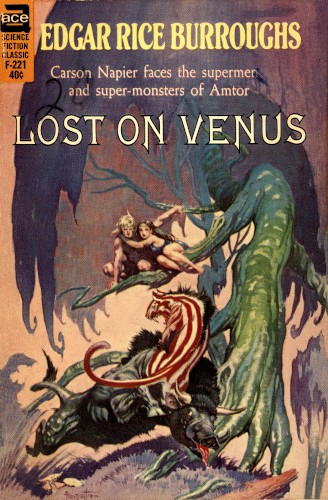
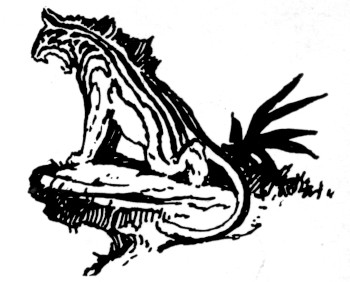
"It is a terrible beast," explained Sov, "a huge and terrible beast. It
is covered with stiff hair, like bristles, and is of a reddish color
with white stripes running lengthwise of its body, its belly being of a
bluish tinge. It has great jaws and terrible talons, and it eats naught
but flesh."
At that instant a terrific roar that seemed to shake the building broke
upon our ears.
"That is the tharban," said Hokal with a grin. "He has not eaten for
three days, and he is not only very hungry, but he is very angry."
"And what lies beyond the sixth door?" I demanded.
"In the corridor beyond the sixth door hidden jets will deluge you
with a corrosive acid. It will fill your eyes and burn them out; and
it will consume your flesh slowly, but you will not die too quickly.
You will have ample time in which to repent the crimes that brought you
to the room of the seven doors. The sixth door, I think, is the most
terrible of all."
"To my mind the seventh is worse," remarked Hokal.
"Perhaps," admitted Sov. "In the seventh, death is longer in coming,
and the mental agony is protracted. When you step upon the concealed
spring in the corridor beyond the seventh door the walls commence to
move slowly toward you. Their movement is so slow as to be almost
imperceptible, but eventually they will reach you and slowly crush you
between them."
"And what is the purpose of the noose above the table?" I asked.
"In the agony of indecision as to which door is the door to life,"
explained Sov, "you will be tempted to destroy yourself, and the noose
is there for that purpose. But it is cunningly arranged at such a
distance above the table that you cannot utilize it to break your neck
and bring death quickly; you can only strangle to death."
"It appears to me that you have gone to considerable pains to destroy
your enemies," I suggested.
"The room of the seven doors was not designed primarily to inflict
death," explained Sov. "It is used as a means for converting
unbelievers to Thorism, and you would be surprised to know how
efficacious it has been."
"I can imagine," I replied. "And now that you have told me the worst,
may I be permitted to satisfy my hunger and thirst before I die?"
"All within this room is yours to do with as you please during your
last hours on earth, but before you eat let me explain that of the
seven varieties of food upon this table all but one are poisoned.
Before you satisfy your thirst, you may be interested in knowing that
of the seven delicious beverages sparkling in those seven containers,
six are poisoned. And now, murderer, we leave you. For the last time in
life you are looking upon fellow human beings."
"If life held only the hope of continuing to look upon you, I would
gladly embrace death."
In single file they left the room by that door to life. I kept my eyes
upon that door to mark it well; and then the dim light went out.
Quickly I crossed the chamber in a straight line toward the exact
spot where I knew the door to be, for I had been standing facing it
squarely. I smiled to myself to think how simple they were to imagine
that I should instantly lose my bearings because the light had been
extinguished. If they had not been lying to me, I should be out of that
room almost as soon as they to claim the life they had promised me.
With outstretched hands I approached the door. I felt unaccountably
dizzy. I was having difficulty in keeping my balance. My fingers came
in contact with a moving surface; it was the wall, passing across my
hands toward the left. I felt a door brush past them and then another
and another; then I guessed the truth—the floor upon which I stood was
revolving. I had lost the door to life.