When the boys presented themselves at Professor
Strong’s room at the Hotel Manhattan they
found that worthy man looking over a number of
purchases he had made while on his trip downtown.
“Glad to see you, boys,” he said, as he shook one
and another by the hand. “I trust you are all feeling
well.”
“Haven’t been sick a minute this summer,” answered
Darry, and the others said about the same.
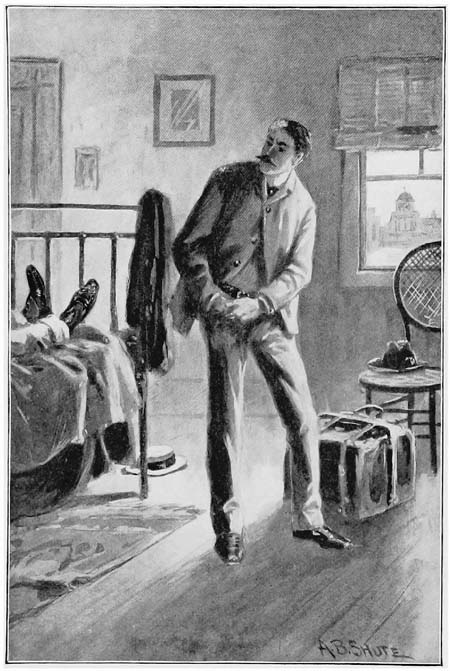
“I see you have your firearms with you,” remarked
Mark, as he gazed at a rifle and a double-barreled
shotgun standing in a corner. “We were
wondering if we were to go armed.”
“I shouldn’t feel at home without my guns,” returned
the professor with a smile. “You see that
comes from being a confirmed old hunter. I don’t
anticipate any use for them except when I go hunting.
As for your going armed, I have already arranged
with your parents about that. I shall take
a shotgun for each, also a pistol, for use when we are
in the wilds of the upper Orinoco.”
“Will you lead us on a regular hunt?” asked
Darry, eagerly.
“I will if you’ll promise to behave and not get
into unnecessary difficulties.”
“We’ll promise,” came from all.
“I have been making a number of purchases,”
continued Professor Strong. “But I must make a
number more, and if you wish you can go along
and help me make the selections.”
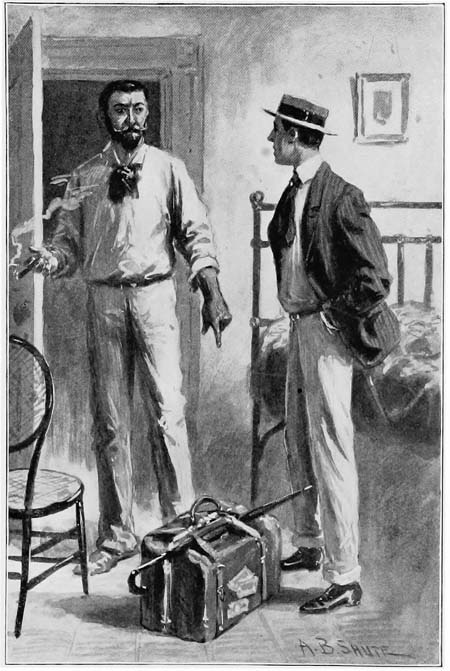
“Is Glummy—I mean is Jake Hockley coming up
here?” questioned Mark.
“I expected him to come with you. Isn’t he stopping
with one of you?”
“No, he’s stopping at the Astor House,” came
from Frank.
There was an awkward pause, which was very
suggestive, and the professor noted it. With his
gun in hand he faced the four.
“I’m afraid you do not care much to have Master
Hockley along,” he said, slowly.
“Oh, I reckon we can get along,” answered
Darry, after the others had failed to speak.
“It is unfortunate that you are not all the best of
friends. But Hockley asked me about the trip a
long while ago and when it came to the point I
could not see how I could refuse him. Besides that,
I was thinking that perhaps the trip would do him
good. I trust you will treat him fairly.”
“Of course we’ll do that,” said Mark, slowly.
“I guess there won’t be any trouble,” said Frank,
but deep in his heart he feared otherwise.
“Hockley has not had the benefits of much traveling,”
continued the professor. “And traveling
broadens the mind. The trip will do us all good.”
They were soon on their way to Fourteenth
Street, and then Broadway, and at several stores
the professor purchased the articles he had put down
on his list. The boys all helped to carry these back
to the hotel. On arriving they found Jake Hockley
sitting in the reception room awaiting them.
The face of the lank youth fell when he saw that
they had been out on a tour without him. “I’d been
up earlier if you had sent me word,” he said to the
professor. “I suppose I’ve got to get a lot of things
myself, haven’t I?”
“You have your clothing, haven’t you?—I mean
the list I sent to you?”
“Yes, sir.”
“Then you are all right, for I have the other
things.”
From the professor the boys learned that the
steamer for La Guayra, the nearest seaport to Caracas,
the capital of Venezuela, would sail three days
later.
“There is a sailing every ten days,” said Professor
Strong. “The steamers are not as large as
those which cross the Atlantic but they are almost
as comfortable, and I have seen to it that we shall
have the best of the staterooms. The trip will take
just a week, unless we encounter a severe storm
which drives us back.”
“I don’t want to meet a storm,” said Hockley.
“Afraid of getting seasick,” came from Frank.
“Not exactly,” snapped the lank youth. “Perhaps
you’ll get seasick yourself.”
“Does this steamer belong to the only line running
to Venezuela?” asked Sam.
“This is the only regular passenger line. There
are other lines, carrying all sorts of freight, which
run at irregular intervals, and then there are sailing
vessels which often stop there in going up or down
the coast.”
The three days to follow passed swiftly, for at the
last moment the professor and the boys found plenty
of things to do. On the day when the steamer was
to sail, Sam’s mother came down from Boston to
see her son off, and the parents of Mark and Frank
were also on hand, so that there was quite a family
gathering. The baggage was already aboard, a
trunk and a traveling case for each, as well as a
leather bag for the guns and ammunition.
At last came the familiar cry, “All ashore that’s
going!” and the last farewells were said. A few
minutes later the gang-plank was withdrawn and the
lines unloosened. As the big steamer began to
move, something like a lump arose in Frank’s
throat.
“We’re off!” he whispered to Mark. “Guess
it’s going to be a long time before we get back.”
Mark did not answer, for he was busy waving his
handkerchief to his folks. Frank turned to Sam
and saw that the tears were standing in the latter’s
eyes, for Sam had caught sight of his mother in the
act of wiping her eyes. Even Darry and Hockley
were unusually sober.
In quarter of an hour, however, the strain was
over, and then the boys gave themselves up to the
contemplation of the scene before them. Swiftly
the steamer was plying her way between the ferry-boats
and craft that crowded the stream. Soon the
Battery was passed and the Statue of Liberty, and
the tall buildings of the great metropolis began to
fade away in the blue haze of the distance. The
course was through the Narrows to the Lower Bay
and then straight past Sandy Hook Light into the
broad and sparkling Atlantic.
“Take a good look at the light and the highlands
below,” said the professor, as he sat beside the boys
at the rail. “That’s the last bit of United States
territory you’ll see for a long while to come—unless
you catch sight of Porto Rico, which is doubtful.”
“Won’t we stand in to shore when we round Cape
Hatteras?” asked Hockley.
“We shall not have to round Cape Hatteras,
Hockley. Instead of hugging the eastern shore of
the United States the steamer will sail almost due
South for the Mona Passage on the west of Porto
Rico. This will bring us into the Caribbean Sea,
and then we shall sail somewhat westward for a
brief stop at Curaçao, a Dutch island north of the
coast of Venezuela. It is not a large place, but one
of considerable importance. The submarine cable
from Cuba to Venezuela has a station there.”
“I’m going to study the map of Venezuela,” said
Mark. “I know something about it already, but
not nearly as much as I’d like to.”
“To-morrow I’ll show you a large map of the
country, which I have brought along,” answered
Professor Strong. “And I’ll give you a little talk
on the history of the people. But to-day you had
better spend your time in making yourselves at
home on the ship.”
“I’m going to look at the engine room,” said
Frank, who was interested in machinery, and down
he went, accompanied by Darry. It was a beautiful
sight, to see the triple expansion engines working
so swiftly and yet so noiselessly, but it was frightfully
hot below decks, and they did not remain as
long as they had anticipated.
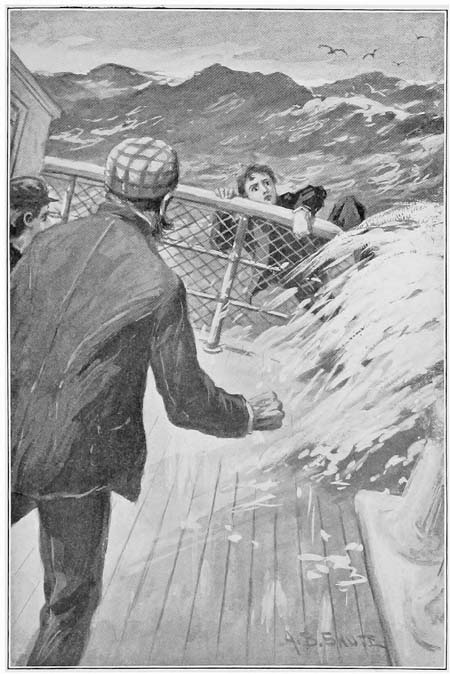
They were now out of sight of land, and the long
swells of the Atlantic caused the steamer to roll not
a little. They found Sam huddled in a corner of the
deck, looking as pale as a sheet.
“Hullo, what’s up?” queried Frank, although he
knew perfectly well.
“Nothing’s up,” was the reply, given with an
effort. “But I guess there will be something up
soon,” and then Sam rushed off to his stateroom,
and that was the last seen of him for that
day.
Mark was also slightly seasick, and thought best
to lie down. Hockley was strolling the deck in deep
contempt of those who had been taken ill.
“I can’t see why anybody should get sick,” he
sneered. “I’m sure there’s nothing to get sick
about.”
“Don’t crow, Glum—I mean Jake,” said Frank.
“Your turn may come next.”
“Me? I won’t get sick.”
“Don’t be too sure.”
“I’ll bet you five dollars I don’t get sick,” insisted
the lank youth.
“We’re not betting to-day,” put in Darry. “I
hope you don’t get sick, but—I wouldn’t be too sure
about it.” And he and Frank walked away.
“What an awful blower he is,” said Frank, when
they were out of hearing. “As if a person could
help being sick if the beastly thing got around to
him. I must confess I don’t feel very well myself.”
“Nor I,” answered Darry, more soberly than
ever.
Dinner was served in the dining saloon at six
o’clock, as elaborate a repast as at any leading hotel.
But though the first-class passengers numbered forty
only a dozen came to the table. Of the boys only
Frank and Hockley were present, and it must be confessed
that Frank’s appetite was very poor. Hockley
appeared to be in the best of spirits and ate heartily.
“This is usually the case,” said the professor,
after having seen to it that the others were as comfortable
as circumstances permitted. “But it won’t
last, and that is a comfort. Hockley, if I were you,
I would not eat too heartily.”
“Oh, it won’t hurt me,” was the off-hand answer.
“The salt air just suits me. I never felt better in
my life.”
“I am glad to hear it, and trust it keeps on doing
you good.”
Frank and Mark had a stateroom together and so
had Sam and Darry. Hockley had stipulated that
he have a stateroom to himself, and this had been
provided. The professor occupied a room with a
Dutch merchant bound for Curaçao, a jolly, good-natured
gentleman, who was soon on good terms
with all of the party.
There was but little sleep for any of the boys during
the earlier part of the night, for a stiff breeze
was blowing and the steamer rolled worse than ever.
But by three o’clock in the morning the wind went
down and the sea seemed to grow easier, and all fell
into a light slumber, from which Mark was the first
to awaken.
“I feel better, although pretty weak,” he said,
with an attempt at a smile. “How is it with you,
Frank?”
“Oh, I didn’t catch it very badly.”
“Did Glummy get sick?”
“No.”
“He’s in luck. How he will crow over us.”
“If he starts to crow we’ll shut him up,” answered
Frank, firmly.
They were soon dressed and into the stateroom
occupied by Sam and Darry.
“Thanks, I’m myself again,” said Darry. “And
why shouldn’t I be? I’m so clean inside I feel fairly
polished. I can tell you, there’s nothing like a good
dose of mal de mer, as the French call it, to turn one
inside out.”
“And how are you, Beans?” asked Mark.
“I think I’m all here, but I’m not sure,” came
from Sam. “But isn’t it a shame we should all be
sick and Hockley should escape?”
“Oh, he’s so thick-skinned the disease can’t strike
through,” returned Frank.
He had scarcely uttered the words when Darry,
who had stepped out into the gangway between the
staterooms came back with a peculiar smile on his
face.
“He’s got ’em,” he said.
“He? Who? What has he got?” asked the
others in a breath.
“Glummy. He’s seasick, and he’s in his room
doing more groaning than a Scotch bagpipe. Come
and listen. But don’t make any noise.”
Silently the quartet tiptoed their way out of the
stateroom and to the door of the apartment occupied
by Hockley. For a second there was silence. Then
came a turning of a body on a berth and a prolonged
groan of misery.
“Oh, why did I come out here,” came from Hockley.
“Oh dear, my head! Everything’s going round
and round! Oh, if only this old tub would stop rolling
for a minute—just a minute!” And then came
another series of groans, followed by sounds which
suggested that poor Hockley was about as sick as a
boy can well be.
“Let’s give him a cheer, just to brace him up,”
suggested Frank, in a whisper.
“Just the thing,” came from Darry. “My, but
won’t it make him boiling mad!”
But Mark interposed. “No, don’t do it, fellows,
he feels bad enough already. Come on and leave
him alone,” and this advice was followed and they
went on deck. Here they met the professor, who
wanted to know if they had seen Hockley.
“No, sir, but we heard him,” said Sam. “He’s
in a bad way, and perhaps he’d like to see you.”
At this Professor Strong’s face became a study.
Clearly he knew what was in the boys’ minds, but
he did not betray it. Yet he had to smile when he
was by himself. He went to see Hockley, and he
did not re-appear on deck until two hours later.