THE chief was puzzled by the actions of Bob and Joe, and the boys
realized it, but there was no use trying to explain. It would take
more than signs to convey the idea that more whites were near the
river.
“Suppose we try to get him to go with us,” suggested Joe. “Think he
will?”
“Hard to say. We’ll find out.”
The youths beckoned the Indian to come with them, and they were
surprised to find that he did so without hesitation.
“He probably intends to do anything we ask from now on,” said Bob.
“Our ability to kill wild beasts with fire was too much for him. Maybe
he thinks he’ll die like the tapir if he refuses.”
There was a narrow trail along the bank of the stream, and Bob led the
way down it, followed by Joe and the chief. The boys intended to make
as much time as possible, for they wished to reach the river as soon
as they could. How far away it was, they did not know. Perhaps a large
number of miles.
“If we can just keep the chief with us everything will turn out fine,”
said Bob.
All the rest of that day they trudged on, keeping their rifle ready
for any savage jungle beast that might show itself. The Indian kept
with them tirelessly, and many times he proved of valuable assistance
in pointing out the easiest course through the underbrush.
Along toward evening they stopped at a large open space that was
devoid of vegetation.
“Better stay here for the night, hadn’t we?” asked Joe.
“Yes,” Bob replied. “You stay here and build a fire while the chief
and I go in search of game. Don’t think you’ll be in any danger. We’ll
be back in a short time.”
Bob and the Indian started out down the bank of the stream, confident
that they would see game sooner or later.
They had not far to go.
At a sharp bend in the trail a small animal, the name of which Bob
did not know, darted out and made for the water.
But it did not get there.
Bang! came the report of the rifle, and the bullet sped straight. The
creature fell dead at once.
This time the Indian did not show signs of fear, for he knew what was
to come. Instead he looked at Bob with awe and wonder in his eyes.
Back at the clearing they found that Joe had started a large fire. The
warmth of it felt good as the chill of the fast-approaching night
fell.
“You did have some luck, didn’t you?” observed Joe. “Wonder if it’ll
be good eating.”
“Hope so.”
The animal was skinned with Bob’s hunting knife and placed over the
fire to bake. Then the three sat together to witness the falling of
night. As usual it came suddenly, and they huddled closer to the fire.
In time the animal was thoroughly baked, and then they began the meal.
Suddenly the chief got up and dashed through the jungle out of sight,
leaving the youths to wonder at this sudden departure.
“Think he’s gone?” asked Joe, trying to catch sight of the Indian
through the dense vegetation.
“Doesn’t seem possible that he’d desert us as abruptly as this,”
replied Bob. “He seemed to be all our friend.”
The youths waited silently, almost convinced that the man had left for
good.
But a moment later he emerged from the jungle as suddenly as he had
disappeared. In his arms were several varieties of what was evidently
wild fruit.
He ran toward the boys with a smile as he glanced first at the roasted
animal and then at the fruit he was carrying. When he reached the fire
he deposited the stuff near, and then sat down to eat.
“A welcome addition to the meal,” said Bob joyfully. “Takes these
savages to know what all the vast forest contains that’s nourishing.”
Nevertheless the young men were careful to see that the Indian ate
first before they sampled any of the wild fruit.
“Take no chances,” remarked Joe. “Ten to one he means no harm, but
it’s best to be on the safe side.”
The chief ate of everything, however, and then the boys followed
suit. They found that all of the fruit was delicious, with flavors
that they had never before tasted.
There were large, round melons, like a cross between a watermelon and
a cantaloup. There were bulbs resembling potatoes, bunches of small
bright-colored berries, and wild bananas.
It was a meal unlike any that the boys had ever eaten. They felt like
savages themselves, and were delighted that soon they would come to
the river.
“Won’t it be wonderful to see our party again?” asked Joe, deeply
touched.
“Sure will,” Bob replied. “But we don’t want to be too sure that
everything will turn out all right. Something else may turn up that’s
not expected.”
After the feast the three sat in silence, watching the moon float
silently and majestically over the great jungle.
At last Joe turned to put more fuel on the fire.
“Hadn’t some of us better turn in?” he asked. “We’ve had a tough time
of it today and need rest.”
Bob agreed, and they set about arranging watches.
“I’ll be the first guard,” announced Joe. “You and the chief curl up
by the fire and get some sleep. I’ll call you in a few hours. We’d
better not disturb the Indian tonight.”
Thus it was arranged, and Joe sat idly beside the fire, his rifle near
by.
His watch passed without incident, and at last he tapped Bob on the
back. They changed positions, Joe retiring and Bob keeping a lookout
for intruders.
Despite the fact that Bob had a strange feeling that something would
happen, the night passed peacefully, although the youth was confident
that wild animals were just beyond the zone of firelight.
In the morning Joe and the Indian were up early, preparing to hike on.
The former still did not know where the boys were going or what their
purpose was, but he showed no signs of hesitation.
“We want to see the river today,” remarked Bob, as they again took up
the trail.
“I think we will,” the other youth returned. “We made good time
yesterday, and if the luck continues, we will today.”
All morning they tramped without a stop. They were tired and
exhausted, but did not wish to lose time until necessary.
About noon they came to another clearing, and Bob moved that they stop
for the noon meal.
The chief and Joe went into the jungle a short distance away to gather
wild fruit, which alone was to serve as their meal.
In a short time they returned with a bountiful supply, and then the
feast began.
“Several new additions to our menu today,” remarked Bob, as he noticed
that there were cocoanuts, roots like carrots, and a plant resembling
cane.
The three ate heartily of everything, and then they started on.
“Stream’s getting wider,” observed Bob, several hours later.
“Yes,” returned Joe. “The river shouldn’t be very far away.”
He had scarcely uttered the words when they rounded a sharp curve and
found themselves at the junction with the river.
For a moment the youths could hardly believe their eyes. Here at last
was the thing they had been searching for all these days—the thing
that would lead them to their fathers and the others of the party.
Never had anything looked so good to them.
“At last!” breathed Joe, too delighted for words. “Now let’s hurry on
up to the boats.”
“How do you know we should go up?” demanded Bob. “They could be easily
farther downstream as well.”
“I know it,” was the response. “But it seems to me that I remember
passing this stream several hours before we stopped.”
“All right. Let’s go.”
They had to search quite a while before a path was found that followed
the river.
“If we keep up this good time, we’ll surely see the boats today—if
they’re there to see,” said Bob, as he led the way up the trail.
Notwithstanding this, they hiked on constantly for the remainder of
the afternoon without coming to the explorers’ boats.
“Perhaps if we fire rifle shots it will attract their attention,” said
Joe, and he sent out three shots, repeating at intervals.
“What’s that?” said Joe, raising a hand for silence.
“Thought I heard an answering report,” he said. “But maybe—— Yes,
there it is again. And there.”
Two shots had sounded from afar, and at once the boys responded with
Joe’s rifle.
“Now let’s move on upstream,” said Bob. “If we can meet them halfway
it will be all the better.”
The youths again followed the trail, the Indian chief close behind
them. They realized that the answering reports had come from afar and
that it would take no little hiking to get to them.
About every five minutes Joe raised the rifle and fired, each time
receiving an answering shot.
Finally, after an hour’s constant traveling, they heard a crashing
sound in the jungle not far ahead, and they were on the alert at once.
A moment later Mr. Lewis and Mr. Holton emerged and looked about.
Their eyes fell on Bob and Joe, and the men rushed forward in intense
relief and thankfulness.
“Boys!” cried Mr. Holton, almost unable to believe his own eyes.
The next instant they were stammering out words of thanksgiving at
finding their sons alive and apparently none the worse for their
experience.
“We didn’t see how you could possibly escape tragedy,” said Mr. Lewis
gravely. “Getting lost in the vast Amazon jungle is a serious thing,
especially when you have no food of any kind with you.”
“All the time we were in doubt as to how we’d come out,” said Bob.
“Worst part of it was that we were afraid to hike far for fear of
getting farther away from the river, but we knew we couldn’t get any
place sitting down.”
“Tell us all about it,” urged Mr. Holton, and the youths related their
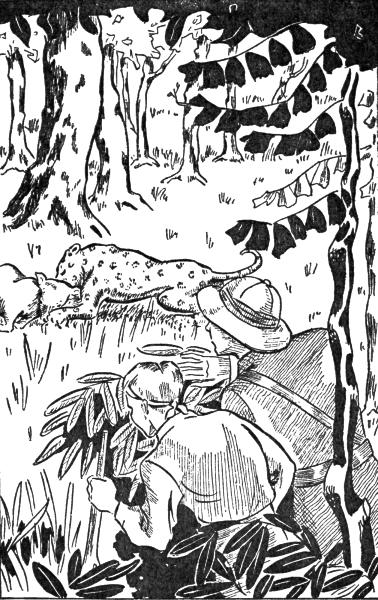
experience from start to finish. They told of shooting the jaguar, of
the necessary abandoning of Bob’s rifle, and of the flight that
followed. And at last of coming across the strange tribe of Indians
that was probably the one Professor Bigelow had been searching for.
“A fearful experience,” breathed Mr. Lewis, when the youths had
finished. “Not many could have had such good luck. If you hadn’t come
across the Indians, your fate would probably have been sealed by now.”
“But wait,” hesitated Joe, with a sudden recollection. “Here’s the
chief of the tribe we got in with. We finally got him to come with
us.”
He glanced around, but the Indian was nowhere in sight.
“Strange,” mused Bob. “He was here a few minutes ago. Could he have
left?”
He called loudly, but it was unnecessary. The man had only stepped
behind a bush, undecided as to whether to come in sight of the other
whites, and at once left his place of concealment and walked out
warily.
Bob and Joe beckoned for him to move up to them. At first he was
uncertain, but finally concluded that it would be safe to venture
nearer.
The boys introduced him as best they could by signs, and although it
was rather awkward, they felt that much of his uncertainty vanished
before the cordial attitude of Mr. Lewis and Mr. Holton.
“Now we must get to the boats,” Joe’s father said. “Professor Bigelow
will be worried about us, if he is not by now.”
They hiked on up the river, the chief following.
“Won’t the old boy be surprised when he finds that Professor Bigelow
can talk with him!” smiled Joe, as they rounded a long bend.
“That isn’t a strong enough word,” laughed Mr. Holton. “Still,” he
hesitated, “we don’t want to be too sure that this Indian is from the
tribe that the professor was searching for.”
The boats were several miles distant, and it would require several
hours’ traveling to get to them. But the whites were all overly
anxious and made good time.
At last, after passing through a thick grove of palms, they sighted
the boats in the distance.
Professor Bigelow came running up at once, a broad smile of
thankfulness on his bronzed, scholarly face. He gave the boys a
welcome almost as warm as that of Mr. Holton and Mr. Lewis. The crew,
too, took part in the reception and muttered words of joy at seeing
Bob and Joe alive and unharmed. Even the Indians who had previously
attempted desertion joined in, outwardly at least.
“But look here, Professor,” said Bob. “We’ve found the savage tribe
you were searching for and have brought you the chief.”
“What!”
For answer Bob motioned for the Indian, who was standing several score
feet down the path, to come closer. He grudgingly did so, and the
professor was taken completely aback in surprise and joy. His eyes
opened wide, and it was some time before he could regain his
composure.
“How can I ever thank you enough?” he muttered, his eyes on the sober
Indian. “We might have searched for days and days and then not found
the tribe.”
He turned to the chief and said something that the others did not
understand. At once the savage’s face lightened, and he began
chattering so rapidly that the professor had to put up a hand for
silence.
“I’m sorry, but I’m not that familiar with his language,” laughed the
professor. “I think, though, that if he’ll talk slowly I may be able
to understand him. Luckily he’s from the same tribe that Otari told
about.”
Again Professor Bigelow turned to the Indian and this time asked him
to talk more slowly.
He did, and a long conversation followed. It was broken and awkward,
but in the end the professor gained a large amount of information.
There was a smile on his face as he turned to the others.
“He says he will tell me all I want to know about his people if I will
go with him to his settlement. His people will treat us all right. I
don’t think there is cause to worry about that. What do you think
about going?”
“All right with me,” returned Mr. Holton. “That was one purpose for
coming up here, you know. And the chances are that we’ll find an
abundance of fauna in those remote forests. I’m all for it.”
“Fine,” burst out Professor Bigelow. “Then we’ll go at once. But
first,” he hesitated, “we’ll have to decide who will go and who will
stay with the boats.”
“Why not take the boats with us?” suggested Joe. “The stream that Bob
and I followed to the river is deep, even if it isn’t wide. I think we
can easily paddle through.”
The others gave their approval at once, and they moved on up to the
boats.
They decided to get a lunch first, however, for all were tired after
the day’s strain. The chief was in no special hurry to get back to the
village, as he had often left on long hunting trips alone.
Soon after the meal the provisions that had been taken out were packed
in the boats, and then all climbed in.
“Now let’s make time,” urged Mr. Lewis, and the crew paddled them
upstream.
The afternoon was rapidly wearing away, and before long it would be
night.
At last Mr. Holton called to the crew to stop the boats.
“It’s unsafe to paddle farther,” he said. “Suppose we turn up into
that little bay over there.”
The suggestion was carried out. Then they made camp.
“Hope nothing happens tonight,” said Bob, as he prepared to turn in
for the night.
“I’m with you there,” his chum returned. “Somehow I’ve had enough
thrills for a while.”
But he had no way of knowing how soon action would present itself in a
big way.
The next morning they were up early, preparing to resume the journey
shortly after breakfast. The chief of the strange tribe told Professor
Bigelow that they should reach his village late that day, if all
turned out well.
“I’m not especially anxious to get back among those wild men,” Bob
said aside to his chum. “But we must do all we can to help Professor
Bigelow.”
Late that afternoon the chief said something to the anthropologist and
pointed to a clearly defined trail that wound away through the heavy
vegetation.
“He says that here is where we leave the boats and head for his
village,” the scientist told the others in animated tones.
“Fine!” exclaimed Mr. Lewis, also delighted that the journey had come
to an end. “There’s a place that will act as a harbor,” pointing to a
groove in the shore.
He directed the crew to paddle the boats to land, and as soon as this
was done all climbed out and made the crafts fast to staunch trees.
Professor Bigelow turned to the savage and conversed for several
minutes. Then he moved to the boats.
“The village isn’t far away,” he said. “It will be safe to leave our
provisions here for the time being.”
As a precaution, however, and also because the naturalists wished to
secure new specimens, they carried their rifles and a good supply of
ammunition.
The chief led the way along the path, the others close at his heels.
The path was so well cut that they had no trouble in walking along
briskly. A half-hour, the Indian said through Professor Bigelow, would
be all the time required to get to the village.
Suddenly the explorers heard a faint screaming and shouting that came
from the village, and at once the chief began chattering nervously.
Professor Bigelow gave a groan and translated to the others.
“He says that probably a fight is taking place between his tribe and
another,” said the scientist.
“What!” cried Mr. Holton excitedly. “Then that means that we whites
may have to use our rifles after all. Ask him if the other tribe is
using poisoned arrows.”
The savage nodded in affirmation when the question was put before him,
and the whites tightened their grips on their weapons.
“I guess this means that we’re in for some excitement,” Bob confided
to his chum, as the party again followed the trail.
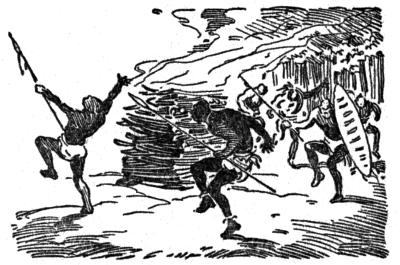
Ten minutes later they parted the foliage and came abruptly within
full view of the village. All uttered cries of consternation at the
furiousness of the battle that was taking place between the two savage
tribes.