FOR some time after the events related in the
last chapter the siege went on without any
noticeable incidents. The fighting was nearly continuous,
but there was nothing like a pitched battle.
The besiegers did not again attempt an assault, nor
did the besieged make a sally in force. Scipio's
plan was to complete the blockade of the city, and
then to await events, reserving his attack till
famine and disease had exhausted the strength of
the enemy.
The first step was to cut off all communication
on the land side. Carthage stood on a peninsula,
and Scipio's superiority in the field made him
master of the isthmus by which this peninsula was
joined to the mainland. This he covered from sea
to sea by a huge fortification, which served at the
same time for a camp. It had a ditch and a rampart
both on the side that looked towards the city,
from which it was distant little more than a bow-shot,
and on that which faced the mainland. It
was necessary, indeed, that it should be defensible
both in the front and in the rear. It was one of the
most formidable possibilities of the war that the
Roman army might be attacked from behind by the
native allies of Carthage. Scipio knew—it was a
mark of his genius that he knew everything—that
the emissaries of the city were unceasing in their
efforts to raise an army of auxiliaries among the
native tribes of Northern Africa. The wall had, as
usual, towers at intervals over its whole length.
One of these towers, built in the most solid fashion
of stone, was carried up to such a height that it
commanded a view of all that was being done
within the city walls.
Of course the besieged did not allow this work,
threatening as it was to the very existence of their
city, to be carried on without interruption. Catapults,
posted on the city walls, kept up a continuous
discharge of missiles; unceasing showers of stones
came from the archers and slingers, while bodies of
infantry were kept in readiness to sally forth whenever
and wherever they saw an opportunity of doing
damage. The Romans had, so to speak, to build and
dig with a workman's tool in the one hand and a
weapon in the other, but they stuck to their task
with indefatigable zeal and inexhaustible courage.
The officers shared all the toils and dangers of their
men, and the work progressed, not indeed without
loss, but without interruption.
Meanwhile the city was in a state of constantly
increasing excitement from another cause, not unconnected,
however, with the war. The festival of
Baal Hammon—otherwise Moloch—was approaching,
and it was to be kept with unusual splendour,
even, it was said, with rites of worship that had
fallen into disuse for many years. For Carthage,
though it had much of the unchanging temper of
the East, was not wholly untouched by the spirit
of progress, and some of the darker and more savage
practices of her religion were no longer practised.
But now again the fiercer instincts of the race were
waking. It was a common topic of talk in the streets
that the desperate fortunes of the state called for
more effectual methods of propitiating the anger of
heaven. Meetings of the Senate were held daily
with closed doors, and it was known, though instant
death was the appointed penalty of any indiscreet
revelation by a senator, that the chief subject of
debate was settling the details of the great Moloch
feast.
Cleanor, in common with the other Greeks in the
population, whether civil or military, heard but
little of the matter. It was, in a way, kept from
them by their companions and comrades, who knew
that they regarded such proceedings without sympathy,
not to say, with disgust. In the ordinary
course the great day would have come and passed
without his knowing anything about it beyond the
fact that it was the chief festival of the Carthaginian
year. But this was not to be.
He was returning to his quarters somewhat late
in the evening, two days before the appointed time,
when he felt a hand laid on the sleeve of his tunic,
and heard himself called by his name in a voice
which somehow seemed familiar, though he could
not immediately connect it with any friend or
acquaintance. He halted, and turned to the
speaker.
It was a woman, poorly clad as far as he could
see in the dim light, and of middle age, to judge
from what appeared of her veiled and cloaked figure.
"Help, noble Cleanor!"
That strange faculty of remembering voices that
most of us have, strange because it is a sheer effort
of memory, unhelped by any accessories of shape
and colour, did not fail him.
"What! is it you, Theoxena?" he cried.
Theoxena was his foster-mother, the wife of a
poor schoolmaster at Chelys, who had been persuaded
by her own need and the liberal offers of Cleanor's
father to undertake the nurture of one of his twin-children.
She had been resident for some years at
Carthage, to which city her husband had migrated,
tempted by the prospect of more liberal remuneration
than he could hope for in his native place.
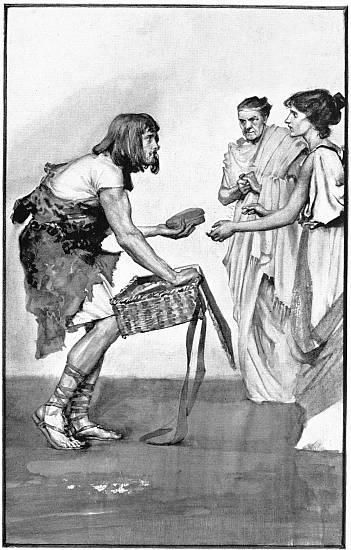
"Yes, sir, it is I," said the poor woman in a voice
broken with tears. "And oh, in such trouble! If
you could help me—but come in here. 'Tis but a
poor place; but I cannot tell you my story in the
street."
Her home was close at hand, and Cleanor followed
her in. A poor place it was, but clean and neatly
kept, and even with some little marks of taste and
culture. In one corner of the room stood a capsa,
a cylindrical case for holding manuscript rolls, and
above it, on a bracket fastened into the wall, a
statuette of Hermes. The chairs were of elegant
pattern, though of common wood, and the mats on
the floor, though worn and shabby, were of artistic
pattern.
"Well, Theoxena," he said, "what is the matter?
What can I do for you?"
"Oh, sir!" she answered, commanding her voice
with an effort, "they have stolen from me my little
Cephalus, the dearest, brightest little boy that ever
was, and are going to offer him for a sacrifice to
their dreadful Hammon."
"But how do you know? How did it happen?"
"You shall hear the story from Daphne, who was
with him when he was stolen."
"And who is Daphne?" asked Cleanor.
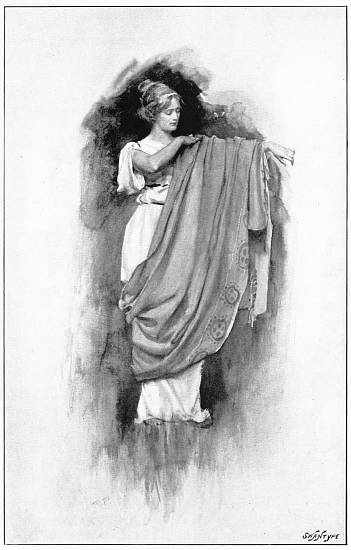
Daphne, who had been sitting in a small chamber
leading out of the main room, came forward on
hearing her name, holding in her hands a piece of
tapestry at which she had been working. She was
a girl of fourteen or thereabouts, not actually beautiful,
perhaps, but with a rare promise of beauty; her
figure had something of the awkwardness of the
time which comes between childhood and womanhood;
her features still wanted that subtle moulding
which the last critical years of girlhood seem able to
give. But her eyes, blue as a southern sea with a
noonday sun above it, were marvellously clear and
full of light; her complexion was dazzlingly bright,
and all the more striking from its contrast to the
generally swarthy hue of the inhabitants of Carthage.
Her hair was of a rich red gold colour, and
would have been of extraordinary beauty if it had
had its natural length. As it was, it was cropped
almost close, though here and there a little curl of
a new growth had begun to show itself.
"This, sir, is my Daphne," said the woman, laying
her hand upon the girl's head. "We are good
patriots, I am sure, for the dear girl gave up her beautiful
hair—if you will believe me, it used to come
down nearly to her ankles—to be made into a string
for a bow. The bow-maker said it was the very
finest he had had, though all the great ladies in
Carthage did the same, I am told. Daphne," she
went on, "tell the noble Cleanor about our darling
little Cephalus."
"Remember," said the young man, who saw that
the girl was trembling excessively, "remember that
the noble Cleanor is your brother, even as Theoxena
is his mother," and he lifted his foster-mothers hand
to his lips and respectfully kissed it.
The girl began her story: "I took my little
brother to walk in the garden—the garden, I mean,
of Mago the senator, who kindly lets us use it, because
the streets are so noisy and crowded, and the
people are so rude." Cleanor did not wonder that
she attracted more notice than she liked. "There is
seldom anybody there; but that day there was an old
man who began to pet dear little Cephalus, and give
him sweetmeats and cakes. He seemed very kind,
and I never dreamt of any harm; and besides, I was
there, for I never leave Cephalus alone. Ah! but
I did leave him alone that morning, wicked girl
that I am." And she burst into a flood of tears.
"But then what could I do? Hylax—that is the
puppy that Cephalus is so fond of—began to fight
with another dog, and Cephalus was frightened, and
said, 'He'll be killed! he'll be killed! Do save him,
Daphne.' He would himself have run to help, but
I was afraid he would be bitten, though that would
have been better than what did happen. So I told
him to sit still where he was, and I ran to help
Hylax. It took me a long time to get hold of him,
for he was very angry, and would go on fighting
though the other dog was much bigger. And
when I looked round, the dear little boy was gone.
I hunted all over the garden, and called him a
hundred times, but it was no use. Mother hasn't
blamed me once, but I can't help feeling that it was
my fault."
"But what," asked Cleanor, speaking to Theoxena,
"has put this dreadful idea of Hammon into your
head?"
"Oh! I know from what my neighbours have told
me that there is going to be a sacrifice such as there
has not been for years and years, and that a number
of children are to be put into the fire. The priests
say that there must be a hundred, not one less.
Some parents offered their own children—to think
that anybody could be so wicked!—and these quite
rich and noble people, I am told; but still there were
not enough, so others had to be taken by force. Besides,
the priests said that there must be children
of every race that was in Carthage; and no Greek
children could be got except by kidnapping them.
And there was something, too, which Daphne did
not tell you. She picked up a button where the old
man had been sitting, and I have been told by someone
who knows that it is of a kind that only the
temple servants of Hammon use."
"I see," said Cleanor; "there seems very little
doubt that it is so. But don't trouble; you shall
have your son again. I have a hundred things to
ask you, but that must be for another day; there is
no time to be lost now. Farewell!"
The young man had spoken confidently enough
to the agonized mother, but when he came to reflect
on what he had to do he did not feel by any means
confident. All night he was busy with the problem,
but seemed, when the morning came, as far off a
solution as ever. He could not even think where
to go for counsel and help. His Greek comrades
would feel with him, but they probably knew no
more about the matter than he did. As to his
Carthaginian fellow-officers, though he was on the
best of terms with them, it was quite useless, and
indeed impossible, to approach them. At last an
idea occurred to him. The Greek physician who
had attended him when he was in Hasdrubal's
house might possibly be not only willing, but able
to help him. Willing he would certainly be, for he
was a Greek; able, possibly, seeing that his practice
lay largely among Carthaginians of the highest
class.
He lost no time in looking for his friend, and was
luckily soon successful in his search.
"I am not surprised," said the physician when he
had heard the story. "I knew that something of
the kind was going on, though the priests keep it as
quiet as they can. I was called in yesterday to see
the wife of a senator. She was in a state of prostration,
for which I could see no physical cause. Of
course I diagnosed mental trouble, and put some
questions in that direction. I got nothing but the
vaguest answers. Just when I was going away I
asked some question about her children. She said
nothing, but the next moment she fell into the very
worst fit of hysterics I have ever seen. I put two
and two together, for I haven't been a doctor for
forty years for nothing, and guessed the truth. And
afterwards, when I was giving the maid in attendance
some directions, I heard it for certain. The
poor woman had given up her eldest boy, a beautiful
little creature of six, to Moloch. And now
about this Greek child. Well, we must not be
seen on the street talking together. Come to my
house about noon to-morrow, and we will talk it
over."
Cleanor was punctual at the appointed time.
"I have been thinking it over," said the physician
when he had satisfied himself that he could not
be overheard. "And I don't see any chance of
success except by bribery. I know where the child
is—in the high-priest's house. I was called in two
or three days ago to see a child who was ill there.
I thought it strange, for the priests have no families.
Still, it might be a child of a relative. But it was
stranger still when, after I had prescribed for the
little fellow and was going away, I heard the voices
of other children. Then it was all explained by
what I told you this morning. They keep the poor
little creatures, when they have got them by persuasion
or force, in the high-priest's house. That is one
step, then. We know where the boy is. And the
next, by great good luck, is made easy for us. The
little fellow that I have been attending will certainly
die. I feel almost sure that I shall not find him
alive when I go this afternoon. Well, I shall have
to report his death to the high-priest, who will have
to find a substitute for him, and will, I suppose,
kidnap another child. That is a horrible thing;
but we can't help it. Now for my plan. You
must bribe the attendant who will have to remove
the child and see to its burial. That will be easy
enough. He is a fellow of the lowest class, and will
do anything for a score of gold pieces. And you
must also bribe the priest who has the business of
actually offering the children. That will be a more
serious matter. The practice is for the high-priest
to offer the first, and to hand over the rest to a
subordinate. This is the man you will have to deal
with. It isn't that it will be a matter of faith with
him. Generally, in my experience—not always,
mark that—but generally the nearer the altar the
less the faith; and this man I know. But it is a
dangerous affair, and, besides, the man can make his
own terms. I should say that a hundred gold pieces
will be wanted. Now, can you manage that? It
isn't every young officer that has a hundred gold
pieces to spare. I can help you a little, but a
physician's fees are small and hard to come by."
"A thousand thanks!" said Cleanor, "but I have
as much as will be wanted."
"Come again after dark," the physician went on.
"You will have to settle with the men, for I must
not appear in the matter, but I will arrange a way
for you to see them."
"Everything is going as well as possible," said
the physician when the two met again. "As I
expected, the child was dead. And here I have
made a little change in our plans. I thought that it
might make complications if two were engaged in
the affair. And the priest might object if he found
his secret shared by an attendant of far inferior
rank. It might mean, he would say, endless blackmailing.
What I did, then, was to tell the man
that there was something very strange about the
child's illness, that I wanted to discover the real cause,
and that I would give him a couple of gold pieces—to
offer him more would have been suspicious—if
he would let me have the body. That is disposed of,
then. Now for the priest. He comes here to-night;
he has long been a patient of mine, and he wants to
see me. The fellow, who is one of the hardest drinkers
in Carthage, would have been dead long ago but for
me. You will see him, and tell him what he is to
do, which, in a word, is to put a dead child for
a living one, and what you will give him for doing
it. That is the naked truth, but you will wrap it up
as you think best."
"But will not that be an impossible thing—a
dead child for a living?" asked Cleanor.
"Not at all," replied the physician, "and not by
any means so hard as you think. You don't know,
I daresay, that the children are drugged as heavily
as possible without making them actually insensible.
All the creatures that are brought to be sacrificed
have to be drugged. You know that it is thought
to be the very worst omen if a bull or a ram breaks
away from the attendants as they are bringing it
to the altar. You don't suppose that there is a
miracle perpetually worked so that what happens
every day in the slaughter-house never happens
in a temple? And this makes the affair comparatively
easy. There is not much difference between
a drugged child and a dead child."
The priest came in due course. The physician
with some cautious hints excited his curiosity and
greed, and Cleanor found his task neither so difficult
nor so costly as he had anticipated. It is
needless to relate the negotiations. As the physician
had anticipated, the priest's faith was not a
difficulty. He had not a vestige of belief. He had
been a party to too many impostures to have anything
of the kind left. Fraudulent miracles were
a part almost, it might be said, of his daily business.
But he made the most of the risk of the proceeding,
and this was undoubtedly great. Not only was the
dead child to be substituted for the living, but the
living was to be smuggled away. The physician
had provided a temporary refuge for it; it was to
be received into the family of the couple which
kept his house. The thing probably appeared to
be more difficult than it really was, chiefly because
no one would have any idea that it would be attempted.
A bargain was ultimately made for a
somewhat smaller sum than the physician had
named. The priest was to receive five-and-twenty
gold pieces down, and fifty pieces more when Cleanor
was satisfied of the safety of the child.
Cleanor was long in doubt whether or not he
should be present at the hideous ceremony of the
coming day. All the instincts of his own nature
and his race revolted against such doings. The
Greek temper was not particularly merciful, and
certainly never shrank from taking life when occasions
of policy or promptings of revenge seemed
to suggest it, but it had no liking for spectacles of
blood. Even in its degradation it revolted from
the savage amusements which fascinated the Romans.
And Cleanor had the best feelings of his
race in high development. On the other hand, he
reflected that if any chance suspicion should arise
his presence might help to disarm it. Above all,
his interest in the fate of his little foster-brother
was so overpowering that he felt it impossible to
keep away.
The solemnities of the day began with a great
procession, in which the inferior deities of the
Carthaginian faith were carried to pay their homage,
as it was said, to Baal Hammon their chief. Each
had his own company of priests and temple attendants;
both the deity and his satellites were
decked out for the occasion with all the splendours
which the temple treasuries—most of them rich
with the accumulation of centuries—could furnish.
First,—for it was right that the most dignified
visitor should be the first to arrive,—came Melcart,
Hammon's vicegerent, as he might be called, who
had under his special protection the daughter cities
of the Phœnician race, as he had the great mother-city
of Tyre. The god was not represented by any
human figure, but a great sun, with gilded rays, was
borne under a canopy of rich purple curtains. Next
to Melcart came Tanit or Astarte, symbolized by a
similar image of the moon, but smaller, and with
silver rays; and after Tanit again, Dagon, the fish-god,
the special protector of the fleets of Carthage,
held in less reverence since the eldest daughter of
Tyre had lost the hereditary supremacy of the seas.
These were the three great dignitaries of the procession;
after them followed a crowd of inferior powers
with figures of man or brute, always heavy with
gold or sparkling with gems, but grotesque or even
hideous in shape, for the Phœnician craftsman made
no effort to emulate the grace of his Greek rival.
Hammon's temple was thronged, and indeed had
been thronged from the hour of dawn, when its
gates were thrown open, with an excited multitude.
A lane, however, was kept clear in the middle by
two ranks of stalwart guards, native Carthaginians,
all of them splendid in gilded helmets, with nodding
plumes of the African ostrich, and armour of shining
steel, with short purple cloaks over their shoulders.
This lane was left for the approach of the divine
visitors. As the first of these drew near, the great
doors, themselves covered with a scarlet curtain,
that separated the sanctuary from the body of the
temple, were thrown back, and the holy place became
visible, to most of those present that day for the
first time in their lives.
In the centre of a semicircular recess at the further
end, on a throne of gold, approached by twelve
steps, each flanked by the image of a lion, sat the
colossal statue of Hammon. The canopy above it
was formed by the meeting wings of two stooping
figures. The image was made of some black stone,
probably basalt, carved into a rude similitude of the
human figure, with arms of steel which extended
forwards. In front, so close to the image as to be
partly under the arms, was an opening six feet
wide, from which, now and then, a slender tongue
of coloured flame might be seen to shoot forth.
When the opened doors revealed the image, an
instantaneous silence fell upon the assembled multitude,
in striking contrast to the babel of sounds
which had filled the temple a minute before. The
awful moment had come, and the multitude waited
with mingled wonder and terror for what was to
follow.
The silence was first broken by the voice of the
high-priest as he began to chant the litany of supplication.
It was heard plainly enough, but few
understood it, for the form had not been changed
from the earliest times, and the language was mostly
obsolete. At certain intervals the voices of the
inferior priests might be heard coming in with the
refrain. The ancient formula ended, the high-priest
added special supplications for the day. He invoked
blessings on Carthage, on her armies, her fleets, her
priests, and her people. He cursed her enemies,
Rome first of all, with special mention of the name
of Scipio. The supplications ended, the high-priest
turned to the people, crying, "Sons of Carthage, offer
with a willing heart, and of your best, to your Lord
and Saviour Hammon!"
There was a momentary pause. Then the Shophetim
descended from the seats on which they had
been sitting, and, coming forward, cast gold and
spices into the opening. No one imitated, or was
expected to imitate them. They represented the
people, and their gifts symbolized the offering of the
people's wealth. The more solemn part of the
sacrifice remained to be performed, and this part,
for evident reasons, the priests retained in their own
hands.
The high-priest began again:
"O Baal Hammon, we have given thee the most
precious of things without life; now we give thee
flesh of our flesh, and life of our life."
So saying, he took from the hands of a subordinate
priest something—what it was no one could discern—wrapped
in white linen, and placed it on the outstretched
arms of the colossus. The image, worked
by concealed machinery from behind, bowed its head,
and at the same time lowered its arms, dropping the
burden that had been placed upon them into the
chasm underneath. Something between a roar and
a shriek went up from the multitude that filled the
temple. There was the joy of seeing that the great
Hammon accepted their offering; there was the
horror—for even the Carthaginians were human—of
knowing what the offering was. The next instant
a loud crash of sound came from the cymbal-players,
who had been stationed in a recess out of sight of
the multitude. Every time another burden was
placed on the arms and dropped into the chasm
there was the same outburst of wild music.
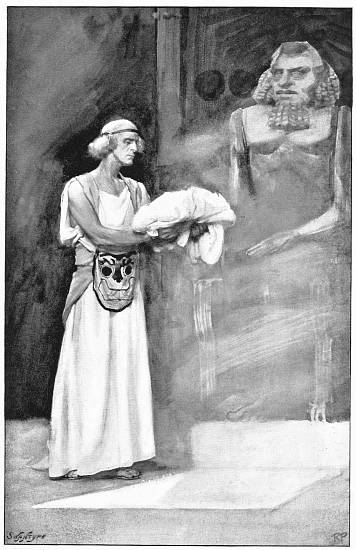 "THE HIGH PRIEST PLACED THE SACRIFICE ON THE OUTSTRETCHED ARMS
OF THE GOD."
"THE HIGH PRIEST PLACED THE SACRIFICE ON THE OUTSTRETCHED ARMS
OF THE GOD."
Cleanor watched the horrible ceremony with intense
attention. Now and then he fancied—he had
found a place, it should be said, not far from the
sanctuary—that he saw a movement, and even
heard a cry. But he could not feel certain. He
recognized the priest who handed the first child to
the high-priest, and who placed the others on the
arms of the image, as the man with whom he had
negotiated, and he felt sure that on one occasion he
made a slight gesture, which no one else would
notice, in his direction. It was a great relief when
the horrible rite was finished. As to the fate of
the child he could not immediately satisfy himself.
It would have been imprudent to make any inquiries.
He had, however, the satisfaction of receiving,
during the course of the next day, a message
from his friend the physician that the boy was safe.
The same comforting intelligence was conveyed to
the mother. She, of course, had to be content with
an occasional sight of her child, and the hope of
regaining him at some happier time.