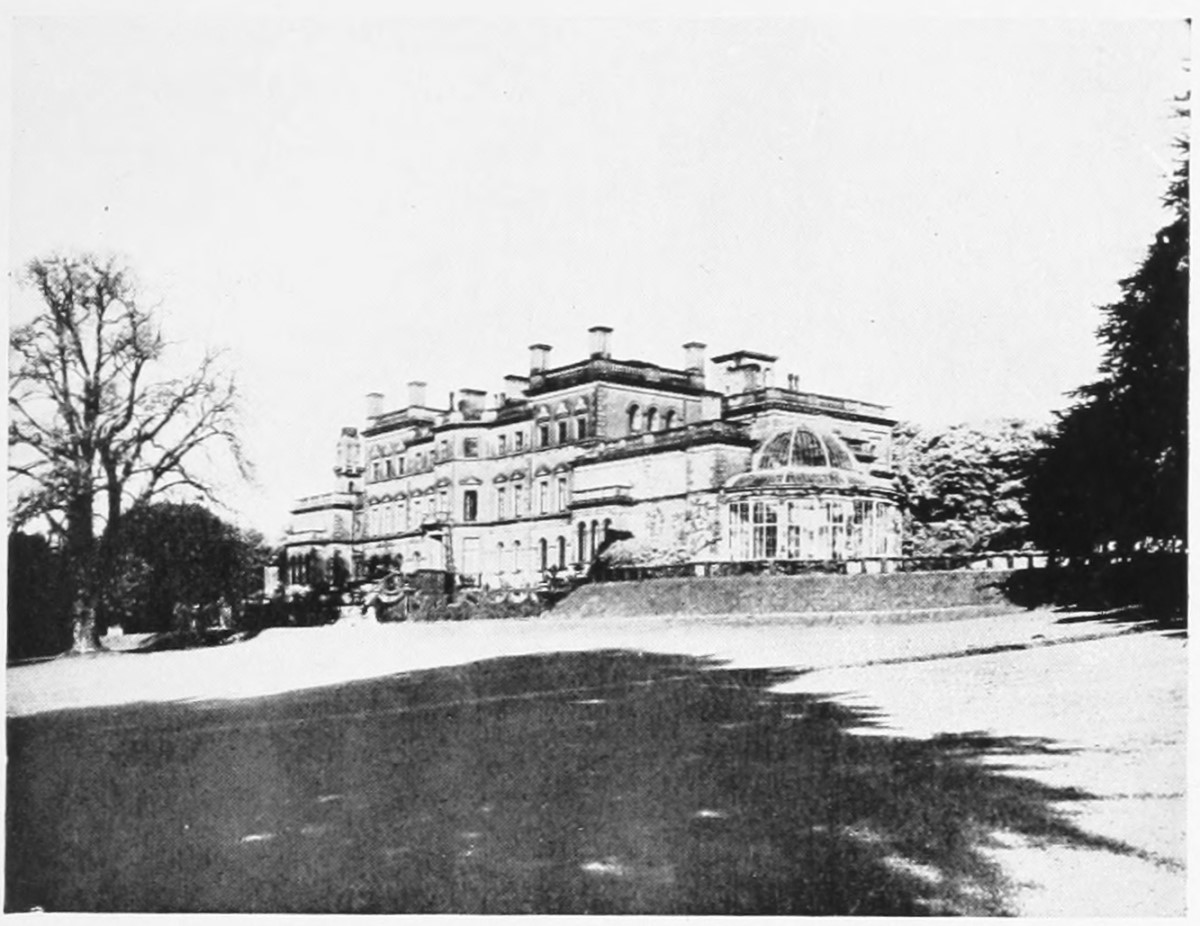
CHAPTER I EARLY DAYS — CHAPTER II GOOD-BYE TO ENGLAND — CHAPTER III JOINS VICEROY’S STAFF — CHAPTER IV HE WINS THE V.C. — CHAPTER V THE VICEROY RETIRES — CHAPTER VI AN IDEAL MILITARY SECRETARY — CHAPTER VII EARLY RACING EXPERIENCES — CHAPTER VIII LORD RIPON LEAVES INDIA — CHAPTER IX LORD DUFFERIN’S VICEROYALTY — CHAPTER X DEAR LONDON AGAIN — CHAPTER XI SOME SPORTING MEMORIES — CHAPTER XII A WINNING YEAR — CHAPTER XIII THE FAMOUS FAREWELL DINNER — CHAPTER XIV HIS MARRIAGE — CHAPTER XV BRINGS TOD SLOAN TO ENGLAND — CHAPTER XVI LAST YEARS — INDEX
LORD WILLIAM
BERESFORD, V.C.
Early Childhood—Eton Days—Mischief and Whackings—Companions
at Work and Play—Sporting Contemporaries of Note—The
So-styled “Mad Marquis”—His Bride—Carriage Accident—Ride
in Grand National—House of Commons Acknowledgment
of Lady Waterford’s Goodness to the Irish during the Famine—Joins
the 9th Lancers in Dublin—A Few Sporting Mishaps—Why
he Spent his Life in India
The subject of these memories was the third
son of the fourth Marquis of Waterford,
who married the third daughter of Mr.
Charles Powell Leslie of Glaslaugh, M.P. for Monaghan.
The children of this union were five sons:—
1. John Henry de la Poer.
2. Charles William de la Poer.
3. William Leslie de la Poer.
4. Marcus Talbot de la Poer.
5. Delaval James de la Poer.
In 1866 the fourth Marquis died, and was succeeded
by John Henry, the first of the five sons
mentioned already, and elder brother of the Lord
William of whom I write. One of the most delightful
characteristics of this family has always been
its unity; the brothers were devoted to one another,
their home and their parents. To the end of his
days Lord William spoke of Curraghmore as “Home,”
and of his devotion to his beautiful mother. She
must have been a proud woman, having brought
into the world five such splendid specimens of
humanity, all handsome, having inherited the Beresford
good looks, high spirits, and pluck, whilst happily
imbued with the pride of race which is the making
of great men.
There is nothing snobbish or vulgar in being proud
of our ancestry, though it may seem so to those who
are unacquainted with their own. Even savages
have pride of race, and it has been so since the days
of Virgil, and before that. Let us hope it will
always be so. It is our birthright, which is well, for
it helps men and women to keep straight, sorry to be
the first to lower the standard or bring it into disrepute.
Look at the pride of race among the different
tribes in the East how strong it is, their castes are
profound and deep religions to them, their inherited
pride of race, for which they willingly die, rather
than suffer any real or imaginary indignity.
This instinct is still strongly marked in our
present-day Gypsies, who are exceedingly exclusive
and proud of their race, and they will tell with pride,
if you know them well enough, that the reason they
are, and will be ever more, accursed and hunted
from place to place, is because a Gypsy forged the
nails used in the Crucifixion.
The Lithuanian Gypsies say stealing has been
permitted in their families by the crucified Jesus,
because they, being present at the Crucifixion, stole
one of the nails from the Cross, after which stealing
was no longer a sin. This sounds irreverent, but
they do not treat it lightly. The belief has been
handed down to them, grown with them, and they
seem sadly proud of their history, legend, or whatever
it may be.
From an early age Lord William seems to have
realised what was due to his family and his race,
for with all his high spirits, even in the effervescence
of youth, never once has anybody been able to say
he brought discredit on his family.
The Beresfords have for generations been keen
sportsmen, high-spirited, unspoilt, straightforward
gentlemen; using the word in its old-fashioned full
significance. Lord William was no exception to this
rule, and it has not been given to many to be so
universally popular. His worst enemy was himself,
inasmuch as he habitually put more work into
twenty-four hours than most people would consider
a fair week’s allowance. From an early age
he loved excitement, courting danger and adventure,
resulting in most of the bones in his body having at
one time or another some experiences, and I shall
always think that but for the juggling tricks he
played with his life he might still be with us, and the
world the better for his cheeriness, generosity, and
loyal friendship.
This is not a proper biography in the everyday
acceptance of the term, it aspires to nothing so great.
I have neither the competency to entitle me, nor
the ambition to urge me to write a formal and
stereotyped account of Lord William’s life, but
only some memories, full of the little things that
matter, small details that bring us closer to the
character and introduce us to the personality of the
man.
It is not as a soldier, it is not as a statesman that
I claim applause for Lord William, though both
may be owed, but for his thoroughness in whatever
he undertook, his unfailing cheerfulness, his loyalty,
energy, and marvellous pluck.
In his early days the principle of—“Whatsoever
thy hand findeth to do, do it with all thy might,”
must have been driven home, for whatever he undertook,
that he certainly did with all his might; but his
generosity and his kindliness of nature and his tact
must have been born with him on July 20th, 1847,
in the quaint little village of Mullaghbrach, in the
north of Ireland, where his father was rector until
he succeeded his brother, the third Marquess, in
1859. The early days of Lord William’s childhood
were spent in this peaceful home with the usual
accompaniment of nurses, followed by a German
governess until he was considered old enough for
further instruction, when the Rev. Dr. Renau’s
Preparatory School at Bayford was chosen, the
present Lord Methuen being there at the same time.
After which, when eleven years old, that is in the
year 1858, he was sent to Eton, first to the house of
Mr. Hawtry, and then into Dr. Warre’s.
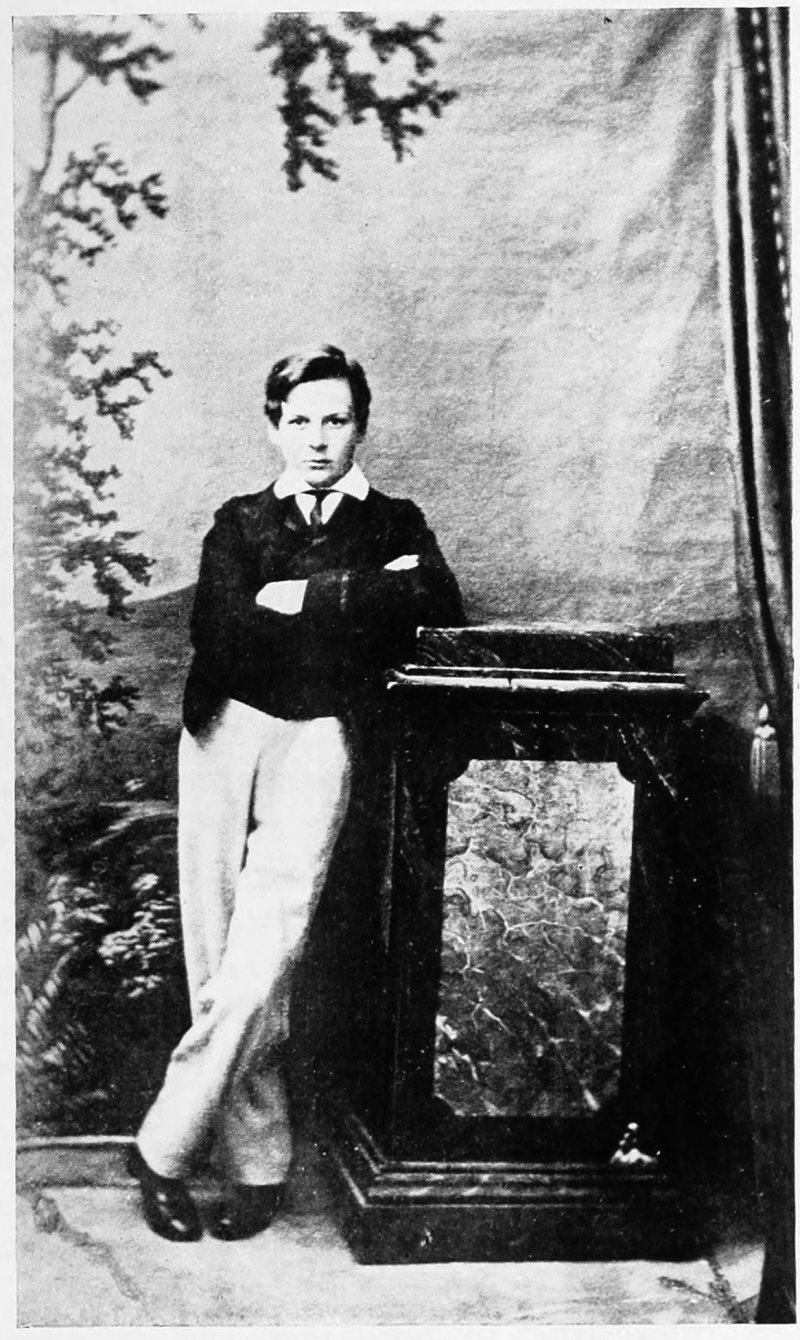
LORD WILLIAM AT ETON, AGED 11
It is interesting to note that the present-day
actor is a relation of Mr. Hawtry of Eton fame. It
was through the Eton Hawtry’s persuasions that
the Prince Consort founded a prize for modern
languages at the College.
Lord Cheylesmore, Sir Simon Lockhart, and Lord
Langford were at Dr. Warre’s house with Lord
William, the two latter being among the Doctor’s
earliest pupils. Lord Langford says, “Bill was
never out of rows of different sorts.” While Lord
Methuen tells me he remembers seconding a boy
named Allen at his tutor’s in a fight with Lord William,
adding, “And it was a very hard fight,” but being
senior to Lord Bill he saw very little of him while
there. Dr. Warre-Cornish, Vice-Provost of Eton,
said, “I always liked him. His Eton record is
chiefly connected with schoolboy sports and skirmishes
with masters at Windsor Fairs, and other
places. He kept many bulldogs and was of a turbulent
disposition.”
The gas works were close to Dr. Warre’s house,
and behind them was the rendezvous of those who
had any differences to settle. Lord Langford says,
“I think Lord Bill often paid a visit there!” and
adds, “On one occasion he captured a polecat and
tied it to the leg of a chair in Dr. Warre’s house.”
We can well imagine the breathless moments in
store for the household. Various surreptitious
journeys were taken to feed it and make sure of
its safety. Then there was the exciting time of
changing the animal’s quarters and attaching it,
in spite of protestations, to a certain chair!
History does not relate what happened, but something
entertaining, no doubt. After being a year at
Eton, Lord Bill heard of the death of his uncle, and
that henceforth his home would be at Curraghmore.
While at Eton he seems to have been chiefly
conspicuous for his love of sport and fighting, his
high spirits, ready wit, and popularity with all. He
worked as much as was necessary and no more, for
he loved the river, running after beagles, paper, or
any other form of sport, more especially a fight.
Happily in his time the battles were not so serious
as they were in 1825 when Lord Shaftesbury’s
brother, Francis Ashley, was carried home to die
after fighting for two hours with a boy named
Wood.
Like a few other men one could name who have
been educated at public schools, and later held important
and responsible posts, he could not always
depend on his pen carrying out his wishes and spelling
properly. Long after having arrived at years of
discretion, shall I say? he constantly wrote to an
old friend as “My dear Jhon,” meaning John. One
day we were talking about certain clever people
being unable to spell properly and chaffing him
about it; nobody enjoyed a joke against himself
better than he did. Somebody asked him, “Bill,
why don’t you write the word you are uncertain of
down on a piece of paper with all the variations as
they occur to you? The look of the word would tell
you which was right?” He replied, “I always do
write it down on a piece of paper and never doubt
its being right.” After which there was nothing
more to be said, and we decided it would all be the
same a hundred years hence, therefore it did not
matter; and at any rate he had my sympathy.
He agreed with Yeats, the Dublin poet, who
sang:
“Accursed he who brings to light of day
The writings I have cast away;
But blessed he who stirs them not,
But lets the kind worms eat the lot.”
Certainly Lord William’s letters were short and
sweet; he did not commit more to writing than he
could help, thereby proving that he was a wise man.
Five years were spent at Eton, and they were
spoken of as happy ones. Even at that early age
his passion for racing betrayed itself and led to
trouble, for on one occasion the attractions of Ascot
became too much for him. Knowing that if he asked
for leave to go it would be denied him, he took
French leave, and received a whacking on his return,
which reminds me that before Lord William’s time
a certain flogging block belonging to the College
disappeared one day, having been kidnapped by
one of the Beresfords, the third Marquess, I think,
when he was at Eton, and is now in evidence at
Curraghmore, or was a few years ago. As far as I
can gather there was no hue and cry after that
interesting piece of furniture, and the next time
there was any whacking to be done another block
was found to be reigning in its stead; so presumably
there was a supply kept in the store-room among the
pickles and the jam.
Lord William’s contemporaries, besides those
already mentioned, were the present Sir Hugh
McCalmont, afterwards a brother officer and life-long
friend, the late Lord Jersey, and the present
Lord Minto. Lord William was fag to both the
latter in succession, Mr. Charles Moore, another life-long
friend, and, I believe, Lord Rossmore.
At the age of sixteen, Lord William left Eton and
went to Bonn to study French and German under a
tutor named Dr. Perry, others studying there at the
same time being the Hon. Elliot and Alec Yorke, and
the Hon. Eric Barrington, who tells me he was also
with him at Eton, where “his principal reputation
was that he and a friend of his had been subjected
to more floggings within a certain time than had
previously been recorded by anyone else.” Sir Eric
says when he found Lord William at Bonn: “I was
both surprised and delighted to find Bill Beresford
there, not having hitherto associated him with
foreign languages.” Some amusing accounts are
given to me also of the Bonn days, where he says:
“Our tutor had a peculiar way of accustoming us
to the use of the German tongue, as, though we had
a resident German tutor in the house, we were
strictly forbidden to make any German acquaintances
in the town, and were enjoined on our word
of honour to talk German to each other during
certain hours every day. A worse practice could
hardly be imagined. Nevertheless, Bill undoubtedly
acquired a certain facility in chattering, which he
afterwards told me was most useful to him with the
Dutch during the South African campaign.” Again
speaking of Lord William he says: “His nature was
exceedingly lovable, and he was very popular with
his fellow pupils and tutors, whom, however, he took
no pains to conciliate. During one altercation with
his German tutor, the latter was heard to say,
‘Beresford, I loved you once, but I despise you
now!’ which diverted us greatly at the time.”
From accounts of those times it appears that it
was the habit of Dr. Perry to give a gala supper the
night before breaking up for the holidays, at which
all the instructors were present. On one of these
occasions a certain student at the University who
had been giving Lord William lessons in Latin, and
who was much attached to him, made the following
speech in English with a very strong German accent:
“I have heard of Merry old England, but I have
never heard of the Merry old Ireland. I wish to
propose the toast of the Merry old Ireland and the
Merry old Beresford.”
To amuse himself at Bonn, Lord William used to
boat with his companions on the Rhine, and took
special delight in the company of an English livery-stable
keeper, who kept a certain number of riding
horses of inferior calibre, with which he was intimately
acquainted, riding being his favourite recreation.
I am afraid Lord William constantly broke Dr.
Perry’s rules, and was frequently being sent away
in consequence; but his mother, Lady Waterford,
said she took no notice of the letters telling her of
her son’s dismissal, as they were invariably followed
by others recalling the sentence. Dr. Perry was
really much attached to his unruly pupil, and his
pupil had a very loyal feeling towards him, and was
the means once of saving his life. Sir Eric Barrington
tells me the story, and I feel I cannot do better
than repeat it in his own words.
“Our Easter holidays were short and spent in
expeditions to Switzerland or the Tyrol. In the
spring of 1866 Dr. Perry took six of us to the latter.
We were to walk across a pass with two guides, carrying
our knapsacks. We walked for ten hours with
very little food; the guides became exhausted and
refused to go any further, but Dr. Perry was determined
to reach the village we were making for. He
misunderstood the directions of the guides and lost
his way. We boys were exhausted also by this time,
so stopped at a small hay-hut, where we resolved to
stay the night. Dr. Perry went on in the dark, and
attempted to descend the mountain-side alone.
Beresford became uneasy about his safety, and went
off to look for him. The rest of us settled down and
went to sleep, when we heard Beresford shouting he
had found Dr. Perry, but could not persuade him to
return, as he had sighted the lights of the village in
the distance. Still uneasy, Beresford started off
again with a friend in the early hours of the morning
to look for Dr. Perry and see if all was well. After
some time he thought he heard a faint cry, and looking
over the side of the mountain descried the object
of his search some way down sitting astride an old
tree stump, which had mercifully broken his fall,
but still in a most perilous position, and trying to
keep himself awake by digging his fingers into the
decayed wood. From a cottage nearby, Beresford
managed to get a rope, but it proved too short, so
he set off for the village, where he found his companions
and the guides had arrived. Though feeling
thoroughly tired out and done up, he insisted on
returning with the guides to show them where to find
Dr. Perry, and to help in the rescue. He was released
with difficulty and after some hard work.
“Dr. Perry always felt he owed his life to Beresford’s
perseverance, and on that account was disposed
to show leniency when his high spirits led
him into mischief on future occasions.”
Bill’s main characteristics were courage and
loyalty; it was impossible not to be warmly attached
to him.
It having been decided that the Army was to be
the profession of Lord Waterford’s third son, after
leaving Dr. Perry, several other tutors were requisitioned
to put the necessary finishing touches
to his military education, after which he passed very
creditably into the Army at the age of twenty, joining
that popular regiment, the 9th Lancers, as a
cornet in 1867.
They were a merry crowd in those days. Among
Lord William’s boon companions in the regiment
were the present Lord Rossmore, otherwise known
as “Derry,” Captain Candy, “Sugar Candy,”
Captain Clayton, “Dick,” the present Colonel
Stewart Mackenzie, “The Smiler,” General Sir
Hugh McCalmont, and the Hon. Charley Lascelles,
who could do such wonderful things with horses
owing to his good hands and sweet temper; and
many more too numerous to mention, not a few of
whom, like Captain Candy, Captain Clayton, and Mr.
Lascelles, have moved on into another room, where
their friends can no longer see them.
It is an interesting fact that all good sorts and
popular men get nicknames attached to them, it
being a sign of their value and the affection borne
them by their comrades. Not often are selfish
prigs called by nicknames, possibly they may be
known behind their backs as “The Swine” or “The
Prig,” or some other uncomplimentary epithet
which can only be used sub-rosa, for who could so
address them to their faces?
Among his friends, who were legion, Lord William
was known as “Bill.” His brother, Lord Charles
Beresford, is always called “Charlie” in the most
affectionate way by even the crowd in the streets,
who all love him and look upon him as their
own.
Those were grand happy days when Lord William
first joined the 9th. He and his young friends had
the whole world before them, life and health then
being a matter of no consequence, no consideration,
for in the arrogance of youth who takes thought of the
morrow? If only when people are young they could
be persuaded to take a practical view of life and
map out their days, not spending strength too
freely, or trying nerves too highly, but keeping a
little in reserve, something to draw upon. Uncontrolled
spirits often lead to disaster early in life.
The Irish are especially buoyant and their mad
spirits infectious and lovable.
In later years Lord William often spoke of those
early days, referring in affection or admiration to
many of his sporting contemporaries, among whom
were Mr. Garret Moore, who between ’67 and ’69
rode many winners in Ireland and elsewhere. (He
died in 1908.) Roddy Owen, a great winner of
races, especially in India and Canada up to 1885,
after which he surprised people at home a little by
winning the Grand National on Father O’Flynn in
1892, Sandown Grand Prize two years running and,
if I remember rightly, the Grand Military on St.
Cross. Poor “Roddy,” as everybody called him,
died in Egypt on active service in 1896, mourned
and regretted by everyone who knew him.
Colonel Meysey Thompson, who had known
Captain Owen all his life, wrote some charming
lines “In Memoriam” when he died. I do not
remember them all, at any rate not correctly, but
one verse I know ran:
“May the date palm’s stately branches
Above thee gently wave;
May the mimosa’s scented wattles
Bedeck with gold thy grave.”
But as I am not writing Roddy Owen’s life I must
hurry on, especially as poking into the pigeon-holes
of the past is apt to bring on fits of the blues.
Captain Bay Middleton, another great friend,
however, must not be forgotten. He was fond of
cricket as well as hunting and horses. A member of
the Zingari, Captained by Sir Gerard Leigh, and
while in Ireland they played the 9th Lancers. I do
not remember who won, but when the game was
over Lord William, to amuse his friends, suggested
a run with the drag hounds, managing to find mounts
for all; they rode just as they were, in flannels.
Needless to say the fun and enjoyment were great.
It was delightful to hear these boon companions
living over again some of these times amidst happy
laughter and friendly recriminations, though perhaps
sometimes tinged with regrets for the days
that were gone. Captain Middleton died in 1892,
so another old friend passed out of Lord William’s
life. It was in April, I think, when Captain Middleton
was riding at quite a small fence (as is so often
the case), that his horse pecked, throwing its rider
forward, and, as almost invariably occurs when a
horse is in trouble, threw up its head, trying to recover
itself, and in so doing broke Captain Middleton’s
neck. He was no doubt a great man on a horse,
and as a rule they went kindly with him, but I have
seen him at times by no means gentle with them,
I am sorry to say, and not always when the horse
was to blame.
Another great friend I must not pass over was
Captain Beasley, called “Tommy” by Lord William,
who rode in twelve Grand Nationals. I have only
mentioned a few of the names that recur to me; it
would take many volumes if I were to enumerate
all his great friends, for few men had so many.
At any rate the fun in those days was certainly
fast and furious, some of the practical jokes being
distinctly drastic though considered very amusing
at the time. I doubt if in these days they would be
considered jokes at all. It does not follow that what
was considered funny and witty by one generation
will be considered the least amusing by the next,
any more than what was true yesterday need be
true to-day, and often is not.
On one occasion when his friend, Captain McCalmont,
was driving him from Cahir Barracks to
Clonmel, while passing through the town of Cahir,
Lord William asked if he would mind pulling up for
him to do some shopping. When he returned with
his purchases they consisted of a sack of potatoes;
this was planted at his feet, and as they continued
their drive he amused himself by throwing potatoes
at everyone they met. Some smiled and seemed
pleased with the delicate attention and gift of potatoes,
others, however, were not, therefore a crowd
soon gathered and embarked on reprisals. The
potatoes were coming to an end, but his blood being
up, he purchased more and continued the battle.
As they proceeded along the ten miles to Clonmel,
news of the battle had evidently travelled ahead of
them, for in places they found people waiting for
them armed with missiles, including brickbats. It
now became a question how they were to get away
themselves. However, the Irish understand one
another, and all the country was fond of the Beresfords,
from whom they had received many considerations
and benefits. At that time, in the eyes of
the people, the Beresfords could do no wrong, so it
ended, I am told, quite happily. In the autumn of
our days it seems a very long time since we were so
full of beans that we could do such mad things, the
result of animal spirits.
Lord William’s uncle, the third Marquis, has been
called the “Mad Marquis” owing to the extraordinary
things he did, probably from the same overflow
of spirits from which Lord William suffered
when throwing potatoes at peaceful pedestrians on
the road.
The so-called “Mad” Marquis certainly did some
very astonishing things, but purely, in my opinion,
from devil-me-care fun and spirits, for when married
to the beautiful Louisa, daughter of Lord Stuart de
Rothsey, whom he passionately loved, he settled
down after sowing his wild oats, and became a model
husband and landlord, beloved by the whole countryside.
It appears to be rather fashionable to think everyone
is mad whom we do not understand, or even
perhaps when they are superior to ourselves in
courage or intellect.
I leave it to my readers to decide if he earned the
sobriquet, if they think a man who was so exceedingly
devoted and tender to his wife, and so full of
consideration for his countrymen, could be rightly
termed the “Mad Marquis.”
When he brought home his bride to Curraghmore,
seeing a crowd of country folk and tenants collected
to greet them, he leaned over his wife and lifted her
veil so that all might admire, so great was his pride
in her.
Soon after their marriage, when driving his wife,
one of the horses became restive while descending a
steep hill. The only thing to be done to avoid a bad
accident was to turn the horses into a hedge at the
side of the road. Lady Waterford tried to get out,
and in so doing fell, hurting her head, causing concussion
of the brain. Her devoted and alarmed
husband carried his unconscious wife in his arms
down the hill, through the River Clode, back to the
house, that being the shortest way, so that she could
be properly attended to more quickly. For several
days and nights he scarcely left her; it was hardly
possible to persuade him to come away even for food;
and when the doctor said all her beautiful hair, that
he admired so much, must be cut off, he would allow
no hands to do it but his own.
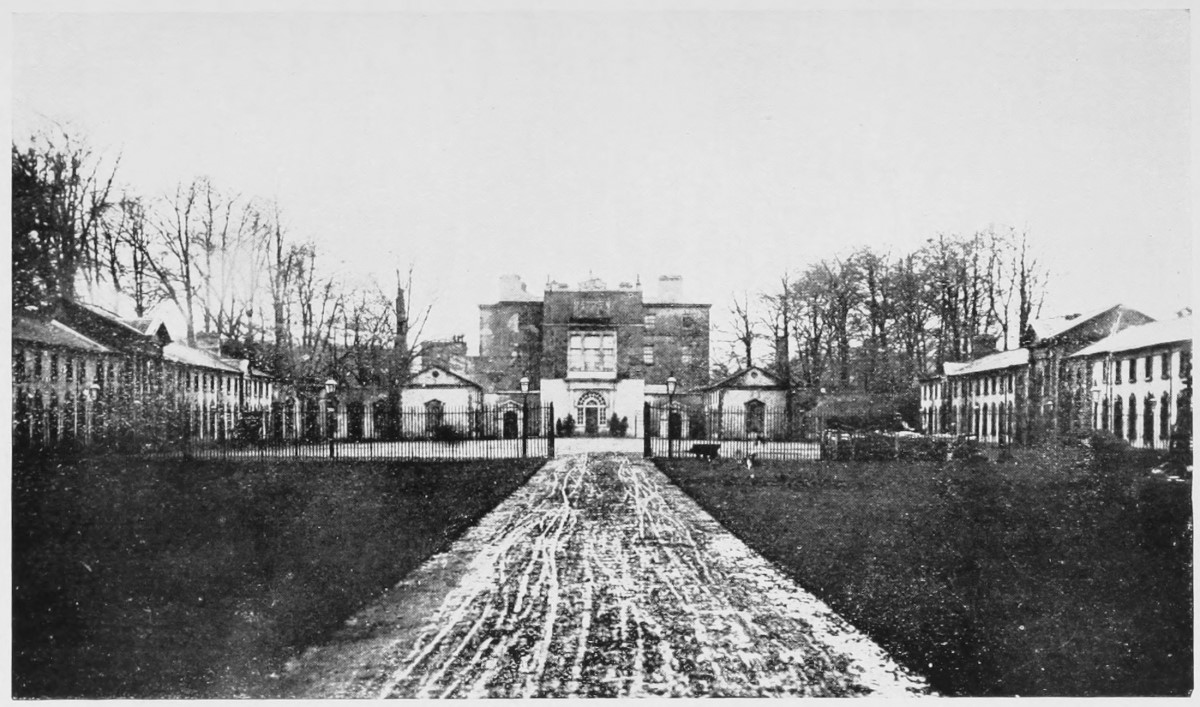
Like all the Beresfords, the third Marquis was
handsome and loved sport in every form, especially
fox-hunting; he hunted the Curraghmore entirely
at his own expense. It was a sad day when his
mount, May-boy, made a mistake over a rotten wall,
which put an end to all his hunting.
It must have been from this uncle that Lord
William inherited his love for steeplechasing, for we
hear of the Marquis in 1840, when it was first becoming
the fashion for gentlemen to ride in chases,
riding in the Grand National. He died in 1859 without
any children, and was succeeded by his brother,
Lord William’s father, as fourth Marquis.
In 1847 (the year Lord William was born) Lord
and Lady Waterford devoted most of their time and
much money in endeavouring to relieve the distress
in Ireland caused by the famine. The Marquis imported
shiploads of wheat for the people, and Lady
Waterford’s goodness was so great that the House
of Commons felt constrained to acknowledge it.
In return for this, these excitable people in the
following year, under the influence of agitators, became
so rebellious to law, and order and to their best
friends, that Curraghmore had to be fortified against
them. The Fenians declared they would capture
Lady Waterford and carry her away to the hills.
This alarmed her husband so greatly that he took
her to her mother, in England, for safety, returning
himself to Ireland to protect the home he loved so
dearly, and if possible save the people from themselves.
To return to Lord William. The 9th Lancers were
stationed at Island Bridge Barracks, Dublin, when
first he joined, which for an Irishman was all that
could be desired. Then on from Dublin to Cahir,
which is not very far from Waterford and Curraghmore;
a troop of the 9th were quartered at Waterford
and half a troop at Carrick-on-Suir, close to
Curraghmore. For a time Lord William was with
the Waterford troop, and it was a curious turn of
fortune’s wheel that brought H.M.S. Research to
Waterford harbour at this time with Lord Charles
as a middy, or at any rate a very junior officer.
Lord Marcus, in the 7th Hussars, was also at home
on leave, so the brothers were together and there
was a very happy gathering.
All the officers of the 9th and the Research were
constantly at Curraghmore, where they were always
sure of a welcome, many carrying away with them
into foreign lands an affectionate gratitude for Lady
Waterford, who had made a home for them all when
in the neighbourhood.
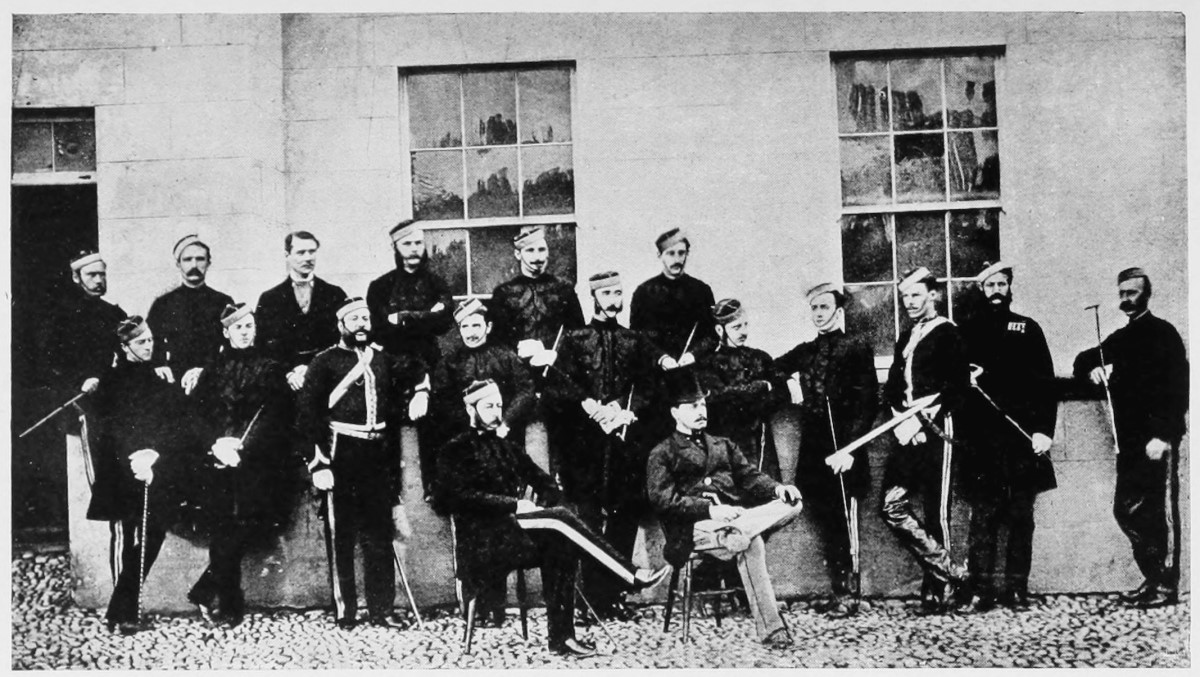
9TH LANCERS IN DUBLIN, 1867
Back row, from left to right: Lieut.-Surg. Longman, Riding Master Crowdy, Capt. F. Gregory (A.D.C. to Lord Lieut. of Ireland), Capt. Cave,
Capt. Hardy, Lieut. Gaskell, Cornet Stewart-Mackenzie.
Second row: Cornet Willoughby, Cornet Lord Wm. Beresford, Paymaster Mahon, Lieut.-Col. Johnson, Capt. Erskine, Lieut. Palairet,
Lieut. Green, Cornet Percy, Adj.; Quarter-Master Seggie, Major Rich in plain clothes.
The 9th Lancers had a pack of harriers when at
Cahir, Lord William acting as one of the whips. He
had begun riding as a very small boy, on a pony
called The Mouse, which was shared by the three
brothers, each taking it in turn to ride. From this
humble little mount he was promoted to other
ponies, on which he soon began to execute little
jumps, and ride about the country during the holidays.
Before many years had passed over his head
he became a follower of the Curraghmore hounds
and other surrounding packs, often seeing more of
the fun on his pony than some of the field on famous
horses, partly owing to the plucky way he “shoved
along” and to knowing the country well, also partly
to the happy way ponies have of turning up unexpectedly
and accomplishing wonderful feats by
scrambling and crawling along places where bigger
horses cannot find foothold. The old Curraghmore,
now the Waterford, hunted a country of about
thirty miles from east to west, and twenty miles
from north to south, its boundaries being Tipperary,
Kilkenny, and Wexford, and the sea on the south.
Having thus graduated in horsemanship, by the
time he joined the 9th he was known as a good man
on a horse.
He naturally loved horses and dogs, and had
many, being a good judge of both. In consequence
of the number of the latter he usually had
about him, Captain Fife, of the same regiment, when
compiling an alphabetical list of rhymes in connection
with his brother officers, on coming to the
letter B, wrote:—
“‘B’ stands for Bill,
Many cur dogs are his,
Good-tempered but hasty,
And easily ris’”;
which, must be admitted, is a magnificent effort, even
if it does not scan very well.
Witnesses of the fun in those days say they can
never forget the delightful time when all the brothers
were at home together. Each a sportsman, each a
wit, full of merriment and pranks, and all especially
delighted when Lord Charles danced a hornpipe
for their amusement. How Curraghmore must have
ached for their voices when they had, as the old song
says, “all dispersed and wandered far away.”
It was when stationed at Cahir that Lord William
began crumpling up his bones owing to various
tosses of sorts. At this time he owned a very fast
trotter, which could do sixteen miles an hour
when requested. He started one night with this
fast trotter in a dogcart to cover the three miles
from the barracks to the station, taking an English
guest with him to catch the 10.30 train for Dublin.
The road was very dark and overshadowed by the
trees of Cahir Abbey Park. Sir Hugh McCalmont
(then Captain McCalmont), a brother officer already
mentioned, was likewise performing the same journey
bound for Dublin; both started at the same time.
Lord William set the pace, and was soon out of sight
and hearing. Added to the darkness, it was pouring
with rain. After journeying some little way
Captain McCalmont was held up by cries issuing
from the gloom. Someone was shouting. He pulled
up in time to find his friend with his guest, his fast
trotter and some dogcart about the road. Lord
William in his haste, combined with the darkness,
had driven at top speed into a cart, somewhat to the
surprise of the driver. The cart also looked as if
taken by surprise, in places. Having satisfied himself
that no one was killed, though all were more or
less damaged, Captain McCalmont continued with
his “crawler,” as he called it, to the station and
caught his train, which is more than the fast trotting
party did.
Trifles of this kind, however, never worried Lord
William, for his spirits were unquenchable.
One of the fastest runs with hounds he could remember,
in those days of scanty judgment, was
when out with the Curraghmore hounds in the
northern part of the country. The fences were not
very big, but the pace was great. Lord William
and Captain McCalmont were riding a bit jealous, I
think; after racing for about twenty minutes, they
both tried to fly a bank, with the natural result
when jumping blown horses. Captain McCalmont’s
gallant little mare did not get up for some time; she
wisely lay still to recover her wind, but Lord William
had been so struck by her performance that he
shouted, “I will buy her”—and he did. But horses
when asked to do too much, sometimes break their
hearts, and the mare was never quite the same
again.
Whenever sport was to be knocked out of anyone
or anything Lord William was sure to be there.
Nothing came amiss to him, fisticuffs, American
cock-fighting, hunting, racing, polo, the latter only
just becoming popular in England.
It was about this time that he came into his share
of the family fortune. He considered it so inadequate
to his needs, that he decided to spend the capital as
interest. This is how he described it to me one evening,
years later, in the grounds of the Taj at Agra.
“So inadequate to my needs was the interest on
my share, that I decided to use my capital as income
so long as it would last, and rearrange my life
again when it came to an end. I started a coach, a
stud of hunters, some racehorses, and laid myself
out for a real good time. I managed to hold on until
just before the regiment was ordered to India.
Then, as the fateful day drew near, I thought I would
have one final flutter at the Raleigh Club. A turn
up of three cards at £1000 a card! I won the lot,
was able to pay up all I owed and clear out to India,
cleaned out, but a free man as to debt.”
I do not feel I am betraying any confidence, as he
told the story to several people, and really it is an
amazing example of what pluck and daring, combined
with determination, can do. A lesson in resource
and audacity that a young subaltern should
arrive in India a penniless soldier, and yet reach the
height of social and official fame combined with
pecuniary comfort, as he did, in a few years. To
sit down with premeditation and map out such a
wild scheme, and then be able to bring it off and
win the odd trick, was rather wonderful.
Possibly what he suffered during those years when
he was riding for a fall made him reckless, risking
his life more frequently than he otherwise would
have done, thinking it was bound to be a short and
merry one, so what matter? Or, like others I have
known when riding for a fall, would not give himself
time to think.
Some of the extraordinarily kind things I have
known him do for young men when in financial
difficulties, though not overburdened with cash himself
at the time, leads me to the belief that he remembered
his feelings when the crash of his own
arranging was drawing near, assisted perhaps by a
little luck, which saved him.
Considering that he was not a rich man, it was
wonderful how lavish was his unselfish and large-hearted
generosity. I verily believe no living soul
ever went to him in trouble and was sent “empty
away.” Yet he could never bear his left hand to
know what his right hand was doing. It really
ruffled him if he ever heard of it again. Nevertheless,
some of those near his left hand did know what
his right was doing, more often perhaps than he
guessed.
Having explained the rather important financial
position at this time, we can return to the daily
happenings, able to see some reason in much that
would otherwise seem of little consequence, but
which meant a good deal to Lord William, we can
also admire more sincerely the brain that evolved
the scheme and carried it out.
Some will no doubt think, and possibly say, that
the affection we all had for Lord William has made
me picture a faultless man; this is, of course, not
so, and it is not difficult to recognise his failings,
which he shared in common with the rest of mankind,
but I do claim for him that they were none
of them mean, little, or contemptible, and we do not
always like people less on account of their faults.
Generosity may be called foolishness: pluck, foolhardiness:
morals, not such as would be considered
a proper rudimentary system for teaching in elementary
schools: but if, after all that has been said, a
man can count hundreds of deeply attached friends,
and not one can say he ever did a dishonourable
action, or willingly hurt another’s feelings, I claim
that man is great.
Lord William was an admirer of beauty and good
taste; add to this, as the cookery books say, his
particularly charming manner, that would woo the
birds off the trees, and his good looks, it is small
wonder he was much loved by the fair sex.
Coach driving Exploit—The Badger Bet and How It was Won—The
Raleigh Club and the Garçon Glacé Episode—Some Merry
Frequenters of the Club—Regimental Racing—The Tenth
Hussars’ Steeplechases, Exciting Race Between H.R.H.’s Horse
and Lord Valentia’s—Aldershot Coaching Accident—Polo at
Woolwich—Sale of 10th Hussars’ ponies—Friendly Altercations
at York—The Three Brothers’ Race—Au Revoir to Merry
England
In addition to being a consummate horseman,
Lord William was an accomplished whip.
When in Cork some foolish person made him
a bet that he could not, at any rate, drive his coach
down the steep and precipitous steps leading from
the barracks, thinking they had at last found something
he could not possibly do. He, however, closed
with the bet at once, saying that he would bet them
even money he would. What sum was offered and
taken I do not remember hearing, but have been
given to understand it was fairly heavy, as the feat
was considered impossible and really offered mostly
in jest. Imagine everybody’s feelings when next day
the coach, with the wheels inside, Lord William
strapped to the box, and the four horses well in
hand, were seen tobogganing down the steps, and
what is more, accomplished it in safety, winning
the bet.
Making bets was always a weakness of Lord
William’s. He acknowledged it was a fool’s argument,
but loved the excitement, moreover generally
won, which was an assistance to the exchequer—a
matter of some consideration.
It would fill volumes to give accounts of all the
mad exploits of those times. Captain Candy was a
constant companion of Lord William’s, and many
of the thrilling adventures of those early years
were shared between them. They appealed to one
another, being equally generous and open-handed.
Many still living can remember the lavish hospitality
dispensed by Captain Candy, though it is the
fashion with some to forget the hand that helped
them. No one wanting a mount went without, so
long as Lord William or Captain Candy had one
standing in their stables. Both were riding for a
fall, but wished all within reach to share their joys
while they lasted.
Hunting from Cork one day these two were riding
close together when Captain Candy, in taking a
fence, found to his dismay that he was jumping down
a quarry, where he landed through the roof of an
old woman’s cabin, causing some splutter and consternation
among the inhabitants, who thought it
must be the Fenians! One side of the cabin had to
be pulled down by Lord William before horse and
rider could be extricated. Strange to relate, no one
was much the worse. I think it would be a toss up
which broke most bones during their sporting
careers. I myself saw Lord William break his
collar-bone twice and dislocate his shoulder three
times on separate occasions. Indeed, such small
affairs became scarcely matters worthy of comment
with him.
From Ireland the 9th Lancers went, in 1868, to
Newbridge, then on in ’69—Hounslow; ’70—Aldershot;
’72—Woolwich; ’72—York; ’74—Colchester;
’75—out to India, and stationed at Sialkôte, after
which a new leaf was turned over in Lord William’s
life, and the writing on the page took another form.
He had a very uneventful time while the regiment
was at Newbridge, but while at Hounslow he was a
good deal in Town, where his clubs saw him fairly
often. At Pratt’s one night he was talking to some
friends about a pet badger he had that could hold
its own against any dog. Someone, I think it was
Captain “Chicken” Hartopp of the 10th Hussars,
said they would like to see the animal, to which the
owner replied, “So you shall. What do you bet I
will not walk down to Hounslow and bring it back
here by ——?” naming some incredibly short time in
which to accomplish the mission. Considering it
almost out of the question that this could be done
in the time, a very respectable sum was bet, and
off started the badger owner to fetch him, the
bargain being that he must walk both ways. It
was therefore necessary to do some smart heel and
toe work, which he carried out faithfully, keeping
a watch on the time as he went along. The badger,
as far as history relates, does not seem to have shown
the least surprise at his master turning up in the
middle of the night in once immaculate, but now very
dusty, evening dress, and hurrying off with him in
his arms through the lamp-lit West End, to the
amazement of policemen and a few belated wayfarers.
They both arrived within the stated time,
the bet being won, though the badger lost a beauty
sleep.
The old Raleigh Club was a great institution in
those days, much frequented by the frisky men of
the time, and all young officers quartered within
possible reach. It was quite the thing in night clubs.
Its doors opened at dusk; when they closed, I do
not know, probably shortly before business people
in the suburbs were eating their early breakfasts.
At any rate, nobody was anybody, who did not belong
to this club, which was approached by a tunnel, adding
mystery and charm. Within these portals huge
sums of money changed hands, highly flavoured
stories circulated, and cards figured largely; so did
swearing, if I may believe what I am told. In fact
it was considered a sign of military efficiency.
One of the great surprises of my life was finding
out, after I married, that some of the most sedate-looking
and highly proper people I had been brought
up amongst, who looked as if they would faint if
anyone said “Damn!” in their presence, were, in
reality, constant visitors at this club, and other
popular rendezvous of fame at that time, while
their wives imagined they were seeing the boys off
to school, or some other highly domestic duty. As
it was put to me, some of these elderly friends of
my early youth were among those who “kicked up
the most row.”
There was that great fine Irishman, the late
Colonel King-Harman, most majestic of men and
model parent, who came to children’s parties and
danced with poor awestricken me, my feet seldom
touching the ground, but my heart full of admiration
for so king-like a being. The Raleigh knew him
as one of the merriest, always ready for a rag.
Lord Alfred Paget, equerry to Queen Victoria,
whom I used to admire so much when I was a child,
sat in front of us in church one winter in the Isle
of Wight. His commanding carriage, handsome
dark eyes, and beetroot complexion fascinated me;
and he was so decorous and good in church, with a
pew full of daughters all apparently reverencing
him as I did, for he spent such a long time bending
over the pew and gazing into his hat when he came
into church. And the gallant way in which, without
a smile, smallest hesitation, or fluster, he disentangled
the bonnets of two ladies who got mixed up in
front of him one Sunday. It came about through
the lady in the front pew getting up from her knees
before the lady in the seat behind her had completed
her devotions. Consequently, when she did get up
the spangled aigrette in her bonnet mixed itself up
hopelessly in the veil and sweeping plume of the head-dress
in front of her. Both tugged and pulled,
growing redder in the face and angrier each moment.
My eyes were riveted on the couple, appalled,
wondering whose headgear would be pulled off first,
when the gallant equerry, without moving a muscle
of his face, reached over with his long arm and gave
one healthy tweak which separated the two bonnets,
while a shower of tinkling bugles fell from the aigrette
to the floor, but still no sign of mirth on the deliverer’s
face. While walking home after the service
my father congratulated him on the speedy way he
had freed the ladies, but Lord Alfred was not unduly
mirthful even then, when out of church and all was
over. Yet he too was no stranger at the Raleigh.
Oh, yes, and there were many more who took
part in those festive evenings of long ago. Lord
Hastings, a friend of Lord William’s, and like him
most generous, in his case too generous to last, unfortunately;
Colonel Valentine Baker, afterwards
Baker Pasha, with his gentle voice and tragic history;
Colonel Shaw of the London Fire Brigade
and patron of the Gaiety Theatre: all of whom I had
regarded with youthful awe and reverence.
It was in the Raleigh that Lord William and one
of his brothers, Lord Marcus, I believe, or both of
them, for some reason, or perhaps for no reason,
put the hall porter into the refrigerator. The heat
of the man’s body, or his language, caused the ice
to melt, so one of them drew from the tap some
water into a tumbler and sent it with his compliments
to a friend in the smoking-room, describing
it as “Garçon Glacé.” The porter was left in a little
too long, and there was some trouble afterwards.
This became known as the “Garçon Glacé” incident.
Everyone thought it funny except the waiter, and
he had to be pacified. Derby week was the time
when the Raleigh excelled itself.
Cards never really fascinated Lord William as
racing did, and in later years he seldom touched
them, but in the ’sixties and early ’seventies there
was an epidemic of high play which nothing seemed
able to restrain. If cards were forbidden for high
stakes at clubs the members used to hire houses and
play, or go to hotels, even play in their bedrooms if
nowhere else was available. Sharp practice, however,
was not in vogue at that time; it followed later, many
stately homes being broken up in consequence.
Poor old Raleigh! I wonder if to-day any of the
ghosts of the past re-visit it and look on in wonderment
at the changed conditions. Now, it is a club
for overseas soldiers, who seem to have caught a
little of the infection, for during the heavy snow-storms
of the early part of this winter (1916) the
present club men gathered on the roof and hurled
snowballs at the passing taxi and ’bus men, while a
crowd gathered to watch the fun. The cabmen and
other recipients of the missiles seemed to enjoy the
joke, glad to see the soldiers amusing themselves
after their strenuous time at the front. Truly change
is the order of the universe, one of its most unalterable
laws, and we must march with the times, in
step to its music. Much as we may look back on the
golden “have been” days, we must not allow ourselves
to become old derelicts, towed along in the
wake of progress, but adapt ourselves to the many
changes, though never ceasing to regret the loss of
friends and playfellows of the olden days.
Early in ’69 Lord William began taking an active
part in regimental races, also in any others where he
saw a chance for any of his stud. On April 1st that
year he ran a horse in the Queen’s County Steeplechases,
the Scurry Stakes, 1 sovereign each with
20 added. Distance 2½ miles.
Four horses ran:—
| Lord Wm. Beresford’s |
Fenian |
Captain Candy. |
| Mr. Crosby’s |
Joe Miller |
Mr. Onion. |
| Mr. Mole’s |
Bashful |
Captain Morgan. |
| Mr. Corcoranthe’s |
The Isle |
Mr. Burnett. |
The Fenian won in a canter, Joe Miller second,
and The Isle fell.
I have an idea that the Captain Morgan riding
Bashful was none other than the well-known
Captain Freddy Morgan, brother of the Lord
Tredegar of Balaclava fame, who, in the great
charge, rode a horse called Mr. Briggs, on which
he won a steeplechase before going out and
another on his return, both being among the
lucky ones.
I think this was the first year Lord William appeared
as a winning owner. This success was
followed very quickly by another on April 27th in
the Subalterns’ Cup, presented by Mr. Palairet of
the 9th Lancers, added to a sweepstake of two
sovereigns each. Distance two miles.
| Lord Wm. Beresford’s |
Fenian |
Captain Candy. |
| Mr. Herbert’s |
Mephistopheles |
Owner. |
| Mr. Mackenzie’s |
Black Bess |
Captain McCalmont. |
| Mr. Green’s |
Tommy Nodd |
Captain Clayton. |
| Mr. Wheeler’s |
The Nigger |
Owner. |
The Fenian won by a length, Mr. Herbert’s
Mephistopheles second. An Irish account of this
race was very Irish. I give it verbatim: “Betting
6 to 4 on Mephistopheles, 5 to 4 against Fenian,
was a most curious affair throughout. Mr. Herbert
on Mephistopheles was winning in a canter, but on
the end of the enclosure (paddock presumably)
showed a great disposition to bolt, and a great
desire to follow the Nigger, who had been pulled up
and was returning home by a short cut to the enclosure
gate. Mephistopheles suddenly stood still
next the palings to follow the Nigger in, and the
Fenian came up in time before Mr. Herbert could get
his horse going again, and gained the verdict, amid
much excitement, by a length.”
Judging by the rather curious account Mephistopheles
ought to have won, but refused to play
the game, giving the Fenian an opportunity his
rider was not slow to take advantage of. But then
it is just those off-chances that constitute the excitement
and uncertainty of racing.
Lord William did not have a mount at this meeting,
and only won the above race, although several
of his horses were entered.
Maid of the Mist carried his colours ridden by
Captain Clayton, but was nowhere in it. Captain
Candy won riding his own mare Rosebud. In
another race Captain Clayton rode Lord William’s
Cyclops, which fell. This again was won by
Captain Candy on his Park Mount. Maid of
the Mist had another try in the Four-Mile Handicap
Steeplechase, ridden this time by Captain
Grissell, but the race was won by Captain McCalmont
on Bicycle. In the Flying Plate, Mr. Herbert
rode Mumbo for Lord William, but Captain
Candy won on Strasburg. To put the finishing
touch to a most successful day’s racing for Captain
Candy, he secured under the circumstances the
inappropriately named Consolation Plate with
Cracker. That was a “Sugar Candy” day with
a vengeance. Riding in six races he won five, and
was second in the sixth. A record for professional
or amateur.
No one was more pleased with his friend’s successes
than Lord William, for they were fast friends,
and when Captain Candy married the sister of his
likewise friend and brother officer, Lord Rossmore,
he acted as best man.
It was generally known about this time that the
then Prince of Wales was interested in racing, and
had been for some time, but owing to Queen Victoria’s
objection to the Royal colours appearing on
a racecourse, His Royal Highness had been running
his horses under other people’s names. In fact, in
1876 Royal won him the Grand National in
Captain Machell’s name, long before Ambush II
was thought of. His Royal Highness also had a
share in Lord “Joe” Aylesford’s horses. Therefore,
when the Prince’s racing colours appeared at the
10th Hussars’ Steeplechases, while they were
stationed at Hounslow in 1871, I think, it was a day
of great excitement, the Prince being in the regiment
at the time.
There was no public announcement of the meeting,
it being a semi-secret affair held at Down Barn near
Southall, within easy reach of their quarters at
Hounslow. Consequently there was no big crowd.
Nevertheless, it was quite an historic meeting; the
rows of drags that lined the course reminded those
present of Ascot. The judges were Prince Edward
of Saxe-Weimar, Lord William Beresford, and Lord
Rosebery. The card of the day’s racing contained
only five events.
Everyone was anxious to see the Royal colours
win the Challenge Cup for bona-fide hunters; distance
about three miles.
The entries for this race were:—
| H.R.H. the Prince of Wales’s |
Champion, b.g. |
Captain Rivers Bulkeley. |
| Lord Valentia’s |
Wellington, ch.g. |
Captain Wood. |
| Hon. P. W. FitzWilliam’s |
Punkah, b.g. |
Owner. |
| Lord Valentia’s |
Vent Piece, bn.m. |
Mr. Woods. |
| Mr. Smith-Dorrien’s |
Marquis, ro.g. |
Owner. |
| Major St. Quinten’s |
Crusader, b.g. |
Owner. |
The Prince drove down from town with Colonel
Kingscote in attendance. Captain Rivers Bulkeley
and that popular old sportsman, Major Chaine, were
the stewards, while Mr. Smith-Dorrien, whose name
as a general is so intimately connected with the War,
was the most courteous of secretaries. The idol of
the hour after the Prince was Captain Rivers Bulkeley,
as being the first to wear the famous Royal
purple and gold braided jacket with gold and black
cap. He must have felt a very proud man, but
unfortunately like Humpty Dumpty he had a great
fall. At the brook Champion, the Prince’s horse,
came to grief, he and the favourite Vent Piece
fell together, the riders remounting, and in at the
finish. Champion managed to regain so much
ground that hopes were raised once more of a Royal
victory, but in the last half-mile he showed distinct
signs of having taken too much out of himself at the
brook, so was overtaken by Wellington, who won
for Lord Valentia by ten lengths. Champion
second, Punkah third.
It was a great day. I wonder how many good
men and true who were there would be able to
answer the roll-call to-day?
There were a number of well-known people there
besides the Prince of Wales: Lord Westmorland
(the handsome Frank) and Lady Westmorland, the
Earl of Cork, the Earl of Rosebery, Lord Fitzgerald,
Lord Carrington, Lord Clonmell, Lord Charles
Ker, Sir George Wombwell, Colonel and Mrs. Owen
Williams, and many others.
When the 9th Lancers were at Aldershot, a good
deal of mild racing was the order of the day. On one
occasion, when Lord William was tooling his coach
on to the course, in his endeavours to avoid a runaway
carriage and pair, behind which sat a screaming
and frightened lady, he managed to upset the coach
without seriously damaging any of the occupants.
The late Lord Kinnoull, who was on the coach,
described it to me. He said he never saw anything
so splendid as the way Lord William handled the
ribbons. The road was narrow, on the left was a
bank with roughly put up rails on top, while speeding
towards them on the right-hand side of the road
was the runaway carriage. The coachman had lost
all control, yet my informant declared if the clatter of
the galloping hoofs and the screaming lady had not
frightened the horses in the coach, all might have
been well. As it was, there was an alarming cracking
noise from the wooden railings on the left, a great
lurch, and the coach turned over. After this it was
difficult to say exactly what did happen, except that
there was a general mix up, and the poor lady in her
runaway carriage continued her career down the
road. It was characteristic of Lord William that he
was more concerned about the fate of the screaming
lady than with his own predicament.
So far Lord William had only been a winning
owner. His first appearance as a winning rider was
across the Long Valley at Aldershot. I give the race
card.
9th Lancers’ Steeplechase
Aldershot, April 27th, 1872
The Subalterns’ Cup, added to a sweepstake of 2 sovereigns
each with 10 added. Three miles.
| Lord Wm. Beresford’s |
Star-gazer, b.g., 10st. |
Owner. |
| Mr. Wheeler’s |
Frolic, ch.m., 11st. |
Captain Williams. |
| Mr. Moore (St. Leger) |
Portfire, 11st. |
Owner. |
| Mr. Butson’s |
The Finnigan, 11st. |
Captain Grissell. |
| Hon. E. P. Willoughby’s |
Lowthorpe, br.g., 12st. |
Owner. |
| Hon. E. P. Willoughby’s |
Irish Kate, 11st. 7lb. |
Captain Palairet. |
Star-gazer won, which was a creditable performance,
being his second race that day, and
taking into consideration that he fell in the first.
The earlier race he had taken part in was the
Regimental Cup, which was won by Captain Willoughby
on his good horse Langar. He won many
races for his owner, who always rode him, including
a great point-to-point at York, when the
Duke of Clarence was present. Captain Willoughby
was of great repute in the 9th on account of his performances
in the pig-skin as a steeplechase rider and
polo player; also Major McCalmont, a great judge
of a horse. He once bought what he thought a likely
looking animal out of a thrashing-machine for £45,
which turned out a brilliant and valuable steeplechaser.
The present-day General, D. M. G. Campbell,
was also in the regiment at that time; he has
been wounded twice in the present war, and is still
out there at the time of writing, with what remains
of those who were present at Mons.
It may interest present-day race-goers to know
that in ’72 the “chases” were run at Aldershot the
reverse way of the course, though on the same land
as at the present time, finishing at the bottom, instead
of the top of the hill. There was then no
Terraced Mount for the officers and their wives.
Lord William worked hard at this meeting,
having seven mounts, winning one race, and being
second in another. Star-gazer does not sound
like a very comfortable mount for “chasing.”
From Aldershot the regiment went to Woolwich,
but I know very little of that time. Polo was in
vogue, and some good games were played, it being
then in its youth as far as England was concerned,
though it had been played for centuries in Persia.
The Manipuries first introduced it to the British in
1862, on the Calcutta racecourse. After this it was
taken up by the 11th Bengal Lancers, but it was not
played seriously in England until 1874, when the
5th Lancers became enthusiastic, after which it
became fashionable.
The Manipuries, who love the game, play it in
the streets of Upper Bengal, on scraps of ponies
about twelve hands high, playing just as they feel
inclined, with both hands and short mallets. At
first when the game was played by the English, the
rules were somewhat slack; everybody played on
what size pony they pleased, crossed and recrossed
each other, besides other curious things.
Now the rules bid for greater safety and greater
enjoyment, though I remember as late as 1883, or
thereabouts, at Lucknow, where the 10th Hussars
were then playing, they habitually sent down to the
ground a doolie or two for the removal of the sick
and wounded after a game. A doolie is a sort of
hand ambulance, carried by natives. In India the
ground is so hard that if anyone gets a fall it is like
coming down on pavement. It is a mystery to me
how the ponies’ legs stand it, and the 10th played
a fast game.
They made a great name for themselves at polo,
and when they left the country their ponies were all
put up for sale. People came to the sale from far
and wide, for the ponies naturally carried a reflected
glory from the prowess of their riders. I well remember
the sale. Of course there were some valuable
ponies sold which had made names for themselves,
but there were not a few that had done
nothing very great, and their owners were staggered
at the big prices they fetched, simply because they
belonged to the 10th, and people therefore thought
they must be good polo ponies.
When one of the officers came to say good-bye to
us, he gave a most amusing account of the bidding
and some of the bidders. Speaking of one of his
ponies that I knew very well and used to ride sometimes
in paper-chases, he said: “You know the
poor old pony cannot gallop faster than I can kick
my hat.” This was embroidering a little. It was
a handy little beast and had played in many a game
of polo, helping out the stable on occasions though
by no means one of the owner’s best; nevertheless
it realized a price that trebled what had originally
been paid for him, and after a couple of years’ work.
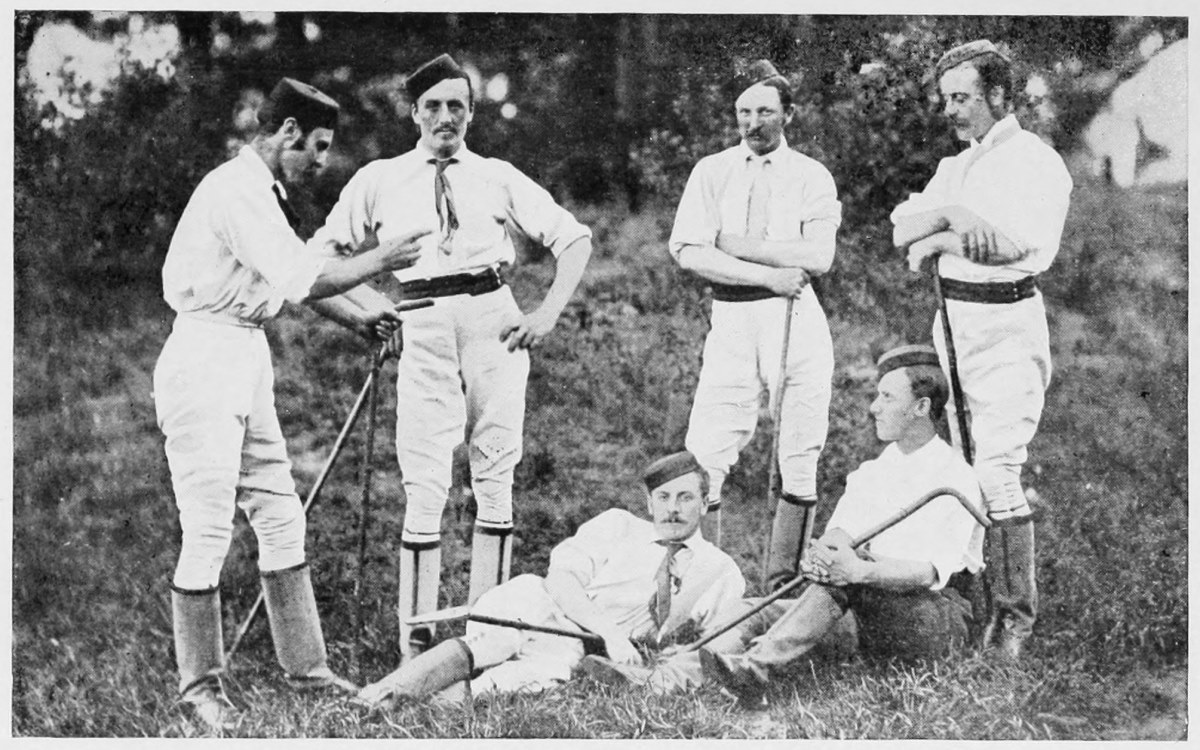
9TH LANCERS’ POLO GROUPS AT WOOLWICH
Left to right. Standing: Capt. Clayton, Mr. Palairet, Capt. de la Garde Grissell, Capt. Fife
On ground: Lord William Beresford, Mr. Moore
During the early days of polo there used to be
sad accidents, and sad rows too sometimes; the
amenities were not so refined as they are to-day,
though even at polo I have observed occasionally
a soft answer may turn away wrath.
From Woolwich, Lord William went with his regiment
to York, and to this day the period the 9th
Lancers were quartered there is remembered as a
red-letter time, for they were a great social
success. At that time the neighbouring country
houses were more often in the occupation of their
owners than they are now, and Yorkshire could
boast of its old-fashioned hospitality and love of
sport. I have heard the north country accused of
being boorish and stiff, but this is a matter of
opinion with which I, personally, do not altogether
agree.
An amusing incident happened outside the solemn
old club which stands close to the Lendal Bridge at
York. Lord Rossmore went into the club one
evening just in time to see one of the servant girls
from the kitchen regions make her escape from a
young man who was evidently annoying her. She
fled down the area steps; Lord Rossmore collared
the youth, and began giving him a lecture of an
improving nature. At this moment, who should
come out of the club but Lord William. He at once
scented battle; without having the slightest idea
what it was about, but longing to be in it, he cried,
“Let me have him, Derry. Oh, do let me have him.”
“No,” replied the other, jealous of his capture. “I
found him; he is my man.” They became so absorbed
in the argument as to who should make the
prisoner’s teeth chatter that the man took the
opportunity to make his escape. Looking round
and discovering his loss, Lord Rossmore indignantly
reproached his friend. “Now look what you have
done!” he cried; “this is what comes of trying
to steal my man.” Then as the absurdity of the
whole thing struck them, they laughed until their
sides ached. After which Lord William apologised
profusely for having spoilt “Derry’s” sport, and
losing his man.
It was on that same Lendal Bridge, on another
occasion, that Lord William and the late Mr.
Joseph Leeman, M.P., as a matter of detached
interest spent an hour one night, or rather early
one morning, struggling desperately to see which
could put the other over the high balustrade of the
bridge into the river below. Each in turn would get
the other up to within an inch or two of the top
preparatory to a bath in the Ouse, which always
looks particularly uninviting just there. Lord
William made one splendid effort regardless of
popping buttons and bursting braces to get Mr.
Leeman up, and thought at last he had accomplished
it, but down he came with a rush. A wrestle then
ensued all across the road, each trying to get hold
of the other in just the right position; the game
then began again, this time Lord William being
perilously near the top. At last, quite exhausted,
they adjourned to Mr. Leeman’s rooms at the
Station Hotel, and finished the night (?) there—of
course, the best of friends the whole time.
There is another York story, though I cannot
vouch for its accuracy; I only tell it as it was told
to me. A certain youth joined the regiment who,
it was considered, wanted teaching a thing or two,
and who at that time they did not like. His clothes
did not please them, his face did not please them,
in fact nothing about him pleased them. So, while
he was out of his room one evening, they, with much
difficulty and the help of many people, persuaded
a lover of thistles to walk upstairs into his bedroom,
where it was put to bed. A large cock with a strong
voice was also thrust, protesting, into the dirty-clothes-basket,
where it presently fell into a brooding
silence of despair. When the unfortunate owner
of the room returned he had many exhausting
moments with the donkey before he successfully
turned it out of the room and could go to bed.
At dawn he was awakened from a refreshing sleep
by the clarion notes of the cock issuing from the
clothes-basket, and he began to wonder if the claret
of the night before had disagreed with him, or if it
was all a horrid nightmare. This story may, or may
not be true, but I knew the youth in question, and
that he was not popular then. It is pleasant to be
able to remember that, some years later, when he
died of consumption, his sterling good qualities
and unfeigned good nature had made him so much
liked that his loss aroused universal sorrow in the
regiment.
In ’74 the regiment moved from York to Colchester,
where Lord William seemed to get a great deal of
leave, part of which he spent helping his brother,
Lord Charles, who was standing for Waterford in
the Conservative interest at the request of his
eldest brother. They had great fun together, but
this has been described in Lord Charles Beresford’s
own book.
It was in this same year that the memorable
brothers’ race was run at Curraghmore on the
Williamstown course. The race is a matter of
history now, but I have seen quite lately a controversy
about it in the sporting Press, some declaring
that Lord Waterford took part in it, others that he
did not. Only three took part in the race: Lord
Charles, Lord William, and Lord Marcus. Again,
there are folk who think it was all arranged beforehand
who was to win. Wrong again. Nothing was
further from the minds of any of the trio; each
meant to win, and each thought he would. The
race was run at the Curraghmore Hunt meeting.
Three miles. The brothers had a private sweep of
100 sovereigns each.
Anyone not knowing the sport-loving proclivities
of the Irish cannot picture the excitement there
was in the country over this event. Even the peasant
women who knew nothing about racing but something
about men, bet on their fancy, some for the
one with the curly hair, others for the brave blue
eyes, and so on.
Each of the brothers had to ride 12 stone and be
on his own horse. The Beresford Blue was worn by
them all. Lord Charles, being the eldest, donned
the black cap, which sounds rather as if he were
condemning someone to death; the others wore white
and blue caps respectively to distinguish between
them.
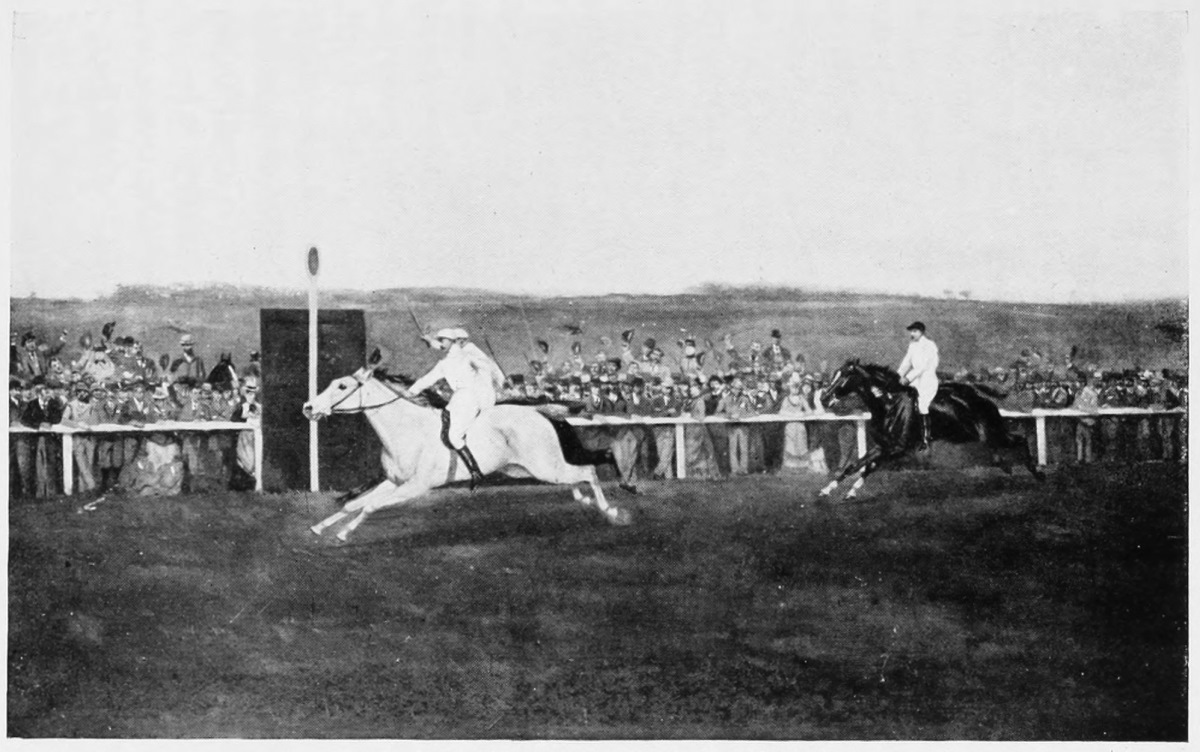
THE FAMOUS BERESFORD BROTHERS’ RACE
(1) LORD WILLIAM; (2) LORD MARCUS; (3) LORD CHARLES
Lord Charles thought he had a winner in the black
thoroughbred he brought over from England for the
race, named Night Walker, which had been bred
by a man named Power, the sporting tenant of the
course. Lord William rode his grey mare Woodlark,
and Lord Marcus a bay gelding, The Weasel.
I like to picture these affectionate, sporting brothers
jogging off to the starting-post, all eager and happy.
They got away well without delay, and at a cracking
pace. Riding boot to boot, charging each fence
side by side until near the winning-post, all riding
straight and square like the sportsmen they were.
Soon the buzz of voices ceased, and a tense silence
made itself felt, for the last fence was being neared,
and still all were abreast, but now it became
apparent that Night Walker had done enough.
The struggle then remained between the Weasel
and the Woodlark, the latter winning by a short
head, so the crowd had some excitement in return
for their long journeys and, in many cases, the night
spent on the course to secure a good place.
Lord Charles thought his horse got a chill coming
over on the boat, and was therefore not up to his
best form. Lord Marcus remarked that while each
fancied himself enormously he enthusiastically
eulogised the other. The photograph of the race
here reproduced is taken from the picture hanging
at Curraghmore, Lady Waterford kindly having had
it taken for me to use in this book. Other races were
ridden in that day by the brothers, but not as
winners. The tall hat and pink coat worn by Lord
William in one of these races inaugurated, I believe,
the now common custom of riding in pink at hunt
meetings.
The Beresfords all seem to have the whisper understood
by horses and dogs, for they have been able to
make them do some wonderful things. Lord William’s
uncle once jumped a hunter over a dining-room
table at Melton one night for a bet. Lord
Charles, in his book, tells the characteristic story of
his having led a queer-tempered thoroughbred from
the road in Eaton Square into the house, along a
passage, round the dining-room table, and out again,
without disaster. The only sign of rebellion or
annoyance on the part of the horse was to kick at
the fire in passing just by way of salutation, and to
show there was no ill feeling. This enterprise, of
course, Beresford like, was for a bet.
At many gymkhanas I have seen Lord William
do extraordinary tricks and feats of horsemanship,
but of that later.
To return to Colchester, “the brothers’” race
being over. On July 25th of that year, the 9th sent
a polo team to Hurlingham, where they played
against the Blues. In the second contest, Lord
William made the first goal for the regiment, and
again in the third. The Lancers won. The Prince
and Princess of Wales were present, and were much
interested in the game.
On September 10th a “Horse Fête and Polo
Match” took place between the 9th Lancers and
7th Hussars. The 9th won, eight goals in succession,
the handsome cup presented by the Borough consequently
falling to them. One of the goals was won
by Lord William.
Monday, October 10th, saw the ponies at Tattersall’s,
the regiment being under orders for India.
Among those of Lord William’s, Madge fetched
62 guineas, Toothpick 36 guineas, The Wren
42 guineas, The Gem 60 guineas, Little Wonder
50 guineas, Madame Angot 20 guineas. Very
different to the prices such ponies would command
to-day. Before leaving the old country a dinner
was given to the regiment by its former officers to
wish them luck and au revoir.
What he Might Have Been—A Happy Exile—Lumtiddy Hall—Unsuccessful
Journey to Pay Calls—Appointed to Staff of
Retiring Viceroy—First Summer at Simla—Appointed A.D.C.
to Lord Lytton—Annandale Racecourse—Birth of The Asian—Dinner
to Its Sporting Owner—Winner of Viceroy’s Cup—Delhi
Durbar, 1887—Mighty Preparations—A Terrible Accident
It is easy to imagine with what mingled feelings
Lord William left England: relief at being
freed from the money difficulties that oppress
a young man in a swagger regiment in this expensive
old country; affectionate regret for the splendid
days that were done; the happy family gatherings,
before all were scattered; still cherishing some of
the ideals of youth to which there is always a sacredness
attached. Children usually build mental universes
round themselves, and at the age of twenty-eight
hope has not died in the heart; that child of
happiness still keeps it warm. Lord William, not
being one of those who wear their heart on their
sleeve, was of the merriest on board ship, full of
courage and good resolutions, determined to map
out his future on safer grounds than hitherto.
I have often heard it remarked that Lord William
might have gained and filled almost any great position
in life that he chose, owing to his talents, perseverance,
and charm of manner, if it had not been
that he was obsessed by his passion for racing and
horse-flesh. It is said “he might have been a great
soldier”; my reply is, he was. Again: “He might
have been a great statesman.” I reply, that in a
measure he was. To be the right-hand man of and
Military Secretary to three successive Viceroys, and
a capable A.D.C. to three, speaks for itself. What
more could he desire, unless it was to be Viceroy?
which would not have appealed to him in the least.
Some of his friends have said they regretted his not
having entered the Diplomatic Service, which shows
how little they understood him, for nothing could
have been less attractive to him, or more foreign to
his nature, than a life of trying to make black look
white; though an adept at bamboozling people for
their own advantage, and smoothing rough corners
for their happiness, to bamboozle them to their
detriment, and smile with the face of a truthful
prophet while so doing, would have been impossible
to him; also he was much too loyal for that profession,
who proverbially, as a class, are not given
to standing by one another. Any question that he
had to decide he would gladly have done with his
fists, or sword, but not by parliamentary inexactitudes.
Besides, who among those who knew him
would have liked to see him any different from what
he was?
India appealed to Lord William, he liked it from
the first. Perhaps he, more than some, felt the loneliness
inseparable from landing in a strange country
for the first time, with a career to make out of
nothing; far from the help and glamour of home
associations, feeling rather like goods on a market
stall, from which the ticket describing their merit
and value has fallen, leaving the said goods to
prove their own merit, and so create their own price.
Starting a life in any new country, individuals are
only a number to begin with. Yet India is one of
the kindest to strangers, there is something in the
atmosphere that melts the Northern “stand-off”
attitude. All are exiles, which forms a bond of
sympathy, uniting them into one big family, so to
speak. It is good for all to find their own level;
travelling assists them, gives them a new education.
There is much to be learned in a large mixed
cosmopolitan concentration, where princes, rajahs,
judges, generals, police, subalterns who know
everything, old men who believe nothing, middle-aged
men who suspect everything, all rub shoulders,
look well groomed and comfortable, yet all with the
same longing for home in their hearts.
At Bombay, Lord William met his brother, Lord
Charles, then in attendance on the Prince of Wales;
this meeting was a great pleasure and took the chill
off the landing.
Sialkôte is a pleasant station, more shady than
many, boasting fine trees and a certain amount of
vegetation. A charming bungalow was secured and
shared by Captain Clayton and Lord William. These
stable companions were greatly attached to one
another; the former had a good influence over his
wild-spirited friend, who quite recognised and appreciated
the fact.
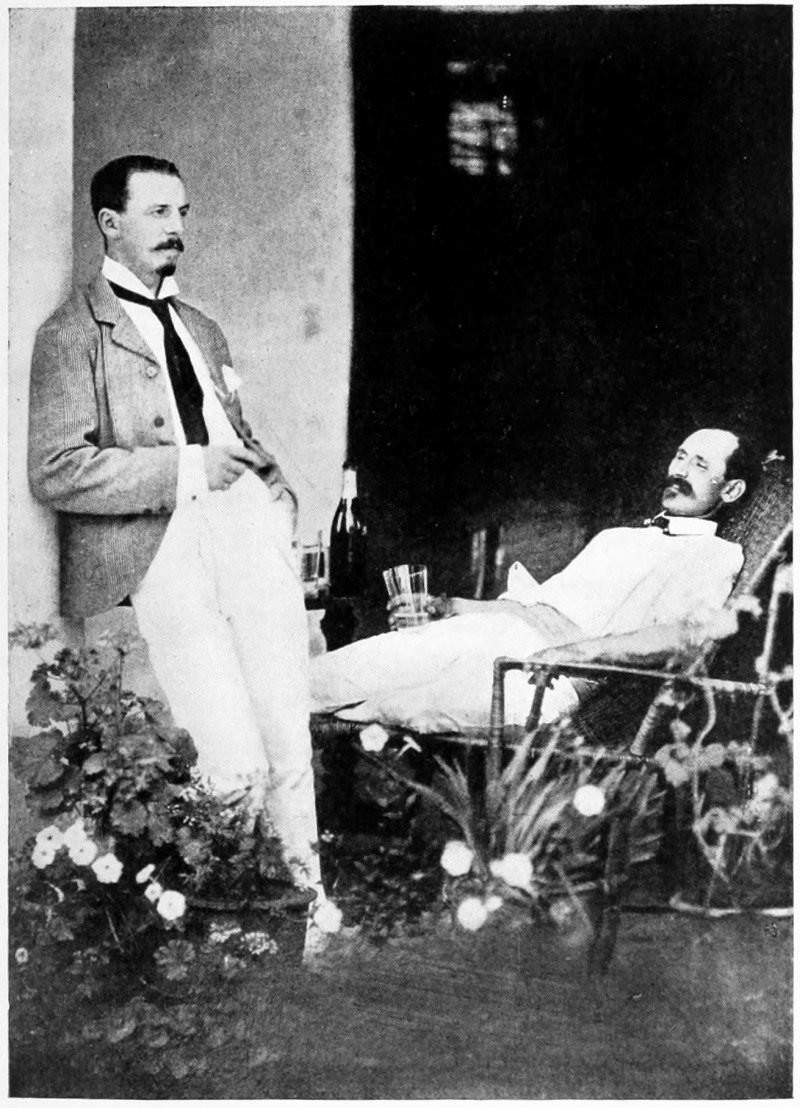
LORD WILLIAM BERESFORD AND CAPTAIN CLAYTON
The bungalow was christened “Lumtiddy Hall.”
In the photograph the tenants are seen sitting in the
verandah, the servants standing outside. I do not
know why people always collect their servants and
stand them round the front door in India when
having photographs taken. It is not the habit at
home. I think it must be with a view to introducing
the drapery and surroundings of our new lives to our
relations elsewhere to whom we send the pictures,
more than anything else. At any rate everyone does
it, and the native servants like it; indeed now I
come to think of it, I am not sure that it is not an
arrangement of their own.
Some of the things I shall have to touch on will
not be new, I dare say, to readers familiar with
India, but there are other friends of Lord William’s
to whom the customs and etiquettes are unknown;
they may like to have some idea of his life, duties,
pleasures and general surroundings, also the way he
fulfilled his obligations. Among the latter I must
not forget to mention the dutiful way he and his
brother officer, Mr. Charles Lascelles, started paying
calls after the fashion of the country. Armed with
an alarmingly long list, they rode out determinedly
from the mess on their ponies. The first bungalow
they came to, where they intended to pay their
respects, had straw laid down along the road and
up to the door. Lord William pulled up, frowning
wisely: “We had better call here another day,” he
announced, after deep thought. “Why?” asked
Mr. Lascelles innocently. “My dear fellow! don’t
you see all this straw down? Someone must be ill;
having a baby or something most likely,” replied
the sage.
Horrified at the thought, and impressed by his
friend’s knowledge and insight, Mr. Lascelles agreed
fervently, and they rode on to the next bungalow.
Here again they found straw laid down.
“Surely they can’t all be doing the same thing at
once, can they?” said the astonished Mr. Lascelles.
“You can never be sure what they do out here,”
replied the other. “In any case you can’t be too
careful.” So they rode on.
To their amazement they found straw at each
bungalow, so they returned to the mess to announce
the discreet reasons for their failure. The mess was
delighted, and it was not till some time after that
the two were informed that the straw was there
to prevent the prevailing dust from entering the
bungalows.
New-comers in India find the rules appertaining
to paying calls at times amusing. The first thing
that appears strange is the conventional calling
hours, being among the hottest in the day, when
quite possibly the people being called on are trying
to keep cool by lying in baths or under punkahs. A
clatter of hoofs is heard, followed by a voice shouting,
“Qui Hie!” which means “Somebody.”
There ought to be a servant or two sitting on the
verandah, but at times they are not to be found,
their beloved hubble-bubbles having enticed them
away. So the callers continue riding round the
house shouting for “Somebody” plaintively until
“Somebody” is found, and a few well-chosen words
addressed to him in the visitor’s best Hindustani.
Calling out there is altogether an unconventional
art.
I remember once at Sitapur, where all the officers
of a newly arrived battery of artillery dutifully
called on us, with exception of a Mr. Ross, who
happened to be a particular friend of my husband,
so that his non-appearance caused us some surprise.
At last he came and apologised for not having been
before by saying that he had been awaiting his turn
for the calling suit of clothes. Being youngest, his
turn came last! Poor soul; he was afterwards
frozen to death in the Afghan War. Found dead,
still sitting erect on his horse.
To return to Lord William; India was not long
in finding out that a good sportsman and a judge of
racing had arrived in its midst. Before many weeks
had passed he had made himself felt, and was to be
seen officiating as judge at some pony races. His
first appearance in the pig-skin was in October of
the same year (1875), when he rode a raw, hard-mouthed
horse named Clarion for a friend in the
Grand Military Chase, having amongst his opponents
that well-known splendid horseman Frank Johnson,
who won on a horse called Ring, Clarion being
third. After this he continued to ride a number
of mounts for friends and acquaintances.
It was about this time that Lord William was
appointed A.D.C. on the staff of the retiring Viceroy,
Lord Northbrook, who was being succeeded by Lord
Lytton, one of Disraeli’s appointments. While
learning his new duties at Calcutta, Lord William
did a little racing, winning the Corinthian Purse on
a black Waler called Dandynong, for his friend
Captain Davidson, the Prince of Wales being present
at the time. It did not take him long to master the
duties of an A.D.C. or to become popular, for he
really commenced a new era in the social life of
India. Things began to hum, and everyone began
to enjoy the races, dances, picnics and paper-chases
he inaugurated. He was soon surrounded with
friends.
When Lord Lytton took over the Viceroyalty he
retained Lord William as A.D.C. on his staff. In
April of that year, Colonel Colley, who was Military
Secretary to the Viceroy, wrote, in a letter to Lady
Lytton: “Lord William Beresford is full of fun and
go, and is being placed in charge of the stables.” So
he was already doing the work and fitting into the
corner for which he was so admirably suited.
The summer of ’76 was spent at Simla, his first
introduction to the place where he was to spend so
many summers of his life.
In a letter written home at this time, he speaks of
being happy with the Lyttons, and pleasure at
having the management of the horses.
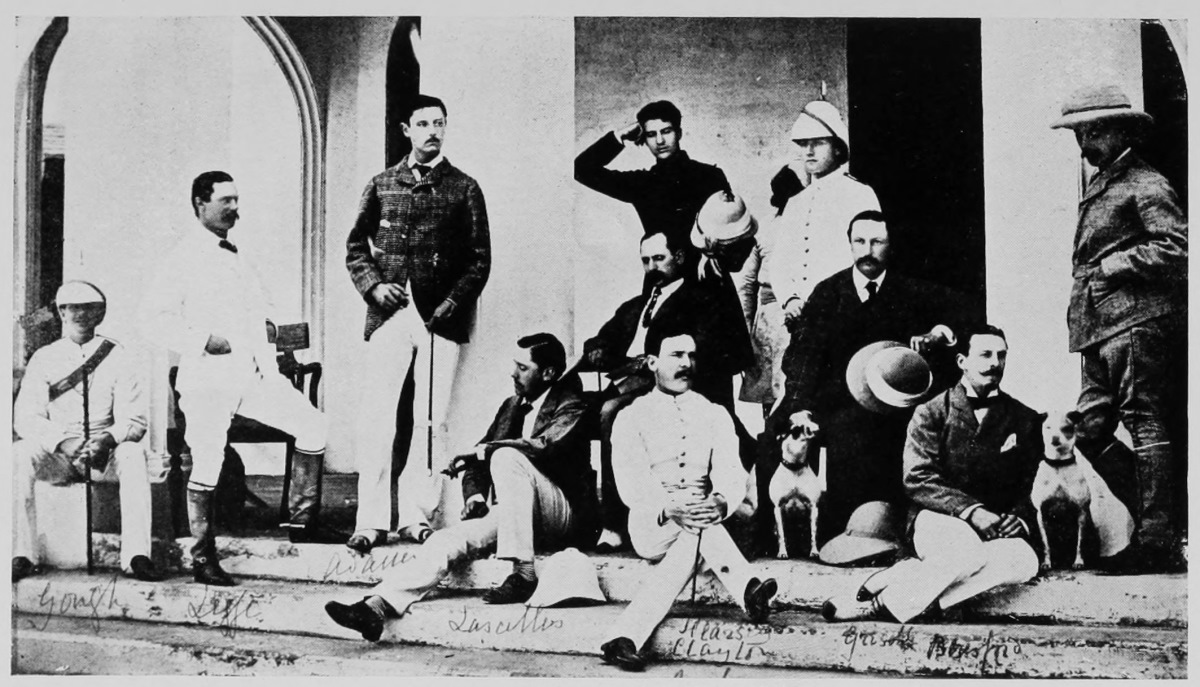
9TH LANCERS’ MESS, SIALKÔTE, 1876
Lady Lytton, referring to this time, says: “I
noted that Lord William managed the stables admirably,
and our coachman Wilson was very happy
under him”; from which it may be inferred that
Wilson was a good servant, or he would not have
been happy under Lord William’s eye, for he was
very particular, and would not be content unless
everything was properly turned out and in perfect
order. It may not be generally known that only
three people are allowed to have carriages in Simla,
namely, the Viceroy, the Commander-in-Chief and
the Chief Commissioner of the North-West Provinces.
The Viceregal party are often the only ones
to avail themselves of this privilege. The rule
sounds a little selfish and high-handed, but it is explained
by the fact that there is only one road where
it is possible to drive, and that one is very circumscribed.
The inhabitants of the station live in
houses dotted about the hillside, approached in
many cases by scrambling paths, up which people
have to be carried in janpans (a sort of chair slung
on bamboo poles and carried by four bearers), ride,
or in a rickshaw, a sort of bath chair pulled by native
servants.
Carriages are therefore white elephants in the
hills; and even for riding it is necessary to have
sure-footed and quiet ponies.
There are so many books dealing with Indian life
I feel that it is rather superfluous to explain that the
official residence of the Government is, during the
summer, at Simla, and at Calcutta in winter. Lord
Lawrence, the Viceroy in 1863, first started Simla as
the official summer residence, taking all his assistants
and council with him, the reason that this particular
station was chosen being that it was the only place
in the Himalayas, or indeed any of the Indian
mountains, where there was sufficient accommodation
for the followers in his train. It was also easy
of access and had a good road to it, compared with
those of the other hill stations. Of course, like most
innovations, it met with a certain amount of grumbling
from those who considered they could have
chosen a better spot, and each successive administrator
tried to go one better by suggesting some
other place. Up to now, no other place has been
found more suitable, so it may be taken for granted
that Lord Lawrence made a wise choice. Anything
less like a government house, at that time, than the
Viceregal Lodge, rejoicing in the name of Peterhoff,
it would be difficult to imagine, being nothing more
or less than a glorified bungalow, standing on the
edge of what in England we should call a precipice,
and in India a hillside or khud, and with very little
ground round it.
Having heard that there was a racecourse, Lord
William, in his first spare moments, went to see it,
finding this dignified title applied to a small, more
or less flat piece of ground lying between two hills,
the roads to it being zigzag paths, hollowed out by
the mountain torrents during the winter and monsoon,
to which a little assistance was given by the
authorities to make them safe. No carriage could
get there, nevertheless this little spot was a source
of joy and health to many, for here every Saturday
races were held, occasional cricket matches, and
other health and pleasure giving exercises, to which
all the inhabitants and visitors thronged. All the
world and his wife used to go, also other people’s
wives, for there are always any number of grace
widows in the hill stations, whose husbands are unable
to get leave to accompany them, or at any rate
only for a short time. Annandale was the name of
this little basin where the races were run at that
time. I was introduced to it a few years later, and
thought its primitiveness added to its charm. There
was no such a thing as a grand stand, or even an
un-grand one. People sat about on the hillside to
watch the racing. There was a small shed, if I remember
rightly, where Reigning Royalty could
shelter, should the necessity arise, which formed a
sort of holy of holies where they could carry out
the exclusiveness necessary to their position, so
odious and trying to many of them.
Now there is a gorgeous thing in pavilions, as will
be seen by the photograph, but I do not feel any
ambition to go there, liking the memory of Annandale
as it was in earlier times too well to have any
desires for buildings comfortable or otherwise, in
that historic little corner. After a race meeting
there was a general scramble up the hillside again to
dress for dinner and the evening’s amusements, of
which there were plenty; Lord William took care of
that; theatricals, dances, concerts, Christy Minstrel
performances, and at times quite classic and dignified
oratorios, besides endless private parties and
social gatherings.
Government House has to fulfil its obligations,
and give a certain number of dances and parties, so
has the Commander-in-Chief and the Governor of
the North-West Provinces, this being one of the
things they are out there for. Some live up to the
letter of the law, so to speak, others are full of hospitality
and private enterprise, especially those with
young people of their own out there with them.
On August 6th there were great rejoicings, a son
being born to Lord Lytton, who was away in the
hills at the time in connection with his work. Lady
Lytton, in a letter speaking of the many kindnesses
of their A.D.C., says: “Lord William rode twenty-six
miles to Fagoo with letters (to Lord Lytton), and
brought me back the answers and congratulations
the same evening,” which is just the kindly sympathetic
thing he would do.
The work and responsibility attached to the life
of a Viceroy is great and anxious. It is well that he
should have sympathetic workers under him who
will relieve him, as much as possible, of all unnecessary
worries and anxieties. Lord William felt
this keenly, and all the Viceroys he served under
expressed their gratitude for his never-failing
thoughtfulness and unselfish devotion.
When it is realised that this one man, with
his handful of councillors, keeps in touch
with 207,000,000 Brahmins, 9,000,000 Buddhists,
62,000,000 Mohammedans, 2,000,000 Sikhs, 1,300,000
Janns, 94,000 Zoroastrians (Parsees) and 8,000
Jews, not counting the 8,000,000 of the aboriginal
tribes whose religion I do not know, considers
all their grievances, studies carefully all their superstitions
and traditional etiquettes, managing to keep
all more or less happy, it seems a superhuman task.
That such comparative contentment reigns is
eloquent of the amount of thought and care devoted
to the smallest detail of government. Lord Lytton
came to the country knowing little of it or its people,
but quickly made a study of both, and was deeply
interested.
It has always struck me that Lord Lytton’s way
of expressing himself was exceptionally charming.
His letters home, and to the Queen during anxious
times, are delightful to read. Lord William described
him as a most considerate Chief, and regretted that
he was not stronger, as he was so keen, and worked
so hard, that he exhausted himself. The years of
the Lytton administration were full of anxious and
busy times.
In October, Lord William found time to ride a
race or two at Dehra, winning one, thanks to good
judgment and riding, on Red Eagle for a friend,
also the Doon Chase on Commodore for Captain
Maunsell.
A little later, at Umballa, he rode for Mr. George
Thomas, and won a hurdle race on Fireman. On
returning to Calcutta from Simla he was elected a
steward of the Calcutta races, having already joined
the Turf Club. Among the other stewards for the
year were Lord Ulick Browne, the Hon. W. F.
McDonnell, and Captain Ben Roberts.
It is a matter of regret that in the early years of
Lord William’s sojourn in India, there was practically
no sporting paper to chronicle his many endeavours
and triumphs; the only thing of the kind
being a rather superannuated Oriental Sporting
Magazine, which was more or less in a moribund
condition, although run by good sportsmen, some
of whom were, perhaps, growing a little out of touch
with the views of the rising generation. It was not
until 1878 that The Asian was started as a sporting
venture, by an energetic person called Mr. William
Targett, who, though he knew nothing about horses,
felt that he was filling a long-standing want, which
the success of his paper proved to have been a
correct and business-like surmise. The paper may
still be doing useful work for all I know, although
it has lost its original and popular proprietor, whom
Lord William liked so well. While speaking of The
Asian and Mr. Targett I think the following little
story is interesting.
Mr. Targett was at home in 1894 on one of the
holidays he allowed himself every three years. The
time was drawing near for his return to India, so
some of his oldest friends in this country convened
a little “au revoir” banquet at the Victoria Club
in Wellington Street.
Fully a hundred sat down, all good sportsmen
hail-fellow-well-met. Mr. Targett was evidently
much pleased at the kindly feeling that had prompted
his friends to give him this send-off. All were in their
places except the intended president. Suddenly the
door flew open and the voice of the arranger of this
merry meeting announced: “Gentlemen, allow me
to introduce your chairman, Lord William Beresford.”
Many present knew he was in England, but few that
he was in London, therefore little did they expect
his presence. This surprise was arranged between
Lord William and Mr. Meyrick (the well-known
writer of “Sporting Notes” in the Sporting Times)
with a view to giving the proprietor of The Asian
pleasure.
Mr. William Targett was delighted, and grasped
his lordship’s hand, saying: “What, you here,
Bill!” The quick reply came: “Yes, Bill; I’m
here and so pleased at the invitation!” Wherever
Lord William was, there it was lively, and this feast
lasted three good hours, until he was obliged to keep
what he referred to as an “austere appointment,”
but at the end of his response to the toast of his
health he took the whole room into his confidence
with the concluding sentence: “Gentlemen, while
you are thinking about your Christmas dinner,
Targett and myself, with good luck, hope to be on
the Calcutta racecourse; and I must tell you that
this week I have, I think, purchased the winner of
the Viceroy Cup—Metallic—for my old friend Orr-Ewing.
Good night and good luck to you all.”
One jubilant and well-known Umballian present
shouted: “I am betting on the Viceroy’s Cup.
Who wants to back his lordship’s tip?” He quickly
found customers. The recounter of this story to me
added that he risked a little bit, and was pleased to
find on the following Christmas week that Metallic
had won, and he therefore the better off by
a “tenner.” It was kind of Lord William to find
time to give his little Calcutta friend this pleasant
surprise, considering that every one of his own
friends and relations were clamouring for his time.
But to return to 1876 in the East. At the close of
the year, all official India, and a great deal of the
unofficial, gathered at Delhi for the Proclamation
of the Queen as Empress of India on January 1st,
1877. This entailed unceasing work on the Vice-regal
staff, and all Government officials, both civil
and military. The assemblage was to last fourteen
days, and the heads of every departmental government
in India were to be present, besides 14,000
troops, seventy-seven ruling princes and chiefs, and
68,000 people were invited and actually stayed in or
around Delhi.
Only those who have been in the vicinity of, or
engaged in, the preparations for any big gathering
in India can imagine for a moment the amount of
galloping and fuss, the thraldom of official red tape
and etiquette to be punctiliously observed, the
number of contradictory orders, the hurt feelings
and notes of explanation that are flying about;
most of this galloping, between head-quarters and
heads of departments, being carried out by the
A.D.C.’s.
At last everything was growing shipshape, and
people left off saying, “I told you so,” even began
to smile furtively once more, for all was in readiness.
The Rajahs’ gardens were laid out elaborately round
their different tents and camps, each vying with the
other to have the best and most attractive display.
The elephants had arrived and were amiable and
docile. The Rajahs’ horses in readiness, with magenta
tails and gorgeous trappings. The jewels laid out
and counted. Everything, in fact, ready for the
great day. Therefore a little relaxation was considered
consistent with good form on the part of the
staff and officers in waiting for the great event, consequently
a game of polo was arranged for Christmas
Day.
This chance game, a thing born of a few spare
hours in the midst of the pomp and glitter of Eastern
rejoicing, was destined to prove the blackest sorrow
of Lord William’s life. Captain Clayton had become
to Lord William, what is perhaps the most irreplaceable
thing in the world, his best friend, and during
this game their ponies cannoned into one another.
Captain Clayton’s fell; its rider was picked up unconscious,
and died the same night.
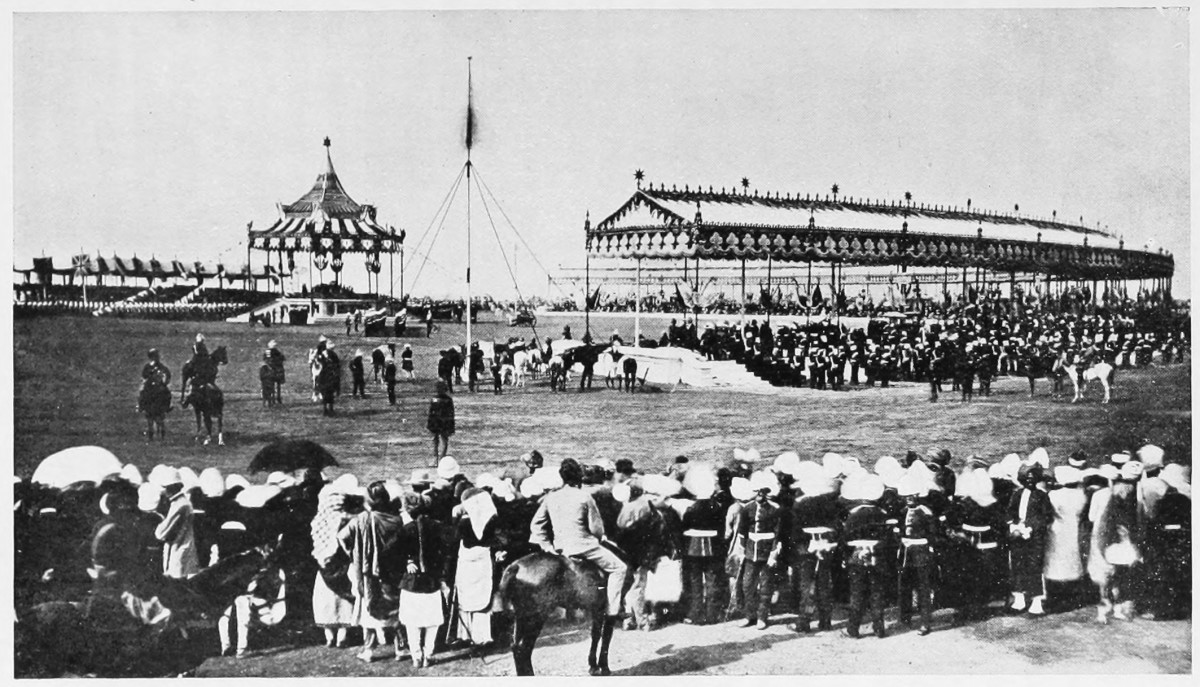
Poor Lord William was wild with grief, and
Captain De la Garde Grissell, an old friend and
brother officer of his, who was in the camp with the
11th Hussars, was sent for to the Viceroy’s camp
to stay with Lord William during the night. Captain
Eustace Vesey and Captain Charles Muir sat up with
Captain Clayton until he died at midnight. Captain
Grissell tells me that they were so anxious that none
should do anything for their dear friend but those
who had known and cared for him, that he and
Captain Vesey made all the arrangements—in India
everything has to be carried out so swiftly. There
was no undertaker, so a soldier made the coffin and
Captain Grissell himself screwed down the lid, both
he and Captain Vesey being greatly overcome. The
funeral was next day, and a most impressive sight,
all the troops at the Durbar taking part. A military
funeral is at all times impressive, indeed harrowing,
to those who mourn the loss of one who has shared
their lives, but it becomes doubly so when the circumstances
have been so tragic. He was buried in
the graveyard behind the ridge held so long by us
during the Mutiny, and he lies with the 9th Lancers
who fell at that time and are buried close by.
All the rest of the time Lord William was in India
he used to go away by himself on the anniversary of
that terrible accident and visit his friend’s grave.
So great had the grief been to him that he always
felt that he must be alone on that day; alone with
his grief and the spirit of his old friend. He did not
want to speak; not because there is anything in life
too sacred to say or tell, but much too sacred to
parody. But the world and all its shows will not
stand still for us while we grieve, and Lord William
with his good pluck struggled to perform his duties
at the Durbar, working so hard that he only had
time for a couple of hours’ sleep out of the twenty-four.
The strain was too much for him, and he
fainted while sitting on his horse and had to be
carried away.
His heart and courage were always too big for his
body and strength. Captain Clayton had been his
life-long friend, and what made him feel it even
more, was the thought that through his pal’s death
he had gained his troop.
The actual Durbar appears to have been a success,
and the Maharajahs and Princes were so pleased that
they each wished to present a bejewelled crown to
the Empress Queen, but Lord Lytton, with some of
his well-chosen phrases, expressed appreciation, and
explained that it would not be expedient, for in the
first place the Queen would have a crown for nearly
every day in the year, and secondly, it might lead
to jealousy and heart bitterness, better avoided,
which explanation appeared to be conclusive and
void of offence.
On Friday, January 6th, Lord Lytton held a
review of all the troops, preceded by a march past
of those attached to the native Princes in Delhi.
At this time Lord William was still hard at work
studying the etiquettes, ritual, superstitions, religions,
and dignified ceremonials so dear to the
heart of Orientals, who are all great observers of
ceremony. The study fascinated him, and proved
of great use later in assisting those he worked for;
knowing what to avoid and where to give pleasure.
No one can hope to fill any responsible position in
India who has not studied and had long education
in these matters, and this was so quickly grasped by
Lord William, that to the end of his days the Rajahs
were among his most faithful friends and admirers.
By January 15th the Viceroy was back in Calcutta,
and Lord William riding in races again. He
had one of his bad falls in a steeplechase, hurting his
nose considerably, besides receiving other injuries.
As usual he tried to make light of them, but collapsed
and had to be carried home.
Before closing this chapter it will be interesting
both to Captain Clayton’s and Lord William’s
friends who may not already be acquainted with the
fact to know that there is a marble tablet in the
church at Curraghmore, placed there by the fifth
Marquis of Waterford:
In affectionate remembrance of
William Clayton Clayton,
Captain, 9th Lancers.
For many years the dearest friend of the House of
Curraghmore.
Born April 23rd, 1839. Killed while playing polo
at Delhi, Christmas Day, 1876.
Another instance of the respect and affection with
which Captain Clayton was regarded at Harrow-on-the-Hill,
where he was educated. There is a white
marble cross in the churchyard, the inscription on
the base being:—
In loving memory of
William Clayton Clayton,
Captain, 9th Queen’s Own Royal Lancers.
Born April 23rd, 1839.
Killed while playing polo at Delhi, India, Dec., 1876.
Oh, the merry laughing comrade,
Oh, the true and kindly friend,
Growing hopes and lofty courage,
Love and life and this the end!
He the young and strong who cherished
Noble longings for the strife,
By the roadside fell and perished,
Weary with the March of Life.
So great was the feeling of loss at his death that
old friends, Harrovians, soldiers, and indeed those
of all classes who knew him, wished to do something
to perpetuate his name, and decided to found a
scholarship. Subscriptions flowed in, and in 1881
the Clayton Scholarship was founded, valued £40
a year, tenable for three years at Harrow School.
Lasting affection of this kind is not inspired by
any but good men, and speaks better for the character
of the individual than any words of mine, for words
are poor impotent things. England, prolific though
she be in men of courage and manliness, can ill spare
one of her sons when of the nature of Captain Clayton,
whose influence was everywhere for good.
Hero of Khartoum’s Fame and Tragedy, as Private Secretary—Indian
Famine—Lord William and the Jowakis—A Month’s Holiday
in Afghanistan—Back in Calcutta—Barrackpore Monument to
Lady Canning—Lady Waterford as Artiste—Cawnpore Memorial—Racing—Trouble
in South Africa—A Favour Granted—Off
to the War—A Friend Left in Charge of Affairs—Some
Fights for Queen and Country—Some Fights for Private Reasons—Exciting
Moments—Irish Bravery of Man and Beast—Two
V.C.’s at Dinner—Receives Reward at Hands of the Queen-Empress—A
Shower Bath in Dublin—Some Racing and a Row—A
Thrice-run Race—Miller Addresses Lord William
It is not possible to give a correct idea of Lord
William’s life in India without briefly mentioning
the chief measures proposed and
carried out during the different Viceroys’ administrations.
He, of course, made it a point of honour never to
criticise or express any opinion on the policy or
private lives of those he worked for, but being so
intimately connected with the Viceregal Court, both
in his official capacity and as a valued friend, all
movements, military or civil, naturally entailed work
for him, and it must be borne in mind that he not
only did what his calling demanded, but at all times
laid himself out to be useful to his masters and their
belongings.
It is worth pausing for a moment to reflect on the
life of an Indian Viceroy; we shall then be able to
realise what it must have been to them to have a
man like Lord William, with his loyalty, ability, and
never-failing sympathy and cheerfulness always at
their command. No doubt it is a great honour to be
asked to represent the King in India, and a much
coveted position, but when we look back at the men
who have held this high office, it seems that nothing
but patriotism, of the highest order, can have persuaded
them to leave their own beautiful and stately
homes, where they were their own masters, could
live in peace with all they loved around them, and
where they could mix freely with their neighbours,
for the splendid isolation of the Viceregal throne;
not having been trained, as Royalty are, to be
approached only through mediums, having to sit
upon a pedestal from which they must not descend,
no matter what their inclinations, and up which
none may climb to greet them, is paying a huge price
for the honour. They must often feel very lonely,
some I know do, and very homesick.
The choice of the staff is naturally a matter of
great importance, and a Viceroy usually selects
people with whom he can unbend and associate
without infringing precedents and necessarily established
laws and customs. Not every man makes a
good A.D.C.; it is of no use their having views of
their own; they are there to do as they are told.
Their duties are not very arduous, unless they like to
make them so by doing all sorts of kind and thoughtful
things not marked on the day’s programme.
How unsuited some are for the appointments they
hold, was proved by Captain Gordon (later of Khartoum
fame and tragedy), who came out from home
as Lord Ripon’s private secretary. By the time he
had been in the country a few weeks he resigned, as
he could not countenance His Excellency’s policy,
and expressed his own views somewhat bluntly,
which was disconcerting to everybody in turn.
After this little digression we must return to the
time after the Delhi Durbar, when famine was casting
a heavy shadow over the land, and Lord Lytton
decided he would go and see for himself the extent
of the misery and distress; no light undertaking, as
it entailed much travelling to visit all the different
parts, chiefly in the Madras Presidency, the district
that had suffered from the same cause in 1853 and
1854. The affected area covered 2,000,000 square
miles, where food was wanted for thirty-six million
people.
Unfortunately Lord William was not able to
accompany His Excellency, owing to his latest
racing accident, from which he had not sufficiently
recovered. This was a great disappointment to him,
for he may have been happy-go-lucky and devil-me-care
in his own private life, but there was nothing
approaching it in his official capacity, where he was
always keen and full of enthusiasm.
Lord Lytton had arrived in India knowing nothing
of it “except its myths,” but was hard at work
learning more, being somewhat puzzled but greatly
interested. Amongst other matters, such as famine
and irrigation, there was the ever-troublesome question
of our geographical boundaries amongst the
Afghan mountains, requiring close study and attention.
It would be pleasant to follow the work done
on this tour and its far-reaching results, but it has
no place here except as far as Lord William was connected
with it, so I pass on, simply stating that after
a long and careful study of the famine question, Lord
Lytton satisfied himself that periodical famines
must be expected, and provision must be made for
such distressful times during the country’s prosperity.
He appointed a famine commission to
enquire into it and report thereon, as to means of
irrigation and any other measures possible to adopt.
This report was issued in 1880, the year of Lord
Lytton’s return to England, and was the foundation
of the latter-day system of irrigation, developments
of communication, and famine insurance, the benefits
of these measures to be reaped by his successors.
In September of the same year (1877) His Excellency
returned to Simla. In October Lord William
had collected a few promising horses and began
entering them under his own name. His colours
were carried at the Dehra October Meeting by Oliver
Twist, Lucifer, and Firetail. Lucifer was a country-bred,
on which Captain Chisholme of Lord William’s
regiment won two races for him. A little later, at
Umballa, he had a good time, Oliver Twist bringing
in the shekels by winning the Drawing-room
Stakes, ridden by T. Tingey, the chief professional
jockey in India at that time. Lord William rode in
all the “chases” at the meeting, but scored no wins.
He had a fall in the Grand Stand Plate, but was not
much the worse, so remounted and rode in another
race the same afternoon. The betting and plunging
at this meeting amounted to a scandal, especially
as many of the losers were more or less penniless.
The settling naturally took a long time; indeed, I
have heard that some of the winners never got their
money at all. This meeting was the beginning of
the break up of a very well-known figure in those
days, Captain Frank Johnson, one of the handsomest
of men, he being one of the heaviest losers.
Lord William’s attention was now turned towards
Jowaki, where the Frontier tribes were growing
aggressive, and it became necessary to send troops
to straighten matters out a little, and he had great
hopes of being allowed to accompany them. Lord
Lytton complained to the authorities at home that
it was somewhat difficult for him, when so little was
known of what we called our frontier, as there were
no maps to show where our territory really began
or ended.
The hill tribes are always rather a problem. All
are muscular and warlike, but many of them
acknowledge little tribal control or responsibility,
which makes it difficult to know whom to deal with.
Their chiefs have no control over them, even when
they have chiefs, on which point I am by no means
clear. The incessant raids on Peshawar and the
district could not be tolerated, so Lord Lytton
sent troops with instructions to deliver a night surprise,
which, for some reason, did not come off until
daylight, thereby losing its effectiveness and warning
the tribes of our intentions, which was unfortunate.
The first stage of this expedition was consequently
a failure. After this little miscarriage of
justice and retribution, General Keyes was sent with
more troops to punish the raiders. This was called
the Jowaki Expedition. Lord William begged the
Viceroy to allow him to go with General Keyes.
Permission being granted he was happy, for this was
after his own heart. The General’s instructions were,
to cut off the Jowakis from the other tribes, to prevent
their neighbours joining in with them. This
was successfully accomplished, and a good lesson
taught, as the Jowakis’ losses were severe and ours
light. After this, there were only about 1500 rebel
tribesmen left to deal with. Finding their strongholds
destroyed and most of their land in our hands,
they gave in, and sent to make terms. Lord William
enjoyed himself, as this was his first experience of
active service, for which he received the medal and
clasp. After several months of climbing mountains
in pouring rain, and struggling across torrents, he
returned to Simla, where someone asked him the
time-honoured question, “What were your sensations
when first under fire?” To which he replied,
“I don’t remember what I felt like under fire, but I
do remember what it felt like under water—dashed
unpleasant!”
Under Lord Lytton’s orders the tribal frontiers
were thoroughly surveyed and mapped out, also
good roads made in every direction, after which the
Punjab frontier settled down to peace and quietude.
So many years have elapsed since Lord William
was in India, indeed so many since he died, that I
am somewhat handicapped by letters and documents
dealing with this, and many other parts of his life,
having been destroyed. So many of his contemporaries
have passed away, also no wife or mother
living, with cherished letters and records to help in
these Memories. His brothers, though deeply attached
to him, were of necessity much apart, each
following his own profession, and therefore not in a
position to help much about his foreign service.
After the Jowaki Expedition Lord William returned
to his duties on the Viceregal staff, keeping one eye on
the Russian influence in Afghanistan, hoping he might
have a chance of more fighting. He was longing to
be back with his regiment, as they were sure to go
if there was any serious trouble, and this there was
before long. What is now known as the second
phase of the Afghan War came after the hasty
treaty of Gandamak. The Khyber Pass Force was
withdrawn as far as Lundi Kotal, and Sir Louis
Cavagnari, a political officer of some repute, was
sent with an escort to Kabul as resident, Sir Donald
Stewart’s division remaining at Kandahar. As many
people expected, this arrangement did not last long,
but they were not prepared for the terrible thing
that happened.
While the whole country was waiting to hear of
the safe arrival of Sir Louis and his escort, news
came that he and all with him had been massacred.
Thus began the second phase of the Afghan War.
Sir Frederick Roberts fought his way up to Kabul
and remained there, trying and hanging a number
of people, some say wrong ones as well as right,
but it was impossible to help it, and no doubt they
all richly deserved what they got, so it was just
as well. The 9th Lancers were in the thick of the
fighting and Colonel Cleland disabled, so Lord
William’s old friend, Colonel Stewart Mackenzie,
took command. They had great difficulty in saving
the guns by getting them across a twelve-foot ditch,
the only possible crossing of which had been blocked
by a fallen wheeler and the gun stuck fast. Colonel
Stewart Mackenzie endeavoured to execute a charge,
the second during the day. Meanwhile the officer
responsible for the gun gave orders to unhook and
spike it. Colonel Stewart Mackenzie’s horse was
shot, and, falling on him, he was rescued with the
greatest difficulty.
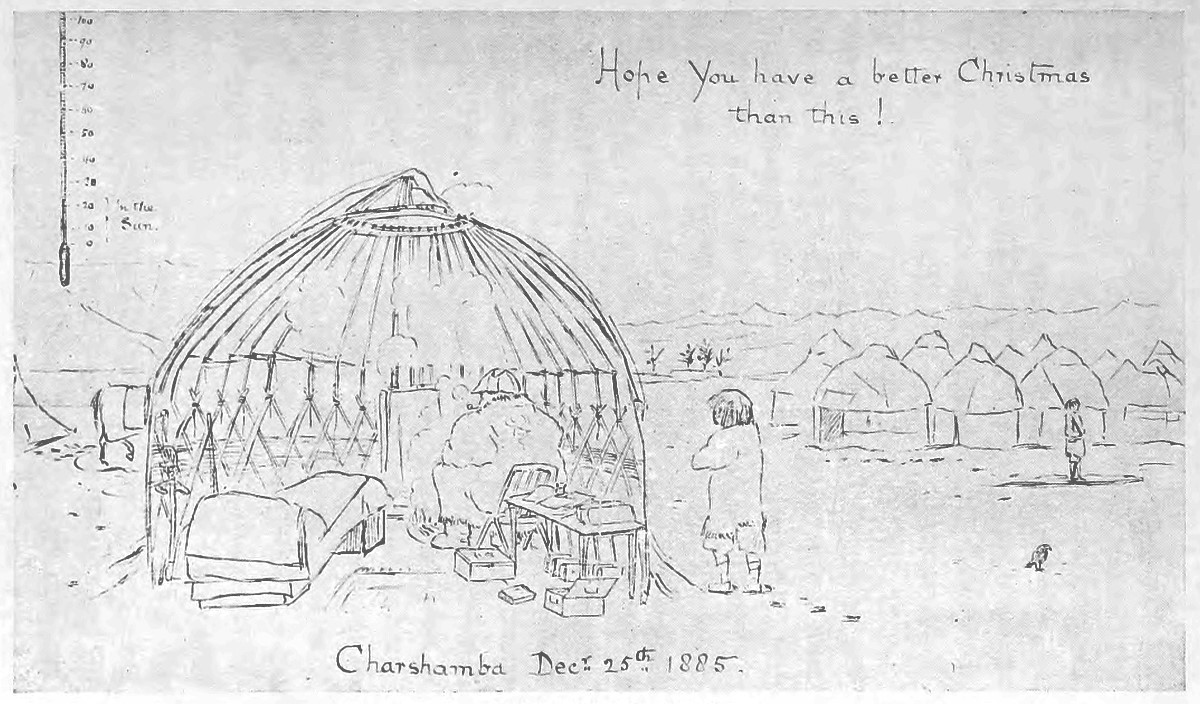
The accounts of all the deeds of bravery amongst
his brother officers made Lord William long to go
and share their dangers and hardships, for he loved
the “Old 9th,” as he called them. At last, unable
to bear it any longer, he asked for a month’s leave.
As usual on such occasions, he was tortured by the
fear that it would all be over before he got there, so
he made elaborate arrangements to do the journey
in record time the moment his leave was granted.
Booted and spurred, he paced up and down his
rooms until the joyful news that his leave was
granted was brought to him. He jumped on to
a waiting horse and galloped away for Umballa.
Fresh ponies were waiting for him at different stages
of the journey, which enabled him to catch a train
that took him to the rail head of the expeditionary
force. Without waiting for food or sleep, he began
riding again; here fresh ponies were in readiness for
him, and he arrived among his war-worn brother
officers scarcely less travel-stained than themselves,
after riding day and night for five days, only broken
by the train journey. He was in time to accompany
Sir Sam Browne, V.C., up the snow-covered Khyber
Pass, which he regarded as a refreshing holiday. I
give a little sketch sent to me at this time by another
friend enjoying the same holiday, which will give a
little idea of its pleasures. The Sir Sam Browne
mentioned above was destined to be immortalised
by the now famous Sam Browne belt. It was the
child of the gallant General’s imagination, and first
worn on active service during this campaign. Whatever
its merits have now been proved to be, it was
greeted with contumely and caustic comments by
the army, as is customary with all new inventions,
but like the Brodrick cap, it has weathered countless
storms. I remember men used to speak of it
with suppressed passion as “the Christmas tree
arrangement.” I do not know why, unless on
account of the things supposed to be hung on it.
Soon after Lord William joined him, Sir Sam
Browne decided to storm the Citadel of Ali Musjid
from the right-hand side of a rocky ridge of some
height. General Appleyard at the same time was to
lead his brigade up the left side, along a precipitous
path, little more than a goat track. Between these
two brigades was a deep gorge with rushing water
at the bottom. The air was alive with bursting
shells fired from the Citadel. The Afghans were
engaged in shelling the ridge from end to end, which
made it, according to Lord William, “lively.” Shells
were even bursting among the advancing columns.
When nearing the Citadel, Sir Sam Browne wished
to communicate with General Appleyard on the
opposite ridge. Here was Lord William’s chance.
He at once volunteered, and General Browne
accepted his offer, instructing him to reach General
Appleyard as quickly as possible, but to make a
detour of the valley to lessen the risk.
“All right, sir,” replied Lord William, who had
no intention of making a detour at all. Dismounting,
he gave his horse to someone to hold, scrambled
down the precipice, and was out of sight in a moment,
hidden by the flying earth and smoke from the
bursting shells. Reaching the bottom safely, he sat
down and took off his boots, partly wading, partly
jumping, from rock to rock, arriving safely at the
other side. Here he again sat down and lighted a
cigarette before putting on his boots and scrambling
up the hill, where he delivered his message. He was
as calm and collected as when out partridge shooting,
in fact calmer than he was sometimes on those
occasions, but always with the same fire burning in
his keen eyes.
By the middle of December, 1878, General Sir
Sam Browne’s column was in occupation of the
Musjid, after climbing that stern, sulky-looking
Khyber Pass. Lord William’s leave being up, and
feeling how good it had been of Lord Lytton to let
him go, he hurriedly ate his Christmas dinner with
the Headquarters Staff and started on his way back,
meeting with some excitement on the way down, as
the Afghan hillmen potted at him most of the time
from their hiding-places in the mountains.
A month was not long in which to journey to the
Khyber Pass, take part in the storming and capture
of Ali Musjid, and then return to Calcutta, but
proves the old saying that “Where there is a will
there is a way.”
Lord William received a medal and clasp and was
mentioned in despatches for his share in this campaign.
I do not think a man less brave because he loves
doing daring and dangerous things. Certainly he
appeals to the imagination no less, though, I suppose,
in the last analysis, it is the man who is afraid in his
heart, yet does a brave thing by force of will over
body, who is the most truly brave.
On his return to Calcutta he took up the thread
of life where he had left it, and continued during his
lighter moments, racing, dancing and flirting; for
he was a veritable butterfly, fluttering from flower to
flower and sipping honey in the sunshine. And why
not? A little gentle flirtation is good for everyone’s
self-respect, and keeps them young. After
all, what are a few little silken insincerities? What
is flirtation? Simply a social accomplishment, a
little mutual sympathy beautifully expressed, and
a little repartee. There are not a few who think it
is pleasanter to be in sympathy with many than in
bondage to one.
When at Calcutta Lord William was fond of
spending week-ends at Barrackpore, which is a sort
of country residence for the Viceregal people, standing
on the banks of the Hugli, and has lovely gardens
and grounds, with the advantage of being within a
few miles of Calcutta, therefore not much packing
up and journeyings required. It was a place much
sought after by honeymoon couples. The Vice-reine
used to lend it to them, and Lord William had the
privilege also of using and lending it when not
required by their Excellencies, to those in search of
quietness and peace.
After the big official Government residence at
Calcutta, this homy countrified house was very
restful. All felt the moment they arrived that the
official smile might be laid aside for a time and some
of the stiffness out of the spine.
There is an interesting monument at Barrackpore
erected to the memory of Lady Canning, sister of
Louisa, Marchioness of Waterford, wife of the third
Marquis, and therefore aunt by marriage of Lord
William. Lady Canning was very beautiful, and
like her sister very good. Her husband, Viscount
Canning, succeeded Lord Dalhousie as Governor-General
in 1856, and when she died in Calcutta,
November 18th, 1856, from fever caught while
sketching in the Terai, was mourned most sincerely
by the community at large, to whom she had always
been sympathetic and kind. At the time of her
death Lord William was fourteen years old. Louisa,
Marchioness of Waterford, shared her sister’s love
of art and painting, was indeed an artist of merit.
Mr. Watts considered her one of the greatest real
artists of that time. One of her celebrated pictures
hangs at Ford Abbey, a place which she inherited
in Northumberland. The picture is entitled “The
Miracle of Healing the Two Blind Men.” Some of
her book illustrations were also considered by
authorities on such matters as excellent. It was
Louisa, Marchioness of Waterford, who designed
the beautiful monument of a guardian angel which
stands to-day over the fateful well at Cawnpore,
where the unhappy English people were thrown in
alive during the Mutiny. Anyone visiting that
station in India cannot fail, when driving through
that dusty, sun-dried place, to be deeply impressed
by this beautiful white, calm-looking figure, spelling
pity and peace. It is difficult to prevent bitter and
revengeful feelings taking possession of us as we
remember all that happened in that historic place,
but after looking at that calm, peaceful and dignified
figure, a certain feeling of “Father, forgive them,
for they know not what they do,” takes the place of
revenge. It is seldom that a monument appeals to
us in that way; many are grand, great works of art
and manipulation, but that white angel at Cawnpore
is something more. If my brain had conceived the
idea and my hand designed it, I should be a proud
and soul-satisfied woman.
The Beresford stable was now seldom idle even
when the owner was away. In 1879 his horse
Telegram was figuring in Calcutta, winning the
Alipore Plate. The same horse got beaten a little
later by quite a slow mare called Blue Bonnet,
belonging to Mr. E. T. Roberts, which was a piece
of bad luck, more especially as the cause was the
poor beast’s breaking a blood-vessel, which, however,
did not prove a very serious matter, as he was
patched up and fulfilled his obligations to his owner
by winning the Calcutta Cup on the second day of
the meeting.
At Dacca, which is about 150 miles from Calcutta,
Lord William won at this time a steeplechase with
(I believe) Telegram, and it was rumoured that
for some unaccountable reason the Dacca steamer
was delayed for a day, instead of starting at the
advertised time, which was very convenient for
Telegram, as it allowed him to be at Dacca in time
for the meeting, which would otherwise have been
impossible. Everybody wondered how such an
unheard-of thing could have happened. I wonder
if Lord William could explain?
It was in the January of 1879 that the Viceroy’s
anxieties were increased by war breaking out in
South Africa. In case any of my younger readers
do not know, or have forgotten, about this war, I
had better recall the immediate cause leading up
to it.
In 1879 Sir Theophilus Shepstone had annexed
the Transvaal. Sir Bartle Frere, as High Commissioner,
explained to the Zulu King, Cetewayo,
that there must be no more arguing about a certain
strip of land claimed both by him and the Transvaal
Republic, and to avoid further trouble he had better
disband his army. This demand, stated as bare,
undiluted fact and shorn of parliamentary terminology,
sounds rather high-handed, but anybody
interested in the history can read the matter up and
form his then more mature opinion, as there were
other matters of importance attached to the situation
without which it would not be possible to form
a fair judgment. At any rate Cetewayo, seeing “no
sense in it,” as an old retainer of ours used to say
when requested to do anything he did not like,
began the row by totally defeating the British troops
at Isandhlwana on January 22nd, 1879, which was
not a good beginning for us, and we felt rather
small.
The horrors of that time must be still fresh in the
memories of all persons alive now, who were old
enough to read and think in 1879. Lord Chelmsford,
who was in command, was greatly blamed for
his plan of campaign, but he afterwards retrieved
his mistakes to some extent by defeating the Zulus
at the battle of Ulundi and taking Cetewayo prisoner.
That, however, was poor comfort to those whose
dear ones had been sacrificed to his mistakes, that
is to say if the disaster was attributable to his errors,
which I am not competent to judge.
It was at this battle of Ulundi that Lord William
so distinguished himself and won the name of
“Fighting Bill,” appearing in Vanity Fair in September
the same year under that title, though I
cannot congratulate “Spy” on the production, for
he represents Lord Bill as a “beery”-looking
person, which is the last thing he ever looked in life,
but in the picture it will be noticed more than any
other of his pictures or photos the resemblance in
the eyes and upper part of his face to his uncle, the
third Marquis.
Hearing of the unfortunate reverse at Isandhlwana,
Lord William was “just mad,” to use his
own words, to go and fight in South Africa, and the
kind, indulgent Lord Lytton again allowed him to
go, this making the third time he had been permitted
to leave his work on the staff to which he
had been appointed. Doubtless His Excellency
admired the spirit which prompted Lord William
to again ask the favour, and six months’ leave was
granted.
Once more we see Lord William happy and “off
to the war,” his soul on fire. He succeeded in getting
appointed to Sir Redvers Buller’s staff, and left all
his affairs in the hands of a brother A.D.C. with
whom he had been sharing a bungalow, and who
was a great friend, telling him to attend to all his
business for him during his absence, and to open all
his letters, adding, “If you find any of them beginning
very affectionately you need not go on.” The
friend who received these instructions was Captain
Charles Muir (now Colonel), at that time not only
A.D.C., but also commanding His Excellency’s
bodyguard.
Lord William knew how to choose his friends, and
felt he was leaving everything in safe and adequate
hands, that his interests would be faithfully looked
after, and all private affairs treated with tact and
delicacy. It was an anxious and responsible position
for Captain Muir. There were the private
letters to be cared for, the official ones to be
answered, the racing stable with its inevitable
worries of horses going wrong, men going wrong,
and the usual everyday matters to be carried out
and adjudicated upon, all this requiring considerable
discretion.
Lord William arrived at Durban about the
middle of April, 1879, after a tedious journey from
Aden in a coasting steamer, which, like excursion
trains, seemed to stop everywhere with no particular
object, and mostly at horribly unhealthy-looking
places.
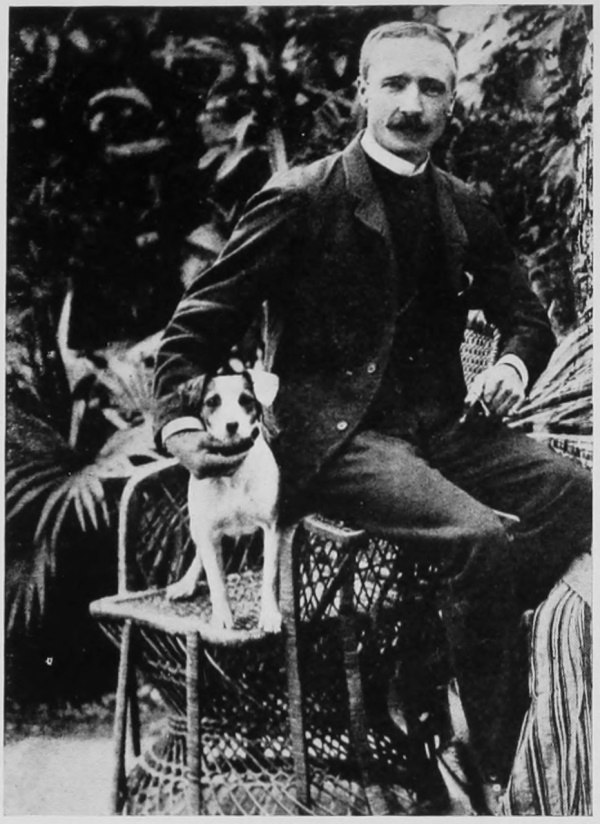
CAPTAIN CHARLES MUIR (NOW COL.), A.D.C. TO
VICEROY AND COMMANDING HIS EXCELLENCY’S BODY-GUARD
All around the roadstead were the transports that
had brought troops from England. This thrilled
Lord William to such an extent he could not wait
to begin his fighting for Queen and country—that
was to follow—so just to keep his hand in he indulged
in a fight on his own account in the hotel at Durban,
which was cram-full of officers in every branch of
the service. This was fight No. 1, before he had
reached head-quarters or reported himself; that
time-honoured institution he attended to later.
Fight No. 2 was another private affair, between himself
and a war correspondent named Mr. Fripps, who
made some disparaging remark about General
Buller, when Lord William delivered a message he
had received orders to convey, and which caused
the artist inconvenience.
Lord William could not stand this, and said he
would not allow anybody to abuse his General, and
if they did he would thrash them. Mr. Fripps did
not appear the least awed, and suggested when
they got back to camp that night they should settle
the matter. Amidst the work and excitement of the
day Lord William forgot all about the suggested
thrashing: not so Mr. Fripps, who turned up before
going to bed to see if it was convenient to his lordship
to carry out his threat. A fierce encounter
ensued, and it was just touch and go who came out
on top, when one of Lord William’s arms got rather
badly hurt; he wanted to go on fighting with only
one arm, but chivalrous Mr. Fripps suggested finishing
the fight another day, when he had both arms
and it would be fair play. After this they were the
best of friends.
Now came the official fighting. Lord William
had been hoping for some staff appointment. His
lucky star being in the ascendant, the wish was
gratified almost immediately, as will be gathered
from the above narrative, by General Redvers
Buller (at that time Colonel Buller) appointing him,
with the sanction of Lord Chelmsford, as his staff
officer, in the place of Captain the Hon. Ronald
Campbell, who had been killed in a recent battle
when fighting against 20,000 Zulus.
Captain Campbell was a difficult man to follow,
and Sir Redvers was rather in despair of finding
anyone who could fill his place. General Marshall,
who knew Lord William better than most people at
that time, hearing he had arrived in the country,
hastened to bring him to Sir Redvers’ notice, knowing
he would be invaluable.
It did not take Lord Bill long to collect his kit
and start off on his long journey to join his new
Chief up country at Kambula, where he was in
command of the irregular Volunteer Cavalry, forming
part of Sir Evelyn Wood’s splendid little fighting
force, and it was here the Fripps fight already
mentioned took place.
Lord William found he was the only staff officer
with Sir Redvers, so his hands were soon full. The
force of 8000 under his chief were a strange but
interesting crowd, made up largely of gentlemen
not wanted elsewhere, runaway sailors, Australians,
Canadians, and some of the undescribables from
South African towns, in fact a cosmopolitan crowd
who had volunteered for the period of the campaign
for the sum of 5s. a day as pay.
What made Lord William’s work the more
difficult was that there were several sub-commands
which had originally been forces of their own, all
of whom he had to keep up to the mark, work
together, make efficient, and content. Every detail
had to be arranged by him; also the daily parades
had to be inspected.
It was no sinecure being right-hand man to
Sir Redvers, for he was a firm, silent martinet,
ruling all under him with a rod of iron, and he
considered it Lord William’s place to wheel this
heterogeneous crowd into line and order. Lord
William was, in some degree, of the same way of
thinking as his Chief. Both were born fighters, both,
at any rate in theory, strict disciplinarians, but Lord
William had the happy knack of always drawing
the best out of people; his Irish wit, combined with
his cheerfulness, was irresistible; even the most
cantankerous, the worst funkers, the most lawless
succumbed, and became his willing slaves.
June 1st saw Lord Chelmsford’s Army in the
Valley of the Umvaloosi, where across the silvery
winding river could be seen the Kraal of the Ulundi
King, with all its minor attachments surrounding
it. Two or three days only had been allowed in
which the Zulu Chief had to decide whether he
would do as we bid him or not. While the gentleman
was making up his mind it was considered wise to
find out what sort of ground was in front of our
force, over which it was expected we should advance.
The orders were that Sir Redvers was to make a
reconnaissance across the river without aggravating
Cetewayo unduly, before his days of meditation were
concluded.
At the appointed hour Lord William and his
Chief were to be seen in front of Sir Evelyn Wood’s
tent, waiting for the rest of the contingent, made up
of all sorts and odds and ends.
Sir Redvers led the way, followed by the rest of
the horsemen, Lord William bringing up the rear,
to see all was complete. He then galloped forward
to join and lead the Scouts, little thinking what stern
adventure was awaiting him. General Buller followed
with the rest of his party.
Cetewayo, not requiring time for consideration,
having quite decided on his course of action, when
hearing of our assortment of troops climbing down
the bank of the Umvaloosi, at once commenced
hostilities, a scattered fire from the Zulus greeting
our horsemen. Nothing daunted, they forded the
river on the left of a kopje which was evidently
being held by the Zulus, and then bending again to
the left took it in reverse. The late occupants were
seen hurrying through the long grass out on to the
open plain in front of our men, who thought they
feared being cut off. Lord William and his scouts
were pressing on the heels of the fleeing Zulus, some
of them not reaching the Kraal they seemed to be
heading for.
It looked as if Sir Redvers and his staff officer
were going to have an easy time and run straight
into Ulundi. This was very exhilarating, and they
galloped on close behind the Zulu Chief, who was
evidently in command of the fugitives, and possibly
from design in their rear. He was a huge, powerful
man and a veteran, which was proved by the ring
round his head. Suddenly he turned round on the
advancing scouts. Lord William being well in
advance of the rest, leading his men, could plainly
see the Chief marking his distance preparing to use
his assegai, and it came. But his opponent was
ready, and too quick for him, so dashing aside the
assegai, he galloped with his sword up, the point
fixed and rigid. The Zulu waited with his shield up.
He did not wait long, the impetus given by the
pace his horse was galloping carried Lord William’s
sword right through the shield and half through the
man’s body, entering his heart. He dropped dead,
and the assegai was sent home to Curraghmore,
where it decorated the corner of Lady Waterford’s
drawing-room.
I think we may take it the flight of the Zulus was
only to lead our men on, and get them into a tight
corner, for suddenly several thousand Zulus appeared
out of the long grass which had entirely hidden a
deep water-course in which they had been waiting.
It therefore became necessary to retreat, and Sir
Redvers Buller gave the order to fire a volley and
then retire. Lord William and his scouts rode back,
followed by many bullets. Two men were killed,
and a third wounded, his horse getting away.
Always the first to lead the way into any danger
zone, so likewise Lord Bill was the last to leave it.
He had been taken by surprise, but was in no way
flustered, and with that thought for others for which
he was so remarkable, turned for a moment in his
saddle, though hotly pressed by the enemy, to make
sure all his living men were away and safe; he then
discovered the wounded man whose horse had run
away, lying helpless and dazed on the ground, but
trying to rise. He was a non-commissioned officer,
Fitzmaurice by name, and at the mercy of the
advancing hordes of savages who were perilously
near. Quick as thought Lord William turned his
Irish charger and galloped back, threw himself out
of the saddle and tried to put Fitzmaurice up on to
his horse, but the wounded man was as splendid as
his preserver. Realising the delay only meant both
being killed—one might possibly escape, but two?
It seemed impossible—the Zulus were close on them,
so he shook his head feebly, saying, “No,” begging
Lord William to leave him and save himself.
Of course Lord Bill would have none of this, and,
swearing mighty swear words, yelled at the man,
“Come along, you b—— f——” (meaning I suppose
“beloved friend”). “If you don’t I’ll punch your
b—— (beloved!) head for you.” How characteristic
of Lord William. Those who knew him well
will be able to picture the fierce way he would say
it. Seeing Fitzmaurice was weak from loss of blood
and unequal to any exertion, Lord William, though
sadly impeded by the arm hurt in the previous
private fight, with some difficulty lifted and shoved
the man on to his horse, no easy matter on a highly-strung
impetuous animal, but it was accomplished,
and, hurriedly mounting behind him, galloped for
life, but with little hope of escaping, the Zulus
following closely. What desperately anxious moments!
made doubly so by the wounded man
being unable to keep his balance from weakness
and loss of blood, twice his weight nearly pulled
Lord William out of the saddle, and he felt all was
over. Just when beginning to fear he could not
support Fitzmaurice any longer, help came in the
shape of Sergeant O’Toole, who had seen their danger
and rode out in hot haste to the rescue, shooting
Zulu after Zulu with his revolver as they came
within measurable distance. He then assisted Lord
William with his now helpless burden.
It is interesting to note that both those brave
men, Lord William Beresford and Fitzmaurice, were
Irishmen, O’Toole, who came to the rescue, was
Irish, and the horse which bore them into safety
was Irish, each so splendid in their several parts;
Lord William risking his life to save his countryman,
he in his turn refusing to jeopardise his officer’s
life, then the plucky Irish horse straining every
nerve in response to his master’s bidding, though
carrying a double burden of swaying riders. Again,
the Irishman that grasped the situation, and without
waiting for any word of command, lost not a
moment in riding to their rescue, no precious time
being lost in wondering what had happened, and if
there had been a disaster. Truly a quartet of distinction.
It was hard to tell when they arrived at last in
safety who was the sufferer, for all were bathed in
gore. Mr. Archibald Forbes, the clever newspaper
correspondent, tells the story of how on the afternoon
of the same day, hearing Lord William was to
be recommended for a V.C., he hurried to his tent
to tell him the news, and congratulate him; finding
his lordship fast asleep, the sleep of exhaustion,
he debated in his mind whether to awake him to
hear the good news or let him sleep on and recuperate;
deciding on the former, only to be rewarded by
having a boot thrown at his head and being told to
go to h—— (heaven, I suppose).
Later on, hearing he really was to be recommended
for the Cross for Valour, he remarked it would be no
pleasure to him unless O’Toole received one also.
I wonder how many men there are who would have
thought of that? No doubt O’Toole’s promptness
had a good deal to do with the ultimate safety of
the party, but it was due to Lord Bill’s courage
and kindness of heart that the episode occurred, and
to him, assuredly, the greater glory.
In a letter written at this time by Lord William
to Lady Lytton he says, speaking of his experiences,
“They were indeed two days worth living for, and
never to be forgotten. I was lucky in the day’s
reconnaissance inasmuch that I helped to save
a poor man’s life, whose horse fell with him, about
200 yards from 3000 Zulus. He was half stunned
and bleeding a good deal. I galloped back to him and
with difficulty got him on to my horse (even more
exciting than the gymkhana races two on one
pony). The Zulus had come to within 50 yards of
us when I managed to start off at a gallop with him,
never thinking that the pair of us would get out
alive, but we did.”
It will be remembered that it was during this
savage war that Prince Louis Napoleon lost his
life.
When Lord Bill, or “Fighting Bill” as he was now
called, returned to India, many people hardly knew
him he was so altered in appearance, owing to his
having grown a beard. It certainly entirely changed
his face, and his friends were glad when he turned up
one morning “in his right mind” as somebody
expressed it, or, in other words, shaved, and as he
was before he wasn’t.
He was of course fêted and patted on the back, but
fortunately he was not a nature this would spoil. At
one regimental dinner given in his honour while
being carried round the table on the shoulders of
some of his old pals he espied in a corner of the
room a doctor wearing the ribbon (V.C.), so the
moment he could free himself from the affectionate
attentions of his friends he made a dive for the
doctor, and hoisting him on to his shoulders (regardless
of the man’s protests, who thought his last
moment had come) ran round the room with him
on his shoulders, all present now cheering lustily.
It is delightful to remember this sympathetic action
of Lord William’s, his blood still at fever heat,
from the excitement and lust of battle and the
appreciation and applause of his countrymen, yet
in the zenith of his pleasure and congratulations
on receiving the V.C., the moment he caught sight
of the ribbon on another man’s breast at once wished
him to share in the applause and cheers of the
evening. With quick perception and never-failing
sympathy with others, he knew in a moment what
memories had been stirred in the old hero’s heart,
perhaps a little bitterness for the forgetfulness of
mankind, and that chivalrous action of Lord William’s
turned his night into day, all present drinking to
the two V.C. heroes.
There are in this world a certain number of
people who are by nature so jealous they cannot
bear to hear anybody praised but themselves, who
say when others have performed deeds of valour
that it is purely a question of chance and luck, that
of course everybody would have done the same
if only they had the opportunity. No doubt many
would like to do great deeds, give their souls for the
opportunity, yet when the moment presents itself,
fail to recognise it, and so the golden chance is
lost. All are not blessed with a quick perception,
dashing courage and an uncommonly human heart.
Deciding that a sight of the old country would
do him good, Lord William thought he would
finish up the remainder of his leave by dashing home.
After figuring out the time it would take going and
returning, he found he would have just eighteen clear
days for enjoyment. They were a great eighteen
days, but hardly restful, though certainly refreshing.
The first to greet and congratulate him as the ship
neared Plymouth was the Prince of Wales, who
was in the Sound at the time with Lord Charles
Beresford, and His Royal Highness was the first to
convey the news to Lord William that the Queen had
been pleased to give effect to the recommendation
for the V.C., and that he was commanded to Windsor
to receive the reward at the hands of the Queen-Empress.
This was a happy beginning to the short
but well-earned holiday. The Prince was always
a good friend to Lord William, indeed to all the
Beresfords. It was seldom one of them was not in
attendance in some capacity.
A very happy, light-hearted Lord Bill journeyed
to Windsor to receive the modest looking but much
coveted bronze Cross “For Valour,” Her Majesty
pinning it on to the hero’s breast, but not before
he had explained to his Queen he could not in honour
receive recognition of any services he had been able
to perform, unless Sergeant O’Toole’s services were
also recognised, as he deserved infinitely greater
credit than any that might attach to himself.
The Queen, appreciating this generosity and
soldierly honesty, bestowed the reward also on
Sergeant Edmund O’Toole of Baker’s Horse, and
Lord William was satisfied. He received a great
ovation in London, being especially pleased with the
congratulations of the Prince of Wales, who, while
shaking him warmly by the hand, made one of those
individual and graceful little speeches for which he
was so deservedly popular.
When the Prince of Wales became King he grew
so weary of wrestling with the pins of medals which
would not penetrate stiff material, that he designed
a hook for fastening these on, to take the place of
the pins, which makes it a much more simple and
less fatiguing process. The hook is taken back after
the hero leaves the “Presence.”
After a great ovation in London, Lord William
made straight for Ireland, going first to the Bilton
Hotel in Dublin, then a fashionable resort. He
asked his old friend the hall-porter if there was anybody
he knew in the hotel, and was informed that
Captain Hartopp, 10th Hussars, known to his
friends as “Chicken Hartopp,” was in the bathroom,
so he quietly went upstairs and locked the
door on the outside, then turned on the cold douche
from the main source, giving the occupant a rather
forcible shower bath. This was followed by strong
language from inside the bathroom. Lord William
was outside listening, and awaiting events. Presently
he heard “I thought there was only one man
in the world who would dare to do such a thing, and
he is safe in Africa.”
But he soon found out his man was not in Africa,
but at home, very much at home in Ireland, where
he was pleased to find he was not forgotten, but
that if he hoped to visit all the kind friends who sent
him pressing invitations he would have to cut himself
into a great many pieces.
While preparing to return to India, Lord William
was staying with his mother in Charles Street. The
Prince of Wales was dining quietly with her one
night; Lord William came down without his V.C.
medal. The Prince at once noticed its absence and
told him he believed his mother had given him the
V.C., and he should remember it ought always to be
worn when in the presence of Royalty. Lord William,
of course, went and fetched it.
The holiday was over all too soon, but there was
nothing depressed or “dumpy” about his lordship.
At any rate the world was not allowed to see
it if he was, for up to the last moment he was
playing practical jokes and laughing. One of the
reasons why he was always happy and pleased,
wherever he might be going, was because he was
sure of a hearty welcome, but of course that was
thanks to his own amiability and cheerfulness.
Returning to India it was pleasant to be told
how much he had been missed, and how delighted
everybody was he was back again. He was looking
forward to the Dehra races, which would be due
shortly after his return. His cousin Willie Holmes
was managing the meeting. Here he found a
goodly collection of cheery souls, amongst them
the well-known Mr. Kelly Maitland, Mr. Horace
Hayes, and many more. Lord William’s Gazelle
managed to beat Mr. Horace Hayes’ Bismillah in
the pony race. They then all moved on to Meerut
for more racing. At this meeting Mr. Kelly Maitland
gave a cup for a three-quarter-mile pony handicap.
The handicapping of Sattara, the pony belonging
to Mr. Maitland, upset him, for he considered it
unfair. It was a little unusual to enter anything
to run for his own cup, and so he had better have
swallowed his discomfiture and said nothing, but
he began airing his grievance at the Wheler Club in
the evening, when Mr. Holmes came into the room,
and made some pointed remarks about the generosity
in giving a cup he was so evidently anxious to win
himself. Then the fat was in the fire, everybody
talked at once, shouting to make themselves heard,
while somebody went into the lottery room where
Lord William was busy, and told him Mr. Maitland
was calling Mr. Holmes naughty names.
This of course could not be tolerated; he must
see his cousin was not sat upon by Mr. Maitland
or anybody else, so he dashed into the fray, after
which matters were not quieter and the hullabaloo
ended in the celebrated “Maitland versus Beresford”
defamation case, which was tried before a
native judge in 1880 and the plaintiff was non-suited.
Lord William’s language was as a rule
most polished, and personally I never heard him
otherwise than parliamentary, but I have been told
that on occasions “He could bring tears to the
eyes of a cabby from an utter incompetence to
compete with him.” I am under the impression
this racing row gave him one of his opportunities
and he threw in a few new words not generally
understood outside Ireland, which added lustre to the
occasion, and it is always annoying to have words
hurled at you that you do not know the meaning of.
It leaves so much room for speculation and possibilities.
There was a little excitement also at the Allahabad
races of 1879-80, where he rode his own Pomponius
Ego heavily handicapped by the weight of 13st.
7lbs., while opposing him was Daintily, ridden by
Tingey, carrying 9st. 7lbs. The latter was declared
winner, while Lord William firmly believed he had
won, but Pomponius swerved when just on the
post, and as several ponies were all up together in
rather a bunch it was perhaps difficult to tell exactly.
At any rate the judge decided he was fourth. There
were ructions over this, Lord William speaking his
mind; it was finally agreed there should be a match
between Pomponius and Daintily, 1000 rupees a
side, the same weights and same distance, only
instead of riding his own pony Lord William put
up John Irving.
The match was breathlessly watched by a large
gathering, and some betting was the order of the
day. The result was a dead heat. The owners
refused to divide, so it had to be run off again, when
Pomponius once more swerved just on the post and
was beaten by half a length. So Pomponius’s owner
had to pay up and look as if he liked it, which
none knew better how to do, for there never lived
a more cheerful loser.
Taking it all together Lord William was fairly
successful this cold weather with his horses.
Telegram won a couple of hurdle races at Agra.
The stable did nothing at Lucknow, but in February
Ashantee, ridden by Lord William, won the Himalayan
Chase at the Dehra meeting. Mr. Abbott tells
a good story about this event. Ashantee’s owner
had backed him pretty heavily through his pals with
Miller the bookmaker, till the horse stood at 2 to 1.
Before mounting to go to the post he went up to
Miller and put on another thousand. Miller addressed
him thus, “Well, my lord, I should be sorry to see
a promising young nobleman like yourself cut off
at the commencement of a brilliant career, but it
would suit my book if you was to break your
blooming neck in this race.”
I remember on one of my journeys in a P. & O.,
Miller and his partner, whose name I forget, were
on the same boat journeying to Calcutta. He seemed
a very gentle-voiced retiring sort of man, but no
doubt could make himself heard and felt when so
inclined.
While all the fighting in Afghanistan and South
Africa was proceeding, each treading hotly on the
other’s heels, the country at home was growing
discontented and upset, for it naturally became
disorganised, business interfered with, and some
discomfort for the inhabitants, which ended in
Parliament being dissolved on March 24th, 1880,
the Liberal Government being returned by about
120.
The Queen sent for Lord Hartington, then for
Lord Granville, and lastly for Mr. Gladstone, who
accepted office.
Change of Government and What it Meant—Why it Took Place
at Simla—The Ceremony—An Anxious Moment—A General
Stampede—Retirement of Lord Lytton—Work of Which Viceroy?—Lord
William’s Services Valued—A Bet Between Him
and the Author—Lord William’s 10 to 1
In the spring of 1880 there was the change of
Government at home already alluded to,
brought about mostly by the dissatisfaction
of the country over Lord Lytton’s Afghan policy
and the war in South Africa with its disasters and
awkward situations, Mr. Gladstone succeeding Lord
Beaconsfield as Prime Minister. He at once took
steps to reverse Lord Lytton’s policy. Therefore
His Excellency resigned, Lord Ripon taking his
place in June, if I remember correctly.
The change in Viceroys usually took place in the
cold weather at Calcutta, but on this occasion the
Afghan War was still going on, and the new Liberal
Government could not wait until the monsoon,
which was due in a few weeks, had cooled the air, so
Lord Ripon had to take the reins from Lord Lytton
at Simla.
In those days the railway was left at Umballa, on
the main line of the Indian North-Western, after
which the rest of the journey was done with horses
in vehicles of some sort, the usual mode being by
“tonga,” a sort of phaeton hung very low and
drawn by a pair of ponies harnessed curricle fashion,
the ponies being changed about every four miles,
this part of the journey taking about eight hours.
The first forty miles over the plains to Kalka, the
roads are good, and the travelling over them is very
pleasant. After that they become mountainous for
fifty-eight miles, climbing and winding up the spurs
of the outer Himalayas to the deodar and rhododendron
clad ridge of Simla, six or seven thousand
feet high.
Government House, or the Viceregal Lodge at
Simla at the time of the Ripons’ arrival was called
“Peterhoff,” and it would be difficult to imagine
an abode less viceregal. It was simply a rather
glorified bungalow, situated on the edge of a young
precipice, the house cramped and inconvenient, with
very little ground about it, but it has long since been
superseded by the much more commodious and impressive
new viceregal lodgings on the summit of
what was then known as Observation Hill. The
lawn in front of Peterhoff was no bigger than many
of those often seen in front of suburban villas. This
Peterhoff lawn was, however, historic, for it was
there that Lord Lawrence thrashed a chuprasse
(messenger) with his great-coat for some unusually
flagrant act of carelessness or disobedience.
Small as this historic lawn was, it had to take part
in the ceremonies attendant on the change of Viceroys.
Lord William was not responsible for what
occurred there on this memorable day, but as an
acting A.D.C. necessarily took part in it, and I think
if he had then been Military Secretary the arrangements
might have been better.
When the change of Rulers took place at Calcutta
there was plenty of space and room for the crowd
of dignitaries, British and native, presenting an impressive
show as they lined the stately portico and
ample stairway. The numerous uniforms, picturesque
dresses of the native chiefs and notables,
together with the scarlet uniforms and tall lances of
the bodyguard combined to make the scene gay, and
even splendid.
Not so at Simla, where on this occasion the whole
officialdom from the Commander-in-Chief and
members of Council downwards, were packed into
a big shamiana (tent with a flat roof) somewhere
about twenty feet square. Most noticeable amongst
the assembly were the two Sikh Chiefs, of Jhind and
Nabha, their states not being far from Simla; both
were elderly men, tall, handsome and strikingly
alike, though I believe no relation. With their
snowy garments, jewelled necklaces, aigrettes and
gold-hilted swords, they looked what they were,
warrior princes of the best Oriental type.
There was nothing remarkable about the rest of
the crowd. Everybody of course had to be in uniform,
and as no one was allowed to remain outside
the shamiana it was soon packed and most uncomfortably
hot. One side of the tent was open,
and a strip of red cloth led from it to the porch of
Peterhoff.
Everybody was awaiting the arrival of the new
Viceroy, Lord Ripon, who had slept the night before
at the foot of the hills at Kalka, and was expected
every moment to arrive with his personal staff in a
train of tongas.
Sir Robert Egerton, the Lieut.-Governor of the
Punjab, had gone to meet Lord Ripon at the first
rest-house, some six or eight miles down the road,
where the new Viceroy was to refresh his inner man
and change his travelling garments. Everybody
in the tent was very hot and wishing the show over,
but they had some time still to wait. The appointed
hour had come and gone, but still no Viceroy. Lord
Lytton walked up and down between the house and
the shamiana smoking a cigar, while everybody else
held their breath waiting anxiously for release before
being quite stifled.
At last the signal was given, the great man was
approaching, there was a general buzz and hum as
in a hive of bees when the queen thinks of moving.
Lord Lytton hurried out of the house: three or four
aides-de-camp, Lord William being one, endeavoured
with difficulty to clear a space in the
shamiana, which feat presented somewhat of a
conundrum, the area being about the size of an
ordinary healthy hearthrug.
Sir Robert Egerton’s little pony carriage could
be heard driving up, and in a minute or two Sir
Robert came striding down the red cloth, a very
imposing figure, tall and portly, with a good deal of
presence, dressed in his diplomatic uniform as a
Lieut.-Governor with cocked hat and sword. Lord
Ripon followed, neither tall nor majestic in appearance,
his London clothes looking as though they had
been used as a pillow in the tonga on the way up, or
hastily pulled out of a much-packed Gladstone bag,
which was no doubt precisely the case, and how
loyal of him! having been sent out by the bag’s
namesake.
Well! now the show began. The A.D.C.’s pressed
everybody back until they had to hold in their breath
for fear of taking up too much room. Lord Lytton,
whose manner was always polished and charming,
came forward and shook hands, with some ordinary
words of welcome. Lord Ripon, who felt the awkwardness
of the situation, being sent out to replace
Lord Lytton, nothing abashed at the numerous eyes
fixed on him at close quarters, plunged at once “in
medias res.”
Lord Ripon: “Didn’t want to come out at all
really, my dear Lytton, not in the least you know,
but a man must obey orders——”
Lord Lytton (much embarrassed) interrupting:
“Yes, my dear Marquis, quite so. Let me introduce
you to His Excellency the Commander-in-Chief.”
Sir Paul Haines, standing on the fringe of the crowd,
was presented, Lord Ripon hastily shook hands,
keeping an anxious eye on Lord Lytton, then returning
to the charge.
Lord Ripon: “Yes! As I was saying, my dear
Lytton, I didn’t want to.”
Lord Lytton (more embarrassed): “Yes, quite
so, exactly. Let me present you to Mr. ——, a
member of your Council.”
Lord William dived into the crowd, assisted by
other A.D.C.’s, who trampled on everybody until
the high official was produced, and the presentation
effected.
Lord Ripon (again returned to the matter weighing
heavily on his mind): “Oh, yes! I was saying
I’ve been Secretary of State, you know, and I
didn’t——”
Lord Lytton (now desperate): “Yes, my dear
Marquis. Let me present you to Mr. ——, another
member of your Council.”
Once more a dive into the crowd, Lord William
returning breathless with his high official, when a
hasty presentation took place.
The crowd now began to enter into the spirit of
the thing, and, being tired of having their toes
trodden on and their waistcoat pressed out of their
proper positions in life, propelled all the big-wigs
wanted by Lord Lytton to the front, almost into
Lord Ripon’s arms, this expedited matters, and
there was no longer any time for personal explanations,
so Lord Ripon kept them for another time
and everything went on famously.
So far, all had been comedy, but it now nearly
approached tragedy, for Lord Lytton’s eyes fell on
the Rajah of Jhind, one of the Sikh chiefs already
mentioned, and he was asked to come forward,
arriving in the tiny space kept open by Lord William.
He bent himself from the waist and touched the feet
of the new ruler of India, direct representative of his
Sovereign Lady the great Queen, for whom he had
fought most gallantly, and for whom he would right
willingly have fought again. Only Orientals can
perform so deep an obeisance with dignity; to
receive it equally becomingly is not so easy, and poor
Lord Ripon, who had been hurried out of England
and hurried up country with hardly time to think,
and with little knowledge of Oriental etiquette, was
taken completely by surprise, and jumped back as
far as the crowd would let him, not knowing quite
what was happening, and then bowed violently, the
two heads only missing contact by an inch—awful
moment! for had the chief’s turban been knocked
off, or even set awry, he would have felt himself
deeply disgraced, for Orientals do not look at things
as we do. To deeply wound the feelings, however
unintentionally, of a chief who, when the mutiny
broke out, was the first to draw his sword on our
side, would have stirred the whole Punjab, and we
might have lost in respect and loyalty what no
elective council or other political bodies could ever
have restored. So differently does the East and
West judge, and reflect on both trivial and important
matters.
Shortly after this the ceremonial came to an end,
and Lord Ripon was conducted into the house to
take the Viceroy’s oath in presence of his Council
and other almighties who cared to attend.
The rest of the crowd were then at liberty to go
home, but the morning’s entertainment was not yet
over, for groups of people were riding homewards
along the main road or Mall when bang went a gun,
let off close above their heads, the first gun of the
new Viceroy’s salute. What a transformation scene
took place, the crowd of gold-laced and uniformed
big-wigs with cocked hats and flowing plumes, who
a moment before had been looking tired and bored,
were now a struggling mass of men and horses, all
presenting the appearance of circus riders doing
tricks. One portly General, who danced beautifully,
was struggling manfully with his long-tailed Yarkundi
pony, which seemed to consider the only safe
place on earth was over the railings off the Mall and
down the precipice the other side. Two other folk
of some importance had cannoned into each other
violently, while one had bitten the dust. Various
people were seen disappearing in the distance on
madly galloping steeds, heaven only knowing where
they would stop; other horses following in their
wake, prancing amongst the cocked hats and sun
helmets strewing the ground. One unfortunate
individual, when his horse unshipped him during its
attempts to climb a tree, had a really nasty fall. He
seemed from all accounts to have been ricocheting
a bit, and was laid up for some time. Needless to
state none of those happy people who were in a
position to choose what they would do, waited for
the remaining twenty guns, and there was a general
stampede. The roads in hill stations do not lend
themselves to runaway horses or circus tricks.
Most of those concerned were glad when that day
was over, and most assuredly both Lord Lytton
and his successor must have breathed sighs of
relief.
Lord William had a keen sense of humour, and
nothing escaped his notice. During experiences of
this sort, however, he always behaved with great
calm and dignity, which showed his powers of self-control,
for he was often consumed with mirth. He
was all the time, thanks to his powers of observation
and wonderful memory, combined with the interest
he took in the etiquette, superstitions and mystic
rites of the Eastern people, laying the foundation
for the brilliant performance of the most difficult
and many-sided office he was a little later called upon
to fill.
The new Viceroy being installed and having
appointed Lord William as one of his A.D.C.’s, it
now became part of his duties to accompany the
Lyttons a certain distance on their way home,
travelling with them and seeing to their comfort as
far as Saharanpur, en route for Bombay.
With much regret on the part of all the Lytton
household they bid adieu to the A.D.C. To quote
Lady Lytton’s own words: “We felt indeed sorry
to lose his cheery and constant pleasant companionship.
His kindness to all our children had never
ceased from the first day to the last.”
And what were the feelings of Lord William
when he said farewell to the friends who had always
shown him the greatest consideration and kindness?
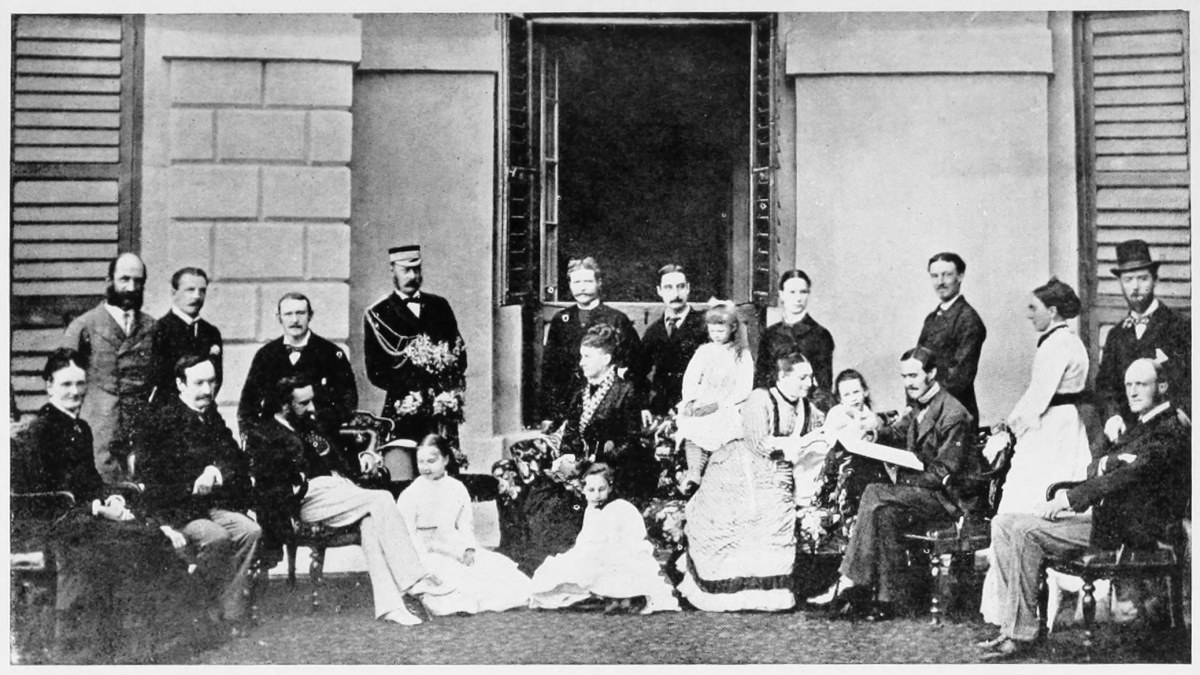
LORD LYTTON, FAMILY AND STAFF, 1877
Left to right. Standing: Col. Colley, Mil. Sec. (later Sir George Colley); Lord William Beresford, Capt. Rose, 10th Hussars; Col. Villiers,
Dr. Barnett, Capt. Liddell, Miss —— (author forgets), Lord Downe, Lady Downe, Capt. Jackson
Seated: Mrs. Burne, Sir John Strachey, Lord Lytton, Lady Lytton, Lady Strachey, Col. Owen Burne, Private Secretary;
Lord Kilmaine, brother of Mrs. Burne
Children, left to right: Bina Lytton, Connie Lytton, Fanny Strachey
To many A.D.C.’s it would only be a case of “Le
Roi est mort, vive le Roi,” but their late “aide”
was much attached to them, and being of an affectionate
and loyal nature must have felt rather as
though he had been torn up by the roots. That
Lord William lived to see the good results of some
of the seeds sown by Lord Lytton’s policy and
earnest work there can be no doubt, for he surely
laid the foundations of some of our latter-day benefits
in India. Amongst the measures that must always
be associated with Lord Lytton were the Famine
reports and Insurance, the equalisation and reduction
of the salt duty, the system of Indian Finance
profoundly modified by decentralisation, and reconstruction
of Provincial responsibility. In recognition
of his services when returning from India an
earldom was conferred upon him.
To an impartial observer looking back over the
lives and works of the different rulers in India, it
appears to matter not what the views and policy
of each may be, they cannot get away from the fact
that they must, and do, reap the benefit to some
extent of the work of their predecessors. This must
be a consoling thought to the retiring Viceroy, who
may feel on leaving India that he will be a thing of
the past, but that at any rate his work will live after
him, and, maybe, he will be spared to see it grow.
Even those who know nothing of India may therefore
readily grasp what a difficult thing it is to
know the actual share each Viceroy has taken in
the measures proposed and carried out during his
time. Each Viceroy is of course actually responsible,
though his part of the transactions of the
Government of India is sometimes confined to a
careful perusal of the papers and an affirmatory nod
or two at the Council table. That Viceroys work
hard and conscientiously there is little doubt, but
cannot take real interest in, or have a thorough
knowledge of, half the big questions they have to
deal with. In some cases the very weight of their
responsibility and possible far-reaching personal
influence, makes them shy of exerting that influence,
preferring to leave many questions to be
virtually decided by those who have, or ought to
have, first-hand knowledge.
It is only really in matters of foreign policy that a
Viceroy is almost compelled to form his own decisions.
Then again there is the constant pressure
exercised by the Secretary of State. Every mail
the Viceroy writes a long letter to the Secretary of
State at home, and every mail he receives a letter
containing the views and decisions of the latter.
Also long cypher telegrams are continually passing
between the two, so that the policy or decision and
acts of a Viceroy are very often not his own, but
have been dictated to him by the Secretary of State.
It is well, however, to bear in mind that if things go
wrong, it is the Viceroy who is abused by the British
public, the Press, and quite possibly by the Secretary
of State as well. It does not as a rule take a Viceroy
very long to find out Secretaries of State are not
infallible, and that it is a risky business to go against
the opinions of his members of Council, each of whom
have the key to the whole situation, and is on the
spot, while the Secretary of State is not, and has to
judge by documentary evidence, not always at first
hand, and naturally robbed of the atmosphere surrounding
the matter requiring decision. All who
have any knowledge of diplomatic situations and
work, know what an important part this plays, and
how misleading a written temperature may be to
those not present and therefore unable to keep their
finger on the pulse of the moment.
This may sound as if it had nothing to do with the
subject of these memories, but as a matter of fact
it has. It was because Lord William so thoroughly
appreciated the worries and difficulties surrounding
the life of those he was serving, and because he was
always ready to help in any way possible outside
his own particular calling, that he became so valued
by them all. He could be relied upon to carry out,
and see through, any tiresome social problem, could
be depended on to remember and produce almost
verbatim established precedents of the time he had
been in India and some time before, as he had closely
studied Indian history on his arrival in the country.
How clearly he had mastered detail was proved to
me several times later in his career.
Once in London, I think in June, 1885, if I remember
rightly, when speaking to him of the different
castes and their faiths, I was much interested and
surprised at the feeling way he spoke of and in a
measure appreciated their feelings, of the Parsees,
whom he described as the Jews of India, with their
great wealth and expenditure, endowing schools,
building hospitals, and taking part in many great
financial undertakings, so full of soul and feeling,
that they will not allow their dead to pollute the
earth, yet do not hesitate to offer up the human
bodies of those they loved as plunder and food to
the disgusting, flesh-eating vultures, who sit watching
the white road leading from the City of Bombay
to the “Tower of Silence.” It is revolting to hear
the cry of those almost featherless, horrid-looking
birds, as they see another pathetic procession winding
its way up the hill. Of the Hindus, who while
considering it wicked and cruel to kill, and against
their religion, still will work their cattle until unable
to stand any longer, and then leave them to die of
thirst and misery, rather than put them out of their
pain. Animals in India are supposed to possess
souls, and are worshipped, that being the case one
wonders they dare so ill-treat them.
The life of the Hindu is one perpetual ceremony
from the time of birth to the day when he is burnt
by the side of the Holy Ganges.
Lord William and I agreed that their religion
must be a most absorbing and real thing in their
lives, otherwise the perpetual observance, and ritual,
from morn to eve would become most irksome, yet
some of it appeals to us as rather beautiful. The
first thing in the morning on awaking the Hindu
turns to the East and prays to his Sun-god, then to
the river to cleanse himself and perform his ablutions,
asking his god to keep him from all temptation, all
sin in taste, touch, word, thought or deed. From
the river to the barber to be shaved, a most important
part of the curriculum, for only a tiny tuft
of hair is allowed to any Hindu, and even that must
be hidden by his head-dress.
The different caste marks of the natives worn on
the forehead are distinctly interesting, and once
when we were boasting how much we knew about
all these things, I asked Lord William if he could
tell them straight off from memory. He bet me a
sovereign he could. I felt I might easily lose my
sovereign, so beat him down to five shillings, which
I told him was as much as I could afford to lose. I
could see from the merry twinkle in his eye he
thought he had me on toast, so just as he was beginning
I said: “If we are not agreed what is going
to happen, who shall be the judge?” In a moment
he named a mutual friend we were likely to meet at
Hurlingham on the following Saturday. This being
settled, he asked: “Where shall I begin?”
Author: “With the Hindus.”
Lord William: “A triangle encircling a dot.”
Author: “Right.”
Lord William: “The Brahmans, one single spot
on the middle of the forehead.”
Author: “Right.”
Lord William: “Shiva, a triangle, crescent, a dot
and two curved lines” (he hesitated a moment, continuing)
“and a U-shaped mark with a dot in the
middle.”
Author: “Wrong!” (in a triumphant voice).
Lord William: “No, no, I am right, by my vig
and viskers I’m right!”
We both talked at once while laughing, gesticulating
and explaining, he enquired where I considered
he had gone wrong. I explained the U-mark
with a dot in the middle was part of the Vishnu
caste mark, and what he had forgotten of the Shiva
was in reality three horizontal curved lines.
The argument became so fierce the rest of the
caste marks remained unrelated, but on the following
Saturday I received my five shillings, he having
found out his mistake meanwhile, and to my horror,
having no pocket in my best bib and tucker of any
useful proportions, I was presented with five shillings
in threepenny pieces out of pure mischief, but he did
not score much, as I insisted on his carrying them
for me all the afternoon.
It will be rather sad in many ways when the much-boasted
civilisation of the West has robbed India of
the value and dignity of her traditions and heritages.
The Indians are really descendants I believe of
the great Aryan race, whose language our Lord
spoke in. There is so much of interest attached to
the lives, faiths, and rituals of the people of the East,
but this is not the place to write it, and we must go
back to Simla, where we left Lord Ripon, the new
Viceroy. He was a Roman Catholic, the first of that
faith to be a ruler of India; also the first who had
been Secretary of State for India, not that either
fact troubled the natives much.
One of the features of the Simla season, is the
social gathering on Saturdays to witness sports and
gymkhanas held on the course or ground I have
already described in a previous chapter.
Lord William was the moving spirit; he got up
the races, competed in them, and was always ready
with a fresh programme every week. He won so
many races himself that it became monotonous, so
he invented all sorts of weird and sporting combinations.
The racecourse, if so we may name it, was rather
dangerous, as at one time there was only an apology
of a stone wall consisting of loosely piled-up stones
to prevent an impetuous pony from falling down
the side of the hill, or what in India we call the khud,
in English a dangerous mountain-side.
I remember seeing Lord William get some shocking
falls, and once when he was driving nine ponies
and riding one over the jumps, when it came to turning
the awkward corner already mentioned, one of
the leaders, he drove three abreast, took it into its
head the stone wall was there to be jumped, and
while it was hanging suspended over the awful drop
at the other side of the wall, which would probably
have meant a broken back, Lord William and the
rest of what he called his “10 to 1” were hopelessly
mixed up on the safer side, looking as if they had
all jumped on each other. His lordship was extricated
with nothing worse than a dislocated shoulder
and thumb. He laughed immoderately, though he
was ashy white. He insisted on having his shoulder
put right at once. A chair was brought and placed
on the course upon which he sat while his shoulder
was jumped and bumped into its place again, also his
thumb attended to and tied up. It was with some
difficulty he was prevented from trying again, only
being stopped by a brother A.D.C. swearing he had
sent some of the ponies home, as they had apparently
had enough even if Lord William had not.
Dignity and Humour—Some Tests of Both—Affection of the Natives
for Lord William—How They Tried to Please him—What
Happened on a Slippery Floor—Some Tableaux—A Supper and
a Race—What the Jockey Club Would Have Said—Lord Ripon’s
Message to the Amir of Afghanistan—The Amir’s Reply—The
Work of the Military Secretary—Swelled Heads and Outgrown
Shoes—How Lord William Dealt with Them—Pay of
Military Secretary—Compensation for Diminishing Rupee—No
Fish to Fry
Those who knew Lord William will think I
have passed over a very marked feature in
his life, namely, his smartness at repartee
and his endless jokes. I have forgotten neither, nor
have I ceased to be grateful for the way he succeeded
in brightening up the dullest parties; he carried
sunshine and merriment with him wherever he went,
and it was infectious. No matter how awkward a
position he might find himself in, he always came
out gracefully and smiling.
I feel that to repeat Lord William’s jokes, is to rob
them of their atmosphere and merit. Jokes are
individual things, and require such delicate handling,
they must have their own surroundings and atmosphere;
it is so easy to rob them of their bloom or
kill them altogether.
Lord William was one of those rare people who
found it possible to be serious in a funny way, which
was no doubt an asset, though at times disconcerting
for other people, as will be seen from the following
narrative:
When on tour the Viceroy and Vice-reine held
receptions answering to drawing-rooms in England,
so that all the local people could come and make
bows and curtseys to the representatives of the
English Court. On one of these occasions a fat Irish
lady, having made her obeisance, thought she would
like to watch the rest of the show, so she and her
daughters either stayed in the throne room, or returned
to it, ranging up opposite the viceregal
party, and began making audible comments.
This could not be allowed, and Lord William most
politely told her to “Move on,” though I am sure
he did it in a way that made it appear he was conferring
a great favour, and with one of his most winning
smiles. The lady did not move an inch, but
stood her ground.
“Then, Ma’am,” said Lord William with another
seductive smile and with the broadest of brogues
put on for the purpose, “you’ll have to pardon me
if I put my arm round your waist.” The lady, seeing
that, whether she liked it or not, from the throne
room she was going and thinking discretion the
greater part of valour, “moved on” without the
pressure of Lord William’s arm. I was not present
on this occasion, so tell the tale as it was told to me.
Lord Bill’s face when anything funny happened,
and he felt it behove him in his official capacity to
be serious, was a study; and while he often witnessed
strange happenings they never ceased to
amuse him; his sense of humour never deserted him.
I remember one occasion when he must have
found self-control difficult.
The viceregal party were on tour and staying in
a big station where they announced they would hold
one of these drawing-room sort of receptions.
Scene I. (No action.)
Large bungalow of chief political officer in the
neighbourhood. Two large rooms and one small one
opening into one another, the curtains which usually
hung between the rooms to make them more private
and to prevent people hearing what you are saying!
being removed for the afternoon, leaving a free passage
from the verandah on one side of the house
through the three rooms and out into another
verandah at the other side of the bungalow.
All the furniture had been removed from the
middle rooms to make it more impressive.
A roughly constructed and somewhat uncertain
platform raised a little from the ground, covered
with imposing red felt and bath rugs. Two deck-chairs
or something of that sort representing the
thrones.
Scene II. (Action.)
Enter Mr. and Mrs. Viceroy, who have learnt to
pick their way, and walk with circumspection over
hastily laid red baize and felt. Mr. and Mrs. Viceroy
making polite conversation to their host and hostess
admiring all the excellent arrangements made for
their comfort. Mrs. Viceroy sits on her throne, Mr.
Viceroy stands beside her, and the staff arrange
themselves becomingly, one A.D.C. having been told
off to receive and unpack the ladies on arrival at
No. 1 verandah, another on verandah No. 2 to repack
them, and say how charming they are all looking,
that it is a day he will remember all his life, and
so on. A third A.D.C. announces the names, which
are handed to him on cards, and the Military Secretary
introduces them.
Scene III.
Arrival of fluttering ladies on verandah No. 1.
Many never having attended a drawing-room at
home, are very anxious about their curtseys. First
lady, who has been practising various kinds of
curtseys and bobs before her glass for days, now forgets
all about them, her one idea being to get it over.
She shoots through the room and out the other side,
her example followed by those behind her, like
rabbits bolting in frosty weather from one hole to
another, Mrs. Viceroy trying to keep time with a
bow and a reassuring smile for each. The Viceroy
bowing, trying to look pleased, but unmistakably
bored.
Fresh batch of ladies, one starts with the wrong
foot first, or something of the kind, gets out of step
and turns round to begin, again hoping for better
luck, but hastily stopped by Lord William, who
explains in a whisper the rules of the game forbid
any return. Mr. and Mrs. Viceroy pretend not to
see or hear.
Everything going swimmingly, Viceroyalty beginning
to think of tea and drive in the evening,
A.D.C.’s beginning to think of flannels, rackets and
smokes.
Enter elderly lady very nervous, makes a really
profound curtsey, so profound she cannot extricate
herself from it, and she rocks slowly backwards and
forwards endeavouring to recover herself and get
into her stride again. Lord William’s big blue eyes
watching every movement (I felt certain he was
betting on the finish), when with a groan the lady
subsided backwards on the floor, her feet entangled
in drapery and skirt.
“Fighting Bill” to the rescue, old lady picked up,
her brow mopped, bonnet set straight and restoratives
administered in verandah No. 2.
Scene IV.
Royalty descend—mutual congratulations, Lord
William and A.D.C.’s telling each other all about
it in room No. 3. Enter whiskey and sodas.
But I must not be frivolous, as Lord William was
a stern upholder of the dignity of the Court, and very
properly so, only the “make-shifts” necessary for
more or less impromptu ceremonies in India and
foreign countries at times lend themselves to amusing
situations; and why is it people always want to
laugh more when they know they must not do it?
I remember at a big function at Simla, when
Colonel Chesney was being made a K.C.S.I. by Lord
Ripon. Lord William had arranged for a number
of us to be allowed into the holy of holies to watch
the ceremony. We stood round the wall like well-behaved
school children. His Excellency was announced,
small, rotund and dignified in flowing
robes of state, and walked up a strip of the inevitable
red baize to his seat at the far end of the room.
There was a good deal of ceremony about the proceedings.
First one official walked a few steps and
bowed to the occupant on the seat at the end of the
red baize, then, after apparently counting something
to himself, advanced a few more steps and bowed
again, continuing this slow mode of progress until
within a certain distance of His Excellency, when
more characters took part, and my attention was
diverted to one of the bowing individuals who was
related to me, which made me more sensitive to the
fact that one of his silk stockings was on wrong side
out, and with every waft of air caused by his humble
obeisances, little fluttering ends of silk streamed out
behind the happily unconscious man, who, buttoned
tightly into much gold lace, was fancying himself
not a little. Those little flags fascinated me, and I
was certain not one of them escaped Lord William’s
eagle eye. I looked across the room to where he was
carrying out his duties, but he was as grave as a
judge, and so was I, indeed I flattered myself I was
behaving very nicely, until I heard one of the
daughters of the Commander-in-Chief, who was
standing just behind me, whisper: “Look, he has
got his stockings on wrong side out.” I then felt,
with someone sharing my amusement, I must laugh
and disgrace myself for ever. Fortunately more important
developments taking place we forgot to
watch the fluffy bits of silk.
While being most punctilious about all things
concerning his work, and the popularity of those he
served, and in spite of his hard work, Lord William
found time to amuse himself fairly well. I was at
Government House one day when preparations were
being made for a dance. Seeing the native servants
deeply engrossed arranging a cosy dark corner,
amongst some palms and curtains, I enquired what
they were trying to do. They replied with many
salaams that they were arranging a “Kissi Ka waste
for Lord Brasspot-Sahib,” in English I suppose you
would call it a quiet corner for two. All the natives
were fond of Lord William, hence doubtless their
anxiety to minister to his moods and emotions,
arranging a little corner where a little kissing could
be done in peace and quietness.
Speaking of dances reminds me of one at the
Commander-in-Chief’s (Sir Donald Stewart); the
floor was very slippery, and Lord William, while
dancing in a set of Lancers, pointing his toes and
doing pretty steps first to the right and then to
the left, fell on to his knees in front of a huge old
lady with several chins and tied in the middle with
a string or what had possibly once been a sash, but
it was hard to tell, being out of sight in folds of
figure. Lord William, not the least disconcerted,
crossed his arms over his chest and bowed his head,
saying, “Madam, I am at your feet,” and was up
dancing again for all he was worth without a pause,
as if it was all part of the game, much to the amusement
of everybody present, especially the lady at
whose feet he fell, for she was a jolly cheery soul.
Among the enterprising things Lord William did
in India was the overhauling and setting on its feet
the Amateur Dramatic Club, which was on the verge
of bankruptcy when he applied himself to re-establishing
it on a firmer basis; now it is one of the
soundest undertakings in India, with a stock of
excellent scenery, library, and large wardrobe.
Always anxious to provide amusement for the folk
at Simla, he considered it would be a pity to allow
such a useful institution to fall on evil days, so with
his usual generosity he advanced the money to pay
off the most pressing of the club’s debts, and from
that day to the present time the club has never
looked behind it and has now become the fashion.
Every season theatricals take place there, all the
rank and fashion taking part or scrambling for seats
to watch the performances. Having firmly placed
the club on its feet Lord William retired from the
management, only keeping a first claim on one of
the boxes. Invitations to the little suppers he instituted
in the theatre after the performances were
much sought after, their fame had spread far and
wide, both for the good things he provided and for
their cheeriness.
One year some tableaux were got up in the theatre,
the money collected for seats being given to some
charity connected with sick children. Lord William
loved small bairns and they loved him. I remember
at these particular tableaux I represented Charlotte
Corday going to execution for the murder of Marat;
my executioners were Lord William Beresford and
Captain Donald Stewart, a brother officer of my
husband’s in the 92nd Gordon Highlanders; we
had many rehearsals both for this tableau and others,
but the despair of the stage manager was great over
the Corday scene, as the executioners always ended
in romping. Well do I remember their both rolling
about the floor trying to execute one another instead
of Charlotte Corday. The manager would become
almost tearful in his entreaties to them to “behave
themselves.” They would then get up, shake themselves,
saying to one another, “Now no more nonsense,
Donny, we must behave ourselves”; and
Captain Stewart would reply, “Now do shut up,
Bill, and let us get to business,” but their good
resolutions did not last long, they were soon stabbing,
wrestling and tickling one another again and
rolling about on the floor. I began to wonder what
would really happen when the day arrived to
appear before the public, but in spite of having had
no proper rehearsals when the fateful moment came
they behaved splendidly, but directly they were off
the stage and behind the scenes began again.
When the whole performance was over, the staff
gave a supper in the theatre to those they wished
to invite who had taken part in the tableaux. A
merry evening followed. As soon as all had refreshed
themselves, someone suggested a steeplechase
over the tables and chairs; forms were quickly
turned upside-down, and chairs built up into fences.
There was some fun while the would-be riders chose
their mounts. At last all was settled, and we women
packed ourselves away in one corner of the room to
act as audience. I am afraid if the Jockey Club had
witnessed that race none of the riders would ever
again have been granted licences, for they out-jockeyed
each other, crossing and trying to pull the
riders off their mounts. There were some resounding
and shocking spills, but nobody cared, and the
race waxed fast and furious, being won eventually
by Captain Donald Stewart, a great big fine mount,
ridden, if my memory may be relied upon, by
Captain Des Voeux of the Carabineers or Captain
Roddy Owen. The appearance of these sportsmen
at the end of the race baffles description, their hair,
which in some cases had answered for reins, was
hanging in disordered wisps, collars reclining on
shoulders, clothes dusty, dirty shiny faces, and all
weak with laughter.
This was the lighter side of what was taking place
during the early part of Lord Ripon’s reign. He,
meanwhile, was giving anxious thought to the conclusion
of the second Afghan campaign, having been
sent out with instructions to reverse Lord Lytton’s
policy and terminate the war as speedily as possible.
Kandahar, which the latter had intended to hold,
was given up, and the whole of Afghanistan secured
to the Amir Abdul Rahman.
The following, poem shall I call it, appeared
about this time in one of the Indian papers signed
“Bala.” A cutting of it was given to me, but I
do not know from what paper, so cannot ask for
permission to reproduce it, and can only trust I
may be forgiven.
THE VICEROY’S MESSAGE AND THE AMIR’S
REPLY
George Samuel, Marquis of Ripon, to the Afghan Chief wrote he,
“God made me Viceroy of India, and thou knowest what I made thee,
You rule by my will and pleasure, I care not to flatter or bribe,
One pledge or promise I ask of thee; I pardon if all men know
That up to this time thou hast not done much to prove thee our friend or foe.
For the Russian is closing upon you, our faith in his promise is dead,
He is massing his troops on your border, and is eager to push on ahead.
Sharp is the word with the Muscovite, whose will is to plunder and spoil,
His covetous eye is on India, and eke on your God-granted soil.
Now while he stands for a moment still, there is only one thing to be done,
I must send a commission to meet him, to show where your boundaries run,
And you must promise safe escort (we know what the Afghans are!)
And prove yourself friend to the English, and foe to the Russian Czar.
So choose thou of all my civilians, or choose thou of all my host,
One man to lead the commission, whom ever thou trustest most.
Whom thy tribes have known and trusted, to pass through in safety and peace,
And so shall thy borders be measured, and our feud with the Russians shall cease.”
The Afghan Chief wrote answer: “You English are cunning and deep!
But I’d ask if you’ve ever succeeded in catching a weasel asleep?
I know what will come of commissions—just what became of your Embassy,
You harried us well four years ago, and I keep good memory.
Here stands my Cabul city, here I dwell by your favour at rest,
But the tribes of my frontier are evil, and know no respect for a guest:
If your commission needs a safe escort on the oath of a trusted friend,
I have not the means to protect them. But whom will the Viceroy send?
Wilt thou send the poet, Sir A. F. D., the man who advised the last war?
He is safer, I ween, on the Naini Tal lake than he would be near Kandahar.
Wilt thou send little Bobs—the Bahadur? He is trusted and honoured, I know,
But he’s cooling his heels at Ootacamund, and doesn’t seem anxious to go.
Shall I ask for the man with the ringlets? the virtuous lovely L—p—l,
He is living at home at his ease, writing books, and he has grown a great swell.
Where is the chief McG——gr to pledge me the word of his clan?
He is there on the pine-clad highlands, a highly-paid, well-placed man.
He is shelved with the rest, all promoted they enjoy the reward of the great.
Will they come now those I have chosen? I watch for their face and wait,
For the bright light shines on promotion, and dark is the downward track,
And the Simla hills ring an echo of voices that hold them back.
Let the commission stay on the mountain and start as thy message said,
When the Amir sends a safe escort—when the Kalends of Greece are sped.”
“Bala.”
This effusion is amusing no matter how it scans.
Lord Ripon was also called upon to decide grave
questions arising between British and natives; he
embarked at once on a very liberal policy. In
accordance therewith the Vernacular Press Act was
repealed, and among other measures, the so-called
Ilbert Bill was introduced in the Legislative Council,
giving native magistrates the same powers with
respect to Europeans and Americans as British
magistrates, but this aroused such a storm of opposition
the measure had to be practically abandoned,
Act III of 1884 being a compromise.
Lord William, having acquired a useful knowledge
of Indian customs and feelings, was able to be
a great help to Lord Ripon, who, finding the value
of his loyal friend, very shortly appointed him his
Military Secretary.
Major White (later Sir George White, V.C.) of the
92nd Gordon Highlanders, had been acting in that
capacity from the time Lord Ripon arrived in Bombay,
where both he and Lord William Beresford met
His Excellency, but the work of Military Secretary
did not appeal to Major White, who loved soldiering,
and was not obliged by circumstances to do anything
else, and feeling thoroughly unsettled when his old
regiment was in Afghanistan, in the thick of the
fighting, at last made up his mind to ask Lord Ripon
to spare him for a time, at any rate, so that he might
go and join them. This request being granted his
work had to be carried on temporarily by someone
else. When Major White returned he still felt unsettled,
and shortly afterwards resigned. Major (afterwards
Sir John) Ardagh succeeded him, but did not
remain long; then Lord Ripon offered the post to
Lord William, and the great moment in his life had
come, he had now the opportunity of showing the
stuff he was made of, a scope for his talents.
The work of a Military Secretary is not known to
everybody, so I will try and explain it in common
or garden English. When any big machinery is in
motion it all looks very easy, but machinery requires
much oiling and constant careful supervision to make
it work satisfactorily.
To be a successful Military Secretary in a viceregal
household it is necessary to be like St. Paul,
“all things to all men,” for he comes in touch with
so many different interests, acts as oil to so many
different wheels. It calls heavily on anybody’s tact
to carry out the work without friction. The duties
are many and important, for he is the head of the
establishment and controls it. The private accounts
and correspondence are in the hands of the private
secretary, all the rest is in those of the Military
Secretary. The A.D.C.’s are under him, and he
arranges what part each one has to play. One may
happen to be musical, he will probably be told off
to look after the band; another may be a connoisseur
on omelettes and other appetising confections,
he will be asked to look after the kitchen department.
It will be the duty of one, whoever writes
the most plainly, to keep the visitors’ book, write
and send out the invitations; this is no light undertaking,
for Viceroyalty have to entertain a good
deal—it is a part of their duty. Some do it better
than others, but all endeavour to fulfil their obligations.
It is in fact a miniature court and meant to be
impressive.
The Military Secretary has four paid A.D.C.’s
under him; by that I mean a staff allowance, which
is in addition to their military pay they may be
drawing in the usual way, the staff allowance being
anything between Rps.250 and 400, possibly 500 a
month, and of course they live free. I am speaking
of the time that Lord William was Military Secretary,
there may be a different arrangement now.
In addition to the four A.D.C.’s I have mentioned
there were usually two that were honorary.
The popularity of a Viceroy rests in a great
measure in the hands of his Military Secretary, hence
the importance of having a man who understands,
and is in touch, with the native princes and people,
who has the table of precedence at his finger-ends,
and is pleasing and courteous to all. Lord William
excelled in all this, and one of the reasons why he
was from first to last such a phenomenal success,
was because he left nothing to chance, everything
was carefully thought out, no hurried word of
mouth orders, but everything written or printed
and placed in the hands of those it concerned, some
time before the orders and work had to be carried
out.
Lord William was one of the old school who saw
nothing amusing in being rude, nothing clever in
hurting people’s feelings, and he would not tolerate
anything of the kind amongst his A.D.C.’s.
It is not altogether unknown for young A.D.C.’s
attached to the staff of Government houses to get
swelled heads, treating everybody not in immediate
connection with their household as canaille, unless
of course they happened to be globe trotters with
handles to their names, but anything of this kind
was quickly suppressed by Lord William, who was
kindly and courteous to all, be they princes, princesses,
subalterns, Bohemians or what nots. Perhaps
a little extra pleasant to a pretty face, and who will
blame him?
Speaking of bad manners occasionally witnessed
at Government houses in different countries, I
have observed it is a way satellites have at times;
while their superiors, like our Royal Family for
instance, are unsurpassed for graciousness of manner,
those in attendance on them are at times sadly
lacking in those amiable qualities. In fact not
only have swelled heads, but have grown too big
for their shoes. One might think such an uncomfortable
combination would lead them to see the
error of their ways.
But to return to the Military Secretary and his
many duties, which are enough to make the stoutest
heart quake.
The Viceroy not being a soldier, naturally depends
a good deal on him for advice as to military points
of view, military law, and so forth. A really sound
man can, and often does, influence the ultimate
decisions of His Excellency, imperceptibly, of course,
or his value would be gone. The work of the Indian
Office also filters more or less through his hands, in
fact everything requiring the Viceroy’s attention,
while should there be any difference of opinion
between departments, and any of them thought the
Military Secretary was taking any part, or interfering,
there would be fierce indignation and heart-burnings.
So while all these delicate matters are being brought
to the Viceroy’s notice by the Military Secretary, yet
he must appear to know nothing about them, though
quite possibly his advice has been asked.
Amongst other duties he has to map out and be
responsible for the arrangements of all the Viceregal
tours in the country, involving the railway journeys,
allotting every hour of time each day and night for
weeks and months ahead. The moving of horses
and carriages, servants, and arranging for everything
to be in readiness to meet the viceregal party
at all the places where they are going to stay, the
officials to be informed at each; levees, drawing-rooms,
and receptions to be arranged. The native
princes who wish to meet His Excellency have to be
communicated with. Attached to these meetings
there is endless work, as each Rajah has a certain
code of etiquettes, a proper number of guns fired as
salutes according to their rank. Some have to be
fetched in state to meet the Viceroy; the Military
Secretary, an aide-de-camp, and at times other
officials having to drive to their palaces and fetch
them, taking them back in the same way. These
tours are looked forward to by the princes and big
landowners of the country, as many of them have
grievances and schemes to lay before the representative
of the English Royalty.
It is difficult for anyone unversed in Eastern ways
to realise how much depends on the forethought and
experience of the person responsible for all these
arrangements. It requires some tact to carry out all
efficiently without a hitch, the least little error, even
a molehill of a hitch, may mean mountains of annoyance
and friction for His Excellency.
In all viceregal movements it is essential that
there should be much dignity and show, plenty of
colour and red druggeting. Ritual and observances
are the soul of the people of the East. Established
precedents have to be carefully guarded, a yard or
two of less red cloth than usual might easily be construed
into an indignity.
Then there are the presents to be thought of,
which it is part of the Viceroy’s duty to dispense,
and there is a certain amount of work attached to
this, as the different political officers in each district
to be visited have to be consulted as to what will be
most suitable, and will meet with the approval of
each recipient.
In addition to all this strenuousness, the domestic
details fall to the lot of the Military Secretary; if
a handle comes off a door he must see it is replaced,
if a goat instead of a sheep finds its way on to the
dinner table, if the horses fall sick or the coachman
drinks too much tea, if a bath leaks, if more visitors
are coming to stay than there is accommodation for,
it is the business of the Military Secretary to avert
inconvenience or disaster, in fact there must be no
inconvenience or disaster, otherwise he is not an
efficient Military Secretary.
In return for all this efficiency the pay of a Military
Secretary is 1500 rupees a month, fifteen rupees
being equal to £1, making about twelve hundred a
year. In later years something was given in the
way of compensation for the diminished value of
the rupee, bringing it to about £1300 a year, all
found, as the servants say.
Not every man possesses the necessary qualifications
to enable him to fill this onerous post, for not
only has the Military Secretary to mother the Viceroy
so to speak, but he has to look after, advise and help
Mrs. Viceroy, all the little Viceroys, their maids,
governesses, butlers, coachmen and hangers on.
Lord William filled the post so satisfactorily that
he was retained by three successive Viceroys; this
speaks for itself. With the exception of Lord
William I never met a really popular Military Secretary,
there was always the qualifying “but” or
“if,” but then the majority have perhaps had “fish
to fry” of their own, which would bring them into
ill favour with aspirants for the same frying-pan.
It seems sad that the days of enthusiastic workers
should be embittered by disappointment because
promotion does not come soon enough, or someone
else has forged ahead—then a few short chapters of
life and we find “Finis,” and what has all the striving
done for them? all the heart-burnings? Very soon
their names are only blots of ink on pieces of paper,
and probably these are put away in the lumber-room
with other “forgottens.”
One of the refreshing things about Lord Bill was
he was entirely devoid of any fish to fry for himself,
he sought no high places, suffered from none of the
discontents or scramblings after promotion or office
that seem to have pervaded the lives of many great
men, if we may judge by what we read of them, so
he climbed no ladders at other people’s expense,
pushing them down when arriving at the top, which
gives such grave and not unnatural offence, leaving
much bitterness in the minds and hearts of those
who are feeling injured.
The two things in life which seem to cause the
most unpleasantness are jealousy and class-hatred.
Lord William disarmed both, it was not easy to be
jealous of a man who asked nothing for himself,
climbed over nobody, and who was so generous he
would give away almost everything he possessed to
anyone in need, whose pride of race only showed itself
in honourable straightforwardness and unswerving
singleness of purpose. No class could hate him,
he was hail-fellow-well-met to all, thinking no ill
of any man, and having a clean mind himself was
not on the look-out for unpleasantness in other people.
He had learnt that most valuable lesson of how to
handle humanity, which spells success in life.
No doubt there are some people who will say, “Oh!
but he was born with a silver spoon in his mouth,
with plenty of relations and friends to push and help
him.” Even supposing for the sake of the argument
we allow that, does anybody imagine that if Lord
William had been unsatisfactory or incapable he
would have been Military Secretary for so many
years? and not to one Viceroy but to three, all of
whom probably held more or less conflicting views,
likes and dislikes, each one in turn passing through
anxious times and moments of perplexity, yet all
without exception spoke of him in terms of great
appreciation and affection.
Many have obtained good posts, not all have kept
them.
Amongst all the successful personages I can think
of, there are none who have had so few jealous
enemies as Lord William Beresford.
Unfortunately everyone who has anything to do
with that noble animal, the horse, comes in for a
certain amount of criticism and occasional abuse;
it appears to be the inevitable or natural sequence
of events.
First Racing Partnership—Some Successful Horses—The “White
Mutiny”—Military Secretaries Come and Go—Fleur-de-lys’
Affection—Racing—Paperchasing—An Exciting Drive—Ponto’s
Admiration for the Fair Sex—Inverarm—How a Sick
Soldier Fared—Love of Children—A Children’s Party and How
it Ended—The Home for Lost Dogs—Simla Gymkhanas—A
Sore Head—A Change of Mounts—Sipi Fair and Marriage
Market—What Some of Lord William’s Friends Said—Why he
was like King Solomon
Early in 1880 Lord William and his friend,
Mr. Monty Stewart, joined hands, forming a
racing partnership, and their horse Warrego
won the St. Leger at the Umballa meeting. They had
also purchased Kate Coventry for 5000 rupees, a big
sum for those days. She won the Grand Annual the
very next day for them, which was encouraging.
At the same meeting Gazelle won the Pony Handicap,
Warrego the Trials, and Oliver Twist the Selling
Race. On the last day’s racing Oliver Twist rather
upset the public’s and everybody else’s calculations
by defeating his own stable companion Warrego,
who was favourite.
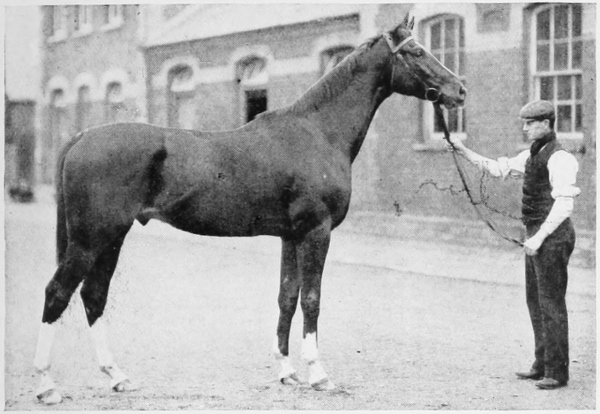
Photo. Rouch, Straua
LORD WILLIAM BERESFORD’S HORSE DEMOCRAT
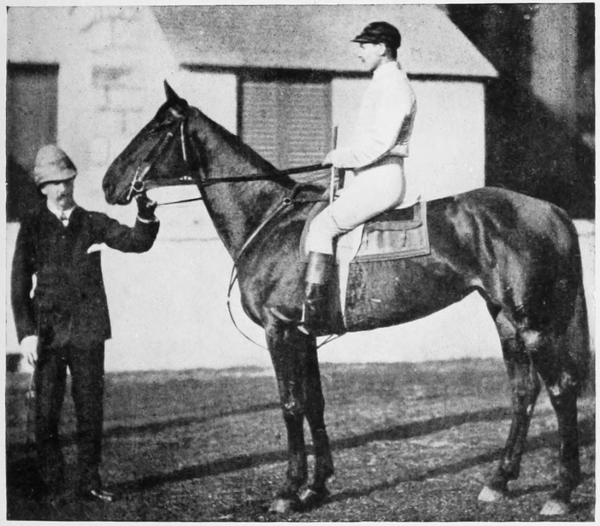
LORD WILLIAM BERESFORD LEADING KATE COVENTRY,
RIDDEN BY DEWING. CALCUTTA, 1881
At Lahore Kate Coventry won the Maiden Chase,
Pompey the Dwarf Chase, Lielle the Arab and
Country-bred Handicap, Ronaleyn the All-horse
Handicap, and Potboy the Pony Handicap, not a
bad performance. Lord William now engaged
Ryder as his trainer and jockey; he had been successful
for Baboo Mohini Mohun Doss of Dacca.
At Dumdum Kate Coventry won the Handicap
Chase as well as another race. After this, luck
seemed to desert the combined stable, though Kate
Coventry still played up nobly, winning the Ballygunge
Cup, and Lawyer the Trial Chase Cup. At
Deccan, Pot Boy and Lawyer also won a race or
two.
Then came the Umballa Autumn Meeting, where
their luck was so crushing Lord William vowed
he would get rid of the lot of his horses, and
advertised the majority for sale. He may have
deceived himself through disappointment, but nobody
else thought for a moment he would be able to
live without racing, in taking which view they were
correct, for in July, 1881, he purchased Camballa
and Western Princess through the dealer and importer
known by the name of Teddy Weekes. Luck
seemed once more to be returning, for at the October
meeting at Dehra Fleur-de-Lys won over the hurdles,
Kate Coventry the Himalayan Chase, and Warrego
the Corinthian Stakes, while Probably, a country-bred
pony, showed the way in the Gimcrack Stakes.
Again at Umballa the good Kate Coventry, Fleur-de-Lys
and Probably also each won a race.
Lord William was now recognised as a rising
racing man, and as one come to stay. He began to
do great things when the Government moved down
to Calcutta for the cold weather of 1881-2. His
new purchase Camballa, a black Waler gelding, began
well by winning the Viceroy’s Cup, steered by Ryder.
I see in an old paper of that time “the unpopular
Governor-General was not present to see his cup
run for.”
It will be remembered I have already pointed out
the reason of Lord Ripon’s unpopularity with his
own countrymen, though never was a Viceroy so
loved by the natives, into whose hands he played all
the time, no doubt thinking it would lead to future
good, but causing at the time dread and consternation
amongst Europeans. Whether his scheme of
equalisation between the races has been a success
or not I leave to my readers to decide, though
perhaps it is still early days to say definitely one way
or the other. Certainly, if we may judge by the way
India has assisted us in our present struggle, we
should feel inclined to think it had, but it is necessary
to look a little beyond our noses, and think what
may be expected in return—the quid pro quo.
I do not suppose Lord Ripon troubled much as to
whether he was popular or not, he was there to do
the best for the country and its people, according
to his light, after that it must be left in the lap of the
gods. The public opinion I have heard expressed of
the Viceroys during the time Lord William was on
the staff ran as follows—that Lord Lytton was
charming, hard-working, and that his work would
live long after him; Lord Ripon unpopular, as it
was thought he would make life impossible for the
white man in the country owing to his enormous
sympathy with the natives; Lord Dufferin, popular
but left a great deal in the hands of his private
secretary; Lord Lansdowne, universally popular,
and Lady Lansdowne especially so. These being the
only Governor-Generals under whom Lord William
served I need go no further. He spoke of them all
with affection and gratitude, saying he had received
“the greatest kindness from all officially and individually.”
I must confess when he said this I felt much
as I do when parents say they love all their children
alike, which cannot be in the least true; they may
love them all, but it must be in different ways and
degrees, so I think Lord William felt, if he had
spoken literally, he had affection for all his chiefs
but in different ways and degrees.
Even Viceroys have a good deal to “put up with.”
First and foremost they have to act on orders from
home, after which, if the measures do not prove
successful or satisfactory, the blame of course falls
on the Viceroy’s head; then when settling down and
getting into his stride, finding help and comfort in
some of his staff—say the Military Secretary, that
office bringing the individual more closely into
association with him than the rest, forming an important
part of his daily life—it has not been unknown
for one Military Secretary after another to
find that their health will not stand the strain, or
that they wish to return to their regiment, another
has married a wife who will not live in India and so
on, so resignation follows on resignation, leaving the
unhappy Viceroy in a constant state of explanations
and instructions to new-comers, and with nobody
to lean on, while possibly feeling anxious over work
of which he has had no previous experience and hardly
knows where to turn to find someone who does.
Occasionally, perhaps, Viceroy and members of the
staff find “incompatibility” a reason for divorce.
The cold weather of 1881-2 proved to the Beresford-Stewart
partners that they had a good thing
in their new purchase Camballa, besides winning the
Viceroy’s Cup, he also won the Burdwarn Cup.
Many people speculated as to this horse’s lasting
powers, as he stood rather straight on his pasterns,
and in India the ground is very hard. However, he
did all that was required of him, caused no disappointment,
and then was sold again at no loss, so
was not a bad bargain. Lord William also won a
race himself on Alien; his pretty little Australian
mare Fleur-de-Lys, which he had bought from Mr.
Abbott, the Tirhoot planter, also won the Tom
Thumb Stakes for him. This little mare was charming
as well as pretty, and as intelligent as a dog.
She had a great affection for her syce, who had been
her close companion from the time she arrived in
India, and her owner used to give his friends little
exhibitions of her affection at times. He would hide
the syce somewhere, and then let Fleur-de-Lys loose
out of her stable, telling the man to call her, while
he kept dodging about hiding from her, but she
always found him in spite of all the dodging, whinnying
with pleasure when she came up to him. If
anyone caught hold of the syce and pretended to
beat him and he howled, the mare would go straight
for whoever it was she supposed was hurting her
friend and companion, would savage and trample
on the offender if she could get at him. So great was
her affection for her syce that it was unnecessary
when moving about the country to put a bit into her
mouth, for she would follow him anywhere. She
was eventually sold amongst others to the Prince of
Jodhpore, where she would be well cared for.
Warrego was now the property of the Beresford-Stewart
stable, and won the two mile Durbangah
Cup for them. Camballa beat several good horses
for the Merchants’ Cup, proving himself the horse of
the year.
At the end of the cold weather 1881-2 Mr. Stewart
was obliged to leave India and go home owing to ill-health.
Kate Coventry was still going strong and doing
wonders, winning the Ballygunge Cup, and again
later in the year the Grand Annual, at Lucknow,
Ryder in the saddle. After this meeting Ryder was
sent to England to buy some horses for Lord William.
The Autumn Meeting at Dehra Doon was very
poor, the unsatisfactory settling after their last
meeting had made people a little shy, many declaring
it was not worth while running their horses under
the circumstances; another reason, I think, being
the course was not in very good order, but none of
these things troubled Lord William, though now I
come to think of it he certainly rode other people’s
horses, and did not run any of his own, as far as I can
remember.
The Umballa Autumn Meeting was not a great
success either, owing to much the same reason. The
rules regarding betting were a trifle lax, but Ryder,
who had returned from England, rode an Australian
horse named Blackthorn for Lord William, winning
the Sirhind Derby, also several other races; but
Island King, a horse Ryder had brought back with
him, had a terrible fall when running for the Cup,
and had to be put out of his pain.
Paperchases were much in vogue in India during
the cold weather. In Calcutta they were very
popular, large fields collecting, but eventually they
became little short of steeplechases. A number of
women used to ride in them, and go right well, but
so many who joined in the chase were given to
racing it became a little dangerous, as will be
readily grasped by anyone who has been closely
followed either in the hunting field or in a paper-chase
by a racing man, who may, and at times does, forget
all about waiting his turn at a fence, and just pushes
and rushes wherever he sees a chance, quite regardless
of consequences. What matter whose face they
trample on so long as they get there!
There were some great chase riders in those days,
Captain David Papillon, Colonel Oliver Probyn, with
his one arm, Lord William Beresford, and that good
sort Mr. Sydney Hartwell of the Oude and Roulicund
Railway. What nerve that man had! I remember
a wonderful grey roan pony he drove, with a knee
as big as an apple dumpling, the result of one of his
many accidents, arising from the fact that he was
almost impossible to hold. I doubt if many people
would have cared to drive the gee. Mr. Hartwell
was a strong man, yet it took him all his time to hold
this handsome quadruped. He was like a miniature
carthorse, and exceedingly fast. An extra pair of
reins were always buckled on to the bit and rested
under a clip on the dashboard in case of the first lot
giving way under the strain. The traces generally
dangled loose, the whole cart and contents, no
matter what weight, being pulled from the bit and
reins.
Several times I was asked if I would like to risk
my life behind this steed, and gladly consented, as
Mr. Hartwell was a first-rate whip and most cheery
companion. It was arranged during one of these
drives that we should meet Lord William on the
Lucknow Racecourse to see a pony he thought
would suit me, put over the jumps. We arrived safely
at the appointed spot, Mr. Hartwell put me down
and took the pony and cart a little distance away to
wait until we were ready, the pony raising no objection
to standing. After the matter of trying the
pony Lord William thought would suit me, it was
agreed that both Mr. Hartwell and Lord Bill should
come back and refresh at our bungalow, his lordship
said he would jump up behind us on the cart; he
received the same instructions as myself, namely,
to nip in quick, the moment our Jehu took hold of
the reins; this was safely accomplished by both of
us, and off we shot like a rocket. The syce in his
anxiety to give the place of honour behind to Lord
Bill, did not leave himself quite enough foothold, and
was shot off at the first rear and bound given by the
pony, given just to express pleasure at being on the
move again. Mr. Hartwell was the only person or
thing in the cart retaining a firm and upright position,
Lord William was heard to say “By Jove,” I
was speechless shuffling back into my seat trying to
look as if I had never left it, the syce I heard later
was last seen tearing frantically in rear of the cart,
after falling flat on his face and losing his puggery,
which was flying out in yards and streams behind
him as he ran trying to re-wind it round his head. I
was too busy holding on to turn my head to see what
had happened to anybody.
After this preliminary all went well, as we proceeded
to drive round the course to have a look at
the pony jumps, the grey roan flinging himself along
delightfully though keeping us in a state of expectancy,
when my lord and master, who had been on
duty and delayed, therefore not able to be present
at the trial of the new pony, came galloping up in
hot haste to overtake us. This was the signal
evidently to the roan that a race was on, it was
really thrilling, and instead of going straight home
as we had intended after inspecting the jumps, we
were raced round the racecourse at top speed about
three-quarters of the way, then on one wheel were
hurruished down an awkward dip and carried like
birds through the Barrack Square, then on through
a mango tope, where Lord William disappeared.
Various people who saw us en route were pleased to
be funny about our appearance, and one or two
sketches were made, in one of which Lord William
was supposed to be holding me on to the seat, but
looked much more as if trying to sit on my head.
I regret much that in the course of my travels a
book full of such souvenirs has unaccountably disappeared.
Eventually Mr. Hartwell got the pony
in hand, and thanks to his brilliant driving I was
landed at our bungalow to find Lord William and
my spouse complacently refreshing themselves in the
verandah. Lord William said he and a bucket, which
appeared from under the seat somewhere, were
tipped out under the mango trees while we were
being carried over what looked like a newly filled-in
grave.
Mr. Alfred Abbott was another great chase rider;
he was seldom seen without a cigar in his mouth,
and died with one between his teeth on the Barrackpore
Racecourse; and many more old friends of
Lord William and mine, in fact it would be easy to
fill many books with the doings of old friends of that
period.
Young and old took part in these paper-chases, Sir
George White with grey hairs when Commander-in-Chief,
and youths with growing down on their upper
lip. One very noticeable thing about people in India
is the way they keep young in spite of their years,
taking part and interest in all that is going on, old
ladies and gentlemen dance until the early hours with
the best of the young ones, ride races, play tennis
and racquets, in fact everything that is going.
One year Lord William offered a prize for a Ladies’
Steeplechase over the Calcutta Racecourse. There
were many competitors, some coming from a distance
to show what they could do.
When Lord William presented the prize of a beautiful
silver inkstand to the winner, who happened to
be a Mrs. Somebody he did not know, he expressed
the hope that she would find it useful and persuade
her to write long letters to her husband. This was
unfortunate, as the lady and her husband had
agreed to part. It was a most unusual thing for
Lord Bill to make a faux pas.
The Simla Season of 1882 passed much in the usual
way, a round of social gatherings and festivities. One
character I must not fail to introduce to you, namely,
Ponto, Lord William’s poodle; he appears in many
photographs, and so he ought, being quite a personage;
he lived with his master after he became
Military Secretary in quite a palatial house called
“Inverarm,” standing on the hill, not far from the
Viceregal Lodge.
Ponto and his master were inseparable; there
were times of course when he was not wanted which
he failed to realise or appreciate, and in spite of the
efforts of those who had instructions to keep him at
home, searched Simla until he located his master,
sitting proudly outside the door until he put in an
appearance. Once Lord William left the house he
was visiting by a different route, and Ponto sat on
far into another day, when he was remonstrated with
by the inhabitant of the bungalow at whose door he
sat.
On another occasion Ponto broke away from
custody and turned up in church at Simla during a
marriage service; the church was very full, but Ponto
managed to squeeze his way through amongst the
multitude of legs, and gave a brisk “Wuff” of
delighted greeting when he located his master.
This affection at times was embarrassing, but as he
meant it all in good part his master was obliged to
accept it in the same spirit, while vowing he would
find some other means of keeping Ponto at home.
Both the latter and his master had many things in
common, both admired beauty; if Lord William
was sitting at luncheon and said in the usual conversational
voice, “There goes a pretty girl,” Ponto
would be up and off in a moment, on to a chair to
gaze right and left out of the window, or to the door,
to look out for the pretty girl. This was always a
sure draw for Ponto, and used to amuse Lord
William, showing him off.
Inverarm was like a museum for its many trophies
of the chase and sport generally. Tables groaned
under cups and beautiful silver. Some of Lord Bill’s
silver bowls were remarkable for their delicate workmanship;
he used often to lend them to people giving
parties when they wanted to make a little splash.
Indeed, so interesting and comfortable was the
house that whenever there was an overflow from the
Viceregal Lodge, which was not infrequent, Peterhoff
being very circumscribed, the extra guests were put
up at Inverarm.
One day when riding along the Mall, Lord William
saw a doolie being carried along with a sick man
inside; he asked the bearers who was inside, and
being told a cavalry officer from the plains, and hearing
they were going to take the invalid to an hotel,
he told them to go straight to Inverarm, and escorted
them to it, keeping the sick man until well again,
doing everything possible for his comfort and to
expedite his recovery. The individual in question
was the present Sir Robert Baden-Powell, at that
time in the 13th Hussars, now father of that most
important and valuable institution the Boy Scouts.
No season either in Simla or Calcutta was allowed
to pass without the children being catered for; the
parties the Military Secretary gave for them were
amongst the most delightful and eagerly looked forward
to by the young folk, who all adored Lord
Bill; he in his turn adored them. The vocabulary
of children is so small and yet so sufficing. Bairns
are very dramatic little persons, and their patois
delightful. He would at any time give up an engagement
for his own pleasure to go and amuse a sick
child, telling them stories, taking them presents and
flowers, and always being robbed of the one in his
button-hole. He used to have great confidences and
secrets with them, which children always enjoy.
One small boy who had broken his leg and was much
devoted to his delicate mother, wanted to give her
something on her birthday as a great surprise, and
could not make up his mind what it should be, as his
saved pennies were not excessive. For days Lord
William made suggestions, none of which were
favoured, some being too costly, others she would
not care for. Each visit Lord William paid he had
some fresh list of suggestions. If the boy had
decided on an elephant Lord Bill would have said he
was sure he could get one for the money and procured
it; but at last the boy had decided in his own
mind, and joyfully told Lord William, saying, “I
have found out what mother would like; it is a book
she often reads. It got spoilt with the white ants
eating it, and I want to give her another.”
“That is capital,” said Lord William; “what is
the name of the book and who is it by, I mean who
wrote it?”
“Oh, I don’t know that,” replied his little friend,
looking rather dismayed, “I think it is called Infernal
Hope, but I don’t know who wrote it.”
“Never mind, little man, I will soon find out,
don’t worry, it is a funny name, but I will soon get
it for you. If I write to a man I know who keeps a
big book shop, he will be sure to know and send it at
once.”
Lord William made a point of finding out from
another member of the family what the book was
without giving away his little friend’s secret. It was
Archdeacon Farrer’s Eternal Hope, and it arrived
duly in a beautiful cover in time to give pleasure to
both the little invalid and his mother.
Some years after this, when I was giving a children’s
party at home in England, Lord Bill asked,
“May this child come, please?” Of course I replied
I should be charmed, and certainly the children
were; I never saw bairns enjoy themselves more.
He pretended he was an elephant at the Zoo, and
allowed them to sit all over him while he travelled
about on all fours giving them rides, then pretending
to fall down and roll with them. When he thought
they were tired of this he crawled under the table in
the dining-room and pretended he was a bear in a
cage, and had to be fed by the children through the
bars formed by the legs of the chairs arranged
around him.
After the last happy child had gone home, Lord
William and my youngest brother, who had likewise
been assisting, feeling rather limp and exhausted,
suggested they would like a wash and brush up.
After this operation both were due at opposite ends
of London; it was pouring with rain, and there
seemed to be a scarcity of cabs. The servants
whistled until they were nearly black in the face,
as my brother expressed it; at last they succeeded
in attracting the attention of one hansom; then
each man was too polite to take the cab from the
other, and as they were going in opposite directions
they could not share it. My brother told Lord
William to jump in and he would find one for himself,
or wait with me until another arrived.
Lord William would not agree to this, and told
my brother to jump in. It ended in their struggling
fiercely in the street, each trying to put the other
into the cab. The cabby at first looked on in awe
and wonderment; he was anxious to keep the cab
dry, and each time one of the strugglers was nearly
deposited in the cab, up would go the glass, then as
they subsided for a fresh effort on the pavement
down went the glass again, as the cabby saw all was
not decided. He was now entering into the spirit of
the game, and settled down to watch and be ready
to receive the missile when it eventually arrived.
By this time another cab had turned up, but nobody
took the least notice of it. A small crowd of
wet errand boys had collected to watch the fun, and
I was momentarily expecting a policeman to appear
on the scenes and take them both into custody.
At last Lord William won the day, and from behind
the curtains in the dining-room window I saw
my bruised and shin-barked brother chucked into
the cab while in response to the cabman’s “Where
to?” Lord William replied, “Home for lost dogs,
and drive like the devil.” Needless to say neither
my brother nor Lord William looked like paying
visits after this romp; their hats had been knocked
off and clapped on again by the servants, and small
boys looking on, only to roll off once more. Ties had
waltzed round, and were looking out from unaccustomed
places, collars looked shy and drooping;
but I am flying too far ahead; and the Simla Gymkhanas
require and deserve a little space before passing
on.
The subject of these memories was always full of
new ideas for the amusement of Simla. Amongst
other races he organised, was the Victoria Cross Race,
which was exciting, the idea being that each rider
had to place a dummy figure of sorts lying on the
ground or in some perilous position, the riders would
then have to ride as hard as ever they could over
certain jumps, pick up the figure, and bring it back
over more jumps into safety, just as if they were trying
to save life. These figures were often really well
got up, one perhaps dressed as an ayah, another as a
child, a soldier, war correspondent, and so on. It
was most amusing to watch the struggles while
picking up the figures and remounting again. During
one of these races Lord William elected to rescue a
war correspondent who was supposed to be wounded.
He succeeded in picking him up, and was coming over
the last fence with him in great style, when a post,
which had no business to have been left where it was,
caught Lord William on the head, or his head came
in contact with the post, giving him a nasty wound,
which bled profusely and caused him to lose the race,
but the rescued correspondent came in useful, as he
helped to mop up the gore. Lord William swore he
was none the worse, but must surely have had a very
sore head.
Another invention from the same brain was the
cigar race. The riders had to start, go over some
of the jumps, then change mounts. It was arranged
beforehand whom they would change with, it had
to be one that had started in the race; then light a
cigar, remount quickly, and finish the race with the
cigar still alight. This was essential. The agitation
was great when the matches would not light, their
heads broke off, or the ponies objected, some of
which saw no fun in it and declined to wait and see
the rest.
Then for another change the ponies and their
riders had to jump through big paper hoops after the
fashion of circus entertainments. This race generally
led to merriment, as the ponies did not care for the
game, and ran in every direction to avoid the ordeal.
The umbrella race was a good one. Riders had to be
mounted on their own ponies, which they had to
saddle themselves, when a bell was rung, then open
an umbrella, which had to be carried open over the
jumps. The opening of the umbrella generally
caused trouble.
The race for people who had never ridden in one
before was usually comic; elderly sportsmen and
timid youths were persuaded or goaded into entering,
and it provided all sorts of novel conditions and
situations.
Riding up from one of these gymkhanas on a
newly purchased pony, which had seemed to me very
quiet and suitable to narrow paths and hill-climbing,
it suddenly turned nasty on hearing the clatter of a
horse coming up hurriedly behind him, promptly
laid his ears back and turned his tail over the side of
the khud, while I had the unpleasant experience of
hearing loose stones and earth giving way under his
feet and rattling down hundreds of feet below. I
thought I had seen my last gymkhana. I leaned as
far forward as I possibly could, to keep my weight
off his quarters and give him a chance, for he was
beginning to think he had done something foolish,
and was scrambling to keep foothold with his fore
feet, when Lord William, whose horse’s clatter had
caused the outbreak of displeasure on the part of my
mount, came to the rescue, and seizing me more or
less by the hair of my head landed me safely, the
pony slipped down a little way, but got entangled
in some bushes, and so gave time to several kindly
helpers who rescued him. Lord William then insisted
on our saddles being changed, as he would not
hear of my riding the wicked pony any more; I
therefore had a charming beast of his to take me
home, while he taught mine a lesson. When he
turned up later he told me he thought the pony must
have been drugged when I bought it, as it was a
nasty, vicious brute, and had tried to crush his legs
against first a tree and then some railings after I had
left him with it.
The fair held once a year at Sipi, a few miles outside
Simla, was usually a day of extra festivities.
Lord William’s picnics there were most enjoyable,
being arranged and managed as everything he undertook
was managed, with forethought for everybody’s
comfort. His organising powers were extraordinary,
while his peculiarly gracious and courtly manner
added charm to all the functions he arranged. Even
in the matter of food everyone’s particular taste was
catered for.
With the exception perhaps of Sir Spencer Ponsonby
Fane, I never met anyone with such a talent
for organising State functions and great occasions as
Lord William, and certainly the latter was the more
popular and caused less offence than his old friend
did at times.
The road from Simla to Sipi is just a pleasant
distance for a ride, but along the edge of precipices
and through an alarming dark tunnel, which is quite
exciting if riding a quarrelsome horse, for in the
darkness you often meet a crowd of ponies being
driven through with big bundles on their backs.
They are usually being driven through by pedestrian
natives. The situation at times lends itself to some
mix-ups and chatter.
The surrounding tribal women gather themselves
together, decked out in all their best, some with a
view to finding suitable mates, others to sell their
jewellery and gew-gaws. The Thibetan women often
realise big prices for their turquoise and silver ornaments.
It is a great day amongst the hill tribes for
exchange and barter, indeed sales of all sorts.
There is also ceremony attached to this fair, as
some of their gods are brought to shower blessings
on all the chosen ones. Such curious figures some of
these deities possess, they baffle description, being
quaint figures, half man, half beast, half nothing.
Some do not possess any legs, others we presume
have, but are clothed in mysterious garments,
leaving much to the imagination. One year Lord
William gave his picnic in a villa built there by an
Italian confectioner, which sounds strange in the
Himalayan mountains surrounded by Thibetan
females and other hill tribes. We also must have
looked a little out of place, indeed I think we always
do look out of place in the gorgeous colour-loving
East.
Lord William was the life and soul of Simla, and
exceedingly popular with everybody. One of his
most charming traits, and one which I admired much,
was his gentle, polite manner to natives. Once
young Englishmen arriving from home considered
it fine and grand to be rude and rough to natives
when they were stupid, and made mistakes, which
very often arose from their own ignorance of the
language, and therefore being unable to express
themselves intelligibly; I have heard a young subaltern
saying he had saddled his pony, when what
he wished to say was the syce was to do so, the young
man’s grammar being defective, for which the natives
had to suffer. Lord William was most particular
in giving his orders to see they were understood, and
gave them in a clear polite way which was most refreshing;
naturally the natives loved him, would do
anything for “Lord Brasspot Sahib.”
Many of his friends said he was a great loss to the
Service. Once when a great friend of his was walking
round Jakko (the only decent road round on one
side of Simla, a sort of continuation of the Mall) with
General Sir George Chesney, who wrote that clever
book The Battle of Dorking, Lord William rode by at
a gallop, taking his hat off to Sir George in a way
quite peculiar to himself; it always seemed to imply
so much, respect, affection, compliment, pleasure
at seeing you, and everything else of the kind, leaving
each individual feeling comfortable and pleased.
As he passed, Sir George, who was walking with one
of the members of the staff and as already stated an
old friend of Lord William’s, turned to his companion
remarking, “There goes a leader of men. Instead
of being Military Secretary to the Viceroy he ought
to be commanding a cavalry brigade; he would be
unequalled at that work, always supposing he was
not turned out of the service for disobedience to
orders.”
Another friend, a clever lady of that time at Simla,
speaking of Lord William’s character generally,
said, “It is not Bill’s cleverness or quickness to
grasp the situation, but what he has got in an eminent
degree is what Solomon had. I have always thought
that Solomon’s great wisdom was much exaggerated,
and that what he really had in pre-eminence, and
Bill has too, is tact, doing the right thing at the right
time. For instance ... it was not Solomon’s great
knowledge that bamboozled the Queen of Sheba,
but knowing when she wanted a foot-stool!”
Arrangements for Entertaining Visitors—Lord de Grey’s Shooting—A
Good-looking Staff—A Fancy Ball—The Baby cries—Lord
William Feeds the Infant—Singing Quadrilles—Pig-sticking—The
Tent Club and Its Members—A Case of Mistaken Identity—The
Reputation Match—Lord William Resolves to Give Up
Racing—Lord Ripon’s Farewell
During Lord Ripon’s time in India a
number of people came out from home
to stay with him, some wishing to combine
a visit to their friends with shooting, pig-sticking
and globe-trotting. This kept Lord William busy, as
he had to make all the arrangements for their
comfort, and where they were to stay, when the
Viceregal Lodge was full, which was generally the
case. Occasionally he turned out of his own house
for guests, searched for suitable bungalows for
others, making everybody comfortable and yet
without the least apparent effort. Rajahs were
communicated with, and shoots arranged; horses
were found to suit the various riders, chosen in
accordance to their prowess, programmes made
out for each day, and printed instructions sent
on ahead, so that all was in readiness at each halting
place, carriages, horses, servants, food, sport and
all the heart of man could desire.
The happy relations existing between Lord
William and the Native Princes made this easier
for him than it might have been for many.
The present Marquess of Ripon, then Lord de
Grey, came to stay with his father, and was anxious
to have some big game shooting. He is, as everybody
knows, one of the best shots in England. His
game card from 1867 to 1891 gives some idea of his
skill and the sport provided. I think the years 1880
and 1882 were the years he was shooting in India.
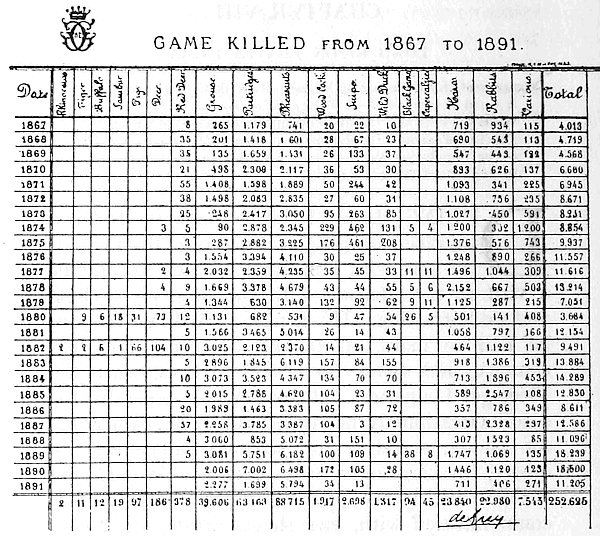
Lord de Grey’s Game Card from 1867-91
GAME KILLED FROM 1867 TO 1891.
| Date |
Rhino- |
Buffalo |
Pig |
Red Deer |
Partridge |
Wood Cock |
Wild Duck |
Capercaillies |
Rabbits |
Total |
| ceros |
Tiger |
S??? |
Deer |
Grouse |
Pheasants |
Snipe |
Black Game |
K??? |
Various |
| 1867 |
-- |
-- |
-- |
-- |
-- |
-- |
8 |
265 |
1.179 |
741 |
20 |
22 |
10 |
— |
— |
719 |
934 |
115 |
4.013 |
| 1868 |
-- |
-- |
-- |
-- |
-- |
-- |
35 |
201 |
1.418 |
1.601 |
28 |
67 |
23 |
— |
— |
690 |
543 |
113 |
4.719 |
| 1869 |
-- |
-- |
-- |
-- |
-- |
-- |
35 |
135 |
1.659 |
1.431 |
26 |
133 |
37 |
— |
— |
547 |
443 |
122 |
4.568 |
| 1870 |
-- |
-- |
-- |
-- |
-- |
-- |
21 |
498 |
2.308 |
2.117 |
36 |
53 |
30 |
— |
— |
893 |
626 |
137 |
6.660 |
| 1871 |
-- |
-- |
-- |
-- |
-- |
-- |
55 |
1.408 |
1.598 |
1.889 |
50 |
244 |
42 |
— |
— |
1.093 |
341 |
225 |
6.945 |
| 1872 |
-- |
-- |
-- |
-- |
-- |
-- |
38 |
1.498 |
2.083 |
2.835 |
27 |
60 |
31 |
— |
— |
1.108 |
756 |
235 |
8.671 |
| 1873 |
-- |
-- |
-- |
-- |
-- |
-- |
25 |
248 |
2.417 |
3.050 |
95 |
263 |
85 |
— |
— |
1.027 |
450 |
591 |
8.231 |
| 1874 |
-- |
-- |
-- |
-- |
-- |
3 |
5 |
90 |
2.878 |
2.345 |
229 |
462 |
131 |
5 |
4 |
1.200 |
302 |
1.200 |
8.854 |
| 1875 |
-- |
-- |
-- |
-- |
-- |
-- |
3 |
287 |
2.882 |
3.225 |
176 |
461 |
208 |
— |
— |
1.376 |
576 |
743 |
9.937 |
| 1876 |
-- |
-- |
-- |
-- |
-- |
-- |
3 |
1.554 |
3.394 |
4.110 |
30 |
25 |
37 |
— |
— |
1.248 |
890 |
266 |
11.557 |
| 1877 |
-- |
-- |
-- |
-- |
-- |
2 |
4 |
2.032 |
2.359 |
4.235 |
35 |
45 |
33 |
11 |
11 |
1.496 |
1.044 |
309 |
11.616 |
| 1878 |
-- |
-- |
-- |
-- |
-- |
4 |
9 |
1.669 |
3.378 |
4.679 |
43 |
44 |
55 |
5 |
6 |
2.152 |
667 |
503 |
13.214 |
| 1879 |
-- |
-- |
-- |
-- |
-- |
-- |
4 |
1.344 |
630 |
3.140 |
132 |
92 |
62 |
9 |
11 |
1.125 |
287 |
215 |
7.051 |
| 1880 |
-- |
9 |
6 |
18 |
31 |
73 |
12 |
1.131 |
682 |
531 |
9 |
47 |
54 |
26 |
5 |
501 |
141 |
408 |
3.684 |
| 1881 |
-- |
-- |
-- |
-- |
-- |
-- |
5 |
1.566 |
3.465 |
5.014 |
26 |
14 |
43 |
— |
— |
1.058 |
797 |
166 |
12.154 |
| 1882 |
2 |
2 |
6 |
1 |
66 |
104 |
10 |
3.025 |
2.123 |
2.370 |
14 |
21 |
44 |
— |
— |
464 |
1.122 |
117 |
9.491 |
| 1883 |
-- |
-- |
-- |
-- |
-- |
-- |
5 |
2.896 |
1.845 |
6.119 |
157 |
84 |
155 |
— |
— |
918 |
1.386 |
319 |
13.884 |
| 1884 |
-- |
-- |
-- |
-- |
-- |
-- |
10 |
3.073 |
3.523 |
4.347 |
134 |
70 |
70 |
— |
— |
713 |
1.896 |
453 |
14.289 |
| 1885 |
-- |
-- |
-- |
-- |
-- |
-- |
5 |
2.015 |
2.788 |
4.620 |
104 |
23 |
31 |
— |
— |
589 |
2.547 |
108 |
12.830 |
| 1886 |
-- |
-- |
-- |
-- |
-- |
-- |
20 |
1.989 |
1.463 |
3.383 |
105 |
87 |
72 |
— |
— |
357 |
786 |
349 |
8.611 |
| 1887 |
-- |
-- |
-- |
-- |
-- |
-- |
57 |
2.258 |
3.785 |
3.387 |
104 |
3 |
12 |
— |
— |
415 |
2.328 |
237 |
12.586 |
| 1888 |
-- |
-- |
-- |
-- |
-- |
-- |
4 |
3.060 |
853 |
5.072 |
31 |
151 |
10 |
— |
— |
307 |
1.523 |
85 |
11.096 |
| 1889 |
-- |
-- |
-- |
-- |
-- |
-- |
5 |
3.081 |
5.751 |
6.182 |
100 |
109 |
14 |
38 |
8 |
1.747 |
1.069 |
135 |
18.239 |
| 1890 |
-- |
-- |
-- |
-- |
-- |
-- |
-- |
2.006 |
7.002 |
6.498 |
172 |
105 |
28 |
— |
— |
1.446 |
1.120 |
123 |
18.500 |
| 1891 |
-- |
-- |
-- |
-- |
-- |
-- |
-- |
2.277 |
1.699 |
5.794 |
34 |
13 |
— |
— |
— |
711 |
406 |
271 |
11.205 |
|
2 |
11 |
12 |
19 |
97 |
186 |
378 |
39.606 |
63.163 |
88.715 |
1.917 |
2.698 |
1.317 |
94 |
45 |
23.840 |
22.980 |
7.543 |
252.625 |
|
|
| Lord de Grey’s Game Card from 1867-91 |
Amongst others who came out were Lord and
Lady Wenlock, Lady Charles Beresford, and later
their Royal Highnesses the Duke and Duchess of
Connaught.
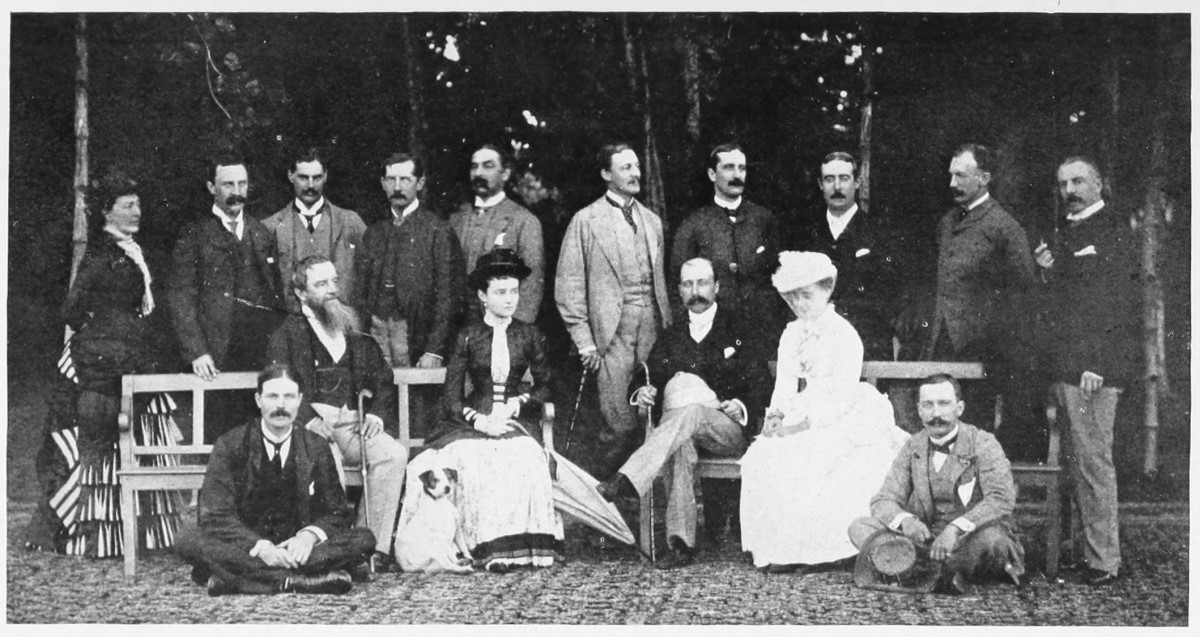
GROUP AT BARRACKPORE ON THE LAWN
Left to right. Standing: Lady Downe (the late); Mr Primrose (now Right Hon. Sir Henry), Lord Alwyne Compton (the late); Dr. Anderson
(Viceroy’s Medical attendant); (next figure not known to author); Lord Downe, Capt. Deane, 17th Lancers; possible Sir Maurice Fitzgerald;
but uncertain; Capt. Poe, I believe; Lord William Beresford. Seated: Lord Ripon, H.R.H. Duchess of Connaught, H.R.H. Duke of Connaught,
Lady Ripon. On ground: Capt. Rochfort (now Sir Alex., Governor of Jersey), Capt. the Hon. Charles Harbord (now Lord Suffield)
Lord William found a pleasant bungalow, not
far from the Viceregal Lodge, for Lady Wenlock,
while her husband was away shooting, and she
spent a good deal of time sketching. Being of an
artistic temperament she delighted in the scenery
and colouring, finding endless opportunities to
practise her art—plenty of work for her brush.
Yet at times the colouring is so superb it defies all
efforts of speech or brush.
Picture the hill-sides one blaze of rhododendrons,
sheets of them leading down to green valleys, where
after the rains maidenhair ferns and wild orchids
cling lovingly to the branches of the trees, on the
ground, carpets of little white flowers resembling our
lily of the valley, but lacking its scent, in the distance
blue mountains, behind these purple mountains,
behind these again snow-clad peaks, a brilliant sun
shining over all, framing pictures that remain in
memory for life, and yet there are times when the
very splendour of it seizes us with a limitless despair.
In these few beautiful moments when the sun,
symbol of deity in the East, is bidding us good-night,
changing all round from rose to red, orange
to turquoise, leaving a tiny twilight, and the day
is gone, hidden away behind a mist of grey. And
we think—but no, we will not think, we will go dress
for the “Poggle Khana” or fools’ dance, as the
natives call a fancy dress ball. But of these more
later.
I wish to introduce my readers to a group of
people taken about this time. All the men are
members of the Viceregal Staff. Lady Wenlock is in
the centre, handsome Lord Alwyne Compton (died in
1911) is seen sitting behind her; he was one of
the A.D.C.’s. When not on duty he had an affection
for a brown velveteen coat and yellow button-hole,
which suited him exceedingly well, his hair, eyes and
skin, being almost Italian looking. Lord William,
Military Secretary, is on Lady Wenlock’s left, and
beside him sits Lady Charles Beresford, his sister-in-law.
Then comes Mr. Primrose, Private Secretary
to the Viceroy (now the Right Hon. Sir Henry
Primrose). On the extreme left is Capt. St. Quinten,
another good looking young man, who was a
favourite A.D.C. in the viceregal household. Sitting
at Lady Charles Beresford’s feet is Capt. Clough
Taylor, who hailed from the same county as the
Ripons, he also was A.D.C. His wife, Lady Elizabeth
Clough Taylor (died in 1896) is sitting on Lady
Wenlock’s right. Behind her stands the Hon. Miss
Lawley. Sitting at Lady Elizabeth’s feet is Capt.
Muir, A.D.C. (now Colonel) and Commander of the
Body Guard. In the arm-chair below Miss Lawley
is the Hon. Charles Harbord, A.D.C. (now Lord
Suffield), and next to him Capt. Rochfort, A.D.C.
(now Sir Alex. Rochfort, Governor of Jersey).
It will be observed their Excellencies liked good
looking men on their staff.
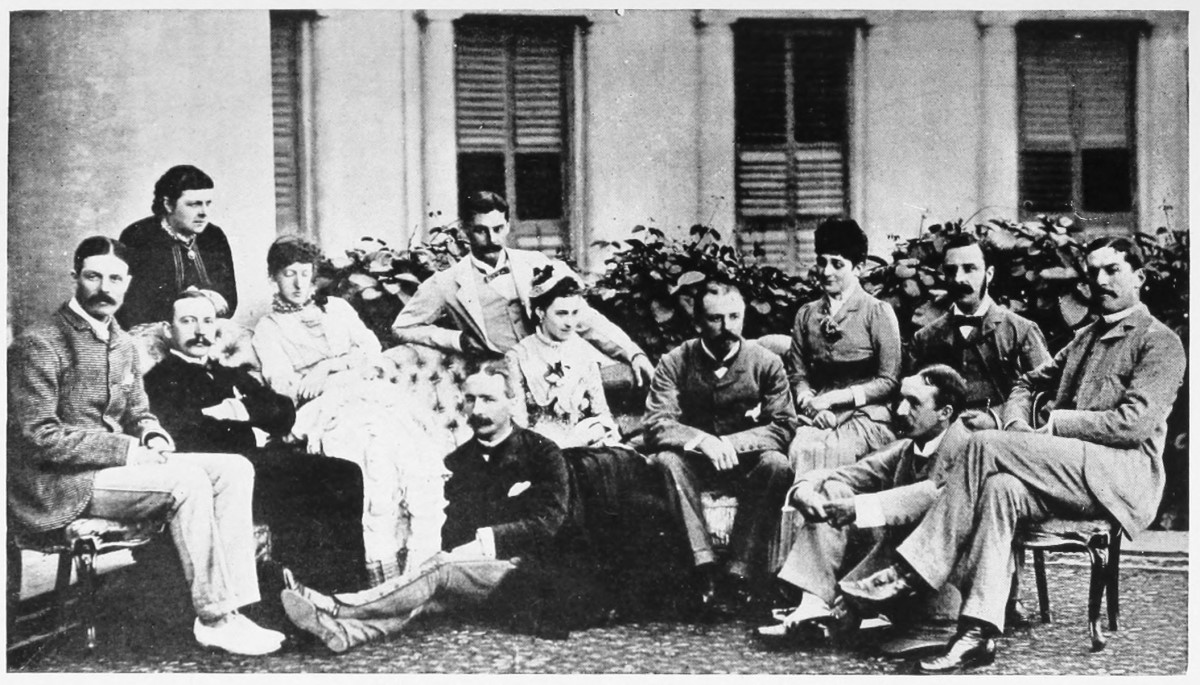
STAFF AND GUESTS AT VICEREGAL LODGE, SIMLA
Left to right: Capt. Rochfort (now Sir Alex. Rochfort, Governor of Jersey); Honble. Miss Lawley, Capt. Harbord (now Lord Suffield),
Lady Elizabeth Clough-Taylor, Lord Alwyne Compton, Lady Wenlock, Lord William Beresford, Lady Charles Beresford, Mr. Primrose,
Captain St. Quinten
On ground, left to right: Capt. Muir and Capt. Clough-Taylor
Now I am anxious to tell you about the fancy
dress balls.
Some of the dresses worn in India on these
occasions are marvellous, people out there seem to
take much greater pains to do the thing properly,
and there have been many anxious moments in
case the dresses should not arrive from Paris or
England in time. One fancy dress ball I remember
as being particularly amusing, but it was not at
Simla. Lord William appeared as a Chelsea
Pensioner, and was quite excellent. A good looking
woman, wife of an Artilleryman, was “A Wasp”;
she naturally had a tiny waist. The wondrous dress
with its stripy bands of yellow, black gauze wings,
and the little antennae in her head, all well carried
out, but the wings made dancing difficult, so she
sat in a corner with the Chelsea Pensioner a good
deal. The poor old Pensioner did not like much
light—it hurt his poor old eyes. But the chief
joke of the evening was when a big hefty hospital
nurse carried into the ballroom a very lusty looking
big red-faced baby, with a distinctly blue line along
the upper lip. A white rosette-adorned cap tied
under his chin, a short white frock reaching a little
below his knees which stuck out all round from the
amount of material it contained, which, however,
helped to support a big blue sash, matching the
shoulder knots; frilled kicksey-wickseys, white socks
and sandal shoes completed this child’s costume.
The bottle of milk which he was sucking, or pretending
to suck, was fixed to his sash, and had a long
tube. The nurse put down her charge to toddle
along the floor, still holding his hand, but the baby
if left for a moment began to cry.
It was not long before we discovered in the baby
a hard riding man who had brought some hounds
out from home and given us some amusement with
them in the cold weather, his nurse was an officer
in a smart cavalry regiment. Before the evening
was over so many practical jokes had been played
on the poor baby that he and his nurse in self-defence
retired and changed into ordinary evening
garments; but not before supper, when Lord William
insisted on feeding the baby with a tablespoon, and
dived first into one dish and then another so quickly
that the already red-faced baby became apoplectic;
it was after this he escaped, having been severely
patted on the back for a choking fit.
India has changed since those days when the
natives used to be rather shocked at ladies appearing
publicly in evening dress, and at some of the flirtations,
perhaps not entirely peculiar to the East,
but to-day they have become so civilised and
Westernised it takes a good deal more to shock them.
The country is a mixture of shabbiness and
gorgeousness, pathos and childishness. Some of us
appear very giddy out there, because if we did not,
we should cry; so ride and dance, keeping up a
ceaseless round of activity, we say because it keeps
us in health, which in a measure no doubt it does,
it also leaves no time for thoughts of home and
regrets.
The music of the country is quite peculiar to
itself, so is the dancing, which is poor and monotonous,
but, of course, I am speaking of some years ago,
now possibly the Princes are asking their bandmasters
the names of the morsels being played to
them, and are told, as really happened I believe to
Queen Victoria once, who, on hearing a particularly
bright tune being played, asked its name. Nobody
seemed able, or inclined, to inform her, but she was
determined to know, and sent specially to the band
to ask, the messenger returned looking a little
uncomfortable, and said it was called “Come where
the booze is cheaper.” Probably tunes of that sort
are now the order of the day, having travelled with
the motor-car and latter-day luxuries.
During the winter in India, singing quadrilles
were the fashion, and had to be rehearsed frequently,
it was rather funny to see Lord William being
schooled into singing his part of “Ba ba black
sheep, have you any wool?”; he learnt “Where
are you going to, my pretty maid?” much quicker.
It is astonishing the amount of talent that is
represented at times in the hill stations in summer,
it is by no means uncommon to have really good
Christy Minstrels, concerts and even high-class
oratorios. (I suppose the latter ought to have been
mentioned first).
Lord William did not take part in the big game
shooting unless he had to go officially, as it bored
him to tears, but he loved pig-sticking more than
any other form of sport, and used to get a good deal
of it from Calcutta. He belonged to the Calcutta
Tent Club, and always said the best days he had
were when with his friend “Archie Hills, on his
own land at Packabari.” Mr. Hills, if I remember
right, was an indigo planter. He appears in the
pig-sticking group. For those unacquainted with
this form of sport I will explain it briefly. The game
can be played by one alone, but usually by three or
four men who go out together mounted on horses,
and armed with spears to hunt and slay the boar.
My own humble opinion is that Arabs are the
pleasantest mounts for this form of sport, they seem
to understand the broken ground better than any
other class of horse and are sure-footed.
The boars are not like our English pork, but very
fierce fighting animals; tigers have been known to
fight shy of them. It is wonderful the way these
pigs cover the ground; they are really fast, and give
jumps and bounds of a surprising nature. They
generally begin by going away from the sportsmen,
but after a while when they get annoyed, and think
it is time for some fun themselves, they will turn
suddenly and charge the enemy. Some horses that
have been ridden regularly after pig, are clever
at dodging these charges, which is a distinct
advantage, a rip from the tusk of a boar is a nasty
one, they always rip upwards, inflicting horrid
wounds, when they get the chance.
The Tent Club, already mentioned, was formed
at Calcutta of pig-stickers, a photo of which will
be found with the names of the most prominent
members. I do not remember hearing a great deal
about Lord William’s pig-sticking, beyond the fact
that he enjoyed it above all things, and got as much
of it as his duties allowed. It was returning from
pig-sticking in 1880, I think, that an excitement
occurred in which Lord William took part.
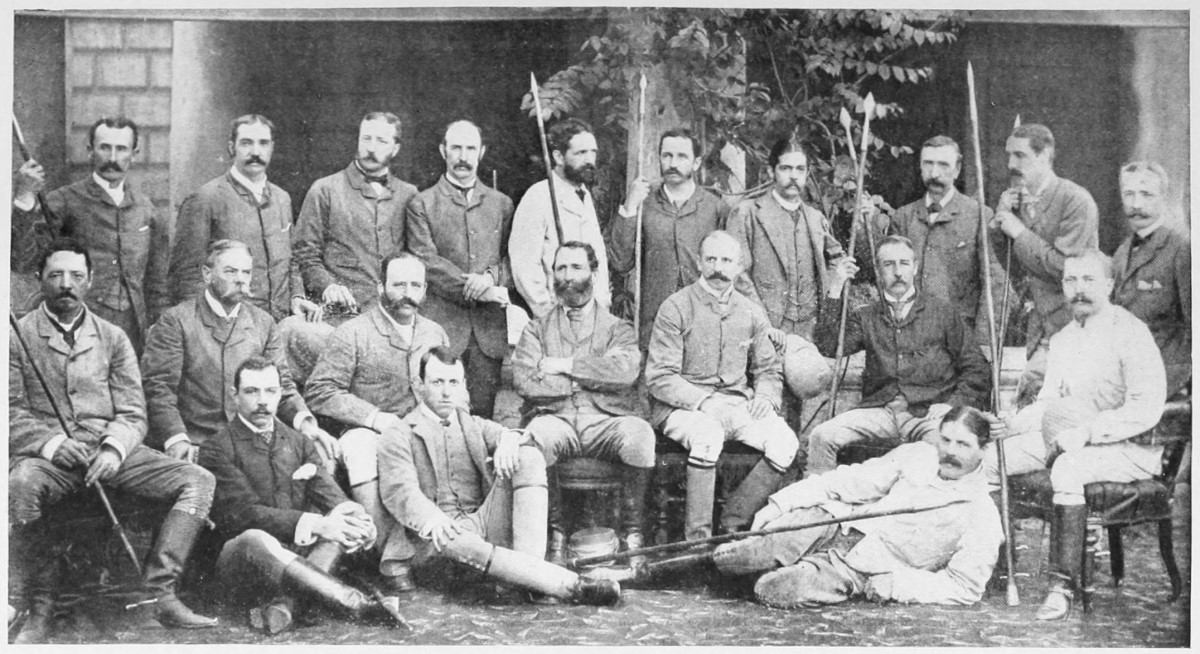
SOME NOTABLE MEMBERS OF THE CALCUTTA TENT CLUB
Left to right, standing: General Harry Wilkinson, Col. Jim Cooke, Mr. Macnair, Mr. H. Millett, Mr. Anderson, Mr. W. L. Thomas,
Mr. W. O. Bell Irving, Mr. Playfair, I think; Mr. Jim Henderson, Captain Muir. Seated: Mr. G. Fox, Sir George Greaves, Mr. Carlysle,
Sir Franklin Prestage, Lord William Beresford, Mr. Archie Hills; (next not known to the author). On the ground: Mr. A. S. Chapman,
Mr. Laurie Johnstone, Captain A. Rochfort
A number of horses, about 250, had been landed
from the ship Thessalus, with a view to taking them
to Dhurrumtollah, where stables were ready for
them; how to get them there was a matter of
speculation; it was decided a few expert Australians,
with stock whips, should drive them Colonial fashion,
all grouped up together, this answered admirably
for some time, until one or two of the leaders took
it into their heads that gas lamps were dangerous
things, and galloped madly away through the streets,
followed by all the rest, simply a mad galloping and
hurruishing crowd of horses, a regular stampede,
not a pleasant thing to find advancing towards you.
They rushed with alarming clatter through the streets
out into the maidan or plain, where they broke
up into groups, tearing off in every direction. It
took all night and part of the next day collecting
the animals, who by that time had tasted enough
freedom and were not sorry to be caught, but the
excitement was great. One unfortunate man, who
was riding home at a belated hour, meeting this
charging cavalcade turned his horse’s head very
wisely and was carried along with them.
Lord William was a good judge of a horse and
understood their training, he was therefore often
asked for his advice, and if anyone had a good horse
they wished to sell they usually let Lord William have
a look at it. One day in Calcutta, Mr. John Ralli
sent him for trial a very fine fast trotting mare to
look at; his lordship decided to buy her. The same
evening he went for a “walk round” at Belvedere
and saw there a Mr. S. (we will say) and his very
handsome wife walking arm-in-arm. There was a
very strong likeness between Mr. Ralli and Mr. S.,
and as Lord William passed, mistaking him for
Mr. Ralli, he gave a little pinch whispering, “She’s
a ripper.” Mr. S. immediately replied, “You’re
a scoundrel, sir!” Lord William was very indignant
and thought the man had gone mad, as, of course, he
was referring to Mr. John Ralli’s fast trotting mare.
Mr. S. was also angry, thinking Lord William
referred to his wife. Rather a funny story of mistaken
identity.
Lord William was with the Viceroy on the memorable
occasion when touring a certain district where
the natives had come to the conclusion that, under
the new Viceroy’s rule, they were to have a free run
among the scattered European residents, where
several ladies were living, and when he arrived the
said scattered Europeans were not inclined to give
his Excellency a favourable reception! This episode
was referred to as the “White Mutiny.”
The Autumn of 1882 was not a very lucky one
from the racing point of view. Both the Dehra and
Umballa meetings were poor and temporarily somewhat
out of favour. The winter of 1882-3 was not
much better, at Calcutta Lord William certainly won
a race with Fariz and another with Mooltan, and he
won a match five hundred rupees a side, riding his
Premier against Captain Webb, on Mr. Godjack’s
Skirmishe.
In May came the news of his partner’s death,
poor Mr. Monty Stewart, who had gone home sick.
In consequence of this, all the horses were put up for
sale, the majority being bought by the Sporting
Maharajah of Jodhpore.
Lord William not being able to afford racing
alone, on the lines he aspired to, now looked round
for another partner, and before long he and the
young and rich Maharajah of Durbangah came to an
arrangement. The Rajah had acquired a taste for
racing from Major Ben Roberts, who had just left
India to take up some appointment in England. So
now began another partnership, and more money was
forthcoming to purchase valuable horses. Ryder
was once more sent to England to see what he could
find, Lord William also went on short leave and
returned with a sprinter named Reputation, Father
Prout and Little Charlie. £2000 was given for
Reputation, and before leaving for India he won the
Egremont Plate of £300 and the Glasgow Plate £200,
but he was a nervous horse, did not travel well, was
easily thrown off his oats and did no good in India
where the ground was too hard for him, which was
disappointing, for in the Egremont Plate before
leaving England when being ridden by “Archer”
he gave 16lbs. to Laceman and 27lbs. to Hornpipe,
who were the same age, yet won easily.
Reputation was a smart good-looking horse,
bought from a solicitor I believe named Tidy, whom
it may be remembered Lord Marcus once tackled in
his office, ending in fisticuffs and police court proceedings.
On May 10th, 1883, a great match was arranged
between Lord William and Mr. Leopold de Rothschild:
the former backing his Reputation against
the latter’s Brag. Archer rode for Lord William
and Fordham for Mr. Rothschild. The race was run
at the Newmarket Spring meeting, 200 sovereigns
a side T.Y.C. Matches were quite a fashionable
feature of the sport at this period and were generally
arranged overnight and a surprise addition to the
day’s racing.
The excitement was great over this race, many
were interested in it, amongst others the Prince
of Wales, Sir J. Astley, Lord Hartington (afterwards
Duke of Devonshire) and many more. Crowds
flocked to see the race run and there was a good
deal of money on it. The horses ran close together
most of the course, it was most thrilling, but eventually
Brag gained the advantage about a hundred
yards from home, winning cleverly by a neck.
Perhaps for the benefit of those who are not race-goers
I ought to explain T.Y.C. means the two year
old course at Newmarket which is five furlongs and
140 yards. This course was a long way from the
stand; there were more winning-posts in those
days than there are now. It was customary for
people to hack over to the different places to see the
finish. Brag had the advantage in weight as
Reputation had to give him 14lbs., which, in the
opinion of many people who were in a position to
judge, was considered too much to ask. Perhaps
Lord William was not as experienced at that time
as he was later in that delicate game of matching:
considerable knowledge being necessary to bring it
off successfully.
A number of people will not forget that day
easily, a good deal of money changed hands over
the race.
It was in the Palace House at Newmarket, Lord
William made this Brag and Reputation match;
where Mr. Leopold de Rothschild always entertained
both King Edward and our present King. It is an
unpretentious looking abode but very historic, and
was the Newmarket house of Charles II.
The newly purchased horses arrived safely in
India on July 30th, 1883. But now more bad luck
attended poor Lord William, for while riding at
Cawnpore in the Gangees Cup he broke his collarbone,
and hardly had he recovered from this than,
in a jumping Competition at Simla, he dislocated his
shoulder and was not able to enjoy the Dehra Autumn
meeting.
When once a shoulder has been dislocated it
forms a fondness for the amusement and continues
to do it with slight provocation. Lord William
says it happened once through sneezing!
Though unable to attend the Dehra Meeting, his
stable was represented, an Australian named The
Mute won the Trials, Action won the Gimcrack
Stakes and Johnnie the Hack race. Later at Meerut,
Lord William was well enough to ride, and on a
horse purchased from the circus proprietor, John
Wilson, won the Maiden Chase. At Umballa riding
Johnnie he was triumphant in the Grand Military
Steeplechase, but got a toss in the Grand Annual
when riding Jack the circus horse, but he remounted
and finished the race. On the last day of the Umballa
meeting he grew annoyed at the weight his horses
had to carry and refused to start any one of them,
declaring he was sick of racing, and meant to “give
it up, and go in for Botany or Erotics.”
In spite of this heroic resolve the following month
he was riding at Lahore.
The Calcutta 1883-4 first cold weather meeting,
Lord William had a walk over for the Monsoon
Welter Cup. At the second meeting Syndicate won
the Hooghly Plate, but had only one opponent.
In March, Diamond won the Corinthian Stakes, and
Caspian the Sirhind Plate. Lord William thought
a good deal of an Arab they—he and his partner—owned,
named Reformer, and he sent it to England
to run at Newmarket in the Arab races, but the
poor beast died in the Red Sea.
In June, the first and second day’s racing at
Simla saw Lord William without a winning mount.
Though Lord Ripon’s time was comparatively
free from political anxieties he had a number of
guests to stay with him all to be amused and catered
for, this provided food for thought on the Military
Secretary’s part, who was ceaseless in his endeavours,
but the hard work of that and the constant strain
of his racing engagements was beginning to tell on
Lord Bill, and he began to look as if a journey home
for a while would be good for him.
Only those who understand racing know the
amount of thought and care it requires to be
successful, even with luck in their favour. To begin
at the beginning, money is not made out of the
stakes that are won, expenses generally throw the
balance into the wrong side, therefore it is betting
must do it, and we know Lord William did make a
good deal of money over his racing, but it was thanks
to his own cleverness. To be successful it must be
studied as a business; there are many elements
to be taken into consideration and reckoned with,
it is really a vast study. Jockeys have to be chosen
and retained. Trainers found who give satisfaction
and understand their work. Races looked up to suit
the horses in the stable, and horses bought to suit
the big-plum races all are keen on winning, and
after all these considerations how often things go
awry.
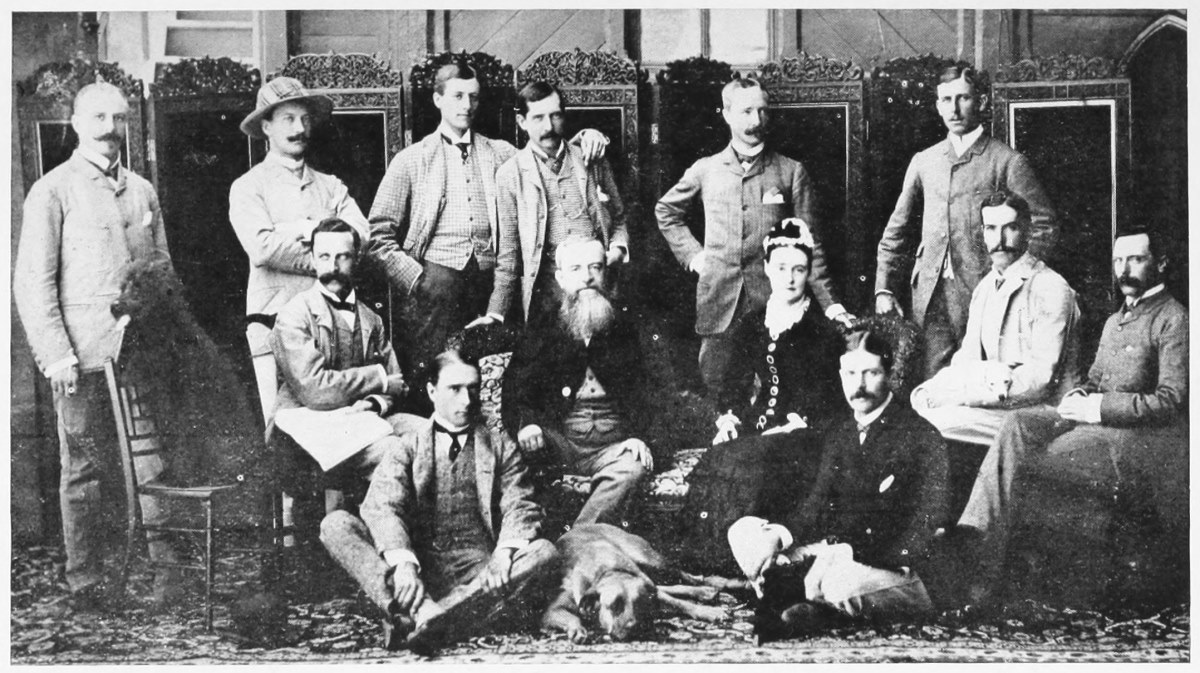
LORD RIPON, LADY RIPON AND STAFF
Left to right. Standing: Lord Wm. Beresford and Ponto, Capt. Charles Harbord (Lord Suffield), Capt. C. Burn, Dr. Anderson, Capt. Muir,
Capt. Leonard Gordon
Sitting: Mr. Primrose, Lord Ripon, Lady Ripon, Capt. St. Quinten, Capt. the Hon. H. Legge
On ground: Capt. Roddy Owen, Capt. Rochfort
It is not reassuring to know that the moment a
man takes up racing his honour no longer remains
in his own hands, for now he has to take his trainer,
his jockey, his syce, and his understudies into consideration,
not forgetting his horse. On the face
of it, it seems as if only a very philosophical person
could bear the strain.
When things go wrong it is usually put down to
either the jockey’s evil doing, or the owner’s sharp
practice, while it by no means follows that either
is to blame. So many things, and so many people
have to be taken into consideration, the horse by no
means the least; for horses like human beings have
their good and bad days, their moods and tempers,
but are unable to explain their feelings. Trainers
are likewise not infallible, inclined at times to think
some of their geese have grown into swans (in all
good faith), forgetting other people have a swan
or two.
Owners are obliged of necessity to rely a good
deal on their trainer’s judgment, but those who come
off best are undoubtedly the men who keep an eye
on their horses, having opinions of their own and
able to carry their own tails. Against this there is the
trainer who will not express an opinion, which is
vexation to owners wishing to discuss their chances.
Then again think of the anxiety attached to
sending valuable horses from place to place to
fulfil their engagements; the serious question of
what race will be suitable to each horse, the difficulty
of deciding what and when to buy, what and when
to sell, and judging their public value. Buying
race-horses is a different thing altogether to choosing
a hunter or a carriage horse. The temper of the
parents has to be thought of, and indeed traced
back a good long way, also whether any of the
family are inclined to be musical. The shape of
horses’ feet is important, and so few people agree
about horses’ points, the wonder is any trainer
and owner can be found to agree.
Lord William looked most carefully after the
training of his own horses, and this is no sinecure;
they require constant watching. Some have capricious
appetites and have to be coaxed with dainties
or they will not eat enough, others do not thrive
unless they eat grossly and have to be exercised
in proportion; here comes in the valuable gift of
being able to judge condition, many fail in this most
critical point.
It was greatly owing to Lord William’s study of
his horses’ characters and temperaments that he
was as successful as he was; he knew (none better)
that all cannot be treated alike, in sickness and in
health, as they say in the Marriage Service; he
was also perfectly aware of the uncertainty attached
to all matters appertaining to horse-racing. Horses
as a rule do their utmost to meet the wishes of
their riders, but the training is a severe trial, and
the tempers of some give away under it. Their
life seems to be one long persecution; it is to be
hoped their feeling of fitness makes up for all the
fuss and regulations.
Logic is no doubt a good training for owners,
leading them to sound judgment, but horses are
not given that way.
One good point in Lord William’s training was he
did not overtrain, as a rule his horse had a reserve
of staying power.
It will be seen that his lordship had plenty to
occupy him, in fact considerably overworked himself
habitually. Yet always cheerful and comfortably
optimistic, and it really requires the temper of
an angel to be able to manage horses, stablemen,
jockeys, trainers and racing authorities. When we
bear in mind that this was Lord William’s recreation,
it enables us to form some idea of his busy life.
The State functions which all had to be arranged
by him were no trifle, any mistakes or incompetence
on the part of the Military Secretary might lead to
serious trouble and jealousies. The official visits of
the Rajahs to the Viceroy, our King’s representative
for the time being, requires a special knowledge,
each having to be received according to his rank.
Some when coming to pay their respects have to be
fetched, as I have already stated, by the Military
Secretary, Under-Secretary of the Foreign Department,
and an A.D.C. A guard of honour has to
await his arrival, much red cloth spread, and a salute
fired of as many guns as his rank entitles him, and
they keep a very sharp and watchful eye, carefully
noting these etiquettes, which are of staggering
intricacy when receiving and paying visits. It is
also obligatory that the General commanding the
district should be in attendance with his A.D.C.
Nothing must be left to chance. All is prescribed
in the official regulations.
At the levees and drawing-rooms the Military
Secretary reads the names on the cards handed to
him as each person presents himself to bow or
curtsey. Some of the foreign names are rather
posers and shocking mouthfuls. It requires some
pluck to tackle them, and it is surprising what
offence is caused if any mistake is made. Supposing
Mrs. De Larpent Fitz-Jones-Ben-Maurice is presented,
and the De is left out or the Fitz-Jones perchance,
many apologies and explanations will have
to be made. Besides these functions the viceregal
stables were looked after by the Military Secretary,
the French cook Bonsard and the English coachman
with their native underlings to be kept up to the
mark, the ladies’ maids (who usually require so much
more waiting on than their mistresses) to be amused,
and the servants ready to carry them out in rickshaws
or jampans, to eat the air, or in some cases,
riding, and I think no one was overlooked or forgotten.
When on tour his lordship made out each day’s
programme in advance, something after this fashion:
| 8 a.m. |
The Rajah of ... will send his Sirdars to ask after the health of the Viceroy. |
| 9 a.m. |
His Excellency will eat his breakfast. |
| 10 a.m. |
His Excellency will smoke and attend to his correspondence. |
| 11 a.m. |
The Rajah will arrive, and the usual ceremonies take place. |
| 12.30. |
His Excellency will return the Rajah’s visit. |
| 1.30. |
Their Excellencies will have luncheon. |
| 2.30. |
Sports and tent-pegging arranged by the Rajah for his Excellency’s amusement. |
and so on throughout the day.
Imagine to yourself having to map out 365 days in
this fashion and please everybody! Truly a great
man, and some of the big functions I have been
privileged to witness have sadly needed a Lord
William as stage manager; he would have greatly
added to the dignity of the shows and the persons
taking part.
The official society in Simla at this period was
particularly bright and happy. The Commander-in-Chief
at Snowdon, Sir Donald Stewart, with his
kindly wife and family of cheery, happy young
people; the young men on the Viceroy’s staff, other
dignitaries and their belongings, all like one big
family, meeting nearly every day; then the crowd
of visitors, officials from all over India on leave with
their wives, officers up on short leave with wives if
they own one, wives sent up for their health, while
the husbands are kept working on the plains (Lord
William being sure to look after them), little children
with pale faces hoping to find some roses to take back
to daddy; Lord William kept an eye on them all,
ready to sympathise and help any he thought needing
it.
It was at Simla in Lord Ripon’s time I first met the
Rajah of Kooch Behar and the Maharanee. She had
not long been married, was very shy and rather
fragile looking, and wore beautiful silken draperies
I remember. Her husband, the Rajah, was very
popular with the English community, and a great
friend of Lord William’s. They had much in
common, as both were fond of racing, polo, and
paperchasing, the latter of course only in the plains
and Calcutta.
A few years ago I met the Maharanee again in
London, and introduced my son to her, she being no
longer shy but with an assured and very charming
manner, speaking good English and dressed like the
rest of us. My son said how pleased he was to meet
her, he had heard me speak of her so often. She replied
with a charming smile:
“And now you meet me I hope you are not
disappointed.”
Latterly the Kooch Behars spent a good deal of
time in England, where everybody liked them.
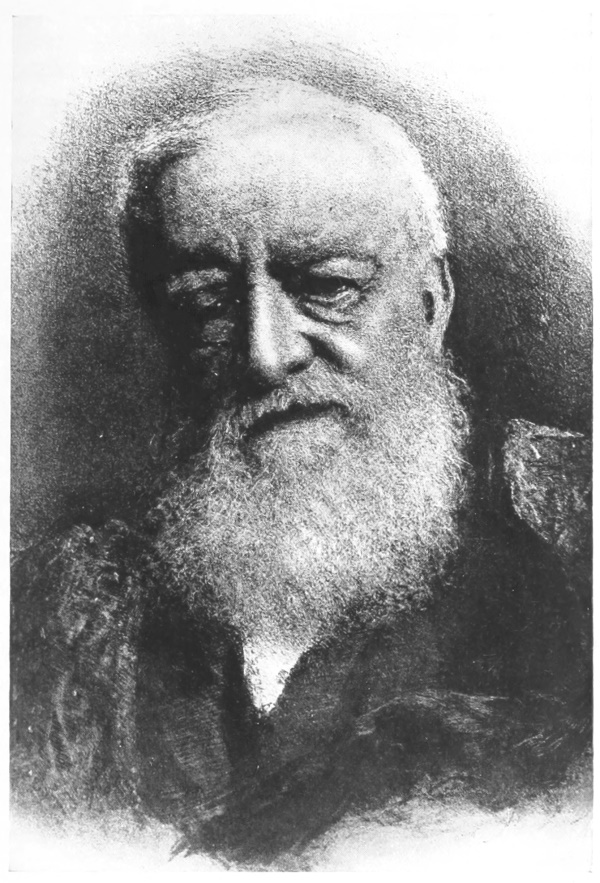
THE LATE MARQUESS OF RIPON, VICEROY OF INDIA
Lord Ripon’s reign was drawing to a close; he
left India in November, 1884. More popular with
the natives than any previous Viceroy, he was also
much liked by those who worked with him. He was
very loyal to them, but how glad he must have been
to return to his own beautiful home in England. The
following farewell is supposed to have emanated
from his Excellency’s pen, it appeared in some local
paper at the time I believe, and was sent to me as a
cutting. I therefore do not know the name of the
paper, so cannot ask its permission to quote it, but
feel sure it will have no objection.
LORD RIPON’S GOOD NIGHT
Adieu! adieu! the land of palms
Fades o’er the waters blue;
The loafers yell, the planters roar,
And weeps the mild Hindu.
Apollo his own Bunder gilds,
As slow he sinks from sight:
Farewell to them and thee for aye,
Unhappy land—Good night!
I leave thy shores to which I steered
With hopes that swelled my heart,
Their shadowy phantoms rise again
To greet me ere I part.
They came not through Sleep’s Ivory Gate,
As once they came, dream-born,
But whence the truer shades arise
From the twin Gate of Horn.
They tell of many a purpose crossed,
Of disconcerted plan:
Of baffled aims that wisely chide
The imaginings of man:
Of fond desires, of fancied good,
As though could power constrain
All means to justest ends and bring
A golden age again.
They tell of angry gathering crowds:
Of Faction’s hate-swayed throng:
Of wild words prompting wilder deeds,
Unstayed by heed of wrong;
The cruel taunt, the scornful jest,
The slander that belies,
The coward hiss that rose unshamed
Before a woman’s eyes.
All save the last in other years
I braved this, this, was spared;
Though fiercer crowds had wreaked the worst
That bigot rage had dared.
I stood for what I deemed the right—
Ye women-slayers say true!
Have cheeks that never paled for them,
Ere blanched for such as you?
To win the fickle breath of praise,
No suppliant knee I bow,
And what once Duty pledged to grant,
No fear shall disavow.
I crave not at your hands for aught
But dues that fair lists owe,
And bear ye as ye will, ye meet
At least a gallant foe.
Yet not alone of these the freight
Their parting message bears,
But auguries of harvest joys
For a seed-time of tears.
The reapers of the summer swathes
Know well that winter’s rain
Must spend its havoc on the soil,
Ere smiles the yellow grain.
So time shall its own wreck repair,
And they who garner, then,
Forget not that the day’s long heats
Were borne by other men.
Yet not in vain the labour now,
Nor scant the meed unsued,
The richest guerdon toil can earn—
A people’s gratitude.
They bring the memories of friends
Who charm on exile shed:
Who lightened weary months of care,
And soothed the fevered bed:
Bold hearts that never failed my side,
In cloud or shine the same:
Still true in the fierce fight that raged
Round Ilbert’s fateful name.
Come hither, come hither, my trusty Aide,
What turns thy cheek so pale?
What latest fair thou leav’st behind,
Believes thy oft-told tale?
If ’tis some fond delusion paints
Thy happiness at stake,
A heart that holds so many loves,
Fear not, will never break.
And she for whom thou sighest now,
That fond and faithful she!
Already smiles on other Aides,
And thinks no more of thee.
A simple primrose is to her
But that and nothing more:
And thou wilt find some newer love
Before thou touchest shore.
Another lord my palace treads,
My reign is past and o’er:
Of me thy shades have seen the last,
Rheumatic Barrackpore!
Let Simla’s typhoid-laden air
Another victim know,
And envy his ungrateful race
That wail in health below.
Farewell to levees, pageants, routs,
To weeks of endless dinners;
To balls where I must lead the dance
With capering saints and sinners.
Farewell to Rajahs and Nabobs:
To fetid pan and attar,
To coming Russians in Herat
And Rent Bills in Calcutta.
Farewell, Societies where meet
In concord, whites and blacks:
Associations that defend
What nobody attacks:
The long addresses that pursue
A Viceroy where he goes:
Farewell to Hunter’s bright romance
And Kimberley’s dull prose.
Farewell to Budgets and Reports,
To critics in the press,
Who nightly weave Arabian tales
Of fiction, fact and guess:
To hourly fears lest Colvin’s glance
Of deficits should tell;
Riots, rupees, and zemindars!
To one and all farewell!
And all the scathing paper wars
Where Secretaries fight
To prove how sharp the pens they wield,
How smartly they can write:
Official minutes, drafts and notes
And boxes that they fill,
To my successors I bequeath
With one unfinished Bill.
With thee, my bark, I’ll swiftly speed
Athwart the ocean’s span,
Nor care what land thou bear’st me to,
So not to Hindustan.
Welcome, welcome, ye hastening waves
That homeward wing my flight!
Welcome the Franchise and the Lords.
Distracted land—Good night.
H. S. J.
Lord Dufferin Succeeds Lord Ripon as Viceroy—Durbar at Rawal
Pindi to Meet the Amir of Afghanistan—A Few Annoyances—How
it All Ended—Some Presents—Outline of a Viceroy’s
Tour—A Nasty Fall—Sale of Confederacy Horses—“Father
Time”—Parlour Fireworks—A Ride to the Pyramids—Unostentatious
Charity—Some Impositions
The Earl of Dufferin succeeded the Marquis
of Ripon in 1884. India hoped great things
of him, as he was a man thoroughly experienced
in dealing with delicate situations, having
been Governor-General of the Dominion of Canada,
and Ambassador at St. Petersburg; he had also
from 1864 to 1866 been Under-Secretary of State for
India.
Lord Ripon’s zeal for the natives having created
a strong and most undesirable antagonism between
the Europeans and natives, the new Viceroy’s first
endeavour was to restore confidence to the European
community without undue reaction, and he succeeded
in a measure.
Lord William remained in his old haunts, being
appointed Military Secretary to the new Viceroy;
he also being experienced, all began smoothly. In
domestic politics Lord Dufferin carried out certain
reforms in the tenure of land in Bengal (Bengal
Tenancy Act, passed 1885), and Lady Dufferin
started a great work with a view to providing
medical treatment and nursing for native women,
of which I will write later. In all these movements
Lord William took the keenest interest, and he was
the oil which helped to keep the machinery working
smoothly. Somebody once said, “A landlord is
the father of his tenants,” then surely a good competent
Military Secretary who has been at his post
some years is father, godfather and nurse all rolled
into one to the Viceroy. The private secretary, Sir
Donald Mackenzie Wallace, was also exceptionally
capable and a man of letters.
Being so well supported must have been a comfort
to Lord Dufferin during the anxious time which
followed his taking office, for there was still that
urgent and difficult question of the Afghan boundary
demanding attention. The hitherto sketchy and
uncertain alignment as arranged and agreed in the
1872-3 Anglo-Russian agreement left loopholes for
controversy, the River Oxus having been regarded
as the boundary or demarcation line. This river
had views of its own, altering its course to suit
its own convenience, therefore could not be relied
upon as a satisfactory or definite boundary, but one
likely to lead to misunderstanding. The Russians
were also a little pressing with their influence in the
direction of Herat. As we had been led to look upon
that place as “The Key of India,” we had to consider
what was best to be done to prevent its occupation by
the Russians. It may be remembered that Lord
Dufferin considered almost any deviation in the
boundary better than offending the Amir and
making him antagonistic to us.
The forts at Herat were not of much importance,
but our prestige would certainly suffer if we allowed
anybody else to occupy the place, and as India could
not spare enough troops either to hold Herat or even
the line of communication between it and Candahar,
Lord Dufferin held much converse with the Government
at home, the Commander-in-Chief in India
(Sir Donald Stewart) and the India Office as to the
best mode of procedure, the result of which was we
prepared to send about 25,000 men to Quetta via
the Bolan Pass. The Amir thought he would like to
talk over the situation with the Viceroy, and so it
was agreed that the Afghan Chief should meet His
Excellency at Rawal Pindi. In consequence of this
arrangement a huge camp was formed, everything
done and carried out on the most magnificent and
impressive scale, such as is beloved by Orientals,
plenty of tinsel, glitter and pomp.
I have often thought the inhabitants of India, and
Afghanistan too for that matter, must think us very
dowdy looking people compared with their own
codes, and indeed we do make a sorry show amongst
their gorgeous jewels, colour and trappings. Perhaps
if we were to appear at their big gatherings and on
great occasions with more of the “rings on our
fingers and bells on our toes” that we used to hear
about in our nursery rhymes, we should inspire more
admiration and reverence. I am strongly under the
impression that these colour-loving people look for,
and take the outward and visible sign, as a precursor
of the inward and spiritual grace.
This Durbar at Pindi entailed most elaborate
preparations and much work on the Military Secretary.
It really consisted of several camps, one group
for the native princes and chiefs, one for the British
Army, another for the native army, the viceregal
camp, one for the Lieut.-Governor, and various
others, making an imposing array.
Among the guests of the Viceroy were the Duke
and Duchess of Connaught, numerous Lieut.-Governors,
Commander-in-Chief, also members of
Council.
The comings and goings of all these good people,
their comfort, the necessary arrangement of precedence
and etiquette was the work of the Military
Secretary, and required some thought and hard work
to digest and assimilate satisfactorily. The worry
attached to the arranging of a camp of this kind is
enormous. Lord William did not appear the least
depressed, but quite as cheery and bright as usual,
while being extraordinarily efficient. Of course he
had the A.D.C.’s under him, whom no doubt he had
chosen from his knowledge of their capabilities. It
is, however, easy to imagine the worries and anxieties
attached to the occasion. We all know how
annoying it is when arranging functions ourselves,
to find at the last moment the chef has been
indulging in something stronger than tea, which has
made him quarrelsome, preferring chasing the
kitchen and vegetables maids rather than attending
to the dinner the expectant guests may be awaiting.
Heaps of annoyances of all sorts and kinds were
bound to happen. I do not know what they all were,
but I do know that after making the most elaborate
arrangements for everybody’s comfort, excellent
food, decorations, snowy white tablecloths, etc., the
very day of the Amir’s entry a heavy thunderstorm
spoilt everything. The tenants of the different
camps had either to stay where they happened to
be and risk having no dinner, or wade through a
swamp. The decorations were ruined, the tablecloths
draggled and limp, the water having poured
through the tents. Elaborate ceremonies under
canvas are trying at any time, but when in addition
to natural difficulties everything is under water, it
is truly a hopeless and thankless task.
Usually these domestic worries fall on the
shoulders of women, and are borne more or less
patiently as part of their existence. For a man to
tackle such things and on such a glorified scale will,
I feel sure, take away the breath of those readers
who have never seen what an energetic, undauntable
man like Lord William could master. In a moment,
so to speak, he had to reorganise everything. How
was he going to keep people dry, how prevent the
rain from spoiling or even washing away the presents
all laid out ready for the Amir, the diamond ornaments,
gewgaws, and oh! horrible thought, the
musical boxes, suppose they refused to be musical
in consequence of the wet? Who could tell what
crisis might arise, or whose head be cut off! As a
matter of fact and interest the Amir did bring his
own executioner with him in gorgeous garments,
and carrying the emblem of his office, a battle-axe
and a few other suggestive little items, meant, no
doubt, to impress us.
Before passing on to other matters, it may interest
some of my readers to know what in the Oriental
world is considered “good form” when receiving
presents. On this occasion a sword studded with
diamonds round the hilt was presented on a cushion
to the Amir, who on taking it into his hand diplomatically
exclaimed, “With this sword I hope to
smite any enemy of the British Government,” repeating
his lesson very nicely. This was quite as it
should be, and the Amir had been well advised, but
when the rest of the presents, guns for his son,
musical boxes, watches and all sort of glittering
things were being spread out before him, he pretended
not to see, or take the smallest interest in
this part of the show; but as soon as he was alone
with his followers, all were examined carefully, and
he was very pleased.
When the time arrived for the giving of presents
it was understood the object of the meeting had been
obtained, all points carefully discussed between the
Viceroy and the Amir, the latter having formed
clearer views of what was to his own interests
(and ours incidentally); that we were prepared to
fight his enemies, assist him with arms and money,
and with him pay attention to the fortification of
Herat, and if he followed our advice we were
going to help him to keep Russia away from his
doors.
The great Durbar was over, and beyond the
torrents of rain nothing much had gone amiss, the
elephants told off to take part in the state procession
did not refuse to “process,” the musical boxes did
not refuse to play, and all went well.
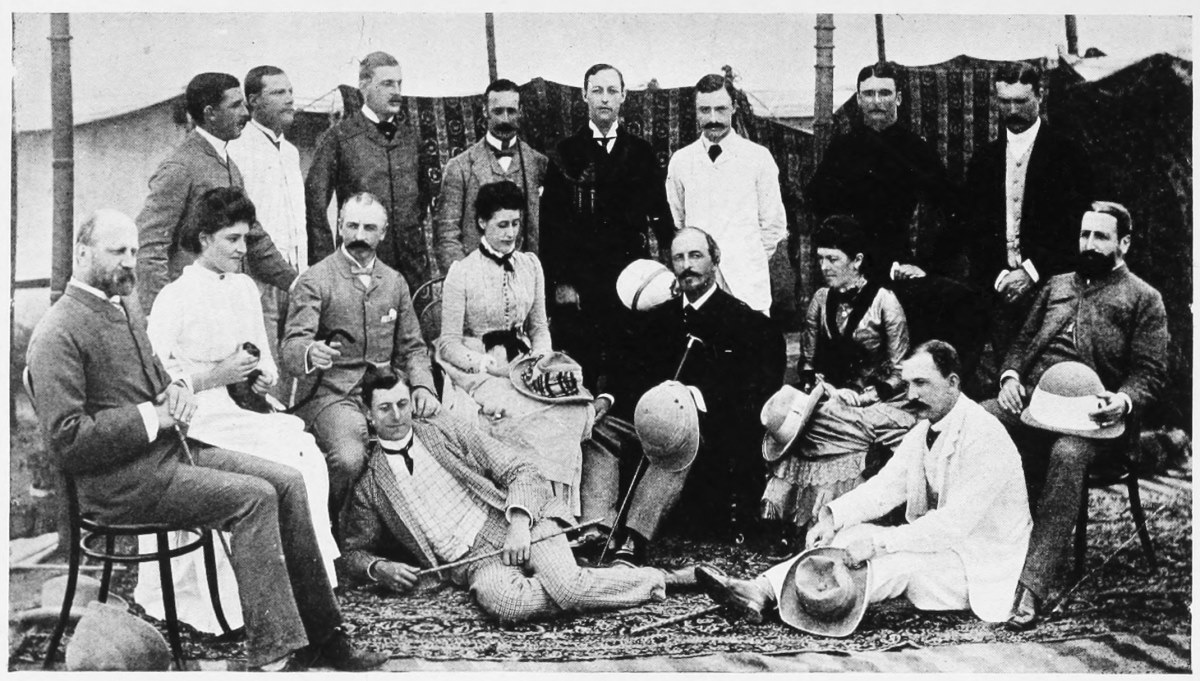
LORD DUFFERIN, FAMILY AND STAFF
Left to right. Standing: Capt. Leonard Gordon, Hon. C. Lawrence, Capt. Onslow, Col. Harry Cooper, Capt. A. Balfour,
Lord Herbrand Russell, Mr. Goad, D. Findley
Sitting: Col. G. F. Graham, Lady Helen Blackwood, Lord Wm. Beresford, Miss Thynne, Lord Dufferin, Lady Dufferin, Sir Donald Mackenzie Wallace
On ground: Capt. C. Burn, Capt. Honble. C. Harbord
Then followed the arranging for the return of
all the participators in this pageant. Happily the
Amir considered rain a good omen, and as it rained
when he arrived, also when he took his departure,
he must have felt he was in luck’s way.
Lord William, Captain Harbord, Mr. Durand, and
other high officials drove from the Viceroy’s camp
to the Amir’s, preparatory to the final adieu and to
inform him of the arrest of Ayab Khan, thereby easing
his mind, also the tidings that Her Majesty the
Queen-Empress had conferred on him the decoration
of the Grand Cross of the Star of India.
The Amir left in the Viceroy’s carriage accompanied
by these officers en route for the station with
a cavalry escort and body-guard of the King’s
Dragoon Guards. The route was lined with troops
who presented arms every fifty yards. Then a
pleasing little speech from the Amir, and he was on
his way back to Kabul.
Lord William had time again now to breathe
freely after his hard work, and carried back to
India and eventually to his home in England various
souvenirs he treasured, presented to him by some
of those attending the Durbar as a small appreciation
of his untiring efforts for their comfort and pleasure.
Besides the brain work this gathering necessitated
the writing it had entailed was enormous. I append
a programme drawn up by the Military Secretary
for Lord Dufferin’s tour from Simla to Calcutta in
1885, which gives some faint insight into the Military
Secretary’s work every day. Also into that of the
Viceroy, for at each place mentioned in the programme
there were numerous people to be interviewed,
some with grievances to be redressed, or
petitions of sorts for the consideration of his
Excellency. The landowners look forward to these
visits as they give them an opportunity of personally
explaining their views to their ruler. In addition
to all this there are all the local celebrities to be met
and have polite nothings said to them, the arranging
of which takes some writing, some tact and some
talking. It all passes more or less through the hands
of the Military Secretary before being placed in the
hands of the Viceroy.
Think what the Durbar entailed!
Memo. of Dates of His Excellency the Viceroy’s route from Simla
to Calcutta, via Nahun, Dehra, Saharunpore, Delhi, Ulwar,
Ajmere, Oodeypore, Indore, Jodhpore, Jeypore, Bhurtpore,
Agra, Lucknow, Cawnpore, and Benares.
| 1885 |
DAY |
STATION |
REMARKS |
| Oct. |
20 |
Tuesday |
Simla |
Leave 8.30 a.m. by tonga. |
|
|
|
Dugshai |
Arrive 1.30 p.m. Lunch. Leave 3 p.m. Ride on to Nyna, 9 miles. |
|
|
|
Nyna |
Viceroy’s Camp; arrive 5.30 p.m. |
| ” |
21 |
Wednesday |
Nyna to Suran |
Viceroy’s Camp, 13 miles. |
| ” |
22 |
Thursday |
Suran to Bonytee |
Viceroy’s Camp, 13 miles. |
| ” |
23 |
Friday |
Bonytee to Nahun |
Viceroy’s Camp, 12 miles. |
| ” |
24 |
Saturday |
Nahun |
Viceroy’s Camp. |
| ” |
25 |
Sunday |
Nahun to Majra |
Viceroy’s Camp by tonga. |
| ” |
26 |
Monday |
Majra |
Viceroy’s Camp. Shoot. |
| ” |
27 |
Tuesday |
Majra to Dehra Dun |
Viceroy’s Camp. Shoot on road. By tonga. |
| ” |
28 |
Wednesday |
Dehra Dun to Sharunpore |
Inspect remounts, stables, and gardens in the afternoon. |
| ” |
29 |
Thursday |
Delhi |
Arrive 9 a.m. by special train. |
| ” |
30 |
Friday |
Delhi |
Levee 9 p.m. |
| ” |
31 |
Saturday |
Delhi |
|
| Nov. |
1 |
Sunday |
Delhi |
|
| ” |
2 |
Monday |
Delhi |
Leave 11 p.m. by special train. |
| ” |
3 |
Tuesday |
Ulwar |
Arrive 9 a.m. |
| ” |
4 |
Wednesday |
Ulwar |
Shoot. |
| ” |
5 |
Thursday |
Ulwar to Ajmere |
Leave 10 a.m.; arrive 6 p.m. by special train. |
| ” |
6 |
Friday |
Ajmere |
Levee 9 p.m. |
| ” |
7 |
Saturday |
Ajmere |
Open College; leave 9 p.m. by special train to Nimbehera. |
| ” |
8 |
Sunday |
Oodeypore |
Arrive 6 p.m.; 6 miles by road. |
| ” |
9 |
Monday |
Oodeypore |
|
| ” |
10 |
Tuesday |
Oodeypore |
|
| ” |
11 |
Wednesday |
Oodeypore |
Leave 9 a.m. by road to Nimbehera. |
| ” |
12 |
Thursday |
Indore |
Arrive 9 a.m. by special train. |
| ” |
13 |
Friday |
Indore |
|
| ” |
14 |
Saturday |
Indore |
Leave 2.30 p.m. |
| ” |
15 |
Sunday |
Jodhpore |
Arrive 6 p.m. by special train. |
| ” |
16 |
Monday |
Jodhpore |
Shoot. |
| ” |
17 |
Tuesday |
Jodhpore |
Shoot. |
| ” |
18 |
Wednesday |
Jodhpore |
Leave 9 p.m. |
| ” |
19 |
Thursday |
Jeypore |
Arrive 10 a.m. |
| ” |
20 |
Friday |
Jeypore |
|
| ” |
21 |
Saturday |
Jeypore |
|
| ” |
22 |
Sunday |
Jeypore to Bhurtpore |
Leave 10 a.m.; arrive 4.30 p.m. |
| ” |
23 |
Monday |
Bhurtpore |
Shoot; leave 3 p.m. |
| ” |
24 |
Tuesday |
Bhurtpore to Agra |
Viceroy’s Camp. By special train; arrive 5 p.m. |
| ” |
25 |
Wednesday |
Agra |
Levee 9 p.m. |
| ” |
26 |
Thursday |
Agra |
Levee 9 p.m. |
| ” |
27 |
Friday |
Agra |
Levee. |
| ” |
28 |
Saturday |
Agra |
Levee. |
| ” |
29 |
Sunday |
Agra |
Levee. |
| ” |
30 |
Monday |
Agra |
Levee. |
| Dec. |
1 |
Tuesday |
Agra |
Levee. |
| ” |
2 |
Wednesday |
Agra to Gwalior |
Leave 9 a.m. |
| Dec. |
3 |
Thursday |
Gwalior to Dholepore |
Arrive 4.30 p.m.; leave 11 p.m. |
| ” |
4 |
Friday |
Lucknow |
Arrive 9 a.m. |
| ” |
5 |
Saturday |
Lucknow |
|
| ” |
6 |
Sunday |
Lucknow |
|
| ” |
7 |
Monday |
Lucknow to Cawnpore |
Arrive 1.30 p.m. |
| ” |
8 |
Tuesday |
Cawnpore |
Leave 11 p.m. |
| ” |
9 |
Wednesday |
Benares |
Arrive 9 a.m. |
| ” |
10 |
Thursday |
Benares |
|
| ” |
11 |
Friday |
Benares to Calcutta |
Leave 11 p.m. |
| ” |
12 |
Saturday |
Calcutta |
Arrive 9 p.m. |
| Military Secretary’s Office, Simla. |
| September 14th, 1885. |
All this time while Lord William was attending
to his duties, his horses were running in different
races, but he was not very lucky, the 1884-5
Calcutta Meeting was disastrous, one horse after
another going wrong, and Prospero put his lordship’s
shoulder out again by falling with him, in spite of
which, swathed in bandages, he rode on the second
day a very good race on the same animal, it being
one of the best races he ever rode, though he did
not win.
Calcutta now had a new grand stand, and the
races were run in the afternoon instead of the
morning, which was a popular innovation. At the
Second Calcutta Meeting, Ryder, Lord William’s
jockey, also had a nasty fall when riding Euphrates,
the grand one-eyed Arab belonging to John Wheal,
termed by Mr. Abbott the Father of Indian Trainers,
who describing the race says: “Just opposite the
Stand, on the other side of the course, Euphrates,
being on his blind side and on the extreme inside,
perhaps shying from the rush of heels behind him,
ran bang into the rails, not only crushing and
breaking Ryder’s leg but continuing to press inwards
till the woodwork gave way and Ryder from sheer
weakness fell off, and Euphrates continuing his
mad career must have dashed against a post, for,
when caught, it was found he had knocked his
only remaining eye out.”
On the 28th of January Lord William had another
nasty fall, his horse Jack not rising properly at the
first fence, throwing his rider on to his face. Friends
who were near pulled him out of the way before
he got trodden on. He was unconscious and badly
cut about the head and nose, having to be carried
back to Government House and put to bed, though
the moment he regained consciousness he wanted
to go back to the races.
Shortly after this accident Lord William went
home on leave, and badly he wanted the change and
rest, for he was showing signs of overwork, his many
accidents had shaken him almost more than he was
aware of; but before leaving India the Durbangah-Beresford
Confederacy horses were put up for sale
on the 28th of February at Messrs. Brown & Co.’s
Mart in Calcutta. Very fair prices were realised as
will be seen from the following list:
| Reputation |
bought by |
Mr. Hard |
1,800 |
| Father Prout |
” |
Dr. Hart |
700 |
| Little Charlie |
” |
Mr. Hard |
6,000 |
| King of the Vale |
” |
Major Deane |
2,500 |
| Bassanio |
” |
Mr. Macklin |
5,700 |
| Zephyr |
” |
Dr. Hart |
3,000 |
| Glory |
” |
Major Deane |
2,000 |
| Manfred |
” |
Major Deane |
2,500 |
| Lapella |
” |
Mr. Croft |
1,500 |
| Bolieo |
” |
Captain Gordon |
3,700 |
| Jack |
” |
Dr. Hart |
2,500 |
| Diamond |
” |
Captain Webb |
750 |
| Prospero |
” |
Captain Burn |
1,000 |
| Torpedo |
” |
H. H. Kooch Behar |
700 |
| Quack |
” |
H. H. Kooch Behar |
450 |
| Pretender |
” |
Major Deane |
1,200 |
| Cinder |
” |
— |
1,800 |
| Atarin |
” |
— |
1,400 |
| Khartoum |
” |
— |
1,200 |
| Fariz |
” |
Captain Gordon |
650 |
| Snuff |
” |
Dr. Hart |
900 |
One or two of the best were bought by Mr. Hard
for one or other of the partners of the Confederacy,
Reputation and Little Charlie amongst them.
Bassanio, the Australian, who fetched 5,700 rupees,
was bought back in March by Lord William. The
Government bought several for the Stud Department,
and a little later purchased good old Jack from
Dr. Hart and sent him as a present to the Amir of
Kabul for stud purposes. Prospero was back again
in the stable, and a week or two before Lord William
started for home won the Grand Annual at Meerut,
also the Hurdle Race, and Dynamite a handicap
of sorts.
In April Lord Bill started for home. India felt
lonely when he had gone, especially amongst some
of his fair friends. With women absence often makes
the heart grow fonder, but with men it is proximity
that plays the mischief, and Lord William I am
afraid forgot to be sad over the partings, for he
found so many more fair friends in the Old Country
anxious to greet him and be kind.
There was no doubt about it he was beginning
to age, to realise how quickly we drop into middle
age. It all comes about so imperceptibly, perhaps
a few grey hairs first awaken us to the change, it
suddenly dawns upon us, time is not standing still,
that we have reached the top of the hill that looked
so long and unending, and now behold we are slipping
down the other side, and where are all the lovely
views we expected to find on reaching the top of the
hill? Surely they must have been mirage! It is a
curious fact that you may look at yourself in the
glass many times a day but until something happens
to force the fact of a change on you the only image
you behold in the mirror is yourself in youth. Even
after elasticity has left us, it still does not dawn
upon us we are—of the past. Perhaps nothing
brings it home to us more quickly than meeting
some friend of our youth and finding he has grown
ponderous, lost the sparkle, hair grown grey, eyes
dim, and possibly a corporation, this makes us turn
an anxious eye on ourselves to see if similar changes
have taken place.
Lord William never lost his sparkle or his pluck
and he never sported a corporation, but the unceasing
energy of his life was telling on him. It
was quite useless begging him to take things more
easily for it was not possible to him. How he did
enjoy a joke! I think it was in 1885 when he was home
on this leave that he went with me to Rose’s toyshop
in Sloane Street to find some toy to amuse a
small boy of mine that was delicate. While we were
wandering round the shop a friend came and spoke
to me, so Lord William continued his prowl, looking
for likely things. When at liberty once more I
found him with a neat parcel in one hand, and he
exclaimed, “I have the very thing.” “What?”
I asked. “Oh, come along, and I will explain it to
you,” so we marched out. I was then told the
parcel contained “Parlour Fireworks.” I suggested
they were rather dangerous things, but the idea was
pooh-poohed. They were only pretty coloured lights
that threw up harmless sprays of blue, green and
red powdery flame. One of them he lit in the drawing-room
fender to show me how harmless they were.
It seemed all right, so as soon as he had gone and it
was growing dark the small boy, myself and nurses
proceeded on to the flat roof of the house we were
then renting in Park Lane, in the narrow end near
Gloucester House, where we felt well protected by
the Duke of Cambridge’s policeman always stationed
at his door. The first few Roman candles we lit
were a success and caused great delight, then I
found a queer little box with rules where to light it.
I faithfully followed all the instructions. At first
nothing happened, then suddenly the air was alive
with rifle-like reports in rapid succession, while
live squibs, things I believe called crackers, were
flying about cracking in every direction all over the
tops of the houses. What a commotion there was!
The policeman ran in every direction at once and blew
his whistle, the jaded sleeping horse in the laundry
van at our area railings suddenly awoke, curled its
tail over its back pug-dog fashion, and set off for all
it was worth, leaving the man in charge, still in the
kitchen, probably enjoying good things. Everybody
in the neighbourhood shouted, while we all scrambled
helter-skelter down the narrow staircase leading
from the roof, and on which housemaids had left
various pails to dry and air. These in our haste to
descend and hide our heads, we charged, hurtling
them down the stairs in front of us, making a
horrible clatter.
Arrived at last in our rooms again, we all pretended
to be dead while the policeman came to enquire if
we had heard anything, and did we know anything
about it? Our old housekeeper, who had been with
us many years and who was in the secret, faced the
policeman, fearing we might be given away by some
indiscreet statements from the other servants. She,
of course, was very indignant that peaceable people
should be liable to such disturbance and hoped the
policeman would make a point of finding out about
it, saying: “Really nobody is safe from bombs and
Jack-the-Rippers nowadays.” The policeman promised
to do his best. The following day the morning
paper mentioned a mysterious affair that had occurred
in Park Lane, and it was supposed an
attempt had been made to blow up Gloucester
House!
Thinking the matter over after all was calm again
and the laundry man had gone in search of his
horse and van I began to wonder how much of this
had been design on the part of Lord William, for it
was a Jack-in-the-Box that exploded making such
a noise, harmless in itself but productive of rather
an upheaval. When I told him what had happened
I thought he would never stop laughing.
I had lately returned from Egypt where I had
been staying with friends who one evening got up a
picnic at the Pyramids to which we were all to
ride on donkeys. I was told by that dear good fellow
Gerry Portal, I think, but it is so long ago I am not
sure, that the best donkey in the place had been
secured for me, it was a great gymkhana winner, pure
white, and boasted the name of Lord Charles
Beresford. So I rode Lord Charles Beresford to the
Pyramids. Everything was being called Lord
Charles or Lord Charles Beresford at that time,
his name was on everybody’s lips, for he was and had
been doing great things in Egypt, and it was considered
a great honour for anyone or anything to
be called Charlie.
I seem to have been recounting many stories of
Lord William’s fun and humour, but none of his
thousands of kindly deeds, which were strewn
throughout his life as thickly as blackberries in
September. It is difficult to know where to begin,
but I like to think that when the day came for him
to cross the border the spirits of some of those he had
saved from despair, whom he had helped not once
but many times, were waiting to greet and welcome
him. I do not think anyone who went to him for
help or sympathy was ever “rebuffed.” At times
he certainly was imposed on, though he would not
believe it, and even when it came home to roost, as
it occasionally did, he was most forgiving. One
individual in particular I remember in India. He
had been in a good cavalry regiment, but got into
trouble at one of the Umballa Race Meetings I have
already described when there was heavy plunging,
trying to recover himself and place his finances on
a firm footing again, he only slipped further into the
mire, until in a hopeless mess; he then, to make
matters worse, outstayed his leave, and was turned
out of the service. This man was well known
throughout India, and was an extraordinary character,
blessed with good looks, a fine figure and
physique, a charming tenor voice, it seemed there
was much to be thankful for. Lord William thought
if once this man was put on his legs again, given a
fresh start, he might pull himself together and be
more lucky; he therefore paid up for him, and befriended
him in every way. This friend, whom we
will call Captain X., now devoted his life to racing
in India, and he became a formidable opponent, as
he had good hands and judgment, and I doubt if
there was a racecourse in India that had not made
his acquaintance. It was not long before he was in
trouble again; once more Lord William and Lord
Airlie came to the rescue, meeting with gross ingratitude,
for the man could not be straight, he
failed and robbed his benefactors at every turn.
Lord William was only full of pity that such a
talented, fine chap should go hopelessly wrong.
Captain X. was very good company, a very fast
runner and a strong swimmer; all this appealed to
Lord Bill, who tried his hardest to save him, but it
was no use. I have been told eventually he helped
the man to go away to another country and try
again.
Lord William always said his sympathies were
with the sinners, but I think they were with everybody
in every station of life.
Riding through Cantonments one day he met a
soldier’s wife carrying a heavy child who was looking
ill. He asked why she carried it, and on hearing
it was ill and she could not drag it along after her,
and the air was good for it, he expressed his sorrow
for its ill-health, spoke a few cheering words, and
rode on. That evening a perambulator arrived from
an anonymous donor at the door of the sick child’s
mother.
More times than I can number have boys fresh
out from home been saved from making “asses of
themselves,” as Lord William expressed it, by his
counsel and help. A youth I knew came out to join
a crack regiment. He had more money than was
good for him, and fancied himself not a little. His
mother wrote asking me to be kind to him. I endeavoured
to mother him, but he was so certain he
knew everything and was a fine fellow going to show
everybody the way, it was difficult to guide or help
him. He began racing and betting. Naturally there
were older hands at that game than himself, and he
got into trouble. At last, when he had come to the
end of all his resources, he came to me, but as he was
then heavily involved with a native money-lender,
I felt it was beyond my powers, and asked if I might
consult a friend if I mentioned no names. This I was
permitted to do, and sought Lord William’s help.
He told me not to trouble about it at all, but send
the lad to him. After some discussion he rather
ungraciously accepted Lord William’s offer, and
went to see him. Happily this turned out better
than the other case I have mentioned, for the boy
came back radiant, to tell me Lord William was
going to settle with the money-lender and put him
straight, and when he came into his uncle’s property,
which was bound to fall to him before very long, he
was going to put it all right with Lord William, but
as he had no power to anticipate the money he could
only give his word of honour about it.
I wonder if there was anybody but Lord William
who would have done this. When in the evening I
met my old friend and thanked him for helping the
lad with such uncertain security, he replied, “Oh,
I never expect to see it again, but he’s a nice boy
and has promised to come to me for tips before
plunging again.” It rejoices me to be able to say
all was paid back and Lord William had a faithful
and devoted friend as long as the poor lad lived.
He died of heart failure on a P. & O. going home on
leave.
The Man Who Thought He Was King—A Dance After Dinner—How
It Ended—Corney Grain in Disgrace on the Door-mat—Racing—Trouble in
Burmah—Lord Dufferin and Lord William
Go There—Collecting the Offertory in Church—Some Schemes
of Interest
Those few months of leave in 1885 picked
Lord William up wonderfully, and he
thoroughly enjoyed every minute of the
time after his nine years of India, a big slice out of
the prime of a man’s life, but he had the satisfaction
of feeling he had faced the music, so to speak, by
beginning his life afresh, yet returning after nine
years comfortably off, and holding a high position of
great responsibility, thanks to nobody but himself.
Viceroys came and went, but Lord William Beresford
remained, year in and year out, becoming the cornerstone
of the social fabric of India, and ruling its
society with an iron hand, though very much gloved
in velvet.
I remember comparing notes with him as to what
we looked forward to most on returning to England
after a spell abroad. He said he “yearned for Curraghmore
and Piccadilly, and after that devilled
sole and brown bread and butter!”
Most people will, I think, sympathise with Lord
William in his longing for dear feverish London.
She casts a spell over us all, and when we are exiles
the remembrance of her brings on more fits of
home-sickness than almost anything else, visions
of Piccadilly come back to us as we remember her
perhaps in the still early morning, when returning
from balls and parties, the streets deserted by all
save a few market carts filled with cabbages and
other garden produce on the way to Covent Garden
Market, a few lonesome souls sleeping on benches
between the policeman’s “move on” visits; or
perhaps the visions that come back to us are the
evenings when the hurrying mass of people, the cabs
and carriages were all shrouded in the blue-grey
misty haze peculiar to London at night. We remember
how we used to speculate on where they
were all hurrying to, and fit histories to them, all so
bent on tasting and testing life, often regardless of
consequences. Each individual wearing that self-absorbed
mind-your-own-business air, that is one of
the fascinations of a great city.
Lord William said he felt “beside” himself with
joy when he again beheld the buses and heard the
newspaper boys, and then “The Eton Boating
Song,” so wrought with memories, played on a
street organ filled him with an ecstasy of joy and
sadness. He heard again the splash of the oars, saw
again the pals of those old days whose names were
at one time on everybody’s lips, now only little
black splashes of ink on white paper.
I wonder if any of my readers remember the fine
old man who used to sit in the Row during the
summer of 1885 fancying himself king; the way he
used to swagger up as if all the world belonged to
him, his servant walking immediately behind him
watching for the imperious wave of his master’s
hand, which, being interpreted, meant he wished to
sit down. Two chairs were then hastily arranged,
on one of which he sat down with a good deal of
action, the other proudly supported his legs. This
arrangement took up a good deal of room where
people were walking up and down, but nobody
interfered with this aristocratic-looking, well dressed
and groomed old man, with his large flowing moustache
and huge button-hole, consisting one day of a
sunflower, another a peony, or something equally
remarkable. The old gentleman used to talk a good
deal to himself about the bad manners and ingratitude
of his subjects who passed up and down
without bowing to him. We often wondered who
he was. One day Lord William found out from a
policeman on duty in the park. An accident had
upset the equilibrium of the old sportsman’s brain,
but he was quite harmless and nobody objected to
him, so he was allowed to remain. As our bad
manners and ingratitude caused him so much uneasiness,
Lord William suggested we should muster
strong one day and march past in couples, bowing
deeply. We felt a little nervous as to what might
happen, but acquiesced, and we all marched past
bowing and smiling, being amply repaid for our
courage by the evident pleasure of the king, who
took off his hat with a graceful flourish to us and
presented the sunflower out of his button-hole to
one of the girls of our party.
Memories of those days come tumbling over one
another with such rapidity it is hard to know where
to stop, the pleasure is so great in recalling
them.
One evening I remember well, during that same
leave (I think) of Lord William’s, he was dining with
us, and after dinner somebody said would I play
some dance music as they wanted to dance, so we
adjourned to the dining-room and had it cleared at
one end. After dancing awhile, the men began
American cock-fighting. There were some fierce
encounters and amusing scenes. I was still sitting
by the old cottage piano which stood in a corner of
the room, when one of the combatants, breathless
from a contest with Lord Bill, came and leaned
against the piano whilst drinking a whisky and
soda. Somehow accidentally the greater part of the
whisky and soda got upset down into the vitals of
the piano, the top being open at the time.
Poor old piano, it is going still, but the shock to
its nervous system was so great it every now and
then has the sulks for a time, until coaxed by a
tuner into fresh efforts.
At the party to which I am referring, I remember
the men with us were Corney Grain, Gerry Portal,
Jim Lowther, Lord Hay of Kinfauns, and my young
brother, as well as Lord William. Those who knew
the men will guess what the evening was like. I was
afraid we should disturb the neighbourhood with
our laughter over an impromptu that Corney Grain
gave us at the partially intoxicated piano of his
experiences at the houses of some of his patrons
where he had been engaged to amuse the guests.
No names were mentioned, but so excellent was his
mimicry that we at once recognised a number of
people. Having been cheered and heavily patted
on the back he proceeded to give us a musical sketch
of a certain V.C. hero on board ship making love to
a shy young lady. Lord Bill was much tickled and
so were we. It was screamingly funny, and with
our eyes shut we could have imagined it was
Lord William speaking, or perhaps I should say
cooing.
This was followed by another sketch, this time
Gerry Portal supposed to be bamboozling some
foreign potentate into believing we, the British, were
doing everything for his good, from pure unadulterated
philanthropy, while really benefiting ourselves.
This was considered too much, and brought
the house down. They all set upon Mr. Grain, who,
I had better explain for those who never saw him,
was a huge man both in height and figure. He clung
desperately on to the music-stool with his legs and
the piano with his hands, until the piano, music-stool,
and Mr. Grain began to move together first
in one direction and then another. Lord William
tried to get his arms round Mr. Grain’s rather
voluminous waistcoat, and Mr. Gerry Portal tried
to untwiddle his legs from the music-stool. Jim
Lowther seized the tea-cosy from the sideboard and
clapped it over the musician’s head. This led to one
hand relinquishing its grip on the side of the piano
to remove the head-dress, a weak moment on Mr.
Grain’s part, for he got separated from the instrument
and dragged half across the room when crack
went the long-suffering music-stool, and he was on
the floor. My brother held the door open while the
rest tried to eject the man who dared to be ribald
about Mr. Portal’s foreign policy, but each time
when it was nearly accomplished out flew a huge
and long leg slamming the door to again. At last,
when all were hot and exhausted, Mr. Grain was
laid unresisting on the front-door mat.
We received many apologies next day from our
guests for being so uproarious, and Lord Bill wished
to provide a new piano and music-stool, but of
course we would not hear of it. I never mean to
part with that piano, even when it gives up the
ghost, for it has witnessed many cheery parties, and
has been with me long voyages north, south, east
and west.
In addition to all this froth and frolic Lord Bill
had been doing some useful business in the way of
buying race-horses for himself and his friends. He
had also engaged the lightweight jockey named
Dunn, who arrived in India about the same time as
his lordship returned, ready for the October meeting
at Umballa. While at home he had purchased
and sent out two or three horses and a pony for
Indian racing, amongst them, Metal, in hopes of
carrying off some prizes at Calcutta. The horse
came from the Duke of Westminster’s stable, but
had disappointed his owner in the Goodwood Cup,
Baron Hirsch’s horse just beating him. What a
cheery meeting it was, the 9th Lancers being there
under orders for home. They marched out of the
station on the last day of the races, the whole of the
white population turning out to give them a hearty
send-off.
A great number of racing men collected there,
combining their wish to see the 9th Lancers off for
home and see some racing. All were in great form,
and the fun was tremendous.
Lord William’s valuable Prospero won three races
for his owner. Dynamite and Oliver Twist also won
a race each.
A rising Armenian barrister in Calcutta was also
present, having conceived a passion for racing and
started a stable for the purpose.
In the club at Umballa on settling day a sporting
match was arranged between this barrister named
Mr. Gasper and Lord Bill, the suggestion coming
from the former. The match was for 2000 rupees
a side, P.P., each horse to carry not less than 8 stone
4 lbs., distance ¾ mile. Horses to be named by
1 o’clock the day before the race, which was to be
run the last day of the first Calcutta meeting, horse
to be nominated by Lord William Beresford must
be his property or the property of H.H. the Maharajah
of Durbangah.
Lord William hoped to win this on one of his new
purchases named Metal, but when the day arrived
the horse was ill with colic so Mr. Gasper’s Regulater
walked over.
Great things were expected of Metal, and as the
Maharajah of Durbangah was very anxious to win
the Viceroy’s Cup Lord William sold the horse to
him just before the race, and His Highness had the
pleasure of seeing his colours carried first past the
post.
Tim Whiffler, who had been bought at the same
time as Metal, had so far not done anything worthy
of record or the pay for his keep, and at Tollygunge,
running for the Ballygunge Cup, he went head over
heels at the first hurdle, rolling on his rider. This
was an unlucky race for most of the riders, as every
horse fell except the winner, Mr. Charles Moore’s
Prospect. The second day Tim Whiffler won a race
after another fall.
At the second Calcutta meeting in January, Metal
won the Kooch Behar Cup after a good race with Sir
Greville, belonging, I believe, to Major Prior.
Trouble had been brewing in Burmah for some
time, and Lord Dufferin decided he would go and
see for himself if things were working satisfactorily.
The British resident had been withdrawn owing to
King Thebaw (chiefly at the instigation of his unprincipled
wife) having massacred all the men-kind
of the Royal Family with a view to ensuring the
stability of his throne. Commercial relations were
however maintained, and whispers reached Lord
Dufferin of some sort of treaty having been signed
between the Burmese and the French, by which the
valuable ruby mines with other perquisites which
in parliamentary language would be termed accessories,
had been leased to a French trading company.
All this pointed to trouble in the future, especially
as King Thebaw was known to have expressed
himself of the amiable intention of driving “the
white devils into the sea,” also it would not be wise
to allow British trades to be excluded. This was
politely but forcibly pointed out to the King, who
was evasive and unsatisfactory. The Secretary of
State then gave instructions for an immediate
advance on Mandalay. King Thebaw begged for
time, but was told nothing but instant submission
would be considered, under which circumstances
he would be spared and treated properly. He was
only allowed a few minutes in which to make up
his mind, and it was thanks to this promptness and
decided policy of ours that the campaign came to a
satisfactory conclusion so quickly and with so little
loss of life. But we were not quite out of the wood
as China was asking pertinent questions about our
future policy; but all was explained and approved
in a short time, and a convention signed giving
England a free hand in Burmah. In consequence
of all this Lord Dufferin started on February 3rd,
1886, to see for himself what was happening. Burmah
lying directly on the east of Bengal with a population
of four millions, it was regarded as a frontier over
which we should keep a jealous eye and some
control. Besides, he was anxious that commercial
relations should be established with Thibet. Lord
William as Military Secretary was in attendance on
His Excellency, receiving the medal and clasp,
being mentioned in despatches, and promoted to
Brevet Lieut.-Colonel. Speaking of the Burmese
ladies he said they were most enlightened and
independent people, choosing their own husbands
and divorcing them also if they wished to do so.
The Viceroy was anxious to have our army
considerably increased in India. In Lord Ripon’s
time the native army had been reduced, but Lord
Dufferin thought owing to changed circumstances
a fresh arrangement should be made, and that we
should be in a position to launch a strong force of
both British and native troops on short notice against
any neighbour whose conduct was suspicious and
unsatisfactory. He also felt it would be better for
the country itself, but all he could get from the
Government was an extra 11,000 men. Both Lord
Dufferin and the Commander-in-Chief were against
the short service system for India, thinking both
from the point of utility and economy longer service
would be better.
The work of the India Office filtered more or less
through the hands of the Military Secretary; he
therefore was well posted in all these questions
under consideration and discussion.
Especially was he interested in Lord Roberts’
scheme for doing away with the old army canteen,
for it was he who inaugurated “The Institute,”
where not only could the men get their beer, but food
as well; they could sit down comfortably and write
letters, play games and read the papers. Places of
this sort had been a long-felt want, and they have
been great successes and certainly conducive to less
drunkenness.
During Lord Dufferin’s time several important
steps were taken in the way of military reform, as
he expressed himself plainly on the difficulties of
military administration under dual control, for
while the organisation and commissariat were worked
by the superior Government at home, the discipline,
training, equipment, and matters of that sort were
ruled by the Commander-in-Chief.
Neither were the native troops forgotten, for
now in commemoration of the Queen’s Jubilee they
received medals for good conduct and any special
services, also gratuities in much the same way as the
English soldiers.
Lord William, and indeed most of the thinking
community in India at this time were anxious as to
the result of the higher education of the natives,
who, though finding their feet, were not yet able
to use them. He felt the education ought to benefit
both them and us, but would it?
I have often doubted whether some, even of
Lord William’s more intimate friends, fully recognised
the more serious side of his character. The
world is ever prone to think that brilliancy excludes
wisdom, and gaiety is the enemy of common
sense. As a matter of fact there was a world of
deep feeling and strength of character underlying
Lord William’s light-hearted manner.
At a big dinner party at Government House,
Bombay, I remember hearing a number of people
discussing Lord William, his career, racing successes,
deeds of daring, etc., when someone asked the
rather unexpected question, “What is his religion?”
The then Commander-in-Chief replied, “I don’t
believe he’s got one.” This was surprising coming
from a man who was both officially and socially in
almost daily association with him, proving what I
have so often thought that the faces of those around
us, even those of our nearest and dearest, may be
photographed on our brains, while yet we know
little of their minds and hearts; they are sealed
books to us.
Lord William’s religious feeling was profound,
though his views were not altogether orthodox,
but there are some dogmatic doubts while leading
us away from the altar bring us nearer to the Throne.
Aristippus tells us “Good cheer is no hindrance to
a good life.” His lordship agreed with this founder
of Hedonistic philosophy, but I doubt if he had been
asked to put down in black and white what his
religious convictions were, whether he could have
clearly defined them, any more than a great number
of people could. It would be good for us all if we
had to put our faiths and beliefs into writing, but
what confused and contradictory statements they
would make, and how annoyed we should be if anybody
dared to say so to us. Faith and reason
unfortunately will not walk kindly hand in hand,
and Lord William felt that amid the latter-day clash
of theories, new fields of thought were being opened
to us, thoroughly recognising how some of the old
moth-eaten shibboleths, we have so often repeated,
have prevented us forming unbiased judgments.
He maintained that ancient religions had no creeds
but were fed and brought up, so to speak, on institutions
and facts. Faith is not peculiar to Christianity,
it is the ordinary characteristic of the highly developed
religions. Lord Bill always said he felt it
was possible to be a good Christian without being a
theologian. I think “good Christian” exactly describes
Lord Bill, yet how hard it is to define a good
Christian when ideals among Christians differ so
greatly in different countries and ages. St. Ethelreda
was canonised for never washing; this was not Lord
Bill’s Christianity, though I have known some people
who certainly qualified, but as far as I know, have as
yet, had no justice displayed towards them. Then
again St. Onofries was called a saint because he
disappeared into the desert seeing nobody and doing
nothing (so he said), but this saint does not matter
at the present moment; what does matter is the
extreme difficulty we all find in locating the middle
distance between two points, when the points do
not stand still.
Lord William had his faults in common with the
rest of us, but not many can comfort themselves
with the belief that they have done as many kindly
acts. He may not always have been aware of the
amount of good he did, for kindly acts towards
ourselves make us kindly to others, thereby forming
a common good. That the happiness of everybody
depends to a certain extent on the forbearance and
help of others was part of Lord Bill’s religion. His
charities, which were many, were not of the order
that creates multitudes of sins, but covered them
up, often, and helped those who had made grievous
mistakes, to begin afresh.
The nice little church at Simla used to echo with
the sound of Lord William’s clinking spurs as he
walked up the aisle. One Sunday when he was
carrying round the collection plate, he halted in
front of a canny old colonel whose careful habits
had made him decline to subscribe towards the
Annandale Races, which had annoyed Lord Bill, so
he held the plate, whispering audibly, “It’s Zenana
this time, not Gymkhana!”
The scene outside this church on Sundays and
high days was curious, as in the hills everybody rode
to church, or came in hand-carried or drawn
equipages. When all the rank and fashion had entered
the building the syces with the many ponies congregated
for a smoke and chatter. The men who ran
with the rickshaws and jampans after their kind,
followed suit, arranging their carriages in neat rows.
The owners usually dressed their carriers and
runners in some distinctive livery. One would have,
say, claret-coloured coat, cut fairly long, hanging
square over the draped loin cloths which are worn
instead of trousers; only the head man indulged
in this form of civilisation. This combination of
coat and loin cloth finished off with possibly a
yellow cumberbund twisted round their waists, and
yellow puggeries round their heads. Others would
have brown and blue, and so on, only the Viceregal
party using scarlet, the many colours of the liveries
and the grouping of the natives and their charges
forming a picturesque foreground to the church,
though very unusual to the mind of the everyday
English church-going community.
There were several matters occupying Lord
William’s mind at this time. The enlargement of the
Annandale racecourse for one; this was a great
undertaking and a considerable expense which will
be readily understood, as big ravines had to be
filled in and levelled as well as portions of hills
removed. His lordship subscribed handsomely
towards it himself, and some of the native princes,
who were always ready to help him in his endeavours
for the good or pleasure of the community, came
to the fore also, subscribing liberally. While the
alterations were being carried out the usual races
and sports were taking place, tent-pegging, tilting
at the ring, riding one pony while leading another
over the jumps, rickshaw races, which proved highly
exciting for the occupants, and mirth-provoking
to the on-lookers.
The building of the new Viceregal Lodge or
Government House also occupied a good deal of
time, Lord Dufferin supervising and directing.
I have often wondered what the natives must have
thought when they had to build white-tiled kitchens
and bath-rooms, and still more what they felt when
called upon to use a correct up-to-date kitchen
equipment.
I well remember when first I arrived in India
being full of high-flown ideas of revolutionising the
cooking and cook-house system. I was warned not to
interfere, but to eat what was placed before me and
leave well alone; however, I was full of ardour and
proceeded to the cook-house to inspect the cooking-pots
and arrange everything to my liking. My
splendid theories were doomed to instant death.
My experiences were such that for days I was without
appetite and never again had the pluck to face the
cook-house. That was long ago, no doubt now the
natives have learnt to live up to and appreciate
modern luxuries.
Last, but by no means least, came Lady Dufferin’s
scheme for the benefit of Indian women. The Queen
had asked Her Excellency just before leaving for
India to see what could be done to provide proper
medical aid and nursing for native women, who
from their traditional faiths and customs were unable
to avail themselves of the knowledge and help of
men doctors. Lord William was very enthusiastic
about the work which was interesting Lady Dufferin,
who, with her usual thoroughness, soon placed it on
firm feet. There was so much to be considered;
first of all the question of finance, still more difficult
the inherited traditional prejudices to be overcome
in conjunction with the superstitions and ignorance
of the people of India. For generations the appalling
loss of life through ignorance in the East had been
regarded with the hebetude of fatalism. Nevertheless
in 1885 the work was begun under the mouth-filling
title of “The Countess of Dufferin’s National
Association for supplying female medical aid for
the women of India.” It is well to take a good
long breath before starting on this impressive
title.
Considering that the undertaking entailed the
collecting of the necessary funds, suitable places
being found for the hospitals and dispensaries, women
to be trained as doctors, midwives, and hospital
assistants, and that each and all had to be under the
superintendence of or in the working hands of women
for the treatment of their own sex and children, it
is really remarkable that it was so soon in more or
less working order, and speaks volumes for Lady
Dufferin’s energy and for the help of her co-workers.
I remember Lord William saying it would have
a more far-reaching civilising influence in the
country than any other measure hitherto contemplated.
That these women doctors and nurses have
been zealous and capable is proved by the work that
has been done. In 1901, that is in six years, 1,755,734
patients passed through their hands, the increase
between the years 1895 and 1900 being 88,000,
the whole of this treatment having been carried
out by forty fully qualified lady doctors called 1st
grade, 322 surgeons, 2nd grade, meaning they had
been taught in India and held that country’s
qualifications, and 175 hospital assistants and helpers
called 3rd grade.
The medical profession for man or woman is one
that demands great sacrifice, and it is a calling that
perhaps comes the least before the lime-light, for
it does not advertise, seeks no rewards, no medals,
clapping, or bands to cheer and encourage, yet
many are daily performing heroic deeds, burning the
candle at both ends in the cause of suffering humanity,
and for what? Not applause, they get none,
not reward, they get none from the world, but for
love of their work, because they feel there is no
higher calling. I do not think many people know
how much this great work is indebted to Lord
William’s collecting and his own personal assistance.
Anything in the way of sickness and suffering
appealed strongly to him. The Clewer Sisters in
Calcutta also have little idea where some of the
anonymous gifts came from that were I know from
Lord William. Many treats enjoyed by children
were the result of Lord William’s thought and
financing, but he did not like people to know; he
only wanted to make them happy and reaped a
real happiness himself in witnessing their pleasure.
He was keenly interested in the leaps and bounds
made in later years in the science and art of medicine.
He could remember when it was the proper thing
to bleed people for fainting fits and apoplexy, when
it was quite usual to use the same family pocket
knife to prune the roses and perform minor operations,
before what they a little later called the
faddists’ silly craze for sterilising instruments, came
into vogue. “Such silly fuss and nonsense!” Though,
if I remember right, it was only in George the II’s
reign that a law was passed forbidding the company
of barbers from practising the art and science of
surgery, which sounds rather like Punch but is
nevertheless a fact, and can be found by an anxious
enquirer in Statute 18, Cap. XV.
Lord William’s Driving—One of Two Experiences—A Sermon in
the Smoking-room—Useful Shirt Cuffs—Convenient Handwriting—New
Year’s Parade—A Waiting Race—A Spoilt Meeting—Purchase
of Myall King—Dufferins Leave India—Rules
Issued by Lord William for Their Departure
The Autumn Race Meeting at Meerut saw
Prospero win the Merchants’ Purse, value
1,000 rupees, for Lord William, Ryder up;
also the St. Leger, value 1,500 rupees, with Tim
Whiffler. The same month (October) FitzWilliam
won the Steward’s Purse at Lucknow, 2,110 rupees,
the Pony Derby, 2,410 rupees, with Little Nell, all
ridden by Dunn. I have heard the winner of the
Pony Derby called “Little Hell,” partly from
affection and partly because she gave others so
little chance, I presume!
I have always been under the impression that
there is more money to be made out of ponies and
pony racing than in Viceroy’s cups. In India a
man who is a good judge of horse-flesh and knows
their points can often pick up ponies fairly cheaply
in the serais, sort of village cattle-market, where
dealers are to be found with horses and ponies for
sale. Then if the purchaser has good hands and good
temper, he may be able to train some into good polo
ponies, and possibly win a race or two in a small
way, after which good prices may be realised,
though some of the ponies bought in the rough, have
a tiresome way of growing after having reached the
required height, skilful shoeing is then the best
chance to make them register the proper standard.
If after this they still persist in being too big they
can be sold as ladies’ hacks, if a woman has ridden
them once.
Many poor men have been able to enjoy their
lives and have all they wanted in reason, thanks to
their training and selling ponies they have bought
with an eye to business. I am speaking of some
years ago, possibly ponies and prices are different
now.
The Simla season ends in October, and the gaiety
and festivities are carried on at Calcutta on a more
pronounced scale though with less of the family
party feeling, owing to the larger community. The
poor big-wigs do not have much peace in either
place, it is so difficult to escape from people, who,
though doubtless are many of them charming in
themselves, the amount of bowing and scraping
they entail is fatiguing.
One Commander-in-Chief I knew simplified matters
by riding along looking straight ahead and seeing
nobody, taking no more notice of the crowd of
amiable people waiting to bow and smile than if they
were so many little dogs wagging their tails. At
first this gave offence, which did not greatly upset
the good man’s calm, but before long it was recognised
as a mercy and something to be thankful
for.
Lord William’s coach was quite a feature in
Calcutta Society, the turn-out was smart, the
driver cheery, and a good whip, small wonder that
most people liked to receive an invitation to accompany
his lordship on some of his jaunts. I have
sat beside some pretty whips one time and another
in my life, far and away the most accomplished
being Lord William Beresford; next to him a good
second was the late Mr. Ben Cotton, for some time
Master of the Isle of Wight Foxhounds.
One year after the races at Calcutta, where Lord
William had been riding in several and had a bad
fall, dislocating his shoulder, notwithstanding which
he drove his coach laden with friends off the course,
through the thronged streets, the horses very fresh
and pulling hard; but beyond the fact that he was
looking very white nobody would have known anything
was the matter with him, and all reached
their homes in safety.
Another day when returning from a picnic at the
Botanical Gardens on the opposite side of the river
to Calcutta his coach-load had a near shave of a
nasty accident. Sir John Hext, who was on the
staff of two Viceroys with Lord Bill, was one of the
party at the time, and tells me they started away
from the trysting-place rather late, when it was
quite dark, and somehow managed to miss the road;
the horses were longing to get away, and were scarcely
under control. Having got off the road the next
thing to do was to get on again as soon as possible,
not an easy matter, but nobody spoke, and Lord
William kept his head; by a piece of dexterous
driving he tooled them safely under large low
hanging branches of trees, round trunks of trees, and
over all sorts of uncomfortable places before reaching
their destination. All on board were holding their
breath awaiting disaster at any moment, happily
none occurred, thanks to good driving.
I really think Lord William thoroughly enjoyed
hairbreadth escapes; he always seemed especially
pleased after one that would have left most people
limp, to say the least of it. His driving powers were
certainly put to the test sometimes, and during
exciting and critical moments his eyes seemed to
become bigger, bluer, and fiercer.
Coming over the Howrah Bridge one day, the
hook of the pole-piece came off and dropped the
bars on to the leaders’ hocks. This not being part
of the usual programme they objected to it, not
quite knowing what was the proper thing to do
under the circumstances, whether to kick the thing
to pieces, jump over the bridge, or run away. Owing
to their not being concerted in their action Lord
William decided it for them, allowing them a little
of each, but none for long; owing no doubt to these
little concessions there was no accident, but when
all reached home safely a few pointed remarks were
made to the man who had been entrusted with the
revarnishing of the coach, in return for his forgetfulness
in not bolting the pole-piece on again properly.
Sir John Hext, now Rear-Admiral, was a great
friend of Lord Bill’s (they were on Lord Dufferin’s
and Lord Lansdowne’s staff together), he tells me an
interesting story of his old friend; it happened at
the end of one of the Calcutta race weeks. As usual
Lord William had been hard at work all day. There
was an extra large party staying in Government
House, it had overflowed to such an extent that
Lord William was obliged to put up tents in the
grounds for some of the young soldiers and men
who were of the party. After dinner the aides-de-camp’s
room was full of men guests staying in the
house. Lord William came in late about 11.30 and,
not seeing Sir John and Capt. Harbord, fellow-staffites,
curled up in arm-chairs at the far end of the
room, he proceeded to preach what was virtually
a most excellent sermon on the evils of gambling
and racing, holding himself up as the frightful
example. Sir John says, “If that sermon could
have been taken down by a shorthand writer, and
a few slight expurgations made, it was one that any
Bishop might have been proud to preach. Being
without exceptions the most practical sermon he ever
heard in his life.”
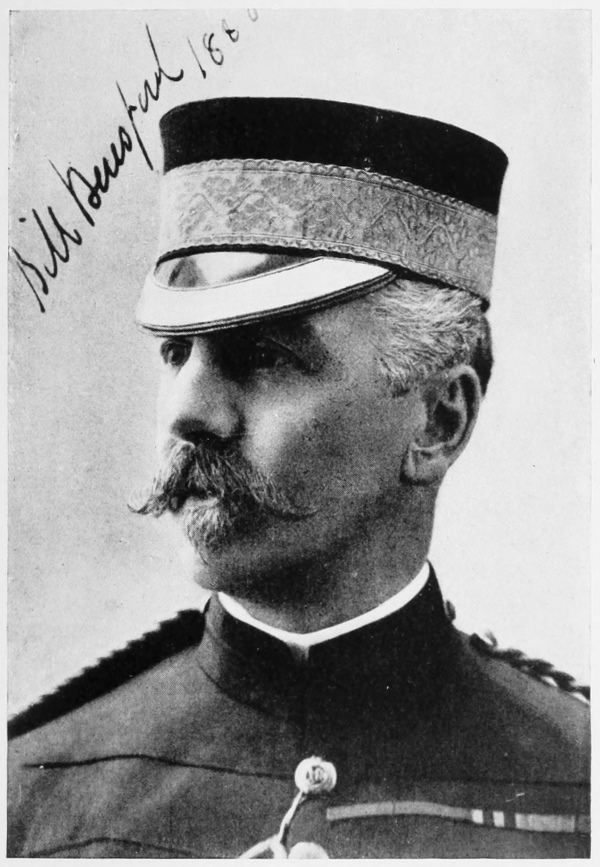
LORD WILLIAM BERESFORD IN 1886
One of the most remarkable things about Lord
William was his memory; he never forgot anything
and was the soul of punctuality, which considering
his multitudinous duties was praiseworthy. He was
little short of a genius, for even when Government
House was crammed full of guests to overflowing, all
to be servanted and fed, each to be treated with the
consideration demanded by their rank, endless
dinners, parties, and receptions to be arranged with
carefully considered etiquette and precedence, people
to be met, taken away, amused; Rajahs’ and Nabobs’
interviews with His Excellency to be arranged, the
stables to be attended to, with at least sixty horses
for the use of the Government House party. This
alone is no trifle. It was part of Lord William’s
work to have horses suitable to all occasions. There
must be tame and docile carriage-horses for Her
Excellency, who may be nervous, but they must step
up to their noses and look full of mischief, otherwise
they would not be impressive and therefore valueless
for their purpose; as it is important that all state
ceremonials should be highly spectacular. Then
the chargers for His Excellency must understand
birthday parades and feux de joie for it would
never do to have the Viceroy standing on his head
in the middle of the Maidan, while his charger
either joined the crowd of onlookers or returned to
the stables. Lord William took endless pains to
train the horses to their special duties, like the
Balaclava heroes, guns were fired to the right of
them, guns to the left of them, just by way of practice
and to teach them to behave nicely and pretend
they heard nothing, and if they did—well what matter.
There must also be plenty of carriages and horses
at the disposal of the guests. The mounts must be
chosen to suit the prowess of the individuals. One
may want to cut a dash in a paper-chase, another
simply a gentle amble to eat the air, and so on. Once
a Bath-chair was requisitioned, but Lord William
never turned a hair. A Bath-chair was forthcoming
at the time it was desired, where it came from was a
mystery. Then there were the viceregal tours
already mentioned to be arranged some time in
advance. Picture what it means to write out
programmes for 365 days in advance—not for one
person—but for many.
After all his duties had been attended to most
punctiliously there were his own horses and affairs
requiring attention. Yet never was there as much
as a cushion forgotten for Her Excellency. Beyond
a tiny notebook and his shirt sleeves everything was
carried in his head. I have seen some wonderful
notes on the cuffs of his shirt. An English laundry-maid
of an enquiring turn of mind might have
compiled an amusing diary from them, though
a little cryptic. Seeing some hieroglyphics on one
of his cuffs one day at luncheon, I asked if I might be
permitted to know what they meant; he shot out
the cuff and showed it to me; it was not altogether
easy to decipher, but with a little assistance I read:
“Viceroy’s bath.” “Sack Syce.” “19 Guns.”
“Pacify Mrs. B.”
He explained he had made a note of these little
items requiring attention. I asked if it was part
of his duty to give the Viceroy a bath, but he said,
“No, but the bath leaked and his note reminded
him to replace it with a sound one.” “Sack Syce”
meant there had been slackness in the stables and a
certain syce would have to go. Nineteen guns
sounded a big order and rather mysterious, but
it had to do with a Native Prince who considered
he had not received enough salutes or too many, I
forget which, and his lordship wished to adjust the
matter. Then came “Pacify Mrs. B.” I gathered
a certain lady had been deeply pained at the way her
name had been spelt on one of the invitation cards,
a very important “e” had been left out, which made
her name look quite commonplace, and she felt it
had been done on purpose. Lord William was going
to put the matter straight and the “e” in its right
place.
It can easily be imagined the amount of correspondence
Lord William had to attend to, it was
enormous, happily he had a clerk who wrote so like
him it was almost impossible to tell one from the
other. The Military Secretary was much praised
for being such a good sort, fancy so busy a man
answering all the letters himself! That clerk was
most convenient.
Lord William used to tell some amusing stories
of the way people approached him with a view to
using his influence with the Viceroy in their favour.
Various methods were adopted by those who wanted
his help, they mostly began by expressing great
affection for his lordship, and profound admiration.
Being a kind-hearted man, Lord Bill did his best
to further everybody’s wishes, and if they were in
any way possible presented the matter to His
Excellency for consideration.
Occasionally some Native Chief thought he ought
to have some concessions, decorations or invitations,
and asked Lord William to help him in the matter,
once when this had occurred and the answer was
longer coming than the Chief liked, he thought
he would expedite matters by making a handsome
present to his lordship and at the same time asking
when his request was going to be granted. This, of
course, settled the matter, as it was undoubtedly
meant as a bribe and was reported at once to the
Viceroy—needless to say the favour was not granted.
It seems rather hard that while we, the British
people, give presents to the Chiefs, we are not allowed
to receive any in return, that is to say none of any
value; but no doubt it is wise.
New Year’s Day is a great holiday in India, the
birthday, so to speak, of the Queen-Empress, January
1st being the anniversary of the Delhi Durbar when
she was declared Empress of India. There are
endless big parades all over India in honour of this
occasion. At Calcutta there is always a most imposing
military parade which everybody turns out to
witness, putting on their best bibs and tuckers,
as their share in its impressiveness.
It is a busy and anxious day for the Military
Secretary, for in addition to all his other work he is
wondering whether after all his training, the Viceroy’s
charger will behave properly when the dreaded
moment arrives for the firing of the feu-de-joie.
The horses under his care may have been properly
broken—the horses belonging to other people may
not, and when the show begins if one horse begins
playing the fool in all probability others will follow
suit. There is a vast amount of ceremony attached
to these parades. The Viceroy puts on all his war
paint, throws out his chest, and rides down the
lines of troops drawn up for his inspection, followed
by his glittering staff, everybody feels it behoves
them to polish buttons and do an extra brush up,
even the Vice-reine’s coachman indulges in an extra
shave and endures the middle button of his coat
buttoned up, just until the ceremony is over.
Nobody takes the least notice of all these efforts
to be extra smart; but perhaps it would be noticed
if they did not, and nobody would perceive it more
quickly than the Military Secretary.
After examining all the lines of troops drawn up
for his inspection the Viceroy returns to the saluting
point, and the Artillery let themselves go with ten
rounds in the Imperial Salute followed with the much
dreaded feu-de-joie, when so much dignity is often
nolens volens cast to the wind. On one of these
birthday parades I remember seeing the horse of a
big official unship its rider and then after various
gallopings caused much confusion by playing tunes
with its heels on a big drum against which it seemed
to bear some grudge, when he had finished with it, it
drummed no more, at any rate for the time being;
but to continue with the orthodox proceedings.
After this fusillade follows the National Anthem
with all the massed bands playing together, then
the Artillery have another innings, until thirty-one
guns have done their best.
In all probability the Viceroy knows little about
troops, what they should look like, what they should
do, or how many buttons make five on the men’s
uniforms, but his Military Secretary will have
primed him.
Everybody says it is a horrid bore, but they
enjoy it all the same. I must not forget one of the
most important features in the day’s show, namely,
the final cheers for the Empress of India and the
march past. The cheering proves as trying to the
horses generally as the feu-de-joie.
We were trying to guess the number of people
looking on, and asked Lord William what he considered
would be somewhere near the figure, and he
told us there were quite 100,000 on the Maidan,
and it was not an unusual number on these
occasions.
The year 1886 brought several annoyances and
disappointments to the Military Secretary in connection
with his racing. In the first place Metal
failed to win him the Viceroy’s Cup, which he had
counted on; Mr. Gasper, who has been already introduced
to the reader, beating him with Mercury.
Coveting this horse his lordship made an offer for
him to Mr. Gasper, resulting in the grey Australian
changing his stable and his owner for the sum of
10,000 rupees, which was considered cheap.
There was rather a tragic little episode at this
meeting though it had nothing to do with Lord
William. A smart little chestnut belonging to
Mr. Abbott won The Trials in the shortest time on
record and dropped dead immediately after passing
the winning-post from rupture of the heart, poor
little beast.
The first race Mercury ran for Lord William was
for the Durbangah Cup, and he won; following it up
with the Kooch Behar Cup, but in this race there
was only one other horse against him, namely,
Mr. Mullick’s Sir Greville. This was really a very
funny race as evidently both jockeys had received
orders to ride a waiting race, this they did with a
vengeance, for when the flag fell neither of them
hurried at all, but moved quietly along keeping
boot to boot, both being determined to wait, this
manœuvre continued, much to the amusement of the
spectators until within half a mile from the winning-post,
when both sat down to ride for all they were
worth. Mercury won, but Mr. Mullick’s jockey
pressed Dunn so closely into the rails that poor Mercury
got rather badly cut.
Another Beresford-Durbangah horse won the
Alipore Plate and Bolero the Jubilee Purse. At
Tollygunge, though that good horse Prospero won the
Handicap Chase, poor Tim Whiffler, who had such
a habit of falling, this time turned head-over-heels
when running for the Ballygunge Cup, breaking his
thigh and having to be shot.
Bad luck seemed to be dogging Lord William’s
footsteps at this time, for Mercury, who had been
doing so well, and from whom great things were
hoped, caught a chill, followed by fever, from which
he died. Then again, after the annual move to
Simla, and he was running Little Nell in the Bazaar
Stakes, on the Annandale Course, though he won
with her, there was a good deal of unpleasantness
attached to the race, owing to Captain Wood, of the
8th Hussars, who was also riding a pony for a
brother officer, and who came in second, lodging a
complaint directly after the race, saying Dunn, Lord
William’s jockey, had jostled him. This rather
spoilt the pleasure of the meeting for everyone. The
race had been witnessed by a number of people,
friends of both parties in question; several thought
they could explain it all, and proceeded to air their
views, hoping by so doing to ease matters and
straighten it out, instead of which, further complications
ensued. This was followed a little later at
Calcutta with fresh annoyance over the Arab named
Euclid, belonging to the Confederacy. Lord William
heard some people had been making remarks about
the performances of this horse, which they seemed
to consider unsatisfactory; he therefore at once
asked the stewards of the Calcutta Turf Club to
inquire into the matter and give their opinion; this
they did, saying they found nothing leading to any
such conclusion as had been suggested. So Lord
William came out on top.
For years Lord William declared no Australian horse
could touch the English, but Mercury caused him to
change his mind, this horse’s performances having
been almost phenomenal. In consequence of being
bitten with the grey Australian, and not content
with having between twenty and thirty horses
already in training, he gave the well-known Australian
dealer, Mr. Weekes, a commission to bring
him one or two of the “real things” from Melbourne.
When the dealer returned from Australia, he
brought with him two horses for Lord William,
Myall King and Golden Gate. I do not remember
hearing of the latter doing anything encouraging, and
Myall King made a poor show to begin with, and his
new master said a few things not altogether complimentary
to the dealer in connection with his
selection, but before long changed his mind, Myall
King becoming his greatest favourite, winning three
Viceroy’s Cups for him, the first on December 24th,
1887, value 7000 rupees. When Lord William was
leading his horse in after the race, thoroughly pleased
and happy, the excited and delighted Mr. Weekes,
who had purchased the horse for his lordship and
who had been brooding over the names he had been
called when first he brought Myall King over, rushed
up to Lord William holding out his hand for joy,
saying, “Now do you still say I am a something
something thief?”
“No,” replied Lord Bill, taking the proffered
hand; “indeed you are all something something
right.”
“Then you will come and stay with me in Melbourne,
won’t you?”
“Of course I will,” said his lordship, only too
anxious to move on.
Myall King also won the Durbangah Cup, £150,
on the 30th of the same month.
In the summer of 1887 Lord William bought up
the lease of the Dehra Doon course, over which he
spent some time and trouble, getting it into good
order; he kept it up entirely at his own expense
until he left India. He removed all his horses there,
also the Viceregal horses, being a good climate for
them.
People in India were beginning to be rather
frightened of Lord William’s string of horses, saying
it was no use entering theirs against him, that they
had no chance. I remember hearing a good deal of
this at Lucknow, but it was not quite a fact, as his
lordship found out to his cost occasionally. He
certainly had a formidable string of horses, and he
wanted to be on top, where to a certain extent he
was, but in racing there is always the element of
chance to be reckoned with, horses going wrong,
jockeys making mistakes, and no end of other things
to be taken into consideration. He sent his horses
to all parts of India for race meetings, even to Poona.
The Spring Meeting at Lucknow of 1888 inaugurated
one of his lordship’s most successful racing
years in India. I always feel sorry he was not able
to carry out all his racing single-handed, but he did
it on such a big scale it became more than one pocket
could stand, hence the partnership. The Lucknow
races in February brought in 7625 rupees in stakes
alone—
| Empress |
winning the |
All Ponies Handicap |
Dunn riding |
| Myall King |
” |
Stewards’ Purse |
Dunn |
” |
| Lavercost |
” |
Derby |
Tingey |
” |
| Little Nell |
” |
Mahamet Bagh Plate |
Elliott |
” |
In March at Meerut followed more wins, Little
Nell, Solheil, Bob, Treasure, and Lavercost roping
in 3015 rupees in stakes between them.
The Dufferins’ term of office was up in 1888. They
had the pleasure of seeing the new Viceregal Lodge
finished before their departure, and enjoyed its
roomy comfort after the very circumscribed Peterhoff.
Against that they had the discomfort of the
move from one house to the other, with one half of
their possessions in one house and the other half in
the other, when, as usually happens on such occasions,
whatever is wanted is sure to be where they
are not.
Lord Dufferin had done a good deal of useful work
in India, undertaking various reforms and costly
measures that his predecessors had seen the advisability
of, but postponed, fearing the expense; he
consequently left the country (I am told) with a
decided financial deficit, to be dealt with by someone
else.
On his retirement he was created Marquess of
Dufferin and Ava, the latter taken from the city of
that name a few miles from Mandalay. Of course
there was the usual speculation as to whether Lord
William would stay on as Military Secretary. India
without Lord William seemed at that time an impossible
thing to contemplate.
It might be imagined after so many years of India,
combined with the exceptionally strenuous life he
led, that his spirits and ceaseless stream of humour
and fun might have begun to fail him, yet this was
far from the case, he still led the van in fun and
frolic.
As the time drew near for the departure of the
Dufferins, he issued the proper and usual orders for
all concerned, leaving nothing unthought of for
everyone’s comfort. Then, wag as he was, he issued
the following order, and had it delivered in print to
the A.D.C. in attendance on the departing Viceregal
party.
Rules to be observed by the A.D.C. in attendance on
their Excellencies the Viceroy and the Marchioness of
Dufferin and Ava after their departure from Calcutta
and until their arrival at Aden.
1. The A.D.C. in waiting will have the kindness to
report himself every morning in the undress
uniform of His Excellency’s staff, and will
appear in the same at every station at which
any officials meet His Excellency.
2. At early Tea, Breakfast, Lunch, and Dinner
he will wear a sword.
3. During their Excellencies’ stay at Bombay the
A.D.C. in waiting will always appear in uniform.
4. On board the Kaiser-i-Hind the A.D.C. in waiting
will visit the decks at 4 a.m. and will see
that the cleaning operations are performed
quietly.
5. He will be so good as not to wear boots before 7 a.m.
6. He will be so obliging as to appear in uniform
at breakfast and to wear it until sunset.
7. The A.D.C. in waiting will take His Excellency’s
orders after breakfast, and in the event of his
services not being required by the outgoing
Viceroy, he will be so kind as to see if Her
Excellency wishes to be supported on deck,
or if the young ladies need assistance.
8. The A.D.C. in waiting will be so good as personally
to submit to the Captain any wishes
the ladies’ maids may express, and to endeavour
to have them carried out.
9. The A.D.C. in waiting will please see that the
chairs, cushions, rugs, and books of His
Excellency and of the ladies are arranged on
the deck by 10 a.m.
10. At 12 o’clock he will kindly see that they all
have Beef Tea.
11. He will be expected to render assistance to the
Captain in every emergency, and to be the
master of all the ceremonies during fine
weather.
12. As His Excellency’s policeman does not accompany
him to Aden, the A.D.C. in waiting
must endeavour to learn a few Persian
stories for the occasion, which he will repeat
to His Excellency for one hour daily while
pacing up and down the deck.
13. He will also, while listening to the Persian
stories which His Excellency will relate to
him, say “Hau” at intervals of one second
during the whole time the narrative continues.
He will also be kind enough to wear an expression
of profound attention.
14. In rough weather the A.D.C. in waiting will be
permitted to put on a waterproof coat over
his uniform and to use his chin strap.
15. His services can on no occasion be dispensed
with during the first five days of the voyage;
he will therefore be expected to keep in good
health, and can on no pretext be allowed
to call for the services of the steward.
16. At Aden the A.D.C. in waiting will be relieved
from duty.
(Signed) William Beresford, Lieut.-Col.,
Military Secretary to the Viceroy.
Simla, November 6th, 1888.
The A.D.C. in question, of course, knew Lord Bill’s
little ways, how much was earnest and how much
fun, and appreciated the thoughtful concession of
allowing a chin strap and waterproof to be used
during rough weather, for more reasons than one.
It was shortly before the Dufferins left India that
Lord William and five other members of the Viceroy’s
staff in one of their lighter moments when dressed
in their racing kit, jumped into a merry-go-round
for a ride and were snapshotted. Lord William is
on the extreme right sitting sideways; next to him
in front is Capt. Roddy Owen; standing up in the
striped jacket is Capt. Burn, generally known as
“Handsome Charlie”; then comes Capt. Harbord
(now Lord Suffield) riding a finish; behind him
Capt. Leonard Gordon and Capt. H. Legge. A light-hearted
little party, overflowing with good humour
and health, much of which was the result of the
amount of exercise they were in the habit of taking.
Sportsmen and those of an energetic tendency keep
their health much longer when in India than their
brethren who resign themselves to the climate with
books, eating, drinking, and sleep, the latter being
the natural consequence of the former.
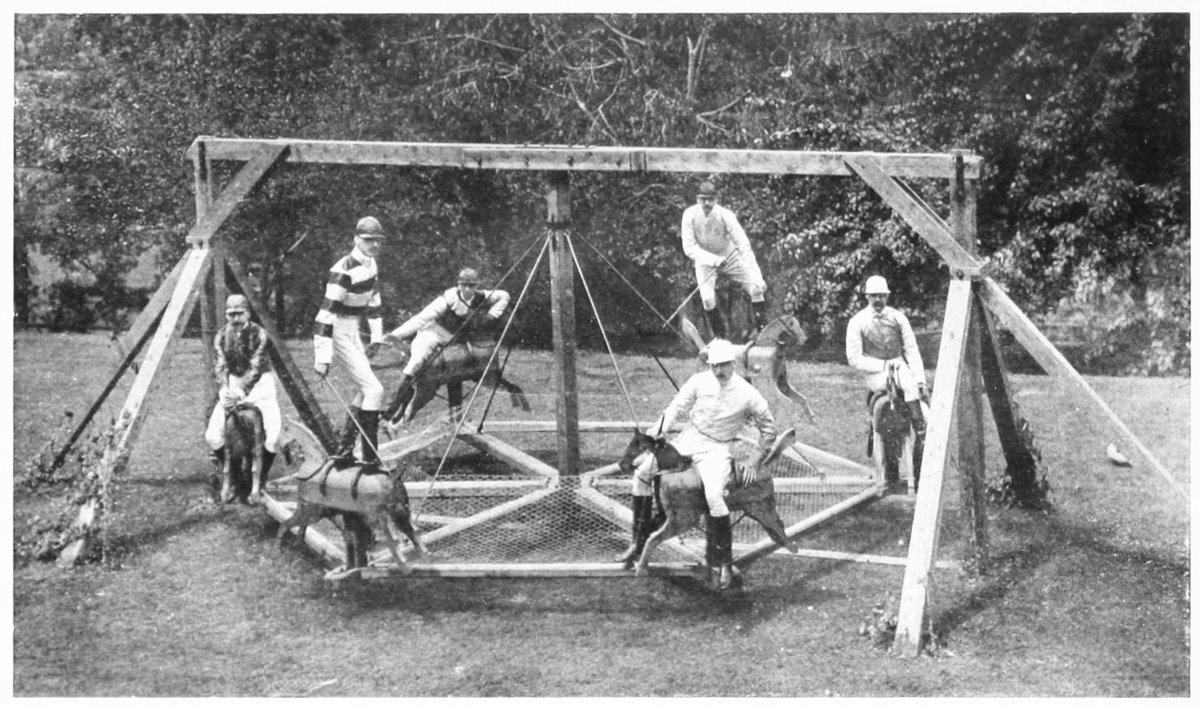
THE VICEROY’S STAFF IN LIGHTER MOMENTS
Feeling a little holiday would be beneficial Lord
William went home in April on three months’ leave,
his string of forty odd horses remaining at Dehra
Doon in the pleasant cool shade of its many fine
trees, but before leaving he attended the March
Umballa Meeting, when his Treasure won two races,
the Service Stakes 900 rupees, Capt. Macdougall
riding, and the open Pony Race 850 rupees, Dunn
riding; Eunice the Paget Park Plate 300 rupees,
Melbourne Plate with Myall King 200 rupees, Dunn
riding.
On Leave—At the Derby Once More—Lord Lansdowne Takes
Office—Conjurer’s Discomfort—A Gentle Reproach—Irishmen
in India—Another Racing Partnership—A Turf Club Inquiry—Paperchasers—A
Telegram from Lucknow—Lord William’s
Health—Jockey in Trouble Again
Three months is not a long leave to spend
at home, it seems to be all coming and
going; it really was not long enough to
pick Lord William up properly—he was badly in
need of English air and fare.
A good part of this brief holiday was spent racing
and attending to racing matters. He bought a horse
called Pennant, winning a race with him at Croydon
value £200. Oberon was another he purchased, but
turned out rather unreliable. Clarion was also
added to his string.
Being at home in time to see the Derby run, he
was enthusiastically greeted by all his old friends,
and had a great time. I rather think it was at this
Derby or Ascot that Sir Claude De Crespigny coming
up behind what he recognised as a Beresford back,
said “Good morning, Marcus,” and then, seeing he
had made a mistake and it was Lord William, asked
whom he should apologise to? Without an instant’s
hesitation came the reply, “Marcus, of course, you’ve
taken the elder brother for the younger.”
All the Beresford brothers were smart at repartee;
indeed I think they would be hard to beat. Someone
asked Lord Charles which of his brothers he
considered the quickest at repartee. To which he
replied: “Marcus. It was only this morning when
walking down Regent Street, ahead of us was a
doddering old Irish peer, one of the Backwoodsmen
who came over once a year to vote against Home
Rule, I said, ‘Marcus, if you were a despotic
monarch would you keep that Irish nobleman in
your House of Lords?’ ‘Yes,’ said Marcus, ‘I
think I should, but I should fire him first on the
Coronet.’”
The smartness of this may be lost upon people
who are not horsy and therefore do not know that
the part of a horse’s anatomy between the fetlock
and the hoof is termed the coronet.
The Marquess of Lansdowne succeeded Lord
Dufferin as Governor-General of India, holding the
office from 1888 to 1893. No events of great importance
occurred during his administration; there
were some small frontier expeditions, but we did not
hear much about them.
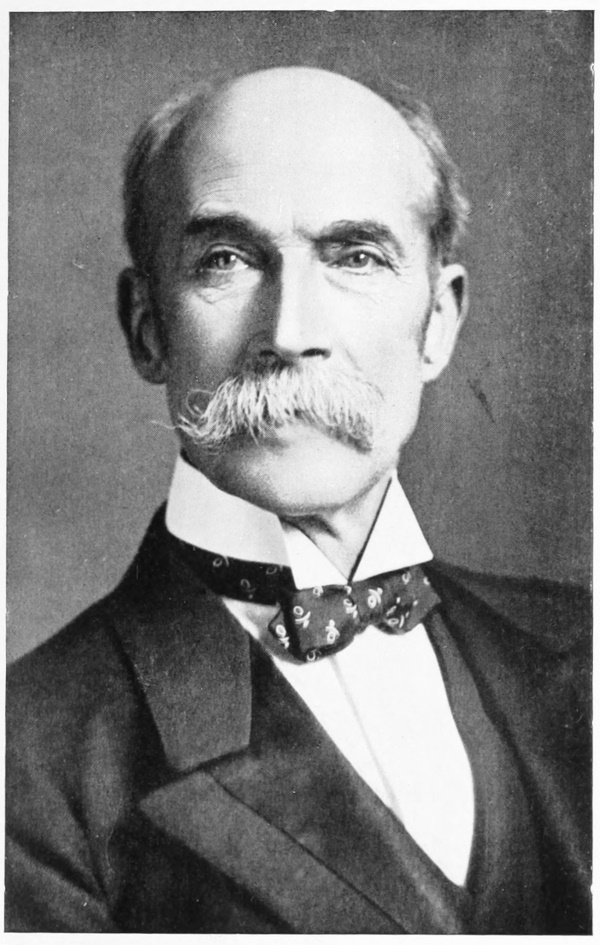
Photo. Elliott & Fry
In 1893, at the end of Lord Lansdowne’s reign,
Sir Mortimer Durand, then Foreign Secretary to the
Indian Government, was sent on a mission to Kabul
with a view to defining the limits of influence of the
British Government and the Amir, with respect to
the independent tribes in the wide belt of country
between Afghanistan and British India. However, we
are not yet dealing with 1893 but 1888, when Lord
Lansdowne had only just taken office. He was
fond of horses and racing, therefore watched his
Military Secretary’s horses work with sympathetic
interest.
From 1888 to 1894 were Lord William’s best
racing years in the East, and all his spare time was
devoted to it.
At the November Lucknow meeting his racing
partner, His Highness of Durbangah, won the
Stewards’ Purse with FitzWilliam, Dunn up, Daphne
the Dilkoosha Stakes, Soheil, an Arab, the Pony
Handicap. On the third day, a pony named Brandy
the Paddock Stakes for maiden ponies, besides
various others which I forget.
At the Calcutta chief meeting FitzWilliam won the
Trials by way of a good beginning. Eunice, who had
at one time and another won a good many races for
Lord William, now won the Karnaul Stakes. Metal
was backed for a small fortune for the Viceroy’s Cup,
when one of those unexpected things happened
which must always be reckoned with in racing; he
was beaten by his stable companion making the pace
too hot for him, and Myall King again romped in a
winner. They also won races with Pekoe and Shamhad,
while a grey English mare named Venus, whom
nobody expected to do anything, won the Eclipse
Stakes for them. Lord Clyde and Clarion won a
couple of races at the Extra Meeting, making a
tremendous winning year, but not a profitable one
taking it all round.
It was at this juncture that beautiful Arab pony
Blitz came upon the scenes; the charming picture
of him was given to me by Admiral Sir John Hext,
who agreed with Lord Bill “he was one of the best
that ever looked through a bridle.” Lord William
sold Metal about this time for £500 to someone in
Australia.
During the Simla season he rode a good many
races himself on Hardware, Nancy and Shamshad.
He also won a match on Hakim against Mr. Laureston’s
Prince Charlie, 2000 rupees a side.
In July news reached Lord Bill of the death from
heart disease of Mr. Fitch, who for some years had
looked after and conducted the Calcutta lotteries,
also acted as secretary to the Dehra Races. The
poor man died in England while home for a holiday.
Lord William felt much regret, for he had been
closely associated with him, naturally, over racing
matters.
Mr. Fitch was another of the many men his lordship
had befriended; in fact had been set on his feet
and owed all his success in life to him.
The season was jogging along much in the usual
fashion, plunging from the sublime to the ridiculous
and the ridiculous to the sublime all the time. In
India we all become dual natured, whether it is the
climate, the atmosphere we live in, or the desire to
leave no time to think I do not know; but we may
in the morning be told, someone with whom we have
been in daily touch is dead—we say how sad, open
our letters, and make all our arrangements for the
day’s amusements, which we fulfil, leaving just time
to pay a last tribute to one whose hand we have so
often held, whose voice and laughter is still sounding
in our ears; we then hurry home from the cemetery
and go out to dinner, or to the theatre, and home to
bed late, hoping to be so tired that sleep will claim
us immediately. It is not that we are callous really,
far from it; the sad news in the morning has left a
lonesome feeling in our hearts, an aching for the
poor body who such a short time ago was full of all
he or she were going to do when they went “home,”
it makes home seem very far away and the present
so full of prickling possibilities, and we feel we must
laugh or cry, and our English objection to wearing
our hearts on our sleeves makes us appear gay, and
thus we are pitch-forked from the sublime to the
ridiculous and vice versa, still if we never reached
the sublime we should miss the picturesqueness.
I once asked Lord Bill when we were speaking of
this very matter, that is to say, the amount of feeling
we contrived to hide in our everyday life, when
he told me of several strange things that had happened
in his life of which he had had strong pre-sentiments;
one was in connection with racing, and
the others purely private matters; this led me to ask
him if he was superstitious; he replied, “I like to
think I am not, but I am always very careful not to
wound people’s susceptibilities on that point, having
some of that feeling which is supposed to make us
wondrous kind.”
Superstition is a thing I suppose that can hardly
be described or accounted for, as some of the happenings
in our lives refuse to be explained by any hitherto
understood methods or any rules or lines of our
acquaintance; and also there are times when we are
not ourselves, oh strange and bitter paradox!
Lord William’s way of keeping people in order
was very much to the point generally, and yet he
did it very charmingly. An A.D.C. once had been
hauled over the coals by him, and at the end of it
said, “What a good fellow Lord Bill is, how
thoroughly he rubbed me down, and yet how like a
gentleman.”
Another rather amusing instance was when the
Rajah of Nabha was giving a party or entertainment
to Lord Lansdowne. A conjurer had been engaged
to amuse those present; he was a rather persistent
personage, at that time wandering round India seeking
a living, and performing at native courts.
Lord William, who of course had the arranging of
all this sort of functions, told this professor his
entertainment must not last more than twenty
minutes; this he strongly objected to, declaring it
would entirely spoil his show, did not give him a
chance, and so on, he would require at least an hour.
While expressing his sorrow at causing so much
annoyance and disappointment, Lord Bill stuck to
his point and said not more than twenty minutes
could possibly be allowed; he evidently saw defiance
in the man’s attitude, and made his arrangements
accordingly.
The performance began, Lord William looking on,
watch in hand. At the end of a quarter of an hour
the British magician was warned he had only five
minutes more. He took no notice, and continued
his lofty way. At the end of twenty minutes he was
told to stop. Still he took no notice, continuing his
tricks and patter, when at a sign from Lord William
a native conjurer, who had been watching huddled
up in a corner, bounded into the middle of the floor
with a tom-tom and commenced a most deafening
and unearthly noise. A tom-tom, it should be explained,
is a rattling sort of thing rather like a drum
gone wrong. The native had been waiting for the sign
of command, watching the conjurer much as a terrier
watches a rat, waiting to be told to “Go.” This
indignity was too much for the white performer, he
collapsed, and the native then proceeded to make
mango trees grow in a few seconds out of stones and
from under flower-pots, etc. Those present were
much tickled at the whole proceeding.
One more of Lord William’s gentle reproaches.
This time it was addressed to a youth fresh out from
home, where he had been much spoilt; he was complaining
about the disrespectful way the regiment he
had just joined treated him, he was not accustomed
to be treated in such a manner. The poor lad was
learning that painful but wholesome lesson, his value
in public opinion, and he did not like it. Thinking
he had a sympathetic listener in Lord William, and
not knowing him as well as some of us did, the
twinkle in his eye did not act as a warning, and at
last the lad worked himself up to such a pitch of
feeling over his wrongs that he said he should write
to his mother and tell her he should return home at
once. No words had come from Lord Bill, who
appeared to be full of interest and sympathy, but
when he was told that the unhappy youth meant to
return to his mother, he said sweetly and quietly,
“But, my dear chap! think what a disappointment
it would be to her!” Even then the young lad did
not at first grasp what was meant, but when Lord
Bill added, “After fixing you up with new shirts and
pocket handkerchiefs, to have you back on her hands
so soon.”
Lord William, seeing the boy was nearly tearful,
walked off with him, arm-in-arm, talked it all over
quietly, gave some good advice, and, I understand,
left the poor boy happier and probably much wiser.
What a number of Irishmen have ruled in India
and been famous there. Lord Mayo, born in Dublin,
who in 1868 succeeded Lord Lawrence. I should
think he was the only Governor-General who had
farmed for his livelihood, and be it noted made
enough to live upon. When he came of age he was
Mr. Bourke. His father, whose eldest brother was
then living, could not afford him any sort of allowance,
but rented one of his farms to him to try and
make what he could out of it, and I have been given
to understand he did make it pay, which is more
than many gentlemen farmers do, methinks!
Lord Mayo is reported to have said, “And many
a long day have I stood in the market selling my
beasts.”
Then there was Lord Connemara, Governor of
Madras, responsible for the well-being and happiness
of thirty million souls; Lord Lansdowne, a Kerry
nobleman; Lord Roberts, a Waterford hero of
Kandahar fame; Lord William Beresford, V.C.,
the unequalled Military Secretary and patron of the
turf; Sir George White, V.C., who brought Burmah
into order; Sir David Barbour, a perfect juggler in
figures, who brought the much feared and dreaded
financial deficit of the country to a considerable
surplus, and many more if there were time and space
to recount them.
The Annandale Racecourse was now enlarged
and levelled. It had cost large sums of money, but
was satisfactory, and the races now began to draw
horses from Umballa and Meerut. The lotteries on
the first day’s racing after the new course was
“declared open,” as they say at bazaars, amounted
to 20,000 rupees, so Lord William hoped it would
not be long before the debt on the ground was paid
off. A little lady, who was one of Lord William’s
most devoted admirers (aged six), was crying one
day at Simla when he happened to look in on the
way down to one of the gymkhanas, and when he
asked her what was the matter and took her on his
knee, she threw her arms round his neck weeping salt
tears down his collar, saying, “Mover won’t let me
go and see you run in your pyjamas.” This required
a little explanation. He gathered she had heard her
mother and friends talking about some race they
hoped he would win at the coming gymkhana. Not
having been very long in the country she had got a
little mixed between gymkhana and pyjamas. Lord
Bill pleaded so hard for his little friend to be allowed
to go to the meeting, consent was at last given, and
he said he could see in the child’s eyes how disappointed
she was that he did not appear in pyjamas
after all.
In October the usual exodus took place, and Lord
Bill found time to see some of his horses win races at
the November 1889 Lucknow meeting. Blitz,
beautiful Blitz, won the Dilkoosha Stakes; Nellie
the Little Go Chase, FitzWilliam the Bar Cup,
Betsy the Standard Plate. At Dehra, Meerut and
Umballa he won four races. He rode in the Meerut
Charger Race himself, winning on Jim. At Pindi he
rode one of the races, winning on Landshart II;
the other two were won by Daphne and Ensign.
Four races in one day to the credit of his
stable.
A little later, at the Calcutta 1889-90 races his
Euclid seemed to be losing form, but Pennant was
going strong and won the Trials; Chester also won
the Pony Cup.
Lord William’s racing partner, His Highness the
Maharajah of Durbangah, was most anxious to be a
winner of the Viceroy’s Cup, and Pennant being in
Lord William’s opinion the likely winner, with his
characteristic kindliness sold the horse to His Highness
just before the race, so that the Durbangah
colours might be carried. The horse won easily,
greatly to his new owner’s pleasure.
That wonderful pony, Lord Clyde, won the International
Pony Race.
Speaking at the Turf Club dinner Lord William
confessed he thought a big stable a mistake. In
spite of having gained this experience, which led
people to imagine he intended to reduce his stable,
he added to it, and for the first time sent some of his
horses to Madras to see what he could do there. At
the Autumn Meerut Meeting he had no luck this
year with his horses, chiefly owing, no doubt, to their
usual jockey, Dunn, who knew their temperaments
and little ways, being away at the time ill, which
was hard on the horses and hard on their owner.
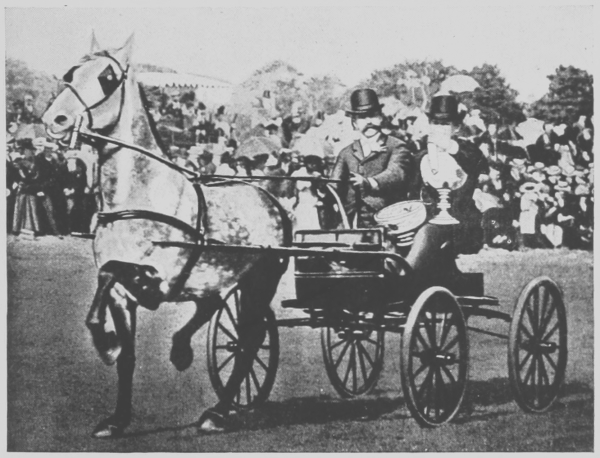
PILOTEER WINNING A TROTTING PRIZE
The big Calcutta meeting on December 26th,
1889, saw the beginning of the Presto row, which
most racing people will remember. The horse was
entered for the Walter Locke Cup, and was expected
to win, Dunn riding, but was not even placed! It
was suggested that it was the result of getting off
badly at the start, the horse swerving round, losing
several lengths. This caused some comment and
much disappointment, which reached boiling point
two days later, when on the 28th Presto again ran
with Dunn up for the Kooch Behar Cup, 1¼ miles,
winning easily, there never being a moment’s doubt
from start to finish that the race was his, even
leaving Moorhouse, a very fast horse, and several
others hopelessly behind.
The public were now thoroughly upset, though on
the face of the thing it seemed natural that if the
horse lost so many lengths at the start in the race on
the 26th, it would quite account for relative positions
at the end of the two races. There were, however,
those who considered Dunn’s riding was at fault,
therefore the Stewards of the Turf Club held an
enquiry into it. Mr. Gasper, the clever lawyer who
has already been introduced, and from whom Lord
William bought Mercury, appeared to uphold the
complaint. Whether Dunn was in any way to blame
for this different running of Presto I am not able to
state, but be that as it may, he stood very little
chance in any case with Mr. Gasper up against him,
he being the most brilliant criminal lawyer Calcutta
had ever seen, and he at any rate believed Dunn to
blame, and waxed eloquent in consequence.
After a long and tedious investigation, over which
there had been some feeling, the Stewards fully
exonerated Lord William, and while not stating
Dunn pulled, they were of the opinion he deserved
censure for bad riding, which had certainly justified
the enquiry.
The whole affair was much to be regretted, and
makes one wonder how a man can be found who
cares to have his honour resting in the hands of paid
servants like jockeys, trainers, and so forth, when
any day what a man prizes more than anything else
in the world may be thrown to the winds, through
absolutely no fault of his own.
The course at Calcutta had been expanded, and
the buildings improved, greatly owing to the efforts
of the sporting and popular merchant Mr. Charles
Moore, who took great interest in racing and the
bettering of all its conditions.
Following the Calcutta meeting came Tollygunge,
where the stable finished the season well, Blitz
winning the Belvedere Stakes in January 18th, 1893,
Gold Leaf the Sensation Handicap, Traveller the
Long Distance Handicap, FitzWilliam the Spring
Purse, and Nellie the Pony Chase.
I had almost forgotten the cold weather paper-chases,
having so much of interest to recount in the
way of racing. Lord Bill was very fond of riding
after paper, and the Calcutta Paperchases were no
child’s play. He ran second in the Cup in the cold
weather of 1880-81, riding Oliver Twist, third on
Mariner 1881-82, first on Premier in 1882-83, first
on Diamond in 1887-88.
Captain Muir, commanding the Body Guard, who
has already been mentioned as having been left in
charge of Lord Bill’s affairs when he started for
Zululand, won the Calcutta Paperchase Cup three
years running on his Warwickshire Lad, I believe,
in the cold weather of 1877-78—1878-79—1879-80.
The only person that I know of with such a record.
I ought perhaps to explain that the Viceroy and
each Governor has a Body Guard for escorts, guards,
sentries, etc., much the same as the Household
Cavalry in England with the King.
The Viceroy’s Body Guard was very impressive
with its scarlet uniform and lances.
What a gift it is to be able to speak well. Lord
Bill was a happy speaker, always to the point, and
always amusing, and how people do like to be
amused. We have only to look at the money made
by humorists like Mr. George Robey, who earns
£200 a week to make people laugh, and is worth it,
or he would not receive that handsome money;
Little Tich with his £250 a week, or Cissy Loftus, the
mimic, who received £250 a week for her services.
Compare with this the pay of some of our Indian
officials, toiling in the heat, often separated from all
that makes life lovely. Truly it is better to be funny
than great, but then after all it is great to be funny.
Lord William thought every boy ought to be taught
to speak, and considered debating societies excellent
practice for them, which no doubt they are, teaching
them not only to think, but to express themselves
intelligibly and to frame their sentences.
As Lord William expressed it, “Everybody has not
got the gift of the gab,” but most can acquire it, and
no doubt this is true to a great extent; some great
speakers have been miserable failures to begin with,
though overflowing with things they wanted to say.
Disraeli was an example. His first speech in the
House of Commons was an utter failure, possibly
partially from nervousness, also want of practice;
eventually his phraseology was both forceful and
picturesque.
While Huxley, giving his first lecture at the Royal
Institute, I am told, was quite painful, so much so,
that he received a letter imploring him never to
speak again, which was not encouraging.
Some can speak and cannot write, others can
write and cannot speak. This has been brought
home to me lately while turning over old letters and
documents searching for those relating to the subject
of these memories.
I have come across forgotten letters that I have
received at different times from India, Afghanistan,
Zululand, Burmah, South Africa, East Africa,
Russia, France, Egypt, in fact from most of the
places where there have been stirring times during
my life.
Many of the letters written by the chief actors,
others from those who at the time of writing were
taught “not to think, but to do as they were told—thinking
was for their superiors!”
It has interested me placing them side by side and
studying the different views held by the writers of
the various situations they were dealing with, not all
the facts being by any means in accordance with the
accounts that have been handed down for our
digestion. Some of these writers could have thrown
very vivid light on various situations, but they have
carried their griefs and in some cases their injustices
with them to their lonely, uncared-for graves.
Amongst these letters are a few written in bald
John Bull, plum-puddingy jerky sentences, like
roughly sketched in pictures to be filled in later;
possibly they found speaking easier than writing.
Then there are the letters dealing with the same
situations, so eloquent, so full of human sympathy
and yet so dramatic that it is almost like living
through the experiences oneself.
I suppose mistakes are not sins when people have
honestly done their best, but then the best is sometimes
painfully foolish, and it is poor consolation to
those who have suffered in consequence of it, that it
was all a mistake!
We must now hark back to Lord William’s racing.
He was hoping to win the Civil Service Cup at Lucknow,
the best pony race in India. He and all the
staff who could possibly get away from Calcutta
went to see it run. Two of Lord William’s ponies
were entered for it, namely, the famous Arab Blitz
and an English pony named Bustle. The former
was a strong favourite, and Lord William thought
it a certain win.
Before leaving Calcutta he promised Lady Lansdowne
to telegraph to her the result of the race. At
dinner that night Sir John Hext asked Lady Lansdowne
if she had heard from Lord William as was
arranged. She replied “No; I am rather disappointed.”
Dinner had not proceeded very far
when the expected telegram arrived. After reading
it Her Excellency burst out laughing, and handed
it to Sir John, who read, “Bustle in front this time.”
So the English pony had won the Cup.
Myall King won the Horse Handicap, there being
nothing there that could touch him.
Lord William’s health was again troubling him.
He had in fact had enough of India and its climate,
though he would not allow it. He was advised to
go home on leave for a while, which he agreed to do,
but did not take long enough to benefit him materially,
that curse of India, dysentery, claiming him at
intervals.
Before leaving for home he sold Euclid (whom he
considered no longer of much racing value) to Count
Poloki for £700.
While Lord Bill was at home Weekes, who it will
be remembered bought Myall King for him, bought
another horse in July for the Durbangah-Beresford
stable for 800 guineas. Various items of news
reached Lord Bill while at home which were worrying.
One being that anthrax had broken out at
Dehra in the stables. Those who have had any
experience of that disease will be able to picture his
feelings on receiving this news, it being quite on the
cards that every horse might be dead in a few hours.
Poor Shamshad was the first of the victims. Fortunately
stringent measures were taken by Willson,
Lord William’s trainer, before many had succumbed.
Then followed the unpleasant news that Dunn was
in trouble again, for the confederacy stable was
active, though Lord Bill was away. This time it
appears Dunn’s riding was so peculiar from the
moment he left the paddock that the Stewards felt
it imperative to institute another enquiry, regarding
the running of Cumberland, and they came to
the conclusion he had not ridden the horse to win,
in consequence of which he was suspended for twelve
months, rather taking his breath away, riding being
his means of livelihood. This punishment was later
added to by disqualification for life, for which no
one could feel sorry, if he was unable to serve faithfully
such a good master he did not deserve any mercy.
I believe in 1892, thinking Dunn had suffered
enough, his sentence was remitted.
Lord William now engaged the services of that
first-rate jockey Vinall, and he was out in India by
October, when his lordship returned, looking much
better for his visit to the German Spas, where he had
amongst other things been drinking the waters.
In December racing people’s breath was taken
away by finding Lord Bill had bought and landed
in the country a couple of South American horses,
which under the then existing rules were rated as
country-breds and carried weight with that class.
Vixen and Westminster were the names of these
surprise packets.
At the Calcutta second meeting Escapade, Labby
and Goldleaf won races. Pamela also won her first
prize, the Walter Locke Cup, while good old Myall
King romped away with the Viceroy’s Cup for the
third time, value 5850 rupees.
The brilliant lawyer, Mr. Gasper, died in December
of this year on the way to England for a holiday; if
I remember rightly he died of heart failure. Lord
William at once wrote a kindly, sympathetic letter
to his wife, which, considering he cannot have felt
very warmly towards her husband after the bitter
tone he took up against his jockey and horses, was
good of him, and I hope the lady appreciated the
spirit that prompted him to do this gentle act.
Gentle courtly manners are the fruit of noble
natures and loyal minds.
January 1st, 1891, saw Lord William gazetted a
full-blown colonel and K.C.I.E.
Why the Maharajah of Durbangah Gave up Racing—The Maharajah
of Patiala Joins the Stable—The Indian Lotteries—Some Successful
Racing—Lord Bill Pays Up—Simla Feeling Sad—Death
of Myall King—Some of His Chief Races—Farewell
Dinner—List of Guests—Speeches
Early in 1891 the Maharajah of Durbangah
told his partner he meant to give up racing.
Mr. Abbott, who was in the know of all
things racing, attributes this decision to worry and
anxiety caused by certain Government schemes
afloat which he feared would entirely disturb the
peace of his territory. Perhaps I cannot do better
than quote Mr. Abbott’s own words referring to the
reason for His Highness’s retirement.
“This popular prince was worried out of his life
by the spectre which haunted his nightly dreams of
the utterly uncalled for, ill-judged and stupid scheme
of the Cadastral Survey, hatched by two Irish
civilians, true to their breeding in that they were
rabid haters of landlords. If ever the heart of that
generous, loyal and rattling good all-round prince
be post-mortemed, Cadastral Survey will be found
indelibly printed thereon. How could a man go on
racing when he knew that his whole principality, at
that moment resting in perfect peace and contentment,
was to have its Arcadian simplicity disturbed
by numerically untold bands of harpies in Government
uniform, sweeping through its length and
breadth, looting alike Zemindar and Ryot, taking
bribes with a magnificent impartiality from both—and
to do what? Draw dauby maps, incomplete
and incorrect to start with, absolutely useless in less
than five years. A precious lot of use this thrice-cursed
and most scandalous survey will prove.
Small wonder Durbangah stopped racing, and that
the once contented prince is in a state of unrest and
discontent.” Mr. Abbott maintains, “This and this
alone was the secret of Durbangah’s retiring from
the turf.”
Whether this survey proved disastrous or a benefit
I am not able to say, but I think we may take it that
the description of Mr. Abbott’s which I have quoted
faithfully represents the state of the Maharajah’s
mind and feelings at the time. Great was the excitement
in India when the news became public property,
and many both wise and foolish were the speculations
indulged in as to the reason. Lord William
was naturally very sorry, having had nothing but
the pleasantest relations with his partner from first
to last. There had always been entire agreement
between them. In addition to his regret at losing
his racing partner Lord William was very grieved
that “such a good fellow and such a loyal prince”
should be unhappy and unsettled.
There happened to be another native nobleman
at the time anxious and longing to make a name for
himself on the turf, namely, the young and enormously
rich young Maharajah of Patiala, straight
from the leading strings of a strict Scotch tutor.
Being at the Calcutta meeting for the first time in the
early part of ’91, and knowing that the Beresford-Durbangah
arrangement was at an end, he approached
Lord William with a view to being taught
the ropes and joining company. He was already a
good horseman and loved the sport. His lordship
agreed, and so for the future it was to be that very
powerful stable the Patiala-Beresford, the strongest
in India.
So there was no halting in any of the programmes,
everything went on just as usual. At the Second
Extra Calcutta Meeting in ’91 Lord William won
two races with Lord Clyde and one with Wild Oats,
as wild as his name. At the Lucknow Meeting Myall
King won the Stewards’ Purse, value 1500 rupees.
Here again there was an unpleasantness, one of those
heated arguments that spoil the pleasure of a meeting
for everybody. This time the row began when
Mr. Apcar’s Sylvia won the Civil Service Cup, and
Lord William, on behalf of the owner of the second
pony named Frisky, made objection to her not
having paid the full penalties. After certain explanations
Lord William withdrew his objection,
but Frisky’s owner carried on the war, and the unfortunate
Stewards of the Turf Club (Calcutta) had
to sift the matter and adjudicate. Counsel exhausted
themselves with their eloquence over the
case, but again it came to naught.
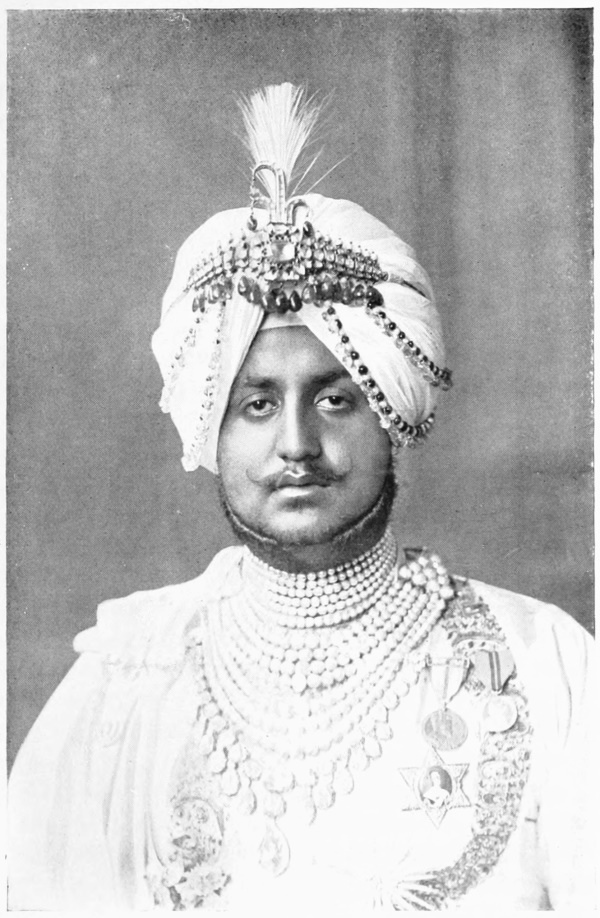
Photo. Vandyk
H. H. THE MAHARAJAH OF PATIALA
It was, I believe, in December, 1891, Myall King
was beaten for the Viceroy’s Cup by that speedy
horse Moorhouse, but Sunshine won the Karnaul
Stakes, Edith the Zeerut Stakes, Teviot the Eastern
Stakes, plucky little Blitz the Eclipse Stakes, with
ears down, thinking hard, and doing his best; Ivo
the Christmas Cup, so amongst these many wins it
is hoped consolation was found to make up for poor
Myall King’s defeat.
On the fourth day of the big Calcutta Meeting
there was some grand racing. The Patiala-Beresford’s
country-bred pony Negus, supposed to be the
best country-bred ever seen in India, won the
Eastern Handicap, and Ringmaster made a splendid
finish for the Durbangah Cup, Vinall only just
managing to squeeze him in front of Savant by a
short head. The stable at this time had a small
English boy named Peake doing the lightweight
riding for them, he was rather a success. At the
Third Extra Calcutta Meeting the black cap and
light blue jacket won four races on Christmas Day
as follows: Escapade the Kerry Stakes, Tabby the
Welter, Negus the Bengal, Ivo the Fitzmaurice Stakes.
From now on, until Lord William left India early
in 1894, there is little if any particular interest to
relate except his successful racing, to which he
devoted all his spare time. Chasing appealed
strongly to him, the excitement of it being after his
own heart, and nothing pleased him better than to
be up himself. Being a good judge of a horse, he
knew what to look for when keeping his eyes and
ears open for possible winners. On paper we all
know the thing to look for, good shoulders to help
them when landing, plenty of power behind to propel
with, and so on, but in practice this does not
always do the trick, for most of us at times have
seen little weedy, tucked-up animals win big prizes.
Never mind, we are told the exception proves the rule,
and, as I have already remarked, Logic is, no doubt,
a good training for us all as leading to sound and
considered judgment, but horses are unacquainted
with it. It is very seldom, however, that a horse will
not do his best, strain every nerve, in response to
the demands of his master. Lord William was a
bold, plucky rider, with good hands, but in racing
was, I think, inclined to be too impetuous. I have
seen him spoil his own chances by being too eager.
My readers will say he managed to win a good many
when riding himself. Quite true, so he did, and he
could do almost anything with horses, but his
tendency in racing was to go “all out.”
A good deal of business was done in India over the
Calcutta Sweepstakes on the English Derby. Lord
William was always keenly interested, and did a
good deal of buying and selling over the horses’
chances, which, of course, is just as legitimate as
certain leading lights in the English racing world
making a £10,000 yearling book on the Derby. As
a purchaser of tickets Lord Bill was in a good position
to judge a horse’s chances, being well posted from
home, his brother Lord Marcus keeping him well
informed of all that was going on, the breakdowns,
scratchings, and other contingencies connected with
good and bad luck of the racehorse in training. The
Calcutta Sweep on our Derby is the most valuable
in the world. Lord William did a large business with
the Indian lotteries, and made a heap of money over
them. The sweepstakes being drawn some weeks
before the race is run, gives everybody who likes to
avail themselves of it opportunities of making money
by buying and selling the chances subsequent to the
draw, taking the form of jobbery on the Stock
Exchange. Many of my readers know all about this,
but there are some who may be glad of the explanation.
It is not now possible to do what has been done
in the past with Calcutta Sweeps, what is called
“future event wagering,” is more or less a thing of
the past. It must be remembered there was not
much for Lord William to learn about racing, and he
knew how to hedge so as to make his book fairly safe
before the flag fell. There is an old adage, “No bet
is a good one until it is well hedged.” I think
latterly Lord William hedged a good deal. I have
heard it remarked that he lost his nerve a little, and
after making a big book would hedge it off again,
thereby not making the sums he might have done
over his own horses, but I think we may take it his
lordship knew what he was doing, and did it fairly
satisfactorily.
In February, 1892, that wonderful pony Lord
Clyde, whose legs must have been made of cement,
won the Merchants’ Purse at Lucknow with ease,
Arabi Pasha the Derby, and Negus the Civil Service
Cup. Racing people in India were growing restive
at the formidable Patiala-Beresford stable winning
so many of the best races, but if the stewards and
officials who arrange the different meetings invite
outsiders to compete they must not cry if they come
and at times carry off their prizes. Both the Maharajah
and Lord Bill were so extraordinarily
generous they cared much less for the cash and
prizes than for the glory of winning, and would willingly
have given them the value of the stakes if that
was all that mattered.
The Patiala Prince started some races of his own
in April, 1892, on his own estate. They became very
popular, and his hospitality was remarkable, everything
well done, and Lord William able to help him
in laying out and arranging the course, which was
1½ miles long, and well kept. It boasted of two
grand stands, stables, dressing-rooms, weighing-room,
and all the heart of man or beast could desire.
On the opening day both the Maharajah and his
A.D.C., Sirdar Preetum Singh, rode in races, each
being a winner. The bookmakers did good business
too.
At Agra the stable did fairly well, winning the
Bhurtpore Plate with Doris, Bar Stakes with Teviot,
three races with Edith, and the Auction Stakes with
Joker. Small wonder folk felt nervous when the
Patiala-Beresford horses appeared on the scenes.
At Simla, on the new altered course, the races
could hardly be called gymkhanas any longer, many
good horses coming from far and near to compete.
Lord William won the Jakko Stakes with his Coffee,
but I do not remember any other wins of this time
at Annandale, though there may have been several.
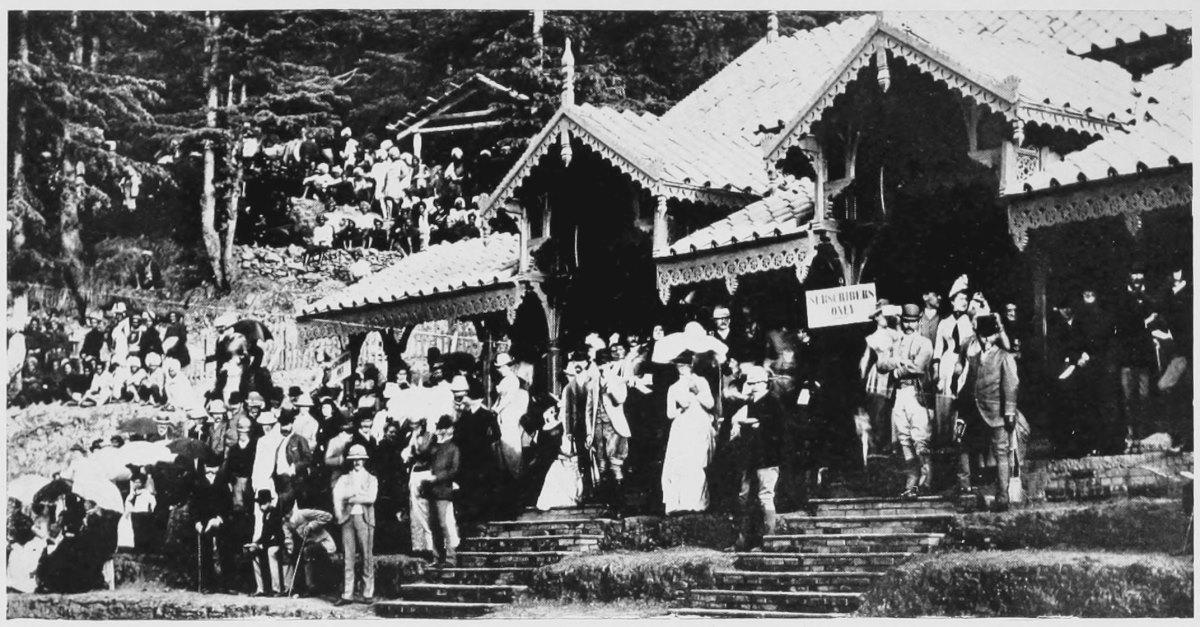
NEW PAVILION AT ANNANDALE
The majority of his horses, as well as the viceregal
horses, were summering at Dehra as usual. This year
a few were sent to Nami Tal, another hill station, by
way of a change and to represent the stable in some
races and gymkhanas. Two horses that had lately
been imported to India were causing anxiety, they
were not doing very well at Dehra, but as they had
come out in that trying month of August it was
hardly surprising. It was my fate once to be in the
Red Sea in August, and I almost made up my mind
to die, but thought better of it, while a real live
judge on board made no bones about it, and did lie
down and die, though everybody did their best for
the poor old man with ice, fans, and punkahs.
At Meerut Doris won the Haupur Stakes, Cuba
the Handicap Hurdles, Tabby the Aligarh Stakes,
Edith the Railway Stakes.
At Umballa a match was arranged between Lord
William and Mr. Woolmer, to come off at the Autumn
Lucknow Meeting, the friends of each of these
sportsmen betting on the event. It was looked forward
to with considerable interest.
Saltford won the Grand Annual at Umballa, and
the stable won a couple of other races.
At Pindi, Marvel won the Pindi Plate; at Lucknow,
Doris the Dilkoosha Stakes easily, Escapade
the Trials, Teviot the Club Stakes.
Some horses were sent off at the same time to
Hyderabad with Ryder in charge and did well, bringing
in something satisfactory in stakes.
Myall King, if I remember rightly, won a big race.
The race meetings followed on each other’s heels
fairly quickly, and we must now follow the stable to
the Calcutta First Extra Meeting, where Pavo won
the Pony Plate easily. Arab Brat, a wonderful pony,
a mass of muscle, well made and lovely to behold,
won the small Pony Trials, Ivo the Frost Stakes,
and in the December Stakes, Lord William led in
Lady Grace the winner.
At the big meeting, December 24th, Sunshine won
the Kurnaul Stakes, Tostig, a most untrustworthy
but very fast horse, the Trials, Ivo the Walter Locke
Cup.
For the Viceroy’s Cup this year the stable had
nothing they felt that could compete with the
Maharajah of Kooch Behar’s grand black gelding
Highborn. Their Caterina ran, but was beaten by
him.
The smart country-bred Sunshine won the Gunny
Meah Cup, the fast Eider the Sandown Park Stake
in a canter, and Caterina retrieved her character by
winning the rich Kooch Behar prize, though she had
a good field against her; Little Brat also won the
Eclipse Stakes.
It seemed quite correct that after being beaten
by the Rajah of Kooch Behar’s horse for the Viceroy’s
Cup that Caterina should retaliate by winning His
Highness’s Cup.
A glance at the winning of the Confederacy at this
meeting is instructive, 21,000 rupees being won
between the Patiala and Beresford horses.
At Tollygunge, the obliging and always ready
Edith won the Handicap Chase. So ended the 1892
racing.
On January 14th, 1903, at Calcutta, that compact
and beautifully made pony Parvo won the Belvedere
Pony Stakes, also another a little later. Vixen, the
South American, roped in the rupees in the Selling
Welter, and again next day the Alipore Stakes.
The first day at Lucknow opened with the two
matches between Lord William and Captain Woolmer.
In the first Lord William was to ride his
English horse Tostig against Capt. Woolmer’s Australian
Flashlight, catch weight over 12 stone, distance
three furlongs. Flashlight was a curious,
rather ungainly looking horse, with an uncomfortable
saddle back, being round or roach-backed.
Nevertheless, the horse won. In the other match
Lord William rode an English horse again, named
Simon de Montfort. I am sure his opponent must
have felt impressed by this high-sounding title.
Capt. Woolmer was on an English mare rejoicing
in the common or garden name of Stourbay. Here
again Capt. Woolmer won, and Lord Bill had to pay
up, the terms having been 5000 rupees a side. The
only comfort out of the day’s racing was that Exile
won the Martiniere Stakes.
The second day’s racing was better for them.
Doris won the Pony Race, Mocassin the Pony Chase,
Kirkstall the Goomtee Stakes, Prince Imperial the
All-horse Handicap, as well as two other races I am
not sure about; so the owners began to preen
themselves again. The Civil Service Cup was a disappointment.
They had hoped to win it with Negus,
but were beaten by a pony named Pekin.
At Meerut Plebein won the Grand National Chase,
Prince Imperial the Turf Club Cup, and in March,
1893, at the Patiala meeting little Blitz added the
Pony Race to his laurels; Sirus the Asiatic Stakes,
and Salford with nothing near him the Grand
Annual.
Lord William had added Flashlight to his string.
It had worried him very much there being anything
that could beat his Tostig, which was considered a
really fast horse; he determined if possible to buy
Flashlight, and, as we see, he did accomplish the
deal.
Riding in the Calcutta Military Paperchase for
the cup in 1893, Lord Bill had a nasty fall with
Ratafia. No bones were broken this time fortunately,
but he had to keep to his bed for several
weeks. Though now forty-six years of age, he still
rode as hard as ever, still did gymkhana tricks, and
skylarked with the best of them, though he had
already eight times broken his collarbone, had
various concussions of the brain, and hundreds of
minor griefs in the way of bumps and bruises, yet
his nerve had never failed him.
At the 1893 Pindi meeting, Patiala-Beresford
horses won nothing, which was rather amusing, as
it was from there the chief cry came about its being
no use racing against millionaire princes, of course
they could afford to buy up all the best horses, etc.,
giving no one else a chance. On this occasion they
must have felt small, to say the least of it.
At the end of the season the horses went to their
summer quarters, and the usual anxiety and curiosity
began of wondering what the Confederacy
would produce for the next year’s racing. Wild
rumours floated about of the horses Lord William
was supposed to have bought; the racing and
betting people studied all the English, Australian,
and American papers in hopes of finding out, or at
any rate gleaning some information. The would-be
wise gossipers added various horses to his stable with
wonderful records, all of which were inventions or
at any rate proved incorrect. What was true, and
eventually became known, was that he had bought
Sprig o’ Myrtle, a well-known and good horse,
with a view to taking Highborn down a peg or
two.
In June I think, at any rate in the hot weather,
Lord William sent Westminster, Vixen, Lady Grace,
Escapade, Goldleaf and Chester to Bangalore to
train. This was chiefly owing to the Calcutta Turf
Club having decided not to allow South American
horses any longer to be entered in the country-bred
class as regards weight. The Western Indian Turf
Club not having arrived at any such conclusion, both
Vixen and Westminster had a good chance there,
making it worth while sending them. Lord William’s
prediction was verified, they both won races and
many rupees there.
Simla was feeling rather miserable trying to face
the inevitable, for Lord William’s years of office were
drawing to a close. People quarrelled with one
another to entertain him and do him honour, and in
spite of Lord Bill’s cheery efforts there was a something
in the air that spelt depression, for who would,
or ever could, take his place? And what were Lord
Bill’s feelings in leaving all his kind friends and the
haunts of so many happy and successful years? I
know he felt lumps in his throat at times, and it
seemed to bring home to him that his youth was
gone; that suddenly somehow he had become
middle-aged, and he had not hitherto realised it.
He had been obliged to give up polo, and his health
at times was far from satisfactory, although his
spirit had never failed, was still unquenched, and after
all he had earned a little home life, but against that
no one likes leaving a place where they have been
a little god.
Amongst the most touching of his farewells was
from the children at Simla; he gave them a last
farewell party at Inverarm, and they presented him
with a little remembrance, which was amongst the
most valued of his many parting gifts.
While at Simla, Lady Lansdowne, who was very
much liked, told some lady she should like to visit
her friends and have tea with them as she did
amongst her friends at home, she did not care for the
formal “stand-off” viceregal attitude. The lady
this remark was addressed to promptly said, “Oh,
will you come to tea with me?” receiving an
answer in the affirmative. When the Military
Secretary heard of this he at once begged Her Excellency
to do nothing of the kind; it would be
establishing a precedent in the first place which
might not be desirable, added to which it would
most certainly lead to jealousy and trouble, so the
kind and sociable-hearted Vice-reine had to give up
the idea.
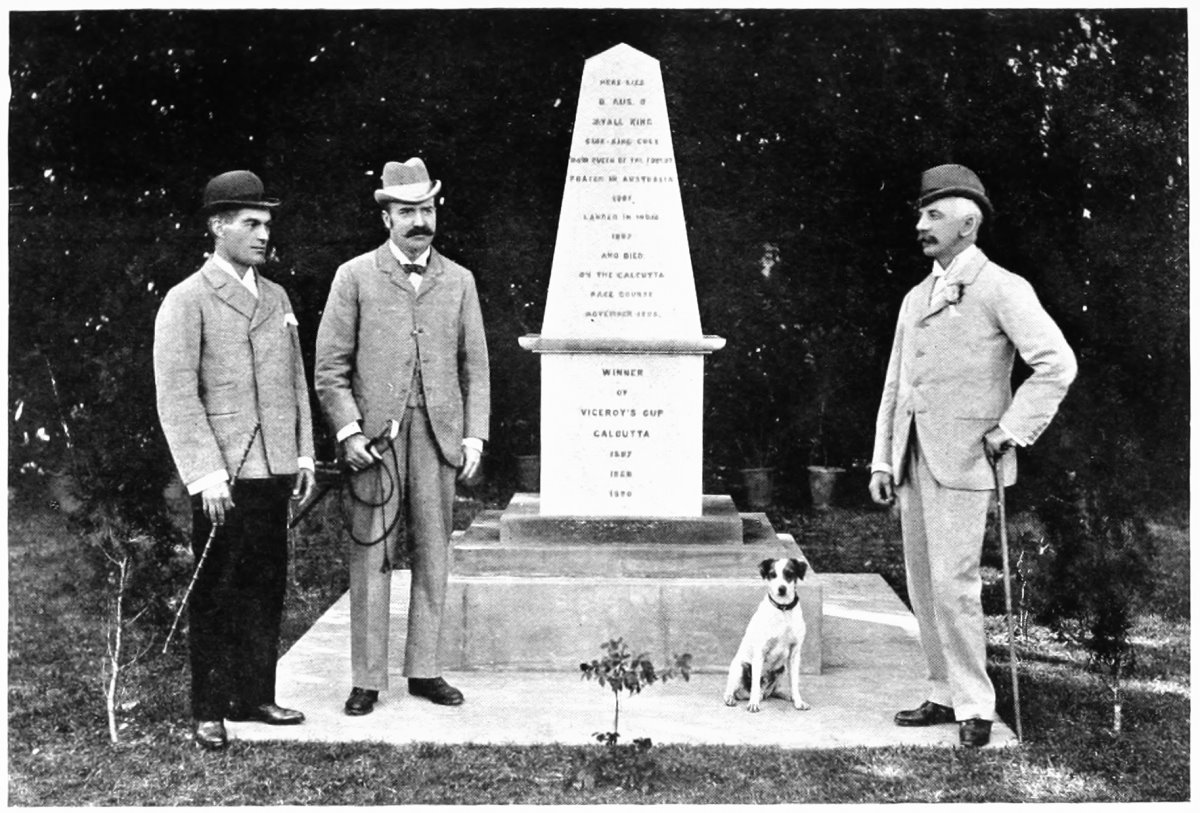
Photo. Bourne & Shepherd
Lord William now entered upon his last year’s
racing. He wanted to have an Irish finish, a good
gallop for the last, and he was not disappointed, for
he certainly won a prodigious number of races.
People opened their eyes and blinked when Willson,
Lord William’s trainer, reached Calcutta with a
truly formidable string, consisting of good old Myall
King, Flashlight, Tostig, Sprig o’ Myrtle, Kirstall, Ivo,
Westminster, Lady Grace, Caterina, Eider, Tabby,
Killatoe, Firstshot, Nectar, Mite, Negus, Labby,
Parvo, Lady Ethleen, Seabreeze, Puffball, Annie
Rooney, Release, FitzGeorge, Coochick and ever so
many more, surely he must have reached the height
of his ambitions in India; but alas! his pleasure in
his last year’s racing was damped by an accident to
his favourite Myall King while he was being schooled
over hurdles. It was noticed he was fencing rather
carelessly, whether he felt he had done his bit, and
ceased to be interested in the game, or whether he
did not feel well, it is hard to tell, but it ended in his
coming to grief and breaking his leg. Lord William
was much upset, for Myall King had played the
game so handsomely for him. He ordered a monument
to be erected to the horse’s memory at Barrackpore,
of which I give a photograph. Lord
William is standing on the right side with his little
fox terrier, Willson the trainer stands on the left,
and Vinall near him. The picture of Lord William
is not the least like him. I think it has suffered in
the touching up process through which I understand
they have to go, but the photo is of interest.
Many people who had admired the poor old horse
felt sad when they heard he had met his death on the
racecourse where he had won so many races. The
poor beast had of course to be put out of his pain.
The Indian Planters Gazette felt it so strongly it
broke into song, as follows:—
Myall King has been shot, ran the pitiful story,
We heard in Calcutta on last Tuesday eve;
But that such a sad ending had come to his glory,
We listeners indeed found it hard to believe.
Fling open the gates of the equine Valhalla
While the notes of his requiem mournfully ring,
Staunchest of thoroughbreds, best of Australians,
Champion of India, brave Myall King.
Yet, if there’s a future for men and for horses,
Perhaps our old hero we once more may see,
Grazing free on sweet clover in meadows celestial,
Happy as sportsmen all wish him to be.
The following shows at a glance the horse’s performances:—
Myall King, by King Cob—Queen of the Forest
|
|
Weights. |
Distance. |
Time. |
| 1887, Dec. |
Calcutta Viceroy’s Cup |
8.8 |
1¾ m. |
3 m. 9½ s. |
|
Durbangah Cup |
9.0 |
1 m. 6 f. |
3 m. 20½ s. |
|
|
|
132 yds. |
|
| 1888, Feb. |
Lucknow Stewards’ Purse |
10.3 |
2 m. |
3 m. 41 s. |
| 1888, Dec. |
Calcutta Viceroy’s Cup |
9.0 |
1¾ m. |
3 m. 7½ s. |
| 1890, Dec. |
Calcutta Viceroy’s Cup |
9.0 |
1¾ m. |
3 m. 8 s. |
| 1891, Feb. |
Lucknow Stewards’ Purse |
9.7 |
1½ m. |
2 m. 41 s. |
| 1891, Dec. |
Calcutta Viceroy’s Cup |
— |
— |
Ran third |
| 1892, — |
Hyderabad Gold Cup |
9.7 |
2 m. |
— |
Misfortunes seldom come singly. Another catastrophe
occurred almost directly after Myall King’s,
that useful pony Edith fell at the same place, putting
her shoulder out, so of course she could race no more.
On December 2nd, at the first Extra Calcutta
Meeting, Release ran a dead-heat with Mr. Apcar’s
Sapper in the Pony Plate, which was unsatisfactory
to both. At the second Extra Meeting Ivo won the
Fort Stakes, First Shot, looking splendid, won the
Pony Trials, and Westminster the Maiden Horse
Stakes. Prince Imperial the Hastings Plate Hurdles.
Then came the eventful Cup Day. Excitement
had been great for some time and now grew intense.
Many people thought the Maharajah of Kooch Behar’s
Highborn was certain to win, though in the opinion
of some he was a trifle overtrained. Lord William
also had plenty of backers.
As the horses cantered past to the post, Highborn
certainly did look tired and a little stale, while Tostig,
Lord William’s horse, or I should say the Confederacy
horse, was looking very fit. They both got
away well, and Vinall kept his charge going from the
first, hoping to reduce his field a bit; he kept the
lead until the last turn for home, when it was observed
Highborn was creeping up, though pale blue
and black cap was still leading. Presently Trahan,
who was riding Highborn, threw up his arm and
began riding for a finish. This made the crowd shout
out, “Highborn’s beaten, Highborn’s done,” and
the field thought all was over but the shouting, and
Lord William would be victorious. Both jockeys
now meant business; both were riding every inch
resolutely, but in spite of Vinall’s best endeavours,
the black landed his head well in front as he passed
the winning post, conqueror by a length.
The sporting Maharajah of Kooch Behar, who was
very popular, received endless congratulations, and
none more hearty than from his old friend Lord
William. Most people had hoped that being his
lordship’s last year’s racing he would again win the
cup and retire victorious, but the stable had to console
itself with Negus winning the Eastern Pony
Stakes, and Eider the Walter Locke Cup.
The big plum of the third day Parvo secured, on
the fourth day Lady Ethleen ran a dead-heat for the
Lilliputians, and Negus the Pony Handicap, and so
ended Lord William’s last season’s racing in Calcutta.
On Saturday evening, the 30th of December, 1893,
a farewell dinner was given to Lord William by a
large number of his friends in the Calcutta Town
Hall, prior to his departure from India, where he had
spent, as he himself said, “The best years of his
life.”
The hall was decorated with flags and draperies
in Lord William’s racing colours, the lances of the
Viceroy’s Body Guard arranged round the massive
pillars of the hall, the general effect being distinctly
pretty.
Mr. Charles H. Moore, one of Lord William’s oldest
friends, occupied the chair, and it is thanks to his
courtesy I am able to produce the facsimile of the
signatures of the guests at that memorable feast, also
his speech in proposing the guest of the evening my
readers will see is both eloquent and earnest, and
my friends tell me the delivery was most impressive,
calling forth an enthusiasm rarely witnessed on such
occasions.
Lord William was, I know, greatly touched, and his
reply was spoken with much feeling and heartfelt
appreciation for his kindly reception.
Lord William sat on Mr. Moore’s right, the two
next chairs being occupied by Mr. Justice Macpherson
and the Hon. General Brackenbury, while on the
chairman’s left were Admiral Kennedy and Lord
Brassey. The band of the Rifle Brigade played
during the evening.
The following is a list of those present:—
Abbott, Mr. H. E.; Agnew, Capt. Q.; Agnew,
Mr. H. de C.; Alexander, Mr. R.; Allason, Major;
Allan, Mr. J. J.; Anderson, Mr. A. S.; Anderson,
Mr. G. G.; Apcar, Mr. J. G.; Apostolides, Mr. E. C.;
Althorp, Capt. K.; Arbuthnot, Mr. J.; Ardagh,
Col. J. C., C.I.E.; Arthur, Mr. A.; Barclay, Mr. P.
D.; Barlow, Mr. R.; Barnes, Mr. F. C.; Bates,
Mr. R. G.; Beaver, Col. P. K. L.; Beresford, Mr.
W. M.; Beverley, the Hon. Mr. Justice, C.S.; Bignell,
Mr. R.; Boteler, Mr. R.; Bourdillon, the Hon.
J. A., C.S.; Brackenbury, the Hon. Lieut.-General
H., C.B.; Bradshaw, Surgeon-Major-General;
Brassey, the Right Hon. the Lord; Brasier-Creagh,
Capt., A.D.C.; Brock, Mr. C.; Brooke, Mr. W. R.,
C.I.E.; Buck, Sir E., C.I.E.; Buckland, Mr. C. E.,
C.S.; Butler, Mr. A. L.; Bythell, Capt.; Campbell,
Capt. I. M., D.S.O.; Campbell, Mr. Alec; Campbell,
Mr. H. P.; Chatterton, Col. F. W.; Chisholme,
Major J. J. Scott; Christopher, Major; Collen,
Major-General Sir E. H. H., K.C., I.E.; Cotton, the
Hon. H. J. S., C.S.I.; Creagh, Mr. B. P.; Croft, the
Hon. Sir A., K.C.I.E; Cubitt, Mr. J. E.; Cumberledge,
Mr. F, H.; Cuningham, Mr. W. J., C.S.I.;
Cunningham, Surgeon-Lieut.-Col. D. D.; Currie,
Capt. J.; Curzon, the Hon. Major M.; Dangerfield,
Mr. E.; Daniel, Mr. Linsay; Dickson, Mr. Geo.;
Dickson, Mr. J. G.; Dods, Mr. W.; Doran, Major
B. J. C.; Eddis, Mr. W. K.; Ellis, Col. S. R.;
Enter, Mr. K.; Evans, the Hon. Sir Griffith,
K.C.I.E.; Ezra, Mr. J. E. D.; Fenn, Surgeon-Col.
E. H., C.I.E.; Galbraith, Major-General W., C.B.;
Gambrie, Col. G. R.; Gamble, Mr. R. A.; Garraway,
Capt. C. W.; Garth, Mr. G. L.; Garth, Mr. W.;
Gladstone, Mr. A. S.; Gladstone, Mr. J. S.; Gough,
Capt. C. H. H.; Gough, Mr. G.; Gregory, Mr. E. H.;
Gregson, Mr. C. B.; Grimston, Capt. R. E., A.D.C.;
Hadden, Mr. F. G.; Hamilton, Mr. F. S., C.S.; Hamilton,
Mr. L. B.; Harbord, Capt. the Hon. C.; Hart,
Mr. G. H. R.; Harvey, Surgeon-Col. R.; Henderson,
Mr. G. S.; Hensman, Mr. H.; Herbert, Capt.
L.; Hewett, Mr. J. P., C.S., C.I.E.; Hext, Capt. J.,
R.N., C.I.E.; Hills, Mr. A.; Hills, Mr. C. R.; Hodgson,
Mr. G. C.; Holmes, Mr. W., C.S.; Hope, Mr.
G. W.; Hunt, Col. J. L.; Irving, Mr. W. O. Bell;
James, Mr. S. Harvey, C.S.; Jardine, Sir William,
Bart.; Jarrett, Col. H. S.; Jenkins, Capt. A. E.;
Johnstone, Mr. C. Lawrie; Jourdain, Mr. C. B.;
Kennedy, H. E., Rear-Admiral George; King,
Brigade-Surgeon-Lieut.-Col. G., C.I.E.; King,
Mr. D. W.; Kirk, Mr. H. A.; Kooch Behar, H. H.
the Maharajah of, G.C.I.E.; Lambert, the Hon. Sir John,
K.C.I.E.; Lance, Brigadier-General F., C.B.; Latimer,
Mr. F. W.; Lethbridge, Brigade-Surgeon-Lieut.-Col.;
Lister, Capt. G. C., A.D.C.; Ludlow,
Col.; Lumsden, Mr. D. M.; Luson, Mr. H.; Lyall,
Mr. A. A.; Lyall the Hon. Mr. D. R., C.S.I., C.S.;
Lyall, Mr. R. A.; Mackensie, Mr. D. F.; Mackellor,
Mr. G. B.; Macleod, Mr. J. J.; Macnair, Mr. G. B.;
Macpherson, the Hon. Justice W., C.S.; Maitland,
Col.; McInnes, Mr. H. H.; McLeod, Mr. C. C.;
Mehta, Mr. R. D.; Miley, Col. J. A.; Mills, Mr. G.;
Milton, Lord, A.D.C.; Moore, Mr. C. H.; Muir, Mr.
A. K.; Muir, Sir John, Bart.; Myers, Mr. Dudley
B.; Norman, Mr. A. F.; Norris, the Hon. Justice,
Q.C.; Overend, Mr. T. B. G.; Paget, Mr. H. E. C.;
Paris, Mr. G. B.; Pattison, Mr. F. E.; Paul, Col.
St.; Peacock, Mr. F. B.; Perinan, Mr. F. W.;
Peterson, Mr. C. D.; Patrie, Mr. J. M.; Playfair,
the Hon. Mr. P.; Pollen, Capt. S. H., A.D.C.;
Prickett, Mr. L. G.; Prinsep, the Hon. Mr. Justice
H. T., C.S.; Pritchard, the Hon. Sir C., K.C.I.E.,
C.S.I.; Ralli, Mr. John A.; Ralli, Mr. T. D.; Rawlinson,
Mr. A. T.; Raye, Brigade-Surgeon D.;
Rodocanachi, Mr. J.; Ross, Mr. R. M.; Rustornjee,
Mr. H. M.; Sanders, Surgeon-Major R. C.;
Saunders, Mr. J. O’B.; Schiller, Mr. F. C.; Shakespeare,
Mr. F.; Simson, Mr. A.; Simson, Mr. A. F.;
Stedman, General E., C.B.; Steel, Mr. Robert;
Stewart, Mr. F. G.; Stewart, Mr. C. D.; Stewart,
Mr. J. L.; Stewart, Mr. J. R.; Stuart, Mr. Harry;
Targett, Mr. W. H.; Temple, Mr. G.; Thomas, Mr.
J. P.; Thomas, Mr. L. R.; Thomas, Mr. R. E. S.;
Thomas, Mr. W. L.; Thuillier, Col. H. R.; Toomay,
Mr. J. A.; Trail, Mr. T.; Tremearne, Mr. Shirley;
Turnbull, Mr. R., C.I.E.; Turner, Capt. J. G.;
Upton, Mr. R. L.; Vincent, Mr. Claude; Walker,
Major-General A.; Waller, Mr. R. R.; Ward, Mr.
G.; West, Mr. J. D.; Wilkins, Mr. C. A., C.S.;
Williams, Capt. G. A.
In rising to propose the health of the Viceroy and
Lady Lansdowne, Mr. Moore was very warmly
received. He said:—
“Gentlemen,—We have a rigid rule here to-night
to confine our speeches to two, but I must break it
so far as to ask you to drink to the health of the
Viceroy and Lady Lansdowne—(cheers). I am sure
I am interpreting your sentiments right in thinking
you will do it with enthusiasm. They have won the
hearts of us all, and their approaching departure
carries with it a feeling of actual personal loss
arising from the affection and esteem they have so
universally inspired; he, because he is straight,
loyal and true, and she, because in every respect she
is perfectly charming.”
“The toast was drunk with the greatest enthusiasm,
the whole company standing,” to quote the
words from the account given to me.
After a brief interval the Chairman again rose, his
rising being the signal for prolonged cheering. He
said:—
“Gentlemen,—I first knew Bill Beresford over
thirty years ago in the playing fields of Eton, where
they say battles are won, to the inspiration of which
thought we may both trust to fight against the
extreme nervousness our respective positions entail
on us to-night. His nervousness needs no apology,
as he has to respond to a whole evening in his honour,
which nobody could face with perfect equanimity.
Mine perhaps requires this explanation, that in
assuming my duty, which is to now call a toast to
his name, and bid him farewell on behalf of this
large company, I find it difficult to do so in appropriate
terms, lest I be charged with personal bias
from my well-known feelings for him of affectionate
friendship and regard—(cheers). I have been
selected for this task which, for this reason, I would
rather have deputed to some other, because amongst
Calcutta residents proper (and this dinner is meant
to bear a Calcutta complexion) I have known him
longer than most, if not than all of you. This qualification
I claim with pride. I beg you however to
believe I mean to be impartial in the few remarks
regarding his career which I now make—(cheers).
“I must not date back too far, so I leave Eton
days and get straight to India, where his main career
has been spent, and with distinction—(cheers)—for
it is with that portion of his life that this company
is chiefly concerned. What fortunate accident
brought him here I do not quite know, unless it was
the natural termination of the short life and a merry
one dear to youthful soldiers in the old country, but
having arrived here eighteen years ago, here he has
remained, and I would briefly recall to you the
various phases in which he has appeared before us.
I think I can best cut him into four—(laughter and
cheers)—the soldier, the official, the sportsman, and
the social companion—(cheers).
“As soldier I cannot speak of him from personal
knowledge. I have the satisfaction of being a
member of society who, when war is abroad, is
entitled to seclude himself from its ranks—(laughter)—but
it is a consolation to feel that a good plucked
one, like our friend Bill, is to the fore to protect me—(hear,
hear, and laughter). I recollect I first saw
him as a soldier, gay and dapper, in 9th Lancers
uniform, brown hair, sufficient of it, and a straight
nose—(laughter)—escorting the Prince of Wales
from Prinseps Ghât to Government House, but this
is only the show side of a soldier’s life. For its realistic
side one must go further afield, and there are
those amongst us from whom no doubt I could glean
facts to set forth his worth, but there is no need. He
bears on his breast the sign manual of merit in the
proud insignia of the Victoria Cross, and I am justified
in accepting that as sufficient evidence—(loud
and prolonged cheers).
“As official, we have all known him best
as Military Secretary to the Viceroy of India. He
has (after six years’ service as A.D.C. to Lords Northbrook
and Lytton) held the post for twelve years
under three successive Viceroys; has raised the
office to a science, and himself from an official into
an institution—(cheers)—acquired a reputation
absolutely unique, and so identified himself with the
position that when a new Viceroy is appointed it
seems more natural to ask who is to be his ‘Bill
Beresford’ than his ‘Military Secretary’—(cheers
and laughter)—and when it is Bill himself the Viceroy
elect has secured, what is of great value, the same
capacity and undeviating loyalty enjoyed by his
predecessor—(cheers). In all this I need not rely
upon my own judgment, for it is proved a hundred-fold
in the fact that he has been the choice and
acquired the confidence and esteem of successive
men of high intellect and such different characters
as Lords Ripon, Dufferin and Lansdowne—(cheers).
More than that I understand his worth has been
recognised by a power higher even than a Viceroy’s,
and testified to by his elevation to a Knighthood in
the Order of the Indian Empire, of which he is
already a member—(loud and continued cheering).
I knew that would elicit the hearty congratulations
of you all, and I am glad we are the first to offer
them.
“In the social part of his duties, his capacity
extends to, and is felt by all of us, for the influence
of the Chief of the Staff is visible in every detail of
the social functions and hospitality of Government
House. I can assure him we not only know it, but
appreciate very warmly the advantages we have
derived from it. He has won all this by sheer force
of character, and we find it hard to realise he is really
giving up.
“As sportsman, I can best sum him up in the
current colloquialism that he is absolutely undefeated—(loud
and continued cheers). His stable
of racehorses has been for years the chief mainstay
of Calcutta racing; in all weathers and all vicissitudes
of fortune he is to the fore, full of pluck, always
has horses to run or to back, buys freely, and is
generally a dispensation of Providence to stewards,
being a staunch supporter of ruling powers and
frequent offers of useful advice born of long experience.
His most remarkable virtue to my mind
is his exuberant cheerfulness even when luck is
against him—(cheers). I never met a better loser,
and it means possession of a combination of enviable
qualities rarely met with. I have known his career
on the turf for over twenty years, and to speak of
him as I know him he has throughout raced like an
honest English gentleman. As you all know, he is a
splendid whip, and was a first-class performer over
jumps, especially on difficult horses, until he ended
his career to that game, and it was then that he
spoilt the shape of the nose I before alluded to—(much
laughter and cheers).
“As social companion, I suppose nobody amongst
us has ever had such a large circle of appreciative
acquaintance in circles from the highest to the
lowest, male and female—(laughter and cheers)—and
if I may venture to say it without exhibition of
bias, his popularity is due to his inexhaustible fund
of high spirits, ready sympathy, love for hosts of
friends, open-handed generosity—(cheers)—admiration
of beauty, his merry Irish wit, and infinite
capacity of loyal attachment to his pals—(continued
cheers).
“That concludes my dissection of his personality,
which the patient has borne heroically, and I now
put him together again as one piece—(laughter).
“I do not think any man in this room is intuitively
more modest in the estimate of his own
merits than my dear friend Bill—(hear, hear, and
cheers). I know his impulse will be to attribute my
praise to my kindly feelings towards him. I anticipate
him by replying that 180 people have met here
to do him honour—(loud and prolonged cheers)—that
residents in India are not given to spasmodic
ebullitions of enthusiasm, nor to be influenced by a
passing breath of popular favour. Their whole trend
of mind is in the opposite direction; they are more
prone to indifference generally, and as regards individuals
to apathy, and when such a goodly company
as this assembles to bid good-bye to one member of
the community, it bears the practical significance
that he has made a noticeable mark and justifies
the general tenour of my remarks—(cheers).
“I ask him therefore to take that unction to his
soul in reflecting over this entertainment, and assure
him that when on behalf of all of us I now wish him
a very warm farewell, health and happiness in the
future, and add a hearty ‘God bless you, old chap,’
we mean we admire him, that we are his friends, intend
to remain so, and bitterly regret his departure
from amongst us—(loud and prolonged cheers).
“I have now to call a toast to him, Gentlemen, as
a typical soldier, a capable official, an undefeated
sportsman, a prince of good fellows, and a man of
mark amongst us.”
The toast was drunk with enthusiastic cheers, the
band playing “For he’s a jolly good fellow” and
“Auld Lang Syne,” in both of which the whole company
joined in singing the chorus.
Lord William Beresford stood up to reply, and
after the hearty round of cheering with which his
rising was greeted had subsided, spoke as follows:—
“Mr. Chairman and Gentlemen,—Before I attempt
to reply to the speech in which your Chairman
has praised me much more than I deserve—(No,
no)—I must ask you to notice that even the old
schoolfellow and friend he is, he is unable to bring
it to my charge that I am orator, and I must own I
feel at a great disadvantage in this respect compared
with him, and if the few words which I have
risen to say seem to any of you to fall short of what
they should, believe me that it is not because they
are not spoken from the heart—(hear, hear, and
cheers)—but because of my inability to give expression
to what I feel, and surely it would be no reproach
to anyone if at a time like this he found it very
difficult, if not almost impossible, to thank you in
adequate terms, not only for the manner in which
you have accepted and endorsed the altogether
flattering description that Mr. Moore has given of
me and of my career in India, but also for the feelings
of good fellowship which prompted you to ask me
to be your guest here to-night—(cheers).
“I can imagine no greater honour than to find
myself at the close of one’s sojourn in India invited
by 180 of one’s fellow-countrymen in Calcutta to a
social meeting like that of to-night—(cheers). The
invitation came to me as a most complete, unexpected
and most gratifying surprise, and will, I
assure you all, add to the brightest and happiest
recollections of my last weeks in India—(hear, hear,
and cheers)—which must, alas! of necessity contain
far more of pain than pleasure in them, for no one
can cut himself off finally from a country in which he
has been employed for eighteen years, and those the
best of his life, in which he has made most of his best
friends, and mixed as I have tried to do in all its
sport and pastimes, without feeling a shock in doing
so—(cheers).
“Gentlemen, Mr. Moore says he does not quite
know what brought me out to India, and as I, to use
his own expression, have appeared before you in four
various phases, first of which he puts as soldier, I
think this is a good opportunity of telling you that
it was in the capacity of a subaltern in the 9th
Lancers that I came out to this country, and he is
quite right in saying that it was in that uniform I
first appeared in Calcutta, as extra A.D.C. on Lord
Northbrook’s staff, leading the cortège of His Royal
Highness the Prince of Wales from Prinseps Ghât
to Government House.
“I regret that the abundance of brown locks to
which he refers no longer remain, but is replaced by
a scanty silver fringe—(laughter and cheers).
“With regard to the allusion he made to the
straightness of the nose—(laughter)—that he recollects
on that occasion, he is not quite correct, and
there is a gentleman (Mr. J. J. Allan) among my
hosts here to-night that can testify to the fact that,
owing to a slight disagreement he and I had many
years ago, not actually in the playing fields of Eton,
but close by, he made a little arrangement that prevented
the particular nose referred to being worn
straight by its wearer for the rest of his life—(laughter
and cheers)—this particular battle was not won by
either, as it was acknowledged to be a draw, and I
am glad to tell you the two combatants have been
the very best of friends ever since—(hear, hear, and
cheers).
“When I came out with the 9th, the greatest aim
and object of my life was, some day in the future,
to get command of that regiment, but force of circumstances
prevented these wishes being gratified, and
I elected, whether for better or worse I cannot say,
to remain as Military Secretary with the Viceroy of
India, in preference to going back as second in command
of my old regiment, and thus closing promotion
which I was bound to get by remaining on in
my post out here. I am sorry to say, therefore, that
it is years since I have done any soldiering, and it is
a great regret to me on leaving this country that I
cannot return to the dear old regiment in which I
began my service.
“The next section into which Mr. Moore has
placed me is the official one, and with regard to it I
may say how fortunate I have been in having served
under five such masters. It is not for me to make
comparisons, or to refer to their respective policies,
but I may be permitted to say, which I do from the
bottom of my heart, that from one and all I invariably
received the greatest kindness, and if I have
succeeded in pleasing them, I am fully recompensed
for any trouble I may have taken in the performance
of my various duties; but, Gentlemen, I am afraid
that at times the Military Secretary’s duty necessitates
his doing things which may be displeasing to
those who are affected. In such cases I can only say
that I have endeavoured to do my duty to the best
of my lights, and if I have at any time hurt anyone’s
feelings in such matters, I have done so most unwillingly
and to my great regret, and I should like to
take this opportunity of stating how much indebted
I am to all the different departments that I have had
to deal with for the help, advice, and support that I
have always received on all sides, and thanks to
which my official work has been made comparatively
easy—(cheers)—and when in a few weeks now I
hand over the reins of my office to my successor, the
best and kindest wish I can desire for his welfare is
that he may be as ably supported and leniently
dealt with as I have been—(hear, hear, and cheers).
I think he starts his career under very favourable
circumstances, having formerly served his apprenticeship
on the Viceroy’s staff, and has thus become
thoroughly conversant with all the details of that
staff. He (Colonel Durand) is a real good soldier;
most popular with everybody who knows him—(cheers)—and
I only hope when the time comes for
him to have finished his turn of office as Military
Secretary he will be able to look back to as many
happy days and warm friendships made as I can—(cheers).
“The third section to which the Chairman referred
was the sportsman section, and believe me,
I am very proud indeed to have such a title attached
to my name, but I am afraid I can no longer claim
to be the sportsman I used to be owing to a variety
of accidents between the flags, on the polo ground,
and in pursuit of pig and paper, but still I cling to
sports of all sorts as much as circumstances will
permit me to do. I have tried all that are offered to
us in India, and I think that many of my hosts to-night
will support me in saying that pig-sticking
takes first place—(hear, hear, and cheers). I certainly
must own I have derived more pleasure from
this than either tiger shooting, racing, or anything
else I tried. Certainly I was extremely fortunate
when I first came to India and tried my hand at the
spear to have the advice and guidance of that acknowledged
prince of pig-stickers, who I am proud
to see has honoured me to-night with his presence,
Archie Hills, of Patkahari—(loud and continued
cheers). It was he who led the dance of our party
the first time I ever rode after pig; he told me how
to hold my spear and use it, and the best day’s pig-sticking
I ever saw in my life was afforded by him
at his own place, when we accounted before tiffin for
seventeen boars, three cut horses, and a collar-bone
broken—(cheers and laughter).
“With regard to racing, I have indeed had my
full share of the plums, and it is a pleasant thing to
look back on the record of my stable, which amongst
other things can count six Viceroy’s Cups—(cheers)—three
of which are credited to old Myall King—(cheers)—who,
alas! died on the course little over
a month ago—besides two Kooch Behar Cups, two
Durbangah Cups, three Civil Service Cups, and five
Grand Military Steeplechases, of which I was fortunate
enough to pilot the winner myself—(loud
cheers)—and at one time or another most of the
biggest races in India.
“In this my last year I was indeed pleased to be
connected with the severe tussle for the Viceroy’s
Cup, inasmuch as Tostig, who made such a good
fight for it, was imported by me, and was till quite
recently my property—(cheers)—and as His Highness
the Maharajah of Patiala was not fortunate
enough to win on this occasion, he and I—believe
me I am quoting his feelings as well as my own—were
compensated to a great extent by the fact that
the much-coveted prize was won by one of my
greatest supporters of the Indian turf—(loud and
continued cheers)—who struggled for many years
with crushing bad luck, but stayed the course, and
eventually has been rewarded for his pluck by
having won the Viceroy’s Cups two years in succession,
and all the other big races this season—(continued
cheers). I may add that I hope he may live
for many years and carry off in the future several
more prizes of the Indian turf, and though His Highness
the Maharajah of Patiala has not yet won this
most coveted prize, which, by the way, is no fault
of his own, he has spared no expense in trying to get
together the best horses money can buy—(hear,
hear)—and has done all that a sportsman could do
to become a recipient of the Viceroy’s Cup, but
though Dame Fortune seems up to the present to
frown upon his endeavours in this particular direction,
I prophesy that his time will come when his
wishes will be gratified, and nobody wishes him this
success more than myself—(cheers). He, at any
rate, can congratulate himself at this moment on
possessing the best horse in India, of which there
can be no doubt, as our best authority out here has
declared officially that Sprig o’ Myrtle is at weight
for age and class, 8 lbs. in front of the invincible
Highborn at a mile and three quarters, and I
only hope that authority is correct in his estimation
of this son of Trenton—(much laughter and
cheers).
“I am sorry to say I have been obliged to give up
the game of polo, but I still have a sneaking regard
for the pursuit of paper—(cheers)—and I hope, with
the kind assistance of our Honorary Secretary, we
shall have some very pleasant paper-chases this my
last cold weather among you—(hear, hear).
“Now, Gentlemen, I have come to the last phase
or section referred to, namely, that of social companion,
and on this head I can say nothing. It is
needless for me to do so as your presence here to-night
fully justifies the many nice things the Chairman
has said about me. He is, as you doubtless
know, one of my oldest friends; he has known me
longer almost than anybody present, and has always,
whether in weal or woe, extended the hand of true
friendship and hospitality to me ever since I first
came to Calcutta in 1875—(loud cheers).
“Before I sit down, I must again thank you one
and all for the splendid reception you have given
me this evening, and for the very kind manner in
which my friends have rallied round me to-night
and drunk my health, and I heartily wish to all of
you the warm farewell you have wished to me.”
Lord William resumed his seat amid loud cheers,
which were continued for some time.
Signatures recorded at the farewell dinner to
Lord William Beresford are reproduced here.
SIGNATURES OF THE
GUESTS PRESENT AT THE
CALCUTTA BANQUET.
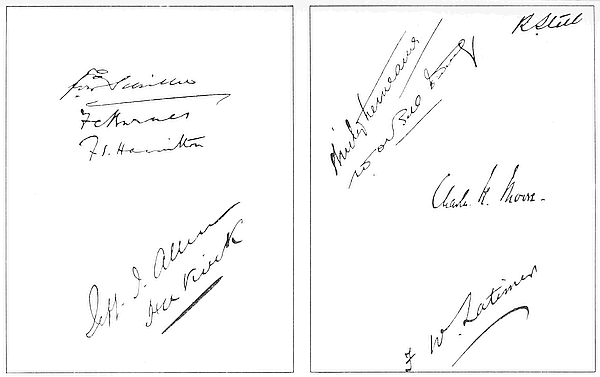
(several signatures; page 1 of 10)
Having bid farewell to Calcutta, on his way down
country, Lord Bill managed to stay at Lucknow to
see his horses run for the last time in India. Good
old Lucknow, where he had run many races and had
some glorious times.
To send him away feeling happy his Mite won the
Civil Service Cup and pots of money; also another
race the same day, namely, the Chutter Munzil
Purse; Vixen won the Horse Handicap on the
third day; Negus won the Derby on the fourth day.
After this Lord William made his final bow to India.
First Visit to the Deepdene—Finds a Relation in His Bedroom—Engagement
to be Married Announced—School Treats—One
New Year’s Morning—King Edward VII Visits the Deepdene
When Prince of Wales—A Narrow Escape—“Tommy, Where Are
You?”—Why Lord William wore a Turban—Fast Trotters
and Their Doings—Mishap on the Way to the Derby—Racing
in England—Racing Geography—Another Racing Partnership—Accident
While Hunting—Mr. Palmer to the Rescue—Lord
William Tells a Story Against Himself—A Son Born.
We now enter on the short third volume
of Lord William’s life. He landed in
England during the spring of 1894,
bringing with him various faithful retainers, also
some favourite horses and ponies. In June of that
year he paid his first visit to the Deepdene, Dorking,
as a guest of Lily Duchess of Marlborough, having
been invited at Lady Sarah Wilson’s suggestion to
make up a party for Ascot races.
It will be remembered that Lady Sarah was a
sister of the 8th Duke of Marlborough, whose widow
was renting the Deepdene.
Lord William was amused to find in his bachelor
bedroom a print of one of his relations, namely,
Lord Marcus Gervais Beresford, Archbishop of
Armagh, Lord Primate of Ireland, whose eldest son
married Mary Annabella, sister of Sir William Vernon
Harcourt, who was first cousin to the author’s
mother; Sir William’s mother and author’s grandfather
being brother and sister (vide Burke, Gooch-Vernon
Harcourt); the author’s mother having
been Miss Mary Teresa Gooch, daughter of the Rev.
William Gooch, Canon of York; she having married
Robert Calverly Bewicke-Bewicke, B.A., J.P., D.L.,
of Coulby Manor, Yorkshire.
It is interesting to note Lord William’s father
married his beautiful wife while on a visit to this
self-same gentleman looking down from the walls of
the Deepdene.
In September Lord William returned to India for
a few months to attend to some business and racing
matters, after which he announced his engagement
to Lily Duchess of Marlborough, which came as a
surprise to most people. In India he was gradually
becoming regarded as a confirmed bachelor, though
it seemed incredible that anyone who was such an
admirer of the fair sex and who was equally admired
by them in return should be able to escape; indeed,
his having escaped is only one more proof of his cool
head and ability.
It was not a long engagement, April 30th, 1895,
was chosen for the wedding; when Lilian Warren,
daughter of Cicero Price, Commodore of the U.S.
Navy, married Lord William Beresford as her third
husband, the first having been Mr. Louis Hammersley
of New York, an exceedingly wealthy man who left
his wife a large fortune. Secondly, she married the
8th Duke of Marlborough, who died in 1892, but
not before the Duchess’s fortune had done much for
Blenheim Palace.
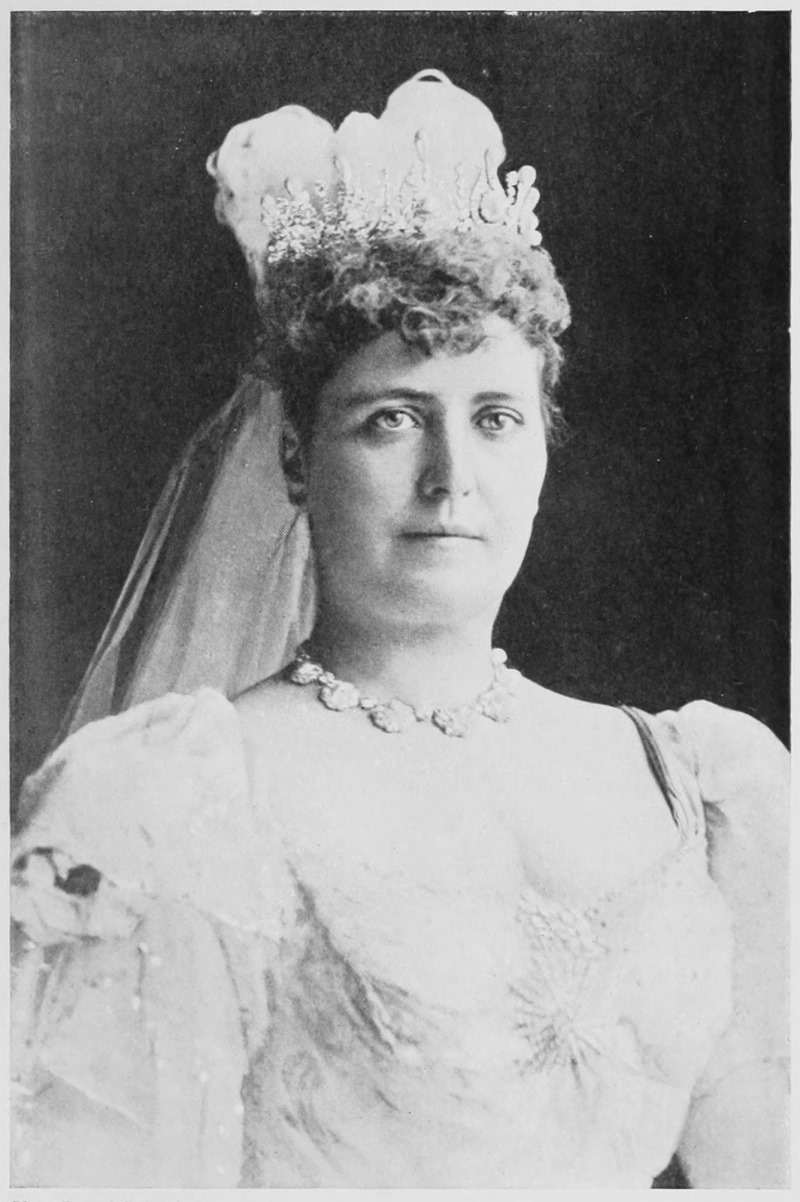
Photo. Russell, Baker Street
LILY, DUCHESS OF MARLBOROUGH
Lord William and his bride made their vows at the
Church of St. George’s, Hanover Square, witnessed
by crowds of friends. The bridegroom was supported
by his younger brother, Lord Marcus, as best man.
Her Grace was given away by her stepson the 9th
Duke of Marlborough.
The Church was charmingly decorated with lilies
of all sorts, a pretty compliment to the bride’s name.
The Duke of Cambridge sat beside Lord William
and the United States Ambassador and Mrs. Bayard
beside the bride. When the service was over Lord
and Lady William Beresford drove to the bride’s
house in Carlton House Terrace, where they received
the congratulations of their many friends, all of
whom did justice to the good things provided for
them.
Later in the day the bride and bridegroom left
the town for the Deepdene, that lovely place being
rented from Lord Francis Hope. It stands on the
eastern side of the old coaching road near Dorking.
On the north the London, Brighton and South
Coast Railway winds. The grounds around the house
are amongst the most beautiful in England, when
the rhododendrons are in flower the gardens and
grounds are a blaze of colour and a delight. It is
charmingly secluded and yet near enough to the
world to easily see as much of it as might be desired.
It was here, I believe, that Beaconsfield wrote his
Coningsby.
The original house was built in Charles I’s reign by
the Hon. Charles Howard, son of the Duke of Norfolk,
but it was pulled down and rebuilt by a descendant
and eventually sold to a Mr. Hope, a very rich art
collector, whose daughter married the late Duke of
Newcastle, and at her death the Deepdene became
the property of Lord Francis Pelham-Clinton, a
grandson of the Duke’s, who took the name of Hope
on succeeding to the estate; he leased the place to
Lily Duchess of Marlborough for twenty-one years,
and it was there the last few years of Lord William’s
life were mostly spent.
It seems a strange coincidence that Lord William’s
wife should have lived five years with her first
husband, five years with the second and five years
with the third!
It was a great pleasure to Lord William fixing up
all his trophies and treasures in their permanent
home. The dining-room, the billiard-room, the
front hall and indeed every nook and corner were
filled with them, all having interesting histories of
their own.
An arcade runs round three sides of the lofty hall,
above this there is a gallery where guns, spears,
assegais, antlers, racing cups, and beautiful inlaid
vases are arranged in profusion. Also regimental
trophies, of which he was fond and proud, for he
loved his old regiment.
In the billiard-room there are many masterpieces
of great value, also in one corner stands a small easel
in which reposes a picture entitled “Bill wins,”
below is an inscription, explaining the scene at
Curraghmore Steeplechases on April 30th, 1874,
his wedding having taken place exactly twenty-one
years after on April 30th, 1895.
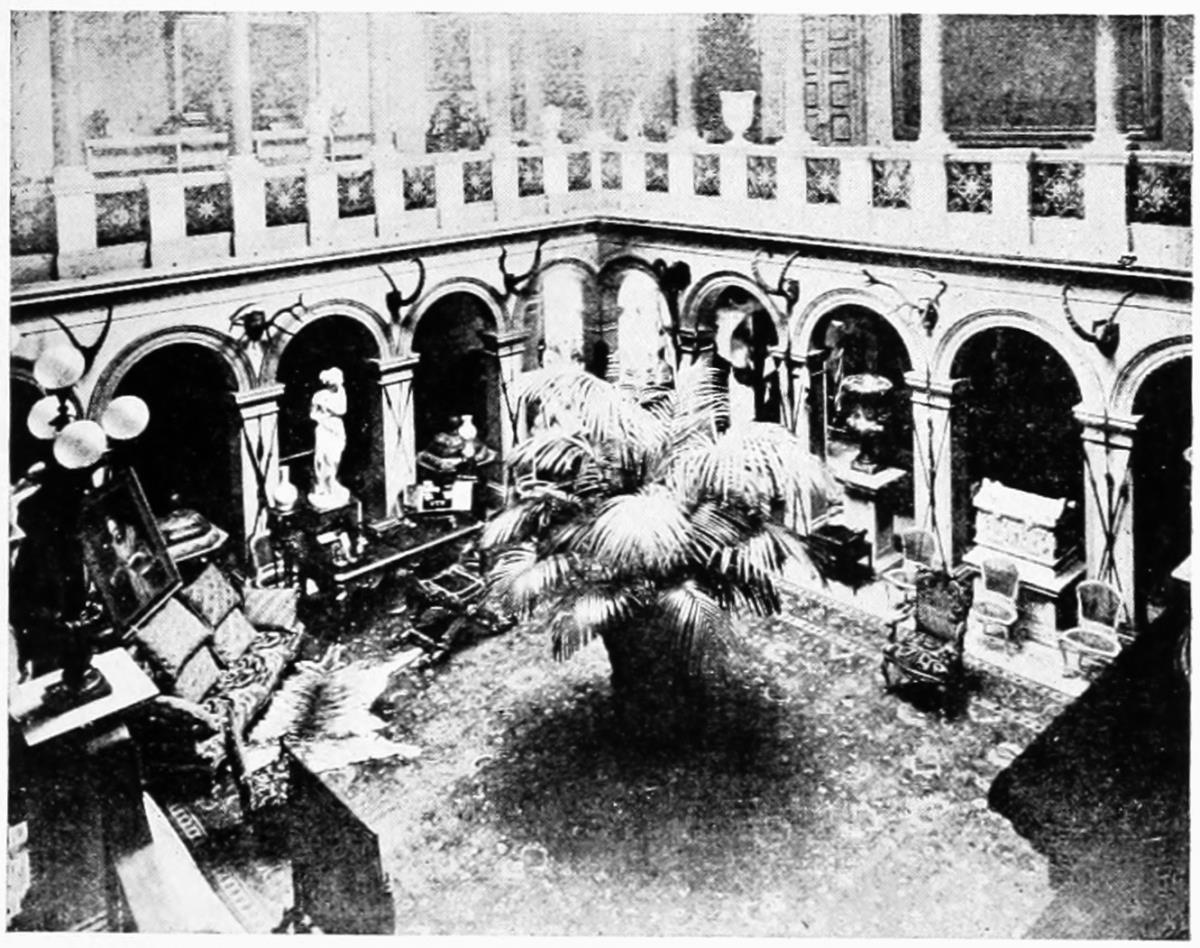
FRONT HALL AT THE DEEPDENE
One of the ambitions of Lord William’s life was
to win the Derby, and he began looking about him
for likely winners; it did not take him long to collect
some useful horses, though I doubt very much if his
racing in England ever gave him as much pleasure
as it did in India. His wife was most interested in
his horses and was as anxious as he was that he should
own the best. She was a kind-hearted woman who
did a great deal for the comfort and happiness of all
around her, the poor of Dorking are not likely to
forget her or her husband, for they closely associated
themselves with all the local charities and philanthropic
undertakings.
Nothing pleased Lord William better than to have
a house full of people; he loved to have some of the
old 9th with him. It had been hoped when he
settled down to home-life he would take things more
easily, but he still continued to cram two or three
days’ work into one, just as he did in India, he had
not yet found a day quite long enough for all he
wanted to do.
On his birthday he always gave all the Dorking
school children a treat in the park at Deepdene,
entertaining about 1800 of all denominations, and
surely no children were ever so entertained before,
no expense was spared that would add to their
pleasure, and he always took part in the proceedings
himself, which added much to the children’s pleasure,
while, I believe, he enjoyed it himself thoroughly; he
loved to see children happy and hear them laugh.
He arranged their races, threw bags full of pennies
to be scrambled for, taking particular notice of any
child, girl or boy, who after striving was not strong
enough to capture any pence amongst the hustling
crowd of eager bairns, these he used to reward with
pennies privately; he said he could not bear the
look of disappointment on their faces when time
after time they failed.
Lord William never imagined he could be imposed
upon, with the exception perhaps of a certain section
of the racing fraternity, but children managed to do
it fairly successfully sometimes.
One New Year’s morning, for instance, he had
asked Mr. Palmer, who attended to all his wife’s
business when she was Duchess of Marlborough
(and afterwards to the time of her death) to breakfast
with him at nine o’clock. Arriving at the Deepdene
and finding his lordship had not finished dressing
he went to his room to talk to him until his toilet
was completed. On entering he found Lord William
with the French windows open and a small crowd
of children standing outside uttering the time
hallowed, “Wish you a happy New Year, sir,”
while the recipient of those kindly wishes was throwing
occasional shillings and sixpences to the expectant
little crowd. Mr. Palmer watched for a
short time and then said, “Well, these kiddies are
getting the best of you.” “How?” asked Lord
William. “Why,” said Mr. Palmer, “in the first
place, they go away and bring others, and in the
second, some of them have been up, gone, and come
back again without your noticing it, possibly may
have been two or three times.” “Oh, no!” replied
Lord William, but he turned to one group who were
very fervent in their wishes for his happiness and
asked, “How many times have you been here this
morning?” The reply came, “Only twice, sir,”
without a moment’s hesitation. He then turned to a
group of three boys, one somewhat older than the
other two, and said to the biggest, “If I give you a
shilling, how will you divide it among the three of
you?” The boy considered for a moment and then
replied, “I would keep sixpence myself and give the
other sixpence to the other two.”
Lord William foretold a great career for this
specimen. While walking into the dining-room
Lord William said to Mr. Palmer, “I suppose some
of those kids have been too bright for me, but after
all what does it mean; I suppose I have given away
a fiver and with that fiver I have carried joy and
satisfaction to many a child’s heart, better so than
losing fifty to some bookie. In the one case I do get
something for my money, in the latter case nothing.”
In October, 1895, King Edward VII, then Prince
of Wales, stayed with the Beresfords at Deepdene,
others staying in the house at the time were the
Sassoons, Colonel Brabazon 10th Hussars, otherwise
known as “Beautiful Bwab” (he had some difficulty
with his r’s), Captain Holford, Lady Sarah Wilson
and Mr. Winston Churchill, also, I believe, Mr. Charles
Moore.
His Majesty enjoyed his visit. He was taken to see
the Home Farm where Lord William attended to
his business and where he kept all his horses except
his racing stud; they were at Epsom, under the
care of Mr. Willson, who came from India with Lord
William. The farm was a delightful sunny spot
and was occupied by Lord Bill’s head man and his
wife; occasionally his lordship had some cheery
bachelor parties there. The view was charming,
looking over Boxhill and the North Downs, sweeping
the valley towards Reigate and Bletchingley. It was
on these downs that Bishop Wilberforce met his
death in 1873; the church there is a memorial to
him.
Soon after his marriage, Lord William had one of
his many accidents while driving a fast trotter
named Hugh from Leatherhead. The only other
occupants being Lord Marcus and the groom Tommy
Ryan, who came from Curraghmore. The night
was very dark and wet, but they were thundering
along at a very fast pace when Hugh shied violently,
upsetting the whole caboodle. When they began
collecting themselves Tommy was missing, so his
master shouted out, “Tommy, where are you?”
From the other side of a wall came the answer,
“I’m here, my lord, on my head in a ditch.” The
brothers were much amused. Amongst other things
Lord Bill’s head was cut, obliging him to appear at
breakfast next morning with it bandaged up; his
mother who was staying there at the time asked
anxiously what was the matter, he wished to avoid
frightening her so told one of those useful white lies
which oil the wheels of life, saying quite coolly
that he always wore a turban on a certain anniversary
of some event in India! which quite satisfied his
mother.
A fast trotter or two for his buggy was considered
a necessity, and he brought his chestnut mare, Ilee,
from India with him, he said he could not part with
her, she had so often saved his life by her sagacity.
She apparently did not leave her wisdom behind her
in the East, for one night when for a wonder Lord Bill
was alone and driving her home in the dark, as he
turned into the lower drive at the Deepdene and she
was doing a little bit of her best, she suddenly stopped
dead, causing a bit of a splutter but probably saving
Lord William’s life, for, thinking he had returned,
the lodge keeper had put up the bar for the night
across the drive blocking ingress or egress without
his permission and knowledge.
Some of Lord William’s trotters did remarkable
things; Harry, another prodigy, he raced against a
train between two stations on the Brighton line, I
believe it was between Burford and Dorking, for a
bet, of course, and ended in a dead-heat! It used
to be quite a joke amongst the people of Dorking
when they heard one of the trotters thundering down
the road to shout out, “Clear the way for his lordship,”
all using their best endeavours to clear everything
out of his way. The Dorking people had taken
him to their hearts, and they were so proud of all his
feats and doings. It must be recognised more
indulgence and latitude was allowed to his lordship
than would be extended to everybody, but that is
just one of the remarkable things about him, everybody
succumbed to him, allowing licence that would
certainly not have been permitted to anybody else.
Piloteer, a handsome grey trotter, won many
prizes at Richmond, Dublin and other places. I am
able to give a good photo of him taken just after
winning one of his prizes. He was an Irish horse.
During 1896 there were various hairbreadth
escapes, without which I am sure Lord Bill would
have felt dull. While driving his coach from Ascot
to Bishopsgate when trying to pass some other
coaches the leaders stepped into a furze-bush and
then bolted; if history tells true the coach was upset,
but of that I cannot speak with certainty, but I do
know for certain that all in the coach were full of
praise for the wonderful driving which had enabled
them to escape unhurt. On the coach at the time
were Lord and Lady Marcus Beresford, that fine old
sportsman, Colonel Chaine, and his wife, Major
Braithwaite and Mrs. Featherstonhaugh.
Another mishap occurred once going to the Derby,
I think, if I remember rightly, when some of the
occupants were landed over a hedge into a field.
They were all men this time and one who was there
told me about it. I believe it happened when his
lordship was racing against young Mr. Fownes; at
least that is how the tale was told to me, but it was
long ago and I hope I am not taking anybody’s name
in vain.
Lord William’s coach was always one of the best
turned out and horsed at the Coaching and Four-in-hand
Club meets.
His first successful racing season after his return
to this country was 1896. He knew the business
thoroughly from A to Z, to which much of his success
was due, for it is no use anybody saying in a light-hearted
way “I am going to race,” expecting to do
wonderful things because they know the points of a
horse and have judged the jumping at local agricultural
shows; it not only spells disappointment,
but often financial disaster. No one unless they have
been behind the scenes or learnt by bitter experience
can form any idea of how much there is to know
before there is even a possibility of success. To begin
with, and it is a big beginning, there are the numerous
authorities which it is wise and advantageous to keep
in a pleasant frame of mind, and under no circumstances
bandy words with, or argue; fancy arguing
or bandying words with the Jockey Club for instance,
the National Hunt Committee, or the Turf Club of
Ireland; yet all have to be considered. Many are the
rules, regulations, and niceties in the way of etiquettes
requiring digestion, all an education in themselves.
I had not grasped until Lord William explained it
to me that according to the rules of racing geography,
Ireland, the Isle of Man, and the Channel Islands are
not included in the expression Great Britain, they
are only the United Kingdom.
Another perplexing thing when you see “owner”
in connection with a horse’s name you rather
naturally conclude the horse belongs to him, but as
a matter of fact it may mean almost anything, the
horse may only have been leased for his racing years,
or he may be shared by partners when presumably
only half the horse belongs to “Owner.” All of this
was of course A B C to Lord William, and he knew
every race, its dates and distances, stakes and
conditions by heart. He considered Newmarket the
best course in the world.
Liverpool is a terror; if any of my readers are
interested in steeplechasing and have not been over
the Aintree Course there, I advise them to walk
round and look at the jumps in cold blood, they will
wonder any horses or men can be found with pluck
enough to face them. No Beresford, as far as I know,
has ever yet seen his colours carried successfully in that
much coveted prize, the Grand National at Liverpool,
though Lord Marcus got fairly near once with
Chimney Sweep, when he ran second to Captain
Machell’s Reugny, ridden by that splendid amateur
Mr. J. Maunsell Richardson, in 1874, and again in
1879, when Jackal carried the light blue and black
cap, being beaten by Mr. Garry Moore on the Liberator.
A Liverpool which will possibly for ever bear the
unprecedented mark of four brothers, namely the
Beasleys, having mounts in the chase, and they all
made the course, “Tommy” Beasley coming home
behind Lord Marcus’s horse.
Some of the Irish courses are also formidable.
At the modern Leopardstown, for instance, where in
the past there has been plenty of grief. Punchestown
is not quite so bad; Irish horses do well there, they
understand the kind of jumps.
At the end of 1895, Lord William entered into
partnership with Mr. Pierre Lorillard, sharing a
number of race-horses with him, amongst the most
successful being Paris III, which was bought in 1896
from Mrs. White, who was I believe the widow of the
Hon. James White so successful in Australian racing.
The horse had raced in England in her name before
being purchased by Lord William, but had done
no good, directly he appeared in Lord William’s
colours he won the popular Northamptonshire Stakes,
value £925; now many years defunct. Five horses
ran, but Paris III won by six lengths; it was a
popular victory as he was favourite at 2 to 1. Cannon
was up and the horse carried 3 lbs. overweight,
nevertheless he won easily; he also won the Prince’s
Handicap at Gatwick as well as the Lewes Handicap.
Amongst other horses owned at this time were
Diakka, Myakka, Caiman, and Nonsuch, sold later to
the Prince of Wales, also Berzak, which latter was
a bitter disappointment, as he failed to stand his
preparation for the Derby.
The partnership did not last long, as the doctors
advised Mr. Lorillard to give up racing for a time,
but they had won twenty-seven races before the
partnership was dissolved. Lord William bought
Mr. Lorillard’s interest in the stable.
In December, 1896, while out with the Warnham
Stag Hounds, Lord William met with a terrible
accident, Mr. Palmer, who has already been mentioned,
happening to be out the same day on a horse he had
lately bought from his lordship; they were both
crossing the Gatwick racecourse after a check, there
were some stiff railings in front of them, which there
was no occasion to jump as there was an opening
further down, but a lady riding in front cleared the
rails satisfactorily, that was quite enough, for Lord
William must of course follow; unfortunately either
his horse slipped or took off too late, turning a
somersault over the railings, poor Lord William
beneath him dangerously near his heels, but he called
out to Mr. Palmer to sit on his horse’s head, when a
most curious thing happened. Mr. Palmer in his
anxiety to get quickly to help his lordship did not
notice some wire netting under the broken fence,
over this he fell right on to the horse’s head, this so
startled him he got up without any kicking or
plunging, releasing his rider. Help was called, as
evidently Lord William was badly hurt; on a
stretcher they carried the poor sufferer to a neighbouring
house, where he was examined, but in the
stress and hurry a wrong diagnosis was arrived at.
Mr. Palmer telegraphed to London for a specialist,
and to his local doctor at Dorking, then a medical
man who happened to be present and Mr. Palmer
took him home, where the local doctor was awaiting
them and shortly afterwards the specialist from town
arrived. It was then discovered that his pelvis had
been broken, so his suffering can be well imagined;
they had been considerably augmented I hear at the
house he was first carried into with the kindly but
terribly mistaken endeavour to pull off his boots
instead of cutting them off. Mr. Palmer says he
shall never forget the agonies that were suffered and
yet not a murmur or word of impatience, not even a
groan from the martyr. He was most anxious his
wife should not be shocked with the news, as an
interesting event was looked forward to in the early
spring, and she was at the time resting. The news
was carefully kept from her until the doctors had
done their work. He was bound up and put to bed,
where of course he remained for some time hovering
between life and death. One day when his doctors
hoped he had turned the corner and was going to
recover, they told him he was with luck going to
recover, but that 99 out of a 100 with broken pelvis
bones did not. As they were leaving the room they
heard Lord Bill laughing, seeing nothing to laugh
at they asked what amused him, he replied, “Oh
nothing, I was only thinking of the other 99 poor
devils!”
Certainly Lord William got about again after a
time, but he was never the same man, his pluck and
spirit were still unquenchable, but his powers of
physical resistance were shattered. He tired more
easily and did not feel up to much exertion; he got
up too soon, being anxious to attend the funeral of
his sister-in-law, Blanche Lady Waterford, to whom
he was greatly attached. This was February 22nd,
1897. Everybody tried to dissuade him, fearing it
might throw him back, but he would go.
Lord William was at his best when telling stories
against himself; here is one of them. He had a party
in the house for covert shooting, he did not care very
much for the sport himself, and had not done much
of it, though he enjoyed a day at the time. He used
to leave the arranging and managing of the shoots
chiefly to Mr. Palmer. One of these shooting parties
was being arranged and he told Mr. Palmer to bring
his young son whom he was sure would enjoy a day
with the pheasants. The little lad was about twelve,
and his name was Spencer, he stood mostly by Lord
William during the day. When he went home at
night having had a very happy day, he asked his
father if he ought not to write and thank Lord
William for letting him see the shooting, to which
his father replied, “Certainly.”
“What shall I say, father?” asked the boy.
“Oh, you must write your own letter, you are
quite old enough for that,” so off he went, wrote
the letter and posted it.
Next morning when everybody was assembled at
breakfast at the Deepdene before another day’s
shoot, Lord Bill entered holding a letter in his hand,
and after making some jokes about his own prowess
with the gun and he feared his merits were not fully
appreciated by his friends, said, “Listen to this,
the opinion of one of my young friends,” and he
read:
“Dear Lord William,
I have enjoyed to-day very much, I think
you shot very well. I noticed you generally killed
the birds with the second barrel.
Your friend,
Spencer Palmer.”
The most successful of Lord William’s horses in
1896 were Diakka, Peveril of the Peak Plate being
his greatest triumph; Berzak the Newmarket First
Spring Two Year Old Stakes, and in the Clearwell
Stakes he ran a dead heat with Goletta, on whom
odds were laid. Nonsuch won two small races.
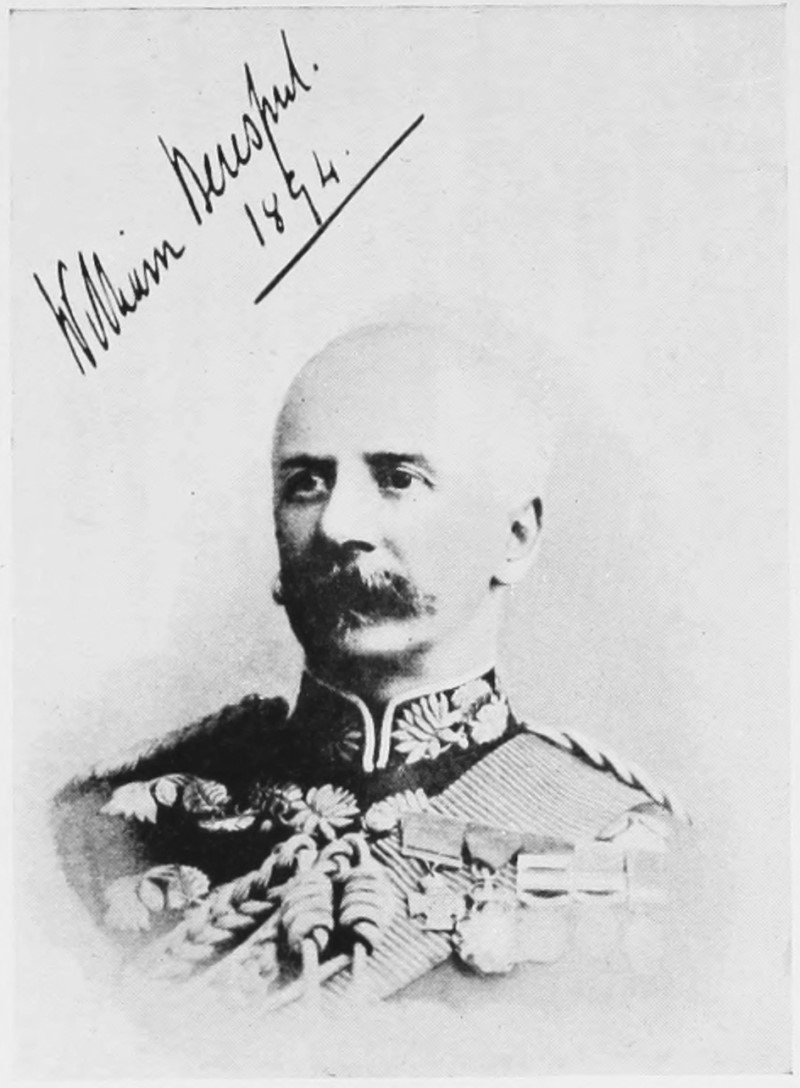
LORD WILLIAM—IN OFFICIAL CAPACITY
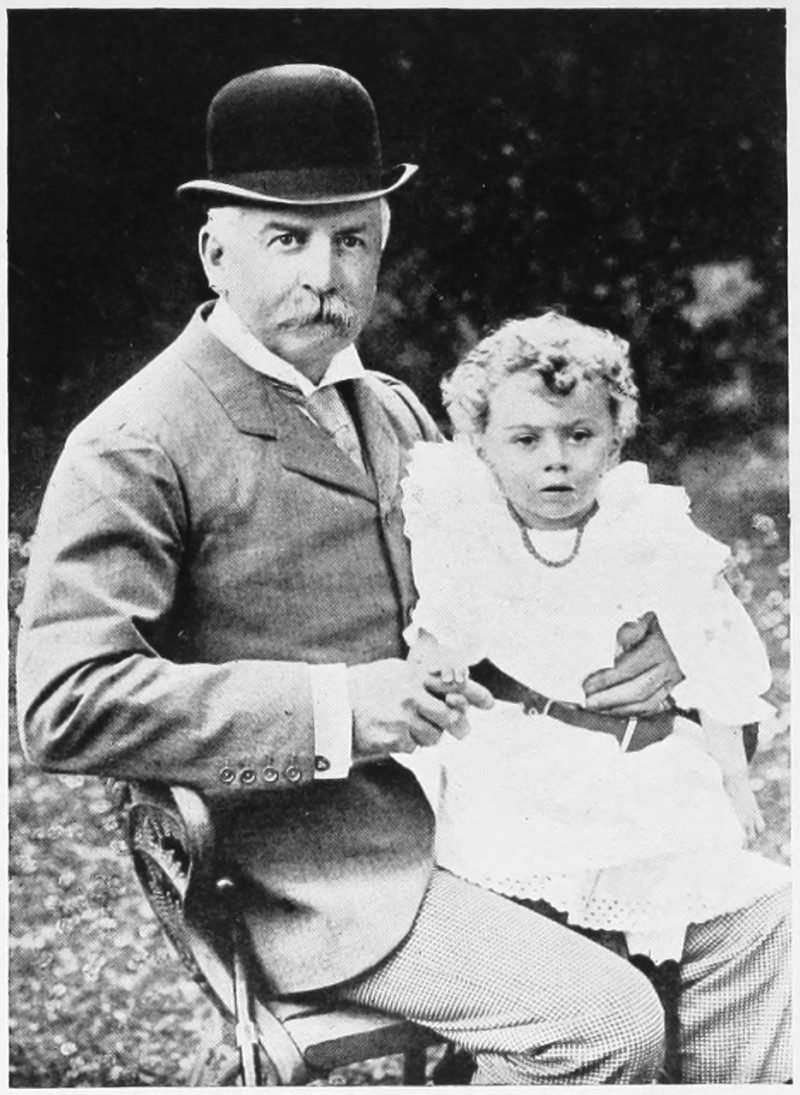
LORD WILLIAM AND HIS SON BILLY
On February 4th, 1897, a son was born to the
William Beresfords; at first he was very delicate,
no doubt owing to the anxiety his mother suffered
when Lord William had his accident in December,
1896, so small and delicate was he that he was put
into an incubator for a short time, fearing a breath
might blow him away; now he is a six-footer, so
his nursing and care answered. He was named
William Warren de la Poer. Both parents were
devoted to their child, who was very like his father.
When Lord William was driving his wife on the
coach and was going rather faster than she liked (she
being very nervous) and remonstrating he used to
say, “Oh, I thought you would be in a hurry to get
back to the boy!” As the baby grew older Lord
Marcus used to tease its father by saying, “The child
does not know the difference between you and me,”
but baby did and always chose to go to Lord William.
Engagement of Tod Sloan as Jockey—Beresford Family Affection—Caiman
Wins Classic Race—Democrat and His Races—A Tip
for the “Blues”—Accident to Sloan—His Downfall—Five
Years’ Racing and Winnings in Stakes Alone—Volodyovski
Bought—At Liverpool When Ambush II Won the Grand
National
We are now dealing with 1897, when Tod
Sloan was introduced to the British public
by Lord William, who had been keeping
an eye on the lad’s performances in America, observing
that in 1895 he had 442 mounts, and won 132
races, in California four races being won in a day.
In consequence of this and what he was told of the
lad, his lordship sent a cable asking the jockey to
come over here as he had some useful horses to be
ridden. The years 1897-1898-1899 and 1900 were
great for the Beresford stable.
Sloan was for several years much in evidence, so
it may be worth while to pause a moment and introduce
him to those of my readers who have either
forgotten or never known anything about him.
His real name was James Forman Sloan, when a very
small boy he had been adopted by people named
Blauser, who thinking they were being witty, called
him “Toad,” because he was so tiny, this by degrees
condensed itself into Tod, and Tod Sloan it remained
to the end of the chapter.
In America Sloan had been riding for Mr. W. C.
Whitney, who released him to ride for Lord William,
saying he should very likely be in England himself
before long. As a matter of fact he arrived at much
the same time as the jockey, and met Lord William
for the first time at Newmarket, where Sloan introduced
him to his lordship, the outcome of this
introduction being they became partners. At this
time Jakes Pincus was training Lord William’s
horses, later Huggins, who came over with Mr.
Lorillard, reigned in his stead. Pincus was another
American; he had not been long in this country,
yet he was the man who trained the only American
horse that ever won the Derby, if my memory is to
be trusted. Iroquois was the horse. The man was
a bit of a jockey himself, I have been told.
Mr. Cuthbert was secretary to Lord William’s
stable at that time, later I believe he went to Newmarket
in the employ of Mr. George Lambton.
Sloan was one of those fortunate jockeys who can
eat what they like without putting on weight, very
different from some other jockeys of that date.
Fred Archer, for instance, who had to breakfast off
hot castor oil and a slice of thin toast with a view
to keeping his weight down, he dared not dine with
friends, as owing to dieting so rigidly he felt he was
a wet blanket at a feast. Poor fellow, in his endeavours
to ride 8 st. 7 lbs., he became a wreck very
early in life, the wonder was he lived as long as he
did. It will be remembered at the age of thirty he
felt he had had enough and took his own life.
Though much liked and perhaps the most popular of
jockeys he was severe with his mounts.
Sloan was fond of animals and gentle with them,
Mornington Cannon also, and they seem to have
achieved equal success. Archer’s seat was the opposite
of Sloan’s, for he sat well back, while Sloan
it was introduced that peculiar monkey up a stick
seat which became more or less the fashion amongst
the American jockeys. Archer was very, very canny
with his money, which at times used to annoy people,
Sloan on the other hand was too generous and let
other people help him to spend his earnings almost
too freely. Cannon liked riding waiting races, while
Sloan liked to get away and come right through.
There was one occasion certainly when Cannon
waited a little too long with Flying Fox, not giving
himself time to get home, but he was a good judge
of pace.
Sloan’s seat used to be much commented on when
first he came over to this country, people thought
he rode with very short stirrups, but he did not
really, it was the crouching along the neck of the
horse when going fast which gave him that appearance.
He attributed much of his success to this
attitude as it gave less resistance to the wind,
therefore helpful to the horses.
Sloan entirely agreed with me on one point, which
I have already expressed in my book Women in the
Hunting Field, namely that horses will not tread
on you when down if they can possibly help it. He
went so far as to say they “would not unless pulled
into it.”
Lord William used to say Sloan had no luck unless
he was there, and really it seemed like it. When
Lord Bill lost a race he had been hoping and expecting
to win his face was a study, he had marvellous self-control,
and beyond growing very white showed
no sign of feeling and was always most generous to
the unhappy and often equally disappointed jockey.
Lord William thought he had a great horse in
St. Cloud II. I fear he did not fulfil his owner’s
expectations, though certainly he was a great horse,
but it was in size, he stood seventeen hands.
The largest stakes Lord William ever went for was
probably over Sandia in the Cambridgeshire. Either
St. Cloud or Sandia ought to have won easily.
Lord William and Sloan were under the impression
they had won with Sandia, but Mr. Robinson, the
judge, was under the impression they had not, but
that is an old story now. At the time there was a good
deal of feeling about it.
Sandia won the old Cambridgeshire in the Autumn
of 1897, and Diakka won the Duke of York Stakes
at Kempton Park, for which he started favourite.
Lord William found time to go to York and help
his brother, Lord Charles, now Lord Beresford, who
was standing in the Conservative interest against
Mr. Furniss. Lord Marcus also went to give a helping
hand. In Lord Beresford’s own book he gives some
amusing accounts of his brother’s smart and witty
repartees to questions asked by the electors. There
was a good deal of excitement in the town at the
time. Lord Beresford won by eleven votes, rather
a near thing. It was too much for the poor Lord
Mayor, he died the same night from excitement and
strain.
The three brothers were very happy working together
over this election, the affection they had felt
for one another in youth had not been estranged,
they were still devoted to one another, it was
always charming to hear them speak of their relatives.
What does this family affection spring from I
wonder? It is not often met with; take two well-known
families the Scotch Gordons and the Irish
Waterfords. The Gordons according to their own
account could as brothers never agree, if one told a
story of what he had done at cricket, racing, or
some such thing, and one of his brothers happened
to be present he would flatly contradict him, telling
him he did not believe it, and he was telling tarra-diddles;
followed of course by a free fight, very
often even when staying in friends’ houses. Once
speaking of their quarrelsomeness Lord Granville
Gordon, commonly called Granny, said, “You know
our family is not like the Beresfords one bit, they are
always full of praise of one another and inseparable.
If you were to say to Lord Marcus or Markey as we
call him, ‘That was a great thing you brought off
the other day,’ the reply would certainly be something
of this sort, ‘Oh yes, but you should see my
brother Bill, he can do ten times better,’ or ‘You
should see Charlie, no one can touch him’; the same
with Lord Charles, it is always how much better his
brothers could do things than himself.”
An uncle of mine, the Rev. Francis Gooch, used
to fish at Ford Abbey in Northumberland by the
kind permission of Lady Waterford. One day when
Lord Charles was up there and he was speaking to
my uncle he said, “Do you know my brother Bill?”
The reply being in the negative Lord Charles said,
“Then bedad you don’t know the finest man in the
world.” It is really a beautiful and uncommon
thing to have lived through the great part of their
allotted years, knowing each other intimately, loving
each other tenderly, without one spark of jealous
fault-finding, superiority, or littleness. The pity
there are not more families equally attached, they
do not know what they miss; looking back through
the sketch book of their lives, that family affection
has added warmth and beautiful colouring to many
of its pictures, to be recalled and lived through again
when the day is far spent and night is near.
In 1898 Lord William owned many winners entered
in the name of one or other of the two partners.
Caiman as a two year old won the Middle Park Plate,
value £2775, Sloan riding; beating the Duke of
Westminster’s Flying Fox ridden by Mornington
Cannon. I am able to give a beautiful photograph
of Caiman at the starting-post the day he won this
race. It will be noticed Sloan did not ride very
short, as I have already pointed out. It will also be
noticed his hand is up to his mouth, this was a habit
or trick of his, he always put his hand to his mouth
when a horse was walking or in a very slow pace.
Whether he had any theories about it or not I do not
know.
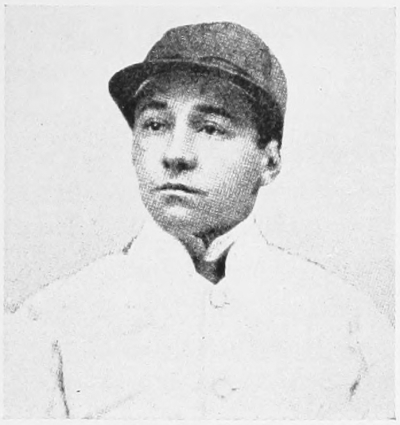
TOD SLOAN IN LORD WILLIAM’S COLOURS
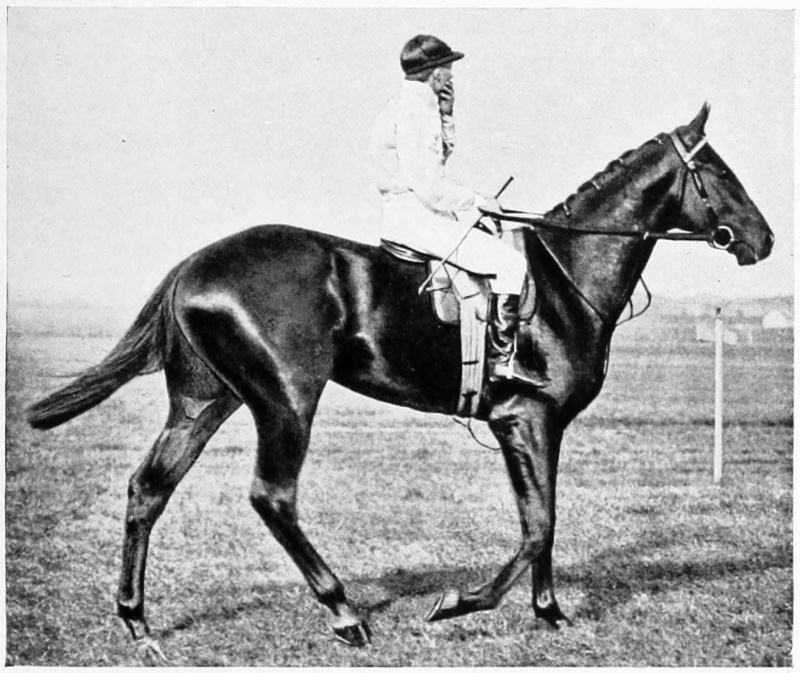
Photo. Rouch
CAIMAN AT THE POST FOR THE MIDDLE PARK PLATE THE DAY HE BEAT
FLYING FOX. TOD SLOAN IN LORD WILLIAM’S COLOURS
Flying Fox was a horse that stood out prominently
in racing records, not only as a triple crown winner,
but as the horse that fetched the highest price ever
paid at a sale by auction for a racehorse, namely
£39,375, Kingsclere and Prince Palatine being bought
by private contract by Mr. J. B. Joel at £40,000, a
price that would perhaps not have been reached
under the hammer.
In the Two Thousand Guineas value £4250 Caiman
only ran second, Sloan up, Flying Fox winning this
time, Cannon riding. For the St. Leger at Doncaster
value £4050 Flying Fox again won, Caiman second,
both ridden by the same jockey as in the previous
races.
In 1900 Caiman only won the Lingfield Park Stakes
value £2420, his wins, however, as a two year old
in 1898 were £3557, as a three year old £3884 and
as a four year old £2420, making the pleasing total
of £9861.
The chief races won in 1898 were the Clearwell
Stakes and Middle Park Plate by Caiman, Esher
Stakes by Diakka, Thirty-fifth Biennial at Ascot
by Sandia, Exeter Stakes by Dominie. Mykka
the Lancaster Nursery First October Two Year
Old Stakes, Prendergast Stakes, and Sandown Great
Sapling Plate. On September 30th, Sloan won the
Bretby Welter on Draco for Lord William by six
lengths, the next race the Scurry Nursery on Manatee,
the next race again the Rous Memorial Stakes
on Landrail by three lengths, another on Libra,
by two lengths, the Newmarket St. Leger on
Galashiels by a head, making five wins and a
second out of seven mounts, not a bad day for one
stable.
Huggins, who was training the horses, lived at
Heath House, the former home of the great Dawson
trainers, “Mat,” and after him his nephew George.
Heath House will always remain most famous in connection
with the name of the uncle, as most of “Mat”
Dawson’s greatest classic efforts came from that
home; for the late Lord Falmouth, Duke of Portland,
Lord Hastings of Melton fame, and lastly crowned
with the success of Lord Rosebery’s Ladas.
The historic Democrat now came on the scenes in
1899. An American bred horse, his sire being
Sensation, his dam Equality. This handsome and
gentle chestnut with four white legs won no less than
seven out of eleven races as a two year old, worth
£12,939, including the Coventry Stakes at Ascot,
the National Breeders’ Foal Stakes at Sandown,
and the Middle Park Plate and Dewhurst Plate.
The light blue and black cap was doing good business.
A record of all Democrat’s races may be interesting:
| TWO YEAR OLD RECORD, 1899 |
| May 1st. |
Great Surrey Breeders’ Foal Plate, Epsom; 4th (Sloan). |
| May 5th. |
Royal Two Year Old Plate, Kempton Park; 2nd (Sloan), £200. |
| May 11th. |
Bedford Plate, Newmarket; 2nd (Sloan), £50. |
| June 13th. |
Coventry Stakes, Ascot; 1st (Sloan), £1,826, beating H.R.H. Prince of Wales’s horse, Diamond Jubilee, ridden by Watts. |
| July 1st. |
Hurst Park Foal Plate, Hurst Park; 1st (Sloan), £1,135. |
| July 15th. |
National Breeders’ Produce Stakes, Sandown Park; 1st (Sloan), £4,357. |
| Sept. 5th. |
Champagne Stakes, Doncaster; 1st (Sloan), £1,310. |
| Sept. 29th. |
Rous Memorial Stakes, Newmarket; 1st (Sloan), £568. |
| Oct. 6th. |
The Imperial Stakes, Kempton Park; 2nd (Sloan), £300. |
| Oct 14th. |
Middle Park Plate, Newmarket; 1st (Sloan), £2,305, beating Prince of Wales’s Diamond Jubilee. |
| Oct. 26th. |
The Dewhurst Plate, Newmarket, Houghton; 1st (Sloan), £1,432; Prince of Wales’s Diamond Jubilee 2nd. |
| |
|
THREE YEAR OLD RUNNING, 1900 |
| May 30th. |
Epsom Derby. |
|
Democrat ran but was not placed, the race being won by Diamond Jubilee, but this time Sloan was not riding Democrat,
but one called Disguise for another owner, and was severely reprimanded for this breach of Rule 140, forbidding crossing. |
| June 14th. |
The New Biennial, Ascot. Democrat not placed; ridden by Weldon. Sloan rode the winner, Courlan. |
| Oct. 9th. |
The Royal Stakes, Newmarket; 1st (L. Reiff), £586. This was Democrat’s last win; he ran later at Liverpool for the Autumn Cup, but was not placed. |
I am under the impression that the last time Lord
William’s colours were seen on a racecourse was at
Manchester, when his Billow II, bred in Australia,
won the Autumn Plate, ridden by Reiff. Jolly Tar
won six races in 1900.
The year Democrat won the Coventry Stakes at
Ascot (1899) Lord William was standing outside the
“Blues’” tent after luncheon talking to some of his
friends, amongst others Sir Claude de Crespigny,
discussing the merits of the different horses, when he
was heard to say apparently as much to himself as
his friends, “It’s all very well their making the
Prince’s horse (Diamond Jubilee) favourite; mine
has just as good a chance of winning.” This was
repeated to some of the “Blues,” who had not been
having a very good time over the Trial Stakes,
adding, the Royal horse is at evens and Bill’s at
three’s, they selected the latter and landed the long
odds. After this they told Sir Claude if he had
another good tip like that for the next day they
hoped he would come and have luncheon again.
Sloan was never a great admirer of Democrat,
why I do not know, as the horse proved himself
one of the best of his years.
Riding at Kempton in 1898 a horse reared over
with Sloan, hurting his pelvis bone. Seeing what
pain the man was in and knowing from experience
something about it, Lord William said, “Your racing
is done for to-day, my little man.” “But,” said
Sloan, “who then is going to ride your Democrat?”
Lord William replied, “I shall put Cannon up.”
This was anguish to Sloan, who was somewhat
jealous of Cannon, but he may have found consolation
in the result, as the horse did not win. His
owner thought it was due to the change of jockey,
horses are very susceptible to any change of hands.
Sloan always considered the greatest achievement
of his life was beating Flying Fox on Caiman
in the Middle Park Plate, when Cannon, as referred
to earlier, waited just a little too long before letting
Flying Fox out, not leaving time to pick up and
win.
In 1899 Lord William won his first and only classic
race with his Sibola at Newmarket in the One
Thousand, Sloan riding. There were great rejoicings
in the Beresford camp. Sibola ought to have won
the Oaks that year, but got a bad start. Some people
thought it was due to a fit of temper on Sloan’s part,
others attributed the defeat to Sloan, but giving
other reasons; be that as it may, it was a great
disappointment to the horse’s owner.
Sloan was altogether getting out of favour about
now. At Ascot he got himself mixed up with a
waiter and a champagne bottle, resulting in Lord
William very kindly trying to pacify the piqued
waiter. This took some doing, but was eventually
managed to the tune of several hundreds, to save
scandal and trouble. The Stewards enquired into
the matter and exonerated Sloan. In honesty to
the jockey, I am pleased to be able to state, when he
found out what Lord William had done for him, he
insisted on the amount being deducted from his
retaining fees.
Lord William was undoubtedly Sloan’s best friend,
being exceedingly generous and kind to him, but
latterly he gave his mounts to Weldon, the two
Reiffs, and others, being disappointed with Sloan
and fearing he had got into the hands of those not
likely to improve him, and certainly about that time
a number of desperate American gamblers graced
this country with their presence and heavy ready
money investments which put temptation into a
jockey’s way. If a jockey only bets on his own
mount all may be well, but unfortunately they get
tempted sometimes to bet on others, while such a
thing has been heard of as a jockey squaring or thinking
he has squared the rest of his confrères in the
race; and then failed.
The final blow came to Sloan over the Cambridgeshire
of 1900, over which there were many unpleasant
stories afloat in connection with his betting.
It was a thousand pities, for he did so well when first
he came over to this country. Lord William was
very pleased with his riding, and many people had
been most kind to him.
At one time, I think it must have been at Doncaster
in 1899, the Prince of Wales told Lord William he
should like Sloan to ride for him during the coming
season, however, circumstances forbade this. Codoman
was the horse Sloan was riding in the Cambridgeshire
when he got into trouble over betting. Lord
William again did all he could for Sloan, but the
Jockey Club were firm and advised Sloan not to
apply for a licence to ride during 1901. Of course
he was acting against the rules in betting and he
knew it, but I do not think Sloan was alone by any
manner of means in this misdemeanour; again, I
say the pity of it, for he was a great master of his
method in the saddle; he always maintained his
crouching seat over the horse’s neck that had much
to do with his success. Unfortunately he was a
perfect idiot where his own real interests were concerned.
Here again he was not alone, many of us
are quite brilliant in looking after other people’s
affairs and yet make shocking hashes of our
own.
It will, I think, have been clear to the readers all
through these chapters how very generous Lord
William was to all who worked with or for him;
also indeed to many with absolutely no claim on his
large and kindly heart. Huggins, his trainer, was
another recipient of his open-handed generosity.
At Newmarket he was a favourite amongst the residents
and Lord William had a great liking for him,
but I doubt if it is generally known that over and
above other fees and charges Lord William allowed
him 10 per cent on all stakes won. This would mean
a comfortable income if the stable was lucky. A
glance at the value of the stakes won between
1896 and 1900 will prove this.
| Year. |
No. of wins. |
Value. |
| 1896 |
12 |
£5,186 |
| 1897 |
13 |
7,867 |
| 1898 |
16 |
8,029 |
| 1899 |
69 |
42,736½ |
| 1900 |
48 |
24,522 |
|
—– |
———— |
| Total |
158 |
£88,340½ |
In giving the above I am leaning heavily on the
safe side, as there were some wins of which I do
not know the value, so cannot count them in the
total.
Lord William was still hoping to win the Derby,
and believed at last he was “going to do the trick”
in 1901, for in 1900 he leased from Lady Meux, a
two year old horse named Volodyovski for his
racing career. For the comfort of my readers I may
here state that owing to the horse’s name being such
a mouthful, and the difficulty experienced by many
in pronouncing it at all, he soon became known as
Voly, which will answer my purpose very well. This
horse won five races out of the last six he ran for
Lord William, namely the Windsor Castle Stakes,
Rous Memorial at Goodwood, Newmarket Stud
Produce Stakes, Rous Memorial at Newmarket, other
winners besides Caiman being Jolly Tar and Jiffy II.
It will be remembered it was Diamond Jubilee
that prevented Lord William heading the list of
winners in 1900, and Flying Fox in 1899. But as the
following shows it was a near thing.
1899, Duke of Westminster, 1st £43,965—Lord
William 2nd £42,736½. 1900, Prince of Wales 1st
£29,585—Lord William 2nd £24,585.
Race meetings of all sorts and kinds attracted
Lord William, whether running horses of his own or
not; he was present at Liverpool when the Prince
of Wales won with Ambush II, and his own horse
Easter Ogue ran seventh. The scene outside the
weighing-room door as His Royal Highness awaited
the return of his winning horse baffles description;
it was difficult to keep a clear space for Anthony to
dismount; all were so anxious to congratulate the
Prince. One of the earliest to express his pleasure and
to congratulate him was the subject of these memories,
and it so happened that the camera man managed
to squeeze into the small space and photograph
the King as he met the horse, just as he left Lord
William.
Always when flat racing was over Lord William
turned his attention to chasing, which he had liked
from his earliest days. I remember standing with
him once in a crowd at a big “jump” meeting, and
saying to him, “I suppose you have always been too
occupied to make a study of the faces round you at
one of these meetings?” He replied, “No indeed, I
have not been too occupied, but I do not like to look,
sometimes a race means so much to a man.” I
remarked I thought a certain friend standing near
us, and owner of the favourite, was looking rather
pale and anxious, but he said, “Oh he’s all right, an
old hand at the game,” nevertheless when the favourite
was over the last fence I heard a big sigh and when
the cheering began after the horse had won by nearly
a length the owner collapsed. I wonder what would
have happened if he had lost? Lord William told
me afterwards that if he had not won that race he
would have been absolutely ruined. The faces of a
crowd on a racecourse, especially at a “jump”
meeting, is an interesting study and instructive.
It is painful to watch the restless hands and nervous
twitchings of those to whom it means “up” or
“down.” Some of course go who delight in a fair
race when the horses are not ridden to death, that
is to say never again able to meet such a supreme
moment; people who have nothing of any consequence
in any of the races, or who, like the late
James Lowther, seldom or never bet at all. Then
again there are the curiously constituted folk who
flock round the most dangerous jumps, presumably,
to witness any accident that may occur; some
people revel in seeing accidents. One man I have
known now for many years, has never to my knowledge,
been moved to mirth unless someone has hurt
themselves, then he indulges in a waistcoat contortion
which answers for laughter, his mouth spreads slowly
across his face, but his eyes take no part in his
merriment.
Some of the accounts that appeared in the papers
from time to time relating to Lord William’s achievements
were very funny. The Sporting Times some
years ago referred to this in one of their issues I am
told, as follows: “Does Lord William Beresford
read the Hornet? Probably not, but if he does he
must be surprised to find that he is the third son of
John, fourth Marquis of Waterloo. Why not also
first cousin of Viscount Vauxhall, and distantly
related to the Countess of Charing Cross?”
Lord William’s health about now was causing
some anxiety, and he was persuaded to try Homburg
where he had been benefited several times before,
but on this occasion he came back looking worse
than when he went.
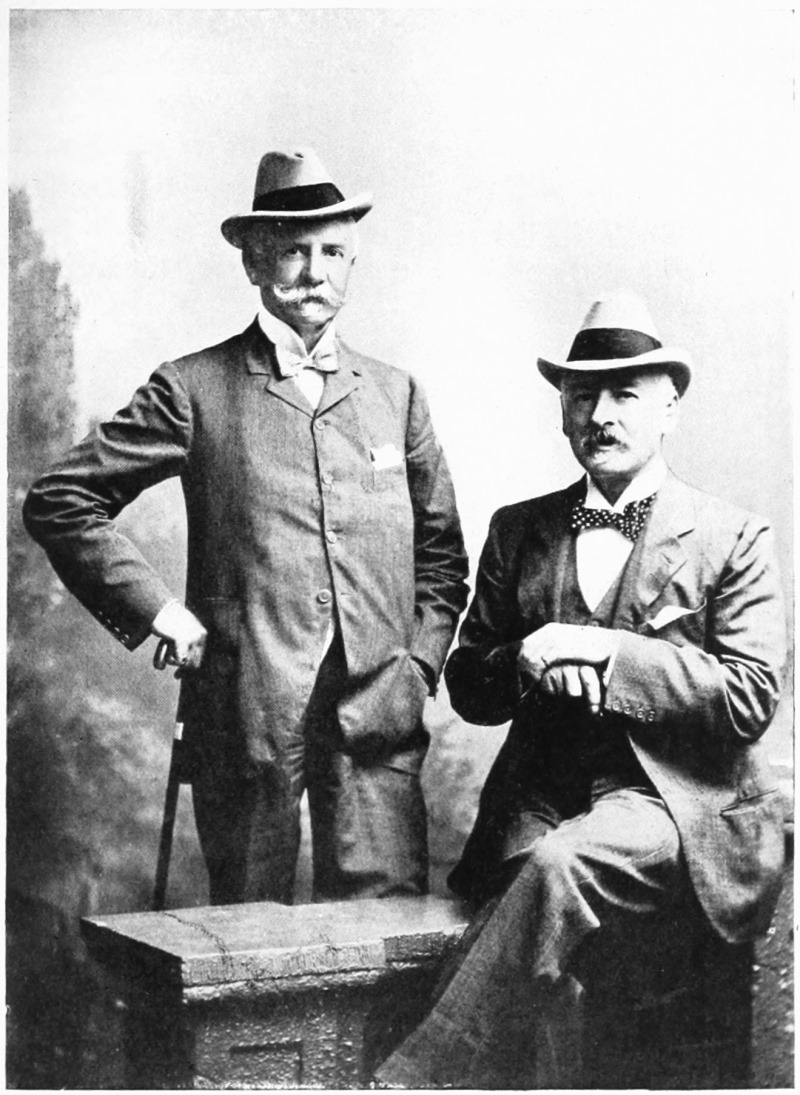
LORD WILLIAM AND LORD MARCUS BERESFORD
The last time I saw his lordship at Homburg,
the Prince of Wales, Sir George Wombwell and
Colonel Stanley Clarke were being greatly amused
at some of his jokes, and the stories he was telling
against himself.
Shall we ever see his like again?
“1900 ... and Feels It”—Affection for the 9th Lancers—Help for a
Brother Mason—Those Who Loved Him—Friends, not Sight-Seers—A
Treasured Gift—Sale of Horses at Newmarket—Purchasers
and Prices—Fate of Democrat—Volodyovski Wins
the Derby—Too Late—Fierce Ownership Dispute—The Law
Settles It—Broken Head of a small Beresford
During most of 1900 Lord William suffered
at intervals from his old complaint contracted
in India, namely dysentery, and
it was taking all his strength away; that he was
feeling very sadly I know, and on a photograph he
was signing for a friend he wrote “W. B., 1900, ... and feels it.”
At times he was observed sitting resting before
dinner, a most unusual thing for him to do. Unfortunately
in December he ate some game that was
too high for his delicate state of health, this set
up peritonitis, and, in spite of the best advice and
most tender nursing, he passed away on the 28th
December with a smile for those around him, to the
inexpressible grief of all who knew him well, and
the sincere regret of all who were lucky enough to
have met him.
The specialist, Sir Thomas Lauder Brunton, came
down from town several times to see the invalid,
and at one time there seemed to be a ray of hope,
only to be dashed to the ground again, for the poor,
gallant, brave heart for the first time in his life failed
him and refused to work any longer. His last race
was run, and surely the prize must be his for his
many acts of charity not only in kind, but goodness
and mercy.
We all knew in his lifetime how generous he was,
no begging letter was ever left unanswered; none
who begged, whether deserving or not, received a
harsh word from him; he was generous to a fault.
He never could resist anyone who said they had been
in his old regiment the 9th Lancers, though I have
grave doubts as to whether some of the suppliants
had ever been in the regiment at all. I know that
some who begged from him had a good deal of method
in laying out their plan of campaign, and waited until
Mr. Palmer, who attended to business matters, had
gone home, before going to ask for Lord William,
knowing that if Mr. Palmer was there the case would
be thoroughly enquired into, while if they saw his
lordship they knew they could work upon his tender
and kind heart. I have been told the following
story is true.
Lord William was a Mason, and a brother Mason
wanted to see him, and as he had a favour to ask
waited until Mr. Palmer had gone home, and in the
evening begged to see Lord William who at once
interviewed his brother Mason, a tradesman, who
told a long tale with a plentiful use of pocket-handkerchief
to his eyes; he came away with a
cheque for £1000.
Truly life is a book of many pages, not by any
means easily read, and it seems all wrong that
such generosity should be imposed on, but Lord
William always said his sympathies were with all
sinners, and he liked to give everyone the benefit
of a doubt.
It does not fall to the lot of everyone to be so
sincerely mourned, for his wife adored him, his
child loved him, his brothers and relations loved
him, his servants worshipped him, the old people
round Waterford and Curraghmore, to whom it was
a red-letter day when Lord William paid them a
visit, which he enjoyed as much as they did; the
old pensioners at the Royal Hospital, Dublin, who
had many times been made happy by a visit from
him.
When the sad news became known, messages of
sympathy and condolence poured in from the highest
in the land to some of the lowliest.
It was not until after his death, when his papers
were being attended to, that the extent of his goodness
and charity was fully known.
I will not dwell on this sad time, for there is no
language great enough for the expression of our
mental emotions, and no language that can express
the dignity of great grief.
Lord William was laid to rest in the family vault
at Clonagam Church, and the whole route from the
boat to the Clonagam was wonderful; every little
child wanted to pay a last tribute to their friend,
the road was packed and lined with those who cared,
not sightseers.
Among the four waggon loads of wreathes, crosses,
and other flower tokens of respect and affection,
was one from his brother Lord Charles, “In memory
of lovable, chivalrous Bill, from his broken-hearted
brother, Charles.”
Everyone mourned for Lord William, even the
cabmen in London, Dublin and elsewhere. The
newspapers were full of “Our Bill” and amongst
the many touching references to his death, I think
the following is one of the nicest.
Lord William Beresford
Born July 20th, 1847, died December 30th, 1900
The old grey year is stricken down—and lying
(The days are dark, the trees stand gaunt and bare)
Stretches its hand and takes from us—while dying—
One whom we ill could spare.
Soldier and sportman, no fond hand could save you
From the old robber bearing you away,
England who once the cross for valour gave you,
Honours you with tears to-day.
What is the epitaph which shall be found him?
Let this story of his lost life tell,
All hearts that knew him to-day around him
Whisp’ring, “Kind friend, farewell.”
Erin, a vigil o’er her dead son keeping,
Now takes him softly, sadly to her breast,
Under her grassy mantle hides him sleeping,
And gives him his long rest.
Ballyhooley.
Sporting Times, January 5th, 1901.
Ballyhooley was really the nom-de-plume of Mr.
Bob Martin, who wrote the Irish humorous songs
for the Gaiety and was a great man on the staff of
the Sporting Times. In one of the weekly papers
appeared the following:
“The regret of all for Lord William Beresford.
A Bill that everyone honoured, but alas none can
meet.”
In another paper someone signing themselves
“Roy” wrote:
A fearless soldier and a sportman bold,
Beloved by all; gallant to foe and friend,
Brave, true-hearted, as our knights of old,
A V.C. hero! noble to the end.
December, 1900.
I always thought it was illuminating the way,
though Lord William never met his wife’s mother,
he felt it would be a pleasure to her, and his duty to
write regularly giving account of his wife and son’s
doings, and so forth; ending in a sincere attachment
on both sides, and his mother-in-law heaped beautiful
and costly presents on him, sent from America.
Speaking, or rather writing of presents reminds
me that in a cabinet where I keep my many treasures
and presents collected during my travels, there rests
in one corner a much used and much mended hunting
crop bearing the inscription, “From Bill, Xmas
1889.” It likewise has seen its last day’s hunting,
for it is tender with age and use, and too much
valued to run any risks. I feel as if I could write
for weeks of all his kindness and loyal friendship, and
then not exhaust my memories of them. There is one
more charming trait I should like to mention, namely
his great consideration and kindness to his servants;
when there had been a house full with many ladies’
maids and valets he always asked if they had had
a good time, and his orders were that all the servants
should have everything they wanted, nothing was
too good for them. One who had served him said
to me once, “It is a pleasure to do anything for him;
he is the kindest master and friend any servant
ever had.”
On January 23rd, 1901, Lord William’s horses were
sold at Newmarket, and it makes me sad to write
of the break up of his stable; his horses had been
such a pleasure to him all his life and now they were
all to be scattered far and wide. Had he lived, many
of them would have changed hands at times, no
doubt, in the ordinary course of events, but he would
have voiced the orders. Now even at the sale there
was a gloom, a sadness for the cheery voice that was
gone. It seems rather hard that we should be
brought into this world without our wishes being
consulted, and hurried out of it without our wishes
being consulted, and as Emerson says, “We seem
to be whipped through the world hacks of invisible
riders.”
My readers may be interested to know who bought
the horses and the prices they fetched, so I give the
list. See pages 322-3.
Fifth on the list is good old Democrat, who still has
quite a history attached to him. Mr. Joel bought him
for 910 guineas, and while his property he ran his
last race, at Kempton Park on May 11th, 1901, ridden
by Wood, but was not placed, after this he was kept
in peace and plenty until the autumn, when he again
renewed his acquaintance with Mr. Tattersall’s
hammer on October 13th, then Mr. Marsh, the
trainer of the King’s horses, gave 290 guineas for
him; chiefly I fancy for old association’s sake; so
the horse went to Egerton House at Newmarket.
One day the late Lord Kitchener was going round
the stable, and I think I am right in saying King
Edward VII was there at the time; when they came
to Democrat Lord Kitchener remarked on his good
looks, and that he was the size and make for a man
like himself with long legs. “Yes, my lord,” said
Mr. Marsh, “he would suit you to take out
to India as a charger if you will accept him as a gift.”
Lord Kitchener was not a great horseman at any
time, and liked something very quiet so that he need
pay no attention to his mount and devote it all to
the business in hand; this he explained to Mr.
Marsh, asking if he thought the horse was quiet
enough, and was reassured by being told Mr. Marsh’s
daughter used often to ride him when exercising
on the heath. A few days later when Lord Kitchener
was speaking to the Duke of Portland about Mr.
Marsh’s generous gift, and expressing doubts about
a race-horse being a suitable charger, his Grace
suggested Democrat being sent to Welbeck to be
tried there in the riding school with a view to his
usefulness as a charger. The horse’s manners were
found to require very little polishing, so to India he
went, becoming a great favourite with his master.
An unusual end to a race-horse’s career, but a very
happy and a most useful one. When Mr. Marsh
bought him he was no longer considered any use for
racing, no use for the stud to which so many race-horses
go, and I am not quite sure he was not just a
wee bit gone in the wind. However, this great
winner of races after landing £12,939 in stakes became
Lord Kitchener’s favourite charger, and was ridden
by him at the Delhi Durbar and Coronation Procession
of King Edward. Democrat bore himself very
proudly in India, winning several prizes at the
Indian Horse Shows. Lord Kitchener’s and Democrat’s
name will go down to history together, for
in Calcutta there now stands a statue of them sent
out from England in 1913. A good and honourable
man on a good and honourable horse. I have been
told that Democrat died in India shortly before Lord
Kitchener left the country.
| HORSES IN TRAINING |
| Name. |
Sire. |
Dam. |
Purchaser. |
Guineas. |
| Berzack, U.S.A. |
Sensation |
Belphœbe |
Lord Kesteven |
320 |
| Billow II, Australian |
Atlantic |
Tickle |
Mr. D. Cooper |
380 |
| Caiman, U.S.A. |
Locochatchee |
Happy Day |
Mr. Marsh for Lord Wolverton |
2,500 |
| Jolly Tar, U.S.A. |
Sailor Prince |
Joy |
Mr. W. M. G. Singer |
2,200 |
| Democrat, U.S.A. |
Sensation |
Equality |
Mr. J. B. Joel |
910 |
| Old Buck II, U.S.A. |
Sensation |
Magnetic |
Mr. R. Croker |
300 |
| |
| THREE YEAR OLDS |
| Brelogue, U.S.A. |
Favordale |
Bibelot |
Mr. R. Croker |
320 |
| Zip, U.S.A. |
Owas |
Telic Doe |
Mr. R. Gore |
310 |
| Nahlband |
Wolf’s Crag |
Under the Rose |
Mr. E. Dresden |
1,500 |
| Bronzewing, U.S.A. |
Goldfinch |
Reclare |
Mr. J. Hare |
320 |
| Alien, U.S.A. |
Henry of Navarre |
Kate Allen |
Mr. J. B. Joel |
1,300 |
| Teuton, U.S.A. |
Hanover |
Bessy Hinckley |
Mr. R. Gore |
210 |
| Yellow Bird, U.S.A. |
Goldfinch |
Miss Modred |
Lord Carnarvon |
210 |
| Yap, U.S.A. |
Dandy Dinmont |
Lizzie |
Mr. S. B. Joel |
410 |
| Choctaw, U.S.A. |
Onondaga |
Henrietta |
Mr. J. Widger |
210 |
| Moorspate, U.S.A. |
Candlemas |
Belle B. |
Mr. E. Dresden |
860 |
| Sweet Dixie, U.S.A. |
Sir Dixie |
Brenda |
Mr. R. Croker |
200 |
| Fore Top, U.S.A. |
Top Gallant |
Flavia |
Mr. W. Lewison |
45 |
| |
| TWO YEAR OLDS |
| The Buck |
Buckingham |
Compromise |
Lord Carnarvon |
300 |
| Loveite |
St. Fruoquin |
Orle |
Mr. G. Faber |
1,050 |
| Charles Lever, U.S.A.
|
The Bard |
Equiporse |
Mr. R. Croker |
100 |
| Vendale, U.S.A. |
The Bard |
Water Lily |
Mr. R. Croker |
160 |
| Albanian, U.S.A. |
The Bard |
Loot |
Mr. R. Croker |
90 |
| Bay Filly, U.S.A. |
The Bard |
Roulette |
Mr. W. Smith |
175 |
| Ouilla, U.S.A. |
The Bard |
Foxtail |
Mr. G. Farrar |
115 |
| Drooping |
Martagon |
Penserose |
Capt. Featherstonhaugh |
55 |
| |
| BROOD MARES, ETC. |
| Manister |
Diakka |
Tacitus |
Mr. J. A. McNeal |
20 |
| Brown Yearling |
Worcester |
Manister |
H. Von Grundherr |
7 |
| Famish |
Wolf Crag |
Cearalin |
Mr. G. Pritchard |
20 |
| King Cophetua, Yearling Colt |
Florizel II |
Cerealia |
J. D. Wordell |
310 |
| Ch. Yearling Filly |
Amphion |
Philatelist |
Mr. H. King |
12 |
| |
| STEEPLECHASE HORSES IN TRAINING |
| Lord Arrovale |
Tacitus |
Lady Arrovale |
Mr. Russel Monroe |
380 |
| Servias |
St. Serf |
Ayesha Ayagile |
H. Escott |
80 |
| Uncle Jack |
Ascetic |
Mayo |
Mr. Joel |
3,000 |
| Harvesting |
Barkizan |
Harvest Moon |
H. Escott |
175 |
| Brandon |
Carlton |
Miss Prim |
Mr. J. R. Eastwood |
300 |
| Orange River |
Hackler |
Capri |
Mr. G. Parrott |
150 |
| Patrick’s Ball |
Workington |
Duty Dance |
Lord Rothschild |
310 |
| Waltager |
Saraband |
Alice |
Mr. G. Parrott |
25 |
| Brown Study |
Tacitus |
Brown Beauty |
Major E. Loder |
100 |
| |
| Grand Total £19,439 |
At King George’s coronation, Lord Kitchener rode
another great race-horse Moifaa, the Liverpool winner
in 1904, while the property of Mr. Spencer Gollan.
The horse was afterwards sold to King Edward.
When Derby time came round again in 1901,
Volodyovski fulfilled Lord William’s hopes and
predictions, though, alas, not in his name, for the
rules of racing are that death cancels the lease of a
horse, therefore the luck of that Derby fell to Mr.
W. C. Whitney, and I do not think there was a soul
on that racecourse, including Mr. Whitney himself,
who did not wish Lord William had been there, and
the win his.
Some few weeks after Lord William’s death there
was a good deal of discussion and some heated
arguments between Lady William and Lady Meux
as to the ownership of the horse, Lady William
maintaining it was her late husband’s horse and
therefore now hers; Lady Meux declared it was hers,
and the Jockey Club were at last asked to decide;
they adopted the usual course of leaving the disputants
to have it settled by the law of the land.
It came for hearing, fortunately, before that fine old
sporting Judge Grantham, I say fortunately because
he was perhaps in a position to give confidence to
both parties in his judgment, owing to his racing
knowledge and experience. He gave it as his opinion
Lord William’s death cancelled the lease of the horse.
Lady Meux had bred Voly, being the only woman
who has ever bred a Derby winner, and she was so
excited at his winning that the moment he passed
the winning-post she was out of her grand-stand
box and claimed the right not usual to ladies of
entering the weighing-in enclosure, and she then
followed “Zee pet,” as she called him, down the
course, through the crowd to the saddling paddock a
good quarter of a mile away and then untied the little
bit of blue and brown ribbon mixed up in the horse’s
headgear, which he had carried throughout the race.
While patting and caressing the horse she excitedly
exclaimed, “It is my horse and I want the ribbons
for my museum,” which I have not seen, but have
been told it is a very entertaining place full of a
variety of interesting things, now in the possession
of Admiral Sir Hedworth Meux, well known as
Ladysmith Lambton.
Mr. Whitney’s colours were similar to Lord
William’s, being the same light blue jacket, but
with a brown cap, which when at some distance
looked very like Lord William’s black.
It may be wondered why in the course of these
memories I have made no mention of Lord Delaval,
the youngest Beresford brother; it is because he
decided to seek fortune abroad and settled down in
Mexico; the reason for this exodus being to win the
object of his affection for his bride, which rested on
whether he fulfilled his promise to make a fortune
first. It is tragic that when nearing the point that
he could return with his promise fulfilled, he was killed
in a railway accident in the United States on December
26th, 1906.
With the usual Beresford spirit he had thrown his
whole attention and energy into his work, and when
he died owned 196,000 acres with nine miles of
irrigation canals and several large reservoirs, having
quickly grasped that what caused failure so often on
ranches was want of water, without plenty of which
cattle cannot thrive.
Lord William’s eldest brother died in 1895 at the
early age of fifty-one; he had been ill a long time,
the result of a hunting accident. Lord Bill felt his
death very much. Out of these devoted brothers
only two are left now, Lord Beresford and Lord
Marcus.
Reluctantly I lay down my pen, it has been a
pleasure writing of our dear friend, and living through
some of the old times again.
I like to remember my earliest experience in First
Aid was in patching up the head of a Beresford, a
kinsman of Lord William’s and mine, though at the
time he was a very small boy aged about eight years.
A dear chubby-faced lad whose people lived at Bedale,
not far from my old home in Yorkshire. Little
Walter Beresford and his brother Henry, grandchildren
of Admiral Sir John Beresford on their
father’s side and Lord Denman on their mother’s,
came to play with my young brother, and Walter
took the opportunity to fall from top to bottom of
the cellar stone stairs while playing hide and seek,
though they were on forbidden ground. I was very
proud of my work when I had done patching up the
poor little head, and remember how plucky the lad
was, but then he was a Beresford and what is born
in the bread comes out in the butter. I fear this is
not a correct quotation, but will do quite nicely.
Lady William only survived her husband a few
years.
Requiescat in pace.
Abbott, Mr., 94, 186, 266;
his unlucky horse, 224
Afghan Chief, The, 179
Agnew, Capt. Q., 266
Agnew, Mr. H. de C., 266
Agra Stable, The, 256
Alexander, Mr. R., 266
Ali Musjid Citadel, Storming of, 73
Allahabad, The thrice run race, 94
Allason, Major, 266
Allan, Mr. J. J., 266, 277
Althorp, Capt. K., 267
Amir of Afghanistan, 178, 179
Annandale, 54
Anderson, Mr. A. S., 266
Anderson, Mr. G. G., 266
Apcar, Mr. J. G., 252, 264, 267
Appleyard, General, 73
Apostolides, Mr. E. C., 267
Arbuthnot, Mr. J., 267
Archer, Fred, 163, 300
Ardagh, Col. J. C., C.I.E., 267
Arthur, Mr. A., 267
Asian, The, 57
Astley, Sir J., 163
Australian horses stampede, 160
Baden-Powell, Lieut.-Gen. Sir R., 143
Badger, The pet, 26
Baker, Colonel Valentine (afterwards Baker Pasha), 29
Barclay, Mr. P. D., 267
Barrington, The Hon. (afterwards Sir) Eric, 8;
his story of the Tyrol accident, 9
Barlow, Mr. R., 267
Barnes, Mr. F. C., 267
Bates, Mr. R. G., 267
Beaconsfield, Lord, 96
Beasley, Capt. (“Tommy”), 14
Beaver, Col. P. K. L., 267
Bengal Tenancy Act, 177
Beresford, Lady Charles, 154, 156
Beresford, Lord Charles, 303;
meets Lord William at Curraghmore, 18, 19;
the “Brothers’ Race,” 42, 48
Beresford, Sir John, 326
Beresford, Lord Marcus, 234, 254, 285, 293, 302, 303;
meets Lord William at Curraghmore, 18;
Lord Marcus and the “Brothers’ Race,” 42;
Lord William, and the hall porter, 29
Beresford, Lord and Lady Marcus, 292
Beresford, Lady William (formerly Duchess of Marlborough), marriage, 285;
disputes with Lady Meux, 324;
death of Lady William, 327
Beresford, Lord William—
accidents to, 20, 81, 110, 147, 164, 187, 259, 290, 295;
an accomplished whip, 216;
active service, 70, 72, 80;
Annandale racecourse bought, 209;
anthrax at his stables, 248;
A.D.C. to Lord Northbrook, 51;
bad luck, 165;
farewell banquet at Calcutta, 266;
bull, 4;
at Bombay meets Lord Charles Beresford, 48;
at Bonn, 8;
a bribe, 221;
the “Brothers’ Race,” 42;
meets his brother again at Curraghmore, 18;
on Sir Redvers Buller’s Staff, 79;
bungalow nearer Viceregal Lodge, 143;
buys Myall King, 226;
a cab incident, 145;
Calcutta paper-chase, 259;
the Cambridgeshire, 302;
on castes of India, 107;
child and the gymkhana, the, 241;
calling with Mr. Charles Lascelles, 49;
and children, 144, 145;
children’s farewell party, 261;
and the children of Dorking, 287;
Cigar Race, The, 147;
a coaching adventure, 291;
commands irregular volunteer cavalry, 82;
a complaint, 225;
congratulated by the Prince of Wales, 90;
conjurer, discomfiture of, 238;
convalescence, 296;
“the courteous,” 126;
at Dr. Renau’s school, 4;
death, 317;
at the Amateur Dramatic Club, 119;
Dramatic Club, the Amateur, re-established, 118;
dines with his mother and the Prince of Wales, 92;
despatch carrying, 73;
disappears “en route,” 140;
and the dissatisfied subaltern, 239;
at Dorking, 283;
drives coach down barrack steps, 24;
Lady Dufferin’s scheme, 211;
at Durban, 80;
battles at Durban, 80;
at the Durbar, 61, 181;
faints at the Durbar, 61;
Durbar souvenirs, 183;
and the economical colonel, 208;
engaged to be married, 284;
at Eton, 4;
and Fleur-de-Lys, 136;
gazetted Colonel and K.C.I.E., 249;
Gloucester House mystery, 191;
guests at Calcutta banquet, 266;
the hall porter and the refrigerator, 29;
and the Hill and Frontier tribes, 69;
homesick, 198;
horse-training for the Durbar, 219
inherits his money, 21;
invents the umbrella race, 148;
invents the Victoria Cross race, 147;
joins the 9th Lancers, 12;
last race in India, 282;
leaves England, 46;
loses a bet, and how he paid, 109;
Lord Rossmore and the intruder, 39;
and the Maitland-Beresford case, 93;
the man who thought he was King, 197;
marriage, 284;
as a Mason, 316;
match with Rothschild, 164;
methods, 220;
his memory, 218;
Military Secretary to three successive Viceroys, 123, 127, 129;
mistaken identity, 161, 233;
Mr. Moore’s speech at Calcutta banquet, 269;
and his mother-in-law, 319;
and the natives, 150;
paperchasing, 244;
parlour fireworks, 190;
a polo accident, 63;
and Ponto, 141;
and Ponto at the wedding, 142;
and the pony, 139;
a quiet corner, 118;
races with Captain McCalmont, 20;
the racing man, 168;
racing receipts, 311;
his racing reputation, 227;
racing rumours, 260;
racing troubles and worries, 166;
racing, 68, 201, 257, 293, 304, 308;
racing partners—
Mr. Lorillard, his new partner, 294;
Durbangah, Maharajah of, 235;
Maharajah of Patiala, 251;
Mr. Monty Stewart, 132;
Mr. Whitney, a new partner, 300;
receives the V.C. from Queen Victoria, 90;
recommended for the V.C., 87;
regimental trophies, 286;
religion, 206;
relies on Mr. Palmer, 297;
rescues Mrs. Stuart Menzies, 148;
returns to India, 71, 88, 92;
returns to Ireland, 91;
“rules for the A.D.C.,” 229;
and the runaway carriage, 35;
and the runaway coach, 216;
saves the life of Dr. Perry, 10;
sells his stables, 187;
a serious accident, 295;
shares a bungalow with Captain Clayton, 48;
and soldier’s wife, 193;
some fast trotters, 291;
a son born, 298;
speech at Calcutta banquet, reply to, 275;
spelling, 6;
State functions, 169;
his tact, 113;
the Tattersall’s sale, 320;
the £1000 card, 21;
his three-year-old record, 306;
and Tod Sloan, 299;
on tour, 170;
his two-year-old records, 305;
a useful clerk, 221;
and viceregal tour programme, 184;
a war trophy, 85;
a well-liked man, 130;
what the Hornet said, 313;
wins the name “Fighting Bill,” 79;
wins the V.C., 86;
with Sir Sam Browne, V.C., 72;
wrestles with Joseph Leeman, 40;
at York, 39;
Beresford, Mr. W. M., 267
Beverley, the Hon. Mr. Justice, C.S., 267
Bignell, Mr. R., 267
Bombay, Government House dinner party, 206
Botanical Gardens, Calcutta, 216
Boteler, Mr. R., 267
Bourdillon, the Hon. J. A., C.S., 267
Bourke, Mr., 240
Brabazon, Capt., 289
Brackenbury, the Hon. Lieut.-General H., C.B., 267
Bradshaw, Surgeon-Major-General, 267
Brasier-Creagh, Capt., A.D.C., 267
Brassey, the Right Hon. the Lord, 267
Brock, Mr. C., 267
Brooke, Mr. W. R., C.I.E., 267
“Brothers’ Race,” The, 42
Browne, Lord Ulick, 57
Browne, Sir Sam, V.C., 72
Brunton, Sir Thomas Lauder, 315
Buck, Sir E., C.I.E., 267
Buckland, Mr. C. E., C.S., 267
Bulkeley, Capt. Rivers, rides the Prince of Wales’ horse, 34
Butler, Mr. A. L., 267
Burn, Capt., 232
Burmah Crisis, The, 203
Bythell, Capt., 267
Cahir, 14
Calcutta race meeting, 165, 242, 253
Calcutta Sweepstake, 254
Calcutta Tent Club, 159
Cambridge, Duke of, 285
Campbell, Capt. the Rt. Hon. Ronald, The death of, 81
Campbell, Capt. I. M., D.S.O., 267
Campbell, General D. M. G., 36
Campbell, Mr. Alec, 267
Campbell, Mr. H. P., 267
Candy, Captain (“Sugar Candy”), 11;
horse jumps down a quarry, 25
Canning, Lady, 76
Canning, Viscount, 76
Cannon, Mornington, 301
Carrington, Lord, 35
Cavagnari, Sir Louis, 71
Cawnpore, The statue, 77;
the well, 76
Cetewayo, 78;
advances, 85;
retreats, 84;
taken prisoner, 79
Chaine, Col., 292
Chatterton, Col. F. W., 267
Chelmsford, Lord, 78, 81;
takes Cetewayo prisoner, 79
Chesney, Colonel, afterwards General Sir George, 116, 151
Cheylesmore, Lord, 5
Children’s parties at Simla, The, 143
Chisholme, Major J. J. Scott, 267
Christopher, Major, 267
China interposes, 204
Cigar Race, 147
Clarke, Colonel Stanley, 314
Clayton, Captain, 11;
the death of, 60;
Harrow and Capt. Clayton’s death, 64;
“In memoriam,” 63
Cleland, Colonel, wounded, 71
Clewer Sisters, The, 212
Clonagam Church, 317
Clonmell, Lord, 35
Collen, Major-General Sir E. H. H., K.C., I.E., 267
Colley, Colonel, afterwards Sir George, 52
Commander-in-Chief and the salutations, 215
Compton, Lord Alwyne, 156
Connaught, Duchess of, 155
Connaught, Duke of, 154
Connemara, Lord, 240
Cooking reform, 210
Cork, Earl of, 35
Cotton, the Hon. H. J. S., C.S.I., 267
Cotton, Mr. Ben, 216
Creagh, Mr. B. P., 267
Crespigny, Sir Claude de, 307
Croft, the Hon. Sir A., K.C.I.E., 267
Cubitt, Mr. J. E., 267
Cumberledge, Mr. F. H., 267
Cuningham, Mr. W. J., C.S.I., 267
Cunningham, Surgeon-Lieut.-Col. D. D., 267
Currie, Capt. J., 267
Curzon, the Hon. Major M., 267
Curraghmore, 2
Cuthbert, Mr., 300
Dacca steamer incident, The, 77
Dalhousie, Lord, 76
Dangerfield, Mr. E., 267
Daniel, Mr. Linsay, 267
Davidson, Captain, 51
Dehra Races, The, 92
Delavel, Lord, 325
Devonshire, Duke of (then Lord Hartington), 163
Dickson, Mr. Geo., 267
Dickson, Mr. J. G., 267
Drawing-room reception, 144
Denman, Lord, 326
Dogcart mishap, The, 20
Dods, Mr. W., 267
Donkey, The, and the cock, 41
Doran, Major B. J. C., 267
Dufferin, Lady, 177;
her scheme to help Indian women, 210
Dufferin, Earl of, 177, 203, 272
Dunn, the jockey, 243;
in trouble again, 248
Durand, Mr., afterwards Sir Mortimer, 183, 234
Durand, Colonel, 278
Durbangah, Maharajah of, 162, 230;
becomes Lord W. Beresford’s racing partner, 235
Durbar, The, a huge crowd, 223
Eddis, Mr. W. K., 267
Egerton, Sir Robert, 99
Ellis, Col. S. R., 267
Enter, Mr. K., 267
Evans, the Hon. Sir Griffith, K.C.I.E., 267
Evening, A festive, 200
Ezra, Mr. J. E. D., 267
Famine, The Irish, 17
Fancy dress ball, 157
Fane, Sir Spencer Ponsonby, 149
Farewell Banquet, Calcutta, The, 266;
names of those present at, 266-9;
Mr. Moore’s speech at, 269;
Lord Bill replies, 275
Fenian, Lord W. B.’s horse, 30
Fenians’ threat to Lady Waterford, 17
Fenn, Surgeon-Col. E. H., C.I.E., 267
Fife, Captain, 19
Fitch, Mr., 236
Fitzgerald, Lord, 35
Fitzmaurice, 85
FitzWilliam, Hon. P. W., 34
Forbes, Mr. Archibald, 87
Ford Abbey, 76
Fordham, jockey, 163
Fownes, Mr., 292
Frere, Sir Bartle, 78
Fripps, Mr., 81
Furniss, Mr., 302
Galbraith, Major-General W., C.B., 267
Gambrie, Col. G. R., 267
Gamble, Mr. R. A., 267
Game card of Lord de Grey, 154
Garraway, Capt. C. W., 267
Garth, Mr. G. L., 267
Garth, Mr. W., 267
Gasper, Mr., 202, 224;
death of, 249
Gladstone, Mr. A. S., 267
Gladstone, Mr. J. S., 267
Gladstone, Mr., 95
Godjack, Mr., 162
Gollan, Mr. Spencer, 324
Gooch, Rev. Francis, 303
Gordon, Capt., appointed Lord Ripon’s Private Secretary, 67
Gordons, The Scotch, 303
Gough, Capt. C. H. H., 267
Gough, Mr. G., 267
Grain, Corney, 199
Grantham, Mr. Justice, 324
Granville, Lord, 95
Gregory, Mr. E. H., 267
Gregson, Mr. C. B., 267
Grimston, Capt. R. E., A.D.C., 267
Hadden, Mr. F. G., 268
Hamilton, Mr. F. S., C.S., 268
Hamilton, Mr. L. B., 268
Hammersley, Mr. Louis, 284
Hammersley, Mrs. See Lady William Beresford
Harbord, the Hon. Charles, afterwards Lord Suffield, 156, 183, 232, 268
Harrington, Lord, 95
Harrow School and the death of Captain Clayton, 64
Hart, Mr. G. H. R., 188, 268
Hartington, Lord. See Duke of Devonshire
Hartopp, Captain (Chicken), and the bath, 91
Harvey, Surgeon-Col. R., 268
Hastings, Lord, 29
Hay of Kinfauns, Lord, 199
Hayes, Mr. Horace, 92
Henderson, Mr. G. S., 268
Hensman, Mr. H., 268
Herat, 178
Herbert, Capt. L., 268
Herbert, Mr., 31
Hewett, Mr. J. P., C.S., C.I.E., 268
Hext, Capt. J., R.N., C.I.E., 268
Hext, Sir John (now Rear-Admiral), 216, 235, 247
Hills, Mr. A., 159, 268, 279
Hills, Mr. C. R., 268
Hodgson, Mr. G. C., 268
Holmes, Mr. W., C.S., 92, 268
Hornet, The, 313
Hope, Mr. G. W., 268
Horse Sale, The, 187
Howrah Bridge, 217
Huggins, Mr. (Lord William’s trainer), 300, 305, 310
Hunt, Col. J. L., 268
Huxley, Mr., 246
Ilbert Bill, 123
Indian descent, 109
Indian Planters’ Gazette, 263
Indian Viceroy’s duties, An, 66
Irving, Mr. W. O. Bell, 268
Isandhlwana, Battle of, 78
James, Mr. S. Harvey, C.S., 268
Jardine, Sir William, Bart., 268
Jarrett, Col. H. S., 268
Jenkins, Capt. A. E., 268
Jersey, Lord, 7
Jhind, The Rajah of, 101
Jockey Club, 293, 324
Jodhpore, Maharajah of, 162
Johnstone, Mr. C. Lawrie, 268
Jourdain, Mr. C. B., 268
Jowaki Expedition, The, 69
Kabul, 71
Kempton, 308
Kennedy, H. E., Rear-Admiral George, 268
Keyes, General, sent with reinforcements against hill tribes, 69
Khyber Pass Retreat, The, 71
King, Brigade-Surgeon-Lieut.-Col. G., C.I.E., 268
King, Mr. D. W., 268
King-Harman, Col., 27
Kirk, Mr. H. A., 268
Kitchener, Earl, 320
Kooch Behar, H.H. the Maharajah of, G.C.I.E., 171, 258, 265, 268
Ladies’ Steeplechase, 141
Lady’s curtsey, A, 116
Lambert, the Hon. Sir John, K.C.I.E., 268
Lambton, Mr. George, 300
Lance, Brigadier-General F., C.B., 268
Langford, Lord, 5
Lansdowne, Marchioness, 262
Lansdowne, Marquess of, 234, 238, 247, 272
Lascelles, The Hon. Charles, 11
Latimer, Mr. F. W., 268
Lawley, Hon. Miss, 156
Lawrence, Lord, 53, 97, 240
Leeman, M.P., Mr. Joseph, the wrestling match, 40
Legislative Council pass the Ilbert Bill, 123
Leigh, Sir Gerrard, 13
Lendal Bridge, 39, 40
Leslie, Mr. C. P., 1
Lethbridge, Brigade-Surgeon-Lieut.-Col., 268
Life in India, 158
Lister, Capt. G. C., A.D.C., 268
Lockhart, Sir Simon, 5
Lorillard, Mr. Pierre, becomes Lord William’s racing partner, 294
Louisa, daughter of Lord Stuart de Rothsey, 15
Lowther, Mr. James, 199, 313
Lucknow, 255
Ludlow, Col., 268
Lumsden, Mr. D. M., 268
Luson, Mr. H., 268
Lyall, Mr. A. A., 268
Lyall, the Hon. Mr. D. R., C.S.I., C.S., 268
Lyall, Mr. R. A., 268
Lytton, Lady, 52
Lytton, Earl, 272;
appointed Viceroy, 52;
appoints a Famine Commission, 68;
dissatisfies Government with his Afghan policy, 96;
his departure, 104;
investigates the Indian Famine, 67;
reviews the troops, 62;
sends troops against Hill tribes, 69
McCalmont, General Sir Hugh (“The Smiler”), 7, 11
McDonnell, the Hon. W. F., 57
Macdougall, Captain, 232
Machell, Captain, 33
McInnes, Mr. H. H., 268
Mackellor, Mr. G. B., 268
Mackensie, Mr. D. F., 268
Mackenzie, Colonel Stewart, 11;
takes command, 71
McLeod, Mr. C. C., 268
Macleod, Mr. J. J., 268
Macnair, Mr. G. B., 268
Macpherson, the Hon. Justice W., C.S., 268
Maitland, Col., 268
Maitland, Mr. Kelly, 92
Maitland v. Beresford case, 93
Man who thought he was King, The, 197
Marlborough, 8th Duke of, 284
Marlborough, Lily, Duchess of, meets Lord W. B., 283;
is married to Lord Bill, 284
Marsh, Mr., 320
May-Boy’s serious accident, 17
Mayo, Lord, 240
Meerut Race Meeting, 214
Mehta, Mr. R. D., 268
Methuen, Lord, 4
Meux, Admiral Sir Hedworth, 325
Meux, Lady, 311, 324
Meyrick, Mr., 58
Middleton, Capt. Bay, 13
Miley, Col. J. A., 268
Military Secretary’s duties, 124;
pay, 129
Military Secretaries and their excuses for resignation, 135
Miller, Mr., 95
Mills, Mr. G., 268
Milton, Lord, A.D.C., 268
Minto, The present Lord, 7
Mistaken identity, 161
Moore, Mr. C. H., 7, 244, 268
Moore, Mr. Garret, 12
Muir, Capt. Charles, 80, 244
Muir, Mr. A. K., 268
Muir, Sir John, Bart., 268
Myall King, Death of, 262;
Record of, 264
Myers, Mr. Dudley B., 268
Nabha, Rajah of, 238
National Hunt Committee, 293
New Year’s Day Festivals, 222
Newcastle, Duke of, 286
Nicknames, 11
Ninth Lancers on active service, 71
Northbrook, Lord, 51, 272
Norman, Mr. A. F., 268
Norris, the Hon. Justice, Q.C., 268
Observation Hill, 97
Oriental Sporting Magazine, 57
O’Toole, Sergeant, rescues in time, 86;
is awarded V.C., 91
Overend, Mr. T. B. G., 268
Owen, Capt. “Roddy,” 12, 121, 231
Paget, Lord Alfred, and the Bonnets, 28
Paget, Mr. H. E. C., 268
Palmer, Mr., 288, 295, 297
Paperchases, 137
Papillon, Capt. David, 138
Paris, Mr. G. B., 268
Parliament dissolved, 95
Parlour fireworks, 191
Patiala, Maharajah of, 280;
forms racing partnership with Lord William, 251
Pattison, Mr. F. E., 268
Patrie, Mr. J. M., 268
Paul, Col. St., 268
Paying calls in India, 50
Peacock, Mr. F. B., 268
Perinan, Mr. F. W., 268
Perry, Dr., gives supper night before holidays, 9;
his letters to Lord W. B.’s mother, Lady Waterford, 9
Peterhoff, the Viceregal house at Simla, 54
Peterson, Mr. C. D., 268
Pincus, Mr. Jakes (trainer), 300
Playfair, the Hon. Mr. P., 268
Poer, Charles William de la, 1
Poer, Delaval James de la, 1
Poer, John Henry de la, 1
Poer, Marcus Talbot de la, 1
Poer, William Leslie de la, 1
Poer, William Warren de la, son of Lord W. B., 298
Pollen, Capt. S. H., A.D.C., 268
Polo, The Christmas Day Match and its tragic sequel, 60;
at Hurlingham, 44
Ponies, The sale of the, 38
Portal, Mr. Gerry, 192, 199
Portland, Duke of, 321
Potato Incident, The, 14
Prickett, Mr. L. G., 269
Primrose, Mr. (now Right Hon. Sir Henry Primrose), 156
Prinsep, the Hon. Mr. Justice H. T., C.S., 269
Pritchard, the Hon. Sir C., K.C.I.E., C.S.I., 269
Probyn, Colonel Oliver, 138
Race after the Amateur Dramatic Club Play, The, 120
Rajah’s bow to Lord Ripon, The, 102
Raleigh Club, 27;
the new Raleigh, 1916, 30
Ralli, Mr. John A., 161, 269
Ralli, Mr. T. D., 269
Rawal Pindi, 179;
the Durbar at, 179
Rawlinson, Mr. A. T., 269
Raye, Brigade-Surgeon D., 269
Religions of India, 56
Ripon, The Marquess of (then Lord de Grey), 96, 134, 154, 272;
arrives at Peterhoff, 99;
converses with Lord Lytton, 100;
has a trying time, 123;
leaves India, 172;
receives friends, 153;
a Roman Catholic, 110
“Ripon’s Good Night,” Lord, 172
Roberts, Major Ben, 57, 162
Roberts, Earl, 71, 205, 240
Rochfort, Capt. (now Sir Alex. Rochfort), 156
Rodocanachi, Mr. J., 269
Rosebery, Earl of, 35
Rossmore, Lord, 7
Ross, Mr., and why he called last, 51
Ross, Mr. R. M., 269
Rothschild, Mr. Leopold de, 163
Rustornjee, Mr. H. M., 269
Ryder, trainer and jockey, 133, 186;
his accident, 187
Sanders, Surgeon-Major R. C., 269
Saunders, Mr. J. O’B., 269
Schiller, Mr. F. C., 269
Shakespeare, Mr. F., 269
St. Quinten, Major, 34, 156
Shaw, Colonel, of the London Fire Brigade, 29
Shepstone, Sir Theophilus, 78
Silk stockings, The, 117
Simson, Mr. A., 269
Simson, Mr. A. F., 269
Singh, Sirdar Preetum, 250
Sipi, The Fair, 149
Sloan, Tod (James Forman), is engaged by Lord W. B., 299;
in trouble, 301, 304, 308, 310
Smith-Dorrien, Mr., 34
Sporting Times, The, 318
Stampede at the Viceregal Procession, 103
Stedman, General E., C.B., 269
Steel, Mr. Robert, 269
Stewart, General Sir Donald, 118, 179
Stewart, Mr. F. G., 269
Stewart, Mr. C. D., 269
Stewart, Mr. J. L., 269
Stewart, Mr. J. R., 269
Stewart, Mr. Monty, forms racing partnership with Lord W. B., 132;
death of, 162
Stuart-Menzies, Mrs., a riding adventure, 149;
a souvenir, 319
Stuart, Mr. Harry, 269
Suffield, Lord. See Capt. Harbord
Superstition, 237
Table of W. B.’s horses sold, 322
Targett, Mr. W. H., 57, 269
Tattersall’s sale, 44, 320
Taylor, Capt. Clough, 137, 156
Taylor, Lady Elizabeth Clough, 156
Temple, Mr. G., 269
Thebaw, King, 203
Thomas, Mr. J. P., 269
Thomas, Mr. L. R., 269
Thomas, Mr. R. E. S., 269
Thomas, Mr. W. L., 269
Thompson, Colonel Meysey, 13
Thuillier, Colonel H. R., 269
Thunderstorm at Pindi, 181
Tingey, T., 68
Tollygunge meeting, 244
Toomay, Mr. J. A., 269
“Tower of Silence,” Bombay, 107
Trail, Mr. T., 269
Tremearne, Mr. Shirley, 269
Turf Club, Calcutta, The, 242
Turf Club of Ireland, 293
Turnbull, Mr. R., C.I.E., 269
Turner, Capt. J. G., 269
Ulundi, King’s kraal, 83;
Battle of, 79
Umballa racing accident, 137
Umbrella race, 148
Umvaloosi, Valley of, 83
Upton, Mr. R. L., 269
Valentia, Lord, 34
Viceregal House, The new, 209
Viceregal tour programme, 184
Viceroy’s Cup, The, 59
Viceroy’s duties, A, 105
Victoria, Queen, confers V.C. on Lord William, 90
Victoria Club Banquet, 58
Victoria Cross Race, 147
Vinall (jockey), 249, 265
Vincent, Mr. Claude, 269
Voeux, Captain Des, 121
Wales, Prince of, The (afterwards King Edward VII), 33, 34, 51, 91, 163, 271, 289, 314, 321
Walker, Major-General A., 269
Wallace, Sir Donald Mackenzie, 178
Waller, Mr. R. R., 269
Ward, Mr. G., 269
Warre, Dr., 5
Warre-Cornish, Dr., Vice-Provost of Eton, 5
Waterford, Lady Blanche, 297
Waterford, John Henry, Fourth Marquis, 1
Waterford’s, Lady Louisa, accident, 16
Waterford, The third Marquis and the flogging block, 7;
“The Mad Marquis,” 15
Waterfords, The, 303
Watts, Mr., 76
Webb, Captain, 162
Weekes (a jockey), 248
Weeks, Teddy, 133
Well at Cawnpore, 76
Wenlock, Lady, 154, 156
Wenlock, Lord, 154
West, Mr. J. D., 269
Western Indian Turf Club, The, 261
Westmorland, Lord, 35
Westmorland, Lady, 35
Wheal, Mr. John, 186
Wheler Club, The, 93
White, Major (afterwards Sir George White, V.C.), 124, 240
Whitney, Mr. W. C., becomes Lord William’s racing partner, 300
Wilkins, Mr. C. A., C.S., 269
Williams, Colonel and Mrs. Owen, 35
Williams, Capt. G. A., 269
Willson, Mr. (trainer), 248, 289
Wilson, Lady Sarah, 283
Wombwell, Sir George, 35, 314
Women of India, The, 150
Wood, Captain, 34, 225
Wood, Sir Evelyn, his fighting force, 82
Woods, Mr., 34
Woolmer, Captain, 258
Yorke, The Hon. Alec, 8
Yorke, Hon. Elliot, 8
TRANSCRIBER’S NOTE
Obvious typographical errors and punctuation errors have been
corrected after careful comparison with other occurrences within
the text and consultation of external sources.
Except for those changes noted below, all misspellings in the text,
and inconsistent or archaic usage, have been retained; for example,
collar-bone, collarbone; body-guard, bodyguard; race-horse,
racehorse; affirmatory; undauntable; hebetude; horsy; tiffin.
Pg ix: ‘Sporting Contempories’ replaced by ‘Sporting Contemporaries’.
Pg 10: ‘near Beresford’ replaced by ‘nearby, Beresford’.
Pg 60: ‘up unconcious’ replaced by ‘up unconscious’.
Pg 99: ‘aide-de-camps’ replaced by ‘aides-de-camp’.
Pg 103: ‘been ricochetting’ replaced by ‘been ricocheting’.
Pg 154: The handwritten column headings in this chart are names of
game animals. Two names are unclear, and are shown as ‘S???’
and ‘K???’. Some numbers were also unclear; reasonable guesses have
been made.
Pg 200: ‘philanthrophy, while’ replaced by ‘philanthropy, while’.
Pg 218: “aide-de-camps’” replaced by “aides-de-camp’s”.
Pg 321: ‘to Indi as’ replaced by ‘to India as’.
Index: ‘Fripp’ replaced by ‘Fripps’.
Index: ‘Goodijack’ replaced by ‘Godjack’.
Index: ‘Umvalovsi’ replaced by ‘Umvaloosi’.
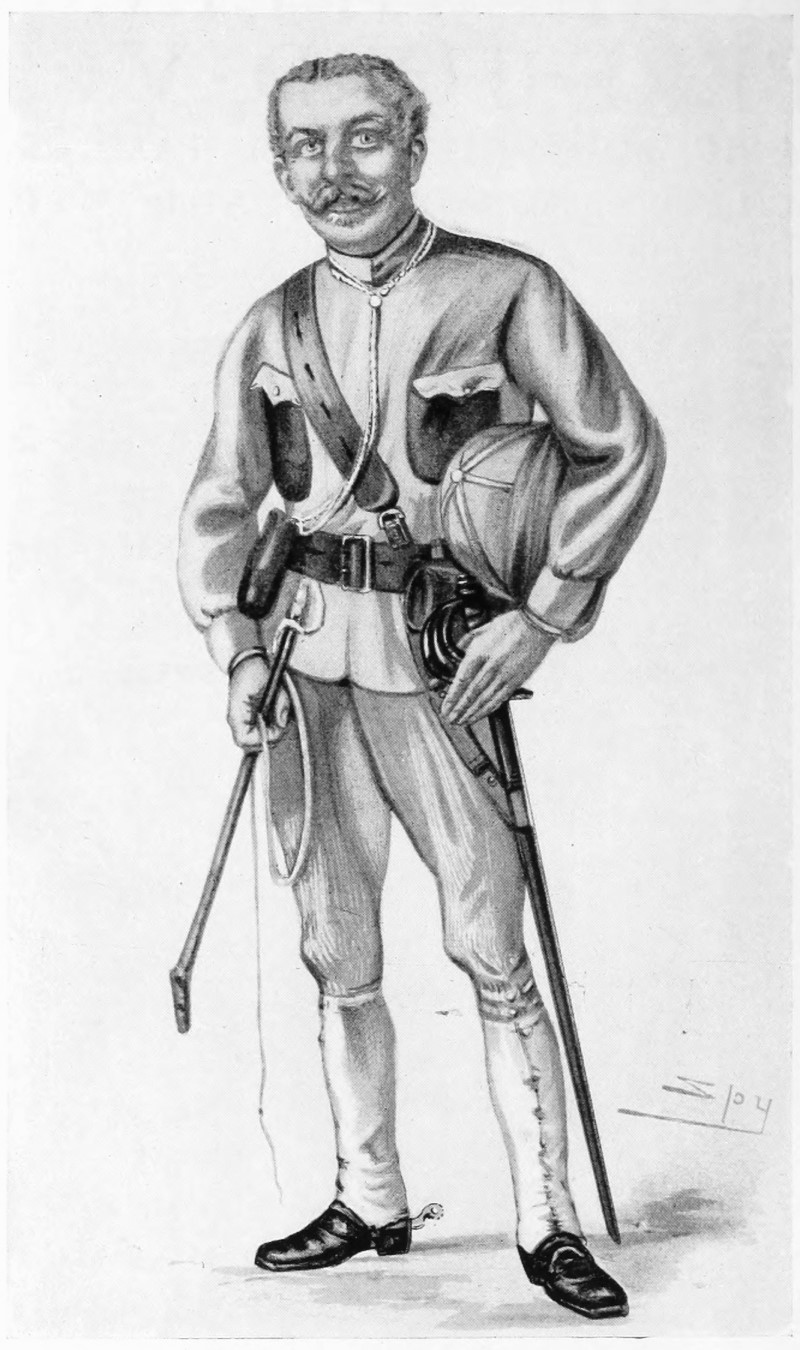
 MCMXVII