"I am afraid you have brought shocking weather with you, Lord Peter,"
said Mrs. Frobisher-Pym, with playful reproof. "If it goes on like this
they will have a bad day for the funeral."
Lord Peter Wimsey glanced out of the morning-room window to the
soaked green lawn and the shrubbery, where the rain streamed down
remorselessly over the laurel leaves, stiff and shiny like mackintoshes.
"Nasty exposed business, standing round at funerals," he agreed.
"Yes, I always think it's such a shame for the old people. In a tiny
village like this it's about the only pleasure they get during the
winter. It makes something for them to talk about for weeks."
"Is it anybody's funeral in particular?"
"My dear Wimsey," said his host, "it is plain that you, coming from
your little village of London, are quite out of the swim. There has
never been a funeral like it in Little Doddering before. It's an event."
"Really?"
"Oh dear, yes. You may possibly remember old Burdock?"
"Burdock? Let me see. Isn't he a sort of local squire, or something?"
"He was," corrected Mr. Frobisher-Pym. "He's dead—died in New York
about three weeks ago, and they're sending him over to be buried. The
Burdocks have lived in the big house for hundreds of years, and they're
all buried in the churchyard, except, of course, the one who was killed
in the War. Burdock's secretary cabled the news of his death across,
and said the body was following as soon as the embalmers had finished
with it. The boat gets in to Southampton this morning, I believe. At
any rate, the body will arrive here by the 6.30 from Town."
"Are you going down to meet it, Tom?"
"No, my dear. I don't think that is called for. There will be a grand
turn-out of the village, of course. Joliffe's people are having the
time of their lives; they borrowed an extra pair of horses from young
Mortimer for the occasion. I only hope they don't kick over the traces
and upset the hearse. Mortimer's horseflesh is generally on the
spirited side."
"But, Tom, we must show some respect to the Burdocks."
"We're attending the funeral to-morrow, and that's quite enough. We
must do that, I suppose, out of consideration for the family, though,
as far as the old man himself goes, respect is the very last thing
anybody would think of paying him."
"Oh, Tom, he's dead."
"And quite time too. No, Agatha, it's no use pretending that old
Burdock was anything but a spiteful, bad-tempered, dirty-living old
blackguard that the world's well rid of. The last scandal he stirred
up made the place too hot to hold him. He had to leave the country and
go to the States, and, even so, if he hadn't had the money to pay the
people off, he'd probably have been put in gaol. That's why I'm so
annoyed with Hancock. I don't mind his calling himself a priest, though
clergyman was always good enough for dear old Weeks—who, after all,
was a canon—and I don't mind his vestments. He can wrap himself up in
a Union Jack if he likes—it doesn't worry me. But when it comes to
having old Burdock put on trestles in the south aisle, with candles
round him, and Hubbard from the 'Red Cow' and Duggins's boy praying
over him half the night, I think it's time to draw the line. The people
don't like it, you know—as least, the older generation don't. It's all
right for the young ones, I dare say; they must have their amusement;
but it gives offence to a lot of the farmers. After all, they knew
Burdock a bit too well. Simpson—he's people's warden, you know—came
up quite in distress to speak to me about it last night. You couldn't
have a sounder man than Simpson. I said I would speak to Hancock. I did
speak to him this morning, as a matter of fact, but you might as well
talk to the west door of the church."
"Mr. Hancock is one of those young men who fancy they know everything,"
said his wife. "A sensible man would have listened to you, Tom. You're
a magistrate and have lived here all your life, and it stands to reason
you know considerably more about the parish than he does."
"He took up the ridiculous position," said Mr. Frobisher-Pym, "that
the more sinful the old man had been the more he needed praying for.
I said, 'I think it would need more praying than you or I could do to
help old Burdock out of the place he's in now.' Ha, ha! So he said,
'I agree with you, Mr. Frobisher-Pym; that is why I am having eight
watchers to pray all through the night for him.' I admit he had me
there."
"Eight people?" exclaimed Mrs. Frobisher-Pym.
"Not all at once, I understand; in relays, two at a time. 'Well,' I
said, 'I think you ought to consider that you will be giving a handle
to the Nonconformists.' Of course, he couldn't deny that."
Wimsey helped himself to marmalade. Nonconformists, it seemed, were
always searching for handles. Though what kind—whether door-handles,
tea-pot handles, pump-handles, or starting-handles—was never
explained, nor what the handles were to be used for when found.
However, having been brought up in the odour of the Establishment, he
was familiar with this odd dissenting peculiarity, and merely said:
"Pity to be extreme in a small parish like this. Disturbs the ideas of
the simple fathers of the hamlet and the village blacksmith, with his
daughter singin' in the choir and the Old Hundredth and all the rest
of it. Don't Burdock's family have anything to say to it? There are
some sons, aren't there?"
"Only the two, now. Aldine was the one that was killed, of course, and
Martin is somewhere abroad. He went off after that row with his father,
and I don't think he has been back in England since."
"What was the row about?"
"Oh, that was a disgraceful business. Martin got a girl into trouble—a
film actress or a typist or somebody of that sort—and insisted on
marrying her."
"Oh?"
"Yes, so dreadful of him," said the lady, taking up the tale, "when he
was practically engaged to the Delaprime girl—the one with glasses,
you know. It made a terrible scandal. Some horribly vulgar people came
down and pushed their way into the house and insisted on seeing old Mr.
Burdock. I will say for him he stood up to them—he wasn't the sort of
person you could intimidate. He told them the girl had only herself
to blame, and they could sue Martin if they liked—he wouldn't be
blackmailed on his son's account. The butler was listening at the door,
naturally, and told the whole village about it. And then Martin Burdock
came home and had a quarrel with his father you could have heard for
miles. He said that the whole thing was a lie, and that he meant to
marry the girl, anyway. I cannot understand how anybody could marry
into a blackmailing family like that."
"My dear," said Mr. Frobisher-Pym gently, "I don't think you're
being quite fair to Martin, or his wife's parents, either. From what
Martin told me, they were quite decent people, only not his class, of
course, and they came in a well-meaning way to find out what Martin's
'intentions' were. You would want to do the same yourself, if it were a
daughter of ours. Old Burdock, naturally, thought they meant blackmail.
He was the kind of man who thinks everything can be paid for; and he
considered a son of his had a perfect right to seduce a young woman who
worked for a living. I don't say Martin was altogether in the right——"
"Martin is a chip off the old block, I'm afraid," retorted the lady.
"He married the girl, anyway, and why should he do that, unless he had
to?"
"Well, they've never had any children, you know," said Mr.
Frobisher-Pym.
"That's as may be. I've no doubt the girl was in league with her
parents. And you know the Martin Burdocks have lived in Paris ever
since."
"That's true," admitted her husband. "It was an unfortunate affair
altogether. They've had some difficulty in tracing Martin's address,
too, but no doubt he'll be coming back shortly. He is engaged in
producing some film play, they tell me, so possibly he can't get away
in time for the funeral."
"If he had any natural feeling, he would not let a film play stand in
his way," said Mrs. Frobisher-Pym.
"My dear, there are such things as contracts, with very heavy monetary
penalties for breaking them. And I don't suppose Martin could afford to
lose a big sum of money. It's not likely that his father will have left
him anything."
"Martin is the younger son, then?" asked Wimsey, politely showing more
interest than he felt in the rather well-worn plot of this village
melodrama.
"No, he is the eldest of the lot. The house is entailed, of course,
and so is the estate, such as it is. But there's no money in the land.
Old Burdock made his fortune in rubber shares during the boom, and the
money will go as he leaves it—wherever that may be, for they haven't
found any will yet. He's probably left it all to Haviland."
"The younger son?"
"Yes. He's something in the City—a director of a company—connected
with silk stockings, I believe. Nobody has seen very much of him. He
came down as soon as he heard of his father's death. He's staying with
the Hancocks. The big house has been shut up since old Burdock went to
the States four years ago. I suppose Haviland thought it wasn't worth
while opening it up till they knew what Martin was going to do about
it. That's why the body is being taken to the church."
"Much less trouble, certainly," said Wimsey.
"Oh, yes—though, mind you, I think Haviland ought to take a more
neighbourly view of it. Considering the position the Burdocks have
always held in the place, the people had a right to expect a proper
reception after the funeral. It's usual. But these business people
think less of tradition than we do down here. And, naturally, since the
Hancocks are putting Haviland up, he can't raise much objection to the
candles and the prayers and things."
"Perhaps not," said Mrs. Frobisher-Pym, "but it would have been more
suitable if Haviland had come to us, rather than to the Hancocks, whom
he doesn't even know."
"My dear, you forget the very unpleasant dispute I had with Haviland
Burdock about shooting over my land. After the correspondence that
passed between us, last time he was down here, I could scarcely offer
him hospitality. His father took a perfectly proper view of it, I will
say that for him, but Haviland was exceedingly discourteous to me,
and things were said which I could not possibly overlook. However, we
mustn't bore you, Lord Peter, with our local small-talk. If you've
finished your breakfast, what do you say to a walk round the place?
It's a pity it's raining so hard—and you don't see the garden at
its best this time of the year, of course—but I've got some cocker
span'els you might like to have a look at."
Lord Peter expressed eager anxiety to see the spaniels, and in a few
minutes' time found himself squelching down the gravel path which led
to the kennels.
"Nothing like a healthy country life," said Mr. Frobisher-Pym. "I
always think London is so depressing in the winter. Nothing to do with
one's self. All right to run up for a day or two and see a theatre now
and again, but how you people stick it week in and week out beats me. I
must speak to Plunkett about this archway," he added. "It's getting out
of trim."
He broke off a dangling branch of ivy as he spoke. The plant shuddered
revengefully, tipping a small shower of water down Wimsey's neck.
The cocker spaniel and her family occupied a comfortable and airy
stall in the stable buildings. A youngish man in breeches and leggings
emerged to greet the visitors, and produced the little bundles of
puppy-hood for their inspection. Wimsey sat down on an upturned bucket
and examined them gravely one by one. The bitch, after cautiously
reviewing his boots and grumbling a little, decided that he was
trustworthy and slobbered genially over his knees.
"Let me see," said Mr. Frobisher-Pym, "how old are they?"
"Thirteen days, sir."
"Is she feeding them all right?"
"Fine, sir. She's having some of the malt food. Seems to suit her very
well, sir."
"Ah, yes. Plunkett was a little doubtful about it, but I heard it
spoken very well of. Plunkett doesn't care for experiments, and, in a
general way, I agree with him. Where is Plunkett, by the way?"
"He's not very well this morning, sir."
"Sorry to hear that, Merridew. The rheumatics again?"
"No, sir. From what Mrs. Plunkett tells me, he's had a bit of a shock."
"A shock? What sort of a shock? Nothing wrong with Alf or Elsie, I
hope?"
"No, sir. The fact is—I understand he's seen something, sir."
"What do you mean, seen something?"
"Well, sir—something in the nature of a warning, from what he says."
"A warning? Good heavens, Merridew, he mustn't get those sort of ideas
in his head. I'm surprised at Plunkett; I always thought he was a very
level-headed man. What sort of warning did he say it was?"
"I couldn't say, sir."
"Surely he mentioned what he thought he'd seen."
Merridew's face took on a slightly obstinate look.
"I can't say, I'm sure, sir."
"This will never do. I must go and see Plunkett. Is he at the cottage?"
"Yes, sir."
"We'll go down there at once. You don't mind, do you, Wimsey? I can't
allow Plunkett to make himself ill. If he's had a shock he'd better see
a doctor. Well, carry on, Merridew, and be sure you keep her warm and
comfortable. The damp is apt to come up through these brick floors.
I'm thinking of having the whole place re-set with concrete, but it
takes money, of course. I can't imagine," he went on, as he led the way
past the greenhouse towards a trim cottage set in its own square of
kitchen-garden, "what can have happened to have upset Plunkett. I hope
it's nothing serious. He's getting elderly, of course, but he ought to
be above believing in warnings. You wouldn't believe the extraordinary
ideas these people get hold of. Fact is, I expect he's been round at
the 'Weary Traveller,' and caught sight of somebody's washing hung out
on the way home."
"Not washing," corrected Wimsey mechanically. He had a deductive turn
of mind which exposed the folly of the suggestion even while irritably
admitting that the matter was of no importance. "It poured with rain
last night, and, besides, it's Thursday. But Tuesday and Wednesday were
fine, so the drying would have all been done then. No washing."
"Well, well—something else then—a post, or old Mrs. Giddens's white
donkey. Plunkett does occasionally take a drop too much, I'm sorry to
say, but he's a very good kennel-man, so one overlooks it. They're
superstitious round about these parts, and they can tell some queer
tales if once you get into their confidence. You'd be surprised how
far off the main track we are as regards civilisation. Why, not here,
but at Abbotts Bolton, fifteen miles off, it's as much as one's life's
worth to shoot a hare. Witches, you know, and that sort of thing."
"I shouldn't be a bit surprised. They'll still tell you about
werewolves in some parts of Germany."
"Yes, I dare say. Well, here we are." Mr. Frobisher-Pym rapped loudly
with his walking-stick on the door of the cottage and turned the handle
without waiting for permission.
"You there, Mrs. Plunkett? May we come in? Ah! good morning. Hope we're
not disturbing you, but Merridew told me Plunkett was not so well. This
is Lord Peter Wimsey—a very old friend of mine; that is to say, I'm a
very old friend of his; ha, ha!"
"Good morning, sir; good morning, your lordship. I'm sure Plunkett will
be very pleased to see you. Please step in. Plunkett, here's Mr. Pym to
see you."
The elderly man who sat crouching over the fire turned a mournful face
towards them, and half rose, touching his forehead.
"Well, now, Plunkett, what's the trouble?" enquired Mr. Frobisher-Pym,
with the hearty bedside manner adopted by country gentlefolk visiting
their dependants. "Sorry not to see you out and about. Touch of the old
complaint, eh?"
"No, sir; no, sir. Thank you, sir. I'm well enough in myself. But I've
had a warning, and I'm not long for this world."
"Not long for this world? Oh, nonsense, Plunkett. You mustn't talk like
that. A touch of indigestion, that's what you've got, I expect. Gives
one the blues, I know. I'm sure I often feel like nothing on earth when
I've got one of my bilious attacks. Try a dose of castor-oil, or a good
old-fashioned blue pill and black draught. Nothing like it. Then you
won't talk about warnings and dying."
"No medicine won't do no good to my complaint, sir. Nobody as see
what I've seed ever got the better of it. But as you and the gentleman
are here, sir, I'm wondering if you'll do me a favour."
"Of course, Plunkett, anything you like. What is it?"
"Why, just to draw up my will, sir. Old Parson, he used to do it. But I
don't fancy this new young man, with his candles and bits of things. It
don't seem as if he'd make it good and legal, sir, and I wouldn't like
it if there was any dispute after I was gone. So as there ain't much
time left me, I'd be grateful if you'd put it down clear for me in pen
and ink that I wants my little bit all to go to Sarah here, and after
her to Alf and Elsie, divided up equal."
"Of course I'll do that for you, Plunkett, any time you like. But it's
all nonsense to be talking about wills. Bless my soul, I shouldn't be
surprised if you were to see us all underground."
"No, sir. I've been a hale and hearty man, I'm not denying. But I've
been called, sir, and I've got to go. It must come to all of us, I know
that. But it's a fearful thing to see the death-coach come for one, and
know that the dead are in it, that cannot rest in the grave."
"Come now, Plunkett, you don't mean to tell me you believe in that old
foolishness about the death-coach. I thought you were an educated man.
What would Alf say if he heard you talking such nonsense?"
"Ah, sir, young people don't know everything, and there's many more
things in God's creation than what you'll find in the printed books."
"Oh, well," said Mr. Frobisher-Pym, finding this opening irresistible,
"we know there are more things in heaven and earth, Horatio, than
are dreamt of in your philosophy. Quite so. But that doesn't apply
nowadays," he added contradictorily. "There are no ghosts in the
twentieth century. Just you think the matter out quietly, and you'll
find you've made a mistake. There's probably some quite simple
explanation. Dear me! I remember Mrs. Frobisher-Pym waking up one night
and having a terrible fright, because she thought somebody'd been and
hanged himself on our bedroom door. Such a silly idea, because I was
safe in bed beside her—snoring, she said, ha, ha!—and, if anybody
was feeling like hanging himself, he wouldn't come into our bedroom
to do it. Well, she clutched my arm in a great state of mind, and
when I went to see what had alarmed her, what do you think it was? My
trousers, which I'd hung up by the braces, with the socks still in the
legs! My word! and didn't I get a wigging for not having put my things
away tidy!"
Mr. Frobisher-Pym laughed, and Mrs. Plunkett said dutifully, "There
now!" Her husband shook his head.
"That may be, sir, but I see the death-coach last night with my own
eyes. Just striking midnight it was, by the church clock, and I see it
come up the lane by the old priory wall."
"And what were you doing out of bed at midnight, eh?"
"Well, sir, I'd been round to my sister's, that's got her boy home on
leaf off of his ship."
"And you'd been drinking his health, I dare say, Plunkett." Mr.
Frobisher-Pym wagged an admonitory forefinger.
"No, sir, I don't deny I'd had a glass or two of ale, but not to fuddle
me. My wife can tell you I was sober enough when I got home."
"That's right, sir. Plunkett hadn't taken too much last night, that
I'll swear to."
"Well, what was it you saw, Plunkett?"
"I see the death-coach, same as I'm telling you, sir. It come up the
lane, all ghostly white, sir, and never making no more sound than the
dead—which it were, sir."
"A wagon or something going through to Lymptree or Herriotting."
"No, sir—tweren't a wagon. I counted the horses—four white horses,
and they went by with never a sound of hoof or bridle. And that
weren't——"
"Four horses! Come, Plunkett, you must have been seeing double. There's
nobody about here would be driving four horses, unless it was Mr.
Mortimer from Abbotts Bolton, and he wouldn't be taking his horseflesh
out at midnight."
"Four horses they was, sir. I see them plain. And it weren't Mr.
Mortimer, neither, for he drives a drag, and this were a big, heavy
coach, with no lights on it, but shinin' all of itself, with a colour
like moonshine."
"Oh, nonsense, man! You couldn't see the moon last night. It was
pitch-dark."
"No, sir, but the coach shone all moony-like, all the same."
"And no lights? I wonder what the police would say to that."
"No mortal police could stop that coach," said Plunkett contemptuously,
"nor no mortal man could abide the sight on it. I tell you, sir, that
ain't the worst of it. The horses——"
"Was it going slowly?"
"No, sir. It were going at a gallop, only the hoofs didn't touch the
ground. There weren't no sound, and I see the black road and the white
hoofs half a foot off of it. And the horses had no heads."
"No heads?"
"No, sir."
Mr. Frobisher-Pym laughed.
"Come, come, Plunkett, you don't expect us to swallow that. No heads?
How could even a ghost drive horses with no heads? How about the reins,
eh?"
"You may laugh, sir, but we know that with God all things are possible.
Four white horses they was. I see them clearly, but there was neither
head nor neck beyond the collar, sir. I see the reins, shining like
silver, and they ran up to the rings of the hames, and they didn't go
no further. If I was to drop down dead this minute, sir, that's what I
see."
"Was there a driver to this wonderful turn-out?"
"Yes, sir, there was a driver."
"Headless too, I suppose?"
"Yes, sir, headless too. At least, I couldn't see nothing of him beyond
his coat, which had them old-fashioned capes at the shoulders."
"Well, I must say, Plunkett, you're very circumstantial. How far off
was this—er—apparition when you saw it?"
"I was passing by the War Memorial, sir, when I see it come up the
lane. It wouldn't be above twenty or thirty yards from where I stood.
It went by at a gallop, and turned off to the left round the churchyard
wall."
"Well, well, it sounds odd, certainly, but it was a dark night, and at
that distance your eyes may have deceived you. Now, if you'll take my
advice you'll think no more about it."
"Ah, sir, it's all very well saying that, but everybody knows the man
who sees the death-coach of the Burdocks is doomed to die within the
week. There's no use rebelling against it, sir; it is so. And if you'll
be so good as to oblige me over that matter of a will, I'd die happier
for knowing as Sarah and the children was sure of their bit of money."
Mr. Frobisher-Pym obliged over the will, though much against the grain,
exhorting and scolding as he wrote. Wimsey added his own signature as
one of the witnesses, and contributed his own bit of comfort.
"I shouldn't worry too much about the coach, if I were you," he said.
"Depend upon it, if it's the Burdock coach it'll just have come for the
soul of the old squire. It couldn't be expected to go to New York for
him, don't you see? It's just gettin' ready for the funeral to-morrow."
"That's likely enough," agreed Plunkett. "Often and often it's been
seen in these parts when one of the Burdocks was taken. But it's
terrible unlucky to see it."
The thought of the funeral seemed, however, to cheer him a little.
The visitors again begged him not to think about it, and took their
departure.
"Isn't it wonderful," said Mr. Frobisher-Pym, "what imagination will
do with these people? And they're obstinate. You could argue with them
till you were black in the face."
"Yes. I say, let's go down to the church and have a look at the place.
I'd like to know how much he could really have seen from where he was
standing."
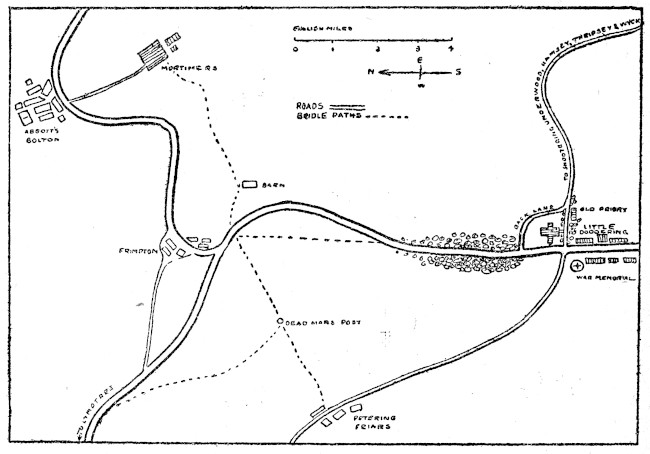
The parish church of Little Doddering stands, like so many country
churches, at some distance from the houses. The main road from
Herriotting, Abbotts Bolton, and Frimpton runs past the west gate of
the churchyard—a wide God's acre, crowded with ancient stones. On
the south side is a narrow and gloomy lane, heavily overhung with old
elm-trees, dividing the church from the still more ancient ruins of
Doddering Priory. On the main road, a little beyond the point where Old
Priory Lane enters, stands the War Memorial, and from here the road
runs straight on into Little Doddering. Round the remaining two sides
of the churchyard winds another lane, known to the village simply as
the Back Lane. This branches out from the Herriotting road about a
hundred yards north of the church, connects with the far end of Priory
Lane, and thence proceeds deviously to Shootering Underwood, Hamsey,
Thripsey, and Wyck.
"Whatever it was Plunkett thinks he saw," said Mr. Frobisher-Pym, "it
must have come from Shootering. The Back Lane only leads round by some
fields and a cottage or two, and it stands to reason anybody coming
from Frimpton would have taken the main road, going and coming. The
lane is in a very bad state with all this rain. I'm afraid even your
detective ability, my dear Wimsey, would not avail to find wheel-marks
on this modern tarmac."
"Hardly," said Wimsey, "especially in the case of a ghostly chariot
which gets along without touching the ground. But your reasoning seems
perfectly sound, sir."
"It was probably a couple of belated wagons going to market," pursued
Mr. Frobisher-Pym, "and the rest of it is superstition and, I am
afraid, the local beer. Plunkett couldn't have seen all those details
about drivers and hames and so on at this distance. And, if it was
making no noise, how did he come to notice it at all, since he'd got
past the turn and was walking in the other direction? Depend upon it,
he heard the wheels and imagined the rest."
"Probably," said Wimsey.
"Of course," went on his host, "if the wagons really were going about
without lights, it ought to be looked into. It is a very dangerous
thing, with all these motor vehicles about, and I've had to speak
severely about it before now. I fined a man only the other day for the
very same thing. Do you care to see the church while we're here?"
Knowing that in country places it is always considered proper to see
the church, Lord Peter expressed his eagerness to do so.
"It's always open nowadays," said the magistrate, leading the way to
the west entrance. "The vicar has an idea that churches should be
always open for private prayer. He comes from a town living, of course.
Round about here the people are always out on the land, and you can't
expect them to come into church in their working clothes and muddy
boots. They wouldn't think it respectful, and they've other things
to do. Besides, I said to him, consider the opportunity it gives for
undesirable conduct. But he's a young man, and he'll have to learn by
experience."
He pushed the door open. A curious, stuffy waft of stale incense, damp,
and stoves rushed out at them as they entered—a kind of concentrated
extract of Church of England. The two altars, bright with flowers and
gilding, and showing as garish splashes among the heavy shadows and
oppressive architecture of the little Norman building, sounded the same
note of contradiction; it was the warm and human that seemed exotic and
unfamiliar; the cold and unwelcoming that seemed native to the place
and people.
"This Lady-chapel, as Hancock calls it, in the south aisle, is new, of
course," said Mr. Frobisher-Pym. "It aroused a good deal of opposition,
but the Bishop is lenient with the High Church party—too lenient, some
people think—but, after all, what does it matter? I'm sure I can say
my prayers just as well with two communion-tables as with one. And, I
will say for Hancock, he is very good with the young men and the girls.
In these days of motor-cycles, it's something to get them interested
in religion at all. Those trestles in the chapel are for old Burdock's
coffin, I suppose. Ah! Here is the vicar."
A thin man in a cassock emerged from a door beside the high altar and
came down towards them, carrying a tall, oaken candlestick in his hand.
He greeted them with a slightly professional smile of welcome. Wimsey
diagnosed him promptly as earnest, nervous, and not highly intellectual.
"The candlesticks have only just come," he observed after the usual
introductions had been made. "I was afraid they would not be here in
time. However, all is now well."
He set the candlestick beside the coffin-trestles, and proceeded to
decorate its brass spike with a long candle of unbleached wax, which he
took from a parcel in a neighbouring pew.
Mr. Frobisher-Pym said nothing. Wimsey felt it incumbent on him to
express his interest, and did so.
"It is very gratifying," said Mr. Hancock, thus encouraged, "to see the
people beginning to take a real interest in their church. I have really
had very little difficulty in finding watchers for to-night. We are
having eight watchers, two by two, from 10 o'clock this evening—till
which time I shall be myself on duty—till six in the morning, when I
come in to say Mass. The men will carry on till 2 o'clock, then my wife
and daughter will relieve them, and Mr. Hubbard and young Rawlinson
have kindly consented to take the hours from four till six."
"What Rawlinson is that?" demanded Mr. Frobisher-Pym.
"Mr. Graham's clerk from Herriotting. It is true he is not a member of
the parish, but he was born here, and was good enough to wish to take
his turn in watching. He is coming over on his motor-cycle. After all,
Mr. Graham has had charge of Burdock's family affairs for very many
years, and no doubt they wished to show their respect in some way."
"Well, I only hope he'll be awake enough to do his work in the morning,
after gadding about all night," said Mr. Frobisher-Pym gruffly. "As for
Hubbard, that's his own look-out, though I must say it seems an odd
occupation for a publican. Still, if he's pleased, and you're pleased,
there's no more to be said about it."
"You've got a very beautiful old church here, Mr. Hancock," said
Wimsey, seeing that controversy seemed imminent.
"Very beautiful indeed," said the vicar. "Have you noticed that apse?
It is rare for a village church to possess such a perfect Norman apse.
Perhaps you would like to come and look at it." He genuflected as they
passed a hanging lamp which burned before a niche. "You see, we are
permitted Reservation. The Bishop——" He prattled cheerfully as they
wandered up the chancel, digressing from time to time to draw attention
to the handsome miserere seats ("Of course, this was the original
Priory Church"), and a beautifully carved piscina and aumbry ("It is
rare to find them so well preserved"). Wimsey assisted him to carry
down the remaining candlesticks from the vestry, and, when these had
been put in position, joined Mr. Frobisher-Pym at the door.
"I think you said you were dining with the Lumsdens to-night," said the
magistrate, as they sat smoking after lunch. "How are you going? Will
you have the car?"
"I'd rather you'd lend me one of the saddle-horses," said Wimsey. "I
get few opportunities of riding in town."
"Certainly, my dear boy, certainly. Only I'm afraid you'll have rather
a wet ride. Take Polly Flinders; it will do her good to get some
exercise. You are quite sure you would prefer it? Have you got your kit
with you?"
"Yes—I brought an old pair of bags down with me, and, with this
raincoat, I shan't come to any harm. They won't expect me to dress. How
far is it to Frimpton, by the way?"
"Nine miles by the main road, and tarmac all the way, I'm afraid, but
there's a good wide piece of grass each side. And, of course, you can
cut off a mile or so by going across the common. What time will you
want to start?"
"Oh, about seven o'clock, I should think. And, I say, sir—will Mrs.
Frobisher-Pym think it very rude if I'm rather late back? Old Lumsden
and I went through the war together, and if we get yarning over old
times we may go on into the small hours. I don't want to feel I'm
treating your house like a hotel, but——"
"Of course not, of course not! That's absolutely all right. My wife
won't mind in the very least. We want you to enjoy your visit and do
exactly what you like. I'll give you the key, and I'll remember not to
put the chain up. Perhaps you wouldn't mind doing that yourself when
you come in?"
"Rather not. And how about the mare?"
"I'll tell Merridew to look out for you; he sleeps over the stables.
I only wish it were going to be a better night for you. I'm afraid
the glass is going back. Yes. Dear, dear! It's a bad look-out for
to-morrow. By the way, you'll probably pass the funeral procession at
the church. It should be along by about then, if the train is punctual."
The train, presumably, was punctual, for as Lord Peter cantered up
to the west gate of the church he saw a hearse of great funereal
pomp drawn up before it, surrounded by a little crowd of people. Two
mourning coaches were in attendance; the driver of the second seemed
to be having some difficulty with the horses, and Wimsey rightly
inferred that this was the pair which had been borrowed from Mr.
Mortimer. Restraining Polly Flinders as best he might, he sidled into
a respectful position on the edge of the crowd, and watched the coffin
taken from the hearse and carried through the gate, where it was met
by Mr. Hancock, in full pontificals, attended by a thurifer and two
torch-bearers. The effect was a little marred by the rain, which had
extinguished the candles, but the village seemed to look upon it as
an excellent show nevertheless. A massive man, dressed with great
correctness in a black frock coat and tall hat, and accompanied by a
woman in handsome mourning and furs, was sympathetically commented on.
This was Haviland Burdock of silk-stocking fame, the younger son of
the deceased. A vast number of white wreaths were then handed out, and
greeted with murmurs of admiration and approval. The choir struck up a
hymn, rather raggedly, and the procession filed away into the church.
Polly Flinders shook her head vigorously, and Wimsey, taking this as
a signal to be gone, replaced his hat and ambled gently away towards
Frimpton.
He followed the main road for about four miles, winding up through
finely wooded country to the edge of Frimpton Common. Here the road
made a wide sweep, skirting the common and curving gently down into
Frimpton village. Wimsey hesitated for a moment, considering that it
was growing dark and that both the way and the animal he rode were
strange to him. There seemed, however, to be a well-defined bridle-path
across the common, and eventually he decided to take it. Polly Flinders
seemed to know it well enough, and cantered along without hesitation. A
ride of about a mile and a half brought them without adventure into the
main road again. Here a fork in the road presented itself confusingly;
an electric torch, however, and a sign-post solved the problem; after
which ten minutes' ride brought the traveller to his goal.
Major Lumsden was a large, cheerful man—none the less cheerful for
having lost a leg in the War. He had a large, cheerful wife, a large,
cheerful house, and a large, cheerful family. Wimsey soon found
himself seated before a fire as large and cheerful as the rest of the
establishment, exchanging gossip with his hosts over a whisky-and-soda.
He described the Burdock funeral with irreverent gusto, and went on to
tell the story of the phantom coach. Major Lumsden laughed.
"It's a quaint part of the country," he said. "The policeman is just as
bad as the rest of them. Do you remember, dear, the time I had to go
out and lay a ghost, down at Pogson's farm?"
"I do, indeed," said his wife emphatically. "The maids had a wonderful
time. Trivett—that's our local constable—came rushing in here and
fainted in the kitchen, and they all sat round howling and sustaining
him with our best brandy, while Dan went down and investigated."
"Did you find the ghost?"
"Well, not the ghost, exactly, but we found a pair of boots and half a
pork-pie in the empty house, so we put it all down to a tramp. Still, I
must say odd things do happen about here. There were those fires on the
common last year. They were never explained."
"Gipsies, Dan."
"Maybe; but nobody ever saw them, and the fires would start in the most
unexpected way, sometimes in the pouring rain; and, before you could
get near one, it would be out, and only a sodden wet black mark left
behind it. And there's another bit of the common that animals don't
like—near what they call the Dead Man's Post. My dogs won't go near
it. Funny brutes. I've never seen anything there, but even in broad
daylight they don't seem to fancy it. The common's not got a good
reputation. It used to be a great place for highwaymen."
"Is the Burdock coach anything to do with highwaymen?"
"No. I fancy it was some rakehelly dead-and-gone Burdock. Belonged
to the Hell-fire Club or something. The usual sort of story. All the
people round here believe in it, of course. It's rather a good thing.
Keeps the servants indoors at night. Well, let's go and have some grub,
shall we?"
"Do you remember," said Major Lumsden, "that damned old mill, and the
three elms by the pig-sty?"
"Good Lord, yes! You very obligingly blew them out of the landscape for
us, I remember. They made us a damned sight too conspicuous."
"We rather missed them when they were gone."
"Thank heaven you didn't miss them when they were there. I'll tell you
what you did miss, though."
"What's that?"
"The old sow."
"By Jove, yes. Do you remember old Piper fetching her in?"
"I'll say I do. That reminds me. You knew Bunthorne...."
"I'll say good night," said Mrs. Lumsden, "and leave you people to it."
"Do you remember," said Lord Peter Wimsey, "that awkward moment when
Popham went off his rocker?"
"No. I'd been sent back with a batch of prisoners. I heard about it
though. I never knew what became of him."
"I got him sent home. He's married now and living in Lincolnshire."
"Is he? Well, he couldn't help himself, I suppose. He was only a kid.
What's happened to Philpotts?"
"Oh, Philpotts...."
"Where's your glass, old man?"
"Oh, rot, old man. The night is still young...."
"Really? Well, but look here, why not stay the night? My wife will be
delighted. I can fix you up in no time."
"No, thanks most awfully. I must be rolling off home. I said I'd be
back; and I'm booked to put the chain on the door."
"As you like, of course, but it's still raining. Not a good night for a
ride on an open horse."
"I'll bring a saloon next time. We shan't hurt. Rain's good for the
complexion—makes the roses grow. Don't wake your man up. I can saddle
her myself."
"My dear man, it's no trouble."
"No, really, old man."
"Well, I'll come along and lend you a hand."
A gust of rain and wind blew in through the hall door as they struggled
out into the night. It was past one in the morning and pitch-dark.
Major Lumsden again pressed Wimsey to stay.
"No, thanks, really. The old lady's feelings might be hurt. It's not so
bad, really—wet, but not cold. Come up, Polly, stand over, old lady."
He put the saddle on and girthed it, while Lumsden held the lantern.
The mare, fed and rested, came delicately dancing out of the warm
loose-box, head well stretched forward, and nostrils snuffing at the
rain.
"Well, so long, old lad. Come and look us up again. It's been great."
"Rather! By Jove, yes. Best respects to madame. Is the gate open?"
"Yes."
"Well, cheerio!"
"Cheerio!"
Polly Flinders, with her nose turned homewards, settled down to make
short work of the nine miles of high-road. Once outside the gates, the
night seemed lighter, though the rain poured heavily. Somewhere buried
behind the thronging clouds there was a moon, which now and again
showed as a pale stain on the sky, a paler reflection on the black
road. Wimsey, with a mind full of memories and a skin full of whisky,
hummed to himself as he rode.
As he passed the fork, he hesitated for a moment. Should he take the
path over the common or stick to the road? On consideration, he decided
to give the common a miss—not because of its sinister reputation, but
because of ruts and rabbit-holes. He shook the reins, bestowed a word
of encouragement on his mount, and continued by the road, having the
common on his right hand, and, on the left, fields bounded by high
hedges, which gave some shelter from the driving rain.
He had topped the rise, and passed the spot where the bridle-path
again joined the high-road, when a slight start and stumble drew his
attention unpleasantly to Polly Flinders.
"Hold up, mare," he said disapprovingly.
Polly shook her head, moved forward, tried to pick up her easy pace
again. "Hullo!" said Wimsey, alarmed. He pulled her to a standstill.
"Lame in the near fore," he said, dismounting. "If you've been and gone
and strained anything, my girl, four miles from home, father will be
pleased." It occurred to him for the first time how curiously lonely
the road was. He had not seen a single car. They might have been in the
wilds of Africa.
He ran an exploratory hand down the near foreleg. The mare stood
quietly enough, without shrinking or wincing. Wimsey was puzzled.
"If these had been the good old days," he said, "I'd have thought she'd
picked up a stone. But what——"
He lifted the mare's foot, and explored it carefully with fingers and
pocket-torch. His diagnosis had been right, after all. A steel nut,
evidently dropped from a passing car, had wedged itself firmly between
the shoe and the frog. He grunted and felt for his knife. Happily, it
was one of that excellent old-fashioned kind which includes, besides
blades and corkscrews, an ingenious apparatus for removing foreign
bodies from horses' feet.
The mare nuzzled him gently as he stooped over his task. It was a
little awkward getting to work; he had to wedge the torch under his
arm, so as to leave one hand free for the tool and the other to hold
the hoof. He was swearing gently at these difficulties when, happening
to glance down the road ahead, he fancied he caught the gleam of
something moving. It was not easy to see, for at this point the tall
trees stood up on both sides of the road, which dipped abruptly from
the edge of the common. It was not a car; the light was too faint. A
wagon, probably, with a dim lantern. Yet it seemed to move fast. He
puzzled for a moment, then bent to work again.
The nut resisted his efforts, and the mare, touched in a tender spot,
pulled away, trying to get her foot down. He soothed her with his
voice and patted her neck. The torch slipped from his arm. He cursed
it impatiently, set down the hoof, and picked up the torch from the
edge of the grass, into which it had rolled. As he straightened himself
again, he looked along the road and saw.
Up from under the dripping dark of the trees it came, shining with
a thin, moony radiance. There was no clatter of hoofs, no rumble
of wheels, no ringing of bit or bridle. He saw the white, sleek,
shining shoulders with the collar that lay on each, like a faint fiery
ring, enclosing nothing. He saw the gleaming reins, their cut ends
slipping back and forward unsupported through the ring of the hames.
The feet, that never touched earth, ran swiftly—four times four
noiseless hoofs, bearing the pale bodies by like smoke. The driver
leaned forward, brandishing his whip. He was faceless and headless,
but his whole attitude bespoke desperate haste. The coach was barely
visible through the driving rain, but Wimsey saw the dimly spinning
wheels and a faint whiteness, still and stiff, at the window. It
went past at a gallop—headless driver and headless horses and silent
coach. Its passing left a stir, a sound that was less a sound than a
vibration—and the wind roared suddenly after it, with a great sheet of
water blown up out of the south.
"Good God!" said Wimsey. And then: "How many whiskies did we have?"
He turned and looked back along the road, straining his eyes. Then
suddenly he remembered the mare, and, without troubling further about
the torch, picked up her foot and went to work by touch. The nut gave
no more trouble, but dropped out into his hand almost immediately.
Polly Flinders sighed gratefully and blew into his ear.
Wimsey led her forward a few steps. She put her feet down firmly and
strongly. The nut, removed without delay, had left no tenderness.
Wimsey mounted, let her go—then pulled her head round suddenly.
"I'm going to see," he said resolutely. "Come up, mare! We won't let
any headless horses get the better of us. Perfectly indecent, goin'
about without heads. Get on, old lady. Over the common with you. We'll
catch 'em at the cross-roads."
Without the slightest consideration for his host or his host's
property, he put the mare to the bridle-path again, and urged her into
a gallop.
At first he thought he could make out a pale, fluttering whiteness,
moving away ahead of him on the road. Presently, as high-road and
bridle-path diverged, he lost it altogether. But he knew there was no
side-road. Bar any accident to his mount, he was bound to catch it
before it came to the fork. Polly Flinders, answering easily to the
touch of his heel, skimmed over the rough track with the indifference
born of familiarity. In less than ten minutes her feet rang out again
on the tarmac. He pulled her up, faced round in the direction of
Little Doddering, and stared down the road. He could see nothing yet.
Either he was well ahead of the coach, or it had already passed at
unbelievable speed, or else——
He waited. Nothing. The violent rain had ceased, and the moon was
struggling out again. The road appeared completely deserted. He glanced
over his shoulder. A small beam of light near the ground moved,
turned, flashed green, and red, and white again, and came towards him.
Presently he made out that it was a policeman wheeling a bicycle.
"A bad night, sir," said the man civilly, but with a faint note of
enquiry in his voice.
"Rotten," said Wimsey.
"Just had to mend a puncture, to make it all the pleasanter," added the
policeman.
Wimsey expressed sympathy. "Have you been here long?" he added.
"Best part o' twenty minutes."
"Did you see anything pass along this way from Little Doddering?"
"Ain't been nothing along while I've been here. What sort of thing did
you mean, sir?"
"I thought I saw——" Wimsey hesitated. He did not care about the idea
of making a fool of himself. "A carriage with four horses," he said
hesitatingly. "It passed me on this road not a quarter of an hour
ago—down at the other end of the common. I—I came back to see. It
seemed unusual——" He became aware that his story sounded very lame.
The policeman spoke rather sharply and rapidly.
"There ain't been nothing past here."
"You're sure?"
"Yes, sir; and, if you don't mind me sayin' so, you'd best be getting
home. It's a lonesome bit o' road."
"Yes, isn't it?" said Wimsey. "Well, good night, sergeant."
He turned the mare's head back along the Little Doddering road, going
very quietly. He saw nothing, heard nothing, and passed nothing. The
night was brighter now, and, as he rode back, he verified the entire
absence of side-roads. Whatever the thing was which he had seen, it had
vanished somewhere along the edge of the common; it had not gone by the
main road, nor by any other.
Wimsey came down rather late for breakfast in the morning, to find his
hosts in a state of some excitement.
"The most extraordinary thing has happened," said Mrs. Frobisher-Pym.
"Outrageous!" added her husband. "I warned Hancock—he can't say
I didn't warn him. Still, however much one may disapprove of his
goings-on, there is no excuse whatever for such abominable conduct.
Once let me get hold of the beggars, whoever they are——"
"What's up?" said Wimsey, helping himself to broiled kidneys at the
sideboard.
"A most scandalous thing," said Mrs. Frobisher-Pym. "The vicar came up
to Tom at once—I hope we didn't disturb you, by the way, with all the
excitement. It appears that when Mr. Hancock got to the church this
morning at 6 o'clock to take the early service——"
"No, no, my dear, you've got it wrong. Let me tell it. When Joe
Grinch—that's the sexton, you know, and he has to get there first to
ring the bell—when he arrived, he found the south door wide open and
nobody in the chapel, where they should have been, beside the coffin.
He was very much perplexed, of course, but he supposed that Hubbard and
young Rawlinson had got sick of it and gone off home. So he went on to
the vestry to get the vestments and things ready, and to his amazement
he heard women's voices, calling out to him from inside. He was so
astonished, didn't know where he was, but he went on and unlocked the
door——"
"With his own key?" put in Wimsey.
"The key was in the door. As a rule it's kept hanging up on a nail
under a curtain near the organ, but it was in the lock—where it ought
not to have been. And inside the vestry he found Mrs. Hancock and her
daughter, nearly dead with fright and annoyance."
"Great Scott!"
"Yes, indeed. They had a most extraordinary story to tell. They'd taken
over at 2 o'clock from the other pair of watchers, and had knelt down
by the coffin in the Lady-chapel, according to plan, to say the proper
sort of prayers, whatever they are. They'd been there, to the best
of their calculation, about ten minutes, when they heard a noise up
by the High Altar, as though somebody was creeping stealthily about.
Miss Hancock is a very plucky girl, and she got up and walked up the
aisle in the dark, with Mrs. Hancock following on behind because, as
she said, she didn't want to be left alone. When they'd got as far
as the rood-screen, Miss Hancock called out aloud, 'Who's there?' At
that they heard a sort of rustling sound, and a noise like something
being knocked over. Miss Hancock most courageously snatched up one of
the churchwarden's staffs, which was clipped on to the choir-stalls,
and ran forward, thinking, she says, that somebody was trying to steal
the ornaments off the altar. There's a very fine fifteenth-century
cross——"
"Never mind the cross, Tom. That hasn't been taken, at any rate."
"No, it hasn't, but she thought it might be. Anyhow, just as she got
up to the sanctuary steps, with Mrs. Hancock coming close after her
and begging her to be careful, somebody seemed to rush out of the
choir-stalls, and caught her by the arms and frog's-marched her—that's
her expression—into the vestry. And before she could get breath even
to shriek, Mrs. Hancock was pushed in beside her, and the door locked
on them."
"By Jove! You do have exciting times in your village."
"Well," said Mr. Frobisher-Pym, "of course they were dreadfully
frightened, because they didn't know but what these wretches would come
back and murder them, and, in any case, they thought the church was
being robbed. But the vestry windows are very narrow and barred, and
they couldn't do anything except wait. They tried to listen, but they
couldn't hear much. Their only hope was that the four-o'clock watchers
might come early and catch the thieves at work. But they waited and
they waited, and they heard four strike, and five, and nobody came."
"What had happened to what's-his-name and Rawlinson then?"
"They couldn't make out, and nor could Grinch. However, they had a good
look round the church, and nothing seemed to be taken or disturbed in
any way. Just then the vicar came along, and they told him all about
it. He was very much shocked, naturally, and his first thought—when he
found the ornaments were safe and the poor-box all right—was that some
Kensitite people had been stealing the wafers from the what d'you call
it."
"The tabernacle," suggested Wimsey.
"Yes, that's his name for it. That worried him very much, and he
unlocked it and had a look, but the wafers were all there all right,
and, as there's only one key, and that was on his own watch-chain,
it wasn't a case of anyone substituting unconsecrated wafers for
consecrated ones, or any practical joke of that kind. So he sent Mrs.
and Miss Hancock home, and had a look round the church outside, and the
first thing he saw, lying in the bushes near the south door, was young
Rawlinson's motor-cycle."
"Oho!"
"So his next idea was to hunt for Rawlinson and Hubbard. However,
he didn't have to look far. He'd got round the church as far as the
furnace-house on the north side, when he heard a terrific hullabaloo
going on, and people shouting and thumping on the door. So he called
Grinch, and they looked in through the little window, and there, if
you please, were Hubbard and young Rawlinson, bawling and going on and
using the most shocking language. It seems they were set on in exactly
the same way, only before they got inside the church. Rawlinson had
been passing the evening with Hubbard, I understand, and they had a
bit of a sleep downstairs in the back bar, to avoid disturbing the
house early—or so they say, though I dare say if the truth was known
they were having drinks; and if that's Hancock's idea of a suitable
preparation for going to church and saying prayers, all I can say is,
it isn't mine. Anyway, they started off just before four, Hubbard going
down on the carrier of Rawlinson's bicycle. They had to get off at the
south gate, which was pushed to, and while Rawlinson was wheeling the
machine up the path two or three men—they couldn't see exactly—jumped
out from the trees. There was a bit of a scuffle, but what with the
bicycle, and its being so unexpected, they couldn't put up a very good
fight, and the men dropped blankets over their heads, or something. I
don't know all the details. At any rate, they were bundled into the
furnace-house and left there. They may be there still, for all I know,
if they haven't found the key. There should be a spare key, but I don't
know what's become of it. They sent up for it this morning, but I
haven't seen it about for a long time."
"It wasn't left in the lock this time, then?"
"No, it wasn't. They've had to send for the locksmith. I'm going down
now to see what's to be done about it. Like to come, if you're ready?"
Wimsey said he would. Anything in the nature of a problem always
fascinated him.
"You were back pretty late, by the way," said Mr. Frobisher-Pym
jovially, as they left the house. "Yarning over old times, I suppose."
"We were, indeed," said Wimsey.
"Hope the old girl carried you all right. Lonely bit of road, isn't
it? I don't suppose you saw anybody worse than yourself, as the saying
goes?"
"Only a policeman," said Wimsey untruthfully. He had not yet quite
decided about the phantom coach. No doubt Plunkett would be relieved to
know that he was not the only person to whom the "warning" had come.
But, then, had it really been the phantom coach, or merely a delusion,
begotten by whisky upon reminiscence? Wimsey, in the cold light of day,
was none too certain.
On arriving at the church, the magistrate and his guest found quite
a little crowd collected, conspicuous among whom were the vicar, in
cassock and biretta, gesticulating freely, and the local policeman,
his tunic buttoned awry and his dignity much impaired by the small fry
of the village, who clustered round his legs. He had just finished
taking down the statements of the two men who had been released from
the stoke-hole. The younger of these, a fresh-faced, impudent-looking
fellow of twenty-five or so, was in the act of starting up his
motor-cycle. He greeted Mr. Frobisher-Pym pleasantly. "Afraid they've
made us look a bit small, sir. You'll excuse me, won't you? I'll have
to be getting back to Herriotting. Mr. Graham won't be any too pleased
if I'm late for the office. I think some of the bright lads have been
having a joke with us." He grinned as he pushed the throttle-lever
over and departed in a smother of unnecessary smoke that made Mr.
Frobisher-Pym sneeze. His fellow-victim, a large, fat man, who looked
the sporting publican that he was, grinned shamefacedly at the
magistrate.
"Well, Hubbard," said the latter, "I hope you've enjoyed your
experience. I must say I'm surprised at a man of your size letting
himself be shut up in a coal-hole like a naughty urchin."
"Yes, sir, I was surprised myself at the time," retorted the publican,
good-humouredly enough. "When that there blanket came down on my head,
I was the most surprised man in this here country. I gave 'em a hack
or two on the shins, though, to remember me by," he added, with a
reminiscent chuckle.
"How many of them were there?" asked Wimsey.
"Three or four, I should say, sir. But not 'avin' seen 'em, I can only
tell from 'earin' 'em talk. There was two laid 'old of me, I'm pretty
sure, and young Rawlinson thinks there was only one 'ad 'old of 'im,
but 'e was a wonderful strong 'un."
"We must leave no stone unturned to find out who these people were,"
said the vicar excitedly. "Ah, Mr. Frobisher-Pym, come and see what
they have done in the church. It is as I thought—an anti-Catholic
protest. We must be most thankful that they have done no more than they
have."
He led the way in. Someone had lit two or three hanging lamps in
the gloomy little chancel. By their light Wimsey was able to see
that the neck of the eagle lectern was decorated with an enormous
red-white-and-blue bow, and bore a large placard—obviously pinched
from the local newspaper offices—"Vatican Bans Immodest
Dress." In each of the choir-stalls a teddy-bear sat, lumpishly
amiable, apparently absorbed in reading the choir-books upside-down,
while on the ledge before them copies of the Pink 'Un were
obstrusively displayed. In the pulpit, a waggish hand had set up a
pantomime ass's head, elegantly arrayed in a nightgown, and crowned
with a handsome nimbus, cut from gold paper.
"Disgraceful, isn't it?" said the vicar.
"Well, Hancock," replied Mr. Frobisher-Pym, "I must say I think you
have brought it upon yourself—though I quite agree, of course, that
this sort of thing cannot possibly be allowed, and the offenders must
be discovered and severely punished. But you must see that many of your
practices appear to these people to be papistical nonsense at best, and
while that is no excuse...."
His reprimanding voice barked on.
"... what I really can only look upon as this sacrilegious business
with old Burdock—a man whose life...."
The policeman had by this time shoved away the attendant villagers and
was standing beside Lord Peter at the entrance of the rood-screen.
"Was that you was out on the road this morning, sir? Ah! I thought I
reckernised your voice. Did you get home all right, sir? Didn't meet
nothing?"
There seemed to be a shade more than idle questioning in the tone of
his voice. Wimsey turned quickly.
"No, I met nothing—more. Who is it drives a coach with four white
horses about this village of a night, sergeant?"
"Not sergeant, sir—I ain't due for promotion yet awhile. Well, sir, as
to white horses, I don't altogether like to say. Mr. Mortimer over at
Abbotts Bolton has some nice greys, and he's the biggest horse-breeder
about these parts—but, well, there, sir, he wouldn't be driving out in
all that rain, sir, would he?"
"It doesn't seem a sensible thing to do, certainly."
"No, sir. And"—the constable leaned close to Wimsey and spoke
into his ear—"and Mr. Mortimer is a man that's got a head on his
shoulders—and, what's more, so have his horses."
"Why," said Wimsey, a little startled by the aptness of this remark,
"did you ever know a horse that hadn't?"
"No, sir," said the policeman, with emphasis, "I never knew no livin'
horse that hadn't. But that's neether here nor there, as the sayin'
goes. But as to this church business, that's just a bit of a lark got
up among the boys, that's what that is. They don't mean no harm, you
know, sir; they likes to be up to their tricks. It's all very well for
the vicar to talk, sir, but this ain't no Kensitites nor anythink of
that, as you can see with half an eye. Just a bit of fun, that's all it
is."
"I'd come to the same conclusion myself," said Wimsey, interested, "but
I'd rather like to know what makes you think so."
"Lord bless you, sir, ain't it plain as the nose on your face? If it
had a-bin these Kensitites, wouldn't they have gone for the crosses
and the images and the lights and—that there?" He extended a horny
finger in the direction of the tabernacle. "No, sir, these lads what
did this ain't laid a finger on the things what you might call sacred
images—and they ain't done no harm neether to the communion-table. So
I says as it ain't a case of controuversy, but more a bit of fun,
like. And they've treated Mr. Burdock's corpse respectful, sir, you
see, too. That shows they wasn't meaning anything wrong at heart, don't
you see?"
"I agree absolutely," said Wimsey. "In fact, they've taken particular
care not to touch anything that a churchman holds really sacred. How
long have you been on this job, officer?"
"Three years, sir, come February."
"Ever had any idea of going to town or taking up the detective side of
the business?"
"Well, sir—I have—but it isn't just ask and have, as you might say."
Wimsey took a card from his note-case.
"If you ever think seriously about it," he said, "give this card to
Chief Inspector Parker, and have a chat with him. Tell him I think you
haven't got opportunities enough down here. He's a great friend of
mine, and he'll give you a good chance, I know."
"I've heard of you, my lord," said the constable, gratified, "and I'm
sure it's very kind of your lordship. Well, I suppose I'd best be
getting along now. You leave it to me, Mr. Frobisher-Pym, sir; we'll
soon get at the bottom of this here."
"I hope you do," said the magistrate. "Meanwhile, Mr. Hancock, I trust
you will realise the inadvisability of leaving the church doors open
at night. Well, come along, Wimsey; we'll leave them to get the church
straight for the funeral. What have you found there?"
"Nothing," said Wimsey, who had been peering at the floor of the
Lady-chapel. "I was afraid you'd got the worm in here, but I see it's
only sawdust." He dusted his fingers as he spoke, and followed Mr.
Frobisher-Pym out of the building.
When you are staying in a village, you are expected to take part in the
interests and amusements of the community. Accordingly, Lord Peter duly
attended the funeral of Squire Burdock, and beheld the coffin safely
committed to the ground, in a drizzle, certainly, but not without the
attendance of a large and reverent congregation. After this ceremony,
he was formally introduced to Mr. and Mrs. Haviland Burdock, and was
able to confirm his previous impression that the lady was well, not to
say too well, dressed, as might be expected from one whose wardrobe was
based upon silk stockings. She was a handsome woman, in a large, bold
style, and the hand that clasped Wimsey's was quite painfully encrusted
with diamonds. Haviland was disposed to be friendly—and, indeed, silk
manufacturers have no reason to be otherwise to rich men of noble
birth. He seemed to be aware of Wimsey's reputation as an antiquarian
and book-collector, and extended a hearty invitation to him to come and
see the old house.
"My brother Martin is still abroad," he said, "but I'm sure he would be
delighted to have you come and look at the place. I'm told there are
some very fine old books in the library. We shall be staying here till
Monday—if Mrs. Hancock will be good enough to have us. Suppose you
come along to-morrow afternoon."
Wimsey said he would be delighted.
Mrs. Hancock interposed and said, wouldn't Lord Peter come to tea at
the vicarage first.
Wimsey said it was very good of her.
"Then that's settled," said Mrs. Burdock. "You and Mr. Pym come to tea,
and then we'll all go over the house together. I've hardly seen it
myself yet."
"It's very well worth seeing," said Mr. Frobisher-Pym. "Fine old place,
but takes some money to keep up. Has nothing been seen of the will yet,
Mr. Burdock?"
"Nothing whatever," said Haviland. "It's curious, because Mr.
Graham—the solicitor, you know, Lord Peter—certainly drew one up,
just after poor Martin's unfortunate difference with our father. He
remembers it perfectly."
"Can't he remember what's in it?"
"He could, of course, but he doesn't think it etiquette to say. He's
one of the crusted old type. Poor Martin always called him an old
scoundrel—but then, of course, he never approved of Martin, so Martin
was not altogether unprejudiced. Besides, as Mr. Graham says, all that
was some years ago, and it's quite possible that the governor destroyed
the will later, or made a new one in America."
"'Poor Martin' doesn't seem to have been popular hereabouts," said
Wimsey to Mr. Frobisher-Pym, as they parted from the Burdocks and
turned homewards.
"N-no," said the magistrate. "Not with Graham, anyway. Personally, I
rather liked the lad, though he was a bit harum-scarum. I dare say he's
sobered up with time—and marriage. It's odd that they can't find the
will. But, if it was made at the time of the rumpus, it's bound to be in
Haviland's favour."
"I think Haviland thinks so," said Wimsey. "His manner seemed to convey
a chastened satisfaction. I expect the discreet Graham made it fairly
clear that the advantage was not with the unspeakable Martin."
The following morning turned out fine, and Wimsey, who was supposed to
be enjoying a rest-and-fresh-air cure in Little Doddering, petitioned
for a further loan of Polly Flinders. His host consented with pleasure,
and only regretted that he could not accompany his guest, being
booked to attend a Board of Guardians' meeting in connection with the
workhouse.
"But you could go up and get a good blow on the common," he suggested.
"Why not go round by Petering Friars, turn off across the common till
you get to Dead Man's Post, and come back by the Frimpton road? It
makes a very pleasant round—about nineteen miles. You'll be back in
nice time for lunch if you take it easy."
Wimsey fell in with the plan—the more readily that it exactly
coincided with his own inward purpose. He had a reason for wishing to
ride over the Frimpton road by daylight.
"You'll be careful about Dead Man's Post," said Mrs. Frobisher-Pym a
little anxiously. "The horses have a way of shying at it. I don't know
why. People say, of course——"
"All nonsense," said her husband. "The villagers dislike the place and
that makes the horses nervous. It's remarkable how a rider's feelings
communicate themselves to his mount. I've never had any trouble at
Dead Man's Post."
It was a quiet and pretty road, even on a November day, that led to
Petering Friars. Jogging down the winding Essex lanes in the wintry
sunshine, Wimsey felt soothed and happy. A good burst across the common
raised his spirits to exhilaration pitch. He had entirely forgotten
Dead Man's Post and its uncanny reputation, when a violent start and
swerve, so sudden that it nearly unseated him, recalled him to what
he was doing. With some difficulty, he controlled Polly Flinders, and
brought her to a standstill.
He was at the highest point of the common, following a bridle-path
which was bordered on each side by gorse and dead bracken. A little
way ahead of him another bridle-path seemed to run into it, and at the
junction of the two was something which he had vaguely imagined to be
a decayed sign-post. Certainly it was short and thick for a sign-post,
and had no arms. It appeared, however, to bear some sort of inscription
on the face that was turned towards him.
He soothed the mare, and urged her gently towards the post. She took a
few hesitating steps, and plunged sideways, snorting and shivering.
"Queer!" said Wimsey. "If this is my state of mind communicating itself
to my mount, I'd better see a doctor. My nerves must be in a rotten
state. Come up, old lady! What's the matter with you?"
Polly Flinders, apologetic but determined, refused to budge. He urged
her gently with his heel. She sidled away, with ears laid back, and he
saw the white of a protesting eye. He slipped from the saddle, and,
putting his hand through the bridle, endeavoured to lead her forward.
After a little persuasion, the mare followed him, with stretched neck
and treading as though on egg-shells. After a dozen hesitating paces,
she stopped again, trembling in all her limbs. He put his hand on her
neck and found it wet with sweat.
"Damn it all!" said Wimsey. "Look here, I'm jolly well going to read
what's on that post. If you won't come, will you stand still?"
He dropped the bridle. The mare stood quietly, with hanging head. He
left her and went forward, glancing back from time to time to see that
she showed no disposition to bolt. She stood quietly enough, however,
only shifting her feet uneasily.
Wimsey walked up to the post. It was a stout pillar of ancient oak,
newly painted white. The inscription, too, had been recently blacked
in. It read:
ON THIS SPOT
George Winter
WAS FOULLY MURTHERED
IN DEFENSE OF
HIS MASTER'S GOODS
BY BLACK RALPH
OF HERRIOTTING
WHO WAS AFTERWARD
HANGED IN CHAINS
ON THE PLACE OF HIS CRIME
9 NOVEMBER 1674
FEAR JUSTICE
"And very nice, too," said Wimsey. "Dead Man's Post without a doubt.
Polly Flinders seems to share the local feeling about the place. Well,
Polly, if them's your sentiments, I won't do violence to them. But may
I ask why, if you're so sensitive about a mere post, you should swallow
a death-coach and four headless horses with such hardened equanimity?"
The mare took the shoulder of his jacket gently between her lips and
mumbled at it.
"Just so," said Wimsey. "I perfectly understand. You would if you
could, but you really can't. But those horses, Polly—did they bring
with them no brimstone blast from the nethermost pit? Can it be that
they really exuded nothing but an honest and familiar smell of stables?"
He mounted, and, turning Polly's head to the right, guided her in a
circle, so as to give Dead Man's Post a wide berth before striking the
path again.
"The supernatural explanation is, I think, excluded. Not on a priori
grounds, which would be unsound, but on the evidence of Polly's senses.
There remain the alternatives of whisky and jiggery-pokery. Further
investigation seems called for."
He continued to muse as the mare moved quietly forward.
"Supposing I wanted, for some reason, to scare the neighbourhood with
the apparition of a coach and headless horses, I should choose a dark,
rainy night. Good! It was that kind of night. Now, if I took black
horses and painted their bodies white—poor devils! what a state they'd
be in. No. How do they do these Maskelyne-and-Devant stunts where
they cut off people's heads? White horses, of course—and black felt
clothing over their heads. Right! And luminous paint on the harness,
with a touch here and there on their bodies, to make good contrast and
ensure that the whole show wasn't invisible. No difficulty about that.
But they must go silently. Well, why not? Four stout black cloth bags
filled with bran, drawn well up and tied round the fetlocks would make
any horse go quietly enough, especially if there was a bit of a wind
going. Rags round the bridle-rings to prevent clinking, and round the
ends of the traces to keep 'em from squeaking. Give 'em a coachman in
a white coat and a black mask, hitch 'em to a rubber-tyred fly, picked
out with phosphorus and well-oiled at the joints—and I swear I'd make
something quite ghostly enough to startle a rather well-irrigated
gentleman on a lonely road at half-past two in the morning."
He was pleased with this thought, and tapped his boot cheerfully with
his whip.
"But damn it all! They never passed me again. Where did they go to? A
coach-and-horses can't vanish into thin air, you know. There must be a
side-road after all—or else, Polly Flinders, you've been pulling my
leg all the time."
The bridle-path eventually debouched upon the highway at the now
familiar fork where Wimsey had met the policeman. As he slowly ambled
homewards, his lordship scanned the left-hand hedgerow, looking for the
lane which surely must exist. But nothing rewarded his search. Enclosed
fields with padlocked gates presented the only breaks in the hedge,
till he again found himself looking down the avenue of trees up which
the death-coach had come galloping two nights before.
"Damn!" said Wimsey.
It occurred to him for the first time that the coach might perhaps
have turned round and gone back through Little Doddering. Certainly
it had been seen by Little Doddering Church on Wednesday. But on that
occasion, also, it had galloped off in the direction of Frimpton. In
fact, thinking it over, Wimsey concluded that it had approached from
Frimpton, gone round the church—widdershins, naturally—by the Back
Lane, and returned by the high-road whence it came. But in that case——
"Turn again, Whittington," said Wimsey, and Polly Flinders rotated
obediently in the road. "Through one of those fields it went, or I'm a
Dutchman."
He pulled Polly into a slow walk, and passed along the strip of grass
at the right-hand side, staring at the ground as though he were an
Aberdonian who had lost a sixpence.
The first gate led into a ploughed field, harrowed smooth and sown with
autumn wheat. It was clear that no wheeled thing had been across it for
many weeks. The second gate looked more promising. It gave upon fallow
ground, and the entrance was seamed with innumerable wheel-ruts. On
further examination, however, it was clear that this was the one and
only gate. It seemed unlikely that the mysterious coach should have
been taken into a field from which there was no way out. Wimsey decided
to seek farther.
The third gate was in bad repair. It sagged heavily from its hinges;
the hasp was gone, and gate and post had been secured with elaborate
twists of wire. Wimsey dismounted and examined these, convincing
himself that their rusty surface had not been recently disturbed.
There remained only two more gates before he came to the cross-roads.
One led into plough again, where the dark ridge-and-furrow showed no
sign of disturbance, but at sight of the last gate Wimsey's heart gave
a leap.
There was plough-land here also, but round the edge of the field ran a
wide, beaten path, rutted and water-logged. The gate was not locked,
but opened simply with a spring catch. Wimsey examined the approach.
Among the wide ruts made by farm-wagons was the track of four narrow
wheels—the unmistakable prints of rubber tyres. He pushed the gate
open and passed through.
The path skirted two sides of the plough; then came another gate and
another field, containing a long barrow of mangold wurzels and a
couple of barns. At the sound of Polly's hoofs, a man emerged from
the nearest barn, with a paint-brush in his hand, and stood watching
Wimsey's approach.
"'Morning!" said the latter genially.
"'Morning, sir."
"Fine day after the rain."
"Yes, it is, sir."
"I hope I'm not trespassing?"
"Where was you wanting to go, sir?"
"I thought, as a matter of fact—hullo!"
"Anything wrong, sir?"
Wimsey shifted in the saddle.
"I fancy this girth's slipped a bit. It's a new one." (This was a
fact.) "Better have a look."
The man advanced to investigate, but Wimsey had dismounted and was
tugging at the strap, with his head under the mare's belly.
"Yes, it wants taking up a trifle. Oh! Thanks most awfully. Is this a
short cut to Abbotts Bolton, by the way?"
"Not to the village, sir, though you can get through this way. It comes
out by Mr. Mortimer's stables."
"Ah, yes. This his land?"
"No, sir, it's Mr. Topham's land, but Mr. Mortimer rents this field and
the next for fodder."
"Oh, yes." Wimsey peered across the hedge. "Lucerne, I suppose. Or
clover."
"Clover, sir. And the mangolds is for the cattle."
"Oh—Mr. Mortimer keeps cattle as well as horses?"
"Yes, sir."
"Very jolly. Have a gasper?" Wimsey had sidled across to the barn
in his interest, and was gazing absently into its dark interior. It
contained a number of farm implements and a black fly of antique
construction, which seemed to be undergoing renovation with black
varnish. Wimsey pulled some vestas from his pocket. The box was
apparently damp, for, after one or two vain attempts he abandoned it,
and struck a match on the wall of the barn. The flame, lighting up the
ancient fly, showed it to be incongruously fitted with rubber tyres.
"Very fine stud, Mr. Mortimer's, I understand," said Wimsey carelessly.
"Yes, sir, very fine indeed."
"I suppose he hasn't any greys, by any chance. My mother—queenly
woman, Victorian ideas, and all that—is rather keen on greys. Sports a
carriage and pay-ah, don't you know."
"Yes, sir? Well, Mr. Mortimer would be able to suit the lady, I think,
sir. He has several greys."
"No? has he though? I must really go over and see him. Is it far?"
"Matter of five or six mile by the fields, sir."
Wimsey looked at his watch.
"Oh, dear! I'm really afraid it's too far for this morning. I
absolutely promised to get back to lunch. I must come over another day.
Thanks so much. Is that girth right now? Oh, really, I'm immensely
obliged. Get yourself a drink, won't you—and tell Mr. Mortimer not
to sell his greys till I've seen them. Well, good morning, and many
thanks."
He set Polly Flinders on the homeward path and trotted gently away.
Not till he was out of sight of the barn did he pull up and, stooping
from the saddle, thoughtfully examine his boots. They were liberally
plastered with bran.
"I must have picked it up in the barn," said Wimsey. "Curious, if true.
Why should Mr. Mortimer be lashing the stuffing out of his greys in an
old fly at dead of night—and with muffled hoofs and no heads to boot?
It's not a kind thing to do. It frightened Plunkett very much. It made
me think I was drunk—a thought I hate to think. Ought I to tell the
police? Are Mr. Mortimer's jokes any business of mine? What do you
think, Polly?"
The mare, hearing her name, energetically shook her head.
"You think not? Perhaps you are right. Let us say that Mr. Mortimer
did it for a wager. Who am I to interfere with his amusements? All
the same," added his lordship, "I'm glad to know it wasn't Lumsden's
whisky."
"This is the library," said Haviland, ushering in his guests. "A fine
room—and a fine collection of books, I'm told, though literature isn't
much in my line. It wasn't much in the governor's line, either, I'm
afraid. The place wants doing up, as you see. I don't know whether
Martin will take it in hand. It's a job that'll cost money, of course."
Wimsey shivered a little as he gazed round—more from sympathy than
from cold, though a white November fog lay curled against the tall
windows and filtered damply through the frames.
A long, mouldering room, in the frigid neo-classical style, the library
was melancholy enough in the sunless grey afternoon, even without the
signs of neglect which wrung the book-collector's heart. The walls,
panelled to half their height with book-cases, ran up in plaster to
the moulded ceiling. Damp had blotched them into grotesque shapes, and
here and there were ugly cracks and squamous patches, from which the
plaster had fallen in yellowish flakes. A wet chill seemed to ooze
from the books, from the calf bindings peeling and perishing, from the
stains of greenish mildew which spread horridly from volume to volume.
The curious musty odour of decayed leather and damp paper added to the
general cheerlessness of the atmosphere.
"Oh, dear, dear!" said Wimsey, peering dismally into this sepulchre of
forgotten learning. With his shoulders hunched like the neck-feathers
of a chilly bird, with his long nose and half-shut eyes, he resembled a
dilapidated heron, brooding over the stagnation of a wintry pool.
"What a freezing-cold place!" exclaimed Mrs. Hancock. "You really
ought to scold Mrs. Lovall, Mr. Burdock. When she was put in here as
caretaker, I said to my husband—didn't I, Philip?—that your father
had chosen the laziest woman in Little Doddering. She ought to have
kept up big fires here, at least twice a week! It's really shameful,
the way she has let things go."
"Yes, isn't it?" agreed Haviland.
Wimsey said nothing. He was nosing along the shelves, every now and
then taking a volume down and glancing at it.
"It was always rather a depressing room," went on Haviland. "I
remember, when I was a kid, it used to overawe me rather. Martin and
I used to browse about among the books, you know, but I think we were
always afraid that something or somebody would stalk out upon us from
the dark corners. What's that you've got there, Lord Peter? Oh, Foxe's
Book of Martyrs. Dear me! How those pictures did terrify me in the
old days! And there was a Pilgrim's Progress, with a most alarming
picture of Apollyon straddling over the whole breadth of the way, which
gave me many nightmares. Let me see. It used to live over in this bay,
I think. Yes, here it is. How it does bring it all back, to be sure! Is
it valuable, by the way?"
"No, not really. But this first edition of Burton is worth money; badly
spotted, though—you'd better send it to be cleaned. And this is an
extremely fine Boccaccio; take care of it."
"John Boccace—The Dance of Machabree. It's a good title, anyhow. Is
that the same Boccaccio that wrote the naughty stories?"
"Yes," said Wimsey, a little shortly. He resented this attitude towards
Boccaccio.
"Never read them," said Haviland, with a wink at his wife, "but I've
seen 'em in the windows of those surgical shops—so I suppose they're
naughty, eh? The vicar's looking shocked."
"Oh, not at all," said Mr. Hancock, with a conscientious assumption of
broad-mindedness. "Et ego in Arcadia—that is to say, one doesn't
enter the Church without undergoing a classical education, and making
the acquaintance of much more worldly authors even than Boccaccio.
Those wood-cuts are very fine, to my uninstructed eye."
"Very fine indeed," said Wimsey.
"There's another old book I remember, with jolly pictures," said
Haviland. "A chronicle of some sort—what's 'is name—place in
Germany—you know—where that hangman came from. They published his
diary the other day. I read it, but it wasn't really exciting; not half
as gruesome as old Harrison Ainsworth. What's the name of the place?"
"Nüremberg?" suggested Wimsey.
"That's it, of course—the Nüremberg Chronicle. I wonder if that's
still in its old place. It was over here by the window, if I remember
rightly."
He led the way to the end of one of the bays, which ran up close
against a window. Here the damp seemed to have done its worst. A pane
of glass was broken, and rain had blown in.
"Now where has it gone to? A big book, it was, with a stamped leather
binding. I'd like to see the old Chronicle again. I haven't set eyes
on it for donkey's years."
His glance roamed vaguely over the shelves. Wimsey, with the
book-lover's instinct, was the first to spot the Chronicle, wedged at
the extreme end of the shelf, against the outer wall. He hitched his
finger into the top edge of the spine, but finding that the rotting
leather was ready to crumble at a touch, he dislodged a neighbouring
book and drew the Chronicle gently out, using his whole hand.
"Here he is—in pretty bad condition, I'm afraid. Hullo!"
As he drew the book away from the wall, a piece of folded parchment
came away with it and fell at his feet. He stooped and picked it up.
"I say, Burdock—isn't this what you've been looking for?"
Haviland Burdock, who had been rooting about on one of the lower
shelves, straightened himself quickly, his face red from stooping.
"By Jove!" he said, turning first redder and then pale with excitement.
"Look at this, Winnie. It's the governor's will. What an extraordinary
thing! Whoever would have thought of looking for it here, of all
places?"
"Is it really the will?" cried Mrs. Hancock.
"No doubt about it, I should say," observed Wimsey coolly. "Last Will
and Testament of Simon Burdock." He stood, turning the grimy document
over and over in his hands, looking from the endorsement to the plain
side of the folded parchment.
"Well, well!" said Mr. Hancock. "How strange! It seems almost
providential that you should have taken that book down."
"What does the will say?" demanded Mrs. Burdock, in some excitement.
"I beg your pardon," said Wimsey, handing it over to her. "Yes, as
you say, Mr. Hancock, it does almost seem as if I was meant to find
it." He glanced down again at the Chronicle, mournfully tracing with
his finger the outline of a damp stain which had rotted the cover and
spread to the inner pages, almost obliterating the colophon.
Haviland Burdock meanwhile had spread the will out on the nearest
table. His wife leaned over his shoulder. The Hancocks, barely
controlling their curiosity, stood near, awaiting the result. Wimsey,
with an elaborate pretence of non-interference in this family matter,
examined the wall against which the Chronicle had stood, feeling its
moist surface and examining the damp-stains. They had assumed the
appearance of a grinning face. He compared them with the corresponding
mark on the book, and shook his head desolately over the damage.
Mr. Frobisher-Pym, who had wandered away some time before and was
absorbed in an ancient book of Farriery, now approached, and enquired
what the excitement was about.
"Listen to this!" cried Haviland. His voice was quiet, but a suppressed
triumph throbbed in it and glittered from his eyes.
"'I bequeath everything of which I die possessed'—there's a lot of
enumeration of properties here, which doesn't matter—'to my eldest
son, Martin'——"
Mr. Frobisher-Pym whistled.
"Listen! 'To my eldest son Martin, for so long as my body shall remain
above ground. But so soon as I am buried, I direct that the whole of
this property shall revert to my younger son Haviland absolutely'——"
"Good God!" said Mr. Frobisher-Pym.
"There's a lot more," said Haviland, "but that's the gist of it."
"Let me see," said the magistrate.
He took the will from Haviland, and read it through with a frowning
face.
"That's right," he said. "No possible doubt about it. Martin has had
his property and lost it again. How very curious. Up till yesterday
everything belonged to him, though nobody knew it. Now it is all yours,
Burdock. This certainly is the strangest will I ever saw. Just fancy
that. Martin the heir, up to the time of the funeral. And now—well,
Burdock, I must congratulate you."
"Thank you," said Haviland. "It is very unexpected." He laughed
unsteadily.
"But what a queer idea!" cried Mrs. Burdock. "Suppose Martin had been
at home. It almost seems a mercy that he wasn't, doesn't it? I mean,
it would all have been so awkward. What would have happened if he had
tried to stop the funeral, for instance?"
"Yes," said Mrs. Hancock. "Could he have done anything? Who decides
about funerals?"
"The executors, as a rule," said Mr. Frobisher-Pym.
"Who are the executors in this case?" enquired Wimsey.
"I don't know. Let me see." Mr. Frobisher-Pym examined the document
again. "Ah, yes! Here we are. 'I appoint my two sons, Martin and
Haviland, joint executors of this my will.' What an extraordinary
arrangement."
"I call it a wicked, un-Christian arrangement," cried Mrs. Hancock.
"It might have caused dreadful mischief if the will hadn't been—quite
providentially—lost!"
"Hush, my dear!" said her husband.
"I'm afraid," said Haviland grimly, "that that was my father's idea.
It's no use my pretending he wasn't spiteful; he was, and I believe he
hated both Martin and me like poison."
"Don't say that," pleaded the vicar.
"I do say it. He made our lives a burden to us, and he obviously wanted
to go on making them a burden after he was dead. If he'd seen us
cutting each other's throats, he'd only have been too pleased. Come,
vicar, it's no use pretending. He hated our mother and was jealous of
us. Everybody knows that. It probably pleased his unpleasant sense
of humour to think of us squabbling over his body. Fortunately, he
over-reached himself when he hid the will here. He's buried now, and
the problem settles itself."
"Are you quite sure of that?" said Wimsey.
"Why, of course," said the magistrate. "The property goes to Mr.
Haviland Burdock as soon as his father's body is underground. Well, his
father was buried yesterday."
"But are you sure of that?" repeated Wimsey. He looked from one to
the other quizzically, his long lips curling into something like a grin.
"Sure of that?" exclaimed the vicar. "My dear Lord Peter, you were
present at the funeral. You saw him buried yourself."
"I saw his coffin buried," said Wimsey mildly. "That the body was in it
is merely an unverified inference."
"I think," said Mr. Frobisher-Pym, "this is rather an unseemly kind
of jest. There is no reason to imagine that the body was not in the
coffin."
"I saw it in the coffin," said Haviland, "and so did my wife."
"And so did I," said the vicar. "I was present when it was transferred
from the temporary shell in which it crossed over from the States to
a permanent lead-and-oak coffin provided by Joliffe. And, if further
witnesses are necessary, you can easily get Joliffe himself and his
men, who put the body in and screwed it down."
"Just so," said Wimsey. "I'm not denying that the body was in the
coffin when the coffin was placed in the chapel. I only doubt whether
it was there when it was put in the ground."
"That is a most unheard-of suggestion to make, Lord Peter," said Mr.
Frobisher-Pym, with severity. "May I ask if you have anything to go
upon? And, if the body is not in the grave, perhaps you wouldn't mind
telling us where you imagine it to be?"
"Not at all," said Wimsey. He perched himself on the edge of the table
and sat, swinging his legs and looking down at his own hands, as he
ticked his points off on his fingers.
"I think," he said, "that this story begins with young Rawlinson. He
is a clerk in the office of Mr. Graham, who drew up this will, and I
fancy he knows something about its conditions. So, of course, does
Mr. Graham, but I don't somehow suspect him of being mixed up in
this. From what I can hear, he is not a man to take sides—or not Mr.
Martin's side, at any rate.
"When the news of Mr. Burdock's death was cabled over from the
States, I think young Rawlinson remembered the terms of the will, and
considered that Mr. Martin—being abroad and all that—would be rather
at a disadvantage. Rawlinson must be rather attached to your brother,
by the way——"
"Martin always had a way of picking up good-for-nothing youths and
wasting his time with them," agreed Haviland sulkily.
The vicar seemed to feel that this statement needed some amendment, and
murmured that he had always heard how good Martin was with the village
lads.
"Quite so," said Wimsey. "Well, I think young Rawlinson wanted to give
Martin an equal chance of securing the legacy, don't you see. He didn't
like to say anything about the will—which might or might not turn
up—and possibly he thought that even if it did turn up there might be
difficulties. Well, anyway, he decided that the best thing to do was to
steal the body and keep it above-ground till Martin came home to see to
things himself."
"This is an extraordinary accusation," began Mr. Frobisher-Pym.
"I dare say I'm mistaken," said Wimsey, "but it's just my idea. It
makes a damn good story, anyhow—you see! Well, then, young Rawlinson
saw that this was too big a job to carry out alone, so he looked round
for somebody to help him. And he pitched on Mr. Mortimer."
"Mortimer?"
"I don't know Mr. Mortimer personally, but he seems to be a sportin'
sort of customer from what I can hear, with certain facilities which
everybody hasn't got. Young Rawlinson and Mortimer put their heads
together and worked out a plan of action. Of course, Mr. Hancock, you
helped them enormously with this lying-in-state idea of yours. Without
that, I don't know if they could have worked it."
Mr. Hancock made an embarrassed clucking sound.
"The idea was this. Mortimer was to provide an antique fly and four
white horses, made up with luminous paint and black cloth to represent
the Burdock death-coach. The advantage of that idea was that nobody
would feel inclined to inspect the turn-out too closely if they saw
it hangin' round the churchyard at unearthly hours. Meanwhile, young
Rawlinson had to get himself accepted as a watcher for the chapel, and
to find a sporting companion to watch with him and take a hand in the
game. He fixed things up with the publican-fellow, and spun a tale for
Mr. Hancock, so as to get the vigil from four to six. Didn't it strike
you as odd, Mr. Hancock, that he should be so keen to come all the way
from Herriotting?"
"I am accustomed to find keenness in my congregation," said Mr. Hancock
stiffly.
"Yes, but Rawlinson didn't belong to your congregation. Anyway it was
all worked out, and there was a dress-rehearsal on the Wednesday night,
which frightened your man Plunkett into fits, sir."
"If I thought this was true——" said Mr. Frobisher-Pym.
"On Thursday night," pursued Wimsey, "the conspirators were ready,
hidden in the chancel at two in the morning. They waited till Mrs. and
Miss Hancock had taken their places, and then made a row to attract
their attention. When the ladies courageously advanced to find out what
was up, they popped out and bundled 'em into the vestry."
"Good gracious!" said Mrs. Hancock.
"That was when the death-coach affair was timed to drive up to the
south door. It came round the Back Lane, I fancy, though I can't be
sure. Then Mortimer and the other two took the embalmed body out of
the coffin and filled its place up with bags of sawdust. I know it was
sawdust, because I found the remains of it on the Lady-chapel floor
in the morning. They put the body in the fly, and Mortimer drove off
with it. They passed me on the Herriotting Road at half-past two, so
they can't have wasted much time over the job. Mortimer may have been
alone, or possibly he had someone with him to see to the body while he
himself did the headless coachman business in a black mask. I'm not
certain about that. They drove through the last gate before you come to
the fork at Frimpton, and went across the fields to Mortimer's barn.
They left the fly there—I know that, because I saw it, and I saw the
bran they used to muffle the horses' hoofs, too. I expect they took it
on from there in a car, and fetched the horses up next day—but that's
a detail. I don't know, either, where they took the body to, but I
expect, if you went and asked Mortimer about it, he would be able to
assure you that it was still above ground."
Wimsey paused. Mr. Frobisher-Pym and the Hancocks were looking only
puzzled and angry, but Haviland's face was green. Mrs. Haviland
showed a red, painted spot on each cheek, and her mouth was haggard.
Wimsey picked up the Nüremberg Chronicle and caressed its covers
thoughtfully as he went on.
"Meanwhile, of course, young Rawlinson and his companion were doing the
camouflage in the church, to give the idea of a Protestant outrage.
Having fixed everything up neat and pretty, all they had to do was to
lock themselves up in the furnace-house and chuck the key through the
window. You'll probably find it there, Mr. Hancock, if you care to
look. Didn't you think that story of an assault by two or three men was
a bit thin? Hubbard is a hefty great fellow, and Rawlinson's a sturdy
lad—and yet, on their own showing, they were bundled into a coal-hole
like helpless infants, without a scratch on either of 'em. Look for the
men in buckram, my dear sir, look for the men in buckram!"
"Look here, Wimsey, are you sure you're not romancing?" said Mr.
Frobisher-Pym. "One would need some very clear proof before——"
"Certainly," said Wimsey. "Get a Home Office order. Open the grave.
You'll soon see whether it's true or whether it's just my diseased
imagination."
"I think this whole conversation is disgusting," cried Mrs. Burdock.
"Don't listen to it, Haviland. Anything more heartless on the day after
father's funeral than sitting here and inventing such a revolting story
I simply can't imagine. It is not worth paying a moment's attention to.
You will certainly not permit your father's body to be disturbed. It's
horrible. It's a desecration."
"It is very unpleasant indeed," said Mr. Frobisher-Pym gravely, "but if
Lord Peter is seriously putting forward this astonishing theory, which
I can scarcely credit——"
Wimsey shrugged his shoulders.
"—then I feel bound to remind you, Mr. Burdock, that your brother,
when he returns, may insist on having the matter investigated."
"But he can't, can he?" said Mrs. Burdock.
"Of course he can, Winnie," snapped her husband savagely. "He's an
executor. He has as much right to have the governor dug up as I have to
forbid it. Don't be a fool."
"If Martin had any decency, he would forbid it, too," said Mrs. Burdock.
"Oh, well!" said Mrs. Hancock, "shocking as it may seem, there's the
money to be considered. Mr. Martin might think it a duty to his wife,
and his family, if he should ever have any——"
"The whole thing is preposterous," said Haviland decidedly. "I don't
believe a word of it. If I did, naturally I should be the first person
to take action in the matter—not only in justice to Martin, but on my
own account. But if you ask me to believe that a responsible man like
Mortimer would purloin a corpse and desecrate a church—the thing only
has to be put into plain words to show how absurd and unthinkable it
is. I suppose Lord Peter Wimsey, who consorts, as I understand, with
criminals and police officers, finds the idea conceivable. I can only
say that I do not. I am sorry that his mind should have become so
blunted to all decent feeling. That's all. Good afternoon."
Mr. Frobisher-Pym jumped up.
"Come, come, Burdock, don't take that attitude. I am sure Lord Peter
intended no discourtesy. I must say I think he's all wrong, but, 'pon
my soul, things have been so disturbed in the village these last few
days, I'm not surprised anybody should think there was something behind
it. Now, let's forget about it—and hadn't we better be moving out of
this terribly cold room? It's nearly dinner-time. Bless me, what will
Agatha think of us?"
Wimsey held out his hand to Burdock, who took it reluctantly.
"I'm sorry," said Wimsey. "I suffer from hypertrophy of the
imagination, y'know. Over-stimulation of the thyroid probably. Don't
mind me. I apologise, and all that."
"I don't think, Lord Peter," said Mrs. Burdock acidly, "you ought to
exercise your imagination at the expense of good taste."
Wimsey followed her from the room in some confusion. Indeed, he was so
disturbed that he carried away the Nüremberg Chronicle beneath his
arm, which was an odd thing for him to do under the circumstances.
"I am gravely distressed," said Mr. Hancock.
He had come over, after Sunday evening service, to call upon the
Frobisher-Pyms. He sat upright on his chair, his thin face flushed with
anxiety.
"I could never have believed such a thing of Hubbard. It has been a
grievous shock to me. It is not only the great wickedness of stealing a
dead body from the very precincts of the church, though that is grave
enough. It is the sad hypocrisy of his behaviour—the mockery of sacred
things—the making use of the holy services of his religion to further
worldly ends. He actually attended the funeral, Mr. Frobisher-Pym, and
exhibited every sign of grief and respect. Even now he hardly seems to
realise the sinfulness of his conduct. I feel it very much, as a priest
and as a pastor—very much indeed."
"Oh, well, Hancock," said Mr. Frobisher-Pym, "you must make allowances,
you know. Hubbard's not a bad fellow, but you can't expect refinement
of feeling from a man of his class. The point is, what are we to do
about it? Mr. Burdock must be told, of course. It's a most awkward
situation. Dear me! Hubbard confessed the whole conspiracy, you say?
How did he come to do that?"
"I taxed him with it," said the parson. "When I came to think over
Lord Peter Wimsey's remarks, I was troubled in my mind. It seemed to
me—I cannot say why—that there might be some truth in the story,
wild as it appeared. I was so worried about it that I swept the floor
of the Lady-chapel myself last night, and I found quite a quantity
of sawdust among the sweepings. That led me to search for the key of
the furnace-house, and I discovered it in some bushes at a little
distance—in fact, within a stone's throw—of the furnace-house window.
I sought guidance in prayer—and from my wife, whose judgment I greatly
respect—and I made up my mind to speak to Hubbard after Mass. It
was a great relief to me that he did not present himself at Early
Celebration. Feeling as I did, I should have had scruples."
"Just so, just so," said the magistrate, a little impatiently. "Well,
you taxed him with it, and he confessed?"
"He did. I am sorry to say he showed no remorse at all. He even
laughed. It was a most painful interview."
"I am sure it must have been," said Mrs. Frobisher-Pym sympathetically.
"We must go and see Mr. Burdock," said the magistrate, rising.
"Whatever old Burdock may or may not have intended by that iniquitous
will of his, it's quite evident that Hubbard and Mortimer and Rawlinson
were entirely in the wrong. Upon my word, I've no idea whether it's an
indictable offence to steal a body. I must look it up. But I should
say it was. If there is any property in a corpse, it must belong to
the family or the executors. And in any case, it's sacrilege, to say
nothing of the scandal in the parish. I must say, Hancock, it won't do
us any good in the eyes of the Nonconformists. However, no doubt you
realise that. Well, it's an unpleasant job, and the sooner we tackle
it the better. I'll run over to the vicarage with you and help you to
break it to the Burdocks. How about you, Wimsey? You were right, after
all, and I think Burdock owes you an apology."
"Oh, I'll keep out of it," said Wimsey. "I shan't be exactly persona
grata, don't you know. It's going to mean a deuce of a big financial
loss to the Haviland Burdocks."
"So it is. Most unpleasant. Well, perhaps you're right. Come along,
vicar."
Wimsey and his hostess sat discussing the matter by the fire for half
an hour or so, when Mr. Frobisher-Pym suddenly put his head in and said:
"I say, Wimsey—we're all going over to Mortimer's. I wish you'd come
and drive the car. Merridew always has the day off on Sunday, and I
don't care about driving at night, particularly in this fog."
"Right you are," said Wimsey. He ran upstairs, and came down in a
few moments wearing a heavy leather flying-coat, and with a parcel
under his arm. He greeted the Burdocks briefly, climbed into the
driving-seat, and was soon steering cautiously through the mist along
the Herriotting Road.
He smiled a little grimly to himself as they came up under the trees
to the spot where the phantom coach had passed him. As they passed the
gate through which the ingenious apparition had vanished, he indulged
himself by pointing it out, and was rewarded by hearing a snarl from
Haviland. At the well-remembered fork, he took the right-hand turning
into Frimpton and drove steadily for six miles or so, till a warning
shout from Mr. Frobisher-Pym summoned him to look out for the turning
up to Mortimer's.
Mr. Mortimer's house, with its extensive stabling and farm buildings,
stood about two miles back from the main road. In the darkness Wimsey
could see little of it; but he noticed that the ground-floor windows
were all lit up, and, when the door opened to the magistrate's
imperative ring, a loud burst of laughter from the interior gave
evidence that Mr. Mortimer was not taking his misdoings too seriously.
"Is Mr. Mortimer at home?" demanded Mr. Frobisher-Pym, in the tone of a
man not to be trifled with.
"Yes, sir. Will you come in, please?"
They stepped into a large, old-fashioned hall, brilliantly lit, and
made cosy with a heavy oak screen across the door. As Wimsey advanced,
blinking, from the darkness, he saw a large, thick-set man, with a
ruddy face, advancing with hand outstretched in welcome.
"Frobisher-Pym! By Jove! how decent of you to come over! We've got some
old friends of yours here. Oh!" (in a slightly altered tone) "Burdock!
Well, well——"
"Damn you!" said Haviland Burdock, thrusting furiously past the
magistrate, who was trying to hold him back. "Damn you, you swine!
Chuck this bloody farce. What have you done with the body?"
"The body, eh?" said Mr. Mortimer, retreating in some confusion.
"Yes, curse you! Your friend Hubbard's split. It's no good denying it.
What the devil do you mean by it? You've got the body here somewhere.
Where is it? Hand it over!"
He strode threateningly round the screen into the lamplight. A tall,
thin man rose up unexpectedly from the depths of an arm-chair and
confronted him.
"Hold hard, old man!"
"Good God!" said Haviland, stepping heavily back on Wimsey's toes.
"Martin!"
"Sure," said the other. "Here I am. Come back like a bad half-penny.
How are you?"
"So you're at the bottom of this!" stormed Haviland. "I might have
known it. You damned, dirty hound! I suppose you think it's decent to
drag your father out of his coffin and tote him about the country like
a circus. It's degrading. It's disgusting. It's abominable. You must be
perfectly dead to all decent feeling. You don't deny it, I suppose?"
"I say, Burdock!" expostulated Mortimer.
"Shut up, curse you!" said Haviland. "I'll deal with you in a minute.
Now, look here, Martin, I'm not going to stand any more of this
disgraceful behaviour. You'll give up that body, and——"
"Just a moment, just a moment," said Martin. He stood, smiling a
little, his hands thrust into the pockets of his dinner-jacket. "This
éclaircissement seems to be rather public. Who are all these people?
Oh, it's the vicar, I see. I'm afraid we owe you a little explanation,
vicar. And, er——"
"This is Lord Peter Wimsey," put in Mr. Frobisher-Pym, "who discovered
your—I'm afraid, Burdock, I must agree with your brother in calling it
your disgraceful plot."
"Oh, Lord!" said Martin. "I say, Mortimer, you didn't know you were up
against Lord Peter Wimsey, did you? No wonder the cat got out of the
bag. The man's known to be a perfect Sherlock. However, I seem to have
got home at the crucial moment, so there's no harm done. Diana, this is
Lord Peter Wimsey—my wife."
A young and pretty woman in a black evening dress greeted Wimsey with a
shy smile, and turned deprecatingly to her brother-in-law.
"Haviland, we want to explain——"
He paid no attention to her.
"Now then, Martin, the game's up."
"I think it is, Haviland. But why make all this racket?"
"Racket! I like that. You take your own father's body out of its
coffin——"
"No, no, Haviland. I knew nothing about it. I swear that. I only got
the news of his death a few days ago. We were right out in the wilds,
filming a show in the Pyrenees, and I came straight back as soon as I
could get away. Mortimer here, with Rawlinson and Hubbard, staged the
whole show by themselves. I never heard a word about it till yesterday
morning in Paris, when I found his letter waiting at my old digs.
Honestly, Haviland, I had nothing to do with it. Why should I? I didn't
need to."
"What do you mean?"
"Well, if I'd been here, I should only have had to speak to stop the
funeral altogether. Why on earth should I have gone to the trouble of
stealing the body? Quite apart from the irreverence and all that. As it
is, when Mortimer told me about it, I must say I was a bit revolted at
the idea, though I appreciated the kindness and the trouble they'd been
to on my account. I think Mr. Hancock has most cause for wrath, really.
But Mortimer has been as careful as possible, sir—really he has. He
has placed the old governor quite reverently and decently in what used
to be the chapel, and put flowers round him and so on. You will be
quite satisfied, I'm sure."
"Yes, yes," said Mortimer. "No disrespect intended, don't you know.
Come and see him."
"This is dreadful," said the vicar helplessly.
"They had to do the best they could, don't you see, in my absence,"
said Martin. "As soon as I can, I'll make proper arrangements for a
suitable tomb—above ground, of course. Or possibly cremation would fit
the case."
"What!" gasped Haviland. "Do you mean to say you imagine I'm going to
let my father stay unburied, simply because of your disgusting greed
about money?"
"My dear chap, do you think I'm going to let you put him underground,
simply to enable you to grab my property?"
"I'm the executor of his will, and I say he shall be buried, whether
you like it or not!"
"And I'm an executor too—and I say he shan't be buried. He can be
kept absolutely decently above ground, and he shall be."
"But hear me," said the vicar, distracted between these two
disagreeable and angry young men.
"I'll see what Graham says about you," bawled Haviland.
"Oh, yes—the honest lawyer, Graham," sneered Martin. "He knew what
was in the will, didn't he? I suppose he didn't mention it to you, by
any chance?"
"He did not," retorted Haviland. "He knew too well the sort of skunk
you were to say anything about it. Not content with disgracing us
with your miserable, blackmailing marriage——"
"Mr. Burdock, Mr. Burdock——"
"Take care, Haviland!"
"You have no more decency——"
"Stop it!"
"Than to steal your father's body and my money so that you and your
damned wife can carry on your loose-living, beastly ways with a parcel
of film-actors and chorus-girls——"
"Now then, Haviland. Keep your tongue off my wife and my friends. How
about your own? Somebody told me Winnie'd been going the pace pretty
well—next door to bankruptcy, aren't you, with the gees and the tables
and God knows what! No wonder you want to do your brother out of his
money. I never thought much of you, Haviland, but by God——"
"One moment!"
Mr. Frobisher-Pym at last succeeded in asserting himself, partly
through the habit of authority, and partly because the brothers had
shouted themselves breathless.
"One moment, Martin. I will call you so, because I have known you a
long time, and your father too. I understand your anger at the things
Haviland has said. They were unpardonable, as I am sure he will realise
when he comes to his right mind. But you must remember that he has
been greatly shocked and upset—as we all have been—by this very very
painful business. And it is not fair to say that Haviland has tried to
'do you out' of anything. He knew nothing about this iniquitous will,
and he naturally saw to it that the funeral arrangements were carried
out in the usual way. You must settle the future amicably between you,
just as you would have done had the will not been accidentally mislaid.
Now, Martin—and Haviland too—think it over. My dear boys, this scene
is simply appalling. It really must not happen. Surely the estate can
be divided up in a friendly manner between you. It is horrible that an
old man's body should be a bone of contention between his own sons,
just over a matter of money."
"I'm sorry," said Martin. "I forgot myself. You're quite right, sir.
Look here, Haviland, forget it. I'll let you have half the money——"
"Half the money! But it's all mine. You'll let me have half? How
damned generous! My own money!"
"No, old man. It's mine at the moment. The governor's not buried yet,
you know. That's right, isn't it, Mr. Frobisher-Pym?"
"Yes; the money is yours, legally, at this moment. You must see that,
Haviland. But your brother offers you half, and——"
"Half! I'm damned if I'll take half. The man's tried to swindle me out
of it. I'll send for the police, and have him put in gaol for robbing
the Church. You see if I don't. Give me the telephone."
"Excuse me," said Wimsey. "I don't want to butt in on your family
affairs any more than I have already, but I really don't advise you to
send for the police."
"You don't, eh? What the hell's it got to do with you?"
"Well," said Wimsey deprecatingly, "if this will business comes into
court, I shall probably have to give evidence, because I was the bird
who found the thing, don't you see?"
"Well, then?"
"Well, then. They might ask how long the will was supposed to have been
where I found it."
Haviland appeared to swallow something which obstructed his speech.
"What about it, curse you!"
"Yes. Well, you see, it's rather odd when you come to think of it.
I mean, your late father must have hidden that will in the bookcase
before he went abroad. That was—how long ago? Three years? Five years?"
"About four years."
"Quite. And since then your bright caretaker has let the damp get into
the library, hasn't she? No fires, and the window getting broken,
and so on. Ruinous to the books. Very distressin' to anybody like
myself, you know. Yes. Well, supposin' they asked that question about
the will—and you said it had been there in the damp for four years.
Wouldn't they think it a bit funny if I told 'em that there was a big
damp stain like a grinning face on the end of the bookshelf, and a
big, damp, grinning face on the jolly old Nüremberg Chronicle to
correspond with it, and no stain on the will which had been sittin' for
four years between the two?"
Mrs. Haviland screamed suddenly. "Haviland! You fool! You utter fool!"
"Shut up!"
Haviland snapped round at his wife with a cry of rage, and she
collapsed into a chair, with her hand snatched to her mouth.
"Thank you, Winnie," said Martin. "No, Haviland—don't trouble to
explain. Winnie's given the show away. So you knew—you knew about
the will, and you deliberately hid it away and let the funeral go
on. I'm immensely obliged to you—nearly as obliged as I am to the
discreet Graham. Is it fraud or conspiracy or what, to conceal wills?
Mr. Frobisher-Pym will know."
"Dear, dear!" said the magistrate. "Are you certain of your facts,
Wimsey?"
"Positive," said Wimsey, producing the Nüremberg Chronicle from
under his arm. "Here's the stain—you can see it yourself. Forgive me
for having borrowed your property, Mr. Burdock. I was rather afraid
Mr. Haviland might think this little discrepancy over in the still
watches of the night, and decide to sell the Chronicle, or give it
away, or even think it looked better without its back pages and cover.
Allow me to return it to you, Mr. Martin—intact. You will perhaps
excuse my saying that I don't very much admire any of the rôles in this
melodrama. It throws, as Mr. Pecksniff would say, a sad light on human
nature. But I resent extremely the way in which I was wangled up to
that bookshelf and made to be the bright little independent witness who
found the will. I may be an ass, Mr. Haviland Burdock, but I'm not a
bloody ass. Good night. I will wait in the car till you are all ready."
Wimsey stalked out with some dignity.
Presently he was followed by the vicar and by Mr. Frobisher-Pym.
"Mortimer's taking Haviland and his wife to the station," said the
magistrate. "They're going back to town at once. You can send their
traps off in the morning, Hancock. We'd better make ourselves scarce."
Wimsey pressed the self-starter.
As he did so, a man ran hastily down the steps and came up to him. It
was Martin.
"I say," he muttered. "You've done me a good turn—more than I deserve,
I'm afraid. You must think I'm a damned swine. But I'll see the old man
decently put away, and I'll share with Haviland. You mustn't judge him
too hardly, either. That wife of his is an awful woman. Run him over
head and ears in debt. Bust up his business. I'll see it's all squared
up. See? Don't want you to think us too awful."
"Oh, right-ho!" said Wimsey.
He slipped in the clutch, and faded away into the wet, white fog.