The velvet dusk that crept up from the eastwards was held in check by
the brightening flood of moonlight on the sea when Ormsgill leaned on
the balustrade of the veranda outside the Hotel Catalina in Grand
Canary. Close in front of him the long Atlantic swell broke upon the
hammered beach with a drowsy rumbling, and flung a pungent freshness
into the listless air, for the Trade breeze had fallen dead away. The
fringe of surf ran southwards beside the dim white road to where the
lights of Las Palmas blinked and twinkled in the shadow the great
black peaks flung out upon the sparkling sea.
Ormsgill, who had turned from its contemplation at the sound of a
voice he recognized, had, however, no longer any eyes for the
prospect. He had arrived on an African mail-boat two hours earlier,
and had somehow missed the girl whose voice had sent a little thrill
through him. She had, it seemed, gone in through one of the long,
lighted windows instead of by the door, but the horse she had just
dismounted from was still standing with another, which carried a man's
saddle, just below the veranda. Ormsgill could see that it was one of
the sorry beasts the Spaniards hire to Englishmen, but it was also
jaded and white with lather.
"These English have no consideration," said the peon who held its
bridle, to a comrade. "This horse is old, but when I brought it here
it was not more than a very little lame. Now it is certain I cannot
hire it to anybody to-morrow. They were at Arucas, which for a horse
of this kind is a long way, but they came home by the barranco and
across the sand heaps at the gallop. The Señorita must not be late for
dinner. Vaya! it is a cruelty."
The matter was, perhaps, not a great one in itself, but it had a
somewhat unpleasant effect upon Ormsgill, who knew that the Iberian is
not as a rule squeamish about any cruelty that the lust of gain
renders it necessary to inflict upon his beast. The horse, as he could
see, had certainly been ridden hard, and was very lame. The thing
jarred on him, and as he leaned on the veranda waiting until the
message he had left to announce his arrival should be delivered, a
scene he had looked upon in the dark land forced itself upon his
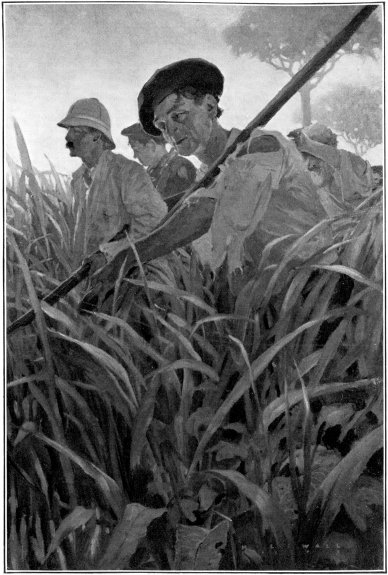
recollection. It was a line of jaded men staggering under the burdens
on their heads through an apparently interminable sea of scorched and
dusty grass. There was little water in that country at the season, and
they dragged themselves along, grimed with the fibrous dust, in
torments of thirst, with limbs that were reddened by the stabbing of
the flinty grass stems. Then rousing himself he drove the suggestive
vision from his brain and entered the hall of the big hotel.
It blazed with light, there was music somewhere, and already
conventionally attired men and elaborately dressed women were
descending the stairway, and appearing by twos and threes from the
corridors. They were for the most part Englishmen and women, but
Ormsgill was a little astonished to feel that instead of arousing
sympathy their voices and bearing jarred on him. Their conversation
appeared to have no point in it, and their smiles were meaningless.
They seemed shallow and artificial, and he had lived at high pressure,
face to face with grim realities, in the land of the shadow. He stood
a little apart, quietly regarding them, a lonely figure in plain white
duck with a lined brown face, until a burly man in the conventional
black and white strode up to him.
"I'm uncommonly glad to see you, Tom," he said. "Ada will be down in a
minute. I left her and her mother almost too startled to understand
that you had arrived. The man you gave your message to had just
brought it in. You should have let us know what boat you were sailing
by. But I mustn't keep you talking. You have just time to change your
things."
Ormsgill shook hands with him, but was conscious of a lack of
enthusiasm as he did it that irritated him. He had once considered
Major Chillingham a very good fellow, but now there seemed to be
something wanting in his characteristic bluff geniality. Ormsgill
could not tell what it was, but he felt the lack of it.
"I suppose there is," he said with a smile. "Still, you see, I haven't
anything to change into. In fact, my present outfit is a considerably
smarter one than the get-up I have been accustomed to dining in."
Chillingham's gaze was at first expressive of blank astonishment, and
there was a sardonic gleam in Ormsgill's eyes. "You must try to
remember that I've got out of the way of wearing evening clothes. I
think I'd made it clear that I have been down in the depths the past
four years."
His companion's red face flushed a trifle, but he laughed. "Well," he
said, "that's one of the things we needn't talk about, and I'm not
sure that everybody would be so ready to mention it." Then he drew
back a trifle. "Tom, you're greatly changed."
Ormsgill nodded. "Yes," he said, "I dare say I am. In several ways the
thing's not unnatural."
After that Chillingham discoursed about English affairs, and though it
appeared to cost him a slight effort Ormsgill made no attempt to help
him. He stood still, perfectly at his ease, but for all that conscious
that he was an anachronism in such surroundings, while the men and
women who smiled or nodded to his companion as they came into the hall
cast curious glances at him. This duck-clad man with the lined face
and steady eyes was clearly not of their world, which was, in the case
of most of them, an essentially frivolous one.
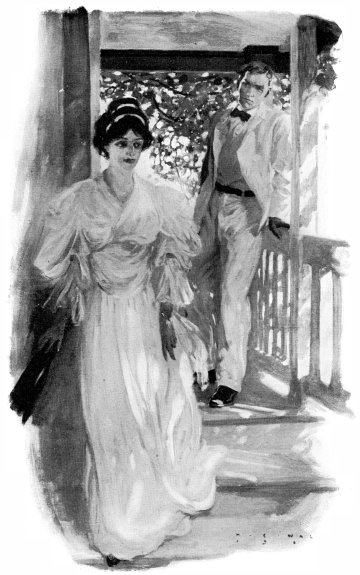
At last he turned, and strode forward impulsively as the girl he
waited for came down the stairway in a filmy dress of lace-like
texture that rustled softly as it flowed about her. She was
brown-haired and brown-eyed, warm in coloring, and her face, which was
as comely as ever, had a certain hint of disdain in it. That, however,
did not strike Ormsgill then, for she flushed a little at the sight
of him, and laid a slim white hand in his.
"Tom," she said, "I am very glad, but why didn't you cable? Still, you
must tell me afterwards. We are stopping the others, and mother is
waiting to speak to you."
Ormsgill was conscious of a faint relief as he turned to the tall lady
who stood beside the girl, imposing and formal in somber garments. The
meeting he had looked forward to with longing, and at the same time a
vague apprehension, was over. He had, he felt, been reinstated,
permitted to resume his former footing, and the manner of the elder
lady, which was quietly gracious, conveyed the same impression. Then
Mrs. Ratcliffe sent her brother, the Major, on to see that places were
kept for them together, and Ormsgill was thankful that the dinner
which was waiting would render any confidential conversation out of
the question for the next hour. He wanted time to adjust himself to
the changed conditions, for a man can not cut himself adrift from all
that he has been accustomed to and then resume his former life just as
he left it, especially if he has dwelt with the outcast in the
meanwhile.
A chair had been placed for him between Ada Ratcliffe and her mother,
while Major Chillingham sat almost opposite him across the long table.
The glow of light, glitter of glass and silver, scent of flowers and
perfumes, and hum of voices had a curious effect on him after the
silence of the shadowy forest and the primitive fashion in which he
had lived with Lamartine, and some minutes had passed before he
turned to the girl at his side.
"I was a little astonished to hear that you were in Las Palmas," he
said.
Ada Ratcliffe looked at him with a smile, and a slight lifting of her
brows. She was perfectly composed, and in one way he was glad of that,
though he vaguely felt that her attitude was not quite what he had
expected.
"Astonished only?" she said. "As you would have had to change steamers
here and wait a few days it would probably have taken you two weeks
more to join us in England. At least, so the Major said."
Ormsgill felt he had deserved this, for he had recognized the inanity
of the observation when he made it. It was evident that his companion
had recognized it, too. Still, it is difficult to express oneself
feelingly to order.
"I should have said delighted," he ventured.
The girl smiled again, and he felt that he had chosen an injudicious
word. "In any case, it isn't in the least astonishing that we are
here. It is becoming a recognized thing to come out to Las Palmas in
the winter, and I believe it is a good deal cheaper than Egypt or
Algeria. That is, of course, a consideration."
"It certainly is," broke in the lady at her side. "When they are
always finding a new way to tax us in, and incomes persist in going
down. Tom is fortunate. It will scarcely be necessary for him to
trouble himself very much about such considerations."
Ormsgill for the first time noticed the signs of care in Mrs.
Ratcliffe's face, and the wrinkles about her eyes. Neither had, he
fancied, been there when he had last seen her in England nearly five
years earlier, but the change in her was as nothing compared to that
in her daughter. Ada Ratcliffe was no longer a fresh and somewhat
simple-minded English girl. She was a self-possessed and dignified
woman of the world, but what else she might be he could not at the
moment tell. He blamed himself for the desire to ascertain it, since
he felt it was more fitting that he should accept her without question
as the embodiment of all that was adorable. Still, he could not do it.
The four years he had spent apart from her had given him too keen an
insight.
"Well," he said, "there are people who believe that the possession of
even a very small fortune is something of a responsibility."
"That," said Mrs. Ratcliffe, "is a mistake nowadays. There are so many
excellent organized charities ready to undertake one's duties for one.
They are in a position to discharge them so much more efficiently."
Ormsgill did not reply to this, though there was a faint sardonic
twinkle in his eyes. He was not, as a rule, addicted to passing on a
responsibility, but he remembered then that he had handed a little
Belgian priest £200 to carry out a duty that had been laid on him. The
fact that he had done so vaguely troubled him. Mrs. Ratcliffe,
however, went on again.
"One of the disadvantages of living here is the number of invalids one
is thrown into contact with," she said. "I find it depressing. You
will notice the woman in the singularly unbecoming black dress yonder.
She insists on drinking thick cocoa with a spoon at dinner."
One could have fancied that she felt this breach of custom to be an
enormity, and Ormsgill wondered afterwards what malignant impulse
suddenly possessed him. Still, the worthy lady's coldly even voice and
formal manner jarred upon him, while the pleasure of meeting the girl
he had thought of for four long years was much less than he felt it
should have been. He resented the fact, and most men's tempers grow a
trifle sharp in tropical Africa.
"Well," he said dryly, "one understands that it is nourishing, and,
after all, we are to some extent cannibals."
"Cannibals?" said Mrs. Ratcliffe with a swift suspicious glance which
seemed to suggest that she was wondering whether the African climate
had been too much for him.
"Yes," said Ormsgill, "cocoa, or, at least, that grown in parts of
Africa where the choicest comes from, could almost be considered human
flesh and blood. Any way, both are expended lavishly to produce it. I
fancy you will bear me out in this, Señor?"
He looked at the little, olive-faced gentleman in plain white duck who
sat not far away across the table. He had grave dark eyes with a
little glint in them, and slim yellow hands with brown tips to some of
the fingers, and was just then twisting a cigarette between them.
Ormsgill surmised that it cost him an effort to refrain from lighting
it, since men usually smoke between the courses of a dinner in his
country. There was a certain likeness between him and the Commandant
of San Roque, sufficient at least, to indicate that they were of the
same nationality, but the man at the table in the Catalina had been
cast in a finer mold, and there was upon him the unmistakable stamp of
authority.
"One is assured that what is done is necessary," he said in slow
deliberate English. "I am, however, not a commercialist."
"You, of course, believe those assurances?"
The little white-clad gentleman smiled in a somewhat curious fashion.
"A wise man believes what is told him—while it is expedient. Some
day, perhaps, the time comes when it is no longer so."
"And then?"
A faint, suggestive glint replaced the smile in the keen dark eyes.
"Then he acts on what he thinks himself. Though I can not remember
when, it seems to me, senhor, that I have had the pleasure of meeting
you before."
"You have," said Ormsgill dryly. "It was one very hot morning in the
rainy season, and you were sitting at breakfast outside a tent beneath
a great rock. Two files of infantry accompanied me."
"I recollect perfectly. Still, as it happens, I had just finished
breakfast, which was, I think, in some respects fortunate. One is
rather apt to proceed summarily before it—in the rainy season."
Ormsgill laughed, and the girl who sat beside the man he had spoken
to flashed a swift glance at him. She was dressed in some thin, soft
fabric, of a pale gold tint, and the firm, round modeling of the
figure it clung about proclaimed her a native of the Iberian
peninsula, the Peninsula, as those who are born there love to call it.
Still, there was no tinge of olive in her face, which, like her arms
and shoulders, was of the whiteness of ivory. Her eyes, which had a
faint scintillation in them, were of a violet black, and her hair of
the tint of ebony, though it was lustrous, too. She, however, said
nothing, and Major Chillingham, who seemed to feel himself neglected,
broke in.
"I'm afraid you were at your old tricks again, Tom," he said. "What
had you been up to then?"
"Interfering with two or three black soldiers, who resented it. They
were trying to burn up a native hut with a couple of wounded niggers
inside it. I believe there was a woman inside it, too."
Chillingham shook his head reproachfully. "One can't help these things
now and then, and I don't know where you got your notions from," he
said. "It certainly wasn't from your father. He was a credit to the
service, and a sensible man. You can only expect trouble when you kick
against authority."
Ormsgill looked at Ada Ratcliffe, but there was only a faint
suggestion of impatience in her face. Then, without exactly knowing
why, he glanced across the table, and caught the little gleam of
sardonic amusement in the other girl's violet eyes. She, at least, it
seemed, had comprehension, and that vaguely displeased him, since he
had expected it from the woman he had come back to marry, instead of
a stranger. Then the man with the olive face looked up again.
"You have it in contemplation to go back to Africa?"
"No," said Ormsgill, who felt that Mrs. Ratcliffe was listening. "At
least, I scarcely think it will be necessary."
"Ah," said the other, with a little dry smile, "It is, one might,
perhaps, suggest, not advisable. There are several men who do not bear
you any great good will in that country."
Ormsgill laughed. "One," he said, "is forced to do a good many things
which do not seem advisable yonder, and I have one or two very
excellent friends."
Then he turned to Ada Ratcliffe, and discoursed with her and her
mother on subjects he found it difficult to take much interest in,
which was a fresh surprise to him, for he had considered them subjects
of importance before he left England. The effort he made to display a
becoming attention was not apparent, but it was a slight relief to two
of the party when the dinner was over. Another hour had, however,
passed before he had the girl to himself, and they sauntered down
through the dusty garden and along the dim white road until they
reached a little mole that ran out into the harbor. The moon had just
dipped behind the black peaks, and they sat down in the soft darkness
on a ledge of stone, and listened for a while to the rumble of the
long Atlantic swell that edged to the strip of shadowy coast with a
fringe of spouting foam. Both felt there was a good deal to be said,
but the commencement was difficult, and it was significant that the
man gazed westwards—towards Africa—across the dusky heaven, until he
looked round when his companion spoke to him.
"Tom," she said quietly, "you have not come back the same as when you
went away."
"I believe I haven't," and Ormsgill's voice was gentle. "My dear, you
must bear with me awhile. You see, there are so many things I have
lost touch with, and it will take me a little time to pick it up
again. Still, if you will wait and humor me, I will try."
He turned, and glanced towards a great block of hotel buildings that
cut harsh and square against the soft blueness of the night not far
away. The long rows of open windows blazed, and the music that came
out from them reached the two who sat listening through the deep-toned
rumble of the surf. It was evident that an entertainment of some kind
was going on, but Ormsgill found the signs of it vaguely disquieting.
"One feels that building shouldn't be there," he said. "They should
have placed it in the city. It's too new and aggressive where it is,
and the ways of the folks who stay in it are almost as out of place."
He stopped a moment with a little laugh. "I expect I'm talking
nonsense, and it's really not so very long since that kind of thing
used to appeal to me. After all, there must be a certain amount of
satisfaction to be got out of purposeless flirtation, cards, dining,
and dancing."
It was not very dark, and, when he looked round, the shapely form of
his companion was silhouetted blackly against the sky on the step
above him. There was something vaguely suggestive of an impatience
that was, perhaps, excusable in her attitude.
"Oh," she said, "there is not a great deal. I admit that, but one must
live as the others do, and have these things to pass the time. You
know there is nothing to be gained by making oneself singular."
Ormsgill smiled, though once more the smell of the wilderness, the
odors of lilies and spices, and the sourness of corruption, was in his
nostrils. Men grappled for dear life with stern and occasionally
appalling realities there, and he was one in whom the love of conflict
had been born.
"No," he said, "I suppose there isn't. At least, it usually involves
one in trouble, and, as you say, one must have something to pass the
time away. Still, Ada, for a while you will try to put up with my
little impatiences and idiosyncrasies. No doubt I shall fit myself to
my surroundings by and by."
Ada Ratcliffe had a face that was almost beautiful, and a slim,
delicately modeled form in keeping with it, but perhaps they had been
given her as makeweights and a counterbalance for the lack of more
important things. At times, when her own interests were concerned, she
could show herself almost clever but she fell short of average
intelligence just then, when a sympathetic word or a sign of
comprehension would have bound the man to her.
Leaning a little towards him she laid her hand on the sleeve of his
duck jacket. "I would like you to do it soon," she said. "Tom, to
please me, you won't come in to dinner dressed this way again."
There was a suggestion of harshness in Ormsgill's laugh, but he
checked himself. "Of course not, if you don't wish it. If there is a
tailor in Las Palmas I will try to set that right to-morrow. Now we
will talk of something else. You want to live in England?"
It appeared that Ada did, and she was disposed to talk at length upon
that topic. She also drew closer to him, and while the man's arm
rested on her shoulder discussed the house he was to buy in the
country, and how far his means, which were, after all, not very large,
would permit the renting of another in town each season. He listened
gravely, and saw that there were no aspirations in the scheme. Their
lives were evidently to be spent in a round of conventional
frivolities, and all the time he heard the boom of the restless sea,
and the smell of the wilderness, pungent and heady, grew stronger in
his nostrils. Then he closed a hand tighter on the shoulder of the
girl, in a fashion that suggested he felt the need of something to
hold fast by, as perhaps he did.
"There is one point we have to keep in view, for the thing may be
remembered against me still," he said. "I was turned out of the
service of a British Colony."
"Ah," said the girl, "I felt it cruelly at the time, but, after all,
it happened more than four years ago—and not very many people heard
of it."
Ormsgill sat still a minute, and his grasp grew a trifle slacker on
her arm. "I told you I didn't do the thing they accused me of," he
said.
"Of course! Still, everybody believed you did, and that was almost as
hard to bear. The great thing is that it was quite a long while ago.
Tom," and she turned to him quickly, "I believe you are smiling."
"I almost think I was," said Ormsgill. "Still, I don't know why I
should do so. Well, I understand we are to stay here a month or two,
and we will have everything arranged before we go back to England."
It was half an hour later when his companion rose. "The time is
slipping by," she said. "There is to be some singing, and one or two
of the people we have met lately are coming round to-night. I must go
in and talk to them. These things are in a way one's duty. One has to
do one's part."
Ormsgill made no protest. He rose and walked quietly back with her to
the hotel, but his face was a trifle grave, and he was troubled by
vague misgivings.