We have inquired into the history of the
female sex under the social laws of antiquity,
under the rude codes of barbarian
races, and under the Mohammedan and
Hindu systems. It will now be interesting
to trace it through the dusky period of
modern civilization from the rise of Christianity
to the middle ages. Many writers
afford the materials for a view of the prostitute
systems of Europe during that era,
and M. Rabuteaux especially has combined
their researches in one wide and
broad view.
The Christian Emperors of Rome endeavoured
to suppress prostitution, but with
little success. Constantine, Constantius,
Theodosius the Younger, Valentian, and
Justinian took up the task by turns, denounced
penalties against offenders—those
who debauched others, and those who prostituted
themselves; but though the world
changed its aspect, it did not change its
vices. Among the northern barbarians,
indeed, austere principles ruled over the
people, and women occupied a higher place
than is accorded them now. They were
companions of the men, not toys for their
pleasure, or bagatelles for their amusement.
Called, at a later age, to the functions
of maternity, they previously learned
the use of reason, and succeeded from a
virtuous maidenhood to the dignity of
matron. The chastity which Tacitus describes
among the barbarians of Germany
continued long to be their characteristic;
but their penal customs became milder as
they received better maxims of social policy.
A woman who debauched herself
was expelled from the city—a sufficient
punishment. She had no more any family.
Even the ties of paternity were broken.
Gradually, however, the barbarian conquerors
of Europe bent to the attractions
of a corrupted society, and though the
laws of the Visigoths forbade prostitution,
men were found to encourage and females
to pursue this infamous occupation.
The free woman who prostituted herself
was, for the first offence, punished with 300
strokes, and for the second reduced to
slavery, given to some poor man, and prohibited
from entering a town. Parents
who connived at the vice of their children
were flogged. If the offender was already
in bonds, she was whipped, shorn of her
hair, and returned to her master. Should
he himself be the accomplice of her sin, he
lost her, and suffered an equal penalty of
the rod. Prostitutes who walked the
streets and fields were flung into prison,
scourged, and fined. A decree of Theodoric,
king of the Goths, declared death against
all who gave an asylum or any encouragement
to infamous persons.
The epithet of “lost woman” applied to
one of honest character was an insult punishable
by law—generally by fines. A
maiden or a widow was especially protected
against such imputation. In France
the female who accused another of infamous
habits was condemned to pay five
sous, or to walk in penance, only clothed
in a light shift, while a matron followed,
and thrust a fine-pointed instrument above
her thighs, more as a humiliation than an
injury. The Spanish code also recognised
this offence, as well as that of general defamation.
The church was the universal censor of
public manners in the middle ages. No
sin was more severely denounced by the
Christian law than that of licentiousness;
yet it inculcated no savage persecution of
the fallen. Good men could never forget,
that a courtezan had washed the feet of
Christ, and accordingly a humanizing spirit
presided over the social code of the early
fathers. They received into their communion
any woman who renounced her evil
life, married, and was faithful to her husband,
or remained single without prostituting
herself again.
Everywhere, indeed, Christianity tolerated
prostitution. It was impossible to
eradicate vice, and it was better one class
should make a profession of it than that
all should follow it as a secret occupation.
Suppress courtezans, said St. Augustine,
and you confuse all society by the caprice
of the passions. Nevertheless, efforts were
made to check the evil, though the principal
rules of this “police of manners” were
applied to confine the prostitutes of every
town in a separate quarter, and to force on
them an uniform apparel, that their shame
might not be concealed, and that other
women might be safe from the address of
brutal libertines.
But while the woman who lost herself
was forgiven by the civil and religious law,
no toleration was extended to the wretch
who made her such—the pander who seduced
young girls and sold them for profit.
The Council of Elvira refused pardon, even
on his deathbed, to the wretch who was
guilty of leading the innocent to prostitution.
“Miserable wretch; brand of hell!”
exclaimed Merot to one of these, “dost
thou believe that when thy accursed soul
is lost in eternal pains, God will be content?
No; he will augment thy punishment;”
and he added, that the young females
he had ruined should inflict his tortures.
All the rigour of the law, every
form of public infamy, every device of
humiliation, was called in to brand with
additional opprobrium the depraved trader
in prostitution.
In France the punishment was in general
arbitrary, according to the circumstances
of each case. Nevertheless law and usage
regulated the degree of it. In Paris an
edict was published in 1367 forbidding
persons to procure girls for prostitution on
pain of being exposed in the pillory, marked
with a hot iron, and expelled from the
city. It was renewed in 1415, and we find
an instance of its application in the next
year, for in the public accounts Cassin La
Botte is described as receiving money for
the expenses of an execution of this kind,
in which some wretches were led into a
public place, branded, mutilated by the
ears, and set in the pillory. Sometimes
the procuress was mounted on an ass, with
her face towards its tail, a straw hat on
her head, and an inscription on her back.
In this state she was paraded through the
streets, whipped, and sent to prison, or exiled.
These circumstances appear to have frequently
occurred as lately as 1756. We
find it applied in a provincial town to some
prostitutes who had infringed the local
rules:—“They were led through the place,
with a drum beating before them, and exposed.”
In England similar occurrences
were common, and were accompanied by
some peculiar details. The cart in which
the culprit sat was preceded by two men
playing music, while a crowd followed
and showered filth and mud upon the
offenders.
Sometimes, when the penalty was aggravated
in severity, the culprit’s hair was
burnt. Thus, in 1399, at Paris, several men
and women suffered this punishment, being
pilloried and deprived of all their possessions.
At Toulouse, a prostitute was conducted
to the town hall, where the executioner
tied her hands, stripped her naked,
placed a cap, made in the form of a sugar-loaf,
ornamented with feathers, on her
head, hung an inscription on her back, and
then took her out to a rock in the middle
of the river. There she was compelled to
enter an iron cage, which was plunged
three times into the water, while nearly
the whole population was assembled to
witness the scene. Afterwards she was led
to the hospital, where she remained labouring
for the rest of her days. A similar
custom existed at Bourdeaux. Everywhere,
indeed, the same rude devices were employed
to terrify the people from profligacy.
The laws of Naples were extremely severe.
Before the thirteenth century we
find every procuress endeavouring to corrupt
innocent females punished, like an
adultress, by the mutilation of her nose.
The mother who prostituted her daughter
suffered this punishment, until King Frederic
absolved such women as trafficked
with their children under the pressure of
want. The same prince, however, decreed
against all who were found guilty of preparing
drugs or inflammatory liquors—to
aid in their designs upon virtuous females—death
in case of injury resulting, and
imprisonment when no serious harm was
effected. These laws, however, proved insufficient
for their purpose, and towards
the end of the fifteenth century profligacy
ran riot in Naples. Ruffiani multiplied in
its streets, procuring by force or by corruption
multitudes of victims to fill the taverns
and brothels of the city. Penalties
of extreme severity were proclaimed against
them. The Ruffiani were ordered to quit
the kingdom, and the prostitutes were prohibited
from harbouring such persons among
them. Any woman who disobeyed was
condemned to be burnt on the forehead with
a hot iron, whipped in the most humiliating
manner, and exiled.
The code of Alphonso IX., King of Castile,
which belonged to the second half of
the twelfth century, included procurers
among infamous persons, which condemned
them to “civil death.” Five classes of
these were enumerated:—I. Men who trafficked
in debauch: these were expelled the
country. II. Speculators who hired their
houses to abandoned women for the exercise
of their vocation: their houses were
confiscated, and they were fined. III. Men
or women who kept brothels and hired out
prostitutes: if the females they sold were
slaves, the law gave them liberty; if they
were free, their corrupter was under pain
of death, forced to endow and place them
in a situation to marry. IV. Death was denounced
against the husband who connived
at the dishonour of his wife, and against
every one who seduced an honest woman
to infamy. V. Girls who supported Ruffiani
were publicly whipped, and deprived of the
clothes they wore when arrested. The
men themselves were, for the first offence,
flogged; for the second, expelled from the
city; and for the third, sent to the galleys.
Between 1552 and 1566 additional terrors
were devised against this crime, and the
Ruffiani once convicted were sentenced to
ten years chained at the oar, while for a
repetition of the offence they received two
hundred blows, and were condemned for
life to the galleys.
The incitement to vice has, indeed, been
everywhere considered a crime deserving
of the heaviest punishment; but prostitution
itself has not been tolerated without
interference. In France, especially, efforts
were early made for its suppression. The
laws, however, failed, on account of the
number of offenders it would have been
necessary to condemn, and a few examples
only were made, to show that no licence
was extended to debauch. The first edict
published was an absolute prohibition by
Charlemagne. He commanded strict search
to be made throughout his dominions, in
every habitation and place of resort, that
every public woman, and all persons without
known occupations or means of livelihood,
might be exposed. Men who were
found harbouring prostitutes were compelled
to carry them on their shoulders to
the place where they were to be whipped
with rods. In case of refusal they suffered
this infliction themselves. It is singular
to find, that among the ancient Parisians
no disgrace was equal to that of bearing
on the back a debauched woman.
During three centuries and a half after
Charlemagne, public immorality flowed in
a tide over the country. Prostitutes multiplied
in every town, and in the eleventh
century Paris was as one general brothel.
Everywhere harlots thronged the streets,
soliciting the men who passed, dragging
them by the arms into their dens, and if
they resisted, abusing them in unmeasured
terms. In the same house might be found
a school on the upper floor and a brothel
below. In 1254 an effort was made for the
reformation of manners; but the only effect
was, that vice dissimulated instead of
bearing its title on its face. Clandestine
succeeded to public debauch. At length,
however, some real good resulted from a
succession of rigorous edicts. At the commencement
of the fifteenth century, the
scourge of society had been lightened, but
there broke out wars and troubles which
gave new licence to immorality. A hundred
years revived the pestilence in all its
virulent shapes; and in 1503 a council
was assembled at Paris to deliberate on
the best means of abolishing the brothels
which were crowded around them. Laws
were passed, which we cannot describe in
detail, especially as they are of no value to
the legislators of this age, for in spite of
them the moral malady of France extended,
and public custom recognised what
authority refused to allow.
In Paris the prostitutes resorted to
places known as clapiers, or mole-holes, in
allusion to the brutal subterranean life
they led. They did not live in the houses
where they received their temporary companions;
there were localities common to
many, where they assembled during the day,
and which the magistrates ordered to be
opened and closed at stated hours. They
were not permitted to carry on their orgies
at night, to prostitute themselves in their
own homes, or publicly to shock the decent
population; but they rebelled against all
discipline, and evaded where they did not
openly contradict the law. In 1307 an
edict was published, assigning to prostitutes
certain streets as places of abode—Rue
de l’Abreuvorix Macon, la Boucherie,
la Rue Froidmantel, de Glatigny, la Cour
Robert de Paris, les rues Baillohé, Tyron,
Charon, and Champ Fleury. It is remarkable
that the infamy of these neighbourhoods
has been hereditary; for after the
lapse of 500 years, after all the alterations
in the city of Paris which have been
effected, after all the vicissitudes of its
domestic history, the same places still exhibit
the same spectacles, and are inhabited
by the same population. The complaint
of two neighbours was enough to cause a
prosecution against the keeper of a brothel.
Notwithstanding every exertion which the
inefficient law and police of those ages
enabled rulers to make, prostitution increased,
spread into prohibited streets, and
throughout France was a characteristic
feature of society. Nor were the palaces
whence issued decrees for the reformation
of public manners, superior in many instances
to the brothels they denounced.
In the eleventh century a brothel and a
church stood side by side at Rome; and
500 years after, under the pontificate of
Paul II., prostitutes were numerous. Numerous
statutes were enacted, and many
precautions taken, which prove the grossness
of manners at that epoch. One convicted
of selling a girl to infamy was
heavily fined, and if he did not pay within
ten days had one foot cut off. The nobility
and common people indulged habitually
in all kinds of excess. Tortures, flogging,
branding, banishment, were inflicted in
vain on some to terrify the others, but
with very incomplete success. To carry
off and detain a prostitute against her
will was punishable by amputation of the
right hand, imprisonment, flogging, or
exile. The rich, however, invariably bought
immunity for themselves. In Spain, although
violence offered to a public woman
was an offence, few women dared to complain
of having been seduced. In Naples,
also, under King Roger, such a charge was
never taken; but William, the successor of
that prince, punished with death the crime
of rape; but the victim must prove that
she shrieked aloud, and prefer her complaint
within eight days, or show that she
was detained by force. When once a
woman had prostituted herself, however,
she had no right to refuse to yield her
person to any one. This legislation extended
to the extreme north, and obtained
in Sleswig.
Among the most extraordinary acts of
legislation on this subject was the bull of
Clement II., who desired to endow the
church with the surplus gains of the
brothel. Every person guilty of prostitution
was forced, when disposing of her
property, either at death or during life, to
assign half of it to a convent. This regulation
was easily eluded and utterly inefficacious.
A tribunal was also established,
having jurisdiction over brothels, upon
which a tax was laid continuing in
existence until the middle of the sixteenth
century. Efforts were made to confine this
class of dwellings to a particular quarter,
but without success. In Naples the same
failure attended the attempt. Prostitutes,
in spite of the law, established themselves
in the most beautiful streets of the city,
in palatial buildings, and there, with incessant
clamour, congregated a horde of
thieves, profligates, and vagabonds of every
kind, until the chief quarter became uninhabitable.
In 1577 they were ordered
to quit the street of Catalana within eight
days, under pain of the scourge for the
women, and the galleys for such of the
proprietors as were commoners, while simple
banishment was threatened against
“nobles.”
One example of good legislation was the
pragmatic law of 1470 to protect the unfortunates
against the cupidity, the extortion,
and the fraud of tavern keepers
and others, who grew rich upon their infamy.
Men went into their places of entertainment
with some single girls, contracted
a heavy debt, and then left their
victims to pay. These were then given
the choice of a disgraceful whipping or an
engagement in the house. They often
consented, and usually spent the remainder
of their lives in dependence on their creditor,
without ability to liberate themselves.
By the new law masters of taverns were
forbidden to give credit to prostitutes for
more than a certain sum, and this only to
supply her with food and clothing absolutely
necessary. If he exceeded this
amount he had no legal means of recovering
it.
The most remarkable feature in the
Neapolitan legislation on this subject
was, the establishment, at an unknown but
early date, of the Court of Prostitutes. This
tribunal, which sat at Naples, had its peculiar
constitution, and had jurisdiction over
all cases connected with prostitution, blasphemy,
and some other infamous offences.
Towards the end of the sixteenth century
it had risen to extraordinary power and
was full of abuses. It practised all kinds
of exaction and violence, every species of
partiality and injustice, and even presumed
to publish edicts of its own. The
judges flung into prison numbers of young
girls, whom they compelled to buy their
liberty with money, and sometimes dared
to seize women who, though of lax conduct,
could not be included in the professional
class. This was discovered, and
led in 1589 to a reform of the court. Its
powers were strictly defined, and its form
of procedure placed under regulation,
while the avenues to corruption were narrowed.
The institution itself existed for
nearly a hundred years after that period—until
1768, when a royal edict declared
the ruler’s resolution to abolish the infamous
calling altogether. Vice, however,
when widely spread in a nation, does not
vanish at the breath of authority. Denounced
by the law, prostitution continued
to flourish and society to feel its influence.
Passing from the south to regions with
a less voluptuous climate, we find Strasburgh
as overflowing with vice as perhaps
any other city in the world. Prostitutes
were in the fifteenth century so numerous
there that, though a distinct quarter
was assigned for their residences, they invaded
every locality, and swarmed in the
finest streets. Speculators were accustomed
to travel abroad and bring home unfortunate
girls, whom they kidnapped and reduced to
a state of slavery. Officers were appointed
to visit the brothels and collect the tax
imposed on them. More than fifty-seven
of these places existed in six streets only.
One contained nineteen, while other neighbourhoods
were infested in an equal degree.
At the commencement of the sixteenth
century, so far were public manners
demoralized that prostitutes horded in the
clock towers and aisles of the great cathedral
as well as in several smaller churches.
In 1521 an ordinance appeared directing
the “cathedral girls,” who were called
“swallows,” to quit the sacred places of
their retreat within fifteen days. To those
who persevered in their libertine mode of
life, various residences were assigned—in
the suburbs. Strasburgh was now in the
depth of demoralization; but the Reformation
soon visited the city, awakened its
people from sensual pleasures to an intellectual
battle, and a speedy change was
apparent. In 1536 there were only two
brothels there. In 1540 public prostitution
was effectually suppressed. Ten years after
it was proposed to establish a house of
legal debauch; but the attempt was resisted,
though renewed in the third and
fourth year after this.
It was little matter to the prostitutes to
inhabit houses especially dedicated to their
vile traffic. They cared not to wait passively
at home for visitors. Wherever men congregated
for pleasure or for the business of
life, wherever there was any chance of provoking
their desires, they thronged, sometimes
impelled by the love of excitement,
sometimes by the pains of hunger. They
thus transformed into so many brothels
wine houses, barber’s shops, and students’
rooms, and the perseverance of government
against them was by no means equalled by
their own tenacity. An edict of 1420
forbade prostitutes to enter the cabarets;
another of 1558 prohibited tavern-keepers
from entertaining them. Another denounced
gambling, and prostitutes were
only allowed when desirous of refreshment
to stand without and drink what was handed
to them from within. In England similar
regulations was established, and barbers
especially were made the object of very
severe restrictions. Sempstresses and
butchers were forbidden to employ any
females of bad character, and others were
restrained by similar laws.
All these efforts, however, to render the
sisterhood of prostitutes a homeless, desolate,
hopeless class—to deprive them of
shelter, of comforts, and the honest means of
life—failed in purifying the manners of the
age. The baths became a regular resort of
women belonging to this order—in Paris,
in Geneva, in Venice, in Rome, in Naples,
in Milan, in Ferrara, in Bologna, in Lucca,
and in every other city of the Peninsula—so
that there was scarcely the keeper of a
bath who was not at the same time a
brothel keeper, employing numbers of
Ruffiani to procure attendance at his house.
There were other cities in which baths
were publicly tolerated and recognised as
places of prostitution. Among these were
Avignon and London. A statute of the
Church of Avignon, dated 1441, interdicted
the use of certain baths, known to be
brothels, to the priests and clergy. An
offence committed by day was not punished
half so severely as one committed by night.
There is only one other instance of a
punishment inflicted during that age on
men who violated the public law of
morals. It was that of certain citizens of
Anvers in Flanders, who were condemned
to make a pilgrimage to expiate an offence
of this kind. On one occasion, indeed, of
which the date is lost, the magistrates of
Bourdeaux caused a man to be hanged for
forcibly violating a prostitute.
In Avignon, however, the licence of prostitution
was shortly taken away. The residence
of the popes in that city had attracted
a concourse of strangers from all parts of
the globe, and brothels sprung up in profusion
in the neighbourhood of churches, at
the door of the Papal palace, and side by
side with prelatical residences—a display
of libertinism so gross that the public acts
of encouragement at once ceased, and an
edict drove all the prostitutes out of the
city.
In London, as we have said, as at Avignon,
prostitution took refuge in the public
baths—a practice of very ancient date.
These places were situated in the borough
of Southwark, which was not included in
the city until 1550. It was a miserable
quarter, full of inhabited ruins, to which
some public gardens, dedicated to dog and
bear baiting, alone attracted the people of
the neighbourhood. In this general preliminary
sketch it is not necessary to say
more of London.
In various parts of Europe a continual
stream of edicts was poured out against
the system of prostitution; but it was only
persecuting the victims, instead of eradicating
the causes. In some States, as in
Lombardy, men were forbidden to give
them an asylum; they were prohibited
from appearing among honest citizens;
they were prevented from purchasing food
or clothes, or borrowing money by the hire
of their persons; in fact, fines, prisons,
whips, still continued to attempt the reform
of morals.
Hitherto, however, we have seen prostitution
in some places protected, but in all
restrained, though everywhere freely exercised
by those persons who would brave its
perils and its disgrace. It was now sought,
by the direct and continuous intervention
of the law, to transform it into a public
institution, organized, watched, disciplined,
by particular officers, and subjected to
special authority. In France, and especially
in Languedoc, these principles were,
during the middle ages, firmly established.
Louis XI. proclaimed, that from the remotest
antiquity it was the custom in
Languedoc to have a house and asylum for
public women. The most celebrated of
these were at Toulouse and Montpellier.
That at Toulouse was known to exist during
the twelfth century, and by an abuse
of terms, not uncommon at that period,
was called the Great Abbey. The Commune
and the University divided the expense,
and were proprietors of the building,
and a good revenue was derived from
it for municipal purposes. But in 1424
the receipts diminished considerably, to
the great regret of the governors. The
turbulent youth of Toulouse behaved to
the poor girls, whom they sacrificed to their
lust, with the utmost violence and brutality—beating
them and their children,
breaking up the furniture, and wrenching
off even the doors of the house. Many
attempts were made to repress these outbreaks,
but the prostitutes were at length
compelled to take refuge in the interior of
the city. Severe regulations were imposed
upon them. All who were diseased were
compelled to live in solitude until cured,
and some were whipped for disobedience.
On one occasion, when a famine prevented
the inhabitants from indulging in their ordinary
pleasures, the prostitutes emigrated,
but returned to their post in 1560. The
magistrates, shamed by public outcry,
which accused them of purchasing their
robes from the tax on debauched women,
abandoned the money, at this time, to the
hospitals; but the administrators of these
afterwards made them some compensation.
In 1566 a council was called to deliberate
on the best means of ridding the city from
the profligacy and wickedness which had
grown up through the immense licensed
brothels it contained. To increase the
scandal, four prostitutes were discovered in
a monastery of Augustine friars. Three
of these unhappy girls were hung. Shortly
afterwards three others were found in a
convent, and they also were sent to the
gallows.
It appears that in 1587 prostitution was
almost eradicated from Toulouse, though
it flourished in the rural districts around.
Many of the girls were forced to labour at
cleansing the streets as a punishment.
Two decrees of Louis XI. and Charles VIII.
indicate the history of prostitution at
Montpellier in the fifteenth century. A
man named Panais possessed and governed
the place devoted to this purpose, and
dying, left a dynasty of brothel keepers—two
sons, who associated with a banker.
They embellished the edifice, furnished it
luxuriously, constructed beautiful baths,
and obtained a legal monopoly in their infamous
traffic, by engaging to pay a certain
tax. However, in 1458, another individual
was permitted to establish himself,
which he did with éclat, and the women
deserted their old quarters for the new
“hotel.” A public cause was made of the
quarrel, and it was decided that the original
promoters should continue to enjoy their privilege.
The two brothel keepers, who gained
the titles of “Friends and faithful Councillors
of the King of France,” grew wealthy,
and their trade of prostitution became one
of the most important branches of enterprise
in the city.
The city of Rhodes appears to have been
another city of Europe where a chartered
brothel existed, for the bishop, in 1307,
forbade the inhabitants to receive any of
the public prostitutes into their houses,
which supposes that some particular retreat
was open to them. There was one
also at Lisbon; but it was not until 1394
that the magistrates deliberated on the
propriety of erecting a building at the
public expense, expressly as a brothel.
Ten years later we find the inhabitants
lamenting that their wives and daughters
were endangered by the want of such a
place, and in 1424 it was established. A
tax was levied on the women to assist in
defraying the cost, and fines were imposed
for misconduct.
In Italy licensed brothels were very
numerous. There was one at Mantua, and
Venice was the very sink of prostitution.
In 1421 the government enlisted women to
this service to guard the virtue of the other
classes. A matron was placed over them,
who governed them, received their gains,
and made a monthly division of profits.
The names of several women, the most
notorious and beautiful of the Venetian
courtezans, are preserved by Nicolo Daglioni.
A very small sum was paid to them
by their patrons.
In Valencia a public brothel, on a colossal
scale, existed towards the end of the
fifteenth century. It resembled a little
town surrounded with walls, and had a
single gate; in front of this stood a gibbet
for criminals. Near this was an office,
where a man stood who addressed all
who entered, and said, that if they would
deposit what valuables they had with him,
he would return them safely as they came
out; but if they refused and were robbed
within, he was not responsible. The wall
inclosed four or five streets of little houses,
inhabited by girls dressed in brilliant habiliments
of velvet and silk. Three or four
hundred of them were usually in attendance.
They received only a small sum for
their favours. Whether this system was
then general in Spain we know not, but
it is certain that common prostitutes
abounded. Servants appear to have been
hired for this purpose, for Philippe II., in
1575, in order to check the ravages of immorality,
ordered that no female domestics
under forty years of age should be hired
by men. A decree of 1623 required that
in all cities throughout the kingdom public
brothels should be abolished.
In Geneva there was a “Queen of the
Prostitutes,” elected by the civic magistrates,
who took an oath of office, and
undertook to govern all the women engaged
in her occupation. At Schelstadt a
man was commissioned to a similar duty,
and very strict rules were imposed on the
population.
We have seen that in many places prostitution
became a source of revenue, and
might enlarge our details and multiply
our examples; but it would be tedious
to cite the laws of France, Spain, Italy,
and Germany on the subject. They varied
much in different times, but offer little
interest.
The legislator, however, has not contented
himself at all times with dividing
the prostitute class from other classes of
females, with shutting them up in separate
quarters, or even confining them in houses
of which he kept the key. In some cases
he obliged them to assume a peculiar costume,
or at least a conspicuous badge of
infamy. They always endeavoured to resist
or elude the restrictions laid upon
them, and, feeling deeply the humiliation
of such compulsion, sought by all means
to evade it. The first regulation of this
kind for the city of Paris is mentioned by
the chronicler Geoffrey. He says, that the
Queen of Louis VII. going one day to
church, met a woman gorgeously attired,
and, deceived by her appearance, gave her,
“according to custom,” the kiss of peace.
She was a court prostitute; and when the
royal lady heard this, she complained to
her husband, who ordered that no mantles
should in future be worn by prostitutes.
From time to time new edicts on this subject
appeared. One of 1360 forbade them
to wear any embroidery, any gold or silver
buttons, any pearls, or any trimmings of
gray fur. In 1415 and 1419 golden and
gilded zones were prohibited to them, as
well as silver buckles to their shoes. The
very fashion of their dress was afterwards
regulated. These devices to distinguish
prostitutes from respectable females were
speedily imitated. An aiguillette of a certain
colour, hung from the shoulder, was
most generally adopted in France. In
some towns silk was prohibited to them.
The Bishop of Rhodes, in 1307, forbade
them to wear mantles, veils, amber necklaces,
or rings of gold, while the popes of
Rome followed the example. The laws of
Mantua obliged prostitutes when they
appeared in the streets to cover the rest of
their clothes with a short white cloak, and
wear a badge on their breasts. At Bergamo
the cloak was yellow; in Parma, white; in
Milan, at first, black woollen, and then
black silk. If disobedient, they might be
fined, and, in case of a second offence, publicly
exposed, and whipped. Any one might
strip the garments off any girl he met in
the streets illegally attired. In London a
similar distinction was imposed on them,
and at Strasburgh a sugar-loaf bonnet was
invented for their use. In Spain, besides
prohibitions concerning dress, they were
forbidden the use of coaches and litters,
as well as prayer-carpets or cushions in the
churches; even a hackney-carriage was
not allowed to be hired by them.
The acts of legislation in France were
almost exclusively police regulations.
Forced to tolerate the prostitute class, the
law endeavoured, by watching, restraining,
shaming, and insulting it, to render its
occupation so infamous as to terrify persons
from seeking it as a means of livelihood.
It does not seem that in France,
during the middle ages, legislation ever
passed this limit or went beyond the action
of police. In Italy, however, and in Spain,
this was not the case. The Roman law
had left many vestiges, which have never,
in reality, disappeared; the ecclesiastical
prerogative was powerful, and disposed to
be active. Local statutes existed in great
abundance, and the combination of these
authorities gave rise to a jurisdiction full
of details: profuse, sometimes strange,
always subtle, in parts inconsistent, and
laboriously commented upon by a numerous
school of jurists—a jurisprudence
which elevated itself above simple measures
of security and municipal rules, and instituted
for prostitutes a civil and social
statute of their own.
Ulpian says that a woman is a prostitute
not only when she frequents regular brothels,
but when she visits cabarets, or any
other places, where she is careless of her
honour. She is a prostitute who yields
herself for base purposes to all men; but
she who has connection only with one or
two is not. Octavenus, however, thinks,
more justly, that she is a prostitute who
gives up her person in common, whether
she receive money or not.
The lawgivers of the middle ages were
not accustomed to insist on perfect or precise
definitions. They liked to subtilize
over terms. Some held Ulpian’s limited
view to be correct; others, with Octavenus,
declared that any woman yielding to the
solicitations of several men, even without
being paid, was a prostitute. The Roman
law defined prostitution to be the reception
of numerous libertines. But how
many? inquired St. Jerome. This threw
divisions among the theorists. Some declared
40 men to be enough, some insisted
on 60, others on 70; while a few, carrying
extravagance to its utmost limits, asserted
that no woman was a prostitute who had
not delivered up her person to at least
3000 persons. While these ridiculous disputes
engaged attention, the corruption of
manners went on.
It is just to the wisdom of that age,
however, to remark, that these discussions
of the casuists appeared no less ridiculous to
contemporary statesmen than to us; while
the general public idea of prostitution was
habitual debauch for vile purposes, whether
mercenary or otherwise.
Some theorists, nevertheless, insisted that
the nature of a hireling was inseparable
from that of a prostitute. On this account
the name meretrix had by the Latins been
given to a woman of this class; but this
view led to consequences which the wise
legislator would not accept. If any female
accepting a reward for her dishonour was
to be publicly enumerated among professional
harlots, many, from a single offence,
must, under compulsion, follow a life of
systematic vice. Others argued that two
or three repetitions of this infamous sale
would justify the title being applied; but
this is a point on which writers have never
agreed. Consequently, a long controversy
arose upon the three conditions in dispute:
what amount of publicity—what number
of vicious connections—what kind of venality—was
sufficient to stamp a woman
with the name and character of a common
prostitute.
Rabuteaux describes her as one who,
under constraint, or by her own will, abandons
herself, without choice, without passion,
without even the impulse of the
grossest lust, to an unchaste course of life.
By want of choice he means the absence
of a preference for the individual, by which,
he adds, a forbearing judgment extenuates
the offence of immorality. If, he insists,
there be any choice of persons, there may
be libertinism, there may be debauch, there
may be scandal, there may be vice, but
there is not prostitution in the true sense
of the word. It applies to “sacred prostitution,”
whether gratuitous or venal,
which was an unblushing and indiscriminate
sacrifice of chastity; to that which
the barbarous hospitality of savages, whether
on the rivers of Lapland or in the
deserts of Africa, gave up a woman to
every guest; and to that legal kind in
civilized countries which sold itself promiscuously
for hire.
Such is M. Rabuteaux’s idea. We differ
from him. Prostitution appears to us the
application to a vile purpose of that which
was designed for honourable uses; and the
mere satisfaction of animal lust is in itself
the vilest object. There may exist in a
woman’s mind, even when most debauched,
a preference for some, an aversion to
others; but she is no less a prostitute, if
she abandon herself viciously, whether to
one or many.
While these theories divided the opinions
of lawgivers, legislation on the subject was
extremely difficult. They were forced to
be contented with what they thought imperfect
proof; and, to fix the infamy of a
woman, accepted evidence from witnesses,
even those accomplices in sin who, of all
others, have lost the right to accuse. A
female who chose the night for the period
of her orgies; who, as a wanderer, without
a companion to protect her, entered house
after house; who waited on revellers in a
place of entertainment; might be registered
among common prostitutes. A legitimate
suspicion, also, attached to her who received
the visits of many young men; and,
above all, who, in light or darkness, frequented
a public school.
These women, when once consigned legally
to the prostitute class, gained, in the
middle ages, a right which they could not
otherwise assert. The Roman laws adopted
by the jurisprudence of that period allowed
her to have a legal claim to payment when
she prostituted her body, and the reason
assigned was founded on a strange and
subtle distinction of terms. “The courtesan’s
vocation,” said Ulpian, “is infamous,
but the wages of it are not; the act is
shameful, but not the reward which is in
prospect when the act is committed.”
The Spanish law was still more favourable
to her. When a man paid in advance,
and she refused to submit according to her
promise, he could not demand his money
back. On one side she received a legitimate
emolument; on the other, he was
guilty of immoral turpitude which the
law would not recognise. The code of
Alphonso also permitted this interpretation;
some commentators, however, allowing
that the woman had a right to revoke
the promise of yielding her person, but was
bound to restore the amount of hire she
had received. Long and vigorous controversies
arose among the theologians when
this was referred to them. It was also
disputed in France, whether the prostitute
could enforce payment when she had sold
herself and an avaricious person refused to
reward her. An imposing list of authorities
is arrayed on either side.
Another question long debated was the
use to which such gains could lawfully be
applied. Alphonso the Wise, on the authority
of Isaiah, forbade priests to receive
offerings from such a source. Baldæus and
others insisted that the church could not
accept taxes from public women; but this
by many was repudiated, as contrary to the
principle that the wages of prostitution
were lawfully acquired. The Spanish law
allowed money of this kind to be given in
alms, and the public opinion recognised the
right to dispose of it by testament, though
several popes attempted to decree a contrary
usage. If, then, they could dispose
of their gains as they pleased, could they
inherit property? They could, but under
limitations. In Savoy it appears that
legacies to prostitutes made by soldiers who
had not quitted service more than a year
were null and void. In Spain no woman of
this class could inherit to the disadvantage
of the testator’s relatives in a direct or collateral
line. Many authorities only admitted
the brother of the deceased to this right;
but an exception was made when it was a
daughter who succeeded to such property,
or when the woman was herself married.
A mother, however, could disinherit her
daughter for leading a vicious life, but
lost this privilege if she had been the
accomplice of her immorality. The father
had equal authority, but with one curious
limitation. When, said the law, a father
has sought to marry his daughter, and
endowed her sufficiently, if she, against
his will, refuses to marry and becomes a
prostitute, he may cut her off; but if he
have opposed her marriage until she
reached the age of 25, and become a libertine,
he cannot refuse to bequeath her his
property. In the duchy of Asota, in Piedmont,
a similar regulation was established;
but the age was fixed at 29, and the woman,
on every opportunity to marry, was bound
to present herself before her father and
demand his consent. If he refused it, he
was not allowed to punish her when, at 30,
she became a harlot.
The church, in those ages, made it a pious
act to marry a prostitute, and absolved from
their sins all who did so. In France a woman
of this class might, at a very ancient period,
save a criminal from death, by inducing
him to espouse her, and Farnacius relates an
anecdote which shows this custom to have
existed in Spain. In a city, which he does not
name, a young man mounted on an ass was
being conducted to the scaffold. A courtezan
was struck by his beauty, offered him his
life if he would become her husband. He
refused. The temptation was not strong
enough to induce him to accept such a
wife. He merely answered, “Let us move
on,” and reached the place of execution.
Meanwhile, however, an account of the
incident had reached the king, and he, admiring
the youth’s courage, pardoned him.
From this we may learn that though the
church consecrated such a marriage with
peculiar grace, public opinion considered it
infamous.
The jurisprudence of the middle ages
introduced new principles, and these unions
became more rare. Many doctors of law
announced that they were contrary to the
sacred code.
In Spain, where concubinage was legally
recognised, men of rank were forbidden to
take as concubines slaves, whether born in
actual bondage or emancipated, dancers,
servants of taverns, go-betweens, or prostitutes.
It was disputed whether the
children of these women could be legitimatized
by subsequent marriage. It was
decided that they could, though with more
difficulty than others, and their mothers became
amenable to the laws against adultery.
Persecution in all barbarous ages and
countries has endeavoured to perform the
task of teaching and reclaiming mankind.
The members of the venal sisterhood have,
more than any others, experienced the harsh
effects of this species of legislation. The
law sought to withdraw them from vice
by shutting from them every approach to
virtue, to reform their minds by forbidding
them the society of honest persons, to
elevate them from their degradation by
adding to their infamy. It refused to
receive them as witnesses, even when
violence was done upon their persons;
though more liberal jurists cried out amid
the clamour of intolerant bigotry, that the
protection of justice should attend even
the vilest prostitutes in the vilest dens of
her resort; but the spirit of the times was
vindictive, and because society was corrupt
and base, it was most unsparing in its
cruelty towards the victims of debasement
and corruption.
In spite of every one of these rude
devices of a rude society to banish immorality
to habitations of its own, by badges,
quarters, distinct costumes, and even separate
laws, prostitutes swarmed in every city
of Europe, and still more in its innumerable
camps. Armies were then undisciplined
bands of adventurers, and pillage
was the soldier’s chief purpose. Xenophon
tells that the nations of Persia, Asia Minor,
and India, were accompanied on their
marches by their women and their children,
to defend whom they fought with more
courage; and Athenæus describes Chareas,
causing a band of beautiful courtezans to
dance before his phalanxes to the tune of
flutes and psalteries. Two thousand prostitutes
were driven from the camp of
Scipio Africanus; and so, in the middle
ages, every army drew in its train numbers
of public women. Three hundred were
with the army which laid siege to St.
Jean d’Acre in 1189, and during the
whole of the crusades the Christian armies
were followed by them. Many times the
leaders endeavoured to check this debauchery.
Some of the girls were flogged.
Sometimes the man who was found with
one of them was obliged to allow her to
strip him to his shirt, and lead him with a
rope through the camp. On the plains of
Perretola, after the defeat of the Florentines,
in 1325, public dances were executed
by prostitutes for the amusement of the
army. In all parts of Europe similar profligacy
distinguished the camp; and long
after we find Jeanne d’Arc, when reviewing
the army, chastised with her sword several
prostitutes whom she detected among the
ranks. Marshal Strozzi, with a ferocity
worthy of that period, drowned 800 of
them in the Loire. When the Duke of
Alva invaded Flanders, there accompanied
his army “400 courtezans on horseback,
beautiful and grand as princesses, and 800
others on foot.” These were for the pleasure
of 10,000 men, all veterans.
Prostitution was authorized and disciplined,
not only in the camps but in the
palaces of those days. From the eleventh
century to that of Francis I., a regular
community of public women was attached
to the court.
We have already noticed the Queen of
Louis VII. kissing one of them on her way
to church; and we find Charlemagne ordering
his palace to be cleared of them.
At the Council of Nantes, in 660, it was
complained that the concubines of the
nobility, instead of remaining at home,
thronged to public assemblies; but the
seraglios of these lords, in the ninth century,
were places of prostitution. The
German law imposed a fine of six sous on
a man who committed violence on a female
in the principal or royal “gynecées,”
but only three in any other. It was formerly
the custom to send to one of these
retreats a woman convicted of adultery;
but this was at length forbidden, lest it
should simply allow her an opportunity to
repeat the offence. Sometimes they were
only the harems of the proprietor, sometimes
brothels. William IX., of Poitou,
established in the eleventh century an
abbey for prostitutes, where he added
to his profligacy the crime of sacrilege,
giving the harlots the titles of abbess and
prioress, and parodying every sacred rite.
The orgies of his palace, and indeed of all
others of that age, are indescribable.
The title of King of the Prostitutes was
given to the officer who presided over the
royal brothels. In Paris, in Normandy,
and in Burgundy, we find this functionary.
Under the kings of France he enjoyed
a high rank and many privileges;
and associated with him was a woman who
governed the prostitutes, and punished
them with whipping when they offended.
In England, also, the palace and the mansions
of the nobles contained small brothels.
In Henry VIII.’s palace was a
room, with an inscription over the door,
“Chamber of the King’s Prostitutes.”
Thus, throughout the world, there was,
in the middle ages, profligacy and corruption,
which rose to its height at the period
which preceded the Reformation. From
their chief places of resort in royal palaces
prostitutes spread over the whole of society,
invading the church, the hearth, following
the camp, dividing the privileges of the
wife, and ever debauching both sexes by
their companionship. Rods, prisons, gallows,
chains, pillories, tortures, served in
no way to prevent or even to discourage
them; badges and restrictions proved
equally futile; but it is agreeable to find
some relief to this dark spectacle of demoralization.
In the age of primitive
Christianity religious men endeavoured
to reclaim from vice those whom they
found making a trade of it. We cannot
stay to dwell on the sincere apostleship
which laboured, especially in the East, and
was followed by fathers and hermits from
the desert. Stories of conversions of this
kind fill the legends of the time, and
earnest attempts were made to offer an
asylum to the unhappy women who had
abandoned themselves to profligacy.
We have noticed Theodora, the imperial
harlot of Rome, collecting 500 prostitutes
in a palace on the Bosphorus; but
her impure hand could not perform well
the offices of charity, and she applied force
to fill her asylum. Many of the girls,
therefore, who were shut up in her magnificent
and luxurious prison, found their
confinement insupportable, and committed
suicide to escape it. In 1198 two Parisian
priests established a nunnery for repentant
women, and thirty years afterwards the
House of the “Daughters of God” was instituted,
and these efforts were rewarded
with much genuine success. Two centuries
passed without many enterprises of the
sort being undertaken; but in the fifteenth
century an association of public women was
formed to exchange their base gains for
those of piety and virtue.
In 1489 all the prostitutes of Amiens,
animated by a sudden awaking of remorse,
applied for a place of retreat, where they
might bury their shame, and renew their
honesty. This was granted, and several
others were established, the inmates of
which wore white garments.
In several other parts of France, and
generally in Europe, the religious orders
made attempts to recall some of the abandoned
class of females, to redeem the
virtue of their sex, and, as they laboured
with sincerity, many of their enterprises
were successful. But, on the whole, prostitution
still increased, and, the Reformation
broke over a state of society demoralized
to the very core[90].
Few nations have been described in more
various ways and in more contradictory
terms than the Spaniards. In the pages
of one writer, we find them represented as
in all things a great example of virtue,
morality, and uncorrupted manners; in
another, they are pictured as the very embodiment
of vice and degradation. We
have been at much pains to deduce from
the history, from the achievements, and
from the actual state of Spain, as these are
set forth by innumerable authorities, a
just opinion of its national characteristics,
and the sketch we shall offer is the result.
In that country we have to divide class
from class before we can fairly view its
manners. On the one hand we have a
peasantry ill-taught, and educated to servility;
then a trading body, with another
employed in professions; and thirdly, a
large order of nobles, degenerated altogether
from its ancient splendour, but
preserving nevertheless all the pride, all
the indolence, all the sensuality, which
characterized it in the age of extended conquest
and prosperous commerce. Upon all
these classes time has left traces, and the
influence of their history has been remarkably
strong. A rich soil, a warm climate,
an abundance of precious minerals—these
circumstances have been by no means
without their effect. The Roman Catholic
religion, an army of priests, an arbitrary
government, and the habit of respecting
persons more than principles—these have
a still more distinct impression on the
national character. A literature once illustrious
but now dead, an empire once
splendid but now perished, a commerce
once magnificent but now decayed, a
wealth once gorgeous and now turned to
poverty, arts once noble and now degraded—in
these we find an index to the Spanish
national character. There is nothing virgin
in the country, there is nothing progressive,
there is nothing with hope: all the
glory of Spain belongs to the past. The
present is a wreck, and the future is a
blank.
The manners of Spain present none of
that simple purity which we find in
Switzerland. Every influence to which
the people are subject tends to corrupt
them. Young women who stand at their
windows, and see with delight the flagellants
go by, lashing themselves until the
blood splashes under their whips, cannot
possess much dignity of mind. Yet such
are the spectacles which in Spain have
been made familiar and favourite to the
populace. There is throughout Spanish
society an effort to appear better than they
are, which in itself is an unfailing indication
of impurity. Men dare not when in
company take any improper liberties with
women, even those whom they might be
able privately to seduce. On the stage
they hoot a piece, which in France, or
even England, would not be regarded as in
the slightest degree indelicate. Nevertheless,
in their retired rooms, ladies who are
thus prudish before the world, will suffer
approaches gross enough, will amuse themselves
with obscene pictures, will pardon
readily equivocal jokes, and listen to songs
of the worst indecency. Nor will they
object to behold the fandango danced,
though, whatever some tolerant travellers
may say, it is proverbially obscene.
In many parts of the country, and especially
in Seville, the ancient national customs
are still preserved, and young girls
are always when in the street accompanied
by a duenna. In Madrid, where manners
have undergone a change, this is no longer
the case; but in the more primitive cities
it is more prevalent. The guardianship of
such a companion, however, by no means
implies absolutely a respectable character,
for common prostitutes, when they do walk
abroad, are often accompanied by old women
who attract notice to them, and frequently
engage visitors to their places of
resort.
The actual intercourse of the sexes in
public is reserved, except with respect to
conversation. The gossip at a Tertullia,
described by some tourists as delightful, is
characterized by English ladies not at all
inclined to satirize Spanish manners as
very far from that which women in good
society among us are accustomed to hear.
Children who appear fresh from the nursery
indulge in remarks which to many
appear positively obscene. The intellectual
standard among them is low. Ladies
have been known who, with all the pride
of an hereditary title, could scarcely write
their own names.
Good wives and good mothers are nevertheless
very abundant in Spain. It has
produced heroines of every kind, from the
intriguers of the Camarilla to the defenders
of a city. When “in love,” the Spanish
woman is exceedingly full of passion, and,
carrying a knife, she occasionally employs
it to revenge a slight. These essential
characteristics of female manners are, however,
gradually yielding under what we
may term the common law of society in
Europe. Madrid is assimilating itself to
Paris, and Paris to London; so that as time
progresses the peculiar features wear off,
and statistics alone may at some future
period form the measure of a people’s morality.
In the rural parts women share with
men the heaviest labours of the field.
They may be observed as you pass along
the highways, staggering under the weight
of enormous burdens; but this is a circumstance
attaching to poverty in all
parts of the world, not to any nation in
particular. It is among the upper and
middle classes in Spain, though in many
other countries the contrary is true, that
women wear most strongly a national characteristic
appearance. In Madrid and the
other fashionable cities you are surprised by
the vast number of women who crowd the
streets. They have no domestic occupations;
they trouble themselves little with
the nurture or education of their children;
they devolve on hirelings the management
of their household affairs; and they relieve
themselves from ennui by sauntering
through the public places, dressed with
the minutest elegance, carrying their fans,
and bargaining on it, by every possible
species of coquetry, for admiration from
the passers by.
A Spanish woman is a natural coquette,
and when married cannot abandon the
habit familiarly known as flirtation. This
gives rise to jealousy on the husband’s
part, which produces infinite misery.
Marriage is held in law a solemn and
irrevocable contract. It is under many
legal regulations, and subject to the authority
of the Roman Catholic Church.
In the hands of the clergy, indeed, there is
vested a prodigious arbitrary power, which
they are careful to exercise, lest it should
become obsolete by disuse. They may
still be seen interfering in matrimonial affairs;
and a glance at the manners of the
Spaniards some centuries ago will show that
the clerical power has not decreased.
Public morality was carefully guarded under
the rule of the Visigoths, only to be
tolerated during the Middle Ages, since
which time it has been at one time lax, at
another severely regulated: at the present
day we find it in a strange state of confusion.
In the year 586-601, the king of the
Visigoths of Spain forbade prostitution in a
most absolute manner under pain of severe
punishment.
The daughter and the wife born of free
parents, convicted of having delivered themselves
over to abandonment, received for
the first offence three hundred blows with
a stick and were ignominiously driven from
the city; a relapse was punished with the
same corporal punishment, after which the
culprit was handed over to a poor person,
who was obliged to employ her in performing
the most menial offices. If the parents
were convicted of being accomplices and of
having participated in the gain derived by
their daughter’s prostitution, each one received
one hundred blows. The slave who
gave herself up publicly to libertinage received
three hundred blows, and when she
was sent back to her master, her head was
shaved, and she was banished from the city
or sold in a place from whence she could not
return. The master who refused to submit
to these stipulations of the law received
in public fifty blows with a stick or a whip,
and the slave became the property of some
poor man pointed out by the king or the
judge, under condition of never being seen
in the city again. If the master had participated
in the debauchery of his slave,
that is if he had reaped any profit, he received
the same chastisement as the culprit.
This decree, made especially to repress
prostitution in the cities, applied equally
to women of ill fame who infested the
boroughs, the villages, and the country at
large.
This was at the commencement of the
seventh century, and such were the severities
of the laws passed by the king of the
barbarians, Recard by name. The power of
the Visigoths was broken a hundred years
afterwards by the Arabs. The conquered
fled to the hilly country, taking refuge in
the mountains of the Asturias; but what
laws were in force amongst them we do not
know—we only know that the manners of
the age were shameful. Perpetual wars,
the capture and consequent pillage of villages,
the license of the soldiery, helped to
constitute a state of things not at all
favourable for the developement of female
chastity. The Christians and the Mussulmans
held in captivity the women taken
in battle and treated them as slaves.
The Arabs were soon in their turn conquered
by the Moors, and, as the struggle
was less bloody, the two people mingled and
exercised a mutual influence over one
another; but the influence of the Arabs
was more direct. “The loose manners of
the East,” says M. Guardia, “and the luxury
ever prevalent amongst orientals, were impalpably
engrafted on the austerer habits
of the Christians. Chivalry was found to
be perfectly compatible with debauchery.”
The corruption of manners made rapid
strides. Prostitution reappeared in all its
forms; nor was it, as amongst the Arabs,
hampered by municipal restrictions or
fettered by arbitrary and severe legislation.
In the fifteenth century the old regulations
were resuscitated, and immorality
found itself once more compelled to bow
to the dicta of priests. Nevertheless these
rigorous measures proved that the remedy
was worse than the evil. Secret debauchery
took the place of public libertinage, and
clandestine prostitution increased accordingly.
In the year 1552, Charles V. promulgated
an edict against the keepers of houses
of ill fame, considerably augmenting the
existing punishments. Four years later
this law was confirmed by Philip II.
The sequel, however, proves that laws
were powerless against public corruption.
Immorality is buoyant and contagious, and
never so mischievous as when it is hidden.
The end of the fifteenth century witnessed
a reform. Prostitution came to be
regarded as a branch of the public administration,
and placed under severe laws
and precise regulations.
About 1623, the health of the community
began to be considered, and hygienic
measures were introduced. This was a
great step, and one rendered the more necessary
by reason of the terrible ravages
committed by lues venerea, which at
this epoch assumed the form of a terrible
epidemic.
Three quarters of a century elapsed, and
the subject was carefully studied, for in
1704 the council decided that the mayors
of towns could arrest and imprison immodest
women, who showed themselves in
crowds upon the public promenades, and
became an object of scandal and disorder.
But these coercive measures often repeated
were without effect. Soon the law was
found to be powerless against corruption.
Since this epoch, public morality has been
lax and openly disregarded. The provinces
imitated the example of the capital. At
the end of the eighteenth century an
attempt was made to legislate, but nothing
came of it. In 1822, the Cortes passed a
Bill relating to public health, which, in
point of fact, was nothing more or less
than to establish houses of ill fame and
recognise their existence. This fell to the
ground through the opposition of a physician
named Garcia.
In 1853, the population of Madrid was
estimated at 270,000. These figures include
the floating portion, which is not insignificant.
Every woman who chooses to
prostitute herself for money is perfectly at
liberty to do so; she has to render no
account of her conduct, no authorisation of
any sort is necessary. The police give no
passes nor is there any registry. Under
these circumstances statistics are next to
an impossibility. Not only does the law
tolerate and acknowledge prostitution, but
it actually appears to cherish and foster it,
by permitting the grossest disorder, and by
placing no obstacle in the way of the incessant
progress of debauchery. Local authority
confines itself to noticing only the
most flagrant occurrences—such as a too
great number of women in the promenades
and public thoroughfares, or when a large
number of men amongst the soldiers in
garrison fall victims to the ravages of
syphilis. It follows from such a state of
things that the hospitals are gorged with
sufferers, and frequently do not suffice to
contain all those who wish to enter. The
consequence is that this disease takes the
most alarming forms, and does serious injury
to the public health.
We cannot possibly make anything like a
correct estimate of the number of women
who live by prostitution in Madrid, although
some manuscript notes furnished
to M. Guardia, place it at about one thousand.
This may only be an approximate
calculation, and it is clearly putting it at
its minimum rather than its maximum.
Two hundred of these are kept women;
though we are inclined to believe this
much below the actual numbers, as manners
are very loose in Madrid, and the habits
of Spaniards incline in a singular degree to
concubinage. Probably six hundred women
live in houses of ill fame, the keepers of
which exercise the most absolute authority
over the unfortunates that come into their
power. In every one of these houses one
finds an indefinite number of young women,
which varies from eight to ten. The woman
who keeps the place lodges and
dresses them. In many of these places
there are only two or three resident women,
for there are also houses of appointment
and convenience. If the number of
indoor pensioners is limited, those who walk
about the streets are like locusts or the
sand of the sea-shore, next to innumerable.
They have their abode, perhaps, in their
own families, or else they return to their
lodgings. Most of these public women are
either milliners, seamstresses, laundresses,
and pastrycooks, or employed in the manufacture
of tobacco. The people who keep
houses of ill fame find it to their interest
to preserve the health of their lodgers,
which they are not, as a rule, negligent of,
but yet it is a fact that syphilis is prevalent
in Spain to a frightful extent. The
authorities are at no pains to prevent its
ramification, and the climate is only too
favourable for its growth and extension.
We divide the women who live by prostitution
in Madrid into three classes: 1st,
Those who are kept; 2nd, Those who live
in houses of ill fame; and 3rdly, Those who
are free, and merely make use of the above-mentioned
houses for a short time. Within
this latter category we must include about
three hundred prostitutes, who constitute
the lowest grade and infest the worst parts
of the capital. These have been recruited
perhaps from all classes, having sunk lower
and lower, until every vestige of shame
and modesty having totally disappeared,
they traffic for the bare means of subsistence
and submit to any and every degradation
to obtain it. They even exercise
their avocation in the streets and public
places. On the other hand, prostitution has
plenty of places of resort, such as cafés,
public houses, and refreshment rooms.
The police are fully empowered to take
into custody any woman guilty of an open
breach of the law, although they may not
interfere with her for plying her trade, or
we might, with some justice, say her profession.
Sometimes the magisterial authorities
banish them from Madrid, thus getting
rid of the most dangerous characters, who,
however, like black sheep in the provincial
flocks, only serve to carry corruption into
districts hitherto uncontaminated.
There is in Madrid a hospital for foundlings,
but the fecundity of Spanish prostitutes
is not considerable. This is an asylum
for every child found in the streets or
brought by mothers who wish to get rid of
their children. On an average it receives
annually from 4500 to 5000 infants. It
was founded in the sixteenth century by
charitable people.
One is astonished—exclaim MM. Schneevooght
(first physician at the hospital of
Amsterdam), Van Frigt (assistant surgeon
to the same hospital and the syphilitic
dispensary), Van Oordt (student in the
Parisian hospitals)—one is astonished that
in a country where legislation adapts itself
to the exigencies of modern times, among a
people signalized by a practical genius, an
enlightened administration has only very
lately adopted the only measures to check
the scourge of prostitution.
In Holland religious scruples have yielded
before considerations of a higher nature.
The Government of the Netherlands has at
last decided to leave to the Communes the
power of preventing by regulation the sad
consequences of free and unrestrained prostitution.
Supervision, independantly of
the services which it renders to the public
health, assists to prevent the extension of
the evil of which we write.
It is easy to suppose that the capital of
Holland offers peculiar facilities for the
growth of this vice, which always flourishes
in commercial and maritime cities, and
more especially when the two are combined.
| In 1851 | 1852 | 1855 |
|---|
| The municipal population was | 221,111 | 240,669 | 250,304 |
| Floating | 3,532 | 5,687 | 7,357 |
| Military | 881 | 1,030 | 793 |
The number of strangers that come here,
the mariners that commerce attracts, the
luxury that reigns among the upper classes,
the number of young men of good family,
who are condemned to a life of celibacy by
inadequate means, unite to relax the morals
of the Dutch.
Even now the municipal authorities recoil
before the difficulties thrown in their
way by the independent spirit of the
people, who do not like restrictions imposed
by authority, however salutary they
may be.
A curious book which appeared in 1648
relates an edict published in 1506, by virtue
of which only agents of the municipal police
were allowed to open and keep disorderly
houses and in certain designated
quarters.
In 1789 a commission of health was convoked,
and strict precautions taken to
guard against infection. It followed from
this that 177 women were doctored in one
year, a number nearly double that of the
year before.
The author of a book about medicine,
which appeared in Amsterdam in 1820,
complained bitterly of the depravity of
manners which led to the decrease of marriages,
and of the great number of prostitutes
who day and night frequented the
streets and other public places to attract
passengers by indecent gestures and immodest
proposals: more than 800 were
known to the police, of which about 200
lived in tolerated houses.
Coming back to modern times, during
the year 1850 we find there were in Amsterdam
764 illegitimate births, among
21,365 unmarried inhabitants, between 16
and 30 years, of the male sex, and among
25,207 of the female sex. At the same
time there were twenty disorderly houses
and 400 prostitutes not inscribed, but
simply known to the police.
There is a society in Amsterdam for rescuing
fallen women who wish to lead a new
life. It is called the Sternbeck Asylum,
and is productive of great good.
To allude to the insignificant part played
by the police is to avow the insufficiency
of the hygienic department.
Although the girls in the tolerated houses
are supposed to be compelled to submit to
examination, any inspection, in reality,
is voluntary on their part. Unfortunately
there are a vast number of quacks in the
city, who only prolong and aggravate disease,
instead of curing it. There is a hospital
for venereal affections, with two wards,
one with 24 beds for the men, the other
with 50 beds for the women, which are all
at the service of those affected with syphilis.
Besides this there is a syphilitic dispensary,
where gratuitous attendance may
be obtained.
Syphilis has increased very much lately
among the soldiers in garrison. For instance
take the subjoined figures, extending
over five years:
| 1852 | 1853 | 1854 | 1855 | 1856 |
| 87 | 94 | 199 | 156 | 182 |
All women must be inscribed, whether
living in houses or by themselves. Disorderly
houses are under the supervision
of the police. The keeper of one of these
houses may not change his residence, under
penalty of a fine of 7 florins and the loss
of his licence, without communicating with
the authorities, and loose women must be
provided with a license. The regulations
are very much the same all over the country,
at Utrecht, Haarlem, &c.
In the year 1856 the floating population
of Brussels and its suburbs was 260,080, to
which the garrison contributed 2414. In
the same year the total registration of prostitutes,
according to the law in their
respect provided, numbered 638; these
were divided into “filles de maison” and
“éparses.” Although the police regulations
are remarkably stringent, their effect upon
public morality is absolutely nil, although it
must be admitted that their surveillance
has a beneficial effect upon the public
health. Prostitutes in Brussels, disgusted
by the exercise of municipal power, fly
without the walls, and withdraw to St.
Josse, which, with other extra-mural spots,
is much infested with them. The same
state of things is observable, more or less,
in Antwerp, Bruges, Ostend, Ghent, Mons,
Liege, and Namur. By the Belgian regulations
the circulation of prostitutes in the
streets after sundown is prohibited; women
under twenty-one may not be inscribed,
and the medical visitation takes place twice
a week by the divisional surgeon, and whenever
else he may please by the superintending
officer. All the éparses and third-class
filles de maison are seen at the dispensary,
and the first and second classes of
the latter order at their domiciles. The
éparses may secure this privilege by payment
of an extra franc per visit.
The tariff of duties payable by houses
and women is as follows:—
Every first-class maison de passe pays
25 francs per month.
Every second-class maison de passe pays
15 francs per month.
Every third-class maison de passe pays
5 francs per month.
Every first class “maison de débauche”
pays 60 to 78 francs monthly, according to
the number of its authorized occupants—from
6 to 10—and 2 francs extra for each
such additional person.
Every such second-class house pays 20
to 32 francs for from 3 to 7 women, and 1
franc extra for every additional.
Every such third-class house pays from
8 to 16 francs for from 2 to 7 women, and
1 franc extra for each additional.
Every first-class fille éparse pays on each
inspection 40 centimes.
Every second-class fille éparse pays on
each inspection 30 centimes.
Every third-class fille éparse pays on
inspection 15 centimes.
Upon punctuality for four successive
visits these payments are returned, for inexactitude
they are doubled.
Directly a male military patient is taken
into hospital he is minutely questioned by
the surgeon who attends him as to the
exact locality of the house wherein he thinks
he was infected, and the appearance of the
woman. She is soon arrested; and if the
result of the medical examination should
prove her diseased, she is placed on the
police surgeon’s list and sent to hospital,
where she is restrained for some time from
spreading contagion.
Hamburg, from its peculiar situation and
the extent of its commerce, may be considered
one of the great centres of trade
at present existing in the world, and for
that reason it deserves more than a cursory
glance or a casual notice.
Documents drawn up during the thirteenth
and fourteenth centuries relating to
public women are still in a state of preservation.
There is a Code Municipal for the city
of Hamburg (1292), which contains the
most ancient regulations of this description.
The 17th, 18th, 19th, and 30th of this
code regulates in detail the costume of
women of ill-fame and the districts where
they are allowed to dwell. Their number
is not chronicled, but it appears to have
been considerable.
The contractors or speculators in women
were by successive enactments heavily
taxed in 1562: the sum fixed for each
woman was from 75 talents to the extraordinary
sum of 569; but this is explained
by an urgent want on the part of the municipality.
The provisions of the ancient code were
maintained up to 1603, when laws of unexampled
rigour were passed. Brothels were
closed, women and their paramours were
publicly exposed, and, as far as possible,
outlawed.
In order to describe the state of prostitution
in the 19th century we must call the
attention of our readers to an enactment
of the year 1807: it is of some length, and
we have only extracted briefly from it.
1. Every person who lodges women must
send to the pretor’s office a list of the
names of people living there, with their
age, their birthplace, and the time of their
entering the establishment.
2. When a new girl arrives she must be
presented at the office.
3. When a woman leaves, the office must
be informed of the fact in writing, and her
new abode pointed out.
4. The landlord or landlady must particularly
impress upon the lodgers not to
have connection with men having a contagious
malady.
5. When a woman discovers herself to
be infected she must intimate the circumstance
to her landlord, and abstain from
practising her avocation, under pain of severe
punishment.
6. The employer who makes the lodger
infringe this regulation subjects himself to
imprisonment and the pillory.
11. The landlord must look carefully
after the health of his lodgers, who must
submit to a surgical examination by the
municipal physician every fifteen days, and
follow his advice punctiliously.
17. Landlords are forbidden to attract
foreign women by false promises who have
not yet been debauched.
18. The same penalties are inflicted by
the law upon a brothel-keeper who prevents
a repentant woman from leaving her
course of living.
19. Intoxicated men are not to be robbed,
but to pay simply the charge put down in
the general tariff.
A short time afterwards the French occupied
the city, when this edict was repealed
and another substituted in its place
in the year 1811.
In 1834 the position of women and
brothels was regulated, an account of which
may be seen in the blue book.
It will be nothing new if we remark that
marriage seems to be on the decrease in
every populous city, and especially in Hamburg,
as we had occasion to notice before.
In 1825 and 1826, among 208 marriages
one can count no less than 108 women accouched
three or four months after marriage.
We subjoin a table of illegitimate births
in proportion to legitimate marriages:—
| Years. | Legitimate Children. | Natural Children. |
|---|
| 1701—1715 | 16 | 81 |
| 1780—1790 | 11 | 1 |
| 1790—1800 | 9 | 1 |
| 1800—1811 | 7 | 1 |
| and from 1836—1846 | one in five. |
There are many foreign women in Hamburg,
for among 512 women inscribed at
the prefecture in 1846, 101 only were born
in the city. Many girls are, in point of
fact, known prostitutes, though not positively
known as such to the authorities,
for they must have the consent of their parents
before they can be inscribed, which
gives a larger number of strangers, who are
fettered by no such restrictions.
Holstein, Prussia, and above all Brunswick
and Hanover, contribute more than
any other countries. Austria and France
are unrepresented.
At Hamburg a woman who is in want of
money may make more by a single act of indiscretion
than by an entire week of labour.
It may be interesting to state the ages
of the women inscribed in 1844 at the office
of police:—
| 16 | women | were less | than 20 |
| 401 | „ | „ from | 20 to 30 |
| 74 | „ | „ | 30 to 40 |
| 11 | „ | „ | 40 to 50 |
| Total | 502 |
The police regulations to prevent young
girls not yet twenty from abandoning themselves
are, as these statistics prove, totally
insufficient.
The Hamburg women are generally,
thanks to their strong constitutions, healthy
and robust. It is remarkable that the public
women possess better teeth than the
rest of the feminine population.
Syphilis is not so virulent as in former
times or in some other cities, and is, as the
annexed hospital returns evidence, upon
the decline amongst men.
| In | 1843 | there were | 355 | men infected. |
| 1844 | „ | 335 | „ |
| 1845 | „ | 316 | „ |
The way in which women of ill-fame at
Hamburg end their career offers nothing
remarkable: some marry, some adopt different
professions, sufficiently lowly; they
sell flowers, for instance, they keep cabarets,
and not often houses of evil repute,
a very small number become domestic servants,
and some die in prison, where they
have been sent to expiate an offence against
the laws.
Registered women may accost persons
of the male sex neither by day nor night,
may show no light in their rooms unless
behind drawn curtains, nor receive men
under twenty years of age, nor be in the
streets unaccompanied after 11 P.M., under
penalties, both to herself and the landlord
of the house she lives in, of from two to
eight days’ imprisonment on bread and water
diet. She is also strictly forbidden, when
out of doors, by any speech or gesture to
indicate her object.
The examination with the speculum,
which takes place at home twice a week, is
conducted by a staff of three medical officers
and an inspector of police, who sign
the bill of health or remit the individual to
the hospital forthwith, as the case may be.
Marriage seems to be on the decline in
Hamburg, for in 1840 there was only one
marriage among every one hundred of the
population.
Although education is almost compulsory
in Prussia, it fails most egregiously
to produce that which it ought to be the
object of education and knowledge to obtain.
Female chastity marks more closely than
any other thing the moral condition of society.
They may go through an entire
course of scholastic discipline, but the regulation
of the passions is more the result
of home influence than of reading and
writing, or Latin and Greek, inculcated and
taught by educational sergeants or clergymen
in primary schools and gymnasia.
It is no uncommon event in the family of
a respectable tradesman in Berlin to find
upon his breakfast-table a young child, of
which, whoever may be the father, he has
no doubt at all about the maternal grandfather.
Such accidents are so common
that they are regarded, if not with indifference,
as mere youthful indiscretions.
In 1837 the number of females in the
Prussian population between the beginning
of their 16th year, and the end of their
45th year—that is within child-breeding
age—was 2,983,146. The number of illegitimates
born in the same year was 39,501,
so that 1 in every 75 of the whole of the
females of an age to bear children had been
the mother of an illegitimate child. The
unsettled military life of every Prussian on
his entrance into the world as a man, inculcates
habits of frivolity and thoughtlessness,
and is peculiarly calculated to form
the character of the young man for evil
rather than for good.
Berlin, the richest and most important
city in Germany, possesses a population of
300,000 inhabitants.
In a city like this, containing a far-famed
and numerously attended university, a very
large manufacturing business, and a numerous
garrison, we may very justly expect to
find prostitution in a flourishing condition;
for money engenders habits of luxury, and
luxury is the forerunner and the parent of
vice.
At Berlin, during the middle ages, prostitution
laboured under many restrictions.
Documents bearing upon this epoch show
us that prostitutes were confined to certain
houses, in specified streets, and compelled,
by command of the authorities, to wear a
particular costume.
The first “maison de joie” was erected
about the end of the 15th century, privileged
by the corporation, and taxed to some
extent.
Those prostitutes who infringed the rules
imposed upon them were flogged and expelled
from the city. But they were nevertheless
under the protection of the authorities,
who, in point of fact, looked upon
them as belonging to the city, and forming
a species of public property. Whosoever
assaulted a courtezan was punished as a
disturber of the public peace.
There were certain bath-houses at this
time, which were much frequented by the
richer part of the people and women of
station, who gave themselves up to clandestine
debauchery, which, if it was discovered
by the police, subjected the participators
in it to the severest punishment, of
which banishment from the city formed the
chief part. It is recounted in an old chronicle
that, in 1322, an ambassador of the
Archbishop of Mayence was killed by the
common people for proposing to a bourgeoise
to accompany him to one of these
bathing establishments.
Concubinage was regarded as common
prostitution, and absolutely forbidden. A
law was passed, that people living together
without having been united by the laws of
the church, should be banished from Berlin.
Besides those prostitutes put under the
protection of the authorities, and called
“demoiselles de la ville,” there were others
called nomad or wandering women. They
were equally notorious, and were also under
control. They went from market to market,
and from fair to fair, to give themselves
up to fornication.
The Reformation changed all this. Severe
moral principles made way among the people.
A religious fervour commenced a war
against that which had always been regarded
with toleration, or at least a certain
degree of forbearance, up to this time.
They went so far as to look upon celibacy
as a vice, and did all they could to compel
bachelors to marry, by banishing all accessories
of, and temptations to, debauchery.
A sort of proscription was organized against
loose women, and, in a short time, the city
was nearly cleared of them. This was very
laudable, no doubt, and highly praiseworthy
from a strictly puritanical point of view,
but its professors soon discovered that such
an artificial state of things could not long
hold together. Adultery increased enormously,
clandestine prostitution was the
order of the day, and infants were exposed
continually in the public streets. This
caused the most austere to come round to
more moderate views: not only was the
ancient state of things re-established, but,
as the number of prostitutes did not suffice
to satisfy the wants of the population, it
was considered necessary to augment it,
and this was accordingly done.
Calvinistic ideas, that is, rigid Protestantism,
and common sense, have always
struggled together in Germany, and the
authorities have had the greatest trouble
to regulate a necessary evil—the one of
which we are treating. The practical
views of the administration were fought
against up to 1855, when a fixed system was
established.
During the whole of this time the public
health was entirely neglected, which one
can partially understand, for syphilis did
not make many ravages during the 16th
century. It was not until the 17th that
the necessity for checking its progress
made itself felt. The first regulation bearing
upon this scourge appeared in 1700. A
medical visit was ordered every fifteen
days; women found to be tainted were at
once sent to the hospital, and, when cured,
sent to a prison or workhouse, where they
laboured until they had paid off the cost
of curing their illness.
The moral condition of Berlin in 1717
was sad in the extreme. The houses of
correction were not sufficient to hold the
prisoners committed to them, clandestine
debauchery had reached its height, and, to
remedy this deplorable state of things, it
was found necessary to increase the number
of tolerated houses, the number of
which, in a very little time, increased to an
alarming extent. At the end of the seven
years’ war, more than a thousand houses of
this nature might have been counted in the
city, each containing on an average nine
women. These houses were divided into
three distinct classes, the lowest of which
accommodated ruffians and blackguards of
every description. The prostitutes were
there dressed commonly, and like working
people. The houses of the second category
were devoted to the artizans and the middle
classes. Those of the third class, were, of
course, devoted to the rich, and contained
women well dressed, and in every way
qualified to seduce from the paths of virtue.
In 1796 another attempt was made to
reduce the number of prostitutes, but like
all former attempts of the same nature, it
proved ineffectual on account of the augmentation
of secret vice. This was at the
end of the 18th and the beginning of the
19th century; and caused syphilis to increase
very much, and the old regulations
were put in force from 1815 to 1829.
In 1844 the respectable inhabitants of
Berlin clamoured loudly for the suppression
of houses of ill fame; and the government,
in spite of the remonstrances of the police,
listened to the petitioners, and, in 1845, all
houses of this nature were closed, and the
girls sent back to their homes, or some
other place that they indicated outside the
Prussian territory. This accomplished, the
consequences very soon made themselves
felt, and the Puritans, who were at the bottom
of the measure, were compelled to
confess that their precipitancy and ill-advised
legislation were productive only of the
worst effects. Clandestine prostitution
developed enormously, syphilis extended
its ramifications, and, after ten years, it
was found necessary to re-establish tolerated
houses.
The garrison suffered dreadfully from
disease; so much so, indeed, that General
Wrangel solicited the Minister of the Interior
to put things on their old footing.
Illegitimate births terrified statisticians
by their frequency.
Let us consider the number of natural
births during three different periods. The
first period shall indicate the births during
the time that prostitution was tolerated
and spread equally over the city. The
second when it was confined to certain
streets, and the third during the suppression.
| Years. | Illegitimate Births. | Legitimate Births. |
|---|
| 1st period, | 1838-9, 1840-1 | 5,652 | 34,450 |
| 2nd „ | 1842-3, 4, 5 | 10,175 | 54,696 |
| 3rd „ | 1847-8, 9 | 5,053 | 26,782 |
The proportion of illegitimate births to
legitimate, in the first period, is one to
seven; in the second, one to five; in the
third, one to six.
When prostitution was tolerated, the
number of prostitutes did not vary very
much; for instance:
| In | 1792 | there were | in Berlin | 269; |
| „ | 1796 | „ | „ | 257; |
of which 190 lived in 54 tolerated houses,
and 67 in lodgings.
In 1808 there were 433 in lodgings; of
which 230 were spread over 50 houses, and
203 lived in lodgings. Besides this there
were about 467, who gave themselves up to
clandestine prostitution. The population
was at this time 150,000: it was during
the occupation of the French.
In 1810 there were 165 prostitutes spread
over 44 houses.
In 1819 there were 311 prostitutes, 198
in houses, and 113 in lodgings.
In 1837 there were 258 prostitutes spread
over 34 houses.
In 1844 there were 287 prostitutes spread
over 26 houses, and 18 in lodgings.
In 1849 the number of prostitutes of all
classes in Berlin was estimated at 10,000.
There is a provision common to Berlin
and some other towns, that the keeper of a
licensed house must defray the cost of
curing any person whose contraction of
venereal disease in his house can be established.
Dr. Behrend is of opinion that besides
the 10,000 prostitutes known to the authorities
that we have before alluded to, there
are 8000 clandestine ones.
It may be interesting to English readers
to know that the price of admission to a
certain class of tolerated houses in Berlin
is 6d. for which a cup of coffee is given, the
use of a private room for fifteen minutes
3s., for thirty minutes 5s., and those prices
include the company of one of the women,
who receives one-third for herself.
In Austria public brothels are not tolerated
by the police, and public women are sent
into the houses of correction; but this legislative
enactment will not convey a true
idea to a foreigner of the actual state of
morality throughout the country. Strangers,
and those whom for want of a better
designation we will term closet moralists,
who draw their conclusions from primâ
facie evidence, would be inclined to consider
the territory governed by the house of
Hapsburg almost, if not entirely, free from
vice, because the streets of the capital and
other towns are almost free from the spectacles
that disfigure the pavé in other well-known
places of cosmopolitan pilgrimage
and resort. But we shall prove the reverse
to be the case not only in Vienna, but
throughout the kingdom.
Austria is an amalgamation of conquered
countries which require an enormous standing
army to keep in subjection, hence it
very naturally follows that the moral sense
is deadened in many districts to an alarming
extent; and this is the invariable result
of military despotism, for the sense of morality
which is essentially the result of
education, is never so acute as in free and
well-governed countries.
The extent and population of the different
states that comprise the Austrian empire
is thus estimated in the official reports
of 1851.
| Provinces. | Area in Sq. Miles. | Population, 1851. |
|---|
| German—Austria, Archduchy | 15,052 | 2,390,376 |
| —— Tyrol, Principality | 10,981 | 859,700 |
| —— Styria, Duchy | 8,670 | 1,006,971 |
| Sclavonian—Illyria, Kingdom | 10,960 | 1,291,196 |
| —— Bohemia, Kingdom | 20,203 | 4,409,900 |
| —— Moravia and Silesia, Margravate | 10,239 | 2,238,424 |
| —— Dalmatia, Kingdom | 5,067 | 393,715 |
| Magyar—Hungary, with Sclavonia, &c., and Croatia, Kingdom | 89,040 | 10,158,939 |
| —— Transylvania, Grand Principality | 21,390 | 2,073,737 |
| —— Military frontier | 15,179 | 1,009,109 |
| Polish—Galicia and Bukovina, Kingdom | 33,538 | 4,936,303 |
| Italian—Lombardo-Venetian Kingdom | 17,511 | 5,007,472 |
| Total | 257,830 | 35,776,842 |
In the capital itself, the lowest and most
moderate computation allows the number
of prostitutes to be 15,000. These are
under police supervision, although they are
not licensed. The officers of justice have
the power of making domiciliary visits, and
enter their dwellings at any hour of the
day or night. If they are discovered in
the streets after a certain hour they may
be apprehended, and this to a great extent
prevents that parade and ostentation that
is observable in most European cities of
any size and note. We are informed on
reliable authority (Wilde) that almost one
in every two children born in Vienna is
“illegitimate,” which evidences very clearly
that the more restrictions you place upon
public immorality, so much the more do
you increase private vice; from 1830 to
1837, the proportion of illegitimate to legitimate
births was as ten to twelve in
Vienna. In Austria registers of births,
deaths, and marriages, are kept by each
minister of the church for his parish, and
also by the Jewish Rabbi for those of their
own persuasion. The register of births
records the year, month, and day of birth,
the number of the house in which the birth
occurred, the name of the child and its
sex, and whether it be born in wedlock or
illegitimate, the names and surnames of the
parents, their religion and the names and
surnames and condition of the sponsors.
In the case of illegitimate children the
name of the father cannot be entered unless
he acknowledges the paternity. The
register of marriages records the year,
month, and day of the marriage, the place
of solemnization, the names and surnames
of the parties, their religion, age, and whether
single or widowed, and the names,
surnames, and condition of the witnesses.
If a woman makes an application to the
lying-in hospital and states her poverty,
she is simply asked are you legitimately
or illegitimately with child. The success
of her suit depends in a great measure upon
her reply, for if she says I am pregnant illegitimately
she is admitted on the spot,
sometimes in the fifth or sixth month of
her pregnancy, generally in the seventh.
They present her with an imperial livery
to wear, carefully preserving her old clothes
until she departs. After delivery she has
to nurse her own child, sometimes another’s,
and when she goes away she gets a
bonus of five shillings, thus actually receiving
a premium for losing her virtue.
For the two first months of its existence
the child is nurtured by its mother, it is
then sent into the country at the public
expense; and if a male it is always welcome
in an Austrian peasant’s family, for if they
can rear it to eighteen years of age, it is
rendered up to the conscription instead of
the eldest son of its adopted father. Education
is very general in Austria. The law
of 1821 enacts that no male shall enter the
marriage state who is not able to read,
write, and understand casting up accounts.
This is a serious restriction to connubial
bliss amongst the industrial classes; but the
law is still more arbitrary, it makes these
qualifications as it were indispensable to a
man’s existence. It further says, no master
of any trade shall without paying a heavy
penalty employ workmen who are not able
to read and write, and that small books of
moral tendency shall be published and distributed
at the lowest possible price to all
the Emperor’s subjects.
Mr. McGregor says, “The provisions of
this law appear to me to be pretty generally
put in force, for I have nowhere in Austria
met with any one under thirty years of age
who was not able to read and write, and I
have found cheap publications, chiefly religious
and moral tracts, almanacks, very
much like ‘Poor Richard’s,’ containing, with
tables of the month, moon’s age, sun’s
rising and setting, the fasts, feasts, holidays,
markets, and fairs in the Empire, and opposite
to the page of each month appropriate
advice relative to husbandry and rural economy,
with moral sayings and suitable
maxims. The spirit of elementary instruction,
if not the most enlightened, inculcates
at every step, morality, the advantage
of a virtuous life, the evil of vice, and
the misery consequent on crime.” Works
of art are subjected like books to the censors,
who are unremitting in the enforcement
of their political, moral, and religious
restrictions.
Mortification of the flesh is one of the
first principles of the Romish faith, and a
stranger would expect to find any laxity of
morals amongst the inhabitants of the
eternal city severely punished; but in point
of fact prostitution is tolerated and regulated
in Rome, although there does not
exist any special act relating to it.
In the Middle Ages many vices stained
the fame of Rome; but it is of the present
day that we are about to write. The
Romish system has produced the following
results, according to M. Felix Jacquot,
who lived at Rome for four years on purpose
to study the morality and the health
of Italy.
1st. Not being able to confine prostitution
to certain houses, it has spread itself
among families.
2nd. Clandestine prostitution, which is
most prevalent at Rome, has there produced
the evils that it always engenders, houses
of accommodation, seduction at home, and
the extension of syphilis.
It is extremely probable that, as there are
no standing regulations relative to prostitution,
perhaps a sort of arbitrary power is
vested in the police which opens the door
to innumerable evils.
There exist at Rome five forms of clandestine
prostitution: let us begin with the
street walkers.
Street walker is the only name that can
be given to those ignoble creatures that
prostitute themselves in the evening and
during the night, at the corners of the
streets and in the dark angles of the public
squares near the cathedral of St. Peter, and
under the colonnades of Bernin, where the
French soldiery are so often infected. The
street walker was not much known at
Rome before the revolution of 1849. She
is the result of disorder, and the occupation
of Rome by the French gives vitality
to her existence. Some of these wretches
will infect ten or even twenty men in one
night, who have recourse to them to satisfy
their brutal cravings and bestial desires.
We have to treat, secondly, of houses of
ill-fame; but there is little to be said about
them; they do not differ in any respect
from those to be found in other cities.
The dangers of frequenting them are precisely
the same. Syphilis acquires new
virulence by being fostered by the inmates,
who are recruited from amongst innocent
and inexperienced girls belonging to families
in the city.
Thirdly, there are houses where the girls
neither live nor sleep, but where they are
sure to be found during certain hours of
the day. The women dine there, and only
return to their families at night. These
houses are not numerous, probably there
are not more than six or seven in the
whole city. To escape the watchfulness
of the police, these change their locale;
whilst one or two close others open, so that
there is no diminution of the evil. They
rather affect quiet localities: the steep
hilly streets little frequented, such as the
rampart of the capitol behind the church
of St. Joseph des Menuisiers, or those quarters
where strangers who come to pass a season
at Rome instal themselves. There are
not many women, as a rule, in these houses;
generally six and seldom more than eight.
They are frequented by young girls, and
notoriously by married women. As so
many men are obliged to remain bachelors
when they take orders, a vast number of
women are compelled, against their will, to
embrace a life of celibacy. Then, in a
country without industry and with very
little agriculture, the lower classes have
positively no resources to marry upon.
There is a disinclination, also, amongst
all classes in Rome to have children without
possessing the means to educate them
as they should be educated. There is
quite a passion amongst the ladies in Rome
to get married, and they put every art into
requisition to effect their end. An irreproachable
character is one of the means
employed by young unmarried ladies.
But once married everything is changed,
and their reserve ceases. This change is
to be attributed to too much exclusiveness
and the restraint imposed on naturally
strong and libidinous instincts; at any rate
it is a well-established fact at Rome that
marriage is productive of the worst passions
and the most scandalous intrigues.
These houses are subject to no visits of
the sanitary police. If the authorities are
cognisant of their existence they take no
notice unless the neighbours complain of
such immodest residents in their immediate
vicinity. Their existence depends in
a great measure upon the lowest members
of the police force, whose secrecy is often
bought by large bribes. If money is refused
them, these fellows complain to their
superiors, and the extermination of the
offending house of accommodation generally
ensues.
It is no uncommon thing in England and
France to hear the clamour of drunken men
and women issuing from those houses—the
noise of bacchanal lyrics mingled with
oaths and curses, the immodesty of the
women joining with the blasphemy of the
men; but in Italy it is different. There is a
sort of dignity amongst the Italians even in
the midst of their debauchery. An anonymous
denunciation before the clergy of the
parish or the justices that a man was
drunk, will often expose the denounced individual
to punishment.
The hospital of San Giacomo is set apart
for syphilitic maladies, and there the women
are treated by the physicians, but unfortunately
too late.
Gay women are to be placed in the
fourth category. Under this name we include
all those who make the sale of their
charms a profession. Some are mistresses
to foreigners and to natives, and transmit infection
from one to the other; the others receive
the first comer for a certain stipulated
sum. There are a few, however, who only
receive those that are known to them or
who are well introduced. This is a measure
of personal safety; by it they elude the
danger of infection, and escape from the
supervision of the police.
Syphilis is very prevalent in Rome, more
so than in France; and the influence of the
climate is much felt in accelerating the
approach and increasing the virulence of the
disease.
Fifthly. Prostitution in families is one
of the most deplorable results of the non-toleration
of open houses of ill fame.
This actually goes on under the eyes of
the parents; the mother will introduce you
to her daughter, and the little brothers will
provide you with a ladder to enter the
house with.
The love of the far niente is so strong
amongst the Italians that labour, when it
can be obtained, is odious to them.
“La travailleuse,” says M. Jacquot,
“chaude encore des baisers adultères sera
bien reçue dans l’alcôve conjugale, si
elle apporte un bon pécule au bout de la
semaine;” and he adds with indignation,
“for a long time I refused to believe in the
existence of such ignominy, to-day I am
only too well convinced.”
An honest woman will on no account be
seen in the streets after dark, and a servant
will not go into the city from the
suburbs after the day has disappeared.
The city of Rome contains 150,000 people;
and nourishes, lodges, and takes care of
more than 4000 poor people, infirm people,
old people, orphans, foundlings, etc., without
reckoning assistance given at their
own houses to those who require it. There
are different hospitals too: the Trinity of
the Pelerins, the deaf and dumb asylum,
the madhouse, etc. Nearly 22,000 necessitous
are relieved every year. The hospital
of St. Roch gives admittance to women
with child without asking their name or
condition, without inquiring whether or
not they are married. Women in a good
position, who wish to conceal the fruits of
a culpable amour, can receive every attention
by paying 3 scudi (or about 4s. 6d. of
our money) a month. The child is taken
to the Pia casa di Santo-Spirito. Both men
and women when discharged from hospital
are so weak that they cannot pursue their
avocations. When this is the case they
are received into the refuge for convalescents,
called the Trinity of the Pelerins,
that we have had occasion to refer to before.
This hospital has received six hundred
thousand inmates since the year 1625.
As things are at present constituted at
Rome there is little more to be said respecting
it, but we cannot conclude without expressing
our admiration of the numerous
charitable establishments that one finds
there. Every infirmity is cared for with
no sparing hand, and the defenceless and
the destitute are not deserted by the
state and the charity of private individuals.
Turin is as important in every way as
Rome, and deserves considerable attention.
Its population, if we include the floating
inhabitants, is more than 150,000.
Almost up to the present day, that is,
until very lately, the supervision of the
police was very imperfectly exercised, and
the propagation of disease was the inevitable
result. In 1855, M. Ratazzi, Minister
of the Interior, wishing to establish a
better organization, asked Doctor Sperino,
well known in the world of letters for his
works upon syphilis, to conceive a project
bearing upon this important department of
the public health.
These new ordonnances established a
reform not only in Turin, but throughout
the kingdom.
The public women who were visited
before 1856 were at Turin 180; since a
scrupulous supervision has been established,
the number is increased to 750.
When we compare these figures, we shall
see how much this department of the
sanitary police was neglected, and how
necessary and efficacious the measures
suggested by M. Sperino were. This is
proved in a better way still by the notable
diminution of disease among the garrison.
When the surveillance of prostitution is
badly exercised the disastrous results can
escape the notice of the government, but
the registry kept of the soldiers who go
into hospital is an index always to be
relied on.
After a long time, a hospital specially
devoted to venereal diseases has sprung up
in Turin, called the Syphilocome. Tainted
women are here treated gratuitously. They
also receive women sent from the provinces.
Married women not prostitutes, who are
nursing their children, are received here in
chambers set apart for them. In 1856 the
number of admissions was 1661. A similar
institution is about to be erected
at Genoa.
Prostitutes are now inscribed on the
registers, and they must renew their licence
annually. The cost of the licence in the
first instance, and the cost of renewal, is
| f. | c. |
| For prostitutes belonging to tolerated houses | 2 | 0 |
| For free women of the 1st class | 2 | 0 |
| „ | 2nd „ | 1 | 0 |
| „ | 3rd „ | 0 | 60 |
The 88th article of the fifth section of the
new regulations says, “The cost of the
visits of the physicians made to independent
prostitutes at their own houses is 1 f.
50 c., and those attached to different houses
is fixed at—
| f. | c. |
| For those in houses of the 1st class | 1 | 0 |
| For those independent, who come to the sanitary office, of the 1st class | 1 | 0 |
| „ 2nd „ | 0 | 50 |
| „ 3rd „ | gratis. |
In the third class we only include the
destitute.”
Art. 89. All the taxes imposed upon
prostitutes and upon the chiefs of houses
of tolerance must be paid to the director
of the sanitary office, and are devoted to
paying the numerous expenses attendant
upon the supervision of prostitution.
Article 40 of the third section.—The
heads of houses of tolerance must not, in
any case, oppose the visits of the agents of
police, by day or night, when the said visits
are deemed necessary for the interests of
public security.
41. The number of prostitutes in each
house is fixed by the police.
49. In houses of the first class, three-fourths
of the fixed price goes to the master,
the other fourth to the prostitute.
50. The masters of houses of all kinds
must pay to the officer of inspection, besides
the tax for sanitary visits made to
prostitutes living in the house, an annual
sum, fixed as follows:
For houses in the first category, that is,
where prostitutes have a fixed abode,
| 1st | class | 400f. |
| 2nd | „ | 200f. |
| 3rd | „ | 100f. |
For houses coming within the second
category, that is, where independent prostitutes
go to exercise their calling,
| 1st | class | 100f. |
| 2nd | „ | 60f. |
| 3rd | „ | 40f. |
Payments for sanitary visits must be made
every fifteen days, and the latter tax three
months in advance; at the moment of inscription
the woman is subjected to the
first sanitary visit.
Women in houses of ill fame must not
present themselves at the windows or stand
in the doorway. Every immoral provocation
on the part of the keeper is absolutely
forbidden. All servants in these houses
under forty-five shall be inspected by the
doctors.
Every woman found in any of these
houses without being furnished with a
licence, and without being inscribed, shall
be considered as giving herself up to clandestine
prostitution.
The master of the house, in this case,
shall have his licence suspended, or altogether
taken away from him.
The police give every assistance in their
power to those prostitutes who wish to
quit their way of living.
Houses of ill fame are to be closed at
certain hours determined by the police.
The rules passed in 1857 are very strict,
and place loose women completely in the
power of the police, without whose sanction
they can do nothing. As long as they remain
prostitutes they are in a complete
state of servitude; but this severe supervision
is productive of beneficial results, as
far as the curtailing of the extension of
syphilis goes; and, after all, this should
be the main consideration with every legislator
upon this much-vexed question.
The peculiar customs of the Swiss during
the middle ages give an unusual character
to the immorality of this country. In the
canton of Berne, it was the ordinary custom
of the young men to make nocturnal visits
in troops to the girls of their acquaintance,
generally living in the same village. These
visits were made for the purpose of contracting
intimate relations, and usually
succeeded in doing so. Thus intrigue
almost invariably preceded marriage, and
it was no unusual thing for the christening
of the first-born to take place immediately
after the marriage of its parents.
“The inconstancy of the human heart,”
says M. D’Erlach, “explains why young
women often changed their lovers;” so men
could go from one girl to another for
years without any restriction or interruption
on the part of the police.
The use of the bath was established during
the middle ages, and although first
erected for sanitary reasons it degenerated,
as in Germany, into a rendezvous for immoral
purposes, during the sixteenth and
seventeenth centuries. These baths were
taken in common, and this promiscuous
bathing, and the peculiar dress worn, promoted
the lasciviousness both of men and
women.
About the end of the fifteenth century
the demoralization of the people of Berne
had reached its height, when the Emperor
Sigismund visited it on his return to Rome.
In 1528 the clergy, in spite of their professions,
their oaths, and their precepts,
surpassed every other class by the most
scandalous profligacy. Amongst the houses
of ill-fame one had acquired a shameful
ascendancy. At the end of the invasion
of the Republic by the French this tolerated
house was established at No. 13, Rue
de l’Arsenal, and it was frequented by all
the great men of the day. It was afterwards
moved, and placed opposite a church
very much frequented by the people. Towards
the end of the Helvetian Republic,
it was once more translated, on account of
the scandal its position occasioned, but it
was finally closed in 1828 by a decree of
the State Council. Until then there was
not a single article of any sort against these
places—not a law that bore even remotely
upon houses of ill fame.
Notwithstanding the closing of this
house, several others have sprung up in
retired districts under the name of public
baths, and are unmolested by the police,
who tacitly acknowledge the fact of their
existence and acquiesce in it. The girls in
these establishments are engaged under
various pretexts; some are supposed to be
employed in the kitchen, some take care
of the baths, some are housemaids, and
look after the bed-rooms—an occupation,
it is to be presumed, that most of them
find congenial; sometimes they are imagined
to be on a visit to the people of the
house, at others they are relatives. The
keeper of the house employs his own physician
to look after the health of the girls;
and these are obliged to report to the
police if any of them are found infected,
when the police make a personal visit,
not generally conducive to the advancement
of the interests of the master of the
house.
Besides the women inhabiting these
houses, which are not numerous, there
may be 170 or 200 other prostitutes.
These appear on the register, and are under
the eye of the police.
There are belonging to certain families
in the city, and exercising no profession,
from 50 to 70 women.
Living in the city without their families,
under the pretext of a profession, but
without one, 120 to 130.
“These,” says M. D’Erlach, “are our
prostitutes, such as one meets in the streets,
the squares, &c. As in other towns, they,
by their looks, by their provoking deportment,
by their dress, and by their glaring
colours, endeavour to arrest attention, and
entice the passers-by into places where
beds may be obtained, or into those public
baths which are well known to harbour
prostitutes.”
Another class of prostitutes is formed
by those who actually have a profession,
but unhappily one not sufficiently lucrative
to enable them to exist. These, driven
by the exigencies of their position, seek in
prostitution that which their profession
denies them. Among this class we see
milliners, dressmakers, shop-girls, and servants.
At Berne the household servants
send the greatest number of prostitutes
into this category. The reason is, that
nine-tenths of them come from the country,
and are placed in hotels, public-houses,
tobacco-shops, &c., and, inexperienced,
easily fall a prey to the temptations held
out to them.
A few words concerning the places of
rendezvous may be instructive. The girls
in a certain position who have a profession
of some sort, and have no locality adapted
for meeting their lovers, have recourse to
the public baths. In these baths each
chamber has two bathing places: often the
rooms communicate with one another by
little doors, which facilitates the commerce
of the sexes, about which the keeper of the
baths is profoundly ignorant.
The legislature, as regards sanitary regulations,
is mute. The only thing that
can be done is to arrest the girls when it
can be proved that they are infected, and
they are then sent to prison.
We subjoin some extracts from the law
of the 4th June, 1852, respecting drinking-houses
and other analogous establishments:—
“Art. 37. The authorities of police and
their servants can, in the exercise of their
functions, open at any hour of the day or
night the inns and other like establishments.
“Art. 39. In cases particularly urgent
and important, the Executive Council is
authorized to shut any inn or analogous
establishment.
“Art. 55. The innkeeper must not permit
in his house any infraction of the
existing police regulations.”
Innkeepers are further forbidden to
allow certain rooms in their houses to be
used for immoral purposes.
From time immemorial the immorality
of the city of Paris has been proverbial.
Every historian, no matter what period of
Parisian history he may have been describing,
has dwelt more or less on the characteristic
profligacy of the French nation.
Yet all documents relating to the middle
ages must be received with some diffidence,
as they were chiefly drawn up by ecclesiastics,
whose interest it has often proved
to distort facts and falsify statistics. Nevertheless,
the levity of the French people
has always been a matter for comment
amongst the inhabitants of other countries;
and although we may not find much to instruct
us in the papers relative to prostitution
in former times among the Parisians,
there is much to be relied upon which is
not altogether uninteresting.
The first document which we possess
upon the number of prostitutes in Paris
was drawn up about the year 1762. “This
document,” says M. Parent Duchatelet, “is
not much known. We found the MS. in
the archives of the Prefecture, with other
papers relating to prostitution.” It contains
a memoir presented anonymously to
the lieutenant of police of that period. It
is written very carefully, and with great
sagacity, showing a profound knowledge
of the subject of which it treats. The
writer estimates the number of prostitutes
exercising their profession in the city of
Paris at 25,000. A few years later, another
writer, alluding to the same subject, reckons
the number of all classes upon the pavement
of Paris at 20,000; but neither of
these give the sources from whence they
derived their calculation.
The celebrated M. Boucher places the
number of prostitutes before the Revolution
at 30,000. These figures are, however,
supposed to include gay women of every
kind—actresses, shop-girls, manufacturing
women, and public women, openly known as
such.
It is easy to see that there is a great uncertainty
in this calculation of the number
of prostitutes before the Revolution, but
in the year 1802, Fouché, then Minister of
Police, having an idea of erecting dispensaries
in every city in France, estimated, in
speaking of Paris, that it actually did contain
30,000 public women.
Eight years later, in 1810, the Police
Minister demanded from his subordinate
officer an approximate estimate of the
number of prostitutes in the city; and
the return furnished to him places the
number at 18,000, of whom one-half were
kept-women. In 1825 the author of the
“Biographie des Commissaires de Police”
was of opinion that the actual number did
not exceed 15,000.
It was not until after the administration
of Baron Pasquier, and especially since
1816, that any reliable documents were
prepared. The researches were executed
with great care, and every woman who
practised with sufficient publicity was
placed on the returns.
According to M. Duchatelet, the total
number of prostitutes inscribed on the register in
| 1812 was | 15,523 |
| 1813 | 20,113 |
| 1814 | 22,866 |
| 1815 | 22,249 |
| 1816 | 26,226 |
| 1817 | 28,953 |
| 1818 | 31,042 |
| 1819 | 31,280 |
| 1820 | 32,957 |
| 1821 | 34,966 |
| 1822 | 34,831 |
| 1823 | 32,510 |
| 1824 | 31,845 |
| 1825 | 31,483 |
| 1826 | 29,948 |
| 1827 | 29,663 |
| 1828 | 31,956 |
| 1829 | 34,118 |
| 1830 | 36,337 |
| 1831 | 39,128 |
| 1832 | 42,699 |
(This is amalgamating the monthly inscriptions during the entire year.)
This calculation extends over 21 years,
and the author declares the numbers to
be reliable. It is extremely interesting to
the statistician to notice the fluctuations
of vice during different periods of a country’s
history. In 1815 it will be perceived
that the number sensibly diminishes, but
it increases gradually and regularly from
1816 to 1822, a time at which the inscriptions
are augmented by more than 2900.
In 1827 they are again lowered, only to be
considerably increased in 1830. These
oscillations must arrest attention, but it is
incontestable that prostitution has advanced
with rapid and irresistible strides
during each successive year that has succeeded,
and to prove such to be the fact
we accept from the same authority a table
indicating the number of women inscribed
on the registers within the following 22
years, which will bring us up to 1854, when
there is a monthly average of 4200.
The total number of women inscribed on
the register in
| 1833 was | 44,676 |
| 1834 | 45,382 |
| 1835 | 45,759 |
| 1836 | 45,811 |
| 1837 | 46,584 |
| 1838 | 47,881 |
| 1839 | 47,630 |
| 1840 | 47,153 |
| 1841 | 46,635 |
| 1842 | 46,089 |
| 1843 | 45,846 |
| 1844 | 46,340 |
| 1845 | 47,559 |
| 1846 | 49,915 |
| 1847 | 51,422 |
| 1848 | 51,298 |
| 1849 | 50,015 |
| 1850 | 52,291 |
| 1851 | 52,918 |
| 1852 | 51,620 |
| 1853 | 50,614 |
| 1854 | 50,790 |
(It must be understood that the registry is repeated every month.)
It has been asserted that Paris was the
rendezvous of all debauched women in
France, and that out of every ten thousand
immodest women in the kingdom nine
thousand at least are to be looked for in
the capital. “Not only,” wrote Restif de
Bretonne, “will you find in Paris ‘Lyonnaises,
Picardes, Champenoises, Normandes,
Provencales, Languedociennes,’ &c., but
foreigners, Germans, Swiss, Poles, Saxons,
Spaniards, Italians, and even English, have
resorted there, so that we may even denominate
Paris the worst place in Europe.”
At the time that Restif wrote, it may
be almost supposed that Parisians were
not to be found among the prostitutes of
the capital.
Among 12,707 women inscribed at Paris
since April 1816, up to April 1831—that
is to say, during 15 years—24 were not
able to tell what country they were born
in, 31 came from different countries foreign
to Europe, 451 belonged to European countries
foreign to France, 12,201 were born
in French departments.
Among the 31 strangers to Europe were—
| 18 | Americans. |
| 11 | Africans. |
| 2 | Asiatics. |
During the years 1845 to 1854 Great
Britain contributed 56 women to swell the
ranks of the prostitutes in Paris, of which
| London sent | 30 |
| Bristol | 1 |
| Brighton | 3 |
| Liverpool | 1 |
| Southampton | 1 |
| Sundry Villages | 14 |
| Ireland | 4 |
| Scotland | 2 |
| Total | 56 |
From the 16th March, 1816, up to the
31st April, 1831, the total number of girls
inscribed on the registers has been 12,607,
of which Paris has furnished 4469, the
chief towns 6939, and the others have
come from various places. These statistics
we consider sufficient to prove the
fact of the emigration of prostitutes to
Paris.
It has been supposed that almost all
prostitutes are natural children. That this
is not the case is abundantly proved by a
careful analysis by M. Duchatelet, in which
he evidences the contrary; out of 1183 children
born in Paris not quite one-fourth were
illegitimate.
The list of the professions practised at
one time by women who have subsequently
become prostitutes is alarming, from its
extensiveness, including as it does no less
than six hundred distinct trades, among
which we perceive seamstresses, those
in the linen trade, breeches-makers, flannel-waistcoat
makers, glovers, upholstresses
or tapestry-makers, darners and menders,
strap-makers, botchers, milliners, embroideresses,
gauze-workers, flowerists, feather-makers,
those that colour or illuminate,
knitters, lace-makers, fringe-makers, rope-makers,
furriers, wool-workers, hair-weavers,
machinists, cotton-spinners, silk-weavers,
gold and silver gauze veil-makers,
shawl-makers, bonnet-makers, and innumerable
others; indeed, every trade may
truly be said to be adequately represented
in this social congress for the propagation
of vice. There are also those who have once
been much better off. For instance: seven
had been shopkeepers in a very respectable
way of business, three were midwives, one
an artist, six were musicians and gave
lessons on the harp and the piano, sixteen
had been actresses in Paris and the provinces,
and three (this is a very rare case,
and an exception to the general rule,) possessed
an income of 200 francs, of 500, and
even 1000. It is not easy to determine
what inducement a life of prostitution
could hold out to these women.
The total number of women whose professions
were known amounts to 3120.
The returns go far to evidence the evil
effects of sedentary occupations upon the
morals of young girls; then the fluctuations
in the demand for labour are continually
throwing the operatives out of work, and
as a means of existence they naturally resort
to prostitution to obtain a livelihood.
To show the extent to which education
has spread amongst this class, we give the
number of those who signed the register
well, of those who signed badly, and of
those who could not sign at all, out of
4470 girls born and brought up in Paris.
| Those who could not sign | 2332 |
| Those who signed badly | 1780 |
| Those who signed well, and sometimes very well | 110 |
| And of those who possessed no indication to show what they were | 248 |
| Total | 4470 |
Ignorance is the prevailing characteristic
of the “femmes galantes” generally throughout
the world, and we find it so in France,
which is rather singular when we consider
how comprehensive the scheme of education
is in that country.
As far as religion goes, they are usually
deficient in the knowledge of the most
simple articles of belief. Sometimes they
are fanatical to a degree, and always superstitious.
This being the case, it will not
seem wonderful that they always receive
the rites of the Church on their deathbeds
with the greatest confidence, satisfaction,
and delight.
It is very well known that soldiers and
sailors have a way of tattooing themselves
on the chest, the arms, and sometimes the
legs. The inscriptions are often of great
size, and elaborately executed. One man
will have a battle delineated on his skin,
or the likeness of his sweetheart, but this
of course depends upon his turn of mind.
This habit has been adopted in Paris by
those prostitutes who live in the houses
frequented by the military. It may in the
first instance have originated from a desire
on their part to ingratiate themselves with
their admirers. At all events, from whatever
cause it may have arisen, it is now an
established custom. Women occasionally
have been seen in the hospital with as
many as thirty lovers imprinted on the
throat, the breast and other parts of the
body, although it is customary for them to
remove a lover who has been succeeded by
one more favoured, and the means had recourse
to, to effect this, are often prejudicial
to the health of the girl in a fatal degree.
They will not hesitate to employ sulphuric
acid, which is as likely as not to raise an
ulcer which has in very many cases ended
in the death of the sufferer. Strange to
say, the figures and inscriptions are rarely,
if ever, immodest or indecent.
The shibboleth of this class is always
“Vive la bagatelle!” When not actually
engaged in the pursuits their avocation
entails upon them, they seldom do anything.
Their existence, if not altogether dreamy
and inane, is certainly one marked rather
by lassitude and inertness than energy and
briskness. They are perpetually the prey
of an irresistible craving after excitement,
which devours them, and the morning and
afternoon not unfrequently serves only to
recruit the nerves shattered by the excesses
of the night before. Reading is not a pastime
with them, although some may frequently
be found with books in their hands.
Most prostitutes pass under false names,
and they even go so far as to change their
names whenever they have an inclination
to do so.
The names that the better class are
fondest of are:—
- Aumale
- Zulma
- Calliope
- Irma
- Zélie
- Amanda
- Pamela
- Modeste
- Natalie
- Sidonia
- Olympia
- Flora
- Thalia
- Artemisia
- Armande
- Leocadia
- Octavia
- Malvina
- Virginia
- Azelina
- Ismeria
- Lodoiska
- Palmira
- Aspasia
- Lucrece
- Clara
- Angelina
- Flavia
- Celina
- Emily
- Reine
- Anais
- Delphini
- Fanny.
The lower class do not, as may be supposed,
possess so refined a taste as their
more elevated sisters. We subjoin some of
the most popular to be found in their vocabulary:—
- Roussellette
- Collette
- Boulotte
- Mourette
- La Ruelle
- La Roche
- La Courtille
- La Picarde
- Faux Cul
- La Bancale
- La Blonde
- La Provençale
- Belle-Cuisse
- Belle-Lambe
- Le Bœuf
- Brunette
- Bouquet
- Louchon
- Mignarde
- Poil-ras
- Poillong
- Peloton
- Cocote
- Bourdonneuse.
Leaving this subject, let us touch upon
another which deserves our attention.
Every prostitute has a lover; he is generally
selected from among the law students,
medical students, or young barristers, for
their minds being cultivated and their
address easy, the woman is charmed by an
intellectual superiority she can never hope
to attain to. A great number of prostitutes
of course recruit for lovers among the shop-boys
and tradesmen of the city. They become
so ardently attached to them that they
will submit to almost any indignity. The
“Paillasson” may be the greatest tyrant
in his small way that ever had the power
of lording it over another, but no diminution
of her regard or passion will result
from his ill-treatment. A great number of
young men in Paris have no visible means
of existence, but a prostitute will, in most
instances, not only keep her lover out of
the proceeds of her prostitution, but clothe,
feed, and even lodge him herself. In fact
it is more a madness than a passion. They
will put up with anything,—wounds, curses,
blows, all are forgiven and forgotten.
Introducing houses, and houses of accommodation
are tolerated by the Parisian
police, for it is found impossible, and perhaps
impolitic, to suppress them. The
refuse of the city, both men and women,
are confined by the police to the lowest
quarters of the city, that they may be
under the immediate control of the authorities.
So that the vilest and most abandoned
women are allowed to mingle with
thieves, ruffians, and malefactors of every
description in a particular locality, instead
of infesting other parts of the city.
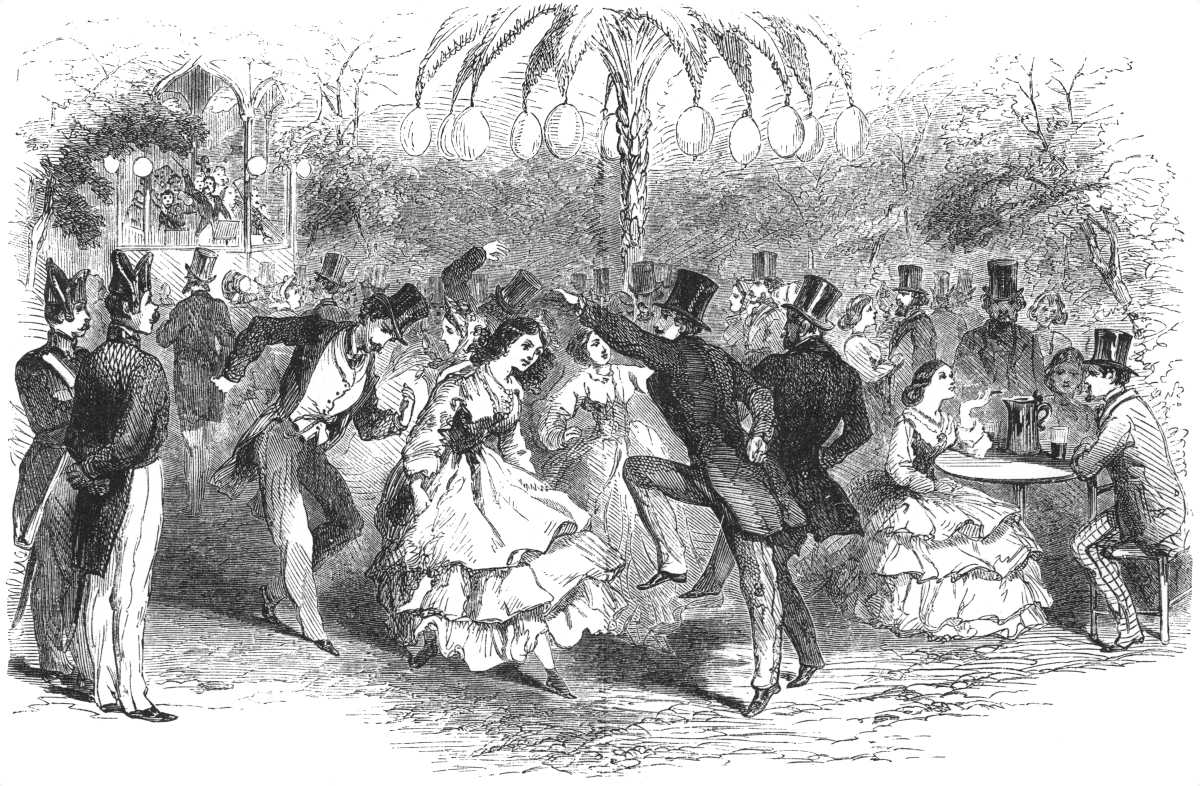
SCENE IN THE GARDENS OF “CLOSERIE DES LILAS.” PARIS.
The rank and title of “Dame de Maison,”
or keeper of a house of ill-fame, being the
highest pinnacle of a prostitute’s career,
and the acme of their ambition, of course
renders such a position a matter of much
envy and anticipation to them. We can divide
this class into four distinct divisions—
1st. Those who have, so to say, gone
through the world, having been kept by
officers in the army, or men of property,
who, perhaps, are thrown over by their ci-devant
admirers, and possessing some
money, establish themselves in this way as
a means of making a livelihood and obtaining
a provision for their declining years.
2nd. Those old prostitutes who have
exercised some economy during their youth,
and are thus placed in a position to live
somewhat at their ease.
3rd. Old servants and confidential women
who have lived in the service of
keepers of houses of ill-fame, who have
an agreement with their mistress to take
her business or succeed her on her death
or bankruptcy. These women have a
knowledge of the places where they have
lived, and know perfectly well how to
manage the girls who resort to these houses,
and thoroughly understand the men who
visit them.
4th. The fourth class is composed of
women who have never been prostitutes,
who often are married and have children.
The appetite of gain has launched them
in this career. It is to keep a furnished
house that they have taken in prostitutes,
or having set up a public-house they entertain
loose women to make men come
there.
There are in Paris some families who
have kept prostitutes for several generations,
having positively no other source of
revenue than the keeping of introducing
houses or houses of ill-fame. One sees the
mother exercising her profession in one
quarter of the city and her daughter in
another. The daughters succeed their
mother, the nieces their aunt, etc., but in
general this is very rare, one not being
able to indicate more than six families of
this description.
There are some conditions which these
people must subscribe to, and which offer
some guarantee to the authorities for the
good management of the house. To begin
with: they must not be too young, lest they
are unable to possess sufficient authority
over the women under their jurisdiction;
twenty-five is generally the lowest age, experience
teaches us, at which a woman can
become a safe manager of an immoral
house. As a rule, licences are refused to
those who have never been prostitutes.
Force, vigour, energy both of mind and
body are requisite to a keeper of a house
of ill-fame, as well as a habit of commanding,
and something of a masculine
manner. If to these qualities they join
good antecedents, if they have not been
taken before a justice of the peace, if they
are honest, if they do not favour clandestine
debauchery, if they are unaccustomed
to get intoxicated, if they know how to
read and write, if while they were prostitutes
they had not a tendency to infringe
the regulations, the authorisation they
ask for is not refused them; but unhappily
it is found too late, that licences are given
to women who are unable to, or certainly
do not, carry out these wholesome conditions
and necessary stipulations. The desire
to possess this coveted distinction, and
pass from the condition of a simple prostitute
to that of “dame de maison” often
fills young women with the greatest anxiety,
as they do not very well know how to invest
their money, and they often embark in
this career in a speculative manner causing
their enterprise to end in bankruptcy and
failure; this fills the authorities with great
trouble and they are extremely particular
in giving licences, frequently only giving a
fourth-class one when the party applying
for it could easily set up a first-class establishment.
Certain speculators will often furnish a
house, and place a woman in it for immoral
purposes, who will encourage other women,
and it becomes a house of ill-fame; other
intriguing women will also club together
and establish a house of this sort, and
install one of their creatures. Now these
installed women are not really and truly,
from their subordinate position, to be
called “dames de maison” for if they do
not every week pay so much money to
the speculators who have employed them,
they are instantly turned out and some
one else comes in their place. It is easy
to see that this system does not give
them much authority over the women who
live in their houses, and through whose instrumentality
and prostitution the money
is made. Without authority disorder must
ensue, and then the police have to interfere.
There were—
| In 1824 — 163 | of these houses | in Paris. |
| „ 1831 — 209 | „ | „ |
| „ 1832 — 220 | „ | „ |
On the 1st of January, 1852, there were
1246 women in these houses. On the 1st
of December there were 1316, but making
allowance for those incarcerated, either for
some offence or for illness, we find the
number reduced to about 1005 active
women. There were—
| In 1842 — 193 | tolerated houses | in Paris. |
| „ 1847 — 177 | „ | „ |
| „ 1852 — 152 | „ | „ |
In which latter year these houses contained
1005 girls.
In 1854, Paris contained 140 tolerated
houses in which 1009 women existed.
In the suburbs there were—
| In 1842 — 36 | of these | houses. |
| „ 1847 — 53 | „ | „ |
| „ 1852 — 65 | „ | „ |
In 1852 the number of girls living in
them was 417.
In 1854 there were 64 houses containing
493 women.
The number of these tolerated houses, it
will be seen, does not fluctuate or change
very largely, with the exception of those existing
in the suburbs, in which in ten years,
that is to say from 1842 to 1852, the number
was increased by 29. We have shown that
the summit of a prostitute’s ambition is
generally to keep a house of ill-fame, and
such being the case it is only wonderful
that the number of such houses is not
larger than it is.
A vast deal of prostitution goes on in
the small smoking shops, the low public-houses,
the brandy shops, and the wine
houses. These refuges exist all over Paris,
they are innumerable, but one finds them
collected especially at those points
where the workmen and the industrial
classes meet together, such as the larger
barriers, nearly all the outside boulevards,
those of the Hospital and the Temple, the
“Rue Fromenteau” and neighbouring
places, the streets that touch the large
bridges, etc.
So far back as 1818, the commissioners of
the police consulted about this evil, and
the necessity for suppressing it; for not
only did it encourage secret vice and defeat
the ends of the authorities, but it was a
source of drunkenness and fighting, and indeed
of all sorts of disorders.
In December, 1851, a decree was promulgated
by Louis Napoleon which has had
some effect in reducing the evil, for several
drinking shops have been closed since then
for offences against the decree.
It may be interesting to know that frequently
girls take a dislike to their revolting
avocation, and return voluntarily to their
parents. From the 1st January, 1821, to the
30th December, 1827, 254 girls whose names
were erased from the registers were taken
back by their friends, who promised to provide
them with the means of subsistence,
and gave guarantees for their good conduct.
Amongst this number—
| 133 | were | reclaimed by | the mother only. |
| 72 | „ | „ | the father only. |
| 22 | „ | „ | the mother and father together. |
| 22 | „ | „ | their brothers. |
| 9 | „ | „ | their sisters. |
| 5 | „ | „ | an aunt. |
| 2 | „ | „ | an uncle. |
Each of these girls had been inscribed
during the following time—
| 120 | from 1 to | 6 months |
| 37 | more than | 6 months |
| 16 | „ | 1 year |
| 55 | „ | 2 years |
| 9 | „ | 3 years |
| 6 | „ | 7 years |
| 8 | „ | 8 years |
| 3 | „ | 9 years |
| Total— | 254 |
The sanitary regulations in Paris are beneficial
to the community at large in the
highest degree. Physicians are appointed
by the prefecture, who make periodical
visits, generally twice a month, for the purpose
of ascertaining the state of the health
of their numerous clients. If they should
discover one infected, she is immediately
sent to the hospital.
In the foregoing pages we have endeavoured
to give a brief exposé of the dark
side of the brilliant volatile city of Paris.
Such a subject gives ample scope for
volumes, but the nature of this work confines
us to dry facts and statistics.
The liberty of the subject is very jealously
guarded in England, and so tenacious are
the people of their rights and privileges
that the legislature has not dared to infringe
them, even for what by many would
be considered a just and meritorious purpose.
Neither are the magistracy or the
police allowed to enter improper or disorderly
houses, unless to suppress disturbances
that would require their presence in
the most respectable mansion in the land,
if the aforesaid disturbances were committed
within their precincts. Until very
lately the police had not the power of
arresting those traders, who earned an
infamous livelihood by selling immoral
books and obscene prints. It is to the
late Lord Chancellor Campbell that we
owe this salutary reform, under whose
meritorious exertions the disgraceful trade
of Holywell Street and kindred districts
has received a blow from which it will
never again rally.
If the neighbours choose to complain
before a magistrate of a disorderly house,
and are willing to undertake the labour,
annoyance, and expense of a criminal indictment,
it is probable that their exertions
may in time have the desired effect; but
there is no summary conviction, as in
some continental cities whose condition we
have studied in another portion of this
work.
To show how difficult it is to give from
any data at present before the public anything
like a correct estimate of the number
of prostitutes in London, we may mention
(extracting from the work of Dr. Ryan)
that while the Bishop of Exeter asserted
the number of prostitutes in London to
be 80,000, the City Police stated to Dr.
Ryan that it did not exceed 7000 to 8000.
About the year 1793 Mr. Colquhoun, a police
magistrate, concluded, after tedious investigations,
that there were 50,000 prostitutes
in this metropolis. At that period
the population was one million, and as it is
now more than double we may form some
idea of the extensive ramifications of this
insidious vice.
In the year 1802, when immorality had
spread more or less all over Europe, owing
to the demoralizing effects of the French
Revolution, a society was formed, called
“The Society for the Suppression of Vice,”
of which its secretary, Mr. Wilberforce,
thus speaks:—
“The particular objects to which the
attention of this Society is directed are as
follow, viz.—
“1. The prevention of the profanation
of the Lord’s day.
“2. Blasphemous publications.
“3. Obscene books, prints, etc.
“4. Disorderly houses.
“5. Fortunetellers.”
When speaking of the third division a
report of the Society says—
“In consequence of the renewed intercourse
with the Continent, incidental to
the restoration of peace, there has been a
great influx into the country of the most
obscene articles of every description, as
may be inferred from the exhibition of
indecent snuff-boxes in the shop windows
of tobacconists. These circumstances having
tended to a revival of this trade the
Society have had occasion within the last
twelve months to resort to five prosecutions,
which have greatly tended to the
removal of that indecent display by which
the public eye has of late been too much
offended.”
Before the dissolution of the Bristol
Society for the Suppression of Vice, its
secretary, Mr. Birtle, wrote (1808) to London
the following letter:—
“Sir,—The Bristol Society for the Suppression
of Vice being about to dissolve, and
the agents before employed having moved
very heavily, I took my horse and rode to
Stapleton prison to inquire into the facts
contained in your letter. Inclosed are
some of the drawings which I purchased in
what they call their market, without the
least privacy on their part or mine. They
wished to intrude on me a variety of devices
in bone and wood of the most obscene
kind, particularly those representing a
crime “inter Christianos non nominandum,”
which they termed the new fashion. I purchased
a few, but they are too bulky for a
letter. This market is held before the
door of the turnkey every day between the
hours of ten and twelve.”
At the present day the police wage an
internecine war with these people, who
generally go about from fair to fair to sell
indecent images, mostly imported from
France; but this traffic is very much on the
decline, if it is not altogether extinguished.
The reports of the Society for the Suppression
of Vice are highly interesting, and
may be obtained gratis on application at
the Society’s chambers.
Another Society was instituted in May
1835, called “The London Society for the
Protection of Young Females, and Prevention
of Juvenile Prostitution.” We extract
a few passages from its opening address.
“The committee cannot avoid referring
to the present dreadfully immoral state of
the British metropolis. No one can pass
through the streets of London without
being struck with the awfully depraved
condition of a certain class of the youth of
both sexes at this period (1835). Nor is it
too much to say that in London crime has
arrived at a frightful magnitude; nay, it is
asserted that nowhere does it exist to such
an extent as in this highly-favoured city.
Schools for the instruction of youth in
every species of theft and immorality are
here established * * * * *. It has been
proved that 400 individuals procure a livelihood
by trepanning females from eleven
to fifteen years of age for the purposes of
prostitution. Every art is practised, every
scheme is devised, to effect this object, and
when an innocent child appears in the
streets without a protector, she is insidiously
watched by one of those merciless
wretches and decoyed under some plausible
pretext to an abode of infamy and degradation.
No sooner is the unsuspecting helpless
one within their grasp than, by a
preconcerted measure, she becomes a victim
to their inhuman designs. She is
stripped of the apparel with which parental
care or friendly solicitude had clothed her,
and then, decked with the gaudy trappings
of her shame, she is compelled to walk the
streets, and in her turn, while producing
to her master or mistress the wages of her
prostitution, becomes the ensnarer of the
youth of the other sex. After this it is
useless to attempt to return to the path of
virtue or honour, for she is then watched
with the greatest vigilance, and should she
attempt to escape from the clutches of her
seducer she is threatened with instant
punishment, and often barbarously treated.
Thus situated she becomes reckless, and
careless of her future course. It rarely
occurs that one so young escapes contamination;
and it is a fact that numbers of
these youthful victims imbibe disease
within a week or two of their seduction.
They are then sent to one of the hospitals
under a fictitious name by their keepers, or
unfeelingly turned into the streets to
perish; and it is not an uncommon circumstance
that within the short space of a
few weeks the bloom of health, of beauty,
and of innocence gives place to the sallow
hue of disease, of despair, and of death.
“This fact will be appreciated when it is
known that in three of the largest hospitals
in London within the last eight years (that
is to say, from 1827 to 1835), there have not
been less than 2700 cases of disease arising
from this cause in children from eleven to
sixteen years of age.”
Léon Faucher, commenting on this, exclaims
with astonishment, mixed with indignation,
“Deux mille sept cents enfants
visités par cette horrible peste avant l’âge
de la puberté! Quel spectacle que celui-là
pour un peuple qui a des entrailles! Et
comment éprouver assez de pitié pour les
victimes, assez d’indignation contre les
bourreaux!” A Frenchman, looking at the
way in which his own illustrious country is
governed, would very naturally exclaim
against the authorities for not taking steps
to prevent so much crime and misery, but
he forgets that although a system may
work well in France, it is no criterion of its
excellent working among a nation totally
dissimilar in their habits and disposition to
his own.
All French writers have the profoundest
horror of our social economics. MM.
Duchatelet, Richelot and Léon Faucher,
whom we have just quoted, all unite in
condemning our system of blind and wilful
toleration. They do not understand the
temper of the nation, which would never
allow the State to legislate upon this subject.
But, nevertheless, we must confess
that the profligacy of the metropolis of
England, if not so patent and palpable as
that of some continental cities we have had
occasion to refer to, is perhaps as deeply
rooted, and as impossible to eradicate.
The legislature, by refusing to interfere,
have tacitly declared the existence of prostitutes
to be a necessary evil, the suppression
of which would produce alarming and
disastrous effects upon the country at large.
When any case more than usually flagrant
occurs it falls within the jurisdiction of the
Society for the Suppression of Vice, and the
law is careful to punish anything that can
be construed into a misdemeanour or a
felony. In cold climates, as in hot climates,
we have shown that the passions are the
main agents in producing the class of
women that we have under consideration,
but in temperate zones the animal instinct
is less difficult to bridle and seldom leads
the female to abandon herself to the other
sex. It is a vulgar error, and a popular
delusion, that the life of a prostitute is as
revolting to herself, as it appears to the
moralist sternly lamenting over the condition
of the fallen; but, on the contrary, investigation
and sedulous scrutiny lead us
to a very different conclusion. Authors
gifted with vivid imaginations love to pourtray
the misery that is brought upon an
innocent and confiding girl by the perfidy
and desertion of her seducer. The pulpit
too frequently echoes to clerical denunciation
and evangelical horror, until those unacquainted
with the actual facts tremble at
the fate of those whose terrible lot they
are taught rather to shudder at than commiserate.
Women who in youth have
lost their virtue, often contrive to retain
their reputation; and even when this is not
the case, frequently amalgamate imperceptibly
with the purer portion of the population
and become excellent members of the
community. The love of woman is usually
pure and elevated. But when she
devotes her affections to a man who realizes
her ideal, she does not hesitate to
sacrifice all she holds dear, for his gratification,
ignoring her own interest and her own
inclination. Actuated by a noble abnegation
of self, she derives a melancholy
pleasure from the knowledge that she has
utterly given up all she had formerly so
zealously guarded, and she feels that her
love has reached its grand climacteric,
when, without the slightest pruriency of
imagination to urge her on to the consummation,
without the remotest vestige of
libidinous desire to prompt her to self-immolation,
without a shadow of meretricious
feeling lurking within her, she abandons
her person beyond redemption to the
idol she has set up in the highest place in
her soul. This heroic martyrdom is one of
the causes, though perhaps not the primary
or most frequently occurring, of the stream
of immorality that insidiously permeates
our social system. The greatest, and one
equally difficult to combat, is the low rate
of wages that the female industrial classes
of this great city receive, in return for the
most arduous and wearisome labour. Innumerable
cases of prostitution through
want, solely and absolutely, are constantly
occurring, and this will not be wondered at
when it is remembered that 105 women in
England and Wales are born to every 100
males, which number is further augmented
by the dangers to which men are exposed
by their avocations, and also in martial
service by sea and land. Again, so great are
the inducements held out by men of lax
morality and loose principles that procuresses
find entrapping girls into their
abodes a most lucrative and profitable
trade. Some are even brought up from
their earliest infancy by their pseudo-protectors
with the full intention that they
shall embark in the infamous traffic as
soon as their age will permit them to do so
remuneratively. A revolting and horrible
case exemplifying the truth of this statement
came under our notice some short
time back. We were examining a girl, who
gave the following replies to the questions
put to her.
“My name is Ellen, I have no other.
Yes, I sometimes call myself by various
names, but rarely keep to one longer than
a month or two. I was never baptized that
I know of; I don’t know much about religion,
though I think I know the difference
between right and wrong. I certainly
think it is wrong to live as I am now
doing. I often think of it in secret, and
cry over it, but what can I do? I was
brought up in the country and allowed to
run about with some other children. We
were not taught anything, not even to read
or write; twice I saw a gentleman who
came down to the farm, and he kissed me
and told me to be a good girl. Yes, I remember
these things very well. I was
about eleven the last time he came, and
two years after I was sent up to town,
carefully dressed and placed in a large
drawing-room. After I had been there
some time a gentleman came in with the
person I had been sent to, and I directly
recognized him as the one I had seen in
the country. For the first time in my life
I glanced at a looking-glass that hung on
the wall, they being things we never saw
in the country, and I thought the gentleman
had changed his place and was standing
before me, we were so alike. I then
looked at him steadily for a few moments,
and at last took his hand. He said something
to me which I don’t remember, and
which I did not reply to. I asked him,
when he had finished speaking, if he was
my father. I don’t know why I asked him.
He seemed confused, and the lady of the
house poured out some wine and gave me,
after that I don’t know what happened.”
This may be a case of rare occurrence,
but it is not so morally impossible as at
first it appears.
In 1857, according to the best authorities,
there were 8600 prostitutes known to the
police, but this is far from being even an
approximate return of the number of loose
women in the metropolis. It scarcely does
more than record the circulating harlotry
of the Haymarket and Regent Street.
Their actual numerical strength is very
difficult to compute, for there is an amount
of oscillatory prostitution it is easy to
imagine, but impossible to substantiate.
One of the peculiarities of this class is their
remarkable freedom from disease. They
are in the generality of cases notorious for
their mental and physical elasticity. Syphilis
is rarely fatal. It is an entirely distinct
race that suffer from the ravages of the insidious
diseases that the licence given to
the passions and promiscuous intercourse
engender. Young girls, innocent and inexperienced,
whose devotion has not yet
bereft them of their innate modesty and
sense of shame, will allow their systems to
be so shocked, and their constitutions so
impaired, before the aid of the surgeon is
sought for, that when he does arrive his
assistance is almost useless.
We have before stated (p. 211) the assumed
number of prostitutes in London to be
about 80,000, and large as this total may
appear, it is not improbable that it is below
the reality rather than above it. One
thing is certain—if it be an exaggerated
statement—that the real number is swollen
every succeeding year, for prostitution is
an inevitable attendant upon extended
civilization and increased population.
We divide prostitutes into three classes.
First, those women who are kept by men
of independent means; secondly, those
women who live in apartments, and maintain
themselves by the produce of their
vagrant amours, and thirdly, those who
dwell in brothels.
The state of the first of these is the
nearest approximation to the holy state
of marriage, and finds numerous defenders
and supporters. These have their suburban
villas, their carriages, horses, and sometimes
a box at the opera. Their equipages
are to be seen in the park, and occasionally
through the influence of their aristocratic
friends they succeed in obtaining vouchers
for the most exclusive patrician balls.
Houses in which prostitutes lodge are
those in which one or two prostitutes
occupy private apartments; in most cases
with the connivance of the proprietor.
These generally resort to night-houses,
where they have a greater chance of meeting
with customers than they would have
were they to perambulate the streets.
Brothels are houses where speculators
board, dress, and feed women, living upon
the farm of their persons. Under this
head we must include introducing houses,
where the women do not reside, but merely
use the house as a place of resort in the
daytime. Married women, imitating the
custom of Messalina, whom Juvenal so
vividly describes in his Satires, not uncommonly
make use of these places. A Frenchwoman
in the habit of frequenting a notorious
house in James Street, Haymarket,
said that she came to town four or five times
in the week for the purpose of obtaining
money by the prostitution of her body.
She loved her husband, but he was unable
to find any respectable employment, and
were she not to supply him with the necessary
funds for their household expenditure
they would sink into a state of destitution,
and anything, she added, with simplicity,
was better than that. Of course her husband
connived at what she did. He came
to fetch her home every evening about ten
o’clock. She had no children. She didn’t
wish to have any.
It must not be supposed that if some,
perhaps a majority of them, eventually
become comparatively respectable, and
merge into the ocean of propriety, there
are not a vast number whose lives afford
matter for the most touching tragedies,—whose
melancholy existence is one continual
struggle for the actual necessaries of
life, the occasional absence of which entails
upon them a condition of intermittent starvation.
A woman who has fallen like a
star from heaven, may flash like a meteor
in a lower sphere, but only with a transitory
splendour. In time her orbit contracts,
and the improvidence that has been her
leading characteristic through life now
trebles and quadruples the misery she experiences.
To drown reflection she rushes
to the gin palace, and there completes the
work that she had already commenced so
inauspiciously. The passion for dress, that
distinguished her in common with her sex
in former days, subsides into a craving for
meretricious tawdry, and the bloom of
health is superseded by ruinous and poisonous
French compounds and destructive
cosmetics. A hospital surgeon gave us
the following description of the death of a
French lorette, who at a very juvenile age
had been entrapped and imported into this
country. She had, according to her own
statement, been born in one of the southern
departments. When she was fourteen
years old, the agent of some English speculator
in human beings came into their
neighbourhood and proposed that Anille
should leave her native country and proceed
to England, where he said there was a
great demand for female domestic labour,
which was much better paid for on the
other side of the Channel. The proposition
was entertained by the parents, and eagerly
embraced by the girl herself, who soon
afterwards, in company with several other
girls, all deluded in a similar manner, were
leaving the shores of their native country for
a doubtful future in one with the language
of which they were not even remotely acquainted.
On their arrival their ruin was
soon effected, and for some years they continued
to enrich the proprietors of the
house in which they resided, all the time
remitting small sums to their families
abroad, who were unwittingly and involuntarily
existing upon the proceeds of their
daughters’ dishonour, and rejoicing in such
unexpected success. After a while Anille
was sent adrift to manage for herself. Naturally
of a refined and sensitive disposition,
she felt her position keenly, which
induced a sadness almost amounting to
hypochondria to steal over her, and although
very pretty, she found this a great
obstacle in the way of her success. She
knew not how to simulate the hollow laugh
or the reckless smile of her more volatile
companions, and her mind became more
diseased day by day, until she found it impracticable
to think of endeavouring to
hurl off the morbidity that had taken possession
of her very soul. At last she fell a
victim to a contagious disorder, the neglect
of which ultimately necessitated her removal
to the hospital. When there, she was
found to be incurable; an operation was
performed upon her but without success.
She bore her illness with childish impatience,
continually wishing for the end, and
often imploring me with tearful eyes by the
intervention of science to put an end to her
misery. One afternoon, as usual, I came
to see her. She exclaimed the moment she
perceived me, I am cheerful to-day. May
I not recover; I suffer no pain. But her
looks belied her words; her features were
frightfully haggard and worn; her eyes, dry
and bloodshot, had almost disappeared in
their sockets, and her general appearance
denoted the approach of him she had been
so constantly invoking. Unwrapping some
bandages, I proceeded to examine her,
when an extraordinary change came over
her, and I knew that her dissolution was
not far distant. Her mind wandered, and
she spoke wildly and excitedly in her own
language. After a while she exclaimed,
“J’ignore où je suis. C’en est fait.” An
expression of intense suffering contracted
her emaciated features. “Je n’en puis plus,”
she cried, and adding, after a slight pause, in
a plaintive voice, “Je me meurs,” her soul
glided impalpably away, and she was a
corpse. As a pendant to these remarks, I
extract an expressive passage from an old
book. “There are also women (like birds
of passage) of a migratory nature, who remove
after a certain time from St. James’s
and Marylebone end of the town to Covent
Garden, then to the Strand, and from thence
to St. Giles and Wapping; from which latter
place they frequently migrate much further,
even to New South Wales. Some few return
in seven years, some in fourteen, and
some not at all. During their stay here,
like birds they make their nests upon
feathers, some higher, some lower than
others. At first they generally build them
on the first-floor, afterwards on the second,
and then up in the cock-loft and garrets,
from whence they generally take to the
open air, and become ambulatory and
noctivagous, and as their price grows less,
their wandering increases, when many
perish from the inclemency of the weather,
and others take their flight abroad.”[92]
Two classes of prostitutes come under
this denomination—first, kept mistresses,
and secondly, prima donnas or those who
live in a superior style. The first of these
is perhaps the most important division of
the entire profession, when considered with
regard to its effects upon the higher classes
of society. Laïs, when under the protection
of a prince of the blood; Aspasia, whose
friend is one of the most influential noblemen
in the kingdom; Phryne, the chère
amie of a well-known officer in the guards,
or a man whose wealth is proverbial on the
Stock Exchange and the city,—have all
great influence upon the tone of morality
extant amongst the set in which their distinguished
protectors move, and indeed the
reflex of their dazzling profligacy falls upon
and bewilders those who are in a lower
condition of life, acting as an incentive to
similar deeds of licentiousness though on a
more limited scale. Hardly a parish in
London is free from this impurity. Wherever
the neighbourhood possesses peculiar
charms, wherever the air is purer than
ordinary, or the locality fashionably distinguished,
these tubercles on the social system
penetrate and abound. Again quoting
from Dr. Ryan, although we cannot authenticate
his statements—“It is computed,
that 8,000,000l. are expended annually on
this vice in London alone. This is easily
proved: some girls obtain from twenty
to thirty pounds a week, others more,
whilst most of those who frequent theatres,
casinos, gin palaces, music halls, &c.,
receive from ten to twelve pounds. Those
of a still lower grade obtain about four or
five pounds, some less than one pound,
and many not ten shillings. If we take
the average earnings of each prostitute at
100l. per annum, which is under the
amount, it gives the yearly income of
eight millions.
“Suppose the average expense of 80,000
amounts to 20l. each, 1,600,000l. is the result.
This sum deducted from the earnings
leaves 6,400,000l. as the income of the
keepers of prostitutes, or supposing 5000
to be the number, above 1000l. per annum
each—an enormous income for men in
such a situation to derive when compared
with the resources of many respectable and
professional men.”
Literally every woman who yields to her
passions and loses her virtue is a prostitute,
but many draw a distinction between
those who live by promiscuous intercourse,
and those who confine themselves to one
man. That this is the case is evident from
the returns before us. The metropolitan
police do not concern themselves with the
higher classes of prostitutes; indeed, it
would be impossible, and impertinent as
well, were they to make the attempt. Sir
Richard Mayne kindly informed us that the
latest computation of the number of public
prostitutes was made on the 5th of April,
1858, and that the returns then showed a
total of 7261.
It is frequently a matter of surprise
amongst the friends of a gentleman of position
and connection that he exhibits an invincible
distaste to marriage. If they were
acquainted with his private affairs their
astonishment would speedily vanish, for
they would find him already to all intents
and purposes united to one who possesses
charms, talents, and accomplishments, and
who will in all probability exercise the
same influence over him as long as the
former continue to exist. The prevalence
of this custom, and the extent of its ramifications
is hardly dreamed of, although its
effects are felt, and severely. The torch of
Hymen burns less brightly than of yore,
and even were the blacksmith of Gretna
still exercising his vocation, he would find
his business diminishing with startling
rapidity year by year.
It is a great mistake to suppose that
kept mistresses are without friends and
without society; on the contrary, their acquaintance,
if not select, is numerous, and it
is their custom to order their broughams
or their pony carriages and at the fashionable
hour pay visits and leave cards on one
another.
They possess no great sense of honour,
although they are generally more or less religious.
If they take a fancy to a man they
do not hesitate to admit him to their favour.
Most kept women have several lovers who
are in the habit of calling upon them at
different times, and as they are extremely
careful in conducting these amours they
perpetrate infidelity with impunity, and in
ninety-nine cases out of a hundred escape
detection. When they are unmasked, the
process, unless the man is very much infatuated,
is of course summary in the extreme.
They are dismissed probably with
a handsome douceur and sent once more
adrift. They do not remain long, however,
in the majority of cases, without finding
another protector.
A woman who called herself Lady ——
met her admirer at a house in Bolton Row
that she was in the habit of frequenting.
At first sight Lord —— became enamoured,
and proposed sur le champ, after a little preliminary
conversation, that she should live
with him. The proposal with equal rapidity
and eagerness was accepted, and without
further deliberation his lordship took
a house for her in one of the terraces overlooking
the Regent’s Park, allowed her four
thousand a year, and came as frequently as
he could, to pass his time in her society.
She immediately set up a carriage and a
stud, took a box at the opera on the pit
tier, and lived, as she very well could, in excellent
style. The munificence of her
friend did not decrease by the lapse of
time. She frequently received presents of
jewelry from him, and his marks of attention
were constant as they were various.
The continual contemplation of her charms
instead of producing satiety added fuel to
the fire, and he was never happy when out
of her sight. This continued until one day
he met a young man in her loge at the
opera, whom she introduced as her cousin.
This incident aroused his suspicions, and
he determined to watch her more closely.
She was surrounded by spies, and in reality
did not possess one confidential attendant,
for they were all bribed to betray
her. For a time, more by accident than
precaution or care on her part, she succeeded
in eluding their vigilance, but at
last the catastrophe happened; she was
surprised with her paramour in a position
that placed doubt out of the question, and
the next day his lordship, with a few
sarcastic remarks, gave her her congé and
five hundred pounds.
These women are rarely possessed of
education, although they undeniably have
ability. If they appear accomplished you
may rely that it is entirely superficial. Their
disposition is volatile and thoughtless,
which qualities are of course at variance
with the existence of respectability. Their
ranks too are recruited from a class where
education is not much in vogue. The
fallacies about clergymen’s daughters and
girls from the middle classes forming the
majority of such women are long ago exploded;
there may be some amongst them,
but they are few and far between. They
are not, as a rule, disgusted with their way
of living; most of them consider it a means
to an end, and in no measure degrading or
polluting. One and all look forward to
marriage and a certain state in society as
their ultimate lot. This is their bourne,
and they do all in their power to travel
towards it.
“I am not tired of what I am doing,” a
woman once answered me, “I rather like it.
I have all I want, and my friend loves me
to excess. I am the daughter of a tradesman
at Yarmouth. I learned to play the
piano a little, and I have naturally a good
voice. Yes, I find these accomplishments
of great use to me; they are, perhaps, as
you say, the only ones that could be of use
to a girl like myself. I am three and
twenty. I was seduced four years ago. I
tell you candidly I was as much to blame
as my seducer; I wished to escape from
the drudgery of my father’s shop. I have
told you they partially educated me; I
could cypher a little as well, and I knew
something about the globes; so I thought
I was qualified for something better than
minding the shop occasionally, or sewing,
or helping my mother in the kitchen and
other domestic matters. I was very fond
of dress, and I could not at home gratify
my love of display. My parents were
stupid, easy-going old people, and extremely
uninteresting to me. All these
causes combined induced me to encourage
the addresses of a young gentleman of property
in the neighbourhood, and without
much demur I yielded to his desires. We
then went to London, and I have since
that time lived with four different men.
We got tired of one another in six months,
and I was as eager to leave him as he was
to get rid of me, so we mutually accommodated
one another by separating. Well,
my father and mother don’t exactly know
where I am or what I am doing, although
if they had any penetration they might
very well guess. Oh, yes! they know I
am alive, for I keep them pleasantly aware
of my existence by occasionally sending
them money. What do I think will become
of me? What an absurd question.
I could marry to-morrow if I liked.”
This girl was a fair example of her class.
They live entirely for the moment, and
care little about the morrow until they are
actually pressed in any way, and then they
are fertile in expedients.
We now come to the second class, or
those we have denominated prima donnas.
These are not kept like the first that we
have just been treating of, although several
men who know and admire them are in
the habit of visiting them periodically.
From these they derive a considerable revenue,
but they by no means rely entirely
upon it for support. They are continually
increasing the number of their friends,
which indeed is imperatively necessary, as
absence and various causes thin their ranks
considerably. They are to be seen in the
parks, in boxes at the theatres, at concerts,
and in almost every accessible place where
fashionable people congregate; in fact in all
places where admittance is not secured by
vouchers, and in some cases, those apparently
insuperable barriers fall before their
tact and address. At night their favourite
rendezvous is in the neighbourhood of the
Haymarket, where the hospitality of Mrs.
Kate Hamilton is extended to them after
the fatigues of dancing at the Portland
Rooms, or the excesses of a private party.
Kate’s may be visited not only to dissipate
ennui, but with a view to replenishing an
exhausted exchequer; for as Kate is careful
as to who she admits into her rooms—men
who are able to spend, and come with
the avowed intention of spending, five or
six pounds, or perhaps more if necessary—these
supper-rooms are frequented by a
better set of men and women than perhaps
any other in London. Although these are
seen at Kate’s they would shrink from appearing
at any of the cafés in the Haymarket,
or at the supper-rooms with which
the adjacent streets abound, nor would
they go to any other casino than Mott’s.
They are to be seen between three and five
o’clock in the Burlington Arcade, which is
a well known resort of cyprians of the
better sort. They are well acquainted
with its Paphian intricacies, and will, if
their signals are responded to, glide into a
friendly bonnet shop, the stairs of which
leading to the cœnacula or upper chambers
are not innocent of their well formed
“bien chaussée” feet. The park is also, as
we have said, a favourite promenade, where
assignations may be made or acquaintances
formed. Equestrian exercise is much liked
by those who are able to afford it, and is
often as successful as pedestrian, frequently
more so. It is difficult to say what
position in life the parents of these women
were in, but generally their standing in
society has been inferior. Principles of
lax morality were early inculcated, and the
seed that has been sown has not been slow
to bear its proper fruit.
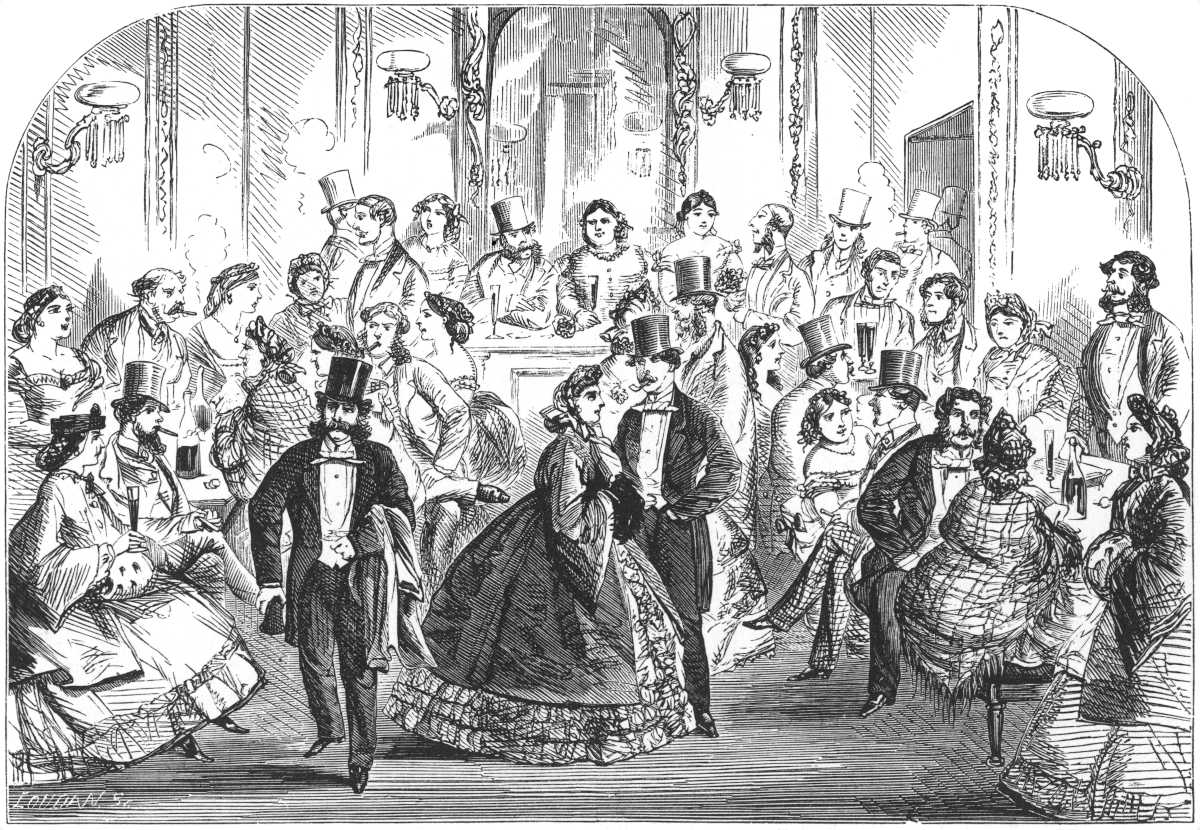
A NIGHT HOUSE.—KATE HAMILTON’S.
It is true that a large number of milliners,
dress-makers, furriers, hat-binders,
silk-binders, tambour-makers, shoe-binders,
slop-women, or those who work for cheap
tailors, those in pastry-cooks, fancy and
cigar shops, bazaars, servants to a great extent,
frequenters of fairs, theatres, and dancing-rooms,
are more or less prostitutes
and patronesses of the numerous brothels
London can boast of possessing; but these
women do not swell the ranks of the class
we have at present under consideration.
More probably they are the daughters of
tradesmen and of artizans, who gain a superficial
refinement from being apprenticed,
and sent to shops in fashionable localities,
and who becoming tired of the drudgery
sigh for the gaiety of the dancing-saloons,
freedom from restraint, and amusements
that are not in their present capacity within
their reach.
Loose women generally throw a veil over
their early life, and you seldom, if ever,
meet with a woman who is not either a seduced
governess or a clergyman’s daughter;
not that there is a word of truth in such
an allegation—but it is their peculiar whim
to say so.
To show the extent of education among
women who have been arrested by the
police during a stated period, we print the
annexed table, dividing the virtuous criminals
from the prostitutes.
Degree of Instruction amongst Prostitutes compared with the Degree of Instruction
among Women not Prostitutes, arrested for breaking various laws (London). The City
not included.
| Periods—taking 10,000 in each period. Total of women arrested of both classes 405·362. | Degree of Instruction amongst virtuous women brought up in the Police Courts for various offences during the years elapsing from 1837 to 1854 inclusive. |
|---|
| Not able to read or write. | Able to read only, or read and write imperfectly. | Knowing how to read and write well. | Very well instructed. |
|---|
| 1st period | 6 years 1837-42 | 10,000 | 4,813 | 4,838 | 327 | 22 |
| 2nd „ | 6 „ 1843-48 | 10,000 | 4,167 | 5,534 | 279 | 20 |
| 3rd „ | 6 „ 1849-54 | 10,000 | 2,802 | 1,972 | 209 | 17 |
| 1st period | 9 years 1837-45 | 10,000 | 4,570 | 5,098 | 312 | 20 |
| 2nd „ | 9 „ 1846-54 | 10,000 | 3,247 | 6,504 | 320 | 19 |
| Total period | 18 „ 1837-54 | 10,000 | 3,861 | 5,851 | 268 | 20 |
| Periods—taking 10,000 in each period. Total of women arrested of both classes 405·362. | Degree of Instruction among Prostitutes similarly arrested. |
|---|
| Not able to read or write. | Able to read only, or read and write imperfectly. | Knowing how to read and write well. | Very well instructed. |
|---|
| 1st period | 6 years 1837-42 | 10,000 | 4,524 | 5,031 | 432 | 13 |
| 2nd „ | 6 „ 1843-48 | 10,000 | 3,672 | 5,893 | 425 | 10 |
| 3rd „ | 6 „ 1849-54 | 10,000 | 2,305 | 7,444 | 212 | 39 |
| 1st period | 9 years 1837-45 | 10,000 | 4,109 | 5,424 | 455 | 12 |
| 2nd „ | 9 „ 1846-54 | 10,000 | 2,821 | 6,910 | 236 | 33 |
| Total period | 18 „ 1837-54 | 10,000 | 3,498 | 6,129 | 351 | 22 |
This table shows us that public women
are a little less illiterate than those who
together with them form the most infamous
part of the population. But we must remember
that this is hardly a fair criterion of
the education of all the prostitutes, or of
prostitutes as a class, because we have
only summed up those who were arrested
for some crime or offence, so we may justly
suppose them to have been the worst of
their class in every respect.
We see however that of the total number
of women arrested during a period of 18
years, there were in every 10,000—
| 3,498 | not knowing how to read or write. |
| 6,129 | able to read only, or read and write badly. |
| 351 | able to read and write well. |
| 22 | educated in a superior manner. |
| 10,000 |
We next come to the consideration of
convives, or those who live in the same
house with a number of others, and we will
commence with those who are independent
of the mistress of the house. These women
locate themselves in the immediate
vicinity of the Haymarket, which at night
is their principal scene of action, when the
hospitable doors of the theatres and casinos
are closed. They are charged enormously
for the rooms they occupy, and their landlords
defend themselves for their extortionate
demands, by alleging that, as
honesty is not a leading feature in the
characters of their lodgers, they are compelled
to protect their own interest by
exacting an exorbitant rent. A drawing-room
floor in Queen Street, Windmill Street,
which is a favourite part on account of its
proximity to the Argyll Rooms, is worth
three, and sometimes four pounds a-week,
and the other étages in proportion. They
never stay long in one house, although
some will remain for ten or twelve months
in a particular lodging. It is their principle
to get as deeply into debt as they are able,
and then to pack up their things, have
them conveyed elsewhere by stealth, and
defraud the landlord of his money. The
houses in some of the small streets in the
neighbourhood of Langham Place are let to
the people who underlet them for three
hundred a-year, and in some cases at a
higher rental. This class of prostitutes do
not live together on account of a gregarious
instinct, but simply from necessity, as
their trade would necessarily exclude them
from respectable lodging-houses. They
soon form an acquaintance with the girls
who inhabit the same house, and address
one another as “my dear,” an unmeaning,
but very general epithet, an hour or two
after their first meeting. They sometimes
prefer the suburbs to reside in, especially
while Cremorne is open; but some live at
Brompton and Pimlico all the year round.
One of their most remarkable characteristics
is their generosity, which perhaps is unparalleled
by the behaviour of any others,
whether high or low in the social scale.
They will not hesitate to lend one another
money if they have it, whether they can
spare it or not, although it is seldom that
they can, from their innate recklessness
and acquired improvidence. It is very common,
too, for them to lend their bonnets
and their dresses to their friends. If a
woman of this description is voluble and
garrulous, she is much sought after by the
men who keep the cafés in the Haymarket,
to sit decked out in gorgeous attire behind
the counters, so that by her interesting
appearance and the esprit she displays, the
habitués of those places, but more usually
those who pay only a casual visit, may be
entrapped into purchasing some of the
wares and fancy articles that are retailed
at ten times their actual value. In order
to effect this they will exert all their talents,
and an inexperienced observer would imagine
that they indeed entertain some feeling
of affection or admiration for their
victim, by the cleverness with which they
simulate its existence. The man whose
vanity leads him to believe that he is
selected by the beautiful creature who condescends
to address him, on account of his
personal appearance, would be rather disgusted
if he were to perceive the same
blandishments lavished upon the next
comer, and would regret the ten shillings
he paid with pleasure for a glove-box, the
positive market value of which is hardly
one-fifth of the money he gave for it.
There is a great abandonment of everything
that one may strictly speaking denominate
womanly. Modesty is utterly
annihilated, and shame ceases to exist in
their composition. They all more or less
are given to habits of drinking.
“When I am sad I drink,” a woman
once said to us. “I’m very often sad,
although I appear to be what you call
reckless. Well! we don’t fret that we
might have been ladies, because we never
had a chance of that, but we have forfeited
a position nevertheless, and when we think
that we have fallen, never to regain that
which we have descended from, and in some
cases sacrificed everything for a man who
has ceased to love and deserted us, we get
mad. The intensity of this feeling does
wear off a little after the first; but there’s
nothing like gin to deaden the feelings.
What are my habits? Why, if I have no
letters or visits from any of my friends, I
get up about four o’clock, dress (”en dishabille“)
and dine; after that I may walk
about the streets for an hour or two, and
pick up any one I am fortunate enough to
meet with, that is if I want money; afterwards
I go to the Holborn, dance a little,
and if any one likes me I take him home
with me, if not I go to the Haymarket, and
wander from one café to another, from
Sally’s to the Carlton, from Barn’s to Sam’s,
and if I find no one there I go, if I feel inclined,
to the divans. I like the Grand
Turkish best, but you don’t as a rule find
good men in any of the divans. Strange
things happen to us sometimes: we may
now and then die of consumption; but the
other day a lady friend of mine met a
gentleman at Sam’s, and yesterday morning
they were married at St. George’s, Hanover
Square. The gentleman has lots of money,
I believe, and he started off with her at
once for the Continent. It is very true
this is an unusual case; but we often do
marry, and well too; why shouldn’t we, we
are pretty, we dress well, we can talk and
insinuate ourselves into the hearts of men
by appealing to their passions and their
senses.”
This girl was shrewd and clever, perhaps
more so than those of her rank in the profession
usually are; but her testimony is
sufficient at once to dissipate the foolish
idea that ought to have been exploded long
ago, but which still lingers in the minds of
both men and women, that the harlot’s
progress is short and rapid, and that there
is no possible advance, moral or physical;
and that once abandoned she must always
be profligate.
Another woman told us, she had been
a prostitute for two years; she became so
from necessity; she did not on the whole
dislike her way of living; she didn’t think
about the sin of it; a poor girl must live;
she wouldn’t be a servant for anything;
this was much better. She was a lady’s
maid once, but lost her place for staying
out one night with the man who seduced
her; he afterwards deserted her, and then
she became bad. She was fonder of dress
than anything. On an average she had a
new bonnet once a week, dresses not so
often; she liked the casinos, and was
charmed with Cremorne; she hated walking
up and down the Haymarket, and seldom
did it without she wanted money very
much. She liked the Holborn better than
the Argyll, and always danced.
Board lodgers are those who give a portion
of what they receive to the mistress
of the brothel in return for their board and
lodging. As we have had occasion to observe
before, it is impossible to estimate
the number of brothels in London, or even
in particular parishes, not only because
they are frequently moving from one district
to another, but because our system so
hates anything approaching to espionage,
that the authorities do not think it worth
their while to enter into any such computation.
From this it may readily be understood
how difficult the task of the statistician
is. Perhaps it will be sufficient to say
that these women are much more numerous
than may at first be imagined; although
those who give the whole of what they get
in return for their board, lodging, and
clothes are still more so. In Lambeth
there are great numbers of the lowest of
these houses, and only very recently the
proprietors of some eight or ten of the
worst were summoned before a police
magistrate, and the parish officers who
made the complaint bound over to prosecute
at the sessions. It is much to be
regretted that in dealing with such cases
the method of procedure is not more expeditious
and less expensive. Let us take
for example one of the cases we have been
quoting. A man is openly accused of
keeping a ruffianly den filled with female
wretches, destitute of every particle of
modesty and bereft of every atom of shame,
whose actual occupation is to rob, maltreat,
and plunder the unfortunate individuals
who so far stultify themselves as to allow
the decoys to entrap them into their snares,
let us hope, for the sake of humanity, while
in a state of intoxication or a condition of
imbecility. Very well; instead of an easy
inexpensive process, the patriotic persons
who have devoted themselves to the exposure
of such infamous rascality, find
themselves involved in a tedious criminal
prosecution, and in the event of failure lay
themselves open to an action. Mysterious
disappearances, Waterloo Bridge tragedies,
and verdicts of found drowned, are common
enough in this great city. Who knows
how many of these unfathomable affairs
may have been originated, worked out, and
consummated in some disgusting rookery
in the worst parts of our most demoralized
metropolitan parishes; but it is with the
better class of these houses we are more
particularly engaged at present. During
the progress of these researches, we met
a girl residing at a house in a street running
out of Langham Place. Externally the
house looked respectable enough; there
was no indication of the profession or mode
of life of the inmates, except that, from the
fact of some of the blinds being down in
the bed rooms, you might have thought
the house contained an invalid. The
rooms, when you were ushered in, were
well, though cheaply furnished; there were
coburg chairs and sofas, glass chandeliers,
and handsome green curtains. The girl with
whom we were brought into conversation
was not more than twenty-three; she told
us her age was twenty, but statements of a
similar nature, when made by this class, are
never to be relied on. At first she treated
our inquiries with some levity, and jocularly
inquired what we were inclined to stand,
which we justly interpreted into a desire
for something to drink; we accordingly
“stood” a bottle of wine, which had the
effect of making our informant more communicative.
What she told us was briefly
this. Her life was a life of perfect slavery,
she was seldom if ever allowed to go out,
and then not without being watched. Why
was this? Because she would “cut it” if
she got a chance, they knew that very well,
and took very good care she shouldn’t have
much opportunity. Their house was rather
popular, and they had lots of visitors; she
had some particular friends who always
came to see her. They paid her well, but
she hardly ever got any of the money.
Where was the odds, she couldn’t go out
to spend it? What did she want with
money, except now and then for a drain
of white satin. What was white satin?
Where had I been all my life to ask such a
question? Was I a dodger? She meant a
parson. No; she was glad of that, for she
hadn’t much idea of them, they were a
canting lot. Well, white satin, if I must
know, was gin, and I couldn’t say she never
taught me anything. Where was she born?
Somewhere in Stepney. What did it matter
where; she could tell me all about it if she
liked, but she didn’t care. It touched her
on the raw—made her feel too much. She
was ’ticed when she was young, that is, she
was decoyed by the mistress of the house
some years ago. She met Mrs. —— in the
street, and the woman began talking to her
in a friendly way. Asked her who her
father was (he was a journeyman carpenter),
where he lived, extracted all about her
family, and finally asked her to come home
to tea with her. The child, delighted at
the making the acquaintance of so kind and
so well-dressed a lady, willingly acquiesced,
without making any demur, as she never
dreamt of anything wrong, and had not
been cautioned by her father. She had
lost her mother some years ago. She was
not brought direct to the house where I
found her? Oh! no. There was a branch
establishment over the water, where they
were broken in as it were. How long did
she remain there? Oh! perhaps two
months, maybe three; she didn’t keep
much account how time went. When she
was conquered and her spirit broken, she
was transported from the first house to a
more aristocratic neighbourhood. How did
they tame her? Oh! they made her drunk
and sign some papers, which she knew
gave them great power over her, although
she didn’t exactly know in what the said
power consisted, or how it might be exercised.
Then they clothed her and fed her
well, and gradually inured her to that sort
of life. And now, was there anything else
I’d like to know particularly, because if
there was, I’d better look sharp about asking
it, as she was getting tired of talking,
she could tell me. Did she expect to lead
this life till she died? Well she never did,
if I wasn’t going to preachify. She couldn’t
stand that—anything but that.
I really begged to apologize if I had
wounded her sensibility; I wasn’t inquiring
from a religious point of view, or with
any particular motive. I merely wished to
know, to satisfy my own curiosity.
Well, she thought me a very inquisitive
old party, anyhow. At any rate, as I was
so polite she did not mind answering my
questions. Would she stick to it till she
was a stiff ’un? She supposed she would;
what else was there for her? Perhaps
something might turn up; how was she
to know? She never thought she would
go mad; if she did, she lived in the present,
and never went blubbering about as some
did. She tried to be as jolly as she could;
where was the fun of being miserable?
This is the philosophy of most of her
sisterhood. This girl possessed a talent
for repartee, which accomplishment she
endeavoured to exercise at my expense, as
will be perceived by the foregoing, though
for many reasons I have adhered to her
own vernacular. That her answers were
true, I have no reason to question, and
that this is the fate of very many young
girls in London, there is little doubt; indeed,
the reports of the Society for the
Protection of Young Females sufficiently
prove it. Female virtue in great cities
has innumerable assailants, and the moralist
should pity rather than condemn. We
are by no means certain that meretricious
women who have been in the habit of
working before losing their virtue, at some
trade or other, and are able to unite the
two together, are conscious of any annoyance
or a want of self-respect at being what
they are. This class have been called the
“amateurs,” to contradistinguish them
from the professionals, who devote themselves
to it entirely as a profession. To be
unchaste amongst the lower classes is
not always a subject of reproach. The
commerce of the sexes is so general that to
have been immodest is very seldom a bar
to marriage. The depravity of manners
amongst boys and girls begins so very
early, that they think it rather a distinction
than otherwise to be unprincipled. Many
a shoeblack, in his uniform and leathern
apron, who cleans your boots for a penny
at the corners of the streets, has his sweetheart.
Their connection begins probably
at the low lodging-houses they are in the
habit of frequenting, or, if they have a home,
at the penny gaffs and low cheap places of
amusement, where the seed of so much
evil is sown. The precocity of the youth
of both sexes in London is perfectly astounding.
The drinking, the smoking, the
blasphemy, indecency, and immorality that
does not even call up a blush is incredible,
and charity schools and the spread of education
do not seem to have done much to
abate this scourge. Another very fruitful
source of early demoralization is to be looked
for in the quantities of penny and halfpenny
romances that are sold in town and country.
One of the worst of the most recent ones
is denominated, “Charley Wag, or the New
Jack Shepherd, a history of the most successful
thief in London.” To say that these are
not incentives to lust, theft, and crime of
every description is to cherish a fallacy.
Why should not the police, by act of Parliament,
be empowered to take cognizance of
this shameful misuse of the art of printing?
Surely some clauses could be added to Lord
Campbell’s Act, or a new bill might be introduced
that would meet the exigencies of
the case, without much difficulty.
Men frequent the houses in which women
board and lodge for many reasons, the chief
of which is secrecy; they also feel sure that
the women are free from disease, if they
know the house, and it bears an average
reputation for being well conducted. Men in
a certain position avoid publicity in their
amours beyond all things, and dread being
seen in the neighbourhood of the Haymarket
or the Burlington Arcade at certain
hours, as their professional reputation
might be compromised. Many serious,
demure people conceal the iniquities of
their private lives in this way.
If Asmodeus were loquacious, how interesting
and anecdotical a scandal-monger
he might become!
Another woman told me a story, varying
somewhat from that of the first I examined,
which subsequent experience has shown
me is slightly stereotyped. She was the
victim of deliberate cold-blooded seduction;
in course of time a child was born; up to
this time her seducer had treated her with
affection and kindness, but he now, after
presenting her with fifty pounds, deserted
her. Thrown on her own resources, as it
were, she did not know what to do; she
could not return to her friends, so she went
into lodgings at a very small rental, and
there lived until her money was expended.
She then supported herself and her child
by doing machine-work for a manufacturer,
but at last bad times came, and she was
thrown out of work; of course the usual
amount of misery consequent on such a
catastrophe ensued. She saw her child
dying by inches before her face, and this
girl, with tears in her eyes, assured me she
thanked God for it. “I swear,” she added,
“I starved myself to nourish it, until I was
nothing but skin and bone, and little enough
of that; I knew from the first, the child
must die, if things didn’t improve, and I
felt they wouldn’t. When I looked at my
little darling I knew well enough he was
doomed, but he was not destined to drag on
a weary existence as I was, and I was glad
of it. It may seem strange to you, but
while my boy lived, I couldn’t go into
the streets to save his life or my own—I
couldn’t do it. If there had been a foundling-hospital,
I mean as I hear there is in foreign
parts, I would have placed him there, and
worked somehow, but there wasn’t, and a
crying shame it is too. Well, he died at
last, and it was all over. I was half mad
and three parts drunk after the parish
burying, and I went into the streets at last;
I rose in the world—(here she smiled sarcastically)—and
I’ve lived in this house for
years, but I swear to God I haven’t had a
moment’s happiness since the child died, except
when I’ve been dead drunk or maudlin.”
Although this woman did not look upon
the death of her child as a crime committed
by herself, it was in reality none the less
her doing; she shunned the workhouse,
which might have done something for her,
and saved the life, at all events, of her
child; but the repugnance evinced by every
woman who has any proper feeling for a
life in a workhouse or a hospital, can hardly
be imagined by those who think that,
because people are poor, they must lose all
feeling, all delicacy, all prejudice, and all
shame.
Her remarks about a foundling-hospital
are sensible; in the opinion of many it is a
want that ought to be supplied. Infanticide
is a crime much on the increase, and what
mother would kill her offspring if she could
provide for it in any way?
The analysis of the return of the coroners’
inquests held in London, for the five years
ending in 1860, shows a total of 1130 inquisitions
on the bodies of children under
two years of age, all of whom had been
murdered. The average is 226 yearly.
Here we have 226 children killed yearly
by their parents: this either shows that
our institutions are defective, or that great
depravity is inherent amongst Englishwomen.
The former hypothesis is much
more likely than the latter, which we are
by no means prepared to indorse. This
return, let it be understood, does not, indeed
cannot, include the immense number of
embryo children who are made away with
by drugs and other devices, all of whom we
have a right to suppose would have seen
the light if adequate provision could have
been found for them at their birth.
A return has also been presented to
Parliament, at the instance of Mr. Kendal,
M.P., from which we find that 157,485
summonses in bastardy cases were issued
between the years 1845 and 1859 inclusive,
but that only 124,218 applications against
the putative fathers came on for hearing,
while of this number orders for maintenance
were only made in 107,776 cases,
the remaining summonses, amounting to
15,981, being dismissed. This latter fact
gives a yearly average of 1,141 illegitimate
children thrown back on their wretched
mothers. These statistics are sufficiently
appalling, but there is reason to fear that
they only give an approximate idea of the
illegitimate infantile population, and more
especially of the extent to which infanticide
prevails.
In order to find these houses it is necessary
to journey eastwards, and leave the artificial
glitter of the West-end, where vice is
pampered and caressed. Whitechapel,
Wapping, Ratcliff Highway, and analogous
districts, are prolific in the production of
these infamies. St. George’s-in-the-East
abounds with them, kept, for the most part,
by disreputable Jews, and if a man is unfortunate
enough to fall into their clutches
he is sure to become the spoil of Israel.
We may, however, find many low lodging-houses
without penetrating so far into the
labyrinth of east London. There are numbers
in Lambeth; in the Waterloo Road
and contiguous streets; in small streets
between Covent Garden and the Strand,
some in one or two streets running out of
Oxford Street. There is a class of women
technically known as “bunters,” who take
lodgings, and after staying some time run
away without paying their rent. These
victimise the keepers of low lodging-houses
successfully for years. A “bunter,” whose
favourite promenade, especially on Sundays,
was the New Cut, Lambeth, said “she never
paid any rent, hadn’t done it for years, and
never meant to. They was mostly Christ-killers,
and chousing a Jew was no sin; leastways,
none as she cared about committing.
She boasted of it: had been known about
town this ever so long as Swindling Sal. And
there was another, a great pal of her’n, as
went by the name of Chousing Bett.
Didn’t they know her in time? Lord bless
me, she was up to as many dodges as there
was men in the moon. She changed places,
she never stuck to one long; she never had
no things for to be sold up, and, as she
was handy with her mauleys, she got on
pretty well. It took a considerable big
man, she could tell me, to kick her out of
a house, and then when he done it she
always give him something for himself, by
way of remembering her. Oh! they had a
sweet recollection of her, some on ’em.
She’d crippled lots of the —— crucifiers.”
“Did she never get into a row?” “Lots on
’em, she believed me. Been quodded no end
of times. She knew every beak as sot on the
cheer as well as she knew Joe the magsman,
who, she might say, wor a very perticaler
friend of her’n.” “Did he pay her well?”
This was merely a question to ascertain
the amount of remuneration that she, and
others like her, were in the habit of receiving;
but it had the effect of enraging
her to a great extent. My informant was a
tall, stout woman, about seven-and-twenty,
with a round face, fat cheeks, a rather
wheezy voice, and not altogether destitute
of good looks. Her arms were thick and
muscular, while she stood well on her legs,
and altogether appeared as if she would be
a formidable opponent in a street-quarrel
or an Irish row.
“Did he pay well? Was I a-going to insult
her? What was I asking her sich a
’eap of questions for? Why, Joe was good
for a —— sight more than she thought I
was!—“polite.” Then she was sorry for it,
never meant to be. Joe worn’t a five-bobber,
much less a bilker, as she’d take her dying
oath I was.” “Would she take a drop of
summut?” “Well, she didn’t mind if she did.”
An adjournment to a public-house in the
immediate vicinity, where “Swindling Sal”
appeared very much at home, mollified and
appeased her.
The “drop of summut short, miss,” was
responded to by the young lady behind the
bar by a monosyllabic query, “Neat?”
The reply being in the affirmative, a glass
of gin was placed upon the marble counter,
and rapidly swallowed, while a second, and
a third followed in quick succession, much,
apparently, to the envy of a woman in the
same compartment, who, my informant
told me in a whisper, was “Lushing Lucy,”
and a stunner—whatever the latter appellation
might be worth. But the added
“Me an’ ’er ’ad a rumpus,” was sufficient to
explain the fact of their not speaking.
“What do you think you make a week?”
at last I ventured to ask.
“Well, I’ll tell yer,” was the response:
“one week with another I makes nearer on
four pounds nor three—sometimes five. I
’ave done eight and ten. Now Joe, as you
’eered me speak on, he does it ’ansome,
he does: I mean, you know, when he’s in
luck. He give me a fiver once after cracking
a crib, and a nice spree me an’ Lushing
Loo ’ad over it. Sometimes I get three
shillings, half-a-crown, five shillings, or ten
occasionally, accordin’ to the sort of man.
What is this Joe as I talks about? Well,
I likes your cheek, howsomever, he’s a
’ousebreaker. I don’t do anything in that
way, never did, and shant; it aint safe, it
aint. How did I come to take to this sort
of life? It’s easy to tell. I was a servant
gal away down in Birmingham. I got tired
of workin’ and slavin’ to make a livin’, and
getting a —— bad one at that; what o’
five pun’ a year and yer grub, I’d sooner
starve, I would. After a bit I went to Coventry,
cut Brummagem, as we calls it in
those parts, and took up with the soldiers
as was quartered there. I soon got tired
of them. Soldiers is good—soldiers is—to
walk with and that, but they don’t pay;
cos why, they aint got no money; so I says
to myself, I’ll go to Lunnon, and I did. I
soon found my level there. It is a queer
sort of life, the life I’m leading, and now I
think I’ll be off. Good night to yer. I
hope we’ll know more of one another when
we two meets again.”
When she was gone I turned my attention
to the woman I have before alluded to.
“Lushing Loo” was a name uneuphemistic,
and calculated to prejudice the hearer
against the possessor. I had only glanced
at her before, and a careful scrutiny surprised
me, while it impressed me in her
favour. She was lady-like in appearance,
although haggard. She was not dressed in
flaring colours and meretricious tawdry.
Her clothes were neat, and evidenced taste
in their selection, although they were cheap.
I spoke to her; she looked up without
giving me an answer, appearing much dejected.
Guessing the cause, which was
that she had been very drunk the night
before, and had come to the public-house
to get something more, but had been unable
to obtain credit, I offered her half-a-crown,
and told her to get what she liked
with it. A new light came into her eyes;
she thanked me, and, calling the barmaid,
gave her orders, with a smile of triumph.
Her taste was sufficiently aristocratic to
prefer pale brandy to the usual beverage
dispensed in gin-palaces. A “drain of
pale,” as she termed it, invigorated her.
Glass after glass was ordered, till she had
spent all the money I gave her. By this
time she was perfectly drunk, and I had
been powerless to stop her. Pressing her
hand to her forehead, she exclaimed, “Oh,
my poor head!” I asked what was the
matter with her, and for the first time she
condescended, or felt in the humour to
speak to me. “My heart’s broken,” she
said. “It has been broken since the
twenty-first of May. I wish I was dead; I
wish I was laid in my coffin. It won’t be
long first. I am doing it. I’ve just driven
another nail in, and ‘Lushing Loo,’ as they
call me, will be no loss to society. Cheer
up; let’s have a song. Why don’t you
sing?” she cried, her mood having changed,
as is frequently the case with habitual
drunkards, and a symptom that often precedes
delirium tremens. “Sing, I tell you,”
and she began,
The first I met a cornet was
In a regiment of dragoons,
I gave him what he didn’t like,
And stole his silver spoons.
When she had finished her song, the first
verse of which is all I can remember, she
subsided into comparative tranquillity. I
asked her to tell me her history.
“Oh, I’m a seduced milliner,” she said,
rather impatiently; “anything you like.”
It required some inducement on my
part to make her speak, and overcome the
repugnance she seemed to feel at saying
any thing about herself.
She was the daughter of respectable
parents, and at an early age had imbibed
a fondness for a cousin in the army, which
in the end caused her ruin. She had gone
on from bad to worse after his desertion,
and at last found herself among the number
of low transpontine women. I asked her
why she did not enter a refuge, it might
save her life.
“I don’t wish to live,” she replied. “I
shall soon get D. T., and then I’ll kill myself
in a fit of madness.”
Nevertheless I gave her the address of
the secretary of the Midnight Meeting Association,
Red Lion Square, and was going
away when a young Frenchmen entered
the bar, shouting a French song, beginning
Vive l’amour, le vin, et le tabac,
and I left him in conversation with the
girl, whose partiality for the brandy bottle
had gained her the suggestive name I have
mentioned above.
The people who keep the low lodging-houses
where these women live, are rapacious,
mean, and often dishonest. They
charge enormously for their rooms in order
to guarantee themselves against loss in the
event of their harbouring a “bunter” by
mistake, so that the money paid by their
honest lodgers covers the default made by
those who are fraudulent.
Dr. Ryan, in his book on prostitution,
puts the following extraordinary passage,
whilst writing about low houses:—
“An enlightened medical gentleman assured
me that near what is called the Fleet
Ditch almost every house is the lowest and
most infamous brothel. There is an aqueduct
of large dimensions, into which murdered
bodies are precipitated by bullies
and discharged at a considerable distance
into the Thames, without the slightest
chance of recovery.”
Mr. Richelot quotes this with the greatest
gravity, and adduces it as a proof of the
immorality and crime that are prevalent to
such an awful extent in London. What a
pity the enlightened medical gentleman
did not affix his name to this statement as
a guarantee of its authenticity!
When speaking of low street-walkers, the
same author says:—
“These truly unfortunate creatures are
closely watched whilst walking the streets,
so that it is impossible for them to escape,
and if they attempt it, the spy, often a
female child, hired for the purpose, or a
bully, or procuress, charges the fugitive
with felony, as escaping with the clothes
of the brothel-keeper, when the police
officer on duty immediately arrests the
delinquent, and takes her to the station-house
of his division, but more commonly
gives her up to the brothel-keeper, who
rewards him. This inhuman and infamous
practice is of nightly occurrence in this
metropolis. When the forlorn, unfortunate
wretch returns to her infamous abode, she
is maltreated and kept nearly naked during
the day, so that she cannot attempt to run
away. She is often half starved, and at
night sent again into the streets as often
as she is disengaged, while all the money
she receives goes to her keeper whether
male or female. This is not an exaggerated
picture, but a fact attested by myself. I
have known a girl, aged fifteen years, who in
one night knew twelve men, and produced
to her keeper as many pounds.”
“Paucis horis, hæ puellæ sex vel septem
hominibus congruunt, lavant et bibunt post
singulum alcoholis paululum (vulgo brandy
vel gin) et dein paratæ sunt aliis.”
With what a vivid imagination the
writer of these striking paragraphs must
have been gifted. The Arabian Nights and
the Tales of the Genii that are so charmingly
improbable, are really matter of fact in comparison.
If we multiply 12 by 365, what
is the result? We never took such interest
in arithmetic before: 12 × 365 = 4380. This
total of course represents pounds; why,
it is nearly equal to the salary of a puisne
judge! But perhaps the young lady whose
interesting age is fifteen, is not so fortunate
every night. Let us reduce it by
one half; 4380 ÷ 2 = 2190. Two thousand
one hundred and ninety pounds per
annum is a very handsome income; and
after such a calculation, can we wonder
that a meretricious career is alluring and
attractive to certain members of the fair
sex, especially when “hæ puellæ” make it
“paucis horis?” So lucrative a speculation
cannot be included in the category of those
who are “kept nearly naked during the day,
and often half starved.” We suggest this on
our own responsibility, for we have not been
an “eye-witness” of such precocious profligacy;
but we make the suggestion because
it is something like nigger-keeping in the
Southern States of America. A full-grown,
hearty negro is a flesh and blood equivalent
for a thousand or two thousand dollars.
If he were “larruped” and bullied, he
would perhaps die, or at any rate not
work so well, and a loss to his owner
would ensue that Pompey’s massa would
not be slow to discover. By parity of reasoning
the white slave of England must
also be treated well, or it naturally follows
that she will not be so productive, and the
12l. received from as many men in a few
hours, may dwindle to as many shillings,
gleaned with difficulty in a great number
of hours.
Dr. Michael Ryan evidently possesses
an extensive acquaintance among remarkable
men. Let us examine the statement
of “my informant, a truly moral character,
a respectable citizen, the father of a
family,” who gives the following account
of bullies:—
“Two acquaintances of his, men of the
world” (we submit with all humility that
truly moral characters, respectable citizens,
and fathers of families ought to be
more select in their acquaintance, for birds
of a feather, &c.), “were entrapped in one
of the Parks by two apparently virtuous
females, about twenty years of age, who
were driving in a pony phaeton, to accompany
them home to a most notoriously infamous
square in this metropolis. All was
folly and debauchery till the next morning.
But when the visitors were about to depart,
they were sternly informed they must pay
more money. They replied they had no
more, but would call again, when their
vicious companions yelled vociferously.
Two desperate-looking villains, accompanied
by a large mastiff, now entered the
apartment and threatened to murder the
delinquents if they did not immediately
pay more money. A frightful fight ensued.
The mastiff seized one of the assaulted by
the thigh, and tore out a considerable portion
of the flesh. The bullies were, however,
finally laid prostrate: the assailed forced
their way into the street through the
drawing-room windows; a crowd speedily
assembled, and on learning the nature of
the murderous assault, the mob attacked
the house and nearly demolished it before the
police arrived” (where were the police?).
“The injured parties effected their escape
during the commotion.”
What a surprising adventure! Haroun
Alraschid would have had it written in
letters of gold. The man of the world, who
had a considerable portion of the flesh torn
out of his leg by the terrible mastiff, must
have been the model of an athlete to effect
his escape and punish his bully after such
a catastrophe, more particularly as he
jumped out of the drawing-room window.
Then that mob, that ferocious mob that
nearly demolished the house before the
police arrived! Mob more terrible than
any that the faubourgs St. Antoine or St.
Jacques could furnish during a bread riot
in Paris, to harry the government, and
erect barricades. What a horror truly
moral characters must entertain of apparently
virtuous females driving pony phaetons
in the Parks! A little further on the
same respectable citizen informs us, in
addition, “that in a certain court near another
notoriously profligate square, which
was pulled down a few years ago, several
skeletons were found under the floor, on
which inquests were held by the coroner.”
What ghastly ideas float through the mind
and obscure the mental vision of that
father of a family!
That rows and disturbances often take
place in disorderly houses, is not to be
denied. A few isolated instances of men
being attacked or robbed when drunk may
be met with; but that there are houses
whose keepers systematically plunder and
murder their frequenters our experience
does not prove, nor do we for an instant
believe it to be the case. Foreigners who
write about England are only too eager to
meet with such stories in print, and they
transfer them bodily with the greatest glee
to their own pages, and parade them as
being of frequent occurrence, perhaps
nightly, in houses of ill fame.
Prostitutes of a certain class do not
hesitate to rob drunken men, if they think
they can do so with safety. If they get
hold of a gentleman who would not like to
give the thief in charge, and bring the
matter before the public, they are comparatively
safe.
Many extraordinary statements respecting
sailors’ women have at different times been
promulgated by various authors; and from
what has gone forth to the world, those
who take an interest in such matters have
not formed a very high opinion of the class
in question.
The progress of modern civilization is so
rapid and so wonderful, that the changes
which take place in the brief space of a
few years are really and truly incredible.
That which ten, fifteen, or twenty years
might have been said with perfect truth
about a particular district, or an especial
denomination, if repeated now would, in
point of fact, be nothing but fiction of the
grossest and most unsubstantial character.
Novelists who have never traversed the
localities they are describing so vividly, or
witnessed the scenes they depict with such
graphic distinctness, do a great deal more
to mislead the general public than a casual
observer may at first think himself at
liberty to believe.
The upper ten thousand and the middle-classes
as a rule have to combat innumerable
prejudices, and are obliged to reject
the traditions of their infancy before they
thoroughly comprehend the actual condition
of that race of people, which they are
taught by immemorial prescription to regard
as immensely inferior, if not altogether
barbarous.
It is necessary to make these prefatory
remarks before declaring that of late years
everything connected with the industrious
classes has undergone as complete a transformation
as any magic can effect upon the
stage. Not only is the condition of the
people changed, but they themselves are as
effectually metamorphosed. I shall describe
the wonders that have been accomplished
in a score or two of years in and
about St. Giles’s by a vigilant and energetic
police-force, better parochial management,
schools, washhouses, mechanics’ institutes,
and lodging-houses that have
caused to disappear those noisome, pestilential
sties that pigs would obstinately
refuse to wallow in.
The spread of enlightenment and education
has also made itself visible in the increased
tact and proficiency of the thief
himself; and this is one cause of the amelioration
of low and formerly vicious neighbourhoods.
The thief no longer frequents
places where the police know very well
how to put their hands upon him. Quitting
the haunts where he was formerly so much
at home and at his ease, he migrates westwards,
north, south, anywhere but the
exact vicinity you would expect to meet
him in. Nor is the hostility of the police
so much directed against expert and notorious
thieves. They of course do not
neglect an opportunity of making a capture,
and plume themselves when that capture
is made, but they have a certain sort of
respect for a thief who is professionally
so; who says, “It is the way by which I
choose to obtain my living, and were it
otherwise I must still elect to be a thief,
for I have been accustomed to it from my
childhood. My character is already gone,
no one would employ me, and, above all, I
take a pride in thieving skilfully, and
setting your detective skill at defiance.”
It is indeed the low petty thief, the
area-sneak, and that genus that more especially
excites the spleen, and rouses the ire
of your modern policeman. The idle, lazy
scoundrel who will not work when he can
obtain it at the docks and elsewhere, who
goes cadging about because his own inherent
depravity, and naturally base instincts
deprive him of a spark of intelligence,
an atom of honest feeling, to point
to a better and a different goal. Emigration
is as a thing unexisting to them; they
live a life of turpitude, preying upon society;
they pass half their days in a prison,
and they die prematurely unregretted and
unmourned.
Whitechapel has always been looked
upon as a suspicious, unhealthy locality.
To begin, its population is a strange
amalgamation of Jews, English, French,
Germans, and other antagonistic elements
that must clash and jar, but not to such
an extent as has been surmised and reported.
Whitechapel has its theatres, its
music-halls, the cheap rates of admission to
which serve to absorb numbers of the inhabitants,
and by innocently amusing them
soften their manners and keep them out of
mischief and harm’s way.
The Earl of Effingham, a theatre in
Whitechapel Road, has been lately done up
and restored, and holds three thousand
people. It has no boxes; they would not
be patronized if they were in existence.
Whitechapel does not go to the play in kid-gloves
and white ties. The stage of the
Effingham is roomy and excellent, the trap-work
very extensive, for Whitechapel rejoices
much in pyrotechnic displays,
blue demons, red demons, and vanishing
Satans that disappear in a cloud of smoke
through an invisible hole in the floor.
Great is the applause when gauzy nymphs
rise like so many Aphrodites from the sea,
and sit down on apparent sunbeams midway
between the stage and the theatrical
heaven.
The Pavilion is another theatre in the
Whitechapel Road, and perhaps ranks
higher than the Effingham. The Pavilion
may stand comparison, with infinite credit
to itself and its architect, with more than
one West-end theatre. People at the
West-end who never in their dreams travel
farther east than the dividend and transfer
department of the Bank of England in
Threadneedle Street, have a vague idea
that East-end theatres strongly resemble
the dilapidated and decayed Soho in Dean
Street, filled with a rough, noisy set of
drunken thieves and prostitutes. It is time
that these ideas should be exploded.
Prostitutes and thieves of course do find
their way into theatres and other places of
amusement, but perhaps if you were to
rake up all the bad characters in the neighbourhood
they would not suffice to fill the
pit and gallery of the Pavilion.
On approaching the play-house, you observe
prostitutes standing outside in little
gangs and knots of three or four, and you
will also see them inside, but for the most
part they are accompanied by their men.
Sergeant Prior of the H division, for whose
services I am indebted to the courtesy of
Superintendent White, assured me that
when sailors landed in the docks, and drew
their wages, they picked up some women
to whom they considered themselves
married pro tem., and to whom they gave
the money they had made by their last
voyage. They live with the women until
the money is gone, (and the women generally
treat the sailors honourably). They
go to sea again, make some more, come
home, and repeat the same thing over
again. There are perhaps twelve or fifteen
public-houses licensed for music in St.
George’s Street and Ratcliff Highway: most
of them a few years ago were thronged,
now they can scarcely pay their expenses;
and it is anticipated that next year many
of them will be obliged to close.
This is easily accounted for. Many sailors
go further east to the K division, which
includes Wapping, Bluegate, &c.; but the
chief cause, the fons et origo of the declension
is simply the institution of sailors’
savings banks. There is no longer the
money to be spent that there used to be.
When a sailor comes on shore, he will probably
go to the nearest sailors’ home, and
place his money in the bank. Drawing out
again a pound or so, with which he may
enjoy himself for a day or two, he will then
have the rest of his money transmitted to
his friends in the country, to whom he
will himself go as soon as he has had his
fling in town; so that the money that used
formerly to be expended in one centre is
spread over the entire country, ergo and
very naturally the public-house keepers
feel the change acutely. To show how the
neighbourhood has improved of late years,
I will mention that six or eight years ago
the Eastern Music Hall was frequented by
such ruffians that the proprietor told me
he was only too glad when twelve o’clock
came, that he might shut the place up, and
turn out his turbulent customers, whose
chief delight was to disfigure and ruin each
other’s physiognomy.
Mr. Wilton has since then rebuilt his
concert-room, and erected a gallery that he
sets apart for sailors and their women.
The body of the hall is filled usually by
tradesmen, keepers of tally-shops, &c., &c.
And before we go further a word
about tally-shops. Take the New Road,
Whitechapel, which is full of them. They
present a respectable appearance, are little
two-storied houses, clean, neat, and the
owners are reputed to have the Queen’s
taxes ready when the collectors call for
them. The principle of the tally business
is this:—A man wants a coat, or a woman
wants a shawl, a dress, or some other
article of feminine wearing apparel. Being
somewhat known in the neighbourhood, as
working at some trade or other, the applicant
is able to go to the tally-shop, certain
of the success of his or her application.
She obtains the dress she wishes for, and
agrees to pay so much a week until the
whole debt is cleared off. For instance,
the dress costs three pounds, a sum she
can never hope to possess in its entirety.
Well, five shillings a week for three months
will complete the sum charged; and the
woman by this system of accommodation
is as much benefited as the tallyman.
The British Queen, a concert-room in
the Commercial Road, is a respectable, well-conducted
house, frequented by low prostitutes,
as may be expected, but orderly in
the extreme, and what more can be wished
for? The sergeant remarked to me, if these
places of harmless amusement were not
licensed and kept open, much evil would
be sown and disseminated throughout the
neighbourhood, for it may be depended
something worse and ten times lower would
be substituted. People of all classes must
have recreation. Sailors who come on
shore after a long cruise will have it; and,
added the sergeant, we give it them in a
way that does no harm to themselves or
anybody else. Rows and disturbances seldom
occur, although, of course, they may
be expected now and then. The dancing-rooms
close at twelve—indeed their frequenters
adjourn to other places generally
before that hour, and very few publics are
open at one. I heard that there had been
three fights at the Prussian Eagle, in Ship
Alley, Wellclose Square, on the evening I
visited the locality; but when I arrived I
saw no symptoms of the reported pugnacity
of the people assembled, and this
was the only rumour of war that reached
my ears.
Ship Alley is full of foreign lodging-houses.
You see written on a blind an inscription
that denotes the nationality of
the keeper and the character of the establishment;
for instance Hollandsche lodgement,
is sufficient to show a Dutchman that
his own language is spoken, and that he
may have a bed if he chooses.
That there are desperate characters in
the district was sufficiently evidenced by
what I saw when at the station-house.
Two women, both well-known prostitutes,
were confined in the cells, one of whom
had been there before no less than fourteen
times, and had only a few hours before
been brought up charged with nearly murdering
a man with a poker. Her face was
bad, heavy, and repulsive; her forehead,
as well as I could distinguish by the scanty
light thrown into the place by the bulls-eye
of the policeman, was low; her nose
was short and what is called pudgy, having
the nostrils dilated; and she abused the
police for disturbing her when she wished
to go to sleep, a thing, from what I saw,
I imagined rather difficult to accomplish,
as she had nothing to recline upon but a
hard sort of locker attached to the wall,
and running all along one side and at the
bottom of the cell.
The other woman, whose name was
O’Brien, was much better looking than her
companion in crime; her hand was bandaged
up, and she appeared faint from loss
of blood. The policeman lifted her head
up, and asked her if she would like anything
to eat. She replied she could drink
some tea, which was ordered for her. She
had met a man in a public-house in the
afternoon, who was occupied in eating
some bread and cheese. In order to get
into conversation with him, she asked him
to give her some, and on his refusing she
made a snatch at it, and caught hold of the
knife he was using with her right hand,
inflicting a severe wound: notwithstanding
the pain of the wound, which only served
to infuriate her, she flew at the man with
a stick and beat him severely over the
head, endangering his life; for which
offence she was taken by the police to the
station-house and locked up.
There are very few English girls who can
be properly termed sailors’ women; most
of them are either German or Irish. I saw
numbers of German, tall brazen-faced women,
dressed in gaudy colours, dancing and
pirouetting in a fantastic manner in a
dancing-room in Ratcliff Highway.
It may be as well to give a description of
one of the dancing-rooms frequented by
sailors and their women.
Passing through the bar of the public-house
you ascend a flight of stairs and find
yourself in a long room well lighted by gas.
There are benches placed along the walls
for the accommodation of the dancers, and
you will not fail to observe the orchestra,
which is well worthy of attention. It consists,
in the majority of cases, of four musicians,
bearded shaggy-looking foreigners,
probably Germans, including a fiddle, a
cornet, and two fifes or flutes. The orchestra
is usually penned up in a corner of
the room, and placed upon a dais or raised
desk, to get upon which you ascend two
steps; the front is boarded up with deal,
only leaving a small door at one end to
admit the performers, for whose convenience
either a bench is erected or chairs
supplied. There is a little ledge to place
the music on, which is as often as not embellished
with pewter pots. The music
itself is striking in the extreme, and at all
events exhilarating in the highest degree.
The shrill notes of the fifes, and the braying
of the trumpet in very quick time, rouses the
excitement of the dancers, until they whirl
round in the waltz with the greatest velocity.
I was much struck by the way in which
the various dances were executed. In the
first place, the utmost decorum prevailed,
nor did I notice the slightest tendency to
indecency. Polkas and waltzes seemed to
be the favourites, and the steps were marvellously
well done, considering the position
and education of the company. In
many cases there was an exhibition of
grace and natural ease that no one would
have supposed possible; but this was observable
more amongst foreigners than
English. The generality of the women
had not the slightest idea of dancing.
There was very little beauty abroad that
night, at least in the neighbourhood of
Ratcliff Highway. It might have been
hiding under a bushel, but it was not
patent to a casual observer. Yet I must
acknowledge there was something prepossessing
about the countenances of the
women, which is more than could be said
of the men. It might have been a compound
of resignation, indifference, and
recklessness, through all of which phases of
her career a prostitute must go; nor is she
thoroughly inured to her vocation until
they have been experienced, and are in a
manner mingled together. There was a
certain innate delicacy about those women,
too, highly commendable to its possessors.
It was not the artificial refinement of the
West-end, nothing of the sort, but genuine
womanly feeling. They did not look as if
they had come there for pleasure exactly,
they appeared too business-like for that;
but they did seem as if they would like,
and intended, to unite the two, business
and pleasure, and enjoy themselves as much
as the circumstances would allow. They
do not dress in the dancing-room, they
attire themselves at home, and walk
through the streets in their ball costume,
without their bonnets, but as they do not
live far off this is not thought much of. I
remarked several women unattached sitting
by themselves, in one place as many as
half-a-dozen.
The faces of the sailors were vacant,
stupid, and beery. I could not help thinking
one man I saw at the Prussian Eagle
a perfect Caliban in his way. There was
an expression of owlish cunning about his
heavy-looking features that, uniting with
the drunken leer sitting on his huge mouth,
made him look but a “very indifferent
monster.”
I noticed a sprinkling of coloured men
and a few thorough negroes scattered about
here and there.
The sergeant chanced to be in search of
a woman named Harrington, who had committed
a felony, and in the execution of
his duty he was obliged to search some
notorious brothels that he thought might
harbour the delinquent.
We entered a house in Frederick Street
(which is full of brothels, almost every
house being used for an immoral purpose).
But the object of our search was not there,
and we proceeded to Brunswick Street,
more generally known in the neighbourhood
and to the police as “Tiger Bay;” the inhabitants
and frequenters of which place
are very often obliged to enter an involuntary
appearance in the Thames police
court. Tiger Bay, like Frederick Street, is
full of brothels and thieves’ lodging houses.
We entered No. 6, accompanied by two
policemen in uniform, who happened to be
on duty at the entrance to the place, as
they wished to apprehend a criminal whom
they had reason to believe would resort
for shelter, after the night’s debauch, to
one of the dens in the Bay. We failed to
find the man the police wanted, but on
descending to the kitchen, we discovered
a woman sitting on a chair, evidently
waiting up for some one.
“That woman,” said the sergeant, “is
one of the lowest class we have; she is not
only a common prostitute herself, and a
companion of ruffians and thieves, but the
servant of prostitutes and low characters
as debased as herself, with the exception
of their being waited upon by her.”
We afterwards searched two houses on
the opposite side of the way. The rooms
occupied by the women and their sailors
were larger and more roomy than I expected
to find them. The beds were what
are called “fourposters,” and in some instances
were surrounded with faded, dirty-looking,
chintz curtains. There was the
usual amount of cheap crockery on the
mantel-pieces, which were surmounted with
a small looking-glass in a rosewood or gilt
frame. When the magic word “Police”
was uttered, the door flew open, as the
door of the robbers’ cave swung back on
its hinges when Ali Baba exclaimed “Sesame.”
A few seconds were allowed for
the person who opened the door to retire
to the couch, and then our visual circuit
of the chamber took place. The sailors
did not evince any signs of hostility at our
somewhat unwarrantable intrusion, and
we in every case made our exit peacefully,
but without finding the felonious woman
we were in search of; which might cause
sceptical people to regard her as slightly
apocryphal, but in reality such was not
the case, and in all probability by this
time justice has claimed her own.
A glance at the interior of the Horse and
Leaping Bar concluded our nocturnal wanderings.
This public-house is one of the
latest in the district, and holds out accommodation
for man and beast till the small
hours multiply themselves considerably.
Most of the foreign women talk English
pretty well, some excellently, some of course
imperfectly; their proficiency depending
upon the length of their stay in the country.
A German woman told me the following
story:—
“I have been in England nearly six
years. When I came over I could not speak
a word of your language, but I associated
with my own countrymen. Now I talk the
English well, as well as any, and I go with
the British sailor. I am here to-night in
this house of dancing with a sailor English,
and I have known him two week. His ship
is in docks, and will not sail for one month
from this time I am now speaking. I knew
him before, one years ago and a half. He
always lives with me when he come on
shore. He is nice man and give me all his
money when he land always. I take all
his money while he with me, and not spend
it quick as some of your English women do.
If I not to take care, he would spend all in
one week. Sailor boy always spend money
like rain water; he throw it into the street
and not care to pick it up again, leave it
for crossing-sweeper or errand-boy who pass
that way. I give him little when he want
it; he know me well and have great deal
confidence in me. I am honest, and he
feel he can trust me. Suppose he have
twenty-four pound when he leave his ship,
and he stay six week on land, he will spend
with me fifteen or twenty, and he will give
me what left when he leave me, and we
amuse ourself and keep both ourself with
the rest. It very bad for sailor to keep
his money himself; he will fall into bad
hands; he will go to ready-made outfitter
or slop-seller, who will sell him clothes
dreadful dear and ruin him. I know very
many sailors—six, eight, ten, oh! more
than that. They are my husbands. I am
not married, of course not, but they think
me their wife while they are on shore. I
do not care much for any of them; I have
a lover of my own, he is waiter in a lodging
and coffee house; Germans keep it; he is
German and he comes from Berlin, which
is my town also. I is born there.”
Shadwell, Spitalfields, and contiguous
districts are infested with nests of brothels
as well as Whitechapel. To attract sailors,
women and music must be provided for
their amusement. In High Street, Shadwell,
there are many of these houses, one
of the most notorious of which is called
The White Swan, or, more commonly,
Paddy’s Goose; the owner of which is
reported to make money in more ways
than one. Brothel-keeping is a favourite
mode of investing money in this neighbourhood.
Some few years ago a man called
James was prosecuted for having altogether
thirty brothels; and although he was convicted,
the nuisance was by no means in
the slightest degree abated, as the informer,
by name Brooks, has them all himself at
the present time.
There are two other well-known houses
in High Street, Shadwell—The Three
Crowns, and The Grapes, the latter not
being licensed for dancing.
Paddy’s Goose is perhaps the most
popular house in the parish. It is also
very well thought of in high quarters.
During the Crimean war, the landlord, when
the Government wanted sailors to man the
fleet, went among the shipping in the river,
and enlisted numbers of men. His system
of recruiting was very successful. He went
about in a small steamer with a band of
music and flags, streamers and colours
flying. All this rendered him popular with
the Admiralty authorities, and made his
house extensively known to the sailors, and
those connected with them.
Inspector Price, under whose supervision
the low lodging-houses in that part of
London are placed, most obligingly took
me over one of the lowest lodging-houses,
and one of the best, forming a strange
contrast, and both presenting an admirable
example of the capital working of the most
excellent Act that regulates them. We
went into a large room, with a huge fire
blazing cheerily at the furthest extremity,
around which were grouped some ten or
twelve people, others were scattered over
various parts of the room. The attitudes
of most were listless; none seemed to be
reading; one was cooking his supper; a few
amused themselves by criticising us, and
canvassing as to the motives of our visit,
and our appearance altogether. The inspector
was well known to the keeper of
the place, who treated him with the utmost
civility and respect. The greatest cleanliness
prevailed everywhere. Any one was
admitted to this house who could command
the moderate sum of threepence. I was
informed those who frequented it were,
for the most part, prostitutes and thieves.
That is thieves and their associates. No
questions were asked of those who paid
their money and claimed a night’s lodging
in return. The establishment contained
forty beds. There were two floors. The
first was divided into little boxes by means
of deal boards, and set apart for married
people, or those who represented themselves
to be so. Of course, as the sum paid for
the night’s lodging was so small, the lodgers
could not expect clean sheets, which were
only supplied once a week. The sheets
were indeed generally black, or very dirty.
How could it be otherwise? The men
were often in a filthy state, and quite unaccustomed
to anything like cleanliness,
from which they were as far as from godliness.
The floors and the surroundings
were clean, and highly creditable to the
management upstairs; the beds were not
crowded together, but spread over the
surface in rows, being a certain distance
from one another. Many of them were
already occupied, although it was not eleven
o’clock, and the house is generally full
before morning. The ventilation was very
complete, and worthy of attention. There
were several ventilators on each side of the
room, but not in the roof—all were placed
in the side.
The next house we entered was more
aristocratic in appearance. You entered
through some glass doors, and going along
a small passage found yourself in a large
apartment, long and narrow, resembling a
coffee-room. The price of admission was
precisely the same, but the frequenters
were chiefly working men, sometimes men
from the docks, respectable mechanics, &c.
No suspicious characters were admitted by
the proprietor on any pretence, and he by
this means kept his house select. Several
men were seated in the compartments
reading newspapers, of which there appeared
to be an abundance. The accommodation
was very good, and everything reflected
great credit upon the police, who seem to
have the most unlimited jurisdiction, and
complete control over the low people and
places in the East-end of London.
Bluegate fields is nothing more or less
than a den of thieves, prostitutes, and
ruffians of the lowest description. Yet the
police penetrate unarmed without the
slightest trepidation. There I witnessed
sights that the most morbid novelist has
described, but which have been too horrible
for those who have never been on the spot
to believe. We entered a house in Victoria
Place, running out of Bluegate, that had
no street-door, and penetrating a small
passage found ourselves in a kitchen, where
the landlady was sitting over a miserable
coke fire; near her there was a girl, haggard
and woe-begone. We put the usual question,
Is there any one upstairs? And on
being told that the rooms were occupied,
we ascended to the first floor, which was
divided into four small rooms. The house
was only a two-storied one. The woman
of the place informed me, she paid five
shillings a-week rent, and charged the prostitutes
who lodged with her four shillings a-week
for the miserable apartments she had
to offer for their accommodation; but as
the shipping in the river was very slack
just now, times were hard with her.
The house was a wretched tumble-down
hovel, and the poor woman complained
bitterly that her landlord would make no
repairs. The first room we entered contained
a Lascar, who had come over in some
vessel, and his woman. There was a sickly
smell in the chamber, that I discovered
proceeded from the opium he had been
smoking. There was not a chair to be
seen; nothing but a table, upon which were
placed a few odds-and-ends. The Lascar
was lying on a palliasse placed upon the
floor (there was no bedstead), apparently
stupefied from the effects of the opium he
had been taking. A couple of old tattered
blankets sufficed to cover him. By his bedside
sat his woman, who was half idiotically
endeavouring to derive some stupefaction
from the ashes he had left in his
pipe. Her face was grimy and unwashed,
and her hands so black and filthy that
mustard-and-cress might have been sown
successfully upon them. As she was huddled
up with her back against the wall she
appeared an animated bundle of rags. She
was apparently a powerfully made woman,
and although her face was wrinkled and
careworn, she did not look exactly decrepit,
but more like one thoroughly broken down
in spirit than in body. In all probability
she was diseased; and the disease communicated
by the Malays, Lascars, and Orientals
generally, is said to be the most frightful
form of lues to be met with in Europe.
It goes by the name of the Dry ——, and
is much dreaded by all the women in the
neighbourhood of the docks. Leaving this
wretched couple, who were too much overcome
with the fumes of opium to answer
any questions, we went into another room,
which should more correctly be called a
hole. There was not an atom of furniture
in it, nor a bed, and yet it contained a
woman. This woman was lying on the
floor, with not even a bundle of straw beneath
her, wrapped up in what appeared to
be a shawl, but which might have been
taken for the dress of a scarecrow feloniously
abstracted from a corn-field, without
any very great stretch of the imagination.
She started up as we kicked open the door
that was loose on its hinges, and did not
shut properly, creaking strangely on its
rusty hinges as it swung sullenly back.
Her face was shrivelled and famine-stricken,
her eyes bloodshot and glaring, her features
disfigured slightly with disease, and her
hair dishevelled, tangled, and matted. More
like a beast in his lair than a human being
in her home was this woman. We spoke
to her, and from her replies concluded she
was an Irishwoman. She said she was
charged nothing for the place she slept in.
She cleaned out the water-closets in the
daytime, and for these services she was
given a lodging gratis.
The next house we entered was in Bluegate
Fields itself. Four women occupied
the kitchen on the ground-floor. They
were waiting for their men, probably thieves.
They had a can of beer, which they passed
from one to the other. The woman of the
house had gone out to meet her husband,
who was to be liberated from prison that
night, having been imprisoned for a burglary
three years ago, his term of incarceration
happening to end that day. His friends
were to meet at his house and celebrate his
return by an orgie, when all of them, we
were told, hoped to be blind drunk; and,
added the girl who volunteered the information,
“None of ’em didn’t care dam for
police.” She was evidently anticipating the
happy state of inebriety she had just been
predicting.
One of the houses a few doors off contained
a woman well known to the police,
and rather notorious on account of her
having attempted to drown herself three
times. Wishing to see her, the inspector
took me to the house she lived in, which
was kept by an Irishwoman, the greatest
hypocrite I ever met with. She was intensely
civil to the inspector, who had once
convicted her for allowing three women to
sleep in one bed, and she was fined five
pounds, all which she told us with the most
tedious circumstantiality, vowing, as “shure
as the Almighty God was sitting on his
throne,” she did it out of charity, or she
wished she might never speak no more.
“These gals,” she said, “comes to me in
the night and swears (as I knows to be
true) they has no place where to put their
heads, and foxes they has holes, likewise
birds of the air, which it’s a mortial shame
as they is better provided for and against
than them that’s flesh and blood Christians.
And one night I let one in, when having
no bed you see empty I bundled them in together.
Police they came and I was fined
five pounds, which I borrowed from Mrs.
Wilson what lives close to—five golden
sovereigns, as I’m alive, and they took them
all, which I’ve paid back two bob a week
since, and I don’t owe no one soul not a
brass farthing, which it’s all as thrue as
Christ’s holiness, let alone his blessed
gospel.” The woman we came to see was
called China Emma, or by her intimate
associates Chaney Emm. She was short in
stature, rather stout, with a pale face utterly
expressionless; her complexion was
blonde. There was a look almost of vacuity
about her, but her replies to my questions
were lucid, and denoted that she was only
naturally slow and stupid.
“My father and mother,” she said, “kept
a grocer’s shop in Goswell Street. Mother
died when I was twelve years old, and father
took to drinking. In three years he lost
his shop, and in a while killed himself,
what with the drink and one thing and
another. I went to live with a sister who
was bad, and in about a year she went
away with a man and left me. I could not
get any work, never having been taught
any trade or that. One day I met a sailor,
who was very good to me. I lived with
him as his wife, and when he went away
drew his half-pay. I was with him for six
years. Then he died of yellow fever in the
West Indies, and I heard no more of him.
I know he did not cut me, for one of his
mates brought me a silver snuff-box he
used to carry his quids in, which he sent
me when he was at his last. Then I lived
for a bit in Angel Gardens; after that I
went to Gravel Lane; and now I’m in
Bluegate Fields. When I came here I met
with a Chinaman called Appoo. He’s abroad
now, but he sends me money. I got two
pounds from him only the other day. He
often sends me the needful. When he was
over here last we lived in Gregory’s Rents.
I’ve lived in Victoria Place and New Court,
all about Bluegate. Appoo only used to
treat me badly when I got drunk. I always
get drunk when I’ve a chance to. Appoo
used to tie my legs and arms and take me
into the street. He’d throw me into the
gutter, and then he’d throw buckets of
water over me till I was wet through; but
that didn’t cure; I don’t believe anything
would; I’d die for the drink; I must have
it, and I don’t care what I does to get it.
I’ve tried to kill myself more nor once. I
have fits at times—melancholy fits—and I
don’t know what to do with myself. I
wish I was dead, and I run to the water
and throw myself in; but I’ve no luck; I
never had since I was a child—oh! ever so
little. I’s always picked out. Once I
jumped out of a first-floor window in
Jamaica Place into the river, but a boatman
coming by hooked me up, and the
magistrate give me a month. The missus
here (naming the woman who kept the
place) wants me to go to a refuge or home,
or something of that. P’raps I shall.”
The Irishwoman here broke in, exclaiming—
“And so she shall. I’ve got three or
four poor gals into the refuge, and I’ll get
Chaney Emm, as shure as the Almighty
God’s sitting on his throne.” (This was a
favourite exclamation of hers.) “I keeps
her very quiet here; she never sees no
one, nor tastes a drop of gin, which she
shouldn’t have to save her blessed life, if
it were to be saved by nothink else; leastways,
it should be but a taste. It’s ruined
her has drink. When she got the money
Appoo sent her the other day or two back,
I took it all, and laid it out for her, but
never a drop of the crater passed down
Chaney Emm’s lips.”
This declaration of the avaricious old
woman was easily credible, except the laying
out the money for her victim’s advantage.
The gin, in all probability, if any
had been bought, had been monopolized in
another quarter, where it was equally acceptable.
As to the woman’s seeing no one,
the idea was preposterous. The old woman’s
charity, as is commonly the case, began at
home, and went very little further. If she
were excluded from men’s society she must
have been much diseased.
I find the women who cohabit with
sailors are not, as a body, disorderly, although
there may be individuals who habitually
give themselves up to insubordination.
I take them to be the reverse of
careful, for they are at times well off, but
at others, through their improvidence and
the slackness of the shipping, immersed in
poverty. The supply of women is fully
equal to the demand; but as the demand
fluctuates so much I do not think the
market can be said to be overstocked.
They are unintelligent and below the
average of intellectuality among prostitutes,
though perhaps on a par with the
men with whom they cohabit.
The evil effects of the want of some
system to regulate prostitution in England,
is perhaps more shown amongst the army
than any other class. Syphilis is very
prevalent among soldiers, although the
disease is not so virulent as it was formerly.
That is, we do not see examples of the loss
of the palate or part of the cranium, as
specimens extant in our museums show us
was formerly the case. The women who
are patronized by soldiers are, as a matter
of course, very badly paid; for how can a
soldier out of his very scanty allowance,
generally little exceeding a shilling a day,
afford to supply a woman with means adequate
for her existence? It follows from
this state of things, that a woman may, or
more correctly must, be intimate with several
men in one evening, and supposing her
to be tainted with disease, as many men as
she may chance to pick up during the
course of her peregrinations, will be incapacitated
from serving her Majesty for
several weeks.
The following quotation from Mr. Acton’s
book will suffice to show what I mean. He
is speaking of a particular regiment.
“In 1851, Dr. Gordon, surgeon to the
57th, read a paper before the Surgical
Society of Ireland, in which he states,
(see ‘Dublin Medical Press,’ February
26th, 1851,) that during the year ending
31st March, 1850, the following number,
out of an average strength of 408 men,
were treated for venereal diseases in the
head-quarters hospital—
| “Number admitted | 113 |
| Number of days in hospital | 2519 |
| Amount of soldiers’ pay | £136 | 10 9 |
“At the first blush, the economist would
be apt to imagine that a very large sum of
money is lost to the state annually by the
inroads of syphilis. It is but fair to state
that this is not the case, as tenpence a
day is stopped from each man’s pay while
he is in hospital, so that about five-sixths
of his wages are recovered. The actual loss
to the country is his time, which, however,
during peace, is non-productive.
“From the statistical reports on the sickness,
mortality, and invaliding among the
troops in the United Kingdom, the Mediterranean,
and British America, presented to
Parliament some years ago (1839), it
would appear that syphilis is a fatal enemy
to the British soldier.
| “Total cases during seven and a quarter years | 8,072 |
| Total aggregate strength for do. | 44,611 |
| Annual mean strength for ditto | 6,153 |
“Thus 181 per 1000, or about one man in five appear to have been attacked.
“Let us compare this with the following
statistics extracted from a report on army
diseases from 1837 to 1847.
“Aggregate strength:
| Cavalry | 54,374 |
| Foot-guards | 40,120 |
| Infantry | 160,103 |
| Total | 254,597 |
“Extent of venereal disease:
| Cavalry | 11,205 |
| Foot-guards | 10,043 |
| Infantry | 44,435 |
| Total | 65,683 |
| Deaths | 17 |
“Number of men per 1000 of strength
admitted during ten years:
| “Cavalry | 206 |
| Foot-guards | 250 |
| Infantry | 277 |
“This report was drawn up by Dr. Balfour
and Sir Alexander Tulloch, and the reason
that a distinction is made between the
line and the foot-guards, is that the line
contains a large number of recruits and
men returning from foreign service, whereas
in the foot-guards, there is usually a much
greater proportion of soldiers who have
arrived at maturity, on the one hand, and
who, on the other, have not served in
foreign climates. As these circumstances
were likely to have affected the amount of
sickness and mortality, the returns of the
two classes were kept distinct and separate
in preparing the tables.
“Few infected soldiers escape notice, as
health inspections are made once a week,
which is the general rule in the service. If
a soldier is found at inspection to be labouring
under disease, he is reported for having
concealed it to his superior officer,
who orders him punishment drill on his
discharge from hospital. In order to induce
him to apply early for relief, the
soldier is told that if he do so, he may probably
be only a few days instead of several
weeks under treatment.
“It is contrary to the rules of the service,
to treat men out of hospital; even were it
otherwise, the habits of the soldier, and
the accommodation in barracks, would not
favour celerity of cure.”[93]
In the brigade of Guards, though the
average of syphilis primitiva is heavy, as
above stated, only 11 per cent. of the cases
are followed by secondary symptoms, which,
however, follow 33 per cent. of the cases in
the line. Dr. Balfour says a mild mercurial
system is usually pursued in the army; and
indeed mercury by many surgeons is held
absolutely necessary for hard, or Hunterian
chancres.
A woman was pointed out to me in a
Music Hall in Knightsbridge, who my informant
told me he was positively assured
had only yesterday had two buboes lanced;
and yet she was present at that scene of
apparent festivity, contaminating the very
air, like a deadly upas tree, and poisoning
the blood of the nation, with the most
audacious recklessness. It is useless to
say that such things should not be. They
exist, and they will exist. The woman was
nothing better than a paid murderess, committing
crime with impunity. She was so
well known that she had obtained the soubriquet
of the “hospital” as she was so
frequently an inmate of one, and as she
so often sent others to a similar involuntary
confinement.
Those women who, for the sake of distinguishing
them from the professionals, I
must call amateurs, are generally spoken of
as “Dollymops.” Now many servant-maids,
nurse-maids who go with children into
the Parks, shop girls and milliners who
may be met with at the various “dancing
academies,” so called, are “Dollymops.”
We must separate these latter again
from the “Demoiselle de Comptoir,” who
is just as much in point of fact a “Dollymop,”
because she prostitutes herself
for her own pleasure, a few trifling presents
or a little money now and then, and
not altogether to maintain herself. But
she will not go to casinos, or any similar
places to pick up men; she makes their
acquaintance in a clandestine manner:
either she is accosted in the street early in
the evening as she is returning from her
place of business to her lodgings, or she
carries on a flirtation behind the counter,
which, as a matter of course, ends in an
assignation.
Soldiers are notorious for hunting up
these women, especially nurse-maids and
those that in the execution of their duty
walk in the Parks, when they may easily
be accosted. Nurse-maids feel flattered by
the attention that is lavished upon them,
and are always ready to succumb to the
“scarlet fever.” A red coat is all powerful
with this class, who prefer a soldier to a
servant, or any other description of man
they come in contact with.
This also answers the soldier’s purpose
equally well. He cannot afford to employ
professional women to gratify his passions,
and if he were to do so, he must make the
acquaintance of a very low set of women,
who in all probability will communicate
some infectious disease to him. He feels
he is never safe, and he is only too glad to
seize the opportunity of forming an intimacy
with a woman who will appreciate
him for his own sake, cost him nothing but
the trouble of taking her about occasionally,
and who, whatever else she may do, will
never by any chance infect. I heard that
some of the privates in the Blues and the
brigade of Guards often formed very reprehensible
connections with women of property,
tradesmen’s wives, and even ladies,
who supplied them with money, and behaved
with the greatest generosity to them,
only stipulating for the preservation of secrecy
in their intrigues. Of course numbers
of women throng the localities which contain
the Knightsbridge, Albany Street, St.
George’s, Portman, and Wellington Barracks
in Birdcage Walk. They may have
come up from the provinces; some women
have been known to follow a particular
regiment from place to place, all over the
country, and have only left it when it has
been under orders for foreign service.
A woman whom I met with near the
Knightsbridge barracks, in one of the beer-houses
there, told me she had been a soldiers’
woman all her life.
“When I was sixteen,” she said, “I
went wrong. I’m up’ards of thirty now. I’ve
been fourteen or fifteen years at it. It’s
one of those things you can’t well leave off
when you’ve once took to it. I was born
in Chatham. We had a small baker’s shop
there, and I served the customers and
minded the shop. There’s lots of soldiers
at Chatham, as you know, and they used to
look in at the window in passing, and nod
and laugh whenever they could catch my
eye. I liked to be noticed by the soldiers.
At last one young fellow, a recruit, who
had not long joined I think, for he told me
he hadn’t been long at the depot, came in
and talked to me. Well, this went on, and
things fell out as they always do with girls
who go about with men, more especially
soldiers, and when the regiment went to
Ireland, he gave me a little money that
helped me to follow it; and I went about
from place to place, time after time, always
sticking to the same regiment. My first
man got tired of me in a year or two, but
that didn’t matter. I took up with a sergeant
then, which was a cut above a private,
and helped me on wonderful. When
we were at Dover, there was a militia
permanently embodied artillery regiment
quartered with us on the western heights,
and I got talking to some of the officers,
who liked me a bit. I was a —— sight
prettier then than I am now, you may take
your dying oath, and they noticed me uncommon;
and although I didn’t altogether
cut my old friends, I carried on with these
fellows all the time we were there, and
made a lot of money, and bought better
dresses and some jewellery, that altered me
wonderful. One officer offered to keep me
if I liked to come and live with him. He
said he would take a house for me in the
town, and keep a pony carriage if I would
consent; but although I saw it would make
me rise in the world, I refused. I was fond
of my old associates, and did not like the
society of gentlemen; so, when the regiment
left Dover, I went with them, and
I remained with them till I was five-and-twenty.
We were then stationed in
London, and I one day saw a private
in the Blues with one of my friends,
and for the first time in my life I fell in
love. He spoke to me, and I immediately
accepted his proposals, left my old friends,
and went to live in a new locality, among
strangers; and I’ve been amongst the
Blues ever since, going from one to the
other, never keeping to one long, and not
particler as long as I get the needful. I don’t
get much,—very little, hardly enough to
live upon. I’ve done a little needlework in
the day-time. I don’t now, although I do
some washing and mangling now and then
to help it out. I don’t pay much for my
bed-room, only six bob a week, and dear
at that. It ain’t much of a place. Some
of the girls about here live in houses. I
don’t; I never could abear it. You ain’t
your own master, and I always liked my
freedom. I’m not comfortable exactly; it’s
a brutal sort of life this. It isn’t the sin
of it, though, that worries me. I don’t dare
think of that much, but I do think how
happy I might have been if I’d always
lived at Chatham, and married as other
women do, and had a nice home and
children; that’s what I want, and when I
think of all that, I do cut up. It’s enough
to drive a woman wild to think that she’s
given up all chance of it. I feel I’m not
respected either. If I have a row with
any fellow, he’s always the first to taunt
me with being what he and his friends have
made me. I don’t feel it so much now. I
used to at first. One dovetails into all
that sort of thing in time, and the edge of
your feelings, as I may say, wears off by
degrees. That’s what it is. And then the
drink is very pleasant to us, and keeps up
our spirits; for what could a woman in my
position do without spirits, without being
able to talk and blackguard and give every
fellow she meets as good as he brings?”
It is easy to understand the state of
mind of this woman, who had a craving
after what she knew she never could possess,
but which the maternal instinct
planted within her forced her to wish
for. This is one of the melancholy aspects
of prostitution. It leads to nothing—marriage
of course excepted; the prostitute
has no future. Her life, saving the excitement
of the moment, is a blank. Her hopes
are all blighted, and if she has a vestige of
religion left in her, which is generally the
case, she must shudder occasionally at what
she has merited by her easy compliance
when the voice of the tempter sounded so
sweetly.
The happy prostitute, and there is such
a thing, is either the thoroughly hardened,
clever infidel, who knows how to command
men and use them for her own purposes;
who is in the best set both of men and
women; who frequents the night-houses in
London, and who in the end seldom fails to
marry well; or the quiet woman who is
kept by the man she loves, and who she
feels is fond of her; who has had a provision
made for her to guard her against
want, and the caprice of her paramour.
The sensitive, sentimental, weak-minded,
impulsive, affectionate girl, will go from
bad to worse, and die on a dunghill or in a
workhouse. A woman who was well known
to cohabit with soldiers, of a masculine
appearance but good features, and having
a good-natured expression, was pointed out
to me as the most violent woman in the
neighbourhood. When she was in a passion
she would demolish everything that
came in her way, regardless of the mischief
she was doing. She was standing in the
bar of a public-house close to the barracks
talking to some soldiers, when I had an
opportunity of speaking to her. I did not
allow it to pass without taking advantage
of it. I told her I had heard she was very
passionate and violent.
“Passionate!” she replied; “I believe
yer. I knocked my father down and well-nigh
killed him with a flat-iron before I
wor twelve year old. I was a beauty then,
an I aint improved much since I’ve been
on my own hook. I’ve had lots of rows
with these ’ere sodgers, and they’d have
slaughter’d me long afore now if I had not
pretty near cooked their goose. It’s a good
bit of it self-defence with me now-a-days,
I can tell yer. Why, look here; look at
my arm where I was run through with a
bayonet once three or four years ago.”
She bared her arm and exhibited the scar
of what appeared to have once been a serious
wound.
“You wants to know if them rowses is
common. Well, they is, and it’s no good
one saying they aint, and the sodgers is
such —— cowards they think nothing of
sticking a woman when they’se riled and
drunk, or they’ll wop us with their belts.
I was hurt awful onst by a blow from a
belt; it hit me on the back part of the
head, and I was laid up weeks in St.
George’s Hospital with a bad fever. The
sodger who done it was quodded, but only
for a drag,[94] and he swore to God as how
he’d do for me the next time as he comed
across me. We had words sure enough,
but I split his skull with a pewter, and
that shut him up for a time. You see this
public; well, I’ve smashed up this place
before now; I’ve jumped over the bar, because
they wouldn’t serve me without paying
for it when I was hard up, and I’ve
smashed all the tumblers and glass, and set
the cocks agoing, and fought like a brick
when they tried to turn me out, and it took
two peelers to do it; and then I lamed one
of the bobbies for life by hitting him on
the shin with a bit of iron—a crow or summet,
I forget what it was. How did I come
to live this sort of life? Get along with
your questions. If you give me any of
your cheek, I’ll —— soon serve you the
same.”
It may easily be supposed I was glad to
leave this termagant, who was popular with
the soldiers, although they were afraid of
her when she was in a passion. There is
not much to be said about soldiers’ women.
They are simply low and cheap, often diseased,
and as a class do infinite harm to the
health of the service.
The metropolis is divided by the police
into districts, to which letters are attached
to designate and distinguish them. The
head-quarters of the F division are at Bow
Street, and the jurisdiction of its constabulary
extends over Covent Garden, Drury
Lane, and St. Giles’s, which used formerly
to be looked upon as most formidable neighbourhoods,
harbouring the worst characters
and the most desperate thieves.
Mr. Durkin, the superintendent at Bow
Street, obligingly allowed an intelligent and
experienced officer (sergeant Bircher) to
give me any information I might require.
Fifteen or twenty years ago this locality
was the perpetual scene of riot and disorder.
The public-houses were notorious
for being places of call for thieves, pickpockets,
burglars, thieving prostitutes,
hangers-on (their associates), and low ruffians,
who rather than work for an honest
livelihood preferred scraping together a
precarious subsistence by any disreputable
means, however disgraceful or criminal
they might be. But now this is completely
changed. Although I patrolled the neighbourhood
on Monday night, which is
usually accounted one of the noisiest in
the week, most of the public houses were
empty, the greatest order and decorum
reigned in the streets, and not even an
Irish row occurred in any of the low alleys
and courts to enliven the almost painful
silence that everywhere prevailed. I only
witnessed one fight in a public-house in
St. Martin’s Lane. Seven or eight people
were standing at the bar, smoking and
drinking. A disturbance took place between
an elderly man, pugnaciously intoxicated,
who was further urged on by a
prostitute he had been talking to, and a
man who had the appearance of being a
tradesman in a small way. How the quarrel
originated I don’t know, for I did not arrive
till it had commenced. The sergeant
who accompanied me was much amused to
observe among those in the bar three suspicious
characters he had for some time
“had his eye on.” One was a tall, hulking,
hang dog-looking fellow; the second a short,
bloated, diseased, red-faced man, while the
third was a common-looking woman, a
prostitute and the associate of the two
former. The fight went on until the tradesman
in a small way was knocked head over
heels into a corner, when the tall, hulking
fellow obligingly ran to his rescue, kindly
lifted him up, and quietly rifled his pockets.
The ecstasy of the sergeant as he detected
this little piece of sharp practice was a
thing to remember. He instantly called
my attention to it, for so cleverly and skilfully
had it been done that I had failed to
observe it.
When we resumed our tour of inspection,
the sergeant, having mentally summed
up the three suspicious characters, observed:
“I first discovered them in Holborn
three nights ago, when I was on duty
in plain clothes. I don’t exactly yet know
rightly what their little game is; but it’s
either dog-stealing or ‘picking up.’ This
is how they do it. The woman looks out
for a ‘mug,’ that is a drunken fellow, or a
stupid, foolish sort of fellow. She then
stops him in the street, talks to him, and
pays particular attention to his jewellery,
watch, and every thing of that sort, of which
she attempts to rob him. If he offers any
resistance, or makes a noise, one of her
bullies comes up, and either knocks him
down by a blow under the ear, or exclaims:
‘What are you talking to my wife for?’
and that’s how the thing’s done, sir,
that’s exactly how these chaps do the
trick. I found out where they live yesterday.
It’s somewhere down near Barbican,
Golden Lane; the name’s a bad, ruffianly,
thievish place. They are being watched
to-night, although they don’t know it. I
planted a man on them.” Two women
were standing just outside the same
public. They were dressed in a curious
assortment of colours, as the low English
invariably are, and their faces had a peculiar
unctuous appearance, somewhat Israelitish,
as if their diet from day to day
consisted of fried fish and dripping. The
sergeant knew them well, and they knew
him, for they accosted him. “One of these
women,” he said, “is the cleverest thief
out. I’ve known her twelve years. She was
in the first time for robbing a public. I’ll
tell you how it was. She was a pretty
woman—a very pretty woman—then, and
had been kept by a man who allowed her
4l. a week for some time. She was very
quiet too, never went about anywhere,
never knocked about at night publics or
any of those places; but she got into bad
company, and was in for this robbery. She
and her accomplices got up a row in the
bar, everything being concerted before
hand; they put out the lights, set all the
taps running, and stole a purse, a watch,
and some other things; but we nabbed
them all, and, strange to say, one of the
women thieves died the next day from the
effects of drink. All these women are great
gluttons, and when they get any money,
they go in for a regular drink and debauch.
This one drank so much that it positively
killed her slick off.”
At the corner of Drury Lane I saw three
women standing talking together. They
were innocent of crinoline, and the antiquity
of their bonnets and shawls was
really wonderful, while the durability of
the fabric of which they were composed
was equally remarkable. Their countenances
were stolid, and their skin hostile
to the application of soap and water. The
hair of one was tinged with silver. They
were inured to the rattle of their harness;
the clank of the chains pleased them. They
had grown grey as prostitutes.
I learnt from my companion that “that
lot was an inexpensive luxury; it showed
the sterility of the neighbourhood. They
would go home with a man for a shilling,
and think themselves well paid, while sixpence
was rather an exorbitant amount for
the temporary accommodation their vagrant
amour would require.”
There were a good many of them about.
They lived for the most part in small
rooms at eighteen pence, two shillings, and
half-a-crown a week, in the small streets
running out of Drury Lane.
We went down Charles Street, Drury
Lane, a small street near the Great Mogul
public-house. I was surprised at the
number of clean-looking, respectable lodging-houses
to be seen in this street, and
indeed in almost every street thereabouts.
Many of them were well-ventilated, and
chiefly resorted to by respectable mechanics.
They are under the supervision of
the police, and the time of a sergeant is
wholly taken up in inspecting them. Visits
are made every day, and if the Act of Parliament
by the provisions of which they
are allowed to exist, and by which they are
regulated, is broken, their licences are
taken away directly. Some speculators
have several of these houses, and keep a
shop as well, full of all sorts of things to
supply their lodgers.
There is generally a green blind in the
parlour window, upon which you sometimes
see written, Lodgings for Travellers, 3d. a
night; or, Lodgings for Gentlemen; or,
Lodgings for Single Men. Sometimes they
have Model Lodging-house written in large
black letters on a white ground on the
wall. There are also several little shops
kept by general dealers, in contiguity, for
the use of the inmates of the lodging-houses,
where they can obtain two pennyworth of
meat and “a haporth” of bread, and everything
else in proportion.
There are a great number of costermongers
about Drury Lane and that district,
and my informant assured me that
they found the profession very lucrative, for
the lower orders, and industrial classes
don’t care about going into shops to make
purchases. They infinitely prefer buying
what they want in the open street from the
barrow or stall of a costermonger.
What makes Clare Market so attractive,
too, but the stalls and barrows that abound there.
There are many flower-girls who are sent
out by their old gin-drinking mothers to
pick up a few pence in the street by the
sale of their goods. They begin very
young, often as young as five and six, and
go on till they are old enough to become
prostitutes, when they either leave off costermongering
altogether, or else unite the
two professions. They are chiefly the offspring
of Irish parents, or cockney Irish,
as they are called, who are the noisiest, the
most pugnacious, unprincipled, and reckless
part of the population of London.
There is in Exeter Street, Strand, a very
old established and notorious house of ill-fame,
called the ——, which the police
says is always honestly and orderly conducted.
Married women go there with
their paramours, for they are sure of secrecy,
and have confidence in the place.
It is a house of accommodation, and much
frequented; rich tradesmen are known to
frequent it. They charge ten shillings and
upwards for a bed. A man might go there
with a large sum of money in his pocket,
and sleep in perfect security, for no
attempt would be made to deprive him of
his property.
There is a coffee-house in Wellington
Street, on the Covent Garden side of the
Lyceum Theatre, in fact adjoining the playhouse,
where women may take their men;
but the police cannot interfere with it, because
it is a coffee-house, and not a house
of ill-fame, properly so called. The proprietor
is not supposed to know who his
customers are. A man comes with a woman
and asks for a bed-room; they may
be travellers, they may be a thousand
things. A subterranean passage, I am
told, running under the Lyceum connects
this with some supper-rooms on the other
side of the theatre, which belongs to the
same man who is proprietor of the coffee
and chop house.
We have before spoken of “dress-lodgers:”
there are several to be seen in
the Strand. Any one who does not understand
the affair, and had not been previously
informed, would fail to observe the
badly-dressed old hag who follows at a
short distance the fashionably-attired young
lady, who walks so gaily along the pavement,
and who only allows the elasticity of
her step to subside into a quieter measure
when stopping to speak to some likely-looking
man who may be passing. If her
overtures are successful she retires with
her prey to some den in the vicinity.
The watcher has a fixed salary of so
much per week, and never loses sight of the
dress-lodger, for very plain reasons. The
dress-lodger probably lives some distance
from the immoral house by whose owner
she is employed. She comes there in the
afternoon badly dressed, and has good
things lent her. Now if she were not
watched she might decamp. She might
waste her time in public-houses; she might
take her dupes to other houses of ill-fame,
or she might pawn the clothes she has on,
for the keeper could not sue her for a debt
contracted for immoral purposes. The
dress-lodger gets as much money from her
man as she can succeed in abstracting, and
is given a small percentage on what she
obtains by her employer. The man pays
usually five shillings for the room. Many
prostitutes bilk their man; they take him
into a house, and then after he has paid
for the room leave him. The dupe complains
to the keeper of the house, but of
course fails to obtain any redress.
I happened to see an old woman in the
Strand, who is one of the most hardened
beggars in London. She has two children
with her, but one she generally disposes of
by placing her in some doorway. The
child falls back on the step, and pretends to
be asleep or half-frozen with the cold. Her
naturally pale face gives her a half-starved
look, which completes her pitiable appearance.
Any gentleman passing by being
charitably inclined may be imposed upon
and induced to touch her on the shoulder.
The child will move slowly and rub her
eyes, and the man, thoroughly deceived,
gives her an alms and passes on, when the
little deceiver again composes herself to
wait for the next chance. This occurred
while I was looking on; but unfortunately
for the child’s success the policeman on the
beat happened to come up, and she made
her retreat to a safer and more convenient
locality.
Many novelists, philanthropists, and
newspaper writers have dwelt much upon
the horrible character of a series of subterranean
chambers or vaults in the vicinity
of the Strand, called the Adelphi Arches.
It is by no means even now understood
that these arches are the most innocent
and harmless places in London, whatever
they might once have been. A policeman
is on duty there at night, expressly to prevent
persons who have no right or business
there from descending into their recesses.
They were probably erected in order to
form a foundation for the Adelphi Terrace.
Let us suppose there were then no wharves,
and no embankments, consequently the
tide must have ascended and gone inland
some distance, rendering the ground
marshy, swampy, and next to useless. The
main arch is a very fine pile of masonry,
something like the Box tunnel on a small
scale, while the other, running here and
there like the intricacies of catacombs, looks
extremely ghostly and suggestive of Jack
Sheppards, Blueskins, Jonathan Wilds, and
others of the same kind, notwithstanding
they are so well lighted with gas. There is
a doorway at the end of a vault leading up
towards the Strand, that has a peculiar tradition
attached to it. Not so very many
years ago this door was a back exit from
a notorious coffee and gambling house,
where parties were decoyed by thieves,
blacklegs, or prostitutes, and swindled,
then drugged, and subsequently thrown
from this door into the darkness of what
must have seemed to them another world,
and were left, when they came to themselves,
to find their way out as best they
could.
My attention was attracted, while in
these arches, by the cries and exclamations
of a woman near the river, and proceeding
to the spot I saw a woman sitting on some
steps, before what appeared to be a stable,
engaged in a violent altercation with a
man who was by profession a cab proprietor—several
of his vehicles were lying
about—and who, she vehemently asserted,
was her husband. The man declared she
was a common woman when he met her,
and had since become the most drunken
creature it was possible to meet with. The
woman put her hand in her pocket and brandished
something in his face, which she triumphantly
said was her marriage-certificate.
“That,” she cried, turning to me, “that’s
what licks them. It don’t matter whether
I was one of Lot’s daughters afore. I
might have been awful, I don’t say I wasn’t,
but I’m his wife, and this ’ere’s what licks
’em.”
I left them indulging in elegant invectives,
and interlarding their conversation with
those polite and admirable metaphors that
have gained so wide-spread a reputation for
the famous women who sell fish in Billingsgate;
and I was afterwards informed by
a sympathising bystander, in the shape of a
stable-boy, that the inevitable result of this
conjugal altercation would be the incarceration
of the woman, by the husband, in a
horse-box, where she might undisturbed
sleep off the effects of her potations, and
repent the next day at her leisure. “Neo
dulces amores sperne puer.”
Several showily-dressed, if not actually
well-attired women, who are to be found
walking about the Haymarket, live in St.
Giles’s and about Drury Lane. But the
lowest class of women, who prostitute
themselves for a shilling or less, are the
most curious and remarkable class in this
part. We have spoken of them before as
growing grey in the exercise of their profession.
One of them, a woman over forty,
shabbily dressed, and with a disreputable,
unprepossessing appearance, volunteered
the following statement for a consideration
of a spirituous nature.
“Times is altered, sir, since I come on
the town. I can remember when all the
swells used to come down here-away, instead
of going to the Market; but those
times is past, they is, worse luck, but, like
myself, nothing lasts for ever, although I’ve
stood my share of wear and tear, I have.
Years ago Fleet Street and the Strand, and
Catherine Street, and all round there was
famous for women and houses. Ah! those
were the times. Wish they might come
again, but wishing’s no use, it ain’t. It
only makes one miserable a thinking of it.
I come up from the country when I was
quite a gal, not above sixteen I dessay.
I come from Dorsetshire, near Lyme Regis,
to see a aunt of mine. Father was a farmer
in Dorset, but only in a small way—tenant
farmer, as you would say. I was mighty
pleased, you may swear, with London, and
liked being out at night when I could get
the chance. One night I went up the area
and stood looking through the railing, when
a man passed by, but seeing me he returned
and spoke to me something about the
weather. I, like a child, answered him
unsuspectingly enough, and he went on
talking about town and country, asking me,
among other things, if I had long been in
London, or if I was born there. I not thinking
told him all about myself; and he
went away apparently very much pleased
with me, saying before he went that he was
very glad to have made such an agreeable
acquaintance, and if I would say nothing
about it he would call for me about the
same time, or a little earlier, if I liked, the
next night, and take me out for a walk. I
was, as you may well suppose, delighted,
and never said a word. The next evening
I met him as he appointed, and two or
three times subsequently. One night we
walked longer than usual, and I pressed
him to return, as I feared my aunt would
find me out; but he said he was so
fatigued with walking so far, he would like
to rest a little before he went back again;
but if I was very anxious he would put me
in a cab. Frightened about him, for I
thought he might be ill, I preferred risking
being found out; and when he proposed
that we should go into some house and sit
down I agreed. He said all at once, as if
he had just remembered something, that a
very old friend of his lived near there, and
we couldn’t go to a better place, for she
would give us everything we could wish.
We found the door half open when we
arrived. ‘How careless,’ said my friend,
‘to leave the street-door open, any one
might get in.’ We entered without knocking,
and seeing a door in the passage standing
ajar we went in. My friend shook
hands with an old lady who was talking to
several girls dispersed over different parts
of the room, who, she said, were her
daughters. At this announcement some of
them laughed, when she got very angry
and ordered them out of the room. Somehow
I didn’t like the place, and not feeling
all right I asked to be put in a cab and
sent home. My friend made no objection
and a cab was sent for. He, however,
pressed me to have something to drink
before I started. I refused to touch any
wine, so I asked for some coffee, which I
drank. It made me feel very sleepy, so
sleepy indeed that I begged to be allowed
to sit down on the sofa. They accordingly
placed me on the sofa, and advised me to
rest a little while, promising, in order to
allay my anxiety, to send a messenger to
my aunt. Of course I was drugged, and so
heavily I did not regain my consciousness
till the next morning. I was horrified to
discover that I had been ruined, and for
some days I was inconsolable, and cried
like a child to be killed or sent back to my
aunt.
“When I became quiet I received a visit
from my seducer, in whom I had placed so
much silly confidence. He talked very
kindly to me, but I would not listen to
him for some time. He came several times
to see me, and at last said he would take me
away if I liked, and give me a house of my
own. Finally, finding how hopeless all was
I agreed to his proposal, and he allowed me
four pounds a week. This went on for
some months, till he was tired of me, when
he threw me over for some one else. There
is always as good fish in the sea as ever
came out of it, and this I soon discovered.
“Then for some years—ten years, till I
was six-and-twenty,—I went through all the
changes of a gay lady’s life, and they’re
not a few, I can tell you. I don’t leave off
this sort of life because I’m in a manner
used to it, and what could I do if I did?
I’ve no character; I’ve never been used to
do anything, and I don’t see what employment
I stand a chance of getting. Then
if I had to sit hours and hours all day long,
and part of the night too, sewing or anything
like that, I should get tired. It would
worrit me so; never having been accustomed,
you see, I couldn’t stand it. I
lodge in Charles Street, Drury Lane, now.
I did live in Nottingham Court once, and
Earls Street. But, Lord, I’ve lived in a
many places you wouldn’t think, and I
don’t imagine you’d believe one half. I’m
always a-chopping and a-changing like the
wind as you may say. I pay half-a-crown
a week for my bed-room; it’s clean and
comfortable, good enough for such as me.
I don’t think much of my way of life. You
folks as has honour, and character, and
feelings, and such, can’t understand how
all that’s been beaten out of people like
me. I don’t feel. I’m used to it. I did
once, more especial when mother died. I
heard on it through a friend of mine, who
told me her last words was of me. I did
cry and go on then ever so, but Lor’,
where’s the good of fretting? I arn’t happy
either. It isn’t happiness, but I get enough
money to keep me in victuals and drink,
and it’s the drink mostly that keeps me
going. You’ve no idea how I look forward
to my drop of gin. It’s everything to me.
I don’t suppose I’ll live much longer, and
that’s another thing that pleases me. I
don’t want to live, and yet I don’t care
enough about dying to make away with
myself. I arn’t got that amount af feeling
that some has, and that’s where it is I’m
kinder ’fraid of it.”
This woman’s tale is a condensation of
the philosophy of sinning. The troubles
she had gone through, and her experience
of the world, had made her oblivious of the
finer attributes of human nature, and she
had become brutal.
I spoke to another who had been converted
at a Social Evil Meeting, but from a
variety of causes driven back to the old
way of living.
The first part of her story offered nothing
peculiar. She had been on the town for
fifteen years, when a year or so ago she
heard of the Midnight Meeting and Baptist
Noel. She was induced from curiosity to
attend; and her feelings being powerfully
worked upon by the extraordinary scene,
the surroundings, and the earnestness of
the preacher, she accepted the offer held
out to her, and was placed in a cab with
some others, and conveyed to one of the
numerous metropolitan homes, where she
was taken care of for some weeks, and
furnished with a small sum of money to
return to her friends. When she arrived
at her native village in Essex, she only
found her father. Her mother was dead;
her sister at service, and her two brothers
had enlisted in the army. Her father was
an old man, supported by the parish; so
it was clear he could not support her. She
had a few shillings left, with which she
worked her way back to town, returned to
her old haunts, renewed her acquaintance
with her vicious companions, and resumed
her old course of life.
I don’t insert this recital as a reflection
upon the refuges and homes, or mean to
asperse the Midnight Meeting movement,
which is worthy of all praise. On the contrary,
I have much pleasure in alluding to
the subject and acknowledging the success
that has attended the efforts of the philanthropic
gentlemen associated with the Rev.
Mr. Baptist Noel.
I have already described the condition
of low and abandoned women in Spitalfields,
Whitechapel, Wapping, and Shadwell,
although I have not touched very
closely upon those who cohabit with thieves
and other desperate characters, whose daily
means of obtaining a livelihood exposes
them to the penalties the law inflicts upon
those who infringe its provisions. Their
mode of living, the houses they inhabit,
and the way in which they pass their time,
does not very materially differ from that of
other prostitutes, with this exception, they
are not obliged to frequent casinos, dancing-rooms,
and other places of popular resort,
to make acquaintances that may be of service
to them in a pecuniary way, although
they do make use of such places for the
purposes of robbery and fraud. Some
women of tolerably good repute—that is,
who are regarded as knowing a good set of
men, who have admission to the night-houses
in Panton Street and the Haymarket—I
am informed, are connected with thieves.
The night-houses and supper-rooms in the
neighbourhood of the Haymarket are for
the most part in the hands of a family of
Jews. Kate Hamilton’s in Princes Street,
Leicester Square, belongs to one of this
family. She is given a per centage on all
the wine that she sells during the course of
the evening, and as she charges twelve
shillings a bottle for Moselle and sparkling
wines, it may readily be supposed that her
profits are by no means despicable. Lizzie
Davis’s, Sams’s, Sally’s, and, I believe, the
Carlton, also belong to this family. One
of these Jews, I am told, was some few
years back imprisoned for two years on a
charge of manslaughter. He was proprietor
of a brothel in the vicinity of Drury Lane,
and the manslaughter occurred through his
instrumentality on the premises. I have
been informed by the police that some of
the proprietors of these night-houses are
well-known receivers of stolen goods, and
the assertion is easily credible. To exemplify
this I will relate a story told me by a
sergeant of the H division. Some two
years ago a robbery was committed by a
“snoozer,” or one of those thieves who
take up their quarters at hotels for the
purpose of robbery. The robbery was
committed at an hotel in Chester. The
thief was captured, and the Recorder sentenced
him to be imprisoned. This man
was a notorious thief, and went under the
soubriquet of American Jack. He was said
to have once been in a very different position.
He was polished in his manners, and
highly accomplished. He could speak three
or four languages with facility, and was a
most formidable and dexterous thief, causing
much apprehension and trouble to the
police. After being incarcerated for a few
weeks he contrived in a clever manner to
make his escape from one of the London
prisons; it was supposed by the connivance
of his gaolers, who were alleged to have
been bribed by his friends without. Be
this as it may, he effected his liberation,
and was successfully concealed in London
until the hue and cry was over, and then
shipped off to Paris. But the night after
he escaped he perpetrated the most audacious
robbery. He was dressed by his
friends, and having changed his prison
attire went to B—— Hotel, a well-known
place, not far from the Freemasons Tavern,
where, singularly enough, the Recorder of
Chester, who had sentenced him, chanced
to be staying. American Jack had the
presumption to enter into conversation
with the Recorder, who fancied he had seen
his face before, but could not recollect
where. The visitors had not long retired
to bed before American Jack commenced
operations. He was furnished by his accomplice
with a highly-finished instrument
for housebreaking, which, when inserted
in the lock, would pass through and grasp
the key on the inside. This done, it was
easy to turn the key and open the door.
The thief actually broke into sixteen or
seventeen rooms that night, and made his
exit before daybreak loaded with booty
of every description. The proprietors of
the hotel would offer no reward, as they
feared publicity. The Recorder of Chester,
when the robbery was discovered, remembered
that the person he had conversed
with the night before was the man he had
convicted and sentenced at the assizes.
He repaired to Bow Street with his information,
and the police were put on the scent;
but it is well known if no reward is offered
for the apprehension of an eminent criminal
the police are not so active as they are
when they have a monetary inducement to
incite them to action. It was imagined
that American Jack had taken refuge with
his friends near the Haymarket. A waiter
who had been discharged from one of the
night-houses was known slightly to a sergeant
of police, who interrogated him on
the subject. This waiter confessed that
he could point out the whereabouts of the
thief, and would do so for twenty pounds,
which reward no one concerned in the
matter would offer; and, as I have already
stated, the criminal soon after made his
escape to Paris, where he continued to carry
on his depredations with considerable skill,
until one day he mixed himself up in a
great jewel robbery, and was apprehended
by the gensdarmes, and sent to the galleys
for some time, where he is now languishing.
This little history is suggestive—why
should not Parliament vote every year a
small sum of money to form a “Detective
and Inquiry Fund,” from which the Commissioners
of Police at Whitehall and Old
Jewry might offer rewards for the capture
of offenders? Some spur and inducement
surely might be given to our detectives,
who take a great deal of trouble, and, if
unsuccessful, are almost always out of
pocket through their researches.
Cannot Sir Richard Mayne and Mr.
Daniel Whittle Harvey improve on this
idea?
The police enter the night-houses every
evening to see if spirits are sold on the
premises; but as there are bullies at all the
doors, and a code of signals admirably concerted
to convey intelligence of the approach
of the officers to those within,
everything is carefully concealed, and the
police are at fault. They might if they
chose detect the practices they very well
know are commonly carried on; but they
either are not empowered to go to extremities,
or else they do not find it their interest
so to do. I have heard, I know not
with what truth, that large sums of money
are paid to the police to insure their silence
and compliance; but until this is established
it must be received with hesitation, though
circumstances do occur that seem strongly
to corroborate such suspicions. The women
who cohabit with thieves are not
necessarily thieves themselves, although
such is often the case. Most pickpockets
make their women accomplices in their
misdeeds, because they find their assistance
so valuable to them, and indeed for some
species of theft almost indispensable.
There are numbers of young thieves on the
other side of the water, and almost all of
them cohabit with some girl or other.
The depravity of our juvenile thieves is a
singular feature in their character. It is
not exactly a custom that they follow, but
rather an inherent depravity on their part.
They prefer an idle luxurious life, though
one also of ignominy and systematic dishonour,
to one of honesty and labour; and
this is the cause of their malpractices, perhaps
inculcated at first by the force of evil
example and bad bringing up, and invigorated
every day by independence brought
about by the liberty allowed them, the consequence
of parental neglect.
It is of course difficult to give the stories
of any of these women, as they would only
criminate themselves disagreeably by confessing
their delinquencies; and it is not
easy to pitch upon a thieves’ woman without
she is pointed out by the police, and
even then she would deny the imputation
indignantly.
Park women, properly so called, are those
degraded creatures, utterly lost to all sense
of shame, who wander about the paths
most frequented after nightfall in the Parks,
and consent to any species of humiliation
for the sake of acquiring a few shillings.
You may meet them in Hyde Park, between
the hours of five and ten (till the gates are
closed) in winter. In the Green Park, in
what is called the Mall, which is a nocturnal
thoroughfare, you may see these low
wretches walking about sometimes with
men, more generally alone, often early in
the morning. They are to be seen reclining
on the benches placed under the trees,
originally intended, no doubt, for a different
purpose, occasionally with the head of a
drunken man reposing in their lap. These
women are well known to give themselves
up to disgusting practices, that are alone
gratifying to men of morbid and diseased
imaginations. They are old, unsound, and
by their appearance utterly incapacitated
from practising their profession where the
gas-lamps would expose the defects in their
personal appearance, and the shabbiness of
their ancient and dilapidated attire. I was
told that an old woman, whose front teeth
were absolutely wanting, was known to
obtain a precarious livelihood by haunting
the by-walks of Hyde Park, near Park Lane.
The unfortunate women that form this
despicable class have in some cases been
well off, and have been reduced to their
present condition by a variety of circumstances,
among which are intemperance,
and the vicissitudes natural to their vocation.
I questioned one who was in the
humour to be communicative, and she gave
the subjoined replies to my questions:—
“I have not always been what I now am.
Twenty years ago I was in a very different
position. Then, although, it may seem
ludicrous to you, who see me as I now am,
I was comparatively well off. If I were to
tell you my history it would be so romantic
you would not believe it. If I employ a
little time in telling you, will you reward
me for my trouble, as I shall be losing my
time in talking to you? I am not actuated
by mercenary motives exactly in making
this request, but my time is my money,
and I cannot afford to lose either one or
the other. Well, then, I am the daughter
of a curate in Gloucestershire. I was never
at school, but my mother educated me at
home. I had one brother who entered the
Church. When I was old enough I saw
that the limited resources of my parents
would not allow them to maintain me at
home without seriously impairing their resources,
and I proposed that I should go
out as a governess. At first they would
not hear of it; but I persisted in my determination,
and eventually obtained a situation
in a family in town. Then I was very
pretty. I may say so without vanity or
ostentation, for I had many admirers,
among whom I numbered the only son of
the people in whose house I lived. I was
engaged to teach his two sisters, and altogether
I gave great satisfaction to the
family. The girls were amiable and tractable,
and I soon acquired an influence over
their generous dispositions that afforded
great facilities for getting them on in their
studies. My life might have been very
happy if an unfortunate attachment to me
had not sprung up in the young man that
I have before mentioned, which attachment
I can never sufficiently regret was reciprocated
by myself.
“I battled against the impulse that constrained
me to love him, but all my efforts
were of no avail. He promised to marry
me, which in an evil hour I agreed to. He
had a mock ceremony performed by his
footman, and I went into lodgings that he
had taken for me in Gower Street, Tottenham
Court Road. He used to visit me
very frequently for the ensuing six months,
and we lived together as man and wife.
At the expiration of that time he took me
to the sea-side, and we subsequently travelled
on the Continent. We were at Baden
when we heard of his father’s death. This
didn’t trouble him much. He did not even
go to England to attend the funeral, for he
had by his conduct offended his father,
and estranged himself from the remainder
of his family. Soon letters came from a
solicitor informing him that the provisions
of the will discontinued the allowance of
five hundred a year hitherto made to him,
and left him a small sum of money sufficient
to buy himself a commission in the
army, if he chose to do so. This course
he was strongly advised to take, for it was
urged that he might support himself on his
pay if he volunteered for foreign service.
He was transported with rage when this
communication reached him, and he immediately
wrote for the legacy he was entitled
to, which arrived in due course. That
evening he went to the gaming table, and
lost every farthing he had in the world.
The next morning he was a corpse. His
remains were found in a secluded part of
the town, he having in a fit of desperation
blown his brains out with a pistol. He
had evidently resolved to take this step before
he left me, if he should happen to be
unfortunate, for he left a letter in the hands
of our landlady to be delivered to me in
the event of his not returning in the morning.
It was full of protestations of affection
for me, and concluded with an avowal
of the fraud he had practised towards me
when our acquaintance was first formed,
which he endeavoured to excuse by stating
his objections to be hampered or fettered
by legal impediments.
“When I read this, I somewhat doubted
the intensity of the affection he paraded
in his letter. I had no doubt about the
fervour of my own passion, and for some
time I was inconsolable. At length, I was
roused to a sense of my desolate position,
and to the necessity for action, by the solicitations
and importunity of my landlady,
and I sold the better part of my wardrobe
to obtain sufficient money to pay my bills,
and return to England. But fate ordered
things in a different manner. Several of
my husband’s friends came to condole with
me on his untimely decease; among whom
was a young officer of considerable personal
attractions, who I had often thought I
should have liked to love, if I had not been
married to my friend’s husband. It was
this man who caused me to take the second
fatal step I have made in my life. If I
had only gone home, my friends might
have forgiven everything. I felt they
would, and my pride did not stand in my
way, for I would gladly have asked and
obtained their forgiveness for a fault in
reality very venial, when the circumstances
under which it was committed are
taken into consideration.
“Or I might have represented the facts
to the family; and while the mother
mourned the death of her son, she must
have felt some commiseration for myself.
“The officer asked me to live with him,
and made the prospect he held out to me so
glittering and fascinating that I yielded.
He declared he would marry me with pleasure
on the spot, but he would forfeit a
large sum of money, that he must inherit
in a few years if he remained single, and
it would be folly not to wait until then.
I have forgotten to mention that I had not
any children. My constitution being very
delicate, my child was born dead, which
was a sad blow to me, although it did
not seem to affect the man I regarded as
my husband. We soon left Baden and returned
to London, where I lived for a
month very happily with my paramour, who
was not separated from me, as his leave of
absence had not expired. When that event
occurred he reluctantly left me to go to
Limerick, where his regiment was quartered.
There in all probability he formed
a fresh acquaintance, for he wrote to me
in about a fortnight, saying that a separation
must take place between us, for reasons
that he was not at liberty to apprise me of,
and he enclosed a cheque for fifty pounds,
which he hoped would pay my expences.
It was too late now to go home, and I was
driven to a life of prostitution, not because
I had a liking for it, but as a means of
getting enough money to live upon. For ten
years I lived first with one man then with
another, until at last I was infected with a
disease, of which I did not know the
evil effects if neglected. The disastrous
consequence of that neglect is only too apparent
now. You will be disgusted, when I
tell you that it attacked my face, and ruined
my features to such an extent that I am
hideous to look upon, and should be noticed
by no one if I frequented those places
where women of my class most congregate;
indeed, I should be driven away with curses
and execrations.”
This recital is melancholy in the extreme.
Here was a woman endowed with
a very fair amount of education, speaking
in a superior manner, making use of words
that very few in her position would know
how to employ, reduced by a variety of
circumstances to the very bottom of a
prostitute’s career. In reply to my further
questioning, she said she lived in a
small place in Westminster called Perkins’
Rents, where for one room she paid
two shillings a week. The Rents were in
Westminster, not far from Palace-yard. She
was obliged to have recourse to her present
way of living to exist; for she would not
go to the workhouse, and she could get no
work to do. She could sew, and she could
paint in water-colours, but she was afraid
to be alone. She could not sit hours and
hours by herself, her thoughts distracted
her, and drove her mad. She added, she
once thought of turning Roman Catholic,
and getting admitted into a convent, where
she might make atonement for her way of
living by devoting the remainder of her
life to penitence, but she was afraid she
had gone too far to be forgiven. That was
some time ago. Now she did not think
she would live long, she had injured her
constitution so greatly; she had some internal
disease, she didn’t know what it
was, but a hospital surgeon told her it
would kill her in time, and she had her
moments, generally hours, of oblivion, when
she was intoxicated, which she always was
when she could get a chance. If she got
ten shillings from a drunken man, either by
persuasion or threats, and she was not
scrupulous in the employment of the latter,
she would not come to the Park for days,
until all her money was spent; on an average,
she came three times a week, or perhaps
twice; always on Sunday, which was a
good day. She knew all about the Refuges.
She had been in one once, but she didn’t
like the system; there wasn’t enough liberty,
and too much preaching, and that sort of
thing; and then they couldn’t keep her
there always; so they didn’t know what to
do with her. No one would take her into
their service, because they didn’t like to look
at her face, which presented so dreadful an
appearance that it frightened people. She
always wore a long thick veil, that concealed
her features, and made her interesting
to the unsuspicious and unwise. I gave her
the money I promised her, and advised her
again to enter a Refuge, which she refused
to do, saying she could not live long, and
she would rather die as she was. As I had
no power to compel her to change her
determination, I left her, lamenting her
hardihood and obstinacy. I felt that she
soon would be—
“One more unfortunate,
Weary of breath,
Rashly importunate,
Gone to her death.”
In the course of my peregrinations I met
another woman, commonly dressed in old
and worn-out clothes; her face was ugly
and mature; she was perhaps on the shady
side of forty. She was also perambulating
the Mall. I knew she could only be there
for one purpose, and I interrogated her,
and I believe she answered my queries
faithfully. She said:—
“I have a husband, and seven small
children, the eldest not yet able to do much
more than cadge a penny or so by cater-wheeling
and tumbling in the street for the
amusement of gents as rides outside
’busses. My husband’s bedridden, and
can’t do nothink but give the babies a dose
of ‘Mother’s Blessing’ (that’s laudanum,
sir, or some sich stuff) to sleep ’em when
they’s squally. So I goes out begging all
day, and I takes in general one of the kids
in my arms and one as runs by me, and we
sell hartifishal flowers, leastways ’olds ’em
in our ’ands, and makes believe cos of the
police, as is nasty so be as you ’as nothink
soever, and I comes hout in the Parks, sir,
at night sometimes when I’ve ’ad a bad day,
and ain’t made above a few pence, which
ain’t enough to keep us as we should be
kep. I mean, sir, the children should have
a bit of meat, and my ole man and me
wants some blue ruin to keep our spirits
up; so I’se druv to it, sir, by poverty, and
nothink on the face of God’s blessed earth,
sir, shou’dn’t have druv me but that for
the poor babes must live, and who ’as they
to look to but their ’ard-working but misfortunate
mother, which she is now talking
to your honour, and won’t yer give a poor
woman a hap’ny, sir? I’ve seven small
children at home, and my ’usban’s laid
with the fever. You won’t miss it, yer
honour, only a ’apny for a poor woman as
ain’t ’ad a bit of bread between her teeth
since yesty morning. I ax yer parding,” she
exclaimed, interrupting herself—“I forgot
I was talking to yourself. I’s so used
though to this way of speaking when I
meant to ax you for summut I broke off
into the old slang, but yer honour knows
what I mean: ain’t yer got even a little
sixpence to rejoice the heart of the widow?”
“You call yourself a widow now,” I said,
“while before you said you were married
and had seven children. Which are you?”
“Which am I? The first I toll you’s
the true. But Lor’, I’s up to so many
dodges I gets what you may call confounded;
sometimes I’s a widder, and
wants me ’art rejoiced with a copper, and
then I’s a hindustrious needle-woman
thrown out of work and going to be druv
into the streets if I don’t get summut to
do. Sometimes I makes a lot of money by
being a poor old cripple as broke her arm
in a factory, by being blowed hup when a
steam-engine blowed herself hup, and I
bandage my arm and swell it out hawful
big, and when I gets home, we gets in some
lush and ’as some frens, and goes in for a
reglar blow-hout, and now as I have told
yer honour hall about it, won’t yer give us
an ’apny as I observe before?”
It is very proper that the Parks should
be closed at an early hour, when such
creatures as I have been describing exist
and practise their iniquities so unblushingly.
One only gets at the depravity of mankind
by searching below the surface of society;
and for certain purposes such knowledge
and information are useful and beneficial to
the community. Therefore the philanthropist
must overcome his repugnance to
the task, and draw back the veil that is
thinly spread over the skeleton.
Having described the habits, &c., of different
classes of prostitutes, I now come to
those who are intimately connected with,
and dependant upon, them. This is a very
numerous class, and includes “Bawds,” or
those who keep brothels, the followers of
dress lodgers, keepers of accommodation
houses, procuresses, pimps, and panders,
fancy men, and bullies.
Bawds.—The first head in our classification
is “Bawds.” They may be either men
or women. More frequently they are the
latter, though any one who keeps an immoral
house, or bawdy-house, as it is more
commonly called, is liable to that designation.
Bawdy-houses are of two kinds.
They may be either houses of accommodation,
or houses in which women lodge, are
boarded, clothed, &c., and the proceeds of
whose prostitution goes into the pocket of
the bawd herself, who makes a very handsome
income generally by their shame.
We cannot have a better example of this
sort of thing than the bawdy-houses in
King’s Place, St. James’s, a narrow passage
leading from Pall Mall opposite the “Guards
Club” into King Street, not far from the St.
James’s theatre. These are both houses of
accommodation and brothels proper. Men
may take their women there, and pay so
much for a room and temporary accommodation,
or they may be supplied with women
who live in the house. The unfortunate
creatures who live in these houses are completely
in the power of the bawds, who grow
fat on their prostitution. When they first
came to town perhaps they were strangers,
and didn’t know a soul in the place, and
even now they would have nowhere to
go to if they were able to make their
escape, which is a very difficult thing to
accomplish, considering they are vigilantly
looked after night and day. They
have nothing fit to walk about the streets
in. They are often in bed all day, and at
night dressed up in tawdry ball costumes.
If they ever do go out on business, they
are carefully watched by one of the servants:
they generally end when their
charms are faded by being servants of
bawds and prostitutes, or else watchers, or
perhaps both.
There are houses in Oxendon Street too,
where women are kept in this way.
A victim of this disgraceful practice told
me she was entrapped when she was sixteen
years old, and prostituted for some
time to old men, who paid a high price for
the enjoyment of her person.
“I was born at Matlock in Derbyshire,”
she began; “father was a stonecutter, and
I worked in the shop, polishing the blocks
and things, and in the spring of ’51 we
heard of the Great Exhibition. I wished
very much to go to London, and see the
fine shops and that, and father wrote to an
aunt of mine, who lived in London, to
know if I might come and stay a week or
two with her to see the Exhibition. In a
few days a letter came back, saying she
would be glad to give me a room for two
or three weeks and go about with me.
Father couldn’t come with me because of
his business, and I went alone. When I
arrived, aunt had a very bad cold, and
couldn’t get out of bed. Of course, I wanted
to go about and see things, for though I
didn’t believe the streets were paved with
gold, I was very anxious to see the shops
and places I’d heard so much about. Aunt
said when she was better she’d take me,
but I was so restless I would go by myself.
I said nothing to aunt about it, and
stole out one evening. I wandered about
for some time, very much pleased with
the novelty. The crowds of people, the
flaring gas jets, and everything else, all
was so strange and new, I was delighted.
At last I lost myself, and got into some
streets ever so much darker and quieter.
I saw one door in the middle of the street
open, that is standing a-jar. Thinking no
harm, I knocked, and hearing no sound, and
getting no answer, I knocked louder, when
some one came and instantly admitted me,
without saying a word. I asked her innocently
enough where I was, and if she
would tell me the way to Bank Place. I
didn’t know where Bank Place was, whether
it was in Lambeth, or Kensington, or
Hammersmith, or where; but I have since
heard it is in Kensington. The woman who
let me in, and to whom I addressed my
questions, laughed at this, and said, ‘Oh!
yes, I wasn’t born yesterday.’ But I repeated,
‘Where am I, and what am I
to do?’
“She told me to ‘ax,’ and said she’d
heard that before.
“I suppose I ought to tell you, before I
go further,” she explained, “that ‘ax’
meant ask, or find out.
“Just then a door opened, and an old
woman came out of a room which seemed
to me to be the parlour. ‘Come in, my
dear,’ she exclaimed, ‘and sit down.’ I
followed her into the room, and she pulled
out a bottle of gin, asking me if I would
have a drop of something short, while she
poured out some, which I was too frightened
to refuse. She said, ‘I likes to be
jolly myself and see others so. I’m getting
on now. Ain’t what I was once. But as I
says I likes to be jolly, and I always is. A
old fiddle, you know, makes the best
music.
“‘Market full, my dear,’ she added,
pushing the wine-glass of gin towards me.
‘Ah! I s’pose not yet; too arly, so it is. I’s
glad you’ve dropped in to see a body. I’ve
noticed your face lots of times, but I
thought you was one of Lotty’s girls, and
wouldn’t condescend to come so far up the
street, though, why one part should be
better nor another, I’m sure, I can’t make
out.’
“‘Really you must make a mistake,’ I
interposed. ‘I am quite a stranger in
London; indeed I have only been three days
in town. The fact is, I lost myself this
evening, and seeing your door open, I
thought I would come in and ask the way.’
“Whilst I was saying this, the old
woman listened attentively. She seemed
to drink in every word of my explanation,
and a great change came over her features.
“‘Well, pet,’ she replied, ‘I’m glad
you’ve come to my house. You must excuse
my taking you for some one else; but
you are so like a gal I knows, one Polly Gay,
I couldn’t help mistaking you. Where are
you staying?’
“I told her I was staying with my aunt
in Bank Place.
“‘Oh! really,’ she exclaimed; ‘well, that
is fortunate, ’pon my word, that is lucky.
I’m gladder than ever now you came to
my shop—I mean my house—cos I knows
your aunt very well. Me an’ ’er’s great
frens, leastways was, though I haven’t seen
her for six months come next Christmas.
Is she’s took bad, is she? Ah! well, it’s the
weather, or somethink, that’s what it is;
we’re all ill sometimes; and what is it as is
the matter with her? Influenzy, is it?
Now, Lor’ bless us, the influenzy! Well,
you’ll stay with me to-night; you’s ever so
far from your place. Don’t say No; you
must, my dear, and we’ll go down to aunt’s
to-morrow morning arly; she’ll be glad to
see me, I know. She always was fond of
her old friends.’
“At first I protested and held out, but
at last I gave in to her persuasion, fully
believing all she told me. She talked about
my father, said she hadn’t the pleasure of
knowing him personally, but she’d often
heard of him, and hoped he was quite well,
more especially as it left her at that time.
Presently she asked if I wasn’t tired, and
said she’d show me a room up-stairs
where I should sleep comfortable no end.
When I was undressed and in bed, she
brought me a glass of gin and water hot,
which she called a night-cap, and said would
do me good. I drank this at her solicitation,
and soon fell into a sound slumber.
The ‘night-cap’ was evidently drugged,
and during my state of insensibility my
ruin was accomplished. The next day I
was wretchedly ill and weak, but I need not
tell you what followed. My prayers and
entreaties were of no good, and I in a few
days became this woman’s slave, and have
remained so ever since; though, as she
has more than one house, I am occasionally
shifted from one to the other. The reason
of this is very simple. Suppose the bawd
has a house in St. James’s and one in Portland
Place. When I am known to the
habitués of St. James’s, I am sent as something
new to Portland Place, and so on.”
If I were to expatiate for pages on bawds,
I don’t think I could give a better idea
than this affords. Their characteristics
are selfishness and avariciousness, combined
with want of principle and the most
unblushing effrontery.
Followers of Dress-Lodgers.—I have spoken
before of dress-lodgers, and I now come to
those women who are employed by the
keepers of the brothels in which the dress-lodgers
live, to follow them when they are
sent into the streets to pick up men. They
are not numerous. They are only seen in
the Strand and about the National Gallery.
This species of vice is much magnified by
people who have vivid imaginations. It
might have assumed larger dimensions, but
at the present time it has very much decreased.
They follow the dress-lodgers for
various reasons, which I have mentioned
already. For the sake of perspicuity and
putting things in their proper sequence, I
may be excused for briefly recapitulating
them. If they were not closely watched, they
might, imprimis, make their escape with
all the finery they have about them, which
of course they would speedily dispose of
for its market value to the highest-bidding
Jew, and then take lodgings and set up on
their own account. These unfortunate
dress-lodgers are profoundly ignorant of
the English law. If they were better acquainted
with its provisions, they would
know very well that the bawds would have
no legal claim against them for money,
board, or clothes, for if the bawds could
prove any consideration, it would be an
immoral one, and consequently bad in law.
But the poor creatures think they are completely
in the wretch’s power, and dare
not move hand or foot, or call their hair
their own. Instances have been known of
bawds cutting off the hair of their lodgers
when it became long, and selling it if it
was fine and beautiful for thirty shillings
and two pounds.
There is a dress-lodger who perambulates
the Strand every night, from nine, or
before that even, till twelve or one, who is
followed by the inseparable old hag who
keeps guard over her to prevent her going
into public-houses and wasting her time
and money, which is the second reason for
her being watched, and to see that she
does not give her custom to some other
bawdy-house, which is the third reason.
This follower is a woman of fifty, with
grey hair, and all the peculiarities of old
women, among which is included a fondness
for gin, which weakness was mainly
instrumental in enabling me to obtain from
her what I know about herself and her
class. She wore no crinoline, and a dirty
cotton dress. Her bonnet was made of
straw, with a bit of faded ribbon over it
by way of trimming, fully as shabby and
discreditable as the straw itself.
She told me by fits and starts, and by
dint of cross questioning, the subjoined
particulars.
“They call me ‘Old Stock;’ why I shan’t
tell you, though I might easy, and make
you laugh too, without telling no lies; but
it ain’t no matter of your’n, so we’ll let it
be. They do say I’m a bit cracky, but
that’s all my eye. I’m a drunken old b——
if you like, but nothing worser than that.
I was once the swellest woman about town,
but I’m come down awful. And yet it
ain’t awful. I sometimes tries to think it
is, but I can’t make it so. If I did think
it awful I shouldn’t be here now; I couldn’t
stand it. But the fact is life’s sweet, and
I don’t care how you live. It’s as sweet to
the w——, as it is to the hempress, and
mebbe it’s as sweet to me as it is to you.
Yes, I was well known about some years
ago, and I ain’t got bad features now, if
it wasn’t for the wrinkles and the skin,
which is more parchmenty than anything
else, but that’s all along of the drink. I
get nothing in money for following this
girl about, barring a shilling or so when
I ask for it to get some liquor. They give
me my grub and a bed, in return for which
in the day-time I looks after the house,
when I ain’t drunk, and sweeps, and does
the place up, and all that. Time was when
I had a house of my own, and lots of servants,
and heaps of men sighing and dying
for me, but now my good looks are gone,
and I am what you see me. Many of the
finest women, if they have strong constitutions,
and can survive the continual
racket, and the wear and tear of knocking
about town, go on like fools without making
any provision for themselves, and
without marrying, until they come to the
bad. They are either servants, or what I
am, or if they get a little money given
them by men, they set up as bawdy-house-keepers.
I wish to God I had, but I don’t
feel what I am. I’m past that ever so
long, and if you give me half a crown, or
five bob, presently, you’ll make me jolly
for a week. Talking of giving a woman
five bob reminds me of having fivers (5l.
notes) given me. I can remember the
time when I would take nothing but paper;
always tissue, nothing under a flimsy. Ah!
gay women see strange changes; wonderful
ups and downs, I can tell you. We,
that is me and Lizzie, the girl I’m watching,
came out to night at nine. It’s twelve
now, ain’t it? Well; what do ye think
we’ve done? We have taken three men
home, and Lizzie, who is a clever little
devil, got two pound five out of them for
herself, which ain’t bad at all. I shall get
something when we get back. We ain’t
always so lucky. Some nights we go about
and don’t hook a soul. Lizzie paints a bit
too much for decent young fellows who’ve
got lots of money. They aren’t our little
game. We go in more for tradesmen, shop-boys,
commercial travellers, and that sort,
and men who are a little screwy, and although
we musn’t mention it, we hooks a
white choker now and then, coming from
Exeter Hall. Medical students are sometimes
sweet on Lizzie, but we ain’t in much
favour with the Bar. Oh! I know what a
man is directly he opens his mouth. Dress
too has a great deal to do with what a man
is—tells you his position in life as it were.
‘Meds’ ain’t good for much; they’re larky
young blokes, but they’ve never much
money, and they’re fond of dollymopping.
But talk of dollymopping—lawyers are the
fellows for that. Those chambers in the
Inns of Court are the ruin of many a girl.
And they are so convenient for bilking,
you’ve no idea. There isn’t a good woman
in London who’d go with a man to the
Temple, not one. You go to Kate’s, and
take a woman out, put her in a cab, and say
you were going to take her to either of the
Temples, which are respectable and decent
places when compared to the other inns
which are not properly Inns of Court, except
Gray’s Inn and Lincoln’s Inn, and
she’d cry off directly. I mean Barnard’s
Inn, and Thavies’ Inn, and New Inn, and
Clement’s Inn, and all those. I’ve been at
this sort of work for six or seven years,
and I suppose I’ll die at it. I don’t care if
I do. It suits me. I’m good for nothing
else.”
I gave her some money in return for her
story, and wished her good night. What
she says about women who have once been
what is called “swell,” coming down to the
sort of thing I have been describing, is perfectly
true. They have most of them been
well-known and much admired in their
time; but every dog has its day. They
have had theirs, and neglected to make
hay while the sun was shining. Almost
all the servants of bawds and prostitutes
have fallen as it were from their high estate
into the slough of degradation and comparative
despair.
As I have before stated, there are very
few dress-lodgers now who solicit in the
streets, and naturally few followers of dress-lodgers
whose condition does not afford
anything very striking or peculiar, except
as evidencing the vicissitudes of a prostitute’s
career, and the end that very many
of them arrive at.
Keepers of Accommodation Houses.—Those
who gain their living by keeping accommodation
houses, or what the French
call maisons de passé, are of course to be
placed in the category of the people who
are dependant on prostitutes, without whose
patronage they would lose their only means
of support.
When you speak of bawds you in a great
measure describe this class also, for their
avocations are the same, and the system
they exist upon very similar. The bawds
keep women in their houses, and the others
let out their rooms to chance comers, and
any one who chooses to take them. The
keepers are generally worn-out prostitutes,
who have survived their good looks and
settled down, as a means of gaining a
livelihood; in Oxenden Street and similar
places an enormous amount of money is
made by these people. The usual charge
for rooms of course varies according to the
height and the size of the room engaged.
A first-floor room is worth seven or ten
shillings, then the rooms on the second-floor
are five shillings, and three shillings,
and so on. The average gains of keepers of
accommodation houses in Oxenden Street
and James Street, Haymarket, are from
two pounds to ten pounds a night; the
amount depending a good deal on the
popularity of the house, its connection with
women, its notoriety amongst men, and
its situation. More money is made by
bawdy-house keepers, but then the expenses
are greater. A story is told of a
celebrated woman who kept a house of ill-fame
in the neighbourhood of May Fair.
The several inmates of her establishment
were dilatory on one occasion, and she
gave vent to her anger and disappointment
by exclaiming, “Twelve o’clock striking.
The house full of noblemen, and not a ——
girl painted yet.” I introduce this anecdote
merely to exemplify what I have been
advancing, namely, that the best brothels
in London, such as Mrs. C—’s in Curzon
Street, and others that I could mention,
are frequented by men who have plenty of
money at their command, and spend it
freely.
A Mrs. J—, who kept a house in James
Street, Haymarket, where temporary accommodation
could be obtained by girls
and their paramours, made a very large
sum of money by her house, and some
time ago bought a house somewhere near
Camberwell with her five-shilling pieces
which she had the questionable taste to
call “Dollar House.” A woman who kept
a house in one of the small streets near
the Marylebone Road told me she could
afford to let her rooms to her customers
for eighteen pence for a short time, and
three and sixpence for all night, and she
declared she made money by it, as she
had a good many of the low New Road
women, and some of those who infest the
Edgware Road, as well as several servants
and dress-makers, who came with their
associates. She added, she was saving up
money to buy the house from her landlord,
who at present charged her an exorbitant
rent, as he well knew she could not now
resist his extortionate demands. If he refused
to sell it, she should go lower down
in the same street, for she was determined
before long to be independant.
When we come to touch upon clandestine
prostitution we shall have occasion to condemn
these houses in no measured terms,
for they offer very great facilities for the
illicit intercourse of the not yet completely
depraved portion of the sexes, such
as sempstresses, milliners, servant girls,
etc., etc., who only prostitute themselves
occasionally to men they are well acquainted
with, for whom they may have some sort
of a partiality—women who do not lower
themselves in the social scale for money,
but for their own gratification. They
become, however, too frequently insensibly
depraved, and go on from bad to worse,
till nothing but the pavé is before them.
The ruin of many girls is commenced by
reading the low trashy wishy-washy cheap
publications that the news-shops are
now gorged with, and by devouring the
hastily-written, immoral, stereotyped tales
about the sensualities of the upper classes,
the lust of the aristocracy, and the affection
that men about town—noble lords,
illustrious dukes, and even princes of the
blood—are in the habit of imbibing for
maidens of low degree “whose face is their
fortune,” shop girls—dressmakers—very
often dressmakers and the rest of the tribe
who may perhaps feel flattered by reading
about absurd impossibilities that their
untutored and romantic imaginations suggest
may, during the course of a life of
adventure, happen to themselves. Well,
they wait day after day, and year after
year for the duke or the prince of the blood,
perfectly ready to surrender their virtue
when it is asked for, until they open their
eyes, regard the duke and the prince of the
blood as apocryphal or engaged to somebody
else more fortunate than themselves,
and begin to look a little lower, and favourably
receive the immodest addresses of a
counter-jumper, or a city clerk, or failing
those a ruffianly pot-boy may realize their
dreams of the ideal; at all events, they are
already demoralized by the trash that has
corrupted their minds, and perfectly willing
at the first solicitation to put money into
the pockets of the keepers of accommodation
houses.
Procuresses, Pimps, and Panders.—Procuresses
are women who in most cases
possess houses of their own, where they
procure girls for men who employ them.
These establishments are called “Introducing
Houses,” and are extremely lucrative
to the proprietors. There are also
men who go about for these people, finding
out girls, and bringing them to the houses,
where they may meet with men. The procuresses
who keep introducing houses often
take in women to lodge and board. But
they are quite independant, and must be
well-known about town, and kept by some
one, or the procuress, if she is, comparatively
speaking, in any position, will not
receive them.
To show how the matter is accomplished
let us suppose an introducing house of
notoriety and good report in its way, somewhere
in the neighbourhood of St. George’s
Road, Pimlico, a district which, I may
observe, is prolific in loose women. A well-known
professional man, a wealthy merchant,
an M.P., or a rich landed proprietor,
calls upon the lady of the house, orders
some champagne, and enters into conversation
about indifferent matters, until he
is able delicately to broach the object he
has in view. He explains that he wishes to
meet with a quiet lady whose secrecy he
can rely upon, and whom he can trust in
every possible way. He would like her, we
will imagine, to be vivacious, witty, and
gay.
The lady of the house listens complacently,
and replies that she knows some
one who exactly answers the description
the amorous M.P. has given, and says
that she will send a message to her at once
if he wishes, but he must take his chance
of her being at home; if she is out, an appointment
will be made for the next day.
In the mean time a messenger is despatched
to the lady in question, who in all
probability does not reside at any great
distance; perhaps in Stanley Street, or
Winchester Street, which streets everybody
knows are contiguous to St. George’s
Road, and inhabited by beauty that ridicules
decorum and laughs at the virtuous
restrictions that are highly conducive to a
state of single blessedness and a condition
of old-maidism. Some more champagne is
ordered and consumed, every bottle of
which costs the consumer fifteen shillings,
making a profit to the vendor of at least
seventy per cent. When the lady arrives,
the introduction takes place, and the
matter is finally arranged as far as the introducer
is concerned. The woman so introduced
generally gives half the money
she obtains from the man to the keeper of
the house for the introduction.
Sometimes these women will write to
men who occupy a high position in society,
who are well-known at the clubs, and are
reputed to be well off, saying that they
have a new importation in their houses
from the country that may be disposed of
for a pecuniary consideration of perhaps
fifty or a hundred pounds. This amount
of course is readily paid by men who are
in search of artificial excitement, and the
negotiation is concluded without any difficulty.
A woman is usually seduced five or
six times. By that I mean she is represented
as a maid, and imposed upon men
as a virgin, which fabrication, as it is difficult
to disprove, is believed, more especially
if the girl herself be well instructed, and
knows how to carry out the fraud. The
Burlington Arcade is a well-known resort
of women on the long winter afternoons,
when all the men in London walk there
before dinner.
It is curious to notice how the places of
meeting and appointment have sprung up
and increased within the last few years.
Not many years ago Kate Hamilton, if I
am not misinformed, was knocking about
town. Lizzie Davis’s has only been open a
year or two. Barns’s very recently established,
and the Oxford and Cambridge
last season. The Café Riche three years
ago used to be called Bignell’s Café. Sams’s
I believe is the oldest of the night-houses
about the Haymarket. The Café Royal, or
Kate’s, is the largest and the most frequented,
but is not now so select as it used
formerly to be. Mott’s, or the Portland
Rooms, used to be the most fashionable
dancing place in London, and is now in
very good repute. Formerly only men in
evening dress were admitted; now this
distinction is abolished, and every one indiscriminately
admitted. This is beginning
to have its effect, and in all likelihood
Mott’s will in a short time lose its prestige.
It is always so with places of this description.
Some peculiarity about the house,
or some clever and notorious woman, presiding
over its destinies, makes it famous;
when these vanish or subside, then the
place goes down gradually, and some other
rival establishment takes its place.
Loose women, as I have before asserted,
very often marry, and sometimes, as often
as not, marry well. The other day one of
the most well-known women about town,
Mrs. S—, was married to a German count; a
few weeks ago Agnes W— married a member
of an old Norfolk family, who settled
three thousand a year upon her. This
case will most likely come before the public,
as the family, questioning his sanity, mean
to take out a writ of de lunatico inquirendo,
when the facts will be elicited by counsel
in a court of law. Indeed, so little was the
gentleman himself satisfied with the match
that a week after marriage he advertised
his wife in the newspapers, saying he would
not be held responsible for her further
debts. These out of many others. A
frequenter of the night-houses will notice
many changes in the course of the year,
although some well-known face will turn up
now and then. The habitué may miss the
accustomed laugh and unabashed impudence
of the “nun,” who always appeared
so fascinating and piquante in her
little “Jane Clarke” bonnet, and demure
black silk dress. The “nun” may be far
away with her regiment in Ireland, or some
remote part of England; for be it known
that ladies are attached to the service as
well as men, and the cavalry rejoices more
than the line in the softening influences of feminine
society. Amongst the little scandals
of the night, it may be rumoured within
the sacred precincts of the Café Royal by
“Suppers” of the Admiralty, who has
obtained that soubriquet by his known
unwillingness to stand these midnight
banquets, that the “Baby” was seen at the
Holborn with a heightened colour, rather
the production of art than nature; ergo,
the “Baby” is falling off, which remark it
is fortunate for “Suppers” the Baby does
not overhear. Billy Valentine, of her
Majesty’s “horse and saddle” department
of the Home Office, as is his usual custom,
may be seen at Coney’s, exchanging a little
quiet chaff with “Poodle,” whose hair
is more crimped than ever, while the
“Poodle” is dexterously extracting a bottle
of Moselle out of him for the benefit of the
establishment. There is a woman of very
mature age who goes about from one night-house
to another with her betting book in
her hand, perhaps “cadging” for men.
Then there is Madame S. S.—, who plays
the piano in different places, and Dirty
Dick, who is always in a state of intoxication;
but who, as he spends his money
freely, is never objected to.
But the night-houses are carrying me
away from my subject.
Pimps are frequently spoken of, and
pimping is a word very generally used, but
I doubt very much whether many of them
exist, at least of the male gender. The
women do most of the pimping that is
requisite to carry on the amours of London
society, and pander is a word that merges
into the other, losing any distinctive significancy
that it may possess for the eyes
of a lexicographer. A woman when she
introduces a man to a woman is literally
pimping for him, or what I have said about
keepers of introducing houses must apply
generally to the panders and the pimps. I
may add a story I heard of a bully attached
to a brothel, who on one occasion acting as
a pimp, went into the streets to pick up
a woman who was required for the purposes
of the establishment. He went some
way without success, and at last met a
“wandering beauty of the night,” whom
he solicited; she yielded to his entreaties,
and followed him to his brothel. When
they reached the light in the passage she
raised her veil, when he was as horrified as
a man in his position and with his feelings
could be to perceive that he had brought
his own sister to an immoral house: he
had not seen her for some years. His
profligacy had killed his father, had brought
him to his present degraded position, and
in a great measure occasioned his sister’s
fall and way of living.
Ex uno—the proverb says—a lesson may
be taught a great many.
Fancy-men.—Fancy-men are an extremely
peculiar class, and are highly interesting to
those who take an interest in prostitutes
and their associates. They are—that is the
best of them—tolerably well-dressed and
well-looking, and sufficiently gentlemanly
for women to like to be seen about
with them. I am now speaking of those
who cohabit with the best women about
town.
Parent Duchatelet discourses at some
length on this subject, and treats it with
great perspicuity and succinctness. He
asserts that it is a common thing for many
law students and medical students to be
kept, or semi-supported, by loose women
in Paris. This is a state of things that I
need hardly say is never observed in England.
Yet there is a class who throw all
their self-respect into the background, and
allow themselves to be partially maintained
by loose women who have imbibed a partiality
for them. They frequent the night-houses
in Panton Street, and often hook
gentlemen out of several sovereigns, or by
tossing them for champagne make them
pay for several bottles in the course of the
evening. By this it may be readily understood
that they are in league with the proprietor
of the establishment; and that this
is undeniably the case in one instance I
will unhesitatingly declare. It may be so
in others, but I am not prepared to say so.
I need not mention the name of the house
for obvious reasons, but any one who has
the slightest knowledge of the subject will
be obliged, if he values his veracity, to corroborate
my statement. The best, or the
aristocracy of fancy-men, are for the most
part on the turf. They bet when they
have money to bet with, and when they
have not they endeavour, without scruple,
to procure it from their mistresses, who
never hesitate a moment in giving it them
if they have it, or procuring it for them
by some means, however degrading such
means may be. A fancy-man connected
with a prostitute who is acquainted with a
good set of men will, as the evening advances,
be seen in one of the night-houses
in Panton Street. His woman will come in
perhaps about one o’clock, accompanied by
one or two men. Whilst they are talking
and drinking he will come up and speak to
the woman, as if she was an old flame of
his, and she will treat him in the same
manner, though more as a casual acquaintance.
In the course of time he will get
into conversation with her men, and they,
taking him for a gentleman, will talk to him
in a friendly manner. After a while he
will propose to toss them for a bottle of
champagne or a Moselle cup. Then the
swindling begins. The fancy-man has an
infallible recipe for winning. He has in his
hand a cover for the half-crown he tosses
with, which enables him to win, however
the piece falls. It is a sort of “heads I win,
tails you lose,” a principle with which
schoolboys of a speculative disposition
bother their friends. Sometimes the proprietor
of the house will come up and begin
to talk to them, ask them to step upstairs
to have supper, and get them into a room
where the victim may be legged more
quietly, and more at their leisure. The
proprietor then says that he must in his
turn “stand” a bottle of champagne, but
the fancy-man, pretending to be indignant,
interposes, and exclaims, “No, let’s toss;”
so they toss. The fancy-man loses the
toss, pays the proprietor at once with
money, with which he has been previously
supplied, and the man is more completely
gulled than ever. He may be some man
in the service up in town on leave for a
short while, and determined as long as he
stays to go in for some fun, no doubt well
supplied with money, and careless how he
spends it. He would be very irate if he
discovered how he was being robbed, and
in all likelihood smash the place up, and
the fancy-man into the bargain, for people
are not very scrupulous as to what they do
in the night-houses. But the affair is
managed so skilfully that he loses his four
or five pounds at tossing or at some
game or other with equanimity, and without
a murmur, for he thinks it is his luck
which happens to be adverse, and never
dreams for one instant that his adversary
is not playing on the “square.” The rows
that take place in the night-houses never
find their way into the papers. It isn’t the
“little game” of the proprietors to allow
them, and the police, if they are called in,
are too well bribed to take any further
notice, without they are particularly requested.
I was told of a disturbance that
took place in one of the night-houses in
Panton Street, not more than a year ago,
which for brutality and savage ferocity I
should think could not be equalled by a
scalping party of North American Red Indians.
Two gentlemen had adjourned there after
the theatre, and were quietly drinking some
brandy and soda when a woman, with a
very large crinoline, came in and went up
to one of them, whom we will call A. She
asked him for something to drink, and he,
perceiving she was very drunk already,
chaffed her a little. Angry at his persiflage,
she leant over and seized his glass, which
she threw into a corner of the room, smashing
it to atoms, and spilling its contents.
While doing so her crinoline flew into the
air, and A. put out his hand to keep it
down. She immediately began to slang
him and abuse him immoderately, declaring
that he attempted to take indecent liberties
with her, and attempting finally to strike
him he good-humouredly held her hands;
but she got more furious every moment,
and at last he had to push her down rather
violently into a chair. A man who was
sitting at an opposite table commented
upon this in an audible and offensive manner,
which excessively annoyed A., who
however at first took no notice of his conduct.
Presently he handed the woman
over to one of the waiters, who with some
difficulty turned her out. Then the man
who had before spoken said, “D—d plucky
thing, by Jove, to strike a woman.” A.
made some reply to this, and the other
man got up, when A. flew at him and
knocked him down. Two waiters ran up
and seized A. by either arm, when the man
got up from his recumbent position and
struck A., while he was being retained by
the waiters, a tremendous blow in the face,
which speedily covered him with blood.
A., exerting all his strength, liberated himself,
and rushed at the coward, knocking
him over a table, jumping over after him,
seizing his head and knocking it against
the floor in a frightful manner. The door
porters were then called in, and A. with
great difficulty turned out. A.’s friend had
been waiting his opportunity, which had
not yet come. When A. was at the door
the man he had knocked down raised himself
up. A.’s friend seized him by the
collar and by one of his legs, and threw
him with all his force along the table,
which was covered with glass. The velocity
with which he was thrown drove
everything before him until he fell down
on the top of the broken glass in a corner
stunned and bleeding. His assailant then
put his head down and charged like a battering-ram
through the opposing throng,
throwing them right and left, till he joined
his friend in the street.
Many low betting-men are partially kept
by prostitutes—men who frequent Bride
Lane and similar places, who, when out of
luck, fall back upon their women. Many
thieves, too, are fancy-men, and almost all
the ruffians who go about “picking up,” as
the police call it, which I have explained
before to be a species of highway robbery.
The prostitute goes up to a man, and while
she is talking to him the ruffians come up
and plunder him. If the victim is drunk
so much the better. Most low prostitutes
have their fancy-men, such as waiters at
taverns, labourers—loose characters, half
thieves half loafers. It is strange that such
baseness should find a place in a man, but
experience proves what I have said to be
true; and there are numbers of men in the
metropolis who think nothing of being
kept by a prostitute on the proceeds of her
shame and her disgrace.
Bullies.—Bullies are men attached to
brothels and bawdy-houses; but this remark
must not be understood to apply to
houses of a superior description, for it
would not pay them to extort money from
their customers, as they have a character
and a reputation to support.
The bullies attached to low bawdy-houses
are ostensibly kept to perform the functions
of door-keepers, but in reality to prevent
men from going away without paying
enough money; they are in many cases a
necessary precaution against “bilking,” or
going away without paying anything. If a
well-dressed man went into an immoral
house in Spitalfields, Whitechapel, or Shadwell,
he would assuredly be robbed, but
not maltreated to any greater extent than
was absolutely requisite to obtain his
money, and other valuables he might chance
to have about him, at the time the depredation
was committed.
A man a little tipsy once found himself,
he hardly knew how, on the transpontine
side of Waterloo Bridge, not far from Stamford
Street. It was past twelve, and on
being accosted by a woman, he half unconsciously
followed her to her rooms in
Stamford Street, which were situated about
half-way down, near Duke Street, Blackfriars.
When upstairs he sent the servant
out for some brandy and soda-water, and
not having enough silver gave her half-a-sovereign
for that purpose, telling her to
bring him the change. She soon returned
with a bottle of brandy, which she said cost
eight shillings, and two bottles of soda-water,
and keeping one shilling for herself,
told him she had no change to give him:
he put up with this extortion, for he was
too tipsy to make any resistance. The time
passed quickly, and he spent two or three
hours in her society, until the soda-water
somewhat sobered him, when he put
on his hat and declared his intention of
going away. The woman sprang up to
stop him, and placed her back against the
door, meantime calling some one with all
her might. Being a strong powerful man,
he seized her by the arm and flung her on
a sofa. Opening the door, he heard some
one rapidly coming up stairs; he rushed
back to the room and laid hold of a chair,
which he threw at the advancing figure; it
missed it, but had the effect of causing it
to retreat. Chair after chair followed until
the room was nearly denuded of its furniture,
the woman being all the time too
frightened to take any part in the affray.
The man next took the poker in one hand
the lamp in the other, and began to descend
the stairs, which he did with some difficulty,
as the chairs rather impeded his
progress. He had no doubt his adversary
was waiting for him at the bottom, and it
was evident that it was there the real
struggle would take place. He descended
very cautiously until he was very near the
end of the stairs, when he saw a tall
strongly-built man awaiting him with a
bludgeon in his hand. The gentleman
carefully, in the short space he had, reconnoitred
the exit to the street by throwing
the light of the lamp full into the passage.
The bully finding he was discovered began
to curse and make demonstrations of hostility,
but remained where he was, as he
was possessed of the best position. The
gentleman when he was within three or
four steps of the ground, hurled the lamp
with all his force at the bully, striking him
on the forehead. The lamp was smashed to
atoms, and everything directly plunged in
darkness. After this he ran in the direction
of the door, but he found the chain
up: while he was unfastening this as well
as he could in the dark, he heard his antagonist
picking himself up and muttering
threats of vengeance. In a moment or two
he began to grope his way towards the
door, but fortunately the gentleman had
succeeded in undoing the chain, and flinging
the door wide open, he emerged into
the street and began to run in the direction
of the Waterloo Road as fast as he could.
He made his escape; but if he had not had
presence of mind, and been strong and
powerful enough to fight with the bully,
the result might have been very different.
A man who would be a bully at a bawdy-house
would stick at nothing. During the
daytime they either sleep or lounge about
smoking a short pipe, or go to the pawn-shops
for the women, or else to the public
for gin.
The men who used to keep the Cocoa Tree
in St. James’s Street were two brothers,
who, when they were young, held a position
of no great importance in their
mother’s house, which was nothing more
than a house of ill fame. They might have
degenerated into something of the same
sort, but they had a certain amount of
talent and opportunities, and once being
possessed of this gambling house, which
was famous enough in its day, they made
money quickly enough.
It is not men though, who have been
amongst these scenes when they are young,
who take to this sort of life. It is generally
returned convicts or gaol birds, who look
upon themselves as victims, and get desperate,
and do not care very much what they
do as long as they can have an easy time of
it and enough to eat and drink.
Sometimes, if they watch their opportunity,
they may become proprietors of
bawdy-houses themselves. Great events
spring from little causes; and good management
and a good locality will always make
a bawdy-house remunerative; but bullies
generally have no energy, and are wanting
in administrative capability, and more often
than not die of disease and excess in the
gutter.
The Argyle Rooms were once a small
public-house called the “Hall of Rome,”
where tableaux vivants and poses plastiques
found a home and an audience; but energy
and a combination of causes have made
it the first casino in London.
A bully in a house in one of the streets
near the Haymarket, who was loafing about
a public-house, told me in return for some
spirits I paid for, that he was a ticket-of-leave
man—“he didn’t mind saying it, why
should he? he’d got his ticket-of-leave, he
had, and he’d show it me in two twos.
“When he comed back from Norfolk
Island, which he’d been sent to for a term
of seven years, he knew no one in town,
his pals mostly was lagged by police, and
his most hintimit friend was hanged by
mistake at the Old Bailey—he knew it was
by mistake, as his friend was hincapable of
such an act without he was riled extraordinary.
Well, he took to the bullying dodge,
which paid. He couldn’t work, it wornt
in his natur, and he took to bullying, kindly—it
suited him, it just did, and that was
all about it.”
The bullies are the lowest ruffians going,
and will not mind doing any act of iniquity,
although they stand in great dread of the
police, and generally manage matters so as
to keep out of their clutches.
The next division of our subject is clandestine
prostitution, whose ramifications
are very extensive. In it we must include:
1. Female operatives; 2. Maid-servants, all
of whom are amateurs, as opposed to professionals,
or as we have had occasion to
observe before, more commonly known as
“Dollymops”; 3. Ladies of intrigue, who
see men to gratify their passions; and
4. Keepers of houses of assignation, where
the last-mentioned class may carry on their
amours with secresy.
This in reality I regard as the most
serious side of prostitution. This more
clearly stamps the character of the nation.
A thousand and one causes may lead to a
woman’s becoming a professional prostitute,
but if a woman goes wrong without
any very cogent reason for so doing, there
must be something radically wrong in her
composition, and inherently bad in her
nature, to lead her to abandon her person
to the other sex, who are at all times ready
to take advantage of a woman’s weakness
and a woman’s love.
There is a tone of morality throughout
the rural districts of England, which is unhappily
wanting in the large towns and
the centres of particular manufactures.
Commerce is incontestably demoralizing.
Its effects are to be seen more and more
every day. Why it should be so, it is not
our province to discuss, but seduction and
prostitution, in spite of the precepts of the
Church, and the examples of her ministers,
have made enormous strides in all our great
towns within the last twenty years. Go
through the large manufacturing districts,
where factory-hands congregate, or more
properly herd together, test them, examine
them, talk to them, observe for yourself,
and you will come away with the impression
that there is room for much improvement.
Then cast your eye over the statistics
of births and the returns of the
Registrar-General, and compare the number
of legitimate with illegitimate births.
Add up the number of infanticides and the
number of deaths of infants of tender
years—an item more alarming than any.
Goldsmith has said that “honour sinks
when commerce long prevails,” and a truer
remark was never made, although the
animus of the poet was directed more
against men than women.
Female Operatives.—When alluding casually
to this subject before, I enumerated
some of the trades that supplied women
to swell the ranks of prostitution, amongst
which are milliners, dress-makers, straw
bonnet-makers, furriers, hat-binders, silk-winders,
tambour-workers, shoe-binders,
slop-women, or those who work for cheap
tailors, those in pastry-cook, fancy and
cigar-shops, bazaars, and ballet-girls.
I have heard it asserted in more than
one quarter, although of course such assertions
cannot be authenticated, or made
reliable, for want of data, that one out of
three of all the female operatives in London
are unchaste, and in the habit of prostituting
themselves when occasion offers,
either for money, or more frequently for
their own gratification.
I met a woman in Fleet Street, who told
me that she came into the streets now and
then to get money not to subsist upon, but
to supply her with funds to meet the debts
her extravagance caused her to contract.
But I will put her narrative into a consecutive
form.
“Ever since I was twelve,” she said, “I
have worked in a printing office where a
celebrated London morning journal is put
in type and goes to press. I get enough
money to live upon comfortably; but then
I am extravagant, and spend a great deal
of money in eating and drinking, more than
you would imagine. My appetite is very
delicate, and my constitution not at all
strong. I long for certain things like a
woman in the family way, and I must have
them by hook or by crook. The fact is
the close confinement and the night air
upset me and disorder my digestion. I
have the most expensive things sometimes,
and when I can, I live in a sumptuous
manner, comparatively speaking. I am attached
to a man in our office, to whom I
shall be married some day. He does not
suspect me, but on the contrary believes
me to be true to him, and you do not suppose
that I ever take the trouble to undeceive
him. I am nineteen now, and have
carried on with my ‘typo’ for nearly
three years now. I sometimes go to the
Haymarket, either early in the evening, or
early in the morning, when I can get away
from the printing; and sometimes I do a
little in the day-time. This is not a frequent
practice of mine; I only do it when
I want money to pay anything. I am out
now with the avowed intention of picking
up a man, or making an appointment with
some one for to-morrow or some time
during the week. I always dress well, at
least you mayn’t think so, but I am always
neat, and respectable, and clean, if the
things I have on ain’t worth the sight of
money that some women’s things cost
them. I have good feet too, and as I find
they attract attention, I always parade
them. And I’ve hooked many a man by
showing my ankle on a wet day. I shan’t
think anything of all this when I’m married.
I believe my young man would marry me
just as soon if he found out I went with
others as he would now. I carry on with
him now, and he likes me very much. I
ain’t of any particular family; to tell the
truth, I was put in the workhouse when
I was young, and they apprenticed me. I
never knew my father or my mother, although
‘my father was, as I’ve heard say,
a well-known swell of capers gay, who
cut his last fling with great applause;’ or,
if you must know, I heard that he was
hung for killing a man who opposed him
when committing a burglary. In other
words, he was ‘a macing-cove what robs,’
and I’m his daughter, worse luck. I used
to think at first, but what was the good of
being wretched about it? I couldn’t get
over for some time, because I was envious,
like a little fool, of other people, but I
reasoned, and at last I did recover myself,
and was rather glad that my position freed
me from certain restrictions. I had no
mother whose heart I shou’d break by my
conduct, or no father who could threaten
me with bringing his grey hairs with sorrow
to the grave. I had a pretty good
example to follow set before me, and I
didn’t scruple to argue that I was not to be
blamed for what I did. Birth is the result
of accident. It is the merest chance in the
world whether you’re born a countess or a
washerwoman. I’m neither one nor t’other;
I’m only a mot who does a little typographing
by way of variety. Those who
have had good nursing, and all that, and
the advantages of a sound education, who
have a position to lose, prospects to blight,
and relations to dishonour, may be blamed
for going on the loose, but I’ll be hanged
if I think that priest or moralist is to
come down on me with the sledge-hammer
of their denunciation. You look rather surprised
at my talking so well. I know I
talk well, but you must remember what a
lot has passed through my hands for the
last seven years, and what a lot of copy
I’ve set up. There is very little I don’t
know, I can tell you. It’s what old Robert
Owen would call the spread of education.”
I had to talk some time to this girl
before she was so communicative; but it
must be allowed my assiduity was amply
repaid. The common sense she displayed
was extraordinary for one in her position;
but, as she said, she certainly had had
superior opportunities, of which she had
made the most. And her arguments,
though based upon fallacy, were exceedingly
clever and well put. So much for the
spread of education amongst the masses.
Who knows to what it will lead?
The next case that came under my notice
was one of a very different description. I
met a woman in Leadenhall Street, a little
past the India House, going towards Whitechapel.
She told me, without much solicitation
on my part, that she was driven into
the streets by want. Far from such a
thing being her inclination, she recoiled
from it with horror, and had there been no
one else in the case, she would have preferred
starvation to such a life. I thought
of the motto Vergniaud the Girondist wrote
on the wall of his dungeon in his blood,
“Potius mori quam fœdari,” and I admired
the woman whilst I pitied her. It is easy
to condemn, but even vice takes the semblance
of virtue when it has a certain end in
view. Every crime ought to be examined
into carefully in order that the motive that
urged to the commission may be elicited,
and that should be always thrown into the
scale in mitigation or augmentation of
punishment.
Her father was a dock labourer by trade,
and had been ever since he came to London,
which he did some years ago, when there
was great distress in Rochdale, where he
worked in a cotton factory; but being
starved out there after working short time
for some weeks, he tramped with his
daughter, then about fourteen, up to town,
and could get nothing to do but work in
the docks, which requires no skill, only a
good constitution, and the strength and
endurance of a horse. This however, as
every one knows, is a precarious sort of
employment, very much sought after
by strong, able-bodied men out of work.
The docks are a refuge for all Spitalfields
and the adjacent parishes for men out of
work, or men whose trade is slack for a
time. Some three weeks before I met her,
the girl’s father had the misfortune to break
his arm and to injure his spine by a small
keg of spirits slipping from a crane near to
which he was standing. They took him to
the hospital, where he then was. The
girl herself worked as a hat-binder, for
which she was very indifferently paid, and
even that poor means of support she had
lost lately through the failure of the house
she worked for. She went to see her father
every day, and always contrived to take
him something, if it only cost twopence,
as a mark of affection on her part, which
he was not slow in appreciating, and no
doubt found his daughter’s kindness a
great consolation to him in the midst
of his troubles. She said, “I tried everywhere
to get employment, and I couldn’t.
I ain’t very good with my needle at fine
needlework, and the slopsellers won’t have
me. I would have slaved for them
though, I do assure you, sir; bad as they
do pay you, and hard as you must
work for them to get enough to live upon,
and poor living, God knows, at that. I
feel very miserable for what I’ve done, but
I was driven to it; indeed I was, sir. I
daren’t tell father, for he’d curse me at
first, though he might forgive me afterwards:
for though he’s poor, he’s always
been honest, and borne a good name; but
now—I can’t help crying a bit, sir. I
ain’t thoroughly hardened yet, and it’s a
hard case as ever was. I do wish I was
dead and there was an end of everything, I
am so awfully sad and heart-broken. If it
don’t kill me, I suppose I shall get used to
it in time. The low rate of wages I received
has often put it into my head to go
wrong; but I have always withstood the
temptation, and nothing but so many
misfortunes and trials coming together
could ever have induced me to do it.”
This, I have every reason to believe, was
a genuine tale of distress told with all
simplicity and truth, although everything
that a woman of loose morals says must be
received with caution, and believed under
protest.
Ballet-girls have a bad reputation, which is
in most cases well deserved. To begin with
their remuneration—it is very poor. They
get from nine to eighteen shillings. Columbine
in the pantomime gets five pounds a
week, but then hers is a prominent position.
Out of these nine to eighteen shillings
they have to find shoes and petticoats,
silk stockings, etc., etc., so that the pay is
hardly adequate to their expenditure, and
quite insufficient to fit them out and find
them in food and lodging. Can it be
wondered at, that while this state of things
exists, ballet-girls should be compelled to
seek a livelihood by resorting to prostitution?
Many causes may be enumerated to
account for the lax morality of our female
operatives. Among the chief of which we
must class—
1. Low wages inadequate to their sustenance.
2. Natural levity and the example around
them.
3. Love of dress and display, coupled
with the desire for a sweetheart.
4. Sedentary employment, and want of
proper exercise.
5. Low and cheap literature of an immoral
tendency.
6. Absence of parental care and the
inculcation of proper precepts. In short,
bad bringing up.
Maid-Servants.—Maid-servants seldom
have a chance of marrying, unless placed
in a good family, where, after putting
by a little money by pinching and careful
saving, the housemaid may become
an object of interest to the footman, who
is looking out for a public-house, or when
the housekeeper allies herself to the butler,
and together they set up in business. In
small families, the servants often give
themselves up to the sons, or to the
policeman on the beat, or to soldiers in
the Parks; or else to shopmen, whom they
may meet in the streets. Female servants
are far from being a virtuous class. They
are badly educated and are not well looked
after by their mistresses as a rule, although
every dereliction from the paths of propriety
by them will be visited with the
heaviest displeasure, and most frequently
be followed by dismissal of the most summary
description, without the usual month’s
warning, to which so much importance is
usually attached by both employer and employed.
Marylebone was lately characterised by
one of its vestrymen as being one of the
seven black parishes in London. Half the
women it is asserted who are sent from
the workhouse, and have situations procured
for them by the parochial authorities,
turn out prostitutes. I have no means of
corroborating the truth of this declaration,
but it has been made and sent forth to the
world through the medium of the public
press, though I believe it has been partially
contradicted by one of the workhouse authorities;
however this may be, there can
be no doubt that the tone of morality
among servant-maids in the metropolis is
low. I will not speak in the superlative—I
merely characterise it as low. I had an
opportunity of questioning a maid-of-all-work,
a simple-minded, ignorant, uneducated,
vain little body, as strong physically
as a donkey, and thoroughly competent to
perform her rather arduous duties, for the
satisfactory performance of which she received
the munificent remuneration of
eight pounds annually, including her board
and lodging.
She said: “I came from Berkshire, sir,
near Windsor; father put me to service
some years ago, and I’ve been in London
ever since. I’m two and twenty now. I’ve
lived in four or five different situations
since then. Are followers allowed? No,
sir, missus don’t permit no followers.
No, I ain’t got no perleeceman. Have I got
a young man? Well, I have; he’s in the
harmy, not a hoffisser, but a soldier. I
goes out along of him on Sundays, leastways
on Sunday afternoons, and missus
she lets me go to see a aunt of mine, as I
says lives at Camberwell, only between
you and me, sir, there ain’t no aunt, only
a soldier, which he’s my sweetheart, as I
says to you before, sir.”
Maid-servants in good families have an
opportunity of copying their mistress’s
way of dressing, and making themselves,
attractive to men of a higher class. It is a
voluntary species of sacrifice on their part.
A sort of suicidal decking with flowers, and
making preparations for immolation on the
part of the victim herself. Flattered by the
attention of the eldest son, or some friend
of his staying in the house, the pretty lady’s
maid will often yield to soft solicitation.
Vanity is at the bottom of all this, and is
one of the chief characteristics of a class
not otherwise naturally vicious. The
housemaids flirt with the footmen, the
housekeeper with the butler, the cooks
with the coachmen, and so on; and a flirtation
often begun innocently enough ends in
something serious, the result of which may
be to blight the prospect of the unfortunate
woman who has been led astray.
There are book-hawkers, who go about
the country, having first filled their wallets
from the filthy cellars of Holywell Street,
sowing the seeds of immorality; servants in
country houses will pay, without hesitation
large prices for improper books. This
denomination of evil, I am glad to say, is
much on the decrease now, since the
Immoral Publications Act has come into
operation.
Maid-servants live well, have no care or
anxiety, no character worth speaking about
to lose, for the origin of most of them is
obscure, are fond of dress, and under these
circumstances it cannot be wondered
that they are as a body immoral and unchaste.
Ladies of Intrigue and Houses of Assignation.—The
reader will find more information
about “ladies of intrigue” in the annals
of the Divorce Court and the pages of the
Causes Célèbres than it is in my power to
furnish him with. By ladies of intrigue
we must understand married women who
have connection with other men than their
husbands, and unmarried women who gratify
their passion secretly.
There is a house in Regent Street, I am
told, where ladies, both married and unmarried,
go in order to meet with and be
introduced to gentlemen, there to consummate
their libidinous desires. This
sort of clandestine prostitution is not
nearly so common in England as in France
and other parts of the Continent, where
chastity and faithfulness among married
women are remarkable for their absence
rather than their presence. As this vice is
by no means common or a national characteristic,
but rather the exception than the
rule, it can only expect a cursory notice at
our hands.
An anecdote was told me illustrative of
this sort of thing that may not be out of
place here.
A lady of intrigue, belonging to the
higher circles of society, married to a man
of considerable property, found herself unhappy
in his society, and after some time
unwillingly came to the conclusion that she
had formed an alliance that was destined to
make her miserable. Her passions were
naturally strong, and she one day resolved
to visit a house that one of her female
acquaintances had casually spoken about
before her some little time before. Ordering
a cab, she drove to the house in question,
and went in. There was no necessity
for her to explain the nature of her business,
or the object with which she called. That
was understood. She was shown into a
handsome drawing-room, beautifully fitted
up, for the house was situated in one of the
best streets in May Fair, there to await the
coming of her unknown paramour. After
waiting some little time the door opened,
and a gentleman entered. The curtains of
the room were partially drawn round the
windows, and the blinds were pulled down,
which caused a “dim religious light” to
pervade the apartment, preventing the
lady from seeing distinctly the features of
her visitor. He approached her, and in a
low tone of voice commenced a conversation
with her about some indifferent subject.
She listened to him for a moment, and
then with a cry of astonishment recognized
her husband’s voice. He, equally confused,
discovered that he had accidentally met in
a house of ill-fame the wife whom he had
treated with unkindness and cruelty, and
condemned to languish at home while he
did as he chose abroad. This strange rencontre
had a successful termination, for it
ended in the reconciliation of husband
and wife, who discovered that they were
mutually to blame.
From the Divorce Court emanate strange
revelations, to which the press gives publicity.
It reveals a state of immorality
amongst the upper and middle classes that
is deplorable; but although this unveils
the delinquencies of ladies of intrigue,
they are not altogether the class we have
under discussion. Those who engross our
attention are ladies who, merely to satisfy
their animal instincts, intrigue with men
whom they do not truly love. But though
we could multiply anecdotes and stories, it
is not necessary to do more than say, they
are a class far from numerous, and scarcely
deserve to form a distinctive feature in the
category of prostitution in London.
The last head in our classification is “Cohabitant
Prostitutes,” which phrase must
be understood to include—
1. Those whose paramours cannot afford
to pay the marriage fees. This is a very
small and almost infinitesimal portion of
the community, as banns now cost so very
little, that it is next to an absurdity to
say “a man and woman” cannot get married
because they have not money enough to
pay the fees consequent upon publishing
the banns, therefore this class is scarcely
deserving of mention.
2. Those whose paramours do not believe
in the sanctity of the ceremony.
There may be a few who make their religious
convictions an objection to marriage,
but you may go a very long journey before
you will be able to discover a man who will
conscientiously refuse to marry a woman
on this ground. Consequently we may dismiss
these with a very brief allusion.
3. Those who have married a relative
forbidden by law. We know that people will
occasionally marry a deceased wife’s sister,
notwithstanding the anathemas of mother
church are sure to be hurled at them. Yet
ecclesiastical terrors may have weight with
a man who has conceived an affection for a
sister-in-law, for whom he will have to
undergo so many penalties.
Perhaps parliamentary agitation may
soon legitimatize these connections, and
abolish this heading from our category of
Cohabitant Prostitution.
4. Those who would forfeit their income
by marrying,—as officers’ widows in receipt
of pensions, and those who hold property
only while unmarried.
This class is more numerous than any
of those we have yet mentioned, but it
offers nothing sufficiently striking or peculiar
to induce us to dwell longer upon it, as
it explains itself.
5. Those whose paramours object to
marry them for pecuniary or family reasons.
This is a subject upon which it has been
necessary to dilate; for it includes all the
lorettes in London, and the men by whom
they are kept. By lorettes, I mean those
I have before touched upon as prima donnas,
who are a class of women who do not call
going to night-houses in Panton Street
walking the Haymarket, and feel much
insulted if you so characterize their nocturnal
wanderings. The best women go to
three or four houses in Panton Street,
where the visitors are more select than
in the other places, where the door porters
are less discriminating. Sometimes women
who are violent, and make a disturbance,
are kept out of particular houses for
months.
Of course, the visits of kept women are
made by stealth, as the men who keep them
would not countenance their going to such
places. Perhaps their men are out of town,
and they may then go with comparative
safety.
Women who are well kept, and have always
been accustomed to the society of
gentlemen, have an intense horror of the
Haymarket women, properly so called, who
promenade the pavement in order to pick
up men.
And in reality there is a greater distinction
between the two classes than would
at first appear. Even if a good sort of woman
has been thrown over by her man,
and is in want of money, she will not pick
up any one at a night-house who may solicit
her; on the contrary, she will select some
fellow she has a liking for: while, on the
other hand, the Haymarket women will
pick up any low wretch who she thinks will
pay her. She will not even object to a
foreigner, though all the best women have
a great dislike to low foreigners.
Were I to dwell longer upon this subject
it is clear I should merely be recapitulating
what I have already said in a former portion
of this work.
The following narrative was given me by
a girl I met in the Haymarket, when in
search of information regarding the prostitution
of the West-end of London. Her
tale is the usual one of unsuspecting innocence
and virtue, seduced by fraud and
violence. The victim of passion became in
time the mistress of lust, and sank from
one stage to another, until she found herself
compelled to solicit in the streets to
obtain a livelihood. She was about twenty-one
years of age, beneath the ordinary
height, and with a very engaging countenance.
She appeared to be a high-spirited
intelligent girl, and gave her sad tale with
unaffected candour and modesty.
Narrative of a Gay Woman at the
West End of the Metropolis.
“I was born in the county of ——, in England,
where my father was an extensive
farmer, and had a great number of servants.
I have three brothers and one younger
sister. I was sent to a boarding school at
B——, where I was receiving a superior
education, and was learning drawing,
music, and dancing. During the vacations,
and once every quarter, I went home and
lived with my parents, where one of my
chief enjoyments was to ride out on a
pony I had, over the fields, and in the
neighbourhood, and occasionally to go to
M——, a few miles distant. On these
occasions we often had parties of ladies
and gentlemen; when some of the best
people in the district visited us. I had
one of the happiest homes a girl could
have.
“When I was out riding one day at
M——, in passing through the town,
my pony took fright, and threatened to
throw me off, when a young gentleman who
was near rode up to my assistance. He rode
by my side till we came to a hotel in town,
when we both dismounted. Leaving the
horses with the hostlers, we had some refreshment.
I took out my purse to pay
the expenses, but he would not let me and
paid for me. We both mounted and proceeded
towards my home. On his coming
to the door of the house, I invited him to
come in, which he did. I introduced him
to my papa and mamma, and mentioned
the kind service he had done to me. His
horse was put up in our stables, and he
remained for some time, and had supper
with us, when he returned to M——. He
was very wealthy, resided in London, and
only visited M—— occasionally with his
servants.
“I was then attending a boarding-school
at B——, and was about fifteen years of
age. A few days after this I left home and
returned to B——. We corresponded by
letter for nearly twelve months.
“From the moment he rode up to me
at M—— I was deeply interested in
him, and the attachment increased by the
correspondence. He also appeared to be
very fond of me. He sometimes came and
visited me at home during my school holidays
for the next twelve months. One day
in the month of May—in summer—he came
to our house in his carriage, and we invited
him to dinner. He remained with us for
the night, and slept with one of my brothers.
We were then engaged to each
other, and were to be married, so soon as
I was eighteen years of age.
“The next day he asked my parents if I
might go out with him in his carriage. My
mamma consented. She asked if any of
our servants would go with us, but he
thought there was no occasion for this, as
his coachman and footman went along with
us. We proceeded to B—— Railway
Station. He left his carriage with the
coachman and footman, and pressed me to
go with him to London. He pretended to
my parents he was only going out for a
short drive. I was very fond of him, and
reluctantly consented to go with him to
London.
“He first brought me to Simpson’s hotel
in the Strand, where we had dinner, then
took me to the opera. We went to Scott’s
supper rooms in the Haymarket. On coming
out we walked up and down the Haymarket.
He then took me to several of the
cafés, where we had wine and refreshments.
About four o’clock in the morning
he called a Hansom, and drove me to his
house; and there seduced me by violence
in spite of my resistance. I screamed out,
but none of the servants in the house came
to assist me. He told his servants I was
his young wife he had just brought up from
the country.
“I wanted to go home in the morning, and
began to cry, but he would not let me go.
He said I must remain in London with
him. I still insisted on going home, and he
promised to marry me. He then bought
me a watch and chain, rings and bracelets,
and presented me with several dresses.
After this I lived with him in his house, as
though I had been his wife, and rode out
with him in his brougham. I often insisted
upon being married. He promised to do
so, but delayed from time to time. He
generally drove out every day over the
finest streets, thoroughfares, and parks of
the metropolis; and in the evenings he took
me to the Argyle Rooms and to the Casino
at Holborn. I generally went there very
well dressed, and was much noticed on
account of my youthful appearance. We
also went to the fashionable theatres in
the West-end, and several subscription
balls.
“I often rode along Rotten Row with him,
and along the drives in Hyde Park. We
also went to the seaside, where we lived
in the best hotels.
“This lasted for two years, when his conduct
changed towards me.
“One evening I went with him to the
Assembly Rooms at Holborn to a masked
ball. I was dressed in the character of a
fairy queen. My hair was in long curls
hanging down my back.
“He left me in the supper-room for a
short time, when a well-dressed man came
up to me. When my paramour came in
he saw the young man sitting by my side
speaking to me. He told him I was his
wife, and inquired what he meant by it, to
which he gave no reply. He then asked
me if I knew him. I replied no. He asked
the gentleman to rise, which he did, apologising
for his seating himself beside me,
and thereby giving offence. On the latter
showing him his card, which I did not see,
they sat down and had wine together.
“We came out of the supper-room, and
we had a quarrel about the matter. We
walked up and down the ball-room for some
time, and at last drove home.
“When we got home he quarrelled again
with me, struck me, and gave me two black
eyes. I was also bruised on other parts of
the body, and wanted to leave him that
night, but he would not let me.
“In the morning we went out as usual
after breakfast for a drive.
“Next evening we went to the Casino at
Holborn. Many of the gentlemen were
staring at me, and he did not like it. I
had on a thick Maltese veil to conceal my
blackened eyes.
“The gentleman who had accosted me
the previous night came up and spoke to
me and my paramour (whom we shall call
S.), and had some wine with us. He asked
the reason I did not raise my veil. S. said
because I did not like to do it in this place.
The gentleman caught sight of my eyes, and
said they did not look so brilliant as the
night before.
“S. was indignant, and told him he took
great liberty in speaking of his wife in this
manner. The other remarked that no one
could help noticing such a girl, adding that
I was too young to be his wife, and that
he should not take me to such a place if he
did not wish me to be looked at. He told
him he ought to take better care of me
than to bring me there.
“When we got home we had another
quarrel, and he struck me severely on the
side.
“We did not sleep in the same bed that
night. On coming down stairs to breakfast
next morning I was taken very ill, and a
medical man was sent for. The doctor
said I was in a fever, and must have had a
severe blow or a heavy fall. I was ill and
confined to my bed for three months. He
went out every night and left me with a
nurse and the servants, and seldom returned
till three or four o’clock in the
morning. He used to return home drunk;
generally came into my bedroom and asked
if I was better; kissed me and went downstairs
to bed.
“When I got well he was kind to me,
and said I looked more charming than ever.
For three or four months after he took me
out as usual.
“The same gentleman met me again in
the Holborn one night while S. had gone
out for a short time, leaving me alone. He
came up and shook hands with me, said he
was happy to see me, and wished me to
meet him. I told him I could not. S. was
meanwhile watching our movements. The
gentleman asked me if I was married, when
I said that I was. He admired my rings.
Pointing to a diamond ring on his finger,
he asked me if I would like it. I said no.
He said your rings are not so pretty. I
still refused it; but he took the ring off
his finger and put it on one of mine, and
said, ‘See how well it looks,’ adding, ‘Keep
it as a memento; it may make you think
of me when I am far away.’ He told me
not to mention it to my husband.
“Meantime S. was watching me, and
came up when the man had gone away, and
asked what he had been saying to me. I
told him the truth, that the same man had
spoken to me again. He asked me what
had passed between us, and I told him all,
with the exception of the ring.
“He noticed the ring on my finger, and
asked me where I had got it. I declined
at first to answer. He then said I was not
true to him, and if I would not tell him
who gave me the ring he would leave me.
I told him the man had insisted on my
having it.
“He thereupon rushed along the room
after him, but did not find him. On coming
back he insisted on my going home without
him.
“He took me outside to his brougham,
handed me in it, and then left me. I went
home and sat in the drawing-room till he
returned, which was about three o’clock in
the morning. He quarrelled with me again
for not being true to him. I said I was,
and had never left his side for a moment
from the time I rose in the morning till I
lay down at night.
“I then told him I would go home and
tell my friends all about it, and he was
afraid.
“Soon after he said to me he was going
out of town for a week, and wished me to
stop at home. I did not like to remain in
the house without a woman, and wished to
go with him. He said he could not allow
me, as he was to be engaged in family
matters.
“He was absent for a week. I remained
at home for three nights, and was very dull
and wearied, having no one to speak to. I
went to my bedroom, washed and dressed,
ordered the carriage to be got ready, and
went to the Holborn. Who should I see
there but this gentleman again. He was
astonished to see me there alone; came up
and offered me his arm.
“I told him I was wearied at home in the
absence of S., and came out for a little relaxation.
He then asked to see me home,
which I declined. I remained till the
dancing was nearly over. He got into the
brougham with me and drove to Sally’s,
where we had supper, after which he saw
me home. He bade me ‘good-bye,’ and
said he hoped to see me at the Holborn
again some other night.
“Meantime S. had been keeping watch
over me, it appears, and heard of this.
When he came home he asked me about it.
I told him. He swore the gentleman had
connexion with me. I said he had not.
He then hit me in the face and shook me,
and threatened to lock me up. After breakfast
he went out to walk, and I refused to
go with him.
“When he had gone away I packed up
all my things, told the servant to bring a
cab, wrote a note and left it on the table.
I asked the cabman if he knew any nice
apartments a long way off from C——,
where I was living. He drove me to Pimlico,
and took me to apartments in ——
where I have ever since resided.
“When I went there I had my purse
full of gold, and my dresses and jewellery,
which were worth about 300l.
“One evening soon after I went to the
Holborn and met my old friend again, and
told him what had occurred. He was
astonished, and said he would write to my
relations, and have S. pulled up for it.
“After this he saw me occasionally at
my lodgings, and made me presents.
“He met S. one day in the City, and
threatened to write to my friends to let
them know how I had been treated.
“I still went to the Holborn occasionally.
One evening I met S., who wished me to go
home with him again, but I refused, after
the ill-usage he had given me.
“I generally spent the day in my apartments,
and in the evening went to the
Argyle, until my money was gone. I now
and then got something from the man who
had taken my part; but he did not give me
so much as I had been accustomed to, and
I used to have strange friends against my
own wish.
“Before I received them I had spouted
most of my jewellery, and some of my
dresses. When I lived with S. he allowed
me 10l. a week, but when I went on the
loose I did not get so much.
“After I had parted with my jewellery
and most of my clothes I walked in the
Haymarket, and went to the Turkish
divans, ‘Sally’s,’ and other cafés and restaurants.
“Soon after I became unfortunate, and
had to part with the remainder of my
dresses. Since then I have been more
shabby in appearance, and not so much
noticed.”
It is very interesting to philanthropists
and people who take an interest in seeing
human nature improved, and to those who
wish to see crime decrease, to notice the
fluctuations of crime, its increase, its decrease,
or its being stationary, especially
among different classes.
Through the kindness of Sir Richard
Mayne, and the obliging courtesy of Mr.
Yardley, of the Metropolitan Police-Office,
Whitehall, I am enabled to show the number
of disorderly prostitutes taken into
custody during the years 1850 to 1860.
Mr. Yardley supplied me with the criminal
returns of the Metropolitan Police for the
last ten years, from which I have extracted
much valuable and interesting information,
besides what I have just mentioned.
Number of Disorderly Prostitutes taken
into Custody during the years 1850 to
1860, and their Trades.
| 1850 | 2,502 |
| 1851 | 2,573 |
| 1852 | 3,750 |
| 1853 | 3,386 |
| 1854 | 3,764 |
| 1855 | 3,592 |
| 1856 | 4,303 |
| 1857 | 5,178 |
| 1858 | 4,890 |
| 1859 | 4,282 |
| 1860 | 3,734 |
After some search I have been enabled
to give the trades and occupations of those
women.
| 74 | were | Hatters and trimmers. |
| 418 | „ | Laundresses. |
| 646 | „ | Milliners, &c. |
| 400 | „ | Servants. |
| 249 | „ | Shoemakers. |
| 58 | „ | Artificial flower-makers. |
| 215 | „ | Tailors. |
| 33 | „ | Brushmakers. |
| 42 | „ | Bookbinders. |
| 8 | „ | Corkcutters. |
| 7 | „ | Dyers. |
| 2 | „ | Fishmongers. |
| 8 | „ | General and marine-store dealers. |
| 24 | „ | Glovers. |
| 18 | „ | Weavers. |
The remainder described themselves as
having no trade or occupation.
In ten years then 41,954 disorderly
women, who had given themselves up to
prostitution, either for their own gratification,
because they were seduced, or to gain
a livelihood, were arrested by the police.
The word disorderly is vague, but I should
think it is susceptible of various significations.
In one case it may mean drunkenness,
in another assaulting the police, in
others an offence of a felonious nature may
be intended, while in a fourth we may understand
a simple misdemeanour, all subjecting
the offender, let it be borne in
mind, to a fine or incarceration.
Now, 41,954 is an enormous total for ten
years. In an unreflective mood I should
be inclined to say that prostitutes, taken
collectively, were most abandoned, reckless,
and wicked; but it is apparent, after a
minute’s study, that they must not be
taken collectively. This forty odd thousand
should be understood to represent, for
the most part, the very dregs, the lowest,
most unthinking, and vilest of the class.
We must look for them in the East, in
Whitechapel, in Wapping, in transpontine
dens and holes, amongst sailors’ and soldiers’
women. In the Haymarket there is
not much drunkenness, and the police are
seldom interfered with. If a man, with
whom a woman is walking, is drunk, and
makes an assault upon the police, the
woman will content herself with the innocent,
and comparatively harmless amusement
of knocking off the policeman’s hat,
afterwards propelling it gracefully with her
foot along the pavement. This pastime is
of rather frequent occurrence in nocturnal
street rows, and always succeeds in infusing
a little comic element into the affray.
Amongst the disorderly women of loose
habits we see that milliners largely preponderate;
646 in ten years, who have
broken the laws in some way, enables us
to form, by comparison, a vague idea of the
number of milliners, dressmakers, &c., who
resort to prostitution; for if so many were
disorderly, the number of well-behaved ones
must be very large.
Another curious item is laundresses, of
whom there were 418 in the hands of the
police. Either the influence of their trade
is demoralizing in the extreme; or they
are underpaid, or else there are large numbers
of them; I incline to the latter supposition.
That there should have been only 400 servants
is rather a matter of surprise than
otherwise, for they are exposed to great
temptations, and form a very numerous
body.
In our next statistics we are able to be
more precise than in the former ones.
Peculiar facilities are afforded prostitutes
for committing larcenies from the person,
and there are annually some hundreds
taken into custody, and some few convicted.
Only the other day I was passing
through Wych Street, on my way from New
Inn with a friend, and it so happened that we
were instrumental in protecting a gentleman
from the rapacity of some men and
women of infamous character, by whom he
had been entrapped.
In Wych Street there are five or six
houses, contiguous to one another, that are
nothing more or less than the commonest
brothels. The keepers of these places do
not in the least endeavour to conceal the
fact of their odious occupation; at almost
all hours of the day, and till twelve o’clock
at night one may perceive the women
standing at their doorways in an undress
costume, lascivious and meretricious in its
nature. Although they do not actually
solicit the passer-by with words, they do
with looks and gestures.
It might have been a little after twelve
o’clock, when, as I was passing one of these
houses, a gentleman, with his coat off, and
without his hat, rushed out of the doorway
and ran up the street. He held a small
clasp-knife in his hand, which from his
manner I guessed he would not hesitate to
use if hard pressed. He was in an instant
followed by a pack of men and women,
perhaps four or five of each sex, in full cry.
They were nearing him, when he turned
suddenly round and doubled upon them,
which manœuvre brought him in my direction.
I saw, when near enough, that he
was intoxicated. Directly he perceived me
he implored my protection, saying, “For
God’s sake keep those fellows off.” The
noise attracted the attention of a policeman
at the end of the street, who came up to
see what the origin of the disturbance was,
and the crowd fell back at his appearance.
The gentleman said he went into one of
the houses to get a cigar, when he was
set upon by some women, who attempted
to rob him. Although drunk he was able
to put his hand in his pocket and take out
a small clasp-knife he always carried about
with him. He brandished this in their
faces, when some bullies descended from
the upper regions, and the victim fortunately
effected his escape into the street.
This man might have been robbed and
subsequently drugged, without much fear
of discovery, for the subjoined statistics
will prove that such outrages are of frequent
occurrence in the metropolis.
Larcenies from the Person by Prostitutes,
during the years 1850 to 1860.
| Larcenies. | Convicted. | Total loss. |
|---|
| 1850 | 684 | 116 | £1,814 |
| 1851 | 640 | 98 | 1,890 |
| 1852 | 639 | 97 | 2,095 |
| 1853 | 605 | 112 | 1,578 |
| 1854 | 607 | 119 | 2,019 |
| 1855 | 688 | 96 | 3,017 |
| 1856 | 780 | 94 | 2,668 |
| 1857 | 854 | 79 | 2,928 |
| 1858 | 777 | 39 | 2,370 |
| 1859 | 681 | 93 | 1,743 |
| 1860 | 692 | 39 | 1,936 |
The first thing that strikes us in looking
at these figures is the small amount of convictions
that followed arrest. For instance
in 1850 out of 684 arrested only 116 were
convicted. Yet we must not forget the
difficulty of proving a charge of this description,
and the unwillingness of men to
prosecute. It is only natural that a man
should have a repugnance to appear in
public and mix himself up in a disgraceful
affair of this sort. Any one who cared for
his character and reputation would at
once refuse, and in this repugnance we must
look for the cause of the escape of so many
offenders.
Whenever an occurrence of this sort
takes place in a brothel, one would imagine
the police would have some grounds for
prosecuting the keeper for harbouring
thieves and persons who habitually break
the public peace, but the criminal returns
of the metropolitan police, from which we
have before quoted, do not give one reason
to think so.
Let us examine the number of arrests
for keeping common brothels, during the
last ten years.
Number of Persons taken into custody
for keeping Common Brothels, during the
years 1850 to 1860.
| Females. | Males. | Total. |
|---|
| 1850 | 4 | 4 | = 8 |
| 1851 | 12 | 5 | 17 |
| 1852 | 4 | 6 | 10 |
| 1853 | 9 | 3 | 12 |
| 1854 | none. |
| 1855 | 6 | 4 | 10 |
| 1856 | 12 | 7 | 19 |
| 1857 | 6 | 8 | 14 |
| 1858 | 10 | 8 | 18 |
| 1859 | 9 | 9 | 18 |
| 1860 | 12 | 5 | 17 |
| 143 |
The largest number (19) was in 1856,
while in 1854 there were none at all. But
we have already drawn attention to the
difficulty the police have in dealing with
these cases.
Of those arrested:
| 1 | was | a clerk, |
| 1 | „ | sailor, |
| 13 | were | servants, |
| 3 | „ | tailors, |
| 1 | was | a printer, |
| 1 | was | a sawyer, |
| 1 | „ | interpreter, |
| 1 | „ | cabinet-maker, |
| 1 | „ | brass-founder, |
| 1 | „ | green-grocer, |
| 1 | „ | butcher, |
| 2 | were | milliners, |
| 3 | „ | laundresses, |
| 9 | „ | labourers, |
| 2 | „ | smiths, |
| 6 | „ | carpenters, |
| 3 | „ | general and marine store-dealers, |
| 1 | was | a carver and gilder, |
| 4 | were | shoemakers, |
| 2 | „ | watch-makers, |
| 2 | „ | painters, |
| 3 | „ | bricklayers. |
The rest were of no trade or occupation,
and depended for a livelihood solely upon
this disgraceful means of subsistence.
It is odd to see butchers, printers, tailors,
carpenters, brass-founders, interpreters,
bricklayers, and cabinet-makers combining
this with their own legitimate trades, and
if this is a common thing among the trades,
how wide-spread the evil must be, for we
have only an average of about 12 arrests
annually, and this very small amount, with
the perhaps light punishment awarded the
offender by the sitting magistrate, or if
committed by the judge, is evidently purely
insufficient and ineffectual to act as a deterrent
to others holding the same demoralizing
views, and practising the same
odious profession.
A few pages back, while commenting
upon crime amongst bawds and prostitutes,
we took the liberty of criticising some
remarks of Dr. Ryan’s about the prevalence
of murder in immoral houses. The best
proof presumptive he could have adduced
in support of his theory he utterly neglected
to bring forward. I mean the
returns of the metropolitan police of the
number of persons reported to them annually
as missing.
This return, so enormous, so mysterious,
so startling, is certainly very alarming
before it is analysed. But when with the
eye of reflection we calmly and dispassionately
look at it, our alarm diminishes as
rapidly as it was excited.
Number of Persons reported to the Police
as lost or missing, and the number found
and restored by the Police, during the
years 1841 to 1860.
| Reported lost or Missing. | Restored by the Police. |
|---|
| 1841 | 1,000 | 560 |
| 1842 | 1,179 | 623 |
| 1843 | 1,218 | 623 |
| 1844 | 1,111 | 543 |
| 1845 | 2,201 | 1,000 |
| 1846 | 2,489 | 1,082 |
| 1847 | 2,216 | 1,111 |
| 1848 | 1,866 | 1,009 |
| 1849 | 1,473 | 994 |
| 1850 | 2,204 | 1,137 |
| 1851 | 1,876 | 928 |
| 1852 | 2,103 | 1,049 |
| 1853 | 2,034 | 900 |
| 1854 | 2,286 | 941 |
| 1855 | 2,178 | 964 |
| 1856 | 2,371 | 1,084 |
| 1857 | 2,171 | 1,198 |
| 1858 | 2,409 | 1,264 |
| 1859 | 2,374 | 1,054 |
| 1860 | 2,515 | 1,164 |
For twenty years the number of persons
reported lost, stolen, strayed, and missing
has been steadily increasing.
| In 1841 | it was | 1,000 |
| „ | 1851 | 1,876 |
| „ | 1860 | 2,515 |
Of which
| In | 1841 | 560 | were restored | by the police. |
| „ | 1851 | 928 | „ | „ |
| „ | 1860 | 1,164 | „ | „ |
Now unscrupulous statisticians and newsmongers
would not hesitate to say that the
“Fleet Ditch” Dr. Ryan is so fond of
might unfold a tale that would elucidate
the mystery.
It is surprising that in these enlightened
days such monstrosities should be listened
to.
How many, I should like to know, disappear
from home and enlist in the army?
How many run away to sea, and how many
commit suicide?
A little reflection shows us that the tales
of murder in immoral houses are only bugbears
conjured up by moralists to frighten
children. Not designedly perhaps, but more
through ignorance than anything else.
Perhaps the number of suicides committed
annually in London may be of some use
in reducing the number of lost and missing.
Number of Suicides committed during the
years 1841 to 1860.
| Year. | Suicides committed. | Year. | Suicides committed. |
|---|
| 1841 | 139 | 1851 | 120 |
| 1842 | 134 | 1852 | 109 |
| 1843 | 112 | 1853 | 131 |
| 1844 | 155 | 1854 | 118 |
| 1845 | 144 | 1855 | 116 |
| 1846 | 162 | 1856 | 127 |
| 1847 | 152 | 1857 | 154 |
| 1848 | 100 | 1858 | 90 |
| 1849 | 131 | 1859 | 180 |
| 1850 | 140 | 1860 | 104 |
I find also that the number of suicides
prevented by the police, or otherwise, is on
an average nearly equal to the actual number
of suicides committed.
Many attempted suicides may not be
genuine attempts; for we often hear in the
police courts of people endeavouring to
make the public believe they wished to
destroy themselves, with the sole object of
exciting sympathy and drawing attention
to their case. However, it is difficult to
distinguish, and it is clear there are annually
many unhappy wretches who do make
away with their lives, and also numbers
who are providentially prevented.
Rape is a crime that has not fluctuated
to any great extent during the last ten
years. I see that in 1850 there were 22
arrests for this offence, and the same number
in 1860. Most of the prisoners were
in a low station in life; 17 in 1850 only
being able to read, or read and write imperfectly,
and 15 in 1860 were in the same
unintellectual position. In 1855, 21 individuals
were given in charge, 16 of whom
were imperfectly instructed. It must be
remembered that not all those who were
charged were convicted, or even committed
for trial, because the charge of rape is one
easy to trump up, and it requires very
sound and unconflicting evidence to bring
the charge home.
Concealing the births of infants is a
crime I am glad to perceive of more frequent
occurrence, than feloniously attempting
to procure abortion; for of two evils it
is better the less preponderate.
| Year. | Concealing Birth of their Infants. | Feloniously attempting to procure Abortion. |
|---|
| 1850 | 12 | 1 |
| 1855 | 10 | 1 |
| 1860 | 17 | 0 |
In 1860 there were 2 cases of abduction,
and in 1850 none at all; but in the latter
year there were 61 cases of indecently exposing
the person, which offence had in
1860 attained the dimensions of 103, three
only, of which number were females, in the
former instance eight.
Of course it is only natural to expect
that as the population of the empire increases,
crime also will increase; and will
more especially show its hideous and unwelcome
visage in the metropolis, the centre
of a vast and densely-populated kingdom.
Where masses of men congregate, there
disorder, dissension, and crime will have a
place. We have to thank an efficient
police force for keeping them within reasonable
dimensions.
I have already adverted to the difficulty
experienced in even approximating to the
actual number of prostitutes existing; but
the magisterial authorities are enabled to
catalogue and number those who are known
to the police and those living in brothels.
The subjoined table will be found extremely
interesting:
| Division and Local Name. | Number known to the Police. |
|---|
| Total. | Well dressed who live in Brothels. | Who walk the Streets. |
|---|
| Well dressed. | All others. |
|---|
| A or Whitehall | None. | None. | None. | None. |
| B or Westminster | 469 | 177 | 17 | 275 |
| C or St. James | 208 | 58 | 150 | .. |
| D or St. Mary’bone | 428 | 143 | 133 | 152 |
| E or Holborn | 511 | 173 | 58 | 280 |
| F or Covent Garden | 428 | 50 | 204 | 174 |
| G or Finsbury | 225 | 24 | 33 | 168 |
| H or Whitechapel | 811 | 73 | 82 | 656 |
| K or Stepney | 1015 | .. | 310 | 705 |
| L or Lambeth | 657 | 147 | 207 | 303 |
| M or Southwark | 661 | 53 | 140 | 468 |
| N or Islington | 441 | 90 | 136 | 215 |
| P or Camberwell | 222 | 44 | 96 | 82 |
| R or Greenwich | 570 | 172 | 124 | 274 |
| S or Hampstead | 331 | 14 | 56 | 261 |
| T or Kensington | 97 | .. | 5 | 92 |
| V or Wandsworth | 187 | 14 | 40 | 133 |
| Totals | 7,261 | 1,232 | 1,791 | 4,238 |
This is the latest return that the authorities
at Whitehall are in possession of. It
will be seen that the largest number of
prostitutes are in Stepney; but the prostitution
in this district, it would appear, is of
a low description, and mostly ambulatory,
as no evidence of any women living in
brothels is given in the return.
The registered increase since 1857, is in
most districts absolutely nothing, whilst
the decrease in many localities contrasts
very favourably indeed with the increase.
For instance:—
| Increase since last return, made in July, 1857. | Decrease since last return, made in July, 1857. |
|---|
| A | None | A | None |
| B | .. | B | 55 |
| C | .. | C | 110 |
| D | .. | D | 98 |
| E | .. | E | 35 |
| F | .. | F | 52 |
| G | .. | G | 124 |
| H | .. | H | 992 |
| K | .. | K | 50 |
| L | .. | L | 145 |
| M | .. | M | 6 |
| N | .. | N | 4 |
| P | .. | P | 6 |
| R | 169 | R | .. |
| S | 100 | S | .. |
| T | .. | T | 9 |
| V | .. | V | 22 |
| Total | 269 | | 1,708 |
The police have thought it necessary to
make special arrangements in special localities,
to prevent disorder and enforce the
law.
Special Arrangements of Police made,
and at what places, to prevent disorder
and enforce the law.
| Division and Local Name. | |
|---|
| A or Whitehall | Cockspur Street—an additional constable occasionally. St. James’s, Green, and Hyde Parks—additional constables during summer months. |
| C—St. James | Regent Street, Waterloo Place, Quadrant, Haymarket, and Coventry Street—four additional constables (and sometimes more) from 3 P.M. to 3 A.M., daily. |
| D—St. Marylebone | Oxford Street, Edgeware Road. Harrow Road, and Paddington Green—one additional constable from 7 P.M. to 6 A.M., daily. Regent’s Park and Bayswater Road—two additional constables from 9 A.M. to 6 A.M., following day. Portland Place—an additional constable from 10 P.M. to 6 A.M. |
| E—Holborn | Lower Regent Street and Portland Place—one additional constable from 7 P.M. to 10 P.M.; one ditto from 7 P.M. till 2 A.M.; two additional constables from 10 P.M. till 2 A.M., and a sergeant in plain clothes. |
| F—Covent Garden | Strand—a sergeant, and occasionally constables. Long Acre—a constable frequently. |
| H—Whitechapel | St. George’s Street and High Street, Whitechapel—a constable, and a short beat, each place. |
| L—Lambeth | Waterloo Road, Herbert’s Buildings, and Granby Street—an additional sergeant and two constables patrolling. |
| S—Hampstead | Regent’s Park—an additional constable to patrol. Primrose Hill—two additional constables for eight hours after Park constables go off duty. |
Comparative Return of the Number of Prostitutes
known to the Police, at four different
periods, within the last seventeen years.
| Division and Local Name. | In 1841 | In 1850 | In 1857 | In 1858 |
|---|
| A or Whitehall | | | | |
| B „ Westminster | 660 | 524 | 469 |
| C „ St. James’s | 390 | 318 | 208 |
| D „ St. Marylebone | 429 | 526 | 428 |
| E „ Holborn | 461 | 546 | 511 |
| F „ Covent Garden | 698 | 480 | 428 |
| G „ Finsbury | 320 | 349 | 225 |
| H „ Whitechapel | 474 | 1803 | 811 |
| K „ Stepney | 827 | 965 | 1015 |
| L „ Lambeth | 854 | 802 | 657 |
| M „ Southwark | 531 | 667 | 661 |
| N „ Islington | 457 | 445 | 441 |
| P „ Camberwell | 152 | 228 | 222 |
| R „ Greenwich | 288 | 401 | 570 |
| S „ Hampstead | 216 | 231 | 331 |
| T „ Kensington | 92 | 106 | 97 |
| V „ Wandsworth | 157 | 209 | 187 |
| Totals | 6598 | 7006 | 8600 | 7261 |
| Note.—The total number only for 1841 can now be given. |
These are the only statistics relative to
prostitution that I have been able to procure—indeed
I may almost say they are the
only ones procurable; and for them I am
indebted to the courtesy of the authorities
at Whitehall, who, during my researches,
have most kindly afforded me every facility
that I could wish for.
I dare say that few things contribute so
much to the spread of immorality as the
sale of indecent and obscene prints and
books, which were until lately so widely
disseminated over the country by book-hawkers
and the filthy traders of Holywell
Street. Even now this trade is not entirely
suppressed, although the police restrictions
are rigorous, and the punishments awarded
severe.
Selling obscene prints and exposing for
sale:—
| In the | year | 1850 | 1 |
| „ | „ | 1851 | 4 |
| „ | „ | 1852 | 0 |
| „ | „ | 1853 | 0 |
| „ | „ | 1854 | 1 |
| „ | „ | 1855 | 0 |
| „ | „ | 1856 | 5 |
| „ | „ | 1857 | 4 |
| „ | „ | 1858 | 0 |
| „ | „ | 1859 | 3 |
| „ | „ | 1860 | 4 |
| 22 |
Recently a man called Dugdale, who has
grown grey in this disgusting occupation,
was brought before a magistrate for selling
obscene prints, and also sending some to
customers in the country. The magistrate
committed him for trial, when he was sent
to prison for two years.
It is always more or less interesting to
know the extent of instruction among criminals,
and with that idea in view I have
put together the annexed table, in which I
have included all the offences that bear
directly and remotely upon the subject I
am treating.
As regards the man Dugdale, and the
sale of immoral publications, obscene
prints, &c., a long account of the prisoner’s
antecedents was given in the newspaper
reports. He had been engaged in this infamous
and diabolical traffic nearly forty
years, and had spent a great number of
them in prison at various times; tons
weight of obscene books, pictures, and
plates had been seized upon his premises,
and he was well known to be the principal
instrument for the dissemination of this
sort of pollution all over the country. The
prosecution was instituted by the meritorious
Society for the Suppression of
Vice. The judge made a few brief but impressive
observations upon the inconceivable
enormity of the prisoner’s offence, and
the whole course of his life, which he said
had been one of vice, wickedness, infamy,
and villainy, the real extent of which words
would fail to describe. From the records
of public proceedings for years past the
Court had a knowledge of the prisoner’s
previous history, and it would be a waste
of words and the public time to say any
thing further to such a person. He was
liable to three years’ hard-labour, but, considering
his age, the Court would refrain
from going to extremity, but in the discharge
of their duty to society and the
rising generation they felt bound to pass
upon him a severe sentence, which was
that he be kept to hard labour for two
years.
TABLE showing the degree of Instruction of the Persons taken into Custody during
a period of Ten Years—1850 to 1860.
| OFFENCES. | Years. | Total. | Neither Read nor Write. | Read only, or Read and Write imperfectly. | Read and Write well. | Superior Instruction. |
|---|
| Concealing births of their infants | From 1850 to 1860. | 167 | 28 | 124 | 15 | .. |
| Feloniously attempting to procure abortion | 9 | .. | 3 | 4 | 2 |
| Rape | 324 | 44 | 226 | 97 | 1 |
| Disorderly Prostitutes | 41,914 | 10,134 | 30,921 | 784 | 75 |
| Indecently exposing the person | 1,155 | 129 | 785 | 212 | 26 |
| Keeping common Brothels | 143 | 22 | 81 | 40 | .. |
| Selling and exposing obscene prints for sale | 22 | .. | 16 | 6 | .. |
Whilst I am dilating upon statistics it
may not be inappropriate to refer to certain
figures and facts relating to the Midnight
Meeting movement.
By the courtesy of Mr. Theophilus Smith,
secretary to the Midnight Meeting movement,
I have been furnished with the
general statistical results.
20 meetings have been held.
4,000 friendless young women heard the
gospel.
23,000 Scripture cards, books, tracts,
and Mr. Noel’s address at the second meeting
circulated.
| 89 | females restored to friends. |
| 75 | placed in service. |
| 81 | in homes. |
| 1 | set up in business. |
| 2 | emigrated. |
| 6 | married. |
| 1 | sent to France. |
| 1 | to Holland. |
| 1 | to New-York. |
| 30 | left homes after a short residence. |
| 287 |
Of this number (287) very many (upwards
of thirty) have given evidence of a
change of heart.
| 56 | restored at | Liverpool. |
| 50 | „ | Manchester. |
| 130 | „ | Edinburgh. |
| 30 | „ | Dundee. |
| 35 | „ | Dublin. |
| 17 | „ | Cardiff. |
| 10 | „ | Ramsgate. |
| 358 |
A total of 645, besides a large number
who through the influence of the movement
have given up a life of sin, and
sought a way of escape for themselves.
The committee have heard of many.
I append a list of the metropolitan homes
and refuges.
1. British Penitent Female Refuge. Cambridge
Heath, Hackney, N.E.
2. Female Temporary Home. 218, Marylebone
Road, N.W.
3. Guardian Society. 12, North side of
Bethnal Green, N.E.
4. Home for Friendless Young Females
of Good Character. 17, New Ormond
Street, W.C.
5. Home for Penitent Females. White
Lion Street, Islington, N.
6. Lock Asylum. Westbourne Green,
Paddington.
7. London Diocesan Penitentiary. Park
House, Highgate, N.
8. London Female Dormitory. 9, Abbey
Road, St. John’s Wood.
9. London Female Penitentiary. 166,
Pentonville Road, N.
10. London Female Preventive and Reformatory
Institution. 200, Euston Road,
N.W., and 18, Cornwall Place, Holloway
Road, N.
11. London Society for Protection of
Young Females. Asylum, Tottenham, N.;
Office, 28, New Broad Street, E.C.
12. Magdalen Hospital. 115, Blackfriars
Road, S.
13. Refuge for the Destitute. Manor
House, Dalston, N.E.
14. Society for the Rescue of Young
Women and Children. There are five
homes; the office at 11, Poultry, E.C.
15. South London Institution.
16. St. Marylebone Female Protection
Society. 157, Marylebone Road, N.W.
17. St. James’ Home. Whetstone,
Finchley Common, W.
18. Trinity Home. 9, Portland Road,
Portland Place, W.
19. Westminster Female Refuge. 44,
Vincent Square, S.W.
From February 1860 to February 1861,
by contributions and collections the Society,
it appears from the balance sheet,
received 2,924l. 7s. 4d.
One of the most disgraceful, horrible and
revolting practices (not even eclipsed by
the slave-trade), carried on by Europeans
is the importation of girls into England
from foreign countries to swell the ranks
of prostitution. It is only very recently
that the attention of Mr. Tyrrwhit, at the
Marlborough Police Court, was drawn to
the subject by Mr. Dalbert, agent to the
“Society for the Protection of Women and
Children.”
It is asserted that women are imported
from Belgium, and placed in houses of ill-fame,
where they are compelled to support
their keepers in luxury and idleness by the
proceeds of their dishonour. One house
in particular was mentioned in Marylebone;
but the state of the law respecting brothels
is so peculiar that great difficulty is experienced
in extricating these unfortunate creatures
from their dreadful position. If it
were proved beyond the suspicion of a
doubt, that they were detained against
their will, the Habeas Corpus Act might be
of service to their friends, but it appears
they are so jealously guarded, that all attempts
to get at them have hitherto proved
futile, although there is every reason to
believe that energetic measures will be
taken by the above-mentioned Society to
mitigate the evil and relieve the victims.
As this traffic is clandestine, and conducted
with the greatest caution, it is impossible
to form any correct idea of its extent.
There are numbers of foreign women
about, but it is probable that many of them
have come over here of their own free-will,
and not upon false pretences or compulsion.
One meets with French, Spanish, Italian,
Belgian, and other women.
The complaint made before the metropolitan
magistrate a short while since was
in favour of Belgian women. But the traffic
is not confined to them alone. It would
appear that the unfortunate creatures are
deluded by all sorts of promises and cajolery,
and when they arrive in this country are, in
point of fact, imprisoned in certain houses of
ill-fame, whose keepers derive considerable
emolument from their durance. They are
made to fetter themselves in some way or
other to the trepanner, and they, in their
simple-mindedness, consider their deed
binding, and look upon themselves, until
the delusion is dispelled, as thoroughly in
the power of their keepers.
English women are also taken to foreign
parts by designing speculators. The English
are known to congregate at Boulogne,
at Havre, at Dieppe, at Ostend, and other
places. It is considered lucrative by the
keepers of bawdy-houses at these towns to
maintain an efficient supply of English
women for their resident countrymen: and
though the supply is inadequate to the demand,
great numbers of girls are decoyed
every year, and placed in the “Maisons de
passé,” or “Maisons de joie,” as they are
sometimes called, where they are made
to prostitute themselves. And by the farm
of their persons enable their procurers to
derive considerable profit.
An Englishwoman told me how she was
very nearly entrapped by a foreign woman.
“I met an emissary of a French bawdy-house,”
she said, “one night in the Haymarket,
and, after conversing with her upon
various subjects, she opened the matter she
had in hand, and, after a little manœuvring
and bush-beating, she asked me if I would
not like to go over to France. She specified
a town, which was Havre. ‘You will get
lots of money’, she added, and further
represented ‘that I should have a very
jolly time of it.’ ‘The money you make will
be equally divided between yourself and the
woman of the house, and when you have
made as much as you want, you may come
back to England and set up a café or night-house,
where your old friends will be only
too glad to come and see you. You will of
course get lots of custom, and attain a better
future than you can now possibly hope
for. You ought to look upon me as the
greatest friend you have, for I am putting
a chance in your way that does not occur
every day, I can tell you. If you value
your own comfort, and think for a moment
about your future, you cannot hesitate. I
have an agreement in my pocket, duly
drawn up by a solicitor, so you may rely
upon its being all on the square, and if you
sign this—’
“‘To-night?’ I asked.
“‘Yes, immediately. If you sign this, I
will supply you with some money to get
what you want, and the day after to-morrow
you shall sail for Havre. Madame ——
is a very nice sort of person, and will do all
in her power to make you happy and comfortable,
and indeed she will allow you to do
exactly as you please.’”
Fortunately for herself my informant
refused to avail herself of the flattering
prospect so alluringly held out to her. The
bait was tempting enough, but the fish was
too wary.
Now let us hear the recital of a girl who,
at an early age, had been incarcerated in
one of these “Maisons de passé.” She is
now in England, has been in a refuge, and
by the authorities of the charity placed in
an occupation which enables her to acquire
a livelihood sufficient to allow her to live
as she had, up to that time, been accustomed
to. Her story I subjoin:—
“When I was sixteen years old, my
father, who kept a public-house in Bloomsbury,
got into difficulties and became bankrupt.
I had no mother, and my relations,
such as they were, insisted upon my keeping
myself in some way or other. This
determination on their part thoroughly accorded
with my own way of thinking, and
I did not for an instant refuse to do so. It
then became necessary to discover something
by which I could support myself.
Service suggested itself to me and my
friends, and we set about finding out a
situation that I could fill. They told me I
was pretty, and as I had not been accustomed
to do anything laborious, they
thought I would make a very good lady’s
maid. I advertised in a morning paper,
and received three answers to my advertisement.
The first I went to did not
answer my expectations, and the second
was moderately good; but I resolved to go
to the third, and see the nature of it before
I came to any conclusion. Consequently I
left the second open, and went to the third.
It was addressed from a house in Bulstrode-street,
near Welbeck-street. I was ushered
into the house, and found a foreign lady
waiting to receive me. She said she was
going back to France, and wished for an
English girl to accompany her, as she infinitely
preferred English to French women.
She offered me a high salary, and told me
my duties would be light; in fact by comparing
her statement of what I should have
to do with that of the others I had visited,
I found that it was more to my advantage
to live with her than with them. So after
a little consultation with myself, I determined
to accept her offer. No sooner had
I told her so than she said in a soft tone of
voice—
“‘Then, my dear, just be good enough to
sign this agreement between us. It is
merely a matter of form—nothing more,
ma chère.”
“I asked her what it was about, and why
it was necessary for me to sign any paper
at all?
“She replied, ‘Only for our mutual satisfaction.
I wish you to remain with me
for one year, as I shall not return to England
until then. And if you hadn’t some
agreement with me, to bind you as it were
to stay with me, why, mon Dieu! you might
leave me directly—oh! c’est rien. You
may sign without fear or trembling.’
“Hearing this explanation of the transaction,
without reading over the paper
which was written on half a sheet of foolscap,
(for I did not wish to insult or offend
her by so doing,) I wrote my name.
“She instantly seized the paper, held it
to the fire for a moment or two to dry, and
folding it up placed it in her pocket.
“She then requested me to be ready to
leave London with her on the following
Thursday, which allowed me two days to
make my preparations and to take leave of
my friends, which I did in very good spirits,
as I thought I had a very fair prospect before
me. It remained for what ensued to
disabuse me of that idea.
“We left the St. Katherine’s Docks in
the steamer for Boulogne, and instead of
going to an hotel, as I expected, we proceeded
to a private house in the Rue N—
C—, near the Rue de l’Ecu. I have farther
to tell you that three other young women
accompanied us. One was a housemaid,
one was a nursery governess, and the other
a cook. I was introduced to them as people
that I should have to associate with when
we arrived at Madame’s house. In fact they
were represented to be part of the establishment;
and they, poor things, fully believed
they were, being as much deluded as myself.
The house that Madame brought us to was
roomy and commodious, and, as I afterwards
discovered, well, if not elegantly,
furnished. We were shown into very good
bedrooms, much better than I expected
would be allotted to servants; and when I
mentioned this to Madame, and thanked
her for her kindness and consideration, she
replied with a smile:—
“‘Did I not tell you how well you would
be treated? we do these things better in
France than they do in England.’
“I thanked her again as she was going
away, but she said, ‘Tais toi, Tais toi,’ and
left me quite enchanted with her goodness.”
I need not expatiate on what subsequently
ensued. It is easy to imagine the horrors
that the poor girl had to undergo. With
some difficulty she was conquered and had to
submit to her fate. She did not know a
word of the language, and was ignorant of
the only method she could adopt to insure
redress. But this she happily discovered
in a somewhat singular manner. When
her way of living had become intolerable to
her, she determined to throw herself on
the generosity of a young Englishman who
was in the habit of frequenting the house
she lived in, and who seemed to possess
some sort of affection for her.
She confessed her miserable position to
him, and implored him to protect her or
point out a means of safety. He at once
replied, “The best thing you can do is
to go to the British Consul and lay your
case before him. He will in all probability
send you back to your own country.” It
required little persuasion on her part to induce
her friend to co-operate with her. The
main thing to be managed was to escape
from the house. This was next to impossible,
as they were so carefully watched.
But they were allowed occasionally, if they
did not show any signs of discontent to go
out for a walk in the town. The ramparts
surrounding the “Haute Ville” were generally
selected by this girl as her promenade,
and when this privilege of walking out
was allowed her, she was strictly enjoined
not to neglect any opportunity that might
offer itself. She arranged to meet her young
friend there, and gave him notice of the
day upon which she would be able to go
out. If a girl who was so privileged
chanced to meet a man known to the Bonne
or attendant as a frequenter of the house,
she retired to a convenient distance or went
back altogether. The plot succeeded, the
consul was appealed to and granted the
girl a passport to return to England, also
offering to supply her with money to pay
her passage home. This necessity was obviated
by the kindness of her young English
friend, who generously gave her several
pounds, and advised her to return at once
to her friends.
Arrived in England, she found her friends
reluctant to believe the tale she told them,
and found herself thrown on her own resources.
Without a character, and with a
mind very much disturbed, she found it
difficult to do anything respectable, and at
last had recourse to prostitution;—so difficult
is it to come back to the right path
when we have once strayed from it.
Perhaps it is almost impossible to stop
this traffic; but at any rate the infamous
wretches who trade in it may be intimidated
by publicity being given to their acts, and
the indignation of the public being roused
in consequence. What can we imagine more
dreadful than kidnapping a confiding unsuspecting
girl, in some cases we may say
child, without exaggeration, for a girl of fifteen
is not so very far removed from those
who come within the provisions of the
Bishop of Oxford’s Act? I repeat, what can
be more horrible than transporting a girl,
as it were, by false representations from her
native land to a country of strangers, and
condemning her against her will to a life of
the most revolting slavery and degradation,
without her having been guilty of any
offence against an individual or against the
laws of the land?
It is difficult to believe that there can be
many persons engaged in this white slave-trade,
but it is undeniably true.
It is not a question for the legislature; for
what could Parliament do? The only way
to decrease the iniquity is to widely disseminate
the knowledge of the existence of
such infamy, that those whom it most
nearly concerns, may be put upon their
guard, and thus be enabled to avoid falling
into the trap so cunningly laid for them.
Much praise is due to those benevolent
societies who interest themselves in these
matters, and especially to that which we
have alluded to more than once—“The
Society for the Protection of Women and
Children,” over which Lord Raynham presides.
Much good may be done by this means,
and much misery prevented. The mines of
Siberia, with all their terrors, would be preferred—even
with the knout in prospective—by
these poor girls, were the alternative
proffered them, to the wretched life
they are decoyed into leading. For all their
hopes are blasted, all their feelings crushed,
their whole existence blighted, and their life
rendered a misery to them instead of a
blessing and a means of rational enjoyment.
The idea of slavery of any kind is repulsive
to the English mind; but when that
slavery includes incarceration, and mental
as well as physical subjection to the dominant
power by whom that durance is imposed,
it becomes doubly and trebly repugnant.
If it were simply the deprivation
of air and exercise, or even the performance
of the most menial offices, it might be borne
with some degree of resignation by the
sufferer, however unmerited the punishment.
But here we have a totally different
case: no offence is committed by the victim,
but rather by nature, for what is her fault,
but being pretty and a woman? For this
caprice of the genius of form who presided
over her birth she is condemned to a life
of misery, degradation, and despair; compelled
to receive caresses that are hateful
to her, she is at one moment the toy of
senile sensuality, and at others of impetuous
juvenility, both alike loathsome, both alike
detestable. If blandishments disgust her,
words of endearment only make her state
of desolation more palpable; while profusions
of regard serve to aggravate the poignancy
of her grief, all around her is hollow,
all artificial except her wretchedness. When
to this is added ostracism—banishment
from one’s native country—the condition of
the unfortunate woman is indeed pitiable,
for there is some slight consolation in hearing
one’s native language spoken by those
around us, and more especially to the class
from which these girls are for the most
part taken. We must add “pour comble d’injustice,”
that there is no future for the girl,
no reprieve, no hope of mercy, every hope is
gone from the moment the prison tawdry
is assumed. The condemnation is severe
enough, for it is for life. When her beauty
and her charms no longer serve to attract
the libidinous, she sinks into the condition
of a servant to others who have been ensnared
to fill her place. Happiness cannot
be achieved by her at any period of her
servitude; there must always be a restless
longing for the end, which though comparatively
quick in arriving is always too tardy.
The mind in time in many cases becomes
depraved, and the hardness of heart
that follows this depravity often prevents
the girl from feeling as acutely as she did
at first. To these religion is a dead letter,
which is a greater and additional calamity.
But to be brief, the victim’s whole life from
first to last is a series of disappointments,
combined with a succession of woes that
excite a shudder by their contemplation,
and which may almost justify the invocation
of Death:—
“Death, Death, oh amiable lovely death!
Thou odoriferous stench! sound rottenness!
Arise forth from the couch of lasting night,
Thou hate and terror to prosperity,
And I will kiss thy detestable bones;
And put my eyeballs in thy vaulty brows;
And ring these fingers with thy household worms;
And stop this gap of breath with fulsome dust,
And be a carrion monster like thyself;
Come, grin on me; and I will think thou smil’st,
And kiss thee as thy wife! Misery’s love,
O, come to me!”
Shakespere, King John, Act iii. Scene 4.
THIEVES AND SWINDLERS. — Introduction.
In tracing the geography of a river it is
interesting to go to its source, possibly a
tiny spring in the cleft of a rock in some
mountain glen. You follow its windings,
observing each tributary which flows into
its gathering flood until it discharges its
waters into the sea. We proceed in a
similar manner to treat of the thieves
and swindlers of the metropolis.
Thousands of our felons are trained
from their infancy in the bosom of crime;
a large proportion of them are born in
the homes of habitual thieves and other
persons of bad character, and are familiarized
with vice from their earliest years;
frequently the first words they lisp are
oaths and curses. Many of them are often
carried to the beershop or gin palace on
the breast of worthless drunken mothers,
while others, clothed in rags, run at
their heels or hang by the skirts of their
petticoats. In their wretched abodes they
soon learn to be deceitful and artful, and
are in many cases very precocious. The
greater number are never sent to school;
some run idle about the streets in low
neighbourhoods: others are sent out to
beg throughout the city; others go out
with their mothers and sit beside their
stalls; while others sell a handful of matches
or small wares in our public thoroughfares.
One day, in going down a dark alley in
the Borough, near Horsemonger Lane
Gaol, we saw a little boy—an Irish cockney,
who had been tempted to steal by
other boys he was in the habit of associating
with. He was stripped entirely
naked, and was looking over a window
on the first floor with a curious grin on
his countenance. His mother had kept
his clothes from him that day as a punishment
for stealing, and to prevent him
getting out of the house while she went
out to her street-stall.
In our brief sketch of the criminals of
the metropolis, we have in the outset
directed our attention to the sneaks or
common thieves—by far the larger number
of our criminal population—from
whose ranks the expert pickpockets and
the ingenious and daring burglars in
most cases emerge. We have treated of
the incipient stage of thieving, when
the child of five or six years of age
steals an apple, or an orange, or a handful
of nuts from a stall, or an old pair
of boots from a shop door, and then
traced the after-stages of more daring
crime.
There are thousands of neglected children
loitering about the low neighbourhoods
of the metropolis, and prowling
about the streets, begging and stealing
for their daily bread. They are to be
found in Westminster, Whitechapel,
Shoreditch, St. Giles’s, New Cut, Lambeth,
the Borough, and other localities.
Hundreds of them may be seen leaving
their parents’ homes and low lodging-houses
every morning sallying forth in
search of food and plunder. They are
fluttering in rags and in the most motley
attire. Some are orphans and have no
one to care for them; others have left
their homes and live in lodging-houses
in the most improvident manner, never
thinking of to-morrow; others are sent
out by their unprincipled parents to beg
and steal for a livelihood; others are the
children of poor but honest and industrious
people, who have been led to steal
through the bad companionship of juvenile
thieves. Many of them have never
been at a day-school nor attended a
Sunday or ragged-school, and have had
no moral or religious instruction. On
the contrary, they have been surrounded
by the most baneful and degrading influences,
and have been set a bad example
by their parents and others with
whom they came in contact, and are
shunned by the honest and industrious
classes of society. The chief agencies
which have tended to ameliorate their
condition are the ragged-schools, where
they receive sound secular and religious
instruction; the shoeblacks’ brigades,
where they are trained in habits of
honest industry; and the juvenile reformatories,
which have been instituted
for their moral and social elevation.
Many of them are hungry, and have
no food to eat nor money to purchase it,
and readily steal when they find a suitable
opportunity. Not having received
the benefit of a sound moral training,
they have not the conscientious scruples
possessed by the children of honest parents;
their only care is to avoid being
detected in their felonies. When they
successfully steal some article from a
stall or shop-door, or rifle a till by entering
the shop, they are congratulated on
their expertness by their companions, and
enjoy a larger share of plunder.
The public streets of the metropolis
are regarded by these ragged little felons
and the children of honest industrious
parents in a very different aspect. The
latter walk the streets with their eyes
sparkling with wonder and delight at the
beautiful and grand sights of the metropolis.
They are struck with the splendour
of the shops and the elegance and stateliness
of the public buildings, and with
the dense crowds of people of various
orders, and trains of vehicles thronging
the streets. These little ragged thieves
walk along the streets with very different
emotions. They, too, in their own way,
enjoy the sights and sounds of London.
Amid the busy crowds many of them are
to be seen sitting in groups on the pavement
or loitering about in good-humour
and merriment; yet ever and anon their
keen roguish eyes sparkle as they look
into the windows of the confectioners’,
bakers’, and greengrocers’ shops, at the
same time keeping a sharp eye on the
policeman as he passes on his beat.
These juvenile thieves find an ample
field for plunder at the stalls and shop-doors
in Whitechapel, Shoreditch, Edgeware
Road, and similar localities, where
many articles are exposed for sale, which
can be easily disposed of to some of the
low fences. In this manner thousands
of our felons are trained to be expert and
daring in crime, and are frequently tried
and convicted before the Police Courts.
This is the main source of the habitual
felons of the metropolis. As these boys
and girls grow up they commence a
system of sneaking thefts over the metropolis,
some purloining in shops, others
gliding into areas and lobbies on various
pretences, stealing articles from the
kitchen, and when opportunity occurs
carrying off the plate.
As these young felons advance in years
they branch off into three different
classes, determined partly by their natural
disposition and personal qualities,
and partly by the circumstances in which
they are placed. Many of them continue
through life to sneak as common thieves,
others become expert pickpockets, and
some ultimately figure as burglars.
A vast number of juvenile thieves as
they grow up continue to carry on a
system of petty felonies over the metropolis,
and reside in the lowest neighbourhoods.
Some pretend to sell laces
and small wares to get a pretext to call
at the houses of labouring people and
tradesmen, and to go down the areas and
enter the lobbies in fashionable streets.
In addition to the paltry profits arising
from these sales they get a livelihood by
begging, and as a matter of course do not
scruple to steal when they can find an
opportunity.
These common thieves are of both
sexes, and of various ages, and are often
characterized by mental imbecility and
low cunning. Many of them are lazy in
disposition and lack energy both of body
and mind. They go out daily in vast
shoals over the metropolis picking up a
miserable and precarious livelihood,
sometimes committing felonies in the
houses they visit of considerable value.
The pickpockets are of various ages
and of different degrees of proficiency,
from the little ragged urchin in St. Giles’s
stealing a handkerchief at the tail of a
gentleman’s coat, to the elegantly dressed
and expert pickpocket promenading in
the West-end and attending fashionable
assemblies. Some are dressed as mechanics,
others as clerks, some as smart
business men, and others in fashionable
attire. They are to be found on all
public occasions, some of them clumsy
and timid, others daring and most expert.
Many of them continue to pursue this
class of felonies in preference to any
other. They receive a considerable accession
to their numbers by young women,
frequently servants who have been seduced,
and cohabit with burglars, pickpockets,
and others, and who are trained
to this infamous profession, and in many
cases are shoplifters.
Many are trained to commit housebreaking
and burglaries from fourteen to
fifteen years of age. Boys are occasionally
employed to enter through fanlights and
windows, and to assist otherwise in plundering
dwellings and shops. Some of
them commit burglaries of small value
in working neighbourhoods, where comparatively
little ingenuity and skill are
required, others plunder shops and warehouses
and fashionable dwellings, which
is generally done with greater care and
ingenuity, and where the booty is often
of higher value.
In addition to the three classes we
have named, the common thief, the
pickpocket, and the burglar, there is
another class of low ruffians who frequently
cohabit with low women and
prostitutes, and commit highway robberies.
They often follow these degraded
females on the streets, and attack persons
who accost them, believing them to be
prostitutes. At other times they garotte
men on the street at midnight, or in the
by-streets in the evening, and plunder
them with violence. This class of persons
are generally hardened in crime,
and many of them are returned convicts.
The habitual crime of the female
portion of the community is in most
cases associated with prostitution. We
learn from statistics collected by the
metropolitan constabulary for 1860, that
there are nearly 7000 open prostitutes or
street-walkers in London, three fourths
of whom we have reason to believe are
addicted to stealing. While many of
these belong to our native-born felon
population, a large proportion have been
seduced from the ranks of honest and industrious
people in London, or have
come up from the provinces, while a
few of them are from the Continent.
We believe that the most effective
means of checking the crime of the metropolis
is to have an efficient machinery
of ragged schools in those low
neighbourhoods, where neglected children
are to be found, similar to the
ragged school in George’s Yard, and to
train them in honest employment, as
in the shoeblack brigades or industrial
schools.
We learn from the statistics of the
constabulary of the metropolis that
juvenile crime has been considerably reduced
within the past ten years. Several
of our police inspectors have laboured
with untiring industry to reform the
lodging-houses and to introduce cleanliness
and decency, where immorality and
filth formerly prevailed. And noble
exertions have been made by Christian
societies to illumine these dark localities
with the light of Christian truth.
Yet much still remains to be done.
And it is a problem worthy of our
highest and wisest statesmen to consider
whether adequate means to elevate this
abandoned class are to be provided by
voluntary effort, or by the paternal care
of our Government from the public
treasury.
It is far easier to train the young in
virtuous and industrious habits, than to
reform the grown-up felon who has become
callous in crime, and it is besides
far more profitable to the State. To
neglect them or inadequately to attend
to their welfare gives encouragement to
the growth of this dangerous class. On
the other hand how noble the aim, to
adopt wise and vigorous measures to
provide for these children of adversity
and misfortune, and to transform them
into useful members of society!
Our national reformatories are very
useful in reclaiming those juveniles
who have fallen into crime; but ragged
schools efficiently conducted would be of
still higher value—as prevention is
better than cure. In providing those
noble machineries by voluntary effort, or
by the State, we would wisely act as
the minister of Divine Providence, and
would thereby promote the best interests
and prosperity of our country.
We have also endeavoured to give a
cursory sketch of the swindlers of the
metropolis, who are generally of a different
class from our felon population.
They consist of persons embezzling the
property of their employers; of sharpers
plundering their dupes by tricks at card-playing,
skittles, or otherwise; and of
rogues abstracting the property of the
public by false pretences. Many of
these formerly belonged to the ranks of
the honest and industrious working and
middle-classes, and not a few of them are
well connected, and have lived in fashionable
society. By improvidence, extravagance,
or dissipation, they have squandered
their means, and have now basely
adopted a course of systematic dishonesty
rather than lead an industrious life. Some
of them have led a fast life in the metropolis,
and are persons of ruined fortune.
Others are indolent in disposition, and
carry on a subtle system of public robbery
rather than pursue some honest
occupation or calling.
It may throw considerable light on
the crime of London to look to the
criminal statistics of the Metropolitan
Police Force. We find a statement of
those who were apprehended or proceeded
against in the year ending 29th
September, 1860.
Under the class of persons proceeded
against on indictment there are:—
| Known thieves | 813 |
| Prostitutes | 159 |
| Suspected characters | 1,440 |
| 2,412 |
Under the class of persons proceeded
against summarily there are:—
| Known thieves | 2,850 |
| Prostitutes | 7,381 |
| Vagrants, tramps, &c. | 2,888 |
| Suspicious characters | 7,044 |
| Habitual drunkards | 3,661 |
| 23,824 |
A number of these parties have appeared
repeatedly before the Police
Courts during the year.
In the return for the month of September,
1860, we find the following
statement of depredators, offenders, and
suspected persons at large within the
districts of the police:—
| Known thieves and depredators | 2,906 |
| Prostitutes | 6,881 |
| Suspicious characters | 1,770 |
| Vagrants and tramps | 1,461 |
| In all, | 3,018 |
The average number of persons roaming
as thieves over the metropolis committing
depredations may be safely estimated
at from 12,000 to 15,000; a huge
army living on the industry of the
community.
| The amount of property abstracted in the metropolitan districts for the year 1860 | £62,095 |
| Ditto ditto in the City | 9,508 |
| £71,603 |
This does not give the full amount
of the depredations committed by the
robbers of the metropolis, as many
felonies are not included in the police
returns.
In writing this account of the state
of crime in London, we have received
valuable assistance throughout from the
city and metropolitan police force. We
have to acknowledge our obligations generally
to Sir Richard Mayne and Mr.
Yardley at Scotland Yard, and specially
to Mr. Jones, of Tower Street Police
Station, Lambeth, for information on
common thieves; to Mr. Whyte of
Marylebone Station on skeleton-key and
attic thieves; to Serjeant McVitti of
Hoxton; Mr. Ackrill of Fleet Street, and
Mr. Jones of Tower Street on pickpockets;
to Inspector Foulger of the
City police; Mr. Knight, of Fleet Street,
and Serjeant Potter of Paddington Station
on burglars, forgers, magsmen and
skittle-sharps; to Mr. Brennan on coiners;
to Inspector Broad of Spitalfields
Station on highway robbers; to Inspector
Hunt on embezzlers; to Mr. Stubbs on
swindlers; and to numerous other officers
of the city and metropolitan police
for their generous and cordial aid.