THE DESTROYERS OF VERMIN. — The Rat-Killer. — Rats. — A Night at Rat-Killing. — Jimmy Shaw. — Jack Black. — The Sewerman. — The Penny Mouse-trap Maker. — Flies. — “Catch-’em-Alive” Sellers. — The Fly-paper Maker. — Of Bugs and Fleas. — Her Majesty’s Bug-Destroyer. — Black-Beetles. — Beetle Destroyers. — Crickets.
LONDON LABOUR
AND
THE LONDON POOR.
In “the Brill,” or rather in Brill-place,
Somers’-town, there is a variety of courts
branching out into Chapel-street, and in
one of the most angular and obscure of these is
to be found a perfect nest of rat-catchers—not
altogether professional rat-catchers, but for
the most part sporting mechanics and costermongers.
The court is not easily to be found,
being inhabited by men not so well known in
the immediate neighbourhood as perhaps a
mile or two away, and only to be discovered by
the aid and direction of the little girl at the
neighbouring cat’s-meat shop.
My first experience of this court was the
usual disturbance at the entrance. I found
one end or branch of it filled with a mob of eager
listeners, principally women, all attracted to a
particular house by the sounds of quarrelling.
One man gave it as his opinion that the disturbers
must have earned too much money
yesterday; and a woman, speaking to another
who had just come out, lifting up both her
hands and laughing, said, “Here they are—at
it again!”
The rat-killer whom we were in search of
was out at his stall in Chapel-street when we
called, but his wife soon fetched him. He was
a strong, sturdy-looking man, rather above the
middle height, with light hair, ending in sandy
whiskers, reaching under his chin, sharp deep-set
eyes, a tight-skinned nose that looked as if
the cuticle had been stretched to its utmost on
its bridge. He was dressed in the ordinary
corduroy costermonger habit, having, in addition,
a dark blue Guernsey drawn over his
waistcoat.
The man’s first anxiety was to show us that
rats were not his only diversion; and in consequence
he took us into the yard of the house,
where in a shed lay a bull-dog, a bull-bitch,
and a litter of pups just a week old. They did
not belong to him, but he said he did a good
deal in the way of curing dogs when he could
get ’em.
On a shelf in this shed were two large
dishes, the one containing mussels without the
shells, and the other eels; these are the commodities
in which he deals at present, so that
he is properly what one would call a “pickled-eel
seller.”
We found his room on the first-floor clean
and tidy, of a good size, containing two bedsteads
and a large sea-chest, besides an old-fashioned,
rickety, mahogany table, while in a
far corner of the room, perhaps waiting for the
cold weather and the winter’s fire, was an arm-chair.
Behind the door hung a couple of dog-leads,
made of strong leather, and ornamented
with brass. Against one side of the wall were
two framed engravings of animals, and a sort
of chart of animated nature, while over the
mantel-shelf was a variety of most characteristic
articles. Among these appeared a model
of a bull-dog’s head, cut out of sandstone, and
painted in imitation of nature—a most marvellous
piece of ugliness. “He was the best
dog I ever see,” said the host, “and when I
parted with him for a ten-pound note, a man
as worked in the New Road took and made
this model—he was a real beauty, was that dog.
The man as carved that there, didn’t have no
difficulty in holdin’ him still, becos he was very
good at that sort o’ thing; and when he’d
looked at anything he couldn’t be off doin’ it.”
There were also a great many common
prints about the walls, “a penny each, frame
and all,” amongst which were four dogs—all
ratting—a game cock, two Robinson Crusoes,
and three scripture subjects.
There was, besides, a photograph of another
favourite dog which he’d “had give him.”
The man apologised for the bareness of the
room, but said, “You see, master, my brother
went over to ’Merica contracting for a railway
under Peto’s, and they sends to me about a
year ago, telling me to get together as many
likely fellows as I could (about a dozen), and
take them over as excavators; and when I was
ready, to go to Peto’s and get what money I
wanted. But when I’d got the men, sold off
all my sticks, and went for the money, they
told me my brother had got plenty, and that if
he wanted me he ought to be ashamed of
hisself not to send some over hisself; so I
just got together these few things again, and I
ain’t heard of nothing at all about it since.”
After I had satisfied him that I was not a
collector of dog-tax, trying to find out how
many animals he kept, he gave me what he
evidently thought was “a treat”—a peep at
his bull-dog, which he fetched from upstairs,
and let it jump about the room with a most
unpleasant liberty, informing me the while
how he had given five pound for him, and
that one of the first pups he got by a bull he
had got five pounds for, and that cleared him.
“That Punch” (the bull-dog’s name), he said,
“is as quiet as a lamb—wouldn’t hurt nobody;
I frequently takes him through the streets
without a lead. Sartainly he killed a cat the
t’other afternoon, but he couldn’t help that,
’cause the cat flew at him; though he took it
as quietly as a man would a woman in a passion,
and only went at her just to save his
eyes. But you couldn’t easy get him off, master,
when he once got a holt. He was a good
one for rats, and, he believed, the stanchest and
tricksiest dog in London.”
When he had taken the brute upstairs, for
which I was not a little thankful, the man
made the following statement:—
“I a’n’t a Londoner. I’ve travelled all
about the country. I’m a native of Iver, in
Buckinghamshire. I’ve been three year here
at these lodgings, and five year in London
altogether up to last September.
“Before I come to London I was nothink,
sir—a labouring man, an eshkewator. I come
to London the same as the rest, to do anythink
I could. I was at work at the eshkewations at
King’s Cross Station. I work as hard as any
man in London, I think.
“When the station was finished, I, having a
large family, thought I’d do the best I could,
so I went to be foreman at the Caledonian Sawmills.
I stopped there a twelvemonth; but
one day I went for a load and a-half of lime,
and where you fetches a load and a-half of lime
they always gives you fourpence. So as I was
having a pint of beer out of it, my master come
by and saw me drinking, and give me the
sack. Then he wanted me to ax his pardon,
and I might stop; but I told him I wouldn’t
beg no one’s pardon for drinking a pint of beer
as was give me. So I left there.
“Ever since the Great Western was begun,
my family has been distributed all over the
country, wherever there was a railway making.
My brothers were contractors for Peto, and I
generally worked for my brothers; but they’ve
gone to America, and taken a contract for a
railway at St. John’s, New Brunswick, British
North America. I can do anything in the
eshkewating way—I don’t care what it is.
“After I left the Caledonian Sawmills I
went to Billingsgate, and bought anythink I
could see a chance of gettin’ a shilling out on,
or to’ards keeping my family.
“All my lifetime I’ve been a-dealing a little
in rats; but it was not till I come to London
that I turned my mind fully to that sort of
thing. My father always had a great notion
of the same. We all like the sport. When
any on us was in the country, and the farmers
wanted us to, we’d do it. If anybody heerd
tell of my being an activish chap like, in that
sort of way, they’d get me to come for a day
or so.
“If anybody has a place that’s eaten up
with rats, I goes and gets some ferruts, and
takes a dog, if I’ve got one, and manages to
kill ’em. Sometimes I keep my own ferruts,
but mostly I borrows them. This young man
that’s with me, he’ll sometimes have an order
to go fifty or sixty mile into the country, and
then he buys his ferruts, or gets them the
best way he can. They charges a good sum
for the loan of ’em—sometimes as much as
you get for the job.
“You can buy ferruts at Leadenhall-market
for 5s. or 7s.—it all depends; you can’t get
them all at one price, some of ’em is real
cowards to what others is; some won’t even
kill a rat. The way we tries ’em is, we puts
’em down anywhere, in a room maybe, with a
rat, and if they smell about and won’t go up
to it, why they won’t do; ’cause you see,
sometimes the ferrut has to go up a hole, and
at the end there may be a dozen or sixteen
rats, and if he hasn’t got the heart to tackle
one on ’em, why he ain’t worth a farden.
“I have kept ferruts for four or five months
at a time, but they’re nasty stinking things.
I’ve had them get loose; but, bless you, they
do no harm, they’re as hinnocent as cats; they
won’t hurt nothink; you can play with them
like a kitten. Some puts things down to ketch
rats—sorts of pison, which is their secret—but
I don’t. I relies upon my dogs and ferruts,
and nothink else.
“I went to destroy a few rats up at Russell-square;
there was a shore come right along,
and a few holes—they was swarmed with ’em
there—and didn’t know how it was; but the
cleverest men in the world couldn’t ketch
many there, ’cause you see, master, they run
down the hole into the shore, and no dog could
get through a rat-hole.
“I couldn’t get my living, though, at that
business. If any gentleman comes to me and
says he wants a dog cured, or a few rats destroyed,
I does it.
“In the country they give you fourpence a
rat, and you can kill sometimes as many in a
farmyard as you can in London. The most I
ever got for destroying rats was four bob, and
then I filled up the brickwork and made the
holes good, and there was no more come.
“I calls myself a coster; some calls theirselves
general dealers, but I doesn’t. I goes to
market, and if one thing don’t suit, why I buys
another.
“I don’t know whether you’ve heerd of it,
master, or not, but I’m the man as they say
kills rats—that’s to say, I kills ’em like a dog.
I’m almost ashamed to mention it, and I shall
never do it any more, but I’ve killed rats for
a wager often. You see it’s only been done
like for a lark; we’ve bin all together daring
one another, and trying to do something as
nobody else could. I remember the first time
I did it for a wager, it was up at ——, where
they’ve got a pit. There was a bull-dog a
killing rats, so I says,
“‘Oh, that’s a duffin’ dog; any dog could
kill quicker than him. I’d kill again him myself.’
“Well, then they chaffed me, and I warn’t
goin’ to be done; so I says,
“‘I’ll kill again that dog for a sov’rin.’
“The sov’rin was staked. I went down to
kill eight rats again the dog, and I beat him.
I killed ’em like a dog, with my teeth. I went
down hands and knees and bit ’em. I’ve done
it three times for a sov’rin, and I’ve won each
time. I feels very much ashamed of it,
though.
“On the hind part of my neck, as you may
see, sir, there’s a scar; that’s where I was bit
by one; the rat twisted hisself round and
held on like a vice. It was very bad, sir, for
a long time; it festered, and broke out once
or twice, but it’s all right now.”
“The rat, though small, weak, and contemptible
in its appearance, possesses properties
that render it a more formidable enemy to
mankind, and more injurious to the interests
of society, than even those animals that are
endued with the greatest strength and the
most rapacious dispositions. To the one we
can oppose united powers and superior arts;
with regard to the other, experience has convinced
us that no art can counteract the
effects of its amazing fecundity, and that
force is ineffectually directed against an animal
possessed of such variety of means to
elude it.
“There are two kinds of rats known in this
country,—the black rat, which was formerly
universal here, but is now very rarely seen,
having been almost extirpated by the large
brown kind, which is generally distinguished
by the name of the Norway rat.
“This formidable invader is now universally
diffused through the whole country, from
whence every method has been tried in vain
to exterminate it. This species is about nine
inches long, of a light-brown colour, mixed
with tawny and ash; the throat and belly are
of a dirty white, inclining to grey; its feet are
naked, and of a pale flesh-colour; the tail is
as long as the body, covered with minute
dusky scales, thinly interspersed with short
hairs. In summer it frequents the banks of
rivers, ponds, and ditches, where it lives on
frogs, fishes, and small animals. But its rapacity
is not entirely confined to these. It destroys
rabbits, poultry, young pigeons, &c. It
infests the granary, the barn, and the storehouse;
does infinite mischief among corn and
fruit of all kinds; and not content with satisfying
its hunger, frequently carries off large
quantities to its hiding-place. It is a bold and
fierce little animal, and when closely pursued,
will turn and fasten on its assailant. Its bite
is keen, and the wound it inflicts is painful
and difficult to heal, owing to the form of its
teeth, which are long, sharp, and of an irregular
shape.
“The rat is amazingly prolific, usually producing
from twelve to eighteen young ones at
one time. Their numbers would soon increase
beyond all power of restraint, were it
not for an insatiable appetite, that impels
them to destroy and devour each other. The
weaker always fall a prey to the stronger;
and a large male rat, which usually lives by
itself, is dreaded by those of its own species as
their most formidable enemy.
“It is a singular fact in the history of those
animals, that the skins of such of them as
have been devoured in their holes have frequently
been found curiously turned inside
out, every part being completely inverted,
even to the ends of the toes. How the operation
is performed it would be difficult to ascertain;
but it appears to be effected in some
peculiar mode of eating out the contents.
“Besides the numbers that perish in these
unnatural conflicts, they have many fierce and
inveterate enemies, that take every occasion to
destroy them. Mankind have contrived various
methods of exterminating these bold intruders.
For this purpose traps are often
found ineffectual, such being the sagacity of
the animals, that when any are drawn into
the snare, the others by such means learn to
avoid the dangerous allurement, notwithstanding
the utmost caution may have been
used to conceal the design. The surest method
of killing them is by poison. Nux vomica
ground and mixed with oatmeal, with a small
proportion of oil of rhodium and musk, have
been found from experience to be very effectual.
“The water-rat is somewhat smaller than
the Norway rat; its head larger and its nose
thicker; its eyes are small; its ears short;
scarcely appearing through the hair; its teeth
are large, strong, and yellow; the hair on its
body thicker and longer than that of the common
rat, and chiefly of a dark brown colour
mixed with red; the belly is grey; the tail five
inches long, covered with short black hairs,
and the tip with white.
“The water-rat generally frequents the
sides of rivers, ponds, and ditches, where it
burrows and forms its nest. It feeds on frogs,
small fish and spawn, swims and dives remarkably
fast, and can continue a long time
under water.”[1]
In Mr. Charles Fothergill’s Essay on the
Philosophy, Study, and Use of Natural History
(1813), we find some reflections which remind
us of Ray and Derham. We shall extract a
few paragraphs which relate to the subject in
hand.
“Nothing can afford a finer illustration of
the beautiful order and simplicity of the laws
which govern the creation, than the certainty,
precision, and regularity with which the natural
checks in the superabundant increase of
each tribe of animals are managed; and every
family is subject to the operation of checks
peculiar to the species—whatever it may be—and
established by a wise law of the Most
High, to counteract the fatal effects that might
arise from an ever-active populative principle.
It is by the admirable disposition of these
checks, the contemplation of which is alone
sufficient to astonish the loftiest and most
comprehensive soul of man, that the whole
system of animal life, in all its various forms,
is kept in due strength and equilibrium.
“This subject is worthy of the naturalist’s
most serious consideration.”
“This great law,” Mr. F. proceeds, “pervades
and affects the whole animal creation,
and so active, unwearied, and rapid is the
principle of increase over the means of subsistence
amongst the inferior animals, that it
is evident whole genera of carnivorous beings
amongst beasts, birds, fish, reptiles, and insects,
have been created for the express purpose
(?) of suppressing the redundancy of
others, and restraining their numbers within
proper limits.
“But even the natural checks are insufficient
to restrain the effects of a too-rapid
populative principle in some animals, which
have, therefore, certain destructive propensities
given to them by the Creator, that operate
powerfully upon themselves and their offspring,
as may be particularly observed in the
natural history of the rabbit, but which is still
more evidently and strikingly displayed in the
life and economy of the rat.
“It has been calculated by Mr. Pennant,
and there can be no doubt of the truth of the
statement, that the astonishing number of
1,274,840 may be produced from a single pair
of rabbits in the short space of four years, as
these animals in their wild state breed seven
times in a-year, and generally produce eight
young ones each time. They are capable of
procreation at the age of five or six months,
and the doe carries her burthen no more than
thirty days.
“But the principle of increase is much
more powerful, active, and effective in the
common grey rat than in any other animal of
equal size. This destructive animal is continually
under the furor of animal love. The
female carries her young for one month only;
and she seldom or never produces a less number
than twelve, but sometimes as many as
eighteen at a litter—the medium number may
be taken for an average—and the period of
gestation, though of such short continuance, is
confined to no particular season of the year.
“The embraces of the male are admitted
immediately after the birth of the vindictive
progeny; and it is a fact which I have ascertained
beyond any doubt, that the female
suckles her young ones almost to the very
moment when another litter is dropping into
the world as their successors.
“A celebrated Yorkshire rat-catcher whom I
have occasionally employed, one day killed a
large female rat, that was in the act of suckling
twelve young ones, which had attained a
very considerable growth; nevertheless, upon
opening her swollen body, he found thirteen
quick young, that were within a few days of
their birth. Supposing, therefore, that the
rat produces ten litters in the course of a
year, and that no check on their increase
should operate destructively for the space of
four years, a number not far short of 3,000,000
might be produced from a single pair in that
time!
“Now, the consequence of such an active
and productive principle of increase, if suffered
continually to operate without check, would
soon be fatally obvious. We have heard of
fertile plains devastated, and large towns undermined,
in Spain, by rabbits; and even
that a military force from Rome was once requested
of the great Augustus to suppress the
astonishing numbers of the same animal overrunning
the island of Majorca and Minorca.
This circumstance is recorded by Pliny.
“If, therefore, rats were suffered to multiply
without the restraint of the most powerful
and positive natural checks, not only would
fertile plains and rich cities be undermined
and destroyed, but the whole surface of the
earth in a very few years would be rendered a
barren and hideous waste, covered with myriads
of famished grey rats, against which man
himself would contend in vain. But the same
Almighty Being who perceived a necessity for
their existence, has also restricted their numbers
within proper bounds, by creating to them
many very powerful enemies, and still more
effectually by establishing a propensity in
themselves, the gratification of which has continually
the effect of lessening their numbers,
even more than any of their foreign enemies.
“The male rat has an insatiable thirst for
the blood of his own offspring; the female,
being aware of this passion, hides her young
in such secret places as she supposes likely to
escape notice or discovery, till her progeny are
old enough to venture forth and stand upon
their own energies; but, notwithstanding this
precaution, the male rat frequently discovers
them, and destroys as many as he can; nor is
the defence of the mother any very effectual
protection, since she herself sometimes falls a
victim to her temerity and her maternal tenderness.
“Besides this propensity to the destruction
of their own offspring, when other food fails
them, rats hunt down and prey upon each
other with the most ferocious and desperate
avidity, inasmuch as it not unfrequently happens,
in a colony of these destructive animals,
that a single male of more than ordinary
powers, after having overcome and devoured
all competitors with the exception of a few
females, reigns the sole bloody and much-dreaded
tyrant over a considerable territory,
dwelling by himself in some solitary hole, and
never appearing abroad without spreading
terror and dismay even amongst the females
whose embraces he seeks. In this relentless
and bloody character may be found one of the
most powerful and positive of the checks
which operate to the repression of this species
within proper bounds; a character which attaches,
in a greater or less degree, to the
whole Mus genus, and in which we may readily
perceive the cause of the extirpation of the
old black rats of England, Mus rathus; for the
large grey rats, having superior bodily powers
united to the same carnivorous propensities,
would easily conquer and destroy their
black opponents wherever they could be
found, and whenever they met to dispute the
title of possession or of sovereignty.”
When the young rats begin to issue from
their holes, the mother watches, defends, and
even fights with the cats, in order to save
them. A large rat is more mischievous than
a young cat, and nearly as strong: the rat
uses her fore-teeth, and the cat makes most
use of her claws; so that the latter requires
both to be vigorous and accustomed to fight,
in order to destroy her adversary.
The weasel, though smaller, is a much more
dangerous and formidable enemy to the rat,
because it can follow it into its retreat. Its
strength being nearly equal to that of the rat,
the combat often continues for a long time,
but the method of using their arms by the
opponents is very different. The rat wounds
only by repeated strokes with his fore-teeth,
which are better formed for gnawing than
biting; and, being situated at the extremity of
the lever or jaw, they have not much force.
But the weasel bites cruelly with the whole
jaw, and, instead of letting go its hold, sucks
the blood from the wounded part, so that the
rat is always killed.
Considering the immense number of rats
which form an article of commerce with many
of the lower orders, whose business it is to
keep them for the purpose of rat matches, I
thought it necessary, for the full elucidation
of my subject, to visit the well-known public-house
in London, where, on a certain night in
the week, a pit is built up, and regular rat-killing
matches take place, and where those
who have sporting dogs, and are anxious to
test their qualities, can, after such matches are
finished, purchase half a dozen or a dozen rats
for them to practise upon, and judge for themselves
of their dogs’ “performances.”
To quote the words printed on the proprietor’s
card, “he is always at his old house
at home, as usual, to discuss the fancy
generally.”
I arrived at about eight o’clock at the tavern
where the performances were to take place. I
was too early, but there was plenty to occupy
my leisure in looking at the curious scene
around me, and taking notes of the habits
and conversation of the customers who were
flocking in.
The front of the long bar was crowded with
men of every grade of society, all smoking,
drinking, and talking about dogs. Many of
them had brought with them their “fancy”
animals, so that a kind of “canine exhibition”
was going on; some carried under their arm
small bull-dogs, whose flat pink noses rubbed
against my arm as I passed; others had Skye-terriers,
curled up like balls of hair, and
sleeping like children, as they were nursed by
their owners. The only animals that seemed
awake, and under continual excitement, were
the little brown English terriers, who, despite
the neat black leathern collars by which they
were held, struggled to get loose, as if they
smelt the rats in the room above, and were
impatient to begin the fray.
There is a business-like look about this
tavern which at once lets you into the character
of the person who owns it. The drinking
seems to have been a secondary notion in
its formation, for it is a low-roofed room without
any of those adornments which are now
generally considered so necessary to render a
public-house attractive. The tubs where the
spirits are kept are blistered with the heat of
the gas, and so dirty that the once brilliant gilt
hoops are now quite black.
Sleeping on an old hall-chair lay an enormous
white bulldog, “a great beauty,” as I
was informed, with a head as round and
smooth as a clenched boxing-glove, and seemingly
too large for the body. Its forehead
appeared to protrude in a manner significant
of water on the brain, and almost overhung
the short nose, through which the animal
breathed heavily. When this dog, which was
the admiration of all beholders, rose up, its
legs were as bowed as a tailor’s, leaving a
peculiar pear-shaped opening between them,
which, I was informed, was one of its points
of beauty. It was a white dog, with a sore look,
from its being peculiarly pink round the eyes,
nose, and indeed at all the edges of its body.
On the other side of the fire-place was a
white bull-terrier dog, with a black patch over
the eye, which gave him rather a disreputable
look. This animal was watching the movements
of the customers in front, and occasionally,
when the entrance-door was swung
back, would give a growl of inquiry as to what
the fresh-comer wanted. The proprietor was
kind enough to inform me, as he patted this
animal’s ribs, which showed like the hoops on
a butter-firkin, that he considered there had
been a “little of the greyhound in some of
his back generations.”
About the walls were hung clusters of black
leather collars, adorned with brass rings and
clasps, and pre-eminent was a silver dog-collar,
which, from the conversation of those
about me, I learnt was to be the prize in a
rat-match to be “killed for” in a fortnight’s
time.
As the visitors poured in, they, at the request
of the proprietor “not to block up the
bar,” took their seats in the parlour, and, accompanied
by a waiter, who kept shouting,
“Give your orders, gentlemen,” I entered the
room.
I found that, like the bar, no pains had been
taken to render the room attractive to the
customers, for, with the exception of the sporting
pictures hung against the dingy paper, it
was devoid of all adornment. Over the fireplace
were square glazed boxes, in which were
the stuffed forms of dogs famous in their day.
Pre-eminent among the prints was that representing
the “Wonder” Tiny, “five pounds and
a half in weight,” as he appeared killing 200
rats. This engraving had a singular look,
from its having been printed upon a silk
handkerchief. Tiny had been a great favourite
with the proprietor, and used to wear
a lady’s bracelet as a collar.
Among the stuffed heads was one of a white
bull-dog, with tremendous glass eyes sticking
out, as if it had died of strangulation. The
proprietor’s son was kind enough to explain
to me the qualities that had once belonged to
this favourite. “They’ve spoilt her in stuffing,
sir,” he said; “made her so short in the head;
but she was the wonder of her day. There
wasn’t a dog in England as would come nigh
her. There’s her daughter,” he added, pointing
to another head, something like that of a
seal, “but she wasn’t reckoned half as handsome
as her mother, though she was very
much admired in her time.
“That there is a dog,” he continued, pointing
to one represented with a rat in its mouth,
“it was as good as any in England, though
it’s so small. I’ve seen her kill a dozen rats
almost as big as herself, though they killed
her at last; for sewer-rats are dreadful for
giving dogs canker in the mouth, and she
wore herself out with continually killing them,
though we always rinsed her mouth out well
with peppermint and water while she were at
work. When rats bite they are pisonous, and
an ulcer is formed, which we are obleeged to
lance; that’s what killed her.”
The company assembled in “the parlour”
consisted of sporting men, or those who, from
curiosity, had come to witness what a rat-match
was like. Seated at the same table,
talking together, were those dressed in the
costermonger’s suit of corduroy, soldiers with
their uniforms carelessly unbuttoned, coachmen
in their livery, and tradesmen who had
slipped on their evening frock-coats, and run
out from the shop to see the sport.
The dogs belonging to the company were
standing on the different tables, or tied to the
legs of the forms, or sleeping in their owners’
arms, and were in turn minutely criticised—their
limbs being stretched out as if they were
being felt for fractures, and their mouths looked
into, as if a dentist were examining their teeth.
Nearly all the little animals were marked with
scars from bites. “Pity to bring him up to
rat-killing,” said one, who had been admiring
a fierce-looking bull-terrier, although he did
not mention at the same time what line in life
the little animal ought to pursue.
At another table one man was declaring
that his pet animal was the exact image of the
celebrated rat-killing dog “Billy,” at the same
time pointing to the picture against the wall
of that famous animal, “as he performed his
wonderful feat of killing 500 rats in five
minutes and a half.”
There were amongst the visitors some
French gentlemen, who had evidently witnessed
nothing of the kind before; and whilst
they endeavoured to drink their hot gin and
water, they made their interpreter translate
to them the contents of a large placard hung
upon a hatpeg, and headed—
“Every Man has his Fancy.
RATTING SPORTS IN REALITY.”
About nine o’clock the proprietor took the
chair in the parlour, at the same time giving
the order to “shut up the shutters in the
room above, and light up the pit.” This announcement
seemed to rouse the spirits of the
impatient assembly, and even the dogs tied to
the legs of the tables ran out to the length of
their leathern thongs, and their tails curled
like eels, as if they understood the meaning of
the words.
“Why, that’s the little champion,” said the
proprietor, patting a dog with thighs like a
grasshopper, and whose mouth opened back
to its ears. “Well, it is a beauty! I wish I
could gammon you to take a ‘fiver’ for it.”
Then looking round the room, he added,
“Well, gents, I’m glad to see you look so
comfortable.”
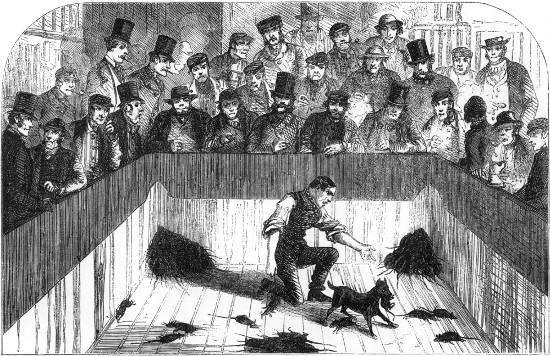
RATTING—“THE GRAHAM ARMS,” GRAHAM STREET.
[From a Photograph.]
The performances of the evening were somewhat
hurried on by the entering of a young
gentleman, whom the waiters called “Cap’an.”
“Now, Jem, when is this match coming off?”
the Captain asked impatiently; and despite
the assurance that they were getting ready, he
threatened to leave the place if kept waiting
much longer. This young officer seemed to
be a great “fancier” of dogs, for he made the
round of the room, handling each animal in
its turn, feeling and squeezing its feet, and
scrutinising its eyes and limbs with such minuteness,
that the French gentlemen were
forced to inquire who he was.
There was no announcement that the room
above was ready, though everybody seemed
to understand it; for all rose at once, and
mounting the broad wooden staircase, which
led to what was once the “drawing-room,”
dropped their shillings into the hand of the
proprietor, and entered the rat-killing apartment.
“The pit,” as it is called, consists of a small
circus, some six feet in diameter. It is about
as large as a centre flower-bed, and is fitted
with a high wooden rim that reaches to elbow
height. Over it the branches of a gas lamp
are arranged, which light up the white painted
floor, and every part of the little arena. On
one side of the room is a recess, which the
proprietor calls his “private box,” and this
apartment the Captain and his friend soon
took possession of, whilst the audience generally
clambered upon the tables and forms, or
hung over the sides of the pit itself.
All the little dogs which the visitors had
brought up with them were now squalling and
barking, and struggling in their masters’ arms,
as if they were thoroughly acquainted with
the uses of the pit; and when a rusty wire
cage of rats, filled with the dark moving mass,
was brought forward, the noise of the dogs
was so great that the proprietor was obliged to
shout out—“Now, you that have dogs do
make ’em shut up.”
The Captain was the first to jump into the
pit. A man wanted to sell him a bull-terrier,
spotted like a fancy rabbit, and a dozen of
rats was the consequent order.
The Captain preferred pulling the rats out
of the cage himself, laying hold of them by
their tails and jerking them into the arena.
He was cautioned by one of the men not to
let them bite him, for “believe me,” were the
words, “you’ll never forget, Cap’an; these ’ere
are none of the cleanest.”
Whilst the rats were being counted out,
some of those that had been taken from the
cage ran about the painted floor and climbed
up the young officer’s legs, making him shake
them off and exclaim, “Get out, you varmint!”
whilst others of the ugly little animals sat
upon their hind legs, cleaning their faces with
their paws.
When the dog in question was brought
forth and shown the dozen rats, he grew excited,
and stretched himself in his owner’s
arms, whilst all the other animals joined in
a full chorus of whining.
“Chuck him in,” said the Captain, and over
went the dog; and in a second the rats were
running round the circus, or trying to hide
themselves between the small openings in the
boards round the pit.
Although the proprietor of the dog endeavoured
to speak up for it, by declaring “it was
a good ’un, and a very pretty performer,” still
it was evidently not worth much in a rat-killing
sense; and if it had not been for his
“second,” who beat the sides of the pit with
his hand, and shouted “Hi! hi! at ’em!” in
a most bewildering manner, we doubt if the
terrier would not have preferred leaving the
rats to themselves, to enjoy their lives. Some
of the rats, when the dog advanced towards
them, sprang up in his face, making him draw
back with astonishment. Others, as he bit
them, curled round in his mouth and fastened
on his nose, so that he had to carry them as a
cat does its kittens. It also required many
shouts of “Drop it—dead ’un,” before he would
leave those he had killed.
We cannot say whether the dog was eventually
bought; but from its owner’s exclaiming,
in a kind of apologetic tone, “Why, he never
saw a rat before in all his life,” we fancy no
dealings took place.
The Captain seemed anxious to see as much
sport as he could, for he frequently asked
those who carried dogs in their arms whether
“his little ’un would kill,” and appeared sorry
when such answers were given as—“My dog’s
mouth’s a little out of order, Cap’an,” or “I’ve
only tried him at very small ’uns.”
One little dog was put in the pit to amuse
himself with the dead bodies. He seized hold
of one almost as big as himself, shook it
furiously till the head thumped the floor like
a drumstick, making those around shout with
laughter, and causing one man to exclaim,
“He’s a good ’un at shaking heads and tails,
ain’t he?”
Preparations now began for the grand match
of the evening, in which fifty rats were to be
killed. The “dead ’uns” were gathered up by
their tails and flung into the corner. The
floor was swept, and a big flat basket produced,
like those in which chickens are brought to
market, and under whose iron wire top could
be seen small mounds of closely packed rats.
This match seemed to be between the proprietor
and his son, and the stake to be gained
was only a bottle of lemonade, of which the
father stipulated he should have first drink.
It was strange to observe the daring manner
in which the lad introduced his hand into the
rat cage, sometimes keeping it there for more
than a minute at a time, as he fumbled about
and stirred up with his fingers the living mass,
picking out, as he had been requested, “only
the big ’uns.”
When the fifty animals had been flung into
the pit, they gathered themselves together into
a mound which reached one-third up the sides,
and which reminded one of the heap of hair-sweepings
in a barber’s shop after a heavy
day’s cutting. These were all sewer and water-ditch
rats, and the smell that rose from them
was like that from a hot drain.
The Captain amused himself by flicking at
them with his pocket handkerchief, and offering
them the lighted end of his cigar, which
the little creatures tamely snuffed at, and drew
back from, as they singed their noses.
It was also a favourite amusement to blow on
the mound of rats, for they seemed to dislike
the cold wind, which sent them fluttering
about like so many feathers; indeed, whilst
the match was going on, whenever the little
animals collected together, and formed a barricade
as it were to the dog, the cry of “Blow on
’em! blow on ’em!” was given by the spectators,
and the dog’s second puffed at them as if extinguishing
a fire, when they would dart off
like so many sparks.
The company was kept waiting so long for
the match to begin that the impatient Captain
again threatened to leave the house, and was
only quieted by the proprietor’s reply of “My
dear friend, be easy, the boy’s on the stairs
with the dog;” and true enough we shortly
heard a wheezing and a screaming in the passage
without, as if some strong-winded animal
were being strangled, and presently a boy
entered, carrying in his arms a bull-terrier in
a perfect fit of excitement, foaming at the
mouth and stretching its neck forward, so that
the collar which held it back seemed to be
cutting its throat in two.
The animal was nearly mad with rage—scratching
and struggling to get loose. “Lay
hold a little closer up to the head or he’ll turn
round and nip yer,” said the proprietor to his
son.
Whilst the gasping dog was fastened up in a
corner to writhe its impatience away, the landlord
made inquiries for a stop-watch, and also
for an umpire to decide, as he added, “whether
the rats were dead or alive when they’re
‘killed,’ as Paddy says.”
When all the arrangements had been made
the “second” and the dog jumped into the
pit, and after “letting him see ’em a bit,”
the terrier was let loose.
The moment the dog was “free,” he became
quiet in a most business-like manner,
and rushed at the rats, burying his nose in
the mound till he brought out one in his
mouth. In a short time a dozen rats with
wetted necks were lying bleeding on the floor,
and the white paint of the pit became grained
with blood.
In a little time the terrier had a rat hanging
to his nose, which, despite his tossing,
still held on. He dashed up against the
sides, leaving a patch of blood as if a strawberry
had been smashed there.
“He doesn’t squeal, that’s one good thing,”
said one of the lookers-on.
As the rats fell on their sides after a bite
they were collected together in the centre,
where they lay quivering in their death-gasps!
“Hi, Butcher! hi, Butcher!” shouted the
second, “good dog! bur-r-r-r-r-h!” and he
beat the sides of the pit like a drum till the
dog flew about with new life.
“Dead ’un! drop it!” he cried, when the
terrier “nosed” a rat kicking on its side, as it
slowly expired of its broken neck.
“Time!” said the proprietor, when four of
the eight minutes had expired, and the dog
was caught up and held panting, his neck
stretched out like a serpent’s, staring intently
at the rats which still kept crawling about.
The poor little wretches in this brief interval,
as if forgetting their danger, again commenced
cleaning themselves, some nibbling the ends
of their tails, others hopping about, going now
to the legs of the lad in the pit, and sniffing
at his trousers, or, strange to say, advancing,
smelling, to within a few paces of their enemy
the dog.
The dog lost the match, and the proprietor,
we presume, honourably paid the bottle of
lemonade to his son. But he was evidently
displeased with the dog’s behaviour, for he
said, “He won’t do for me—he’s not one of
my sort! Here, Jim, tell Mr. G. he may
have him if he likes; I won’t give him house
room.”
A plentiful shower of halfpence was thrown
into the pit as a reward for the second who
had backed the dog.
A slight pause now took place in the proceedings,
during which the landlord requested
that the gentlemen “would give their minds
up to drinking; you know the love I have for
you,” he added jocularly, “and that I don’t
care for any of you;” whilst the waiter accompanied
the invitation with a cry of “Give
your orders, gentlemen,” and the lad with the
rats asked if “any other gentleman would
like any rats.”
Several other dogs were tried, and amongst
them one who, from the size of his stomach,
had evidently been accustomed to large dinners,
and looked upon rat-killing as a sport
and not as a business. The appearance of
this fat animal was greeted with remarks such
as “Why don’t you feed your dog?” and “You
shouldn’t give him more than five meals a-day.”
Another impatient bull-terrier was thrown
into the midst of a dozen rats. He did his
duty so well, that the admiration of the spectators
was focussed upon him.
“Ah,” said one, “he’d do better at a hundred
than twelve;” whilst another observed,
“Rat-killing’s his game, I can see;” while the
landlord himself said, “He’s a very pretty
creetur’, and I’d back him to kill against anybody’s
dog at eight and a half or nine.”
The Captain was so startled with this terrier’s
“cleverness,” that he vowed that if she
could kill fifteen in a minute “he’d give a
hundred guineas for her.”
It was nearly twelve o’clock before the evening’s
performance concluded. Several of the
spectators tried their dogs upon two or three
rats, either the biggest or the smallest that
could be found: and many offers as to what
“he wanted for the dog,” and many inquiries
as to “who was its father,” were made before
the company broke up.
At last the landlord, finding that no “gentleman
would like a few rats,” and that his
exhortations to “give their minds up to
drinking” produced no further effect upon the
company, spoke the epilogue of the rat tragedies
in these words;—
“Gentlemen, I give a very handsome solid
silver collar to be killed for next Tuesday.
Open to all the world, only they must be
novice dogs, or at least such as is not considered
pheenomenons. We shall have plenty
of sport, gentlemen, and there will be loads
of rat-killing. I hope to see all my kind
friends, not forgetting your dogs, likewise;
and may they be like the Irishman all over,
who had good trouble to catch and kill ’em,
and took good care they didn’t come to life
again. Gentlemen, there is a good parlour
down-stairs, where we meets for harmony and
entertainment.”
The proprietor of one of the largest sporting
public-houses in London, who is celebrated
for the rat-matches which come off weekly
at his establishment, was kind enough to favour
me with a few details as to the quality
of those animals which are destroyed in his
pit. His statement was certainly one of the
most curious that I have listened to, and it
was given to me with a readiness and a courtesy
of manner such as I have not often met with
during my researches. The landlord himself
is known in pugilistic circles as one of the
most skilful boxers among what is termed the
“light weights.”
His statement is curious, as a proof of the
large trade which is carried on in these animals,
for it would seem that the men who
make a business of catching rats are not always
employed as “exterminators,” for they
make a good living as “purveyors” for supplying
the demands of the sporting portion of
London.
“The poor people,” said the sporting landlord,
“who supply me with rats, are what you
may call barn-door labouring poor, for they
are the most ignorant people I ever come near.
Really you would not believe people could live
in such ignorance. Talk about Latin and
Greek, sir, why English is Latin to them—in
fact, I have a difficulty to understand them
myself. When the harvest is got in, they go
hunting the hedges and ditches for rats.
Once the farmers had to pay 2d. a-head for
all rats caught on their grounds, and they
nailed them up against the wall. But now that
the rat-ketchers can get 3d. each by bringing
the vermin up to town, the farmers don’t pay
them anything for what they ketch, but merely
give them permission to hunt them in their
stacks and barns, so that they no longer get
their 2d. in the country, though they get their
3d. in town.
“I have some twenty families depending
upon me. From Clavering, in Essex, I suppose
I have hundreds of thousands of rats sent to
me in wire cages fitted into baskets. From
Enfield I have a great quantity, but the
ketchers don’t get them all there, but travel
round the country for scores of miles, for you
see 3d. a-head is money; besides, there are
some liberal farmers who will still give them
a halfpenny a-head into the bargain. Enfield
is a kind of head-quarters for rat-ketchers.
“It’s dangerous work, though, for you see
there is a wonderful deal of difference in the
specie of rats. The bite of sewer or water-ditch
rats is very bad. The water and ditch
rat lives on filth, but your barn-rat is a plump
fellow, and he lives on the best of everything.
He’s well off. There’s as much difference
between the barn and sewer-rats as between a
brewer’s horse and a costermonger’s. Sewer-rats
are very bad for dogs, their coats is poisonous.
“Some of the rats that are brought to me
are caught in the warehouses in the City.
Wherever there is anything in the shape of
provisions, there you are sure to find Mr. Rat
an intruder. The ketchers are paid for ketching
them in the warehouses, and then they are
sold to me as well, so the men must make a
good thing of it. Many of the more courageous
kind of warehousemen will take a pleasure in
hunting the rats themselves.
“I should think I buy in the course of the
year, on the average, from 300 to 700 rats
a-week.” (Taking 500 as the weekly average,
this gives a yearly purchase of 26,000 live rats.)
“That’s what I kill taking all the year round,
you see. Some first-class chaps will come
here in the day-time, and they’ll try their dogs.
They’ll say, ‘Jimmy, give the dog 100.’ After
he’s polished them off they’ll say, perhaps,
‘Hang it, give him another 100.’ Bless you!”
he added, in a kind of whisper, “I’ve had noble
ladies and titled ladies come here to see the
sport—on the quiet, you know. When my wife
was here they would come regular, but now
she’s away they don’t come so often.
“The largest quantity of rats I’ve bought
from one man was five guineas’ worth, or
thirty-five dozen at 3d. a-head, and that’s a load
for a horse. This man comes up from Clavering
in a kind of cart, with a horse that’s a regular
phenomena, for it ain’t like a beast nor nothing.
I pays him a good deal of money at times, and
I’m sure I can’t tell what he does with it; but
they do tell me that he deals in old iron, and
goes buying it up, though he don’t seem to
have much of a head-piece for that sort of
fancy neither.
“During the harvest-time the rats run
scarcer you see, and the ketcher turns up rat-ketching
for harvest work. After the harvest
rats gets plentiful again.
“I’ve had as many as 2000 rats in this very
house at one time. They’ll consume a sack of
barley-meal a week, and the brutes, if you
don’t give ’em good stuff, they’ll eat one another,
hang ’em!
“I’m the oldest canine fancier in London,
and I’m the first that started ratting; in fact,
I know I’m the oldest caterer in rat-killing in
the metropolis. I began as a lad, and I had many
noble friends, and was as good a man then as
I am now. In fact, when I was seventeen or
eighteen years of age I was just like what my
boy is now. I used at that time to be a great
public charakter, and had many liberal friends—very
liberal friends. I used to give them
rat sports, and I have kept to it ever since.
My boy can handle rats now just as I used to
then.
“Have I been bit by them? Aye, hundreds
of times. Now, some people will say, ‘Rub
yourself over with caraway and stuff, and
then rats won’t bite you.’ But I give you my
word and honour it’s all nonsense, sir.
“As I said, I was the first in London to give
rat sports, and I’ve kept to it ever since. Bless
you, there’s nothing that a rat won’t bite
through. I’ve seen my lads standing in the pit
with the rats running about them, and if they
haven’t taken the precaution to tie their
trousers round with a bit of string at the bottom,
they’d have as many as five or six rats
run up their trouser-legs. They’ll deliberately
take off their clothes and pick them out from
their shirts, and bosoms, and breeches. Some
people is amused, and others is horror-struck.
People have asked them whether they ain’t
rubbed? They’ll say ‘Yes,’ but that’s as a
lark; ’cos, sometimes when my boy has been
taking the rats out of the cage, and somebody
has taken his attention off, talking to him, he
has had a bite, and will turn to me with his
finger bleeding, and say, ‘Yes, I’m rubbed,
ain’t I, father? look here!’
“A rat’s bite is very singular, it’s a three-cornered
one, like a leech’s, only deeper, of
course, and it will bleed for ever such a time.
My boys have sometimes had their fingers go
dreadfully bad from rat-bites, so that they turn
all black and putrid like—aye, as black as the
horse-hair covering to my sofa. People have
said to me, ‘You ought to send the lad to the
hospital, and have his finger took off;’ but
I’ve always left it to the lads, and they’ve said,
‘Oh, don’t mind it, father; it’ll get all right by
and by.’ And so it has.
“The best thing I ever found for a rat-bite
was the thick bottoms of porter-casks put on as
a poultice. The only thing you can do is to
poultice, and these porter bottoms is so powerful
and draws so, that they’ll actually take
thorns out of horses’ hoofs and feet after
steeplechasing.
“In handling rats, it’s nothing more in the
world but nerve that does it. I should faint
now if a rat was to run up my breeches, but I
have known the time when I’ve been kivered
with ’em.
“I generally throw my dead rats away now;
but two or three years since my boys took the
idea of skinning them into their heads, and
they did about 300 of them, and their skins
was very promising. The boys was, after all,
obliged to give them away to a furrier, for my
wife didn’t like the notion, and I said, ‘Throw
them away;’ but the idea strikes me to be
something, and one that is lost sight of, for
the skins are warm and handsome-looking—a
beautiful grey.
“There’s nothing turns so quickly as dead
rats, so I am obleeged to have my dustmen
come round every Wednesday morning; and
regularly enough they call too, for they know
where there is a bob and a pot. I generally
prefers using the authorised dustmen, though
the others come sometimes—the flying dustmen
they call ’em—and if they’re first, they has
the job.
“It strikes me, though, that to throw away
so many valuable skins is a good thing lost
sight of.
“The rats want a deal of watching, and a
deal of sorting. Now you can’t put a sewer and
a barn-rat together, it’s like putting a Roosshian
and a Turk under the same roof.
“I can tell a barn-rat from a ship-rat or a
sewer-rat in a minute, and I have to look over
my stock when they come in, or they’d fight to
the death. There’s six or seven different
kinds of rats, and if we don’t sort ’em they tear
one another to pieces. I think when I have a
number of rats in the house, that I am a lucky
man if I don’t find a dozen dead when I go up
to them in the morning; and when I tell you
that at times—when I’ve wanted to make up
my number for a match—I’ve given 21s. for
twenty rats, you may think I lose something
that way every year. Rats, even now, is occasionally
6s. a-dozen; but that, I think, is most
inconsistent.
“If I had my will, I wouldn’t allow sewer
ratting, for the rats in the shores eats up a
great quantity of sewer filth and rubbish, and
is another specie of scavenger in their own
way.”
After finishing his statement, the landlord
showed me some very curious specimens of
tame rats—some piebald, and others quite
white, with pink eyes, which he kept in cages
in his sitting-room. He took them out from
their cages, and handled them without the
least fear, and even handled them rather
rudely, as he showed me the peculiarities of
their colours; yet the little tame creatures did
not once attempt to bite him. Indeed, they
appeared to have lost the notion of regaining
their liberty, and when near their cages
struggled to return to their nests.
In one of these boxes a black and a white
rat were confined together, and the proprietor,
pointing to them, remarked, “I hope they’ll
breed, for though white rats is very scarce,
only occurring in fact by a freak of nature, I
fancy I shall be able, with time and trouble,
to breed ’em myself. The old English rat
is a small jet-black rat; but the first white rat
as I heard of come out of a burial-ground. At
one time I bred rats very largely, but now I
leaves that fancy to my boys, for I’ve as much
as I can do continuing to serve my worthy
patrons.”
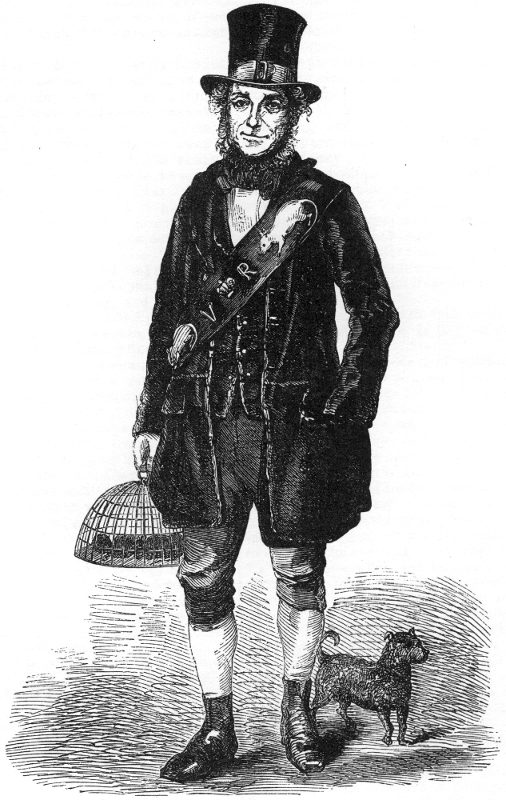
JACK BLACK, HER MAJESTY’S RATCATCHER.
[From a Photograph.]
As I wished to obtain the best information
about rat and vermin destroying, I thought I
could not do better now than apply to that
eminent authority “the Queen’s ratcatcher,”
and accordingly I sought an interview with
Mr. “Jack” Black, whose hand-bills are
headed—“V.R. Rat and mole destroyer to
Her Majesty.”
I had already had a statement from the
royal bug-destroyer relative to the habits and
means of exterminating those offensive vermin,
and I was desirous of pairing it with an account
of the personal experience of the Queen of
England’s ratcatcher.
In the sporting world, and among his regular
customers, the Queen’s ratcatcher is better
known by the name of Jack Black. He enjoys
the reputation of being the most fearless
handler of rats of any man living, playing with
them—as one man expressed it to me—“as if
they were so many blind kittens.”
The first time I ever saw Mr. Black was in
the streets of London, at the corner of Hart-street,
where he was exhibiting the rapid effects
of his rat poison, by placing some of it in the
mouth of a living animal. He had a cart then
with rats painted on the panels, and at the
tailboard, where he stood lecturing, he had a
kind of stage rigged up, on which were cages
filled with rats, and pills, and poison packages.
Here I saw him dip his hand into this cage
of rats and take out as many as he could hold,
a feat which generally caused an “oh!” of
wonder to escape from the crowd, especially
when they observed that his hands were unbitten.
Women more particularly shuddered
when they beheld him place some half-dozen
of the dusty-looking brutes within his shirt next
his skin; and men swore the animals had been
tamed, as he let them run up his arms like
squirrels, and the people gathered round
beheld them sitting on his shoulders cleaning
their faces with their front-paws, or rising up
on their hind legs like little kangaroos, and
sniffing about his ears and cheeks.
But those who knew Mr. Black better, were
well aware that the animals he took up in his
hand were as wild as any of the rats in the
sewers of London, and that the only mystery
in the exhibition was that of a man having
courage enough to undertake the work.
I afterwards visited Jack Black at his house
in Battersea. I had some difficulty in discovering
his country residence, and was indebted
to a group of children gathered round and
staring at the bird-cage in the window of his
cottage for his address. Their exclamations
of delight at a grey parrot climbing with his
beak and claws about the zinc wires of his cage,
and the hopping of the little linnets there, in
the square boxes scarcely bigger than a brick,
made me glance up at the door to discover who
the bird-fancier was; when painted on a bit of
zinc—just large enough to fit the shaft of a
tax cart—I saw the words, “J. Black, Rat Destroyer
to Her Majesty,” surmounted by the
royal initials, V.R., together with the painting
of a white rat.
Mr. Black was out “sparrer ketching,” as
his wife informed me, for he had an order for
three dozen, “which was to be shot in a match”
at some tea-gardens close by.
When I called again Mr. Black had returned,
and I found him kneeling before a big,
rusty iron-wire cage, as large as a sea-chest,
and transferring the sparrows from his bird-catching
apparatus to the more roomy prison.
He transacted a little business before I spoke
to him, for the boys about the door were asking,
“Can I have one for a penny, master?”
There is evidently a great art in handling
birds; for when Mr. Black held one, he took
hold of it by the wings and tail, so that the
little creature seemed to be sitting upright
and had not a feather rumpled, while it
stretched out its neck and looked around it;
the boys, on the contrary, first made them
flutter their feathers as rough as a hair ball,
and then half smothered them between their
two hands, by holding them as if they wished
to keep them hot.
I was soon at home with Mr. Black. He
was a very different man from what I had expected
to meet, for there was an expression of
kindliness in his countenance, a quality which
does not exactly agree with one’s preconceived
notions of ratcatchers. His face had a strange
appearance, from his rough, uncombed hair, being
nearly grey, and his eyebrows and whiskers
black, so that he looked as if he wore powder.
Mr. Black informed me that the big iron-wire
cage, in which the sparrows were fluttering
about, had been constructed by him for rats,
and that it held over a thousand when full—for
rats are packed like cups, he said, one over
the other. “But,” he added, “business is bad
for rats, and it makes a splendid havery; besides,
sparrers is the rats of birds, sir, for if
you look at ’em in a cage they always huddles
up in a corner like rats in a pit, and they are
a’most vermin in colour and habits, and eats
anything.”
The ratcatcher’s parlour was more like a
shop than a family apartment. In a box, with
iron bars before it, like a rabbit-hutch, was a
white ferret, twisting its long thin body with a
snake-like motion up and down the length of
its prison, as restlessly as if it were a miniature
polar bear.
When Mr. Black called “Polly” to the ferret,
it came to the bars and fixed its pink eyes on
him. A child lying on the floor poked its
fingers into the cage, but Polly only smelt at
them, and, finding them not good to eat, went
away.
Mr. Black stuffs animals and birds, and
also catches fish for vivaria. Against the walls
were the furred and feathered remains of departed
favourites, each in its glazed box and
appropriate attitude. There was a famous
polecat—“a first-rater at rats” we were informed.
Here a ferret “that never was
equalled.” This canary “had earned pounds.”
That linnet “was the wonder of its day.” The
enormous pot-bellied carp, with the miniature
rushes painted at the back of its case, was
caught in the Regent’s Park waters.
In another part of the room hung fishing-lines,
and a badger’s skin, and lead-bobs and
curious eel-hooks—the latter as big as the
curls on the temples of a Spanish dancer, and
from here Mr. Black took down a transparent-looking
fish, like a slip of parchment, and told
me that it was a fresh-water smelt, and that
he caught it in the Thames—“the first he
ever heard of.” Then he showed me a beetle
suspended to a piece of thread, like a big
spider to its web, and this he informed me
was the Thames beetle, “which either live by
land or water.”
“You ketch ’em,” continued Mr. Black,
“when they are swimming on their backs,
which is their nature, and when they turns
over you finds ’em beautifully crossed and
marked.”
Round the room were hung paper bags, like
those in which housewives keep their sweet
herbs. “All of them there, sir, contain cured
fish for eating,” Mr. Black explained to me.
“I’m called down here the Battersea otter,”
he went on, “for I can go out at four in the
morning, and come home by eight with a
barrowful of freshwater fish. Nobody knows
how I do it, because I never takes no nets or
lines with me. I assure them I ketch ’em
with my hands, which I do, but they only
laughs increderlous like. I knows the fishes’
harnts, and watches the tides. I sells fresh
fish—perch, roach, dace, gudgeon, and such-like,
and even small jack, at threepence a
pound, or what they’ll fetch; and I’ve caught
near the Wandsworth ‘Black Sea,’ as we
calls it, half a hundred weight sometimes,
and I never took less than my handkerchey
full.”
I was inclined—like the inhabitants of
Battersea—to be incredulous of the ratcatcher’s
hand-fishing, until, under a promise
of secrecy, he confided his process to me, and
then not only was I perfectly convinced of its
truth, but startled that so simple a method
had never before been taken advantage of.
Later in the day Mr. Black became very
communicative. We sat chatting together in
his sanded bird shop, and he told me all his
misfortunes, and how bad luck had pressed
upon him, and driven him out of London.
“I was fool enough to take a public-house
in Regent-street, sir,” he said. “My daughter
used to dress as the ‘Ratketcher’s Daughter,’
and serve behind the bar, and that did pretty
well for a time; but it was a brewer’s house,
and they ruined me.”
The costume of the “ratketcher’s daughter”
was shown to me by her mother. It was a
red velvet bodice, embroidered with silver
lace.
“With a muslin skirt, and her hair down
her back, she looked wery genteel,” added the
parent.
Mr. Black’s chief complaint was that he
could not “make an appearance,” for his
“uniform”—a beautiful green coat and red
waistcoat—“were pledged.”
Whilst giving me his statement, Mr. Black,
in proof of his assertions of the biting powers
of rats, drew my attention to the leathern
breeches he wore, “as were given him twelve
years ago by Captain B——.”
These were pierced in some places with the
teeth of the animals, and in others were
scratched and fringed like the washleather of
a street knife-seller.
His hands, too, and even his face, had scars
upon them from bites.
Mr. Black informed me that he had given
up tobacco “since a haccident he met with from
a pipe. I was smoking a pipe,” he said, “and
a friend of mine by chance jobbed it into my
mouth, and it went right through to the back
of my palate, and I nearly died.”
Here his wife added, “There’s a hole there
to this day you could put your thumb into;
you never saw such a mouth.”
Mr. Black informed me in secret that he
had often, “unbeknown to his wife,” tasted
what cooked rats were like, and he asserted
that they were as moist as rabbits, and quite as
nice.
“If they are shewer-rats,” he continued,
“just chase them for two or three days before
you kill them, and they are as good as barn-rats,
I give you my word, sir.”
Mr. Black’s statement was as follows:—
“I should think I’ve been at ratting a’most
for five-and-thirty year; indeed, I may say
from my childhood, for I’ve kept at it a’most
all my life. I’ve been dead near three times
from bites—as near as a toucher. I once had
the teeth of a rat break in my finger, which
was dreadful bad, and swole, and putrified, so
that I had to have the broken bits pulled out
with tweezers. When the bite is a bad one,
it festers and forms a hard core in the ulcer,
which is very painful, and throbs very much
indeed; and after that core comes away, unless
you cleans ’em out well, the sores, even
after they seemed to be healed, break out over
and over again, and never cure perfectly.
This core is as big as a boiled fish’s eye, and
as hard as a stone. I generally cuts the bite
out clean with a lancet, and squeege the humour
well from it, and that’s the only way to
cure it thorough—as you see my hands is all
covered with scars from bites.
“The worst bite I ever had was at the
Manor House, Hornsey, kept by Mr. Burnell.
One day when I was there, he had some rats
get loose, and he asked me to ketch ’em for
him, as they was wanted for a match that was
coming on that afternoon. I had picked up
a lot—indeed, I had one in each hand, and
another again my knee, when I happened to
come to a sheaf of straw, which I turned over,
and there was a rat there. I couldn’t lay hold
on him ’cause my hands was full, and as I
stooped down he ran up the sleeve of my coat,
and bit me on the muscle of the arm. I shall
never forget it. It turned me all of a sudden,
and made me feel numb. In less than half-an-hour
I was took so bad I was obleeged to
be sent home, and I had to get some one to
drive my cart for me. It was terrible to see
the blood that came from me—I bled awful.
Burnell seeing me go so queer, says, ‘Here,
Jack, take some brandy, you look so awful
bad.’ The arm swole, and went as heavy as a
ton weight pretty well, so that I couldn’t even
lift it, and so painful I couldn’t bear my wife
to ferment it. I was kept in bed for two
months through that bite at Burnell’s. I was
so weak I couldn’t stand, and I was dreadful
feverish—all warmth like. I knew I was going
to die, ’cause I remember the doctor coming
and opening my eyes, to see if I was still
alive.
“I’ve been bitten nearly everywhere, even
where I can’t name to you, sir, and right
through my thumb nail too, which, as you see,
always has a split in it, though it’s years since
I was wounded. I suffered as much from that
bite on my thumb as anything. It went right
up to my ear. I felt the pain in both places
at once—a regular twinge, like touching the
nerve of a tooth. The thumb went black, and
I was told I ought to have it off; but I knew
a young chap at the Middlesex Hospital who
wasn’t out of his time, and he said, ‘No, I
wouldn’t, Jack;’ and no more I did; and he
used to strap it up for me. But the worst of
it was, I had a job at Camden Town one afternoon
after he had dressed the wound, and I
got another bite lower down on the same
thumb, and that flung me down on my bed,
and there I stopped, I should think, six
weeks.
“I was bit bad, too, in Edwards-street,
Hampstead-road; and that time I was sick
near three months, and close upon dying.
Whether it was the poison of the bite, or the
medicine the doctor give me, I can’t say; but
the flesh seemed to swell up like a bladder—regular
blowed like. After all, I think I cured
myself by cheating the doctor, as they calls it;
for instead of taking the medicine, I used to go
to Mr. ——’s house in Albany-street (the publican),
and he’d say, ‘What’ll yer have, Jack?’
and I used to take a glass of stout, and that
seemed to give me strength to overcome the
pison of the bite, for I began to pick up as
soon as I left off doctor’s stuff.
“When a rat’s bite touches the bone, it
makes you faint in a minute, and it bleeds
dreadful—ah, most terrible—just as if you
had been stuck with a penknife. You couldn’t
believe the quantity of blood that come away,
sir.
“The first rats I caught was when I was
about nine years of age. I ketched them at
Mr. Strickland’s, a large cow-keeper, in Little
Albany-street, Regent’s-park. At that time it
was all fields and meaders in them parts, and
I recollect there was a big orchard on one
side of the sheds. I was only doing it for a
game, and there was lots of ladies and gents
looking on, and wondering at seeing me
taking the rats out from under a heap of old
bricks and wood, where they had collected
theirselves. I had a little dog—a little red
’un it was, who was well known through the
fancy—and I wanted the rats for to test my
dog with, I being a lad what was fond of the
sport.
“I wasn’t afraid to handle rats even then;
it seemed to come nat’ral to me. I very soon
had some in my pocket, and some in my
hands, carrying them away as fast as I could,
and putting them into my wire cage. You see,
the rats began to run as soon as we shifted
them bricks, and I had to scramble for them.
Many of them bit me, and, to tell you the
truth, I didn’t know the bites were so many,
or I dare say I shouldn’t have been so venturesome
as I was.
“After that I bought some ferruts—four of
them—of a man of the name of Butler, what
was in the rat-ketching line, and afterwards
went out to Jamaicer, to kill rats there. I was
getting on to ten years of age then, and I was,
I think, the first that regularly began hunting
rats to sterminate them; for all those before
me used to do it with drugs, and perhaps
never handled rats in their lives.
“With my ferruts I at first used to go out
hunting rats round by the ponds in Regent’s-park,
and the ditches, and in the cow-sheds
roundabout. People never paid me for ketching,
though, maybe, if they was very much
infested, they might give me a trifle; but I
used to make my money by selling the rats to
gents as was fond of sport, and wanted them
for their little dogs.
“I kept to this till I was thirteen or fourteen
year of age, always using the ferruts;
and I bred from them, too,—indeed, I’ve still
got the ‘strain’ (breed) of them same ferruts
by me now. I’ve sold them ferruts about
everywhere; to Jim Burn I’ve sold some of
the strain; and to Mr. Anderson, the provision-merchant;
and to a man that went to
Ireland. Indeed, that strain of ferruts has
gone nearly all over the world.
“I never lost a ferrut out ratting. I always
let them loose, and put a bell on mine—arranged
in a peculiar manner, which is a
secret—and I then puts him into the main
run of the rats, and lets him go to work.
But they must be ferruts that’s well trained
for working dwellings, or you’ll lose them as
safe as death. I’ve had ’em go away two
houses off, and come back to me. My ferruts
is very tame, and so well trained, that I’d put
them into a house and guarantee that they’d
come back to me. In Grosvenor-street I was
clearing once, and the ferruts went next door,
and nearly cleared the house—which is the
Honourable Mrs. F——’s—before they came
back to me.
“Ferruts are very dangerous to handle if not
well trained. They are very savage, and will
attack a man or a child as well as a rat. It
was well known at Mr. Hamilton’s at Hampstead—it’s
years ago this is—there was a
ferrut that got loose what killed a child, and
was found sucking it. The bite of ’em is very
dangerous—not so pisonous as a rat’s—but
very painful; and when the little things is
hungry they’ll attack anythink. I’ve seen two
of them kill a cat, and then they’ll suck the
blood till they fills theirselves, after which
they’ll fall off like leeches.
“The weasel and the stoat are, I think,
more dangerous than the ferrut in their bite.
I had a stoat once, which I caught when out
ratting at Hampstead for Mr. Cunningham,
the butcher, and it bit one of my dogs—Black
Bess by name, the truest bitch in the
world, sir—in the mouth, and she died three
days arterwards at the Ball at Kilburn. I
was along with Captain K——, who’d come
out to see the sport, and whilst we were at
dinner, and the poor bitch lying under my
chair, my boy says, says he, ‘Father, Black
Bess is dying;’ and had scarce spoke the
speech when she was dead. It was all
through the bite of that stoat, for I opened
the wound in the lip, and it was all swole, and
dreadful ulcerated, and all down the throat it
was inflamed most shocking, and so was the
lungs quite red and fiery. She was hot with
work when she got the bite, and perhaps that
made her take the pison quicker.
“To give you a proof, sir, of the savage
nature of the ferruts, I was one night at
Jimmy Shaw’s, where there was a match to
come off with rats, which the ferrut was to
kill; and young Bob Shaw (Jim’s son) was
holding the ferrut up to his mouth and giving
it spittle, when the animal seized him by the
lip, and bit it right through, and hung on as
tight as a vice, which shows the spitefulness
of the ferrut, and how it will attack the
human frame. Young Shaw still held the
ferrut in his hand whilst it was fastened to his
lip, and he was saying, ‘Oh, oh!’ in pain. You
see, I think Jim kept it very hard to make it
kill the rats better. There was some noblemen
there, and also Mr. George, of Kensal
New-town, was there, which is one of the
largest dog-fanciers we have. To make the
ferrut leave go of young Shaw, they bit its
feet and tail, and it wouldn’t, ’cos—as I could
have told ’em—it only made it bite all the
more. At last Mr. George, says he to me,
‘For God’s sake, Jack, take the ferrut off.’
I didn’t like to intrude myself upon the company
before, not being in my own place, and
I didn’t know how Jimmy would take it. Everybody
in the room was at a standstill, quite
horrerfied, and Jimmy himself was in a dreadful
way for his boy. I went up, and quietly
forced my thumb into his mouth and loosed
him, and he killed a dozen rats after that.
They all said, ‘Bravo, Jack, you are a plucked
one;’ and the little chap said, ‘Well, Jack,
I didn’t like to holla, but it was dreadful
painful.’ His lip swole up directly as big as a
nigger’s, and the company made a collection
for the lad of some dozen shillings. This
shows that, although a ferrut will kill a rat,
yet, like the rat, it is always wicious, and will
attack the human frame.
“When I was about fifteen, sir, I turned to
bird-fancying. I was very fond of the sombre
linnet. I was very successful in raising them,
and sold them for a deal of money. I’ve got
the strain of them by me now. I’ve ris them
from some I purchased from a person in the
Coal-yard, Drury-lane. I give him 2l. for one
of the periwinkle strain, but afterwards I
heard of a person with, as I thought, a better
strain—Lawson of Holloway—and I went
and give him 30s. for a bird. I then ris
them. I used to go and ketch the nestlings
off the common, and ris them under the old
trained birds.
“Originally linnets was taught to sing by a
bird-organ—principally among the weavers,
years ago,—but I used to make the old birds
teach the young ones. I used to molt them
off in the dark, by kivering the cages up, and
then they’d learn from hearing the old ones
singing, and would take the song. If any
did not sing perfectly I used to sell ’em as
cast-offs.
“The linnet’s is a beautiful song. There
are four-and-twenty changes in a linnet’s song.
It’s one of the beautifullest song-birds we’ve
got. It sings ‘toys,’ as we call them; that is,
it makes sounds which we distinguish in the
fancy as the ‘tollock eeke eeke quake le
wheet; single eke eke quake wheets, or eek eek
quake chowls; eege pipe chowl; laugh; eege
poy chowls; rattle; pipe; fear; pugh and poy.’
“This seems like Greek to you, sir, but it’s
the tunes we use in the fancy. What we terms
‘fear’ is a sound like fear, as if they was
frightened; ‘laugh’ is a kind of shake, nearly
the same as the ‘rattle.’
“I know the sounds of all the English
birds, and what they say. I could tell you
about the nightingale, the black cap, hedge
warbler, garden warbler, petty chat, red start—a
beautiful song-bird—the willow wren—little
warblers they are—linnets, or any of
them, for I have got their sounds in my ear
and my mouth.”
As if to prove this, he drew from a side-pocket
a couple of tin bird-whistles, which
were attached by a string to a button-hole.
He instantly began to imitate the different
birds, commencing with their call, and then
explaining how, when answered to in such a
way, they gave another note, and how, if still
responded to, they uttered a different sound.
In fact, he gave me the whole of the conversation
he usually carried on with the
different kinds of birds, each one being as it
were in a different language. He also showed
me how he allured them to him, when they
were in the air singing in the distance, and
he did this by giving their entire song. His
cheeks and throat seemed to be in constant
motion as he filled the room with his loud
imitations of the lark, and so closely did he
resemble the notes of the bird, that it was no
longer any wonder how the little things could
be deceived.
In the same manner he illustrated the songs
of the nightingale, and so many birds, that I
did not recognise the names of some of them.
He knew all their habits as well as notes, and
repeated to me the peculiar chirp they make on
rising from the ground, as well as the sound
by which he distinguishes that it is “uneasy
with curiosity,” or that it has settled on a tree.
Indeed, he appeared to be acquainted with all
the chirps which distinguished any action in
the bird up to the point when, as he told me,
it “circles about, and then falls like a stone
to the ground with its pitch.”
“The nightingale,” he continued, “is a
beautiful song-bird. They’re plucky birds, too,
and they hear a call and answer to anybody;
and when taken in April they’re plucked enough
to sing as soon as put in a cage. I can ketch
a nightingale in less than five minutes; as
soon as he calls, I calls to him with my mouth,
and he’ll answer me (both by night or day),
either from a spinny (a little copse), a dell,
or a wood, wherever he may be. I make my
scrapes, (that is, clear away the dirt), set my
traps, and catch ’em almost before I’ve tried
my luck. I’ve ketched sometimes thirty in a
day, for although people have got a notion
that nightingales is scarce, still those who can
distinguish their song in the daytime know
that they are plentiful enough—almost like
the lark. You see persons fancy that them
nightingales as sings at night is the only ones
living, but it’s wrong, for many on them only
sings in the day.
“You see it was when I was about
eighteen, I was beginning to get such a judge
about birds, sir. I sold to a butcher, of the
name of Jackson, the first young un that I
made money out of—for two pounds it was—and
I’ve sold loads of ’em since for thirty
shillings or two pounds each, and I’ve got
the strain by me now. I’ve also got by me
now the bird that won the match at Mr. Lockwood’s
in Drury-lane, and won the return
match at my own place in High-street, Marabun.
It was in the presence of all the fancy.
He’s moulted pied (pie-bald) since, and gone
a little white on the head and the back. We
only sang for two pounds a side—it wasn’t a
great deal of money. In our matches we sing
by both gas and daylight. He was a master-baker
I sang against, but I forget his name.
They do call him ‘Holy Face,’ but that’s a
nick-name, because he’s very much pock-marked.
I wouldn’t sell that bird at all for
anythink; I’ve been offered ten pounds for it.
Captain K—— put ten sovereigns down on
the counter for him, and I wouldn’t pick ’em
up, for I’ve sold lots of his strain for a pound
each.
“When I found I was a master of the
birds, then I turned to my rat business again.
I had a little rat dog—a black tan terrier of
the name of Billy—which was the greatest
stock dog in London of that day. He is the
father of the greatest portion of the small
black tan dogs in London now, which Mr.
Isaac, the bird-fancier in Princes-street, purchased
one of the strain for six or seven
pounds; which Jimmy Massey afterwards
purchased another of the strain, for a monkey,
a bottle of wine, and three pounds. That was
the rummest bargain I ever made.
“I’ve ris and trained monkeys by shoals.
Some of mine is about now in shows exhibiting;
one in particular—Jimmy.
“One of the strain of this little black tan
dog would draw a badger twelve or fourteen
lbs. to his six lbs., which was done for a
wager, ’cos it was thought the badger had his
teeth drawn, but he hadn’t, as was proved by
his biting Mr. P—— from Birmingham, for he
took a piece clean out of his trousers, which
was pretty good proof, and astonished them
all in the room.
“I’ve been offered a sovereign a-pound for
some of my little terriers, but it wouldn’t pay
me at that price, for they weren’t heavier than
two or three pounds. I once sold one of the
dogs, of this same strain, for fourteen pounds,
to the Austrian Ambassador. Mrs. H——
the banker’s lady, wished to get my strain of
terriers, and she give me five pounds for the
use of him; in fact, my terrier dog was known
to all the London fancy. As rat-killing dogs,
there’s no equal to that strain of black tan
terriers.
“It’s fifteen year ago since I first worked
for Goverment. I found that the parks was
much infested with rats, which had underminded
the bridges and gnawed the drains,
and I made application to Mr. Westley, who
was superintendent of the park, and he spoke
of it, and then it was wrote to me that I was
to fulfil the siterwation, and I was to have
six pounds a-year. But after that it was
altered, and I was to have so much a-head,
which is threepence. After that, Newton,
what was a warmint destroyer to her Majesty,
dying, I wrote in to the Board of Hordnance,
when they appointed me to each station in
London—that was, to Regentsey-park-barracks,
to the Knightsbridge and Portland-barracks,
and to all the other barracks in the
metropolis. I’ve got the letter now by me, in
which they says ‘they is proud to appint me.’
“I’ve taken thirty-two rats out of one hole
in the islands in Regentsey-park, and found in
it fish, birds, and loads of eggs—duck-eggs,
and every kind.
“It must be fourteen year since I first went
about the streets exhibiting with rats. I began
with a cart and a’most a donkey; for
it was a pony scarce bigger; but I’ve had
three or four big horses since that, and ask
anybody, and they’ll tell you I’m noted for my
cattle. I thought that by having a kind of
costume, and the rats painted on the cart, and
going round the country, I should get my
name about, and get myself knowed; and so
I did, for folks ’ud come to me, so that sometimes
I’ve had four jobs of a-day, from people
seeing my cart. I found I was quite the
master of the rat, and could do pretty well
what I liked with him; so I used to go round
Finchley, Highgate, and all the sububs, and
show myself, and how I handled the warmint.
“I used to wear a costume of white leather
breeches, and a green coat and scarlet waistkit,
and a goold band round my hat, and a
belt across my shoulder. I used to make a
first-rate appearance, such as was becoming
the uniform of the Queen’s rat-ketcher.
“Lor’ bless you! I’ve travell’d all over
London, and I’ll kill rats again anybody.
I’m open to all the world for any sum, from
one pound to fifty. I used to have my belts
painted at first by Mr. Bailey, the animal
painter—with four white rats; but the idea
come into my head that I’d cast the rats
in metal, just to make more appearance for
the belt, to come out in the world. I was
nights and days at it, and it give me a deal of
bother. I could manage it no how; but by my
own ingenuity and persewerance I succeeded.
A man axed me a pound a-piece for casting the
rats—that would ha’ been four pound. I was
very certain that my belt, being a handsome
one, would help my business tremenjous in
the sale of my composition. So I took a
mould from a dead rat in plaster, and then
I got some of my wife’s sarsepans, and, by
G—, I casted ’em with some of my own
pewter-pots.”
The wife, who was standing by, here exclaimed—
“Oh, my poor sarsepans! I remember ’em.
There was scarce one left to cook our wittels
with.”
“Thousands of moulders,” continued Jack
Black, “used to come to see me do the casting
of the rats, and they kept saying, ‘You’ll never
do it, Jack.’ The great difficulty, you see, was
casting the heye—which is a black bead—into
the metal.
“When the belt was done, I had a great
success; for, bless you, I couldn’t go a yard
without a crowd after me.
“When I was out with the cart selling my
composition, my usual method was this. I
used to put a board across the top, and form a
kind of counter. I always took with me a iron-wire
cage—so big a one, that Mr. Barnet, a
Jew, laid a wager that he could get into it, and
he did. I used to form this cage at one end of
the cart, and sell my composition at the other.
There were rats painted round the cart—that
was the only show I had about the wehicle. I
used to take out the rats, and put them outside
the cage; and used to begin the show by putting
rats inside my shirt next my buzzum, or in my
coat and breeches pockets, or on my shoulder—in
fact, all about me, anywhere. The people
would stand to see me take up rats without
being bit. I never said much, but I used to
handle the rats in every possible manner,
letting ’em run up my arm, and stroking their
backs and playing with ’em. Most of the
people used to fancy they had been tamed on
purpose, until they’d see me take fresh ones
from the cage, and play with them in the same
manner. I all this time kept on selling my
composition, which my man Joe used to offer
about; and whenever a packet was sold, I
always tested its wirtues by killing a rat with
it afore the people’s own eyes.
“I once went to Tottenham to sell my composition,
and to exhibit with my rats afore the
country people. Some countrymen, which
said they were rat-ketchers, came up to me
whilst I was playing with some rats, and said—‘Ugh,
you’re not a rat-ketcher; that’s not
the way to do it.’ They were startled at seeing
me selling the pison at such a rate, for the
shilling packets was going uncommon well, sir.
I said, ‘No, I ain’t a rat-ketcher, and don’t know
nothink about it. You come up and show me
how to do it.’ One of them come up on the
cart, and put his hand in the cage, and curous
enough he got three bites directly, and afore
he could take his hands out they was nearly
bit to ribands. My man Joe, says he, ‘I tell
you, if we ain’t rat-ketchers, who is? We are
the regular rat-ketchers; my master kills ’em,
and then I eats ’em’—and he takes up a live
one and puts its head into his mouth, and I
puts my hand in the cage and pulls out six or
seven in a cluster, and holds ’em up in the air,
without even a bite. The countrymen bust out
laughing; and they said, ‘Well, you’re the best
we ever see.’ I sold near 4l. worth of composition
that day.
“Another day, when I’d been out flying
pigeons as well—carriers, which I fancies to—I
drove the cart, after selling the composition,
to the King’s Arms, Hanwell, and there was a
feller there—a tailor by trade—what had
turned rat-ketcher. He had got with him some
fifty or sixty rats—the miserablest mangey
brutes you ever seed in a tub—taking ’em up
to London to sell. I, hearing of it, was determined
to have a lark, so I goes up and takes
out ten of them rats, and puts them inside my
shirt, next my buzzum, and then I walks into
the parlour and sits down, and begins drinking
my ale as right as if nothink had happened.
I scarce had seated myself, when the landlord—who
was in the lay—says, ‘I know a man
who’ll ketch rats quicker than anybody in the
world.’ This put the tailor chap up, so he
offers to bet half-a-gallon of ale he would, and
I takes him. He goes to the tub and brings
out a very large rat, and walks with it into the
room to show to the company. ‘Well,’ says I
to the man, ‘why I, who ain’t a rat-ketcher, I’ve
got a bigger one here,’ and I pulls one out
from my buzzum. ‘And here’s another, and
another, and another,’ says I, till I had placed
the whole ten on the table. ‘That’s the way
I ketch ’em,’ says I,—‘they comes of their
own accord to me.’ He tried to handle the
warmints, but the poor fellow was bit, and his
hands was soon bleeding fur’ously, and I without
a mark. A gentleman as knowed me said,
‘This must be the Queen’s rat-ketcher,’ and that
spilt the fun. The poor fellow seemed regular
done up, and said, ‘I shall give up rat-ketching,
you’ve beat me! Here I’ve been travelling
with rats all my life, and I never see such a
thing afore.’
“When I’ve been in a mind for travelling
I’ve never sold less than ten shillings’ worth
of my composition, and I’ve many a time sold
five pounds’ worth. Ten shillings’ worth was
the least I ever sold. During my younger
career, if I’d had a backer, I might, one week
with another, have made my clear three pounds
a-week, after paying all my expenses and
feeding my horse and all.
“I challenge my composition, and sell the
art of rat-destroying, against any chemical rat-destroyer
in the world, for any sum—I don’t
care what it is. Let anybody, either a medical
or druggist manufacturer of composition, come
and test with rats again me, and they’ll pretty
soon find it out. People pay for composition
instead of employing the Queen’s rat-ketcher,
what kills the warmint and lays down his composition
for nothink into the bargain likewise.
“I also destroy black beedles with a composition
which I always keep with me again it’s
wanted. I often have to destroy the beedles in
wine-cellars, which gnaw the paper off the
bottles, such as is round the champagne and
French wine bottles. I’ve killed lots of
beedles too for bakers. I’ve also sterminated
some thousands of beedles for linen-drapers
and pork-sassage shops. There’s two kinds of
beedles, the hard-shell and the soft-shell
beedle. The hard-shell one is the worst, and
that will gnaw cork, paper, and anythink
woollen. The soft-shell’d one will gnaw bread
or food, and it also lays its eggs in the food,
which is dreadful nasty.
“There’s the house ant too, which there is
some thousands of people as never saw—I
sterminate them as well. There’s a Mrs. B.
at the William the Fourth public-house,
Hampstead; she couldn’t lay her child’s clothes
down without getting ’em full of ants. They’ve
got a sting something in feel like a horse-fly’s,
and is more annoying than dangerous. It’s
cockroaches that are found in houses. They’re
dreadful nasty things, and will bite, and they
are equal to the Spanish flies for blistering.
I’ve tried all insects on my flesh to see how
they bite me. Cockroaches will undermine
similar to the ant, and loosen the bricks the
same as the cricket. It’s astonishing how so
small an insect as them will scrape away such
a quantity of mortar as they do—which thing
infests grates, floorings, and such-like.
“The beedle is a most ’strordinary thing,
which will puzzle most people to sterminate,
for they lays sitch a lot of eggs as I would
never guarantee to do away with beedles—only
to keep them clear; for if you kills the old
ones the eggs will rewive, and young ones come
out of the wainskitting and sitch-like, and then
your employers will say, ‘Why you were paid
for sterminating, and yet here they are.’
“One night in August—the night of a very
heavy storm, which, maybe, you may remember,
sir—I was sent for by a medical gent as
lived opposite the Load of Hay, Hampstead,
whose two children had been attacked by rats
while they was sleeping in their little cots. I
traced the blood, which had left lines from
their tails, through the openings in the lath
and plaster, which I follered to where my
ferruts come out of, and they must have come
up from the bottom of the house to the attics.
The rats gnawed the hands and feet of the
little children. The lady heard them crying,
and got out of her bed and called to the servant
to know what the child was making such a
noise for, when they struck a light, and then
they see the rats running away to the holes;
their little night-gownds was kivered with
blood, as if their throats had been cut. I asked
the lady to give me one of the night-gownds to
keep as a cur’osity, for I considered it a pheenomenon,
and she give it to me, but I never
was so vexed in all my life as when I was told
the next day that a maid had washed it. I went
down the next morning and sterminated them
rats. I found they was of the specie of rat
which we term the blood-rat, which is a dreadful
spiteful feller—a snake-headed rat, and
infests the dwellings. There may have been
some dozens of ’em altogether, but it’s so long
ago I a’most forget how many I took in that
house. The gent behaved uncommon handsome,
and said, ‘Mr. Black, I can never pay
you for this;’ and ever arterwards, when I
used to pass by that there house, the little
dears when they see me used to call out to
their mamma, ‘O, here’s Mr. Ratty, ma!’
They were very pretty little fine children—uncommon
handsome, to be sure.
“I once went to Mr. Hollins’s, in Edward-street
Regent’s-park—a cow-keeper he was—where
he was so infested that the cows could
not lay down or eat their food, for the rats used
to go into the manger, and fight at ’em. Mr.
Hollins said to me, ‘Black, what shall I give
you to get rid of them rats?’ and I said to him,
says I, ‘Well, Mr. Hollins, you’re a poor man,
and I leave it to you.’ (He’s got awful rich
since then.) I went to work, and I actually
took out 300 rats from one hole in the wall,
which I had to carry them in my mouth and
hands, and under my arms, and in my buzzum
and pockets, to take them to the cage. I was
bit dreadful by them, and suffered greatly by
the bites; but nothink to lay up for, though
very painful to the hands. To pervent the rats
from getting out of the hole, I had to stop it
up by putting my breast again it, and then they
was jumping up again me and gnawing at my
waistkit. I should think I sterminated 500
from them premises. Ah! I did wonders
round there, and everybody was talking of my
feats.
“I’ll tell you about another cow-keeper’s,
which Mr. Hollins was so gratified with my
skill what I had done, that he pays me handsome
and generous, and gives me a recommendation
to Mrs. Brown’s, of Camden-town,
and there I sterminated above 700 rats; and I
was a-near being killed, for I was stooping
down under the manger, when a cow heerd the
rats squeak, and she butts at me and sends me
up again the bull. The bull was very savage,
and I fainted; but I was picked up and washed,
and then I come to.
“Whilst doing that job at Mrs. Brown’s I
had to lie down on the ground, and push my
naked arm into the hole till I could reach the
rats as I’d driven up in the corner, and then
pull them out with my hand. I was dreadful
bit, for I was obleeged to handle them anyhow;
my flesh was cut to ribands and dreadful
lacerated.
“There was a man Mrs. Brown had got of the
name of John, and he wouldn’t believe about
the rats, and half thought I brought ’em with
me. So I showed him how to ketch rats.
“You see rats have always got a main run,
and from it go the branch runs on each side
like on a herring-bone, and at the end of the
branch runs is the bolt-holes, for coming in
and out at. I instantly stopped up all the
bolt-holes and worked the rats down to the
end of the main run, then I broke up the
branch runs and stopped the rats getting back,
and then, when I’d got ’em all together at the
end of the main run, I put my arm down and
lifted them up. I have had at times to put
half my body into a hole and thrust down my
arm just like getting rabbits out of their burrers.
“Sometimes I have to go myself into the
holes, for the rats make such big ones, there’s
plenty of room. There was a Mrs. Perry in
Albany-street, that kept an oil and coke shop—she
were infested with rats dreadful. Three
of her shop-boys had been sent away on suspicion
of stealing fat, instead of which it was
the rats, for between the walls and the vault
I found a hundred and a half of fat stowed
away. The rats was very savage, and I should
think there was 200 of them. I made a good
bit of money by that job, for Mrs. Perry give
the fat to me.
“I have had some good finds at times, rat-hunting.
I found under one floor in a gent’s
house a great quantity of table napkins and
silver spoons and forks, which the rats had
carried away for the grease on ’em—shoes
and boots gnawed to pieces, shifts, aprons,
gownds, pieces of silk, and I don’t know what
not. Sarvants had been discharged accused of
stealing them there things. Of course I had
to give them up; but there they was.
“I was once induced to go to a mews in
Tavistock-place, near Russell-square, which
was reg’lar infested by rats. They had sent to
a man before, and he couldn’t do nothink with
’em, but I soon sterminated them. The rats
there had worried a pair of beautiful chestnut
horses, by gnawing away their hoofs and
nearly driving them mad, which I saw myself,
and there was all their teeth-marks, for I
could scarcely believe it myself till I see it. I
found them near a cart-load of common
bricks, under the floor, and near the partition
of the stable, which, when the men pulled
the wood-work down, the coachman, says he,
‘Well, rat-ketcher, if you’d been employed years
ago a deal more corn would have gone into
the horses.’
“This coachman give me a recommendation
to a muffin-maker in Hanway-yard, and I went
there and killed the rats. But a most sing’lar
thing took place there; my ferret got away
and run through into a house in Oxford-street
kept by a linen-draper, for the young men
come to say that the rat-ketcher’s ferret was
in their shop, and had bit one of their lady
customers. I worked the ferrut through three
times to make sure of this; and each time my
little dog told me it was true. You see a well-trained
dog will watch and stand and point to
the ferrut working under ground just as a
pinter does to game; and although he’s above
ground, yet he’ll track the ferrut through the
runs underneath by the smell. If the ferrut
is lost—which I tell by the dog being uneasy—I
say to the dog, ‘Hi, lost;’ and then he instantly
goes on scent, and smells about in
every direction, and I follers him, till he
stands exactly over the spot where it may be,
and then I have either to rise a stone or lift a
board to get him out.
“I’ve ratted for years for Mr. Hodges, of
Hodges and Lowman’s, in Regent-street; and
he once said to me, that he was infested
dreadful with rats at the house, which he took
for the children, at Hampstead; so I went
there, and witnessed, certainly, the most cur’ous
circumstance, which puzzles me to this
day. I had to lay on my belly half in the hole
and pull out the rats; and, on looking at
them, as I brings them up, I am astonished
to find that nearly every one of them is blind,
and has a speck in the eye. I was never so
much astonished in my life, for they was as a
wall-eyed dog might be. I supposed it to be
from lightning (I couldn’t account for it no
other ways), for at that time there was very
heavy lightning and floods up there, which
maybe you might remember, sir. They was
chiefly of the blood-rat specie—small snake-headed
rats, with a big, fine tail. They was
very savage with me, and I had them run all
over me before I ketched them.
“Rats are everywhere about London, both
in rich and poor places. I’ve ketched rats in
44 Portland-place, at a clergyman’s house
there. There was 200 and odd. They had underminded
the oven so, that they could neither
bile nor bake; they had under-pinioned
the stables, and let every stone down throughout
the premises, pretty well. I had to crawl
under a big leaden cistern which the rats had
under-pinioned, and I expected it would come
down upon me every minute. I had one little
ferrut kill thirty-two rats under one stone, and
I lifted the dead ones up in the presence of
the cook and the butler. He didn’t behave
well to me—the gent didn’t—for I had to go
to my lawyer’s afore I could get paid, and
after the use of my skill; and I had to tell the
lawyer I’d pawn my bed to stick to him and
get my earnings; but, after all, I had to take
one-third less than my bill. This, thinks I,
isn’t the right thing for Portland-place.
“Rats will eat each other like rabbits,
which I’ve watched them, and seen them turn
the dead one’s skins out like pusses, and eat
the flesh off beautiful clean. I’ve got cages of
iron-wire, which I made myself, which will
hold 1000 rats at a time, and I’ve had these
cages piled up with rats, solid like. No one
would ever believe it; to look at a quantity of
rats, and see how they will fight and tear one
another about,—it’s astonishing, so it is! I
never found any rats smothered, by putting
them in a cage so full; but if you don’t feed
them every day, they’ll fight and eat one another—they
will, like cannibals.
“I general contracts with my customers, by
the year, or month, or job. There’s some
gents I’ve worked for these fifteen years—sitch
as Mr. Robson, the coach-builder,
Mivart’s Hotel, Shoulbreds’, Mr. Lloyds, the
large tobacconist, the Commercial Life Assurance,
Lord Duncannon’s, and I can’t recollect
how many more. My terms is from one
guinea to five pounds per annum, according
to the premises. Besides this, I have all the
rats that I ketch, and they sell for threepence
each. But I’ve done my work too well, and
wherever I went I’ve cleared the rats right
out, and so my customers have fell off. I have
got the best testimonials of any man in London,
and I could get a hatful more to-morrer.
Ask anybody I’ve worked for, and they’ll tell
you about Jack Black.
“One night I had two hundred rats in a
cage, placed in my sitting-room, and a gent’s
dog happened to get at the cage, and undid
the door, snuffing about, and let ’em all loose.
Directly I come in I knew they was loose by
the smell. I had to go on my knees and stomach
under the beds and sofas, and all over
the house, and before twelve o’clock that night
I had got ’em all back again into the cage, and
sold them after for a match. I was so fearful
they’d get gnawing the children, having sterminated
them in a house where children had
been gnawed.
“I’ve turned my attention to everything
connected with animals. I’ve got the best
composition for curing the mange in a horse
or a dog, which has reg’lar astonished medical
gents. I’ve also been bit by a mad dog—a
black retriever dog, that died raving mad in a
cellar afterwards. The only thing I did was,
I washed the wound with salt and water, and
used a turpentine poultice.”
Mrs. Black here interposed, exclaiming,—
“O dear me! the salt and water he’s had to
his flesh, it ought to be as hard as iron. I’ve
seen him put lumps of salt into his wounds.”
Mr. Black then continued:—
“I never had any uneasiness from that bite
of a mad dog; indeed, I never troubled myself
about it, or even thought of it.
“I’ve caught some other things besides rats
in my time. One night, I saw a little South
African cat going along the New-road. I
thought it was a cur’ous specie of rat, and
chased it, and brought it home with me; but
it proved to belong to Mr. Herring’s menagerie
in the New-road, so I let him have it
back again.
“Another time I met with two racoons, which
I found could handle me just as well as I could
handle a rat, for they did bite and scratch
awful. I put ’em in the cart, and brought
them home in a basket. I never found out to
whom they belonged. I got them in Ratcliffe-highway,
and no doubt some sailors had
brought them over, and got drunk, and let
’em loose. I tried them at killing rats, but
they weren’t no good at that.
“I’ve learnt a monkey to kill rats, but he
wouldn’t do much, and only give them a good
shaking when they bit him. After I found the
racoons no good, I trained a badger to kill
rats, and he was superior to any dog, but very
difficult in training to get him to kill, though
they’ll kill rabbits fast enough, or any other
kind of game, for they’re rare poachers are
badgers. I used to call her Polly. She killed
in my own pit, for I used to obleege my
friends that wouldn’t believe it possible with
the sight. She won several matches—the
largest was in a hundred match.
“I also sterminate moles for her Majesty,
and the Woods and Forests, and I’ve sterminated
some hundreds for different farmers in
the country. It’s a cur’ous thing, but a mole
will kill a rat and eat it afterwards, and two
moles will fight wonderful. They’ve got a
mouth exactly like a shark, and teeth like
saws; ah, a wonderful saw mouth. They’re a
very sharp-biting little animal, and very painful.
A rat is frightened of one, and don’t like
fighting them at all.
“I’ve bred the finest collection of pied rats
which has ever been knowed in the world. I
had above eleven hundred of them—all wariegated
rats, and of a different specie and
colour, and all of them in the first instance
bred from the Norwegian and the white rat,
and afterwards crossed with other specie.
“I have ris some of the largest tailed rats
ever seen. I’ve sent them to all parts of the
globe, and near every town in England. When
I sold ’em off, three hundred of them went to
France. I ketched the first white rat I had
at Hampstead; and the black ones at Messrs.
Hodges and Lowman’s, in Regent-street, and
them I bred in. I have ’em fawn and white,
black and white, brown and white, red and
white, blue-black and white, black-white and
red.
“People come from all parts of London to
see them rats, and I supplied near all the
‘happy families’ with them. Burke, who
had the ‘happy family’ showing about London,
has had hundreds from me. They got
very tame, and you could do anythink with
them. I’ve sold many to ladies for keeping
in squirrel cages. Years ago I sold ’em for
five and ten shillings a-piece, but towards the
end of my breeding them, I let ’em go for
two-and-six. At a shop in Leicester-square,
where Cantello’s hatching-eggs machine was,
I sold a sow and six young ones for ten shillings,
which formerly I have had five pounds
for, being so docile, like a sow sucking her
pigs.”
He is a broad-shouldered, strongly-built man,
with a stoop in his shoulders, and a rather
dull cast of features; from living so much in
the “shores” (sewers), his eyes have assumed
a peering kind of look, that is quite rat-like in
its furtiveness.
He answered our questions with great good
humour, but in short monosyllabic terms, peculiar
to men who have little communion with
their fellows.
The “parlour” in which the man lives was
literally swarming with children when we paid
him a visit (they were not all “belonging” to
him). Nor was it quite pleasant to find that
the smell of the tea, which had just been made,
was overpowered by the odour of the rats
which he keeps in the same room.
The week’s wash was hanging across the
apartment, and gave rather a slovenly aspect
to the room, not otherwise peculiar for its untidyness;
against the wall were pasted some
children’s “characters,” which his second son,
who is at the coal-shed, has a taste for, and
which, as the “shoreman” observed, “is
better than sweet-stuff for him, at all events.”
A little terrier was jumping playfully about
the room, a much more acceptable companion
than the bull-dog whose acquaintance we had
been invited to make (in the same court) by the
“rat-killer.”
The furniture and appointments of the
“parlour” were extremely humble—not to
say meagre in their character. After some
trouble in getting sufficiently lucid answers,
the following was the result:—
“There are not so many rats about as there
used to be—not a five-hundredth part so
many. I’ve seen long ago twenty or thirty in
a row near where the slaughter-houses are,
and that like. I ketch them all down the
shores. I run after them and pick them up
with my hand, and I take my lantern with
me.
“I have caught rats these six or seven
years. When the money got to be lowered, I
took to ketching on them. One time I used
to take a dog with me, when I worked down
St. John’s-wood way.
“They fetches all prices, does rats; some I
get threepence a-piece for, some twopence,
some twopence-halfpenny—’cordin’ who has
’em.
“I works on the shores, and our time to
leave off is four. I comes home and gets my
tea, and if there’s sale for them, why I goes
out and ketches a few rats. When I goes out
I can ketch a dozen; but, years ago, I could
ketch two or three dozen without going so
far, and that shows there’s not so many now
about.
“I finds some difficulty in ketching on
them. If they gets into the drain you can’t
get ’em. Where the drains lay low to the
shore it’s most difficult, but where the drain
is about two feet and a-half from the shore
you gets a better chance.
“Three or four dozen I used to ketch, but
I haven’t ketched any this last two or three
weeks. In this hot weather people don’t like
to be in a room where ‘killing’ is going on;
but in the winter time a man will have his
pint of beer and see a little sport that way.
Three or four year ago I did ketch a good
many; there was a sale for ’em. I could go
and ketch two dozen in three hours, and that
sooner than I can do a dozen now. It’s varmint
as wants to be destroyed.
“Rats’ll turn round when they finds theirselves
beat, and sometimes fly at your hand.
Sometimes I’ve got bit—not very badly,
though. To tell the truth, I don’t like it.
When they grip, they do holt so tight before
they’ll let go.
“I’ve been a shoreman these fifteen or sixteen
year, ever since this flushing commenced.
I was put on by the Commissioners
in Hatting Garding; but the Commissioners
is all done away with since Government took
to it. I’m employed by the parish now.
Every parish has to do its own flushing.
“We cleanses away all the soil what’s down
below, and keeps the shore as sweet as what
we possibly can.
“Before I took to this life I was what they
call a navvy; I used to help to make the
shores, and before that, I was in the country
at farmers’ work.
“Ketching them rats ain’t all profit, ’cause
you have to keep ’em and feed ’em. I’ve
some here, if I was to get sixpence a-piece
for, why it wouldn’t pay me for their feed. I
give them barley generally, and bits of bread.
“There’s a many about now ketchin’ who
does nothink else, and who goes down in the
shores when they have no business there at
all. They does well by rats when they’ve
good call for ’em. They can go down two or
three times a-day, and ketch a dozen and a
half a time; but they can’t do much now,
there’s no killing going on. They takes ’em
to beer-shops, and sells ’em to the landlords,
who gets their own price for ’em if there’s a
pit.
“Time ago you couldn’t get a rat under
sixpence. But the tax on dogs has done
away wonderful with rat-killing. London
would swarm with rats if they hadn’t been
ketched as they has been. I can go along
shores and only see one or two now, sometimes
see none. Times ago I’ve drove
away twenty or thirty afore me. Round
Newport-market I’ve seen a hundred together,
and now I go round there and perhaps won’t
ketch one.
“As for poisonin’ ’em under buildings,
that’s wrong; they’re sure to lay there and
rot, and then they smells so. No, pisoning
a’n’t no good, specially where there’s many on
’em.
“I’ve sold Jack Black a good many. He
don’t ketch so many as he gets killed. He’s
what they call rat-ketcher to her Majesty.
“When I goes rat ketching, I generally
takes a bag with me; a trap is too much to
lug about.
“Some parts of the shores I can find my
way about better than I can up above. I
could get in nigh here and come out at High
Park; only the worst of it is, you’re always on
the stoop. I never heerd talk of anybody
losing theirselves in the shores, but a stranger
might.
“There’s some what we calls ‘gully-hunters’
as goes about with a sieve, and near the
gratings find perhaps a few ha’pence. Years
ago we used to find a little now and then, but
we may go about now and not find twopence in
a week. I don’t think any shoreman ever finds
much. But years ago, in the city, perhaps a
robbery might be committed, and then they
might be afraid of being found out, and chuck
the things down the drains.
“I come from Oxfordshire, about four miles
from Henley-’pon-Thames. I haven’t got now
quite so many clods to tramp over, nor so
many hills to climb.
“I gets two shillings a-dozen if I sells the
rats to a dealer, but if I takes ’em to the pit
myself I gets three shillings. Rats has come
down lately. There’s more pits, and they
kills ’em cheaper; they used to kill ’em at six
shillings a-dozen.
“I’ve got five children. These here are
not all belonging to me. Their mother’s
gone out a-nussing, and my wife’s got to mind
’em.
“My oldest son is sixteen. He’s off for a
sailor. I had him on me for two years doin’
nothink. He couldn’t get a place, and towards
the last he didn’t care about it. He
would go to sea; so he went to the Marine
School, and now he’s in the East Ingy Sarvice.
My second is at a coal-shed. He gets three
shillings a-week; but, Lord, what’s that? He
eats more than that, let alone clothes, and he
wears out such a lot of shoe-leather. There’s
a good deal of wear and tear, I can tell yer, in
carrying out coals and such-like.”
This man lived in a small cottage at the
back of Bethnal Green-road, and the little
railed space in front of the humble dwelling
was littered with sundry evidences of the inmate’s
ingenuity. Here was a mechanical
carriage the crippled father had made to drive
himself along, and a large thaumatrope, or
disc of painted figures, that seemed to move
while revolving rapidly before the eye; and
this, I afterwards learnt, the ingenious cripple
had made, as a street exhibition, for a poor
man, whom he was anxious to put in the way
of doing something for himself.
The principal apartment in the little two-roomed
house was blocked up with carpenters’
benches, and long planks were resting against
the wall, while the walls themselves were partly
covered with tools and patterns of the craft
pursued; and in one corner there were heaps of
the penny mouse-traps and penny money-boxes,
that formed the main articles of manufacture.
In a little room adjoining this, and about the
size of a hen-house, I found the cripple himself
in bed, but still sitting up with a small
desk-like bench before him, and engaged in the
act of cutting and arranging the wires for the
little wooden traps in which he dealt. And as
I sat by his bedside he told me the following
story:—
“I am,” he said, “a white-wood toy-maker,
in a small way; that is, I make a variety of
cheap articles,—nothing beyond a penny,—in
sawed and planed pine-wood. I manufacture
penny and halfpenny money-boxes,
penny and halfpenny toy bellows, penny carts,
penny garden-rollers, penny and halfpenny
dolls’ tables and washhand-stands, chiefly
for baby-houses; penny dressers, with drawers,
for the same purpose; penny wheelbarrows
and bedsteads; penny crossbows; and the
mouse-trap that I am about now. I make all
the things I have named for warehouses—for
what are called the cheap Birmingham and
Sheffield houses. I am paid the same price
for whatever I make, with the exception of
the mouse-trap. For the principal part of
the penny articles that I make I get 7s.
for twelve dozen, that is 7d. a-dozen;
and for the halfpenny articles I get 3s. 6d.,
at the rate of 3½d. a-dozen. For the penny
mouse-traps, however, I am paid only 1l. for
thirty-six dozen, and that’s a shilling less than
I get for the same quantity of the other
shilling articles; whilst for the penny boxes
I’m paid only at the rate of a halfpenny each.
“You will please to look at that, sir,” he said,
handing me his account-book with one of his
employers for the last year; “you will see
there that what I am saying is perfectly correct,
for there is the price put to every article;
and it is but right that you should have proof
that what I’m a-telling you is the truth. I
took of one master, for penny mouse-traps
alone, you perceive, 36l. 10s. from January to
December, 1849; but that is not all gain,
you’ll understand. Out of that I have to pay
above one half for material. I think, altogether,
my receipts of the different masters I
worked for last year came to about 120l.—I
can’t lay my hands on the bills just now.—Yes,
it’s about 120l. I know, for our income,—that
is, my clear gains is about 1l. to 1l. 5s.
every week. So, calculating more than one
half what I take to go for the expense for material,
that will bring it to just about to what
I state. To earn the 25s. a-week, you’ll understand,
there are four of us engaged,—myself,
my wife, my daughter, and son. My daughter
is eighteen, and my son eleven: that is my
boy, sir; he’s reading the Family Friend just
now. It’s a little work I take in for my girl,
for her future benefit. My girl is as fond of
reading as I am, and always was. My boy
goes to school every evening, and twice on a
Sunday. I am willing that they should find
as much pleasure from reading as I have in my
illness. I found books often lull my pain.
Yes, I have, indeed, for many hours. For
nine months I couldn’t handle a tool; and my
only comfort was the love of my family, and
my books. I can’t afford them now, for I have
no wish to incur any extraneous expense,
while the weight of the labour lies on my
family more than it does on myself. Over
and over again, when I have been in acute
pain with my thigh, a scientific book, or a
work on history, or a volume of travels, would
carry my thoughts far away, and I should be
happy in all my misery—hardly conscious
that I had a trouble, a care, or a pang to vex
me. I always had love of solid works. For
an hour’s light reading, I have often turned to
a work of imagination, such as Milton’s Paradise
Lost, and Shakspeare’s Plays; but I prefer
science to poetry. I think every working
man ought to be acquainted with general
science. If he is a mechanic—let his station
be ever so simple,—he will be sure to find the
benefit of it. It gives a man a greater insight
into the world and creation, and it makes his
labour a pleasure and a pride to him, when he
can work with his head as well as his hands.
I think I have made, altogether, about one
hundred and six gross of mouse-traps for the
master whose account I have given you, and
as many more for other employers, in the
course of the last year. I calculate that I made
more than thirty thousand mouse-traps from
January to December, 1849. There are three
or four other people in London making penny
mouse-traps, besides myself. I reckon they may
make among them near upon half as many as
I do; and that would give about forty-five or
fifty thousand penny mouse-traps made in
London in the course of the year. I myself
brought out the penny mouse-trap in its improved
shape, and with the improved lever
spring. I have no calculations as to the number
of mice in the country, or how soon we
should have caught them if we go on at this
rate; but I think my traps have to do with that.
They are bought more for toys than for use,
though they are good for mice as well as children;
and though we have so many dozen mouse-traps
about the house, I can assure you we are
more troubled with mice here than most people.
The four of us here can make twenty-four
dozen traps in the day, but that is all we can
get through comfortable. For eighteen dozen
we get about 10s. at the warehouse, and out of
that I reckon our clear gains are near upon
4s., or a little less than 1s. a head. Take one
with the other, we can earn about a penny an
hour; and if it wasn’t for me having been a
tailor originally, and applying some of my old
tools to the business, we shouldn’t get on
so quick as we do. With my shears I can
cut twenty-four wires at a time, and with my
thimble I thread the wires through the holes
in the sides. I make the springs, cut the
wires, and put them in the traps. My daughter
planes the wood and gauges out the sides and
bottom, bores the wire-holes and makes the
door as well. My wife nails the frames ready
for wiring, and my son fixes the wires in their
places when I have entered them; then the
wife springs them, after which the daughter
puts in the doors and so completes them.
I can’t form an idea as to how many penny
and halfpenny money-boxes I made last year.
I might have made, altogether, eight thousand,
or five thousand halfpenny and three thousand
penny ones. I was originally brought up to
the tailoring business, but my master failed,
and my sight kept growing weaker every year;
so, as I found a good deal of trouble in getting
employment at my own trade, I thought I would
take to the bird-cage making—I had been doing
a little at it before, as a pastime. I was fond of
birds, and fonder still of mechanics, so I was
always practising my hands at some craft or
other in my over-time. I used to make
dissected maps and puzzles, and so, when
standing for employment, I managed to get
through the slack of the year. I think it is
solely due to my taste for mechanics and my
love of reading scientific books that I am able
to live so comfortably as I do in my affliction.
After I took to bird-cage making, I found the
employment at it so casual that I could not
support my family at it. This led my mind to
toy making, for I found that cheap toys were
articles of more general sale. Then I got
my children and my wife to help me, and
we managed to get along somehow, for you
see they were learning the business, and I
myself was not in much of a condition to
teach them, being almost as inexperienced at
the trade as they were; and, besides that, we
were continually changing the description of
toy that we manufactured, so we had no time
to perfect ourselves. One day we were all at
work at garden-rollers; the next, perhaps, we
should be upon little carts; then, may-be, we
should have to go to dolls’ tables or wheelbarrows:
so that, with the continual changing
the description of toy that we manufactured
from one thing to another, we had a great
difficulty in getting practised in anything.
While we were all learning you may imagine
that, not being so quick then as we are now,
we found a great difficulty in making a living
at the penny-toy business: often we had merely
dry bread for breakfast, tea, and supper, but we
ate it with a light heart, for I knew repining
wouldn’t mend it, and I always taught myself
and those about me to bear our trials with
fortitude. At last I got to work regularly at
the mouse-traps, and having less changing we
learnt to turn them out of hand quicker, and
to make more money at the business: that
was about four years ago, and then I was laid
up with a strumous abscess in the thigh.
This caused necrosis, or decay of the thigh-bone,
to take place, and it was necessary that
I should be confined to my bed until such
time as a new thigh-bone was formed, and the
old decayed one had sloughed away. Before
I lay up I stood at the bench until I was ready
to drop, for I had no one who could plane the
boards for me; and what could I do? If I didn’t
keep up, I thought we should all starve. The
pain was dreadful, and the anxiety of mind
I suffered for my wife and children made it
a thousand times worse. I couldn’t bear the
idea of going to the workhouse, and I kept on
my feet until I couldn’t stand no longer. My
daughter was only sixteen then, and I saw no
means of escape. It was at that time my office
to prepare the boards for my family, and without
that they could do nothing. Well, sir,
I saw utter ruin and starvation before us.
The doctor told me it would take four years
before a new bone would be formed, and that
I must lay up all the while. What was to
become of us all in the mean time I could not
tell. Then it was that my daughter, seeing
the pain I suffered both in body and mind,
came to me, and told me not to grieve, for that
she would do all the heavy work for me, and
plane up the boards and cut out the work as
I had done; but I thought it impossible for
her to get through such hard work, even for
my sake. I knew she could do almost anything
that she set her mind to, but I little
dreamt that she would be able to compass that.
However, with the instinct of her affection—I
can’t call it anything else (for she learnt at
once what it had taken me months to acquire),
she planed and shaped the boards as well as
I myself could have done after years of practice.
The first board she did was as cleanly done as
she can do it now, and when you think of the
difficulties she had to overcome, what a mere
child she was, and that she had never handled
a plane before, how she had the grain of the
wood to find out, to learn the right handling
of her tools, and a many little niceties of touch
that workmen only can understand, it does
seem to me as if some superior Power had
inspired her to aid me. I have often heard of
birds building their nests of the most beautiful
structure, without ever having seen one built
before, and my daughter’s handiwork seemed
to me exactly like that. It was a thing not
learnt by practice, but done in an instant,
without teaching or experience of any kind.
She is the best creature I ever knew or ever
heard tell of on earth—at least, so she has
been to me all her life; aye, without a single
exception. If it hadn’t been for her devotion
I must have gone to the workhouse, and
perhaps never been able to have got away
from it, and had my children brought up as
paupers. Where she got the strength to do it
is as much a mystery to me as how she did
it. Though she was but a mere child, so to
speak, she did the work of a grown man, and
I assure you the labour of working at the
bench all day is heavy, even for the strongest
workman, and my girl is not over-strong now;
indeed she was always delicate from a baby:
nevertheless she went through the labour, and
would stand to the bench the whole of the day,
and with such cheerful good humour too that
I cannot but see the hand of the Almighty in
it all. I never knew her to complain of fatigue,
or ever go to her work without a smile on her
face. Her only anxiety was to get done, and
to afford me every comfort in my affliction that
she could. For three years and two months
now have I been confined to my bed, and for
two years and a half of that time I have not
left it, even to breathe the fresh open air.
Almost all that period I have been suffering
intense and continued pain from the formation
of abscesses in my thigh previous to the sloughing
away of the decayed bones. I have taken
out of the sores at least two hundred pieces,
some as small as needles and some not less
than an inch and a half long, which required
to be pulled out with tweezers from the wound.
Often, when I was getting a bit better and able
to go about in the cart you see there outside,
with the gravel in it—(I made that on this bed
here, so as to be able to move about on it; the
two front wheels I made myself, and the two
back were old ones that I repaired here. I made
the whole of the body, and my daughter planed
up the boards for me)—well, often when I could
just get along in that, have I gone about with
a large piece of decayed bone projecting through
my thigh, in hopes that the jolting would force
it through the wound. The pain before the
bone came away was often intense, especially
when it had to work its way through the thick
of the muscle. Night after night have I laid
awake here. I didn’t wish, of course, to distress
the minds of my family any more than I could
help. It would not have been fair; so I bore
all with patience, and since I have been here
I have got through a great deal of work in my
little way. In bed, as I sit with my little
bench, I do my share of eight dozen of these
penny traps a-day. Last August I made a
‘thaumatrope’ for a young man that I had
known since a lad of twelve years of age; he
got off work and couldn’t find anything to turn
his hand to, so I advised him to get up an
exhibition: anything was better than starving.
He had a wife and two children, and I can’t
bear to see any one want, let alone the young
ones; and so, cripple as I was, I set to work
here in my bed and made him a large set of
magic circles. I painted all the figures myself
in this place, though I had never handled a
brush before, and that has kept him in bread
up to this time. I did it to cause him to
exert himself, but now he has got a situation,
and is doing middling to what he has been:
there’s one thing though, a little money, with
care, will go farther than a great deal without
it. I shall never be able to get about as
I used, for you see the knee is set stiff and the
thigh-bone is arched with the hip, so that the
one leg is three inches shorter than the other.
The bone broke spontaneously, like a bit of
rotten wood, the other day, while I was rubbing
my hand down my thigh, and in growing together
again it got out of straight. I am just
able to stir about now with a crutch and stick.
I can sometimes treat myself to a walk about
the house and yard, but that is not often, and
last Saturday night I did make a struggle to
get out in the Bethnal Green-road, and there,
as I was coming along, my stick tripped against
a stone and I fell. If it hadn’t been for my
crutch throwing me forward, I might have
fallen on my new bone and broken it again.
But as it was, the crutch threw me forward and
saved me. My doctor tells me my new bone
would bear a blow, but I shouldn’t like to try
after all I have gone through. I shall not be
about again till I get my carriage done, and
that I intend to construct so as to drive it
with one hand, by means of a new ratchet
lever motion.”
The daughter of the toy-maker, with whom
I spoke afterwards, and who was rather “good-looking,”
in the literal sense of the word, than
beautiful, said that she could not describe how
it was that she had learnt to plane and gauge
the boards. It seemed to come to her all of
a sudden—quite natural-like, she told me;
though, she added, it was most likely her
affection for her poor father that made her
take to it so quick. “I felt it deeply” she said,
“to see him take to his bed, and knew that
I alone could save him from the workhouse.
No! I never felt tired over the work,” she continued,
in answer to my questions, “because
I know that it is to make him comfortable.”
I should add, that I was first taken to this
man by the surgeon who attended him during
his long suffering, and that gentleman not only
fully corroborated all I heard from his ingenious
and heroic patient, but spoke in the
highest possible terms of both father and
daughter.
These winged tormentors are not, like most of
our apterous enemies, calculated to excite disgust
and nausea when we see or speak of
them; nor do they usually steal upon us
during the silent hours of repose (though the
gnat or mosquito must be here excepted), but
are many of them very beautiful, and boldly
make their attack upon us in open day, when
we are best able to defend ourselves.
The active fly, so frequently an unbidden
guest at your table (Mouffet, 56), whose
delicate palate selects your choicest viands, at
one time extending his proboscis to the margin
of a drop of wine, and then gaily flying to take
a more solid repast from a pear or a peach—now
gambolling with his comrades in the air,
now gracefully carrying his furled wings with
his taper feet—was but the other day a disgusting
grub, without wings, without legs,
without eyes, wallowing, well pleased, in the
midst of a mass of excrement.
“The common house-fly,” says Kirby, “is
with us sufficiently annoying at the close of
summer, so as to have led the celebrated Italian
Ugo Foscolo, when residing here, to call it one
of the ‘three miseries of life.’” But we know
nothing of it as a tormentor, compared with
the inhabitants of southern Europe. “I met,”
says Arthur Young, in his interesting Travels
through France, between Pradelles and Thurytz,
“mulberries and flies at the same time. By
the term flies, I mean those myriads of them
which form the most disagreeable circumstances
of the southern climates. They are
the first torments in Spain, Italy, and the olive
district of France; it is not that they bite,
sting, or hurt, but they buzz, teaze, and worry;
your mouth, eyes, ears, and nose are full of
them: they swarm on every eatable—fruit,
sugar, everything is attacked by them in such
myriads, that if they are not incessantly driven
away by a person who has nothing else to do,
to eat a meal is impossible. They are, however,
caught on prepared paper, and other
contrivances, with so much ease and in such
quantities, that were it not for negligence they
could not abound in such incredible quantities.
If I farmed in these countries, I should manure
four or five acres every year with dead flies. I
have been much surprised that the learned
Mr. Harmer should think it odd to find, by
writers who treated of southern climates, that
driving away flies was of importance. Had he
been with me in Spain and in Languedoc in July
and August, he would have been very far from
thinking there was anything odd in it.”—(Young’s
Travels in France, i. 298.)
It is a remarkable, and, as yet, unexplained
fact, that if nets of thread or string, with
meshes a full inch square, be stretched over
the open windows of a room in summer or
autumn, when flies are the greatest nuisance,
not a single one will venture to enter from
without; so that by this simple plan, a house
may be kept free from these pests, while the
adjoining ones which have not had nets applied
to their windows will swarm with them. In
order, however, that the protection should be
efficient, it is necessary that the rooms to
which it is applied should have the light enter
by one side only; for in those which have a
thorough light, the flies, strange to say, pass
through the meshes without scruple.
For a fuller account of these singular facts,
the reader is referred to a paper by W. Spence,
in Trans. Ent. Soc. vol. i. p. 1, and also to one
in the same work by the Rev. E. Stanley, late
Lord Bishop of Norwich, who, having made
some of the experiments suggested by Mr.
Spence, found that by extending over the outside
of his windows nets of a very fine pack-thread,
with meshes one inch and a quarter to
the square, so fine and comparatively invisible
that there was no apparent diminution either
of light or the distant view, he was enabled
for the remainder of the summer and autumn
to enjoy the fresh air with open windows,
without the annoyance he had previously experienced
from the intrusion of flies—often so
troublesome that he was obliged on the hottest
days to forego the luxury of admitting the air
by even partially raising the sashes.
“But no sooner,” he observes, “had I set
my nets than I was relieved from my disagreeable
visitors. I could perceive and hear them
hovering on the other side of my barriers; but
though they now and then settled on the
meshes, I do not recollect a single instance of
one venturing to cross the boundary.”
“The number of house-flies,” he adds, “might
be greatly lessened in large towns, if the stable-dung
in which their larvæ are chiefly supposed
to feed were kept in pits closed by trap-doors,
so that the females could not deposit their
eggs in it. At Venice, where no horses are
kept, it is said there are no house-flies; a
statement which I regret not having heard
before being there, that I might have inquired
as to its truth.”—(Kirby and Spence’s Entom.
i. 102, 3.)
This short account of flies would be incomplete
without a description of their mode of
proceeding when they regale themselves upon
a piece of loaf-sugar, and an account of the
apparatus with which the Creator has furnished
them in order to enable them to walk on
bodies possessing smooth surfaces, and in any
position.
“It is a remark[2] which will be found to hold
good, both in animals and vegetables, that no
important motion or feeling can take place
without the presence of moisture. In man,
the part of the eye which is the seat of vision
is always bedewed with moisture; the skin is
softened with a delicate oil; the sensitive part
of the ear is filled with a liquid; but moisture
is still more abundant in our organs of taste
and smell than in any of the other senses. In
the case of taste, moisture is supplied to our
mouth and tongue from several reservoirs
(glands) in their neighbourhood, whence pipes
are laid and run to the mouth. The whole
surface, indeed, of the mouth and tongue, as
well as the other internal parts of our body,
give out more or less moisture; but besides
this, the mouth, as we have just mentioned,
has a number of fountains expressly for its own
use. The largest of these fountains lies as
far off as the ear on each side, and is formed
of a great number of round, soft bodies, about
the size of garden-peas, from each of which a
pipe goes out, and all of these uniting together,
form a common channel on each side. This
runs across the cheek, nearly in a line with the
lap of the ear and the corner of the mouth, and
enters the mouth opposite to the second or
third of the double teeth (molares) by a hole,
into which a hog’s bristle can be introduced.
There are, besides, several other pairs of fountains,
in different parts adjacent, for a similar
purpose.
“We have been thus particular in our description,
in order to illustrate an analogous
structure in insects, for they also seem to be
furnished with salivary fountains for moistening
their organs of taste. One of the circumstances
that first awakened our curiosity with
regard to insects, was the manner in which a
fly contrives to suck up through its narrow
sucker (haustellum) a bit of dry lump-sugar;
for the small crystals are not only unfitted to
pass, from their angularity, but adhere too
firmly together to be separated by any force
the insect can exert. Eager to solve the difficulty,
for there could be no doubt of the fly’s
sucking the dry sugar, we watched its proceedings
with no little attention; but it was not
till we fell upon the device of placing some
sugar on the outside of a window, while we
looked through a magnifying-glass on the inside,
that we had the satisfaction of repeatedly
witnessing a fly let fall a drop of fluid upon
the sugar, in order to melt it, and thereby
render it fit to be sucked up; on precisely the
same principle that we moisten with saliva, in
the process of mastication, a mouthful of dry
bread, to fit it for being swallowed—the action
of the jaws, by a beautiful contrivance of Providence,
preparing the moisture along the
channels at the time it is most wanted.
Readers who may be disposed to think the
circumstance of the fly thus moistening a bit
of sugar fanciful, may readily verify the fact
themselves in the way we have described. At
the time when we made this little experiment,
we were not aware that several naturalists of
high authority had actually discovered by dissection
the vessels which supply the saliva in
more than one species of insect.”
“In the case of their drinking fluids, like
water, saliva is not wanted; and it may be
remarked, when we drink cold water it actually
astringes and shuts up the openings of
the salivary pipes. Hence it is that drinking
does not quench thirst when the saliva is
rendered viscid and scanty by heat, by fatigue,
or by the use of stimulant food and liquor;
and sometimes a draught of cold water, by
carrying off all the saliva from the mouth, and
at the same time astringing the orifices of the
ducts, may actually produce thirst. Ices produce
this effect on many persons. It is, no
doubt, in consequence of their laborious exertions,
as well as of the hot nature of their
acid fluids producing similar effects, that ants
are so fond of water. We have seen one quaff
a drop of dew almost as large as its whole
body; and when we present those in our glass
formicaries with water, they seem quite insatiable
in drinking it.”[3]
Rennie, in his Insect Miscellanies, after describing
the pedestrian contrivances with which
various insects are furnished, says,[4]—“The
most perfect contrivance of this kind, however,
occurs in the domestic fly (Musca domestica),
and its congeners, as well as in several other
insects. Few can have failed to remark that
flies walk with the utmost ease along the
ceiling of a room, and no less so upon a perpendicular
looking-glass; and though this
were turned downwards, the flies would not
fall off, but could maintain their position
undisturbed with their backs hanging downwards.
The conjectures devised by naturalists
to account for this singular circumstance,
previous to the ascertaining of the actual
facts, are not a little amusing. ‘Some suppose,’
says the Abbé de la Pluche, ‘that when
the fly marches over any polished body, on
which neither its claws nor its points can
fasten, it sometimes compresses her sponge
and causes it to evacuate a fluid, which fixes
it in such a manner as prevents its falling
without diminishing the facility of its progress;
but it is much more probable that the
sponges correspond with the fleshy balls which
accompany the claws of dogs and cats, and
that they enable the fly to proceed with a
softer pace, and contribute to the preservation
of the claws, whose pointed extremities would
soon be impaired without this prevention.’
(Spect. de la Nat. vol. i. p. 116.) ‘Its ability
to walk on glass,’ says S. Shaw, ‘proceeds
partly from some little ruggedness thereon,
but chiefly from a tarnish, or dirty, smoky
substance, adhering to the surface; so that,
though the sharp points on the sponges cannot
penetrate the surface of the glass, it may
easily catch hold of the tarnish.’ (Nature
Displ. vol. iii. p. 98, Lond. 1823.) But,” adds
Rennie, “it is singular that none of these
fanciers ever took the trouble to ascertain the
existence of either a gluten squeezed out by
the fly, or of the smoky tarnish on glass. Even
the shrewd Réaumur could not give a satisfactory
explanation of the circumstance.”
“The earliest correct notion on this curious
subject was entertained by Derham, who, in
mentioning the provision made for insects that
hang on smooth surfaces, says, ‘I might here
name divers flies and other insects who, besides
their sharp-hooked nails, have also skinny
palms to their feet, to enable them to stick to
glass and other smooth bodies by means of
the pressure of the atmosphere—after the
manner as I have seen boys carry heavy stones
with only a wet piece of leather clapped on
the top of the stone.’ (Physico-Theology, vol.
ii. p. 194, note b, 11th edit.) The justly-celebrated
Mr. White, of Selborne, apparently
without the aid of microscopical investigation,
adopted Derham’s opinion, adding the interesting
illustration, that in the decline of
the year, when the flies crowd to windows and
become sluggish and torpid, they are scarcely
able to lift their legs, which seem glued to the
glass, where many actually stick till they die;
whereas they are, during warm weather, so
brisk and alert, that they easily overcome the
pressure of the atmosphere.”—(Nat. Hist. of
Selborne, vol. ii. p. 274.)
“This singular mechanism, however,” continues
Rennie, “is not peculiar to flies, for
some animals a hundred times as large can
walk upon glass by the same means.” St.
Pierre mentions “a very small lizard, about a
finger’s length, which climbs along the walls,
and even along glass, in pursuit of flies and
other insects” (Voyage to the Isle of France,
p. 73); and Sir Joseph Banks noticed another
lizard, named the Gecke (Lacerta Gecha, Linn.),
which could walk against gravity, and which
made him desirous of having the subject
thoroughly investigated. On mentioning it
to Sir Everard Home, he and Mr. Bauer
commenced a series of researches, by which
they proved incontrovertibly, that in climbing
upon glass, and walking along the ceilings
with the back downwards, a vacuum is produced
by a particular apparatus in the feet,
sufficient to cause atmospheric pressure upon
their exterior surface.
“The apparatus in the feet of the fly consists
of two or three membranous suckers,
connected with the last joint of the foot by a
narrow neck, of a funnel-shape, immediately
under the base of each jaw, and movable in
all directions. These suckers are convex
above and hollow below, the edges being
margined with minute serratures, and the
hollow portion covered with down. In order
to produce the vacuum and the pressure, these
membranes are separated and expanded, and
when the fly is about to lift its foot, it brings
them together, and folds them up, as it were,
between the two claws. By means of a common
microscope, these interesting movements
may be observed when a fly is confined in a
wine-glass.” (Phil. Trans. for 1816, p. 325.)
“It must have attracted the attention of the
most incurious to see, during the summer,
swarms of flies crowding about the droppings of
cattle, so as almost to conceal the nuisance,
and presenting instead a display of their
shining corslets and twinkling wings. The
object of all this busy bustle is to deposit their
eggs where their progeny may find abundant
food; and the final cause is obviously both to
remove the nuisance, and to provide abundant
food for birds and other animals which prey
upon flies or their larvæ.
“The same remarks apply with no less force
to the ‘blow-flies,’ which deposit their eggs, and
in some cases their young, upon carcases. The
common house-fly (the female of which generally
lays 144 eggs) belongs to the first division,
the natural food of its larvæ being horse-dung;
consequently, it is always most abundant in
houses in the vicinity of stables, cucumber-beds,
&c., to which, when its numbers become
annoying, attention should be primarily directed,
rather than having recourse to fly-waters.”—(Rennie’s
Insect Miscellany, p. 265.)
Besides the common house-fly, and the other
genera of the dipterous order of insects, there
is another not unfrequent intruding visitor of
the fly kind which we must not omit to mention,
commonly known as the blue-bottle
(Musca vomitoria, Linn.). The disgust with
which these insects are generally viewed will
perhaps be diminished when our readers are
informed that they are destined to perform a
very important part in the economy of nature.
Amongst a number of the insect tribe whose
office it is to remove nuisances the most disgusting
to the eye, and the most offensive to
the smell, the varieties of the blue-bottle fly
belong to the most useful.
“When the dead carcases of animals begin
to grow putrid, every one knows what dreadful
miasmata exhale from them, and taint the air
we breathe. But no sooner does life depart
from the body of any creature—at least from
any which, from its size, is likely to become a
nuisance—than myriads of different sorts of
insects attack it, and in various ways. First
come the histers, and pierce the skin. Next
follow the flesh-flies, covering it with millions
of eggs, whence in a day or two proceed innumerable
devourers. An idea of the despatch
made by these gourmands may be gained from
the combined consideration of their numbers,
voracity, and rapid development. The larvæ
of many flesh-flies, as Redi ascertained, will in
twenty-four hours devour so much food, and
gnaw so quickly, as to increase their weight
two hundred-fold! In five days after being
hatched they arrive at their full growth and
size, which is a remarkable instance of the care
of Providence in fitting them for the part they
are destined to act; for if a longer time was
required for their growth, their food would not
be a fit aliment for them, or they would be
too long in removing the nuisance it is given
them to dissipate. Thus we see there was
some ground for Linnæus’s assertion, under
Musca vomitoria, that three of these flies will
devour a dead horse as quickly as would a
lion.”—(Kirby and Spence, i.)
The following extraordinary fact, given by
Kirby and Spence, concerning the voracity of
the larvæ of the blow-fly, or blue-bottle (Musca
vomitoria), is worth while appending:—
“On Thursday, June 25th, died at Asbornby,
Lincolnshire, John Page, a pauper
belonging to Silk-Willoughby, under circumstances
truly singular. He being of a restless
disposition, and not choosing to stay in
the parish workhouse, was in the habit of
strolling about the neighbouring villages, subsisting
on the pittance obtained from door to
door. The support he usually received from
the benevolent was bread and meat; and after
satisfying the cravings of nature, it was his
custom to deposit the surplus provision, particularly
the meat, between his shirt and skin.
Having a considerable portion of this provision
in store, so deposited, he was taken rather
unwell, and laid himself down in a field in
the parish of Stredington; when, from the
heat of the season at that time, the meat
speedily became putrid, and was of course
struck by the flies. These not only proceeded
to devour the inanimate pieces of flesh, but
also literally to prey upon the living substance;
and when the wretched man was accidentally
found by some of the inhabitants, he was so
eaten by the maggots, that his death seemed
inevitable. After clearing away, as well as
they were able, these shocking vermin, those
who found Page conveyed him to Asbornby,
and a surgeon was immediately procured, who
declared that his body was in such a state that
dressing it must be little short of instantaneous
death; and, in fact, the man did survive the
operation but for a few hours. When first
found, and again when examined by the surgeon,
he presented a sight loathsome in the
extreme. White maggots of enormous size
were crawling in and upon his body, which
they had most shockingly mangled, and the
removal of the external ones served only to
render the sight more horrid.” Kirby adds,
“In passing through this parish last spring, I
inquired of the mail-coachman whether he had
heard this story; and he said the fact was well
known.”
One species of fly infests our houses
(Stomoxys calcitrans), which so nearly resembles
the common house-fly (Musca domestica),
that the difference is not easily detected except
by an entomologist; indeed the resemblance
is so close as to have led to the vulgar
error that the common house-fly occasionally
indulges itself by a feast upon our blood, after
it has fed to satiety upon the delicacies which
it picks from our tables. It is even a greater
torment than the horse-fly.
“This little pest,” says Kirby, referring to
the Stomoxys, “I speak feelingly, incessantly
interrupts our studies and comfort in showery
weather, making us even stamp like the cattle
by its attacks on our legs, and if we drive it
away ever so often, returning again and again
to the charge.” In Canada they are infinitely
worse. “I have sat down to write,” says Lambert,
(who, though he calls it the house-fly, is
evidently speaking of the Stomoxys), “and
have been obliged to throw away my pen in
consequence of their irritating bite, which has
obliged me every moment to raise my hand to
my eyes, nose, mouth, and ears, in constant
succession. When I could no longer write, I
began to read, and was always obliged to keep
one hand constantly on the move towards my
head. Sometimes, in the course of a few
minutes, I would take half-a-dozen of my tormentors
from my lips, between which I caught
them just as they perched.”—(Travels. &c.
i. 126.)
But of all the insect-tormentors of man, none
are so loudly and universally complained of as
the species of the genus Culex, L., whether
known by the name of gnats or mosquitos. It
has been generally supposed by naturalists
that the mosquitos of America belong to the
Linnæan genus Culex; but Humboldt asserts
that the term mosquito, signifying a little fly, is
applied there to a Senicilium, Latr. (Senicilia,
Meig.), and that the Culices, which are equally
numerous and annoying, are called Zancudoes,
which means long-legs. The former, he says,
are what the French call Moustiques, and the
latter Maringouins. (Personal Narrative, E. T.,
v. 93.)
Humboldt’s remark, however, refers only to
South America. Mr. Westwood informs us
that Mosquito is certainly applied to a species
of Culex in the United States, the inhabitants
giving the name of black-fly to a small Senicilium.
Pliny, after Aristotle, distinguishes
well between Hymenoptera and Diptera, when
he says the former have their sting in the
tail, and the latter in the mouth; and that to
the one this instrument is given as the instrument
of vengeance, and to the other of avidity.
But the instrument of avidity in the genus of
which I am speaking is even more terrible than
that of vengeance in most insects that are
armed with it. It instils into its wound a
poison (as appears from the consequent inflammation
and tumour), the principal use of
which is to render the blood more fluid and
fitter for suction. This weapon, which is more
complex than the sting of hymenopterous insects,
consisting of five pieces besides the exterior
sheath—some of which seem simply
lancets, while others are barbed like the
spiculæ of a bee’s sting—is at once calculated
for piercing the flesh and forming a syphon
adapted to imbibe the blood. There are several
species of this genus whose bite is severe; but
none is to be compared to the common gnat
(Culex pipiens, L.), if, as has been generally
affirmed, it be synonymous with the mosquito,
though, in all probability, several species are
confounded under both names.
In this country they are justly regarded as
no trifling evil; for they follow us to all our
haunts, intrude into our most secret retirements,
assail us in the city and in the country,
in our houses and in our fields, in the sun and
in the shade; nay, they pursue us to our
pillows, and keep us awake by the ceaseless
hum of their rapid wings (which, according
to the Baron C. de Latour, are vibrated
3000 times per minute), and their incessant
endeavours to fix themselves upon our face, or
some uncovered part of our body; whilst, if in
spite of them we fall asleep, they awaken us by
the acute pain which attends the insertion of
their oral stings, attacking with most avidity
the softer sex, and trying their temper by disfiguring
their beauty.
In Marshland in Norfolk, the inhabitants
are said to be so annoyed by the gnats, that
the better sort of them, as in many hot
climates, have recourse to a gauze covering for
their beds, to keep them off during the night.
I discovered a colony of “catch-’em-alive”
boys residing in Pheasant-court, Gray’s-inn-lane.
From the pleasing title given to this alley,
one might almost be led to imagine it was a
very delightful spot, though it is only necessary
to look down the little bricken archway
that marks its entrance, and see the houses—dirty
as the sides of a dust-bin, and with the
patched counterpanes and yellow sheets hanging
from the windows—to feel assured that it
is one of the most squalid of the many
wretched courts that branch out from Gray’s-inn-lane.
I found the lads playing at “pitch and toss”
in the middle of the paved yard. They were
all willing enough to give me their statements;
indeed, the only difficulty I had was
in making my choice among the youths.
“Please, sir, I’ve been at it longer than
him,” cried one with teeth ribbed like celery.
“Please, sir, he ain’t been out this year
with the papers,” said another, who was hiding
a handful of buttons behind his back.
“He’s been at shoe-blacking, sir; I’m the
only reg’lar fly-boy,” shouted a third, eating
a piece of bread as dirty as London snow.
A big lad with a dirty face, and hair like
hemp, was the first of the “catch-’em-alive”
boys who gave me his account of the trade.
He was a swarthy-featured boy, with a broad
nose like a negro’s, and on his temple was a
big half-healed scar, which he accounted for
by saying that “he had been runned over”
by a cab, though, judging from the blackness
of one eye, it seemed to have been the result
of some street-fight. He said:—
“I’m an Irish boy, and near turned sixteen,
and I’ve been silling fly-papers for between
eight and nine year. I must have begun to
sill them when they first come out. Another
boy first tould me of them, and he’d been
silling them about three weeks before me.
He used to buy them of a party as lives in a
back-room near Drury-lane, what buys paper
and makes the catch ’em alive himself. When
they first came out they used to charge sixpence
a-dozen for ’em, but now they’ve got
’em to twopence ha’penny. When I first took
to silling ’em, there was a tidy lot of boys at
the business, but not so many as now, for all
the boys seem at it. In our court alone I
should think there was above twenty boys
silling the things.
“At first, when there was a good time, we
used to buy three or four gross together, but
now we don’t do more than half a gross. As
we go along the streets we call out different
cries. Some of us says, ‘Fly-papers, fly-papers,
ketch ’em all alive.’ Others make a
kind of song of it, singing out, ‘Fly-paper,
ketch ’em all alive, the nasty flies, tormenting
the baby’s eyes. Who’d be fly-blow’d, by all
the nasty blue-bottles, beetles, and flies?’
“People likes to buy of a boy as sings out
well, ’cos it makes ’em laugh.
“I don’t think I sell so many in town as I
do in the borders of the country, about Highbury,
Croydon, and Brentford. I’ve got some
regular customers in town about the City-prison
and the Caledonian-road; and after
I’ve served them and the town custom begins
to fall off, then I goes to the country.
“We goes two of us together, and we takes
about three gross. We keep on silling before
us all the way, and we comes back the same
road. Last year we sould very well in Croydon,
and it was the best place for gitting a
price for them; they’d give a penny a-piece
for ’em there, for they didn’t know nothing
about them. I went off one day at tin o’clock
and didn’t come home till two in the morning.
I sould eighteen dozen out in that d’rection the
other day, and got rid of them before I had
got half-way.
“But flies are very scarce at Croydon this
year, and we haven’t done so well. There ain’t
half as many flies this summer as last.
“Some people says the papers draws more
flies than they ketches, and that when one
gets in, there’s twenty others will come to see
him.
“It’s according to the weather as the flies
is about. If we have a fine day it fetches
them out, but a cold day kills more than our
papers.
“We sills the most papers to little cook-shops
and sweetmeat-shops. We don’t sill
so many at private-houses. The public-houses
is pretty good customers, ’cos the beer
draws the flies. I sould nine dozen at one
house—a school—at Highgate, the other
day. I sould ’em two for three-ha’pence.
That was a good hit, but then t’other days
we loses. If we can make a ha’penny each
we thinks we does well.
“Those that sills their papers at three
a-penny buys them at St. Giles’s, and pays
only three-ha’pence a dozen for them, but they
an’t half as big and good as those we pays
tuppence-ha’penny a dozen for.
“Barnet is a good place for fly-papers;
there’s a good lot of flies down there. There
used to be a man at Barnet as made ’em, but
I can’t say if he do now. There’s another at
Brentford, so it ain’t much good going that way.
“In cold weather the papers keep pretty
well, and will last for months with just a little
warming at the fire; for they tears on opening
when they are dry. You see we always carry
them with the sticky sides doubled up together
like a sheet of writing-paper. In hot wither,
if you keep them folded up, they lasts very
well; but if you opens them, they dry up.
It’s easy opening them in hot weather, for
they comes apart as easy as peeling a horrange.
“We generally carries the papers in a bundle
on our arm, and we ties a paper as is loaded
with flies round our cap, just to show the
people the way to ketch ’em. We get a loaded
paper given to us at a shop.
“When the papers come out first, we used
to do very well with fly-papers; but now it’s
hard work to make our own money for ’em.
Some days we used to make six shillings a-day
regular. But then we usen’t to go out every
day, but take a rest at home. If we do well
one day, then we might stop idle another day,
resting. You see, we had to do our twenty or
thirty miles silling them to get that money,
and then the next day we was tired.
“The silling of papers is gradual fallen off.
I could go out and sill twenty dozen wonst
where I couldn’t sill one now.
“I think I does a very grand day’s work if I
yearns a shilling. Perhaps some days I may
lose by them. You see, if it’s a very hot day,
the papers gets dusty; and beside, the stuff
gets melted and oozes out; though that don’t
do much harm, ’cos we gets a bit of whitening
and rubs ’em over.
“Four years ago we might make ten shillings
a-day at the papers, but now, taking from one
end of the fly-paper sason to the other, which
is about three months, I think we makes
about one shilling a-day out of papers, though
even that aint quite certain. I never goes out
without getting rid of mine, somehow or another,
but then I am obleeged to walk quick and
look about me.
“When it’s a bad time for silling the papers,
such as a wet, could day, then most of the fly-paper
boys goes out with brushes, cleaning
boots. Most of the boys is now out hopping.
They goes reg’lar every year after the sason is
give over for flies.
“The stuff as they puts on the paper is
made out of boiled oil and turpentine and resin.
It’s seldom as a fly lives more than five
minutes after it gets on the paper, and then
it’s as dead as a house. The blue-bottles is
tougher, but they don’t last long, though they
keeps on fizzing as if they was trying to make
a hole in the paper. The stuff is only p’isonous
for flies, though I never heard of any body as
ever eat a fly-paper.”
The second lad I chose from among the
group of applicants was of a middle age, and
although the noisiest when among his companions,
had no sooner entered the room with
me, than his whole manner changed. He sat
himself down, bent up like a monkey, and
scarcely ever turned his eyes from me. He
seemed as nervous as if in a witness-box, and
kept playing with his grubby fingers till he
had almost made them white.
“They calls me ‘Curley.’ I come from
Ireland too. I’m about fourteen year, and have
been in this line now, sir, about five year. I
goes about the borders of the country. We
general takes up the line about the beginning
of June, that is, when we gets a good summer.
When we gets a good close dull day like this,
we does pretty well, but when we has first one
day hot, and then another rainy and could, a’
course we don’t get on so well.
“The most I sould was one day when I went
to Uxbridge, and then I sould a gross and a half.
I paid half-a-crown a gross for them. I was
living with mother then, and she give me
the money to buy ’em, but I had to bring her
back again all as I took. I al’us give her all
I makes, except sixpence as I wants for my
dinner, which is a kipple of pen’orth of bread
and cheese and a pint of beer. I sould that
gross and a half I spoke on at a ha’penny each,
and I took nine shillings, so that I made five
and sixpence. But then I’d to leave London
at three or four o’clock in the morning, and to
stop out till twelve o’clock at night. I used
to live out at Hammersmith then, and come
up to St. Giles’s every morning and buy the
papers. I had to rise by half-past two in the
morning, and I’d get back again to Hammersmith
by about six o’clock. I couldn’t sill
none on the road, ’cos the shops wasn’t open.
“The flies is getting bad every summer.
This year they a’n’t half so good as they was
last year or the year before. I’m sure I don’t
know why there aint so many, but they aint so
plentiful like. The best year was three year
ago. I know that by the quantity as my customers
bought of me, and in three days the
papers was swarmed with flies.
“I’ve got regular customers, where I calls
two or three times a week to ’em. If I was to
walk my rounds over I could at the lowest sell
from six to eight dozen at ha’penny each at
wonst. If it was nice wither, like to-day, so that
it wouldn’t come wet on me, I should make ten
shillings a-week regular, but it depends on the
wither. If I was to put my profits by, I’m
sure I should find I make more than six
shillings a-week, and nearer eight. But the
season is only for three months at most, and
then we takes to boot-cleaning. Near all the
poor boys about here is fly-paper silling in the
hot weather, and boot-cleaners at other times.
“Shops buys the most of us in London. In
Barnet I sell sometimes as much as six or
seven dozen to some of the grocers as buys to
sell again, but I don’t let them have them only
when I can’t get rid of ’em to t’other customers.
Butchers is very fond of the papers, to catch
the blue-bottles as gets in their meat, though
there is a few butchers as have said to me,
‘Oh, go away, they draws the flies more than
they ketches ’em.’ Clothes-shops, again, is
very fond of ’em. I can’t tell why they is fond
of ’em, but I suppose ’cos the flies spots the
goods.
“There’s lots of boys going silling ‘ketch
’em alive oh’s’ from Golden-lane, and Whitechapel,
and the Borough. There’s lots, too,
comes out of Gray’s-inn-lane and St. Giles’s.
Near every boy who has nothing to do goes
out with fly-papers. Perhaps it aint that the
flies is falled off that we don’t sill so many
papers now, but because there’s so many boys
at it.”
The most intelligent and the most gentle in
his demeanour was a little boy, who was
scarcely tall enough to look on the table at
which I was writing. If his face had been
washed, he would have been a pretty-looking
lad; for, despite the black marks made by his
knuckles during his last fit of crying, he had
large expressive eyes, and his features were
round and plump, as though he were accustomed
to more food than his companions.
Whilst taking his statement I was interrupted
by the entrance of a woman, whose
fears had been aroused by the idea that I
belonged to the Ragged School, and had come
to look after the scholars. “It’s no good
you’re coming here for him, he’s off hopping
to-morrow with his mother, as has asked me
to look after him, and it’s only your saxpence
he’s wanting.”
It was with great difficulty that I could get
rid of this lady’s company; and, indeed, so
great appeared to be the fear in the court that
the object of my visit was to prevent the young
gentlemen from making their harvest trip into
the country, that a murmuring crowd began
to assemble round the house where I was,
determined to oppose me by force, should I
leave the premises accompanied by any of the
youths.
“I’ve been longer at it than that last boy,
though I’m only getting on for thirteen, and
he’s older than I’m; ’cos I’m little and he’s
big, getting a man. But I can sell them quite
as well as he can, and sometimes better, for
I can holler out just as loud, and I’ve got
reg’lar places to go to. I was a very little
fellow when I first went out with them, but I
could sell them pretty well then, sometimes
three or four dozen a-day. I’ve got one place,
in a stable, where I can sell a dozen at a time
to countrypeople.
“I calls out in the streets, and I goes into
the shops, too, and calls out, ‘Ketch ’em alive,
ketch ’em alive; ketch all the nasty black-beetles,
blue-bottles, and flies; ketch ’em from
teazing the baby’s eyes.’ That’s what most
of us boys cries out. Some boys who is stupid
only says, ‘Ketch ’em alive,’ but people don’t
buy so well from them.
“Up in St. Giles’s there is a lot of fly-boys,
but they’re a bad set, and will fling mud at
gentlemen, and some prigs the gentlemen’s
pockets. Sometimes, if I sells more than a
big boy, he’ll get mad and hit me. He’ll
tell me to give him a halfpenny and he won’t
touch me, and that if I don’t he’ll kill me.
Some of the boys takes an open fly-paper, and
makes me look another way, and then they
sticks the ketch ’em alive on my face. The
stuff won’t come off without soap and hot
water, and it goes black, and looks like mud.
One day a boy had a broken fly-paper, and I
was taking a drink of water, and he come behind
me and slapped it up in my face. A
gentleman as saw him give him a crack with
a stick and me twopence. It takes your
breath away, until a man comes and takes it
off. It all sticked to my hair, and I couldn’t
rack (comb) right for some time.
“When we are selling papers we have to
walk a long way. Some boys go as far as
Croydon, and all about the country; but I
don’t go much further than Copenhagen-fields,
and straight down that way. I don’t like
going along with other boys, they take your
customers away; for perhaps they’ll sell ’em
at three a-penny to ’em, and spoil the customers
for you. I won’t go with the big boy
you saw ’cos he’s such a blackgeyard; when
he’s in the country he’ll go up to a lady and
say, ‘Want a fly-paper, marm?’ and if she
says ‘No,’ he’ll perhaps job his head in her
face—butt at her like.
“When there’s no flies, and the ketch ’em
alive’s is out, then I goes tumbling. I can
turn a cat’enwheel over on one hand. I’m
going to-morrow to the country, harvesting
and hopping—for, as we says, ‘Go out hopping,
come in jumping.’ We start at three
o’clock to-morrow, and we shall get about
twelve o’clock at night at Dead Man’s Barn.
It was left for poor people to sleep in, and
a man there was buried in a corner. The
man had got six farms of hops; and if his
son hadn’t buried him there, he wouldn’t have
had none of the riches.
“The greatest number of fly-papers I’ve
sold in a day is about eight dozen. I never
sells no more than that; I wish I could.
People won’t buy ’em now. When I’m at it
I makes, taking one day with another, about
ten shilling a-week. You see, if I sold eight
dozen, I’d make four shillings. I sell them
at a penny each, at two for three-ha’pence,
and three for twopence. When they gets
stale I sells ’em at three a-penny. I always
begin by asking a penny each, and perhaps
they’ll say, ‘Give me two for three-ha’pence.’
I’ll say, ‘Can’t, ma’am,’ and then they pulls
out a purse full of money and gives a penny.
“The police is very kind to us, and don’t
interfere with us. If they sees another boy
hitting us they’ll take off their belts and hit
’em. Sometimes I’ve sold a ketch ’em alive
to a policeman; he’ll fold it up and put it in
his pocket to take home with him. Perhaps
he’s got a kid, and the flies teazes its eyes.
“Some ladies like to buy fly-cages better
than ketch ’em alive’s, because sometimes
when they’re putting ’em up they falls in their
faces, and then they screams.”
In a small attic-room, in a house near Drury-lane,
I found the “catch ’em alive” manufacturer
and his family busy at their trade.
Directly I entered the house where I had
been told he lodged, I knew that I had come
to the right address; for the staircase smelt
of turpentine as if it had been newly painted,
the odour growing more and more powerful
as I ascended.
The little room where the man and his
family worked was as hot as an oven; for
although it was in the heat of summer, still
his occupation forced him to have a fire
burning for the purpose of melting and
keeping fluid the different ingredients he
spread upon his papers.
When I opened the door of his room, I was
at first puzzled to know how I should enter
the apartment; for the ceiling was completely
hidden by the papers which had been hung
up to dry from the many strings stretched
across the place, so that it resembled a washerwoman’s
back-yard, with some thousands of red
pocket-handkerchiefs suspended in the air.
I could see the legs of the manufacturer
walking about at the further end, but the
other part of his body was hidden from me.
On his crying, “Come in!” I had to duck
my head down, and creep under the forest of
paper strips rustling above us.
The most curious characteristic of the apartment
was the red colour with which everything
was stained. The walls, floor, and
tables were all smeared with ochre, like the
pockets of a drover. The papers that were
drying were as red as the pages of a gold-leaf
book. This curious appearance was owing
to part of the process of “catch ’em alive”
making consisting in first covering the paper
with coloured size, to prevent the sticky solution
from soaking into it.
The room was so poorly furnished, that it
was evident the trade was not a lucrative one.
An old Dutch clock, with a pendulum as long
as a walking-stick, was the only thing in the
dwelling which was not indispensable to the
calling. The chimneypiece—that test of
“well-to-do” in the houses of the poorer
classes—had not a single ornament upon it.
The long board on which the family worked
served likewise as the table for the family
meals, and the food they ate had to be laid
upon the red-smeared surface. There was
but one chair, and that the wife occupied;
and when the father or son wished to sit
down, a tub of size was drawn out with its
trembling contents from under the work-table,
and on this they rested themselves.
“We are called in the trade,” said the
father, “fly-paper makers. They used to put
a nice name to the things once, and call ’em
Egyptian fly-papers, but now they use merely
the word ‘fly-papers,’ or ‘fly-destroyers,’ or
‘fly-catchers,’ or ‘catch ’em alive, oh.’
“I never made any calculation about flies,
and how often they breeds. You see, it
depends upon so many things how they’re
produced: for instance, if I was to put my
papers on a dung-heap, I might catch some
thousands; and if I was to put a paper in an
ice-well, I don’t suppose I should catch one.
“I know the flies produce some thousands
each, because if you look at a paper well
studded over with flies, you’ll see—that is, if
you look very carefully—where each fly has
blown, as we call it, there’ll be some millions
on a paper, small grubs or little mites, like;
for whilst struggling the fly shoots forth the
blows, and eventually these blows would turn
to flies.
“I have been at fly-catcher making for the
last nine years. It’s almost impossible to
make any calculation as to the number of
papers I make during the season, and this is
the season. If it’s fine weather, then flies
are plentiful, and the lads who sell the papers
in the streets keep me busy; but if it’s at all
bad weather, then they turn their attention
to blacking boots.
“It’s quite a speculation, my business is,
for all depends upon the lads coming to me to
buy, and there’s no certainty beyond. I every
season expect that these lads who bought
papers of me the last year will come back and
deal with me again. First of all, these lads
will come for a dozen, or a kipple of dozen, of
papers; and so it goes on till perhaps they
are able to sell half a gross a-day, and then
from that they will, if the weather is fine, get
up to ten dozen, or perhaps a gross, but
seldom or never over that.
“In the very busiest and hottest time as is,
I have, for about two or three weeks, made as
many as thirty-six gross of papers in a week.
We generally begins about the end of June or
the beginning of July, and then for five or
six weeks we goes on very busy; after that it
dies out, and people gets tired of laying out
their money.
“It’s almost impossible to get at any calculation
of the quantity I make. You see, to-day
I haven’t sold a gross, and yesterday I
didn’t sell more than a gross; and the last
three days I haven’t sold a single paper, it’s
been so wet. But last week I sold more than
five gross a-day,—it varies so. Oh yes, I
sell more than a hundred gross during the
season. You may say, that for a month I
make about five gross a-day, and that—taking
six days to the week, and thirty days to the
month—makes a hundred and thirty gross:
and then for another month I do about three
gross a-day, and that, at the same calculation,
makes seventy-eight gross, or altogether one
hundred and ninety-eight gross, or 28,512
single papers, and that is as near as I can
tell you.
“Sometimes our season lasts more than
two months. You may reckon it from the
latter end of June to the end of August, or if
the weather is very hot, then we begins early
in June, and runs it into September. The
prime time is when the flies gets heavy and
stings—that’s when the papers sells most.
“There’s others in the business besides
myself; they lives up in St. Giles’s, and they
sells ’em rather cheaper. At one time the
shopkeepers used to make the papers. When
they first commenced, they was sold at twopence
and threepence and fourpence a-piece,
but now they’re down to three a-penny in the
streets, or a halfpenny for a single one. The
boys when they’ve got back the money they
paid me for their stock, will sell what papers
they have left at anything they’ll fetch, because
the papers gets dusty and spiles with
the dust.
“I use the very best ‘Times’ paper for my
‘catch ’em alives.’ I gets them kept for me
at stationers’ shops and liberaries, and such-like.
I pays threepence a-pound, or twenty-eight
shillings the hundred weight. That’s a
long price, but you must have good paper if
you want to make a good article. I could get
paper at twopence a-pound, but then it’s only
the cheap Sunday papers, and they’re too
slight.
“The morning papers are the best, and will
stand the pulling in opening the papers; for
we always fold the destroyers with the sticky
sides together when finished. The composition
I use is very stiff; if the paper is bad,
they tear when you force them open for use.
Some in the trade cut up their newspapers
into twelve for the full sheet, but I cut mine
up into only eight.
“The process is this. First of all the paper
is sized and coloured. We colour them by
putting a little red lead into the size, because
if the sticky side is not made apparent the
people wont buy ’em, ’cause they might spile
the furniture by putting the composition-side
downwards. After sizing the papers, they are
hung up to dry, and then the composition is
laid on. This composition is a secret, and
I’m obligated to keep it so, for of course all
the boys who come here would be trying to
make ’em, and not only would it injure me,
but I’d warrant they’d injure theirselves as
well, by setting the house on fire. You may
say that my composition is made from a mixture
of resinous substances. Everything in
making it depends upon using the proper proportions.
There’s some men who deal with
me who know the substances to make the
composition from, but because they haven’t
got the exact proportions of the quantities,
they can’t make it right.
“The great difficulty in making them is
drying the papers after they are sized. Some
days when it’s fine they’ll dry as fast as you
can hang ’em up a’most, and other days they
won’t dry at all—in damp weather ’specially.
There is some makers who sizes and colours
their papers in the winter, and then puts ’em
to dry; and when the summer comes, then
they has only to put on the composition.
“I’m a very quick hand in the trade (if you
can call it one, for it only lasts three months
at most, and is a very uncertain one, too; indeed,
I don’t know what you can style our
business—it ain’t a purfession and it ain’t a
trade, I suppose it’s a calling): I’m a quick
hand I say at spreading the composition, and
I can, taking the day through, do about two
gross an hour—that is, if the papers was sized
ready for me; but as it is, having to size ’em
first, I can’t do more than three gross a-day
myself, but with my wife helping me we can
do such a thing as five gross a-day.
“It’s most important that the size should
dry. Now those papers (producing some
covered with a dead red coating of the size
preparation) have been done four days, and
yet they’re not dry, although to you they appear
so, but I can tell that they feel tough,
and not crisp as they ought to. When the
size is damp it makes them adhere to one
another when I am laying the stuff on, and it
sweats through and makes them heavy, and
then they tears when I opens them.
“When I’m working, I first size the entire
sheet. We put it on the table, and then we
have a big brush and plaster it over. Then I
gives it to my wife, and she hangs it up on a
line. We can hang up a gross at a time here,
and then the room is pretty full, and must
seem strange to anybody coming in, though to
us it’s ordinary enough.”
The man was about to exhibit to us his
method of proceeding, when his attention was
drawn off by a smell which the moving of the
different pots had caused. “How strong this
size smells, Charlotte!” he said to his wife.
“It’s the damp and heat of the room does
it,” the wife replied; and then the narrative
went on.
“Before putting on the composition I cut
up the papers into slips as fast as possible,
that don’t take long.”
“We can cut ’em in first style,” interrupted
the wife.
“I can cut up four gross an hour,” said a
boy, who was present.
“I don’t think you could, Johnny,” said the
man. “Two gross is nearer the mark, to cut
’em evenly.”
“It’s only seventy sheets,” remonstrated
the lad, “and that’s only a little more than
one a minute.”
A pile of entire newspapers was here
brought out, and all of them coloured red on
one side, like the leaves of the books in which
gold-leaf is kept.
Judging from the trial at cutting which followed,
we should conclude that the lad was
correct in his calculation.
“When we put on the composition,” continued
the catch-’em-alive maker, “we has the
cut slips piled up in a tall mound like, and
then we have a big brush, and dips it in the
pot of stuff and rubs it in; we folds each
catcher up as we does it, like a thin slice of
bread and butter, and put it down. As I said
before, at merely putting on the composition
I could do about two gross an hour.
“My price to the boys is twopence-halfpenny
a dozen, or two-and-sixpence a gross, and out
of that I don’t get more than ninepence
profit, for the paper, the resin, and the firing
for melting the size and composition, all takes
off the profit.
“This season nearly all my customers have
been boys. Last season I had a few men who
dealt with me. The principal of those who
buys of me is Irish. A boy will sometimes
sell his papers for a halfpenny each, but the
usual price is three a-penny. Many of the
blacking-boys deal with me. If it’s a fine day
it don’t suit them at boot-cleaning, and then
they’ll run out with my papers; and so they
have two trades to their backs—one for fine,
and the other for wet weather.
“The first man as was the inventor of these
fly-papers kept a barber’s shop in St. Andrew-street,
Seven Dials, of the name of Greenwood
or Greenfinch, I forget which. I expect he
diskivered it by accident, using varnish and
stuff, for stale varnish has nearly the same
effect as our composition. He made ’em and
sold ’em at first at threepence and fourpence
a-piece. Then it got down to a penny. He
sold the receipt to some other parties, and
then it got out through their having to employ
men to help ’em. I worked for a party as
made ’em, and then I set to work making
’em for myself, and afterwards hawking them.
They was a greater novelty then than they are
now, and sold pretty well. Then men in the
streets, who had nothing to do, used to ask me
where I bought ’em, and then I used to give
’em my own address, and they’d come and find
me.”
A numerous family of a large order of insects
is but too well known, both in gardens and
houses, under the general name of Bugs
(Cimicidæ) most, if not all, of the species
being distinguished by an exceedingly disagreeable
smell, particularly when pressed or
bruised.
The sucking instrument of these insects
has been so admirably dissected and delineated
by M. Savigny, in his “Theory of the
Mouth of Six-legged (hexapod) Insects,”[5]
that we cannot do better than follow so excellent
a guide.
The sucker is contained in a sheath, and
this sheath is composed of four pieces, which,
according to Savigny’s theory, represent an
under-lip much prolonged. The edges bend
downwards, and form a canal receiving the
four bristles, which he supposes to correspond
with the two mandibles and the two lower
jaws. It is probable that the two middle of
these bristles act as piercers, while the other
two, being curved at the extremity (though
not at all times naturally so), assist in the
process of suction.
The plant-bugs are all furnished with
wings and membranous wing-cases, many of
them being of considerable size, and decked
in showy colours. These differ in all those
points from their congener, the bed-bug
(Cimex lectularius), which is small, without
wings, and of a dull uniform brown. The
name is of Welsh origin, being derived from
the same root as bug-bear, and hence the passage
in the Psalms, “thou shalt not be afraid
for the terror by night,”[6] is rendered in Matthew’s
Bible, “thou shalt not nede to be
afraide of any bugs by night.”
In earlier times this insect was looked upon
with no little fear, no doubt because it was not
so abundant as at present. “In the year
1503,” says Mouffet, “Dr. Penny was called
in great haste to a little village called Mortlake,
near the Thames, to visit two noblemen
who were much frightened by the appearance
of bug-bites, and were in fear of I know not
what contagion; but when the matter was
known, and the insects caught, he laughed
them out of all fear.”[7] This fact, of course,
disproves the statement of Southall, that bugs
were not known in England before 1670.
Linnæus was of opinion, however, that the
bug was not originally a native of Europe, but
had been imported from America. Be this as
it may, it seems to thrive but too well in our
climate, though it multiplies less in Britain
than in the warmer regions of the Continent,
where it is also said to grow to a larger size,
and to bite more keenly. This insect, it is
said, is never seen in Ireland.[8]
“Commerce,” says a learned entomologist,
“with many good things, has also introduced
amongst us many great evils, of which noxious
insects form no small part; and one of her
worst presents was, doubtless, the disgusting
animals called bugs. They seem, indeed,”
he adds, “to have been productive of greater
alarm at first than mischief,—at least, if we
may judge from the change of name which
took place upon their becoming common.
Their original English name was Chinche, or
Wall-louse; and the term bug, which is a
Celtic word, signifying a ghost or goblin, was
applied to them after Ray’s time, most probably
because they were considered as ‘terrors
by night.’ Hence our English word bug-bear.
The word in this sense often occurs in Shakspeare,
Winter’s Tale, act iii. sc. 2, 3; Henry VI.
act v. sc. 2; Hamlet, act v. sc. 2. See Douce’s
Illustrations of Shakspeare, i. 329.”
Even in our own island these obtrusive insects
often banish sleep. “The night,” says
Goldsmith, in his Animated Nature, “is usually
the season when the wretched have rest from
their labour; but this seems the only season
when the bug issues from its retreats to make
its depredations. By day it lurks, like a robber,
in the most secret parts of the bed, takes
the advantage of every chink and cranny to
make a secure lodgment, and contrives its
habitation with so much art that it is no easy
matter to discover its retreat. It seems to
avoid the light with great cunning, and even if
candles be kept burning, this formidable insect
will not issue from its hiding-place. But
when darkness promises security, it then
issues from every corner of the bed, drops
from the tester, crawls from behind the arras,
and travels with great assiduity to the unhappy
patient, who vainly wishes for rest. It
is generally vain to destroy one only, as there
are hundreds more to revenge their companion’s
fate; so that the person who thus is
subject to be bitten (some individuals are exempt),
remains the whole night like a sentinel
upon duty, rather watching the approach of
fresh invaders than inviting the pleasing approaches
of sleep.”[9]
Mouffet assures us, that against these enemies
of our rest in the night our merciful God
hath furnished us with remedies, which we
may fetch out of old and new writers, either
to drive them away or kill them.[10] The following
is given as the best poison for bugs, by
Mr. Brande, of the Royal Institution:—Reduce
an ounce of corrosive sublimate (perchloride
of mercury) and one ounce of white
arsenic to a fine powder; mix with it one
ounce of muriate of ammonia in powder, two
ounces each of oil of turpentine and yellow
wax, and eight ounces of olive oil; put all
these into a pipkin, placed in a pan of boiling
water, and when the wax is melted, stir the
whole, till cold, in a mortar.[11] A strong solution
of corrosive sublimate, indeed, applied as
a wash, is a most efficacious bug-poison.
Though most people dislike this insect,
others have been known to regard it with
protecting care. One gentleman would never
suffer the bugs to be disturbed in his house,
or his bedsteads removed, till, in the end, they
swarmed to an incredible degree, crawling up
even the walls of his drawing-room; and after
his death millions were found in his bed and
chamber furniture.[12]
In the Banian hospital, at Surat, the overseers
are said frequently to hire beggars from
the streets, at a stipulated sum, to pass the
night among bugs and other vermin, on the
express condition of suffering them to enjoy
their feast without molestation.[13]
The bed-bug is not the only one of its congeners
which preys upon man. St. Pierre
mentions a bug found in the Mauritius, the
bite of which is more venomous than the sting
of a scorpion, being succeeded by a swelling
as big as the egg of a pigeon, which continues
for four or five days.[14] Ray tells us that his
friend Willoughby had suffered severe temporary
pain, in the same way, from a water-bug.
(Notonecta glauca, Linn.)[15]
The winged insects of the order to which
the bed-bug belongs often inflict very painful
wounds, and it is even stated, upon good authority,
that an insect of the order, commonly
known in the West Indies by the name of the
wheel-bug, can communicate an electric shock
to the person whose flesh it touches. The
late Major-General Davies, R.A. (well known
as a most accurate observer of nature and
an indefatigable collector of her treasures, as
well as a most admirable painter of them),
having taken up this animal and placed it upon
his hand, assures us that it gave him, with its
legs, a considerable shock, as if from an electric
jar, which he felt as high as his shoulders;
and then dropping the creature, he observed
six marks upon his hand where the six feet
had stood.
Bugs are very voracious, and seem to bite
most furiously in the autumn, as if determined
to feast themselves before they retire to
their winter quarters.
There is another pernicious bed insect—the
flea (Pulex irritans, Linn.), which, being
without wings, some of our readers may suppose
to be nearly allied to the bed-bug, though
it does not belong even to the same order, but
to a new one (Aphaniptera, Kirby), established
on the principle that the wings are obsolescent
or inconspicuous.
Fleas, it may be worth remarking, are not
all of one species; those which infest animals
and birds differing in many particulars from the
common bed-flea (Pulex irritans). As many
as twelve distinct sorts of fleas have been
found in Britain alone.[16] The most annoying
species, however, is, fortunately, not indigenous,
being a native of the tropical latitudes,
and variously named in the West Indies, chigoe,
jigger, nigua, tungua, and pique (Pulex
penetrans, Linn.). According to Stedman, “this
is a kind of small sand-flea, which gets in between
the skin and the flesh without being felt,
and generally under the nails of the toes,
where, while it feeds, it keeps growing till it becomes
of the size of a pea, causing no further
pain than a disagreeable itching. In process
of time its operation appears in the form of a
small bladder, in which are deposited thousands
of eggs, or nits, and which, if it breaks,
produce so many young chigoes, which in
course of time create running ulcers, often of
very dangerous consequence to the patient. So
much so, indeed, that I knew a soldier, the
soles of whose feet were obliged to be cut away
before he could recover; and some men
have lost their limbs by amputation, nay, even
their lives, by having neglected, in time, to
root out these abominable vermin.” Walton
mentions that a Capuchin friar, in order to
study the history of the chigoe, permitted a
colony of them to establish themselves in his
feet: but before he could accomplish his object
his feet mortified and had to be amputated.[17]
No wonder that Cardan calls the insect
“a very shrewd plague.”[18]
Several extraordinary feats of strength have
been recorded of fleas by various authors,[19]
and we shall here give our own testimony
to a similar fact. At the fair of Charlton, in
Kent, 1830, we saw a man exhibit three
fleas harnessed to a carriage in the form
of an omnibus, at least fifty times their
own bulk, which they pulled along with
great ease; another pair drew a chariot. The
exhibitor showed the whole first through a
magnifying glass, and then to the naked eye,
so that we were satisfied there was no deception.
From the fleas being of large size they
were evidently all females.[20]
It is rarely, however, that we meet with
fleas in the way of amusement, unless we are
of the singular humour of the old lady mentioned
by Kirby and Spence, who had a liking
to them; “because,” said she, “I think they
are the prettiest little merry things in the
world; I never saw a dull flea in all my life.”
When Ray and Willoughby were travelling,
they found “at Venice and Augsburg fleas for
sale, and at a small price too, decorated with
steel or silver collars round their necks. When
fleas are kept in a box amongst wool or cloth,
in a warm place, and fed once a-day, they will
live a long time. When these insects begin
to suck they erect themselves almost perpendicularly,
thrusting their sucker, which originates
in the middle of the forehead, into the
skin. The itching is not felt immediately,
but a little afterwards. As soon as they are
full of blood, they begin to void a portion of
it; and thus, if permitted, they will continue
for many hours sucking and voiding. After
the first itching no uneasiness is subsequently
felt. Willoughby had a flea that lived for
three months, sucking in this manner the blood
of his hand; it was at length killed by the
cold of winter.”[21]
According to Mouffet’s account of the sucker
of the flea, “the point of his nib is somewhat
hard, that he may make it enter the better;
and it must necessarily be hollow, that he
may suck out the blood and carry it in.”[22]
Modern authors, particularly Straus and Kirby,
show that Rösel was mistaken in supposing
this sucker to consist of two pieces, as it is
really made up of seven. First, there is a pair
of triangular instruments, somewhat resembling
the beak of a bird, inserted on each side
of the mouth, under the parts which are generally
regarded as the antennæ. Next, a pair
of long sharp piercers (scalpella, Kirby),
which emerge from the head below the preceding
instruments; whilst a pair of feelers
(palpi), consisting of four joints, is attached
to these near their base. In fine, there is a
long, slender tongue, like a bristle, in the
middle of these several pieces.
Mouffet says, “the lesser, leaner, and
younger the fleas are, the sharper they bite,—the
fat ones being more inclined to tickle and
play. They molest men that are sleeping,” he
adds, “and trouble wounded and sick persons,
from whom they escape by skipping; for as
soon as they find they are arraigned to die,
and feel the finger coming, on a sudden they
are gone, and leap here and there, and so escape
the danger; but so soon as day breaks
they forsake the bed. They then creep into
the rough blankets, or hide themselves in
rushes and dust, lying in ambush for pigeons,
hens, and other birds; also for men and dogs,
moles and mice, and vex such as pass by.
Our hunters report that foxes are full of
them, and they tell a pretty story how they
get quit of them. The fox, say they, gathers
some handfuls of wool from thorns and
briers, and wrapping it up, holds it fast in his
mouth, then he goes by degrees into a cold
river, and dips himself down by little and
little; when he finds that all the fleas are
crept so high as his head for fear of drowning,
and ultimately for shelter crept into the wool,
he barks and spits out the wool, full of fleas,
and thus very froliquely being delivered from
their molestations, he swims to land.”[23]
This is a little more doubtful even than the
story told of Christina, queen of Sweden,
who is reported to have fired at the fleas that
troubled her with a piece of artillery, still exhibited
in the Royal Arsenal at Stockholm.[24]
Nor are fleas confined to the old continent, for
Lewis and Clarke found them exceedingly harassing
on the banks of the Missouri, where
it is said the native Indians are sometimes
compelled to shift their quarters, to escape
their annoyance. They are not acquainted, it
would therefore seem, with the device of the
shepherds in Hungary, who grease their clothes
with hog’s-lard to deter the fleas;[25] nor with
the old English preventive:
“While wormwood hath seed, get a handful or twaine,
To save against March, to make fleas refrain.
Where chamber is swept, and wormwood is strown,
Ne’er flea for his life dare abide to be known.”
[26] Linnæus was in error in stating that the domestic
cat (Felis maniculatus, Teemminck) is
not infested with fleas; for on kittens in particular
they abound as numerously as upon
dogs.[27]
The vending of bug-poison in the London
streets is seldom followed as a regular source
of living. We have met with persons who
remember to have seen men selling penny
packets of vermin poison, but to find out the
vendors themselves was next to an impossibility.
The men seem merely to take to
the business as a living when all other sources
have failed. All, however, agree in acknowledging
that there is such a street trade, but
that the living it affords is so precarious that
few men stop at it longer than two or three
weeks.
Perhaps the most eminent firm of the bug-destroyers
in London is that of Messrs. Tiffin
and Son; but they have pursued their calling
in the streets, and rejoice in the title of “Bug-Destroyers
to Her Majesty and the Royal
Family.”
Mr. Tiffin, the senior partner in this house,
most kindly obliged me with the following
statement. It may be as well to say that Mr.
Tiffin appears to have paid much attention to
the subject of bugs, and has studied with much
earnestness the natural history of this vermin.
“We can trace our business back,” he said,
“as far as 1695, when one of our ancestors
first turned his attention to the destruction of
bugs. He was a lady’s stay-maker—men
used to make them in those days, though, as
far as that is concerned, it was a man that
made my mother’s dresses. This ancestor
found some bugs in his house—a young
colony of them, that had introduced themselves
without his permission, and he didn’t
like their company, so he tried to turn them
out of doors again, I have heard it said, in
various ways. It is in history, and it has
been handed down in my own family as well,
that bugs were first introduced into England
after the fire of London, in the timber that
was brought for rebuilding the city, thirty
years after the fire, and it was about that time
that my ancestor first discovered the colony
of bugs in his house. I can’t say whether he
studied the subject of bug-destroying, or whether
he found out his stuff by accident, but he
certainly did invent a compound which completely
destroyed the bugs, and, having been
so successful in his own house, he named it
to some of his customers who were similarly
plagued, and that was the commencement of
the present connexion, which has continued
up to this time.
“At the time of the illumination for the
Peace, I thought I must have something over
my shop, that would be both suitable for the
event and to my business; so I had a transparency
done, and stretched on a big frame,
and lit up by gas, on which was written—
MAY THE
DESTROYERS OF PEACE
BE DESTROYED BY US.
TIFFIN & SON,
BUG-DESTROYERS TO HER MAJESTY.
“Our business was formerly carried on in
the Strand, where both my father and myself
were born; in fact, I may say I was born to
the bug business.
“I remember my father as well as possible;
indeed, I worked with him for ten or eleven
years. He used, when I was a boy, to go out
to his work killing bugs at his customers’
houses with a sword by his side and a cocked-hat
and bag-wig on his head—in fact, dressed
up like a regular dandy. I remember my
grandmother, too, when she was in the business,
going to the different houses, and seating
herself in a chair, and telling the men
what they were to do, to clean the furniture
and wash the woodwork.
“I have customers in our books for whom
our house has worked these 150 years; that is,
my father and self have worked for them and
their fathers. We do the work by contract,
examining the house every year. It’s a precaution
to keep the place comfortable. You
see, servants are apt to bring bugs in their
boxes; and, though there may be only two or
three bugs perhaps hidden in the woodwork
and the clothes, yet they soon breed if left
alone.
“We generally go in the spring, before the
bugs lay their eggs; or, if that time passes,
it ought to be done before June, before their
eggs are hatched, though it’s never too late to
get rid of a nuisance.
“I mostly find the bugs in the bedsteads.
But, if they are left unmolested, they get
numerous and climb to the tops of the rooms,
and about the corners of the ceilings. They
colonize anywhere they can, though they’re
very high-minded and prefer lofty places.
Where iron bedsteads are used the bugs are
more in the rooms, and that’s why such things
are bad. They don’t keep a bug away from
the person sleeping. Bugs’ll come, if they’re
thirty yards off.
“I knew a case of a bug who used to come
every night about thirty or forty feet—it was
an immense large room—from a corner of
the room to visit an old lady. There was only
one bug, and he’d been there for a long time.
I was sent for to find him out. It took me a
long time to catch him. In that instance I
had to examine every part of the room, and
when I got him I gave him an extra nip to
serve him out. The reason why I was so
bothered was, the bug had hidden itself near
the window, the last place I should have
thought of looking for him, for a bug never
by choice faces the light; but when I came
to inquire about it, I found that this old lady
never rose till three o’clock in the day, and
the window-curtains were always drawn, so
that there was no light like.
“Lord! yes, I am often sent for to catch
a single bug. I’ve had to go many, many
miles—even 100 or 200—into the country,
and perhaps catch only half-a-dozen bugs
after all; but then that’s all that are there,
so it answers our employer’s purpose as well
as if they were swarming.
“I work for the upper classes only; that
is, for carriage company and such-like approaching
it, you know. I have noblemen’s
names, the first in England, on my books.
“My work is more method; and I may
call it a scientific treating of the bugs rather
than wholesale murder. We don’t care about
the thousands, it’s the last bug we look for,
whilst your carpenters and upholsterers leave
as many behind them, perhaps, as they manage
to catch.
“The bite of the bug is very curious. They
bite all persons the same(?) but the difference
of effect lays in the constitution of the
parties. I’ve never noticed that a different
kind of skin makes any difference in being
bitten. Whether the skin is moist or dry,
it don’t matter. Wherever bugs are, the person
sleeping in the bed is sure to be fed on,
whether they are marked or not; and as a
proof, when nobody has slept in the bed for
some time, the bugs become quite flat; and,
on the contrary, when the bed is always occupied,
they are round as a ‘lady-bird.’
“The flat bug is more ravenous, though
even he will allow you time to go to sleep before
he begins with you; or at least until he thinks
you ought to be asleep. When they find all
quiet, not even a light in the room will prevent
their biting; but they are seldom or ever found
under the bed-clothes. They like a clear
ground to get off, and generally bite round the
edges of the nightcap or the nightdress. When
they are found in the bed, it’s because the
parties have been tossing about, and have curled
the sheets round the bugs.
“The finest and the fattest bugs I ever saw
were those I found in a black man’s bed. He
was the favourite servant of an Indian general.
He didn’t want his bed done by me; he didn’t
want it touched. His bed was full of ’em,
no beehive was ever fuller. The walls and all
were the same, there wasn’t a patch that wasn’t
crammed with them. He must have taken
them all over the house wherever he went.
“I’ve known persons to be laid up for
months through bug-bites. There was a very
handsome fair young lady I knew once, and
she was much bitten about the arms, and neck,
and face, so that her eyes were so swelled up
she couldn’t see. The spots rose up like blisters,
the same as if stung with a nettle, only
on a very large scale. The bites were very
much inflamed, and after a time they had the
appearance of boils.
“Some people fancy, and it is historically
recorded, that the bug smells because it has
no vent; but this is fabulous, for they have a
vent. It is not the human blood neither that
makes them smell, because a young bug who
has never touched a drop will smell. They
breathe, I believe, through their sides; but I
can’t answer for that, though it’s not through
the head. They haven’t got a mouth, but they
insert into the skin the point of a tube, which
is quite as fine as a hair, through which they
draw up the blood. I have many a time put a
bug on the back of my hand, to see how they
bite; though I never felt the bite but once, and
then I suppose the bug had pitched upon a
very tender part, for it was a sharp prick,
something like that of a leech-bite.
“I once had a case of lice-killing, for my
process will answer as well for them as for
bugs, though it’s a thing I should never follow
by choice. Lice seem to harbour pretty much
the same as bugs do. I found them in the furniture.
It was a nurse that brought them into
the house, though she was as nice and clean a
looking woman as ever I saw. I should almost
imagine the lice must have been in her, for
they say there is a disease of that kind; and if
the tics breed in sheep, why should not lice
breed in us? for we’re but live matter, too. I
didn’t like myself at all for two or three days
after that lice-killing job, I can assure you; it’s
the only case of the kind I ever had, and I can
promise you it shall be the last.
“I was once at work on the Princess Charlotte’s
own bedstead. I was in the room, and
she asked me if I had found anything, and
I told her no; but just at that minute I did
happen to catch one, and upon that she sprang
up on the bed, and put her hand on my
shoulder, to look at it. She had been tormented
by the creature, because I was ordered
to come directly, and that was the only one I
found. When the Princess saw it, she said,
‘Oh, the nasty thing! That’s what tormented
me last night; don’t let him escape.’ I think
he looked all the better for having tasted royal
blood.
“I also profess to kill beetles, though you
can never destroy them so effectually as you
can bugs; for, you see, beetles run from one
house to another, and you can never perfectly
get rid of them; you can only keep them
under. Beetles will scrape their way and
make their road round a fireplace, but how
they manage to go from one house to another
I can’t say, but they do.
“I never had patience enough to try and
kill fleas by my process; it would be too much
of a chivey to please me.
“I never heard of any but one man who
seriously went to work selling bug poison in the
streets. I was told by some persons that he
was selling a first-rate thing, and I spent several
days to find him out. But, after all, his secret
proved to be nothing at all. It was train-oil,
linseed and hempseed, crushed up all together,
and the bugs were to eat it till they burst.
“After all, secrets for bug-poisons ain’t
worth much, for all depends upon the application
of them. For instance, it is often the
case that I am sent for to find out one bug in
a room large enough for a school. I’ve discovered
it when the creature had been three or
four months there, as I could tell by his having
changed his jacket so often—for bugs shed
their skins, you know. No, there was no reason
that he should have bred; it might have
been a single gentleman or an old maid.
“A married couple of bugs will lay from
forty to fifty eggs at one laying. The eggs are
oval, and are each as large as the thirty-second
part of an inch; and when together are in the
shape of a caraway comfit, and of a bluish-white
colour. They’ll lay this quantity of eggs
three times in a season. The young ones are
hatched direct from the egg, and, like young
partridges, will often carry the broken eggs
about with them, clinging to their back. They
get their fore-quarters out, and then they run
about before the other legs are completely
cleared.
“As soon as the bugs are born they are
of a cream colour, and will take to blood directly;
indeed, if they don’t get it in two or
three days they die; but after one feed they
will live a considerable time without a second
meal. I have known old bugs to be frozen
over in a horse-pond—when the furniture has
been thrown in the water—and there they
have remained for a good three weeks; still,
after they have got a little bit warm in the
sun’s rays they have returned to life again.
“I have myself kept bugs for five years and
a half without food, and a housekeeper at Lord
H——’s informed me that an old bedstead that
I was then moving from a store-room was
taken down forty-five years ago, and had not
been used since, but the bugs in it were still
numerous, though as thin as living skeletons.
They couldn’t have lived upon the sap of the
wood, it being worm-eaten and dry as a bone.
“A bug will live for a number of years, and
we find that when bugs are put away in old
furniture without food, they don’t increase in
number; so that, according to my belief, the
bugs I just mentioned must have existed forty-five
years: besides, they were large ones, and
very dark-coloured, which is another proof of
age.
“It is a dangerous time for bugs when they
are shedding their skins, which they do about
four times in the course of a year; then they
throw off their hard shell and have a soft coat,
so that the least touch will kill them; whereas,
at other times they will take a strong pressure.
I have plenty of bug-skins, which I keep by
me as curiosities, of all sizes and colours, and
sometimes I have found the young bugs collected
inside the old ones’ skins for warmth, as
if they had put on their father’s great-coat.
There are white bugs—albinoes you may call
’em—freaks of nature like.”
Cockroaches are even more voracious than
crickets. A small species (Blatta Lapponica,
Linn.), occasionally met with about London, is
said to swarm numerously in the huts of the
Laplanders, and will sometimes, in conjunction
with a carrion-beetle (Silpha Lapponica,
Linn.), devour, we are told, in a single day,
their whole store of dried fish.
In London, and many other parts of the
country, cockroaches, originally introduced
from abroad, have multiplied so prodigiously
as to be a great nuisance. They are often so
numerous in kitchens and lower rooms in
the metropolis as literally to cover the floor,
and render it impossible for them to move,
except over each other’s bodies. This, indeed,
only happens after dark, for they are
strictly night insects, and the instant a candle
is intruded upon the assembly they rush
towards their hiding-places, so that in a few
seconds not one of the countless multitude is
to be seen.
In consequence of their numbers, independently
of their carnivorous propensities,
they are driven to eat anything that comes
in their way; and, besides devouring every
species of kitchen-stuff, they gnaw clothes,
leather, and books. They likewise pollute
everything they crawl over, with an unpleasant
nauseous smell.
These “black-beetles,” however, as they are
commonly called, are harmless when compared
with the foreign species, the giant cockroach
(Blatta gigantea), which is not content with
devouring the stores of the larder, but will
attack human bodies, and even gnaw the extremities
of the dead and dying.—(Drury’s
Illustrations of Nat. Hist. iii. Pref.)
Cockroaches, at least the kind that is most
abundant in Britain, hate the light, and never
come forth from their hiding-places till the
lights are removed or extinguished (the Blatta
Germanica, however, which abounds in some
houses, is bolder, making its appearance in
the day, and running up the walls and over
the tables, to the great annoyance of the inhabitants).
In the London houses, especially
on the ground-floor, they are most abundant,
and consume everything they can find—flour,
bread, meat, clothes, and even shoes. As soon
as light, natural or artificial, appears, they all
scamper off as fast as they can, and vanish in
an instant.
These pests are not indigenous to this
country, and perhaps nowhere in Europe, but
are one of the evils which commerce has imported.
In Captain Cook’s last voyage, the
ships, while at Husheine, were infested with
incredible numbers of these creatures, which
it was found impossible by any means to
destroy. Every kind of food, when exposed
only for a few minutes, was covered with
them, and pierced so full of holes, that it
resembled a honeycomb. They were so fond
of ink that they ate out the writing on labels.
Captain Cook’s cockroaches were of two kinds—the
Blatta Orientalis and Germanica.—(Encyc.
Britan.)
The following fact we give from Mr. Douglas’s
World of Insects:—
“Everybody has heard of a haunted house;
nearly every house in and about London is
haunted. Let the doubters, if they have the
courage, go stealthily down to the kitchen at
midnight, armed with a light and whatever
other weapon they like, and they will see that
beings of which Tam o’Shanter never dreamed,
whose presence at daylight was only a myth,
have here ‘a local habitation and a name.’
Scared from their nocturnal revels, the creatures
run and scamper in all directions, until,
in a short time, the stage is clear, and, as in
some legend of diablerie, nothing remains but
a most peculiar odour.
“These were no spirits, had nothing even of
the fairy about them, but were veritable cockroaches,
or ‘black-beetles’—as they are more
commonly but erroneously termed—for they
are not beetles at all. They have prodigious
powers of increase, and are a corresponding
nuisance. Kill as many as you will, except,
perhaps, by poison, and you cannot extirpate
them—the cry is, ‘Still they come.’
“One of the best ways to be rid of them is to
keep a hedgehog, to which creature they are
a favourite food, and his nocturnal habits make
him awake to theirs. I have known cats eat
cockroaches, but they do not thrive upon
them.”
“One article of their food would hardly
have been suspected,” says Mr. Newman, in
a note communicated to the Entomological
Society, at the meeting in February, 1855.
“‘There is nothing new under the sun;’ so
says the proverb. I believed, until a few
days back, that I possessed the knowledge of
a fact in the dietary economy of the cockroach
of which entomologists were not cognisant,
but I find myself forestalled; the fact is ‘as
old as the hills.’ It is, that the cockroach
seeks with diligence and devours with great
gusto the common bed-bug.
“I will not mention names, but I am so confident
of the veracity of the narrator, that I
willingly take the entire responsibility of the
following narrative:—
“‘Poverty makes one acquainted with strange
bedfellows;’ and my informant bears willing
testimony to the truth of the adage. He had
not been prosperous, and had sought shelter
in a London boarding-house; every night he
saw cockroaches ascending his bed-curtains;
every morning he complained to his very
respectable landlady, and invariably received
the comforting assurance that there was not a
‘black-beetle in the house.’ Still he pursued
his nocturnal investigations, and he not only
saw cockroaches running along the tester of
the bed, but, to his great astonishment, he
positively observed one of them seize a bug,
and he therefore concluded, and not without
some show of reason, that the cockroach
ascended the curtains with this especial object,
and that the more odoriferous insect is a
favourite food of the major one.
“The following extract from Mr. Webster’s
‘Narrative of Foster’s Voyage,’ corroborates
this recent observation, and illustrates the
proverb which I have taken as my text:
‘Cockroaches, those nuisances of ships, are
plentiful at St. Helena, and yet, bad as they
are, they are more endurable than bugs.
Previous to our arrival here in the Chanticleer
we had suffered great inconvenience from the
latter; but the cockroaches no sooner made
their appearance than the bugs entirely disappeared.
The fact is, the cockroach preys
upon them, and leaves no sign or vestige
of where they have been. So far, the latter
is a most valuable insect.’”
So great is the annoyance and discomfort
arising from these insects in Cockney households,
that the author of a paper in the Daily
News discusses the best means of effecting
their extirpation. The writer of the article
referred to avows his conviction, that the
ingenious individual who shall devise the
means of effectually ridding our houses of
these insect pests will deserve to be ranked
amongst the benefactors of mankind. The
writer details the various expedients resorted
to—hedgehogs, cucumber-peel, red wafers,
phosphoric paste, glazed basins or pie-dishes
filled with beer, or a syrup of beer and sugar,
with bits of wood set up from the floor to the
edge, for the creatures to run up by, and then
be precipitated into the fatal lake, but believes
that “none of these methods are fundamental
enough for the evil,” which, so far as he is yet
aware, can only be effectually cured by heating
our houses by steam!
A firm, which has been established in London
seven years, and which manufactures exclusively
poison known to the trade as the
“Phosphor Paste for the destruction of black-beetles,
cockroaches, rats, mice,” &c., were
kind enough to give me the following information:—
“We have now sold this vermin poison for
seven years, but we have never had an application
for our composition from any street-seller.
We have seen, a year or two since, a man
about London who used to sell beetle-wafers;
but as we knew that kind of article to be
entirely useless, we were not surprised to find
that he did not succeed in making a living.
We have not heard of him for some time, and
have no doubt he is dead, or has taken up
some other line of employment.
“It is a strange fact, perhaps; but we do
not know anything, or scarcely anything, as to
the kind of people and tradesmen who purchase
our poison—to speak the truth, we do
not like to make too many inquiries of our
customers. Sometimes, when they have used
more than their customary quantity, we have
asked, casually, how it was and to what kind of
business-people they disposed of it, and we have
always been met with an evasive sort of answer.
You see tradesmen don’t like to divulge too
much; for it must be a poor kind of profession
or calling that there are no secrets in; and,
again, they fancy we want to know what description
of trades use the most of our composition,
so that we might supply them direct
from ourselves.
“From this cause we have made it a rule
not to inquire curiously into the matters of our
customers. We are quite content to dispose
of the quantity we do, for we employ six
travellers to call on chemists and oilmen for
the town trade, and four for the country.
“The other day an elderly lady from High-street,
Camden Town, called upon us: she
stated that she was overrun with black-beetles,
and wished to buy some of our paste from ourselves,
for she said she always found things
better if you purchased them of the maker, as
you were sure to get them stronger, and by
that means avoided the adulteration of the
shopkeepers. But as we have said we would
not supply a single box to any one, not wishing
to give our agents any cause for complaint, we
were obliged to refuse to sell to the old lady.
“We don’t care to say how many boxes we
sell in the year; but we can tell you, sir, that
we sell more for beetle poisoning in the
summer than in the winter, as a matter of
course. When we find that a particular district
uses almost an equal quantity all the year
round, we make sure that that is a rat district;
for where there is not the heat of summer to
breed beetles, it must follow that the people
wish to get rid of rats.
“Brixton, Hackney, Ball’s Pond, and Lower
Road, Islington, are the places that use most
of our paste, those districts lying low, and
being consequently damp. Camden Town,
though it is in a high situation, is very much
infested with beetles; it is a clayey soil, you
understand, which retains moisture, and will
not allow it to filter through like gravel. This
is why in some very low districts, where the
houses are built on gravel, we sell scarcely any
of our paste.
“As the farmers say, a good fruit year is a
good fly year; so we say, a good dull, wet
summer, is a good beetle summer; and this
has been a very fertile year, and we only hope
it will be as good next year.
“We don’t believe in rat-destroyers; they
profess to kill with weasels and a lot of things,
and sometimes even say they can charm them
away. Captains of vessels, when they arrive
in the docks, will employ these people; and,
as we say, they generally use our composition,
but as long as their vessels are cleared of the
vermin, they don’t care to know how it is done.
A man who drives about in a cart, and does a
great business in this way, we have reason to
believe uses a great quantity of our Phosphor
Paste. He comes from somewhere down the
East-end or Whitechapel way.
“Our prices are too high for the street-sellers.
Your street-seller can only afford to
sell an article made by a person in but a very
little better position than himself. Even our
small boxes cost at the trade price two shillings
a dozen, and when sold will only produce three
shillings; so you can imagine the profit is not
enough for the itinerant vendor.
“Bakers don’t use much of our paste, for
they seem to think it no use to destroy the
vermin—beetles and bakers’ shops generally
go together.”
The house-cricket may perhaps be deemed
a still more annoying insect than the common
cockroach, adding an incessant noise to its
ravages. Though it may not be unpleasant
to hear for a short time “the cricket
chirrup in the hearth,” so constant a din
every evening must greatly interrupt comfort
and conversation.
These garrulous animals, which live in a
kind of artificial torrid zone, are very thirsty
souls, and are frequently found drowned in
pans of water, milk, broth, and the like.
Whatever is moist, even stockings or linen
hung out to dry, is to them a bonne bouche;
they will eat the skimmings of pots, yeast,
crumbs of bread, and even salt, or anything
within their reach. Sometimes they are so
abundant in houses as to become absolute
pests, flying into the candles and even into
people’s faces.—(Kirby and Spence’s Ent. i.
206, 7.)
The house-cricket (Acheta domestica) is well
known for its habit of picking out the mortar
of ovens and fire-places, where it not only
enjoys warmth, but can procure abundance of
food. It is usually supposed that it feeds on
bread. M. Latreille says it only eats insects,
and it certainly thrives well in houses infested
by the cockroach; but we have also known it
eat and destroy lamb’s-wool stockings, and
other woollen stuffs, hung near a fire to dry.
Although the food of crickets consists chiefly
of vegetable substances, they exhibit a propensity
to carnivorous habits. The house-cricket
thrives best in the vicinity of a baker’s
oven, where there are plenty of bread crumbs.
Mouffet marvels at its extreme lankness,
inasmuch as there is not “found in the belly
any superfluity at all, although it feed on the
moisture of flesh and fat of broth, to which,
either poured out or reserved, it runs in the
night; yea, although it feed on bread, yet is
the belly always lank and void of superfluity.”—(Theatre
of Insects, p. 96.)
White of Selborne, again, says, “as one
would suppose, from the burning atmosphere
which they inhabit, they are a thirsty race,
and show a great propensity for liquids, being
frequently found dead in pans of water, milk,
broth, or the like. Whatever is moist they
are fond of, and therefore they often gnaw
holes in wet woollen stockings and aprons
that are hung to the fire. These crickets are
not only very thirsty, but very voracious; for
they will eat the scummings of pots, yeast,
bread, and kitchen offal, or sweepings of
almost every description.”—(Nat. Hist. of
Selborne.)
The cricket is evidently not fond of hard
labour, but prefers those places where the
mortar is already loosened, or at least is new,
soft, and easily scooped out; and in this way
it will dig covert channels from room to room.
In summer, crickets often make excursions
from the house to the neighbouring fields,
and dwell in the crevices of rubbish, or the
cracks made in the ground by dry weather,
where they chirp as merrily as in the snuggest
chimney-corner. Whether they ever dig retreats
in such circumstances we have not
ascertained, though it is not improbable they
may do so for the purpose of making nests.
“Those,” says Mr. Gough of Manchester,
“who have attended to the manners of the
hearth-cricket, know that it passes the hottest
part of the summer in sunny situations, concealed
in the crevices of walls and heaps of
rubbish. It quits its summer abode about
the end of August, and fixes its residence by
the fireside of kitchens or cottages, where it
multiplies its species, and is as merry at
Christmas as other insects in the dog-days.
Thus do the comforts of a warm hearth afford
the cricket a safe refuge, not from death, but
from temporary torpidity, though it can support
this for a long time, when deprived by
accident of artificial warmth.
“I came to a knowledge of this fact,” continues
Mr. Gough, “by planting a colony of
these insects in a kitchen, where a constant
fire was kept through the summer, but which
is discontinued from November till June, with
the exception of a day once in six or eight
weeks. The crickets were brought from a
distance, and let go in this room, in the beginning
of September, 1806; here they increased
considerably in the course of two
months, but were not heard or seen after the
fire was removed. Their disappearance led
me to conclude that the cold had killed them;
but in this I was mistaken; for a brisk fire
being kept up for a whole day in the winter,
the warmth of it invited my colony from their
hiding-place, but not before the evening; after
which they continued to skip about and chirp
the greater part of the following day, when
they again disappeared—being compelled, by
the returning cold, to take refuge in their
former retreats. They left the chimney-corner
on the 25th of May, 1807, after a fit of
very hot weather, and revisited their winter
residence on the 31st of August. Here they
spent the summer merely, and at present
(January, 1808) lie torpid in the crevices of
the chimney, with the exception of those days
on which they are recalled to a temporary
existence by the comforts of the fire.”—(Reeve,
Essay on the Torpidity of Animals, p. 84.)
M. Bery St. Vincent tells us that the
Spaniards are so fond of crickets that they
keep them in cages like singing-birds.—(Dict.
Classique d’Hist. Nat. Art., Grillon. Rennie’s
Insect Architecture, 4th edit. p. 242.)
Associated as is the chirping song of the
cricket family of insects with the snug chimney-corner,
or the sunshine of summer, it affords
a pleasure which certainly does not arise from
the intrinsic quality of its music. “Sounds,”
says White, “do not always give us pleasure
according to their sweetness and melody; nor
do harsh sounds always displease. Thus,
the shrilling of the field-cricket (Acheta campestris),
though sharp and stridulous, yet
marvellously delights some hearers, filling
their minds with a train of summer ideas of
everything that is rural, verdurous, and joyous.”—(Nat.
Hist. of Selborne, ii. 73.)
“Sounds inharmonious in themselves, and harsh,
Yet heard in scenes where peace for ever reigns,
And only there, please highly for their sake.”
Cowper, Task, Book I.
This circumstance, no doubt, causes the
Spaniards to keep them in cages, as we do
singing-birds. White tells us that, if supplied
with moistened leaves, they will sing as
merrily and loud in a paper cage as in the
fields; but he did not succeed in planting a
colony of them in the terrace of his garden,
though he bored holes for them in the turf to
save them the labour of digging.
The hearth-cricket, again, though we hear
it occasionally in the hedge-banks in summer,
prefers the warmth of an oven or a good fire,
and thence, residing as it were always in the
torrid zone, is ever alert and merry—a good
Christmas fire being to it what the heat of the
dog-days is to others.
Though crickets are frequently heard by
day, yet their natural time of motion is only
in the night. As soon as darkness prevails
the chirping increases, whilst the hearth-crickets
come running forth, and are often to
be seen in great numbers, from the size of a
flea to that of their full stature.
Like the field-cricket, the hearth-crickets
are sometimes kept for their music; and the
learned Scaliger took so great a fancy to their
song, that he was accustomed to keep them
in a box in his study. It is reported that in
some parts of Africa they are kept and fed in
a kind of iron oven, and sold to the natives,
who like their chirp, and think it is a good
soporific.—(Mouffet, Theat. Insect. 136.)
Milton, too, chose for his contemplative
pleasures a spot where crickets resorted:—
“Where glowing embers through the room
Teach light to counterfeit a gloom,
Far from all resort of mirth,
See the cricket on the hearth.”—Il Penseroso.
Rennie, in his Insect Miscellanies, says,
“We have been as unsuccessful in transplanting
the hearth-cricket as White was with the
field-crickets. In two different houses we
have repeatedly introduced crickets, but could
not prevail on them to stay. One of our
trials, indeed, was made in summer, with
insects brought from a garden-wall, and it is
probable they thought the kitchen fire-side
too hot at that season.”—(p. 82.)
The so-called chirp of the cricket is a vulgar
error. The instrument (for so it may be
styled) upon which the male cricket plays
(the female is mute) consists of strong nervures
or rough strings in the wing-cases, by
the friction of which against each other a
sound is produced and communicated to the
membranes stretched between them, in the
same manner as the vibrations caused by the
friction of the finger upon the tambourine are
diffused over its surface. It is erroneously
stated in a popular work, that “the organ is
a membrane, which in contracting, by means
of a muscle and tendon placed under the
wings of the insect, folds down somewhat like
a fan;” and this, being “always dry, yields by
its motion a sharp piercing sound.”—(Bing,
Anim. Biog. iv. 6th edit. Rennie’s Insect
Miscellanies, p. 62.)
I.—STREET EXHIBITORS. — Punch. — Punch Talk. — Scene with two Punchmen. — The Punchman at the Theatre. — Mr. Punch’s Refreshment. — The History of Punch. — Mr. Punch’s Figures. — Description of Frame and Proscenium. — The Fantoccini Man. — Guy Fawkeses. — Guy Fawkes (Man). — Guy Fawkes (Boy). — An Old Street Showman. — The Chinese Shades. — Exhibitor of Mechanical Figures. — The Telescope Exhibitor. — Exhibitor of the Microscope. — Peep-Shows. — Acrobat, or Street-Posturer. — The Street Risley. — The Strong Man. — The Street Juggler. — The Street Conjurer. — Statement of another Street Conjurer. — The Street Fire-King, or Salamander. — The Snake, Sword, and Knife-Swallower. — Street Clown. — The Penny-Gaff Clown. — The Canvas Clown. — The Penny-Circus Jester. — Silly Billy. — Billy Barlow. — Strolling Actors. — Ballet Performers. — The Tight-Rope Dancers and Stilt-Vaulters. — Street Reciter. — Blind Reader. — Gun-Exercise Exhibitor—One-legged Italian.
The performer of Punch that I saw was a
short, dark, pleasant-looking man, dressed in
a very greasy and very shiny green shooting-jacket.
This was fastened together by one
button in front, all the other button-holes
having been burst through. Protruding from
his bosom, a corner of the pandean pipes was
just visible, and as he told me the story of his
adventures, he kept playing with the band of
his very limp and very rusty old beaver hat.
He had formerly been a gentleman’s servant,
and was especially civil in his manners. He
came to me with his hair tidily brushed for
the occasion, but apologised for his appearance
on entering the room. He was very
communicative, and took great delight in talking
like Punch, with his call in his mouth,
while some young children were in the room,
and who, hearing the well-known sound of
Punch’s voice, looked all about for the figure.
Not seeing the show, they fancied the man
had the figure in his pocket, and that the
sounds came from it. The change from
Punch’s voice to the man’s natural tone was
managed without an effort, and instantaneously.
It had a very peculiar effect.
“I am the proprietor of a Punch’s show,”
he said. “I goes about with it myself, and
performs inside the frame behind the green
baize. I have a pardner what plays the
music—the pipes and drum; him as you
see’d with me. I have been five-and-twenty
year now at the business. I wish I’d never
seen it, though it’s been a money-making business—indeed,
the best of all the street hexhibitions
I may say. I am fifty years old. I
took to it for money gains—that was what I
done it for. I formerly lived in service—was
a footman in a gentleman’s family. When
I first took to it, I could make two and three
pounds a-day—I could so. You see, the way
in which I took first to the business was this
here—there was a party used to come and
‘cheer’ for us at my master’s house, and her
son having a hexhibition of his own, and being
in want of a pardner, axed me if so be I’d go
out, which was a thing that I degraded at the
time. He gave me information as to what the
money-taking was, and it seemed to me that
good, that it would pay me better nor service.
I had twenty pounds a-year in my place, and
my board and lodging, and two suits of clothes,
but the young man told me as how I could
make one pound a-day at the Punch-and-Judy
business, after a little practice. I took
a deal of persuasion, though, before I’d join
him—it was beneath my dignity to fall from
a footman to a showman. But, you see, the
French gennelman as I lived with (he were a
merchant in the city, and had fourteen clerks
working for him) went back to his own
country to reside, and left me with a written
kerrackter; but that was no use to me: though
I’d fine recommendations at the back of it,
no one would look at it; so I was five months
out of employment, knocking about—living
first on my wages and then on my clothes, till
all was gone but the few rags on my back. So
I began to think that the Punch-and-Judy
business was better than starving after all.
Yes, I should think anything was better than
that, though it’s a business that, after you’ve
once took to, you never can get out of—people
fancies you know too much, and won’t
have nothing to say to you. If I got a situation
at a tradesman’s, why the boys would be
sure to recognise me behind the counter, and
begin a shouting into the shop (they must
shout, you know): ‘Oh, there’s Punch and
Judy—there’s Punch a-sarving out the customers!’
Ah, it’s a great annoyance being a
public kerrackter, I can assure you, sir; go
where you will, it’s ‘Punchy, Punchy!’ As for
the boys, they’ll never leave me alone till I
die, I know; and I suppose in my old age I
shall have to take to the parish broom. All
our forefathers died in the workhouse. I don’t
know a Punch’s showman that hasn’t. One
of my pardners was buried by the workhouse;
and even old Pike, the most noted showman
as ever was, died in the workhouse—Pike
and Porsini. Porsini was the first original
street Punch, and Pike was his apprentice;
their names is handed down to posterity
among the noblemen and footmen of the
land. They both died in the workhouse, and,
in course, I shall do the same. Something
else might turn up, to be sure. We can’t say
what this luck of the world is. I’m obliged to
strive very hard—very hard indeed, sir, now,
to get a living; and then not to get it after all—at
times, compelled to go short, often.
“Punch, you know, sir, is a dramatic performance
in two hacts. It’s a play, you may
say. I don’t think it can be called a tragedy
hexactly; a drama is what we names it.
There is tragic parts, and comic and sentimental
parts, too. Some families where I
performs will have it most sentimental—in
the original style; them families is generally
sentimental theirselves. Others is all for the
comic, and then I has to kick up all the games
I can. To the sentimental folk I am obliged
to perform werry steady and werry slow, and
leave out all comic words and business. They
won’t have no ghost, no coffin, and no devil;
and that’s what I call spiling the performance
entirely. It’s the march of hintellect wot’s a
doing all this—it is, sir. But I was a going
to tell you about my first jining the business.
Well, you see, after a good deal of persuading,
and being drew to it, I may say, I consented
to go out with the young man as I were a-speaking
about. He was to give me twelve
shillings a-week and my keep, for two years
certain, till I could get my own show things
together, and for that I was to carry the show,
and go round and collect. Collecting, you
know, sounds better than begging; the pronounciation’s
better like. Sometimes the people
says, when they sees us a coming round,
‘Oh, here they comes a-begging’—but it
can’t be begging, you know, when you’re a
hexerting yourselves. I couldn’t play the drum
and pipes, so the young man used to do that
himself, to call the people together before he
got into the show. I used to stand outside,
and patter to the figures. The first time that
ever I went out with Punch was in the beginning
of August, 1825. I did all I could to
avoid being seen. My dignity was hurt at
being hobligated to take to the streets for a
living. At fust I fought shy, and used to feel
queer somehow, you don’t know how like,
whenever the people used to look at me. I
remember werry well the first street as ever
I performed in. It was off Gray’s Inn, one of
them quiet, genteel streets, and when the mob
began to gather round I felt all-overish, and
I turned my head to the frame instead of the
people. We hadn’t had no rehearsals aforehand,
and I did the patter quite permiscuous.
There was not much talk, to be sure, required
then; and what little there was, consisted
merely in calling out the names of the figures
as they came up, and these my master
prompted me with from inside the frame.
But little as there was for me to do, I know I
never could have done it, if it hadn’t been for
the spirits—the false spirits, you see (a little
drop of gin), as my master guv me in the
morning. The first time as ever I made my
appearance in public, I collected as much as
eight shillings, and my master said, after the
performance was over, ‘You’ll do!’ You see
I was partly in livery, and looked a little bit
decent like. After this was over, I kept on
going out with my master for two years, as I
had agreed, and at the end of that time I had
saved enough to start a show of my own. I
bought the show of old Porsini, the man as
first brought Punch into the streets of England.
To be sure, there was a woman over
here with it before then. Her name was——I
can’t think of it just now, but she never performed
in the streets, so we consider Porsini
as our real forefather. It isn’t much more nor
seventy years since Porsini (he was a werry
old man when he died, and blind) showed
the hexhibition in the streets of London. I’ve
heerd tell that old Porsini used to take very
often as much as ten pounds a-day, and he
used to sit down to his fowls and wine, and
the very best of everything, like the first
gennelman in the land; indeed, he made
enough money at the business to be quite a
tip-top gennelman, that he did. But he never
took care of a halfpenny he got. He was that
independent, that if he was wanted to perform,
sir, he’d come at his time, not your’n. At
last, he reduced himself to want, and died in
St. Giles’s workhouse. Ah, poor fellow! he
oughtn’t to have been allowed to die where he
did, after amusing the public for so many
years. Every one in London knowed him.
Lords, dukes, princes, squires, and wagabonds—all
used to stop to laugh at his performance,
and a funny clever old fellow he was. He was
past performing when I bought my show of
him, and werry poor. He was living in the
Coal-yard, Drury-lane, and had scarcely a bit
of food to eat. He had spent all he had got
in drink, and in treating friends,—aye, any
one, no matter who. He didn’t study the
world, nor himself neither. As fast as the
money came it went, and when it was gone,
why, he’d go to work and get more. His
show was a very inferior one, though it were
the fust—nothing at all like them about now—nothing
near as good. If you only had four
sticks then, it was quite enough to make
plenty of money out of, so long as it was
Punch. I gave him thirty-five shillings for
the stand, figures and all. I bought it cheap,
you see, for it was thrown on one side, and
was of no use to any one but such as myself.
There was twelve figures and the other happaratus,
such as the gallows, ladder, horse, bell,
and stuffed dog. The characters was Punch,
Judy, Child, Beadle, Scaramouch, Nobody,
Jack Ketch, the Grand Senoor, the Doctor,
the Devil (there was no Ghost used then),
Merry Andrew, and the Blind Man. These
last two kerrackters are quite done with now.
The heads of the kerrackters was all carved in
wood, and dressed in the proper costume of
the country. There was at that time, and is
now, a real carver for the Punch business.
He was dear, but werry good and hexcellent.
His Punch’s head was the best as I ever seed.
The nose and chin used to meet quite close
together. A set of new figures, dressed and
all, would come to about fifteen pounds. Each
head costs five shillings for the bare carving
alone, and every figure that we has takes at
least a yard of cloth to dress him, besides
ornaments and things that comes werry expensive.
A good show at the present time
will cost three pounds odd for the stand alone—that’s
including baize, the frontispiece, the
back scene, the cottage, and the letter cloth,
or what is called the drop-scene at the
theatres. In the old ancient style, the back
scene used to pull up and change into a gaol
scene, but that’s all altered now.
PUNCH’S SHOWMEN.
[From a Photograph.]
“We’ve got more upon the comic business
now, and tries to do more with Toby than
with the prison scene. The prison is what
we calls the sentimental style. Formerly
Toby was only a stuffed figure. It was Pike
who first hit upon hintroducing a live dog,
and a great hit it were—it made a grand
alteration in the hexhibition, for now the performance
is called Punch and Toby as well.
There is one Punch about the streets at
present that tries it on with three dogs, but
that ain’t much of a go—too much of a good
thing I calls it. Punch, as I said before, is
a drama in two hacts. We don’t drop the
scene at the end of the first—the drum and
pipes strikes up instead. The first act we
consider to end with Punch being taken to
prison for the murder of his wife and child.
The great difficulty in performing Punch
consists in the speaking, which is done by a
call, or whistle in the mouth, such as this
here.” (He then produced the call from his
waistcoat pocket. It was a small flat instrument,
made of two curved pieces of metal
about the size of a knee-buckle, bound together
with black thread. Between these was a
plate of some substance (apparently silk),
which he said was a secret. The call, he told
me, was tuned to a musical instrument, and
took a considerable time to learn. He afterwards
took from his pocket two of the small
metallic plates unbound. He said the composition
they were made of was also one of the
“secrets of the purfession.” They were not
tin, nor zinc, because “both of them metals
were poisons in the mouth, and hinjurious to
the constitution.”) “These calls,” he continued,
“we often sell to gennelmen for a
sovereign a-piece, and for that we give ’em a
receipt how to use them. They ain’t whistles,
but calls, or unknown tongues, as we sometimes
names ’em, because with them in the
mouth we can pronounce each word as plain
as any parson. We have two or three kinds—one
for out-of-doors, one for in-doors, one
for speaking and for singing, and another for
selling. I’ve sold many a one to gennelmen
going along, so I generally keeps a hextra one
with me. Porsini brought the calls into this
country with him from Italy, and we who are
now in the purfession have all learnt how to
make and use them, either from him or those
as he had taught ’em to. I larnt the use of
mine from Porsini himself. My master
whom I went out with at first would never
teach me, and was werry partickler in keeping
it all secret from me. Porsini taught me the
call at the time I bought his show of him. I
was six months in perfecting myself in the
use of it. I kept practising away night and
morning with it, until I got it quite perfect.
It was no use trying at home, ’cause it sounds
quite different in the hopen hair. Often
when I’ve made ’em at home, I’m obliged to
take the calls to pieces after trying ’em out
in the streets, they’ve been made upon too
weak a scale. When I was practising, I used
to go into the parks, and fields, and out-of-the-way
places, so as to get to know how to
use it in the hopen hair. Now I’m reckoned
one of the best speakers in the whole purfession.
When I made my first appearance as a
regular performer of Punch on my own
account, I did feel uncommon narvous, to be
sure: though I know’d the people couldn’t see
me behind the baize, still I felt as if all the
eyes of the country were upon me. It was as
much as hever I could do to get the words
out, and keep the figures from shaking.
When I struck up the first song, my voice
trembled so as I thought I never should be
able to get to the hend of the first hact. I
soon, however, got over that there, and at
present I’d play before the whole bench of
bishops as cool as a cowcumber. We always
have a pardner now to play the drum and
pipes, and collect the money. This, however,
is only a recent dodge. In older times we
used to go about with a trumpet—that was
Porsini’s ancient style; but now that’s stopped.
Only her majesty’s mails may blow trumpets
in the streets at present. The fust person
who went out with me was my wife. She
used to stand outside, and keep the boys from
peeping through the baize, whilst I was performing
behind it; and she used to collect
the money afterwards as well. I carried the
show and trumpet, and she the box. She’s
been dead these five years now. Take one
week with another, all through the year, I
should say I made then five pounds regular.
I have taken as much as two pounds ten
shillings in one day in the streets; and I used
to think it a bad day’s business at that time if
I took only one pound. You can see Punch
has been good work—a money-making business—and
beat all mechanics right out. If I
could take as much as I did when I first
began, what must my forefathers have done,
when the business was five times as good as
ever it were in my time? Why, I leaves you to
judge what old Porsini and Pike must have
made. Twenty years ago I have often and
often got seven shillings and eight shillings
for one hexhibition in the streets: two shillings
and three shillings I used to think low to get
at one collection; and many times I’d perform
eight or ten times in a day. We didn’t care
much about work then, for we could get money
fast enough; but now I often show twenty
times in the day, and get scarcely a bare
living at it arter all. That shows the times,
you know, sir—what things was and is now.
Arter performing in the streets of a day we
used to attend private parties in the hevening,
and get sometimes as much as two pounds for
the hexhibition. This used to be at the juvenile
parties of the nobility; and the performance
lasted about an hour and a half. For a
short performance of half-an-hour at a gennelman’s
house we never had less than one
pound. A performance outside the house
was two shillings and sixpence; but we often
got as much as ten shillings for it. I have
performed afore almost all the nobility. Lord
—— was particular partial to us, and one of
our greatest patronizers. At the time of the
Police Bill I met him at Cheltenham on my
travels, and he told me as he had saved
Punch’s neck once more; and it’s through
him principally that we are allowed to exhibit
in the streets. Punch is exempt from the
Police Act. If you read the hact throughout,
you won’t find Punch mentioned in it. But
all I’ve been telling you is about the business
as it was. What it is, is a werry different
consarn. A good day for us now seldom gets
beyond five shillings, and that’s between
myself and my pardner, who plays the drum
and pipes. Often we are out all day, and get
a mere nuffing. Many days we have been out
and taken nuffing at all—that’s werry common
when we dwells upon horders. By dwelling
on horders, I means looking out for gennelmen
what want us to play in front of their houses.
When we strike up in the hopen street we take
upon a haverage only threepence a show. In
course we may do more, but that’s about the
sum, take one street performance with another.
Them kind of performances is what we calls
‘short showing.’ We gets the halfpence and
hooks it. A ‘long pitch’ is the name we gives
to performances that lasts about half-an-hour
or more. Them long pitches we confine
solely to street corners in public thoroughfares;
and then we take about a shilling upon
a haverage, and more if it’s to be got—we
never turns away nuffing. ‘Boys, look up
your fardens,’ says the outside man; ‘it ain’t
half over yet, we’ll show it all through.’ The
short shows we do only in private by-streets,
and of them we can get through about twenty
in the day; that’s as much as we can tackle—ten
in the morning, and ten in the afternoon.
Of the long pitches we can only do
eight in the day. We start on our rounds at
nine in the morning, and remain out till dark
at night. We gets a snack at the publics on
our road. The best hours for Punch are in
the morning from nine till ten, because then
the children are at home. Arter that, you
know, they goes out with the maids for a
walk. From twelve till three is good again,
and then from six till nine; that’s because
the children are mostly at home at them
hours. We make much more by horders for
performance houtside the gennelmen’s houses,
than we do by performing in public in the
hopen streets. Monday is the best day for
street business; Friday is no day at all,
because then the poor people has spent all
their money. If we was to pitch on a Friday,
we shouldn’t take a halfpenny in the streets,
so we in general on that day goes round for
horders. Wednesday, Thursday, and Friday
is the best days for us with horders at gennelmen’s
houses. We do much better in the
spring than at any other time in the year,
excepting holiday time, at Midsummer and
Christmas. That’s what we call Punch’s
season. We do most at hevening parties in
the holiday time, and if there’s a pin to choose
between them, I should say Christmas holidays
was the best. For attending hevening
parties now we generally get one pound and
our refreshments—as much more as they like
to give us. But the business gets slacker and
slacker every season. Where I went to ten
parties twenty years ago, I don’t go to two now.
People isn’t getting tired of our performances,
but stingier—that’s it. Everybody looks at
their money now afore they parts with it, and
gennelfolks haggles and cheapens us down to
shillings and sixpences, as if they was guineas
in the holden time. Our business is werry
much like hackney-coach work; we do best in
vet vether. It looks like rain this evening,
and I’m uncommon glad on it, to be sure.
You see, the vet keeps the children in-doors
all day, and then they wants something to
quiet ’em a bit; and the mothers and fathers,
to pacify the dears, gives us a horder to perform.
It mustn’t rain cats and dogs—that’s
as bad as no rain at all. What we likes is a
regular good, steady Scotch mist, for then we
takes double what we takes on other days.
In summer we does little or nothing; the
children are out all day enjoying themselves
in the parks. The best pitch of all in London
is Leicester-square; there’s all sorts of classes,
you see, passing there. Then comes Regent-street
(the corner of Burlington-street is uncommon
good, and there’s a good publican
there besides). Bond-street ain’t no good
now. Oxford-street, up by Old Cavendish-street,
or Oxford-market, or Wells-street, are
all favourite pitches for Punch. We don’t do
much in the City. People has their heads all
full of business there, and them as is greedy
arter the money ain’t no friend of Punch’s.
Tottenham-court-road, the New-road, and all
the henvirons of London, is pretty good.
Hampstead, tho’, ain’t no good; they’ve got
too poor there. I’d sooner not go out at all
than to Hampstead. Belgrave-square, and all
about that part, is uncommon good; but where
there’s many chapels Punch won’t do at all.
I did once, though, strike up hopposition to a
street preacher wot was a holding forth in the
New-road and did uncommon well. All his
flock, as he called ’em, left him, and come
over to look at me. Punch and preaching is
two different creeds—hopposition parties, I
may say. We in generally walks from twelve
to twenty mile every day, and carries the
show, which weighs a good half-hundred, at
the least. Arter great exertion, our woice
werry often fails us; for speaking all day
through the ‘call’ is werry trying, ’specially
when we are chirruping up so as to bring the
children to the vinders. The boys is the
greatest nuisances we has to contend with.
Wherever we goes we are sure of plenty of
boys for a hindrance; but they’ve got no
money, bother ’em! and they’ll follow us for
miles, so that we’re often compelled to go
miles to awoid ’em. Many parts is swarming
with boys, such as Vitechapel. Spitalfields,
that’s the worst place for boys I ever come
a-near; they’re like flies in summer there,
only much more thicker. I never shows my
face within miles of them parts. Chelsea,
again, has an uncommon lot of boys; and
wherever we know the children swarm, there’s
the spots we makes a point of awoiding.
Why, the boys is such a hobstruction to our
performance, that often we are obliged to drop
the curtain for ’em. They’ll throw one another’s
caps into the frame while I’m inside on
it, and do what we will, we can’t keep ’em from
poking their fingers through the baize and
making holes to peep through. Then they will
keep tapping the drum; but the worst of all
is, the most of ’em ain’t got a farthing to bless
themselves with, and they will shove into the
best places. Soldiers, again, we don’t like,
they’ve got no money—no, not even so much
as pockets, sir. Nusses ain’t no good. Even
if the mothers of the dear little children has
given ’em a penny to spend, why the nusses
takes it from ’em, and keeps it for ribbins.
Sometimes we can coax a penny out of the
children, but the nusses knows too much to
be gammoned by us. Indeed, servants in
generally don’t do the thing what’s right to
us—some is good to us, but the most of ’em
will have poundage out of what we gets.
About sixpence out of every half-crown is
what the footman takes from us. We in
generally goes into the country in the summer
time for two or three months. Watering-places
is werry good in July and August.
Punch mostly goes down to the sea-side
with the quality. Brighton, though, ain’t no
account; the Pavilion’s done up with, and
therefore Punch has discontinued his visits.
We don’t put up at the trampers’ houses on
our travels, but in generally inns is where we
stays; because we considers ourselves to be
above the other showmen and mendicants.
At one lodging-house as I stopped at once in
Warwick, there was as many as fifty staying
there what got their living by street performances—the
greater part were Italian boys and
girls. There are altogether as many as sixteen
Punch-and-Judy frames in England.
Eight of these is at work in London, and the
other eight in the country; and to each of
these frames there are two men. We are all
acquainted with one another; are all sociable
together, and know where each other is, and
what they are a-doing on. When one comes
home, another goes out; that’s the way we
proceed through life. It wouldn’t do for
two to go to the same place. If two of us
happens to meet at one town, we jine, and
shift pardners, and share the money. One
goes one way, and one another, and we meet
at night, and reckon up over a sociable pint
or a glass. We shift pardners so as each may
know how much the other has taken. It’s
the common practice for the man what performs
Punch to share with the one wot plays
the drum and pipes—each has half wot is
collected; but if the pardner can’t play the
drum and pipes, and only carries the frame,
and collects, then his share is but a third of
what is taken till he learns how to perform
himself. The street performers of London
lives mostly in little rooms of their own; they
has generally wives, and one or two children,
who are brought up to the business. Some
lives about the Westminster-road, and St.
George’s East. A great many are in Lock’s-fields—they
are all the old school that way.
Then some, or rather the principal part of
the showmen, are to be found about Lisson-grove.
In this neighbourhood there is a
house of call, where they all assembles in the
evening. There are a very few in Brick-lane,
Spitalfields, now; that is mostly deserted by
showmen. The West-end is the great resort
of all; for it’s there the money lays, and there
the showmen abound. We all know one
another, and can tell in what part of the
country the others are. We have intelligence
by letters from all parts. There’s a Punch I
knows on now is either in the Isle of Man, or
on his way to it.”
“‘Bona parlare’ means language; name of
patter. ‘Yeute munjare’—no food. ‘Yeute
lente’—no bed. ‘Yeute bivare’—no drink.
I’ve ‘yeute munjare,’ and ‘yeute bivare,’ and,
what’s worse, ‘yeute lente.’ This is better than
the costers’ talk, because that ain’t no slang
at all, and this is a broken Italian, and much
higher than the costers’ lingo. We know what
o’clock it is, besides.”
“‘How are you getting on?’ I might say to
another Punchman. ‘Ultra cateva,’ he’d say.
If I was doing a little, I’d say, ‘Bonar.’ Let us
have a ‘shant a bivare’—pot o’ beer. If we
has a good pitch we never tell one another, for
business is business. If they know we’ve a
‘bonar’ pitch, they’ll oppose, which makes it
bad.
“‘Co. and Co.’ is our term for partner, or
‘questa questa,’ as well. ‘Ultray cativa,’—no
bona. ‘Slumareys’—figures, frame, scenes,
properties. ‘Slum’—call, or unknown tongue.
‘Ultray cativa slum’—not a good call. ‘Tambora’—drum;
that’s Italian. ‘Pipares’—pipes.
‘Questra homa a vardring the slum,
scapar it, Orderly’—there’s someone a looking
at the slum. Be off quickly. ‘Fielia’ is a
child; ‘Homa’ is a man; ‘Dona,’ a female;
‘Charfering-homa’—talking-man, policeman.
Policeman can’t interfere with us, we’re sanctioned.
Punch is exempt out of the Police
Act. Some’s very good men, and some on
’em are tyrants; but generally speaking they’re
all werry kind to us, and allows us every privilege.
That’s a flattery, you know, because
you’d better not meddle with them. Civility
always gains its esteem.”
The man here took a large clasp-knife out
of his breeches pocket.
“This here knife is part of Punch’s tools
or materials, of great utility, for it cannot be
done without. The knife serves for a
hammer, to draw nails and drive them in
again, and is very handy on a country road to
cut a beefsteak—not a mistake—Well, ye cannot
cut a mistake, can ye?—and is a real poor
man’s friend to a certainty.
“This here is the needle that completes our
tools (takes out a needle from inside his waistcoat
collar,) and is used to sew up our cativa stumps,
that is, Punch’s breeches and Judy’s petticoats,
and his master’s old clothes when they’re in
holes. I likes to have everything tidy and respectable,
not knowing where I’m going to perform
to, for every day is a new day that we never
see afore and never shall see again; we do not
know the produce of this world, being luxurant
(that’s moral), being humane, kind, and
generous to all our society of life. We mends
our cativa and slums when they gets teearey (if
you was to show that to some of our line they’d
be horrified; they can’t talk so affluent, you
know, in all kinds of black slums). Under the
hedgeares, and were no care varder us
questa—‘questa’ is a shirt—pronunciation
for questra homa.
“Once, too, when I was scarpering with my
culling in the monkey, I went to mendare the
cativa slums in a churchyard, and sat down
under the tombs to stitch ’em up a bit, thinking
no one would varder us there. But Mr.
Crookshank took us off there as we was a
sitting. I know I’m the same party, ’cos Joe
seen the print you know and draw’d quite
nat’ral, as now in print, with the slumares a
laying about on all the tombstones round us.”
“I used often when a youth to be very fond
of plays and romances, and frequently went to
theatres to learn knowledge, of which I think
there is a deal of knowledge to be learnt from
those places (that gives the theatres a touch—helps
them on a bit). I was very partial
and fond of seeing Romeau and Juliet;
Otheller; and the Knights of St. John, and
the Pretty Gal of Peerlesspool; Macbeth and
the Three Dancing Witches. Don Goovarney
pleased me best of all though. What took me
uncommon were the funeral purcession of
Juliet—it affects the heart, and brings us to
our nat’ral feelings. I took my ghost from
Romeau and Juliet; the ghost comes from
the grave, and it’s beautiful. I used to like
Kean, the principal performer. Oh, admirable!
most admirable he were, and especially in
Otheller, for then he was like my Jim Crow
here, and was always a great friend and supporter
of his old friend Punch. Otheller
murders his wife, ye know, like Punch does.
Otheller kills her, ’cause the green-eyed
monster has got into his ’art, and he being so
extremely fond on her; but Punch kills his’n
by accident, though he did not intend to do it,
for the Act of Parliament against husbands
beating wives was not known in his time. A
most excellent law that there, for it causes
husbands and wives to be kind and natural
one with the other, all through the society of
life. Judy irritates her husband, Punch, for
to strike the fatal blow, vich at the same time,
vith no intention to commit it, not knowing
at the same time, being rather out of his mind,
vot he vas about. I hope this here will be a
good example both to men and wives, always
to be kind and obleeging to each other, and
that will help them through the mainder with
peace and happiness, and will rest in peace
with all mankind (that’s moral). It must be
well worded, ye know, that’s my beauty.”
“Always Mr. Punch, when he performs to
any nobleman’s juvenile parties, he requires a
little refreshment and sperrits before commencing,
because the performance will go far
superior. But where teetotallers is he plays
very mournful, and they don’t have the best
parts of the dramatical performance. Cos
pump vater gives a person no heart to exhibit
his performance, where if any sperrits is given
to him he woold be sure to give the best of
satisfaction. I likes where I goes to perform
for the gennelman to ring the bell, and say to
the butler to bring this here party up whatever
he chooses. But Punch is always moderate;
he likes one eye wetted, then the tother
after; but he likes the best: not particular
to brandy, for fear of his nose of fading,
and afeerd of his losing the colour. All theatrical
people, and even the great Edmund
Kean, used to take a drop before commencing
performance, and Punch must do the same,
for it enlivens his sperrits, cheers his heart
up, and enables him to give the best of satisfaction
imaginable.”
“There are hoperas and romarnces. A
romarnce is far different to a hopera, you know;
for one is interesting, and the other is dull and
void of apprehension. The romance is the interesting
one, and of the two I likes it the best;
but let every one speak as they find—that’s
moral. Jack Sheppard, you know, is a romarnce,
and a fine one; but Punch is a hopera—a huproar,
we calls it, and the most pleasing and most
interesting of all as was ever produced, Punch
never was beat and never will, being the oldest
performance for many hundred years, and now
handed down to prosperity (there’s a fine moral
in it, too).
“The history or origination of Punch—(never
put yerself out of yer way for me, I’m one of
the happiest men in existence, and gives no
trouble)—is taken from Italy, and brought over
to England by Porsini, and exhibited in the
streets of London for the first time from sixty
to seventy years ago; though he was not the
first man who exhibited, for there was a female
here before him, but not to perform at all in
public—name unknown, but handed down to
prosperity. She brought the figures and
frame over with her, but never showed
’em—keeping it an unknown secret. Porsini
came from Hitaly, and landed in England,
and exhibited his performance in the streets
of London, and realized an immense sum
of money. Porsini always carried a rum-bottle
in his pocket (’cause Punch is a
rum fellow, ye see, and he’s very fond of rum),
and drinked out of this unbeknown behind the
baize afore he went into the frame, so that
it should lay in his power to give the audience
a most excellent performance. He was a man
as gave the greatest satisfaction, and he was
the first man that brought a street horgan into
England from Hitaly. His name is handed
down to prosperity among all classes of society
in life.
“At first, the performance was quite different
then to what it is now. It was all sentimental
then, and very touching to the feelings,
and full of good morals. The first part was
only made up of the killing of his wife and
babby, and the second with the execution of
the hangman and killing of the devil—that
was the original drama of Punch, handed down
to prosperity for 800 years. The killing of
the devil makes it one of the most moral plays
as is, for it stops Satan’s career of life, and
then we can all do as we likes afterwards.
“Porsini lived like the first nobleman in
the land, and realized an immense deal of
money during his lifetime; we all considered
him to be our forefather. He was a very old
man when he died. I’ve heard tell he used
to take very often as much as 10l. a-day, and
now it’s come down to little more than
10d.; and he used to sit down to his fowls
and wine, and the very best of luxuriousness,
like the first nobleman in the world, such as
a bottle of wine, and cetera. At last he reduced
himself to want, and died in the workhouse.
Ah! poor fellow, he didn’t ought to
have been let die where he did, but misfortunes
will happen to all—that’s moral. Every one
in London knowed him: lords, dukes, squires,
princes, and wagabones, all used to stop and
laugh at his pleasing and merry interesting performance;
and a funny old fellow he was, and
so fond of his snuff. His name is writ in the
annuals of history, and handed down as long
as grass grows and water runs—for when grass
ceases to grow, ye know, and water ceases to
run, this world will be no utility; that’s moral.
“Pike, the second noted street performer of
Punch, was Porsini’s apprentice, and he succeeded
him after his career. He is handed down
as a most clever exhibitor of Punch and showman—’cause
he used to go about the country
with waggons, too. He exhibited the performance
for many years, and at last came to
decay, and died in the workhouse. He was
the first inventor of the live dog called Toby,
and a great invention it was, being a great undertaking
of a new and excellent addition to
Punch’s performance—that’s well worded—we
must place the words in a superior manner
to please the public.
“Then if, as you see, all our forefathers
went to decay and died in the workhouse,
what prospect have we to look forward to
before us at the present time but to share the
same fate, unless we meet with sufficient encouragement
in this life? But hoping it will
not be so, knowing that there is a new generation
and a new exhibition, we hope the public at large
will help and assist, and help us to keep our
head above water, so that we shall never float
down the river Thames, to be picked up,
carried in a shell, coroner’s inquest held,
taken to the workhouse, popped into the
pithole, and there’s an end to another poor old
Punch—that’s moral.
“A footman is far superior to a showman,
’cause a showman is held to be of low degrade,
and are thought as such, and so circumstantiated
as to be looked upon as a mendicant;
but still we are not, for collecting ain’t begging,
it’s only selliciting; ’cause parsons, you know
(I gives them a rub here), preaches a sermon
and collects at the doors, so I puts myself on
the same footing as they—that’s moral, and
it’s optional, ye know. If I takes a hat round,
they has a plate, and they gets sovereigns
where we has only browns; but we are thankful
for all, and always look for encouragement,
and hopes kind support from all classes of
society in life.
“Punch has two kind of performances—short
shows and long ones, according to
denare. Short shows are for cativa denare,
and long pitches for the bona denare. At
the short shows we gets the ha’pence and
steps it—scafare, as we say; and at the
long pitches ve keeps it up for half an
hour, or an hour, maybe—not particular, if
the browns tumble in well—for we never
leave off while there’s a major solde (that’s a
halfpenny), or even a quartereen (that’s a
farden), to be made. The long pitches we
fixes at the principal street-corners of London.
We never turn away nothink.
“‘Boys, look up your fardens,’ says the outside
man; ‘it ain’t half over yet, and we’ll show
it all through.’
“Punch is like the income-tax gatherer,
takes all we can get, and never turns away
nothink—that is our moral. Punch is like
the rest of the world, he has got bad morals,
but very few of them. The showman inside
the frame says, while he’s a working the
figures, ‘Culley, how are you a getting on?’
‘Very inferior indeed, I’m sorry to say, master.
The company, though very respectable, seems
to have no pence among ’em.’ ‘What quanta
denare have you chafered?’ I say. ‘Soldi
major quartereen;’ that means, three halfpence
three fardens; ‘that is all I have accumulated
amongst this most respectable and
numerous company.’ ‘Never mind, master,
the showman will go on; try the generosity of
the public once again.’ ‘Well, I think it’s of
very little utility to collect round again, for
I’ve met with that poor encouragement.’ ‘Never
mind, master, show away. I’ll go round again
and chance my luck; the ladies and gentlemen
have not seen sufficient, I think. Well,
master, I’ve got tres major’—that is, three half-pence—‘more,
and now it’s all over this time.
Boys, go home and say your prayers,’ we says,
and steps it. Such scenes of life we see! No
person would hardly credit what we go
through. We travel often yeute munjare
(no food), and oftentimes we’re in fluence, according
as luck runs.
“We now principally dwells on orders at
noblemen’s houses. The sebubs of London
pays us far better than the busy town of London.
When we are dwelling on orders, we
goes along the streets chirripping ‘Roo-tooerovey
ooey-ooey-ooerovey;’ that means,
Any more wanted? that’s the pronounciation of
the call in the old Italian style. Toorovey-to-roo-to-roo-toroo-torooey;
that we does when
we are dwelling for orders mostly at noblemen’s
houses. It brings the juvenials to the
window, and causes the greatest of attractions
to the children of noblemen’s families, both
rich and poor: lords, dukes, earls, and squires,
and gentlefolks.
“‘Call-hunting,’—that’s another term for
dwelling on orders—pays better than pitching;
but orders is wery casual, and pitching
is a certainty. We’re sure of a brown or
two in the streets, and noblemen’s work don’t
come often. We must have it authentick, for
we travels many days and don’t succeed in
getting one; at other times we are more fluent;
but when both combine together, it’s merely
a living, after all’s said and done, by great
exertion and hard perseverance and asidity,
for the business gets slacker and slacker every
year, and I expect at last it will come to the
dogs—not Toby, because he is dead and gone.
People isn’t getting tired with our performances;
they’re more delighted than ever;
but they’re stingier. Everybody looks twice
at their money afore they parts with it.—That’s
a rub at the mean ones, and they wants it uncommon
bad.
“And then, sometimes the blinds is all
drawed down, on account of the sun, and that
cooks our goose; or, it’s too hot for people to
stop and varder—that means, see. In the
cold days, when we pitch, people stops a few
minutes, drops their browns, and goes away
about their business, to make room for more.
The spring of the year is the best of the four
seasons for us.
“A sailor and a lass half-seas over we like
best of all. He will tip his mag. We always
ensure a few pence, and sometimes a shilling,
of them. We are fond of sweeps, too; they’re
a sure brown, if they’ve got one, and they’ll give
before many a gentleman. But what we can’t
abide nohow is the shabby genteel—them
altray cativa, and no mistake: for they’ll stand
with their mouths wide open, like a nut-cracker,
and is never satisfied, and is too grand
even to laugh. It’s too much trouble to carry
ha’pence, and they’ve never no change, or
else they’d give us some; in fact, they’ve no
money at all, they wants it all for, &c.”
“This is Punch; this his wife, Judy. They
never was married, not for this eight hundred
years—in the original drama. It is a drama
in two acts, is Punch. There was a Miss
Polly, and she was Punch’s mistress, and dressed
in silks and satins. Judy catches Punch with
her, and that there causes all the disturbance.
Ah, it’s a beautiful history; there’s a deal of
morals with it, and there’s a large volume
wrote about it. It’s to be got now.
“This here is Judy, their only child. She’s
three years old come to-morrow, and heir to all
his estate, which is only a saucepan without a
handle.
“Well, then I brings out the Beadle.
“Punch’s nose is the hornament to his face.
It’s a great walue, and the hump on his back
is never to be got rid on, being born with him,
and never to be done without. Punch was
silly and out of his mind—which is in the
drama—and the cause of his throwing his
child out of winder, vich he did. Judy went
out and left him to nurse the child, and the
child gets so terrible cross he gets out of
patience, and tries to sing a song to it, and
ends by chucking it into the street.
“Punch is cunning, and up to all kinds of
antics, if he ain’t out of his mind. Artful like.
My opinion of Punch is, he’s very incentric,
with good and bad morals attached. Very
good he was in regard to benevolence; because,
you see, in the olden style there was
a blind man, and he used to come and ax charity
of him, and Punch used to pity him and
give him a trifle, you know. This is in the
olden style, from Porsini you know.
“The carving on his face is a great art, and
there’s only one man as does it reg’lar. His
nose and chin, by meeting together, we thinks
the great beauty. Oh, he’s admirable!—He was
very fond of hisself when he was alive. His
name was Punchinello, and we calls him Punch.
That’s partly for short and partly on account
of the boys, for they calls it Punch in hell O.
‘Oh, there’s Punch in hell,’ they’d say, and gennelfolks
don’t like to hear them words.
“Punch has very small legs and small arms.
It’s quite out of portion, in course; but still it’s
nature, for folks with big bellies generally has
thin pins of their own.
“His dress has never been altered; the use
of his high hat is to show his half-foolish
head, and the other parts is after the best
olden fashion.
“Judy, you see, is very ugly. She represents
Punch; cos, you see, if the two comes together,
it generally happens that they’re summat
alike; and you see it’s because his wife were
so ugly that he had a mistress. You see,
a head like that there wouldn’t please most
people.
“The mistress, Polly, dances with Punch, just
like a lady in a drawing-room. There ain’t
no grievance between him and Judy on account
of Miss Polly, as she’s called. That’s
the olden style of all, cos Judy don’t know
nothing about it.
“Miss Polly was left out because it wasn’t
exactly moral; opinions has changed: we ain’t
better, I fancy. Such things goes on, but
people don’t like to let it be seen now, that’s
the difference.
“Judy’s dress, you see, is far different, bless
you, than Miss Polly’s. Judy’s, you see, is
bed-furniture stuff, and Polly’s all silk and
satin. Yes, that’s the way of the world,—the
wife comes off second-best.
“The baby’s like his father, he’s his pet all
over and the pride of his heart; wouldn’t take
all the world for it, you know, though he does
throw him out of window. He’s got his father’s
nose, and is his daddy all over, from the top of
his head to the tip of his toe. He never was
weaned.
“Punch, you know, is so red through drink.
He’d look nothing if his nose were not deep
scarlet. Punch used to drink hard one time,
and so he does now if he can get it. His
babby is red all the same, to correspond.
“This is the Beadle of the parish, which
tries to quell all disturbances but finds it impossible
to do it. The Beadle has got a very
reddish nose. He is a very severe, harsh man,
but Punch conquers him. Ye see, he’s dressed
in the olden style—a brown coat, with gold lace
and cock’d hat and all. He has to take Punch
up for killing his wife and babby; but Punch
beats the Beadle, for every time he comes up
he knocks him down.
“This next one is the merry Clown, what
tries his rig with Punch, up and down—that’s
a rhyme, you see. This is the merry Clown,
that tries his tricks all round. This here’s
the new style, for we dwells more on the
comical now. In the olden time we used to
have a scaramouch with a chalk head. He
used to torment Punch and dodge him about,
till at last Punch used to give him a crack on
the head and smash it all to pieces, and then
cry out—‘Oh dear, Oh dear; I didn’t go to
do it—it was an accident, done on purpose.’
But now we do with Clown and the sausages.
Scaramouch never talked, only did the ballet
business, dumb motions; but the Clown speaks
theatrical, comic business and sentimental.
Punch being silly and out of his mind, the
Clown persuades Punch that he wants something
to eat. The Clown gets into the public-house
to try what he can steal. He pokes his
head out of the window and says, ‘Here you
are, here you are;’ and then he asks Punch
to give him a helping hand, and so makes
Punch steal the sausages. They’re the very
best pork-wadding sausages, made six years
ago and warranted fresh, and ’ll keep for
ever.
“This here’s the poker, about which the
Clown says, ‘Would you like something hot?’
Punch says ‘Yes,’ and then the Clown burns
Punch’s nose, and sits down on it himself and
burns his breeches. Oh, it’s a jolly lark when
I shows it. Clown says to Punch, ‘Don’t
make a noise, you’ll wake the landlord up.’
The landlord, you see, pretends to be
asleep.
“Clown says, ‘You mustn’t hollar.’ ‘No,’
says Punch, ‘I wont;’ and still he hollars all
the louder.
“This is Jim Crow: ye see he’s got a chain
but he’s lost his watch. He let it fall on Fish-street
Hill, the other day, and broke it all to
pieces. He’s a nigger. He says, ‘Me like
ebery body;’ not ‘every,’ but ‘ebery,’ cos that’s
nigger. Instead of Jim Crow we used formerly
to show the Grand Turk of Sinoa, called
Shallaballah. Sinoa is nowhere, for he’s only
a substance yer know. I can’t find Sinoa,
although I’ve tried, and thinks it’s at the
bottom of the sea where the black fish lays.
“Jim Crow sprung from Rice from America,
he brought it over here. Then, ye see, being
a novelty, all classes of society is pleased.
Everybody liked to hear ‘Jim Crow’ sung, and
so we had to do it. The people used to stand
round, and I used to take some good money
with it too, sir, on Hay-hill. Everybody’s
funny now-a-days, and they like comic business.
They won’t listen to anything sensible
or sentimental, but they wants foolishness.
The bigger fool gets the most money. Many
people says, ‘What a fool, you must look!’
at that I put my head back. ‘Come on.’ ‘I
shan’t. I shall stop a little longer.’
“This is the Ghost, that appears to Punch
for destroying his wife and child. She’s the
ghost of the two together, or else, by rights,
there ought to be a little ghost as well, but we
should have such a lot to carry about. But
Punch, being surprised at the ghost, falls into
exstericks—represented as such. Punch is
really terrified, for he trembles like a haspen
leaf, cos he never killed his wife. He’s got
no eyes and no teeth, and can’t see out of his
mouth; or cannot, rather. Them cant words
ain’t grammatical. When Punch sees the
Ghost he lays down and kicks the bucket, and
represents he’s dead.
“The Ghost is very effective, when it comes
up very solemn and mournful-like in Romeau
and Juliet. I took it from that, yer know:
there’s a ghost in that when she comes out of
the grave. Punch sits down on his seat and
sings his merry song of olden times, and don’t
see the Ghost till he gets a tap on the cheek,
and then he thinks it’s somebody else; instead
of that, when he turns round, he’s most terrible
alarmed, putting his arms up and out.
The drum goes very shaky when the Ghost
comes up. A little bit of ‘The Dead March in
Saul,’ or ‘Home, sweet Home:’ anything like
that, slow. We none on us likes to be hurried
to the grave.
“I now takes up the Doctor. This is the
Doctor that cures all sick maids and says,
‘Taste of my drugs before you die, you’ll say
they are well made.’ The Doctor always wears
a white ermine wig: rabbit skin wouldn’t do,
we can’t go so common as that; it’s most costly,
cos it was made for him.
“After the Ghost has appeared Punch falls
down, and calls loudly for the Doctor, and
offers 50,000l. for one; then the Doctor feels
his pulse and says, ‘Very unfortunate misfortune!
I have forgot my spectacles, cos I never
had none. I can see all through it—the man’s
not dead.’
“The Doctor gives Punch physic. That’s
stick-lickerish wot he subscribes for him;
but Punch don’t like it, though it’s a capital
subscription for a cure for the head-ache. (I
dare say, Mr. Mayhew, sir, you thinks me a
very funny fellow.) Punch tries to pay the
Doctor back with his own physic, but he
misses him every time. Doctors don’t like
to take their own stuff anyhow.
“This is the Publican as Punch steals the
sausages from; he used to be the Grand Turk
of Senoa, or Shallaballah, afore the fashion
changed—for a new world always wants new
things: the people are like babies, they must
have a fresh toy ye know, and every day is
a new day that we never seed before.—There’s
a moral for you; it’ll make a beautiful book
when you comes to have the morals explained.
Ye see you might still fancy Punch was the
Grand Turk, for he’s got his moustaches still;
but they’re getting so fashionable that even
the publicans wears ’em, so it don’t matter.
“This tall figure is the hangman and finisher
of the law, as does the business in the twinkling
of a bed-post. He’s like the income-tax
gatherer, he takes all in and lets none out, for
a guilty conscience needs no accusing. Punch
being condemned to suffer by the laws of his
country, makes a mistake for once in his life,
and always did, and always will keep a-doing
it. Therefore, by cunningness and artfulness,
Punch persuades Jack Ketch to show him
the way—which he very ‘willingly doeth’—to
slip his head into the noose, when Punch
takes the opportunity to pull the rope, after
he has shown him the way, and is exempt for
once more, and quite free.
“Now this is the coffin, and this is the pall.
Punch is in a great way, after he’s hung the
man, for assistance, when he calls his favourite
friend Joey Grimaldi, the clown, to aid and
assist him, because he’s afeard that he’ll be
taken for the crime wot he’s committed. Then
the body is placed in the coffin; but as the undertaker
ain’t made it long enough, they have
to double him up. The undertaker requests
permission to git it altered. Ye see it’s a royal
coffin, with gold, and silver, and copper nails;
with no plates, and scarlet cloth, cos that’s
royalty. The undertaker’s forgot the lid of
the coffin, ye see: we don’t use lids, cos it
makes them lighter to carry.
“This is the pall that covers him over, to
keep the flies from biting him. We call it
St. Paul’s. Don’t you see, palls and Paul’s is
the same word, with a s to it: it’s comic.
That ’ud make a beautiful play, that would.
Then we take out the figures, as I am doing
now, from the box, and they exaunt with a
dance. ‘Here’s somebody a-coming, make
haste!’ the Clown says, and then they exaunt,
you know, or go off.
“This here is the Scaramouch that dances
without a head, and yet has got a head that’ll
reach from here to St. Paul’s; but it’s scarcely
ever to be seen. Cos his father was my
mother, don’t ye see. Punch says that it’s a
beautiful figure. I’ve only made it lately.
Instead of him we used to have a nobody.
The figure is to be worked with four heads,
that’s to say one coming out of each arm, one
from the body, and one from the neck. (He
touches each part as he speaks.) Scaramouch
is old-fashioned newly revived. He
comes up for a finish, yer know. This figure’s
all for dancing, the same as the ghost is, and
don’t say nothing. Punch being surprised to
see such a thing, don’t know what to make
on it. He bolts away, for ye see (whispering
and putting up two hands first, and then
using the other, as if working Scaramouch),
I wants my two hands to work him. After
Punch goes away the figure dances to amuse
the public, then he exaunts, and Punch comes
up again for to finish the remainder part of his
performance. He sings as if he’d forgot all
that’s gone before, and wishes only to amuse
the public at large. That’s to show his silliness
and simplicity. He sings comic or sentimental,
such as ‘God save the Queen;’—that’s
sentimental; or ‘Getting up stairs and
playing on the fiddle;’ or ‘Dusty Bob;’ or
‘Rory O’More, with the chill off;’—them’s all
comic, but ‘the Queen’s’ sentimental.
“This here is Satan,—we might say the
devil, but that ain’t right, and gennelfolks don’t
like such words. He is now commonly called
‘Spring-heeled Jack;’ or the ‘Roosian Bear,’—that’s
since the war. Ye see he’s chained up
for ever; for if yer reads, it says somewhere
in the Scripture that he’s bound down for
two thousand years. I used to read it myself
once; and the figure shows ye that he’s
chained up never to be let loose no more.
He comes up at the last and shows himself to
Punch, but it ain’t continued long, yer know,
the figure being too frightful for people to see
without being frightened; unless we are on
comic business and showing him as Spring-heeled
Jack, or the Roosian Bear; and then
we keeps him up a long time. Punch kills
him, puts him on the top of his stick, and
cries, ‘Hooray! the devil’s dead, and we can
all do as we like! Good-by, farewell, and it’s
all over!’ But the curtain don’t come down,
cos we haven’t got none.
“This here’s the bell. Stop a minute, I
forgot: this is Punch’s comic music, commonly
called a peanner sixty,—not peanner
forty, cos Punch wants something out of the
common way,—and it plays fifty tunes all at
once. This is the bell which he uses to rattle
in the publican’s ears when he’s asleep, and
wakes his children all up after the nuss as
put ’em to bed. All this is to show his foolishness
and simplicity; for it’s one of his
foolish tricks and frolics for to amuse himself:
but he’s a chap as won’t stand much
nonsense from other people, because his
morals are true, just, right, and sound; although
he does kill his wife and baby, knock
down the Beadle, Jack Ketch, and the Grand
Signor, and puts an end to the very devil
himself.”
“‘Ladies and gents,’ the man says outside
the show, afore striking up, ‘I’m now going
to exhibit a preformance worthy of your notice,
and far superior to anythink you hever
had a hopportunity of witnessing of before.’
(I am a doing it now, sir, as if I was addressing
a company of ladies and gentlemen, he
added, by way of parenthesis.) ‘This is
the original preformance of Punch, ladies
and gents; and it will always gain esteem. I
am going to hintroduce a preformance worthy
of your notice, which is the dramatical preformance
of the original and old-established
preformance of Punch, experienced many
year. I merely call your attention, ladies and
gents, to the novel attraction which I’m now
about to hintroduce to you.
“‘I only merely place this happyratus up
to inform you what I am about to preform to
you. The preformance will continue for upwards
of one hour—provising as we meets
with sufficient encouragement. (That’s business,
ye know, master; just to give ’em to understand
that we wants a little assistance afore
we begins.) It will surpass anythink you’ve
had the hopportunity of witnessing of before in
all the hannuals of history. I hope, ladies and
gents, I am not talking too grammatical for
some of you.’
“That there is the address, sir,” he continued,
“what I always gives to the audience
outside before I begins to preform—just to
let the respectable company know that I am a
working for to get my living by honest
industry.
“‘Those ladies and gents,’ he then went
on, as if addressing an imaginary crowd,
‘what are a-standing round, a-looking at the
preformance, will, I hope, be as willing to give
as they is to see. There’s many a lady and
gent now at the present moment standing
around me, perhaps, whose hearts might be
good though not in their power.’ (This is
Punch’s patter, yer know, outside; and when
you has to say all that yourself, you wants the
affluency of a methodist parson to do the
talk, I can tell ye.) ‘Now boys, look up yer
ha’pence! Who’s got a farden or a ha’penny?
and I’ll be the first brown towards it. I ain’t
particular if it’s a half-crown. Now, my lads,
feel in your pockets and see if you’ve got an
odd copper. Here’s one, and who’ll be the
next to make it even? We means to show it
all through, provising we meets with sufficient
encouragement.’ (I always sticks to them
words, ‘sufficient encouragement.’) ‘You’ll
have the pleasure of seeing Spring-heeled
Jack, or the Roosian Bear, and the comical
scene with Joey the clown, and the fryingpan
of sassages!’ (That’s a kind of gaggery.)
“I’ll now just explain to you, sir, the different
parts of the frame. This here’s the
letter-cloth, which shows you all what we performs.
Sometimes we has wrote on it—
THE DOMINION OF FANCY,
or,
Punch’s Opera:
that fills up a letter-cloth; and Punch is
a fancy for every person, you know, whoever
may fancy it. I stands inside here on
this footboard; and if there’s any one up
at the winders in the street, I puts my
foot longways, so as to keep my nob out of
sight. This here is the stage front, or
proceedings (proscenium), and is painted over
with flags and banners, or any different things.
Sometimes there’s George and the Dragging,
and the Rile Queen’s Arms, (we can have them
up when we like, cos we are sanctioned, and
I’ve played afore the rile princes). But anything
for freshness. People’s tired of looking
at the Rile Arms, and wants something new
to cause attraction, and so on.
“This here’s the playboard, where sits Punch.
The scenes behind are representing a garding
scene, and the side-scenes is a house and a
cottage—they’re for the exaunts, you know,
just for convenience. The back scene draws
up, and shows the prison, with the winders
all cut out, and the bars showing, the same as
there is to a gaol; though I never was in
one in my life, and I’ll take good care I never
shall be.
“Our speaking instrument is an unknown
secret, cos it’s an ‘unknown tongue,’ that’s
known to none except those in our own purfession.
It’s a hinstrument like this which I
has in my hand, and it’s tuned to music.
We has two or three kinds, one for out-doors,
one for in-doors, one for speaking, one for
singing, and one that’s good for nothing, except
selling on the cheap. They ain’t whistles,
but ‘calls,’ or ‘unknown tongues;’ and with
them in the mouth we can pronounce each
word as plain as a parson, and with as much
affluency.
“The great difficulty in preforming Punch
consists in speaking with this call in the
mouth—cos it’s produced from the lungs: it’s
all done from there, and is a great strain, and
requires sucktion—and that’s brandy-and-water,
or summat to moisten the whistle
with.
“We’re bound not to drink water by our
purfession, when we can get anything stronger.
It weakens the nerves, but we always like to
keep in the bounds of propriety, respectability,
and decency. I drinks my beer with my call
in my mouth, and never takes it out, cos it exposes
it, and the boys (hang ’em!) is so inquisitive.
They runs after us, and looks up
in our face to see how we speaks; but we drives
’em away with civility.
“Punch is a dramatical performance, sir, in
two acts, patronised by the nobility and gentry
at large. We don’t drop the scene at the end
of the first act, the drum and pipes strikes up
instead. The first act we consider to end
with Punch being took to prison for the
murder of his wife and baby. You can pick
out a good many Punch preformers, without
getting one so well versed as I am in it; they in
general makes such a muffing concern of it.
A drama, or dramatical preformance, we calls
it, of the original preformance of Punch. It
ain’t a tragedy; it’s both comic and sentimental,
in which way we think proper to preform it.
There’s comic parts, as with the Clown and
Jim Crow, and cetera—that’s including a
deal more, yer know.
“It’s a pretty play Punch is, when preformed
well, and one of the greatest novelties in the
world; and most ancient; handed down, too,
for many hundred years.
“The prison scene and the baby is what
we calls the sentimental touches. Some folks
where I preforms will have it most sentimental,
in the original style. Them families
is generally sentimental theirselves. To
these sentimental folks I’m obliged to preform
werry steady and werry slow; they
won’t have no ghost, no coffin, and no devil;
and that’s what I call spiling the preformance
entirely. Ha, ha!” he added, with a deep sigh,
“it’s the march of intellect that’s a doing all
this: it is, sir.
“Other folks is all for the comic, specially
the street people; and then we has to dwell on
the bell scene, and the nursing the baby, and
the frying-pan, and the sassages, and Jim
Crow.
“A few years ago Toby was all the go.
Formerly the dog was only a stuffed figure,
and it was Mr. Pike what first hit upon introducing
a live animal; and a great hit it war.
It made a surprising alteration in the exhibition,
for till lately the preformance was called Punch
and Toby as well. We used to go about the
streets with three dogs, and that was admirable,
and it did uncommon well as a new
novelty at first, but we can’t get three dogs to
do it now. The mother of them dogs, ye see,
was a singer, and had two pups what was
singers too. Toby was wanted to sing and
smoke a pipe as well, shake hands as well as
seize Punch by the nose. When Toby was
quiet, ye see, sir, it was the timidation of
Punch’s stick, for directly he put it down he
flew at him, knowing at the same time that
Punch was not his master.
“Punch commences with a song. He does
roo-too-rooey, and sings the ‘Lass of Gowrie’
down below, and then he comes up, saying,
‘Ooy-ey; Oh, yes, I’m a coming. How do
you do, ladies and gents?’—ladies always first;
and then he bows many times. ‘I’m so happy
to see you,’ he says; ‘Your most obedient,
most humble, and dutiful servant, Mr. Punch.’
(Ye see I can talk as affluent as can be with
the call in my mouth.) ‘Ooy-ey, I wishes you
all well and happy.’ Then Punch says to the
drum-and-pipes man, as he puts his hand out,
‘How do you do, master?—play up; play up a
hornpipe: I’m a most hexcellent dancer;’ and
then Punch dances. Then ye see him
a-dancing the hornpipe; and after that
Punch says to the pipes, ‘Master, I shall
call my wife up, and have a dance;’ so he sings
out, ‘Judy, Judy! my pratty creetur! come up
stairs, my darling! I want to speak to you’—and
he knocks on the play-board.—‘Judy!
Here she comes, bless her little heart!’
Enter Judy.
Punch. What a sweet creature! what a
handsome nose and chin! (He pats her on
the face very gently.)
Judy. (Slapping him.) Keep quiet, do!
Punch. Don’t be cross, my dear, but give me
a kiss.
Judy. Oh, to be sure, my love. [They kiss.
Punch. Bless your sweet lips! (Hugging
her.) This is melting moments. I’m very
fond of my wife; we must have a dance.
Judy. Agreed. [They both dance.
Punch. Get out of the way! you don’t dance
well enough for me. (He hits her on the nose.)
Go and fetch the baby, and mind and take
care of it, and not hurt it. [Judy exaunts.
Judy. (Returning back with baby.) Take
care of the baby, while I go and cook the
dumplings.
Punch. (Striking Judy with his right hand.)
Get out of the way! I’ll take care of the baby. [Judy exaunts.
Punch (sits down and sings to the baby)—
“Hush-a-by, baby, upon the tree-top,
When the wind blows the cradle will rock;
When the bough breaks the cradle will fall,
Down comes the baby and cradle and all.”
[Baby cries.
Punch. (Shaking it.) What a cross boy!
(He lays it down on the play-board, and rolls it
backwards and forwards, to rock it to sleep, and
sings again.)
“Oh, slumber, my darling, thy sire is a knight,
Thy mother’s a lady so lovely and bright;
The hills and the dales, and the tow’rs which you see,
They all shall belong, my dear creature, to thee.”
(Punch continues rocking the child. It still
cries, and he takes it up in his arms, saying,
What a cross child! I can’t a-bear cross
children. Then he vehemently shakes it, and
knocks its head up against the side of the proceedings
several times, representing to kill it, and
he then throws it out of the winder.)
Enter Judy.
Judy. Where’s the baby?
Punch. (In a lemoncholy tone.) I have had
a misfortune; the child was so terrible cross,
I throwed it out of the winder. (Lemontation
of Judy for the loss of her dear child. She goes
into asterisks, and then excites and fetches a cudgel,
and commences beating Punch over the head.)
Punch. Don’t be cross, my dear: I didn’t go
to do it.
Judy. I’ll pay yer for throwing the child
out of the winder. (She keeps on giving him
knocks of the head, but Punch snatches the stick
away, and commences an attack upon his wife,
and beats her severely.)
Judy. I’ll go to the constable, and have
you locked up.
Punch. Go to the devil. I don’t care where
you go. Get out of the way! (Judy exaunts,
and Punch then sings, “Cherry ripe,” or “Cheer,
boys, cheer.” All before is sentimental, now this
here’s comic. Punch goes through his roo-too-to-rooey,
and then the Beadle comes up.)
Beadle. Hi! hallo, my boy!
Punch. Hello, my boy. (He gives him a wipe
over the head with his stick, which knocks him
down, but he gets up again.)
Beadle. Do you know, sir, that I’ve a special
order in my pocket to take you up?
Punch. And I’ve a special order to knock
you down. (He knocks him down with simplicity,
but not with brutality, for the juvenial branches
don’t like to see severity practised.)
Beadle. (Coming up again.) D’ye know, my
boy, that I’ve an order to take you up?
Punch. And I’ve an order I tell ye to knock
you down. (He sticks him. Punch is a tyrant
to the Beadle, ye know, and if he was took up he
wouldn’t go through his rambles, so in course he
isn’t.)
Beadle. I’ve a warrant for you, my boy.
Punch. (Striking him.) And that’s a warrant
for you, my boy. (The Beadle’s a determined
man, ye know, and resolved to go to the ends of
justice as far as possible in his power by special
authority, so a quarrel enshoos between them.)
Beadle. You are a blackguard.
Punch. So are you.
(The Beadle hits Punch on the nose, and takes
the law in his own hands. Punch takes it up momentary;
strikes the Beadle, and a fight enshoos.
The Beadle, faint and exhausted, gets up once
more; then he strikes Punch over the nose, which
is returned pro and con.)
Beadle. That’s a good ’un.
Punch. That’s a better.
Beadle. That’s a topper. (He hits him jolly
hard.)
Punch. (With his cudgel.) That’s a wopper.
(He knocks him out of his senses, and the Beadle
exaunts.)
Enter Merry Clown.
Punch sings “Getting up Stairs,” in quick time,
while the Clown is coming up. Clown dances
round Punch in all directions, and Punch with
his cudgel is determined to catch him if possible.
Clown. No bono, allez tooti sweet, Mounseer.
Look out sharp! Make haste! catch ’em alive!
Here we are! how are you? good morning!
don’t you wish you may get it? Ah! coward,
strike a white man! (Clown keeps bobbing up
and down, and Punch trying to hit all the time
till Punch is exhausted nearly.)
(The Clown, ye see, sir, is the best friend
to Punch, he carries him through all his tricks,
and he’s a great favorite of Punch’s. He’s too
cunning for him though, and knows too much
for him, so they both shake hands and make
it up.)
Clown. Now it’s all fair; ain’t it, Punch?
Punch. Yes.
Clown. Now I can begin again.
(You see, sir, the Clown gets over Punch
altogether by his artful ways, and then he begins
the same tricks over again; that is, if we
wants a long performance; if not, we cuts it
off at the other pint. But I’m telling you the
real original style, sir.)
Clown. Good! you can’t catch me.
(Punch gives him one whack of the head, and
Clown exaunts, or goes off.)
Enter Jim Crow.
Jim sings “Buffalo Gals,” while coming up, and
on entering Punch hits him a whack of the
nose backhanded, and almost breaks it.
Jim. What for you do that? Me nigger!
me like de white man. Him did break my
nose.
Punch. Humbly beg your pardon, I did not
go to help it.
(For as it had been done, you know, it wasn’t
likely he could help it after he’d done it—he
couldn’t take it away from him again, could
he?)
Jim. Me beg you de pardon. (For ye see,
sir, he thinks he’s offended Punch.) Nebber
mind, Punch, come and sit down, and we’ll
hab a song.
Jim Crow prepares to sing.
Punch. Bravo, Jimmy! sing away, my boy—give
us a stunner while you’re at it.
Jim sings.
“I’m a roarer on the fiddle,
Down in the ole Virginny;
And I plays it scientific,
Like Master Paganinni.”
Punch. (Tapping him on the head.) Bravo!
well done, Jimmy! give us another bit of a
song.
Jim. Yes, me will. [Sings again.
“Oh, lubly Rosa, Sambo come;
Don’t you hear the banjo?
Tum, tum, tum!”
Jim hits Punch with his head over the
nose, as if butting at him, while he repeats
tum-tum-tum. Punch offended, beats him
with the stick, and sings—
“Lubly Rosa, Sambo come;
Don’t you hear the banjo?
Tum, tum, tum!”
Jim. (Rising.) Oh mi! what for you strike
a nigger? (Holding up his leg.) Me will poke
your eye out. Ready—shoot—bang—fire.
(Shoves his leg into Punch’s eye.)
Punch. He’s poked my eye out! I’ll look
out for him for the future.
Jim Crow excites, or exaunts. Exaunt
we calls it in our purfession, sir,—that’s going
away, you know. He’s done his part, you
know, and ain’t to appear again.
Judy has died through Punch’s ill usage
after going for the Beadle, for if she’d done so
before she could’nt ha’ fetched the constable,
you know,—certainly not. The beholders
only believe her to be dead though, for she
comes to life again afterwards, because, if she
was dead, it would do away with Punch’s wife
altogether—for Punch is doatingly fond of
her, though it’s only his fun after all’s said
and done.
The Ghost, you see, is only a repersentation,
as a timidation to soften his bad morals,
so that he shouldn’t do the like again. The
Ghost, to be sure, shows that she’s really dead
for a time, but it’s not in the imitation; for
if it was, Judy’s ghost (the figure) would be
made like her.
The babby’s lost altogether. It’s killed.
It is supposed to be destroyed entirely, but
taken care of for the next time when called
upon to preform—as if it were in the next
world, you know,—that’s moral.
Enter Ghost. Punch sings meanwhile
‘Home, sweet Home.’ (This is original.) The
Ghost repersents the ghost of Judy, because
he’s killed his wife, don’t you see, the Ghost
making her appearance; but Punch don’t know
it at the moment. Still he sits down tired,
and sings in the corner of the frame the song
of “Home, sweet Home,” while the Sperrit appears
to him.
Punch turns round, sees the Ghost, and
is most terribly timidated. He begins to
shiver and shake in great fear, bringing his
guilty conscience to his mind of what he’s
been guilty of doing, and at last he falls down
in a fit of frenzy. Kicking, screeching, hollering,
and shouting “Fifty thousand pounds
for a doctor!” Then he turns on his side, and
draws hisself double with the screwmatics in
his gills. [Ghost excites.
Enter Doctor.
Punch is represented to be dead. This is
the dying speech of Punch.
Doctor. Dear me! bless my heart! here
have I been running as fast as ever I could
walk, and very near tumbled over a straw. I
heard somebody call most lustily for a doctor.
Dear me (looking at Punch in all directions, and
examining his body), this is my pertickler friend
Mr. Punch; poor man! how pale he looks!
I’ll feel his pulse (counts his pulse)—1, 2, 14,
9, 11. Hi! Punch, Punch, are you dead? are
you dead? are you dead?
Punch. (Hitting him with his right hand over
the nose, and knocking him back.) Yes.
Doctor. (Rubbing his nose with his hand.)
I never heard a dead man speak before.
Punch, you are not dead!
Punch. Oh, yes I am.
Doctor. How long have you been dead?
Punch. About six weeks.
Doctor. Oh, you’re not dead, you’re only
poorly; I must fetch you a little reviving
medicine, such as some stick-lickrish and
balsam, and extract of shillalagh.
Punch. (Rising.) Make haste—(he gives
the Doctor a wipe on the nose)—make haste
and fetch it. [Doctor exaunts.
Punch. The Doctor going to get me some
physic! I’m very fond of brandy-and-water,
and rum-punch. I want my physic; the
Doctor never brought me no physic at all.
I wasn’t ill; it was only my fun. (Doctor
reappears with the physic-stick, and he whacks
Punch over the head no harder than he is able,
and cries—)“There’s physic! physic! physic!
physic! physic! pills! balsaam! stick-lickerish!”
Punch. (Rising and rubbing his head against
the wing.) Yes; it is stick-lickrish.
(Ah! it’s a pretty play, sir, when it’s showed
well—that it is—it’s delightful to read the
morals; I am wery fond of reading the morals,
I am.)
Punch. (Taking the stick from the Doctor.)
Now, I’ll give you physic! physic! physic!
(He strikes at the Doctor, but misses him every
time.) The Doctor don’t like his own stuff.
Punch. (Presenting his stick, gun-fashion, at
Doctor’s head.) I’ll shoot ye—one, two, three.
Doctor. (Closing with Punch.) Come to gaol
along with me.
(He saves his own life by closing with
Punch. He’s a desperate character is Punch,
though he means no harm, ye know.) A
struggle enshoos, and the Doctor calls for
help, Punch being too powerful for him.
Doctor. Come to gaol! You shall repent for
all your past misdeeds. Help! assistance!
help, in the Queen’s name!
(He’s acting as a constable, the Doctor
is, though he’s no business to do it; but
he’s acting in self-defence. He didn’t know
Punch, but he’d heard of his transactions,
and when he came to examine him, he found
it was the man. The Doctor is a very sedate
kind of a person, and wishes to do good to
all classes of the community at large, especially
with his physic, which he gives gratis
for nothink at all. The physic is called
‘Head-e-cologne, or a sure cure for the head-ache.’)
Re-enter Beadle. (Punch and the Doctor still
struggling together.)
Beadle. (Closing with them.) Hi, hi! this
is him; behold the head of a traitor! Come
along! come to gaol!
Punch. (A-kicking.) I will not go.
Beadle. (Shouting.) More help! more help!
more help! help! help! Come along to gaol!
come along! come along! More help! more
help!
(Oh! it’s a good lark just here, sir, but
tremendous hard work, for there’s so many
figures to work—and all struggling, too,—and
you have to work them all at once. This is
comic, this is.)
Beadle. More help! be quick! be quick!
Re-enter Jim Crow.
Jim Crow. Come de long! come de long!
come de long! me nigger, and you beata me.
[Exaunts all, Punch still singing out, “I’ll
not go.”
END OF FIRST ACT.
Change of Scene for Second Act.
Scene draws up, and discovers the exterior
of a prison, with Punch peeping through the
bars, and singing a merry song of the merry
bells of England, all of the olden time.
(That’s an olden song, you know; it’s old
ancient, and it’s a moral,—a moral song, you
know, to show that Punch is repenting, but
pleased, and yet don’t care nothink at all about
it, for he’s frolicsome, and on the height of his
frolic and amusement to all the juveniles, old
and young, rich and poor. We must put all
classes together.)
Enter Hangman Jack Ketch, or Mr. Graball.
(That’s Jack Ketch’s name, you know; he takes
all, when they gets in his clutches. We
mustn’t blame him for he must do his duty,
for the sheriffs is so close to him.)
[Preparation commences for the execution of
Punch. Punch is still looking through
the bars of Newgate.
The last scene as I had was Temple-bar
Scene; it was a prison once, ye know; that’s
the old ancient, ye know, but I never let the
others see it, cos it shouldn’t become too
public. But I think Newgate is better, in
the new edition, though the prison is suspended,
it being rather too terrific for the beholder.
It was the old ancient style; the sentence
is passed upon him, but by whom not
known; he’s not tried by one person, cos nobody
can’t.
Jack Ketch. Now, Mr. Punch, you are going
to be executed by the British and Foreign
laws of this and other countries, and you are
to be hung up by the neck until you are dead—dead—dead.
Punch. What, am I to die three times?
Jack. No, no; you’re only to die once.
Punch. How is that? you said I was to be
hung up by the neck till I was dead—dead—dead?
You can’t die three times.
Jack. Oh, no; only once.
Punch. Why, you said dead—dead—dead.
Jack. Yes; and when you are dead—dead—dead—you
will be quite dead.
Punch. Oh! I never knowed that before.
Jack. Now, prepare yourself for execution.
Punch. What for?
Jack. For killing your wife, throwing your
poor dear little innocent baby out of the window,
and striking the Beadle unmercifully over
the head with a mop-stick. Come on.
[Exaunt Hangman behind Scene, and re-enter,
leading Punch slowly forth to the foot
of the gallows. Punch comes most willingly,
having no sense.
Jack. Now, my boy, here is the corfin, here
is the gibbet, and here is the pall.
Punch. There’s the corfee-shop, there’s
giblets, and there’s St. Paul’s.
Jack. Get out, young foolish! Now then,
place your head in here.
Punch. What, up here?
Jack. No; a little lower down.
(There’s quick business in this, you know;
this is comic—a little comic business, this is.)
Punch. (Dodging the noose.) What, here?
Jack. No, no; in there (showing the noose
again).
Punch. This way?
Jack. No, a little more this way; in there.
[Punch falls down, and pretends he’s dead.
Jack. Get up, you’re not dead.
Punch. Oh, yes I am.
Jack. But I say, no.
Punch. Please, sir, (bowing to the hangman)—(Here
he’s an hypocrite; he wants to
exempt himself,)—do show me the way, for I
never was hung before, and I don’t know the
way. Please, sir, to show me the way, and I’ll
feel extremely obliged to you, and return you
my most sincere thanks.
(Now, that’s well worded, sir; it’s well put
together; that’s my beauty, that is; I am
obliged to study my language, and not have any
thing vulgar whatsoever. All in simplicity, so
that the young children may not be taught
anything wrong. There arn’t nothing to be
learnt from it, because of its simplicity.)
Jack. Very well; as you’re so kind and condescending,
I will certainly oblige you by
showing you the way. Here, my boy! now,
place your head in here, like this (hangman
putting his head in noose); this is the right and
the proper way; now, you see the rope is
placed under my chin; I’ll take my head out,
and I will place yours in (that’s a rhyme)
and when your head is in the rope, you must
turn round to the ladies and gentlemen, and
say—Good-by; fare you well.
(Very slowly then—a stop between each of
the words; for that’s not driving the people out
of the world in quick haste without giving ’em
time for repentance. That’s another moral, yer
see. Oh, I like all the morals to it.)
Punch (quickly pulling the rope). Good-by;
fare you well. (Hangs the hangman.)
(What a hypocrite he is again, yer see, for
directly he’s done it he says: ‘Now, I’m free
again for frolic and fun;’ calls Joey, the clown,
his old friend, because they’re both full of
tricks and antics: ‘Joey, here’s a man hung
hisself;’—that’s his hypocrisy again, yer see,
for he tries to get exempt after he’s done it
hisself.)
Enter Clown, in quick haste, bobbing up against
the gallows.
Clown. Dear me, I’ve run against a milk-post!
Why, dear Mr. Punch, you’ve hung a
man! do take him down! How came you to
do it?
Punch. He got wet through, and I hung
him up to dry.
Clown. Dear me! why you’ve hung him up
till he’s dried quite dead!
Punch. Poor fellow! then he won’t catch
cold with the wet. Let’s put him in this
snuff-box. [Pointing to coffin.
[Joey takes the figure down and gives it to
Punch to hold, so as the body do not run
away, and then proceeds to remove the
gallows. In doing so he by accident hits
Punch on the nose.
Punch. Mind what you are about! (for
Punch is game, yer know, right through to
the back-bone.)
Clown. Make haste, Punch, here’s somebody
a-coming! (They hustle his legs and
feet in; but they can’t get his head in, the undertaker
not having made the coffin large
enough.)
Punch. We’d better double him up, place
the pall on, and take the man to the brave,—not
the grave, but the brave: cos he’s been a
brave man in his time may be.—Sings the
song of ‘Bobbing around,’ while with the
coffin he bobs Joey on the head, and exaunt.
Re-enter Punch.
Punch. That was a jolly lark, wasn’t it?
Sings,—
“I’d be a butterfly, born in a bower,
Making apple-dumplings without any flour.”
All this wit must have been born in me,
or nearly so; but I got a good lot of it from
Porsini and Pike—and gleanings, you know.
[Punch disappears and re-enters with bell.
Punch. This is my pianner-sixty: it plays
fifty tunes all at one time.
[Goes to the landlord of the public-house
painted on the side-scene, or cottage, represented
as a tavern or hotel. The
children of the publican are all a-bed.
Punch plays up a tune and solicits for
money.
Landlord wakes up in a passion through the
terrible noise; pokes his head out of window
and tells him to go away.
(There’s a little window, and a little door to
this side-scene.) If they was to play it all
through, as you’re a writing, it ’ud open Drury-lane
Theatre.
Punch. Go away? Yes, play away! Oh,
you means, O’er the hills and far away. (He
misunderstands him, wilfully, the hypocrite.)
[Punch keeps on ringing his bell violently.
Publican, in a violent passion, opens the door,
and pushes him away, saying, “Be off with you!”]
Punch. I will not. (Hits him over the head
with the bell.) You’re no judge of music.
(Plays away.)
Publican exaunts to fetch cudgel to pay
him out. Punch no sooner sees cudgel than
he exaunts, taking his musical instrument
with him. It’s far superior to anything of
the kind you did ever see, except ‘seldom.’
You know it’s silver, and that’s what we says
‘seldom;’ silver, you know, is ‘seldom,’ because
it’s seldom you sees it.
Publican comes out of his house with his
cudgel to catch old Punch on the grand hop.
Must have a little comic.
Punch returns again with his bell, while
publican is hiding secretly for to catch him.
Publican pretends, as he stands in a corner,
to be fast asleep, but keeps his eyes wide
awake all the while, and says, ‘If he comes
up here, I’ll be one upon his tibby.’
Punch comes out from behind the opposite
side, and rings his bell violently. Publican
makes a blow at him with his cudgel, and
misses, saying, “How dare you intrude upon
my premises with that nasty, noisy bell?”
Punch, while publican is watching at this
side-scene, appears over at the other, with a
hartful dodge, and again rings his bell loudly,
and again the publican misses him; and while
publican is watching at this side-scene, Punch
re-enters, and draws up to him very slowly,
and restes his pianner-sixty on the board, while
he slowly advances to him, and gives him a
whack on the head with his fist. Punch then
disappears, leaving his bell behind, and the
landlord in pursession of his music.
Landlord (collaring the bell). Smuggings!
pursession is nine points of the law! So this
bell is mine, (guarding over it with a stick).
Smuggings! this is mine, and when he comes
up to take this bell away, I shall have him.
Smuggings! it’s mine.
Punch re-enters very slowly behind the
publican as he is watching the bell, and
snatching up the bell, cries out, ‘That’s mine,’
and exaunts with it.
Publican. Dear me! never mind; I look
after him; I shall catch him some day or
other. (Hits his nose up against the post as he
is going away.) (That’s comic.) Oh, my nose!
never mind, I’ll have him again some time.
[Excite Publican.
Clown re-enters with Punch.
Clown. Oh, Punch, how are you?
Punch. I’m very glad to see you. Oh, Joey,
my friend, how do you do?
Clown. Here, Punch, are you a mind for a
lark? (Peeping in at the cottage window, represented
as a public-house.) Are you hungry,
Punch? would you like something to eat?
Punch. Yes.
Clown. What would you like?
Punch. Not peculiar.
(Not particular, he means, you know;
that’s a slip word.)
Clown. I’ll go up into the landlord, and see
if he’s got anything to eat. (Exaunt into cottage,
and poking his head of the window.)
Here, Punch; here’s the landlord fast asleep
in the kitchen cellar; here’s a lot of sausages
hanging up here.
(Joey’s a-thieving; don’t you see, he’s a robbing
the landlord now?)
Would you like some for supper, eh, Punch?
Punch. Yes, to be sure.
Clown. Don’t make a noise; you’ll wake the
landlord.
Punch (whispering as loud as he can bawl
through the window). Hand ’em out here.
(Punch pulls them out of the window.)
Clown. What are we to fry them in? I’ll go
and see if I can find a fryingpan.
[Exaunt from window, and re-appears with
fryingpan, which he hands out of window
for Punch to cook sausages in, and then
disappears for a moment; after which he
returns, and says, with his head out of
window, ‘Would you like something hot,
Punch?’
Punch. Yes, to be sure.
(Punch is up to everything. He’s a helping
him to rob the publican. One’s as much
in the mud as the other is in the mire.)
Clown. (Thrusting red-hot poker out of window.)
Here, lay hold—Here’s a lark—Make
haste—Here’s the landlord a coming. (Rubs
Punch with it over the nose.)
Punch. Oh my nose!—that is a hot ’un.
[Takes poker.
Clown. (Re-enters, and calls in at window.)
Landlord, here’s a fellow stole your sausages
and fryingpan. (Wakes up Landlord and
exaunts.)
Landlord. (Appears at window.) Here’s somebody
been in my house and axually stole my
sausages, fryingpan, and red-hot poker!
(Clown exaunts when he has blamed it
all to Punch. Joey stole ’em, and Punch took
’em, and the receiver is always worse than the
thief, for if they was never no receivers there
wouldn’t never be no thieves.)
Landlord. Seizing the sausages in Punch’s
hand, says, How did you get these here?
Punch. Joey stole ’em, and I took ’em.
Landlord. Then you’re both jolly thieves, and
I must have my property. A scuffle ensues.
Punch hollars out, Joey! Joey! Here’s the
landlord a stealing the sausages!
(So you see Punch wants to make the
landlord a thief so as to exempt himself. He’s
a hypocrite there again, you see again—all
through the piece he’s the master-piece. Oh
a most clever man is Punch, and such an hypocrite.)
(Punch, seizing the fryingpan, which has
been on the play-board, knocks it on the
publican’s head; when, there being a false
bottom to it, the head goes through it, and the
sausages gets about the Publican’s neck, and
Punch pulls at the pan and the sausages with
veheminence, till the landlord is exhausted, and
exaunts with his own property back again; so
there is no harm done, only merely for the
lark to return to those people what belongs to
’em—What you take away from a person
always give to them again.)
Re-enter Clown.
Clown. Well, Mr. Punch, I shall wish you
a pleasant good morning.
Punch. [Hits him with his cudgel.] Good
morning to you, Joey.
Exaunt Joey.
Punch sits down by the side of the poker,
and Scaramouch appears without a head.
Punch looks, and beholds, and he’s frightened,
and exaunts with the poker.
Scaramouch does a comic dance, with his
long neck shooting up and down with the
actions of his body, after which he exaunts.
Punch re-enters again with the poker, and
places it beside of him, and takes his cudgel
in his hand for protection, while he is singing
the National Anthem of “God save the Queen
and all the Royal Family.”
Satan then appears as a dream (and it is
all a dream after all), and dressed up as the
Roossian Bear (leave Politics alone as much as
you can, for Punch belongs to nobody).
Punch has a dreadful struggle with Satan,
who seizes the red-hot poker and wants to take
Punch away, for all his past misdeeds, and
frolic and fun, to the bottomless pit.
By struggling with Satan, Punch overpowers
him, and he drops the poker, and Punch
kills him with his cudgel, and shouts “Bravo!
Hooray! Satan is dead,” he cries (we must
have a good conclusion): “we can now all do
as we like!”—(That’s the moral, you see.)
“Good-by, Ladies and Gentlemen: this is the
whole of the original performance of Mr.
Punch: and I remain still your most obedient
and most humble servant to command. Good-by,
good-by, good-by. God bless you all.
I return you my most sincere thanks for your
patronage and support, and I hope you’ll come
out handsome with your gold and silver.”
There is one Punch in France, but far
different to the English Punch; they exhibiting
their figures in a different way by
performing them with sticks, the same as
Scaramouch is done. They has a performing
Punch sitivated at the Boulevards, in Paris,
where he has a certain piece of ground allotted
for him, with seats attached, being his own freehold
property; the passers-by, if they wish to
see the performance, they take their seat with
the juveniles, sits down, and he performs to
them for what they think proper to give him.
I never was over in France, but I’ve heard
talk of him a deal from foreigners who has
given us inflammation about it, vich they was
so kind to do. They shows the difference
between English and French you know.
Every one who has resided for any time in
London must have noticed in the streets a
large roomy show upon wheels, about four
times as capacious as those used for the performance
of Punch and Judy.
The proprietor of one of these perambulating
exhibitions was a person of some 56 years of
age, with a sprightly half-military manner;
but he is seldom seen by the public, on account
of his habit of passing the greater part
of the day concealed within his theatre, for
the purpose of managing the figures. When
he paid me a visit, his peculiar erect bearing
struck me as he entered. He walked without
bending his knees, stamped with his heels,
and often rubbed his hands together as if
washing them with an invisible soap. He wore
his hair with the curls arranged in a Brutus,
à la George the Fourth, and his chin was forced
up into the air by a high black stock, as though
he wished to increase his stature. He wore a
frock coat buttoned at waist, and open on his
expanded chest, so as to show off the entire
length of his shirt-front.
I could not help asking him, if he had ever
served in the army. He, however, objected to
gratify my curiosity on that point, though it
was impossible from his reply not to infer that
he had been in her majesty’s service.
There was a mystery about his origin and
parentage, which he desired should remain
undisturbed. His relations were all of them
so respectable, he said, that he did not wish to
disgrace them by any revelations he might
make; thus implying that he considered his
present occupation a downfall in life.
“I followed it as my propensity,” he proceeded,
“and though I have run through three
fortunes, I follow it still. I never knew the
value of money, and when I have it in my
pocket I cannot keep it there. I have spent
forty-five pounds in three days.”
He seemed to be not a little fond of exhibiting
his dolls, and considered himself to be the
only person living who knew anything of the
art. He said orders were sent to him from all
parts of the country to make the figures, and
indeed some of them were so intricate, that he
alone had the secret of their construction.
He hardly seemed to like the Marionettes,
and evidently looked upon them as an interference
with “the real original character” of the
exhibition. The only explanation he could give
of the difference between the Marionettes and
the Fantoccini was, that the one had a French
title, and referred to dolls in modern costume,
whilst the other was an Italian word, and applied
to dolls in fancy dresses.
He gave me the following interesting statement:—
“The Fantoccini,” he said, “is the proper
title of the exhibition of dancing dolls, though
it has lately been changed to that of the ‘Marionettes,’
owing to the exhibition under that
name at the Adelaide Gallery.
“That exhibition at the Adelaide Gallery was
very good in its way, but it was nothing to be
compared to the exhibition that was once given
at the Argyll Rooms in Regent-street, (that’s
the old place that was burned down). It was
called ‘Le petit Théâtre Matthieu,’ and in my
opinion it was the best one that ever come
into London, because they was well managed.
They did little pieces—heavy and light. They
did Shakespeare’s tragedies and farces, and
singing as well; indeed, it was the real stage,
only with dolls for actors and parties to speak
for ’em and work their arms and legs behind
the scenes. I’ve known one of these parties
take three parts—look at that for clever work—first
he did an old man, then an old woman,
and afterwards the young man. I assisted at
that performance, and I should say it was full
twenty years ago, to the best of my recollection.
After the Marionettes removed to the
Western Institution, Leicester-square, I assisted
at them also. It was a passable exhibition,
but nothing out of the way. The
figures were only modelled, not carved, as they
ought to be. I was only engaged to exhibit
one figure, a sailor of my own making. It
was a capital one, and stood as high as a table.
They wanted it for the piece called the ‘Manager
in Distress,’ where one of the performers
is a sailor. Mine would dance a hornpipe,
and whip its hat off in a minute; when I had
finished performing it, I took good care to
whip it into a bag, so that they should not see
how I arranged the strings, for they was very
backwards in their knowledge. When we
worked the figures it was very difficult, because
you had to be up so high—like on the
top of the ceiling, and to keep looking down all
the time to manage the strings. There was a
platform arranged, with a place to rest against.
“The first to introduce the Fantoccini into
London—that is, into London streets, mind
you, going about—was Gray, a Scotchman.
He was a very clever fellow,—very good,
and there was nothing but what was good
that belonged to it—scenery, dresses, theatre
and all. He had a frame then, no longer than
the Punch frame now, only he had a labouring
man to carry it for him, and he took with him
a box no larger than a haberdasher’s box, which
contained the figures, for they were not more
than nine inches high. Now my figures are
two feet high, though they don’t look it; but
my theatre is ten feet high by six foot wide,
and the opening is four feet high. This Gray
was engaged at all the theatres, to exhibit his
figures at the masquerades. Nothing went
down but Mr. Gray, and he put poor Punch
up altogether. When he performed at the
theatres, he used to do it as a wind-up to the
entertainment, after the dancing was over, and
they would clear the stage on purpose for him,
and then let down a scene with an opening in
it, the size of his theatre. On these occasions
his figures were longer, about two feet, and
very perfect. There was juggling, and slack
and tight rope-dancing, and Punches, and
everything, and the performance was never
less than one hour, and then it was done as
quick as lightning, every morning, and no feat
longer than two or three minutes. It didn’t
do to have silly persons there.
“This Gray performed at Vauxhall when
Bish, the lottery-man in Cornhill, had it, and
he went down wonderful. He also performed
before George the Fourth. I’ve heard say that
he got ten pounds a-week when he performed
at Vauxhall, for they snatched him out of the
streets, and wouldn’t let him play there. It’s
impossible to say what he made in the streets,
for he was a Scotchman and uncommon close.
If he took a hatfull, he’d say, ‘I’ve only got a
few;’ but he did so well he could sport his
diamond rings on his fingers,—first rate—splendid.
“Gray was the first to exhibit gratis in the
streets of London, but he was not the first to
work fantoccini figures. They had always
been exhibited at theatres before that. Old
Porsini knowed nothing about them—it was
out of his business all together, for he was
Punch and nothing more. Gray killed Porsini
and his Punch; regular shut him up. A man
of the name of Flocton from Birmingham was,
to the best of my knowledge, the first that ever
had a fantoccini exhibition in England; but
he was only for theatres.
“At this time I had been playing in the
orchestra with some travelling comedians, and
Mr. Seawood, the master, used among other
things to exhibit the dancing figures. He
had a proscenium fitted up so that he could
open a twenty-foot theatre, almost large
enough for living persons. He had the splendidest
figures ever introduced into this country.
He was an artist as well, splendid scene and
transparent painter; indeed, he’s worked for
some of the first noblemen in Cheltenham,
doing up their drawing-rooms. His figures
worked their eyes and mouths by mechanism;
according to what they had to say, they looked
and moved their eyes and mouths according;
and females, if they was singing, heaved their
bosoms like Christians, the same as life. He
had a Turk who did the tight-rope without
anybody being seen. He always performed
different pieces, and had a regular wardrobe
with him—beautiful dresses—and he’d dress
’em up to their parts, and then paint their
faces up with distemper, which dries in an
hour. Somebody came and told me that Gray
was in London, performing in the streets, and
that’s what brought me out. I had helped
Mr. Seawood to manage the figures, and I
knew something about them. They told me
Gray had a frame, and I said, ‘Well, it’s a
bit of genius, and is a fortune.’ The only
figures they told me he had—and it was true—was
a sailor, and a Turk, and a clown, and
what we calls a Polander, that’s a man that
tosses the pole. I left Seawood directly, and
I went to my father and got some money, and
began instantly making my frame and figures.
Mine was about sixteen inches high, and I had
five of ’em. I began very strong. My fifth
figure was a juggler. I was the second that
ever came out in the streets of London. It
was at the time that George the Fourth went
to Scotland, and Gray went after him to try
his luck, following the royal family. As the
king went out of London I came in. I first
of all put up at Peckham, just to lay to a bit and
look about me. I’ll tell you the reason. I
had no one to play, and I couldn’t manage the
figures and do the music as well, consequently
I had to seek after some one to do the pandean
pipes. I didn’t like to make my first
appearance in London without music. At
last I met a party that used to play the pipes
at Vauxhall. I met him one day, and he
says, ‘What are you up to now?’ so I told him
I had the fantoccini figures. He was a beautiful
pipe player, and I’ve never heard any one
like him before or since. He wouldn’t believe
I had the figures, they was such a novelty. I
told him where I was staying, and he and his
partner came over to see me, and I performed
the figures, and then we went on shares. He
had worked for Gray, and he knew all his
houses where he used to perform, and I knew
nothing about these things. When Gray came
back he found me performing before one of
his houses in Harley-street, where he always
had five shillings.
“They was a tremendous success—wonderful.
If we had a call at a house our
general price was two-and-sixpence, and the
performance was, for a good one, twenty
minutes. Then there was the crowd for the
collection, but they was principally halfpence,
and we didn’t care about them much, though
we have taken four shillings. We never
pitched only to houses, only stopping when
we had an order, and we hadn’t occasion to
walk far, for as soon as the tune was heard,
up would come the servants to tell us to
come. I’ve had three at me at once. I’ve
known myself to be in Devonshire-place, when
I was performing there, to be there for three
hours and upwards, going from house to house.
I could tell you how much we took a-day. It
was, after taking expenses, from four to five
pounds a-day. Besides, there was a labourer
to whom we paid a guinea a-week to carry a
frame, and he had his keep into the bargain.
Where Punch took a shilling we’ve taken a
pound.
“I recollect going down with the show to
Brighton, and they actually announced our
arrival in the papers, saying, that among other
public amusements they had the Fantoccini
figures from London. That’s a fact. That
was in the paper. We did well in Brighton.
We have, I can assure you, taken eighteen
shillings and sixpence in half an hour, corner-pitching,
as we call it; that is, at the corner of
a street where there is a lot of people passing.
We had such success, that the magistrates
sent the head-constable round with us, to clear
away the mob. If we performed before any
gentleman’s place, there was this constable to
keep the place clear. A nasty busy fellow he
was, too. All the time we was at Brighton we
made twenty pounds a-week clear, for we then
took only shillings and sixpences, and there
was no fourpenny pieces or threepenny bits in
them times. We had gentlemen come up
many a time and offer to buy the whole concern,
clear. What an idea, wasn’t it? But we
didn’t want to sell it, they couldn’t have given
us our price.
“The crowd was always a great annoyance
to us. They’d follow us for miles, and the
moment we pitched up they’d come and gather
about, and almost choke us. What was their
ha’pence to us when we was taking our half-crowns?
Actually, in London, we walked three
and four miles to get rid of the mob; but, bless
you! we couldn’t get rid of them, for they was
like flies after honey.
“We used to do a great business with evening
parties. At Christmas we have had to go
three and four times in the same evening to
different parties. We never had less than a
guinea, and I have had as much as five pounds,
but the usual price was two pounds ten shillings,
and all refreshments found you. I had
the honour of performing before the Queen
when she was Princess Victoria. It was at
Gloucester-house, Park-lane, and we was engaged
by the royal household. A nice berth
I had of it, for it was in May, and they put us
on the landing of the drawing-room, where
the folding-doors opened, and there was some
place close by where hot air was admitted
to warm the apartments; and what with the
heat of the weather and this ’ere ventilation,
with the heat coming up the grating-places,
and my anxiety performing before a princess,
I was near baked, and the perspiration quite
run off me; for I was packed up above, standing
up and hidden, to manage the figures.
There was the maids of honour coming down
the stairs like so many nuns, dressed all in
white, and the princess was standing on a
sofa, with the Duke of Kent behind her. She
was apparently very much amused, like others
who had seen them. I can’t recollect what we
was paid, but it was very handsome and so
forth.
“I’ve also performed before the Baroness
Rothschild’s, next the Duke of Wellington’s,
and likewise the Baron himself, in Grosvenor-place,
and Sir Watkyn W. Wynne, and half
the nobility in England. We’ve been in the
very first of drawing-rooms.
“I shall never forget being at Sir Watkyn
Wynne’s, for we was very handsomely treated,
and had the best of everything. It was in
St. James’s-square, and the best of mansions.
It was a juvenile-party night, and there was a
juggler, and a Punch and Judy, and our Fantoccini.
One of the footmen comes up, and
says he, ‘Would any of you men like a jelly?’
I told him I didn’t care for none, but the Punch-and-Judy
man says—‘My missus is very partial
to them.’ So the footman asks—‘How
will you carry it home?’ I suggested he
should put it in his hat, and the foolish fellow,
half silly with horns of ale, actually did, and
wrapped it up in his pocket-handkerchief.
There was a large tumbler full. By and by
he cries—‘Lord, how I sweat!’ and there
was the stuff running down his hair like so
much size. We did laugh, I can assure you.
“Fantoccini has fallen off now. It’s quite
different to what it was. I don’t think the
people’s tired of it, but it ain’t such a novelty.
I could stop up a whole street if I liked, so
that nothing could get along, and that shows
the people ain’t tired of it. I think it’s the
people that gave the half-crowns are tired of
it, but those with the ha’pence are as fond of
it as ever. As times go, the performance is
worth two pounds a-week to me; and if it
wasn’t, I couldn’t afford to stop with it, for I’m
very clever on the violin, and I could earn
more than thirty shillings a-week playing in
bands. We still attend evening parties, only
it isn’t to princesses, but gentry. We depend
more upon evening parties. It isn’t street
work, only if we didn’t go round they’d think
I was dead. We go to more than thirty parties
a-year. We always play according to
price, whether it’s fifteen shillings, or ten
shillings, or a guinea. We don’t get many
five-guinea orders now. The last one was six
months ago, to go twenty-eight miles into Kent,
to a gentleman’s house. When we go to parties,
we take with us a handsome, portable, fold-up
frame. The front is beautiful, and by a first-rate
artist. The gentleman who done it is at
the head of the carriage department at a railway,
and there’s the royal arms all in gold,
and it stands above ten feet high, and has
wings and all, so that the music and everything
is invisible. It shuts up like a portfolio.
The figures are first-rate ones, and
every one dressed according to the country,
whatever it may be, she is supposed to represent.
They are in the best of material, with
satin and lace, and all that’s good.
“When we perform in the streets, we generally
go through this programme. We begins
with a female hornpipe dancer; then there is
a set of quadrilles by some marionette figures,
four females and no gentleman. If we did
the men we should want assistance, for four
is as much as I can hold at once. It would
require two men, and the street won’t pay for
it. After this we introduces a representation
of Mr. Grimaldi the clown, who does tumbling
and posturing, and a comic dance, and so
forth, such as trying to catch a butterfly.
Then comes the enchanted Turk. He comes
on in the costume of a Turk, and he throws
off his right and left arm, and then his legs,
and they each change into different figures,
the arms and legs into two boys and girls, a
clergyman the head, and an old lady the body.
That figure was my own invention, and I could
if I like turn him into a dozen; indeed, I’ve got
one at home, which turns into a parson in the
pulpit, and a clerk under him, and a lot of
little charity children, with a form to sit down
upon. They are all carved figures, every one
of them, and my own make. The next performance
is the old lady, and her arms drop
off and turn into two figures, and the body
becomes a complete balloon and car in a
minute, and not a flat thing, but round—and
the figures get into the car and up they go.
Then there’s the tight-rope dancer, and next
the Indian juggler—Ramo Samee, a representation—who
chucks the balls about under his
feet and under his arms, and catches them on
the back of his head, the same as Ramo Samee
did. Then there’s the sailor’s hornpipe—Italian
Scaramouch (he’s the old style). This
one has a long neck, and it shoots up to the
top of the theatre. This is the original trick,
and a very good one. Then comes the Polander,
who balances a pole and two chairs,
and stands on his head and jumps over his
pole; he dresses like a Spaniard, and in the
old style. It takes a quarter of an hour to do
that figure well, and make him do all his
tricks. Then comes the Skeletons. They’re
regular first class, of course. This one also
was my invention, and I was the first to make
them, and I’m the only one that can make
them. They are made of a particular kind of
wood. I’m a first-rate carver, and can make
my three guineas any day for a skull; indeed,
I’ve sold many to dentists to put in their window.
It’s very difficult to carve this figure,
and takes a deal of time. It takes full two
months to make these skeletons. I’ve been
offered ten pounds ten shillings for a pair, if
I’d make ’em correct according to the human
frame. Those I make for exhibiting in the
streets, I charge two pounds each for. They’re
good, and all the joints is correct, and you may
put ’em into what attitudes you like, and they
walk like a human being. These figures in
my show come up through a trap-door, and
perform attitudes, and shiver and lie down,
and do imitations of the pictures. It’s a
tragic sort of concern, and many ladies won’t
have ’em at evening parties, because it frightens
the children. Then there’s Judy Callaghan,
and that ’livens up after the skeletons. Then
six figures jump out of her pockets, and she
knocks them about. It’s a sort of comic business.
Then the next is a countryman who
can’t get his donkey to go, and it kicks at
him and throws him off, and all manner of
comic antics, after Billy Button’s style. Then
I do the skeleton that falls to pieces, and then
becomes whole again. Then there’s another
out-of-the-way comic figure that falls to pieces
similar to the skeleton. He catches hold of
his head and chucks it from one hand to the
other. We call him the Nondescript. We
wind up with a scene in Tom and Jerry.
The curtain winds up, and there’s a watchman
prowling the streets, and some of those larking
gentlemen comes on and pitch into him.
He looks round and he can’t see anybody.
Presently another comes in and gives him
another knock, and then there’s a scuffle, and
off they go over the watch-box, and down
comes the scene. That makes the juveniles
laugh, and finishes up the whole performance
merry like.
“I’ve forgot one figure now. I know’d there
was another, and that’s the Scotchman who
dances the Highland fling. He’s before the
watchman. He’s in the regular national costume,
everything correct, and everything, and
the music plays according to the performance.
It’s a beautiful figure when well handled, and
the dresses cost something, I can tell you; all
the joints are counter-sunk—them figures
that shows above the knee. There’s no joints
to be seen, all works hidden like, something
like Madame Vestris in Don Juan. All my
figures have got shoes and stockings on. They
have, indeed. If it wasn’t my work, they’d cost
a deal of money. One of them is more expensive
than all those in Punch and Judy put
together. Talk of Punch knocking the Fantoccini
down! Mine’s all show; Punch is
nothing, and cheap as dirt.
“I’ve also forgot the flower-girl that comes
in and dances with a garland. That’s a very
pretty figure in a fairy’s dress, in a nice white
skirt with naked carved arms, nice modelled,
and the legs just the same; and the trunks
come above the knee, the same as them ballet
girls. She shows all the opera attitudes.
“The performance, to go through the whole
of it, takes an hour and a half; and then you
mustn’t stand looking at it, but as soon as one
thing goes off the music changes and another
comes on. That ain’t one third, nor a quarter
of what I can do.
“When I’m performing I’m standing behind,
looking down upon the stage. All the figures
is hanging round on hooks, with all their
strings ready for use. It makes your arms
ache to work them, and especially across the
loins. All the strength you have you must do,
and chuck it out too; for those four figures
which I uses at evening parties, which dance
the polka, weighs six pounds, and that’s to be
kept dangling for twenty minutes together.
They are two feet high, and their skirts take
three quarters of a yard, and are covered with
spangles, which gives ’em great weight.
“There are only two of us going about now
with Fantoccini shows. Several have tried it,
but they had to knock under very soon. They
soon lost their money and time. In the first
place, they must be musicians to make the
figures keep time in the dances; and, again,
they must be carvers, for it won’t pay to put
the figures out to be done. I had ten pounds
the other day only to carve six figures, and the
wood only come to three shillings; that’ll give
you some idea of what the carving costs.
“Formerly I used to make the round of
the watering-places, but I’ve got quite enough
to do in London now, and travelling’s very
expensive, for the eating and drinking is so
very expensive. Now, at Ramsgate I’ve had
to pay half-a-guinea for a bed, and that to a
man in my position is more than I like. I
always pays the man who goes along with me
to play the music, because I don’t go out every
day, only when it suits me. He gets as good
as his twenty-three shillings a-week, according
to how business is, and that’s on an average
as good as four shillings a-day. If I’m very
lucky I makes it better for him, for a man
can’t be expected to go and blow his life away
into pandean pipes unless he’s well paid for
it.”
Until within the last ten or twelve years, the
exhibition of guys in the public thoroughfares
every 5th of November, was a privilege
enjoyed exclusively by boys of from 10 to 15
years of age, and the money arising therefrom
was supposed to be invested at night in
a small pyrotechnic display of squibs, crackers,
and catherine-wheels.
At schools, and at many young gentlemen’s
houses, for at least a week before the 5th
arrived, the bonfires were prepared and guys
built up.
At night one might see rockets ascending
in the air from many of the suburbs of London,
and the little back-gardens in such places as
the Hampstead-road and Kennington, and,
after dusk, suddenly illuminated with the
blaze of the tar-barrel, and one might hear in
the streets even banging of crackers mingled
with the laughter and shouts of boys enjoying
the sport.
In those days the street guys were of a
very humble character, the grandest of them
generally consisting of old clothes stuffed up
with straw, and carried in state upon a
kitchen-chair. The arrival of the guy before
a window was announced by a juvenile chorus
of “Please to remember the 5th of November.”
So diminutive, too, were some of these guys,
that I have even seen dolls carried about as
the representatives of the late Mr. Fawkes.
In fact, none of these effigies were hardly ever
made of larger proportions than Tom Thumb,
or than would admit of being carried through
the garden-gates of any suburban villa.
Of late years, however, the character of Guy
Fawkes-day has entirely changed. It seems
now to partake rather of the nature of a
London May-day. The figures have grown
to be of gigantic stature, and whilst clowns,
musicians, and dancers have got to accompany
them in their travels through the streets, the
traitor Fawkes seems to have been almost
laid aside, and the festive occasion taken
advantage of for the expression of any political
feeling, the guy being made to represent any
celebrity of the day who has for the moment
offended against the opinions of the people.
The kitchen-chair has been changed to the
costermongers’ donkey-truck, or even vans
drawn by pairs of horses. The bonfires and
fireworks are seldom indulged in; the money
given to the exhibitors being shared among
the projectors at night, the same as if the
day’s work had been occupied with acrobating
or nigger singing.
The first guy of any celebrity that made its
appearance in the London streets was about
the year 1844, when an enormous figure was
paraded about on horseback. This had a
tall extinguisher-hat, with a broad red brim,
and a pointed vandyked collar, that hung
down over a smock frock, which was stuffed
out with straw to the dimensions of a water-butt.
The figure was attended by a body of
some half-dozen costermongers, mounting
many coloured cockades, and armed with formidable
bludgeons. The novelty of the exhibition
ensured its success, and the “coppers”
poured in in such quantities that on the
following year gigantic guys were to be found
in every quarter of the metropolis.
But the gigantic movement did not attain
its zenith till the “No Popery” cry was raised,
upon the division of England into papal
bishoprics. Then it was no longer Fawkes,
but Cardinal Wiseman and the Pope of Rome
who were paraded as guys through the London
thoroughfares.
The figures were built up of enormous proportions,
the red hat of the cardinal having a
brim as large as a loo-table, and his scarlet
cape being as long as a tent. Guy Fawkes
seated upon a barrel marked “Gunpowder”
usually accompanied His Holiness and the
Cardinal, but his diminutive size showed that
Guy now played but a secondary part in the
exhibition, although the lantern and the
matches were tied as usual to his radishy and
gouty fingers. According to the newspapers,
one of these shows was paraded on the Royal
Exchange, the merchants approving of the
exhibition to such an extent that sixpences,
shillings, and half-crowns were showered in
to the hats of the lucky costers who had made
the speculation. So excited was the public
mind, that at night, after business was over,
processions were formed by tradespeople and
respectable mechanics, who, with bands of
music playing, and banners flying, on which
were inscribed anti-papal mottoes and devices,
marched through the streets with flaming
torches, and after parading their monster
Popes and Cardinals until about nine o’clock at
night, eventually adjourned to some open
space—like Peckham-rye or Blackheath—where
the guy was burned amid the most
boisterous applauses.
Cardinal Wiseman and the Pope reappeared
for several years in succession, till at length
the Russian war breaking out, the Guy-Fawkes
constructors had a fresh model to work upon.
The Emperor of Russia accordingly “came
out” in the streets, in all forms and shapes;
sometimes as the veritable Nicholas, in jack-boots
and leather breeches, with his unmistakable
moustache; and often as Old Nick,
with a pair of horns and a lengthy appendage
in the form of a tail, with an arrow-headed
termination; and not unfrequently he was represented
as a huge bear crouching beneath
some rude symbol of the English and French
alliance.
On the 5th of November (1856) the guys
were more of a political than a religious character.
The unfortunate Pope of Rome had
in some instances been changed for Bomba,
though the Czar, His Holiness, and his
British representative the Cardinal, were not
altogether neglected. The want of any political
agitation was the cause why the guys
were of so uninteresting a character.
I must not, however, forget to mention a
singular innovation that was then made in the
recognised fashion of guy building—one of
the groups of figures exhibited being (strange
to say) of a complimentary nature. It consisted
of Miss Nightingale, standing between
an English Grenadier and a French foot-soldier,
while at her feet lay the guy between
two barrels marked “Gunpowder,” and so equivocally
attired that he might be taken for
either the Emperor of Russia or the Pope of
Rome.
At Billingsgate, a guy was promenaded
round the market as early as five o’clock in the
morning, by a party of charity-boys, who appeared
by their looks to have been sitting up
all night. It is well known to the boys in the
neighbourhood of the great fish-market, that
the guy which is first in the field reaps the
richest harvest of halfpence from the salesmen;
and indeed, till within the last three or four
years, one fish-factor was in the habit of giving
the bearers of the first effigy he saw a half-crown
piece. Hence there were usually two or
three different guy parties in attendance soon
after four o’clock, awaiting his coming into the
market.
For manufacturing a cheap guy, such as
that seen at Billingsgate, a pair of old trousers
and Wellington boots form the most expensive
item. The shoulders of the guys are generally
decorated with a paper cape, adorned
with different coloured rosettes and gilt stars.
A fourpenny mask makes the face, and a
proper cocked hat, embellished in the same
style as the cape, surrounds the rag head.
The general characteristics of all guys consists
in a limpness and roundness of limb,
which give the form a puddingy appearance.
All the extremities have a kind of paralytic
feebleness, so that the head leans on one
side like that of a dead bird, and the feet have
an unnatural propensity for placing themselves
in every position but the right one; sometimes
turning their toes in, as if their legs had been
put on the wrong way, or keeping their toes
turned out, as if they had been “struck so”
while taking their first dancing-lesson. Their
fingers radiate like a bunch of carrots, and the
arms are as shapeless and bowed as the
monster sausage in a cook-shop window.
The face is always composed of a mask painted
in the state of the most florid health, and
singularly disagreeing with the frightful debility
of the body. Through the holes for the
eyes bits of rag and straw generally protrude,
as though birds had built in the sockets. A
pipe is mostly forced into the mouth, where it
remains with the bowl downwards; and in the
hands it is customary to tie a lantern and
matches. Whilst the guy is carried along, you
can hear the straw in his interior rustling and
crackling, like moving a workhouse mattrass.
As a general rule, it may be added, that guys
have a helpless, drunken look.
When, however, the monster Guy Fawkeses
came into fashion, considerably greater expense
was gone to in “getting up” the figures. Then
the feet were always fastened in their proper
position, and although the arrangement of the
hands was never perfectly mastered, yet the
fingers were brought a little more closely
together, and approached the digital dexterity
of the dummies at the cheap clothes marts.
For carrying the guys about, chairs, wheelbarrows,
trucks, carts, and vans are employed.
Chairs and wheelbarrows are patronised by the
juvenile population, but the other vehicles belong
to the gigantic speculations.
On the Surrey side a guy was exhibited in
1856 whose straw body was encased in a coachman’s
old great coat, covered with different
colours, as various as the waistcoat patterns on
a tailor’s show-book. He was wheeled about
on a truck by three or four young men, whose
hoarse voices, when shouting “Please to remember
the Guy,” showed their regular occupation
to be street-selling, for they had the
same husky sound as the “Eight a-groat fresh
herrens,” in the Saturday night street-markets.
In the neighbourhood of Walworth, men
dressed up as guys were dragged about on
trucks. One of them was seated upon a
barrel marked “Gunpowder,” his face being
painted green, and ornamented with an immense
false nose of a bright scarlet colour. I
could not understand what this guy was meant
to represent, for he wore a sugarloaf hat with
an ostrich feather in it, and had on a soldier’s
red coat, decorated with paper rosettes as big
as cabbages. His legs, too, were covered with
his own corduroy trowsers, but adorned with
paper streamers and bows. In front of him
marched a couple of men carrying broomsticks,
and musicians playing upon a tambourine and
a penny tin whistle.
The most remarkable of the stuffed figures
of 1856 was one dressed in a sheet, intended
to represent the Rev. Mr. Spurgeon in a surplice!
It was carried about on a wooden stage
by boys, and took very well with the mob, for
no sooner did the lads cry out,—
“Remember, remember,
The fifth of November,
Old Spurgeon’s treason and plot!”
than a shout of laughter burst from the crowd,
and the halfpence began to pour in. Without
this alteration in the November rhyme, nobody
would have been able to have traced the
slightest resemblance between the guy and the
reverend gentleman whose effigy it was stated
to be.
Further, it should be added, that the guy
exhibitors have of late introduced a new system,
of composing special rhymes for the occasion,
which are delivered after the well-known
“Remember, remember.” Those with the
figures of the Pope, for instance, sing,—
“A penn’orth of cheese to feed the pope,
A twopenny loaf to choke him,
A pint of beer to wash it down,
And a good large fagot to smoke him!”
I heard a party of costermongers, who had
the image of His Imperial Majesty the Emperor
of all the Russias wabbling on their
truck, sing in chorus this home-manufactured
verse,—
“Poke an ingun in his eye—
A squib shove up his nose, sirs;
Then roast him till he’s done quite brown,
And Nick to old Nick goes, sirs.”
With the larger guys little is usually said or
done beyond exhibiting them. In the crowded
thoroughfares, the proprietors mostly occupy
themselves only with collecting the money, and
never let the procession stop for a moment.
On coming to the squares, however, a different
course is pursued, for then they stop before
every window where a head is visible and sing
the usual “Remember, remember,” winding
up with a vociferous hurrah! as they hold out
their hats for the halfpence.
At the West-end, one of the largest guys of
1856 was drawn by a horse in a cart. This
could not have been less than fourteen feet
high. Its face, which was as big as a shield,
was so flat and good-humoured in expression
that I at once recognised it as a pantomime
mask, or one used to hang outside some
masquerade costumier’s shop door. The coat
was of the Charles the Second’s cut, and composed
of a lightish coloured paper, ornamented
with a profusion of Dutch metal. There was
a sash across the right shoulder, and the legs
were almost as long as the funnel to a penny
steamer, and ended in brown paper cavalier
boots. As the costermongers led it along, it
shook like a load of straw. If it had not been
for the bull’s-eye lantern and lath matches,
nobody would have recognised in the dandy
figure the effigy of the wretched Fawkes.
By far the handsomest turn-out of the day,
at this time, was a group of three figures,
which promenaded Whitechapel and Bethnal-green.
They stood erect in a van drawn by
a blind horse, and accompanied by a “band”
of one performer on the drum and pandean
pipes. Four clowns in full costume made
faces while they jumped about among the
spectators, and collected donations. All the
guys were about ten feet high. The centre
one, intended for Fawkes himself, was attired
in a flowing cloak of crimson glazed calico, and
his black hat was a broad-brimmed sugarloaf,
the pointed crown of which was like a
model of Langham-place church steeple, and it
had a profusion of black hair streaming about
the face. The figures on either side of this
were intended for Lords Suffolk and Monteagle,
in the act of arresting the traitor, and accordingly
appeared to be gently tapping Mr.
Fawkes on either shoulder. The bodies of
their lordships were encased in gold scale-armour,
and their legs in silver ditto, whilst
their heads were covered with three-cornered
cocked hats, surmounted by white feathers.
In the front of the van were two white banners,
with the following inscriptions in letters of
gold:—
“Apprehension of Guy Fawkes on the 5th
of November, in the year 1605.”
And,—
“The Discovery of the Gunpowder Plot
on the 5th of November, 1605.”
At the back of the van flaunted two flags of all
nations. In addition to the four clowns, there
were several other attendants; one in particular
had the appearance of half a man and half a
beast, his body being clad in a green frock-coat,
whilst his legs and feet were shaggy, and made
to imitate a bear’s.
The most remarkable part of this exhibition
was the expression upon the countenances of
the figures. They were ordinary masks, and
consequently greatly out of proportion for the
height of the figures. There was a strong
family resemblance between the traitor and
his arrestors; neither did Fawkes’s countenance
exhibit any look of rage, astonishment,
or disappointment at finding his designs frustrated.
Nor did their lordships appear to be
angry, disgusted, or thunderstruck at the conspirator’s
bold attempt.
In the neighbourhood of Bond-street the
guys partook of a political character, as if to
please the various Members of Parliament who
might be strolling to their Clubs. In one
barrow was the effigy of the Emperor of the
French, holding in his hands, instead of the
lantern and matches, a copy of the Times
newspaper, torn in half. I was informed that
another figure I saw was intended to represent
the form of Bomba.
In the neighbourhood of Lambeth Palace
the guys were of an ecclesiastical kind, and
such as it was imagined would be likely to
flatter the Archbishop of Canterbury into
giving at least a half-crown. One of these was
drawn by two donkeys, and accompanied by
drums and pipes. It represented Cardinal
Wiseman in the company of four members of
“the Holy Inquisition.” The Cardinal was
dressed in the usual scarlet costume, while the
Inquisitors were robed in black with green
veils over their faces. In front of the cart
was a bottle, labelled “Holy Water,” which
was continually turned round, so that the
people might discover that on the other side
was printed “Whisky.”
The practice of burning guys, and lighting
bonfires, and letting off fireworks, is now
generally discontinued, and particularly as
regards the public exhibitions at Blackheath
and Peckham Rye. The greatest display of
fireworks, we are inclined to believe, took
place in the public streets of the metropolis,
for up to twelve o’clock at night, one might occasionally
hear reports of penny cannons, and
the jerky explosions of crackers.
“I’m in the crock’ry line, going about with a
basket and changing jugs, and glass, and
things, for clothes and that; but for the last
eight years I have, every Fifth of November,
gone out with a guy. It’s a good job for the
time, for what little we lay out on the guy we
don’t miss, and the money comes in all of
a lump at the last. While it lasts there’s
money to be made by it. I used always to
take the guy about for two days; but this last
year I took him about for three.
“I was nineteen year old when I first went
out with a guy. It was seeing others about
with ’em, and being out of work at the time,
and having nothing to sell, I and another
chap we knocked up one between us, and we
found it go on pretty well, so we kept on at
it. The first one I took out was a very first-rater,
for we’d got it up as well as we could
to draw people’s attention. I said, ‘It ain’t no
good doing as the others do, we must have
a tip-topper.’ It represented Guy Fawkes in
black velvet. It was about nine feet high,
and he was standing upright, with matches in
one hand and lantern in the other. I show’d
this one round Clerkenwell and Islington. It
was the first big ’un as was ever brought out.
There had been paper ones as big, but ne’er
a one dressed up in the style mine was. I had
a donkey and cart, and we placed it against
some cross-rails and some bits of wood to
keep him steady. He stood firm because he
had two poles up his legs, and being lashed
round the body holding him firm to the posts—like
a rock. We done better the first time
we went out than we do lately. The guy must
have cost a sovereign. He had a trunk-hose
and white legs, which we made out of a pair
of white drawers, for fleshings and yellow
boots, which I bought in Petticoat-lane. We
took over 3l. with him, which was pretty fair,
and just put us on again, for November is a
bad time for most street trades, and getting
a few shillings all at once makes it all right
till Christmas.
“A pal of mine, of the name of Smith, was
the first as ever brought out a big one. His
wasn’t a regular dressed-up one, but only with
a paper apron to hang down the front and
bows, and such-like. He put it on a chair,
and had four boys to carry it on their shoulders.
He was the first, too, as introduced
clowns to dance about. I see him do well,
and that’s why I took mine in hand.
“The year they was chalking ‘No Popery’
all about the walls I had one, dressed up in
a long black garment, with a red cross on his
bosom. I’m sure I don’t know what it meant,
but they told me it would be popular. I had
only one figure, with nine bows, and that
tidiwated all about him. As we went along
everybody shouted out ‘No Popery!’ Everybody
did. He had a large brimmed hat with
a low crown in, and a wax mask. I always
had wax ones. I’ve got one at home now
I’ve had for five year. It cost two-and-sixpence.
It’s a very good-looking face but rather
sly, with a great horse-hair beard. Most of
the boys make their’n devils, and as ugly as
they can, but that wouldn’t do for Christians
like as I represent mine to be.
“One year I had Nicholas and his adviser.
That was the Emperor of Russia in big top-boots
and white breeches, and a green coat
on. I gave him a good bit of mustachios—a
little extra. He had a Russian helmet hat
on, with a pair of eagles on the top. It was
one I bought. I bought it cheap, for I only
gave a shilling for it. I was offered five or
six for it afterwards, but I found it answer my
purpose to keep. I had it dressed up this
year. The other figure was the devil. I made
him of green tinsel paper cut out like scale
armour, and pasted on to his legs to make it
stick tight. He had a devil’s mask on, and
I made him a pair of horns out of his head.
Over them was a banner. I was told what to
do to make the banner, for I had the letters
writ out first, and then I cut ’em out of tinsel
paper and stuck them on to glazed calico. On
this banner was these words:—
‘What shall I do next?’
‘Why, blow your brains out!’
That took immensely, for the people said
‘That is wery well.’ It was the time the war
was on. I dare say I took between 3l. and 4l.
that time. There was three of us rowed in
with it, so we got a few shillings a-piece.
“The best one I ever had was the trial of
Guy Fawkes. There was four figures, and
they was drawn about in a horse and cart.
There was Guy Fawkes, and two soldiers had
hold of him, and there was the king sitting in
a chair in front. The king was in a scarlet
velvet cloak, sitting in an old arm-chair,
papered over to make it look decent. There
was green and blue paper hanging over the
arms to hide the ragged parts of it. The
king’s cloak cost sevenpence a-yard, and there
was seven of these yards. He had a gilt paper
crown and a long black wig made out of some
rope. His trunks was black and crimson, and
he had blue stockings and red boots. I made
him up out of my own head, and not from pictures.
It was just as I thought would be the
best way to get it up, out of my own head. I’ve
seed the picture of Guy Fawkes, because I’ve
got a book of it at home. I never was no scholar,
not in the least. The soldiers had a breastplate
of white steel paper, and baggy knee-breeches,
and top boots. They had a big pipe
each, with a top cut out of tin. Their helmets
was the same as in the pictures, of steel paper,
and a kind of a dish-cover shape, with a peak
in front and behind. Guy was dressed the same
kind as he was this year, with a black velvet
dress and red cloak, and red boots turning
over at top, with lace sewed on. I never made
any of my figures frightful. I get ’em as near
as I can to the life like.
“I reckon that show was the best as I ever
had about. I done very well with it. They said
it was a very good sight, and well got up.
I dare say it cost me, with one thing and
another, pretty nigh 4l. to get up. There was
two of us to shove, me and my brother.
I know I had a sovereign to myself when
it was over, besides a little bit of merry-making.
“This year I had the apprehension of Guy
Fawkes by Lord Suffolk and Monteagle. I’ve
followed up the hist’ry as close as I can. Next
year I shall have him being burnt, with a lot
of faggits and things about him. This year
the figures cost about 3l. getting up. Fawkes
was dressed in his old costume of black velvet
and red boots. I bought some black velvet
breeches in Petticoat-lane, and I gave 1s. 9d.
for the two pair. They was old theatrical
breeches. Their lordships was dressed in
gold scale-armour like, of cut-out paper pasted
on, and their legs imitated steel. They
had three-corner cock’d hats, with white feathers
in. I always buy fierce-looking masks
with frowns, but one of them this year was
a smiling—Lord Monteagle, I think. I took
the figures as near as I can form from a picture
I saw of Guy Fawkes being apprehended.
I placed them figures in a horse and cart,
and piled them up on apple-chests to the level
of the cart, so they showed all, their feet and
all. I bind the chests with a piece of table-cover
cloth. The first day we went out we
took 2l. 7s., and the second we took 1l. 17s.,
and the last day we took 2l. 1s. We did
so well the third day because we went into
the country, about Tottenham and Edmonton.
They never witnessed such a thing down
them parts. The drummer what I had with
me was a blind man, and well known down
there. They call him Friday, because he goes
there every Friday, so what they usually gave
him we had. Our horse was blind, so we was
obliged to have one to lead him in front and
another to lead the blind drummer behind.
We paid the drummer 16s. for the three days.
We paid for two days 10s., and the third one
most of it came in, and we all went shares.
It was a pony more than a horse. I think
we got about a 1l. a-piece clear, when we
was done on the Friday night. It took me
six weeks getting up in my leisure time.
There was the Russian bear in front. He
wore a monkey dress, the same as in the
pantomimes, and that did just as well for
a bear. I painted his face as near as I could
get it, to make it look frightful.
“When I’m building up a guy we first gits
some bags and things, and cut ’em out to the
shape of the legs and things, and then sew it
up. We sew the body and arms and all round
together in one. We puts two poles down for
the legs and then a cross-piece at the belly
and another cross-piece at the shoulder, and
that holds ’em firm. We fill the legs with
sawdust, and stuff it down with our hands to
make it tight. It takes two sacks of sawdust
for three figures, but I generally have it give
to me, for I know a young feller as works at
the wood-chopping. We stand ’em up in the
room against the wall, whilst we are dressing
them. We have lots of chaps come to see us
working at the guys. Some will sit there
for many hours looking at us. We stuff the
body with shavings and paper and any sort of
rubbish. I sew whatever is wanted myself,
and in fact my fingers is sore now with the
thimble, for I don’t know how to use a thimble,
and I feel awkward with it. I design everything
and cut out all the clothes and the
painting and all. They allow me 5s. for the
building. This last group took me six weeks,—not
constant, you know, but only lazy time
of a night. I lost one or two days over it,
that’s all.
“I think there was more Guy Fawkeses out
this year than ever was out before. There
was one had Guy Fawkes and Punch and
a Clown in a cart, and another was Miss
Nightingale and two soldiers. It was meant
to be complimentary to that lady, but for
myself I think it insulting to bring out a lady
like that as a guy, when she’s done good
to all.
“They always reckon me to be about the
first hand in London at building a guy.
I never see none like them, nor no one else
I don’t think. It took us two quire of gold
paper and one quire of silver paper to do
the armour and the banner and other things.
The gold paper is 6d. a-sheet, and the silver
is 1d. a sheet. It wouldn’t look so noble if
we didn’t use the gold paper.
“This year we had three clowns with us,
and we paid them 3s. a-day each. I was
dressed up as a clown, too. We had to dance
about, and joke, and say what we thought
would be funny to the people. I had a
child in my arms made of a doll stuffed with
shavings, and made to represent a little boy.
It was just to make a laugh. Every one
I went up to I told the doll to ask their uncle
or their aunt for a copper. I had another
move, too, of calling for ‘Bill Bowers’ in the
crowd, and if I got into any row, or anything,
I used to call to him to protect me. We had
no time to say much, for we kept on moving,
and it loses time to talk.
“We took the guy round Goswell-road and
Pentonville the first day, and on the second
we was round Bethnal-green way, among the
weavers. We went that way for safety the
second day, for the police won’t interrupt you
there. The private houses give the most.
They very seldom give more than a penny.
I don’t suppose we got more than 3s. or 4s. in
silver all the three days.
“Sometimes we have rough work with the
Irish going about with guys. The ‘No
Popery’ year there was several rows. I was
up at Islington-gate, there, in the Lower-road,
and there’s loads of Irish live up there, and a
rough lot they are. They came out with sticks
and bricks, and cut after us. We bolted with
the guy. If our guy hadn’t been very firm,
it would have been jolted to bits. We always
nailed straps round the feet, and support it on
rails at the waist, and lashed to the sides.
We bolted from this Irish mob over Islington-green,
and down John-street into Clerkenwell.
My mate got a nick with a stone just on the
head. It just give him a slight hurt, and
drawed the blood from him. We jumped up
in the donkey-cart and drove off.
“There was one guy was pulled out of the
cart this year, down by Old Gravel lane, in the
Ratcliff-highway. They pulled Miss Nightingale
out of the cart and ran away with her,
and regular destroyed the two soldiers that was
on each side of her. Sometimes the cabmen
lash at the guys with their whips. We
never say anything to them, for fear we
might get stopped by the police for making
a row. You stand a chance of having a
feather knocked off, or such-like, as is attached
to them.
“There’s a lot of boys goes about on the 5th
with sticks, and make a regular business of
knocking guys to pieces. They’re called guy-smashers.
They don’t come to us, we’re too
strong for that, but they only manage the
little ones, as they can take advantage of.
They do this some of them to take the money
the boys have collected. I have had regular
prigs following my show, to pick the pockets
of those looking on, but as sure as I see them
I start them off by putting a policeman on to
them.
“When we’re showing, I don’t take no
trouble to invent new rhymes, but stick to the
old poetry. There’s some do new songs. I
usually sing out,—
‘Gentlefolks, pray
Remember this day;
’Tis with kind notice we bring
The figure of sly
And villanous Guy,
Who wanted to murder the king.
By powder and store,
He bitterly swore,
As he skulk’d in the walls to repair,
The parliament, too,
By him and his crew,
Should all be blowed up in the air.
But James, very wise,
Did the Papists surprise,
As they plotted the cruelty great;
He know’d their intent,
So Suffolk he sent
To save both kingdom and state.
Guy Fawkes he was found
With a lantern underground,
And soon was the traitor bound fast:
And they swore he should die,
So they hung him up high,
And burnt him to ashes at last.
So we, once a-year,
Come round without fear,
To keep up remembrance of this day;
While assistance from you
May bring a review
Of Guy Fawkes a-blazing away.
So hollo, boys! hollo, boys!
Shout and huzza;
So hollo, boys! hollo, boys!
Keep up this day!
So hollo, boys! hollo, boys!
And make the bells ring!
Down with the Pope, and God save the Queen!’
“It used to be King, but we say Queen now,
and though it don’t rhyme, it’s more correct.
“It’s very seldom that the police say anything
to us, so long as we don’t stop too long in the
gangway not to create any mob. They join in
the fun and laugh like the rest. Wherever we
go there is a great crowd from morning to
night.
“We have dinner on Guy Fawkes’ days between
one and two. We go to any place where
it’s convenient for us to stop at, generally at
some public-house. We go inside, and leave
some of the lads to look after the guy outside.
We always keep near the window, where we
can look out into the street, and we keep ourselves
ready to pop out in a minute if anybody
should attack the guy. We generally go
into some by-way, where there ain’t much
traffic. We never was interrupted much whilst
we was at dinner, only by boys chucking stones
and flinging things at it; and they run off as
soon as we come out.
“There’s one party that goes out with a
guy that sells it afterwards. They stop in
London for the first two days, and then they
work their way into the country as far as
Sheerness, and then they sells the guy to form
part of the procession on Lord-mayor’s day.
It’s the watermen and ferrymen mostly buy it,
and they carry it about in a kind of merriment
among themselves, and at night they burn it
and let off fireworks. They don’t make no
charge for coming to see it burnt, but it’s
open to the air and free to the public.
“None of the good guys taken about on
the 5th are burnt at night, unless some gentlemen
buy them. I used to sell mine at one
time to the Albert Saloon. Sometimes they’d
give me 15s. for it, and sometimes less, according
to what kind of a one I had. Three years,
I think, I sold it to them. They used to burn
it at first in the gardens at the back, but after
they found the gardens fill very well without
it, so they wouldn’t have any more.
“I always take the sawdust and shavings
out of my guys, and save the clothes for another
year. The clothes are left in my possession
to be taken care of. I make a kind of private
bonfire in our yard with the sawdust and
shavings, and the neighbours come there and
have a kind of a spree, and shove one another
into the fire, and kick it about the yard, and
one thing and another.
“When I am building the guy, I begin about
six weeks before 5th of November comes, and
then we subscribe a shilling or two each and
buy such things as we wants. Then, when we
wants more, I goes to my pals, who live close
by, and we subscribe another shilling or sixpence
each, according to how we gets on in
the day. Nearly all those that take out guys
are mostly street traders.
“The heaviest expense for any guy I’ve built
was 4l. for one of four figures.”
“I always go out with a Guy Fawkes every
year. I’m seventeen years old, and I’ve been
out with a guy ever since I can remember, except
last year; I didn’t then, because I was in
Middlesex Hospital with an abscess, brought
on by the rheumatic fever. I was in the hospital
a month. My father was an undertaker;
he’s been dead four months: mother carries
on the trade. He didn’t like my going out
with guys, but I always would. He didn’t like
it at all, he used to say it was a disgrace.
Mother didn’t much fancy my doing it this
year. When I was a very little un, I was carried
about for a guy. I couldn’t a been more than
seven years old when I first begun. They put
paper-hangings round my legs—they got it
from Baldwin’s, in the Tottenham Court-road;
sometimes they bought, and sometimes got it
give ’em; but they give a rare lot for a penny
or twopence. After that they put me on a
apron made of the same sort of paper—showy,
you know—then they put a lot of tinsel bows,
and at the corners they cut a sort of tail like
there is to farriers’ aprons, and it look stunnin’;
then they put on my chest a tinsel heart
and rosettes; they was green and red, because
it shows off. All up my arms I had bows and
things to make a show-off. Then I put on a
black mask with a little red on the cheek, to
make me look like a devil: it had horns, too.
Always pick out a devil’s mask with horns: it
looks fine, and frightens the people a’most.
The boy that dressed me was a very clever
chap, and made a guy to rights. Why, he
made me a little guy about a foot high, to
carry in my lap—it was piecings of quilting
like, a sort of patch-work all sewn together,—and
then he filled it with saw-dust, and made
a head of shavings. He picked the shavings
small, and then sewed ’em up in a little bag;
and then he painted a face, and it looked wery
well; and he made it a little tinsel bob-tail
coat, and a tinsel cap with two feathers on the
top. It was made to sit in a chair; and
there was a piece of string tied to each of the
legs and the arms, and a string come behind;
and I used to pull it, and the legs and arms
jumped up. I was put in a chair, and two old
broom-handles was put through the rails, and
then a boy got in front, and another behind,
and carried me off round Holborn way in the
streets and squares. Every now and then they
put me down before a window; then one of
’em used to say the speech, and I used all the
time to keep pulling the string of my little
guy, and it amused the children at the winders.
After they’d said the speech we all
shouted hurrah! and then some of them went
and knocked at the door and asked ‘Please to
remember the guy;’ and the little children
brought us ha’pence and pence; and sometimes
the ladies and gentlemen chucked us
some money out of the winder. At last they
carried me into Russell-square. They put me
down before a gentleman’s house and begun
saying the speech: while they was saying it,
up comes a lot o’ boys with sticks in their
hands. One of our chaps knowed what they
was after, and took the little guy out of my
hand, and went on saying the speech. I kept
all on sitting still. After a bit one of these
’ere boys says, ‘Oh, it’s a dead guy; let’s have a
lark with it!’ and then one of ’em gives me a
punch in the eye with his fist, and then snatched
the mask off my face, and when he’d pulled it
off he says, ‘Oh, Bill, it’s a live un!’ We
was afraid we should get the worst of it, so we
run away round the square. The biggest one
of our lot carried the chair. After we’d run
a little way they caught us again, and says,
‘Now then, give us all your money;’ with
that, some ladies and gentlemen that see it all
came up to ’em and says, ‘If you don’t go we’ll
lock you up;’ and so they let us go away. And
so we went to another place where they sold
masks; and we bought another. Then they
asked me to be guy again, but I wouldn’t, for
I’d got a black-eye through it already. So
they got another to finish out the day. When
we got home at night we shared 2s. a-piece.
There was five of us altogether; but I
think they chisselled me. I know they got a
deal more than that, for they’d had a good
many sixpences and shillings. People usen’t
to think much of a shilling that time a-day,
because there wasn’t any but little guys about
then; but I don’t know but what the people
now encourage little guys most, because they
say that the chaps with the big ones ought to
go to work.
“Next year I was out with a stuffed guy.
They wanted me to be guy again, because I
wasn’t frightened easy, and I was lightish; but
I told ’em ‘No, I’ve had enough of being guy;
I don’t be guy any more: besides, I had such
fine money for getting a whack in the eye!’
We got on pretty well that year; but it gets
wus and wus every year. We got hardly anything
this year; and next I don’t suppose we
shall get anything at all. These chaps that
go about pitchin’ into guys we call ‘guy
smashers;’ but they don’t do it only for the
lark of smashing the guys: they do it for the
purpose of taking the boys’ money away, and
sometimes the clothes. If one of ’em has a
hole in his boots, and he sees a guy with a
good pair on, he pretty soon pulls ’em of the
guy and hooks it off with ’em.
“After I’d been out with guys for three
or four years, I got big enough to go to work,
and I used to go along with my brother and
help him at a coal-shed, carrying out coals. I
was there ten months, and then one night—a
bitter cold night, it was freezing hard—we had
a naphtha lamp to light in the shop; and as
me and my brother was doing it, either a piece
of the match dropped in or else he poured it
over, I can’t say which, but all at once it exploded
and blowed me across the road and
knocked him in the shop all a-fire; and I was
all a-fire, too—see how it’s burnt my face and
the hand I held the lucifer in. A woman run
out of the next shop with some wet sacks, and
throw’d ’em upon me, but it flared up higher
then: water don’t put it out, unless it’s a mass
of water like a engine. Then a milkman run
up and pulled off his cape and throwed it over
me, and that put it out; then he set me up,
and I run home, though I don’t know how I
got there, and for two days after I didn’t know
anybody. Another man ran into the shop and
pulled out my brother, and we was both taken
to the University Hospital. Two or three
people touched me, and the skin came off on
their hands, and at nine o’clock the next
morning my brother died. When they took
me to the hospital they had no bed for me, and
so they sent me home again, and I was seven
months before I got well. But I’ve never
been to say well since, and I shall never be fit
for hard work any more.
“The next year I went out with a guy
again, and I got on pretty well; and so I’ve
done every year since, except last. I’ve had
several little places since I got burnt, but they
haven’t lasted long.
“This year I made a stunning guy. First of
all I got a pair of my own breeches—black
uns—and stuffed ’em full of shavings. I tied
the bottoms with a bit of string. Then I got
a black coat—that belonged to another boy—and
sewed it all round to the trousers; then
we filled that with shavings, and give him a
good corporation. Then we got a block, sich
as the milliners have, and shoved that right
in the neck of the coat, and then we shoved
some more shavings all round, to make it stick
in tight; and when that was done it looked just
like a dead man. I know something about
dead men, because my father was always in
that line. Then we got some horsehair and
some glue, and plastered the head all round
with glue, and stuck the horse-hair on to imitate
the hair of a man; then we put the mask
on: it was a twopenny one—they’re a great
deal cheaper than they used to be, you can get
a very good one now for a penny—it had a
great big nose, and it had two red horns, black
eyebrows, and red cheeks. I like devils, they’re
so ugly. I bought a good-looking un two or
three years ago, and we didn’t get hardly anything,
the people said, ‘Ah! it’s too good-looking;
it don’t frighten us at all.’ Well,
then, after we put on his mask we got two
gloves, one was a woollen un, and the other a kid
un, and stuffed them full of shavings, and tied
’em down to the chair. We didn’t have no
lantern, ’cos it keeps on falling out of his hands.
After that we put on an old pair of lace-up
boots. We tied ’em on to the legs of the
breeches. The feet mostly twistes round, but
we stopped that; we shoved a stick up the leg of
his breeches, and the other end into the boot,
and tied it, and then it couldn’t twist round
very easy. After that we put a paper hanging-cap
on his head; it was silk-velvet kind of
paper, and decorated all over with tinsel bows.
His coat we pasted all over with blue and green
tinsel bows and pictures. They was painted
theatrical characters, what we buy at the shop
a ha’penny a sheet plain, and penny a sheet
coloured: we bought ’em plain, and coloured
them ourselves. A-top of his hat we put a
hornament. We got some red paper, and cut it
into narrow strips, and curled it with the blade
of the scissors, and stuck it on like a feather.
We made him a fine apron of hanging-paper,
and cut that in slips up to his knees, and curled
it with the scissors, the same as his feather,
and decorated it with stars, and bows, and
things, made out of paper, all manner of
colours, and pieces of tinsel. After we’d
finished the guy we made ourselves cock’d
hats, all alike, and then we tied him in a chair,
and wrote on his breast, ‘Villanous Guy.’
Then we put two broomsticks under the chair
and carried him out. There was four of us,
and the two that wasn’t carrying, they had a
large bough of a tree each, with a knob at the
top to protect the guy. We started off at once,
and got into the squares, and put him in front of
the gentlemen’s houses, and said this speech:—
‘Pray, gentlefolks, pray
Remember this day,
At which kind notice we bring
This figure of sly,
Old, villanous Guy,
He wanted to murder the king.
With powder in store,
He bitterly swore
By him in the vaults to compare,
By him and his crew,
And parliament, too,
Should all be blow’d up in the air.
So please to remember
The fifth of November,
The gunpowder treason and plot,
I see no reason
Why gunpowder treason
Should ever be forgot.
So hollo, boys! hollo, boys!
Shout out the day!
Hollo, boys! hollo, boys!
Hollo, Hurrah!’
“After we’d finished our speech in one of the
squares, and hollowed Hurrah! the beadle
come out, and said he’d give us the stick about
our backs, and the guy too, if we didn’t go away.
So we went away, and got into Russell-square
and Bedford-square; but there was such a lot
of small guys out, that we did worse than ever
we’d done before. When we was in Southampton-street,
Holborn, I finished the speech
with ‘Down with the Pope, and God save the
Queen;’ so four shoe-black boys come up, and
says, says they, ‘What do you say, Down with
the Pope and God save the Queen for?’ And
I says, ‘I didn’t mean no harm of it.’ With
that they makes use of some bad language, and
told me they’d smash my head and the guy’s
too; and they was going to do it, when up
comes a boy that I knew, and I says to him,
‘They’re going to knock me about;’ so he
says, ‘No they won’t;’ so then the boys made
their reply, and said they would. So I told
’em they was very fast about fighting, I’d fight
one of them; so with that they all got ready
to pitch upon me: but when they see this
other boy stuck to me, they went off, and never
struck a blow. When we got home I opened
the money-box and shared the money; one
had 5d., and two had 4½d. each, and I had 7d.
because I said the speech. At night we pulled
him all to pieces, and burnt his stuffing, and let
off some squibs and crackers. I always used
to spend the money I got guying on myself. I
used to buy sometimes fowls, because I could
sell the eggs. There is some boys that take
out guys as do it for the sake of getting a
bit of bread and butter, but not many as I
knows of.
“It don’t cost much to make a guy. The
clothes we never burns—they’re generally too
good: they’re our own clothes, what we wears
at other times; and when people burn a guy
they always pull off any of the things that’s of
use fust; but mostly the guy gets pulled all to
pieces, and only the shavings gets burnt.”
A short, thick-set man, with small, puckered-up
eyes, and dressed in an old brown velveteen
shooting-jacket, gave me an account of some
bygone exhibitions of the galantee show.
“My father was a soldier,” he said, “and
was away in foreign parts, and I and a sister
lived with my mother in St. Martin’s workhouse.
I was fifty-five last New-year’s-day.
My uncle, a bootmaker in St. Martin’s-lane,
took my mother out of the workhouse, that
she might do a little washing, and pick up a
living for herself; and we children went to
live with my grandfather, a tailor. After his
death, and after many changes, we had a
lodging in the Dials, and there ——, the
sweep, coaxed me with pudding one day, and
encouraged me so well, that I didn’t like to go
back to my mother; and at last I was ’prenticed
to him from Hatton-Garden on a month’s
trial, and I liked chimley-sweeping for that
month; but it was quite different when I was
regularly indentured. I was cruelly-treated
then, and poorly fed, and had to turn out
barefooted between three and four many a
morning in frost and snow. In first climbing
the chimleys, a man stood beneath me, and
pushed me up, telling me how to use my
elbows and knees, and if I slipped, he was
beneath me and ketched me, and shoved me
up again. The skin came off my knees and
elbows; here’s the marks now, you see. I
suffered a great deal, as well as Dan Duff, a
fellow-sweep, a boy that died. I’ve been to
Mrs. Montague’s dinner in the Square on the
1st of May, when I was a boy-sweep. It was
a dinner in honour of her son having been
stolen away by a sweep.” (The man’s own
words.) “I suppose there were more than
three hundred of us sweeps there, in a large
green, at the back of her house. I run away
from my master once, but was carried back,
and was rather better used. My master then
got me knee and ankle-pads, and bathed my
limbs in salt and water, and I managed to
drag on seven sorrowful years with him. I
was glad to be my own man at last, and I cut
the sweep-trade, bought pandean pipes, and
started with an organ-man, as his mate. I
saved money with the organ-man and then
bought a drum. He gave me five shillings
a-week, and my wittles and drink, washing and
lodging; but there wasn’t so much music afloat
then. I left the music-man and went out
with ‘Michael,’ the Italy bear. Michael was
the man’s name that brought over the bear
from somewhere abroad. He was a Italy man;
and he used to beat the bear, and manage her;
they called her Jenny; but Michael was not
to say roughish to her, unless she was obstropelous.
If she were, he showed her the large
mop-stick, and beat her with it—hard sometimes—specially
when she wouldn’t let the
monkey get a top on her head; for that was
a part of the performance. The monkey was
dressed the same as a soldier, but the bear
had no dress but her muzzle and chain. The
monkey (a clever fellow he was, and could
jump over sticks like a Christian) was called
Billy. He jumped up and down the bear, too,
and on his master’s shoulders, where he set
as Michael walked up and down the streets.
The bear had been taught to roll and tumble.
She rolled right over her head, all round a
stick, and then she danced round about it.
She did it at the word of command. Michael
said to her, ‘Round and round again.’ We
fed her on bread, a quartern-loaf every night
after her work in half-a-pail of water, the same
every morning; never any meat—nothing but
bread, boiled ’tatoes, or raw carrots: meat
would have made her savage. The monkey
was fed upon nuts, apples, gingerbread, or
anything. Besides them we had two dancing-dogs.
The bear didn’t like them, and they
were kept on one side in performing. The
dogs jumped through hoops, and danced on
their hind legs; they’re easyish enough trained.
Sometimes the butchers set bull-dogs, two or
three at a time, at Jenny; and Michael and me
had to beat them off as well as the two other
men that we had with us. Those two men collected
the money, and I played the pipes and
drum, and Michael minded the bear and the
dogs and monkey. In London we did very well.
The West-end was the best. Whitechapel was
crowded for us, but only with ha’pence. I
don’t know what Michael made, but I had
seven shillings a-week, with my wittles and
lodging. Michael done well. We generally
had twenty to thirty shillings every night in
ha’pence, and used to give twenty-one shillings
of it for a one-pound note; for they was in
then. When we’ve travelled in the country,
we’ve sometimes had trouble to get lodgings
for the bear. We’ve had to sleep in outhouses
with her, and have sometimes frightened people
that didn’t know as we was there, but nothing
serious. Bears is well-behaved enough if they
ain’t aggravated. Perhaps no one but me is
left in England now what properly understands
a dancing-bear.
“Jenny wasn’t ever baited, but offers was
made for it by sporting characters.
“The country was better than London,
when the weather allowed; but in Gloucester,
Cheltenham, and a good many places, we
weren’t let in the high streets.
“The gentlefolk in the balconies, both in
town and country, where they had a good
sight, were our best friends.
“It’s more than thirty years ago—yes, a
good bit more now; at Chester races, one
year, we were all taken, and put into prison:
bear, and dogs, and musicianer, and all—every
one—because we played a day after the races;
that was Saturday.
“We were all in quod until Monday morning.
I don’t know how the authorities fed the
bear. We were each in a separate cell, and I
had bread and cheese, and gruel.
“On Monday morning we were discharged,
and the bear was shot by the magistrate’s
orders. They wanted to hang poor Jenny at
first, but she was shot, and sold to the hairdressers.
“I couldn’t stay to see her shot, and had to
go into an alehouse on the road. I don’t
know what her carcase sold for. It wasn’t
very fat.
“Michael and me then parted at Chester,
and he went home rich to Italy, taking his
monkey and dogs with him, I believe.
“He lived very careful, chiefly on rice and
cabbage, and a very little meat with it, which
he called ‘manesta.’ He was a very old man.
I had ‘manesta’ sometimes, but I didn’t like
it much. I drummed and piped my way
from Chester to London, and there took up
with another foreigner, named Green, in the
clock-work-figure line.
“The figures were a Turk called Bluebeard,
a sailor, a lady called Lady Catarina,
and Neptune’s car, which we called Nelson’s car
as well; but it was Neptune’s car by rights.
“These figures danced on a table, when
taken out of a box. Each had its own dance
when wound up.
“First came my Lady Catarina. She, and
the others of them, were full two feet high.
She had a cork body, and a very handsome
silk dress, or muslin, according to the fashion,
or the season. Black in Lent, according to
what the nobility wore.
“Lady Catarina, when wound up, danced a
reel for seven minutes, the sailor a hornpipe,
and Bluebeard shook his head, rolled his
eyes, and moved his sword, just as natural as
life. Neptune’s car went either straight or
round the table, as it was set.
“We often showed our performances in the
houses of the nobility, and would get ten or
twelve shillings at a good house, where there
were children.
“I had a third share, and in town and
country we cleared fifty shillings a week, at
least, every week, among the three of us, after
all our keep and expenses were paid.
“At Doncaster races we have taken three
pounds in a-day, and four pounds at Lincoln
races.
“Country, in summer, is better than town.
There’s now no such exhibition, barring the
one I have; but that’s pledged. It cost twenty
pounds at Mr. ——’s for the four figures without
dress. I saved money, which went in an
illness of rheumatic gout. There’s no bears
at all allowed now. Times are changed, and
all for the worser. I stuck to the clock-work
concern sixteen years, and knows all parts of
the country—Ireland, Scotland, Guernsey,
Jersey, and the Isle of Wight.
“A month before Christmas we used to put
the figures by, for the weather didn’t suit;
and then we went with a galantee show of a
magic lantern. We showed it on a white
sheet, or on the ceiling, big or little, in the
houses of the gentlefolk, and the schools
where there was a breaking-up. It was shown
by way of a treat to the scholars. There was
Harlequin, and Billy Button, and such-like.
We had ten and sixpence and fifteen shillings
for each performance, and did very well indeed.
I have that galantee show now, but
it brings in very little.
“Green’s dead, and all in the line’s dead,
but me. The galantee show don’t answer,
because magic lanterns are so cheap in the
shops. When we started, magic lanterns
wasn’t so common; but we can’t keep hold of
a good thing in these times. It was a reg’lar
thing for Christmas once—the galantee
shows.
“I can make, in a holiday time, twenty
shillings a-week; but that’s only at holiday
times, and is just a mere casualty a few times
a year.
“I do other jobs, when I can get ’em—at
other times, I delivers bills, carries boards, and
helps at funerals.”
“The proper name of my exhibition,” said a
showman of this class to me, “is Lez Hombres,
or the shades; that’s the proper name for it,
for Baron Rothschild told me so when I performed
before him. We calls it the Chinese
galantee show. It was invented over there
with the Chinese, and some travellers went
over there and see them doing it, and they
come over here and tell us about it. They
didn’t do it as we do, you know. As for doing
pieces, we lick them out of the field. Them only
did the shadows, we do a piece with ’em.
“I should say, sir,—let me calculate—it is
about twenty-six years since the ombres first
come out. Reduce it if you like, but that’s the
time. Thomas Paris was the first as come
out with them. Then Jim Macklin, and Paul
Herring the celebrated clown, and the best
showman of Punch in the world for pantomime
tricks—comic business, you know, but not for
showing in a gentleman’s house—was the next
that ever come out in the streets with the
Chinese galantee show. I think it was his own
ingenuity that first gave him the notion. It
was thoughts of mind, you know,—you form
the opinion in your own mind, you know, by
taking it from the Chinese. They met a
friend of theirs who had come from China, and
he told him of the shadows. One word is as
good as fifty, if it’s a little grammatical—sound
judgment. When it first come out, he began
with the scene called ‘Mr. Jobson the Cobbler,’
and that scene has continued to be popular to
the present day, and the best scene out. He
did it just equally the same as they do it now,
in a Punch-and-Judy frame, with a piece of
calico stretched in front, and a light behind to
throw the shadows on the sheet.
“Paul Herring did excellent well with it—nothing
less than 30s. or 2l. a-night. He
didn’t stop long at it, because he is a stage
clown, and had other business to attend to.
I saw him the first time he performed. It
was in the Waterloo-road, and the next night
I were out with one of my own. I only require
to see a thing once to be able to do it; but you
must have ingenuity, or it’s no use whatsumdiver.
Every one who had a Punch-and-Judy
frame took to it; doing the regular business in
the day and at night turning to the shadows.
In less than a week there were two others out,
and then Paul Herring cut it. He only done
it for a lark. He was hard up for money and
got it.
“I was the first that ever had a regular
piece acted in his show. I believe there’s
nobody else as did, but only them that’s copied
me. They come and follow me, you understand,
and copied me. I am the author of
‘Cobbler Jobson,’ and ‘Kitty biling the Pot, or
the Woodchopper’s Frolic.’ There’s ‘Billy
Button’s journey to Brentford on horseback,
and his favorite servant, Jeremiah Stitchem, in
want of a situation.’ I’m the author of that,
too. It’s adapted from the equestrian piece
brought out at Astley’s. I don’t know who
composed ‘the Broken Bridge.’ It’s too far
gone by to trace who the first author is, but it
was adapted from the piece brought out formerly
at Drury-lane Theatre. Old ancient
gentlemen has told me so who saw it, when it
was first brought out, and they’re old enough
to be my grandfather. I’ve new revised it.
“We in general goes out about 7 o’clock,
because we gets away from the noisy children—they
place them to bed, and we gets respectable
audiences. We choose our places
for pitching: Leicester-square is a very good
place, and so is Islington, but Regent-street is
about the principal. There’s only two of us
about now, for it’s dying away. When I’ve a
mind to show I can show, and no mistake, for
I’m better now than I was twenty years ago.
“‘Kitty biling the Pot, or the Woodchopper’s
Frolic,’ is this. The shadow of the fireplace is
seen with the fire alight, and the smoke is
made to go up by mechanism. The woodchopper
comes in very hungry and wants his
supper. He calls his wife to ask if the leg of
mutton is done. He speaks in a gruff voice.
He says, ‘My wife is very lazy, and I don’t
think my supper’s done. I’ve been chopping
wood all the days of my life, and I want a
bullock’s head and a sack of potatoes.’ The
wife comes to him and speaks in a squeaking
voice, and she tells him to go and chop some
more wood, and in half-an-hour it will be
ready. Exaunt. Then the wife calls the
daughter Kitty, and tells her to see that the
pot don’t boil over; and above all to be sure
and see that the cat don’t steal the mutton
out of the pot. Kitty says, ‘Yes, mother, I’ll
take particular care that the mutton don’t steal
the cat out of the pot.’ Cross-questions, you
see—comic business. Then mother says,
‘Kitty, bring up the broom to sweep up the
room,’ and Kitty replies, ‘Yes, mummy, I’ll
bring up the room to sweep up the broom.’
Exaunt again. It’s regular stage business and
cross-questions. She brings up the broom,
and the cat’s introduced whilst she is sweeping.
The cat goes Meaw! meaw! meaw! and Kitty
gives it a crack with the broom. Then Kitty
gets the bellows and blows up the fire. It’s a
beautiful representation, for you see her working
the bellows, and the fire get up, and the
sparks fly up the chimney. She says, ‘If I
don’t make haste the mutton will be sure to
steal the cat out of the pot.’ She blows the
fire right out, and says, ‘Why, the fire’s blowed
the bellows out! but I don’t mind, I shall go
and play at shuttlecock.’ Child like, you see.
Then the cat comes in again, and says, Meaw!
meaw! and then gets up and steals the
mutton. You see her drag it out by the claw,
and she burns herself and goes, spit! spit!
Then the mother comes in and sees the fire
out, and says, ‘Where my daughter? Here’s
the fire out, and my husband’s coming home,
and there isn’t a bit of mutton to eat!’ She
calls ‘Kitty, Kitty!’ and when she comes, asks
where she’s been. ‘I’ve been playing at
shuttlecock.’ The mother asks, ‘Are you sure
the cat hasn’t stolen the mutton.’ ‘Oh, no,
no, mother,’ and exaunt again. Then the
mother goes to the pot. She’s represented
with a squint, so she has one eye up the
chimney and another in the pot. She calls
out, ‘Where’s the mutton? It must be down
at the bottom, or it has boiled away.’ Then
the child comes in and says, ‘Oh! mother,
mother, here’s a great he-she-tom cat been and
gone off with the mutton.’ Then the mother
falls down, and calls out, ‘I shall faint, I
shall faint! Oh! bring me a pail of gin.’ Then
she revives, and goes and looks in the pot
again. It’s regular stage business, and if it
was only done on a large scale would be
wonderful. Then comes the correction scene.
Kitty comes to her, and her mother says,
‘Where have you been?’ and Kitty says, ‘Playing
at shuttlecock, mummy;’ and then the
mother says, ‘I’ll give you some shuttlecock
with the gridiron,’ and exaunt, and comes
back with the gridiron; and then you see her
with the child on her knee correcting of her.
Then the woodchopper comes in and wants
his supper, after chopping wood all the days
of his life. ‘Where’s supper?’ ‘Oh, a nasty
big he-she-tom cat has been and stole the
mutton out of the pot.’ ‘What?’ passionate
directly, you see. Then she says, ‘You must
put up with bread and cheese.’ He answers,
‘That don’t suit some people,’ and then comes
a fight. Then Spring-heeled Jack is introduced,
and he carries off the fireplace and pot
and all. Exaunt. That’s the end of the piece,
and a very good one it was. I took it from
Paris, and improved on it. Paris had no
workable figures. It was very inferior. He
had no fire. It’s a dangerous concern the fire
is, for it’s done with a little bit of the snuff of
a candle, and if you don’t mind you go alight.
It’s a beautiful performance.
“Our exhibition generally begins with a
sailor doing a hornpipe, and then the tight-rope
dancing, and after that the Scotch hornpipe
dancing. The little figures regularly
move their legs as if dancing, the same as on
the stage, only it’s more cleverer, for they’re
made to do it by ingenuity. Then comes the
piece called ‘Cobbler Jobson.’ We call it ‘the
laughable, comic, and interesting scene of old
Father Jobson, the London cobbler; or, the old
Lady disappointed of her Slipper.’ I am in
front, doing the speaking and playing the music
on the pandanean pipe. That’s the real word
for the pipe, from the Romans, when they
first invaded England. That’s the first music
ever introduced into England, when the
Romans first invaded it. I have to do the
dialogue in four different voices. There is
the child, the woman, the countryman, and
myself, and there’s not many as can do it
besides me and another.
“The piece called Cobbler Jobson is this. It
opens with the shadow of a cottage on one side
of the sheet, and a cobbler’s stall on the other.
There are boots and shoes hanging up in the
windows of the cobbler’s stall. Cobbler Jobson
is supposed at work inside, and heard singing:
‘An old cobbler I am,
And live in my stall;
It serves me for house,
Parlour, kitchen, and all.
No coin in my pocket,
No care in my pate,
I sit down at my ease,
And get drunk when I please.
Hi down, hi derry down.’
“Then he sings again:
‘Last night I took a wife,
And when I first did woo her,
I vowed I’d stick through life
Like cobblers’ wax unto her.
Hi down, derry down down down.’
“Then the figure of a little girl comes in
and raps at the door: ‘Mr. Jobson, is my
mamma’s slipper done?’ ‘No, miss, it’s not
done; but if you’ll call in half-an-hour it shall
be well done, for I’ve taken the soles off and
put the upper leathers in a pail to soak.’
‘What, in a pail?’ ‘Yes, my dear, without
fail.’ ‘Then you won’t disappint.’ ‘No, my
dear, I’d sooner a pot than a pint.’ ‘Then I
may depend?’ ‘Yes, and you won’t have it.’
He says this aside, so the girl don’t hear him.
Then Jobson begins to sing again. He comes
in front and works. You see his lapstone and
the hammer going. He begins to sing:
‘’T’other morning for breakfast on bacon and spinnage,
Says I to my wife, ‘I’m going to Greenwich;’
Says she, ‘Dicky Hall, then I’ll go too!’
Says I, ‘Mrs. Hall, I’ll be dished if you do.’
Hi down, hi derry down.’
“Then the little girl comes in again to
know if the slipper is done, and as it isn’t, it’s
‘My dear, you must go without it.’ Then
she gets impertinent, and says, ‘I shan’t go
with it, you nasty old waxy, waxy, waxy, waxy,
waxy! Oh, you nasty old ball of bristles and
bunch of wax!’ Then he tries to hit her, and
she runs into the house, and as soon as he’s
at work she comes out again: ‘Ah, you
nasty cobbler! who’s got a lump of wax on his
breeches? who sold his wife’s shirt to buy a
ha’porth of gin?’ Then the cobbler is regularly
vexed, and he tries to coax her into the
stall to larrup her. ‘Here, my dear, here’s a
lump of pudden and a farden.’ ‘Oh, yes, you
nasty old cobbler! you only want to give me
a lump of pudden on my back.’ ‘Here’s a
penny, my dear, if you’ll fetch it.’ ‘Chuck
it here, and I’ll fetch it.’ At last she goes
into the stall, and she gets a hiding with the
hammer. She cries out, ‘You nasty old
cobbler waxy! waxy, waxy! I’ll go and tell my
mother all about it.’ That’s what we call
the aggriwating scene; and next comes the
passionate scene.
“He begins singing one of his songs. He
thinks he’s all right now he’s got rid of the
girl.
“Then comes in the old lady, shaking with
rage. ‘How dare you to strike my child in
this here kind of a manner! Come out of the
stall, or I’ll pull you out neck and crop!’
Then Jobson is in a funk, and expects a
hiding. ‘Oh, mum! I’m very sorry, but your
child said, I skinned a cat for ninepence, and
called me cobbler waxy, waxy, waxy.’ ‘I won’t
believe a word of it, Mr. Jobson.’ ‘Yes, mum,
your child’s very insaulting.’ ‘How dare you
strike the chick? You nasty old villain! I’ll
tear the eyes out of you.’
“A fight then commences between them,
and the old lady gets the worst of it. Then
they make it up, and they’ll have some gin.
‘I’ll be a penny to your threepence,’ says the
cobbler; and the old lady says, ‘Oh, I can
always treat myself.’ Then there’s another
fight, for there’s two fights in it. The old
lady gets the worst of it, and runs into the
cottage, and then old Jobson cries, ‘I’d better
be off, stall and all, for fear she should come
back with the kitchen poker.’ That finishes
up the scene, don’t you see, for he carries off
the stall with him.
“Cobbler Jobson is up to the door, I think.
It’s first rate; it only wants elaborating. ‘Billy
Button’ is a very laughable thing, and equally
up to the door. There’s another piece, called
‘Billy Waters, the celebrated London Beggar;’
and that’s a great hit. There’s the ‘Bull-baiting.’
That’s all the scenes I know of. I
believe I am the only man that knows the
words all through. ‘Kitty biling the pot’
is one of the most beautifullest scenes in the
world. It wants expounding, you know; for
you could open it the whole length of the
theatre. I wanted to take Ramsgate Theatre,
and do it there; but they wanted 2l. a-night,
and that was too much for me. I should
have put a sheet up, and acted it with real
figures, as large as life.
“When I was down at Brighton, acting
with the Chinese galantee show, I was forced
to drop performing of them. Oh dear! oh
dear! don’t mention it. You’d have thought
the town was on fire. You never saw such
an uproar as it made; put the town in such
an agitation, that the town authorities forced
me to desist. I filled the whole of North-street,
and the people was pressing upon me
so, that I was obliged to run away. I was
lodging at the Clarence Hotel in North-street,
at the time. I ran off down a side-street.
The next day the police come up to me and
tell me that I mustn’t exhibit that performance
again.
“I shall calculate it at 5s. a-night, when I
exhibit with the ombres. We don’t go out
every night, for it’s according to the weather;
but when we do, the calculation is 5s. every
night. Sometimes it is 10s., or it may be only
2s. 6d.; but 5s. is a fair balance. Take it
all the year round, it would come to 9s.
a-week, taking the good weather in the bad.
It’s no use to exaggerate, for the shoe is sure
to pinch somewhere if you do.
“We go out two men together, one to play
the pipes and speak the parts, and the other
to work the figures. I always do the speaking
and the music, for that’s what is the most particular.
When we do a full performance, such
as at juvenile parties, it takes one about one
hour and a quarter. For attending parties
we generally gets a pound, and, perhaps, we
may get three or four during the Christmas
holiday-time, or perhaps a dozen, for it’s according
to the recommendation from one to
another. If you goes to a gentleman’s house,
it’s according to whether you behave yourself
in a superior sort of a manner; but if you
have any vulgarity about you you must exaunt,
and there’s no recommendation.
“Tom Paris, the first man that brought out
the ombres in the streets, was a short, stout
man, and very old. He kept at it for four or
five years, I believe, and he made a very comfortable
living at it, but he died poor; what
became of him I do not know. Jim Macklin
I’ve very little knowledge of. He was a stage
performer, but I’m not aware what he did
do. I don’t know when he died, but he’s
dead and gone; all the old school is dead
and gone—all the old ancient performers.
Paul Herring is the only one that’s alive now,
and he does the clown. He’s a capital clown
for tricks; he works his own tricks: that’s
the beauty of him.
“When we are performing of an evening,
the boys and children will annoy us awful.
They follow us so that we are obliged to go
miles to get away from them. They will have
the best places; they give each other raps on
the head if they don’t get out of each other’s
way. I’m obliged to get fighting myself, and
give it them with the drumsticks. They’ll
throw a stone or two, and then you have to
run after them, and swear you’re going to kill
them. There’s the most boys down at Spitalfields,
and St. Luke’s, and at Islington; that’s
where there’s the worst boys, and the most
audaciousest. I dare not go into St. Luke’s;
they spile their own amusement by making
a noise and disturbance. Quietness is everything;
they haven’t the sense to know that.
If they give us any money it’s very trifling,
only, perhaps, a farden or a halfpenny, and
then it’s only one out of a fifty or a hundred.
The great business is to keep them quiet.
No; girls ain’t better behaved than boys; they
was much wus. I’d sooner have fifty boys
round me than four girls. The impertinence
of them is above bearing. They come carrying
babies, and pushing, and crowding, and
tearing one another to pieces. ‘You’re afore
me—I was fust—No you wasn’t—Yes I was’—and
that’s the way they go on. If a big man
comes in front I’m obliged to ask him to
go backwards, to let the little children to see.
If they’re drunk, perhaps they won’t, and
then there’s a row, and all the children will
join in. Oh, it’s dreadful erksome!
“I was once performing on Islington-green,
and some drunken people, whilst I was collecting
my money, knocked over the concern
from wanton mischief. They said to me,
‘We haven’t seen nothing, master.’ I said,
‘I can see you; and haven’t you got a brown?’
Then they begun laughing, and I turned
round, and there was the show in a blaze,
and my mate inside a kicking. I think it was
two or three drunken men did it, to injure a
poor man from gaining his livelihood from
the sweat of his brow. That’s eighteen years
ago.
“I was up at Islington last week, and I
was really obliged to give over on account of
the children. The moment I put it down
there was thousands round me. They was
sarcy and impertinent. There was a good
collection of people, too. But on account of
the theatrical business we want quiet, and
they’re so noisy there’s no being heard. It’s
morals is everything. It’s shameful how parents
lets their children run about the streets.
As soon as they fill their bellies off they are,
till they are hungry again.
“The higher class of society is those who
give us the most money. The working man
is good for his penny or halfpenny, but the
higher class supports the exhibition. The
swells in Regent-street ain’t very good. They
comes and looks on for a moment, and then
go on, or sometimes they exempt themselves
with ‘I’m sorry, but I’ve got no pence.’ The
best is the gentlemen; I can tell them in a
minute by their appearance.
“When we are out performing, we in generally
burn three candles at once behind
the curtain. One is of no utility, for it wants
expansion, don’t you see. I don’t like naphtha
or oil-lamps, ’cos we’re confined there, and it’s
very unhealthy. It’s very warm as it is, and
you must have a eye like a hawk to watch it,
or it won’t throw the shadows. A brilliant
light and a clean sheet is a great attraction,
and it’s the attraction is everything. In the
course of the evening we’ll burn six penny
candles; we generally use the patent one, ’cos
it throws a clear light. We cut them in half.
When we use the others I have to keep a
look-out, and tell my mate to snuff the candles
when the shadows get dim. I usually
say, ‘Snuff the candles!’ out loud, because
that’s a word for the outside and the inside
too, ’cos it let the company know it isn’t all
over, and leads them to expect another scene
or two.”
“I am the only man in London—and in
England, I think—who is exhibiting the figuer
of méchanique; that is to say, leetle figuers,
that move their limbs by wheels and springs,
as if they was de living cretures. I am a
native of Parma in Italy, where I was born;
that is, you understand, I was born in the
Duchy of Parma, not in the town of Parma—in
the campagne, where my father is a farmer;
not a large farmer, but a little farmer, with
just enough land for living. I used to work
for my father in his fields. I was married
when I have 20 years of age, and I have a
child aged 10 years. I have only 30 years of
age, though I have the air of 40. Pardon, Monsieur!
all my friends say I have the air of
40, and you say that to make me pleasure.
“When I am with my father, I save up all
the money that I can, for there is very leetle
business to be done in the campagne of Parma,
and I determine myself to come to Londres,
where there is affair to be done. I like Londres
much better than the campagne of Parma,
because there is so much affairs to be done. I
save up all my money. I become very économique.
I live of very leetle, and when I have
a leetle money, I say adieu to my father and I
commence my voyages.
“At Paris I buy a box of music. They are
made at Genève these box of music. When I
come to Londres, I go to the public-house—the
palais de gin, you understand—and there
I show my box of music—yes, musical box you
call it—and when I get some money I live
very économique, and then when it become
more money I buy another machine, which I
buy in Paris. It was a box of music, and on
the top it had leetle figuers, which do move
their eyes and their limbs when I mounts the
spring with the key. And then there is music
inside the box at the same time. I have three
leetle figuers to this box: one was Judith
cutting the head of the infidel chief—what
you call him?—Holeferones. She lift her
arm with the sword, and she roll her eyes, and
then the other hand is on his head, which it
lifts. It does this all the time the music play,
until I put on another figuer of the soldat
which mounts the guard—yes, which is on
duty. The soldat goes to sleep, and his head
falls on his bosom. Then he wake again and
lift his lance and roll his eyes. Then he goes
to sleep again, so long until I put on the other
figuer of the lady with the plate in the hand,
and she make salutation to the company for to
ask some money, and she continue to do this
so long as anybody give her money. All the
time the music in the box continues to play.
“I take a great quantity of money with these
figuers, 3s. a-day, and I live very économique
until I put aside a sum large enough to buy
the figuers which I exhibit now.
“My most aged child is at Parma, with my
father in the campagne, but my wife and my
other child, which has only 18 months of age,
are with me in Londres.
“It is two months since I have my new
figuers. I did have them sent from Germany
to me. They have cost a great deal of money
to me; as much as 35l. without duty. They
have been made in Germany, and are very
clever figures. I will show them to you. They
perform on the round table, which must be
level or they will not turn round. This is the
Impératrice of the French—Eugénie—at
least I call her so, for it is not like her, because
her cheveleure is not arranged in the style of
the Impératrice. The infants like better to
see the Impératrice than a common lady, that
is why I call her the Imperatrice. She holds
one arm in the air, and you will see she turns
round like a person waltzing. The noise you
hear is from the wheels of the méchanique,
which is under her petticoats. You shall notice
her eyes do move as she waltz. The next
figure is the carriage of the Emperor of the
French, with the Queen and Prince Albert and
the King de Sardaigne inside. It will run
round the table, and the horses will move as if
they gallop. It is a very clever méchanique.
I attache this wire from the front wheel to the
centre of the table, or it would not make the
round of the table, but it would run off the
side and break itself. My most clever méchanique
is the elephant. It does move its
trunk, and its tail, and its legs, as if walking,
and all the time it roll its eyes from side to
side like a real elephant. It is the cleverest
elephant of méchanique in the world. The
leetle Indian on the neck, who is the driver,
lift his arm, and in the pavilion on the back
the chieftain of the Indians lift his bow and
arrow to take aim, and put it down again.
That méchanique cost me very much money.
The elephant is worth much more than the
Impératrice of the French. I could buy two—three—Impératrice
for my elephant. I would
like sooner lose the Impératrice than any
malheur arrive to my elephant. There are
plenty more Impératrice, but the elephant is
very rare. I have also a figuer of Tyrolese
peasant. She go round the table a short distance
and then turn, like a dancer. I must
get her repaired. She is so weak in her wheels
and springs, which wind up under her petticoats,
like the Impératrice. She has been cleaned
twice, and yet her méchanique is very bad.
Oh, I have oiled her; but it is no good, she
must be taken to pieces.
“When I sent to Germany to get these
méchanique made for me, I told the mechanician
what I desired, and he made them for
me. I invented the figuers out of my own
head, and he did the méchanique. I have
voyaged in Holland, and there I see some
méchanique, and I noticed them, and then I
gave the order to do so and so. My elephant
is the best of my leetle figures; there is more
complication.
“I first come to England eighteen years ago,
before I was married, and I stop here
seven years; then I go back again to Parma,
and then I come back again to England four
years ago, and here I stop ever since.
“I exhibit my leetle figures in the street.
The leetle children like to see my figuers méchanique
dance round the table, and the carriage,
with the horses which gallop; but over
all they like my elephant, with the trunk
which curls up in front, like those in the
Jardin des Plantes, or what you call it
Zoological Gardens.
“When I am in the street I have two men
beside myself, one plays the organ, and the
other carry the box with the méchanique figuers
inside, and I carry the table. The box
with the méchanique is in weight about 80 lbs.
English, and there are straps at the back for
the arms to go through. It is as large as a
chest of drawers, for the leetle figures are
eighteen inches high, and each has a compartment
to itself. I pay my men 1l. a-month,
besides lodge, clean, and grub him.
“The organ for the music is mine. I have
another organ, with a horse to draw it, which
I want to sell; for the horse, and the two
men to play it, destroy all the profits.
“When I make my figuers to play in the
street I must make the table level, for they
will not mount up a hill, because the méchanique
is not sufficiently strong for that. I go
to the West-end to show my leetle figures to
the gentlemans and ladies, and their families;
and I go to the East-end to the families of the
work-people. I also go to Brixton and Hoxton,
where they are severe for religion. They
like my figures because they are moral, and
their children can see them without sinning.
But everywhere my figures have much success.
Of all the places, I prefer, rather, Regent-street,
and there I go to the leetle streets,
in the corners, close by the big street. If I
calcule how much money I receive for all
the year,—but I have only had them two
months,—it is six shillings by day regularly.
Sometime I take ten shillings, and sometimes
four shillings, but it settles itself to six
shillings a-day. After paying for my men, and
to clean, lodge, and grub them, I have three
shillings for myself.
“In wet weather, when it makes rain, or
when there is fog, I cannot quit my house to
show my figures, for the humidity attack the
springs and wheels of the méchanique: besides,
when it falls rain the dresses of my
figuers are spoiled; and the robes of the Impératrice
and the Tyrolese peasant are of
silk and velvet bodies, with spangles, and
they soon spoil. They cost me much money
to repair their springs,—never less than eight
shillings for each time: my peasant has been
arranged twice in her springs. It was a watchmaker
who arranged her, and he had to take
all her inside out; and you know what those
kind of people charge for their time.
“Sometimes, when I am out with my figuers,
the ladies ask me to perform my figuers
before their windows, to show them to their
families. The leetle children look through
the window, and then they cannot hear the
movement of the méchanique, and the figuers
look like living. When the organ play a
valtz to the Impératrice, he has to turn the
handle quick at the commencement, when the
spring is strong in the méchanique, and she
turn quick; and to make the music slow when
she turn less often, when the springs get weak
at the end. This makes it have the look of
being true to one living,—as if she danced to
the music, although the organ play to her
dancing. I always mount the figures with
the key myself.
“I have never performed to a school of young
scholars, but I have visited evening-parties of
children with my méchanique. For that they
give me sometimes 8s., sometimes 10s., just as
they are generous. My méchanique require
nearly one hour to see them to perfection.
The Impératrice of the French is what they
admire more than the paysanne of Tyrol. The
dress of the Impératrice has a long white veil
behind her hairs, but her costume is not so
soignée as the peasant’s, for she has no
spangles; but they like to see the Impératrice
of the French, and they excuse her toilet because
she is noble. My elephant is the greatest
delight for them, because it is more complicated
in its méchanique. I have always to
mount with the key the springs in its inside
at least three times before they are fatigued
with admiring it.
“I never perform in the streets during the
night, because the air is damp, and it causes
injures to my méchanique; besides, I must
have lights to show off the costume of my
figuers, and my table is not large enough.
“It is not only the leetle children that admire
my méchanique, but persons of a ripe
age. I often have gentlemen and ladies stand
round my table, and they say ‘Very clever!’ to
see the lady figuers valtz, but above all when
my elephant lift his trunk. The leetle children
will follow me a long way to see my figuers,
for they know we cannot carry the box far
without exhibiting, on account of its weight.
But my table is too high for them, unless they
are at a distance to see the figuers perform. If
my table was not high, the leetle children
would want to take hold of my figuers. I
always carry a small stick with me; and when
the leetle children, who are being carried by
other leetle children, put their hand to my
figuers, I touch them with stick, not for to hurt
them, but to make them take their hand away
and prevent them from doing hurt to my
méchanique.
“When the costume of my Impératrice is
destroyed by time and wear, my wife makes
new clothes for her. Yes, as you say, she is
the dress-maker of the Impératrice of the
French, but it is not the Emperor who pays
the bill, but myself. The Impératrice—the
one I have, not that of the Emperor—does not
want more than half a yard of silk for a petticoat.
In the present style of fashion I make
her petticoat very large and full, not for the
style, but to hide the méchanique in her inside.”
“It must be about eight years since I first
exhibited the telescope. I have three telescopes
now, and their powers vary from about
36 to 300. The instruments of the higher
power are seldom used in the streets, because
the velocity of the planets is so great that
they almost escape the eye before it can fix it.
The opening is so very small, that though
I can pass my eye on a star in a minute, an
ordinary observer would have the orb pass
away before he could accustom his eye to the
instrument. High power is all very well for
separating stars, and so forth; but I’m like
Dr. Kitchener, I prefer a low power for street
purposes. A street-passer likes to see plenty
of margin round a star. If it fills up the
opening he don’t like it.
“My business is a tailor. I follow that
business now. The exhibiting don’t interfere
with my trade. I work by day at tailoring,
and then, at this time of the year (26th Oct.
1856), I go out with the instrument about six
o’clock. You see I can, with a low power,
see Jupiter rise. It is visible at about half-past
five, but it gets above the horizon, out of
the smoke, about a quarter past six. Saturn
rises about ten.
“From a boy I was fond of philosophical
instruments. I was left an orphan when I was
ten years of age; indeed, I haven’t a relation
in the world that I’m aware of, only excepting
my wife’s family. My mother died the same
year as the Princes Charlotte (1818) for I can
remember her being in mourning for her.
My name is a very peculiar one—it is Tregent.
This will show you that it is. I some time
ago advertised an instrument for sale, and I
had a letter from gentleman living in Liverpool.
He said that he was sitting down to
lunch and he took up the paper, and cried
out, ‘Good God! here’s my name.’ He sent
for paper and pens and wrote off at once. He
asked whether I was a relation of Tregent,
the great chronometer maker. He said he
always thought he was the only Tregent in
England. He said he was a bachelor, and
hoped I was too. Perhaps he wanted the
name to die out. His father, he told me,
kept a paper-mill. We corresponded a long
time, till I was tired, and then one day a friend
of mine said, ‘Let me write to him, and I’ll
tell him that if he wants any more information
he must pay your expenses down to
Liverpool, and you’ll pay him a visit.’ This
letter was sent, and by and by comes an
answer, telling me that I was no gentleman
to make such a proposition, and then the
matter dropped.
“When I was six years old I was brought
up to tailoring. I was kept very close to
work—always on the board, working. I even
took my meals there. I don’t consider it
was hard, for it was done for my own benefit.
If there was no work going on I used to be
made to learn verses out of the Bible. I
highly respected my master, for I consider
this was done for my benefit. He died in
the country, and I was sorry for it; for if I
had known it, I would have gone anywhere
to see him buried—ay, even if it had been a
hundred miles off. I stopped with this party
till I was ten years old.
“The next party I was with I was ’prenticed
to, but he failed when I had been with him
three or four years, and then I had more the
keeping of him than he of me; I had that
resolve in me even at that young age.
“After I finished my ’prentice articles I
went with my society card on the tramp. I
went all through Yorkshire, going to the
tailors’ houses of call, where the clubs are
held, and a certain sum of money subscribed
weekly, to relieve what are called tramps. In
some towns I worked for months—such as
Leeds. What is called ‘a tramp’ by tailors,
means a man searching for work about the
country. After I got back to London I went
to my trade again, and I was particularly
fortunate in getting good situations. Whenever
I was out of work I’d start off to the
country again. I was three years in Brighton,
doing well, and I had six men under me.
“It’s about eight years ago that I first
exhibited in the streets. It was through a
friend of mine that I did this. Me and my
wife was at Greenwich-hill one Sunday. I
was looking through a pocket-telescope of
mine, and he says, ‘Look through mine.’ I
did so, and it was a very good one; and then
he says, ‘Ah, you should see one I’ve got
at home; it’s an astronomical one, and this
is terrestrial.’ I did so, and went and saw
it. The first planet I saw was Venus. She
was in her horns then, like the moon.
She exhibits the same phases as the moon,
as does also Mercury; sometimes horns,
sometimes half a sphere, and so on; but
they’re the only two planets that’s known
that does so. When I saw this, I said, ‘Well,
I must have something of this sort.’ I went
to a telescope-maker up at Islington, and I
made a bargain with him, and he was to make
me a day-and-night telescope for five suits of
clothes. Well, I bought the cloth, and raised
all the money to complete my part of the
contract, and then, when the telescope was
finished, it wasn’t worth a d——. You might
as well have looked through a blacking-bottle.
When I told him of it he said he couldn’t
help it. It was worth something to look at,
but not to look through. I pawned it for 15l.
and sold the ticket for 5l. The gentleman who
bought it was highly satisfied with it till he
found it out. I took this one out in the
streets to exhibit with, but it was quite useless,
and showed nothing; you could see the
planetary bodies, but it defined nothing. The
stars was all manner of colours and forks.
The bodies look just like a drawing in chalk
smudged out. The people who looked through
complained, and wouldn’t come and look again,
and that’s why I got rid of it.
“The next telescope I had made was by the
manufacturer who made the one my friend
first showed me. That maker has taken some
hundred of pounds of me since then; indeed,
I’ve had eleven five or six feet telescopes of him,
and his name is Mr. Mull, of 13 Albion-place,
Clerkenwell, and the value of each of the
object-glasses was, on the average, 30l., though
he charged me only trade-price, so I got them
for less.
“The first telescope that was of any good
that I exhibited with in the streets was worth
to me 25l. If you was to go to Dollond he
would have charged 105l. on a common tripod
stand. I had it done under my own direction,
and by working myself at it, I got it very
cheap. It wasn’t good enough for me, so I
got rid of it. I’ve got so nice about object
glasses and their distinct vision, and the power
they bear, that I have never rested content
until I have a telescope that would suit the
first astronomer.
“I’ve got one now that will bear a magnifying
power 300 times, and has an object-glass
4¼ inches diameter, with a focal length of
5 feet 6 inches. The stand is made of about
250 pieces of brass-work, and has ratchet
action, with vertical and horizontal movement.
It cost me 80l. and Ross, Featherstone-buildings,
would charge 250l. for it. I’m so initiated
into the sort of thing, that I generally
get all my patterns made, and then I get the
castings made, and then have them polished.
The price of the object-glass is 30l. I’m
going to take that one out next week. It will
weigh about 1½ cwt. My present one is a
very fine instrument indeed. I’ve nothing but
what is excellent. You can see Jupiter and
his satellites, and Saturn and his belt. This
is a test for it. Supposing I want to see
Polaris—that’s the small star that revolves
once in 180 years round the pole. It isn’t
the pole star. It isn’t visible to the naked
eye. It’s one of the tests for a telescope. My
instrument gives it as small as a pin’s point.
There’s no magnifying power with a telescope
upon stars. Of course they make them more
brilliant, and give some that are not visible to
the naked eye, for hundreds and thousands will
pass through the field in about an hour. They
also separate double stars, and penetrate into
space, nebula, and so on; but they don’t increase
the size of stars, for the distance is too great.
“I’ve worked about five years with this
last one that I’ve now. It weighs, with the
stand, about 1 cwt., and I have to get somebody
to help me along with it. One of my
boys in general goes along with me.
STREET TELESCOPE EXHIBITOR.
[From a Photograph.]
“It depends greatly upon the weather as
to what business I do. I’ve known the moon
for a month not to be visible for twenty days
out of the lunation. I’ve known that for three
moons together, the atmosphere is so bad
in London. When I do get a good night
I have taken 35s.; but then I’ve taken out
two instruments, and my boy has minded
one. I only charge a penny a peep. Saturdays,
and Mondays, and Sundays, are the
best nights in my neighbourhood, and then I
can mostly reckon on taking 20s. The other
nights it may be 7s. or 8s., or even only 2s. 6d.
Sometimes I put up the instrument when it’s
very fine, and then it’ll come cloudy, and I
have to take it down again and go home.
Taking the year round, I should think I make
125l. a-year by the telescope. You see my
business, as a tailor, keeps me in of a day, or
I might go out in the day and show the sun.
Now to-day the sun was very fine, and the
spots showed remarkably well, and if I’d been
out I might have done well. I sold an instrument
of mine once to a fireman who had
nothing to do in the day, and thought he
could make some money exhibiting the telescope.
He made 8s. or 10s. of an afternoon
on Blackfriar’s-bridge, showing the dome of
St. Paul’s at the time they were repairing it.
“When the instrument is equatoreally
mounted and set to time, you can pick out
the stars in the day-time, and they look like
black specs. I could show them.
“People can’t stop looking through the
telescope for long at a time, because the
object is soon out of the field, because of the
velocity of the earth’s motion and the rapidity
at which the planets travel round the sun.
Jupiter, for instance, 26,000 miles an hour, and
Saturn 29,000, soon removes them from the
field of the telescope. I have to adjust the
telescope before each person looks through.
It has, I fancy, hurt my eyes very much. My
eyesight has got very weak through looking
at the moon, for on a brilliant night it’s like a
plate of silver, and dazzles. It makes a great
impression on the retina of the eye. I’ve
seen when looking through the telescope a
black spec, just as if you had dropped a blot of
ink on a piece of paper. I’ve often had
dancing lights before my eyes, too—very often.
I find a homœopathic globule of belladonna
very excellent for that.
“When I exhibit, I in general give a short
lecture whilst they are looking through.
When I am not busy I make them give me a
description, for this reason: others are listening,
and they would sooner take the word of
the observer than mine. Suppose I’m exhibiting
Jupiter, and I want to draw customers,
I’ll say, ‘How many moons do you see?’
They’ll answer, ‘Three on the right, and one on
the left,’ as they may be at that time. Perhaps
a rough standing by will say, ‘Three moons!
that’s a lie! there’s only one, everybody
knows.’ Then, when they hear the observer
state what he sees, they’ll want to have a peep.
“When I’m busy, I do a lecture like this.
We’ll suppose I’m exhibiting Saturn. Perhaps
we had better begin with Jupiter, for the orbit
of Saturn’s satellites is so extensive that you
can never see them all without shifting the
glass: indeed it’s only in very fine climates,
such as Cincinnati, where the eight may be
observed, and indeed up to a late period it was
believed there were only seven.
“When the observer sees Jupiter, I begin:
‘Do you see the planet, sir?’ ‘Yes.’ ‘I introduce
to you Jupiter with all his four satellites.
It is distant 600 millions of miles from the
sun, and its diameter is about 7900 miles. It
travels round the sun at about 27,000 miles an
hour, and its orbit is over four years, and of
course its seasons are four times the length of
ours, the summer lasting for a year instead of
three months.’ One night an Irishman, who
was quite the gentleman, came to me rather
groggy, and he says,—‘Old boy, what are you
looking at?’ ‘Jupiter,’ says I. ‘What’s that?’
says he. ‘A planet you may call it, sir,’ says
I; ‘and the price is one penny.’ He paid me
and had a look, and then he cries out, ‘What
a deception is this! By J—— it’s a moon, and
you call it a star!’ ‘There are four moons,’
said I. ‘You’re another,’ said he; ‘there’s a
moon and four stars. You ought to be took
up for deception.’ After a time he had
another look, and then he was very pleased,
and would bring out gin from a neighbouring
public-house, and if he brought one, he
brought seven.
“Another time, a man was looking through;
and I had a tripod stand then, and one of the
legs was out, and he pushed the tube and
down it came right in his eye. He gave a
scream and shouted out, ‘My God! there’s a
star hit me slap in the eye!’
“Another night an old woman came up to
me, and she says, ‘God bless you, sir; I’m so
glad to see you. I’ve been looking for you ever
such a time. You charge a penny, don’t you?
I’m a charwoman, sir, and would you believe
it, I’ve never had a penny to spare. What are
you looking at? The moon? Well, I must
see it.’ I told her she should see it for
nothing, and up she mounted the steps. She
was a heavy lusty woman, and I had to shove
her up with my shoulder to get up the steps.
When she saw the moon she kept on saying,
‘Oh, that’s beautiful! well, it is beautiful!
And that’s the moon, is it? Now, do tell me
all about it.’ I told her all about Mount
Tycho, and about the light of the sun being
seen on the mountain tops, and so on. When
she’d looked for a time, she said, ‘Well, your
instrument is a finer one than my master’s,
but it don’t show so much as his, for he says
he can see the men fighting in it.’ This made
me laugh so, I very nearly let her tumble by
taking my shoulder away from under her.
But when she came down the steps, she said
something quite moved me. She threw her
hands up and cried, ‘If this moon is so beautiful
and wonderful, what must that God be
like who made it?’ And off she went. It was
very fine, wasn’t it?
“Sometimes when I’m exhibiting there is
quite a crowd collects. I’ve seen them
sitting down on the curb smoking and drinking,
whilst they are waiting for their turns to have
a peep. They’ll send to the public-house for
beer, and then they’ll stop for hours. Indeed,
I’ve had my business quite interfered with by
the mob, for they don’t go away after having
their look. I seldom stop out after 12 o’clock
at night.
“Sometimes when I have been exhibiting,
the parties have said it was all nonsense and
a deception, for the stars was painted on
the glass. If the party has been anything
agreeable, I’ve taken the trouble to persuade
him. I’ve, for instance, placed the star on the
very edge of the glass, and then they’ve
seen it travel right across the field; and as I’ve
told them, if it was painted it couldn’t move
and disappear from the lens.
“Most of the spectators go away quite surprised
and impressed with what they have
seen. Some will thank me a dozen times over.
Some will say, ‘Well, my penny is well laid
out. I shouldn’t have credited it with my own
eyes.’ Others, but there are very few of them,
won’t believe when they have looked. Some,
when I can see the moon on their eye as they
look in, swear they don’t see it. Those I let
go on and don’t take their money, for the
penny is no object. When I tell the people
what the wonders of the heavens are, and how
each of these planets is a world, they go away
wonderfully grateful and impressed.
“I went down to Portsmouth with my
telescope at the time the fleet sailed under Sir
Charles Napier, and the Queen led them out
in her yacht. I took a great deal of money
there. I didn’t exhibit in the day-time: I
didn’t trouble myself. I took two guineas
showing the yacht the day she sailed, and at
night with the moon. The other nights, with
the moon and planets only, I took from 12s. to
14s. I refused 15s. for one hour, for this
reason. A lady sent her servant to ask me to
go to her house, and my price is one guinea
for to go out, whether for an hour, or two, or
three; but she first offered me 10s., and then
the next night 15s. Then I found I should
have to carry my instrument, weighing one
cwt., two miles into the country, and up hill all
the way; so, as I was sure of taking more than
10s. where I was, I wouldn’t for an extra
shilling give myself the labour. I took 12s. 6d.
as it was. At Portsmouth a couple of sailors
came up, and one had a look, and the other
said ‘What is there to see?’ I told him the
moon, and he asked the price. When I said
‘One penny,’ he says, ‘I aint got a penny, but
here’s three halfpence, if that’s the same to
you;’ and he gives it, and when I expected he
was about to peep, he turns round and says,
‘I’ll be smothered if I’m going to look down
that gallows long chimney! You’ve got your
money, and that’s all your business.’ So you see
there are some people who are quite indifferent
to scientific exhibitions.
“There are, to the best of my knowledge,
about four men besides myself, going about
with telescopes. I don’t know of any more.
Of these there’s only one of any account.
I’ve seen through them all, so I may safely say
it. I consider mine the best in London exhibiting.
Mine is a very expensive instrument.
Everything depends upon the object-glass.
There’s glasses on some which have been
thrown aside as valueless, and may have been
bought for two or three pounds.
“The capital required to start a telescope in
the streets all depends upon the quantity of
the object-glass, from 3l. to 50l. for the object-glass
alone.
“Nobody, who is not acquainted with
telescopes, knows the value of object-glasses.
I’ve known this offer to be made—that the
object-glass should be placed in one scale
and gold in the other to weigh it down, and
then they wouldn’t. The rough glass from
Birmingham—before it is worked—only
12 inches in diameter, will cost 96l. Chance,
at Birmingham, is the principal maker of the
crown and flint for optical purposes. The
Swiss used formerly to be the only makers of
optical metal of any account, and now Birmingham
has knocked them out of the field:
indeed they have got the Swiss working for
them at Chance’s.
“You may take a couple of plates of the
rough glass to persons ignorant of their value,
and they are only twelve inches in diameter,
and he would think one shilling dear for them,
for they only look like the bits you see in the
streets to let light through the pavement.
These glasses are half flint and half crown, the
flint for the concave, and the crown for the convex
side. Their beauty consists in their being
pure metal and quite transparent, and not
stringy. Under the high magnifying power
we use you see this directly, and it makes the
object smudgy and distorts the vision.
“After getting the rough metal it takes
years to finish the object-glass. They polish
it with satin and putty. The convex has to be
done so correctly, that if the lens is the
100th part of an inch out its value is destroyed.
“The well-known object-glass which was
shown in the Great Exhibition of 1851, was in
Mr. Ross’s hands (of Featherstone-buildings,
Holborn,) for four years before it was finished.
It was very good, and done him great credit.
He is supposed to have lost by the job, for the
price is all eat up by wages pretty near.
“The observatory on Wandsworth-common
is a complete failure, owing to the object-glass
being a bad one. It belongs to the Rev. Mr.
Cragg. The tube is 72 feet long, I believe,
and shaped like a cigar, bulging at the sides.
He wanted to have a new object-glass put in,
and what do you think they asked him at
Birmingham for the rough metal alone?—2000l.!
It is 24 inches in diameter. Mr.
Ross asks 6000l., I was told, to make a new
one—finished for him.
“The making of object-glasses is dreadful
and tedious labour. Men have been known
to go and throw their heads under waggon
wheels, and have them smashed, from being
regularly worn out with working an object-glass,
and not being able to get the convex
right. I was told by a party that one object-glass
was in hand for 14 years.
“The night of the eclipse of the moon, (the
13th October, 1856,) when it was so well seen
in London, I took 1l. 1d. at 1d. each. I
might as well have took 2l. by charging 2d.,
but being so well known then I didn’t make
no extra charge. They were forty deep, for
everybody wished to see. I had to put two
lads under the stand to prevent their being
trod to death. They had to stay there for two
hours before they could get a peep, and so
indeed had many others to do the same. A
friend of mine didn’t look at all, for I couldn’t
get him near. They kept calling to the one
looking through the tube, ‘Now, then, make
haste, you there.’ They nearly fought for
their turns. They got pushing and fighting,
one crying, ‘I was first,’ and, ‘Now it’s
my turn.’ I was glad when it was over, I can
assure you. The buttons to my braces were
dragged off my back by the pressure behind,
and I had to hold up my breeches with my
hand. The eclipse lasted from 21 minutes
past 9 to 25 minutes past 12, and in that time
247 persons had a peep. The police were
there to keep order, but they didn’t interfere
with me. They are generally very good to
me, and they seem to think that my exhibition
improves the minds of the public, and so protect
me.
“When I went to Portsmouth, I applied to
Mr. Myers the goldsmith, a very opulent and
rich man there, and chairman of the Esplanade
Committee at Southsea, and he instantly
gave me permission to place my stand there.
Likewise the mayor and magistrates of Portsmouth,
to exhibit in the streets.”
“I exhibit with a microscope that I wouldn’t
take fifty guineas for, because it suits my purpose,
and it is of the finest quality. I earn
my living with it. If I were to sell it, it
wouldn’t fetch more than 15l. It was presented
to me by my dear sister, who went to America
and died there. I’ll show you that it is a
valuable instrument. I’ll tell you that one of
the best lens-makers in the trade looked
through it, and so he said, ‘I think I can improve
it for you;’ and he made me a present of
a lens, of extreme high power, and the largest
aperture of magnifying power that has ever
been exhibited. I didn’t know him at the
time. He did it by kindness. He said, after
looking through, ‘It’s very good for what it
professes, but I’ll make you a present of a lens
made out of the best Swiss metal.’ And he
did so from the interest he felt in seeing such
kinds of exhibitions in the streets. With the
glass he gave me I can see cheese-mites as
distinctly as possible, with their eight legs and
transparent bodies, and heads shaped like a
hedgehog’s. I see their jaw moving as they eat
their food, and can see them lay their eggs,
which are as perfect as any fowl’s, but of a
bright blue colour; and I can also see them
perform the duties of nature. I can also see
them carry their young on their backs, showing
that they have affection for their offspring.
They lay their eggs through their ribs, and
you can tell when they are going to lay for
there is a bulging out just by the hips. They
don’t sit on their eggs, but they roll them
about in action till they bring forth their object.
A million of these mites can walk across
a flea’s back, for by Lardner’s micrometer the
surface of a flea’s back measures 24 inches from
the proboscis to the posterior. The micrometer
is an instrument used for determining microscopic
power, and it is all graduated to a scale.
By Lardner’s micrometer the mite looks about
the size of a large black-beetle, and then it is
magnified 100,000 times. This will give you
some idea of the power and value of my instrument.
Three hundred gentlemen have
viewed through it in one week, and each one
delighted; so much so, that many have given
double the money I have asked (which was a
penny), such was the satisfaction my instrument
gave.
“My father was a minister and local
preacher in the Wesleyan Methodists. He
died, poor fellow, at 27 years of age, therefore
I never had an opportunity of knowing him.
He was a boot and shoe maker. Such was the
talent which he possessed, that, had it not
been for his being lamed of one foot (from a
fall off a horse), he would have been made a
travelling minister. He was a wonderful
clever man, and begun preaching when he was
21. He was the minister who preached on the
occasion of laying the foundation-stone of
Hoxton Chapel, and he drew thousands of
people. I was only two years old when he died,
and my mother was left with five of us to bring
up. She was a visitor of the sick and the
dying for the Strangers’ Benevolent Fund,
and much respected for her labours. After
my father’s death she was enabled to support
her family of one son and four daughters by
shoe-binding. She was married twice after my
father’s death, but she married persons of
quite opposite principles and opinions to her
own, and she was not comfortable with them,
but left them, and always found shelter under
her son’s roof, where she died triumphantly
happy.
“I was apprenticed when I was 13 years of
age to a shoemaker, who was a profound
philosopher, and very fond of making experiments
and of lecturing on various branches of
science. I could produce bills—I have them at
home—such as that at the Friar’s-mount
Sunday-school, some six or seven years ago,
where it states that William Knock, minister
and lecturer, will lecture on zoology and
natural history. He’s about 70 now. Electricity
is his favourite science. Whilst I was
his apprentice, he had an observatory built at
the top of his house in Underwood-street,
Spitalfields, for the purpose of taking astronomical
observations. My being in his house,
and seeing him so busy with his instruments,
gave me a great taste for science. I was his
assistant when he went lecturing. I was apprenticed
with him for five years. He was a
kind and good master, and very affectionate.
He encouraged me in my scientific studies, and
gave me access to his library, which was immense,
and consisted of 3000 volumes.
Amongst other employment I used to copy
out sermons for him, and he gave me a penny
each, which by saving up enabled me to buy a
watch of him for 5l. 5s. He was a shoemaker
and manufacturer of ladies and children’s
boots and shoes, so that he might have made
from his 2l. to 3l. a-week, for he was not a
journeyman, but an employer.
“After I was out of my time I went to Mr.
Children, a bootmaker of Bethnal-green-road,
well known in that locality. My master had
not sufficient employment for me. One night
this Mr. Children went to hear a lecture on
astronomy by Dr. Bird, and when he came
home he was so delighted with what he had
seen, that he began telling his wife all about
it. He said, ‘I cannot better explain to you
the solar system, than with a mop,’ and he
took the mop and dipped it into a pail of water,
and began to twirl it round in the air, till the
wet flew off it. Then he said, ‘This mop is
the sun, and the spiral motion of the water
gives the revolutions of the planets in their
orbits.’ Then, after a time, he cried out, ‘If
this Dr. Bird can do this, why shouldn’t I?’
He threw over his business directly, to carry
out the grand object of his mind. He was
making from 3l. to 4l. a-week, and his wife
said, ‘Robert, you’re mad!’ He asked me if I
knew anything of astronomy, and I said, ‘Sir,
my old master was an astronomer and philosopher.’
Then I got books for him, and I
taught him all I knew of the science of
astronomy. Then he got a magic-lantern
with astronomical slides. The bull’s-eye was
six inches in diameter, so they were very
large, so that they gave a figure of twelve feet.
For the signs of the zodiac he had twelve
separate small lanterns, with the large one in
the centre to show the diverging rays of the
sun’s light. He began with many difficulties in
his way, for he was a very illiterate man, and had
a vast deal to contend with, but he succeeded
through all. He wrote to his father and got
500l., which was his share of the property which
would have been left him on his parent’s
death. At his first lecture he made many mistakes,
such as, ‘Now, gentlemen, I shall present
to your notice the consternations,’ at which
expression the company cried, ‘Hear, hear,’
and one said, ‘We are all in a consternation
here, for your lamp wants oil.’ Yet he faced
all this out. I was his assistant. I taught
him everything. When I told him of his mistake
he’d say, ‘Never mind, I’ll overcome all
that.’ He accumulated the vast sum of 6000l.
by lecturing, and became a most popular man.
He educated himself, and became qualified.
When he went into the country, he had Archbishops
and Bishops, and the highest of the
clergy, to give their sanction and become
patrons of his lectures. He’s now in America,
and become a great farmer.
“After I left Mr. Children, I connected myself
with a Young Men’s Improvement Meeting.
Previous to that, I had founded a Sunday-school
in the New Kent-road. Deverell-street
Sabbath-schools were founded by me, and I
was for fourteen years manager of it, as well as
performer of the funeral service in that place;
for there was a chapel, and burying-ground
and vaults, attached to the schools, and I became
the officiating minister for the funeral
service. Three thousand children have been
educated at these schools, and for fourteen
years I lectured to them every Sunday on
religious subjects. With the tutors and the
eldest scholars I formed a Young Men’s Improvement
Meeting. I became the president
of that meeting, and their lecturer. I lectured
on the following subjects,—Natural History,
Electricity, Astronomy, and Phrenology.
“At this time I was a master-shoemaker,
and doing a business of fifty guineas a-week,
of which ten were profit. I built large workshops
at the back of my house, which cost me
300l. Unfortunately, I lent my name to a
friend for a very large amount, and became
involved in his difficulties, and then necessity
compelled me to have recourse to street-exhibitions
for a living. When I was in
affluent circumstances I had a library of 300
volumes, on scientific subjects mostly, and from
them I have gleaned sufficient information to
qualify me for street-exhibition, and thereby
enable me to earn more money than most
individuals in such circumstances.
“I began my street-life with exhibiting a
telescope, and here is the origin of my doing
so. I had a sister living at the west-end of
the town who was a professed cook, and I used
to visit her three times a-week. One night I
saw a man in the Regent-circus exhibiting a
telescope. I went up to him, and I said, ‘Sir,
what is the object to-night?’ And he told
me it was Jupiter. I was very much interested
with looking at Jupiter, and I stopped with
that man for two hours, conversing with him,
and I saw exactly how much he took. Then
I thought, ‘Why shouldn’t I do this?’ So I
wrote to my brother-in-law, and I told him this
man was taking at the rate of 1d. per minute,
and I offered, if he would provide me with a
telescope, that I should be very happy and
contented to take half of the receipts as my
share, and give him the other for the use of
his instrument. He did so, and bought a telescope
which cost him 14l. I took up my stand
on London-bridge, and did very well, taking
on the average 6s. a-night. I gave up the
telescope for this reason,—my brother-in-law
was going to America, and was anxious to call
in all his money. The telescope was sold,
and my sister, the professed cook, fearing
that I should be left without a means of living,
bought for me a microscope out of her own
earnings, which cost her 5l. She said to me,
‘The microscope is better than the telescope,
for the nights are so uncertain.’ She was
quite right, for when the telescopes have been
idle for three months at a time, I can exhibit
my microscope day and night. She gave it
to me as a mark of her respect. She died in
America, just after she arrived. That instrument
has enabled me to support an afflicted
and aged mother, and to bury her comfortably
when she died.
“My microscope contains six objects, which
are placed on a wheel at the back, which I
turn round in succession. The objects are in
cell-boxes of glass. The objects are all of
them familiar to the public, and are as follows:—1.
The flea. 2. The human hair, or
the hair of the head. 3. A section of the old
oak tree. 4. The animalculæ in water.
5. Cheese-mites. And 6. The transverse section
of cane used by schoolmasters for the correction
of boys.
“I always take up my stand in the day-time
in Whitechapel, facing the London Hospital,
being a large open space, and favourable
for the solar rays—for I light up the instrument
by the direct rays of the sun. At night-time
I am mostly to be found on Westminster-bridge,
and then I light up with the best sperm
oil there is. I am never interfered with by
the police; on the contrary, they come and
have a look, and admire and recommend, such
is the interest excited.
“The first I exhibit is the flea, and I commence
a short lecture as follows:—‘Gentlemen,’
I says, ‘the first object I have to present
to your notice is that of a flea. I wish to direct
your attention especially to the head of this
object. Here you may distinctly perceive its
proboscis or dart. It is that which perforates
the cuticle or human skin, after which the
blood ascends by suction from our body into
that of the flea. Thousands of persons in
London have seen a flea, have felt a flea, but
have never yet been able by the human eye to
discover that instrument which made them
sensible of the flea about their person,
although they could not catch the old gentleman.
This flea, gentlemen, by Dr. Lardner’s
micrometer, measures accurate 24 inches
in length, and 11 across the back. My instrument,
mark you, being of high magnifying
power, will not show you the whole of the object
at once. Mark you, gentlemen, this is not
the flea of the dog or the cat, but the human
flea, for each differ in their formation, as clearly
proved by this powerful instrument. For they
all differ in their form and shape, and will only
feed upon the animal on which they are bred.
Having shown you the head and shoulders,
with its dart, I shall now proceed to show you
the posterior view of this object, in which you
may clearly discover every artery, vein, muscle
and nerve, exact like a lobster in shape, and
quite as large as one at 2s. 6d.’ That pleases
them, you know; and sometimes I add, to
amuse them, ‘An object of that size would
make an excellent supper for half-a-dozen persons.’
That pleases them.
“One Irishwoman, after seeing the flea,
threw up her arms and screamed out, ‘O
J——! and I’ve had hundreds of them in my
bed at once.’ She got me a great many customers
from her exclamations. You see, my
lecture entices those listening to have a look.
Many listeners say, ‘Ain’t that true, and philosophical,
and correct?’ I’ve had many give
me 6d. and say, ‘Never mind the change, your
lecture is alone worth the money.’
“I’ll now proceed to No. 2. ‘The next object
I have to present to your notice, gentlemen,
is that of the hair of the human head.
You perceive that it is nearly as large as yonder
scaffolding poles of the House of Lords.’ I
say this when I am on Westminster-bridge,
because it refers to the locality, and is a
striking figure, and excites the listeners. ‘But
mark you, it is not, like them, solid matter,
through which no ray of light can pass.’ That’s
where I please the gentlemen, you know, for
they say, ‘How philosophical!’ ‘You can
readily perceive, mark you, that they are all
tubes, like tubes of glass; a proof of which
fact you have before you, from the light of the
lamp shining direct through the body of the
object, and that light direct portrayed in the
lens of your eye, called the retina, on which all
external objects are painted.’ ‘Beautiful!’
says a gentleman. ‘Now, if the hair of the
head be a hollow tube, as you perceive it is,
then what caution you ought to exercise when
you place your head in the hands of the hairdresser,
by keeping your hat on, or else you
may be susceptible to catch cold; for that
which we breathe, the atmosphere, passing
down these tubes, suddenly shuts to the doors,
if I may be allowed such an expression, or, in
other words, closes the pores of the skin and
thereby checks the insensible perspiration, and
colds are the result. Powdering the head is
quite out of date now, but if a little was
used on those occasions referred to, cold in
the head would not be so frequent.’ What
do you think of that? I never had an individual
complain of my lecture yet.
“Now comes No. 3. ‘This, gentlemen, is
the brave old oak, a section of it not larger
than the head of a pin. Looking at it through
this powerful instrument, you may accurately
perceive millions of perforations, or pores,
through which the moisture of the earth rises,
in order to aid its growth. Of all the trees of the
forest, none is so splendid as the brave old oak.
This is the tree that braves the battle and
the breeze, and is said to be in its perfection
at 100 years. Who that looks at it would not
exclaim, in the language of the song, ‘Woodman,
spare that tree, and cut it not down?’
Such is the analogy existing between vegetable
and animal physiology, that a small portion of
the cuticle or human skin would present the
same appearance, for there are millions of
pores in the human skin which a grain of
sand is said to cover; and here are millions
of perforations through which the moisture of
the earth is said to rise to aid the growth of
the tree. See the similitude between the
vegetable and animal physiology. Here is the
exhibition of nature—see how it surpasses
that of art. See the ladies at the Great Exhibition
admiring the shawls that came from
India: yet they, though truly deserving, could
not compare with this bit of bark from the
brave old oak. Here is a pattern richer and
more deserving than any on any shawl, however
wonderful. Where is the linendraper in
this locality that can produce anything so
beautiful as that on this bit of bark? Such
are the works of art as compared with those of
nature.’
“No. 4 is the animalculæ in water. ‘Gentlemen,
the object now before you is a drop of
water, that may be suspended on a needle’s
point, teeming with millions of living objects.
This one drop of water contains more inhabitants
than the globe on which I stand. See
the velocity of their motion, the action of
their stomachs! the vertebræ is elegantly
marked, like the boa-constrictor in the Zoological
Gardens. They are all moving with
perfect ease in this one drop, like the mighty
monsters of the vast deep.’
“One on occasion a gentleman from St.
Thomas’s Hospital disputed my statement about
it’s being only one drop of water, so I said to the
gent: ‘If you will accompany me to some
coffee-house the drop of water shall be removed,
and perhaps what you see you may
believe,’ which he did, and he paid me 1s. for
my experiment. He told me was a doctor,
and I told him I was surprised that he was
not better acquainted with the instrument; for,
said I, ‘how can you tell the effects of inoculation
on the cuticle, or the disease called the
itch, unless you are acquainted with such an
instrument?’ He was quite ashamed as he
paid me for my trouble. I tell this anecdote
on the bridge, and I always conclude with,
‘Now, gentlemen, whilst I was paid 1s. by
the faculty for showing one object alone, I am
only charging you 1d. for the whole six.’ Then
I address myself to the person looking into
the microscope, and say, ‘What do you think
of this one drop of water, sir?’ and he says,
‘Splendid!’ Then I add, ‘Few persons would
pass and re-pass this instrument without
having a glance into it, if they knew the wonders
I exhibit;’ and the one looking says,
‘That’s true, very true.’
“The next object is the cheese-mite—No. 5.
I always begin in this way,—‘Those who
are unacquainted with the study of entomology
declare that these mites are beetles,
and not mites; but could I procure a beetle
with eight legs, I should present it to the
British Museum as a curiosity.’ This is the
way I clench up the mouths of those sceptics
who would try to ridicule me, by showing that I
am philosophic. ‘Just look at them. Notice,
for instance, their head, how it represents
the form of an hedgehog. The body presents
that of the beetle shape. They have
eight legs and eight joints. They have four
legs forward and four legs back; and they can
move with the same velocity forwards as they
can back, such is their construction. They
are said to be moving with the velocity of five
hundred steps in one minute. Read Blair’s
‘Preceptor,’ where you may see a drawing of
the mite accurately given, as well as read the
description just given.’ A cheesemonger in
Whitechapel brought me a few of these objects
for me to place in my microscope. He
invited his friends, which were taking supper
with him, to come out and have a glance at
the same objects. He gave me sixpence for
exhibiting them to him, and was highly gratified
at the sight of them. I asked him how
he could have the impudence to sell them for
a lady’s supper at 10d. a-pound. The answer
he gave me was,—‘What the eye cannot see
the heart never grieves.’ Then I go on,—‘Whilst
this lady is extending her hand to the
poor, and doing all the relief in her power,
she is slaying more living creatures with her
jaw-bone than ever Samson did with his.’ If
it’s a boy looking through, I say, ‘Now, Jack,
when you are eating bread and cheese don’t
let it be said that you slay the mites with the
jaw-bone of an ass. Cultivate the intellectual
and moral powers superior to the passions,
and then you will rise superior to that animal
in intellect.’ ‘Good,’ says a gentleman, ‘good;
here’s sixpence for you;’ and another says,
‘Here’s twopence for you, and I’m blessed if I
want to see anything after hearing your lecture.’
Then I continue to point out the affection of the
mite for its young. ‘You see fathers looking
after their daughters, and mothers after their
sons, when they are taking their walks; and
such is their love for their young, that when
the young ones are fatigued with their journey
the parents take them up on their backs. Do
you not see it?’ And then some will say, ‘I’ll
give a penny to see that;’ and I’ve had four
pennies put in my hand at once to see it.
Excitement is everything in this world, sir.
“Next comes the cane—No. 6. ‘The object
before you, gentlemen, is a transverse
section of cane,—common cane,—such, mark
you, as is used by schoolmasters for the correction
of boys who neglect their tasks, or
play the wag.’ I make it comic, you know.
‘This I call the tree of knowledge, for it has
done more for to learn us the rules of arithmetic
than all the vegetable kingdom combined.
To it we may attribute the rule of
three, from its influence on the mind,’—that
always causes a smile,—‘just look at it
for one moment. Notice, in the first place, its
perforations. Where the human hand has
failed to construct a micrometer for microscopic
or telescopic purposes, the spider has
lent its web in one case, and the cane in the
other. Through the instrumentality of its
perforations, we may accurately infer the magnifying
power of other objects, showing the
law of analogy. The perforations of this cane,
apart from this instrument, would hardly admit
a needle’s point, but seem now large enough
for your arm to enter. This cane somewhat
represents a telescopic view of the moon at
the full, when in conjunction with the sun,
for instance. Here I could represent inverted
rocks and mountains. You may perceive
them yourself, just as they would be represented
in the moon’s disc through a
powerful telescope of 250 times, such as I have
exhibited to a thousand persons in St. Paul’s
Churchyard. On the right of this piece of
cane, if you are acquainted with the science
of astronomy, you may depicture very accurately
Mount Tycho, for instance, representing
a beautiful burning mountain, like Mount Vesuvius
or Etany, near the fields of Naples.
You might discover accurately all the diverging
streaks of light emanating from the crater.
Further on to the right you may perceive
Mount St. Catherine, like the blaze of a candle
rushing through the atmosphere. On the
left you may discover Mount Ptolemy. Such
is a similar appearance of the moon’s mountainous
aspect. I ask you, if the school-boy had
but an opportunity of glancing at so splendid
an object as the cane, should he ever be seen
to shed a tear at its weight?’
“This shows that I am scientific, and know
astronomy. The last part makes them laugh.
“This is the mode in which I exhibit my instrument,
and such is the interest been excited
in the public mind, that though a penny is
the small charge which I make, that amount
has been doubled and trebled by gentlemen
who have viewed the instrument; and on one
occasion a clergyman in the Commercial-road
presented me with half-a-sovereign, for the
interest he felt at my description, as well as
the objects presented to his view. It has
given universal satisfaction.
“I don’t go out every night with my instrument.
I always go on the Monday, Tuesday,
Wednesday, and Saturday, for those are the
nights when I take most money, especially on
the Monday and Saturday. The Monday and
Saturday are generally 6s., Tuesdays about 5s.,
and Wednesdays about 2s. 6d. Then the Thursday
averages 1s. 8d., and the Fridays, in some
localities, where the men are paid on that
night, are equal to Saturday. Such are the
benefits arising from night exhibition. In the
day it comes to rather more. I’ve been to
Greenwich, and on the One-tree Hill I’ve done
more with the sun light than the night light.
Taking the changes of weather, such as rain
and cold bleak nights, and such weather as
isn’t suitable to such an exhibition, I may say
safely that my income amounts to 80l. a-year.
The capital required for such a business amounts
to from 10l. to 20l. My instrument
only cost 5l.; but it was parted with to raise
money;—and I wouldn’t take 50l. for it. It
was my sister’s son-in-law who sold it. It
was a gift more than a sale. You can buy a
very good microscope for 10l., but a great deal,
of course, is required in choosing it; for
you may buy a thing not worth 20s. You’d
have an achromatic microscope for 20l. It
costs me about 4d. a-week for oil, the best
sperm, at 1s. 4d. the pint; and a quarter of a
pint will last me the week. I get my specimens
in London. I prepare them all myself,
and always keep a stock by me. For the sake
of any gentleman who may have any microscope,
and wish to procure excellent living
specimens of mites and animalculæ in water,
may do so in this way. (This is a secret which
I give from a desire which I feel to afford pleasure
to gentlemen of a scientific mind.) Get
mites from a cheesemonger. Mites differ in
their shape and form, according to the cheese
they are taken from. The Stilton-cheese differs
from the Dutch-cheese mite, and so does that of
the aristocratic Cheshire, as I call it. In order
to rise them clear and transparent, take a
wooden box, of 2½ inches deep and 2½ inches
in diameter, with a thick screw-lid, and let the
lid take off half-way down. Place the dust in
the bottom of the box, damp the thread of the
screw-lid, to make it air-tight. The mites
will ascend to the lid of the box. Four or five
hours afterwards unscrew the lid gently, and,
removing it, let it fall gently on a piece of
writing paper. The mites crawl up to the lid,
and by this way you get them free from dust
and clean. To make the animalculæ water,
I draw from the bottom of the water-tub a
small quantity of water, and I put about a handful
of new hay in that water. I expose it to
the influence of the solar light, or some gentle
heat, for three or four hours. Skim off its
surface. After washing your hands, take your
finger and let one drop of the hay-water fall
on the glass, and then add to it another drop
of pure water to make it more transparent.
This information took me some years of experience
to discover. I never read it or learnt
it from any one, but found it out myself; but
all liberal scientific men like to share their information.
“It’s impossible for me to say how many
people have looked through my instrument,
but they must be counted by tens of thousands.
I have had 160 looking through in
one night, or 13s. 4d. worth. This was on a
peculiar occasion. They average about 6s.
worth. If I could get out every night I
should do well. As it is, I am obliged to work
at my trade of shoemaking to keep myself:
for you must take it into consideration, that
there are some nights when I cannot show my
exhibition. Very often I have a shilling or
sixpence given to me as a present by my admirers.
Many a half-crown I’ve had as well.
“One night I was showing over at the Elephant
and Castle, and I saw a Quaker gentleman
coming along, and he said to me, ‘What
art thee showing to night, friend?’ So I told
him; and he says, ‘And what doth thee charge,
friend?’ I answered, ‘To the working man,
sir, I am determined to charge no more than
a penny; but to a gentleman, I always
leave it to their liberality.’ So he said, ‘Well,
I like that, friend; I’ll give thee all I have.’
And he put his hand into his pocket, and he
pulled out five penny pieces. You see that is
what I always do; and it meets with its reward.”
Concerning these, I received the subjoined
narrative from a man of considerable experience
in the “profession:”—
“Being a cripple, I am obliged to exhibit a
small peep-show. I lost the use of this arm
ever since I was three months old. My
mother died when I was ten years old, and
after that my father took up with an Irishwoman,
and turned me and my youngest
sister (she was two years younger than me)
out into the streets. My father had originally
been a dyer, but was working at the fiddle-string
business then. My youngest sister got
employment at my father’s trade, but I couldn’t
get no work, because of my crippled arms. I
walked about till I fell down in the streets for
want. At last a man, who had a sweetmeat-shop,
took pity on me. His wife made the
sweetmeats, and minded the shop while he
went out a-juggling in the streets, in the
Ramo Samee line. He told me as how, if I
would go round the country with him, and
sell prints while he was a-juggling in the
public-houses, he’d find me in wittles and
pay my lodging. I joined him, and stopped
with him two or three year. After that, I
went to work for a werry large waste-paper
dealer. He used to buy up all the old back
numbers of the cheap periodicals and penny
publications, and send me out with them to
sell at a farden a-piece. He used to give me
fourpence out of every shilling, and I done
very well with that, till the periodicals came
so low, and so many on ’em, that they wouldn’t
sell at all. Sometimes I could make 15s. on
a Saturday night and a Sunday morning, a-selling
the odd numbers of periodicals, such as
‘Tales of the Wars,’ ‘Lives of the Pirates,’
‘Lives of the Highwaymen,’ &c. I’ve often
sold as many as 2000 numbers on a Saturday
night in the New Cut, and the most of them
was works about thieves, and highwaymen,
and pirates. Besides me there was three
others at the same business. Altogether, I
dare say, my master alone used to get rid of
10,000 copies of such works on a Saturday
night and Sunday morning. Our principal
customers was young men. My master made
a good bit of money at it. He had been
about 18 years in the business, and had begun
with 2s. 6d. I was with him 15 year on and
off, and at the best time I used to earn my
30s. a-week full at that time. But then I was
foolish, and didn’t take care of my money.
When I was at the ‘odd-number business,’ I
bought a peep-show. I gave 2l. 10s. for it.
I had it second-hand. I was persuaded to
buy it. A person as has got only one hand,
you see, isn’t like other folks, and the people
said it would always bring me a meal of
victuals, and keep me from starving. The
peep-shows was a-doing very well then (that’s
about five or six years back), when the theaytres
was all a shilling to go into them whole price,
but now there’s many at 3d. and 2d., and a
good lot at a penny. Before the theaytres
lowered, a peep-showman could make 3s. or 4s.
a-day, at the least, in fine weather, and on a
Saturday night about double that money. At
a fair he could take his 15s. to 1l. a-day.
Then there was about nine or ten peep-shows
in London. These were all back-shows. There
are two kinds of peep-shows, which we call
‘back-shows’ and ‘caravan-shows.’ The caravan-shows
are much larger than the others,
and are drawn by a horse or a donkey. They
have a green-baize curtain at the back, which
shuts out them as don’t pay. The showmen
usually lives in these caravans with their
families. Often there will be a man, his wife,
and three or four children, living in one of
these shows. These caravans mostly go into
the country, and very seldom are seen in town.
They exhibit principally at fairs and feasts, or
wakes, in country villages. They generally
go out of London between March and April,
because some fairs begin at that time, but
many wait for the fairs at May. Then they work
their way right round, from village to town.
They tell one another what part they’re a-going
to, and they never interfere with one
another’s rounds. If a new hand comes into
the business, they’re werry civil, and tells him
what places to work. The carawans comes to
London about October, after the fairs is over.
The scenes of them carawan shows is mostly
upon recent battles and murders. Anything
in that way, of late occurrence, suits them.
Theatrical plays ain’t no good for country
towns, ’cause they don’t understand such
things there. People is werry fond of the
battles in the country, but a murder wot is
well known is worth more than all the fights.
There was more took with Rush’s murder than
there has been even by the Battle of Waterloo
itself. Some of the carawan-shows does werry
well. Their average taking is 30s. a-week for
the summer months. At some fairs they’ll
take 5l. in the three days. They have been
about town as long as we can recollect. I
should say there is full 50 of these carawan-shows
throughout the country. Some never
comes into London at all. There is about a
dozen that comes to London regular every
winter. The business in general goes from
family to family. The cost of a carawan-show,
second-hand, is 40l.; that’s without the
glasses, and them runs from 10s. to 1l. a-piece,
because they’re large. Why, I’ve knowed
the front of a peep-show, with the glasses,
cost 60l.; the front was mahogany, and had
36 glasses, with gilt carved mouldings round
each on ’em. The scenes will cost about 6l.
if done by the best artist, and 3l. if done by
a common hand. The back-shows are peep-shows
that stand upon trussels, and are so
small as to admit of being carried on the back.
The scenery is about 18 inches to 2 foot in
length, and about 15 inches high. They have
been introduced about fifteen or sixteen years.
The man as first brought ’em up was named
Billy T——; he was lame of one leg, and
used to exhibit little automaton figures in the
New Cut. On their first coming out, the oldest
back-showman as I know on told me they
could take 15s. a-day. But now we can’t do
more than 7s. a-week, run Saturday and all
the other days together,—and that’s through
the theayters being so low. It’s a regular
starving life now. We has to put up with the
hinsults of people so. The back-shows generally
exhibits plays of different kinds wot’s
been performed at the theayters lately. I’ve
got many different plays to my show. I only
exhibit one at a time. There’s ‘Halonzer the
Brave and the Fair Himogen;’ ‘The Dog of
Montargis and the Forest of Bondy;’ ‘Hyder
Halley, or the Lions of Mysore;’ ‘The Forty
Thieves’ (that never done no good to me);
‘The Devil and Dr. Faustus;’ and at Christmas
time we exhibit pantomimes. I has some
other scenes as well. I’ve ‘Napoleon’s Return
from Helba,’ ‘Napoleon at Waterloo,’ ‘The
Death of Lord Nelson,’ and also ‘The Queen
embarking to start for Scotland, from the
Dockyard at Voolich.’ We takes more from
children than grown people in London, and
more from grown people than children in the
country. You see, grown people has such remarks
made upon them when they’re a-peeping
through in London, as to make it bad for
us here. Lately I have been hardly able to get
a living, you may say. Some days I’ve taken
6d., others 8d., and sometimes 1s.—that’s what
I call a good day for any of the week-days. On
a Saturday it runs from 2s. to 2s. 6d. Of the
week-days, Monday or Tuesday is the best.
If there’s a fair on near London, such as
Greenwich, we can go and take 3s., and 4s., or
5s. a-day, so long as it lasts. But after that,
we comes back to the old business, and that’s
bad enough; for, after you’ve paid 1s. 6d.
a-week rent, and 6d. a-week stand for your
peep-show, and come to buy a bit of coal, why
all one can get is a bit of bread and a cup of
tea to live upon. As for meat, we don’t see it
from one month’s end to the other. My old
woman, when she is at work, only gets five
fardens a-pair for making a pair of drawers
to send out for the convicts, and three half-pence
for a shirt; and out of that she has to
find her own thread. There are from six to
eight scenes in each of the plays that I shows;
and if the scenes are a bit short, why I puts
in a couple of battle-scenes; or I makes up a
pannerammer for ’em. The children will have
so much for their money now. I charge a
halfpenny for a hactive performance. There
is characters and all—and I explains what
they are supposed to be a-talking about.
There’s about six back-shows in London. I
don’t think there’s more. It don’t pay now to
get up a new play. We works the old ones
over and over again, and sometimes we buys
a fresh one of another showman, if we can
rise the money—the price is 2s. and 2s. 6d.
I’ve been obligated to get rid on about twelve
of my plays, to get a bit of victuals at home.
Formerly we used to give a hartist 1s. to go in
the pit and sketch off the scenes and figures
of any new play that was a-doing well, and we
thought ’ud take, and arter that we used to
give him from 1s. 6d. to 2s. for drawing and
painting each scene, and 1d. and 1½d. each for
the figures, according to the size. Each play
costs us from 15s. to 1l. for the inside scenes
and figures, and the outside painting as well.
The outside painting in general consists of
the most attractive part of the performance.
The New-Cut is no good at all now on a Saturday
night; that’s through the cheap penny
hexhibitions there. Tottenham-court-road ain’t
much account either. The street-markets is
the best of a Saturday night. I’m often
obliged to take bottles instead of money, and
they don’t fetch more than threepence a
dozen. Sometimes I take four dozen of bottles
in a day. I lets ’em see a play for a bottle,
and often two wants to see for one large
bottle. The children is dreadful for cheapening
things down. In the summer I goes
out of London for a month at a stretch. In
the country I works my battle-pieces. They’re
most pleased there with my Lord Nelson’s
death at the battle of Trafalgar. ‘That there
is,’ I tell ’em, ‘a fine painting, representing
Lord Nelson at the battle of Trafalgar.’ In the
centre is Lord Nelson in his last dying moments,
supported by Capt. Hardy and the chaplain.
On the left is the hexplosion of one of the
enemy’s ships by fire. That represents a fine
painting, representing the death of Lord Nelson
at the battle of Trafalgar, wot was fought
on the 12th of October, 1805. I’ve got five
glasses, they cost about 5s. a-piece when new,
and is about 3½ inches across, with a 3-foot
focus.”
A man who, as he said, “had all his life been
engaged in the profession of Acrobat,” volunteered
to give me some details of the life led
and the earnings made by this class of street-performers.
He at the present moment belongs to a
“school” of five, who are dressed up in fanciful
and tight-fitting costumes of white calico,
with blue or red trimmings; and who are often
seen in the quiet by-streets going through
their gymnastic performances, mounted on
each other’s shoulders, or throwing somersaults
in the air.
He was a short, wiry-built man, with a
broad chest, which somehow or another seemed
unnatural, for the bones appeared to have
been forced forward and dislocated. His general
build did not betoken the great muscular
strength which must be necessary for the
various feats which he has to perform; and
his walk was rather slovenly and loutish than
brisk and springy, as one would have expected.
He wore the same brown Chesterfield coat
which we have all seen him slip over his professional
dress in the street, when moving off
after an exhibition.
His yellow hair reached nearly to his shoulders,
and not being confined by the ribbon he
usually wears across his forehead in the public
thoroughfare, it kept straggling into his
eyes, and he had to toss it back with a jerk,
after the fashion of a horse with his nose-bag.
He was a simple, “good-natured” fellow,
and told his story in a straightforward manner,
which was the more extraordinary, as he
prefaced his statement with a remark, “that
all in his ‘school,’ (the professional term for
a gang or troop,) were terribly against his
coming; but that as all he was going to say
was nothing but the truth, he didn’t care a fig
for any of ’em.”
It is a singular fact, that this man spoke
fluently both the French and German languages;
and, as will be seen in his statement,
he has passed many years of his life abroad,
performing in several circuses, or “pitching”
(exhibiting in the streets) in the various large
towns of Sweden, Denmark, Prussia, Switzerland,
and France.
The following is the history of his life, from
his earliest remembrance,—from two years
old, indeed,—down to his present age, thirty-six:—
“I am what is known as a street-posturer, or
acrobat. I belong to a school of five, and we
go about the streets doing pyramids, bending,
juggling, and la perche.
“I’ve been at acrobating for these thirty-five
years, in London and all parts of England,
as well as on the Continent, in France and
Germany, as well as in Denmark and Sweden;
but only in the principal towns, such as Copenhagen
and Stockholm; but only a little,
for we come back by sea almost directly. My
father was a tumbler, and in his days very
great, and used to be at the theatres and in
Richardson’s show. He’s acted along with
Joe Grimaldi. I don’t remember the play it
was in, but I know he’s acted along with him
at Sadler’s Wells Theatre, at the time there was
real water there. I have heard him talk about
it. He brought me regular up to the profession,
and when I first came out I wasn’t above
two years old, and father used to dance me on
my hands in Risley’s style, but not like Risley.
I can just recollect being danced in his hands,
but I can’t remember much about it, only he
used to throw me a somersault with his hand.
The first time I ever come out by myself was
in a piece called ‘Snowball,’ when I was introduced
in a snowball; and I had to do the
splits and strides. When father first trained
me, it hurt my back awfully. He used to take
my legs and stretch them, and work them
round in their sockets, and put them up
straight by my side. That is what they called
being ‘cricked,’ and it’s in general done before
you eat anything in the morning. O, yes,
I can remember being cricked, and it hurt me
terrible. He put my breast to his breast, and
then pulled my legs up to my head, and
knocked ’em against my head and cheeks about
a dozen times. It seems like as if your
body was broken in two, and all your muscles
being pulled out like India rubber.
“I worked for my father till I was twelve
years of age, then I was sold for two years to
a man of the name of Tagg, another showman,
who took me to France. He had to pay father
5l. a-year, and keep me respectable. I used
to do the same business with him as with
father,—splits, and such-like,—and we acted
in a piece that was wrote for us in Paris,
called “Les deux Clowns anglais,” which was
produced at the Porte St. Antoine. That
must have been about the year 1836. We
were dressed up like two English clowns,
with our faces painted and all; and we were
very successful, and had plenty of flowers
thrown to us. There was one Barnet Burns,
who was showing in the Boulevards, and
called the New Zealand Chief, who was tattooed
all over his body. He was very kind to
me, and made me a good many presents, and
some of the ladies were kind to me. I knew
this Barnet Burns pretty well, because my
master was drunk all day pretty well, and he
was the only Englishman I had to speak to,
for I didn’t know French.
“I ran away from Tagg in Paris, and I went
with the ‘Frères de Bouchett,’ rope-dancers,
two brothers who were so called, and I had
to clown to the rope. I stopped with them
three years, and we went through Belgium
and Holland, and done very well with them.
They was my masters, and had a large booth
of their own, and would engage paraders to
stand outside the show to draw the people; but
they did all the performances themselves, and
it was mostly at the fairs.
“From them I came to England, and began
pitching in the street. I didn’t much like it,
after being a regular performer, and looked
upon it as a drop. I travelled right down by
myself to Glasgow fair. I kept company with
Wombwell’s show,—only working for myself.
You see they used to stop in the towns, and
draw plenty of people, and then I’d begin
pitching to the crowd. I wasn’t lonely because
I knew plenty of the wild-beast chaps, and,
besides, I’ve done pretty well, taking two or
three shillings a day, and on a Saturday and
Monday generally five or six. I had a suit of
tights, and a pair of twacks, with a few spangles
on, and as soon as the people came round
me I began to work.
“At Glasgow I got a pound a day, for I went
with Mr. Mumford, who had some dancing dolls
showing at the bottom of the Stone buildings.
The fair is a week. And after that one of
our chaps wrote to me that there was a job
for me, if I liked to go over to Ireland and
join Mr. Batty, who had a circus there. They
used to build wooden circuses in them days,
and hadn’t tents as now. I stopped a twelvemonth
with him, and we only went to four
towns, and the troupe did wonders. Mr.
Hughes was the manager for Mr. Batty. There
was Herr Hengler, the great rope-dancer
among the troupe, and his brother Alfred, the
great rider, as is dead now, for a horse kicked
him at Bristol, and broke his arm, and he
wouldn’t have it cut off, and it mortified, and
he died.
“When I left Ireland I went back to Glasgow,
and Mr. David Miller gave the school I
had joined an engagement for three months.
We had 6l. a-week between four of us, besides
a benefit, which brought us 2l. each more.
Miller had a large penny booth, and had taken
about 12l. or 14l. a-night. There was acting,
and our performances. Alexander, the lessee of
the Theatre Royal, prevented him, for having
acted, as he also did Anderson the Wizard of the
North, who had the Circus, and acted as well,
and Mumford; but they won the day.
“I left Glasgow with another chap, and we
went first to Edinburgh and then to Hamburgh,
and then we played at the Tivoli Gardens.
I stopped abroad for fourteen years,
performing at different places through France
and Switzerland, either along with regular
companies or else by ourselves, for there was
four on us, in schools. After Hamburgh, we
went to Copenhagen, and then we joined the
brother Prices, or, as they call ’em there,
Preece. We only did tumbling and jumping
up on each other’s shoulders, and dancing
the pole on our feet, what is called in French
‘trankr.’ From there we joined the brothers
Layman,—both Russians they was,—who was
very clever, and used to do the ‘pierrot;’ the
French clown, dressed all in white,—for their
clown is not like our clown,—and they danced
the rope and all. The troupe was called the
Russian pantomimists. There we met Herr
Hengler again, as well as Deulan the dancer,
who was dancing at the Eagle and at the
theatres as Harlekin; and Anderson, who was
one of the first clowns of the day, and a good
comic singer, and an excellent companion, for
he could make puns and make poems on every
body in the room. He did, you may recollect,
some few years ago, throw himself out of
winder, and killed himself. I read it in the
newspapers, and a mate of mine afterwards
told me he was crazy, and thought he was
performing, and said, “Hulloa, old feller! I’m
coming!” and threw himself out, the same as
if he’d been on the stage.
“In Paris and all over Switzerland we performed
at the fairs, when we had no engagements
at the regular theatres, or we’d pitch in
the streets, just according. In Paris we was
regular stars. There was only me and R——,
and we was engaged for three months with
Mr. Le Compte, at his theatre in the Passage
Choiseul. It’s all children that acts there;
and he trains young actors. He’s called the
‘Physician to the King;’ indeed, he is the
king’s conjurer.
“I’m very fond of France; indeed, I first
went to school there, when I was along with
Tagg. You see I never had no schooling in
London, for I was so busy that I hadn’t no
time for learning. I also married in France.
My wife was a great bender (used to throw
herself backwards on her hands and make the
body in a harch). I think she killed herself
at it; indeed, as the doctors telled me, it was
nothing else but that. She would keep on
doing it when she was in the family way.
I’ve many a time ordered her to give over, but
she wouldn’t; she was so fond of it; for she
took a deal of money. She died in childbed
at St. Malo, poor thing!
“In France we take a deal more money
than in England. You see they all give; even
a child will give its mite; and another thing,
anybody on a Sunday may take as much
money as will keep him all the week, if they
like to work. The most money I ever took in
all my life was at Calais, the first Sunday
cavalcade after Lent: that is the Sunday after
Mardi-gras. They go out in a cavalcade,
dressed up in carnival costume, and beg for
the poor. There was me, Dick S——, and
Jim C—— and his wife, as danced the Highland
fling, and a chap they calls Polka, who
did it when it first came up. We pitched about
the streets, and we took 700 francs all in half-pence—that
is, 28l.—on one Sunday: and
you mustn’t work till after twelve o’clock, that
is grand mass. There were liards and centimes,
and half-sous, and all kinds of copper
money, but very little silver, for the Frenchmen
can’t afford it; but all copper money
change into five-franc pieces, and it’s the same
to me. The other chaps didn’t like the liards,
so I bought ’em all up. They’re like button-heads,
and such-like; and they said they
wouldn’t have that bad money, so I got more
than my share: for after we had shared I
bought the heap of liards, and gave ten francs
for the heap, and I think it brought me in
sixty francs; but then I had to run about to
all the little shops to get five-franc pieces.
You see, I was the only chap that spoke
French; so, you see, I’m worth a double share.
I always tell the chaps, when they come to
me, that I don’t want nothink but my share;
but then I says, ‘You’re single men, and I’m
married, and I must support my children;’
and so I gets a little out of the hôtel expenses,
for I charges them 1s. 3d. a-day, and at the
second-rate hôtels I can keep them for a shilling.
There’s three or four schools now want
me to take them over to France. They calls
me ‘Frenchy,’ because I can talk French and
German fluently—that’s the name I goes by.
“I used to go to all the fêtes in Paris along
with my troupe. We have been four and we
have been five in one troupe, but our general
number is four, for we don’t want any more
than four; for we can do the three high and
the spread, and that’s the principal thing.
Our music is generally the drum and pipes.
We don’t take them over with us, but gets
Italians to do it. Sometimes we gets a German
band of five to come for a share, for you see
they can’t take money as we can, for our performance
will cause children to give, and with
them they don’t think about it, not being so
partial to music.
“Posturing to this day is called in France
‘Le Dislocation anglais;’ and indeed the
English fellows is the best in the world at
posturing: we can lick them all. I think
they eat too much bread; for though meat’s
so cheap in the south of France (2d. a-lb.),
yet they don’t eat it. They don’t eat much
potatoes either; and in the south they gives
them to the pigs, which used to make me
grumble, I’m so fond of them. Chickens, too,
is 7d. the pair, and you may drink wine at 1d.
the horn.
“At St. Cloud fête we were called ‘Les
Quatre Frères anglais,’ and we used to pitch
near the Cascade, which was a good place for
us. We have shared our 30s. each a-day then
easy; and a great deal of English money we
got then, for the English is more generous out
of England. There was the fête St. Germain,
and St. Denis, and at Versailles, too;
and we’ve done pretty well at each, as well as
at the Champs Elysées on the 1st of May, as
used to be the fête Louis-Philippe. On that
fête we were paid by the king, and we had
fifty francs a man, and plenty to eat and drink
on that day; and every poor man in Paris has
two pound of sausages and two pounds of
bread, and two bottles of wine. But we were
different from that, you know. We had a
déjeûné, with fish, flesh, and fowl, and a dinner
fit for a king, both brought to us in the Champs
Elysées, and as much as ever we liked to drink
all day long—the best of wine. We had to
perform every alternate half-hour.
“I was in Paris when Mr. Macready come
to Paris. I was engaged with my troupe at
the Porte St. Martin, where we was called the
Bedouin Arabs, and had to brown our faces.
I went to see him, for I knew one of the
actors. He was very good, and a beautiful
house there was—splendid. All my other
partners they paid. The price was half-a-guinea
to the lowest place. The French people
said he was very good, but he was mostly
supported by the English that was there.
An engagement at the Porte St. Martin was
1000 francs a-week for five of us; but of
course we had to leave the streets alone during
the four weeks we was at the theatre.
“I was in Paris, too, at the revolution in
1848, when Louis-Philippe had to run off.
I was in bed, about two o’clock in the morning,
when those that began the revolution
was coming round—men armed; and they
come into everybody’s bed-room and said, ‘You
must get up, you’re wanted.’ I told them I
was English; and they said, ‘It don’t matter;
you get your living here, and you must fight
the same as we fight for our liberty.’ They
took us—four English as was in the same
gang as I was with—to the Barrière du
Trône, and made us pick up paving-stones.
I had to carry them; and we formed four barricades
right up to the Faubourg St. Antoine,
close to the Bastille. We had sometimes a
bit of bread and a glass of wine, or brandy,
and we was four nights and three days working.
There was a great deal of chaff going
on, and they called me ‘le petit Supplier’
posturer, you know—but they was of all countries.
We was put in the back-ground, and
didn’t fire much, for we was ordered not to
fire unless attacked; and we had only to keep
ground, and if anything come, to give warning;
but we had to supply them with powder
and ammunition of one sort and another.
There was one woman—a very clever woman—from
Normandy, who used to bring us
brandy round. She died on the barricade;
and there’s a song about her now. I was
present when part of the throne was burned.
After that I went for a tour in Lorraine; and
then I was confined in Tours for thirty-four
days, for the Republicans passed a bill that
all foreigners were to be sent home to their
own countries; and, indeed, several manufactories
where English worked had to stop, for
the workmen was sent home.
STREET ACROBATS PERFORMING.
“I came back to England in 1852, and I’ve
been pitching in the streets ever since. I’ve
changed gangs two or three times since then;
but there’s five in our gang now. There’s
three high for ‘pyramids,’ and ‘the Arabs
hang down;’ that is, one a-top of his shoulders,
and one hanging down from his neck;
and ‘the spread,’ that’s one on the shoulders,
and one hanging from each hand; and ‘the
Hercules,’ that is, one on the ground, supporting
himself on his hands and feet; whilst
one stands on his knees, another on his
shoulders, and the other one a-top of them
two, on their shoulders. There’s loads of
tricks like them that we do, that would
a’most fill up your paper to put down. There’s
one of our gang dances, an Englishman,
whilst the fifth plays the drum and pipes.
The dances are mostly comic dances; or, as
we call them, ‘comic hops.’ He throws his
legs about and makes faces, and he dresses
as a clown.
“When it’s not too windy, we do the perch.
We carry a long fir pole about with us, twenty-four
feet long, and Jim the strong man, as
they calls me, that is I, holds the pole up at
the bottom. The one that runs up is called
the sprite. It’s the bottom man that holds
the pole that has the dangerous work in la
perche. He’s got all to look to. Anybody,
who has got any courage, can run up the
pole; but I have to guide and balance it;
and the pole weighs some 20 lbs., and the
man about 8 stone. When it’s windy, it’s
very awkward, and I have to walk about to
keep him steady and balance him; but I’m
never frightened, I know it so well. The
man who runs up it does such feats as these;
for instance, ‘the bottle position,’ that is only
holding by his feet, with his two arms extended;
and then ‘the hanging down by one
toe,’ with only one foot on the top of the pole,
and hanging down with his arms out, swimming
on the top on his belly; and ‘the horizontal,’
as it is called, or supporting the body
out sideways by the strength of the arms, and
such-like, winding up with coming down head
fust.
“The pole is fixed very tightly in a socket
in my waistband, and it takes two men to pull
it out, for it gets jammed in with his force
on a-top of it. The danger is more with the
bottom one than the one a-top, though few
people would think so. You see, if he falls
off, he is sure to light on his feet like a cat;
for we’re taught to this trick; and a man can
jump off a place thirty feet high, without
hurting himself, easy. Now if the people was
to go frontwards, it would be all up with me,
because with the leverage and its being fixed
so tight to my stomach, there’s no help for it,
for it would be sure to rip me up and tear out
my entrails. I have to keep my eyes about
me, for if it goes too fur, I could never regain
the balance again. But it’s easy enough when
you’re accustomed to it.
“The one that goes up the pole can always
see into the drawing-rooms, and he’ll tell us
where it’s good to go and get any money, for
he can see the people peeping behind the
curtains; and they generally give when they
find they are discovered. It’s part of his work
to glance his eyes about him, and then he
calls out whilst he is up, ‘to the right,’ or ‘the
left,’ as it may be; and although the crowd
don’t understand him, we do.
“Our gang generally prefer performing in
the West-end, because there’s more ‘calls’
there. Gentlemen looking out of window see
us, and call to us to stop and perform; but
we don’t trust to them, even, but make a collection
when the performance is half over; and
if it’s good we continue, and make two or three
collections during the exhibition. What we
consider a good collection is 7s. or 8s.; and
for that we do the whole performance. And besides,
we get what we call ‘ringings’ afterwards;
that’s halfpence that are thrown into the ring.
Sometimes we get 10s. altogether, and sometimes
more and sometimes less; though it’s
a very poor pitch if it’s not up to 5s. I’m
talking of a big pitch, when we go through all
our ‘slang,’ as we say. But then we have our
little pitches, which don’t last more than a
quarter of an hour—our flying pitches, as we
call them, and for them 5s. is an out-and-outer,
and we are well contented if we get half-a-crown.
We usually reckon about twenty pitches a-day,
that’s eight before dinner and twelve after. It
depends greatly upon the holidays as to what
we makes in the days. If there’s any fairs or
feasts going on we do better. There’s two days
in the week we reckon nothing, that’s Friday
and Saturday. Friday’s little good all day
long, and Saturday’s only good after six o’clock,
when wages have been paid. My share may on
the average come to this:—Monday, about 7s.
or 8s., and the same for Tuesday. Then Wednesday
and Thursday it falls off again, perhaps
3s. or 4s.; and Friday ain’t worth much;
no more is Saturday. We used to go to
Sydenham on Saturdays, and we would find the
gents there; but now it’s getting too late, and
the price to the Palace is only 2s. 6d., when it
used to be 5s., and that makes a wonderful
difference to us. And yet we like the poor
people better than the rich, for it’s the half-pence
that tells up best. Perhaps we might
take a half-sovereign, but it’s very rare, and
since 1853 I don’t remember taking more than
twenty of them. There was a Princess—I’m
sure I’ve forgotten her name, but she was
German, and she used to live in Grosvenor-square—she
used to give us half-a-sovereign
every Monday during three months she was in
London. The servants was ordered to tell us
to come every Monday at three o’clock, and we
always did; and even though there was nobody
looking, we used to play all the same;
and as soon as the drum ceased playing, there
was the money brought out to us. We continued
playing to her till we was told she had
gone away. We have also had sovereign calls.
When my gang was in the Isle of Wight, Lord
Y—— has often give us a sovereign, and plenty
to eat and drink as well.
“I can’t say but what it’s as good as a
hundred a-year to me; but I can’t say, it’s the
same with all posturers: for you see I can
talk French, and if there’s any foreigners in
the crowd I can talk to them, and they are sure
to give something. But most posturers make
a good living, and if they look out for it, there
are few but make 30s. a-week.
“Posturing as it is called (some people
call it contortionists, that’s a new name;
a Chinese nondescript—that’s the first
name it came out as, although what we
calls posturing is a man as can sit upon
nothing; as, for instance, when he’s on the
back of two chairs and does a split with his
legs stretched out and sitting on nothing like)—posturing
is reckoned the healthiest life
there is, because we never get the rheumatics;
and another thing, we always eat hearty. We
often put on wet dresses, such as at a fair,
when they’ve been washed out clean, and we put
them on before they’re dry, and that’s what gives
the rheumatism; but we are always in such a
perspiration that it never affects us. It’s very
violent exercise, and at night we feels it in our
thighs more than anywhere, so that if it’s damp
or cold weather it hurts us to sit down. If it’s
wet weather, or showery, we usually get up
stiff in the morning, and then we have to
‘crick’ each other before we go out, and practise
in our bed-rooms. On the Sunday we
also go out and practise, either in a field, or at
the ‘Tan’ in Bermondsey. We used to go to
the ‘Hops’ in Maiden-lane, but that’s done
away with now.
“When we go out performing, we always
take our dresses out with us, and we have our
regular houses appointed, according to what
part of the town we play in, if in London; and
we have one pint of beer a man, and put on
our costume, and leave our clothes behind us.
Every morning we put on a clean dress, so we
are obliged to have two of them, and whilst we
are wearing one the other is being washed.
Some of our men is married, and their wives
wash for them, but them as isn’t give the dress
to anybody who wants a job.
“Accidents are very rare with posturers.
We often put our hip-bone out, but that’s soon
put right again, and we are at work in a week.
All our bones are loose like, and we can pull
one another in, without having no pullies.
One of my gang broke his leg at Chatham
race-course, through the grass being slippery,
and he was pitched down from three high;
but we paid him his share, just the same as
if he was out with us;—it wouldn’t do if we
didn’t, as a person wouldn’t mount in bad
weather. That man is getting on nicely,—he
walks with a crutch though,—but he’ll be
right in another month, and then he’ll only be
put to light work till he’s strong. He ought
not to be walking out yet, but he’s so daring
there’s no restraining him. I, too, once
broke my arm. I am a hand-jumper; that is,
I a’most always light on my hands when I
jump. I was on a chair on a top of a table,
and I had to get into the chair and do what
we call the frog, and jump off it, coming down
on my hands. Everything depends upon how
you hold your arms, and I was careless, and
didn’t pay attention, and my arm snapped
just below the elbow. I couldn’t work for
three months. I was at Beauvais, in France,
at the time, but the circus I was with supported
me.
“My father’s very near seventy-six, and he
has been a tumbler for fifty years; my children
are staying with him, and he’s angry that I
won’t bring them up to it: but I want them to
be some trade or another, because I don’t like
the life for them. There’s so much suffering
before they begin tumbling, and then there’s
great temptation to drink, and such-like. I’d
sooner send them to school, than let them get
their living out of the streets. I’ve one boy
and two girls. They’re always at it at home,
indeed; father and my sister-in-law say they
can’t keep them from it. The boy’s very nimble.
“In the winter time we generally goes to the
theatres. We are a’most always engaged for
the pantomimes, to do the sprites. We always
reckon it a good thirteen-weeks’ job, but in
the country it’s only a month. If we don’t
apply for the job they come after us. The
sprites in a pantomime is quite a new style,
and we are the only chaps that can do it,—the
posturers and tumblers. In some theatres
they find the dresses. Last winter I was at
Liverpool, and wore a green dress, spangled
all over, which belonged to Mr. Copeland, the
manager. We never speak in the play, but
just merely rush on, and throw somersaults,
and frogs, and such-like, and then rush off
again. Little Wheeler, the greatest tumbler
of the day, was a posturer in the streets, and
now he’s in France doing his 10l. a-week,
engaged for three years.”
There is but one person in London who goes
about the street doing what is termed “The
Risley performance,” and even he is rarely to
be met with.
Of all the street professionals whom I have
seen, this man certainly bears off the palm for
respectability of attire. He wore, when he
came to me, a brown Chesterfield coat and
black continuations, and but for the length of
his hair, the immense size of his limbs, and
the peculiar neatness of his movements, it
would have been impossible to have recognized
in him any of those characteristics which
usually distinguish the street performer. He
had a chest which, when he chose, he could
force out almost like a pouter pigeon. The
upper part of his body was broad and weighty-looking.
He asked me to feel the muscle of
his arm, and doubling it up, a huge lump rose,
almost as if he had a cocoa-nut under his
sleeve; in fact, it seemed as fully developed as
the gilt arms placed as signs over the gold-beaters’
shops.
Like most of the street professionals, he
volunteered to exhibit before me some of his
feats of strength and agility. He threw his
head back (his long hair tossing about like an
Indian fly-whisk) until his head touched his
heels, and there he stood bent backward, and
nearly double, like a strip of whalebone. Then
he promenaded round the room, walking on
his hands, his coat-tails falling about his
shoulders, and making a rare jingle of half-pence
the while, and his legs dangling in front
of him as limp as the lash of a cart-whip. I
refused to allow him to experiment upon me,
and politely declined his obliging offer to
raise me from the ground, “and hold me at
arm’s-length like a babby.”
When he spoke of his parents, and the
brothers who performed with him, he did so
in most affectionate terms, and his descriptions
of the struggles he had gone through in his
fixed determination to be a tumbler, and how
he had worked to gain his parents’ consent,
had a peculiarly sorrowful touch about them,
as if he still blamed himself for the pain he
had caused them. Farther, whenever he
mentioned his little brothers, he always
stopped for two or three minutes to explain
to me that they were the cleverest lads in
London, and as true and kind-hearted as they
were talented.
He was more minute in his account of himself
than my space will permit him to be;
for as he said, “he had a wonderful rememoryation,
and could recollect anything.”
With the omission of a few interesting details,
the following is the account of the poor
fellow’s life:—
“My professional name is Signor Nelsonio,
but my real one is Nelson, and my companions
know me as ‘Leu,’ which is short for Lewis.
I can do plenty of things beside the Risley
business, for it forms only one part of my
entertainment. I am a strong man, and a
fire-king, and a stone-breaker by the fist, as
well as being sprite, and posturer, and doing
‘la perche.’
“Last Christmas (1855) I was, along with my
two brothers, engaged at the Theatre Royal,
Cheltenham, to do the sprites in the pantomime.
I have brought the bill of the performances
with me to show it you. Here you
see the pantomime is called ‘THE IMP OF
THE NORTH, or The Golden Bason;
and Harlequin and the Miller’s Daughter.’
In the pantomimical transformations
it says, ‘SPRITES—by the Nelson Family:’
that’s me and my two brothers.
“The reason why I took to the Risley business
was this. When I was a boy of seven I
went to school, and my father and mother
would make me go; but, unfortunately, I was
stubborn, and would not. I said I wanted to
do some work. ‘Well,’ said they, ‘you shan’t
do any work not yet, till you’re thirteen years
old, and you shall go to school.’ Says I, ‘I
will do work.’ Well, I wouldn’t; so I plays
the truant. Then I goes to amuse myself, and
I goes to Haggerstone-fields in the Hackney-road,
and then I see some boys learning to
tumble on some dung there. So I began to
do it too, and I very soon picked up two or
three tricks. There was a man who was in
the profession as tumbler and acrobat, who
came there to practise his feats, and he see
me tumbling, and says he, ‘My lad, will you
come along with me, and do the Risley business,
and I’ll buy you your clothes, and give
you a shilling a-week besides?’ I told him
that perhaps mother and father wouldn’t let
me go; but says he, ‘O, yes they will.’ So
he comes to our house; and says mother,
‘What do you want along with my boy?’ and
he says, ‘I want to make a tumbler of him.’
But she wouldn’t.
“My father is a tailor, but my uncle and
all the family was good singers. My uncle
was leader of the Drury-lane band, and Miss
Nelson, who came out there, is my cousin.
They are out in Australia now, doing very
well, giving concerts day and night, and clearing
by both performances one hundred and
fifty pounds, day and night (and sooner, more
than less), as advertised in the paper which
they sent to us.
“One day, instead of going to school, I went
along with this man into the streets, and then
he did the Risley business, throwing me about
on his hands and feet. I was about thirteen
years old then. Mother asked me at night
where I had been, and when I said I had been
at school, she went and asked the master and
found me out. Then I brought home some
dresses once, and she tore them up, so I was
forced to drop going out in the streets. I
made some more dresses, and she tore those
up. Then I got chucking about, à la Risley,
my little brother, who was about seven
years old; and says mother, ‘Let that boy
alone, you’ll break his neck.’ ‘No, I shan’t,’
say I, and I kept on doing till I had learnt
him the tricks.
“One Saturday night, father and mother
and my eldest brother went to a concert-room.
I had no money, so I couldn’t go. I asked my
little brother to go along with me round some
tap-rooms, exhibiting with me. So I smuggled
him out, telling him I’d give him lots of cakes;
and away we went, and we got about seven
shillings and sixpence. I got home before
father and mother come home. When they
returned, father says, ‘Where have you been?’
Then I showed the money we had got; he was
regular astonished, and says he ‘How is this?
you can do nothing, you ain’t clever!’ I says,
‘Oh, ain’t I? and it’s all my own learning:’ so
then he told me, that since he couldn’t do
nothing else with me, I should take to it as
my profession, and stick to it.
“Soon after I met my old friend the swallower
again, in Ratcliffe highway. I was along
with my little brother, and both dressed up in
tights and spangled trunks. Says he, ‘Oh, you
will take to tumbling will you? Well, then, come
along with me, and we’ll go in the country.’
Then he took us down to Norwich (to Yarmouth);
then he beat me, and would give me
no clothes or money, for he spent it to go and
get drunk. We not sending any money home,
mother began to wonder what had become of
me; so one night, when this man was out with
a lot of girls getting drunk, I slipt away, and
walked thirty miles that night, and then I began
performing at different public-houses, and so
worked my way till I got back to London
again. My little brother was along with me,
but I carried him on my shoulders. One day it
came on to rain awful, and we had run away in
our dresses, and then we was dripping. I was
frightened to see little Johnny so wet, and
thought he’d be ill. There was no shed or
barn or nothing, and only the country road,
so I tore on till we came to a roadside inn,
and then I wrung his clothes out, and I only
had fourpence in my pocket, and I ordered
some rum and water hot, and made him
drink. ‘Drink it, it’ll keep the cold out of
you.’ When we got out he was quite giddy, and
kept saying, ‘Oh, I’m so wet!’ With all these
misfortunes I walked, carrying the little chap
across my shoulders. One day I only had a
halfpenny, and Johnny was crying for hunger,
so I goes to a fellow in a orchard and say I,
‘Can you make me a ha’path of apples?’ He
would take the money, but he gave a cap-full
of fallings. I’ve walked thirty-eight miles in
one day carrying him, and I was awfully tired.
On that same day, when we got to Colchester,
we put up at the Blue Anchor, and I put
Johnny into bed, and I went out myself and
went the round of the public-houses. My feet
was blistered, but I had my light tumbling
slippers on, and I went to work and got sixteen
pence-halfpenny. This got us bread and
cheese for supper and breakfast, and paid
threepence each for the bed; and the next day
we went on and performed in a village and got
three shillings. Then, at Chelmsford we got
eight shillings. I bought Johnny some
clothes, for he had only his tights and little
trunks, and though it was summer he was
cold, especially after rain. The nearer we
got to London the better we got off, for they
give us then plenty to eat and drink, and we
did pretty well for money. After I passed
Chelmsford I never was hungry again. When
we got to Romford, I waited two days till it
was market-day, when we performed before
the country people and got plenty of money
and beer; but I never cared for the beer. We
took four shillings and sixpence. I wouldn’t
let Johnny take any beer, for I’m fond of him,
and he’s eleven now, and the cleverest little
fellow in England; and I learnt him everything
he knows out of my own head, for he
never had no master. We took the train to
London from Romford (one shilling and sixpence
each), and then we went home.
“When we got back, mother and father
said they knew how it would be, and laughed
at us. They wanted to keep us at home, but
I wouldn’t, and they was forced to give way.
In London I stopped still for a long time, at
last got an engagement at two shillings a-night
at a penny gaff in Shoreditch. It was
Sambo, a black man, what went about the
streets along with the Demon Brothers—acrobats—that
got me the engagement.
“One night father and mother came to see
me, and they was frightened to see me chucking
my brother about; and she calls out, ‘Oh,
don’t do that! you’ll break his back.’ The
people kept hollaring out, ‘Turn that woman
out!’ but she answers, ‘They are my sons—stop
’em!’ When I bent myself back’ards she
calls out, ‘Lord! mind your bones.’
“After this I noticed that my other brother,
Sam, was a capital hand at jumping over the
chairs and tables. He was as active as a
monkey; indeed he plays monkeys now at the
different ballets that comes out at the chief
theatres. It struck me he would make a good
tumbler, and sure enough he is a good one.
I asked him, and he said he should; and then
he see me perform, and he declared he would
be one. He was at my uncle’s then, as a
carver and gilder. When I told father, says he,
‘Let ’em do as they like, they’ll get on.’ I said
to him one day, ‘Sam, let’s see what you’re like:’
so I stuck him up in his chair, and stuck his
legs behind his head, and kept him like that
for five minutes. His limbs bent beautiful,
and he didn’t want no cricking.
“I should tell you, that before that he
done this here. You’ve heard of Baker, the
red man, as was performing at the City of
London Theatre; well, Sam see the cut of
him sitting in a chair with his legs folded,
just like you fold your arms. So Sam pulls
down one of the bills with the drawing on it,
and he says, ‘I can do that,’ and he goes
home and practises from the engraving till
he was perfect. Then he showed me, and
says I, ‘That’s the style! it’s beautiful! you’ll
do.’
“Then we had two days’ practice together,
and we worked the double-tricks together.
Then, I learned him style and grace, what I
knowed myself; such as coming before an
audience and making the obedience; and by
and by says I to him, ‘We’ll come out at a
theatre, and make a good bit of money.’
“Well, we went to another exhibition, and
we came out all three together, and our salary
was twenty-five shillings a-week, and we was
very successful. Then we got outside Peter’s
Theatre at Stepney fair, the last as ever
was, for it’s done away with now; we did
very well then; they give us twelve shillings
a-day between us for three days. We
did the acrobating and Risley business outside
the parade, and inside as well. Sam got
on wonderful, for his mind was up to it, and
he liked the work. I and my brothers can do
as well as any one in this business, I don’t
care who comes before us. I can do upwards
of one hundred and twenty-one different tricks
in tumbling, when I’m along with those little
fellows. We can do the hoops and glasses—putting
a glass of beer on my forehead, and
going through hoops double, and lying down
and getting up again without spilling it. Then
there’s the bottle-sprite, and the short stilts,
and globe running and globe dancing, and
chair tricks; perform with the chairs; and the
pole trick—la perche—with two boys, not one
mind you.
“We’ve been continuing ever since at this
Risley business. I lay down on a carpet, and
throw then summersets from feet to feet. I
tell you what the music plays to it,—it’s the
railway overtime, and it begins now and then
quicker and quicker, till I throw them fast as
lightning. Sam does about fifty-four or fifty-five
of these summersets one after another,
and Johny does about twenty-five, because he’s
littler. Then there’s standing upright, and
stand ’em one in one hand and one on the
other. Then I throws them up in summersets,
and catch ’em on my palm, and then I chuck
’em on the ground.
“The art with me lying on the ground is
that it takes the strength, and the sight to see
that I catch ’em properly; for if I missed, they
might break their necks. The audience fancies
that it’s most with them tumbling, but every
thing depends upon me catching them properly.
Every time they jump, I have to give
’em a jerk, and turn ’em properly. It’s almost
as much work as if I was doing it myself.
When they learn at first, they do it on a soft
ground, so as not to hurt theirselves. It don’t
make the blood come to the head lying down
so long on my back—only at first.
“I’ve done the Risley business first at penny
exhibitions, and after that I went to fairs; then
I went round the country with a booth—a
man named Manly it was; but we dropped
that, ’cos my little brother was knocked up,
for it was too hard work for the little fellow
building up and taking down the booth sometimes
twice in a-day, and then going off twenty
miles further on to another fair, and building
up again the next day. Then we went pitching
about in the main streets of the towns in
the country. Then I always had a drum and
pipes. As soon as a crowd collected I’d say,
‘Gentlemen, I’m from the principal theatres in
London, and before I begin I must have five
shillings in the ring.’ Then we’d do some,
and after that, when half was over, I’d say,
‘Now, gentlemen, the better part is to come,
and if you make it worth my while, I go on
with this here entertainment;’ then, perhaps,
they’d give me two shillings more. I’ve done
bad and done good in the country. In one
day I’ve taken two pounds five shillings, and
many days we’ve not taken eight shillings, and
there was four of us, me and my two brothers
and the drummer, who had two-and-sixpence
a-day, and a pot of beer besides. Take one
week with another we took regular two pounds
five shillings, and out of that I’d send from
twenty to thirty shillings a-week home to my
parents. Oh, I’ve been very good to my
parents, and I’ve never missed it. I’ve been
a wild boy too, and yet I’ve always taken care
of father and mother. They’ve had twelve in
family and never a stain on their character,
nor never a key turned on them, but are upright
and honourable people.
“At a place called Brenford in Norfolk—where
there’s such a lot of wild rabbits—we
done so well, that we took a room and had bills
printed and put out. We charged threepence
each, and the room was crowded, for we shared
twenty-five shillings between us. When the
people see’d me and my brothers come on
dressed all in red, and tumble about, they actually
swore we were devils, and rushed out of
the place; so that, though there was a room full,
there was only two stopped to see the performances.
One old man called out, ‘O wenches’—they
call their wives wenches—‘come out,
they be devils.’ We came out with red faces
and horns and red dresses, and away they
went screaming. There was one woman
trampled on and a child knocked out of her
arms. In some of these country towns they’re
shocking strict, and never having seen anything
of the kind, they’re scared directly.
“About six months ago I went to Woolwich
with the boys, and there was a chap that
wanted to fight me, because I wouldn’t go
along with him. So, I says, ‘We won’t have no
fighting;’ so I went along with him to Gravesend,
and then we asked permission of the
mayor, ’cos in country towns we often have to
ask the mayor to let us go performing in the
streets. There we done very well, taking
twenty-five shillings in the day. Then we
worked up by Chatham, and down to Herne-bay,
and Ramsgate; and at Ramsgate we
stopped a week, doing uncommon well on the
sands, for the people on the chairs would give
sixpence and a shilling, and say it was very
clever, and too clever to be in the streets. We
did Margate next, and then Deal, and on to
Dover by the boat. At Dover, the mayor
wouldn’t let us perform, and said if he catched
us in the streets he’d have us took up. We
were very hard up. So I said to Sam, ‘You
must go out one way and I and Johnny the
other, and busk in the public-house.’ Sam got
eight shillings and sixpence and I four shillings.
But I had a row with a sailor, and I
was bruised and had to lay up. When I was
better we moved to Folkestone. There was
the German soldiers there, and we did very
well. I went out one day with our carpet to a
village close by, and some German officers
made us perform, and gave us five shillings,
and then we went the round of the beer-shops,
and altogether we cleared five pounds before
we finished that day. We also went up to the
camp, where the tents was, and I asked the
colonel to let me perform before the men, and
he said, ‘Well it ain’t usual, but you may if
you like.’ The officers we found was so pleased
they kept on giving us two-shilling pieces,
and besides we had a lot of foreign coin,
which we sold to a jeweller for ten shillings.
“I worked my way on to Canterbury and
Winchester, and then, by a deal of persuasion
I got permission to perform in the back-streets,
and we done very well. Then we went on to
Southampton. There was a cattle fair, on—Celsey
fair is, I think, the name of it; and
then I joined another troupe of tumblers, and
we worked the fair, and after that went on to
Southampton; and when we began working on
the Monday, there was another troupe working
as well. After we had pitched once or
twice, this other troupe came and pitched
opposition against us. I couldn’t believe it
at first, but when I see which was their lay,
then says I, ‘Now I’ll settle this.’ We was here,
as it was, and they came right on to us—there,
as it may be. So it was our dinner-time, and
we broke up and went off. After dinner we
came out again, and pitched the carpet in a
square, and they came close to us again, and
as soon as they struck up, the people run
away to see the new ones. So I said ‘I don’t
want to injure them, but they shan’t injure us.’
So I walked right into the middle of their ring,
and threw down the carpet, and says I, ‘Now,
ladies and gentlemen, the best performance is
the one that deserves best support, and I’ll
show you what I can do.’ I went to work
with the boys, and was two hours doing all my
tumbling tricks. They was regularly stunned.
The silver and the halfpence covered the
carpet right over, as much as it would hold.
I think there was three pounds. Then I
says, ‘Now you’ve seen the tumbling, now see
the perche.’ They had a perche, too; it was
taller than mine; but, as I told them, it was
because I couldn’t get no higher a one. So
I went to work again, and cries I, ‘Now, both
boys up;’ though I had only stood one on up to
that time, and had never tried two of ’em.
Up they goes, and the first time they come
over, but never hurt theirselves. It was new
to me, you see. ‘Up again, lads,’ says I; and
up they goes, and did it beautiful. The
people regular applauded, like at a theatre.
Down came the money in a shower, and one
gentleman took his hat round, and went collecting
for us. Says I to this other school,
‘You tried to injure us, and what have you
got by it? I beat you in tumbling, and if you
can match the perche, do it.’ Then they says,
‘We didn’t try to injure you; come and drink
a gallon of beer.’ So off we went, and the
police told ’em to choose their side of the
town and we would take ours. That settled
the opposition, and we both done well.
“I’ve done the Risley in the streets of
London, more so than at theatres and concerts.
The stone paving don’t hurt so much
as you would think to lie down. We don’t do
it when it’s muddy. The boys finds no
difference whatsumever in springing off the
stones. It pays very well at times, you
know; but we don’t like to do it often, because
afterwards they don’t like to appreciate you
in concerts and theatres, and likewise penny
exhibitions.
“My brother Sam can jump like a frog, on
his hands, through his legs, out of a one-pair
window; and little Johnny throws out of a
one-pair-of-stairs window a back summerset.
“It’s astonishing how free the bones get by
practice. My brother Sam can dislocate his
limbs and replace them again; and when
sleeping in bed, I very often find him lying
with his legs behind his neck. It’s quite
accidental, and done without knowing, and
comes natural to him, from being always
tumbling. Myself, I often in my dreams often
frighten my wife by starting up and half
throwing a summersault, fancying I’m at the
theatre, and likewise I often lie with my heels
against my head.
“We are the only family or persons going
about the streets doing the Risley. I’ve
travelled all through England, Scotland, and
Wales, and I don’t know anybody but ourselves.
When we perform in the London
theatres, which we do when we can get an
engagement, we get six or seven pounds a-week
between us. We’ve appeared at the
Pavilion two seasons running; likewise at
the City of London, and the Standard, and
also all the cheap concerts in London. Then
we are called ‘The Sprites’ by the Nelson
family will appear; or, ‘The Sprites of Jupiter;’
or, ‘Sons of Cerea;’ or, ‘Air-climbers of Arabia!’
“Taking all the year round, I dare say my
income comes to about thirty-five shillings or
two pounds, and out of that I have to find
dresses.”
“I have been in the profession for about thirteen
years, and I am thirty-two next birthday.
Excepting four years that I was at sea, I’ve
been solely by the profession. I’m what is
termed a strong man, and perform feats of
strength and posturing. What is meant by
posturing is the distortion of the limbs, such
as doing the splits, and putting your leg over
your head and pulling it down your back, a
skipping over your leg, and such-like business.
Tumbling is different from posturing, and
means throwing summersets and walking on
your hands; and acrobating means the two
together, with mounting three stories high,
and balancing each other. These are the
definitions I make.
“I was nineteen before I did anything of any
note at all, and got what I call a living salary.
Long before that I had been trying the business,
going in and out of these free concerts,
and trying my hand at it, fancying I was very
clever, but disgusting the audience, for they
are mostly duffers at these free concerts;
which is clearly the case, for they only do it
for a pint every now and then, and depend
upon passing the hat round after their performance.
I never got much at collections, so
I must have been a duffer.
“My father is an architect and builder, and
his income now is never less than a thousand
a-year. Like a fool, I wouldn’t go into his
office: I wish I had. I preferred going to sea.
I was always hankering after first one vessel
and then another. I used to be fond of going
down to the docks, and such-like, and looking
at the vessels. I’d talk with the sailors about
foreign countries, and such-like, and my ambition
was to be a sailor. I was the scabby
sheep of the family, and I’ve been punished
for it. I never went into the governor’s
office; but when I was about fourteen I was
put to a stonemason, for I thought I should
like to be a carver, or something of that sort.
I was two years there, and I should have done
very well if I had stayed, for I earned a
guinea a-week when I left.
“Before I went to the stonemason I was at
the Victoria, taking checks—when there was
any. I had an uncle there who kept the saloon
there. I was always very partial to going to
the theatre, for all our people are chapel people,
and that I never liked. My father’s parlour
is always smothered with ministers, and
mine with tumblers, and that’s the difference.
I used to go and see my uncle at the Vic., so
as to get to the theatre for nothing. I wasn’t
paid for taking the checks, but I knew the
check-taker, and he’d ask me to help him, and
I was too glad to get inside a theatre to refuse
the job. They were doing dreadful business.
It was under Levi, and before Glossop’s time.
It was before the glass curtain come out. The
glass curtain was a splendid thing. It went
straight up, never wound. You can even now
see where the roof was highered to receive it.
Levi has got the Garrick now. They say he’s
not doing much.
“The first thing I did was at a little beer-shop,
corner of Southwark-bridge-road and
Union-street. I had seen Herbert do the
Grecian statues at the Vic., in ‘Hercules,
King of Clubs,’ and it struck me I could do
’em. So I knew this beer-shop, and I bought
half-a-crown’s worth of tickets to be allowed
to do these statues. It was on a boxing-night,
I remember. I did them, but they were
dreadful bad. The people did certainly applaud,
but what for, I don’t know, for I kept
shaking and wabbling so, that my marble
statue was rather ricketty; and there was a
strong man in the room, who had been performing
them, and he came up to me and said
that I was a complete duffer, and that I knew
nothing about it at all. So I replied, that he
knew nothing about his feats of strength, and
that I’d go and beat him. So I set to work at
it; for I was determined to lick him. I got
five quarter-of-hundred weights, and used to
practice throwing them at a friend’s back-yard
in the Waterloo-road. I used to make myself
all over mud at it, besides having a knock of
the head sometimes. At last I got perfect
chucking the quarter hundred, and then I tied
a fourteen pound weight on to them, and at
last I got up half-hundreds. I learnt to hold
up one of them at arm’s length, and even then
I was obliged to push it up with the other
hand. I also threw them over my head, as
well as catching them by the ring.
“I went to this beer-shop as soon as I
could do, and came out. I wasn’t so good as
he was at lifting, but that was all he could do;
and I did posturing with the weights as well,
and that licked him. He was awfully jealous,
and I had been revenged. I had learnt to do
a split, holding a half-hundred in my teeth,
and rising with it, without touching the
ground with my hands. Now I can lift five,
for I’ve had more practice. I had tremendous
success at this beer-shop.
“It hurt me awfully when I learnt to do the
split with the weight on my teeth. It strained
me all to pieces. I couldn’t put my heels to
the ground not nicely, for it physicked my
thighs dreadful. When I was hot I didn’t
feel it; but as I cooled, I was cramped all to
bits. It took me nine months before I could
do it without feeling any pain.
“Another thing I learnt to do at this beer-shop
was, to break the stone on the chest.
This man used to do it as well, only in a very
slight way—with thin bits and a cobbler’s
hammer. Now mine is regular flagstones.
I’ve seen as many as twenty women faint
seeing me do it. At this beer-shop, when I first
did it, the stone weighed about three quarters
of a hundred, and was an inch thick. I laid
down on the ground, and the stone was put on
my chest, and a man with a sledge hammer,
twenty-eight pounds weight, struck it and
smashed it. The way it is done is this. You
rest on your heels and hands and throw your
chest up. There you are, like a stool, with
the weight on you. When you see the blow
coming, you have to give, or it would knock
you all to bits.
“When I was learning to do this, I practised
for nine months. I got a friend of mine
to hit the stone. One day I cut my chest
open doing it. I wasn’t paying attention to
the stone, and never noticed that it was hollow;
so then when the blow came down, the
sharp edges of the stone, from my having
nothing but a fleshing suit on, cut right into
the flesh, and made two deep incisions. I had
to leave it off for about a month. Strange
to say, this stone-breaking never hurt my
chest or my breathing; I rather think it has
done me good, for I’m strong and hearty, and
never have illness of any sort.
“The first time I done it I was dreadful
frightened. I knew if I didn’t stop still I
should have my brains knocked out, pretty
well. When I saw the blow coming I trembled
a good bit, but I kept still as I was able. It
was a hard blow, for it broke the bit of Yorkshire
paving, about an inch thick, into about
sixty pieces.
“I got very hard up whilst I was performing
at this beer-shop. I had run away from
home, and the performances were only two
nights a-week, and brought me in about six
shillings. I wasn’t engaged anywhere else.
One night, a Mr. Emanuel, who had a benefit
at the Salmon Saloon, Union-street, asked me
to appear at his benefit. He had never seen
me, but only heard of my performances. I
agreed to go, and he got out the bills, and
christened me Signor C——; and he had
drawings made of the most extravagant kind,
with me holding my arms out with about ten
fifty-six-pound weights hanging to them by
the rings. He had the weights, hammers,
and a tremendous big stone chained outside
the door, and there used to be mobs of people
there all day long looking at it.
“This was the first success I made. Mr.
Emanuel gave five shillings for the stone, and
had it brought up to the saloon by two horses
in a cart to make a sensation. It weighed
from four to five hundred weight. I think I
had such a thing as five men to lift it up
for me.
“I had forgotten all about this engagement,
and I was at the coffee-house where I lodged.
The fact was, I was in rags, and so shabby I
didn’t like to go, and if he hadn’t come to
fetch me I should not have gone. He drove
up in his chaise on the night in question to
this coffee-shop, and he says, ‘Signor C——,
make haste; go and change your clothes, and
come along.’ I didn’t know at first he was
speaking to me, for it was the first time I had
been Signor C——. Then I told him I had
got my best suit on, though it was very ragged,
and no mistake about it, for I remember there
was a good hole at each elbow. He seemed
astonished, and at last proposed that I should
wear his great-coat; but I wouldn’t, because,
as I told him, his coat would be as well
known at the saloon as he himself was, and
that it didn’t suit me to be seen in another’s
clothes. So he took me just as I was. When
we got there, the landlady was regularly flabbergastered
to see a ragged fellow like me
come to be star of the night. She’d hardly
speak to me.
“There was a tremendous house, and they
had turned above a hundred away. When I
got into the saloon, Emanuel says, ‘What’ll
you have to drink?’ I said, ‘Some brandy;’
but my landlord of the coffee-house, who had
come unbeknown to me, he grumbles out,
‘Ask him what he’ll have to eat, for he’s had
nothing since the slice of bread-and-butter for
breakfast.’ I trod on his toe, and says,
‘Keep quiet, you fool!’ Emanuel behaved
like a regular brick, and no mistake. He
paid for the supper and everything. I was
regularly ashamed when the landlord let it
out though. That supper put life into me,
for it almost had the same effect upon me as
drink.
“It soon got whispered about in the saloon
that I was the strong man, and everybody got
handing me their glasses; so I was regularly
tipsy when it was time to go on, and they had
put me off to the last on purpose to draw the
people and keep them there drinking.
“I had a regular success. When the women
saw the five men put the stone on my chest,
they all of them called out, ‘Don’t! don’t!’
It was a block like a curb, about a foot thick,
and about a four feet six inches long. I went
with Emanuel to buy it. I had never tried
such a big one before. It didn’t feel so heavy
on the chest, for, you see, you’ve got such out-and-out
good support on your hands and
heels. I’ve actually seen one man raise a
stone and another a waggon. It’s the purchase
done it. I’ve lifted up a cart-horse right off
his legs.
“The stone broke after six blows with a
twenty-eight pound sledge-hammer. Then
you should have heard the applause. I thought
it would never give over. It smashed all to
atoms, just like glass, and there was the
people taking away the bits to keep as a remembrance.
“As I went out the landlady asked me to
have a bottle of soda-water. The landlady
was frightened, and told me she had felt sure
I should be killed. I was the second that
ever done stone-breaking in England or
abroad, and I’m the first that ever did such a
big one. The landlady was so alarmed that
she wouldn’t engage me, for she said I must be
killed one of the nights. Her behaviour was
rather different as I went out to when I
came in.
“I, of course, didn’t go on in my rags. I
had a first-rate stage dress.
“After this grand appearance I got engaged
at Gravesend fair by Middleton, and there I
had eight shillings a-day, and I stopped with
him three weeks over the fair. I used to do
my performances outside on the parade, never
inside. I had to do the stone-breaking about
nine or ten times a-day. They were middling
stones, some larger and some smaller, and the
smaller ones about half-a-hundred weight, I
suppose. Any man might bring his stone and
hammer, and break it himself. The one who
struck was generally chosen from the crowd;
the biggest chap they could find. I’ve heard
’em say to me, ‘Now, old chap, I’ll smash you
all to bits; so look out!’ The fact is, the
harder they strike the better for me, for it
smashes it at once, and don’t keep the people
in suspense.
“It was at Gravesend that I met with my
second and last accident. With the cutting of
the chest, it is the only one I ever had. The
feller who came up to break the stone was
half tipsy and missed his aim, and obliged me
by hitting my finger instead of the stone. I
said to him, ‘Mind what you are doing,’ but
I popped my hand behind me, and when I
got up I couldn’t make out what the people
was crying out about, till I looked round at
my back and then I was smothered in blood.
Middleton said, ‘Good God! what’s the
matter?’ and I told him I was hit on the finger.
When the cry was given of ‘All in to begin,’ I
went into a booth close by and had some
brandy, and got a doctor to strap up the
finger, and then I went on with the parade
business just the same. It didn’t pain me
nothing like what I should have thought. It
was too hard a knock to pain me much. The
only time I felt it was when the doctor dressed
it, for it gave me pepper taking the plaster off.
“I was at Gravesend some time, and I went
to work again stone-masoning, and I had a
guinea a-week, and in the evening I used to
perform at the Rose Inn. I did just as I liked
there. I never charged ’em anything. I
lived in the house and they never charged me
anything. It was a first-rate house. If I
wanted five shillings I’d get it from the landlord.
I was there about eleven months, and
all that time I lived there and paid nothing.
I had a benefit there, and they wouldn’t even
charge me for printing the bills, or cards, or
anything. It was quite a clear benefit, and
every penny taken at the doors was given to
me. I charged a shilling admittance, and the
room was crowded, and they was even on the
stairs standing tip-toe to look at me. I wanted
some weights, and asked a butcher to lend ’em
to me, and he says, ‘Lend ’em to you! aye, take
the machine and all if it’ll serve you.’ I was
a great favourite, as you may guess.
“After Gravesend I came up to London, and
went and played the monkey at the Bower
Saloon. It was the first time I had done it.
There was all the monkey business, jumping
over tables and chairs, and all mischievous
things; and there was climbing up trees, and
up two perpendicular ropes. I was dressed
in a monkey’s dress; it’s made of some of
their hearth-rugs; and my face was painted.
It’s very difficult to paint a monkey’s face.
I’ve a great knack that way, and can always
manage anything of that sort.
“From the Bower I went on to Portsmouth.
I’d got hard up again, for I’d been idle for
three months, for I couldn’t get any money,
and I never appear under price. I walked all
the way to Portsmouth, carrying a half-hundred
weight, besides my dress, all the way; I
played at the tap-rooms on the road. I did
pretty middling, earned my living on the road,
about two shillings a-day. When I got to
Portsmouth I did get a job, and a good job it
was, only one shilling and sixpence a-night;
but I thought it better to do that than nothing.
I only did comic singing, and I only knew two
songs, but I set to and learnt a lot. I am very
courageous, and if I can’t get my money one
way, I will another. With us, if you’ve got a
shilling, you’re a fool if you spend that before
you have another. I stopped at this public-house
for two months, and then a man who
came from Portsea, a town close by, came
one night, and he asked me what I was doing.
He had heard of what I could do, and he
offered me two pounds a-week to go with him
and do the strong business. He kept the Star
Inn at Portsea. I stopped there such a thing
as two years, and I did well. I had great success,
for the place was cramm’d every night.
For my benefit, Major Wyatt and Captain
Holloway gave me their bespeak, and permission
for the men to come. The admission was
sixpence. Half the regiment marched down,
and there was no room for the public. I was
on the stage for two hours during my performances.
I was tired, and fainted away as dead
as a hammer after the curtain fell.
“Among other things I announced that I
should, whilst suspended from the ceiling, lift
a horse. I had this horse paraded about the
town for a week before my night. There was
such a house that numbers of people was
turned away, and a comic singer who was performing
at a house opposite, he put out an
announcement that he too would lift a horse,
and when the time came he brought on a
clothes-horse.
“The way I did the horse was this: I was
hanging by my ankles, and the horse was on
a kind of platform under me. I had two sheets
rolled up and tied round the horse like belly-bands,
and then I passed my arms through
them and strained him up. I didn’t keep him
long in the air, only just lifted him off his
legs. In the midst of it the bandage got off
his eyes, and then, what with the music and
the applauding, the poor brute got frightened
and begun plunging. I couldn’t manage him
at all whilst he was kicking. He got his two
hind legs over the orchestra and knocked all
the float-lights out. They kept roaring, ‘Bring
him out! bring him out!’ as if they thought I
was going to put him under my arm—a thundering
big brute. I was afraid he’d crack his
knees, and I should have to pay for him. The
fiddler was rather uneasy, I can tell you, and
the people began shifting about. I was frightened,
and so I managed to pop part of the
sheet over his head, and then I gave a tremendous
strain and brought him back again.
“How the idea of lifting a horse ever came
into my head, I don’t know. It came in a
minute; I had never tried it before. I knew
I should have a tremendous purchase. The
fact is, I had intended to do a swindle by
having lines passed down my dress, and for
somebody behind to pull the ropes and help
me. The town was in an uproar when I announced
I should do it.
“It was at my benefit that I first broke stones
with my fist. I don’t know whose original
notion it was. I was not the first; there’s a
trick in it. It’s done this way: anybody can
do it. You take a cobbler’s lapstone, and it’s
put on a half-hundred weight; you must hold
it half an inch above, and then the concussion
of the fist coming down smashes it all to bits.
Any one can do it.
“I cleared about eight pounds by my benefit.
I was a regular swell in those days. The
white coats had just come up, and I had one
made with two-shilling pieces for buttons, and
with polished-leather Wellington’s I’d walk
about the town, the king of the place.
“I’ve been down to Manchester performing.
I’ve been, too, to the Standard Theatre as well
as the Victoria and the Marylebone. People
won’t believe I really do break the stone on
my chest. Some ask me what I wear under
my dress, though the fact is, that if I had
anything hard there, it would just about kill
me, for it’s by yielding to the blow that I save
myself. I actually gammoned one chap that
the stones were made of small pieces stuck
together with paste, and he offered to give me
any sum to tell him what the paste was made
of.
“When I’m engaged for a full performance
I do this. All the weights, and the stone and
the hammer, are ranged in front of the stage.
Then I come on dressed in silk tights with a
spangled trunk. Then I enter at the back of
the stage, and first do several feats of posturing,
such as skipping through my leg or passing
it down my back, or splits. Then I take a
ladder and mount to the top, and stand up on
it, and hold one leg in my hand, shouldering
it; and then I give a spring with the other leg,
and shoot off to the other side of the stage
and squash down with both legs open, doing
a split. It’s a very good trick, and always gets
a round. Then I do a trick with a chair standing
on the seat, and I take one foot in my
hand and make a hoop of the leg, and then
hop with one leg through the hoop of the
other, and spring over the back and come
down in a split on the other side. I never
miss this trick, though, if the chair happens
to be ricketty, I may catch the toe, but it doesn’t
matter much.
“Then I begin my weight business. I take
one half-hundred weight and hold it up at
arm’s-length; and I also hold it out perpendicularly,
and bring it up again and swing it
two or three times round the head, and then
throw it up in the air and catch it four or five
times running; not by the ring, as others do,
but in the open hand.
“The next trick is doing the same thing
with both hands instead of one, that is with
two weights at the same time; and then, after
that, I take up a half-hundred by the teeth,
and shouldering the leg at the same, and in
that style I fall down into the splits. Then I
raise myself up gradually, till I’m upright
again. After I’m upright I place the weight
on my forehead, and lay down flat on my back
with it, without touching with the hands. I
take it off when I’m down and place it in my
mouth, and walk round the stage like a
Greenwich-pensioner, with my feet tucked up
like crossing the arms, and only using my
knees. Then I tie three together, and hold
them in the mouth, and I put one in each
hand. Then I stand up with them and support
them. It’s an awful weight, and you can’t do
much exhibiting with them.
“When I was at Vauxhall, Yarmouth, last
year, I hurt my neck very badly in lifting
those weights in the mouth. It pulled out the
back of my neck, and I was obliged to give
over work for months. It forced my head over
one shoulder, and then it sunk, as if I’d got a
stiff neck. I did nothing to it, and only went
to a doctor-chap, who made me bathe the neck
in hot water. That’s all.
“One of my most curious tricks is what I
call the braces trick. It’s a thing just like a
pair of braces, only, instead of a button, there’s
a half-hundred weight at each end, so that
there are two behind and two in front. Then
I mount on two swinging ropes with a noose
at the end, and I stretch out my legs into a
split, and put a half-hundred on each thigh,
and take up another in my mouth. You may
imagine how heavy the weight is, when I tell
you that I pulled the roof of a place in once at
Chelsea. It was a exhibition then. The tiles
and all come down, and near smothered me.
You must understand, that in these tricks I
have to put the weights on myself, and raise
them from the ground, and that makes it so
difficult.
“The next, and the best, and most difficult
trick of all is, I have a noose close to the
ceiling, in which I place one of my ankles,
and I’ve another loose noose with a hook at
the end, and I place that on the other ankle.
Two half-hundreds are placed on this hook,
and one in each hand. The moment these
weights are put on this ankle, it pulls my legs
right apart, so that they form a straight line
from the ceiling, like a plumb-line, and my
body sticks out at the side horizontally, like
a T-square sideways. I strike an attitude
when I have the other weights in my hand,
and then another half-hundred is put in my
mouth, and I am swung backwards and forwards
for about eight or twelve times. It
don’t hurt the ankle, because the sling is
padded. At first it pulls you about, and gives
you a tremendous ricking. After this rope-performance
I take a half-hundred and swing
it round about fifty times. It goes as rapidly
as a wheel, and if I was to miss my aim I
should knock my brains out. I have done it
seventy times, but that was to take the shine
out of an opposition fellow.
“I always wind up with breaking the stone,
and I don’t mind how thick it is, so long as it
isn’t heavy enough to crush me. A common
curb-stone, or a Yorkshire-flag, is nothing to
me, and I’ve got so accustomed to this trick,
that once it took thirty blows with a twenty-eight
pound sledge-hammer to break the
stone, and I asked for a cigar and smoked it
all the while.
“I’ll tell you another trick I’ve done, and
that’s walking on the ceiling. Of course I
darn’t do it in the Professor Sands’ style, for
mine was a dodge. Professor Sands used an
air-exhausting boot, on the model of a fly’s
foot, and it was a legitimate performance indeed;
he and another man, to whom he gave
the secret of his boots, are the only two who
ever did it. The chap that came over here
wasn’t the real Sands. The fact is well known
to the profession, that Sands killed himself on
his benefit night in America. After walking
on the marble slab in the Circus, somebody
bet him he couldn’t do it on any ceiling, and
he for a wager went to a Town-hall, and
done it, and the ceiling gave way, and he fell
and broke his neck. The chap that came over
here was Sands’ attendant, and he took the
name and the boots, and came over as Professor
Sands.
“The first who ever walked on the ceiling,
by a dodge, was a man of the name of Herman,
a wizard, who wound up his entertainment
at the City of London by walking on
some planks suspended in the air. I was
there, and at once saw his trick. I knew it
was a sleight-of-hand thing. I paid great
attention and found him out.
“I then went to work in this way. I bought
two planks about thirteen foot long, and an inch
thick. In these planks I had small traps,
about two inches long by one inch wide, let
into the wood, and very nicely fitted, so that
the cracks could not be seen. The better to
hide the cracks, I had the wood painted marble,
and the blue veins arranged on the cracks.
These traps were bound on the upper side
with iron hooping to strengthen them. Then
I made my boots. They were something like
Chinese boots, with a very thick sole, made on
the principle of the bellows of an accordion.
These bellows were round, about the size of a
cheese-plate, and six inches deep. To the
sole of the boot I had an iron plate and a
square tenter-hook riveted in.
“Then came the performance. There was
no net under me, and the planks was suspended
about twenty feet from the stage. I went
up on the ladder and inserted the hook on one
boot into the first trap. The sucker to the
boot hid the hook, and made it appear as if I
held by suction. The traps were about six
inches apart, and that gave me a very small
step. The hooks being square ones—tenter-hooks—I
could slip them out easily. It had
just the same appearance as Sands, and nobody
ever taught me how to do it. I did this
feat at the Albion Concert-rooms, just opposite
the Effingham Saloon. I had eighteen shillings
a-week there for doing it. I never did it
anywhere else, for it was a bother to carry the
planks about with me. I did it for a month,
every night three times. One night I fell
down. You see you can never make sure, for
if you swung a little, it worked the hook off.
I always had a chap walking along under me
to catch me, and he broke my fall, so that I
didn’t hurt myself. I ran up again, and did it
a second time without an accident. There
was tremendous applause. I think I should
have fallen on my hands if the chap hadn’t
been there.
“If the Secretary of State hadn’t put down
the balloon business, I should a made a deal
of money. There is danger of course, but so
there is if you’re twenty or thirty feet. They
do it now fifty feet high, and that’s as bad as
if you were two hundred or a mile in the air.
The only danger is getting giddy from the
height, but those who go up are accustomed
to it.
“I sold the ceiling-walking trick to another
fellow for two pounds, after I had done with
it, but he couldn’t manage it. He thought he
was going to do wonders. He took a half-hundred
weight along with him, but he swung
like a pendulum, and down he come.
“Why this walking on the ceiling of mine
was very near the same as what Harvey Leach
did at the Surrey as the gnome fly. He
was a tremendous clever fellow. His upper
part of the body was very perfectly made, but
his legs was so short, they weren’t more than
eighteen inches long. That’s why he walked
as much on his hands as his legs. That
‘What is It,’ at the Egyptian Hall killed him.
They’d have made a heap of money at it if it
hadn’t been discovered. He was in a cage,
and wonderfully got up. He looked awful.
A friend of his comes in, and goes up to the
cage, and says, ‘How are you, old fellow?’
The thing was blown up in a minute. The
place was in an uproar. It killed Harvey
Leach, for he took it to heart and died.
“I reckon Astley’s is the worst money for
any man. If a fellow wants to be finished up,
let him go there. It doesn’t pay so well as
the cheap concerts, unless a man is a very
great star, and they must give him his
money.
“There are six men, including myself, who
do the strong business. That’s all I’m beware
of in London, or England. Sometimes they
change their names, and comes out as Herrs,
or Signors, or Monsieurs, but they are generally
the same fellows. Most of our foreigners
in England come out of Tower-street. There
was a house of call there for professionals of
all nations, but that ‘public’ is done up now,
and they mostly go to the Cooper’s Arms
now.
“If a strong man properly understands his
business, and pays attention to his engagements,
his average earnings will be about
two pounds ten shillings a-week. As it is,
they now make less than thirty shillings, but
they spend it so readily that it doesn’t go so
far as a working man’s pound. There’s plenty
of people to ask you, ‘What’ll you have?’ but if
you’re anything of a man you’re obliged to
return the compliment at some time. The
swells get hold of you. Perhaps a bottle of
wine is called for, and then another; well,
then a fellow must be no good if he doesn’t
pay for the third when it comes, and the
day’s money don’t run to it, and you’re in a
hole.”
The juggler from whom I received the following
account, was spoken of by his companions
and friends as “one of the cleverest that ever
came out.” He was at this time performing
in the evening at one of the chief saloons on
the other side of the water.
He certainly appears to have been successful
enough when he first appeared in the
streets, and the way in which he squandered
the amount of money he then made is a constant
source of misery to him, for he kept exclaiming
in the midst of his narrative, “Ah!
I might have been a gentleman now, if I
hadn’t been the fool I was then.”
As a proof of his talents and success he
assured me, that when Ramo Samee first came
out, he not only learned how to do all the Indian’s
tricks, but also did them so dexterously,
that when travelling “Samee has often paid
him ten shillings not to perform in the same
town with him.”
He was a short man, with iron-grey hair,
which had been shaved high upon the temples
to allow him to assume the Indian costume.
The skin of the face was curiously loose, and
formed deep lines about the chin, whilst in
the cheeks there were dimples, or rather
hollows, almost as deep as those on a sofa
cushion. He had a singular look, from his
eyebrows and eyes being so black.
His hands were small and delicate, and
when he took up anything, he did it as if he
were lifting the cup with the ball under it.
“I’m a juggler,” he said, “but I don’t know
if that’s the right term, for some people call
conjurers jugglers; but it’s wrong. When I
was in Ireland they called me a “manulist,”
and it was a gentleman wrote the bill out
for me. The difference I makes between
conjuring and juggling is, one’s deceiving to
the eye and the other’s pleasing to the eye—yes,
that’s it—it’s dexterity.
“I dare say I’ve been at juggling 40 years,
for I was between 14 and 15 when I begun,
and I’m 56 now. I remember Ramo Samee
and all the first process of the art. He was
the first as ever I knew, and very good indeed;
there was no other to oppose him, and he
must have been good then. I suppose I’m
the oldest juggler alive.
“My father was a whitesmith, and kept a
shop in the Waterloo-road, and I ran away
from him. There was a man of the name of
Humphreys kept a riding-school in the Waterloo-road
(there was very few houses there then,
only brick-fields—aye, what is the Victoria
theatre now was then a pin-factory and a
hatter’s; it wasn’t opened for performance
then), and I used to go to this riding-school
and practise tumbling when the horse-dung
was thrown out, for I was very ambitious to
be a tumbler. When I used to go on this
here dung-heap, sometimes father would want
me to blow the fire or strike for him, and
he’d come after me and catch me tumbling,
and take off his apron and wallop me with it
all the way home; and the leather strings used
to hurt, I can tell you.
“I first went to work at the pin-factory,
where the Coburg’s built now, and dropped
tumbling then. Then I went to a hatter’s in
Oakley-street, and there I took to tumbling
again, and used to get practising on the wool-packs
(they made the hats then out of wool
stuff and hare-skins, and such-like, and you
couldn’t get a hat then under 25s.); I couldn’t
get my heart away from tumbling all the time
I was there, for it was set on it. I’d even
begin tumbling when I went out on errands,
doing hand-spring, and starts-up (that’s laying
on your back and throwing yourself up), and
round-alls (that’s throwing yourself backwards
on to your hands and back again to your feet),
and walking on my hands. I never let any
of the men see me practise. I had to sweep
the warehouse up, and all the wool was there,
and I used to have a go to myself in the
morning before they was up.
“The way I got into my professional career
was this: I used to have to go and get the
men’s beer, for I was kept for that. You see,
I had to go to the men’s homes to fetch their
breakfasts, and the dinners and teas—I
wish I had such a place now. The men gave
me a shilling a-week, and there was twelve of
them when in full work, and the master gave
me 4s. 6d. Besides that they never worked
on a Monday, but I was told to fetch their
food just the same, so that their wives mightn’t
know; and I had all their twelve dinners,
breakfasts, and so on. I kept about six of the
boys there, and anybody might have the victuals
that liked, for I’ve sometimes put ’em on a post
for somebody to find.
“I was one day going to fetch the men’s
beer when I meets another boy, and he says,
‘You can’t walk on your hands.’ ‘Cant I!’ says
I, and I puts down the cans and off I started,
and walked on my hands from one end of the
street to the other, pretty nigh. Mr. Sanders,
the rider, one of the oldest riders that was
(before Ducrow’s time, for Ducrow was a
’prentice of his, and he allowed Sanders 30s.
a-week for all his lifetime), was passing by
and he see me walking on my hands, and he
come up and says, ‘My boy, where do you
belong to?’ and I answers, ‘My father;’ and
then he says, ‘Do you think he’d let you
come along with me?’ I told him I’d go and
ask; and I ran off, but never went to
father—you’ll understand—and then in a
minute or two I came back and said, ‘Father
says yes, I may go when I thinks proper;’
and then Mr. Sanders took me to Lock’s-fields,
and there was a gig, and he drove me
down to Ware, in Hertfordshire.
“You may as well say this here. The circusses
at that time wasn’t as they are now.
They used to call it in the profession moulding,
and the public termed it mountebanking.
Moulding was making a ring in a field, for
there was no booths then, and it comes from
digging up the mould to make it soft for the
horses’ feet. There was no charge for seeing
the exhibition, for it was in a field open to
the public; but it was worked in this way:
there was prizes given away, and the tickets
to the lottery were 1s. each, and most of the
people bought ’em, though they weren’t obligated
to do so. Sometimes the prizes would
be a five-pound note, or a silver watch,
maybe, or a sack of flour, or a pig. They used
to take the tickets round in a hat, and everybody
saw what they drawed. They was all
prizes—perhaps a penny ring—but there was
no blanks. It was the last night that paid
best. The first and second nights Sanders
would give them a first-rate prize; but when
the last night came, then a half-crown article
was the highest he’d give away, and that
helped to draw up. I’ve know’d him give 4l. or
5l. away, when he’d not taken 2l. Mr. Sanders
put me to tumbling in the ring. I could tumble
well before I went with him, for I’d practised
on this dung-heap, and in this hatter’s shop.
I beat all his apprentices what he had. He
didn’t give me anything a-week, only my keep,
but I was glad to run away and be a showman.
I was very successful in the ring-tumbling, and
from that I got to be clever on the stilts and on
the slack-rope, or, as they call it in the profession,
the waulting-rope. When I was ragged
I used to run home again and get some clothes.
I’ve many a time seen him burst out into
tears to see me come home so ragged. ‘Ah,’
he’d say, ‘where have you been now?—tumbling,
I suppose.’ I’d answer, ‘Yes, father;’
and then he’d say, ‘Ah, your tumbling will
bring you to the gallows.’ I’d stop with him
till he gave me some fresh clothes, and then
I’d bolt again. You see I liked it. I’d go and
do it for nothing. Now I dread it; but it’s
too late, unfortunately.
“I ran away from Sanders at last, and went
back to father. One night I went to the
theatre, and there I see Ramo Samee doing his
juggling, and in a minute I forgot all about
the tumbling, and only wanted to do as he did.
Directly I got home I got two of the plates,
and went into a back-room and began practising,
making it turn round on the top of a
stick. I broke nearly all the plates in the
house doing this—that is, what I didn’t break
I cracked. I broke the entire set of a dozen
plates, and yet couldn’t do it. When mother
found all her plates cracked, she said, ‘It’s
that boy;’ and I had a good hiding. Then I
put on my Sunday suit and bolted away again.
I always bolted in my best clothes. I then
went about tumbling in the public-houses, till I
had got money enough to have a tin plate made
with a deep rim, and with this tin plate I learnt
it, so that I could afterwards do it with a crockery
one. I kept on my tumbling till I got a set of
wooden balls turned, and I stuck brass coffin-nails
all over them, so that they looked like
metal when they was up; and I began teaching
myself to chuck them. It took a long time
learning it, but I was fond of it, and determined
to do it. I was doing pretty well with
my tumbling, making perhaps my 3s. or 4s.
a-night, so I was pretty well off. Then I got
some tin knives made, and learnt to throw
them: and I bought some iron rings, and
bound them with red and blue tape, to make
them look handsome; and I learnt to toss them
the same as the balls. I practised balancing
pipes, too. Every time I went into a public-house
I’d take a pipe away, so it didn’t cost me
anything. I dare say I was a twelvemonth
before I could juggle well. When I could
throw the three balls middling tidy I used to do
them on the stilts, and that was more than ever
a man attempted in them days; and yet I was
only sixteen or seventeen years of age. I must
have been summut then, for I went to Oxford
fair, and there I was on my stilts, chucking my
balls in the public streets, and a gentleman
came up to me and asked me if I’d take an engagement,
and I said ‘Yes, if it was a good
un’—for I was taking money like smoke; and
he agreed to give me a pound a-day during the
fair; it was a week fair. I had so much
money, I didn’t know what to do with it. I
actually went and bought a silk neckerchief
for every day in the week, and flash boots, and
caps, and everything I could see, for I never had
so much money as in them days. The master,
too, made his share out of me, for he took
money like dirt.
“From Oxford I worked my way over to Ireland.
I had got my hand into juggling now,
but I kept on with my old apparatus, though
I bought a new set in Dublin. I used to have
a bag and bit of carpet, and perform in streets.
I had an Indian’s dress made, with a long
horse-hair tail down my back, and white bag-trousers,
trimmed with red, like a Turk’s, tied
right round at the ankles, and a flesh-coloured
skull-cap. My coat was what is called a
Turkish fly, in red velvet, cut off like a waistcoat,
with a peak before and behind. I was a
regular swell, and called myself the Indian
Juggler. I used to perform in the barracks
twice a-day, morning and evening. I used to
make a heap of money. I have taken, in one
pitch, more than a pound. I dare say I’ve
taken 3l. a-day, and sometimes more indeed;
I’ve saved a waggon and a booth there,—a
very nice one,—and the waggon cost me
14l. second-hand; one of Vickry’s it was, a
wild-beast waggon. I dare say I was six
months in Dublin, doing first-rate. My performances
was just the same then as they is
now; only I walked on stilts, and they was
new then, and did the business. I was the
first man ever seed in Ireland, either juggling
or on the stilts.
“I had a drum and pipes, and I used to play
them myself. I played any tune,—anythink,
just what I could think of, to draw the crowd
together; then I’d mount the stilts and do
what I called ‘a drunken frolic,’ with a bottle
in my hand, tumbling about and pretending
to be drunk. Then I’d chuck the balls about,
and the knives, and the rings, and twirl
the plate. I wound up with the ball, throwing
it in the air and catching it in a cup. I didn’t
do any balancing pipes on my nose, not
whilst on the stilts.
“I used to go out one day on the stilts
and one on the ground, to do the balancing.
I’d balance pipes, straws, peacocks’ feathers,
and the twirling plate.
“It took me a long time learning to catch
the ball in the cup. I practised in the fields
or streets; anywhere. I began by just
throwing the ball a yard or two in the air, and
then went on gradually. The first I see do
the ball was a man of the name of Dussang,
who came over with Ramo Samee. It’s a
very dangerous feat, and even now I’m never
safe of it, for the least wind will blow it to the
outside, and spoil the aim. I broke my nose
at Derby races. A boy ran across the ring,
and the ball, which weighs a quarter of a
pound, was coming right on him, and would
have fallen on his head, and perhaps killed
him, and I ran forward to save him, and
couldn’t take my aim proper, and it fell on
my nose, and broke it. It bled awfully, and
it kept on for near a month. There happened
to be a doctor looking on, and he came and
plastered it up; and then I chucked the ball
up again, (for I didn’t care what I did in them
days), and the strain of its coming down
made it burst out again. They actually gived
me money not to throw the ball up any more.
I got near a sovereign, in silver, give me from
the Grand Stand, for that accident.
“At Newcastle I met with another accident
with throwing the ball. It came down on
my head, and it regularly stunned me, so that
I fell down. It swelled up, and every minute
got bigger, till I a’most thought I had a double
head, for it felt so heavy I could scarce
hold it up. I was obliged to knock off work
for a fortnight.
“In Ireland I used to make the people
laugh, to throw up raw potatoes and let them
come down on my naked forehead and smash.
People give more money when they laugh.
No, it never hurt my forehead, it’s got hardened;
nor I never suffered from headaches
when I was practicing.
“As you catch the ball in the cup, you are
obliged to give, you know, and bend to it,
or it would knock the brains out of you pretty
well. I never heard of a man killing himself
with the ball, and I’ve only had two accidents.
“I got married in Ireland, and then I started
off with the booth and waggon, and she used
to dance, and I’d juggle and balance. We
went to the fairs, but it didn’t answer, and
we lost all; for my wife turned out a very bad
sort of woman. She’s dead now, through
drink. I went to the Isle of Man from Ireland;
I had practised my wife in the stilts,
and learnt her how to use them, and we did
well there. They never see such a thing in
their lives, and we took money like dirt.
They christened us the ‘Manx Giants.’ If my
wife had been like my present one, I should
be a made gentleman by this time; but she
drank away my booth, and waggon, and horse,
and all.
“I saved up about 20l. in the Isle of Man;
and from there we went to Scotland, and there
my wife died,—through drink. That took away
all the money I had saved. We didn’t
do much in Scotland, only in one particular
town,—that’s Edinburgh,—on New-year’s
day. We took a good deal of money, 2l. I
think; and we carried coppers about in a
stocking with me.
“I travelled about in England and Wales
when I married my second wife. She’s a
strong woman, and lifts 700 lbs. by the hair
of her head.
“When I got back to London I hadn’t a
shilling in my pocket, though my wife was
very careful of me; but times got bad, and
what not. We got a situation at 12s. a day,
and all collections, at Stepney fair, which
would sometimes come to a pound, and at
others 30s.; for collections is better than salary
any days: that set us up in a little house,
which we’ve got now.
“I’m too old now to go out regularly in the
streets. It tires me too much, if I have to appear
at a penny theatre in the evening. When
I do go out in the streets, I carry a mahogany
box with me, to put my things out in. I’ve
got three sets of things now, knives, balls,
and cups. In fact, I never was so well off in
apparatus as now; and many of them have
been given to me as presents, by friends as
have gi’n over performing. Knives, and balls,
and all, are very handsome. The balls, some
a pound, and some 2 lbs. weight, and the
knives about 1½ lbs.
“When I’m out performing, I get into all
the open places as I can. I goes up the Commercial-road
and pitches at the Mile-end-gate,
or about Tower-hill, or such-like. I’m well
known in London, and the police knows me so
well they very seldom interfere with me.
Sometimes they say, ‘That’s not allowed, you
know, old man!’ and I say, ‘I shan’t be above
two or three minutes,’ and they say, ‘Make
haste, then!’ and then I go on with the performance.
“I think I’m the cleverest juggler out. I
can do the pagoda, or the canopy as some calls
it; that is a thing like a parasol balanced by
the handle on my nose, and the sides held up
by other sticks, and then with a pea-shooter I
blow away the supports. I also do what is
called ‘the birds and bush,’ which is something
of the same, only you knock off the birds
with a pea-shooter. The birds is only made
of cork, but it’s very difficult, because you have
to take your balance agin every bird as falls;
besides, you must be careful the birds don’t
fall in your eyes, or it would take away your
sight and spoil the balance. The birds at
back are hardest to knock off, because you have
to bend back, and at the same time mind you
don’t topple the tree off.
“These are the only feats we perform in
balancing, and the juggling is the same now
as ever it was, for there ain’t been no improvements
on the old style as I ever heerd on; and
I suppose balls and knives and rings will last
for a hundred years to come yet.
“I and my wife are now engaged at the
‘Temple of Mystery’ in Old Street-road, and
it says on the bills that they are ‘at present
exhibiting the following new and interesting
talent,’ and then they calls me ‘The Renowned
Indian Juggler, performing his extraordinary
Feats with Cups, Balls, Daggers, Plates,
Knives, Rings, Balancing, &c. &c.’
“After the juggling I generally has to do
conjuring. I does what they call ‘the pile of
mags,’ that is, putting four halfpence on a
boy’s cap, and making them disappear when I
say ‘Presto, fly!’ Then there’s the empty
cups, and making ’taters come under ’em, or
there’s bringing a cabbage into a empty hat.
There’s also making a shilling pass from a
gentleman’s hand into a nest of boxes, and
such-like tricks: but it ain’t half so hard as
juggling, nor anything like the work.
“I and my missis have 5s. 6d. a-night between
us, besides a collection among the company,
which I reckon, on the average, to be as
good as another pound a-week, for we made
that the last week we performed.
“I should say there ain’t above twenty jugglers
in all England—indeed, I’m sure there
ain’t—such as goes about pitching in the
streets and towns. I know there’s only four
others besides myself in London, unless some
new one has sprung up very lately. You may
safely reckon their earnings for the year round
at a pound a-week, that is, if they stick to
juggling; but most of us joins some other
calling along with juggling, such as the
wizard’s business, and that helps out the
gains.
“Before this year, I used to go down to the
sea-side in the summer, and perform at the
watering-places. A chap by the name of
Gordon is at Ramsgate now. It pays well on
the sands, for in two or three hours, according
to the tides, we picks up enough for the
day.”
“I call myself a wizard as well; but that’s
only the polite term for conjurer; in fact, I
should think that wizard meant an astrologer,
and more of a fortune-teller. I was fifteen
years of age when I first began my professional
life; indeed I opened with Gentleman
Cooke at the Rotunda, in Blackfriars’-road,
and there I did Jeremiah Stitchem to his
Billy Button.
“My father held a very excellent situation
in the Customs, and lived at his ease, in very
affluent circumstances. His library alone was
worth two hundred pounds. I was only ten
years of age when my father died. He was a
very gay man, and spent his income to the
last penny. He was a very gay man, very gay.
After my mother was left a widow, the library
was swept off for a year’s rent. I was too
young to understand it’s value, and my mother
was in too much grief to pay attention to her
affairs. Another six-months’ rent sold up the
furniture. We took a small apartment close
in the neighbourhood. My mother had no
means, and we were left to shift for ourselves.
I was a good boy, and determined to get something
to do. The first day I went out I got
a situation at four shillings a-week, to mind
the boots outside a boot-maker’s shop in
Newington Causeway. The very first week I
was there I was discharged, for I fell asleep
on my stool at the door, and a boy stole a
pair of boots. From there I went to a baker’s,
and had to carry out the bread, and for four
years I got different employments, as errand
boy or anything.
“For many years the mall opposite Bedlam
was filled with nothing else but shows and
show-people. All the caravans and swing-boats,
and what not, used to assemble there
till the next fair was on. They didn’t perform
there, it was only their resting-place. My
mother was living close by, and every opportunity
I had I used to associate with the boys
belonging to the shows, and then I’d see them
practising their tumbling and tricks. I was
so fond of this that I got practising with these
boys. I’d go and paint my face as clown, and
although dressed in my ordinary clothes I’d go
and tumble with the rest of the lads, until I
could do it as well as they could. I did it for
devilment, that’s what I call it, and that it was
which first made me think of being a professional.
“From there I heard of a situation to sell
oranges, biscuits, and ginger-beer, at the
Surrey Theatre. It was under Elliston’s
management. I sold the porter up in the
gallery, and I had three-halfpence out of every
shilling, and I could make one shilling and
sixpence a-night; but the way I used to do it
at that time was this: I went to fetch the beer,
and then I’d get half-a-gallon of table-beer
and mix it with the porter; and I tell you,
I’ve made such a thing as fifteen shillings of
a boxing-night. I alone could sell five gallons
of a night; but then their pints at that time
was tin measures, and little more than half-a-pint:
besides, I’d froth it up. It was threepence
a pint, and a wonderful profit it must
have been. From there I got behind the
scenes as supernumerary, at the time Nelson
Lee was manager of the supers.
“At this time the Rotunda in the Blackfriars’-road
was an hotel kept by a Mr. Ford. Mr
Cook rented certain portions of the building,
and went to a wonderful expense building a
Circus there. The history of the Rotunda is
that at one time it was a museum, and the
lecture-hall is there to the present day. It’s
a beautiful building, and the pillars are said
to be very valuable, and made of rice. It’s all
let to one party, a Frenchman, but he keeps
the lecture-hall closed. When Cook took the
Rotunda I asked him for an engagement, and
he complied. I was mad for acting. I met
with great success as Jeremiah Stitchem; and
the first week he gave me one pound. Cook
didn’t make a good thing of it. Nobody could
get their money, and the circus was closed.
Then a Mr. Edwards took it. He was an
optician, and opened it as a penny exhibition,
with a magic lantern and a conjurer. Now
comes how I became a conjurer. I couldn’t
tear myself away from the Rotunda. I went
there and hovered about the door day and
night. I wanted to get a situation there. He
knew me when I was in the circus, and he
asked me what I was a-doing of. I said,
‘Nothing, sir.’ Then he offered to give me
one of the door-keeper’s places, from ten in
the morning till eleven at night, for three
shillings a-day, and I took it. One day the
conjurer that was there didn’t come, but
they opened the doors just the same, and there
was an immense quantity of people waiting
there. They couldn’t do nothing without the
conjurer. He always left his apparatus there
of a night, in a bag. Well, this Edwards,
knowing that I could do a few tricks, he came
up to me and asks whether I knew where the
wizard lived. I didn’t, and Edwards says,
‘What am I to do? I shall have to return this
money: I shall go mad.’ I said I could do a
few tricks; and he says, ‘Well, go and do it.’
The people was making a row, stamping and
calling out, ‘Now then, is this here wizard
coming?’ When I went in, I give great satisfaction.
I went and did all the tricks, just as
the other had done it. At that time it was the
custom to say after each performance, ‘Ladies
and gentlemen, allow me to inform you that
I get no salary here, and only have to rely
upon your generosity for a collection.’ When
the plate went round I got one shilling and
sixpence. ‘Hulloa!’ I said to myself, ‘is this
the situation?’ Then I sold some penny books,
explaining how the tricks was done, and I got
sixpence more. That was two shillings. I
had four shillings a-day besides, and they
would have sometimes twenty houses of a day,
and I have seen thirty. The houses were not
always very good. Sometimes we’d perform
to seven or to twenty. It all told up. It was
at night we did the principal work,—crowded
upwards of two hundred there. We weren’t
in the Circus, but in the Rotunda. I’d make
fifteen shillings a-night then. I got a permanent
engagement then. I made too much
money. I went and bought a pack of cards
and card-boxes, and a pea-caddy for passing
peas from a handkerchief to a vase, and
linking-rings, and some tape. That, with
tying knots in a silk handkerchief, concluded
the whole of my performances. In fact, it
was all I knew. My talking helped me immensely,
for I could patter well to them, and
the other wizard couldn’t.
“I left the Rotunda in consequence of the
party having other novelties. He had Ambrosini,
who done the sticks and string balls;
but I was there three or four years, and that’s
a long time to be at one place. Then I
joined a street-performer. He used to do the
fire-proof business, such as eating the link,
and the burning tow, and so on. Then I
manufactured a portable table: it folded up,
and I could carry it under my arm. It was as
large as an ordinary dressing-table. We went
in equal shares. I was dressed with ballet
shirt, and braces, with spangled tights and
fleshings. We pulled our coats off when
we begun to perform. All the tricks we
carried in a bag.
“The first pitch we made was near Bond-street.
He began with his part of the performance
whilst I was dressing up the table.
It was covered with black velvet with fringe,
and the apparatus ranged on it. After him I
began my performance, and he went round for
the nobbings. I did card tricks, such as the
sautez-le-coup with the little finger. It’s dividing
the pack in half, and then bringing the
bottom half to the top; and then, if there’s a
doubt, you can convey the top card to the bottom
again; or if there’s any doubt, you can
bring the pack to its original position. It was
Lord de Roos’ trick. He won heaps of money
at it. He had pricked cards. You see, if you
prick a card at the corner, card-players skin
their finger at the end, so as to make it sensitive,
and they can tell a pricked card in a
moment. Besides sautez-le-coup, I used to
do innumerable others, such as telling a
named card by throwing a pack in the air
and catching the card on a sword point.
Then there was telling people’s thoughts by
the cards. All card tricks are feats of great
dexterity and quickness of hand. I never used
a false pack of cards. There are some made
for amateurs, but professionals never use
trick cards. The greatest art is what is termed
forcing, that is, making a party take the card
you wish him to; and let him try ever so well,
he will have it, though he’s not conscious of
it. Another feat of dexterity is slipping the
card, that is, slipping it from top, bottom, or
centre, or placing one or two cards from the
top. If you’re playing a game at all-fours and
you know the ace of clubs is at the bottom,
you can slip it one from the top, so that you
know your partner opposite has it. These are
the only two principal things in card tricks,
and if you can do them dexteriously you can
do a great part of a wizard’s art. Sautez-le-coup
is the principal thing, and it’s done by
placing the middle finger in the centre of the
pack, and then with the right hand working
the change. I can do it with one hand.
“We did well with pitching in the streets.
We’d take ten shillings of a morning, and then
go out in the afternoon again and take perhaps
fifteen shillings of nobbings. The footmen
were our best customers in the morning, for
they had leisure then. We usually went to
the squares and such parts at the West-end.
This was twenty years ago, and it isn’t anything
like so good now, in consequence of my
partner dying of consumption; brought on, I
think, by fire eating, for he was a very steady
young fellow and not at all given to drink. I
was for two years in the streets with the fire-eating,
and we made I should say such a
thing as fifty shillings a-week each. Then
you must remember, we could have made
more if we had liked; for some mornings, if
we had had a good day before, we wouldn’t go
out if it was raining, or we had been up late.
I next got a situation, and went to a wax-works
to do conjuring. It was a penny exhibition
in the New Cut, Lambeth. I had four shillings
a-day and nobbings—a collection, and
what with selling my books, it came to ten
shillings a-day, for we had never less than
ten and often twenty performances a-day.
They had the first dissecting figure there—a
Samson—and they took off the cranium
and showed the brains, and also the stomach,
and showed the intestines. It was the first
ever shown in this country, and the maker of
it had (so they say) a pension of one hundred
pounds a year for having composed it. He
was an Italian.
“We were burnt down at Birmingham, and
I lost all my rattle-traps. However, the
inhabitants made up a subscription which
amply repaid me for my loss, and I then came
to London, hearing that the Epsom races was
on at the time, which I wouldn’t have missed
Epsom races, not at that time, not for any
amount of money, for it was always good
to one as three pounds, and I have had as
much as seven pounds from one carriage
alone. It was Lord Chesterfield’s, and each
gentleman in it gave us a sov. I went down
with three acrobats to Epsom, but they were
dealing unfair with me, and there was something
that I didn’t like going on; so I quarrelled
with them and joined with another
conjurer, and it was on this very occasion we
got the seven pounds from one carriage. We
both varied in our entertainments; because,
when I had done my performance, he made a
collection; and when he had done I got the
nobbings. We went to Lord Chesterfield’s
carriage on the hill, and there I did the sovereign
trick. ‘My Lord, will you oblige me
with the temporary loan of a sovereign?’
‘Yes, old fellow: what are you going to do with
it?’ I then did passing the sovereign, he
having marked it first; and then, though he
held it tightly, I changed it for a farthing. I
did this for Lord Waterford and Lord Waldegrave,
and the whole of them in the carriage.
I always said, ‘Now, my Lord, are you sure you
hold it?’ ‘Yes, old fellow.’ ‘Now, my Lord, if I
was to take the sovereign away from you
without you knowing it, wouldn’t you say I
was perfectly welcome to it?’ He’d say, ‘Yes,
old fellow; go on.’ Then, when he opened the
handkerchief he had a farthing, and all of
them made me a present of the sovereign I
had performed with.
“Then we went to the Grand Stand, and then
after our performance they’d throw us halfpence
from above. We had our table nicely
fitted up. We wouldn’t take halfpence. We
would collect up the coppers, perhaps five or
six shillings worth, and then we’d throw the
great handful among the boys. ‘A bit of
silver, your honours, if you please;’ then sixpence
would come, and then a shilling, and in
ten minutes we would have a sovereign. We
must have earned our six pounds each that
Epsom Day; but then our expenses were
heavy, for we paid three shillings a-night for
our lodging alone.
“It was about this time that I took to busking.
I never went into tap-rooms, only into
parlours; because one parlour would be as good
as a dozen tap-rooms, and two good parlours
a-night I was quite satisfied with. My general
method was this: If I saw a good company
in the parlour, I could tell in a moment
whether they were likely to suit me. If they
were conversing on politics it was no good,
you might as well attempt to fly. I have many
a-time gone into a parlour, and called for my
half-quartern of gin and little drop of cold
water, and then, when I began my performances,
it has been ‘No, no! we don’t want
anything of that kind,’ and there has been my
half hour thrown away. The company I like
best are jolly-looking men, who are sitting
silently smoking, or reading the paper. I
always got the privilege of performing by behaving
with civility to my patrons. Some
conjurers, when the company ain’t agreeable,
will say, ‘But I will perform;’ and then comes
a quarrel, and the room is in future forbid
to that man. But I, if they objected, always
said, ‘Very well, gentlemen, I’m much obliged
to you all the same: perhaps another time.
Bad to-night, better next night.’ Then when
I came again some would say, ‘I didn’t give
you anything the other night, did I? Well,
here’s a fourpenny bit,’ and so on.
“When I went into a parlour I usually performed
with a big dice, three inches square.
I used to go and call for a small drop of gin
and water, and put this dice on the seat beside
me, as a bit of a draw. Directly I put it
down everybody was looking at it. Then I’d
get into conversation with the party next to
me, and he’d be sure to say, ‘What the deuce
is that?’ I’d tell him it was a musical box,
and he’d be safe to say, ‘Well, I should like
to hear it, very much.’ Then I’d offer to perform,
if agreeable, to the company; often the
party would offer to name it to the company,
and he’d call to the other side of the room,
(for they all know each other in these parlours)
‘I say, Mr. So-and-so, have you any objection
to this gentleman showing us a little amusement?’
and they are all of them safe to say,
‘Not in the least. I’m perfectly agreeable if
others are so;’ and then I’d begin. I’d pull
out my cards and card-boxes, and the bonus
genius or the wooden doll, and then I’d spread
a nice clean cloth (which I always carried with
me) on the table, and then I’d go to work. I
worked the dice by placing it on the top of a
hat, and with a penknife pretending to make
an incision in the crown to let the solid block
pass through. It is done by having a tin
covering to the solid dice, and the art consists
in getting the solid block into the hat without
being seen. That’s the whole of the trick. I
begin by striking the block to show it is solid.
Then I place two hats one on the other, brim
to brim. Then I slip the solid dice into the
under hat, and place the tin covering on the
crown of the upper one. Then I ask for a
knife, and pretend to cut the hat-crown the
size of the tin-can on the top, making a noise
by dragging my nail along the hat, which
closely resembles cutting with a knife. I’ve
often heard people say, ‘None of that!’ thinking
I was cutting their hat. Then I say, ‘Now,
gentlemen, if I can pass this dice through the
crown into the hat beneath, you’ll say it’s a
very clever deception,’ because all conjurers
acknowledge that they deceive; indeed, I always
say when I perform in parlours, ‘If you
can detect me in my deceptions I shall be
very much obliged to you by naming it, for it
will make me more careful; but if you can’t,
the more credit to me.’ Then I place another
tin-box over the imitation dice; it fits closely.
I say, ‘Presto—quick—begone!’ and clap my
hands three times, and then lift up the tin-cases,
which are both coloured black inside,
and tumble the wooden dice out of the under
hat. You see, the whole art consists in passing
the solid block unseen into the hat.
“The old method of giving the order for
the things to pass was this: ‘Albri kira mumma
tousha cocus co shiver de freek from the
margin under the crippling hook,’ and that’s
a language.”
“In London I had a great quantity of parlours
where I was known and allowed to perform. One
night I’d take the West-end, and another the
East-end. Sometimes I have done four or
five houses of an evening, and I have had to
walk miles for that—to Woolwich and back
for instance, or to Edmonton and back—and
occasionally I’d only come home with 1s. 6d.
I have also had 8s. from one parlour only, and
then I’d consider that a night’s performance,
and come home again.
“I remember one very peculiar circumstance
which happened to me whilst I was out busking.
There is a house at the bottom of York-street,
Westminster, where they wouldn’t allow
any other conjurer but me. I was very friendly
with the landlord, and I went there regularly
every week, and I’d invariably take such a
thing as 2s. or 3s. out of the room. If I found
only a small muster in the parlour, I’d say,
‘I’ll come another evening,’ and go off to another
parlour in Pimlico. One night the company
in the parlour said, after I had been performing,
‘What a pity it is that one of your
talent doesn’t take a large room somewhere, and
we’d patronise you.’ ‘Why,’ says the landlord,
‘he can have my large room up-stairs if he
likes.’ I agreed to it, and says, ‘Well, gentlemen,
we’ll have it next Wednesday evening, if
you think proper.’ The landlord didn’t tell
his wife that there was a performance to take
place on the Wednesday evening. When I
went to this house to the appointment, there
were about thirty assembled. The landlord
was out. When we asked the landlady for the
room, she wouldn’t, and we had all the difficulty
in the world before we got the apartment.
I wanted a large table-cloth to dress
up my stand, for I have, in order to perform
some of my tricks, to make a bag with
the end of the table-cloth to drop things into.
We sent the waiter to ask for this cloth, and says
she, ‘I ain’t going to lend no conjurers table-cloths.’
Then a gentleman says, ‘Oh, nonsense,
I’ll soon get you a table-cloth. She’ll
lend me one in a minute.’ He goes to the
bar, but the reply she made was, ‘I’m surprised
at Mr. W. having such a performance
up there, and no table-cloth shall you have
from me.’ He came up-stairs, and said he had
been grossly insulted at the bar; and then another
gentleman said, ‘Well, this young man
shan’t be disappointed, and we’ll see if we
can’t find another house down the street, and
move it to there, and we’ll all go.’ One went
out, and came back and said he’d not only got
a very large room and everything required, but
the landlord had four friends in the bar who’d
join our company. I made altogether about
1l. that night, for I made no charge, and it
was altogether contribution. None of that
company ever returned to that house again, so
he lost the whole of his parlour customers. I
could never go into that house again, and I
really was sorry for the landlord, for it wasn’t
his fault. This is a very good proof that it is
to the advantage of landlords to allow respectable
performers to visit their parlours.
“At others times I have sometimes gone into
a parlour and found the customers talking
politics. If it was a very good company, and
I saw good business, I’d try to break the
thread of the discussion by saying when there
was a pause in the debate, ‘Gentlemen, would
you like to see some of my performances, such
as walking round the ceiling with my head
down?’ Then they’d say, ‘Well, that’s very
curious; let’s see you.’ Of course I couldn’t
do this, and I only said it to attract notice.
Then I’d do my card-tricks, and make a collection,
and, after that, remark that as the
ceiling-walking performance was a dangerous
one, I must have a sovereign; of course they
wouldn’t give this, and I’d take my leave.
“One night, in Oxford-street, I met a
singer, and he says, ‘Where are you going?’
I told him I was hunting for a good parlour,
and he told me he had just left a good company
at such and such a house. I thanked
him, and I went there. It was up a long
passage, and I entered the room without
asking the landlord’s permission, and I called
for a glass of porter. As soon as I saw the
waiter out of the room I made my appeal to
the company. They were all of them agreeable
and most happy to see my performances.
After I’d done my performance I went to
make a collection, and they said, ‘Oh, certainly
not; we thought you’d done it for your
own amusement; we never give anything to
anybody.’ I lost one hour of the best time of
the night. I said, ‘Very good, gentlemen,
I’m satisfied if you are.’ It was an agreed
plan with the landlord, for he came into the
room; and he says, ‘What, another one!’
and he seized me by the neck and pushed me
out. As soon as I got outside I met another
conjurer, and he asked where I’d been. I
thought I’d let him be served the same as I
was, so I showed him the house, and told him
he could make a second ‘nobbings’ as we
term it. I stopped outside peeping over the
glass, and presently I see him being pushed
out by the landlord as I had been. We had a
hearty laugh, and then we started off to
Regent-street, to one of our principal houses,
but there wasn’t a soul in the room. It was
a house in a back-street, where none but
grooms and footmen resort to. But we was
determined to have some money that night,
as both our families wanted it—both him and
me did.
“Passing a tobacconist’s shop in Regent-street,
we saw three gents conversing with
the lady behind the counter. I told him I’ll
go in, get a pickwick here, and see if I can’t
have a performance in the front of this
counter. These things only wants an introduction;
so I looks at my pickwick, and says
I, ‘This a pickwick? why I swallows such as
these;’ and I apparently swallowed it. One of
them says, ‘You don’t mean to say you
swallowed it?’ ‘Certainly I did, sir,’ I
replied; and then he makes me do it again.
Then I told them I’d show them something
more wonderful still, so I said, ‘Have you
gentlemen such a thing as a couple of half-crowns
about you?’ they gave me the money,
and I did the trick of passing the money from
hand to hand. I said to them, ‘Can you tell
me which hand the money’s in?’ says he,
‘Why, anybody can see it’s in that one.’
‘No, sir,’ says I, ‘I think not.’ ‘If it
ain’t,’ says he, ‘you may keep ’em.’ Then I
opened both hands, and they were in neither,
and he asked where they was then; so I told
him I’d given him them back again, which of
course he denied, and appeared much surprised.
Then I took ’em out of his cravat.
It’s a very clever trick, and appears most surprising,
though it’s as simple as possible, and
all done by the way in which you take them
out of the cravat; for you keep them palmed,
and have to work ’em up into the folds. Of
course I returned the half-crowns to him, but
when I heard him say you may keep them I
did feel comfortable, for that was something
to the good. My friend outside was looking
through the window, and I could see him
rubbing his hands with glee; I got another
half-crown out of them gentlemen before I’d
done with them, for I showed ’em a trick with
some walking-sticks which were lying on the
counter, and also cut the tape in two and
made it whole again, and such-like performances.
When a fellow is on his beam-ends, as
I was then, he must keep his eyes about him,
and have impudence enough for anything, or
else he may stop and starve. The great art
is to be able to do tricks with anything that
you can easily get hold of. If you take up a
bit of string from a counter, or borrow a
couple of shillings of a gentleman, your tricks
with them startles him much more than if you
had taken them out of your own pocket, for
he sees there’s been no preparation. I got
ten shillings out of these two gents I spoke
of, and then I and my mate went and busked
in a parlour, and got fivepence more; so that
we shared five and twopence-ha’penny each.
“I have often made a good deal of money in
parlours by showing how I did my little tricks,
such as cutting the tape and passing the half-crowns.
Another thing that people always
want to know is the thimble-rig trick. Of
course it doesn’t matter so much showing how
these tricks are done, because they depend
upon the quickness and dexterity of handling.
You may know how an artist paints a picture,
but you mayn’t be able to paint one yourself.
“I never practised thimble-rigging myself,
for I never approved of it as a practice. I’ve
known lots of fellows who lived by it. Bless
you! they did well, never sharing less than
their 4l. or 5l. every day they worked. This
is the way it’s done. They have three thimbles,
and they put a pea under two of ’em, so that
there’s only one without the pea. The man
then begins moving them about and saying,
‘Out of this one into that one,’ and so on, and
winds up by offering to ‘lay anything, from a
shilling to a pound,’ that nobody can tell which
thimble the pea is under. Then he turns
round to the crowd, and pretends to be pushing
them back, and whilst he’s saying, ‘Come,
gentlemen, stand more backwarder,’ one of the
confederates, who is called ‘a button,’ lifts up
one of the thimbles with a pea under it, and
laughs to those around, as much as to say,
‘We’ve found it out.’ He shows the pea two
or three times, and the last time he does so,
he removes it, either by taking it up under his
forefinger nail or between his thumb and
finger. It wants a great deal of practice to do
this nicely, so as not to be found out. When
the man turns to the table again the button
says, ‘I’ll bet you a couple of sovereigns I
know where the pea is. Will any gentleman
go me halves?’ Then, if there’s any hesitation,
the man at the table will pretend to be
nervous and offer to move the thimbles again,
but the button will seize him by the arm, and
shout as if he was in a passion, ‘No, no, none
of that! It was a fair bet, and you shan’t
touch ’em.’ He’ll then again ask if anybody
will go him halves, and there’s usually somebody
flat enough to join him. Then the
stranger is asked to lift up the thimble, so that
he shouldn’t suspect anything, and of course
there’s no pea there. He is naturally staggered
a bit, and another confederate standing
by will say calmly, ‘I knew you was wrong;
here’s the pea;’ and he lifts up the thimble
with the second pea under it. If nobody will
go shares in the ‘button’s’ bet, then he lifts
up the thimble and replaces the pea as he does
so, and of course wins the stake, and he takes
good care to say as he pockets the sovereign,
‘I knew it was there; what a fool you was not
to stand in.’ The second time they repeat
the trick there’s sure to be somebody lose his
money. There used to be a regular pitch for
thimble-riggers opposite Bedlam, when the
shows used to put up there. I saw a brewer’s
collector lose 7l. there in less than half-an-hour.
He had a bag full of gold, and they
let him win the three first bets as a draw.
Most of these confederates are fighting-men,
and if a row ensues they’re sure to get the
best of it.
“A very good place where I used to go
busking was at Mother Emmerson’s in Jermyn-street.
There used to be all sorts of characters
there, jugglers, and singers, and all sorts. It
was a favourite house of the Marquis of Waterford,
and he used to use it nearly every night.
I’ve seen him buy a pipe of port, and draw
tumblers of it for any body that came in, for
his great delight was to make people drunk.
He says to Mrs. Emmerson, ‘How much do you
want for that port, mother?’ and then he wrote
a cheque for the amount and had it tapped.
He was a good-hearted fellow, was my Lord;
if he played any tricks upon you, he’d always
square it up. Many a time he’s given me half-a-pint
of brandy, saying, ‘That’s all you’ll get
from me.’ Sometimes I’d say to him, ‘Can I
show you a few tricks, my Lord?’ and then,
when I’d finished, I knew he never gave
money if you asked him for it, so I’d let him
abuse me, and order me out of the house as a
humbug; and then, just as I’d got to the door,
he’d call me back and give me half-a-sovereign.
I’ve seen him do some wonderful things.
I’ve seen him jump into an old woman’s
crockeryware-basket, while she was carrying it
along, and smash everything. Sometimes he’d
get seven or eight cabs and put a lot of fiddlers
and other musicians on the roofs, and fill ’em
with anybody that liked, and then go off in
procession round the streets, he driving the
first cab as fast as he could and the bands
playing as loud as possible. It’s wonderful the
games he’d be up to. But he always paid
handsomely for whatever damage he did. If
he swept all the glasses off a counter, there
was the money to make ’em good again. Whenever
I did any tricks before him, I took good
care not to produce any apparatus that I cared
for, or he’d be sure to smash it.
“One night I hadn’t a penny in the world,
and at home I knew they wanted food; so I
went out to busk, and I got over in the Old
Kent-road, and went to a house there called
the Green Man. I walked into the parlour;
and though I hadn’t a penny in my
pocket, I called for four pen’orth of rum and
water. I put my big dice down upon the
table by the side of me, and begun sipping
my rum, and I could see everybody looking
at this dice, and at last, just as I expected,
somebody asked what it was. So I says—‘Gentlemen,
I get my living this way, and if
you like, I shall be happy to show you a few
of my deceptions for your entertainment.’
They said, ‘Certainly, young man, we are
perfectly agreeable.’ Ah! I thought to myself,
thank heaven that’s all right, for I owed
for the rum and water you see, and if they’d
refused, I don’t know what I should have done.
I pulled out my nice clean cloth and laid it
upon the table, and to work I went. I had
only done one or two tricks, when in comes
the waiter, and directly he sees me he cries
out, ‘We don’t allow no conjurers or anything
of that kind here,’ and I had to pack
up again. When he’d gone the company said,
‘Go on, young man, it’s all right now;’ so I
out with my cloth again; then in came the
landlord, and says he, ‘You’ve already been
told we don’t allow none of you conjurer
fellows here,’ and I had to put up a second
time. When he’d gone, the gents told me to
begin again. I had scarcely spread my cloth
when in comes the landlord again, in a towering
rage, and shouts out, ‘What, at it again!
Now you be off;’ so I said, ‘I only did it to
oblige the company present, who were agreeable,
and that I hadn’t yet finished my rum
and water, which wasn’t paid for.’ ‘Not paid
for?’ says he; ‘No,’ says I: ‘but I’m waiting
here for a friend, and he’ll pay for it.’ You
may imagine my feelings, without a penny in
my pocket. ‘Don’t let me catch you at it
again, or I’ll give you in charge,’ says he.
Scarcely had he left again when the company
began talking about it, and saying it was too
bad to stop me; so one of them rings the
bell, and when the landlord comes in he
says, ‘Mr. Landlord, this young person has
been very civil, and conducted himself in a
highly respectable manner, and has certainly
afforded us a great deal of amusement; now
why should you object to his showing us
some tricks?’ ‘Thank heavens,’ thought I to
myself, ‘I’m saved, and the rum will be paid
for.’ The landlord’s manner altered all of a
sudden, and says he, ‘Oh, certainly, gentlemen!
certainly! if it’s your wish, I don’t
mind the young man’s being here; though I
make it a rule to keep my parlour select.’
Then I set to work and did all my tricks
comfortably, and I made a collection of 7s. 6d.
Then I rang the bell like a lord, and I put
down a shilling to pay for the rum and water,
and saying, ‘Gentlemen, I’m very much obliged
to you for your patronage,’ to which they
replied, ‘Not at all, young man,’ I walked past
the bar to leave. Then the landlord comes
up to me and says, shaking his fist, and
blue in the face with rage, ‘If ever I catch
you here again, you d—— rogue, I’ll give you
to a policeman.’ So, without more ado, I
walks round to the other door, and enters the
parlour again and tells the company, and they
had in the landlord and blowed him well
up. This will just show you the risks we
have to run when out busking for a living,
and what courage is wanted to speculate upon
chances.
“There are very few conjurers out busking
now. I don’t know above four; one of ’em
has had the best chances in the world of
getting on; but he’s a very uneducated man,
and that has stood in his way, though he’s
very clever, and pr’aps the best hand at the
cups and balls of any man in England. For
instance, once he was at a nobleman’s party,
giving his entertainment, and he says such
a thing as this:—‘You see, my lords and
ladies, I have a tatur in this hand, and a tatur
in that; now I shall pass ’em into this handkercher.’
Of course the nobleman said to
himself, ‘Tatur! handkercher! why, who’s
this feller?’ You may depend upon it he was
never asked there any more; for every thing
in a wizard’s business depends upon graceful
action, and his style of delivery, so that he
may make himself agreeable to the company.
“When a conjurer’s out busking, he may
reckon upon making his 20s. a-week, taking
the year round; pr’aps, some weeks, he won’t
take more than 12s. or 15s.; but then, at
other times, he may get 6s. or 8s. in one
parlour alone, and I have taken as much as
1l. by teaching gentlemen how to do the tricks
I had been performing. I have sometimes
walked my twenty miles a-day, and busked at
every parlour I came to, (for I never enter
tap-rooms,) and come home with only 1s. 6d.
in my pocket. I have been to Edmonton and
back and only earned 1s., and then, pr’aps,
at eleven the same night, when I was nearly
done up, and quite dispirited with my luck,
I’ve turned into one of the parlours in town
and earned my 6s. in less than an hour, where
I’d been twelve only earning one.”
STREET CONJURER PERFORMING.
This person came to me recommended by one
of my street acquaintances as the “pluckiest
fire-eater going,” and that as he was a little
“down at heel,” he should be happy for a consideration
to give me any information I might
require in the “Salamander line.”
He was a tall, gaunt man, with an absent-looking
face, and so pale that his dark eyes
looked positively wild.
I could not help thinking, as I looked at his
bony form, that fire was not the most nutritious
food in the world, until the poor fellow
explained to me that he had not broken his
fast for two days.
He gave the following account of himself:—
“My father was a barber—a three-ha’penny
one—and doing a good business, in Southwark.
I used to assist him, lathering up the
chins and shaving ’em—torturing, I called it.
I was a very good light hand. You see, you
tell a good shaver by the way he holds the
razor, and the play from the wrist. All our
customers were tradesmen and workmen, but
father would never shave either coalheavers or
fishermen, because they always threw down a
penny, and said there was plenty of penny
barbers, and they wouldn’t give no more. The
old man always stuck up for his price to the
day of his death. There was a person set up
close to him for a penny, and that injured us
awful. I was educated at St. George’s National
and Parochial School, and I was a national lad,
and wore my own clothes; but the parochials
wore the uniform of blue bob-tailed coats, and
a badge on the left side. When they wanted
to make an appearance in the gallery of the
church on charity-sermon days, they used to
make all the nationals dress like the parochials,
so as to swell the numbers up. I was
too fond of entertainments to stick to learning,
and I used to step it. Kennington common
was my principal place. I used, too, to go
to the outside of the Queen’s-bench and pick
up the racket-balls as they was chucked over,
and then sell them for three-ha’pence each.
I got promoted from the outside to the inside;
for, from being always about, they took me at
threepence a-day, and gave me a bag of whitening
to whiten the racket-balls. When I used
to hop the wag from school I went there,
which was three times a-week, which was the
reg’lar racket-days. I used to spend my threepence
in damaged fruit—have a pen’orth of
damaged grapes or plums—or have a ha’porth
of wafers from the confectioner’s. Ah, I’ve eat
thousands and thousands of ha’porths. It’s a
kind of a paste, but they stick like wafers—my
father’s stuck a letter many a time with ’em.
They goes at the bottom of the russetfees cake—ah,
ratafees is the word.
“I got so unruly, and didn’t attend to school,
so I was turned out, and then I went to help
father and assist upon the customers. I was
confined so in the shop, that I only stopped
there three months, and then I run away.
Then I had no home to go to, but I found a
empty cart, situated in Red-cross-street, near
the Borough-market, and there I slept for
five nights. Then Greenwich fair came on.
I went round the fair, and got assisting a
artist as was a likeness-cutter, and had a booth,
making black profiles. I assisted this man in
building his booth, and he took a great fancy
to me, and kept me as one of his own. He
was a shoemaker as well, and did that when
fair was over. I used to fetch his bristles and
leather, and nuss the child. He lived near
the Kent-road; and one day as I was going
out for the leather, I fell upon mother, and
she solaced me, and took me home; and then
she rigged me out, and kept me, till I run
away again; and that was when Greenwich
fair came on again, for I wanted to go back then.
At the fair I got to be doorsman and grease-pot
boy inside a exhibition, to let the people
out and keep the lamps. I got a shilling a-day
for my attendance during fair time, and I
travelled with them parties for five months.
That was Peterson’s, the travelling comedian,
or what we call a ‘mumming concern.’
When we got to Bexley, I thought I should like
to see a piece called ‘Tricks and Trials,’ then
being performed at the Surrey Theatre, so I
cut away and come up to London again. There
I got employment at a japanner, boiling up
the stuff. I made a little bit of an appearance,
and then I went home. I had learnt
three or four comic songs, and I used to go
singing at consart-rooms. I was a reg’lar
professional. I went a busking at the free
consart-rooms, and then go round with the
cap. I principally sing ‘The Four-and-nine,’
or ‘The Dark Arches,’ or ‘The Ship’s Carpenter,’
and ‘The Goose Club.’
“It was at one of these free consart-rooms
that I first saw a chap fire-eating. You see, at
a free consart-room the professionals ain’t
paid, no more do the audience to come in,
but the performers are allowed to go round
with a cap for their remuneration. They are
the same as the cock-and-hen clubs. This
fire-eater was of the name of West, and I
know’d him afore, and he used to ask me to
prepare the things for him. His performance
was, he had a link a-light in his hand, and he
used to take pieces off with a fork and eat it.
Then he would get a plate with some sulphur,
light it, place it under his nose, and inhale
the fumes that rose from it; and then he
used to eat it with a fork whilst a-light. After
that he’d get a small portion of gunpowder,
put it in the palm of his hand, and get a fusee
to answer for a quick-match, to explode the
powder, and that concluded the performance—only
three tricks. I was stunned the first
time I see him do it; but when I come to
prepare the things for him, I got enlightened
into the business. When his back was turned,
I used to sniff at the sulphur on the sly. I
found it rather hard, for the fumes used to
get up your head, and reg’lar confuse you,
and lose your memory. I kept on the singing
at consarts, but I practised the fire-eating at
home. I tried it for the matter of two months,
before I found the art of it. It used to make
me very thick in my voice; and if I began it
before breakfast it used to make you feel ill:
but I generally began it after meals. I tried
the link and sulphur till I got perfect in these
two. It blistered my mouth swallowing the
fire, but I never burnt myself seriously at it.
“After I learnt those, I got travelling again
with a man that swallowed a poker, of the
name of Yates. One of his tricks was with tow.
He’d get some, and then get a fryingpan, and
he’d put the tow in the fire-pan, and he’d get
some ground rosin and brimstone together
and put them on top of the tow in the pan.
Then, when he’d set light to it, he used to
bring it on the outside of the show and eat
it with a knife and fork, while I held the
pan. I learnt how to do the trick; this
was when he had done with it, and I’d take
it away. Then I used to eat the portion that
was left in the pan, till I became the master
of that feat.
“When I left Yates I practised again at
home until I was perfect, and then I went
about doing the performance myself. The
first place that I attempted was at the Fox
and Cock, Gray’s-inn-lane, and I was engaged
there at three shillings a-night, and with collections
of what people used to throw to me
I’d come away with about seven shillings and
sixpence. I was very successful indeed, and I
stopped there for about seven months, doing
the fire-business; and I got another job at the
same place, for one of the potmen turned dishonest,
and the master gave me eight shillings
a-week to do his work as well. I have continued
ever since going to different concert-rooms,
and giving my performances. My
general demand for a night’s engagement is
four shillings and six pen’orth of refreshment.
When I perform I usually have a decanter of
ale and two glasses upon the table, and after
every trick I sit down whilst an overture is
being done and wash my mouth out, for it
gets very hot. You’re obliged to pause a
little, for after tasting one thing, if the palate
doesn’t recover, you can’t tell when the smoke
is coming.
“I wore a regular dress, a kind of scale-armour
costume, with a red lion on the breast.
I do up my moustache with cork, and rouge a
bit. My tights is brown, with black enamel
jack-boots. On my head I wears a king’s coronet
and a ringlet wig, bracelets on my wrists,
and a red twill petticoat under the armour
dress, where it opens on the limps.
“For my performances I begin with eating
the lighted link, an ordinary one as purchased
at oil-shops. There’s no trick in it, only confidence.
It won’t burn you in the inside, but
if the pitch falls on the outside, of course it
will hurt you. If you hold your breath the
moment the lighted piece is put in your
mouth, the flame goes out on the instant.
Then we squench the flame with spittle.
As we takes a bit of link in the mouth, we
tucks it on one side of the cheek, as a monkey
do with nuts in his pouch. After I have eaten
sufficient fire I take hold of the link, and extinguish
the lot by putting the burning end in
my mouth. Sometimes, when I makes a slip,
and don’t put it in careful, it makes your moustache
fiz up. I must also mind how I opens
my mouth, ’cos the tar sticks to the lip wherever
it touches, and pains sadly. This sore on my
hand is caused by the melted pitch dropping
on my fingers, and the sores is liable to be
bad for a week or eight days. I don’t spit out
my bits of link; I always swallow them. I
never did spit ’em out, for they are very wholesome,
and keeps you from having any sickness.
Whilst I’m getting the next trick ready I
chews them up and eats them. It tastes rather
roughish, but not nasty when you’re accustomed
to it. It’s only like having a mouthful
of dust, and very wholesome.
“My next trick is with a piece of tow with a
piece of tape rolled up in the interior. I begin
to eat a portion of this tow—plain, not a-light—till
I find a fitting opportunity to place the
tape in the mouth. Then I pause for a time,
and in the meantime I’m doing a little pantomime
business—just like love business, serious—till
I get the end of this tape between
my teeth, and then I draws it out, supposed
to be manufactured in the pit of the stomach.
After that—which always goes immensely—I
eat some more tow, and inside this tow there
is what I call the fire-ball—that is, a lighted
fusee bound round with tow and placed in the
centre of the tow I’m eating—which I introduce
at a fitting opportunity. Then I blows
out with my breath, and that sends out smoke
and fire. That there is a very hard trick, for
it’s according how this here fire-ball bustes.
Sometimes it bustes on the side, and then it
burns all the inside of the mouth, and the
next morning you can take out pretty well the
inside of your mouth with your finger; but if
it bustes near the teeth, then it’s all right, for
there’s vent for it. I also makes the smoke
and flame—that is, sparks—come down my
nose, the same as coming out of a blacksmith’s
chimney. It makes the eyes water, and there’s
a tingling; but it don’t burn or make you
giddy.
“My next trick is with the brimstone. I
have a plate of lighted sulphur, and first inhale
the fumes, and then devour it with a fork
and swallow it. As a costermonger said when
he saw me do it, ‘I say, old boy, your game
ain’t all brandy.’ There’s a kind of a acid,
nasty, sour taste in this feat, and at first it used
to make me feel sick; but now I’m used to it,
and it don’t. When I puts it in my mouth it
clings just like sealing-wax, and forms a kind of
a dead ash. Of a morning, if I haven’t got my
breakfast by a certain time, there’s a kind of a
retching in my stomach, and that’s the only
inconvenience I feel from swallowing the sulphur
for that there feat.
“The next is, with two sticks of sealing-wax
and the same plate. They are lit by the gas
and dropped on one another till they are bodily
a-light. Then I borrow either a ring of the
company, or a pencil-case, or a seal. I set
the sealing-wax a-light with a fork, and I press
the impression of whatever article I can get
with the tongue, and the seal is passed round
to the company. Then I finish eating the
burning wax. I always spits that out after,
when no one’s looking. The sealing-wax is
all right if you get it into the interior of the
mouth, but if it is stringy, and it falls, you
can’t get it off, without it takes away skin and
all. It has a very pleasant taste, and I always
prefer the red, as it’s flavour is the best. Hold
your breath and it goes out, but still the heat
remains, and you can’t get along with that so
fast as the sulphur. I often burn myself,
especially when I’m bothered in my entertainment;
such as any person talking about me
close by, then I listen to ’em perhaps, and I’m
liable to burn myself. I haven’t been able
to perform for three weeks after some of my
burnings. I never let any of the audience
know anything of it, but smother up the pain,
and go on with my other tricks.
“The other trick is a feat which I make
known to the public as one of Ramo Samee’s,
which he used to perform in public-houses
and tap-rooms, and made a deal of money out
of. With the same plate and a piece of dry
tow placed in it, I have a pepper-box, with
ground rosin and sulphur together. I light the
tow, and with a knife and fork I set down to
it and eat it, and exclaim, ‘This is my light
supper.’ There isn’t no holding the breath so
much in this trick as in the others, but you
must get it into the mouth any how. It’s
like eating a hot beef-steak when you are
ravenous. The rosin is apt to drop on the
flesh and cause a long blister. You see, we
have to eat it with the head up, full-faced;
and really, without it’s seen, nobody would
believe what I do.
“There’s another feat, of exploding the
gunpowder. There’s two ways of exploding
it. This is my way of doing it, though I only
does it for my own benefits and on grand
occasions, for it’s very dangerous indeed to
the frame, for it’s sure to destroy the hair of
the head; or if anything smothers it, it’s
liable to shatter a thumb or a limb.
“I have a man to wait on me for this trick,
and he unloops my dress and takes it off,
leaving the bare back and arms. Then I gets
a quarter of a pound of powder, and I has an
ounce put on the back part of the neck, in the
hollow, and I holds out each arm with an
orange in the palm of each hand, with a train
along the arms, leading up to the neck. Then
I turns my back to the audience, and my man
fires the gunpowder, and it blew up in a
minute, and ran down the train and blew up
that in my hands. I’ve been pretty lucky
with this trick, for it’s only been when the
powder’s got under my bracelets, and then it
hurts me. I’m obliged to hold the hand up,
for if it hangs down it hurts awful. It looks
like a scurvy, and as the new skin forms, the
old one falls off.
“That’s the whole of my general performance
for concert business, when I go busking
at free concerts or outside of shows (I
generally gets a crown a-day at fairs). I never
do the gunpowder, but only the tow and the
link.
“I have been engaged at the Flora Gardens,
and at St. Helena Gardens, Rotherhithe,
and then I was Signor Salamander, the
great fire-king from the East-end theatres.
At the Eel-pie-house, Peckham, I did the
‘terrific flight through the air,’ coming down
a wire surrounded by fire-works. I was
called Herr Alma, the flying fiend. There was
four scaffold-poles placed at the top of the
house to form a tower, just large enough for
me to lie down on my belly, for the swivels on
the rope to be screwed into the cradle round
my body. A wire is the best, but they had a
rope. On this cradle were places for the fire-works
to be put in it. I had a helmet of fire
on my head, and the three spark cases (they
are made with steel-filings, and throw out
sparks) made of Prince of Wales feathers. I
had a sceptre in my hand of two serpents, and
in their open mouths they put fire-balls, and
they looked as if they was spitting fiery venom.
I had wings, too, formed from the ankle to the
waist. They was netting, and spangled, and
well sized to throw off the fire. I only did
this two nights, and I had ten shillings each
performance. It’s a momentary feeling coming
down, a kind of suffocation like, so that you
must hold your breath. I had two men to
cast me off. There was a gong first of all,
knocked to attract the attention, and then I
made my appearance. First, a painted pigeon,
made of lead, is sent down the wire as a
pilot. It has moveable wings. Then all the
fire-works are lighted up, and I come down
right through the thickest of ’em. There’s a
trap-door set in the scene at the end, and two
men is there to look after it. As soon as I
have passed it, the men shut it, and I dart up
against a feather-bed. The speed I come
down at regularly jams me up against it, but
you see I throw away this sceptre and save
myself with my hands a little. I feel fagged
for want of breath. It seems like a sudden
fright, you know. I sit down for a few
minutes, and then I’m all right.
“I’m never afraid of fire. There was
a turner’s place that took fire, and I saved
that house from being burned. He was a
friend of mine, the turner was, and when I
was there, the wife thought she heard the
children crying, and asked me to go up and
see what it was. As I went up I could smell
fire worse and worse, and when I got in the
room it was full of smoke, and all the carpet,
and bed-hangings, and curtains smouldering.
I opened the window, and the fire burst
out, so I ups with the carpet and throw’d it
out of window, together with the blazing
chairs, and I rolled the linen and drapery up
and throw’d them out. I was as near suffocated
as possible. I went and felt the bed,
and there was two children near dead from
the smoke; I brought them down, and a
medical man was called, and he brought them
round.
“I don’t reckon no more than two other
fire-kings in London beside myself. I only
know of two, and I should be sure to hear of
’em if there were more. But they can only
do three of the tricks, and I’ve got novelties
enough to act for a fortnight, with fresh performances
every evening. There’s a party in
Drury-lane is willing to back me for five,
fifteen, or twenty pounds, against anybody
that will come and answer to it, to perform
with any other man for cleanness and cleverness,
and to show more variety of performance.
“I’m always at fire-eating. That’s how I
entirely get my living, and I perform five
nights out of the six. Thursday night is the
only night, as I may say, I’m idle. Thursday
night everybody’s fagged, that’s the saying—Got
no money. Friday, there’s many large
firms pays their men on, especially in Bermondsey.
“I’m out of an engagement now, and I
don’t make more than eleven shillings a-week,
because I’m busking; but when I’m in an
engagement my money stands me about
thirty-five shillings a-week, putting down the
value of the drink as well—that is, what’s
allowed for refreshment. Summer is the worst
time for me, ’cos people goes to the gardens.
In the winter season I’m always engaged three
months out of the six. You might say, if you
counts the overplus at one time, and minus at
other time, that I makes a pound a-week. I
know what it is to go to the treasury on a
Saturday, and get my thirty shillings, and I
know what it is to have the landlord come with
his ‘Hallo! hallo! here’s three weeks due,
and another week running on.’
“I was very hard up at one time—when I
was living in Friar-street—and I used to
frequent a house kept by a betting-man, near
the St. George’s Surrey Riding-school. A man
I knew used to supply this betting-man with
rats. I was at this public-house one night
when this rat-man comes up to me, and says
he, ‘Hallo! my pippin; here, I want you: I
want to make a match. Will you kill thirty
rats against my dog?’ So I said, ‘Let me see
the dog first;’ and I looked at his mouth, and
he was an old dog; so I says, ‘No, I won’t go in
for thirty; but I don’t mind trying at twenty.’
He wanted to make it twenty-four, but I
wouldn’t. They put the twenty in the rat-pit,
and the dog went in first and killed his, and
he took a quarter of an hour and two minutes.
Then a fresh lot were put in the pit, and I
began; my hands were tied behind me. They
always make an allowance for a man, so the
pit was made closer, for you see a man can’t
turn round like a dog; I had half the space of
the dog. The rats lay in a cluster, and then
I picked them off where I wanted ’em, and bit
’em between the shoulders. It was when they
came to one or two that I had the work, for
they cut about. The last one made me remember
him, for he gave me a bite, of which
I’ve got the scar now. It festered, and I was
obliged to have it cut out. I took Dutch
drops for it, and poulticed it by day, and I
was bad for three weeks. They made a subscription
in the room of fifteen shillings for
killing these rats. I won the match, and beat
the dog by four minutes. The wager was five
shillings, which I had. I was at the time so
hard up, I’d do anything for some money;
though, as far as that’s concerned, I’d go into a
pit now, if anybody would make it worth my
while.”
He was quite a young man, and, judging from
his countenance, there was nothing that could
account for his having taken up so strange a
method of gaining his livelihood as that of
swallowing snakes.
He was very simple in his talk and manner.
He readily confessed that the idea did not
originate with him, and prided himself only
on being the second to take it up. There is no
doubt that it was from his being startled by the
strangeness and daringness of the act that he
was induced to make the essay. He said he
saw nothing disgusting in it; that people
liked it; that it served him well in his “professional”
engagements; and spoke of the
snake in general as a reptile capable of affection,
not unpleasant to the eye, and very
cleanly in its habits.
“I swallow snakes, swords, and knives;
but, of course, when I’m engaged at a penny
theatre I’m expected to do more than this,
for it would only take a quarter of an hour,
and that isn’t long enough for them. They
call me in the perfession a ‘Sallementro,’ and
that is what I term myself; though p’raps
it’s easier to say I’m a ‘swallower.’
“It was a mate of mine that I was with
that first put me up to sword-and-snake swallowing.
I copied off him, and it took me
about three months to learn it. I began with
a sword first—of course not a sharp sword,
but one blunt-pointed—and I didn’t exactly
know how to do it, for there’s a trick in it.
I see him, and I said, ‘Oh, I shall set up
master for myself, and practise until I can
do it.’
“At first it turned me, putting it down my
throat past my swallow, right down—about
eighteen inches. It made my swallow sore—very
sore, and I used lemon and sugar to cure
it. It was tight at first, and I kept pushing it
down further and further. There’s one thing,
you mustn’t cough, and until you’re used to it
you want to very bad, and then you must pull
it up again. My sword was about three-quarters
of an inch wide.
“At first I didn’t know the trick of doing it,
but I found it out this way. You see the
trick is, you must oil the sword—the best
sweet oil, worth fourteen pence a pint—and
you put it on with a sponge. Then, you understand,
if the sword scratches the swallow
it don’t make it sore, ’cos the oil heals it up
again. When first I put the sword down, before
I oiled it, it used to come up quite slimy,
but after the oil it slips down quite easy, is as
clean when it comes up as before it went
down.
“As I told you, we are called at concert-rooms
where I perform the ‘Sallementro.’ I think
it’s French, but I don’t know what it is exactly;
but that’s what I’m called amongst us.
“The knives are easier to do than the sword
because they are shorter. We puts them right
down till the handle rests on the mouth. The
sword is about eighteen inches long, and the
knives about eight inches in the blade. People
run away with the idea that you slip the blades
down your breast, but I always hold mine right
up with the neck bare, and they see it go into
the mouth atween the teeth. They also fancy
it hurts you; but it don’t, or what a fool I
should be to do it. I don’t mean to say it
don’t hurt you at first, ’cos it do, for my swallow
was very bad, and I couldn’t eat anything
but liquids for two months whilst I was learning.
I cured my swallow whilst I was stretching
it with lemon and sugar.
“I was the second one that ever swallowed
a snake. I was about seventeen or eighteen
years old when I learnt it. The first was
Clarke as did it. He done very well with it, but
he wasn’t out no more than two years before
me, so he wasn’t known much. In the country
there is some places where, when you do it,
they swear you are the devil, and won’t have it
nohow.
“The snakes I use are about eighteen inches
long, and you must first cut the stingers out,
’cos it might hurt you. I always keep two or
three by me for my performances. I keep
them warm, but the winter kills ’em. I give
them nothing to eat but worms or gentles. I
generally keep them in flannel, or hay, in a
box. I’ve three at home now.
“When first I began swallowing snakes they
tasted queer like. They draw’d the roof of
the mouth a bit. It’s a roughish taste. The
scales rough you a bit when you draw them
up. You see, a snake will go into ever such a
little hole, and they are smooth one way.
“The head of the snake goes about an inch
and a half down the throat, and the rest of it
continues in the mouth, curled round like. I
hold him by the tail, and when I pinch it he
goes right in. You must cut the stinger out
or he’ll injure you. The tail is slippery, but
you nip it with the nails like pinchers. If
you was to let him go, he’d go right down;
but most snakes will stop at two inches down
the swallow, and then they bind like a ball in
the mouth.
“I in generally get my snakes by giving little
boys ha’pence to go and catch ’em in the
woods. I get them when I’m pitching in the
country. I’ll get as many as I can get, and
bring ’em up to London for my engagements.
“When first caught the snake is slimy, and
I have to clean him by scraping him off with
the finger-nail as clean as I can, and then
wiping him with a cloth, and then with another,
until he’s nice and clean. I have put
’em down slimy, on purpose to taste what it
was like. It had a nasty taste with it—very
nasty.
“I give a man a shilling always to cut the
stinger out—one that knows all about it, for
the stinger is under the tongue. It was this
Clark I first see swallow a snake. He swallowed
it as it was when he caught it, slimy. He
said it was nasty. Then he scraped it with
his nail and let it crawl atween his hands,
cleaning itself. When once they are cleaned
of the slime they have no taste. Upon my
word they are clean things, a’most like metal.
They only lives on worms, and that ain’t so
nasty; besides, they never makes no mess in
the box, only frothing in the mouth at morning
and evening: but I don’t know what comes
from ’em, for I ain’t a doctor.
“When I exhibit, I first holds the snake up
in the air and pinches the tail, to make it curl
about and twist round my arm, to show that
he is alive. Then I holds it above my mouth,
and as soon as he sees the hole in he goes.
He goes wavy-like, as a ship goes,—that’s the
comparison. You see, a snake will go in at
any hole. I always hold my breath whilst
his head is in my swallow. When he moves
in the swallow, it tickles a little, but it don’t
make you want to retch. In my opinion
he is more glad to come up than to go
down, for it seems to be too hot for him. I
keep him down about two minutes. If I
breathe or cough, he draws out and curls back
again. I think there’s artfulness in some of
them big snakes, for they seem to know which
is the master. I was at Wombwell’s menagerie
of wild beasts for three months, and I had the
care of a big snake, as thick round as my arm.
I wouldn’t attempt to put that one down my
throat, I can tell you, for I think I might
easier have gone down his’n. I had to show
it to the people in front of the carriages to
draw ’em in, at fair time. I used to hold it up
in both hands, with my arms in the air. Many
a time it curled itself three or four times
round my neck and about my body, and it
never even so much as squeeged me the least
bit. I had the feeding on it, and I used to
give it the largest worms I could find. Mr.
Wombwell has often said to me, ‘It’s a dangerous
game you’re after, and if you don’t
give the snake plenty of worms and make it
like you, it’ll nip you some of these times.’ I’m
sure the snake know’d me. I was very partial
to it, too. It was a furren snake, over spots,
called a boa-constructor. It never injured me,
though I’m told it is uncommon powerful,
and can squeege a man up like a sheet of
paper, and crack his bones as easy as a lark’s.
I’m tremendous courageous, nothing frightens
me; indeed, I don’t know what it is to be afraid.
“The one I was speaking of I have often
held up in the air in both hands, and it
was more than four yards long, and let it
curl round my neck in five or six twirls. It
was a boa-constructor, and I believe it know’d
me, and that’s why it didn’t hurt me, for I feed
him. He had nothing but long great worms,
and he grew to know me.
“My performance with the snake is always
very successful. The women is frightened at
first, but they always stop to see, and only
hide their eyes. There’s no danger as long
as you keep hold.
“I generally perform at concert-rooms, and
penny theatres, and cheap circuses, and all
round the country, such as in the street, or at
farm-houses, or in tap-rooms. I have done it
in the streets of London too, and then I’m
dressed-up in fleshing tights, skin dress, and
trunks. I carry the snake in a box. When I
swallow it some holloa out, ‘O my God, don’t
do that!’ but when I’m finished, they say,
‘It’s hardly wonderful to be believed,’ and
give money.
“I generally mix up the sword-and-snake
performances with my other ones; and it’s
the same in the streets.
“Sometimes I go out to tap-rooms in my
every-day dress, with the snake in my pocket,
and a sword. Then I go and offer to show
my performance. First I’ll do some tumbling,
and throw a somerset over a table. Then I
takes out the snake and say, ‘Gentlemen, I
shall now swallow a live snake, anybody is at
liberty to feel it.’ I have—according to the
company, you know—made such a thing as
five shillings, or one shilling and sixpence,
or whatever it may be, by snake-swallowing
alone.
“I’m the only one in London who can
swallow a snake. There’s nobody else besides
me. It requires great courage. I’ve great
courage. One night I was sleeping in a barn
at a public-house, called the Globe, at Lewes,
seven miles from Brighton. A woman who
had cut her throat used to haunt the place.
Well, I saw her walking about in a long white
shroud, the doors opening and shutting before
her. A man who was in the room with
us jumped up in his bed and cried, ‘Tumblers!’
“I must tell you one thing before you
finish, just to prove what tremendous courage
I’ve got. I was out showing the sword-and-snake
swallowing in the country, and I travelled
down to near Lewes, which is seven
miles from Brighton, and there I put up at a
house called the Falcon. We slept in a barn,
and at night, when all was asleep except myself,
I see a figure all in white come into the
room with her throat cut, and her face as
white as chalk. I knowed she was a apperition,
’cos I’d been told the house was haunted
by such. Well, in she come, and she stopped
and looked at me, seeing that I was awake.
The perspiration poured out of me like a
shower; but I warn’t afeard, I’ve that courage.
I says, ‘God help me!’ for I knew I’d done
no harm as I could call to mind; so I hadn’t
no fear of ghosts and such-like spirits. No,
I’m certain it wern’t no fancy of mine, ’cos
others see it as well as me. There was a
mate in the same room, and he woke up and
sees the ghosts, and up he jumps in bed and
cries out: ‘Tumblers! Tumblers! here’s a
woman haunting us!’ I told him to lie down
and go to sleep, and hold his noise. Then I
got out of bed, and it wanished past me, close
as could be,—as near as I am to this table.
The door opened itself to let her out, and
then closed again. I didn’t feel the air cold
like, nor nothing, nor was there any smell or
anythink. I’m sure I wasn’t dreaming, ’cos
I knows pretty well when I’m awake. Besides
the doors kept bouncing open, and then slamming-to
again for more than an hour, and woke
everybody in the room. This kept on till one
o’clock. Yet, you see, though the sweat run
down me to that degree I was wetted through,
yet I had that courage I could get out of bed
to see what the spirit was like. I said, ‘God
help me! for I’ve done no harm as I knows of,’
and that give me courage.”
Whilst the “Salamentro” told me this ghost
story, he spoke it in a half voice, like that of
a nervous believer in such things. When he
had finished he seemed to have something on
his mind, for after a moment’s silence he said,
in a confidential tone, “Between ourselves,
sir, I’m a Jew.” I then asked him if he
thought the ghost was aware of it, and had
visited him on that account, and the following
was his reply: “Well, it ain’t unlikely; for, you
see, some of our scholars know what to say to
the poor things, and they know what to do
to rest ’em. Now, pr’aps she thought I knew
these secrets,—but, I’m no scholard—for, you
see, we Jews always carry prayers about with
us to keep off evil spirits. That’s one reason
why I was so bold as to go up to her.”
He was a melancholy-looking man, with
the sunken eyes and other characteristics of
semi-starvation, whilst his face was scored
with lines and wrinkles, telling of paint and
premature age.
I saw him performing in the streets with
a school of acrobats soon after I had been
questioning him, and the readiness and business-like
way with which he resumed his
professional buffoonery was not a little remarkable.
His story was more pathetic than
comic, and proved that the life of a street
clown is, perhaps, the most wretched of all
existence. Jest as he may in the street, his
life is literally no joke at home.
“I have been a clown for sixteen years,” he
said, “having lived totally by it for that time.
I was left motherless at two years of age, and
my father died when I was nine. He was a
carman, and his master took me as a stable-boy,
and I stayed with him until he failed in
business. I was then left destitute again,
and got employed as a supernumerary at
Astley’s, at one shilling a-night. I was a
‘super’ some time, and got an insight into
theatrical life. I got acquainted, too, with
singing people, and could sing a good song,
and came out at last on my own account in
the streets, in the Jim Crow line. My necessities
forced me into a public line, which I am
far from liking. I’d pull trucks at one shilling
a-day, rather than get twelve shillings a-week
at my business. I’ve tried to get out of the
line. I’ve got a friend to advertise for me for
any situation as groom. I’ve tried to get into
the police, and I’ve tried other things, but
somehow there seems an impossibility to get
quit of the street business. Many times I
have to play the clown, and indulge in all kinds
of buffoonery, with a terrible heavy heart. I
have travelled very much, too, but I never did
over-well in the profession. At races I may
have made ten shillings for two or three days,
but that was only occasional; and what is ten
shillings to keep a wife and family on, for a
month maybe? I have three children, one
now only eight weeks old. You can’t imagine,
sir, what a curse the street business often
becomes, with its insults and starvations.
The day before my wife was confined, I jumped
and labour’d doing Jim Crow for twelve hours—in
the wet, too—and earned one shilling and
threepence; with this I returned to a home
without a bit of coal, and with only half-a-quartern
loaf in it. I know it was one shilling
and threepence; for I keep a sort of log of my
earnings and my expenses; you’ll see on it
what I’ve earn’d as clown, or the funnyman,
with a party of acrobats, since the beginning
of this year.”
He showed me this log, as he called it,
which was kept in small figures, on paper
folded up as economically as possible. His
latest weekly earnings were, 12s. 6d., 1s. 10d.,
7s. 7d., 2s. 5d., 3s. 11½d., 7s. 7½d., 7s. 9¼d.,
6s. 4½d., 10s. 10½d., 9s. 7d., 6s. 1½d., 15s. 6¼d.,
6s. 5d., 4s. 2d., 12s. 10¼d., 15s. 5½d., 14s. 4d.
Against this was set off what the poor man
had to expend for his dinner, &c., when
out playing the clown, as he was away from
home and could not dine with his family. The
ciphers intimate the weeks when there was no
such expense, or in other words, those which
had been passed without dinner. 0, 0, 0, 0,
2s. 2½d., 3s. 9¼d., 4s. 2d., 4s. 5d., 5s. 8¼d., 5s.
11¼d., 4s. 10½d., 2s. 8¾d., 3s. 7¾d., 3s. 4¼d., 6s.
5¼d., 4s. 6¾d., 4s. 3d. This account shows an
average of 8s. 6½d. a-week as the gross gain,
whilst, if the expenses be deducted, not quite
six shillings remain as the average weekly sum
to be taken home to wife and family.
“I dare say,” continued the man, “that
no persons think more of their dignity than
such as are in my way of life. I would rather
starve than ask for parochial relief. Many a
time I have gone to my labour without breaking
my fast, and played clown until I could raise
dinner. I have to make jokes as clown, and
could fill a volume with all I knows.”
He told me several of his jests; they were
all of the most venerable kind, as for instance:—“A
horse has ten legs: he has two fore
legs and two hind ones. Two fores are eight,
and two others are ten.” The other jokes
were equally puerile, as, “Why is the City of
Rome,” (he would have it Rome), “like a
candle wick? Because it’s in the midst of
Greece.” “Old and young are both of one
age: your son at twenty is young, and your
horse at twenty is old: and so old and
young are the same.” “The dress,” he
continued, “that I wear in the streets consists
of red striped cotton stockings, with full
trunks, dotted red and black. The body,
which is dotted like the trunks, fits tight like
a woman’s gown, and has full sleeves and
frills. The wig or scalp is made of horse-hair,
which is sown on to a white cap, and is in the
shape of a cock’s comb. My face is painted
with dry white lead. I grease my skin first
and then dab the white paint on (flake-white
is too dear for us street clowns); after that I
colour my cheeks and mouth with vermilion.
I never dress at home; we all dress at public-houses.
In the street where I lodge, only a
very few know what I do for a living. I and
my wife both strive to keep the business a
secret from our neighbours. My wife does a
little washing when able, and often works
eight hours for sixpence. I go out at eight
in the morning and return at dark. My
children hardly know what I do. They see
my dresses lying about, but that is all. My
eldest is a girl of thirteen. She has seen me
dressed at Stepney fair, where she brought me
my tea (I live near there); she laughs when
she sees me in my clown’s dress, and wants to
stay with me: but I would rather see her lay
dead before me (and I had two dead in my
place at one time, last Whitsun Monday was a
twelvemonth) than she should ever belong
to my profession.”
I could see the tears start from the man’s
eyes as he said this.
“Frequently when I am playing the fool in
the streets, I feel very sad at heart. I can’t help
thinking of the bare cupboards at home; but
what’s that to the world? I’ve often and often
been at home all day when it has been wet,
with no food at all, either to give my children
or take myself, and have gone out at night to
the public-houses to sing a comic song or
play the funnyman for a meal—you may
imagine with what feelings for the part—and
when I’ve come home I’ve call’d my children
up from their beds to share the loaf I had
brought back with me. I know three or more
clowns as miserable and bad off as myself.
The way in which our profession is ruined is
by the stragglers or outsiders, who are often
men who are good tradesmen. They take to the
clown’s business only at holiday or fair time,
when there is a little money to be picked up at
it, and after that they go back to their own
trades; so that, you see, we, who are obliged to
continue at it the year through, are deprived of
even the little bit of luck we should otherwise
have. I know only of another regular street
clown in London besides myself. Some schools
of acrobats, to be sure, will have a comic character
of some kind or other, to keep the pitch up;
that is, to amuse the people while the money
is being collected: but these, in general, are
not regular clowns. They are mostly dressed
and got up for the occasion. They certainly
don’t do anything else but the street comic
business, but they are not pantomimists by
profession. The street clowns generally go
out with dancers and tumblers. There are
some street clowns to be seen with the Jacks-in-the-greens;
but they are mostly sweeps,
who have hired their dress for the two or
three days, as the case may be. I think there
are three regular clowns in the metropolis,
and one of these is not a professional: he
never smelt the sawdust, I know, sir. The
most that I have known have been shoemakers
before taking to the business. When
I go out as a street clown, the first thing I do
is a comic medley dance; and then after that
I crack a few jokes, and that is the whole of
my entertainment. The first part of the
medley dance is called ‘the good St. Anthony’
(I was the first that ever danced the polka in
the streets); then I do a waltz, and wind up
with a hornpipe. After that I go through a
little burlesque business. I fan myself, and
one of the school asks me whether I am out of
breath? I answer, ‘No, the breath is out of
me.’ The leading questions for the jokes are
all regularly prepared beforehand. The old
jokes always go best with our audiences.
The older they are, the better for the streets.
I know, indeed, of nothing new in the joking
way; but even if there was, and it was in anyway
deep, it would not do for the public thoroughfares.
I have read a great deal of ‘Punch,’
but the jokes are nearly all too high there;
indeed, I can’t say I think very much of them
myself. The principal way in which I’ve got
up my jokes is through associating with other
clowns. We don’t make our jokes ourselves; in
fact, I never knew one clown who did. I must
own that the street clowns like a little drop of
spirits, and occasionally a good deal. They
are in a measure obligated to it. I can’t fancy
a clown being funny on small beer; and I
never in all my life knew one who was a
teetotaller. I think such a person would be
a curious character, indeed. Most of the street
clowns die in the workhouses. In their old
age they are generally very wretched and
poverty-stricken. I can’t say what I think
will be the end of me. I daren’t think of it,
sir.”
A few minutes afterwards I saw this man
dressed as Jim Crow, with his face blackened,
dancing and singing in the streets as if
he was the lightest-hearted fellow in all
London.
The “professional” from whom I elicited my
knowledge of penny-gaff clowning is known
among his companions as “Funny Billy.” He
appeared not a little anxious to uphold the
dignity of the penny theatre, frequently assuring
me that “they brought things out there
in a style that would astonish some of the big
houses.” His whole being seemed wrapped
up in these cheap dramatic saloons, and he
told me wonderful stories of first-class actors
at “The Effingham,” or of astonishing performers
at “The Bower,” or “Rotunda.” He
was surprised, too, that the names of several
of the artistes there were not familiar to me,
and frequently pressed me to go and see so-and-so’s
“Beadle,” or hear so-and-so sing his
“Oh! don’t I like my Father!”
Besides being a clown, my informant was
also “an author,” and several of the most
successful ballets, pantomimes, and dramas,
that of late years have been brought out at the
City gaffs, have, I was assured, proceeded from
“his pen.”
In build, even in his every-day clothes, he
greatly resembles a clown—perhaps from the
broadness of his chest and high-buttoned
waistcoat, or from the shortness and crookedness
of his legs; but he was the first I had
seen whose form gave any indication of his
calling.
Since the beginning of this year (1856) he
has given up clowning, and taken to pantalooning
instead, for “on last boxing-day,” he informed
me, “he met with an accident which
dislocated his jaw, and caused a swelling in
his cheek as if he had an apple inside his
mouth.” This he said he could conceal in his
make-up as a pantaloon, but it had ruined him
for clown.
His statement was as follows:—
“I’m a clown at penny gaffs and the cheap
theatres, for some of the gaffs are twopence
and threepence—that’s as high as they run.
The Rotunda in the Blackfriars’-road is the
largest in London, and that will hold one
thousand comfortably seated, and they give
two in one evening, at one penny, twopence,
and threepence, and a first-class entertainment
it is, consisting of a variety of singing
and dancing, and ballets, from one hour and
a-half to two hours. There are no penny
theatres where speaking is legally allowed,
though they do do it to a great extent, and at
all of ’em at Christmas a pantomime is played,
at which Clown and Pantaloon speaks.
“The difference between a penny-gaff clown
and a fair, or, as we call it, a canvas clown, is
this,—at the fairs the principal business is
outside on the parade, and there’s very little
done (seldom more than two scenes) inside.
Now at the penny gaffs they go through a
regular pantomime, consisting of from six to
eight scenes, with jumps and all complete,
as at a regular theatre; so that to do clown to
one of them, you must be equal to those that
come out at the regular theatres; and what’s
more, you must strain every nerve; and what’s
more still, you may often please at a regular
theatre when you won’t go down at all at a
penny gaff. The circus clown is as different
from a penny-gaff clown as a coster is from
a tradesman.
“What made me turn clown was this. I
was singing comic songs at the Albion Saloon,
Whitechapel, and playing in ballets, and
doing the scene-painting. Business was none
of the best. Mr. Paul Herring, the celebrated
clown, was introduced into the company as a
draw, to play ballets. The ballet which he
selected was ‘The Barber and Beadle;’ and
me being the only one who played the old
men on the establishment, he selected me to
play the Beadle to his Barber. He complimented
me for what I had done, when the
performance was over, for I done my uttermost
to gain his applause, knowing him to be
such a star, and what he said was—I think—deserved.
We played together ballets for upwards
of nine months, as well as pantomimes,
in which I done the Pantaloon; and we had
two clear benefits between us, in which we
realised three pounds each, on both occasions.
Then Mr. Paul Herring was engaged by Mr.
Jem Douglass, of the Standard, to perform
with the great clown, Mr. Tom Matthews, for
it was intended to have two clowns in the
piece. He having to go to the Standard for
the Christmas, left about September, and we
was without a clown, and it was proposed that
I should play the clown. I accepted the offer,
at a salary of thirty-five shillings a-week,
under Hector Simpson, the great pantomimist—who
was proprietor. This gentleman was
well known as the great dog-and-bear man of
Covent Garden, and various other theatres,
where he played Valentine and Orson with a
living bear. He showed me various things
that I were deficient in, and with what I knew
myself we went on admiringly well; and I
continued at it as clown for upwards of a year,
and became a great favourite.
“I remember clowning last Christmas (1856)
particularly, for it was a sad year for me, and
one of the busiest times I have ever known.
I met with my accident then. I was worked
to death. First of all, I had to do my rehearsals;
then I had the scene-painting to go
on with, which occupied me night and day, and
what it brought me in was three shillings a-day
and three shillings a-night. The last
scene, equal to a pair of flats, was only given
to me to do on Christmas-eve, to accomplish by
the boxing-day. I got them done by five
o’clock at Christmas morning, and then I had
to go home and complete my dress, likewise
my little boy’s, who was engaged to sing and
play in ballets at two shillings a-night; and he
was only five years old, but very clever at
singing, combating, and ballet performing, as
also the illustrations of the Grecian statues,
which he first done when he was two and a
half years old.
“The pantomime was the original Statue
Blanche, as performed by Joe Grimaldi, as Mr.
Hector Simpson had produced it—for it was
under his superintendence—at Covent Garden
Theatre. It’s title was, ‘The Statue Blanche,
or Harlequin and the Magic Cross.’ I was
very successful on the boxing-night, but on the
second occasion of my acting in it I received
an accident, which laid me up for three months,
and I was not off my bed for ten weeks.
“I had, previous to this, played clown very
often, especially on the Saturday evenings, for
the Jews, for I was a great favourite with
them; so far, that I knew they would go far
and near to serve me. I had performed in
‘Harlequin Blue Beard,’ and ‘Harlequin Merry
Milliners, or The Two Pair of Lovers,’ and
several others, from eight to ten of them; but
that was during the summer season. But I
had never had a chance of coming out at
Christmas before, and to me it was quite an
event, and there’s no doubt I should have
prospered in it only for my accident.
“This accident was occasioned by this.
During the comic scene—the scene of the
stripping of the child—they allowed an inexperienced
person to play the part of the
Beadle, and the doll for the child was stuffed
with oak sawdust, and weighed twenty-six
pounds. He took it up by the leg and
struck me a blow in the face, which dislocated
the jaw-bone, and splintered it all to pieces.
I went through the pantomime with the remnants
of the broken jaw still in my face,
having then four hours to perform, for we
played sixteen houses that boxing-day, to
upwards of from three to four thousand people,
and we began at half-past eleven in
the day, and terminated at twelve at night.
I had met with great approbation the whole
of the time, and it was a sad event for me.
It was quite accidental was my accident, and
of course I bore the man no malice for one,
but more blamed the manager for letting him
come on.
“When I had done that night, after my
blow, I felt very fatigued, and my face was very
sore. I was completely jaw-locked, and I
imagined I had caught a cold. It hurt me
awfully every time I closed my teeth, but I
drowned my feelings in a little brandy, and so
forth; and the next night I resumed my
clowning. After I had done that evening, I
found I was so very bad I could hardly move;
and going home with my wife and children, I
was obliged to sit down every other yard I
took, which occupied me very near two hours
to do the mile and a quarter. I went to bed,
and never got up again for ten weeks, for it
brought on fever again. Ah! what I have
suffered, God, and God only, knows! When
the doctor came, he said I were under a very
severe fever, and he thought I had caught a
cold, and that I had the erysiphilas, my face
being so swollen that it hung on my shoulders
as they propped me up with pillows. He knew
nothing about it. He made ’em bathe my
face with poppy-heads, and wash my mouth
out with honey, which drove me out of my
mind, for I was a fortnight deranged. My wife
told me, that whilst I was mad I had behaved
very ill to her—poor thing!—for I wouldn’t let
anybody come near me but her; and when
she’d come I’d seize her by the hair, and fancy
she was the man who had broke my jaw; and
once I near strangled her. I was mad, you know.
Ah! what I suffered then, nobody knows.
Through that accident my wife and children
has had many a time to go without victuals.
Everything was sold then to keep me from the
workhouse—even my poor little children’s
frocks. My poor wife saved my life, if anybody
did, for three doctors gave me up. I don’t believe
they knew what I had. The teeth was loose,
but the mouth was closed, and I couldn’t open
it. They thought I had an abscess there, and
they cut me three or four times in the neck to
open the gathering. At last they found out
the jaw-bone was smashed. When I got
better, the doctor told me he could do nothing
for me, but give me a letter to Dr. Fergusson,
at the King’s College Hospital. I went to him,
and he examined and probed the jaw through
the incision under the gland of the neck, and
then he said he must take the jaw out. I said
I would consult my friends and hear what
they said first; and with the idea of such an
operation, and being so weak, I actually fainted
down in the passage as I was leaving.
“Ah! fancy my distress to make such a
hit, and everybody to compliment me as they
did, and to see a prospect of almost coining
money, and then suddenly to be thrown over,
and be told it was either life or death for me!
“I wouldn’t undergo the operation. So I
went home, and here comes fortitude. I
pulled out the teeth with a pair of cobbler’s
pincers, and cut open my face with a penknife
to take out the bits of bone. If I hadn’t
been a prudent, sober man, I should have
died through it.
“There was a friend of mine who was like
a brother to me, and he stuck to me every
inch. There was lots of professionals I had
supported in their illness, and they never come
near me; only my dear friend, and but for
him I should have died, for he saved up his
money to get me port wine and such things.
“Many a time I’ve gone out when I was
better to sing comic songs at concerts, when
I could feel the bits of bone jangling in my
mouth. But, sir, I had a wife and family,
and they wanted food. As it was, my poor
wife had to go to the workhouse to be confined.
At one time I started off to do away
with myself. I parted with my wife and
children, and went to say good-by to my
good friend, and it was he who saved my life.
If it hadn’t been for him it would have been
a gooser with me, for I was prepared to finish
all. He walked about with me and reasoned
me out of it, and says he, ‘What on earth will
become of the wife and the children?’
“I’m sufficiently well now to enable me to
resume my old occupation, not as Clown but as
Pantaloon.
“Altogether—taking it all in all—I was
three years as clown, and very successful and
a great favourite with the Jews. My standing
salary for comic singing and clown was eighteen
shillings a-week; but then at Christmas it
was always rose to thirty shillings or thirty-five
shillings. Then I did the writing and
painting, such as the placards for the outside;
such as, ‘This saloon is open this evening,’
and such-like; and that, on the average, would
bring me in eight shillings a-week.
“There was seven men and three females in
my company when we played ‘Harlequin Blue
Beard,’ for that’s the one I shall describe to
you, and that we played for a considerable
time. I was manager at the time, and I
always was liked by the company, for I never
fined them or anything like that; for, you see,
I knew that to take sixpence from a poor man
was to take a loaf of bread from the children.
“This pantomime was of my own writing,
and I managed the chorus and the dances, and
all. I painted the scenery, too, and moulded
the masks—about six altogether—and then
afterwards played clown. All this was included
in my salary of eighteen shillings a-week,
and that was the top price of the company.
“The first scene was with a cottage on the
left hand and with the surrounding country
in the back; three rows of waters, with the
distant view of Blue Beard’s castle. Enters
the lover (he’s the Harlequin) in a disguise
dressed as a Turk; he explains in the pantomime
that he should like to make the lady in the
cottage his bride (which is Fatima, and afterwards
Columbine). He goes to the cottage
and knocks three times, when she appears at
the window. She comes out and dances with
him. At the end of the dance the old man
comes in, to the tune of ‘Roast Beef of Old
England.’ He wears a big mask, and is the
father to Fatima, and afterwards Pantaloon.
He drives lover off stage, and is about to take
Fatima back to cottage, when castle gates
at back opens and discovers Blue Beard in
gondola, which crosses the stage in the waters.
Blue Beard wears a mask and a tremendous
long sword, which takes two men to pull
out. He’s afterwards Clown, and I played the
part.
“Several other gondolas cross stage, and
when the last goes off the chorus begins in
the distance, and increases as it approaches,
and is thus:
‘In fire or in water, in earth or in air:
Wake up, old Blue Beard, these good things to share:
Wake up! wake up! wake up old Blue Beard, these good things to share.’
“Then comes Blue Beard’s march, and
enter troops, followed by Shackaback in a hurry.
He’s Blue Beard’s servant. He bears on his
shoulder an immense key, which he places in
the middle of stage. He then comes to the
front with a scroll, which he exhibits, on
which is written:
‘Blue Beard comes this very day,
A debt of gratitude to pay:
Aye, you needn’t trouble, it is all right,
He intends to wed Fatima this very night.’
At which they all become alarmed, and in an
immense hurry of music enters Blue Beard
majestically. He sings, to the tune of ‘The
Low-back Car:’
‘When first I saw that lady,
As you may plainly see,
I thought she was the handsomest girl
As ever there could be;
Such a cheerful chubby girl was she,
With such a pair of eyes,
With such a mouth, and such a nose,
That she did me so surprise:
Which made me cry out,
Ha! Ha!’
“The lover from the side says:
‘You’re no credit to your dada.’
“Then Blue Beard looks round fiercely,
and his mask is made with eyes to work with
strings:
‘But I shall him surprise
When I opens my eyes,’
(and he opens a tremendous pair of saucer
eyes),
‘That talks of my dear dada.’
Then the music goes ‘Ha! ha!’ As he draws
his sword into the army of four men, Shackaback
gets it on the nose.
“Then Blue Beard goes direct to the old
man and embraces him, and shows him a big
purse of money. He then goes to the young
lady, but she refuses him, and says she would
sooner wed the young trooper. The old man
gets in a rage, when enters Demon unseen by
all; he waves over their heads; they then catch
hold of hands and dance round the key again,
to the tune of ‘The Roast Beef of Old England.’
Then begins a chorus which is thus,
to the tune of ‘Stoney Batter:’
‘Round this magic key
Gaily let us trudge it;
Hoping something new
Will be brought to our Christmas budget.
But a song about a key,
Is but a doleful matter,
So we’ll sing one of our own,
And we’ll call it Stoney Batter.
Ri too loo ral loo.’
(Fairies from the side:)
(Others:)
‘Ri too loo ral roo, loo ral lido.’
“After dancing round key, Blue Beard
orders two of the troops to seize the girl and
carry her to the castle. Then they catch
hands and begin singing, to the time of ‘Fine
Young Bachelors:’
‘Here’s a jolly lot of us,
Fine Turkish gentlemen;
With plenty of money in our purse,
Fine Turkish gentlemen,’ &c. &c.
“And the scene closes on this. Then
the lover just crosses, so as to give time to
arrange the back scene. He vows vengeance
on Blue Beard. Then scene opens, and discovers
a chamber with Fatima on couch, and
Demon behind with a large heart, on the
scene over which is in illuminated letters:
‘Whosoe’er this dagger takes,
The magic spells of Blue Beard breaks.’
The large key is placed at the foot of the
couch on which she is laying. We don’t introduce
the haunted chamber scenes, as it
would have been too lengthened; but it was
supposed that she had been there and examined
it, and terror had overcome her and
she had swooned. That’s when the audience
sees her. We couldn’t do all the story at a
penny gaff, it was too long. To return to the
plot.
“Enter Fairy, who dances round the stage,
and sees the heart. She goes and snatches the
dagger; then a loud crash, and the key falls
to pieces on the stage.
“I had five shillings given me as a present
for that scene, for I had painted the scene all
arches, and round every pillar was a serpent
with fire coming from the mouth. I produced
that pantomime, so that altogether it did not
cost thirty shillings, because each man found
his own dress, don’t you see.
“After the crash enters Blue Beard. He
says the lady has broken the key, and he
is about to kill her; when enter lover, and he
has a terrific combat, in which they never hit
a blow (like a phantom-fight); but the lover
is about to be struck to the ground, when
enters Fairy, who speaks these words:
‘Hold! turn and turn is the Yorkshire way.
You think ours. Now your dog shall have its day.
Behold!’
“Then the scene falls, and discovers a fairy
palace at back, with fairies, who sing:
‘Come, listen, gentle lover,
Come, listen unto me;
Be guided by our fairy queen,
Who gained your liberty.’
“They all look dismayed at one another,
and go to the sides ready for changing their
dresses for the comic work.
“The Fairy Queen then says:
‘You, the true lover, I think knows no sin,
Therefore grace our pantomime as Harlequin.’
“And turning to the lady she adds:
‘Nay, young lady, do not pine,
But attend him as his faithful Columbine.’
“Turning to Blue Beard:
‘You, Blue Beard, a man of great renown,
Shall grace our pantomime as Christmas Clown.’
“Then Clown comes forward, and cries:
‘Halla! ha, ha, ha! here we are! Shobbus is
out;’ (that’s the Jewish Sunday); and, oh
dear! how they used to laugh at that!
“Then she turns to the old man:
‘You, old man, you’ve been a silly loon,
Attend him as slippery fidgetty Pantaloon!’
“Then as she’s going off she says:
‘Ah! I’d almost forgotten;
Never mind, it is all right;
Demon of the magic key,
Attend as Sprite.’
“Then the fairies sing:
‘We fairies dance, we fairies sing,
Whilst the silver moon is beaming;
We fairies dance, we fairies sing,
To please our Fairy Queen.’
“Then there is blue fire, and the scene
closes, and the comic business begins.
“Clown dances first with Harlequin, and at
the end of trip hollars out: ‘Ha, here we are!’
Then he sings out, each time Harlequin beats
him, ‘A, E, I,’ (Pantaloon drops in and gets
a blow, O!); and Clown says, ‘Tuppence! all
right, you owe me nothing; I shan’t give you
no change.’
“Then there’s a photography scene, and
Clown comes on and says, ‘Here, I say, what
shall we do for a living?’ Then Pantaloon says,
‘We’ll become dancing-masters.’ The Clown
says, ‘They’ll take likenesses.’
“‘Ah, here’s somebody coming!’
“Enter a swell with white ducks, and a
blacking-boy follows, says, ‘Clean your boots,
sir?’ Clown asks him to clean his. As the
boy is beginning, Harlequin bangs him, and
he knocks the boy over. Next bang he gets
he hits Pantaloon, and says he did it. Pantaloon
says, ‘I never touched you;’ and Clown
replies, ‘Then don’t do it again.’ Then I’d give
’em a rub up on the smoking mania. I’d
say to boy, ‘Here, boy, take this farden to get
yourself a pipe of tobacco, little boys is fond
of smoking;’ and Pantaloon would add, ‘Yes,
men’s left off.’ Boy goes off to buy the tobacco,
and leaves his blacking-box, which
Clown promises to take care of and clean the
boots. He hollows out, ‘Clean your boots?’
and Pantaloon puts his foot down, and gets
his toes rapped. Enter a lady, who asks where
she can have her portrait taken,—Yes, marm;
over there,—Clown steals parcel. When lady
is gone, Clown discovers parcel to contain
blank cards. This is what he takes the portraits
on, and it was at a time when they was
all the rage at a shilling. Clown then says,
he’s taking portraits, and makes a camera out
of the blacking-box. He cuts a hole in the
box, and sticks the blacking-bottle for a lens.
Then he places the box on Pantaloon’s back
for a stand. Then, of course, Clown knocks
him over, and he asks what that’s for. ‘Why, if
you’re a stand, what do you fall for? I never
see such a stand.’ Then ladies and gentlemen
come in to have their portraits taken,
and Clown smears the cards with blacking
and gives it, and asks a shilling; when they
grumble and won’t pay, he rubs the blacking
in their faces. General row, and the scene
changes to a street-scene. There’s another
trip by Harlequin and Columbine, and enters
Clown in a hurry with six fish, and he meets
Pantaloon. ‘Look’ee here, what I’ve found!’
‘Oh, fair halves!’ ‘All right! sit down, and you
shall have them.’ Pantaloon declines, and Clown
knocks him down, and they begin sharing fish.
‘There’s one for you and one for me, another
for you and another for me, another for you
and another for me.’ ‘How many have you
got?’ asks Clown, and Pantaloon says, ‘One—two—three.’
Clown says, ‘No! you’ve got
more than three.’ Then, taking one up, he
asks, ‘How many is that?’—‘One.’ Taking another
up, ‘How many’s that?’ Pantaloon exclaims,
‘Two!’ Clown says, ‘Then two and
one is three,’ and takes up another, and asks
how many that is. Pantaloon exclaims, ‘Three!’
Clown says, ‘Then three and three makes six.’
Clown then counts his own, and says, ‘I’ve
only got three; you must give me these three
to make me six. That’s fair halves. Ain’t
you satisfied?’ ‘No!’ ‘Then take that,’ and
he knocks him over with a fish.
“The next scene is a public-house—‘The
Freemasons’ Arms, a select club held here.’
After trip by Harlequin and Columbine, enters
Clown and Pantaloon. ‘Look’ee here! it’s a
public-house! let’s have half a pint of half-and-half.’
Clown hollows, ‘Now ramrod!’ meaning
landlord, and he comes on. ‘Why don’t you
attend to gentlemen?’ ‘What’s your pleasure,
sir?’ ‘Half a pint of half-and-half for me and
my friend.’ He brings a tumbler, which Harlequin
breaks, and it comes in half. ‘Hallo!’
cries Clown; ‘this is rum half-and-half!
Here’s half for you and half for me.’
“Then they say, ‘I say, here’s somebody
coming.’ Enter two Freemasons, who give
each other the sign by shaking both hands,
bumping up against each other, whispering
in each other’s ear, and going into the public-house.
Clown then calls the landlord, and
says he belongs to the club. Landlord asks
him for the sign. Clown says he’s got it over
the door. He then takes Pantaloon and
shakes his hands, and bumps him, and asks
if that is the sign. The landlord says ‘No.’
‘Is that it?’ ‘No, this is,’ and he gives Clown a
spank; and he passes it to Pantaloon, and
knocks him down. ‘That’s the sign; now we’ve
got it between us.’ ‘Yes, and I’ve got the
best half.’
“Clown says, ‘Never mind, we will get in;’
and he goes to the door and knocks, when the
club descends and strikes them on the head.
Clown then tells Pantaloon to go and knock,
and he’ll watch and see where it comes from.
The club comes down again, and knocks Pantaloon
on the head; but Clown sees from
whence it comes and pulls a man in fleshings
out of the window. Clown and Pantaloon
pursues him round stage, and he knocks them
both over, and jumps through a trap in the
window with a bottle on it, marked ‘Old Tom,’
and a scroll falls down, written ‘Gone to
blazes.’ Pantaloon follows, and flap falls, on
which is written, ‘To be left till called for.’
Clown is about to follow, when gun fires and
scroll falls with ‘Dead letter’ on it. Pantaloon
is bundled out by landlord and others; general
row; policemen springing rattles, fireworks,
&c.
“There are from four to five comic scenes
like this. But it would take too long to describe
them. Besides, we don’t do the same
scenes every evening, but vary them each
night.
“Then comes the catch, or the dark scene,
in which Clown, Pantaloon, Harlequin, and
Columbine are in the dark, and seize one
another.
‘Hold! you’ve done your best with all your might,
And we’ll give our friends a charge another night.’
“You see the poetry is always beautifully
adapted to ourselves. They’ve very clever
fairies.
“We in generally finale with that there:
‘We fairies dance, we fairies sing,
Whilst the silver moon is beaming;
We fairies dance, we fairies sing,
And we have pleased our Fairy Queen.’
“Then the bell rings, and the man who
keeps order cries out, ‘Pass out! pass out!’
“The performance generally takes from one
hour and a half to an hour and three-quarters,
and we do three of ’em a night. It makes the
perspiration run off you, and every house I
have a wet shirt. The only rest I have is with
my boy singing ‘Hot codlins.’ When they call
for the song I say, ‘Yes, yes; all right; you
shall have them; only there’s a chip of mine
will sing it for me,’ and I introduce my little
boy—of four then—to sing.
“The general pay for Clowns at penny exhibitions
is averaging from twenty to twenty-five
shillings a-week. You can say without
exaggeration, that there are twenty of these
penny exhibitions in London. They always produce
a new pantomime at Christmas; and all
the year round, in summer as well as winter,
they bring ’em out, when business is shy, for a
draw, which they always find them answer.
“A Clown that can please at a penny
gaff, is capable of giving satisfaction at any
theatre, for the audience is a very difficult one
to entertain. They have no delicacy in ’em,
and will hiss in a moment if anything displeases
them.
“A pantomime at a penny exhibition will
run at Christmas three weeks or a month, if
very successful; and during that time it’s played
to upwards of twelve hundred persons a-night,
according to the size of the house, for few
penny ones hold more than four hundred,
and that’s three times a-night. The Rotunda
in the Blackfriars’-road, and the Olympic Circus
in the Lower Marsh, Lambeth, do an immense
business, for they hold near a thousand
each, and that’s three thousand spectators the
night.
“When the pantomime is on we only do a
little comic singing before it begins playing.”
A tall, fine-looking young fellow, with a
quantity of dark hair, which he wore tucked
behind his ears, obliged me with his experience
as a clown at the fairs. He came to me
dressed in a fashionable “paletot,” of a gingerbread
colour, which, without being questioned
on the subject, he told me he had bought in
Petticoat Lane for three shillings.
I have seldom seen a finer-built youth than
this clown, for he was proportioned like a
statue. The peculiarity of his face was that,
at the junction of the forehead with the nose
there was a rising, instead of a hollow, somewhat
like that which is seen in Roman antiquities.
His face, whilst talking, was entirely without
emotion, and he detailed the business
outside the show, on the parade, in a sing-song
voice, like a child saying its lesson; and
although he often said “This makes ’em shout
with laughter,” his own face remained as solemn
as a parish clerk’s.
He furnished me with the following particulars
of his life:—
“On and off, I’ve been clowning these
twelve year. Previous to that time, I have
done busking in public-houses, and comic
singing, and ballet performing at penny exhibitions;
as well as parading outside shows at
fairs. I’ve done clowning at near every place,
at fairs and in the streets, along with a school
of acrobats, and at circuses, and at penny
gaffs, and at the Standard, and such-like. I
first commenced some twelve years ago, at
Enfield fair. It was a travelling concern I was
with,—the ‘Thespian Temple,’ or Johnson’s
Theatre,—where I was engaged to parade
on the outside as a walking gentleman.
There was no clown for the pantomime, for he
had disappointed us, and of course they couldn’t
get on without one; so, to keep the concern
going, old Johnson, who knew I was a good
tumbler, came up to me, and said ‘he had
nanti vampo, and your nabs must fake it;’
which means,—We have no clown, and you
must do it. So I done the clowning on the
parade, and then, when I went inside, I’d put
on a pair of Turkish trousers, and a long
cloak, and hat and feathers, to play ‘Robert,
duke of Normandy,’ in the first piece.
“You see the performances consisted of all
gag. I don’t suppose anybody knows what
the words are in the piece. Everybody at a
show theatre is expected to do general business,
and when you’re short of people (as
we was at Johnson’s, for we played ‘Robert,
duke of Normandy,’ with three men and two
girls), Clown is expected to come on and slip
a cloak over his dress, and act tragedy in the
first piece. We don’t make up so heavy for
the clown for fairs, only a little dab of red on
the cheeks, and powder on the face; so we’ve
only just got to wipe off the ‘slop’ when it’s
in the way. You looks rather pale, that’s all.
The dress is hidden by the one we put over
it.
“The plot of ‘Robert, duke of Normandy,’
is this: He and his slave Piccolo come
in; and after a little business between
them, all gagging, he says, ‘Slave! get
back to the castle!’ he answers, ‘Your orders
shall be attended to!’ Then he says, ‘At the
peril of your life, and prevent the fair Angeline
to escape!’ That’s the first scene. In
the second, two of Robert’s slaves attack his
rival, and then Robert rushes in and pretends
to save him. He cries ‘Hold! two to one!’
The men go off, saying, ‘Well, we part as
friends! when next we meet, we meet as foes!’
As soon as Robert leaves the rival the lady
comes in, and tells him she is flying from Robert’s
castle, and that Robert has seduced
her, and seeks her life. She tells him that
the man who just left him is he. ‘It is
false!’ he says; ‘that is my friend!’ She
cries, ‘Test him!’ ‘But how?’ he asks. She
replies, ‘Follow me to the statue, at the bottom
of the grove, and then I will tell you!’
Then the third comes on. Enter Robert and
slave, and the marble statue discovered: that
is, it is supposed to be, but it is only Angeline
dressed up. He gives the slave instructions to
put a ring on the finger of the statue—for
he is supposed to have dealings with Old Nick,
and that every time he put a ring on the statue
he can demand a victim. He tells the slave to
place a ring on the finger, and pronounce
these words: ‘When it may please your most
gracious majesty to seek your husband, to
find a victim, you will find him here!’ ‘No, no,
not here—there!’ pointing to Robert. The
Duke half draws his sword, and exclaims,
‘Slave! what ho!’ without touching him.
Enters the rival, who demands satisfaction of
Robert; who says, ‘What can I do to satisfy
you?’ for he’s in a deuce of a go now. He
then tells him to kneel to the statue, and
swear he is not Robert, duke of Normandy.
Instead of that he calls to the servant, and
tells him to put the ring on; but Robert, the
Duke, is in a deuce of a way, tearing his
hair. The servant does it, and exclaims, ‘I
have done it; but would you believe it, when
I placed it on the finger, the finger became
collapsed!’ Robert cries, ‘Slave, thou art
a liar! if I find that it is false I will cleave
thee to the earth!’ Robert examines the
finger, and exclaims, ‘Alas! it is too true!’
and he kneels to the statue and says, ‘I
swear that I am’—and he’s going to say, ‘not
duke of Normandy,’ but the statue is too
quick for him, and adds, ‘Robert, duke of
Normandy!’ And then the comic slave pops
his head round, and pronounces, ‘Oh, the
devil!’ Then the rival stabs him, and he falls
down wounded, and then he’s triumphant;
and a pen’orth of blue fire finishes the
piece; and then ding! ding! dong! and
down goes the curtain. We always have
blue fire,—a pen’orth each house,—and that
makes it go. Sometimes there are two friends
in the piece; but it all depends upon whether
the piece is powerfully cast or not. We usually
knocks the two friends into one, or does away
with ’em all together. ‘Robert, duke of
Normandy,’ is a never-failing fair piece, and
we always does it every year. That and ‘Blue
Beard, or Female Curiosity,’ and ‘Fair Rosamond,
or the Bower of Woodstock,’ are
our stock pieces. After the curtain has been
down three minutes it goes up again, and the
heavy goes in and says,—
‘Elves of the mountain, dale, and dell,
This young maid to please within her cell,
Attend unto us, one and all—
Listen to your potent master’s call.’
“Then all of us at the sides put their
fingers in their mouths and howl like Indians.
There’s generally a cue given of ‘Now, demons.’
After that the heavy man says:—
‘You, young man, that knows no sin,
Appear as russet-booted Harlequin.’
We called him russet-booted, because he had
been playing the lover in the first piece. At
Richardson’s they called him ‘Spangled Harlequin,’
but old Johnson couldn’t do that, he
hadn’t no wardrobe. Then the heavy man continues:—
‘And you, young maid, no longer pine,
Attend him as his faithful Columbine.’
Then he goes on:—
‘Two more slaves will I rise from out the unfathomable deep,
Who for a long time have been in perpetual sleep;
They, too, shall share my boon—
Appear as Clown and tottering Pantaloon.
Now away! begin your magic sport,
And bring me back a good report.’
Then I cried, ‘Hulloa! here we are!’ and the
sports begin.
“The first trip, as we calls it—a dance, to
use your terms—is Harlequin comes in with
Columbine for a hornpipe. If he can’t dance,
Clown, as soon as he begins, cries, ‘Here we
are!’ and rushes in and drives them off.
“After that, Clown runs on and says,
‘Here we are!’ and knocks Pantaloon down;
who exclaims, ‘Oh! ain’t I got the tooth-ache!’
Clown says, ‘Let me feel your tooth. Oh, it’s
quite loose! I’ll get a bit of string and soon
have it out.’ Clown goes off for string, Pantaloon
singing out, ‘Murder! murder!’ Clown
returns with string and a pistol, and then
ties the string, and cries, ‘Here goes one, and
now it’s two, and here goes three,’ and fires
and pulls a wooden tooth, as big as your fist,
with four sharp prongs to it. I’ve had these
teeth often as big as a quartern loaf, but
I’m talking of my first appearance. Pantaloon
says, ‘Here, that’s my tooth!’ and
Clown replies, ‘So it is,’ and hits him on the
head with it. Then he asks Pantaloon if he’s
better; but he answers, ‘No, I’m worse. Oh!
oh! I’ve got a cold in my gum!’ Then a red-hot
poker is introduced, and he burns him with
it all round the stage. That concludes the
first scene. Then there’s another trip, a would-be
polka or so; and then comes the bundle-scene.
Enter a Yorkshireman—it’s mostly
Harlequins do this, because most of the others
are outside parading, to keep the crowd
together—he’s got a smockfrock on and russet
boots at Johnson’s, and he says, ‘I’ve coome up
here to Lunnon to see my Dolly. I feel rather
dry, and I’ll just gi’ in here to get half-a-point
of yale. I’ll just leave my bunnel outside, and
keep a strict eye on it, for they say as how
Lunnon has plenty of thieves in it.’ Enter
Clown, very cautiously. He sees the bundle,
and calls Pantaloon. He tells Pantaloon, ‘I
must have it, because I want it.’ He goes and
picks up the bundle, and says to Pantaloon,
‘I shouldn’t wonder but what this bundle belongs
to——’ ‘Me,’ the Yorkshireman says, and
the Clown says, ‘Ah, I thought so;’ and then
he takes Pantaloon’s hand, and says, ‘Come
along, little boy, we shall get into trouble,’ and
leads him off. They come on again, and this
time Clown tells Pantaloon to get it; so he
goes and picks up the bundle, and Yorkshireman
knocks him down. Clown runs off and
Pantaloon after. Clown then returns on his
belly, drawing himself on with his hands.
He gets the bundle in his mouth, and is just
going off when Yorkshireman turns round, and
Clown seeing him, gives the bundle to Pantaloon,
and says, ‘Hold this.’ Yorkshireman
seizes Clown and tells him he wants his bundle.
Pantaloon having run away with it, Clown
says, ‘I haven’t got it, starch me’ (that means,
‘search me’); and there is a regular run over
the stage crying ‘Hot beef! hot beef!’ (instead
of ‘Stop thief!’) The Yorkshireman
collars Pantaloon, and says, ‘I’ll take you to
the station-house,’ and Clown exclaims, ‘Yes,
and I’ll take this bundle down the lane’ (meaning
Petticoat-lane, because there is a sale for
anything there). Then comes the catch-scene
as we call it; that is, they all come on in the
dark, Clown singing, ‘Puss, puss! have you
seen my pussy?’ Then in pops the fairy, and
cries, ‘Hold! your magic sports is run, and
thus I step between.’ Pantaloon adds, ‘Aye,
it’s all so gay;’ and Clown cries, ‘Yes, and
all serene;’ and the fairy says, ‘And with my
magic wand I change the scene.’ Then everybody
sings:—
‘Now our pantomime’s done,
Here’s an end to our fun,
We shall shortly commence again:
Our tricks are o’er,
And we’re friends once more,
We shall shortly commence again.’
“Then the curtain falls, and Clown puts his
head out on one side and exclaims, ‘It’s all,’
and Pantaloon pops out at the other side and
adds, ‘over.’
“The handing man, who has done Robert,
then shouts out from the top, ‘Pass out!’ in a
sepulchral voice, and a door opens in the side
of the stage for the people to leave by. That
day I was with old Johnson—we used to call
him ‘Snuffy Johnson,’ ’cos he carried a lot of
snuff in his waistcoat pocket—we were very
busy, and there was a good many people
waiting on the outside to come in, so we
only did about two of them regular performances;
and then about six o’clock in the
evening the crowd got so great, old Johnson
used to hollow through the parade-door, over
people’s heads, ‘John Aderley,’ just as we had
commenced playing, and that meant ‘Cut it
short.’ We used to finish it up sharp then, and
finish all up in six or seven minutes. We used
to knock Robert the Devil into a very little
space, doing the scenes, but cutting them
short; and as for the pantomime, we had
scarcely commenced with ‘Two more slaves
will I rise from out the unfathomable deep,’
than we were singing, ‘Our pantomime’s done,
here’s an end to our fun.’ Sometimes the
people would grumble awful, and at others
they laughed to see how they was swindled.
“I got on very fair on my first appearance
as Clown, considering the circumstances, but
I had, you see, four of the best parading comic
men opposing me. There was Teddy W—— as
Silly Billy, and Black Sambo as Black Fop,
and Funny Felix as ring clown, and Steve
Sanderson, another clown, at Frazier’s Circus,
next door to us; and we didn’t stand
much chance at clowning alongside of them,
as they’re the best paraders out. Besides,
Frazier’s booth took nearly all the ground up;
and as we drawed up on the ground (that is,
with the parade-carriages) late on Sunday
evening, we were obliged to have a plot next to
the Circus, and we had the town pump right in
the audience part, close to the first seat in the
gallery, and the Obelisk—or rather a cross it
is—took up one side of the stage, which next
day we used as the castle in Blue Beard, when
the girl gets up on a ladder to the top of the
railings, which had a shutter on ’em, and that
was Fatima looking out from the spire of the
castle for her Salem. Ah! ’twas a great hit,
for we put an old scene round it, and it had a
capital effect.
“What we do when we go out clowning to a
travelling theatre is this. This is what I did
at Enfield: we arrived late and drawed up the
parade-carriages on the ground, which the
gov. had gone on a-head to secure. Then
we went to sleep for awhile—pitched on a
shutter underneath the parade-carriages, for
it had been wet weather, and we couldn’t sleep
on the canvas for the booth, for it had been
sopped with rain at Edmonton fair. As soon
as it was break of day we begun getting up
the booth, and being short-handed it took us
till three o’clock before we was ready. First
we had to measure our distances and fix the
parade-waggons. Then we planted our king
pole on the one in the centre; then we put
our back-pole on the one near the parade;
then we put on our ridge at top, and our side-rails;
and then we put our side-ridges, and
sling our rafters. We then roll the tilt up,
which is for the roof, and it gets heavy with
dirt, and we haul it up to the top and unroll
it again and fasten it again; then we fix the
sides up, with shutters about six feet square,
which you see on the top of the travelling
parade-carriages. We fixes up the theatre
and the seats which we take with us. All the
scenes roll up, and is done up in bundles.
The performers drop under the parade-waggons,
and there’s a sacking up to divide the men’s
part from the women. There’s a looking-glass—sometimes
an old bit or a two-penny
one starred, or any old thing we can get hold
of—and the gov. gives you out your dress.
We always provide our own slips and such-like.
“When we parade outside, it all depends
upon what kind of Pantaloon you’ve got with
you, as to what business you can make.
When we first come out on the parade all
the company is together, and we march round,
form a half-circle, or dress it, as we say, while
the band plays ‘Rule Britannia,’ or some other
operatic air. Then the manager generally
calls out, ‘Now, Mr. Merryman, state the
nature of the performances to be given here
to-day.’ Then I come forward, and this is the
dialogue: ‘Well, Mr. Martin, what am I to tell
them?’ ‘The truth, sir! what they’ll see here
to-day.’ ‘Well, if they stop long enough
they’ll see a great many people, I shouldn’t
wonder.’ ‘No, no, sir, I want you to tell
them what they’ll see inside our theatre.’
‘Well, sir, they’ll see a splendid drama by first-rate
performers, of Robert Dooke of Normandy,
with a variety of singing and dancing,
with a gorgeous and comic pantomime, with
new dresses and scenery, and everything
combined to make this such an entertainment
as was never before witnessed in this town, and
all for the small charge of three shillings.’
‘No, no, Mr. Merryman, threepence.’ ‘What!
threepence? I shan’t perform at a threepenny
show.’ And then I pretend to go down the
steps as if leaving; he pulls me back, and says,
‘Come here, sir; what are you going to do?’
‘I shan’t spoil my deputation playing for threepence.’
‘But you must understand, Merryman,
we intend giving them one and all a
treat, that the working-classes may enjoy
theirselves as well as noblemen.’ ‘Then if
that’s the case I don’t mind, but only for this
once.’
“Then I begin spouting again and again,
always ending up with ‘to be witnessed for the
low charge of threepence.’ Then Pantaloon
comes up to say what he’s going to do, and I
give him the ‘nap,’ and knock him on his back.
He cries ‘I’m down,’ and I turn him over and
pick him up, and say, ‘And now you’re up.’
Then the company form a half set and do a
quadrille. When they have scrambled through
that, Clown will do a comic dance, and then
some burlesque statues. This is the way
them statues are done: I go inside and get a
birch-broom, and put a large piece of tilt or
old cloth round me, and stand just inside the
curtains at the entrance from the parade,
ready to come out when wanted. Then the
male portion of the company get just to the
top of the steps, and Pantaloon says to one of
them, ‘Did you speak?’ He says, ‘When?’
and Pantaloon says, ‘Now;’ and the whole
lot make a noise, hollowing out, ‘Oh, oh, oh!’
as if they was astonished, but it’s only to
attract attention. Then the gong strikes, and
the trumpets flourishes, and everybody shouts,
‘Hi, hi! look here!’ Then, naturally, all the
people turn towards the caravan to see what’s
up. Then they clear a passage-way from the
front to the entrance and back, and bring me
forth with this bit of cloth before me. The
music flourishes again, and they make a tremendous
tumult, crying out, ‘Look here! look
here!’ and when all are looking I drop the
cloth, and then I stand in the position of
Hercules, king of Clubs, with a birch-broom
across my shoulders, and an old hat on a-top
of my wig. Then the band strikes up the
statue music, and I goes through the statues;
such as Ajax defying the lightning, and Cain
killing his brother Abel; and it finishes up
with the fighting and dying Gladiator. As a
finale I do a back-fall, and pretend to be dead.
The company then picks me up and carry me,
lying stiff, on their shoulders round the
parade. They carry me inside, and shout out,
‘All in to begin; now we positively commence.’
Then they drive everybody in off the
parade. When the public have taken their
seats then we come strolling out, one at a
time, till we all get out on the parade again,
because the place isn’t sufficiently full. It’s
what we call ‘making a sally.’ The checktakers
at the door prevent anybody leaving if
they want to come out again.
“Then I get up to some nonsense again.
Perhaps I’ll get up a lot of boys out of the
fair, and make ’em sit on the parade in a row,
and keep a school, as I call it. I get an old
property fiddle, and I tell them, when I play
they must sing. Then I give out a hymn.
The bow has a lot of notches in it, and there’s
a bit of wood sticking up in the fiddle; so
that when I plays it goes ‘ricketty, ricketty,’
like. This is the hymn I gives out:—
‘When I can shoot my rifle clear
At pigeons in the skies,
I’ll bid farewell to pork and peas,
And live on pigeon pies.’
“Of course, when they sings, they make a
horrible noise, or even if they dont, I begin
to wallop them with my bow. I then tell
them I must teach them something easier
first. Then I give them—
‘Alas! old Grimes is dead and gone,
We ne’er shall see him more;
He used to wear a old great coat
All buttoned down before.’
Then I finish up by putting on the boys a
lot of masks, and some have old soldiers’
coats; and I give them implements of war,
such as old brooms or sticks, and then I put
them through their military exercises. I
stand in front, with the birch-broom as my
gun, and I tell them they must do as I do.
Then I cry, ‘File arms,’ and all mark their
own muskets. I tell them to lay them all
down; and after they have laid down their
arms I tell them to shoulder arms, which
makes a shout, because they haven’t got no
arms. One boy, who is put up to it, says,
‘I’ve got no arms;’ I go up to him and catch
hold of his arms, and ask him what he calls
‘these here.’ Then I make him put them on
his shoulders, and tell him, that’s ‘shoulder
arms.’ Then I tell them to ground arms,
and I do it at the time, stooping down and
putting my arms on the ground. I then call
them to attention, and up comes the Pantaloon
on a basket-horse, and I tell them
they are going to be reviewed by the Duke.
I give them all the implements again, and
put them to stand attention. Pantaloon
gallops round them, reviewing. He wears
a large flap cocked-hat and soldier’s old coat.
He makes a bit of fun with his horse, making
it kick, and breaking the ranks of my soldiers.
Then I quarrel with him about that,
and he says, ‘He’s a right to do as he likes,
because he’s my superior horse-ifer.’ Then
he orders me to the other end of the parade,
to stand attention, with my back towards
the boys. Then he tells them to ride about
face and charge, and they all run and charge
me in behind. They run two or three
times round the parade, still charging me,
until I run inside to the theatre, and all the
company shout out, ‘All in to begin; we are
now positively to commence.’ We then get
them in off the parade again, and if the place
is full begin; if not, we gradually crawl out
again one by one, and one of the girls dances
a hornpipe or a Highland fling. We then
make a sally, ‘All in again,’ and by that time
we generally begin.
“This is the parade business that is most
popular at fairs; we do a few other things,
but they are all much of a muchness. It’s
very hard work; and I have worked, since
being with Snuffy Johnson, seventeen hours
of a-day; but then we have not had so much
to do on the outside. Sometimes I’ve been
so tired at night, that I’ve actually laid down
in my dress and never washed, but slept like
that all night.
“The general pay for a clown, during fair-time,
is 5s. or 6s. a-day, but that usually ends
in your moving on the first day; then 4s. on
the second, and, perhaps, 3s. on the third. The
reason is, that the second and third day is
never so good as the first. The excuse is,
that business is not so good, and expenses are
heavy; and if you don’t like it, you needn’t
come again. They don’t stand about what
you agree for; for instance, if it’s a wet day
and you don’t open, there’s no pay. Richardson’s
used, when the old man was alive, to
be more money, but now it’s as bad as the
rest of ’em. If you go on shares with a
sharing company it averages about the same.
We always share at the drum-head at night,
when all’s over. It’s usually brought out
between the stage and the bottom seat of
the gallery. The master or missus counts
out the money. The money on the drum-head
may, if it’s a good fair, come to 16l.
or 18l., or, as it most usually is, 9l. or 10l.
I have known us to share 1l. a-piece afore
now; and I’ve known what it is to take 10d.
for a share. We usually take two fairs a-week,
or we may stay a night or two after the
fair’s over, and have a bespeak night. The
wages of a clown comes to—if you average
it—1l. a-week all the year round, and that’s
puffing it at a good salary, and supposing
you to be continually travelling. Very likely,
at night we have to pull down the booth
after performing all day, and be off that night
to another fair—15 or 16 miles off it may
be—and have to build up again by the
next afternoon. The women always ride on
the top of the parade carriages, and the men
occasionally riding and shoving up behind the
carriages up hill. The only comfort in travelling
is a short pipe, and many a time I’ve
drowned my woes and troubles in one.
“The scene of sharing at the drum-head is
usually this,—while the last performance is
going on the missus counts up the money; and
she is supposed to bring in all the money she
has taken, but that we don’t know, and we
are generally fiddled most tremendous. When
the theatre’s empty, she, or him, generally
says, ‘Now lads, please, now ladies! it’s getting
late;’ and when they have all mustered
it’s generally the cry, ‘We’ve had a bad fair!’
The people seldom speak. She then takes
the number of the company,—we generally
averages some sixteen performers,—and after
doing so she commences sharing, taking up
two or three shares, according to the ground-rent;
one then to herself for taking money; then
for the husband being there, (for they don’t
often perform); then they takes shares for the
children, for they makes them go on for the
fairies, and on our parade. Snuffy Johnson
used to take two shares for the wardrobes and
fittings, and that is the most reasonable of
any of ’em, for they mostly take double that;
indeed, we always took six. Then there are
two shares for ground-rent, and two for travelling
expenses. The latter two shares depend
entirely upon the fair; for the expenses are
just the same whether we takes money or not,
so that if it’s a bad fair, more has to be deducted,
and that’s the worse for us, on both
sides. That makes twelve or thirteen shares
to be deducted before the men touch a penny
for themselves. Any strolling professional
who reads that will say, ‘Well, ’tis very considerate;
for it’s under the mark, and not
over.’
“When we have finished at one fair, if we
want to go to another the next day, as soon
as the people have gone in for the last performance
we commence taking down the pay-box,
and all the show-fittings on the outside,
and all that isn’t wanted for the performance.
As soon as the mummers have done their first
slang, if they are not wanted in the pantomime
they change themselves and go to work
pulling down. When the pantomime’s over,
every one helps till all’s packed up; then
sharing takes place, and we tramp on by night
to the next fair. We then camp as well as we
can till daylight, if it isn’t morning already,
and to work we go building for the fair; and
in general, by the time we’ve done building,
it’s time to open.
“I’ve travelled with ‘Star’s Theatre Royal,’
and ‘Smith and Webster’s,’ (alias Richardson’s),
and ‘Frederick’s Theatre,’ and ‘Baker’s
Pavilion,’ and ‘Douglass’s travelling Shakspearian
Saloon;’ (he’s got scenes from
Shakspear’s plays all round the front, and it’s
the most splendid concern on the road), and
I’ve done the comic business at all of them.
They are all conducted on the same principle,
and do the same kind of business, as that I’ve
described to you.
“When we’re travelling it depends upon
the business as to what we eat. They talk of
strolling actors living so jollily and well, but
I never knew it fall to my share. What we
call a mummer’s feed is potatoes and herrings,
and they always look out for going into a town
where there’s plenty of fresh herrings. A fellow
we called Nancy Dawson was the best
hand at herrings. I’ve known him go into a
tavern and ask for the bill of fare, and shout
out, ‘Well, Landlord, what have you got for
dinner?’ Perhaps he’d say, ‘There’s beef and
veal, sir, very nice—just ready;’ and then
he’d say, ‘No, I’m sick of meat; just get me
a nice bloater!’ and if it came to much more
than a penny there was a row. If we are
doing bad business, and we pass a field of
swedes, there’s a general rush for the pull. The
best judges of turnips is strolling professionals.
I recollect, in Hampshire, once getting into a
swede field, and they was all blighted: we
pulled up a hundred, I should think, but when
we cut them open they was all flaxy inside,
and we, after all, had to eat the rind. We
couldn’t get a feed. Sausages and fagots
(that’s made of all the stale sausages and
savaloys, and unsightly bits of meat what
won’t sell) is what we gets hold of principally.
The women have to make shifts as we
do. We always get plenty of beer, even when
we can’t get money; for we can sing a song or
so, and then the yokels stand something:
besides, there’s hardly a town we go into
without some of the yokels being stage-struck,
and they feel quite delighted to be among the
professionals, and will give us plenty of beer
if we’ll talk to them about acting.
“It’s impossible to say how many clowns
there are working at canvas theatres. There’s
so many meddling at it,—not good uns, but
trying to be. I can mention fifty, I am sure,
by name. I shouldn’t think you would exaggerate,
if you was to say there was from one
hundred and fifty to two hundred who call
themselves clowns. Many of the first-rate
clowns now in London have begun at strolling.
There’s Herring, and Lewis, and Nelson,
and plenty more, doing well now.
“It’s a hard life, and many’s the time we
squeedge a laugh out, when it’s like killing us to
do it. I’ve never known a man break down
at a fair, done up, for, you see, the beer
keeps us up; but I’ve known one chap to
faint on the parade from exhaustion, and then
get up, as queer as could be, and draw twopence
and go and have a fish and bread. A woman
at an oyster-stall alongside of the theatre
give him a drop of beer. He was hearty and
hungry, and had only joined lately,—regular
hard up; so he went two days without food.
When we shared at night he went and
bought a ham-bone, and actually eat himself
asleep, for he dropped off with the bone in
his hand.”
A man who had passed many years of his
life as jester at the cheap circuses, or penny
equestrian shows frequenting the fairs in the
neighbourhood of London, obliged me with the
following details:—
“There are only two kinds of clowns, the
stage and the circus clown, only there is different
denominations: for instance, the clown
at the fair and the clown at the regular theatre,
as well as the penny gaff (when they give pantomimes
there), are one and the same kind of
clown, only better or worse, according to the
pay and kind of performance; but it’s the same
sort of business. Now the circus clown is of the
same kind as those that go about with schools
of acrobats and negro serenaders. He is expected
to be witty and say clever things, and
invent anything he can for the evening’s performance;
but the theatre clown is expected
to do nothing but what enters into the business
of the piece. Them two are the main distinctions
we make in the perfession.
“I’ve travelled along with only two circuses;
but then it’s the time you stop with them, for
I was eighteen months along with a man of the
name of Johnson, who performed at the Albion,
Whitechapel, and in Museum-street, opposite
Drury-lane (he had a penny exhibition then),
and for above two years and a half along
with Veale, who had a circus at the Birdcage,
Hackney-road, and at Walworth.
“At Museum-street we only had one ‘prad,’
which is slang for pony, although we used to
introduce all the circus business. We had
jugglers, and globe-runners, and tight-rope
dancers also. We never had no ring built,
but only sawdust on the stage, and all the wings
taken out. They used to begin with a chant and
a hop (singing and dancing), after which there
was tight-rope hopping. As soon as ever the
rope was drawn up, Johnson, who had a whip in
his hand, the same as if it was a regular circus,
used to say, ‘Now, Mr. Merryman.’ Then I’d run
on and answer, ‘Here I am, sir, all of a lump,
as the old man said what found the sixpence.
I’m up and dressed, like a watchbox. What shall
I have the pleasure for to come for to go, for to
go for to fetch, for to fetch for to carry, to
oblige you?’ I usually wore a ring dress, with
red rings round my trunks, and a fly to correspond.
The tights had straight red lines.
My wig was a white one with a red comb. Then
Johnson would say, ‘Have the pleasure to
announce Madame Leone.’ Then I give it:
‘Ladies and gentlemen, this is Madame Leone,
a young lady that threw her clothes into bed
and hung herself upon the door-nail.’ Then she
just gets up on the rope, and I go and sit down
as if I was going to sleep. Mr. Johnson then
says, ‘Come, sir, you’re going to sleep; you’ve got
your eyes shut.’ I answer, ‘I beg your pardon,
sir, I was not asleep.’ And then he says I was,
and I contradict him, and add, ‘If I had my
eyes shut, I am the first of the family that
went to sleep so.’ Then he asks how that is?
and I reply, ‘Because they were afraid of
having their pockets picked;’ and he says,
‘Nonsense! all your family was very poor,
there was nothing in their pockets to pick;’
and I add, ‘Yes, but there was the stitches
though.’ All these puns and catches goes
immense. ‘Now, sir,’ he continues, ‘chalk the
rope.’ I say, ‘Whose place is it?’ and he replies,
‘The fool’s.’ ‘Then do it yourself,’ I
answer. And then we go on in this style. He
cries, ‘What did you say, sir?’ ‘I said I’d do
it myself.’ ‘Now, Madame Leone, are you
ready?’ and she nods; and then I tell the
music to toodelloo and blow us up. She then
does a step or two—a little of the polka—and
retires, and I am told to chalk the rope again,
and this is our talk: ‘Oh dear, oh dear! there’s
no rest for the wicked. Sir, would you be so
kind, so obliging, as to inform me why I chalk
the top of the rope?’ ‘To prevent the young
lady from slipping down, sir.’ ‘Oh, indeed!
then I’ll chalk underneath the rope.’ He then
asks, ‘What are you doing of, sir?’ ‘Why
didn’t you tell me when I chalked the top it’s
to prevent the young lady from slipping down?’
‘Yes, sir.’ ‘Then I chalked underneath, to
prevent her from slipping up again. Would
you oblige me with your hand?’ Then I look
at it and say, ‘Plenty of corns in it; you’ve
done some hard work in your time.’ ‘I have,
sir.’ ‘Beautiful nails, too;’ and then I rub
the chalk on his hand, and when he asks what
I’m doing of, I say ‘Chalking it.’ ‘What for,
sir?’ ‘Why, sir, to keep it from slipping into
other people’s pockets.’ Then he gives me a
click of whip and says, ‘Out of the way, sir!
Now, Madame Leone, proceed.’
“When she’s finished the dance I cry,
‘Now I’ll get on the rope and have a try,’
and I mount very courageously, crying,
‘I’d be a butcher’s boy,
Born in the Borough,
Beef-steaks to-day
And mutton chops to-morrow.’
“Then I find the rope move, and pretend
to be frightened, and cry, ‘O Lord, don’t!
it shakes.’ Then I ask, ‘Mr. Johnson, will
you chalk my pulse and hand me up the
barber’s-pole?’ and when I’ve got it I say,
‘Here’s a nice ornament on a twelfth-cake.’
I also ask him, ‘I say, sir, did you ever know
some of my friends was first-rate rope-dancers?’
‘No, sir.’ ‘Oh yes, sir, they danced to some
of the large houses.’ ‘What house was that,
sir? was it Victoria?’ ‘I know nothing about
Victoria, sir; you must ask Albert.’ ‘Perhaps,
sir, it was the Garrick.’ ‘Oh, catch my
brother dancing in a garret.’ ‘Perhaps, sir,
it was Covent Garden.’ ‘No, sir, he never
danced in no garden, nor a lane neither.’
‘Perhaps, sir, it was the Haymarket.’ ‘No,
sir; nor the Corn-market.’ ‘I see, sir, you
can’t remember the house.’ ‘No, sir; I’ll
tell you, sir, it’s a high stone building between
Holborn and Newgate-market.’ ‘Oh, you
mean Newgate.’ ‘Yes, sir; don’t you remember
we were both in there for pot stealing?’
‘Come down here, sir, and I’ll give
you a flogging.’ ‘You mean to say, sir, you’ll
give me a flogging if I come down?’ ‘Yes,
sir.’ ‘Then, sir, I shall remain where I am.’
I then tell the music to toodelloo and blow
us up, and I attempt to dance, and he lets the
rope down, which throws me on to my back.
He asks, ‘Are you hurt?’ and I reply, ‘No,
I’m killed.’ ‘Get up, sir.’ ‘I’ll not move,
sir.’ ‘I’ll give you the whip, sir.’ ‘That’s no
use, sir; I’ve made a bargain with it, that if
I don’t touch it it won’t touch me. Oh,
ain’t I bad! I’ve got the cobbler’s marbles, or
else the hen-flew-out-of-the-window.’ ‘Here’s
a policeman coming!’ and then I jumps up
in a minute, and ask, ‘Where?’
“Then I go to his whip, and touch it.
‘What’s this, Mr. Johnson?’ ‘My whip, sir.’
‘I’ll tell you what it is, Mr. Johnson, I’ll bet
you a bottle of blacking and a three-out brush,
that you can’t say ‘my whip’ to three questions
that I shall put to you.’ ‘I’ll take you, sir.’
I then take the whip from him, and say,
‘Providing, sir, you was to meet a poor blind
old man, and you was to give him a ha’penny,
and you was to meet me and make me a
present of a 5l. note, what would you deserve?’
He says, ‘My whip, sir.’ ‘Yes, sir; that’s one
to you. I say, sir, you’ve got a daughter, and
if she was to marry and get a great deal of
money, what would you deserve?’ ‘My whip,
sir.’ ‘Certainly, sir; that’s two to you. Now,
sir, providing you was a top of that rope, and
I was to undo the rope and let you down, and
I was to give you the cobbler’s marbles with
the hen-flew-out-of-the-window, and tell you
that a policeman was a-coming, what should
I deserve?’ Then he don’t like to say, ‘My
whip,’ and stammers out; at last he says it,
and then I beat him round the stage till he
runs off. Then I lay it down and cry cock-a-doodle-do,
crowing for victory, and he creeps
in and gets the whip again, and then lashes
me.
“After juggling and globes, we always did
‘a laughable sketch entitled Billy Button’s
ride to Brentford,’ and I used to be Jeremiah
Stitchem, a servant of Billy Button’s, that
comes for a ‘sitiation.’ It opens this way.
Jeremiah makes applications for this situation.
He asks, ‘What can you do?’ ‘Everythink
and nothink.’ ‘Can you clean plates?’
‘I can break ’em.’ ‘Can you run errands?’
‘All ways.’ He is engaged at 4s. a-week and
his board; and then comes some comic business
about a letter coming by post. Billy
tells him to bring him a light to read this
letter, and he sets fire to it. This letter is
from Brentford, saying that his sister’s ill and
that he’s wanted directly. He goes to a livery
stable and asks for a lady’s pony, at the same
time saying he wants it quiet. The man
says he’s got three: one that is blind, and
threw the last gentleman that rode it into a
ditch, and Billy won’t have that. The other
is lame of one leg, and he don’t like that, for
he wants a lady’s pony that is very quiet.
Then this stable-keeper recommends this
pony, saying it’s very quiet, but it’s a kicker.
Then first he gets up the wrong way, and the
head comes round to the tail of the horse;
Jerry then tells him he’s wrong, and then offers
to give him a ‘bung up,’ and chucks him right
over the pony’s back on to the ground on the
other side. He then gets on properly, ready
for starting, and tells Jerry he may expect
him home in a day or two. He tries to start
the pony, but it won’t go. Jerry takes a
needle and pretends to stick it into the pony’s
flank, which causes it to kick and rear until
he throws Billy Button off; and then the pony
chases Jerry round the stage with his mouth
open to bite him. Then there’s a regular
confusion, and that winds it up.
“If that pony catched you he’d give it you,
too. He caught hold of me one night by my
trousers, and nearly shook my life out of me.
It hurt me, but everybody roared and thought
it all right. After that I hit upon a dodge.
I used to have a roll of calico tacked on to
my back, and the pony would catch hold
of it and pull out about four yards of what
looked like a shirt. Those ponies are very
playful, and may be taught anything.
“The stage-clown’s dress is what we term
full dresses, with a wig and a tail, but the
circus clown’s is merely the top-knot, and
the ring dress, as if they are spangled they
are always on the twist, something in the
style of the serpent. They don’t do the red
half-moon on the cheek, like stage clowns,
but they have just a dab, running up to the
cheek-bone. A stage-clown’s dress costs from
5l. to 10l.; but a circus clown can make
a suit complete, with pumps and all, for from
30s. to 35s. There’s such a thing as fourteen
or fifteen yards of canvas in a stage-clown’s
full dress; and that’s without exaggerating.
“Veal’s was the best circus I was at; there
they had six prads (horses) and two ponies,
and the performers were the best then of the
day; for they had Monsieur Ludowic, a Frenchman,
and the best bare-back juggler about.
Mr. Moffat’s troupe, and Mr. Emery’s, was
there also. Mr. Douglas was clown along
with me, and little Ned and Sam was the
tumblers. We had a large tent and regular
circus, and could accommodate 1500 or 1600
people. I had 35s. a-week all the time I was
there, (near 2½ years), and it wasn’t much,
considering the work, for I had to produce
all the pantomimes and act as ballet-master
as well.
“It is, and it ain’t, difficult to ride round
a circus standing up. I’ve known one man,
who had never rode before in all his life,
and yet went on one night, when they were
short of hands, and done the Olympians to
the best of his abilities, without falling off,
though he felt very nervous. For these scenes
they go slowly. You have to keep your eye
fixed on the horse’s head. I’ve been in a
circus so long, and yet I can’t ride. Even
following the horse round the ring makes me
feel so giddy at times, that I have had to catch
hold of the tent-pole in the middle just to
steady myself.
“I wasn’t the regular principal clown at
Veal’s—only on occasions; I was the speaking
clown and jester. I used to do such things
as those:—For instance, there is a act—which
is rode—called ‘The Shipwrecked Sailors,’
where he rides round the ring, introducing the
shipwreck hornpipe, and doing a pantomime
of giving a imitation of the sinking of the
ship, and his swimming and returning safe on
shore. Between the parts I used to say to
the ring-master, ‘Are you aware, sir, that
I’ve been to sea?’ He’d say, ‘No, sir.’ Then
we’d go on: ‘Yes, sir; I once took a voyage
to the Ickney Nockney Islands, off Bulbusen,
just by the Thames Tunnel, in the mud.’
‘Indeed, sir!’ ‘Yes, sir; and I’ve seen some
wonderful sights, sir, in my time.’ ‘Indeed,
sir!’ ‘Yes, sir: on this occasion it come so
cold, that as the captain was on the quarter-deck,
as he gave the word of command to the
men, the words dropped out of his mouth
lumps of ice on the deck. The ship would
have been lost, had I not had the presence of
mind to pick the words up, put them into
a fryingpan, and warm them over the galley-fire:
and as they thawed, so I gave the word
of command to the men.’ ‘Dear me, sir!
that was a wonderful sight!’ ‘It was indeed,
sir!’ ‘I don’t believe a word of it.’
‘Ah, sir, if you’d have been there, you’d have
seen it yourself.’ ‘I don’t believe a word
of it, Mr. Merryman.’ ‘Oh! come, sir, you
must believe some.’ ‘Well, I believe a part
it.’ ‘Then I believe the other part, sir, and
so that makes the lot.’ ‘That’s right, sir.’
‘Well, sir, I went for another voyage; and
going through the Needles our vessel sprung
a leak; not an onion, a leak; and she got a
hole in her side.’ ‘She, sir?’ ‘Yes, sir,
the ship; so the pumps was put to work;
but as fast as they pumped the water out
it came in at the hole, and the ship was sinking,
when the captain came on deck and
asked if there was any man courageous enough
to stop the hole. Of course, sir, I was there.’
‘But you’re not courageous.’ ‘Ain’t I, sir?
try me.’ ‘Now,’ says he, ‘if there’s any man
will stop this hole, to him will I give the hand
of my daughter and 150l.’ So away I went
down in the hold, and there was more than
about 15 foot of water, and I pops my head in
the hole until they got the vessel ashore. So
you see, sir, I had the hand of his daughter
and the 150l. ‘That was a good job for you,
Mr. Merryman.’ ‘No, sir; it was a bad job.’
‘How was that, sir?’ ‘Because when I
was married I found that she was a cream
of tartar.’ ‘Then, sir, you had the money;
that was a good job for you.’ ‘No, sir;
that was a bad job, sir.’ ‘How so?’ ‘I
bought some sheep and oxen, and they died
of the rot.’ ‘Ah! that was a bad job, Mr.
Merryman.’ ‘No, sir; it was a good job; for
shoes were very dear, and I sold the hides
for more than I gave for the cattle.’ ‘Well,
that was a good job.’ ‘No, sir, that was a
bad job: for I built houses with the money
and they got burned down.’ ‘Indeed, sir!
that was a very bad job for you.’ ‘Oh no,
sir; it was a very good job, because my wife
got burnt in them, and, you see, I got rid of
a tormenting wife.’
“There’s another famous gag ring-jesters
always do, and I was very successful with it.
After the act of horsemanship is over, when
the ring-master is about leaving the ring, I
say, ‘Allow me to go first, sir;’ and he replies,
‘No, sir, I never follow a fool.’ Then
we go on:—‘I always do,’ meaning him.
‘What did you say, sir?’ ‘That’s quite
true, sir.’ ‘I say, sir, did ever you see my
sweetheart?’ ‘No, sir.’ ‘There she is, sir;
that nice young girl sitting there.’ ‘I don’t
see her.’—‘Yes, there, sir, a-winking at me
now. Ah! you little ducksey, ducksey, ducksey!’
‘I don’t see her, sir.’ Then I gets him
to the middle of the ring, and whilst he is
pretending to stare in the direction I pointed
to, I bolt off, saying, ‘I never follows a fool.’
“At fairs we do pretty well, and a circus
always pays better than an acting-booth.
We are always on salaries, and never go upon
shares. The actors often say we look down
upon them, and think them beneath our
notice; and I dare say it’s true, to a great
extent. I’ve heard our chaps cry out, ‘Won’t
you be glad when herrings are cheap?’ or,
‘How were you off for bits of candle and
lumps of coke last night at sharing?’ Then,
no doubt, we live better at circuses, for we
do our steaks and onions, and all that sort
of thing; and, perhaps, that makes us
cheeky.
“Some jesters at circuses get tremendous
engagements. Mr. Barry, they say, had 10l.
a-week at Astley’s; and Stonalfe, with his
dogs, is, I should think, equal to him. There’s
another, Nelson, too, who plays on the harmonicon,
and does tunes on bits of wood—the
same as went on the water in a tub drawn
by geese, when the bridge broke down at
Yarmouth—he’s had as much as 15l. a-week
on a regular travelling engagement.
“There ain’t so many jesters as tumbling
clowns. I think it’s because they find it
almost too much for them; for a jester has
to be ready with his tongue if anything goes
wrong in the ring. I shouldn’t think there
was more than from thirty to forty jesters
in England. I reckon in this way. There
are from ten to fifteen circuses, and that’s
allowing them two jesters each. In the threepenny
circus, such as Clarke’s or Frazier’s,
the salary for a jester is about 2l. a-week, take
the year round.”
The character of “Silly Billy” is a kind
of clown, or rather a clown’s butt; but not
after the style of Pantaloon, for the part
is comparatively juvenile. Silly Billy is supposed
to be a schoolboy, although not dressed
in a charity-boy’s attire. He is very popular
with the audience at the fairs; indeed,
they cannot do without him. “The people
like to see Silly Billy,” I was told, “much
more than they do Pantaloon, for he gets
knocked about more though, but he gives
it back again. A good Silly,” said my informant,
“has to imitate all the ways of a
little boy. When I have been going to a fair,
I have many a time stopped for hours watching
boys at play, learning their various games,
and getting their sayings. For instance, some
will go about the streets singing:
‘Eh, higgety, eh ho!
Billy let the water go!’
which is some song about a boy pulling a tap
from a water-butt, and letting the water run.
There’s another:
‘Nicky nickey nite,
I’ll strike a light!’
I got these both from watching children whilst
playing. Again, boys will swear ‘By the liver
and lights of a cobbler’s lapstone!’ and their
most regular desperate oath is,
‘Ain’t this wet? ain’t it dry?
Cut my throat if I tells a lie.’
They’ll say, too ‘S’elp my greens!’ and ‘Upon
my word and say so!’ All these sayings I
used to work up into my Silly Billy, and they
had their success.
“I do such things as these, too, which is
regularly boyish, such as ‘Give me a bit of
your bread and butter, and I’ll give you a bit
of my bread and treacle.’ Again, I was
watching a lot of boys playing at pitch-button,
and one says, ‘Ah, you’re up to the rigs of
this hole; come to my hole—you can’t play
there!’ I’ve noticed them, too, playing at
ring-taw, and one of their exclamations is
‘Knuckle down fair, and no funking.’ All
these sayings are very useful to make the
character of Silly Billy perfect. Bless you,
sir, I was two years studying boys before I
came out as Silly Billy. But then I persevere
when I take a thing in hand; and I stick so
close to nature, that I can’t go far wrong in
that line. Now this is a regular boy’s answer:
when somebody says ‘Does your mother know
you’re out?’ he replies, ‘Yes, she do; but I
didn’t know the organ-man had lost his
monkey!’ That always went immense.
“It’s impossible to say when Silly Billy first
come out at fairs, or who first supported the
character. It’s been popular ever since a fair
can be remembered. The best I ever saw was
Teddy Walters. He’s been at all the fairs
round the universe—England, Ireland, Scotland,
Wales, and France. He belonged to a
circus when he went abroad. He’s done Silly
Billy these forty year, and he’s a great comic
singer beside. I was reckoned very clever at
it. I used to look it by making up so young
for it. It tires you very much, for there’s so
much exertion attached to it by the dancing
and capering about. I’ve done it at the fairs,
and also with tumblers in the street; only,
when you do it in the street, you don’t do one-half
the business.
“The make-up for a Silly Billy is this:
Short white trousers and shoes, with a strap
round the ankle, long white pinafore with a
frill round the neck, and red sleeves, and a
boy’s cap. We dress the head with the hair
behind the ears, and a dab of red on the nose
and two patches of black over the eyebrows.
When I went to the fair I always took three
pairs of white trousers with me. The girls
used to get up playing larks with me, and
smearing my white trousers with gingerbread.
It’s a very favourite character with the women—they
stick pins into you, as if you were a
pin-cushion. I’ve had my thighs bleeding
sometimes. One time, during Greenwich, a
ugly old woman came on the parade and
kissed me, and made me a present of a silver
sixpence, which, I needn’t say, was soon spent
in porter. Why, I’ve brought home with me
sometimes toys enough to last a child a fortnight,
if it was to break one every day, such as
carts and horses, cock and breeches, whistles,
&c. You see, Silly Billy is supposed to be a
thievish sort of a character, and I used to
take the toys away from the girls as they were
going into the theatre, and then I’d show it to
the Clown and say, ‘Oh, look what that nice
lady’s give me! I shall take it home to my
mother.’
“I’ve done Silly Billy for Richardson’s, and
near every booth of consequence. The general
wages is from 5s. to 7s. 6d. the day, but my
terms was always the three half-crowns. When
there’s any fairs on, I can always get a job. I
always made it a rule never to go far away
from London, only to Greenwich or Gravesend,
but not farther, for I can make it better in
town working the concert-rooms. There are
some who do nothing but Silly Billy; and
then, if you take the year round, it comes to
three days’ work a-week. The regular salary
doesn’t come to more than a pound a-week,
but then you make something out of those
who come up on the parade, for one will
chuck you 6d., some 1s. and 2s. 6d. We call
those parties ‘prosses.’ I have had such a
thing as 5s. give to me. We are supposed to
share this among the company, and we generally
do. These are the ‘nobbings,’ and may
send up your earnings to as much as 25s. a-week,
besides drink, which you can have more
given to you than you want.
“When we go about the streets with tumblers,
we mostly only sing a song, and
dance, and keep the ring whilst the performance
is going on. We also ‘nob,’ or gather the
money. I never heard of a Silly Billy going
out busking in tap-rooms and that. The
tumblers like the Silly Billy, because the dress
is attractive; but they are getting out of date
now, since the grotesque clown is so much in
the street. I went about with a school termed
‘The Demons,’ and very clever they was,
though they’ve all broke up now, and I don’t
know what’s become of them. There were
four of them. We did middling, but we could
always manage to knock up such a thing as
20s. each a-week. I was, on and off, about six
months with them. After their tumbling, then
my turn would begin. The drummer would
say: ‘Turn and turn about’s fair play. Billy,
now it’s your turn. A song from Billy; and
if we meet with any encouragement, ladies
and gentlemen, the young man here will tie
his legs together and chuck several summersets.’
Then I’d sing such a song as ‘Clementina
Clements,’ which begins like this:
‘You talk of modest girls,
Now I’ve seen a few,
But there’s none licks the one
I’m sticking up to.
But some of her faults
Would make some chaps ill;
But, with all her faults,
Yes, I love her still.
Such a delicate duck was Clementina Clements;
Such a delicate duck I never did see.’
“There’s one verse where she won’t walk
over a potato-field because they’ve got eyes,
and another when she faints at seeing a Dutch
doll without clothes on. Then she doesn’t
like tables’ legs, and all such as that, and that’s
why she is ‘such a delicate duck.’ That song
always tells with the women. Then I used to
sing another, called ‘What do men and women
marry for?’ which was a very great favourite.
One verse that went very well was:
‘If a good wife you’ve got,
(But there’s very few of those,)
Your money goes just like a shot:
They’re everlasting wanting clothes.
And when you’ve bought ’em all you can,
Of course you cannot buy them more;
They cry, Do you call yourself a man?
Was this what we got married for?’
“When I danced, it was merely a comic
dance—what we call a ‘roley poley.’ Sometimes,
when we had been walking far, and
pitching a good many times, the stones would
hurt my feet awful with dancing.
“Pitching with tumblers is nothing compared
to fair-parading. There you are the
principal of the comic men after Clown, for
he’s first. We have regular scenes, which
take twenty minutes working through. When
the parade is slack, then comes the Silly Billy
business. There’s a very celebrated sketch, or
whatever you call it, which Clown and Silly
Billy do together, taking off mesmerism.
“Clown comes on, dressed up in a tall white
hat, and with a cloak on. He says that he has
just arrived from the island of Mititti, and
that he’s the great Doctor Bokanki, the most
celebrated mesmeriser in the world. He says,
‘Look at me. Here I am. Ain’t I mesmerised
elephants? Ain’t I mesmerised monkeys?
and ain’t I going to mesmerise him?’
He then tells Silly Billy to sit in the chair.
Then he commences passing his hands across
his eyes. He asks Billy, ‘What do you see,
Billy?’ He turns his face, with his shut eyes,
towards the crowd, and says, ‘A man with a
big nose, sir, and such a many pimples on his
face.’ ‘And now what do you see, Billy?’
‘Oh, ain’t that gal a-winking at me! You be
quiet, or I’ll tell my mother.’ ‘Now what do
you see, Billy?’ ‘Nothink.’ Then the doctor
turns to the crowd, and says, ‘Now, ladies and
gentlemen, I shall touch him on the fakement
at the back of his head which is called a bump.
Oh, my eyes! ain’t Billy’s head a-swelling!
This bump, ladies and gentlemen, is called a
organ—not a church nor yet a chapel organ,
nor yet one of them they grind in the street.
And here’s another organ,’ he says, putting
his hand on Billy’s stomach. ‘This here is
called his wittling department organ, or where
he puts his grub. I shall now touch him on
another fakement, and make him sing.’ Then
he puts his finger on Billy’s head, and Billy
sings:
‘As I one day was hawking my ware,
I thought I’d invent something novel and rare;
For as I’m not green, and I know what’s o’clock,
So I’ll have a go in at the pine-apple rock.
Tol de ro lay, tol de ro lay.’
“Then Billy becomes quiet again, and the
doctor says, ‘I’ll now, ladies and gentlemen,
touch him on another fakement, and cause
Billy to cry. This here is his organ of the
handling department.’ Then he takes Billy’s
finger and bites it, and Billy begins to roar
like a town bull. Then the doctor says, ‘I’ll
now, ladies and gentlemen, touch him on another
fakement, whereby the youth can tell me
what I’ve got in my hand.’ He then puts his
hand in his coat-tail pocket, and says, ‘Billy,
what have I got in my hand?’ and Billy says,
‘Ah, you nasty beast! why it’s a—it’s a—it’s a—oh,
I don’t like to say!’ They do this a lot
of times, Billy always replying, ‘Oh, I don’t
like to say!’ until at last he promises that, if
he won’t tell his mother, he will; and then he
says, ‘It’s a small-tooth comb.’ ‘Very right,
Billy; and what’s in it?’ ‘Why, one of them
’ere things that crawls.’ ‘Very right, Billy;
and what is it?’ ‘Why, it’s a—it’s a black-beetle.’
‘Very right, Billy; look again. Do
you see anything else?’ ‘There’s some crumbs.’
Then he tells Billy, that as he is such a good
boy he’ll bring him to; and Billy says, ‘Oh,
don’t, please, sir; one’s quite enough.’ Then
he brings him to, and Billy says, ‘Oh, ain’t it
nice! Oh, it’s so golly! Here, you young
woman, I wish you’d let me touch your
bumps.’ Then, if the people laugh, he adds,
‘You may laugh, but it gives you a all-over
sort of a feeling, as if you had drunk three
pints of pickling vinegar.’
“That’s a very favourite scene; but I
haven’t give it you all, for it would fill a
volume. It always makes a hit; and Billy
has a rare chance of working comic attitudes
and so on when the doctor touches his bumps.
“There’s another very celebrated scene for
Silly Billy. It’s what we call the preaching
scene. Silly Billy mounts up a ladder, and
Clown holds it at the bottom, and looks
through the steps. Clown has to do the clerk
to Billy’s parson. Billy begins by telling the
clerk that he must say ‘Barley sugar’ at the
end of every sentence he preaches. Billy begins
in this way:—‘Keyind brethren, and you
fair damsels,’ and he’s supposed to be addressing
the chaps and gals on the parade, ‘I hope
that the text I shall give you will be a moral
to you, and prevent you from eating the forbidden
sweets of—’ ‘Barley sugar!’ ‘No,
you fool—sin! and that will put you in the
right path as you walk through the fields
of—’ ‘Barley sugar!’ ‘No; virtue, you
fool! My text is taken from the epistle of
Thomas to the Ethiopians, the first chapter,
and two first slices off a leg of mutton, where
it says so beautifully—’ ‘Barley sugar!’ ‘No,
no; that’s not it! Now it come to go along in
the first year in the first month, two days before
that, as we was journeying through the
land of—’ ‘Barley sugar!’ ‘No, no, you
fool! keep quiet. Flowerpotamia, we met a
serpent, and from his mouth was issuing—’ ‘Barley
sugar!’ ‘No, no! fire.’ Then all
the people on the parade jump up and shout,
‘Where?’ Then Billy says, ‘Oh, my sister’s
tom-cat, here’s a congregation! Sit down.’
When they are all quiet again, Billy goes on:
‘Now this I say unto you—’ ‘Barley sugar!’
‘Keep quiet, will you!’ and he hits Clown with
his foot. ‘Two shall be well and two shall be
queer. Oh, ain’t I ill! Go, men of little understanding,
and inherit a basin of pea-soup at
the cook-shop, together with—’ ‘Barley
sugar!’ ‘No such thing!—my blessing.
Unto you will I give nothing, and unto you
just half as much—’ ‘Barley sugar!’ ‘Hold
your tongue! You that have had nothing
shall give it back again, and you that had
nothing at all, you shall keep it. Now let
us sing—’ ‘Barley sugar!’ ‘No; a song.’
Then Billy tells them to get their books, and
they take up pint pots, or whatever they can
get. ‘Let us sing,’ and they all jump up, and
they all begin:
‘If I was a drayman’s horse
One quarter of the year,
I’d put my tail where my head ought to be,
And I’d drink up all the—’
‘Barley sugar!’—‘Hold your tongue!—beer.’
After all of them have sung, Billy says, ‘Now
let us say,’ and all of them howl, ‘Aye, aye.’
‘Now is the winter of our discontent—
We have not enough money to pay our rent;
And by all the clouds that tip our house,
We’ve not enough food to feed a ——’
‘Barley sugar!’ ‘Yes, barley sugar,’ says
Billy. Then all the congregation cries—‘O—o—o—o;’
and Clown says, ‘Bar—bar—bar—barley
sugar,’ and he is so much affected
he weeps and goes to wipe his eyes, and lets the
ladder fall, and down comes Billy. He gives
sundry kicks, and then pretends to be dying.
The congregation say, ‘Peace be with you,
Billy,’ and he answers, ‘Yes, peas-pudding
and fried taters;’ and the Clown howls out,
‘Barley sugar!’ When Billy is dead, if business
isn’t very good, they put the body on
the ladder, and form a procession. The music
goes at the head and plays a hornpipe, slowly,
and then they leave the booth, and parade
through the fair among the people, with Clown
as chief mourner. The people are bursting
their sides, and wherever we go they follow
after. All the mourners keep crying, ‘Oh, oh,
oh, Billy’s dead!’ and then Billy turns round,
and sometimes says, ‘Don’t be fools! it’s only
a lark:’ or else, ‘Don’t tell mother; she’ll
give me a hiding.’ This procession business
always brings a flock behind us, and fills the
theatre, or goes a great way towards it. When
I have been Silly Billy, and representing this
scene, and been carried through the fair, I’ve
been black and blue from the girls coming up
and pinching me through the ladder. The
girls are wonderfully cheeky at fairs, and all
for a lark. They used to get me so precious
wild, I couldn’t help coming to life, and say,
‘Quiet, you hussies!’ But it were no good, for
they’d follow you all about, and keep on nipping
a fellow.
“Another celebrated scene or sketch is the
teetotal one, and a rich one it is. Billy is
supposed to have joined the temperance parties.
He calls for a tub to preach upon, and
he says he will consider it a favour if they
could let it be a water-butt. They lift Billy
on to the tub, and a cove—Clown generally—sits
under to take the chair of the meeting.
Then the paraders stand about, and I begin:
‘Ladies and gentlemen, waking friends, and
lazy enemies, and Mr. Chairman, what I’m
about to tell you I’m a stanch teetotaler.’
‘Hear, hear, hear,’ everybody cries. ‘I have
been so for now two—’ and the Clown suggests
‘Years.’ ‘No, minutes. I’d have you
avoid water as you would avoid a bull that
wasn’t in a chaney-shop.’ ‘Hear, hear, hear.’
‘I once knew a friend of mine who drank water
till he was one solid mass of ice; and he drank
tea till the leaves grew out of his nose.’ ‘Oh,
oh, hear, hear.’ ‘He got so fat, you couldn’t
see him. This, my friends, comes of tea-drinking!’
‘Hear, hear, hear.’ ‘I hope, kind
friends, this will be a lesson to you to avoid
drinking too much’—Then the chairman
jumps up and says, ‘Beer!’ ‘No, no; tea.
Drink in moderation, and never drink more
than I do. Two pots of ale, three pints of
porter, four glasses of gin, five of rum, and six
of brandy, is enough for any man at one time.
Don’t drink more, please.’ ‘Hear, hear, hear.’
‘That will cause you to be in the height of
bloom. Your nose will blossom; your eyes
will be bright as two burnt holes in a blanket;
your head will swell till no hat will fit it.
These are facts, my friends; undeniable facts,
my kind friends.’ ‘Hear, hear, hear.’ ‘You
will get so fat, you’ll take up the pavement to
walk. I believe, and I trust, that what I have
said will not convince you that teetotalism
and coffeetotalism are the best things ever
invented. Sign the pledge. The pledge-book
is here. You must all pay a penny; and if
you don’t keep up your payments, you will be
scratched. With these few remarks I now
conclude my address to you, hoping that every
friend among you is so benevolent as to subscribe
a pot of beer. I shall be happy to drink
it, to show you how awful a thing it is not to
become a teetotaller.’ Then they all rush
forward to sign the pledge, and they knock
Clown over, and he tumbles Silly Billy into
the barrel up to his neck. Then we all sing
‘I likes a drop of good beer,
I likes a drop of good beer;
And hang their eyes if ever they tries
To rob a poor man of his beer.’
And that ends the meeting.
“I was in Greenwich fair, doing Silly Billy,
when the celebrated disturbance with the
soldiers took place. I was at Smith and Webster’s
booth (Richardson’s that was), and our
clown was Paul Petro. He had been a bit of
a fighting man. He was bending down for
Silly Billy to take a jump over him, and some
of the soldiers ran up and took the back.
They knocked his back as they went over, and
he got shirtey. Then came a row. Four of
them pitched into Paul, and he cries out for
help. The mob began to pelt the soldiers, and
they called out to their comrades to assist
them. A regular confusion ensued. The
soldiers tumbled us about, and took off their
belts. They cut Paul’s forehead right open.
I was Silly Billy, and I got a broomstick, and
when one of the soldiers gave me a lick over the
face with his belt, I pitched him over on the
mob with my broomstick. I was tumbled
down the steps among the mob, and hang me
if they didn’t pitch into me too! I got the
awfullest nose you ever see. There was I, in
my long pinafore, a-wiping up the blood, and
both my eyes going as black as plums. I cut
up a side place, and then I sat down to try
and put my nose to rights. Lord, how I did
look about for plaster! When I came back
there was all the fair a fighting. The fighting-men
came out of their booths and let into the
soldiers, who was going about flourishing their
belts and hitting everybody. At last the
police came; two of them was knocked down,
and sent back on stretchers: but at last, when
a picket was sent for, all the soldiers—there
was about forty of them—were walked off.
They got from six to nine months’ imprisonment;
and those that let into the police,
eighteen months. I never see such a sight.
It was all up with poor Silly Billy for that fair,
for I had to wrap my face up in plaster and
flannel, and keep it so for a week.
“I shouldn’t think there were more than a
dozen Silly Billys going about at the present
time; and out of them there ain’t above three
first-raters. I know nearly all of them. When
fairs ain’t on they go about the streets, either
with schools of tumblers or serenaders; or
else they turn to singing at the concerts. To
be a good Silly Billy, it requires a man with
heaps of funniment and plenty of talk. He
must also have a young-looking face, and the
taller the man the better for it. When I go
out I always do my own gag, and I try to
knock out something new. I can take a candle,
or a straw, or a piece of gingerbread, or any
mortal thing, and lecture on it. At fairs we
make our talk rather broad, to suit the audience.
“Our best sport is where a girl comes up
on the parade, and stands there before going
inside—we have immense fun with her. I
offer to marry her, and so does Clown, and we
quarrel as to who proposed to the young
woman first. I swear she’s my gal, and he
does the same. Then we appeal to her, and
tell her what we’ll give her as presents. It
makes immense fun. The girls always take
it in good part, and seem to enjoy it as much
as the mob in front. If we see that she is in
any ways shy we drop it, for it’s done for merriment,
and not to insult; and we always strive
to amuse and not to abuse our friends.”
“Billy Barlow,” is another supposed comic
character, that usually accompanies either the
street-dancers or acrobats in their peregrinations.
The dress consists of a cocked-hat and
red feather, a soldier’s coat (generally a sergeant’s
with sash), white trowsers with the legs
tucked into Wellington boots, a large tin eye-glass,
and an old broken and ragged umbrella.
The nose and cheeks are coloured bright red
with vermilion. The “comic business” consists
of the songs of the “Merry Month of
May,” and “Billy Barlow,” together with a
few old conundrums and jokes, and sometimes
(where the halfpence are very plentiful) a
“comic” dance. The following statement concerning
this peculiar means of obtaining a
living I had from a man whom I had seen
performing in the streets, dressed up for the
part, but who came to me so thoroughly altered
in appearance that I could hardly recognise
him. In plain clothes he had almost a respectable
appearance, and was remarkably
clean and neat in his attire. Altogether, in
his undress, he might have been mistaken for
a better kind of mechanic. There was a
humorous expression, however, about his
mouth, and a tendency to grimace, that told
the professional buffoon. “I go about now
as Billy Barlow,” he said; “the character of
Billy Barlow was originally played at the races
by a man who is dead. He was about ten
years at the street business, doing nothing else
than Billy Barlow in the public thoroughfares,
and at fairs and races. He might have made
a fortune had he took care on it, sir; but he
was a great drunkard, and spent all he got in
gin. He died seven years ago—where most
of the street-performers ends their days—in
the workhouse. He was formerly a potman
at some public-house, and got discharged, and
then took to singing comic songs about the
streets and fairs. The song of ‘Billy Barlow’
(which was very popular then) was among
the lot that he sung, and that gave his name.
He used to sing, too, the song of ‘I hope I
don’t intrude;’ and for that he dressed up as
Paul Pry, which is the reason of the old umbrella,
the eye-glass, and the white trowsers
tucked into the boots, being part of the costume
at present. Another of his songs was
the ‘Merry Month of May,’ or ‘Follow the
Drum;’ and for that he put on the soldier’s
coat and cocked-hat and feather, which we
wears to this day. After this he was called
‘General Barlow.’ When he died, one or two
took to the same kerachter, and they died in
the workhouse, like us all. Two months ago
I thought I’d take to it myself, as there was a
vacancy in the purfession. I have been for
thirty years at the street business, off and on.
I am fifty now. I was a muffin and biscuit-baker
by trade; but, like the rest on us, I got
fond of a roving life. My father was a tailor
by trade, but took to being a supernumerary
at Covent Garden Theayter, where my uncle
was a performer, and when I was nine years
old I played the part of the child in ‘Pizarro,’
and after that I was one of the devils what
danced round my uncle in ‘Mother Goose.’
When I was fourteen year old my uncle apprenticed
me to the muffin business, and I
stuck to it for five years; but when I was out
of my time I made up my mind to cut it, and
take to performing. First I played clown at a
booth, for I had always a taste for the comic
after I had played the devil, and danced round
my uncle in the Covent-garden pantomime.
Some time after that I took to play the drum
and pipes; and since then I have been chiefly
performing as musicianer to different street
exhibitions. When business is bad in the
winter or wet weather, I make sweetmeats,
and go about the streets and sell them. I
never made muffins since I left the business;
you see, I’ve no stove nor shop for that, and
never had the means of raising them. Sweetmeats
takes little capital—toffy, brandy-balls,
and Albert rock isn’t expensive to get up. Besides,
I’m known well among the children in
the streets, and they likes to patronise the
purfession for sweetmeats, even though they
won’t give nothing while you’re a performing;
I’ve done much the same since I took to the
Billy Barlow, as I did before at the street
business. We all share alike, and that’s what
I did as the drum and pipes. I never dress
at home. My wife (I’m a married man) knows
the part I play. She came to see me once,
and laughed at me fit to bust. The landlord
nor the fellow-lodgers where I live—I have a
room to myself—ain’t aware of what I do; I
sneaks my things out, and dresses at a public-house.
It costs us a pot for dressing and a
pot for undressing. We has the use of the
tap-room for that. I’m like the rest of the
world at home—or rather more serious,
maybe,—though, thank God, I don’t want for
food; things is cheap enough now; and if I
can’t get a living at the buffoonery business,
why I tries sweetmeats, and between the two
I do manage to grab on somehow, and that’s
more than many of my purfession can do.
My pardner (a street-dancer whom he brought
with him) must either dance or starve; and
there’s plenty like him in the streets of London.
I only know of one other Barlow but me
in the business, and he’s only taken to it after
me. Some jokes ain’t fit for ladies to listen to,
but wot I says is the best-approved jokes—such
as has been fashionable for many years, and
can’t give no offence to no one. I say to the
musician, ‘Well, master, can you tell me why
are the Thames Tunnel and Hungerford Suspension
Bridge like two joints badly done?’
He’ll say, ‘No, Mr. Barlow;’ and then I give
him the answer: ‘Because one is over-done,
and the other is under-done.’ Then I raise
my umbrella, saying, ‘I think I’m purwided
against the weather;’ and as the umbrella is
all torn and slit, it raises a laugh. Some days
I get six shillings or seven shillings as my
share; sometimes not a quarter of the money.
Perhaps I may average full eighteen shillings
a-week in the summer, or more; but not a
pound. In the winter, if there’s a subsistence,
that’s all. Joking is not natural to me, and
I’m a steady man; it’s only in the way of
business, and I leave it on one side when I’ve
got my private apparel on. I never think of my
public character if I can help it, until I get
my show-dress on, and I’m glad to get it off
at night; and then I think of my home and
children, and I struggle hard for them, and
feel disgust oft enough at having been a tom-fool
to street fools.”
What are called strolling actors are those who
go about the country and play at the various
fairs and towns. As long as they are acting
in a booth they are called canvas actors; but
supposing they stop in a town a few days
after a fair, or build up in a town where there
is no fair, that constitutes what is termed
private business.
“We call strolling acting ‘mumming,’ and
the actors ‘mummers.’ All spouting is mumming.
A strolling actor is supposed to know
something of everything. He doesn’t always
get a part given to him to learn, but he’s
more often told what character he’s to take,
and what he’s to do, and he’s supposed to be
able to find words capable of illustrating the
character; in fact, he has to ‘gag,’ that is,
make up words.
“When old Richardson was alive, he used
to make the actors study their parts regularly;
and there’s Thorne and Bennett’s, and Douglas’s,
and other large travelling concerns,
that do so at the present time; but where
there’s one that does, there’s ten that don’t.
I was never in one that did, not to study the
parts, and I have been mumming, on and off,
these ten years.
“There’s very few penny gaffs in London
where they speak; in fact, I only know one
where they do. It ain’t allowed by law, and
the police are uncommon sewere. They generally
play ballets and dumb acting, singing
and dancing, and such-like.
“I never heard of such a thing as a canvas
theatre being prosecuted for having speaking
plays performed, so long as a fair is going on,
but if it builds at other times I have known
the mayor to object to it, and order the company
away. When we go to pitch in a town,
we always, if it’s a quiet one, ask permission
of the mayor to let us build.
“The mummers have got a slang of their
own, which parties connected with the perfession
generally use. It is called ‘mummers’
slang,’ and I have been told that it’s a compound
of broken Italian and French. Some
of the Romanee is also mixed up with it.
This, for instance, is the slang for ‘Give me a
glass of beer,’—‘Your nabs sparkle my nabs,’
‘a drop of beware.’ ‘I have got no money’
is, ‘My nabs has nanti dinali.’ I’ll give you a
few sentences.
“‘Parni’ is rain; and ‘toba’ is ground.
“‘Nanti numgare’ is—No food.
“‘Nanti fogare’ is—No tobacco.
“‘Is his nabs a bona pross?’—Is he good for
something to drink?
“‘Nanti, his nabs is a keteva homer’—No,
he’s a bad sort.
“‘The casa will parker our nabs multi’
means,—This house will tumble down.
“‘Vada the glaze’ is—Look at the window.
“These are nearly all the mummers’ slang
words we use; but they apply to different
meanings. We call breakfast, dinner, tea,
supper, all of them ‘numgare;’ and all beer,
brandy, water, or soup, are ‘beware.’ We call
everybody ‘his nabs,’ or ‘her nabs.’ I went
among the penny-ice men, who are Italian
chaps, and I found that they were speaking a
lot of mummers’ slang. It is a good deal
Italian. We think it must have originated
from Italians who went about doing pantomimes.
“Now, the way we count money is nearly all
of it Italian; from one farthing up to a
shilling is this:—
“‘Patina, nadsa, oni soldi, duey soldi, tray
soldi, quatro soldi, chinqui soldi, say soldi,
seter soldi, otter soldi, novra soldi, deshra
soldi, lettra soldi, and a biouk.’ A half-crown
is a ‘metsa carroon;’ a ‘carroon’ is a crown;
‘metsa punta’ is half-a-sovereign; a ‘punta’
is a pound. Even with these few words, by
mixing them up with a few English ones, we
can talk away as fast as if we was using our
own language.
“Mumming at fairs is harder than private
business, because you have to perform so
many times. You only wear one dress, and
all the actor is expected to do is to stand up
to the dances outside and act in. He’ll have
to dance perhaps sixteen quadrilles in the
course of the day, and act about as often
inside. The company generally work in
shares, or if they pay by the day, it’s about
four or five shillings a-day. When you go to
get engaged, the first question is, ‘What can
you do?’ and the next, ‘Do you find your own
properties, such as russet boots, your dress,
hat and feathers, &c.?’ Of course they like
your dress the better if it’s a showy one; and
it don’t much matter about its corresponding
with the piece. For instance, Henry the
Second, in ‘Fair Rosamond,’ always comes on
with a cavalier’s dress, and nobody notices
the difference of costume. In fact, the same
dresses are used over and over again for the
same pieces. The general dress for the ladies
is a velvet skirt with a satin stomacher, with a
gold band round the waist and a pearl band
on the forehead. They, too, wear the same
dresses for all the pieces. A regular fair show
has only a small compass of dresses, for they
only goes to the same places once in a-year,
and of course their costumes ain’t remembered.
“The principal fair pieces are ‘Blue Beard,’
‘Robert, duke of Normandy,’ and ‘Fair Rosamond,
or the Bowers of Woodstock.’ I recollect
once they played ‘Maria Martin,’ at a
fair, in a company I was with, and we played
that in cavalier costume; and so we did ‘The
Murder at Stanfield Hall,’ Rush’s affair, in
dresses of the time of Charles the Second.
“An actor’s share will average for a fair at
five shillings a-day, if the fair is anything at
all. When we don’t work we don’t get paid,
so that if we only do one fair a-week, that’s
fifteen shillings, unless we stop to do a day
or two private business after the fair.
“‘Fair Rosamond’ isn’t so good a piece as
‘Blue Beard,’ for that’s a great fair piece, and
a never-failing draw. Five years ago I was
with a company—Star and Lewis were the
acting managers. Then ‘Blue Beard’ was
our favourite piece, and we played it five fairs
out of six. ‘Fair Rosamond’ is too sentimental.
They like a comedy man, and the one
in ‘Fair Rosamond’ isn’t nothing. They like
the secret-chamber scene in ‘Blue Beard.’ It’s
generally done by the scene rolling up and
discovering another, with skeletons painted on
the back, and blue fire. We always carried
that scene with us wherever we went, and for
the other pieces the same scenes did. At
Star’s, our scenes were somewhat about ten
feet wide and eight feet high. They all rolled
up, and there were generally about four in
working order, with the drop curtain, which
made five.
“You may put the price of a good fair
theatrical booth down at from fifty pounds to
two hundred and fifty pounds. There’s some
of them more expensive still. For instance,
the paintings alone on the front of Douglas’s
Shakesperian theatre, must have cost seventy
pounds; and his dress must have cost a deal,
for he’s got a private theatre at Bolton, and
he works them there as well as at fairs.
“The ‘Bottle Imp’ is a very effective fair
piece. It opens with a scene of Venice, and
Willebald and Albert, which is the comedy
man and the juvenile. The comic man’s
principal line is, ‘I’ll tell your mother,’ every
time Albert wants to go and see his sweetheart,
or if he’s doing anything that he thinks
improper. In the first act Albert goes to his
sweetheart’s house, and the father consents to
their union, provided he can gain so many
ducats. Albert then finds out a stranger, who
is Nicolo, who asks him to gamble with him at
dice: Albert says he is poor. Nicolo says he
once was poor, but now he has great wealth.
He then tells Albert, that if he likes he can be
rich too. He says, ‘Have you not heard of
imps and bottle imps?’ ‘Stuff!’ says Albert;
‘me, indeed! a poor artist; I have heard of
such things, but I heed them not.’ ‘But,
boy,’ says Nicolo, ‘I have that in my possession
will make you rich indeed; a drop of the
elixir in this bottle, rubbed on the outside,
will give you all you require; and if ever you
wish to part with it, you must sell it for less
than you gave.’ He gives three ducats for it,
and as he gives the money the demon laughs
from the side, ‘Ha! ha! ha! mine, mine!’
Albert looks amazed. Nicolo says, ‘Ah,
youth! may you know more happiness than I
have whilst I had that in my possession:’ and
then he goes off. Albert then tries the power
of the bottle. He says, ‘What, ho! I wish
for wine,’ and it’s shoved on from the side.
As he is drinking, Willebald exclaims, ‘O
dear, O dear! I’ve been looking for my master.
O that I were only safe back again in Threadneedle-street!
I’ll never go hunting pretty
girls again. Oh, won’t I tell his mother!’
‘How now, caitiff!—Leave me!’ says Albert.
‘All right,’ says Willebald; ‘I’ll leave you—won’t
I tell your mother!’
“When Willebald goes, Albert wishes for
sleep, and the Bottle Imp replies, ‘All your
wishes shall be gratified, excepting one. Sleep
you cannot have while I am in your possession.’
The demon then seizes him by the
throat, and Albert falls on stage, demon
exulting over him. Enter Willebald, who,
seeing the demon, cries, ‘Murder! murder!
Oh, won’t I tell their mothers!’ and that ends
the first act.
“In the second and last act, Albert gives
Willebald instructions to sell the bottle; ‘but
it is to be for less than three ducats.’ Willebald
says, ‘No marine-storekeeper would
give three ducats for an old bottle;’ but he
goes off shouting, out ‘Who’ll buy a bottle?
Who’ll buy a bottle?’ In the next scene,
Willebald is still shouting his bottle for sale,
with folks laughing off stage and dogs barking.
He says, ‘Ah! laugh away. It’s well to
be merry, but I’m obliged to cry—Who’ll buy
a bottle?’ He then says he’s ‘not going
walking about all day selling a bottle;’ and
then he says he’s got two ducats, and he’ll
buy the bottle himself, sooner than trudge
about Venice. Then he says, ‘Oh, Mr. Bottle,
here are the ducats; now you are mine.’ Then
the demon cries, ‘Mine, mine!’ He says it
was only the wind. Then he says, ‘Oh, how I
wish I was at home again, and heard my little
brothers and sisters singing!’ And instantly
from the sides you hear, ‘Boys and girls come
out to play!’ Then Willebald says, ‘I wish
you’d hold your tongue, you little brutes!’ and
they cease. Next he complains that he’s so
poor, and he wishes it would rain gold on him,
and then down comes a shower. Then in
comes Albert, who asks whether the bottle
has been sold; and Willebald replies that
it’s all right. ‘Thank heavens,’ cries Albert;
‘but yet I pity the miserable wretch who has
bought it.’ ‘What do you mean? O dear,
O dear! to frighten one so! I’ll tell your
mother!’ ‘Know ye not, caitiff!’ continues
Albert, ‘that that bottle contains a demon?
O what a weight hast thou removed from my
heart!’ As Willebald is deploring his lot,
enter a poor man, who asks for a drink of
water; and Willebald tells him he can’t give
him any water, but he has an elixir he shall
have very cheap. The old man replies that
he hasn’t got more than a petani, which is the
sixtieth part of a farthing. However, Willebald
sells him the bottle; and as it’s the
smallest coin in the world, and the bottle
can’t go no cheaper, the demon rushes in and
seizes the beggar, who turns out to be Nicolo,
the first who sold the bottle. As he is being
carried off, Willebald cries out, ‘For shame,
you ugly devil! to treat the old gentleman like
that! Won’t I tell your mother!’ and down
comes the curtain.
“The ‘Bottle Imp’ is a very successful
romantic drama. There’s plenty of blue fire
in it. The ‘Bottle Imp’ have it at every
entrance that fellow do. There is some booths
that are fonder of the ‘Bottle Imp’ than any
other piece. We played it at Bill Weale’s
theatre more than any other drama. The
imp is always acted by a man in a cloak with
a mask on. You can see his cavalier boots
under his cloak, but that don’t matter to
holiday folk when once they know it’s intended
to be a demon.
“It’s a very jolly life strolling, and I
wouldn’t leave it for any other if I had my
choice. At times it’s hard lines; but for my
part I prefer it to any other. It’s about fifteen
shillings a-week for certain. If you can make
up your mind to sleep in the booth, it ain’t
such bad pay. But the most of the men go to
lodgings, and they don’t forget to boast of it.
‘Where do you lodge?’ one’ll ask. ‘Oh, I
lodged at such a place,’ says another; for
we’re all first-rate fellows, if you can get anybody
to believe us.
“Mummers’ feed is a herring, which we
call a pheasant. After performance we generally
disperse, and those who have lodgings
go to ’em; but if any sleep in the booth, turn
in. Perhaps there’s a batch of coffee brought
forwards, a subscription supper of three. The
coffee and sugar is put in a kettle and boiled
up, and then served up in what we can get:
either a saucepan lid, or a cocoa-nut shell, or
a publican’s pot, or whatever they can get.
Mummers is the poorest, flashest, and most
independent race of men going. If you was
to offer some of them a shilling they’d refuse
it, though the most of them would take it.
The generality of them is cobblers’ lads, and
tailors’ apprentices, and clerks, and they do
account for that by their having so much time
to study over their work.
“Private business is a better sort of acting.
There we do nearly the entire piece, with only
the difficult parts cut out. We only do the
outline of the story, and gag it up. We’ve
done various plays of Shakspeare in this way,
such as ‘Hamlet’ or ‘Othello,’ but only on
benefit occasions. Then we go as near as
memory will let us, but we must never appear
to be stuck for words. Our prices of admission
in the country for private business is
threepence and sixpence, or sometimes sixpence
or one shilling, for it all depends upon
the town, but in London it’s oftener one
penny and twopence. We only go to the outskirts
and act there, for they won’t allow us in
the streets. The principal parts for pitching
the booth for private business in London, is
about Lock’s-fields, Walworth. We opened
there about six years ago last Easter.
“Our rehearsals for a piece are the funniest
things in the world. Perhaps we are going
to play ‘The Floating Beacon, or The Weird
Woman of the Wreck.’ The manager will,
when the night’s performance is over, call the
company together, and he’ll say to the low-comedyman,
‘Now, you play Jack Junk, and
this is your part: you’re supposed to fetch
Frederick for to go to sea. Frederick gets
capsized in the boat, and gets aboard of the
floating beacon. You go to search for him,
and the smugglers tell you he’s not aboard,
and they give you the lie; then you say,
‘What, the lie to a English sailor!’ and you
chuck your quid in his eye, saying, ‘I’ve had
it for the last fourteen days, and now I scud it
with a full sail into your lubberly eye.’ Then
you have to get Frederick off.’
“Then the manager will turn to the juvenile,
and say, ‘Now, sir, you’ll play Frederick.
Now then, Frederick, you’re in love with a girl,
and old Winslade, the father, is very fond of
you. You get into the boat to go to the ship,
and you’re wrecked and get on to the beacon.
You’re very faint, and stagger on, and do a
back fall. You’re picked up by the weird woman,
and have some dialogue with her; and
then you have some dialogue with the two
smugglers, Ormaloff and Augerstoff. You
pretend to sleep, and they’re going to stab you,
when the wild woman screams, and you awake
and have some more dialogue. Then they
bring a bottle, and you begin drinking. You
change the cups. Then there’s more dialogue,
and you tackle Ormaloff. Then you discover
your mother and embrace. Jack Junk saves
you. Form a picture with your mother, the
girl, and old Winslade, and Jack Junk over
you.’
“That’s his part, and he’s got to put it together
and do the talk.
“Then the manager turns to Ormaloff and
Augerstoff, and says: ‘Now, you two play the
smugglers, do you hear? You’re to try and
poison the young fellow, and you’re defeated.’
“Then he say to the wild woman: ‘You’re
kept as a prisoner aboard the beacon, where
your husband has been murdered. You have
refused to become the wife of Ormaloff. Your
child has been thrown overboard. You discover
him in Frederick, and you scream when
they are about to stab him, and also when he’s
about to drink. Make as much of it as you
can, please; and don’t forget the scream.’
“‘Winslade, you know your part. You’ve
only got to follow Junk.’
“‘You’re to play the lady, you Miss.
You’re in love with Frederick. You know the
old business: ‘What! to part thus? Alas!
alas! never to this moment have I confessed
I love you!’’
“That’s a true picture of a mumming rehearsal,
whether it’s fair or private business.
Some of the young chaps stick in their parts.
They get the stage-fever and knocking in the
knees. We’ve had to shove them on to the
scene. They keep on asking what they’re to
say. ‘Oh, say anything!’ we tell ’em, and
push ’em on to the stage.
“If a man’s not gifted with the gab, he’s
no good at a booth. I’ve been with a chap
acting ‘Mary Woodbine,’ and he hasn’t known
a word of his part. Then, when he’s stuck,
he has seized me by the throat, and said,
‘Caitiff! dog! be sure thou provest my wife
unfaithful to me.’ Then I saw his dodge, and
I said, ‘Oh, my lord!’ and he continued—‘Give
me the proof, or thou hadst best been
born a dog.’ Then I answered, ‘My lord,
you wrong your wife, and torture me;’ and he
said, ‘Forward, then, liar! dog!’ and we both
rushed off.
“We were acting at Lock’s-fields, Walworth,
once, doing private business, when we got
into trouble, and were all put into prison for
playing without a license. We had built up
in a piece of private ground—in a dust-yard
known as Calf’s—and we had been there
eleven months doing exceedingly well. We
treated the policeman every night, and gave
him as much, with porter and money, that was
equal to one shilling a-night, which was taken
up from the company. It was something like
a penny a-piece for the policeman, for we
were rather afraid of something of the kind
happening.
“It was about the time that ‘Oliver Twist’
was making such a success at the other
theatres, and so we did a robbery from it, and
brought out our version as ‘The Golden Farmer.’
Instead of having an artful dodge, we
called our comic character Jimmy Twitcher,
and made him do all the artful-dodgery business.
We had three performances a-night in
those days. We was in our second performance,
and Jimmy Twitcher was in the act of
getting through the window, and Hammer,
the auctioneer, was asleep, saying in his sleep,
‘Knock ’em down! going! going! gone!’
when I saw the police in private clothes rising
from the front seats, and coming towards the
stage. They opened the side door, and let
the other police in, about forty of them. Then
the inspector said, ‘Ladies and gentlemen, I
forbid any of you to move, as I arrest those
people for performing without a license.’ Nobody
moved. Three police took hold of me,
one at each arm, and one at the back of the
neck. They wouldn’t allow us to change our
dresses, nor to take our other clothes, though
they were close by. They marched us off to
the Walworth station, along with about a
hundred of the spectators, for some of them
got away. My wife went to fetch my clothes
for me, and they took her, too, and actually
locked her up all night, though she was so
near her pregnancy that the doctor ordered
her pillows to sleep on. In the morning they
took us all before the magistrate. The audience
were fined one shilling a-head, or seven
days; but they paid the shilling. We were
all fined twenty shillings, or fourteen days.
Some paid, but I couldn’t raise it, so I was
walked off.
“We were all in an awful fright when we
found ourselves in the police-cell that night.
Some said we should get six months, others
twelve, and all we could say was, ‘What on
earth will our old women do?’
“We were all in our theatrical costumes.
I was Hammer, the auctioneer, dressed in a
long white coat, with the swallow-tails touching
the ground, and blue bottoms. I had a
long figured chintz waistcoat, and a pair of
drab knee-breeches, grey stockings, and low
shoes, and my hat was a white one with a low
crown and broad brim, like a Quaker’s. To
complete it, I wore a full bushy wig. As we
were being walked off from Walworth to
Kennington-lane, to go before the magistrate,
the tops of the houses and the windows were
full of people, waiting to see us come along in
our dresses. They laughed more than pitied
us. The police got pelted, and I caught a
severe blow by accident, from a turnip out of
a greengrocer’s shop.
“I served all the time at Kingston, in my
theatrical dress. I had nothing but bread and
water all the time, with gruel for breakfast
and supper. I had to pick oakum and make
mats. I was only there two days before I was
made deputy-wardsman, for they saw I was a
decent sort of fellow. I was very much cut
up, thinking of the wife so near her confinement.
It was very hard, I thought, putting
us in prison for getting our bread, for we never
had any warning, whatever our master may
have had. I can tell you, it was a nail in my
coffin, these fourteen days, and one of us, of
the name of Chau, did actually die through
it, for he was of a very delicate constitution,
and the cold laid hold of him. Why, fellows
of our life and animation, to be shut up like
that, and not allowed to utter a word, it was
dreadful severe.
“At this time a little penny work came out,
entitled the ‘Groans of the Gallows.’ I was
working at an establishment in Whitechapel,
and it was thought that something fresh would
be a draw, and it was suggested that we should
play this ‘Groans of the Gallows,’ for everything
about hanging was always a hit. There
was such a thing as ten people in the piece,
and five was prominent characters. We got it
written by one of the company, and it was
called ‘The Groans of the Gallows, or The
Hangman’s Career, illustrated with pictures.’
This is how we brought it out. After an
overture, the curtain rose and discovered a
group on the stage, all with pots and pipes,
gin measures, &c. They sing, ‘We won’t go
home till morning,’ and ‘Kightly’s a jolly
good fellow.’ Here the hangman is carousing
with them, and his wife comes in and upbraids
him with his intoxicating habits, and tells
him that he spends all the money instead of
purviding food for the children. A quarrel
ensues, and he knocks her down with a quart
pot and kills her. I was the hangman. There
is then a picture of amazement from all, and
he’s repenting of what he’s done. He then
says, ‘This comes of a little drinking. From
the half-pint to the pint, from the pint to the
pot, and so on, till ruin stares me in the face.
Not content with starving my children, I have
murdered my wife. Oh that this may be a
moral to all!’
“The officers come in and arrest him, when
enters the sheriff, who tells him that he has
forfeited his life; but that there is a vacancy
for the public executioner, and that if he will
accept the office his life shall be spared. He
accepts the office, and all the characters groan
at him. This ends the first scene. In the
second enters Kightly and two officers, who
have got him and accuse him of murder. He
is taken off proclaiming his innocence. Scene
the third. Kightly discovered at table in condemned
cell, a few months supposing to have
elapsed. The bell is tolling, and the hour of
seven is struck. Enter sheriffs with hangman,
and they tell him to do his duty. They then
leave him, and he speaks thus: ‘At length,
then, two little months only have elapsed, and
you, my friend and pot-companion, aye, and
almost brother, are the first victim that I
have to execute for murder,’—and I shudder
you know—‘which I know you are innocent of.
Am I not a murderer, and do I not deserve
hanging more than you? but the law will
have it’s way, and I, the tool of that law, must
carry it into force. It now becomes my painful
duty to pinion your arms.’ Then I do so, and
it makes such a thrill through the house. ‘I
now take you from this place to your execution,
where you will be suspended for one
hour, and then it is my duty to cut you down.
Have you any request to make?’ He cries
‘None!’ and I add, ‘Then follow me.’ I always
come on to that scene with a white night-cap
and a halter on my arm. All the audience was
silent as death as I spoke, and with tears in
their eyes. Scene the fourth. Gallows being
erected by workmen. That’s a picture, you
know, our fixing the top beam with a hammer,
another at the bottom, and a third arranging
the bolt at the top. The bell still tolling, you
know. Ah, it brought it home to one or two
of them, I can tell you. As soon as the workmen
have finished they go off. Enter procession
of sheriff, parson, hangman, and the
victim, with two officers behind. The parson
asks the victim if he has any request to make,
and he still says ‘None,’ only he is innocent.
The sheriffs then tell the hangman to do his
duty. He then places the white cap over the
man’s head, and the noose about his neck,
and is about leaving to draw the bolt, when I
exclaim, ‘Something here tells me that I
ought not to hang this man. He is innocent,
and I know it. I cannot, and I will not take
his life.’ Enter officer in haste, with pardon
for Kightly. I then say, ‘Kightly, you are
free; live and be happy, and I am——’ Here
the sheriff adds, ‘Doomed to the galleys for
life.’ That’s because I refused to kill him, you
know. I then exclaim, ‘Then I shall be
happy, knowing that I have not taken this
man’s life, and be thus enabled to give up the
office of executioner and it’s most horrid
paraphernalia.’ Then there’s blue fire and
end of piece.
“That piece was very successful, and run
for three weeks. It drew in a deal of money.
The boys used to run after me in the
streets and call me Calcraft, so great was
the hit I made in the part. On one occasion
a woman was to be hung, and I was
going along Newgate, past the prison, on the
Sunday evening. There was a quantity of
people congregated, and some of the lads
then recognised me from seeing me act in the
‘Groans from the Gallows,’ and they sung out
‘Here comes Calcraft!’ Every eye was turned
towards me. Some said, ‘No, no; that ain’t
him;’ but the boys replied, ‘Oh, yes it is;
that’s the man that played it at the gaff.’ Of
course I mizzled, for fear of a stone or two.
“The pay of an actor in private business
varies from two shillings and sixpence to
three shillings, and each man is also supposed
to sing two songs in each performance, which
makes three performances a night besides
performing a sketch. Your engagement lasts
as long as you suit the audience; for if you’re
a favourite you may have such a thing as nine
months at a time. Whenever we have a
benefit it’s a ticket one, which amounts to
two hundred tickets and your night’s salary,
which generally brings you in a pound, with your
pay included. There’s one in the company
generally has a benefit every Thursday, so
that your turn comes once in about six months,
for the musicians, and the checktakers, and all
has their turn.
“The expense of putting a new piece on the
stage is not more than a pound, and that includes
new scenery. They never do such a thing
as buy new dresses. Perhaps they pay such
a thing as six shillings a-week for their wardrobe
to hire the dresses. Some gives as much
as ten shillings; but then, naturally, the costume
is more showy. All that we are supposed
to find is russet boots, a set of fleshings,
a ballet shirt, and a wig.
“Town work is the more quiet and more
general-business like. There’s no casualty in
it, for you’re not in shares, but on salaries,
and after your work there’s your money, for
we are paid nightly. I have known as much
as thirty-five shillings a-week given at one of
these theatres, when the admission is only a
penny and twopence. Where I was at it
would hold from six to seven hundred people,
and there was three performances a-night;
and, indeed, on Saturdays and Mondays generally
four. We have no extra pay for extra
performances. The time allowed for each
representation is from one hour to an hour and
three-quarters. If we find there is a likelihood
of a fourth house, we leave out a
song each singer, and that saves half an
hour. As soon as one house is turned out
another comes in, for they are always waiting
outside the doors, and there is a rush immediately
the house is empty. We begin at six
and are over by a few minutes before twelve.
When we do speaking pieces we have to do it
on the sly, as we should be stopped and get
into trouble.”
“The Ballet,” said a street-dancer to me, “is a
very favourite amusement with the people who
go to cheap penny theatres. They are all
comic, like pantomimes; indeed, they come
under that term, only there’s no comic scenes
or transformations. They’re like the story
of a pantomime, and nothing else. Nearly
all the popular clowns are famous for their
ballet performances; they take the comic parts
mostly, and the pantaloons take the old men’s
parts. Ballets have been favourites in this
country for forty or fifty year. There is always
a comic part in every ballet. I have known
ballets to be very popular for ever since I can
remember,—and that’s thirty years. At all
the gaffs, where they are afraid to speak
their parts, they always have a ballet. Every
one in London, and there are plenty of them,
have one every night, for it’s very seldom they
venture upon a talking play.
“In all ballets the costume is fanciful. The
young ladies come on in short petticoats,
like them at the opera. Some of the girls
we have are the same as have been in the
opera corps-de-ballet. Mr. Flexmore, the celebrated
clown, is a ballet performer, and
there’s not a greater man going for the ballet
that he appears in, called ‘The Dancing Scotchman.’
There’s Paul Herring, too; he’s very
famous. He’s the only man I know of that
can play Punch, for he works the speaker in
his mouth; and he’s been a great Punch-and-Judy
man in his time. He’s very clever in
‘The Sprite of the Vineyard, or the Merry
Devil of Como.’ They’ve been playing it at
Cremorne lately, and a very successful affair
it was.
“When a professional goes to a gaff to get
an engagement, they in general inquires whether
he is a good ballet performer. Everything
depends upon that. They also acts ballets at
some of the concert-rooms. At the Rising
Sun, Knightsbridge, as well as the Brown
Bear, Knightsbridge, they play them for a
week at a time, and then drop them for a fortnight
for a change, and perhaps have tumblers
instead; then they have them again for a week,
and so on. In Ratcliffe Highway, at Ward’s
Hoop and Grapes, and also the Albion, and
the Prince Regent, they always play ballets at
stated intervals. Also the Effingham Saloon,
Whitechapel, is a celebrated ballet-house. The
admission to all these houses is 2d. I believe.
At the Highway, when the ships are
up and the sailors ashore, business is very
brisk, and they are admitted to the rooms gratuitously;
and a fine thing they make of them,
for they are good-hearted fellows and don’t
mind what money they spend. I’ve known one
who was a little way gone to chuck half-a-crown
on the stage to some actor, and I’ve
known others to spend a pound at one bit,—standing
to all round! One night, when I
was performing ballets at the Rising Sun,
Knightsbridge, Mr. Hill, the Queen’s coachman,
threw me two half-crowns on to the stage.
We had been supposed to be fighting,—I and
my mate,—and to have got so exhausted we
fell down, and Mr. Hill came and poured
three glasses of port-wine negus down our
throats as we laid. I’ve repeatedly had 1s.
and 6s. thrown to me by the grooms of the
different people of nobility, such as the Russells
and various other families.
“A good ballet performer will get averaging
from a pound to 35s. a-week. They call Paul
Herring a star, and he is one, for he always
draws wherever he goes. I generally get my
25s., that’s my running price, though I try for
my 30s.; but 25s. is about my mark. I have
always made Paul Herring my study, and I
try to get to perform with him, for he’s the
best clown of the day, and a credit to work with.
“It’s impossible to say how many ballet
performers there are. There are such a host
of them it’s impossible to state that, for they
change so. Then a great many are out of employment
until Christmas, for that generally
fills the vacancies up. My wife does a little in
ballets, though she is principally a poses plastique
girl. I married my wife off the table.
“One of the most successful ballets is the
Statue Blanche. It has been performed at
every theatre in London, both the cheap and
the regular. The Surrey is an enormous
place for it. It came out, I believe, in Grimaldi’s
time. It was played a fortnight ago at the
Bower, and I took the part of the old man,
and I was very successful; so far so, that I
got a situation for Christmas. It’s an excellent
plot, and runs an hour and a quarter to
play.
“It begins with a romantic view, with a
cottage on the right hand, and white palings
round it, and a quantity of straw laying on the
stage. The villagers and the lover come on.
Lover goes to cottage door and knocks three
times, when lady appears at window. He ballets
to her, ‘Will you come down here and
dance?’ She comes, and they all do a country
dance. At the end of the dance the old man
is heard to cough inside cottage. He opens
the window and sees the girl outside, and
shakes his fist at her. The lover hides behind
the lady. He comes out and sends his
daughter into cottage, and sends the lover off
about his business. He refuses to do so.
The old man makes a blow at him with his
stick; he makes another, when lover bobs
down and stick strikes Pierrot in the face, and
knocks him down. This Pierrot is the Simpkin
of the ballet, and he’s dressed in white,
with long sleeves, and a white face, and white
scalp on his head. The ballet is from the
French, and its real title is ‘La Statue Blanche,’
though we call it ‘The Statue Blanche.’
“Lover is driven off stage, and old man
picks up Simpkin, and ballets to him that he’s
very sorry but he thought it was the lover, and
tells him to hide under the straw which is on
the stage, and that if the lover comes again to
lay hold of him, to call assistance. He
hides, and old man goes into cottage.
“Lover comes again with villagers carrying
flails, and they begin to thresh this straw with
Simpkin under it. They thresh him round
stage. He knocks at door three times, and
the third blow knocks old man in the face.
Out he comes staggering. The old man
threatens to sack lover. He goes into cottage
and brings out lover’s bundle, and throws it to
lover, and sends him away. The lover appeals
to old man, but all to no use. The lover then
ballets to him that he has got no money, so
the old man hands his purse, which Simpkin
takes and carries up stage. The lover still
asks for money, and the old man is astonished,
and then turns round and sees Simpkin, and
makes him return it. Exit old man and Simpkin
into cottage, leaving lover on stage. He
leans against wing very disconsolate, when an
artist comes on with a scrap-book to sketch
the scene. He asks the lover what is the matter,
and then he tells him he has a plan if
lover will become a sketcher; and if he likes to
do so, he will make a statue of him and sell
him to the old man, as he deals in antiquities,
and by that plan he will be able to gain the
girl. They go off, and another old man comes
on and knocks at door, which old father opens,
and thinking it is lover tumbles him over. He
then says he’s very sorry for mistaking him for
the lover. They make it up, and the old man
says he has plenty of money, and has come to
marry the daughter. They embrace, and old
father invites old man to step inside and have
something to drink. As the second old man
is going in, the Simpkin jumps over his head
and hides; and old man swears it is the lover,
and hunts for him, but can’t find him, and
enters cottage. The second scene has got the
tea business in it, and the blacking of the old
lover’s face. The comic business here is, they
are having tea, and Simpkin is waiting on
them, and does every thing very clumsy. He
carries on the old business of stirring the
tea up with a candle, and then he puts the
dirty kettle on the cloth and makes a mark; so
he thinks for a minute, and then wipes the
bottom of the kettle with the old lover’s
handkerchief when he is not looking. Then
Simpkin steals the milk-jug, and as he is
drinking the old father hits him on the
stomach, and makes him sputter in old lover’s
face, who instantly snatches up the dirty
handkerchief to wipe his face, and blacks it
all over with the soot from the bottom of the
kettle. Then there is some comic business
about Simpkin breaking the tea-things, and
bursting a coat in two; and then scene
changes to a romantic view, with a pedestal in
the centre, and statue on it. The old father
comes on with the girl and Simpkin, and the
villagers, who have all come to view the statue.
The old man then calls the artist, and tells him
to wind up the statue that he may see how it
works. The statue does several positions, and
the old man buys it. They all go off but
Simpkin, the lady, and the old man. (The
statue is still on the pedestal, you know.) The
old man cautions Simpkin not to touch the statue,
for he’s going away. As soon as he is gone,
Simpkin goes and winds it up until he breaks
the spring. Then in comes the old man again,
and the fool goes to a corner and pretends to
be asleep. He is pulled up by the ear and
shown what he has done, and is about to
be beaten, when girl intercedes and puts
the statue to rights. They go off, leaving
Simpkin with the statue. Lady returns, and
statue jumps down and embraces her. The
statue then takes off his helmet and wig, and
chucks it at Simpkin, and rushes off with girl,
and the clown mounts the pedestal. Enter
old man, who ballets that he’ll have a turn as
nobody is there. He goes and looks at statue,
and perceives that he is in a different position.
He turns the handle and Simpkin jumps about,
burlesquing what the lover has done. Then
Simpkin jumps down, and pushes the old man
round stage with a club in his hand. Old
man sings out ‘Murder!’ when lover returns
with girl and stops Simpkin from knocking
him down. They tell the old man they are
married, and he joins their hands, and a
general dance winds up the performance.
“That’s one of the most successful ballets
ever imagined, and in its time has drawn
thousands and thousands to see it. I don’t
know who wrote the ballet, but I should imagine
it was the property of Grimaldi’s father,
who was a great pantomimist.
“There’s a new ballet, called ‘The Dream
before the Wedding, or the Ploughboy turned
Sailor.’ That one depends more upon the
lover than the comic man. There’s another,
called ‘The Boatman of the Ohio.’ That’s a
comic nigger ballet, in which the banjo and
bones are introduced; and there’s a very funny
duet song, to the tune of ‘Roley poley.’ They
both hide in a clock-case to hide from the old
man, and they frighten each other, for they put
their ugly black faces out and take each other
for the devil. Then there’s ‘The Barber and
the Beadle.’ The barber is one of Paul Herring’s
favourite characters. I’ve done the
beadle to his barber. There’s a very first-rate
scene in it with the fop,—Jemmy Green
he’s called, a cockney sort of a fellow,—and
this barber has to shave him, and cuts his
nose, and ties him in a chair, and shoves the
soap-suds in his mouth. This fop is arranging
with the father about the daughter, and the
barber ties a line to a pole and fishes off the
old man’s wig. The beadle is the father of
the girl. It goes immense. I’ve played in it
during my time more than 400 times.
“Another famous ballet is ‘The Cobbler
and the Tailor.’ There’s a celebrated fight in
that, between the tailor with his sleeve-board
and goose, and the cobbler with his clam and
his awl. The tailor tries to burn me with the
goose, and he hunts me all about. We are
about twenty minutes fighting. It’s a never-failing
fight, that is. The sleeve-boards are
split to make a noise at each knock, and so is
the clam. There’s one, two, three, four,
and a crack on the nob. We keep it up till
both are supposed to fall down exhausted.
Then there’s crowing ‘Cock-a-doodle-doo’ at
each other. We enjoy it just as much as the
audience do, for it’s very funny. Although
the shirt is sticking to our backs with perspiration,
we enter into the sport quite like them
in front. We generally prefer winter for this
ballet, for it’s hot work; or if it’s in the open
air, like in gardens, then it’s very delightful.
“One of the principal things in ballet performing
is to be able to do the raps, or slaps,
well and quickly. A fellow gives me a clap
on the face in the piece, then I have to slap
my hands together, and make a noise as if he
had given me a tremendous knock down. Of
course, the closer the sound is to the blow,
the better is the effect; and the art is to do it
close. That’s what we call good working.
The people, of course, follow with their eye
the fist of the striker, and the one struck has
his arms down in front, and claps them together.
It is the same work as they do in
the pantomimes. Another trick is hitting
the knuckles when fighting, also striking on
the head. That’s done by holding the stick
close to the pate, and that takes the blow.
On the knuckles the striker aims just above
the fingers. It wants a quick eye. A fellow
caught me on the nose, at the Bower, the
other night, and took the skin off the tip; and
there’s the mark now, you see. The principal
distinction between pantomimes and ballets is
that there are more cascades, and trips, and
valleys in pantomimes, and none in ballets.
“A trip is a dance between Harlequin and
the Columbine; and cascades and valleys are
trundling and gymnastic performances, such
as tumbling across the stage on wheels, and
catching hold of hands and twirling round.
“We have done a kind of speaking ballet,
where there is a little singing and talking just
to help out the plot. It is a kind of pantomime
sketch. It is entitled, ‘The Magic
Mirror, or how to reclaim a drunken Servant.’
I was the author of it, for I’m generally engaged
expressly to get up ballets, and occasionally
they expect me to do a new one for
them. I get from 25s. to 30s. a-week for such
an engagement. The scene opens with a
chamber in the front of the stage, with a candle
on the table nearly burnt out. The clock
strikes four. A servant in livery is waiting up
for his other servant. He yawns and does
the sleepy business. Then he says, ‘Whenever
it is Thomas’s day out he stops so very
late; master has threatened to discharge him,
and he will get the sack. Would that I could
reclaim him! I will endeavour to do so. I
wish he would return.’ And that’s the cue for
the other one off the stage to begin singing
‘I’ve been roving, I’ve been roving,’ &c. Then
the honest servant says, ‘He comes! Now
then to form a magic looking-glass, wherein
he can see his errors. Now to procure four
pieces of timber.’ He does so, and makes a
square frame or strainer. ‘Now for a few
tacks.’ He gets them, and then takes a
gauze curtain down from the window, and
places it on the back of the frame, which forms
a looking-glass. Then lights is turned down
on stage, and he puts a candle behind the
mirror, which illuminates this gauze, you see.
He then hides behind the glass.
“Thomas comes in very tipsy. He does
the drunken business, and then says, ‘I’ve
had the best of cheer. I’ve been down to
farmer Cheer’s, and had the best of ale, and
some good gin, and better brandy;’ at which
the man behind the frame echoes, ‘Better
brandy.’ Thomas is alarmed. He looks
around and says, ‘That was the echo.’ To
which the voice replies, ‘That was the echo.’
Then they repeat this business; Thomas getting
still more nervous. He says, ‘Well, I
declare, I’m getting quite melancholy. I’ll see
what singing can do to rouse me a little.’ He
then begins,—
‘’Tis love that rules the courts and the city,
It rules both the high and the low;
But sometimes—the more is the pity—
Young Cupid won’t rosin his bow.
Won’t rosin his bow.’
“The glass takes up ‘Rosin his bo-o-o-o-w.’
The time this is going on, the other servant
is dressing himself to represent the other;
combing his hair, and painting his face,
and everything. Thomas gets quite I don’t
know how; and he says, ‘I wonder if I look
frightened?’ And he goes to the glass, and
the other appears at the same time, and it
looks like the reflection in the glass. I’ve had
some fools imagine it was the reflection.
Thomas says ‘Oh, I look very nice!’ and as
he speaks the other opens his mouth too.
Then Thomas says, ‘Why I’ve got some black
on my nose!’ and he goes to wipe it, and the
form behind imitates him.
“He then goes down the stage and returns
to glass again. There’s a deal of business
carried on. At last Thomas sees the figure
turn round whilst he’s looking in front, and
then he exclaims, ‘That’s not me! My waistcoat
ain’t split up the back! I’ll smash the
glass.’ He knocks down the gauze, and out
pops the figure, yelling ‘Ah! I’m the glass
imp!’ Thomas falls down on the stage, and
as the imp walks about, one off the side at
the wing thumps the ground at each step
with a piece of wood, to mark the steps. Then
the servant says, ‘Fe fi fo fum, I smell the
blood of an Englishman;’ and Thomas answers,
‘Oh no, Mr. Ghost, I ain’t an Englishman;
I’m a Irish woman;’ and there’s a shout
at that, of course. The servant continues,—‘Let
him be alive, let him be dead,’—and
Thomas says ‘I’m as dead as a red herring!’
and there’s another shout. The fellow-servant
then catches hold of Thomas by the hair of
the head, and tells him to follow him below.
Thomas replies ‘Oh don’t! please, don’t, Mr.
Ghost! I’ll do anything but follow you below,
though you are so good-looking.’ ‘Will
you promise to come home early for the future?’
‘I will.’ ‘And never drink no more brandy
nor stout?’ ‘I will.’ The fellow-servant
shouts in a hoarse voice, ‘Nay, Slave! not I
will, but I will not.’ ‘Not.’ ‘Enough! rise
and look at me.’ ‘Oh, I wouldn’t for the
world.’ ‘Don’t you know me?’ ‘Oh no! no!
no! I never saw you before.’ ‘It’s all right,
I’m your friend James: your fellow-servant!’
Then Thomas gets up and sees him, and begins
laughing. ‘Oh, I wasn’t frightened: I
knew you all the time.’ The other cove then
shouts, ‘Fe fi fo fum;’ and down goes Thomas
on his face and screams ‘Murder! murder!’
Then James says, ‘Oh, it’s only me; look!’
Then Thomas looks and says, ‘Well, I declare
I thought you was the glass imp.’ ‘No, I
only played this prank to reclaim you. Has
it had its effect?’ ‘It has.’ ‘Then I have
gained my end, since you are reformed; and
I hope you are reformed.’ ‘I am; and I hope
it will be a lesson to my friends in front, and
that they will never take a drop too much.’
Then they sing together—
‘Troubles all, great and small,
You must think not of the past;
For life is short, and mirth and sport
Cannot ever last.
Cannot ever last.
Cannot ever last.’
“That pantomimic farce always goes down
with wonderful success. It has a regular
round of applause, which is everybody clapping
as hard as they can. Some of the tavern-keepers,
in whose concert-rooms we done this
ballet pantomime, don’t much like the wind-up
to this piece,—about hoping our friends will
take a lesson, and not drink too much. At
one place the landlord happened to come just
as that line was spoke, and he told me he’d fine
me sixpence if I done it again. ‘Why, I ain’t
sold a dozen pots of beer through it,’ he says.
So I agreed with him to alter the tag to this,—‘and
not drink no more than you can carry,
for that never did any one any harm, but
more is injurious.’ At some of these rooms,
if a song is going too long and no drinking,
the landlord will come in, and hold his
hand up, as a cue for us to leave off and let
the drinking begin again. Then the waiters
looks the audience up again with their ‘Give
your orders, gentlemen; give your orders.’
“This ballet pantomime was quite an innovation,
and isn’t strictly ballet, but in the same
line.
“Of all ballets, the one that has found the
longest run is the ‘Statue Blanche.’ I’ve
known it to go a month. All the young ladies
in these pieces are regular ballet-girls, and all
‘turned out;’ that is, taught to stand with
their dancing position. You know all of them
is supposed to be able to kick their nose
with their knees. You know they crick them
when young, the same as a contortionist or
acrobat. They are always practising. You
see them in the green-room kicking their legs
about. The men have to do the same, except
the comic characters that don’t dance. Paul
Herring is very clever at these things, and
don’t want no practising. He can scratch his
head with his foot. He’s the finest clown that
ever trod in shoe-leather.
“The green-rooms at the concert-rooms are
very tidy. Even at the penny gaffs the men
and women have separate rooms. The women
there have got their decency the same as at a
theatre, and they wouldn’t go there if there
wasn’t separate dressing-rooms. In fact, they
keep themselves more from the men than the
men from them, for they are all madames; and
though they only keep a wheelbarrow, they
carry themselves as if they had a coach.
“At the concert-rooms they have always
a useful set of scenery, about similar to that
at the penny gaffs. At some of them you don’t
get so good scenery as at the gaffs. There’s in
general a romantic scene, and a cottage, and
so forth, and that’s all that’s wanted. There’s
a regular proscenium to the theatres, with
lights in front and all. The most usual manner
is to have a couple of figures at the sides
holding lights, and curtains behind them, because
it answers for the ballets and also for
the singing. At some of the concert-rooms
there’s no side-entrance to the stage, and then
you have to go across the audience dressed in
your costume, before you can get on to the stage.
It’s horrid, that is. I’ve done it many and many
a time at Knightsbridge. It’s very bad, for everything
depends upon being discovered when the
curtain draws up. Some of the people will say,
‘Oh, that’s nothing; I’ve seen him before.’
“I have repeatedly seen people in front go
to the stage and offer their glass to the actor
to drink. We are forbid to receive them, because
it interferes with business; but we do
take it. I’ve seen drink handed on to the
stage from three to four times a-night.
“Sometimes, when a dance has pleased the
audience, or an acrobat, or a bottle equilibrist,
they’ll throw halfpence on to the stage, to
reward the performer. We sometimes do this
for one another, so as to give the collection a
start. We are forbidden to take money when
it is thrown on to us, but we do. If a sixpence
comes, we in general clap our foot on to it,
and then your mate gives you a rap on the
face, and we tumble down and put it in our
mouth, so that the proprietor shan’t see us.
If he saw it done, and he could find it, he’d
take it away if he could. I have known a man
pick up as much as 3s. after a dance. Then
there are generally some one who is not engaged
on the establishment, and he comes for
what we term ‘the nobbings,’ that’s what is
throw’d to him. I’ve known a clog-dancer, of
the name of Thompson, to earn as much as
10s. of a night at the various concert-rooms.
He’s very clever, and may be seen any night at
the Hoop and Grapes, Ratcliffe-highway. He
does 108 different steps, and 51 of them are
on his toes.
“There’s in general from five to six people
engaged in a concert-room performances, and
for professionals alone that’ll come to from
30s. to 2l. a-night for expenses for actors and
singers. That’s putting down nothing for the
conductor, or musicians, or gas. Some of them
charge 2d. or 1d. admission, but then there’s
something extra put on to the drink. Porter
is 5d. a pot, and fourpenny ale is charged 6d.;
besides, you can’t have less than 6d. worth of
gin-and-water. At such a room as the Nag’s
Head in Oxford-street, I’ve known as many as
from 200 to 300 go there in the evening; and
the Standard, Pimlico, will hold from 400 to
450 people, and I’ve seen that full for nights
together. There they only have merely a
platform, and seldom do ballets, or Grecian
statues, dancing, gymnastics, and various other
entertainments, such as ventriloquism. There
the admission is 4d., and on benefit occasions
6d.”
“I am the father of two little girls who perform
on the tight-rope and on stilts. My wife
also performs, so that the family by itself can
give an entertainment that lasts an hour and a
half altogether. I don’t perform myself, but I
go about making the arrangements and engagements
for them. Managers write to me from
the country to get up entertainments for them,
and to undertake the speculation at so much.
Indeed I am a manager. I hire a place of
amusement, and hire it at so much; or if they
won’t let it, then I take an engagement for
the family. I never fancied any professional
work myself, except, perhaps, a bit of sculpture.
I am rather partial to the poses plastiques,
but that’s all.
“Both my little girls are under eight years
of age, and they do the stilt-waltzing, and the
eldest does the tight-rope business as well.
Their mother is a tight-rope dancer, and does
the same business as Madame Sayin used to
appear in, such as the ascension on the rope
in the midst of fireworks. We had men in
England who had done the ascension before
Madame Sayin came out at Vauxhall, but I
think she was the first woman that ever did
it in this country. I remember her well.
She lodged at a relation of mine during her
engagement at the Gardens. She was a ugly
little woman, very diminutive, and tremendously
pitted with the small-pox. She was
what may be called a horny woman, very tough
and bony. I’ve heard my father and mother
say she had 20l. a-night at Vauxhall, and
she did it three times a-week; but I can’t
vouch for this, as it was only hearsay.
“My eldest little girl first began doing the
stilts in public when she was three-and-a-half
years old. I don’t suppose she was much more
than two-and-a-half years old when I first put
her on the stilts. They were particularly
short, was about four foot from the ground, so
that she came to about as high as my arms.
It was the funniest thing in the world to see
her. She hadn’t got sufficient strength in her
knees to keep her legs stiff, and she used to
wabble about just like a fellow drunk, and
lost the use of his limbs. The object of
beginning so soon was to accustom it, and she
was only on for a few minutes once or twice
a-day. She liked this very much, in fact so
much, that the other little ones used to cry
like blazes because I wouldn’t let them have
a turn at them. I used to make my girl do
it, just like a bit of fun. She’d be laughing
fit to crack her sides, and we’d be laughing to
see her little legs bending about. I had a
new dress made for her, with a spangled
bodice and gauze skirt, and she always put
that on when she was practising, and that
used to induce her to the exercise. She was
pleased as Punch when she had her fine
clothes on. When she wasn’t good, I’d say
to her, ‘Very well, miss, since you’re so
naughty, you shan’t go out with us to perform;
we’ll teach your little sister, and take her with
us, and leave you at home.’ That used to
settle her in a moment, for she didn’t like the
idea of having the other one take her place.
“Some people, when they teach their children
for any entertainment, torture the little
things most dreadful. There is a great deal
of barbarity practised in teaching children for
the various lines. It’s very silly, because it
only frightens the little things, and some children
often will do much more by kindness
than ill-usage. Now there are several children
that I know of that have been severely injured
whilst being trained for the Risley business.
Why, bless your soul, a little thing coming
down on it’s head, is done for the remainder
of it’s life. I’ve seen them crying on the
stage, publicly, from being sworn at and
bullied, where they would have gone to it
laughing, if they had only been coaxed and
persuaded.
“Now my little things took to it almost
naturally. It was bred and born in them, for
my father was in the profession before me,
and my wife’s parents were also performers.
We had both my little girls on the stilts
before they were three years old. It’s astonishing
how soon the leg gets accustomed to the
stilts, for in less than three months they
can walk alone. Of course, for the first six
weeks that they are put on we never leave go
of their hands. The knees, which at first is
weak and wabbly, gets strong, and when once
that is used to the pad and stump (for the
stilts are fastened on to just where the garter
would come), then the child is all right. It
does not enlarge the knee at all, and instead
of crooking the leg, it acts in a similar way
to what we see in a child born with the
cricks, with irons on. I should say, that if any
of my children have been born knock-kneed,
or bow-legged, the stilts have been the means
of making their legs straight. It does not
fatigue their ankles at all, but the principal
strain is on the hollow in the palm of the
foot, where it fits into the tread of the stilt,
for that’s the thing that bears the whole
weight. If you keep a child on too long, it
will complain of pain there; but mine were
never on for more than twenty minutes at a
time, and that’s not long enough to tire the
foot. But one gets over this feeling.
“I’ve had my young ones on the stilts
amusing themselves in my back-yard for a
whole afternoon. They’ll have them on and
off three or four times in a hour, for it don’t
take a minute or two to put them on. They
would put them on for play. I’ve often had
them asking me to let them stop away from
school, so as to have them on.
“My wife is very clever on the stilts. She
does the routine of military exercise with
them on. It’s the gun exercise. She takes
one stilt off herself, and remains on the other,
and then shoulders the stilt she has taken off,
and shows the gun practice. She’s the only
female stilt-dancer in England now. Those
that were with her when she was a girl are all
old women now. All of my family waltz and
polka on stilts, and play tamborines whilst
they dance. The little girls dance with their
mother.
“It took longer to teach the children to do
the tight-rope. They were five years old
before I first began to teach them. The first
thing I taught them to walk upon was on a
pole passed through the rails at the back of
two chairs. When you’re teaching a child,
you have not got time to go driving stakes into
the ground to fix a rope upon. My pole was
a bit of one of my wife’s broken balance-poles.
It was as thick as a broom handle,
and not much longer. I had to lay hold of
the little things’ hands at first. They had no
balance-pole to hold, not for some months
afterwards. My young ones liked it very
much; I don’t know how other persons may.
It was bred in them. They couldn’t stand
even upright when first they tried it, but after
three months they could just walk across it
by themselves. I exercised them once every
day, for I had other business to attend to,
and I’d give them a lesson for just, perhaps,
half an hour at dinner time, or of an evening
a bit after I came home. My wife never
would teach them herself. I taught my wife
rope-dancing, and yet I could not do it; but I
understood it by theory, though not by experience.
I never chalked my young ones’
feet, but I put them on a little pair of canvas
pumps, to get the feet properly formed to
grasp the rope, and to bend round. My wife’s
feet, when she is on the rope, bend round
from continual use, so that they form a hollow
in the palm of the foot, or the waist of the
foot as some call it. My girls’ feet soon took
the form. The foot is a little bit tender at
first, not to the pole, because that is round
and smooth, but the strands of the rope
would, until the person has had some practice,
blister the foot if kept too long on it. I
never kept my young ones on the pole more
than twenty minutes at a time, for it tired me
more than them, and my arms used to ache with
supporting them. Just when they got into
the knack and habit of walking on the pole,
then I shifted them to a rope, which I fixed
up in my back-yard. The rope has to be a
good cable size, about one-and-a-half inches in
diameter. I always chalked the rope; chalk
is of a very rough nature, and prevents slipping.
The sole of the pump is always more or
less hard and greasy. We don’t rough the
soles of the pumps, for the rope itself will
soon make them rough, no matter how bright
they may have been. My rope was three feet
six inches from the ground, which was a comfortable
height for me to go alongside of the
children. I didn’t give them the balance-pole
till they were pretty perfect without it.
It is a great help, is the pole. The one my
wife takes on the rope with her is eighteen
feet long. Some of the poles are weighted at
both ends, but ours are not. My young ones
were able to dance on the rope in a twelvemonth’s
time. They wern’t a bit nervous when
I highered the rope in my yard. I was
underneath to catch them. They seemed to
like it.
“They appeared in public on the tight-rope
in less than a twelvemonth from their first
lesson on the broom-stick on the backs of the
chairs. My girl had done the stilts in public
when she was only three years and six months
old, so she was accustomed to an audience.
It was in a gardens she made her first performance
on the rope, and I was under her
in case she fell. I always do that to this
day.
“Whenever I go to fairs to fulfil engagements,
I always take all my own apparatus
with me. There is the rope some twenty
yards long, and then there’s the pulley-blocks
for tightening it, and the cross-poles for fixing
it up, and the balance-poles. I’m obliged to
have a cart to take them along. I always
make engagements, and never go in shares,
for I don’t like that game. I could have lots
of jobs at that game if I liked. There’s no
hold on the proprietor of the show. There’s a
share taken for this, and a share for this, so
that before the company come to touch any
money, twenty shares are gone out of thirty,
and only ten left for the performers. I have
had a pound a-day for myself and family at a
fair. At the last one I went to, a week ago,
we took somewhere about 25s. a-day. When
it isn’t too far from London, we generally
come home at night, but otherwise we go to a
tavern, and put up there.
“I only go to circuses when we are at fairs.
I never had a booth of my own. The young
ones and my wife walk about the parade to
make a show of the entire company, but
unless business is very bad, and a draw is
wanted, my little ones don’t appear on the
stilts. They have done so, of course, but I
don’t like them to do so, unless as a favour.
“In the ring, their general performance is
the rope one time, and then reverse it and do
the stilts. My wife and the girls all have
their turns at the rope, following each other
in their performances. The band generally
plays quadrilles, or a waltz, or anything; it
don’t matter what it is, so long as it is the
proper time. They dance and do the springs
in the air, and they also perform with chairs,
seating themselves on it whilst on the rope,
and also standing up on the chair. They also
have a pair of ladders, and mount them.
Then again they dance in fetters. I am there
underneath, in evening costume, looking after
them. They generally wind up their tight-rope
performance by flinging away the balance-pole,
and dancing without it to quick measure.
“One of my little girls slipped off once, but
I caught her directly as she came down, and
she wasn’t in the least frightened, and went
on again. I put her down, and she curtsied,
and ran up again. Did she scream? Of
course not. You can’t help having a slip off
occasionally.
“When they do the stilts, the young
ones only dance waltzes and polkas, and so
on. They have to use their hands for doing
the graceful attitudes. My wife, as I said
before, does the gun exercise besides dancing,
and it’s always very successful with the audience,
and goes down tremendously. The performances
of the three takes about twenty
minutes, I think, for I never timed it exactly.
I’ve been at some fairs when we have done our
performances eighteen times a-day, and I’ve
been at some where I’ve only done it four or
six, for it always depends upon what business
is being done. That’s the truth. When the
booth is full, then the inside performance
begins, and until it is, the parade work is
done. There are generally persons engaged
expressly to do the parade business.
“I never knew my girls catch cold at a fair,
for they are generally held in hot weather, and
the heat is rather more complained of than
the cold. My young ones put on three or
four different dresses during a fair—at least
mine do. I don’t know what others do. Each
dress is a different colour. There is a regular
dressing-room for the ladies under the parade
carriages, and their mother attends to them.
STREET-PERFORMERS ON STILTS.
[From a Sketch.]
“Very often after their performances they
get fruit and money thrown to them into the
ring. I’ve known seven or eight shillings
to be thrown to them in coppers and silver,
but it’s seldom they get more than a shilling
or so. I’ve known ladies and gentlemen wait
for them when they went to take off their
dresses after they have done, and give them
five or six shillings.
“When we go to fairs, I always pack the
young ones off to bed about nine, and never
later than ten. They don’t seem tired, and
would like to stop up all night, I should
think. I don’t know how it is with other
kids.
“I send my young ones to school every
day when there is no business on, and they
are getting on well with their schooling. When
we go to a country engagement, then I send
them to a school in the town if we stop any
time.
“Ours is, I think, the only family doing the
rope-dancing and stilt-vaulting. I don’t know
of any others, nor yet of any other children
at all who do it.
“Stilt-vaulting is dying out. You never
see any children going about the streets as
you did formerly. There never was so much
money got as at that stilt-vaulting in the
streets. My wife’s family, when she was young,
thought nothing of going out of an afternoon,
after dinner, and taking their three or four
pounds. They used to be as tall up as the
first-floor windows of some of the houses. It
must be very nearly twenty years since I remember
the last that appeared. It isn’t that
the police would stop it, but there’s nobody
to do it. It’s a very difficult thing to do, is
walking about at that tremendous height. If
you fall you’re done for. One of my little
ones fell once—it was on some grass, I think—but
she escaped without any hurt, for she
was light, and gathered herself up in a heap
somehow.
“There used to be a celebrated Jellini
family, with a similar entertainment to what I
give. They were at the theatres mostly, and
at public gardens, and so on. They used to
do ballets on stilts, and had great success.
That must be forty years ago. There used to
be the Chaffs family too, who went about the
streets on stilts. They had music with them,
and danced in the public thoroughfares. Now
there is nothing of the kind going on, and it’s
out of date.
“I have been abroad, in Holland, travelling
with a circus company. I’ve also visited
Belgium. The children and my wife were
very much liked wherever they went. I was
on an engagement then, and we had 11l. a-week,
and I was with them seven weeks.
They paid our travelling expenses there, and
we paid them home.”
Street reciters are somewhat scarce now-a-days,
and I was a long time before meeting with
one; for though I could always trace them
through their wanderings about the streets,
and learn where they had been seen the night
before, still I could never find one myself. I
believe there are not more than ten lads in
London,—for they seem to be all lads,—who
are earning a livelihood by street-reciting.
At length I heard that some street actors, as
they call themselves, lived in a court in the
City. There were two of them—one a lad, who
was dressed in a man’s ragged coat and burst
boots, and tucked-up trowsers, and seemingly
in a state of great want; and the other decently
enough attired in a black paletot with a
flash white-and-red handkerchief, or “fogle,”
as the costermongers call it, jauntily arranged
so as to bulge over the closely-buttoned collar
of his coat. There was a priggish look about
the latter lad, while his manner was “cute,”
and smacked of Petticoat-lane; and though
the other one seemed to slink back, he pushed
himself saucily forward, and at once informed
me that he belonged “to the profession” of
street declaimer. “I and this other boy goes
out together,” he said, as he took a short pipe
from his mouth; and in proof of his assertion,
he volunteered that they should on the spot
give me a specimen of their histrionic powers.
I preferred listening to the modest boy. He
was an extremely good-looking lad, and spoke
in a soft voice, almost like a girl’s. He had a
bright, cheerful face, and a skin so transparent
and healthy, and altogether appeared so different
from the generality of street lads, that
I felt convinced that he had not long led a
wandering life, and that there was some mystery
connected with his present pursuits. He
blushed when spoken to, and his answers were
nervously civil.
When I had the better-natured boy alone
with me, I found that he had been well
educated; and his statement will show that he
was born of respectable parents, and the reason
why he took to his present course of life. At
first he seemed to be nervous, and little inclined
to talk; but as we became better
acquainted, he chatted on even faster than my
pen could follow. He had picked up several of
the set phrases of theatrical parlance, such as,
“But my dream has vanished in air;” or, “I
felt that a blight was on my happiness;” and
delivered his words in a romantic tone, as
though he fancied he was acting on a stage.
He volunteered to show me his declamatory
powers, and selected “Othello’s Apology.” He
went to the back of the room, and after throwing
his arms about him for a few seconds, and
looking at the ceiling as if to inspire himself,
he started off.
Whilst he had been chatting to us his voice
was—as I said before—like a girl’s; but no
sooner did he deliver his, “Most potent, grave,
and reverend Signiors,” than I was surprised to
hear him assume a deep stomachic voice—a
style evidently founded upon the melo-dramatic
models at minor theatres. His good-looking
face, however, became flushed and excited
during the delivery of the speech, his eyes
rolled about, and he passed his hands through
his hair, combing it with his fingers till it fell
wildly about his neck like a mane.
When he had finished the speech he again
relapsed into his quiet ways, and resuming his
former tone of voice, seemed to think that an
apology was requisite for the wildness of his
acting, for he said, “When I act Shakspeare
I cannot restrain myself,—it seems to master
my very soul.”
He had some little talent as an actor, but
was possessed of more memory than knowledge
of the use of words. Like other performers,
he endeavoured to make his “points”
by dropping his voice to almost a whisper when
he came to the passage, “I’ faith ’twas strange,
’twas passing strange.”
In answer to my questions he gave me the
following statement:—
“I am a street reciter, that is, I go about the
streets and play Shakspeare’s tragedies, and
selections from poets. The boys in the streets
call me Shakspeare. The first time they
called me so I smiled at them, and was
honoured by the name, though it’s only passing!
it’s only fleet!
“I was born in Dublin, and my father was
in the army, and my mother was a lady’s nurse
and midwife, and used to go out on urgent
business, but only to ladies of the higher
classes. My mother died in Dublin, and my
father left the army and became a turnkey in
Dublin prison. Father left Dublin when I
was about ten years of age, and went to Manchester.
Then I went into an office—a herring-store,
which had agents at Yarmouth and
other fishing-ports; and there I had to do
writing. Summer-time was our busiest time,
for we used to have to sit up at night waiting
for the trains to come in with the fish. I used
to get 3d. an hour for every hour we worked
over, and 6d. in the morning for coffee, and
8s. 6d. standing wages, whether I worked or
played. I know all about herrings and herring-packing,
for I was two years there, and
the master was like a father to me, and would
give me money many times, Christmas-boxes,
and new-years’ gifts, and such-like. I might
have been there now, and foreman by this
time, in the Isle of Man, where we had a house,
only I was too foolish—going to theatres and
such-like.
“You see, I used, before I went out as clerk,
to go to a school in Manchester, where the
master taught recitation. We used to speak
pieces from Uwin’s ‘Elocution,’ and we had to
get a piece off to elocution, and attitude, and
position; indeed, elocution may be said to be
position and attitude. We used to do ‘The
Downfall of Poland,’ and ‘Lord Ullen’s Daughter,’
and ‘My name is Norval,’ and several
others—‘Rolla,’ and all them. Then we used
to speak them one at a time, and occasionally
we would take different parts, such as the
‘Quarrel of Brutus,’ and ‘Cassius,’ and ‘Rolla,’
and the ‘American Patriot,’ and such-like. I
will not boast of myself, but I was one of the
best in the class, though since I have gone
out in the streets it has spoiled my voice and
my inclinations, for the people likes shouting.
I have had as many as 500 persons round me
in the Walworth-road at one time, and we
got 4s. between us; and then we lost several
halfpence, for it was night, and we could not
see the money that was thrown into the ring.
We did the ‘Gipsy’s Revenge,’ and ‘Othello’s
Apology.’
“Whilst I was at the herring-stores I used
to be very fond of the theatre, and I’d go there
every night if I could, and I did nearly manage
to be there every evening. I’d save up my
money, and if I’d none I’d go to my master
and ask him to let me have a few halfpence;
and I’ve even wanted to go to the play so
much that, when I couldn’t get any money,
I’d sell my clothes to go. Master used to caution
me, and say that the theatre would ruin
me, and I’m sure it has. When my master
would tell me to stop and do the books, I’d
only just run them over at night and cast
them up as quickly as I could, and then I’d
run out and go to the twopenny theatre on the
Victoria-bridge, Manchester. Sometimes I
used to perform there for Mr. Row, who was
the proprietor. It was what is called a travelling
‘slang,’ a booth erected temporarily. I
did William Tell’s son, and I’ve also done the
‘Bloody Child’ in Macbeth, and go on with the
witches. It was a very little stage, but with
very nice scenery, and shift-scenes and all, the
same as any other theatre. On a Saturday
night he used to have as many as six houses;
start off at three o’clock, after the factory
hands had been paid off. I never had any
money for acting, for though he offered me
half-a-sovereign a-week to come and take a
part, yet I wouldn’t accept of it, for I only did
it for my own amusement like. They used to
call me King Dick.
“My master knew I went to the theatre to
act, for he sent one of the boys to follow me,
and he went in front and saw me acting in
Macbeth, and he went and told master, because,
just as the second act was over, he came
right behind the scenes and ordered me out,
and told me I’d have to get another situation
if I went there any more. He took me home
and finished the books, and the next morning
I told him I’d leave, for I felt as if it was my
sole ambition to get on to the stage, or even
put my foot on it; I was so enamoured of it.
And it is the same now, for I’d do anything to
get engaged—it’s as if a spell was on me.
Just before I left he besought me to remain
with him, and said that I was a useful hand
to him, and a good boy when I liked, and that
he wanted to make a gentleman of me. He
was so fond of me that he often gave me
money himself to go to a theatre; but he said
too much of it was bad.
“After I left him I went with another boy
to go to sea. I forgot all about the theatre,
for it agitated my feelings when I left him,
and I wished I had been back, for I’d been
with him eighteen months, and he’d been like
a father to me; but I was too ashamed to see
him again. This boy and me started for Scarborough,
and he had no money, and I had 5s.,
that was all between us; but I had a black suit
of clothes cost 2l. 10s., which my master had
made me a present of, for excelling the foreman
in making up the books—for the foreman
was 208 hands of herrings (five herrings make
a hand) short in one week; and then I took
the books the next week, and I was only four
herrings short, and master was so pleased that
he bestowed upon me a present of a new suit
of clothes.
“I parted with my companion for this
reason. One day, after we had been walking,
we were so hungry we could eat anything, and
I had been accustomed to never being hungry,
so that I was very much exhausted from
fatigue, for we had walked thirty miles that
day, only eating one piece of bread, which I
got at a public-house where I gave a recitation.
We came to a farm-house at a place called
Bishop Wilton, in Yorkshire, and he went
inside the door to beg for something to eat.
There was a young lady came out and talked
to him and gave him some bread, and then
she saw me and had compassion on me, because
I looked respectable and was so miserable.
We told her we were cousins, and had
left our fathers and mothers (for we didn’t
like to say we had left our masters), and she
said, ‘Poor boys! your parents will be fretting
after you; I’d go back, if I was you.’ She
gave him a large bit of bread, and then she
gave me a big bit of cold plum-pudding. My
companion wanted half my pudding besides his
own bread, and I preferred to give him part
of the pudding and not have any bread; but
he wouldn’t, and struck out at me. I returned
it, and then we fought, and an old woman
came out with a stick and beat us both, and
said we were incorrigible young beggars, and
couldn’t be very hungry or we shouldn’t fight
that way. Then I parted from my companion,
and he took the direct road to Scarborough,
and I went to York. I saw him
afterwards when I returned to Manchester.
His father left him 200l., and he’s doing
very well in a good situation in a commercial
office.
“I got bound for six years to sea to a shipowner
at Scarborough, but the mate behaved
very bad to me and used me brutally. I
couldn’t use the ropes as well as he thought I
might, although I learned the compass and
all the ropes very soon. The captain was a
very good man, but I daren’t tell him for fear
of the mate. He used to beat me with the
rope’s end—sometimes the lead-rope—that
was his usual weapon, and he used to leave
marks on me. I took the part of Hamlet, and,
instead of complaining, I thought of that part
where he says,
‘And makes us rather bear those ills we have,
Than fly to others that we know not of.’
That’s the best play of Shakspeare; he outdoes
himself there.
“When the brig got to Scheidam, in Holland,
five miles off Rotterdam, I ran away.
The vessel was a collier, and whilst they were
doing the one, two, three, and pulling up the
coals, I slipped over the side and got to shore.
I walked to Rotterdam, and there I met an
Irish sailor and told him all, and he told me
to apply to the British Consul and say that I
had been left ashore by a Dutch galliot, which
had sailed the day before for Jersey. The
Consul put me in a boarding-house—a splendid
place, with servants to wait on you, where
they gave me everything, cigars and all, for
everybody smokes there—little boys scarce
higher than the table—and cigars are only a
cent each—and five cents make a penny. I was
like a gentleman then, and then they put me
in the screw steamer, the Irwell, and sent me
back to Hull.
“When I got to Manchester again, I went
in my sailor-clothes to see my old master. He
was very glad to see me, and asked me if I
wanted anything to eat, and sent out for ale
for me, and was so glad to see me that he gave
me money. He took me back again at higher
wages, 10s.—which was 1s. 6d. over—and I
stopped there eight months, until they wrote
to me from Dublin that father was very ill,
and that I was to come over directly. So I
went, and was by him when he died. He was
sixty-two years of age, and left 400l. to my
sister, which she is to have when she comes
of age. He quarrelled with me because he
was a Catholic, and I didn’t follow that persuasion,
and he disowned me; but, just before
he died, he blessed me, and looked as if he
wanted to say something to me, but he couldn’t,
for the breath was leaving him.
“When I returned to Manchester I found
my master had taken another servant, as he
expected I should stop in Dublin, and there
was no vacancy; but he recommended me to
another merchant, and there I was put in the
yard to work among the herrings, as he didn’t
know my capabilities; but, in a short time I
was put in the shop as boy, and then I was
very much in favour with the master and the
missus, and the son, and he used to bring me
to concerts and balls, and was very partial to
me; and I used to eat and drink with them at
their own table. I’ve been foolish, and never
a friend to myself, for I ran away from them.
A lad told me that London was such a fine
place, and induced me to sell my clothes and
take the train; and here I’ve been for about
eight months knocking about.
“As long as my money lasted I used to go
to the theatre every night—to the Standard,
and the City-road, and the Britannia; but
when it was gone I looked then to see what I
might do. At first I tried for a situation, but
they wouldn’t take me, because I couldn’t get
a recommendation in London. Then I formed
a resolution of giving recitations from Shakspeare
and the other poets in public-houses,
and getting a living that way.
“I had learned a good deal of Shakspeare
at school; and besides, when I was with my
master I had often bought penny copies of
Shakspeare, and I used to study it in the
office, hiding it under the book I was writing
in; and, when nobody was looking, studying
the speeches. I used to go and recite before
the men in the yard, and they liked it.
“The first night I went out I earned 4s.,
and that was a great cheer to my spirits. It
was at a public-house in Fashion-street. I went
into the tap-room and asked the gentlemen
if they would wish to hear a recitation from
Shakspeare, and they said, ‘Proceed.’ The
first part I gave them was from Richard the
Third: ‘Now is the winter of our discontent;’
and then they clapped me and made me do it
over again. Then I performed Hamlet’s ‘Soliloquy
on the Immortality of the Soul,’ and
they threw down 2s. in coppers, and one gentleman
gave me sixpence.
“I’ve continued giving recitations from
Shakspeare and selections from the poets ever
since, and done very well, until I became
ill with a cold, which made my voice bad, so
that I was unable to speak. I’ve been ill now
a fortnight, and I went out last night for the
first time, along with another young fellow
who recites, and we got 1s. 6d. between us in
the ‘Gipsy’s Revenge.’ We went to a public-house
where they were having ‘a lead,’ that is
a collection for a friend who is ill, and the
company throw down what they can for a subscription,
and they have in a fiddle and make
it social. But it was not a good ‘lead,’ and
poorly attended, so we did not make much
out of the company.
“When I go out to recite, I generally go
with another boy, and we take parts. The
pieces that draw best with the public are, ‘The
Gipsy’s Revenge,’ ‘The Gold Digger’s Revenge,’
‘The Miser,’ ‘The Robber,’ ‘The Felon,’
and ‘The Highwayman.’ We take parts in
these, and he always performs the villain, and
I take the noble characters. He always dies,
because he can do a splendid back-fall, and
he looks so wicked when he’s got the moustaches
on. I generally draws the company
by giving two or three recitations, and then
we perform a piece; and whilst he goes round
with the hat, I recite again. My favourite
recitations are, ‘Othello’s Apology,’ beginning
with ‘Most potent, grave, and reverend Signiors,’
and those from Hamlet, Richard III.,
and Macbeth. Of the recitations I think the
people prefer that from Othello, for the ladies
have often asked me to give them that from
Othello (they like to hear about Desdemona),
but the gentlemen ask for that from Hamlet,
‘To be, or not to be?’
“My principal place for giving performances
is the Commercial-road, near Limehouse, but
the most theatrically inclined neighbourhood
is the Walworth-road. The most money I ever
took at one time in the streets was 4s. in the
Walworth-road.
“The best receipts I ever had was got in a
public-house near Brick-lane, for I took 12s.,
and I was alone. There was a ‘lead’ up there
for a friend, and I knew of it, and I had my
hair curled and got myself decently habited,
I was there for about three or four hours, and
in the intervals between the dances I used to
recite. There were girls there, and they took
my part, though they made me drink so much
I was nearly tipsy.
“The only theatrical costume I put on is
moustachios, and I take a stick to use as a
sword. I put myself into attitudes, and look
as fierce as I can. When first the people
came to hear me they laughed, and then they
became quiet; and sometimes you could hear
a pin drop.
“When I am at work regularly—that’s when
I am in voice and will—I make about 10s.
a-week, if there’s not much rain. If it’s wet,
people don’t go to the public-houses, and they
are my best paying audiences. The least I
have ever taken in a week is about 6s.
“There isn’t many going about London
reciting. It is a very rare class to be found;
I only know about four who live that way, and
I have heard of the others from hearsay—not
that I have seen them myself.
“I’m very fond of music, and know most of
the opera. That organ’s playing something by
Verdi; I heard it at the theatre at Dublin. I
amuse them sometimes in the kitchen at my
lodgings by playing on a penny tin whistle. I
can do ‘Still, so gently,’ from ‘La Sonnambula,’
and hornpipes, and jigs, and Scotch airs, as
well as ‘Cheer boys, cheer,’ and ‘To the West,’
and many others. They get me to play when
they want to dance, and they pay me for them.
They call me Shakspeare by name.”
An intelligent man gave me the following
account of his experience as a blind reader.
He was poorly dressed, but clean, and had not
a vulgar look.
“My father died when I was ten years old,
and my mother in the coronation year, 1838.
I am now in my thirty-eighth year. I was a
clerk in various offices. I was not born blind,
but lost my sight four years ago, in consequence
of aneurism. I was a fortnight in the
Ophthalmic Hospital, and was an out-patient
for three months. I am a married man, with
one child, and we did as well as we could, but
that was very badly, until every bit of furniture
(and I had a house full of good furniture
up to that time) went. At last I thought I
might earn a little by reading in the street.
The Society for the Indigent Blind gave me
the Gospel of St. John, after Mr. Freer’s system,
the price being 8s.; and a brother-in-law
supplied me with the Gospel of St. Luke,
which cost 9s. In Mr. Freer’s system the
regular alphabet letters are not used, but
there are raised characters, thirty-four in number,
including long and short vowels; and
these characters express sounds, and a sound
may comprise a short syllable. I learned to
read by this system in four lessons. I first
read in public in Mornington-crescent. For
the first fortnight or three weeks I took from
2s. 6d. to 2s. 9d. a-day—one day I took 3s.
My receipts than fell to something less than
18d. a-day, and have been gradually falling
ever since. Since the 1st of January, this
year, I haven’t averaged more than 2s. 6d.
a-week by my street reading and writing. My
wife earns 3s. or 4s. a-week with her needle,
slaving with a ‘sweater’ to a shirtmaker. I
have never read anywhere but in Euston-square
and Mornington-crescent. On Whit-Monday
I made 2s. 0½d., and that, I assure
you, I reckon real good holiday earnings; and
I read until I was hoarse with it. Once I
counted at Mornington-crescent, as closely as
I could, just out of curiosity and to wile away
the time, above 2000 persons, who passed and
re-passed without giving me a halfpenny. The
working people are my best friends, most
decidedly. I am tired of the streets; besides,
being half-starved. There are now five or six
blind men about London, who read in the
streets. We can read nothing but the Scriptures,
as ‘blind printing,’—so it’s sometimes
called—has only been used in the Scriptures.
I write also in the streets, as well as read.
I use Wedgwood’s manifold writer. I write
verses from Scripture. There was no teaching
necessary for this. I trace the letters from
my knowledge of them when I could see. I
believe I am the only blind man who writes in
the streets.”
“I am an Italian, domiciled at Genoa, and I
speak very little French, only just enough to
ask for things—to get my life with, you know.
Genoa is the most rich town of Piedmont,
but it is not the most jolie. Oh no! no! no!
Turin is the most beautiful, oh yes! It is a
long street of palaces. You know Turin is
where the King of Sardinia, with the long
moustaches, lives. Has Monsieur been to
Turin? No! Ah, it is a great sight! Perhaps
Monsieur has seen Genoa? No! Ah you
have a great pleasure to come. Genoa is
very rich, but Turin is very beautiful. I prefer
Turin.
“I was a soldier in my country. Oh, not an
officer. I was in the 2nd battalion of the
Bassolein, nearly the same as the Chasseurs
de Vincennes in France. It is the first regiment
in Piedmont. We had a green uniform
with a roll collar, and a belt round one shoulder,
and a short rifle. We had a feather one
side of our hats, which are of felt. Ah,
c’était bien joli ça! We use long bullets,
Minié ones. All the army in my country are
under four brothers, who are all generals, and
Ferdinando Marmora is the commander-in-chief—the
same that was in the Crimea.
Nearly all my companions in the Bassolein
regiment were from the Tyrol. Ah, they shoot
well! They never miss. They always kill.
Sacré Dieu!
“I was wounded at the bataille de Pescare,
against the Austrians. We gained the battle and
entered the town. The General Radetzky was
against us. He is a good general, but Ferdinando
Marmora beat him. Ferdinando was
wounded by a ball in the cheek. It passed
from left to right. He has the mark now.
Ah, he is a good general. I was wounded.
Pardon! I cannot say if it was a bal de canon
or a bal de fusil. I was on the ground
like one dead. I fell with my leg bent behind
me, because they found me so. They tell me,
that as I fell I cried, ‘My God! my God!’
but that is not in my memory. After they had
finished the battle they took up the wounded.
Perhaps I was on the ground twelve hours, but
I do not know exactly. I was picked up with
others and taken to the hospital, and then
one day after my leg decomposed, and it was
cut directly. All the bone was fracassé, vairy
beaucoup. I was in the hospital for forty days.
Ah! it was terrible. To cut the nerves was
terrible. They correspond with the head.
Ah, horrible! They gave me no chloroform.
Rien! rien! No, nor any dormitore, as we
call it in Italian, you know,—something in a
glass to drink and make you sleep. Rien!
rien! If I had gone into the Hôpital des
Invalides, I should have had 20 sous a-day;
but I would not, and now my pension is 12
sous a-day. I am paid that now; whether I
am here or there, it is the same. My wife receives
the 12 sous whilst I am here. I
shall not stop here long. The langue is too
difficult. No, I shall not learn it, because at
the house where I lodge we speak Italian,
and in the streets I speak to no one.
“I have been to France, but there the
policemen were against me. They are bêtes,
the policemen français. The gentlemen and
ladies all all good. As I walked in the streets
with my crutch, one would say, ‘Here, poor
fellow, are two sous;’ or, ‘Come with me and
have some wine.’ They are good hearts there.
Whilst I was going to Paris I walk on my leg.
I also even now and then find good occasions
for mounting in a voiture. I say to them,
‘Monsieur, accord me the relief of a ride?’ and
they say, ‘Yes, come, come.’
“In England no police interfere with me.
Here it is good. If the police say to me ‘Go
on, go on,’ I say, ‘Pardon, Monsieur,’ and move
away. I never ask any body for money. I
work in the streets, and do my gun exercise,
and then I leave it to the Bon Dieu to
make them give me something. I never ask.
“I have been very unfortunate. I have a
tumour come under the arm where I rest on
my crutch. It is a tumour, as they call it in
France, but I do not know what it is named
in English. I went to the hospital of San
Bartolommeo and they cut it for me. Then
I have hurt my stomach, from the force of
calling out the differing orders of commanding,
whilst I am doing my gun exercises in
the streets. I was two months in my bed with
my arm and my stomach being bad. Some
days I cannot go out, I am so ill. I cannot
drink beer, it is too hot for me, and gets to
my head, and it is bad for my stomach. I eat
fish: that is good for the voice and the stomach.
Now I am better, and my side does not hurt me
when I cry out my commanding orders. If I
do it for a long time it is painful.
“Ah, pauvre diable! to stop two months in
my bed, June, August! The most beautiful
months. It was ruin to me.
“After I have gone out for one day, I am
forced to rest for the next one. Monday I go
out, because I repose on the Sunday. Then
all goes well, I am strong in my voice. But I
cannot travailler two days following. It is not
my leg, that is strong. It is my stomach, and
the pains in my side from crying out my commandements.
When I go out I make about
10s. a-week. Yes, it comes to that. It is
more than 1s. a-day.
“I have a cold. I go out one day when it
blew from the north, and the next day I was
ill. It makes more cold here than at Genoa,
but at Turin in the winter it is more cold than
here. It is terrible, terrible. A servant brings
in a jug of water, and by-and-by it has ice on
its top. I find the bourgeois and not the
militaires give the most money. All the persons
who have voyagé in France and Italy
will give me money—not much, you know, but
to me fortune, fortune! If I see a foreigner
in the crowd I speak to him. I know the face
of an étranger tout-de-suite. Some say to me,
‘Vous parlez Français?’ ‘Oui Monsieur.’
Others ask me, ‘You speak Italian?’ ‘Si, Signor.’
I never, when I go through my exercise, begin
by addressing the people. If I told them I
had been a soldier in the army of Sardinia,
they would not understand me. Yes, some of
the words sound the same in French and
English, such as army and soldat, but I have
not the heart to beg. I have been soldier,
and I cannot take off my cap and beg. I
work for what they give me. They give me
money and I give them my exercise. I sometimes
have done my exercise before a great
crowd of people, and when it is done nobody
will give me money, and my heart sinks
within me. I stand there honteux. One
will then in pity throw a sou, but I cannot
pick it up, for I will not sell my pride for a
penny. If they hand it to me, then I take it,
and am pleased with their kindness. But I
have only one leg, and to throw the penny on
the ground is cruel, for I cannot bend down,
and it hurts my pride to put such money in
my pocket.
“The little children do not annoy me in the
streets, because I never do my exercise until
they are at school. Between one and two I
never do my exercise, because the little
children they are going to their lessons.
They never mock me in the streets, for I have
been unfortunate to lose my legs, and nobody
will mock a miserable infortuné. The
carts of the butchers and the bakers, which
carry the meat and the bread, and go so fast
in the streets, they frighten me when I do
my exercises. They nearly écrasé the gens.
Tenez! Yesterday I go to the chemin de fer de
Birmingham, to the open space before the
station, and then I do my exercise. All the
people come to their windows and collect
about to see me. I walk about like a soldier—but
only on my one leg, you know, hopping—and
I do my exercise with my crutch for my
gun. I stand very steady on one leg. There
was a coachman of a cab, and he continued to
drive his horse at me, and say, ‘Go on! go on!’
There was no policeman, or he would not
have dared to do it, for the policemen protect
me. Le bête! I turn upon him, and cry, ‘Bête!
take care, bête!’ But he still say, ‘Get on.’ The
cheval come close to my back whilst I hop on
my one leg to avoid him. At last I was very
tired, and he cried out always, ‘Get on! get on!’
So I cried out for help, and all the ladies run
out from their houses and protect me. They
said, ‘Poor fellow! poor fellow!’ and all gave me
a half sou. If I had had five shillings in my
pocket, I would have gone to a journal and reported
that bête, and had the fellow exposed; but
I had not five shillings, so I could not go to a
journal.
“When I do my exercise, this what I do.
I first of all stand still on one leg, in the
position of a militaire, with my crutch
shouldered like a gun. That is how I accumulate
the persons. Then I have to do all.
It makes me laugh, for I have to be the
general, the capitaines, the drums, the soldiers,
and all. Pauvre diable! I must live. It is
curious, and makes me laugh.
“I first begin my exercises by doing the
drums. I beat my hands together, and make
a noise like this—‘hum, hum! hum, hum,
hum! hum, hum! hum, hum! hu-u-u-m!’
and then the drums go away and I do them
in the distance. You see I am the drummers
then. Next I become the army, and make a
noise with my foot, resembling soldiers on a
march, and I go from side to side to imitate
an army marching. Then I become the trumpeters,
but instead of doing the trumpets I
whistle their music, and the sound comes
nearer and nearer, and gets louder and louder,
and then gradually dies away in the distance,
as if a bataillon was marching in front of its
general. I make a stamping with my foot,
like men marching past. After that I become
the officiers, the capitaines and the lieutenants,
as if the general was passing before them,
and my crutch becomes my sword instead
of my gun. Then I draw it from my side,
and present it with the handle pointed to my
breast. Then I become the general, and I
gives this order: ‘Separate bataillons three
steps behind—un, deux, trois!’ and I instantly
turn to the army again and give three hops
to the side, so that the general may walk
up and down before me and see how the
soldiers are looking. Then I in turn become
the officier who gives the commands, and the
soldiers who execute them. It hurts my
voice when I cry out these commands. They
must be very loud, or all the army would not
hear them. I can be heard a long way off
when I call them out. I begin with ‘Portez
AR-R-R-MES!’ that is, ‘Carry arms,’ in
England. Then I lift my crutch up on my
left side and hold it there. Then comes
‘Present AR-R-RMES!’ and then I hold
the gun—my crutch, you know—in front
of me, straight up. The next is, ‘Repose
AR-R-RMES!’ and I put to my hip, with the
barrel leaning forwards. When I say, barrel,
it’s only my crutch, you understand. Then I
shout, ‘Un, deux, trois! Ground AR-R-RMS!’
and let the top of my crutch slide on to the
road, and I stamp with my toes to resemble
the noise. Afterwards I give the command,
‘Portez AR-R-RMES!’ and then I carry my
arms again in my left hand, and slap my
other hand hard down by my right side, like
a veritable soldier, and stand upright in position.
Whilst I am so I shout, ‘Separate
the COLUMNS! Un, deux, TR-R-ROIS!’
and instantly I hop on my one leg three times
backwards, so as to let the general once more
walk down the ranks and inspect the men.
As soon as he is supposed to be near to me, I
shout ‘Présent AR-R-RMES!’ and then I
hold my gun—the crutch, you comprehend—in
front of me. Then, as soon as the general
is supposed to have passed, I shout out, ‘Repose
AR-R-RMES!’ and I let the crutch slant
from the right hip, waiting until I cry
again ‘Ground AR-R-R-RMS! un, deux,
TR-R-ROIS!’ and then down slides the
crutch to the ground.
“Next I do the other part of the review.
I do the firing now, only, you comprehend,
I don’t fire, but only imitate it with my crutch.
I call out ‘Ground AR-R-RMS!’ and let the
top of my crutch fall to the earth. After
that I shout, ‘Load AR-R-RMS! un, deux,
TR-R-ROIS!’ and I pretend to take a cartouche
from my side, and bite off the end,
and slip it down the barrel of my crutch.
Next I give the command, ‘Draw RAMRODS!
un, deux, TR-R-ROIS!’ and then I
begin to ram the cartridge home to the breech
of the barrel. Afterwards I give the command,
‘Cock AR-R-RMS!’ and then I pretend
to take a percussion cap from my side-pocket,
and I place it on the nipple and draw back
the hammer. Afterwards I shout, ‘Point
AR-R-RMS!’ and I pretend to take aim.
Next I shout, ‘Recover AR-R-RMS!’ that
is, to hold the gun up in the air, and not to
fire. Then I give orders, such as ‘Point to
the LEFT,’ or ‘Point to the right,’ and whichever
way it is, I have to twist myself round
on my one leg, and take an aim that way.
Then I give myself the order to ‘FIRE!’
and I imitate it by a loud shout, and then
rattling my tongue as if the whole line was
firing. As quickly as I can call out I shout,
‘Recover AR-R-RMS!’ and I put up my
gun before me to resist with my bayonet any
charge that may be made. Then I shout out,
‘Draw up the ranks and receive the
CAVALRY!’ and then I work myself along
on my one foot, but not by hopping; and
there I am waiting for the enemy’s horse, and
ready to receive them. Often, after I have
fired, I call out ‘CHAR-R-RGE!’ and then
I hop forwards as fast as I can, as if I was
rushing down upon the enemy, like this. Ah!
I was nearly charging through your window;
I only stopped in time, or I should have
broken the squares in reality. Such a victory
would have cost me too dear. After I have
charged the enemy and put them to flight,
then I draw myself up again, and give the
order to ‘Form COLUMNS!’ And next I
‘Carry AR-R-RMS,’ and then ‘Present
AR-R-RMS,’ and finish by ‘GROUNDING
AR-R-RMS, un, deux, TR-R-ROIS.’
“Oh, I have forgotten one part. I do it
after the charging. When I have returned
from putting the enemy to flight, I become
the general calling his troops together. I
shout, ‘AR-R-RMS on the SHOULDER!’
and then I become the soldier, and let my
gun rest on my shoulder, the same as when
I am marching. Then I shout, ‘MARCH!’
and I hop round on my poor leg, for I cannot
march, you comprehend, and I suppose myself
to be defiling before the general. Next
comes the order ‘Halt!’ and I stop still.
“It does not fatigue me to hop about on one
leg. It is strong as iron. It is never fatigued.
I have walked miles on it with my crutch.
It only hurts my chest to holloa out the commands,
for if I do not do it with all my force
it is not heard far off. Besides, I am supposed
to be ordering an army, and you must shout
out to be heard by all the men; and although
I am the only one, to be sure, still I wish to
make the audience believe I am an army.
“One day I was up where there is the
Palace of the Regina, by the park, with the
trees—a very pretty spot, with a park corner,
you know. I was there, and I go by a street
where the man marks the omnibus which
pass, and I go down a short street, and I come
to a large place where I do my exercises. A
gentleman say to me, ‘Come, my friend,’ and
I go into his house, and he give me some
bread, and some meat, and some beer, and a
shilling, and I do my exercises for him.
That is the only house where I was called to
perform inside. He spoke Italian, and French,
and English, so that I not know which country
he belongs to. Another day I was doing my
exercises and some little children called to
their mamma, ‘Oh, look! look! come here!
the soldier! the soldier!’ and the dame said
to me, ‘Come here and perform to my little
boys;’ and she gave me sixpence. Those are
my fortunes, for to-day I may take two or three
shillings, and to-morrow nothing but a few
miserable sous; or perhaps I am ill in my
stomach with shouting, and I cannot come
out to work for my living.
“When it is cold it makes the end of my
leg, where it’s cut off, begin to tremble, and
then it almost shakes me with its shivering,
and I am forced to go home, for it is painful.
“I have been about fourteen months. They
wanted 4s. to bring me from Boulogne to
London; but I had no money, so at the bureau
office they gave me a ticket for nothing. Then
I came straight to London. When I came to
London I couldn’t speak English, and I knew
no one; had no money, and didn’t know where
to lodge. That is hard—bien dur. I bought
some bread and eat it, and then in the evening
I met an Italian, who plays on the organ,
you know; and he said, ‘Come with me;’ and
he took me to his lodgings, and there I found
Italians and Frenchmen, and I was happy.
I began to work the next day at my exercises.
“One day I was in the quarter of the
palaces, by the park, you know, and I began
my exercises. I could not speak English,
and a policeman came to me and said, ‘Go
on!’ What’s that? I thought. He said, ‘Go
on!’ again, and I couldn’t comprehend, and
asked him, ‘Parlate Italiano?’ and he kept on
saying, ‘Go on!’ This is drôle, I thought; so
I said, ‘Vous parlez Français?’ and he still
said, ‘Go on!’ What he meant I couldn’t
make out, for I didn’t know English, and I
had only been here a week. I thought he
wanted to see my exercises, so I began, ‘Portez
ar-r-r-mes!’ and he still said, ‘Go on!’ Then
I laughed, and made some signs to follow him.
Oh, I thought, it is some one else who wants
to see my exercises; and I followed him, enchanted
with my good fortune. But, alas!
he took me to a police office. There I had an
interpreter, and I was told I must not do my
exercises in the street. When I told them I
was a soldier in the army of the ally of
England, and that I had been wounded in
battle, and lost my leg fighting for my country,
they let me go; and since the policemen are
very kind to me, and always say, ‘Go on,’ with
much politeness. I told the magistrate in
Italian, ‘How can England, so rich and so
powerful, object to a pauvre diable like me
earning a sou, by showing the exercises of
the army of its ally?’ The magistrate laughed,
and so did the people, and I said, ‘Good day,’
and made my reverence and left. I have
never been in a prison. Oh, no! no! no!
no! no! What harm could I do? I have
not the power to be a criminal, and I have
the heart to be an honest man, and live by
my exercises.
“I have travelled in the country. I went
to Cheltenham and Bristol. I walked very
little of the way. I did my exercises at one
place, and then I got enough to go to another
town. Ah, it is beautiful country out there.
I went to Bristol. I made 7s. in two days
there. But I don’t like the country. It does
not suit me. I prefer London.
“I one day did my exercises by—what do
you call it? where the people go up—high,
high—no, not St. Paul’s—no, by a bridge,
where there is an open space. Yes, the
monument of Nelson; and then, O! what a
crowd! To the right and the left, and to the
front and behind, an immense crowd to see
my exercises. I made a good deal of money
that day. A great deal. The most that I
ever did.
“I make about 8s. a-week regularly; I
make more than that some weeks, but I often
don’t go out for a week, because in the rain
nobody will come to see my exercises. Some
weeks I make 15s., but others not 5s. But I
must make 8s. to be able to pay for lodgings,
and food, and washing, and clothes, and for
my shoe; for I only want one. I give 3d.
a-day for my lodgings; but then we have a
kitchen, and a fire in it, where we go and sit.
There are a great many paysans there, a
great many boys, where I lodge, and that gives
me pain to see them; for they have been
brought over from their country, and here
they are miserable, and cannot speak a word
of English, and are made to work for their
master, who takes the money. Oh! it’s make
me much pain.
“I cannot say if there are any others who
do their exercises in the streets; but I have
never seen any. I am, I think, the only
stranger who does his exercises. It was my
own idea. I did it in France whilst I was
travelling; but it was only once or twice, for
it was défendu to do it; and the policemen
are very severe. Ils sont bêtes, les policemen
en France. The gentlemens and ladies very
good heart, and give a poor diable des sous, or
offer wine to pauvre diable qui a perdu sa
jambe en combattant pour sa patrie; mais les
policemen sont bêtes. Ah, bêtes! so bêtes I
can’t tell you.”


