There are now three modes of pavement in the
streets of the metropolis.
1. The stone pavement (commonly composed
of Aberdeen granite).
2. The macadamized pavement, or rather road.
3. The wood pavement.
The stone pavement has generally, in the several
towns of England, been composed of whatever
material the quarries or rocks of the neighbourhood
supplied, limestone being often thus
used. In some places, where there were no
quarries available, the stones of a river or rivulet-side
were used, but these were rounded and
slippery, and often formed but a rugged pathway.
For London pavement, the neighbourhood not
being rich in stone quarries, granite has usually
been brought by water from Scotland, and a small
quantity from Guernsey for the pavement of the
streets. The stone pavement is made by the
placing of the granite stones, hewn and shaped
ready for the purpose, side by side, with a foundation
of concrete. The concrete now used for
the London street-pavement is Thames ballast,
composed of shingles, or small stones, and mixed
with lime, &c.
Macadamization was not introduced into the
streets of London until about 25 years ago.
Before that, it had been carried to what was
accounted a great degree of perfection on many of
the principal mail and coach roads. Some 50
miles on the Great North Road, or that between
London and Carlisle, were often pointed out as an
admirable specimen of road-making on Mac Adam’s
principles. This road was well known in the old
coaching days as Leming-lane, running from
Boroughbridge to Greta Bridge, in Yorkshire.
The first thoroughfare in London which was
macadamized, a word adapted from the name of
Sir W. Mac Adam, the originator or great improver
of the system, was St. James’s-square; after that,
some of the smaller streets in the aristocratic
parishes of St. James and St. George were
thus paved, and then, but not without great opposition,
Piccadilly. The opposition to the macadamizing
of the latter thoroughfare assumed many forms.
Independently of the conflicting statements as to
extravagance and economy, it was urged by the
opponents, that the dust and dirt of the new style
of paving would cause the street to be deserted by
the aristocracy—that the noiselessness of the traffic
would cause the deaths of the deaf and infirm—that
the aristocracy promoted this new-fangled
street-making, that they might the better “sleep
o’ nights,” regardless of all else. One writer especially
regretted that the Duke of Queensberry,
popularly known as “Old Q.,” who resided at the
western end of Piccadilly, had not lived to enjoy,
undisturbed by vulgar noises, his bed of down,
until it was his hour to rise and take his bath of
perfumed milk! In short, there was all the fuss
and absurdity which so often characterise local
contests.
The macadamized street is made by a layer
of stones, broken small and regular in size,
and spread evenly over the road, so that the
pressure and friction of the traffic will knead,
grind, crush, and knit them into one compact
surface. Until road-making became better
understood, or until the early part of the
present century, the roads even in the suburbs
immediately connected with London, such
as Islington, Kingsland, Stoke Newington, and
Hackney, were “repaired when they wanted it.”
If there were a “rut,” or a hole, it was filled up or
covered over with stones, and as the drivers usually
avoided such parts, for the sake of their horses’
feet, another rut was speedily formed alongside of
the original one. Under the old system, road-mending
was patch-work; defects were sought to be
remedied, but there was little or no knowledge of
constructing or of reconstructing the surface as a
whole.
The wood pavement came last, and was not
established, even partially, until eleven or twelve
years ago. One of the earliest places so paved was
the Old Bailey, in order that the noise of the street-traffic
might be deadened in the Criminal Courts.
The same plan was adopted alongside some of the
churches, and other public buildings, where external
quietude, or, at any rate, diminished
noise, was desired. At the first, there were
great complaints made, and frequent expostulations
addressed to the editors of the newspapers, as to the
slipperiness of the wooden ways. The wood
pavement is formed of blocks of wood, generally
deal, fitted to one another by grooves, by joints,
or by shape, for close adjustment. They are
placed on the road over a body of concrete, in the
same way as granite.
“In constructing roads, or rather streets,
through towns or cities, where the amount of
traffic is considerable, it will be found desirable,”
says Mr. Law, in his ‘Treatise on the Constructing
and Repairing of Roads,’ “to pave
their surface. The advantages belonging to pavements
in such situations over macadamized roads
are considerable; where the latter are exposed to
an incessant and heavy traffic, their surface becomes
rapidly worn, rendering constant repairs
requisite, which are not only attended with very
heavy expense, but also render the road very
unpleasant for being travelled upon while being
done; they also require much more attention in
the way of scraping or sweeping, and in raking in
ruts. And some difficulty would be experienced
in towns to find places in which the materials,
which would be constantly wanted for repairing
the road, could be deposited. In dry weather the
macadamized road would always be dusty, and in
wet weather it would be covered with mud. The
only advantage which such a road really possesses
over a pavement is the less noise produced by
carriages in passing over it; but this advantage is
very small when the pavement is properly laid.”
Concerning wood pavements the same gentleman
says, “Of late years wood has been introduced
as a material for paving streets, and has
been rather extensively employed both in Russia
and America. It has been tried in various parts
of London, and generally with small success, the
cause of its failure being identical with the cause
of the enormous sums being spent annually in the
repairs of the streets generally, namely, the want of
a proper foundation; a want which was sooner
felt with wood than with granite, in consequence
of the less weight and inertia of the wood. The
comfort resulting from the use of wooden pavement,
both to those who travelled, and those who
lived in the streets, from the diminished jolting
and noise, was so great, that it is just matter of
surprise that so little care was taken in forming
that which a very little consideration would have
shown to be indispensable to its success, namely,
a good foundation. Slipperiness of its surface, in
particular states of the weather, was also found to
be a disadvantage belonging to wooden pavement;
but means might be devised which would render
its surface at all times safe, and afford a secure
footing for horses. As regards durability, it has
scarcely been used for a sufficient period to allow
a comparison being made with other materials,
but from the result of some observations communicated
by Mr. Hope to the Scottish Society of
Arts, it appears that wooden blocks when placed
with the end of the grain exposed, wear less than
granite. At first sight, this result might appear
questionable, but it is a well-ascertained fact that,
where wood and iron move in contact in
machinery, the iron generally wears more rapidly
than the wood, the reason appearing to be, that
the surface of the wood soon becomes covered
with particles of dust and grit, which become
partially embedded in it, and, while they serve to
protect the wood, convert its surface into a species
of file, which rapidly wears away whatever it rubs
against.”
Such then are the different modes of constructing
the London roads or streets. I shall now
endeavour to show the relative length, and relative
cost of the streets thus severally prepared for the
commercial, professional, and pleasurable transit of
the metropolis.
The comparative extent of the macadamized, of
the stone, and of the wood pavement of the streets
of the metropolis has not as yet been ascertained,
for no general account has appeared condensing
the reports, returns, accounts, &c., of the several
specific bodies of management into one grand total.
It is, however, possible to arrive at an approximation
as to the comparative extent I have spoken
of; and in this attempt at approximation, in the
absence of all means of a definite statistical computation,
I have had the assistance of an experienced
and practical surveyor, familiar with the
subject.
Macadamization prevails beyond the following
boundaries:—
North of the New-road and of its extension, as
the City-road, and westward of the New-road’s
junction with Lisson-grove.
Westward of Park-lane and of the West-end
parks.
Eastward of Brick-lane (Spitalfields) and of the
Whitechapel High-street.
Southward (on the Surrey side) from the New-cut
and Long-lane, Bermondsey, and both in
the eastern and western direction of Southwark,
Lambeth, and the other southern parishes.
Stone pavement, on the other hand, prevails in
the district which may be said to be within this
boundary, bearing down upon the Thames in all
directions.
It is, doubtlessly, the fact that in both the districts
thus indicated exceptions to the general rule
may prevail—that in one, for instance, there
may be some miles of macadamized way, and in
the other some miles of granite pavements; but
such exceptions, I am told by a Commissioner
of Paving, may fairly be dismissed as balancing
each other.
The wooden pavement, I am informed on the
same authority, does not now comprise five miles
of the London thoroughfares; little notice, therefore,
need be taken of it.
The miles of streets in the City in which stone
only affords the street medium of locomotion are
50. The stone pavement in the localities outside
of this area are six times, or approaching to seven
times, the extent of that in the City. I have no
actual admeasurement to demonstrate this point,
for none exists, and no private individual can
offer to measure hundreds of miles of streets in
order to ascertain the composition of their surface.
But the calculation has been made for me
by a gentleman thoroughly conversant with the
subject, and well acquainted with the general
relative proportion of the defined districts,
parishes, and boroughs of the metropolis.
We have thus the following result, as regards
the inner police district, or Metropolis Proper:—
| Miles. |
| Granite paved streets | 400 |
| Macadamized ditto (or roads) | 1350 |
| Wood ditto | 5 |
| Total | 1755 |
This may appear a disproportionate estimate,
but when it is remembered that the inner police
district of the metropolis extends as far as Hampstead,
Tooting, Brentford, and Greenwich, it will
be readily perceived that the relative proportions
of the macadamized and paved roads are much
about the same as is here stated.
As to the cost of these several roads, I will,
before entering upon that part of the subject,
state the prices of the different materials used in
their manufacture.
Aberdeen granite is now 1l. 5s. per ton, delivered,
and prepared for paving, or, as it is often
called, “pitching.” A ton of “seven inch”
granite, that is, granite sunk seven inches in the
ground, will cover from two and three-quarters to
three square yards, superficial measure, or nine
feet per yard. The cost, labour included, is,
therefore, from 9s. to 12s. the square yard. This
appears very costly; but in some of the more
quiet streets, such as those in the immediate
neighbourhood of Golden and Fitzroy-squares, a
good granite pavement will endure for 20 years,
requiring little repair. In other streets, such as
Cheapside, for instance, it lasts from three to four
years, without repavement being necessary, supposing
the best construction has been originally
adopted.
For macadamized streets, where there is a traffic
like that of Tottenham Court-road, three layers of
small broken granite a year are necessary; the
cost of this repavement being about 2s. 6d. a
yard superficial measure. The repairs and relayings
on macadamized roads of regular traffic
range from 4s. to 6s. 6d. yearly, the square yard.
The wood pavement, which endures, with a
trifling outlay for repairs, for about three years,
costs, on an average, 11s. the square yard.
The concrete used as a foundation in this
street-construction costs 4s. 6d. a cube yard, or
27 feet, by which admeasurement it is always
calculated. A cube yard of Thames ballast weighs
about 1¼ ton.
The average cost of street-building, new, taking
an average breadth, or about ten yards, from footpath
to footpath, is then—
| Per Mile. |
|---|
| £. | s. | d. |
| Granite built | 96 | 0 | 0 |
| Macadamized | 44 | 0 | 0 |
| Wood | 88 | 0 | 0 |
Or, as a total,
| 400 miles of granite paved streets at £96 per mile | 38,400 | 0 | 0 |
| 1350 macadamized ditto, at £44 per mile | 59,400 | 0 | 0 |
| 5 wood ditto, at £88 per mile | 440 | 0 | 0 |
| 98,240 | 0 | 0 |
This, then (about £100,000), is the original
cost of the roads of the metropolis.
The cost of repairs, &c., annually, is shown by
the amount of the paving rate, which may be
taken as an average.
| £ | s. | d. |
| 400 miles of granite, at 20s. per mile | 400 | 0 | 0 |
| 1350 macadamized ditto, at £13 4s. per mile | 17,820 | 0 | 0 |
| 5 wood[13] ditto, at 20s. per mile | 5 | 0 | 0 |
| Total | 18,225 | 0 | 0 |
According to a “General Survey of the Metropolitan
Highways,” by Mr. Thomas Hughes, the
principal roads leading out of London are:—
1. The Cambridge Road, from Shoreditch
through Kingsland.
2. The Epping and Chelmsford Roads, from
Whitechapel, through Bow and Stratford.
3. The Barking Road, along the Commercial
Road past Limehouse.
4. The Dover Road, from the Elephant and
Castle, across Blackheath.
5. The Brighton Roads, (a) through Croydon,
(b) through Sutton.
6. The Guildford Road, along the Westminster
Road through Battersea and Wandsworth.
7. The Staines, or Great Western Road, from
Knightsbridge through Brentford.
8. The Amersham and Aylesbury Road, along
the Harrow Road, and through Harrow-on-the-Hill.
9. The St. Alban’s Road, along the Edgeware
Road through Elstree.
10. The Oxford Road, from Bayswater through
Ealing.
| 11. The Great Holyhead Road. | From Islington, by and through Barnet. |
| 12. The Great North Road. |
As to the amount of resistance to traction
offered by different kinds of pavement, or the same
pavement under different circumstances, the following
are the general results of the experiments
made by M. Morin, at the expense of the French
Government:—
1st. The traction is directly proportional to the
load, and inversely proportional to the diameter of
the wheel.
2nd. Upon a paved, or hard macadamized road,
the resistance is independent of the width of the
tire, when it exceeds from three to four inches.
3rd. At a walking pace the traction is the same,
under the same circumstances, for carriages with
springs and without them.
4th. Upon hard macadamized, and upon paved
roads, the traction increases with the velocity: the
increments of traction being directly proportional
to the increments of velocity above the velocity
3·28 feet per second, or about 2¼ miles per hour.
The equal increment of traction thus due to each
equal increment of velocity is less as the road is
more smooth, and the carriage less rigid or better
hung.
5th. Upon soft roads of earth, or sand, or turf,
or roads fresh and thickly gravelled, the traction is
independent of the velocity.
6th. Upon a well-made and compact pavement
of hewn stones, the traction at a walking pace is
not more than three-fourths of that upon the best
macadamized roads under similar circumstances;
at a trotting pace it is equal to it.
7th. The destruction of the road is in all cases
greater, as the diameters of the wheels are less,
and it is greater in carriages without than with
springs.
In Sir H. Parnell’s book on roads, p. 73, we are
told that Sir John Macneill, by means of an instrument
invented by himself for measuring the
tractive force required on different kinds of road,
obtained the following general results as to the
power requisite to move a ton weight under ordinary
circumstances, at a very low velocity.
| Description of Road. | Force, in pounds, required to move a ton. |
|---|
| On a well-made pavement | 33 |
| On a road made with six inches of broken stone of great hardness, laid either on a foundation of large stones, set in the form of a pavement, or upon a bottoming of concrete | 46 |
| On an old flint road, or a road made with a thick coating of broken stone, laid on earth | 65 |
| On a road made with a thick coating of gravel, laid on earth | 147 |
In the same work the relative degrees of resistance
to traction on the several kinds of roads are
thus expressed:—
| On a timber surface | 2 |
| On a paved road | 2 |
| On a well-made broken stone road, in a dry clean state | 5 |
| On a well-made broken stone road, covered with dust | 8 |
| On a well-made broken stone road, wet and muddy | 10 |
| On a gravel or flint road, in a dry clean state | 13 |
| On a gravel or flint road, in a wet muddy state | 32 |
I have shown (at p. 159, vol. ii.) that the number
of miles of streets included in the Inner District
of the Metropolitan Police is 1750.
Mr. Peter Cunningham, in his excellent “Handbook
of Modern London,” tells us that “the
streets of the Metropolis, if put together, would
measure 3000 miles in length;” but he does not
inform us what limits he assigns to the said
metropolis; it would seem, however, that he
refers to the Outer Police District: and in another
place he cites the following as the extent of
some of the principal thoroughfares:—
| New-road | 5115 | yds. long, or | nearly | 3 | miles. |
| Oxford-street | 2304 | „ | „ | 1½ | „ |
| Regent-street | 1730 | „ | „ | 1 | „ |
| Piccadilly | 1690 | „ |
| City-road | 1690 | „ |
| Strand | 1396 | „ |
Of the two great lines of streets parallel to the
river, the one extending along Oxford-street, Holborn,
Cheapside, Cornhill, and Whitechapel to the
Regent’s-canal, Mile-end, is, says Mr. McCulloch,
“above six miles in length;” while that which
stretches from Knightsbridge along Piccadilly, the
Haymarket, Pall-mall East, the Strand, Fleet-street,
Watling-street, Eastcheap, Tower-street,
and so on by Ratcliffe-highway to the West India
Docks, is, according to the same authority, about
equal in length to the other. Mr. Weale asserts,
as we have already seen, that the greatest length
of street from east to west is about fourteen miles,
and from north to south about thirteen miles. The
number of streets in London is said to be 10,000,
though upon what authority the statement is
made, and within what compass it is meant to be
applied, I have not been able to ascertain. It is
calculated, however, that there are 1900 miles of
gas “mains” laid down in London and the
suburbs; so that adopting the estimate of the
Commissioners of Police, or 1760 miles of streets,
within an area of about 90 square miles, we cannot
go far wrong.
Now, as to the amount of traffic that takes
place daily over this vast extent of paved road, it
is almost impossible to predicate anything definitely.
As yet there are only a few crude facts
existing in connection with the subject. All we
know is, that the London streets are daily traversed
by 1500 omnibuses—such was the number
of drivers licensed by the Metropolitan Commissioners
in 1850—and about 3000 cabs—the
number of drivers licensed in 1850 was 5000,
but many “cabs” have a day and night driver as
well, and the Return from the Stamp and Tax
Office cited below, represents the number of
licensed cabriolets, in 1849, at 2846: besides
these public conveyances, there are the private carriages
and carts, so that the metropolitan vehicles
may be said to employ altogether upwards of
20,000 horses.
In the Morning Chronicle I said, when treating
of the London omnibus-drivers and conductors:—“The
average journey, as regards the distance
travelled by each omnibus, is six miles, and
that distance is, in some cases, travelled twelve
times a day, or as it is called, ‘six there and
six back.’ Some omnibuses perform the journey
only ten times a day, and some, but a minority,
a less number of times. Now, taking the
average distance travelled by each omnibus at
between 45 and 50 miles a day—and this, I am
assured, on the best authority, is within the mark,
while 60 miles a day might exceed it—and computing
the omnibuses running daily at 1500, we
find ‘a travel,’ as it was worded to me, of upwards
of 70,000 miles daily, or a yearly ‘travel’
of more than 25,000,000 miles; an extent
which is upwards of a thousand times more than
the circumference of the earth; and that this estimate
in no way exceeds the truth is proved by
the sum annually paid to the Excise for ‘mileage,’
which amounts on an average to 9l. each ’bus’
per month, or collectively to 162,000l. per annum,
and this, at 1½d. per mile (the rate of duty
charged), gives 25,920,000 miles as the aggregate
distance travelled by the entire number of omnibuses
every year through the London streets.”
The distance travelled by the London cabs may
be estimated as follows:—Each driver may be
said to receive on an average 10s. a day all the
year through. Now, the number of licences prove
that there are 5000 cab-drivers in London, and as
each of these must travel at the least ten miles in
order to obtain the daily 10s., we may safely
assert that the whole 5000 go over 50,000
miles of ground a day, or, in round numbers,
18,250,000 miles in the course of the year.
According to a return obtained by Mr. Charles
Cochrane from the Stamp and Tax Office, Somerset
House, there were in the metropolis, in 1849-50,
the following number of horses:—
| Private carriage, job, and cart horses (in London) | 3,683 |
| Ditto (in Westminster) | 6,339 |
| Cabriolets licensed 2846 (having two horses each) | 5,692 |
| Omnibuses licensed 1350 (four horses each) | 5,500 |
| Total number of horses in the metropolis | 21,214 |
I am assured, by persons well acquainted with
the omnibus trade, that the number of omnibus
horses here cited is far too low—as many proprietors
employ ten horses to each “bus,” and none
less than six. Hence we may fairly assume that
there are at the least 25,000 horses at work every
day in the streets of London. Besides the horses
above mentioned, it is estimated that the number
daily coming to the metropolis from the surrounding
parts is 3000; and calculating that each of the
25,000, which may be said to be at work out of
the entire number, travels eight miles a day, the
aggregate length of ground gone over by the whole
would amount to 200,000 miles per diem, or
about 70,000,000 miles throughout the year.
There are, as we have seen, upwards of 1750
miles of streets in London. It follows, therefore,
that each piece of pavement would be traversed
no less than 40,000 times per annum, or upwards
of a hundred times a day, by some horse or
vehicle.
As I said before, the facts that have been collected
concerning the absolute traffic of the several
parts of London are of the most meagre description.
The only observations of any character
that have been made upon the subject are—as
far as my knowledge goes—those of M. D’Arcey,
which are contained in a French report upon the
roads of London, as compared with those of
Paris.
This gentleman, speaking of the relative number
of vehicles passing and repassing over certain parts
of the two capitals, says:—“The Boulevards of
Paris are the parts where the greatest traffic takes
place. On the Boulevard des Capucins there pass,
every 24 hours, 9070 horses drawing carriages;
on the Boulevard des Italiens, 10,750; Boulevard
Poissonière, 7720; Boulevard St. Denis, 9609;
Boulevard des Filles du Calvaire, 5856: general
average of the above, 8600. Rue du Faubourg
St. Antoine, 4300; Avenue des Champs Elysées,
8959. At London, in Pall Mall, opposite Her
Majesty’s Theatre, there pass at least 800 carriages
every hour. On London-bridge the number
of vehicles passing and repassing is not less than
13,000 every hour. On Westminster-bridge the
annual traffic amounts to 8,000,000 horses at the
least. By this it will be seen that the traffic in
Paris does not amount to one-half of what it is in
the streets of London.”
We have merely to reflect upon the vast amount
of traffic just shown to be daily going on throughout
London—to think of the 70,000,000 miles
of journey through the metropolis annually performed
by the entire vehicles (which is more
than two-thirds the distance from the earth to
the sun)—to bear in mind that each part of London
is on the average gone over and over again
40,000 times in the course of the year, and some
parts as many as 13,000 times in a day—and
that every horse and vehicle by which the streets
are traversed are furnished, the one with four
iron-bound hoofs, and the other with iron-bound
wheels—to have an imperfect idea of the enormous
weights and friction continually operating
upon the surface of the streets—as well as the
amount of grinding and pulverising, and wear
and tear, that must be perpetually taking place in
the paving-stones and macadamized roads of London;
and thus we may be able to form some mental
estimate as to the quantity of dust and dirt
annually produced by these means alone.
But the table in pp. 186-7, which has been collected
at great trouble, will give us still more accurate
notions on the subject. It is not given as perfect,
but as being the best information, in the absence
of positive returns, that was procurable even
from the best informed.
Here, then, we have an aggregate total of dust
collected from the principal parts of the metropolis
amounting to no less than 141,466 loads.
The value of this refuse is said to be as much as
21,221l. 8s., but of this and more I shall speak
hereafter. At present I merely seek to give the
reader a general notion upon the matter. I wish
to show him, before treating of the labourers engaged
in the scavenging of the London streets,
the amount of work they have to do.
| Divisions and Districts. | Names of Contractors. | Number of Men employed at scavenging. | Number of Carts used daily in scavenging. | Number of loads collected daily. | Number of Cart-Loads annually collected by the Scavengers. | Annual value of Dirt collected by Scavengers. |
|---|
| In dry weather. | In wet weather. | In dry weather. | In wet weather. | In dry weather. | In wet weather. |
|---|
| Kensington | Parish | 3 | 5 | 1 | 2 | 3 | 5 | 1252 | £187 | 16s. | 0d. |
| Chelsea | Ditto | 3 | 5 | 1 | 2 | 4 | 6 | 1565 | 234 | 15 | 0 |
| Ditto (Hans’ Town) | Mr. C. Humphries | 3 | 4 | 1 | 1 | 3 | 5 | 1252 | 187 | 16 | 0 |
| St. George’s, Pimlico | Mr. Redding | 2 | 4 | 1 | 2 | 5 | 7 | 1878 | 281 | 14 | 0 |
| Ditto, Hanover Square | Parish | 3 | 5 | 1 | 1 | 1½ | 2½ | 626 | 93 | 18 | 0 |
| St. Margaret’s, Westminster | Ditto | 5 | 7 | 2 | 3 | 8 | 10 | 2817 | 422 | 11 | 0 |
| St. John’s, ditto | Mr. Hearne | 5 | 7 | 1 | 2 | 8 | 10 | 2817 | 422 | 11 | 0 |
| St. Martin’s | Machine | 6 | 9 | 4 | 4 | 4 | 6 | 1565 | 234 | 15 | 0 |
| Hungerford-market | Mr. J. Gore | 2 | 2 | 1 | 1 | 1 | 3 | 626 | 93 | 18 | 0 |
| St. James’s, Westminster | Parish | 2 | 4 | 1 | 2 | 5 | 7 | 1878 | 281 | 14 | 0 |
| Piccadilly | Parish and Machine | 20 | 28 | 2 | 2 | 8 | 12 | 3130 | 469 | 10 | 0 |
| Regent-street and Pall-mall | Ditto, ditto | 8 | 12 | 2 | 2 | 4 | 6 | 1565 | 234 | 15 | 0 |
| St. Ann’s, Soho | Ditto | 3 | 4 | 1 | 2 | 4 | 6 | 1565 | 234 | 15 | 0 |
| Woods and Forests | Machine | 2 | 4 | 1 | 2 | 5 | 7 | 1878 | 281 | 14 | 0 |
| Paddington | Parish | 4 | 6 | 1 | 2 | 6 | 8 | 2191 | 328 | 13 | 0 |
| Marylebone (Five Districts) | Ditto | 20 | 35 | 3 | 4 | 15 | 25 | 6260 | 939 | 0 | 0 |
| Portland-market | Mr. Tame | 3 | 5 | 1 | 1 | 2 | 4 | 939 | 140 | 17 | 0 |
| Hampstead | Parish | 2 | 4 | 1 | 1 | 2 | 4 | 939 | 140 | 17 | 0 |
| Highgate | Ditto | 2 | 4 | 1 | 1 | 2 | 4 | 939 | 140 | 17 | 0 |
| St. Pancras, South-west Division | Mr. Stapleton | 2 | 4 | 1 | 2 | 4 | 6 | 1565 | 234 | 15 | 0 |
| Somers-town | Mr. Starkey | 3 | 5 | 1 | 2 | 7 | 9 | 2504 | 375 | 12 | 0 |
| Southampton Estate | Mr. C. Starkey | 4 | 5 | 1 | 1 | 3 | 5 | 1252 | 187 | 16 | 0 |
| Bedford ditto | Mr. J. Gore | 2 | 2 | 1 | 1 | 1 | 3 | 626 | 93 | 18 | 0 |
| Brewers’ ditto | Mr. C. Starkey | 2 | 2 | 1 | 1 | 1 | 3 | 626 | 93 | 18 | 0 |
| Calthorpe ditto | Ditto | 2 | 2 | 1 | 1 | 1 | 3 | 626 | 93 | 18 | 0 |
| Cromer ditto | Ditto | 2 | 2 | 1 | 1 | 1 | 3 | 626 | 93 | 18 | 0 |
| Doughty ditto | Mr. Martin | 2 | 2 | 1 | 1 | 1 | 3 | 626 | 93 | 18 | 0 |
| Foundling ditto | Ditto | 2 | 2 | 1 | 1 | 1 | 3 | 626 | 93 | 18 | 0 |
| Harrison ditto | Ditto | 2 | 2 | 1 | 1 | 1 | 3 | 626 | 93 | 18 | 0 |
| Skinners’ ditto | Mr. H. North | 2 | 2 | 1 | 1 | 1 | 3 | 626 | 93 | 18 | 0 |
| Union ditto | Mr. J. Gore | 2 | 2 | 1 | 1 | 1 | 3 | 626 | 93 | 18 | 0 |
| Islington District | Parish | 6 | 8 | 1 | 1 | 3 | 5 | 1252 | 187 | 16 | 0 |
| Battle-bridge | Mr. Starkey | 4 | 6 | 1 | 2 | 5 | 7 | 1878 | 281 | 14 | 0 |
| Hackney | Parish | 5 | 7 | 1 | 1 | 2 | 4 | 939 | 140 | 17 | 0 |
| St. Giles-in-the-Fields and St. George, Bloomsbury | Mr. Redding | 7 | 9 | 2 | 3 | 6 | 10 | 2504 | 375 | 12 | 0 |
| St. Mary-le-Strand | Mr. J. Gore | 2 | 5 | 1 | 2 | 4 | 6 | 1565 | 234 | 15 | 0 |
| Savoy | Ditto | 2 | 3 | 1 | 1 | 1 | 3 | 626 | 93 | 18 | 0 |
| St. Clement Danes | Parish | 5 | 7 | 3 | 3 waggons. | 2 | 6 | 1252 | 187 | 16 | 0 |
| St. Paul’s, Covent Garden | Ditto | 3 | 5 | 1 | 2 carts. | 3 | 5 | 1252 | 187 | 16 | 0 |
| Covent Garden-market | Mr. Stapleton | 5 | 7 | 5 | 6 | 9 | 12 | 3130 | 469 | 10 | 0 |
| Holborn | Parish | 6 | 9 | 2 | 3 | 4 | 6 | 1565 | 234 | 15 | 0 |
| St. Sepulchre’s | Mr. J. Gore | 3 | 4 | 1 | 1 | 2 | 4 | 939 | 140 | 17 | 0 |
| Hatton-garden | Messrs. Pratt and Sewell | 2 | 2 | 1 | 1 | 1 | 3 | 626 | 93 | 18 | 0 |
| St. James’s, Clerkenwell | Mr. Dodd | 5 | 7 | 2 | 3 | 8 | 10 | 2817 | 422 | 11 | 0 |
| St. John’s, ditto | Mr. J. Gould | 5 | 7 | 3 | 3 | 6 | 8 | 2191 | 328 | 13 | 0 |
| St. Luke’s | Mr. Dodd | 7 | 10 | 4 | 6 | 8 | 10 | 2817 | 422 | 11 | 0 |
| Goswell-street | Mr. Redding | 3 | 4 | 1 | 2 | 4 | 6 | 1565 | 234 | 15 | 0 |
| Liberty of the Rolls | Messrs. Pratt and Sewell | 2 | 2 | 1 | 1 | 1 | 3 | 626 | 93 | 18 | 0 |
| Blackfriars Bridge | Mr. Jenkins | 3 | 5 | 1 | 1 | 4 | 6 | 1565 | 234 | 15 | 0 |
| City Division, Eastern, A | Mr. G. Sinnott | 10 | 16 | 4 | 6 | 12 | 16 | 4382 | 657 | 6 | 0 |
| Ditto, North Middle, B | Mr. T. Rooke | 9 | 13 | 4 | 6 | 8 | 12 | 3130 | 469 | 10 | 0 |
| Ditto, Western, C | Mr. C. Redding | 12 | 14 | 4 | 6 | 14 | 18 | 5008 | 751 | 4 | 0 |
| Ditto, South Middle, D | Mr. J. Gould | 10 | 12 | 3 | 4 | 9 | 11 | 3130 | 469 | 10 | 0 |
| Shoreditch | Mr. Dodd | 6 | 9 | 2 | 4 | 8 | 12 | 3130 | 469 | 10 | 0 |
| Norton Folgate | Mr. J. Gould | 3 | 5 | 1 | 2 | 4 | 6 | 1565 | 234 | 15 | 0 |
| Finsbury Square District | Ditto | 3 | 4 | 1 | 2 | 6 | 8 | 2191 | 328 | 13 | 0 |
| St. Botolph | Mr. Westley | 2 | 4 | 2 | 2 | 4 | 6 | 1565 | 234 | 15 | 0 |
| Spitalfields District | Mr. Newman | 3 | 6 | 1 | 2 | 3 | 5 | 1252 | 187 | 16 | 0 |
| Spitalfields-market | Mr. Parsons | 5 | 7 | 3 | 4 | 4 | 6 | 1565 | 234 | 15 | 0 |
| Bethnal-green | Mr. E. Newman | 4 | 6 | 3 | 4 | 8 | 10 | 2817 | 422 | 11 | 0 |
| Whitechapel | Mr. Parsons | 3 | 5 | 2 | 3 | 6 | 8 | 2191 | 328 | 13 | 0 |
| Commercial-road | Parish | 4 | 6 | 2 | 3 | 4 | 6 | 1565 | 234 | 15 | 0 |
| Mile-end | Mr. Newman | 3 | 5 | 1 | 2 | 3 | 5 | 1252 | 187 | 16 | 0 |
| Ditto, New-town | Mr. Parsons | 3 | 6 | 1 | 1 | 3 | 5 | 1252 | 187 | 16 | 0 |
| St. John’s, Wapping | Mr. Westley | 2 | 4 | 1 | 2 | 2 | 4 | 939 | 140 | 17 | 0 |
| Shadwell | Ditto | 2 | 4 | 1 | 2 | 3 | 5 | 1252 | 187 | 16 | 0 |
| St. George’s-in-the-East | Ditto | 4 | 6 | 2 | 3 | 6 | 8 | 2191 | 328 | 13 | 0 |
| Stepney | Mr. E. Newman | 4 | 6 | 1 | 2 | 4 | 6 | 1565 | 234 | 15 | 0 |
| Poplar | Parish | 2 | 4 | 1 | 1 | 2 | 4 | 939 | 140 | 17 | 0 |
| East Borough | Mr. Redding | 4 | 6 | 2 | 3 | 3 | 5 | 1252 | 187 | 16 | 0 |
| West ditto | Ditto | 3 | 4 | 2 | 2 | 2 | 4 | 939 | 140 | 17 | 0 |
| Borough Clink | Mr. W. Sinnott | 3 | 5 | 1 | 2 | 2 | 4 | 939 | 140 | 17 | 0 |
| Bermondsey | Parish | 4 | 6 | 2 | 3 | 9 | 15 | 3576 | 563 | 18 | 0 |
| Newington | Ditto | 4 | 6 | 1 | 2 | 3 | 5 | 1252 | 187 | 16 | 0 |
| Lambeth | Ditto | 12 | 16 | 2 | 3 | 8 | 10 | 2817 | 422 | 11 | 0 |
| Ditto (Christchurch) | Ditto | 14 | 20 | 2 | 3 | 6 | 9 | 2191 | 328 | 13 | 0 |
| Wandsworth | Ditto | 2 | 4 | 1 | 1 | 1 | 3 | 626 | 93 | 18 | 0 |
| Camberwell and Walworth | Ditto | 4 | 6 | 1 | 2 | 5 | 7 | 1878 | 281 | 14 | 0 |
| Rotherhithe | Ditto | 3 | 5 | 1 | 2 | 3 | 5 | 1252 | 187 | 16 | 0 |
| Greenwich | Ditto | 3 | 5 | 1 | 2 | 4 | 6 | 1565 | 234 | 15 | 0 |
| Deptford | Ditto | 3 | 4 | 1 | 2 | 6 | 8 | 2191 | 328 | 13 | 0 |
| Woolwich | Ditto | 3 | 5 | 1 | 2 | 3 | 5 | 1252 | 187 | 16 | 0 |
| Lewisham | Ditto | 2 | 4 | 1 | 1 | 1 | 3 | 626 | 93 | 18 | 0 |
| Scavengers’ Total | 358 | 531 | 130 | 183 | 355½ | 548½ | 140,983 | 21,147 | 9 | 0 |
| Average total | 444½ men. | 156½ carts. | 452 loads daily. | 140,983 loads yearly. | £21,147 | 9 | 0 |
| Orderlies | 546 ditto. | | 9 ditto. | 2,817 ditto. | 352 | 2 | 6 |
| Gross total | 990½ men. | 156½ | 461 loads daily. | 143,800 loads yearly. | £21,499 | 11 | 6 |
| Divisions and Districts. | Names of Contractors. | Number of Men employed at scavenging. | Number of Carts used daily in scavenging. | Number of loads collected daily. |
|---|
| In dry weather. | In wet weather. | In dry weather. | In wet weather. | In dry weather. | In wet weather. |
|---|
| Kensington | Parish | 3 | 5 | 1 | 2 | 3 | 5 |
| Chelsea | Ditto | 3 | 5 | 1 | 2 | 4 | 6 |
| Ditto (Hans’ Town) | Mr. C. Humphries | 3 | 4 | 1 | 1 | 3 | 5 |
| St. George’s, Pimlico | Mr. Redding | 2 | 4 | 1 | 2 | 5 | 7 |
| Ditto, Hanover Square | Parish | 3 | 5 | 1 | 1 | 1½ | 2½ |
| St. Margaret’s, Westminster | Ditto | 5 | 7 | 2 | 3 | 8 | 10 |
| St. John’s, ditto | Mr. Hearne | 5 | 7 | 1 | 2 | 8 | 10 |
| St. Martin’s | Machine | 6 | 9 | 4 | 4 | 4 | 6 |
| Hungerford-market | Mr. J. Gore | 2 | 2 | 1 | 1 | 1 | 3 |
| St. James’s, Westminster | Parish | 2 | 4 | 1 | 2 | 5 | 7 |
| Piccadilly | Parish and Machine | 20 | 28 | 2 | 2 | 8 | 12 |
| Regent-street and Pall-mall | Ditto, ditto | 8 | 12 | 2 | 2 | 4 | 6 |
| St. Ann’s, Soho | Ditto | 3 | 4 | 1 | 2 | 4 | 6 |
| Woods and Forests | Machine | 2 | 4 | 1 | 2 | 5 | 7 |
| Paddington | Parish | 4 | 6 | 1 | 2 | 6 | 8 |
| Marylebone (Five Districts) | Ditto | 20 | 35 | 3 | 4 | 15 | 25 |
| Portland-market | Mr. Tame | 3 | 5 | 1 | 1 | 2 | 4 |
| Hampstead | Parish | 2 | 4 | 1 | 1 | 2 | 4 |
| Highgate | Ditto | 2 | 4 | 1 | 1 | 2 | 4 |
| St. Pancras, South-west Division | Mr. Stapleton | 2 | 4 | 1 | 2 | 4 | 6 |
| Somers-town | Mr. Starkey | 3 | 5 | 1 | 2 | 7 | 9 |
| Southampton Estate | Mr. C. Starkey | 4 | 5 | 1 | 1 | 3 | 5 |
| Bedford ditto | Mr. J. Gore | 2 | 2 | 1 | 1 | 1 | 3 |
| Brewers’ ditto | Mr. C. Starkey | 2 | 2 | 1 | 1 | 1 | 3 |
| Calthorpe ditto | Ditto | 2 | 2 | 1 | 1 | 1 | 3 |
| Cromer ditto | Ditto | 2 | 2 | 1 | 1 | 1 | 3 |
| Doughty ditto | Mr. Martin | 2 | 2 | 1 | 1 | 1 | 3 |
| Foundling ditto | Ditto | 2 | 2 | 1 | 1 | 1 | 3 |
| Harrison ditto | Ditto | 2 | 2 | 1 | 1 | 1 | 3 |
| Skinners’ ditto | Mr. H. North | 2 | 2 | 1 | 1 | 1 | 3 |
| Union ditto | Mr. J. Gore | 2 | 2 | 1 | 1 | 1 | 3 |
| Islington District | Parish | 6 | 8 | 1 | 1 | 3 | 5 |
| Battle-bridge | Mr. Starkey | 4 | 6 | 1 | 2 | 5 | 7 |
| Hackney | Parish | 5 | 7 | 1 | 1 | 2 | 4 |
| St. Giles-in-the-Fields and St. George, Bloomsbury | Mr. Redding | 7 | 9 | 2 | 3 | 6 | 10 |
| St. Mary-le-Strand | Mr. J. Gore | 2 | 5 | 1 | 2 | 4 | 6 |
| Savoy | Ditto | 2 | 3 | 1 | 1 | 1 | 3 |
| St. Clement Danes | Parish | 5 | 7 | 3 | 3 waggons. | 2 | 6 |
| St. Paul’s, Covent Garden | Ditto | 3 | 5 | 1 | 2 carts. | 3 | 5 |
| Covent Garden-market | Mr. Stapleton | 5 | 7 | 5 | 6 | 9 | 12 |
| Holborn | Parish | 6 | 9 | 2 | 3 | 4 | 6 |
| St. Sepulchre’s | Mr. J. Gore | 3 | 4 | 1 | 1 | 2 | 4 |
| Hatton-garden | Messrs. Pratt and Sewell | 2 | 2 | 1 | 1 | 1 | 3 |
| St. James’s, Clerkenwell | Mr. Dodd | 5 | 7 | 2 | 3 | 8 | 10 |
| St. John’s, ditto | Mr. J. Gould | 5 | 7 | 3 | 3 | 6 | 8 |
| St. Luke’s | Mr. Dodd | 7 | 10 | 4 | 6 | 8 | 10 |
| Goswell-street | Mr. Redding | 3 | 4 | 1 | 2 | 4 | 6 |
| Liberty of the Rolls | Messrs. Pratt and Sewell | 2 | 2 | 1 | 1 | 1 | 3 |
| Blackfriars Bridge | Mr. Jenkins | 3 | 5 | 1 | 1 | 4 | 6 |
| City Division, Eastern, A | Mr. G. Sinnott | 10 | 16 | 4 | 6 | 12 | 16 |
| Ditto, North Middle, B | Mr. T. Rooke | 9 | 13 | 4 | 6 | 8 | 12 |
| Ditto, Western, C | Mr. C. Redding | 12 | 14 | 4 | 6 | 14 | 18 |
| Ditto, South Middle, D | Mr. J. Gould | 10 | 12 | 3 | 4 | 9 | 11 |
| Shoreditch | Mr. Dodd | 6 | 9 | 2 | 4 | 8 | 12 |
| Norton Folgate | Mr. J. Gould | 3 | 5 | 1 | 2 | 4 | 6 |
| Finsbury Square District | Ditto | 3 | 4 | 1 | 2 | 6 | 8 |
| St. Botolph | Mr. Westley | 2 | 4 | 2 | 2 | 4 | 6 |
| Spitalfields District | Mr. Newman | 3 | 6 | 1 | 2 | 3 | 5 |
| Spitalfields-market | Mr. Parsons | 5 | 7 | 3 | 4 | 4 | 6 |
| Bethnal-green | Mr. E. Newman | 4 | 6 | 3 | 4 | 8 | 10 |
| Whitechapel | Mr. Parsons | 3 | 5 | 2 | 3 | 6 | 8 |
| Commercial-road | Parish | 4 | 6 | 2 | 3 | 4 | 6 |
| Mile-end | Mr. Newman | 3 | 5 | 1 | 2 | 3 | 5 |
| Ditto, New-town | Mr. Parsons | 3 | 6 | 1 | 1 | 3 | 5 |
| St. John’s, Wapping | Mr. Westley | 2 | 4 | 1 | 2 | 2 | 4 |
| Shadwell | Ditto | 2 | 4 | 1 | 2 | 3 | 5 |
| St. George’s-in-the-East | Ditto | 4 | 6 | 2 | 3 | 6 | 8 |
| Stepney | Mr. E. Newman | 4 | 6 | 1 | 2 | 4 | 6 |
| Poplar | Parish | 2 | 4 | 1 | 1 | 2 | 4 |
| East Borough | Mr. Redding | 4 | 6 | 2 | 3 | 3 | 5 |
| West ditto | Ditto | 3 | 4 | 2 | 2 | 2 | 4 |
| Borough Clink | Mr. W. Sinnott | 3 | 5 | 1 | 2 | 2 | 4 |
| Bermondsey | Parish | 4 | 6 | 2 | 3 | 9 | 15 |
| Newington | Ditto | 4 | 6 | 1 | 2 | 3 | 5 |
| Lambeth | Ditto | 12 | 16 | 2 | 3 | 8 | 10 |
| Ditto (Christchurch) | Ditto | 14 | 20 | 2 | 3 | 6 | 9 |
| Wandsworth | Ditto | 2 | 4 | 1 | 1 | 1 | 3 |
| Camberwell and Walworth | Ditto | 4 | 6 | 1 | 2 | 5 | 7 |
| Rotherhithe | Ditto | 3 | 5 | 1 | 2 | 3 | 5 |
| Greenwich | Ditto | 3 | 5 | 1 | 2 | 4 | 6 |
| Deptford | Ditto | 3 | 4 | 1 | 2 | 6 | 8 |
| Woolwich | Ditto | 3 | 5 | 1 | 2 | 3 | 5 |
| Lewisham | Ditto | 2 | 4 | 1 | 1 | 1 | 3 |
| Scavengers’ Total | 358 | 531 | 130 | 183 | 355½ | 548½ |
| Average total | 444½ men. | 156½ carts. | 452 loads daily. |
| Orderlies | 546 ditto. | | 9 ditto. |
| Gross total | 990½ men. | 156½ | 461 loads daily. |
| Divisions and Districts. | Number of Cart-Loads annually collected by the Scavengers. | Annual value of Dirt collected by Scavengers. |
|---|
| Kensington | 1252 | £187 | 16s. | 0d. |
| Chelsea | 1565 | 234 | 15 | 0 |
| Ditto (Hans’ Town) | 1252 | 187 | 16 | 0 |
| St. George’s, Pimlico | 1878 | 281 | 14 | 0 |
| Ditto, Hanover Square | 626 | 93 | 18 | 0 |
| St. Margaret’s, Westminster | 2817 | 422 | 11 | 0 |
| St. John’s, ditto | 2817 | 422 | 11 | 0 |
| St. Martin’s | 1565 | 234 | 15 | 0 |
| Hungerford-market | 626 | 93 | 18 | 0 |
| St. James’s, Westminster | 1878 | 281 | 14 | 0 |
| Piccadilly | 3130 | 469 | 10 | 0 |
| Regent-street and Pall-mall | 1565 | 234 | 15 | 0 |
| St. Ann’s, Soho | 1565 | 234 | 15 | 0 |
| Woods and Forests | 1878 | 281 | 14 | 0 |
| Paddington | 2191 | 328 | 13 | 0 |
| Marylebone (Five Districts) | 6260 | 939 | 0 | 0 |
| Portland-market | 939 | 140 | 17 | 0 |
| Hampstead | 939 | 140 | 17 | 0 |
| Highgate | 939 | 140 | 17 | 0 |
| St. Pancras, South-west Division | 1565 | 234 | 15 | 0 |
| Somers-town | 2504 | 375 | 12 | 0 |
| Southampton Estate | 1252 | 187 | 16 | 0 |
| Bedford ditto | 626 | 93 | 18 | 0 |
| Brewers’ ditto | 626 | 93 | 18 | 0 |
| Calthorpe ditto | 626 | 93 | 18 | 0 |
| Cromer ditto | 626 | 93 | 18 | 0 |
| Doughty ditto | 626 | 93 | 18 | 0 |
| Foundling ditto | 626 | 93 | 18 | 0 |
| Harrison ditto | 626 | 93 | 18 | 0 |
| Skinners’ ditto | 626 | 93 | 18 | 0 |
| Union ditto | 626 | 93 | 18 | 0 |
| Islington District | 1252 | 187 | 16 | 0 |
| Battle-bridge | 1878 | 281 | 14 | 0 |
| Hackney | 939 | 140 | 17 | 0 |
| St. Giles-in-the-Fields and St. George, Bloomsbury | 2504 | 375 | 12 | 0 |
| St. Mary-le-Strand | 1565 | 234 | 15 | 0 |
| Savoy | 626 | 93 | 18 | 0 |
| St. Clement Danes | 1252 | 187 | 16 | 0 |
| St. Paul’s, Covent Garden | 1252 | 187 | 16 | 0 |
| Covent Garden-market | 3130 | 469 | 10 | 0 |
| Holborn | 1565 | 234 | 15 | 0 |
| St. Sepulchre’s | 939 | 140 | 17 | 0 |
| Hatton-garden | 626 | 93 | 18 | 0 |
| St. James’s, Clerkenwell | 2817 | 422 | 11 | 0 |
| St. John’s, ditto | 2191 | 328 | 13 | 0 |
| St. Luke’s | 2817 | 422 | 11 | 0 |
| Goswell-street | 1565 | 234 | 15 | 0 |
| Liberty of the Rolls | 626 | 93 | 18 | 0 |
| Blackfriars Bridge | 1565 | 234 | 15 | 0 |
| City Division, Eastern, A | 4382 | 657 | 6 | 0 |
| Ditto, North Middle, B | 3130 | 469 | 10 | 0 |
| Ditto, Western, C | 5008 | 751 | 4 | 0 |
| Ditto, South Middle, D | 3130 | 469 | 10 | 0 |
| Shoreditch | 3130 | 469 | 10 | 0 |
| Norton Folgate | 1565 | 234 | 15 | 0 |
| Finsbury Square District | 2191 | 328 | 13 | 0 |
| St. Botolph | 1565 | 234 | 15 | 0 |
| Spitalfields District | 1252 | 187 | 16 | 0 |
| Spitalfields-market | 1565 | 234 | 15 | 0 |
| Bethnal-green | 2817 | 422 | 11 | 0 |
| Whitechapel | 2191 | 328 | 13 | 0 |
| Commercial-road | 1565 | 234 | 15 | 0 |
| Mile-end | 1252 | 187 | 16 | 0 |
| Ditto, New-town | 1252 | 187 | 16 | 0 |
| St. John’s, Wapping | 939 | 140 | 17 | 0 |
| Shadwell | 1252 | 187 | 16 | 0 |
| St. George’s-in-the-East | 2191 | 328 | 13 | 0 |
| Stepney | 1565 | 234 | 15 | 0 |
| Poplar | 939 | 140 | 17 | 0 |
| East Borough | 1252 | 187 | 16 | 0 |
| West ditto | 939 | 140 | 17 | 0 |
| Borough Clink | 939 | 140 | 17 | 0 |
| Bermondsey | 3576 | 563 | 18 | 0 |
| Newington | 1252 | 187 | 16 | 0 |
| Lambeth | 2817 | 422 | 11 | 0 |
| Ditto (Christchurch) | 2191 | 328 | 13 | 0 |
| Wandsworth | 626 | 93 | 18 | 0 |
| Camberwell and Walworth | 1878 | 281 | 14 | 0 |
| Rotherhithe | 1252 | 187 | 16 | 0 |
| Greenwich | 1565 | 234 | 15 | 0 |
| Deptford | 2191 | 328 | 13 | 0 |
| Woolwich | 1252 | 187 | 16 | 0 |
| Lewisham | 626 | 93 | 18 | 0 |
| Scavengers’ Total | 140,983 | 21,147 | 9 | 0 |
| Average total | 140,983 loads yearly. | £21,147 | 9 | 0 |
| Orderlies | 2,817 ditto. | 352 | 2 | 6 |
| Gross total | 143,800 loads yearly. | £21,499 | 11 | 6 |
The daily and nightly grinding of thousands
of wheels, the iron friction of so many
horses’ hoofs, the evacuations of horses and cattle,
and the ceaseless motion of pedestrians, all decomposing
the substance of our streets and roads,
give rise to many distinct kinds of street-dirt.
These are severally known as
(1) Dust.
(2) Horse-dung and cattle-manure.
(3) Mud, when mixed with water and with
general refuse, such as the remains of fruit and
other things thrown into the street and swept
together.
(4) Surface-water when mixed with street-sewage.
These productions I shall treat severally, and
first of the street-dust.
The “detritus” of the streets of London
assumes many forms, and is known by many
names, according as it is combined with more or
less water.
1st. In a perfectly dry state, so that the particles
no longer exist either in a state of cohesion
or aggregation, but are minutely divided and distinct,
it is known by the name of “dust.”
2nd. When in combination with a small quantity
of water, so that it assumes the consistency
of a pap, the particles being neither free to move
nor yet able to resist pressure, the detritus is
known by the name of “mac mud,” or simply
“mud,” according as it proceeds from a macadamized
or stone paved road.
3rd. When in combination with a greater quantity
of water, so that it is rendered almost
liquid, it is known as “slop-dirt.”
4th. When in combination with a still greater
quantity of water, so that it is capable of running
off into the sewers, it is known by the name of
“street surface-water.”
The mud of the streets of London is then
merely the dust or detritus of the granite of
which they are composed, agglutinated either with
rain or the water from the watering-carts. Granite
consists of silex, felspar, and mica. Silex is
sand, while felspar and mica are also silex in
combination with alumina (clay), and either potash
or magnesia. Hence it would appear to be owing
to the affinity of the alumina or clay for moisture,
as well as the property of silex to “gelatinize”
with water under certain conditions, that the
particles of dry dust derive their property of
agglutinating, when wetted, and so forming what
is termed “mud”—either “mac,” or simple mud,
according, as I said before, to the nature of the
paving on which it is formed.
By dust the street-cleansers mean the collection
of every kind of refuse in the dust-bins; but I
here speak, of course, of the fine particles of earthy
matter produced by the attrition of our roads
when in a dry state. Street-dust is, more properly
speaking, mud deprived of its moisture by evaporation.
Miss Landon (L. E. L.) used to describe
the London dust as “mud in high spirits,” and
perhaps no figure of speech could convey a
better notion of its character.
In some parts of the suburbs on windy days
London is a perfect dust-mill, and although the
dust may be allayed by the agency of the water-carts
(by which means it is again converted into
“mac,” or mud), it is not often thoroughly allayed,
and is a source of considerable loss, labour, and
annoyance. Street-dust is not collected for any
useful purpose, so that as there is no return to be
balanced against its prejudicial effects it remains
only to calculate the quantity of it annually produced,
and thus to arrive at the extent of the
mischief.
Street-dust is disintegrated granite, that is, pulverized
quartz and felspar, felspar being principally
composed of alumina or clay, and quartz
silex or sand; it is the result of the attrition, or
in a word it is the detritus, of the stones used in
pavements and in macadamization; it is further
composed of the pulverization of all horse and
cattle-dung, and of the almost imperceptible, but
still, I am assured, existent powder which arises
from the friction of the wooden pavement even
when kept moist. In the roads of the nearest
suburbs, even around such places as the Regent’s-park,
at many seasons this dust is produced
largely, so that very often an open window for
the enjoyment of fresh air is one for the intrusion
of fresh dust. This may be less the case in the
busier and more frequently-watered thoroughfares,
but even there the annoyance is great.
I find in the “Reports” in which this subject
is mentioned but little said concerning the influence
of dust upon the public health. Dr.
Arnott, however, is very explicit on the subject.
“It is,” says he, “scarcely conceivable that the
immense quantities of granite dust, pounded by
one or two hundred thousand pairs of wheels (!)
working on macadamized streets, should not
greatly injure the public health. In houses bordering
such streets or roads it is found that, notwithstanding
the practice of watering, the furniture
is often covered with dust, even more than
once in the day, so that writing on it with the
finger becomes legible, and the lungs and air
tubes of the inhabitants, with a moist lining to
detain the dust, are constantly pumping in the same
atmosphere. The passengers by a stage-coach in
dry weather, when the wind is moving with them
so as to keep them enveloped in the cloud of dust
raised by the horses’ feet and the wheels of the
coach, have their clothes soon saturated to whiteness,
and their lungs are charged in a corresponding
degree. A gentleman who rode only 20
miles in this way had afterwards to cough and expectorate
for ten days to clear his chest again.”
In order that the deleteriousness to health incident
to the inhalation of these fine and offensive
particles may be the better estimated, I may
add, that in every 24 hours an adult breathes
36 hogsheads of air; and Mr. Erasmus Wilson,
in his admirable work on the Skin, has the following
passage concerning the extent of surface
presented by the lungs:—
“The lungs receive the atmospheric air through
the windpipe. At the root of the neck the windpipe,
or trachea, divides into two branches, called
bronchi, and each bronchus, upon entering its
respective lung, divides into an infinity of small
tubes; the latter terminate in small pouches,
called air-cells, and a number of these little
air-cells communicate together at the extremity
of each small tube. The number of air-cells in
the two lungs has been estimated at 1,744,000,000,
and the extent of the skin which lines the cells
and tubes together at 1500 square feet. This calculation
of the number of air-cells, and the extent
of the lining membrane, rests, I believe, on the
authority of Dr. Addison of Malvern.”
What is the amount of atmospherical granite,
dung, and refuse-dust received in a given period
into the human lungs, has never, I am informed,
been ascertained even by approximation; but according
to the above facts it must be something
fearful to contemplate.
After this brief recital of what is known concerning
the sanitary part of the question, I proceed to
consider the damage and loss occasioned by street-dust.
In no one respect, perhaps, can this be
ascertained with perfect precision, but still even
a rough approximation to the extent of the evil
is of value, as giving us more definite ideas on the
subject.
It will be seen, on reference to the preceding
table, that the quantity of street-refuse collected
in dry weather throughout the metropolis is between
300 and 400 cart-loads daily, or upwards
of 100,000 cart-loads, the greater proportion of
which may be termed street-dust.
The damage occasioned by the street-dust
arises from its penetrating, before removal, the
atmosphere both without and within our houses,
and consists in the soiling of wearing apparel, the
injury of the stock-in-trade of shopkeepers, and
of household furniture.
Washing is, of course, dependent upon the
duration of time in which it is proper, in the
estimation of the several classes of society, to
retain wearing apparel upon the person, on the
bed or the table, without what is termed a
“change;” and this duration of time with thousands
of both men and women is often determined
by the presence or absence of dirt on the
garment; and not arbitrarily, as among wealthier
people, with whom a clean shirt every morning,
and a clean table-cloth every one, two, three, or
more days, as may happen, are regarded as things
of course, no matter what may be the state of the
displaced linen.
The Board of Health, in one of their Reports,
speak very decisively and definitely on this subject.
“Common observation of the rate at which
the skin, linen, and clothes (not to speak of paper,
books, prints, and furniture) become dirty in the
metropolis,” say they, “as compared with the time
that elapses before a proportionate amount of
deterioration and uncleanliness is communicated in
the rural districts, will warrant the estimate, that
full one-half the expense of washing to maintain
a passable degree of cleanliness, is rendered necessary
by the excess of smoke generated in open
fires, and the excess of dust arising from the imperfect
scavenging of the roads and streets. Persons
engaged in washing linen on a large scale,
state that it is dirtied in the crowded parts of the
metropolis in one-third the time in which the like
degree of uncleanliness would be produced in a
rural district; but all attest the fact, that linen is
more rapidly destroyed by washing than by the
wear on the person. The expense of the more
rapid destruction of linen must be added to the
extra expense of washing. These expenses and
inconveniences, the greater portion of which are
due to local maladministration, occasion an extra
expenditure of upwards of two to three millions
per annum—exclusive of the injury done to the
general health and the medical and other expenses
consequent thereon.”
Here, then, we find the evil effects of the imperfect
scavenging of the metropolis estimated at
between two and three millions sterling per annum,
and this in the mere matter of extra washing and
its necessary concomitant extra wear and tear of
clothes.
As this estimate, however, appears to me
to exaggerate the evil beyond all due bounds, I
will proceed to adduce a few facts, bearing upon
the point: and first as to the expense of washing.
In order to ascertain as accurately as possible,
the actual washing expenses of labouring men and
their families whose washing was done at home,
Mr. John Bullar, the Honorary Secretary to the
Association for the Promotion of Baths and Washhouses,
tells us in a Report presented to Parliament,
“that inquiries were made of several hundred
families of labouring men, and it was found that,
taking the wife’s labour as worth 5s. a week! the
total cost of washing at home, for a man and wife
and four children, averaged very closely on 2s. 6d.
a week, = 5d. a head. The cost of coals, soda,
soap, starch, blue, and sometimes water, was
rather less than one-third of the amount. The
time occupied was rarely less than two days, and
more often extended into a third day, so that the
value of the labour was rather more than two-thirds
of the amount.
“The cost of washing to single men among the
labouring classes, whose washing expenditure
might be expected to be on a very low scale, such
as hod-men and street-sweepers, was found to be
4½d. a head.
“The cost of washing to very small tradesmen
could not be safely estimated at much more than
6d. a head a week.
“It may, perhaps,” continues the Report, “be
safe to reckon the weekly washing expenses of the
poorer half of the inhabitants of the metropolis at
not exceeding 6d. a head; but the expenditure for
washing rapidly increases as the inquiry ascends
into what are called the ‘middle classes.’
“The washing expenses of families in which
servants are employed may be considered as
double that of the servants’, and, therefore, as
ranging from 1s. 6d. to 5s. a week a head.
“There is considerable difficulty in ascertaining
with any exactness the washing expenditure of
private families, but the conclusion is that, taking
the whole population, the washing bills of London
are nearly 1s. a week a head, or 5,000,000l. a year.
“Of course,” adds Mr. Bullar, “I give this as
but a rough estimate, and many exceptions may
easily be taken to it; but I feel pretty confident
that it is not very far from the truth.”
As I before stated, I am in no way disposed
to go to the extent of the calculation here made.
It appears to me that in parliamentary investigations
by the agency of select committees, or by
gentlemen appointed to report on any subject,
there is an aptitude to deal with the whole
body of the people as if they were earning the
wages of well and regularly-employed labourers,
or even mechanics. To suppose that the starving
ballast-heaver, the victim of a vicious truck
system, which condemns him to poverty and
drunkenness, or the sweep, or the dustman,
or the street-seller—all very numerous classes—expends
1s. a week in his washing, is far beyond
the fact. Still less is expended in the washing
of these people’s children. Even the well-conducted
artizan, with two clean shirts a week
(costing him 6d.), with the washing of stockings,
&c. (costing 1d. or 2d.), does not expend 1s. a
week; so that, though the washing bills of many
ladies and of some gentlemen may average 10s.
weekly, if we consider how few are rich and
how many poor, the extra payment seems insufficient
to make up the average of the weekly
shilling for the washing of all classes.
A prosperous and respectable master greengrocer,
who was what may be called “particular”
in his dress, as he had been a gentleman’s servant,
and was now in the habit of waiting upon the
wealthy persons in his neighbourhood, told me
that the following was the average of his washing
bill. He was a bachelor; all his washing was
put out, and he considered his expenditure far
above the average of his class, as many used no
night-shirt, but slept in the shirts they wore during
the day, and paid only 3d., and even less, per
shirt to their washer-woman, and perhaps, and
more especially in winter, made one shirt last the
week.
| Two shirts (per week) | 7d. |
| Stockings | 1 |
| Night-shirt (worn two weeks generally, average per week) | 0¾ |
| Sheets, blankets, and other household linens or woollens | 2 |
| Handkerchiefs | 0¼ |
| 11d. |
My informant was satisfied that he had put his
expenditure at the highest. I also ascertained that
an industrious wife, who was able to attend to her
household matters, could wash the clothes of a
small tradesman’s family,—for a man, his wife,
and four small children,—“well,” at the following
rate:—
| 1 lb. soap | 4½d. or 5d. |
| Soda and starch | 0½ |
| ¼ cwt. coals (extra) | 3½ |
| 8½d. |
or less than 1½d. per head.
In this calculation it will be seen the cheapest
soap is reckoned, and that there is no allowance
for the wife’s labour. When I pointed out the
latter circumstance, my informant said: “I look
on it that the washing labour is part of the wife’s
keep, or what she gives in return for it; and that
as she’d have to be kept if she didn’t do it, why
there shouldn’t be no mention of it. If she was
working for others it would be quite different,
but washing is a family matter; that’s my way
of looking at it. Coke, too, is often used instead
of coals; besides, a bit of bacon, or potatoes, or
the tea-kettle, will have to be boiled, and that’s
managed along with the hot water for the suds,
and would have to be done anyhow, especially in
winter.”
One decent woman, who had five children,
“all under eight,” told me she often sat up half,
and sometimes the whole night to wash, when
busy other ways. She was not in poverty, for
she earned “a good bit” in going out to cook, and
her husband was employed by a pork-butcher.
I may further add, that a great many single men
wash their own clothes. Many of the street-sellers in
particular do this; so do such of the poor as live in
their own rooms, and occasionally the dwellers in
the low lodging-houses. One street-seller of ham
sandwiches, whose aprons, sleeves, and tray-cloth,
were remarkably white, told me that he washed
them himself, as well as his shirt, &c., and that
it was the common practice with his class. This
washing—his aprons, tray-cloths, shirts, and stockings
included—cost him, every three weeks, 4¼d.
or 5d. for 1 lb. of soap, which is less than 1½d. a
week. Among such people it is considered that the
washing of a shirt is, as they say, “a penn’orth of
soap, and the stockings in,” meaning that a penny
outlay is sufficient to wash for both.
But not only does Mr. Bullar’s estimate exceed
the truth as regards the cost of washing among
the poorer classes, but it also errs in the proportion
they are said to bear to the other ranks of
society. That gentleman speaks of “the poorer
half of the inhabitants of the metropolis,” as if
the rich and poor were equal in numbers! but
with all deference, it will be found that the ratio between
the well-to-do and the needy is as 1 to 2, that
is to say, the property and income-tax returns teach
us there are at least two persons with an income below
150l. per annum, to every one having an income
above it. Hence, the population of London being,
within a fraction, 2,400,000; the numbers of the
metropolitan well-to-do and needy would be respectively
800,000 and 1,600,000, and, allowing
the cost of the washing of the former to average
1s. per head (adults and children), and, the washing
of the labouring classes to come to 2d. a head,
young and old (the expense of the materials, when
the work is done at home, average, it has been
shown, about 1½d. for each member of the family),
we shall then have the following statement:—
| Annual cost of washing for 800,000 people, at 1s. per head per week | £2,080,000 |
| Annual cost of washing for 1,600,000 people, at 2d. per head per week | 693,333 |
| Total cost of washing of metropolis | £2,773,333 |
I am convinced, low as the estimate of 2d. a
week may appear for all whose incomes are under
150l. a year, from many considerations, that
the above computation is rather over than under
the truth. As, for instance, Mr. Hawes has said
concerning the consumption of soap in the metropolis,—“Careful
inquiry has proved that the
quantity used is much greater than that indicated
by the Excise returns; but reducing the results
obtained by inquiry in one uniform proportion,
the quantity used by the labouring classes earning
from 10s. to 30s. per week is 10 lbs. each per
annum, including every member of the family.
Dividing the population of the metropolis into
three classes: (1) the wealthy; (2) the shopkeepers
and tradesmen; (3) labourers and the
poor, and allowing 15 lbs., 10 lbs., and 4 lbs. to
each respectively, the consumption of the metropolis
will be nearly 200 tons per week.” The
cost of each ton of soap Mr. Hawes estimates
at 45l.
Professor Clarke, however, computes the metropolitan
consumption of soap at 250 tons per
week, and the cost per ton at 50l.
| According to the above estimates, the total quantity of soap used every year in the metropolis is 12,000 tons, and this, at 50l. per ton, comes to | £600,000 |
| Professor Clarke reckons the gross consumption of soda in the metropolis, at 250 tons per month, costing 10l. a ton; hence for the year the consumption will be 3000 tons, costing | 30,000 |
| The cost of water, according to the same authority, is 3s. 4d. per head per annum, and this, for the whole metropolis, amounts to | 400,000 |
| Estimating the cost of the coals used in heating the water to be equal to that of the soap, we have for the gross expense of fuel annually consumed in washing | 600,000 |
| There are 21,000 laundresses in London, and, calculating that the wages of these average 10s. a week each all the year round, the gross sum paid to them, would be in round numbers | 550,000 |
| Profit of employers, say | 550,000 |
| Add for sundries, as starch, &c. | 50,000 |
| Total cost of washing of metropolis | £2,780,000 |
Hence it would appear, that viewed either by
the individual expense of the great bulk of society,
or else by the aggregate cost of the materials and
labour used in cleansing the clothes of the people
of London, the total sum annually expended in
the washing of the metropolis may be estimated
at the outside at two millions and three quarters
sterling per annum, or about 1l. 3s. 4d. per head.
And yet, though the data for the calculation
here given, as to the cost and quantity of the
principal materials used in cleansing the clothes of
London, are derived from the same Report as that
in which the expense of the metropolitan washing
is estimated at 5,000,000l. per annum, the Board
of Health do not hesitate in that document to say
that,—“Of the fairness of the estimate of the
expense of washing to the higher and middle
classes, and to the great bulk of the householders,
and the better class of artizans, we entertain
no doubt whatever. Whatsoever deductions, if
any, may be made from the above estimate, it is,
nevertheless, an under-estimate for maintaining,
at the present expense of washing, a proper
amount of cleanliness in linen.”
Proceeding, however, with the calculation as to
the loss from the imperfect scavenging of the
metropolis, we have the following results:—
| According to the Board of Health, taking the yearly amount of the washing of the metropolis at 5,000,000l., and assuming the washing to be doubled by street-dirt, the loss will be | £2,500,000 |
| Calculating the washing, however, for reasons above adduced, to be only 2,750,000l., and to be as much again as it might be under an improved system of scavenging, the loss will be | 1,375,000 |
| Or calculating, as a minimum, that the remediable loss is less than one-half, the cost is | £1,000,000 |
Hence it would appear that the loss from
dust and dirt is really enormous.
In a work entitled “Sanatory Progress,” being
the Fifth Report of the National Philanthropic
Association, I find a calculation as to the losses
sustained from dust and dirt upon our clothes.
Owing to the increased wear from daily brushing
to remove the dust, and occasional scraping to
remove the mud, the loss is estimated at from
3l. to 7l. per annum for each well-dressed man
and woman, and 1l. for inferiorly-dressed persons,
including their Sunday and holiday clothing.
I inquired of a West-end tailor, who previously
to his establishment in business had himself been
an operative, and had had experience both in
town and country as to the wear of clothes, and I
learned from him the following particulars.
With regard to the clothes of the wealthy
classes, of those who could always command a
carriage in bad weather, there are no means of
judging as to the loss caused by bad scavengery.
My informant, however, obliged me with the
following calculations, the results of his experience.
His trade is what I may describe as a medium
business, between the low slop and the high
fashionable trades. The garments of which he
spoke were those worn by clerks, shopmen,
students, tradesmen, town-travellers, and others
not engaged in menial or handicraft labour.
Altogether, and after consulting his books relative
to town and country customers, my informant
thought it might be easy to substantiate the following
estimate as regards the duration and cost
of clothes in town and country among the classes
I have specified.
| Garments. | Original cost. | Town. | Country. | Difference of cost. |
|---|
| Duration. | Annual cost. | Duration. | Annual cost. |
|---|
| £ | s. | d. | Years. | £ | s. | d. | Years. | £ | s. | d. | £ | s. | d. |
| Coat | 2 | 10 | 0 | 2 | 1 | 5 | 0 | 3 | 0 | 16 | 8 | 0 | 8 | 4 |
| Waistcoat | 0 | 15 | 0 | 2½ | 0 | 6 | 0 | 3 | 0 | 5 | 0 | 0 | 1 | 0 |
| Trowsers | 1 | 5 | 0 | 1¼ | 1 | 0 | 0 | 2 | 0 | 12 | 6 | 0 | 7 | 6 |
| Total Suit | 4 | 10 | 0 | | 2 | 11 | 0 | | 1 | 14 | 2 | 0 | 16 | 10 |
Here, then, it appears that the annual outlay
for clothes in town, by the classes I have specified,
is about 2l. 11s.; while the annual outlay in the
country for the same garments is 1l. 14s. 2d.;
the difference of expense being 16s. 10d. per
annum. I consulted another tailor on the subject,
and his estimate was a trifle above that of
my informant.
I should remark that the proportion thus adduced
holds, whatever be the number of garments worn
in the year, or in a series of years, for the calculation
was made not as to individual garments,
but as to the general wear, evinced by the average
outlay, as shown in the tradesman’s books, of the
same class of persons in town and country.
In the calculation given in the publication of
the National Philanthropic Association, the loss
on a well-dressed Londoner’s clothing, arising from
excessive dust and dirt, is estimated at from 3l.
to 7l. per annum. By the above table it will
be seen that the clothes which cost 1l. 14s. 2d.
per annum in the cleanliness of a country abode,
cost 2l. 11s., or, within a fraction, half as much
again, in the uncleanliness of a London atmosphere
and roads. If, therefore, any London inhabitant,
of the classes I have specified, expend
four times 2l. 11s. in his clothes yearly, as
many do, or 10l. 4s., he loses 3l. 5s. 4d., or
5s. 4d. more than the minimum mentioned in
the Report alluded to.
Now estimating 2l. 10s. as the yearly tailor’s
bill among the well-to-do (boys and men), and calculating
that one-sixth of the metropolitan population
(that is, half of the one-third who may be
said to belong to the class having incomes above
150l. a year) spend this sum yearly in clothes, we
have the following statement:—
| £ | s. | d. |
| 400,000 persons living in London expend in clothing (at 2l. 10s. per annum) | 1,000,000 | 0 | 0 |
| 400,000 persons living in better atmospheres in rural parts, and with the same stock of clothes, expend one-third less, or | 666,666 | 13 | 4 |
| Difference | 333,333 | 6 | 8 |
It would be pushing the inquiry to exceeding
minuteness were I to enter into calculations as to
the comparative expense of boots, hats, and ladies’
dresses worn in town and country; suffice it, that
competent persons in each of the vestiary trades
have been seen, and averages drawn for the accounts
of their town and country customers.
All things, then, being duly considered, the following
conclusion would seem to be warranted
by the facts:—
| Annual cost of clothes to 800,000 of the metropolitan population (those belonging to the class who have incomes above 150l. per annum) at 4l. per year each | £3,200,000 |
| Annual cost of clothes to 1,600,000 of the metropolitan population (those belonging to the class who have incomes below 150l. per annum), at 1l. per year each | 1,600,000 |
| £4,800,000 |
| Annual cost of the same clothes if worn in the country | 3,600,000 |
| Extra expense annually entailed by dust and dirt of metropolis | £1,200,000 |
In the above estimate I have included the cost
of wear and tear of linen from extra washing
when worn in London, and this has been stated
on the authority of the Board of Health to be
double that of linen worn in the country.
In connection with this subject I may cite the
following curious calculation, taken from a Parliamentary
Report, as to the cost of a working man’s
new shirt, comprising four yards of strong calico.
| Material.—Cotton at 6d. per lb. | d. |
| 1¼ lb., with loss thereupon | 8·25 |
| Manufacture,— | d. |
| Spinning | 2·25 |
| Weaving | 3·00 |
| Profit | ·25 |
| —— | 5·50 |
| 13·75 |
| Bleaching about | 1·25 |
| 15·00 |
| Grey (calico) 13·75d. | + | 9d. (making) | = | 1s. 10¾d. |
| Bleached 15d. | + | 9d. „ | = | 2s. |
As regards the loss and damage occasioned by
the injury to household furniture and decorations,
and to stocks-in-trade, which is another important
consideration connected with this subject, I find
the following statement in the Report of the Philanthropic
Institution:—“The loss by goods
and furniture is incalculable: shopkeepers lose
from 10l. to 150l. a-year by the spoiling of their
goods for sale; dealers in provisions especially,
who cannot expose them without being deteriorated
in value, from the dust that is incessantly
settling upon them. Nor is it much
better with clothiers of all kinds:—Mr. Holmes,
shawl merchant, in Regent-street, has stated that
his losses from road-dust alone exceed 150l.
per annum.”... “In a communication
with Mr. Mivart, respecting the expenses of mud
and road-dust to him, that gentleman stated that
the rent of the four houses of which his hotel is
composed, was 896l.; and that he could not (considering
the cost of cleaning and servants) estimate
the expense of repairing the damage done by the
dirt and dust, carried and blown into these houses,
at a less annual sum than that of his rent!”
An upholsterer obliged me with the following
calculations, but so many were the materials, and so
different the rates of wear or the liability to injury
in different materials in his trade, that he could
only calculate generally.
The same quality, colour, and pattern of curtains,
silk damasks, which he had furnished to a
house in town, and to a country house belonging
to the same gentleman, looked far fresher and
better after five years’ wear in the country than
after three in town. Both windows had a southern
aspect, but the occupant would have his windows
partially open unless the weather was cold, foggy,
or rainy. It was the same, or nearly the same,
he thought, with the carpets on the two places, for
London dust was highly injurious to all the better
qualities of carpets. He was satisfied, also, it was
the same generally in upholstery work subjected
to town dust.
I inquired at several West-end and city shops,
and of different descriptions of tradesmen, of the
injury done to their shop and shop-window goods
by the dust, but I found none who had made any
calculations on the subject. All, however, agreed
that the dust was an excessive annoyance, and entailed
great expense; a ladies’ shoemaker and a
bookseller expressed this particularly—on the necessity
of making the window a sort of small
glass-house to exclude the dust, which, after all,
was not sufficiently excluded. All thought, or
with but one hesitating exception, that the estimation
as to the loss sustained by the Messrs.
Holmes, considering the extent of their premises,
and the richness of the goods displayed in the
windows, &c., was not in excess.
I can, then, but indicate the injury to household
furniture and stock-in-trade as a corroboration of
all that has been advanced touching the damaging
effects of road dirt.
“Familiarity with streets of crowded traffic
deadens the senses to the perception of their
actual condition. Strangers coming from the
country frequently describe the streets of London
as smelling of dung like a stable-yard.”
Such is one of the statements in a Report submitted
to Parliament, and there is no reason to
doubt the fact. Every English visitor to a French
city, for instance, must have detected street-odours
of which the inhabitants were utterly unconscious.
In a work which between 20 and 30 years ago
was deservedly popular, Mathews’s “Diary of
an Invalid,” it is mentioned that an English lady
complaining of the villanous rankness of the air
in the first French town she entered—Calais, if I
remember rightly—received the comfortable assurance,
“It is the smell of the Continent, ma’am.”
Even in Cologne itself, the “most stinking city
of Europe,” as it has been termed, the citizens
are insensible to the foul airs of their streets, and
yet possess great skill in manufacturing perfumed
and distilled waters for the toilet, pluming themselves
on the delicacy and discrimination of their
nasal organs. What we perceive in other cities,
as strangers, those who visit London detect in
our streets—that they smell of dung like stable-yards.
It is idle for London denizens, because
they are unconscious of the fact, to deny the
existence of any such effluvia. I have met with
nightmen who have told me that there was
“nothing particular” in the smell of the cesspools
they were emptying; they “hardly perceived it.”
One man said, “Why, it’s like the sort of stuff
I’ve smelt in them ladies’ smelling-bottles.” An
eminent tallow-melter said, in the course of his
evidence before Parliament during a sanitary inquiry,
that the smell from the tallow-melting on
his premises was not only healthful and reviving—for
invalids came to inhale it—but agreeable.
I mention these facts to meet the scepticism
which the official assertion as to the stable-like
odour of the streets may, perhaps, provoke.
When, however, I state the quantity of horse-dung
and “cattle-droppings” voided in the
streets, all incredulity, I doubt not, will be removed.
“It has been ascertained,” says the Report of
the National Philanthropic Association, “that
four-fifths of the street-dirt consist of horse and
cattle-droppings.”
Let us, therefore, endeavour to arrive at definite
notions as to the absolute quantity of this
element of street-dirt.
And, first, as to the number of cattle and horses
traversing the streets of London.
In the course of an inquiry in November,
1850, into Smithfield-market, I adduced the following
results as to the number of cattle entering
the metropolis, deriving the information from the
experience of Mr. Deputy Hicks, confirmed by
returns to Parliament, by the amount of tolls, and
further ratified by the opinion of some of the
most experienced “live salesmen” and “dead
salesmen” (sellers on commission of live and dead
cattle), whose assistance I had the pleasure of
obtaining.
The return is of the stock annually sold in
Smithfield-market, and includes not only English
but foreign beasts, sheep, and calves; the latter averaging
weekly in 1848 (the latest return then published),
beasts, 590; sheep, 2478; and calves, 248.
| 224,000 | horned cattle. |
| 1,550,000 | sheep. |
| 27,300 | calves. |
| 40,000 | pigs. |
| Total | 1,841,300. |
I may remark that this is not a criterion of
the consumption of animal food in the metropolis,
for there are, besides the above, the daily supplies
from the country to the “dead salesmen.”
The preceding return, however, is sufficient for
my present purpose, which is to show the quantity
of cattle manure “dropped” in London.
The number of cattle entering the metropolis,
then, are 1,841,300 per annum.
The number of horses daily traversing the metropolis
has been already set forth. By a return
obtained by Mr. Charles Cochrane from the Stamp
and Tax Office, we have seen that there are
altogether
| In London and Westminster, of private carriage, job, and cart horses | 10,022 |
| Cab horses | 5,692 |
| Omnibus horses | 5,500 |
| Horses daily coming to metropolis | 3,000 |
| Total number of horses daily in London | 24,214 |
The total here given includes the returns of
horses which were either taxed or the property of
those who employ them in hackney-carriages in
the metropolis. But the whole of these 24,214
horses are not at work in the streets every day.
Perhaps it might be an approximation to the
truth, if we reckoned five-sixths of the horses as
being worked regularly in the public thoroughfares;
so that we arrive at the conclusion that
20,000 horses are daily worked in the metropolis;
and hence we have an aggregate of
7,300,000 horses traversing the streets of London
in the twelvemonth. The beasts, sheep, calves,
and pigs driven and conveyed to and from Smithfield
are, we have seen, 1,841,300 in number.
These, added together, make up a total of
9,141,300 animals appearing annually in the
London thoroughfares. The circumstance of
Smithfield cattle-market being held but twice a
week in no way detracts from the amount here
given; for as the gross number of individual
cattle coming to that market in the course of the
year is given, each animal is estimated as appearing
only once in the metropolis.
The next point for consideration is—what is the
quantity of dung dropped by each of the above
animals while in the public thoroughfares?
Concerning the quantity of excretions passed
by a horse in the course of 24 hours there have
been some valuable experiments made by philosophers
whose names alone are a sufficient
guarantee for the accuracy of their researches.
The following Table from Boussingault’s experiments
is copied from the “Annales de Chimie
et de Physique,” t. lxxi.
| Food. | Excretions. |
|---|
| Weight in a fresh state in grammes. | Weight in a fresh state in pounds. | | Weight in a fresh state in grammes. | Weight in a fresh state in pounds. |
|---|
| Hay | 7,500 | | 20lbs. | 0oz. | | | Excrements | 14,250 | 38lbs. | 2oz. |
| Oats | 2,270 | | 6 | 1 | | | Urine | 1,330 | 3 | 7 |
| | 9,770 | | | 26 | 1 |
| Water | | 16,000 | | | 42 | 10 |
| Total | | 25,770 | | | 68 | 11 | Total | 15,580 | 41 | 9 |
Here it will be seen that the quantity of solid
food given to the horse in the course of the 24
hours amounted only to 26 lbs.; whereas it is
stated in the Report of the National Philanthropic
Association, on the authority of the veterinary
surgeon to the Life Guards, that the regulation
horse rations in all cavalry regiments is 30 lbs.
of solid food; viz., 10 lbs. of oats, 12 lbs. of
hay, together with 8 lbs. of straw, for the horse
to lie upon and munch at his leisure. “This
quantity of solid food, with five gallons of water,
is considered sufficient,” we are told, “for all
regimental horses, who have but little work to
perform, in comparison with the draught horses
of the metropolis, many of which consume daily
35 lbs. and upwards of solid food, with at least
six gallons of water.
“At a conference held with the secretary and
professors of the Veterinary College in College-street,
Camden-town,” continues the Report,
“those gentlemen kindly undertook to institute
a series of experiments in this department of
equine physiology; the subject being one which
interested themselves, professionally, as well as
the council of the National Philanthropic Association.
The experiments were carefully conducted
under the superintendence of Professor
Varnell. The food, drink, and voidances of
several horses, kept in stable all day long, were
separately weighed and measured; and the following
were the results with an animal of medium
size and sound health:—
“‘Royal Veterinary College,
Sept. 29, 1849.
| “‘Brown horse of middle size ate in 24 hours, of hay, 16lbs.; oats, 10lbs.; chaff, 4 lbs.; in all | 30 lbs. |
| Drank of water, in 24 hours, 6 gallons, or | 48 lbs. |
| Total | 78 lbs. |
| Voided in the form of fæces | 49 lbs. |
| Allowance for nutrition, supply of waste in system, perspiration, and urine | 29 lbs. |
(Signed)
“‘George Varnell,
“‘Demonstrator of Anatomy.’”
Here we find the excretions to be 11 lbs.
more than those of the French horse experimented
upon by M. Boussingault; but then the solid
food given to the English horse was 4 lbs. more,
and the liquid upwards of 7 lbs. extra.
We may then, perhaps, assume, without fear of
erring, that the excrements voided by horses in
the course of 24 hours, weigh, at the least,
45 lbs.
Hence the gross quantity of dung produced by
the 7,300,000 horses which traverse the London
streets in the course of the twelvemonth will be
7,300,000 × 45, or 328,500,000 lbs., which is
upwards of 146,651 tons. But these horses
cannot be said to be at work above six hours
each day; we must, therefore, divide the above
quantity by four, and thus we find that there are
36,662 tons of horse-dung annually dropped in
the streets of London.
I am informed, on good authority, that the
evacuations of an ox, in 24 hours, will, on the
average, exceed those of a horse in weight by
about a fifteenth, while, if the ox be disturbed
by being driven, the excretions will exceed the
horse’s by about a twelfth. As the oxen are not
driven in the streets, or detained in the market
for so long a period as horses are out at work, it
may be fair to compute that their droppings are
about the same, individually, as those of the
horses.
Hence, as there are 224,000 horned cattle yearly
brought to London, we have 224,000 × 45 lbs.
= 10,080,000 lbs., or 4500 tons, for the gross
quantity of ordure dropped by this number of
animals in the course of 24 hours, so that, dividing
by 4, as before, we find that there are 1125
tons of ordure annually dropped by the “horned
cattle” in the streets of London.
Concerning the sheep, I am told that it may
be computed that the ordure of five sheep is about
equal in weight to that of two oxen. As regards
the other animals it may be said that their
“droppings” are insignificant, the pigs and calves
being very generally carted to and from the market,
as, indeed, are some of the fatter and more valuable
sheep and lambs. All these facts being taken into
consideration, I am told, by a regular frequenter
of Smithfield market, that it will be best to calculate
the droppings of each of the 1,617,300
sheep, calves, and pigs yearly coming to the metropolis
at about one-fourth of those of the horned
cattle; so that multiplying 1,617,300 by 10, instead
of 45, we have 16,173,000 lbs., or 7220 tons, for
the weight of ordure deposited by the entire number
of sheep, calves, and pigs annually brought to
the metropolis, and then dividing this by 4, as
usual, we find that the droppings of the calves,
sheep, and pigs in the streets of London amount
to 1805 tons per annum.
Now putting together all the preceding items
we obtain the following results:—
| Tons. |
| Horse-dung | 36,662 |
| Droppings of horned cattle | 1,125 |
| Droppings of sheep, calves, and pigs | 1,805 |
| 39,592 |
Hence we perceive that the gross weight of
animal excretions dropped in the public thoroughfares
of the metropolis is about 40,000 tons
per annum, or, in round numbers, 770 tons every
week-day—say 100 tons a day.
This, I am well aware, is a low estimate, but
it appears to me that the facts will not warrant
any other conclusion. And yet the Board of
Health, who seem to delight in “large” estimates,
represent the amount of animal manure deposited
in the streets of London at no less than 200,000
tons per annum.
“Between the Quadrant in Regent-street and
Oxford-street,” says the first Report on the Supply
of Water to the Metropolis, “a distance of a third
of a mile, three loads, on the average, of dirt, almost
all horse-dung, are removed daily. On an estimate
made from the working of the street-sweeping
machine, in one quarter of the City of London,
which includes lines of considerable traffic, the
quantity of dung dropped must be upwards of 60
tons, or about 20,000 tons per annum, and this,
on a City district, which comprises about one-twentieth
only of the covered area of the metropolis,
though within that area there is the greatest proportionate
amount of traffic. Though the data are
extremely imperfect, it is considered that the
horse-dung which falls in the streets of the whole
metropolis cannot be less than 200,000 tons a
year.”
Hence, although the data are imperfect, the
Board of Health do not hesitate to conclude that
the gross quantity of horse-dung dropped throughout
every part of London—back streets and all—is
equal to one-half of that let fall in the greatest
London thoroughfares. According to this estimate,
all and every of the 24,000 London horses
must void, in the course of the six hours that they
are at work in the streets, not less than 51 lbs. of
excrement, which is at the rate of very nearly
2 cwt. in the course of the day, or voiding only
49 lbs. in the twenty-four hours, they must remain
out altogether, and never return to the stable for
rest!!!
Mr. Cochrane is far less hazardous than the
Board of Health, and appears to me to arrive at
his result in a more scientific and conclusive
manner. He goes first to the Stamp Office to
ascertain the number of horses in the metropolis,
and then requests the professors of the Veterinary
College to estimate the average quantity of excretions
produced by a horse in the course of 24
hours. All this accords with the soundest principles
of inquiry, and stands out in startling contrast
with the unphilosophical plan pursued by the
Board of Health, who obtain the result of the
most crowded thoroughfare, and then halving
this, frame an exaggerated estimate for the whole
of the metropolis.
But Mr. Cochrane himself appears to me to
exceed that just caution which is so necessary in
all statistical calculations. Having ascertained
that a horse voids 49 lbs. of dung in the course of
24 hours, he makes the whole of the 24,214 horses
in the metropolis drop 30 lbs. daily in the streets,
so that, according to his estimate, not only must
every horse in London be out every day, but he
must be at work in the public thoroughfares for
very nearly 15 hours out of the 24!
The following is the estimate made by Mr.
Cochrane:—
Daily weight of manure deposited in the streets
by 24,214 horses × 30 lbs. = 726,420 lbs.,
or 324 tons, 5 cwt., 100 lbs.
Weekly weight, 2270 tons, 1 cwt., 28 lbs.
Annual weight, 118,043 tons, 5 cwt.
Tons or cart-loads deposited annually, valued at
6s. × 118,043 = 35,412l. 19s. 6d.
It has, then, been here shown that, assuming
the number of horses worked daily in the streets
of London to be 20,000, and each to be out
six hours per diem, which, it appears to me,
is all that can be fairly reckoned, the quantity
of horse-dung dropped weekly is about 700
tons, so that, including the horses of the cavalry
regiments in London, which of course are not
comprised in the Stamp-Office returns, as well
as the animals taken to Smithfield, we may, perhaps,
assert that the annual ordure let fall in the
London streets amounts, at the outside, to somewhere
about 1000 tons weekly, or 52,000 tons
per annum.
The next question becomes—what is done with
this vast amount of filth?
The Board of Health is a much better guide
upon this point than upon the matter of quantity:
“Much of the horse-dung dropped in the London
streets, under ordinary circumstances,” we are told,
“dries and is pulverized, and with the common
soil is carried into houses as dust, and dirties
clothes and furniture. The odour arising from
the surface evaporation of the streets when they
are wet is chiefly from horse-dung. Susceptible
persons often feel this evaporation, after partial
wetting, to be highly oppressive. The surface-water
discharged into sewers from the streets and roofs
of houses is found to contain as much filth as the
soil-water from the house-drains.”
Here, then, we perceive that the whole
of the animal manure let fall in the streets
is worse than wasted, and yet we are assured that
it is an article, which, if properly collected, is of
considerable value. “It is,” says the Report of
the National Philanthropic Association, “an
article of Agricultural and Horticultural commerce
which has ever maintained a high value with the
farmers and market-gardeners, wherever conveniently
obtainable. When these cattle-droppings
can be collected unmixed, in dry weather, they
bear an acknowledged value by the grazier and
root-grower;—there being no other kind of manure
which fertilizes the land so bounteously. Mr.
Marnock, Curator of the Royal Botanical Society,
has valued them at from 5s. to 10s. per load; according
to the season of the year. The United
Paving Board of St. Giles and St. George, since
the introduction of the Street Orderly System into
their parishes, has wisely had it collected in a state
separate from all admixture, and sold it at highly
remunerative prices, rendering it the means of
considerably lessening the expense of cleansing
the streets.”
Now, assuming the value of the street-dropped
manure to be 6s. per ton when collected free
from dirt, we have the following statement
as to the value of the horse and cattle-voidances
let fall in the streets of London:—
| 52,000 tons of cattle-droppings, at 6s. per ton | £15,600 | 0 | 0 |
Mr. Cochrane, who considers the quantity of
animal-droppings to be much greater, attaches of
course a greater value to the aggregate quantity.
His computation is as follows:—
| 118,043 tons of cattle-droppings, at 6s. per ton | £35,412 | 19 | 6 |
It seems to me that the calculations of the
quantity of horse and cattle-dung in the streets,
are based on such well-authenticated and scientific
foundations, that their accuracy can hardly be disputed,
unless it be that a higher average might
fairly be shown.
Whatever estimate be adopted, the worth of
street-dropped animal manure, if properly secured
and made properly disposable, is great and indisputable;
most assuredly between 10,000l. and
20,000l. in value.
First of that kind of mud known by the name
of “mac.”
The scavengers call mud all that is swept from
the granite or wood pavements, in contradistinction
to “mac,” which is both scraped and swept on the
macadamized roads. The mud is usually carted
apart from the “mac,” but some contractors cause
their men to shovel every kind of dirt they meet
with into the same cart.
The introduction of Mac Adam’s system of road-making
into the streets of London called into
existence a new element in what is accounted street
refuse. Until of late years little attention was
paid to “Mac,” for it was considered in no way distinct
from other kinds of street-dirt, nor as being
likely to possess properties which might adapt it
for any other use than that of a component part
of agricultural manure.
“Mac” is found principally on the roads from
which it derives its name, and is, indeed, the
grinding and pounding of the imbedded pieces of
granite, which are the staple of those roads. It
is, perhaps, the most adhesive street-dirt known,
as respects the London specimen of it; for the
exceeding traffic works and kneads it into a paste
which it is difficult to remove from the texture of
any garment splashed or soiled with it.
“Mac” is carted away by the scavengers in great
quantities, being shovelled, in a state of more or
less fluidity or solidity, according to the weather,
from the road-side into their carts. Quantities
are also swept with the rain into the drains of
the streets, and not unfrequently quantities are
found deposited in the sewers.
The following passage from “Sanatory Progress,”
a work before alluded to, cites the opinion
of Lord Congleton as to the necessity of continually
removing the mud from roads. I may
add that Lord Congleton’s work on road-making is of
high authority, and has frequently been appealed
to in parliamentary discussions, inquiries, and
reports on the subject.
“The late Lord Congleton (Sir Henry Parnell)
stated before a Committee of the House of
Commons, in June, 1838, ‘a road should be
cleansed from time to time, so as never to have
half an inch of mud upon it; and this is particularly
necessary to be attended to where the materials
are weak; for, if the surface be not kept clean, so
as to admit of its becoming dry in the intervals
between showers of rain, it will be rapidly worn
away.’ How truly,” adds the Report, “is his
Lordship’s opinion verified every day on the macadamized
roads in and around London! * * *
* * * The horse-manure and other filth are
there allowed to accumulate, and to be carried
about by the horses and carriage-wheels; the
road is formed into cavities and mud-hollows,
which, being wetted by the rain and the constantly
plying watering-carts, retain the same.
Thus, not only are vast quantities of offensive
mud formed, but puddles and pools of water also;
which water, not being allowed to run off to the
side gutter, by declivity, owing to the mud embankments
which surround it, naturally percolates
through the surface of the road, dissolving and
loosening the soft earthy matrix by which the
broken granite is surrounded and fixed.”
The quantity of “mac” produced is the next
consideration, and in endeavouring to ascertain this
there are no specific data, though there are what,
under other circumstances, might be called circumstantial
or inferential evidence.
I have shown both the length of the streets
and roads and the proportion which might be
pronounced macadamized ways in the Metropolis
Proper. But as in the macadamized proportion
many thoroughfares cannot be strictly considered
as yielding “mac,” I will assume that the roads
and streets producing this kind of dirt, more or less
fully, are 1200 miles in length.
On the busier macadamized roads in the vicinity
of what may be called the interior of London, it is
common, I was told by experienced men, in average
weather, to collect daily two cart-loads of what is
called mac, from every mile of road. The mass of
such road-produce, however, is mixed, though the
“mac” unquestionably predominates. It was
described to me as mac, general dirt, and droppings,
more than the half being “mac.” In wet
weather there is at least twenty times more “mac”
than dung scavenged; but in dry weather the
dung and other street-refuse constitute, perhaps,
somewhat less than three-fourths of each cart-load.
The “mac” in dry weather is derived
chiefly from the fluid from the watering carts
mixing with the dust, and so forming a paste
capable of being removed by the scraper of the
scavenger.
It may be fair to assume that every mile of the
roads in question, some of them being of considerable
width, yields at least one cart-load of “mac,”
as a daily average, Sunday of course excepted. An
intelligent man, who had the management of the
“mac” and other street collections in a contractor’s
wharf, told me that in a load of “mac” carted from
the road to any place of deposit, there was (I now
use his own words) “a good deal of water; for
there’s great difference,” he added, “in the stiffness
of the “mac” on different roads, that seem very
much the same to look at. But that don’t signify
a halfpenny-piece,” he said, “for if the ‘mac’ is
wanted for any purpose, and let be for a little
time, you see, sir, the water will dry up, and leave
the proper stuff. I haven’t any doubt whatever that
two loads a mile are collected in the way you’ve
been told, and that a load and a quarter of the
two is ‘mac,’ though after the water is dried up out
of it there mightn’t be much more than a load.
So if you want to calculate what the quantity of
‘mac’ is by itself, I think you had best say one
load a mile.”
But it is only in the more frequented approaches
to the City or the West-end, such as the
Knightsbridge-road, the New-road, the Old Kent-road,
and thoroughfares of similar character as regards
the extent of traffic, that two loads of refuse
are daily collected. On the more distant roads,
beyond the bounds traversed by the omnibuses
for instance, or beyond the roads resorted to by
the market gardeners on their way to the metropolitan
“green” markets, the supply of street-refuse
is hardly a quarter as great; one man thought
it was a third, and another only a sixth of a load
a day in quiet places.
Calculating then, in order to be within the mark,
that the macadamized roads afford daily two
loads of dirt per mile, and reckoning the great
macadamized streets at 100 miles in length, we
have the following results:—
| Loads. |
| 100 miles, | 2 loads per day | 200 |
| „ | Weekly amount | 1,200 |
| „ | Yearly amount | 62,400 |
| 100 miles, | 1 load per day | 100 |
| „ | Weekly | 600 |
| „ | Yearly | 31,200 |
To this amount must be added the quantity
supplied by the more distant and less frequented
roads situate within the precincts of the Metropolis
Proper. These I will estimate at one-eighth
less than that of the roads of greater traffic.
Some of the more quiet thoroughfares, I should
add, are not scavenged more than once a week,
and some less frequently; but on some there is
considerable traffic.
| Loads. |
| 1100 miles, | ¼ load per day | 275 |
| „ | Weekly | 1,650 |
| „ | Yearly | 85,800 |
The proportion of mac to the gross dirt collected
is greater in the more distant roads than
what I have already described, but to be safe I
will adopt the same ratio.
| Loads. |
| 1100 miles of road, | ⅛ load per day | 137 |
| „ | Weekly | 825 |
| „ | Yearly | 42,900 |
| Street Refuse. | “Mac.” |
|---|
| Cart-loads. | Loads. |
| 100 miles of macadamized roads | 62,400 | 31,200 |
| 1100 miles ditto ditto | 85,800 | 42,900 |
| 148,200 | 74,100 |
Thus upwards of 74,000 cart-loads of “mac”
are, at a low computation, annually scraped and
swept from the metropolitan thoroughfares.
So far as to the quantity of “mac” collected,
and now as to its uses.
“‘Mac,’ or Macadam,” says one of Mr.
Cochrane’s Reports, “is a grand prize to the
scavenging contractor, who finds ready vend and
a high price for it among the builders and brick-makers.
Those who paid for the road—and
their surveyors, possibly—know nothing of its
value, or of their own loss by its removal from
the road; they consider it in the light of dirt—offensive
dirt—and are glad to pay the scavenger
for carrying it away! When the broom comes,
the scavenger’s men take care to go deep enough;
and many of them are, moreover, instructed to
keep the ‘mac’ as free from admixture with
foreign substances as possible; for, though cattle-dung
be valuable enough in itself, the ‘mac’ loses
its value to the builder and brickmaker by being
mixed with it. Indeed, both are valuable for
their respective uses if kept separate, not otherwise.”
On my first making inquiries as to the uses and
value of “mac,” I was frequently told that it was
utterly valueless, and that great trouble and expense
were incurred in merely getting rid of it.
That this is the case with many contractors is,
doubtlessly, the fact; for now, unless the “mac,”
or, rather, the general road-dirt, be ordered, or a
market for it be assured, it must be got rid of
without a remuneration. Even when the contractor
can shoot the “mac” in his own yard, and
keep it there for a customer, there is the cost of
re-loading and re-carting; a cost which a customer
requiring to use it at any distance may not choose
to incur. Great quantities of “mac,” therefore, are
wasted; and more would be wasted, were there
places to waste it in.
Let me, therefore, before speaking of the uses
and sale of it, point out some of the reasons for
this wasting of the “mac” with other street-dirt. In
the first place, the weight of a cart-load of street-refuse
of any kind is usually estimated at a ton;
but I am assured that the weight of a cart-load
of “stiff mac” is a ton and a quarter at the least;
and this weight becomes so trying to a scavenger’s
horse, as the day’s work advances, that the contractor,
to spare the animal, is often glad to get
rid of the “mac” in any manner and without any
remuneration. Thousands of loads of “mac,” or
rather of mixed street-dirt, have for this, and
other reasons, been thrown away; and no small
quantity has been thrown down the gulley-holes,
to find its way into that main metropolitan sewer,
the Thames. Of this matter, however, I shall
have to speak hereafter.
There is no doubt that it is common for contractors
to represent the “mac” they collect as
being utterly valueless, and indeed an incumbrance.
The “mixed mac,” as I have said, may
be so. Some contractors urge, especially in their
bargains with the parish board, that all kinds of
street dirt are not only worthless, but expensive
to be got rid of. Five or six years ago, this was
urged very strenuously, for then there was what
was accounted a combination among the contractors.
The south-west district of St. Pancras,
until within the last six years, received from the
contractor for the public scavengery, 100l. for the
year’s aggregation of street and house dirt. Since
then, however, they have had to pay him 500l.
for removing it.
Notwithstanding the reluctance of some of the
contractors to give information on this, or indeed
any subject connected with their trade, I have
ascertained from indubitable authority, that “mac”
is disposed of in the following manner. Some,
but this is mostly the mixed kind, is got rid of
in any manner; it has even been diluted with
water so as to be driven down the drains. Some
is mixed with the general street ordure—about a
quarter of “mac,” I was told, to three-quarters of
dung and street mud—and shipped off in barges
as manure. Some is given to builders, when they
require it for the foundations of any edifices that
are “handy,” or rather it is carted thither for a
nominal price, such as a trifle as beer-money for
the men. Some, however, is sold for the same
purpose, the contractors alleging that the charge
is merely for cartage. Some, again, is given away
or sold (with the like allegation) for purposes of
levelling, of filling up cavities, or repairing unevennesses
in any ground where improvements are
being carried on; and, finally, some is sold to
masons, plasterers, and brickmakers, for the purposes
of their trade.
Even for such purposes as “filling up,” there
must be in the “mixed mac” supplied, at least a
considerable preponderance of the pure material,
or there would not be, as I heard it expressed, a
sufficient “setting” for what was required.
As a set-off to what is sold, however, I may
here state that 30s. has been paid for the privilege
of depositing a barge-load of mixed street dirt in
Battersea-fields, merely to get rid of it.
The principal use of the unmixed “mac” is as a
component part of the mortar, or lime, of the
mason in the exterior, and of the plasterer in the
interior, construction of buildings, and as an ingredient
of the mill in brick-grounds.
The accounts I received of the properties of
“mac” from the vendors of it, were very contradictory.
One man, until lately connected with
its sale, informed me that as far as his own experience
extended, “mac” was most in demand
among scamping builders, and slop brickmakers,
who looked only to what was cheap. To a
notorious “scamper,” he one morning sent three
cart-loads of “mac” at 1s. a load, all to be used in
the erection of the skeleton of one not very large
house; and he believed that when it was used
instead of sand with lime, it was for inferior work
only, and was mixed, either for masons’ or plasterers’
work, with bad, low-priced mortar. Another
man, with equal knowledge of the trade, however,
represented “mac” as a most valuable article for
the builder’s purposes, it was “so binding,” and this
he repeated emphatically. A working builder
told me that “mac” was as good as the best sand;
it made the mortar “hang,” and without either
that or sand, the lime would “brittle” away.
“Mac” may be said to be composed of pulverised
granite and rain water. Granite is composed of
quartz, felspar, and mica, each in granular crystals.
Hence, alumina being clay, and silex a substance
which has a strong tendency to enter into combination
with the lime of the mortar, the pulverizing
of granite tends to produce a substance which has
necessarily great binding and indurating properties.
From this reduction of “mac” to its elements,
it is manifest that it possesses qualities highly
valuable in promoting the cohesive property of
mortar, so that, were greater attention paid to its
collection by the scavenger, there would, in all
probability, be an improved demand for the article,
for I find that it is already used in the prosecution
of some of the best masons’ work. On this head
I can cite the authority of a gentleman, at once a
scientific and practical architect, who said to
me,—
“‘Mac’ is used by many respectable builders for
making mortar. The objection to it is, that it
usually contains much extraneous decaying matter.”
Increased care in the collection of the material
would, perhaps, remove this cause of complaint.
I heard of one West-end builder, employing
many hands, however, who had totally or partially
discontinued the use of “mac,” as he had met with
some which he considered showed itself brittle in
the plastering of walls.
“Mac,” is pounded, and sometimes sifted, when
required for use, and is then mixed and “worked
up” with the lime for mortar, in the same way as
sand. By the brickmakers it is mixed with the
clay, ground, and formed into bricks in a similar
manner.
Of the proportion sold to builders, plasterers,
and brickmakers, severally, I could learn no precise
particulars. The general opinion appears to
be, that “mac” is sold most to brickmakers, and that
it would find even a greater sale with them, were
not brick-fields becoming more and more remote.
I moreover found it universally admitted, that
“mac” was in less demand—some said by one-half—than
it was five or six years back.
Such are the uses of “mac,” and we now come to
the question of its value.
The price of the purer “mac” seems, from the
best information I can procure, to have varied considerably.
It is now generally cheap. I did not
hear any very sufficing reason advanced to account
for the depreciation, but one of the contractors expressed
an opinion that this was owing to the
“disturbed” state of the trade. Since the passing
of the Sanitary Bill, the contractors for the public
scavengery have been prevented “shooting” any
valueless street-dirt, or dirt “not worth carriage”
in convenient waste-places, as they were once in
the habit of doing. Their yards and wharfs are
generally full, so that, to avoid committing a
nuisance, the contractor will not unfrequently
sell his “mac” at reduced rates, and be glad thus to
get rid of it. To this cause especially Mr. ——
attributed the deterioration in the price of “mac,”
but if he had convenience, he told me, and any
change was made in the present arrangements, he
would not scruple to store 1000 loads for the demands
of next summer, as a speculation. I am of
opinion, moreover, notwithstanding what seemed
something very like unanimity of opinion on the
part of the sellers of “mac,” that what is given
or thrown away is usually, if not always, mixed
or inferior “mac,” and that what is sold at the
lowest rate is only a degree or two better; unless,
indeed, it be under the immediate pressure of some
of the circumstances I have pointed out, as want
of room, &c.
On inquiring the price of “mac,” I believe the
answer of a vendor will almost invariably be
found to be “a shilling a load;” a little further inquiry,
however, shows that an extra sum may have
to be paid. A builder, who gave me the information,
asked a parish contractor the price of “mac.”
The contractor at once offered to supply him with
500 loads at 1s. a load, if the “mac” were ordered
beforehand, and could be shot at once; but it
would be 6d. a mile extra if delivered a mile out
of the mac-seller’s parish circuit, or more than a
mile from his yard; while, if extra care were to
be taken in the collection of the “mac,” it would be
2d., 3d., 4d., or 6d. a load higher. This, it must
be understood, was the price of “wet mac.”
Good “dry mac,” that is to say, “mac” ready
for use, is sold to the builder or the brickmaker
at from 2s. to 3s. the load; 2s. 6d., or
something very near it, being now about an
average price. It is dried in the contractor’s yard
by being exposed to the sun, or it is sometimes
protected from the weather by a shed, while being
dried. More wet “mac” would be shot for the
trade, and kept until dry, but for want of room in
the contractors’ yards and wharfs; for “mac” must
give way to the more valuable dung, and the dust
and ashes from the bins. The best “mac” is sometimes
described as “country mac,” that is to say,
it is collected from those suburban roads where it
is likely to be little mixed with dung, &c.
A contractor told me that during the last
twelve months he had sold 300 loads of “mac;”
he had no account of what he had given away,
to be rid of it, or of what he had sold at nominal
prices. Another contractor, I was told by his
managing man, sold last year about 400 loads.
But both these parties are “in a large way,”
and do not supply the data upon which to found
a calculation as to an average yearly sale; for
though in the metropolis there are, according to
the list I have given in p. 167 of the present
volume, 63 contracts, for cleansing the metropolis,
without including the more remote suburbs,
such as Greenwich, Lewisham, Tooting, Streatham,
Ealing, Brentford, and others—still some of the
districts contracted for yield no “mac” at all.
From what I consider good authority, I may
venture upon the following moderate computation
as to the quantity of “mac” sold last year.
Estimating the number of contracts for cleansing
the more central parishes at 35, and adding 20
for all the outlying parishes of the metropolis—in
some of which the supply of road “mac” is very
fine, and by no means scarce—it may be accurate
enough to state that, out of the 55 individual contracts,
300 loads of “mac” were sold by each in
the course of last year. This gives 16,500 loads
of “mac” disposed of per annum. It may, moreover,
be a reasonable estimate to consider this “mac,” wet
and dry together, as fetching 1s. 6d. a load, so that
we have for the sum realized the following
result:—
| 16,500 loads of “mac,” at 1s. 6d. per load | £1237 | 10 |
It may probably be considered by the contractors
that 1s. 6d. is too high an average of price
per load: if the price be minimized the result
will be—
| 16,500 loads of “mac,” at 1s. per load | £825 |
Then if we divide the first estimate among the
55 contractors, we find that they receive upwards
of 22l. each; the second estimate gives nearly
15l. each.
I repeat, that in this inquiry I can but approximate.
One gentleman told me he thought the
quantity of “mac” thus sold in the year was twice
1600 loads; another asserted that it was not 1000.
I am assured, however, that my calculation does
not exceed the truth.
I have given the full quantity of “mac,” as nearly,
I believe, as it can be computed, to be yielded by the
metropolitan thoroughfares; the surplusage, after
deducting the 1600 loads sold, must be regarded as
consisting of mixed, and therefore useless, “mac;”
that is to say, “mac” rendered so thin by continuous
wet weather, that it is little worth; “mac” wasted
because it is not storeable in the contractor’s
yard; and “mac” used as a component part of a
barge-load of manure.
In the course of my inquiries I heard it very
generally stated that until five or six years ago
2s. 6d. might be considered a regular price for a
load of “mac,” while 4s., 5s., or even 6s. have been
paid to one contractor, according to his own account,
for the better kind of this commodity.
The dirt yielded by a macadamized road, no
matter what the composition, is always termed
by the scavengers “mac;” what is yielded by a
granite-paved way is always “mud.” Mixed mud
and “mac” are generally looked upon as useless.
I inquired of one man, connected with a contractor’s
wharf, if he could readily distinguish the
difference between “mac” and other street or
mixed dirts, and he told me that he could do so,
more especially when the stuff was sufficiently
dried or set, at a glance. “If mac was darker,”
he said, “it always looked brighter than other
street-dirts, as if all the colour was not ground
out of the stone.” He pointed out the different
kinds, and his definition seemed to me not a bad
one, although it may require a practised eye to
make the distinction readily.
Street-mud is only partially mud, for mud is
earthy particles saturated with water, and in the
composition of the scavenger’s street-mud are
dung, general refuse (such as straw and vegetable
remains), and the many things which in poor
neighbourhoods are still thrown upon the pavement.
In the busier thoroughfares of the metropolis—apart
from the City, where there is no macadamization
requiring notice—it is almost impossible to
keep street “mac” and mud distinct, even if the
scavengers cared more to do so than is the case at
present; for a waggon, or any other vehicle, entering
a street paved with blocks of wrought granite
from a macadamized road must convey “mac”
amongst mud; both “mac” and mud, however, as
I have stated, are the most valuable separately.
In a Report on the Supply of Water, Appendix
No. III., Mr. Holland, Upper Stamford-street,
Waterloo-road, is stated to have said, in reply to
a question on the subject:—“Suppose the inhabitants
of one parish are desirous of having
their streets in good order and clean: unless the
adjoining districts concur, a great and unjust expense
is imposed upon the cleaner parish; because
every vehicle which passes from a dirty on to a
clean street carries dirt from the former to the
latter, and renders cleanliness more difficult and
expensive. The inhabitants of London have an
interest in the condition of other streets besides
those of their own parish. Besides the inhabitants
of Regent-street, for instance, all the riders
in the 5000 vehicles that daily pass through that
great thoroughfare are affected by its condition;
and the inhabitants of Regent-street, who have to
bear the cost of keeping that street in good repair
and well cleansed, for others’ benefit as well as for
their own, may fairly feel aggrieved if they do
not experience the benefits of good and clean
streets when they go into other districts.”
In the admixture of street-dirt there is this
material difference—the dung, which spoils good
“mac,” makes good mud more valuable.
After having treated so fully of the road-produce
of “mac,” there seems no necessity to say more
about mud than to consider its quantity, its value,
and its uses.
In the Haymarket, which is about an eighth of
a mile in length, and 18 yards in width, a load
and a half of street-mud is collected daily (Sundays
excepted), take the year through. As a
farmer or market-gardener will give 3s. a load for
common street-mud, and cart it away at his own
cost, we find that were all this mud sold separately,
at the ordinary rate, the yearly receipt
for one street alone would be 70l. 4s. This
public way, however, furnishes no criterion of the
general mud-produce of the metropolis. We must,
therefore, adopt some other basis for a calculation;
and I have mentioned the Haymarket merely to
show the great extent of street-dirt accruing in a
largely-frequented locality.
But to obtain other data is a matter of no small
difficulty where returns are not published nor even
kept. I have, however, been fortunate enough to
obtain the assistance of gentlemen whose public
employment has given them the best means of
forming an accurate opinion.
The street mud from the Haymarket, it has
been positively ascertained, is 1¼ load each wet day
the year through. Fleet-street, Ludgate-hill, Cheapside,
Newgate-street, the “off” parts of St. Paul’s
Church-yard, Cornhill, Leadenhall-street, Bishopsgate-street,
the free bridges, with many other
places where locomotion never ceases, are, in proportion
to their width, as productive of street mud
as the Haymarket.
Were the Haymarket a mile in length, it would
supply, at its present rate of traffic, to the scavenger
6 loads of street mud daily, or 36 loads for the
scavenger’s working week. In this yield, however,
I am assured by practical men, the Haymarket
is six times in excess of the average streets;
and when compared with even “great business”
thoroughfares, of a narrow character, such as
Watling-street, Bow-lane, Old-change, and other
thoroughfares off Cheapside and Cornhill, the
produce of the Haymarket is from 10 to 40 per
cent. in excess.
I am assured, however, and especially by a
gentleman who had looked closely into the matter—as
he at one time had been engaged in preparing
estimates for a projected company purposing to
deal with street-manures—that the 50 miles of
the City may be safely calculated as yielding
daily 1½ load of street mud per mile. Narrow
streets—Thames-street for instance, which is
about three-quarters of a mile long—yield from 2½
to 3½ loads daily, according to the season; but a
number of off-streets and open places, such as Long-alley,
Alderman’s-walk, America-square, Monument-yard,
Bridgewater-square, Austin-friars, and
the like, are either streets without horse-thoroughfares,
or are seldom traversed by vehicles. If, then,
we calculate that there are 100 miles of paved streets
adjoining the City, and yielding the same quantity
of street mud daily as the above estimate, and
200 more miles in the less central parts of the
metropolis, yielding only half that quantity, we
find the following daily sum during the wet season:—
| Loads. |
| 150 miles of paved streets, yielding 1½ load of street mud per mile | 225 |
| 200 miles of paved streets, yielding ¾ load of street mud per mile | 150 |
| 375 |
| Weekly amount of street mud during the wet season | 2,250 |
| Total ditto for six months in the year | 58,500 |
| 63,000 loads of street mud, at 3s. per load | £8775 |
The great sale for this mud, perhaps nineteen-twentieths,
is from the barges. A barge
of street-manure, about one-fourth (more or
less) “mac,” or rather “mac” mixed with its street
proportion of dung, &c., and three-fourths mud,
dung, &c., contains from 30 to 40 tons, or as
many loads. These manure barges are often to
be seen on the Thames, but nearly three-fourths
of them are found on the canals, especially the
Paddington, the Regent’s, and the Surrey, these
being the most immediately connected with the
interior part of the metropolis. A barge-load of
this manure is usually sold at from 5l. to 6l.
Calculating its average weight at 35 tons, and its
average sale at 5l. 10s., the price is rather more
than 3s. a load. “Common street mud,” I have
been informed on good authority, “fetches 3s. per
load from the farmer, when he himself carts it
away.”
The price of the barge-load of manure is tolerably
uniform, for the quality is generally the same.
Some of the best, because the cleanest, street mud—as
it is mixed only with horse-dung—is obtained
from the wood streets, but this mode of
pavement is so circumscribed that the contractors
pay no regard to its manure produce, as a general
rule, and mix it carelessly with the rest. Such,
at least, is the account they themselves give, and
they generally represent that the street manure
is, owing to the outlay for cartage and boatage,
little remunerative to them at the prices they
obtain; notwithstanding, they are paid to remove
it from the streets. Indeed, I heard of one contractor
who was said to be so dissatisfied with the
demand for, and the prices fetched by, his street-manure,
that he has rented a few acres not far
from the Regent’s Canal, to test the efficacy of
street dirt as a fertilizer, and to ascertain if to cultivate
might not be more profitable than to sell.
The consideration of what Professor Way has
called the “street waters” of the metropolis, is
one of as great moment as any of those I have
previously treated in my details concerning street
refuse, whether “mac,” mud, or dung. Indeed,
water enters largely into the composition of the
two former substances, while even the street
dung is greatly affected by the rain.
The feeders of the street, as regards the street
surface-water, are principally the rains. I will
first consider the amount of surface-water supplied
by the rain descending upon the area of the
metropolis: upon the roofs of the houses, and
the pavement of the streets and roads.
The depth of rain falling in London in the
different months, according to the observations
and calculations of the most eminent meteorologists,
is as follows:—
| Months. | Depth of Rain in inches. | Quantity of rain falling in the different seasons. | Number of days on which rain falls. |
|---|
| Royal Society, according to observation. | Howard, according to observation. | Daniell, according to calculation. |
|---|
| January | 1·56 | 1·907 | 1·483 | Winter.
5·868 | 14·4 |
| February | 1·45 | 1·643 | 0·746 | 15·8 |
| March | 1·36 | 1·542 | 1·440 | 12·7 |
| April | 1·55 | 1·719 | 1·786 | Spring.
4·813 | 14·0 |
| May | 1·67 | 2·036 | 1·853 | 15·8 |
| June | 1·98 | 1·964 | 1·830 | 11·8 |
| July | 2·44 | 2·592 | 2·516 | Summer.
6·682 | 16·1 |
| August | 2·37 | 2·134 | 1·453 | 16·3 |
| September | 2·97 | 1·644 | 2·193 | 12·3 |
| October | 2·46 | 2·872 | 2·073 | Autumn.
7·441 | 16·2 |
| November | 2·58 | 2·637 | 2·400 | 15·0 |
| December | 1·65 | 2·489 | 2·426 | 17·7 |
| Totals | 24·04 | 25·179 | 22·199 | 24·804 | 178·1 |
The rainfall in London, according to a ten
years’ average of the Royal Society’s observations,
amounts to 23 inches; in 1848 it was as high as
28 inches, and in 1847 as low as 15 inches. The
depth of rain annually falling near London is
stated by Mr. Luke Howard to be, on an average
of 23 years (1797-1819), as much as 25·179
inches. Mr. Daniell says that the average annual
fall is 23⅒ inches. The mean of the observations
made at Greenwich between the years 1838
and 1849 was 24·84 inches.
The following extract from an account of the
“Soft Water Springs of the Surrey Sands,” by
the Hon. Wm. Napier, is interesting.
“The amount of rainfall,” says the Author,
“is taken from a register kept at the Royal
Military College, Sandhurst, from the year 1818
to 1846.
“The average fall of the last 15 years, during
which time the register appears to have been
correctly kept, is 22·64 inches. I consider this
to be a very low estimate, however, of the
average rainfall over the whole district. The fall
on the ranges of the Hindhead must considerably
exceed this amount, for I find in White’s ‘Selborne,’
a register for ten years at that place;
the greatest fall being in 1782, 50·26 inches, the
lowest, in 1788, 22·50 inches, and the average of
all 37·58 inches. The elevation of the Hindhead
is about 800 feet above mean tide.
“With reference to the measurement of rainfall,
it is difficult indeed to obtain more than a
very approximate idea for a given district of not
very great extent; the method of measurement is
so uncertain, as liable to be affected by currents
of air and evaporation. It is well known that
elevated regions attract by condensation more
rain than low lands, and yet a rain-gauge placed
on the ground will register a greater fall than
one placed immediately, and even at a small
height, above it.
“M. Arago has shown from 12 years’ observations
at Paris, that the average depth of rain on
the terrace of the Observatory was 19·88 inches,
while 30 yards lower it was 22·21 inches. Dr.
Heberden has shown the rainfall on the top of
Westminster Cathedral, during a certain period to
be only 12·09 inches, and at a lower level on the
top of a house in the neighbourhood to be 22·608
inches. This fact has been observed all over the
world, and I can only account for it as arising
partly from the greater amount of condensation the
nearer the earth’s surface, but probably also from
currents of air depriving a rain-gauge at a high
elevation of its fair share.”
The results of the above observations, as to the
yearly quantity of rain falling in the metropolis,
may be summed up as follows:—
| Inches of Rain
falling Annually. |
| Royal Society (average of 20 years) | 24·04 |
| Mr. Howard (average of 23 years) | 25·179 |
| Professor Daniell | 22·199 |
| Dr. Heberden | 22·608 |
| Mean | 23·506 |
The “mean mean,” or average of all the
averages here given is within a fraction the
average of the Royal Society’s Observations for
10 years, and this is the quantity that I shall
adopt in my calculations as to the gross volume
of rain falling over the entire area of London.
I have shown, by a detail of the respective
districts in the Registrar General’s department,
that the metropolis contains 74,070 statute acres.
Every square inch of this extent, as garden,
arable, or pasture ground, or as road or street,
or waste place, or house, or inclosed yard or lawn,
of course receives its modicum of rain. Each
acre comprises 6,272,640 square inches, and we
thus find the whole metropolitan area to contain
a number of square inches, almost beyond the
terms of popular arithmetic, and best expressible
in figures.
Area of metropolis in square inches,
464,614,444,800. Now, multiplying these four
hundred and sixty four thousand, six hundred and
fourteen millions, four hundred and forty-four
thousand, eight hundred square inches, by 23,
the number of inches of rain falling every year
in London, we have the following result:—
Total quantity of rain falling yearly in the metropolis,
10,686,132,230,400 cubic inches.
Then, as a fraction more than 277¼ cubic
inches of water represent a weight of 10 lbs.,
and an admeasurement of a gallon, we have the
following further results:—
| Weight in pounds and tons. | Admeasurement in gallons. |
| Yearly Rainfall in the Metropolis | 385,399,721,220 lbs., or 172,053,447 tons. | 38,539,972,122 gals. |
The total quantity of water mechanically supplied
every day to the metropolis is said to be in
round numbers 55,000,000 gallons, the amount
being made up in the following manner:—
| Sources of Supply. | Average No. of Gallons per day. |
|---|
| New River | 14,149,315 |
| East London | 8,829,462 |
| Chelsea | 3,940,730 |
| West Middlesex | 3,334,054 |
| Grand Junction | 3,532,013 |
| Lambeth | 3,077,260 |
| Southwark and Vauxhall | 6,313,716 |
| Kent | 1,079,311 |
| Hampstead | 427,468 |
| Total from Companies | | 44,383,329 |
| Artesian Wells | | 8,000,000 |
| Land Spring Pumps | | 3,000,000 |
| Total daily | | 55,383,329 |
| From Companies | 16,200,000,000 | gals. |
| „ | Artesian Wells | 1,920,000,000 | „ |
| „ | Land Spring Pumps | 1,095,000,000 | „ |
| Total yearly | 19,215,000,000 | „ |
Hence it would appear that the rain falling in
London in the course of the year is rather more
than double that of the entire quantity of water annually
supplied to the metropolis by mechanical
means, the rain-water being to the other as 2·005
to 1·000.
Now, in order to ascertain what proportion of
the entire volume of rain comes under the denomination
of street surface-water, we must first
deduct from the gross quantity falling the amount
said to be caught, and which, in contradistinction
to that mechanically supplied to the houses of the
metropolis is termed, “catch.” This is estimated
at 1,000,000 gallons per diem, or 365,000,000
gallons yearly.
But we must also subtract from the gross quantity
of rain-water that which falls on the roofs as
well as on the “back premises” and yards of
houses, and is carried off directly to the drains
without appearing in the streets. This must be a
considerable proportion of the whole, since the
streets themselves, allowing them to be ten yards
wide on an average, would seem to occupy only
about one-tenth part of the entire metropolitan
area, so that the rain falling directly upon the public
thoroughfares will be but a tithe of the aggregate
quantity. But the surface-water of the
streets is increased largely by tributary shoots
from courts and drainless houses, and hence we
may fairly assume the natural supply to be
doubled by such means. At this rate the volume
of rain-water annually poured into and upon the
metropolitan thoroughfares by natural means, will
be between five and six thousand millions of
gallons, or one hundred times the quantity that is
daily supplied to the houses of the metropolis by
mechanical agency.
Still only a part of this quantity appears in the
form of surface-water, for a considerable portion of
it is absorbed by the ground on which it falls—especially
in dry weather—serving either to “lay
the dust,” or to convert it into mud. Due regard,
therefore, being had to all these considerations,
we cannot, consistently with that caution which is
necessary in all statistical inquiries, estimate the surface-water
of the London streets at more than one
thousand millions of gallons per annum, or twenty
times the daily mechanical supply to the houses
of the entire metropolis, and which it has been
asserted is sufficient to exhaust a lake covering the
area of St. James’s-park, 30 inches in depth.
The quantity of water annually poured upon the
streets in the process of what is termed “watering”
amounts, according to the returns of the Board of
Health, to 275,000,000 gallons per annum! But
as this seldom or never assumes the form of street
surface-water, it need form no part of the present
estimate.
What proportion of the thousand million gallons
of “slop dirt” produced annually in the London
streets is carried off down the drains, and what
proportion is ladled up by the scavengers, I have
no means of ascertaining, but that vast quantities
run away into the sewers and there form large
deposits of mud, everything tends to prove.
Mr. Lovick, on being asked, “How many loads
of deposit have been removed in any one week in
the Surrey and Kent district? What is the total
quantity of deposit removed in any one week in
the whole of the metropolitan district?” replied:
“It is difficult, if not impossible, to ascertain
correctly the quantity removed, owing to the
variety of forms of sewers and the ever-varying
forms assumed by the deposit from the action of
varying volumes of water; but I have had observations
made on the rate of accumulation, from
which I have been enabled roughly to approximate
it. In one week, in the Surrey and Kent district,
about 1000 yards were removed. In one week,
in the whole of the metropolitan districts, including
the Surrey and Kent district, between 4000
and 5000 yards were removed; but in portions of
the districts these operations were not in progress.”
It is not here stated of what the deposit consisted,
but there is no doubt that “mac” from the
streets formed a great portion of it. Neither
is it stated what period of time had sufficed for
the accumulation; but it is evident enough that
such deposits in the course of a year must be very
great.
The street surface-water has been analyzed by
Professor Way, and found to yield different constituents
according to the different pavements from
which it has been discharged. The results are as
follows:—
“Examination of Samples of Water from Street
Drainage, taken from the Gullies in the Sewers
during the rain of 6th May, 1850.
“The waters were all more or less turbid, and
some of them gave off very noxious odours, due
principally to the escape of sulphuretted hydrogen
gas.
“Some of them were alkaline to test-paper, but
the majority were neutral.
“The following table exhibits the quantity of
matter (both in solution and in solid state) contained
in an imperial gallon of each specimen.
| Number of Bottle. | Name of Street. | Quality of Paving. | Quality of Traffic. | Residue in an Imperial Gallon. |
|---|
| Soluble. | Insoluble. | Both. |
|---|
| | | | Grains. | Grains. | Grains. |
| 1 | Duke-street, Manchester-square | Macadam | Middling | 92·80 | 105·95 | 198·75 |
| 7 | Foley-street (upper part) | „ | Little | 95·13 | 116·30 | 211·43 |
| 5 | Gower-street | Granite | Middling | 126·00 | 168·30 | 294·30 |
| 12 | Norton-street | „ | Little | 123·87 | 3·00 | 126·87 |
| 3 | Hampstead-road (above the canal) | Ballasted | Great | 96·00 | 84·00 | 180·00 |
| 4 | Ferdinand-street | „ | Middling | 44·00 | 48·30 | 92·30 |
| 2 | Ferdinand-place | „ | Little | 50·80 | 34·30 | 85·10 |
| 10 | Oxford-street | Granite | Great | 276·23 | 537·10 | 813·33 |
| 6 | „ | Macadam | „ | 194·62 | 390·30 | 584·92 |
| 11 | „ | Wood | „ | 34·00 | 5·00 | 39·00 |
“The influence of the quality of the paving on
the composition of the drainage water,” says Professor
Way, “is well seen in the specimens Nos.
10, 6, and 11, all of them from Oxford-street, the
traffic being described as ‘Great.’
“The quantity of soluble salts is here found to
be greatest from the granite matter from the macadamized
road, and very inconsiderable from the
wood pavement.
“The same relation between the granite and
macadam pavement seems to hold good in the
other instances; the granite for any quality of
traffic affording more soluble salts to the water
than the macadam.
“The ballasted pavement holds a position intermediate
between the macadam and the wood,
giving more soluble salts than the wood, but less
than the macadam.
“The quantity of solid (insoluble) matter in the
different samples of water, which is a measure of
the mechanical waste of the different kinds of
pavement, appears also to follow the same relation
as that of the soluble salts; that is to say, granite
greatest, next macadam, then ballasted, and,
lastly, wood pavement, which affords a quantity
of solid deposit almost too small to deserve
notice.
“The influence of the quality of traffic on the
composition of the different specimens of drainage
is well marked in nearly all cases; the greatest
amount of matter both insoluble and soluble being
found in the water obtained from the streets of
great traffic.
“The following table shows the composition
of the soluble salts of four specimens, two of them
being from the granite, and two from the macadam
pavement.
“It appears from the table that the granite
furnishes little or no magnesia to the water, whilst
the quantity from the macadam is considerable.
“On the other hand, the quantity of potash
is far greatest in the water derived from the
granite.
“The traffic, as was before seen, has a very
great influence on the quantity of the soluble
salts. It seems also to influence their composition,
for we find no carbonates either in the water
from the granite, or that from the macadam, where
the traffic is little; whereas, when it is great,
carbonates of lime and potash are found in the
water in large quantity, a circumstance which is
no doubt attributable to the action of decaying
organic matter on the mineral substances of the
pavement.
| Grains in an Imperial Gallon. |
|---|
| Great Traffic. | Little Traffic. |
|---|
Granite.
No. 10. | Macadam.
No. 6. | Granite.
No.12. | Macadam.
No. 7. |
|---|
| Water of combination and some soluble organic matter | 77·56 | 29·07 | 22·72 | 13·73 |
| Silica | ·51 | 2·81 | ... | ... |
| Carbonic Acid | 15·84 | 12·23 | None | None |
| Sulphuric Acid | 36·49 | 38·23 | 46·48 | 34·08 |
| Lime | 6·65 | 13·38 | 25·90 | 16·10 |
| Magnesia | None | 23·51 | Trace | 3·50 |
| Oxide of Iron and Alumina, with a little Phosphate of Lime | 2·58 | 1·25 | ... | ... |
| Chloride of Potassium | None | 10·99 | None | 2·79 |
| „ Sodium | 53·84 | 44·88 | 18·44 | 19·70 |
| Potash | 82·76 | 18·27 | 8·75 | 5·23 |
| Soda | ... | ... | 1·58 | ... |
| 276·23 | 194·62 | 123·87 | 95·13 |
“The insoluble matter in the waters consists of
the comminuted material of the road itself, with
small fragments of straw and broken dung.
“The quantity of soluble salts (especially of
salts of potash) in many of these samples of water
is quite as great, and in some cases greater, than
that found in the samples of sewer-water that
have been examined; and it is open to question
and further inquiry, whether the water obtained
from the street-drainage of a crowded city might
not often be of nearly equal value as liquid manure
with the sewer-water with which it is at
present allowed to mix.”
With regard to the “ballasted pavement” mentioned
by Professor Way, I may observe that it
cannot be considered a street-pavement, unless
exceptionally. It is formed principally of Thames
ballast mixed with gravel, and is used in the
construction of what are usually private or pleasure
walks, such as the “gravel walks” in the
inclosures of some of the parks, and upon Primrose-hill,
&c.
Degraded as the occupation of the scavenger
may be in public estimation; though “I’d rather
sweep the streets” may be a common remark
expressive of the lowest deep of humiliation among
those who never handled a besom in their lives;
yet the very existence of a large body who are
public cleansers betokens civilization. Their
occupation, indeed, was defined, or rather was
established or confirmed, in the early periods of
our history, when municipal regulations were a
sort of charter of civic protection, of civic liberties,
and of general progress.
The noun Scavenger is said by lexicographers
to be derived from the German schaben, to shave
or scrape, “applied to those who scrape and clear
away the filth from public streets or other places.”
The more direct derivation, however, is from the
Danish verb skaver, the Saxon equivalent of
which is sceafan, whence the English shave.
Formerly the word was written Scavager, and
meant simply one who was engaged in removing
the Scrapeage or Rakeage (the working men, it
will be seen, were termed also “rakers”) from the
surface of the streets. Hence it would appear
that there is no authority for the verb to scavenge,
which has lately come into use. The term from
which the personal substantive is directly made,
is scavage, a word formed from the verb in the same
manner as sewage and rubbage (now fashionably
corrupted into rubbish), and meaning the refuse
which is or should be scraped away from the
roads. The Latin equivalent from the Danish
verb skave, is scabere.
I believe that the first mention of a scavenger
in our earlier classical literature, is by Bishop
Hall, one of the lights of the Reformation, in one
of his “Satires.”
“To see the Pope’s blacke knight, a cloaked frere,
Sweating in the channel like a scavengere.”
Many similar passages from the old poets and
dramatists might be adduced, but I will content
myself with one from the “Martial Maid”
of Beaumont and Fletcher, as bearing immediately
on the topic I have to discuss:—
“Do I not know thee for the alguazier,
Whose dunghil all the parish scavengers
Could never rid.”
Johnson defines a scavenger to be “a petty
magistrate, whose province is to keep the streets
clean;” and in the earlier times, certainly the
scavenger was an officer to whom a certain
authority was deputed, as to beadles and others.
One or two of these officials were appointed,
according to the municipal or by-laws of the City
of London, not to each parish, but to each ward.
Of course, in the good old days, nothing could be
done unless under “the sanction of an oath,” and
the scavengers were sworn accordingly on the
Gospel, the following being the form as given in
the black letter of the laws relating to the city in
the time of Henry VIII.
“The Oath of Scavagers, or Scavengers, of the
Ward.
“Ye shal swear, That ye shal wel and diligently
oversee that the pavements in every Ward be wel
and rightfully repaired, and not haunsed to the
noyaunce of the neighbours; and that the Ways,
Streets, and Lanes, be kept clean from Donge and
other Filth, for the Honesty of the City. And
that all the Chimneys, Redosses, and Furnaces, be
made of Stone for Defence of Fire. And if ye
know any such ye shall shew it to the Alderman,
that he may make due Redress therefore. And
this ye shall not lene. So help you God.”[14]
To aid the scavengers in their execution of the
duties of the office, the following among others
were the injunctions of the civic law. They indicate
the former state of the streets of London
better than any description. A “Goung (or dung)
fermour” appears to be a nightman, a dung-carrier
or bearer, the servant of the master or ward
scavenger.
“No Goungfermour shall spill any ordure in the
Street, under pain of Thirteen Shillings and Four
Pence.
“No Goungfermour shall carry any ordure till
after nine of the clock in the Night, under pain of
Thirteen Shillings and Four Pence. No man
shall cast any urine boles, or ordure boles, into
the Streets by Day or Night, afore the Hour of
nine in the Night. And also he shall not cast it
out, but bring it down and lay it in the Canel,
under Pain of Three Shillings and Four Pence.
And if he do so cast it upon any Person’s Head,
the Person to have a lawful Recompense, if he
have hurt thereby.
“No man shall bury any Dung, or Goung,
within the Liberties of this City, under Pain of
Forty Shillings.”
I will not dwell on the state of things which
caused such enactments to be necessary, or on the
barbarism of the law which ordered a lawful recompense
to any person assailed in the manner
intimated, only when he had “hurt thereby.”
These laws were for the government of the city,
where a body of scavengers was sometimes called
a “street-ward.” Until about the reign of Charles
II., however, to legislate concerning such matters
for the city was to legislate for the metropolis, as
Southwark was then more or less under the city
jurisdiction, and the houses of the nobility on the
north bank of the Thames (the Strand), would
hardly require the services of a public scavenger.
As new parishes or districts became populous,
and established outside the city boundaries, the
authorities seem to have regulated the public
scavengery after the fashion of the city; but the
whole, in every respect of cleanliness, propriety,
regularity, or celerity, was most grievously defective.
Some time about the middle of the last century,
the scavengers were considered and pronounced by
the administrators or explainers of municipal law,
to be “two officers chosen yearly in each parish
in London and the suburbs, by the constables,
churchwardens, and other inhabitants,” and their
business was declared to be, that they should
“hire persons called ‘rakers,’ with carts to clean
the streets, and carry away the dirt and filth
thereof, under a penalty of 40s.”
The scavengers thus appointed we should now
term surveyors. There is little reason to doubt
that in the old times the duly-appointed scavagers
or scavengers, laboured in their vocation themselves,
and employed such a number of additional
hands as they accounted necessary; but how or
when the master scavenger ceased to be a labourer,
and how or when the office became merely nominal,
I can find no information. So little attention appears
to have been paid to this really important matter,
that there are hardly any records concerning it.
The law was satisfied to lay down provisions for
street-cleansing, but to enforce these provisions
was left to chance, or to some idle, corrupt, or inefficient
officer or body.
Neither can I find any precise account of what
was formerly done with the dirt swept and
scraped from the streets, which seems always to
have been left to the discretion of the scavenger
to deal with as he pleased, and such is still the
case in a great measure. Some of this dirt I find,
however, promoted “the goodly nutriment of the
land” about London, and some was “delivered in
waste places apart from habitations.” These waste
places seem to have been the nuclei of the present
dust-yards, and were sometimes “presented,”
that is, they were reported by a jury of nuisances
(or under other titles), as “places of obscene resort,”
for lewd and disorderly persons, the lewd
and disorderly persons consisting chiefly of the
very poor, who came to search among the rubbish
for anything that might be valuable or saleable;
for there were frequent rumours of treasure or
plate being temporarily hidden in such places by
thieves. Some outcast wretches, moreover, slept
within the shelter of these scavengers’ places, and
occasionally a vigilant officer—even down to our
own times, or within these few years—apprehended
such wretches, charged them with destitution,
and had them punished accordingly. Much
of the street refuse thus “delivered,” especially the
“dry rubbish,” was thrown into the streets from
houses under repair, &c., (I now speak of the
past century,) and no use seems to have been made
of any part of it unless any one requiring a load
or two of rubbish chose to cart it away.
I have given this sketch to show what master
scavengers were in the olden times, and I now
proceed to point out what is the present condition
of the trade.
We here come to the practical part of this complex
subject. We have ascertained the length of
the streets of London—we have estimated the
amount of daily, weekly, and yearly traffic—calculated
the quantity of mud, dung, “mac,” dust,
and surface-water formed and collected annually
throughout the metropolis—we have endeavoured
to arrive at some notion as to the injury done by
all this vast amount of filth owing to what the
Board of Health has termed “imperfect scavenging,”—and
we now come to treat of the means by
which the loads of street refuse—the loads of
dust—loads of “mac” and mud, and the tons of
dung, are severally and collectively removed
throughout the year.
There are two distinct, and, in a measure,
diametrically opposed, methods of street-cleansing
at present in operation.
1. That which consists in cleaning the streets
when dirtied.
2. That which consists in cleaning them and
keeping them clean.
These modes of scavenging may not appear, to
those who have paid but little attention to the
matter, to be very widely different means of
effecting the same object. The one, however, removes
the refuse from the streets (sooner or later)
after it has been formed, whereas the other removes
it as fast as it is formed. By the latter
method the streets are never allowed to get dirty—by
the former they must be dirty before they
are cleansed.
The plan of street-cleansing before dirtied, or the
pre-scavenging system, is of recent introduction,
being the mode adopted by the “street-orderlies;”
that of cleansing after having dirtied, or the post-scavenging
system, is (so far as the more general
or common method is concerned) the same as
that pursued two centuries ago. I shall speak
of each of these modes in due course, beginning
with that last mentioned.
By the ordinary method of scavenging, the dirt
is still swept or scraped to one side of the
public way, then shovelled into a cart and conveyed
to the place of deposit. In wet weather
the dirt swept or scraped to one side is so
liquified that it is known as “slop,” and is
“lifted” into the cart in shovels hollowed like
sugar-spoons. The only change of which I have
heard in this mode of scavenging was in one of
the tools. Until about nine years ago birch, or
occasionally heather, brooms or besoms were used
by the street-sweepers, but they soon became
clogged in dirty weather, and then, as one working
scavenger explained it to me, “they scattered and
drove the dirt to the sides ’stead of making it go
right a-head as you wants it.” The material now
used for the street-sweeper’s broom is known as
“bass,” and consists of the stems or branches of
a New Zealand plant, a substance which has considerable
strength and elasticity of fibre, and both
“sweeps” and “scrapes” in the process of scavenging.
The broom itself, too, is differently constructed,
having divisions between the several insertions of
bass in the wooden block of the head, so that clogging
is less frequent, and cleaning easier, whereas
the birch broom consisted of a close mass of twigs,
and thus scattered while it swept the dirt. There
was, of course, some outcry on the part of the
“established-order-of-things” gentry among scavengers,
against the innovation, but it is now
general. As all the scavengers, no matter how
they vary in other respects, work with the brooms
described, this one mention of the change will
suffice. No doubt the cleansing of the streets is
accomplished with greater efficiency and with
greater celerity than it was, but the mere process
of manual toil is little altered.
In a work like the present, however, we have
more particularly to deal with the labourers engaged;
and, viewing the subject in this light, we
may arrange the several modes of street-cleansing
into the four following divisions:—
1. By paid manual-labourers, or men employed
by the contractors, and paid in the ordinary ways
of wages.
2. By paid “Machine”-labourers, differing from
the first only or mainly in the means by which
they attain their end.
3. By pauper labourers, or men employed by
the parishes in which they are set to work, and
either paid in money or in food, or maintained in
the workhouses.
4. By street-orderlies, or men employed by
philanthropists—a body of workmen with particular
regulations and more organized than other
scavengers.
By one or other of these modes of scavengery
all the public ways of the metropolis are cleansed;
and the subject is most peculiar, as including within
itself all the several varieties of labour, if we except
that of women and children—viz., manual
labour, mechanical labour, pauper labour, and philanthropic
labour.
By these several varieties of labour the highways
and by-ways of the entire metropolis are
cleansed, with one exception—the Mews, concerning
which a few words here may not be out of
place. All these localities, whether they be what
are styled Private or Gentlemen’s Mews, or Public
Mews, where stables, coach-houses, and dwelling-rooms
above them, may be taken by any
one (a good many of such places being, moreover,
public or partial thoroughfares); or whether they be
job-masters’ or cab-proprietors’ mews; are scavenged
by the occupants, for the manure is valuable. The
mews of London, indeed, constitute a world of
their own. They are tenanted by one class—coachmen
and grooms, with their wives and
families—men who are devoted to one pursuit, the
care of horses and carriages; who live and associate
one among another; whose talk is of horses
(with something about masters and mistresses) as
if to ride or to drive were the great ends of human
existence, and who thus live as much together as
the Jews in their compulsory quarters in Rome.
The mews are also the “chambers” of unemployed
coachmen and grooms, and I am told that the very
sicknesses known in such places have their own
peculiarities. These, however, form matter for
future inquiry.
Concerning the private scavenging of the metropolitan
mews, the Medical Times, of July 26,
1851, contains a letter from Mr. C. Cochrane, in
which that gentleman says:—
“It will be found, that in all the mews throughout
the metropolis, the manure produced from each
stable is packed up in a separate stack, until there
is sufficient for a load for some market-gardener or
farmer to remove. The groom or stable-man makes
an arrangement, or agreement as it is called, with
the market-gardener, to remove it at his convenience,
and a gratuity of 1s. or 1s. 6d. per load is
usually presented to the stable-man. In some
places there are dung-pits containing the collectings
of a fortnight’s dung, which, when disturbed
for removal, casts out an offensive effluvium, as
sickening as it is disgusting to the whole neighbourhood.
In consequence of the arrangement in
question, if a third party wished to buy some of
this manure, he could not get it; and if he wished
to get rid of any by giving it away, the stable-man
would not receive it, as it would not be removed
sufficiently quick by the farmer. The result
is, that whilst the air is rendered offensive and
insalubrious, manure becomes difficult to be removed
or disposed of, and frequently is washed
away into the sewer.
“Of this manure there are always (at a moderate
computation) remaining daily, in the mews
and stable-yards of the metropolis, at least 2000
cart-loads.
“To remedy these evils, I would suggest that
a brief Act of Parliament should be passed, giving
municipal and parochial authorities the same complete
control over the manure as they have over
the ‘ashes,’ with the provision, that owners
should have the right of removing it themselves
for their own use; but if they did not do so
daily, then the control to return to the above
authorities, who should have the right of selling
it, and placing the proceeds in the parish funds.
By this simple means immense quantities of
valuable manure would be saved for the purposes
of agriculture—food would be rendered cheaper
and more abundant—more people would be employed—whilst
the metropolis would be rendered
clean, sweet, and healthy.”
I may dismiss this part of the subject with the
remark, that I was informed that the mews’ manure
was in regular demand and of ready sale,
being removed by the market-gardeners with
greater facility than can street-dirt, which the
contractors with the parishes prefer to vend by the
barge-load.
Having enumerated the four several modes of
street-cleansing, I will now proceed to point out
briefly the characteristics of each class of cleansing.
This will also denote the quality of the employers
and the nature of the employment.
1. The Paid Manual Labourers constitute the
bulk of those engaged in scavenging, and the
chief pay-masters are the contractors. Many of
these labourers consider themselves the only
“regular hands,” having been “brought up to the
business;” but unemployed or destitute labourers
or mechanics, or reduced tradesmen, will often
endeavour to obtain employment in street-sweeping;
this is the necessary evil of all unskilled
labour, for since every one can do it (without previous
apprenticeship), it follows that the beaten-out
artisans or discarded trade assistants, beggared
tradesmen, or reduced gentlemen, must
necessarily resort to it as their only means of independent
support; and hence the reason why
dock labour and street labour, and indeed all the
several forms of unskilled work, have a tendency to
be overstocked with hands—the unskilled occupations
being, as it were, the sink for all the refuse
skilled labour and beggared industry of the country.
The “contractors,” like other employers, are
separated by their men into two classes—such as,
in more refined callings, are often designated the
“honourable” and “dishonourable” traders—according
as they pay or do not pay what is reputed
“fair wages.”
I cannot say that I heard any especial appellation
given by the working scavengers to the
better-paying class of employers, unless it were
the expressive style of “good-’uns.” The inferior
paying class, however, are very generally known
among their work-people as “scurfs.”
2. The Street-sweeping Machine Labourers.—Of
the men employed as “attendant” scavengers,
for so they may be termed, in connection with
these mechanical and vehicular street-sweepers,
little need here be said, for they are generally of
the class of ordinary scavengers. It may, however,
be necessary to explain that each of those
machines must have the street refuse, for the
“lick-in” of the machine, swept into a straight
line wherever there is the slightest slope at the
sides of a street towards the foot-path; the same,
too, must sometimes be done, if the pavement be
at all broken, even when the progress of the
machine is, what I heard, not very appropriately,
termed “plain sailing.” Sometimes, also, men
follow the course of the street-sweeping machine,
to “sweep up” any dirt missed or scattered, as
the vehicle proceeds on a straightforward course,
for at all to diverge would be to make the labour,
where the machine alone is used, almost double.
3. The Pauper, or Parish-employed Scavengers
present characteristics peculiarly their own, as regards
open-air labour in London. They are employed
less to cleanse the streets, than to prevent
their being chargeable to the poor’s rate as out-door
recipients, or as inmates of the workhouses.
When paid, they receive a lower amount of wages
than any other scavengers, and they are sometimes
paid in food as well as in money, while a
difference may be made between the wages of the
married and of the unmarried men, and even between
the married men who have and have not
children; some, again, are employed in scavenging
without any money receipt, their maintenance in
the workhouse being considered a sufficient return
for the fruits of their toil.
Some of these men are feeble, some are unskilful
(even in tasks in which skill is but little
of an element), and most of them are dissatisfied
workmen. Their ranks comprise, or may comprise,
men who have filled very different situations
in life. It is mentioned in the second
edition of one of the publications of the National
Philanthropic Association, “Sanatory Progress”
(1850), “that the once high-salaried cashier of a
West-end bank died lately in St. Pancras-workhouse;—that
the architect of several of the
most fashionable West-end club-houses is now
an inmate of St. James’s-workhouse;—and that
the architect of St. Pancras’ New Church lately
died in a back garret in Somers-town.” “These
recent instances (a few out of many)” says the
writer, “prove that ‘wealth has wings,’ and that
Genius and Industry have but leaden feet, when
overtaken by Adversity. A late number of the
Globe newspaper states that, ‘among the police
constables on the Great Western Railway, there
are at present eight members of the Royal College
of Surgeons, and three solicitors;’—and the
Limerick Examiner, a few weeks ago, announced
the fact, that ‘a gentlewoman is now an inmate
of the workhouse of that city, whose husband, a
few years ago, filled the office of High Sheriff of
the county.’”
I do not know that either the cashier or the
architect in the two workhouses in question was
employed as a street-sweeper.
This second class, then, are situated differently
to the paid street-sweepers (or No. 1 of the present
division), who may be considered, more or less,
independent or self-supporting labourers, while the
paupers are, of course, dependent.
4. The “Street Orderlies.”—These men present
another distinct body. They are not merely in the
employment, but many of them are under the care,
of the National Philanthropic Association, which
was founded by, and is now under the presidency
of, Mr. Cochrane. The objects of this society, as
far as regards the street orderlies’ existence as a
class of scavengers, are sufficiently indicated in its
title, which declares it to be “For the Promotion
of Street Cleanliness and the Employment of the
Poor; so that able-bodied men may be prevented
from burthening the parish rates, and preserved
independent of workhouse alms and degradation.
Supported by the contributions of the benevolent.”
The street orderlies, men and boys, are paid a
fixed weekly wage, a certain sum being stopped
from those single men who reside in houses
rented for them by the association, where their
meals, washing, &c., are provided. Among them
are men of many callings, and some educated and
accomplished persons.
The system of street orderlyism is, moreover,
distinguished by one attribute unknown to any
other mode; it is an effort, persevered in, despite
of many hindrances and difficulties, to amend our
street scavengery, indeed to reform it altogether;
so that dust and dirt may be checked in their very
origination.
The corporation, if I may so describe it, of
the street orderlies, presents characteristics, again,
varying from the other orders of what can only
be looked upon either as the self-supporting or
pauper workers.
These, then, are the several modes or methods of
street-scavengery, and they show the following:—
(1.) Traders, who undertake contracts for
scavengery as a speculation. Under this denomination
may be classed the contractors with
parishes, districts, boards, liberties, divisions and
subdivisions of parishes, markets, &c.
(2.) Parishes, who employ the men as a matter
of parochial policy, with a view to the reduction
of the rates, and with little regard to the men.
(3.) Philanthropists, who seek, more particularly,
to benefit the men whom they employ,
while they strive to promote the public good by
increasing public cleanliness and order.
Under the head of “Traders” are the contractors
with the parishes, &c., and the proprietors
of the sweeping-machines, who are in the same
capacity as the “regular contractors” respecting
their dealings with labourers, but who substitute
mechanical for manual operations.
Of these several classes of masters engaged in
the scavengery of the metropolis I have much to
say, and, for the clearer saying of it, I shall treat
each of the several varieties of labour separately.
The scavenging of the streets of the metropolis is
performed directly or indirectly by the authorities
of the several parishes “without the City,” who
have the power to levy rates for the cleansing of
the various districts; within the City, however,
the office is executed under the direction of the
Court of Sewers.
When the cleansing of the streets is performed
indirectly by either the parochial or civic authorities,
it is effected by contractors, that is to say, by
traders who undertake for a certain sum to remove
the street-refuse at stated intervals and
under express conditions, and who employ paid
servants to execute the work for them. When it
is performed directly, the authorities employ labourers,
generally from the workhouse, and usually
enter into an agreement with some contractor for
the use of his carts and appliances, together with
the right to deposit in his wharf or yard the refuse
removed from the streets.
I shall treat first of the indirect mode of
scavenging—that is to say, of cleansing the streets
by contract—beginning with the contractors,
setting forth, as near as possible, the receipts and
expenditure in connection with the trade, and
then proceeding in due order to treat of the
labourers employed by them in the performance
of the task.
Some of the contractors agree with the parochial
or district authorities to remove the dust from the
house-bins as well as the dirt from the streets
under one and the same contract; some undertake
to execute these two offices under separate contracts;
and some to perform only one of them.
It is most customary, however, for the same contractor
to serve the parish, especially the larger
parishes, in both capacities.
There is no established or legally required
form of agreement between a contractor and his
principals; it is a bargain in which each side
strives to get the best of it, but in which the
parish representatives have often to contend
against something looking like a monopoly; a
very common occurrence in our day when capitalists
choose to combine, which is legal, or unnoticed,
but very heinous on the part of the
working men, whose capital is only in their
strength or skill. One contractor, on being questioned
by a gentleman officially connected with a
large district, as to the existence of combination,
laughed at such a notion, but said there might be
“a sort of understanding one among another,” as
among people who “must look to their own interests,
and see which way the cat jumped;”
concluding with the undeniable assertion that
“no man ought reasonably to be expected to ruin
himself for a parish.”
There does not appear, however, to have been
any countervailing qualities on the part of the
parishes to this understanding among the contractors;
for some of the authorities have found
themselves, when a new or a renewed contract
was in question, suddenly “on the other side of
the hedge.” Thus, in the south-west district of
St. Pancras, the contractor, five or six years ago,
paid 100l. per annum for the removal and possession
of the street-dirt, &c.; but the following year the
district authorities had to pay him 500l. for the
same labour and with the same privileges! Other
changes took place, and in 1848-9 a contractor
again paid the district 95l. I have shown, too,
that in Shadwell the dust-contractor now receives
450l. per annum, whereas he formerly paid 240l.
To prove, however, that a spirit of combination
does occasionally exist among these contractors, I
may cite the following minute from one of the
parish books.
“Commissioner’s Office,
“30, Howland-street,
“Nov. 7, 1839.
“Report of the Paving Committee to the General
Board, relating to the watering the district for
the past year.
“Your Committee beg leave to report that for
the past three years the sums paid by contract for
watering were respectively:—
| “For 1836 | £230 |
| „ 1837 | 220 |
| „ 1838 | 200 |
“That in the month of February in the present
year the Board advertised in the usual manner for
tenders to water the district, when the following
were received, viz.:—
| “Mr. Darke | £315 |
| „ Gore | 318 |
| „ Nicholls | 312 |
| „ Starkey | 285 |
which was the lowest.
“Your Committee, anxious to prevent any increase
in the watering-rate from being levied, and
considering the amount required by the contractors
for this service as excessive and exorbitant,
and even evincing a spirit of combination, resolved
to make an inroad upon this system, and after
much trouble and attention adopted other measures
for watering the district, the results of
which they have great pleasure in presenting to
the Board, by which it will be seen that a saving
over the very lowest of the above tenders of
102l. 3s. has been effected; the sum of 18l. 18s.
has been paid for pauper labour at the same time.
Your Committee regret that, notwithstanding the
efforts of themselves and their officers, the state of
insubordination and insult of most of the paupers
(in spite of all encouragement to industry) was
such, that the Committee, on the 12th of July
last, were reluctantly compelled to discontinue
their services. The Committee cannot but congratulate
the Board upon the result of their
experiment, which will have the effect of breaking
up a spirit of combination highly dangerous to the
community at large, at the same time that their
labours have caused a very considerable saving to
the ratepayers; and they trust the work, considering
all the numerous disadvantages under
which they have laboured, has been performed in
a satisfactory manner.
“P. Cunningham,
“Surveyor,
“30, Howland-street, Fitzroy-square.”
The following regulations sufficiently show the
nature of the agreements made between the contractors
and the authorities as to the cleansing of
the more important thoroughfares especially. It
will be seen that in the regulations I quote every
street, court, or alley, must now be swept daily, a
practice which has only been adopted within these
few years in the City.
“Sewers’ Office, Guildhall, London, Rakers’
Duties,[15] Midsummer, 1851, to Midsummer,
1852.
“Cleansing.
“The whole surface of every Carriage-way,
Court, and Alley shall be swept every day (Sundays
excepted), and all mud, dust, filth, and rubbish,
all frozen or partially frozen matter, and snow,
animal and vegetable matter, and everything
offensive or injurious, shall be properly pecked,
scraped, swept up, and carted away therefrom;
and the iron gutters laid across or along the footways,
the air-grates over the sewers, the gulley-grates
in the carriage-way of the streets respectively;
and all public urinals are to be daily raked
out, swept, and made clean and clear from all
obstructions; and the Contractor or Contractors
shall, in time of frost, continually keep the
channels in the Streets and Places clear for water
to run off: and cleanse and cart away refuse
hogan or gravel (when called upon by the Inspector
to do so) from all streets newly paved.
“The Mud and Dirt, &c., is to be carted away
immediately that it is swept up.
“N.B. The Inspector of the District may, at
any time he may think it necessary, order any
Street or Place to be cleansed and swept a second
time in any one day, and the Contractor or Contractors
are thereupon bound to do the same.
“The Markets and their approaches are also to
be thus cleansed DAILY, and the approaches
thereto respectively are also to be thus cleansed at
such an hour in the night of Saturday in each
week as the Inspector of the District may direct.
“Every Street, Lane, Square, Yard, Court,
Alley, Passage, and Place (except certain main
Streets hereinafter enumerated), are to be thus
cleansed within the following hours Daily:
namely—
“In the months of April, May, June, July,
August, and September. To be begun not
earlier than 4 o’Clock in the morning, and
finished not later than 1 o’Clock in the afternoon.
“In the months of October, November, December,
January, February, and March. To be begun
not earlier than 5 o’Clock in the morning, and
finished not later than 2 o’Clock in the afternoon.
“The following main Streets are to be cleansed
DAILY throughout the year (except Sundays),
to be begun not earlier than 4 o’Clock in the
morning, and finished not later than 9 o’Clock in
the morning.
- Fleet Street
- Ludgate Hill and Street
- St. Paul’s Church Yard
- Cheapside
- Newgate Street
- Poultry
- Watling Street, Budge Row, and Cannon St.
- Mansion House Street
- Cornhill
- Leadenhall Street
- Aldgate Street and Aldgate
- King William Street and London Bridge
- Fenchurch Street
- Holborn
- Holborn Bridge
- Skinner Street
- Old Bailey
- Lombard Street
- New Bridge Street
- Farringdon Street
- Aldersgate Street
- St. Martin-le-grand
- Prince’s Street
- Moorgate Street
- The Street called ‘The Pavement’
- Finsbury Place, South
- Gracechurch Street
- Bishopsgate St., within and without
- The Minories
- Wood Street
- Gresham Street
- Coleman Street.
“N.B. In times of frost and snow these hours
of executing the work may be extended at the
discretion of the Local Commissioners.”
The other conditions relate to the removal of
the dust from the houses (a subject I have already
treated), and specify the fines, varying from 1l. to
5l., to be paid by the contractors, for the violation
or neglect of any of the provisions of the contract.
It is further required that “Each Foreman,
Sweeper, and Dustman, in the employ of either of
the Contractors,” (of whom there are four, Messrs.
Sinnott, Rooke, Reddin, and Gould), “will be required
to wear a Badge on the arm with these
words thereon,—
“‘London Sewers,
No. —
Guildhall,’
by which means any one having cause of complaint
against any of the men in the performance of their
several duties, may, by taking down the number
of the man and applying at the Sewers’ Office,
Guildhall, have reference to his name and employer.
“Any man working without his Badge, for
each day he offends, the Contractor is liable to
the penalty of Five Shillings.
“All the sweepings of the Streets, and all the
dust and ashes from the Houses, are to be entirely
carted away from the City of London, on a
Penalty of Ten Pounds for each cart-load.”
These terms sufficiently show the general nature
of the contracts in question; the principal difference
being that in some parts, the contractor is not
required to sweep the streets more than once, twice,
or thrice a week in ordinary weather.
The number of individuals in London styling
themselves Master Scavengers is 34. Of these,
10 are at present without a contract either for
dust or scavenging, and 5 have a contract for
removing the dust only; so that, deducting these
two numbers, the gross number 34 is reduced
to 19 scavenging contractors. Of the
latter number 16 are in a large way of business,
having large yards, possessing several carts
and some waggons, and employing a vast number
of men daily in sweeping the streets, carting
rubbish, &c. The other 3 masters, however,
are only in a small way of business, being persons
of more limited means. A large master scavenger
employs from 3 to 18 carts, and from 18 to
upwards of 40 men at scavengery alone, while
a small master employs only from 1 to 3 carts
and from 3 to 6 men. By the table I have
given, p. 186, vol. ii., it is shown that there are
52 contracts between the several district authorities
and master scavengers, and nineteen contractors,
without counting members of the same family,
as distinct individuals; this gives an average of
nearly three distinct contracts per individual.
The contracts are usually for a twelvemonth.
Although the table above referred to shows
but 19 contractors for public scavenging, there
are, as I have said, more, or about 24, in London,
most of them in a “large way,” and next year
some of those who have no contracts at present
may enter into agreements with the parishes. The
smallness of this number, when we consider the
vast extent of the metropolis, confirms the notion
of the sort of monopoly and combination to which
I have alluded. In the Post-Office Directory for
1851 there are no names under the heads of
Scavengers or Dustmen, but under the head of
“Rubbish Carters,” 28 are given, 9 names being
marked as “Dust Contractors” and 10 as “Nightmen.”
Of large contractors, however, there are, as I
have said, about 24, but they may not all obtain
contracts every year, and in this number are included
different members of the same family or
firm, who may undertake specific contracts, although
in the trade it is looked upon as “one
concern.” The smaller contractors were represented
to me as rather more numerous than the
others, and perhaps numbered 40, but it is not
easy to define what is to be accounted a contractor.
In the table given in pp. 213, 214, I cite only 7 as
being the better known. The others may be considered
as small rubbish-carters and flying-dustmen.
There are yet other transactions in which the
contractors are engaged with the parishes, independently
of their undertaking the whole labour
of street and house cleansing. In the parishes
where pauper, or “poor” labour is resorted to—for
it is not always that the men employed by
the parishes are positive “paupers,” but rather
the unemployed poor of the parish—in such
parishes, I say, an agreement is entered into with
a contractor for the deposit of the collected street
dirt at his yard or wharf. For such deposit the
contractor must of course be paid, as it is really
an occupation and renting of a portion of his
premises for a specific purpose. The street dirt,
however, is usually left to the disposal of the contractor,
for his own profit, and where he once
paid 50l. for the possession of the street-collected
dirt of a parish, collected by labour which was no
cost to him, he may now receive half of such 50l.,
or whatever the terms of the agreement may be.
I heard of one contractor who lately received 25l.
where he once paid 50l.
In another way, too, contractors are employed
by parishes. Where pauper or poor labour in
street cleansing is the practice, a contractor’s horses,
carts, and cart-drivers are hired for the conveyance
of the dirt from the streets. This of course
is for a specific payment, and is in reality the work
of the tradesmen who in the Post Office Directory
are described as “Rubbish Carters,” and of whom
I shall have to speak afterwards. Some parishes
or paving boards have, however, their own horses
and vehicles, but in the other respects they have
dealings with the contractors.
To come to as correct a conclusion as possible
in this complicated and involved matter, I have
obtained the aid of some gentlemen long familiar
with such procedures. One of them said that to
procure the accounts of such transactions for a
series of years, with all their chops and changes,
or to obtain a perfectly precise return, for any
three years, affecting the whole metropolis, would
be the work of a parliamentary commission with
full powers “to send for papers,” &c., &c., and
that even then the result might not be satisfactory
as a clear exposition. However, with the aid of
the gentlemen alluded to, I venture upon the
following approximation.
As my present inquiry relates only to the
Scavenging Contractors in the metropolis, I will
take the number of districts, markets, &c., which
are specified in the table, p. 186, vol. ii. These
are 83 in number, of which 29 are shown to be
scavenged by the “parish.” I will not involve in
this computation any of the more rural places
which may happen to be in the outskirts of the
metropolitan area, but I will take the contracts as
54, where the contractors do the entire work, and
as 29 where they are but the rubbish-carters and
dirt receivers of the parishes.
I am assured that it is a fair calculation that
the scavengery of the streets, apart from the removal
of the dust from the houses, costs in payments
to the contractors, 150l. as an average, to
each of the several 54 districts; and that in the
29 localities in which the streets are cleansed by
parish labour, the sum paid is at the rate of 50l.
per locality, some of them, as the five districts of
Marylebone for instance, being very large. This
is calculated regardless of the cases where parishes
may have their own horses and vehicles, for the
cost to the rate-payers may not be very materially
different, between paying for the hire of carts and
horses, and investing capital in their purchase and
incurring the expense of wear and tear. The account
then stands thus:—
| Parish payment on 54 contracts, 150l. each | £8100 |
| Parish payment on 29 contracts, 50l. each | 1450 |
| Yearly total sum paid for Scavenging of the Metropolis | £9550 |
or, apportioned among 19 contractors, upwards of
500l. each; and among 83 contracts, about 115l.
per contract. Even if other contractors are employed
where parish labour is pursued, the cost
to the rate-payers is the same. This calculation
is made, as far as possible, as regards scavengery
alone; and is independent of the value of the
refuse collected. It is about the scavengery that
the grand fight takes place between the parishes
and contractors; the house dust, being uninjured
by rain or street surface-water, is more available
for trade purposes.
From this it would appear that the cost of
cleansing the streets of London may be estimated
in round numbers at 10,000l. per annum.
The next point in the inquiry is, What is the
value of the street dirt annually collected?
The price I have adduced for the dirt gained
from the streets is 3s. per load, which is a very
reasonable average. If the load be dung, or even
chiefly dung, it is worth 5s. or 6s. With the
proportion of dung and street refuse to be found
in such a thoroughfare as the Haymarket, in dry,
or comparatively dry weather, a load, weighing
about a ton, is worth about 3s. in the purchaser’s
own cart. On the other hand, as I have shown
that quantities of mixed or slop “mac” have to be
wasted, that some is sold at a nominal price, and
a good deal at 1s. the load, 3s. is certainly a fair
average.
| Contractors (Large). | Dust. | Scavengery. | Rubbish Carting. | Working in the Yard. |
|---|
| Number of Men employed. | Number of Carts used. | Number of Men employed. | Number of Carts, Waggons, or Machines used. | Number of Men employed. | Number of Carts used. | Number of Men employed. | Number of Women employed. | Number of Boys working. |
|---|
| Mr. Dodd | 20 | 10 | 26 | 13 | 20 | 20 | 9 | 12 | 4 |
| „ Gould | 20 | 10 | 28 | 11 | 11 | 11 | 5 | 15 | 4 |
| „ Redding | 32 | 16 | 41 | 18 | 22 | 22 | 5 | 12 | 4 |
| „ Gore | 32 | 16 | 18 | 7 | none. | none. | 4 | 20 | 6 |
| „ Rooke | 16 | 8 | 16 | 6 | 16 | 16 | 2 | 6 | 3 |
| „ Stapleton & Holdsworth | 10 | 5 | 11 | 8 | 10 | 10 | 4 | 8 | 2 |
| „ Tame | 20 | 10 | 5 | 1 | 12 | 12 | 4 | 8 | 2 |
| „ Starkey | 10 | 5 | 22 | 8 | none. | none. | 4 | 12 | 3 |
| „ Newman | 8 | 4 | 23 | 10 | 8 | 8 | 4 | 8 | 2 |
| „ Pratt and Sewell | 10 | 5 | 4 | 2 | 20 | 20 | 2 | 6 | 2 |
| „ W. Sinnott, Sen. | 28 | 14 | 5 | 2 | none. | none. | 5 | 15 | 5 |
| „ J. Sinnott | 8 | 4 | 16 | 6 | ditto. | ditto. | none. | none. | none. |
| „ Westley | 10 | 5 | 18 | 9 | ditto. | ditto. | 3 | 9 | 2 |
| „ Parsons | 10 | 5 | 18 | 3 | ditto. | ditto. | 2 | 6 | 1 |
| „ Hearne | 18 | 9 | 7 | 2 | 20 | 20 | 3 | 9 | 3 |
| „ Humphries | 20 | 10 | 4 | 1 | 6 | 6 | 3 | 9 | 3 |
| „ Calvert | 6 | 3 | none. | none. | 7 | 7 | 2 | 6 | 2 |
| 278 | 139 | 262 | 107 | 152 | 152 | 61 | 161 | 48 |
| Contractors (Small). |
|---|
| Mr. North | 4 | 2 | 2 | 1 | 4 | 4 | 1 | 2 | 1 |
| „ Milton | 6 | 3 | none. | none. | none. | none. | 3 | 6 | 2 |
| „ Jenkins | 2 | 1 | 5 | 1 | ditto. | ditto. | 1 | 2 | 1 |
| „ Stroud | 10 | 5 | none. | none. | ditto. | ditto. | 4 | 9 | 3 |
| „ Martin | 2 | 1 | 6 | 3 | ditto. | ditto. | 1 | 2 | 1 |
| „ Clutterbuck | 4 | 2 | none. | none. | 5 | 5 | 1 | 3 | 1 |
| „ W. Sinnott, Jun. | 4 | 2 | ditto. | ditto. | 6 | 6 | 1 | 2 | 1 |
| 32 | 16 | 13 | 5 | 15 | 15 | 12 | 26 | 10 |
| Contractors, but not having any contract at present, only carting rubbish, &c. |
|---|
| Mr. Darke | ... | ... | ... | ... | 36 | 36 |
| „ Tomkins | ... | ... | ... | ... | 6 | 6 |
| „ J. Cooper | ... | ... | ... | ... | 8 | 8 |
| „ T. Cooper, Sen. | ... | ... | ... | ... | 12 | 12 |
| „ Athill | ... | ... | ... | ... | 6 | 6 |
| „ Barnett (lately sold off) | | | | | | |
| „ Brown | ... | ... | ... | ... | 4 | 4 |
| „ Ellis | ... | ... | ... | ... | 6 | 6 |
| „ Limpus | ... | ... | ... | ... | 10 | 10 |
| „ Emmerson | ... | ... | ... | ... | 6 | 6 |
| | | | | 94 | 94 |
| Contractors (Large). | Dust. | Scavengery. | Rubbish Carting. |
|---|
| Number of Men employed. | Number of Carts used. | Number of Men employed. | Number of Carts, Waggons, or Machines used. | Number of Men employed. | Number of Carts used. |
|---|
| Mr. Dodd | 20 | 10 | 26 | 13 | 20 | 20 |
| „ Gould | 20 | 10 | 28 | 11 | 11 | 11 |
| „ Redding | 32 | 16 | 41 | 18 | 22 | 22 |
| „ Gore | 32 | 16 | 18 | 7 | none. | none. |
| „ Rooke | 16 | 8 | 16 | 6 | 16 | 16 |
| „ Stapleton & Holdsworth | 10 | 5 | 11 | 8 | 10 | 10 |
| „ Tame | 20 | 10 | 5 | 1 | 12 | 12 |
| „ Starkey | 10 | 5 | 22 | 8 | none. | none. |
| „ Newman | 8 | 4 | 23 | 10 | 8 | 8 |
| „ Pratt and Sewell | 10 | 5 | 4 | 2 | 20 | 20 |
| „ W. Sinnott, Sen. | 28 | 14 | 5 | 2 | none. | none. |
| „ J. Sinnott | 8 | 4 | 16 | 6 | ditto. | ditto. |
| „ Westley | 10 | 5 | 18 | 9 | ditto. | ditto. |
| „ Parsons | 10 | 5 | 18 | 3 | ditto. | ditto. |
| „ Hearne | 18 | 9 | 7 | 2 | 20 | 20 |
| „ Humphries | 20 | 10 | 4 | 1 | 6 | 6 |
| „ Calvert | 6 | 3 | none. | none. | 7 | 7 |
| 278 | 139 | 262 | 107 | 152 | 152 |
| Contractors (Small). |
|---|
| Mr. North | 4 | 2 | 2 | 1 | 4 | 4 |
| „ Milton | 6 | 3 | none. | none. | none. | none. |
| „ Jenkins | 2 | 1 | 5 | 1 | ditto. | ditto. |
| „ Stroud | 10 | 5 | none. | none. | ditto. | ditto. |
| „ Martin | 2 | 1 | 6 | 3 | ditto. | ditto. |
| „ Clutterbuck | 4 | 2 | none. | none. | 5 | 5 |
| „ W. Sinnott, Jun. | 4 | 2 | ditto. | ditto. | 6 | 6 |
| 32 | 16 | 13 | 5 | 15 | 15 |
| Contractors (Large). | Working in the Yard. |
|---|
| Number of Men employed. | Number of Women employed. | Number of Boys working. |
|---|
| Mr. Dodd | 9 | 12 | 4 |
| „ Gould | 5 | 15 | 4 |
| „ Redding | 5 | 12 | 4 |
| „ Gore | 4 | 20 | 6 |
| „ Rooke | 2 | 6 | 3 |
| „ Stapleton & Holdsworth | 4 | 8 | 2 |
| „ Tame | 4 | 8 | 2 |
| „ Starkey | 4 | 12 | 3 |
| „ Newman | 4 | 8 | 2 |
| „ Pratt and Sewell | 2 | 6 | 2 |
| „ W. Sinnott, Sen. | 5 | 15 | 5 |
| „ J. Sinnott | none. | none. | none. |
| „ Westley | 3 | 9 | 2 |
| „ Parsons | 2 | 6 | 1 |
| „ Hearne | 3 | 9 | 3 |
| „ Humphries | 3 | 9 | 3 |
| „ Calvert | 2 | 6 | 2 |
| 61 | 161 | 48 |
| Contractors (Small). |
|---|
| Mr. North | 1 | 2 | 1 |
| „ Milton | 3 | 6 | 2 |
| „ Jenkins | 1 | 2 | 1 |
| „ Stroud | 4 | 9 | 3 |
| „ Martin | 1 | 2 | 1 |
| „ Clutterbuck | 1 | 3 | 1 |
| „ W. Sinnott, Jun. | 1 | 2 | 1 |
| 12 | 26 | 10 |
| Contractors, but not having any contract at present, only carting rubbish, &c. |
|---|
| Mr. Darke | ... | ... | ... | ... | 36 | 36 |
| „ Tomkins | ... | ... | ... | ... | 6 | 6 |
| „ J. Cooper | ... | ... | ... | ... | 8 | 8 |
| „ T. Cooper, Sen. | ... | ... | ... | ... | 12 | 12 |
| „ Athill | ... | ... | ... | ... | 6 | 6 |
| „ Barnett (lately sold off) | | | | | | |
| „ Brown | ... | ... | ... | ... | 4 | 4 |
| „ Ellis | ... | ... | ... | ... | 6 | 6 |
| „ Limpus | ... | ... | ... | ... | 10 | 10 |
| „ Emmerson | ... | ... | ... | ... | 6 | 6 |
| | | | | 94 | 94 |
| Machines. | Dust. | Scavengers. | Rubbish. | Employed in Yard. |
|---|
| Men. | Carts. | Men. | Carts. | Men. | Carts. | Men. | Women. | Children. |
|---|
| Woods and Forests | none. | none. | 4 | 2 | machines. | none. | none. | none. | none. | none. |
| Regent-street and Pall-mall | ditto. | ditto. | 12 | 2 | „ | ditto. | ditto. | ditto. | ditto. | ditto. |
| St. Martin’s | ditto. | ditto. | 9 | 4 | „ | ditto. | ditto. | ditto. | ditto. | ditto. |
| | | 25 | 8 | „ | | | | | |
| Parishes. |
|---|
| Kensington[16] | ... | ... | 5 | 2 | | | | | | |
| Chelsea[16] | ... | ... | 5 | 2 | | | | | | |
| St. George’s, Hanover-sq.[16] | ... | ... | 5 | 1 | | | | | | |
| St. Margaret’s, Westminster[16] | ... | ... | 7 | 3 | | | | | | |
| Piccadilly[16] | ... | ... | 28 | 2 | | | | | | |
| St. Ann’s, Soho[16] | ... | ... | 4 | 2 | | | | | | |
| Paddington[16] | ... | ... | 6 | 2 | | | | | | |
| St. Marylebone[16] (5 Districts) | ... | ... | 35 | 4 | | | | | | |
| St. James’s, Westminster | ... | ... | 2 | 1 | | | | | | |
| Hampstead | No parochial removal of dust. | 4 | 1 | | | | | | |
| Highgate | ditto. | 4 | 1 | | | | | | |
| Islington[16] | ... | ... | 8 | 1 | | | | | | |
| Hackney | 8 | 4 | 7 | 1 | | ... | ... | 2 | 6 | 2 |
| St. Clement Danes[16] | ... | ... | 7 | 3 | waggons. | | | | | |
| Commercial-road, East[16] | ... | ... | 6 | 3 | carts. | | | | | |
| Poplar | 4 | 2 | 4 | 1 | | ... | ... | 2 | 4 | 1 |
| Bermondsey | 6 | 3 | 6 | 3 | | ... | ... | 3 | 6 | 2 |
| Newington | 8 | 4 | 6 | 2 | | ... | ... | 2 | 6 | 2 |
| Lambeth[16] | ... | ... | 16 | 3 | | | | | | |
| Ditto (Christchurch) | 4 | 2 | 20 | 3 | | ... | ... | 1 | 4 | 1 |
| Wandsworth | 4 | 2 | 4 | 1 | | ... | ... | 1 | 4 | 1 |
| Camberwell and Walworth | 8 | 4 | 6 | 2 | | ... | ... | 2 | 5 | 3 |
| Rotherhithe | 6 | 3 | 5 | 2 | | ... | ... | 1 | 5 | 2 |
| Greenwich | 4 | 2 | 5 | 2 | | ... | ... | 1 | 3 | 1 |
| Deptford | 4 | 2 | 4 | 2 | | ... | ... | 1 | 3 | 1 |
| Woolwich | none. | none. | 5 | 2 | | | | | | |
| Lewisham | ditto. | ditto. | 4 | 1 | | | | | | |
| Total for Parishes | 56 | 28 | 218 | 50 | carts. | | | 16 | 46 | 16 |
| | | | 3 | waggons. | | | | | |
| Total for large contractors | 278 | 139 | 262 | 107 | | 152 | 152 | 61 | 161 | 48 |
| Total for small contractors | 32 | 16 | 13 | 5 | | 15 | 15 | 12 | 26 | 10 |
| Total for machines | ... | ... | 25 | 8 | machines. | | | | | |
| Total for street orderlies | ... | ... | 60 | 9 | | | | | | |
| Gross total | 366 | 183 | 578 | 179 | carts. | 167 | 167 | 89 | 233 | 74 |
| | | | 3 | waggons. | | | | | |
|
| Men. | Carts. |
| Total employed at dust | 366 | 183 |
| „ „ scavenging | 578 | 179 |
| „ „ rubbish carting | 167 | 167 |
| „ (men, women, and children), in yard | 396 | |
| Total employed in the removal of house and street refuse | 1507 | 529 |
Thus the annual sum of the street-dirt, as
regards
the quantity collected by the contracting
scavengers (as shown in the table given at page
186), is, in round numbers, 89,000 cart-loads;
that collected by parish labour, with or without
the aid of the street-sweeping machines, at 52,000
cart-loads, or a total (I do not include what is
collected by the orderlies) of 141,000 loads.
This result shows, then, that the contractors
yearly collect by scavenging the streets with their
own paid labourers, and receive as the produce of
pauper labour, as follows:—
| Loads of Street Dirt. | Per Load. | Total. |
|---|
| By Contractors | 89,000 | 3s. | £13,350 |
| By Parishes | 52,000 | 3s. | 7,800 |
| Total | 141,000 | | £21,150 |
or a value of rather more than 1113l. as the return
to each individual contractor in the table, or
about 255l. as the average on each contract.
As, however, the whole of the parish-collected
manure does not come into the hands of the
contractors, it will be fair, I am assured, to
compute the total at 19,000l., a sum of 1000l. to
each contractor, or nearly 229l. on each contract.
It would appear, then, that the total receipts of
the contractors for the scavenging of London
amount to very nearly 30,000l.; that is to say,
10,000l. as remuneration for the office, and
20,000l. as the value of the dirt collected. But
against this sum as received, we have to set the
gross expense of wages paid to men, wear and
tear of carts and appliances, rent of wharfs,
interest for money, &c.
Concerning the amount paid in wages, it appears
by the table at pp. 186, 187, that the men
employed by the scavenging contractors in wet
weather, are 260 daily (being nearly half of
the whole force of 531 men, the orderlies
excepted). In dry weather, however, there are
only 194 men employed. I will therefore calculate
upon 194 men employed daily, and 66 employed
half the year, making the total of 260. By
the table here given, it will be seen that the total
number of scavengers employed by the large and
small contractors, is 275.
| Number of Men. | Weekly Wage. | Yearly. |
|---|
| 194 (for 12 months) | 16s.[17] | £8070 | 8s. |
| 66 (for 6 months) | 16s. | 1372 | 16s. |
| Total | | £9443 | 4s. |
There remains now to show the amount of
capital which a large contractor must embark in
his business: I include the amount of rent, and the
expenditure on what must be provided for business
purposes, and which is subject to wear and
tear, to decay, and loss.
There are not now, I am told, more than twelve
scavengers’ wharfs and 20 yards (the wharf being
also a yard) in the possession of the contractors in
regular work. These are the larger contractors,
and their capital, I am assured, may be thus estimated:—
| £ | s. | d. |
| 179 | Carts, 21l. each | 3,759 | 0 | 0 |
| 3 | Waggons, 32l. each | 96 | 0 | 0 |
| 230 | Horses, 25l. each | 5,750 | 0 | 0 |
| 230 | Sets of harness, 2l. each | 460 | 0 | 0 |
| 600 | Brooms, 9d. each | 22 | 10 | 0 |
| 300 | Shovels, 1s. each | 15 | 0 | 0 |
| 100 | Barges, 50l. each | 5,000 | 0 | 0 |
| Total | 15,102 | 10 | 0 |
I have estimated according to what may be the
present value, not the original cost, of the implements,
vehicles, &c. A broom, when new, costs
1s. 2d., and is worn out in two or three weeks.
A shovel, when new, costs 2s.
The following appears to be the
| £ | s. | d. |
| Wages to working scavengers (as before shown) | 9,443 | 0 | 0 |
| Wages to 48 bargemen, engaged in unloading the vessels with street-dirt, 4 men to each of 12 wharfs, at 16s. weekly wage | 1,996 | 0 | 0 |
| Keep of 300 horses (26l. each) | 7,800 | 0 | 0 |
| Wear and tear (say 15 per cent. on capital) | 2,250 | 0 | 0 |
| Rent of 20 wharfs and yards (average 100l. each) | 2,000 | 0 | 0 |
| Interest on 15,000l. capital, at 10 per cent. | 1,500 | 0 | 0 |
| £24,989 | 0 | 0 |
I have endeavoured in this estimate to confine
myself, as much as possible, to the separate subject
of scavengery, but it must be borne in mind that
as the large contractors are dustmen as well as
scavengers, the great charges for rent and barges
cannot be considered as incurred solely on account
of the street-dirt trade. Including, then, the payments
from parishes, the account will stand
thus:—
| From Parishes | £9,450 |
| From Manure, &c. | 19,000 |
| Total Income | £28,450 |
| Deduct yearly Expenditure | 25,000 |
| Profit | £3,450 |
This gives a profit of nearly 182l. to each contractor,
if equally apportioned, or a little more
than 41l. on each contract for street-scavenging
alone, and a profit no doubt affected by circumstances
which cannot very well be reduced to
figures. The profit may appear small, but it should
be remembered that it is independent of the profits
on the dust.
At page 171 of the present volume I have described
one of the yards devoted to the trade in
house-dust, and I have little to say in addition
regarding the premises of the contracting or employing
scavengers. They are the same places,
and the industrious pursuits carried on there, and
the division and subdivision of labour, relate far
more to the dustmen’s department than to the
scavengers’. When the produce of the sweeping
of the streets has been thrown into the cart, it is
so far ready for use that it has not to be sifted or
prepared, as has the house-dust, for the formation
of brieze, &c., the “mac” being sifted by the
purchaser.
These yards or wharfs are far less numerous
and better conducted now than they were ten
years ago. They are at present fast disappearing
from the banks of the Thames (there is, however,
one still at Whitefriars and one at Milbank).
They are chiefly to be found on the banks of the
canals. Some of the principal wharfs near
Maiden-lane, St. Pancras, are to be found among
unpaven, or ill-paved, or imperfectly macadamized
roads, along which run rows of what were once
evidently pleasant suburban cottages, with their
green porches and their trained woodbine, clematis,
jasmine, or monthly roses; these tenements, however,
are now occupied chiefly by the labourers at
the adjacent stone, coal, lime, timber, dust, and
general wharfs. Some of the cottages still presented,
on my visits, a blooming display of dahlias
and other autumnal flowers; and in one corner of
a very large and very black-looking dust-yard, in
which rose a huge mound of dirt, was the cottage
residence of the man who remained in charge of
the wharf all night, and whose comfortable-looking
abode was embedded in flowers, blooming
luxuriantly. The gay-tinted holly-hocks and
dahlias are in striking contrast with the dinginess
of the dust-yards, while the canal flows along,
dark, sluggish, and muddy, as if to be in keeping
with the wharf it washes.
The dust-yards must not be confounded with
the “night-yards,” or the places where the contents
of the cess-pools are deposited, places which,
since the passing of the Sanatory Act, are rapidly
disappearing.
Upon entering a dust-yard there is generally
found a heavy oppressive sort of atmosphere,
more especially in wet or damp weather. This is
owing to the tendency of charcoal to absorb gases,
and to part with them on being saturated with
moisture. The cinder-heaps of the several dust-yards,
with their million pores, are so many huge
gasometers retaining all the offensive gases arising
from the putrefying organic matters which usually
accompany them, and parting with such gases immediately
on a fall of rain. It would be a curious
calculation to estimate the quantity of deleterious
gas thus poured into the atmosphere after a
slight shower.
The question has been raised as to the propriety
of devoting some special locality to the purposes
of dust-yards, and it is certainly a question deserving
public attention.
The chief disposal of the street manure is from
barges, sent by the Thames or along the canals,
and sold to farmers and gardeners. In the larger
wharfs, and in those considered removed from
the imputation of “scurfdom,” six men, and often
but four, are employed to load a barge which
contains from 30 to 40 tons. In such cases the
dust-yard and the wharf are one and the same
place. The contents of these barges are mixed,
about one-fourth being “mac,” the rest street-mud
and dung. This admixture, on board the vessel,
is called by the bargemen and the contractors’
servants at the wharfs Leicester (properly Læsta,
a load). We have the same term at the end of
our word bal-last.
I am assured by a wharfinger, who has every
means of forming a correct judgment, it may
be estimated that there are dispatched from the
contractors’ wharfs twelve barges daily, freighted
with street-manure. This is independent of the
house-dust barged to the country brick-fields.
The weight of the cargo of a barge of manure
is about 40 tons; 36 tons being a low average.
This gives 3744 barge-loads, or 132,784 tons,
or loads, yearly; for it must be recollected
that the dirt gathered by pauper labour is dispatched
from the contractors’ yards or wharfs,
as well as that collected by the immediate servants
of the contractors. The price per barge-load at
the canal, basin, or wharf, in the country parts
where agriculture flourishes, is from 5l. to 6l.,
making a total of 20,594l. The difference of that
sum, and the total given in the table (21,147l.)
may be accounted for on the supposition that the
remainder is sold in the yards and carted away
thence. The slop and valueless dirt is not included
in this calculation.
I have now to deal with what throughout the
whole course of my inquiry into the state of
London Labour and the London Poor I have considered
the great object of investigation—the
condition and characteristics of the working men;
and what is more immediately the “labour question,”
the relation of the labourer to his employer,
as to rates of payment, modes of payment, hiring
of labourers, constancy or inconstancy of work,
supply of hands, the many points concerning
wages, perquisites, family work, and parochial or
club relief.
First, I shall give an account of the class employment,
together with the labour season and
earnings of the labourers, or “economical” part of
the subject. I shall then pass to the social points,
concerning their homes, general expenditure,
&c., and then to the more moral and intellectual
questions of education, literature, politics, religion,
marriage, and concubinage of the men and of their
families. All this will refer, it should be remembered,
only to the working scavagers in the
honourable or better-paid trade; the cheaper
labourers I shall treat separately as a distinct
class; the details in both cases I shall illustrate
with the statement of men of the class described.
The first part of this multifarious subject appertains
to the division of labour. This in the
scavaging trade consists rather of that kind of
“gang-work” which Mr. Wakefield styles “simple
co-operation,” or the working together of a number
of people at the same thing, as opposed to “complex
co-operation,” or the working together of a number
at different branches of the same thing. Simple
co-operation is of course the ruder kind; but even
this, rude as it appears, is far from being barbaric.
“The savages of New Holland,” we are
told, “never help each other even in the most
simple operations; and their condition is hardly
superior—in some respects it is inferior—to that
of the wild animals which they now and then
catch.”
As an instance of the advantages of “simple
co-operation,” Mr. Wakefield tells us that “in a
vast number of simple operations performed by
human exertion, it is quite obvious that two men
working together will do more than four, or four
times four men, each of whom should work alone.
In the lifting of heavy weights, for example, in
the felling of trees, in the gathering of much hay
and corn during a short period of fine weather,
in draining a large extent of land during the
short season when such a work may be properly
conducted, in the pulling of ropes on board ship,
in the rowing of large boats, in some mining
operations, in the erection of a scaffolding for a
building, and in the breaking of stones for the
repair of a road, so that the whole road shall
always be kept in good repair—in all these
simple operations, and thousands more, it is
absolutely necessary that many persons should
work together at the same time, in the same place,
and in the same way.”
To the above instances of simple co-operation,
or gang-working, as it may be briefly styled in
Saxon English, Mr. Wakefield might have added
dock labour and scavaging.
The principle of complex co-operation, however,
is not entirely unknown in the public cleansing
trade. This business consists of as many branches
as there are distinct kinds of refuse, and these
appear to be four. There are (1) the wet and (2)
the dry house-refuse (or dust and night-soil),
and (3) the wet and (4) the dry street-refuse (or
mud and rubbish); and in these four different
branches of the one general trade the principle
of complex co-operation is found commonly,
though not invariably, to prevail.
The difference as to the class employments of
the general body of public cleansers—the dustmen,
street-sweepers, nightmen, and rubbish-carters—seems
to be this:—any nightman will
work as a dustman or scavager; but it is not all
the dustmen and scavagers who will work as
nightmen. The reason is almost obvious. The
avocations of the dustman and the nightman are
in some degree hereditary. A rude man provides
for the future maintenance of his sons in the way
which is most patent to his notice; he makes the
boy share in his own labour, and grow up unfit
for anything else.
The regular working scavagers are then generally
a distinct class from the working dustmen,
and are all paid by the week, while the dustmen
are paid by the load. In very wet weather, when
there is a great quantity of “slop” in the streets,
a dustman is often called upon to lend a helping
hand, and sometimes when a working scavager
is out of employ, in order to keep himself from
want, he goes to a “job of dust work,” but seldom
from any other cause.
In a parish where there is a crowded population,
the dustman’s labours consume, on an
average, from six to eight hours a day. In
scavagery, the average hours of daily work are
twelve (Sundays of course excepted), but they sometimes
extended to fifteen, and even sixteen hours,
in places of great business traffic; while in very
fine dry weather, the twelve hours may be
abridged by two, three, four, or even more. Thus
it is manifest that the consumption of time alone
prevents the same working men being simultaneously
dustmen and scavagers. In the more
remote and quiet parishes, however, and under the
management of the smaller contractors, the opposite
arrangement frequently exists; the operative is
a scavager one day, and a dustman the next. This
is not the case in the busier districts, and with the
large contractors, unless exceptionally, or on an
emergency.
If the scavagers or dustmen have completed
their street and house labours in a shorter time
than usual, there is generally some sort of employment
for them in the yards or wharfs of the
contractors, or they may sometimes avail themselves
of their leisure to enjoy themselves in their
own way. In many parts, indeed, as I have
shown, the street-sweeping must be finished by
noon, or earlier.
Concerning the division of labour, it may be
said, that the principle of complex co-operation in
the scavaging trade exists only in its rudest form,
for the characteristics distinguishing the labour of
the working scavagers are far from being of that
complicated nature common to many other callings.
As regards the act of sweeping or scraping the
streets, the labour is performed by the gangsman
and his gang. The gangsman usually loads the
cart, and occasionally, when a number are employed
in a district, acts as a foreman by superintending
them, and giving directions; he is a
working scavager, but has the office of overlooker
confided to him, and receives a higher
amount of wage than the others.
For the completion of the street-work there are
the one-horse carmen and the two-horse carmen,
who are also working scavagers, and so called
from their having to load the carts drawn by one
or two horses. These are the men who shovel
into the cart the dirt swept or scraped to one
side of the public way by the gang (some of it
mere slop), and then drive the cart to its destination,
which is generally their master’s yard.
Thus far only does the street-labour extend. The
carmen have the care of the vehicles in cleaning
them, greasing the wheels, and such like, but the
horses are usually groomed by stablemen, who are
not employed in the streets.
The division of labour, then, among the working
scavagers, may be said to be as follows:—
1st. The ganger, whose office it is to superintend
the gang, and shovel the dirt into the cart.
2nd. The gang, which consists of from three to
ten or twelve men, who sweep in a row and collect
the dirt in heaps ready for the ganger to shovel
into the cart.
3rd. The carman (one-horse or two-horse, as
the case may be), who attends to the horse and
cart, brushes the dirt into the ganger’s shovel, and
assists the ganger in wet sloppy weather in carting
the dirt, and then takes the mud to the place
where it is deposited.
There is only one mode of payment for the above
labours pursued among the master scavagers, and
that is by the week.
1st. The ganger receives a weekly salary of
18s. when working for an “honourable” master;
with a “scurf,” however, the ganger’s pay is but
16s. a week.
2nd. The gang receive in a large establishment
each 16s. per week, but in a small one they usually
get from 14s. to 15s. a week. When working
for a small master they have often, by working
over hours, to “make eight days to the week
instead of six.”
3rd. The one-horse carman receives 16s. a week
in a large, and 15s. in a small establishment.
4th. The two-horse carman receives 18s. weekly,
but is employed only by the larger masters.
On the opposite page I give a table on this
point.
Some of these men are paid by the day, some
by the week, and some on Wednesdays and
Saturdays, perhaps in about equal proportions,
the “casuals” being mostly paid by the day, and
the regular hands (with some exceptions among
the scurfs) once or twice a week. The chance
hands are sometimes engaged for a half day,
and, as I was told, “jump at a bob and a joey
(1s. 4d.), or at a bob.” I heard of one contractor
who not unfrequently said to any foreman or
gangsman who mentioned to him the applications
for work, “O, give the poor devils a turn, if it’s
only for a day now and then.”
Piece-work, or, as the scavagers call it, “by the
load,” did at one time prevail, but not to any great
extent. The prices varied, according to the nature
and the state of the road, from 2s. to 2s. 6d. the
load. The system of piece-work was never liked
by the men; it seems to have been resorted to
less as a system, or mode of labour, than to insure
assiduity on the part of the working scavagers,
when a rapid street-cleansing was desirable. It
was rather in the favour of the working man’s
individual emoluments than otherwise, as may be
shown in the following way. In Battle-bridge,
four men collect five loads in dry, and six men
seven loads in wet weather. If the average
piece hire be 2s. 3d. a load, it is 2s. 9¾d. for each
of the five men’s day’s work; if 2s. 2d. a load, it
is 2s. 8½d. (the regular wage, and an extra halfpenny);
if 2s., it is 2s. 6d.; and if less (which
has been paid), the day’s wage is not lower than
2s. At the lowest rates, however, the men, I
was informed, could not be induced to take the
necessary pains, as they would struggle to “make
up half-a-crown;” while, if the streets were
scavaged in a slovenly manner, the contractor
was sure to hear from his friends of the parish
that he was not acting up to his contract. I
could not hear of any men now set to piece-work
within the precincts of the places specified in the
table. This extra work and scamping work are
the two great evils of the piece system.
In their payments to their men the contractors
show a superiority to the practices of some traders,
and even of some dock-companies—the men are
never paid at public-houses; the payment, moreover,
is always in money. One contractor told
me that he would like all his men to be teetotallers,
if he could get them, though he was not
one himself.
But these remarks refer only to the nominal
wages of the scavagers; and I find the nominal
wages of operatives in many cases are widely different
(either from some additions by way of
perquisites, &c., or deductions by way of fines,
&c., but oftener the latter) from the actual
wages received by them. Again, the average
wages, or gross yearly income of the casually-employed
men, are very different from those of
the constant hands; so are the gains of a particular
individual often no criterion of the general
or average earnings of the trade. Indeed I find
that the several varieties of wages may be classified
as follows:—
1. Nominal Wages.—Those said to be paid in
a trade.
2. Actual Wages.—Those really received, and
which are equal to the nominal wages, plus
the additions to, or minus the deductions from,
them.
3. Casual Wages.—The earnings of the men
who are only occasionally employed.
4. Average Casual or Constant Wages.—Those
obtained throughout the year by such as are
either occasionally or regularly employed.
5. Individual Wages.—Those of particular
hands, whether belonging to the scurf or honourable
trade, whether working long or short hours,
whether partially or fully employed, and the like.
6. General Wages.—Or the average wages of
the whole trade, constant or casual, fully or partially
employed, honourable or scurf, long and
short hour men, &c., &c., all lumped together and
the mean taken of the whole.
Now in the preceding account of the working
scavagers’ mode and rate of payment I have
spoken only of the nominal wages; and in order
to arrive at their actual wages we must, as we
have seen, ascertain what additions and what
deductions are generally made to and from this
amount. The deductions in the honourable trade
are, as usual, inconsiderable.
| Operative Scavagers. | Mode of Payment. | Rates of Payment. | Nature of Work performed. | Time unemployed during the Year. | Average casual (or constant) gains throughout the Year. |
|---|
| I. Manual Labourers. |
| A. Better Paid. |
| Ganger | By the day. | 18s. weekly, and 2s. allowance. | To load the cart and superintend the men. | Not two days during the year. | 20s. per week. |
| Carman (2 horse) | „ „ | 18s. weekly, and 2s. allowance. | To take care of the horses, help to load the cart, and take the dirt and slop to the dust-yard. | Seldom or never out of employment. | 20s. „ |
| Ditto (1 horse) | „ „ | 16s. weekly, and 2s. allowance. | Ditto. ditto. ditto. | Ditto. ditto. | 18s. „ |
| Sweepers | „ „ | 16s. weekly, and 2s. allowance. | To sweep the district to which they are sent, and collect the dirt or slop ready for carting away. | About three months during the year. | 13s. 6d. „ |
| B. Worse Paid. |
| Ganger | „ „ | 16s. weekly, and 1s. allowance. | To load the cart and superintend the men. | Three months during the year. | 12s. 9d. „ |
| Carman | „ „ | 15s. weekly, and 1s. allowance. | To take charge of the horse and cart, help to load the cart, and take the dirt or slop to the dust-yard. | Ditto. ditto. | 12s. „ |
| Sweepers | „ „ | 15s. weekly, and 1s. allowance. | To sweep the district, collect the dirt or slop ready for carting off, work in the yard, and load the barge. | Ditto. ditto. | 12s. „ |
| II. Machine Men. |
| Carman | „ „ | 16s. weekly. | To take charge of the horse and machine, collect the dirt and take it to the yard. | Ditto. ditto. | 12s. „ |
| Sweepers | „ „ | 16s. weekly. | To sweep where the machine cannot touch, work in the yard, and load the barges. | Ditto. ditto. | 12s. „ |
| III. Parish Men. |
| A. Out-door Paupers. |
| 1. Paid in Money. |
| Married men | „ „ | 9s. weekly. | Sweep the streets and courts belonging to the parish, and collect the dirt or slop ready for carting away. | Six months during the year. | 4s. 6d. „ |
| Single men | „ „ | 6s. weekly. | Ditto. ditto. ditto. | Ditto. ditto. | 3s. „ |
| 2. Paid part in kind. |
| Married men | „ „ | 6s. 9d. weekly, and 3 quartern loaves. | Ditto. ditto. ditto. | Ditto. ditto. | 3s. 4½d. and 3 quartern loaves weekly. |
| Single men | „ „ | 5s. and 3 half-quartern loaves. | Ditto. ditto. ditto. | Ditto. ditto. | 2s. 6d. and 3 half-quartern loaves weekly. |
| B. In-door Paupers | All in kind. | Food, lodging, and clothes. | Ditto. ditto. ditto. | | Food, lodging, and clothes. |
| IV. Street-Orderlies. |
| Foreman or Ganger | By the day. | 15s. weekly. | Superintend the men and see that their work is done well. |
| Sweepers | „ „ | 12s. weekly. | Collect the dirt or slop ready for carting away. |
| Barrow men | „ „ | | Collect the short dung as it gathers in the district to which they are appointed. |
| Barrow boys | „ „ | | Ditto. ditto. ditto. |
All the tools used by operative scavagers are
supplied to them by their employers—the tools
being only brooms and shovels; and for this
supply there are no stoppages to cover the expense.
Neither by fines nor by way of security are
the men’s wages reduced.
The truck system, moreover, is unknown, and
has never prevailed in the trade. I heard of only
one instance of an approach to it. A yard foreman,
some years ago, who had a great deal of
influence with his employer, had a chandler’s-shop,
managed by his wife, and it was broadly
intimated to the men that they must make their
purchases there. Complaints, however, were
made to the contractor, and the foreman dismissed.
One man of whom I inquired did not
even know what the “truck system” meant; and
when informed, thought they were “pretty safe”
from it, as the contractor had nothing which he
could truck with the men, and if “he polls us
hisself,” the man said, “he’s not likely to let
anybody else do it.”
There are, moreover, no trade-payments to which
the men are subjected; there are no trade-societies
among the working men, no benefit nor sick clubs;
neither do parochial relief and family labour
characterize the regular hands in the honourable
trade, although in sickness they may have no other
resource.
Indeed, the working scavagers employed by
the more honourable portion of the trade, instead
of having any deductions made from their nominal
wages, have rather additions to them in the form of
perquisites coming from the public. These perquisites
consist of allowances of beer-money, obtained
in the same manner as the dustmen—not through
the medium of their employers (though, to say
the least, through their sufferance), but from the
householders of the parish in which their labours
are prosecuted.
The scavagers, it seems, are not required to
sweep any places considered “private,” nor even
to sweep the public foot-paths; and when they do
sweep or carry away the refuse of a butcher’s
premises, for instance—for, by law, the butcher is
required to do so himself—they receive a gratuity.
In the contract entered into by the city scavagers,
it is expressly covenanted that no men
employed shall accept gratuities from the householders;
a condition little or not at all regarded,
though I am told that these gratuities become less
every year. I am informed also by an experienced
butcher, who had at one time a private
slaughter-house in the Borough, that, until within
these six or seven years, he thought the scavagers,
and even the dustmen, would carry away
entrails, &c., in the carts, from the butcher’s and
the knacker’s premises, for an allowance.
I cannot learn that the contractors, whether of
the honourable or scurf trade, take any advantage
of these “allowances.” A working scavager receives
the same wage, when he enjoys what I
heard called in another trade “the height of
perquisites,” or is employed in a locality where
there are no such additions to his wages. I
believe, however, that the contracting scavagers
let their best and steadiest hands have the best
perquisited work.
These perquisites, I am assured, average from 1s.
to 2s. a week, but one butcher told me he thought
1s. 6d. might be rather too high an average, for a
pint of beer (2d.) was the customary sum given,
and that was, or ought to be, divided among the
gang. “In my opinion,” he said, “there’ll be
no allowances in a year or two.” By the amount
of these perquisites, then, the scavagers’ gains are
so far enhanced.
The wages, therefore, of an operative scavager
in full employ, and working for the “honourable”
portion of the trade, may be thus expressed:—
| Nominal weekly wages | 16s. |
| Perquisites in the form of allowances for beer from the public | 2s. |
| Actual weekly wages | 18s. |
Of the scavagers proper there are, as in all
classes of unskilled labour, that is to say, of
labour which requires no previous apprenticeship,
and to which any one can “turn his hand” on an
emergency, two distinct orders of workmen, “the
regulars and casuals” to adopt the trade terms;
that is to say, the labourers consist of those
who have been many years at the trade, constantly
employed at it, and those who have but
recently taken to it as a means of obtaining a
subsistence after their ordinary resources have
failed. This mixture of constant and casual hands
is, moreover, a necessary consequence of all trades
which depend upon the seasons, and in which an
additional number of labourers are required at
different periods. Such is necessarily the case
with dock labour, where an easterly wind prevailing
for several days deprives thousands of
work, and where the change from a foul to a fair
wind causes an equally inordinate demand for
workmen. The same temporary increase of employment
takes place in the agricultural districts at
harvesting time, and the same among the hop
growers in the picking season; and it will be
hereafter seen that there are the same labour
fluctuations in the scavaging trade, a greater or
lesser number of hands being required, of course,
according as the season is wet or dry.
This occasional increase of employment, though
a benefit in some few cases (as enabling a man
suddenly deprived of his ordinary means of living
to obtain “a job of work” until he can “turn
himself round”), is generally a most alarming
evil in a State. What are the casual hands to do
when the extra employment ceases? Those who
have paid attention to the subject of dock labour
and the subject of casual labour in general, may
form some notion of the vast mass of misery
that must be generally existing in London. The
subject of hop-picking again belongs to the same
question. Here are thousands of the very poorest
employed only for a few days in the year. What,
the mind naturally asks, do they after their
short term of honest independence has ceased?
With dock labour the poor man’s bread depends
upon the very winds; in scavaging and in
street life generally it depends upon the rain; and
in market-gardening, harvesting, hop-picking, and
the like, it depends upon the sunshine. How
many thousands in this huge metropolis have to
look immediately to the very elements for their
bread, it is overwhelming to contemplate; and
yet, with all this fitfulness of employment we
wonder that an extended knowledge of reading
and writing does not produce a decrease of crime!
We should, however, ask ourselves whether men
can stay their hunger with alphabets or grow fat
on spelling books; and wanting employment, and
consequently food, and objecting to the incarceration
of the workhouse, can we be astonished—indeed
is it not a natural law—that they should
help themselves to the property of others?
Concerning the “regular hands” of the contracting
scavagers, it may, perhaps, be reasonable
to compute that little short of one-half of them
have been “to the manner born.” The others
are, as I have said, what these regular hands
call “casuals,” or “casualties.” As an instance
of the peculiar mixture of the regular and casual
hands in the scavaging trade, I may state that
one of my informants told me he had, at one
period, under his immediate direction, fourteen
men, of whom the former occupations had been
as follows:—
| 7 | Always Scavagers (or dustmen, and six of them nightmen when required). |
| 1 | Pot-boy at a public-house (but only as a boy). |
| 1 | Stable-man (also nightman). |
| 1 | Formerly a pugilist, then a showman’s assistant. |
| 1 | Navvy. |
| 1 | Ploughman (nightman occasionally). |
| 2 | Unknown, one of them saying, but gaining no belief, that he had once been a gentleman. |
| 14 |
In my account of the street orderlies will be
given an interesting and elaborate statement of
the former avocations, the habits, expenditure,
&c., of a body of street-sweepers, 67 in number.
This table will be found very curious, as showing
what classes of men have been driven to street-sweeping,
but it will not furnish a criterion of
the character of the “regular hands” employed
by the contractors.
The “casuals” or the “casualties” (always called
among the men “cazzelties”), may be more properly
described as men whose employment is accidental,
chanceful, or uncertain. The regular
hands of the scavagers are apt to designate any
new comer, even for a permanence, any sweeper
not reared to or versed in the business, a casual
(“cazzel”). I shall, however, here deal with the
“casual hands,” not only as hands newly introduced
into the trade, but as men of chanceful
and irregular employment.
These persons are now, I understand, numerous
in all branches of unskilled labour, willing to undertake
or attempt any kind of work, but perhaps
there is a greater tendency on the part of the
surplus unskilled to turn to scavaging, from the
fact that any broken-down man seems to account
himself competent to sweep the streets.
To ascertain the number of these casual or outside
labourers in the scavaging trade is difficult,
for, as I have said, they are willing in their need
to attempt any kind of work, and so may be
“casuals” in divers departments of unskilled
labour.
I do not think that I can better approximate
the number of casuals than by quoting the opinion
of a contracting scavager familiar with his workmen
and their ways. He considered that there
were always nearly as many hands on the look-out
for a job in the streets, as there were regularly
employed at the business by the large contractors;
this I have shown to be 262, let us estimate therefore
the number of casuals at 200.
According to the table I have given at pp. 213,
214, the number of men regularly or constantly
employed at the metropolitan trade is as follows:—
| Scavagers employed by large contractors | 262 |
| Ditto small contractors | 13 |
| Ditto machines | 25 |
| Ditto parishes | 218 |
| Ditto street-orderlies | 60 |
| Total working scavagers in London | 578 |
But the prior table given at pp. 186, 187,
shows the number of scavagers employed throughout
the metropolis in wet and dry weather (exclusive
of the street-orderlies) to be as follows:—
| Scavagers employed in wet weather | 531 |
| Ditto in dry weather | 358 |
| Difference | 173 |
Hence it would appear that about one-third less
hands are required in the dry than in the wet
season of the year. The 170 hands, then, discharged
in the dry season are the casually employed
men, but the whole of these 170 are not
turned adrift immediately they are no longer
wanted, some being kept on “odd jobs” in the
yard, &c.; nor can that number be said to represent
the entire amount of the surplus labour in
the trade; but only that portion of it which does
obtain even casual employment. After much
trouble, and taking the average of various statements,
it would appear that the number of
casualty or quantity of occasional surplus labour
in the scavaging trade may be represented at
between 200 and 250 hands.
The scavaging trade, however, is not, I am informed,
so overstocked with labourers now as it
was formerly. Seven years ago, and from that to
ten, there were usually between 200 and 300
hands out of work; this was owing to there being
a less extent of paved streets, and comparatively
few contractors; the scavaging work, moreover,
was “scamped,” the men, to use their own
phrase, “licking the work over any how,” so that
fewer hands were required. Now, however,
the inhabitants are more particular, I am told,
“about the crooks and corners,” and require the
streets to be swept oftener. Formerly a gang of
operative scavagers would only collect six loads
of dirt a day, but now a gang will collect nine
loads daily. The causes to which the surplus of
labourers at present may be attributed are, I
find, as follows:—Each operative has to do nearly
double the work to what he formerly did, the extra
cleansing of the streets having tended not only to
employ more hands, but to make each of those
employed do more work. The result has, however
been followed by an increase in the wages of
the operatives; seven years ago the labourers received
but 2s. a day, and the ganger 2s. 6d., but
now the labourers receive 2s. 8d. a day, and the
ganger 3s.
In the city the men have to work very long
hours, sometimes as many as 18 hours a day without
any extra pay. This practice of overworking
is, I find, carried on to a great extent, even with
those master scavagers who pay the regular
wages. One man told me that when he worked
for a certain large master, whom he named, he has
many times been out at work 28 hours in the wet
(saturated to the skin) without having any rest.
This plan of overworking, again, is generally
adopted by the small masters, whose men, after
they have done a regular day’s labour, are set to
work in the yard, sometimes toiling 18 hours a
day, and usually not less than 16 hours daily.
Often so tired and weary are the men, that when
they rise in the morning to pursue their daily
labour, they feel as fatigued as when they went to
bed. “Frequently,” said one of my informants,
“have I gone to bed so worn out, that I haven’t been
able to sleep. However” (he added), “there is the
work to be done, and we must do it or be off.”
This system of overwork, especially in those
trades where the quantity of work to be done is
in a measure fixed, I find to be a far more influential
cause of surplus labour than “over
population.” The mere number of labourers in a
trade is, per se, no criterion as to the quantity of
labour employed in it; to arrive at this three
things are required:—
- (1) The number of hands;
- (2) The hours of labour;
- (3) The rate of labouring;
for it is a mere point of arithmetic, that if the
hands in the scavaging trade work 18 hours a day,
there must be one-third less men employed than
there otherwise would, or in other words one-third
of the men who are in work must be thus
deprived of it. This is one of the crying evils of
the day, and which the economists, filled as they
are with their over-population theories, have entirely
overlooked.
There are 262 men employed in the Metropolitan
Scavaging Trade; one-half of these at the
least may be said to work 16 hours per diem instead
of 12, or one-third longer than they should;
so that if the hours of labour in this trade were
restricted to the usual day’s work, there would be
employment for one-sixth more hands, or nearly
50 individuals extra.
The other causes of the present amount of surplus
labour are—
The many hands thrown out of employment by
the discontinuance of railway works.
A less demand for unskilled labour in agricultural
districts, or a smaller remuneration for it.
A less demand for some branches of labour (as
ostlers, &c.), by the introduction of machinery
(applied to roads), or through the caprices of
fashion.
It should, however, be remembered, that men
often found their opinions of such causes on prejudices,
or express them according to their class
interests, and it is only a few employers of unskilled
labourers who care to inquire into the
antecedent circumstances of men who ask for
work.
As regards the population part of the question,
it cannot be said that the surplus labour of the
scavaging trade is referable to any inordinate increase
in the families of the men. Those who are
married appear to have, on the average, four children,
and about one-half of the men have no family
at all. Early marriages are by no means usual.
Of the casual hands, however, full three-fourths
are married, and one-half have families.
There are not more than ten or a dozen Irish
labourers who have taken to the scavaging, though
several have “tried it on;” the regular hands say
that the Irish are too lazy to continue at the trade;
but surely the labour of the hodman, in which
the Irish seem to delight, is sufficient to disprove
this assertion, be the cause what it may. About
one-fourth of the scavagers entering the scavaging
trade as casual hands have been agricultural
labourers, and have come up to London from
the several agricultural districts in quest of work;
about the same proportion appear to have been
connected with horses, such as ostlers, carmen,
&c.
The brisk and slack seasons in the scavaging
trade depend upon the state of the weather. In
the depth of winter, owing to the shortness of
the days, more hands are usually required for
street cleansing; but a “clear frost” renders the
scavager’s labour in little demand. In the winter,
too, his work is generally the hardest, and
the hardest of all when there is snow, which soon
becomes mud in London streets; and though a
continued frost is a sort of lull to the scavagers’
labour, after “a great thaw” his strength is taxed
to the uttermost; and then, indeed, new hands
have had to be put on. At the West End, in the
height of the summer, which is usually the height
of the fashionable season, there is again a more
than usual requirement of scavaging industry in
wet weather; but perhaps the greatest exercise of
such industry is after a series of the fogs peculiar
to the London atmosphere, when the men cannot
see to sweep. The table I have given shows the
influence of the weather, as on wet days 531 men
are employed, and on dry days only 358; this, however,
does not influence the Street-Orderly system,
as under it the men are employed every day, unless
the weather make it an actual impossibility.
According to the rain table given at p. 202,
there would appear to be, on an average of 23
years, 178 wet days in London out of the 365,
that is to say, about 100 in every 205 days are
“rainy ones.” The months having the greatest
and least number of wet days are as follows:—
| No. of days in the month in which rain falls. |
|---|
| December | 17 |
| July, August, October | 16 |
| February, May, November | 15 |
| January, April | 14 |
| March, September | 12 |
| June | 11 |
Hence it would appear that June is the least and
December the most showery month in the course
of the year; the greatest quantity of rain falling
in any month is, however, in October, and the
least quantity in March. The number of wet
days, and the quantity of rain falling in each half
of the year, may be expressed as follows:—
| Total in No. of wet days. | Total depth of rain falling in inches. |
|---|
| The first six months in the year ending June there are | 84 | 10 |
| The second six months in the year ending December there are | 93 | 14 |
Hence we perceive that the quantity of work for
the scavagers would fluctuate in the first and
last half of the year in the proportion of 10 to 14,
which is very nearly in the ratio of 358 to 531, which
are the numbers of hands given in table pp. 186,
187, as those employed in wet and dry weather
throughout the metropolis.
If, then, the labour in the scavaging trade
varies in the proportion of 5 to 7, that is to say,
that 5 hands are required at one period and 7 at
another to execute the work, the question consequently
becomes, how do the 2 casuals who
are discharged out of every 7 obtain their living
when the wet season is over?
When a scavager is out of employ, he seldom
or never applies to the parish; this he does, I am
informed, only when he is fairly “beaten out”
through sickness or old age, for the men “hate
the thought of going to the big house” (the union
workhouse). An unemployed operative scavager
will go from yard to yard and offer his services
to do anything in the dust trade or any other
kind of employment in connection with dust or
scavaging.
Generally speaking, an operative scavager who
is casually employed obtains work at that trade
for six or eight months during the year, and the remaining
portion of his time is occupied either at
rubbish-carting or brick-carting, or else he gets a
job for a month or two in a dust-yard.
Many of these men seem to form a body of
street-jobbers or operative labourers, ready to work
at the docks, to be navvies (when strong enough),
bricklayers’ labourers, street-sweepers, carriers of
trunks or parcels, window-cleaners, errand-goers,
porters, and (occasionally) nightmen. Few of
the class seem to apply themselves to trading, as
in the costermonger line. They are the loungers
about the boundaries of trading, but seldom take
any onward steps. The street-sweeper of this
week, a “casual” hand, may be a rubbish-carter
or a labourer about buildings the next, or he may
be a starving man for days together, and the more
he is starving with the less energy will he exert
himself to obtain work: “it’s not in” a starving
or ill-fed man to exert himself otherwise than
what may be called passively; this is well known
to all who have paid attention to the subject. The
want of energy and carelessness begotten by want
of food was well described by the tinman, at p.
355 in vol. i.
One casual hand told me that last year he was
out of work altogether three months, and the year
before not more than six weeks, and during the six
weeks he got a day’s work sometimes at rubbish
carting and sometimes at loading bricks. Their
wives are often employed in the yards as sifters,
and their boys, when big enough, work also at
the heap, either in carrying off, or else as fillers-in;
if there are any girls, one is generally left at
home to look after the rest and get the meals
ready for the other members of the family. If
any of the children go to school, they are usually
sent to a ragged school in the neighbourhood,
though they seldom attend the school more than
two or three times during the week.
The additional hands employed in wet weather
are either men who at other times work in the
yards, or such as have their “turns” in street-sweeping,
if not regularly employed. There appears,
however, to be little of system in the
arrangement. If more hands are wanted, the
gangsman, who receives his orders from the contractor
or the contractor’s managing man, is told
to put on so many new hands, and over-night he
has but to tell any of the men at work that Jack,
and Bob, and Bill will be wanted in the morning,
and they, if not employed in other work, appear
accordingly.
There is nothing, however, which can be designated
a labour market appertaining to the trade.
No “house of call,” no trade society. If men
seek such employment, they must apply at the
contractor’s premises, and I am assured that poor
men not unfrequently ask the scavagers whom
they see at work in the streets where to apply
“for a job,” and sometimes receive gruff or abusive
replies. But though there is nothing like a labour
market in the scavager’s trade, the employers have
not to “look out” for men, for I was told by one
of their foremen, that he would undertake, if
necessary, which it never was, by a mere “round
of the docks,” to select 200 new hale men, of all
classes, and strong ones, too, if properly fed, who
in a few days would be tolerable street-sweepers.
It is a calling to which agricultural labourers are
glad to resort, and a calling to which any
labourer or any mechanic may resort, more especially
as regards sweeping or scraping, apart from
shovelling, which is regarded as something like
the high art of the business.
We now come to estimate the earnings of the
casual hands, whose yearly incomes must, of
course, be very different from those of the regulars.
The constant weekly wages of any workman
are of course the average of his casual—and
hence we shall find the wages of those who are
regularly employed far exceed those of the occasionally
employed men:—
| £ | s. | d. |
| Nominal yearly wages at scavaging for 25 weeks in the year, at 16s. per week | 20 | 16 | 0 |
| Perquisites for 26 weeks, at 2s. | 2 | 12 | 0 |
| Actual yearly wages at scavaging | 23 | 8 | 0 |
| Nominal and actual weekly wages at rubbish carting for 20 weeks in the year, at 12s. | 12 | 0 | 0 |
| Unemployed six weeks in the year | 0 | 0 | 0 |
| Gross yearly earnings | 35 | 8 | 0 |
| Average casual or constant weekly wages throughout the year | | 15 | 4½ |
Hence the difference between the earnings of
the casual and the regular hand would appear to
be one-sixth. But the great evil of all casual
labour is the uncertainty of the income—for where
there is the greatest chance connected with an employment,
there is not only the greatest necessity
for providence, but unfortunately the greatest tendency
to improvidence. It is only when a man’s
income becomes regular and fixed that he grows
thrifty, and lays by for the future; but where all
is chance-work there is but little ground for reasoning,
and the accident which assisted the man
out of his difficulties at one period is continually
expected to do the same good turn for him at
another. Hence the casual hand, who passes
the half of the year on 18s., and twenty weeks
on 12s., and six weeks on nothing, lives a life of
excess both ways—of excess of “guzzling” when
in work, and excess of privation when out of it—oscillating,
as it were, between surfeit and starvation.
A man who had worked in an iron-foundry,
but who had “lost his work” (I believe through
some misconduct) and was glad to get employment
as a street-sweeper, as he had a good recommendation
to a contractor, told me that “the misery of
the thing” was the want of regular work. “I’ve
worked,” he said, “for a good master for four
months an end at 2s. 8d. a day, and they were prime
times. Then I hadn’t a stroke of work for a
fortnight, and very little for two months, and if
my wife hadn’t had middling work with a laundress
we might have starved, or I might have made a
hole in the Thames, for it’s no good living to be
miserable and feel you can’t help yourself any
how. We was sometimes half-starved, as it was.
I’d rather at this minute have regular work at
10s. a week all the year round, than have chance-work
that I could earn 20s. a week at. I once
had 15s. in relief from the parish, and a doctor to
attend us, when my wife and I was both laid up
sick. O, there’s no difference in the way of doing
the work, whatever wages you’re on for; the
streets must be swept clean, of course. The plan’s
the same, and there’s the same sort of management,
any how.”
The following statement of his business, his
sentiments, and, indeed, of the subjects which
concerned him, or about which he was questioned,
was given to me by a street-sweeper, so he
called himself, for I have found some of these
men not to relish the appellation of “scavager.”
He was a short, sturdy, somewhat red-faced man,
without anything particular in his appearance to
distinguish him from the mass of mere labourers,
but with the sodden and sometimes dogged look of
a man contented in his ignorance, and—for it is
not a very uncommon case—rather proud of it.
“I don’t know how old I am,” he said—I have
observed, by the by, that there is not any excessive
vulgarity in these men’s tones or accent so
much as grossness in some of their expressions—“and
I can’t see what that consarns any one, as
I’s old enough to have a jolly rough beard, and so
can take care of myself. I should think so. My
father was a sweeper, and I wanted to be a waterman,
but father—he hasn’t been dead long—didn’t
like the thoughts on it, as he said they
was all drownded one time or ’nother; so I ran
away and tried my hand as a Jack-in-the-water,
but I was starved back in a week, and got a h——
of a clouting. After that I sifted a bit in a
dust-yard, and helped in any way; and I was
sent to help at and larn honey-pot and other
pot making, at Deptford; but honey-pots was a
great thing in the business. Master’s foreman
married a relation of mine, some way or
other. I never tasted honey, but I’ve heered it’s
like sugar and butter mixed. The pots
was often wanted to look like foreign pots; I
don’t know nothing what was meant by it; some
b—— dodge or other. No, the trade didn’t suit
me at all, master, so I left. I don’t know why
it didn’t suit me; cause it didn’t. Just then,
father had hurt his hand and arm, in a jam again’
a cart, and so, as I was a big lad, I got to take his
place, and gave every satisfaction to Mr. ——.
Yes, he was a contractor and a great man. I
can’t say as I knows how contracting’s done;
but it’s a bargain atween man and man. So I
got on. I’m now looked on as a stunning good
workman, I can tell you.
“Well, I can’t say as I thinks sweeping the
streets is hard work. I’d rather sweep two hours
than shovel one. It tires one’s arms and back so,
to go on shovelling. You can’t change, you see, sir,
and the same parts keeps getting gripped more and
more. Then you must mind your eye, if you’re
shovelling slop into a cart, perticler so; or some
feller may run off with a complaint that he’s been
splashed o’ purpose. Is a man ever splashed o’
purpose? No, sir, not as I knows on, in coorse
not. [Laughing.] Why should he?
“The streets must be done as they’re done now.
It always was so, and will always be so. Did I ever
hear what London streets were like a thousand
years ago? It’s nothing to me, but they must
have been like what they is now. Yes, there
was always streets, or how was people that has
tin to get their coals taken to them, and how was
the public-houses to get their beer? It’s talking
nonsense, talking that way, a-asking sich questions.”
[As the scavager seemed likely to lose his temper,
I changed the subject of conversation.]
“Yes,” he continued, “I have good health.
I never had a doctor but twice; once was for a
hurt, and the t’other I won’t tell on. Well, I
think nightwork’s healthful enough, but I’ll not
say so much for it as you may hear some on ’em
say. I don’t like it, but I do it when I’s obligated
under a necessity. It pays one as overwork;
and werry like more one’s in it, more one
may be suited. I reckon no men works harder
nor sich as me. O, as to poor journeymen tailors
and sich like, I knows they’re stunning badly off,
and many of their masters is the hardest of beggars.
I have a nephew as works for a Jew slop,
but I don’t reckon that work; anybody might do
it. You think not, sir? Werry well, it’s all
the same. No, I won’t say as I could make a
veskit, but I’ve sowed my own buttons on to
one afore now.
“Yes, I’ve heered on the Board of Health.
They’ve put down some night-yards, and if they
goes on putting down more, what’s to become of
the night-soil? I can’t think what they’re up to;
but if they don’t touch wages, it may be all
right in the end on it. I don’t know that them
there consarns does touch wages, but one’s naterally
afeard on ’em. I could read a little when I
was a child, but I can’t now for want of practice,
or I might know more about it. I yarns my
money gallows hard, and requires support to do
hard work, and if wages goes down, one’s strength
goes down. I’m a man as understands what
things belongs. I was once out of work, through
a mistake, for a good many weeks, perhaps five
or six or more; I larned then what short grub
meant. I got a drop of beer and a crust sometimes
with men as I knowed, or I might have
dropped in the street. What did I do to pass my
time when I was out of work? Sartinly the days
seemed wery long; but I went about and called at
dust-yards, till I didn’t like to go too often; and
I met men I know’d at tap-rooms, and spent time
that way, and axed if there was any openings for
work. I’ve been out of collar odd weeks now
and then, but when this happened, I’d been
on slack work a goodish bit, and was bad for
rent three weeks and more. My rent was 2s. a
week then; its 1s. 9d. now, and my own traps.
“No, I can’t say I was sorry when I was
forced to be idle that way, that I hadn’t kept up
my reading, nor tried to keep it up, because I
couldn’t then have settled down my mind to
read; I know I couldn’t. I likes to hear the
paper read well enough, if I’s resting; but old
Bill, as often wolunteers to read, has to spell the
hard words so, that one can’t tell what the
devil he’s reading about. I never heers anything
about books; I never heered of Robinson Crusoe,
if it wasn’t once at the Wic. [Victoria Theatre];
I think there was some sich a name there. He
lived on a deserted island, did he, sir, all by hisself?
Well, I think, now you mentions it, I have
heered on him. But one needn’t believe all one
hears, whether out of books or not. I don’t know
much good that ever anybody as I knows ever got
out of books; they’re fittest for idle people.
Sartinly I’ve seen working people reading in
coffee-shops; but they might as well be resting
theirselves to keep up their strength. Do I think
so? I’m sure on it, master. I sometimes spends
a few browns a-going to the play; mostly about
Christmas. It’s werry fine and grand at the
Wic., that’s the place I goes to most; both the
pantomimers and t’ other things is werry stunning.
I can’t say how much I spends a year in
plays; I keeps no account; perhaps 5s. or so in a
year, including expenses, sich as beer, when one
goes out after a stopper on the stage. I don’t
keep no accounts of what I gets, or what I
spends, it would be no use; money comes and it
goes, and it often goes a d——d sight faster than
it comes; so it seems to me, though I ain’t in
debt just at this time.
“I never goes to any church or chapel. Sometimes
I hasn’t clothes as is fit, and I s’pose I
couldn’t be admitted into sich fine places in my
working dress. I was once in a church, but felt
queer, as one does in them strange places, and
never went again. They’re fittest for rich people.
Yes, I’ve heered about religion and about God
Almighty. What religion have I heered on?
Why, the regular religion. I’m satisfied with
what I knows and feels about it, and that’s
enough about it. I came to tell you about trade
and work, because Mr. —— told me it might do
good; but religion hasn’t nothing to do with it.
Yes, Mr. ——’s a good master, and a religious
man; but I’ve known masters as didn’t care a
d—n for religion, as good as him; and so you
see it comes to much the same thing. I cares
nothing about politics neither; but I’m a chartist.
“I’m not a married man. I was a-going to be
married to a young woman as lived with me a
goodish bit as my housekeeper” [this he said very
demurely]; “but she went to the hopping to
yarn a few shillings for herself, and never came
back. I heered that she’d taken up with an
Irish hawker, but I can’t say as to the rights on
it. Did I fret about her? Perhaps not; but I
was wexed.
“I’m sure I can’t say what I spends my wages
in. I sometimes makes 12s. 6d. a week, and
sometimes better than 21s. with night-work. I
suppose grub costs 1s. a day, and beer 6d.; but I
keeps no accounts. I buy ready-cooked meat;
often cold b’iled beef, and eats it at any tap-room.
I have meat every day; mostly more than once a
day. Wegetables I don’t care about, only ingans
and cabbage, if you can get it smoking hot, with
plenty of pepper. The rest of my tin goes for
rent and baccy and togs, and a little drop of gin
now and then.”
The statement I have given is sufficiently explicit
of the general opinions of the “regular
scavagers” concerning literature, politics, and
religion. On these subjects the great majority of
the regular scavagers have no opinions at all, or
opinions distorted, even when the facts seem clear
and obvious, by ignorance, often united with its
nearest of kin, prejudice and suspiciousness. I
am inclined to think, however, that the man
whose narrative I noted down was more dogged
in his ignorance than the body of his fellows.
All the intelligent men with whom I conversed,
and whose avocations had made them familiar for
years with this class, concurred in representing
them as grossly ignorant.
This description of the scavagers’ ignorance,
&c., it must be remembered, applies only to the
“regular hands.” Those who have joined the
ranks of the street-sweepers from other callings are
more intelligent, and sometimes more temperate.
The system of concubinage, with a great degree
of fidelity in the couple living together without
the sanction of the law—such as I have
described as prevalent among the costermongers
and dustmen—is also prevalent among the regular
scavagers.
I did not hear of habitual unkindness from the
parents to the children born out of wedlock,
but there is habitual neglect of all or much which
a child should be taught—a neglect growing out of
ignorance. I heard of two scavagers with large
families, of whom the treatment was sometimes
very harsh, and at others mere petting.
Education, or rather the ability to read and
write, is not common among the adults in this
calling, so that it cannot be expected to be found
among their children. Some labouring men,
ignorant themselves, but not perhaps constituting
a class or a clique like the regular scavagers, try
hard to procure for their children the knowledge,
the want of which they usually think has barred
their own progress in life. Other ignorant men,
mixing only with “their own sort,” as is generally
the case with the regular scavagers, and in the
several branches of the business, often think and
say that what they did without their children
could do without also. I even heard it said by
one scavager that it wasn’t right a child should
ever think himself wiser than his father. A man
who knew, in the way of his business as a private
contractor for night-work, &c., a great many
regular scavagers, “ran them over,” and came to
the conclusion that about four or five out of
twenty could read, ill or tolerably well, and about
three out of forty could write. He told me, moreover,
that one of the most intelligent fellows generally
whom he knew among them, a man whom
he had heard read well enough, and always understood
to be a tolerable writer, the other day
brought a letter from his son, a soldier abroad with
his regiment in Lower Canada, and requested my
informant to read it to him, as “that kind of
writing,” although plain enough, was “beyond
him.” The son, in writing, had availed himself
of the superior skill of a corporal in his company,
so that the letter, on family matters and feelings,
was written by deputy and read by deputy. The
costermongers, I have shown, when themselves unable
to read, have evinced a fondness for listening
to exciting stories of courts and aristocracies, and
have even bought penny periodicals to have their
contents read to them. The scavagers appear to
have no taste for this mode of enjoying themselves;
but then their leisure is far more circumscribed
than that of the costermongers.
It must be borne in mind that I have all along
spoken of the regular (many of them hereditary)
scavagers employed by the more liberal contractors.
There are yet accounts of habitations, statements
of wages, &c., &c., to be given, in connection
with men working for the honourable masters,
before proceeding to the scurf-traders.
The working scavagers usually reside in the
neighbourhood of the dust-yards, occupying “second-floor
backs,” kitchens (where the entire house is
sublet, a system often fraught with great extortion),
or garrets; they usually, and perhaps always,
when married, or what they consider “as good,”
have their own furniture. The rent runs from
1s. 6d. to 2s. 3d. weekly, an average being 1s. 9d.
or 1s. 10d. One room which I was in was but
barely furnished,—a sort of dresser, serving also
for a table; a chest; three chairs (one almost
bottomless); an old turn-up bedstead, a Dutch
clock, with the minute-hand broken, or as the
scavager very well called it when he saw me
looking at it, “a stump;” an old “corner cupboard,”
and some pots and domestic utensils in a
closet without a door, but retaining a portion of
the hinges on which a door had swung. The rent
was 1s. 10d., with a frequent intimation that it
ought to be 2s. The place was clean enough, and
the scavager seemed proud of it, assuring me that
his old woman (wife or concubine) was “a good
sort,” and kept things as nice as ever she could,
washing everything herself, where “other old
women lushed.” The only ornaments in the
room were three profiles of children, cut in black
paper and pasted upon white card, tacked to the
wall over the fire-place, for mantel-shelf there was
none, while one of the three profiles, that of the
eldest child (then dead), was “framed,” with a
glass, and a sort of bronze or “cast” frame, costing,
I was told, 15d. This was the apartment of
a man in regular employ (with but a few exceptions).
Another scavager with whom I had some
conversation about his labours as a nightman, for
he was both, gave me a full account of his own
diet, which I find to be sufficiently specific as to
that of his class generally, but only of the regular
hands.
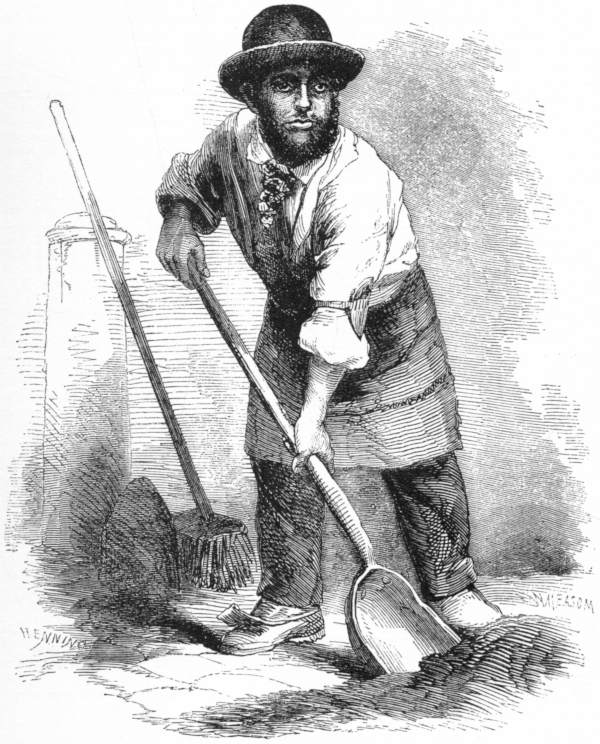
THE LONDON SCAVENGER.
[From a Daguerreotype by Beard.]
The diet of the regular working scavager (or
nightman) seems generally to differ from that of
mechanics, and perhaps of other working men,
in the respect of his being fonder of salt and
strong-flavoured food. I have before made the same
remark concerning the diet of the poor generally.
I do not mean, however, that the scavagers are
fond of such animal food as is called “high,” for
I did not hear that nightmen or scavagers were
more tolerant of what approached putridity than
other labouring men, and, despite their calling,
might sicken at the rankness of some haunches
of venison; but they have a great relish for
highly-salted cold boiled beef, bacon, or pork, with
a saucer-full of red pickled cabbage, or dingy-looking
pickled onions, or one or two big, strong,
raw onions, of which most of them seem as fond
as Spaniards of garlic. This sort of meat, sometimes
profusely mustarded, is often eaten in the
beer-shops with thick “shives” of bread, cut into
big mouthfuls with a clasp pocket-knife, while
vegetables, unless indeed the beer-shop can supply
a plate of smoking hot potatoes, are uncared for.
The drink is usually beer. The same style of
eating and the same kind of food characterize the
scavager and nightman, when taking his meal at
home with his wife or family; but so irregular,
and often of necessity, are these men’s hours, that
they may be said to have no homes, merely places
to sleep or dose in.
A working scavager and nightman calculated
for me his expenses in eating and drinking, and
other necessaries, for the previous week. He
had earned 15s., but 1s. of this went to pay off
an advance of 5s. made to him by the keeper of a
beer-shop, or, as he called it, a “jerry.”
| Daily. | Weekly. |
|---|
| d. | s. | d. |
|---|
| Rent of an unfurnished room | | 1 | 9 |
| Washing (average) | | | 3 |
| [The man himself washed the dress in which he worked, and generally washed his own stockings.] |
| Shaving (when twice a week) | | | 1 |
| Tobacco | 1 | | 7 |
| [Short pipes are given to these men at the beer-shops, or public-houses which they “use.”] |
| Beer | 4 | 2 | 4 |
| [He usually spent more than 4d. a day in beer, he said, “it was only a pot;” but this week more beer than usual had been given to him in nightwork.] |
| Gin | 2 | 1 | 2 |
| [The same with gin.] |
| Cocoa (pint at a coffee-shop). | 1½ | | 10½ |
| Bread (quartern loaf) (sometimes 5½d.) | 6 | 3 | 6 |
| Boiled salt beef (¾ lb. or ½ lb. daily, “as happened,” for two meals, 6d. per pound, average) | 4 | 2 | 4 |
| Pickles or Onions | 0¼ | | 1¾ |
| Butter | | | 1 |
| Soap | | | 1 |
| 13 | 2¼ |
Perhaps this informant was excessive in his
drink. I believe he was so; the others not
drinking so much regularly. The odd 9d., he told
me, he paid to “a snob,” because he said he was
going to send his half-boots to be mended.
This man informed me he was a “widdur,” having
lost his old ’oman, and he got all his meals at a
beer or coffee-shop. Sometimes, when he was a
street-sweeper by day and a nightman by night,
he had earned 20s. to 22s.; and then he could
have his pound of salt meat a day, for three meals,
with a “baked tatur or so, when they was in.”
I inquired as to the apparently low charge of 6d.
per pound for cooked meat, but I found that the
man had stated what was correct. In many parts
good boiled “brisket,” fresh cut, is 7d. and 8d.
per lb., with mustard into the bargain; and the
cook-shop keepers (not the eating-house people)
who sell boiled hams, beef, &c., in retail, but not
to be eaten on the premises, vend the hard remains
of a brisket, and sometimes of a round, for
6d., or even less (also with mustard), and the
scavagers like this better than any other food. In
the brisk times my informant sometimes had “a
hot cut” from a shop on a Sunday, and a more
liberal allowance of beer and gin. If he had any
piece of clothing to buy he always bought it at
once, before his money went for other things.
These were his proceedings when business was
brisk.
In slacker times his diet was on another
footing. He then made his supper, or second
meal, for tea he seldom touched, on “fagots.”
This preparation of baked meats costs 1d. hot—but
it is seldom sold hot except in the evening—and
¾d., or more frequently two for 1½d., cold.
It is a sort of cake, roll, or ball, a number being
baked at a time, and is made of chopped liver
and lights, mixed with gravy, and wrapped in
pieces of pig’s caul. It weighs six ounces, so
that it is unquestionably a cheap, and, to the
scavager, a savoury meal; but to other nostrils
its odour is not seductive. My informant regretted
the capital fagots he used to get at a shop
when he worked in Lambeth; superior to anything
he had been able to meet with on the Middlesex
side of the water. Or he dined off a saveloy,
costing 1d., and bread; or bought a pennyworth
of strong cheese, and a farthing’s worth of onions.
He would further reduce his daily expenditure on
cocoa (or coffee sometimes) to 1d., and his bread
to three-quarters of a loaf. He ate, however, in
average times, a quarter of a quartern loaf to his
breakfast (sometimes buying a halfpennyworth of
butter), a quarter or more to his dinner, the same
to his supper, and the other, with an onion for a
relish, to his beer. He was a great bread eater,
he said; but sometimes, if he slept in the daytime,
half a loaf would “stand over to next day.”
He was always hungriest when at work among
the street-mud, or night-soil, or when he had
finished work.
On my asking him if he meant that he partook
of the meals he had described daily, he
answered “no,” but that was mostly what he
had; and if he bought a bit of cold boiled, or
even roast pork, “what offered cheap,” the expense
was about the same. When he was drinking,
and he did “make a break sometimes,” he
ate nothing, and “wasn’t inclined to,” and he
seemed rather to plume himself on this, as a point
of economy. He had tasted fruit pies, but cared
nothing for them; but liked four penn’orth of a
hot meat or giblet pie on a Sunday. Batter-pudding
he only liked if smoking hot; and it was
“uncommon improved,” he said, “with an ingan!”
Rum he preferred to gin, only it was dearer, but
most of the scavagers, he thought, liked Old Tom
(gin) best; but “they was both good.”
Of the drinking of these men I heard a good
deal, and there is no doubt that some of them
tope hard, and by their conduct evince a sort of
belief that the great end of labour is beer. But
it must be borne in mind that if inquiries are
made as to the man best adapted to give information
concerning any rude calling (especially), some
talkative member of the body of these working
men, some pot-house hero who has persuaded
himself and his ignorant mates that he is an
oracle, is put forward. As these men are sometimes,
from being trained to, and long known in
their callings, more prosperous than their fellows,
their opinions seem ratified by their circumstances.
But in such cases, or in the appearance of such
cases, it has been my custom to make subsequent
inquiries, or there might be frequent misleadings,
were the statements of these men taken as typical
of the feelings and habits of the whole body. The
statement of the working scavager given under
this head is unquestionably typical of the character
of a portion of his co-workers, and more
especially of what was, and in the sort of hereditary
scavagers I have spoken of is, the character
of the regular hands. There are now,
however, many checks to prolonged indulgence
in “lush,” as every man of the ruder street-sweeping
class will call it. The contractors must be
served regularly; the most indulgent will not
tolerate any unreasonable absence from work, so
that the working scavagers, at the jeopardy of
their means of living, must leave their carouse at
an hour which will permit them to rise soon
enough in the morning.
The beer which these men imbibe, it should be
also remembered, they regard as a proper part of
their diet, in the same light, indeed, as they regard
so much bread, and that among them the opinion
is almost universal, that beer is necessary to
“keep up their strength;” there are a few teetotallers
belonging to the class; one man thought he
knew five, and had heard of five others.
I inquired of the landlord of a beer-shop, frequented
by these men, as to their potations, but he
wanted to make it appear that they took a half-pint,
now and then, when thirsty! He was evidently
tender of the character of his customers. The landlord
of a public house also frequented by them informed
me that he really could not say what they
expended in beer, for labourers of all kinds “used
his tap,” and as all tap-room liquor was paid for
on delivery in his and all similar establishments,
he did not know the quantity supplied to any
particular class. He was satisfied these men, as
a whole, drank less than they did at one time;
though he had no doubt some (he seemed to know
no distinctions between scavagers, dustmen, and
nightmen) spent 1s. a day in drink. He knew
one scavager who was dozing about not long
since for nearly a week, “sleepy drunk,” and the
belief was that he had “found something.” The
absence of all accounts prevents my coming to
anything definite on this head, but it seems positive
that these men drink less than they did. The
landlord in question thought the statement I have
given as to diet and drink perfectly correct for a
regular hand in good earnings. I am assured,
however, and it is my own opinion, after long inquiry,
that one-third of their earnings is spent
in drink.
As regards the influence of Free Trade upon
the scavaging business, I could gain little or no
information from the body of street-sweepers,
because they have never noticed its operation, and
the men, with the exception of such as have sunk
into street-sweeping from better-informed conditions
of life, know nothing about it. Among all,
however, I have heard statements of the blessing
of cheap bread; always cheap bread. “There’s
nothing like bread,” say the men, “it’s not all
poor people can get meat; but they must get
bread.” Cheap food all labouring men pronounce
a blessing, as it unquestionably is, but “somehow,”
as a scavager’s carman said to me, “the
thing ain’t working as it should.”
In the course of the present and former inquiries
among unskilled labourers, street-sellers,
and costermongers, I have found the great
majority of the more intelligent declare that
Free Trade had not worked well for them,
because there were more labourers and more
street-sellers than were required, for each man to
live by his toil and traffic, and because the numbers
increased yearly, and the demand for their
commodities did not increase in proportion. Among
the ignorant, I heard the continual answers of, “I
can’t say, sir, what it’s owing to, that I’m so
bad off;” or, “Well, I can’t tell anything about
that.”
It is difficult to state, however, without positive
inquiry, whether this extra number of hands be
due to diminished employment in the agricultural
districts, since the repeal of the Corn Laws, or
whether it be due to the insufficiency of occupation
generally for the increasing population.
One thing at least is evident, that the increase of
the trades alluded to cannot be said to arise
directly from diminished agricultural employment,
for but few farm labourers have entered these
businesses since the change from Protection to Free
Trade. If, therefore, Free-Trade principles have
operated injuriously in reducing the work of the
unskilled labourers, street-sellers, and the poorer
classes generally, it can have done so only indirectly;
that is to say, by throwing a mass of
displaced country labour into the towns, and so
displacing other labourers from their ordinary
occupations, as well as by decreasing the wages
of working-men generally. Hence it becomes
almost impossible, I repeat, to tell whether the
increasing difficulty that the poor experience in
living by their labour, is a consequence or merely
a concomitant of the repeal of the Corn Laws; if
it be a consequence, of course the poor are no
better for the alteration; if, however, it be a
coincidence rather than a necessary result of the
measure, the circumstances of the poor are, of
course, as much improved as they would have been
impoverished provided that measure had never
become law. I candidly confess I am as yet
without the means of coming to any conclusion on
this part of the subject.
Nor can it be said that in the scavagers’ trade
wages have in any way declined since the repeal
of the Corn Laws; so that were it not for the
difficulty of obtaining employment among the
casual hands, this class must be allowed to have
been considerable gainers by the reduction in the
price of food, and even as it is, the constant hands
must be acknowledged to be so.
I will now endeavour to reduce to a tabular
form such information as I could obtain as to the
expenditure of the labourer in scavaging before
and after the establishment of Free Trade. I
inquired, the better to be assured of the accuracy
of the representations and accounts I received
from labourers, the price of meat then and now.
A butcher who for many years has conducted a
business in a populous part of Westminster and in a
populous suburb, supplying both private families
with the best joints, and the poor with their
“little bits” their “block ornaments” (meat in
small pieces exposed on the chopping-block), their
purchases of liver, and of beasts’ heads. In 1845,
the year I take as sufficiently prior to the Free-Trade
era, my informant from his recollection of
the state of his business and from consulting his
books, which of course were a correct guide, found
that for a portion of the year in question, mutton
was as much as 7½d. per lb. (Smithfield prices),
now the same quality of meat is but 5d. This,
however, was but a temporary matter, and from
causes which sometimes are not very ostensible or
explicable. Taking the butcher’s trade that year
as a whole, it was found sufficiently conclusive,
that meat was generally 1d. per lb. higher then
than at present. My informant, however, was
perfectly satisfied that, although situated in the
same way, and with the same class of customers,
he did not sell so much meat to the poor and
labouring classes as he did five or six years ago,
he believed not by one-eighth, although perhaps
“pricers of his meat” among the poor were more
numerous. For this my informant accounted
by expressing his conviction that the labouring
men spent their money in drink more than ever,
and were a longer time in recovering from the
effects of tippling. This supposition, from what I
have observed in the course of the present inquiry,
is negatived by facts.
Another butcher, also supplying the poor, said
they bought less of him; but he could not say
exactly to what extent, perhaps an eighth, and he
attributed it to less work, there being no railways
about London, fewer buildings, and less general
employment. About the wages of the labourers
he could not speak as influencing the matter.
From this tradesmen also I received an account
that meat generally was 1d. per lb. higher at the
time specified. Pickled Australian beef was four or
five years ago very low—3d. per lb.—salted and
prepared, and “swelling” in hot water, but the
poor “couldn’t eat the stringy stuff, for it was like
pickled ropes.” “It’s better now,” he added,
“but it don’t sell, and there’s no nourishment in
such beef.”
But these tradesmen agreed in the information
that poor labourers bought less meat, while one
pronounced Free Trade a blessing, the other declared
it a curse. I suggested to each that cheaper
fish might have something to do with a smaller
consumption of butcher’s meat, but both said that
cheap fish was the great thing for the Irish and
the poor needle-women and the like, who were
never at any time meat eaters.
From respectable bakers I ascertained that
bread might be considered 1d. a quartern loaf
dearer in 1845 than at present. Perhaps the following
table may throw a fuller light on the matter.
I give it from what I learned from several men,
who were without accounts to refer to, but speaking
positively from memory; I give the statement
per week, as for a single man, without charge
for the support of a wife and family, and without
any help from other resources.
| Before Free Trade. | After Free Trade. | Saving since
Free Trade. |
|---|
| Rent | 1s. 6d. | 1s. 6d. | ... |
| Bread (5 loaves) | 2s. 11d. | 2s. 6d. | 5d. |
| Butter (½ lb.) | 5d. | 5d. | ... |
| Tea (2 oz.) | 8d. | 8d. | ... |
| Sugar (½ lb.) | 3d. | 2d. | 1d. |
| Meat (3 lb.) | 1s. 6d. | 1s. 3d. | 3d. |
| Bacon (1 lb.) | 5d. | 5d. | ... |
| Fish (a dinner a day, 6 days) | 3d., or 1s. 6d. weekly. | 2d., or 1s. weekly. | 6d. |
| Potatoes or Vegetables (½d. a day) | 3½d. | 3½d. | ... |
| Beer (pot) | 3½d. | 3½d. | ... |
| Total saving, per week, since Free Trade | 1s. 3d. |
In butter, bacon, potatoes, &c., and beer, I
could hear of no changes, except that bacon might
be a trifle cheaper, but instead of a good quality
selling better, although cheaper, there was a demand
for an inferior sort.
In the foregoing table the weekly consumption
of several necessaries is given, but it is not to be
understood that one man consumes them all in a
week; they are what may generally be consumed
when such things are in demand by the poor, one
week after another, or one day after another,
forming an aggregate of weeks.
Thus, Free Trade and cheap provisions are an
unquestionable benefit, if unaffected by drawbacks,
to the labouring poor.
The above statement refers only to a fully employed
hand.
The following table gives the change since
Free Trade in the earnings of casual hands, and
relates to the past and the present expenditure of a
scavager. The man, who was formerly a house
painter, said he could bring me 50 men similarly
circumstanced to himself.
| In 1845, per Week. | In 1851, per Week. |
|---|
| s. | d. | | s. | d. |
| Rent | 1 | 4 | Rent | 1 | 8 |
| 5 loaves | 2 | 11 | 4 loaves | 2 | 0 |
| Butter | 0 | 5 | Butter | 0 | 5 |
| Tea | 0 | 6 | Tea | 0 | 5 |
| Meat (3 lbs.) | 1 | 6 | Meat (3 lbs.) | 1 | 0 |
| Potatoes | 0 | 3 | Potatoes | 0 | 2 |
| Beer (a pot) | 0 | 4 | Beer (a pint) | 0 | 2 |
| 7 | 3 | | 5 | 10 |
Here, then, we find a positive saving in the expenditure
of 1s. 5d. per week in this man’s wages,
since the cheapening of food.
His earnings, however, tell a different story.
| 1845. | 1851. |
|---|
| s. | d. | s. | d. |
| Earnings of 6 days | 15 | 0 |
| Ditto 3 days | | | 7 | 6 |
| Weekly Income | 15 | 0 | 7 | 6 |
| Expenditure | 7 | 3 | 5 | 10 |
| Difference | 7 | 9 | 1 | 8 |
Thus we perceive that the beneficial effects of
cheapness are defeated by the dearth of employment
among labourers.
It is impossible to come to precise statistics in
this matter, but all concurrent evidence, as regards
the unskilled work of which I now treat, shows
that labour is attainable at almost any rate.
Another drawback to the benefits of cheap food
I heard of first in my inquiries (for the Letters on
Labour and the Poor, in the Morning Chronicle)
among the boot and shoemakers—their rents had
been raised in consequence of their landlords’
property having been subjected to the income
tax. Numbers of large houses are now let out
in single rooms, in the streets off Tottenham-court-road,
and near Golden-square, as well as
in many other quarters—to men, who, working
for West-end tradesmen, must live, for economy of
time, near the shops from which they derive their
work. Near and in Cunningham-street and other
streets, two men, father and son, rent upwards of
30 houses, the whole of which they let out in one
or two rooms, it is believed at a very great
profit; in fact they live by it.
The rent of these houses, among many others,
was raised when the income tax was imposed, the
sub-lettors declaring, with what truth no one
knew, that the rents were raised to them. It is
common enough for capitalists to fling such imposts
on the shoulders of the poor, and I heard
scavagers complain, that every time they had to
change their rooms, they had either to pay more
rent by 2d. or 3d. a week, or put up with a
worse place. One man who lived at the time of
the passing of the Income Tax Bill in Shoe-lane,
found his rent raised suddenly 3d. a week, a non-resident
landlord or agent calling for it weekly.
He was told that the advance was to meet the income
tax. “I know nothing about what income tax
means,” he said, “but it’s some —— roguery as is
put on the poor.” I heard complaints to the same
purport from several working scavagers, and the
lettors of rooms are the most exacting in places
crowded with the poor, and where the poor think
or feel they must reside “to be handy for work.”
What connection there may be between the questions
of Free Trade and the necessity of the income
tax, it is not my business now to dilate
upon, but it is evident that the circumstances of
the country are not sufficiently prosperous to
enable parliament to repeal this “temporary”
impost.
From a better informed class than the scavagers,
I might have derived data on which to form
a calculation from account books, &c., but I
could hear of none being kept. I remember
that a lady’s shoemaker told me that the weekly
rents of the ten rooms in the house in which he
lived were 4s. 3d. higher than before the income
tax, which “came to the same thing as an extra
penny on over 50 loaves a week.” It is certain
that the great tax-payers of London are the
labouring classes.
I have endeavoured to ascertain the facts in
connection with this complex subject in as calm
and just a manner as possible, leaning neither to
the Protectionist nor the Free-Trade side of the
question, and I must again in honesty acknowledge,
that to the constant hands among the
scavagers and dustmen of the metropolis, the
repeal of the Corn Laws appears to have been an
unquestionable benefit.
I shall conclude this exposition of the condition
and earnings of the working scavagers employed
by the more honourable masters, with an account
of the average income and expenditure of the
better-paid hands (regular and casual, as well as
single and married), and first, of the unmarried
regular hand.
The following is an estimate of the income and
expenditure of an unmarried operative scavager
regularly employed, working for a large contractor:—
| WEEKLY INCOME. | WEEKLY EXPENDITURE. |
|---|
| £ | s. | d. | | £ | s. | d. |
| Constant Wages. | | | | Rent | 0 | 2 | 0 |
| Nominal weekly wages | 0 | 16 | 0 | Washing and mending | 0 | 0 | 10 |
| Perquisites | 0 | 2 | 0 | Clothes, and repairing ditto | 0 | 0 | 10 |
| Actual weekly wages | 0 | 18 | 0 | Butcher’s meat | 0 | 3 | 6 |
| Bacon | 0 | 0 | 8 |
| Vegetables | 0 | 0 | 4 |
| Cheese | 0 | 0 | 4 |
| Beer | 0 | 3 | 0 |
| Spirits | 0 | 1 | 0 |
| Tobacco | 0 | 0 | 10½ |
| Butter | 0 | 0 | 7½ |
| Sugar | 0 | 0 | 4 |
| Tea | 0 | 0 | 3 |
| Coffee | 0 | 0 | 3 |
| Fish | 0 | 0 | 4 |
| Soap | 0 | 0 | 2 |
| Shaving | 0 | 0 | 1 |
| Fruit | 0 | 0 | 4 |
| Keep of 2 dogs | 0 | 0 | 6 |
| Amusements, as skittles, &c. | 0 | 1 | 9 |
| 0 | 18 | 0 |
The subjoined represents the income of an unmarried
operative scavager casually employed by
a small master scavager six months during the
year, at 15s. a week, and 20 weeks at sand and
rubbish carting, at 12s. a week.
| Casual Wages. | £ | s. | d. |
|---|
| Nominal weekly wages at scavaging, 16s. for 26 weeks during the year | 20 | 16 | 0 |
| Perquisites, 2s. for 26 weeks during the year | 2 | 12 | 0 |
| Actual weekly wages for 26 weeks during the year | 0 | 16 | 0 |
| Nominal and actual weekly wages at rubbish carting, 12s. for 20 weeks more during the year | 12 | 0 | 0 |
| Average casual or constant weekly wages throughout the year | 0 | 15 | 4½ |
The expenditure of this man when in work was
nearly the same as that of the regular hand; the
main exceptions being that his rent was 1s. instead
of 2s., and no dogs were kept. When in work he
saved nothing, and when out of work lived as he
could.
The married scavagers are differently circumstanced
from the unmarried; their earnings are
generally increased by those of their family.
The labour of the wives and children of the
scavagers is not unfrequently in the capacity of
sifters in the dust-yards, where the wives of the
men employed by the contractors have the preference,
and in other but somewhat rude capacities.
One of their wives I heard of as a dresser of
sheep’s trotters; two as being among the most
skilful dressers of tripe for a large shop; one as
“a cat’s-meat seller” (her father’s calling); but I
still speak of the regular scavagers—I could not
meet with one woman “working a slop-needle.”
One, indeed, I saw who was described to me as a
“feather dresser to an out-and-out negur,” but the
woman assured me she was neither badly paid nor
badly off. Perhaps by such labour, as an average
on the part of the wives, 9d. a day is cleared,
and 1s. “on tripe and such like.” Among the
“casual’s” wives there are frequent instances of
the working for slop shirt-makers, &c., upon the
coarser sorts of work, and at “starvation wages,”
but on such matters I have often dwelt. I
heard from some of these men that it was looked
upon as a great thing if the wife’s labour could
clear the week’s rent of 1s. 6d. to 2s.
The following may be taken as an estimate of
the income and outlay of a better paid and fully
employed operative scavager, with his wife and two
children:—
| WEEKLY INCOME OF THE FAMILY. | WEEKLY EXPENDITURE OF THE FAMILY. |
|---|
| £ | s. | d. | | £ | s. | d. |
| Nominal weekly wages of man, 16s. | | Rent | 0 | 3 | 0 |
| Perquisites, 2s. | | Candle | 0 | 0 | 3½ |
| Actual weekly wages of man | 0 | 18 | 0 | Bread | 0 | 2 | 1 |
| Nominal weekly wages of wife, 6s. | | Butter | 0 | 0 | 10 |
| Perquisites in coal and wood, 1s. 4d. | | Sugar | 0 | 0 | 8 |
| Actual weekly wages of wife. | 0 | 7 | 4 | Tea | 0 | 0 | 10 |
| Nominal weekly wages of boy. | 0 | 3 | 0 | Coffee | 0 | 0 | 4 |
| 1 | 8 | 4 | Butcher’s meat | 0 | 3 | 6 |
| Bacon | 0 | 1 | 2 |
| Potatoes | 0 | 0 | 10 |
| Raw fish | 0 | 0 | 4 |
| Herrings | 0 | 0 | 4 |
| Beer (at home) | 0 | 2 | 0 |
| „ (at work) | 0 | 1 | 6 |
| Spirits | 0 | 1 | 0 |
| Cheese | 0 | 0 | 6 |
| Flour | 0 | 0 | 3 |
| Suet | 0 | 0 | 3 |
| Fruit | 0 | 0 | 3 |
| Rice | 0 | 0 | 0½ |
| Soap | 0 | 0 | 6 |
| Starch | 0 | 0 | 0½ |
| Soda and blue | 0 | 0 | 1 |
| Dubbing | 0 | 0 | 0½ |
| Clothes for the whole family, and repairing ditto | 0 | 2 | 0 |
| Boots and shoes for ditto, ditto | 0 | 1 | 6 |
| Milk | 0 | 0 | 7 |
| Salt, pepper, and mustard | 0 | 0 | 1 |
| Tobacco | 0 | 0 | 9 |
| Wear and tear of bedding, crocks, &c. | 0 | 0 | 3 |
| Schooling for girl | 0 | 0 | 3 |
| Baking Sunday’s dinner | 0 | 0 | 2 |
| Mangling | 0 | 0 | 3 |
| Amusements and sundries | 0 | 1 | 0 |
| | 1 | 7 | 6 |
The subjoined, on the other hand, gives the
income and outlay of a casually employed operative
scavager (better paid) with his wife and
two boys in constant work:—
| WEEKLY INCOME OF THE FAMILY. | WEEKLY EXPENDITURE OF THE FAMILY. |
|---|
| £ | s. | d. | | £ | s. | d. |
| Nominal wages of man at scavaging for six months, at 16s. weekly. | | Rent | 0 | 3 | 6 |
| Ditto at rubbish carting three months, 12s. weekly. | | Candle | 0 | 0 | 6 |
| Average casual wages throughout the year | 0 | 15 | 0 | Soap | 0 | 0 | 4 |
| Nominal weekly wages of wife, 6s. (constant). | | Soda, starch, and blue | 0 | 0 | 2½ |
| Perquisites in wood and coal, 1s. 4d. | | Bread | 0 | 2 | 6 |
| Actual weekly wages of wife | 0 | 7 | 4 | Butter | 0 | 0 | 9 |
| Nominal weekly wages of two boys, 7s. the two. | | Dripping | 0 | 0 | 5 |
| Perquisites for running on messages, 1s. the two (constant). | | Sugar | 0 | 0 | 8 |
| Actual weekly wages of the two boys. | 0 | 8 | 0 | Tea | 0 | 0 | 8 |
| 1 | 10 | 4 | Coffee | 0 | 0 | 6 |
| Butcher’s meat | 0 | 3 | 6 |
| Bacon | 0 | 1 | 0 |
| Potatoes | 0 | 1 | 0 |
| Cheese | 0 | 0 | 6 |
| Raw fish | 0 | 0 | 4 |
| Herrings | 0 | 0 | 3 |
| Fried fish | 0 | 0 | 3 |
| Flour | 0 | 0 | 3 |
| Suet | 0 | 0 | 2 |
| Fruit | 0 | 0 | 6 |
| Rice | 0 | 0 | 1½ |
| Beer (at home) | 0 | 2 | 0 |
| „ (at work) | 0 | 1 | 9 |
| Spirits | 0 | 1 | 0 |
| Tobacco | 0 | 0 | 9 |
| Pepper, salt, and mustard | 0 | 0 | 1 |
| Milk | 0 | 0 | 7 |
| Clothes for man, wife, and family | 0 | 2 | 0 |
| Repairing ditto for ditto | 0 | 0 | 6 |
| Boots and shoes for ditto | 0 | 1 | 6 |
| Repairing ditto for ditto | 0 | 0 | 8 |
| Wear and tear of bedding, crocks, &c. | 0 | 0 | 3 |
| Baking Sunday’s dinner | 0 | 0 | 2 |
| Mangling | 0 | 0 | 2 |
| Amusements, sundries, &c. | 0 | 1 | 0 |
| | 1 | 10 | 4 |
There are in the scavagers’ trade the same distinct
classes of employers as appertain to all other
trades; these consist of:—
- 1. The large capitalists.
- 2. The small capitalists.
As a rule (with some few honourable and dishonourable
exceptions, it is true) I find that the
large capitalists in the several trades are generally
the employers who pay the higher wages, and the
small men those who pay the lower. The reasons
for this conduct are almost obvious. The power
of the capital of the “large master” must be
contended against by the small one; and the
usual mode of contention in all trades is by reducing
the wages of the working men. The
wealthy master has, of course, many advantages
over the poor one. (1) He can pay ready money,
and obtain discounts for immediate payment.
(2) He can buy in large quantities, and so get
his stock cheaper. (3) He can purchase what he
wants in the best markets, and that directly of
the producer, without the intervention and profit
of the middleman. (4) He can buy at the best
times and seasons; and “lay in” what he requires
for the purposes of his trade long before
it is needed, provided he can obtain it “a bargain.”
(5) He can avail himself of the best
tools and mechanical contrivances for increasing
the productiveness or “economizing the labour”
of his workmen. (6) He can build and arrange
his places of work upon the most approved plan
and in the best situations for the manufacture and
distribution of the commodities. (7) He can
employ the highest talent for the management or
design of the work on which he is engaged. (8)
He can institute a more effective system for
the surveillance and checking of his workmen.
(9) He can employ a large number of hands, and
so reduce the secondary expenses (of firing, lighting,
&c.) attendant upon the work, as well as the
number of superintendents and others engaged to
“look after” the operatives. (10) He can resort
to extensive means of making his trade known.
(11) He can sell cheaper (even if his cost of production
be the same), from employing a larger
capital, and being able to “do with” a less rate
of profit. (12) He can afford to give credit, and
so obtain customers that he might otherwise
lose.
The small capitalist, therefore, enters the field
of competition by no means equally matched
against his more wealthy rival. What the little
master wants in “substance,” however, he generally
endeavours to make up in cunning. If he
cannot buy his materials as cheap as a trader of
larger means, he uses an inferior or cheaper
article, and seeks by some trick or other to palm
it off as equal to the superior and dearer kind.
If the tools and appliances of the trade are expensive,
he either transfers the cost of providing them
to the workmen, or else he charges them a rent
for their use; and so with the places of work, he
mulcts their wages of a certain sum per week for
the gas by which they labour, or he makes them
do their work at home, and thus saves the expense
of a workshop; and, lastly, he pays his men
either a less sum than usual for the same quantity
of labour, or exacts a greater quantity from them
for the same sum of money. By one or other of
these means does the man of limited capital seek
to counterbalance the advantages which his more
wealthy rival obtains by the possession of extensive
“resources.” The large employer is enabled
to work cheaper by the sheer force of his larger
capital. He reduces the cost of production, not
by employing a cheaper labour, but by “economizing
the labour” that he does employ. The
small employer, on the other hand, seeks to keep
pace with his larger rival, and strives to work
cheap, not by “the economy of labour” (for this
is hardly possible in the small way of production),
but by reducing the wages of his labourers.
Hence the rule in almost every trade is that the
smaller capitalists pay a lower rate of wages.
To this, however, there are many honourable exceptions
among the small masters, and many as
dishonourable among the larger ones in different
trades. Messrs. Moses, Nicoll, and Hyams, for
instance, are men who certainly cannot plead
deficiency of means as an excuse for reducing the
ordinary rate of wages among the tailors.
Those employers who seek to reduce the prices
of a trade are known technologically as “cutting
employers,” in contradistinction to the standard
employers, or those who pay their workpeople and
sell their goods at the ordinary rates.
Of “cutting employers” there are several kinds,
differently designated, according to the different
means by which they gain their ends. These
are:—
1. “Drivers,” or those who compel the men in
their employ to do more work for the same wages;
of this kind there are two distinct varieties:—
a. The long-hour masters, or those who make
the men work longer than the usual hours
of labour.
b. The strapping masters, or those who make
the men (by extra supervision) “strap” to
their work, so as to do a greater quantity
of labour in the usual time.
2. Grinders, or those who compel the workmen
(through their necessities) to do the same
amount of work for less than the ordinary
wages.
The reduction of wages thus brought about
may or may not be attended with a corresponding
reduction in the price of the goods
to the public; if the price of the goods
be reduced in proportion to the reduction of
wages, the consumer, of course, is benefited at
the expense of the producer. When it is not
followed by a like diminution in the selling price
of the article, and the wages of which the men
are mulct go to increase the profits of the capitalist,
the employer alone is benefited, and is then
known as a “grasper.”
Some cutting tradesmen, however, endeavour to
undersell their more wealthy rivals, by reducing
the ordinary rate of profit, and extending their
business on the principle of small profits and
quick returns, the “nimble ninepence” being considered
“better than the slow shilling.” Such
traders, of course, cannot be said to reduce wages
directly—indirectly, however, they have the same
effect, for in reducing prices, other traders, ever
ready to compete with them, but, unwilling, or
perhaps unable, to accept less than the ordinary
rate of profit, seek to attain the same cheapness
by diminishing the cost of production, and for
this end the labourers’ wages are almost invariably
reduced.
Such are the characteristics of the cheap employers
in all trades. Let me now proceed to
point out the peculiarities of what are called the
scurf employers in the scavaging trade.
The insidious practices of capitalists in other
callings, in reducing the hire of labour, are not
unknown to the scavagers. The evils of which
these workmen have to complain under scurf or
slop masters are:—
1. Driving, or being compelled to do more
work for the same pay.
2. Grinding, or being compelled to do the
same or a greater amount of work for less pay.
1. Under the first head, if the employment be
at all regular, I heard few complaints, for the men
seemed to have learned to look upon it as an inevitable
thing, that one way or other they must
submit, by the receipt of a reduced wage, or the
exercise of a greater toil, to a deterioration in
their means.
The system of driving, or, in other words, the
means by which extra work is got out of the men
for the same remuneration, in the scavagers’ trade
is as follows:—some employers cause their scavagers
after their day’s work in the streets, to
load the barges with the street and house-collected
manure, without any additional payment;
whereas, among the more liberal employers, there
are bargemen who are employed to attend to this
department of the trade, and if their street scavagers
are so employed, which is not very often,
it is computed as extra work or “over hours,”
and paid for accordingly. This same indirect
mode of reducing wages (by getting more work done
for the same pay) is seen in many piece-work
callings. The slop boot and shoe makers pay the
same price as they did six or seven years ago, but
they have “knocked off the extras,” as the additional
allowance for greater than the ordinary
height of heel, and the like. So the slop Mayor
of Manchester, Sir Elkanah Armitage, within the
last year or two, sought to obtain from his men a
greater length of “cut” to each piece of woven
for the same wages.
Some master scavagers or contractors, moreover,
reduce wages by making their men do what is considered
the work of “a man and a half” in a week,
without the recompense due for the labour of the
“half” man’s work; in other words, they require
the men to condense eight or nine days’ labour
into six, and to be paid for the six days only;
this again is usual in the strapping shops of the
carpenters’ trade.
Thus the class of street-sweepers do not differ
materially in the circumstances of their position
from other bodies of workers skilled and unskilled.
Let me, however, give a practical illustration of
the loss accruing to the working scavagers by the
driving method of reducing wages.
A is a large contractor and a driver. He employs
16 men, and pays them the “regular wages”
of the honourable trade; but, instead of limiting
the hours of labour to 12, as is usual among the
better class of employers, he compels each of his
men to work at the least 16 hours per diem,
which is one-third more, and for which the men
should receive one-third more wages. Let us see,
therefore, how much the men in his employ lose
annually by these means.
| Sum received per Annum. | Sum they should receive. | Difference. |
|---|
| £ | s. | £ | s. | £ | s. |
| 4 Gangers, at 18s. a week, for 9 months in the year | 140 | 8 | 210 | 12 | 70 | 4 |
| 12 Sweepers, at 16s. a week, for 9 months in the year | 374 | 8 | 499 | 4 | 124 | 16 |
| Total wages per Ann. | 514 | 16 | 709 | 16 | 195 | 0 |
Here, then, we find the annual loss to these
men through the system of “driving” to be 195l.
per annum.
But A is not the only driver in the scavagers’
trade; out of the 19 masters having contracts
for scavaging, as cited in the table given at pp.
213, 214, there are 4 who are regular drivers;
and, making the same calculation as above, we
have the following results:—
| Sum received per Annum. | Sum they should receive. | Difference. |
|---|
| £ | s. | £ | s. | £ | s. |
| 26 Gangers, at 18s. a week, for 9 months in the year | 912 | 12 | 1216 | 16 | 304 | 4 |
| 80 Sweepers, at 16s. a week, for 9 months in the year | 2496 | 0 | 3328 | 0 | 832 | 0 |
| 3308 | 12 | 4544 | 16 | 1136 | 4 |
Thus we find that the gross sum of which the
men employed by these drivers are deprived, is
no less than 1136l. per annum.
2. The second or indirect mode of reducing
the wages of the men in the scavaging trade is by
Grinding; that is to say, by making the men do
the same amount of work for less pay. It requires
nothing but a practical illustration to render
the injury of this particular mode of reduction
apparent to the public.
B is a master scavager (a small contractor,
though the instances are not confined to this class),
and a “Grinder.” He pays 1s. a week less than
the “regular wages” of the honourable trade. He
employs six men; hence the amount that the
workmen in his pay are mulct of every year is as
follows:—
| Sum received per Annum. | Sum they should receive. | Difference. |
|---|
| £ | s. | £ | s. | £ | s. |
| 6 men, at 15s. a week, for 9 months in the year | 175 | 10 | 187 | 4 | 11 | 14 |
Here the loss to the men is 11l. 14s. per annum,
and there is but one such grinder among the 19
master scavagers who have contracts at present.
3. The third and last method of reducing the
earnings of the men as above enumerated, is by
a combination of both the systems before explained,
viz., by grinding and driving united, that is to
say, by not only paying the men a smaller wage
than the more honourable masters, but by compelling
them to work longer hours as well. Let me
cite another illustration from the trade.
C is a large contractor, and both a grinder and
driver. He employs 28 men, and not only pays them
less wages, but makes them work longer hours than
the better class of employers. The men in his
pay, therefore, are annually mulct of the following
sums.
| SUMS THE MEN RECEIVE. | SUMS THEY SHOULD RECEIVE. |
|---|
| £ | s. | d. | | £ | s. | d. |
| 7 Gangers, at 16s. a week, for 9 months in the year | 218 | 8 | 0 | 7 Gangers, at 18s. a week, for 9 months in the year | 245 | 14 | 0 |
| 21 Sweepers, at 15s. a week | 614 | 5 | 0 | Over work, 4 hours per day | 61 | 8 | 6 |
| 832 | 13 | 0 | 21 Sweepers, at 16s. a week, 12 hours a day | 655 | 4 | 0 |
|
| Over work, 4 hours a day | 163 | 6 | 0 |
| | 1125 | 12 | 6 |
Here the annual loss to the men employed by
this one master is 292l. 19s. 6d.
Among the 19 master scavagers there are altogether
7 employers who are both grinders and
drivers. These employ among them no less than
111 hands; hence, the gross amount of which their
workmen are yearly defrau—no, let me adhere
to the principles of political economy, and say
deprived—is as under:—
| SUM THE MEN ANNUALLY RECEIVE. | SUM THEY SHOULD ANNUALLY RECEIVE. |
|---|
| £ | s. | d. | | £ | s. | d. |
| 28 Gangers, at 16s. a week, employed for 9 months in the year | 873 | 12 | 0 | 28 Gangers, at 18s. a week (12 hours a day), for 9 months in the year | 982 | 16 | 0 |
| 83 Sweepers, at 15s. a week, employed for 9 months in the year | 2427 | 15 | 0 | Over work, 4 hours per day | 245 | 14 | 0 |
| 3301 | 7 | 0 | 83 Sweepers, at 16s. a week, 12 hours a day | 2589 | 12 | 0 |
| Over work, 4 hours per day | 647 | 8 | 0 |
| | 4465 | 10 | 0 |
Here we perceive the gross loss to the operatives
from the system of combined grinding and
driving to be no less than 1164l. 3s. per annum.
Now let us see what is the aggregate loss to
the working men from the several modes of reducing
their wages as above detailed.
| £. | s. | d. |
| Loss to the working scavagers by the “driving” of employers | 1136 | 4 | 0 |
| Ditto by the “grinding” | 11 | 14 | 0 |
| Ditto by the “grinding and driving” of employers | 1164 | 3 | 0 |
| Total loss to the working scavagers per annum | 2312 | 1 | 0 |
Now this is a large sum of money to be wrested
annually out of the workmen—that it is so
wrested is demonstrated by the fact cited at
p. 174 in connection with the dust trade.
The wages of the dustmen employed by the
large contractors, it is there stated, have been
increased within the last seven years from 6d.
to 8d. per load. This increase in the rate of remuneration
was owing to complaints made by the
men to the Commissioners of Sewers, that they
were not able to live on their earnings; an inquiry
took place, and the result was that the
Commissioners decided upon letting the contracts
only to such parties as would undertake to pay
a fair price to their workmen. The contractors
accordingly increased the remuneration of the
labourers as mentioned.
Now political economy would tell us that the
Commissioners interfered with wages in a most
reprehensible manner—preventing the natural
operation of the law of Supply and Demand; but
both justice and benevolence assure us that the
Commissioners did perfectly right. The masters
in the dust trade were forced to make good to the
men what they had previously taken from them,
and the same should be done in the scavaging
trade—the contracts should be let only to these
masters who will undertake to pay the regular
rate of wages, and employ their men only the regular
hours; for by such means, and by such means
alone, can justice be done to the operatives.
This brings me to the cause of the reduction of
wages in the scavaging trade. The scurf trade,
I am informed, has been carried on among the
master scavagers upwards of 20 years, and arose
partly from the contractors having to pay the
parishes for the house-dust and street-sweepings,
brieze and street manure at that period often selling
for 30s. the chaldron or load. The demand
for this kind of manure 20 years ago was so
great, that there was a competition carried on
among the contractors themselves, each out-bidding
the other, so as to obtain the right of collecting it;
and in order not to lose anything by the large
sums which they were induced to bid for the contracts,
the employers began gradually to “grind
down” their men from 17s. 6d. (the sum paid 20
years back) to 17s. a week, and eventually to 15s.,
and even 12s. weekly. This is a curious and instructive
fact, as showing that even an increase of
prices will, under the contract system, induce a reduction
of wages. The greed of traders becomes,
it appears, from the very height of the prices, proportionally
intensified, and from the desire of each
to reap the benefit, they are led to outbid one
another to such an extent, and to offer such large
premiums for the right of appropriation, as to
necessitate a reduction of every possible expense
in order to make any profit at all upon the transaction.
Owing, moreover, to the surplus labour in
the trade, the contractors were enabled to offer
any premiums and reduce wages as they pleased;
for the casually-employed men, when the wet
season was over, and their services no longer required,
were continually calling upon the contractors,
and offering their services at 2s. and 3s.
less per week than the regular hands were receiving.
The consequence was, that five or six
of the master scavagers began to reduce the wages
of their labourers, and since that time the number
has been gradually increasing, until now there
are no less than 21 scurf masters (8 of whom have
no contracts) out of the 34 contractors; so that
nearly three-fifths of the entire trade belong to
the grinding class. Within the last seven or eight
years, however, there has been an increase of
wages in connection with the city operative scavagers.
This was owing mainly to the operatives
complaining to the Commissioners that they could
not live upon the wages they were then receiving—12s.
and 14s. a week. The circumstances inducing
the change, I am informed, were as follows:—one
of the gangers asked a tradesman in the city
to give the street-sweepers “something for beer,”
whereupon the tradesman inquired if the men
could not find beer out of their wages, and on
being assured that they were receiving only 12s. a
week, he had the matter brought before the Board.
The result was, that the wages of the operatives
were increased from 12s. to 15s. and 16s. weekly,
since which time there has been neither an increase
nor a decrease in their pay. The cheapness of provisions
seems to have caused no reduction with them.
Now there are but two “efficient causes” to
account for the reduction of wages among the
scurf employers in the scavagers’ trade:—(1)
The employers may diminish the pay of their
men from a disposition to “grind” out of them
an inordinate rate of profit. (2) The price
paid for the work may be so reduced that, consistent
with the ordinary rate of profit on
capital, and remuneration for superintendence,
greater wages cannot be paid. If the first be the
fact, then the employers are to blame, and the
parishes should follow the example of the Commissioners
of Sewers, and let the work to those
contractors only who will undertake to pay the
“regular wages” of the honourable trade; but if
the latter be the case, as I strongly suspect it is,
though some of the masters seem to be more
“grasping” than the rest—but in the paucity of
returns on this matter, it is difficult to state
positively whether the price paid for the labour of
the working scavager is in all the parishes proportional
to the price paid to the employers for the
work (a most important fact to be solved)—if,
however, I repeat, the decrease of the wages be
mainly due to the decrease in the sums given for
the performance of the contract, then the parishes
are to blame for seeking to get their work done
at the expense of the working men.
The contract system of work, I find, necessarily
tends to this diminution of the men’s earnings in a
trade. Offer a certain quantity of work to the
lowest bidder, and the competition will assuredly
be maintained at the operative’s expense. It is
idle to expect that, as a general rule, traders will
take less than the ordinary rate of profit. Hence,
he who underbids will usually be found to underpay.
This, indeed, is almost a necessity of the
system, and one which the parochial functionaries
more than all others should be guarded against—seeing
that a decrease of the operative’s wages can
but be attended with an increase of the very
paupers, and consequently of the parochial expenses,
which they are striving to reduce.
A labourer, in order to be self-supporting and
avoid becoming a “burden” on the parish, requires
something more than bare subsistence-money
in remuneration for his labour, and yet
this is generally the mode by which we test the
sufficiency of wages. “A man can live very comfortably
upon that!” is the exclamation of those
who have seldom thought upon what constitutes
the minimum of self-support in this country. A
man’s wages, to prevent pauperism, should include,
besides present subsistence, what Dr. Chalmers
has called “his secondaries;” viz., a sufficiency to
pay for his maintenance: 1st, during the slack
season; 2nd, when out of employment; 3rd,
when ill; 4th, when old[19]. If insufficient to do
this, it is evident that the man at such times must
seek parochial relief; and it is by the reduction of
wages down to bare subsistence, that the cheap
employers of the present day shift the burden of
supporting their labourers when unemployed on
to the parish; thus virtually perpetuating the
allowance system or relief in aid of wages under
the old Poor Law. Formerly the mode of hiring
labourers was by the year, so that the employer
was bound to maintain the men when unemployed.
But now journey-work, or hiring by the day, prevails,
and the labourers being paid—and that mere
subsistence-money—only when wanted, are necessitated
to become either paupers or thieves
when their services are no longer required. It is,
moreover, this change from yearly to daily hirings,
and the consequent discarding of men when no
longer required, that has partly caused the immense
mass of surplus labourers, who are continually
vagabondizing through the country begging or
stealing as they go—men for whom there is but
some two or three weeks’ work (harvesting, hop-picking,
and the like) throughout the year.
That there is, however, a large system of jobbing
pursued by the contractors for the house-dust
and cleansing of the streets, there cannot be the
least doubt. The minute I have cited at page 210
gives us a slight insight into the system of combination
existing among the employers, and the extraordinary
fluctuations in the prices obtained by
the contractors would lead to the notion that the
business was more a system of gambling than
trade. The following returns have been procured
by Mr. Cochrane within the last few days:—
| “Average yearly cost of cleansing the whole of the public ways within the City of London, including the removal of dust, ashes, &c., from the houses of the inhabitants, for eight years, terminating at Michaelmas in the year 1850 | £4,643 |
| Square yards of carriage-way, estimated at | 430,000 |
| Square yards of footway, estimated at | 300,000 |
A more specific and later return is as follows:—
| Received for Dust. | Paid for cleansing, &c. | |
|---|
| £ | s. | d. | £ | s. | d. |
| 1845 | 0 | 0 | 0 | 2833 | 2 | 0 | Streets not cleansed daily. |
| 1846 | 1354 | 5 | 0 | 6034 | 6 | 0 | Streets cleansed daily. |
| 1847 | 4455 | 5 | 0 | 8014 | 2 | 0 |
| 1848 | 1328 | 15 | 0 | 7226 | 1 | 6 |
| 1849 | 0 | 0 | 0 | 7486 | 11 | 6 |
| 1850 | 0 | 0 | 0 | 6779 | 16 | 0 |
“From the above return,” says Mr. Cochrane,
“it may be inferred that the annual sums paid
for cleansing in each year of 1844 and 1843 did
not exceed 2281l., as this would make up the
eight years’ average calculation of 4643l.”
Since the streets have been cleansed daily, it
will be seen that the average has been 7188l.
The smallest amount, in 1846, was 6034l.; and
the largest, in 1847, 8014l.; which was a sudden
increase of 1980l.
Here, then, we perceive an immediate increase in
the price paid for scavaging between 1846 and
1847 of nearly 33 per cent., and since the wages
of the workmen were not proportionately increased
in the latter year by the employers, it follows that
the profits of the contractors must have been
augmented to that enormous extent. The only
effectual mode of preventing this system of jobbing
being persevered in, at the expense of the workmen,
is by the insertion of a clause in each parish
contract similar to that introduced by the Commissioners
of Sewers—that at least a fair living
rate of wages shall be paid by each contractor to
the men employed by him. This may be an interference
with the freedom of labour, according
to the economists’ “cant” language, but at least
it is a restriction of the tyranny of capital, for free
labour means, when literally translated, the unrestricted
use of capital, which is (especially when
the moral standard of trade is not of the highest
character) perhaps the greatest evil with which a
State can be afflicted.
Let me now speak of the Scurf labourers. The
moral and social characteristics of the working
scavagers who labour for a lower rate of hire do
not materially differ from those of the better paid
and more regularly employed body, unless, perhaps,
in this respect, that there are among them a greater
proportion of the “casuals,” or of men reared to
the pursuit of other callings, and driven by want,
misfortune, or misconduct, to “sweep the streets;”
and not only that, but to regard the “leave to
toil” in such a capacity a boon. These constitute,
as it were, the cheap labourers of this trade.
Among the parties concerned in the lower-priced
scavaging, are the usual criminations. The
parish authorities will not put up any longer with
the extortions of the contractors. The contractors
cannot put up any longer with the stinginess of
the parishes. The working scavagers, upon whose
shoulders the burthen falls the heaviest—as it does
in all depreciated tradings—grumble at both. I
cannot aver, however, that I found among the men
that bitter hatred of their masters which I found
actuating the mass of operative tailors, shoemakers,
dressmakers, &c., toward the slop capitalists who
employed them.
I have pointed out in what the “scurf” treatment
of the labourers was chiefly manifested—in
extra work for inferior pay; in doing eight or
nine days’ work in six; and in being paid for only
six days’ labour, and not always at the ordinary rate
even for the lighter toil—not 2s. 8d., but 2s. 6d. or
even 2s. 4d. a day. To the wealthy, this 2d. or 4d.
a day may seem but a trifling matter, but I heard a
working scavager (formerly a house-painter) put it
in a strong light: “that 3d. or 4d. a day, sir, is
a poor family’s rent.” The rent, I may observe,
as a result of my inquiries among the more decent
classes of labourers, is often the primary consideration:
“You see, sir, we must have a roof
over our heads.”
A scavager, working for a scurf master, gave
me the following account. He was a middle-aged
man, decently dressed, for when I saw him, he
was in his “Sunday clothes,” and was quiet in his
tones, even when he spoke bitterly.
“My father,” he said, “was once in business
as a butcher, but he failed, and was afterwards
a journeyman butcher, but very much respected,
I know, and I used to job and help him. O dear,
yes! I can read and write, but I have very seldom
to write, only I think one never forgets it, it’s
like learning to swim, that way; and I read
sometimes at coffee-shops. My father died rather
sudden, and me and a brother had to look out.
My brother was older than me, he was 20 or 21
then, and he went for a soldier, I believe to some
of the Ingees, but I’ve never heard of him since.
I got a place in a knacker’s yard, but I didn’t
like it at all, it was so confining, and should have
hooked it, only I left it honourable. I can’t call
to mind how long that’s back, perhaps 16 or 18
years, but I know there was some stir at the time
about having the streets and yards cleaner. A
man called and had some talk with the governor,
and says he, says the governor, says he, ‘if
you want a handy lad with his besom, and
he’s good for nothing else’—but that was his
gammon—‘here’s your man;’ so I was engaged
as a young sweeper at 10s. a week. I worked
in Hackney, but I heard so much about railways,
that I saved my money up to 10s., and popped
[pledged] a suit of mourning I’d got after my
father’s death for 22s., and got to York, both on
foot and with lifts. I soon got work on a rail;
there was great call for rails then, but I don’t
know how long it’s since, and I was a navvy for
six or seven years, or better. Then I came back
to London. I don’t know just what made me
come back, but I was restless, and I thought I
could get work as easy in London as in the
country, but I couldn’t. I brought 21 gold
sovereigns with me to London, twisted in my fob
for safeness, in a wash-leather bag. They didn’t
last so long as they ought to. I didn’t care for
drinking, only when I was in company, but I was
a little too gay. One night I spent over 12s. in
the St. Helena Gardens at Rotherhithe, and that
sort of thing soon makes money show taper. I
got some work with a rubbish carter, a regular
scurf. I made only about 8s. a week under him,
for he didn’t want me this half day or that whole
day, and if I said anything, he told me I might
go and be d——d, he could get plenty such, and I
knew he could. I got on then with a gangsman
I knew, at street-sweeping. I had 15s. a week,
but not regular work, but when the work wer’n’t
regular, I had 2s. 8d. a day. I then worked
under another master for 14s. a week, and was
often abused that I wasn’t better dressed, for
though that there master paid low wages, he was
vexed if his men didn’t look decent in the streets.
I’ve heard that he said he paid the best of wages
when asked about it. I had another job after
that, at 15s., and then 16s. a week, with a contractor
as had a wharf; but a black nigger slave
was never slaved as I was. I’ve worked all night,
when it’s been very moonlight, in loading a barge,
and I’ve worked until three and four in the
morning that way, and then me and another man
slept an hour or two in a shed as joined his
stables, and then must go at it again. Some of
these masters is ignorant, and treats men like dirt,
but this one was always civil, and made his
people be civil. But, Lord, I hadn’t a rag left to
my back. Everything was worn to bits in such
hard work, and then I got the sack. I was on
for Mr. —— next. He’s a jolly good ’un. I
was only on for him temp’ry, but I was told it
was for temp’ry when I went, so I can’t complain.
I’m out of work this week, but I’ve had some
jobs from a butcher, and I’m going to work again
on Monday. I don’t know at what wages. The
gangsmen said they’d see what I could do. It’ll
be 15s., I expect, and over-work if it’s 16s.
“Yes, I like a pint of beer now and then, and
one requires it, but I don’t get drunk. I dusted
for a fortnight once while a man was ill, and got
more beer and twopences give me than I do in a
year now; aye, twice as much. My mate and me
was always very civil, and people has said,
‘there’s a good fellow, just sweep together this
bit of rubbish in the yard here, and off with it.’
That was beyond our duty, but we did it. I
have very little night-work, only for one master;
he’s a sweep as well. I get 2s. 6d. a job for it.
Yes, there’s mostly something to drink, but you
can’t demand nothing. Night-work’s nothing, sir;
no more ain’t a knacker’s yard.
“I pay 2s. a week rent, but I’m washed for
and found soap as well. My landlady takes in
washing, and when her husband, for they’re an
old couple, has the rheumatics, I make a trifle by
carrying out the clothes on a barrow, and Mrs.
Smith goes with them and sees to the delivery.
I’ve my own furniture.
“Well, I don’t know what I spend in my living
in a week. I have a bit of meat, or a saveloy or
two, or a slice of bacon every day, mostly when
I’m at work. I sometimes make my own meals
ready in my room. No, I keep no accounts.
There’d be very little use or pleasure in doing it
when one has so little to count. When I’m past
work, I suppose I must go to the workhouse. I
sometimes wish I’d gone for a soldier when I was
young enough. I shouldn’t have minded going
abroad. I’d have liked it better than not, for I
like to be about; yes, I like a change.
“I go to chapel every Sunday night, and have
regularly since Mr. —— (the butcher) gave me
this cast-off suit. I promised him I would when
I got the togs.
“Things would be well enough with me if I’d
constant work and fair pay. I don’t know what
makes wages so low. I suppose it’s rich people
trying to get all the money they can, and caring
nothing for poor men’s rights, and poor men’s
sometimes forced to undersell one another, ’cause
half a loaf you know, sir, is better than no bread
at all” (a proverb, by the way, which has wrought
no little mischief).
In conclusion, I may remark, that although I was
told, in the first instance, there was sub-letting in
street sweeping, I could not hear of any facts to
prove it. I was told, indeed, by a gentleman who
took great interest in parochial matters, with a
view to “reforms” in them, that such a thing was
most improbable, for if a contractor sub-let any of
his work it would soon become known, and as it
would be evident that the work could be accomplished
at a lower rate, the contractor would be in
a worse position for his next contract.
Until the introduction of the machines now
seen in London, I believe that no mechanical
contrivances for sweeping the streets had been
attempted, all such work being executed by manual
labour, and employing throughout the United
Kingdom a great number of the poor. The street-sweeping
machine, therefore, assumes an importance
as another instance of the displacement, or
attempted displacement, of the labour of man by
the mechanism of an engine.
The street-sweeping machines were introduced
into London about five years ago, after having
been previously used, under the management of a
company, in Manchester, the inventor and maker
being Mr. Whitworth, of that place. The novelty
and ingenuity of the apparatus soon attracted
public attention, and for the first week or two the
vehicular street-sweeper was accompanied in its
progress by a crowd of admiring and inquisitive
pedestrians, so easily attracted together in
the metropolis. In the first instance the machines
were driven through the streets merely to display
their mode and power of work, and the drivers
and attendants not unfrequently came into contact
with the regular scavagers, when a brisk interchange
of street wit took place, the populace
often enough encouraging both sides. At present
the street-sweeping machine proceeds on its line of
operation as little noticed, except by visitors, and
foreigners especially, as any other vehicle. The
body of the sweeping machine, although the sizes
may not all be uniform, is about 5 feet in length,
and 2 feet 8 inches or 3 feet in width; the height is
about 5 feet 6 inches or 6 feet, and the form that of
a covered cart, with a rounded top. The sides of
the exterior are of cast iron, the top being of
wood. At the hinder part of the cart is fixed the
sweeping-machine itself, covered by sloping boards
which descend from the top of the cart, projecting
slightly behind the vehicle to the ground; under
the sloping boards is an endless chain of brushes as
wide as the cart, 16 in number, placed at equal
distances, and so arranged, that when made to
revolve, each brush in turn passes over the ground,
sweeping the mud along with it to the bottom
sloping board, and so carrying it up to the interior
of the cart. The chain of brushes is set in motion,
over the surface of the pavement, by the
agency of three cog wheels of cast iron; these are
worked by the rotation of the wheels of the cart,
the cogs acting upon the spindles to which the
brooms are attached. The spindles, brushes, and
the sloped boards can be raised or lowered by the
winding of an instrument called the broom winder;
or the whole can be locked. The brooms are
raised when any acclivity is to be swept, and
lowered at a declivity. The vehicle must be
water-tight, in order to contain the slop.
When full the machine holds about half a cart
load or half a ton of dirt; this is emptied by
letting down the back in the manner of a trap door.
If the contents be solid, they have to be forked
out; if more sloppy, they are “shot” out, as from
a cart, the interior generally being roughly scraped
to complete the emptying.
The districts which have as yet been cleansed by
the machines are what may be considered a government
domain, being the public thoroughfares under
the control of the Commissioners of the Woods
and Forests, running from Westminster Abbey to
the Regent-circus in Piccadilly, and including
Spring-gardens, Carlton-gardens, and a portion of
the West Strand, where they were first employed
in London; they have been used also in parts of
the City; and are at present employed by the
parish of St. Martin-in-the-Fields. The company
by whom the mechanical street-sweeping business
is carried on employ 12 machines, 4 water carts,
19 horses, and 24 men. They have also the use,
but not the sole use, of two wharfs and barges
at Whitefriars and Millbank. The machines
altogether collect about 30 cart-loads of street-dirt
a day, which is equivalent to four or five barge-loads
in a week, if all were boated. Two barges
per week are usually sent to Rochester, the others
up the river to Fulham, &c. The average price is
5l. 10s. to 6l. per barge load, but when the freight
has been chiefly dung, as much as 8l. has been
paid for it by a farmer.
The street-sweeping machine seems to have
commanded the approbation of the General Board
of Health, although the Board’s expression of approval
is not without qualification. “Even that efficient
and economical implement,” says one of the
Reports, “the street-sweeping machine, leaves
much filth between the interstices of the stones
and some on the surface.” One might have imagined,
however, that an efficient and economical
implement would not have left this “much filth”
in its course; but the Board, I presume, spoke
comparatively.
The reason of the circumscribed adoption of
the machine—I say it with some reluctance, but
from concurrent testimony—appears to be that it
does not sweep sufficiently clean. It sweeps the
surface, but only the surface; not cleansing what
the scavagers call the “nicks” and “holes,”
and the Board of Health the “interstices,” in
the pavement.
One man is obliged to go along with each machine,
to sweep the ridge of dirt invariably left at
the edge of the track of the vehicle into the line
of the next machine, so that it may be “licked up.”
In fine weather this work is often light enough. It
is also the occupation of the accompanying scavager
to sweep the dirt from the sloping edges of the public
ways into the direct course of the machine, for the
brushes are of no service along such slopes; he must
also sweep out the contents of any hole or hollow
there may be in the streets, as is frequently the
case when the pavement has been disturbed in the
relaying or repairing of the gas or water pipes.
But for this arrangement, I was told, the brushes
would pass “clean over” such places, or only disturb
without clearing away the dirt. Indeed
irregularities of any kind in the pavement are
great obstructions to the efficiency of the street-sweeping
machine.
There are some places, moreover, wholly unsweepable
by the machine; in many parts of St.
Martin’s parish, for instance, there are localities
where the machine cannot be introduced; such
are—St. Martin’s-court; the flagged ways about
the National Gallery; and the approach, alongside
the church, to the Lowther Arcade; the pavement
surrounding the fountains which adorn the
“noblest site in Europe;” and a variety of
alleys, passages, yards, and minor streets, which
must be cleansed by manual labour.
In fair weather, again, water carts are indispensable
before machine sweeping, for if the ground
be merely dry and dusty, the set of brooms will
not “bite.”
We now come to estimate the relative values of
the mechanical and manual labour applied to the
scavaging of the streets. The average progress of
the street-sweeping machine, in the execution of
the scavagers’ work, is about two miles an hour. It
must not be supposed, however, that two streets
each a mile in length, could be swept in one hour;
for to do this the vehicle would have to travel up and
down those streets as many times as the streets
are wider than the machine. The machines,
sometimes two, sometimes three or four, follow
alongside each other’s tracks in sweeping a street,
so as to leave no part unswept. Thus, supposing
a street half a mile long and nine yards wide, and
that each machine swept a breadth of a yard,
then three such machines, driven once up, and
once again down, and once more up such a street,
would cleanse it in three quarters of an hour. To
do this by manual labour in the same or nearly
the same time, would require the exertions of five
men. Each machine has been computed to have
mechanical power equal to the industry of five
street-sweepers; and such, from the above computation,
would appear to be the fact. I do not include
the drivers in this enumeration, as of course the
horse in the scavagers’ cart, and in the machine
require alike the care of a man, and there is to
each vehicle (whether mechanical or not) one hand
(besides the carman) to sweep after the ordinary
work. Hence every two men with the machine do
the work of seven men by hand.
Having, then, ascertained the relative values
of the two forces employed in cleansing the
streets, let me now proceed to set forth what is
“the economy of labour” resulting from the use
of the sweeping machine. In the following table
are given the number of men at present engaged
by the machine company in the cleansing of those
districts where the machine is in operation, as well
as the annual amount of wages paid to the machine
labourers; these facts are then collocated
with the number of manual labourers that would
be required to do the same work under the
ordinary contract system (assuming every two
labourers with the machine to do the work of
seven labourers by hand), as well as the amount of
wages that would be paid to such manual labourers;
and finally, the number of men and amount of
wages under the one system of street-cleansing is
subtracted from the other, in order to arrive at
the number of street-sweepers at present displaced
by machine labour, and the annual loss in wages
to the men so displaced; or, to speak economically,
the last column represents the amount by which
the Wage Fund of the street-sweepers is diminished
by the employment of the machine.
| DISTRICTS. | Machine Labour. |
|---|
| Number of Men employed to attend Machines. | Annual Wages received by Machine Men, at 16s. a Week. |
|---|
| St. Martin’s-in-the Fields | 8 | £332 | 16s. |
| Regent-street and Pall-mall (see table, p. 214) | 12 | 499 | 4 |
| Other places, connected with Woods and Forests | 4 | 166 | 8 |
| Total | 24 | 998 | 8 |
| DISTRICTS. | Manual Labour. |
|---|
| Number of men that would be required to sweep the Streets by Manual labour. | Annual Wages that would be received by Manual Labourers, at 15s. a Week. |
|---|
| St. Martin’s-in-the Fields | 28 | £1092 | 0s. |
| Regent-street and Pall-mall (see table, p. 214) | 42 | 1638 | 0 |
| Other places, connected with Woods and Forests | 14 | 546 | 0 |
| Total | 84 | 3276 | 0 |
| DISTRICTS. | Difference. |
|---|
| Number of Men displaced by Machine-work. | Annual Loss in Wages to Manual Labourers by Machine-work. |
|---|
| St. Martin’s-in-the Fields | 20 | £759 | 4s. |
| Regent-street and Pall-mall (see table, p. 214) | 30 | 1138 | 16 |
| Other places, connected with Woods and Forests | 10 | 379 | 12 |
| Total | 60 | 2277 | 12 |
Hence, we perceive that no less than 60 street-sweepers
are deprived of work by the street-sweeping
machine, and that the gross Wage Fund of the
men is diminished by the employment of mechanical
labour no less than 2277l. per annum.
But let us suppose the street-sweeping machine
to come into general use, and all the men who are
at present employed by the contractors, both large
and small, to sweep the street by hand to be superseded
by it, what would be the result? how much
money would the manual labourers be deprived of
per annum, and how many self-supporting labourers
would be pauperized thereby? The following
table will show us: in the first compartment
given below we have the number of manual
labourers employed throughout London by the
large and small contractors, and the amount of
wages annually received by them[20]; in the second
compartment is given the number of men that
would be required to sweep the same districts by
the machine, and the amount of wages that would
be received by them at the present rate; and the
third and last compartment shows the gross number
of hands that would be displaced, and the
annual loss that would accrue to the operatives by
the substitution of mechanical for manual labour
in the sweeping of the streets.
| Manual Labour. |
|---|
| Number of Men at present employed by Contractors to sweep the streets. | Annual Wages received by Contractors’ Men for sweeping the Streets, at 15s. a Week. |
|---|
| Districts at present swept by large contractors (see table, p. 214) | 262 | £10,218 | 0s. |
| Districts swept by small contractors | 13 | 507 | 0 |
| Total | 275 | 10,725 | 0 |
| Machine Labour. |
|---|
| Number of Machine Men that would be required to attend the Street-sweeping Machines. | Annual Wages that would be received by Machine Men, at 16s. a Week. |
|---|
| Districts at present swept by large contractors (see table, p. 214) | 75 | £3120 | 0s. |
| Districts swept by small contractors | 4 | 166 | 8 |
| Total | 79 | 3286 | 8 |
| Difference. |
|---|
| Number of Men that would be displaced by Machine-work. | Annual Loss that would accrue to Manual Labourers by Machine-work. |
|---|
| Districts at present swept by large contractors (see table, p. 214) | 187 | £ 7098 | 0s. |
| Districts swept by small contractors | 9 | 340 | 12 |
| Total | 196 | 7438 | 12 |
Here we find that nearly 200 men would be
pauperized, losing upwards of 7000l. per annum,
if the street-sweeping machine came into general
use throughout London. But, before the introduction
of machines, the thoroughfares of St.
Martin’s parish were swept only once a week in
dry weather, and three times a week in sloppy
weather, and since the introduction of the machines
they have been swept daily; allowing, therefore,
the extra cleansing to have arisen from the extra
cheapness of the machine work—though it seems
to have been the result of improved sanatory regulations,
for in parts where the machine has not
been used the same alteration has taken place—making
such allowance, however, it may, perhaps,
be fair to say, that the same increase of
cleansing would take place throughout London;
that is to say, that the streets would be swept by
the machines, were they generally used, twice as
often as they are at present by hand. At this
rate 158 machine men, instead of 79 as above
calculated, would be required for the work; so
that, reckoning for the increased employment which
might arise from the increased cheapness of the
work, we see that, were the street-sweeping machines
used throughout the metropolis, nearly 120
of the 275 manual labourers now employed at
scavaging by the large and small contractors,
would be thrown out of work, and deprived of no
less a sum than 4680l. per annum.
This amount, of course, the parishes would pocket,
minus the sum that it would cost them to keep the
displaced scavagers as paupers, so that in this
instance, at least, we perceive that, however great a
benefit cheapness may be to the wealthy classes, to
the poorer classes it is far from being of the same
advantageous character; for, just as much as the
rate-payers are the gainers in the matter of street-cleansing
must the labourers be the losers—the
economy of labour in a trade where there are too
many labourers already, and where the quantity of
work does not admit of indefinite increase, meaning
simply the increase of pauperism[21].
The “labour question” as connected with the
sweeping-machine work, requires but a brief detail,
as it presents no new features. The majority
of the machine men may be described as having
been “general (unskilled) labourers” before they
embarked in their present pursuits: labourers for
builders, brick-makers, rubbish-carters, the docks,
&c.
Among them there is but one who was brought
up as a mechanic; the others have all been labourers,
brick-makers, and what I heard called
“barrow-workers” on railways, the latter being
the most numerous.
Employment is obtained by application at the
wharfs. There is nothing of the character of
a trade society among the machine-men; nothing
in the way of benefit or sick clubs, unless the men
choose to enrol themselves in a general benefit
society, of which I did not hear one instance.
The payment is by the week, and without
drawback in the guise or disguise of fines, or
similar inflictions for the use of tools, &c.; the
payment, moreover, is always in money.
The only perquisite is in the case of anything
being found in the streets; but the rule as to
perquisites seems to be altogether an understanding
among the men. The disposal of what may
be picked up in the streets appears, moreover, to
be very much in the discretion of the picker up.
If anything be found in the contents of the
vehicle, when emptied, it is the perquisite of the
driver, who is also the unloader; he, however,
is expected to treat the men “on the same beat”
out of any such “treasure trove,” when the said
treasure is considerable enough to justify such
bounty. Odd sixpences, shillings, or copper coin,
I was informed, were found almost every week,
but I could ascertain no general average. One
man, some time ago, found a purse inside the vehicle
containing 20s., and “spent it out and out all
on hisself,” in a carouse of three days. He lost his
situation in consequence.
The number of men employed by the company
in this trade is 24, and these perform all the work
required in the driving and attendance upon the
machines in the street, in loading the barges,
grooming the horses, &c. There is, indeed, a
twenty-fifth man, but he is a blacksmith, and his
wages of 35s. weekly are included in the estimate
as to wear and tear given below, for he shoes the
horses and repairs the machines.
The rate of wages paid by the machine company
is 16s. a week, so that the full amount of
wages is paid to the men.
But though the company cannot be ranked
among the grinders of the scavaging trade, they
must be placed among “the drivers.”
I am assured, by those who are familiar with
such labour, that the 24 men employed by the machine
masters do the work of upwards of 30 in the
honourable trade, with a corresponding saving to
their employers, from an adherence to the main
point of the scurf system, the overworking of the
men without extra payment.
It has been before stated that, in dry weather,
the roads require to be watered before being
swept, so that the brushes may bite. In summer
the machine-men sometimes commence this part
of their business at three in the morning; and
at the other periods of the year, sometimes at early
morning, when moonlight. In summer the hours
of labour in the streets are from three, four, five,
or six in the morning, to half-past four in the afternoon;
in winter, from light to light, and after
street there may be yard and barge work.
The saving by this scurf system, then, is:—
| 30 men (honourable trade), 16s. weekly | £1248 | yearly. |
| 24 men (scurf-trade) doing same work, 16s. weekly | 998 | „ |
| Saving to capitalist and loss to labourer | £250 | „ |
It now but remains to sum up the capital,
income, and expenditure of the machine-scavaging
trade.
The cost of a street-sweeping machine is 50l.
to 60l., with an additional 5l. 5s. for the set of
brooms. The wear and tear of these machines
are very considerable. A man who had the
care of one told me that when there was a
heavy stress on it he had known the iron
cogs of the inner wheels “go rattle, rattle,
snap, snap,” until it became difficult to proceed
with the work. The brooms, too, in hard
work and “cloggy” weather, are apt to snap
short, and in the regular course of wear
have to be renewed every four or five weeks.
The sets of brooms are of bass, worked strongly
with copper wire. The whole apparatus can be
unscrewed and taken to pieces, to be cleaned or
repaired. The repairs, independently of the
renewal of the brooms, have been calculated at
7l. yearly each machine. The capital invested,
then, in twelve street-sweeping machines, in the
horses, and what may be considered the appurtenances
of the trade, together with the yearly
expenditure, may be thus calculated:—
| 12 machines, 60l. each | £720 |
| 12 sets of brooms, 5l. 5s. each set | 63 |
| 19 horses, 25l. each | 475 |
| 4 water-carts, 20l. each | 80 |
| 19 sets of harness (new), 7l. each set | 133 |
| 4 barges, 50l. each | 200 |
| £1671 |
| 24 men, 16s. weekly | £998 |
| 120 sets of brooms for 12 machines, 4l. per set | 480 |
| Wear and tear, &c. (15 per cent.) | 255 |
| Keep of 19 horses, 10s. each weekly | 494 |
| Rent (say) | 150 |
| Clerk (say) | 100 |
| Interest on capital, at 10 per cent. | 170 |
| £2674 |
In this calculation I have included wear and
tear of the whole of the implements of the stock-in-trade,
&c., taking that of the brooms on the
most moderate estimate. According to the scale
of payment by the parish of St. Martin (which
is now 1000l. per annum) the probable receipts of
a single year will be:—
| £ | s. | d. |
| For hire of 12 machines | 2500 | 0 | 0 |
| 200 barge-loads of manure, 5l. 15s. per barge | 1150 | 10 | 0 |
| 3650 | 10 | 0 |
| Yearly expenditure | 2674 | 0 | 0 |
| Profit | 976 | 10 | 0 |
Under the head of the several modes and characteristics
of street-cleansing, I stated at p. 207
of the present volume that there were no less
than four distinct kinds of labourers employed in
the scavaging of the public thoroughfares of the
metropolis. These were:—
1. The self-supporting manual labourers.
2. The self-supporting machine labourers.
3. The pauper labourers.
4. The “philanthropic” labourers.
I have already set forth the distinguishing
features of the first two of these different orders
of workmen in connection with the scavaging
trade, and now proceed in due order to treat of
the characteristics of the third.
The subject of pauper labour generally is one
of the most difficult topics that the social philosopher
can deal with. It is not possible, however,
to do more here than draw attention to the salient
points of the question. The more comprehensive
consideration of the matter must be reserved till
such time as I come to treat of the poor specially
under the head of those that cannot work.
By the 43 Eliz., which is generally regarded as
the basis of the existing poor laws in this country,
it was ordained that in every parish a fund should
be raised by local taxation, not merely for the
relief of the aged and infirm, but for setting to
work all persons having no means to maintain
themselves, and using no ordinary or daily trade
of life to get their living by.
It was, however, soon discovered that it was
one thing to pass an act for setting able-bodied
paupers to work, and another thing to do so.
“In every place,” as Mr. Thornton truly says in
his excellent treatise on “Over Population,” “there
is only a certain amount of work to be done,”
(limited by the extent of the market) “and only
a certain amount of capital to pay for it; and, if
the number of workmen be more than proportionate
to the work, employment can only be
given to those who want it by taking from those
who have.”
Let me illustrate this by the circumstances of
the scavaging trade. There are 1760 miles of
streets throughout London, and these would seem
to require about 600 scavagers to cleanse them. It
is self-evident, therefore, that if 400 paupers be
“set” to sweep particular districts, the same number
of self-supporting labourers must be deprived
of employment, and if these cannot obtain work
elsewhere, they of course must become paupers too,
and, seeking relief, be put upon the same kind
of work as they were originally deprived of, and
that only to displace and pauperize in their turn a
similar number of independent operatives.
The work of a country then being limited (by
the capital and market for the produce), there can
be but two modes of setting paupers to labour: (1)
by throwing the self-supporting operatives out of
employment altogether, and substituting pauper
labourers in their stead; (2) by giving a portion of
the work to the paupers, and so decreasing the
employment, and consequently the wages, of the
regular operatives. In either case, however, the
independent labourers must be reduced to a state
of comparative or positive dependence, for it is
impossible to make labourers of the paupers of an
over-populated country without making paupers
of the labourers.
Some economists argue that, as paupers are consumers,
they should, whenever they are able to
work, be made producers also, or otherwise they
exhaust the national wealth, to which they do not
contribute. This might be a sound axiom were
there work sufficient for all. But in an over-populated
country there is not work enough, as is
proven by the mere fact of the over-population;
and the able-bodied paupers are paupers simply
because they cannot obtain work, so that to employ
those who are out of work is to throw out those who
are in work, and thus to pauperize the self-supporting.
The whole matter seems to hinge upon this
one question—
Who are to maintain the paupers? The ratepaying
traders or the non-ratepaying workmen?
If the paupers be set to work in a country like
Great Britain, they must necessarily be brought
into competition with the self-supporting workmen,
and so be made to share the wage fund with them,
decreasing the price of labour in proportion to the
extra number of such pauper labourers among whom
the capital of the trade has to be shared. Hence
the burden of maintaining the paupers will be
virtually shifted from the capitalist to the labourer,
the poor-rate being thus really paid out of the
wages of the operatives, instead of the profits of
the traders, as it should be.
And here lies the great wrong of pauper labour.
It saddles the poor with the maintenance of their
poorer brethren, while the rich not only contribute
nothing to their support, but are made still richer
by the increased cheapness resulting from the depreciation
of labour and their consequent ability
to obtain a greater quantity of commodities for
the same amount of money.
In illustration of this argument let us say the
wages of 600 independent scavagers amount, at
15s. a week each the year through, to 23,400l. per
annum; and let us say, moreover, that the keep
of 400 paupers amounts, at 5s. a week each, to,
altogether, 5200l.; hence the total annual expense
to the several metropolitan parishes for cleansing
the streets and maintaining 400 paupers would
be 23,400l. + 5200l. = 28,600l.
If, however, the 400 paupers be set to scavaging
work, and made to do something for their
keep, one of two things must follow: (1) either
the 400 extra hands will receive their share
of the 23,400l. devoted to the payment of the
operative scavagers, in which case the wages of
each of the regular hands will be reduced from
15s. to 9s. a week; hence the maintenance
of the paupers will be saddled upon the 600
independent operatives, who will lose no less
than 9360l. per annum, while the ratepayers will
be saved the maintenance of the 400 paupers
and so gain 5200l. per annum by the change;
(2) or else 400 of the self-supporting operatives
must be thrown out of work, in which case the
displaced labourers will lose no less than 15,600l.,
while the ratepayers will gain upwards of 5000l.
The reader is now, I believe, in a position to
comprehend the wrong done to the self-supporting
scavagers by the employment of pauper labour in
the cleansing of the streets.
The preparation of the material of the roads of
a parish seems, as far as the metropolis is concerned,
at one time to have supplied the chief
“test,” to which parishes have resorted, as regards
the willingness to labour on the part of the able-bodied
applicants for relief. When the casual
wards of the workhouses were open for the reception
of all vagrants who sought a night’s
shelter, each tramper was required to break so
many stones in the morning before receiving a
certain allowance of bread, soup, or what not for
his breakfast; and he then might be received again
into the shelter of this casual asylum. In some
parishes the wards were open without the test of
stone-breaking, and there was a crowded resort to
them, especially during the prevalence of the
famine in Ireland and the immigration of the Irish
peasants to England. The favourite resort of the
vagrants was Marylebone workhouse, and Irish
immigrants very frequently presented slips of
paper on which some tramper whom they had
met with on their way had written “Marylebone
workhouse,” as the best place at which they could
apply, and these the simple Irish offered as passports
for admission!
Gradually, the asylum of these wards, with or
without labour tests, was discontinued, and in one
where the labour test used to be strongly insisted
upon—in St. Pancras—a school for pauper children
has been erected on the site of the stone-yard.
This labour test was unequal when applied to
all comers; for what was easy work to an agricultural
labourer, a railway excavator, a quarryman,
or to any one used to wield a hammer, was painful
and blistering to a starving tailor. Nor was the
test enforced by the overseers or regarded by the
paupers as a proof of willingness to work, but
simply as a punishment for poverty, and as a
means of deterring the needy from applying for
relief. To make labour a punishment, however, is
not to destroy, but really to confirm, idle habits;
it is to give a deeper root to the vagrant’s settled
aversion to work. “Well, I always thought it was
unpleasant,” the vagabond will say to himself
“that working for one’s bread, and now I’m convinced
of it!” Again, in many of the workhouses
the labour to which the paupers were set was of a
manifestly unremunerative character, being work
for mere work’s sake; and to apply people to unproductive
labour is to destroy all the ordinary
motives to toil—to take away the only stimulus to
industry, and remove the very will to work which
the labour test was supposed to discover[22].
The labour test, then, or setting the poor to
work as a proof of their willingness to labour,
appears to be as foolish as it is vicious; the objections
to it being—(1) the inequality of the test
applied to different kinds of work-people; (2) the
tendency of it to confirm rather than weaken idle
habits by making labour inordinately repulsive;
(3) the removal of the ordinary stimulus to industry
by the unproductiveness of the work to
which the poor are generally applied.
And now, having dealt with the subject of parish
labour as a test of the willingness to work on the
part of the applicants for relief, I will proceed to
deal with that portion of the work itself which is
connected with the cleansing of the streets.
And first as to the employment of paupers at
all in the streets. If pauperism be a disgrace,
then it is unjust to turn a man into the
public thoroughfares, wearing the badge of beggary,
to be pointed at and scorned for his poverty,
especially when we are growing so particularly
studious of our criminals that we make them
wear masks to prevent even their faces being
seen[23]. Nor is it consistent with the principles of
an enlightened national morality that we should
force a body of honest men to labour upon the
highways, branded with a degrading garb, like
convicts. Neither is it wise to do so, for the
shame of poverty soon becomes deadened by the
repeated exposure to public scorn; and thus the
occasional recipient of parish relief is ultimately
converted into the hardened and habitual pauper.
“Once a pauper always a pauper,” I was assured
was the parish rule; and here lies the rationale of
the fact. Not long ago this system of employing
badged paupers to labour in the public thoroughfares
was carried to a much more offensive extent than it
is even at present. At one time the pauper
labourers of a certain parish had the attention
of every passer-by attracted to them while at
their work, for on the back of each man’s garb—a
sort of smock-frock—was marked, with sufficient
prominence, “Clerkenwell. Stop it!” This
public intimation that the labourers were not only
paupers, but regarded as thieves, and expected to
purloin the parish dress they wore, attracted public
attention, and was severely commented upon at a
meeting. The “Stop it!” therefore was cancelled,
and the frocks are now merely lettered
“Clerkenwell.” Before the alteration the men
very generally wore the garment inside out.
The present dress of the parish scavagers is
usually a loose smock-frock, costing 1s. 6d. to
2s., and a glazed hat of about the same price. In
some cases, however, the men may wear these
things or not, at their option.
The pauper scavagers employed by the several
metropolitan parishes may be divided into three
classes:—
1. The in-door paupers, who receive no wages
whatever (their lodging, food, and clothing being
considered to be sufficient remuneration for their
labour).
2. The out-door paupers, who are paid partly in
money and partly in kind, and employed in some
cases three days and in others six days in the
week.
These may be subdivided into—(a) the single
men, who receive, or rather used to receive,
9d. and a quartern loaf for each of the three
or more days they were so employed; (b) the
married men with families, who receive 7s.
and 3 quartern loaves a week to 1s. 1½d. and
1 quartern loaf for each day’s labour.
3. The unemployed labourers of the district,
who are set to scavaging work by the parish,
and paid a regular money wage—the employment
being constant, and the rate of remuneration
ranging from 1s. 3d. to 2s. 6d. a day for each of
the six days, or from 7s. 6d. to 15s. a week.
In pp. 246, 247, I give a table of the wages paid
by each of the metropolitan parishes. This has been
collected at great trouble in order to arrive at the
truth on this most important matter, and for which
purpose the several parishes have been personally
visited. It will be seen on reference to this
document, that there is only one parish at present
that employs its in-door paupers in the scavaging of
the public streets; and 3 parishes employing 48
out-door paupers, who are paid partly in money
and partly in bread; the money remuneration
ranging from 1s. 1½d. a day (paid by Clerkenwell)
to 7s. a week (paid by Chelsea), and moreover 31
parishes employing 408 applicants for relief (paupers
they cannot be called), and paying them wholly
in money, the remuneration ranging from 15s.
per week to 7s. 6d. (paid by the Liberty of
the Rolls), and the employment from 6 to 3
days weekly. As a general rule it was found
that the greatest complaints were made by
the authorities as to the idleness of the poor,
and by the poor as to the tyranny of the
authorities, in those parishes where the remuneration
was the least. In St. Luke’s, Chelsea, for
instance, where the remuneration is but 7s. a week
and three loaves, the criminations and recriminations
by the parish functionaries and the paupers
were almost equally harsh and bitter. I should,
however, observe that the men employed in this
parish spoke in terms of great commendation of
Mr. Pattison the surveyor, saying he always gave
them to understand that they were free labourers,
and invariably treated them as such. The men
at work for Bermondsey parish also spoke very
highly of their superintendent, who, it seems, has
interested himself to obtain for them a foul-weather
coat. Some of the highway boards or trusts take
all the pauper labourers sent them by the parish,
while others give employment only to such as
please them. These boards generally pay good
wages, and are in favour with the men.
The mode of working, as regards the use of the
implements and the manual labour, is generally
the same among the pauper scavagers as I have
described in connection with the scavagers generally.
The consideration of what is the rate of parish
pay to the poor who are employed as scavagers,
is complicated by the different modes in which
the employment is carried out, for, as we see,
there is—1st, the scavaging labour, by workhouse
inmates, without any payment beyond
the cost of maintenance and clothing; 2nd, the
“short” or three-days-a-week labour, with or
without “relief” in the bestowal of bread; and
3rd, the six days’ work weekly, with a money
wage and no bread, nor anything in the form of
payment in kind or of “relief.”
Let me begin with the first system of labour
above mentioned, viz. the employment of the in-door
paupers without wages of any kind, their
food, lodging, and clothing being considered as
equivalents for their work. The principal evil in
connection with this form of parish work is its
compulsory character, the men regarding it not as
so much work given in exchange for such and
such comforts, but as something exacted from
them; and, to tell the truth, it is precisely the
counterpart of slavery, being equally deficient in
all inducement to toil, and consequently requiring
almost the same system of compulsion and supervision
in order to keep the men at their labour.
All interest in the work is destroyed, there being
no reward connected with it; and consequently
the same organized system of setting to work is
required as with cattle. There are but two inducements
to voluntary action—pain to be avoided
or pleasure to be derived—or, in other words, the
attractiveness and repulsiveness of objects. Take
away the pecuniary attraction of labour, and men
become mere beasts of burden, capable of being
set to work only by the dread of some punishment;
hence the system of parish labour, which
has no reward directly connected with it, must
necessarily be tyrannical, and so tend to induce
idleness and a hatred of work altogether.
Of the different forms of pauper work, street-sweeping
is, I am inclined to believe, the most
unpopular of all among the poor. The scavaging
is generally done in the workhouse dress, and
that to all, except the hardened paupers, and
sometimes even to them, is highly distasteful.
Neither have such labourers, as I have said, the
incentive of that hope of the reward which,
however diminutive, still tends to sweeten the
most repulsive labour. I am informed by an experienced
gangsman under a contractor, that it is
notorious that the workhouse hands are the least
industrious scavagers in the streets. “They don’t
sweep as well,” he said, “and don’t go about it
like regular men; they take it quite easy.” It is
often asserted that this labour of the workhouse
men is applied as a test; but this opinion seems
rather to bear on the past than the present.
One man thus employed gave me the following
account. He was garrulous but not communicative,
as is frequently the case with men who
love to hear themselves talk, and are not very
often able to command listeners. He was healthy
looking enough, but he told me he was, or had
been “delicate.” He querulously objected to be
questioned about his youth, or the reason of his
being a pauper, but seemed to be abounding in
workhouse stories and workhouse grievances.
“Street-sweeping,” he said, “degrades a man,
and if a man’s poor he hasn’t no call to be degraded.
Why can’t they set the thieves and pickpockets
to sweep? they could be watched easy
enough; there’s always idle fellers as reckons theirselves
real gents, as can be got for watching and
sitch easy jobs, for they gets as much for them, as
three men’s paid for hard work in a week. I never
was in a prison, but I’ve heerd that people there is
better fed and better cared for than in workusses.
What’s the meaning of that, sir, I’d like for to
know? You can’t tell me, but I can tell you.
The workus is made as ugly as it can be, that poor
people may be got to leave it, and chance dying
in the street rather.” [Here the man indulged
in a gabbled detail of a series of pauper grievances
which I had a difficulty in diverting or interrupting.
On my asking if the other paupers had
the same opinion as to street-sweeping as he had,
he replied:—] “To be sure they has; all them that
has sense to have a ’pinion at all has; there’s not
two sides to it any how. No, I don’t want to be
kept and do nothink. I want proper work. And
by the rights of it I might as well be kept with
nothink to do as —— or ——” [parish officials].
“Have they nothing to do,” I asked? “Nothink,
but to make mischief and get what ought to go to
the poor. It’s salaries and such like as swallers
the rates, and that’s what every poor family
knows as knows anythink. Did I ever like my
work better? Certainly not. Do I take any
pains with it? Well, where would be the good?
I can sweep well enough, when I please, but if I
could do more than the best man as ever Mr.
Darke paid a pound a week to, it wouldn’t be a
bit better for me—not a bit, sir, I assure you. We
all takes it easy whenever we can, but the work
must be done. The only good about it is that
you get outside the house. It’s a change that
way certainly. But we work like horses and is
treated like asses.” [On my reminding him that
he had just told me that they all took it easy
when they could, and that rather often, he replied:]
“Well, don’t horses? But it ain’t much
use talking, sir. It’s only them as has been in
workusses and in parish work as can understand
all the ins and outs of it.”
In giving the above and the following statements
I have endeavoured to elicit the feelings of
the several paupers whom I conversed with.
Poor, ignorant, or prejudiced men may easily be
mistaken in their opinions, or in what they may
consider their “facts,” but if a clear exposition of
their sentiments be obtained, it is a guide to the
truth. I have, therefore, given the statement of the
in-door pauper’s opinions, querulously as they were
delivered, as I believe them to be the sentiments
of those of his class who, as he said, had any
opinion at all.
It seems indeed, from all I could learn on the
subject, that pauper street-work, even at the best,
is unwilling and slovenly work, pauper workmen
being the worst of all workmen. If the streets be
swept clean, it is because a dozen paupers are put
to the labour of eight, nine, or ten regular scavagers
who are independent labourers, and who may have
some “pride of art,” or some desire to show their
employers that they are to be depended upon.
This feeling does not actuate the pauper workman,
who thinks or knows that if he did evince a
desire and a perseverance to please, it would avail
him little beyond the sneers and ill-will of his
mates; so that, even with a disposition to acquire
the good opinion of the authorities, there is this
obstacle in his way, and to most men who move in
a circumscribed sphere it is a serious obstacle.
Of the second mode of pauper scavaging, viz.,
that performed by out-door paupers, and paid
for partly in money and partly in kind, I heard
from officials connected with pauper management
very strong condemnations, as being full of mischievous
and degrading tendencies. The payment
to the out-door pauper scavager averages, as I
have stated, 9d. a day to a single man, with,
perhaps, a quartern loaf; and this, in some cases,
is for only three days in the week; while to a married
man with a family, it varies between 1s. 1½d.
and 1s. 2d. a day, with a quartern, and sometimes
two quartern loaves; and this, likewise, is occasionally
from three to six days in the week. On
this the single or family men must subsist, if they
have no other means of earning an addition. The
men thus employed are certainly not independent
labourers, nor are they, in the full sense of the
word as popularly understood, paupers; for their
means of subsistence are partly the fruits of their
toil; and although they are wretchedly dependent,
they seem to feel that they have a sort of right to
be set to work, as the law ordains such modicum
of relief, in or out of the workhouse, as will only
ward off death through hunger. This “three-days-a-week
work” is by the poor or pauper
labourers looked upon as being, after the in-door
pauper work, the worst sort of employment.
[24]
TABLE SHOWING THE NUMBER OF MEN EMPLOYED BY THE METROPOLITAN PARISHES AND HIGHWAY BOARDS IN
SCAVAGING, AS WELL AS THE NUMBER OF HOURS PER DAY AND NUMBER OF DAYS PER WEEK, TOGETHER WITH THE
AMOUNT OF WAGES ACCRUING TO EACH, AND THE TOTAL ANNUAL WAGES OF THE WHOLE.
| Parishes. | No. of married men employed by parishes daily in scavaging the streets. | Number of single men employed by parishes daily in scavaging the streets. | Number of Superintendents employed by parishes. | Number of Foremen or Gangers employed by parishes. | Daily or weekly wages of the married parish-men. |
|---|
| Paid in Money (by Parishes). | | | | | s. |
| Greenwich | 7 | 1 | 1 | 1 | 15 |
| Walworth | 12 | 8 | | 3 | 15 |
| Newington |
| Lambeth | 30 | | 1 | 5 | 15 |
| Poplar | 20 | | | 4 | 15 |
| St. Ann’s, Soho | 4 | 1 | | | 15 |
| Rotherhithe | 4 | | | 1 | 14 |
| Wandsworth | 6 | | | 1 | 12 |
| Hackney | 12 | 4 | | 4 | 12 |
| St. Mary’s, Paddington | 8 | 5 | 1 | 2 | 12 |
| St. Giles’s, and St. George’s, Bloomsbury | 20 | 4 | | 4 | 12 |
| St. Pancras (South-west Division) | 10 | | 2 | | 12 |
| St. Clement Danes | 6 | 2 | | 1 | 11 |
| St. Paul’s, Covent-garden | 2 | 5 | | 1 | 11 |
| St. James’s, Westminster | 6 | | | 1 | 10 |
| Ditto | 6 | | | 1 | 10 |
| Ditto | 6 | | | 1 | 9 |
| St. Andrew’s, Holborn | 10 | | 1 | 1 | 9 |
| Marylebone | 80 | 15 | 1 | 10 | 9 |
| St. George’s, Hanover-square | 30 | 6 | 1 | 4 | 9s. a week. |
| Liberty of the Rolls | 1 | | | | 7s. 6d. |
| Bermondsey | 13 | 1 | 1 | | 1s. 4d. per day. |
| Paid in Money (by Highway Boards). | | | | | |
| St. James’s, Clerkenwell (1st Division) | 5 | | | | 15 |
| Islington | 7 | 1 | | 1 | 15 |
| Commercial Road East | 4 | 1 | 1 | | 15 |
| Hampstead | 4 | | | 1 | 15 |
| Highgate | 3 | 2 | | 1 | 14 |
| Kensington | 6 | 1 | | 1 | 12 |
| Lewisham | 4 | | | 1 | 12 |
| Camberwell | 10 | | | 1 | 12 |
| Christchurch, Lambeth | 6 | | | 1 | 12 |
| Woolwich | 5 | | | 1 | 12 |
| Deptford | 4 | | | 1 | 9 |
| Paid partly in kind. | | | | | |
| St. Luke’s, Chelsea | 27 | 9 | | 3 | 7s., and on an average 3 loaves each, at 4d. a loaf. |
| Hans-town „ | 6 | | | 1 | 7s., and average 3 loaves per head. |
| St. James’s, Clerkenwell | 6 | | | | 1s. 1½d. a day, and 1 quartern loaf. |
| Paid wholly in kind. | | | | | |
| St. Pancras (Highways) | 10 | | 1 | | estimated expense of food, 2s. 4d. weekly. |
| Total | 400 | 66 | 8 | 62 | |
| Daily or weekly wages of the single parish-men. | Weekly wages of the Superintendents employed by parishes. | Weekly wages of Foremen or Gangers employed by parishes. | Number of hours per day each parish-man is employed to sweep the streets. | Number of days in the week each parish-man is employed in sweeping the streets. | Total annual wages of the whole, including the estimated value of food and clothes. |
|---|
| s. | s. | s. | | | £. | s. | d. |
| 15 | 30s. and a house to live in. | 18 | 10 | 6 | 456 | 16 | 0 |
| 14 | | 18 | 12 | 6 | 899 | 12 | 0 |
| 20 | 18 | 10 | 6 | 1456 | 0 | 0 |
| | 18 | 10 | 6 | 967 | 4 | 0 |
| 15 | | | 12 | 6 | 195 | 0 | 0 |
| | 16 | 10 | 6 | 187 | 4 | 0 |
| | 18 | 10 | 6 | 234 | 0 | 0 |
| 10 | | 18 | 10 | 6 | 665 | 12 | 0 |
| 10 | 20 | 15 | 12 | 6 | 509 | 12 | 0 |
| 12 | | 18 | 12 | 6 | 936 | 0 | 0 |
| | 18 | 12 | 6 | 93 | 12 | 0 |
| 11 | | 15 | 10 | 6 | 267 | 16 | 0 |
| 11 | | 13 | 12 | 6 | 234 | 0 | 0 |
| | 12 | 10 | 6 | 187 | 4 | 0 |
| | 12 | 10 | 6 | 187 | 4 | 0 |
| | 12 | 10 | 6 | 166 | 12 | 0 |
| 15 | 12 | 10 | 6 | 304 | 4 | 0 |
| 9 | 18 | 16 | 10 | 6 | 2685 | 16 | 0 |
| 9s. a week. | 20 | 16 | 10 | 6 | 1060 | 16 | 0 |
| | | 10 | 6 | 19 | 10 | 0 |
| 1s. 4d. per day. | 28s. and clothing. | | 10 | 5 | 321 | 3 | 4 |
| | | 10 | 6 | 195 | 0 | 0 |
| 15 | | 18 | 10 | 6 | 405 | 0 | 0 |
| 15 | 100l. a year. | | 12 | 6 | 295 | 0 | 0 |
| | 18 | 10 | 6 | 202 | 10 | 0 |
| 14 | | 18 | 10 | 6 | 228 | 16 | 0 |
| 12 | | 18 | 12 | 6 | 265 | 4 | 0 |
| | 18 | 10 | 6 | 171 | 12 | 0 |
| | 18 | 12 | 6 | 358 | 16 | 0 |
| | 15 | 10 | 6 | 226 | 4 | 0 |
| | 18 | 10 | 6 | 202 | 16 | 0 |
| | 18 | 10 | 3 | 140 | 8 | 0 |
| 7 | | 14 | 10 | 6 | 834 | 12 | 0 |
| | 14 | 10 | 6 | 161 | 4 | 0 |
| | | 10 | 3 | 70 | 4 | 0 |
| 21s. and food. | | 8 | 4 | 128 | 5 | 4 |
| | | | | 15,919 | 8 | 8 |
From a married man employed by the parish
under this mode, I had the following account.
He was an intelligent-looking man, of about 35,
but with nothing very particular in his appearance
unless it were a head of very curly hair. He
gave me the statement in his own room, which
was larger than I have usually found such
abodes, and would have been very bare, but that
it was somewhat littered with the vessels of his
trade as a street-seller of Nectar, Persian Sherbet,
Raspberryade, and other decoctions of coloured
ginger-beer, with high-sounding names and indifferent
flavour: in the summer he said he could
live better thereby, with a little costering, than by
street-sweeping, but being often a sickly man he
could not do so during the uncertainties of a winter
street trade. His wife, a decent looking woman,
was present occasionally, suckling one child, about
two years old—for the poor often protract the weaning
of their children, as the mother’s nutriment is
the cheapest of all food for the infant, and as the
means of postponing the further increase of their
family—whilst another of five or six years of age sat
on a bench by her side. There was nothing on the
walls in the way of an ornament, as I have seen
in some of the rooms of the poor, for the couple
had once been in the workhouse, and might be
driven there again, and with such apprehensions
did not care, perhaps, to make a home otherwise
than they found it, even if the consumption of
only a little spare time were involved.
The husband said:—
“I was brought up as a type-founder; my
father, who was one, learnt me his trade; but he
died when I was quite a young man, or I might
have been better perfected in it. I was comfortably
off enough then, and got married. Very
soon after that I was taken ill with an abscess in
my neck, you can see the mark of it still.” [He
showed me the mark.] “For six months I wasn’t
able to do a thing, and I was a part of the time,
I don’t recollect how long, in St. Bartholomew’s
Hospital. I was weak and ill when I came
out, and hardly fit for work; I couldn’t hear of
any work I could get, for there was a great
bother in the trade between master and men.
Before I went into the hospital, there was money
to pay to doctors; and when I came out I could
earn nothing, so everything went, yes, sir, everything.
My wife made a little matter with charing
for families she’d lived in, but things are in a bad
way if a poor woman has to keep her husband.
She was taken ill at last, and then there was
nothing but the parish for us. I suffered a great
deal before it come to that. It was awful. No
one can know what it is but them that suffers it.
But I didn’t know what in the world to do. We
lived then in St. Luke’s, and were passed to our
own parish, and were three months in the workhouse.
The living was good enough, better then
than it is now, I’ve heard, but I was miserable.”
[“And I was very miserable,” interposed the wife,
“for I had been brought up comfortable; my
father was a respectable tradesman in St. George’s-in-the-East,
and I had been in good situations.”]
“We made ourselves,” said the husband, “as
useful as we could, but we were parted of course.
At the three months’ end, I had 10s. given to me
to come out with, and was told I might start
costermongering on it. But to a man not up to
the trade, 10s. won’t go very far to keep up
costering. I didn’t feel master enough of my
own trade by this time to try for work at it, and
work wasn’t at all regular. There were good
hands earning only 12s. a week. The 10s. soon
went, and I had again to apply for relief, and got
an order for the stone-yard to go and break stones.
Ten bushels was to be broken for 15d. It was
dreadful hard work at first. My hands got all
blistered and bloody, and I’ve gone home and
cried with pain and wretchedness. At first it was
on to three days before I could break the ten
bushels. I felt shivered to bits all over my arms
and shoulders, and my head was splitting. I then
got to do it in two days, and then in one, and it
grew easier. But all this time I had only what
was reckoned three days’ work in a week. That
is, you see, sir, I had only three times ten bushels
of stones given to break in the week, and earned
only 3s. 9d. Yes, I lived on it, and paid 1s. 6d.
a week rent, for the neighbours took care of a
few sticks for us, and the parish or a broker
wouldn’t have found them worth carriage. My
wife was then in the country with a sister. I
lived upon bread and dripping, went without fire
or candle (or had one only very seldom) though
it wasn’t warm weather. I can safely say that
for eight weeks I never tasted one bite of meat,
and hardly a bite of butter. When I couldn’t
sleep of a night, but that wasn’t often, it was
terrible, very. I washed what bits of things I
had then myself, and had sometimes to get a
ha’porth of soap as a favour, as the chandler said
she ‘didn’t make less than a penn’orth.’ If I
eat too much dripping, it made me feel sick. I
hardly know how much bread and dripping I eat
in a week. I spent what money I had in it and
bread, and sometimes went without. I was very
weak, you may be sure, sir; and if I’d had the
influenza or anything that way, I should have
gone off like a shot, for I seemed to have no constitution
left. But my wife came back again and
got work at charing, and made about 4s. a week
at it; but we were still very badly off. Then I
got to work on the roads every day, and had 1s.
and a quartern loaf a day, which was a rise. I
had only one child then, but men with larger
families got two quartern loaves a day. Single
men got 9d. a day. It was far easier work than
stone-breaking too. The hours were from eight
to five in winter, and from seven to six in summer.
But there’s always changes going on, and we were
put on 1s. 1½d. a day and a quartern loaf, and
only three days a week. All the same as to time
of course. The bread wasn’t good; it was only
cheap. I suppose there was 20 of us working most
of the times as I was. The gangsman, as you
call him, but that’s more for the regular hands,
was a servant of the parish, and a great tyrant.
Yes, indeed, when we had a talk among ourselves,
there was nothing but grumbling heard of.
Some of the tales I’ve heard were shocking;
worse than what I’ve gone through. Everybody
was grumbling, except perhaps two men that had
been 20 years in the streets, and were like born
paupers. They didn’t feel it, for there’s a great
difference in men. They knew no better. But
anybody might have been frightened to hear some
of the men talk and curse. We’ve stopped work
to abuse the parish officers as might be passing.
We’ve mobbed the overseers, and a number of us,
I was one, were taken before the magistrate for
it; but we told him how badly we were off, and
he discharged us, and gave us orders into the
workhouse, and told ’em to see if nothing could be
done for us. We were there till next morning, and
then sent away without anything being said.
“It’s a sad life, sir, is a parish worker’s. I
wish to God I could get out of it. But when a
man has children he can’t stop and say ‘I can’t
do this,’ and ‘I won’t do that.’ Last week, now,
in costering, I lost 6s.” [he meant that his expenses,
of every kind, exceeded his receipts by 6s.],
“and though I can distil nectar, or anything that way”
[this was said somewhat laughingly], “it’s only
when the weather’s hot and fine that any good
at all can be done with it. I think, too, that
there’s not the money among working men that
there once was. Anything regular in the way of
pay must always be looked at by a man with a
family.
“Of course the streets must be properly swept,
and if I can sweep them as well as Mr. Dodd’s
men, for I know one of them very well, why
should I have only 3s. 4½d. a week and three
loaves, and he have 16s., I think it is? I don’t
drink, my wife knows I don’t” [the wife assented],
“and it seems as if in a parish a man must be kept
down when he is down, and then blamed for it.
I may not understand all about it, but it looks
queer.”
From an unmarried man, looking like a mere
boy in the face, although he assured me he was
nearly 24, as far as he knew, I heard an account
of his labour and its fruits as a parish scavager;
also of his former career, which partakes greatly
in its characteristics of the narratives I gave, toward
the close of the first volume, of deserted,
neglected, and runaway children.
He lived from his earliest recollection with an
old woman whom he first called “grandmother,”
and was then bid to call “aunt,” and she, some of
the neighbours told him, had “kept him out of
his rights,” for she had 4s. a week with him, so
that there ought to have been money coming to
him when he grew up. I have sometimes heard
similar statements from the ignorant poor, for it is
agreeable enough to them to fancy that they have
been wronged out of fortunes to which they were
justly entitled, and deprived of the position and
consequence in life which they ought to have possessed
“by rights.” In the course of my inquiries
among the poor women who supply the slop
milliners’ shops with widows’ caps, cap fronts,
women’s collars, &c., &c., I was told by one middle-aged
cap-maker, a very silly person, that she
would be worth 100,000l., “if she had her rights.”
What those “rights” were she could not explain,
only that there was and had been a great deal of
money in the family, and of course she had a right
to her share, only she was kept out of it.
The youth in question never heard of a father,
and had been informed that his mother had died
when he was a baby. From what he told me, I
think it most probable that he was an illegitimate
child, for whose maintenance his father possibly
paid the 4s. a week, perhaps to some near relative
of the deceased mother. The old woman, as well
as I could make the matter out from his narrative,
died suddenly, and, as little was known about her,
she was buried by the parish, and the lad, on the
evening of the funeral, was to have been taken by
the landlord of the house where they lodged into
the workhouse; but the boy ran away before this
could be accomplished; the parish of course not objecting
to be relieved of an incumbrance. He
thought he was then about twelve or thirteen years
of age, and he had before run away from two schools,
one a Ragged-school, to which he had been sent,
“for it was so confining,” he said, “and one master,
not he as had the raggeds, leathered him,” to use
his own words, “tightly.” He knew his letters
now, he thought, but that was all, “and very few,”
he said, gravely, “would have put up with it so
long as I did.” He subsisted as well as he
could by selling matches, penny memorandum
books, onions, &c., after he had run away,
sleeping under hedges in the country, or in
lodging-houses in town, and living on a few
pence a day, or “starving on nothink.” He
was taken ill, and believed it was of a fever,
at or somewhere about Portsmouth, and when
he was sufficiently recovered, and had given the
best account he could of himself, was passed to
his parish in London. The relieving officer, he
said, would have given him a pair of shoes and
half-a-crown, and let him “take his chance, but
the doctor wouldn’t sartify any ways.” He
meant, I think, that the medical officer found
him too ill to be at large on his own account. He
discharged himself, however, in a few weeks from
this parish workhouse, as he was convalescent.
“The grub there, you see, sir,” he said, “was
stunning good when I first went, but it fell
off.” As the probability is that there was no
change in the diet, it may not be unfair to conclude
that the regular meals of the establishment
were very relishable at first, and that afterwards
their very regularity and their little variation
made the recipient critical.
“When I left, sir,” he stated, “they guv me
2s. 6d., and a tidy shirt, and a pair of blucherers,
and mended up my togs for me decent. I tried all
sorts of goes then. I went to Chalk-farm and some
other fairs with sticks for throwing, and used to
jump among them as throwing was going on, and
to sing out, ‘break my legs and miss my pegs.’ I
got many a knock, and when I did, oh! there was
such larfing at the fun on it. I sold garden sticks
too, and garden ropes, and posts sometimes; but it
was all wery poor pay. Sometimes I made 10d.,
but not never I think but twice 1s. a day at it, and
oftener 6d., and in bad weather there was nothink
to be done. If I made 6d. clear, it was 1d. for
cawfee—for I often went out fasting in a morning—and
1d. for bread and butter, and 1d. for pudden
for dinner, and another 1d. perhaps for beer—half-pint
and a farden out at the public bar—and 2d.
for a night’s lodging. I’ve had sometimes to leave
half my stock in flue with a deputy for a night’s
rest. O, I didn’t much mind the bugs, so I could
rest; and next day had to take my things out if
I could, and pay a hexter ha’penny or penny, for
hintrest, like. Yes, I’ve made 18d. a hevening
at a fair; but there’s so many a going it there
that one ruins another, and wet weather ruins the
whole biling, the pawillion, theaytres and all.
I never was a hactor, never; but I’ve thought
sometimes I’d like to try my hand at it. I may
some day, ’cause I’m tall. I was forced to go to
the parish again, for I got ill and dreadful weak,
and then they guv me work on the roads. I can’t
just say how long it’s since, two or three year
perhaps, but I had 9d. a day at first, and reglar
work, and then three days and three loaves a
week, and then three days and no loaves. I
haven’t been at it werry lately. I’ve rayther
taken the summer out of myself, but I must go
back soon, for cold weather’s a coming. Vy, I
lived a good deal on carrying trunks from the
busses to Euston Railway; a good many busses
stops in the New-road, in the middle of the
square. Some was foreigners, and they was werry
scaly. No, I never said nothink but once, ven I
got two French ha’pennies for carrying a heavy
old leather thing, like a coach box, as seemed to
belong to a family; and then the railway bobbies
made me hold my tongue. I jobbed about in
other places too, but the time’s gone by now. O,
I had a deal to put up with last winter. What is
9d. a day for three days? and if poor men had
their rights, times ’ud be different. I’d like to
know where all the money goes. I never counted
how many parish sweepers there was; too many by
arf. I’ve a rights to work, and it’s as little as a
parish can do to find it. I pay 1s. a week for half a
bed, and not half enough bed-clothes; but me and
Jack Smith sometimes sleeps in our clothes, and
sometimes spreads ’em o’ top. No, poor Jack, he
hasn’t no hold on a parish; he’s a mud-lark and
a gatherer [bone-grubber]. Do I like the overseers
and the parish officers? In course not, nobody
does. Why don’t they? Well, how can they?
that’s just where it is. Ven I haven’t been at
sweeping, I’ve staid in bed as long as I was let;
but Mother B.—I don’t know no other name she
has—wouldn’t stand it after ten. O no, it wern’t
a common lodging-house, a sort of private lodging-house
perhaps, where you took by the week. If
I made nothink but my ninepences, I lived on
bread and cawfee, or bread and coker, and sometimes
a red herring, and I’ve bought ’em in the
Brill at five and six a penny. Mother B. charged
½d. for leave to toast ’em on her gridiron.
She is a scaly old ——. I’ve oft spent all my
money in a tripe supper at night, and fasted all
next day. I used to walk about and look in at
the cook-shop windows, and try for a job next
day. I’d have gone five miles for anybody for a
penn’orth of pudden. No, I never thought of
making away with myself; never. Nor I never
thought of going for a soldier; it wouldn’t suit
me to be tied so. What I want is this here—regular
work and no jaw. O, I’m sometimes as
miserable as hunger’ll make a parson, if ever he
felt it. Yes, I go to church sometimes when I’m
at work for the parish, if I’m at all togged. No
doubt I shall die in the workus. You see
there’s nobody in the world cares for me. I can’t
tell just how I spend my money; just as it comes
into my head. No, I don’t care about drinking;
it don’t agree with me; but there’s some can live
on it. I don’t think as I shall ever marry, though
who knows?”
The third and last system of parish work is
where the labourer is employed regularly, and
paid a fixed wage, out of the parochial fund
certainly, but not in the same manner as the
paupers are paid, nor with any payment in
kind (as in loaves), but all in money. The payment
in this wise is usually 1s. 6d. a day, and, but
for such employment, the poor so employed,
would, in most instances, apply for relief.
In one parish, where the poor are regularly
employed in street sweeping, and paid a regular
wage in money, the whole scavaging work is done
by the paupers, as they are usually termed, though
they are not “on the rate.” By them the streets
are swept and the houses dusted, the granite
broken for macadamization, and the streets and
roads repaved or repaired. This is done by about
50 men, the labour in the different departments
I have specified being about equally apportioned
as to the number employed in each. The
work is executed without any direct intervention
of the parish officers employed in administering
relief to the poor, but through the agency of a
board. All the men, however, are the poor of
the parish, and but for this employment would or
might claim relief, or demand admittance with
their families into the workhouse. The system,
therefore, is one of indirect pauper labour.
Nearly all the men have been unskilled labourers,
the exception being now and then a few operatives
in such handicrafts as were suffering from the
dearth of employment. Some of the artizans, I
was informed, would be earning their 9s. in the
stone-yard one week, and the next getting 30s.
at their business. The men thus labouring for
the parish are about three-fifths Irishmen, a fifth
Welchmen, or rather more than a fifth, and the
remainder Englishmen. There is not a single
Scotchman among them.
There is no difference, in the parish I allude to,
between the wages of married and single men,
but men with families are usually preferred
among the applicants for such work. They all
reside in their own rooms, or sometimes in lodging-houses,
but this rests with themselves.
I had the following account from a heavy and
healthy-looking middle-aged man, dressed in a
jacket and trousers of coarse corduroy. There is
so little distinctive about it, however, that I will
not consume space in presenting it in the narrative
form in which I noted it down. It may suffice
that the man seemed to have little recollection as
to the past, and less care as to the future. His
life, from all I could learn from him, had been
spent in what may be called menial labour, as
the servant, not of an individual, but of a parish;
but there was nothing, he knew of, that he had
to thank anybody for—parish or any one. They
wanted him and he wanted them. On my asking
him if he had never tried to “better himself,”
he said that he had once as a navvy, but a blow on
the head and eye, from a portion of rock shivered
by his pick-axe, disabled him for awhile, and he
left railway work. He went to church, as was
expected of him, and he and his wife liked it.
He had forgotten how to read, but never was “a dab
at it,” and so “didn’t know nothing about the litany
or the psalms.” He couldn’t say as he knew any
difference between the Church of England and the
Roman Catholic church-goers, “cause the one was
a English and the t’ other a Irish religion,” and he
“wasn’t to be expected to understand Irish religion.”
He saw no necessity to put by money (this he
said hesitatingly), supposing he could; what was
his parish for? and he would take care he didn’t
lose his settlement. If he’d ever had such a
chance as some had he might have saved money,
but he never had. He had no family, and his
wife earned about 4s. a week, but not every week,
in a wool warehouse, and they did middling.
The above, then, are the modes in which paupers,
or imminent paupers, so to speak, are employed, and
in one way or other are paid for their labour, or
what is called paid, and who, although parish
menials, still reside in their own abodes, with the
opportunity, such as it is, of “looking out” for
better employment.
As to the moral qualities of the street-sweeping
paupers I do not know that they differ from those
of paupers generally. All men who feel themselves
sunk into compulsory labour and a degraded
condition are dissatisfied, and eager to throw the
blame of their degradation from their own
shoulders. But it is evident that these men are
unwilling workers, because their work is deprived
of its just reward; and although I did not hear
of any difficulty being experienced in getting
them to work, I was assured by many who knew
them well, that they do not go about it with any
alertness. Did any one ever hear a pauper
whistle or sing at his street-work? I believe that
every experienced vestryman will agree to the
truth of the statement that it is very rarely
a confirmed pauper rises from his degradation.
His thoughts and aspirations seem bounded
by the workhouse and the parish. The reason
appears to be because the workhouse authorities
seek rather to degrade than to elevate
the man, resorting to every means of shaming the
pauper, until at last he becomes so utterly callous
to the disgrace of pauperism that he does not
care to alter his position. The system, too,
adopted by the parish authorities of not paying
for work, or paying less than the ordinary prices
of the trade, causes the pauper labourers to be
unwilling workers; and finding that industry
brings no reward, or less than its fair reward, to
them, they get to hate all work, and to grow up
habitual burdens on the State. Crabbe, the poet,
who in all questions of borough and parish life is an
authority, makes his workhouse boy, Dick Monday,
who when a boy got more kicks than halfpence,
die Sir Richard Monday, of Monday-place;
but this is a flight on the wings of poetical
licence; certainly not impossible, and that is all
which can be said for its likelihood.
The following remarks on the payment of the
parish street-sweepers are from one of Mr.
Cochrane’s publications:—
“The council considers it a duty to the poor to
touch upon the niggardly manner in which parish
scavengers are generally paid, and the deplorable
and emaciated condition which they usually present,
with regard to their clothing and personal
appearance. One contractor pays 16s. 6d. per
week; 2 pay 16s.; 12 (including a Highway
Board) pay 15s. each; 1 pays 14s. 6d.; 2 pay
14s.; and 1 pays so low as 12s. On the other
hand, five parish boards of ‘guardians of the
poor,’ pay only 9s. each, to their miserable mud-larks;
one pays 8s.; another 7s. 5d.; a third 7s.;
a fourth compensates its labourers—in the British
metropolis, where rent and living are necessarily
higher than elsewhere—with 5s. 8d. per week!
whilst a fifth pays 3 men 15s. each, 12 men 10s.
each, and 6 men 7s. 6d. each, for exactly the
same kind of work!!! But what renders this
mean torture of men (because they happen to be
poor) absurd as well as cruel, are the anomalous
facts, that whilst the guardians of one parish pay
5 men 7s. each, the contractor for another part of
the same parish, pays his 4 men 14s. each;—and
whilst the guardians of a second parish pay only
5s. 8d., the Highway Board pays 15s. to each of
its labourers, for performing exactly the same work
in the same district!—Mr. Darke, scavenging contractor
of Paddington, lately stated that he never
had, and never would, employ any man at less than
16s. or 18s. per week;—and Mr. Sinnott, of Belvidere-road,
Lambeth, about three months since,
offered to certain West-End guardians, to take
40 paupers out of their own workhouse to cleanse
their own parish, on the street-orderly system;—and
to pay them 15s. per week each man[25]; but
the economical guardians preferred filth and a full
workhouse, to cleanliness, Christian charity, and
common sense;—and so the proposal of this considerate
contractor was rejected! It is certainly
far from being creditable to boards of gentlemen
and wealthy tradesmen who manage parish affairs,
to pay little more than one-half the wages that an
individual does, to poor labourers who cannot
choose their employment or their masters....
“The broken-down tradesman, the journeyman
deprived of his usual work by panic or by poverty
of the times, the ingenious mechanic, or the unsuccessful
artist, applies at the parish labour-market
for leave to live by other labour than that
which hitherto maintained him in comfort....
The usual language of such persons, even when
applying for private alms or parochial relief, is, not
that they want money, but ‘that they have long
been out of work;’ ‘that their particular trade
has been overstocked with apprentices, or superseded
by machinery;’ or, ‘that their late employer
has become bankrupt, or has discharged
the majority of his hands from the badness of the
times.’ To a man of this class, the guardian of
the poor replies, ‘We will test your willingness to
labour, by employing you in the stone-yard, or to
sweep the streets; but the parish being heavily
burthened with rates, we cannot afford more than
7s. or 8s. a week.’ The poor creature, conscious of
his own helplessness, accepts the miserable pittance,
in order to preserve himself and family from immediate
starvation....
“The council has taken much pains to ascertain
the wages, and mode of expenditure of
them, by this uncared-for, and almost pariah,
class of labourers throughout the metropolitan
parishes; and it possesses undeniable proofs, that
few possess any further garment than the rags
upon their backs; some being even without a
change of linen; that they never enter a place
of worship, on account of their want of decent
clothing; that their wives and children are
starved and in rags, and the latter without the
least education; that they never by any chance
taste fresh animal food; that one-third of their
hard earnings is paid for rent; and that their only
sustenance (unless their wives happen to go out
washing or charing), consists of bread, potatoes,
coarse tea without milk or sugar, a salt herring
two or three times a week, and a slice of rusty
bacon on Sunday morning! The meal called
dinner they never know; their only refection being
breakfast and ‘tea:’ beer they do not taste from
year’s end to year’s end; and any other luxury, or
even necessary, is out of the question.
“Of the 21 scavengers employed by St. James’s
parish in 1850, no less than 16,” says Mr. Cochrane’s
report, “were married, with from one to
four children each. How the poor creatures who
receive but 7s. 6d. a week support their families, is
best known to themselves.”
Let me now, in conclusion, endeavour to arrive
at a rough estimate as to the sum of which the
pauper labours annually are mulct by the before-mentioned
rates of remuneration, estimating their
labour at the market value or amount paid by the
honourable contractors, viz. 16s. a week; for if
private individuals can afford to pay that wage,
and yet reap a profit out of the transaction, the
guardians of the poor surely could and should pay
the same prices, and not avail themselves of
starving men’s necessities to reduce the wages of a
trade to the very quick of subsistence. If it be a
sound principle that the condition of the pauper
should be rendered less desirable than that of the
labourer, assuredly the principle is equally sound
that the condition of the labourer should be made
more desirable than that of the pauper; for if to
pamper the pauper be to make indolence more
agreeable than industry, certainly to grind down
the wages of the labourer is to render industry
as unprofitable as indolence. In either case the
same premium is proffered to pauperism. As
yet the Poor-Law Commissioners have seen but
one way of reducing the poor-rates, viz., by rendering
the state of the pauper as unenviable
as possible, and they have wholly lost sight of
the other mode of attaining the same end, viz.,
by making the state of the labourer as desirable
as possible. To institute a terrible poor law without
maintaining an attractive form of industry, is
to hold out a boon to crime. If the wages of the
working man are to be reduced to bare subsistence,
and the condition of the pauper is to be rendered
worse than that of the working man, what atrocities
will not be committed upon the poor.
Elevate the condition of the labourer, and there
will be no necessity to depress the pauper. Make
work more attractive by increasing the reward for
it, and laziness will necessarily become more repulsive.
As it is, however, the pauper is not only
kept at the very lowest point of subsistence, but
his half-starved labour is brought into competition
with that of men living in a comparative state of
comfort; and the result, of course, is, that instead
of decreasing the number of paupers or
poor-rates, we make paupers of our labourers,
and fill our workhouses by such means. If a
scavager’s labour be worth from 12s. to 15s. per
week in the market, what moral right have the
guardians of the poor to pay 5s. 8d. for the same
commodity? If the paupers are set to do work
which is fairly worth 15s., then to pay them little
more than one-third of the regular value is not
only to make unwilling workers of the paupers,
but to drag down all the better workmen to the
level of the worst.
It may be estimated that the outlay on pauper
labour, as a whole, after deducting the sum paid
to superintendents and gangers, does not exceed
10s. weekly per individual; consequently the
lowering of the price of labour is in this ratio:
There are now, in round numbers, 450 pauper
scavagers in the metropolis, and the account
stands thus:—
| Yearly. |
|---|
| 450 scavagers, at the regular weekly wages of 16s. each | £18,710 |
| 450 pauper labourers, 10s. each weekly | 11,700 |
| Lower price of pauper work | £7,020 |
Hence we see, that the great scurf employers
of the scavagers, after all, are the guardians of
the poor, compared with whom the most grasping
contractor is a model of liberality.
That the minimum of remuneration paid by
the parishes has tended, and is tending more
and more, to the general depreciation of wages
in the scavaging trade, there is no doubt. It
has done so directly and indirectly. One man,
who had been a last-maker, told me that he left
his employment as a London scavager, for he had
“come down to the parish,” and set off at the
close of the summer into Kent for the harvest and
hopping, for, when in the country, he had been
more used to agricultural labour than to last, clog,
or patten making. He considered that he had
not been successful; still he returned to London a
richer man by 26s. 6d. Nearly 20s. of this soon
went for shoes and necessary clothing, and to pay
some arrears of rent, and a chandler’s bill
he owed, after which he could be trusted again
where he was known. He applied to the foreman
of a contractor, whom he knew, for work.
“What wage?” said the foreman. “Fifteen
shillings a week,” was the reply. “Why, what
did you get from the parish for sweeping?” “Nine
shillings.” “Well,” said the foreman, “I know
you’re a decent man, and you were recommended
before, and so I can give you four or five days a
week at 2s. 4d. a day, and no nonsense about
hours; for you know yourself I can get 50 men
as have been parish workers at 1s. 9d. a day, and
jump at it, and so you mustn’t be cheeky.” The
man closed with the offer, knowing that the foreman
spoke the truth.
A contractor told me that he could obtain “plenty
of hands,” used to parish scavaging work, at
10s. 6d. to 12s. a week, whereas he paid 16s.
It is evident, then, that the system of pauper
work in scavaging has created an increasing
market for cheap and deteriorated labour, a
market including hundreds of the unemployed at
other unskilled labours; and it is hardly to be
doubted that the many who have faith in the
doctrine that it is the best policy to buy in the
cheapest and sell in the dearest market, will avail
themselves of the low-priced labour of this pauper-constituted
mart.
It is but right to add, that those parishes which
pay 15s. a week are as worthy of commendation
as those which pay 9s., 7s. 6d. and 7s. per week,
and 1s. 4d. and 1s. 1½d. a day are reprehensible;
and, unfortunately, the latter have a tendency to
regulate all the others.
This constitutes the last of the four varieties of
labour employed in the cleansing of the public
thoroughfares of London. I have already treated
of the self-supporting manual labour, the self-supporting
machine labour, and the pauper labour,
and now proceed to the consideration of the philanthropic
labour of the streets.
In the first place, let us understand clearly
what is meant by philanthropic labour, and how
it is distinguished from pauper labour on the one
hand, and self-supporting labour on the other.
Self-supporting labour I take to be that form of
work which returns not less, and generally something
more, than is expended upon it. Pauper
labour, on the other hand, is work to which the
applicants for parish relief are “set,” not with a
view to the profit to be derived from it, but partly
as a test of their willingness to work, and partly
as a means of employing the unemployed; while
philanthropic labour is employment provided for
the unemployed with the same disregard of
profit as distinguishes pauper labour, but with a
greater regard for the poor, and as a means of
affording them relief in a less degrading manner
than is done under the present Poor Law.
Pauper and philanthropic labour, then, differ
essentially from self-supporting labour in being
non-profitable modes of employment; that is to
say, they yield so bare an equivalent for the
sum expended upon the labourers, that none, in
the ordinary way of trade, can be found to provide
the means necessary for putting them into
operation: while pauper labour differs from
philanthropic labour, in the fact that the funds
requisite for “setting the poor on work” are provided
by law as a matter of social policy, whereas,
in the case of philanthropic labour, the funds, or a
part of them, are supplied by voluntary contributions,
out of a desire to improve the labourers’
condition. There are, then, two distinguishing
features in all philanthropic labour—the one is,
that it yields no profit (if it did it would become
a matter of trade), and the other, that it is instituted
and maintained from a wish to benefit the
labourer.
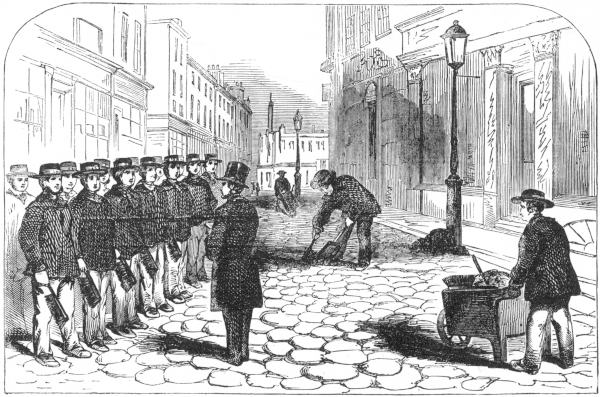
The Street-Orderly system forms part of the
operations on behalf of the poor adopted by a
society, of which Mr. Charles Cochrane is the
president, entitled the “National Philanthropic
Association,” which is said to have for its object
“the promotion of social and salutiferous improvements,
street cleanliness, and the employment of
the poor, so that able-bodied men may be prevented
from burthening the parish-rate, and preserved
independent of workhouse, alms, and
degradation.” Here a twofold object is expressed:
the Philanthropic Association seeks not
only to benefit the poor by giving them employment,
and “preserving them independent of workhouse,
alms, and degradation,” but to benefit the
public likewise, by “promoting social and salutiferous
improvements and street cleanliness.” I
shall deal with each of these objects separately;
but first let me declare, so as to remove all suspicion
of private feelings tending in any way to
bias my judgment in this most important matter,
that I am an utter stranger to the President and
Council of the Philanthropic Association; and
that, whatever I may have to say on the subject
of the street-orderlies, I do simply in conformity
with my duty to the public—to state truthfully all
that concerns the labourers and the poor of the
metropolis.
Viewed economically, philanthropic and pauper
work may be said to be the regulators of the
minimum rate of wages—establishing the lowest
point to which competition can possibly drive
down the remuneration for labour; for it is evident,
that if the self-supporting labourer cannot
obtain greater comforts by the independent exercise
of his industry than the parish rates or private
charity will afford him, he will at once give over
working for the trading employer, and declare on
the funds raised by assessment or voluntary subscription
for his support. Hence, those who wish
well to the labourer, and who believe that cheapness
of commodities is desirable “only,” as Mr.
Stewart Mill says (p. 502, vol. ii.), “when the
cause of it is, that their production costs little
labour, and not when occasioned by that labour’s
being ill-remunerated;” and who believe, moreover,
that the labourer is to be benefited solely
by the cultivation of a high standard of comfort
among the people—to such, I say, it
is evident, that a poor law which reduces the
relief to able-bodied labourers to the smallest
modicum of food consistent with the continuation
of life must be about the greatest
curse that can possibly come upon an over-populated
country, admitting, as it does, of the reduction
of wages to so low a point of mere brutal existence
as to induce that recklessness and
improvidence among the poor which is known to
give so strong an impetus to the increase of the
people. A minimized rate of parish relief is
necessarily a minimized rate of wages, and admits
of the labourers’ pay being reduced, by pauper
competition, to little short of starvation; and
such, doubtlessly, would have been the case long
ago in the scavaging trade by the employment of
parish labour, had not the Philanthropic Association
instituted the system of street-orderlies, and
by the payment of a higher rate of wages than
the more grinding parishes afforded—by giving
the men 12s. instead of 9s. or even 7s. a week—prevented
the remuneration of the regular hands
being dragged down to an approximation to the
parish level. Hence, rightly viewed, philanthropic
labour—and, indeed, pauper labour too—comes
under the head of a remedy for low wages, as
preventing, if properly regulated, the undue depreciation
of industry from excessive competition, and
it is in this light that I shall now proceed to consider
it.
The several plans that have been propounded
from time to time, as remedies for an insufficient
rate of remuneration for work, are as multifarious
as the circumstances influencing the three requisites
for production—labour, capital, and land. I
will here run over as briefly as possible—abstaining
from the expression of all opinion on the subject—the
various schemes which have been proposed
with this object, so that the reader may come as
prepared as possible to the consideration of the
matter.
The remedies for low wages may be arranged
into two distinct groups, viz., those which seek to
increase the labourer’s rate of pay directly, and
those which seek to do so indirectly.
The direct remedies for low wages that have
been propounded are:—
A. The establishment of a standard rate of remuneration
for labour. This has been proposed
to be brought about by three different
means, viz.:—
1. By law or government authority; either
(a) fixing the minimum rate of wages, and
leaving the variations above that point to
be adjusted by competition (this, as we
have seen, is the effect of the poor-law);
or, (b) settling the rate of wages generally
by means of local boards of trade for
conseils de prud’hommes, consisting of
delegates from the workmen and employers,
to determine, by the principles of
natural equity, a reasonable scale of remuneration
in the several trades, their decision
being binding in law on both the
employers and the employed.
2. By public opinion; this has been generally
proposed by those who are what Mr.
Mill terms “shy of admitting the interference
of authority in contracts for
labour,” fearing that if the law intervened
it would do so rashly and ignorantly, and
desiring to compass by moral sanction
what they consider useless or dangerous to
attempt to bring about by legal means.
“Every employer,” says Mr. Mill, “they
think, ought to give sufficient wages,” and
if he does not give such wages willingly,
he should be compelled to do so by public
opinion.
3. By trade societies or combination among
the workmen; that is to say, by the payment
of a small sum per week out of the
wages of the workmen, towards the formation
of a fund for the support of such of
their fellow operatives as may be out of
employment, or refuse to work for those
employers who seek to give less than the
standard rate of wages established by the
trade.
B. The prohibition of stoppages or deductions
of all kinds from the nominal wages of
workmen. This is principally the object of
the Anti-Truck Society, which seeks to
obtain an Act of Parliament, enjoining the
payment in full of all wages. The stoppages
or extortions from workmen’s wages generally
consist of:—
1. Fines for real or pretended misconduct.
2. Rents for tools, frames, gas, and sometimes
lodgings.
3. Sale of trade appliances (as trimmings,
thread, &c.) at undue prices.
4. Sale of food, drink, &c., at an exorbitant
rate of profit.
5. Payment in public-houses; as the means
of inducing the men to spend a portion of
their earnings in drink.
6. Deposit of money as security before taking
out work; so that the capital of the employer
is increased without payment of
interest to the workpeople.
C. The institution of certain aids or additions
to wages; as—
1. Perquisites or gratuities obtained from the
public; as with waiters, boxkeepers, coachmen,
dustmen, vergers, and others.
2. Beer money, and other “allowances” to
workmen.
3. Family work; or the co-operation of the
wife and children as a means of increasing
the workman’s income.
4. Allotments of land, to be cultivated after
the regular day’s labour.
5. The parish “allowance system,” or relief
in aid of wages, as practised under the old
Poor Law.
D. The increase of the money value of wages;
by—
1. Cheap food.
2. Cheap lodgings; through building improved
dwellings for the poor, and doing
away with the profit of sub-letting.
3. Co-operative stores; or the “club system”
of obtaining provisions at wholesale prices.
4. The abolition of the payment of wages on
Sunday morning, or at so late an hour on
the Saturday night as to prevent the
labourer availing himself of the Saturday’s
market.
5. Teetotalism; as causing the men to spend
nothing in fermented drinks, and so leaving
them more to spend on food.
Such are the direct modes of remedying low
wages, viz., either by preventing the price of
labour itself falling below a certain standard;
prohibiting all stoppages from the pay of the labourer;
instituting certain aids or additions to
such pay; or increasing the money value of the
ordinary wages by reducing the price of provisions.
The indirect modes of remedying low wages are
of a far more complex character. They consist of,
first, the remedies propounded by political economists,
which are—
A. The decrease of the number of labourers;
for gaining this end several plans have been
proposed, as—
1. Checks against the increase of the population,
for which the following are the chief
Malthusian proposals:—
a. Preventive checks for the hindrance of
impregnation.
b. Prohibition of early marriages among
the poor.
c. Increase of the standard of comfort, or
requirements, among the people; as a
means of inducing prudence and restraint
of the passions.
d. Infanticide; as among the Chinese.
2. Emigration; as a means of draining off the
surplus labourers.
3. Limitation of apprentices in skilled trades;
as a means of preventing the undue increase
of particular occupations. This,
however, is advocated not by economists,
but generally by operatives.
4. Prevention of family work; or the discouragement
of the labour of the wives and
children of operatives. This, again, cannot
be said to be an “economist” remedy.
B. Increase of the circulating capital, or sum
set aside for the payment of the labourers.
1. By government imposts. “Governments,”
says Mr. Mill, “can create additional industry
by creating capital. They may lay
on taxes, and employ the amount productively.”
This was the object of the
original Poor Law (43 Eliz.), which empowered
the overseers of the poor to
“raise weekly, or otherwise, by taxation
of every inhabitant, &c., such sums of
money as they shall require for providing
a sufficient stock of flax, hemp, wool, and
other ware or stuff, to set the poor on work.”
2. By the issue of paper money. The proposition
of Mr. Jonathan Duncan is, that
the government should issue notes equivalent
to the taxation of the country, with
the view of affording increased employment
to the poor; the people being set to work
as it were upon credit, in the same manner
as the labourers were employed to build
the market-house at Guernsey.
C. The extension of the markets of the country;
by the abolition of all restrictions on commerce,
and the encouragement of the free
interchange of commodities, so that, by increasing
the demand for our products, we
may be able to afford employment to an
extra number of producers.
The above constitute what, with a few exceptions,
may be termed, more particularly, the “economist”
remedies for low wages.
D. The regulation of the quantity of work done
by each workman, or the prevention of the
undue economizing of labour. For this end,
several means have been put forward.
1. The shortening the hours of labour, and
abolition of Sunday-work.
2. Alteration of the mode of work; as the
substitution of day-work for piece-work, as
a means of decreasing the stimulus to overwork.
3. Extension of the term of hiring; by the
substitution of annual engagements for
daily or weekly hirings, with a view to
the prevention of “casual labour.”
4. Limitation of the number of hands employed
by one capitalist; so as to prevent
the undue extension of “the large system
of production.”
5. Taxation of machinery; with the object,
not only of making it contribute its quota
to the revenue of the country, but of impeding
its undue increase.
6. The discountenance of every form of work
that tends to the making up of a greater
quantity of materials with a less quantity
of labour; and consequently to the expenditure
of a greater proportion of the capital
of the country on machinery or materials,
and a correspondingly less proportion on
the labourers.
E. “Protective imposts,” or high import duties
on such foreign commodities as can be produced
in this country; with the view of preventing
the labour of the comparatively
untaxed and uncivilized foreigner being
brought into competition with that of the
taxed and civilized producer at home.
F. “Financial reform,” or reduction of the
taxation of the country; as enabling the home
labourer the better to compete with the
foreigner.
The two latter proposals, and that of the extension
of the markets, may be said to seek to
remedy low wages by expanding or circumscribing
the foreign trade of the country.
G. A different division of the proceeds of
labour. For this object several schemes
have been propounded:—
1. The “tribute system” of wages; or payment
of labour according to the additional value
which it confers on the materials on which
it operates.
2. The abolition of the middleman; whether
“sweater,” “piece-master,” “lumper,” or
what not, coming between the employer
and employed.
3. Co-operation; or joint-stock associations of
labourers, with the view of abolishing the
profit of the capitalist employer.
H. A different mode of distributing the products
of labour; with the view of abolishing
the profit of the dealer, between the producer
and consumer—as co-operative stores, where
the consumers club together for the purchase
of their goods directly of the producers.
I. A more general and equal division of the
wealth of the country: for attaining this end
there are but two known means:—
1. Communism; or the abolition of all rights
to individual property.
2. Agapism; or the voluntary sharing of
individual possessions with the less fortunate
or successful members of the community.
These remedies may, with a few exceptions
(such as the tribute system of wages, and
the abolition of middlemen), be said to constitute
the socialist and communist schemes for the prevention
of distress.
J. Creating additional employment for the
poor; and so removing the surplus labour
from the market. Two modes of effecting
this have been proposed:—
1. Home colonization, or the cultivation of
waste lands by the poor.
2. Orderlyism, or the employment of the
poor in the promotion of public cleanliness,
and the increased sanitary condition of the
country.
K. The prevention of the enclosure of commons;
as the means of enabling the poor to
obtain gratuitous pasturage for their cattle.
L. The abolition of primogeniture; with the
view of dividing the land among a greater
number of individuals.
M. The holding of the land by the State, and
equal apportionment of it among the poor.
N. Extension of the suffrage among the people;
and so allowing the workman, as well as the
capitalist and the landlord, to take part in
the formation of the laws of the country.
For this purpose there are two plans:—
1. “The freehold-land movement,” which
seeks to enable the people to become proprietors
of as much land as will, under the
present law, give them “a voice” in the
country.
2. Chartism, or that which seeks to alter the
law concerning the election of members of
Parliament, and to confer the right of
voting on every male of mature age, sound
mind, and non-criminal character.
O. Cultivation of a higher moral and Christian
character among the people. This form
of remedy, which is advocated by many, is
based on the argument, that, without some
mitigation of the “selfishness of the times,” all
other schemes for improving the condition of
the people will be either evaded by the
cunning of the rich, or defeated by the
servility of the poor.
The above I believe to be a full and fair statement
of the several plans that have been proposed,
from time to time, for alleviating the distress of
the people. This enumeration is as comprehensive
as my knowledge will enable me to make it; and I
have abstained from all comment on the several
schemes, so that the reader may have an opportunity
of impartially weighing the merits of each,
and adopting that, which in his own mind, seems
best calculated to effect what, after all, we every
one desire—whether protectionist, economist, free-trader,
philanthropist, socialist, communist, or
chartist—the good of the country in which we
live, and the people by whom we are surrounded.
Now we have to deal here with that particular
remedy for low wages or distress which consists
in creating additional employment for the poor,
and of which the street-orderly system is an
example.
The increase of employment for the poor was
the main object of the 43 Eliz., for which purpose,
as we have seen, the overseers of the several
parishes were empowered to raise a fund by
assessments upon the property of the rich, for
providing “a sufficient stock of flax, hemp, wool,
and other ware or stuff, to set the poor on work.”
But though economists, to this day, tell us that
“while, on the one hand, industry is limited by
capital, so, on the other, every increase of capital
gives, or is capable of giving, additional employment
to industry, and this without assignable
limit,”[26] nevertheless the great difficulty of carrying
out the provisions of the original poor-law
has consisted in finding a market for the products
of pauper labour, for the frequent gluts in our
manufactures are sufficient to teach us that it is
one thing to produce and another to dispose of
the products; so that to create additional employment
for the poor something besides capital is
requisite: it is necessary either that they shall be
engaged in producing that which they themselves
immediately consume, or that for which the
market admits of being extended.
The two plans proposed for the employment of
the poor, it will be seen, consist (1) in the cultivation
of waste lands; (2) in promoting public
cleanliness, and so increasing the sanitary condition
of the country. The first, it is evident, removes
the objection of a market being needed for the
products of the labour of the poor, since it proposes
that their energies should be devoted to the
production of the food which they themselves
consume; while the second seeks to create additional
employment in effecting that increased
cleanliness which more enlightened physiological
views have not only made more desirable, but
taught us to be absolutely necessary to the health
and enjoyment of the community.
The great impediment, however, to the profitable
employment of the poor, has generally been
the unproductive or unavailing character of pauper
labour. This has been mainly owing to the fact
that the able-bodied who are deprived of employment
are necessarily the lowest grade of operatives;
for, in the displacement of workmen, those
are the first discarded whose labour is found to
be the least efficient, either from a deficiency of
skill, industry, or sobriety, so that pauper labour
is necessarily of the least productive character.
Another great difficulty with the employment
of the poor is, that the idle, or those to whom
work is more than usually irksome, require a
stronger inducement than ordinary to make them
labour, and the remuneration for parish work
being necessarily less than for any other, those
who are pauperized through idleness (the most
benevolent among us must allow there are such)
are naturally less than ever disposed to labour
when they become paupers. All pauper work,
therefore, is generally unproductive or unavailing,
because it is either inexpert or unwilling
work. The labour of the in-door paupers, who receive
only their food for their pains, is necessarily
of the same compulsory character as slavery;
while that of the out-door paupers, with the remuneration
often cut down to the lowest subsisting
point, is scarcely of a more willing or more
availing kind.
Owing to this general unproductiveness, (as well
as the difficulty of finding a field for the profitable
employment of the unemployed poor,) the labour
of paupers has been for a long time past directed
mainly to the cleansing of the public thoroughfares.
Still, from the degrading nature of the
occupation, and the small remuneration for the
toil, pauper labourers have been found to be such
unwilling workers that many parishes have long
since given over employing their poor even in
this capacity, preferring to entrust the work to a
contractor, with his paid self-supporting operatives,
instead.
The founder of the Philanthropic Association
appears to have been fully aware of the two great
difficulties besetting the profitable employment of
the poor, viz., (1) finding a field for the exercise
of their labours where they might be “set on work”
with benefit to the community, and without injury
to the independent operatives already engaged
in the same occupation; and (2) overcoming
the unwillingness, and consequently the unavailingness,
of pauper labour.
The first difficulty Mr. Cochrane has endeavoured
to obviate by taking advantage of that
growing desire for greater public cleanliness which
has arisen from the increased knowledge of the
principles governing the health of towns; and the
second, by giving the men 12s. instead of 9s. or
7s. a week, or worse than all, 1s. 1½d. and a
quartern loaf a day for three days in the week,
and so not only augmenting the stimulus to
work (for it should be remembered that wages
are to the human machine what the fire is to
the steam-engine), but preventing the undue
depreciation of the labour of the independent
workman. He who discovers the means of increasing
the rewards of labour, is as great a friend
to his race as he who strives to depreciate
them is the public enemy; and I do not hesitate
to confess, that I look upon Mr. Charles
Cochrane as one of the illustrious few who, in
these days of unremunerated toil, and their necessary
concomitants—beggars and thieves, has come
forward to help the labourers of this country
from their daily-increasing degradation. His
benevolence is of that enlightened order which
seeks to extend rather than destroy the self-trust
of the poor, not only by creating additional employment
for them, but by rendering that employment
less repulsive.
The means by which Mr. Cochrane has endeavoured
to gain these ends constitutes the system
called Street-Orderlyism, which therefore admits of
being viewed in two distinct aspects—first, as a
new mode of improving “the health of towns,”
and, secondly, as an improved method of employing
the poor.
Concerning the first, I must confess that the
system of scavaging or cleansing the public
thoroughfares pursued by the street-orderlies
assumes, when contemplated in a sanitary point
of view, all the importance and simplicity of a
great discovery. It has been before pointed out
that this system consists not only in cleansing
the streets, but in keeping them clean. By the
street-orderly method of scavaging, the thoroughfares
are continually being cleansed, and so never
allowed to become dirty; whereas, by the ordinary
method, they are not cleansed until they are
dirty. Hence the two modes of scavaging are
diametrically opposed; under the one the streets
are cleansed as fast as dirtied, while under the
other they are dirtied as fast as cleansed; so that
by the new system of scavaging the public thoroughfares
are maintained in a perpetual state of
cleanliness, whereas by the old they may be said
to be kept in a continual state of dirt.
The street-orderly system of scavaging, however,
is not only worthy of high commendation as a more
efficient means of gaining a particular end—a
simplification of a certain process—but it calls for
our highest praise as well for the end gained as
for the means of gaining it. If it be really a
sound physiological principle, that the Creator has
made dirt offensive to every rightly-constituted
mind, because it is injurious to us, and so established
in us an instinct, before we could discover
a reason, for removing all refuse from our presence,
it becomes, now that we have detected the cause
of the feeling in us, at once disgusting and irrational
to allow the filth to accumulate in our
streets in front of our houses. If typhus, cholera,
and other pestilences are but divine punishments
inflicted on us for the infraction of that most
kindly law by which the health of a people has
been made to depend on that which is naturally
agreeable—cleanliness, then our instinct for self-preservation
should force us, even if our sense of
enjoyment would not lead us, to remove as fast as
it is formed what is at once as dangerous as it
should be repulsive to our natures. Sanitarily
regarded, the cleansing of a town is one of the
most important objects that can engage the attention
of its governors; the removal of its refuse
being quite as necessary for the continuance of
the existence of a people as the supply of their
food. In the economy of Nature there is no loss:
this the great doctrine of waste and supply has
taught us; the detritus of one rock is the conglomerate
of another; the evaporation of the
ocean is the source of the river; the poisonous
exhalations of animals the vital air of plants; and
the refuse of man and beasts the food of their
food. The dust and cinders from our fires, the
“slops” from the washing of our houses, the excretions
of our bodies, the detritus and “surface-water”
of our streets, have all their offices to
perform in the great scheme of creation; and if
left to rot and fust about us not only injure our
health, but diminish the supplies of our food. The
filth of the thoroughfares of the metropolis forms,
it would appear, the staple manure of the market-gardens
in the suburbs; out of the London mud
come the London cabbages: so that an improvement
in the scavaging of the metropolis tends not
only to give the people improved health, but improved
vegetables; for that which is nothing but
a pestiferous muck-heap in the town becomes a
vivifying garden translated to the country.
Dirt, however, is not only as prejudicial to our
health and offensive to our senses, when allowed to
accumulate in our streets, as it is beneficial to us
when removed to our gardens,—but it is a most
expensive commodity to keep in front of our
houses. It has been shown, that the cost to the
people of London, in the matter of extra washing
induced by defective scavaging, is at the least
1,000,000l. sterling per annum (the Board of
Health estimate it at 2,500,000l.); and the loss
from extra wear and tear of clothes from brushing
and scrubbing, arising from the like cause, is about
the same prodigious sum; while the injury done
to the furniture of private houses, and the goods
exposed for sale in shops, though impossible to be
estimated—appears to be something enormous: so
that the loss from the defective scavaging of the
metropolis seems, at the lowest calculation, to
amount to several millions per annum; and hence
it becomes of the highest possible importance,
economically as well as physiologically, that the
streets should be cleansed in the most effective
manner.
Now, that the street-orderly system is the only
rational and efficacious mode of street cleansing
both theory and practice assure us. To allow the
filth to accumulate in the streets before any steps
are taken to remove it, is the same as if we were
never to wash our bodies until they were dirty—it
is to be perpetually striving to cure the disease,
when with scarcely any more trouble we might
prevent it entirely. There is, indeed, the same
difference between the new and the old system of
scavaging, as there is between a bad and a good
housewife: the one never cleaning her house until
it is dirty, and the other continually cleaning it,
so as to prevent it being ever dirty.
Hence it would appear, that the street-orderly
system of scavaging would be a great public
benefit, even were there no other object connected
with it than the increased cleanliness of our
streets; but in a country like Great Britain,
afflicted as it is with a surplus population (no
matter from what cause), that each day finds the
difficulty of obtaining work growing greater, the
opening up of new fields of employment for the
poor is perhaps the greatest benefit that can be
conferred upon the nation. Without the discovery
of such new fields, “the setting the poor
on work” is merely, as I have said, to throw out
of employment those who are already employed;
it is not to decrease, but really to increase, the
evil of the times—to add to, rather than diminish,
the number of our paupers or our thieves. The
increase of employment in a nation, however, requires,
not only a corresponding increase of
capital, but a like increase in the demand or
desire, as well as in the pecuniary means, of the
people to avail themselves of the work on which
the poor are set (that is to say, in the extension of
the home market); it requires, also, some mode of
stimulating the energies of the workers, so as to
make them labour more willingly, and consequently
more availingly, than usual. These conditions
appear to have been fulfilled by Mr. Cochrane, in
the establishment of the street-orderlies. He has
introduced, in connection with this body, a system
of scavaging which, while it employs a greater
number of hands, produces such additional benefits
as cannot but be considered an equivalent for
the increased expenditure; though it is even
doubtful whether, by the collection of the street
manure unmixed with the mud, the extra
value of that article alone will not go far to compensate
for the additional expense; if, however,
there be added to this the saving to the metropolitan
parishes in the cost of watering the streets—for
under the street-orderly system this is not required,
the dust never being allowed to accumulate,
and consequently never requiring to be “laid”—as
well as the greater saving of converting the
paupers into self-supporting labourers; together
with the diminished expense of washing and
doctors’ bills, consequent on the increased cleanliness
of the streets—there cannot be the least doubt
that the employment of the poor as street-orderlies
is no longer a matter of philanthropy,
but of mere commercial prudence.
Such appear to me to be the principal objects
of Mr. Cochrane’s street-orderly system of scavaging;
and it is a subject upon which I have spoken
the more freely, because, being unacquainted with
that gentleman, none can suspect me of being prejudiced
in his favour, and because I have felt that
the good which he has done and is likely to do
to the poor, has been comparatively unacknowledged
by the public, and that society and the
people owe him a heavy debt of gratitude[27].
I shall now proceed to set forth the character of
the labour, and the condition and remuneration of
the labourers in connection with the street-orderly
system of scavaging the metropolitan thoroughfares.
The first appearance of the street-orderlies in
the metropolis was in 1843. Mr. Charles Cochrane,
who had previously formed the National Philanthropic
Association, with its eleemosynary soup-kitchens,
&c., then introduced the system of street-orderlies,
as one enabling many destitute men to
support themselves by their labour; as well as,
in his estimation, a better, and eventually a more
economical, mode of street-cleansing, and partaking
also somewhat of the character of a street police.
The first “demonstration,” or display of the
street-orderly system, took place in Regent-street,
between the Quadrant and the Regent-circus, and
in Oxford-street, between Vere-street and Charles-street.
The streets were thoroughly swept in
the morning, and then each man or boy, provided
with a hand-broom and dust-pan, removed any dirt
as soon as it was deposited. The demonstration
was pronounced highly successful and the system
effective, in the opinion of eighteen influential
inhabitants of the locality who acted as a committee,
and who publicly, and with the authority
of their names, testified their conviction that “the
most efficient means of keeping streets clean, and
more especially great thoroughfares, was to prevent
the accumulation of dirt, by removing the
manure within a few minutes after it has been
deposited by the passing cattle; the same having,
hitherto, remained during several days.”
The cost of this demonstration amounted to
about 400l., of which, the Report states, “200l.
still remains due from the shop-keepers to the
Association; which,” it is delicately added, “from
late commercial difficulties they have not yet
repaid” (in 1850).
Whilst the street-orderlies were engaged in cleansing
Regent-street, &c., the City Commissioners of
the sewers of London were invited to depute some
person to observe and report to them concerning
the method pursued; but with that instinctive sort
of repugnance which seems to animate the great
bulk of city officials against improvement of any
kind, the reply was, that they “did not consider
the same worthy their attention.” The matter,
however, was not allowed to drop, and by the
persevering efforts of Mr. Cochrane, the president,
and of the body of gentlemen who form the Council
of the Association, Cheapside, Cornhill, and the most
important parts of the very heart of the city were at
length cleansed according to the new method. The
ratepayers then showed that they, at least, did
consider “the same worthy of attention,” for 8000
out of 12,000 within a few days signed memorials
recommending the adoption of what they pronounced
an improvement, and a public meeting
was held in Guildhall (May 4, 1846), at which
resolutions in favour of the street-orderly method
were passed. The authorities did not adopt these
recommendations, but they ventured so far to depart
from their venerable routine as to order the
streets to be “swept every day!” This employed
upwards of 300 men, whereas at the period when
the sages of the city sewers did not consider any
proposed improvement in scavagery worthy their
attention, the number of men employed by them
in cleansing the streets did not exceed 30.
The street-orderly system was afterwards tried
in the parishes of St. Paul, Covent-garden, St.
James (Westminster), St. Martin-in-the-Fields,
St. Anne, Soho, and others—sometimes calling forth
opposition, of course from the authorities connected
with the established modes of paving,
scavaging, &c.
It is not my intention to write a complete history
of the street-orderlies, but merely to sketch
their progress, as well as describe their peculiar
characteristics.
Within these few months public meetings
have been held in almost every one of the 26
wards of the City, at which approving resolutions
were either passed unanimously or carried by large
majorities; and the street-orderly system is now
about to be introduced into St. Martin’s parish
instead of the street-sweeping machine.
As far as the street-orderly system has been
tried, and judging only by the testimony of public
examination and public record of opinion, the trial
has certainly been a success. A memorial to the
Court of Sewers, from the ward of Broad-street,
supported by the leading merchants of that locality,
in recommendation of the employment of street-orderlies,
seems to bear more closely on the subject
than any I have yet seen.
“Your memorialists,” they state, “have observed
that those public thoroughfares within the
city of London which are now cleansed by street-orderlies,
are so remarkably clean as to be almost
free from mud in wet, and dust in dry weather—that
such extreme cleanliness is of great comfort to
the public, and tends to improve the sanitary condition
of the ward.”
But it is not only in the metropolis that the
street-orderlies seem likely to become the established
scavagers. The streets of Windsor, I am
informed, are now in the course of being cleansed
upon the orderly plan. In Amsterdam, there are
at present 16 orderlies regularly employed upon
scavaging a portion of the city, and in Paris and
Belgium, I am assured, arrangements are being
made for the introduction of the system into both
those cities. Were the street-orderly mode of
scavaging to become general throughout this
country, it is estimated that employment would be
given to 100,000 labourers, so that, with the
families of these men, not less than half a million
of people would be supported in a state of independence
by it. The total number of adult able-bodied
paupers relieved—in-door and out-door—throughout
England and Wales, on January 1,
1850, was 154,525.
The following table shows the route of the street-orderly
operations in the metropolis. A further
column, in the Report from which the table has been
extracted, contained the names of thirteen clergymen
who have “weekly read prayers and delivered
discourses to the street-orderlies at their respective
stations, and recorded flattering testimonials of
their conduct and demeanour.”
| Localities Cleansed. | No. of Street-Orderlies. | Wives and Children dependent. | Money expended. |
|---|
| | | £ | s. | d. |
| 1843-4. | Oxford and Regent Streets | 50 | 256 | 560 | 0 | 0 |
| 1845. | Strand | 8 | — | 38 | 0 | 0 |
| 1845-6. | Cheapside, Cornhill, &c., City of London | 100 | 363 | 1540 | 2 | 0 |
| 1846-7. | St. Margaret’s and St. John’s, Westminster | 15 | 65 | 306 | 0 | 0 |
| 1847. | Piccadilly, St. James’s, &c. | 8 | 32 | 115 | 0 | 0 |
| 1848. | Strand | 8 | 31 | 35 | 0 | 0 |
| 1848. | St. Martin’s Lane, &c. | 38 | 138 | 153 | 0 | 0 |
| 1848. | Piccadilly, St. James’s, &c. | 48 | 108 | 341 | 3 | 0 |
| 1848-9. | St. Paul’s, Covent Garden | 13 | 38 | 38 | 10 | 0 |
| 1849. | Regent Street, Whitehall, &c. | 18 | 68 | 98 | 0 | 0 |
| 1849. | St. Giles’s and St. George’s, Bloomsbury | 14 | 71 | 58 | 1 | 0 |
| 1849. | St. Pancras, New Road, &c. | 16 | 46 | 177 | 6 | 0 |
| 1849. | St. Andrew’s and St. George’s, Holborn | 23 | 83 | 63 | 4 | 9 |
| 1849. | Lambeth Parish | 16 | 41 | 84 | 16 | 0 |
| 1851. | St. Martin’s-in-the-Fields | 68 | 179 | 119 | 3 | 4 |
| 1851. | City of London, Central Districts (per week, during 6 weeks last past) | 103 | 378 | 55 | 0 | 0 |
| Total | 546 | 1897 | 3782 | 6 | 1 |
The period of nine years comprised in the above
statement (1843 and 1851 being both included)
gives a yearly average, as to the number of the
poor employed, exceeding 60, with a similar average
of 210 wives and children, and a yearly average
outlay of 420l. The number of orderlies now
employed by the Association is from 80 to 90.
Such, then, is a brief account of the rise and
progress of this new mode of street-sweeping, and
we now come to a description of the work itself.
“The orderlies,” says the Report of the Association,
“keep the streets free from mud in
winter, and dust in summer; and that with the
least possible personal drudgery:—adhering to the
principle of operation laid down, viz., that of
‘Cleansing and keeping Clean,’ they have merely,
after each morning’s sweeping and removal of dirt,
to keep a vigilant look-out over the surface of street
allotted to them; and to remove with the hand-brush
and dust-pan, from any particular spot,
whatever dirt or rubbish may fall upon it, at the
moment of its deposit. Thus are the streets under
their care kept constantly clean.
“But sweeping and removing dirt,” continues
the Report, “is not the only occupation
of the street-orderly, whilst keeping up a careful
inspection of the ground allotted to him. He
is also the watchman of house-property and
shop-goods; the guardian of reticules, pocket-books,
purses, and watch-pockets;—the experienced
observer and detector of pickpockets;
the ever ready, though unpaid, auxiliary to the
police constable. Nay, more;—he is always at
hand, to render assistance to both equestrian and
pedestrian: if a horse slip, stumble, or fall,—if
a carriage break down, or vehicles come into collision,—the
street-orderly darts forward to raise
and rectify them: if foot-passengers be run over,
or knocked down, or incautiously loiter on a crossing,
the street-orderly rescues them from peril or
death; or warns them of the approaching danger
of carriages driving in opposite directions: if other
accidents befall pedestrians,—if they fall on the
pavement, from sudden illness, faintness, or apoplexy,
the street-orderly is at hand to render
assistance, or convey them to the nearest surgery
or hospital. If strangers are at fault as to the
localities of London, or the place of their destination,
the orderly, in a civil and respectful manner,
directs them on their way. If habitual or professional
mendicants are importunate or troublesome,
the street-orderly warns them off; or hands
them to the care of the policeman. And if a
really poor or starving fellow-creature wanders in
search of food or alms, he leads him to a workhouse
or soup-kitchen[28].
“Should the system become general (of which
there is now every good prospect), it will be the
means of rescuing no less than TEN THOUSAND
PERSONS and their families from destitution and
distress (in London alone);—from the forlorn
and wretched condition which tempts to criminality
and outrage, to that of comfort, independence,
and happiness—produced by their own industry,
aided by the kind consideration of those
who are more the favourites of fortune than
themselves.
“In conclusion it may be stated, that the
street-orderly system will keep the streets and
pavements of London and Westminster as clean
as the court-yard and hall of any gentleman’s
private dwelling: it will not only secure the
general comfort and health of upwards of two
millions of people, but save a vast annual amount
to shopkeepers, housekeepers, and others, with
regard to the spoiling of their goods by dust and
dirt; in the wear and tear of clothes and furniture,
by an eternal round of brushing, dusting,
scouring, and scrubbing.”
The foregoing extract fully indicates the system
pursued and results of street-orderlyism. I will
now deal with what may be considered the labour
or trade part of the question.
By the street-orderly plan a district is duly
apportioned. To one man is assigned the care of
a series of courts, a street, or 500, 1000, 1200,
1500, or 2000 yards of a public way, according
to its traffic, after the whole surface has been
swept “the first thing in the morning.” In
Oxford-street, for instance, it has been estimated
that 500 yards can be kept clear of the dirt continually
being deposited by one man; in the
squares, where there is no great traffic, 2000 yards;
while in so busy a part as Cheapside, some nine
men will be required to be hourly on the look-out.
These street-orderlies are confined to their beats as
strictly as are policeman, and as they soon become
known to the inhabitants, it is a means of checking
any disposition to loiter, or to shirk the work;
to say nothing of the corps of inspectors and superintendents.
The division of labour among the street-orderlies
is as follows:—
1. The foreman, whose duty is to “look over
the men” (one such over-looker being employed to
about every 20 men), and who receives 15s. per week.
2. The barrow-men, or sweepers, consisting of
men and boys; the former receiving 12s. and the
latter generally 7s. per week.
The tools and implements used, and their cost,
are as follows:—wooden scoops, to throw up the
slop, 1s. 2d. each (they used to be made of iron,
weighing 8 lbs. each, but the men then complained
that the weight “broke their arms”); shovel,
2s. 3d.; hoe and scraper, 1s. 3d.; hand-broom,
8d.; scavager’s broom, 1s. 2d.; barrow, 12s.;
covered barrow, 24s.
In the amount of his receipts, the street-orderly
appears to a disadvantage, as many of
the “regular hands” of the contractors receive
16s. weekly, and he but 12s. The reason
for this circumscribed payment I have already
alluded to—the deficiency of funds to carry out
the full purposes of the Association. Contrasted
with the remuneration of the great majority of
the pauper scavagers, the street-orderly is in a
state of comparative comfort, for he receives nearly
double as much as the Guardians of the Poor of
Chelsea and the Liberty of the Rolls pay their
labourers, and full 25 per cent. more than is paid by
Bermondsey, Deptford, Marylebone, St. James’s,
Westminster, St. George’s, Hanover-square, and
St. Andrew’s, Holborn; and, I am assured, it is
the intention of the Council to pay the full rate of
wages given by the more respectable scavagers,
viz., 16s. a week each man. If traders can do
this, philanthropists, who require no profit, at
least should be equally liberal. The labourer
never can be benefited by depreciating the ordinary
wages of his trade; and I must in justice confess,
that there are scattered throughout the Report
repeated regrets that the funds of the Association
will not admit of a higher rate of wages being paid.
The street-orderly is not subjected to any fines
or drawbacks, and is paid always in money, every
Saturday evening at the office of the Association.
In this respect, however, he does not differ from
other bodies of scavagers.
The usual mode of obtaining employment among
the street-orderlies is by personal application at
the office of the Association in Leicester-square;
but sometimes letters, well-penned and well-worded,
are addressed to the president.
The daily number of applicants for employment
is far from demonstrative of that unbroken prosperity
of the country, of which we hear so much.
On my inquiring into the number, I ascertained
towards the end of August, that, for the previous
fortnight, during fine summer weather, London
being still full of the visitors to the Exhibition,
on an average 30 men, of nearly all conditions
of life, applied personally each day for work at
street-sweeping, at 12s. a week. Certainly this
labour is not connected with the feeling of pauper
degradation, but it does not look well for the country
that in twelve days 360 men should apply for such
work. On the year’s average, I am assured,
there are 30 applications daily, but only ten new
applicants, as men call to solicit an engagement
again and again. Thus in the year there are
nine thousand, three hundred, and ninety applications,
and 3130 individual applicants. In
the course of one month last winter, there were
applications from 300 boys in Spitalfields alone,
to be set to work; and I am told, that had
they been successful, 3000 lads would have applied
the next month.
When an application is made by any one recommended
by subscribers, &c., to the Association,
or where the case seems worthy of attention, the
names and addresses are entered in a book, with
a slight sketch of the circumstances of the person
wishing to become a street-orderly, so that inquiries
may be made. I give a few of the more recent
of these entries and descriptions, which are really
“histories in little”:—
“Thomas M’G——, aged 50, W— L— street,
Chelsea Hospital, single man. Taught a French
and English school in Lyons, France. Driven out
of France at the Revolution of 1848. Penniless.
“Rich. M——, 13, C—— street, H—— garden,
42 years. Married. Can read and write. Has
been a seaman in the royal service ten years.
Chairmaker by trade. Has jobbed as a porter in
Rochester, Kent.
“Phil. S——, 1, R— L— street, High Holborn.
From Killarney, co. Kerry. Bred a
gardener. Fifteen years in constabulary force,
for which he has a character from Col. Macgregor,
and received the compensation of 50l., which he
bestowed on his father and mother to keep them
at home. Nine months in England, viz., in
Bristol, Bath, and London. Aged 35. Can read
and write.
“Edw. C——, 79, M—— street, Hackney.
Aged 27. Married. Army-pensioner, 6d. a day.
Can read and write. Recommended by Rev. T.
Gibson, rector of Hackney.
“Chas. J——, 11, D—— street, Chelsea.
Aged 38. Gentleman’s servant.”
In my account of the “regular hands” employed
by the contracting scavagers, I have stated
that the street-orderlies were a more miscellaneous
body, as they had not been reared in the same
proportion to street work. They are also, I may
add, a better-conducted and better-informed class
than the general run of unskilled labourers, as
they know, before applying for street-orderly
work, that inquiries are made concerning them,
and that men of reprobate character will not be
employed.
Many of those employed as orderlies have
since returned to their original employments;
others have procured, and been recommended to,
superior situations in life to that of street-orderlies,
by the Council of the Association, but
no instance has occurred of any street-orderly
having returned back to his parish workhouse
or stoneyard. This certainly looks well.
One street-orderly, I may add, is now a reputable
school-master, and has been so for some
time; another is a clerk under similar circumstances.
Another is a good theoretical and practical
musician, having officiated as organist in
churches and at concerts; he is also a neat music
copyist. Another tells of his correspondence with
a bishop on theological topics. Another, with a
long and well-cultured beard, has been a model
for artists. One had 150l. left to him not long
ago, which was soon spent; his wife spent it, he
said, and then he quietly applied to be permitted
to be again a street-orderly. Several have got
engagements as seamen, their original calling—indeed,
I am assured, that a few months of street-orderly
labour is looked upon as an excellent
ordeal of character, after which the Association
affirms good behaviour on the part of the employed.
The subscribers to the funds not unfrequently
recommend destitute persons to the good offices of
the Association, apart from their employment as
street-orderlies. Thus, it is only a few weeks
ago, that twelve Spanish refugees, none of them
speaking English, were recommended to the Association;
one of them it was ultimately enabled to
establish as a waiter in an hotel resorted to by
foreigners, another as an interpreter, another as a
gentleman’s servant, and another (with a little
boy, his son) in shoe-blacking in Leicester-square.
Thus among street-orderlies are to be found a
great diversity of career in life, and what may be
called adventures.
One great advantage, however, which the orderly
possesses over his better paid brethren is in the
greater probability of his “rising out of the
street.” This is very rarely the case with an
ordinary scavager.
I now give the following account from one of
the street-orderlies, a tall, soldierly-looking man:—
“I’m 42 now,” he said, “and when I was a
boy and a young man I was employed in the
Times machine office, but got into a bit of a row—a
bit of a street quarrel and frolic, and was
called on to pay 3l., something about a street-lamp:
that was out of the question; and as I was
taking a walk in the park, not just knowing what
I’d best do, I met a recruiting sergeant, and enlisted
on a sudden—all on a sudden—in the 16th
Lancers. When I came to the standard, though,
I was found a little bit too short. Well, I was
rather frolicsome in those days, I confess, and
perhaps had rather a turn for a roving life, so
when the sergeant said he’d take me to the East
India Company’s recruiting sergeant, I consented,
and was accepted at once. I was taken to Calcutta,
and served under General Nott all through
the Affghan war. I was in the East India Company’s
artillery, 4th company and 2nd battalion.
Why, yes, sir, I saw a little of what you may call
‘service.’ I was at the fighting at Candahar,
Bowlinglen, Bowling-pass, Clatigillsy, Ghuznee,
and Caboul. The first real warm work I was in
was at Candahar. I’ve heard young soldiers say
that they’ve gone into action the first time as
merry as they would go to a play. Don’t believe
them, sir. Old soldiers will tell you quite different.
You must feel queer and serious the first
time you’re in action: it’s not fear—it’s nervousness.
The crack of the muskets at the first
fire you hear in real hard earnest is uncommon
startling; you see the flash of the fire from the
enemy’s line, but very little else. Indeed, oft
enough you see nothing but smoke, and hear nothing
but balls whistling every side of you. And
then you get excited, just as if you were at a
hunt; but after a little service—I can speak for
myself, at any rate—you go into action as you
go to your dinner.
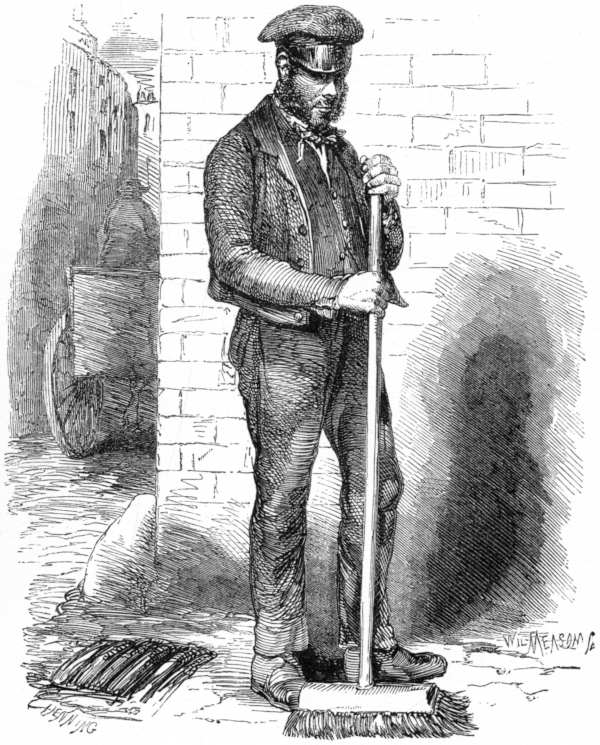
THE ABLE-BODIED PAUPER STREET-SWEEPER.
[From a Daguerreotype by Beard.]
“I served during the time when there was the
Affghanistan retreat; when the 44th was completely
cut up, before any help could get up to
them. We suffered a good deal from want of
sufficient food; but it was nothing like so bad, at
the very worst, as if you’re suffering in London.
In India, in that war time, if you suffered, you
were along with a number in just the same boat
as yourself; and there’s always something to
hope for when you’re an army. It’s different
if you’re walking the streets of London by yourself—I
felt it, sir, for a little bit after my return—and
if you haven’t a penny, you feel as if there
wasn’t a hope. If you have friends it may be
different, but I had none. It’s no comfort if
you know hundreds are suffering as you are, for
you can’t help and cheer one another as soldiers
can.
“Well, sir, as I’ve told you, I saw a good deal
of service all through that war. Indeed I served
thirteen years and four months, and was then
discharged on account of ill health. If I’d served
eight months longer that would have been fourteen
years, and I should have been entitled to a pension.
I believe my illness was caused by the
hardships I went through in the campaigns, fighting
and killing men that I never saw before, and
until I was in India had never heard of, and that
I had no ill-will to; certainly not, why should I?
they never did me any wrong. But when it
comes to war, if you can’t kill them they’ll kill
you. When I got back to London I applied at
the East India House for a pension, but was
refused. I hadn’t served my time, though that
wasn’t my fault.
“I then applied for work in the Times machine
office, and they were kind enough to put me on.
But I wasn’t master of the work, for there was
new machinery, wonderful machinery, and a many
changes. So I couldn’t be kept on, and was
some time out of work, and very badly off, as
I’ve said before, and then I got work as a scavenger.
O, I knew nothing about sweeping before
that. I’d never swept anything except the snow
in the north of India, which is quite a different
sort of thing to London dirt. But I very soon
got into the way of it. I found no difficulty
about it, though some may pretend there is an
art in it. I had 15s. a week, and when I was
no longer wanted I got employment as a street-orderly.
I never was married, and have only
myself to provide for. I’m satisfied that the
street-orderly is far the best plan for street-cleaning.
Nothing else can touch it, in my opinion,
and I thought so before I was one of them, and
I believe most working scavengers think so now,
though they mayn’t like to say so, for fear it might
go again their interest.
“Oh, yes, I’m sometimes questioned by
gentlemen that may be passing in the streets
while I’m at work, all about our system. They
generally say, ‘and a very good system,
too.’ One said once, ‘It shows that scavengers
can be decent men; they weren’t when I was
first in London, above 40 years ago.’ Well, I
sometimes get the price of a pint of beer given to
me by gentlemen making inquiries, but very
seldom.”
Until about eighteen months ago none but unmarried
men were employed by the Association,
and these all resided in one locality, and under
one general superintendence or system. The
boarding and lodging of the men has, however,
been discontinued about fifteen months; for I am told
it was found difficult to encourage industrial and
self-reliant pursuits in connection with public eleemosynary
aid. Married men are now employed,
and all the street-orderlies reside at their own
homes; the adults, married or single, receiving
12s. a week each; the boys, 6s.; while to each
man is gratuitously supplied a blouse of blue
serge, costing 2s. 6d., and a glazed hat, costing
the same amount.
The system formerly adopted was as follows:—
The men were formed into a distinct body, and
established in houses taken for them in Ham-yard,
Great Windmill-street, Haymarket.
“The wages of the men,” states the Report,
“were fixed at 12s. each per week; that is, 9s.
were charged for board and lodging, and 3s. were
paid in money to each man on Saturday afternoon,
out of which he was expected to pay for his
clothing and washing. The men had provided
for them clean wholesome beds and bedding, a
common sitting-room, with every means of ablution
and personal cleanliness, including a warm
bath once a week. Their food was abundant and
of the best quality, viz., coffee and bread and
butter for breakfast, at eight o’clock; round of
beef, bread, and vegetables, four times a week for
dinner, at one o’clock; nutritious soup and bread,
or bread and cheese, forming the afternoon repast
of the other three days. At six in the evening,
when they returned from their labours, they were
refreshed with tea or coffee, and bread and butter;
or for supper, at nine, each had a large basin of
soup, with bread. Thus, three-fourths of their
wages being laid out for them to advantage, the
men were well lodged and fed; and they have
always declared themselves satisfied, comfortable,
and happy, under the arrangements that were
made for them. Under the charge of their intelligent
and active superintendent, the street-orderlies
soon fell into a state of the most exact discipline
and order; and when old orderlies were
drafted off, either to enter the service of parish
boards who adopted the system, or were recommended
into service, or some other superior
position in life, and when new recruits came to
supply their places, the latter found no difficulty
in conforming to the rules laid down for the
performance of their duties, as well as for
their general conduct. ‘Military time’ regulated
their hours of labour, refreshment, and rest; due
attention was required from all; and each man
(though a scavenger) was expected to be cleanly
in his person, and respectful in his demeanour;
indeed, nothing could be more gratifying than the
conduct of these men, both at home and abroad.”
“In their domicile in Ham Yard,” continues
the Report, “the street-orderlies have invariably
been encouraged to follow pursuits which were
useful and improving, after their daily labours
were at an end; for this, a small library of history,
voyages, travels, and instructive and entertaining
periodical works, was placed at their disposal; and
it is truly gratifying to the Council to be able to
state, that the men evinced great satisfaction, and
even avidity, in availing themselves of this source
of intellectual pleasure and improvement. Writing
materials also were provided for them, for the
purpose of practice and improvement, as well as
for mutual instruction in this most necessary and
useful art; and it must be gratifying to the
members of the Association to be informed, that,
in April last, 34 out of 40 men appended their
signatures, distinctly and well written, to a document
which was submitted to them. Such a fact
will at least prove, that when poor persons are employed,
well fed, and lodged, and cared for in the
way of instruction, they do not always mis-spend
their time, nor, from mere preference, run riot in
pot-houses and scenes of low debauchery. It is to
be borne in mind, however, that one-half of these
men were persons of almost every trade and occupation,
from the artizan to the shopman and clerk,
and therefore previously educated; the other half
consisted of labourers and persons forsaken and
indigent from their birth, and formerly dependent
on workhouse charity or chance employment for
their scanty subsistence; consequently in a state
of utter ignorance as to reading and writing.
“Every night, after supper, prayers were read
by the superintendent; and it has frequently been
a most edifying as well as gratifying sight to
members of your Council, as well as to other
persons of rank and station in society, who have
visited the Hospice in Ham Yard at that interesting
hour, to observe the decorum with which these
poor men demeaned themselves; and the heartfelt
solemnity with which they joined in the invocations
and thanks to their Creator and Preserver!
“Each Sunday morning, at 8 o’clock, a portion
of the church service was read, followed by an
extemporaneous discourse or exhortation by the
secretary to the Hospice. They were marshalled
to church twice on the Sabbath, headed by the
superintendent and foremen; and generally divided
into two or three bodies, each taking a direction
to St. James’s, St. Anne’s, or St. Paul’s, Covent
Garden; in all of which places of worship they
had sitting accommodation provided by the kindness
of the clergy and churchwardens. On Tuesday
evenings they had the benefit of receiving pastoral
visits and instruction from several of the worthy
clergymen of the surrounding parishes.”
This is all very benevolent, but still very
wrong. There is but one way of benefiting the
poor, viz., by developing their powers of self-reliance,
and certainly not in treating them like
children. Philanthropists always seek to do too
much, and in this is to be found the main cause of
their repeated failures. The poor are expected to
become angels in an instant, and the consequence
is, they are merely made hypocrites. Moreover,
no men of any independence of character will
submit to be washed, and dressed, and fed like
schoolboys; hence none but the worst classes
come to be experimented upon. It would seem,
too, that this overweening disposition to play
the part of ped-agogues (I use the word in its
literal sense) to the poor, proceeds rather from a
love of power than from a sincere regard for the
people. Let the rich become the advisers and
assistants of the poor, giving them the benefit of
their superior education and means—but leaving
the people to act for themselves—and they will do a
great good, developing in them a higher standard
of comfort and moral excellence, and so, by improving
their tastes, inducing a necessary change
in their habits. But such as seek merely to lord
it over those whom distress has placed in their
power, and strive to bring about the villeinage of
benevolence, making the people the philanthropic,
instead of the feudal, serfs of our nobles, should
be denounced as the arch-enemies of the country.
Such persons may mean well, but assuredly they
achieve the worst towards the poor. The curfew-bell,
whether instituted by benevolence or tyranny,
has the same degrading effect on the people—destroying
their principle of self-action, without
which we are all but as the beasts of the field.
Moreover, the laying out of the earnings of the
poor is sure, after a time, to sink into “a job;”
and I quote the above passage to show that, despite
the kindest management, eleemosynary help is not
a fitting adjunct to the industrial toil of independent
labourers.
The residences of the street-orderlies are now in
all quarters where unfurnished rooms are about
1s. 9d. or 2s. a week. The addresses I have cited
show them residing in the outskirts and the heart
of the metropolis. The following returns, however,
will indicate the ages, the previous occupations,
the education, church-going, the personal
habits, diet, rent, &c., of the class constituting the
street-orderlies, better than anything I can say
on the matter.
Before any man is employed as a street-orderly,
he is called upon to answer certain questions, and
the replies from 67 men to these questions supply
a fund of curious and important information—important
to all but those who account the lot of the
poor of no importance. In presenting these details,
I beg to express my obligations to Mr. Colin
Mackenzie, the enlightened and kindly secretary
of the Association.
I shall first show what is the order of the
questioning, then what were the answers, and I
shall afterwards recapitulate, with a few comments,
the salient characteristics of the whole.
The questions are after this fashion; the one I
adduce having been asked of a scavager to whom
a preference was given:—
The Parish of St. Mary, Paddington.—Questions
asked of Parish Scavagers, applying for
employment as Street-Orderlies, with the answers
appended.
Name?—W—— C——.
Age?—35 years.
How long a scavenger?—Three months.
What occupation previously?—Gentleman’s
footman.
Married or single?—Married.
Reading, writing, or other education?—Yes.
Any children?—One.
Their ages?—Three years.
Wages?—Nine shillings per week.
Any parish relief?—No.
What and how much food the applicants have
usually purchased in a week.
Meat?—2s. 6d.
Bacon?—None.
Fish?—None.
Bread?—-2s.
Potatoes?—4d.
Butter?—6d.
Tea and sugar?—1s.
Cocoa?—None.
What rent they pay?—2s.
Furnished or unfurnished lodgings?—Unfurnished.
Any change of dress?—No.
Sunday clothing?—No.
How many shirts?—Two shirts.
Boots and shoes?—One pair.
How much do they lay out for clothes in a
year?—I have nothing but what I stand upright in.
Do they go to church or chapel?—Sometimes.
If not, why not?—It is from want of clothes.
Do they ever bathe?—No.
Does the wife go out to, or take in work?—Yes.
What are her earnings?—Uncertain.
Do they have anything from charitable institutions
or families?—No.
When ill; where do they resort to?—Hospitals,
dispensaries, and the parish doctor.
Do their children go to any school; and what?—Paddington.
Do they ever save any money; how much, and
where?—
How much do they spend per week in drink?
Do not passers by, as charitable ladies, &c.,
give them money; and how much per week?—No.
Such, are the questions asked, and I now give
the answers of 67 individuals.
Their ages were:—
| 10 were | from | 20 to | 30 |
| 13 | „ | 30 „ | 40 |
| 24 | „ | 40 „ | 50 |
| 15 | „ | 50 to | 60 |
| 4 | „ | 60 „ | 70. |
| 1 | „ | 70 |
The greatest number of any age was 7 persons
of 45 years respectively.
Their previous occupations had been:—
22 labourers.
3 at the business “all their lives.”
3 dustmen.
3 ostlers.
2 stablemen.
2 carmen.
2 porters.
2 gentlemen’s servants.
2 greengrocers.
1 following dust-cart.
1 excavator.
1 gravel digging.
1 stone breaking in yards.
1 at work in the brick-fields.
1 at work in the lime-works.
1 coal porter.
1 sweep.
1 haybinder.
1 gaslighter.
1 dairyman.
1 ploughman.
1 gardener.
1 errand boy.
1 fur dresser.
1 fur dyer.
1 skinner.
1 leather-dresser.
1 letter-press printer.
1 paper stainer.
1 glass blower.
1 farrier.
1 plasterer.
1 clerk.
1 vendor of goods.
1 licensed victualler.
Therefore, of 67 scavagers
12 had been artizans.
55 „ unskilled workmen.
Hence about five-sixths belong to the unskilled
class of operatives.
Time of having been at scavagering.
3 “all their lives” at the business.
1 about 27 years.
6 from 15 to 20 years.
6 „ 10 „ 15 „
4 „ 5 „ 10 years.
34 „ 1 „ 5 „
13 twelve months and less.
Hence it would appear, that few have been at
the business a long time. The greater number
have not been acting as scavagers more than five
years.
State of education.—Could they read and write?
45 answered yes.
4 replied that they could read and write.
5 could read only.
12 could do neither.
1 was deaf and dumb.
Hence it would appear, that rather more than
two-thirds of the scavagers have received some
little education.
Did they go to church or chapel?
22 answered yes.
9 went to church.
4 „ chapel.
4 „ the Catholic chapel.
1 „ both church and chapel.
5 went sometimes.
1 not often.
17 never went at all.
1 was ashamed to go.
1 went out of town to enjoy himself.
2 made no return (1 being deaf and dumb).
Thus it would seem, that not quite two-thirds
regularly attend some place of worship;
that about one-eleventh go occasionally; and that
about one-fourth never go at all.
Why did they not go to church?
12 had no clothes.
55 returned no answer (1 being deaf and dumb).
Hence of those who never go (19 out of 67),
very nearly two-thirds (say 12 in 19) have no
clothes to appear in.
Did they bathe?
59 answered no.
3 replied yes.
2 said they did in the Thames.
2 returned “sometimes.”
1 was deaf and dumb.
Hence it appeared, that about seven-eighths
never bathe, although following the filthiest occupation.
Were they married or single?
56 were married.
5 „ widowers.
6 „ single.
Thus it would seem, that about ten-elevenths
are or have been married men.
How many children had they?
| 1 | had | 15. |
| 1 | „ | 6. |
| 2 | „ | 5 | each. |
| 11 | „ | 4 | „ |
| 19 | „ | 3 | „ |
| 9 | „ | 2 | „ |
| 6 | „ | 1 | each. |
| 16 | „ | none | (6 of these being single men). |
| 2 returned their family as grown up without stating the number. |
Consequently 51 out of 61, or five-sixths, are
married, and have families numbering altogether
165 children; the majority had only 3 children,
and this was about the average family.
What were the ages of their children?
11 were grown up.
2 between 30 and 40.
9 „ 20 and 30.
49 „ 10 and 20.
80 „ 1 and 10.
8 were 1 year and under.
5 were returned at home.
1 returned as dead.
One-half of the scavagers’ children, therefore, are
between 1 and 10 years of age; the majority
would appear to be 8 years old.
Some were said to be grown up, but no number
was given.
Did their children go to school?
13 answered yes.
13 to the National School.
5 to the Ragged School.
2 to Catholic.
2 to Parish.
6 to local schools.
1 replied that he went sometimes.
2 returned no.
1 replied that his children were “not with him.”
22 (of whom 16 had no children, and 1 was deaf and dumb) made no reply.
From this it would seem, that a large majority—41
out of 51, or four-fifths—of the parents who
have children send them to school.
Did their wives work?
15 returned no.
6 said their wives were “unable.”
1 had lost the use of her limbs.
2 did, but “not often.”
4 did “when they could.”
10 worked “sometimes.”
12 answered yes.
1 sold cresses.
15 made no return (11 having no wives and 1 being deaf and dumb).
Hence two-fifths of the wives (22 out of 56) do
no work, 16 do so occasionally, and 13, or one-fourth,
are in the habit of working.
What were wives’ earnings?
10 returned them as “uncertain.”
1 “didn’t know.”
1 estimated them at 1s. 6d. per week.
1 at 1s. to 2s. „
2 at 2s. „
3 at 2s. or 3s. „
2 at about 3s. „
1 at 2s. to 4s. „
1 at 3s. or 4s. „
1 at 3d. or 4d. per day.
43 gave no returns (having either no wives, or their wives not working).
1 was deaf and dumb.
So that, out of 29 wives who were said to
work, 16 occasionally and 13 regularly, there were
returns for 23. Nearly half of their earnings were
given as uncertain from their seldom doing work,
while the remainder were stated to gain from 1s.
to 4s. per week; about 2s. 6d. perhaps would be
a fair average.
What wages were they themselves in the habit of
receiving?
| 3 | had | 16s. 6d. | per week. |
| 2 | „ | 16s. | „ |
| 28 | „ | 15s. | „ |
| 3 | „ | 14s. 6d. | „ |
| 1 | „ | 14s. | „ |
| 2 | „ | 12s. | „ |
| 15 | „ | 9s. | „ |
| 4 | „ | 8s. | „ |
| 5 | „ | 7s. | „ |
| 4 | „ | 1s. 1½d. a day and 2 loaves. |
Hence it is evident, that one-half receive 15s.
or more a week, and about a fourth 9s.
It was not the parishes, however, but the contractors
with the parishes, who paid the higher
rates of wages: Mr. Dodd, for St. Luke’s; Mr.
Westley, for St. Botolph’s, Bishopsgate; Mr.
Parsons, for Whitechapel; Mr. Newman, for
Bethnal-green, &c.
These wages the scavagers laid out in the
following manner:—
For rent, per week.
1 paid 4s.
1 „ 3s. 6d.
8 „ 3s.
14 „ 2s. 6d.
33 „ 2s.
4 „ 1s. 6d.
1 „ 1s. 3d.
2 „ 1s.
1 lived rent free.
1 paid for board and lodging.
1 lived with mother.
Hence it would appear, that near upon half the
number paid 2s. rent. The usual rent paid seems
to be between 2s. and 3s., five-sixths of the entire
number paying one or other of those amounts.
Only three lived in furnished lodgings, and the
rents of these were, respectively, two at 2s. 6d.
and the other at 2s.
For bread, per week.
1 expended 5s. 3d.
1 „ 5s.
1 „ 4s. 7d.
1 „ 4s. 6d.
1 „ 4s. 3d.
7 „ 4s.
13 „ 3s. 6d.
8 „ 3s.
3 „ 2s. 6d.
4 „ 2s. 3d.
13 „ 2s.
4 „ 1s. 6d.
1 „ 1s. 9d.
4 two loaves a day from parish.
3 gave a certain sum per week to their wives or mothers to lay out for them, and 1 boarded and lodged.
1 was deaf and dumb.
Thus it would seem, that the general sum
expended weekly on bread varies between 2s. and
4s. The average saving from free-trade, therefore,
would be between 4d. and 8d., or say 6d., per week.
For meat, per week.
4 expended 4s.
5 „ 3s. 6d.
11 „ 3s.
12 „ 2s. 6d.
1 „ 2s. 4d.
5 „ 2s.
4 „ 1s. 6d.
1 „ 1s. 2d.
9 „ 1s.
2 „ 10d.
2 „ 6d.
1 „ 8d.
1 once a week.
4 had none.
5 no returns (3 of this number gave a weekly allowance to wives or mothers, 1 was deaf and dumb, and 1 paid for board and lodging).
By the above we see, that the sum usually expended
on meat is between 2s. 6d. and 3s. per
week, about one-third of the entire number expending
that sum. All those who expended 1s.
and less per week had 9s. and less for their week’s
labour. The average saving from the cheapening
of provisions would here appear to be between
5d. and 6d. per week at the outside.
For tea and sugar, per week.
2 paid 2s. 6d.
1 „ 2s. 4d.
1 „ 2s. 3d.
19 „ 2s.
2 „ 1s. 9d.
4 „ 1s. 8d.
12 „ 1s. 6d.
5 „ 1s. 4d.
5 „ 1s. 3d.
5 „ 1s. 2d.
13 „ 1s.
2 „ 8d.
5 no returns: 1 deaf and dumb, 1 board and lodging, and 3 making allowances.
The sum usually expended on tea and sugar
seems to be between 1s. 6d. and 2s. per week.
For fish, per week.
3 expended 1s.
5 „ 8d.
23 „ 6d.
8 „ 4d.
23 „ nothing.
4 allowed so much per week to wives, or mother, or landlady.
1 deaf and dumb.
Hence one-third spent 6d. weekly in fish, and
one-third nothing.
For bacon, per week.
1 expended 1s.
2 „ 10d.
1 „ 9d.
5 „ 8d.
9 „ 6d.
1 „ 4d.
43 „ nothing.
4 allowances to wives, &c.
1 deaf and dumb.
The majority (two-thirds), therefore, do not have
bacon. Of those that do eat bacon, the usual sum
spent weekly is 6d. or 8d.
For butter, per week.
1 expended 1s. 8d.
24 „ 1s.
11 „ 10d.
12 „ 8d.
11 „ 6d.
1 „ 3d.
2 „ nothing.
4 made allowances.
1 deaf and dumb.
Thus one-third expended 1s., and about one-sixth
spent 10d.; another sixth, 8d.; and another
sixth, 6d. a week, for butter.
For potatoes, per week.
1 spent 1s.
2 „ 10d.
6 „ 8d.
1 „ 7d.
18 „ 6d.
6 „ 4d.
28 spent nothing.
4 made allowances.
1 deaf and dumb.
About one-fourth spent 6d.; the greater proportion,
however (nearly one-half), expended nothing
upon potatoes weekly.
For clothes, yearly.
2 expended 2l.
2 „ 1l. 10s.
2 „ 1l. 5s.
3 „ 1l.
1 „ 18s.
1 „ 17s.
1 „ 15s.
4 „ 12s.
1 „ 10s.
34 couldn’t say.
1 had 2 pairs of boots a year, but no clothes.
2 expended “not much.”
2 got them as they could.
1 expended a few shillings.
1 said it “all depends.”
2 returned “nothing.”
1 was deaf and dumb.
6 made no return.
Hence 43 out of 67, or nearly two-thirds, spent
little or nothing upon their clothes.
Had they a change of dress?
28 had a change of dress.
38 had not.
1 was deaf and dumb.
Above one-half, therefore, had no other clothes
but those they worked in.
Had they any Sunday clothing?
20 had some.
45 had none.
21 made no return.
1 deaf and dumb.
More than two-thirds, then, had no Sunday
clothes.
How many shirts had they?
10 had 3 shirts.
54 „ 2 „
2 „ 1 shirt.
1 was deaf and dumb.
The greater number, therefore, had two shirts.
How many shoes had they?
27 had 2 pairs.
39 „ 1 „
1 was deaf and dumb.
Thus the majority had only one pair of shoes.
How much did then spend in drink?
1 expended 2s. a week.
1 „ 1s. or 2s. „
2 „ 1s. 6d. „
4 „ 1s. „
1 „ 6d. „
1 „ 3d. or 5d. „
7 said they “couldn’t say.”
1 said he “wouldn’t say.”
1 said “that all depends.”
2 said they “had none to spend.”
2 expended nothing.
44 gave no return (1 deaf and dumb).
Hence answers were given by one-third, of
whom the greatest number “couldn’t say.” (?) Of
the ten who acknowledged spending anything
upon drink, the greater number, or 4, said they
spent 1s. a week only. But?
Did they save any money?
36 answered no.
31 gave no reply (1 being deaf and dumb).
What did they in case of illness coming upon
themselves or families?
28 went to the dispensary.
8 went to the hospital.
6 „ parish doctor.
3 wives went to the lying-in hospital.
1 went to the workhouse.
2 said “nothing.”
1 “never troubled any.”
8 made no reply (1 being deaf and dumb).
The greater number, then, go, when ill, to the
dispensary.
Were they in receipt of alms?
56 answered no.
2 „ sometimes.
3 „ yes.
6 made no returns (1 being deaf and dumb).
Did the passers-by give them anything?
49 answered no.
2 „ sometimes beer.
1 „ never.
2 „ seldom.
1 „ very seldom.
12 no returns (1 being deaf and dumb).
Did they receive any relief from their parishes?
56 replied no.
4 had 2 loaves and 1s. a day as wages.
1 had 4 loaves a week.
1 „ a 4-lbs. loaf.
1 „ 15 lbs. of bread.
2 answered “not at present.”
2 made no returns.
Thus the greater proportion (five-sixths), it will
be seen, had no relief; two of those who had relief
received 9s. wages a week, and two others
only 7s., while four received part of their wages
from the parish in bread.
These analyses are not merely the characteristics
of the applicant or existent street-orderlies;
they are really the annals of the poor in all that
relates to their domestic management in regard to
meat and clothes, the care of their children, their
church-going, education, previous callings, and
parish relief. The inquiry is not discouraging as
to the character of the poor, and I must call
attention to the circumstance of how rarely it is
that so large a collection of facts is placed at
the command of a public writer. In many of
the public offices the simplest information is as
jealously withheld as if statistical knowledge
were the first and last steps to high treason.
I trust that Mr. Cochrane’s example in the skilful
arrangement of the returns connected with the
Association over which he presides, and his
courteous readiness to supply the information,
gained at no small care and cost, will be more
freely followed, as such a course unquestionably
tends to the public benefit.
It will be seen from these statements, how hard
the struggle often is to obtain work in unskilled
labour, and, when obtained, how bare the living.
Every farthing earned by such workpeople is
necessarily expended in the support of a family;
and in the foregoing details we have another proof
as to the diminution of the purchasing fund of
the country, being in direct proportion to the
diminution of the wages. If 100 men receive but
7s. a week each for their work, their yearly outlay,
to “keep the bare life in them,” is 1820l. If they
are paid 16s. a week, their outlay is 4160l.; an expenditure
of 2340l. more in the productions of
our manufactures, in all textile, metal, or wooden
fabrics; in bread, meat, fruit, or vegetables; and
in the now necessaries, the grand staple of our
foreign and colonial trade—tea, coffee, cocoa,
sugar, rice, and tobacco. Increase your wages,
therefore, and you increase your markets. For
manufacturers to underpay their workmen is to
cripple the demand for manufactures. To talk
of the over-production of our cotton, linen, and
woollen goods is idle, when thousands of men
engaged in such productions are in rags. It is
not that there are too many makers, but too few
who, owing to the decrease of wages, are able
to be buyers. Let it be remembered that, out of
67 labouring men, three-fourths could not afford to
buy proper clothing, expending thereupon “little”
or “nothing,” and, I may add, because earning
little or nothing, and so having scarcely anything
to expend.
I now come to the cost of cleansing the streets
upon the street-orderly system, as compared with that
of the ordinary modes of payment to contractors,
&c. It will have been observed, from what has
been previously stated, that the Council of the
Association contend that far higher amounts may
be realized for street manure when collected clean,
according to the street-orderly plan. If, by a better
mode of collecting the street dirt, it be kept unmixed,
its increase in value and in price may be
most positively affirmed.
Before presenting estimates and calculations of
cost, I may remind the reader that, under the
street-orderly system, no watering carts are required,
and none are used where the system is
carried out in its integrity. To be able to dispense
with the watering of the streets is not merely to
get rid of a great nuisance, but to effect a considerable
saving in the rates.
I now give two estimates, both relating to the
same district:—
Comparative Expense of Cleaning and
Watering the Streets, &c., of St. James’s
Parish; under the system now in operation
by the Paving Board, and under the sanitary
system of employing street-orderlies, as recommended
by 779 ratepayers. It is assumed,
from reasonable data, that the superficial contents
of all the streets, lanes, courts, and alleys
in the parish, do not amount to more than
80,000 square yards.
| Paid to contractor for carrying away slop, including expense of brooms | £800 | 0 | 0 |
| Paid to 23 men, average wages, 10s. per week, 52 weeks | 598 | 0 | 0 |
| £1398 | 0 | 0 |
| 30 men (including those with hand-barrows), at 10s. per week, 52 weeks | £780 | 0 | 0 |
| Expense of brooms | 30 | 0 | 0 |
| Cartage of slop | 100 | 0 | 0 |
| | £910 | 0 | 0 |
| £488 | 0 | 0 |
| Saving by diminished expense of street-watering throughout the parish | 450 | 0 | 0 |
| Annual prospective saving | £938 | 0 | 0 |
“Obs.—The sum of 800l. per annum was paid
to the contractor on account of expenses incurred
for the removal of slop. During the three years
previous to 1849, the contractor paid money to
the parish for permission to remove the house-ashes,
the value of which was then 2s. per load;
it is now 2s. 6d. In St. Giles’s and St. George’s
parishes, whose surface is more than twice the
extent of St. James’s, the expense of slop-cartage,
in 1850, was 304l. 14s. 0d., whilst the sum received
for cattle-manure collected by street-orderlies,
was 73l. 14s. 0d.; and the slop-expenses
for the four months ending November 29, were
59l. 18s. 6d., whilst the manure sold for 21l. 6s. 0d.
Thus has the slop-expense in these extensive
united parishes been reduced to less than 120l.
per annum. Since the preceding estimate was
submitted to the Commissioners of Paving, the
street-orderly system has been introduced into
St. James’s parish; and it is confidently expected
that the ‘Annual Prospective saving’ of 938l.,
will be fully realised.”
A similar estimate has just been sent into the
authorities of the great parish of St. Marylebone,
but its results do not differ from the one I have
just cited.
I next present an estimate contrasting the expense
of the street-orderly method with the cost
of employing sweeping-machines:—
“Comparative Expense of Cleansing and
Watering the Streets, &c., of St. Martin’s
Parish, under the system now in operation by
the Paving Board, and under the sanatory
system of employing street-orderlies, as recommended
by 703 ratepayers. It is assumed,
from reasonable data, that the superficial contents
of all the streets, lanes, courts, and alleys
in the parish, amount to about 70,000 square
yards.
| £ | s. | d. |
| Annual payment to street-machine proprietor | 980 | 0 | 0 |
| Watering rate (1847) | 644 | 16 | 8½ |
| Salaries to clerks | 391 | 0 | 0 |
| Support of 28 able-bodied men in workhouse, thrown out of work, at 4s. 6d. per man | 327 | 12 | 0 |
| £2343 | 8 | 8½ |
| £ | s. | d. |
| Maintenance of 28 street-orderlies to keep clean 70,000 yards (presumed contents), at 2500 yards each man, at 12s. per week | 768 | 0 | 0 |
| Two inspectors of orderlies, at 15s. per week | 78 | 0 | 0 |
| One superintendent of ditto, at 1l. per week | 52 | 0 | 0 |
| Wear and tear of brooms | 36 | 8 | 0 |
| Interest on outlay for barrows, brooms, and shovels | 26 | 19 | 0 |
| Watering rate (not required) | .. | .. | .. |
| Value of manure pays for cartage | .. | .. | .. |
| 961 | 7 | 0 |
| Annual saving by street-orderlies | 1382 | 1 | 8½ |
| 2343 | 8 | 8½ |
I now give an estimate concerning a smaller
district, one of the divisions of St. Pancras
parish. It was embodied in a Report read at a
meeting in Camden-town, on the desirableness of
introducing the street-orderly system:—
The Report set forth that the Committee had
“made a minute investigation into the present
systems of street-cleansing, as adopted under the
superintendence of Mr. Bird, the parish surveyor,
and under that of the National Philanthropic
Association.
“From the 26th of March,
1848, to the 26th of
March, 1849, the Directors
of the Poor expended
in paving and cleansing,
&c., the three and a quarter
miles under their
charge, 3545l. 19s. 7d.; of
this the following items
were for cleansing, viz.—
| £ | s. | d. |
| Labour | 249 | 13 | 0 |
| Tools | 10 | 12 | 0 |
| Slop carting | 496 | 0 | 0 |
| Proportion of foreman’s salary | 39 | 0 | 0 |
| 795 | 5 | 0 |
“The street-orderly system
of cleansing the said roads
in the most efficient
manner would give the
following expenditure
per annum:—
| £ | s. | d. |
| Thirty-four men to cleanse 3¼ miles, at the rate of 2000 superficial yards each man, 12s. per week each | 1060 | 16 | 0 |
| Two inspectors of orderlies, at 15s. per week each | 78 | 0 | 0 |
| Superintendent | 104 | 0 | 0 |
| Cost of brooms, shovels, &c. | 83 | 0 | 0 |
| No allowance for slop-carting, the National Philanthropic Association holding that the manure, properly collected, will more than pay for its removal | .. | .. | .. |
| 1325 | 16 | 0 |
| Deduct cost of cleansing by the old mode | 795 | 5 | 0 |
| 530 | 11 | 0 |
“The apparent extra cost, therefore, would be
530l. 11s. The vestry, however, would see that
the charge for supporting 34 able-bodied men in
the workhouse is at least 5s. per week each, or
442l. per annum. This, therefore, must be deducted
from the 530l. 11s., leaving the extra cost
88l. 11s. per annum. This sum, the committee
were assured, will be not only repaid by the
reduced outlay for repairs, which the new system
will effect; but a very great saving will be the
result of the thorough cleansed state in which the
roads will be constantly maintained. Under the
late system, to find the roads in a cleansed state
was the exception, not the rule; and when all the
advantages likely to result from the new system
were taken into consideration, the committee did
not hesitate to recommend it for adoption in its
most efficient form.”
Concerning the expense of cleansing the City by
the street-orderly system, Mr. Cochrane says:—
“The number required
for the whole surface (including
the footways,
courts, &c.) would be about
250 men and boys.
“Upon the present system
this number would be
formed in three divisions:—
“First division.—170 to
begin work at 6 a.m., and
end 6 p.m. Second division,
called relief and aids.—30
boys from 12 at noon
to 10. Third division—50
men from 6 p.m. to 6 a.m.
Total, 250.
“The men and boys are
now working at from 6s. to
12s. per week.
| These 250 men and boys would cost for wages during the year about | £5100 |
| Twelve foremen, at 40l. per annum | 480 |
| Two superintendents at 50l. each | 100 |
| Brooms, &c. | 325 |
| Barrows | 100 |
| Two clerks, at 100l. each | 200 |
| Manager | 100 |
| £6405 |
“No items are given for
slopping or cartage, as, if
the streets are properly
attended to, there ought to
be no slop, whilst the value
of the manure may be more
than equivalent for the expense
of its removal.
“Some slop-carts will,
however, be occasionally
required for Smithfield-market
and similar localities;
making, therefore,
ample allowance for contingencies,
it is confidently
considered that the expense
for cleansing the whole of
the city of London by
street-orderlies would not
exceed 8000l. per annum.”
| Annual Expense. |
| To scavaging contractors | £6040 |
| Value of ashes and dust of the city of London, given gratis to the above contractors in the year ending 1846, and now purchased by them for the year ending 1847 | 5500 |
| Estimated contributions levied for watering streets | 4000 |
| Salaries to surveyors, inspectors, beadles, clerks, &c., of Sewers’ Office, according to printed account, March 3, 1846 | 2485 |
| Expense for cleaning out sewers and gully-holes (not known) |
| Annual expense under the imperfect system of street-cleansing | £18,025 |
“Number of men employed, 58.
“State of the Streets:—Inhabitants
always complaining
of their being
muddy in winter and dusty
in summer.”
Two estimates, then, show an expectation of a
yearly saving of no less than 2320l. to the rate-payers
of two parishes alone; 938l. to St. James’s,
and 1382l. to St. Martin’s. And this, too, if all
that be augured of this system be realized, with a
freedom from street dust and dirt unknown under
other methods of scavagery. I think it right,
however, to express my opinion that even in
the reasonable prospect of these great savings
being effected, it is a paltry, or rather a false,
because miscalled, economy to speculate on the
payment of 10s. and 12s. a week to street-labourers
in the parishes of St. James and St.
Martin respectively, when so many of the contractors
pay their men 16s. weekly. If this
low hire be justifiable in the way of an experiment,
it can never be justifiable as a continuance
of the reward of labour.
If the street-orderly system is to be the means
of permanently reducing the wages of the regular
scavagers from 16s. to 12s. a week, then we had
better remain afflicted with the physical dirt of
our streets, than the moral filth which is sure to
proceed from the poverty of our people—but if it
is to be a means of elevating the pauper to the
dignity of the independent labour, rather than
dragging the independent labourer down to the
debasement of the pauper, then let all who wish
well to their fellows encourage it as heartily and
strenuously as they can—otherwise the sooner it
is denounced as an insidious mode of defrauding
the poor of one-fourth of their earnings the
better; and it is merely in the belief that Mr.
Cochrane and the Council of the Association mean
to keep faith with the public and increase the
men’s wages to those of the regular trade, that
the street-orderly system is advocated here. If
our philanthropists are to reduce wages 25 per
cent., then, indeed, the poor man may cry, “save
me from my friends.”
As to the positive and definite working of the
street-orderly system as an economical system,
no information can be given beyond the estimates
I have cited, as it has never been duly tested on a
sufficiently large scale. Its working has been, of
necessity, desultory. It has, however, been introduced
into St. George’s, Bloomsbury; St. James’s,
Westminster; and is about to be established in
St. Martin’s-in-the-Fields; and in the course of a
year or two it seems that it will be sufficiently
tested. That its working has hitherto been desultory
is a necessity in London, where “vested
interests” look grimly on any change or even any
inquiry. That it deserves a full and liberal testing
seems undeniable, from the concurrent assent of
all parishioners who have turned their attention
to it.
It remains to show the expenses of the Philanthropic
Association, for I am unable to present an
account of street-orderlyism separately. The
two following tables fully indicate to what an extent
the association is indebted to the private purse of
Mr. Cochrane, who by this time has advanced
between 6000l. and 7000l.
Receipts and Expenditure of the National Philanthropic
Association, for the Promotion of
Social and Sanatory Improvements and the
Employment of the Poor, from 29th September,
1846, to 29th September, 1849.
| Dr. | £ | s. | d. |
| To subscriptions and donations from the 29th September, 1846, to 29th September, 1849 | 1393 | 16 | 7 |
| Balance due to president, 29th September, 1849 | 5739 | 19 | 9 |
| 7133 | 16 | 4 |
| Cr. | £ | s. | d. |
| By balance due to president, as per Balance Sheet, Sept. 29, 1846 | 2935 | 17 | 9 |
| Secretary’s salary | 300 | 0 | 0 |
| Rent of offices, &c. | 248 | 10 | 0 |
| Salaries to clerks, messengers, &c. | 371 | 19 | 4 |
| Do. to collectors | 312 | 18 | 1 |
| Commission to do. | 130 | 5 | 6 |
| Printing and stationery | 556 | 17 | 0 |
| Hire of rooms for public meetings | 60 | 10 | 0 |
| Advertisements and newspapers | 244 | 5 | 3 |
| Bill posting | 8 | 12 | 6 |
| Salaries to persons in charge of free lavatories in Ham-yard, Great Windmill-st., St. James’s | 10 | 18 | 2 |
| Brooms, barrows, and shovels, for the use of street-orderlies | 86 | 8 | 0 |
| Charges of contractors and others for removal of street slop, &c. | 58 | 9 | 6 |
| Food, lodging, and wages to street-orderlies, domiciled in Ham-yard, Great Windmill-street, St. James’s | 980 | 11 | 4 |
| Clothing for the street-orderlies | 13 | 3 | 2 |
| Baths provided for do. | 5 | 15 | 10 |
| Sundry expenses for offices, including postage-stamps, &c. | 92 | 7 | 11 |
| Law expenses | 8 | 10 | 10 |
| Builder’s charges for free lavatories in Ham-yard | 95 | 13 | 10 |
| Amount advanced to the late secretary for improving the dwellings of the poor | 20 | 0 | 0 |
| Farther advances made by president on various occasions for the general purposes of the Association | 592 | 2 | 4 |
| 7133 | 16 | 4 |
Audited by us, Oct. 19th, 1849, Charles Shepherd
Lenton, 33, Leicester-square; and Joseph Child, 43,
Leicester-square.”
I have been favoured with a Report “upon street-cleansing
and in reference to the Street-Orderly
System,” by the author, Mr. W. Haywood, the
Surveyor to the City Commission of Sewers,
who has invited my attention to the matter, in
consequence of the statements which have appeared
on the subject in “London Labour and the
London Poor.”
Mr. Haywood, whose tone of argument is
courteous and moderate, and who does not scruple
to do justice to what he accounts the good points
of the street-orderly system, although he condemns
it as a whole, gives an account of the
earlier scavaging of the city, not differing in any
material respect from that which I have already
printed. He represents the public ways of the
City, which I have stated to be about 50 miles, as
“about 51 miles lineal, about 770,157 superficial
yards in area.” This area, it appears, comprehends
1000 different places.
In 1845 the area of the carriage-way of the
City was estimated at 418,000 square yards, and
the footway at 316,000, making a total of
734,000; but since that period new streets have
been made and others extensively widened. The
precincts of Bridewell, St. Bartholomew, St.
James’s, Duke’s-place, Aldgate, and others, have
been added to the jurisdiction of the Sewers Commission
by Act of Parliament, so that the Surveyor
now estimates the area of the carriage-way of the
City of London at 441,250 square yards, and the
footway at 328,907, making a total of 770,157
square yards.
“I am fully impressed,” observes Mr. Haywood,
“with the great importance to a densely-populated
city of an efficient cleansing of the public
ways. Probably after a perfect system of sewage
and drainage (which implies an adequate water
supply), and a well-paved surface (which I have
always considered to be little inferior in its importance
to the former, and which is indispensable
to obtaining clean sweeping), good surface
cleansing ranks next in its beneficial sanitary
influence; and most certainly the comfort gained
by all through having public thoroughfares in a
high degree of cleanliness is exceedingly great.”
Mr. Haywood expresses his opinion that streets
“ordure soddened”—smelling like “stable yards,”—dangerous
to the health of the inhabitants—impassable
from mud in winter and from dust in
summer—and inflicting constant pecuniary loss,
“can only exist in an appreciable degree in
thoroughfares swept much less frequently” than
the streets within the jurisdiction of the City
Commissioners of Sewers. In this opinion, however,
Mr. Haywood comes into direct collision
with the statements put forth by the Board of
Health, who have insisted upon the insanitary
state of the metropolitan streets, more strongly,
perhaps, in their several Reports, than has Mr.
Cochrane.
But Mr. Haywood believes that not only are
the assertions of the Board of Health as to the
unwholesome state of the metropolitan thoroughfares
unfounded as regards the city of London,
but he asserts that from the daily street-sweeping,
“the surface there is maintained in as high an
average condition of cleanliness, as the means
hitherto adopted will enable to be attained.”
“Nor does this apply,” says Mr. Haywood, “to
the main thoroughfares only. In the poorer courts
and alleys within the city, where a high degree
of cleanliness is, at least, as needful, in a sanitary
point of view, as in the larger and wider thoroughfares,
the facilities for efficient sweeping are as
great, if not greater, than in other portions of
your jurisdiction. For many years past the whole
of the courts and alleys which carts do not enter,
have been paved with flagstone, laid at a good
inclination, and presenting an uniform smooth
non-absorbent surface: in many of these courts
where the habits of the people are cleanly, the
scavenger’s broom is almost unneeded for weeks
together; in others, where the habit prevails of
throwing the refuse of the houses upon the pavements,
the daily sweeping is highly essential; but
in all these courts the surface presents a condition
which renders good clean sweeping a comparatively
easy operation, that which is swept away
being mostly dry, or nearly so.”
After alluding to the street-orderly principle of
scavaging, “to clean and keep clean,” Mr. Haywood
observes, “between the ‘street-orderly system’
and the periodical or intermittent sweeping there
is this difference, that upon the former system
there should be (if it fulfils what it professes) no
deposit of any description allowed to remain
much longer than a few minutes upon the surface,
and that there should be neither mud in the wet
weather, nor dust in the dry weather, upon the
public ways; whilst, upon the latter system, the
deposit necessarily accumulates between the periods
of sweeping, commencing as soon as one sweeping
has terminated, gradually increasing, and being at
its point of extreme accumulation at the period
when the next sweeping takes place; the former,
then, is, or should be, a system of prevention;
the latter, confessedly, but a system of palliation
or cure.
“The more frequent the periodical sweeping,
therefore, the nearer it approximates in its results
to the ‘street-orderly system,’ inasmuch as the
accumulations, being frequently removed, must be
smaller, and the evils of mud, dust, effluvia, &c.,
less in proportion.
“Now to fulfil its promise: upon the ‘street-orderly
system,’ there should be men both day
and night within the streets, who should constantly
remove the manure and refuse, and, failing
this, if there be only cessation for six hours
out of the twenty-four of the ‘continuous cleansing,’
it becomes at once a periodical cleansing but
a degree in advance of the daily sweeping, which
has been now for years in operation within the
city of London.”
This appears to me to be an extreme conclusion:—because
the labours of the street-orderly system
cease when the great traffic ceases, and when, of
course, there is comparatively little or no dirt
deposited in the thoroughfares, therefore, says
Mr. Haywood, “the City system of cleansing once
per day is only a degree behind that system of
which the principle is incessant cleansing at such
time as the dirtying is incessant.” The two principles
are surely as different as light and darkness:—in
the one the cleansing is intermittent and the
dirt constant; in the other the dirt is intermittent
and the cleanliness constant—constant, at least,
so long as the causes of impurity are so.
Mr. Haywood, however, states that the Commissioners
were so pleased with the appearance of
the streets, when cleansed on the street-orderly
system, which “was certainly much to be admired,”
that they introduced a somewhat similar
system, calling their scavagers “daymen,” as they
had the care of keeping the streets clean, after a
daily morning sweeping by the contractor’s men.
They commenced their work at 9 A.M. and ceased
at 6 P.M. in the summer months, and at half-past
4 P.M. in the winter. In the summer months
36 daymen were employed on the average; in
the winter months, 46. The highest number of
scavaging daymen employed on any one day was
63; the lowest was 34. The area cleansed was
about 47,000 yards (superficial measure), and with
the following results, and the following cost, from
June 24, 1846, to the same date, 1847:—
| Yards Superficial. |
| The average area cleansed during the summer months, per man per diem, was | 1298 |
| Ditto during winter, per man per diem, was | 1016 |
| The average of both summer and winter months was, per man per diem | 1139 |
| The cost of the experiment was for daymen (including brooms, barrows, shovels, cartage, &c.)[29] | £1450 | 18 |
| One Foreman at | 78 | 0 |
| And the total cost of the experiment | £1528 | 18 |
“The daily sweeping,” Mr. Haywood says,
“which for the previous two years had been established
throughout the City, gave at that time
very great satisfaction. It was quite true that the
streets which the daymen attended to, looked superior
to those cleansed only periodically, but
the practical value of the difference was considered
by many not to be worth the sum of money
paid for it. It was also felt that, if it was continued,
it should upon principle be extended at least
to all streets of similar traffic to those upon which
it had been tried; and as, after due consideration,
the Commission thought that one daily sweeping
was sufficient, both for health and comfort, the
day or continuous sweeping was abandoned, and
the whole City only received, from that time to
the present, the usual daily sweeping.”
The “present” time is shown by the date of
Mr. Haywood’s Report, October 13, 1851. The
reason assigned for the abandonment of the system
of the daymen is peculiar and characteristic.
The system of continuous cleansing gave very
great satisfaction, although it was but a degree in
advance of the once-a-day cleansing. The streets
which the daymen attended to “looked,” and of
course were, “superior” in cleanliness to those
scavaged periodically. It was also felt that the
principle should “be extended at least to all
streets of similar traffic;” and why was it not so
extended? Because, in a word, “it was not
worth the money;” though by what standard the
value of public cleanliness was calculated, is not
mentioned.
The main question, therefore, is, what is the
difference in the cost of the two systems, and is
the admitted “superior cleanliness” produced by
the continuous mode of scavaging, in comparison
with that obtained by the intermittent mode, of
sufficient public value to warrant the increased
expense (if any)—in a word, as the City people
say—is it worth the money?
First, as to the comparative cost of the two
systems: after a statement of the contracts for
the dusting and cleansing of the City (matters
I have before treated of) Mr. Haywood, for the
purpose of making a comparison of the present
City system of scavaging with the street-orderly
system, gives the table in the opposite page to
show the cost of street cleansing and dusting
within the jurisdiction of the City Court of Sewers.
Mr. Haywood then invites attention to the subjoined
statement of the National Philanthropic
Association, on the occurrence of a demonstration
as to the efficiency and economy of the street-orderly
system.
“Association for the Promotion of Street Paving,
Cleansing, Draining, &c., 20, Vere Street, Oxford
Street, January 26th, 1846.
“Approximation to the total Expenses connected with
cleansing, as an experiment, certain parts of the City of
London, commencing December, 1845, for the period of
two months.
| £. | s. | d. |
| “350 brooms, being an average of 5 brooms for each man | 23 | 18 | 10 |
| For carting | 99 | 1 | 9 |
| For advertising | 65 | 0 | 0 |
| For rent of store-room, 3l. 14s.; Clerks’ salaries, 12l.; Messengers, 5l. 5s.; wooden clogs for men, 2l. 5s. 10d.; expenses of washing wood pavement, 5l. | 28 | 4 | 10 |
| Expenses of barrows | 24 | 14 | 0 |
| Christmas dinner to men, foremen, and superintendents (97) | 15 | 12 | 6 |
| 83 men (averaging at 2s. 6d. per day) for 9 weeks | 573 | 15 | 0 |
| 4 superintendents at 25s. 4d., foreman at 18s., cart foreman 20s., storekeeper 18s., chief superintendents 2l., for 9 weeks | 112 | 10 | 0 |
| For various small articles, brushes, rakes, &c. | 36 | 7 | 8 |
| Petty expenses of the office, postages, &c., and stationery | 6 | 0 | 0 |
| Approximation to the total cost of the expense | £987 | 4 | 7 |
Signed, M. Davies, Secretary.”
“I will now,” says Mr. Haywood, “without
further present reference to the Report of the
Association, proceed to form an estimate of the
expenses of the system as they would have been
if it had been extended to the whole City, and
which estimate will be based upon the information
as to the expenses of the system, furnished
by the experiment or demonstration made by the
Association within your jurisdiction.
| Date. | Mode of Contracting, whether Contracts for Dusting and Scavenging were let separately or together. | Leading or Principal feature in the Regulations for the Dusting and Cleansing. | Sum paid for Scavenging and Dusting, or for Scavenging only during the year. | Sum received by Commission for the Sale of Dust when the Contracts were let separately. | Total Disbursements by the Commission for Scavenging and Dusting. |
|---|
| | | £ | s. | d. | £ | s. | d. | £ | s. | d. |
| Year ending Michaelmas, 1841 | separately | Main streets of largest traffic running east and west cleansed daily, other principal streets every other day, the whole of the remainder of the public ways twice a week; dust to be removed at least twice a week. | 4590 | 6 | 0 | Amounts paid and received are balanced | 4590 | 6 | 0 |
| „ 1842 | separately | 3633 | 7 | 0 | 3633 | 17 | 0 |
| „ 1843 | together | 2084 | 4 | 6 | 2084 | 4 | 6 |
| | Average per Annum for 3 Years. | 3436 | 2 | 6 |
| „ 1844 | separately | Main line of streets cleansed daily, other principal streets every other day, and all other place twice in every week; dust to be removed at least twice a week. | 3826 | 12 | 6 | Amounts paid and received are balanced | 3826 | 12 | 6 |
| „ 1845 | separately | 2033 | 2 | 0 | 2833 | 2 | 0 |
| | Average per Annum of the 2 Years. | 3329 | 17 | 3 |
| „ 1846 | separately | Daily cleansing throughout every public way of every description; dust to be removed twice a week. | 6034 | 6 | 0 | 1354 | 5 | 0 | 4680 | 1 | 0 |
| „ 1847 | separately | 8014 | 2 | 0 | 4455 | 5 | 0 | 3558 | 17 | 0 |
| „ 1848 | separately | 7226 | 1 | 6 | 1328 | 15 | 0 | 5897 | 6 | 6 |
| „ 1849 | together | 7486 | 11 | 6 | | | | 7486 | 11 | 6 |
| „ 1850 | together | 6779 | 16 | 0 | | | | 6779 | 16 | 0 |
| „ 1851 | together | 6328 | 17 | 0 | | | | 6328 | 17 | 0 |
| | Average per Annum of the last 6 Years. | 5788 | 11 | 6 |
Note.—From 24th June, 1846, to 24th June, 1847, the Commission made their own experiment upon the Street-Orderly
System—the expenses of such experiment are included in the above amounts. In 1849 the area of the
jurisdiction of the Commission was increased by the addition of various precincts under the City of London
Sewers’ Act.
“The total cost of the experiment was
£987 4s. 7d., and, deducting the charges under
the head of advertising, Christmas dinner, and
petty cash expenses, and also that for office-rent,
clerks, messengers, &c., and assigning £50 as the
value of the implements at that time for future
use, there is left a balance of £822 7s. 3d. as
the clear cost of the experiment.
“The experiment was tried for a period of
eight weeks exactly, according to the return made
to the Commission by the Superintendent of the
Association, but as in the statement of expenses
the wages appear to be included for a period of
nine weeks, I have assumed nine weeks as the
correct figure, and the experiment must therefore
have cost a sum of £822 7s. 3d. for that period,
or at the rate of about £91 per week.
| Squ. Yards |
| “Now the total area of the carriage-way of the City of London was at that time | 418,000 |
| “And the area of the foot-way | 316,000 |
| “Making a total of | 734,000 |
| “And the area of the carriage-way cleaned by the street-orderlies was | 30,670 |
| “And the area of the foot-way | 18,590 |
| “Making a total of | 49,260 |
“The total area of foot-way and carriage-way
cleansed was therefore 1-15th of the whole of the
carriage-way and foot-way of the City; or, taken
separately, the carriage-way cleansed was somewhat
more than 1-14th of the whole of the City
carriage-way.
| “It has been seen also that the total cost of cleansing this 1-14th portion of the carriage-way, after deducting all extraneous expenses, was at the rate per week of | £91 |
| Or at the rate, per annum, of | £4732 |
“To assign an expenditure in the same proportion
for the remaining 13-14ths of the whole carriage-way
area of the City would not be just, for,
in the first place, allowance must be made, owing to
the dirt brought off from the adjacent streets, which,
it is assumed, would not have been the case had they
also been cleansed upon the street-orderly system;
and moreover, as the majority of the streets
cleansed were those of large traffic, a larger proportion
of labour was needed to them than would
have been the case had the experiment been upon
any equal area of carriage-way, taken from a district
comprehending streets of all sizes and degrees
of traffic; but if I assume that the 1-14th
portion of the City cleansed represents 1-11th of
the whole in the labour needed for cleansing the
whole of the City upon the same system, I believe
I shall have made a very fair deduction,
and shall, if anything, err in favour of the experiment.
“Estimating, therefore, the expense of cleansing
the whole of the City carriage-way upon the
street-orderly system according to the expenses of
the experiment made in 1845-6, and from the
data then furnished, it appears that cleansing
upon such system would have come to an annual
sum of 52,052l.
“It will be seen that there is a remarkable
difference between this estimate of 52,052l. per
annum and that of 18,000l. per annum estimated
by the Association, and given in their Report of
the 26th January, 1846; and what is more remarkable
is, that my estimate is framed not upon
any assumption of my own, but is a dry calculation
based upon the very figures of expense
furnished by the Association itself, and herein-before
recited.”
A second demonstration, carried on in the City
by the street-orderlies, is detailed by Mr. Haywood,
but as he draws the same conclusions from it,
there is no necessity to do other than allude to it
here.
According to the above estimate, it certainly
must be admitted that the difference between the
two accounts is, as Mr. Haywood says, “remarkable”—the
one being nearly three times more
than the other. But let us, for fairness’ sake, test
the cost of cleansing the City thoroughfares upon
the continuous plan of scavaging by the figures
given in Mr. Haywood’s own report, and see
whether the above conclusion is warranted by the
facts there stated. From June, 1846, to June,
1847, we have seen that several of the main
streets in the City were cleansed continuously
throughout the day by what were called “daymen”—that
is to say, 47,000 superficial yards of
the principal thoroughfares were kept clean (after
the daily cleansing of them by the contractor’s
men) by a body of men similar in their mode of
operation to the street-orderlies, and who removed
all the dirt as soon as deposited between the
hours of the principal traffic. The cost of this
experiment (for such it seems to have been)
was, for the twelve months, as we have seen,
1528l. 18s. Now if the expense of cleansing
47,000 superficial yards upon the continuous
method was 1529l., then, according to Cocker,
770,157 yards (the total area of the public ways
of the City) would cost 25,054l.; and, adding to
this 6328l. for the sum paid to the contractors
for the daily scavaging, we have only 31,382l.
for the gross expense of cleansing the whole of
the City thoroughfares once a day by the “regular
scavagers,” and keeping them clean afterwards by
a body similar to the street-orderlies—a difference
of upwards of 20,000l. between the facts and
figures of the City Surveyor.
It would appear to me, therefore, that Mr.
Haywood has erred, in estimating the probable
expense of the street-orderly system of scavaging
applied to the City at 52,000l. per annum, for, by
his own showing, it actually cost the authorities
for the one year when it was tried there, only
1529l. for 47,000 superficial yards, at which rate
770,000 yards could not cost more than 31,500l.,
and this, even allowing that the same amount
of labour would be required for the continuous
cleansing of the minor thoroughfares as was needed
for the principal ones. That the error is an oversight
on the part of the City Surveyor, the whole
tone of his Report is sufficient to assure us, for it
is at once moderate and candid.
It must, on the other hand, be admitted, that Mr.
Haywood is perfectly correct as to the difference
between the cost of the “demonstration” of the
street-orderly system of cleansing in the City, and
the estimated cost of that mode of scavaging
when brought into regular operation there; this,
however, the year’s experience of the City “daymen”
shows, could not possibly exceed 32,000l.,
and might and probably would be much less, when
we take into account the smaller quantity of labour
required for the minor thoroughfares—the extra
value of the street manure when collected free from
mud—the saving in the expense of watering the
streets (this not being required under the orderly
system)—and the abolition of the daily scavaging,
which is included in the sum above cited, but
which would be no longer needed were the
orderlies employed, such work being performed
by them at the commencement of their day’s
labours; so that I am disposed to believe, all things
considered, that somewhere about 20,000l. per
annum might be the gross expense of continuously
cleansing the City. Mr. Cochrane estimates it at
18,000l. But whether the admitted superior
cleanliness of the streets, and the employment of
an extra number of people, will be held by the
citizens to be worth the extra money, it is not for
me to say. If, however, the increased cleanliness
effected by the street-orderlies is to be brought
about by a decrease of the wages of the regular
scavagers from 16s. to 12s. a week, which is the
amount upon which Mr. Cochrane forms his
estimate, then I do not hesitate to say the City
authorities will be gainers, in the matter of poor-rates
at least, by an adherence to the present
method of scavaging, paying as they do the best
wages, and indeed affording an illustrious example
to all the metropolitan parishes, in refusing
to grant contracts to any master scavagers but
such as consent to deal fairly with the men in their
employ. And I do hope and trust, for the sake of
the working-men, the City Commissioners of
Sewers will, should they decide upon having the
City cleansed continuously, make the same requirement
of Mr. Cochrane, before they allow his
street-orderlies to displace the regular scavagers
at present employed there.
Benefits to the community, gained at the expense
of “the people,” are really great evils. The
street-orderly system is a good one when applied
to parishes employing paupers and paying them
1s. 1½d. and a loaf per day, or even nothing, except
their food, for their labour. Here it elevates
paupers into independent labourers; but, applied
to those localities where the highest wages are
paid, and there is the greatest regard shown for the
welfare of the workmen, it is merely a scurf-system
of degrading the independent labourers to the
level of paupers, by reducing the wages of the
regular scavagers from 16s. to 12s. per week. The
avowed object of the street-orderly system is to
provide employment for able-bodied men, and so
to prevent them becoming a burthen to the parish.
But is not a reduction of the scavager’s wages
to the extent of 25 per cent. a week, more
likely to encourage than to prevent such a result?
This is the weak point of the orderly system, and
one which gentlemen calling themselves philanthropists
should really blush to be parties to.
After all, the opinion to which I am led is this—the
street-orderly system is incomparably the best
mode of scavaging, and the payment of the men by
“honourable” masters the best mode of employing
the scavagers. The evils of the scavaging trade
appear to me to spring chiefly from the parsimony
of the parish authorities—either employing their
own paupers without adequate remuneration, or
else paying such prices to the contractors as almost
necessitates the under-payment of the men in
their employ. Were I to fill a volume, this is all
that could be said on the matter.
There appears at the present time a bent in the
public mind for an improved system of scavagery.
Until the ravages of the cholera in 1832, and
again in 1848, roused the attention of Government
and of the country, men seemed satisfied to dwell
in dirty streets, and to congratulate themselves
that the public ways were dirtier in the days of
their fathers; a feeling or a spirit which has no
doubt existed in all cities, from the days of those
original scavagers, the vultures and hyenas of
Africa and the East, the adjutants of Calcutta,
and the hawks—the common glades or kites of
this country—and which, we are told, in the days
of Henry VIII. used to fly down among the
passengers to remove the offal of the butchers and
poulterers’ stalls in the metropolitan markets, and
in consideration of which services it was forbidden
to kill them—down to the mechanical sweeping
of the streets of London, and even to Mr.
Cochrane’s excellent street-orderlies.
Besides the plan suggested by Mr. Cochrane,
whose orderlies cleanse the streets without wetting,
and consequently without dirtying, the surface
by the use of the watering-cart, there is the
opposite method proposed by Mr. Lee, of Sheffield,
and other gentlemen, who recommend street-cleansing
by the hose and jet, that is to say, by
flushing the streets with water at a high pressure,
as the sewers are now flushed; and so, by
washing rather than sweeping the dirt of the
streets into the sewers, through the momentum
of the stream of water, dispensing altogether with
the scavager’s broom, shovel, and cart.
In order to complete this account of the scavaging
of the streets of London, I must, in conclusion,
say a few words on this method, advocated
as it is by the Board of Health, and sanctioned by
scientific men. By the application of a hose, with
a jet or water pipe attached to a fire-plug, the
water being at high pressure, a stream of fluid is
projected along the street’s surface with force enough
to wash away all before it into the sewers, while
by the same apparatus it can be thrown over the
fronts of the houses. This mode of street-cleansing
prevails in some American cities, especially in
Philadelphia, where the principal thoroughfares
are said to be kept admirably clean by it; while
the fronts of the houses are as bright as those in
the towns of Holland, where they are washed,
not by mechanical appliances, but by water thrown
over them out of scoops by hand labour—one of
the instances of the minute and indefatigable industry
of the Dutch.
It is stated in one of the Reports of the Board
of Health, that “unless cleansing be general and
simultaneous, much of the dirt of one district is
carried by traffic into another. By the subdivision
of the metropolis into small districts, the duty of
cleansing the public carriage-way is thrown upon
a number of obscure and irresponsible authorities;
while the duty of cleansing the public footways,
which are no less important, are charged upon
multitudes of private individuals.” [The grammar
is the Board of Health’s grammar.] “It is a false
pecuniary economy, in the case of the poorest inhabitants
of court or alley, who obtain their livelihood
by any regular occupation, to charge upon
each family the duty of cleansing the footway
before their doors. The performance of this service
daily, at a rate of 1d. per week per house or per
family, would be an economy in soap and clothes
to persons the average value of whose time is never
less than 2d. per hour.” [This is at the rate of 2s.
a day; did this most innocent Board never hear
of work yielding 1s. 6d. a week? But the
sanitary authorities seem to be as fond as teetotallers
of “going to extremes.”]
In another part of the same Report the process
and results are described. It is also stated that
for the success of this method of street purification
the pavement must be good; for “a powerful jet,
applied by the hose, would scoop out hollows in
unpaved places, and also loosen and remove the
stones in those that are badly paved.” As every
public place ought to be well-paved, this necessity
of new and good pavement is no reasonable objection
to the plan, though it certainly admits of a question
as to the durability of the roads—the macadamized
especially—under this continual soaking.
Sir Henry Parnell, the great road authority, speaks
of wet as the main destroyer of the highways.
It is stated in the Report, after the mention of
experiments having been made by Mr. Lovick,
Mr. Hale, and Mr. Lee (Mr. Lee being one of the
engineering inspectors of the Board), that
“Mr. Lovick, at the instance of the Metropolitan
Commissioners of Sewers, conducted his
experiments with such jets as could be obtained
from the water companies’ mains in eligible places;
but the pressure was low and insufficient. Nevertheless,
it appeared that, taking the extra quantity
of water required at the actual expense of
pumping, the paved surfaces might be washed
clean at one-half the price of the scavagers’
manual labour in sweeping. Mr. Lee’s trials
were made at Sheffield, with the aid of a more
powerful and suitable pressure, and he found that
with such pressure as he obtained the cleansing
might be effected in one-third the time, and at
one-third the usual expense, of the scavagers’
labour of sweeping the surface with the broom.”
[This expense varies, and the Board nowhere
states at what rate it is computed; the scavagers’
wages varying 100 per cent.]
“The effect of this mode of cleansing in close
courts and streets,” it is further stated, “was
found to be peculiarly grateful in hot weather.
The water was first thrown up and diffused in a
thin sheet, it was then applied rapidly to cleansing
the surface and the side walls, as well as the
pavements.” Mr. Lovick states that the immediate
effect of this operation was to lower the temperature,
and to produce a sense of freshness, similar
to that experienced after a heavy thunder-shower
in hot weather. But there is nothing said as to
the probable effect of this state of things in winter—a
hard frost for instance. The same expedient
was resorted to for cooling the yards and outer
courts of hospitals, and the shower thrown on the
windows of the wards afforded great relief. Mr.
Lovick, in his Report on the trial works for
cleansing courts, states:—
“The importance of water as an agent in the
improvement and preservation of health being in
proportion to the unhealthiness or depressed condition
of districts, its application to close courts
and densely-populated localities, in which a low
sanitary condition must obtain, is of primary importance.
Having shown the practicability of
applying this system (cleansing by jets of water)
to the general cleansing of the streets, my further
labours have been, and are now, directed to this
end.
“For the purpose of ascertaining the effect
produced by operations of this nature upon the
atmosphere, two courts were selected: Church-passage,
New Compton-street, open at both ends,
with a carriage-way in the centre, and footway
on each side; and Lloyd’s-court, Crown-street, St.
Giles’s, a close court, with, at one entrance, a
covered passage about 40 feet in length: both
courts were in a very filthy condition; in Church-passage
there were dead decaying cats and fish,
with offal, straw, and refuse scattered over the
surface; at one end an entrance to a private yard
was used as a urinal; in every part there were
most offensive smells.
“Lloyd’s-court was in a somewhat similar
condition, the covered entrance being used as a
general urinal, presenting a disgusting appearance;
the whole atmosphere of the court was loaded with
highly-offensive effluvia; in the covered entrance
this was more particularly discernible.
“The property of water, as an absorbent, was
rendered strikingly apparent in the immediate
and marked effects of its application, a purity and
freshness remarkably contrasted to the former
close and foul condition prevailing throughout.
A test of this, striking and unexpected, was the
change at different periods in the relative condition
of atmosphere of the courts and of the contiguous
streets. In their ordinary condition, as
might have been expected, the atmosphere was
purer in the streets than in the courts; it was to
be inferred that the cleansing would have more
nearly assimilated these conditions. This was
not only the case, but it was found to have
effected a complete change; the atmosphere of
the courts at the close of the operations being far
fresher and purer than the atmosphere of the
streets. The effect produced was in every respect
satisfactory and complete; and was the theme of
conversation with the lookers-on, and with the
men who conducted the operations.
“The expense of these operations, including
water, would be, for—
“Church-passage (time, five minutes), 1½d.
“Lloyd’s-court (time, ten minutes), 3¼d.
“Mr. Hale, another officer, gave a similar
statement.”
Other experiments are thus detailed:—
“Lascelles-court, Broad-street, St. Giles’s. This
court was pointed out to me as one of the worst
in London. Before cleansing it smelt intolerable,”
[sic] “and looked disgusting. Besides an abundance
of ordinary filth arising from the exposure
of refuse, the surface of the court contained heaps
of human excrement, there being only one privy
to the whole court, and that not in a state to be
publicly used.... The cleansing operations
were commenced by sprinkling the court with
deodorising fluid, mixed with 20 times its volume
of water; a great change, from a very pungent
odour to an imperceptible smell, was immediately
effected; after which the refuse of the court was
washed away, and the pavement thoroughly
cleansed by the hose and jet; and now this place,
which before was in a state almost indescribable,
presented an appearance of comparative comfort
and respectability.”
It is stated as the result of another experiment
in “an ordinary wide street with plenty of traffic,”
that “water-carts and ordinary rains only create
the mud which the jet entirely removes, giving to
the pavement the appearance of having been as
thoroughly cleansed as the private stone steps in
front of the houses.”
With respect to Mr. Lee’s experiments in
Sheffield, I find that Messrs. Guest, of Rotherham,
are patentees of a tap for the discharge
of water at high pressures, and that they had
adapted their invention to the purpose of a fire-plug
and stand pipe suitable for street-cleansing by
the hose and jet. Church-street, one of the principal
thoroughfares, was experimentally cleansed
by this process: “The carriage-way is from 20
to 24 feet wide, and about 150 yards long. It
was washed almost as clean as a house-floor in five
minutes.” Mr. Lee expresses his conviction that,
by the agency of the hose and jet, every street in
that populous borough might be cleansed at about
1s. per annum for each house. “The principal
thoroughfares,” he states, “could be thus made
perfectly clean, three times every week, before
business hours, and the minor streets and lanes
twice, or once per week, at later hours in the day,
by the agency of an abundant supply of water,
at less than half the sum necessary for the cartage
alone of an equal quantity of refuse in a solid or
semi-fluid condition.”
The highways most frequented in Sheffield constitute
about one-half of the whole extent of the
streets and roads in the borough, measuring 47
miles. This length, Mr. Lee computes, might be
effectually cleansed with the hose and jet, ten
miles of it three times a week, 21 miles twice a
week, and 16 miles once a week, a total of
88 miles weekly, or 4576 miles yearly. The
quantity of Water required would be 3000 gallons
a mile, or a yearly total of 13,728,000 gallons.
This water might be supplied, Mr. Lee opines, at
1d. per 1000 gallons (57l. 4s. per annum), although
the price obtained by the Water-works Company
was 6½d. per 1000 gallons (371l. 16s. per annum).
“I now proceed,” he says, “to the cost of labour:
4576 miles per annum is equal to 14⅔ miles for
each working day, or to six sets of two men
cleansing 2½ miles per day each set. To these
must be added three horses and carts, and three
carters, for the removal of such débris as cannot
be washed away and for such parts of the town as
cannot be cleansed by this system, making a total
of fifteen men. Their wages I would fix at 50l.
per annum each. The estimate is as follows:—
| £ |
| “Annual interest upon the first cost of hose and pipes, three horses and carts | 30 |
| Fifteen men’s wages | 750 |
| Three horses’ provender | 150 |
| Wear, tear, and depreciation of hose, &c. | 250 |
| Management and incidentals, say | 120 |
| £1300.” |
The estimate, it will be seen, is based on the
supposition that the water supply should be at
the public cost, and not a specific charge for the
purposes of street-cleansing.
The 47 miles of highway of Sheffield is but
three miles less than those of the city of London,
the cost of cleansing which is, according to the
estimate before given, no less than 18,000l.
The Sheffield account is divested of all calculations
as to house-dust and ashes, and the charge
for watering-carts; but, taking merely the sum
paid to scavaging contractors, and assigning 1000l.
(out of the 2485l.), as the proportion of salaries,
&c., under the department of scavagery in the
management of the City Commissioners, we find
that while the expense of street-cleansing by the
Sheffield hose and jet was little more than
34l., in London, by the ordinary mode, it was
upwards of 140l. per mile, or more than four
times as much. The hose and jet system is
said to have washed the streets of Sheffield as
clean as a house-floor, which could not be said of
it in London. The streets of the City, it should
also be borne in mind, are now swept daily;
Mr. Lee proposes only a periodical cleaning for
Sheffield, or once, twice, and thrice a week. Of
the cost of the experiments made in London with
the hose and jet, in Lascelles-court, &c., nothing is
said.
Street-cleansing by the hose and jet is, then, as
yet but an experiment. It has not, like the street-orderly
mode, been tested continuously or systematically;
but the experiments are so curious and
sometimes so startling in their results that it was
necessary to give a brief account of them here, in
order to render this account of the cleansing of the
streets of the metropolis as comprehensive as possible.
For my own part, I must confess the
street-orderly system appears to excel all other
modes of scavagery, producing at once the greatest
cleanliness with the greatest employment to the
poor. Nor am I so convinced as the theoretic and
crotchety Board of Health as to the healthfulness
of dampness, or the daily evaporation of a sheet of
even clean water equal in extent to the entire surface
of the London streets. It is certainly doubtful,
to say the least, whether so much additional moisture
might improve the public health, which the
Board are instituted to protect; rain certainly contributes
to cleanliness, and yet no one would
advocate continued wet weather as a source of
general convalescence.
I shall conclude this account of the scavaging
of London, with the following brief statement as
to the mode in which these matters are conducted
abroad.
In Paris, where our system of parochial legislation
and management is unknown, the scavaging
of the streets—so frequently matters of private
speculation with us—is under the immediate
direction of the municipality, and the Government
publish the returns, as they do of the revenue
of their capital from the abattoirs, the interments,
and other sources.
In the Moniteur for December 10, 1848, it
is stated that the refuse of the streets of Paris
sells for 500,500 francs (20,020l.), when sold by
auction in the mass; and 3,800,000 francs (equal
to 152,000l.) when, after having lain in the
proper receptacles, until fit for manure, it is sold
by the cubic foot. In 1823, the streets of Paris
were leased for 75,000 francs (3000l.) per annum;
in 1831 the value was 166,000 francs (6640l.);
and since 1845 the price has risen to the sum first
named, viz., 500,500 francs (20,020l.); from
which, however, is to be deducted the expense of
cleansing, &c. I may add, that the receptacles
alluded to are large places provided by Government,
where the manure is deposited and left to
ferment for twelve or eighteen months.
I have, at page 183 of the present volume, given
a brief statement of the annual cost attending the
keeping of the streets of the metropolis in working
order.
The formation of the streets of a capital like
London, the busiest in the world—streets traversed
daily by what Cowper, even in his day, described
as “the ten thousand wheels” of commerce—is
an elaborate and costly work.
In my former account I gave an estimate which
referred to the amount dispensed weekly in
wages for the labour of the workmen engaged in
laying down the paved roads of the metropolis.
This was at the rate of 100,000l. per week; that
is to say, calculating the operation of relaying the
streets to occupy one year in every five, there is
no less than 5,200,000l. expended in that time
among the workpeople so engaged. The sum
expended in labour for the continued repairs of
the roads, after being so relaid, appears to be
about 20,000l. per week[30], or, in round numbers,
about 1,000,000l. a year; so that the gross sum
annually disbursed to the labourers engaged in
the construction of the roads of London would
seem to be about 2,250,000l., that is to say,
1,000,000l. for repairing the old roads, and
1,250,000l. per annum for laying down new ones
in their place.
It now remains for me to set forth the gross
cost of the metropolitan highways, that is to say,
the sum annually expended in both labour and
materials, as well for relaying as for repairing
the roads.
The granite-built streets cost, when relaid,
about 11,000l. the mile, of ten yards’ width,
which is at the rate of 12s. 6d. the square yard,
materials and labour included, the granite (Aberdeen)
being 1l. 5s. per ton, and one ton of “seven-inch”
being sufficient to cover about three square
yards.
The average cost of a macadamized road,
materials and labour included, if constructed from
the foundation, is about 4400l. per street mile
(ten yards wide)—5s. the superficial yard being a
fair price for materials and labour.
Wood pavement, on the other hand, costs about
9680l. a mile of ten yards’ width for materials
and labour, which is at the rate of 11s. the superficial
yard.
The cost of repairs, materials and labour included,
is, for granite pavement about 1½d. per
square yard, or 100l. the street mile of ten yards
wide; for “Macadam” it is from 6d. to 3s. 6d.,
or an average of 1s. 6d. per superficial yard, which
is at the rate of 1320l. the street mile; while the
wood pavement costs about the same for repairs as
the granite.
The total cost of repairing the streets of London,
then, may be taken as follows:—
| £ |
| Repairing granite-built streets, per mile of ten yards wide | 100 |
| Repairing macadamized roads, per street mile | 1320 |
| Repairing wood pavement, per street mile | 100 |
Or, as a total for all London,—
| Repairing 400 miles of granite-built streets, at 100l. per mile | 40,000 |
| Repairing 1350 miles of macadamized streets, at 1320l. per mile | 1,782,000 |
| Repairing five miles of wood, at 100l. per mile | 500 |
| £1,822,500 |
The following, on the other hand, may be taken
as the total cost of reconstructing the London
streets:—
| £ |
| Granite-built streets, per mile ten yards wide | 11,000 |
| Macadamized streets, per street mile | 4,400 |
| Wood „ „ | 9,680 |
Or, as a total for the entire streets and roads
of London,—
| £ |
| Relaying 400 miles of granite-built streets, at 11,000l. per mile | 4,400,000 |
| Relaying 1350 miles of macadamized streets, at 4400l. per mile | 5,940,000 |
| Relaying five miles of wood-built streets, at 9680l. | 48,400 |
| £10,388,400 |
But the above refers only to the road, and besides
this, there is, as a gentleman to whom I am
much indebted for valuable information on the
subject, reminds me, the foot paving, granite
curb, and granite channel not included. The
usual price for paving is 8d. per foot superficial,
when laid—granite curb 1s. 7d. per foot run, and
granite channel 12s. per square yard.
“Now, presuming that three-fourths of the
roads,” says my informant, “have paved footpaths
on each side at an average width of six
feet exclusive of curb, and that one-half of the
macadamized roads have granite channels on each
side, and that one-third of all the roads have
granite curb on each side; these items for 400
miles of granite road, 1350 macadamized, and
5 miles of wood—together 1755 miles—will therefore
amount to
| £ | s. | d. |
| Three-fourths of 1755 miles of streets paved on each side, six feet wide, at 8d. per foot superficial | 2,779,392 | 0 | 0 |
| One-half of 1350 miles of macadamized roads with one foot of granite channel on each side, at 12s. per yard square | 458,537 | 4 | 5 |
| One-third of 1755 miles of road with granite curb on each side, at 1s. 7d. per foot run | 489,060 | 0 | 0 |
| 3,726,989 | 4 | 5 |
| Cost of constructing 1755 miles of roadway | 10,388,400 | 0 | 0 |
| Total cost of constructing the streets of London | £14,115,389 | 4 | 5 |
“Accordingly the original cost of the metropolitan
pavements exceeds fourteen millions sterling, and,
calculating that this requires renewal every five
years, the gross annual expenditure will be at the
rate of 2,500,000l. per annum, which, added to
1,822,500l., gives 4,322,500l., or upwards of four
millions and a quarter sterling for the entire annual
cost of the London roadways.
“From rather extensive experience,” adds my
informant, “in building operations, and consequently
in making and paying for roads, I am of
opinion that the amount I have shown is under
rather than above the actual cost.
“In a great many parts of the metropolis the
roads are made by the servants of a body of Commissioners
appointed for the purpose; and from
dear-bought experience I can say they are a public
nuisance, and would earnestly caution speculating
builders against taking building ground or
erecting houses in any place where the roads are
under their control. The Commissioners are generally
old retired tradesmen, and have very little to
occupy their attention, and are often quite ignorant
of their duties; I have reason to believe, too, that
some of them even use their little authority to
gratify their dislike to some poor builder in their
district, by meddling and quibbling, and while
that is going on the houses which have been
erected can neither be let nor sold; so that as
the bills given for the materials keep running,
the builder, when they fall due, is ruined, for
his creditors will not take his unlet houses
for their debts, and no one else will purchase
them until let, for none will rent them
without proper accesses. I feel certain that in
those parts where the roads are made by Commissioners
three times more builders, in proportion
to their number, get into difficulties than in the
districts where they are permitted to make the
roads themselves.”
The paved ways and roads of London, then, it
appears, cost in round numbers 10,000,000l.
sterling, and require nearly 2,000,000l. to be
expended upon them annually for repairs.
But this is not the sole expense attendant upon
the construction of the streets of the metropolis.
Frequently, in the formation of new lines of
thoroughfare, large masses of property have to
be bought up, removed, and new buildings erected
at considerable cost. In a return made pursuant
to an order of the Court of Common Council,
dated 23rd October, 1851, for “An account of all
moneys which have been raised for public works
executed, buildings erected, or street improvements
effected, out of the Coal Duties receivable
by the Corporation of London in the character of
trustees for administration or otherwise, since the
same were made chargeable by Parliament for
such purposes in the year 1766,” the following
items are given relating to the cost of the formation
of new streets and improvements of old
ones:—
| Amount raised for Public Works, &c. |
| £. | s. | d. |
| Building the bridge across the river Thames, from Blackfriars, in the city of London, to Upper Ground-street, in the county of Surrey, now called Blackfriars Bridge, and forming the avenues thereto, and embanking the north abutment of the said bridge—(Entrusted to the Corporation of the city of London) | 210,000 | 0 | 0 |
| Making a new line of streets from Moorfields, opposite Chiswell-street, towards the east into Bishopsgate-street (now Crown-street and Sun-street), also from the east end of Chiswell-street westward into Barbican—(Corporation of the city of London) | 16,500 | 0 | 0 |
| Making a new street from Crispin-street, near Spitalfields Church, into Bishopsgate-street (now called Union-street), in the city of London and in the county of Middlesex—(Commissioners named in Act 18, George III., c. 78) | 9,000 | 0 | 0 |
| Opening communications between Wapping-street and Ratcliffe-highway, and between Old Gravel-lane and Virginia-street, all in the county of Middlesex—(Commissioners appointed under Act 17, Geo. III., c. 22) | 1,000 | 0 | 0 |
| Formation of Farringdon-street, removal of Fleet-market, and erection of Farringdon-market, in the city of London—(Corporation of the city of London) | 250,000 | 0 | 0 |
| Formation of a new street from the end of Coventry-street to the junction of Newport-street and Long-acre (Cranbourn-street), continuing the line of street from Waterloo Bridge, already completed to Bow-street (Upper Wellington-street), and thence northward into Broad-street, Holborn, and thence to Charlotte-street, Bloomsbury, extending Oxford-street in a direct line through St. Giles’s, so as to communicate with Holborn at or near Southampton-street (New Oxford-street); also widening the northern and southern extremities of Leman-street, Goodman’s-fields, and forming a new street from the northern side of Whitechapel to the front of Spitalfields Church (Commercial-street), and forming a new street from Rosemary-lane to East Smithfield, near to the entrance of the London-docks; also formation of a street from the neighbourhood of the Houses of Parliament towards Buckingham Palace, in the city of Westminster (Victoria-street), all in the county of Middlesex; also formation of a line of new street between Southwark and Westminster Bridges, in the county of Surrey—(Her Majesty’s Commissioners of Woods, Forests, and Land Revenues) | 665,000 | 0 | 0 |
| Note.—The Commissioners of Her Majesty’s Woods have been authorised to raise further moneys on the credit of the duty of 1d. per ton for further improvements in the neighbourhood of Spitalfields, but the Chamberlain is not officially cognizant of the amount. |
| Forming a new street from the northern end of Victoria-street, Holborn (formed by the Corporation to Clerkenwell-green, all in the county of Middlesex)—(Clerkenwell Improvement Commissioners) | 25,000 | 0 | 0 |
| Formation of a new line of streets from King William-street, London Bridge, to the south side of St. Paul’s Cathedral, by widening and improving Cannon-street, making a new street from Cannon-street, near Bridge-row, to Queen-street, and another street from the west side of Queen-street, in a direct line to St. Paul’s-churchyard, and widening Queen-street, from the junction of the said new street to Southwark Bridge; also improving Holborn Bridge and Field-lane, and effecting an improvement in Gracechurch-street and Ship Tavern-passage, all in the city of London—(Corporation of the city of London) | 500,000 | 0 | 0 |
| Finishing the new street left incomplete by the Clerkenwell Improvement Commissioners, from the end of Victoria-street, Farringdon-street, to Coppice-row, Clerkenwell, all in the county of Middlesex—(Corporation of the City of London) | 88,000 | 0 | 0 |
| Total cost of forming the above-mentioned new thoroughfares | 1,764,500 | 0 | 0 |
| Improving existing approaches, and forming new approaches to new London Bridge, viz., in High-street, Tooley-street, Montague-close, Pepper-alley, Whitehorse-court, Chequer-court, Chaingate, Churchyard-passage, St. Saviour’s churchyard, Carter-lane, Boar’s-head-place, Fryingpan-alley, Green Dragon-court, Joyner-street, Red Lion-street, Counter-street, Three Crown-court, and the east front of the Town Hall, all in the Borough of Southwark; also ground and premises at the north-west foot of London Bridge, Upper Thames-street, Red-cross-wharf, Mault’s-wharf, High Timber-street and Broken-wharf, Swan-passage, Churchyard-alley, site of Fishmonger’s Hall, Great Eastcheap, Little Eastcheap, Star-court, Fish-street-hill, Little Tower-street, Idol-lane, St. Mary-at-hill, Crooked-lane, Miles-lane, Three Tun-alley, Warren-court, Cannon-street, Gracechurch-street, Bell-yard, Martin’s-lane, Nicholas-lane, Clement’s-lane, Abchurch-lane, Sherborne-lane, Swithin’s-lane, Cornhill, Lombard-street, Dove-court, Fox Ordinary-court, Old Post Office Chambers, Mansion-house-street, Princes-street, Coleman-street, Coleman-street-buildings, Moorgate-street, London Wall, Lothbury, Tokenhouse-yard, King’s Arms-yard, Great Bell-alley, Packer’s-court, White’s-alley, Great Swan-alley, Crown-court, George-yard, Red Lion-court, Cateaton-street, Gresham-street, Milk-street, Wood-street, King-street, Basinghall-street, Houndsditch, Lad-lane, Threadneedle-street, Aldgate High-street, and Maiden-lane, all in the City of London—(Corporation of the City of London) | 1,016,421 | 18 | 1 |
| Widening and improving the entrance into London near Temple-bar, improving the Strand and Fleet-street, and formation of Pickett-street, and for making a new street from the east end of Snow-hill to the bottom of Holborn-hill, now called Skinner-street—(Corporation of the City of London) | 246,300 | 0 | 0 |
| Widening and improving Dirty-lane and part of Brick-lane, leading from Whitechapel to Spitalfields, and for paving Dirty-lane, Petticoat-lane, Wentworth-street, Old Montague-street, Chapel-street, Princes-row, &c., all in the county of Middlesex—(Commissioners appointed by the Act 18, Geo. III., c. 80) | 1,500 | 0 | 0 |
| Widening the avenues from the Minories, through Goodman’s-yard into Prescott-street, and through Swan-street and Swan-alley into Mansell-street, and from Whitechapel through Somerset-street into Great Mansell-street, all in the county of Middlesex—(Commissioners named in Act 18, George III., c. 50) | 1,500 | 0 | 0 |
| Total cost of improving the above-mentioned thoroughfares | 1,265,721 | 13 | 1 |
| Paving the road from Aldersgate Bars to turnpike in Goswell-street, in the county of Middlesex—(Commissioners Sewers, &c., of the City of London) | 5,500 | 0 | 0 |
| Completing the paving of the town borough of Southwark and certain parts adjacent—(Commissioners for executing Act 6, George III., for paving town and borough of Southwark) | 4,000 | 0 | 0 |
| Total cost of paving the above-mentioned thoroughfares | 9,500 | 0 | 0 |
Hence the aggregate expense of the preceding
improvements has been upwards of 3,000,000l.
sterling.
I have now, in order to complete this account
of the cost of paving and cleansing the thoroughfares
of the metropolis, only to add the following
statement as to the traffic of the principal thoroughfares
in the city of London, for which I am indebted
to Mr. Haywood, the City Surveyor.
By the subjoined Return it will be seen that
there are two tides as it were in the daily current
of locomotion in the City—the one being at its
flood at 11 o’clock A.M., after which it falls
gradually till 2 o’clock, when it is at its lowest
ebb, and then begins to rise, gradually till
5 o’clock, when it reaches its second flood, and
then begins to decline once more. The point
of greatest traffic in the City is London-bridge,
where the conveyances passing and repassing
amount to 13,099 in the course of twelve hours[31].
Of these it would appear, that 9351 consist of one-horse
vehicles and equestrians, 3389 of two-horse
conveyances, and only 359 of vehicles
drawn by more than two horses. The one-horse
vehicles would seem to be between two and three
times as many as the two-horse, which form about
one-fourth of the whole, while those drawn by
more than two horses constitute about one-sixtieth
of the entire number.
The Return does not mention the state of the
weather on the several days and hours at which
the observations were made, nor does it tell us
whether there was any public event occurring on
those days which was likely to swell or diminish
the traffic beyond its usual proportions. The table,
moreover, it should be remembered, is confined to
the observations of only one day in each locality, so
that we must be guarded in receiving that which
records a mere accidental set of circumstances as
an example of the general course of events. It
would have been curious to have extended the
observations throughout the night, and so have
ascertained the difference in the traffic; and also
to have noted the decrease in the number of
vehicles passing during a continuously wet as well
as a showery day. The observations should be
further carried out to different seasons, in order
to be rendered of the highest value. Mr. Haywood
and the City authorities would really be conferring
a great boon on the public by so doing.
The public cleansing trade, I have before said,
consists of as many divisions as there are distinct
species of refuse to be removed, and these appear
to be four. There is the house-refuse, consisting
of two different kinds, as (1) the wet house-refuse
or “slops,” and “night-soil,” and (2) the dry
house-refuse, or dust and soot; and there is the
street-refuse, also consisting of two distinct kinds,
as (3) the wet street-refuse, or mud and dirt; and
(4) the dry street-refuse or “rubbish.”
I now purpose dealing with the labourers engaged
in the collection and removal of the last-mentioned
kind of refuse.
Technologically there are several varieties of
“rubbish,” or rather “dirt,” for such appears to
be the generic term, of which “rubbish” is
strictly a species. Dirt, according to the understanding
among the rubbish-carters, would seem
to consist of any solid earthy matter, which is of
an useless or refuse character. This dirt the trade
divides into two distinct kinds, viz.:—
1. “Soft dirt,” or refuse clay (of which “dry
dirt,” or refuse soil or mould, is a variety).
2. “Hard-dirt,” or “hard-core,” consisting of
the refuse bricks, chimney-pots, slates, &c., when
a house is pulled down, as well as the broken
bottles, pans, pots, or crocks, and oyster-shells,
&c., which form part of the contents of the dustman’s
cart.
The phrase “hard-core”[32] seems strictly to
mean all such refuse matter as will admit of
being used as the foundation of roads, buildings,
&c. “Rubbish,” on the other hand, appears to
be limited, by the trade, to “dry dirt;” out of the
trade, however, and etymologically speaking, it
signifies all such dry and hard refuse matter as is
rendered useless by wear and tear[33]. The term
dirt, on the other hand, is generally applied to
soft refuse matter, and dust to dry refuse matter
in a state of minute division, while slops is the
generic term for all wet or liquid refuse matter.
I shall here restrict the term rubbish to all that
dry and hard refuse matter which is the residuum
of certain worn-out or “used-up” earthen commodities,
as well as the surplus earth which is
removed whenever excavations are made, either
for the building of houses, the cutting of railways,
the levelling of roads, the laying down of pipes or
drains, and the sinking of wells.
| Date. | Situation. | Hour ending 9 A.M. |
|---|
| Vehicles drawn by |
|---|
| 1 Horse and Equestrians. | 2 Horses. | 3 Horses or more. |
|---|
| 8th July, 1850. | Temple Bar Gate | 230 | 61 | 20 | A |
| 9th „ „ | Holborn Hill, by St. Andrew’s Church | 250 | 65 | 12 | B |
| 10th „ „ | Ludgate Hill, by Pilgrim-street | 268 | 76 | 17 | C |
| 11th „ „ | Newgate-street, by Old Bailey | 250 | 59 | 11 | D |
| 12th „ „ | Aldersgate-street, by Fann-street | 140 | 20 | 8 | E |
| 13th „ „ | Cheapside, by Foster-lane | 345 | 110 | 18 | F |
| 15th „ „ | Poultry, by Mansion House | 287 | 103 | 24 | G |
| 16th „ „ | Finsbury Pavement, by South-place | 185 | 63 | 14 | H |
| 17th „ „ | Cornhill, by Royal Exchange | 98 | 56 | 7 | I |
| 18th „ „ | Threadneedle-street | 47 | 47 | 4 | J |
| 19th „ „ | Gracechurch-street, by St. Peter’s-alley | 202 | 50 | 6 | K |
| 20th „ „ | Lombard-street, by Birchin-lane | 121 | 15 | 1 | L |
| 22nd „ „ | Bishopsgate Within, by Great St. Helen’s | 194 | 58 | 7 | M |
| 23rd „ „ | London Bridge | 519 | 139 | 22 | N |
| 24th „ „ | Bishopsgate-street Witht, by City boundy | 148 | 51 | 4 | O |
| 25th „ „ | Aldgate High-street, by ditto | 335 | 68 | 22 | P |
| 26th „ „ | Leadenhall-st., rear of East India House | 193 | 45 | 13 | Q |
| 27th „ „ | Eastcheap, by Philpot-lane | 274 | 35 | 26 | R |
| 29th „ „ | Tower-street, by Mark-lane | 132 | 22 | 15 | S |
| 30th „ „ | Lower Thames-street, by Botolph-lane | 79 | 7 | 2 | T |
| 31st „ „ | Blackfriars Bridge | 268 | 42 | 17 | U |
| 1st Aug. „ | Upper Thames-street, rear of Queen-street | 97 | 28 | 15 | V |
| 2nd „ „ | Smithfield Bars | 180 | 16 | 7 | W |
| 3rd „ „ | Fenchurch-street | 175 | 20 | 11 | X |
| | 5017 | 1256 | 6421 |
| Date. | Situation. | Hour ending 10 A.M. |
|---|
| Vehicles drawn by |
|---|
| 1 Horse and Equestrians. | 2 Horses. | 3 Horses or more. |
|---|
| 8th July, 1850. | Temple Bar Gate | 292 | 192 | 42 | A |
| 9th „ „ | Holborn Hill, by St. Andrew’s Church | 380 | 166 | 6 | B |
| 10th „ „ | Ludgate Hill, by Pilgrim-street | 290 | 170 | 16 | C |
| 11th „ „ | Newgate-street, by Old Bailey | 360 | 155 | 13 | D |
| 12th „ „ | Aldersgate-street, by Fann-street | 198 | 52 | 11 | E |
| 13th „ „ | Cheapside, by Foster-lane | 483 | 301 | 21 | F |
| 15th „ „ | Poultry, by Mansion House | 437 | 315 | 10 | G |
| 16th „ „ | Finsbury Pavement, by South-place | 252 | 123 | 10 | H |
| 17th „ „ | Cornhill, by Royal Exchange | 172 | 177 | 15 | I |
| 18th „ „ | Threadneedle-street | 67 | 77 | 1 | J |
| 19th „ „ | Gracechurch-street, by St. Peter’s-alley | 200 | 99 | 23 | K |
| 20th „ „ | Lombard-street, by Birchin-lane | 87 | 28 | 2 | L |
| 22nd „ „ | Bishopsgate Within, by Great St. Helen’s | 253 | 144 | 11 | M |
| 23rd „ „ | London Bridge | 744 | 339 | 45 | N |
| 24th „ „ | Bishopsgate-street Witht, by City boundy | 197 | 121 | 11 | O |
| 25th „ „ | Aldgate High-street, by ditto | 291 | 111 | 20 | P |
| 26th „ „ | Leadenhall-st., rear of East India House | 272 | 141 | 16 | Q |
| 27th „ „ | Eastcheap, by Philpot-lane | 293 | 40 | 13 | R |
| 29th „ „ | Tower-street, by Mark-lane | 180 | 37 | 5 | S |
| 30th „ „ | Lower Thames-street, by Botolph-lane | 117 | 10 | 3 | T |
| 31st „ „ | Blackfriars Bridge | 280 | 78 | 23 | U |
| 1st Aug. „ | Upper Thames-street, rear of Queen-street | 172 | 43 | 12 | V |
| 2nd „ „ | Smithfield Bars | 206 | 18 | 6 | W |
| 3rd „ „ | Fenchurch-street | 198 | 60 | 4 | X |
| | 6421 | 2997 | 339 |
| Date. | Situation. | Hour ending 11 A.M. |
|---|
| Vehicles drawn by |
|---|
| 1 Horse and Equestrians. | 2 Horses. | 3 Horses or more. |
|---|
| 8th July, 1850. | Temple Bar Gate | 448 | 235 | 21 | A |
| 9th „ „ | Holborn Hill, by St. Andrew’s Church | 480 | 181 | 9 | B |
| 10th „ „ | Ludgate Hill, by Pilgrim-street | 454 | 261 | 13 | C |
| 11th „ „ | Newgate-street, by Old Bailey | 433 | 184 | 11 | D |
| 12th „ „ | Aldersgate-street, by Fann-street | 150 | 44 | 14 | E |
| 13th „ „ | Cheapside, by Foster-lane | 703 | 385 | 36 | F |
| 15th „ „ | Poultry, by Mansion House | 654 | 398 | 19 | G |
| 16th „ „ | Finsbury Pavement, by South-place | 330 | 138 | 7 | H |
| 17th „ „ | Cornhill, by Royal Exchange | 252 | 210 | 17 | I |
| 18th „ „ | Threadneedle-street | 162 | 97 | 3 | J |
| 19th „ „ | Gracechurch-street, by St. Peter’s-alley | 308 | 113 | 18 | K |
| 20th „ „ | Lombard-street, by Birchin-lane | 140 | 12 | 4 | L |
| 22nd „ „ | Bishopsgate Within, by Great St. Helen’s | 323 | 164 | 13 | M |
| 23rd „ „ | London Bridge | 955 | 334 | 43 | N |
| 24th „ „ | Bishopsgate-street Witht, by City boundy | 310 | 134 | 3 | O |
| 25th „ „ | Aldgate High-street, by ditto | 292 | 115 | 10 | P |
| 26th „ „ | Leadenhall-st., rear of East India House | 388 | 196 | 11 | Q |
| 27th „ „ | Eastcheap, by Philpot-lane | 340 | 46 | 12 | R |
| 29th „ „ | Tower-street, by Mark-lane | 220 | 32 | 10 | S |
| 30th „ „ | Lower Thames-street, by Botolph-lane | 153 | 15 | 7 | T |
| 31st „ „ | Blackfriars Bridge | 409 | 99 | 10 | U |
| 1st Aug. „ | Upper Thames-street, rear of Queen-street | 126 | 28 | 11 | V |
| 2nd „ „ | Smithfield Bars | 180 | 16 | 6 | W |
| 3rd „ „ | Fenchurch-street | 205 | 41 | 7 | X |
| | 8415 | 3478 | 315 |
| Date. | Situation. | Hour ending 12 A.M. |
|---|
| Vehicles drawn by |
|---|
| 1 Horse and Equestrians. | 2 Horses. | 3 Horses or more. |
|---|
| 8th July, 1850. | Temple Bar Gate | 505 | 222 | 30 | A |
| 9th „ „ | Holborn Hill, by St. Andrew’s Church | 530 | 154 | 14 | B |
| 10th „ „ | Ludgate Hill, by Pilgrim-street | 420 | 210 | 6 | C |
| 11th „ „ | Newgate-street, by Old Bailey | 367 | 137 | 5 | D |
| 12th „ „ | Aldersgate-street, by Fann-street | 147 | 36 | 13 | E |
| 13th „ „ | Cheapside, by Foster-lane | 768 | 390 | 11 | F |
| 15th „ „ | Poultry, by Mansion House | 690 | 373 | 17 | G |
| 16th „ „ | Finsbury Pavement, by South-place | 250 | 129 | 8 | H |
| 17th „ „ | Cornhill, by Royal Exchange | 270 | 184 | 7 | I |
| 18th „ „ | Threadneedle-street | 160 | 50 | 4 | J |
| 19th „ „ | Gracechurch-street, by St. Peter’s-alley | 320 | 175 | 12 | K |
| 20th „ „ | Lombard-street, by Birchin-lane | 174 | 14 | .. | L |
| 22nd „ „ | Bishopsgate Within, by Great St. Helen’s | 277 | 143 | 10 | M |
| 23rd „ „ | London Bridge | 820 | 274 | 30 | N |
| 24th „ „ | Bishopsgate-street Witht, by City boundy | 170 | 109 | 7 | O |
| 25th „ „ | Aldgate High-street, by ditto | 287 | 145 | 10 | P |
| 26th „ „ | Leadenhall-st., rear of East India House | 340 | 150 | 5 | Q |
| 27th „ „ | Eastcheap, by Philpot-lane | 320 | 34 | 18 | R |
| 29th „ „ | Tower-street, by Mark-lane | 220 | 39 | 12 | S |
| 30th „ „ | Lower Thames-street, by Botolph-lane | 90 | 7 | 8 | T |
| 31st „ „ | Blackfriars Bridge | 393 | 89 | 34 | U |
| 1st Aug. „ | Upper Thames-street, rear of Queen-street | 160 | 42 | 21 | V |
| 2nd „ „ | Smithfield Bars | 254 | 14 | 9 | W |
| 3rd „ „ | Fenchurch-street | 298 | 39 | 6 | X |
| | 8230 | 3159 | 297 |
| Hour ending 1 P.M. | Hour ending 2 P.M. | Hour ending 3 P.M. | Hour ending 4 P.M. |
|---|
| Vehicles drawn by | Vehicles drawn by | Vehicles drawn by | Vehicles drawn by |
|---|
| 1 Horse and Equestrians. | 2 Horses. | 3 Horses or more. | 1 Horse and Equestrians. | 2 Horses. | 3 Horses or more. | 1 Horse and Equestrians. | 2 Horses. | 3 Horses or more. | 1 Horse and Equestrians. | 2 Horses. | 3 Horses or more. |
|---|
| A | 460 | 218 | 13 | 415 | 230 | 19 | 550 | 231 | 10 | 496 | 237 | 4 |
| B | 453 | 160 | 10 | 435 | 158 | 13 | 373 | 50 | 12 | 270 | 100 | 7 |
| C | 530 | 256 | 3 | 330 | 180 | 4 | 400 | 221 | 7 | 288 | 242 | 1 |
| D | 390 | 156 | 9 | 377 | 155 | 5 | 390 | 167 | 7 | 525 | 201 | 12 |
| E | 165 | 40 | 9 | 180 | 49 | 6 | 150 | 32 | 12 | 172 | 40 | 7 |
| F | 680 | 334 | 6 | 664 | 336 | 9 | 665 | 338 | 4 | 730 | 339 | 7 |
| G | 680 | 358 | 5 | 595 | 337 | 9 | 548 | 321 | 6 | 575 | 330 | 5 |
| H | 243 | 115 | 6 | 223 | 118 | 4 | 184 | 107 | 2 | 215 | 128 | 4 |
| I | 275 | 208 | 4 | 253 | 180 | 8 | 305 | 185 | 3 | 276 | 172 | 3 |
| J | 160 | 50 | 1 | 120 | 32 | 2 | 164 | 46 | 2 | 157 | 37 | 1 |
| K | 295 | 87 | 10 | 330 | 81 | 12 | 360 | 93 | 11 | 375 | 123 | 18 |
| L | 160 | 9 | .. | 215 | 15 | 2 | 227 | 9 | 1 | 283 | 20 | 1 |
| M | 260 | 125 | 11 | 164 | 70 | 4 | 320 | 113 | 6 | 287 | 140 | 5 |
| N | 775 | 296 | 23 | 765 | 255 | 28 | 793 | 284 | 24 | 845 | 305 | 30 |
| O | 191 | 112 | 4 | 243 | 96 | 3 | 285 | 97 | 8 | 231 | 103 | 1 |
| P | 300 | 135 | 10 | 249 | 123 | 7 | 260 | 112 | 17 | 274 | 122 | 13 |
| Q | 415 | 168 | 11 | 385 | 171 | 7 | 353 | 158 | 14 | 387 | 172 | 10 |
| R | 340 | 27 | 11 | 300 | 28 | 15 | 310 | 38 | 20 | 345 | 40 | 8 |
| S | 260 | 26 | 6 | 270 | 39 | 15 | 252 | 34 | 4 | 226 | 26 | 10 |
| T | 83 | 21 | 1 | 100 | 8 | .. | 100 | 15 | 3 | 130 | 13 | 4 |
| U | 365 | 78 | 22 | 253 | 65 | 18 | 302 | 73 | 10 | 340 | 66 | 10 |
| V | 160 | 35 | 10 | 120 | 31 | 9 | 125 | 33 | 6 | 160 | 44 | 9 |
| W | 252 | 18 | 6 | 232 | 19 | 4 | 305 | 20 | 9 | 250 | 11 | 6 |
| X | 240 | 45 | 8 | 223 | 39 | 7 | 220 | 46 | 6 | 267 | 54 | 6 |
| 8132 | 3077 | 199 | 7441 | 2815 | 210 | 7941 | 2923 | 204 | 8104 | 3065 | 182 |
| Hour ending 1 P.M. | Hour ending 2 P.M. |
|---|
| Vehicles drawn by | Vehicles drawn by |
|---|
| 1 Horse and Equestrians. | 2 Horses. | 3 Horses or more. | 1 Horse and Equestrians. | 2 Horses. | 3 Horses or more. |
|---|
| A | 460 | 218 | 13 | 415 | 230 | 19 |
| B | 453 | 160 | 10 | 435 | 158 | 13 |
| C | 530 | 256 | 3 | 330 | 180 | 4 |
| D | 390 | 156 | 9 | 377 | 155 | 5 |
| E | 165 | 40 | 9 | 180 | 49 | 6 |
| F | 680 | 334 | 6 | 664 | 336 | 9 |
| G | 680 | 358 | 5 | 595 | 337 | 9 |
| H | 243 | 115 | 6 | 223 | 118 | 4 |
| I | 275 | 208 | 4 | 253 | 180 | 8 |
| J | 160 | 50 | 1 | 120 | 32 | 2 |
| K | 295 | 87 | 10 | 330 | 81 | 12 |
| L | 160 | 9 | .. | 215 | 15 | 2 |
| M | 260 | 125 | 11 | 164 | 70 | 4 |
| N | 775 | 296 | 23 | 765 | 255 | 28 |
| O | 191 | 112 | 4 | 243 | 96 | 3 |
| P | 300 | 135 | 10 | 249 | 123 | 7 |
| Q | 415 | 168 | 11 | 385 | 171 | 7 |
| R | 340 | 27 | 11 | 300 | 28 | 15 |
| S | 260 | 26 | 6 | 270 | 39 | 15 |
| T | 83 | 21 | 1 | 100 | 8 | .. |
| U | 365 | 78 | 22 | 253 | 65 | 18 |
| V | 160 | 35 | 10 | 120 | 31 | 9 |
| W | 252 | 18 | 6 | 232 | 19 | 4 |
| X | 240 | 45 | 8 | 223 | 39 | 7 |
| 8132 | 3077 | 199 | 7441 | 2815 | 210 |
| Hour ending 3 P.M. | Hour ending 4 P.M. |
|---|
| Vehicles drawn by | Vehicles drawn by |
|---|
| 1 Horse and Equestrians. | 2 Horses. | 3 Horses or more. | 1 Horse and Equestrians. | 2 Horses. | 3 Horses or more. |
|---|
| A | 550 | 231 | 10 | 496 | 237 | 4 |
| B | 373 | 50 | 12 | 270 | 100 | 7 |
| C | 400 | 221 | 7 | 288 | 242 | 1 |
| D | 390 | 167 | 7 | 525 | 201 | 12 |
| E | 150 | 32 | 12 | 172 | 40 | 7 |
| F | 665 | 338 | 4 | 730 | 339 | 7 |
| G | 548 | 321 | 6 | 575 | 330 | 5 |
| H | 184 | 107 | 2 | 215 | 128 | 4 |
| I | 305 | 185 | 3 | 276 | 172 | 3 |
| J | 164 | 46 | 2 | 157 | 37 | 1 |
| K | 360 | 93 | 11 | 375 | 123 | 18 |
| L | 227 | 9 | 1 | 283 | 20 | 1 |
| M | 320 | 113 | 6 | 287 | 140 | 5 |
| N | 793 | 284 | 24 | 845 | 305 | 30 |
| O | 285 | 97 | 8 | 231 | 103 | 1 |
| P | 260 | 112 | 17 | 274 | 122 | 13 |
| Q | 353 | 158 | 14 | 387 | 172 | 10 |
| R | 310 | 38 | 20 | 345 | 40 | 8 |
| S | 252 | 34 | 4 | 226 | 26 | 10 |
| T | 100 | 15 | 3 | 130 | 13 | 4 |
| U | 302 | 73 | 10 | 340 | 66 | 10 |
| V | 125 | 33 | 6 | 160 | 44 | 9 |
| W | 305 | 20 | 9 | 250 | 11 | 6 |
| X | 220 | 46 | 6 | 267 | 54 | 6 |
| 7941 | 2923 | 204 | 8104 | 3065 | 182 |
| Hour ending 5 P.M. | Hour ending 6 P.M. | Hour ending 7 P.M. | Hour ending 8 P.M. |
|---|
| Vehicles drawn by | Vehicles drawn by | Vehicles drawn by | Vehicles drawn by |
|---|
| 1 Horse and Equestrians. | 2 Horses. | 3 Horses or more. | 1 Horse and Equestrians. | 2 Horses. | 3 Horses or more. | 1 Horse and Equestrians. | 2 Horses. | 3 Horses or more. | 1 Horse and Equestrians. | 2 Horses. | 3 Horses or more. |
|---|
| A | 470 | 255 | 13 | 435 | 219 | 17 | 329 | 200 | 8 | 405 | 198 | 11 |
| B | 639 | 251 | 25 | 330 | 111 | 4 | 615 | 209 | 17 | 219 | 92 | 6 |
| C | 375 | 235 | 9 | 360 | 220 | 4 | 330 | 210 | 3 | 214 | 202 | 4 |
| D | 390 | 177 | 5 | 415 | 142 | 6 | 337 | 126 | 4 | 250 | 136 | 8 |
| E | 187 | 36 | 12 | 185 | 40 | 8 | 175 | 44 | 10 | 141 | 46 | 11 |
| F | 671 | 427 | 8 | 645 | 303 | 16 | 482 | 319 | 7 | 271 | 212 | 9 |
| G | 565 | 381 | 10 | 505 | 310 | 10 | 455 | 344 | 3 | 292 | 299 | 4 |
| H | 340 | 135 | 8 | 300 | 159 | 16 | 242 | 142 | 16 | 140 | 101 | 3 |
| I | 255 | 206 | 7 | 242 | 180 | 8 | 177 | 176 | 1 | 186 | 140 | 1 |
| J | 150 | 45 | 3 | 157 | 45 | 3 | 115 | 30 | 3 | 77 | 31 | .. |
| K | 302 | 135 | 24 | 310 | 113 | 13 | 253 | 79 | 6 | 250 | 75 | 6 |
| L | 223 | 20 | .. | 180 | 26 | 3 | 115 | 15 | .. | 94 | 12 | .. |
| M | 380 | 150 | 11 | 320 | 123 | 7 | 270 | 127 | 7 | 222 | 120 | 3 |
| N | 975 | 336 | 33 | 970 | 305 | 33 | 680 | 264 | 18 | 510 | 258 | 30 |
| O | 309 | 113 | 8 | 305 | 126 | 8 | 203 | 112 | 8 | 177 | 99 | 3 |
| P | 248 | 141 | 16 | 276 | 110 | 15 | 220 | 100 | 11 | 190 | 96 | 3 |
| Q | 295 | 166 | 5 | 390 | 183 | 15 | 292 | 139 | 6 | 260 | 152 | 6 |
| R | 340 | 43 | 15 | 280 | 58 | 11 | 230 | 59 | 5 | 109 | 16 | 3 |
| S | 230 | 39 | 13 | 195 | 34 | 9 | 137 | 25 | 2 | 94 | 16 | 4 |
| T | 143 | 23 | 2 | 100 | 15 | 6 | 52 | 14 | 3 | 40 | 4 | 2 |
| U | 450 | 103 | 17 | 446 | 87 | 15 | 361 | 89 | 13 | 265 | 66 | 6 |
| V | 185 | 52 | 16 | 241 | 54 | 17 | 139 | 25 | 12 | 71 | 13 | 9 |
| W | 305 | 17 | 6 | 265 | 20 | 4 | 269 | 10 | 9 | 145 | 14 | .. |
| X | 300 | 57 | 7 | 215 | 36 | 8 | 193 | 53 | 3 | 516 | 28 | 1 |
| 8727 | 3543 | 273 | 8067 | 3019 | 256 | 6671 | 2911 | 175 | 5138 | 2426 | 133 |
| Hour ending 5 P.M. | Hour ending 6 P.M. |
|---|
| Vehicles drawn by | Vehicles drawn by |
|---|
| 1 Horse and Equestrians. | 2 Horses. | 3 Horses or more. | 1 Horse and Equestrians. | 2 Horses. | 3 Horses or more. |
|---|
| A | 470 | 255 | 13 | 435 | 219 | 17 |
| B | 639 | 251 | 25 | 330 | 111 | 4 |
| C | 375 | 235 | 9 | 360 | 220 | 4 |
| D | 390 | 177 | 5 | 415 | 142 | 6 |
| E | 187 | 36 | 12 | 185 | 40 | 8 |
| F | 671 | 427 | 8 | 645 | 303 | 16 |
| G | 565 | 381 | 10 | 505 | 310 | 10 |
| H | 340 | 135 | 8 | 300 | 159 | 16 |
| I | 255 | 206 | 7 | 242 | 180 | 8 |
| J | 150 | 45 | 3 | 157 | 45 | 3 |
| K | 302 | 135 | 24 | 310 | 113 | 13 |
| L | 223 | 20 | .. | 180 | 26 | 3 |
| M | 380 | 150 | 11 | 320 | 123 | 7 |
| N | 975 | 336 | 33 | 970 | 305 | 33 |
| O | 309 | 113 | 8 | 305 | 126 | 8 |
| P | 248 | 141 | 16 | 276 | 110 | 15 |
| Q | 295 | 166 | 5 | 390 | 183 | 15 |
| R | 340 | 43 | 15 | 280 | 58 | 11 |
| S | 230 | 39 | 13 | 195 | 34 | 9 |
| T | 143 | 23 | 2 | 100 | 15 | 6 |
| U | 450 | 103 | 17 | 446 | 87 | 15 |
| V | 185 | 52 | 16 | 241 | 54 | 17 |
| W | 305 | 17 | 6 | 265 | 20 | 4 |
| X | 300 | 57 | 7 | 215 | 36 | 8 |
| 8727 | 3543 | 273 | 8067 | 3019 | 256 |
| Hour ending 7 P.M. | Hour ending 8 P.M. |
|---|
| Vehicles drawn by | Vehicles drawn by |
|---|
| 1 Horse and Equestrians. | 2 Horses. | 3 Horses or more. | 1 Horse and Equestrians. | 2 Horses. | 3 Horses or more. |
|---|
| A | 329 | 200 | 8 | 405 | 198 | 11 |
| B | 615 | 209 | 17 | 219 | 92 | 6 |
| C | 330 | 210 | 3 | 214 | 202 | 4 |
| D | 337 | 126 | 4 | 250 | 136 | 8 |
| E | 175 | 44 | 10 | 141 | 46 | 11 |
| F | 482 | 319 | 7 | 271 | 212 | 9 |
| G | 455 | 344 | 3 | 292 | 299 | 4 |
| H | 242 | 142 | 16 | 140 | 101 | 3 |
| I | 177 | 176 | 1 | 186 | 140 | 1 |
| J | 115 | 30 | 3 | 77 | 31 | .. |
| K | 253 | 79 | 6 | 250 | 75 | 6 |
| L | 115 | 15 | .. | 94 | 12 | .. |
| M | 270 | 127 | 7 | 222 | 120 | 3 |
| N | 680 | 264 | 18 | 510 | 258 | 30 |
| O | 203 | 112 | 8 | 177 | 99 | 3 |
| P | 220 | 100 | 11 | 190 | 96 | 3 |
| Q | 292 | 139 | 6 | 260 | 152 | 6 |
| R | 230 | 59 | 5 | 109 | 16 | 3 |
| S | 137 | 25 | 2 | 94 | 16 | 4 |
| T | 52 | 14 | 3 | 40 | 4 | 2 |
| U | 361 | 89 | 13 | 265 | 66 | 6 |
| V | 139 | 25 | 12 | 71 | 13 | 9 |
| W | 269 | 10 | 9 | 145 | 14 | .. |
| X | 193 | 53 | 3 | 516 | 28 | 1 |
| 6671 | 2911 | 175 | 5138 | 2426 | 133 |
| Date. | Situation. | Hours Ending | Total of 12 Hours | Average per Hour. |
|---|
| 9 A. M. | 10 A. M. | 11 A. M. | 12 Noon | 1 P. M. | 2 P. M. | 3 P. M. | 4 P. M. | 5 P. M. | 6 P. M. | 7 P. M. | 8 P. M. |
|---|
| 1850. | | | | | | | | | | | | | | | |
| July 8 | Temple Bar Gate | 311 | 526 | 704 | 757 | 691 | 664 | 791 | 737 | 738 | 671 | 537 | 614 | 7741 | 645 |
| „ 9 | Holborn-hill, by St. And. Ch. | 327 | 552 | 670 | 698 | 623 | 606 | 535 | 377 | 915 | 445 | 841 | 317 | 6906 | 575 |
| „ 10 | Ludgate-hill, by Pilgrim-st. | 361 | 476 | 728 | 636 | 789 | 514 | 628 | 531 | 619 | 584 | 543 | 420 | 6829 | 569 |
| „ 11 | Newgate-st., by Old Bailey | 320 | 528 | 628 | 509 | 555 | 537 | 564 | 738 | 572 | 563 | 467 | 394 | 6375 | 531 |
| „ 12 | Aldersgate-st., by Fann-st. | 168 | 261 | 208 | 196 | 214 | 235 | 194 | 219 | 235 | 233 | 229 | 198 | 2590 | 215 |
| „ 13 | Cheapside by Foster-lane | 473 | 805 | 1124 | 1169 | 1020 | 1009 | 1007 | 1076 | 1106 | 964 | 808 | 492 | 11053 | 921 |
| „ 15 | Poultry, by Mansion House | 414 | 762 | 1071 | 1080 | 1043 | 941 | 875 | 910 | 956 | 825 | 802 | 595 | 10274 | 856 |
| „ 16 | Finsbury-pave., by South-pl | 262 | 385 | 475 | 387 | 364 | 345 | 293 | 347 | 483 | 475 | 400 | 244 | 4460 | 371 |
| „ 17 | Cornhill, by Roy. Exchange | 161 | 364 | 479 | 461 | 487 | 441 | 493 | 451 | 468 | 430 | 354 | 327 | 4916 | 409 |
| „ 18 | Threadneedle-street | 98 | 145 | 262 | 214 | 211 | 154 | 212 | 195 | 198 | 205 | 148 | 108 | 2150 | 179 |
| „ 19 | Gracech-st., by St. Pet.-alley | 258 | 322 | 439 | 507 | 392 | 423 | 464 | 516 | 461 | 436 | 338 | 331 | 4887 | 407 |
| „ 20 | Lombard-st., by Birchin-la | 137 | 117 | 156 | 188 | 169 | 232 | 237 | 304 | 243 | 209 | 130 | 106 | 2228 | 185 |
| „ 22 | Bishopsg.-st., by Gt St. Hel. | 259 | 408 | 500 | 430 | 396 | 238 | 439 | 432 | 541 | 450 | 404 | 345 | 4842 | 403 |
| „ 23 | London Bridge | 680 | 1128 | 1332 | 1124 | 1094 | 1048 | 1101 | 1180 | 1344 | 1308 | 962 | 798 | 13099 | 1091 |
| „ 24 | Bishp.-st. out, by Cy. Bound | 203 | 329 | 447 | 286 | 307 | 342 | 390 | 335 | 430 | 439 | 323 | 279 | 4110 | 342 |
| „ 25 | Aldgate High-street by Cy. Bound | 425 | 422 | 417 | 442 | 445 | 379 | 389 | 409 | 405 | 401 | 331 | 289 | 4754 | 396 |
| „ 26 | Leadenhall-st., E. I. House | 251 | 429 | 595 | 495 | 594 | 563 | 525 | 569 | 466 | 588 | 437 | 418 | 5930 | 494 |
| „ 27 | Eastcheap, by Philpot-lane | 335 | 346 | 398 | 372 | 378 | 343 | 368 | 393 | 398 | 349 | 294 | 128 | 4102 | 341 |
| „ 29 | Tower-street, by Mark-lane | 169 | 222 | 262 | 271 | 292 | 324 | 290 | 262 | 282 | 238 | 164 | 114 | 2890 | 240 |
| „ 30 | L. Thames-st, by Botolph-la | 88 | 130 | 175 | 105 | 105 | 108 | 118 | 147 | 168 | 121 | 69 | 46 | 1380 | 115 |
| „ 31 | Blackfriars Bridge | 327 | 381 | 518 | 516 | 465 | 336 | 385 | 416 | 570 | 548 | 463 | 337 | 5262 | 438 |
| Aug. 1 | U. Thames-st., rear of Qn.-st | 140 | 227 | 165 | 223 | 205 | 160 | 164 | 213 | 253 | 312 | 176 | 93 | 2331 | 194 |
| „ 2 | Smithfield Bars | 203 | 230 | 202 | 277 | 276 | 255 | 334 | 267 | 328 | 289 | 288 | 159 | 3108 | 259 |
| „ 3 | Fenchurch-street | 206 | 262 | 253 | 343 | 293 | 269 | 272 | 327 | 364 | 259 | 249 | 545 | 3642 | 303 |
| | 6576 | 9757 | 12208 | 11686 | 11408 | 10466 | 11068 | 11351 | 12543 | 11342 | 9757 | 7697 | 125859 | 10488 |
| Date. | Situation. | Hours Ending |
|---|
| 9 A. M. | 10 A. M. | 11 A. M. | 12 Noon | 1 P. M. | 2 P. M. |
|---|
| 1850. | | | | | | | |
| July 8 | Temple Bar Gate | 311 | 526 | 704 | 757 | 691 | 664 |
| „ 9 | Holborn-hill, by St. And. Ch. | 327 | 552 | 670 | 698 | 623 | 606 |
| „ 10 | Ludgate-hill, by Pilgrim-st. | 361 | 476 | 728 | 636 | 789 | 514 |
| „ 11 | Newgate-st., by Old Bailey | 320 | 528 | 628 | 509 | 555 | 537 |
| „ 12 | Aldersgate-st., by Fann-st. | 168 | 261 | 208 | 196 | 214 | 235 |
| „ 13 | Cheapside by Foster-lane | 473 | 805 | 1124 | 1169 | 1020 | 1009 |
| „ 15 | Poultry, by Mansion House | 414 | 762 | 1071 | 1080 | 1043 | 941 |
| „ 16 | Finsbury-pave., by South-pl | 262 | 385 | 475 | 387 | 364 | 345 |
| „ 17 | Cornhill, by Roy. Exchange | 161 | 364 | 479 | 461 | 487 | 441 |
| „ 18 | Threadneedle-street | 98 | 145 | 262 | 214 | 211 | 154 |
| „ 19 | Gracech-st., by St. Pet.-alley | 258 | 322 | 439 | 507 | 392 | 423 |
| „ 20 | Lombard-st., by Birchin-la | 137 | 117 | 156 | 188 | 169 | 232 |
| „ 22 | Bishopsg.-st., by Gt St. Hel. | 259 | 408 | 500 | 430 | 396 | 238 |
| „ 23 | London Bridge | 680 | 1128 | 1332 | 1124 | 1094 | 1048 |
| „ 24 | Bishp.-st. out, by Cy. Bound | 203 | 329 | 447 | 286 | 307 | 342 |
| „ 25 | Aldgate High-street by Cy. Bound | 425 | 422 | 417 | 442 | 445 | 379 |
| „ 26 | Leadenhall-st., E. I. House | 251 | 429 | 595 | 495 | 594 | 563 |
| „ 27 | Eastcheap, by Philpot-lane | 335 | 346 | 398 | 372 | 378 | 343 |
| „ 29 | Tower-street, by Mark-lane | 169 | 222 | 262 | 271 | 292 | 324 |
| „ 30 | L. Thames-st, by Botolph-la | 88 | 130 | 175 | 105 | 105 | 108 |
| „ 31 | Blackfriars Bridge | 327 | 381 | 518 | 516 | 465 | 336 |
| Aug. 1 | U. Thames-st., rear of Qn.-st | 140 | 227 | 165 | 223 | 205 | 160 |
| „ 2 | Smithfield Bars | 203 | 230 | 202 | 277 | 276 | 255 |
| „ 3 | Fenchurch-street | 206 | 262 | 253 | 343 | 293 | 269 |
| | 6576 | 9757 | 12208 | 11686 | 11408 | 10466 |
| Date. | Situation. | Hours Ending | Total of 12 Hours | Average per Hour. |
|---|
| 3 P. M. | 4 P. M. | 5 P. M. | 6 P. M. | 7 P. M. | 8 P. M. |
|---|
| 1850. | | | | | | | | | |
| July 8 | Temple Bar Gate | 791 | 737 | 738 | 671 | 537 | 614 | 7741 | 645 |
| „ 9 | Holborn-hill, by St. And. Ch. | 535 | 377 | 915 | 445 | 841 | 317 | 6906 | 575 |
| „ 10 | Ludgate-hill, by Pilgrim-st. | 628 | 531 | 619 | 584 | 543 | 420 | 6829 | 569 |
| „ 11 | Newgate-st., by Old Bailey | 564 | 738 | 572 | 563 | 467 | 394 | 6375 | 531 |
| „ 12 | Aldersgate-st., by Fann-st. | 194 | 219 | 235 | 233 | 229 | 198 | 2590 | 215 |
| „ 13 | Cheapside by Foster-lane | 1007 | 1076 | 1106 | 964 | 808 | 492 | 11053 | 921 |
| „ 15 | Poultry, by Mansion House | 875 | 910 | 956 | 825 | 802 | 595 | 10274 | 856 |
| „ 16 | Finsbury-pave., by South-pl | 293 | 347 | 483 | 475 | 400 | 244 | 4460 | 371 |
| „ 17 | Cornhill, by Roy. Exchange | 493 | 451 | 468 | 430 | 354 | 327 | 4916 | 409 |
| „ 18 | Threadneedle-street | 212 | 195 | 198 | 205 | 148 | 108 | 2150 | 179 |
| „ 19 | Gracech-st., by St. Pet.-alley | 464 | 516 | 461 | 436 | 338 | 331 | 4887 | 407 |
| „ 20 | Lombard-st., by Birchin-la | 237 | 304 | 243 | 209 | 130 | 106 | 2228 | 185 |
| „ 22 | Bishopsg.-st., by Gt St. Hel. | 439 | 432 | 541 | 450 | 404 | 345 | 4842 | 403 |
| „ 23 | London Bridge | 1101 | 1180 | 1344 | 1308 | 962 | 798 | 13099 | 1091 |
| „ 24 | Bishp.-st. out, by Cy. Bound | 390 | 335 | 430 | 439 | 323 | 279 | 4110 | 342 |
| „ 25 | Aldgate High-street by Cy. Bound | 389 | 409 | 405 | 401 | 331 | 289 | 4754 | 396 |
| „ 26 | Leadenhall-st., E. I. House | 525 | 569 | 466 | 588 | 437 | 418 | 5930 | 494 |
| „ 27 | Eastcheap, by Philpot-lane | 368 | 393 | 398 | 349 | 294 | 128 | 4102 | 341 |
| „ 29 | Tower-street, by Mark-lane | 290 | 262 | 282 | 238 | 164 | 114 | 2890 | 240 |
| „ 30 | L. Thames-st, by Botolph-la | 118 | 147 | 168 | 121 | 69 | 46 | 1380 | 115 |
| „ 31 | Blackfriars Bridge | 385 | 416 | 570 | 548 | 463 | 337 | 5262 | 438 |
| Aug. 1 | U. Thames-st., rear of Qn.-st | 164 | 213 | 253 | 312 | 176 | 93 | 2331 | 194 |
| „ 2 | Smithfield Bars | 334 | 267 | 328 | 289 | 288 | 159 | 3108 | 259 |
| „ 3 | Fenchurch-street | 272 | 327 | 364 | 259 | 249 | 545 | 3642 | 303 |
| | 11068 | 11351 | 12543 | 11342 | 9757 | 7697 | 125859 | 10488 |
| Date. | Situation. | Total Number of Vehicles drawn by | Total of the whole. | Average Number per Hour. | Average of the whole. |
|---|
| 1 Horse and Equestrians. | 2 Horses. | 3 Horses or more. | 1 Horse and Equestrians. | 2 Horses. | 3 Horses or more. |
|---|
| 8th July, 1850. | Temple Bar Gate | 5035 | 2498 | 208 | 7741 | 419 | 206 | 17 | 645 |
| 9th „ | Holborn Hill, by St. Andrew’s Church | 4974 | 1797 | 135 | 6906 | 414 | 149 | 11 | 575 |
| 10th „ | Ludgate Hill, by Pilgrim-street | 4259 | 2483 | 87 | 6829 | 354 | 207 | 7 | 569 |
| 11th „ | Newgate-street, by Old Bailey | 4484 | 1795 | 96 | 6375 | 373 | 149 | 8 | 531 |
| 12th „ | Aldersgate-street, by Fann-street | 1990 | 479 | 121 | 2590 | 165 | 40 | 10 | 215 |
| 13th „ | Cheapside, by Foster-lane | 7107 | 3794 | 152 | 11053 | 592 | 316 | 12 | 921 |
| 15th „ | Poultry, by Mansion House | 6283 | 3869 | 122 | 10274 | 523 | 332 | 10 | 856 |
| 16th „ | Finsbury Pavement, by South-place | 2904 | 1458 | 98 | 4460 | 242 | 121 | 8 | 371 |
| 17th „ | Cornhill, by Royal Exchange | 2761 | 2074 | 81 | 4916 | 230 | 172 | 7 | 409 |
| 18th „ | Threadneedle-street | 1536 | 587 | 27 | 2150 | 128 | 49 | 2 | 179 |
| 19th „ | Gracechurch-st., by St. Peter’s-alley | 3505 | 1223 | 159 | 4887 | 292 | 102 | 13 | 407 |
| 20th „ | Lombard-street, by Birchin-lane | 2019 | 195 | 14 | 2228 | 168 | 16 | 1 | 185 |
| 22nd „ | Bishopsgate-st., by Great St. Helen’s | 3270 | 1477 | 95 | 4842 | 272 | 123 | 8 | 403 |
| 23rd „ | London Bridge | 9351 | 3389 | 359 | 13099 | 779 | 282 | 30 | 1091 |
| 24th „ | Bishopsgate-st., out, by City Boundy | 2769 | 1273 | 68 | 4110 | 30 | 106 | 5 | 342 |
| 25th „ | Aldgate High-street, by City Boundy | 3222 | 1378 | 154 | 4754 | 268 | 114 | 12 | 396 |
| 26th „ | Leadenhall-street, East India House | 3970 | 1841 | 119 | 5930 | 330 | 153 | 10 | 494 |
| 27th „ | Eastcheap, by Philpot-lane | 3481 | 464 | 157 | 4102 | 290 | 38 | 13 | 341 |
| 29th „ | Tower-street, by Mark-lane | 2416 | 369 | 105 | 2890 | 201 | 30 | 8 | 240 |
| 30th „ | Lower Thames-st., by Botolph-lane | 1187 | 152 | 41 | 1380 | 98 | 12 | 3 | 115 |
| 31st „ | Blackfriars Bridge | 4132 | 935 | 195 | 5262 | 344 | 78 | 16 | 438 |
| 1st Aug. | Upper Thames-st., rear of Queen-st. | 1756 | 428 | 147 | 2331 | 146 | 35 | 12 | 194 |
| 2nd „ | Smithfield Bars | 2843 | 193 | 72 | 3108 | 237 | 16 | 6 | 259 |
| 3rd „ | Fenchurch-street | 3050 | 518 | 74 | 3642 | 254 | 43 | 6 | 303 |
| | 88304 | 34669 | 2886 | 125859 | 7358 | 2889 | 240 | 10488 |
| Date. | Situation. | Total Number of Vehicles drawn by | Total of the whole. |
|---|
| 1 Horse and Equestrians. | 2 Horses. | 3 Horses or more. |
|---|
| 8th July, 1850. | Temple Bar Gate | 5035 | 2498 | 208 | 7741 |
| 9th „ | Holborn Hill, by St. Andrew’s Church | 4974 | 1797 | 135 | 6906 |
| 10th „ | Ludgate Hill, by Pilgrim-street | 4259 | 2483 | 87 | 6829 |
| 11th „ | Newgate-street, by Old Bailey | 4484 | 1795 | 96 | 6375 |
| 12th „ | Aldersgate-street, by Fann-street | 1990 | 479 | 121 | 2590 |
| 13th „ | Cheapside, by Foster-lane | 7107 | 3794 | 152 | 11053 |
| 15th „ | Poultry, by Mansion House | 6283 | 3869 | 122 | 10274 |
| 16th „ | Finsbury Pavement, by South-place | 2904 | 1458 | 98 | 4460 |
| 17th „ | Cornhill, by Royal Exchange | 2761 | 2074 | 81 | 4916 |
| 18th „ | Threadneedle-street | 1536 | 587 | 27 | 2150 |
| 19th „ | Gracechurch-st., by St. Peter’s-alley | 3505 | 1223 | 159 | 4887 |
| 20th „ | Lombard-street, by Birchin-lane | 2019 | 195 | 14 | 2228 |
| 22nd „ | Bishopsgate-st., by Great St. Helen’s | 3270 | 1477 | 95 | 4842 |
| 23rd „ | London Bridge | 9351 | 3389 | 359 | 13099 |
| 24th „ | Bishopsgate-st., out, by City Boundy | 2769 | 1273 | 68 | 4110 |
| 25th „ | Aldgate High-street, by City Boundy | 3222 | 1378 | 154 | 4754 |
| 26th „ | Leadenhall-street, East India House | 3970 | 1841 | 119 | 5930 |
| 27th „ | Eastcheap, by Philpot-lane | 3481 | 464 | 157 | 4102 |
| 29th „ | Tower-street, by Mark-lane | 2416 | 369 | 105 | 2890 |
| 30th „ | Lower Thames-st., by Botolph-lane | 1187 | 152 | 41 | 1380 |
| 31st „ | Blackfriars Bridge | 4132 | 935 | 195 | 5262 |
| 1st Aug. | Upper Thames-st., rear of Queen-st. | 1756 | 428 | 147 | 2331 |
| 2nd „ | Smithfield Bars | 2843 | 193 | 72 | 3108 |
| 3rd „ | Fenchurch-street | 3050 | 518 | 74 | 3642 |
| | 88304 | 34669 | 2886 | 125859 |
| Date. | Situation. | Average Number per Hour. | Average of the whole. |
|---|
| 1 Horse and Equestrians. | 2 Horses. | 3 Horses or more. |
|---|
| 8th July, 1850. | Temple Bar Gate | 419 | 206 | 17 | 645 |
| 9th „ | Holborn Hill, by St. Andrew’s Church | 414 | 149 | 11 | 575 |
| 10th „ | Ludgate Hill, by Pilgrim-street | 354 | 207 | 7 | 569 |
| 11th „ | Newgate-street, by Old Bailey | 373 | 149 | 8 | 531 |
| 12th „ | Aldersgate-street, by Fann-street | 165 | 40 | 10 | 215 |
| 13th „ | Cheapside, by Foster-lane | 592 | 316 | 12 | 921 |
| 15th „ | Poultry, by Mansion House | 523 | 332 | 10 | 856 |
| 16th „ | Finsbury Pavement, by South-place | 242 | 121 | 8 | 371 |
| 17th „ | Cornhill, by Royal Exchange | 230 | 172 | 7 | 409 |
| 18th „ | Threadneedle-street | 128 | 49 | 2 | 179 |
| 19th „ | Gracechurch-st., by St. Peter’s-alley | 292 | 102 | 13 | 407 |
| 20th „ | Lombard-street, by Birchin-lane | 168 | 16 | 1 | 185 |
| 22nd „ | Bishopsgate-st., by Great St. Helen’s | 272 | 123 | 8 | 403 |
| 23rd „ | London Bridge | 779 | 282 | 30 | 1091 |
| 24th „ | Bishopsgate-st., out, by City Boundy | 30 | 106 | 5 | 342 |
| 25th „ | Aldgate High-street, by City Boundy | 268 | 114 | 12 | 396 |
| 26th „ | Leadenhall-street, East India House | 330 | 153 | 10 | 494 |
| 27th „ | Eastcheap, by Philpot-lane | 290 | 38 | 13 | 341 |
| 29th „ | Tower-street, by Mark-lane | 201 | 30 | 8 | 240 |
| 30th „ | Lower Thames-st., by Botolph-lane | 98 | 12 | 3 | 115 |
| 31st „ | Blackfriars Bridge | 344 | 78 | 16 | 438 |
| 1st Aug. | Upper Thames-st., rear of Queen-st. | 146 | 35 | 12 | 194 |
| 2nd „ | Smithfield Bars | 237 | 16 | 6 | 259 |
| 3rd „ | Fenchurch-street | 254 | 43 | 6 | 303 |
| | 7358 | 2889 | 240 | 10488 |
The commodities whose residuum goes to swell
the annual supply of rubbish, are generally of an
earthy nature. Such commodities as are made of
fibrous or textile materials, go, when “used up,”
chiefly to form manure if of an animal nature, and
to be converted into paper if of a vegetable origin.
The refuse materials of our woollen clothes, our
old coats and trousers, are either torn to pieces
and re-manufactured into shoddy, or become the
invigorators of our hop and other plants; whereas
those of our linen or cotton garments, our old
shirts and petticoats, form the materials of our
books and letters; while our old ropes, &c., are
converted into either brown paper or oakum.
Those commodities, on the other hand, which are
made of leathern materials, become, when worn
out, the ingredients of the prussiate of potash and
other nitrogenised products manufactured by our
chemists. Our old wooden commodities, again,
are used principally to kindle our fires; while
the refuse of our fires themselves, whether the
soot which is deposited in the chimney above,
or the ashes which fall below, are employed
mainly to increase the fertility of our land. Our
worn-out metal commodities, on the other hand,
are newly melted, and go to form fresh commodities
when the metals are of the scarcer kind, as
gold, silver, copper, brass, lead, and even iron;
and when of the more common kind, as is the case
with old tin, and occasionally iron vessels, they
either become the ingredients in some of our chemical
manufactures, or else when formed of tin are
cut up into smaller and inferior commodities. Even
the detritus of our streets is used as the soil of our
market gardens. All this we have already seen,
and we have now to deal more particularly with
the refuse of the sole remaining materials, viz.,
those of an earthy kind, and out of which are
made our bricks, our earthenware and porcelain,
as well as our glass, plaster, and stone commodities.
What becomes of all these materials
when the articles made of them are no longer fit
for use? The old glass is, like the old metal, re-melted
and made into new commodities; some
broken bottles are used for the tops of walls as a
protection against trespassers; and the old bricks,
when sound, are employed again for inferior brick-work;
but what becomes of the rest of the
earthen materials—the unsound bricks or “bats,”
the old plaster and mortar, the refuse slates and
tiles and chimney-pots, the broken pans, and
dishes, and other crocks—in a word, the potsherds
and pansherds[34], as the rubbish-carters call
them—what is done with these?
But rubbish, as we have seen, consists not only
of refuse earthen commodities, but of refuse earth
itself: such as the soil removed during excavations
for the foundations of houses, for the cuttings
of railways, the levelling of roads, the formation
of parks, the laying down of pipes or drains, and
the sinking of wells. For each and all of these
operations there is necessarily a certain quantity
of soil removed, and the question that naturally
occurs to the mind is, what is done with it?
There is, moreover, a third kind of rubbish,
which, though having an animal origin, consists
chiefly of earthy matter, and that is the shells of
oysters, and other shell-fish. Whence go they,
since these shells are of a comparatively indestructible
nature, and thousands of such fish are consumed
annually in the metropolis? What, the
inquirer asks, becomes of the refuse bony coverings
of such fish?
Let us first, however, endeavour to estimate
what quantity of each of these three kinds of
rubbish is annually produced in London, beginning
with the refuse earthen commodities.
There is no published account of the quantity
of crockeryware annually manufactured in this
country. Mr. McCulloch tells us, “It is estimated,
that the value of the various sorts of
earthenware produced at the potteries may
amount to about 1,700,000l. or 1,800,000l. a
year; and that the earthenware produced at
Worcester, Derby, and other parts of the country,
may amount to about 850,000l. or more, making the
whole value of the manufacture 2,550,000l. or
2,650,000l. a year.” What proportion of this
quantity may fall to the share of the metropolis,
and what proportion of the whole may be annually
destroyed, I know of no means of judging. We
must therefore go some other way to work in
order to arrive at the required information. Now,
it has been before shown, that the quantity of
“dust,” or dry refuse from houses, annually collected,
amounts to 900,000 tons or chaldrons
yearly; and I find, on inquiry at the principal
“yards,” that the average quantity of Potsherds
and broken crockery is at the rate of about half
a bushel to every load of dust, or say 1 per cent.
out of the entire quantity collected. At other
yards, I find the proportion of sherds to be about
the same, so that we may fairly assume that the
gross quantity of broken earthenware produced
in London is in round numbers 9000 loads or
tons per annum. The sherds run about 250
pieces to the bushel, and assuming every five of
such pieces to be the remains of an entire article,
there would be in each bushel the fragments of
fifty earthenware vessels; and thus the total
quantity of crockeryware destroyed yearly in the
metropolis will amount to 18,000,000 vessels.
As to the quantity of refuse bricks, the number
annually produced, which is between 1,500,000,000
and 2,000,000,000, will give us no knowledge
of the quantity yearly converted into rubbish.
In order to arrive at this, we must ascertain the
number of houses pulled down in the course of
the twelvemonth; and I find, by the Returns of
the Registrar-General, that the buildings removed
between 1841 and 1851 have been as follows:—
| Total Decrease in 10 Years. | Annual Average Decrease. |
|---|
| St. Martin’s | 116 | 11·6 |
| St. James’s, Westminster | 130 | 13·0 |
| St. Giles’s | 181 | 18·1 |
| Strand | 389 | 38·9 |
| Holborn | 86 | 8·6 |
| East London | 11 | 1·1 |
| West London | 265 | 26·5 |
| London, City of | 592 | 59·2 |
| Whitechapel | 2 | ·2 |
| St. Saviour’s, Southwark | 46 | 4·6 |
| St. Olave’s | 158 | 15·8 |
| Total | 1976 | 197·6 |
Thus, then, we perceive that there have been,
upon an average, very nearly 200 houses annually
pulled down in London within the last ten years,
and I find, on inquiry among those who are
likely to be the best-informed on such matters,
that each house so pulled down will yield from
40 to 50 loads of rubbish; so that, altogether, the
quantity of refuse bricks, slates, tiles, chimney-pots,
&c., annually produced in London must
be no less than 8000 loads.
But the above estimate refers only to those
houses which have been pulled down and never
rebuilt; so that, in order to arrive at the gross
quantity of this kind of rubbish yearly produced
in the metropolis, we must add to the preceding
amount the quantity accruing from such houses as are
pulled down and built up again, or newly fronted
and repaired, which are by far the greater number.
These, I find, may be estimated at between 5
and 10 per cent. of the gross number of houses in
the metropolis. In some quarters (the older parts
of London, for instance,) the proportion is much
higher, while in the suburbs, or newer districts, it
is scarcely half per cent. Each of the houses so
new-fronted or repaired may be said to yield, on
an average, 10 loads of rubbish, and, at this rate,
the yearly quantity of refuse bricks, mortar, &c.,
proceeding from such a source, will be 150,000
loads per annum; so that the total amount of
rubbish produced in London by the demolition
and reparation of houses would appear to be about
160,000 loads yearly.
The quantity of refuse oyster shells may easily
be found by the number of oysters annually sold
in Billingsgate-market. These, from the returns
which I obtained from the market salesmen, and
printed at p. 63 of the first volume of this work,
appear to be, in round numbers, 500,000,000; and,
calculating that one-third of this quantity is sent
into the country, the total number of shells
remaining in the metropolis may be estimated at
about 650,000,000. Reckoning, then, that 500
shells go to the bushel (the actual number was
found experimentally to be between 525 and 550),
and consequently that 20,000 are contained in
every load, we may conclude that the gross quantity
of refuse oyster shells annually produced in
London average somewhere about 30,000 loads.
That this is an approximation to the true quantity
there can be little doubt, for, on inquiry at one of
the largest dust-yards, I was informed by the hill-man
that the quantity of oyster-shells collected
with the refuse dust from houses in the vicinity
of Shoreditch, Whitechapel, and other localities at
the east-end of the metropolis, averages 6 bushels
to the load of dust; about the west-end, however,
half a bushel or a bushel to each load is the average
ratio; while from the City there is none, the
house “dust” there being free from oyster-shells.
In taking one district, however, with another, I
am assured that the average may be safely computed
at 2 bushels of oyster-shells to every 3 loads
of dust; hence, as the gross amount of house-dust
is equal to 900,000 tons or loads per annum, the
quantity of refuse oyster-shells collected yearly by
the dustmen may be taken at 15,000 loads. But,
besides these, there is the quantity got rid of by
the costermongers, which seldom or never appear
in the dust-bins. The costers sell about 124,000,000
oysters per annum, and thus the extra quantity of
shells resulting from these means would be about
12,400 loads; so that the gross quantity of refuse
oyster-shells actually produced in London may be
said to average between 25,000 and 30,000 loads
per annum.
There still remains the quantity of refuse
earth to be calculated; this may be estimated as
follows:—
1. Foundations of Houses.—Each house that
is built requires the ground to be excavated from
two to three yards deep, the average area of each
being about nine yards square. This gives between
160 and 200 cubic yards of earth removed
from the foundation of each house. A cubic yard
of earth is a load, so that there are between 160
and 200 loads of earth displaced in the building
of every new house.
The following statement shows—
| Total No. of Houses built in 10 Years. | Average No. of Houses built per Year. |
|---|
| West Districts | 9,624 | 962·4 |
| North Districts | 13,778 | 1377·8 |
| Central Districts | 349 | 34·9 |
| East Districts | 8,343 | 834·3 |
| South Districts | 14,807 | 1480·7 |
| Total | 46,901 | 4690·1 |
Hence, estimating the number of new houses
built yearly in the metropolis at 4500, the total
quantity of earth removed for the foundations of
the buildings throughout London would be 800,000
loads per annum.
2. The Cuttings of Railways.—The railways
formed within the area of the metropolis during
the last ten years have been—the Great Northern;
the Camden Town, and Bow; the West India
Docks and Bow; and the North Kent Lines.
The extension of the Southampton Railway
from Vauxhall to Waterloo-bridge, as well as
the Richmond Line, has also been formed within
the same period, but for these no cuttings have
been made.
The Railway Cuttings made within the area of
the Metropolis Proper during the last ten years
have been to the following extent:—
| Railways. | Length of Cutting. | Width of Cutting. | Depth of Cutting. | Quantity of earth Removed. |
|---|
| At top. | At bottom. |
|---|
| Miles. | Yards. | Yards. | Yards. | Loads. |
| Great Northern | 1½ | 12 | 10 | 10 | 290,400 |
| Camden Town and Bow | 1½ | 12 | 10 | 10 | 290,400 |
| West India Docks and Bow | 2 | 15 | 10 | 12 | 528,000 |
| North Kent | 2 | 15 | 10 | 12 | 528,000 |
Hence, the gross quantity of earth removed from
railway cuttings within the last ten years has
been 1,636,800 loads, or say, in round numbers,
160,000 loads per annum.
3. The Cutting of Roads and Streets.—According
to a Return presented to Parliament, there
were 200 miles of new streets formed within the
metropolitan police district between the years
1839-49; but in the formation of these no earth
has been taken away; on the contrary a considerable
quantity has been required for their
construction. In the case of the lowering of
Holborn-hill, that which was removed from the
top was used to fill up the hollow.
4. The Formation of Parks.—The only park
that has been constructed during the last ten
years in the metropolis is Victoria Park, at the
east end of the town; but I am informed that, in
the course of the works there, no earth was
carted away, the soil which was removed from
one part being used for the levelling of another.
5. Pipe and Sewer Works.—The earth displaced
in the course of these operations is
usually put back into the ground whence it
was taken, excepting in the formation of
some new sewer, and then a certain proportion
has to be carted away. Upon inquiry among
those who are likely to be best informed, I am
assured that 1000 loads may be taken as the
quantity carted away in the course of the last year.
6. Well-sinking.—In this there has been but
little done. Those who are best informed assure
me that within the last ten years no such works
of any magnitude have been executed.
The account as to the quantity of rubbish removed
in London, then, stands thus:—
| Refuse Earthen Materials. | Loads per Annum. |
| Potsherds and Pansherds | 9,000 |
| Old bricks, tiles, slates, mortar, &c. | 160,000 |
| Oyster-shells | 25,000 |
| Refuse Earth. |
| Foundations of houses | 800,000 |
| Railway cuttings | 160,000 |
| Pipe and sewer laying | 1,000 |
| 1,155,000 |
Thus, then, we perceive that the gross quantity
of rubbish that has to be annually removed
throughout the metropolis is upwards of 1,000,000
loads per annum.
Now what is done with the vast amount of
refuse matter? Whither is it carried? How is it
disposed of?
The rubbish from the house building or removing
is of no value to the master carter, and is shot
gratuitously wherever there is the privilege of
shooting it; this privilege, however, is very often
usurped. Great quantities used to be shot in
what were, until these last eight years, Bishop
Bonner’s Fields, but now Victoria Park. At the
present time this sort of rubbish is often slily
deposited in localities generally known as “the
ruins,” being places from which houses, and indeed
streets, have been removed, and the sites left bare
and vacant.
But the main localities for the deposition of this
kind of refuse are in the fields round about the
metropolis. Each particular district appears to have
its own special “shoot,” as it is called, for rubbish,
of which the following are the principal.
The rubbish of Kensington and Chelsea is shot
in the Pottery Grounds and Kensington-fields.
The rubbish of St. George’s Hanover-square,
Marylebone, and Paddington, is shot in the
fields about Notting-hill and Kilburn.
The rubbish of Westminster, Strand, Holborn,
St. Martin’s, St. Giles’s, St. James’s, Westminster,
West London, and Southwark, is
shot in Cubitt’s fields at Millbank and Westminster
improvements.
The rubbish of Hampstead is shot in the fields
at back of Haverstock-hill.
The rubbish of Saint Pancras is shot in the
Copenhagen-fields.
The rubbish of Islington, Clerkenwell, and St.
Luke’s, is shot in the Eagle Wharf-road and
Shepherdess-fields.
The rubbish of East London and City is shot
in the Haggerstone-fields.
The rubbish of Whitechapel, St. George’s in the
East, and Stepney, is shot in Stepney fields.
The rubbish of Hackney, Bethnal-green, and
Shoreditch, is shot in the Bonkers-pond,
Hackney-road.
The rubbish of Poplar is shot in the fields at
back of New Town, Poplar.
The rubbish of Bermondsey is shot in the
Bermondsey fields.
The rubbish of Newington, Camberwell, and
Lambeth, is shot in Walworth-common and
Kennington-fields.
The rubbish of Wandsworth is shot in Potters-hole,
Wandsworth-common.
The rubbish of Greenwich and Lewisham is
shot in Russia-common, near Lewisham.
The rubbish of Rotherhithe is used for ballast.
The quantity of rubbish annually shot in each
of the above-mentioned localities appears to range
from 5000 up to as high as 30,000 and 40,000 loads.
Of the earth removed in forming the foundation
of new houses, between one-fourth and one-sixth
of the whole is used to make the gardens at
the back, and the bed of the roads in front of
them, while the entire quantity of the soil displaced
in the execution of the “cuttings” of railways
is carted away in the trucks of the company
to form embankments in other places. Hence
there would appear to be about from 160,000 to
200,000 loads of refuse bricks, potsherds, pansherds,
and oyster-shells, and about 600,000
loads of refuse earth deposited every year in the
fields or “shoots” in the vicinity of the metropolis.
The refuse earth displaced in forming the foundations
of houses is generally carted away by the
builders’ men, so that it is principally the refuse
bricks, &c., that the rubbish-carters are engaged
in removing; these they usually carry to the
shoots already indicated, or to such other localities
where the hard core may be needed for forming
the foundation of roads, or the rubbish be required
for certain other purposes.
The principal use to which the “rubbish” is put
is for levelling, when the hollow part of any
newly-made road has to be filled up, or garden or
lawn ground has to be levelled for a new mansion.
Rubbish, at one time, was in demand for the ballasting
of small coasting vessels. For such ballasting
2d. a ton has to be paid to the corporation
of the Trinity House. This rubbish has been
used, but sometimes surreptitiously, for ballast,
unmixed with other things. It is, however, light
and inferior ballast, and occupies more space than
the gravel ballast from the bed of the Thames.
Suppose that a collier requires ballast to the
extent of 60 tons; if house rubbish be used it
will occupy the hold to a greater height by about
10 inches than would the ballast derived from the
bed of the Thames. The Thames ballast is supplied
at 1s. a ton; the rubbish-ballast, however,
was only 3d. to 6d. a ton, but now it is seldom
used unless to mix with manure, which might be
considered too wet and soft, and likely to ferment
on the voyage to a degree unpleasant even to the
mariners used to such freights. The rubbish, I
am told, checks the fermentation, and gives
consistency to the manure.
I am assured by a tradesman, who ships a considerable
quantity of stable manure collected from
the different mews of the metropolis, that comparatively
little rubbish is now used for ballast
(unless in the way I have stated); even for
mixing, but a few tons a week are required up
and down the river, and perhaps a small quantity
from the wharfs on the several canals. Nothing
was ever paid for the use of this rubbish as ballast,
the carters being well satisfied to have the privilege
of shooting it. Two of the principal shoots by
the river side were at Bell-wharf, Shadwell, and
off Wapping-street. The rubbish of Rotherhithe,
it will be seen, is mainly “shot” as ballast.
The “hard-core” is readily got rid of; sometimes
it is shot gratuitously (or merely with a
small gratuity for beer to the men); but if it have
to be carted three or four miles, it is from 2s. 6d. to
3s. a load. This is used for the foundations of
houses, the groundwork of roads, and other purposes
where a hard substratum is required. The
hard-core on a new road is usually about nine
inches deep. There are on an average 20 miles
of streets, 15 yards wide, formed annually in
London. Hence there would be upwards of
100,000 loads of hard-core required for this
purpose alone. Where the soil is of a gravelly
nature, but little hard rubbish is needed. Oyster-shells
did form a much greater portion than they
do now of the hard substratum of roads. Eight
or nine years ago the costermongers could sell
their oyster-shells for 6d. a bushel. Now they
cannot, or do not, sell them at all; and the law not
only forbids their deposit in any place whatever,
but forbids their being scattered in the streets,
under a penalty of 5l. But as the same law
provides no place where these shells may be
deposited, the costermongers are in what one of
them described to me as “a quandary.” One man,
who with his wife kept two stalls in Tottenham
Court-road, one for fish (fresh and dried) and
for shell-fish, and the other for fruit and vegetables,
told me that he gave “one of those poor
long-legged fellows who were neither men nor
boys, and who were always starving and hanging
about for a two-penny job, two-pence to carry
away a hamper-full of shells and get rid of them
as he best could. O, where he put them, sir,”
said the man, “I don’t know, I wouldn’t know;
and I shouldn’t have mentioned it to you, only
I saw you last winter and know you’re inquiring
for an honest purpose.”
Another costermonger who has a large barrow
of oysters and mussels, and sometimes of “wet
fish” near King’s-cross, and at the junction of
Leather-lane with Back-hill, Hatton-garden, was
more communicative: “If you’ll walk on with
me, sir,” he said, “I’ll show you where they’re
shot. You may mention my name if you like, sir; I
don’t care a d—— for the crushers; not a blessed
d——.” He accordingly conducted me to a place
which seemed adapted for the special purpose. At
the foot of Saffron-hill and the adjacent streets
runs the Fleet-ditch, now a branch of the common
sewers; not covered over as in other parts, but
open, noisome, and, as the dark water flows on,
throwing up a sickening stench. The ditch is indifferently
fenced, so that any one with a little
precaution may throw what he pleases into it.
“There, sir,” said my companion, “there’s the
place where more oyster-shells is thrown than
anywhere in London. They’re thrown in in
the dark.” Assuredly the great share of blame is
not to those who avail themselves of such places
for illegal purposes, but to those who leave such
filthy receptacles available. The scattered oyster-shells
along all the approaches, on both sides, to
this part of the open Fleet-ditch, evince the use
that is made of it in violation of the law. Many
of the costers, however, keep the shells by them
till they amount to several bushels, and then give
the rubbish-carters a few pence to dispose of
them for them.
Some of the costermongers, again, obtain leave to
deposit their oyster-shells in the dustmen’s yards,
where quantities may be seen whitening the dingy
dust-heaps, and a large quantity are collected with
the house-dust and ashes, together with the broken
crockery from the dust-bins of the several houses.
The oyster-shells are carted away with the pansherds,
&c., for the purposes I have mentioned.
I now come to deal with the rubbish-carters,
that is to say, with the labourers engaged in the
removal of the “hard” species of refuse; of which
we have seen there are between 160,000 and
200,000 loads annually carted away; the refuse
earth, or “soft dirt,” being generally removed by
the builders’ men, and the refuse, crockeryware,
&c., by the dustmen, when collecting the dust
from the “bins” of the several houses.
The master Rubbish-Carters are those who keep
carts and horses to be hired for carting away
the old materials when houses or walls are pulled
down. They are also occasionally engaged in
carrying away the soil or rubbish thrown up
from the foundations of buildings; the excavations
of docks, canals, and sewers; the digging
of artesian wells, &c. This seems to comprise
what in this carrying or removing trade is accounted
“rubbish.”
Perhaps not one of these tradesmen is solely
a rubbish-carter, for they are likewise the carters
of new materials for the use of builders, such as
lime, bricks, stone, gravel, slates, timber, iron-work,
chimney-pieces, &c. Some of them are
public carmen; licensed carmen if they work, or
ply, in the City; but beyond the City boundaries
no licence is necessary. This complication perplexes
the inquiry, but I purpose to confine it, as
much as possible, to the rubbish-carters proper,
having defined what may be understood by
“rubbish.” These carters are also employed in
digging, pick-axing, &c., at the buildings, the
rubbish of which they are engaged to remove.
Among the conveyors of rubbish are no distinctions
as to the kind. Any of them will one
week cart old bricks from a house which has been
pulled down, and the next week be busy in removing
the soil excavated where the foundations
and cellars of a new mansion have been dug.
From inquiries made in each of the different
districts of the metropolis, there appear to be
from 140 to 150 tradesmen who, with the carting
of bricks, lime, and other building commodities,
add also that of rubbish-carting. These
“masters” among them find employment for 840
labouring men, some of whom I find to have been
in the service of the same employer upwards of
20 years.
The Post-Office Directory, under the head of
rubbish-carters, gives the names of only 35 of the
principal masters, of whom several are marked as
scavagers, dust-contractors, nightmen, and road-contractors.
The occupation abstract of the
census, on the other hand, totally ignores the
existence of any such class of workmen, masters
as well as operatives. I find, however, by actual
visitation and inquiry in each of the metropolitan
districts, and thus learning the names of the
several masters as well as the number of men in
their employment, that there may be said to be,
in round numbers, 150 master rubbish-carters,
employing among them 840 operatives throughout
London.
A large proportion of this number of labouring
men, however, are casual hands, who have been
taken on when the trade was busy during the
summer (which is the “brisk season” of
rubbish-cartage), and who are discharged in the
slack time; during which period they obtain jobs
at dust-carting or scavaging, or some such out-door
employment. Among the employers there
are scarcely any who are purely rubbish-carters,
the large majority consisting of dust and road-contractors,
carmen, dairymen, and persons who
have two or three horses and carts at their disposal.
When a master builder or bricklayer
obtains a contract, he hires horses and carts to
take away any rubbish which may previously
have been deposited. The contract of the King’s
Cross Terminus of the Great Northern Railway,
for instance, has been undertaken by Mr. W.
Jay, the builder; and, not having sufficient conveyances
to cart the rubbish away, he has hired
horses and carts of others to assist in the removal
of it. The same mode is adopted in other parts
of the metropolis, where any improvements are
going on. The owners of horses and carts let
them out to hire at from 7s. for one horse, to 14s.
for two per day. If, however, the job be unusually
large, the master rubbish-carters often
take it by contract themselves.
Although the operative rubbish-carters may be
classed among unskilled labourers, they are, perhaps,
less miscellaneous, as a body, than other
classes of open-air workers. Before they can
obtain work of the best description it is necessary
that they should have some knowledge of the
management of a horse in the drawing of a loaded
carriage, or of the way in which the animal
should be groomed and tended in the stable. I
was told by an experienced carman, that he, or
any one with far less than his experience, could
in a moment detect, merely by the mode in which
a man would put the harness on a horse and yoke
him to the cart, whether he was likely to prove
a master of his craft in that line or not. My
informant had noticed, more especially many years
ago, when labour was not so abundantly obtainable
as it was last year, that men out of work
would offer him their services as carmen even if
they had never handled a whip in their lives, as
if little more were wanted than to walk by the
horse’s side. An experienced carter knows how
to ease and direct the animal when heavily burdened,
or when the road is rugged; and I am
assured by the same informant, that he had known
one of his horses more fatigued after traversing a
dozen miles with a “yokel” (as he called him),
or an incompetent man, than the animal had been
after a fifteen miles’ journey with the same load
under the care of a careful and judicious driver.
This knowledge of the management of a horse is
most essential when men are employed to work
“single-handed,” or have confided to them singly
a horse and cart; when they work in gangs it is
not insisted upon, except as regards the “carman,”
or the man having charge of the horse or
the team.
The master rubbish-carters generally are more
particular than they used to be as to the men
to whom they commit the care of their horses.
It may be easy enough to learn to drive a
horse and cart, but a casual labourer will now
hardly get employment in rubbish-carting of a
“good sort” unless he has attained that preliminary
knowledge. The foreman of one of the
principal contractors said to me, “It would never
do to let a man learn his business by practising on
our horses.” I mention this to show, that although
rubbish-carting is to be classed among unskilled
labours, some training is necessary.
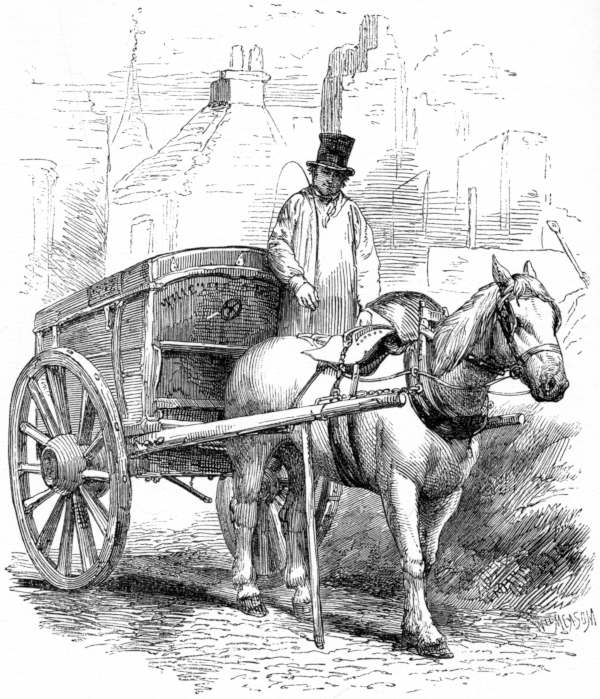
THE RUBBISH CARTER.
[From a Daguerreotype by Beard.]
I am informed that one-third of the working
rubbish-carters have been rubbish-carters from
their youth, or cart, car, or waggon-drivers, for
they all seem to have known changes; or they
have been used to the care of horses in the capacity
of ostlers, stable-men, helpers, coaching-inn porters,
coachmen, grooms, and horse-breakers. Of
the remainder, one-half, I am informed, have
“had a turn” at such avocations as scavagery,
bricklayers’ labouring, dock work, railway excavating,
night work, and the many toils to
which such men resort in their struggles to
obtain bread, whatever may have been their
original occupation, which is rarely that of an
artizan. The other, and what may be called
the greater half of the remaining number, is composed
of agricultural labourers who were rubbish-carters
in the country, and of the many men
who have had the care of horses and vehicles
in the provinces, and who have sought the metropolis,
depending upon their thews and sinews
for a livelihood, as porters, or carmen, or labourers
in almost any capacity. The most of these men
at the plough, the harrow, the manure-cart, the
hay and corn harvests, have been practised carters
and horse drivers before they sought the expected
gold in the streets of London. Full a third of
the whole body of rubbish-carters are Irishmen,
who in Ireland were small farmers, or cottiers, or
agricultural labourers, or belonged to some of the
classes I have described.
The mechanics among rubbish-carters I heard
estimated, by men with equal means of information,
as one in twenty and one in fifteen. Among
these quondam mechanics were more farriers,
cart and wheel wrights, than of other classes.
It seems to be regarded as an indispensable
thing that working rubbish-carters should have
one quality—bodily strength. I am told that one
employer, who died a few weeks ago, used to say
to any applicant for work, “It’s no use asking
for it, if you wish to keep it, unless you can lift
a horse up when he’s down.”
As I have shown of the scavagers, &c., the
employers in rubbish-carting may be classed as
“honourable” and “scurfs.” The men do not
use the word “honourable,” nor any equivalent
term, but speak of their masters, though with no
great distinctiveness, as being either “good,” or
“scurfs.” As in other branches of unskilled labour
where there are no trade societies or general
trade regulations among the operatives, there are
few distinctive appellations.
From the facts I have collected in connection
with this trade, it would appear that there are 180
master rubbish-carters in the metropolis, about
140 of whom pay 18s. or more per week as
wages, while the remaining 40 pay less than that
amount. The latter constitute what the men
term the scurf portion of the trade; so that the
honourable masters among the rubbish-carters may
be said to comprise seven-ninths of the whole.
I will first treat of the circumstances, characteristics,
and wages of the men employed in the
honourable trade.
And first, as regards the division of labour
among the operative rubbish-carters, the work is as
simple as possible.
There are—
1. The Rubbish-Carters proper, or “carmen,”
who are engaged principally in conveying the
refuse brick or earth to the several shoots.
2. The Rubbish-Shovellers, or “gangers,” who
are engaged principally in filling the cart with the
rubbish to be removed. Generally speaking, the
two offices are performed by the same individual,
who is both carter and shoveller, and it is only in
large works that the gangers are employed.
Master builders and others who require the aid
of rubbish-carters for the removal of earth or
any other kind of rubbish from ground about to
be built upon, or from old buildings about to be
repaired or pulled down, either hire horses, carts,
and carmen, by the day, of the master rubbish-carters,
or pay a certain price per load for the
removal of the rubbish. If the job be likely to
last some length of time, the builders pay the
masters so much per load for carting away the
rubbish; but if the job be only for a short period,
the horses, carts, and carmen are hired of the
masters for the time. The price paid to the master
rubbish-carter ranges from 2s. 6d. to 3s. 6d. per
load for the removal of rubbish and bringing
back such bricks, lime, or sand as may be required
for the building. The master rubbish-carter, in all
cases, pays the men engaged in the removal of the
rubbish.
The operative rubbish-carters (except in a very
few instances) never work in gangs, either in the
construction of new buildings or in old buildings
about to be pulled down or repaired. In digging
the foundations of new houses, the master builders,
or speculators, building upon their own ground
employ their own excavators, and engage rubbish-carters
to remove the refuse earth, the latter being
merely occupied in carting it away.
The principle of simple co-operation or gang-work
occasionally prevails; and, when this is the
case, the gang is employed in shovelling and picking,
while the carman, as the shovellers throw
out the rubbish, fills or shovels the rubbish into
the cart.
Each rubbish-carter will, on an average, convey
away from two to five loads a day, according to
the distance he has to take it. Calculating 850
men to remove four loads per diem for five
months in a year, the gross quantity of rubbish
annually removed would be very nearly 326,000
loads.
In the regular trade the hours of daily labour
are twelve, or from six to six; but the men are
allowed half an hour for breakfast, an hour for
dinner, and half an hour for tea, and almost invariably
leave at half-past five, so postponing the
“tea” half-hour until after the termination of
their work. In winter the hours are generally
“between the lights,” but on very short, dark, or
foggy days, lanterns are used. The men employed
by one firm “often made up,” I was told
by one of them, “for lost time, by shovelling by
moonlight.” The carman, however, has to get to
his stable in the summer at four o’clock in the
morning, and to tend his horse after he has done
work at night; so that the usual hours of labour
with him are fifteen and sixteen per day, as well
as Sunday-work.
| Master Rubbish Carters. | No. of Operative Rubbish-Carting. | No. of Shovellers working in Gangs. | Quantity of Rubbish carted Daily. | Quantity of Rubbish carted Annually. | No. of days in the week each Operative is employed at Rubbish-Carting. | No. of weeks during the year each Operative is engaged in Removing Rubbish. | Weekly Wages of Rubbish-Carters. | Weekly Wages of the Operatives working in Gangs at Rubbish-Carting. |
|---|
| | | lds. | loads. | | | s. | s. |
| Kensington. | Mr. J. Bird | 5 | .. | 15 | 2340 | 6 | 26 | 18 | .. |
| — Hough | 3 | .. | 9 | 1404 | 6 | 26 | 18 | .. |
| — Dubbins | 3 | .. | 9 | 1404 | 6 | 26 | 18 | .. |
| — Taylor | 3 | .. | 12 | 1872 | 6 | 26 | 18 | .. |
| — Gale | 3 | .. | 12 | 1872 | 6 | 26 | 18 | .. |
| — G. Bird | 10 | .. | 20 | 3120 | 6 | 26 | 18 | .. |
| Chelsea. | — Nicholls | 10 | .. | 20 | 3120 | 6 | 26 | 18 | .. |
| — Emmerson | 5 | .. | 15 | 2340 | 6 | 26 | 18 | .. |
| — Freeman | 5 | .. | 15 | 2340 | 6 | 26 | 18 | .. |
| — Pattison | 2 | .. | 6 | 936 | 6 | 26 | 18 | .. |
| — Porter | 6 | .. | 18 | 2808 | 6 | 26 | 18 | .. |
| St. George’s, Hanover-sq. | — Rawlins | 4 | .. | 16 | 1248 | 6 | 13 | 18 | .. |
| — Wells | 2 | .. | 8 | 624 | 6 | 13 | 18 | .. |
| — Watkins | 5 | .. | 15 | 1170 | 6 | 13 | 18 | .. |
| — Liddiard | 5 | .. | 15 | 1170 | 6 | 13 | 18 | .. |
| Westminster. | — Farmer | 4 | .. | 16 | 1920 | 6 | 20 | 18 | .. |
| — Bugbee | 6 | 4 | 30 | 2340 | 6 | 13 | 18 | 18 |
| — Reddin | 6 | 4 | 30 | 2340 | 6 | 13 | 18 | 18 |
| — Francis | 5 | .. | 20 | 3120 | 6 | 26 | 18 | .. |
| Westminster Improvements. | — Chadwick | 3 | .. | 15 | 2340 | 6 | 26 | 18 | .. |
| — Francis | 5 | .. | 20 | 3120 | 6 | 26 | 18 | .. |
| — Farmer | 5 | .. | 20 | 3120 | 6 | 26 | 18 | .. |
| — Duggan | 8 | .. | 40 | 6240 | 6 | 26 | 18 | .. |
| St. Martin’s. | — T. Cooper | 3 | 3 | 24 | 1872 | 6 | 13 | 18 | 20 |
| — Wall | 2 | 2 | 16 | 1248 | 6 | 13 | 18 | 20 |
| — Duggan | 4 | .. | 16 | 1248 | 6 | 13 | 18 | .. |
| St. James’s, Westminster. | — Nicolls | 5 | .. | 20 | 1560 | 6 | 13 | 18 | .. |
| — Wells | 2 | .. | 8 | 624 | 6 | 13 | 18 | .. |
| — Watkins | 5 | .. | 15 | 810 | 6 | 9 | 18 | .. |
| Mary-le-bone. | — Freeman | 3 | .. | 12 | 2808 | 6 | 39 | 18 | .. |
| — Curmock | 4 | .. | 16 | 2496 | 6 | 26 | 18 | .. |
| — Nicolls | 8 | .. | 24 | 1872 | 3 | 26 | 18 | .. |
| — Watkins | 10 | .. | 40 | 4160 | 4 | 26 | 18 | .. |
| — Perkins | 5 | .. | 20 | 3120 | 6 | 26 | 18 | .. |
| — Culverwell | 5 | .. | 20 | 3120 | 6 | 26 | 18 | .. |
| West London. | — Rutty | 3 | .. | 12 | 360 | 5 | 6 | 18 | .. |
| — Kitchener | 3 | .. | 15 | 360 | 6 | 4 | 18 | .. |
| — Wickham | 3 | .. | 12 | 240 | 5 | 4 | 18 | .. |
| — Porter | 4 | .. | 16 | 864 | 6 | 9 | 18 | .. |
| West London Improvements. | — Crook | 3 | .. | 6 | 468 | 6 | 13 | 18 | .. |
| — M’Carthy | 6 | .. | 30 | 4680 | 6 | 26 | 20 | .. |
| — Reddin | 5 | .. | 25 | 3900 | 6 | 26 | 18 | .. |
| — Rooke | 6 | .. | 30 | 4680 | 6 | 26 | 18 | .. |
| — Bugbee | 5 | .. | 25 | 3900 | 6 | 26 | 18 | .. |
| — Chadwick | 5 | .. | 25 | 3900 | 6 | 26 | 18 | .. |
| London City. | — Bateman | 3 | .. | 12 | 288 | 6 | 4 | 18 | .. |
| — Tame | 4 | .. | 12 | 216 | 6 | 3 | 18 | .. |
| — Walker | 2 | .. | 8 | 144 | 6 | 3 | 18 | .. |
| — Harmadu | 3 | .. | 9 | 216 | 6 | 4 | 18 | .. |
| — Bindy | 2 | .. | 6 | 72 | 3 | 4 | 18 | .. |
| London City Improvements. | — Duggan | 10 | .. | 50 | 7800 | 6 | 26 | 16 | .. |
| — Bugbee | 20 | .. | 100 | 15600 | 6 | 26 | 18 | .. |
| — Gould | 10 | .. | 50 | 7800 | 6 | 26 | 18 | .. |
| Shoreditch. | — Booth | 5 | .. | 20 | 360 | 3 | 6 | 18 | .. |
| — Styles | 2 | .. | 8 | 96 | 3 | 4 | 18 | .. |
| — Wood | 5 | .. | 20 | 780 | 3 | 13 | 18 | .. |
| — Gould | 5 | .. | 20 | 1560 | 6 | 13 | 18 | .. |
| Bethnal Green. | — Calvert | 2 | .. | 8 | 240 | 3 | 10 | 15 | .. |
| — Newman | 2 | .. | 6 | 234 | 3 | 13 | 16 | .. |
| — Rooke | 4 | .. | 16 | 624 | 3 | 13 | 18 | .. |
| — Tilley | 3 | .. | 12 | 936 | 6 | 13 | 18 | .. |
| Whitechapel. | — Newman | 3 | .. | 9 | 216 | 3 | 8 | 16 | .. |
| — Tomkins | 2 | .. | 6 | 234 | 3 | 13 | 18 | .. |
| — Abbott | 2 | .. | 6 | 90 | 3 | 5 | 18 | .. |
| St. George’s in the East. | — Clarke | 6 | .. | 18 | 360 | 4 | 5 | 16 | .. |
| — Calvert | 4 | .. | 16 | 192 | 3 | 4 | 15 | .. |
| — Newman | 3 | .. | 12 | 216 | 3 | 6 | 16 | .. |
| — Tomkins | 2 | .. | 6 | 108 | 3 | 6 | 18 | .. |
| Stepney. | — Abbott | 6 | .. | 18 | 432 | 3 | 8 | 18 | .. |
| — Newman | 4 | .. | 16 | 288 | 3 | 6 | 16 | .. |
| — Potter | 3 | .. | 12 | 180 | 3 | 5 | 16 | .. |
| — Church | 3 | .. | 12 | 216 | 3 | 6 | 15 | .. |
| Paddington. | — Curmock | 3 | .. | 12 | 936 | 6 | 13 | 18 | .. |
| — Tame | 6 | .. | 18 | 432 | 3 | 8 | 18 | .. |
| — Humphries | 6 | .. | 18 | 702 | 3 | 13 | 16 | .. |
| — Nicolls | 3 | .. | 12 | 268 | 3 | 13 | 18 | .. |
| Hampstead. | — Seal & Jackson | 2 | .. | 6 | 936 | 6 | 26 | 20 | .. |
| — Kirtland | 1 | .. | 3 | 468 | 6 | 26 | 20 | .. |
| — Hingston | 1 | .. | 3 | 117 | 3 | 13 | 20 | .. |
| — Batterbury | 1 | .. | 3 | 117 | 3 | 13 | 20 | .. |
| St. Pancras. | — Smith | 2 | .. | 8 | 384 | 4 | 12 | 18 | .. |
| — Perkins | 8 | .. | 24 | 1872 | 6 | 13 | 18 | .. |
| — Reddin | 6 | .. | 24 | 2304 | 6 | 16 | 18 | .. |
| — Jay | 6 | .. | 24 | 2304 | 6 | 16 | 18 | .. |
| — M. Rose | 3 | .. | 12 | 468 | 3 | 13 | 18 | .. |
| Islington. | — Eldred | 4 | .. | 20 | 1920 | 6 | 16 | 16 | .. |
| — Croot | 3 | .. | 12 | 936 | 6 | 13 | 16 | .. |
| — Speller | 2 | .. | 8 | 288 | 6 | 6 | 16 | .. |
| — J. Rose | 5 | .. | 20 | 1560 | 6 | 13 | 16 | .. |
| Hackney. | — Piper | 3 | .. | 9 | 702 | 6 | 13 | 18 | .. |
| — Rumball | 6 | .. | 18 | 2808 | 6 | 26 | 18 | .. |
| — Booth | 5 | .. | 15 | 1170 | 6 | 13 | 18 | .. |
| St. Giles’s. | — Duggan | 3 | .. | 12 | 936 | 6 | 13 | 16 | .. |
| — Freeman | 4 | .. | 16 | 624 | 3 | 13 | 18 | .. |
| — Bugbee | 2 | .. | 8 | 768 | 6 | 16 | 18 | .. |
| — Wall | 2 | .. | 8 | 288 | 6 | 6 | 19 | .. |
| — Mildwater | 2 | .. | 6 | 180 | 6 | 5 | 18 | .. |
| St. Giles’s Improvements. | — Reddin | 10 | .. | 50 | 3900 | 6 | 13 | 18 | .. |
| — Bugbee | 10 | .. | 50 | 3900 | 6 | 13 | 18 | .. |
| — North | 3 | .. | 12 | 432 | 6 | 6 | 18 | .. |
| — Nicolls | 5 | .. | 20 | 1560 | 6 | 13 | 18 | .. |
| Strand. | — Piper | 4 | .. | 16 | 384 | 6 | 4 | 18 | .. |
| — Reddin | 5 | .. | 20 | 480 | 6 | 4 | 18 | .. |
| — Ellis | 3 | .. | 12 | 180 | 3 | 5 | 18 | .. |
| — Cooper | 3 | .. | 12 | 108 | 3 | 3 | 18 | .. |
| Holborn. | — Lovell | 2 | .. | 8 | 312 | 3 | 13 | 18 | .. |
| — M’Carthy | 6 | .. | 24 | 1872 | 6 | 13 | 18 | .. |
| — Wells | 3 | .. | 12 | 468 | 3 | 13 | 18 | .. |
| — Ellis | 3 | .. | 12 | 324 | 3 | 9 | 18 | .. |
| Holborn and New Oxford-street Improvements. | — Reddin | 20 | .. | 80 | 6240 | 6 | 13 | 18 | .. |
| — Bugbee | 10 | .. | 40 | 3120 | 6 | 13 | 18 | .. |
| — Nicolls | 5 | .. | 20 | 480 | 3 | 8 | 18 | .. |
| — Ellis | 6 | .. | 24 | 936 | 3 | 13 | 18 | .. |
| — T. Brown | 3 | .. | 12 | 624 | 4 | 13 | 18 | .. |
| Clerkenwell. | — Wood | 4 | .. | 16 | 576 | 6 | 6 | 18 | .. |
| — Johnstone | 3 | .. | 15 | 360 | 6 | 4 | 17 | .. |
| — Clarkson | 6 | .. | 24 | 432 | 6 | 3 | 16 | .. |
| — North | 3 | .. | 12 | 144 | 3 | 4 | 18 | .. |
| — J. Brown | 2 | .. | 6 | 180 | 6 | 5 | 18 | .. |
| St. Luke’s. | — Rhodes | 5 | .. | 20 | 500 | 5 | 5 | 18 | .. |
| — Wood | 5 | .. | 20 | 360 | 3 | 6 | 18 | .. |
| — Dodd | 5 | .. | 20 | 1200 | 6 | 10 | 16 | .. |
| — Gould | 10 | .. | 30 | 2340 | 6 | 13 | 18 | .. |
| East London. | — Pratt & Sewell | 3 | .. | 9 | 351 | 3 | 13 | 18 | .. |
| — Tomkins | 2 | .. | 6 | 234 | 3 | 13 | 18 | .. |
| — Crook | 2 | .. | 6 | 234 | 3 | 13 | 18 | .. |
| — Abbott | 2 | .. | 8 | 384 | 6 | 8 | 18 | .. |
| Poplar. | — Pine | 3 | .. | 12 | 324 | 3 | 9 | 18 | .. |
| — Monk | 3 | .. | 12 | 780 | 5 | 13 | 18 | .. |
| — Tingey | 2 | .. | 8 | 240 | 3 | 10 | 18 | .. |
| — Gabriel | 4 | .. | 16 | 624 | 3 | 13 | 18 | .. |
| — Jones | 3 | .. | 12 | 192 | 4 | 4 | 18 | .. |
| St. George’s, | — Reddin | 10 | .. | 40 | 3120 | 6 | 13 | 18 | .. |
| — G. Whitten | 2 | .. | 10 | 780 | 6 | 13 | 18 | .. |
| St. Olave’s, | — Webbon | 3 | .. | 12 | 936 | 6 | 13 | 18 | .. |
| — Reddin | 10 | .. | 40 | 3120 | 6 | 13 | 18 | .. |
| St. Saviour’s, Southwark. | — Bugbee | 2 | .. | 6 | 72 | 3 | 4 | 18 | .. |
| — Ryder | 2 | .. | 6 | 72 | 3 | 4 | 18 | .. |
| — Wright | 1 | .. | 3 | 36 | 3 | 4 | 18 | .. |
| Bermondsey. | — Peake | 5 | .. | 20 | 3120 | 6 | 26 | 18 | .. |
| — Duckett | 12 | .. | 36 | 5616 | 6 | 26 | 18 | .. |
| — Elworthy | 8 | .. | 24 | 3744 | 6 | 26 | 18 | .. |
| — Slee | 5 | .. | 20 | 3120 | 6 | 26 | 18 | .. |
| — Adams | 4 | 2 | 20 | 4680 | 6 | 39 | 18 | 18 |
| Newington. | — Gutteris | 3 | .. | 9 | 270 | 6 | 5 | 18 | .. |
| — Crawley | 2 | .. | 8 | 256 | 4 | 8 | 18 | .. |
| — Martainbody | 6 | .. | 24 | 960 | 4 | 10 | 18 | .. |
| Wandsworth. | — Nicholson | 5 | .. | 15 | 1170 | 6 | 13 | 17 | .. |
| — Mears | 3 | .. | 6 | 468 | 6 | 13 | 17 | .. |
| — Parsons | 4 | .. | 16 | 864 | 6 | 9 | 17 | .. |
| — Easton | 3 | .. | 15 | 720 | 6 | 8 | 17 | .. |
| Lambeth. | — J. Whitton | 10 | .. | 40 | 2080 | 4 | 13 | 19 | .. |
| — G. Whitton | 8 | .. | 24 | 1248 | 4 | 13 | 19 | .. |
| — Kenning | 2 | .. | 10 | 390 | 3 | 13 | 18 | .. |
| Camberwell. | — Hook | 6 | .. | 18 | 540 | 3 | 10 | 18 | .. |
| — Michel | 2 | .. | 8 | 384 | 6 | 8 | 18 | .. |
| — Marsland | 2 | .. | 8 | 128 | 4 | 4 | 18 | .. |
| — Walton | 2 | .. | 6 | 144 | 4 | 6 | 18 | .. |
| — Evans | 1 | .. | 3 | 90 | 6 | 5 | 18 | .. |
| Rotherhithe. | — Walker | 10 | .. | 30 | 3240 | 6 | 18 | 15 | .. |
| — Brown | 8 | .. | 24 | 936 | 3 | 13 | 18 | .. |
| — Hobman | 2 | .. | 36 | 1404 | 3 | 13 | 18 | .. |
| — East | 6 | .. | 18 | 702 | 3 | 13 | 18 | .. |
| — Stevens | 5 | .. | 20 | 1560 | 6 | 13 | 15 | .. |
| Greenwich. | — Jeffry | 2 | .. | 10 | 600 | 6 | 10 | 15 | .. |
| — Turtle | 5 | .. | 15 | 720 | 6 | 8 | 14 | .. |
| — Hiscock | 2 | .. | 6 | 432 | 6 | 12 | 17 | .. |
| — Allen | 2 | .. | 10 | 780 | 6 | 13 | 12 | .. |
| Woolwich. | — Connall | 5 | .. | 10 | 1560 | 6 | 26 | 16 | .. |
| — Waller | 3 | .. | 6 | 468 | 6 | 13 | 15 | .. |
| — Miller | 6 | .. | 12 | 936 | 6 | 13 | 15 | .. |
| — Fuller | 8 | .. | 16 | 960 | 6 | 10 | 15 | .. |
| — Barnes | 4 | .. | 12 | 648 | 6 | 9 | 15 | .. |
| — Sharpe | 12 | .. | 36 | 1404 | 3 | 13 | 15 | .. |
| — Taylor | 8 | .. | 24 | 2016 | 6 | 14 | 15 | .. |
| — Ginno | 5 | .. | 20 | 780 | 3 | 13 | 15 | .. |
| — Millard | 4 | .. | 10 | 390 | 3 | 13 | 15 | .. |
| — Graham | 3 | .. | 9 | 270 | 3 | 10 | 15 | .. |
| Lewisham. | — Peakes | 5 | .. | 15 | 810 | 6 | 9 | 15 | .. |
| — Wellard | 3 | .. | 12 | 936 | 6 | 13 | 15 | .. |
| — Fleckell | 6 | .. | 18 | 1404 | 6 | 13 | 15 | .. |
| — Hollis | 4 | .. | 12 | 288 | 3 | 8 | 15 | .. |
| Total | 840 | 15 | 3134 | 259831 | | | | |
| Master Rubbish Carters. | No. of Operative Rubbish-Carting. | No. of Shovellers working in Gangs. | Quantity of Rubbish carted Daily. | Quantity of Rubbish carted Annually. |
|---|
| | | lds. | loads. |
| Kensington. | Mr. J. Bird | 5 | .. | 15 | 2340 |
| — Hough | 3 | .. | 9 | 1404 |
| — Dubbins | 3 | .. | 9 | 1404 |
| — Taylor | 3 | .. | 12 | 1872 |
| — Gale | 3 | .. | 12 | 1872 |
| — G. Bird | 10 | .. | 20 | 3120 |
| Chelsea. | — Nicholls | 10 | .. | 20 | 3120 |
| — Emmerson | 5 | .. | 15 | 2340 |
| — Freeman | 5 | .. | 15 | 2340 |
| — Pattison | 2 | .. | 6 | 936 |
| — Porter | 6 | .. | 18 | 2808 |
| St. George’s, Hanover-sq. | — Rawlins | 4 | .. | 16 | 1248 |
| — Wells | 2 | .. | 8 | 624 |
| — Watkins | 5 | .. | 15 | 1170 |
| — Liddiard | 5 | .. | 15 | 1170 |
| Westminster. | — Farmer | 4 | .. | 16 | 1920 |
| — Bugbee | 6 | 4 | 30 | 2340 |
| — Reddin | 6 | 4 | 30 | 2340 |
| — Francis | 5 | .. | 20 | 3120 |
| Westminster Improvements. | — Chadwick | 3 | .. | 15 | 2340 |
| — Francis | 5 | .. | 20 | 3120 |
| — Farmer | 5 | .. | 20 | 3120 |
| — Duggan | 8 | .. | 40 | 6240 |
| St. Martin’s. | — T. Cooper | 3 | 3 | 24 | 1872 |
| — Wall | 2 | 2 | 16 | 1248 |
| — Duggan | 4 | .. | 16 | 1248 |
| St. James’s, Westminster. | — Nicolls | 5 | .. | 20 | 1560 |
| — Wells | 2 | .. | 8 | 624 |
| — Watkins | 5 | .. | 15 | 810 |
| Mary-le-bone. | — Freeman | 3 | .. | 12 | 2808 |
| — Curmock | 4 | .. | 16 | 2496 |
| — Nicolls | 8 | .. | 24 | 1872 |
| — Watkins | 10 | .. | 40 | 4160 |
| — Perkins | 5 | .. | 20 | 3120 |
| — Culverwell | 5 | .. | 20 | 3120 |
| West London. | — Rutty | 3 | .. | 12 | 360 |
| — Kitchener | 3 | .. | 15 | 360 |
| — Wickham | 3 | .. | 12 | 240 |
| — Porter | 4 | .. | 16 | 864 |
| West London Improvements. | — Crook | 3 | .. | 6 | 468 |
| — M’Carthy | 6 | .. | 30 | 4680 |
| — Reddin | 5 | .. | 25 | 3900 |
| — Rooke | 6 | .. | 30 | 4680 |
| — Bugbee | 5 | .. | 25 | 3900 |
| — Chadwick | 5 | .. | 25 | 3900 |
| London City. | — Bateman | 3 | .. | 12 | 288 |
| — Tame | 4 | .. | 12 | 216 |
| — Walker | 2 | .. | 8 | 144 |
| — Harmadu | 3 | .. | 9 | 216 |
| — Bindy | 2 | .. | 6 | 72 |
| London City Improvements. | — Duggan | 10 | .. | 50 | 7800 |
| — Bugbee | 20 | .. | 100 | 15600 |
| — Gould | 10 | .. | 50 | 7800 |
| Shoreditch. | — Booth | 5 | .. | 20 | 360 |
| — Styles | 2 | .. | 8 | 96 |
| — Wood | 5 | .. | 20 | 780 |
| — Gould | 5 | .. | 20 | 1560 |
| Bethnal Green. | — Calvert | 2 | .. | 8 | 240 |
| — Newman | 2 | .. | 6 | 234 |
| — Rooke | 4 | .. | 16 | 624 |
| — Tilley | 3 | .. | 12 | 936 |
| Whitechapel. | — Newman | 3 | .. | 9 | 216 |
| — Tomkins | 2 | .. | 6 | 234 |
| — Abbott | 2 | .. | 6 | 90 |
| St. George’s in the East. | — Clarke | 6 | .. | 18 | 360 |
| — Calvert | 4 | .. | 16 | 192 |
| — Newman | 3 | .. | 12 | 216 |
| — Tomkins | 2 | .. | 6 | 108 |
| Stepney. | — Abbott | 6 | .. | 18 | 432 |
| — Newman | 4 | .. | 16 | 288 |
| — Potter | 3 | .. | 12 | 180 |
| — Church | 3 | .. | 12 | 216 |
| Paddington. | — Curmock | 3 | .. | 12 | 936 |
| — Tame | 6 | .. | 18 | 432 |
| — Humphries | 6 | .. | 18 | 702 |
| — Nicolls | 3 | .. | 12 | 268 |
| Hampstead. | — Seal & Jackson | 2 | .. | 6 | 936 |
| — Kirtland | 1 | .. | 3 | 468 |
| — Hingston | 1 | .. | 3 | 117 |
| — Batterbury | 1 | .. | 3 | 117 |
| St. Pancras. | — Smith | 2 | .. | 8 | 384 |
| — Perkins | 8 | .. | 24 | 1872 |
| — Reddin | 6 | .. | 24 | 2304 |
| — Jay | 6 | .. | 24 | 2304 |
| — M. Rose | 3 | .. | 12 | 468 |
| Islington. | — Eldred | 4 | .. | 20 | 1920 |
| — Croot | 3 | .. | 12 | 936 |
| — Speller | 2 | .. | 8 | 288 |
| — J. Rose | 5 | .. | 20 | 1560 |
| Hackney. | — Piper | 3 | .. | 9 | 702 |
| — Rumball | 6 | .. | 18 | 2808 |
| — Booth | 5 | .. | 15 | 1170 |
| St. Giles’s. | — Duggan | 3 | .. | 12 | 936 |
| — Freeman | 4 | .. | 16 | 624 |
| — Bugbee | 2 | .. | 8 | 768 |
| — Wall | 2 | .. | 8 | 288 |
| — Mildwater | 2 | .. | 6 | 180 |
| St. Giles’s Improvements. | — Reddin | 10 | .. | 50 | 3900 |
| — Bugbee | 10 | .. | 50 | 3900 |
| — North | 3 | .. | 12 | 432 |
| — Nicolls | 5 | .. | 20 | 1560 |
| Strand. | — Piper | 4 | .. | 16 | 384 |
| — Reddin | 5 | .. | 20 | 480 |
| — Ellis | 3 | .. | 12 | 180 |
| — Cooper | 3 | .. | 12 | 108 |
| Holborn. | — Lovell | 2 | .. | 8 | 312 |
| — M’Carthy | 6 | .. | 24 | 1872 |
| — Wells | 3 | .. | 12 | 468 |
| — Ellis | 3 | .. | 12 | 324 |
| Holborn and New Oxford-street Improvements. | — Reddin | 20 | .. | 80 | 6240 |
| — Bugbee | 10 | .. | 40 | 3120 |
| — Nicolls | 5 | .. | 20 | 480 |
| — Ellis | 6 | .. | 24 | 936 |
| — T. Brown | 3 | .. | 12 | 624 |
| Clerkenwell. | — Wood | 4 | .. | 16 | 576 |
| — Johnstone | 3 | .. | 15 | 360 |
| — Clarkson | 6 | .. | 24 | 432 |
| — North | 3 | .. | 12 | 144 |
| — J. Brown | 2 | .. | 6 | 180 |
| St. Luke’s. | — Rhodes | 5 | .. | 20 | 500 |
| — Wood | 5 | .. | 20 | 360 |
| — Dodd | 5 | .. | 20 | 1200 |
| — Gould | 10 | .. | 30 | 2340 |
| East London. | — Pratt & Sewell | 3 | .. | 9 | 351 |
| — Tomkins | 2 | .. | 6 | 234 |
| — Crook | 2 | .. | 6 | 234 |
| — Abbott | 2 | .. | 8 | 384 |
| Poplar. | — Pine | 3 | .. | 12 | 324 |
| — Monk | 3 | .. | 12 | 780 |
| — Tingey | 2 | .. | 8 | 240 |
| — Gabriel | 4 | .. | 16 | 624 |
| — Jones | 3 | .. | 12 | 192 |
| St. George’s, | — Reddin | 10 | .. | 40 | 3120 |
| — G. Whitten | 2 | .. | 10 | 780 |
| St. Olave’s, | — Webbon | 3 | .. | 12 | 936 |
| — Reddin | 10 | .. | 40 | 3120 |
| St. Saviour’s, Southwark. | — Bugbee | 2 | .. | 6 | 72 |
| — Ryder | 2 | .. | 6 | 72 |
| — Wright | 1 | .. | 3 | 36 |
| Bermondsey. | — Peake | 5 | .. | 20 | 3120 |
| — Duckett | 12 | .. | 36 | 5616 |
| — Elworthy | 8 | .. | 24 | 3744 |
| — Slee | 5 | .. | 20 | 3120 |
| — Adams | 4 | 2 | 20 | 4680 |
| Newington. | — Gutteris | 3 | .. | 9 | 270 |
| — Crawley | 2 | .. | 8 | 256 |
| — Martainbody | 6 | .. | 24 | 960 |
| Wandsworth. | — Nicholson | 5 | .. | 15 | 1170 |
| — Mears | 3 | .. | 6 | 468 |
| — Parsons | 4 | .. | 16 | 864 |
| — Easton | 3 | .. | 15 | 720 |
| Lambeth. | — J. Whitton | 10 | .. | 40 | 2080 |
| — G. Whitton | 8 | .. | 24 | 1248 |
| — Kenning | 2 | .. | 10 | 390 |
| Camberwell. | — Hook | 6 | .. | 18 | 540 |
| — Michel | 2 | .. | 8 | 384 |
| — Marsland | 2 | .. | 8 | 128 |
| — Walton | 2 | .. | 6 | 144 |
| — Evans | 1 | .. | 3 | 90 |
| Rotherhithe. | — Walker | 10 | .. | 30 | 3240 |
| — Brown | 8 | .. | 24 | 936 |
| — Hobman | 2 | .. | 36 | 1404 |
| — East | 6 | .. | 18 | 702 |
| — Stevens | 5 | .. | 20 | 1560 |
| Greenwich. | — Jeffry | 2 | .. | 10 | 600 |
| — Turtle | 5 | .. | 15 | 720 |
| — Hiscock | 2 | .. | 6 | 432 |
| — Allen | 2 | .. | 10 | 780 |
| Woolwich. | — Connall | 5 | .. | 10 | 1560 |
| — Waller | 3 | .. | 6 | 468 |
| — Miller | 6 | .. | 12 | 936 |
| — Fuller | 8 | .. | 16 | 960 |
| — Barnes | 4 | .. | 12 | 648 |
| — Sharpe | 12 | .. | 36 | 1404 |
| — Taylor | 8 | .. | 24 | 2016 |
| — Ginno | 5 | .. | 20 | 780 |
| — Millard | 4 | .. | 10 | 390 |
| — Graham | 3 | .. | 9 | 270 |
| Lewisham. | — Peakes | 5 | .. | 15 | 810 |
| — Wellard | 3 | .. | 12 | 936 |
| — Fleckell | 6 | .. | 18 | 1404 |
| — Hollis | 4 | .. | 12 | 288 |
| Total | 840 | 15 | 3134 | 259831 |
| Master Rubbish Carters. | No. of days in the week each Operative is employed at Rubbish-Carting. | No. of weeks during the year each Operative is engaged in Removing Rubbish. | Weekly Wages of Rubbish-Carters. | Weekly Wages of the Operatives working in Gangs at Rubbish-Carting. |
|---|
| | | s. | s. |
| Kensington. | Mr. J. Bird | 6 | 26 | 18 | .. |
| — Hough | 6 | 26 | 18 | .. |
| — Dubbins | 6 | 26 | 18 | .. |
| — Taylor | 6 | 26 | 18 | .. |
| — Gale | 6 | 26 | 18 | .. |
| — G. Bird | 6 | 26 | 18 | .. |
| Chelsea. | — Nicholls | 6 | 26 | 18 | .. |
| — Emmerson | 6 | 26 | 18 | .. |
| — Freeman | 6 | 26 | 18 | .. |
| — Pattison | 6 | 26 | 18 | .. |
| — Porter | 6 | 26 | 18 | .. |
| St. George’s, Hanover-sq. | — Rawlins | 6 | 13 | 18 | .. |
| — Wells | 6 | 13 | 18 | .. |
| — Watkins | 6 | 13 | 18 | .. |
| — Liddiard | 6 | 13 | 18 | .. |
| Westminster. | — Farmer | 6 | 20 | 18 | .. |
| — Bugbee | 6 | 13 | 18 | 18 |
| — Reddin | 6 | 13 | 18 | 18 |
| — Francis | 6 | 26 | 18 | .. |
| Westminster Improvements. | — Chadwick | 6 | 26 | 18 | .. |
| — Francis | 6 | 26 | 18 | .. |
| — Farmer | 6 | 26 | 18 | .. |
| — Duggan | 6 | 26 | 18 | .. |
| St. Martin’s. | — T. Cooper | 6 | 13 | 18 | 20 |
| — Wall | 6 | 13 | 18 | 20 |
| — Duggan | 6 | 13 | 18 | .. |
| St. James’s, Westminster. | — Nicolls | 6 | 13 | 18 | .. |
| — Wells | 6 | 13 | 18 | .. |
| — Watkins | 6 | 9 | 18 | .. |
| Mary-le-bone. | — Freeman | 6 | 39 | 18 | .. |
| — Curmock | 6 | 26 | 18 | .. |
| — Nicolls | 3 | 26 | 18 | .. |
| — Watkins | 4 | 26 | 18 | .. |
| — Perkins | 6 | 26 | 18 | .. |
| — Culverwell | 6 | 26 | 18 | .. |
| West London. | — Rutty | 5 | 6 | 18 | .. |
| — Kitchener | 6 | 4 | 18 | .. |
| — Wickham | 5 | 4 | 18 | .. |
| — Porter | 6 | 9 | 18 | .. |
| West London Improvements. | — Crook | 6 | 13 | 18 | .. |
| — M’Carthy | 6 | 26 | 20 | .. |
| — Reddin | 6 | 26 | 18 | .. |
| — Rooke | 6 | 26 | 18 | .. |
| — Bugbee | 6 | 26 | 18 | .. |
| — Chadwick | 6 | 26 | 18 | .. |
| London City. | — Bateman | 6 | 4 | 18 | .. |
| — Tame | 6 | 3 | 18 | .. |
| — Walker | 6 | 3 | 18 | .. |
| — Harmadu | 6 | 4 | 18 | .. |
| — Bindy | 3 | 4 | 18 | .. |
| London City Improvements. | — Duggan | 6 | 26 | 16 | .. |
| — Bugbee | 6 | 26 | 18 | .. |
| — Gould | 6 | 26 | 18 | .. |
| Shoreditch. | — Booth | 3 | 6 | 18 | .. |
| — Styles | 3 | 4 | 18 | .. |
| — Wood | 3 | 13 | 18 | .. |
| — Gould | 6 | 13 | 18 | .. |
| Bethnal Green. | — Calvert | 3 | 10 | 15 | .. |
| — Newman | 3 | 13 | 16 | .. |
| — Rooke | 3 | 13 | 18 | .. |
| — Tilley | 6 | 13 | 18 | .. |
| Whitechapel. | — Newman | 3 | 8 | 16 | .. |
| — Tomkins | 3 | 13 | 18 | .. |
| — Abbott | 3 | 5 | 18 | .. |
| St. George’s in the East. | — Clarke | 4 | 5 | 16 | .. |
| — Calvert | 3 | 4 | 15 | .. |
| — Newman | 3 | 6 | 16 | .. |
| — Tomkins | 3 | 6 | 18 | .. |
| Stepney. | — Abbott | 3 | 8 | 18 | .. |
| — Newman | 3 | 6 | 16 | .. |
| — Potter | 3 | 5 | 16 | .. |
| — Church | 3 | 6 | 15 | .. |
| Paddington. | — Curmock | 6 | 13 | 18 | .. |
| — Tame | 3 | 8 | 18 | .. |
| — Humphries | 3 | 13 | 16 | .. |
| — Nicolls | 3 | 13 | 18 | .. |
| Hampstead. | — Seal & Jackson | 6 | 26 | 20 | .. |
| — Kirtland | 6 | 26 | 20 | .. |
| — Hingston | 3 | 13 | 20 | .. |
| — Batterbury | 3 | 13 | 20 | .. |
| St. Pancras. | — Smith | 4 | 12 | 18 | .. |
| — Perkins | 6 | 13 | 18 | .. |
| — Reddin | 6 | 16 | 18 | .. |
| — Jay | 6 | 16 | 18 | .. |
| — M. Rose | 3 | 13 | 18 | .. |
| Islington. | — Eldred | 6 | 16 | 16 | .. |
| — Croot | 6 | 13 | 16 | .. |
| — Speller | 6 | 6 | 16 | .. |
| — J. Rose | 6 | 13 | 16 | .. |
| Hackney. | — Piper | 6 | 13 | 18 | .. |
| — Rumball | 6 | 26 | 18 | .. |
| — Booth | 6 | 13 | 18 | .. |
| St. Giles’s. | — Duggan | 6 | 13 | 16 | .. |
| — Freeman | 3 | 13 | 18 | .. |
| — Bugbee | 6 | 16 | 18 | .. |
| — Wall | 6 | 6 | 19 | .. |
| — Mildwater | 6 | 5 | 18 | .. |
| St. Giles’s Improvements. | — Reddin | 6 | 13 | 18 | .. |
| — Bugbee | 6 | 13 | 18 | .. |
| — North | 6 | 6 | 18 | .. |
| — Nicolls | 6 | 13 | 18 | .. |
| Strand. | — Piper | 6 | 4 | 18 | .. |
| — Reddin | 6 | 4 | 18 | .. |
| — Ellis | 3 | 5 | 18 | .. |
| — Cooper | 3 | 3 | 18 | .. |
| Holborn. | — Lovell | 3 | 13 | 18 | .. |
| — M’Carthy | 6 | 13 | 18 | .. |
| — Wells | 3 | 13 | 18 | .. |
| — Ellis | 3 | 9 | 18 | .. |
| Holborn and New Oxford-street Improvements. | — Reddin | 6 | 13 | 18 | .. |
| — Bugbee | 6 | 13 | 18 | .. |
| — Nicolls | 3 | 8 | 18 | .. |
| — Ellis | 3 | 13 | 18 | .. |
| — T. Brown | 4 | 13 | 18 | .. |
| Clerkenwell. | — Wood | 6 | 6 | 18 | .. |
| — Johnstone | 6 | 4 | 17 | .. |
| — Clarkson | 6 | 3 | 16 | .. |
| — North | 3 | 4 | 18 | .. |
| — J. Brown | 6 | 5 | 18 | .. |
| St. Luke’s. | — Rhodes | 5 | 5 | 18 | .. |
| — Wood | 3 | 6 | 18 | .. |
| — Dodd | 6 | 10 | 16 | .. |
| — Gould | 6 | 13 | 18 | .. |
| East London. | — Pratt & Sewell | 3 | 13 | 18 | .. |
| — Tomkins | 3 | 13 | 18 | .. |
| — Crook | 3 | 13 | 18 | .. |
| — Abbott | 6 | 8 | 18 | .. |
| Poplar. | — Pine | 3 | 9 | 18 | .. |
| — Monk | 5 | 13 | 18 | .. |
| — Tingey | 3 | 10 | 18 | .. |
| — Gabriel | 3 | 13 | 18 | .. |
| — Jones | 4 | 4 | 18 | .. |
| St. George’s, | — Reddin | 6 | 13 | 18 | .. |
| — G. Whitten | 6 | 13 | 18 | .. |
| St. Olave’s, | — Webbon | 6 | 13 | 18 | .. |
| — Reddin | 6 | 13 | 18 | .. |
| St. Saviour’s, Southwark. | — Bugbee | 3 | 4 | 18 | .. |
| — Ryder | 3 | 4 | 18 | .. |
| — Wright | 3 | 4 | 18 | .. |
| Bermondsey. | — Peake | 6 | 26 | 18 | .. |
| — Duckett | 6 | 26 | 18 | .. |
| — Elworthy | 6 | 26 | 18 | .. |
| — Slee | 6 | 26 | 18 | .. |
| — Adams | 6 | 39 | 18 | 18 |
| Newington. | — Gutteris | 6 | 5 | 18 | .. |
| — Crawley | 4 | 8 | 18 | .. |
| — Martainbody | 4 | 10 | 18 | .. |
| Wandsworth. | — Nicholson | 6 | 13 | 17 | .. |
| — Mears | 6 | 13 | 17 | .. |
| — Parsons | 6 | 9 | 17 | .. |
| — Easton | 6 | 8 | 17 | .. |
| Lambeth. | — J. Whitton | 4 | 13 | 19 | .. |
| — G. Whitton | 4 | 13 | 19 | .. |
| — Kenning | 3 | 13 | 18 | .. |
| Camberwell. | — Hook | 3 | 10 | 18 | .. |
| — Michel | 6 | 8 | 18 | .. |
| — Marsland | 4 | 4 | 18 | .. |
| — Walton | 4 | 6 | 18 | .. |
| — Evans | 6 | 5 | 18 | .. |
| Rotherhithe. | — Walker | 6 | 18 | 15 | .. |
| — Brown | 3 | 13 | 18 | .. |
| — Hobman | 3 | 13 | 18 | .. |
| — East | 3 | 13 | 18 | .. |
| — Stevens | 6 | 13 | 15 | .. |
| Greenwich. | — Jeffry | 6 | 10 | 15 | .. |
| — Turtle | 6 | 8 | 14 | .. |
| — Hiscock | 6 | 12 | 17 | .. |
| — Allen | 6 | 13 | 12 | .. |
| Woolwich. | — Connall | 6 | 26 | 16 | .. |
| — Waller | 6 | 13 | 15 | .. |
| — Miller | 6 | 13 | 15 | .. |
| — Fuller | 6 | 10 | 15 | .. |
| — Barnes | 6 | 9 | 15 | .. |
| — Sharpe | 3 | 13 | 15 | .. |
| — Taylor | 6 | 14 | 15 | .. |
| — Ginno | 3 | 13 | 15 | .. |
| — Millard | 3 | 13 | 15 | .. |
| — Graham | 3 | 10 | 15 | .. |
| Lewisham. | — Peakes | 6 | 9 | 15 | .. |
| — Wellard | 6 | 13 | 15 | .. |
| — Fleckell | 6 | 13 | 15 | .. |
| — Hollis | 3 | 8 | 15 | .. |
The rubbish-carters are paid by week, 18s. to
20s. being the weekly amount; and by the load,
which is indeed piece-work. The payment to the
operatives by the load varies from 6d. to 1s. 6d.,
for it is necessarily regulated by the distance to
be traversed. If the rubbish have to be carted a
mile to its destination—or, as the men call it, to
“the shoot”—of course it is to be so conveyed at
a proportionally lower rate than if it had to be
driven two or three miles. The employment of
men by the load, however, becomes less every
year, and the reason, I am assured, is this:—The
great stress of the labour falls upon the
horse. If the animal be strong and manageable,
a man, for the sake of conveying an extra load a
day, might overtax its powers, injure it gradually,
and deteriorate its strength and its value. The
operative carters, on their part, have complained
that sometimes even “good” employers have set
them to work by the load with “hard old horses,”
which no management could get out of their slow,
long-accustomed pace. Thus a man might clear
by the piece-work but 1s. 6d. a day, with a horse
not worth 15l.; while another carter, with a
superior animal worth twice as much, might clear
3s. or 3s. 6d. Some “hard” masters, I was
informed, liked these old horses, because they
were bought cheap, and though they brought in
less than superior animals they were easier kept;
while if less were earned by the piece-work with
such horses, less was paid in wages; and if the
horse broke its leg, or was killed, or injured, it
was more easily replaced. This mode of employment
is, as I have said, less and less carried into
effect; but it is still one of the ways in which
a working carter may be made a sufferer, because
a principal accessary of his work—the horse—may
not be capable of the requisite exertion.
The nominal wages of the rubbish-carters in
the best employ are from 18s. to 20s. a week; in
the worse-paid trade 15s. is the more general
price; but even as little as 12s. is given by some
masters.
The actual wages are the same as the nominal
in the honourable trade, with the addition of
perquisites in beer to the men of from 1s. to 2s.
weekly, and of “findings,” especially to the
carmen, of an amount I could not ascertain, but
perhaps realizing 6d. a week. One carman put
all he found on one side to buy new year’s clothes
for his children, and on new year’s eve last year
he had 48s. 0½d., “money, and what brought
money;” but this is far from an usual case.
The rate of wages paid to the operative rubbish-carters
throughout the different districts of
London, I find, by inquiries in each locality, to
be by no means uniform. For instance, at
Hampstead the wages are unexceptionally 20s.
per week; while at Kensington, Chelsea, and
indeed the whole of the west districts of London,
they are 18s. weekly; in St. Martin’s
parish, however, 19s. a week is paid by two
masters. In the north districts again, 18s. a
week is generally paid; with the exception of
Hampstead, where the weekly wages for the same
labour are as high as 20s., and Islington, where
they are as low as 16s. In the central districts,
too, the wages are generally 18s.; the lower rate
of 17s. and 16s. per week being paid in certain
places by “cutting” and “grasping” individuals,
who form isolated exceptions to the rule. In
a certain portion of the eastern districts, such as
Bethnal Green, St. George’s in the East, and
Stepney, 16s. and 15s. a week appears to be the
rule; while in Shoreditch and Poplar 18s. is paid
by all the masters. The southern districts of the
metropolis are equally irregular in their rates of
wages. Lewisham pays as low as 15s., and
Woolwich the same weekly sum, with one exception.
Wandsworth, on the other hand, pays
uniformly 17s.; while in Southwark, Bermondsey,
Newington, and Camberwell, the wages paid by
all are 18s. In Lambeth as much as 19s. is
given by two masters out of three; whereas, in
Greenwich one master pays 14s., and the other
even as low as 12s. a week. When I come to
treat of the lower-paid trade, I shall explain the
causes of the above difference as regards wages.
The analysis of the facts I have collected on
this subject is as follows:—Out of 180 masters,
employing among them 840 men, there are—
| Wages
per
Week. |
| 5 | masters | employing | 11 | men, and | paying | 20s. |
| 5 | „ | „ | 30 | „ | „ | 19s. |
| 127 | „ | „ | 605 | „ | „ | 18s. |
| 6 | „ | „ | 20 | „ | „ | 17s. |
| 16 | „ | „ | 70 | „ | „ | 16s. |
| 19 | „ | „ | 97 | „ | „ | 15s. |
| 1 | „ | „ | 5 | „ | „ | 14s. |
| 1 | „ | „ | 2 | „ | „ | 12s. |
Hence, three-fourths of the operatives may be
said to receive 18s. weekly, and about one-sixth
16s.
The perquisites in this trade are more in beer
than in money, nor are they derived from the
employers, unless exceptionally. They are given
to the rubbish-carters by the owners of the premises
where they work, and may, in the best
trade, amount, in beer or in money to buy beer, to
from 1s. 6d. to 2s. weekly per man. The other
perquisites are what is found in the digging of
the rubbish for the carts, and in the shooting
of it. As in other trades of a not dissimilar
character, there appears to be no fixed rule as
to “treasure trove.” One man told me that in
digging or shovelling each man kept what he
found; another said the men drank it. Anything
found, however, when the cart is emptied
is the perquisite of the carman. “It’s luck as is
everything;” said one carman. “There was a mate
of mine as hadn’t not no better work nor me,
once found an old silver coin, like a bad half-crown,
as a gen’lman he knowed gave him five good
shillings for, and he found a silver spoon as fetched
1s. 9d., in one week, and that same week on the
same ground I got nothing but five bad ha’pennies.
I once worked in the City where the Sun office
now is, just by the Hall of Commerce in Threadneedle-street,
and something was found in the
Hall as now is; it was a French church once;
and an old gent gave us on the sly 1s. a day for
beer, to show him or tell him of anything we
turned up queer. We did show him things as
we thought queer, and they looked queer, but he
all’us said ‘Chi-ish,’ or ‘da-amn.’ From what
I’ve heard him say to another old cove as sometimes
was with him, they looked for something
Roman Catholic.” My informant no doubt meant
“Roman,” as in digging the foundations of the
Hall of Commerce a tesselated Roman pavement
was found at a great depth.
Among these workmen are no Trade Societies,
no Benefit or Sick-Clubs, and, indeed, no measures
whatever for the upholding of accustomed wages,
or providing “for a rainy day,” unless individually.
If a rubbish-carter be sick, the men in the
same employ, whatever their number, 10 or 40,
contribute on the Saturday evenings 6d. each,
towards his support, until the patient’s convalescence.
There are no Houses of Call.
The payment is in the master’s yard on the
Saturday evening, and always in money. There
are no drawbacks, unless for any period during
the hours of regular labour, when a man may
have been absent from his work. Fines there are
none, except in large establishments among the
carmen where many horses are kept, and then, if
a man do not keep his regular stable-hours in the
mornings, especially the Sunday mornings, he is
fined 6d. These fines are spent by the carmen
generally, and most frequently in beer.
The usual way of applying for work is to call
at the yards or premises, or, more frequently, to
take a round in the districts where it is known
that buildings or excavations are being carried on,
to inquire of the men if a hand be wanted.
Sometimes a foreman may be there who has
authority to “put on” new hands; if not, the
applicant, with the prospect of an engagement in
view, calls upon any party he may be directed to.
Several men told me that when they were engaged
nothing was said about character. The employers
seem to be much influenced by the applicant’s
appearance.
I must now give a brief description of the
rubbish-carter, and the scene of his labours.
Any one who observes, and does not merely
see, the labour of the rubbish-carter, will have
been struck with the stolid indifference with which
these men go about their work, however much
the scene of their labours, from its historical associations,
may interest the better informed. So it
was when the rubbish carters were employed in
removing the ruins of the old Houses of Parliament,
and of that portion of the Tower which
suffered from the ravages of the fire; and so it
would be if they were directed to-morrow to
commence the demolition and rubbish-carting of
Westminster Abbey, the Temple Church, or St.
Paul’s, even in their present integrity.
Sometimes the scene of the rubbish-carter’s
industry presents what may be called a “piteous
aspect.” This was not long ago the case in
Cannon-street, City, and the adjacent courts and
alleys; when the houses had been cleared of their
furniture, the windows were removed (giving the
house what may be styled a “blind” look); most
of the doors had been taken away, as well as some
of the floors. Large cyphers, scrawled in whitewash
on the walls and woodwork, intimated the
different “lots,” and all spoke of desertion; the
only moving thing to be seen, perhaps, was some
flapping paper, torn from the sides of a room and
which fluttered in the wind.
A scene of exceeding bustle follows the apparent
desolateness of the premises. When the
whole has been disposed of to the several purchasers,
the further and final work of demolition
begins. Baskets filled with the old bricks are
rapidly lowered by ropes and pulleys into the carts
below, it being the carter’s business to empty
them, and then up the empty baskets are drawn,
as if by a single jerk. The sound of the hammer
used in removing and separating the old bricks of
the building, the less frequent sound of the pick-axe,
the rumble of the stones and bricks into the
cart, the noise of the pulleys, the shouts of the
men aloft, crying “be-low there!” the half-articulate
exclamations of the carters choked with
dust, form a curious medley of noises. The atmosphere
is usually a cloud of dust, which sticks to
the men’s hair like powder. The premises are
boarded round, and if adjoining a thoroughfare
the boards are closely fitted, to prevent the curious
and the loiterers obstructing the current of passengers.
The work within is confined to the
labourers; “no persons admitted except on business”
seems a rule rigidly enforced. The only
men inside who appear idle are the over-lookers,
or surveyors. They stand with their hands in their
breeches’ pockets; and a stranger to the business
might account them uninterested spectators, but
for the directions they occasionally give, now
quietly, and now snappishly; while the Irishmen
show an excessive degree of activity, the assumption
of which never deceives an overlooker.
From twelve to one is the customary dinner-hour,
and then all is quiet. On visiting some
new buildings at Maida-hill, I found seven men,
out of about 30, all fast asleep in the nooks and
corners of the piles of bricks and rubbish, the day
being fine. The others were eating their dinners
at the public-houses or at their own homes.
In the progress of pulling down, the work of
removal goes on very rapidly where a strong force
is employed—the number varying from about
twelve to 30 men. A four-storied house is often
pulled down to its basement, and the contents of the
walls, floors, &c., removed, in ten days or a fortnight.
As the work of demolition goes on, the rubbish-carter
loads the cart with the old bricks, mortar,
and refuse which the labourers have displaced.
In some places, where a number of buildings is
being removed at the same time, an inclined plane
or road is formed by the rubbish-carters, up and
down which the horses and vehicles can proceed.
Until such means of carriage have been employed,
the rubbish from the interior foundation is often
shot in a mound within the premises, and carried
off when the way has been formed, excepting such
portion as may be retained for any purpose.
In hot weather, many of the rubbish-carters in
the fair trade work in their shirts, a broad woollen
belt being strapped round the waist, which, they
say, supports “the small of the back” in their
frequent bending and stooping. Some wear
woollen night-caps at this work when there is
much dust; and nearly all the men in the honourable
trade wear the “strong men’s” half-boots,
laced up in the front, as the best protectors
of the feet from the intrusion of rubbish.
In the cold weather, the rubbish-carter’s working
dress is usually a suit of strong drab-white
fustian. The suit comprises a jacket with two
large pockets. The cost of such a suit, new, at a
slop-tailor’s, is from 28s. to 35s.; from a good
shop, and of better materials, 40s. to 55s. Some
prefer stout corduroy to fustian trowsers; and
some work in short smock-frocks.
Having thus shown the nature of the work,
the class of men employed, and the amount of remuneration,
I proceed to describe the characteristics
of the rubbish-carters employed by the honourable
masters; I will then describe the state of the
labourers who are casually rather than constantly
employed; and finally speak of the condition and
habits of the lower-paid workers under the cheap
masters.
The Ability to Read and Write.—I think I
heard of fewer instances of defective education
among the rubbish-carters than among other
classes of unskilled labourers. The number of
men who could read and not write, I found computed
at about one-half. It appears that the
children of these men are very generally sent to
school, which is certainly a healthful sign as to
the desire of the parents to do justice to their
offspring. As among other classes, I met with
uneducated men who had exaggerated notions
of the advantages of the capability of reading
and writing, and men who possessed such capability
representing it as a worthless acquirement.
The majority of the Rubbish-Carters in the
honourable trade are, I am informed, really
married men, and have families “born in lawful
wedlock.” One decent and intelligent man, to
whom I was referred, said (his wife being present
and confirming his statement): “I don’t know
how it is, sir, but they say one scabbed sheep
will affect a flock.” “Oh! it’s dreadful,” said the
wife; “but some way it seems to run in places.
Now, we’ve lived among people much in our own
way of life in Clerkenwell, and Pentonville, and
Paddington. Well, we’ve reason to believe, that
there wasn’t much living together unmarried in
Clerkenwell or Pentonville, but a goodish deal in
Paddington. I don’t know why, for they seemed
to live one with another, just as men do with their
wives. But if there’s daughters, sir, as is growing
up and gets to know it, as they’re like enough
to do, ain’t it a bad example? Yes, indeed,”
said the wife, “and I’m told they call going
together in that bad way—they ought all to be
punished—without ever entering a church or
chapel, getting ‘ready married.’” I inquired if
they were not perhaps married quietly at the
Registrar’s office? “O, that,” said Mrs. B——,
“ain’t like being married at all. I would never
have consented to such a way, but I’m pretty
certain they don’t as much as do that. No, sir,” (in
answer to another inquiry), “I hope, and think,
it ain’t so bad among young couples as it was, but
its bad enough as it is, God he knows.” The
proportions of Wedlock and Concubinage I could
not learn, for the woman, I was assured, always
took the man’s name; and both man and woman,
unless in their cups or their quarrels, declared
they were man and wife, only there was no good
in wasting money to get their “marriage lines”
all for no use.
The Politics of the rubbish-carters are, I am
assured by some of the best informed among
them, of no fixity, or principle, or inclination
whatever, as regards one-half of the entire body;
and that the other half, whether ignorant or not,
are Chartists, the Irish generally excepted; and
they, I understood, as I had learned on previous
occasions, had no political opinions, unless such as
were entertained by their priests. Strong, rude,
and ignorant as many of these carters are, I am
told that few of them took part in any public
manifestation of opinion, or in any disturbance,
unless they were out of work. “I think I know
them well,” one of their body said to me, “and
as long as they have pretty middling of work,
it’ll take a very great thing indeed to move ’em.
If they was longish out of work and felt a pinch,
very likely they’d be found ready for anything.”
With respect to Free Trade, I am told that these
men sometimes discuss it, and formerly discussed it
far more frequently among themselves, but that
it was not above one in a dozen, and of the better
sort only, who cared to talk about it either now
or then. There seems no doubt that the majority,
whether they understand its principles and working
or not, are favourable to it; I may say, from
all I could learn, that the great majority are. I
heard of one rubbish-carter, formerly a small
farmer, who left London for some other employment,
in the spring, contending, and taking pains
to enforce his conviction, that Free Trade would
ruin the best interests of rubbish-carters, as year
by year there would be more agricultural labourers
resorting to the great towns to look for such
work as rubbish-carting, for every farmer would
employ more Irish labourers at his own terms,
and even the 8s. a week, the extent of the earnings
of the agricultural labourers in some parishes,
would be undersold by the Irish. Last winter,
he said, very many countrymen came to London,
and would do so the next, and more and more
every year, and so make labour cheaper.
As far as I could extend my inquiries and
observations, this man’s arguments—although I
cannot say I heard any one offer to controvert
them—were not considered sound, nor his facts
fully established. There were certainly great
numbers of good hands out of employment last
winter, and many new applicants for work; “but
buildings,” I was told by a carman, “are of course
always slacker carried on in the winter. Now,
this year, so far (beginning of October), things
seem to promise pretty well in our business, and
so if it’s good this winter and was bad the last,
why, as there’s the same Free Trade, it seems as
if it had nothing to do with it. There’s not so
much building going on now as there was a few
years ago, but trade’s steadier, I think.”
Other rubbish-carters, in the best trade, said
that they had found little difference for six or
eight years, only as bread was cheaper or dearer;
and, if Free Trade made bread cheap, no man
ought to say a word against it, “no matter about
anything else.” Of course I give these opinions
as they came to me.
As to Food, these labourers, when in full work,
generally live what they consider well; that is,
they eat meat and have beer to their meals every
day. Three of them told me that they could not
say what their living cost separately, as they took
all their meals at home with their families, their
wives laying out the money. One couple had six
children, and the husband said they cost him
about 17s. a week in food, or about 2s. 6d. per
head, reckoning a pint of beer a day for himself,
and not including the youngest, which was an
infant at the breast. The father earned 22s.
weekly, and the eldest child, a boy, 3s. 6d. a
week for carrying out and collecting the papers for
a news’-agent. The wife could earn nothing,
although an excellent washerwoman, the cares of
her family occupying her whole time. She always
had “the cold shivers,” she said, “if ever she
thought of John’s being out of work, but he was
a steady man, and had been pretty fortunate.”
If these men were engaged on a job at any
distance, they sometimes breakfasted before starting,
or carried bread and butter with them, and
eat it to a pint of coffee if near enough to a coffee-shop,
but in some places they were not near
enough. Their dinners they carried with them,
generally cold meat and bread, in a basin covered
with a plate, a handkerchief being tied round it
so as to keep the plate firm and afford a hold to
the bearer. “It’s not always, you see, sir,” said
a rubbish-carter, “that there’s a butcher’s shop
near enough to run to and buy a bit of steak and
get it dressed at a tap-room fire, just for buying a
pint of beer, and have a knife and fork, and a
plate, and salt found you into the bargain, and
pepper and mustard too, if you’ll give the girl or
the man 1d. a week or so. But we’re glad to get
a good cold dinner. O, as to beer, it would be a
queer out-of-the-way place indeed where a landlord
didn’t send out a man to a building with beer.”
One single man, who told me he was only a small
eater, gave me the following as his daily bill of
fare, as he rarely took any meals at his lodgings:
| s. | d. |
| Half-quartern loaf | 0 | 2¾ |
| Butter | 0 | 1 |
| Coffee (twice a day) | 0 | 3 |
| Eleven o’clock beer, sometimes a pint and sometimes half-a-pint, but often obtained as a perquisite (average) | 0 | 1½ |
| ½ lb. of beef steak, or a chop, or four or five pennyworth of cold meat from a cook-shop (average) | 0 | 5 |
| Potatoes | 0 | 1 |
| Dinner beer | 0 | 2 |
| Bread and cheese and beer for supper | 0 | 4 |
| 1 | 8¼ |
This was the average cost of his daily food,
while on Sundays he generally paid 1s. 6d. for
breakfast and tea, and a good dinner off a hot
joint with baked potatoes from the oven, along with
the family and other lodgers. He had a good
walk every Sunday morning, he said, but liked to
sleep away the afternoon. He found his own
Sunday beer, costing 4d. dinner and supper, but
he didn’t eat anything at supper, as he wasn’t
inclined after resting all day, and so his weekly
expenses in food were:—
| s. | d. |
| Six working days, at 1s. 8¼d. a day | 10 | 1½ |
| Sunday | 1 | 10 |
| Week’s food | 11 | 11½ |
To this, in the way of drink or luxuries, I might
add, the carter said, 2d. a day for gin (although
he wasn’t a drinker and was very seldom tipsy),
“for I treat a friend to a quartern one day and
may-be he stands treat the next.” Also 4d. for
Sunday gin, as he and the other men took a glass
just before dinner for an appetite, and he took one
after dinner to send him asleep. Add, too, 3d. a
week for tobacco. In all 1s. 7d., which swells
the weekly cost of eating, drinking, and smoking
to 13s. 6½d. His washing was 4d. a week (he
washed his working jacket and trowsers himself),
his rent 2s. 6d. for a bed to himself; so that,
16s. 4½d. being spent out of an earning of 18s.,
he had but 1s. 5½d. a week left for his clothes,
shoes, &c. If he wanted a shilling or two for
anything, he said, he knocked off his supper, and
then nothing was allowed in his reckoning for
perquisites, so he might be 2s. in hand, at least 2s.,
every week in a regular way of living. This man
expressed his conviction that no man, who had
to work hard, could live at smaller cost than he
did. That numbers of men did so, he admitted,
but he “couldn’t make it out.” The two ways of
living which I have described may be taken as
the modes prevalent among this class of labourers,
who seek to live “comfortably.” Others who
“rough it” live at less cost, dining, for instance,
off a pennyworth of pudding and half a pint
of beer.
I ascertained that among the rubbish-carters,
those most frequently attendant on public worship
are the Irish Roman Catholics, and such Englishmen
as had been agricultural labourers in rural parishes,
and had been reared in the habit of church-going;
a habit in which, but not without many exceptions,
they still persevere. Among London-bred
labourers such habits are rarely formed.
The abodes of the better description of rubbish-carters
are not generally in those localities which
are crowded with the poor. They reside in the
streets off the Edgeware and Harrow-roads, as
building has been carried on to a very great extent
in Westbourne, Maida-hill, &c.; in Portland-town,
Camden-town, Somers-town, about King’s-cross;
in Islington, Pentonville, and Clerkenwell;
off the Commercial and Mile-end-roads; in
Walworth, Camberwell, Kennington, and Newington;
and, indeed, in all the quarters where
building has been prosecuted on an extensive
scale. I was in some of their apartments, and
found them tidy and comfortable-looking: one was
especially so. Some stone-fruit on the mantel-shelf
shone as if newly painted, and the fender
and fire-irons glittered from their brightness to
the fire of the small grate. The husband, however,
was in good earnings, and the wife cleared
about 5s. weekly on superior needlework. There
was one thing painful to observe—the contrast
between the robust and sun-burnt look of the
husband, and the delicate and pallid, not to say
sickly, appearance of the wife. The rents for
unfurnished apartments vary from 2s. to 5s., but
rarely the latter, unless the wife take in a little
washing. I heard of some at 2s., but very few;
2s. 6d. to 3s. 6d. are common prices.
I heard of no partiality for amusements among
the rubbish-carters, beyond what my informant
spoke of—a visit to the play. Some, I was told,
but principally the younger men, never missed
going to a fair, which was not too far off. I think
not quite one-half of those I spoke to, with the
best earnings, had been to the Exhibition. Of the
worst paid, I am told, not one in 50 went; one man
told me that he had no amusements but his pipe
and his beer. Some of them, I was assured, drank
half a gallon of beer in a day, but at intervals, so
as not to be intoxicated. “A hand at cribbage”
is a favourite public-house game among a few of
these men; but not above one in half-a-dozen, I
was assured, “knew the cards,” and not one in two
dozen played them.
These, then, are the characteristics of the
labouring rubbish-carters employed in the honourable
trade.
A fine-looking man, upwards of six feet in
stature and of proportionate bulk, with so smart
a set to his bushy whiskers, and a look of such
general tidiness (after he had left off work in the
evening), that he might have been taken for a life-guardsman
had it not been for a slight slouch of
the shoulders, and a very unmilitary gait, gave
me the following account:—
“I’m a London man,” he said, “and though
I’m not yet 25, I’ve kept myself for the last
five years. I’ve worked at rubbish-carting and
general ground-work (digging for pipe-laying, &c.,)
as we nearly all do, but mainly at rubbish-carting,
and I’m at that now. My friends are in the
same line, so I helped them: I was big enough,
and was brought up that way. O, yes, I can
read and write, but I haven’t time, or very
seldom, to read anything but a newspaper now
and again. I’m a carman now, and have
a very good master. I’ve served him, more
or less, for three years. I have had 25s. a week,
and I have had 29s., but that included over-work.
Two hours extra work a day makes an extra day
in the week, you see, sir. O, yes, I might have
saved money, and I’m trying to save 25l. now to
see if I can’t raise a horse and cart, and begin for
myself in a small way, general jobbing. I’ve
been used to cart mould, and gravel, and turf for
gentlemen’s gardens, or when gardens have been
laid out in new buildings, as well as rubbish, for
the same master. Last year I set to work in
hard earnest in the same way, and this is where
it is that always stops me. Mr. —— [his employer]
is very busy now, and things look pretty
well about here [Camden-town], but I don’t
know how it is in other parts. It was the same
last year, but trade fell off in the winter, and I
was three months out of work. O, that’s a
common case, especial with young men, for of
course the old hands has the preference. That’s
where it is, you see, sir; it’s a uncertain trade.
It’s always that new shoes is wanted, but it
ain’t always new houses. My money all went,
and then all my things went to the pawn, and
when I got fairly to work again, I had a shirt
and a shilling left, and owed some little matters.
I’d saved well on to 50s., and could have gone on
saving, but for being thrown out. Then, when
you get into regular wages again, there’s your
uncle to meet, and there’s always something
wanted—a pair of half-boots, or a new shirt, or a
new tool, or something; so one loses heart about
it, and I can’t abear not to appear respectable.
“I pay 2s. a week for my lodging, but it’s
only for half a bed. The house is let out that
way to single men like me, so each bed brings in
4s. a week. There’s two beds in the room where
I sleep; I don’t know how many in all. Why,
yes, it’s a respectable sort of a place, but I don’t
much like it. There’s plenty such places; some’s
decent and some’s not. Oh, certainly, a place of
your own’s best, if it’s ever so humble, but it
wouldn’t suit a man like me. I may work one
week at Paddington, and the next at Bow, and if
I had a furnished room at Paddington, what good
would it be if I went to work at Bow? Only the
bother and expense of removing my sticks again
and again. O, people that find lodgings for such
as me, know that well enough, and makes a prey
of us, of course.
“I take my meals at a public-house or a coffee-shop.
O yes, I live well enough. I have meat
every day to dinner; a man like me must keep up
his strength, and you can’t do that without good
meat. It’s all nonsense about vegetables and all
that, as if men’s stomachs were like cows’. I
have bread and butter and tea or coffee for breakfast
and tea, sometimes a few cresses with it just
to sweeten the blood, which is the proper use of
vegetables. A pint of beer or so for supper, but
I don’t care about supper, though now and then I
take a bit of bread and cheese with a nice fresh
onion to it. Well, I’m sure I can’t say what I
lay out in my living in a week; sometimes more
and sometimes less. I keep no account; I pay
my way as I go on. Some weeks when I get
my Saturday night’s wage, I have from 2s. 6d. to
6s. 6d. left from last Saturday night’s money, but
that’s only when I’ve had nothing to lay out
beyond common. Now, last week I was 4s. 9d.
to the good, and this week I shall be about the
ditto; but then I want a waistcoat and a silk
handkerchief for my neck for Sunday wear; so I
must draw on my Saturday night. There’s a
gentleman takes care of my money for me, and I
carry him what I have over in a week, and he
takes care of it for me. I did a good deal of
work about his houses—he has a block of them—and
his own place, and I’ve gardened for him;
and from what I’ve heard, my money’s safer with
him than with a Savings’ Bank. When I want to
draw he likes to be satisfied what it’s for, and
he’s lent me as much as 33s. in different sums,
when I was hard up. He’s what I call a real
gentleman. He says if I ever go to him tipsy to
draw, and says it quite solemn like, he’ll take
me by the scruff of the neck and kick me out;
though [laughing] he can’t be much above five
foot, and has gray hairs, and seems a feeble sort
of a man, I mean of a gentleman. He enters all
I pay in a book. Here it is, sir, for this year, if
you’d like to see it. I wasn’t able to put anything
by for a goodish bit. I lost my book once, but I
knew how much, and so did Mr. ——, and he put
it down in a lump.
| £ | s. | d. |
| July 18 | In hand | 1 | 3 | 0 |
| 25 | Received | 0 | 3 | 6 |
| Aug. 9 | „ | 0 | 3 | 6 |
| 23 | „ | 0 | 5 | 0 |
| Sept. 13 | „ | 0 | 9 | 6 |
| 20 | „ | 0 | 4 | 0 |
| 27 | „ | 0 | 4 | 0 |
| £2 | 12 | 6 |
“If I can’t save a little to start myself on when
I’m a single man, I can’t ever after, I fancy; so
I’m a trying.
“No, my expenses, over and above my living
and lodging and washing, and all that, ain’t heavy.
Yes, I’m very fond of a good play, very. Some
galleries is 6d., and some 3d.; but then there’s
refreshment and that, so it costs 1s. a time. Perhaps
I go once a week, but only in autumn and
winter, when nights get long, and we leave work
at half-past five. The last time I was at the play
was at the Marylebone, but there was some opera
pieces that don’t suit me; such stuff and nonsense.
I like something very lively, or else a deep
tragedy. Sadler’s Wells is the place, sir. I
mean to go there to-morrow night. Yes, I’m
very fond of the pantomimes. Concerts I’ve been
at, but don’t care for them. They’re as dear at
2d. as an egg a penny, and an egg’s only a bite.
“Well, I’ve gone to church sometimes, but a
carman hasn’t time, for he has his horses to attend
to on Sunday mornings, and that uses up his morning.
No, I never go now. Work must be done.
It ain’t my fault. I’m sure, if I could have my
wish, I’d never do anything on a Sunday.
“Yes, there’s far too many as undersells us in
work. I know that, but I don’t like to think
about them or to talk about them.” [He seemed
desirous to ignore the very existence of the scurf
rubbish-carters.] “They’re Irish many of them.
They’re often quarrelsome and blood-thirsty, but
I know many decent men among the Irishmen in
our gangs. There’s good and bad among them,
as there is among the English. There’s very few
of the Irish that are carmen; they haven’t been
much used to horses.
“I have done a little as a nightman when I
worked for Mr. ——. He was a parish contractor,
and undertook such jobs, and liked to put
strong men on to them. I didn’t like it. I can’t
think it’s a healthy trade. I can’t say, but I
heard it represented, that in this particular calling
there was a great deal of under-contracting going
on when the railway undertakings generally received
a severe check, and when a great number
of hands were thrown out of employment, and
sought employment in rubbish-carting generally,
and apart from railway-work. These hands suffered
greatly for a long time. The tommy-shops
and the middle-man system were enough to
swallow the largest amount of railway wages, so
that very few had saved money, and they were
willing to work for very low wages. A good
many of these people went to endeavour to find
work at the large new docks being erected at
Great Grimsby, near Boston, in Lincolnshire.
Some of the more prudent were able to raise the
means of emigrating, and from one cause or other
the pressure of this surplus labour among rubbish-carters
and excavators, as regards the metropolis,
became relieved.”
The subject of casual labour is one of such vast
importance in connection with the welfare of a
nation and its people, and one of which the causes
as well as consequences seem to be so utterly
ignored by economical writers and unheeded by the
public, that I purpose here saying a few words upon
the matter in general, with the view of enabling
the reader the better to understand the difficulties
that almost all unskilled and many skilled
labourers have to contend with in this country.
By casual labour I mean such labour as can
obtain only occasional as contradistinguished from
constant employment. In this definition I include
all classes of workers, literate and illiterate, skilled
and unskilled, whose professions, trades, or callings
expose them to be employed temporarily rather
than continuously, and whose incomes are in a consequent
degree fluctuating, casual, and uncertain.
In no country in the world is there such an
extent, and at the same time such a diversity,
of casual labour as in Great Britain. This is
attributable to many causes—commercial and agricultural,
natural and artificial, controllable and
uncontrollable.
I will first show what are the causes of casual
labour, and then point out its effects.
The causes of casual labour may be grouped
under two heads:—
- I. The Brisk and Slack Seasons, and Fit
Times, or periodical increase and decrease of work
in certain occupations.
- II. The Surplus Hands appertaining to the different
trades.
First, as to the briskness or slackness of employment
in different occupations. This depends
in different trades on different causes, among which
may be enumerated—
- A. The weather.
- B. The seasons of the year.
- C. The fashion of the day.
- D. Commerce and accidents.
I shall deal with each of these causes seriatim.
A. The labour of thousands is influenced by
the weather; it is suspended or prevented in many
instances by stormy or rainy weather; and in
some few instances it is promoted by such a state
of things.
Among those whose labour cannot be executed
on wet days, or executed but imperfectly, and
who are consequently deprived of their ordinary
means of living on such days, are—paviours,
pipe-layers, bricklayers, painters of the exteriors
of houses, slaters, fishermen, watermen (plying
with their boats for hire), the crews of the river
steamers, a large body of agricultural labourers
(such as hedgers, ditchers, mowers, reapers,
ploughmen, thatchers, and gardeners), costermongers
and all classes of street-sellers (to a great
degree), street-performers, and showmen.
With regard to the degree in which agricultural
(or indeed in this instance woodland) labour may
be influenced by the weather, I may state that a
few years back there had been a fall of oaks on an
estate belonging to Col. Cradock, near Greta-bridge,
and the poor people, old men and women, in the
neighbourhood, were selected to strip off the bark
for the tanners, under the direction of a person
appointed by the proprietor: for this work they
were paid by the basket-load. The trees lay in an
open and exposed situation, and the rain was so
incessant that the “barkers” could scarcely do any
work for the whole of the first week, but kept
waiting under the nearest shelter in the hopes
that it would “clear up.” In the first week of
this employment nearly one-third of the poor persons,
who had commenced their work with eagerness,
had to apply for some temporary parochial
relief. A rather curious instance this, of a parish
suffering from the casualty of a very humble
labour, and actually from the attempt of the poor
to earn money, and do work prepared for them.
On the other hand, some few classes may be
said to be benefited by the rain which is impoverishing
others: these are cabmen (who are
the busiest on showery days), scavagers, umbrella-makers,
clog and patten-makers. I was told by
the omnibus people that their vehicles filled better
in hot than in wet weather.
But the labour of thousands is influenced also
by the wind; an easterly wind prevailing for a
few days will throw out of employment 20,000
dock labourers and others who are dependent on
the shipping for their employment; such as lumpers,
corn-porters, timber-porters, ship-builders, sail-makers,
lightermen, watermen, and, indeed, almost
all those who are known as ’long-shoremen. The
same state of things prevails at Hull, Bristol,
Liverpool, and all our large ports.
Frost, again, is equally inimical to some labourers’
interests; the frozen-out market-gardeners are
familiar to almost every one, and indeed all those
who are engaged upon the land may be said to be
deprived of work by severely cold weather.
In the weather alone, then, we find a means of
starving thousands of our people. Rain, wind,
and frost are many a labourer’s natural enemies,
and to those who are fully aware of the influence
of “the elements” upon the living and comforts
of hundreds of their fellow-creatures, the changes
of weather are frequently watched with a terrible
interest. I am convinced that, altogether, a wet
day deprives not less than 100,000, and probably
nearer 200,000 people, including builders, bricklayers,
and agricultural labourers, of their ordinary
means of subsistence, and drives the same
number to the public-houses and beer-shops (on
this part of the subject I have collected some
curious facts); thus not only decreasing their income,
but positively increasing their expenditure,
and that, perhaps, in the worst of ways.
Nor can there be fewer dependent on the
winds for their bread. If we think of the vast
number employed either directly or indirectly at
the various ports of this country, and then remember
that at each of these places the prevalence of
a particular wind must prevent the ordinary arrival
of shipping, and so require the employment
of fewer hands; we shall have some idea of
the enormous multitude of men in this country
who can be starved by “a nipping and an
eager air.” If in London alone there are 20,000
people deprived of food by the prevalence of an
easterly wind (and I had the calculation from one
of the principal officers of the St. Katherine Dock
Company), surely it will not be too much to say
that throughout the country there are not less
than 50,000 people whose living is thus precariously
dependent.
Altogether I am inclined to believe, that we shall
not be over the truth if we assert there are
between 100,000 and 200,000 individuals and
their families, or half a million of people, dependent
on the elements for their support in this
country.
But this calculation refers to those classes only
who are deprived of a certain number of days’
work by an alteration of the weather, a cause
that is essentially ephemeral in its character. The
other series of natural events influencing the
demand for labour in this country are of a more
continuous nature—the stimulus and the depression
enduring for weeks rather than days. I allude
to the second of the four circumstances above-mentioned
as inducing briskness or slackness of
employment in different occupations, viz.:—
B. The seasons.
These are the seasons of the year, and not the
arbitrary seasons of fashion, of which I shall speak
next.
The following classes are among those exposed
to the uncertainty of employment, and consequently
of income, from the above cause, since
it is only in particular seasons that particular
works, such as buildings, will be undertaken, or
that open-air pleasure excursions will be attempted:
carpenters, builders, brickmakers, painters, plasterers,
paper-hangers, rubbish-carters, sweeps, and
riggers and lumpers, the latter depending mainly
on the arrival of the timber ships to the Thames
(and this, owing to the ice in the Baltic Sea and
in the river St. Lawrence, &c., takes place only at
certain seasons of the year), coal-whippers and
coal-porters (the coal trade being much brisker
in winter), market-porters, and those employed
in summer in steam-boat, railway, van, and barge
excursions.
Then there are the casualties attending agricultural
labour, for, although the operations of nature
are regular “even as the seed time follows the
harvest,” there is, almost invariably, a smaller
employment of labour after the completion of
the haymaking, the sheep-shearing, and the grain-reaping
labours.
For the hay and corn harvests it is well known
that there is a periodical immigration of Irishmen
and women, who clamour for the casual employment;
others, again, leave the towns for the same
purpose; the same result takes place also in the
fruit and pea-picking season for the London green-markets;
while in the winter such people return
some to their own country, and some to form a
large proportion of the casual class in the metropolis.
A tall Irishman of about 34 or 35 (whom
I had to see when treating of the religion of the
street Irish) leaves his accustomed crossing-sweeping
at all or most of the seasons I have mentioned,
and returns to it for the winter at the
end of October; while his wife and children are
then so many units to add to the casualties of the
street sale of apples, nuts, and onions, by overstocking
the open-air markets.
The autumnal season of hop-picking is the grand
rendezvous for the vagrancy of England and Ireland,
the stream of London vagrancy flowing freely
into Kent at that period, and afterwards flowing
back with increased volume. Men, women, and
children are attracted to the hop harvest. The
season is over in less than a month, and then the
casual labourers engaged in it (and they are
nearly all casual labourers) must divert their industry,
or their endeavours for a living, into other
channels, swelling the amount of casualty in unskilled
work or street-trade.
Numerically to estimate the influence of the
seasons on the labour-market of this country is
almost an overwhelming task. Let us try, however:
there are in round numbers one million
agricultural labourers in this country; saying that
in the summer four labourers are employed for
every three in the winter, there would be 250,000
people and their families, or say 1,000,000 of
individuals, deprived of their ordinary subsistence
in the winter time; this, of course, does not
include those who come from Ireland to assist
at the harvest-getting—how many these may be
I have no means of ascertaining. Added to these
there are the natural vagabonds, whom I have
before estimated at another hundred thousand
(see p. 408, vol. i.), and who generally help at
the harvest work or the fruit or hop-picking.
Then there are the carpenters, who are 163,000
in number; the builders, 9200; the brickmakers,
18,000; the painters, 48,200; the coal-whippers,
9200; the coal-miners, 110,000; making altogether
350,000 people, and estimating that for every
four hands employed in the brisk season, there
are only three required in the slack, we have
80,000 more families, or 300,000 people, deprived
of their living by the casualty of labour; so that
if we assert that there are, at the least, including
agricultural labourers, 1,250,000 people thus deprived
of their usual means of living, we shall not
be very wide of the truth.
The next cause of the briskness or slackness of
different employments is—
C. Fashion.
The London fashionable season is also the parliamentary
season, and is the “briskest” from
about the end of February to the middle of July.
The workmen most affected by the aristocratic,
popular, or general fashions, are—
Tailors, ladies’ habit-makers, boot and shoe-makers,
hatters, glovers, milliners, dress-makers,
mantua-makers, drawn and straw bonnet-makers,
artificial flower-makers, plumassiers, stay-makers,
silk and velvet weavers, saddlers, harness-makers,
coach-builders, cabmen, job-coachmen, farriers,
livery stable keepers, poulterers, pastry-cooks, confectioners,
&c., &c.
The above-mentioned classes may be taken,
according to the Occupation Abstract of the last
Census, at between 500,000 and 600,000; and,
assuming the same ratio as to the difference of
employment between the brisk and the slack
seasons of the trades, or, in other words, that
25 per cent. less hands are required at the slack
than at the brisk time of these trades, we have
another 150,000 people, who, with their families,
may be estimated altogether at say 500,000, who
are thrown out of work at a certain season, and
have to starve on as best they can for at least
three months in the year.
The last-mentioned of the causes inducing
briskness or slackness of employment are—
D. Commerce and Accidents.
Commerce has its periodical fits and starts.
The publishers, for instance, have their season,
generally from October to March, as people read
more in winter than in summer; and this arrangement
immediately effects the printers and bookbinders;
there is no change, however, as regards the
newspapers and periodicals. Again, the early importation
to this country of the new foreign fruits
gives activity to the dock and wharf labourers and
porters and carmen. Thus the arrival here, generally
in autumn, of the nut, chestnut, and grape (raisin)
produce of Spain; of the almond crops in Portugal,
Spain, and Barbary; the date harvest in Morocco,
and different parts of Africa; the orange gathering
in Madeira, and in St. Michael’s, Terceira,
and other islands of the Azores; the fig harvest
from the Levant; the plum harvest of the south
of France; the currant picking of Zante, Ithaca,
and other Ionian Islands;—all these events give an
activity, as new fruit is always most saleable, to
the traders in these southern productions; and
more shopmen, shop-porters, wharf labourers, and
assistant lightermen are required—casually required—for
the time.
I was told by a grocer, with a country connection,
and in a large way of business, that for
three weeks or a month before Christmas he required
the aid of four fresh hands, a shopman, an
errand-boy, and two porters (one skilled in packing),
for whom he had nothing to do after Christmas.
If in the wide sweep of London trade there
be 1000 persons, including the market salesmen,
the retail butchers, the carriers, &c., so circumstanced,
then 4000 men are casually employed,
and for a very brief time.
The brief increase of the carrying business generally
about Christmas, by road, water, or railway,
is sufficiently indicated by the foregoing account.
The employment, again, in the cotton and woollen
manufacturing districts may be said to depend for
its briskness on commerce rather than on the
seasons.
Accidents, or extraordinary social events, promote
casual labour and then depress it. Often
they depress without having promoted it.
During the display of the Great Exhibition,
there were some thousands employed in the different
capacities of police, packing, cleaning, porterage,
watching, interpreting, door-keeping and
money-taking, cab-regulating, &c.; and after the
close of the Exhibition how many were retained?
Thus the Great Exhibition fostered casual, or uncertain
labour. Foreign revolutions, moreover,
affect the trade of England: speculators become
timid and will not embark in trade or in any
proposed undertaking; the foreign import and
export trades are paralysed; and fewer clerks
and fewer labourers are employed. Home political
agitations, also, have the same effect; as
was seen in London during the corn-law riots,
about 35 years ago (when only eight members of
the House of Commons supported a change in
those laws); the Spafields riots in 1817; the
affair in St. Peter’s-field, Manchester, in 1819;
the disturbances and excitement during the trial
of Queen Caroline, in 1820-1, and the loss of life
on the occasion of her funeral in 1821; the agitation
previously to the passing of the Reform Bill
had a like effect; the meeting on Kennington
Common on the 10th of April;—in all these
periods, indeed, employment decreased. Labour is
affected also by the death of a member of the
royal family, and the hurried demand for general
mourning, but in a very small degree to what was
once the case. A West-End tailor employing a
great number of hands did not receive a single
order for mourning on the death of Queen Adelaide;
while on the demise of the Princess Charlotte
(in 1817) thousands of operative tailors, throughout
the three kingdoms, worked day and night,
and for double wages, on the general mourning.
Gluts in the markets, an increase of heavy bankruptcies
and “panics,” such as were experienced
in the money market in 1825-6, and again in
1846, with the failure of banks and merchants,
likewise have the effect of augmenting the mass
of casual labour; for capitalists and employers,
under such circumstances, expend as little as
possible in wages or employment until the storm
blows over. Bad harvests have a similar depressing
effect.
There are also the consequences of changes of
taste. The abandonment of the fashions of gentlemen’s
wearing swords, as well as embroidered
garments, flowing periwigs, large shoe-buckles,
all reduced able artizans to poverty by depriving
them of work. So it was, when, to carry on
the war with France, Mr. Pitt introduced a tax
on hair powder. Hundreds of hair-dressers were
thrown out of employment, many persons abandoning
the fashion of wearing powder rather than
pay the tax. There are now city gentlemen, who
can remember that when clerks, they had sometimes
to wait two or three hours for “their turn”
at a barber’s shop on a Sunday morning; for they
could not go abroad until their hair was dressed
and powdered, and their queues trimmed to the
due standard of fashion. So it has been, moreover,
in modern times in the substitution of silk
for metal buttons, silk hats for stuff, and in the
supersedence of one material of dress by another.
These several causes, then, which could only
exist in a community of great wealth and great
poverty have rendered, and are continually rendering,
the labour market uncertain and over-stocked;
to what extent they do and have done this,
it is, of course, almost impossible to say precisely;
but, even with the strongest disposition to avoid
exaggeration, we may assert that there are in this
country no less than 125,000 families, or 500,000
people, who depend on the weather for their food;
300,000 families, or 1,250,000 people, who can
obtain employment only at particular seasons;
150,000 more families, or 500,000 people, whose
trade depends upon the fashionable rather than
the natural seasons, are thrown out of work at the
cessation of the brisk time of their business; and,
perhaps, another 150,000 of families, or 500,000
people, dependent on the periodical increase and
decrease of commerce, and certain social and political
accidents which tend to cause a greater or less
demand for labour. Altogether we may assert,
with safety, that there are at the least 725,000
families, or three millions of men, women, and
children, whose means of living, far from being
certain and constant, are of a precarious kind,
depending either upon the rain, the wind, the
sunshine, the caprice of fashion, or the ebbings
and flowings of commerce.
But there is a still more potent cause at work
to increase the amount of casual labour in this
country. Thus far we have proceeded on the
assumption that at the brisk season of each trade
there is full employment for all; but this is far
from being the case in the great majority, if not
the whole, of the instances above cited. In almost
all occupations there is in this country a superfluity
of labourers, and this alone would tend to
render the employment of a vast number of the
hands of a casual rather than a regular character.
In the generality of trades the calculation is
that one-third of the hands are fully employed,
one-third partially, and one-third unemployed
throughout the year. This, of course, would
be the case if there were twice too many work-people;
for suppose the number of work-people in
a given trade to be 6000, and the work sufficient
to employ (fully) only half the quantity, then,
of course, 2000 might be occupied their whole
time, 2000 more might have work sufficient to
occupy them half their time, and the remaining
2000 have no work at all; or the whole 4000 might,
on the average, obtain three months’ employment
out of the twelve; and this is frequently the case.
Hence we see that a surplusage of hands in a trade
tends to change the employment of the great
majority from a state of constancy and regularity
into one of casualty and precariousness.
Consequently it becomes of the highest importance
that we should endeavour to ascertain what are
the circumstances inducing a surplusage of hands
in the several trades of the present day. A surplusage
of hands in a trade may proceed from
three different causes, viz.:—
- 1. The alteration of the hours, rate, or mode
of working, or else the term of hiring.
- 2. The increase of the hands themselves.
- 3. The decrease of the work.
Each of these causes is essentially distinct; in
the first case there is neither an increase in the
number of hands nor a decrease in the quantity of
work, and yet a surplusage of labourers is the
consequence, for it is self-evident that if there be
work enough in a given trade to occupy 6000
men all the year round, labouring twelve hours per
day for six days in the week, the same quantity
of work will afford occupation to only 4000 men,
or one-third less, labouring between fifteen and
sixteen hours per diem for seven days in the week.
The same result would, of course, take place, if
the workman were made to labour one-third more
quickly, and so to get through one-third more work
in the same time (either by increasing their interest
in their work, by the invention of a new tool,
by extra supervision, or by the subdivision of
labour, &c., &c.), the same result would, of course,
ensue as if they laboured one-third longer hours,
viz., one-third of the hands must be thrown out
of employment. So, again, by altering the mode
or form of work, as by producing on the large
scale, instead of the small, a smaller number of
labourers are required to execute the same amount
of work; and thus (if the market for such work be
necessarily limited) a surplusage of labourers is
the result. Hence we see that the alteration of
the hours, rate, or mode of working may tend as
positively to overstock a country with labourers
as if the labourers themselves had unduly increased.
But this, of course, is on the assumption that both
the quantity of work and the number of hands
remain the same. The next of the three causes,
above mentioned as inducing a surplusage of hands,
is that which arises from a positive increase in the
number of labourers, while the quantity of work remains
the same or increases at a less rate than the
labourers; and the third cause is, where the surplusage
of labourers arises not from any alteration
in the number of hands, but from a positive
decrease in the quantity of work.
These are distinctions necessary to be borne
clearly in mind for the proper understanding of this
branch of the subject.
In the first case both the number of hands
and the quantity of work remain the same, but
the term, rate, or mode of working is changed.
In the second, hours, rate, or mode of
working remain the same, as well as the quantity
of work, but the number of hands is increased.
And in the third case, neither the number of
hands nor the hours, rate, or mode of working is
supposed to have been altered, but the work only
to have decreased.
The surplusage of hands will, of course, be the
same in each of these cases.
I will begin with the first, viz., that which induces
a surplusage of labourers in a trade by
enabling fewer hands to get through the ordinary
amount of work. This is what is called the
“economy of labour.”
There are, of course, only three modes of economizing
labour, or causing the same quantity of
work to be done by a smaller number of hands.
1st. By causing the men to work longer.
2nd. By causing the men to work quicker, and
so get through more work in the same time.
3rd. By altering the mode of work, or hiring,
as in the “large system of production,” where
fewer hands are required; or the custom of temporary
hirings, where the men are retained only
so long as their services are needed, and discharged
immediately afterwards.
First, of that mode of economizing labour which
depends on an increase of either the ordinary
hours or days for work. This is what is usually
termed over-work and Sunday-work, both of
which are largely creative of surplus hands. The
hours of labour in mechanical callings are usually
twelve, two of them devoted to meals, or 72 hours
(less by the permitted intervals) in a week. In
the course of my inquiries for the Chronicle, I
met with slop cabinet-makers, tailors, and milliners
who worked sixteen hours and more daily, their
toil being only interrupted by the necessity of
going out, if small masters, to purchase materials,
and offer the goods for sale; or, if journeymen
in the slop trade, to obtain more work and carry
what was completed to the master’s shop. They
worked on Sundays also; one tailor told me that
the coat he worked at on the previous Sunday
was for the Rev. Mr. ——, who “little thought
it,” and these slop-workers rarely give above a
few minutes to a meal. Thus they toil 40 hours
beyond the hours usual in an honourable trade
(112 hours instead of 72), in the course of a week,
or between three and four days of the regular
hours of work of the six working days. In other
words, two such men will in less than a week accomplish
work which should occupy three men a
full week; or 1000 men will execute labour fairly
calculated to employ 1500 at the least. A paucity
of employment is thus caused among the general
body, by this system of over-labour decreasing the
share of work accruing to the several operatives,
and so adding to surplus hands.
Of over-work, as regards excessive labour, both
in the general and fancy cabinet trade, I heard
the following accounts, which different operatives
concurred in giving; while some represented the
labour as of longer duration by at least an hour,
and some by two hours, a day, than I have stated.
The labour of the men who depend entirely on
“the slaughter-houses” for the purchase of their
articles is usually seven days a week the year
through. That is, seven days—for Sunday work
is all but universal—each of 13 hours, or 91
hours in all; while the established hours of
labour in the “honourable trade” are six days of
the week, each of 10 hours, or 60 hours in all.
Thus 50 per cent. is added to the extent of the
production of low-priced cabinet-work, merely
from “over-hours;” but in some cases I heard of
15 hours for seven days in the week, or 105 hours
in all.
Concerning the hours of labour in this trade, I
had the following minute particulars from a
garret-master who was a chair-maker:—
“I work from six every morning to nine at
night; some work till ten. My breakfast at eight
stops me for ten minutes. I can breakfast in less
time, but it’s a rest; my dinner takes me say
twenty minutes at the outside; and my tea, eight
minutes. All the rest of the time I’m slaving at
my bench. How many minutes’ rest is that, sir?
Thirty-eight; well, say three-quarters of an hour,
and that allows a few sucks at a pipe when I
rest; but I can smoke and work too. I have
only one room to work and eat in, or I should
lose more time. Altogether I labour 14¼ hours
every day, and I must work on Sundays—at
least 40 Sundays in the year. One may as well
work as sit fretting. But on Sundays I only
work till it’s dusk, or till five or six in summer.
When it’s dusk I take a walk. I’m not well-dressed
enough for a Sunday walk when it’s
light, and I can’t wear my apron on that day very
well to hide patches. But there’s eight hours
that I reckon I take up every week one with
another, in dancing about to the slaughterers.
I’m satisfied that I work very nearly 100 hours
a week the year through; deducting the time
taken up by the slaughterers, and buying stuff—say
eight hours a week—it gives more than 90
hours a week for my work, and there’s hundreds
labour as hard as I do, just for a crust.”
The East-end turners generally, I was informed,
when inquiring into the state of that trade,
labour at the lathe from six o’clock in the morning
till eleven and twelve at night, being 18 hours’
work per day, or 108 hours per week. They
allow themselves two hours for their meals. It
takes them, upon an average, two hours more
every day fetching and carrying their work home.
Some of the East-end men work on Sundays, and
not a few either, said my informant. “Sometimes
I have worked hard,” said one man, “from six
one morning till four the next, and scarcely had
any time to take my meals in the bargain. I
have been almost suffocated with the dust flying
down my throat after working so many hours
upon such heavy work too, and sweating so much.
It makes a man drink where he would not.”
This system of over-work exists in the “slop”
part of almost every business—indeed, it is the
principal means by which the cheap trade is
maintained. Let me cite from my letters in the
Chronicle some more of my experience on this
subject. As regards the London mantua-makers,
I said:—“The workwomen for good shops that
give fair, or tolerably fair wages, and expect
good work, can make six average-sized mantles
in a week, working from ten to twelve hours a
day; but the slop-workers, by toiling from thirteen
to sixteen hours a day, will make nine
such sized mantles in a week. In a season
of twelve weeks 1000 workers for the slop-houses
and warehouses would at this rate
make 108,000 mantles, or 36,000 more than
workers for the fair trade. Or, to put it in
another light, these slop-women, by being compelled,
in order to live, to work such over-hours
as inflict lasting injury on the health, supplant, by
their over-work and over-hours, the labour of 500
hands, working the regular hours.”
The following are the words of a chamber-master,
working for the cheap shoe trade:—
“From people being obliged to work twice the
hours they once did work, or that in reason they
ought to work, a glut of hands is the consequence,
and the masters are led to make reductions in
the wages. They take advantage of our poverty
and lower the wages, so as to undersell each
other, and command business. My daughters
have to work fifteen hours a day that we may
make a bare living. They seem to have no
spirit and no animation in them; in fact, such
very hard work takes the youth out of them.
They have no time to enjoy their youth, and,
with all their work, they can’t present the respectable
appearance they ought.” “I” (interposed
my informant’s wife) “often feel a faintness
and oppression from my hard work, as if my
blood did not circulate.”
The better class of artizans denounce the system
of Sunday working as the most iniquitous of all
the impositions. They object to it, not only on
moral and religious grounds, but economically
also. “Every 600 men employed on the Sabbath,”
say they, “deprive 100 individuals of a
week’s work. Every six men who labour seven
days in the week must necessarily throw one
other man out of employ for a whole week. The
seventh man is thus deprived of his fair share of
work by the overtoiling of the other six.” This
Sunday working is a necessary consequence of
the cheap slop-trade. The workmen cannot keep
their families by their six days’ labour, and therefore
they not only, under that system, get less
wages and do more work, but by their extra
labour throw so many more hands out of employment.
Here then, in the over-work of many of the
trade, we find a vast cause of surplus hands, and,
consequently, of casual labour; and that the work
in these trades has not proportionately increased is
proven by the fact of the existence of a superfluity
of workmen.
Let us now turn our attention to the second of
the causes above cited, viz., the causing of men to
work quicker, and so to accomplish more in the
same time. There are several means of attaining
this end; it may be brought about either (a) by
making the workman’s gains depend directly on
the quantity of work executed by him, as by the
substitution of piece-work for day-work; (b) by
the omission of certain details or parts necessary
for the perfection of the work; (c) by decreasing
the workman’s pay, and so increasing the necessity
for him to execute a greater quantity of work
in order to obtain the same income; (d) increasing
the supervision, and encouraging a spirit
of emulation among the workpeople; (e) by
dividing the labour into a number of simple and
minute processes, and so increasing the expertness
of the labourers; (f) by the invention of
some new tool or machine for expediting the
operations of the workman.
I shall give a brief illustration of each of these
causes seriatim, showing how they tend to produce
a surplusage of hands in the trades to which they
are severally applied. And first, as to making
the workman’s gains depend directly on the quantity
of work executed by him.
Of course there are but two direct modes of paying
for labour—either by the day or by the piece.
Over-work by day-work is effected by means of
what is called the “strapping system” (as described
in the Morning Chronicle in my letter
upon the carpenters and joiners), where a whole
shop are set to race over their work in silence
one with another, each striving to outdo the rest,
from the knowledge that anything short of extraordinary
exertion will be sure to be punished
with dismissal. Over-work by piece-work, on the
other hand, is almost a necessary consequence of
that mode of payment—for where men are paid by
the quantity they do, of course it becomes the interest
of a workman to do more than he otherwise would.
“Almost all who work by the day, or for a
fixed salary, that is to say, those who labour for
the gain of others, not for their own, have,” it
has been well remarked, “no interest in doing
more than the smallest quantity of work that will
pass as a fulfilment of the mere terms of their
engagement. Owing to the insufficient interest
which day labourers have in the result of their
labour, there is a natural tendency in such labour
to be extremely inefficient—a tendency only to
be overcome by vigilant superintendence on the
part of the persons who are interested in the
result. The ‘master’s eye’ is notoriously the
only security to be relied on. But superintend
them as you will, day labourers are so much inferior
to those who work by the piece, that, as
was before said, the latter system is practised in
all industrial occupations where the work admits
of being put out in definite portions, without involving
the necessity of too troublesome a surveillance
to guard against inferiority (or scamping)
in the execution.” But if the labourer at piece-work
is made to produce a greater quantity than
at day-work, and this solely by connecting his
own interest with that of his employer, how much
more largely must the productiveness of workmen
be increased when labouring wholly on their own
account! Accordingly it has been invariably
found that whenever the operative unites in himself
the double function of capitalist and labourer,
as the “garret-master” in the cabinet trade, and
the “chamber-master” in the shoe trade, making
up his own materials or working on his own
property, his productiveness, single-handed, is
considerably greater than can be attained even
under the large system of production, where all the
arts and appliances of which extensive capital can
avail itself are brought into operation.
As regards the increased production by omitting
certain details necessary for the due perfection of
the work, it may be said that “scamping” adds
at least 200 per cent. to the productions of the
cabinet-maker’s trade. I ascertained, in the
course of my previous inquiries, several cases
of this over-work from scamping, and adduce
two. A very quick hand, a little master, working,
as he called it, “at a slaughtering pace,” for
a warehouse, made 60 plain writing-desks in a
week of 90 hours; while a first-rate workman,
also a quick hand, made 18 in a week of 70
hours. The scamping hand said he must work
at the rate he did to make 14s. a week from a
slaughter-house; and so used to such style of
work had he become, that, though a few years
back he did West-end work in the best style, he
could not now make eighteen desks in a week, if
compelled to finish them in the style of excellence
displayed in the work of the journeyman employed
for the honourable trade. Perhaps, he added, he
couldn’t make them in that style at all. The
frequent use of rosewood veneers in the fancy
cabinet, and their occasional use in the general
cabinet trade gives, I was told, great facilities for
scamping. If in his haste the scamping hand
injure the veneer, or if it have been originally
faulty, he takes a mixture of gum shellac and
“colour” (colour being a composition of Venetian
red and lamp black), which he has ready by him,
rubs it over the damaged part, smooths it with a
slightly-heated iron, and so blends it with the
colour of the rosewood that the warehouseman
does not detect the flaw. In the general, as contradistinguished
from the fancy, cabinet trade I found
the same ratio of “scamping.” A good workman
in the better-paid trade made a four-foot mahogany
chest of drawers in five days, working the regular
hours, and receiving, at piece-work price, 35s. A
scamping hand made five of the same size in a
week, and had time to carry them for sale to the
warehouses, wait for their purchase or refusal,
and buy material. But for the necessity of doing
this the scamping hand could have made seven
in the 91 hours of his week, though of course
in a very inferior manner. “They would hold
together for a time,” I was assured, “and that
was all; but the slaughterer cared only to have
them viewly and cheap.” These two cases exceed
the average, and I have cited them to show
what can be done under the scamping system.
We now come to the increased rate of working
induced by a reduction of the ordinary rate of
remuneration of the workman. Not only is it
true that over-work makes under-pay, but the
converse of the proposition is equally true, that
under-pay makes over-work—that is to say, it is
true of those trades where the system of piece-work
or small mastership admits of the operative
doing the utmost amount of work that he is able
to accomplish; for the workman in such cases
seldom or never thinks of reducing his expenditure
to his income, but rather of increasing his labour,
so as still to bring his income, by extra production,
up to his expenditure. Hence we find that,
as the wages of a trade descend, so do the
labourers extend their hours of work to the
utmost possible limits—they not only toil earlier
and later than before, but the Sunday becomes a
work-day like the rest (amongst the “sweaters” of
the tailoring trade Sunday labour, as I have
shown, is almost universal); and when the hours
of work are carried to the extreme of human
industry, then more is sought to be done in a
given space of time, either by the employment of
the members of their own family, or apprentices,
upon the inferior portion of the work, or else by
“scamping it.” “My employer,” I was told by
a journeyman tailor working for the Messrs.
Nicoll, “reduces my wages one-third, and the consequence
is, I put in two stitches where I used
to give three.” “I must work from six to eight,
and later,” said a pembroke-table-maker to me,
“to get 18s. now for my labour, where I used to
get 54s. a week—that’s just a third. I could in
the old times give my children good schooling
and good meals. Now children have to be put
to work very young. I have four sons working
for me at present.” Not only, therefore, does any
stimulus to extra production make over-work, and
over-work make under-pay; but under-pay, by
becoming an additional provocative to increased
industry, again gives rise in its turn to over-work.
Hence we arrive at a plain unerring law—over-work
makes under-pay and under-pay makes
over-work.
But the above means of increasing the rate of
working refer solely to those cases where the
extra labour is induced by making it the interest
of the workman so to do. The other means of
extra production is by stricter supervision of
journeymen, or those paid by the day. The
shops where this system is enforced are termed
“strapping-shops,” as indicative of establishments
where an undue quantity of work is expected
from a journeyman in the course of the day.
Such shops, though not directly making use of
cheap labour (for the wages paid in them are
generally of the higher rate), still, by exacting
more work, may of course be said, in strictness,
to encourage the system now becoming general,
of less pay and inferior skill. These strapping
establishments sometimes go by the name of
“scamping shops,” on account of the time
allowed for the manufacture of the different
articles not being sufficient to admit of good
workmanship.
Concerning this “strapping” system I received
the following extraordinary account from a man
after his heavy day’s labour. Never in all my
experience had I seen so sad an instance of overwork.
The poor fellow was so fatigued that he
could hardly rest in his seat. As he spoke he
sighed deeply and heavily, and appeared almost
spirit-broken with excessive labour:—
“I work at what is called a strapping shop,” he
said, “and have worked at nothing else for these
many years past in London. I call ‘strapping’
doing as much work as a human being or a horse
possibly can in a day, and that without any hanging
upon the collar, but with the foreman’s eyes
constantly fixed upon you, from six o’clock in the
morning to six o’clock at night. The shop in
which I work is for all the world like a prison;
the silent system is as strictly carried out there as
in a model gaol. If a man was to ask any common
question of his neighbour, except it was
connected with his trade, he would be discharged
there and then. If a journeyman makes the least
mistake, he is packed off just the same. A man
working at such places is almost always in fear;
for the most trifling things he’s thrown out of
work in an instant. And then the quantity of
work that one is forced to get through is positively
awful; if he can’t do a plenty of it, he
don’t stop long where I am. No one would
think it was possible to get so much out of
blood and bones. No slaves work like we do.
At some of the strapping shops the foreman
keeps continually walking about with his eyes
on all the men at once. At others the foreman is
perched high up, so that he can have the whole of
the men under his eye together. I suppose since
I knew the trade that a man does four times the
work that he did formerly. I know a man that’s
done four pairs of sashes in a day, and one is
considered to be a good day’s labour. What’s
worse than all, the men are every one striving
one against the other. Each is trying to get
through the work quicker than his neighbours.
Four or five men are set the same job, so that they
may be all pitted against one another, and then
away they go every one striving his hardest for
fear that the others should get finished first. They
are all bearing along from the first thing in the
morning to the last at night, as hard as they can
go, and when the time comes to knock off they
are ready to drop. I was hours after I got home
last night before I could get a wink of sleep; the
soles of my feet were on fire, and my arms ached
to that degree that I could hardly lift my hand to
my head. Often, too, when we get up of a morning,
we are more tired than when we went to bed,
for we can’t sleep many a night; but we mustn’t
let our employers know it, or else they’d be certain
we couldn’t do enough for them, and we’d
get the sack. So, tired as we may be, we are
obliged to look lively, somehow or other, at the
shop of a morning. If we’re not beside our bench
the very moment the bell’s done ringing, our time’s
docked—they wont give us a single minute out
of the hour. If I was working for a fair master,
I should do nearly one-third, and sometimes a half,
less work than I am now forced to get through,
and, even to manage that much, I shouldn’t be
idle a second of my time. It’s quite a mystery
to me how they do contrive to get so much work
out of the men. But they are very clever people.
They know how to have the most out of a man,
better than any one in the world. They are all
picked men in the shop—regular ‘strappers,’ and
no mistake. The most of them are five foot ten,
and fine broad-shouldered, strong-backed fellows
too—if they weren’t they wouldn’t have them.
Bless you, they make no words with the men,
they sack them if they’re not strong enough to do
all they want; and they can pretty soon tell, the
very first shaving a man strikes in the shop, what
a chap is made of. Some men are done up at such
work—quite old men and gray with spectacles on,
by the time they are forty. I have seen fine
strong men, of 36, come in there and be bent
double in two or three years. They are most all
countrymen at the strapping shops. If they see
a great strapping fellow, who they think has got
some stuff about him that will come out, they will
give him a job directly. We are used for all the
world like cab or omnibus horses. Directly they’ve
had all the work out of us, we are turned off, and
I am sure, after my day’s work is over, my feelings
must be very much the same as one of the
London cab horses. As for Sunday, it is literally
a day of rest with us, for the greater part of us
lay a-bed all day, and even that will hardly take
the aches and pains out of our bones and muscles.
When I’m done and flung by, of course I must
starve.”
The next means of inducing a quicker rate of
working, and so economizing the number of labourers,
is by the division and subdivision of
labour. In perhaps all the skilled work of
London, of the better sort, this is more or less
the case; it is the case in a much smaller degree
in the country.
The nice subdivision makes the operatives perfect
adepts in their respective branches, working
at them with a greater and a more assured facility
than if their care had to be given to the whole
work, and in this manner the work is completed
in less time, and consequently by fewer hands.
In illustration of the extraordinary increased
productiveness induced by the division of labour,
I need only cite the well-known cases:—
“It is found,” says Mr. Mill, “that the productive
power of labour is increased by carrying the
separation further and further; by breaking down
more and more every process of industry into
parts, so that each labourer shall confine himself
to an even smaller number of simple operations.
And thus, in time, arise those remarkable cases
of what is called the division of labour, with
which all readers on subjects of this nature are
familiar. Adam Smith’s illustration from pin-making,
though so well-known, is so much to the
point, that I will venture once more to transcribe
it. ‘The business of making a pin is divided into
eighteen distinct operations. One man draws out
the wire, another straightens it, a third cuts it, a
fourth points it, and a fifth grinds it at the top for
receiving the head; to make the head requires
two or three distinct operations; to put it on, is a
peculiar business; to whiten the pins is another;
it is even a trade by itself to put them into the
paper. I have seen a small manufactory where
ten men only were employed, and where some of
them, consequently, performed two or three distinct
operations. But though they were very poor,
and therefore but indifferently accommodated with
the necessary machinery, they could, when they
exerted themselves, make among them about
twelve pounds of pins in a day. There are in
a pound upwards of 4000 pins of a middling
size.
“‘Those ten persons, therefore, could make
among them upwards of 48,000 pins in a day.
Each person, therefore, making a tenth part of
48,000 pins, might be considered as making 4800
pins in a day. But if they had all wrought
separately and independently, and without any of
them having been educated to this peculiar business,
they certainly could not each of them have
made 20, perhaps not one pin in a day.’”
M. Say furnishes a still stronger example of the
effects of division of labour, from a not very important
branch of industry certainly, the manufacture
of playing cards. “It is said by those engaged
in the business, that each card, that is, a piece
of pasteboard of the size of the hand, before being
ready for sale, does not undergo fewer than 70
operations, every one of which might be the occupation
of a distinct class of workmen. And
if there are not 70 classes of work-people in each
card manufactory, it is because the division of
labour is not carried so far as it might be; because
the same workman is charged with two, three, or
four distinct operations. The influence of this
distribution of employment is immense. I have
seen a card manufactory where thirty workmen
produced daily 15,500 cards, being above 500
cards for each labourer; and it may be presumed
that if each of these workmen were obliged to
perform all the operations himself, even supposing
him a practised hand, he would not, perhaps, complete
two cards in a day; and the 30 workmen,
instead of 15,500 cards, would make only 60.”
One great promoter of the decrease of manual
labour is to be found in the economy of labour
from a very different cause to any I have pointed
out as tending to the increase of surplus hands
and casual labour, viz., to the use of machinery.
In this country the use of machinery has
economised the labour both of man and horse to
a greater extent than is known in any other
land, and that in nearly all departments of commerce
or traffic. The total estimated machine
power in the kingdom is 600,000,000 of human
beings, and this has been all produced within the
last century. In agriculture, for example, the
threshing of the corn was the peasant’s work of
the later autumn and of a great part of the winter,
until towards the latter part of the last century.
The harvest was hardly considered complete until
the corn was threshed by the peasants. On the
first introduction of the threshing machines, they
were demolished in many places by the country
labourers, whose rage was excited to find that
their winter’s work, instead of being regular, had
become casual.
But the use of these machines is now almost
universal. It would, of course, be the height of
absurdity to say that threshing machines could
possibly increase the number of threshers, even as
the reaping machines cannot possibly increase
the number of reapers; their effect is rather to
displace the greater number of labourers so engaged,
and hence indeed the “economy” of them.
It is not known what number of men were, at
any time, employed in threshing corn. Their
displacement was gradual, and in some of the
more remote parts of the provinces, the flails of
the threshers may be heard still, but if a threshing
machine—for they are of different power—do the
work, as has been stated, of six labourers, the
economization or displacement of manual labour is
at once shown to be the economization and displacement
of the whole labour (for a season) of a
country side; thus increasing surplus hands.
In other matters—in the unloading vessels by
cranes, in all branches of manufactures, and even
in such minor matters as the grinding of coffee
berries, and the cutting and splitting of wood for
lucifer matches, an immense amount of manual
labour has been minimized, economized, or displaced
by steam machinery. On my inquiry into
the condition of the London sawyers, I found that
the labour of 2000 men had been displaced by
the steam saw-mills of the metropolis alone. At
one of the largest builder’s I saw machines for
making mortises and tenons, for sticking mouldings,
and, indeed, performing all the operations
of the carpenter—one such machine doing the
work, perhaps, of a hundred men. I asked the
probable influence that such an instrument was
likely to have on the men? “Ruin them all,” was
the laconic reply of the superintendent of the
business! Within the last year casks have been
made by machinery—a feat that the coopers
declared impossible. Wheels, also, have been
lately produced by steam. I need, however,
as I have so recently touched upon the subject,
do no more than call attention to the information
I have given (p. 240, vol. ii.) concerning
the use of machinery in lieu of human
labour. It is there shown that if the public street-sweeping
were effected, throughout the metropolis,
by the machines, nearly 196 of the 275 manual
labourers, now scavaging for the parish contractors,
would be thrown out of work, and deprived of
7438l., out of their joint earnings, in the year.
It is the fashion of political economists to
insist on the general proposition that machinery
increases the demand for labour, rather than decreases
it; when they write unguardedly, however,
they invariably betray a consciousness that
the benefits of machinery to manual labourers are
not quite so invariable as they would otherwise
make out. Here, for instance, is a confession from
the pamphlet on “the Employer and Employed,”
published by the Messrs. Chambers, gentlemen
who surely cannot be accused of being averse to
economical doctrines. It is true the pamphlet is
intended to show the evils of strikes to working
men, but it likewise points out the evils of mechanical
power to the same class when applied to
certain operations.
“Strikes also lead to the superseding of hand
labour by machines,” says this little work. “In
1831, on the occasion of a strike at Manchester,
several of the capitalists, afraid of their business
being driven to other countries, had recourse to
the celebrated machinists, Messrs. Sharp and
Co. of Manchester, requesting them to direct
the inventive talents of their partner, Mr. Roberts,
to the construction of a self-acting mule, in
order to emancipate the trade from galling slavery
and impending ruin. Under assurances of the
most liberal encouragement in the adoption of
his invention, Mr. Roberts suspended his professional
pursuits as an engineer, and set his fertile
genius to construct a spinning automaton. In the
course of a few months he produced a machine,
called the ‘Self-acting Mule,’ which, in 1834, was
in operation in upwards of 60 factories; doing
the work of the head spinners so much better than
they could do it themselves, as to leave them no
chance against it.
“In his work on the ‘Philosophy of Manufactures,’
Dr. Ure observes on the same subject—‘The
elegant art of calico-printing, which embodies
in its operations the most elegant problems of
chemistry, as well as mechanics, had been for a
long period the sport of foolish journeymen, who
turned the liberal means of comfort it furnished
them into weapons of warfare against their employers
and the trade itself. They were, in fact,
by their delirious combinations, plotting to kill the
goose which laid the golden eggs of their industry,
or to force it to fly off to a foreign land, where it
might live without molestation. In the spirit of
Egyptian task-masters, the operative printers dictated
to the manufacturers the number and quality
of the apprentices to be admitted into the trade,
the hours of their own labour, and the wages to
be paid them. At length capitalists sought deliverance
from this intolerable bondage in the resources
of science, and were speedily reinstated in their
legitimate dominion of the head over the inferior
members. The four-colour and five-colour machines,
which now render calico-printing an unerring and
expeditious process, are mounted in all great
establishments. It was under the high-pressure
of the same despotic confederacies, that self-acting
apparatus for executing the dyeing and rinsing
operations has been devised.’
“The croppers of the West Riding of Yorkshire,
and the hecklers or flax-dressers, can unfold ‘a
tale of wo’ on this subject. Their earnings
exceeded those of most mechanics; but the frequency
of strikes among them, and the irregularities
in their hours and times of working,
compelled masters to substitute machinery for
their manual labour. Their trades, in consequence,
have been in a great measure superseded.”
It must, then, be admitted that machinery, in
some cases at least, does displace manual labour,
and so tend to produce a surplusage of labourers,
even as over-work, Sunday-work, scamping-work,
strapping-work, piece-work, minutely-divided work,
&c., have the same effect so long as the quantity
of work to be done remains unaltered. The extensibility
of the market is the one circumstance
which determines whether the economy of labour
produced by these means is a blessing or a curse
to the nation. To apply mechanical power, the
division of labour, the large system of production,
or indeed any other means of enabling a less
number of labourers to do the same amount of
work when the quantity of work to be done is
limited in its nature, as, for instance, the threshing
of corn, the sawing of wood, &c., is necessarily
to make either paupers or criminals of those who
were previously honest independent men, living by
the exercise of their industry in that particular
direction. Economize your labour one-half, in
connection with a particular article, and you must
sell twice the quantity of that article or displace
a certain number of the labourers; that is to say,
suppose it requires 400 men to produce 4000 commodities
in a given time, then, if you enable 200
men to produce the same quantity in the same time,
you must get rid of 8000 commodities, or deprive
a certain number of labourers of their ordinary
means of living. Indeed, the proposition is almost
self-evident, though generally ignored by social
philosophers: economize your labour at a greater
rate than you expand your markets, and you must
necessarily increase your paupers and criminals in
precisely the same ratio. “The division of labour,”
says Mr. Mill, following Adam Smith, “is limited
by the extent of the market. If by the separation
of pin-making into ten distinct employments
48,000 pins can be made in a day, this separation
will only be advisable if the number of accessible
consumers is such as to require every day something
like 48,000 pins. If there is a demand for
only 25,000, the division of labour can be advantageously
carried but to the extent which will
every day produce that smaller number.” Again,
as regards the large system of production, the
same authority says, “the possibility of substituting
the large system of production for the small
depends, of course, on the extent of the market.
The large system can only be advantageous when
a large amount of business is to be done; it
implies, therefore, either a populous and flourishing
community, or a great opening for exportation.”
But these are mere glimmerings of the broad incontrovertible
principle, that the economization of
labour at a greater rate than the expansion of the
markets, is necessarily the cause of surplus labour
in a community.
The effect of machinery in depriving the families
of agricultural labourers of their ordinary sources
of income is well established. “Those countries,”
writes Mr. Thornton, “in which the class of agricultural
labourers is most depressed, have all one
thing in common. Each of them was formerly
the seat of a flourishing manufacture carried
on by the cottagers at their own homes, which
has now decayed or been withdrawn to other
situations. Thus, in Buckinghamshire and Bedfordshire,
the wives and children of labouring
men had formerly very profitable occupation in
making lace; during the last war a tolerable lacemaker,
working eight hours a day, could easily
earn 10s. or 12s. a week; the profits of this employment
have been since so much reduced by the
use of machinery, that a pillow lacemaker must
now work twelve hours daily to earn 2s. 6d. a
week.”
The last of the conditions above cited, as causing
the same or a greater amount of work to be executed
with a less quantity of labour, is the large
system of production. Mr. Babbage and Mr. Mill
have so well and fully pointed out “the economy
of labour” effected in this manner, that I cannot
do better than quote from them upon this
subject:—
“Even when no additional subdivision of the
work,” says Mr. Mill, “would follow an enlargement
of the operations, there will be good economy
in enlarging them to the point at which every
person to whom it is convenient to assign a
special occupation will have full employment in
that occupation.” This point is well illustrated
by Mr. Babbage:—“If machines be kept working
through the 24 hours” [which is evidently the
only economical mode of employing them], “it is
necessary that some person shall attend to admit
the workmen at the time they relieve each other;
and whether the porter or other servant so employed
admit one person or twenty, his rest will
be equally disturbed. It will also be necessary
occasionally to adjust or repair the machine; and
this can be done much better by a workman
accustomed to machine-making than by the person
who uses it. Now, since the good performance
and the duration of machines depend, to a very
great extent, upon correcting every shake or
imperfection in their parts as soon as they appear,
the prompt attention of a workman resident on
the spot will considerably reduce the expenditure
arising from the wear and tear of the machinery.
But in the case of a single lace-frame, or a single
loom, this would be too expensive a plan. Here,
then, arises another circumstance, which tends to
enlarge the extent of the factory. It ought to
consist of such a number of machines as shall
occupy the whole time of one workman in keeping
them in order. If extended beyond that number
the same principle of economy would point out
the necessity of doubling or tripling the number
of machines, in order to employ the whole time
of two or three skilful workmen. Where one
portion of the workman’s labour consists in the
exertion of mere physical force, as in weaving,
and in many similar arts, it will soon occur to the
manufacturer that, if that part were executed by a
steam-engine, the same man might, in the case of
weaving, attend to two or more looms at once;
and, since we already suppose that one or more
operative engineers have been employed, the
number of looms may be so arranged that their
time shall be fully occupied in keeping the steam-engine
and the looms in order.
“Pursuing the same principles, the manufactory
becomes gradually so enlarged that the expense of
lighting during the night amounts to a considerable
sum; and as there are already attached to
the establishment persons who are up all night,
and can therefore constantly attend to it, and
also engineers to make and keep in repair any
machinery, the addition of an apparatus for making
gas to light the factory leads to a new extension,
at the same time that it contributes, by
diminishing the expense of lighting and the risk
of accidents from fire, to reduce the cost of manufacturing.
“Long before a factory has reached this extent
it will have been found necessary to establish an
accountant’s department, with clerks to pay the
workmen, and to see that they arrive at their
stated times; and this department must be in
communication with the agents who purchase the
raw produce, and with those who sell the manufactured
article. It will cost these clerks and
accountants little more time and trouble to pay a
large number of workmen than a small number,
to check the accounts of large transactions than
of small. If the business doubled itself it would
probably be necessary to increase, but certainly
not to double, the number either of accountants
or of buying and selling agents. Every increase
of business would enable the whole to be carried on
with a proportionally smaller amount of labour.
As a general rule, the expenses of a business do
not increase by any means proportionally to the
quantity of business. Let us take as an example
a set of operations which we are accustomed to
see carried on by one great establishment—that of
the Post Office.
“Suppose that the business, let us say only of
the London letter-post, instead of being centralised
in a single concern, were divided among five or
six competing companies. Each of these would
be obliged to maintain almost as large an establishment
as is now sufficient for the whole.
Since each must arrange for receiving and delivering
letters in all parts of the town, each must
send letter-carriers into every street, and almost
every alley, and this, too, as many times in the
day as is now done by the Post Office, if the
service is to be as well performed. Each must
have an office for receiving letters in every neighbourhood,
with all subsidiary arrangements for
collecting the letters from the different offices and
re-distributing them. I say nothing of the much
greater number of superior officers who would be
required to check and control the subordinates,
implying not only a greater cost in salaries for
such responsible officers, but the necessity, perhaps,
of being satisfied in many instances with an
inferior standard of qualification, and so failing in
the object.”
But this refers solely to the “large system of
business” as applied to purposes of manufacture
and distribution. In connection with agriculture
there is the same saving of labour effected.
“The large farmer,” says Mr. Mill, “has some
advantage in the article of buildings. It does
not cost so much to house a great number of
cattle in one building, as to lodge them equally
well in several buildings. There is also some
advantage in implements. A small farmer is
not so likely to possess expensive instruments.
But the principal agricultural implements, even
when of the best construction, are not expensive.
It may not answer to a small farmer
to own a threshing machine for the small
quantity of corn he has to thresh; but there is
no reason why such a machine should not in
every neighbourhood be owned in common, or
provided by some person to whom the others pay
a consideration for its use. The large farmer can
make some saving in cost of carriage. There is
nearly as much trouble in carrying a small portion
of produce to market, as a much greater produce;
in bringing home a small, as a much larger quantity
of manure, and articles of daily consumption.
There is also the greater cheapness of buying
things in large quantities.”
A short time ago I went into Buckinghamshire
to look into the allotment system. And, in one
parish of 1800 acres, I found that some years
ago there were seventeen farmers who occupied,
upon the average, 100 acres each, and who, previous
to the immigration of the Irish harvest-men, constantly
employed six men a-piece, or, in the aggregate,
upwards of 100 hands. Now, however, the
farmers in the same parish occupy to the extent of
300 acres each, and respectively employ only six
men and a few extra hands at harvest time.
Thus the number of hands employed by this
system has been decreased one-half. I learned,
moreover, from a clergyman there, who had
resided in Wiltshire, that the same thing was
going on in that county also; that small farms
were giving way to large farms, and that at least
half the labourers had been displaced. The
agricultural labourers, at the time of taking the
last census, were 1,500,000 in number; so that,
if this system be generally carried out, there must
be 750,000 labourers and their families, or
3,000,000 people, deprived of their living by it.
Sir James Graham, in his evidence before the
Committee on Criminal Commitments, has given us
some curious particulars as to the decrease of the
number of hands required for agricultural purposes,
where the large system of production is pursued
in place of the small: he has told us how many
hands he was enabled to get rid of by these
means, the proportion of labour displaced, it will
be seen, amounted to about 10 per cent. of the
labouring population. In answer to a question
relative to the increase of population in his district,
he replied:—
“I have myself taken very strong means to
prevent it, for it so happens that my whole estate
came out of lease in the year 1822, after the
currency of a lease of fourteen years; and by
consolidation of farms, and the destruction of
cottages, I have diminished, upon my own property,
the population to the extent of from 300 to
400 souls.”
“On how many acres?—On about 30,000
acres.” [This is at the rate of one in every 100
acres].
“What was the whole extent of population?—It
was under 4000 before I reduced it.
“What became of those 300 or 400?—The
greater part of them, being small tenants, were
enabled to find farms on the estates of other proprietors,
who pursued the opposite course of subdividing
their estates for the purpose of obtaining
higher nominal rents; others have become day
labourers, and as day labourers, I have reason to
know, they are more thriving than they were on
my estate as small farmers, subject to a high rent,
which their want of capital seldom enabled them
to pay; two or three of these families went to
America.
“Have you any out of work?—None entirely
out of work, some only partially employed; but
since the dispersion of this large mass of population,
the supply of labour has not much exceeded
the demand, for whenever I removed a family, I
pulled down the house, and the parochial jealousy
respecting settlements is an ample check on the
influx of strangers.”
Similar to the influence of the large system of
production in its displacement of labourers, as
enabling a larger quantity of work to be executed
by one establishment with a smaller number of
hands than would be required were the amount of
work to be divided into a number of smaller establishments,—similar
to this mode of economizing
labour, is that mode of work which, by altering
the produce rather than the mode of production,
and by substituting an article that requires less
labour for one that required more, gets rid of a
large quantity of labour, and, consequently, adds to
the surplusage of labourers. An instance of this
is in the substitution of pasturage for tillage.
“Plough less and graze more,” says Sir J. Graham,
the great economist of labour, simply because
fewer people will be required to attend to the
land. But this plan of grazing instead of ploughing
was adopted in this country some centuries
back, and with what effect to the labourers and the
people at large, the following extract from the
work of Mr. Thornton, on over-population, will
show:—
“The extension of the woollen manufacture
was raising the price of wool; and the little
attendance which sheep require was an additional
motive for causing sheep farming to be preferred
to tillage. Arable land, therefore, began to be
converted into pasture; and the seemingly-interminable
corn fields, which, like those of Germany
at this day, probably extended for miles without
having their even surface broken by fences or
any other visible boundaries, disappeared. After
being sown with grass they were surrounded and
divided by inclosures, to prevent the sheep from
straying, and to do away with the necessity of
having shepherds always on the watch. By these
changes the quantity of work to be done upon a
farm was exceedingly diminished, and most of the
servants, whom it had been usual to board and
lodge in the manor and farm-houses, were dismissed.
This was not all. The married farm-servants
were ousted from their cottages, which
were pulled down, and their gardens and fields
were annexed to the adjoining meadows. The
small farmers were treated in the same way, as
their leases fell in, and were sent to join the daily
increasing crowd of competitors for work that was
daily increasing in quantity.
“Even freeholders were in some instances ejected
from their lands. This social revolution had probably
commenced even before the prosperity of
the peasantry had reached its climax; but in
1487 it attracted the notice of Parliament, and
an Act was passed to restrain its progress; for
already it was observed that inclosures were becoming
‘more frequent, whereby arable land,
which could not be manured without people and
families, was turned into pasture, which was
easily rid by a few herdsmen;’ and that
‘tenancies for years, lives, and at will, whereupon
most of the yeomanry lived, were turned into
demesnes’[35]. In 1533[36], an Act was passed
strongly condemning the practice of ‘accumulating’
farms, which it was declared had reduced
‘a marvellous multitude’ of the people to poverty
and misery, and left them no alternative but to
steal, or to die ‘pitifully’ of cold and hunger.
In this Act it was stated that single farms might
be found with flocks of from 10,000 to 20,000
sheep upon them; and it was ordained that no
man should keep more than 2000 sheep, except
upon his own land, or rent more than two
farms.
“Two years later it was enacted that the king
should have a moiety of the profits of land converted
(subsequently to a date specified) from
tillage to pastures, until a suitable house was
erected, and the land was restored to tillage. In
1552, a law[37] was made which required that on
all estates as large a quantity of land as had
been kept in tillage for four years together at any
time since the accession of Henry VIII., should
be so continued in tillage. But these, and many
subsequent enactments of the same kind, had not
the smallest effect in checking the consolidation of
farms. We find Roger Ascham, in Queen Elizabeth’s
reign, lamenting the dispersion of families,
the ruin of houses, the breaking up and destruction
of ‘the noble yeomanry, the honour and
strength of England.’ Harrison also speaks of
towns pulled down for sheep-walks; ‘and of the
tenements that had fallen either down or into the
lord’s hands;’ or had been ‘brought and united
together by other men, so that in some one
manor, seventeen, eighteen, or twenty houses
were shrunk.’[38]
“‘Where have been a great many householders
and inhabitants,’ says Bishop Latimer, ‘there is
now but a shepherd and his dog.’[39] And in a
curious tract, published in 1581, by one William
Stafford, a husbandman is made to exclaim,
‘Marry, these inclosures do and undo us all, for
they make us pay dearer for our land that we
occupy, and causeth that we can have no land to
put to tillage; all is taken up for pasture, either
for sheep or for grazing of cattle, insomuch that I
have known of late a dozen ploughs, within less
compass than six miles about me, laid down
within this seven years; and where threescore
persons or upwards had their livings, now one
man, with his cattle, hath all. Those sheep is
the cause of all our mischief, for they have driven
husbandry out of the country, by which was
increased before all kinds of victuals, and now
altogether sheep, sheep, sheep.’[40] While numbers
of persons were thus continually driven from
their homes, and deprived of their means of livelihood,
we need not be at a loss to account for the
increase of vagrancy, without ascribing it to the
increase of population.”
As an instance, within our time, of the same
mode of causing a surplusage of labourers, and so
adding to the quantity of casual labour in the
kingdom, viz., by the extension of pasturage and
consequent diminution of tillage, we may cite the
“clearances,” as they were called, which took place,
some few years back, in the Highlands of Scotland.
“It is only within the last few years,” says
the author above quoted, “that the strathes and
glens of Sutherland have been cleared of their
inhabitants, and that the whole country has been
converted into one immense sheepwalk, over which
the traveller may proceed for 40 miles together
without seeing a tree or a stone wall, or anything,
but a heath dotted with sheep and lambs[41]....
The example of Sutherland is imitated in the
neighbouring counties. During the last four
years some hundreds of families have been
‘weeded’ out of Ross-shire, and nearly 400
more have received notice to quit next year.
Similar notice has been given to 34 families in
Cromarty, and only the other day eighteen families,
who were living in peace and comfort, in Glencalvie,
in Ross-shire, were expelled from the farms
occupied for ages by themselves and their forefathers,
to make room for sheep.” And still we
are told to “plough less and graze more!”
We now come to the last-mentioned of the circumstances
inducing a surplusage of labourers,
and, consequently, augmenting the amount of
casual labour throughout the kingdom, viz., by
altering the mode of hiring the labourers. At
page 236 of the present volume, I have said, in
connection with this part of the subject,—
“Formerly the mode of hiring farm-labourers
was by the year, so that the employer was bound
to maintain the men when unemployed. But now
weekly hirelings and even journey-work, or hiring
by the day, prevail, and the labourers being paid
mere subsistence-money only when wanted are
necessitated to become either paupers or thieves
when their services are no longer required. It is,
moreover, this change from yearly to weekly and
daily hirings, and the consequent discarding of
men when no longer wanted, that has partly
caused the immense mass of surplus labourers, who
are continually vagabondizing through the country,
begging or stealing as they go—men for whom
there is but some two or three weeks’ work (harvesting,
hop-picking, and the like) throughout the
year.”
Blackstone, in treating of the laws relating
to master and servant (the greater part of the
farm labourers or farm servants, as they were then
called, being included under the latter head), tells
us at page 425 of his first volume—
“The first sort of servants, acknowledged by the
laws of England, are MENIAL SERVANTS; so called
from being inter mœnia or domestic. The contract
between them and their masters arises upon the
hiring. If the hiring be generally, without any
particular time limited, the law construes it to be
a hiring for a year (Co. Lit. 42); upon a principle
of natural equity, that the servant shall serve, and
the master maintain him, throughout all the revolutions
of the respective seasons, as well when
there is work to be done, as when there is not.”
Mr. Thornton says, “until recently it had been
common for farm servants, even when married
and living in their own cottages, to take their
meals with their master; and, what was of more
consequence, in every farm-house, many unmarried
servants, of both sexes, were lodged, as well as
boarded. The latter, therefore, even if ill paid,
might be tolerably housed and fed, and many of
them fared, no doubt, much better than they could
have done if they had been left to provide for
themselves, with treble their actual wages.”
Formerly throughout the kingdom—and it is a
custom still prevalent in some parts, more especially
in the north—single men and women seeking
engagements as farm-servants, congregated at
what were called the “Hirings,” held usually on
the three successive market days, which were
nearest to May-day and Martinmas-day. The
hiring was thus at two periods of the year, but
the engagement was usually for the twelvemonth.
By the concurrent consent, however, of master
and servant, when the hiring took place, either
side might terminate it at the expiration of the six
months, by giving due notice; or a further hiring
for a second twelvemonth could be legally effected
without the necessity of again going to the hirings.
The servants, even before their term of service
had expired, could attend a hiring (generally held
under the authority of the town’s charter) as a
matter of right; the master and mistress having
no authority to prevent them. The Market Cross
was the central point for the holding of the hirings,
and the men and women, the latter usually the
most numerous, stood in rows around the cross.
The terms being settled, the master or mistress
gave the servant “a piece of money,” known as a
“god’s penny” (the “handsel penny”), the offer
and acceptance of this god’s penny being a legal
ratification of the agreement, without any other
step. In the old times such engagements had
almost always (as shown in the term “God’s
penny”) a character of religious obligation. At
the earliest period, the hirings were held in the
church-yards; afterwards by the Market Cross.
I have spoken of this matter more in the
past than the present tense, for the system is
greatly changed as regards the male farm-servant,
though little as regards the female. Now
the male farm-labourers, instead of being hired for
a specific term, are more generally hired by week,
by job, or by day; indeed, even “half-a-day’s”
work is known. At one period it was merely the
married country labourers, residing in their own
cottages, who were temporarily engaged, but it is
now the general body, married and unmarried, old
and young, with a few exceptions. Formerly the
farmer was bound to find work for six or twelve
months (for both terms existed) for his hired
labourers. If the land did not supply it, still the
man must be maintained, and be paid his full wages
when due. By such a provision, the labour and
wage of the hired husbandman were regular and
rarely casual; but this arrangement is now seldom
entered into, and the hired husbandman’s labour
is consequently generally casual and rarely regular.
This principle of hiring labourers only for so long
as they are wanted, as contradistinguished from
the “principle of natural equity,” spoken of by
Blackstone, which requires that “the servant shall
serve and the master maintain him throughout all
the revolutions of the respective seasons, as well
when there is work to be done as when there is not,”
has been the cause, perhaps, of more casual labour
and more pauperism and crime, in this country,
than, perhaps, any other of the antecedents before
mentioned. The harvest is now collected solely
by casual labourers, by a horde of squalid immigrants,
or the tribe of natural and forced vagabonds
who are continually begging or stealing their way
throughout the country; our hops are picked, our
fruit and vegetables gathered by the same precarious
bands—wretches who, perhaps, obtain
some three months’ harvest labour in the course of
the year. The ships at our several ports are discharged
by the same “casual hands,” who may be
seen at our docks scrambling like hounds for the
occasional bit of bread that is vouchsafed to them;
there numbers loiter throughout the day, even on
the chance of an hour’s employment; for the term
of hiring has been cut down to the finest possible
limits, so that the labourer may not be paid for
even a second longer than he is wanted. And
since he gets only bare subsistence money when
employed, “What,” we should ask ourselves,
“must be his lot when unemployed?”
I now come to consider the circumstances causing
an undue increase of the labourers in a country.
Thus far we have proceeded on the assumption
that both the quantity of work to be done and the
number of hands to do it remained stationary, and
we have seen that by the mere alteration of the
time, rate, and mode of working, a vast amount of
surplus, and, consequently, casual labour may be
induced in a community. We have now to ascertain
how, still assuming the quantity of work to
remain unaltered, the same effect may be brought
about by an undue increase of the number of
labourers.
There are many means by which the number
of labourers may be increased besides that of a
positive increase of the people. These are—
- 1. By the undue increase of apprentices.
- 2. By drafting into the ranks of labour those
who should be otherwise engaged, as women and
children.
- 3. By the importation of labourers from abroad.
- 4. By the migration of country labourers to
towns, and so overcrowding the market in the
cities.
- 5. By the depression of other trades.
- 6. By the undue increase of the people themselves.
Each and every of the first-mentioned causes
are as effective a circumstance for the promotion
of surplus labour, as even the positive extension
of the population of the country.
Let me begin with the undue increase of a
trade by means of apprentices.
This is, perhaps, one of the chief aids to the
cheap system. For it is principally by apprentice
labour that the better masters, as well as workmen,
are undersold, and the skilled labourer consequently
depressed to the level of the unskilled.
But the great evil is, that the cheapening of goods
by this means causes an undue increase in the
trade. The apprentices grow up and become labourers,
and so the trade is glutted with workmen,
and casual labour is the consequence.
This apprentice system is the great bane of the
printer’s trade. Country printers take an undue
number of boys to help them cheap; these lads
grow up, and then, finding wages in the provinces
depressed through this system of apprentice
labour, they flock to the towns, and so tend to
glut the labour market, and consequently to increase
the number of casual hands.
One cause of the increased surplus and casual
labour in such trades as dressing-case, work-box,
writing-desk-making and other things in the fancy
cabinet trade (among the worst trades even in
Spitalfields and Bethnal Green), shoemaking, and
especially of women and children’s shoes, is the
taking of many apprentices by small masters (supplying
the great warehouses). As journey-work is
all but unknown in the slop fancy cabinet trade, an
apprentice, when he has “served his time,” must
start on his own account in the same wretched
way of business, or become a casual labourer in
some unskilled avocation, and this is one way in
which the hands surely, although gradually, increase
beyond the demand. It is the same with
the general slop cabinet-maker’s trade in the same
parts. The small masters supply the “slaughterhouses,”
the linen-drapers, &c., who sell cheap
furniture; they work in the quickest and most
scamping manner, and do more work (which is
nearly all done on the chance of sale), as they must
confine themselves to one branch. The slop chair-makers
cannot make tables, nor the slop table-makers,
chairs; nor the cheffonier and drawer-makers,
bedsteads; for they have not been taught. Even
if they knew the method, and could accomplish
other work, the want of practice would compel
them to do it slowly, and the slop mechanic can
never afford to work slowly. Such classes of little
masters, then, to meet the demand for low-priced
furniture, rear their sons to the business, and frequently
take apprentices, to whom they pay small
amounts. The hands so trained (as in the former
instances) are not skilled enough to work for the
honourable trade, so that they can only adopt the
course pursued by their parents, or masters, before
them. Hence a rapid, although again gradual,
increase of surplus hands; or hence a resort to
some unskilled labour, to be wrought casually.
This happens too, but in a smaller degree, in trades
which are not slop, from the same cause. Concerning
the apprentice system in the boot and shoe
trade, when making my inquiries into the condition
of the London workmen, I received the
following statements:—
“My employer had seven apprentices when I
was with him; of these, two were parish apprentices
(I was one), and the other five from the
Refuge for the Destitute, at Hoxton. With each
Refuge boy he got 5l. and three suits of clothes,
and a kit (tools). With the parish boys of Covent-garden
and St. Andrew’s, Holborn, he got 5l.
and two suits of clothes, reckoning what the boy
wore as one. My employer was a journeyman,
and by having all us boys he was able to get up
work very cheap, though he received good wages
for it. We boys had no allowance in money, only
board, lodging, and clothing. The board was
middling, the lodging was too, and there was
nothing to complain about in the clothing. He
was severe in the way of flogging. I ran away
six times myself, but was forced to go back again,
as I had no money and no friend in the world.
When I first ran away I complained to Mr. ——
the magistrate, and he was going to give me six
weeks. He said it would do me good; but Mr.
—— interfered, and I was let go. I don’t
know what he was going to give me six weeks for,
unless it was for having a black eye that my
master had given me with the stirrup. Of the
seven only one served his time out. He let me
off two years before my time was up, as we
couldn’t agree. The mischief of taking so many
apprentices is this:—The master gets money with
them from the parish, and can feed them much as
he likes as to quality and quantity; and if they
run away soon, the master’s none the worse, for
he’s got the money; and so boys are sent out to
turn vagrants when they run away, as such boys
have no friends. Of us seven boys (at the wages
our employer got) one could earn 19s., another
15s., another 12s., another 10s., and the rest not
less than 8s. each, for all worked sixteen hours
a day—that’s 4l. 8s. a week for the seven, or
225l. 10s. a year. You must recollect I reckon
this on nearly the best wages in the women’s
trade. My employer you may call a sweater, and
he made money fast, though he drank a good deal.
We seldom saw him when he was drunk; but he
did pitch into us when he was getting sober.
Look how easily such a man with apprentices can
undersell others when he wants to work as cheap
as possible for the great slop warehouses. They
serve haberdashers so cheap that oft enough it’s
starvation wages for the same shops.”
Akin to the system of using a large number of
apprentices is that of employing boys and girls
to displace the work of men, at the less laborious
parts of the trade.
“It is probable,” said a working shoemaker to
me, “that, independent of apprentices, 200 additional
hands are added to our already over-burdened
trade yearly. Sewing boys soon learn
the use of the knife. Plenty of poor men will
offer to finish them for a pound and a month’s
work; and men, for a few shillings and a few
weeks’ work, will teach other boys to sew. There
are many of the wives of chamber-masters teach
girls entirely to make children’s work for a pound
and a few months’ work, and there are many in
Bethnal-green who have learnt the business in this
way. These teach some other members of their
families, and then actually set up in business in
opposition to those who taught them, and in
cutting offer their work for sale at a much lower
rate of profit; and shopkeepers in town and
country, having circulars sent to solicit custom,
will have their goods from a warehouse that will
serve them cheapest; then the warehouseman will
have them cheap from the manufacturer; and he
in his turn cuts down the wages of the workpeople,
who fear to refuse offers at the warehouse
price, knowing the low rate at which chamber-masters
will serve the warehouse.”
As in all trades where lowness of wages is the
rule, the boy system of labour prevails among the
cheap cabinet-workers. It prevails, however, among
the garret-masters, by very many of them having
one, two, three or four youths to help them, and
so the number of boys thus employed through the
whole trade is considerable. This refers principally
to the general cabinet trade. In the fancy
trade the number is greater, as the boys’ labour
is more readily available; but in this trade the
greatest number of apprentices is employed by
such warehousemen as are manufacturers, as some
at the East end are, or rather by the men that
they constantly keep at work. Of these men, one
has now eight and another fourteen boys in his
service, some apprenticed, some merely “engaged”
and dischargeable at pleasure. A sharp boy, in
six or eight months, becomes “handy;” but four
out of five of the workmen thus brought up can
do nothing well but their own particular branch,
and that only well as far as celerity in production
is considered.
It is these boys who are put to make, or as
a master of the better class distinguished to me,
not to make but to put together, ladies’ work-boxes
at 5d. a piece, the boy receiving 2½d.
a box. ‘Such boxes,’ said another workman,
‘are nailed together; there’s no dove-tailing,
nothing of what I call work, or workmanship, as
you say, about them, but the deal’s nailed together,
and the veneer’s dabbed on, and if the deal’s
covered, why the thing passes. The worst of it
is, that people don’t understand either good work
or good wood. Polish them up and they look
well. Besides—and that’s another bad thing, for
it encourages bad work—there’s no stress on a
lady’s work-box, as on a chair or a sofa, and so
bad work lasts far too long, though not half so
long as good; in solids especially, if not in veneers.’
To such a pitch is this demand for children’s
labour carried, that there is a market in Bethnal-green,
where boys and girls stand twice a week
to be hired as binders and sewers. Hence it will
be easily understood that it is impossible for the
skilled and grown artizan to compete with the
labour of mere children, who are thus literally
brought into the market to undersell him!
Concerning this market for boys and girls, in
Bethnal-green, I received, during my inquiries
into the boot and shoe trade, the following statements
from shopkeepers on the spot:—
“Mr. H—— has lived there sixteen years.
The market-days are Monday and Tuesday mornings,
from seven to nine. The ages of persons
who assemble there vary from ten to twenty, and
they are often of the worst character, and a decided
nuisance to the inhabitants. A great
many of both sexes congregate together, and most
market days there are three females to one male.
They consist of sewing boys, shoe-binders, winders
for weavers, and girls for all kinds of slop needlework,
girls for domestic work, nursing children,
&c. No one can testify, for a fact, that they (the
females) are prostitutes; but, by their general
conduct, they are fit for anything. The market,
some years since, was held at the top of Abbey-street;
but, on account of the nuisance, it was
removed to the other end of Abbey-street. When
the schools were built, the nuisance became so
intolerable that it was removed to a railway arch
in White-street, Bethnal-green. There are two
policemen on market mornings to keep order, but
my informant says they require four to maintain
anything like subjection.”
But family work, or the conjoint labour of a
workman’s wife and children, is an equally extensive
cause of surplus and casual labour.
A small master, working, perhaps, upon goods
to be supplied at the lowest rates to wholesale
warehousemen, will often contribute to this result
by the way in which he brings up his children.
It is less expensive to him to teach them his own
business, and he may even reap a profit from their
labour, than to have them brought up to some
other calling. I met with an instance of this in
an inquiry among the toy-makers. A maker of
common toys brought up five children to his own
trade, for boys and girls can be made useful in
such labour at an early age. His business fell off
rapidly, which he attributed to the great and
numerous packages of cheap toys imported from
Germany, Holland, and France, after the lowering
of the duty by Sir Robert Peel’s tariff. The
chief profit to the toy-maker was derived from the
labour, as the material was of trifling cost. He
found, on the change in his trade, that he could
not employ all his family. His fellow tradesmen,
he said, were in the same predicament; and thus
surplus hands were created, so leading to casualty
in labour.
“The system which has, I believe, the worst
effect on the women’s trade in the boot and shoe
business throughout England is,” I said in the
Morning Chronicle, “chamber-mastering. There
are between 300 and 400 chamber-masters. Commonly
the man has a wife, and three or four children,
ten years old or upwards. The wife cuts
out the work for the binders, the husband does
the knife-work, the children sew with uncommon
rapidity. The husband, when the work is finished
at night, goes out with it, though wet and cold,
and perhaps hungry—his wife and children waiting
his return. He returns sometimes, having
sold his work at cost price, or not cleared 1s. 6d.
for the day’s labour of himself and family. In
the winter, by this means, the shopkeepers and
warehouses can take the advantage of the chamber-master,
buying the work at their own price.
By this means haberdashers’ shops are supplied
with boots, shoes, and slippers; they can sell
women’s boots at 1s. 9d. per pair; shoes, 1s. 3d.
per pair; children’s, 6d., 8d., and 9d. per pair,
getting a good profit, having bought them of the
poor chamber-master for almost nothing, and he
glad to sell them at any price, late at night, his
children wanting bread, and he having walked
about for hours, in vain trying to get a fair price
for them; thus, women and children labour as
well as husbands and fathers, and, with their
combined labours, they only obtain a miserable
living.”
The labour of the wife, and indeed the whole
family—family work, as it is called—is attended
with the same evil to a trade, introducing a large
supply of fresh hands to the labour market, and
so tending to glut with workpeople each trade
into which they are introduced, and thus to
increase the casual labour, and decrease the earnings
of the whole.
“The only means of escape from the inevitable
poverty,” I said in the same letters, “which
sooner or later overwhelms those in connection
with the cheap shoe trade, seems to the workmen
to be by the employment of his whole family as
soon as his children are able to be put to the
trade—and yet this only increases the very depression
that he seeks to avoid. I give the statement
of such a man residing in the suburbs of
London, and working with three girls to help
him:—
“‘I have known the business,’ he said, ‘many
years, but was not brought up to it. I took it up
because my wife’s father was in the trade, and
taught me. I was a weaver originally, but it is
a bad business, and I have been in this trade
seventeen years. Then I had only my wife and
myself able to work. At that time my wife and
I, by hard work, could earn 1l. a week; on the
same work we could not now earn 12s. a week.
As soon as the children grew old enough the
falling off in the wages compelled us to put them
to work one by one—as soon as a child could
make threads. One began to do that between
eight and nine. I have had a large family, and
with very hard work too. We have had to lie
on straw oft enough. Now, three daughters, my
wife, and myself work together, in chamber-mastering;
the whole of us may earn, one week
with another, 28s. a week, and out of that I have
eight to support. Out of that 28s. I have to pay
for grindery and candles, which cost me 1s. a
week the year through. I now make children’s
shoes for the wholesale houses and anybody.
About two years ago I travelled from Thomas-street,
Bethnal-green, to Oxford-street, “on the
hawk.” I then positively had nothing in my inside,
and in Holborn I had to lean against a
house, through weakness from hunger. I was
compelled, as I could sell nothing at that end of
the town, to walk down to Whitechapel at ten at
night. I went into a shop near Mile-end turnpike,
and the same articles (children’s patent
leather shoes) that I received 8s. a dozen for
from the wholesale houses, I was compelled to
sell to the shopkeeper for 6s. 6d. This is a very
frequent case—very frequent—with persons circumstanced
as I am, and so trade is injured and
only some hard man gains by it.’”
Here is the statement of a worker at “fancy
cabinet” work on the same subject:—
“The most on us has got large families. We
put the children to work as soon as we can. My
little girl began about six, but about eight or nine
is the usual age.” “Oh, poor little things,” said
the wife, “they are obliged to begin the very minute
they can use their fingers at all.” “The most of
the cabinet-makers of the East end have from five
to six in family, and they are generally all at
work for them. The small masters mostly marry
when they are turned of 20. You see our trade’s
coming to such a pass, that unless a man has
children to help him he can’t live at all. I’ve
worked more than a month together, and the
longest night’s rest I’ve had has been an hour and
a quarter; aye, and I’ve been up three nights a
week besides. I’ve had my children lying ill,
and been obliged to wait on them into the bargain.
You see, we couldn’t live if it wasn’t for
the labour of our children, though it makes ’em—poor
little things!—old people long afore they are
growed up.”
“Why, I stood at this bench,” said the wife,
“with my child, only ten years of age, from four
o’clock on Friday morning till ten minutes past
seven in the evening, without a bit to eat or
drink. I never sat down a minute from the
time I began till I finished my work, and then I
went out to sell what I had done. I walked all
the way from here [Shoreditch] down to the
Lowther Arcade, to get rid of the articles.”
Here she burst out in a violent flood of tears,
saying, “Oh, sir, it is hard to be obliged to labour
from morning till night as we do, all of us,
little ones and all, and yet not be able to live by
it either.”
“And you see the worst of it is, this here
children’s labour is of such value now in our
trade, that there’s more brought into the business
every year, so that it’s really for all the world
like breeding slaves. Without my children I
don’t know how we should be able to get along.”
“There’s that little thing,” said the man, pointing
to the girl ten years of age before alluded to, as
she sat at the edge of the bed, “why she works
regularly every day from six in the morning till
ten at night. She never goes to school. We
can’t spare her. There’s schools enough about
here for a penny a week, but we could not afford
to keep her without working. If I’d ten more
children I should be obliged to employ them all
the same way, and there’s hundreds and thousands
of children now slaving at this business.
There’s the M——’s; they have a family of
eight, and the youngest to the oldest of all works
at the bench; and the oldest ain’t fourteen. I’m
sure, of the 2500 small masters in the cabinet
line, you may safely say that 2000 of them, at
the very least, has from five to six in family, and
that’s upwards of 12,000 children that’s been
put to the trade since prices has come down.
Twenty years ago I don’t think there was a child
at work in our business; and I am sure there is
not a small master now whose whole family doesn’t
assist him. But what I want to know is, what’s
to become of the 12,000 children when they’re
growed up, and come regular into the trade?
Here are all my young ones growing up without
being taught anything but a business that I know
they must starve at.”
In answer to my inquiry as to what dependence
he had in case of sickness, “Oh, bless you,” he
said, “there’s nothing but the parish for us. I
did belong to a Benefit Society about four years
ago, but I couldn’t keep up my payments any
longer. I was in the society above five-and-twenty
year, and then was obliged to leave it
after all. I don’t know of one as belongs to
any Friendly Society, and I don’t think there is
a man as can afford it in our trade now. They
must all go to the workhouse when they’re sick
or old.”
The following is from a journeyman tailor, concerning
the employment of women in his trade:—
“When I first began working at this branch,
there were but very few females employed in it: a
few white waistcoats were given out to them, under
the idea that women would make them cleaner than
men—and so indeed they can. But since the last
five years the sweaters have employed females
upon cloth, silk, and satin waistcoats as well, and
before that time the idea of a woman making a
cloth waistcoat would have been scouted. But
since the increase of the puffing and the sweating
system, masters and sweaters have sought everywhere
for such hands as would do the work below
the regular ones. Hence the wife has been made
to compete with the husband, and the daughter
with the wife: they all learn the waistcoat business,
and must all get a living. If the man will
not reduce the price of his labour to that of the
female, why he must remain unemployed; and if
the full-grown woman will not take the work at
the same price as the young girl, why she must
remain without any. The female hands, I can
confidently state, have been sought out and introduced
to the business by the sweaters, from a
desire on their part continually to ferret out hands
who will do the work cheaper than others. The
effect that this continual reduction has had upon
me is this: Before the year 1844 I could live comfortably,
and keep my wife and children (I had
five in family) by my own labour. My wife then
attended to her domestic and family duties; but
since that time, owing to the reduction in prices,
she has been compelled to resort to her needle, as
well as myself, for her living.” [On the table
was a bundle of crape and bombazine ready to be
made up into a dress.] “I cannot afford now to
let her remain idle—that is, if I wish to live, and
keep my children out of the streets, and pay my
way. My wife’s earnings are, upon an average,
8s. per week. She makes dresses. I never
would teach her to make waistcoats, because I
knew the introduction of female hands had been
the ruin of my trade. With the labour of myself
and wife now I can only earn 32s. a week, and
six years ago I could make my 36s. If I had a
daughter I should be obliged to make her work
as well, and then probably, with the labour of
the three of us, we could make up at the week’s
end as much money, as, up to 1844, I could get
by my own single hands. My wife, since she
took to dressmaking, has become sickly from over-exertion.
Her work, and her domestic and
family duties altogether, are too much for her.
Last night I was up all night with her, and was
compelled to call in a female to attend her as well.
The over-exertion now necessary for us to maintain
a decent appearance, has so ruined her constitution
that she is not the same woman as she
was. In fact, ill as she is, she has been compelled
to rise from her bed to finish a mourning-dress
against time, and I myself have been obliged to
give her a helping-hand, and turn to at women’s
work in the same manner as the women are
turning to at men’s work.”
“The cause of the serious decrease in our
trade,” said another tailor to me, “is the employment
given to workmen at their own homes; or,
in other words, to the ‘sweaters.’ The sweater
is the greatest evil to us; as the sweating system
increases the number of hands to an almost incredible
extent—wives, sons, daughters, and
extra women, all working ‘long days’—that is,
labouring from sixteen to eighteen hours per day,
and Sundays as well. I date the decrease in
the wages of the workman from the introduction
of piece-work and giving out garments to be
made off the premises of the master; for the effect
of this was, that the workman making the garment,
knowing that the master could not tell
whom he got to do his work for him, employed
women and children to help him, and paid them
little or nothing for their labour. This was the
beginning of the sweating system. The workmen
gradually became transformed from journeymen
into ‘middlemen,’ living by the labour of others.
Employers soon began to find that they could get
garments made at a less sum than the regular
price, and those tradesmen who were anxious to
force their trade, by underselling their more
honourable neighbours, readily availed themselves
of this means of obtaining cheap labour. The
consequence was, that the sweater sought out
where he could get the work done the cheapest,
and so introduced a fresh stock of hands into the
trade. Female labour, of course, could be had
cheaper than male, and the sweater readily
availed himself of the services of women on that
account. Hence the males who had formerly
been employed upon the garments were thrown
out of work by the females, and obliged to remain
unemployed, unless they would reduce the price
of their work to that of the women. It cannot,
therefore, be said that the reduction of prices
originally arose from there having been more
workmen than there was work for them to do.
There was no superabundance of hands until
female labour was generally introduced—and
even if the workmen had increased 25 per cent.
more than what they were twenty years back, still
that extra number of hands would be required now
to make the same number of garments, owing to
the work put into each article being at least one-fourth
more than formerly. So far from the trade
being over-stocked with male hands, if the work
were confined to the men or the masters’ premises,
there would not be sufficient hands to do the
whole.”
According to the last Census (1841, G.B.),
out of a population of 18,720,000 the proportions
of the people occupied and unoccupied were as
follows:—
| Occupied | 7,800,000 |
| Unoccupied (including women and children) | 10,920,000 |
Of those who were occupied the following were
the proportions:—
| Engaged in productive employments[42] | 5,350,000 |
| Engaged in non-productive employments | 2,450,000 |
Of those who were engaged in productive employments,
the proportion (in round numbers)
ran as follows:—
| Men | 3,785,000 |
| Women | 660,000 |
| Boys and girls | 905,000 |
Here, then, we find nearly one-fifth, or 20 per
cent., of our producers to be boys and girls, and
upwards of 10 per cent. to be women. Such was
the state of things in 1841. In order to judge of
the possible and probable condition of the labour
market of the country, if this introduction of
women and children into the ranks of the
labourers be persisted in, let us see what were
the proportions of the 10,920,000 men, women,
and children who ten years ago still remained
unoccupied among us. The ratio was as follows:—
| Men | 275,000 |
| Women | 3,570,000 |
| Boys and girls | 7,075,000 |
Here the unoccupied men are about 5 per cent.
of the whole, the children nearly two-thirds, and
the wives about one-third. Now it appears that
out of say 19,000,000 people, 8,000,000 were, in
1841, occupied, and by far the greater number,
11,000,000, unoccupied.
Who were the remaining eleven millions, and
what were they doing? They, of course, consisted
principally of the unemployed wives and
children of the eight millions of people before
specified, three millions and a half of the number
being females of twenty years of age and upwards,
and seven millions being children of both sexes
under twenty. Of these children, four millions,
according to the “age abstract,” were under ten
years, so that we may fairly assume that, at the
time of taking the last census, there were very
nearly seven millions of wives and children of a
workable age still unoccupied. Let us suppose,
then, that these seven millions of people are brought
in competition with the five million producers.
What is to be the consequence? If the labour
market be overstocked at present with only five
millions of people working for the support of
nineteen millions (I speak according to the Census
of 1841), what would it be if another seven
millions were to be dragged into it? And if
wages are low now, and employment is precarious
on account of this, what will not both work
and pay sink to when the number is again increased,
and the people clamouring for employment
are at least treble what they are at present? When
the wife has been taught to compete for work with
the husband, and son and daughter to undersell
their own father, what will be the state of our
labour market then?
But the labour of wives, and children, and
apprentices, is not the only means of glutting a
particular trade with hands. There is another
system becoming every day more popular with our
enterprising tradesmen, and this is the importation
of foreign labourers. In the cheap tailoring this
is made a regular practice. Cheap labour is regularly
imported, not only from Ireland (the wives
of sweaters making visits to the Emerald Isle for
the express purpose), but small armies of working
tailors, ready to receive the lowest pittance, are
continually being shipped into this country. That
this is no exaggeration let the following statement
prove:—
“I am a native of Pesth, having left Hungary
about eight years ago. By the custom of the
country I was compelled to travel three years in
foreign parts, before I could settle in my native
place. I went to Paris, after travelling about in
the different countries of Germany. I stayed in
Paris about two years. My father’s wish was
that I should visit England, and I came to London
in June, 1847. I first worked for a West end show
shop—not directly for them—but through the
person who is their middleman getting work done
at what rates he could for the firm, and obtaining
the prices they allowed for making the garments.
I once worked four days and a half for him,
finding my own trimmings, &c., for 9s. For this
my employer would receive 12s. 6d. He then
employed 190 hands; he has employed 300.
Many of those so employed set their wives,
children, and others to work, some employing as
many as five hands this way. The middleman
keeps his carriage, and will give fifty guineas for
a horse. I became unable to work from a pain
in my back, from long sitting at my occupation.
The doctor told me not to sit much, and so, as a
countryman of mine was doing the same, I employed
hands, making the best I could of their
labour. I have now four young women (all Irish
girls) so employed. Last week one of them received
4s., another 4s. 2d., the other two 5s. each.
They find their board and lodging, but I find
them a place to work in, a small room, the rent of
which I share with another tailor, who works on
his own account. There are not so many Jews
come over from Hungary or Germany as from
Poland. The law of travelling three years brings
over many, but not more than it did. The revolutions
have brought numbers this year and last.
They are Jew tailors flying from Russian and
Prussian Poland to avoid the conscription. I never
knew any of these Jews go back again. There
is a constant communication among the Jews, and
when their friends in Poland, and other places,
learn they are safe in England, and in work and
out of trouble, they come over too. I worked as a
journeyman in Pesth, and got 2s. 6d. a week, my
board and washing, and lodging, for my labour.
We lived well, everything being so cheap. The
Jews come in the greatest number about Easter.
They try to work their way here, most of them.
Some save money here, but they never go back;
if they leave England it is to go to America.”
The labour market of a particular place, however,
comes to be overstocked with hands, not
only from the introduction of an inordinate number
of apprentices and women and children into the
trade, as well as the importation of workmen from
abroad, but the same effect is produced by the
migration of country labourers to towns. This,
as I have before said, is specially the case in the
printer’s and carpenter’s trades, where the cheap
provincial work is executed chiefly by apprentices,
who, when their time is up, flock to the principal
towns, in the hopes of getting better wages than can
be obtained in the country, owing to the prevalence
of the apprentice system of work in those parts.
The London carpenters suffer greatly from what
are called “improvers,” who come up to town to
get perfected in their art, and work for little or no
wages. The work of some of the large houses is executed
mainly in this way; that of Mr. Myers was,
for instance, against whom the men lately struck.
But the unskilled labour of towns suffers far
more than the skilled from the above cause.
The employment of unskilled labourers in
towns is being constantly rendered more casual
by the migrations from the country parts. The
peasants, owing to the insufficiency of their
wages, and the wretchedness of their dwellings
and diet, in Wilts, Somerset, Dorset, and elsewhere,
leave their native places without regret,
and swell the sum of unskilled labour in towns.
This is shown by the increase of population far
beyond the excess of births over deaths in those
counties where there are large manufacturing or
commercial towns; whilst in purely agricultural
counties the increase of population does not keep
pace with the excess of births. “Thus in Lancashire,”
writes Mr. Thornton, in his work on
Over-Population, “the increase of the population
in the ten years ending in 1841, was 330,210,
and in Cheshire, 60,919; whilst the excess of
births was only 150,150 in the former, and
28,000 in the latter. In particular towns the
contrast is still more striking. In Liverpool and
Bristol the annual deaths actually exceed the
births, so that these towns are only saved from
depopulation by their rural recruits, yet the first
increased the number of its inhabitants in ten
years by more than one-third, and the other by
more than one-sixth. In Manchester, the annual
excess of births could only have added 19,390
to the population between 1831 and 1841; the
actual increase was 68,375. The number of emigrants
(immigrants) into Birmingham, during the
same period, may, in the same way, be estimated
at 40,000; into Leeds, at 8000; into the metropolis,
at 130,000. On the other hand, in
Dorset, Somerset, and Devon, the actual addition
to the population, in the same decennial period,
was only 15,491, 31,802, and 39,253 respectively;
although the excess of births over deaths in the
same counties was about 20,000, 38,600, and
48,700.”
The unskilled labour market suffers, again, from
the depression of almost any branch of skilled
labour; for whatever branch of labour be depressed,
and men so be deprived of a sufficiency
of employment, one especial result ensues—the
unskilled labour market is glutted. The skilled
labourer, a tailor, for instance, may be driven to
work for the wretched pittance of an East end
slop-tailor, but he cannot “turn his hand” to any
other description of skilled labour. He cannot
say, “I will make billiard-tables, or book-cases,
or boots, or razors;” so that there is no resource
for him but in unskilled labour. The Spitalfields
weavers have often sought dock labour; the
turners of the same locality, whose bobbins were
once in great demand by the silk-winders, and
for the fringes of upholsterers, have done the
same; and in this way the increase of casual
labour increases the poverty of the poor, and so
tends directly to the increase of pauperism.
We have now seen what a vast number of surplus
labourers may be produced by an extension
of time, rate, or mode of working, as well as by
the increase of the hands, by other means than
by the increase of the people themselves. If, however,
we are increasing our workers at a greater
rate than we are increasing the means of work,
the excess of workmen must, of course, remain
unemployed. But are we doing this?
Let us test the matter on the surest data. In
the first instance let us estimate the increase of
population, both according to the calculations of
the late Mr. Rickman and the returns of the several
censuses. The first census, I may observe, was
taken in 1801, and has been regularly continued
at intervals of ten years. The table first given
refers to the population of England and Wales:—
| Years. | Population, England and Wales. | Numerical Increase. | Increase per Cent. | Annual Increase per cent. | Increase per Cent. in 50 Years, from 1801 to 1851 = 101. | Annual average increase per Cent., 1·41. |
|---|
| [43]1570 | 4,038,879 | | | |
| 1600 | 4,811,718 | 772,839 | 19 | 0·6 |
| 1630 | 5,601,517 | 789,799 | 16 | 0·5 |
| 1670 | 5,773,646 | 172,129 | 3 | 0·08 |
| 1700 | 6,045,008 | 271,362 | 5 | 0·2 |
| 1750 | 6,517,035 | 472,027 | 8 | 0·2 |
| [44]1801 | 8,892,536 | 2,375,501 | 37 | 0·7 |
| 1811 | 10,164,068 | 1,271,532 | 14 | 1·4 |
| 1821 | 11,999,322 | 1,835,250 | 18 | 1·8 |
| 1831 | 13,896,797 | 1,897,475 | 16 | 1·6 |
| 1841 | 15,914,148 | 1,982,489 | 14 | 1·4 |
| 1851 | 17,922,768 | 1,968,341 | 13 | 1·3 |
| Years. | Population, Scotland. | Numerical Increase. | Increase per Cent. | Annual Increase per Cent. | Increase per Cent. in 50 years, from 1801 to 1851 = 78. | Annual rate of Increase per Cent., 1·16. |
|---|
| [45]1755 | 1,265,380 | | | |
| [46]1801 | 1,608,420 | 343,040 | 27 | 0·6 |
| 1811 | 1,805,864 | 197,444 | 12 | 1·3 |
| 1821 | 2,091,512 | 285,657 | 16 | 1·6 |
| 1831 | 2,364,386 | 272,865 | 13 | 1·3 |
| 1841 | 2,620,184 | 255,798 | 11 | 1·1 |
| 1851 | 2,870,784 | 245,237 | 10 | 1·0 |
| Years. | Population, Ireland. | Numerical Increase and Decrease.
† denotes Increase.
* „ Decrease. | Increase and Decrease per Cent. | Annual rate of Increase and Decrease per Cent. | Total Decrease in 30 Years, from 1821 to 1851 = 4 per Cent. | Annual rate of Decrease for 30 Years, from 1821 to 1851, ·1 per Cent. |
|---|
| 1731[47] | 2,010,221 | | | |
| 1754[48] | 2,372,634 | †362,413 | †19 | |
| 1767 | 2,544,276 | †171,642 | †7 |
| 1777 | 2,690,556 | †146,280 | †6 |
| 1785 | 2,845,932 | †155,376 | †6 |
| 1788 | 4,040,000 | †1,194,068 | †42 |
| 1805[49] | 5,395,456 | †1,355,456 | †34 |
| 1813[50] | 5,937,858 | †542,402 | †10 |
| 1821[51] | 6,801,827 | †863,969 | †15 | †1·4 |
| 1831 | 7,767,401 | †965,574 | †14 | †1·3 |
| 1841 | 8,175,124 | †407,723 | †5 | †·5 |
| 1851 | 6,515,794 | *1,659,330 | *20 | *1·8 |
| Years. | Population. | Numerical Increase. | Decennial Increase per Cent. | Annual Increase per Cent. | Increase in 30 years, from 1821 to 1851 = 31 per Cent. | Annual Rate of Increase ·9 per Cent. |
|---|
| 1821 | 20,892,670 | | | |
| 1831 | 24,028,584 | 3,135,914 | 15 | 1·4 |
| 1841 | 26,709,456 | 2,680,872 | 11 | 1·1 |
| 1851 | 27,309,346 | 599,890 | 2 | 0·2 |
Discarding, then, all conjectural results, and adhering
solely to the returns of the censuses, we
find that, according to the official numberings of
the people throughout the kingdom, the increased
rate of population is, in round numbers, 10 per
cent. every ten years; that is to say, where 100
persons were living in the United Kingdom in
1821, there are 130 living in the present year
of 1851. The average increase in England and
Wales for the last 50 years may, however, be
said to be 1·5 per cent. per annum, the population
having doubled itself during that period.
How, then, does this rate of increase among the
people, and consequently the labourers and artizans
of the country, correspond with the rate of increase
in the production of commodities, or, in
plain English, the means of employment? This
is the main inquiry.
The only means of determining the total amount
of commodities produced, and consequently the
quantity of work done in the country, is from official
returns, submitted to the Parliament and the
public as part of the “revenue” of the kingdom.
These afford a broad and accurate basis for the
necessary statistics; and to get rid of any speculating
or calculating on the subject, I will confine
my notice to such commodities; giving, however,
further information bearing on the subject, but
still derived from official sources, so that there
may be no doubt on the matter. The facts in
connection with this part of the subject are exhibited
in the table given in the next page.
The majority of the articles there specified
supply the elements of trade and manufacture in
furnishing the materials of our clothing, in all its
appliances of decency, comfort, and luxury. The
table relates, moreover, to our commerce with
other countries—to the ships which find profitable
employment, and give such employment to our
people, in the aggregate commerce of the nation.
Under almost every head, it will be seen, the increase
in the means of labour has been more extensive
than has the increase in the number of labourers;
in some instances the difference is wide
indeed.
The annual rate of increase among the population
has been ·9 per cent. From 1801 to 1841 the
population of the kingdom at the outside cannot be
said to have doubled itself. Yet the productions
in cotton goods were not less than ten times greater
in 1851 than in 1801. The increase in the use of
wool from 1821 to 1851 was more than sixfold;
that of the population, I may repeat, not twofold. In
twenty years (1831 to 1851) the hides were more
than doubled in amount as a means of production;
in fifty years the population has not increased to
the same amount. Can any one, then, contend
that the labouring population has extended itself
at a greater rate than the means of labour, or
that the vast mass of surplus labour throughout
the country is owing to the working classes having
increased more rapidly than the means of employing
them?
+ denotes increase.
* „ decrease. | 1801. | 1811. | Increase and Decrease per Cent. from 1801 to 1811. | 1821. | Increase per Cent. from 1811 to 1821. |
|---|
| Soap in lbs. | 55,500,000 | 80,000,000 | + 44 | 97,000,000 | + 21 |
| Cotton „ | 56,000,000 | 92,000,000 | + 64 | 137,000,000 | + 49 |
| Wool „ | | | | 10,000,000 | |
| Silk „ | 1,000,000 | 1,500,000 | + 50 | 2,250,000 | + 50 |
| Flax „ | | | | 55,000,000 | |
| Hemp „ | | | | | |
| Hides „ | | | | | |
| Official Value of Exports[52] in £ | 24,500,000 | 21,750,000 | * 11 | 40,250,000 | + 85 |
| Official Value of Imports „ | | 25,500,000 | | 29,750,000 | + 17 |
| Tonnage of Vessels belonging to British Empire | | | | 2,560,203 | |
| Tonnage of Vessels entering Ports | | | | 1,895,000 | |
| 1831. | Increase and Decrease per Cent. from 1812 to 1831. | 1841. | Increase per Cent. from 1831 to 1841. | 1850. | Increase per Cent. from 1841 to 1850. | Total Increase per Cent. | Average Annual Increase per Cent. |
|---|
| 127,500,000 | + 31 | 170,500,000 | + 34 | 205,000,000 | 20 | 269 | 5·3 |
| 273,000,009 | + 99 | 437,000,000 | + 60 | 664,700,000 | 52 | 1087 | 21·7 |
| 30,000,000 | + 200 | 53,000,000 | + 77 | 72,675,000 | 37 | 627 | 20·9 |
| 4,250,000 | + 89 | 5,000,000 | + 18 | 7,159,000 | 43 | 616 | 12·3 |
| 104,000,000 | + 89 | 151,000,000 | + 45 | 204,000,000 | 35 | 271 | 9·0 |
| 56,500,000 | | 73,000,000 | + 29 | 117,447,000 | 61 | 108 | 5·4 |
| 26,000,000 | | 51,000,000 | + 96 | 66,300,000 | 30 | 155 | 7·7 |
| 60,000,000 | + 49 | 101,750,000 | + 70 | 197,309,000 | 94 | 705 | 14·1 |
| 48,250,000 | + 62 | 62,750,000 | + 30 | 100,460,000 | 60 | 294 | 7·3 |
| 2,581,964 | + 1 | 3,512,480 | + 36 | 4,232,962 | 21 | 65 | 2·2 |
| 3,241,927 | + 71 | 4,652,376 | + 44 | 7,110,476 | 53 | 274 | 9·1 |
Thus, it is evident, that the means of labour
have increased at a more rapid pace than the
labouring population. But the increase in “property”
of the country, in that which is sometimes
called the “staple” property, being the assured
possessions of the class of proprietors or capitalists,
as well as in the profits, prove that, if the
labourers of the country have been hungering for
want of employment, at least the wealth of the
nation has kept pace with the increase of the people,
while the profits of trade have exceeded it.
| Year. | Property assessed
to Property-tax. | Annual Profits
of Trade. |
| 1815 | £60,000,000 | £37,000,000 |
| 1842 | 95,250,000 |
| 1844 | ... | 60,000,000 |
| Increase | 58 per cent. |
| „ | ... | 62 per cent. |
| Annual rate of increase | 1·7 per cent. | 1·7 per cent. |
Here, then, we find, that the property assessed
to the property tax has increased 35,250,000l. in
27 years, from 1815 to 1842, or upwards of
1,000,000l. sterling a year; this is at the rate of
1·7 per cent. every year, whereas the population
of Great Britain has increased at the rate of only 1·4
per cent. per annum. But the amount of assessment
under the property tax, it should be borne
in mind, does not represent the full value of the
possessions, so that among this class of proprietors
there is far greater wealth than the returns show.
As regards the annual profits of trade, the increase
between the years 1815 and 1844 has been
23,000,000l. in 29 years. This is at the rate of
1·7 per cent. per annum, and the annual increase
in the population of Great Britain is only 1·4 per
cent. But the amount of the profits of trade is
unquestionably greater than appears in the financial
tables of the revenue of the country; consequently
there is a greater increase of wealth over
population than the figures indicate.
The above returns show the following results:—
| Increase per
Cent. per Ann. |
|---|
| Population of the United Kingdom | ·9 |
| Productions from | 21 to 5 |
| Exports | 14 |
| Imports | 5 |
| Shipping entering Ports | 9 |
| Property | 1·7 |
| Profits of trade | 1·7 |
Far, very far indeed then, beyond the increase
of the population, has been the increase of the
wealth and work of the country.
And now, after this imposing array of wealth,
let us contemplate the reverse of the picture: let
us inquire if, while we have been increasing in
riches and productions far more rapidly than we
have been increasing in people and producers—let
us inquire, I say, if we have been numerically increasing
also in the sad long lists of paupers and
criminals. Has our progress in poverty and crime
been “pari passu,” or been more than commensurate
in the rapidity of its strides?
| Years. | Number of Paupers relieved, Quarters ending Lady-day. | Numerical Increase and Decrease.
+ denotes Increase.
* „ Decrease. | Annual Increase and Decrease per Cent. | Increase per Cent. from 1840 to 1848 = 56. Annual Increase, 7 per Cent. |
|---|
| 1840 | 1,199,529 |
| 1841 | 1,299,048 | + 99,519 | + 8 |
| 1842 | 1,427,187 | + 128,139 | + 10 |
| 1843 | 1,539,490 | + 112,303 | + 8 |
| 1844 | 1,477,561 | + 938,071 | + 60 |
| 1845 | 1,470,970 | * 6,591 | * 0·4 |
| 1846 | 1,332,089 | * 38,881 | * 3 |
| 1847 | 1,721,350 | + 389,261 | + 29 |
| 1848 | 1,876,541 | + 155,191 | + 9 |
Here, then, we have an increase of 56 per cent.
in less than ten years, though the increase of the
population of England and Wales, in the same
time, was but 13 per cent.; and let it be remembered
that the increase of upwards of 650,000 paupers,
in nine years, has accrued since the New Poor
Law has been in what may be considered full
working; a law which many were confident would
result in a diminution of pauperism, and which certainly
cannot be charged with offering the least
encouragement to it. Still in nine years, our poverty
increases while our wealth increases, and our paupers
grow nearly four times as quick as our people,
while the profits on trade nearly double themselves
in little more than a quarter of a century.
We now come to the records of criminality:—
| Annual Average Number of Criminals Committed. | Numerical Increase. | Decennial Increase per Cent. | Annual Increase per Cent. | Increase per Cent. in the 43 years. |
|---|
| 1805 | 4,605 | | | | 504 | Annual Average Increase per Cent., 11·7. |
| 1811 | 5,375 | 770 | 17 | 2·8 |
| 1821 | 9,783 | 4408 | 82 | 8·2 |
| 1831 | 15,318 | 5535 | 57 | 5·7 |
| 1841 | 22,305 | 6987 | 46 | 4·6 |
| 1850 | 27,814 | 5509 | 25 | 3·6 |
From these results—and such figures are facts,
and therefore stubborn things—the people cannot
be said to have increased beyond the wealth or
the means of employing them, for it is evident
that we increase in poverty and crime as we increase
in wealth, and in both far beyond our
increase in numbers. The above are the bare facts
of the country—it is for the reader to explain
them as he pleases.
As yet we have dealt with those causes of
casual labour only which may induce a surplusage
of labourers without any decrease taking place in
the quantity of work. We have seen, first, how
the number of the unemployed may be increased
either by altering the hours, rate, or mode of
working, or else by changing the term of hiring,
and this while the number of labourers remains
the same; and, secondly, we have seen how the
same results may ensue from increasing the number
of labourers, while the conditions of working
and hiring are unaltered. Under both these
circumstances, however, the actual quantity of
work to be done in the country has been supposed
to undergo no change whatever; and at present
we have to point out not only how the amount of
surplus, and, consequently, of casual labour, in
the kingdom, may be increased by a decrease of
the work, but also how the work itself may be
made to decrease. To know the causes of the
one we must ascertain the antecedents of the
other. What, then, are the circumstances inducing
a decrease in the quantity of work? and,
consequently, what the circumstances inducing an
increase in the amount of surplus and casual
labour?
In the first place we may induce a large
amount of casual labour in particular districts,
not by decreasing the gross quantity of work required
by the country, but by merely shifting
the work into new quarters, and so decreasing
the quantity in the ordinary localities. “The
west of England,” says Mr. Dodd, in his account
of the textile manufactures of Great Britain,
“was formerly, and continued to be till a
comparatively recent period, the most important
clothing district in England. The changes
which the woollen manufacture, as respects both
localization and mode of management, has been
and is now undergoing, are very remarkable.
Some years ago the ‘west of England cloths’
were the test of excellence in this manufacture;
while the productions of Yorkshire were
deemed of a coarser and cheaper character. At
present, although the western counties have not
deteriorated in their product, the West Riding of
Yorkshire has made giant strides, by which equal
skill in every department has been attained;
while the commercial advantages resulting from
coal-mines, from water-power, from canals and
railroads, and from vicinage to the eastern port of
Hull and the western port of Liverpool, give to
the West Riding a power which Gloucestershire
and Somersetshire cannot equal. The steam-engine,
too, and various machines for facilitating
some of the manufacturing processes, have been
more readily introduced into the former than into
the latter; a circumstance which, even without
reference to other points of comparison, is sufficient
to account for much of the recent advance in
the north.”
Of late years the products of many of the west
of England clothing districts have considerably
declined. Shepton Mallet, Frome and Trowbridge,
for instance, which were at one time the seats of a
flourishing manufacture for cloth, have now but
little employment for the workmen in those parts;
and so with other towns. “At several places in
Wiltshire, Somersetshire, and Gloucestershire,
and others of the western counties,” says Mr.
Thornton, “most of the cottagers, fifty years ago,
were weavers, whose chief dependence was their
looms, though they worked in the field at harvest
time and other busy seasons. By so doing they
kept down the wages of agricultural labourers,
who had no other employment; and now that
they have themselves become dependent upon
agriculture, in consequence of the removal of the
woollen manufacture from the cottage to the
factory” [as well as to the north of England],
“these reduced wages have become their own
portion also;” or, in other words, since the
shifting of the woollen manufacture in these
parts, the quantity of casual labour in the
cultivation of the land has been augmented.
The same effect takes place, of course, if the
work be shifted to the Continent, instead of
merely to another part of our own country. This
has been the main cause of the misery of the
straw-plaiters of Buckinghamshire and Bedfordshire.
“During the last war,” says the author
before quoted, “there were examples of women
(the wives and children of labouring men) earning
as much as 22s. a week. The profits of this
employment have been so much reduced by the
competition of Leghorn hats and bonnets, that a
straw-plaiter cannot earn much more than 2s. 6d.
in the week.”
But the work of particular localities may not
only decrease, and the casual labour, in those
parts, increase in the same proportion, by shifting
it to other localities (either at home or abroad),
even while the gross quantity of work required
by the nation remains the same, but the quantity
of work may be less than ordinary at a particular
time, even while the same gross quantity annually
required undergoes no change. This is the case
in those periodical gluts which arise from over-production,
in the cotton and other trades. The
manufacturers, in such cases, have been increasing
the supplies at a too rapid rate in proportion to
the demand of the markets, so that, though there
be no decrease in the requirements of the country,
there ultimately accrues such a surplus of commodities
beyond the wants and means of the people,
that the manufacturers are compelled to stop producing
until such time as the regular demand
carries off the extra supply. And during all this
time either the labourers have to work half-time
at half-pay, or else they are thrown out of employment
altogether.
Thus far we have proceeded in the assumption
that the actual quantity of work required by the
nation does not decrease in the aggregate, but only
in particular places or at particular times, owing
to a greater quantity than usual being done in
other places or at other times[54]. We have still to
consider what are the circumstances which tend to
diminish the gross quantity of work required by
the country. To understand these we must know
the conditions on which all work depends; these
are simply the conditions of demand and supply,
and hence to know what it is that regulates
the demand for commodities, and what it is that regulates
the supply of them, is also to know what it is
that regulates the quantity of work required by
the nation.
Let me begin with the decrease of work arising
from a decrease of the demand for certain commodities.
This decrease of demand may proceed
from one of three causes:—
- 1. An increase of cost.
- 2. A change of taste or fashion.
- 3. A change of circumstances.
The increase of cost may be brought about
either by an increase in the expense of production
or by a tax laid upon the article, as in the case
of hair-powder, before quoted. Of the change
of taste or fashion, as a means of decreasing the
demand for a certain article of manufacture,
and, consequently, of a particular form of labour,
many instances have already been given; to these
the following may be added:—“In Dorsetshire,”
says Mr. Thornton, “the making of wire shirt-buttons
(now in a great measure superseded by
the use of mother-o’-pearl) once employed great
numbers of women and children.” So it has been
with the manufacture of metal coat-buttons; the
change to silk has impoverished hundreds.
The decrease of work arising from a change of
circumstances may be seen in the fluctuations of
the iron trade; in the railway excitement the
demand for labour in the iron districts was at
least tenfold as great as it is at present, and so
again with the demand for arms during war time;
at such periods the quantity of work in that particular
line at Birmingham is necessarily increased,
while the contrary effects, of course, ensue immediately
the requirements cease, and a large mass
of surplus and casual hands is the result. It is
the same with the soldiers themselves, as with the
gun and sword makers; on the disbanding of
certain portions of the army at the conclusion of a
war, a vast amount of surplus labourers are
poured into the country to compete with those
already in work, and either to drag down their
weekly earnings, or else, by obtaining casual
employment in their stead, to reduce the gross
quantity of work accruing to each, and so to
render their incomes not only less in amount but
less constant and regular. Within the last few
weeks no less than 1000 policemen employed
during the Exhibition have been discharged, of
course with a like result to the labour market.
The circumstances tending to diminish the supply
of certain commodities, are—
- 1. Want of capital.
- 2. Want of materials.
- 3. Want of labourers.
- 4. Want of opportunity.
The decrease of the quantity of capital in a trade
may be brought about by several means: it may
be produced by a want of security felt among the
moneyed classes, as at the time of revolutions,
political agitations, commercial depressions, or
panics; or it may be produced by a deficiency of
enterprise after the bursting of certain commercial
“bubbles,” or the decline of particular manias for
speculation, as on the cessation of the railway excitement;
so, again, it may be brought about by
a failure of the ordinary produce of the year, as
with bad harvests.
The decrease of the quantity of materials, as
tending to diminish the supply of certain commodities,
may be seen in the failure of the cotton
crops, which, of course, deprive the cotton manufacturers
of their ordinary quantity of work.
The same diminution in the ordinary supply of
particular articles ensues when the men engaged
in the production of them “strike” either for an
advance of wages, or more generally to resist the
attempt of some cutting employer to reduce their
ordinary earnings; and lastly, a like decrease of
work necessarily ensues when the opportunity of
working is changed. Some kinds of work, as we
have already seen, depend on the weather—on
either the wind, rain, or temperature; while other
kinds can only be pursued at certain seasons of the
year, as brick-making, building, and the like;
hence, on the cessation of the opportunities for
working in these trades, there is necessarily a great
decrease in the quantity of work, and consequently
a large increase in the amount of surplus and
therefore casual labour.
We have now, I believe, exhausted the several
causes of that vast national evil—casual labour.
We have seen that it depends,
First, upon certain times and seasons, fashions
and accidents, which tend to cause a periodical
briskness or slackness in different
employments;
And secondly, upon the number of surplus
labourers in the country.
The circumstances inducing surplus labour we
have likewise ascertained to be three.
1. An alteration in the hours, rate, or mode
of working, as well as in the mode of
hiring.
2. An increase of the hands.
3. A decrease of the work, either in particular
places, at particular times, or in the aggregate,
owing to a decrease either in the
demand or means of supply.
Any one of these causes, it has been demonstrated,
must necessarily tend to induce an over
supply of labourers and consequently a casualty of
labour, for it has been pointed out that an over
supply of labourers does not depend solely on an
increase of the workers beyond the means of working,
but that a decrease of the ordinary quantity
of work, or a general increase of the hours or rate
of working, or an extension of the system of production,
or even a diminution of the term of hiring,
will also be attended with the same result—facts
which should be borne steadily in mind by all
those who would understand the difficulties of the
times, and which the “economists” invariably
ignore.
On a careful revision of the whole of the circumstances
before detailed, I am led to believe
that there is considerable truth in the statement
lately put forward by the working classes, that only
one-third of the operatives of this country are fully
employed, while another third are partially employed,
and the remaining third wholly unemployed;
that is to say, estimating the working
classes as being between four and five millions in
number, I think we may safely assert—considering
how many depend for their employment on particular
times, seasons, fashions, and accidents, and
the vast quantity of over-work and scamp-work in
nearly all the cheap trades of the present day, the
number of women and children who are being continually
drafted into the different handicrafts with
the view of reducing the earnings of the men, the
displacement of human labour in some cases by
machinery, and the tendency to increase the division
of labour, and to extend the large system
of production beyond the requirements of the
markets, as well as the temporary mode of hiring—all
these things being considered, I say I believe
we may safely conclude that, out of the four
million five hundred thousand people who have
to depend on their industry for the livelihood of
themselves and families, there is (owing to the extraordinary
means of economizing labour which
have been developed of late years, and the discovery
as to how to do the work of the nation
with fewer people) barely sufficient work for the
regular employment of half of our labourers, so
that only 1,500,000 are fully and constantly employed,
while 1,500,000 more are employed only
half their time, and the remaining 1,500,000
wholly unemployed, obtaining a day’s work occasionally
by the displacement of some of the others.
Adopt what explanation we will of this appalling
deficiency of employment, one thing at
least is certain: we cannot consistently with the
facts of the country, ascribe it to an increase of
the population beyond the means of labour; for
we have seen that, while the people have increased
during the last fifty years at the rate
of ·9 per cent. per annum, the wealth and productions
of the kingdom have far exceeded that
amount.
The casual labour of so large a body of men as
the rubbish-carters is a question of high importance,
for it affects the whole unskilled labour
market. And this is one of the circumstances
distinguishing unskilled from skilled labour.
Unemployed cabinet-makers, for instance, do not
apply for work to a tailor; so that, with skilled
labourers, only one trade is affected in the slack
season by the scarcity of employment among
its operatives. With unskilled labourers it is
otherwise. If in the course of next week 100 rubbish-carters
were from any cause to be thrown out
of employment, and found an impossibility to
obtain work at rubbish-carting, there would be
100 fresh applicants for employment among the
bricklayer’s-labourers, scavagers, nightmen, sewermen,
dock-workers, lumpers, &c. Many of the 100
thus unemployed would, of course, be willing to
work at reduced wages merely that they might
subsist; and thus the hands employed by the
regular and “honourable” part of those trades
are exposed to the risk of being underworked, as
regards wages, from the surplusage of labour in
other unskilled occupations.
The employment of the rubbish-carters depends,
in the first instance, upon the season. The
services of the men are called into requisition
when houses are being built or removed. In
the one case, the rubbish-carters cart away the
refuse earth; in the other they remove the old
materials. The brisk season for the builders, and
consequently for the rubbish-carters, is, as I heard
several of them express it, “when days are long.”
From about the middle of April to the middle of
October is the brisk season of the rubbish-carters,
for during those six months more buildings are
erected than in the winter half of the year. There
is an advantage in fine weather in the masonry
becoming set; and efforts are generally made to
complete at least the carcase of a house before the
end of October, at the latest.
I am informed that the difference in the employment
of labourers about buildings is 30 per
cent.—one builder estimated it at 50 per cent.—less
in winter than in summer, from the circumstance
of fewer buildings being then in the course
of erection. It may be thought that, as rubbish-carters
are employed frequently on the foundation
of buildings, their business would not be greatly
affected by the season or the weather. But the
work is often more difficult in wet weather, the
ground being heavier, so that a smaller extent of
work only can be accomplished, compared to
what can be done in fine weather; and an employer
may decline to pay six days’ wages for
work in winter, which he might get done in five
days in summer. If the men work by the piece
or the load the result is the same; the rubbish-carter’s
employer has a smaller return, for there is
less work to be charged to the customer, while the
cost in keeping the horses is the same.
Thus it appears that under the most favourable
circumstances about one-fourth of the rubbish-carters,
even in the honourable trade, may be
exposed to the evils of non-employment merely
from the state of the weather influencing, more or
less, the custom of the trade, and this even during
the six months’ employment out of the year; after
which the men must find some other means of
earning a livelihood.
There are, in round numbers, 850 operative
rubbish-carters employed in the brisk season
throughout the metropolis; hence 212 men, at
this calculation, would be regularly deprived of
work every year for six months out of the twelve.
It will be seen, however, on reference to the table
here given, that the average number of weeks
each of the rubbish-carters is employed throughout
the twelve months is far below 26; indeed
many have but three and four weeks work out of
the 52.
By an analysis of the returns I have collected
on this subject I find the following to have been
the actual term of employment for the several
rubbish-carters in the course of last year:—
| Men. | Employment in the Year. | |
|---|
| 9 | had | 39 | weeks, or | 9 | months. |
| 214 | „ | 26 | „ | 6 | „ |
| 4 | „ | 20 | „ | 5 | „ |
| 10 | „ | 18 | „ |
| 28 | „ | 16 | „ | 4 | „ |
| 8 | „ | 14 | „ |
| 353 | „ | 13 | „ | 3 | „ |
| 4 | „ | 12 | „ |
| 34 | „ | 10 | „ |
| 29 | „ | 9 | „ |
| 38 | „ | 8 | „ | 2 | „ |
| 38 | „ | 6 | „ |
| 27 | „ | 5 | „ |
| 45 | „ | 4 | „ | 1 | „ |
| 15 | „ | 3 | „ |
| 856 |
Hence about one-fourth of the trade appear to
have been employed for six months, while upwards
of one-half had work for only three
months or less throughout the year—many being
at work only three days in the week during that
time.
The rubbish-carter is exposed to another casualty
over which he can no more exercise control
than he can over the weather; I mean to
what is generally called speculation, or a rage for
building. This is evoked by the state of the
money market, and other causes upon which I
need not dilate; but the effect of it upon the
labourers I am describing is this: capitalists may
in one year embark sufficient means in building
speculations to erect, say 500 new houses, in any
particular district. In the following year they
may not erect more than 200 (if any), and thus,
as there is the same extent of unskilled labour in
the market, the number of hands required is, if
the trade be generally less speculative, less in one
year than in its predecessor by the number of rubbish-carters
required to work at the foundations
of 300 houses. Such a cause may be exceptional;
but during the last ten years the inhabited houses
in the five districts of the Registrar-General have
increased to the extent of 45,000, or from 262,737
in 1841, to 307,722 in 1851. It appears, then,
that the annual increase of our metropolitan
houses, concluding that they increase in a regular
yearly ratio, is 4500. Last year, however,
as I am informed by an experienced builder, there
were rather fewer buildings erected (he spoke only
from his own observations and personal knowledge
of the business) than the yearly average of the decennial
term.
The casual and constant wages of the rubbish-carters
may be thus detailed. The whole system
of the labour, I may again state, must be regarded
as casual, or—as the word imports in its derivation
from the Latin casus, a chance—the labour of men
who are occasionally employed. Some of the
most respectable and industrious rubbish-carters
with whom I met, told me they generally might
make up their minds, though they might have
excellent masters, to be six months of the year
unemployed at rubbish-carting; this, too, is less
than the average of this chance employment.
Calculating, then, the rubbish-carter’s receipt
of nominal wages at 18s., and his actual wages at
20s. in the honourable trade, I find the following
amount to be paid.
By nominal wages, I have before explained, I
mean what a man is said to receive, or has been
promised that he shall be paid weekly. Actual
wages, on the other hand, are what a man positively
receives, there being sometimes additions
in the form of perquisites or allowances; sometimes
deductions in the way of fines and stoppages;
the additions in the rubbish-carting trade
appear to average about 2s. a week. But these
actual wages are received only so long as the men
are employed, that is to say, they are the casual
rather than the constant earnings of the men
working at a trade, which is essentially of an
occasional or temporary character; the average
employment at rubbish-carting being only three
months in the year.
Let us see, therefore, what would be the constant
earnings or income of the men working at
the better-paid portion of the trade.
| £ | s. | d. |
| The gross actual wages of ten rubbish-carters, casually employed for 39 weeks, at 20s. per week, amount to | 390 | 0 | 0 |
| The gross actual wages of 250 rubbish-carters, casually employed for 26 weeks, at 20s. per week | 6500 | 0 | 0 |
| The gross actual wages of 360 rubbish-carters, casually employed for 13 weeks, at 20s. per week | 4600 | 0 | 0 |
| Total gross actual wages of 620 of the better-paid rubbish-carters | 11,490 | 0 | 0 |
But this, as I said before, represents only the
casual wages of the better-paid operatives—that
is to say, it shows the amount of money or money’s
worth that is positively received by the men
while they are in employment. To understand
what are the constant wages of these men, we
must divide their gross casual earnings by 52, the
number of weeks in the year: thus we find that
the constant wages of the ten men who were employed
for 39 weeks, were 15s. instead of 20s.
per week—that is to say, their wages, equally divided
throughout the year, would have yielded that
constant weekly income. By the same reasoning,
the 20s. per week casual wages of the 250 men
employed for 26 weeks out of the 52, were equal
to only 10s. constant weekly wages; and so the
360 men, who had 20s. per week casually for
only three months in the year, had but 5s. a week
constantly throughout the whole year. Hence
we see the enormous difference there may be between
a man’s casual and his constant earnings
at a given trade.
The next question that forces itself on the
mind is, how do the rubbish-carters live when no
longer employed at this kind of work?
When the slack season among rubbish-carters
commences, nearly one-fifth of the operatives are
discharged. These take to scavaging or dustman’s
work, as well as that of navigators, or, indeed, any
form of unskilled labour, some obtaining full employ,
but the greater part being able to “get a
job only now and then.” Those masters who keep
their men on throughout the year are some of
them large dust contractors, some carmen, some
dairymen, and (in one or two instances in the
suburbs, as at Hackney) small farmers. The dust-contractors
and carmen, who are by far the more
numerous, find employment for the men employed
by them as rubbish-carters in the season, either at
the dust-yard or carrying sand, or, indeed, carting
any materials they may have to move—the wages
to the men remaining the same; indeed such is
the transient character of the rubbish-carting
trade, that there are no masters or operatives who
devote themselves solely to the business.
Having now pointed out the causes of casual
labour, I proceed to set forth its effects.
All casual labour, as I have said, is necessarily
uncertain labour; and wherever uncertainty
exists, there can be no foresight or pro-vidence.
Had the succession of events in nature been irregular,—had
it been ordained by the Creator that
similar causes under similar circumstances should
not be attended with similar effects,—it would
have been impossible for us to have had any
knowledge of the future, or to have made any
preparations concerning it. Had the seasons followed
each other fitfully,—had the sequences in
the external world been variable instead of invariable,
and what are now termed “constants” from
the regularity of their succession been changed
into inconstants,—what provision could even the
most prudent of us have made? Where all was
dark and unstable, we could only have guessed
instead of reasoned as to what was to come;
and who would have deprived himself of present
enjoyments to avoid future privations, which
could appear neither probable nor even possible
to him? Pro-vidence, therefore, is simply the
result of certainty, and whatever tends to increase
our faith in the uniform sequences of outward
events, as well as our reliance on the means
we have of avoiding the evils connected with
them, necessarily tends to make us more prudent.
Where the means of sustenance and comfort
are fixed, the human being becomes conscious of
what he has to depend upon; and if he feel
assured that such means may fail him in old age
or in sickness, and be fully impressed with the
certainty of suffering from either, he will immediately
proceed to make some provision against
the time of adversity or infirmity. If, however,
his means be uncertain—abundant at one time,
and deficient at another—a spirit of speculation or
gambling with the future will be induced, and the
individual get to believe in “luck” and “fate”
as the arbiters of his happiness rather than to
look upon himself as “the architect of his fortunes”—trusting
to “chance” rather than his own powers
and foresight to relieve him at the hour of necessity.
The same result will necessarily ensue
if, from defective reasoning powers, the ordinary
course of nature be not sufficiently apparent to
him, or if, being in good health, he grow too
confident upon its continuance, and, either from
this or other causes, is led to believe that death
will overtake him before his powers of self-support
decay.
The ordinary effects of uncertain labour, then,
are to drive the labourers to improvidence, recklessness,
and pauperism.
Even in the classes which we do not rank among
labourers, as, for instance, authors, artists, musicians,
actors, uncertainty or irregularity of employment
and remuneration produces a spirit of wastefulness
and carelessness. The steady and daily
accruing gains of trade and of some of the professions
form a certain and staple income; while in
other professions, where a large sum may be realized
at one time, and then no money be earned
until after an interval, incomings are rapidly spent,
and the interval is one of suffering. This is part
of the very nature, the very essence, of the casualty
of employment and the delay of remuneration.
The past privation gives a zest to the present enjoyment;
while the present enjoyment renders the
past privation faint as a remembrance and unimpressive
as a warning. “Want of providence,”
writes Mr. Porter, “on the part of those who live
by the labour of their hands, and whose employments
so often depend upon circumstances beyond
their control, is a theme which is constantly
brought forward by many whose lot in life has
been cast beyond the reach of want. It is, indeed,
greatly to be wished, for their own sakes,
that the habit were general among the labouring
classes of saving some part of their wages when
fully employed, against less prosperous times; but
it is difficult for those who are placed in circumstances
of ease to estimate the amount of virtue
that is implied in this self-denial. It must be a
hard trial for one who has recently, perhaps, seen
his family enduring want, to deny them the small
amount of indulgences, which are, at the best of
times, placed within their reach.”
It is easy enough for men in smooth circumstances
to say, “the privation is a man’s own fault,
since, to avoid it, he has but to apportion the sum
he may receive in a lump over the interval of non-recompense
which he knows will follow.” Such a
course as this, experience and human nature
have shown not to be easy—perhaps, with a
few exceptions, not to be possible. It is the
starving and not the well-fed man that is in
danger of surfeiting himself. When pestilence or
revolution are rendering life and property casualties
in a country, the same spirit of improvident
recklessness breaks forth. In London, on the last
visitation of the plague, in the reign of Charles
II., a sort of Plague Club indulged in the wildest
excesses in the very heart of the pestilence. To
these orgies no one was admitted who had not been
bereft of some relative by the pest. In Paris,
during the reign of terror in the first revolution,
the famous Guillotine Club was composed of none
but those who had lost some near relative by the
guillotine. When they met for their half-frantic
revels every one wore some symbol of death:
breast pins in the form of guillotines, rings with
death’s-heads, and such like. The duration of
their own lives these Guillotine Clubbists knew to
be uncertain, not merely in the ordinary uncertainty
of nature, but from the character of the
times; and this feeling of the jeopardy of existence,
from the practice of violence and bloodshed,
wrought the effects I have described. Life was
more than naturally casual. When the famine
was at the worst in Ireland, it was remarked in
the Cork Examiner, that in that city there never
had been seen more street “larking” or street
gambling among the poor lads and young men
who were really starving. This was a natural
result of the casualty of labour and the consequent
casualty of food. Persons, it should be
remembered, do not insure houses or shops that
are “doubly or trebly hazardous;” they gamble
on the uncertainty.
Mr. Porter, in his “Progress of the Nation,”
cites a fact bearing immediately upon the present
subject.
“The formation of a canal, which has been in
progress during the last five years, in the north of
Ireland (this was written in 1847), has afforded
steady employment to a portion of the peasantry,
who before that time were suffering all the evils,
so common in that country, which result from the
precariousness of employment. Such work as they
could previously get came at uncertain intervals,
and was sought by so many competitors, that the
remuneration was of the scantiest amount. In this
condition of things the men were improvident, to
recklessness; their wages, insufficient for the comfortable
sustenance of their families, were wasted
in procuring for themselves a temporary forgetfulness
of their misery at the whiskey-shop, and the
men appeared to be sunk into a state of hopeless
degradation. From the moment, however, that
work was offered to them which was constant in its
nature and certain in its duration, and on which
their weekly earnings would be sufficient to provide
for their comfortable support, men who had
been idle and dissolute were converted into sober
hard-working labourers, and proved themselves
kind and careful husbands and fathers; and it is
stated as a fact, that, notwithstanding the distribution
of several hundred pounds weekly in wages,
the whole of which must be considered as so much
additional money placed in their hands, the consumption
of whiskey was absolutely and permanently
diminished in the district. During the comparatively
short period in which the construction
of this canal was in progress, some of the most
careful labourers—men who most probably before
then never knew what it was to possess five shillings
at any one time—saved sufficient money to
enable them to emigrate to Canada.”
There can hardly be a stronger illustration of
the blessing of constant and the curse of casual labour.
We have competence and frugality as the
results of one system; poverty and extravagance
as the results of the other; and among the very
same individuals.
In the evidence given by Mr. Galloway, the
engineer, before a parliamentary committee, he
remarks, that “when employers are competent to
show their men that their business is steady and
certain, and when men find that they are likely
to have permanent employment, they have always
better habits and more settled notions, which will
make them better men and better workmen, and
will produce great benefits to all who are interested
in their employment.”
Moreover, even if payment be assured to a
working man regularly, but deferred for long intervals,
so as to make the returns lose all appearance
of regularity, he will rarely be found able to
resist the temptation of a tavern, and, perhaps, a
long-continued carouse, or of some other extravagance
to his taste, when he receives a month’s
dues at once. I give an instance of this in the
following statement:—
For some years after the peace of 1815 the
staffs of the militias were kept up, but not in any
active service. During the war the militias performed
what are now the functions of the regular
troops in the three kingdoms, their stations being
changed more frequently than those of any of the
regular regiments at the present day. Indeed,
they only differed from the “regulars” in name.
There was the same military discipline, and the
sole difference was, that the militia-men—who were
balloted for periodically—could not, by the laws
regulating their embodiment, be sent out of the
United Kingdom for purposes of warfare. The
militias were embodied for twenty-eight days’
training, once in four years (seldom less) after the
peace, and the staff acted as the drill sergeants.
They were usually steady, orderly men, working
at their respective crafts when not on duty after
the militia’s disembodiment, and some who had
not been brought up to any handicraft turned out—perhaps
from their military habits of early rising
and orderliness—very good gardeners, both on
their own account and as assistants in gentlemen’s
grounds. No few of them saved money. Yet
these men, with very few exceptions, when they
received a month’s pay, fooled away a part of it in
tippling and idleness, to which they were not at
all addicted when attending regularly to their work
with its regular returns. If they got into any
trouble in consequence of their carousing, it was
looked upon as a sort of legitimate excuse, “Why
you see, sir, it was the 24th” (the 24th of each
month being the pension day).
The thoughtless extravagance of sailors when,
on their return to port, they receive in one sum the
wages they have earned by severe toil amidst
storms and dangers during a long voyage, I need
not speak of; it is a thing well known.
These soldiers and seamen cannot be said to
have been casually employed, but the results were
the same as if they had been so employed; the
money came to them in a lump at so long an interval
as to appear uncertain, and was consequently
squandered.
I may cite the following example as to the
effects of uncertain earnings upon the household
outlay of labourers who suffer from the casualties
of employment induced by the season of the year.
“In the long fine days of summer, the little daughter
of a working brickmaker,” I was told, “used to
order chops and other choice dainties of a butcher,
saying, ‘Please, sir, father don’t care for the price
just a-now; but he must have his chops good;
line-chops, sir, and tender, please—’cause he’s a
brickmaker.’ In the winter, it was, ‘O please,
sir, here’s a fourpenny bit, and you must send
father something cheap. He don’t care what it is,
so long as it’s cheap. It’s winter, and he hasn’t
no work, sir—’cause he’s a brickmaker.’”
I have spoken of the tendency of casual labour
to induce intemperate habits. In confirmation of
this I am enabled to give the following account as
to the increase of the sale of malt liquor in the
metropolis consequent upon wet weather. The
account is derived from the personal observations
of a gentleman long familiar with the brewing
trade, in connection with one of the largest
houses. In short, I may state that the account is
given on the very best authority.
There are nine large brewers in London; of
these the two firms transacting the greatest extent
of business supply, daily, 1000 barrels each firm
to their customers; the seven others, among
them, dispose, altogether, of 3000 barrels daily.
All these 5000 barrels a day are solely for town
consumption; and this may be said to be the
average supply the year through, but the public-house
sale is far from regular.
After a wet day the sale of malt liquor, principally
beer (porter), to the metropolitan retailers
is from 500 to 1000 barrels more than when a
wet day has not occurred; that is to say, the
supply increases from 5000 barrels to 5500 and
6000. Such of the publicans as keep small
stocks go the next day to their brewers to order a
further supply; those who have better-furnished
cellars may not go for two or three days after, but
the result is the same.
The reason for this increased consumption is
obvious; when the weather prevents workmen
from prosecuting their respective callings in
the open air, they have recourse to drinking, to
pass away the idle time. Any one who has made
himself familiar with the habits of the working
classes has often found them crowding a public-house
during a hard rain, especially in the neighbourhood
of new buildings, or any public open-air
work. The street-sellers, themselves prevented
from plying their trades outside, are busy in such
times in the “publics,” offering for sale braces,
belts, hose, tobacco-boxes, nuts of different kinds,
apples, &c. A bargain may then be struck for
so much and a half-pint of beer, and so the consumption
is augmented by the trade in other
matters.
Now, taking 750 barrels as the average of
the extra sale of beer in consequence of wet
weather, we have a consumption beyond the demands
of the ordinary trade in malt liquor of
27,000 gallons, or 216,000 pints. This, at 2d. a
pint, is 3000l. for a day’s needless, and often prejudicial,
outlay caused by the casualty of the
weather and the consequent casualty of labour.
A censor of morals might say that these men
should go home under such circumstances; but
their homes may be at a distance, and may present
no great attractions; the single men among them
may have no homes, merely sleeping-places; and
even the more prudent may think it advisable to
wait awhile under shelter in hopes of the weather
improving, so that they could resume their labour,
and only an hour or so be deducted from their
wages. Besides, there is the attraction to the
labourer of the warmth, discussion, freedom, and
excitement of the public-house.
That the great bulk of the consumers of this
additional beer are of the classes I have mentioned
is, I think, plain enough, from the increase
being experienced only in that beverage, the consumption
of gin being little affected by the same
means. Indeed, the statistics showing the ratio
of beer and gin-drinking are curious enough
(were this the place to enter into them), the most
gin, as a general rule, being consumed in the most
depressed years.
“It is a fact worth notice,” said a statistical
journal, entitled “Facts and Figures,” published
in 1841, “as illustrative of the tendency of the
times of pressure to increase spirit drinking, that
whilst under the privations of last year (1840)
the poorer classes paid 2,628,286l. tax for spirits;
in 1836, a year of the greatest prosperity, the tax
on British spirits amounted only to 2,390,188l.
So true is it that to impoverish is to demoralise.”
The numbers who imbibe, in the course of a
wet day, these 750 barrels, cannot, of course, be
ascertained, but the following calculations may be
presented. The class of men I have described
rarely have spare money, but if known to a landlord,
they probably may obtain credit until the
Saturday night. Now, putting their extra beer-drinking
on wet days—for on fine days there is
generally a pint or more consumed daily per
working man—putting, I say, the extra potations
at a pot (quart) each man, we find one hundred
and eight thousand consumers (out of 2,000,000
people, or, discarding the women and children, not
1,000,000)! A number doubling, and trebling,
and quadrupling the male adult population of
many a splendid continental city.
Of the data I have given, I may repeat, no
doubt can be entertained; nor, as it seems to me,
can any doubt be entertained that the increased
consumption is directly attributable to the
casualty of labour[55].
Before proceeding to treat of the cheap or
“scurf” labourers among the rubbish-carters, I
shall do as I have done in connection with the
casual labourers of the same trade, say a few
words on that kind of labour in general, both as
to the means by which it is usually obtained and
as to the distinctive qualities of the scurf or low-priced
labourers; for experience teaches me that
the mode by which labour is cheapened is more or
less similar in all trades, and it will therefore save
much time and space if I here—as with the casual
labourers—give the general facts in connection
with this part of my subject.
In the first place, then, there are but two direct
modes of cheapening labour, viz.:—
1. By making the workmen do more work for
the same pay.
2. By making them do the same work for less pay.
The first of these modes is what is technically
termed “driving,” especially when effected by compulsory
“overwork;” and it is called the “economy
of labour” when brought about by more elaborate
and refined processes, such as the division of labour,
the large system of production, the invention
of machinery, and the temporary, as contradistinguished
from the permanent, mode of hiring.
Each of these modes of making workmen do
more work for the same pay, can but have the
same depressing effect on the labour market, for
not only is the rate of remuneration (or ratio of
the work to the pay) reduced when the operative
is made to do a greater quantity of work for the
same amount of money, but, unless the means of
disposing of the extra products be proportionately
increased, it is evident that just as many workmen
must be displaced thereby as the increased
term or rate of working exceeds the extension of
the markets; that is to say, if 4000 workpeople
be made to produce each twice as much as formerly
(either by extending the hours of labour or increasing
their rate of labouring), then if the
markets or means of disposing of the extra products
be increased only one-half, 1000 hands must,
according to Cocker, be deprived of their ordinary
employment; and these competing with those who
are in work will immediately tend to reduce the
wages of the trade generally, so that not only
will the rate of wages be decreased, since each will
have more work to do, but the actual earnings of
the workmen will be diminished likewise.
Of the economy of labour itself, as a means of
cheapening work, there is no necessity for me to
speak here. It is, indeed, generally admitted,
that to economize labour without proportionally
extending the markets for the products of such
labour, is to deprive a certain number of workmen
of their ordinary means of living; and under the
head of casual labour so many instances have
been given of this principle that it would be
wearisome to the reader were I to do other than
allude to the matter at present. There are, however,
several other means of causing a workman to do
more than his ordinary quantity of work. These
are:—
1. By extra supervision when the workmen
are paid by the day. Of this mode of
increased production an instance has already
been cited in the account of the
strapping-shops given at p. 304, vol. ii.
2. By increasing the workman’s interest in
his work; as in piece-work, where the
payment of the operative is made proportional
to the quantity of work done by
him. Of this mode examples have already
been given at p. 303, vol. ii.
3. By large quantities of work given out at
one time; as in “lump-work” and “contract
work.”
4. By the domestic system of work, or giving
out materials to be made up at the
homes of the workpeople.
5. By the middleman system of labour.
6. By the prevalence of small masters.
7. By a reduced rate of pay, as forcing
operatives to labour both longer and
quicker, in order to make up the same
amount of income.
Of several of these modes of work I have
already spoken, citing facts as to their pernicious
influence upon the greater portion of those trades
where they are found to prevail. I have already
shown how, by extra supervision—by increased
interest in the work—as well as by decreased pay,
operatives can be made to do more work than they
otherwise would, and so be the cause, unless the
market be proportionately extended, of depriving
some of their fellow-labourers of their fair share
of employment. It now only remains for me to
set forth the effect of those modes of employment
which have not yet been described, viz., the
domestic system, the middleman system, and the
contract and lump system, as well as the small-master
system of work.
Let me begin with the first of the last-mentioned
modes of cheapening labour, viz., the domestic
system of work.
I find, by investigation, that in trades where
the system of working on the master’s premises
has been departed from, and a man is allowed to
take his work home, there is invariably a tendency
to cheapen labour. These home workers,
whenever opportunity offers, will use other men’s
ill-paid labour, or else employ the members of
their family to enhance their own profits.
The domestic system, moreover, naturally induces
over-work and Sunday-work, as well as tends to
change journeymen into trading operatives, living
on the labour of their fellow-workmen. When the
work is executed off the master’s premises, of
course there are neither definite hours nor days for
labour; and the consequence is, the generality of
home workers labour early and late, Sundays as
well as week-days, availing themselves at the
same time of the co-operation of their wives and
children; thus the trade becomes overstocked
with workpeople by the introduction of a vast
number of new hands into it, as well as by the
overwork of the men themselves who thus obtain
employment. When I was among the tailors, I
received from a journeyman to whom I was referred
by the Trades’ Society as the one best able
to explain the causes of the decline of that trade,
the following lucid account of the evils of this
system of labour:—
“The principal cause of the decline of our
trade is the employment given to workmen at
their own homes, or, in other words, to the
‘sweaters.’ The sweater is the greatest evil in
the trade; as the sweating system increases the
number of hands to an almost incredible extent—wives,
sons, daughters, and extra women, all
working ‘long days’—that is, labouring from
sixteen to eighteen hours per day, and Sundays
as well. By this system two men obtain as much
work as would give employment to three or four
men working regular hours in the shop. Consequently,
the sweater being enabled to get the
work done by women and children at a lower
price than the regular workman, obtains the
greater part of the garments to be made, while
men who depend upon the shop for their living
are obliged to walk about idle. A greater quantity
of work is done under the sweating system
at a lower price. I consider that the decline of
my trade dates from the change of day-work into
piece-work. According to the old system, the
journeyman was paid by the day, and consequently
must have done his work under the eye
of his employer. It is true that work was given
out by the master before the change from day-work
to piece-work was regularly acknowledged
in the trade. But still it was morally impossible
for work to be given out and not be paid by the
piece. Hence I date the decrease in the wages of
the workman from the introduction of piece-work,
and giving out garments to be made off the premises
of the master. The effect of this was, that
the workman making the garment, knowing that
the master could not tell whom he got to do his
work for him, employed women and children to
help him, and paid them little or nothing for
their labour. This was the beginning of the
sweating system. The workmen gradually became
transformed from journeymen into ‘middlemen,’
living by the labour of others. Employers
soon began to find that they could get garments
made at a less sum than the regular price, and
those tradesmen who were anxious to force their
trade, by underselling their more honourable
neighbours, readily availed themselves of this
means of obtaining cheap labour.”
The middleman system of work is so much akin
to the domestic system, of which, indeed, it is
but a necessary result, that it forms a natural
addendum to the above. Of this indirect mode of
employing workmen, I said, in the Chronicle,
when treating of the timber-porters at the docks:—
“The middleman system is the one crying evil
of the day. Whether he goes by the name of
‘sweater,’ ‘chamber-master,’ ‘lumper,’ or contractor,
it is this trading operative who is the great means
of reducing the wages of his fellow working-men.
To make a profit out of the employment of his
brother operatives he must, of course, obtain a
lower class and, consequently, cheaper labour.
Hence it becomes a business with him to hunt out
the lowest grades of working men—that is to say,
those who are either morally or intellectually inferior
in the craft—the drunken, the dishonest,
the idle, the vagabond, and the unskilful; these
are the instruments that he seeks for, because, these
being unable to obtain employment at the regular
wages of the sober, honest, industrious, and skilful
portion of the trade, he can obtain their labour at
a lower rate than what is usually paid. Hence
drunkards, tramps, men without character or station,
apprentices, children—all suit him. Indeed,
the more degraded the labourers, the better they
answer his purpose, for the cheaper he can get
their work, and consequently the more he can
make out of it.
“‘Boy labour or thief labour,’ said a middleman,
on a large scale, to me, ‘what do I care, so
long as I can get my work done cheap?’ That this
seeking out of cheap and inferior labour really
takes place, and is a necessary consequence of the
middleman system, we have merely to look into
the condition of any trade where it is extensively
pursued. I have shown, in my account of the tailors’
trade printed in the Chronicle, that the wives of
the sweaters not only parade the streets of London
on the look-out for youths raw from the country,
but that they make periodical trips to the poorest
provinces of Ireland, in order to obtain workmen
at the lowest possible rate. I have shown, moreover,
that foreigners are annually imported from
the Continent for the same purpose, and that among
the chamber-masters in the shoe trade, the child-market
at Bethnal-green, as well as the workhouses,
are continually ransacked for the means of
obtaining a cheaper kind of labour. All my investigations
go to prove, that it is chiefly by
means of this middleman system that the wages
of the working men are reduced. It is this
contractor—this trading operative—who is invariably
the prime mover in the reduction of
the wages of his fellow-workmen. He uses the
most degraded of the class as a means of underselling
the worthy and skilful labourers, and of
ultimately dragging the better down to the abasement
of the worst. He cares not whether the
trade to which he belongs is already overstocked
with hands, for, be those hands as many as they
may, and the ordinary wages of his craft down to
bare subsistence point, it matters not a jot to him;
he can live solely by reducing them still lower,
and so he immediately sets about drafting or importing
a fresh and cheaper stock into the trade.
If men cannot subsist on lower prices, then he
takes apprentices, or hires children; if women of
chastity cannot afford to labour at the price he
gives, then he has recourse to prostitutes; or if
workmen of character and worth refuse to work at
less than the ordinary rate, then he seeks out the
moral refuse of the trade—those whom none else
will employ; or else he flies, to find labour meet
for his purpose, to the workhouse and the gaol.
Backed by this cheap and refuse labour, he offers
his work at lower prices, and so keeps on reducing
and reducing the wages of his brethren, until all
sink in poverty, wretchedness, and vice. Go
where we will, look into whatever poorly-paid
craft we please, we shall find this trading operative,
this middleman or contractor, at the bottom
of the degradation.”
The “contract system” or “lump work,” as it
is called, is but a corollary, as it were, of the
foregoing; for it is an essential part of the middleman
system, that the work should be obtained by
the trading operative in large quantities, so that
those upon whose labour he lives should be kept
continually occupied, and the more, of course, that
he can obtain work for, the greater his profit. When
a quantity of work, usually paid for by the piece,
is given out at one time, the natural tendency is
for the piece-work to pass into lump-work; that is
to say, if there be in a trade a number of distinct
parts, each requiring, perhaps, from the division
of labour, a distinct hand for the execution of it,
or if each of these parts bear a different price, it
is frequently the case that the master will contract
with some one workman for the execution of the
whole, agreeing to give a certain price for the job
“in the lump,” and allowing the workman to get
whom he pleases to execute it. This is the case
with the piece-working masters in the coach-building
trade; but it is not essential to the contract or
lump system of work, that other hands should be
employed; the main distinction between it and
piece-work being that the work is given out in
large quantities, and a certain allowance or reduction
of price effected from that cause alone.
It is this contract or lump work which constitutes
the great evil of the carpenter’s, as well
as of many other trades; and as in those crafts,
so in this, we find that the lower the wages are
reduced the greater becomes the number of trading
operatives or middlemen. For it is when workmen
find the difficulty of living by their labour
increased that they take to scheming and trading
upon the labour of their fellows. In the slop
trade, where the pay is the worst, these creatures
abound the most; and so in the carpenter’s trade,
where the wages are the lowest—as among the
speculative builders—there the system of contracting
and sub-contracting is found in full force.
Of this contract or lump work, I received the
following account from the foreman to a large
speculating builder, when I was inquiring into
the condition of the London carpenters:—
“The way in which the work is done is mostly
by letting and subletting. The masters usually
prefer to let work, because it takes all the trouble
off their hands. They know what they are to
get for the job, and of course they let it as much
under that figure as they possibly can, all of
which is clear gain without the least trouble.
How the work is done, or by whom, it’s no
matter to them, so long as they can make what
they want out of the job, and have no bother
about it. Some of our largest builders are taking
to this plan, and a party who used to have one of
the largest shops in London has within the last
three years discharged all the men in his employ
(he had 200 at least), and has now merely an
office, and none but clerks and accountants in his
pay. He has taken to letting his work out
instead of doing it at home. The parties to whom
the work is let by the speculating builders are
generally working men, and these men in their
turn look out for other working men, who will
take the job cheaper than they will; and so I leave
you, sir, and the public to judge what the party
who really executes the work gets for his labour,
and what is the quality of work that he is likely
to put into it. The speculating builder generally
employs an overlooker to see that the work
is done sufficiently well to pass the surveyor.
That’s all he cares about. Whether it’s done by
thieves, or drunkards, or boys, it’s no matter to
him. The overlooker, of course, sees after the
first party to whom the work is let, and this
party in his turn looks after the several hands
that he has sublet it to. The first man who
agrees to the job takes it in the lump, and he
again lets it to others in the piece. I have
known instances of its having been let again a
third time, but this is not usual. The party who
takes the job in the lump from the speculator
usually employs a foreman, whose duty it is to
give out the materials and to make working
drawings. The men to whom it is sublet only
find labour, while the ‘lumper,’ or first contractor,
agrees for both labour and materials. It
is usual in contract work, for the first party who
takes the job to be bound in a large sum for the
due and faithful performance of his contract. He
then, in his turn, finds out a sub-contractor, who is
mostly a small builder, who will also bind himself
that the work shall be properly executed, and
there the binding ceases—those parties to whom
the job is afterwards let, or sublet, employing
foremen or overlookers to see that their contract is
carried out. The first contractor has scarcely any
trouble whatsoever; he merely engages a gentleman,
who rides about in a gig, to see that what is
done is likely to pass muster. The sub-contractor
has a little more trouble; and so it goes on as it
gets down and down. Of course I need not tell
you that the first contractor, who does the least of
all, gets the most of all; while the poor wretch of
a working man, who positively executes the job,
is obliged to slave away every hour, night after
night, to get a bare living out of it; and this is
the contract system.”
A tradesman, or a speculator, will contract, for
a certain sum, to complete the skeleton of a house,
and render it fit for habitation. He will sublet
the flooring to some working joiner, who will, in
very many cases, take it on such terms as to
allow himself, by working early and late, the regular
journeymen’s wages of 30s. a week, or perhaps
rather more. Now this sub-contractor cannot
complete the work within the requisite time by
his own unaided industry, and he employs men to
assist him, often subletting again, and such
assistant men will earn perhaps but 4s. a day.
It is the same with the doors, the staircases, the
balustrades, the window-frames, the room-skirtings,
the closets; in short, all parts of the building.
The subletting is accomplished without difficulty.
Old men are sometimes employed in such
work, and will be glad of any remuneration to
escape the workhouse; while stronger workmen are
usually sanguine that by extra exertion, “though
the figure is low, they may make a tidy thing out
of it after all.” In this way labour is cheapened.
“Lump” work, “piece” work, work by “the job,”
are all portions of the contract system. The principle
is the same. “Here is this work to be done,
what will you undertake to do it for?”
In number after number of the Builder will be
found statements headed “Blind Builders.” One
firm, responding to an advertisement for “estimates”
of the building of a church, sends in an
offer to execute the work in the best style for
5000l. Another firm may offer to do it for somewhere
about 3000l. The first-mentioned firm
would do the work well, paying the “honourable”
rate of wages. The under-working firm must resort
to the scamping and subletting system I have
alluded to. It appears that the building of
churches and chapels, of all denominations, is one
of the greatest encouragement to slop, or scamp, or
under-paid work. The same system prevails in
many trades with equally pernicious effects.
“If you will allow me,” says a correspondent,
“I would state that there is one cause of hardship
and suffering to the labouring or handicraftsman,
which, to my mind, is far more productive of
distress and poor-grinding than any other, or than
all other causes put together: I allude to the contract
system, and especially in reference to printing.
Depend upon it, sir, the father of wickedness
himself could not devise a more malevolent
or dishonest course than that now very generally
pursued by those who should be, of all others,
the friends of the poor and working man. The
Government and the great West-end clubs have
reduced their transactions to such a low level in
this respect that it seems to be the only question
with them, Who will work lowest or supply goods
at the lowest figure? And this, too, totally irrespective
of the circumstance whether it may not
reduce wages or bankrupt the contractor. No
matter whether a party who has executed the
work required for years be noted for paying a
fair and remunerating price to his workmen or
sub-tradesmen, and bears the character of a responsible
and trustworthy man—all this is as
nothing; for somebody, who may be, for aught
that is cared, deficient in all these points, will do
what is needful at so much less; and then,
unless willing to reduce the wage of his workpeople,
the long-employed tradesman has but the
alternative of losing his business or cheating his
creditors. And then, to give a smack to the
whole affair, the ‘Stationery Office’ of the Government,
or the committee of the club, will
congratulate themselves and their auditors on
the fact that a diminution in expenses has been
effected; a result commemorated perhaps by an
addition of salary to the officials in the former
case, and of a ‘cordial vote of thanks’ in the
latter. I do not write ‘without book,’ I can
assure you, on these matters; for I have long and
earnestly watched the subject, and could fill many
a page with the details.”
Of the ruinous effects of the contract system in
connection with the army clothing, Mr. Pearse, the
army clothier, gave the following evidence before the
Select Committee on Army and Navy Appointments.
“When the contract for soldier’s great coats was
opened, Mr. Maberly took it at the same price (13s.)
in December, 1808; this shows the effect of wild
competition. In February following, Esdailes’
house, who were accoutrement makers, and not
clothiers, got knowledge of what was Mr. Maberly’s
price, and they tendered at 12s. 6½d. a month
afterwards; it was evidently then a struggle for
the price, and how the quality the least good (if
we may use such a term) could pass. Mr. Maberly
did not like to be outbidden by Esdailes; Esdailes
stopped subsequently, and Mr. Maberly bid 12s. 6d.
three months after, and Mr. Dixon bid again,
and got the contract for 11s. 3d. in October, and
in December of that year another public tender
took place, and Messrs. A. and D. Cock took it at
11s. 5½d., and they subsequently broke. It went
on in this sort of way,—changing hands every
two or every three months, by bidding against each
other. Presently, though it was calculated that
the great coat was to wear four years, it was found
that those great coats were so inferior in quality,
that they wore only two years, and representations
were accordingly made to the Commander-in-Chief,
when it was found necessary that great care should
be taken to go back to the original good quality
that had been established by the Duke of York.”
Mr. Shaw, another army clothier, and a gentleman
with whose friendship, I am proud to say, I
have been honoured since the commencement of
my inquiries—a gentleman actuated by the most
kindly and Christian impulses, and of whom the
workpeople speak in terms of the highest admiration
and regard; this gentleman, impressed with a
deep sense of the evils of the contract system to
the under-paid and over-worked operatives of his
trade, addressed a letter to the Chairman of the
Committee on Army, Navy, and Ordnance Estimates,
from which the following are extracts:—
“My Lord, my object more particularly is, to
request your lordship will submit to the committee,
as an evidence of the evils of contracts, the great
coat sent herewith, made similar to those supplied
to the army, and I would respectfully appeal to
them as men, gentlemen, as Christians, whether
fivepence, the price now being given to poor females
for making up those coats, is a fair and just price
for six, seven, and eight hours’ work....
My Lord, the misery amongst the workpeople is
most distressing—of a mass of people, willing to
work, who cannot obtain it, and of a mass, especially
women, most iniquitously paid for their
labour, who are in a state of oppression disgraceful
to the Legislature, the Government, the Church,
and the consuming public.... I would,
therefore, most humbly and earnestly call upon
your lordship, and the other members of the committee,
to recommend an immediate stop to be put
to the system of contracting now pursued by the
different government departments, as being one of
false economy, as a system most oppressive to the
poor, and being most injurious, in every way, to
the best interests of the country.”
In another place the same excellent gentleman
says:—
“I could refer to the screwing down of other
things by the government authorities, but the
above will be sufficient to show how cruelly the
workpeople employed in making up this clothing
are oppressed; and some of the men will tell you
they are tired of life. Last week I found one man
making a country police coat, who said his wife
and child were out begging.”
The last mentioned of the several modes of
cheapening labour is the “small-master system”
of work, that is to say, the operatives taking
to make up materials on their own account rather
than for capitalist employers. In every trade
where there are small masters, trades into which it
requires but little capital to embark, there is certain
to be a cheapening of labour. Such a man
works himself, and to get work, to meet the exigences
of the rent and the demands of the collectors
of the parliamentary and parochial taxes, he
will often underwork the very journeymen whom
he occasionally employs, doing “the job” in such
cases with the assistance of his family and apprentices,
at a less rate of profit than the amount of
journeymen’s wages.
Concerning these garret masters I said, when
treating of the Cabinet trade, in the Chronicle,
“The cause of the extraordinary decline of wages
in the Cabinet trade (even though the hands decreased
and the work increased to an unprecedented
extent) will be found to consist in the increase
that has taken place within the last 20 years
of what are called ‘garret masters’ in the cabinet
trade. These garret masters are a class of small
‘trade-working masters,’ the same as the ‘chamber
masters’ in the shoe trade, supplying both capital
and labour. They are in manufacture what ‘the
peasant proprietors’ are in agriculture—their own
employers and their own workmen. There is,
however, this one marked distinction between the
two classes—the garret master cannot, like the
peasant proprietor, eat what he produces; the consequence
is, that he is obliged to convert each article
into food immediately he manufactures it—no
matter what the state of the market may be. The
capital of the garret master being generally sufficient
to find him in materials for the manufacture of
only one article at a time, and his savings being
but barely enough for his subsistence while he is
engaged in putting those materials together, he is
compelled, the moment the work is completed, to
part with it for whatever he can get. He cannot
afford to keep it even a day, for to do so is generally
to remain a day unfed. Hence, if the market
be at all slack, he has to force a sale by offering
his goods at the lowest possible price. What
wonder, then, that the necessities of such a class
of individuals should have created a special race
of employers, known by the significant name of
‘slaughter-house men’—or that these, being aware
of the inability of the ‘garret masters’ to hold out
against any offer, no matter how slight a remuneration
it affords for their labour, should continually
lower and lower their prices, until the entire body
of the competitive portion of the cabinet trade is
sunk in utter destitution and misery? Moreover,
it is well known how strong is the stimulus among
peasant proprietors, or, indeed, any class working
for themselves, to extra production. So it is, indeed,
with the garret masters; their industry is
almost incessant, and hence a greater quantity of
work is turned out by them, and continually forced
into the market, than there would otherwise be.
What though there be a brisk and a slack season
in the cabinet-maker’s trade as in the majority of
others?—slack or brisk, the garret masters must
produce the same excessive quantity of goods. In
the hope of extricating himself from his overwhelming
poverty, he toils on, producing more and
more—and yet the more he produces the more
hopeless does his position become; for the greater
the stock that he thrusts into the market, the
lower does the price of his labour fall, until at last,
he and his whole family work for less than half
what he himself could earn a few years back by
his own unaided labour.”
The small-master system of work leads, like the
domestic system, with which, indeed, it is intimately
connected, to the employment of wives,
children, and apprentices, as a means of assistance
and extra production—for as the prices decline so
do the small masters strive by further labour to
compensate for their loss of income.
Such, then, are the several modes of work by
which labour is cheapened. There are, as we
have seen, but two ways of directly effecting this,
viz., first by making men do more work for the
same pay, and secondly, by making them do the
same work for less pay. The way in which men
are made to do more, it has been pointed out, is, by
causing them either to work longer or quicker, or
else by employing fewer hands in proportion to the
work; or engaging them only for such time as
their services are required, and discharging them
immediately afterwards. These constitute the
several modes of economizing labour, which lowers
the rate of remuneration (the ratio of the pay to
the work) rather than the pay itself. The several
means by which this result is attained are termed
“systems of work, production, or engagement,”
and such are those above detailed.
Now it is a necessity of these several systems,
though the actual amount of remuneration is not
directly reduced by them, that a cheaper labour
should be obtained for carrying them out. Thus,
in contract or lump work, perhaps, the price may
not be immediately lowered; the saving to the
employer consisting chiefly in supervision, he
having in such a case only one man to look to
instead of perhaps a hundred. The contractor,
or lumper, however, is differently situated; he, in
order to reap any benefit from the contract, must,
since he cannot do the whole work himself, employ
others to help him, and to reap any benefit from
the contract, this of course must be done at a lower
price than he himself receives; so it is with the
middleman system, where a profit is derived from
the labour of other operatives; so, again, with the
domestic system of work, where the several members
of the family, or cheaper labourers, are generally
employed as assistants; and even so is it
with the small-master system, where the labour of
apprentices and wives and children is the principal
means of help. Hence the operatives adopting
these several systems of work are rather the instruments
by which cheap labour is obtained than
the cheap labourers themselves. It is true that a
sweater, a chamber master, or garret master, a
lumper or contractor, or a home worker, generally
works cheaper than the ordinary operatives, but
this he does chiefly by the cheap labourers he employs,
and then, finding that he is able to underwork
the rest of the trade, and that the more
hands he employs the greater becomes his profit,
he offers to do work at less than the usual rate.
It is not a necessity of the system that the middleman
operative, the domestic worker, the lumper,
or garret master should be himself underpaid, but
simply that he should employ others who are so,
and it is thus that such systems of work tend to
cheapen the labour of those trades in which they
are found to prevail. Who, then, are the cheap
labourers?—who the individuals, by means of
whose services the sweater, the smaller master,
the lumper, and others, is enabled to underwork
the rest of his trade?—what the general characteristics
of those who, in the majority of handicrafts,
are found ready to do the same work for less pay,
and how are these usually distinguished from such
as obtain the higher rate of remuneration?
The cheap workmen in all trades, I find, are
divisible into three classes:—
- 1. The unskilful.
- 2. The untrustworthy.
- 3. The inexpensive.
First, as regards the unskilful. Long ago it has
been noticed how frequently boys were put to
trades to which their tastes and temperaments were
antagonistic. Gay, who in his quiet, unpretending
style often elicited a truth, tells how a century and
a half ago the generality of parents never considered
for what business a boy was best adapted—
“But ev’n in infancy decree
What this or t’ other son shall be.”
A boy thus brought up to a craft for which he
entertains a dislike can hardly become a proficient
in it. At the present time thousands of parents
are glad to have their sons reared to any business
which their means or opportunities place within
their reach, even though the lad be altogether unsuited
to the craft. The consequence is, that these
boys often grow up to be unskilful workmen.
There are technical terms for them in different
trades, but perhaps the generic appellation is
“muffs.” Such workmen, however well conducted,
can rarely obtain employment in a good shop at
good wages, and are compelled, therefore, to accept
second, third, and fourth-rate wages, and are often
driven to slop work.
Other causes may be cited as tending to form
unskilful workmen: the neglect of masters or foremen,
or their incapacity to teach apprentices; irregular
habits in the learner; and insufficient practice
during a master’s paucity of employment. I
am assured, moreover, that hundreds of mechanics
yearly come to London from the country parts,
whose skill is altogether inadequate to the demands
of the “honourable trade.” Of course, during
the finishing of their education they can only work
for inferior shops at inferior wages; hence another
cause of cheap labour. Of this I will cite an instance:
a bootmaker, who for years had worked
for first-rate West-end shops, told me that when
he came to London from a country town he was
sanguine of success, because he knew that he was
a ready man (a quick workman.) He very soon
found out, however, he said, that as he aspired to
do the best work, he “had his business to learn
all over again;” and until he attained the requisite
skill, he worked for “just what he could get:” he
was a cheap, because then an unskilful, labourer.
There is, moreover, the cheaper labour of apprentices,
the great prop of many a slop-trader;
for as such traders disregard all the niceties of
work, as they disregard also the solidity and perfect
finish of any work (finishing it, as it was once
described to me, “just to the eye”), a lad is soon
made useful, and his labour remunerative to his
master, as far as slop remuneration goes, which,
though small in a small business, is wealth in a
“monster business.”
There are, again, the “improvers.” These are
the most frequent in the dress-making and millinery
business, as young women find it impossible
to form a good connection among a wealthier class
of ladies in any country town, unless the “patronesses”
are satisfied that their skill and taste have
been perfected in London. In my inquiry (in the
course of two letters in the Morning Chronicle)
into the condition of the workwomen in this calling,
I was told by a retired dressmaker, who had
for upwards of twenty years carried on business
in the neighbourhood of Grosvenor-square, that
she had sometimes met with “improvers” so tasteful
and quick, from a good provincial tuition, that
they had really little or nothing to learn in London.
And yet their services were secured for one,
and oftener for two years, merely for board and
lodging, while others employed in the same establishment
had not only board and lodging, but
handsome salaries. The improver’s, then, is generally
a cheap labour, and often a very cheap labour
too. The same form of cheap labour prevails in the
carpenter’s trade.
There is, moreover, the labour of old men. A
tailor, for instance, who may have executed the
most skilled work of his craft, in his old age, or
before the period of old age, finds his eyesight fail
him,—finds his tremulous fingers have not a full
and rapid mastery of the needle, and he then labours,
at greatly reduced rates of payment, on the
making of soldiers’ clothing—“sanc-work,”[56] as it
is called—or on any ill-paid and therefore ill-wrought
labour.
The inferior, as regards the quality of the work,
and under-paid class of women, in tailoring, for
example, again, cheapen labour. It is cheapened,
also, by the employment of Irishmen (in, perhaps,
all branches of skilled or unskilled labour), and of
foreigners, more especially of Poles, who are inferior
workmen to the English, and who will work
very cheap, thus supplying a low-price labour to
those who seek it.
I may remark further, that if a first-rate workman
be driven to slop work, he soon loses his skill;
he can only work slop; this has been shown over
and over again, and so his labour becomes cheap
in the mart.
2. Of Untrustworthy Labour (as a cause of
cheap labour) I need not say much. It is obvious
that a drunken, idle, or dishonest workman
or workwoman, when pressed by want, will and
must labour, not for the recompense the labour
merits, but for whatever pittance an employer will
accord. There is no reliance to be placed in him.
Such a man cannot “hold out” for terms, for he is
perhaps starving, and it is known that “he cannot
be depended upon.” In the sweep’s trade many
of those who work at a lower rate than the rest of
the trade are men who have lost their regular
work by dishonesty.
3. The Inexpensive class of workpeople are very
numerous. They consist of three sub-divisions:—
(a.) Those who have been accustomed to a
coarser kind of diet, and who, consequently,
requiring less, can afford to work for less.
(b.) Those who derive their subsistence from
other sources, and who, consequently, do
not live by their labour.
(c.) Those who are in receipt of certain “aids
to their wages,” or who have other means
of living beside their work.
Of course these causes can alone have influence
where the wages are minimized or reduced to the
lowest ebb of subsistence, in which case they become
so many means of driving down the price of
labour still lower.
a. Those who, being what is designated hard-reared
that is to say, accustomed to a scantier or
coarser diet, and who, therefore, “can do” with a
less quantity or less expensive quality of food than
the average run of labourers, can of course live at a
lower cost, and so afford to work at a lower rate.
Among such (unskilled) labourers are the peasants
from many of the counties, who seek to
amend their condition by obtaining employment
in the towns. I will instance the agricultural
labourers of Dorsetshire.
“Bread and potatoes,” writes Mr. Thornton,
in his work on Over-Population and its Remedy,
p. 21, “do really form the staple of their food.
As for meat, most of them would not know its
taste, if, once or twice in the course of their lives,—on
the squire’s having a son and heir born to
him, or on the young gentleman’s coming of age,—they
were not regaled with a dinner of what the
newspapers call ‘old English fare.’ Some of them
contrive to have a little bacon, in the proportion,
it seems, of half a pound a week to a dozen persons,
but they more commonly use fat to give
the potatoes a relish; and, as one of them said to
Mr. Austin (a commissioner), ‘they don’t always
go without cheese.’”
With many poor Irishmen the rearing has been
still harder. I had some conversation with an
Irish rubbish-carter, who had been thrown out of
work (and was entitled to no allowance from any
trade society) in consequence of a strike by Mr.
Myers’s men. On my asking him how he subsisted
in Ireland, “Will, thin, sir,” he said, “and
it’s God’s truth, I once lived for days on green
things I picked up by the road side, and the
turnips, and that sort of mate I stole from the
fields. It was called staling, but it was the
hunger, ’deed was it. That was in the county
Limerick, sir, in the famine and ’viction times;
and, glory be to God, I ’scaped when others
didn’t.”
I may observe that the chief local paper, the
Limerick and Clare Examiner, published twice
a week, gave, twice a week, at the period of
“the famine and evictions,” statements similar to
that of my informant.
Now, would not a poor man, reared as the
Limerick peasant I have spoken of, who was
actually driven to eat the grass, which biblical
history shows was once a signal punishment to a
great offender—would not such a man work for
the veriest dole, rather than again be subjected
to the pangs of hunger? In my inquiries among
the costermongers, one of them said of the Irish
in his trade, and without any bitterness, “they’ll
work for nothing, and live on less.” The meaning
is obvious enough, although the assertion is, of
course, a contradiction in itself.
“This department of labour,” says Mr. Baines, in
his History of the Hand-Loom Weavers, is “greatly
overstocked, and the price necessarily falls. The
evil is aggravated by the multitudes of Irish who
have flocked into Lancashire, some of whom, having
been linen weavers, naturally resort to the loom,
and others learn to weave as the easiest employment
they can adopt. Accustomed to a wretched
mode of living in their own country, they are contented
with wages that would starve an English
labourer. They have, in fact, so lowered the rate
of wages as to drive many of the English out of
the employment, and to drag down those who
remain in it to their own level.”
b. Those who derive their subsistence from
other sources can, of course, afford to work cheaper
than those who have to live by their labour. To
this class belongs the labour of wives and children,
who, being supposed to be maintained by
the toil of the husband, are never paid “living
wages” for what they do; and hence the misery
of the great mass of needlewomen, widows, unmarried
and friendless females, and the like,
who, having none to assist them, are forced to
starve upon the pittance they receive for their
work. The labour of those who are in prisons,
workhouses, and asylums, and who consequently
have their subsistence found them in such places,
as well as the work of prostitutes, who obtain
their living by other means than work, all come
under the category of those who can afford to
labour at a lower rate than such as are condemned
to toil for an honest living. It is the same with
apprentices and “improvers,” for whose labour
the instruction received is generally considered
to be either a sufficient or partial recompense, and
who consequently look to other means for their
support. Under the same head, too, may be
cited the labour of amateurs, that is to say, of
persons who either are not, or who are too proud
to acknowledge themselves, regular members
of the trade at which they work. Such is the
case with very many of the daughters of tradesmen,
and of many who are considered genteel
people. These young women, residing with their
parents, and often in comfortable homes, at no
cost to themselves, will, and do, undersell the
regular needlewomen; the one works merely for
pocket-money (often to possess herself of some
article of finery), while the other works for what
is called “the bare life.”
c. The last-mentioned class, or those who are
in possession of what may be called “aids to
wages,” are differently circumstanced. Such are
the men who have other employment besides
that for which they accept less than the ordinary
pay, as is the case with those who attend at
gentlemen’s houses for one or two hours every
morning, cleaning boots, brushing clothes, &c.,
and who, having the remainder of the day at their
own disposal, can afford to work at any calling
cheaper than others, because not solely dependent
upon it for their living.
The army and navy pensioners (non-commissioned
officers and privates) were, at one period,
on the disbanding of the militia and other forces,
a very numerous body, but it was chiefly the
military pensioners whose position had an effect
upon the labour of the country. The naval pensioners
found employment as fishermen, or in some
avocation connected with the sea. The military
pensioners, however, were men who, after a
career of soldiership, were not generally disposed
to settle down into the drudgery of regular work,
even if it were in their power to do so; and so,
as they always had their pensions to depend
upon, they were a sort of universal jobbers, and
jobbed cheaply. At the present time, however,
this means of cheap labour is greatly restricted,
compared with what was the case, the number of
the pensioners being considerably diminished.
Many of the army pensioners turn the wheels for
turners at present.
The allotment of gardens, which yield a partial
support to the allottee, are another means of
cheap labour. The allotment demands a certain
portion of time, but is by no means a thorough
employment, but merely an “aid,” and consequently
a means, to low wages. Such a man has
the advantage of obtaining his potatoes and vegetables
at the cheapest rate, and so can afford to
work cheaper than other men of his class. It
was the same formerly with those who received
“relief” under the old Poor-Law.
And even under the present system it has been
found that the same practice is attended with the
same result. In the Sixth Annual Report of the
Poor-Law Commissioners, 1840, at p. 31, there are
the following remarks on the subject:—
“Whilst upon the subject of relief to widows
in aid of wages, we must not omit to bring under
your Lordship’s notice an illustration of the
depressing effect which is produced by the practice
of giving relief in aid of wages to widows
upon the earnings of females. Colonel A’Court
states:—
“‘As regards females, the instance to which I
have alluded presents itself in the Portsea Island
Union, where, from the insufficiency of workhouse
accommodation, as well as from benevolent feelings,
small allowances of 1s. 6d. or 2s. a week
are given to widows with or without small children,
or to married women deserted by their
husbands. Having this certain income, however
small, they are enabled to work at lower wages
than those who do not possess this advantage.
The consequence is, that competition has enabled
the shirt and stay manufacturers, who abound in
the Union, and who furnish in great measure the
London as well as many foreign markets with
these articles of their trade, to get their work
done at the extraordinary low prices of—stays,
complete, 9d.; shirts, from 1s. to 1s. 6d. per
dozen.
“‘The women all declare that they cannot
possibly, after working from twelve to fifteen
hours per day, earn more than 1s. 6d. per week.
The manufacturers assert that, by steady work,
4s. to 6s. a week may be earned under ordinary
circumstances.
“‘In the meantime the demand for workwomen
increases, and it is by no means unusual to see
hand-bills posted over the town requiring from
500 to 1000 additional stitchers.’”
Such, then, is the character of the cheap workers
in all trades; go where we will, we shall find the
low-priced labour of the trade to consist of either
one or other of the three classes above-mentioned;
while the means by which this labour is brought
into operation will be generally by one of the
“systems of work” before specified.
The cheap labour of the rubbish-carters’ trade
appears to be a consequence of two distinct antecedents,
viz., casual labour and the prevalence of
the contract system among builder’s work. The
small-master system also appears to have some
influence upon it.
First as regards the influence of casual labour
in reducing the ordinary rate of wages.
The tables given at p. 290, vol. ii., showing the
wages paid to the rubbish-carters, present what appears,
and indeed is, a strange discrepancy of payment
to the labourers in rubbish-carting. About
three-fourths of the rubbish-carters throughout
London receive 18s. weekly, when in work; in
Hampstead, however, the rate of their wages is
(uniformly) 20s. a week; in Lambeth (but less
uniformly), it is 19s.; in Wandsworth, 17s.; in
Islington, 16s.; and in Greenwich, 14s. and 12s.
The character of the work, whether executed
for 12s. or 20s. weekly, is the same; why, then,
can a rubbish-carter, who works at Hampstead,
earn 8s. a week more than one who works at
Greenwich? An employer of rubbish-carters, and
of similar labourers, on a large scale, a gentleman
thoroughly conversant with the subject in all its
industrial bearings, accounts for the discrepancy
in this manner:—
After the corn and the hop-harvests have terminated,
there is always an influx of unskilled
labourers into Gravesend, Woolwich, and Greenwich.
These are the men who, from the natural
bent of their dispositions, or from the necessity of
their circumstances, resort to the casual labour
afforded by the revolution of the seasons, when
to gather the crops before the weather may render
the harvest precarious and its produce unsound,
is a matter of paramount necessity, and
the increase of hands employed during this season
is, as a consequence, proportionately great.
The chief scene of such labour in the neighbourhood
of the metropolis, is in the county of Kent;
and on the cessation of this work, of course there
is a large amount of labour “turned adrift,” to
seek, the next few days, for any casual employment
that may “turn up.” In this way, I am assured,
a large amount of cheap and unskilled labour is
being constantly placed at the command of those
masters who, so to speak, occupy the line of march
to London, and are, therefore, first applied to for
employment by casual labourers; who, when engaged,
are employed as inferior, or unskilful,
workmen, at an inferior rate of remuneration.
Greenwich may be looked upon as the first stage
or halt for casual labourers, on their way to London.
My informant assured me, as the result of his
own observations, that an English labourer would,
as a general rule, execute more work by one-sixth,
in a week, than an Irish labourer (a large proportion
of the casual hands are Irish); that is, the
extent of work which would occupy the Irishman
six, would occupy the Englishman but five days,
were it so calculated. The Englishman was, however,
usually more skilled and persevering, and
far more to be depended upon. So different was
the amount of work, even in rubbish-carting,
between an able and experienced hand and one
unused to the toil, or one inadequate from want of
alertness or bodily strength, or any other cause,
to its full and quick execution, that two “good”
men in a week have done as much work as three
indifferent hands. Thus two men at 18s. weekly
each are as cheap (only employers cannot always
see it), when they are thorough masters of their
business, as three unready hands at 12s. a week
each. The misfortune, however, is, that the 12s.
a week men have a tendency to reduce the 16s.
to their level.
With regard to the difference between the
wages of Hampstead and Greenwich, I am informed
that stationary working rubbish-carters are
not too numerous in Hampstead, which is considered
as rather “out of the way;” and as that
metropolitan suburb is surrounded in every direction
by pasture-land and wood-land, it is not in
the line of resort of the class of men who seek
the casual labour in harvesting, &c., of which I
have spoken; it is rarely visited by them, and
consequently, the regular hands are less interfered
with than elsewhere, and wages have not been
deteriorated.
The mode of work among the scurf labourers
differs somewhat from that of the honourable
part of the trade; the work executed by the
scurf masters being for the most part on a more
limited scale than that of the others. To meet
the demands of builders or of employers generally,
when “time” is an object, demands the use
of relays of men, and of strong horses. This
demand the smaller or scurf master cannot always
meet. He may find men, but not always horses
and carts, and he will often enough undertake
work beyond his means and endeavour to aggrandise
his profits by screwing his labourers. The
hours of scurf-employed labour are nominally the
same as the regular trade, but as an Irish carter
said, “it’s ralely the hours the masther plases, and
they’re often as long as it’s light.” The scurf
labourer is often paid by the day, with “a day’s
hire, and no notice beyond.” I am informed
that scurf labourers generally work an hour a
day, without extra remuneration, longer than those
in the honourable trade.
The rubbish-carters employed by the scurf
masters are not, as a body, I am assured, so badly
paid as they were a few years back. It is rarely
that labouring men can advance any feasible
reason for the changes in their trade.
One of the main causes of the deteriorated wages
of the rubbish-carters is the system of contracting
and subletting. This, however, is but a
branch of the ramified system of subletting in
the construction of the “scamped” houses of the
speculative builders. The building of such houses
is sublet, literally from cellar to chimney. The
rubbish-carting may be contracted for at a certain
sum. The contractor may sublet it to
men who will do it for one-fourth less perhaps,
and who may sublet the labour in their turn.
For instance, the calculation may be founded on
the working men’s receiving 15s. weekly. A
contractor, a man possessing a horse, perhaps, and
a couple of carts, and hiring another horse, will
undertake it on the knowledge of his being able
to engage men at 12s. or 13s. weekly, and so
obtain a profit; indeed the reduction of price in
such cases must all come out of the labour.
This subletting, I say, is but a small part of a
gigantic system, and it is an unquestionable cause
of the grinding down of the rubbish-carters’
wages, and that by a class who have generally
been working men themselves, and risen to be
the owners of one or two carts and horses.
From one of these men, now a working carter, I
had the following account, which further illustrates
the mode of labour as well as of employment.
“I got a little a-head,” he stated, “from
railway jobbing and such like, and my father-in-law,
as soon as I got married, made me a
present of 20l. unexpected. I started for myself,
thinking to get on by degrees, and get a fresh
horse and cart every year. But it couldn’t be
done, sir. If I offered to take a contract to cart
the rubbish and dig it, a builder would say,—‘I
can’t wait; you haven’t carts and horses
enough from your own account, and I can’t wait.
If you have to hire them I can do that myself.’
I was too honest, sir, in telling the plain truth, or
I might have got more jobs. It’s not a good
trade in a small way, for if your horses aren’t at
work, they’re eating their heads off, and you’re
fretting your heart out. Then I got to do sub-contracting,
as you call it. No, it weren’t that, it
was under-working. I’d go to Mr. V—— as I
knew, and say, ‘You’re on such a place, sir, have
you room for me?’ ‘I think not,’ he’d say, ‘I’ve
only the regular thing and no advantages—10s. 6d.
for a day’s work, horse and cart, or 4s. a load.’
Those are the regular terms. Then I’d say,
‘Well, sir, I’ll do it for 8s. 6d., and be my own
carman;’ and so perhaps I’d get the job, and
masters often say: ‘I know I shall lose at
10s. 6d., but if I don’t, you shall have something
over.’ Get anything over! Of course not, sir. I
could have lived if I had constant work for two
horses and carts, for I would have got a cheap
man; such as me must get cheap men to drive the
second cart, and under my own eye, whenever I
could; but one of my poor horses broke his leg,
and had to be sent to the knacker’s, and I sold the
other and my carts, and have worked ever since
as a labouring man; mainly at pipe-work. O,
yes, and rubbish-carting. I get 18s. a week now,
but not regular.
“Well, sir, I’m sure I can’t say, and I think
no man could say, how much there’s doing in sub-contracting.
If I’m at work in Cannon-street, I
don’t know what’s doing at Notting-hill, or beyond
Bow and Stratford. No, I’m satisfied
there’s not so much of it as there was, but it’s
done so on the sly; who knows how much is done
still, or how little? It’s a system as may be
carried on a long time, and is carried on, as far as
men’s labour goes, but it’s different where
there’s horses, and stable rent. They can’t be
screwed, or under-fed, beyond a certain pitch, or
they couldn’t work at all, and so there’s not as
much under-work about horse-labour.”
These small men are among the scurf and petty
rubbish-carters, and are often the means of depressing
the class to which they have belonged.
The employment in the honourable trade at
rubbish-carting would be one of the best among
unskilled labourers, were it continuous. But it is
not continuous, and three-fourths of those engaged
in it have only six months’ work at it in the year.
In the scurf-masters’ employ, the work is really
“casual,” or, as I heard it quite as often described,
“chance.” In both departments of this
trade, the men out of work look for a job in
scavagery, and very generally in night-work, or,
indeed, in any labour that offers. The Irish rubbish-carters
will readily become hawkers of
apples, oranges, walnuts, and even nuts, when out
of employ, so working in concert with their wives.
I heard of only four instances of a similar resource
by the English rubbish-carters.
What I have said of the education, religion,
politics, concubinage, &c., &c., of the better-paid
rubbish-carters would have but to be repeated, if
I described those of the under-paid. The latter
may be more reckless when they have the means
of enjoyment, but their diet, amusements, and
expenditure would be the same, were their means
commensurate. As it is, they sometimes live very
barely and have hardly any amusements at their
command. Their dinners, when single men, are
often bread and a saveloy; when married, sometimes
tea and bread and butter, and occasionally
some “block ornaments;” the Irish being the
principal consumers of cheap fish.
The labour of the wives of the rubbish-carters
is far more frequently that of char-women than
of needle-women, for the great majority of these
women before their marriage were servant-maids.
All the information I received was concurrent in
that respect. The wife of a carman who keeps a
chandler’s shop near the Edgeware-road, greatly
resorted to by the class to which her husband
belonged, told me that out of somewhere about 25
wives of rubbish-carters or similar workmen,
whom she knew, 20 had been domestic servants;
what the others had been she did not know.
“I can tell you, sir,” said the woman, “charing
is far better than needle-work; far. If a young
woman has conducted herself well in service, she
can get charing, and then if she conducts herself
well again, she makes good friends. That’s, of
course, if they’re honest, sir. I know it from experience.
My husband—before we were able to
open this shop—was in the hospital a long time,
and I went out charing, and did far better than a
sister I have, who is a capital shirt-maker. There’s
broken victuals, sometimes, for your children. It’s
a hard world, sir, but there’s a many good people
in it.”
One woman (before mentioned) earned not less
than 5s. weekly in superior shirt-making, as
it was described to me, which was evidently
looked upon as a handsome remuneration for
such toil. Another earned 3s. 6d.; another
2s. 6d.; and others, with uncertain employ, 2s.,
1s. 6d., and in some weeks nothing. Needle-work,
however, is, I am informed, not the work of one-tenth
of the rubbish-carters’ wives, whatever the
earnings of the husband. From all I could learn,
too, the wives of the under-paid rubbish-carters
earned more, by from 10 to 20 per cent., than those
of the better-paid. The earnings of a charwoman
in average employ, as regards the wives
of the rubbish-carters, is about 4s. weekly,
without the exhausting toil of the needle-woman,
and with the advantage of sometimes receiving
broken meat, dripping, fat, &c., &c. The wives
of the Irish labourers in this trade are often all
the year street-sellers, some of wash-leathers,
some of cabbage-nets, and some of fruit, clearing
perhaps from 6d. to 9d. a day, if used to street-trading,
as the majority of them are.
The under-paid labourers in this trade are
chiefly poor Irishmen. The Irish workmen in
this branch of the trade have generally been
brought up “on the land,” as they call it, in their
own country, and after the sufferings of many of
them during the famine, 12s. a week is regarded
as “a rise in the world.”
From one of this class I learned the following
particulars. He seemed a man of 26 or 28:—
“I was brought up on the land, sir,” he said,
“not far from Cullin, in the county Wexford. I
lived with my father and mother, and shure we
were badly off. Shure, thin, we were. Father
and mother—the Heavens be their bed—died one
soon after another, and some friends raised me the
manes to come to this country. Well, thin,
indeed, sir, and I can’t say how they raised them,
God reward them. I got to Liverpool, and walked
to London, where I had some relations. I sold
oranges in the strates the first day I was in
London. God help me, I was glad to do anything
to get a male’s mate. I’ve lived on 6d.
a-day sometimes. I have indeed. There was 2d.
for the lodging, and 4d. for the mate, the tay and
bread and butter. Did I live harder than that in
Ireland, your honour? Well, thin, I have. I’ve
lived on a dish of potatoes that might cost a penny
there, where things is bhutiful and chape. Not
like this country. No, no. I wouldn’t care to go
back. I have no friends there now. Thin I got
ingaged by a man—yis, he was a rubbish-carter—to
help him to fill his cart, and then we shot it on
some new garden grounds, and had to shovel it
about to make the grounds livil, afore the top soil
was put on, for the bhutiful flowers and the gravel
walks. Tim—yis, he was a counthryman of mine,
but a Cor-rk man—said he’d made a bad bargain,
for he was bad off, and he only clared 4d. a load,
and he’d divide it wid me. We did six loads in
a day, and I got 1s. every night for a wake.
This was a rise. But one Sunday evening I was
standing talking with people as lived in the same
coort, and I tould how I was helping Tim. And
two Englishmen came to find four men as they
wanted for work, and ould Ragin (Regan) tould
them what I was working for. And one of ’em
said, I was ‘a b—— Irish fool,’ and ould Ragin
said so, and words came on, and thin there was a
fight, and the pelleece came, and thin the fight
was harder. I was taken to the station, and had
a month. I had two black eyes next morning,
but was willin’ to forget and forgive. No, I’m
not fond of fightin’. I’m a paceable man, glory
be to God, and I think I was put on. Oh, yis,
and indeed thin, your honour, it was a fair fight.”
I inquired of an English rubbish-carter as to
these fair fights. He knew nothing of the one in
question, but had seen such fights. They were
usually among the Irish themselves, but sometimes
Englishmen were “drawn into them.” “Fair
fights! sir,” he said, “why the Irishes don’t stand up
to you like men. They don’t fight like Christians,
sir; not a bit of it. They kick, and scratch, and
bite, and tear, like devils, or cats, or women.
They’re soon settled if you can get an honest
knock at them, but it isn’t easy.”
“I sarved my month,” continued my Irish informant,
“and it ain’t a bad place at all, the prison.
I tould the gintleman that had charge of us, that
I was a Roman Catholic, God be praised, and
couldn’t go to his prayers. ‘O very well, Pat,’
says he. And next day the praste came, and we
were shown in to him, and very angry he was,
and said our conduc’ was a disgrace to religion, and
to our counthry, and to him. Do I think he was
right, sir? God knows he was, or he wouldn’t
have said so.
“I hadn’t been out of prison two hours before
I was hired for a job, at 10s. a week. It was in
the city, and I carried old bricks and rubbish
along planks, from the inside of a place as was
pulled down; but the outside, all but the roof, was
standin’ until the windor frames, and the door
posts, and what other timbers there was, was
sould. It was dreadful hard work, carrying the
basket of rubbish on your back to the cart. The
dust came through, and stuck to my neck, for I
was wet all over wid sweatin’ so. Every man
was allowed a pint of beer a day, and I thought
nivver anything was so sweet. I don’t know who
gave it. The masther, I suppose. Will, thin,
sir, I don’t know who was the masther; it was
John Riley as ingaged me, but he’s no masther.
Yis, thin, and I’ve been workin’ that way ivver
since. I’ve sometimes had 14s. a week, and
sometimes 10s., and sometimes 12s. A man like
me must take what he can get, and I will take it.
I’ve been out of work sometimes, but not so much
as some, for I’m young and strong. No, I can’t
save no money, and I have nothing just now to
save it for. When I’m out of work, I sell fruit
in the streets.”
This statement, then, as regards the Irish
labourers, shows the quality of the class employed.
The English labourers, working on the
same terms, are of the usual class of men so
working,—broken-down men, unable, or accounting
themselves unable, to “do better,” and so accepting
any offer affording the means of their daily bread.


