In speaking of the Dissolution of the Religious Houses it must be
understood that I am considering this momentous step with reference to
London only. The influences of the Continental movement; the lessons
of history; the turn taken by theological controversy; the unedifying
spectacle of Rome in the fourteenth and fifteenth centuries; the
talk of scholars; the strength of the conservatism which rallied
about the Church at first; the apparent power of the Church, which
seemed, indeed, able to crush every opponent, whatever his rank and
station;—these things moved not, consciously at least, the man of
London. He became acquiescent in the changes imposed upon him by
other considerations. And I believe that had not his acquiescence
been understood as certain to follow, these changes would not have
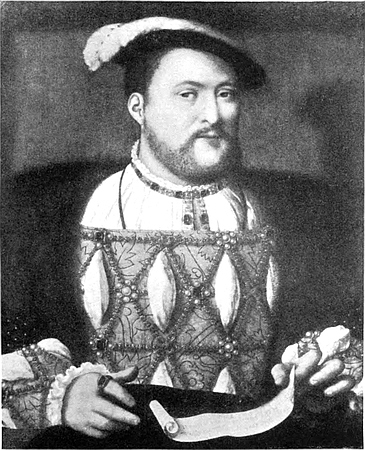
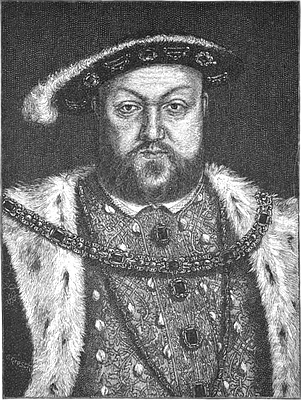
been attempted. Henry VIII. was the most masterful sovereign of
his time; but a king cannot outrage and trample upon the settled
religious faith of his subjects. The Old Faith had gone to pieces when
Constantine proclaimed the New. The New, in its turn, now grown old and
incrustated, and hidden by a thousand additions, superstitions, and
superfluities, was in its turn ready for departure, in Northern Europe
at least, when Henry effected the separation from Rome which began the
Reformation in England.
Among an ignorant and an uncritical people the ancient Faith passed
unquestioned—was it not the Faith of all those in authority? Its
doctrines were supported less by teaching than by outward forms,
ceremonies, pageants, splendours and traditional conventions. In every
church the story of the Gospels was partly represented, but overlaid
with stories of the Saints; the Christian virtues were never, even
at the lowest point of Church History, forgotten, yet their practice
had become crystallised; almsgiving was part of the Rule of every
Religious Order, but it was indiscriminate; mercy towards the criminal
had become a refuge for those who continued in their evil practices
under cover of Sanctuary; the tradition of austerity no longer
brought respect to the Benedictine; the tradition of self-sacrifice
no longer brought love to the Franciscan: to the former, as to the
College of All Souls, Oxford, the members were bene nati, and, I
believe, for the most part bene morati and moderate docti; in
the more secluded religious communities discipline was relaxed and
scandals had crept in; for a hundred years and more the people had
been gradually ceasing to endow the Religious Houses with bequests.
At the commencement of the sixteenth century they had wholly ceased
the practice, formerly universal. Monk and Nun; Friar and Sister;
Hermit, Anchorite, Anchress, now received no more bequests; of all the
Religious Orders none had fallen into disrepute so hopelessly as the
Franciscans: they were selling the lead off the roofs of their stately
churches; they were selling their sacred vessels of silver gilt; their
boxes, hung up in the shops—if the shopkeepers admitted them—received
no more offerings; they were insulted in the streets; their numbers
were dwindling daily. Now all these things were like an open book in
which those who passed along the way might read daily, and did read
unconsciously, so that their minds were moulded and directed, they
could not tell why or how.
As for the spread of the ideas called Lollardry, one knows not how far
they survived the persecution under Henry V. and the disturbances of
the Civil Wars. But such ideas, whose strength lies in the exercise
of reason, so far as men can reason, do not easily die; the case of
Richard Hun (p. 32) shows that they were still alive. The socialistic
side of Lollardry had vanished, but some, at least, of the religious
side survived.
Yet the old things went on apparently undisturbed. Nothing could
surpass the external splendour of a Cardinal Archbishop: no authority
was greater in appearance than his. The rich endowments of the greater
Abbeys made the Houses magnificent and the Brethren proud, generous,
and profuse in hospitality and in alms. Who could be more dignified
than the Abbot of St. Peter’s, Westminster? Still the Church seemed to
rule in everything: the Fraternities continued; they still attracted
members; they still marched in procession, each with its chaplain and
its singing men, its banners and its brethren, through the streets on
its appointed day; the City Companies were incorporated as Religious as
well as Trade Societies; the Manger and the Holy Tomb still adorned the
churches on the great Festivals; the Angel still flew over the people
from the roof on the Day of Pentecost; the pictures on the wall in
every church recorded the martyrdom of the Saint of Dedication and the
miracles which commanded his canonisation. No one could have dreamed,
no one could have prophesied, when the scholarly young King thundered
against Luther that the old order was drawing to its allotted end, and
that for Rome, as well as Northern Europe, Reform was at hand.
In many ways the Church had long lost its former hold. No longer were
the architects Churchmen; no longer were the bridge builders a distinct
fraternity; the lawyers were clerks, indeed, but not in Holy Orders;
the King’s Ministers were no longer necessarily of the Clergy; scholars
were no longer of necessity ordained priests or deacons; physicians
were laymen; the clergy were allowed to practise surgery, provided
that they did not use fire or steel—in other words, did not conduct
operations; in trade the lending of money—formerly in the hands of
the Jews and afterwards in those of the so-called “Caursini,” Italians
licensed by the Popes—was now recognised as necessary, and was carried
on more or less openly by merchants; in a word, the daily life of the
world, which had been shot through and through, like a piece of silk
with its coloured threads, by Religion, had long been emancipating
itself, by slow and gradual steps, from the control of the Church and
the interference of the priest.
How much these things were understood at the time it is not necessary
to inquire. Probably the people, who knew no history, had been
unconsciously moulded and changed, and were far from realising the
great gulf which now divided them from their ancestors.
Yet there were other signs of change, could they have been rightly
interpreted. Scholars, like Erasmus, openly derided the adoration of
relics; some of them, under new Pagan influence, denied the Christian
faith itself; the scholars of France, like Rabelais and Étienne Dolet,
scoffed at the Pope and the Papal pretensions; yet Rabelais did not
dare to publish in his lifetime the most daring and the most deadly
part of his work.
Add to these things the long-standing disaffection towards the
Roman authority. For centuries the Pope had been attempting fresh
encroachments, claiming new powers, demanding more contributions.
All travellers to Rome brought back the same story of corruption and
laxity; men asked themselves why they should submit to the oppression
of an Italian prince. In 1529 the House of Commons drew up a petition
in which, while they did not ask for a change of doctrine, they
complained of the independent legislation claimed by Convocation, the
number of officers, the exorbitant fees of ecclesiastical courts, the
granting of benefices to children, pluralities, non-residence and other
grievances. Surely such a man as Wolsey must have discerned in all
these symptoms a warning, clear and loud, that their house must be set
in order. Perhaps not, however: nothing is more difficult than for the
ecclesiastical mind to see, outside its fences of doctrine and usage,
the questioning people, and to hear and understand the awakened mind.
The action of Henry, which, on the face of it, seems the most masterful
thing ever attempted by a king, was, on the contrary, approved and
accepted by the great mass of the people; especially by the people of
London, by the scholars, and by the clergy. There were few who emulated
the constancy of the unfortunate Carthusians or the martyrdom of More
and Fisher; the old order crumbled and fell to pieces at a touch;
out of the débris, among the fallen monarchs of the forest, rose up
a tangled mass of vegetation, from which the nobler kinds had to be
separated by trial and proof, by persecution and by cultivation.
The first direct step towards the Reformation was, assuredly, not
considered as such. It was the suppression by Cardinal Wolsey of
certain small houses with whose revenues he endowed his Colleges.
The second direct step was the Petition of the House of Commons, which
also passed the Upper House, in 1529.
In January 1531 the House of Commons, in demanding of the clergy the
payment of £118,000—an enormous sum, representing more than a million
of our money—gave Henry the title of Head of the Church. This was
before the break with Rome; so far it meant only that the civil power
should be superior to the ecclesiastical.
Then followed the Bill for the abolition of annales or payment to the
Pope of the first year’s income of benefice or see. This was at first
held in terrorem over the head of the Pope.
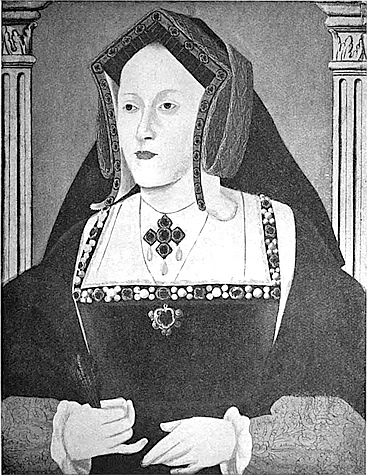
The divorce of Katherine and the King’s marriage with Anne Boleyn
in spite of the opposition of the Pope completed the separation.
Henceforth the King was Head of the Church within his own realm.
It was to show to the whole world that he was in earnest and that he
meant indeed to be Head of the Church, that Henry caused the execution
of the Carthusian monks, of Bishop Fisher, and Sir Thomas More. All
Christendom shuddered when those holy men were dragged forth to suffer
the degrading and horrible death of traitors; yet all Christendom
recognised that there was a King in England who would brook no
interference, who knew his own mind, and would work his own will.
I need not follow the course and the development of the Reformation,
for its history belongs to the whole country. As regards London, two or
three points present themselves for consideration: as, for instance,
the condition of the Houses; the manners and morality of the Religious;
and the mind of the people.
Let us consider these points from the position of a contemporary
Londoner, so far as is possible. First, as to the condition of the
Houses.
The enormous wealth of the Church could not fail to impress every one
with the incongruity of ecclesiastical professions and practices.
The sight of those scores of able-bodied men, most of them with no
pretensions to be considered scholars, or divines, or even gentlemen—a
qualification which, at the time, might have been sufficient
justification for living on the work of others—but men of low origin
and of narrow attainments, lounging about the streets and in the
taverns—some, as the friars, with no apparent duties at all; some,
like the chantry priests, with half an hour’s work every day; many
of them without the least pretence to piety or virtue—could not but
become a powerful aid in the popular approval of the Dissolution. In
London alone, a very large part of the City belonged to the Church.
The streets swarmed with ecclesiastics who, in the midst of a busy and
industrial population, seemed idle and useless.
In the Italian Relations of England the writer speaks of the vast
wealth of the Church and the power of the ecclesiastics. “I for my
part,” he says, “believe that the English priests would desire nothing
better than what they have got, were it not they are obliged to assist
the Crown in time of war, and also to keep many poor gentlemen, who are
left beggars in consequence of the inheritance devolving to the eldest
son. And if the Bishops were to decline this expense they would be
considered infamous, nor do I believe that they would be safe in their
own churches.”
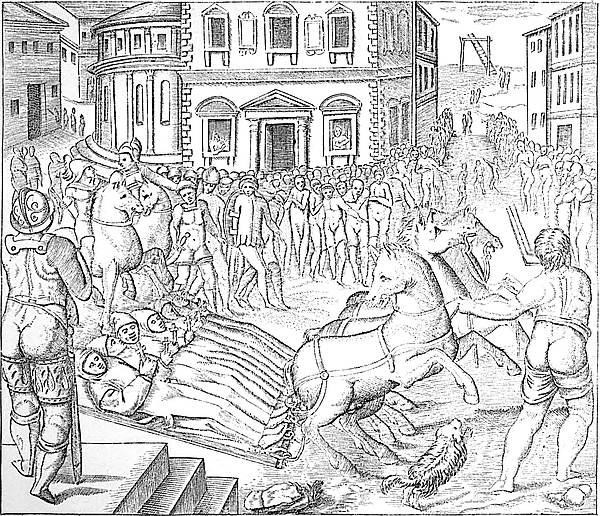
CARTHUSIAN MARTYRS
From a historical print in the British Museum.
There is surely some confusion here. It is true that younger sons
attached themselves to the following of the great Lords Spiritual as
well as Temporal, but I have nowhere else found it stated that it was
the duty of the Church to keep them. Also many of them, as we have
seen, had City connections and embarked in trade. For “Church” we
should perhaps read “the Monastic Houses.”
If we come to consider the condition of the Religious on the score
of morality, all that can be said concerning those of London is that
we hear nothing against them. It is true that the details of the
Visitations of London have not been revealed. But there could not
have been anything very bad, or it would have been laid hold of and
enlarged upon, and pointed out for the execration of the people, by the
preachers of the new religion.
Froude, in his paper on the Dissolution of the Monasteries, argues
that the evidence of immorality on the part of certain Religious
Houses is overwhelming. His case against that of St. Albans is
certainly convincing, so far as that House alone is concerned. And
it is difficult not to believe that in other cases about the country
the evidence of the visitors, even granting that their own private
character left a good deal to be desired, is much too detailed for pure
invention.
But, as regards the Religious of London, I am not aware that there is
any evidence to prove that they were either notoriously or secretly
corrupt or luxurious. Considering the pristine standard of the Rule,
they were doubtless degenerate, just as in a College of Oxford or
Cambridge fifty years ago, the Fellows who should have carried on
the lamp of learning spent their time in the study of Port and the
practice of Whist. Father Gasquet argues in favour of the whole body
of nuns—London or country—when he cites the case of Sister Joan. In
the year 1535 the Archbishop of York visited a certain convent in his
diocese and learned that one of the nuns had been guilty of unchastity.
He inflicted upon her a sentence of great severity: she was to be
kept in prison for two years, without speaking to any one but the
Prioress; she was to fast altogether on Wednesday and Friday; and on
every Friday she was to be taken to the Chapter House, there to receive
discipline—i.e. to be whipped. Is it possible, Father Gasquet asks,
that the nunneries of England could be grossly and openly immoral—even
secretly immoral—when such a severe punishment was meted out to an
offender by the visiting archbishop? One might point out that a severe
punishment may tell of two things: either of horror at a rare and
heinous offence, or of a determination, by severe measures, to put down
a too frequent breaking of the vows of chastity.
Concerning, therefore, the morals of the London Religious, there has
been no special charge, so far as I know, brought against the whole
body. We may remember, however, that the number of persons bound by
vows of celibacy was very large; that even at the present time, when
there is certainly more self-restraint, it would be impossible for
these vows to be kept by so large a proportion of the people; and that
the clergy, in morals and in practice, have never been more than a
little in advance of the laity.
The many acts of unchastity of which one reads in the books were
perhaps scattered and solitary instances. I refer, however, to
certain documents which prove, not the common prevalence of vice, but
relaxation of the Rule. They are a collection of papers, the charges of
Langland, Bishop of Lincoln, early in the sixteenth century, published
in Archæologia (vol. xlvii.). They point to laxity, not to vice.
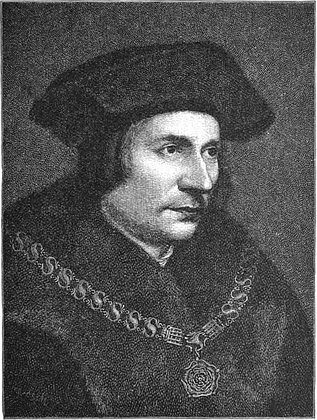
SIR THOMAS MORE (1478–1535)
From the painting by Holbein in the National Portrait Gallery, London.
The first is a charge to the Abbess and Convent of Elstow, near
Bedford. In this House the Sisters, instead of assembling in the
Fratry for their meals, were accustomed to gather together in what
they called their “Households”; apparently messes of two or more, at
which secular men, women, and children were allowed to be present. This
has to be amended. Henceforth they may repair to the Misericorde, but
only one or two at a time, and then under charge of an elderly sister.
Their attendance at the services in the “Quire” has become irregular,
henceforth they are all to attend every service; they are not to look
about the church upon the people during service, for which purpose
a door is to be constructed shutting off the choir. They had become
irregular about their dress, henceforth they are not to wear their
dresses cut low. As for the Lady Abbess, she herself is ordered to get
up and attend matins with the rest, and not to break her fast nor to
sup with the steward or any secular man.
Clearly, a House requiring reformation, yet not blameworthy of the
grosser sins.
There was the Priory of Studley, a Benedictine Nunnery in the Parish of
Beckley, Oxfordshire, the burial-place of the British Saint Donanverdh,
and one of the residences of Richard of Almayn, brother of Henry. The
Prioress is warned to dismiss a certain steward, named Marten Whighill;
she is not to suffer her ladies to become godmothers, nor to go out
on visits to their kinsfolk “onles it be for their comforte in tyme
of ther syknesse, and yett nott then onlesse it shal seme to you,
ladye priores, to be behoveful and necessarye, seeing that undre such
pretence muche insolency have bene used in religion.” Considering,
further, that the House is in great debt, the Prioress is to grant no
more corrodies, i.e. right of board and lodging in the House; to have
fewer servants; and to live “in a scarcer manour.” She is to look more
carefully after the food of the Sisters; she is to see that they wear
their robes; and she is to admit more ladies.
The Prioress of Cotham, in Lincolnshire, is to see that there is more
order in the singing of the novices. This House has grown very lax. The
kinsfolk of the Sisters were no longer to be admitted; the Chaplain was
not to be allowed the key of the church; the Lord of Misrule was not to
be admitted at Christmas. Then, some of the Sisters had been allowed to
go out into the world under pretence of pilgrimage, which license had
caused great scandals. Henceforth they were not to be allowed out of
the House for the night, nor out of the House at all unless accompanied
by a devout Sister. Again, the Sisters had been allowed to go on visits
to Thornton, Newsome, Hull (where there were other nunneries), and the
Bishop speaks strongly of the reproach, rebuke, and shame which the
rumours of their conduct had brought upon them. This House is the worst
case of the four. Certain persons named are absolutely forbidden within
the walls. Sir John Warde, Sir Richard Calverley, Sir William Johnson,
the Parson of Skotton, and Sir William Sele, are those who have brought
upon themselves by their misconduct this prohibition. Lastly, since the
House had been reduced to miserable poverty, the Prioress must diminish
her servants, grant no more corrodies, sell no more plate, and get the
necessary repairs effected as speedily as possible.
The last of the charges is one to the Abbot of Missenden, in
Buckinghamshire. This House, also, has fallen into poverty; there must
be a diminished number of servants and a simpler table; there must
be no more granting of corrodies; the House must be put into repair.
There was no school for the novices; a man learned in grammar must be
appointed at once; the boys must be kept apart; in future the monks
must not be allowed to wander about outside, day and night, as had been
the case. And no women were to be admitted either by day or by night.
John Compton was to be turned out of the monastery at once—he was
probably the steward; and Dom John Slithurst was to be put in prison
and kept there.
These accounts indicate very clearly the decay of discipline in the
Houses. The Prioress eats and drinks with her steward; the Sisters
entertain their kinsfolk within the walls; the church plate is sold to
pay debts; the Sisters get outside on any pretext—then come scandals.
Certain persons are so much mixed up with these scandals that they must
never be allowed within the House at all; the Sisters adopt as much of
the fashions of the world as they can; they shirk the services; they
relieve the monotony of their lives by going on pilgrimages. As to the
monks they get out alone, all night long. What scandals made the Bishop
so determined upon keeping women out of the House altogether? And
what had Dom Slithurst done, more than his fellows, that he was to be
clapped into prison and kept there?
It will be replied that these are all Houses in the country. That is
quite true; yet I think that, considering the attacks on the Religious;
the decay of the Friars; the withdrawal of bequests from monks and
friars alike,—the London Houses must have been open at least to
charges of laxity; and I would not press against them anything more
severe. In the admonition of the Dean of St. Paul’s to the Nuns of
St. Helen’s, laxity, not vice, was the principal complaint. Those
who believe that graver charges might be brought may read the famous
accusation against the Abbot of St. Albans—a thing, to my mind,
impossible to get over. True, St. Albans is not London, which is a
saving clause.
Enough about the condition of the Houses and the morality of the
Religious. I hear certain whispers where men congregate: they
murmur—tacenda. I have no proof that they are true; but I understand
that the holiness of the Religious is no longer accepted as a matter of
course; it is enough for one that this is so. The work of the Houses
is done when the people no longer desire the prayers of brethren
inclusi, and sisters immured; and no longer expect the pristine
devotion of the Friars.
The suppression of the Religious Houses and its immediate effects in
London are passed over by Stow, in his Survey, with great brevity.
It is a pity; we should like so much to have a clear understanding of
how the people at large received these measures. Now this historian was
born in 1525; he could remember, therefore, not only the Dissolution,
but also the condition of the City under the old régime. It is much
to be lamented, further, that though he could find time and space
to give whole pages to the Coronation of Anne Boleyn, he could not
give more than a brief note on the suppression of one House after
another. He remembered the Franciscans going in and about everywhere
in their grey gowns; the Dominicans in black; the Carmelites in white;
he remembered the riding apparel of the monks; he remembered—he
notices, in fact—the hospitality of the richer houses; he remembered
the stately churches towering above the humble parish churches, as
Westminster above St. Margaret’s; St. Augustine’s over Peter le Poor;
the Holy Trinity over St. Catherine Cree; their peals of bells;
their organs; their treasures of gold and silver plate; their church
furniture, sumptuous with cloth of gold and velvet. He remembered the
splendour, wealth, authority, and power of the old ecclesiastics. Their
authority seemed rooted in the solid rock, never to be destroyed; and
he remembered how this substantial ecclesiastical structure vanished
at a word, at a touch, leaving behind it nothing but ruined cloisters;
churches desecrated; carvings and marbles broken up. In his old age he
sat alone and marvelled over these things. But he spoke not. Perhaps it
was dangerous, even for a historian, to speak—Stow had already been
accused of being a favourer, at least, of the old Order; regrets were
accounted traitorous; sympathy with the outcast monk was heresy—or,
which was as dangerous, was lèse Majesté. Not every one desired
the crown of martyrdom: to most people it was disagreeable to be
burned—one would avoid this method of extinction if possible; almost
as disagreeable was it to be dragged on a hurdle, half hanged, cut
down, and then quartered. So Stow wrote nothing about the old time as
compared with that which followed.
In a single passage, however, Stow does allow us to understand
something of his opinion as to the whole business. No doubt many people
looked about for some mark of the Divine displeasure upon those who
took an active part in the Dissolution. To this day, certain persons
whisper about the families which succeeded to the monastic houses; if
anything happens to them it is put down to the vengeance which must
be expected to follow upon the sacrilegious occupation of monastic
property; nothing is said, of course, as to the long prosperity which
has attended most of the families which still occupy the old monastic
lands.
“About such time as Cardinall Wolsey was determined to erect
his new Colledges in Oxford and Ipswich, he obtayned licence
and authoritie of Pope Clement the Seventh to suppresse about
the number of fortie Monasteries of good fame, and bountifull
hospitalitie, wherin the King bearing with all his doings, neyther
Bishop nor temporall Lorde in this Realme durst saye any worde to
the contrarie.
In the executing of this business, five persons were his chiefe
instruments, who on a time made a demaunde to the Prior and
Convent of the Monasterie of Daintrie, for occupying of certayne
of theyr groundes, but the Monkes refusing to satisfie their
requests, streightway they picked a quarrel agaynst the house,
and gave information to the Cardinall agaynste them, who taking a
small occasion, commaunded the house to bee dissolved, and to bee
converted to hys new Colledge, but of thys irreligious robberie,
done of no conscience, but to patch up pride, whiche private wealth
coulde not furnishe, what punishmente hath since ensued at God’s
hande (sayeth myne Author) partly ourselves have seene, for of
those fyve persons, two fell at discorde betweene themselves, and
the one slewe the other, for the which the survivor was hanged;
the thirde drowned himselfe in a well; the fourth beeing well
knowne, and valued worth two hundred pounde, became in three
yeares so poore, that hee begged to hys dying day; and the fifth
called Doctor Allane, beeyng chiefe executor of these doyngs, was
cruelly maymed in Irelande, even at suche tyme as hee was a Bishop;
the Cardinall falling after into the King’s greevous displeasure,
was deposed, and dyed miserably; the Colledges whiche hee meante
to have made so glorious a building, came never to good effect;
and Pope Clement himselve, by whose authoritie these houses were
throwne downe to the ground was after enclosed in a dangerous siege
within the Castell of Saint Angell in Rome by the Emperialles; the
Citie of Rome was pitifully sacked; and himselfe narrowly escaped
with his life.”
I have repeatedly spoken of the falling off in bequests to the various
Religious Orders during the hundred years preceding the Reformation.
The fact, indeed, seems to be most important in considering the
attitude of the citizens. That it is a fact may be proved by the
following table, compiled from the Calendar of Wills. I have already
made some extracts from the Wills in proof of the change of popular
opinion in this respect; this table considers the fact from another
point of view.
Of course we have not, in these pages, all the Wills, nor anything
more than a small fraction of the Wills made by the Citizens during
the centuries covered by the contents of these two volumes. But they
may be taken as representative wills, in whatever manner they present
contemporary opinion. Now, as regards bequests to Religious Houses, I
have made the following analysis. I take three periods. (1) from 1250
to 1350; (2) from 1350 to 1450; (3) from 1450 to the Dissolution, say
1538; covering nearly three centuries. During these three periods the
following is the number of bequests:—
| 1. To the various Orders of Friars for 1250–1350 |
20 |
| 1350–1450 |
12 |
| 1450–1540 |
4 |
| 2. To the Charter House for the 1st period, not founded. |
|
| 2nd „ |
31 |
| 3rd „ |
14 |
| 3. To the Grey Friars for the 1st period, bequests included among the various Orders. |
|
| 2nd „ |
20 |
| 3rd „ |
none |
| 4. To the Black Friars 1st period, included among various Orders. |
|
| 2nd „ |
10 |
| 3rd „ |
1 |
| 5. To the Holy Trinity Priory for the 1st period |
17 |
| 2nd „ |
46 (?) |
| 6. To Eastminster for the 1st period, not yet founded. |
|
| 2nd „ |
7 |
| 3rd „ |
2 |
| 7. To St. Helen’s for the 1st period |
18 |
| 2nd „ |
12 |
| 3rd „ |
none |
| 8. Crutched Friars for the 1st period |
13 |
| 2nd „ |
10 |
| 3rd „ |
1 |
| 9. Carmelite or White Friars, 1st period |
15 |
| 2nd „ |
11 |
| 3rd „ |
1 |
| 10. Austin Friars for 1st period |
13 |
| 2nd „ |
13 |
| 3rd „ for masses |
2 |
| 11. St. Bartholomew’s for 1st period |
14 |
| 2nd „ |
13 |
| 3rd „ |
2 |
| 12. Haliwell for 1st period |
12 |
| 2nd „ |
20 |
| 3rd „ |
2 |
| 13. Minoresses for 1st period |
9 |
| 2nd „ |
18 |
| 3rd „ |
3 |
These figures show most unmistakably that the monastic life was no
longer regarded as it had been by the people of London. By the friars
especially, i.e. by those who could read the signs of the time, it
must have been understood that the end was very near. Not the alleged
immorality of the Religious, but the decay of their numbers, the
wasting of their property, the withdrawal of support by the laity,
might have warned those under vows that a change was nigh at hand. I do
not suppose that many of them heard this warning. Who could believe,
standing in the great church, glittering with lights, with gold and
silver, rich with colour, splendid with carved work, that the axe was
already laid to the root?
The people of London were not, it is true, consulted. Henry was not
the kind of man to consult the illiterate on points of Theology or
Spiritual Government. They were, however, filled with a vague unrest
of new ideas; we know not what survivals of the old Lollardry lingered
and were whispered about, or spoken openly; we know not how widely the
ballads and satirical verses against monks and friars were repeated
and sung and made the subject of merriment in the taverns. We do know,
however, that the King ordered and that the people of London obeyed.
I think it incredible that even the most masterful of English kings
should have dared to force changes so radical upon an unwilling city.
London was never remarkable for meekness, and in matters religious was
never uncertain. The King must have known that the people of London,
at least, would be with him. London, therefore, obeyed; the people
looked on while the Pope of Rome vanished; they made no protest when
they saw Monks, Nuns, and Friars turned out of doors and their Houses
closed; they looked on without a murmur even when the Carthusians
were dragged to a horrible doom. Was this callousness? Was it fear?
Was it acquiescence in the Revolution, with the hope of larger things
to follow? For my own part, looking at the attitude of the citizens
during the successive reigns of Henry, Edward, Mary, and Elizabeth, I
think there can be no doubt as to the general opinion at the time, and
that it was from the outset in favour of the Dissolution of the Houses
and the Dispersion of the Religious; in favour of denying the authority
of the Pope; eager for the free readings of the Holy Scriptures in the
vulgar tongue and for the right of that private interpretation which
seems so easy to the illiterate. As regards ritual, the changes, as
will be explained later, were gradual; the introduction of distinctive
Protestant doctrine was not brought about in a day; the genesis of the
Puritanic spirit does not belong to the Revolution under Henry.
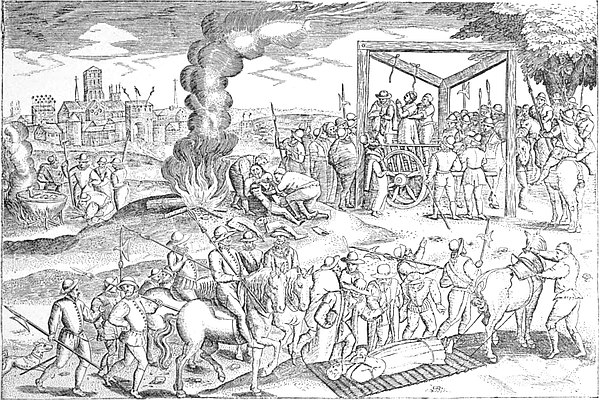
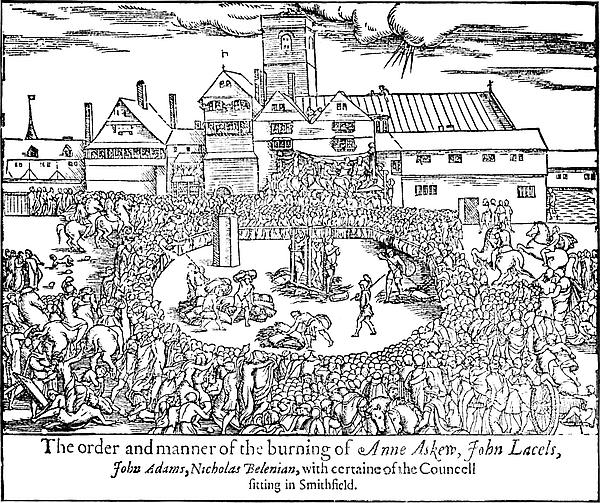
MARTYRS AT SMITHFIELD
E. Gardner’s Collection.
Let us endeavour to realise something of the extraordinary change which
the Suppression of the Houses brought about in London. Fortunately the
work was carried on by successive Acts, covering a period of fifteen
years or so; it was not until 1548, for instance, that the whole of the
chantries, colleges, etc., were suppressed.
The point of departure is, naturally, the expulsion and the dispersion
of the Religious of all Orders. At this point most historians stop. Yet
this was only the beginning.
Consider, then, the number of those turned out of the London Houses.
We may arrive at an approximation of the number by the following
considerations. There were 202 Houses, not counting Friaries, dissolved
in 1538–1540.
They contained, in all, 3221 Monks and Canons. This gives an average of
16 Brethren to each House. Now there were in London some twenty Houses
great and small—say from St. Peter’s, Westminster, to Jesus Commons.
In the same proportion there would thus be 300 Monks and Canons. In the
same proportion, also, there would be about a fourth of that number of
Nuns. Now, these monks and nuns were not sent out into a cold world
empty-handed. Not at all. They received pensions. The nuns of St.
Helen’s, for instance, received pensions of £2:14:4 each. The chantry
priests of the same place, whose stipends had been £6:13:4 and £7
respectively, obtained pensions of £5 each. We must, in fact, put aside
altogether the generally received notion of the Dissolution as an Act
which drove thousands of holy men and women out of their homes—abodes
of piety and virtue—to starve. There was no starvation at all: the
pensions though small were intended to be sufficient; we have therefore
the fact that some 400 Religious of London were made to lay down the
habit of their Profession and to go forth into the world on pensions
large enough to maintain them. What became of them? Many of the older
monks and nuns doubtless felt acutely the change of habit; the loss of
the former life—its quiet, its self-centred interests, its community;
some of the younger men, we cannot doubt, willingly turned themselves
to secular pursuits; some lived quietly, keeping up privately, two or
three together, some manner of religious life; some were concealed
in the country and a few, perhaps, in town, and led the life of the
Rule in a clandestine manner; some, again, the restraint of their vows
being withdrawn, ran into excesses and fell into the mire; some haunted
taverns, to the disgrace of their former calling. But of suffering or
privation I cannot discover that there was much, if any, either for
monks or nuns. It is pretended that the pensions were irregularly paid.
The evidence seems to me insufficient; in regard to the nuns of St.
Helen’s, we have positive evidence pointing in the opposite direction.
The greatest sufferers were, as we have seen, the friars. For them
there was no pity; for them there were no pensions; no one believed
in them any longer; their day was done. There appeared, a short time
ago, a book written by one who had been for twelve years a friar:
he came out of the House; he laid down his frock and renounced his
vows; and he wrote a book in which he described the life of his late
brethren. It is not an exaggerated or an ill-natured book; it is simply
a plain statement of the manner of life led by the friars of these
days. Looking through its pages one begins unconsciously to consider
the friars of the early sixteenth century—the friars in their last
days—by the light of this revelation. Now the modern friar is a man
of some education and some culture. Take away his education and his
culture in order to get at the friar of the Tudor time. Place him in a
time much rougher and coarser in manners; give him nothing to do: no
work either of mental or physical kind; and to the general futility
and unreality of life in a modern friary add the temptations, almost
irresistible to the uneducated mind of the ordinary friar, of the world
around him. In this way one may succeed, perhaps, in understanding the
reasons for the unpopularity of the friars.
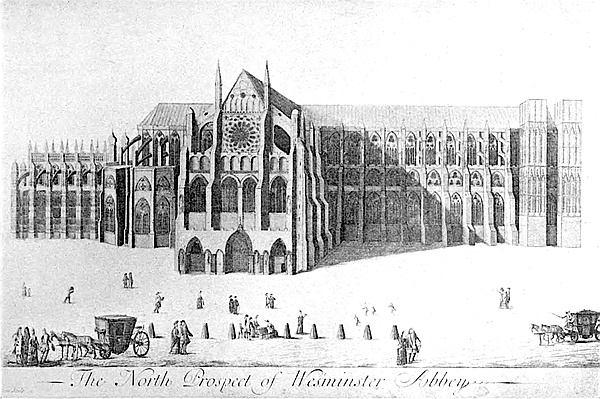
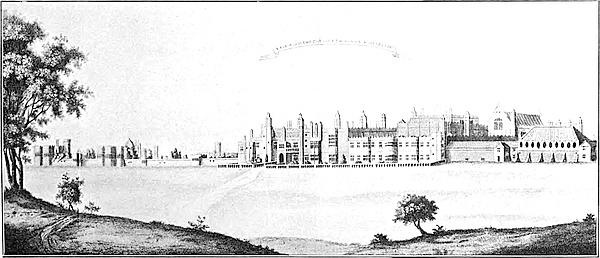
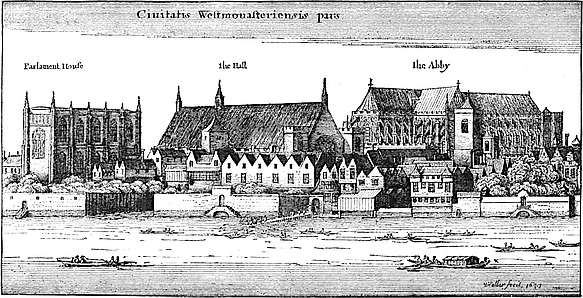
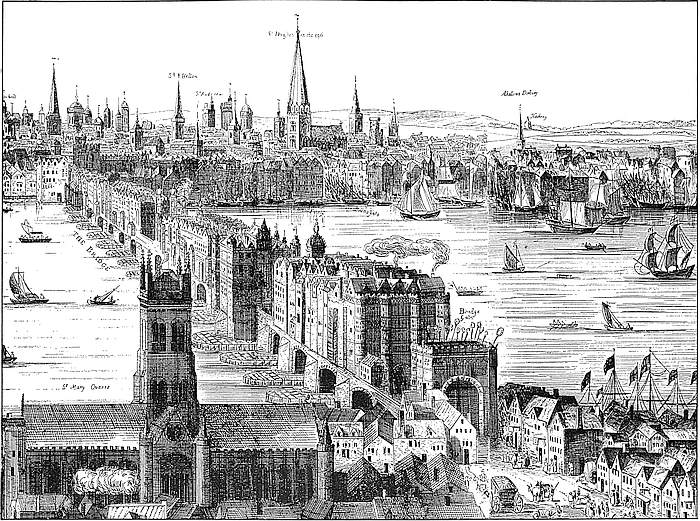
The North Prospect of Westminster Abbey
From an engraving by G. Collins. A. Rischgitz’ Collection.
It is generally stated that riches flowed in upon the friars as a
consequence of the respect in which they were held. That is not the
case: they were never rich. They owned a few houses built within the
limits of their own precinct, the rent of which went to maintain the
fabric of the church, and the service. For themselves the friars
possessed no great buildings, except the Church, the Library, and the
Hall: and they lived on charity at the end of their time as at the
beginning. Wyclyf makes much of their churches. “Freres bylden mony
grete churches and costily houses, and cloystris as hit were castels
and that withoute nede. Grete houses make not men holy, and onely by
holiness is God wel served.”
The friars were not rich, but they were proud: they arrogated power and
sanctity for their very robe. Those who died in the Franciscan habit
could never, they said, be carried away by the devil. Walsingham, who
had, perhaps, the jealousy of a monk, thus wrote of them:—
“The friars, unmindful of their profession, have even forgotten
to what end their Orders were instituted; for the holy men their
lawgivers desired them to be poor and free of all kind of temporal
possessions, that they should not have anything which they might
fear to lose on account of saying the truth. But now they are
envious of possessors, approve the crimes of the great, induce
the commonalty into error, and praise the sins of both; and with
the intent of acquiring possessions, they who had renounced
possessions, with the intent of gathering money, they who had sworn
to persevere in poverty, call good evil and evil good, leading
astray princes by adulation, the people by lies, and drawing both
with themselves out of the straight path.”
They disappeared. What became of them? It is impossible to say. Some
of the Sisters went to Flanders; some of those who were in priests’
orders obtained benefices; some took up honest work; for many, work was
impossible. If a man gets to thirty or so without doing any work, it
becomes impossible that he should ever do any work.
The Brethren, however, were not the only people who lived upon
the revenues of the House. Every Monastic Foundation had its own
establishment and was complete in itself. Of course, the superfluity
of officers and the general waste of work were, from a modern point of
view, deplorable. Every House had its mill, its brewery, its bakery,
its still-rooms, its gardens, orchards, fish-ponds, vineyards; its
servants of all kinds, including bailiffs, serjeants, scriveners,
illuminators, carvers, gilders, singing men, singing schools, huntsmen,
farmers, carpenters, plumbers, gardeners, agriculturists, sextons,
gate-porters, rent-collectors, lawyers, stewards, and one knows not
what besides. When the House was closed all these people were turned
adrift, certainly, without pensions. Thousands of families, for these
people were not under vows and were married, were suddenly deprived of
their means of livelihood. What could they do? The ordinary craftsmen
would make shift: their Companies helped them; but the better sort,
the scriveners, limners, illuminators, painters, carvers, gilders; the
bailiffs, lawyers, stewards,—what could they do? For fifteen years
London was flooded with the people of the monasteries turned adrift to
find a means of living; they were not people who swelled the ranks of
the vagabond and the masterless; they were respectable and honest folk.
Their struggles and their sufferings, if we could get at them, must
have been very real and, in many cases, very terrible.
There were, next, the people who lived by the making and selling
of things no longer wanted under the new order. There were the
makers of ecclesiastical vestments and robes; altar cloths; wax
tapers; instruments required in the celebration of Mass; crosses and
crucifixes; beads, reliquaries, images, and all the “properties”
required for the old Faith. Also all those who sold tapers, beads,
crosses, images, relics, books of hours, mass books, censers and
every kind of church vessel. One has only to look at the shops in the
vicinity of a French cathedral to understand the extent of the business
when not a single cathedral, but a hundred and fifty parish churches,
and monastic chapels, had to be provided for, and when all the people,
with one consent, acquiesced in the doctrines, and practised the ritual
of the Church.
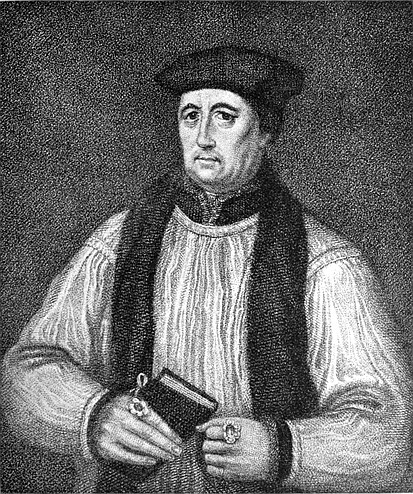
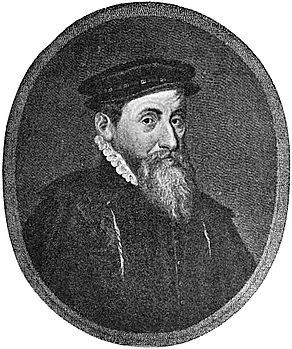
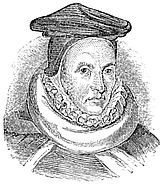
STEPHEN GARDINER, BISHOP OF WINCHESTER (1483(?)–1555)
From an engraving of the portrait in Trinity Hall, Cambridge.
All these people, thus deprived of their livelihood, were skilled
craftsmen. When their occupation was gone, when embroidered
altar-cloths, copes and vestments stiff with cloth of gold, carven
images, sacred pictures, beads and crosses and crucifixes, were no
longer wanted, what could they do? If, at the present day, any single
branch of industry is suddenly destroyed, what happens? It is too late
for the people concerned to learn another trade. What happened to these
unfortunates it is impossible to guess. One thing we know, namely, in
general terms, that London was in a miserable condition for a quarter
of a century after the Dissolution of the Houses; and we may fairly
conclude that not bad trade alone, but also the great number of poor
and forlorn creatures who had been hurled by the Reformation from
comfort to penury, was one cause of the depression.
Or, if we consider the immediate external effects of the Suppression;
think of the unwonted silence, when all the bells of all the Monastic
Houses were taken down: instead of the melodious pealing from forty
chapels, there was left only the sorry tinkle of the parish bell.
From the streets disappeared all the friars: those of St. Francis,
of St. Dominic, of St. Augustine, the Carmelites, and those with the
Iron Cross. The old familiar figures had been diminishing in numbers,
but they were still visible when the end came: still they went about,
opening their money-boxes in the shops, and finding nothing. Afterwards
one met, flitting along the streets, stray and forlorn figures clad
like craftsmen, but knowing no craft; sturdy beggars who would not
work; men and women turned out into the stony-hearted streets, filled
with rage and bitterness; looking always for the restoration of the
old Order and their own return to the quiet house of ease and comfort.
Gone, too, were the servants of the Houses; they had been known by the
badge upon their shoulders; gone was the vast army of chantry priests,
subdeacons, and ecclesiastics, with all the minor Orders. When Queen
Mary restored the ancient Faith the priests appeared again, leaping
out from unknown dens and secret places, ready to resume suddenly the
restored service before the newly adorned altar. And as London always
attracted the masterless and the vagabond and the criminal, so from
all parts of England flocked to the City those whom the Reformation
had sent out homeless and penniless. The clergy, for their part, lost
the greater part of their fees. The baptisms, marriages, and funerals,
it is true, continued, but the fees for masses to be said for the
dead—the most important part of the fees—the endowments of chantries,
post obits, and memorial days, were all swept away. There were many
chantry priests in every parish church. Why, only a few years before
the Reformation, on the death of Lady Jane Seymour, Sir Richard Gresham
ordered 1200 masses to be sung in the City churches for the repose of
her soul. And when prayers for the dead were forbidden, and what had
been an aristocratic Heaven, open especially to the rich because they
could buy their entrance by masses, became a democratic Heaven, open
to the poor and lowly as much as to the high and mighty, the loss to
the clergy from this source was very great. There was also another
loss in the abolition of pilgrimage, and another in the abolition of
confession, penance, and extreme unction.
As for the people, they had their losses to deplore as well as their
gains to rejoice over. They were deprived, for instance, of the most
splendid and gorgeous spectacle open to them, the services of the
Church with the rolling music of the organ, the singing of the choir,
the chanting of the priests; with the illumination of the altar; the
fragrance of the incense; the pictures on the wall; the brilliant side
chapels; the many votive candles; the sculptured saints; and all that
appealed to the eye and to the ear. That service had been performed
by moving figures, they seemed not men, in wondrous robes set off
by the bright lights. It was a service at which the hearts of men
and women with imagination were daily, keenly, sincerely moved and
led heavenward. All this they had to give up. In its place they were
offered a cold and quiet service with a sermon an hour long, appealing
to their reason and bidding them base their faith on logic and argument
instead of the authority and the Voice of the Church, inviting them to
trust in right doctrine rather than in the Fold of Christ. The service
had been the chief instructor in art, music, and æsthetics. When it was
gone what had they left? There were no more pictures for the people;
there was no more grand and solemn music for them; only the tinkling
of the mandoline in the tavern, or the “noise” of the whifflers who
marched before a prisoner; there was nothing else for them. Mary’s
martyrs made them hate the name of Catholic; they pelted her chaplains
in the street; they hung up a dog, head shorn, to mock the tonsure;
they hung up a cat with a wafer in its paws to mock the Elevation
of the Host. Yet though they were no longer Catholics it cannot be
maintained that they had got very far in Protestantism.
Some of the ancient forms remained: it still continued the duty of
every Christian, as it has always been the duty of every follower
of the Roman Church, to attend service on Sunday morning, and to
communicate on the great festivals of Easter, Christmas, Trinity,
and Whit Sunday. The fast days remained: no flesh could be sold; the
butchers’ shops were closed; none could be eaten on Fridays or in Lent;
there were some who followed the ancient austerities so far as to
fast on Wednesday as well. All classes, high and low, rich and poor,
were constantly engaged in reading the New Testament for proofs of
new doctrine, and the Old Testament for examples and for warnings. In
every ale-house the men wrangled on points of doctrine over their pots;
the women in the doorways discussed obscure points in the teaching of
St. Paul; there were none so ignorant as not to be able to formulate
a whole body of doctrines; in every barber’s shop there was a Bible;
already men had begun to set up strange and absurd teachings, in their
ignorant and fond attempts to discern the Truth in a weak translation;
already some had begun to go about in sad-coloured garments, without
ornament, colour, or decoration, even with texts ostentatiously bound
round their hats or their sleeves, like the phylacteries of the
Pharisees.
In London the better sort of people towards the end of the century
became infected with Puritanism. Puritans were known by their outward
and visible signs: they wore texts on their arms; they hated starch
and had limp cuffs; they wore no hatbands; they would not curl their
hair, but carried it lank; those who were shopkeepers always had
a Bible open on the counter; they hated the theatre and all other
amusements; in church they would have no organ; they used strange
words, calling, for instance, godfather and godmother “witnesses”; they
spoke of Christ-tide instead of Christmas; whole trades in London went
“solid” for Puritanism, e.g. the feathermen of Blackfriars; they
were intolerant and fanatic; they desired above all things to abolish
Episcopacy. They showed their opinions by their manner of singing,
which was without the accompaniment of organs, and by slowly drawling
their words. The Puritans would not greatly care for irreverence in St.
Paul’s: they gave no reverence to a consecrated place; yet they went to
church in order to worship and to hear godly sermons. Therefore they
could not look on unmoved when they saw St. Paul’s crowded with people
who went there in order to transact business, to buy and sell, to talk,
to quarrel, to fight, to make assignations or to keep them, to display
fine dress, to be hired in service.
To a certain class, the larger class, otherwise the thing would have
been impossible; these changes were welcomed with the greatest joy
because they declared and emphasised the revolution of religious
thought. For the majority the pendulum had swung round from the faith
and trust in the Fold of the Church, to the sense of individual
responsibility. The pendulum is always swinging backwards and
forwards. In our own time we have witnessed a partial return to the
belief in a Fold. The cold service with its long sermon of doctrine;
the private study of the Scriptures; the exercise of individual
judgment, free though unlettered, upon points of doubt and apparent
contradiction;—all formed part of the same movement and appealed to
the majority.
At the same time there was another section to whom these things were
hateful and horrible and blasphemous. This was the class which was
ready to forget the old grievances, the intolerable burden of Church
property; the multitudes who lived in sloth, as it appeared; the wide
difference between practice and profession; and thought only, as so
many at the present day think, of the haven of safety promised to the
faithful; the beauty, splendour, and stateliness of the service; the
ecstasy of the believer; the yielding of spirit before the Ineffable
Presence; the visible power and authority of the Roman Catholic Church.
These people looked and prayed daily for a return of the old Faith;
they were recusants under Elizabeth; they concealed the priests who
came over to concoct their conspiracies; they were Romanists first and
Englishmen next, until the horrors of the persecution in Flanders, of
the massacres in France, and the designs of the Spaniards upon England,
made them Englishmen first and Catholics next.
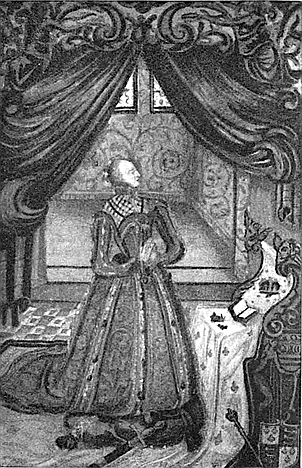
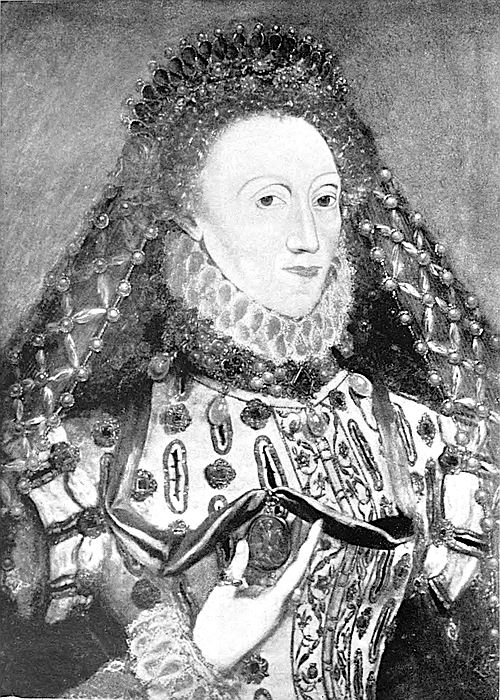
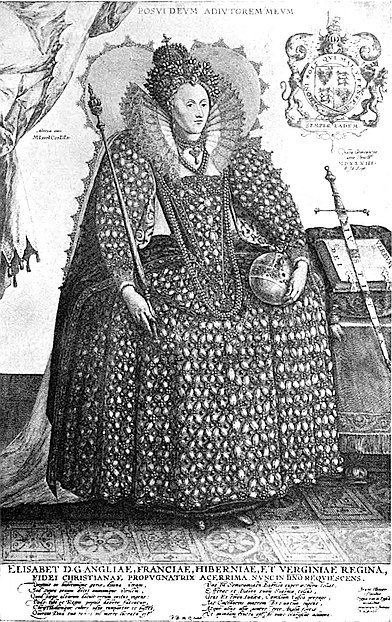
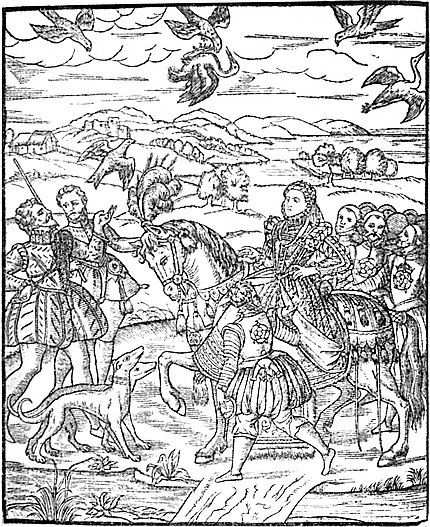
A. Rischgitz.
QUEEN ELIZABETH AT PRAYER
Frontispiece to Christian Prayers, 1569. From a copy in the Lambeth
Palace Library, which probably belonged to the Queen herself.
An irreparable loss to the world was the wholesale destruction of the
libraries. Printing, an invention of no longer standing than fifty
years, had as yet produced comparatively few books. When, for instance,
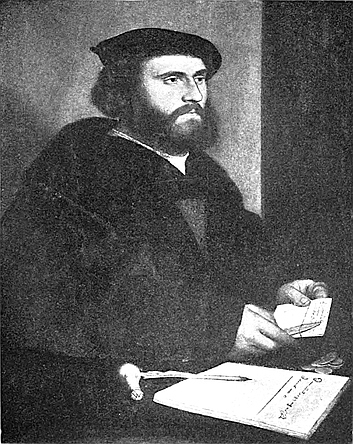
the learned Anthony Brockby had written his book Ad Fratres against
the King’s Supremacy, he did not get it printed, but had a duplicate
copy made, which he presented to the Franciscans, his brothers. By
far the greater part of theology, philosophy, science, and literature
remained in MS., and these MSS. formed the Monastic Libraries. When
the Houses were suppressed, those who obtained them as a gift from
the King for the most part cared nothing about the books: they were
dispersed without any consideration for their use or value; if they
were well bound, the covers were pulled off and the books thrown away,
or turned into waste paper. Thus John Bale writes (Antiq. English
Franciscans):—
“Covetousness was at that time so busy about private interest, that
public wealth was not anywhere regarded. A number of them which
purchased those superstitious Mansions reserved of those Library
Books some to serve their Jakes, some to scowr their candlesticks,
and some to rub their Boots, and some they sold the Grocers and
Soap sellers, and some they sent over sea to the Bookbinders:
not in small number, but, at times, whole ships full. Yea, the
Universities of this Realm are not all clear in this Fact; but
cursed is the belly which seeks to be fed with so ungodly gains,
and so deeply shameth his natural country. I know a Merchant man
(which shall at this time be nameless) that bought the Contents of
two noble Libraries for forty shillings price; a shame it is to be
spoken. This stuff hath he occupied, instead of grey paper, by the
space of more than these ten years, and yet he hath store enough
for as many years to come. A prodigious example is this, and to be
abhorred of all men which love their nation as they should do. Yea,
what may bring our realm to more shame and rebuke than to have it
noised abroad that we are despisers of learning? I judge this to be
true, and utter it with heaviness, that neither the Britons under
the Romans and Saxons, nor yet the English people under the Danes
and Normans had ever such damage of their learned Monuments as we
have seen in our time. Our posterity may well curse this wicked
fact of our age, this unreasonable spoil of England’s most noble
Antiquities.”... “How many admirable manuscripts of the Fathers,
Schoolmen, and Commentators were destroyed by this means? What
number of historians of all ages and Countries? The Holy Scriptures
themselves, as much as these Gospellers pretended to regard them,
underwent the fate of the rest. If a Book had a cross on it it
was condemned for Popery, and those with lines and circles were
interpreted the Black Art and destroyed for Conjuring. And thus, as
Fuller goes on, Divinity was profaned, Mathematicks suffered for
Corespondence with Evil Spirits, Physick was maimed, and a Riot
committed on the Law itself.”
One change, one result, of the Suppression, everybody can understand.
This was the closing of the Hospitals. London was full of Hospitals,
but they were Religious Houses. St. Bartholomew’s, attached to the
Priory; St. Thomas’, Southwark; St. Mary Spital; Elsing Spital for the
blind; St. Mary of Bethlehem for the insane; the House on Tower Hill
also for the insane; the House of St. Augustine Papey for old priests;
the Infirmary in every Monastic House;—all these provided for the sick
poor. I have no doubt, though on the subject I have no information,
that the Companies, which certainly took care of their sick and their
infirm, must have done so through the existing Hospitals. When the
Houses were closed, what became of the sick? It is commonly believed
that they were turned into the street, no one caring for them. This
was certainly not the case. The Companies cared for their own; the
City cared for its freemen and their families; would the City, which
maintained a debtors’ prison for its freemen, so that they should not
be confined with the general herd, suffer its sick and poor to starve?
There was a residuum of those who were not free, namely, the vagabonds
and masterless men and women. For them there was a time of great
misery; when they were ill there was no one to visit them; no hospital
where they might be taken; no hands to minister and alleviate; no voice
to console and to fortify. And we know nothing, and cannot estimate the
suffering because there were no journalists to publish the things they
saw; and the sick and poor lay unheeded and starved, and died unknown
and uncared for in the dirt and misery of the Tudor slum.
There is no doubt, also, that the open house kept by such a monastery
as the Holy Trinity, where the poor received every day the broken meat
and a great deal more, was greatly missed and deplored by the whole
company of the masterless. What with daily open house at the greater
monasteries, the broken meats of the smaller, the doles and charities
of the parish, the “mind days” with their loaves and gifts to the
poor, bequeathed by rich citizens, a family which objected to work
might rub along in solid and well-fed comfort all the year round. And
this resource, looked upon as certain and unfailing like a perennial
spring, was suddenly stopped. Then all these people had to work, or
to beg, or to rob. The streets became pestered with sturdy beggars:
the by-places of Elizabethan Literature present most vivid pictures of
the companies of beggars, impostors, rogues and vagabonds. They were
the people whom the monks and nuns had fed without asking questions;
the folk who would not work; the people turned out of the monasteries;
ex-friars; ex-chantry priests; former makers of images, crucifixes,
beads, candlesticks and the rest: these were the people who felt most
bitterly the abolition of indiscriminate charity and the cruel choice
offered them under the new order of work; mendicancy with the whip, or
crime with the gallows.
Out of all these evils and sufferings was born, like a sweet flower on
a heap of rubbish, the Spirit of modern Charity.
The Church had taken over to herself the whole of Mediæval charity. Did
a citizen desire to help the poor, he gave money for the purpose to the
Church. If a poor man wanted help, it was not to a merchant that he
went, but to a monastery.
For charity, that is, for pity, for almsgiving, the world has always
felt the most profound respect. The most popular of mediæval saints was
the hard and austere Bishop of whom the world remembered that he had
once divided his cloak with a beggar. There were six churches dedicated
to St. Martin in the City of London alone.
And when the friars first came over, and men, wondering, saw that they
did not lock themselves up in their cloister to pray for the world
like the other Religious, but that they went about among the people
ministering, comforting, preaching, consoling; that they found no den
too revolting, no disease too loathsome, no criminal too base, for
their ministrations; then, indeed, there was an outburst of gratitude,
of joy, of respect, of awe for men so saintly. They were considered the
veritable children of God.
But it was not to be thought that the poor sinners outside the
monastery should imitate their example. Nay, St. Francis, their
founder, had himself separated his Order from the world, they were
called out from the rest of humanity, they were kept separate by
vows of celibacy, poverty, obedience. Modern charity as yet did not
exist, as we now understand it, only the respect for charity as an
ecclesiastical institution.
I believe that the early followers of St. Francis perceived the weak
point of this separation from the world. We can hear one wiser than
the rest saying, “There is danger that the early zeal may decline. All
things human have in them the germs of decay; if there comes a time
when our brethren shrink from the task they have undertaken, if their
vows become a sham, their prayers a form, their work a pretence and
a profession, then it would have been better for the world had St.
Francis never existed, because we shall have taken from the layman the
duty of personal service and killed it by our own neglect.”
To meet this danger, not to take renunciation and self-sacrifice wholly
out of the world, they created another Order, that called the Fratres
de Saccâ. This Order contained men and women of the world, married
men and married women; they were allowed to go about their daily work;
those who were single were not forbidden to marry; they took vows, but
not those of celibacy nor of poverty.
When the Houses were suppressed, all the institutions which they had
supported were suppressed as well. Yet it did not immediately occur
to the people that the burden of the poor, which they had long since
willingly laid upon the Church, was now laid upon themselves. When
the City took over the House of the Grey Friars; the House of St.
Bartholomew; the House of St. Mary Bethlehem; the Palace of Bridewell;
the House of St. Thomas,—it seemed to take the place of the Church
and to attempt, by way of taxation, all that the Monastic Houses had
tried, or professed, to do from their own resources. We hear of sundry
collections for the poor; we do not hear of work among the poor, or of
responsibility for the poor, for a hundred years and more after the
Reformation.
I am not, happily, called upon in this place to attack, or to defend,
the Dissolution. I have only to consider its effect upon London. And
as regards the London Houses, I repeat, I can find no scandals. The
judgment of the people, though that was not asked or regarded, seems to
have arrived at a very clear understanding as to the actual spiritual
value, apart from any pretension or profession, of the life of
seclusion and celibacy. It was a very low estimate. On the other hand,
the City does not seem to have been openly hostile to the Religious.
They were an institution; these holy men were their own kin; the
Monastic Houses were a part of the daily life.
There were violent things published against monks and friars at this
time, but they were written by vehement partisans and were forced
upon the people. For example, the work of Barnabe Googe with his
Popish Kingdom. Had there been any active hatred against them it
would have shown itself by the acts and deeds of the ’prentices, who
always reflected, roughly but surely, the direction of the current
of contemporary opinion. Such slight indications of feeling on the
subject as are afforded by the literature in the next generation point
to reverence as regards the nuns; while as regards monks and friars
they are clean forgotten—a sure sign that they were not very actively
hated. At the same time it does seem most remarkable that the treatment
of the Carthusians, who must have been regarded as innocent victims and
martyrs, unless they were represented as political traitors, should not
have excited any popular indignation. One can only suppose that the
spectacle of a prisoner drawn on a hurdle, hanged, and quartered, was
so familiar, that people hardly troubled to ask who the sufferer was,
or for what crime he suffered.
Let us now pass on to speak of certain Martyrs and Confessors. It is by
this time needless to point out that the constancy shown by a Ridley
and a Latimer for the Protestant form of doctrine was fully equalled
by that of those who passed through the way of fire for the ancient
faith. There was, however, this difference, that the Catholic martyrs
were monks, priests, and men of mark like Fisher and More, while the
Protestants included a vast number of men and women from the lower
ranks—from the uneducated, who yet dared to hold a belief of their own
based, as they thought, on private judgment,—really on the training of
the sermons that they had heard.
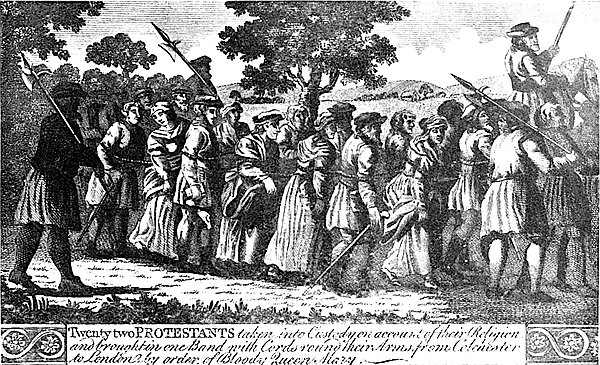
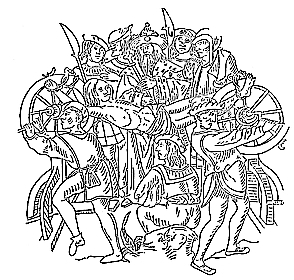
Twenty two PROTESTANTS taken into Custody on account
of their Religion and brought in one Band with Cords round their Arms,
from Colchester to London, by order of Bloody Queen Mary.
The case of Dr. Forest, Confessor to Queen Katherine, must not be
forgotten when one speaks of the martyrs of this time. Forest, an
old man, was committed to gaol, where he lay for two years among the
common malefactors, because he refused to acknowledge the supremacy of
the King. After two years of Newgate, two years in a close, stifling,
and noisome prison, the venerable priest was informed that he was to
be hanged over a fire and so slowly done to death. No more terrible
form of death was known in England, where the horrors of the French
and German capital punishments were never practised. It was the same
punishment as had been meted out to Oldcastle, and it was inflicted
on Forest for the same reason: to show the hatred and abhorrence of
the judges for the doctrines he taught. When the unfortunate Katherine
heard of the sentence she wrote to him. The letter, too long for
reproduction in these pages, together with Forest’s reply, may be found
in The Antiquities of the English Franciscans: they are probably
genuine and are very pitiful. The Queen, however, was spared the misery
of hearing of her Confessor’s torturing death: he was respited and
continued to lie in prison. Two years after the Queen’s death, and when
he had been confined in Newgate for four years, Forest was brought out
for execution.
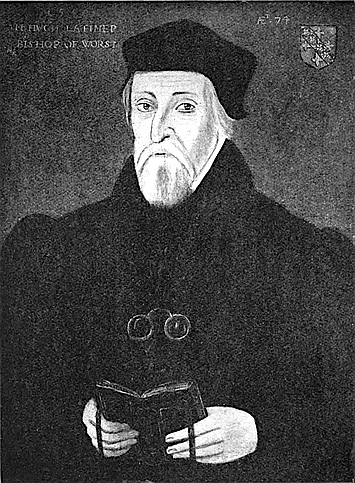
HUGH LATIMER (1485(?)–1555)
From the painting in the National Portrait Gallery, London.
On the 22nd of May 1518 they placed the old man on a sledge and dragged
him from Newgate to Smithfield, where he was hung in chains from a
gallows over a fire. This was the most terrible of all deaths. In
ordinary cases, the sufferer, bound to a thick stake with iron chains,
was enclosed up to the middle, and perhaps higher, with dry faggots: it
would seem that the fierce flames enveloping the victim caused death by
suffocation in a very few moments. Latimer, for instance, died in this
manner almost immediately; if, however, the flames were blown away, the
lower parts of the body might be slowly burned before death ensued:
this was the case with Ridley. When, however, the sufferer was simply
dangled over a fire, the flames blown this way and that, the agony
might last for hours.
In the case of Forest, the bystanders took pity on the old man and
threw the gallows into the fire, so that an end was soon made. “In
what state,” asked Latimer before the fire was lit, “will you die?”
Whereupon the old man replied in a loud voice: “If an angel should
come down from heaven to teach men any other doctrine than what I have
received and believed from my youth, I would not believe him; and if
my body should be cut joint after joint, member after member, hanged,
burned, or whatever pain might be done to me, yet would I never turn
from my old profession.” A brave old man!

BISHOP RIDLEY (1500(?)–1555)
From the painting in the National Portrait Gallery, London
After the Carthusians the principal sufferers seem to have been the
Observant Friars, of whom a large number suffered for refusing to
acknowledge the King’s supremacy. We may read in the Antiquities of
the English Franciscans a great many stories of these sufferings. One
hopes that there is exaggeration. For some, according to this book,
were carried about the country in chains; some were racked and then
strangled; some were starved to death; miracles attended the death of
some: the whole prison, in one case, became filled with a heavenly and
miraculous light; and an earthquake, in another case, testified to the
Divine displeasure at another martyrdom.
On the 22nd day of June 1534, three days after the execution of the
three Carthusians, Exmew, Middlemore, and Newdigate, was beheaded that
illustrious Catholic martyr, John Fisher, Bishop of Rochester, for
maintaining the Pope’s supremacy; and a fortnight later, that still
more illustrious martyr, Thomas More. The witty and pleasant manner of
his conversation was kept up to the last. Grafton thus speaks of his
last moments:—
“Besides his learning he had a great wit, and in talking verie
pleasant and merie conceited, and that even to the last hower;
insomuch that at hys comming to the Tower, one of the officers
demanded his upper garment for his fee (meaning hys Gowne) and
he aunswered, he should haue it, and toke him his cap, saying it
was the uppermost garment that he had. Likewise even going to his
death at the Tower gate a pore woman called to him and besought
him to declare that he had certayn evidence of hers in the time
that he was in office (which after he was apprehended she could
not come by) and that he would intreat she might have them agayne,
or else she was undone. He aunswered good woman have pacience a
little while, for the King is so good unto me that even within
this half houre he will discharge me of all businesses, and help
thee himselfe. Also when he went up the stayres on the Scaffolde,
he desired one of the Shriefes officers to give him his hand to
help him up, and sayde, when I come downe agayne, let me shift for
myself as well as I can. Also the hangman kneeled downe to him
asking him forgivenesse of his death (as the manner is) to whome he
sayde I forgive thee, but I promise thee that thou shalt never have
honestie of the stryking of my head, my neck is so short. Also even
when he should lay downe his head on the block, he having a great
gray beard, striked out his beard and sayde to the hangman, I pray
you let me lay my beard over the block least ye should cut it.”
(Chronicle of England, Grafton, vol. ii. p. 454.)
The martyrdom of the Carthusians was the most significant, the most
revengeful, the most audacious act of the new Head of the Church, the
Act by which he defied, once for all, the whole power of the Pope, of
Spain, and even of France. The world trembled, people looked for some
supernatural manifestation, some unmistakable sign of the Divine wrath:
none came, and they understood that here was an act of open war, and
that the Divine will as to the issue had not been pronounced.
Let us pass to the Marian Persecution. I have called attention to the
fact that the greater number of the martyrs belonged to the middle
class and to the rank or status of craftsmen. Thus, Christopher Wade
was a linen weaver; Thomas Wats a linen draper; John Warren was an
upholsterer; John Ardeley was a husbandman; Robert Bromley was a
grocer; Thomas Ormond was a fuller; Williams a weaver; Margery Polley
widow of a craftsman; Dirick Carver a brewer; John Laneden a rustic;
John Tudson an artificer; Joan Warne a maidservant. There were wives
and widows among them, “simple women,” artificers and ’prentices,
maid-servants and girls.
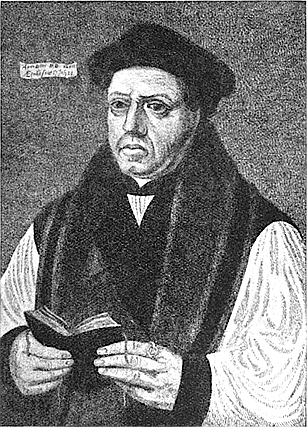
THOMAS CRANMER (1489–1556)
From the portrait in Jesus College, Cambridge. A. Rischgitz’ Collection.
It was the sight of their own people suffering a cruel death which made
the name of Rome hateful and horrible for three hundred years and more.
It was the sight of the constancy of the martyrs which laid the firm
foundations of the Protestant Faith. For none of them flinched before
the flames, none of them feared the pains which the Lord God in His
mercy and wisdom had ordered them to endure for the sake of the Cause.
What was to be expected when a shoemaker such as John Noyes could die
triumphant and rejoicing?
“On the next-day morning he was brought to the stake, where were
ready against his coming the foresaid justice, master Thurston, one
master Waller, then being under-sheriff, and master Thomas Lovel,
being high-constable, as is before expressed; the which commanded
men to make ready all things meet for that sinful purpose. Now the
fire in most places of the street was put out, saving a smoke which
was espied by the said Thomas Lovel proceeding from the top of a
chimney, to which house the sheriff and Grannow his man went, and
brake open the door, and thereby got fire, and brought the same to
the place of execution. When John Noyes came to the place where
he should be burnt, he kneeled down and said the 50th Psalm, with
other prayers; and then they, making haste, bound him to the stake.
And being bound, the said John Noyes said, ‘Fear not them that can
kill the body, but fear him that can kill both body and soul, and
cast it into everlasting fire.’
When he saw his sister weeping, and making moan for him, he bade
her that she should not weep for him, but weep for her sins.
Then one Nicholas Cadman, a valiant champion in the Pope’s affairs,
brought a faggot and set against him; and the said John Noyes took
up the faggot and kissed it, and said, ‘Blessed be the time that
ever I was born to come to this.’
Then he delivered his Psalter to the under-sheriff, desiring him to
be good to his wife and children, and to deliver to her that same
book; and the sheriff promised him that he would, notwithstanding
he never as yet performed his promise. Then the said John Noyes
said to the people, ‘They say, they can make God of a piece of
bread; believe them not!’
Then said he, ‘Good people, bear witness that I do believe to be
saved by the merits and passion of Jesus Christ, and not by mine
own deeds.’ And so the fire was kindled, and burnt about him. Then
he said, ‘Lord have mercy upon me! Christ have mercy upon me! Son
of David have mercy upon me!’
And so he yielded up his life. And when his body was burned, they
made a pit to bury the coals and ashes, and amongst the same they
found one of his feet that was unburnt, whole up to the ankle, with
the hose on; and that they buried with the rest.”
Or, to take the case of Cicely Ormes. She was a very simple woman,
the wife of a worsted weaver who lived in Norwich. She was present at
the martyrdom of Simon Miller and Elizabeth Cooper, and there, being
affected with their constancy, she declared that she would pledge them
with the same cup from which they drank:—
“She was burnt the 23d day of September, between seven and eight of
the clock in the morning, the said two sheriffs being there, and of
people to the number of two hundred. When she came to the stake,
she kneeled down, and made her prayers to God; that being done, she
rose up and said:—
‘Good people! I believe in God the Father, God the Son, and God the
Holy Ghost, three persons and one God. This do I not, nor will I
recant; but I recant utterly from the bottom of my heart the doings
of the Pope of Rome, and all his popish priests and shavelings. I
utterly refuse and never will have to do with them again, by God’s
grace. And, good people! I would you should not report of me that
I believe to be saved in that I offer myself here unto the death
for the Lord’s cause, but I believe to be saved by the death and
passion of Christ; and this my death is and shall be a witness of
my faith unto you all here present. Good people! as many of you as
believe as I believe, pray for me.’
Then she came to the stake, and laid her hand on it, and said,
‘Welcome the cross of Christ.’ Which being done, she, looking on
her hand, and seeing it blacked with the stake, wiped it upon her
smock; for she was burnt at the same stake that Simon Miller and
Elizabeth Cooper was burnt at. Then, after she had touched it with
her hand, she came and kissed it, and said, ‘Welcome the sweet
cross of Christ’; and so gave herself to be bound thereto. After
the tormentors had kindled the fire to her, she said, ‘My soul doth
magnify the Lord, and my spirit rejoiceth in God my Saviour.’ And
in so saying, she set her hands together right against her breast,
casting her eyes and head upward; and so stood, heaving up her
hands by little and little, till the very sinews of her arms did
brast in sonder, and then they fell. But she yielded her life unto
the Lord as quietly as if she had been in a slumber, or as one
feeling no pain; so wonderfully did the Lord work with her: His
name therefore be praised for evermore.”
Remember that the example was not only an admonition to those who saw
her death: it was related by the spectators; it was spread through the
length and breadth of the land; it was written down by Foxe, in whose
hands it certainly lost nothing of eloquence or of dramatic effect,
and it has been read ever since by countless people. Not the martyrdom
of Cranmer, Ridley, Latimer and the rest of the bishops, priests
and scholars, so much as those of the “very simple” women, the plain
craftsmen, built up the Protestant Faith, scattered the Spanish Fleets,
and changed the Englishman of the sixteenth century, so that he of the
seventeenth became possible.
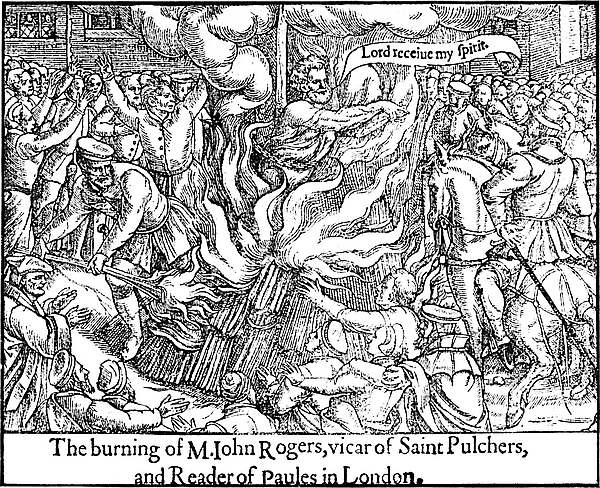
The burning of M. Iohn Rogers, vicar of Saint Pulchers,
and Reader of Paules in London.
The bare list of burnings in London alone, not nearly complete, as
enumerated by Henry Machyn in his Diary (1550–1563), conveys a sense
of the overwhelming horror which filled England during this reign,
perhaps clearer than a laboured treatise on the Lives and Deaths of
the Martyrs. In reading the list we can see the crowds flocking to
Smithfield: all their sympathies are with the sufferer; they see him
dragged on his hurdle, undressed to the shirt and tied to the stake;
they see that he flinches not nor offers to retract; the faggots are
piled about him, Heaven grant they be of dry wood; from the flames and
through the smoke they hear the voice of the martyr praising God and
praying till the end comes, when his tongue swells up in his mouth and
he can speak no more, or is suffocated with the smoke, or with the
intensity of his agony his heart stops and merciful Death seizes him.
Then the crowd go home again; they dare not speak to each other; but
they remember.
“1555. The iiij day of Feybruary the bysshope of London went into
Nugatt and odur docturs to dysgratt (degrade) Hoper, and Rogers
sumtyme vycker of sant Polkers. The sam day was Rogers cared
be-twyn x and xj of the cloke into Smythfeld and bornyd, for
aronyus opinions, with a grett compene of the gard.
1555. The xvj day of Marche was a veyver (weaver) bornyd in
Smyth-feld dwellynge in Sordyche, for herese, by viij of the cloke
in the mornyng, ys nam was Tomkins.
1555. The xiiij day of Aprell, the wyche was Ester day at sant
Margatt parryche at Westmynster after masse was done, one of
the menysters, a prest of the abbay, dyd helpe hym that was the
menyster to the pepull who wher reseyvyng of the blessyd sacrement
of the Lord Jhesus Cryst, ther cam in-to the chyrche a man that
was a monke of Elly, the wyche was marryed to a wyff: the sam day
ther that sam man saud to the menyster, What doyst thow gyff them?
and as sone as he had spokyn he druw his wod-knyffe, and hyt the
prest on the hed and struck hym on the hand, and cloyffe ys hand a
grett way and after on the harme a grett wond; and ther was syche
a cry and showtt as has not byne; and after he was taken and cared
to presun, and after examyned wher-for he dyd ytt. The xxiij day
of Aprell was the sam man cared to Westmynster that dyd hurt the
prest, and had ys hand stryken of at the post, and after he was
bornyd aganst sant Margett chyrche with-owt the cherche-yerde.
1555. The sam day of May was arraigned iiij men at Powlles a-for
none and after-non, of Essex, and thay wher cast for heresse and
all iiij cast to be bornyd and so cared unto Nugat.
1555. The xxv day of May were arraigned at St. Paul’s for heresy,
before the bishop, master Cardmaker sometime vicar of St. Bride’s
in Fleet-street, and one John Warren a cloth-worker in Walbrook and
a-nodur of ... and cast to be brent and carried back to Nugatt.
1555. The xxx day of May was burnt in Smythfeld master Cardmaker
sum-tyme veker of sant Bryd, and master Varren clothworker,
dwellyng aganst sant John in Walbroke, an hupholster, and ys wyff
behyng in [Newgate].
1555. The x day of Juin was delevered owt of Nugatt vij men to be
cared into Essex and Suffoke to borne.
1555. The furst day of July whent into Smythfield to borne master
Bradford, a grett precher by Kyng Edward’s days, and a talow
chandler’s prentice dwellyng by Nugatt, by viij of the cloke in the
mornyng, with a grett compene of pepull.
1555. The viij day of July were three more delivered out of Nugate
and sent into the country to be burned for heretics.
1555. The xij day of July was bornyd y Canturbery iiij men for
herese, ij prestes and ij laye men.
1555. The ij day of August was a shumaker bornyd ay sant Edmundbere
in Suffoke for herese.
1555. The viij day of August, between iiij and v in the morning,
was a presoner delevered into the shreyff of Medyllsex to be cared
unto Uxbryge to be bornyd; yt was the markett day—owt of Nugatt
delevered.
1555. The xxiij day of August was bornyd ay Stratford of bowe, in
the conte of Mydyllsex, a woman, wife of John Waren, clothworker, a
huphulster over against sant Johns in Walbroke; the whyche ... John
her hosband was bornyd with on Cardmaker in Smythfield for herese
boyth; and the sam woman had a sune taken at her bornyng and cared
to Nugatt to his syster, for they will born boyth.
1555. The xxxj day of August whent out of Nugatt a man of Essex
unto Barnett for herese, by the shreyff of Medyllsex, to borne ther.
1555. The same day were burnt at Oxford for heresy doctor Latimer,
late Bishop of Worcester, and doctor Ridley, late bysshope of
London; they were some tyme grett prychers as ever was; and at ther
bornyng dyd pryche doctur Smyth, sumtyme the master of Vetyngtun
colege.
1555. The xviij day of Dessember be-twyn 8 & 9 of the cloke in the
mornyng was cared into Smythfeld to be bornyd on master Philpot,
archdeacon of Winchester, gentyllman, for herese.

The description of Doctour Cranmer, howe he was plucked
downe from the stage, by Friers and Papists, for the true Confession of
hys Faith.
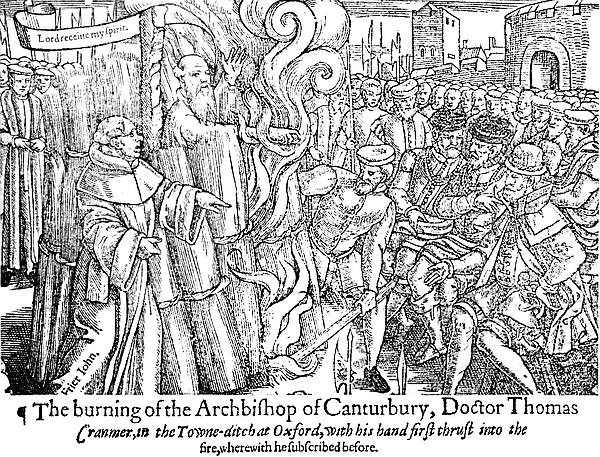
The burning of the Archbishop of Canturbury, Doctor
Thomas Cranmer, in the Towne-ditch at Oxford, with his hand first
thrust into the fire, wherewith he subscribed before.
1556. The xxij day of January whent into Smythfeld to berne betwyn
vij and viij in the mornyng v men and ij women; on of the men was a
gentyllman of the ender tempull, ys nam master Gren; and they wer
all bornyd by ix at iij postes; and ther wher a commonment thrughe
London over nyght that no yong folke shuld come ther, for ther the
grettest number was as has byne sene at shyche a tyme.
1556. The xxj day of Marche was bornyd at Oxford doctur Cranmer,
late archebysshope of Canturbere.
1556. The xv day of May was cared in a care from Nugatt thrug
London unto Strettford-a-bow to borne ij men; the on blyne, the
thodur lame; and ij tall men, the one was a penter, the thodur
a clothworker; the penter ys nam was Huw Loveroke, dwellyng in
Seythin lane; the blynd man dwellyng in sant Thomas apostylles.
1556. The xxvij day of June rod from Nugatt unto Stretford-a-bowe
in iiij cares xiij, xj men and ij women, and ther bornyd to iiij
postes, and ther wher a xx M. pepull.
1557. The iij day of April five persons out of Essex were condemned
for herese, iij men and ij women (one woman with a staff in her
hand), to be bornyd in Smythfeld.
1557. The vj day of Aprell was bornyd in Smythfeld v, iij men and
im women, for herese; on was a barber dwellyng in Lym-strett; and
on woman was the wyff of the Crane at the Crussyd-frers be-syd the
Towre-hylle, kepyng of a in ther.
1557. The xiiij day of May was bornyd in Chepe-syd and odur places
in London serten melle that was not sweet; and thay sayd that hey
had putt in lyme and sand to deseyffe the pepull and he was had to
the conter.
1557. The sam mornyng was bornyd be-yond sant George’s parryche iij
men for heresee, a dyssyd Nuwhyngtun.
1557. The xviij day of June was ij cared to be bornyd beyonde sant
Gorgeus, almost at Nuwhyngtyn for herese and odur matters.
1557. The xxij day of December were burned in Smyth-feld ij, one
ser John Ruffe the frere and a Skott, and a woman for herese.”
(Diary of Henry Machyn.)