Of cherries there are a great variety; most come from the county of
Kent, and are sold in the streets of London, sometimes as low as one
penny per pound! the sellers of which are often addicted to giving short
weight, as their customers apprehend, hence the cry of “full weight.”
The ground on which this market stands belonged to the Abbots of
Westminster, and was called Convent Garden. On the destruction of the
monasteries it was given to the Duke of Somerset; and, after his
misfortunes, was granted to the Earl of Bedford, in 1552, who let it for
building, and Inigo Jones designed the piazza, a portion of which
occupies the north and part of the east sides. The origin of the market
was casual. Persons came here, and stood in the centre of the square,
until it grew to the establishment of a market, which consisted of rough
sheds until about 1830, when the present market was built by the Duke of
Bedford. One part is devoted to vegetables, and others to fruits,
flowers, and plants.
(so called from an apple of that name) is an itinerant vendor of garden
stuff. He mostly transports his vegetable wares in a cart drawn by a
donkey. His cry varies with the seasons and their produce: at one time
we have “Cabbage plants,” “New potatoes,” or “Asparagus;” at another,
“Fine young peas, fresh gathered,” “Ripe rhubarb,” “Baking or boiling
apples:” he is now calling “Gooseberries! fourpence an ale-house quart,
gooseberries!” In the background is a seller of
Punch’s opera is proceeding along Bow Street with dog Toby in the rear,
from whose petty stage we turn to one of the largest in the metropolis,
The former theatre was burnt down, Sept. 20, 1808, and the present one
erected on its site, at a cost of £150,000, by R. Smirke, R.A., who has
taken as his model the temple of Minerva at Athens, and the first stone
was laid in September, 1809, by George IV., then Prince of Wales. It was
built with great rapidity, having been completed in less than a year
after the destruction of the former building. Along the front are
basso-relievos representing the ancient and modern drama; and in niches
at either end figures of Comedy and Tragedy, by Flaxman.
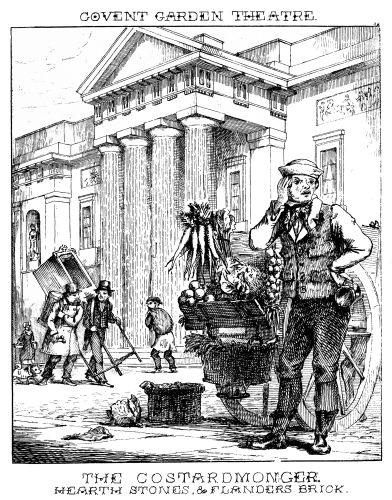 COVENT GARDEN THEATRE.
THE COSTARDMONGER.
HEARTH STONES, & FLANDERS BRICK.
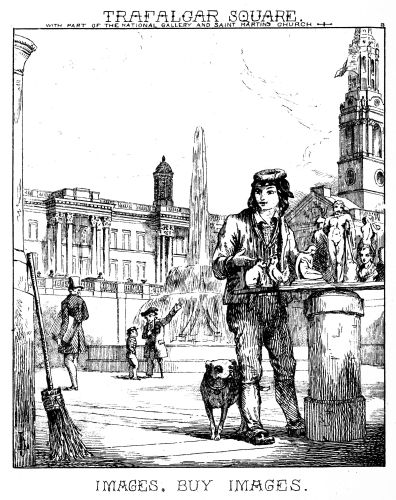 TRAFALGAR SQUARE.
WITH PART OF THE NATIONAL GALLERY AND SAINT MARTIN’S CHURCH
IMAGES, BUY IMAGES.