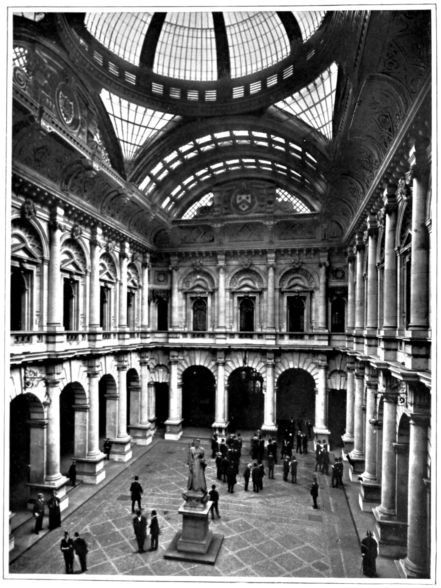
With this volume we begin what may be called the second part of the Survey.
All that has preceded it has dealt with the history of London as a whole; now we
turn to London in its topographical aspect and treat it street by street, with all the
historical associations interwoven in a continuous narrative with a running commentary
of the aspect of the streets as they were at the end of the nineteenth
century, for the book is strictly a Survey of London up to the end of the nineteenth
century. Sir Walter Besant himself wrote the greater part of the volume now
issued, calling it “The Antiquities of the City,” and it is exclusively confined to the
City. For the topographical side of the great work, however, he employed assistants
to collect material for him and to help him; for though, as he said, he had been
“walking about London for the last thirty years and found something fresh in it
every day,” he could not himself collect the mass of detail requisite for a fair
presentation of the subject. In the present volume, therefore, embedded in his
running commentary, will be found detailed accounts of the City Companies, the
City churches and other buildings, which are not by his hand. A word as to the
plan on which the volume is made may be helpful. In cases where the City halls
are standing, accounts of the Companies they belong to are inserted there in the
course of the perambulation; but where the Companies possess no halls, the matter
concerning them is relegated to an Appendix. The churches, however, being
peculiarly associated with the sites on which they are standing, or stood, are considered
to be an integral part of the City associations, and churches, whether
vanished or standing, are noted in course of perambulation. A distinction which
shows at a glance whether any particular church is still existing or has been demolished
is made by the type; for in the case of an existing church the name is
viset in large black type, as a centre heading, whereas with a vanished church it is
given in smaller black type set in line.
The plan of the book is simplicity itself; it follows the lines of groups of streets,
taken as dictated by common sense and not by the somewhat arbitrary boundaries of
wards. The outlines of these groups are clearly indicated on the large map which
will be found at the end of the volume.
CONTENTS THE ANTIQUITIES OF THE CITY
vii
GROUP I
PAGE
Streets North and South of Cheapside and the Poultry
It seems convenient in treating of the history and archæology of the City to
take the streets in groups, each group being in connection with the main street
to which it belongs. We may in this fashion conveniently arrange the streets
as follows:—
(1)
Those north and south of Cheapside and the Poultry.
(2)
Those north of Gresham Street and west of Moorgate Street.
(3)
Those between Moorgate and Bishopsgate Streets.
(4)
Those between Fenchurch and Bishopsgate Streets.
(5)
Thames Street and the streets north and south of it.
(6)
Newgate Street and the streets north and south of it.
(7)
Fleet Street and the adjacent Courts (including the Temple and the Rolls).
GROUP I — THE SADDLERS COMPANY — ST. MARY-LE-BOW — THE GROCERS COMPANY — ST. LAWRENCE, JEWRY — SS. ANNE AND AGNES, ALDERSGATE — THE HABERDASHERS COMPANY — THE WAX CHANDLERS COMPANY — THE MERCERS COMPANY — ST. ALBAN, WOOD STREET — THE GOLDSMITHS COMPANY — ST. MARY ALDERMARY — ST. MILDRED, BREAD STREET — ST. AUGUSTINE
1
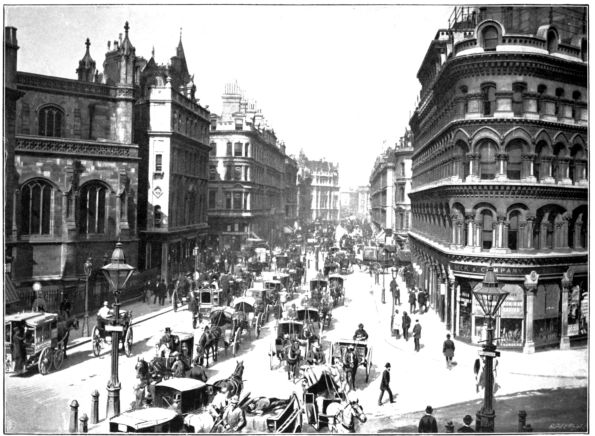
Cheapside.—We begin with the true heart of London, West Chepe, as
it was formerly called, and the streets lying north and south of this marketplace.
St. Paul’s Churchyard and Foster Lane mark our western boundary;
Princes Street and Walbrook, our eastern; Gresham Street (formerly Cateaton
Street) is on the north, and Cannon Street on the south.
By the time of Queen Elizabeth we find the West Chepe, with its streets
north and south, laid out with something like the modern regularity. We must
therefore go back to earlier centuries to discover its origin.
West Chepe, from time immemorial, has been the most important market
of the City. It was formerly, say in the twelfth century, a large open area.
This area contained no fewer than twenty-five churches, of which nine still exist.
The churches are dotted about in apparent disorder, which can be partly explained.
For the market of Chepe was extended in fact from the Church of St. Michael
le Querne on the west, to that of St. Christopher le Stock on the east, and lay
between the modern Gresham Street in the north and Watling Street in the south.
It is ordered in Liber Albus that all manner of victuals are to be sold
between the kennels of the streets. The so-called streets were narrow lanes,
many of which remain to the present day.
2There was, however, a principal way, not a street in our sense of the word,
on either side of which, on the north and on the south, as well as along the
middle, were stalls and shops. These stalls were at first mere wooden sheds;
the goods were exposed by day and removed at night; in course of time they
became permanent shops with living rooms at the back and an upper chamber.
Among the sheds stood “selds.” The seld was a building not unlike the present
Covent Garden Market, being roofed over and containing shops and store-houses.
Several “selds” are mentioned in the thirteenth and fourteenth centuries. These
were the “great-seld” in the Mercery, called after the Lady Roisia de Coventre.
This was near the house of St. Thomas of Acon, where now stands the Mercers’
Hall. There was also the “great seld of London,” in the ancient parish of St.
Pancras, therefore on the south side of Cheapside. There was again the “seld of
Fryday Street serving for foreign tanners, and time out of mind occupied with these
wares”; and there was a seld held in 1304 by John de Stanes, mercer.
In the Liber Albus the seld is distinguished from the “shop, the cellar or
solar.” It is also alluded to in the same book as the place where wool and
other commodities are sold. Bakers were forbidden to store their bread in selds
longer than one night. The seld was therefore a warehouse, a weighing place,
as well as a shop. Since we hear nothing about selds in the Calendar of Wills
after the fourteenth century, we may infer that a change had been made in the
methods of the market. The change in fact was this. North and south of
what is now Cheapside were arranged in order the stalls of those who sold
everything; these stalls were protected from the weather; the various branches
or departments of the market were separated by narrow lanes. It is impossible
at this time to assign all the various trades accurately each to its own place—in
fact, they always overlapped; but we can do so approximately. The names
of the streets belonging to Cheapside are a guide. For instance, Wood Street,
Milk Street, Honey Lane, Ironmonger Street, Old Jewry, the Poultry, Scalding
Alley, Soper Street, Bread Street, Friday Street, Old Change, explain a great part
of the disposition of the ancient market.
When we consider that twenty-five churches stood in or about the great
market, and that they were all presumably more ancient than the Conquest,
we may deduce the fact that the stalls very early became closed shops, and
in many cases permanent houses of residence, and that the market contained a
large resident population by which industries were carried on as well as shops.
With certain wares, such as milk, honey, wood, spices, mercery, salt-fish, poultry,
meat, and herbs, there was no other industry than that of receiving, packing,
and distributing. We therefore find few churches between Wood Street and
Ironmonger Lane, the chief seat of these branches; while on the south side,
for the same reason, there are still fewer churches.
3The South Chepe was occupied by money-changers, salt-fish dealers, leather-sellers,
bakers, mercers, pepperers, and herb-sellers. Soap-makers were there also
at one time, but they were banished to another part of the City before the time of
Edward the Second. “Melters,” i.e. of lard and tallow, were also forbidden to
carry on their evil-smelling trade in West Chepe so far back as 1203.
A brief study, therefore, enables us to understand, first, why the churches
stand thickly in one part and thinly in another; next, that West Chepe was
a vast open market containing a resident population, crowded where industries
were carried on, and sparse where the goods were simply exposed for sale; and,
thirdly, that the place could be easily converted into a tilting ground, as was
done on many occasions, by clearing away the “stationers,” that is to say, the
people who held stalls or stations about the crosses in Cheapside. On one
occasion, at least, this was done, to the great indignation of the people.
There are certain places in the country, and on the Continent, where the
mediæval market is still preserved in its most important features. For instance,
there is the market-place of Peterborough, which is still divided by lanes, and
which has areas allotted to the different trades; and that of Rheims, where the
ancient usages are preserved and followed, even to the appearance of Autolycus,
the Cheap Jack, and the Quack, who may be seen and heard on every market day.
We may take Stow’s description of the Elizabethan Chepe:
“At the West end of this Poultrie, and also of Bucklesbury, beginneth the
large street of West Cheaping, a market place so called, which street stretcheth
west till ye come to the little conduit by Paule’s gate, but not all of Cheape ward.
In the east part of this street standeth the great conduit of sweet water, conveyed
by pipes of lead underground from Paddington for the service of this city,
castellated with stone, and cisterned in lead, about the year 1285, and again new
built and enlarged by Thomas Ilam, one of the sheriffs 1479.
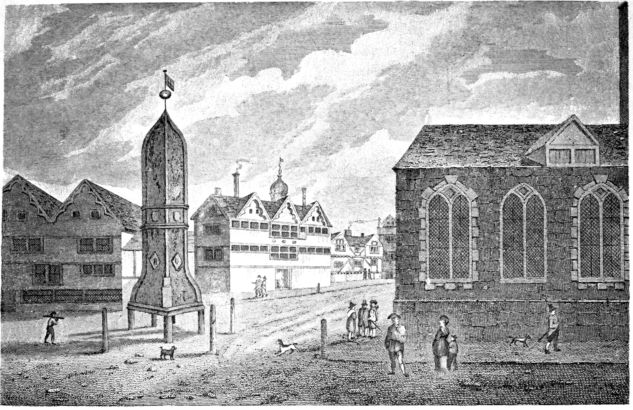
“About the midst of this street is the Standard in Cheape, of what antiquity
the first foundation I have not read. But Henry VI., by his patent dated at
Windsor the 21st of his reign, which patent was confirmed by parliament 1442,
granted license to Thomas Knolles, John Chichele, and other, executors to
John Wells, grocer, sometime mayor of London, with his goods to make new
the highway which leadeth from the city of London towards the palace of
Westminster, before and nigh the manor of Savoy, parcel of the Duchy of
Lancaster, a way then very ruinous, and the pavement broken, to the hurt and
mischief of the subjects, which old pavement then remaining in that way within
the length of five hundred feet, and all the breadth of the same before and nigh
the site of the manor aforesaid, they to break up, and with stone, gravel, and other
stuff, one other good and sufficient way there to make for the commodity of the
subjects.
4“And further, that the Standard in Cheape, where divers executions of the
law beforetime had been performed, which standard at the present was very
ruinous with age, in which there was a conduit, should be taken down, and another
competent standard of stone, together with a conduit in the same, of new, strongly
to be built, for the commodity and honour of the city, with the goods of the said
testator, without interruption, etc.
“Of executions at the Standard in Cheape, we read, that in the year 1293
three men had their right hands smitten off there, for rescuing of a prisoner arrested
by an officer of the city. In the year 1326, the burgesses of London caused Walter
Stapleton, Bishop of Exceter, treasurer to Edward II., and other, to be beheaded
at the standard in Cheape (but this was by Paule’s gate); in the year 1351, the
26th of Edward III., two fishmongers were beheaded at the standard in Cheape,
but I read not of their offence; 1381, Wat Tyler beheaded Richard Lions and
other there. In the year 1399, Henry IV. caused the blank charters made by
Richard II. to be burnt there. In the year 1450, Jack Cade, captain of the
Kentish rebels, beheaded the Lord Say there. In the year 1461, John Davy had
his hand stricken off there, because he had stricken a man before the judges at
Westminster, etc.
“Then next is a great cross in West Cheape, which cross was there erected
in the year 1290 by Edward I. upon occasion thus:—Queen Elianor his wife died
at Hardeby (a town near unto the city of Lincoln), her body was brought from
thence to Westminster; and the king, in memory of her, caused in every place
where her body rested by the way, a stately cross of stone to be erected, with the
queen’s image and arms upon it, as at Grantham, Woborne, Northampton, Stony
Stratford, Dunstable, St. Albones, Waltham, West Cheape, and at Charing, from
whence she was conveyed to Westminster, and there buried.
“This cross in West Cheape being like to those other which remain to this
day, and being by length of time decayed, John Hatherle, mayor of London,
procured, in the year 1441, license of King Henry VI. to re-edify the same in more
beautiful manner for the honour of the city, and had license also to take up two
hundred fodder of lead for the building thereof of certain conduits, and a common
granary. This cross was then curiously wrought at the charges of divers citizens:
John Fisher, mercer, gave six hundred marks toward it; the same was begun to be
set up 1484, and finished 1486, the 2nd of Henry VII.
“In the year 1599, the timber of the cross at the top being rotted within the
lead, the arms thereof bending, were feared to have fallen to the harming of some
people, and therefore the whole body of the cross was scaffolded about, and the top
thereof taken down, meaning in place thereof to have set up a piramis; but some
of her majesty’s honourable councillors directed their letters to Sir Nicholas Mosley,
then mayor, by her highness’ express commandment concerning the cross, forthwith
5to be repaired, and placed again as it formerly stood, etc., notwithstanding the said
cross stood headless more than a year after. After this (1600) a cross of timber was
framed, set up, covered with lead, and gilded, the body of the cross downward
cleansed of dust, the scaffold carried thence. About twelve nights following, the
image of Our Lady was again defaced, by plucking off her crown, and almost her
head, taking from her her naked child, and stabbing her in the breast, etc. Thus
much for the cross in West Cheape” (Stow’s Survey, 1633, pp. 278-80).
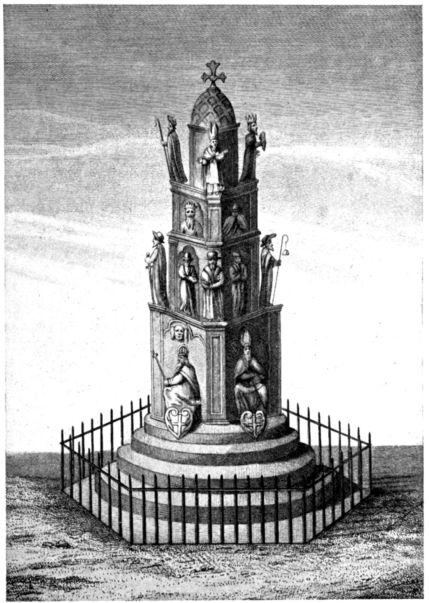
CHEAPSIDE CROSS (AS IT APPEARED ON ITS ERECTION IN 1606).
From an original Drawing in the Pepysian Library, Cambridge.
The cross was the object of much abuse by the Puritans, who at last succeeded
in getting it pulled down. “On May 2nd, 1643, the Cross of Cheapside was pulled
down. A troop of horse and two companies of foot waited to guard it; and, at the
fall of the top cross, drums beat, trumpets blew, and multitudes of caps were thrown
6into the air.... And the same day, at night was the leaden popes[1] burnt in the
place where it stood, with ringing of bells and a great acclamation” (Wilkinson’s
Londina Illustrata).
To continue Stow’s account:
“Then at the west end of West Cheape Street, was sometime a cross of stone,
called the Old Cross. Ralph Higden, in his Policronicon, saith, that Walter
Stapleton, Bishop of Exceter, treasurer to Edward II., was by the burgesses of
London beheaded at this cross called the Standard, without the north door of
St. Paul’s church; and so is it noted in other writers that then lived. This old
cross stood and remained at the east end of the parish church called St. Michael
in the Corne by Paule’s gate, near to the north end of the old Exchange, till the
year 1390, the 13th of Richard II., in place of which old cross then taken down,
the said church of St. Michael was enlarged, and also a fair water conduit built
about the 9th of Henry VI.
“In the reign of Edward III., divers joustings were made in this street, betwixt
Sopers lane and the great cross, namely, one in the year 1331, the 21st of
September, as I find noted by divers writers of that time.
“In the middle of the city of London (say they), in a street called Cheape, the
stone pavement being covered with sand, that the horses might not slide when they
strongly set their feet to the ground, the king held a tournament three days together,
with the nobility, valiant men of the realm, and other some strange knights. And
to the end the beholders might with the better ease see the same, there was a
wooden scaffold erected across the street, like unto a tower, wherein Queen Philippa,
and many other ladies, richly attired, and assembled from all parts of the realm, did
stand to behold the jousts; but the higher frame, in which the ladies were placed,
brake in sunder, whereby they were with some shame forced to fall down, by reason
whereof the knights and such as were underneath, were grievously hurt; wherefore
the queen took great care to save the carpenters from punishment, and through her
prayers (which she made upon her knees) pacified the king and council, and thereby
purchased great love of the people. After which time the king caused a shed to be
strongly made of stone, for himself, the queen, and other estates to stand on, and
there to behold the joustings, and other shows, at their pleasure, by the church of
St. Mary Bow, as is showed in Cordwainer street ward” (ibid.).
In 1754 Strype writes:
“Cheapside is a very stately spacious street, adorned with lofty buildings; well
inhabited by Goldsmiths, Linen-Drapers, Haberdashers, and other great dealers.
The street, which is throughout of an equal breadth, begins westward at Paternoster
Row, and, in a straight line, runs to the Poultry, and from thence to the Royal
exchange in Cornhill. And, as this Street is yet esteemed the principal high street
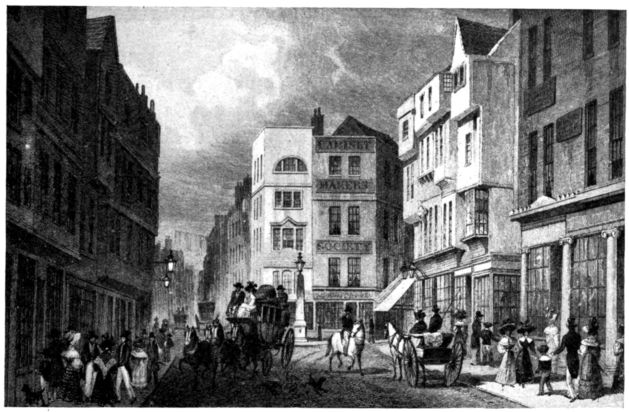
7in the City, so it was formerly graced with a great Conduit, a Standard, and a stately
Cross; which last was pulled down in the Civil Wars. In the last Part, almost over-against
Mercers Chapel, stood a great Conduit; but this Conduit, standing almost in
the Middle of the street, being incommodious for Coaches and Carts, was thought fit
by the Magistracy, after the great Fire, to be taken down, and built no more.”
The great Conduit of Chepe, commenced in 1285, brought the water from
Paddington, a distance of 3½ miles. It stood opposite Mercers’ Hall and Chapel.
It was a stone building long and low, battlemented, enclosing a leaden cistern. In
the year 1441 at the west end of Chepe and in the east end of the Church of
St. Michael le Querne, the smaller conduit was erected. Both conduits were
destroyed in the Great Fire—the larger one was not rebuilt. The Standard opposite
Honey Lane was in later years fitted with a water cock always running. At the
Standard many public executions took place (Strype, vol. 1. p. 566).
Hardly any street of London is more frequently mentioned in annual documents
than Chepe. There are many ancient deeds of sale and conveyances still preserved
at the Guildhall, relating to property in Chepe. In the Calendar of Wills, houses,
etc., in Chepe are bequeathed in more than two hundred wills there quoted; many
ordinances concerning Chepe are recorded in Riley’s Memorials.
Stow has given some of the history of Chepe. His account may be supplemented
by a few notes on other events and persons connected with the street.
The antiquity of the street is proved by the discovery of Roman coins, Roman
tesserae, Romano-British remains of various kinds, and Saxon jewels. It is not,
however, until the thirteenth century that we find historical events other than the
conveyance, etc., of land and tenements in Cheapside.
In the thirteenth century a part of Cheapside, if not the whole, was called the
Crown Field; the part so called was probably confined to a space on the east of
Bow Church.
In the year 1232 we find the citizens mustering in arms at Mile End and “well
arrayed” in Chepe.
In 1269 it is recorded that the pillory in Chepe was broken, and so remained
for a whole year by the negligence of the bailiffs, so that nobody could be put in
pillory for that time. The bakers seized the opportunity for selling loaves of short
weight—even a third part short. But in 1270, on the Feast of St. Michael, the
sheriffs had a new pillory made and erected on the site of the old one. Then the
hearts of the bakers failed them for fear, and the weight of the loaves increased.
In 1273 the Mayor removed from Chepe all the stalls of the butchers and
fishmongers, together with the stalls which had been let and granted by the
preceding sheriffs, although the persons occupying them had taken them for life and
had paid large sums for their leases. This was a political move, the intention being
to deprive the stall-keepers of their votes. The Mayor, however, defended the
8action on the ground that the King was about to visit the City, and that it behoved
him to clear the way of refuse and encumbrances.
In the year 1326 a letter was sent by the Queen and her son Edward calling
upon the citizens of London to aid with all their power in destroying the enemies
of the land, and Hugh le Despenser in especial. Wherefore, when the head of
Hugh was carried in triumph through Chepe, with trumpets sounding, the citizens
rejoiced.
In October of the same year when the Bishop of Exeter, Walter de Stapleton,
was on his way to his house in “Elde Dean’s Lane” to dine there, he was met by
the mob, dragged into Chepe with one of his esquires, and there beheaded.
Another of the Bishop’s servants was beheaded in Chepe the same day.
On the birth of Edward III. on November 13, 1312, the people of London
made great rejoicings, holding carols, i.e. dances and songs, in Chepe for a fortnight,
while the conduits ran wine.
In 1482 a grocer’s shop in Cheapside with a “hall” over it—perhaps a warehouse—was
let for the rental of £4 : 6 : 8 per annum. The owner of the shop was
Lord Howard, created Duke of Norfolk in 1483.
References to Cheapside multiply as we approach more modern times. In 1522,
when Charles V. came to England, lodgings were appointed for his retinue. Among
them was a house in Cheapside, a goldsmith’s. It contained one parlour, one
kitchen, one chamber, and one bed. The murder of Dr. Lambe in 1631, the execution
of William Hacket in 1591, the burning of the Solemn Covenant in 1661,—these
are incidents in the history of Cheapside. Many other events belonging
either to the history of the City or of the realm have been mentioned elsewhere.
In the sixteenth century one of the sights of London was the Goldsmiths’ Row,
built in 1491 on the site of certain shops and selds. Stow calls the Row “a most
beautiful frame of faire houses and shops consisting of ten faire dwellinghouses and
fourteen shops, all in one frame, builded foure stories high, beautified towards the
street with the Goldsmith’s Arms and the likeness of woodmen, in memory of his
name, riding on monstrous beasts all richly painted and gilt.” Maitland, who
certainly could not remember it, says that it was “beautiful to behold the glorious
appearance of the Goldsmith’s shops in the South row of Cheapside, which in a
course reached from the Old Change of Bucklersbury exclusive of four shops only,
of three trades, in all that space.”
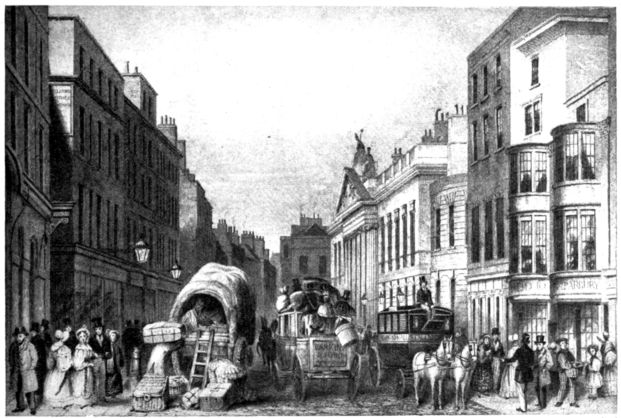
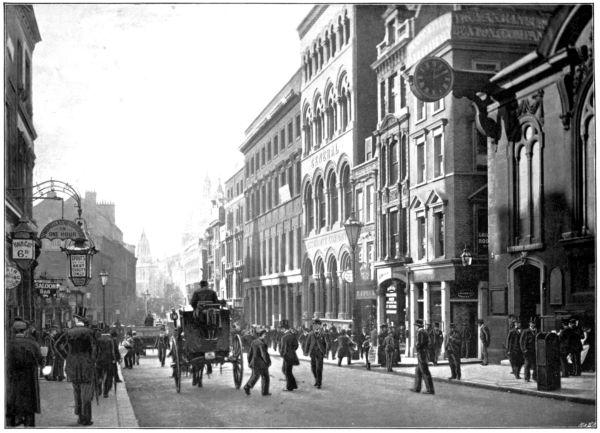
Coming now to a description of Cheapside as it is at present, we find a statue of
Sir Robert Peel standing on a block of granite. The whole is more than 20 feet in
height. The statue was put up in 1855, and on the pedestal is the inscription of
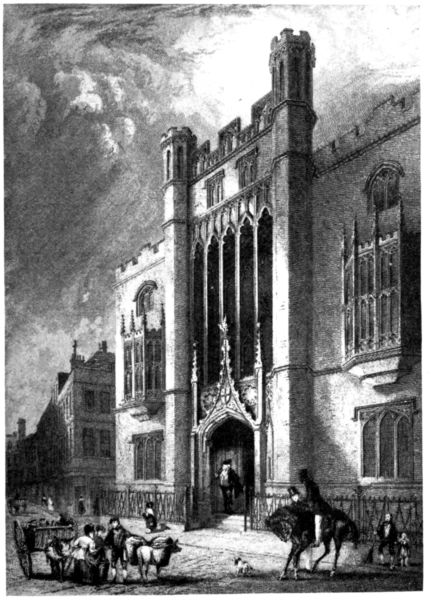
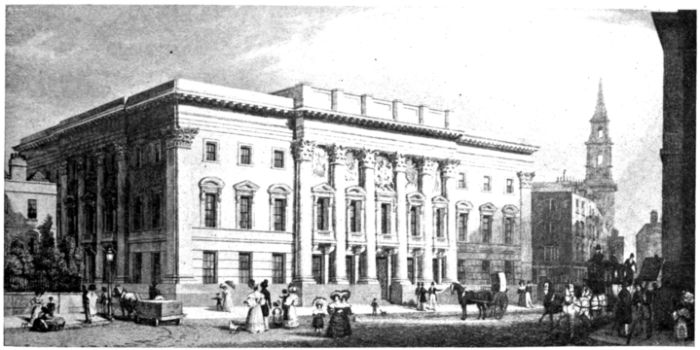
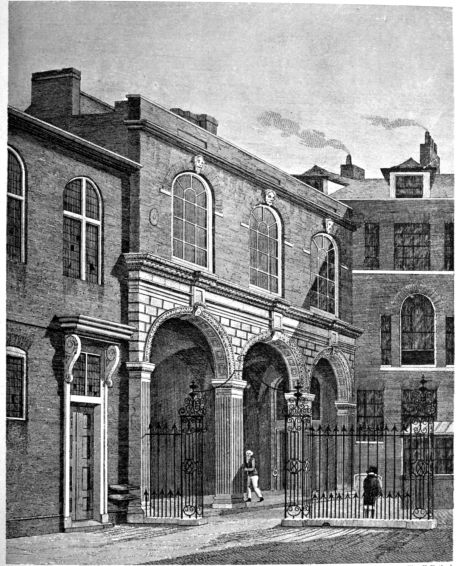
Peel’s birth and death. On the north of Cheapside is a large stone block of building
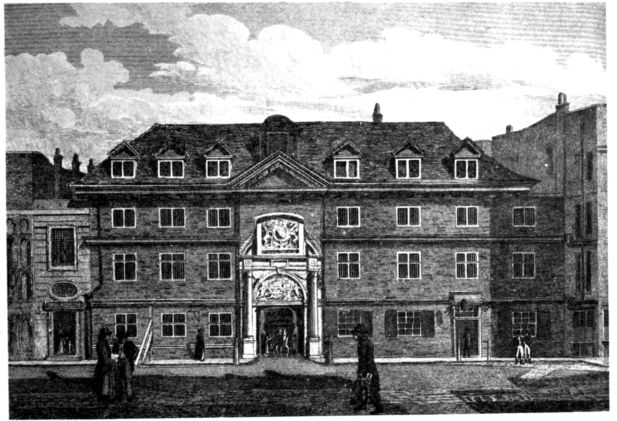
in one uniform style with shops on the ground floor. This contains the Saddlers’
Hall, and in the middle is the great entrance way solidly carried out in stone.
9
The date of the formation of the Company, and the circumstances under which it was founded, are unknown.
It existed at a very remote period. There is now preserved in the archives of the Collegiate Church
of Saint Martin’s-le-Grand a parchment containing a letter from that foundation, in which reference is made
to the then ancient customs of the Guild. This document is believed to have been written about the time
of Henry II., Richard I., or John, most probably in the first of these reigns. In this letter reference is
made to “Ernaldus, the Alderman of the Guild.” This Ernaldus is stated by Mr. Alfred John Kempe,
in his work Historical Notices of the Collegiate Church of Saint Martin’s-le-Grand, to have lived before the
Conquest, by which it may be inferred that the Company is of Anglo-Saxon origin.
King Edward I., A.D. 1272, granted a charter. King Edward III., by his charter 1st December, 37
Edward III., A.D. 1363, granted that as well in the City of London as in every other city, borough, or town
where the art of Saddlers is exercised, one or two honest and faithful men of the craft should be chosen and
appointed by the Saddlers there dwelling to superintend and survey the craft. This charter was exemplified
and confirmed by Henry VI., Henry VII., and Henry VIII.
Richard II., by charter 20th March, 18 Richard II., A.D. 1374, granted to the men of the mystery
of Saddlers of the City of London, that for the good government of the mystery they may have one
commonalty of themselves for ever, and that the men of the same mystery and commonalty may choose
and appoint every year four keepers of the men of the commonalty to survey, rule, and duly govern the
same. Furthermore, that the keepers and commonalty, and their successors, may purchase lands, to the
yearly value of twenty pounds, for the sustentation of the poor, old, weak and decayed persons of the
mystery, and this charter was exemplified, ratified, and confirmed by Edward IV.
Queen Elizabeth, by charter 9th November, 1 Elizabeth, A.D. 1558, exemplifies, ratifies, and confirms
the previous charters, and reincorporates the Company by the name of the wardens or keepers and
commonalty of the mystery or art of Saddlers of the City of London. The charter names and appoints
four wardens to hold office from the date of the charter until the 14th August then following, and
authorises them to keep within their common hall an assembly of the wardens or keepers or freemen of the
same mystery, or the greater part of them, or of the wardens, and of eight of the most ancient and worthy
freemen, being of the assistants of the mystery, and that the wardens and eight of the assistants at least
being present shall have full power to treat, consult, and agree upon the articles and ordinances touching
the mystery or art aforesaid, and the good rule, state, and government of the same. Power is given to
elect four wardens on the 14th August yearly. Power of giving two votes is given to the master at doubtful
elections. Powers are also given for the government and regulation of the trade.
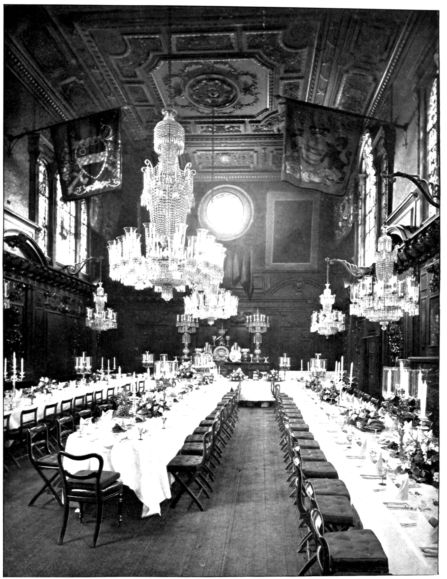
This is one of the most ancient, as it is also one of the most interesting, of the City Companies.
Their original quarter was at St. Martin’s-le-Grand. The saddle played an important part in every man’s
life at a time when riding was the only method of travelling.
The saddlers were connected with the Church of St. Martin’s-le-Grand and made some kind of
convention with the Canons, the nature of which is uncertain. Probably the Canons promised them their
aid in support of their rights and privileges, in return for which their religious gifts and fees were paid to
the Church of St. Martin. The mystery of saddlery, like all others, overlapped, and encroached upon,
other mysteries and crafts. Then there followed quarrels. Thus in 1307 (Riley, Memorials, p. 156) there
was an affray between the saddlers on one side and the loriners, joiners, and painters on the other, on
account of such encroachments. The quarrel was adjusted by the Mayor and Aldermen. Another trouble
to which so great a trade was liable, was the desire of the journeymen to break off into fraternities of their
own. This pretension was seriously taken in hand in 1796, and such fraternities were strictly forbidden.
The Company has had three halls, all on the same site. The first was burned in the Great Fire;
the second in 1822; the present hall was built after the second fire, and is at No. 141 Cheapside.
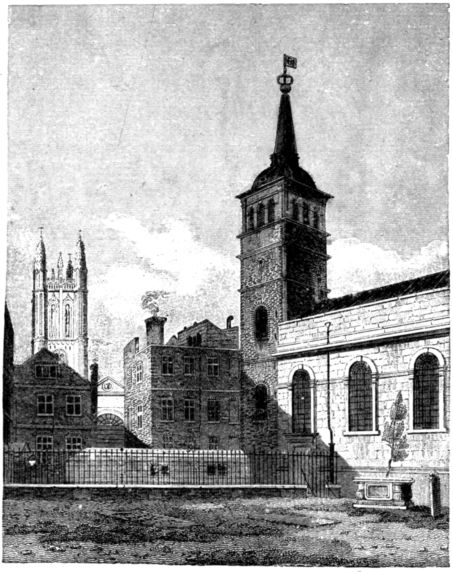
At the corner of Wood Street is what remains of the churchyard of St. Peter’s,
Westcheap, the building of which was destroyed in the Great Fire: a railed-in
10space, gravel covered and uninteresting, except for the magnificent plane-tree which
spreads its branches protectingly over the low roofs in front. On the walls of the
old houses near are fixed two monuments, and a little stone tablet rather high up,
with the inscription:
“Erected at the sole cost and charges of the Parish of St. Peter’s, Westcheap, A.D. 1687,”
followed by the names of the churchwardens.
The Church of St. Peter, Westcheap, was also called SS. Peter and Paul. After the Great
Fire its parish was annexed to that of St. Matthew, Friday Street. The earliest date of an incumbent
is 1302.
The patronage of the church was in the hands of the Abbot of St. Alban’s before 1302. Henry VIII.
seized it and granted it in 1545 to the Earl of Southampton, in whose successors it continued up to 1666.
Houseling people in 1548 were 360.
A chantry was founded here at the Altar of the Blessed Virgin Mary by Nicholas de Faringdon,
Mayor of London, 1313 and 1320, for himself and Rose his wife, to which Lawrence Bretham de
Faversham was admitted chaplain, October 24, 1361; the endowment fetched £29 : 3 : 4 in 1548, when
Sir W. Alee was priest. There was another at the Altar of the Holy Cross.
Sir John Munday, goldsmith, Mayor, was buried here in 1527; also Sir Alexander Avenon, Mayor
in 1569; and Augustine Hind, clothworker, Alderman, and Sheriff of London, who died in 1554.
The only charitable gifts recorded by Stow are: £2 : 4 : 4, the gift of Sir Lionel Ducket; 3s. 4d., the
gift of Lady Read; 7s. 6d., the gift of Mr. Walton.
John Gwynneth, Mus. Doc. and author, was rector here in 1545; also Richard Gwent, D.D., and
William Boleyn, Archdeacon of Winchester.
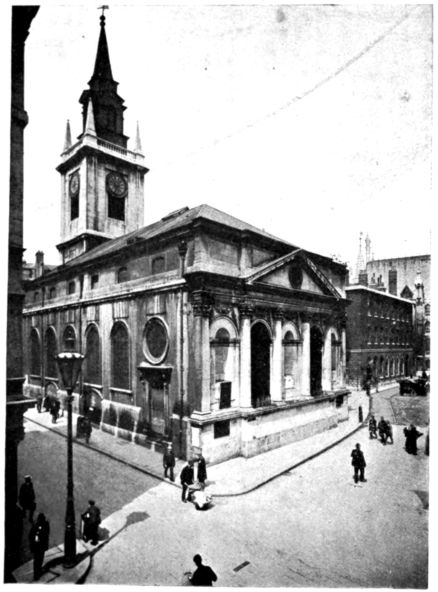
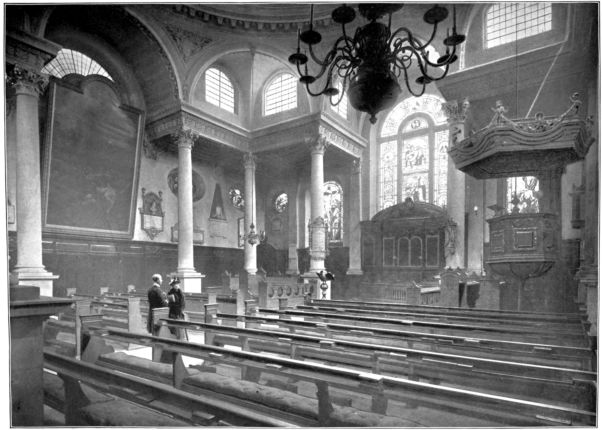
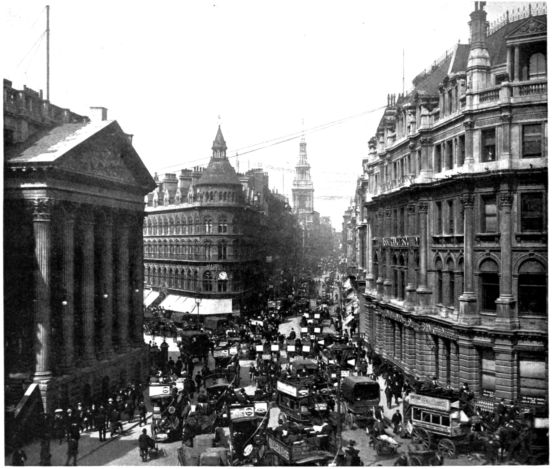
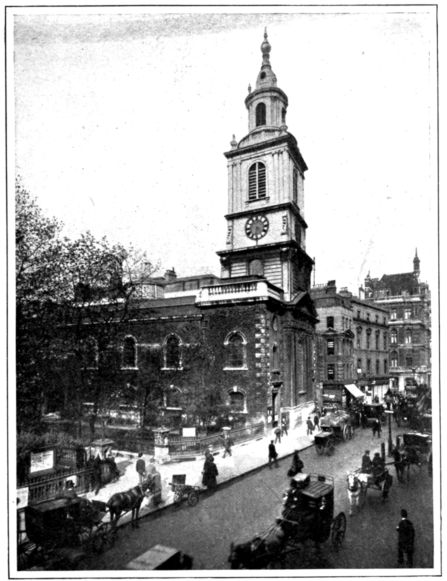
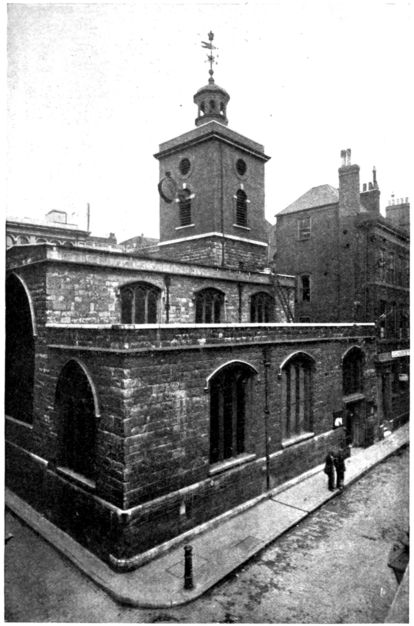
But the ornament of Cheapside is St. Mary-le-Bow, which derived its additional name from its
stone “bows” or arches. The date of its foundation is not known, but it appears to have been during or
before the reign of William the Conqueror. The court of the Archbishop of Canterbury was held here
before the Great Fire; and though the connection between the church and the ecclesiastical courts has
ceased, it is still used for the confirmation of the election of bishops. The “Court of Arches” owes its
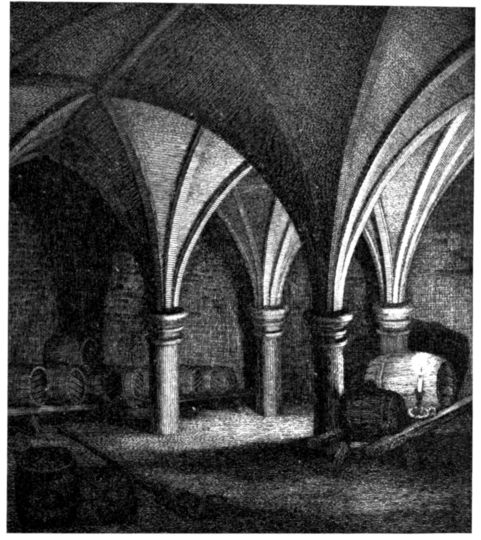
name to the fact that it was held in the beautiful Norman crypt which still survives. The church has
been made famous, Stow observes, as the scene of various calamities, of which he records details. In
1469 the Common Council ordained the ringing of Bow Bell every evening at nine o’clock, but the
practice had existed for already more than a century; in 1515 the largest of the five bells was presented by
William Copland. The church was totally destroyed in 1666, as well as those of St. Pancras, Soper Lane
and Allhallows, Honey Lane; the two last were not rebuilt, their parishes being annexed to St. Mary’s.
Wren began building the present church in 1671 and completed it in 1680. The cost was greater than any
other of Wren’s parish churches by £3000, £2000 of which was contributed by Dame Williamson. The
steeple was repaired by Sir William Staines in the eighteenth century, and again in 1820 by Mr. George
Gwilt. In 1758, seven of the bells were recast, new ones were added, and the ten were first rung in
1762 in honour of George III.’s birthday; the full number now is twelve. In 1786 the parish of
Allhallows, Bread Street, was united with this.
The earliest date of an incumbent is 1242.
The patronage of the church has always been in the hands of the Archbishop of Canterbury and his
successors, but Henry III. presented to it in 1242.
Houseling people in 1548 were 300.
The church measures 65 feet in length, 63 feet in breadth, and 38 feet in height; it contains a nave
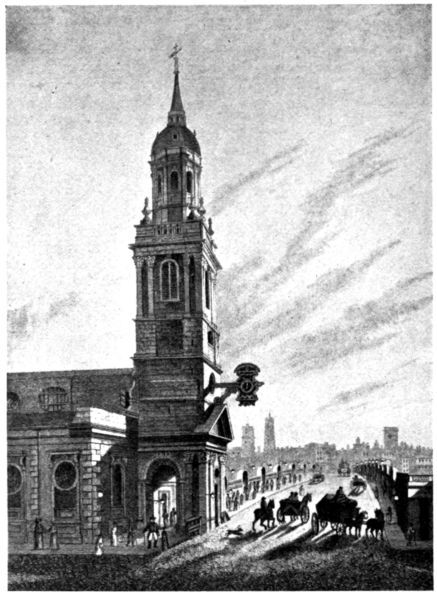
11and two side aisles. The great feature of the building is the steeple, which is the most elaborate of all
Wren’s works and only exceeded in height by St. Bride’s. It rises at the north-west end of the church
and measures 32 square feet at the base. The tower contains three storeys. The highest is surmounted
by a cornice and balustrade with finials and vases, and a circular dome supporting a cylinder, lantern, and
spire. The weather-vane is in the form of a dragon, the City emblem. The total height is 221 feet
9 inches. The Norman crypt already mentioned still remains, consisting of three aisles formed by
massive columns; it probably formed part of the building in William I.’s time.
Chantries were founded here:
By John Causton, to which John Steveyns was admitted chaplain, December 2, 1452; by John
Coventry, in the chapel of St. Nicholas; by Henry Frowycke, whose endowment fetched £15 : 10s. in
1548; by John de Holleghe, whose endowment produced £7 in 1548; by Dame Eleanor, Prioress of
Winchester, whose endowment yielded £4 in 1548.
The original church does not appear to have contained many monuments of note. Among the civic
dignitaries buried here was Nicholas Alwine, Lord Mayor in 1499, whose name is familiar to readers of
The Last of the Barons.
Sir John Coventry, Mayor in 1425, was also buried here.
There is a tablet fixed over the vestry-room door, commemorating Dame Dionis Williamson, who
gave £2000 towards the building of the church. On the west wall a sarcophagus commemorates Bishop
Newton, rector, who won celebrity by his edition of Milton first published in 1749.
The parish possessed a considerable number of charities and gifts:
George Palin was donor of £100, to be devoted to the maintenance of a weekly lecture.
Mr. Banton, of £50 for the same purpose. There were others, to the total amount of £60.
There was one Charity School belonging to Cordwainer and Bread Street Wards for fifty boys and
thirty girls, who were put to employments and trades when fit.
The following are among the notable rectors:
Martin Fotherby (d. 1619), Bishop of Salisbury; Samuel Bradford (1652-1731), Bishop of
Gloucester; Samuel Lisle (1683-1749), Bishop of Norwich; Nicholas Felton (1556-1626), Bishop of
Bristol; Thomas Newton (1704-1782), Bishop of Bristol; and William Van Mildert (1765-1836), Bishop
of Llandaff, and later the last Prince-Bishop of Durham.
Quaint sayings and traditions have gathered more thickly about St. Mary’s
than about any of the City churches. Dick Whittington’s story has made the
name familiar to every British child; while to be born “within sound of Bow Bells”
is more dignified than to own oneself a Cockney. In sooth-saying we have the
prophecy of Mother Shipton that when the Grasshopper on the Exchange and the
Dragon on Bow Church should meet, the streets should be deluged with blood.
They did so meet, being sent to the same yard for repair at the same time, but
the prophecy was not fulfilled.
The ringing of the Bow bells in the Middle Ages signified closing-time for
shops, and the ringer incurred the wrath of the apprentices of Chepe if he failed
to be punctual to the second.
We now proceed to the Poultry.
Stow thus describes the place:
“Now to begin again on the bank of the said Walbrooke, at the east end of
the high street called the Poultrie, on the north side thereof, is the proper parish
church of St. Mildred, which church was new built upon Walbrooke in the year
121457. John Saxton their parson gave thirty-two pounds towards the building of
the new choir, which now standeth upon the course of Walbrooke.”
Strype says of it:
“The Poultry, a good large and broad Street, and a very great thoroughfare
for Coaches, Carts, and foot-passengers, being seated in the Heart of the City,
and leading to and from the Royal Exchange; and from thence to Fleet Street,
the Strand, Westminster, and the western parts: and therefore so well inhabited
by great tradesmen. It begins in the West, by the old Jewry, where Cheapside
ends, and reaches the Stocks market by Cornhill. On the North side is Scalding
Alley; a large place, containing two or three Alleys, and a square Court with good
buildings, and well inhabited; but the greatest part is in Bread Street Ward, where
it is mentioned.”
Roman knives and weapons have been found in the Poultry. The valley
of the Walbrook, 130 feet in width, began its slope here. Nearly opposite Princes
Street, a modern street, there was anciently a bridge over the stream. We find
in the thirteenth century an inquest held here over the body of one Agnes
de Golden Lane, who was found starved to death, a rare circumstance at that
time, and only possible, one would think, considering the charity of the monastic
houses, in the case of a bedridden person forgotten or deserted by her own people.
In the fourteenth century there are various bequests of shops and tenements in
the Poultry. In the fifteenth century we find that there was a brewery here,
near the Compter; how did the brewer get his water? In the same century the
Compter—which was one of the two sheriffs’ prisons—seems to belong to one
Walter Hunt, a grocer. In the sixteenth century one of the rioters of 1517 was
hanged in the Poultry; there was trouble about the pavements and complaints
were made of obstructions by butchers, poulterers, and the ancestors of the modern
coster, who sold things from barrows, stopping up the road and refusing to move
on. Before the Fire there were many taverns in the Poultry; some of them had
the signs which have been found belonging to the Poultry.
The later associations of the place have been detailed by Cunningham:
“Lubbock’s Banking-house is leased of the Goldsmiths, being part of Sir
Martin Bowes’s bequest to the Company in Queen Elizabeth’s time. The King’s
Head Tavern, No. 25, was kept in Charles II.’s time by William King. His wife
happening to be in labour on the day of the King’s restoration, was anxious to see
the returning monarch, and Charles, in passing through Poultry, was told of her
inclination, and stopped at the tavern to salute her. No. 22 was Dilly, the
bookseller’s. Here Dr. Johnson met John Wilkes at dinner; and here Boswell’s
life of Johnson was first published. Dilly sold his business to Mawman. No. 31
was the shop of Vernor and Hood, booksellers. Hood of this firm was father of
the facetious Tom Hood, and here Tom was born in 1798” (Hand-book of London).
13Here is a little story. It happened in 1318. One John de Caxtone, furbisher
by trade, going along the Poultry—one charitably hopes that he was in liquor—met
a certain valet of the Dean of Arches who was carrying a sword under his arm,
thinking no evil. Thereupon John assaulted him, apparently without provocation,
and drawing out the sword, wounded the said valet with his own weapon. This
done, he refused to surrender to the Mayor’s sergeant, nor would he give himself
up till the Mayor himself appeared on the spot. We see the crowd—all the butchers
in the Poultry collected together: on the ground lies the wounded valet, bleeding,
beside him is the sword, the assailant blusters and swears that he will not surrender,
the Mayor’s sergeant remonstrates, the crowd increases, then the Mayor himself
appears followed by other sergeants, a lane is made, and at sight of that authority
the man gives in. The sergeants march him off to Newgate, the crowd disperses,
the butchers go back to their stalls, the women to their baskets, the costers to their
barrows. For five days the offender cools his heels at Newgate. Then he is
brought before the Mayor. He throws himself on the mercy of the judge, sureties
are found for him that he will keep the peace, and he consents to compensate
the wounded man.
For Stocks Market, St. Mary Woolchurch Haw, on the site of which the Mansion
House stands, and the vicinity, formerly included in the Poultry, see Group III.
At the east end of the Poultry is Grocers’ Alley, formerly Conyhope Lane,
of which Stow says:
“Then is Conyhope Lane, of old time so called of such a sign of three conies
hanging over a poulterer’s stall at the lane’s end. Within this lane standeth the
Grocers’ hall, which company being of old time called Pepperers, were first
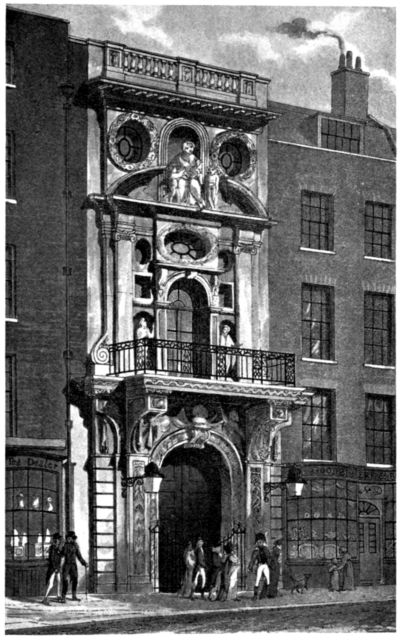
incorporated by the name of Grocers in the year 1345.” The Grocers’ Hall really
opens into Princes Street.
The Company’s records begin partly in Norman-French, partly in Old English, as follows: “To the
honour of God, the Virgin Mary, St. Anthony and All Saints, the 9th day of May 1345, a Fraternity was
founded of the Company of Pepperers of Soper’s Lane for love and unity to maintain and keep themselves
together, of which Fraternity are sundry beginners, founders, and donors to preserve the said Fraternity.”
(Here follow twenty-two names.)
The same twenty-two persons “accorded to be together at a dinner in the Abbot’s Place of Bury
on the 12th of June following, and then were chosen two the first Wardens that ever were of our Fraternity,”
and certain ordinances were agreed to by assent among the Fraternity, providing that no person should be
of the Fraternity “if not of good condition and of this craft, that is to say, a Pepperer of Soper’s Lane
or a Spicer in the ward of Cheap, or other people of their mystery, wherever they reside”; for contributions
among the members, for the purposes of the Fraternity, including the maintenance of a priest; the
wearing of a livery; arbitration by the Wardens upon disputes between members; attendance at Mass
at the Monastery of St. Anthony on St. Anthony’s Day, and at a feast on that day or within the octave, at
which feast the Wardens should come with chaplets and choose and crown two other Wardens for the
year ensuing; attendance at the funerals of members; the taking of apprentices; assistance of unfortunate
14members out of the common stock; and that “any of the Fraternity may according to his circumstance and
free will devise what he chooses to the common box for the better supporting the Fraternity and their alms.”
From external evidence it appears that for two centuries at least before 1345 there had existed a
Guild of Pepperers, who had superseded the Soapers in Soper’s Lane, and probably absorbed them. The
twenty-two Pepperers, who in 1345 founded the social, benevolent, and religious fraternity of St. Anthony,
were of “good condition,” probably the most influential and wealthy men in the Pepperers’ guild; in
founding the new brotherhood “for greater love and unity” and “to maintain and assist one another,”
they did not desert their old guild, but formed a new fraternity within it. They did not seek, apparently,
to alter the institution of the Guild of Pepperers, nor did they adopt a distinctive title for themselves;
but the movement was obviously an important one, and attracted notice and jealousy, which was perhaps
increased by the foreign connections of some of the members. So rapidly did the Company gain favour
and strength that in 1383, not forty years after its foundation, there were one hundred and twenty-nine
liverymen of whom not less than sixteen were Aldermen. At that time, no doubt, the Company exercised
a preponderating influence in the City of London.
The new brotherhood was styled the Fraternity of St. Anthony from 1348 to 1357. After this year
there is an hiatus in the Company’s records, and when these recommence in 1373 the title is “company”
or “fraternity” of “gossers,” “grosers,” “groscers,” or “grocers.”
The origin of the term “grocer” and its application to the Company are involved in considerable
obscurity. As far as can be ascertained, the first use of the word, officially, is against the Company from
without, and in an aspect of reproach. It occurs in a petition to the King and Parliament in 1363,
against the new fraternity that “les Marchantz nomez Grossers engrossent toutes maneres de marchandises
vendables.”
It is by no means improbable that the term, first suggested by less successful rivals in trade, was
adopted by the leading dealers “en gros” for the name of the company, which formed round the
Fraternity of St. Anthony, and probably absorbed the whole Guild of Pepperers.
From this time forward the Company began to act with energy in the interests of trade. In 1394 we
find them, together with some Italian merchants, presenting a petition to the Corporation complaining of
the unjust mode of “garbling,” i.e. cleansing or purifying spices and other “sotill wares.” The petition
was entertained, and the Company were requested to recommend a member of their own body to fill the
office, and on their nomination Thomas Halfmark was chosen and sworn garbeller of “spices and
sotill ware.”
The fraternity, after holding their meetings for three years at the Abbot of Bury’s, assembled in 1348
at Fulsham’s house at the Rynged Hall, in St. Thomas Apostle, close to St. Anthony’s Church in Budge
Row, Watling Street, where they at this time obtained permission to erect a chantry, etc., and called
themselves the Fraternity of St. Anthony. They ultimately collected at Bucklersbury (“Bokerellesbury”),
at the Cornet’s Tower, which had been used by Edward III. at the beginning of his reign as his exchange
of money and exchequer. Here the Company began to exercise the functions entrusted to them of
superintending the public weighing of merchandise.
In 1411 a descendant of Lord FitzWalter, who, in the reign of Henry III., had obtained possession
of the chapel of St. Edmund which adjoined his family mansion, sold the chapel to the Company for 320
marks, and in the next reign the Company purchased the family mansion and built their Hall upon the
site. The foundation stone was laid in 1427 and the building was completed in the following year.
The expenses were defrayed by the contributions of members. Five years later the garden was added.
In 1428 the Company’s first charter of incorporation was granted by King Henry VI., and they
became a body politic by the name of “Custodes et Communitas Mysterii Groceriæ Londini.” Nineteen
years later the same king granted to the Company the exclusive right of garbling throughout all places
in the kingdom of England, except the City of London.
In 1453 the Company, having the charge and management of the public scale or King’s Beam,
made a regular tariff of charges. It appears that to John Churchman, grocer, who served the office of
sheriff in 1385, the trade of London is indebted for the establishment of the first Custom House.
15Churchman, in the sixth year of Richard II., built a house on Woolwharf Key, in Tower Street Ward,
for the tronage or weighing of wools in the port of London, and a grant of the right of tronage was made
by the King to Churchman for life. It is probable that Churchman, being unable of himself to manage so
considerable a concern as the public scale, obtained the assistance of his Company, and thus the
management of the weigh-house and the appointment of the officers belonging to it came into the hands of
the Grocers Company.
Henry VIII. granted to the City of London the Beam with all appurtenances, and directed its
management to be committed to some expert in weights. The City thereupon gave the management to
the Company, only requiring one-third of the profits. The Company enjoyed, uninterruptedly, these
privileges up to 1625, when a dispute arose with the City, and an agreement was made whereby the
Company were to appoint four under-porters, and present four candidates for Master Porter, the Lord
Mayor to choose one of them. Several disputes followed with the Corporation, who in 1700 ejected the
officers appointed by the Company, and tried their right at law. No result is reported, but the Company
filled up vacancies after that date, and up to 1797, when a Bill was passed for making Wet Docks at
Wapping, and this appears to have had the effect of depriving the Company of their privileges.
The Company throughout this period kept, in common with others, a store of corn, according to
ancient custom, for the supply of the poor at reasonable prices when bread was dear.
The Company was also bound to maintain an armoury at their Hall.
At the time of the Great Plague in 1665 the Company were assessed in various sums of money for
the relief of the poor, and they also provided a large quantity of coals.
The next year the Great Fire of London inflicted losses on the Company from which it did not
recover for nearly a century. The Company’s Hall and all the adjacent buildings (save the turret in the
garden, which fortunately contained the records and muniments of the Company) and almost all the
Company’s houses were destroyed. The silver recovered from the ruins of the Hall was remelted and
produced nearly 200 lbs. weight of metal; this was sold for the Company’s urgent present necessities. In
1668 Sir John Cutler came forward and proposed to rebuild the parlour and dining-room at his own
charge. In the same year ninety-four members were added to the Livery. The next year a petition was
presented to Parliament praying for leave to bring in a Bill to raise £20,000 by an equal assessment upon
the members of the Company of ability. The application to Parliament failed, and an effort was then
made to raise the £20,000 among the members, but only £6000 was subscribed.
In January 1671 a Special Court was summoned to consider a Bill exhibited in Parliament by some
of the Company’s creditors, praying for an Act for the sale of the Company’s Hall, lands, and estates to
satisfy debts; and to make members of the Court liable for debts incurred. A Committee was appointed
and in 1672 the Hall was, at the instance of the Governors of Christ’s Hospital, sequestered, and the
Company ejected till 1679, when, after great difficulties and impediments, money was borrowed to pay off
the debts and get rid of the intruders. In 1680 the Court of Assistants agreed that the most effectual way
of regaining public confidence was to rebuild the Hall.
In order to prevent a second sequestration an Inquisition was taken in 1680 before Commissioners
for Charitable Uses, and, pursuant to a decree made by those Commissioners, a period of twenty years
was allowed to the Company to discharge their debts. The next year, to secure an accession of influence
and talent for the support of the Company, sixty-five members were added to the Court, and a number of
Freemen were summoned, and eighty-one members added to the Livery.
In 1683 the Company arranged, by arbitration, their difficulties with the Governors of Christ’s
Hospital, and their prospects appeared more hopeful when the celebrated Writ of Quo Warranto was
issued by King Charles II. against the City charters and liberties. The Company, with the view of
propitiating the King, by deed under seal, voluntarily surrendered the powers, franchises, privileges,
liberties, and authorities granted or to be used or exercised by the Wardens and Commonalty, and the
right of electing and nominating to the several offices of Wardens, Assistants, and Clerk of the Company,
and besought his Majesty to accept their surrender. Charles II. obtained judgment upon the Quo
Warranto against the City, and all the redress that the Company could obtain was the grant of another
16charter under such restrictions as the King should think fit. His successor, James II., with a view to
secure the goodwill and support of the City, sent for the Lord Mayor and Aldermen, and voluntarily
declared his determination to restore the City charters and liberties as they existed before the issuing of
the Writ of Quo Warranto; and subsequently Judge Jeffreys came to Guildhall and delivered the charters
with two grants of restoration to the Court of Aldermen.
The history of the Company during the eighteenth century is an account of pecuniary difficulties
and the gradual extrication by the public spirit and foresight of the members.
As regards the profession or trade of the members, a return exists of the whole numbers for the
year 1795 when the Court contained 32, the livery numbered 81, and the freemen 228. Of these,
40 were Grocers.
The number of the Livery returned in 1898 was 183. The Corporate Income was £37,500;
the Trust Income was £500.
The advantages of being a member of the Company are as follows:
(1) Freemen are entitled to apply on behalf of their children for the Company’s presentations (six in
number) to Christ’s Hospital; for the Company’s Scholarships for free education at the City of London
School. The orphan children of freemen are alone eligible for the three presentations to the London
Orphan Asylum.
Freemen are entitled to take apprentices.
Freemen, and widows and daughters of freemen, in needy circumstances may apply for relief, either
temporary or permanent. Loans to freemen are practically abolished.
(2) Twelve months after a liveryman has been elected he is entitled, provided he live within twenty-five
miles of the polling place, Guildhall, to be put upon the Register of Voters for the City, which entitles
him to a vote at the election of Members of Parliament for the City; a liveryman is also entitled to vote
at the election of the Lord Mayor and Sheriffs of London. The livery receive invitations from the
Master and Wardens to the four public dinners in the months of November, February, May, and July, in
each year, and at every fifth dinner an invitation for a friend as well.
In some years when the honorary freedom of the Company is bestowed on distinguished personages,
there is an extra public dinner to which the livery are invited. At the public dinner in May, called the
Restoration Feast, a box of sweetmeats is presented to every guest. Liverymen, and the widows and
daughters of liverymen in needy circumstances may apply for relief, either temporary or permanent.
The Hall of the Company has always occupied the same site since the first erection in 1427, when
the Wardens bought part of the demesne of Lord FitzWalter in Conyhope Lane.
This building perished in the Great Fire of 1666. A new hall was built, but in 1798-1802 this
building was pulled down and rebuilt. Alterations and additions were made in 1827, when the present
entrance into Princes Street was constructed. There were formerly three ways of access to the hall—one
from the Old Jewry; one by the lane called Grocers’ Alley; and one by Scalding Lane from St. Mildred,
Poultry, of which a scrap of the churchyard still remains. The two lanes opened on a small Place on the
north side of which was Grocers’ Hall and on the south side the Poultry Compter.
The hall destroyed in 1666 would have become by this time historical as the place to which the
Houses removed from Westminster in 1642 after the attempt to seize the five members on 4th January of
that year. The Committee appointed by both Houses met first at Guildhall and adjourned to Grocers’
Hall to “treat of the safety of the Kingdoms of England and Ireland.” It was in this hall that the City
entertained the Houses, June 17, 1645, in the midst of the Civil War, and on June 7, 1649, when the
Civil War was over. For forty years, 1694-1734, the Grocers’ Hall was rented and occupied by the
Governors and Company of the Bank of England.
The Company numbered among its members Charles II., James II., William III., the Earl of
Chatham, William Pitt, George Canning, and many others.
In the eighteenth century, the “Lane” was chiefly occupied by houses called
spunging houses; here persons were confined by the sergeants belonging to the
17Poultry Compter, so that they might come to some compromise with their creditors,
and not be taken into prison. Hawkesworth, essayist and man of letters, was
originally clerk to an attorney in this court. Boyse, the ragged poet, was confined
in one of the spunging houses. Here he wrote the Latin letter to Cave:
Inscription for St. Lazarus’s Cave.
Hodie, teste coelo summo,
Sine pane, sine nummo;
Sorte positus infeste,
Scribo tibi dolens moeste.
Fame, bile, tumet jecur:
Urbane, mitte opem, precor,
Tibi enim cor humanum
Non a malis alienum:
Mihi mens nec male grato,
Pro a te favore dato.—Alcæeus.
Ex gehenna debitoria,
Vulgo domo spongiatoria.
The Alley led to an open court. In this open place in 1688 a cart-load of
seditious books was burned.
The east side of the Place is at present occupied by one wall of the Gresham
Life Assurance Society, a magnificent building facing Poultry. It has finely
proportioned polished granite columns with Corinthian capitals adding strength to
the frontage, and a balcony with parapet running horizontally across the front. This
was rebuilt in 1879. It stands on the site of St. Mildred, Poultry.
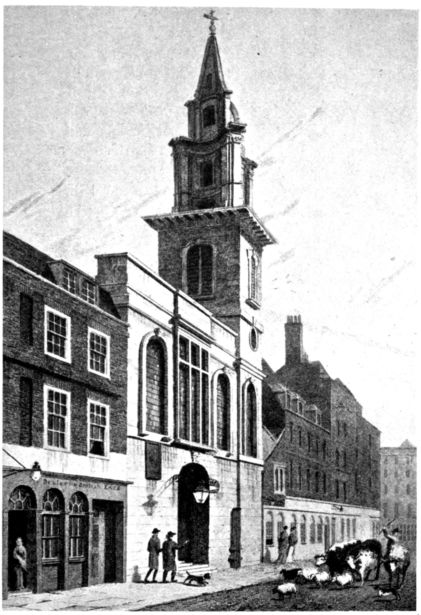
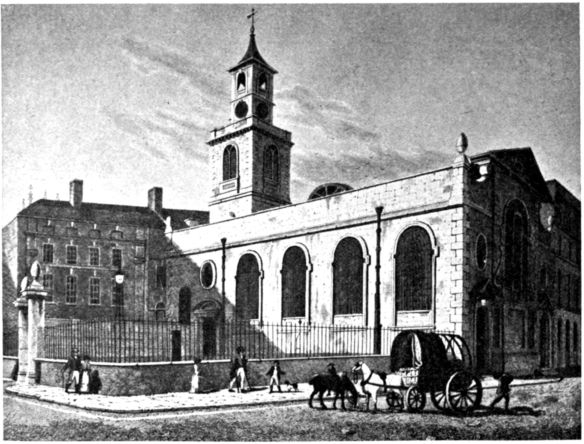
The Church of St. Mildred, Poultry, was situated on the north side of the Poultry. It was
rebuilt in 1456, and, after being destroyed by the Great Fire, again rebuilt in 1676, when the parish of
St. Mary Colechurch was annexed. In 1872 it was taken down, and the parish joined to St. Olave,
Jewry. The earliest date of an incumbent is 1247. The patronage of the church was in the hands of the
Prior and Convent of St. Mary Overy, Southwark, 1325; Henry VIII., 1541, and so continued in the Crown.
Houseling people in 1548 were 277.
Chantries were founded here by Solomon Lanfare or Le Boteler, citizen and cutler, at the Altar of
Blessed Virgin Mary, to which Wm. de Farnbergh was admitted chaplain, October 4, 1337; by Hugh Game,
poulterer, who endowed it with rents, which fetched £10 in 1548, when John Mobe was priest; by
John Brown, for himself, his wife, Margaret his daughter, and Giles Walden, etc., to which John de
Cotyngham was admitted chaplain, April 6, 1366. One John Mymmes had licence from Richard II. to
found the Guild of Fraternity of Corpus Christi here; the endowment fetched £10 : 8 : 8 in 1548, when
John Wotton was priest thereof. Here was a “Little Chapell” valued at 60s. in 1548.
Thomas Ashehill was buried here; he gave great help in rebuilding the church about 1450; also
Thomas Morstead, chirurgeon to Henry IV., V., and VI., and one of the sheriffs of London. In more
recent times, Wm. Cronne was commemorated; he was a Fellow of the Royal Society and of the College
of Physicians, and died in 1706.
A great number of benefactors are recorded by Stow, of which the most notable are: William
Watson, of £100, whereof £65 was received; William Tudman, of £247 in all, for various charities;
Sarah Tudman, of £80; Lady Elizabeth Allington, £200, towards rebuilding.
One free school is recorded, called Mercers’ School (Stow).
18John Williams (d. 1709), Bishop of Chichester, 1696, was rector here; also Benjamin Newcome, D.D.,
Dean of Rochester.
On the east side of Grocers’ Hall Court stood the Poultry Compter.
Strype describes the place and its government.
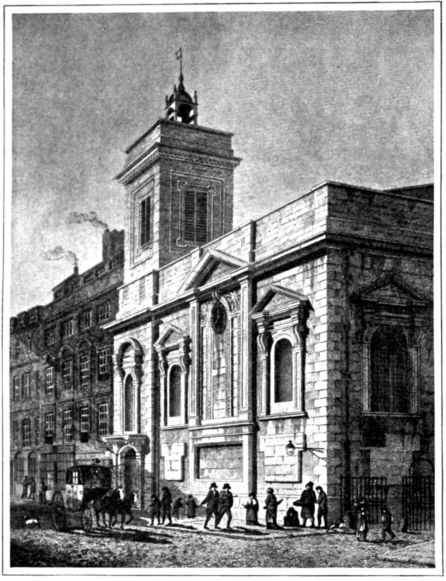
ST. MILDRED, POULTRY
“Somewhat west to this Church is the Poultry Compter, being the Prison
belonging to one of the Sheriffs of London, for all such as are arrested within the
City and liberties thereof. And, besides this Prison, there is another of the same
Nature in Wood Street for the other Sheriff; both being of the same nature, and
have the like officers for the Execution of the concerns belonging thereunto, as
shall be here taken notice of. So that what is said here for Poultry Compter,
belongs also to Wood Street Compter.
19“The Charge of those prisons is committed to the Sheriffs.
“Unto each Compter also belongs a Master Keeper; and under him two
Turnkeys, and other servitors.
INSIDE THE POULTRY COMPTER
“The poorer sort of prisoners, as well in this Compter, as in that in Wood
Street, receive daily relief from the sheriff’s table, of all the broken meat and bread.
And there are divers gifts given by several well disposed people, towards their
subsistence. Besides which, there are other benevolences frequently sent to all
the prisons by charitable persons; many of which do conceal their names, doing it
only for charity sake. And there are other gifts, some for the releasement of such
20as lie in only for prison fees; and others, for the release of such, whose debts amount
not to above such or such a sum” (Strype, vol. i. p. 567).
This was the only prison in London with a ward set apart for Jews. “Here
died Lamb, the conjuror (commonly called Dr. Lamb), of the injuries he had received
from the mob, who pelted him (June 13, 1628), from Moorgate to the Windmill in the
Old Jewry, where he was felled to the ground with a stone, and was thence carried
to the Poultry Compter, where he died the same night. The rabble believed that
the doctor dealt with the devil, and assisted the Duke of Buckingham in misleading
the king. The last slave imprisoned in England was confined (1772) in the Poultry
Compter. This was Somerset, a negro, the particulars of whose case excited Sharpe
and Clarkson in their useful and successful labour in the cause of negro emancipation”
(Cunningham’s Hand-book of London).
When Whitecross Street Prison (1815-1870) was erected, the prisoners were
removed there from the Poultry, and the site of the Compter was built upon partly
by a Congregational Chapel, the congregation of which removed to the Holborn
Viaduct when the City Temple was built.
The prison was burned down in the Fire, whereupon the prisoners were taken
to Aldgate until it was rebuilt. It was an ill-kept, unventilated, noisome place.
It is worthy of note that the earliest bequest to the Compter mentioned in
the Calendar of Wills belongs to the fifteenth century, and that most of the
legacies to the prisoners were made after the Reformation and in the reign of
Queen Elizabeth. In some of them we find mention of the “Hole” and of the
“Twopenny Ward.”
In 1378 there was an altercation between the Mayor and one of the sheriffs.
Allusion is made to that sheriff’s “own compter” in Milk Street, which may be
taken for that of Wood Street, as the Compter lay between the two, though it stood
in Bread Street until the year 1555. In the year 1382 a sumptuary law was issued
restricting the dress of women of loose life, and those who offended were to be
taken to one of the Compters. In 1388 we find the porter of a Compter insulting
Adam Bamme, alderman, for which he was removed from his office. We find
also a householder taken to the Compter for refusing to pay his rates and abusing
the collector. In 1413, an old man named John Arkwythe, a scrivener, was
summoned by Alderman Sevenoke for allowing the escape of a certain priest caught
in adultery in St. Bride’s Church. John Arkwythe lost his temper, clutched the
Alderman by the breast and threatened him. They sent him to Newgate, but,
considering his age, they let him go, only depriving him of the freedom of the City.
In 1418, one William Foucher, for contempt of Court, was sent to solitary imprisonment
in the Compter, and prohibited from speaking to any one except those
who should counsel him repentance and amendment.
From these cases it would appear that the Compters were used partly as
21houses of detention before trial, and that trial was frequently deferred in order
that the offender might endure a term of imprisonment in addition to the pillory,
or the release on finding security, which would follow.
West of Grocers’ Alley is the Old Jewry, one of the most interesting places
in the whole of London on account of its having been the Ghetto, though not
a place of humiliation, for the Jews of London. When they came to London
they received this quarter for their residence; why this place, so central, so
convenient for the despatch of business, was assigned to them, no one has been
able to discover. In the learned work of Mr. Joseph Jacobs (The Jews of Angevin
England) he shows that Jews were in Oxford and Cambridge as well as in London
in the time of the Normans.
The older name of the street was Colechurch Street. In the Receipts and
Perquisites of the Tower from the Jews of London are found the following:
For two pounds found in the Jewry for forfeit
60s.
[The sense of this entry is doubtful. Perhaps the two pounds were forfeited
and 60 is wrongly transcribed for 40 (lx. for xl.).] (Guildhall MS. 129, vol. ii.
p. 95a.)
From a certain Christian woman found in the Jewry for the purpose of making an exchange. She fled and threw away the money
100s.
(ibid. p. 97).
From a certain goldsmith fighting in the Jewry, of a fine
21s.
(ibid. p. 96).
From Nicholas, the convert, goldsmith of London, for his boys fighting in the Jewry
100s.
(ibid. p. 97).
From a certain Christian found in the Jewry by night
7s. 11½d.
(ibid. p. 97).
From a certain boy coming into the Jewry
66s. 8d.
(ibid. p. 97).
From John of Lincoln because he was found in the Jewry by night
£6
(ibid. p. 97).
From a certain Christian woman in the Jewry by night
18s.
(ibid. p. 97).
It thus appears that the Jewry was walled in with gates. Had it been a
simple street, a thoroughfare, there could have been no objection to any one passing
through. As for the teaching of the Church respecting Jews, these extracts from
Mr. Jacob’s book will show the hatred which was inculcated towards them.
“If any Christian woman takes gifts from the infidel Jews or of her own
will commits sin with them, let her be separated from the church a whole year
and live in much tribulation, and then let her repent for nine years. But if with
a pagan let her repent seven years.
“If any Christian accepts from the infidel Jews their unleavened cakes or
any other meat or drink and share in their impieties, he shall do penance with
bread and water for forty days; because it is written ‘to the pure all things
are pure.’
“It is allowable to celebrate mass in a church where faithful and pious ones
have been buried. But if infidels or heretics or faithless Jews be buried, it is
22not allowed to sanctify or celebrate mass; but if it seem suitable for consecration,
tearing thence the bodies or scraping or washing the walls, let it be consecrated
if it has not been so previously.”
The earliest mention of the Jews occurs in the Terrier of St. Paul’s, 1115:
“In the ward of Haco ... in the Jew’s street (?Old Jewry) the land of
Lusbert, in the front on the west side, is 32 feet in breadth. Towards St. Olave’s
is fourscore and fifteen feet; again towards St. Olave’s is 65 feet, and in the
front 13 feet. The land in the front is 73 feet, and in depth 41 feet, and pays 10s.”
In 1264, and again in 1267, the popular hatred of the Jews broke out with
unmistakable violence. They fled to the Tower, while the mob destroyed and
sacked their buildings.
In 1290 they were banished.
Their synagogue, which stood in the north-east corner of the present street, was
given to the Fratres de Saccâ (see Mediæval London, vol. ii. p. 365), and on their
dissolution it was ceded to Robert FitzWalter and converted into a merchant’s
residence. Here lived and died Robert Large to whom Caxton was apprenticed.
The later history of the street may be quoted from Cunningham:
“The last turning but two on the east side (walking towards Cateaton Street)
was called Windmill Court, from the Windmill Tavern, mentioned in the curious
inventory of ‘Innes for Horses seen and viewed,’ preparatory to the visit of
Charles V. of Spain to Henry VIII., in the year 1522. ‘From the Windmill,’ in
the old Jewry, Master Wellbred writes to Master Knowell, in Ben Jonson’s play of
Every Man in his Humour. Kitely, in the same play, was a merchant in the Old
Jewry. The house or palace of Sir Robert Clayton (of the time of Charles II.), on
the east side, was long a magnificent example of a merchant’s residence, containing
a superb banquetting-room, wainscotted with cedar, and adorned with battles of gods
and giants. Here the London Institution was first lodged; and here, in the rooms
he occupied as librarian, Professor Porson died (1808). Dr. James Foster, Pope’s
‘modest Foster’—
Let modest Foster, if he will, excel
Ten Metropolitans in preaching well—
was a preacher in the Old Jewry for more than twenty years. He first became
popular from Lord Chancellor Hardwicke stopping in the porch of his chapel in the
Old Jewry, to escape from a shower of rain. Thinking he might as well hear what
was going on, he went in, and was so well pleased that he sent all his great
acquaintances to hear Foster.”
Alexander Brown, the cavalier song-writer, was an attorney in the Lord Mayor’s
Court in this street, and Bancroft, who built the almshouses of Mile End, was an
officer in the court. Sir Jeffrey Bullen, Lord Mayor, 1457, lived in this street, where
he was a mercer.
23In the fifteenth century there was standing in Old Jewry, north of St. Olave’s
Church, and extending to the north end of Ironmonger Lane and down the lane as
far as St. Martin’s Church, a large building of stone “very ancient,” the history and
purpose of which were unknown except that Henry VI. appointed one John Stert,
keeper of the place, which he called his principal palace in the Old Jewry. It was
standing when Stow was a boy, but he says the outward stone-work was little by
little taken down, and houses built upon the site. It was known as the Old
Wardrobe. I know of no other reference to this place, but one would like to
learn more. The taking away of the stone “little by little” accounts in like
manner for the gradual disappearance of the ruins of the monastic houses.
The modern street is not of much interest. The City Police Office is in a court
of some size near the north end. The Old King’s Head is in an elaborate building
faced with red sandstone, and a grimy blackened old brick house close by contains
the Italian Consulate.
In Frederick Place are two rows of Georgian houses in dull brick, varying only
slightly in detail. The iron link-holders of a past fashion still survive on the railings
before some of the houses. No. 8, at the south-eastern corner, contains some curious
and interesting mantels. One of these has a central panel representing a boar hunt;
this is in relief enclosed in a large oval. There are fine details also in other
fireplaces in the house.
But these are not the only objects of interest in Frederick Place, for in exactly
the opposite corner, the north-west, in a house numbered 4, are one or two fireplaces
which surpass these in beauty if not in quaintness. In one of the rooms there is a
very high and well-proportioned white marble mantelpiece, with singularly little
decoration, which is yet most effective. All these houses are now used as offices by
business men, and the evidences of bygone domestic occupation add a human
interest to the daily routine.
St. Mary Colechurch was situated in the Poultry at the south-west corner of the Old Jewry.
It was burnt down in the Great Fire, and not rebuilt, its parish being annexed to that of St. Mildred,
Poultry. The earliest date of an incumbent is 1252.
The patronage of the church was in the hands of Henry III., who presented to it one Roger de
Messendene, April 21, 1252; then the Master and Brethren of St. Thomas de Acon; afterwards
Henry VIII., who granted it to the Mercer’s Company, April 21, 1542.
Houseling people in 1548 were 220.
Chantries were founded here by Thomas de Cavendish, late citizen and mercer, at the Altar of
St. Katherine, to which Roger de Elton was instituted chaplain, March 15, 1362-63; Agnes Fenne, who
left by Will, dated March 28, 1541, £140 to maintain a priest for twenty years; Henry IV. granted a
licence to William Marechalcap and others to found a Fraternity in honour of St. Katherine, February 19,
1399-1400; a further licence was granted by Henry VI., June 19, 1447, the endowment of which fetched
£9 in 1548, when Robert Evans was Chaplain.
No monuments are recorded by Stow. In this church St. Thomas à Becket and St. Edmund were
baptized. The parish had one gift-sermon, but no other gifts or legacies are recorded.
Thomas Horton (d. 1673), Vice-Chancellor of Cambridge, 1649, was a rector here.
24The Church of St. Olave, Jewry, stood on the west side, near the middle of Old Jewry, and
was sometimes called St. Olave, Upwell. It was destroyed in the Great Fire and rebuilt in 1673. It
was subsequently taken down. The tower, which alone was left, is now part of a dwelling-house. The
earliest date of an incumbent is 1252.
The patronage of the church was in the hands of the Dean and Chapter of St. Paul’s, who granted it
in 1171 to the Prior and Convent of Butley, Suffolk, when it became a vicarage. Henry VIII. seized it,
and so it continues in the Crown.
Houseling people in 1548 were 198.
The open space, belonging to the ancient graveyard, abuts on Ironmonger Lane.
A chantry was founded here by John Brian, rector, who died in 1322, and a licence was granted by
the King, August 20, 1323; Robert de Burton, chaplain, exchanged with William de Aynho, June 15,
1327. In 1548 the endowment fetched £13 : 1 : 4.
Robert Large, Mayor in 1440, and donor of £200 to the church, was buried here. Among the
later monuments is one in memory of Sir Nathaniel Herne, Governor of the East India Company; he
died 1679.
The church was not rich in charitable gifts and legacies. Among the benefactors, Sir Thomas Hewet
gave £5 : 4s. yearly; Henry Lo gave £10 for ever; Gervase Vaughan gave a house, rented at £14 per
annum, to provide bread for the poor every Sunday.
On the west side of Old Jewry there was a free school, said to be founded by Thomas à Becket in
1160, for 25 scholars. There were two almshouses for 9 poor widows of armourers, each of whom received
6s. per quarter, and 9 bushels of coal a year; those past labour received £1 a quarter. These were the
gift of Mr. Tindal, citizen and armourer of London.
Anthony Ellys, D.D. (1690-1761), Bishop of St. David’s, was rector, also Joseph Holden Pott
(1759-1847), Archdeacon of London.
Old Jewry runs through into Gresham Street, which is roughly parallel with
Cheapside.
Gresham Street, formerly called Catte, Cateaton, or Ketton Street, or Cattling
Street, when changed to its present name also swallowed up Lad Lane and Maiden
Lane.
Catte Street is mentioned in a deed dated the Saturday after Ascension 1294,
in which Hugh de Vyenne, Canon of St. Martin’s-le-Grand, grants to the master and
scholars of Balliol, inter alia, four shillings of yearly rent from the tenement held by
Martin the arbitrator, in Catte Street, opposite the church of St. Lawrence, also the
same amount from the tenement of Adam de Horsham opposite the church.
On the Feast of Ascension in the year 1360 a case of great interest was heard
at the Hustings of common pleas.
In this case, John de Wyclif, Master of Balliol, Oxford, was attached to make
answer to Nicholas Marchant in a plea of distresses taken. Wyclif is accused of
having made an unlawful seizure upon the freehold of Nicholas in the parish of St.
Lawrence, Jewry, on Wednesday after the Feast of St. Gregory that year. From
the pleading it appears that the house was once the property of “one Thippe, wife of
Isaac of Suthwerk, a Jewess”; after her exit from England it came to King Edward,
grandfather of Edward III. Their tenement in Catte Street was given (so the
pleadings show) by that king to Adam de Horsham, mercer, uncle of Nicholas
25above named, at a rent of one penny per annum to the King. Wyclif joins the suit.
Nicholas has to pay arrears and is amerced [hitherto Wyclif’s mastership of Balliol
was ascribed to date from 1361, hence the importance of this MS.] (Historical MS.
Commission, Report IV., p. 448).
There is another ancient mention of Catte Street, belonging to the year 1281,
in which one Aaron, a wealthy Jew and a money-lender, contracts with Rudolph the
mason for the building of a house in Catte Street.
From Aldermanbury westward to Wood Street, Gresham Street was formerly
called Lad Lane. The name occurs certainly as early as 1301, as containing a house
belonging to Coke Bateman, a Jew. It is first found in the Calendar of Wills in
1362, after which we hear no more of it till 1419. Here a Roman pavement was
found.
One of the most important of the old coaching inns, the Swan with two Necks,
stood in Lad Lane. From this place an amazing number of coaches and wagons
set out every day. The sign is still to be seen over the entrance to the London
and South Western Railway Company’s yard.
The street was widened in 1845. It has a picturesque appearance, for the
houses project irregularly at the corners of the cross streets. The Church of St.
Lawrence occupies part of the north side.
The date of the foundation of St. Laurence or Lawrence, Jewry, is not known, but the church was
burnt down by the Great Fire, and rebuilt by Wren 1671-76, when the parish of St. Mary Magdalene
was annexed. The new building was erected at the expense of the parishioners, assisted by a liberal
subscription from Sir John Langham. The earliest date of an incumbent is 1321. The patronage of the
church was in the hands of Henry de Wickenbroke, who, May 30, 1294, gave the Rectory to Balliol
College, Oxford, when a Vicarage was here ordained, and in this college it still continues.
Houseling people in 1548 were 148.
The church measures 82 feet in length, 71 feet in breadth, and 39 feet in height. It contains
only one aisle, on the north side, separated from the rest of the building by Corinthian columns.
Above the columns is a richly worked entablature, which is continued all round the church. The east
front has a façade formed by four Corinthian columns with entablature, supporting the pediment. The
tower, which is three storied, is surmounted by a square turret, supporting a square pedestal, and above
this by an octagonal spirelet with a ball and vane; the vane is in the form of St. Laurence’s emblem,
the gridiron. The total height is 160 feet.
Chantries were founded here: For William de Kancia at the Altar of St. John, July 10, 1321; by
Thomas Wytton at the Altar of Virgin Mary, the endowment of which fetched £8 : 4 : 8 in 1548, when
Thomas Sandlord was chaplain; by William Myldreth at the Altar of St. Michael the Archangel, the
endowment of which yielded £7 : 6 : 8 in 1548, when Rowland Robynsonne was chaplain; by Simon
Bonyngton, whose endowment fetched £22 : 13 : 4 in 1548 when Thomas Sylvester was chaplain; by
Simon Bartlett, whose endowment yielded £5 : 4 : 8 in 1548, when Thomas Ballard was chaplain; by
Simon Gosseham, for two chaplains, whose endowment fetched £14 : 6 : 8 in 1548, when Thomas Begley
and Henry Whorleston were the priests.
26
Pictorial Agency.
ST. LAWRENCE, JEWRY
The old church was the burying-place of a considerable number of eminent citizens. Among them
were: Richard Rich, ancestor of the Earls of Warwick and Holland, who died in 1469; Sir Geffney Bullen,
Lord Mayor in 1459 and great-great-grandfather to Queen Elizabeth; Sir Richard Gresham, Lord Mayor
in 1537 and father of Sir Thomas Gresham; Sir Michael Dormer, Lord Mayor in 1541; Roger Thorney,
who founded a Fellowship at Jesus College, Cambridge; Dame Alice Avenon, a benefactress to the parish.
Against the west wall there is a monument displaying three busts, in memory of Alderman Sir William
Halliday, sheriff in 1617; this was erected in 1687 by Dame Margaret Hungerford in place of that destroyed
by the Fire. Dr. John Wilkins, Master of Trinity College, Cambridge, and vicar here in 1662, was buried
under the north wall of the chancel. There are monuments also to John Tillotson, lecturer here for some
years, and to Dr. Benjamin Whichcote, the celebrated preacher, who succeeded Wilkins as vicar. On
the western part of the south wall a large monument commemorates Mrs. Sarah Scott, who died in 1750,
leaving £700 for parish purposes. Sir John Langham was a donor of £250 for the purpose of church
repairing, etc., and no gifts or bequests belonging to the parish are recorded by Stow, except two weekly
lectures each at £30 per annum, the donors of which are not stated by him. There was one Grammar
27School, kept over the vestry. William Bell, Master of Balliol College, Oxford, in 1494 was a rector here;
also William White, Master of Balliol College, Oxford 1125-39; Edward Reynolds (1629-1698), Bishop
of Norwich; Seth Ward (1617-1689), Bishop of Exeter; John Mapletoft (1631-1721), President of Zion
College; and Benjamin Morgan Cowie (1816-1900), Dean of Exeter.
Gresham College stands at the end of a row of uniform plaster-faced houses.
The College itself is a great yellow-plastered building with disproportionately heavy
cornice and rigid balconies.
Drawn by J. Coney.
SS. ANNE AND AGNES
In Guildhall Yard is a fine view of the ornamental gateway of the Guildhall.
On the east is the Guildhall Tavern, and on the west, beyond the church, is an open
space, formerly the churchyard, with a few plane-trees dotted about, and a fountain
of Gothic design, erected in 1866, with statues upon it representing St. Lawrence
and the Magdalene.
St. Martin’s House, on the north side, is a modern red sandstone building.
St. Anne’s Churchyard, with one or two plane-trees of good size, makes a break
in the line of modern houses beyond.
This church stands on the north side of Gresham Street, towards the west end. The date of the
foundation of the original church is uncertain, but mention is made of it in a deed dating between
281193-1212, in St. Paul’s Cathedral. It was damaged by fire in 1548, reconstructed and again destroyed
by the Great Fire of 1666. The present building was completed by Wren in 1681. The earliest date of
an incumbent is 1322.
The patronage of the church was in the hands of:
The Dean and Canons of St. Martin’s-le-Grand, 1322; the Abbot and Convent of Westminster,
1510; the Bishop of Westminster by grant of Henry VIII., January 11, 1540-41; the Bishop of
London and his successors by grant of Edward VI., July 4, 1550; confirmed by Queen Mary, March
3, 1553-54.
Houseling people in 1548 were 300.
The present building is of brick, and measures 53 feet square, and 35 feet in height. Within this
area four Corinthian columns form another square. The tower, rising at the west, measures 14 feet at the
base and culminates in a vane; the total height is 95 feet.
A chantry was founded here by Thomas Juvenal and Alice his wife at the Altar of St. Nicholas;
to which Richard Grant was instituted chaplain, April 10, 1363.
The church formerly contained monuments to Stephen Brackynbury, gentleman, Usher to Henry
VIII., Edward VI., Queen Mary, and Queen Elizabeth. William Gregory, Mayor of London, 1461, was
buried here, but no monument remained in 1598.
The principal benefactors were William Gregory, alderman and skinner, and John Werke, goldsmith,
both of whom bequeathed a number of houses to the parish in the fifteenth century.
Some of the most notable rectors were: John Hopton (d. 1558), Bishop of Norwich; Samuel Freeman,
Dean of Peterborough, 1691; and Fifield Allen, Archdeacon of Middlesex.
At the corner of Noble Street is the churchyard of St. John Zachary, which
parish is now incorporated with St. Anne and St. Agnes. This is a fairly large
piece of ground surrounded by brick houses. There are many upright tombstones
among the blackened shrubs within. Beyond there is a large building of red brick
finished with piers of polished granite.
The Church of St. John Zachary, which was situated in Maiden Lane, was burnt down
in the Great Fire and its parish annexed to that of St. Anne, Aldersgate. It was built or founded
by a monk named Zachary. The earliest date of an incumbent is some year between 1217
and 1243.
The church has always been in the gift of the Dean and Chapter of St. Paul’s, from the earliest
record up to 1666, when the parish was annexed to that of St. Anne and St. Agnes.
Houseling people in 1548 were 240.
Chantries were founded here by Thomas Lichfield in 1320; for Roger Beynyn and Isabel his
wife before 1322.
Stow records that the monuments in this church were well preserved in his time. Some of the
most notable persons commemorated were: Sir James Pemberton, who founded a free school in Lancashire,
and was donor of many other charitable gifts (died 1613); Philip Strelley (d. 1603), benefactor to the
parish, and Henry de Spondon, rector here in 1366.
There were some small legacies belonging to the parish, but few names are recorded by Stow.
Colonel Henry Drax was donor of £20, and his wife of £30. Philip Strelley, of 40s. a year.
By the subscribers of the united parishes thirty boys and twenty girls were taught, clothed, and
put out as apprentices.
William Byngham, founder of Christ Church College, Cambridge, was rector here.
In Gresham Street are also the halls of two City Companies.
29
It has been surmised that the haberdashers were originally a branch of the mercers, and formed
a trade association for the protection and general supervision of the trade carried on by the haberdashers
and milliners. They are supposed to have existed as early as the year 1372, being mentioned in the
City records as having then promulgated their first ordinances. By the Company’s earlier minute books
they seem to have been at one time associated with the felt-makers.
The first charter granted to the Haberdashers Company was by Henry VI. (June 3, 1448);
it authorised and empowered the liegemen of the mystery of haberdashers to erect and found a guild
or fraternity in honour of St. Katherine. The charter grants that the fraternity shall be a perpetual
and incorporate fraternity of haberdashers of St. Katherine of London, to hold lands to themselves
and their successors and with a common seal.
Henry VII. by charter united the crafts of hurriers and hatter merchants into one craft, and
by another charter, 17th Henry VII., he united the hurriers and hatter merchants with the craft of
haberdashers, and declared they should be one craft and perpetual commonalty by the name of Merchant
Haberdashers.
Henry VIII.—November 1511—by charter of this date confirmed previous charters, and, on
the application of the Merchant Haberdashers, altered and translated the style of the said guild into
the name of the Master and Four Wardens of the Guild of Fraternity of St. Katherine, of the Craft
of Haberdashers, in the City of London. It enacted that no foreigner or stranger in London should
make any caps or hats for the use of any stranger, unless admitted by the master and wardens, under
pain or forfeiture of the thing made, one half to go to the Mayor and Commonalty of the City, and the
other to the use of the mystery or craft aforesaid.
Philip and Mary—1557—by charter of this date confirmed all previous charters.
Elizabeth—June 19, 1578—by charter confirmed all previous charters, and it is under this charter
that the Company is now governed.
It is thought there can be little doubt that the Haberdashers Company was originally established
for trade purposes, and was in former times associated with other trades, as the felt-makers and
hatters. The before-mentioned charters of incorporation gave the Company considerable powers for
regulating the trade in haberdashery, and for enforcing its orders in reference thereto, and these powers
were no doubt exercised for many years. In course of time, however, the business or trade of haberdashery
became so interwoven with other trades, such as drapers, milliners, mercers, hosiers, etc., that there
is no longer any distinct business of haberdashery. The Company, however, being anxious to help those
who are engaged in it have for the last eight or nine years advertised that the sum of £100 will be annually
awarded as prizes to the actual inventors of new patterns, designs, or specimens of articles of haberdashery
proper, provided such inventors were not manufacturers or dealers. No control is now exercised by
the Company in reference to the trade of haberdashery.
Freemen are eligible for pensions and gifts if in needy circumstances. The children of freemen
have the privilege of competing for certain exhibitions in the gift of the Company.
Liverymen are also eligible for the pensions and gifts under similar circumstances, and their
children have like privileges for competing in exhibitions. They are also eligible (provided their fathers
or grandfathers are not members of the governing body) for educational grants which are made voluntarily
by the Company annually towards defraying the cost of education, and liverymen’s children who have
distinguished themselves in their studies are also eligible for four exhibitions of £40 each, also voluntarily
given by the Company and tenable for three years, for the purpose of pursuing their studies in the higher
branches of learning. The children of liverymen and freemen have also a priority of claim over outsiders
for admission to the Company’s Aske’s Schools at Hatcham and West Hampstead and Acton.
The members of the governing body, on attending courts and committees (but not otherwise), receive
fees for their attendance.
30The present number of pensioners is 152, and the amount paid to them £2999 : 10s.
The present number of recipients of annual gifts is 40, and the amount paid to them £215 : 2s.
It is believed that few, if any, of the recipients of the above pensions and gifts carry on or have
carried on the trade the name of which is borne by the Company. Considerable grants are made every
year to poor clergy and poor hatters.
In addition to the above yearly gifts various sums are from time to time voluntarily granted to poor
members of the Company, their widows and families, amounting in 1879 to £276 : 10s.
The Hall is at 77 Gresham Street. It was built by Wren but burned down in 1864.
The Trust Income of the Company is expended in schools and almshouses, the most important
schools being Aske’s, referred to above. There are other almshouses at Monmouth, at Newland in
Gloucestershire, and at Newport, Salop. There are also schools at Monmouth, Pontypool, Newport,
Salop, and Bunbury connected with the Company. They give several exhibitions, and they grant pensions
and give large subscriptions to philanthropic objects.
There is no documentary evidence in the possession of the Wax Chandlers’ Company of an earlier
date than 45th Edward III., A.D. 1371, which is a petition to the Court of Aldermen of the City of
London for leave to choose searchers for bad wares, and for approval of byelaws then submitted for the
regulation of the craft. The prayer of this petition seems to have been acceded to, for Walter Rede and
John Pope were in the same year chosen and sworn to oversee the said craft, and the defaults from time
to time found to present to the mayor and aldermen, etc. These documents are set out (p. 104) in
the Report of the Commissioners on Municipal Corporations in England and Wales dated 1837. That
the craft of wax chandlers had an association previous to this date there are no documents to show,
although from the petition it would appear that it had, but without power to enforce obedience to its orders.
The following is a list of the charters, etc., granted at various times to the Company:
1. Charter of 1 Richard III., 1484. 2. Grant of arms, 2 Richard III., 1485. 3. Further grant
of arms, 28 Henry VIII., 1536. 4. Exemplification and confirmation of said charter of Richard III. by
Philip and Mary, 7th June, 4 and 5 Philip and Mary. 5. Letters Patent of confirmation of said charter
by Queen Elizabeth, 2 Elizabeth, 1560. 6. Ditto, ditto. King James I., 2 James I., 1604. 7. Charter
of 15 Charles II., 1663. 8. Byelaws pursuant to last-mentioned charter, and the statute 19 Henry VII.,
approved and signed and sealed by the Lord Chancellor and two Chief Justices of the King’s Bench and
Common Pleas, dated June 28, 1664, referred to at p. 100 of the above-mentioned report. 9. Charter
of 1 James II., 1685 (this charter was avoided under the General Statute).
At present they have a livery of twenty-seven, a Corporate Income of £1370, a Trust Income of
£230, and a hall in Gresham Street.
The use of wax tapers and candles not only in the churches, but also in the houses of the wealthy
sort, caused the material to be valuable and the mystery of preparing it prosperous. The Company was in
fact in great credit until the Reformation, when the greater part of its work—that of providing lights for
the churches—vanished.
In ancient documents the Guildhall Yard is mentioned frequently, as might be
expected. In Agas’s map the yard is enclosed, and entered by a gateway. Some
of the land belonged to Balliol College, Oxford. It was widened by taking off part
of the churchyard of St. Lawrence, Jewry. Here were the taverns of the Three
Tuns and the White Lyon. Sir Erasmus de la Fountaine had property here and
gave his name to Fountain Court.
31A passage out of Guildhall Yard and others out of Basinghall Street and
Cateaton Street led to the two courts of Blackwell or Bakewell Hall.
BLACKWELL HALL, 1819
Of this historic mansion Stow speaks at some length. He says that it was
built upon vaults of stone brought from Caen in Normandy, and that it was covered
over in painting and carved stone with the arms of the Basings or Bassings, viz.
“a gyronny of twelve points gold and azure.” This family when Stow writes was
“worn out.” In the 36th year of Edward III., one Thomas Bakewell was living in
this house. In the 20th of Richard II., for a sum of £50, licence was given to
transfer this hall with certain messuages appertaining to the mayor and commonalty
of the City. Here was established the year after, by Whittington, thrice Mayor, a
weekly market for cloth, no foreigners being allowed to sell cloth anywhere except
in Blackwell Hall and in the courts thereof. In the year 1588 the house, being
decayed, was taken down and rebuilt. In the Great Fire the Hall was destroyed,
together with a great quantity of cloth stored by country manufacturers in its
warehouses. “What,” says Lord Clarendon, “have we lost in clothe if the little
Company [the stationers] lost £200,000 in books?”
“The late edifice of Blackwell Hall appears to have been erected about the
year 1672, and it exhibited the dull and prison-like appearance of the older storehouses
32of London, in the unglazed transom-windows with iron bars, contained in the
front. The attic was ornamented with a cornice and pediment, and in the centre
was a heavy stately stone gateway between two Doric columns, surmounted by the
royal arms, carved in a panel above; and the city arms, impaling those of Christ’s
Hospital, supported by winged boys, were sculptured in the head of the arch. The
disposition of the interior consisted of two quadrangular open courts, one beyond the
other, surrounded by buildings of freestone. Within the Hall were several large
rooms or warehouses, both above and on the ground floor, in which the factors
employed by the clothiers exposed their cloths on the established market days,
Thursday, Friday, and Saturday, the first being the principal. These apartments
formed the Devonshire, Gloucester, Worcester, Kentish, Medley, Spanish, and
Blanket Halls, etc., in which one penny was charged for the pitching of each piece
of cloth, and one halfpenny per week each for resting there. The profits paid to
Christ’s Hospital arising from those charges are said to have produced £1000
yearly” (Wilkinson’s Londina Illustrata, vol. ii. p. 36).
The changes gradually made in the cloth trade caused the decay of the market.
In 1815 an Act was passed enabling the Mayor and Corporation to pull down the
hall of St. Mary Magdalene Chapel, which was stated to be in a ruinous condition,
and to replace it by buildings for courts.
The present Art Gallery, the Museum, the Library, Guildhall Buildings, the
Courts, etc., stand upon the site of the Hall, the Chapel, and the adjacent ground.
The Hall was taken down in 1819.
The Guildhall, like the Mansion House, Royal Exchange, etc., is so woven in
with the history of the City that an account of it must be sought in the historical
volumes preceding this.
We may return to the Poultry by the next north and south thoroughfare,
namely:
Ironmonger Lane, which is frequently mentioned in early deeds and documents.
As early as the middle of the twelfth century documents are spoken of in “Ismongers’
Lane,” in the parish of St. Mary Colechurch. In 1245 there are shops, solars, and
cellars in the street. Riley (Mem. 128. 15) presents two most interesting inquests
connected with two murders in this street. The lane is called variously Ismongers’,
Iremongers’, and Ironmongers’.
On the east side of this street, near Cheapside, was the Church of St. Martin
Pomeroy.
St. Martin Pomeroy is supposed by Stow to have gained its second name from an apple garden
there, but it was more probably from a family named Pomeroy. In 1629 the church was repaired, but
it was burnt down in the Great Fire and not rebuilt, its parish being united to that of St. Olave, Jewry.
The earliest date of an incumbent is 1361.
Photo. Sandell, Ltd.
MERCERS’ HALL
33The patronage of the church before 1253 was in the hands of Ralph Tricket, who gave it in 1253 to
the Prior and Canons of St. Bartholomew, Smithfield; after the Reformation it continued in the Crown
up to 1666, when it was annexed to St. Olave.
Houseling people in 1548 were 120.
Chantries were, founded here: For Henry atte Roth, chandeler, to which Richard Scot was admitted,
February 7, 1391-92; for William Love, to which Stephen Benet was collated, January 24, 1391-92. Only
two monuments are recorded by Strype, neither of which commemorate persons of eminence. There was
a free school, said to have been founded by Thomas à Becket, in the Old Jewry, for twenty-five scholars.
There were also two almshouses for nine widows of Armourers or Braziers, the gift of Mr. Tindal, citizen
and armourer of London.
John Kingscote, Bishop of Carlisle, 1462, was rector here.
In Ironmonger Lane is the Mercers’ Hall.
The Mercers, although not incorporated until the year 1393 (17th Richard II.), were in very early
times associated voluntarily for the purposes of mutual aid and comfort. They come to light as a
fraternity first in the time of Henry II., for Gilbert à Becket, the father of St. Thomas of Canterbury, is
said to have been a mercer; and in the year 1192, Agnes de Helles, sister of St. Thomas, and her husband,
Thomas Fitztheobald de Helles, in founding the hospital of St. Thomas of Acon, which is distinctly stated
to have been built on the spot where the future archbishop was born, constituted the fraternity of mercers
patrons of the hospital. The hospital and the Company were intimately connected until the Reformation,
and afford a good example of the connection of secular guilds and ecclesiastical foundations in the Middle
Ages, secular guilds being established for the promotion of trade and almsdeeds, and ecclesiastical foundations
for devotion and almsdeeds.
It is probable that a guild could not be carried on without the King’s licence at this early date; and it
would seem a necessary interference that the mercers had a licence at the time of Henry II., from their not
appearing among the “adulterine” guilds, or guilds set up without the King’s licence, which were fined in
1180 for being established without such licence.
The Merchant Adventurers Company gradually became detached from the Mercers Company in
the course of the fifteenth century, especially by the opening of the trade with Flanders in the year 1497;
and yet more so in 1564, when Queen Elizabeth, by charter, constituted the Merchant Adventurers a
distinct body politic or corporation in England; but the Mercers Company still kept up an intimate
connection with the “Brotherhood beyond the Sea,” the last link connecting the two companies being only
severed by the Great Fire of London in 1666, which destroyed the office which the Merchant Adventurers
held of the mercers under Mercers’ Hall.
It is probable, however, that trade in former times was separated into main divisions, the staple and
the miscellaneous, now known as mercery. Silk, when first imported, fell in England into the latter
division, hence the combined appellation “silk mercers”; but on the Continent the word was applied to
the vendors of all goods carried about for sale. Cervantes, speaking of the original history in Arabic of
Don Quixote, says he purchased it of a book mercer; and Guicciardini, in his description of the Netherlands,
speaks of merceries as well of silk as of other materials, and in another place says that mercery
comprehends all things sold by retail or by the little balance or scales. Skinner, in his Etymologicon,
published in 1671, says “that a mercer was mercator peripateticus” or an itinerant merchant.
The master and wardens superintended the taking of apprentices by their members, searching the
weights and measures of shopkeepers belonging to the Company, and otherwise regulating their commercial
dealings. The Company appointed brokers of mercery wares, under the first charter to the City by Edward
II., by which it was declared that there should be no brokers in the City but those chosen by the merchants
in the mysteries in which they exercised their office, and under the charter of Edward III., which declared
that none should exercise the office of broker in foreign merchandise in London unless chosen by the
34merchants of the mysteries in which they should act. The Company also appointed a common meter of
linen cloth and silk, a common weigher of raw silk, and tackle porters to do their work at the waterside.
The Company no longer appoint to any of these offices, because of the different methods of carrying on
business which have obtained in modern times.
In the 13th year of Edward II. the Companies had advanced towards the phase of “Livery
Companies.” “Moultz des gens de Mesters en Loundres furent vestus de suite.”
The Company seem to have exercised some supervision over the retailers of silk and other mercery
wares previous to the reign of Queen Elizabeth; but such supervision was probably not founded on any
legal basis, as a petition to the privy council at the commencement of that queen’s reign, praying that these
rights should be recognised, was unsuccessful.
The numbers of the Company have been recruited by the admission of apprentices, and from the
sons of mercers, who have from very early times been always entitled to the freedom; and one reason for
the smallness of the Company may probably have been the old custom, established so long ago as 1347,
that no strangers should be admitted to the freedom without the consent of the generality. The Company
has never been very numerous. In 1347, when it was refounded, 103 persons paid their entrance fees;
in 1527 the Company numbered 144; in 1707, when most numerous, 331; and on December 31,
1880, 166.
The earliest date of which there is a record in the Company’s books is the year 1347, when it was
reorganised, if not refounded.
The statement that no one should take as an apprentice one who had carried packs through the
country, called pedlars, seems to show that a mercer at this time had ceased to be, if he had ever been,
a pedlar.
Previous to the charter granted by Richard II., the mercers did not pretend to be a corporation, but
simply a member of the City. In their petition to Parliament in 10th Richard II., against Nicholas
Brembre, then mayor, they call themselves “the folk of the mercerie, a member of the city.” The
Company, having at this time no hall of their own, assembled either in the house of one of the wardens,
or in the hall or church of the hospital of St. Thomas of Acon, the site of which is now occupied by their
chapel and hall, and subsequently occasionally at the Prince’s Wardrobe in the Old Jewry. They had
then no landed property, and their income was derived from subscriptions, apprentice fees, and fines, and
amounted to about £20 a year.
The Company’s first charter, enrolled at the Record Office (the original of which has been lost), is
dated at Westminster the 13th January, 17th Richard II. (1393).
The most important event in the early history of the Mercers Company was the appointment of the
Company as trustees of the charities of Sir Richard Whittington, several times master or principal warden
of the Company, and four times Lord Mayor of London. He died in the year 1422-23. It is not necessary
to enumerate precisely the munificent works of charity which were carried out by Sir Richard Whittington
in his lifetime, or by his executors after his death; suffice it to say that he, or they by his direction, rebuilt
the parish church of St. Michael Royal, rebuilt the prison of Newgate, built or repaired the City conduits,
contributed very largely to the building of St. Bartholomew’s Hospital and of the Guildhall, to the library
of the Corporation of London, and the library of the Greyfriars, and established a chaplain at St. Paul’s.
Whittington appointed John Coventry, John White, John Carpenter, and William Grove to be executors of
his will, which was proved in March 1422-23. On the 12th November, 3rd Henry VI. (1424), his executors
obtained a charter from the King to found Whittington college and almshouses. Of both these foundations
the Mercers Company were made trustees.
The Company’s second charter was granted by Henry VI. at the prayer of the executors of
Whittington.
On the accession of Edward IV. it became necessary for the quieting of men’s titles that the grants
made by the Lancastrian kings should be confirmed, and accordingly the statute 1st Edward IV. cap. 1
was passed, by which it was enacted that all liberties and franchises granted by Henry IV., Henry V., and
Henry VI., to counties or corporations, and among others to the wardens and commonalty of the Mystery
35of Mercers of the City of London, should be of the same force and virtue as if they had been granted by
kings reigning de jure. The Mercers Company is the only company named in the Act, the others being
included in general words.
MERCERS’ HALL
1463. This year is a most important one in the Company’s annals, as in it the court of assistants
was first established. The business of the Company having very much increased, both on account of their
connection with the Merchant Adventurers Company and also from the management of the trusts of
Whittington, Abbot, and Estfield, it was felt that the whole burden of the Company’s affairs should not be
cast upon the wardens, and that it was not desirable that the generality should be constantly called
together. For many years previous to this date it had been the practice that the wardens, and the
aldermen free of the Company, and their peers, should hold assemblies for the devising of ordinances or
other matters, their deliberations being afterwards submitted to a general court for approval. On the
23rd of July 1463, at a general court of the Company, the following resolution was passed: “It is accorded
36that for the holding of many courts and congregations of the fellowship it is tedious and grievous to the
body of the fellowship, and specially for matters of no great effect, that hereafter yearly shall be chosen
and associate to the custoses for the time being, 12 other sufficient persons to be assistants to the said
custoses, and all matters by them, or most part of them, finished, to be holden firm and stable, and the
fellowship to abide by them.”
The rest of the history of the Mercers Company is mainly occupied by a recital of charities which
were placed in their hands to administer. It is sufficient to call attention to the many and splendid
endowments which have been placed in the hands of the Company.
The general court appoint three trustees of the Prisons’ Charities Trust, decide when the corporate
seal shall be affixed, and determine the amount of fees which shall be paid for attendance at general courts,
courts of assistants, and committees. The fee paid to a member for his attendance at general courts and
courts of assistants is £4 : 4s., and to a member attending a committee, £2 : 2s.
(1) A freeman is entitled from Lady Campden’s legacy for loans, and from the money legacies for
loans, to have the loan of not more than £500 without interest for not more than five years, giving
approved security.
He is entitled, if his circumstances warrant it, and within the limits of the Company’s nominations,
to have his sons placed in Christ’s Hospital under Daniel Westall’s gift, and clothed, boarded, and
educated there from eight years old to fifteen, and perhaps to nineteen; and his daughters educated
out of the Company’s funds at an expense not exceeding £50 per annum, from nine years of age to
fifteen, and if they show reasonable proficiency and ability to seventeen, under regulations approved by
the general court.
He is also entitled in case of old age, misfortune, or infirmity to receive relief proportioned to his
circumstances out of the Company’s or out of Sir Richard Whittington’s estate, which was left to the
Company specially for that purpose; and his widow and daughters are entitled to relief under similar
circumstances.
(2) Liveryman.—A liveryman is entitled to the same advantages as a freeman, and in addition is
invited to three dinners in the course of the year. He has the right to attend common hall, and to vote
at elections of lord mayors and sheriffs and of such other officers of the Corporation of London as are
elected by the livery; and if resident within a radius of twenty-five miles from the City, to vote at elections
of members of Parliament for the City of London.
He is eligible, and if of sufficient position and standing he is generally called in rotation by the court
of assistants, to be a member of their body.
(3) Master, Warden, or otherwise a member of the governing body.—A member of the court of
assistants is summoned to general courts as well as to meetings of the court of assistants (which are held
weekly, except during Christmas and Easter weeks and six weeks in August and September). He is also
eligible to be placed on committees appointed by the court and on the Gresham committee.
He is invited to dine at all dinners in the Company’s hall.
He recommends in rotation to appointments to Mercers’ School, and to out-pensions on the
Whittington estate, and to the Whittington almshouses.
The court of assistants appoint nine governors of St. Paul’s School under the provisions of the
scheme, and also governors and members of the council and of the executive committee of the City and
Guilds of London Institute for the Advancement of Technical Education.
The master and wardens are members of every committee appointed by the Company. They
distribute Alderman Walthall’s and Lady Hungerford’s gifts, appoint preachers in Mercers’ Chapel under
various gifts, and are ex officio governors of St. Paul’s School.
They also receive under various wills of benefactors to the Company certain small annuities, and are
entitled to the surplus of Blundell’s estate, which surplus amounted in 1880 to £205 : 9 : 9.
A member of the Company will probably come on to the court of assistants when he is about
forty-five years of age, and he remains a member for life.
The Company does not carry on any trade or occupation whatever.
37The Mercers’ Hall is interesting as standing on the site of the ancient House of St. Thomas Acon.
On the dissolution the Mercers purchased the buildings of the House.
The Mercers had occupied a house adjoining for more than a hundred years before this acquisition.
The Religious House itself was undoubtedly on the site of the house where Thomas was born. The
buildings were destroyed in the Great Fire. The second hall was built on the same site with another
chapel in which service is held every Sunday evening. Fragments of the ancient buildings can still be
seen. The present hall is said to have been designed by Wren. The entrance in Cheapside was
built in 1879.
Among the more distinguished members of this great Company have been Whittington, Caxton, and
Sir Thomas Gresham, Sir Henry Colet, Sir Baptist Hicks. The present number of the livery is returned
in Whitaker as 187; the Corporate Income as £48,000; the Trust Income as £35,000.
For an account of the Hospital of St. Thomas of Acon, which at first extended
from Ironmonger Lane to Old Jewry, see Mediæval London, vol. ii. p. 262.
King Street was constructed after the Fire, in order to give a nobler approach
to the Guildhall. Pepys refers to the ground having been already bought in
December 1667. Strype says that “it is well inhabited by Norwich Factors and
other wholesale dealers of wealth and reputation.” He calls it New King Street.
Trump Street or Trump Alley is not named in Agas, Stow, or Ogilvy; Strype
calls it Duke Street.
The mention of John Carsyl, Tromppour, Trumper or Trumpet-maker (1308),
also of William Trompeor (1321) and William le Trompour, gives Riley occasion
for the following notes:
“The persons who followed this trade mostly lived, in all probability, in Trump
Street, formerly Trump Alley (a much longer street then than it is now), near the
Guildhall; their principal customers not improbably being the City waits, or
watchmen; each of whom was provided with a trumpet, also known as a “wait,” for
sounding the hours of the watch, and giving the alarm. In reference to this trade it
deserves the remark, that the only memorial that has come down to us of the
Chapel of St. Mary the Virgin, and of St. Mary Magdalen and all Saints, formerly
adjoining the Guildhall, is a massive stone coffin (now in the Library at Guildhall)
with its lid, whereon is sculptured a cross between two trumpets, and around its
margin the following inscription: Godefrey le Trompour: gist: ci: Deu: del:
ealme: eit: merci. ‘Godefrey the Trompour lies here, God on the soul have
mercy.’ In Trump Alley, close adjoining, he probably lived, sold trumpets, and
died—if we may judge from the character of the writing, in the latter half of the
fourteenth century” (Riley’s Memorials, p. xxi).
St. Lawrence Lane.—“Antiquities in this lane I find none other, than that
among many fair houses, there is one large inn for receipt of Travellers called
Blossoms inn, but corruptly Bosoms inn, and hath to sign St. Laurence the Deacon,
in a border of blossoms or flowers” (Stow’s Survey).
Cunningham adds as follows:
“When Charles V. came over to this country in 1522, certain houses and inns
38were set apart for the reception of his retinue, and in St. Lawrence Lane, at ‘the
signe of Saint Lawrence, otherwise called Bosoms yn, xx beddes and a stable for lx
horses’ were directed to be got ready. The curious old tract about Bankes and his
bay horse (Maroccus Extaticus) is said to be by ‘John Dando, the wier-drawer of
Hadley, and Harrie Runt, head ostler of Besomes Inne.’”
The inn was also called “Bossamez” Inn and Boscham’s Inn.
Honey Lane Market was established soon after the Fire. Strype thus
speaks of it (vol. i. p. 566):
“Adjoining to this street, on the north side, is Honey Lane, being now, as it
were, an alley with a Freestone pavement, serving as a passage to Honey Lane
Market; the former Lane, and other buildings, being since the fire of London
converted into this market. Among which buildings, was the Parish Church of
St. Allhallow’s, Honey Lane; and, because it was thought fit not to rebuild it, the
parish is united to St. Mary-le-Bow. This Market is well served, every Week,
on Mondays, Wednesdays, Fridays and Saturdays, with Provisions. The Place
taken up by this Market is spacious. In the middle is a large and square Market-house,
standing on pillars, with rooms over it, and a bell-tower in the midst. There
are in the market one hundred and thirty-five standing stalls for butchers, with
racks, blocks, and others necessaries, all covered over, to shelter them from the
injury of the weather; and also several stalls for fruiterers. The west end of the
market lieth open to Milk Street, where there is a cock of conduit water for the use
of the market. There are two other passages into it, that is, one out of
St. Lawrence’s Lane, besides that which comes out of Cheapside; which passages
are inhabited by grocers, Fishmongers, Poulterers, Victuallers, and Cheesemongers.”
Complaints are found in the wardmote book of people making fires in the
market; of butchers killing sheep and lambs there; and of the annoyance caused by
the farmers letting soil and refuse lie about the place. Honey Lane, which led to it,
is said by Stow to be so called, being a dark and narrow place, on account of the
constant washing required to keep it clean—a far-fetched derivation. The name is
indeed very ancient. In a grant, dated 1203-15, made by the Dean and Chapter
of St. Paul’s to one Richard de Corilis mention is made of “Huni” Lane, and in
another grant of the same period the house in question, “a stone built house,” is
mentioned in between Milk Street and “Huni” Lane. There was one Elias de
Honey Lane in 1274.
The market was closed in 1835 and the City of London School built on its
site. The school has now been removed to the Embankment and the place is let
out in offices.
The Church of Allhallows, Honey Lane, stood on the north side of Cheapside in Honey Lane.
It was burnt down in the Great Fire and the parish was then annexed to St. Mary-le-Bow. Honey Lane
Market was on the site of the church. The earliest date of an incumbent is 1327.
39The patronage was in the hands of: Simon de Creppyng, citizen, who presented in 1327; several
private persons, among whom was Thomas Knoles, Mayor of London, 1399; the Grocers Company,
1471-1666, when it was annexed to St. Mary-le-Bow.
Houseling people in 1548 were 150.
CITY OF LONDON SCHOOL, MILK STREET
Chantries were founded here for John Fourneys, citizen, and Katherine his wife, at the Altar of
Blessed Virgin Mary, August 22, 1396 (Pat. 20 Rd. II. p. i. m. 21), and by Alexander Speat, Thomas
Trompington, John Downe, and Henry Edelmeton. Sir John Norman, Mayor of London, 1453, was
buried in this church. No bequests or charitable gifts are recorded in Parish Clerk’s Summary of 1732.
Among the notable rectors were Thomas Garrard, who was burnt at Smithfield, and John Young,
Bishop of Gallipoli.
Milk Street is one of the streets of Cheapside which peculiarly recalls the
site of the old market by its name. There is not much recorded of this street.
40Sir Thomas More was born here, “the brightest star,” says Fuller, “that ever
shone in that via Lactea.” In the Calendar of Wills the street is repeatedly
mentioned as containing shops. The earliest date on which it occurs is 1278. In
Riley’s Memorials we find a cook living here in 1351; in 1377 the sheriff has “his
own Compter” in this street; in 1390 one Salamon Salaman, a mercer of Milk Street,
gets into trouble for having putrid fish in his possession; and in 1391 one William of
Milk Street, no name or trade given, is falsely imprisoned by means of a conspiracy.
Milk Street in the thirteenth century was the residence of certain Jews. Thus
in 1247 Peter the Jew had a house there; and in 1250 leave was granted to
John Brewer to build a chapel in his house, formerly that of Benedict the Jew; and
in 1285 Cresse the Jew had a house there. In 1294 Martin the Arbalestin lived in
Milk Street; and in 1285 the mayor had his residence there, his house being rented
of the Prior of Lewes.
The Church of St. Mary Magdalene, Milk Street, formerly stood on the east side, towards the
south end of Milk Street, Cheapside. It was burnt down in the Great Fire and not rebuilt, its parish being
annexed to that of St. Lawrence, Jewry. The earliest date of an incumbent is 1162.
The patronage of the church was in the hands of the Dean and Chapter of St. Paul’s continuously
from 1162, until it was burnt down, when the parish was annexed; the Dean and Chapter now share the
alternate patronage of the amalgamated parish (see Hist. MSS. Rept. ix. p. 18bc 19a as to a lawsuit
concerning the patronage).
Houseling people in 1548 were 220.
Chantries were founded here by: Robert de Kelsey, about 1334, for himself, Julian his wife, Hen. de
Galeys, and Sara de Eldham, to which Hen. de Kelsey was admitted chaplain, September 5, 1336; the
above Robert de Kelsey endowed it with the “Caufare” in Westcheap, which fetched £3 : 14 : 8 in 1548;
John Offam, whose endowment fetched £14 : 9 : 6 in 1548, when William Baker was priest; Thomas
Kelsey, whose endowment fetched £12 : 13 : 4 in 1548.
A great number of the monuments in this church had been defaced by Stow’s time. He records the
interment of Thomas Knesworth, mayor in 1505; Sir John Langley, mayor in 1576. No names of
benefactors are recorded by him.
Lawrence Bothe, Bishop of Durham 1457, of York 1476, was rector here; also John Bullingham
(d. 1598), Bishop of Gloucester.
Wood Street or Lane is the next important thoroughfare westward. It is
supposed by Stow to have been so called because it was built wholly of wood; but
Stow suggests also an alternative derivation, that it may have been named after one
Thomas Wood, sheriff in 1491. The latter suggestion must be ruled out, because in
1394 a testator bequeathed his “mansion” in Wood Street. It is worthy of note
that the first mention of the street is of houses, rents, and tenements, and so it
continues until the end of the thirteenth century, when we begin to hear of shops;
in 1349 a brewery is spoken of—the water, as in the case of Mugwell Street, must
have been furnished by one of the numerous City wells. There were many inns in
Wood Street: the Bell, the Coach and Horses, the Castle, and the Cross Keys.
The Castle is still commemorated in a stone slab.
41The Church of St. Michael, Wood Street, was sometimes called St. Michael Hogge or Huggen
from one of that name who lived in the lane which runs down by the church. It was destroyed by the
Great Fire (with the exception of the steeple) and rebuilt by Wren, who completed it in 1675, when the
parish of St. Mary Staining was annexed. It was repaired in 1888, and taken down at the end of the nineteenth
century. The earliest date of an incumbent is 1150.
The patronage of the church was in the hands of: The Abbot of St. Albans before 1150; Henry VIII.,
who seized it in 1540 and sold it in 1543 to William Burwell; John Marsh and others in trust for the
parish—it so continued up to 1666, when St. Mary Staining was annexed and the patronage was alternately
in the Crown and parishioners.
Houseling people in 1548 were 317.
The latest church was very plain and measured 63 feet in length, 42 feet in breadth, and 31 feet in
height. The east front had four Ionic pilasters supporting a pediment, and in the spaces between the
columns there were three circular-headed windows. The tower, which was connected with the church by
a porch, contained three stories, terminated by a parapet which was surmounted by a narrow spire with a
vane; the total height was 130 feet.
Richard de Basingstoke founded a chantry here before 1359, probably at the Altar of St. John
Baptist. Amongst those buried in the old church was Alderman John Lambarde, sheriff, 1551, who was
father to Stow’s great friend William Lambard, the antiquary; he died in 1554. The church contained a
monument to Queen Elizabeth.
The legacies of charity left to the parish were: 8s. per annum, of which Lady Read was donor;
5s. per annum, of which Mr. Hill was donor; £2 for 20 years, of which Mr. Longworth Cross was donor;
£1 per annum, of which Mr. Bowman was donor. There were also ground-rents amounting to £36 : 4s.
leased for 61 years.
Anthony Ellis or Ellys (1690-1761), Bishop of St. David’s, was a rector here; also Thomas Birch
(1705-66), Secretary to the Royal Society, 1752-65.
The modern Wood Street, for a considerable distance after Gresham Street,
is one series of immensely high warehouses, on which the vertical lines of bricks
between the plate-glass windows are the most prominent feature. The effect of
these lines is rather neat and workmanlike; horizontally beneath the windows are
carved stone designs of flowers and fruit in very heavy relief. On the other side of
the street are the entries into Pickford’s Yard under an old eighteenth-century house
of the plainer sort.
The Church of St. Alban, Wood Street, is too far north to fall within our
present section; but as it belongs to this street it must find a place here.
The Church of St. Alban, the only one remaining in this street, is on the west side, in the Cripplegate
Ward. In 1632 it was pulled down, but was rebuilt in 1634, probably by Inigo Jones, but was destroyed
by the Great Fire, and the present building is the work of Wren, who completed it in 1685. The earliest
date of an incumbent is 1244.
The patronage of the church, as far as can be traced, was in the hands of: St. Alban’s Abbey,
who exchanged it in 1077 to Westminster Abbey; St. James’ Hospital, Westminster, presented before
1244; Provost and Fellows of Eton, 1477, with whom it remained up to 1666, when the parish of
St. Olave, Silver Street, was annexed and the patronage shared alternately with the Dean and Chapter
of St. Paul’s.
Houseling people in 1548 were 300.
42The church is in a quasi-Gothic style and somewhat after the model of the church destroyed by the
Fire. It measured 33 feet in height, 66 feet in length, and 59 feet in breadth, and has two side aisles
divided from the central portion by clustered columns and flat pointed arches. The church terminates at
the east in an apse, containing three stained-glass windows. It has been greatly altered and modernised,
the most striking alteration being the formation of the apse and the substitution of three smaller windows
for the original large east window. The tower attains a height of 85 feet and terminates in an open
parapet; it is surmounted by eight pinnacles of 7 feet each, giving a total altitude of 92 feet. On the
north side there is a small churchyard, separating the church from Little Love Lane.
There was a chantry founded here by Roger Poynel before 1366. The church formerly contained
monuments to Sir John Cheke (1514-57), tutor of Edward VI. and others.
The donors of charitable gifts were: William Peel, of St. Mary Savoy, who bequeathed an annuity of
£10 in 1623 for the use of the poor; Gilbert Keat; Susan Ibel, £40 for providing coals for the poor;
Richard Wynne, £20 to be distributed among eight poor people, at 2s. 6d. apiece; Thomas Savage,
citizen and goldsmith, donor of premises in Holborn Bridge; Mr. Londson, £1 : 6s. per annum for bread
for the poor, through the Company of Embroiderers.
There was a charity school for fifty boys and twenty-five girls, supported by voluntary contributions
from the Church of St. Alban and others, from which the boys were apprenticed and the girls placed out
to service. The parish had in 1732 a workhouse hired in the parish of St. Giles, Cripplegate.
The following are some of the notable vicars of the church: William Watts (d. 1649), chaplain to
Charles I.; John Adams (1662-1720), chaplain to William III. and Queen Anne.
Foster Lane was originally St. Vedast’s. It is mentioned in a document of
1281 as St. Fauster’s, which was actually a corruption of St. Vedast’s. It was, before
the Fire, a neighbourhood much frequented by goldsmiths and jewellers; William
Fleetwood, Recorder of London in 1571, dated some of his letters to Lord Burleigh
from Foster Lane.
St. Vedast’s Church, commonly known as St. Fauster’s or Foster’s. It was severely damaged
by the Fire, and rebuilt by Wren; the steeple was erected in 1697, the old one having been retained
until then. The parish was united after the Fire with St. Michael-le-Querne, and St. Matthew, Friday
Street, to which St. Peter, Westcheap, had been annexed. The earliest date of an incumbent is 1291.
The patronage of the church was in the hands of: The Prior and Convent of Christ Church,
Canterbury; the Archbishop of Canterbury before 1396, in whose successors it continued up to 1666,
when the parish of St. Michael-le-Querne was annexed and the patronage was alternately shared with the
Dean and Chapter of St. Paul’s up to 1882, when St. Matthew, Friday Street, with St. Peter, Westcheap,
were annexed; the patronage is now in the hands of the Bishop of London for two turns, the
Duke of Buccleugh for one turn.
Houseling people in 1548 were 460.
The church measures 69 feet in length, 51 feet in breadth, and 36 feet in height, and consists of
a nave and south aisle separated by arches supported on four Tuscan columns. The steeple, which
rises at the south-west, consists of a tower, surmounted by three stages, the lowest of which is concave, the
second convex, and the third an obelisk-shaped spire; the total height is about 160 feet.
Chantries were founded here: By Galfridus atte gate for himself and his wives Joan and Alice, about
1447, when Edmund Brennyng was admitted chaplain—the lands fetched £8 : 6 : 8, which was augmented
by Christopher Tury and yielded in all £14 : 10s. in 1548, when John Markehame was priest, “of the
age of 59 years, of mean qualities and learning”; by William de Wyndesore for himself and Tolonia his
wife; by John de Wyndesore, brother of the above William; by Mr. Cote in 1530, who gave £160 to
purchase lands for the endowing of it, which were not purchased, but one Mr. Hayton, in 1548, finds a
priest; by William Tryston, who endowed it £6 : 14 : 4, which was augmented by Simon Atwoll to
43£18 : 5 : 2 in 1548, when Albert Copeman was priest, “of the age of 39 years, of mean qualities and
mean learning.”
John Longson, Master of the Mint, was buried in this church in 1583. Among the later interments
Stow records those of: William Fuller, D.D., Dean of Durham, who suffered imprisonment for his loyalty
in the times of the rebellion; Sir John Johnson, Alderman of the City, who died in 1698; and William
Hall, deputy of this ward, who died in 1680; Robert Herrick was baptized here in 1591. No legacies or
gifts are recorded by Stow.
Drawn by G. Shepherd.
CHURCH OF ST. VEDAST
Thomas Rotherham (1423-1500), afterwards Archbishop of York, was rector here; also Isaac
Maddox (1697-1759), Bishop of St. Asaph and of Worcester; Adam Moleynes (or Molyneux, d. 1450),
LL.D., Bishop of Chichester, who was slain by the marines at Portsmouth, incited by Richard, Duke
of York; Thomas Blage (d. 1611), Dean of Rochester; Nathaniel Marshall (d. 1730), Canon of
Windsor.
In Gresham Street, between Foster Lane and Gutter Lane corners, is the
Goldsmiths’ Hall.
44
The Goldsmiths Company is mentioned in the year 1180, when it appears to have been a voluntary
association. It doubtless had its origin in a combination of goldsmiths, for their mutual protection, and
to guard the trade against fraudulent workers. In the year 1300 the existence of the Company is recognised
by a statute, viz., the 28th Edward I., cap. 80, which provides for the standards of gold and silver, and
enacts that all articles of those metals shall be assayed by the wardens of the craft, to whom certain powers
of search are also given.
The first of the Company’s charters was granted to them by Edward III., in the first year of his
reign (1327).
It states that it had been theretofore ordained that all those who were of the goldsmiths’ trade
should sit in their shops in the High Street of Cheap (Cheapside), and that no silver or plate, nor vessel
of gold or silver, ought to be sold in the City of London, except at the King’s Exchange, or in the said
street of Cheap amongst the goldsmiths, and that publicly, to the end the persons of the said trade might
inform themselves whether the sellers came lawfully by such vessel or not; that no gold or silver shall be
manufactured to be sent abroad but what shall be sold at the King’s Exchange, or openly amongst the
goldsmiths, and that none pretending to be goldsmiths shall keep any shops but in Cheap.
By two subsequent charters Edward III. confirmed and extended the privileges before granted, and
he gave the Company licence to purchase and hold tenements and rents to the value of £20 per annum,
for the relief of infirm members.
Richard II., by letters patent of the sixteenth of his reign, after reciting that Edward III. had allowed
the Company of the said craft to accept charitable donations, and to purchase estates as aforesaid, and that
they might retain a chaplain to celebrate Mass amongst them every day, confirmed the liberties granted by
Edward III. and granted and licensed the men of the craft that thenceforth they may be a perpetual
community or society amongst themselves.
Henry IV., by letters patent of his fifth year, recited and confirmed the preceding charters of
Edward III. and Richard II.
Henry VI., by letters patent of his first year, also recited and confirmed the charter of
Henry IV.
Edward IV., by letters patent of his second year, recited and confirmed the charters of his
predecessors.
Moreover, he granted that the said then wardens and their successors may be a corporation or body
corporate to consist of and be called the Wardens and Commonalty of the Mystery of Goldsmiths of
the City of London. That they may be capable in law to purchase, take, and hold in fee and perpetuity
lands, tenements, rents, and other possessions whatsoever of any persons whomsoever that shall be
willing to give, devise, and assign the same to them. That they may have perpetual succession and
a common seal.
Henry VII., by letters patent of the twentieth year of his reign, confirmed the whole of the preceding
charters, and on account of the Company being opposed in their trade search and assay, granted by Edward
IV., gave them the additional power to imprison or fine defaulters in the trade at their discretion; to
seize and break unlawful work; to compel the trade, within three miles of the City, to bring their work
to the Company’s common hall, to be assayed and stamped; and gave them power for ever, when it was
not standard, to utterly condemn the same, without rendering account to the Crown.
The whole of the liberties and franchises granted to the Company by the preceding charters are set
forth and confirmed by inspeximus charters of 1st of Henry VIII., 1st of Edward VI., 1st of Mary,
3rd of Elizabeth, 2nd of James I., and 18th of Charles II.
The Company also received a charter from James II. dated 4th of May in the first year of his reign,
whereby, amongst other things, that monarch reserved to the Crown a right of control over the appointment
of the wardens and clerk. The statute was made void by the Act of Parliament 2nd William and
Mary, cap. 8.
45The Company have also a copy of that part of the following patent which relates to their property,
viz. 4th of Edward VI. The King to Augustine Hynde, and others.
The Company have also an exemplification under the great seal of letters patent granted to them by
James I., in the seventeenth year of his reign (July 24, 1619), confirming to them the possession of a
large quantity of property in the City of London.
The powers of the Company are exercised at the present time chiefly under the Acts of 12th George
II., cap. 26, and 7th and 8th Victoria, cap. 22.
As before stated, it appears that the Company was at first a voluntary association, and had for its
chief objects the protection of the mystery or craft of goldsmiths; but it was evidently also formed for
religious and social purposes, and for the relief of the poor members.
From a drawing by Thos. H. Shepherd.
GOLDSMITHS’ HALL, 1835
The powers exercised by this voluntary association over the craft were subsequently confirmed to
them by their charters. The wardens fined workmen for making wares worse than standard, entered their
shops and searched for and seized false wares, settled disputes between masters and apprentices, and
frequently punished rebellious apprentices by flogging, levied heavy fines upon members for slander and
disobedience of the wardens, and for reviling members of the livery; and generally exercised a very
powerful and absolute control, not only over the members of the fellowship, but also over all other persons
exercising the goldsmiths’ trade.
For the purpose of the assay they had an assay office in the early part of the fourteenth century.
The statute of 28th Edward I. enacts that no vessel of gold or silver shall depart out of the hands of the
workman until it is assayed by the wardens of the craft, and stamped with the leopard’s head; the leopard
being at that time part of the royal arms of England.
The Company and its members, even at this early period, appear to have acted as bankers and
pawnbrokers. They received pledges, not only of plate, but of other articles, such as cloth of gold and
pieces of napery.
The London goldsmiths were divided into two classes, natives and foreigners. They inhabited
chiefly Cheapside, Old Change, Lombard Street, Foster Lane, St. Martin’s-le-Grand, Silver Street,
Goldsmiths’ Street, Wood Street, and the lanes about Goldsmiths’ Hall. Cheapside was their principal
place of residence; the part of it on the south side, extending from Bread Street to the Cross, was called
“the Goldsmiths’ Row.” The shops here were occupied by goldsmiths, and here the Company possess
46many houses at the present time. The Exchange for the King’s coin was close by, in what is now called
Old Change.
The native and foreign goldsmiths appear to have been divided into classes, and to have enjoyed
different privileges. First, there were the members of the Company, who were chiefly, but not exclusively,
Englishmen; their shops were subject to the control of the Company; they had the advantages conferred
by the Company on its members, and they made certain payments for the support of the fellowship. The
second division comprised the non-freemen, who were called “Allowes,” that is to say, allowed or licensed.
There were the “Allowes Englis,” “Allowes Alicant,” “Alicant Strangers,” “Dutchmen,” “Men of the
Fraternity of St. Loys,” etc. All these paid tribute to the Company, and were also subject to their control.
The quarterage paid by the members, and the tribute so paid by the “Allowes,” constituted the Company’s
original income. We find frequent mention of efforts made by the English goldsmiths to prevent foreign
goldsmiths from settling in London, but they did not succeed. The wise men of the craft probably knew
that the best artists were foreigners, and were willing to profit by observation of their works and mode of
working. In 1445, thirty-four persons, who were strangers, were sworn, and paid 2s. a head. In 1447
Carlos Spaen paid £8 : 6 : 8 to the alms of St. Dunstan, to be admitted a freeman, and in 1511 John
de Loren paid £20 for the same object.
The wardens also frequently obliged foreigners applying for the freedom to produce testimonials from
the authorities of the towns abroad where they had resided.
The government of the trade under the Company’s charters continued up to the reign of Charles
the Second. But some time before this period, and in the interval between it and the passing
of the Act of the 12th George II., cap. 26, the powers which had been granted to the Company began
to be questioned, and the Company experienced difficulty in putting them into force. In 1738 the
Company considered it expedient to obtain an Act of Parliament.
And the 12th George II., cap. 26, passed in 1739, was prepared by the officers of the Company,
brought into Parliament by them, with the assent of the government of the time, and all the cost of
soliciting it and getting it passed was paid for by the Company, although it is a public Act.
Under this Act the Assay Office is regulated. The Company are empowered thereby to make
charges for the assaying and marking plate sufficient only to defray the expenses of the office, and
are prohibited from making any profit thereby or deriving any pecuniary advantage therefrom.
It may here be mentioned that at a very early period we find members of the governing body of
the Company, both wardens and assistants, who were not of the craft. Amongst others, the leading
bankers, themselves the descendants in trade of the old goldsmiths, from the time of the Stuarts to
the present time, have been some of the most conspicuous members of the body. Amongst them we find
the names of Sir Martin Bowes, who was Master of the Mint in the reign of Elizabeth; Sir Hugh Myddelton,
the enterprising founder of the New River; Sir Francis Child, of Temple Bar; Sir Charles Duncombe,
Sir James Pemberton, Sir Robert Vyner; and in the 19th century, Robert Williams and Thomas Halifax,
Henry Sykes Thornton, William Banbury, John Charles Salt, Herbert Barnard, William Newmarch,
William Cunliffe Brooks, Robert Ruthven Pym, Arthur B. Twining, Charles Hoare, and Robert
Williams, jun.
It remains to mention the connection of the Company with the coinage of the realm in what is
called the trial of the Pyx, an office which has been performed by the Company ever since the reign
of Edward I. Its object is to ascertain that the metal of which the gold and silver money coined by
the Mint is composed is standard, and that the coins themselves are of the prescribed weight.
This duty was performed in ancient times at uncertain intervals, and usually had for its immediate
object the giving an acquittance to the Mint Master, who was bound to the Crown by indentures to
coin money of the prescribed fineness and weight. But the Coinage Act of 1870 provides for and
establishes an annual trial, and since that date the Pyx has been brought to Goldsmiths’ Hall and
tried annually.
In 1900, for the first time, at the request of H.M.’s Treasury, a Pyx from each of the Colonial Mints
coining Imperial Coinage was tried.
47Formerly a jury of competent freemen, summoned by the wardens, was charged by the Lord
Chancellor, who subsequently received their verdict.
The jury is sworn by the Crown Remembrancer, who, the trial having been made and the verdict
of the jury reduced to writing, attends at the Hall and receives them; after which their names are
published in the Gazette.
The number of the livery is 150. The Hall is in Foster Lane.
Privileges of membership:
A freeman of the Company has no advantages as such, except that if he be a deserving man
and in need of pecuniary assistance he is eligible to receive, and would certainly receive, aid from the
Company, either by pension or donation.
When the Guild first had a Hall we know not, but the Hall has stood on its present site for upwards
of 550 years.
About 1340, land and a house at St. Vedast Lane and Ing Lane[2] corner, formerly belonging
to Sir Nicholas de Segrave, was bought. This land still underlies part of the present Hall, and was
in the midst of the gold- and silver-smiths’ quarter. In 1407, Sir Dru Barentine built the Goldsmiths a
second Hall, wherefrom a gallery led to his house. Within the great hall were arras hangings, streamers,
banners, tapestried benches, worked cushions, and a screen bearing their patron’s (St. Dunstan’s) silver-gilt
statue bejewelled. There were chambers, parlour, ‘say-house, chapel with coloured hangings, great
kitchen, vaults, granary, armoury, clerk’s house, beadle’s house, assayer’s house. This Hall decayed.
Borrowing money, they built a third and larger, 1635-40, Stone being surveyor.
After the Great Fire they repaired and partly rebuilt their Hall, 1666-69, raising money slowly.
Jarman was architect. The buildings, brick and stone, surrounded a paved quadrangle entered through
the Doric archway in Foster Lane.
The great hall was “magnificent” with marbled floor, moulded ceiling, pillared screen, high
wainscot, painted banners, costly plate. Within 140 years they found this Hall decaying. They
pulled it down and built the present (fourth) Hall in 1830-35, Philip Hardwick being architect.
Like the Drapers, the Goldsmiths Company has taken up the cause of Technical Higher Education.
On the west side of Foster Lane stood also St. Leonard’s Church, which was the parish church
for St. Martin’s-le-Grand. It was burnt down in the Great Fire and its parish annexed to that of
Christ Church, Newgate Street. The earliest date of an incumbent is 1291.
The patronage of the church was in the hands of: the Dean and Canons of St. Martin’s-le-Grand,
1291; the Abbot and Convent of Westminster, 1509; Henry VIII., who seized it in 1540; the Dean and
Chapter of Westminster, 1553-54, in whose successors it continues, they being the alternate patrons of
Christ Church, Newgate Street.
Houseling people in 1548 were 452.
A chantry was founded here by and for William de Wyndesore, at the Altar of Virgin Mary,
before 1368, when his endowment fetched £3 : 13 : 4. There are few charities recorded by Stow.
The church of St. Mary Staining was situated on the north side of Oat Lane, Foster Lane,
and derived its name Staining from Painter Stainers dwelling there; or, according to some from stein,
the Saxon for stone, other churches being built of wood. It was repaired and redecorated in 1630,
and was burnt down in the Great Fire, but not rebuilt, its parish being annexed to that of St. Michael,
Wood Street; the site of this church was made a burying-ground. The earliest date of an incumbent
is 1270.
The patronage of the church was in the hands of: The Prioress and Convent of St. Mary,
Clerkenwell; Henry VIII., and so continued in the Crown till the Great Fire, when the parish was
annexed to St. Michael, Wood Street.
Houseling people in 1548 were 98.
48Two monuments only are recorded by Stow, one in memory of George Smithes, goldsmith
and alderman, who died in 1615, and the other of Sir Arthur Savage, knighted at Cadiz in 1596, who
was General of Queen Elizabeth’s forces in France at the siege of Amiens; he died in 1632.
The parish received three legacies, payable yearly, namely: 15s. 6d. from Lady Read and Mr. Hill;
£1 : 4s. from Mr. Lawne; and 1s. 6d. from Mr. Dean.
What Gresham Street is on the north of our present section, so Watling
Street is on the south. It runs roughly parallel with Cheapside and Poultry.
Stow says of it:
“Then for Watheling Street, which Leland called Atheling, or Noble Street;
but since he showeth no reason why, I rather take it to be so named of that
great highway of the same calling. True it is that at the present the inhabitants
thereof are wealthy drapers, retaillers of woollen cloths, both broad and narrow,
of all sorts, more than in any one street of this city.”
How came Watling Street, the old country road, into the City? The old
Roman road, as it approached the Thames, passed down the Edgware Road.
Where is now the Marble Arch it divided into two, of which the older part
crossed the marsh, and so over Thorney Island? The other ran along what is
now Oxford Street and Holborn.
It then crossed the valley of the Fleet and entered the City at the New
Gate. If now we draw a line from Newgate to London Stone, just south of its
present position, we shall find that it passes the north-east course of St. Paul’s
precinct, cutting it off, so to speak, and meets the present Watling Street where it
bends to the south of Bow Lane; it then follows the old Budge Row as far as the
Stone. That was the original Watling Lane of the City. The Saxons, however,
who found the streets a mass of confused ruins, built over part of the old Watling,
and continued it as far as the south-east course of St. Paul’s. The street has few
antiquities apart from its churches.
There is no mention of Watling Street in Riley’s Memorials.
In the Calendar of Wills we find shops in this street in 1307, a brewery in
1341, a widow’s mansion in 1349, and shops in 1361, “lands, tenements, and rents”
in 1373, a house called “le Strelpas” in 1397. The other references to Watling
Street are those of “tenements” only.
The yearly procession of the City rectors with the mayor and aldermen
started from St. Peter’s, Cornhill, marched along Chepe as far as St. Paul’s
Churchyard, turning to the south and so to “Watling Street Close,” which was
the eastern entrance to the churchyard.
After the Fire, while the rubbish was being cleared away, on the east of the
street were discovered nine wells in a row. They were supposed to have belonged
to a street of houses from Watling Street to Cheapside. But one hardly expects
to find a well in every house.
49In Watling Street and its continuation, Budge Row, were the following
churches, beginning at the west end: St. Augustine’s; Allhallows, Bread Street;
St. Mary Aldermary; St. Anthony’s. For St. Augustine’s see p. 62, and for Allhallows
see p. 58.
The Church of St. Mary Aldermary stands in a triangle formed by Bow Lane, Queen Victoria Street,
and Watling Street. It is called Alder, Older, or Elder, Mary, from its being the oldest church in the City
having that dedication. Sir Henry Keble, Lord Mayor in 1510, began to rebuild it, and left at his death
£1000 towards its completion; this was augmented by William Rodoway and Richard Pierson in 1626.
The building was destroyed by the Great Fire, but rebuilt by Wren in 1681-82. For this purpose the
legacy of £5000 was applied, which had been left by Henry Rogers for the rebuilding of a church;
stipulation, however, was made that the new church should be an exact imitation of Keble’s, so that Wren
was forced to adopt methods very different from his own. The building was greatly restored in 1876-77.
The church now serves for four parishes—its original one, that of St. Thomas the Apostle, of St. Antholin,
and of St. John the Baptist. The earliest date of an incumbent is 1233.
The patronage of the church was in the hands of Henry III., 1233; the Prior and Chapter of Christ
Church, Canterbury, 1288, who exchanged it with the Archbishop of Canterbury, 1401, in whose successors
it continued up to 1666, when the parish of St. Thomas was annexed; and thus the Archbishop shared
the patronage alternately with the Dean and Chapter of St. Paul’s.
Houseling people in 1548 were 400.
The church is in the Tudor style of architecture, and consists of a nave, chancel, and two side aisles,
separated from the central part by clustered columns and slightly pointed arches. It is 100 feet long,
63 feet broad, and about 45 feet high. The north side of the chancel is longer than the south, which
gives the church a somewhat curious appearance. The tower, the upper portion of which was rebuilt
about 1701, contains four storeys, with an open parapet, and is surmounted by four pinnacles. The
total height is 135 feet.
Sir Henry Keble, the founder of the original church, was buried here, and a monument erected
to him in 1534; also Sir William Laxton, mayor, 1556, and Henry Gold, one of the rectors here, who
was executed at Tyburn in 1534. “The Holy Maid of Kent” was also buried here. The monuments
in the present church are of little interest. Over the west door there is a Latin inscription recording the
munificence of Henry Rogers. Mr. Garret gave £100 to the lecturer of this church, to endure as
long as the Gospel was preached. The particulars of the numerous other gifts and charities did not
come into the possession of Stow. There were two almshouses for the poor of the Salters Company, who
are four in number, each of whom has an allowance of 1s. per week.
Thomas Browne (d. 1673), chaplain to Charles I., was rector here; also Robert Gell (1595-1665),
Fellow of Christ’s College, Cambridge; Offspring Blackall (1654-1716), Bishop of Exeter; White
Kennett (1660-1728), Bishop of Peterborough; Henry Ware, Bishop of Chichester; Henry Gold, who was
executed at Tyburn, 1534; George Lavington, D.D. (1684-1762), Bishop of Exeter.
Budge Row, northward, was spelt Begerow in 1376. Of it Stow says: “So
called of Budge fur and the Skinners dwelling there.”
At the south-western corner of Sise Lane, in Budge Row, there is a rectangular
railed-in space about a dozen feet by six, sheltered by the corner of the adjoining
house. Against the wall, facing eastward, is a monument in stone of considerable
size. Two columns with Corinthian capitals support an architrave, and enclose a
50view in slight relief of St. Antholin’s as it was. Beneath the view are the
words:
Here stood the parish church of St. Antholin, destroyed in the Great Fire, A.D. 1666, rebuilt 1677
by Sir Christopher Wren, architect.
On the bases of the columns are inscribed the names of the churchwardens of
St. Antholin’s and St. John Baptist’s, Walbrook, respectively. While the following
inscription is beneath:
The change of population in the City during two centuries rendering the church no longer necessary,
it was taken down A.D. 1875, under the Act of Parliament for uniting City Benefices; the funds derived
from the sale of the site were devoted in part to the Restoration of the neighbouring church of St. Mary
Aldermary, where are also erected the monumental tablets removed from St. Antholin, and the erection
at Nunhead of another church dedicated to St. Antholin greatly needed in that thickly populated district.
And again, right across the bases of the pillars and the stone, run the words:
In a vault beneath are deposited the greater part of the human remains removed from the Old
church. The remainder are laid in a vault in the City of London Cemetery at Ilford, where also a
monument marks the place of interment.
The Church of St. Anthony or Antholin stood on the north side of Budge Row, at the corner
of Shoe Lane, in Cordwainer Street Ward. It derived its name from being dedicated to St. Anthony
of Vienna, who had a cell here founded by Henry II., but it is not known when the church was first built.
About 1399 it was rebuilt, and again in 1513, but the Great Fire of 1666 destroyed it. From Wren’s
design it was rebuilt, and completed in 1682; it was remarkable for its tower, with a spire all of freestone.
In 1874 the building (except the steeple) was taken down, and in 1876 the steeple was also demolished,
the materials of which were sold for £5. The earliest date of an incumbent is 1181.
The patronage of the church was always in the hands of the Dean and Chapter of St. Paul’s,
who granted one part to John, son of Wizo the goldsmith, about 1141.
Houseling people in 1548 were 240.
In 1623 a very beautiful gallery was added to the church, every division of which (52 in number)
was filled with the arms of kings, queens, and princes of the kingdom, from Edward the Confessor to
Frederick, Count Palatine of the Rhine.
Chantries were founded here by: Nicholas Bole, citizen and skinner, at the Altar of St. Katherine,
to which William Pykon was admitted chaplain, 1390, on the resignation of Richard Hale—the endowment
fetched £6 : 13 : 4 in 1548, when Robert Smythe was chaplain; John Grantham, whose endowment
fetched £4 in 1548.
In this church Thomas Hind and Hugh Acton, benefactors to the parish, were buried. There was
also a monument to William Daunsey, mercer and alderman of the City.
Some of the donors of gifts and charities were: the Mercers and Drapers, of £6 respectively; Sir
William Craven and William Parker, £100, to which £118 were added by the parishioners, for establishing
a daily lecture. There were a considerable number of charities in this parish.
Among the rectors of this church were William Colwyn, who made a recantation at St. Paul’s
Cross, Advent 1541, and Thomas Lamplugh (1615-91), Archbishop of York.
On the opposite side of the street extends for some way a really old brick
building, evidently built immediately after the Fire. Over a centre window is a
curved pediment of brickwork. Beneath, an opening leads into a yard, and the
building is used by Stationers. The west side of the lane is modern.
51St. Pancras Lane was formerly Needlers’ Lane. The church, the parish,
the chantries and endowments, and the parishioners are mentioned frequently in the
Calendar of Wills. The earliest entry there is of A.D. 1273, where John Hervy
bequeaths to Juliana his daughter his mansion in the parish of St. Pancras, and to
his daughter Johanna his shop in the parish of Colechurch. The Lane, except that
it contained two parish churches, was of little importance.
Pancras Lane is an open space, once the graveyard of St. Pancras, Soper Lane.
The houses are dull brick and stucco. The graveyard bears a great similarity to all
that is left of the others; it is covered with dingy gravel and decorated by blackened
evergreens. The iron gate bears a little shield telling that it was erected in 1886.
There are one or two tombs still left.
The Church of St. Pancras, Soper Lane, stood near a street called Soper Lane, but since the Fire
called Queen Street. It was repaired 1621, and in 1624 Thomas Chapman the younger built a porch to
it. The building was destroyed by the Great Fire, when its parish was annexed to that of St. Mary-le-Bow.
The earliest date of an incumbent is 1312.
The patronage of the church was in the hands of the Prior and Convent of Christ Church,
Canterbury, who granted it, April 25, 1365, to the Archbishop of Canterbury, in whose successors it
continued up to 1666, when the church was destroyed in the Great Fire and the parish annexed to
St. Mary-le-Bow.
Houseling people in 1548 were 146.
Chantries were founded here by: John Causton at the Altar of St. Anne, which was augmented by
Simon Rice and Lettice his wife, before 1356, to which William de la Temple was presented by the King,
January 10, 1374-75—the endowment was valued at £13 in 1548, when Adam Arnolde was priest;
Margaret Reynolds, who bequeathed £233 : 6 : 8, which the Mercers had, and guaranteed a rent charge of
£8 : 13 : 4 for the same to find a priest.
The church originally contained monuments to John Stockton, mercer and mayor, 1470; Richard
Gardener, mercer and mayor, 1478; and Thomas Knowles, twice Lord Mayor.
Two charitable gifts are recorded by Stow, the donors of which were Thomas Chapman, whose
benefaction was lost by Stow’s time, and Thomas Chapman his son, to the amount of £11 : 3 : 8.
Only a few steps farther on is another melancholy little spot, with a stone slab
on the wall near with inscription as follows: “Before the dreadful Fire, Anno 1666,
stood the church of St. Benet Sherehog.” The railing and low wall were put up in
1842. Within the enclosure stands a tomb over the “Family Vault of Michael
Davison, 1676.”
The church was called St. Benet Sherehog, from one Benedict Shorne, or Shrog, or Shorehog,
who was connected with it in the reign of Edward II. It was repaired in 1628, but destroyed by the
Great Fire and not rebuilt, its parish being annexed to St. Stephen, Walbrook, and its site made into a
burying-ground. The earliest date of an incumbent is 1285.
The patronage of the church was in the hands of the Prior and Convent of St. Mary Overy, of
Southwark, 1324; then the Crown, since Henry VIII. seized it in 1542.
Houseling people in 1548 were 300.
Chantries were founded here: For Ralph le Fever and Lucy his wife—the endowment fetched
£3 : 11 : 8 in 1548, when Anthony Gyplyn, lately deceased, had been priest; for Thomas Romayn and
Julia his wife, to which John de Loughebourgh was admitted, August 12, 1326.
52Edward Hall, who wrote the large chronicle from Richard II. to Henry VIII., was buried here.
The church formerly contained a monument to Sir Ralph Warren, twice Lord Mayor of London, who died
in 1553. Mrs. Katherine Philips of Cardigan, the poetess, who died in 1664, was also buried here.
Only one charitable gift is recorded by Stow in this parish, that of £5 per annum left by Mr. Davison
for keeping his family vault in repair. Some of this was used for charitable purposes.
John Wakering (d. 1425), Bishop of Norwich, was rector here.
Queen Street was constructed in part after the Fire, and covers the old
Soper Lane, so called from the soap-makers who formerly lived here (though Stow
wants to derive the name from an ancient resident). The south end, leading to the
river, seems to have been the later part.
Soper Lane is mentioned in the Calendar of Wills as early as 1259, when
Nicholas Bat, a member of the old City family of that name, bequeathed to his wife
rents in Sopers’ Lane.
Here, in 1297, there sprang up an evening market—“Eve Chepynge”—called
the New Fair. It was established against the knowledge of the mayor by
“strangers, foreigners, and beggars,” and was the cause of many deeds made
possible by selling in the dark, and of much strife and violence. Therefore it was
abolished.
In the reign of Edward II. Soper Lane was the market-place of the
Pepperers; seventy years later of the Curriers and Cordwainers. In the reign of
Queen Mary there were many shops here for the sale of pies.
In the year 1316 the “good folks in Soper Lane, of the trade of Pepperers,”
agreed upon certain regulations for the observance of the trade and the prevention
of dishonesty.
In 1375 we find cordwainers between Soper Lane and the Conduit.
The name of Size Lane is derived from St. Osyth.
For Bucklersbury we will first let Stow speak:
“Bucklersbury, so called of a manor and tenements pertaining to one Buckle,
who there dwelt and kept his courts. This manor is supposed to be the great stone
building, yet in part remaining on the south side of the street, which of late time
hath been called the Old Barge, of such a sign hanged out near the gate thereof.
This manor or great house hath of long time been divided and letten out into many
tenements; and it hath been a common speech, that when Walbrooke did lie open,
barges were rowed out of the Thames, or towed up so far, and therefore the place
hath ever since been called the Old Barge.
“Also on the north side of this street, directly over against the said Bucklersbury,
was one ancient and strong tower of stone, the which tower King Edward III., in
the 18th of his reign, by the name of the king’s house, called Cornet stoure in
London, did appoint to be his Exchange of money there to be kept. In the 29th he
granted it to Frydus Guynysane and Landus Bardoile, merchants of Luke, for
53twenty pounds the year. And in the 32nd he gave the same tower to his college or
free chapel of St. Stephen at Westminster, by the name of Cornet Stoure at
Bucklersbury in London. This tower of late years was taken down by one Buckle,
a grocer, meaning in place thereof to have set up and built a goodly frame of timber;
but the said Buckle greedily labouring to pull down the old tower, a part thereof fell
upon him, which so sore bruised him that his life was thereby shortened, and
another that married his widow set up the new prepared frame of timber, and
finished the work.
“This whole street called Bucklersbury on both the sides throughout is possessed
of grocers and apothecaries towards the west end thereof: on the south side
breaketh out one other short lane called in records Peneritch street; it reacheth but
to St. Sythe’s Lane, and St. Sythe’s church is the farthest part thereof, for by the west
end of the said church beginneth Needler’s Lane, which reacheth to Soper Lane, as
is aforesaid” (Stow’s Survey, p. 276).
The origin of the name of Bucklersbury is Bukerel, and not Buckle; Bukerel
was the name of an old City family. Andrew Bukerel was mayor from 1231 to 1236.
Many Roman antiquities, pavements, bronzes, Samian ware, spoons, etc., have
been found in Bucklersbury. A bronze armlet also found there may belong to
pre-Roman times. The street is mentioned in many ancient documents, beginning
with the thirteenth century. In the fifteenth century there were tenements here
known as “Sylvestre tour” assigned by the Dean of St. Stephen, Westminster, to
the Dean and Chapter of St. Paul.
In the seventeenth and eighteenth centuries, druggists, furriers, herbalists,
and tobacconists had shops in Bucklersbury.
In 1688 there was a Roman Catholic chapel in Bucklersbury, which was one of
those destroyed or burned by the mob, chiefly consisting of London apprentices,
during the riots pending the arrival of the Prince of Orange.
An argument between the Dean and Canons of St. Paul’s and a carpenter of
Bucklersbury shows that the parish of St. Benet Sherehog was called in 1406 the
parish of St. Osyth, in which part of Bucklersbury stood. In 1455 the former name
is given to the parish.
Bucklersbury was cut in two when Queen Victoria Street was made. The
upper portion consists chiefly of large modern many-windowed business houses.
Near the north-east corner there is an old brick house containing part of Pimm’s
restaurant. In the southern half Barge Yard is modern. The Bourse Buildings,
occupied by a great number of engineers, accountants, and business men of all sorts,
take up a large part of the street.
Passing westward we come to Bow Lane, which was formerly called in the
lower part Hosier Lane, from the trade of those who occupied it, and in the upper
part, for a similar reason, Cordwainers’ Street.
54The street spoken of in the Calendar of Wills by the name of Hosier Lane
belonged to the parish of St. Sepulchre without the wall. The same street is
mentioned in Riley’s Memorials.
In its modern aspect Bow Lane is not uninteresting.
A covered entry, inappropriately named New Court, leads into a fascinating
corner. There is a gateway really and ruinously old; it is said to have survived the
Fire. The ironwork pattern is lost now in meaningless and broken twists, though
there is a semblance of what might have been a monogram over the centre gate.
The houses all round the court evidently date from the period directly after the Fire.
That facing the street is of red brick toned by age, and is said to have been the
residence of a Lord Mayor. The others are of dark brick, picked out in red.
No. 5 contains the offices of the Financial World.
Beyond it a narrow passage leads at an angle round to the churchyard. A
more spacious way runs beside the church itself. At the corner of this is a polished
granite drinking fountain, erected in 1859, supporting green painted dolphins.
In the churchyard a scene of confusion and turmoil daily takes place on the
pavement which lies over the bones of the “ancient dead.” Great wooden crates
and packing-cases are littered about. They are from that large modern building on
the west, facing the church, belonging to warehousemen and manufacturers. But
one old seventeenth-century house, of a date immediately succeeding the Fire,
remains, on the south side of the churchyard, facing Cheapside. Its quiet blackened
bricks and flat windows have beheld many a change of scene on the stage before it.
The ground-floor windows and doorway are connected by an ornamental cornice.
The red bricks of the church in Bow Lane contrast with a long narrow building of
the eighteenth century which is squeezed against them. These contrast with the
gaping cellars and basements of the more modern buildings.
Of Bread Street there is very early mention. In 1204 the leprous women of
St. James’s received a charter respecting a certain tenement in Chepe, at the head of
Bread Street; in 1290 this tenement again becomes the subject of a charter. In 1263
there was a fire which consumed a part of Bread Street.
“So called of bread in old time there sold: for it appeareth by records, that in
the year 1302, which was the 30th of Edward I., the bakers of London were bound
to sell no bread in their shops or houses, but in the market: and that they should
have four hall-motes in the year, at four several terms, to determine of enormities
belonging to the said Company.
“Bread Street is now wholly inhabited by rich traders; and divers fair inns
be there, for good receipt of carriers and other travellers to the city. It appears in
the will of Edward Stafford, Earl of Wyltshire, dated the 22nd of March, 1498, and
14 Hen. VII., that he lived in a house in Bread-street in London, which belonged to
55the family of Stafford, Duke of Bucks afterwards; he bequeathing all the stuff in
that house to the Lord of Buckingham, for he died without issue” (Strype, vol. i.
pp. 686-687).
The bakers gave continual trouble to the City by their light-weight loaves and
their bad bread. When they were “wanted” by the alderman they gat themselves
out of the City and to their hills beyond the jurisdiction of the mayor. It was
ordained, in order to meet this difficulty, that the servants who sell the bread thus
complained of should be punished as if they were masters. It was also discovered
that “hostelers and habergeons” bought bread in the market and sold it to their
guests at a profit. This was not allowed in mediæval times. It was ordered that
every loaf was to be bought of a baker, with his special stamp, and sold at the price
regulated by the assize of bread.
But there were others besides bakers who used the market of Bread Street,
Cheapside; it became a place for cooks. In 1351, one Henry Pecche bought a
caper pasty of Henry de Passelowe, cook at the Stocks, and found on opening it
that the fowl was putrid. The case coming before the mayor, experts were called
in, among them six cooks of Bread Street and three of Ironmonger Lane. The
story shows how the exclusive character of a market had to be broken up for the
conveniences of the people. Here we have cooks carrying on their trade in three
different parts of the great market of Chepe. A few years later, one of the Bread
Street cooks, John Welburgh Man by name, was convicted by the evidence of his
neighbours of selling a pie of conger, knowing the fish to be bad.
In 1595 a singular discovery was made at the north-east end of this street. In
the construction of a vault was found, 15 feet deep, a “fair” pavement, and at the
farther end a tree sawed into five steps—Stow says: “which was to step over
some brook running out of the west towards Walbrooke; and upon the edge of
the said brook, as it seemeth, there were found lying along the bodies of two
great trees, the ends whereof were then sawed off, and firm timber as at the first
when they fell, part of the said trees remain yet in the ground undigged. It was
all forced ground until they went past the trees aforesaid, which was about seventeen
feet deep or better; thus much hath the ground of this city in that place been raised
from the main.”
The first turning to the east going down Bread Street was, until recently, called
the Spread Eagle Court. One of the corner houses of this court is supposed to
have been the work-place of John Milton, whose father traded under the sign of
the “Spread Eagle.” He was baptized in the church of Allhallows. House and
church were destroyed in the Fire, but the register remains.
On the corner house between Watling and Bread Streets is a stone slab fixed
to the wall; this bears a bust of the poet in alto relievo. The rest of the building,
which runs along Watling Street as far as Red Lion Court, is in new red brick,
56dated 1878. It has ornamental brickwork and festoons here and there, and the roof
terminates in curiously shaped gables, some of which follow the old shell pattern.
The doorways and windows are carried out in stone. The penthouse pediment over
Milton’s bust is also in brick. Beneath, two little red cherubs hold a laurel wreath.
Below the head is the one word—Milton; and lower follows the inscription:
Born in Bread Street, 1608.
Baptized in the Church of Allhallows, which stood here ante 1678.
The Mermaid, like many other London inns, stood in a court with an
entrance from Friday Street and from Bread Street.
On the west side of Bread Street, on a site which, when Stow wrote, was
occupied by “large houses for merchants and fair inns for passengers,” stood the
Bread Street Compter, one of the two sheriffs’ prisons. As we have seen, it was
later removed to Wood Street.
Behind St. Mildred’s Church stood Gerard’s Hall, the entrance from Basing
Lane. Of this place Stow speaks at length:
“On the south side of this lane is one great house, of old time built upon arched
vaults, and with arched gates of stone, brought from Caen in Normandy. The same
is now a common hostrey for receipt of travellers, commonly and corruptly called
Gerards hall, of a giant said to have dwelt there. In the high-roofed hall of this
house sometime stood a large fir pole, which reached to the roof thereof, and was
said to be one of the staves that Gerard the giant used in the wars to run withal.
There stood also a ladder of the same length, which (as they say) served to ascend
to the top of the staff. Of later years this hall is altered in building, and divers
rooms are made in it. Notwithstanding, the pole is removed to one corner of the
hall, and the ladder hanged broken upon a wall in the yard. The hosteler of that
house said to me, ‘the pole lacketh half a foot of forty in length’: I measured the
compass thereof, and found it fifteen inches.
“I read that John Gisors, mayor of London in the year 1245, was owner
thereof, and that Sir John Gisors, knight, mayor of London, and constable of the
Tower 1311, and divers others of that name and family, since that time owned it.
William Gisors was one of the sheriffs 1329. More, John Gisors had issue, Henry
and John; which John had issue, Thomas; which Thomas deceasing in the year
1350, left unto his son Thomas his messuage called Gisor’s Hall, in the parish of
St. Mildred in Bread Street: John Gisors made a feoffment thereof, 1386, etc. So
it appeareth that this Gisor’s Hall, of late time by corruption hath been called
Gerard’s Hall for Gisor’s Hall; as Bosom’s inn for Blossom’s inn, Bevis Marks
for Buries Marks, Marke Lane, for Marte Lane, Belliter Lane for Belsetter’s Lane,
Gutter Lane for Guthuruns Lane, Cry Church for Christ’s Church, St. Michel in the
Querne for St. Michel at corne, and sundry such others. Out of this Gisor’s Hall, at
57the first building thereof, were made divers arched doors, yet to be seen, which
seem not sufficient for any great monster, or other man of common stature to pass
through, the pole in the hall might be used of old time (as then the custom was in
every parish), to be set up in the summer as May-pole, before the principal house
in the parish or street, and to stand in the hall before the screen, decked with holme
and ivy, at the feast of Christmas. The ladder served for the decking of the may-pole
and roof of the hall. Thus much for Gisor’s hall, and for that side of Bread
street, may suffice” (Stow’s Survey, 393-394).
GERARD’S HALL CRYPT IN 1795
The crypt of this house escaped the Fire. On its site was erected an inn
called Gerard’s Hall, which contained seventy-eight bedrooms, and was one of
the principal hotels of the City. The whole was removed for the construction of
Cannon Street; Basing Lane, which ran from Bread Street to Bow Lane, disappeared
at the same time.
The Church of St. Mildred, Bread Street, still stands. It is on the east side of the street, a little to
the south of Cannon Street, and is supposed to have been rebuilt in 1300 by Lord Trenchaunt, of
58St. Alban’s, knight, whose monument was in the church. It was destroyed by the Great Fire and rebuilt
by Wren in 1683, when the parish of St. Margaret Moses was annexed. The earliest date of an incumbent
is 1170.
The patronage of the church was in the hands of: The Prior and Convent of St. Mary Overy,
Southwark, who had it in 1300, and granted it to John Incent and John Oliver, 1333; the above Prior and
Convent.
Houseling people in 1548 were 216.
The present church measures 62 feet in length, and 36 feet in breadth, while the total height, to the
summit of the cupola, is 52 feet. The interior remains practically in its original state. The carvings
about the altar-piece and pulpit are attributed to Grinling Gibbons. The steeple, which rises at the
south-east, consists of a plain brick tower, lantern, and slender spire culminating in a ball and vane. The
total height is 140 feet, but only the upper portion is visible, owing to the buildings surrounding it.
A chantry was founded here by Stephen Bull, citizen, of which Thomas Chapman was chaplain,
April 26, 1453.
The church originally contained monuments to: Lord Trenchaunt, a great benefactor, who was
buried here about 1300; also Sir John Shadworth, mayor, 1401, who gave a parsonage house and other
gifts to the church. Here too John Ireland and Ellis Crispe were buried in 1614 and 1625, the
grandfather and father of Sir Nicholas Crispe, the devoted adherent of Charles I., who is greatly eulogised
for his loyalty by Dr. Johnson; he died in 1666.
Few details of the charities belonging to the parish are recorded by Stow; Thomas Langham and
Mr. Coppinger being the only names mentioned besides those commemorated by monuments.
Thomas Mangey (1688-1755), D.D., Prebendary of Durham, was a rector here; also Hugh Oldham
(d. 1519) of Exeter.
The Church of Allhallows, Bread Street, stood on the east side of the street. In 1625 the
building was repaired, but ruined by the Great Fire shortly after. It was subsequently rebuilt. In 1878
it was taken down. The earliest date of an incumbent is 1284.
The patronage of the church was in the hands of the Prior and Chapter of Christ Church,
Canterbury; Archbishop of Canterbury, April 24, 1365, by gift (1284-85) from the above, in whose
successors it continued up to 1666, when St. John’s, Watling Street, was annexed to it, these being annexed
to St. Mary-le-Bow by Order in Council dated July 21, 1876.
Houseling people in 1548 were 300.
On the south side of the chancel there was a small part of the church, called “The Salters’ Chapel,”
containing a window with the figure of the donor, Thomas Beaumont, wrought upon it. The church
originally had a steeple, but in 1559 it was destroyed by lightning and not restored. The King granted a
licence to Roger Paryt and Roger Stagenhow to found a guild in honour of our Lord, April 12, 1394
(Pat. 17 Rd. II. p. 2 m. 15). Some of the most notable monuments were those of Thomas Beaumont of
the Company of Salters, John Dunster, a benefactor of the church, and Arthur Baron.
The following were among the numerous benefactors: David Cocke, £100; William Parker,
£100; John Dunster, £200, to be laid out in lands and tenements; Edward Rudge, £200, to be laid
out in lands and tenements; Lady Middleton, £100.
The most notable rectors of the church were: William Lyndwood (d. 1446), Chancellor to the
Archbishop of Canterbury; Thomas Langton (d. 1501), Bishop of St. David’s. John Milton was baptized
in this church.
A tablet formerly affixed to the exterior of the church in commemoration of the event was put up
outside St. Mary-le-Bow after the destruction of Allhallows.
Friday Street.—“So called,” says Stow, “of fishmongers dwelling there, and
serving Friday’s market.” In the roll of the Scrope and Grosvenor controversy,
the poet Chaucer is recorded as giving evidence connected with this street, for when
59he was once in Friday Street he observed a sign with the arms of Scrope hanging
out; and on his asking what they did there, was told they were put there by Sir
Robert Grosvenor.
Cunningham also notes as follows: “The Nag’s Head Tavern, at the
Cheapside corner of Friday Street, was the pretended scene of the consecration of
Matthew Parker, Archbishop of Canterbury in the reign of Queen Elizabeth. The
real consecration took place in the adjoining church of St. Mary-le-Bow; but the
Roman Catholics chose to lay the scene in a tavern. ‘The White Horse,’ another
tavern in Friday Street, makes a conspicuous figure in the Merry Conceited Jests
of George Peele. In this street, in 1695, at the ‘Wednesdays Clubs,’ as they
were called, certain well-known conferences took place, under the direction of
William Paterson, which ultimately led to the establishment of the Bank of
England.”
In the year 1247, certain lands in Friday Street are held by the nuns of
“Halliwelle.” In 1258, one William Eswy, mercer, bequeathed to the Earl of
Gloucester all his tenements in Friday Street for 100 marks, wherein he was bound
to the Earl, and for robes, capes, and other goods received from him. In 1278,
Walter de Vaus left to Thomas, his uncle, shops in Friday Street. Therefore in the
thirteenth century the street was already a lane of shops. The date shows that the
former character of Chepe market as a broad open space set with booths and stalls
had already undergone great modifications. Other early references to the street
show that it was one of shops. Chaucer’s evidence shows that a hundred years later
there were “hostelers” or “herbergeours” living there.
In 1363, certain citizens subscribed money as a present to the King. Among
them is one Thomas, a scrivener of Friday Street, and in 1370 we find one Adam
Lovekyn in possession of a seld which has been used for time out of mind by foreign
tanners. He complains that they no longer come to him, but keep their wares in
hostels and go about the streets selling them in secret.
In Friday Street at the corner in Watling Street is a railed-in space, all that
remains of an old churchyard, the churchyard of St. John the Evangelist. This is
a piece of ground containing very few square yards, separated from the street by
high iron railings, and filled with stunted laurel bushes and other evergreens. A
hard gravel walk runs round a circular bed of bushes, and on one side stands a
raised tomb-like erection. On the wall are one or two slabs indicating the names of
those who are buried in the vault below.
The Church of St. John the Evangelist was burnt down in the Great Fire and not rebuilt,
its parish being annexed to Allhallows, Bread Street, and both of these to St. Mary-le-Bow, by Order
in Council, 1876. The earliest date of an incumbent is 1354.
The patronage of the church was in the hands of: The Prior and Convent of Christ Church,
Canterbury, before 1354; Henry VIII. seized it in 1540; the Dean and Chapter of Christ Church,
Canterbury, 1546 up to 1666, when it was annexed to Allhallows, Bread Street.
60Houseling people in 1548 were 100.
A chantry was founded here by William de Angre, before 1361, whose endowment fetched
£8 : 13 : 4 in 1548, when John Taylor was chaplain. No monuments of any note are recorded by Stow.
In the north part of Friday Street is Blue Boar Court on the east side. This
court was rebuilt in 1896, but previous to this was surrounded by old houses. One
of these, No. 56, was interesting as having been the City home of Richard Cobden
until 1845. It is said that this house was built on the site of a garden attached to
Sir Hugh Myddelton’s house in Cheapside. The cellars beneath the building once
covered the bullion belonging to the Bank of England. This was at the time when
the Bank was in a room of the old Grocers’ Hall.
The Church of St. Matthew, Friday Street, was situated on the west side of the street near
Cheapside. It was burnt down in the Great Fire, and rebuilt from the designs of Sir Christopher Wren
in 1685; it was then made the parish church for this and St. Peter’s, Westcheap, which was annexed
to it. About 1887 the building was pulled down. The earliest date of an incumbent is 1322.
The patronage of the church was in the hands of: The Abbot and Convent of St. Peter, Westminster,
1322, then Henry VIII., who seized it and gave it to the Bishop of Westminster, January 20, 1540-41;
the Bishop of London, March 3, 1553-54; it continued in his successors up to 1666, when St. Peter’s,
Cheapside, was annexed, and the patronage was shared alternately with the patron of that parish.
Houseling people in 1548 were 200.
The church was plain, without aisles, measuring 64 feet by 33 feet and having a tower 74 feet high.
Chantries were founded here: By Adam de Bentley, goldsmith, for himself and Matilda his wife, to
which Adam Ipolite de Pontefracto was admitted chaplain, June 14, 1334; by Thomas Wyrlyngworth,
at the Altar of St. Katherine, to which John Donyngton was admitted chaplain, November 13, 1391: the
King granted his licence, June 16, 1404; by John Martyn, whose endowment fetched £10 in 1548,
when Henry Coldewell was priest, “70 years of age, meanly learned”; for Nicholas Twyford, miles,
about 1400.
The church originally contained monuments to Sir Nicholas Twyford, goldsmith and mayor, who
died 1583, also Sir Edward Clark, Lord Mayor in 1696. Sir Hugh Myddelton, the designer of the
New River, was a parishioner, and was buried here in 1631.
A legacy of £5 a year was left to the poor of the parish by Mrs. Cole.
James Smith, Edward Clark, and others contributed to the furnishing of the necessities of the church.
The parish was to receive £240 out of the “cole-money” for the use of the parish or poor (Stow).
John Thomas (1691-1766), Bishop of Lincoln, 1744, of Sarum 1761-66, was rector here; also
Edward Vaughan (d. 1522), Bishop of St. David’s; John Rogers, who was burnt at Smithfield, 1555;
Lewis Bayley (d. 1631), Bishop of Bangor, and Michael Lort (1725-90), Vice-President of Society of
Antiquaries; Henry Burton, the ardent Puritan, who was put in the pillory and imprisoned for his
religious opinions and attacks.
The Church of St. Margaret Moses was situated on the east side of Friday Street, opposite
Distaff Lane, now merged in Cannon Street, and derived its name from one Moses, who founded it. It
was burnt down in the Great Fire and its parish annexed to that of St. Mildred, Bread Street. The earliest
date of an incumbent is 1300.
The patronage of the church was in the hands of: Robert Fitzwalter, the founder, who gave it in
1105 to the Priors and Canons of St. Faith, Horsham, Norfolk, being confirmed to that house by Pope
Alexander III. in his Bill dated at Turin, May 26, 1163; Edward III., who seized it from St. Faith, as
an alien priory, and so it continued in the Crown till the parish was annexed to St. Mildred, Bread
Street, in 1666.
61Houseling people in 1548 were 240.
Chantries were founded here by: Nicholas Bray, whose endowment fetched £8 : 16 : 8 in 1548,
when John Griffyn was “priest of the age of 46 years, of virtuous living and of small learning”; John
Fenne, whose endowment yielded £9 : 10s. in 1548, when John Brightwyse was “priest of the age of 46
years, of honest behaviour and indifferently learned”; Gerard Dannyell, whose endowment fetched £8
in 1548, when Nicholas Prideoux was priest.
The church originally contained monuments to Sir Richard Dobbes, mayor, 1551; Sir John
Allot, mayor, 1591.
Only two legacies are recorded by Stow: 18s. per annum, the gift of John Bush; 16s. per annum,
the gift of John Spot.
John Rogers, who was burnt at Smithfield in 1555, was rector here.
Distaff Lane.—“On the west side of Friday Street, is Mayden lane, so named
of such a sign, or Distaffe lane, for Distar lane, as I read in the record of a brew-house
called the Lamb, in Distar Lane, the 16th of Henry VI. In this Distar Lane, on the
north side thereof, is the Cordwainers, or Shoemakers’ hall, which company were
made a brotherhood or fraternity, in the 11th of Henry IV. Of these cordwainers
I read, that since the fifth of Richard II. (when he took to wife Anne, daughter to
Wenceslaus, King of Bohemia), by her example, the English people had used piked
shoes, tied to their knees with silken laces, or chains of silver or gilt, wherefore in
the 4th of Edward IV. it was ordained and proclaimed, that beaks of shoone and
boots, should not pass the length of two inches, upon pain of cursing by the clergy,
and by parliament to pay twenty shillings for every pair. And every cordwainer
that shod any man or woman on the Sunday, to pay thirty shillings.
“On the south side of this Distar Lane, is also one other lane, called Distar
Lane, which runneth down to Knightrider Street, or Old Fish Street, and this is
the end of Bread Street Ward” (Stow’s Survey, p. 393).
The other lane was afterwards called Little Distaff Lane. Another name for
this street was Maiden Lane. There was another Maiden Lane in Thames Street,
and a third in Lad Lane, and a fourth on Bank side.
Distaff Lane is absorbed by Cannon Street, and the “Little Distaff Lane” has
been promoted by the omission of the adjective.
Old Change.—Of this street Stow tells us everything that is of interest:
“A street so called of the King’s exchange there kept, which was for the
receipt of bullion to be coined. For Henry III., in the 6th year of his reign, wrote
to the Scabines and men of Ipre, that he and his council had given prohibition, that
none, Englishmen or other, should make change of plate or other mass of silver,
but only in his Exchange at London, or at Canterbury. Andrew Bukerell then had
to farm the Exchange, and was mayor of London, in the reign of Henry III. In
the 8th of Edward I., Gregory Rockesly was keeper of the said Exchange for the
king. In the 5th of Edward II., William Hausted was keeper thereof; and in the
18th, Roger de Frowicke.
62“These received the old stamps, or coining-irons, from time to time, as the same
were worn, and delivered new to all the mints in England, as more at large in
another place I have noted.
“This street beginneth by West Chepe in the north, and runneth down south
to Knightrider Street; that part thereof which is called Old Fish Street, but the
very housing and office of the Exchange and coinage was about the midst thereof,
south from the east gate that entereth Pauls churchyard, and on the west side in
Baynard’s castle ward.
“On the east side of this lane, betwixt West Cheape and the church of St.
Augustine, Henry Walles, mayor (by license of Edward I.), built one row of houses,
the profits rising of them to be employed on London Bridge” (Stow’s Survey, p. 35).
Lord Herbert of Cherbury lived in a “house among gardens near the Old
Exchange.”
St. Paul’s School was founded by Dean Colet in 1509, and the schoolhouse
stood at the east end of the Churchyard, facing the Cathedral. It was destroyed by
the Great Fire and rebuilt by Wren, and then again taken down and rebuilt in 1824,
and subsequently removed to Hammersmith to the new building designed by Alfred
Waterhouse, R.A., in 1884. For further, see “Hammersmith” in succeeding volume.
The old site in St. Paul’s Churchyard is now covered by business houses.
At the corner of Old Change and Watling Street stands St. Augustine’s Church.
It was burnt down by the Great Fire and rebuilt by Wren in 1682, and the parish of St. Faith’s
annexed to it. The steeple, however, was not completed till 1695. As it possessed no proper burying-ground
of its own, a portion of the crypt of St. Paul’s was used for the interment of parishioners. The
earliest date of an incumbent was 1148.
The patronage of the church was always in the hands of the Dean and Chapter of St. Paul’s, who
granted it to Edward, the priest, in 1148.
Houseling people in 1548 were 360.
The present church measures about 51 feet in length, 30 feet in height, and 45 feet in breadth; it
is divided into a nave and side aisles by six Ionic columns and four pilasters. The steeple rises at the
south-west, consisting of a tower, lantern, and spire. It is 20 feet square at the base, and has three stories.
The lantern is very slender. The total altitude is 140 feet. No chantries are recorded to have been
founded here. The ancient church contained few monuments of note. The present building has a
tablet to the memory of Judith (died 1705), the first wife of the eminent lawyer William Cowper.
Some of the benefactors were: Thomas Holbech, rector of the parish, 1662, who gave £100 towards
finishing the church; Dame Margaret Ayloff, £100. After the parish of St. Faith’s was annexed, gifts
to the amount of £700 were received from various sources.
William Fleetwood (1656-1723), Bishop of St. Asaph, was rector here; also John Douglas (1721-1807),
Bishop of Carlisle and of Sarum, and Richard H. Barham (1788-1845), author of The Ingoldsby
Legends.
With this we end the first section of the City.
GROUP II — ST. STEPHEN, COLEMAN STREET — THE ARMOURERS AND BRASIERS COMPANY — THE GIRDLERS COMPANY — THE COOPERS COMPANY — ST. MARY, ALDERMANBURY — ST. ALPHAGE — THE CURRIERS COMPANY — THE BREWERS COMPANY — THE BRODERERS COMPANY — ST. GILES, CRIPPLEGATE — ALLHALLOWS, LONDON WALL — THE COACHMAKERS COMPANY — THE COACH AND COACH-HARNESS MAKERS COMPANY — ST. OLAVE, SILVER STREET — PARISH CLERKS — THE BARBERS
63
The second group of streets will be those lying north of Gresham Street, with
Noble Street and Monkwell Street on the west, and Moorgate Street on the east.
This part of the City is perhaps less rich in antiquities and associations than any
other. The north part was, to begin with, occupied and built over with houses
much later than the south. For a long time the whole area north of Gresham (then
Cateaton) Street and within the Wall presented the appearance of gardens and
orchards with industrial villages as colonies dotted here and there, each with its
parish church and its narrow lane of communication with the great market of Chepe.
Some of the names, as Oat Lane, Lilypot Lane, Love Lane, preserve the memory
of the gardens and their walks.
In this district grew up by degrees a great many of the industries of the City,
especially the noisy trades and those which caused annoyance to the neighbours, as
that of the foundry, the tanyard, the tallow chandlers.
An examination of the Calendar of Wills down to the fifteenth century is in one
sense disappointing, because it affords no insight into the nature of the trades carried
on in the area before us. On the other hand, it curiously corroborates the theory
that this part of the City was in the thirteenth and fourteenth centuries purely
industrial, because among the many entries referring to this quarter there is but one
reference, down to the seventeenth century, of any shops. There are rents, tenements—“all
my Rents and Tenements” several times repeated; land and rents—“all
my Land and Rents”; there are almshouses, Halls of Companies, gardens; but
there are no shops, and that at a time when the streets and lanes about Cheapside
are filled with shops!
The Companies’ Halls offer some index to the trades of the quarter. There
are still Broderers’ Hall, Curriers’ Hall, Armourers’ Hall, Coopers’ Hall, Parish
Clerk’s Hall, Brewers’ Hall, Girdlers’ Hall; and there were Haberdashers’ Hall,
Mercers’ Hall, Wax Chandlers’ Hall, Masons’ Hall, Plaisterers’ Hall, Pinners’ Hall,
Barber Surgeons’ Hall, Founders’ Hall, Weavers’ Hall, and Scriveners’ Hall, which
have now been removed elsewhere or destroyed. These trades, we may note, are
for the most part of the humbler kind.
Coleman Street is described by Stow as “a fair and large Street on both
64sides built with divers fair houses, besides alleys with small tenements in great
numbers.”
Cunningham enumerates the chief events connected with the street:
“The five members accused of treason by Charles I. concealed themselves in
this street. ‘The Star,’ in Coleman Street, was a tavern where Oliver Cromwell
and several of his party occasionally met.... In a conventicle in ‘Swan Alley,’ on
the east side of this street, Venner, a wine-cooper and Millenarian, preached the
opinions of his sect to ‘the soldiers of King Jesus’” (see London in the Time of
the Stuarts, p. 68 et seq.). “John Goodwin, minister in Coleman Street, waited on
Charles I. the day before the King’s execution, tendered his services, and offered to
pray for him. The King thanked him, but said he had chosen Dr. Juxon, whom he knew.
Vicars wrote an attack on Goodwin, called ‘The Coleman-street Conclave Visited!’
Justice Clement, in Ben Jonson’s Every Man in his Humour, lived in Coleman Street;
and Cowley wrote a play called Cutter of Coleman-street. Bloomfield, author of
‘The Farmer’s Boy,’ followed his original calling of a shoemaker at No. 14 Great
Bell-yard in this street.”
The Church of St. Stephen, Coleman Street, was “at first a Jews’ synagogue, then a parish church,
then a chapel to St. Olave’s in the Jewry, now (7 Edward IV.) incorporated as a parish church” (Stow).
It is situated on the west side of Coleman Street, near to the south end. It was consumed by the Great
Fire and rebuilt by Wren. The earliest date of an incumbent is 1311.
The patronage of the church was in the hands of: The Dean and Chapter of St. Paul’s, who granted
it to the Prior and Convent of Butley; Henry VIII. seized it, and in the Crown it continued till
Queen Elizabeth granted it, about 1597, to the parishioners, in whose successors it continued.
Houseling people in 1548 were 880.
The church is plain, long and narrow, without any aisles, measuring 75 feet in length and 35 feet
in breadth. The steeple, which rises at the north-west, consists of a stone tower, a lantern, and small spire,
the total height being about 65 feet.
Chantries were founded here by: William Grapefig, for which the King granted a licence, August 6,
1321, and to which John de Maderfield was admitted chaplain, June 23, 1324; Rodger le Bourser, for
which the King granted his licence, August 1, 1321; Stephen Fraunford and John Essex, both citizens of
London, of which John de Bulklegh was chaplain, who died in 1391: founded July 1361; Edward IV.,
who endowed it with lands, etc., which fetched £50 : 5 : 4 in 1548.
Anthony Munday, the dramatist, arranger of the City pageants and the continuation of Stow’s
Survey, who died in 1633, was buried here.
A very large number of legacies and charitable gifts are recorded by Stow, amongst which are:
£640, the gift of Christopher Eyre, for the building and maintenance of six almshouses; £100, the gift of
Sir Richard Smith, for coals for the poor; £100, the gift of Hugh Capp, for lands for the poor; £400,
the gift of Barnard Hyde, to purchase land for six poor people for ever.
In White Alley there were six almshouses built by Christopher Eyre for six poor couples, each of
whom were allowed £4 per annum.
Richard Lucas (1648-1715), author of several theological works, was a rector here; also John Davenport
(1597-1670), he was one of the leaders of a party who went over to America in 1637, and founded
Newhaven in Connecticut. He had a design of founding a university (Yale), but this was not carried into
effect until sixty years later.
65Over the stuccoed gateway of the churchyard is a skull and cross-bones, with an elaborate panel
in relief below, representing the Last Judgment; this is a replica in oak of the original panel, which was
removed, for its better preservation, to the Vestry.
As for the present street the most notable building is the Armourers’ Hall.
The trade of armourer was of great importance in the ages when men went out to war clad in iron.
There were many kinds of armour. Some were taught to make helmets and some corslets. There was
armour of quilted leather worn under the armour or acting as armour.
T. H. Shepherd.
THE ARMOURERS’ AND BRASIERS’ ALMSHOUSES, BISHOPSGATE WITHOUT (1857)
A great number of people lived by the making of armour. The custom of wearing armour decayed
gradually, not rapidly. It is still kept up for purposes of show but no longer for any use in defence.
The origin of the Company of Armourers and Brasiers is lost in antiquity. The Company was,
however, founded previously to the beginning of the fourteenth century, for records are in existence showing
that at that time (1307-27) the Company had vested in it the right of search of armour and weapons. It
would appear from documents in the possession of the Company that as early as the year 1428 the Company
was in the possession of a hall. In the year 1453 the Company was incorporated by a charter from King
Henry VI. by the title of “The Fraternity or Guild of St. George of the Men of Mistery of Armorers of
66our City of London,” and had licence granted to it to appoint a chaplain to its chapel in St. Paul’s
Cathedral.
It is believed that the Company of Brasiers was incorporated about the year 1479 by Edward IV.,
and that the craft of bladesmiths was incorporated with the Company of Armourers about the year 1515,
but the Company has no authentic evidence in its possession as to these facts.
In the year 1559, Queen Elizabeth granted a charter of Inspeximus, confirming the Letters Patent
of King Henry VI.
In the year 1618, King James I., in consideration of the sum of £100, granted Letters Patent
confirming the title of the Fraternity or Guild of St. George of the Men of Mystery of Armourers in the
City of London, to the messuages and lands then held by it. The greater part of these messuages and
lands is still in the possession of the Company.
In the year 1685, King James II. granted Letters Patent to the Company which (inter alia) directed
that all edge tools and armour, and all copper and brass work wrought with the hammer within the City
of London, or a radius of five miles therefrom, should be searched and approved by expert artificers of
the Company.
In the year 1708 the Company of Armourers was, by Letters Patent granted by Queen Anne, incorporated
with the Brasiers under the corporate title of “The Company of Armourers and Brasiers in the
City of London.” In this charter it is recited that of late years many of the members of the Company
of Armourers had employed themselves in working and making vessels, and wares of copper and brass
wrought with the hammer, and that for want of powers to search and make byelaws to bind the workers
of such wares in the City of London, frauds and deceits in the working of such goods and vessels had
increased, and power was thereby granted to the Company of Armourers and Brasiers to make byelaws for
the government of the Company; and also of all persons making any work or vessel of wrought or hammered
brass or copper, in the Cities of London and Westminster, or within a radius of five miles thereof, and
with authority to inflict fines and penalties against persons offending against such byelaws. And the
Company was invested with power to inspect and search for all goods worked or wrought with the hammer
and exposed to sale within such limits as aforesaid. No person was allowed to sell or make armour or vessels,
or wares of copper or brass wrought with the hammer, unless he was a member or had been apprenticed
to a member of the Company.
It would appear that the master and wardens exercised a very extensive jurisdiction in ancient
days, fining and punishing members of the Company for social offences as well as for infringements of the
byelaws of the Company, and hearing and adjudicating upon all questions arising between members of the
Company and their apprentices, and also inflicting fines on persons making or selling goods of an improper
quality.
This Company is still in the habit of binding apprentices to masters engaged in the trades of workers
of brass and copper, and of pensioning infirm members of those trades. Their workshops were situated
close to London Wall, below Bishopsgate, probably in order to remove their hammering as far as possible
from the trading part of the City.
The Company is governed by a Master, an Upper Warden and a Renter Warden, with eighteen
assistants, and, together with the livery, now number 91. The Hall is at 81 Coleman Street. Stow
mentions the Hall on the north end of Coleman Street and on the east side of it. “The Company of
Armourers were made a Fraternity or Guild of St. George with a Chantry in the Chapel of St. Thomas in
Paul’s Church in the 1st of Henry VI.”
On the north side of King’s Arms Yard extends the elaborate and very handsome
building of the Metropolitan Life Assurance Society, which has its entrance at the corner
of Moorgate Street. This has deeply recessed windows, and the corner is finished
off by an octagonal turret which begins in a projecting canopy over the door, and
is carried up to the roof. In niches here and there are small stone figures. This
67building is the work of Aston Webb and Ingress Bell in 1891. Opposite, in great
contrast, are oldish brick houses, very plain in style. Round the northern corner
into Coleman Street is carried a building which is chiefly remarkable for the amount
of polished granite on its surface. On the west, a little higher up, is another entrance
of the Wool Exchange from which a large projection overhangs the street. There
is a lamb in stonework over the door.
Basinghall Street (or Bassishaw Street) runs from London Wall to Gresham
Street. The street used to contain the Masons’, Weavers’, Coopers’, and
Girdlers’ Halls. Only the Girdlers’ and Coopers’ Halls now remain. The names
Basinghall and Bassishaw are frequently supposed to have the same origin. Riley,
however, quotes a passage in which (A.D. 1390) there is mention of the “Parish of
St. Michael Bassishaw in the Ward of Bassyngeshaw,” which he considers indicates
that the word Basseshaw is Basset’s haw, and Bassyngeshaw is Basing’s haw, referring
to two families and not one. There is a great number of references to Basings and
to Bassets. Yet the names seem to refer to the same place. Thus in 1280 and
1283 we hear of houses in Bassieshaw. In 1286 we hear of houses in Bassinge haw.
Basinghall was the hall or house of the Basings, an opulent family of the thirteenth
century. Solomon and Hugh Basing were sheriffs in 1214; Solomon was mayor
in 1216; Adam Basing was sheriff in 1243. Basinghall passed into the hands of a
family named Banquelle or Bacquelle. John de Banquelle, Alderman of Dowgate,
had a confirmation and quit claim to him of a messuage in St. Michael, Bassieshawe,
in 1293.
At the south-west corner of Basinghall Street was a fine stone house built by
a “certain Jew named Manscre, the son of Aaron.” Thomas Bradberry (d. 1509)
kept his mayoralty there.
The Girdlers Company traces its existence to a very early period, and cannot, in the strict sense of
the word, be said to have been founded. It is believed to have been a fraternity by prescription, which
owed its origin to a lay brotherhood of the order of Saint Laurence, maintaining themselves by the making
of girdles and voluntarily associating for the purpose of mutual protection and for the regulation of the
trade which they practised, and the maintenance of the ancient ordinances and usages established to
ensure the honest manufacture of girdles with good and sound materials.
The earliest public or State recognition of the Company of which it now possesses any evidence
consists of Letters Patent of the first year of King Edward III., A.D. 1327, addressed to them as an
existing body, as “les ceincturiers de notre Citée de Loundres,” by which the “ancient ordinances and
usuages” of the said trade are approved and their observance directed. The King also grants licence to
the girdlers that they shall have power to elect one or two of their own trade to seek out false work and
present it before the mayors or chief guardians of the places where found, who shall cause the same to be
burnt and those who have worked the same to be punished; all amercements resulting therefrom to belong
to the mayors of the places where the false work is found.
Some ten years later we find the girdlers presenting a code of laws for the governance of their trade
to the mayor and aldermen; therefore, though their charter enabled them to search into and discover
68bad work, it gave them no power to make laws for the safeguarding of the trade. Moreover, the charter
gave them no power over wages, nor did it compel the workers of the trade to join the Fraternity, nor did it
empower them to hold land, to sue or to be sued. Considering these omissions, the document quoted by
Riley ought not, strictly speaking, to be considered a charter.
The said Letters Patent were confirmed in 1 Richard II. (1377) and 2 Henry IV. (1401), and
the Company was incorporated in 27 Henry VI. (1448) by the Master and Guardians of the Mystery
of Girdlers of the City of London.
Further confirmations were made in 2 Edward IV., 10 Elizabeth, 15 Charles I., and 1 James II.
No important change in the original constitution of the Company was made by any of the
charters prior to that of 10 Elizabeth, which directed that the three arts or mysteries called Pinners,
Wyerworkers, and Girdlers should be joined and invited together into one body corporate and polity, and
one society and company for ever, and did incorporate them by the name of the Masters and Wardens or
Keepers of the Art and Mystery of Girdlers, London.
It does not appear that the Pinners and Wyerworkers brought any accession of property to the Girdlers.
The Hall has always been in Basinghall Street. Here it is mentioned by Stow along with Masons’
Hall and Weavers’ Hall.
No. 1 on the east of Basinghall Street was probably built early in the
nineteenth century; the buildings which follow it are chiefly modern. The whole
street is rather fine, though too narrow for much effect. There are in it many great
“houses,” “chambers,” and “buildings” occupied in floors. Gresham Buildings are
faced with dark-coloured stone and rise comparatively high. The ground-floor walls
on the exterior are covered with the most elaborate stonework representations of
flowers and foliage. The City of London Court in the passage known as Guildhall
Buildings is picturesquely built in a perpendicular style of Gothic. A great square
stone building opposite was built in 1890, and next to it a plain Portland stone
edifice contains the Lord Mayor’s court office. The City Library and Museum form
a picturesque group of buildings in the west of Basinghall Street.
Near at hand is the Coopers’ Hall with a narrow frontage.
The Coopers Company was incorporated in 1501 by charter of King Henry VII., dated 29th April,
in the sixteenth year of his reign. There is no record, however, of any anterior charter. There is no
doubt that the Coopers were one of the early mysteries or brotherhoods of the City of London, though it
is difficult to assign a correct date of their origin. The Company’s archives, however, show that the
Company had existed for a considerable period prior to the date of its incorporation. A subsequent charter
was granted on the 30th August, in the thirteenth year of King Charles II. This is the governing charter,
and its provisions regulate the management of the Company to the present day. Under the statute of
23 Henry VII. cap. 4, power is given to the wardens of the Company with one of the mayor’s officers to
gauge all casks in the City of London and the suburbs, and within two miles’ compass without the suburbs,
and to mark such barrels when gauged. By a subsequent Act, 31 Elizabeth, cap. 8, “for the true gauging
of vessels brought from beyond the seas, converted by brewers for the utterance and sale of ale and beer,”
brewers were prohibited from selling or putting to sale any ale or beer in any such vessels within the limits
before mentioned before the same should be lawfully gauged and marked by the master and wardens of the
Coopers Company. The Company do not now exercise, and have not for a considerable period exercised,
any control over the trade of coopers.
69It is quite certain that a craft so technical and so useful as that of the cooper must have been
constituted as a guild as soon as craftsmen began to work together at all. In the year 1396 (Riley, p. 541),
“the goodmen of the trade of Coopers” presented a code of ordinances for the regulation of the trade.
They complained that certain persons of the trade were in the habit of making casks out of wood which
had been used for oil and soap casks, so that ale or wine put into these casks was spoiled. Therefore it
is certain that their guild did not possess authority over the trade at that time. This is shown again in
1413, when certain Master Coopers again complained to the mayor that one Richard Bartlot, fishmonger,
had made 260 vessels called barrels and firkins of unseasoned wood and of false measure. These vessels
were ordered to be destroyed. Perhaps in order to prevent similar practices, it was decreed that every
cooper should mark his work by his own trade-mark.
The Corporate Income of the Company is given in 1898 as £2400; the Trust Income as £5000;
the number of the livery as 200. Their Hall is 71 Basinghall Street, on the site of two previous halls.
Close by is the “Wool Exchange and Colonial Office” with an open entry
supported by polished granite pillars, whose capitals are carved as rams’ heads.
This is rather a fine building, with segmental windows set closely all across the
frontage. Bevois House, just completed, takes a good line of curvage and is of
white stone. Before Guildhall Chambers there is an old house built of narrow red
bricks, with semicircular pillars on each side of the centre window frame, and above,
on a slab of stone, the date 1660. The site of St. Michael’s Church is here. A
row of straight ordinary business houses succeeds. On the east are Guildhall
Chambers, plastered houses built round an asphalt court. The centre one has
a small portico with Ionic columns; the rest of the court is plain and severe, but not
ineffective.
The Church of St. Michael, Bassishaw, was situated on the west side of Basinghall Street.
It was rebuilt in the fifteenth century, but destroyed by the Great Fire, and again rebuilt, by Wren,
between 1676 and 1679. In 1895 the church was closed, a commission having been issued in 1893 by
the Bishop of London to inquire into the expediency of uniting this with the parishes of St. Lawrence,
Jewry, and St. Mary Magdalene, Milk Street. The earliest date of an incumbent is 1286.
The patronage of the church was in the hands of: The Prior and Canons of St. Bartholomew’s about
1140, given by the Bishop of London; Henry III.; Thomas de Bassinges, 1246, who left it to his wife by
will dated 1275; Henry Bodyk, 1327, who left it to Johanna his wife; Nicholas de Chaddesdon, who sold
it in 1358 to Sir John de Beauchamp, brother to the Earl of Warwick; Dean and Chapter of St. Paul’s,
1435, in whose successors it continues.
Houseling people in 1548 were 500.
The present church measures 70 feet in length, 50 feet in breadth, and 42 feet in height, and
includes a nave and two side aisles separated by Corinthian columns. The ceiling is divided into
panels, and is pierced with openings to admit the light. The tower, which rises at the west, contains four
stories concluded by a cornice and parapet; above this is a lead-covered octagonal lantern in two stages
surmounted by a short spire with ball, finial, and vane. The total height is 140 feet.
Chantries were founded here: By John Hannem, citizen, before 1326; by John Asche, whose
endowment, “called the bell on the hope,” fetched £3 : 6 : 8; by James Yardeford, Knt., whose
endowment yielded £16 in 1548.
A considerable number of monuments are recorded by Stow, the most notable of which are those
of Sir John Gresham (d. 1556), Lord Mayor of London, uncle to the more famous Sir Thomas Gresham;
and Dr. Thomas Wharton (d. 1673), a physician who gained great glory from his labours during the
Plague of 1665.
70The parish received a large number of gifts and charities, some of which were as follows: £9 from
Lady Anne Vaughan, for lectures; £10 from Sir Wolstan Dixey, for lectures; £20 from Lady Anne
Bacon; £70 from Sir Robert and Lady Ducie.
George Gardiner (d. 1589), chaplain to Queen Elizabeth and Chancellor of Norwich, was rector
here; also George Lavington (1684-1762), Bishop of Exeter 1746-47.
Drawn by G. Shepherd.
ST. MARY, ALDERMANBURY, IN 1814
Aldermanbury is another ancient City street. The name, according to Stow,
is derived from the Court of Aldermen formerly held in the first Guildhall, the ruins
of which, on the east side of the street, were standing in his day. They had then
been converted into a carpenter’s shop. Here, in 1383, Sir Robert Tressilian, Lord
Chief Justice, had his residence. At the north end of this street, before the memory
of men living in 1415, a postern had been built leading from the City to the moor.
In Riley’s Memorials there is a full account of a crowded meeting of citizens in the
Guildhall, July 2, 1415, to consider the state of the moor and certain nuisances
outside the postern and within Bishopsgate. It was resolved to lay out the
moor, then a waste place, in gardens to be allotted to citizens at a certain rental.
The street is frequently mentioned from the thirteenth century. In the sixteenth
century the street had become a place of residence for the better sort. “Here be
divers fair houses on both sides meet for merchants and men of worship.”
71
This church is of very ancient date, as appeared from a sepulchral inscription, said to have been in
the old church, dated 1116. The building was destroyed by the Great Fire, and re-erected by Wren in
1668-76. The earliest date of an incumbent is 1200.
The patronage of the church was in the hands of: The Dean and Chapter of St. Paul’s, who, June
1113, appropriated it to Elsing Spital, with certain restrictions. The living is now in the gift of the
parishioners.
Houseling people in 1548 were 371.
The church measures 72 feet in length, 45 feet in breadth, and 38 feet in height, and includes two
aisles separated by six Corinthian columns from the nave. Externally, the church is rather imposing.
The east front has a handsome cornice and pediment, with carved scrolls and figures. The steeple,
which rises at the west, consists of a tower completed by a cornice and parapet. This is surmounted
by a square turret in two stages, and a concave roof tapering to a point, with a finial and vane; the
total height is about 90 feet. There is a churchyard on the south side, open to the public for several
hours daily.
Chantries were founded here: By William Estfelde, augmented by Stephen Bockerell, at the
Altar of St. George, for Stephen, Isabella his wife, and William his son, before 1363; by Henry Bedeyk—the
advowson thereof was released to Sir John de Beauchamp by John de Bovenden and Katherine
his wife, in 1359; by Adam de Bassyng.
A considerable number of citizens of repute were buried in the old church, amongst whom the two
most interesting to posterity are Henry Condell (d. 1627) and John Heminge (d. 1630), the fellow-actors
of Shakespeare and editors of the folio of 1623. The celebrated divine Edmund Calamy (the elder) was
rector here for some years, and was buried in 1666 beneath the ruined building with which he had been
so long connected. In the register of the church the marriage of Milton with his second wife Katherine
Woodcock, 1656, is entered. The remains of Judge Jeffreys, interred in the Tower after his death there
in 1689, were removed here and deposited in a vault beneath the communion table in 1693.
According to Stow, there were no legacies or bequests to the church, but a legacy to the poor, by the
Lady Gresham, of £3 per annum, paid by the Mercers Company.
Among other celebrated rectors are Edmund Calamy the younger, and Dr. Kennett (d. 1728), author
of Kennett’s Register, afterwards Bishop of Peterborough.
At the north end of Aldermanbury at the corner of London Wall, is the Church of St. Alphage.
This parish church originally stood on the other side, against the Wall. It is dedicated to St. Alphage,
Archbishop of Canterbury, who was canonised in 1012. Its old churchyard may still be seen. It is built
on part of the site of the hospital and priory founded by William Elsing in 1329 and 1332. The
priory harboured one hundred poor blind men, and suffered suppression along with the rest at the
Dissolution. Under Henry VIII. a remnant of the priory church became parochial and was extensively
repaired and rebuilt in 1624, 1628, and 1649. It escaped the Great Fire, but was taken down in 1774 and
the present building erected by Sir William Staines and opened in 1777. Part of the original structure
may still be seen in the porch. The earliest date of an incumbent is 1137.
The patronage of the church was in the hands of: The Deans and Canons of St. Martin’s-le-Grand
before 1324, from whom it passed to the Abbot and Convent of Westminster from 1505; the Bishop of
Westminster by grant of Henry VIII., January 20, 1540; the Bishop of London by gift of Edward VI. in
1550, confirmed by Mary, March 3, 1553-54, in whose successors it continued.
Houseling people in 1548 were 345.
The present church possesses two fronts, an eastern and north-western; the north-west door leads
72into a porch, the pointed arches of which show it to have once formed part of the old priory church. This
is the only relic of past times. The interior is plain, the ceiling flat, and there are no aisles.
A chantry was founded here by John Graunte, whose endowment yielded £15 : 10 : 8 in 1548.
The church contains a handsome monument on the north wall to Sir Rowland Hayward, Lord
Mayor in 1570 and 1591; it was placed on the south side of the old church. On the same wall, farther
east, a marble monument commemorates Samuel Wright, who at his death in 1736 left charitable bequests
to the extent of £20,950.
PORCH OF ST. ALPHAGE, LONDON WALL, 1818.
Some of the donors of gifts were Sir Rowland Hayward, 20d. for bread every Sabbath day for the
poor, 1591, and John Brown, £30 for church repairs, 1629.
There was a school for fifty boys and twenty-five girls, who were clothed and educated and put out
to trades and service at the charge of the ward. There were also ten almshouses for ten men and ten
women, each of whom was allowed £4 per annum, founded by the Rev. Dr. Thomas White. Part of the
almshouses in Monkwell Street belonged to this parish.
A notable rector of this church was Philip Stubbs (1665-1738), Archdeacon of St. Alban’s.
73Just opposite to Philip Street is still preserved the old churchyard of
St. Alphage, a rectangular railed-in space with ivy growing over the old wall that
forms the backbone. On a slab near the centre is the inscription:
The burial ground of St. Alphage containing part of the old Roman City wall. Closed by Act
of Parliament 1853. Laid out as a garden 1872.
To the west of the churchyard once stood Sion College. This was built in
1623 with almshouses attached, according to the will of Dr. Thomas White, vicar
of St. Dunstan’s-in-the-West. It stood on the site of Elsing Spital (see Mediæval
London, vol. ii. p. 248).
SION COLLEGE, LONDON WALL, 1800
From an original drawing in the possession of the President and Fellows of Sion College.
Sion College had a fine library left by the will of Dr. John Simson, rector of
St. Olave, Hart Street, and a third of these books was burnt in the Great Fire,
which almost destroyed the College. Up to 1836 the College enjoyed the privilege
of receiving a gratuitous copy of every published book. The City clergy
were Fellows of the College. In 1886 a new building on the Embankment was
opened to take the place of the old one, and now the ancient site is covered by
business houses.
74
The Curriers were incorporated by James I. in April 30, 1606, for a master, two wardens, twelve
assistants, and 103 liverymen.
The exact date of the origin of the Company is unknown, but it must have had some sort of
existence previous to 1363, for in that year it is recorded that the Company contributed five marks to
aid King Edward III. in carrying on his wars with France.
There are no documents in existence referring to the origin of the Company.
Many indications of the antiquity of this Fraternity occur. It was attached to the White Friars’
Church in Fleet Street. The Curriers settled in Soper Lane; they asked for ordinances in 1415; they
were authorised to appoint the City scavengers.
Their Hall is the third erected on the same site; it was founded in 1874. The first Hall perished
in the Fire. The quarter where the curriers lived and worked was in the north facing London Wall,
where they built their Hall.
Of Addle Street Stow says: “The reason of which name I know not.” It
may have been derived from “Ethel,” meaning noble. In it is the Brewers’ Hall.
In the year 1445 the Brewers were first incorporated. Like many other trades, they had been
associated long before. Thus in 1345 the Brewers (Riley’s Memorials, p. 225) are treated as a body, being
ordered not to use the water of the Chepe conduit for making beer and ale, seeing that it was wanted for
the supply of the citizens. (Fishmongers at the same time were forbidden to use the water for washing
their fish.)
The original charter of February 22, 1445, granted by Henry VI., after citing the Brewers Company
as one of the ancient mysteries, incorporates the Company into one body and perpetual community.
The charter granted 11th November, 2 Elizabeth, and the charter of August 29, 1563, confirm the
previous charter of Henry VI.
The charter of July 13, 21 Elizabeth, appears to have been granted owing to the great increase of
persons engaged in and practising the trade of brewing. The charter incorporates all persons in or about
the City of London or the suburbs, or within two miles of the City.
The charter of 6th April, 15 Charles I., recites previous charters, but increases the jurisdiction of the
corporation over the brewing trade in or about the City of London to a limit of four miles.
This charter of Charles I. confers a great deal of power on those in authority over the trade. It
allows them to make rules and ordinances, and generally to exercise supervision over all members of the
trade in and about the City, and within a four-mile radius.
Byelaws on the strength of this charter were framed for the Company on July 9, Charles I., 1641.
The charter of 18th March, 1 Charles II., after reciting the charter of 22nd February, 16 Henry VI.,
the confirmation of the said charter by Queen Elizabeth on August 29, 1563, and a surrender of the
right to elect master, warden, or assistant, incorporates the Company again, nominates William Carpenter
to be master till June 24, 1686, further nominates wardens and assistants; provides for the institution
of search and quarterage, and for the binding of apprentices; gives the corporation the right to inspect
brew-houses within certain limits, and to inflict penalties; orders that every assistant elected shall be a
communicant, and allows the commonalty to distil aqua-vitæ or spirits.
The deed of July 1, 1684, surrenders the Company’s charter and all rights appertaining to it.
The charter of 18th March, James II., after reciting the charter of 16 Henry VI., and 4 Elizabeth,
1563, and the surrender of their charter by the Company, orders all brewers within eight miles of the City or
suburbs of London to be of the corporation; establishes search and quarterage payments according to
75the number of servants employed; gives the Company power to make laws or set penalties; grants a
licence in mortmain to purchase lands up to the value of £60; orders every master, warden, assistant,
and clerk to take the oaths of allegiance and supremacy, and to subscribe the declaration; orders each
person elected to be a communicant.
The Company have a copy of byelaws drawn up in the year 1714, and signed by all the members of
the court.
The present constitution, orders, rules, and conditions, as drawn up by the master, wardens, and
assistants, were made on July 13, 1739. They provide for the holding of the courts; the election of
masters, wardens, and assistants; for certain penalties for refusing to serve; for the auditing of accounts,
for the election to the livery and freedom; for binding apprentices; for making the search and
quarterage; for certain restrictions in the case of freemen; for power for the master and wardens to
sue for penalties; for the taking of the oaths, and the signing of the declarations.
In February 13, 1857, the byelaws were altered under the Act of 6 William IV., as far as regards the
taking of oaths, and an order was made that a declaration should be substituted for the oath.
The Company is governed by a master, three wardens, and twenty-six assistants.
This Company is one of the richest of the City Companies; it has an annual income of £2500
and administers Trusts and charities to the extent of £25,000 more; it has a livery of 47; it admits
none but members of the trade. The Company has always, as might be expected, been rich
and flourishing.
The first charter of the Company of Broderers, or embroiderers, is dated in 1561, and this is the earliest
definite evidence now in the possession of the Company of the date of its existence as a Company, though the
association existed long before incorporation. In an indenture of conveyance of certain of the Company’s
property in Gutter Lane, dated 5 Henry VIII., one Thomas Foster (the grantee) is described as a citizen
and broyderer, and “The wardens of the mystery of broyderers within the city of London” are described
as a definite body in the will of the same Thomas Foster.
25th October, 3 Elizabeth, 1561.—Original charter of Queen Elizabeth.
Incorporates the freemen of the mystery or art of the broderers of the City of London and the
suburbs by the name of Keepers or Wardens and Society of the Art or Mystery of the Broderers of the
City of London, to have perpetual succession and a common seal, to bring and defend actions, and
especially in the City of London to hold lands of the annual value of £30, for the assistance and support
of poor men and women of the mystery.
Grants powers to the keepers or wardens from time to time to make good and salutary statutes and
ordinances for the good regulation and government of the mystery and the freemen thereof, which shall be
inviolably observed.
Grants to the keepers or wardens power to overlook and govern the art and all using the same in
the City and suburbs thereof, the City of Westminster, Saint Katherine’s in Middlesex, and the borough of
Southwark, and to punish all men for not truly working or selling.
20th April, 7 James I., 1609.—Original charter of James the First.
Contains only a recital and confirmation of the charter of Queen Elizabeth without any alteration
or addition.
The above is an abstract of the subsisting charter of the Company.
It was the Broderers who produced the palls used by many Companies at the funerals of their
members. They also made the pulpit cloths and altar cloths of the churches, the vestments of the clergy,
the caparison of horses, and the decoration of arms and armour.
The livery in 1900 was 28. Their Trust Income about £32 : 9s. The beautiful art of embroidery
is encouraged by this Company by scholarships at the Royal School of Art Needlework, Decorative
Needlework Society, and Clapton and Stamford Hill Government School of Art.
76Milton Street, one of the dreariest and dullest of thoroughfares, deserves some
comment, having originally been that Grub Street for ever associated with starveling
authors. In 1600 it was inhabited by bowyers, fletchers, bowstring-makers and such
occupations. There were many bowling alleys and dicing houses. Andrew Marvell
speaks of the Puritans of Grub Street.
It was in the eighteenth century that the poorer sort of literary men seem to
have lived here.
Swift and Pope both ridiculed Grub Street writers; and Swift’s advice to Grub
Street verse-writers is worth quoting:
I know a trick to make you thrive:
Oh! ’tis a quaint device:
Your still-born poems shall survive,
And scorn to wrap up spice.
Get all your verses printed fair,
Then let them well be dried:
And Curll must have a special care
To leave the margin wide.
Lend these to paper-sparing Pope,
And when he sits to write,
No letter with an envelope
Could give him more delight.
When Pope has filled the margin round,
Why then recall your loan;
Sell them to Curll for 50 pound,
And swear they are your own!
Let us commemorate some of the Grub Street poets and a few others of the
same obscure kind. The names of those selected justify my assertion that the
miseries of poets fell only on those who were profligate, indolent, or incapable.
Samuel Boyse, a colonist, so to speak, of Grub Street, since he evidently
belonged to that and no other quarter, was not a native of London, but of Dublin,
where his father was a dissenting minister of great name and fame. The young man
was sent to Glasgow University, where he brought his university career to a close
by marrying a wife at the age of nineteen. As he had no means of his own, he was
obliged to take his wife, with her sister, to Dublin, where his father supported
them, selling an estate he had in Yorkshire to defray his son’s debts. On his father’s
death Samuel Boyse removed to Edinburgh, where he published a volume of poems
and wrote an elegy on the death of Lady Stormont.
He had many introductions, but his natural indolence forbade his taking
advantage of them. He seems to have been unable to converse with persons in
higher life, and when letters failed he made no further effort to win their favour.
Like all the poets of Grub Street, he was of a grovelling habit, and loved to make
77friends with men of low life and habit; at the same time he was selfishly extravagant,
and would feast upon a casual guinea while his wife and child were starving at home.
The casual guinea he mostly got by writing begging letters.
GRUB STREET HERMIT
At one time he was so far reduced that he had no garment of any kind to put
on; all, including his shirts, were at the pawnbrokers; he sat up in bed with a
blanket wrapped round him through which he had cut a hole for his arm, in which
condition he wrote his verses. He died in 1749 in a lodging in Shoe Lane. A
friend endeavoured to get up a subscription to save him from a pauper’s funeral.
It was in vain; the parish officers had to take away the body.
The man was a hopeless tenant of Grub Street, without foresight, without
prudence, without care, except for the present, without dignity or self-respect; his
poetry was third-rate, yet there are fine passages in it; he had scholarly tastes,
78especially for painting and music, and in heraldry he was well skilled. In a word,
Samuel Boyse is quite the most illustrious example of the poetaster who has failed
to reach even the lower levels of genius; whose life was utterly contemptible; who
would have brought, had such a man been worth considering, discredit by his sordidness
and his want of principle, morals, and honour, upon the profession of letters.
Another case is that of Thomas Britton. He was born about the year 1650 at
Higham Ferrers. He was apprenticed to a small coalman in Clerkenwell and
followed the same trade. He walked the streets carrying his sack on his back,
dressed in the blue frock of his profession. When he had disposed of his coal he
walked home, looking at the book-stalls and picking up bargains. It was a splendid
time for picking up bargains. There were still the remnants of the old Monastic
libraries and MSS. together with the old books which had escaped the Great Fire.
Many collectors used to search about among the same book-stalls. Britton
became known to them and was employed by them. The Earls of Oxford,
Pembroke, Sunderland, and Winchelsea, and the Duke of Devonshire, were among
those collectors.
Presently it was discovered that the small coalman, besides being an excellent
hand at discovering an old book, was also a very good musician. Then the wonderful
spectacle was to be seen of the great ones of the earth—the aristocracy, the wits,
the musicians—assembling in an upper room of an itinerant pedlar of small coals to
hear a concert of music. Handel played the harpsichord here; Dubourg played the
violin. These concerts were begun in 1678 and continued for many years. Britton
himself played the viol de gamba. But he was not only a musician and a
bibliophile, he was also an antiquarian; he was a collector of music; in addition to
all these things, he was also a chemist and had a laboratory of his own. He died in
1714, aged about sixty-four. He was buried in Clerkenwell Churchyard.
Let us not forget the famous Tom Brown. Though most of his life was spent
in London, he was a native of Shifnal in Shropshire. He was sent to Christ Church,
Oxford, where he distinguished himself as a linguist, a scholar, and a writer of pieces
which were certainly witty whatever else they might be. He was so brilliant as a
wit that he found it necessary to exchange Oxford for London, where he nearly
starved. However, he obtained, just in time to save him, the school of Kingston-on-Thames,
which he held for a while, giving it up after a very short tenure of office.
Once more he came to London, and became poet, satirist, descriptive writer, and
libeller. He was one of the earliest authors by profession, having, in fact, no other
means of livelihood than the proceeds of his writings. There is very little known
concerning his life; he is said to have been deficient in the courtliness which was
necessary in the society of Addison and the wits of society; indeed, he belonged to
a somewhat earlier time. He had no patron among the nobility, though it is related
that he was once invited to dinner by the Earl of Dorset, who placed a bank-note for
79£50 under his plate. This was the solitary exception, however. Nothing is known
as to his private circumstances, though it would be extremely interesting to learn
what sums he received for his Dialogues, Letters, and Poems. He closed a short,
merry, godless, waggish life at the early age of forty-one, a fact which suggests drink
and good living, with other easy ways of shortening life. He is said—which one
readily believes—to have died in great poverty, and he was buried in the cloister of
Westminster Abbey.
An unfortunate poet named William Pattison belongs to Grub Street. He was
the son of a farmer in Sussex. By the kindness of Lord Thanet he was sent to
school and to Cambridge. He quarrelled, however, with the tutor of this College,
and took his name off the boards. He then went up to London intending to live by
his pen. It was a very bad time for living by the pen, and the boy, for he was no
more, arrived with a very slender equipment of experience and knowledge. He
began by soliciting subscriptions for a volume of poems; he seems to have had
no friends; but he made some impression at the coffee-house by clever talk.
When he had brought out his poems and spent all the subscription money, he fell
into absolute indigence and was forced to accept a post as assistant in the shop of
the notorious Curll. Before he did that, he wrote to Lord Burlington a poem called
Effigies Authoris, in which he said that he was destitute of friends and money, half-starved,
and reduced to sleeping on a bench in St. James’s Park. To another person
he writes, “I have not enjoyed the common necessaries of life these two days.” He
did not long continue in this post of bookseller’s assistant, because small-pox attacked
him and he died. He was not yet twenty-two years of age.
Not with less glory mighty Dulness crowned
Shall take through Grub Street her triumphant round,
says Pope in “The Dunciad.”
Among others who lived in Grub Street was Foxe the martyrologist. General
Monk is said to have had a house in a court off Grub Street. As to the origin of the
later name of the street, it is in doubt, some asserting it was from a builder named
Milton, and others that it was so called from Milton’s many residences in the neighbourhood.
The latter explanation sounds probable; Milton lived at different times
in Aldersgate Street, in Jewin Crescent, in Little Britain, and in Bunhill Fields, all
within the district.
Eastward is Moorgate Street Station, and not far from it St. Bartholomew’s
Church, founded in 1850 to meet new demands. Northward in White Street is the
City of London College. This is a very large building occupying all the space
between White’s Court and Finsbury Street. The lower part is red brick and above
is glazed white brick. The character of the building changes just before the corner,
having stone facings and a turret angle, which springs from above the first floor.
80This institution was founded in 1848 and was first established at Crosby Hall. It
removed to Sussex Hall, Leadenhall Street, in 1881, and the present building was
opened in 1884. In 1895 the secondary portion in White Street, connected with the
main building by means of a bridge, was added. The institution was first established
as Metropolitan Evening Classes. In 1891 it became, under a scheme of the
Charity Commissioners, one of the constituent Institutes of the City Polytechnic.
It is in union with the Society of Arts, the Science and Art Department, and the
City and Guilds of London Technical Institute. The number of individual students in
attendance during the session 1894-95 was 2257 (College Calendar, 1895-96). Besides
languages, sciences, and arts, the curriculum includes a practical knowledge of
technical subjects. There is accommodation for 4000 students.
In Redcross Street the long line of wall bounding the yard of the Midland
Railway goods station occupies much of the east side. Beyond this is a grey
brick house partly stone faced, and very ugly, with “Lady Holles’ School for Girls,
founded 1702,” running across the front. The west side of the street is all composed
of manufactories and warehouses in various styles.
There is a tree-covered space in the middle of Bridgewater Square. Along
the south side is Tranter’s Temperance Hotel, a dingy building, in the same style
as the houses in the street just mentioned. On the west near the south end are one
or two old tiled houses. On the north the new building of the Cripplegate Without
Boys’ School rises high, with narrow frontage and projecting bow window in the centre
resting on a bracket. Up near the roof is the figure of a boy in a long coat standing
in a niche. At this school there is accommodation for 260 boys; of these 150 are
clothed by Trust, and an outfit on leaving and a situation found for all who pass
the VIIth Standard.
The houses on either side of the school are of recent date, but from that on the
west, to the west corner, stretches a long row of old houses with windows under the
tiles on the roof. The west side of the square is almost wholly eighteenth century,
in the usual style. The staircases are panelled, and have spiral balusters. The
rooms are all completely wainscotted, and have heavily recessed fireplaces. The
entrance ways are completely panelled, and many door lintels and window frames
are perilously askew.
By far the most interesting object in the ward without the Walls is the Church of St. Giles, Cripplegate,
which stands at the south end of Red Cross Street. It was built about 1090 by Alfure, who became the
first Hospitaller of St. Bartholomew’s Hospital; the building was replaced by a second church, towards
the end of the fourteenth century, and this was burnt down in 1545. It was at once rebuilt, and escaped
the Great Fire of 1666, and has remained substantially the same up to the present time. It is of exceptional
interest in contrast with the uniformity of Wren’s City churches. In 1791 the pitch of the roof was raised,
and during the latter half of the eighteenth century there was extensive restoration. The earliest date
of an incumbent is 1181.
81The patronage of the church has been in the hands of the Dean and Chapter of St. Paul’s, who
received it from Almund the priest in 1100, or thereabouts, up to the present time.
Houseling people in 1548 were 2440.
This church is in the Perpendicular style and contains a nave, chancel, and two side aisles separated
from the central part by clustered columns and pointed arches. The total length is 146 feet 3 inches, and
the height 42 feet 8 inches; the total height of the steeple 146 feet 3 inches, that of the four pinnacles
rising from the corners of the parapet of the tower 12 feet 9 inches.
Chantries were founded in the church: By Richard Chaurye, whose endowment fetched £4 in 1548;
by Matthew Ashebye, whose endowment yielded £9 : 7 : 8 in 1548. The King granted his licence to
found the Fraternity of Our Lady and St. Giles, September 21, 1426; there were several chantries endowed
here by John Bullinger, William Lake, and William Serle, and by William Grove and Richard Heyworth.
From a drawing by W. Pearson.
ST. GILES, CRIPPLEGATE
Among the several memorial windows of the church the most interesting is that at the west of the
south aisle, comprising three subjects, erected in memory of Edward Alleyne, the founder of Dulwich
College. The earliest monument now existing is of Thomas Busby, who died in 1575. On the west
wall, at the end of the north aisle, is a tablet commemorating the martyrologist John Foxe, who died in
the parish in 1587. Sir Martin Frobisher was buried here, but it was not till 1888 that a monument
was erected to his memory, on the eastern part of the south wall. On the same wall, farther west,
John Speed is commemorated, author of various works dealing with the history of Great Britain. The
chief interest attaching to this church is the fact that in it John Milton was buried in 1674; there is a
82stone commemorating him. In 1793 a monument in the shape of a bust was erected to him at the
expense of Samuel Whitbread, and in 1862 a cenotaph designed by Edmund Woodthorpe was placed in
the south aisle. The church contains numerous other monuments, a great many of which have a
considerable degree of interest; many of them have been erected to the memory of benefactors and
vicars. It was here that the wedding of Oliver Cromwell was solemnised in 1620; the register also
contains entries to another family whose name is also linked with Milton’s—that of the Egerton’s, Earls
of Bridgewater.
The greatest of the benefactors recorded by Stow seems to have been Throckmorton Trotman, who
gave to the parish £547 in all. In later times, Sir William Staines, Lord Mayor in 1800, was a liberal
donor, founding and endowing four almshouses for decayed parishioners; also the Rev. Frederick W.
Blomberg, D.D., vicar of this church in 1833.
There was a school for 150 boys in the Freedom; also another for 50 girls, supported by the
donation of the Lady Eleanor Holles, the Haberdashers’ Free School. There were six almshouses, founded
by Mr. Allen, also the Lorrimer’s almshouses.
John Buckeridge (d. 1631), Bishop of Rochester, was vicar here; also William Fuller (d. 1659), Dean
of Durham; Lancelot Andrewes (1555-1626), Bishop of Chichester, Ely, and Winchester; John Rogers,
(1679-1729), chaplain to the Prince of Wales (afterwards George II.); John Dolben (1625-86), Archbishop
of York; William H. Hale (1795-1870), Master of Charterhouse.
The churchyard contains a drinking fountain in the shape of the old Cripplegate,
which is neatly laid out and intersected by a public footpath; there is also an interesting
relic, a bastion of the old London Wall, 36 feet wide and about 12 feet high, the most
perfect fragment of the wall now existing. It is of inconsiderable height, not more
than 12 feet, and made of many odd pieces of different kinds of stone, laid in cement.
It looks solid enough to last another 400 years. Ivy grows over it and over the
adjoining wall, which is a modern addition. Within this bastion was formerly a small
religious house called St. James-on-the-Wall (see Mediæval London, vol. ii. p. 368).
The backs of great warehouses and the east side of the box-like vicarage surround
the churchyard. Over the entry from Fore Street are several very old houses.
We are outside the limits of the Fire here, as the date of the entry, 1660, testifies.
This entry has a semicircular canopy or pediment containing this date, and the names
of the churchwardens of the period, deeply and clearly cut. On either side are the
representations of two large hour-glasses. A skull and cross-bones on the one side,
and an hour-glass on the other, are carved in relief below, and the whole is covered
with plaster. The backs of the houses are covered with overlapping pieces of
wood which rise right up to the gable ends. Facing the street, there are projecting
bays running up the front containing windows.
The street, London Wall, until the middle of the eighteenth century, consisted
of a south row of houses facing the wall itself. In two places the space before the
wall was occupied by churchyards, that of Allhallows-on-the-Wall and that of St.
Alphage. Farther to the east, St. Martin Outwich also had a burial-ground beside
the wall. The pulling down of the wall, the building of houses upon it and against
it on either side, was the work of many years. To this day there are houses on the
north side of the street to which access is gained by a step, showing that they were
83built actually on the wall. Towards the end of the eighteenth century a long piece
of wall, where is now the opening to Finsbury Square, was taken down to allow of
more sunshine in the front of Bethlehem Hospital. The appearance of the street
at that time was very pleasing. Sion College, the churches of Allhallows and
St. Alphage, and the Armourers’ Hall, with the venerable wall on the north, gave it
a very striking and picturesque character. It is a great pity that the wall was taken
down. The distance marked by the length of a lane connecting London Wall with the
south side of Fore Street gives the breadth of the wall and of the town ditch beyond.
LONDON WALL
At the east end of London Wall is the church of
This church stands on the old Roman wall erected in the third century, and probably marks the site
of one of the earliest Christian churches built in this country.
84The earliest authentic records give particulars of a church on the present site, which dates from the
year A.D. 1300, and there is little doubt that it replaced an earlier structure, which had stood since the
Norman Conquest, and had fallen into disrepair. In A.D. 1474 Allhallows Chapel was constructed,
probably for the accommodation of the Ankers, or Anchorites, who were closely associated with the church.
The most famous of these was Sir Simon, or Master Anker, the author of a devotional book which has been
preserved in the British Museum, entitled The Fruits of Redemption, who was a great benefactor to Allhallows.
In A.D. 1527 a new aisle was added to the church. Possibly Sir Simon, when he attached himself to
Allhallows, discarded the loft over the chapel, and settled himself in a cell in the bastion of the old
Roman wall, which now forms the vestry. If, as is probable, he had taken a vow never to emerge from
his retirement, it may be that when the new aisle was added he was persuaded to place his eloquence at
the disposal of the parishioners, by consenting to preach on condition that a private passage was made from
his cell leading straight into the pulpit. This would explain why, when the present church was built, the
conditions were reproduced by which the pulpit is not accessible from the church, but can only be reached
by a staircase leading through the vestry.
The list of rectors can only be traced back to A.D. 1335, but there is an interesting record in the
Croniques de Londres, which mentions that in A.D. 1320 the priest of Allhallows (whose name is not given)
was murdered by Isabel de Bury, who took refuge in the church, but the Bishop of London would not
allow her to seek sanctuary there, so she was seized, and was hanged five days afterwards.
The patronage of Allhallows was for many centuries in the hands of the Prior and Convent of Holy
Trinity, Aldgate. At the dissolution of the monasteries in the sixteenth century it passed to the Crown,
and since then has belonged to the Lord Chancellor.
The church was fortunate enough to escape destruction during the Great Fire in 1666, but it fell into
a ruinous state about a century later, and had to be demolished. The present structure, for the erection of
which a special Act of Parliament was passed, was commenced in A.D. 1765, and cost £3000. The architect
was George Dance the younger, and it was his brother, Sir Nathaniel Dance Holland, R.A., who presented
to the church the magnificent painting which hangs over the altar. It was a copy made by himself
of the famous picture in the Church of the Conception at Rome by Pietro Berretini di Cortona, a Florentine
painter of repute who died in 1669. The subject is the restoration to sight of Saul of Tarsus (St. Paul) by
Ananias at Damascus. The fifteenth-century monk in the crowd gives a quaint touch of mediævalism to
the scene.
The architecture of the church deserves a passing notice. The plan is intended to reproduce a
modified Roman Basilican church, but the evidences of the Greek revival are shown in the character of the
Ionic capitals of the interior columns, as well as in the famous Greek honeysuckle ornament, which appears
both in the Roman barrel-vault of the ceiling and in the frieze round the interior walls. The church is
almost unique in representing the transition stage between the Italian renaissance and the short-lived introduction
of the Greek style.
Among the most famous rectors during the nineteenth century were the Rev. William Beloe, the well-known
translator of Herodotus and Aulus Gellius; the Rev. Robert Nares, the Shakespearian glossary
writer; and the Rev. George Davys, who was tutor to the late Queen Victoria, and became successively
Rector of Allhallows, Dean of Chester, and Bishop of Peterborough.
Returning to our section, from which we have somewhat strayed, we find Wood
Street has been already described.
In Noble Street stood the houses of Sir Nicholas Bacon and Sergeant Fleetwood,
Recorder of London. This street is dismissed by Stow in a few words;
it faced the City Wall westward, and so long as the Wall was preserved there
was an open space of twenty feet at least free from buildings, while without there
was the City Ditch. It began at the end of Foster Lane, having the Church of
85St. John Zachary in the east, and on the west, separated by a block of houses, the
Church of St. Anne-of-the-Willows. Going up the street we pass Lilypot Lane,
Oat Lane, leading to St. Mary Staining Church (see p. 47), and two or three
courts.
At the south end of Noble Street was Engain Lane, called also Maiden Lane,
Ingelene Lane, or Ing Lane. Here a Roman pavement was found (Proceedings
of Soc. Antiq. Series, i. 2. p. 184). Riley, in his Introduction to the Memorials,
thinks that this lane is lost. He supposes, however, that the St. Michael “Hoggene
Lane” was St. Michael Queenhithe, instead of St. Michael by Huggin Lane, which
is adjacent.
A continuation of Maiden Lane is St. Anne’s Lane or Distaff Lane.
In 1339, William de Clif bequeaths tenements in Igene Lane “elsewhere called
Ing Lane and Engaynes end, afterwards Maiden Lane” (Prideaux, Goldsmiths’
Company, vol. i. p. 4). In 1560, “Mother Lowndes” had a melting furnace in
Maiden Lane. In 1627, Lord Nowell had the lease of a house in the lane. In
1642, Lord Campden wanted to purchase the messuage of which he held a lease,
but was refused. In Staining Lane stood the almshouses of the Haberdashers
for the men of that Company.
In the modern Noble Street the new Post Office Hotel is a conspicuous object
on the east. Close by is Ye Noble Restaurant. Lilypot Lane is one consecutive
series of the less ornamental style of modern brick and stone warehouses. Ye Olde
Bell next to Oat Lane is evidently an old house, and, seen in the vista of the street,
has a considerable bow forward. It is plastered. The coat-of-arms over the wooden
doorway of the Coachmakers’ Hall arrests attention for a moment. Then we see
Nos. 16 and 17 on either side over the entry of Fitchett’s Court, which are really
old. They are of roughened red brick, dating from the rebuilding after the Fire.
Fitchett’s Court is a narrow stone-flagged cul de sac lined on either side with similar
houses. At the upper end is a modern glass-roofed building. It is inhabited
chiefly by manufacturers’ agents, but is quaint, with a projecting bowed window
near the entry, and a dark woodwork doorway with two carved brackets supporting
the cornice. The house mentioned above in Noble Street on the north of the
Court is The Royal Mail Tavern. The remainder of this street contains no
point of interest. The Coachmakers’ Hall stands on the east side of Noble Street,
north of Oat Lane.
The Hall stands on the site of Shelley House, owned by Sir Thomas Shelley temp Henry IV.
Afterwards it was named Bacon House by Nicholas Bacon. “A plain man, direct and constant,
without all finesse and doubleness,” who dwelt here till the Queen, Elizabeth, made him Lord
Keeper in 1558, when he moved hence. He was the father of Lord Bacon, the philosopher. He
sometime rebuilt this house, and was buried in St. Paul’s, where his effigy yet remains. After the
86Lord Keeper’s departure, William Fleetwood, Recorder of London, lived here between 1575 and 1586,
yet he seems to have died in a house of his own building, in Noble Street, to the north of this (1593-94).
By continual industry, advanced by natural good parts, he attained to the name of an eminent lawyer.
He was a man of a merry conceit, eloquent and very zealous against vagrants, mass-priests, and papists.
In 1638, Sir Arthur Savage and others sold the house to one Charles Bostock, scrivener. Now, the
Common Scriveners had been a Company of this City by prescription, time out of mind. They made
regulations for their profession in 1373; in 1390 they began their Common Paper, a book of ordinances
and signatures, still extant. Yet there is no account of any Hall for them. In 1497 they met at the
dwelling-place of Henry Woodcock, their warden; in 1557 at Wax Chandlers’ Hall. Their Charter of
Incorporation (January 28, 1616-17) ordained a Hall, so in 1631 they bought Bacon House for £810.
After the Great Fire of 1666 they rebuilt this.
Afterwards the Coachmakers Company treated for its purchase, and bought it with houses in
Oat Lane, for £1600, raised by gift. For though coaches had become common since the seventeenth
century began, and the Coach and Coach-Harness Makers had been incorporated in 1677, they had up till
then no Hall.
Early in the nineteenth century the Hall had become a warehouse, whose counting-house retained the
Coachmakers’ arms and a name-list of their benefactors. In 1841 they rebuilt it; in 1843 furnished
it anew by subscription.
In 1870, borrowing money, they built the present Hall.
The date of the first charter is 31st May, 29 Charles II., 1677, and is for the general protection and
supervision of the trade of coachmakers and coach-harness makers.
In the early days of the Company, the master, wardens, and assistants used to visit all the workshops
within the prescribed limits of the Company’s sphere of action, but that seems to have engendered bad
feelings among the various members of the trade, and so gradually fell into desuetude; but in 1864
the Company granted the free use of the hall for the operative Coachmakers’ Industrial Exhibition, which
was opened under the auspices of the Marquis of Lansdowne and the Very Reverend Dean Milman, D.D.
From that time to the present the Company have continuously offered prizes to those connected with
the trade.
At present the number of the livery is 115. The Corporate Income is £970; there is no Trust Income.
The Company have of late held exhibitions and offered prizes for the encouragement of coach-building.
St. Olave’s Churchyard is on the south side of Silver Street. A stone inscription
tells us that the road was widened 8 feet in 1865 just at this point. The disused
graveyard is now open to the public as a recreation ground, and the Metropolitan
Public Gardens Association have distributed seats about among the old tombs. Low
down by the steps at the entrance is a stone slab bearing a heading of a skull and
cross-bones, and beneath the following words:
This was the parish church of St. Olave’s, Silver Street, destroyed by the Dreadful Fire in the
year 1666.
This church was situated on the south side of Silver Street, in Aldersgate Ward. It was destroyed
in the Great Fire and not rebuilt, its parish being annexed to that of St. Alban’s, Wood Street. The
earliest date of an incumbent is 1343.
87The patronage of the church was always in the hands of the Dean and Chapter of St. Paul’s.
Houseling people in 1548 were 130.
No monuments of any interest are recorded.
The parish received two charitable gifts: a messuage purchased for £58, the gift of Roger James;
and £5 : 10s., to be paid every tenth year, the gift of Bernard Hyde.
In Silver Street, No. 24 is the Parish Clerks’ Hall.
The Parish Clerks were first incorporated by 12 Henry III., 1232, and confirmed by 14 Henry IV.,
1412. In 1547, the first year of Edward VI., all lands and properties belonging to fraternities not being
mysteries and crafts, were declared Crown possessions; thus the Parish Clerks suffered the loss of their
hall in Bishopsgate, which was sold to Sir Robert Chester in 1548. In vain they disputed the King’s
claim; in vain obtained powerful support in the City, and hoped to win the day: Sir Robert pulled down
their hall, and they were homeless. Then they took quarters at the north-west corner of Broad Lane
in the Vintry; the site is now thrown into the roadway of Queen Street Place. Immortal Machyn, in
his diary, 1562, records that, after service at the Guildhall chapel and procession, that year the Parish
Clerks went to “their own” hall to dine; this was the Broad Lane house. Little enough is known
of the premises: the Clerks were paying thirty-one nobles (£10 : 6: 8) rent in 1583; in 1592 they
commenced publishing the Bills of Mortality; on renewing the lease in 1628, for forty years, they handed
to “the superior” £40 as fine. By this time they had been reincorporated by the 8 James I., 1611, and
were confirmed by 12 Charles I., 1636. They seem to have covered their rent from 1648 onwards by
letting the lower rooms and cellars on lease for £11 per annum. In 1625 the Star Chamber granted
them permission to set up a printing-press in this hall for the purpose of issuing the weekly Bills of
Mortality. Here also the Company appointed its own joiner, carpenter, and bricklayer, nor omitted to
secure the all-important cook. By 1637 the bricklayer had new-tiled the roof; he charged £12: also the
joiner had wainscotted the parlour, but the Clerks thought his bill of £13 rather too much; he must
include “some convenient work in addition,” to be set up above the three doors in the newly wainscotted
room, then they would pay him and appoint him their official joiner. The Great Fire destroyed this hall
two years before the lease was up. For some time the Court of the Company wandered from tavern to
tavern, but in 1671 ultimately settled at their present hall in Silver Street.
Monkwell Street, anciently written Mugwell, Muggewell, or Mogwell Street,
was so called, according to Stow, after a well in the Hermitage of St. James at the
north end of the street. The Hermitage was a cell belonging to Garendon Abbey
where two or three of the brethren resided as chaplains. There is no doubt about the
house or the Hermitage, and very possibly there was a well within its small precinct.
At the same time the ancient form of the name, Mugwell, does not suggest the word
Monk. It seems probable that the name was originally Mugwell, and that after the
Dissolution the memory of the well was kept up by a corruption of the name. The
street appears to have been outside the industries of North London. It is mentioned
many times in the Calendar of Wills, but never in connection with workshops or
trading shops. Between 1277 and 1576 there are the entries of the street. They
all speak of rents, tenements, and houses. In the year 1349 we find a brewery in
the street. This naturally inclines us to think that there must have been a well—? Mugwell—to
supply the brewery. In Riley’s Memorials it is mentioned once only
88in connection with a tourelle of London Wall near the street. The Hermitage was
succeeded by Lamb’s Chapel.
This Fraternity should also be of extreme antiquity. When or why the barbers took upon themselves
the practice of surgery I do not know. It was the custom of the Roman Catholic Church to allow
ecclesiastics to become physicians on the condition (Council of Tours, 1163) that they abstained from fire
and steel; Rabelais, for instance, in the fifteenth century, practised medicine subject to this condition.
But some kinds of surgery are necessary: bone-setting, for instance, which was understood and performed
by the common people; dentistry, which at first fell into the hands of barbers but afterwards became a
separate mystery practised by itinerants; cupping, blood-letting, the dressing of wounds, and amputations
also fell into the hands of the barbers. But not of all the barbers. Surgery advanced by degrees; it
became a distinct profession before it was recognised.
That the barbers practised blood-letting is proved by an ordinance of 1307 forbidding them to put
blood in their windows in view of folks. In 1308, Richard le Barber is presented to the mayor and
admitted Master over the trade of Barbers. He swore to make scrutiny among the craft, and if he
found any keeping brothels or acting unseemly he would distrain upon them. The oath indicates that
barbers were suspected of keeping disorderly houses; in fact they looked after the bagnios, which
were always regarded with well-founded suspicion. Barbers were often appointed as gatekeepers. The
reason would seem difficult to find, until it is remembered that it was strictly forbidden that lepers
should enter the City, and that barbers were better able than other men from their medical knowledge
to detect them.
The earliest admission of a surgeon is recorded in the year 1312. John of Southwark is described
as “cirurgicus.” Clearly he was that and nothing else; not a shaving man at all.
Some of them were wealthy. For instance, Hamo the Barber in 1340 was assessed at £10 as his
contribution towards a forced loan of £5000 to the King.
In the year 1376, the fraternity was ruled by two masters representing the two divisions of barbers—who
could also let blood and draw teeth—and surgeons.
In the year 1388, the King sent writs all over the kingdom to inquire into the constitution of the
guilds and fraternities then existing in the country. The returns appear to have been lost. But the
return sent in by the barbers still exists in a copy preserved at Barbers’ Hall. It is published in extenso
in Mr. Sidney Young’s book. It is a long document, and it pours a flood of light upon the guilds and
their laws. The original is in Norman French.
Since the barbers were not yet incorporated, they had no authority except over their own members.
They could not, therefore, prevent the formation of a Fraternity of Surgeons, who practised without any
reference to the barbers. In 1376, the barbers, no doubt because of this rival guild, complained against
incompetent persons practising surgery, and prayed that two masters should rule the craft, and that none
should be admitted without examination. In 1390, the Surgeons’ Guild obtained powers to appoint five
masters for the directing of those practising surgery and of women as well as men. The surgeons
thereupon tried to exercise the right of scrutiny over the barbers, who claimed and obtained the
protection of the City.
In the year 1461, Edward IV. granted the barbers a Charter of Incorporation.
The preamble to the Letters Patent, 1 Edward IV., by which the Company were incorporated,
recites that the Freemen of the Mystery of Barbers of the City of London, using the Mystery or Faculty
of Surgery, had for a long time exercised and sustained and still continued to exercise and sustain great
application and labour, as well about the curing and healing wounds, blows, and other infirmities as in
the letting of blood and drawing of teeth, and that by the ignorance and unskilfulness of some of the said
barbers, as well freemen of the said City as of others being foreign surgeons, many misfortunes had
happened to divers people by the unskilfulness of such barbers and surgeons in healing and curing wounds,
89blows, hurts, and other infirmities, and that it was to be feared that the like or worse evils might thereafter
ensue unless a suitable remedy was speedily provided in the premises.
And it was thereby granted to the freemen of the said mystery of barbers in the said City of London,
that the said mystery and all the men of the said mystery, should be one body, and one perpetual
community, with power for electing two masters or governors, and that the said masters or governors and
commonalty and their successors might make statutes and ordinances for the government of the said
mysteries. And that the masters or governors for the time being, and their successors, should have the
survey, search, correction, and government of all the freemen of the said City being surgeons, using the
mystery of barbers in the said City, and other surgeons being foreigners practising the mystery of surgery
within the said City and suburbs thereof, and the punishment of them for offences in not perfectly executing,
performing, and using the said mystery, and should have the survey of all manner of instruments, plaisters,
and other medicines, and the receipts used by the said barbers and surgeons for the curing and healing of
sores, wounds, hurts, and such like infirmities. And that no barber using the said mystery of surgery
within the said City or suburbs should be thereafter admitted to exercise the same mystery unless he had
first been approved of as well instructed in that mystery by the said masters or governors, or their
successors sufficiently qualified in that behalf.
By the Act of Parliament of 32 Henry VIII., after reciting that within the said City of London there
were then two several and distinct companies of surgeons exercising the science and faculty of surgery,
the one company called the Barbers of London, and the other called the Surgeons of London, and that
the former were incorporated by the Letters Patent of 1 Edward IV., but the latter had not any manner
of incorporation; it was enacted that the two several and distinct companies, and their successors, should
from thenceforth be united and made one entire and whole body corporate, which should thereafter be
called by the name of Masters or Governors of the Mystery or Commonalty of Barbers and Surgeons
of London.
The Letters Patent of 1 James and 5 Chas. I., granted and confirmed to the united companies: All
and singular the manors, messuages, lands, tenements, customs, liberties, franchises, immunities, jurisdictions,
and hereditaments of the united companies of barbers and surgeons then held by them and enjoyed
under any letters patent of any former kings and queens or by colour of any lawful prescription, with
power to make byelaws, annual elections, appoint examiners of surgeons, and that no person should exercise
surgery within the cities of London and Westminster or within the distance of seven miles of the said
cities, unless previously examined; and by the public letters testimonial of the said company, under their
common seal, and admitted to exercise the said art or mystery of surgery under the penalty therein
mentioned; and that all persons so examined and admitted as aforesaid might exercise the art in any
other places whatsoever of the kingdom of England, with power to appoint lectures for instruction in the
principles and rudiments in the art of chirurgery.
By the Act of 18 Geo. 2, cap. 15, after reciting the before-mentioned Acts, and that the barbers
had for many years past been engaged in a business foreign to and independent of the practice of surgery,
and the surgeons being then become a numerous and considerable body, and finding their union with the
barbers inconvenient in many respects, and in no degree conducive to the progress of the art of surgery,
and that a separation of the corporation of barbers and surgeons would contribute to the improvement of
surgery, it was enacted that the said union and incorporation of barbers and surgeons should, after
June 24, 1745, be dissolved, and the surgeons were constituted a separate and distinct body corporate
by the name of the Master, Governors, and Commonalty of the Art and Science of Surgeons of London;
and the barbers were thereby constituted a body corporate and commonalty perpetual, which should be
called by the name of the Master, Governors, and Commonalty of the Mystery of Barbers of London.
The Barbers Company, since their separation from the surgeons, have continued to conduct the
affairs of the Company.
The Hall of the Company is mentioned by Stow with certain particulars of their history:
“In this west side is the Barbers-Chirurgeons’ hall. This Company was incorporated by means of
Thomas Morestede, esquire, one of the sheriffs of London 1436, chirurgeon to the kings of England,
90Henry IV., V., and VI.: he deceased 1450. Then Jaques Fries, physician to Edward IV., and William
Hobbs, physician and chirurgeon for the same king’s body, continuing the suit the full time of twenty years,
Edward IV., in the 2nd of his reign, and Richard, Duke of Gloucester, became founders of the same
corporation in the name of St. Cosme and St. Damiane. The first assembly of that craft was Roger
Strippe, W. Hobbs, T. Goddard, and Richard Kent; since the which time they built their hall in that
street, etc.”
The number of the livery is about 120. There are no particulars as to the Corporate Income
of the Company. The Trust Income is about £650 per annum.
GROUP III — ST. PETER, CORNHILL — ST. MICHAEL, CORNHILL — ST. EDMUND, KING AND MARTYR — ALLHALLOWS, LOMBARD STREET — ST. MARY WOOLNOTH — ST. CLEMENT, EASTCHEAP — ST. MARY ABCHURCH — THE SALTERS COMPANY — THE FOUNDERS COMPANY — ST. SWITHIN’S CHURCH — ST. STEPHEN, WALBROOK — ST. MARY WOOLCHURCH HAW — MERCHANT TAYLORS COMPANY — ST. PETER-LE-POER — ST. MARGARET, LOTHBURY — THE DRAPERS COMPANY — THE CARPENTERS COMPANY
91
The third group of streets is that which is bounded on the south by Cannon
Street, on the east by Bishopsgate Street and Gracechurch Street, and on the
west by Moorgate Street, Princes Street, and Walbrook, and northward by the
City limits.
This, with Cheapside, includes the very heart and centre of the City. In it are
the streets called Cornhill, Lombard Street, Threadneedle Street, Throgmorton
Street, Lothbury, Princes Street, and Broad Street. Here were formerly the
ecclesiastical foundations of the Austin Friars and St. Anthony’s. Here are the
Royal Exchange, the Bank of England, the Mansion House, the offices of many
Banks and of Companies; the site of such well-known houses as the Baltic, the
South Sea House, Garraway’s, the Jerusalem, the London Tavern. In Lombard
Street we have the first house of City Firemen and the first Post Office. In Broad
Street is the site of Gresham House, afterwards Gresham College, founded with such
a noble ambition, fallen now to so poor a place.
In this place it is proposed to take the principal streets and lanes and to set
down whatever points of interest have not been touched upon in the large History of
London.
Cornhill has been a crowded street from time immemorial. Stow says that
there was here a corn market. It does not seem proved, however, that there ever
was one here. Loftie points out that the London corn market was on the east side
of St. Michael-le-Querne, opposite Bread Street. It has been suggested that the
family of Coren Hell or Corn Hill gave their name to the ward. In 1125 there is
Edward Heep Cornhill among those engaged in the conveyance of the Portsoken
to the Holy Trinity Priory. But a market of some sort was most certainly held
here, and it may have been originally a corn market.
We must not suppose that the division of trades and markets was ever rigidly
observed. If there were bakers in Bread Street, there may have been bakers
elsewhere for the general convenience. Then in 1347 (Riley’s Memorials, p. 236)
there was a corn market in Gracechurch Street and another in Newgate Street.
The market was opposite the Franciscan House, so that perhaps we may accept
Stow’s statement and conclude that the corn market of Cornhill gradually receded
92eastward into Gracechurch Street, where it was presently absorbed by Leadenhall
Market, which is reckoned by Stow as in Cornhill.
In 1310 proclamation was made in the City as follows:
“It is ordered and commanded on the King’s behalf, that no man or woman
shall be so daring or so bold as from henceforth to hold a common market for any
manner of merchandise in the highway of Chepe after the hour of None, as heretofore
they have done; nor yet in any other place within the City, save only upon
Cornhulle; and that, from Matins until the hour of None, and not after: on pain of
forfeiture of the goods so carried there to sell, by way of holding common market
there” (Riley’s Memorials, p. 75).
The hour of “None” is from two to three. What was the meaning of this
proclamation? Why must the markets of Chepe be closed at three while those of
Cornhill remained open? But in 1369, because many cheats had been possible by
selling things after dark, it was ordered that at the ringing of the bell upon the Tun
at sunset (not the bell of St. Mary-le-Bow, which only belonged to West Chepe), all
shops and stalls were to be closed.
The Tun, of which mention has often been made in other volumes of this book,
was a small prison, something like a tun, built by Henry le Waleys in 1282.
Beside it was a conduit built by the same citizen. And there was a standard for
Thames water brought there by the contrivance of one Peter Morris, a Dutchman.
Distances were reckoned from the standard of Cornhill.
Here were stocks for the sturdy beggar, the lazar, should he venture into the
City, and fraudulent dealers. Here was a pillory for similar offenders; one William
Felde stood in it in 1375 for cheating hucksters of ale. Here Gyleson also, in 1348,
was so put to public shame for selling putrid pork, some of which was burned under
his nose to his unspeakable discomfort.
The earliest occupants of Cornhill, according to Strype, were drapers. It is,
however, certain that other trades were established there. Thus in 1302 there is a
baker of Cornhill; in 1318 a bakehouse opposite the Pillory; in 1345 the City
poulterers are ordered not to sell east of the Tun on Cornhill, while the “foreign”
poulterers are sent to Leadenhall; in 1342, “false” blankets are burned in Cornhill;
in 1347 there is a turner of Cornhill; in 1364 a tailor; in 1365 the pelterers are
ordered to carry on their business in Cornhill, Walbrook, and Budge Row only; in
1372 the blacksmiths are confined for the exhibition of their wares to Gracechurch
Street, St. Nicholas Fleshambles’ (Newgate), and the Tun of Cornhill.
The punishment of common clerks illustrated by Stow is noted elsewhere. As
regards the Tun, he writes:
93
THE PUMP IN CORNHILL, 1800
“By the west side of the foresaid prison, then called the Tun, was a fair well of
spring water curbed round with hard stone; but in the year 1401, the said prison
house, called the Tun, was made a cistern for sweet water, conveyed by pipes of lead
from Tiborne, and was from thenceforth called the Conduit upon Cornhill. Then
was the well planked over, and a strong prison made of timber called a cage, with a
pair of stocks therein set upon it, and this was for night walkers. On the top of
which cage was placed a pillory, for the punishment of bakers offending in the assize
of bread, for millers stealing of corn at the mill, for bawds, scolds, and other
offenders. As in the year 1468, the 7th of Edward IV., divers persons being
common jurors, such as at assizes were forsworn for rewards, or favour of parties,
were judged to ride from Newgate to the pillory in Cornhill, with mitres of paper on
their heads, there to stand, and from thence again to Newgate, and this judgment
was given by the mayor of London. In the year 1509, the 1st of Henry VIII.,
94Darby, Smith, and Simson, ringleaders of false inquests in London, rode about the
city with their faces to the horse tails, and papers on their heads, and were set on
the pillory in Cornhill, and after brought again to Newgate, where they died for very
shame, saith Robert Fabian.
“The foresaid conduit upon Cornhill, was in the year 1475 enlarged by Robert
Drope, draper, mayor, that then dwelt in that ward; he increased the cistern of this
conduit with an east end of stone and castellated it in comely manner” (Stow’s
Survey, p. 208).
In the time of Stow there were still standing some of the old houses, built of
stone in accordance with the regulations of Henry Fitz Aylwin and other mayors.
The danger of fire was thus diminished. But those houses which in many cases
were built round open courts, covering a large space and of no more than two stories
in height, were gradually taken down and houses of four or five stories built in their
place, a fact which must be remembered when we read of the Great Fire. All those
broad courts and open spaces which might have checked the Fire at so many points
were gone in 1666, and replaced by high houses standing together and by narrow
courts.
The Royal Exchange, the Bank of England, and the Mansion House are so
mixed up with the general history of London that they must be sought for in the
volumes that have preceded this.
The Weigh-house was the place where all merchandise brought across the sea
was taken to be weighed at the King’s beam. “This house hath a master, and
under him four master porters, with porters under them: they have a strong cart,
and four great horses, to draw and carry the wares from the merchants’ houses to
the beam and back again” (Stow, p. 73). The house was built by Sir Thomas
Lovell, “with a fair front of tenements towards the street.” The cart therefore
was taken into an inner court through a gateway, as we might expect.
There were many taverns in and about Cornhill.
In the sixteenth century was still standing one of the old stone houses of which
we have spoken. This was popularly known as “King John’s House.” Now at
the granting of the commune to the City, John lodged at the house of Richard Fitz
Richer, the sheriff. Possibly this was the house. Pope’s Head Alley marks the
site of the Pope’s Head Tavern, which had the ancient arms of England, three
leopards between two angels, engraved in stone on the front. Stow thinks it may
have been a royal palace.
A perspective view of Cornhill at the present day gives a very fine effect.
The sides are lined with large buildings on the erection of which no time or expense
has been spared, and the protuberant stone decoration and the lines of enriched
windows give on the whole an appearance of wealth and dignity. Yet, taken singly,
there are few of these buildings that deserve any commendation. There is a sameness
95and want of originality. Everywhere are round-headed windows and stone
foliage; everywhere the same shaped roof projections and pinnacles. The flagged
space in front of the Royal Exchange is decorated by trees in tubs, and on it stands
an equestrian statue of the Duke of Wellington. This was executed by Sir Francis
Chantrey in 1844. The Royal Exchange lines the side of the street for some
distance and all round the ground-floor are shops, etc. Beyond it is a second open
space. The statue here facing southward is of Rowland Hill. The figure is on a
block of polished granite.
Beyond Finch Lane the Union Bank of Australia stands out as one of the
exceptions to the general monotony of the street. It is of white stone, in a severe
style without undue excrescences, and the chief ornament is a row of sculpturesque
figures supporting the cornice.
On the south side of Cornhill an entrance to St. Peter’s Church first attracts
attention.
This church is possibly the most ancient in the City. It was practically rebuilt in the reign of
Edward IV. and thoroughly renovated in 1632, but so damaged by the Great Fire that after attempts at
restoration it had to be rebuilt. The present building was erected by Wren in 1680-81. The earliest
known date of an incumbent is 1263—one John de Cabanicis. There is an unbroken succession since
John de Exeter, 1282.
The patronage of the church was in the hands of the family of Nevil before 1263, one of whom,
Lady Alice Nevil, conveyed it in 1362 to Richard, Earl of Arundell, for a term of years; in 1380 to
Thomas Coggeshall and others; in 1402 to Hampweyde Bohern, Earl of Hereford. It was again conveyed
about, or shortly before, 1395 to Robert and Margaret Rykedon and others, who presented to it in 1405;
it was confirmed to Richard Whittington and others in 1408, who in turn confirmed it in 1411 to the
Mayor and Commonalty of London, in whose successors it continued.
Houseling people in 1548 were 500.
The church measures 80 feet in length, 47 feet in breadth, and 40 feet in height, and contains a
nave and two aisles separated from the central portion by Corinthian columns. There is a very fine
screen, one of the only two erected in the City of London, and the only one remaining in its original
position. The steeple, which rises at the south-west, attains a height of 140 feet, and consists of a tower
and cornice surmounted by a cupola, an octagonal lantern, and a spire, terminating in St. Peter’s emblem,
the Key. The view of the exterior is blocked on the north by intervening houses, but on the south the
church is open to the churchyard.
Chantries were founded here by Roger FitzRoger previous to 1284; by Nicholas Pycot at the Altar
of St. Nicholas in 1312; by Philip de Ufford at the Altar of St. Katherine in 1321; by Robert de la
Hyde at the Altar of St. George in 1328; by William Elliot (William of Kingston) at the Altar of the
Holy Trinity, for himself, Sarah and Alynor his wives, and for his father and mother in 1375; by John
Foxton at the Altar of St. George in 1382; by John Waleys at the same altar in 1409; and by Dame Alice
Brudenel in 1437 to the Altar of St. Nicholas. There were also chantries founded by Richard Morley,
Peter Mason, and John Lane. The Guild or Fraternity of St. Peter was established in this church by
Henry IV. in 1403 at the intercession of Queen Johanna, William Aghton being rector. The valuation
of the Rectory temp Henry VIII. was £39 : 5 : 7½, to which was added tenths from the chantries amounting
to £14 : 14 : 4.
A large number of monuments are recorded by Stow, some of the most notable of which were in
96memory of: William of Kingston; Margery Clopton, widow of Robert Clopton; Sir Christopher Morice,
Master Gunner of England to Henry VIII.; Sir Henry Huberthorne, Merchant Taylor, and Lord Mayor
of the City; Francis Breerewood, Treasurer of Christ’s Hospital; Sir William Bowyer. John Carpenter,
the famous Town Clerk of London and compiler of the Liber Albus, was also buried here. In the vestry
is an interesting tablet copy of one hanging in St. Paul’s Cathedral from A.D. 1300, and preserved from the
Great Fire, to the effect that this church was the first founded in London, and that it was erected by
King Lucius in 179—a legend which Stow himself appears not to have believed. There is here, also,
the old key-board and organ-stops used by Mendelssohn when he played in St. Peter’s in 1840 and 1842.
The portraits of Bishop Beveridge and Bishop Waugh, both of whom were rectors here for some years,
hang on the walls. A fine manuscript Vulgate, with illuminations, written for the Altar of the Holy
Trinity in St. Peter’s, is also preserved in the vestry.
Drawn by G. Shepherd.
ST. PETER’S, CORNHILL
Among the most important charities were those of: Laurence Thompson, 1601, who left £100 in
trust for tea, coal, and bread for the poor of the parish. William Walthal, 1606, who left £246 : 13 : 4,
£200 of which was to be lent to the struggling shopkeepers of the parish, the interest to be distributed in
bread and coal. The Robert Warden (1609) bequest for Ash Wednesday sermons and Sunday bread to be
administered through the Poulterers Company. The Lucy Edge (1630) bequest for the weekly lecture. Sir
97Benjamin Thorowgood’s (1682) bequest of three shops at the west end of the church for the maintenance of
the organ and organist; and the Gibbs’ bequest (1864). Of these, all, with the exception of the Lucy Edge
and Gibbs’ bequests, which provide for the Thursday lecturer, and part of the Robert Warden bequest,
which provides for the Ash Wednesday sermon before the Poulterers Company, have been appropriated,
with other endowments, by the City Parochial Charities, out of which common fund a yearly allowance is
made for the upkeep of the Church.
John Hodgkin, Bishop of Bedford, 1537, was rector here; also John Taylor (d. 1554), Bishop of
Lincoln; Francis White (d. 1638), Bishop of Ely; William Beveridge (1637-1708), Bishop of St. Asaph;
John Waugh, Bishop of Carlisle, 1723—he is buried in front of the present altar.
Next door to the church is another of the exceptions in the street, a well-designed
terra-cotta building. The building is in a late Perpendicular or Tudor
style, and is appropriately named Tudor Chambers. St. Peter’s Alley leads to the
graveyard at the back of the church, which is cut in two by an abnormally broad
sweeping way up to the centre door. Plainly built chambers of many stories look
down on the dusty evergreens of the churchyard. The next object of interest is the
deeply recessed and beautifully ornamented porch of St. Michael, which stands back
a little from the line of the street. By the side of the church is St. Michael’s Alley,
which leads us to the graveyard. In this a small cloister or entry with vaulted roof
leads through to the churchyard, a space of newly turned soil with a fringe of the
inevitable evergreen bushes.
The great London coffee-house was set up in St. Michael’s Alley in 1652 by
one Pasqua Rosee.
The body of St. Michael’s Church was destroyed in the Great Fire and rebuilt by Wren in 1672;
the tower was injured and pulled down in 1722, when the present tower, also the work of Wren, was
erected. In 1858 it was greatly altered by Sir Gilbert Scott. The earliest date of an incumbent is 1287.
The patronage of the church was in the hands of: Alnoth the priest, before 1133, who granted it to
the Abbot and Convent of Evesham, who gave it in 1133 to Sparling the priest; the Abbot and Convent
of Evesham, who granted it in 1505 to Simon Hogan, who bequeathed it to the Drapers’ Company, who
presented to it in 1515, and in whose successors it continued.
The church measures 87 feet in length, 60 feet in breadth, and 35 feet in height, and contains two
aisles divided from the nave by Doric columns. The church was originally in the Italian style, but the
alterations in 1858-60 by Sir Gilbert Scott give the appearance of a nineteenth-century imitation of
mediævalism. The tower is Gothic in architecture, and contains three stories crowned by a parapet from
the angles of which four pinnacles rise up. The total height is 130 feet. The church has always been
famous for its bells, of which it possesses 12.
Chantries were founded here by: Walter de Bullingham, to which John de Bourge was admitted
chaplain, August 22, 1390; Thomas Baker augmented the endowment by £2 : 18 : 8; Ralph More was
chaplain in 1548, “a man of 50 yrs. who hath lyen bedridden this 18 years”; Simon Smith; William
Comerton at the Altar of Blessed Virgin Mary; Hamo Box, for which the King granted his licence, July 28,
1321; William Rus, whose endowment for this and other purposes fetched £27 : 13 : 4 in 1548, when
William Penne was priest “of the age of 38 years, and of indifferent learning and hath none other living but
this his yearly stipend of £8”; Andrew Smythe, who endowed it with lands, etc., which fetched £12 in
1548, when John Paddye was priest “of the age of 26 years, indifferently learned, having no other living or
promotion over and above his stipend of £7 : 6 : 7”; Simon Mordonne, mayor, 1368, who left tenements
98valued at £9 in 1548, when John Campyon was priest, “of the age of 66 years, a good singer and
indifferently well learned, having none other living besides this his stipend of £6 : 18 : 4”; John
Langhorne, who endowed it with tenements which yielded £10 : 8s. in 1548, when Abail Mortcock was
priest, “of the age of 36 years, whose qualities, conversation, and learning is as the other and hath none
other living but this his stipend of £6 : 13 : 4.” The King granted his licence to Peter Smart and others
to found a guild in honour of St. Anne and Our Lady, September 27, 1397, which was valued at
£17 : 13 : 4 in 1548, when Sir William Bryck was chaplain “of the age of 33 years, moderately well
learned.” John Shopman and others have licence to found a guild in honour of Blessed Virgin Mary
with special devotion to St. Michael the Archangel, October 4, 1442.
CONFECTIONER’S SHOP, CORNHILL
Alderman Robert Fabian (d. 1513) was buried here in 1513; he compiled an elaborate chronicle,
The Concordance of Histories, dealing with France as well as England. This church is specially connected
with the antiquary John Stow, and both his father and grandfather were buried here. Against the north
walk there is a monument in memory of John Vernon, erected in place of one consumed by the Fire, by
the Merchant Taylors in 1609; he was a donor of several large legacies. In 1609 John Cowper was
buried here—founder of a family whose memory is still preserved in connection with Cowper’s Court,
Cornhill. To this family the poet Cowper belonged.
The parish was extremely rich in charitable gifts. Brass tablets are affixed to the sides of the tower
recording the dates, etc., of repairs, and the benefactors in connection, amongst whom are the following:
Sir John Langham, £500; Sir Edward Riccard, £100; James Clotheroe, £50. Other benefactors
were Robert Drope, donor of £30, and his wife Jane, afterwards Viscountess Lisle, of £90.
William Brough (d. 1671), Dean of Gloucester, and author of several religious works, was rector
here; also Robert Poole-Finch (1724-1803), chaplain of Guy’s Hospital and a preacher of some eminence.
99No. 15 Cornhill is the oldest shop of its class in the Metropolis. The window
is set in a carved wooden framework, painted green, which encloses the small glass
panes in three arches. It was established as a confectioner’s shop in the time of
George I., and it is a confectioner’s still. Within, the low roof and thick woodwork
testify its age. It might easily be overlooked, as the brick house rising above it
presents no noticeable feature.
Of Change Alley one has to note that Jonathan’s Coffee-house was the
resort of those who dealt and dabbled in stocks.
GARRAWAY’S COFFEE-HOUSE
Why did ‘Change Alley waste thy precious hours,
Among the fools who gap’d for golden show’rs?
No wonder if we found some poets there,
Who live on fancy and can feed on air;
No wonder they were caught by South-Sea schemes,
Who ne’er enjoyed a guinea but in dreams.
Here also were Garraway’s and Robins’ Coffee-houses. In 1722 “the better
sort,” according to Defoe, who carried on business as a hosier in Freemason’s
Court, met at these coffee-houses before going to the Exchange.
The present Stock Exchange was not erected till the year 1801.
100Strype thus speaks of the Alley as it was after improvements:
“Exchange Alley, that lies next eastward, hath two passages out of Cornhill;
one into Lombard Street, and another bending east into Birchin Lane. It is a
large Place vastly improved, chiefly out of an house of Alderman Backwall’s, a
Goldsmith, before the Great Fire, well built, inhabited by tradesmen; especially that
passage into Lombard Street against the Exchange, and is a place of a very considerable
concourse of Merchants, seafaring men and other traders, occasioned by
the great Coffee houses, Jonathan’s and Garraway’s, that stand there. Chiefly now
brokers, and such as deal in buying and selling of Stocks, frequent it. The Alley is
broad and well paved with free-stones, neatly kept. The Fleece Tavern, seated in
Cornhill, hath a passage into this Alley, being a very large house and of great resort.”
At No. 41 Thomas Gray the poet was born on December 24, 1716.
Change Alley is at present a winding and tortuous thoroughfare. It bears the
date 1886 over the western entry, and contains many red and glazed white brick
houses. Close by this entry is the Bakers’ Chop House, a curious little old building
with projecting windows of dark wood.
In the next portion of Change Alley is a well-built red brick building by
R. Norman Shaw, with a slab on the north-east corner bearing the inscription:
The site of Garraway’s Coffee House, rebuilt 1874;
and beneath is a large stone grasshopper.
Gracechurch Street, called also Grass church, Garscherche, and Gracious
Street, was formerly a market for hay, corn, malt, cheese, etc. There was uncertainty
about the name, for in 1329 we find it written Grescherche Street, in 1333
Grascherche Street, a form of the name which is afterwards repeated.
In 1275 there is a will by one Martin de Garscherche bequeathing property
to his sons and daughters; in 1294, 1311, and 1324, we hear of tenements in
Garscherche, which seems as if the place was then an open market, not yet settled
down to a street; perhaps, however, the dignity of a street was sometimes conferred
upon it, for in 1296 there is mention of Leadenhall in Garscherch Street, and in 1342
it is also named as a street.
In 1320 one of the supervisors of shoes was Richard le Cordewaner of
“Gras cherche”; in 1347 a jury of “Graschirche,” consisting of a butcher and
eleven others, accused John de Burstalle of selling corn at more than the legal
price, and he was sent to prison for forty days; in 1372 it was ordained that the
blacksmiths should send their work either to “Graschirche” or to the “Pavement”
by St. Nicholas Fleshambles, or by the Tun on Cornhill, and should stand by their
work openly. Therefore the market here was not confined to hay and corn. In
1386 one Thomas Stokes was in trouble for pretending to be an officer and taker of
ale for the household of the King, under which pretence he marked with an arrowhead
101several barrels in the brewery of William Roke of Graschirche. There was
therefore a brewery in the market. One finds so many breweries scattered about
the City that one asks how they got the water; it must certainly have been drawn
up from a local well. Another case of personating an officer of the King was that of
William Redhede in 1417, who tried to carry off certain bushels of wheat at
Graschirche pretending that they were for the King. He was clapped into prison
and then put in pillory. “Upon the three market days ensuing he was to be taken
each day from the Prison of Newgate to the Market called ‘le Cornmarket’
opposite to the Friars Minors and there the cause of the judgment aforesaid was to
be proclaimed: and after that he was to be taken through the middle of the high
street of Chepe to the Pillory on Cornhille; and upon that he was to be placed on
each of those three days there to stand for one hour each day, the reason of his
sentence being then and there proclaimed, and after that he was to be taken from
thence through the middle of the high street of Cornhill to the Market of Graschirche
aforesaid, where like proclamation was to be made: and from thence back to prison.”
Roman remains, such as vases, bronzes, coffins, have been found in this street.
In 1654 Brethmer, citizen of London, gave to the Church at Canterbury his
messuage at “Gerscherche” as also the Church of Allhallows, Lombard Street.
The street is continually mentioned in connection with tenements, messuages,
houses, and rents.
In more modern times Richard Tarleton the actor lived in Gracechurch Street,
at the sign of the Saber. Probably he acted in the courtyard of the Cross Keys
in the same street, licensed in 1570, but only for that year. Many pageants and
processions were conducted through Gracechurch Street.
In Gracechurch Street at the corner of Fenchurch Street was St. Benet’s Church.
St. Benet, Grasschurch, was so called after St. Benedict. The date of its foundation is unknown.
It was burnt down in the Great Fire, rebuilt and finished in 1685. In 1868 the building was pulled down,
and in 1869 and 1870 the site was occupied by offices. The earliest date of an incumbent is 1170.
The patronage of the church was in the hands of the Dean and Chapter of St. Paul’s, who granted it
about 1142 to Algarus the priest, for his life.
Houseling people in 1548 were 223.
A chantry was founded here in the chapel of St. Mary and St. Katherine for Lady Joan Rose; the
endowment fetched £14 : 3 : 4 in 1548.
Few notable monuments in this church are recorded by Stow. It originally contained Queen
Elizabeth’s monument. The parish was rich in charitable gifts, some of the donors of which were:
Mrs. Doxie of £50, for the better maintenance of the parson; Lady Elizabeth Newton £40, and many
others whose names are not recorded.
In modern Gracechurch Street, at the corner of Eastcheap, is a fine new building
of the National Provident Institution for Mutual Life Assurance. The courts opening
out of the street are lined with countless window reflectors and are very monotonous.
The Russian Bank is fine and of great height; on the west there is a long line of
102brick and stucco buildings which can boast no style at all. The street is given over
to merchants, solicitors, bankers, agents, etc. The great building at the corner of
Lombard Street is the City Linen Company Bank, and is conspicuous by reason
of its stone ornamentation.
The northern portion of the street is not remarkable for architectural beauty.
The street consists chiefly of great square blocks of buildings interspersed with dull
early nineteenth-century brick boxes. In Bell Yard there is an almost unbroken line
of old houses on the south side, and at the end the half-embedded gilt bell over a
public-house points to the name-derivation. On the east of Gracechurch Street a
high arch of rusticated stone leads to Leadenhall market (see p. 160). Gracechurch
Buildings follow, and Bull’s Head Passage, leading to Skinner’s Place, is lined by
open stalls. The flat end of St. Peter’s, Cornhill, faces Leadenhall Buildings.
Lombard Street.—Shops and tenements are mentioned belonging to Lombard
Street in the fourteenth century. The Calendar of Wills has a reference in the
year 1327. Riley’s earliest reference is 1382.
When the street first received its name is not known. Stow ventures back no
further than Edward II., but there were Italian merchants before that time:
“Then have ye Lombard Street, so called of the Longobards, and other
merchants, strangers of divers nations assembling there twice every day, of what
original or continuance I have not read of record, more than that Edward II., in the
12th of his reign, confirmed a messuage, sometime belonging to Robert Turke,
abutting on Lombard Street, toward the south, and toward Cornehill on the north,
for the merchants of Florence, which proveth that street to have had the name of
Lombard Street before the reign of Edward II. The meeting of which merchants
and others there continued until the 22nd of December, in the year 1568; on the
which day the said merchants began to make their meetings at the burse, a place
then new built for that purpose in the ward of Cornhill, and was since by her
majesty, Queen Elizabeth, named the Royal Exchange.”
The Lombards came over at first as collectors of the papal revenue; but they
did much more than this: they opened up trade between the Italian towns and
London—every year the fleets of Genoa and Venice brought goods from the East
and from the Mediterranean. Moreover, the Italians in England sent wool from
England instead of precious metals by way of Florence, if not other cities. Their
wealth enabled them to take the place of the Jews in their expulsion; if the City was
suddenly and heavily taxed they made advances to the merchant who could not
immediately realise. Of course they charged heavy interest—as heavy as the
necessities of the case permitted—and they became unpopular. The lending of
money, forbidden and held in abhorrence, was absolutely necessary for the conduct
of business: those who carried on this trade naturally lived together, if only to be
kept in knowledge of what was going on. And as the progress of trade went on,
103their power increased year by year. Lombard Street, where they lived, was the daily
mart of the London merchants before the erection of the Exchange.
POPE’S HOUSE IN PLOUGH COURT
“Jane Shore’s husband was a goldsmith in this street; so at least the old ballad,
printed in Percy’s Reliques, would lead us to believe. No. 68, now Messrs. Martin,
Stones and Martin’s (bankers), occupies the site of the house of business of Sir
Thomas Gresham, founder of the Royal Exchange. When Pennant wrote, the
Messrs. Martin still possessed the original grasshopper that distinguished his house.
‘How the Exchange passeth in Lombard Street’ is a phrase of frequent
occurrence in Sir Thomas Gresham’s early letters. No. 67, now in the occupation
of Messrs. Glyn and Co. (bankers), belongs to the Goldsmiths’ Company, to whom
it was left by Sir Martin Bowes, an eminent goldsmith in the reign of Queen
Elizabeth. Guy, the founder of Guy’s Hospital, was a bookseller in this street.
The father of Pope, the poet, was a linendraper in Lombard Street; and here, in
1688, his celebrated son was born. Opposite the old-fashioned gate of the Church
of St. Edmund the Martyr is a narrow court, leading to a Quakers’ Meeting-house
where Penn and Fox frequently preached” (Cunningham’s Handbook).
The house in which Pope is said to have been born is that at the end of
Plough Court.
104Between the Church of St. Edmund and the west end of the street were two
mansions formerly belonging, one to William de la Pole, Knight Banneret, and
“King’s Merchant” in the reign of Edward III., and afterwards to his son,
Michael de la Pole, Earl of Suffolk, and the other to Sir Martin Bowes, mayor,
1545. Here also was the Cardinal’s Hat Tavern, one of the oldest of the City
taverns, mentioned in 1492.
The modern street gives a general impression similar to that of Cornhill.
Everywhere we are confronted by solid banks and insurance offices, which seem
to divide the ground between them.
George Yard contains the imposing building of the Deutsche Bank in London,
as well as a couple of large houses let in flats, and presents a decidedly dignified
appearance. The Bank is an immense building, with a granite-columned portico,
and rusticated stonework round it.
Of the two churches now remaining in this street, one is
This church was anciently called by some St. Edmund Grass-Church, because of its proximity to the
grass market. It was burnt down in the Great Fire and rebuilt by Wren in 1690. In 1864 and 1880 the
church was restored. After the Great Fire, the parish of St. Nicholas Acon was annexed. The earliest
date of an incumbent is 1150.
The patronage was in the hands of the Prior and Convent of Holy Trinity, London, but
Henry VIII. seized it and granted it to the Archbishop of Canterbury in 1545, in whose successors
it continues.
Houseling people in 1548 were 240.
The present church measures 59 feet in length, 40 feet in breadth, and 57 feet 9 inches in height.
It is singular from its standing north and south, but this was forced upon Wren by the position of the
ground at his disposal. There are no aisles. The steeple, which rises at the south, consists of a three-storied
tower and octagonal lantern and spire, and a pedestal supporting a finial and vane. The lantern is
ornamented at the angles by flaming urns, in allusion to the Great Fire. A projecting clock is attached
to the face of the second story and is a prominent feature in Lombard Street. The total height is
136 feet.
Chantries were founded here: By Thomas Wyllys for himself and Christian his wife, whose endowment
fetched £24 in 1548, when Richard Auncell was chaplain; by and for Matilda at Vane, relict of John
Atte Rose, dedicated to SS. John, Peter, and Thomas the martyr, to which John Reynes was admitted
chaplain on the resignation of William Belgrave, September 25, 1382; by Richard Toky for himself and
Matilda his wife, to which William Howes de Blackolm was admitted chaplain, October 20, 1362; by
John Longe, whose endowment fetched £35 in 1548, when William Myller and Edward Mamyn or
Hamonde were chaplains.
The old church contained a monument to John Shute, a painter-stainer, who wrote one of the earliest
English works on Architecture. He died in 1563. On the east wall a monument commemorates Dr.
Jeremiah Milles, Dean of Exeter, President of the Society of Antiquaries, and rector of the united parishes,
who died in 1784.
Addison was married in this church to the Dowager Countess of Warwick and Holland in 1716.
This parish was not rich in charitable gifts. Some of the donors were: Richard Jaie of 45s. for bread,
etc., for the poor; Mrs. Joan Lowen of 52s.; Mrs. Anne Whitmore, £5.
105
This church went by the name of Allhallows “Grasse Church” from its proximity to the grass and
hay market. It was consumed by the Great Fire, but subsequently rebuilt and completed by Wren in
1694. The parish of Allhallows was one of the thirteen “Peculiars” of the Archbishop of Canterbury in
the City of London. The earliest date of an incumbent is 1279.
The patronage of the church was in the hands of: Brihterus, citizen of London, who in 1052 gave
it to the Prior and Convent of Christ Church, Canterbury; the Dean and Chapter of Canterbury, in whose
successors it continued, who first presented to it in 1552.
Houseling people in 1548 were 300.
The interior of the church is constructed on a rectangular plan, without aisles, and with only one
pillar, rising at the centre of the west gallery. It is 84 feet in length, 52 feet in breadth, and the height
30 feet. The church contains much good woodwork, the carved oak altar-piece being especially fine. The
stone tower, which rises at the south-west, is divided into three stories, the lowest of which has a large
doorway at its south face; the second is pierced by a circular-headed window, and the third by square
openings with louvres, each surmounted by a cornice. The height of the tower is about 85 feet. The
church is entered by a porch and vestibule through a doorway in the tower.
Chantries were here founded by: John Chircheman, citizen, and Richard Tasburgh, late parson of
Heylesdon County, Norfolk, July 15, 1392 (Pat. 16 Richard II. p. i. m. 25); John Buck, whose endowment
yielded £40 : 6s. in 1548; John Maldon, whose endowment yielded £20 : 3 : 4 in 1548, when
Edward Hollonde was priest; William Trystor, who endowed it with £6 : 6 : 8 in 1548.
The most notable of the monuments in this church is to the memory of Simon Horsepoole, Sheriff
of London in 1591.
The sole donor of charities seems to have been this same Simon Horsepoole, who appointed to
this parish £4 : 4s. per annum.
The original church was indebted for its south aisle, steeple, and other sections to John Warner,
Robert Warner, and the Pewterers.
Clothes were found for forty boys, as well as books, and the boys were put out as apprentices
by a Society of Langbourn Ward.
The most notable rectors were: Robert Gilbert, Bishop of London, 1436; Thomas Langton (d. 1501),
Bishop of St. David’s and Sarum, and of Winchester; Francis Dee (d. 1638), Bishop of Peterborough.
At the corner formed by the junction of Lombard and King William Streets
stands the Church of
“The church was founded by Wulfnuth, son of Earl Godwin, about the time of the Confessor. This
name was corrupted into Woolnoth” (Rev. J. M. S. Brooke, Rector). It was rebuilt, according to Newcourt,
from its very foundations about 1438. Though damaged by the Great Fire, it was not destroyed,
and Wren repaired and rebuilt various parts in 1677. In 1716 the building was pulled down and the
present church, the work of Nicholas Hawksmoor, was commenced and finished in 1727. The earliest
date of an incumbent is 1252.
The patronage of the church, before 1252, was in the hands of: The Prioress and Convent of
St. Helen’s, London; then Henry VIII., who seized it and granted it to Sir Martin Bowes, Alderman
and Mayor of London, whose son and heir, Thomas Bowes, sold it to William Pelham, December 19,
1571; Robert Viner Miles, and several other persons, the last being Sir George Broke-Middleton, who
presented to it in 1883.
Houseling people in 1548 were 300.
The interior of the church is almost square. It contains twelve Corinthian columns, placed at the
106angles in groups of three, and supporting an entablature prolonged to the walls by means of pilasters.
There is a clerestory above, pierced on its four sides by semicircular windows. The tower, which rises
at the west, contains the doorway in its basement story; the cornice is surmounted by a pedestal
supporting composite columns, and the summit is divided into two turrets with balustrades above. The
north front has three niches, each enclosing two Ionic columns on pedestals; the south front is plain.
Chantries were founded here by: Gregory de Rokeslie, Mayor of London, 1275-81, for himself and
Amicia his wife, to which John de Pory was admitted chaplain, July 15, 1333; Thomas Noket, for himself
and for Alice, wife of Gregory de Norton, called atte Shire, at the Altar of the Blessed Virgin Mary and
St. Anne, in the south side of the church, to which William Weston was admitted chaplain, January 28,
1400-1401; the endowment fetched £13 : 6 : 8 in 1548, when William Wentors, or Ventrys, and Richard
Browne were chaplains; Henry Brige, Knt., whose endowment yielded £13: 13 : 4 in 1548, when John
Meres was priest.
Sir Hugh Brice, keeper of the King’s Exchange under Henry VII., was buried in this church;
he built a chapel here called the “Channel”; also Sir Thomas Ramsey, Lord Mayor in 1577; William
Hilton, Merchant Taylor and Taylor to Henry VIII., and Sir Martin Bowes, patron of the church for over
thirty years.
Among the later monuments, Stow records one in memory of Sir William Phipps, who discovered
a sunken Spanish ship in 1687 containing silver to the value of £300,000 sterling, and one commemorating
Sir Thomas Vyner, goldsmith, and Mayor of London, who died in 1665.
The list of legacies and bequests was too long for insertion, Stow says, but was to be seen by any one
in the Parish Book. He records a gift of £1 : 6s. per annum from Sir Nicholas Rainton, and one of
£3 : 15 : 8 paid by the Merchant Taylors.
Richard Rawlins (d. 1536), Bishop of St. David’s, was rector here; also John Newton, author of
“Olney Hymns.”
King William Street contains few associations of interest, having been built,
as its name implies, in the reign of the fourth monarch of that name, whose statue on
a pedestal, which outrivals every other in the City on the score of weight alone, stands
at the south end. This is the work of W. Nixon and was set up in December 1844.
The figure is 15 feet 3 inches high, and the whole statue weighs 20 tons. Special
arrangements had to be made for carrying the Metropolitan Railway beneath it.
The statue is on the site of the Boar’s Head Tavern, noted in old days as a famous
rendezvous, and familiar to readers of Shakespeare from Falstaff’s frequent resort
thither. Goldsmith and Washington Irvine have written on the Boar’s Head
Tavern, which rose again after the Fire; the sign of the later house is preserved in
the Guildhall Museum.
King William Street was cut through various lanes, which are now dealt with.
At the north end in Gresham Place is Gresham Club, which was built in 1844; the
architect was Henry Flower. It is for merchants and City men; the entrance fee
is twenty guineas, annual subscription eight guineas, and the membership is limited
to 500. It is a grey stone building with triangular stone pediments projecting over
the upper windows.
Pictorial Agency.
ST. MARY WOOLNOTH
107St. Clement’s Lane leads to St. Clement’s Church. I find a reference to rents
in Clement’s Lane in 1322. In 1371 the “good folk” of Candelwyke Street and
Clement’s Lane petitioned the mayor against certain plumbers who proposed to melt
their lead in a place hard by called the Woodhaugh; they said that the vapours were
noxious and even fatal to human life, that trustworthy people would depose to the
mischief caused by inhaling these fumes, and that the shaft of the furnace was too
low. In the end the plumbers were allowed to go on with their work, provided
that they raised the shaft. In the lane was the bank in which Samuel Rogers was
a partner.
In Church Court, we come to the ancient graveyard of St. Clement, a minute
space with one great shapeless tomb in the centre of the asphalt and a few small
erect tombstones in the little border running inside the railings.
The Church of St. Clement was destroyed by the Great Fire, but rebuilt by Wren in 1686, when
St. Martin’s Orgar was annexed to it. The earliest date of an incumbent is 1309.
The patronage of the church was in the hands of: The Abbot and Convent of Westminster, 1309;
then Henry VIII., who seized it and gave it to the Bishop of Westminster in 1540; next the Bishop of
London, by Mary, March 3, 1553-54, in whose successors it continues.
Houseling people in 1548 were 271.
The present building measures 64 feet in length, 40 feet in breadth, and 34 feet in height. It has
one aisle on the south side, separated from the rest of the church by two high-based columns. The
square tower at the south-west is built of brick, with stone dressings, and contains three stories, with a
cornice and balustrade above. The total height is 88 feet.
Chantries were founded here: by John Chardeney for himself and Margaret his wife, to which
William Hocchepound was admitted chaplain, July 23, 1371, at the Altar of the Blessed Virgin Mary; for
William Ivery.
There were very few monuments in this church originally. In the west window is a memorial to
Thomas Fuller, the church historian, Bishop Bryan Walton, and Bishop Pearson. Fuller and Pearson
were lecturers here for some time; the preaching of Pearson on the Creed and Thirty-nine Articles made
him famous. Walton, the compiler of the Polyglot Bible, was created Bishop of Chester, 1660. The
stained-glass window on the southern side was erected in 1872 by the Clothworkers’ Company in memory
of Samuel Middlemore, who died in 1628, leaving a charitable bequest to the parish. Henry Purcell and
Jonathan Battishill, the musical composers, who were organists at the church, are commemorated by
brass tablets.
There were several gifts belonging to the parish, but the names of the donors are not recorded
by Stow.
Sir Thomas Gooch (1674-1754), Bishop of Bristol, of Norwich and of Ely, was rector here.
St. Nicholas Lane, also one of the most ancient lanes in London. In 1258
we find that one Ralph was chaplain in the Church of St. Nicholas Acon. In 1275
the church is endowed with a small rent; in 1279, a testator bequeaths his “Stone
house” in the lane; and in many subsequent entries the lane is mentioned. The
dedication of the church may possibly indicate the date of its foundation. It was
in the eleventh century that the bones of St. Nicholas were brought from Myra in
Asia Minor, then in the hands of the Mohammedans, to Bari on the Adriatic, where
they still lie. There grew up quite suddenly an extraordinary belief in the power of
this saint. Pilgrimages were instituted, in which thousands flocked to his tomb;
108miracles were multiplied at the sacred spot; the churches without end were dedicated
to his name of Nicholas. In England 372 churches are said to be named after him.
It would be interesting to learn the date of this dedication. May we, however,
connect this saint of Italian pilgrimage with the coming of Italian merchants
to London? St. Nicholas was the protector of sailors, virgins, and children.
Cunningham calls him also the protector of merchants, but of merchants as sailors.
His emblem was the three purses, round and filled with gold, or the three golden
balls. We may therefore at least assume that this was the church of the “Lombards”
and the financiers from Italy. The churchyard still remains, a square patch of
ground, railed in, very similar to the generality of such quiet little spaces. It has
asphalt paths running in and out of stunted evergreen bushes. Nicholas Passage
runs on the south side, and near is the Acorn public-house, an old house, with its sign
of a huge gilt acorn hanging over the door.
St. Nicholas Acon was situated on the west side of Nicholas Lane, near Lombard Street; it
was burnt down in the Great Fire, and not rebuilt, its parish being annexed to that of St. Edmund the
King and Martyr, and its site turned into a burying-ground. The earliest date of an incumbent is 1250.
The patronage of the church was in the hands of Godwin: and Thurand his wife gave it in 1084 to
the Abbot and Convent of Malmesbury; Henry VIII. seized it, 1542, and so it continued in the Crown
up to 1666, when it was annexed to St. Edmund the King; since then the patronage is alternately in the
Crown and the Archbishop of Canterbury.
Houseling people in 1548 were 154.
Johanna Macany, who left large legacies to the parish about 1452, was buried in this church, also
John Hall, Master of the Company of Drapers; he died in 1618.
No legacies or gifts are recorded by Stow except that of Johanna Macany, of which he gives full details.
Maurice Griffith, Bishop of Rochester in 1554, was rector here.
Of Birchin Lane Stow says it should be Birchover Lane. It is also spelt
Berchernere and Borcherveres Lane. It is frequently mentioned in the Calendar of
Wills. In 1260 there is “land” in the lane; in 1285 there is a mansion house;
there are a bakehouse and shops in 1319; in 1326, a tenement; twenty years later,
other tenements; in 1358, a place called “la Belle”; in 1363, lands and a tenement;
and in 1372, tenements in “Berchers” Lane. In 1386 and the following century we
have it spelled Birchin Lane. In 1348, Riley quotes the name as Bercherners Lane.
In the sixteenth and seventeenth centuries the lane was inhabited by “fripperers,”
i.e. old-clothes men. Here was Tom’s Coffee-house, frequented by Garrick.
Chatterton wrote a letter to his sister from this house. In a court leading out of
Birchin Lane is the George and Vulture, a well-known tavern, which still preserves
the custom of serving chops and steaks on pewter.
Abchurch Lane gives its name to the church of St. Mary Abchurch, which,
according to Stow, is also Upchurch (see below). The parish of Abchurch or
Abbechurch is mentioned as early as 1272 and 1282, and tenements in Abbechurch
Lane are devised by a testator of the year 1297.
109
The additional name signifies “Up-church,” and is accounted for by the position of the edifice on
rising ground. The church was burnt down by the Great Fire and rebuilt in 1686 from the designs of
Sir Christopher Wren, when the parish of St. Lawrence Pountney was annexed. The earliest date of an
incumbent is 1323.
Pictorial Agency.
ALTAR OF ST. MARY ABCHURCH
The patronage of the church was in the hands of the Prior and Convent of St. Mary Overy,
Southwark, who exchanged it to the Master and Wardens of Corpus Christi College near St. Lawrence
Pountney, 1448; Henry VIII., who seized it in 1540, and so continued in the Crown till Elizabeth, in
1568, granted it to Corpus Christi College, Cambridge, with whom it continued. Elizabeth’s grant was
procured by Archbishop Parker, who gave her the rectory of Penshurst in Kent, in order that he might
make over the patronage of a London living to his old college.
Houseling people in 1548 were 368.
The church is almost square, measuring 63 feet in length and 60 feet in breadth, and is surmounted
110by a cupola 51 feet in height supported by pendentives attached to the walls; the latter is decorated with
painting by Sir James Thornhill. The altar-piece is adorned with carving, which is considered to be
some of Gibbon’s finest work. The steeple consists of a tower of four stories, finished by a cornice, and
surmounted by a cupola, lantern, and lead-covered spire, with ball and cross; the total height is about
140 feet. The building is of red brick with Portland stone dressings.
Chantries were founded here: By and for Simon de Wynchecombe, citizen and armourer, in the
chapel of Holy Trinity, to which Robert de Bruysor Chesterson was admitted, November 18, 1401—a
licence was granted by the King to found this, July 26, 1359; by John Lyttelton; by Simon Wryght.
The church formerly contained monuments to Sir James Hawes and Sir John Branch, mayors in
1574 and 1580; and to Master Roger Mountague, “illustrious Precedent of Bounty and pious Industry.”
Against the eastern wall, there is a large monument to Sir Patience Ward, mayor in 1680, and senior
member for the City of London in the Convention Parliament of 1688-89.
The parish had no legacies or charitable gifts of any considerable amount. Mrs. Hyde gave £3 : 18s.
for bread. The Merchant Taylors Company (the gift of several benefactors) gave £16 : 19 : 6 for coal.
Sherborne Lane.—Stow asserts that originally Langbourn Water, “breaking
out of the ground in Fenchurch Street, ran down the same street, Lombard Street,
to the west end of St. Mary Woolnoth’s church, where, turning south and breaking
into small shares, rills, or streams, it left the name of Share-borne Lane,” or as
he had also read it, South-borne Lane, “because it ran south to the river Thames.”
Wheatley thinks that Scrieburne, from scir, a share (sciran, to divide), is the more
likely etymology. This “long bourne of sweet water,” Stow further relates, “is long
since stopped up at the head, and the rest of the course filled up and paved over,
so that no sign thereof remaineth more than the names.” The existence of the
stream indeed is more than problematical. The lane is narrow, and now occupied
wholly by business premises more or less modern. The back of the City Carlton
Club shows on the west side, and near the north end is the narrow way into
St. Swithin’s Lane at the south end of the street (possibly Plough Alley); and the
back way into the old General Post Office “by the sign of the Cock” (east side,
north end), both shown in Strype’s 1754 map, have vanished. The former is built
up; the latter is occupied by King William Street, which was cut clean through
St. Mary Woolnoth’s churchyard and the old General Post Office (formerly the
residence of Sir Robert Vyner, Lord Mayor, 1675). Before the Fire the General
Postmaster lived “at his house in Sherburne Lane neere Abchurch,” and hither
“The Carriers’ Cosmographie, by John Taylor, the Water Poet,” written in 1637,
bids repair all who desired to send letters abroad or to various parts of the kingdom.
The name occurs as early as A.D. 1300, and is very frequently referred to in the
Calendar of Wills, but under quite another form, viz. as “Shiteburn Lane.” Stow’s
derivation of “Sharebone” or “Southbone” Lane will not, therefore, hold.
St. Swithin’s Lane.—Oxford Court in this lane was so called from John de
Vere, 16th Earl of Oxford, who died here in 1562.
As early as 1277 we find houses in St. Swithin’s Lane. In 1310 we find
turners of St. Swithin’s Lane.
111The houses are of modern brick and stone, some of them are finished with polished
granite piers. The great richly wrought iron gates before the courtyard of Salters’
Hall immediately attract attention. The hall itself, built in 1823, is painted and
stuccoed, and has a fine Ionic portico. Salters’ Hall was used as a Presbyterian
chapel in the reign of William III.
The first evidence of the existence of the Company is a Patent Roll of 17 Richard II., 1394; but from
documents in their possession, there is every reason to believe that the Company had a much earlier existence.
In 1454 Thomas Beamond, citizen and salter (at one time sheriff in London), left to the wardens
of the brotherhood and guild of the Body of our Lord Jesus Christ in the Church of All Saints, Bread
Street, London, and their successors for ever, land in Bread Street, whereon had recently been erected the
“Salters’ Hall,” together with other property, out of the rents and profits of which he directed that the hall
should be repaired or rebuilt as occasion might require. This will also gave directions for certain religious
observances, and for the support of poor Salters in almshouses, etc.
At some time subsequently to 1454 an attempt was made to prove that the religious guild and the
Company of Salters were distinct corporations, and that Mr. Beamond intended to bequeath the property
mentioned in his will to the spiritual body exclusively, but the legal decision was that the religious guild
and the Salters Company were identical.
In the reign of Edward IV., 1465, ordinances were made for the good government of the “Company
of Salters”; and in a suit presented by Lord Arundel against the Company (about the same time) it was
proved that the Company of Salters and the guild or fraternity mentioned in the Patent Roll of Richard
II. were identical corporations.
1507.—Ordinances were confirmed by the Lord Chancellor, the Lord Treasurer, and the two Lord
Chief Justices, to the wardens and fellowship of the mystery and craft of Salters in the City of London,
and keepers of the fraternity of Corpus Christi in the Church of Allhallows, Bread Street.
1530.—Arms were granted to the Company by Thomas Benolt, Clarencieux. This deed of grant is
in the Company’s possession.
1539.—The hall in Bread Street was burnt down, and rebuilt by the Company.
1551.—In consideration of a large payment made by them King Edward VI. reconveyed to the
Company of Salters the whole of the annual payments issuing out of their property in respect of superstitious
uses, which had been held forfeited to the Crown at the time of the abolition of chantries in the reign
of Henry VIII. (1545).
1559.—First charter of incorporation granted by Queen Elizabeth to the “Keepers or Wardens and
Commonalty of the art or mystery of Salters, London.” About the same time some new ordinances were
drawn up and doubtless sanctioned by the proper authorities, which make provision for the government
of the guild, and prescribe oaths for its various members and officers; and also conferred the right of search
in the premises of persons using the art or mystery of Salters in the City of London and suburbs thereof,
for unwholesome merchandise and false weights and measures.
1607-1609.—Acts of Parliament passed in the reign of James I., confirming to the Company all
their property.
In these years a fresh charter and statutes were granted by the King.
1613 to 1619.—The Company’s Irish estate was acquired by payment to the Crown of the sum
of £5000 (being the twelfth part of £60,000 raised by the twelve chief companies) with the object of
planting an English and Scotch Protestant colony there.
1641.—Oxford House (with gardens), which formerly stood on the present site of the Company’s
hall and offices, was purchased with corporate funds of the Company, and used as their hall: this
was the third, that left by Mr. Beamond (1454) having been destroyed by fire and rebuilt about 1539.
1121666.—The whole of the Company’s estate in London and the greater part of their archives were
destroyed by the “great fire,” whereby heavy losses were entailed on them.
1684, 1685.—King James II. granted the Company another charter, but the whole of these
proceedings were rendered void by an Act passed in the following reign, William and Mary, under
which the Salters Company, amongst others, were restored to their ancient rights, privileges, and franchises.
1821, 1827.—The hall of the Company, erected after the Fire in 1666, was taken down, and the
existing building was erected, being the fifth hall of the Company.
The application of salt to the preservation of food, and particularly of fish for consumption in
winter, must have given rise to a distinct trade for that purpose in the earliest times; and, as civilization
advanced, the term “Salter” no doubt became more extended in its commercial interpretation, until it
included, as in the present day, all persons trading wholly or partially in salt, such as oilmen, drysalters,
and druggists.
Salt manufacturers and merchants, oilmen, druggists, and grocers (who made salt one of their trading
commodities) have been and are largely represented on the guild.
The number of liverymen is given as 183; the Corporate Income is £20,000; the Trust Income
is £2000.
The only advantage incident to the position of a freeman is a claim for relief, if in pecuniary distress.
Liverymen are entitled to vote at the election for the office of renter warden, of assistant, of
master and of wardens; and, if free of the City of London, for candidates for the office of Lord Mayor,
and for some officers of the corporation; also, if free of the City, and resident within a radius of twenty-five
miles, for members of Parliament for the said City. All liverymen not in receipt of pecuniary assistance
are invited to entertainments of the Company, and have a claim for relief should they fall into misfortune.
The present Salters’ Hall and garden, with some adjoining land, occupies the
site of the “fair and large built house” which Sir Robert Aguylum devised in
1285-86 to the priors of Tortington in Sussex for their town inn or mansion. The
Dissolution brought it to the Crown, and Henry VIII., in 1540, gave it to John de
Vere, Earl of Oxford. Then it became known as Oxford Place or House. Mary
probably restored it; at all events Elizabeth regranted it in 1573 to the Earldom
of Oxford, then held by Edward, grandson of John de Vere above named. The
new tenant apparently resided here in good style. Stow quaintly tells of his pomp.
“He hath been noted within these forty years to have ridden into this City, and so
to his house by London Stone, with 80 gentlemen in a livery of Reading tawny,
and chains of gold about their necks, before him, and one hundred tall yeomen in
the like livery to follow him, without chains but all having his cognisance of the blue
boat embroidered on their left shoulder.” He appears not to have remained here
long, for Sir Ambrose Nicholas, salter, kept his mayoralty here in 1575, and Sir
John Hart dwelt here as Lord Mayor in 1589. Hart bought the place from the
Earl, who was then dissipating his great estates from motives of pique and indignation
against his father-in-law, Cecil, Lord Burleigh.
113
Drawn by Thos. H. Shepherd.
SALTERS’ HALL, 1822
114The house was sold to the feofees of the Salters Company in 1641. The
Great Fire of 1666 probably destroyed only a part of the great house (Wilkinson in
Londina Illustrata goes too far in maintaining that the building wholly escaped,
but is probably nearer right than those who say it was quite destroyed), statements
to the contrary notwithstanding, for, at the request of the Bishop of London, the
parishioners of St. Swithin’s assembled in the long parlour for worship whilst their
church was building, and several of the companies held their courts here until their
halls had risen from the ashes. The destroyed portion, perhaps indeed the whole,
and the wall of the great garden, and some adjoining houses, were rebuilt about this
time by the Company and their tenants. The history of the Salters’ Hall has
already been told.
In 1687 a congregation of “protestant dissenters” took from the Company,
on moderate terms, a lease of certain ground on which part of Oxford
House had stood before the Fire. Here they built their meeting-house,
where Mr. Mayo preached until his death in 1695, drawing, by his eloquence,
congregations so large that it is said even the windows were crowded when he
preached. William Long, writer for Matthew Henry’s Commentary, was minister
in 1702. In 1716 he and Mr. John Newman, popular with the congregation,
became co-pastors. In 1719 the general body of dissenting ministers met here
to discuss means for stopping the spread of Arianism. “You that are against
subscribing to a declaration as a test of orthodoxy, come upstairs,” cried the Arians
and the private-judgment men of a stormy synod. “And you that are for declaring
your faith in the doctrine of the Trinity, stay below,” replied Mr. Bradbury of
New Court. A count showed fifty-seven to have gone up, and fifty-three to have
remained down, giving the “scandalous majority” of four. Arianism meanwhile
had become the coffee-house topic of the town. In March 1726 Long
died, and Newman became sole pastor till his death in 1741. In the reign of
William III., Robert Bragge started a “Lord’s Day evening lecture,” popular
for many years, but afterwards removed by the originator to his meeting-house in
Lime Street. The celebrated Thomas Bradbury shortly afterwards revived it at
Salters’ Hall Chapel, and for more than twenty years delivered it to crowded
audiences. Samuel Baker continued it on Bradbury’s resignation in 1725.
Presbyterians of some eminence followed him, as Dr. William Prior, Dr. Abraham
Rees, Dr. Philip Furneaux, and Hugh Farmer (1761), the writer of an exposition on
demonology and miracles, which aroused sharp controversy. When the Salters
determined to rebuild their hall, they gave the congregation notice to quit by Lady
Day 1821. Whereupon the congregation acquired premises in Oxford Court, upon
the site of which they erected a handsome new meeting-house completed in 1822.
But the glory of the place as a dissenting centre was departing, and the Presbyterians
abandoned it. Then came some erratic fanatics who called themselves “The
Christian Evidence Society,” and their meeting-house was “Areopagus.” Their
leader went bankrupt and the experiment collapsed. In 1827 the Baptists reopened
the place, and remained there for some years, but, shortly before 1870, removed to
Islington, where to this day the “Salters’ Hall” Chapel in the Baxter Road
preserves the memory of the struggles, quarrels, and triumphs of the old City
115meeting-house. In Tom Brown’s Laconics (1709) is this allusion: “A man that
keeps steady to one party, though he happens to be in the wrong, is still an honest
man. He that goes to a Cathedral in the morning, and Salters’ Hall in the
afternoon, is a rascal by his own confession.”
In Hudibras Redivivus (1706) this is found:
I thumb’d o’er many factious Reams,
Of canting Lies, and Poets’ Dreams,
All stuffed as full of Low-Church Manners,
As e’er was Salters’ Hall with Sinners.
On the south side of St. Swithin’s Lane is Founders’ Hall. The hall is on the
first floor, and there are shops below. The building is of stone with pilasters
running up the front, and the coat-of-arms is over the door, which has a very
projecting cornice. The hall was rebuilt 1877. On the north side of Salters’ Hall
is New Court showing through behind a covered entry. The opposite side of
St. Swithin’s Lane seems to contain the offices of an absolutely unlimited number
of companies. The court, opening out of it, consists of uninteresting earth brick
houses shut in by an iron gate. The City Carlton Club is in Nos. 28 and 29.
It is a Conservative Club, with fifteen-guinea entrance fee, and eight-guinea subscription.
The building is of stone with a porch over the door. There are bay
windows with polished granite columns. Richard Roberts was the architect.
The Founders Company existed as a “Mistery” prior to the year 1365, as appears from a petition
to the City of London from the “Good Men of the Mistery of the Founders of the City of London.”
This petition is to be found in the Letter Books at Guildhall, and the entry is also evidence that
ordinances were granted on the 29th July, 39 Edward III. The Company possesses no copy of these
ordinances.
In the year 1389 (Riley, Memorials, p. 512), certain “good folks of the trade of Founders” made
plaint to the mayor and aldermen as to the bad work put into candlesticks, stirrups, buckles, and other
things, and they prayed that certain ordinances which they submitted should be accepted by the mayor
and made law. Among these ordinances was one to the effect that two or three masters should be chosen
and sworn to guard and oversee the trade.
In Williams’ History of this Company (1867) he gives the above petition word for word under the
date of 1365. It is certain from this document, as with many other Companies, that as yet the Fraternity
of Founders had no power or authority to enforce good work on pains and penalties.
They were incorporated January 1, 1614, for a master, 2 wardens, 15 assistants, and 100 liverymen.
At present the number of the livery is 79; their Corporate Income is £1855; their Trust Income is
£102; and their Hall is in St. Swithin’s Lane. The original home of the Founders was that part of
London north of Lothbury.
The name of Founders’ Court marks the site; this was formerly the lane which led through the
Company’s buildings to a garden beyond; the buildings stretched from St. Margaret Street to Coleman
Street, Moorgate Street not then existing. This hall was burnt down in the Great Fire and rebuilt.
The Company let off portions of their hall, and in 1853 let the whole on a long lease and bought a house in
St. Swithin’s Lane, on the site of which they built their present hall in 1877.
116
St. Swithin, to whom this church is dedicated, was Bishop of Winchester and Chancellor to
King Egbert. Formerly the usual designation of the church was St. Swithin’s in Candlewick Street,
but Newcourt (1708) states that St. Swithin, London Stone, was becoming the more common title. The
stone at that time stood on the south side of the road opposite to the church. No record exists of the
original foundation of the church. Probably it was built soon after the death of St. Swithin in 862, or at
any rate before A.D. 1000. It is mentioned in the taxation book of Pope Nicholas IV. in 1291. The first
rector given by Newcourt is Robert de Galdeford, who resigned in 1331. In 1420 licence was obtained
to rebuild and enlarge the church and steeple, and Sir John Hend, Lord Mayor, 1391 and 1404, was, says
Stow, “an especial benefactor thereunto, as appeareth by his arms in the glass windows, even in the tops
of them.” The hall of the Drapers Company was at that time Sir John Hend’s house in St. Swithin’s
Lane. The church thus rebuilt consisted of a chancel and a nave separated from the north and south aisles
by pillars. There was a chapel of St. Katherine and St. Margaret. From the date of rebuilding it is
evident that the style of the architecture was Early Decorated. The maps of Aggas (1560) and Newcourt
(1658) agree in showing a small battlemented church, with a square battlemented tower (without spire) at
the west end and level with the street. In 1607-1608 the church was “fully beautified and finished at the
cost and charge of the parishioners.” It was again repaired shortly before the Great Fire, when £1000
was spent upon it. The church was burnt down in the Great Fire, and rebuilt by Wren in 1678, when the
neighbouring parish of St. Mary Bothaw was annexed. In 1869 and 1879 it was entirely “rearranged.”
The patronage of the church was in the hands of: Sir Robert Aguylum, Knt., who gave it by will
dated February 28, 1285, to Richard, Earl of Arundel, who has licence from the King to assign it to the
Prior and Convent of Tortington, June 21, 1367; the Prior and Convent of Tortington, Sussex, in
whose successors it continued up to 1538, when Henry VIII. seized it and granted it June 8, 1536, to
John de Vere, Earl of Oxford, who sold it, 1561, to John Hart, citizen and alderman of London, who
gave it to George Bolles (his son-in-law), citizen of London, from whose descendants it was purchased
about 1683; the Salters Company, in whose successors it continued up to 1666, when the parish of
St. Mary Bothaw was annexed, and the patronage shared alternately with the Dean and Chapter of
Canterbury; Elizabeth Beachcroft presented to it in 1765, the Salters Company having parted with their
share of the patronage.
Houseling people in 1548 were 320.
The church measures 61 feet in length, 42 feet in breadth, and 41 feet in height. It is surmounted
by an octagonal cupola, divided by bands, and powdered with stars on a blue ground. The tower, which
rises at the north-west, is square but contracted at the top into an octagonal shape. Above this a simple
spire rises with a ball and vane. The total height is 150 feet.
Chantries were founded here: By Roger de Depham at the Altar of SS. Katherine and Margaret, to
which William de Kyrkeby was presented, November 5, 1361—in 1548 the mayor and commonalty of
London paid to carry out the object of Roger de Depham’s will, £5 : 6 : 8; by William Newe, who
endowed it with lands, etc., which fetched £17 : 8 : 4, when John Hudson was priest; by James de Sancto
Edmund, who left five marks per annum for an endowment in 1312; by Geoffrey Chittick, who gave
lands to endow it which fetched £13 : 6 : 8 in 1548, when Sir Roger Butte was priest; by John Betson,
who endowed it with all his lands in this parish, which yielded £13 : 6 : 8 in 1548, when Richard Hudson
was priest.
Sir John Hart and Sir George Bolles, patrons of the church, were both buried here, but their
monuments perished in the Great Fire. There is a large tablet affixed to a column on the north side of
the church commemorating Michael Godfrey, first deputy governor of the Bank of England; he was slain
in 1695 by a cannon ball at Namur, whither he was sent on business to King William’s camp.
In 1663 Dryden was married here to Lady Elizabeth Howard.
Only two charities are recorded by Stow: 12d. per week in bread, 50s. per annum in coals for the
poor, the gift of Henry Hobener; £10 : 10s. for a weekly lecture, the gift of Thomas Wetnal.
117The parish churchyard is situated in Salters’ Hall Court, by which it is separated
from the church. It is elevated above the court and contains two trees, two or
three bushes and shrubs, and a few tombstones. Across it is a right-of-way to the
premises of the National Telephone Company, to which it has the appearance of
being a garden.
George Street was anciently Bearbinder Lane. Riley notes “Berbynderslane”
in the City records so early as 1358. It was renamed George Street within the
nineteenth century. If Charlotte Row, west of the Mansion House, was so called in
honour of Queen Charlotte, surely this was rechristened in honour of George III.,
whom she married in 1761. It is quite small compared with its former extent, for
it once ran from Walbrook past the south side of St. Mary Woolchurch into
St. Swithin’s Lane, and also had a northern limb, passing the west end of Dove
Court, into Lombard Street. Now the Mansion House stands upon all the old
course west of Walbrook churchyard, and the northern limb is built over. This was
the fatal spot where the plague of 1665 first made its appearance within the City.
Defoe, in his history of the dire disease, relates how a Frenchman living in Long
Acre, near the plague-stricken houses, moved hither “for fear of the distemper.”
Alas! he was already stricken, and in the beginning of May he died, the first victim
within the City walls. Strype calls Bearbinder Lane “a place of no great account
as to trade: well inhabited by merchants and others.” In his time about thirty
yards at the east end were reckoned in Langbourn ward, and apparently also most of
the northern arm. It now belongs wholly to Walbrook ward, and is merely a
narrow passage containing no houses older than the nineteenth century.
We now take Walbrook, leaving Cannon Street to be dealt with subsequently.
The memory of the stream of the Walbrook coming down from the heights to
the north is preserved in the name of this short street.
In 1279 and in 1290 we find that there were houses on the banks of the stream.
In the year 1307, there was one William le Marischale living beside the stream. It
must have been almost impossible, even then, to live near the stream, because it
was a common open sewer with latrines built over it. These were farmed by certain
persons. Part of the stream, however, was covered over by the year 1300; it was
not till the close of the sixteenth century that it was completely covered over.
Empson and Dudley, the instruments of Henry VII.’s extortions, lived in Walbrook;
and later Sir Christopher Wren is said to have lived here at the house afterwards
No. 5.
The modern street is chiefly composed of ordinary stone-faced business houses.
But on the west side are three charming seventeenth-century buildings of mellow
red brick, Nos. 10, 11, and 12. On the centre one is a stone tablet supported by
brackets, and covered by a projecting cornice; this bears date 1668. A little farther
up on the opposite side an eighteenth-century brick house stands over the entry to
118Bond Court. The doorway immediately opposite the entry is a nice piece of
woodwork. There are also one or two doorways of different designs in the northern
part of the court. These belong to old houses, though those buildings on the west
facing them are quite modern.
Returning to the street, the ornamental front of the City Liberal Club, founded
1874, draws attention to itself. The front is of light stone with the windows and
doorway framed in granite. Farther north on the same side is Ye Olde Deacons
Tavern, next door to Bell Court, a narrow passage of no particular interest. Representations
of almost every trade occupy the street; it contains two great houses let in
flats, one of which, Worcester House, seems to be especially given up to the offices
of company promoters.
St. Stephen, Walbrook, stands at the back of the Mansion House. It was formerly often called
St. Stephen-upon-Walbrook, from the fact that its first site was actually upon the bank of the stream so
named. There is only one other church in the City dedicated to St. Stephen, viz. St. Stephen, Coleman
Street. The date of its foundation is not known, but it dates back at least as far as the reign of
Henry I.; Eudo Dapifer’s gift of it to his Abbey of St. John, Colchester, in 1096, being the earliest
reference to it. It was rebuilt early in Henry VI.’s reign, chiefly through the agency of Robert
Chicheley, Lord Mayor in 1411 and 1421. It was totally consumed by the Fire, and rebuilt by
Wren in 1672, when the neighbouring parish of St. Benet Sherehog was annexed. The earliest date
of an incumbent is 1315.
The patronage of the church was in the hands of: Eudo, Steward to Henry I., who gave it to the
Abbot and Convent of St. John, Colchester, who held it up to 1422; John, Duke of Bedford, who sold it
in 1432 to Sir Robert Whytingham, Knt., who gave it to Richard Lee in 1460, who gave it in 1502 to
the Grocers Company, in whose successors it continued.
Houseling people in 1548 were 250.
This church is, after St. Paul’s Cathedral, considered Wren’s masterpiece. It is oblong in shape,
traversed by four rows of Corinthian columns, which divide it into five aisles, of which the central is the
broadest; it is crowned by a circular dome supported on eight arches. The effect thus produced of the
circle springing from an octagonal base is especially graceful. The building measures 82½ feet in length,
59½ feet in width, and the height to the dome is 63 feet, to the ceiling of the side aisles 36 feet. The
tower contains four stories; upon it the steeple is placed, tapering to a spirelet with finial and vane; the
total height is about 130 feet. Against the wall of the north transept is a picture of St. Stephen being
carried from the scene of his martyrdom; this is by Benjamin West, P.R.A., and is generally considered
his best work; it was presented by the rector, Dr. Wilson, and put up in 1776, though it then stood
over the reredos.
Chantries were founded here: By Lettice Lee, whose endowment fetched £14 : 10s. in 1548; by
William Adams, who left £126 : 13 : 4 as an endowment for a priest to sing for his soul “as long as the
money would endure”—this in 1548 was in the hands of one named Myller of Lynn, Norfolk.
The church originally contained a monument in memory of Sir Thomas Pope, the founder of Trinity
College, Oxford. The oldest monument is one in memory of John Lilbourne, citizen and grocer of
London, who died in 1678. On the north wall two physicians are commemorated—Nathaniell Hodges,
who wrote a treatise on the Plague, and died in 1688; and Percival Gilbourne, who died 1694. In 1726
Sir John Vanbrugh the architect was interred here; he was also a playwright.
Pictorial Agency.
ST. STEPHEN, WALBROOK
119According to Stow, the parish possessed £100 per annum, employed in repairing the church, etc.,
the exact uses of which were unknown. He records a legacy of £20 per annum for charitable uses left
by one named Dickenson.
Henry Chicheley, L.L.D. (d. 1443), Archbishop of Canterbury, was a rector here; also Thomas
Wilson (1703-84), author of the History of St. Margaret’s; John Kite (d. 1537), Archbishop of Armagh;
and Thomas Howell (1588-1646), Bishop of Bristol.
The Church of St. Stephen stood on the west side of the original course of
Walbrook stream. Over the new course of the stream a “covering” or small
bridge was made for access to the church, and in 1300 the parishioners were found,
by inquisition before the mayor, to be under the obligation of repairing it. Little is
known of this building; that it possessed a belfry is shown from an entry in the
coroner’s roll of 1278, which records the death of one William le Clarke, who,
having gone pigeon-nesting in the belfry, accidentally fell as he was climbing the
beams, and so ruptured and crushed his body on one of them that he died. The
fatal beam was thereupon “appraised at four pence, and two neighbours nearest to
the church were attached, each by two sureties, to see the fine or deodand paid”
(Riley’s Memorials of London, p. 13).
The “parsonage house,” before the Great Fire, stood, Stow tells us, on the
site of the first church, next to the course of the Walbrook. It was rebuilt by one
Jerome Raustorne (or Rawstorne) upon a lease of forty years, commencing 1674,
and by this, Newcourt says, was “reserved to the parson £17 a year ground-rent.”
The parish at this time enjoyed an income of £100 a year, and with part of this,
supplemented by sums of money received from leases, and from compensations for
encroachments and new “lights” made upon the churchyard at the rebuilding of the
City after the Fire, the Vestry determined to build a new rectory house. The leave
of the Grocers Company, as patrons, and a faculty from the Bishop of London,
dated 1692-93, having been obtained, the new house was built (between 1693 and
1708) adjoining the west end of the church by the tower on a piece of ground,
about 20 feet square, previously occupied by a portion of the ante-Fire edifice. It
was considered that the rector had a title to some portion of the ground, and to half
the compensation money paid for new lights, and accordingly it was provided that in
case the rector or any of his successors should find it inconvenient or inadvisable to
live in the house, then the Vestry should let the same from year to year, the parish
to have two-thirds of the rental, and the remaining third to go to the rector. This
house is still standing, but is let out for offices, the rector living at Brockley.
It is a quaint and small house, which almost touches the church wall at the back.
Two of its rooms stand over the church porch. The original staircase and panelled
walls remain. It is the only old house standing on the east side of Walbrook. The
churchyard is situated at the east end of the church. It has a round flower-bed in the
centre, two trees, and several bushes, and is kept in excellent order. It is entered
from Church Row by an iron gate, and from the church by the door in the east wall.
120The Mansion House occupies the sites of Stocks Market and St. Mary
Woolchurch Haw.
This church was situated on the eastern side of the market. It probably derived its name
“Woolchurch” from the fact that a beam was erected in the churchyard for the weighing of wool. It was
probably built about the time of William I. by one Hubert de Ria, founder of the Abbey of St. John in
Colchester. His son Eudo Dapifer, Steward to the Conqueror, endowed his newly-built Abbey and
Convent of St. John, Colchester, with it. The charter of foundation (1096) calls it St. Mary de
Westcheping, or Newchurch, and states that Ailward Gross the priest held the living by gift of Hubert de
Ria. The exact words are these, and constitute the earliest mention of the church:
Photochrom Co., Ltd.
THE MANSION HOUSE AND CHEAPSIDE
Et ecclesiam S. Mariae de Westcheping, London, quae vocatur Niewecherche, concedente Ailwardo
Grosso, presbytero qui in eadem ecclesia et donatione antecessoris mei Huberti de Ria personatum consecutus
fuerat (Newcourt 1. p. 459).
In the “Taxatio Ecclesiastica” of Pope Nicholas IV. (1291) occurs reference to ecclesia Sancte
121Marie de Wolchurche hawe, indicating that the names of St. Mary de Westcheping and Niewecherche
had alike disappeared to give place to a title in some way derived from the wool staple and market. This
is Stow’s etymology of the name. Mr. J. H. Round doubts the theory; he suggests that this St. Mary’s
was a daughter-church to St. Mary Woolnoth (Athenæum, August 17, 1889, p. 223) (Woollen-hithe-hatch,
or haw). This would give as the full and new name of our “Niewecherche” St. Mary-in-Woollenhaw,
Church-Haw, and by contraction St. Mary Woolchurch Haw. It is actually styled St. Mary Wolmaricherch
in 1280-81, which certainly appears to support Mr. Round’s theory.
The first rector given by Newcourt is John Dyne, who resigned in 1382. By licence granted 1442 (20
Henry VI.), the church was rebuilt; the new building stood farther south than the old, in accordance with a
condition imposed by the licence, which ordained it to be 15 feet from the Stocks Market “for sparing of
light to the same.” The foundation stone of this new building was discovered when digging the foundations
of the Mansion House in 1739.
The stone was drawn by R. West, engraved by Toms, and relegated to an obscurity from which it
has never since emerged: its whereabouts is unknown. The new church, whose foundation was laid on
May 4, 1442, is described by Stow as “reasonably fair and large.”
The church was destroyed in the Great Fire and not rebuilt, its parish being annexed to the
neighbouring one of St. Mary Woolnoth. The earliest date of an incumbent is 1349.
The patronage of the church was in the hands of: Hubert de Ria, father of Eudo, Steward of the
Conqueror’s household; Abbot and Convent of St. John, Colchester, being the gift of Eudo; Henry VIII.
seized it, and thus it continued in the Crown until the church was burnt down and the parish annexed to
St. Mary Woolnoth, of which the Crown shares the alternate patronage.
Houseling people in 1548 were 360.
Chantries were founded here by: Anne Cawood, at the Altar of St. Nicholas, whose endowment
fetched £8 in 1548, when Henry Cockes was priest, and to which John Chamberlayne was admitted June 2,
1525; Roger Barlow, whose endowment fetched £3 : 6 : 8 in 1548, which was spent on maintaining the
Cawood chantry: by Godwine le Hodere in 1313 for himself and his wife, for which the King granted his
licence July 8, 1321.
The church formerly contained monuments to several benefactors, amongst whom were John
Winger, mayor in 1504, donor of £20 for church purposes; Richard Shaw, sheriff in 1505, and donor
of £20.
Stow records that the list of legacies and gifts was too long for the churchwardens to give account of
in their parochial visitation of 1693, but that it could be seen in the parish registers.
William Fuller (1608-75), Bishop of Lincoln, was rector here.
Of the Wool Haw it is interesting to know: “They set up a beam for the
tronage or weighing of wool in the churchyard of St. Mary, Westcheping, which was
henceforth known as the Wool Haw or yard, and became a wool market. The date
is not known, but it was before 1275 (‘S. Mary de Wolcherche’ occurs in a will of
1265 (see Calendar of Wills, vol. i. p. 26)). ‘Les Customes de Wolchirchaw’ as
ordained in the reign of Edward I., were as follows (Liber Albus, p. 216):—‘For
one pound of wool (sold) to a foreigner (non-freeman) one halfpenny; and for one
sack, only one halfpenny. For two woolfels and more, one halfpenny, and for one
hundred only one halfpenny. For one pound of woolen yarn, one halfpenny; for
one hundred only one halfpenny. If any foreigner brings wool, woolfels, or yarn
through the city for sale, to the value of ten pence and more, he shall pay as custom
one farthing.’
“The weighing of wool was continued here until 1383 (6 Richard II.) when John
122Churchman, having built the Custom House upon Wool Quay (Tower Ward) the
tronage was discontinued in this spot” (Strype).
When the watercourse of the Walbrook was open, there was a bridge over
it at the junction of Walbrook, Broad Street, and Cheap wards. At the east side
of the Mansion House, running from Mansion House Street to Church Row, is
Mansion House Place. It contains only the sides of buildings.
Previously to the erection of the Mansion House, Mansion House Place formed
merely the east side of Stocks Market, and was planted with rows of trees. On
the east, about the middle, was a court, and in it, says Strype (1720), “a good large
house, the habitation of Godfrey Woodward, one of the attorneys of the Sheriff’s
court.” Strype’s map shows the position of the court, which opened into a fair-sized
quadrangle.
Stocks Market.—In Plantagenet London the Westcheping (Westcheping
comprised at least the present Cheapside, Poultry, and Mansion House Street) had
an open space, “very large and broad,” where the Mansion House now stands. South
of the space was St. Mary Woolchurch Haw, already described; in the space itself a
pair of stocks for punishment of offenders. By patent of Edward I., in 1282, Henry
Waley, several times mayor, built sundry houses in the City, whose profits were
destined for the maintenance of London Bridge. The void space by the Woolchurch
he built and otherwise turned into a market, known as “Les Stokkes,” otherwise
Stocks Market, sometimes Woolchurch Market. He appointed it a market-place
for fish and flesh. The keepers of the bridge let out the stalls to fishmongers and
butchers for term of their lives, until 1312-13, when John de Gisors, mayor, and the
whole commonalty decreed that life-leases should not be granted in future without
the consent of the mayor and commonalty (for full text of the decree see Strype, 1754
ed.). In 1322, Edward II. sent Letters Patent from the Tower commanding that no
one should sell fish or flesh save in the markets of Bridgestreet, Eastcheap, Old Fish
Street, St. Nicholas Shambles, and Stocks Market—a first offence to be punished by
forfeiture of such fish or flesh as was sold, second offence by loss of freedom; and it
was accordingly thus decreed by the mayor, Hamo de Chigwell. The rents of the
market at that time amounted to £46 : 13 : 4 per annum. Foreigners, i.e. non-freemen,
were allowed to sell in this “house called the Stocks,” but under conditions.
None might cut meat after 2 P.M. rung at St. Paul’s; meat cut and remaining
unpurchased at that time was all to be sold by vespers, “without keeping any back
or carrying any away.” In 1320 three alleged “foreigners” were accused of selling
their pork and beef by candlelight, after curfew had rung at St. Martin’s-le-Grand.
One did not appear to defend himself, one acknowledged his offence; the meat of
both was forfeited. The third contended that he possessed the City freedom, and his
meat was returned to him (Riley, Memorials of London).
The “butchers of the Stokkes” were jealous of their honour. In 1331 they
123petitioned Sir John Pountney, mayor, and the aldermen, that ordinance should be
made against certain abuses. Their prayer was granted; henceforth no butcher
having once or twice failed in payment should trade in the market until he had paid
his debts. The trade had evidently got into bad repute owing to insolvent butchers.
Likewise no “foreigner” was to sell by retail in the market; no butcher to “take
another’s man” except such man had paid his former master that he owed him,
otherwise the new master was to be held responsible for his servant. Also that
butchers of the market who had bought their freedom should be obliged to live in
the City. Hitherto some of them had dwelt in Stratford, and had thus avoided
bearing “their part in the franchise of the City.” Infringement of the ordinance was
punishable by a fine of 40s. payable to the Chamber of London (Riley, ibid.).
STOCKS MARKET
By degrees the flesh and fish trade centred hereabouts overflowed into the King’s
highway from Cheap conduit to the market, and became an obstruction. The
common serjeant complained to the mayor and aldermen in 1345. As a result,
ordinary butchers, poulterers, and fishmongers were to confine their operations to
their houses and shops: market men to sell within the market. On fish days the
fishmongers were to occupy the market enclosure, and the butchers the pent-house
adjoining; on flesh days the enclosure was for the butchers, and the pent-house for
the fishmongers. Obstruction of the highway henceforth entailed forfeiture of goods
124exposed for sale. That same year the common serjeant found three butchers selling
from stalls in the highway of Poultry, and confiscated their meat (Riley, ibid.).
The butchers of the “Stokkes” gave £17 to Edward III. for the carrying on of
the French Wars. This was a large contribution, showing their prosperous condition.
Their brethren, St. Nicholas Shambles, gave only £9, those of West Cheap
only £8; the greater Companies £20 to £40, the lesser mostly below £7. This
old market was under strict supervision. In 1319 the market wardens cited one
William Sperlyng for offering two putrid beef carcases for sale. A jury of twelve
pronouncing the carcases putrid as alleged, the unhappy man was ordered
to be put in the pillory and to have the two carcases burned beneath him (Riley), as
in the case of the pork butcher already mentioned. In 1351 one Henry de
Passelewe, cook, was cited before the commonalty on a charge of selling at the
Stocks a pasty in which the two capons baked therein were “putrid and stinking,
and an abomination to mankind: to the scandal, contempt and disgrace of all the
City,” and the manifest peril of the life of the purchaser. Passelewe contended that
when sold the capons were “good, well-flavoured, fitting and proper.” However,
eight good and trusty cooks pronounced them “stinking and rotten, and baneful to
the health of man.” So poor Passelewe was sentenced to the pillory, the offensive
pasty to be carried before him, and a proclamation to be made as to the reason of
his punishment.
Considerable prejudice existed against non-freemen using the market. In 1382
Adam Carlelle, late alderman of Aldgate, approached the places of the “foreign
fishmongers” and “in a haughty and spiteful manner cursed the said strangers,
saying that he did not care who heard it or knew of it, but that it was a great
mockery and badly ordained than such ribalds as those should sell their fish in the
City, and further that he would rather a fishmonger who was his neighbour in the City
should make 20s. by him, than such a ribald barlelle was adjudged to have thus expressed
contempt for the command of the king and the ordinance of the City, and was
excluded from ever holding any offices of dignity in the City” (Riley, Memorials).
In 1410 (2 Henry IV.) it was found necessary to rebuild the market, and
the work was completed in the next year. The annual rents were valued at
£56 : 19 : 6 in 1507, an increase of £10 on 185 years. In 1543, only 36 years
later, the sum reached £82 : 3s. per annum. The market must have been fully
let at that time: fishmongers had 25 stalls, producing £34 : 13 : 4 in rent; the
butchers rented 18 stalls at £41 : 16 : 4; there were also 16 upper chambers rented
at £5 : 13 : 4—total £82 : 3s. per annum (Stow’s Survey, p. 243, 1754).
In 1509 (1 Henry VIII.) the dwellers about the Stocks obtained leave of
the Common Council to substitute for a leaden water-pipe at the south-east of the
market a stone conduit, or, as it is called in the petition, “a portico of stone, with
a cesterne of lead therein” from which water was “to bee drawne out by cocks.”
125Time wrought changes in the market and its uses. After the Great Fire, the
fishmongers and most of the butchers gave place to the sellers of fruits, roots,
and herbs. It was of note, says Strype (1720), “for having the choicest in the
kind of all sorts, surpassing all other markets in London.” The post-Fire market
was increased by the addition of the sites of St. Mary Woolchurch Haw and
its churchyard, the sites of three houses belonging to the parish, purchased for
£350, and of the site of the rectory house, obtained at a perpetual rental of £10
per annum. Thus the new market was 230 feet from north to south, and 108
feet from east to west, measured at the middle; besides the open roadways or
passages on the west and east sides. The eastern side was planted with “rows
of trees, very pleasant.” The market-place itself had twenty-two covered fruit stalls,
most of them at the north side; two ranges of covered butchers’ stalls, with racks,
blocks, and scales, in the south-east corner; the remaining space was occupied by
gardeners and others who sold “fruits, roots, herbs, and flowers” (Strype, 1720).
Well might Shadwell ask in his Bury Fair (1689), “Where is such a garden in
Europe as the Stocks Market?” Here follows an amusing description of it
taken from a paper called The Wandering Spy (1705):
“I saw Stocks Market, all garnished with nuts, and pears, and grapes, and
golden pippins, all in rank and file most prettily. And then on the other side
for physic herbs there is enough to furnish a whole country, from the nourishing
Eringo, to the destructive Savine, where a man may buy as much for a penny as
an apothecary will afford for half-a-crown, and do a man twice as much good as
their specific bolusses, hipnotic draughts, sudorific hausteses, anodyne compositions,
and twenty other flip-flops with hard names, which only disorder the body, put
nature into convulsions, and prepare a man for the sexton. But here a man may
consult a female doctor in a straw hat without fee, have what quantity he pleases,
of what herb he pleases, be his distemper what it will, and convert it into a juice,
concoction, syrup, purge, or glister, in a quarter of an hour, without any danger
to body or pocket” (Malcolm, Londinium Redivium).
Oak Apple Day, 1672, was a gala day for the market. Then it was that
Sir Robert Vyner inaugurated the “nobly great statue of King Charles II. on
horseback” which he had, at his own charge, caused to be set upon the conduit
at the north end of the same. The King was represented in armour, his head
uncovered; the horse trampled beneath its feet the fallen form of Oliver Cromwell.
The whole, which was of white marble, stood upon a freestone pedestal 18 feet
high, carved with the royal arms and niches containing dolphins. Handsome
iron gates and rails enclosed this loyal tribute to a great king. That day the
market conduit ran with wine; three years afterwards Sir Robert Vyner was
Lord Mayor. Alas! the glory of the statue, as of the monarch it portrayed, was
short-lived. It was soon criticised as a clumsy work, and the revelation of its
126history turned it into a laughing-stock. Early in the eighteenth century it was
discovered that the loyal Vyner had found somewhere abroad a statue of John
Sobieski, King of Poland, conqueror of the Turks at Choozim. The statue
represented the King’s horse trampling on a Turk. It lay on the sculptor’s hands.
Sir Robert, seeing the means of paying his sovereign a compliment without great
expense, obtained the statue, and secured Latham to substitute the head of Charles
for that of the Pole. The downtrodden Turk was christianised into Cromwell,
only, unfortunately, Latham omitted to alter the Turk’s turban, which remained
intact and incongruous upon Oliver’s head, and served as a confirmation of the
story. There is a lampoon on the statue worth quoting. It occurs in Lord
Rochester’s History of the Insipids (1676):
Could Robert Vyner have foreseen
The glorious triumphs of his master,
The Woolwich Statue gold had been,
Which now is made of alabaster:
But wise men think had it been wood
’Twere for a bankrupt king too good.
When Stocks conduit was removed, the “ridiculous statue” was relegated to the
rubbish heaps of Guildhall; finally the Common Council granted it to Mr. Robert
Vyner, a descendant of Sir Robert, in 1779, and it was taken by its new owner
to adorn his country seat at Gantly Park, Lincolnshire. The year 1737 saw the
end of Stocks Market in this place. On March 12 the sheriffs petitioned the
House of Commons to remove it to Fleet Ditch, and to erect the Mansion House
upon its site. Their prayer was granted; the market was removed at Michaelmas
1737, and the ancient market-place was enclosed with a broad fence. In its new home
the name which it had borne for 255 years was lost, and it became known
as the Fleet Market. At Michaelmas 1829, exactly 82 years after its removal,
it was closed and the site cleared to form Farringdon Street. St. Christopher le
Stocks, so called from its proximity to the market, stood on part of the site of the
present Bank of England. Seven streets now meet before the Bank and pour
forth omnibuses, cabs, and other vehicles in an endless stream of traffic. Below
are the white-bricked subways of the electric railway which form a safe crossing
for those who cannot ford the river of traffic.
St. Christopher le Stocks stood on the north side of Threadneedle Street in the ward of Broad
Street. The date of its foundation is unknown. The building was much injured by the Great Fire and
subsequently repaired. In 1780, after the Gordon Riots, it was taken down and its site is now covered
by part of the Bank of England. The earliest date of an incumbent is 1280.
The patronage of the church was in the hands of: The family of Nevil in 1281; the Bishop of London,
1415, in whose successors it continued up to 1783.
Houseling people in 1548 were 221.
Pictorial Agency.
BANK OF ENGLAND FOUNTAIN
127The church originally contained monuments to Robert Thorne, a donor of £4445 to the parish
for charitable uses; William Hampton, mayor, 1472, and great benefactor, and other donors. Few of
these were to be seen after the Fire.
Chantries were founded here: By John Walles, mercer, whose endowment fetched £10 : 13 : 4 in
1548; for Thomas Legg, to which William Swynbrok was admitted chaplain, January 10, 1370-71; for
John Gedney, Mayor of London, 1427, at the Altar of Holy Trinity; for Margerie de Nerford, William de
Bergh, cl. and Christian Vaughan, widow, at the Altar of Holy Trinity, for which the King granted his
licence, February 23, 1406-1407: the endowment was valued at £10 : 4s. in 1548; by John Plonkett, whose
endowment fetched £13 : 17 : 8 in 1548; by Alice, wife of Benedict Harlewyn, late citizen and clothier,
at the Altar of Holy Trinity, for the king, John Wenlok, Knt., herself, Richard, Duke of York, and
Benedict her husband; the King granted his licence, March 20, 1461-62: the endowment fetched £5 : 13 : 4
in 1548.
Robert Thorne was donor of more than £4445 to the parish. John Kendrick was also a great
benefactor, whose will is recorded in full by Stow. Sir Peter le Maire bequeathed £100 to the poor
of the parish. There were many other donors of smaller amounts.
Among notable vicars were John Pearson (1631-86), Bishop of Chester, the theologian, and William
Peirse, Bishop of Peterborough in 1630.
The site of the Church of St. Bartholomew is now also absorbed by the Bank.
St. Bartholomew Exchange, formerly called Little St. Bartholomew, stood at the south-east corner
of St. Bartholomew Lane, over against the Royal Exchange. The date of its foundation is unknown, but
about 1438 it was rebuilt. In 1840 it was sold, and possession given to Kames William Freshfield, junr.,
for the Bank of England; instead thereof the Church of St. Bartholomew, Moor Lane, was built. The
earliest date of an incumbent is 1331.
The patronage was in the hands of: Simon Goddard, citizen and draper of London, who bequeathed
it to his heir, Johanna, in 1273-74; Edward III. in 1364; Richard Plessy; Abbot and Convent of St. Mary
Graces, 1374, confirmed February 19, 1422-23; Henry VIII., and continued in the Crown.
Houseling people in 1548 were 392.
Chantries were founded here for: Richard de Plessis, Dean of the Arches, who died 1362, when John
Radyng was admitted chaplain; Mary, wife of Sir John Lepington.
Sir William Capell, mayor, 1509, was buried here, also James Wilford, sheriff, 1499. The church
originally contained a monument to Richard Croshawe, Master of the Company of Goldsmiths. He lived
in this parish for thirty-one years, and left by his will over £4000 for the maintaining of lectures, relief
of the poor, and other charitable uses. There are no other gifts recorded.
Ralf Brideoake (1613-78), Bishop of Chichester, was rector here; also John Sharp (1645-1714),
Archbishop of York, and Zachary Pearce (1690-1774), Bishop of Rochester and Bangor.
Threadneedle Street.—The derivation of this extraordinary name is very
uncertain. Stow calls it Threeneedle Street, and it may possibly have arisen from
some tavern with the sign of the three needles. The arms of Needlemakers Company
are “three needles in fesse argent.” This is one of the humbler Companies and has
no hall.
On the north side there were in the sixteenth century “divers fair and large”
houses, after which came the Hospital of St. Anthony, close to the Royal Exchange.
The very interesting foundation of St. Anthony is considered elsewhere, as so
long an account would interrupt our perambulation unduly. One of the oddest
customs at a time when there were so many odd customs, was that the pigs belonging
to this house were allowed to roam about the City as they pleased, and on the
12817th January, any year, had the privilege of going into any house that was open.
But in 1281, and again in 1292, there are no exceptions made to the rule that all
pigs, to whomsoever they may belong, shall be killed, if found in the street.
An open concrete-covered space beyond the Royal Exchange lines part of this
street. Here there is a fountain erected in 1878 by the exertions and donations of
an alderman. A gilded canopy overhangs a stone group of a mother and two
children. The pedestal and basins are of granite. On the east there is a seated
figure of Peabody, life size. The buildings on the north side of the street do not
require much comment; the North British & Mercantile Insurance Company is the
most noticeable, because the horizontal lines are broken by the deeply recessed
windows. The Postal Telegraph Office next door has a little tower on the summit,
and the frontage is sprinkled with rather conventional stone panels and has a
superfluity of stone ornament. The Consolidated Bank, after the following corner,
has a plain frontage, which makes a deep frieze across the upper part more striking;
this is an allegorical subject in a stone bas relievo under a heavy cornice. The
National Bank of India is a solid, well-proportioned building with symmetrical
columns of polished granite running up the front.
St. Benet Finck was situated on the south side of Threadneedle Street, east of the Royal Exchange.
It was dedicated to St. Benedict and took its additional name from its founder, Robert Fincke. The date
of its foundation is unknown. It was burnt down in the Great Fire, and rebuilt by Wren, who completed
it in 1673. The church was taken down in 1842, and its parish united with that of St. Peter-le-Poer.
The earliest date of an incumbent is 1323. The patronage of the church was in the hands of: The
family of Nevils in 1281, who presented to it as a Rectory; Master and Brethren of the Hospital of
St. Anthony, then the Dean and Chapter of Windsor, 1474, up to 1844, when it was annexed to St.
Peter-le-Poer.
Houseling people in 1548 were 300 and above.
Wren’s church was elliptical in shape, and measured 63 feet by 48 feet. It was traversed by six
composite columns, which, with the connecting arches, supported the roof. The steeple, which rose to
a height of 110 feet roughly, consisted of a tower, lead-covered cupola, and lantern.
The original church contained monuments to John Wilcocks and Dame Anne Awnsham (d. 1613),
both benefactors of the parish. After the Great Fire a Table of Benefactors was set up to the memory of:
George Holman, donor of £1000 to the rebuilding of the church; Anne Thriscrosse, donor of £100 for
apprenticing poor children, and several other donors. On a table in the organ loft there was an inscription
to Mrs. Sarah Gregory, donor of £600 for various charitable purposes. In 1662 Richard Baxter, the
celebrated Nonconformist divine, was married here.
In Threadneedle Street, at the corner of Bartholomew Lane, is the Sun Fire
Office with glittering gilt suns over the corner and windows. The angle has been
sliced off to form an entrance. A heavy wreath of foliage in stone surrounds the
window above. The architect was C. R. Cockerell. A graceful new building in
white stone with engaged pillars fluted, rising from the top of the ground-floor,
contains the Life Alliance and Fire Office in Bartholomew Lane. Next door is
Bartholomew House with the usual stereotyped stone detail, and a couple of somewhat
129cumbrous stone figures reclining over each side window. Capel Court leads to
the Stock Exchange.
Drawn by G. Shepherd.
ST. BENET FINCK
At No. 40 Threadneedle Street is a paved courtyard shut in by iron gates and
behind an archway, striking because of its size and the massiveness of its stonework.
This leads to entrances of the National Provincial Bank of England, and the
Mercantile Bank of India. Beyond it is the Baltic and South Sea House. This
differs from all the preceding buildings because it belongs to the eighteenth century,
as the deep tinge of its well-preserved bricks tells.
The centre window and doorway are encased in stonework, and the solidity of
the whole structure is in contrast with its “bubble” reputation. It is now occupied
as chambers by merchants, brokers, etc., and the secretary of the Baltic Company
finds lodging here among others.
130On the south side of Threadneedle Street we have the Bank of Australasia.
Then two great doorways with an interval between them. These bear over them
the arms of the powerful Merchant Taylors Company, whose hall is behind.
The precise date of the foundation of the Company is not known, but one of the earliest civic records
mentioning the Taylors as a separate craft, is the “Chronicle of the Mayors and Sheriffs of London,”
which narrates their dispute with the Goldsmiths in November 1267.
In 1299 Edward I. granted them his licence to adopt the name of “Taylors and Linen Armourers
of the Fraternity of St. John the Baptist.” Stow says that on St. John Baptist’s Day, 1300, a master
(Henry de Ryall) and four wardens were chosen, the master being then called “the pilgrim,” as travelling
for the whole Company, and the warders “the purveyors of alms or quarterages,” plainly showing that the
gild was originally a charitable as well as a commercial fraternity.
In March 1326 the first charter was granted to the Company by Edward III.
In 1371 the Company, under this charter, made an ordinance to regulate their trade, with the special
object of recovering damages from workmen miscutting the cloth entrusted to them.
The Company acquired that portion of their Threadneedle Street estate upon which their present
hall stands in 1331.
In 1351 they enrolled their first honorary member; and about 1361 obtained a grant of a chapel at
the north side of St. Paul’s, in honour of St. John the Baptist, for daily service and prayers for “the preservation
of them that are or shall be of the fraternity.”
In 1480 the Company received their first grant of arms, taking religious emblems, viz. a holy lamb
set within a sun, the crest being within the pavilion, Our Blessed Lady St. Mary the Virgin, Christ her
Son standing naked before her, holding between His hands a vesture (tunica inconsutilis).
In 1484 the celebrated controversy for precedence in processions, etc., between the Taylors and
Skinners arose, which was settled by the award of the Lord Mayor that each Company should have
precedence in alternate years, and that each should invite the other to dine once in every year. This
custom has been ever since kept up, the master and wardens of the Taylors dining with the Skinners
on the first Thursday in December, the master and wardens of the Skinners with the Taylors on
the 14th July.
It was not till 1502 that the Company attained to the full privileges which they afterwards enjoyed.
Under Henry VII.’s charter, not only were the Company made “Merchant” Taylors, but they ceased to
be exclusively Taylors, and were permitted to receive others into their fraternity.
The principal object of the guild was the preservation of the trade or calling of the fraternity, no one
being permitted to work in London as a “tailor” unless a freeman of the Company. For the protection
of the trade the right of search was vested in the guild, such search being a guarantee to the public that
the honest usages of trade were observed, and to the fraternity that their monopoly was not infringed.
Before a tailor’s shop was opened a licence had to be obtained from the master and wardens of the
Company, and they granted the licence only when satisfied of the competency of the freeman. Until the
abolition of Bartholomew Fair in 1854, after an existence of 700 years, the beadle of the Company used
annually to attend the fair and to proceed to the drapers’ shops, taking with him the Company’s silver
yard stick as the standard by which to test the measures used for selling cloth in the fair.
In 1555, anticipation of the foundation of Merchant Taylors’ School, Sir Thomas White, a
member of the Court of the Merchant Taylors Company, founded St. John’s College, Oxford, reserving
forty-three out of its fifty endowed fellowships for scholars from the school.
The Company’s school was founded in 1561 on Lawrence Pountney Hill.
Great Crosby School, near Liverpool, of which the Company are sole trustees and managers, was
founded in 1618 by John Harrison.
131In 1622 Dr. Thomas White established Sion College, giving to the Company the nomination to eight
of the twenty almshouses which he connected with the college.
In 1666 the losses sustained by the Company in the Fire of London obliged them to let their land in the
City upon small ground-rents to enable their tenants to rebuild, and their resources were thus much crippled.
The number of the livery is 288. The Corporate Income is £37,000; the Trust Income is
£13,000. Their hall is at 30 Threadneedle Street.
Privileges of membership:
(1) The only advantages that a freeman in easy circumstances possesses is eligibility for the livery, and
prospectively for the court, and the comfortable assurance that, should he fall into poverty by misfortune and
maintain his respectability, he will receive a pension from the Company varying in amount from £5 to £40
a year, and that, should his wife and daughters be left in poverty, they will be assisted by the Company to
earn a living. Freemen are eligible for certain gifts and loans of money for their advancement in life.
Poverty from ill-health, old age, or incapacity to earn a livelihood, alone constitutes a claim to a
pension or donation.
The only patronage enjoyed by individual members of the court is the power of presenting boys to
the Company’s school in London. Each member of the court has two or sometimes three presentations
annually, according to vacancies.
The present magnificent hall was built in 1671 by Jerman. It has been altered and improved, but
it remains much the same as when Jerman handed it over to the Company.
The Company has almshouses and schools, notably the great school on the site of the Charter
House. It also gives largely to the City and Guilds of London Technical Institute.
At the east end of Threadneedle Street, where it meets Bishopsgate Street,
stood St. Martin Outwich.
ST. MARTIN OUTWICH
St. Martin Outwich was called Oteswich or Outwich from four brothers of that name who founded
it. It escaped the Great Fire, but was rebuilt in 1796 by the Merchant Taylors Company. In 1873 the
132parish of St. Martin Outwich was united with that of St. Helen, Bishopsgate, and the former church pulled
down; the Capital and Counties Bank stands on its site. The earliest date of an incumbent is 1300.
The patronage of the Church was in the hands of: Edward III., who granted it to John de Warren,
Earl of Surrey, in 1328; the Oteswiches, who, by their trustee, John Churchman, conveyed it to the
Merchant Taylors Company, July 15, 1406, who presented it up to 1855.
Houseling people in 1548 were 227.
A chantry was founded here by John de Bredstrete, whose endowment for this and other purposes
fetched £4 : 3 : 4 in 1548. The King granted his licence to found the Guild of St. Baptist, July 15, 1406.
Money fetched 5 per cent in 1548, for one John Kyddermester the elder by his will bequeathed
£200 to purchase £10 by year to keep an obite, etc., in St. Martin Outwich.
A considerable number of monuments are recorded by Stow. Some of the most notable are those
in memory of: Matthew Pemberton, Merchant Taylor, donor of £50 for repairing the chapel of St.
Lawrence; Richard Staper, alderman, 1594, and greatest merchant of his day; George Sotherton,
sometime Master of the Merchant Taylors Company, and M.P. for the City of London, who died in 1599.
All the monuments in St. Martin Outwich were removed to St. Helen, Bishopsgate, on the union of the
parishes.
No detailed account of the charities is recorded by Stow. The benefactors whose names are given,
were: Sir Henry Rowe, donor of £5 yearly; Mrs. Taylor, donor of £2 : 15s., for two special sermons
a year.
George Gardiner (d. 1589), chaplain to Queen Elizabeth and Dean of Norwich, was rector here;
also Richard Kidder (1633-1703), Bishop of Bath and Wells; Samuel Bishop (1731-95), head master
of Merchant Taylors’ School.
There was near the church a well with two buckets; this was afterwards turned into a pump.
There are references to “rents” in Broad Street as early as 1258; in 1278,
Matthew de Hekham, on his way from Broad Street to the Jewry, was murdered
by Jews; in 1331 there is the conveyance of a very large and substantial house
belonging to Edmund Crepin, citizen, and deed of hire by Sir Oliver Ingham,
Knt. In 1387, the parson of St. Peter’s, Broad Street, brings to the mayor
and aldermen a breviary called “Portehers,” i.e. for carrying about, bequeathed
to the prison of Newgate by the late Hugh Tracy, chaplain, so that priests and
clerks there imprisoned might say their service from it. And he also obtained
permission to visit the prison from time to time in order to see that the book was
well kept.
“East from Currier’s row is a long and high wall of stone, inclosing the north
side of a large garden adjoining to as large an house, built in the reign of King
Henry VIII., and of Edward VI., by Sir William Powlet, lord Treasurer of
England. Through this garden, which of old time consisted of divers parts, now
united, was sometimes a fair footway, leading by the west end of the Augustine
Friars church straight north, and opened somewhat west from Allhallows church
against London wall towards Moregate; which footway had gates at either end,
locked up every night; but now the same way being taken into those gardens, the
gates are closed up with stone, whereby the people are forced to go about by St.
Peter’s church, and the east end of the said Friars church, and all the said great
place and garden of Sir William Powlet to London Wall, and so to Moregate.
133“This great house, adjoining to the garden aforesaid, stretcheth to the north
corner of Broad Street, and then turneth up Broad Street all that side to and
beyond the east end of the said Friars church. It was built by the said lord
treasurer in place of Augustine Friars house, cloister, and gardens, etc. The Friars
church he pulled not down, but the west end thereof, inclosed from the steeple and
choir, was in the year 1550 granted to the Dutch nation in London, to be their
preaching place: the other part, namely, the steeple, choir, and side aisles to the
choir adjoining, he reserved to household uses, as for stowage of corn, coal, and
other things; his son and heir, Marquis of Winchester, sold the monuments of
noblemen (there buried) in great number, the paving-stone and whatsoever (which
cost many thousands), for one hundred pounds, and in place thereof made fair
stabling for horses. He caused the lead to be taken from the roofs, and laid tile in
place whereof; which exchange proved not so profitable as he looked for, but rather
to his disadvantage” (Stow’s Survey, p. 184).
This house stood on the north side of what was afterwards called Winchester
Street; the garden and grounds between it and the nave of Austin Friars’ Church
having been built over. The beautiful steeple of the church, in spite of the remonstrances
of the parishioners and of a letter of remonstrance addressed to the Marquis
by the mayor and aldermen, was pulled down in 1604. The letter, the earliest in
favour of the preservation of ancient monuments, is given in Strype, vol. i. p. 442:
“Right Honorable, my very good Lord—There hath been offered of late,
unto this Court, a most just and earnest Petition, by divers of the chiefest of the
Parish of St. Peter the Poor, in London, to move us to be humble Suitors unto your
Lordship in a Cause, which is sufficient to speak for itself, without the Mediation
of any other, viz.:—for the Repairing of the ruinous Steeple of the Church, sometime
called, The Augustine Friars, now belonging to the Dutch Nation, situate in the
same Parish of St. Peter the Poor: The Fall whereof, which, without speedy
Prevention, is near at hand, must needs bring with it not only a great deformitie to
the whole City, it being, for Architecture, one of the beautifullest and rarest
Spectacles thereof, but also a fearful eminent danger to all the inhabitants next
adjoining. Your Lordship being moved herein, as we understand, a year since, was
pleased then to give honorable Promises with Hope of present help, but the effects
not following according to your honorable intention, we are bould to renew the said
Suit agayne; eftsoons craving at your Lordship’s hands a due consideration of so
worthy a work, as to help to build up the House of God; one of the cheefest
fountains, from whence hath sprung so great glory to your Lordship’s most noble
descendency of the Powlets; whose steps your Lordship must needs follow, to
continue, to all posterity, the fame of so bountiful benefactors both to Church
and Commonwealth.
134“So that I trust we shall have the less need to importune your Lordship in so
reasonable a suite; first, Bycause it doth principally concern your Lordship, being
the Owner of the greatest part of the said Speare, or Steeple; but especially that by
disbursing of a small sum of money, to the value of 50 or 60 £s, your Lordship shall
do an excellent work, very helpful to many, and most grateful to all, as well English
as strangers; who, by this means, shall have cause to magnify to the world this so
honorable and charitable an action. And I and my brethren shall much rejoice to
be releeved herein by your Lordship’s most noble disposition, rather than to fly to
the last remedie of the Law of the Land; which, in this case, hath provided a Writ
De reparatione facienda.
“Thus, hoping as assuredlie on your Lordship’s favour, as we pray incessantlie
for your continual Felicitie, we humbly take leaves of your Lordship. From
London, the 4th of August, 1600.
“Your Lordship’s humbly to be commauned,
Nycholas Mosly, Mayor. Richard Martyn,
John Hart, Henry Billingsly, Stephen
Soame, William Ryder, John Garrard,
Thomas Bennett, Thomas Lowe, Leonard
Holiday, Robert Hampson, Ry. Godard,
John Wattes, Tho. Smythe, William
Craven, and Humphrey Weld.”
The ancient Church of Austin Friars was given by Edward VI. to the Dutch
congregation, in whose possession it still continues. All that remains is the nave.
In 1862 this was badly damaged by fire, but was carefully restored, the window
tracery and roof dating from that time as well as many other additions. For an
account of the Austin Friars, see Mediæval London, vol. ii. p. 345.
Gilbert Talbot, Earl of Shrewsbury, lived in Broad Street in Queen Elizabeth’s
reign, Lords Weston and Dover in that of Charles I.
“Here was a Glass House where Venice Glasses were made and Venetians
employed in the work; and Mr. James Howel (author of the familiar Letters which
bear his name) was Steward to this house. When he left this place, scarce able to
bear the continual heat of it, he thus wittily expressed himself, that had he continued
still Steward he should in a short time have melted away to nothing among those
hot Venetians. This place afterwards became Pinners’ Hall” (Cunningham’s
Handbook).
General Monk (February 1660) took up his quarters at the Glass House. On
the north side was the Navy Pay Office, on the south the Excise Office.
On the site of the Excise Office was Gresham College. Sir Thomas Gresham,
who died in 1596, bequeathed his dwelling-house in Bishopsgate Street for the
135purposes of the college, besides presenting the Corporation of the City of London
and the Mercers Company with the Royal Exchange on the condition that they
carried on lectures in the college as he prescribed. His house was a very fine one,
well suited for the purpose he had in view. After the death of his widow in 1596,
lectures on seven subjects were appointed and the work began. The house escaped
the Great Fire of 1666, and the mayor took the college for courts and meetings;
the merchants used the inner court for their Exchange, and temporary shops
were put up for the use of those who had been burned out by the destruction
of the Exchange. In the history of the college there has been a good deal of
litigation, the full story of which may be found in Maitland and elsewhere.
GRESHAM COLLEGE
The following Regulations are given in Stow and Strype, in 1720, in full.
They are here abridged:
1. Precedency of the Professors.
The three Professors of Divinity, Law, and Medicine to be Governor or President of the
College in turn.
2. The Professors to live in the College.
3. The Professors to be unmarried.
4. To have a common table, and not to entertain friends as guests at more than three meals
in one month.
1365. The Year to consist of five terms:
(1) To begin on the Monday before Trinity Term and to continue one month.
(2) From the first Monday in September and to continue a fortnight.
(3) From the Monday before Michaelmas Term and to continue to the end of that Term.
(4) From the Monday after Epiphany to continue two months or sixty days.
(5) From the Monday seven night after Easter Day to the end of Easter Term.
6. The Divinity Lecture to be read on Monday and Wednesday at 8 A.M. in Latin and on
Friday in English.
7. The Divinity Lecturer to deal especially with the controversies which affect the Church of Rome.
8. The Law and Physick Lectures to be read, like the Divinity Lecture, twice in Latin and once
in English.
9. The other lectures in Astronomy, Geometry, Rhetoric, and Music to be read alternately in
Latin and English.
10. The Professors to wear their hoods and gowns.
11. A keeper of the House to be appointed by the Lord Mayor.
The college was intended to be a rival, in some sort, to Oxford and Cambridge.
It seems never to have succeeded in attracting students. Dr. Johnson attributed
its failure to the fact that the lectures were free, and that what is given is not valued.
The House was pulled down in 1768 and the Excise Office took its place. The
lectures were then read in a room at the Royal Exchange. In 1843 the present
building was erected and the college entered upon a new course. So far, however,
it does not seem to fulfil the intentions of the Founder as a great educational centre.
Isaac Barrow, Robert Hooke, and Christopher Wren have been Professors in the
college. The Royal Society held its meetings here for fifty years (1660-1710).
In Broad Street at present still stands St. Peter-le-Poer, nearly opposite the Excise Office. It
escaped the Great Fire, but was rebuilt in 1791 from the designs of Jesse Gibson. In 1842-44 St. Benet
Finck was demolished, and its parish was united with this. The earliest date of an incumbent is
1356.
So far as there is any record, since 1181 at least, the patronage of the church has always been in the
hands of the Dean and Chapter of St. Paul’s.
Houseling people in 1548 were 160 or 200.
The church is circular in shape, with a recess at the north for the altar; a gallery originally ran
round the building, but in 1888 the greater part of this was removed. The steeple rises at the south, the
only side on which the exterior is visible, owing to surrounding buildings. It consists of a square tower,
supporting a stone cupola which is terminated by a vane.
The most interesting monument which the present church contains is that in memory of Dr. Richard
Holdsworth, rector here in 1623, who was for some time imprisoned by the Long Parliament. He was
Master of Emmanuel College, Cambridge, and several times Vice-Chancellor of the University. The
church originally contained monuments to: John Lucas, Master of the Requests to Edward VI., who died
1556; Robert Calthrop, mayor, 1588; Sir William Roche, mayor, 1540; and Sir William Garaway, at whose
expense a new aisle was made in 1616, costing £400.
Some of the charities given yearly to the poor were: £4, the gift of Lady Ramsey; £5, the gift of
John Quarles, for bread; £20, the gift of Lady Richard, for housekeepers at Christmas time; £30, the
gift of Gerard Vanheithuysens, to be distributed among the poor.
137There were six almshouses in Broad Street, the gift of Sir Thomas Gresham.
Richard Holdsworth (1590-1649), Dean of Worcester, was rector here; also Benjamin Hoadley
(1676-1761), successively Bishop of Bangor, of Hereford, of Sarum, of Winchester.
Opposite the church of St. Peter-le-Poer stood the “old” South Sea House, and
behind it the yards used by the Company. This was the back of South Sea House,
the front of which was at the east end of Threadneedle Street where it runs into
Bishopsgate Street. The City of London Club now has its premises here; it is a
large building with a massive porch, built by P. Hardwick.
Of the other business houses in this street there is nothing to say. At the
corner of Winchester Street is Winchester House (modern), which keeps alive the
memory of old Winchester House, standing until 1839, the town house of the
marquises of Winchester.
The Pinners’ Hall was formerly in this street (see Appendix).
Wormwood Street is a continuation of London Wall, facing it. “In the
street,” says Strype, “briefly, there be divers courts and alleys.” In other words,
that part of London was occupied as lately as 1720 or 1750 by a population of
industrial folk not yet driven out by the increase of merchants’ offices and banks.
There appear to have been no antiquities in this street, unless we reckon a
small burial-ground belonging to St. Martin Outwich, which lay in the point of
the wall.
Of London Wall we have already spoken.
Northward are three stations, Broad Street, Bishopsgate Street, and
Liverpool Street.
There are dreary rows of old brick houses on either side of the part of New
Broad Street which runs east and west. Towards the west end of the street are
one or two well-built business houses. The site of the Jews’ Synagogue is occupied
by Blomfield House, largely inhabited by secretaries of companies and syndicates.
When we turn the corner into the part of New Broad Street running north and
south, we find some large modern buildings. On the east the building is uniform
for a considerable way. Broad Street House occupies all the frontage between the
two passages of St. Botolph’s Churchyard. It is stone fronted and is in an Italian
style. Dashwood House behind it covers a very large area of ground. It
is of ugly design in red brick with each line of windows in a different style.
Both of these are largely occupied by agents, engineers, secretaries of companies,
etc. Dashwood House looks out on the churchyard. This is an uninviting
strip of ground surrounded on the south by the backs of warehouses. A
small house at the east end is called “The Old Watchhouse,” and bears an
inscription to the effect that it was rebuilt in 1771 by an alderman named
James Townsend.
In Blomfield Street was formerly the Royal London Ophthalmic Hospital,
138now removed to the City Road. The Hospital had its origin in 1804 when some
gentlemen founded a free dispensary for eye diseases.
There are some large buildings on the east known as Blomfield Buildings, also
the London Provident Institution Savings Bank, and the headquarters of the
London Missionary Society. The bank bears an inscription to the effect that it was
erected 1835 and enlarged 1875. This Society was first formed a hundred years ago
(January 15, 1795) in the Castle and Falcon Inn, Aldersgate Street, and it now
sends missionaries to every quarter of the world. Close by is St. Mary’s Roman
Catholic Chapel, stucco-covered, and a Roman Catholic School. At the corner of
East Street is a fine building called Finsbury House, with grey granite columns
of considerable strength running from the ground-floor upwards. It is well proportioned
and has a well-finished angle.
Finsbury Circus is surrounded by a uniform line of dull brick houses having
their ground-floors covered with yellow stucco. At one point only do the area
railings give way, and that is at the London Institution, built of Portland stone, with
a heavy portico and fluted columns. The Institution was established in 1806 in Old
Jewry and afterwards removed to King’s Arms Yard, Coleman Street. It was
incorporated a year after its establishment. The present building was founded in
1815 and opened four years later.
A great many solicitors have their offices in the Circus, and there is also a
sprinkling of surgeons, accountants, and secretaries of companies. The centre of the
Circus is occupied by a wide space of grass surrounded by a thick shrubbery of trees.
Northward of this is Finsbury Square, built in 1789 by George Dance. At
the junction of Finsbury Pavement and Moorgate Street stood Moor Gate from
which northwards outside the walls stretched the great open moor, the playground
of the London citizens; this is now all built over with the exception of the Square
and Circus mentioned above.
Moorfields so frequently occurs in documents before the end of the eighteenth
century, and played so large a part in the life of the Londoner, that it deserves some
notice. The earliest mention made of it is in the reign of Henry II., and was
apparently a large open mere or marsh on which water lay in parts, so that in winter
it was covered with ice, and formed a playground where the young citizens practised
a primitive kind of skating. It was drained in 1627, and in Queen Elizabeth’s time
was much resorted to for the practice of archery. It was also used as a general
rendezvous for all who desired to meet without the gates, a perpetual fair, a drying
ground, a preaching place, and many other things. It is generally said that the
houseless people assembled here after the Great Fire; but Moorfields could have
accommodated but a tenth part of them, so that the camps must have extended
northward and westward far beyond the limits of Moorfields into Finsbury Fields
northwards and to Islington.
139Various attempts were made from time to time to enclose parts of Moorfields
and build on the space, and these were resisted by the citizens with much ardour; but
the spreading tide heeds not resistance, and gradually the whole area was built over—even
in the seventeenth century the fields were enclosed and surrounded by shops.
Moor Gate was rebuilt in 1672, and the central gateway made higher than usual
that the City Trained Bands might march through with pikes erect.
From end to end Moorgate Street is composed of comparatively uniform stucco-fronted
houses in a hideous Victorian style, with little projecting pediments and
cornices over the windows. To this there is one exception, at the south-east corner,
in the British and Fire Insurance Office, a stone and grey granite building of
imposing size.
Great Swan Alley is a narrow entry which comes out just beside Ye Old
Swan’s Nest public-house, which is a new stone-faced building. At the north-east
corner are Swan Chambers, designed by Basil Champneys in 1891.
Moorgate Court (late Coleman Street Buildings) contains the Institute of
Chartered Accountants, a very fine building of stone, with panels of female figures in
relief; on each panel is a shield, and the words Arts, Sciences, Crafts, Education,
Commerce, Agriculture, Manufacture, Mining, Railways, Shipping, India, Colonies,
Building are inscribed on these shields. This frieze extends across the whole
frontage, but is cut up by intersecting columns. It is the work of Hamo Thorneycroft.
The angle at the corner has the merit of being thoroughly unconventional.
The figure of Justice surmounts the balcony. The building was designed by John
Belcher, 1892. Facing south is a red brick and stone building known as Moorgate
Court. This is in a picturesque style of Perpendicular Gothic, and the building over
the projecting porch is carried up to the roof, giving relief to the frontage. Altogether
this is an unexpectedly picturesque Court. In the covered entry leading to it from
Moorgate Street are two old doorways, the northern one fascinating, with grotesque
faces on the keystone of the lintel, and vertical Wrenian ornaments on either side.
Looking back at the entry from the street we see that these doorways belong to a
very old plaster house, with tiled roof, which stands back from the street line, overlooking
two shops, one on either side the entry, which are finished with parapets.
The windows in the tiled roof also peep over a parapet. This is the only picturesque
bit in that very ugly but useful thoroughfare—Moorgate Street.
Close at hand the Ocean Accident and Guarantee Corporation have fitted up
their ground-floor with pink terra-cotta which jars with the yellow plaster above.
Altogether, to the east of Moorgate Street lie an amazing number of quiet courts,
without beauty, but lined by respectable solid brick-and-plaster houses.
Between Moorgate and Old Broad Streets east and west, and London Wall and
Throgmorton Street north and south, lies a typical business quarter.
In Copthall Buildings we see great modern houses. The Chambers here are
140filled by stock-jobbers and stockbrokers. Copthall Avenue is made up of fine well-built
houses and little old ones. Lanthorn, Moorgate, Throgmorton, Copthall Houses
are all in a sensible but not displeasing style. Some are of the lighter red brick and
light stone which shows up well in a London Street, others in grey stone and granite.
Copthall House, which runs round the corner along the south part of Sun Court, has
windows bayed in imitation of an old style. Basil Champneys was the architect.
For the old houses, Nos. 4 and 6 on the east side date from the seventeenth
century. Nos. 10 and 12 are of about the same date. Nos. 22, 24, and 26
farther northward are also old, and are perhaps early eighteenth century; their
discoloured bricks and the bent lines of the windows and doorway bear testimony
to their years.
Of Lothbury there is not much to say; it contains the Bank of Scotland, and
the chief office of the London and Westminster Bank, and numerous companies are
promoted and worked from this address.
The building at the corner of Tokenhouse Yard is in the style known as
Venetian Gothic. It is harmoniously carried out. There is a somewhat deeply
recessed doorway. The building bears a frieze or panel on it which divides an
upper window into two parts. It was designed by G. Somers Clarke and built in 1866.
No. 19, the Auction Mart in Tokenhouse Yard, owns the same architect, and is
characterised by the same air of neatness and finish.
St. Margaret, Lothbury, was probably rebuilt about 1440; the building was destroyed by the Great
Fire; the present church was designed by Wren and completed in 1690. It serves, besides its own original
parish, for 6 other parishes—those of St. Christopher, St. Bartholomew by the Exchange, St. Olave Jewry,
St. Martin Pomeroy, St. Mildred in the Poultry, and St. Mary Colechurch. The earliest date of an
incumbent is 1181.
The patronage of the church was in the hands of: the Abbess and Convent of Barking, Essex, 1303.
Henry VIII. who seized it, and so it continues in the Crown to the present time.
Houseling people in 1548 were 279.
The church measures 66 feet in length, 54 feet in breadth, and 36 feet in height. It contains a nave,
chancel, and one aisle, separated by Corinthian columns. The south aisle, which is railed off, contains a
side-altar at the east. The steeple consists of a three-storied tower and cornice, surmounted by a lantern
and obelisk with finial and vane; its total height is 140 feet.
Chantries were founded here by: John le Boteler, sen., citizen, for himself and Matilda his wife, for
which the King granted his licence, August 2, 1321; John Julyan, whose endowment fetched £7 : 4 : 0 in
1548, when John Badye was priest; John Iforde, whose endowment yielded £6 : 13 : 4 in 1548, when
Patrick Faber was priest.
Reginald Coleman, son of Robert, who is supposed to be the first builder of Coleman Street, was
buried here in 1483. Also John Benet, rector of the parish and a great benefactor; John Dimocke, who
served Henry VIII. and Edward VI.; Nicholas Style, Alderman of London, who died in 1615.
On the demolition of St. Olave’s, a monument to Alderman John Boydell, the engraver (Lord Mayor
in 1790), was removed to this church.
Anthony Bedingfield gave £100 to the parish; Mary Barnes, £100; Thomas Bremley, £5; Henry
141VIII., £3 : 6 : 8; John Hanson, £50 for the completion of the church. Many other names are recorded
on the Table of Benefactors.
Throgmorton Street takes its name from Sir Nicholas Throckmorton who,
tradition says, was poisoned by Dudley, Earl of Leicester, Queen Elizabeth’s
favourite. Sir Nicholas Throckmorton was born in 1515 and died in 1570. There is
nothing to warrant the statement that he was poisoned by Dudley, with whom he was
on friendly terms. What was the name of the street before the life and death of
Sir Nicholas Throckmorton? Stow simply says that in Throgmorton Street,
Thomas Cromwell built a large house in the place of certain tenements. The house
in 1541 became the property, and the second hall, of the Drapers Company. It
could hardly have been named after a man at that time only twenty-six years of age.
There were, however, other Throckmortons; the name in the Dictionary of
National Biography occupies nearly eight pages. Most of them lived a good deal
in London; all of them occupied good positions; the street, formerly part of Lothbury,
may have received its name from one or other of the family. The following imperfect
genealogy of the family will illustrate this possibility:
Sir John Throgmorton (Under Treasurer of Chamberlain of Exchequer) Lived in London, where his will is dated (d. 1445).
+Alianora, heiress of Sir Guy de la Spirn of Coughton.
├── Sir Thomas (d. 1472).
│ └── Sir Robert, Privy Councillor Henry VII. (d. 1518).
│ └── Sir John (Master of Requests, lived in London, d. 1580).
│ └── Francis, Conspirator (b. 1554, executed Aug. 1584).
├── John.
└── Seven daughters.
We have here a choice of four generations of Throckmortons, all more or less
intimately connected with London, any one of whom may have given his name to
the street.
The courts leading out of Throgmorton Street on the north were, in 1750,
Whalebone Court, Angel Court, Copt Hall Court, Warnford Court, and Austin Friars.
On the south were formerly Bartholomew Lane, Bartholomew Court, Shorters Court,
and Crown Court. All of these, except Whalebone and the Bartholomew Courts, still
exist.
The present Throgmorton Street is lined by the usual business houses in a
142decorative style, with a general uniformity pervading all. The Drapers’ Hall occupies
a great part of the northern side with its curving frontage and highly decorative frieze.
The association from which the Drapers Company derive their origin appears to have partaken of
the nature of a social and religious as well as a commercial guild. The exact date of their foundation
cannot be ascertained, but they undoubtedly existed as a brotherhood at a very early period. Madox
(Hist. Exch. p. 391) mentions the Gilda Parariorum, whereof John Maur was alderman, among the
adulterine guilds amerced in the 26 Henry II. (1180). The Company possess a certificate by William
Camden, Clarencieux King-of-Arms, certifying the arms borne by Henry Fitz Alwin, Lord Mayor 1198-1212,
and that he was a member of the Drapers Company.
The earliest charter of which the Company have any record is the Charter of Privileges of 38
Edward III.
The earliest ordinances of which the Company possess any record purport to be a revision of an
earlier set made in 1322. The revised ordinances were made in 1418.
The earliest accounts in the possession of the Company are those of the wardens for the year 1415.
In that year the number of members is shown to exceed 100, and quarterage was received from 83 persons,
and due from 13 more.
The arms of the Company were first granted by Sir William Bruges, Garter King-of-Arms, March 10,
1439-40. This grant was confirmed with the addition of crest and supporters by William Harvey,
Clarencieux, July 10, 1561, and again confirmed with a slight alteration by Sir William Segar, Garter,
June 6, Jac. I. 1613.
In 1607 the Company obtained an entirely new charter (4 Jac. I., 19th January), incorporating them
by their ancient style of “The Masters and Wardens and Brethren and Sisters of the Guild or Fraternity
of the Blessed Mary the Virgin of the Mystery of Drapers of the City of London,” and vesting the government
in the master, four wardens and assistants. Under this charter the government of the Company has
been carried on down to the present day.
(1) The advantages incident to the position of a freeman of the Company consist of the eligibility
to participate in the various charitable funds held by the Company in trust for their members, and to
become liverymen of the Company.
(2) Liverymen of the Company, as such, have no pecuniary or other direct advantages, but they
constitute the class from which the governing body is elected, and every liveryman, except in cases of
special disqualification, is in his turn placed in nomination for the governing body.
(3) The master is entitled to, and is paid, certain small bequests which amount to £2 : 13 : 4
per annum.
The wardens are also entitled to certain bequests and allowances which amount on an average to
£106 : 4 : 10 per annum. This sum is not paid to them, but goes towards the cost of the election dinner
in August, which in ancient times was provided by the wardens.
The members of the governing body, as such, have no direct pecuniary or other advantages.
Freemen and liverymen of the Company receive no fees.
The fees paid to the master, wardens, and other members of the governing body, for their attendance
at courts and committees during the last ten years, average £3225 : 12 : 6 per annum.
No pensions or donations are paid to liverymen. Liverymen who have become reduced in circumstances,
and have applied for and received the return of their livery fine, are then eligible to receive
charitable assistance as freemen.
Assistance by way of pension or donation is not granted to any member of the Company except
on full inquiry into his circumstances, to ascertain that he is in need of assistance, and that his necessity
is not occasioned by his own improvidence or misconduct.
143The number of the livery of the Drapers is 300; their Corporate Income is £50,000; their Trust
Income is £28,000.
The Drapers have had several places of meeting. The first is said to have been the Church
of St. Mary Bethlehem outside Bishopsgate; the next, where Nos. 19 to 23 St. Swithin’s Lane now
is. This was formerly the house of Sir John Hend, draper, Lord Mayor 1391 and 1404, who
materially assisted towards the rebuilding of St. Swithin’s Church in 1420. In 1479 the Company’s
annals have this entry respecting tithes: “Paid to the parson of St. Swithin for our place for a year VIs.
VIIId.,” implying that it had now regularly passed into the Company’s hands. Herbert, in his History of
the London Livery Companies, has sifted out information regarding this hall, which tells much concerning
its apartments, and the brave feasts held therein on election days and other occasions. The great hall
was strewed with rushes and hung mostly with tapestry, but the upper end, above the dais for the high table,
with blue buckram. It must have been of large dimensions, capable of dining two to three hundred
persons, and here assembled bishop and prior and parson, Lord Mayor and Mayoress, to feast with the
master and wardens and brethren and sisters of the Drapers Company all seated at table in due order of
rank. The sisters had a dining-room of their own, “the ladies’ chamber,” and there was a “chekker
chamber” laid with mats and set apart for “maydens,” but both married and unmarried ladies usually
dined in hall with the brothers of the fraternity. Besides the refectory, there was a large kitchen with its
three fire-places, and there were buttery and pantry, a store-house for cloth, and “a scalding yard”; also a
court-room, a “great chamber” or livery-room, and parlours hung with tapestry or painted green, and all
contained beneath the shelter of leaded roofs. The Drapers continued to feast and transact their business
here until 1541, when they bought the house in Throgmorton Street which had belonged to Thomas
Cromwell, Earl of Essex.
The Earl had suffered attainder under Henry VIII. This estate formed the finest hall that any
City Company had hitherto obtained. It contained, besides the buildings, a large garden at the back.
This garden was still preserved until a few years ago, when the greater part of it was sold and converted
into offices.
The hall, after the Fire, was rebuilt, but a hundred years afterwards, in 1774, it was greatly
damaged by another fire. The present hall was altered and remodelled, with the addition of a screen,
in 1866-70.
In February 1660 General Monk made Drapers’ Hall his headquarters. The Company point
to many illustrious members. The Pulteneys, Earls of Bath; the Capels, Earls of Essex; the Brydges,
Dukes of Chandos were descended from members of the Drapers Company.
What was said of the Mercers may be repeated of this Company. They administer their great
Trust Income in the endowment of hospitals, schools, and almshouses; and they have large funds for
purely charitable and philanthropic purposes. Of late the Drapers Company have taken up the cause of
Technical Education; at the People’s Palace they have a Polytechnic attended by thousands of students,
with classes of instruction in all the principal trades.
At the north end of Throgmorton Avenue, near London Wall, is the
Carpenters’ Hall.
A brotherhood or guild of carpenters is believed to have existed in London about 1350, but under
what circumstances we have no information. The first charter to the present Company was granted in
1477, 17 Edward IV. This granted to certain freemen of the mystery of carpentry of the City of
London, that they or any of them might establish a brotherhood or guild within the City to remain for
ever, to consist of one master, three wardens, and commonalty of freemen of the mystery of carpentry
abiding in the City of London, and the suburbs and precincts of the same, and of the brethren and sisters
of the freemen of the said mystery, and of all others who of their devotion will be of the same brotherhood
144or guild; and that the same master, wardens, and commonalty should be one body and one commonalty,
incorporated by the name of Master, Wardens, and Commonalty of the Mystery of Freemen of the
Carpentry of the City of London.
This charter was exemplified, ratified, and confirmed by Philip and Mary (a Charter of Inspeximus),
and also by Elizabeth; the latter exemplification being dated 8th November, 2 Elizabeth.
James I., by charter (dated 15th July, 5 James I.), granted to the master, wardens, and commonalty
of the mystery of freemen of the carpentry of the City of London, that they should exercise the powers of
search, correction, and government of all the freemen of the art or mystery of Carpenters of the City,
or using or exercising the said art or mystery within the said City or the suburbs of the same, or within
two miles thereof, together with powers for the inspection of timber, and regulation of matters relating to
the trade.
Drawn by Thos. W. Shepherd.
CARPENTERS’ HALL, LONDON WALL, 1830
Charles I., by charter (dated 17th July, 16 Charles I.), reciting the preceding charters, and that
various frauds and deceptions were practised in the trade, granted to the master, wardens, and
commonalty of the Company, that the master, wardens, and assistants for the time being, to the number
of twelve or more, of which the master and wardens for the time being to be four, being met together upon
summons to be made for that purpose, should have full power and authority to appoint, constitute, and make
ordinances, decrees, and constitutions in writing for the good rule and government of the master, wardens,
and commonalty of the mystery, and of all other persons being free of the art or mystery, or using the
same art or mystery within the City of London, or liberties of the same, and for declaring in what manner
the master, wardens, and commonalty, and all such persons as aforesaid, should behave themselves, and
use the occupation of the said art or mystery.
Charles II., by charter (dated 20th October, 26 Charles II.), reciting and confirming the preceding
charters, granted, upon the humble petition of the master and wardens of the Company, the oversight and
government of all and singular persons, whether freemen of the said mystery, or using or occupying the
145same within the City of London, or within four miles of the same, together with very extensive powers
and privileges for exercising the oversight, search, and measurement of all and all manner of timber,
timber stuff, and materials, and the works and workmanship thereto within the before-mentioned limits.
In 1666 an Act of Parliament was passed ordering brick building in place of wood, and all carpenters,
etc., not freemen of the City employed in the building were, for the space of seven years, to be allowed
the liberty of working as freemen, and all who should so help for seven years were to enjoy the same
liberty for their lives. In 1693 an Act of Common Council was passed by which all persons carrying
on the trade of carpentry in the City of London were compelled to bind their apprentices to the
Carpenters Company.
The Company is now governed by a master, three wardens, and a varying number of assistants.
The livery numbers 150. The hall in Throgmorton Avenue was built when the old hall at
London Wall was taken down in 1876. The Corporate Income of the Company is £16,000 and the
Trust Income is £1180.
GROUP IV — THE IRONMONGERS COMPANY — ST. KATHERINE COLEMAN — THE PEWTERERS COMPANY — ST. KATHERINE CREE — ST. BOTOLPH, ALDGATE — ST. ANDREW UNDERSHAFT — ST. HELEN, BISHOPSGATE — THE LEATHERSELLERS COMPANY — ST. ETHELBURGA THE VIRGIN — ST. BOTOLPH, BISHOPSGATE
146
The next group is a triangle, of which Bishopsgate Street and Fenchurch Street
are two sides. It is a part of very considerable interest, though not so full of history
as Cheapside or Thames Street. It contains the great market of Leadenhall Street,
which is itself a continuation of that market which extended eastward from West
Chepe to the Poultry, to Cornhill, to Gracechurch Street or Grass Street, and so to
Leadenhall, the distributing market of London, and from London to the country.
Its financial centre was Lombard Street before the Exchange was built. At two
points it had a City gate; it had three monastic houses, St. Helen’s, The Papey,
and the Holy Trinity; it has been for three hundred years especially a Jewish
quarter; it had the East India Houses one after the other, and it has within its
borders the most ancient church in the City, that of St. Ethelburga, with three other
churches which were not destroyed by the Fire.
Fenchurch Street.—The origin of the name has been generally accepted
as from a supposed situation in a marsh or fen. According to Stow, “of a fenny or
moorish ground, so made by means of this borne”—“Langborne.” We may
admit the fenny ground, but we are not obliged to admit the existence of a stream
here. Maitland, who loves to be precise, says that the stream rose in a place called
Magpie Alley close to St. Katherine Coleman, and ran down Fenchurch Street
and Lombard Street as far as the west end of St. Mary Woolnoth, where it turned
south at Sherborne Lane (whence the name) and divided into many rivulets,
where it fell into the Thames. Now, no trace of any such stream has ever
been found. Moreover, though the levels of the streets have been raised by many
feet, they have been raised in proportion, and if such a stream now ran along
Fenchurch Street, it would run up-hill for half its course. Further, the name
Sherborne does not mean what Maitland thinks at all. Its real meaning may
be found in the Calendar of Wills (vol. i. p. 147, and on many other pages).
Langborne appears as Langford in an early list. Somewhere near the end of
Sherborne Lane was the wall, and perhaps the fosse of the Roman citadel. But
Stow, and Maitland after him, call the ward Langborne and Fennie About.
Langborne was one part—that of which Lombard Street is the principal part—and
Fennie About the other, in the marshy ground.
147The ward is mentioned in a murder case (Riley’s Memorials) in 1276. Reference
to the parish occurs repeatedly between 1276 and 1349 (Calendar of Wills). There
are mentioned messuages, rents, tenements, shops, a brew-house, etc., in the parish.
The street is mentioned separately later. In the fourteenth century there are
dwelling-places, tenements, mansion-houses, brew-houses, bakehouses, and shops.
But there are no signs of a fen in or about the street. It is suggested that as
Gracechurch Street is the street of Grass, so Fenchurch Street is Foin-church, the
street of Hay, both streets belonging to the market of hay, grass, and corn. But
Professor Skeat replies to this suggestion: “It is impossible to derive fen from the
French foin. No French oi becomes e in English. But it might be derived from
the Anglo-French fein, which is the corresponding word to the French foin and had
the same sense. In this case it ought to be possible to find the spelling fein.
Otherwise fen can only mean fen. Note that the English fen may be spelt also
fenne. But the Anglo-French fein could not take either n or ne at the end of it.
I suspect Stow is right. I see no evidence to the contrary.”
Again, writing later, Professor Skeat says: “I think we can get at Fenchurch
now, by help of the history.
“Fen was an extremely common word in Middle English, not merely in the
sense of morass, but in the sense of the modern word mud. ‘Mud’ is quite a late
word, but I presume that the thing was known in the City even in the earliest times,
and the name of it was ‘fen.’ This being so, it is tolerably certain that if the name
originally was anything that could be readily turned into fen, that would soon become
the pronunciation and the ‘popular’ etymology.
“If we start from the idea of Hay, we proceed through the Norman form which
was not foin (this could never have given us fen), but fein or fayn, or fain, pronounced
as modern English fain (the nasal n in Norman being of little account
except after the simple vowels a and e). But the corresponding verb ‘to cut hay’
was actually ‘fener.’ The phrase ‘Li fain estoient fené’ is quoted from Froissart
in Godefroy’s Old French Dictionary, s.v. Fener. And the verb fener is still in use
in Burgundy.
“It is easy to see how the word fain could thus be associated with a pronunciation
fen, and Englishmen who knew no French (there were plenty of them)
may very well have imagined in their hearts that the reference was to the mud in the
streets. That there was mud may be taken for granted. There is some left still.
“There was also a remarkable adjective feneresse, whence the word feneresse,
a female seller of hay. And there was a word fenerie which meant a barn for hay.
And feneron, a hay maker.”
Professor Skeat later repeats that if the word for hay is used by itself in London,
it will be in the form of fein-fain. The spelling Fanchurch is especially valuable; in
fact, it settles it, for fan may be short for fain whereas fan cannot be another form of fen.
148There are extant many ancient deeds connected with this street. Here was a
brew-house called Le George super le Hoop.
Roman remains have been found here, vases, things in bronze, and an
iron candlestick.
At No. 119 Fenchurch Street is a tavern known as the Elephant. It stands
on the site of a house called the Elephant and Castle. In the Great Fire this
house, being built of stone, resisted the flames, and offered shelter to many homeless
people. Is the same thing related of the churches? They, too, were built of stone.
Why did not they resist the flames?
Wallace was taken, on his arrival in London as a prisoner, to the house of
William de Leyre in Fenchurch Street.
At the King’s Head Tavern, Queen Elizabeth was regaled with pork and peas
on a certain visit to the City.
In Fenchurch Street at present, on the south side, the building numbered 3 and
4, which contains the Castle Mail Packet Company, is well designed, with wide,
deeply-recessed windows enriched by mouldings. The ground-floor is encased in
grey polished granite. Langbourn Chambers is a huge mass of building. Down the
side of the street are various plain brick buildings of different ages interspersed with
modern erections, stone fronted.
The huge building at the west corner of Mark Lane running round into
Fenchurch Street is so covered with stone ornamentation, statues, etc., that the red
brickwork is hardly to be seen. This is the London Tavern, and contains the City
Glee Club. Both Mark and Mincing Lanes abound in great commercial buildings.
Fen Court has an old stuccoed house over the tunnel-like entrance, but in itself is
all composed of flat-windowed expressionless offices. These look down on the
ancient graveyard, a very large space for one of the City churches. It is surrounded
by railings, and divided down the centre by a flagged path. Several flat tombstones
lie in the middle, and one or two altar tombs complete the quiet picture, over which
the leaves of the wych-elms throw shadows. Those who have read Mrs. Riddell’s
tragic story George Geith of Fen Court will remember her description of the Court.
Beyond Fen Court is the Spread Eagle Bread Company, a fine old house of the
beginning of the eighteenth century. The gilt eagle spreads its wings in front of a
square red-brick block with antiquated windows, and a general tint of age.
The Ironmongers’ Hall, a large building, faces Fenchurch Street.
The earliest notice of the craft is in 1351. The first charter incorporating the Company was
granted by Edward IV. in the year 1463, but it appears that a voluntary company or fraternity of
members of the iron trade had existed for many years previous to that date.
There followed an Inspeximus Charter of Philip and Mary, dated June 20, 1558, which
149confirmed the charter of Edward IV.; Letters Patent of the second year of Queen Elizabeth,
dated November 12, 1560, by which the charter of Edward IV. was further confirmed. James I.,
by Letters Patent dated June 25, 1605, confirmed the privileges and possessions of the Company. He
also, in 1620, confirmed the Company in the possession of certain lands and tenements therein mentioned,
in consideration of £100 paid to him. James II., by charter dated March 18, 1685, confirmed all their
privileges and granted new and additional privileges, and by Letters Patent, dated November 19, 1688,
he confirmed the last-mentioned charter.
Stow merely mentions the Hall, which occupied the area between Fenchurch and Leadenhall
Streets. It existed in 1494 and was rebuilt in 1587. The present Hall was erected in 1748-50 on the
site of an Elizabethan house which had escaped the Fire.
The number of liverymen varies; it is now thirty-seven. The Corporate Income is £12,000; the
Trust Income is £11,000.
IRONMONGERS’ HALL IN THE EIGHTEENTH CENTURY
1. Freemen are invited to two dinners yearly, and they, their wives, and children are entitled to the
benefit of the various charities bequeathed for their use by members of the Company or others, particulars
of which are furnished to them on admission to the freedom.
2. Liverymen form the court and receive fees for their attendance on courts and committees for
transacting the business of the Company and the charities. The amount of fees paid to members of the
Company for their attendances at courts and committees during the last ten years averages £735
for each year. No fees are paid out of the trust estates.
3. The master and wardens have no privileges beyond the other liverymen, and no liveryman receives
any money from the charities.
St. Katherine Coleman stands on the south side of Fenchurch Street, farther east. Its second
name is derived from its proximity to a garden, anciently called “Coleman’s Haw.” In 1489 Sir William
150White, Draper and Lord Mayor, enlarged the church; it was further enlarged in 1620 and a vestry built in
1624. It escaped the Great Fire of 1666, but by the subsequent elevation of Fenchurch Street its
foundations were buried. In 1734 the building was pulled down and the present one erected from the
designs of an architect named Horne. The earliest date of an incumbent is 1346.
The patronage of the church was in the hands of: The Dean and Canons of St. Martin’s-le-Grand
since 1346, then the Abbot and Convent of Westminster, 1509; Thomas, Bishop of Westminster, by
grant of Henry VIII., January 20, 1540-41; Bishop of London by grant of Edward VI. in 1550, confirmed
by Queen Mary, March 3, 1553-54, in whose successors it continued. The present building is of brick,
with stone dressings. The tower rises at the west.
Sir Henry Billingsley, Lord Mayor of London, was buried here in 1606. A few monuments are
recorded by Strype, but the individuals commemorated are of little note. The finest monument still preserved
is that to Lady Heigham (d. 1634), wife of Richard Heigham, gentleman pensioner to King
Charles I.
Sir H. Billingsley left £200 for the poor at his death, but his heirs did not carry out his instructions.
Jacob Lucy was donor of £100; Thomas Papillon of £61. Other names also were recorded on the
Table of Benefactors erected in 1681. There was a workhouse belonging to the parish.
St. Gabriel, Fenchurch, was situated in the middle of Fenchurch Street between Rood Lane and
Mincing Lane. It was burnt down by the Great Fire and not rebuilt, its parish being annexed to St.
Margaret Pattens by Act of Parliament. The earliest date of an incumbent is 1321.
The patronage of this church was in the hands of: The Prior and Convent of Holy Trinity, 1321-1519;
the Crown from 1540 up to 1666, when the church was burnt down and the parish annexed to St.
Margaret Pattens.
Houseling people in 1548 were 200.
For Rood Lane, Mincing Lane, and the other streets south of Fenchurch
Street leading to Thames Street, see Group V.
Billiter Street, not, as Stow says, from its first owner Belzetter, but from being
the quarter in which stood the Bell Founders. Agnes, sister of Thomas à Becket,
had land in Bellzetter Lane, parish of St. Michael, Aldgate. The lane is mentioned
in the Calendar of Wills in 1298, and on many occasions afterwards. Strype, in 1720,
calls it a lane of very ordinary account, the houses being very old and of timber
(the place escaped the Fire), the inhabitants being “inconsiderable, as small
brokers, chandlers, and the like.” But the chief “ornament” of this place was
Billiter Square, which was then newly built with good brick houses “well inhabited.”
Lime Street runs between Fenchurch and Leadenhall Streets.
In 1576 a passage was constructed at the north-east corner of this street;
in the necessary excavation was discovered what Stow calls a “hearth” made of
Roman tiles, every tile half a yard square and two inches thick. It was six feet
under ground, corresponding in depth with Roman remains found on Cornhill.
The passage was duly set up and was standing.
The name of the street occurs in the Calendar of Wills for the year 1298. We
are now approaching that imaginary belt of the City lying between the markets and
Thames Street, in which the merchants and the nobles mostly had their houses.
Stow enumerates a long list of the great houses in Lime Street:
“In Lime Street are divers fair houses for merchants and others; there was
151sometimes a mansion-house of the kings, called the King’s Artirce, whereof I find
record in the 14th of Edward I., but now grown out of knowledge. I read also of
another great house in the west side of Lime Street, having a chapel on the south and
a garden on the west, then belonging to the Lord Nevill, which garden is now called
the Green yard of the Leaden hall. This house, in the 9th of Richard II., pertained to
Sir Simon Burley, and Sir John Burley his brother; and of late the said house was
taken down, and the forefront thereof new built of timber by Hugh Offley, alderman.
At the north-west corner of Lime Street was of old time one great messuage called
Benbrige’s inn; Ralph Holland, draper, about the year 1452 gave it to John Gill,
master, and to the wardens and fraternity of tailors and linen-armourers of St. John
Baptist in London, and to their successors for ever. They did set up in place
thereof a fair large frame of timber, containing in the high street one great house,
and before it to the corner of Lime Street three other tenements, the corner house
being the largest, and then down Lime Street divers proper tenements; all which
the merchant-tailors, in the reign of Edward VI., sold to Stephen Kirton, merchant-tailor
and alderman: he gave, with his daughter Grisild, to Nicholas Woodroffe the
said great house, with two tenements before it, in lieu of a hundred pounds, and
made it up in money £366 : 13 : 4. This worshipful man, and the gentlewoman his
widow after him, kept those houses down Lime Street in good reparations, never
put out but one tenant, took no fines, nor raised rents of them, which was ten shillings
the piece yearly: but whether that favour did overlive her funeral, the tenants now
can best declare the contrary.
“Next unto this, on the high street, was the Lord Sowche’s messuage or
tenement, and other; in place whereof, Richard Wethell, merchant-tailor, built a
fair house, with a high tower, the second in number, and first of timber, that ever I
learnt to have been built to overlook neighbours in this city.
“This Richard, then a young man, became in a short time so tormented with
gouts in his joints, of the hands and legs, that he could neither feed himself nor go
further than he was led; much less was he able to climb and take the pleasure of the
height of his tower. Then is there another fair house, built by Stephen Kirton,
alderman; Alderman Lee did then possess it, and again new buildeth it; but now it
is in the custody of Sir William Craven.
“Then is there a fair house of old time called the Green gate; by which name
one Michael Pistoy, a Lumbard held it, with a tenement and nine shops in the reign
of Richard II., who in the 15th of his reign gave it to Roger Corphull, and Thomas
Bromester, esquires, by the name of the Green Gate, in the parish of St. Andrew
upon Cornhill, in Lime Street ward; since the which time Philip Malpas, sometime
alderman, and one of the sheriffs, dwelt therein, and was there robbed and spoiled of
his goods to a great value by Jack Cade, and other rebels, in the year 1449.
“Afterwards, in the reign of Henry VII., it was seised into the King’s hands,
152and then granted, first, unto John Alston, after that unto William de la Rivers, and
since by Henry VIII. to John Mutas, a Picarde or Frenchman, who dwelt there,
and harboured in his house many Frenchmen, that kalendred wolsteds, and did
other things contrary to the franchises of the citizens; wherefore on evil May-day,
which was in the year 1517, the apprentices and others spoiled his house; and if
they could have found Mutas, they would have stricken off his head. Sir Peter
Mutas, son to the said John Mutas, sold this house to David Woodroffe, alderman,
whose son, Sir Nicholas Woodroffe, alderman, sold it over to John Moore, alderman,
that then possessed it.
“Next is a house called the Leaden porch, lately divided into two tenements;
whereof one is a tavern, and then one other house for a merchant, likewise called
the leaden Porch, but now turned to a cook’s house. Next is a fair house and a
large, wherein divers mayoralties have been kept, whereof twain in my remembrance;
to wit, Sir William Bowyer and Sir Henry Huberthorne” (Stow’s Survey, pp. 162-163).
In modern Lime Street the first thing that attracts attention is an old iron
gateway leading to a little paved yard where once stood St. Dionis Backchurch.
Laid in a horizontal row are nine tombstones, on which one can look down. A
steep flight of stone steps leads up to the parish offices, and the backs of business
houses surround the court. At No. 15 is the Pewterers’ Hall.
The earliest information respecting the Company is found in the records of the City of London,
22 Edward III., A.D. 1348, when the mayor and aldermen are prayed by the good folk of the trade to hear
the state and points of the trade, to provide redress and amendment of the defaults thereof for the common
profit, and to ordain two or three of the trade to oversee the alloys and workmanship.
In the year 1443 (22 Henry VI.), in consequence of the complaints of “the multitude of tin which
was untrue and deceyvable brought to the City, the defaults not being perceptible until it comes to the
melting,” the mayor and aldermen granted to the Company the right to search and assay all the tin which
was brought into the City of London.
Edward IV. (1473-74) incorporated the Company by royal charter.
This power was recognised and confirmed by charters granted successively by Henry VIII., Philip
and Mary, Queen Elizabeth, James I., and Queen Anne.
An Act of Parliament confirming the Company’s powers to search for bad wares was passed in 1503-1504,
19 Henry VII. c. 6., confirmed by other Acts, 4 Henry VIII. c. 7., 1512-13; 25 Henry VIII.
c. 9., 1533-34; and a statute 33 Henry VIII. c. 4., 1541-42, prohibited the hawking of pewter.
The maintenance of the good faith of the trade appears to have been one of the primary considerations
in the proceedings of the Company.
In 1555 it was resolved that any member buying metal of tylors, labourers, boys, women, or
suspected persons, or between six at night and six in the morning, if the metal should prove to have been
stolen, should not only be dismissed the Company, but stand to such punishment as the Lord Mayor and
aldermen might direct.
The Company appear to have furnished a certain number of men with arms for the defence of the
City, and to have kept at the Hall equipments for them—calyvers, corslets, bills, pikes, etc.—and to have
appointed an armourer to preserve them in good condition.
153The Company used to cast into bars such tin as was to be transported out of the realm, whereby the
poor of the Company were wont to provide for part of their living; but after these bars were made by
strangers beyond the sea, the poor were greatly “hindered.” A petition was presented to Queen Elizabeth
in 1594, and after a delay of four years Letters Patent were granted to the Company, giving permission for
a small charge to be made on the smelting and casting of bars of tin.
The fellowship of the craft and mystery of Pewterers of London and elsewhere represented, before
Henry VIII.’s reign, one of the best handicrafts within the realm.
The master and wardens appear at the commencement of the seventeenth century to have exercised
the right to nominate the casters of tin in London, and the Company received a small royalty on the
casting, which was distributed to the poor of the Company. They also appear to have had from the
Council of the Revenue of the Prince of Wales an allotment of certain proportions of the tin produced in
Cornwall, and to have derived some profit from the privilege. In fact, the pewter trade in London was
supplied with tin from Cornwall through the Company, and frequent disputations are recorded between
the Company and the Prince’s Council as to the rate, which was sometimes said to be so high that the
poor of the Company could not live thereby.
At a later period the Company, in order to prevent the public from imposition, and to sustain the
credit of the pewterers’ trade, appointed the standard assays of the various wares and the weight of
metal for each article.
The Hall stands upon a piece of ground presented to the Company by W. Smallwood, Master, 1487.
The first building was destroyed in the Great Fire and the present one is that which replaced it.
The Company now have a livery of 103; a Corporate Income of £5400; and a Trust Income of £233.
The Ordinances of the Pewterers were submitted to the mayor and aldermen in 1348. They may
be found in Riley (Memorials, 241). They contain clauses similar to those in the ordinances of other
trades, including the power of appointing overseers of their own body. Two years later we find a Pewterer
named John de Hiltone brought before the mayor on the charge of making “false” salt-cellars and
“potels.” The “false” vessels were forfeited. The use of pewter for domestic purposes was universal.
Dishes, plates, basins, drinking cups, measures were all made of pewter. There are luncheon-rooms in the
City at the present day where steaks and chops are served on pewter: at Lincoln’s Inn the dishes are still
of pewter; in the last century children and servants took their meals off pewter. These facts explain the
flourishing condition of the Company and its large income.
St. Dionis Backchurch was situated at the south-west corner of Lime Street behind Fenchurch
Street, from which position it probably derived its name of Backchurch. It was burnt down by the Great
Fire, and rebuilt by Wren in 1674, and the steeple added in 1684. In 1878 this building was pulled
down by an Order in Council. Part of the money obtained from the site was given to the foundation of a
new church of St. Dionis at Parsons Green erected in 1885. The earliest date of an incumbent is 1288.
The patronage of the church was in the hands of: In 1248, the Prior and Chapter of Christ Church,
Canterbury; then the Dean and Chapter of Canterbury 1552, in whose successors it continued up to 1878,
when the church was demolished and the parish annexed to Allhallows, Lombard Street.
Houseling people in 1548 were 405.
Chantries were founded here: By John Carby, Alderman of London, whose endowment fetched £13
in 1548, when James Servaunt was priest; by Maude Bromeholme, whose endowment yielded £5 : 7 : 4
in 1548; by John Wrotham, whose endowment was £15 : 7 : 4, when Nicholas Metcalfe was chaplain.
The church originally contained a considerable number of monuments, the most notable of which
were in memory of John Hewet of the Clothworkers Company and benefactor of the parish; Sir Robert
Jeffreys, Knt., Alderman and Lord Mayor of the City, who died in 1703; and Edward Tyson, M.D.
Some of the donors of charitable gifts were: Dame Elizabeth Clark, £30; Robert Williams, £25,
towards a bell; James Church, £10. Many others gave various fittings for the church.
Lionel Gatford (d. 1665); Archdeacon of St. Alban’s, was rector here; also Nathanial Hardy (1618-1670),
Dean of Rochester.
154
A REMARKABLE OLD HOUSE IN LEADENHALL STREET
From a drawing by S. Rawle. Published January 1801.
Leadenhall Street was so named after the Leadenhall, i.e. the hall covered
with lead, which stood at the corner of that street and Gracechurch Street. An early
reference to the place is found in the Calendar of Wills in the year 1296, when certain
“rents near la Ledenhalle in Gracechurch Street” are mentioned. The next reference
does not occur till the year 1369. But in Riley’s Memorials, we are told that on the
eve of St. John the Baptist, June 24, the mayor delivered to the chamberlain “one silver
mark arising from a certain small garden annexed to Leden Hall, which mark was
taken ... for completing the pavement belonging to the Court of Leaden Hall.”
Riley gives a very brief history of the place:
“At the beginning of the 14th century, it was occasionally used as a Court
155of Justice; see the MS. Liber de Antiqu. Legibus, at Guildhall, fol. 61. In
October, 1326, after the flight of Edward II., the Commons of London met there,
when making terms with the Constable of the Tower” (Riley, Memorials, p. 138).
Stow gives a long account of the various hands through which the manor of
Leadenhall passed, confusing the hall with the manor on which it was built. In the
year 1411, according to Stow, the manor came into possession of the City.
Drawn by Thos. H. Shepherd.
LEADENHALL STREET
“Then in the year 1443, the 21st of Henry VI., John Hatherley, mayor,
purchased licence of the said king to take up two hundred fodder of lead, for the
building of water conduits, a common granary, and the cross in West Chepe, more
richly, for the honour of the City. In the year next following, the parson and parish
of St. Dunstan, in the east of London, seeing the famous and mighty man (for the
words be in the grant, nobilis et potens vir), Simon Eyre, citizen of London, among
other his works of piety, effectually determined to erect and build a certain granary
upon the soil of the same city at Leadenhall, of his own charges, for the common
utility of the said city, to the amplifying and enlarging of the said granary, granted
to Henry Frowicke, then mayor, the aldermen and commonalty, and their successors
for ever, all their tenements, with the appurtenances, sometime called the Horsemill,
in Grasse Street, for the annual rent of four pounds, etc. Also, certain evidences
of an alley and tenements pertaining to the Horsemill adjoining to the said Leaden
156hall in Grasse Street, given by William Kingstone, fishmonger, unto the parish
church of St. Peter upon Cornehill, do specify the said granary to be built by the
said honourable and famous merchant, Simon Eyre, sometime an upholsterer, and
then a draper, in the year 1419. He built it of squared stone, in form as now it
showeth, with a fair and large chapel in the east side of the quadrant, over the porch
of which he caused to be written, Dextra Domini exaltavit me (The Lord’s right
hand exalted me). Within the said church on the north wall, was written, Honorandus
famosus mercator Simon Eyre hujus operis, etc. In English thus: ‘The honourable
and famous merchant, Simon Eyre, founder of this work, once mayor of this
City, citizen and draper of the same, departed out of this life, the 18th day of
September, the year from the incarnation of Christ 1459, and the 38th year of the
reign of King Henry VI.’” (Stow’s Survey, p. 162).
Before the middle of the fourteenth century Leadenhall had become a market
for poultry. In 1345 it was ordered that strange folk, i.e. people from outside the
City, bringing poultry for sale should no longer hawk it about from house to house,
but should take it to the Leaden Hall, and should there sell it, and nowhere else.
Also that citizens who sell poultry should offer it on the west side of the Tun of
Cornhill (Riley, pp. 220, 221).
The market was not, however, confined to the sale of poultry, as is proved by
the following request of the commons of the City, in the year 1503:
“Please it, the lord mayor, aldermen and common council, to enact, that all
Frenchmen bringing canvass, linen cloth, and other wares to be sold, and all
foreigners bringing wolsteds, sayes, Stamins, Kiverings, nails, iron work, or any
other wares, and also all manner of foreigners bringing lead to the city to be sold,
shall bring all such their wares aforesaid to the open market of the Leaden Hall,
there and no where else to be sold and uttered, like as of old time it hath been used,
upon pain of forfeiture of all the said wares showed or sold in any other place than
aforesaid; the show of the said wares to be made three days in the week, that
is to say, Monday, Tuesday, and Wednesday; it is also thought reasonable that
the common beam be kept henceforth in the Leaden Hall, and the farmer to pay
therefore reasonable rent to the chamber; for better it is that the chamber have
advantage thereby than a foreign person; and also the said Leaden Hall, which
is more chargeable now by half than profitable, shall better bear out the charges
thereof; also the common beam for wool at Leaden Hall, may yearly pay a rent
to the chamber of London, toward supportation and charges of the same place; for
reason it is, that a common office, occupied upon a common ground, bear a charge
to the use of the commonalty; also, that foreigners bringing wools, felts, or any
other merchandises or wares to Leaden Hall, to be kept there for the sale and
market, may pay more largely for the keeping of their goods than free men” (Stow’s
Survey, p. 164).
157
SKIN MARKET, LEADENHALL, 1825
158A granary was kept at Leaden Hall, the use of which depended entirely on
the forethought of the mayor. Thus, in 1512, Roger Acheley, the mayor, found
that there were not one hundred quarters of wheat in all the garners of the City.
He took immediate steps, and not only imported wheat for present necessities, but also
filled the granaries of the City. Stow adds a note as to the activity of the mayor:
“He kept the market so well, that he would be at the Leaden Hall by four o’clock
in the summer mornings; and thence he went to other markets, to the great comfort
of the citizens.”
In 1529 a petition was presented by the Commons to the Common Council on
the uses to which Leaden Hall might be put. It should not be let out to farm to
any person or to any Company incorporate for any time of years, and they proceeded
to give their reasons.
About the year 1534 an effort was made to convert Leadenhall into a Burse.
This failed, and the Burse continued to be held in Lombard Street until the building
of the Royal Exchange. This is interesting, because it shows that Gresham was
not alone in desiring to have a convenient building for the meeting of the merchants.
“The use of Leaden Hall in my youth (says Stow) was thus:—In a part of
the north quadrant, on the east side of the north gate, were the common beams for
weighing of wool and other wares, as had been accustomed; on the west side of the
gate were the scales to weigh meal; the other three sides were reserved for the most
part to the making and resting of the pageants showed at Midsummer in the watch;
the remnant of the sides and quadrants was employed for the stowage of wool
sacks, but not closed up; the lofts above were partly used by the painters in working
for the decking of pageants and other devices, for beautifying of the watch and
watch-men; the residue of the lofts were letten out to merchants, the wool winders
and packers therein to wind and pack their wools” (p. 166).
The market in 1754 is thus described by Strype:
“Leadenhall is a very large building of Free-stone, containing within it three
large Courts or Yards, all encompassed with buildings, wherein is kept a market, one
of the greatest, the best, and the most general for all provisions in the City of
London, nay of the Kingdom; and, if I should say of all Europe, I should not give
it too great a praise. The building hath flat battlements leaded at the top; and,
for the conveniency of People’s coming to this great market, which is kept every day
of the week, except Sundays, for one thing or the other, besides the principal entrance
out of Leadenhall Street, there are two or three others, one out of Lime Street, and
the rest out of Gracechurch Street.
“Of the three Courts or Yards that it consists of, the first is that at the north-east
corner of Gracechurch Street, and opens into Leadenhall Street; this court or yard
contains, in length, from north to south, one hundred and sixty-four feet, and, in breadth,
from east to west, eighty feet; within this court or yard, round about the same,
159are about one hundred standing stalls for butchers for the selling only of beef, and
therefore this court is called the Beef Market, many of which stalls are eight, ten,
or twelve feet long, and four, five, or six feet broad, with racks, hooks, blocks,
and all other conveniences for the sale of their meat: All which stalls are either under
warehouses above head, or sheltered from the weather by roofs over them. This
yard is, on Tuesdays, a market for leather, to which the tanners do resort. On
Thursdays the waggons from Colchester, and other parts, come with Baiz, etc.,
and also the Felmongers with their wool; and on Fridays it is a market for raw
hides, besides Saturdays for Beef, as also other provisions.
“The second market-yard is called the Green yard, as being once a green Plat
of Ground. Afterwards it was the City’s Store-yard for Materials for building,
and the like, but now a market only for veal, mutton, lamb, etc. This yard is one
hundred and seventy feet in length, from east to west, and ninety feet broad from
north to south: It hath in it one hundred and forty stalls for the butchers, all
covered over, and of the bigness of those in the beef-market. In the middle of
this Green yard Market, north to south, is a row of shops, with kitchens, or rooms
over them, for fishmongers; and, also, on the south side and west end, are houses
and shops also for fishmongers. Towards the east end of this yard is erected a
fair market-house, standing upon columns, with vaults underneath, and rooms above,
with a bell-tower and a clock, and under it are butchers’ stalls. The tenements
round about this yard are, for the most part, inhabited by cooks, victuallers, and
such-like; and, in the passages leading out of the streets, into this market, are
fishmongers, poulterers, cheesemongers, and such-like traders for provision.
“The third market belonging to Leadenhall is called the Herb Market, for that
herbs, roots, fruits, etc., are only there sold. This market is about one hundred and
forty feet square; the west, east, and south sides have walks round them, covered
over for shelter, and standing upon columns; in which walks there are twenty-eight
stalls for gardeners, with cellars under them. There is also, in this yard, one range
of stalls covered over for such as sell tripe, neats-feet, sheeps-trotters, etc., and, on
the south side, the tenements are taken up by Victuallers, Cheesemongers, Butchers,
Poulterers, and such-like.
“The rooms in the stone building about the beef-market, which is properly
Leadenhall, are employed for several uses, as the west side was wholly used for the
stowage of wares belonging to the East-India Company; on the east side is the
meal-warehouse and the Wool-hall; on the south end is the Colchester Baiz-hall,
and at the north end is the warehouse for the sealing of leather.
“The general conflagration of this city, in 1666, terminated in that part of the
City near adjoining to this hall; all the houses about it, and within the yards
belonging to it, being destroyed, there did, of this fabric, only remain the stonework;
since which, the Courts and yards belonging to this building, and some other adjacent
160grounds purchased by the City, are wholly converted into a market for the City’s
use; the place for the reception of Country butchers, and others who brought
provisions before to the City, being then only in Leadenhall Street, between
Gracechurch Street and Lime Street, which was very incommodious to the market
people, as well as to the passengers.”
LEADENHALL CHAPEL IN 1812
Leadenhall Market is in four rays of varying lengths; the longest is about
80 feet, the shortest about 30. These are covered in by a wide arched roof of glass,
supported by girders, and are about 30 feet wide. At each entrance there is a similar
design. On either side a couple of massive fluted columns are surmounted by
griffins, which support the arch. These are decorated with gilt. Over the entry is
an arch of great height, with a stone relief, and on the frieze below the words
“Leadenhall Market.” The market was built in 1881, designed by Sir Horace
Jones, and is occupied to a very great extent by poulterers and butchers. There are
roughly about fifty holdings and two taverns, the Lamb and the Half Moon.
There was a chapel in the market, to which was attached a Fraternity of the
161Trinity of sixty priests, with other brethren and sisters, in which service was
celebrated every day.
The chapel was taken down in 1812 (see Mediæval London, vol. ii. p. 373).
In Leadenhall Street have been found Roman remains, a pavement, pottery, etc.
A crypt existed under the house 153 Leadenhall Street until 1896, when it was
destroyed.
CRYPT IN LEADENHALL STREET, 1825
“Under the corner house of Leadenhall and Bishopsgate Streets, and two
houses on the east, and one on the north, side thereof, was situate a very ancient
church of Gothic construction, the principal part of which is still remaining under
the said corner house, and two adjoining in Leadenhall Street; but part of the north
aisle beneath the house contiguous in Bishopsgate Street, was lately obliged to make
way to enlarge the cellar. When or by whom this old church was founded I cannot
learn, it not being so much as mentioned by any of our historians or surveyors of
London that I can discover.
“Some other ancient architectural remains, perhaps originally connected with
the former, were also found under the houses extending up the eastern site of
Bishopsgate Street. The description of their situation, given by Maitland, fixes their
locality to the side of the very house at which the fire of 1765 commenced; and
which appears to have continued until that time in the same kind of occupation as it
162was when the ensuing account of these ruins was written. ‘At the distance of 12
feet from this church,’—namely the remains already noticed at the north-east corner
of Leadenhall Street—‘is to be seen, under the house at the late Mr. Macadam’s, a
peruke-maker in Bishopsgate Street, a stone building of the length of 30 feet, breadth
of 14, and altitude of 8 feet 6 inches above the present floor; with a door in the
north-side, and a window at the east end, as there probably was one in the west.
It is covered with a semi-circular arch, built with small piers of chalk in the form of
bricks, and ribbed with stone, resembling those of the arches of a bridge. What
this edifice at first was appropriated to is very uncertain; though, by the manner of
its construction, it seems to have been a chapel; but the ground having been since
raised on all sides, it was probably converted into a subterraneous repository for
merchandise; for a pair of stone stairs, with a descending arch over them, seems to
have been erected since the fabric was built’” (Wilkinson, Londina Illustrata).
The most important house in the street next to the Leadenhall itself was the
East India House, which stood near to the Hall. The Company first met, according
to tradition, at the Nag’s Head Tavern, Bishopsgate; they then had a house in
Leadenhall Street; they took on lease in 1701—perhaps it was their first house—Sir
William Craven’s large house in Leadenhall Street, with a tenement in Lime
Street. This is probably the house pictured in a print in the British Museum.
In 1726 the “Old” East India House was built, of which several parts were
retained in the new buildings of 1799.
Hardly any part of the City, unless it be the south of Cornhill, is so honeycombed
with courts and passages as the quarter upon which we are now engaged. For the
most part they are not distinguished by any historical associations. Some of them
formerly contained taverns and inns. The courts are greatly diminished in size;
some of them were narrow lanes with houses standing face to face, a few feet apart;
some of them formerly contained gentlemen’s houses. Why were these houses
built in a court? The explanation is easy. The town-house of noble or merchant
was built like a college: a gateway with a chamber over it in front, rooms beside the
gate in case of a nobleman with a retinue; in other cases a wall enclosing a garden in
a square, on either side rooms, at the back the Hall and what we call reception
rooms, with the private rooms of the family. When land became more valuable
the rooms beside the gateway became shops, then there was building at the back
of the shops, the sides became contracted, and there were left at last only the
court, the gateway, and the house beyond. There are several places in the City
where this history of a house may be traced, the modern offices being built on
the site of the old foundation, the gateway having disappeared, and the court still
remaining.
“Anno 1136. A very great fire happened in the City, which began in the
house of one Ailward, near London Stone, and consumed all the way east to
163Aldgate, and west to St. Erkenwald’s shrine in St. Paul’s Cathedral, both
which it destroyed, together with London Bridge, which was then constructed
of wood.
“It is reasonable to conjecture, that the accumulation of ruins these extensive
fires occasioned left the distressed inhabitants little choice in their determination;
and as it would have caused infinite trouble and inconvenience to have cleared and
removed the same, they wisely preferred sacrificing a few (to them) useless buildings,
raised and levelled the ground, and began a foundation for new dwellings on the
site of the roofs of some of their remaining habitations. The amazing descent to
the banks of the Thames from several parts of the City confirms the opinion that
most of the buildings denominated crypts, oratories, or undercrofts, were, in their
pristine states, level in their foundations with the dwelling-places of their original
builders. What greatly adds to the probability is the circumstance of our being
informed that near Belzeter’s Lane (Billiter Lane) and Lime Street, three new
houses being to be built, in the year 1590, in a place where was a large garden plot
enclosed from the street by a high brick wall, upon taking down the said wall and
digging for cellarage, another wall of stone was found directly under the brick wall
with an arched gateway of stone, and gates of timber to be closed in the midst
towards the street. The timber of the gates was consumed, but the hinges of iron
were then remaining on their staples on both sides: moreover, in that wall were
square windows with bars of iron on each side this gate. The wall was above two
fathoms deep under the ground, supposed to be the remains of those great fires
before mentioned. Again, we learn, on the east side of Lime Street opening into
Fenchurch Street, on that site, after the fire of 1666, Sir Thomas Cullum built
thirty houses, and that a short time previous to 1757, the cellar of one of the houses
giving way, there was discovered an arched room, ten feet square and eight feet
deep, with several arched doors round it stopped up with earth” (Wilkinson,
Londina Illustrata, vol. ii. p. 43).
In 1660 the mayor, Sir Thomas Allen, resided in Leadenhall Street and
entertained Monk. At the corner of St. Mary Axe stood, in the fifteenth century,
the town-house of the De Veres, Earls of Oxford.
Gibbon’s great-grandfather, one of the last of the younger sons of county
families who came to London and went into trade, had his shop as a draper in
Leadenhall Street.
In this street Peter Anthony Motteux, translator of Don Quixote, kept an
“East India” shop. He was a Huguenot, and could speak and understand many
languages. He was also employed as a linguist at the Post Office. In addition to
his shop and his office, he worked as a poet and man of letters generally; being the
author of plays, prologues, and epilogues. He is best known by his completion of
Urquhart’s Translation of Rabelais. He was a loose liver, and died in a disorderly
164house in St. Clement Danes. Like the lady of Père la Chaise, “Resigned unto the
Heavenly Will, His wife kept on the business still.”
St. Katherine Cree, in Leadenhall Street, is on the site of the cemetery of the Priory of Holy Trinity,
whence it derives its name Creechurch or Christchurch. This priory is said to have been built in the
same place where Siredus sometime began to erect a church in honour of the Cross and of St. Mary
Magdalen. This ancient church contributed thirty shillings to the Dean and Chapter of Waltham. The
abbey church here is also dedicated to the Holy Cross, and when Matilda founded Christ Church or
Trinity she gave to the Church of Waltham a mill instead of this payment. But little is known of the
building of Siredus; but Matilda’s Priory is said to have occupied parts of the parishes of St. Mary
Magdalen, St. Michael, St. Katherine, and the Blessed Trinity, which now was made but one parish of
the Holy Trinity, and was in old time of the Holy Cross or Holy Rood parish. At this time, therefore
(1108), the old parish of the Holy Rood had disappeared, and four parishes appear on its site. In the
perambulation of the old soke of the Priory we find the parishes of Coleman Church (St. Katherine),
St. Michael, St. Andrew (Undershaft), and of the Trinity (now St. James’s, Duke’s Place), but St. Mary
Magdalen and Holy Rood are not mentioned. This loss of St. Mary Magdalen is not easily explained.
Could the Church of St. Andrew have been dedicated formerly to St. Mary Magdalen? Such changes in
dedication are known, and, even in this ward or soke, Stow tells us that St. Katherine Coleman was called
St. Katherine and All Saints.
This would make up all the parishes which are given at the several periods in this locality. The
existence of St. Katherine Coleman and St. Katherine Cree as two distinct parishes adjoining is
remarkable. The parish of St. Katherine Coleman belonged to the ancient establishment of St. Martin’s-le-Grand,
and so remained until the Dissolution. Was it a part of this parish which was taken into the
precinct of the Trinity? The inhabitants of the enclosed parish of Cree Church at first used the Priory
church, but it was agreed afterwards that they should have a church erected, and use the Priory church only
at certain times. This would be what we might expect of a part of a parish detached at the establishment
of the Priory, but which desired to be released from the control of the prior, and to be a parish of itself,
with its own church. We must not confound the parish of St. Mary Magdalen with a small parish of
St. Mary the Virgin, St. Ursula and the 11,000 Virgins. This was on the west side of St. Mary Axe, and
belonged to the Priory of St. Helen. The church was destroyed, and the parish united, by Edmund
Grindal, Bishop of London, to St. Andrew, Undershaft, in the year 1561.
The parishioners had been allowed to worship at an altar in the Priory church, but this being
inconvenient, St. Katherine’s was built through the agency of Richard de Gravesend, Bishop of London,
1280-1303. It was rebuilt in 1628-1630, possibly after the design of Inigo Jones. The steeple, which
was built in the early sixteenth century, is still standing. The church was consecrated by Laud in
1631. In 1874 the parish of St. James’s, Duke’s Place, was annexed. The earliest date of an incumbent
is 1436.
The patronage of which was in the hands of the Prior and Canons of Holy Trinity, London.
Henry VIII. seized it in 1540, and soon after granted it to Sir Thomas Audley, who gave it, by his
will dated April 19, 1544, to the Master and Fellows of Magdalene College, Cambridge, in whose
successors it continued.
Houseling people in 1548 were 542.
The church is a mixture of the Gothic and classical styles. It contains two narrow aisles separated from
the nave by Corinthian columns and round arches, above which is a clerestory. The roof is groined, and
the arms of the City and several City Companies are displayed on it. The building is 94 feet long, 51 feet
broad, and 37 feet high. It is larger than the original church, of which the sole relic now existing is a pillar
at the south-west, less than three feet above ground, owing to the higher level of the new church. The
165stone steeple rises at the west and consists of a tower surmounted by a Tuscan colonnade with a cupola
and vane; its total height is 75 feet.
A chantry was founded here at the Altar of St. Michael.
The church is not rich in historical monuments. It contains, however, the tomb of Nicholas
Throckmorton, Chief Butler of England and intimate friend of Lady Jane Grey and Queen Elizabeth.
Tradition said that Hans Holbein was buried here, but there is no evidence for it except that he
died in the vicinity.
There is a brass in the floor in front of the communion table, commemorating Sir John Gayer,
Lord Mayor in 1646 and staunch adherent of Charles I., for which he suffered imprisonment.
At the west end there is a bas-relief to Samuel Thorpe (died 1791): this is only interesting as being
the work of the elder Bacon.
Sir John Gayer bequeathed £200 for charitable purposes, amongst them a fee for a sermon to be
preached on October 16 annually, and though the charity is now diverted, yet the “Lion sermon,” in commemoration
of the donor’s delivery from a lion in Arabia, is still kept up.
There was a charity school at the end of Cree Church Lane, in which forty boys were clothed
and taught, by subscriptions from the inhabitants of the ward.
Roger Maynwaring (1590-1653), Bishop of St. David’s, was a perpetual curate here; also Nicholas
Brady (1659-1726), joint author of Tate and Brady’s version of the Psalter.
The north of Leadenhall Street between St. Katherine Cree and Aldgate, from
the year 1130 and the suppression of the Religious Houses, was covered with the
buildings of the Priory of the Holy Trinity already described (see Mediæval
London, vol. ii. p. 241).
The buildings of the Priory were given by the King to Sir Thomas Audley in
1531 after the surrender.
The Earl of Suffolk, son of the Duke who was beheaded in 1572, sold the
house and precinct to the City of London, and built Audley End in Essex. The
City seems to have pulled down the mansion and laid out the grounds in streets and
courts. The disposition of these seems to preserve, to a certain extent, that of the
old Priory.
When the people began to settle in the precinct, they found themselves,
although so close to St. Katherine Cree, without a parish church. They therefore
petitioned the Archbishop of Canterbury, who obtained permission of the King to
build a new church here, and to erect a new parish. The church was finished and
dedicated to St. James in 1622. The memory of the consecration is described at
length by Strype. This quarter was assigned to the Jews by Oliver Cromwell in
1650. Here is the Great Synagogue of the German Jews.
St. James’s was one of the most notorious of the many places for irregular
marriages, those without licence, because as standing in the ancient precinct of
the Priory it was without the jurisdiction of the bishop.
St. James’s, Duke’s Place, escaped the Great Fire of 1666.
In 1873 the church was pulled down and its parish united with that of St. Katherine Cree
Church. The earliest date of an incumbent is 1622.
This church was in the gift of the Lord Mayor and Commonalty of London from 1622.
166Few monuments, and none of much note, are recorded by Stow. Booker, an astrologer, was
commemorated by a stone inscription.
Sir Edward Barkham is the only benefactor whose name is recorded by Stow.
The modern Leadenhall Street is at the west end full of fine, well-executed
Chambers. Of these, New Zealand Chambers are the most noticeable. The
building is by R. Norman Shaw in the pseudo-ancient style. It was erected in 1872,
and is carried out in red brick. The bayed windows on either side of the entrance
are placed in wide recesses which run right up the frontage. Africa House is in
a commonplace style, but has rather good stone panels on the front. On the north
Leadenhall House is solidly faced in granite, with granite columns on the frontage.
West India House is neatly built in white stone.
Farther eastward the street is singularly dull; it is lined at first by dreary
blocks of imitation stone buildings. These are succeeded by brick buildings all
turned out of the same mould. The north side is better than the south, and is
chiefly made up of solid, well-built houses on various designs.
At No. 153 the ground-floor is occupied by a bric-à-brac shop. Below the
parapet there is a curious triangular pediment let into the brickwork. This encloses
a round stone with an inscription on it, of which the first word seems to be
“incendio”; on either side is a small shelf.
The London Joint Stock Bank is a few doors off. No. 140, an Aerated Bread
Shop, is fantastically built, in imitation of an old style. The Peninsular & Oriental
Steamship Company is in a stone and terra-cotta building, with well-designed figures
in slight relief in the corners of the windows.
Aldgate, spelt otherwise Alegate or Algate, was probably, but not certainly,
opened and constructed by Queen Matilda, Consort of Henry I., who is also said
to have built the bridge over the Lea at Bow. There seems no reason for doubting
the story.
On the spelling of the name Professor Skeat writes, September 18, 1897:
“It occurs to me to say that in any case of interpreting spellings, the date of
the spelling is of the greatest service. We now know the meanings of all the vowel
symbols at all dates. If we can obtain a few early spellings of Aldgate, with
approximate dates, we ought to be able to decide it. We have to remember that
all, in composition meant ‘wholly,’ and was adverbial as in Al-mighty, and ‘wholly
gate’ gives no sense. If ‘for all’ were intended, it would be alra, aller, or alder, the
genitive of plural. This is not a question of etymology but of grammar. On the
other hand, if the M.E. Ald [now spelt Old] were meant, I have proof that a
Norman scribe would be apt to omit the d; so that Alegate would, in fact, be quite
regular. And it would not necessarily become Oldgate in course of time; just as
Acton, though it means Oaktown, is called Acton still. This is due to what we call
the preservation of a short or shortened vowel, owing to stress.”
167And again, writing on 21st September, he says:
“The list of spellings which you send me is most interesting, but it is not easy
to explain it. I can remember a time when I should have drawn the conclusion that
they are very much against connecting the word with the Old Mercian ald, which
we now spell old. But my recent investigations tell the other way; not only
were perfectly common words persistently (but regularly) mis-spelt in Domesday
and early charters, from the time of the Conquest till about 1350, but in many
instances (as would likely be the case in official documents) such habits became
stereotyped. The early scribes were nearly all Norman, and they brought in Norman
spelling to that extent that the whole of modern English is pervaded by it; indeed,
no one who does not know the phonetic laws of Anglo-French can explain why the
word house is spelt with ou, or the word build with ui.... The explanation of the
spelling Ald in 1270 is probably simply this: that this particular charter (contrary to
practice) was entrusted to an English scribe. It is a simple supposition—English
spellings began to prevail in these matters in the period from 1350-1400, and it is
just here that we get two instances. The Normans learnt Latin easily: to an
English scribe it was a foreign language. This is why the French scribes were
preferred for writing Latin documents. After 1400 such French spellings as affect
the true sound are rare; this is why, after that the E. form prevails. But we must
remember that many Englishmen do not fully pronounce the d in Aldgate even now,
but slur it over; and in days of phonetic spelling such things were reproduced.
I should say the evidence can only be explained, on the whole, from the supposition
that the English word was Ald, preserved in composition instead of being turned
into old (as it did when standing alone); and this will explain eald also, as eald is
the Wessex form of Ald, adopted in 1598 as a mere bit of pedantry, but at the same
time showing that the belief then prevailed. This is all I have to say about
Aldgate.”
The gate was rebuilt by Norman, first Prior of Holy Trinity. The weigh-house
for weighing corn was in the gateway.
After the Fire, Aldgate was used for the prisoners who had been confined in the
Poultry Compter.
In 1374 the gate was let on lease to Geoffrey Chaucer. Here followeth the
lease itself:
“To all persons to whom this present writing indented shall come, Adam de
Bury, Mayor, the Aldermen, and the Commonalty of the City of London, greeting.
Know ye that we, with unanimous will and assent, have granted and released by
these presents unto Geoffrey Chaucer the whole of the dwelling-house above the gate
of Algate, with the rooms built over, and a certain cellar beneath, the same gate, on
the South side of that gate, and the appurtenances thereof; to have and to hold the
whole of the house aforesaid, with the rooms so built over, and the said cellar, and
168the appurtenances thereof, unto the aforesaid Geoffrey, for the whole life of him, the
said Geoffrey. And the said Geoffrey shall maintain and repair the whole of the
house aforesaid, and the rooms thereof, so often as shall be requisite, in all things
necessary thereto, competently and sufficiently, at the expense of the same Geoffrey,
throughout the whole life of him, the same Geoffrey. And it shall be lawful for the
Chamberlain of the Guildhall of London, for the time being, so often as he shall see
fit, to enter the house and rooms aforesaid, with their appurtenances, to see that the
same are well and competently, and sufficiently, maintained and repaired, as aforesaid.
And if the said Geoffrey shall not have maintained or repaired the aforesaid house
and rooms competently and sufficiently, as is before stated, within forty days after
the time when by the same Chamberlain he shall have been required so to do, it
shall be lawful for the said Chamberlain wholly to oust the before-named Geoffrey
therefrom, and to re-seise and resume the same house, rooms, and cellar, with their
appurtenances, into the hand of the City, to the use of the Commonalty aforesaid;
and to hold the same in their former state to the use of the same Commonalty,
without any gainsaying whatsoever thereof. And it shall not be lawful for the said
Geoffrey to let the house, rooms, and cellar, aforesaid, or any part thereof, or his
interest therein, to any person whatsoever. And we, the Mayor, Aldermen, and
Commonalty aforesaid, will not cause any gaol to be made thereof, for the safekeeping
of prisoners therein, during the life of the said Geoffrey; but we and our
successors will warrant the same house, rooms, and cellar, with their appurtenances,
unto the before-named Geoffrey, for the whole life of him, the same Geoffrey, in
form aforesaid: this however excepted, that in time of defence of the city aforesaid,
so often as it shall be necessary, it shall be lawful for us and our successors to enter
the said house and rooms, and to order and dispose of the same, for such time, and
in such manner, as shall then seem to us to be most expedient. And after the decease
of the same Geoffrey, the house, rooms, and cellar aforesaid, with their appurtenances,
shall wholly revert unto us and our successors. In witness whereof, as well the
Common Seal of the City aforesaid as the seal of the said Geoffrey, have been to
these present indentures interchangeably appended. Given in the Chamber of the
Guildhall of the City aforesaid, the 10th day of May, in the 48th year of the reign
of King Edward, after the Conquest the Third” (Riley’s Memorials, pp. 377-378).
“This,” says Stow, “is one and the first of the four principal gates, and also
one of the seven double gates, mentioned by Fitzstephen. It hath had two pair of
gates, though now but one; the hooks remaineth yet. Also there hath been two
portcloses; the one of them remaineth, the other wanteth, but the place of letting
down is manifest.”
“This gate being very ruinous, was pulled down Anno 1606; when, in digging
for a new foundation, divers Roman coins were discovered, two of which Mr. Bond,
the Surveyor, caused to be cut in stone, and placed in the east front on each side
169the passage. The first stone of this edifice was laid Anno 1607, at the depth of
sixteen feet, and finished Anno 1609.
“Here was only one postern, and that on the north side, for foot-passengers; and
a water-conduit at the south-east angle thereof; but the last being disused for many
years, two houses were erected in lieu of it, in the year 1734, and a postern made on
the south side of the gate. The apartments over this gate are appropriated to the
use of one of the Lord Mayor’s Carvers, and at present are lett to the Charity
School founded by Sir John Cash” (Maitland, vol. i. pp. 22-23).
The gate was taken down in 1761.
Drawn by Thos. H. Shepherd.
ALDGATE IN 1830
In 1291, Thomas de Alegate leaves to his wife Eleanor, his houses within
Alegate (Calendar of Wills). The street is often mentioned afterwards.
The ward of Aldgate in the year 1276 was called the ward of John of Northampton,
the then alderman. There was a hermitage on the south side of the gate
within a garden; the garden was let, in 1325, to one Peter a “blader,” or corn
merchant. It is not stated whether the hermitage was then occupied. There were
houses beside the gate in 1354. The Prior of Holy Trinity, Aldgate, was alderman
ex officio of Portsoken Ward; in 1378 we find him sworn to fill the office “and
faithfully to do all things touching that office.”
In 1349, the Calendar of Wills speaks of tenements in “Algate Street.” Roman
170remains have been found in Aldgate; at the gate there was a “Roomland”; without
the gate was a great pit for the burial of those who died of the plague. In 1315
Sir John de Sandale, leaving London on business of the King, put the Great Seal
into the custody of Sir William de Ayremynn at his inn near Aldgate. In the
same year he received at his inn Edward de Baliol, newly returned from beyond
the sea.
At the east end of the street, under a house facing the pump, was still to be
seen, until 1868, a crypt formerly supposed to have been that of an ancient church,
dedicated to St. Michael and taken down when the Priory of the Holy Trinity was
first founded.
This handsome Gothic structure, which is situated between the east end of
Leadenhall and Fenchurch Streets, under the houses fronting the pump at Aldgate,
is still remaining entire, exhibiting a most beautiful specimen of ancient architecture.
It is shown (L. & M. Archæological Journal, iv. p. 223 et seq.) that the crypt
could not have been that of St. Michael’s Church. The paper referred to proved
that the Church of St. Michael was not on that site at all. It quotes from the Liber
Dunthorne the boundaries of the soke of the monastery of the Trinity, which are
very nearly the same as those of Aldgate ward.
It concludes that it was more likely the crypt of a great house, perhaps the
ward house.
Rowland Taylor, before being burned for heresy, was taken to the Woolpack, an
inn without Aldgate, and kept there.
A curious story is told concerning the Duke of Buckingham in 1663. “When
the Duke came from Newmarket he stayed at an Inn by Aldgate. Here a
fellow told him his fortune, saying that he would die unfortunately, as his father did,
or that a similar attempt would be made upon him by the 1st of April. On the
Tuesday prior to the date of the letter, the usher of the duke’s hall went to bed about
9 at night and rose again about one in the morning and came up at the back and
private way to the duke’s chamber where only he, his lady, and a maid were talking.
The maid opened the door at his knock and the usher rushed in with a naked sword,
at which the maid squeaking gave my lord an alarm and he turning back snatched up
a knife and by his boldness daunted the fellow so that he got within him, became
master of his sword, and by that time company came in. The duke sent after the
fortune-teller but the writer did not know whether he had heard of him.”
Northward of Aldgate, Mitre Street leads to Mitre Square which is surrounded
by large new buildings belonging to merchants. The ward school is reached through
a rounded tunnel-like entry and proves a pleasant surprise. In itself it is only a
square old brick house without an atom of style or ornament, but before it is a
garden plot where lilac bushes grow, and over the blackened bricks of the house
and adjoining wall climb big trees, hiding the dinginess. From here we get a view
171of the old red-tiled roofs of the houses in Duke Street. In the school there is free
education, and 110 children are clothed at the expense of the charity.
At the back of the ward school stood, until 1874, St. James’s, Duke’s Place
(see p. 165).
St. Botolph, Aldgate, stands at the junction of Aldgate Street and Houndsditch, and is said to have
been originally founded about the reign of William the Conqueror. The old building remained standing
till 1741, when it was pulled down and the present one erected under the direction of the elder Dance and
completed in 1744. The earliest date of an incumbent is 1362. The patronage of the church was in
the hands of: The Prior and the Canons of Holy Trinity, London; Henry VIII.; Robert Halywell, by
grant of Elizabeth; George Puttenham, granted by Elizabeth in the 30th year of her reign; Francis
Morrice, by James I., in the 7th year of his reign, since which time it has been held by several private
persons, but is now in the hands of the Bishop of London. The benefice, which had been previously united
with that of St. Katherine by the Tower, was in 1899 united with that of Holy Trinity Minories.
Houseling people in 1548 were 1530.
The present church is built of brick, with stone dressings. It includes two side-aisles separated
from the central portion by Tuscan columns, supporting a flat ceiling. There are a great many windows,
mostly filled with stained glass. The tower stands at the south, facing Aldgate High Street, and is surmounted
by a small spire.
Chantries were founded here: For John Romeney, at the Altar of the Blessed Virgin Mary, to which
Humphrey de Durham was admitted chaplain, June 3, 1365; by Thomas Weston, whose endowment
fetched £5 : 6 : 8 in 1548; by Alex. Sprot and John Grace, whose endowments yielded £22 : 15 : 8 in
1548.
The most interesting monument in this church is a tomb inscribed to the memory of Thomas,
Lord Darcy and Sir Nicholas Carew, both of whom were concerned in the Roman Catholic plots against
Henry VIII. and beheaded on Tower Hill, the former in 1537 and the latter in 1538. The memory of
Robert Dowe, the charitable Merchant Taylor, is preserved by a monument erected by his Company,
originally affixed to a pillar in the chancel, but now removed to the east gallery.
A great number of benefactors are recorded by Stow, some of the most notable of whom were:
Robert Cockes, donor of £100; George Clarke, donor of £200 for a public school, and other large sums
for parish purposes. The sum total of all the yearly gifts belonging to this parish recorded, amounted to
£151 : 15 : 8.
There were two charity schools, one in the Freedom having fifty boys and forty girls, erected by Sir
John Cass, alderman; the other, in East Smithfield, having forty boys and thirty girls maintained by
subscription.
James Ardene (1636-91), D.D., Dean of Chester, 1682, was perpetual curate here in 1666; also
White Kennett (1660-1728), Bishop of Peterborough.
St. Botolph’s Churchyard is a wide gravelled space with seats provided by the
Metropolitan Public Spaces Association. There is an altar-tomb near the centre,
and a row of flat tombstones of the usual pattern set back against the wall of the
church. There are a few plane-trees and a row of little limes. It is a pleasant
breathing space, used by the poorest of humanity, who come here for a little rest
and sleep.
High Street, Whitechapel, is of great width and contains some large new brick
and stone buildings. The Three Nuns Hotel, an immense red-brick building erected
172in 1877, and recently added to, stands near the station. By Crown Place, No. 23,
is an old bow-windowed chop-house. On the east the chief feature is the large
number of shops or stalls open to the street, covered by an awning or by a glass
roof. These belong chiefly to butchers, and have a characteristic aspect. The
last five or six houses before Mansell Street are all of considerable age and very
picturesque.
Returning now westward we find:
The church and parish of St. Mary Axe, which are mentioned in the Calendar of Wills in the
thirteenth century. Stow says of it:
“In St. Marie street had ye of old time a parish church of St. Marie the Virgin, St. Ursula and the
eleven thousand Virgins, which church was commonly called St. Marie at the Axe, of the sign of an axe,
over against the east end thereof, or St. Marie Pellipar, of a plot of ground lying on the north side thereof,
pertaining to the Skinners in London. This parish, about the year 1565, was united to the parish church
of St. Andrew Undershaft, and so was St. Mary at the Axe suppressed and letten out to be a warehouse for
a merchant.”
Cunningham corrects this statement. The church was called St. Mary Axe because it possessed an
Axe, one of the three with which the 11,000 Virgins were beheaded.
The parish is now united with that of St. Andrew Undershaft.
The Church of St. Andrew Undershaft stands at the corner of St. Mary Axe, and on the north side
is the churchyard, a little space where a few young trees grow. It derives its name from the May-day
custom of setting up a pole higher than the steeple before the south door. This custom was discontinued
after “Evil May Day” (see Tudor London, p. 24). The present building, occupying the site of the original
one, of unknown date, was erected, according to Stow, in 1520, at the expense of a Sir Stephen Jennings,
William Fitzwilliams, and others. The work of restoration has been carried on here during the last thirty
years. The earliest date of an incumbent is 1361. The patronage has always been in the hands of the
Bishop of London, in whose successors it continues; he presented to it in 1361.
The church is a late example of the Perpendicular style, consisting of a nave and two side aisles, and
surmounted by a tower, rebuilt in 1830, which is about 91 feet in height, and contains six bells. The
aisles are divided from the nave by clustered columns and obtusely pointed arches, and above this is the
clerestory. The spandrels between the arches were embellished with scriptural paintings in 1726, but
they are now much faded. In 1875 the series of full-length portraits of Edward VI., Elizabeth, James I.,
Charles I., and Charles II., were transferred from the east window to the west, and modern stained glass
took their place. A chantry was founded here by Alan de Chepe in 1311.
The most interesting monument is that of the great antiquarian John Stow; it is made of terra-cotta
and is placed near the eastern end of the north wall. There is another dedicated to Sir Hugh Hammersley,
sheriff 1618, and Lord Mayor 1627, part of the sculpture of which is very fine. On the east wall of the
north aisle is a brass to Nicholas Levin, sheriff in 1534, and a liberal contributor to the work of building
the church; the brass is not large, but twenty well-defined figures have been introduced. Sir William
Craven, Lord Mayor, 1640, a great benefactor to the parish, was interred here, but has no monument;
also Peter Antony Motteux, who wrote comedies and masques, and died in 1718. Seven remarkable old
books are preserved in the vestry, Foxe’s Acts and Monuments, Sir W. Raleigh’s History of the World, and
others; a fragment of the chain which formerly fastened Foxe’s book to a desk is still retained.
This church and parish received many charitable gifts, some of the donors of which were: Robert
Gayer, £50; Sir Thomas Rich, £400; the widow of Mr. Van Citters, £200, for the apprenticeship of
173two parish children, 1706; and Joseph Chamberlain, £121 : 1s. in 1706. There was a charity school for
fifty boys and thirty girls who were clothed, taught, and put out as apprentices by contribution. Among
the most notable rectors were: John Russell (died 1494), Bishop of Rochester; John Pricket, Bishop of
Gloucester; Robert Grove (1631-1696), Bishop of Chichester; and William Walsham How (1823-1897),
Bishop of Bedford and of Wakefield.
ST. ANDREW UNDERSHAFT
Stow died in this parish and, it is believed, in St. Mary Axe itself, his windows
overlooking the grounds and ruins of St. Helen’s nunnery.
174Another parish church stood in St. Mary Axe, at the north end against the
wall. It was called St. Augustine’s-in-the-Wall. In the year 1430 the church was
allotted to the Fraternity of the Papey, the house for poor priests.
The house was suppressed in the reign of Edward VI., and was afterwards
occupied by Sir Francis Walsingham (see Mediæval London, vol. ii. p. 377).
The modern St. Mary Axe is not interesting. The old house at the corner of
Great St. Helen’s is the first to be noticed. Next to it is another old one, stuccoed.
A few doors northward is the Grapes public-house. Then follow a succession
of more or less new warehouses, with narrow frontage, chiefly in red brick, not unpicturesquely
designed. A very new red brick building with much ornamental
detail is St. Anne’s Chambers, Nos. 37 to 41. This is succeeded by the ward
school, which is of red brick and bears its name across its frontage. It is the ward
school of Cornhill and Lime Street, and was established 1710. The present building
was erected in 1846. A little model of St. George and the Dragon gives a touch of
vivacity to its appearance. Beyond this are large brick business houses and warehouses.
Bishopsgate Avenue is occupied chiefly by stationers and printers.
Bevis Marks.—“Then next is one great House, large of Rooms, fair Courts and
Garden Plots, sometime pertaining to the Bassets, since that, to the Abbots of Bury
in Suffolk, and therefore called Buries Marks, corruptly Bevis Marks. And since
the Dissolution of the Abbey of Bury, to Thomas Heneage the Father, and Sir
Thomas Heneage the Son.
“This House and Ground is now encreased into many Tenements: And among
the rest, the Jews of London have of late built themselves a large Synagogue here,
wainscotted round. It stands East and West like one of our Churches. The great
Door is on the West: Near to which West End is a long Desk upon an Ascent, somewhat
raised from the rest of the Floor; where I suppose the Law is read. The East
wall is in part railed in; and before the Wall is a Door, which is to open with a Key,
where their Law seems to be laid up. Aloft on this Wall are the Ten Commandments,
or some part of them, inscribed in Golden Hebrew Letters without Points. There be
seven great Branched Candlesticks of Brass hanging down from the Top; and many
other Places for Candles and Lamps. The Seats are Benches, with Backs to them
that run along from West to East” (Strype, vol. i. bk. ii. p. 73).
The modern Bevis Marks is lined on the west by substantial red-brick buildings
chiefly occupied by merchants.
Heneage Lane, leading out of Bevis Marks, a narrow and dark thoroughfare,
contains the synagogue of the Spanish and Portuguese Jews. It is a plain structure
externally, built in the year 1700. Standing in the midst of its courts and almshouses
the place has somewhat the appearance of a Spanish convent. The interior is
spacious and fitted with two galleries, one for women. The children attend service
under one of the galleries.
175The derivation of Houndsditch as given by Stow is as unsavoury as the
reputation the street later earned. “Called Hounds-ditch for that in old time when
the same lay open much filth (conveyed forth of the Citie) especially dead dogges
was there laid or cast.” Beyond the mud wall that enclosed the ditch was a “fayre
field” where were the almshouses of the Priory of Holy Trinity.
“In my youth, I remember,” continues Stow, “devout people as well men as
women of the Citie, were accustomed oftentimes, especially on Frydayes weekely, to
walke that way purposely, and there to bestow their charitable almes; every poor
man or woman lying in their bed within their window, which was toward the street
open so low, that every man might see them.”
At present looking down Houndsditch from Bishopsgate Within the street
presents a not unpicturesque appearance. On the south, indeed, it is one continuous
row of dull brick box-like houses, but on the north one or two old projecting houses
break the line. No. 96 is an old stuccoed house which projects in a broad bay above
the first floor. Besides these old houses several high plain warehouses break up the
monotony of the street line. Houndsditch is the centre of the old-clothes trade.
To the north lie huge warehouses and industrial dwellings.
Bishopsgate.—There were two northern gates to the Roman wall: one
of them corresponding with Newgate and the other with Bishopsgate. But the
Saxon and mediæval Bishopsgate was not built on the site of the Roman gate,
but a little to the west. The foundations of the Roman gate have been found
in Camomile Street; they were built with carved stones taken from some
Roman building, perhaps a villa, an illustration of my theory that the wall was
built in great haste and that all the stone buildings of the City were used in its
construction.
The massive masonry of the ancient “Newgate” has also been found close by
the later gate in Giltspur Street.
The traffic along Bishopsgate Street, which led into the Roman Fort, and to
the Bridge from the north and eastern parts of the island, caused a settlement and a
street to be established here long before the wall was built. For the same reason,
when the City began to fill up after its long period of desolation, the line was one of
the first to be settled again, while on either side there were vacant spaces, orchards,
fields, and gardens. Houses and shops sprang up both within and without the wall;
the latter only when the Norman power had removed the fear of another siege. It
is impossible to say with any certainty when the street was actually recognised as
such. Thus, to quote such facts as are accessible in Riley’s Memorials, in the
Calendar of Wills, etc., we find that in 1259, 1272, 1285, and 1288 there are
mentioned “houses near, or within, Bishopsgate,” and in 1309 and 1311 there are
“houses without” Bishopsgate. In 1329 we find a brew-house in Bishopsgate
Street. Again, in 1314 the shops of one Roger Poyntel are in danger by reason of
176an overhanging elm-tree, thanks to which we learn that there were at that time
residents close by the gate; in 1305 a tourelle in the wall near the gate is given to
William Coeur de Lyon, chaplain, on condition that he keeps it in repair; in 1314
another tourelle near the gate is given to John de Elyngham, chaplain in charity, on
the same condition; in 1318 the upper chamber of the gate, together with a tourelle
on the east, and a garden against the wall, is granted to John de Long, an Easterling,
or member of the Hanseatic League, on the same condition. In 1324 he renounced
his lease and, apparently, went home. (Here we have an instance of a Hanseatic
merchant living outside the Domus, or Aula Teutonicorum, where they were all
supposed to live. But no absolute rule about anything can be laid down in these
centuries.) The Almaines or Easterlings who were responsible for the repair and
maintenance of the gate, were exempt from toll. On the other hand (another
illustration of the conflicting “rights” of the time), the Bishop of London claimed
one stock out of every cart-load of wood that passed through the gate. Let the
Bishop, then, keep the hinges in repair!
The gate was built, it is said, by Bishop Erkenwald in 685. One supposes,
since he did not rebuild on the Roman foundations, that a way had been made
through the wall on the west side, and that traffic had, for convenience, chosen that
way. The gate was considered, in some sense, to be under the special care of the
Bishop. But the burden of its maintenance was laid upon the Hanseatic merchants.
The case was tried and decided in 1282, when the merchants were ordered to keep
the gate, and to find men and money if necessary in its defence for one-third of the
cost. On the antiquities of the gate, hear also Stow:
“The eldest note that I read of this Bishopsgate, is that William Blund, one of
the sheriffs of London, in the year 1210, sold to Serle Mercer, and William Almaine,
procurators or wardens of London Bridge, all his land, with the garden, in the parish
of St. Buttolph without Bishopsgate.
“Next I read in a charter, dated the year 1235, that Walter Brune, citizen of
London, and Rosia his wife, having founded the priory or new hospital of our
blessed Lady, since called St. Mary Spittle without Bishopsgate, confirmed the same
to the honour of God and our blessed Lady, for canons regular.
“Also in the year 1247, Simon Fitzmary, one of the sheriffs of London, the
29th of Henry III., founded the hospital of St. Mary, called Bethlem without
Bishopsgate.
“This gate was again beautifully built in the year 1479, in the reign of
Edward IV., by the Haunce merchants.
“Moreover, about the year 1551, these Haunce merchants, having prepared
stone for that purpose, caused a new gate to be framed, there to have been set up,
but then their liberties, through suit of our English merchants, were seized into the
king’s hand; and so that work was stayed, and the old gate yet remaineth.”
177
BISHOPSGATE STREET, SHOWING CHURCH OF ST. MARTIN, OUTWICH, AND THE PUMP, 1814
178In 1731 the old gate was taken down and another erected. This, with the
other City gates, was removed in 1760.
If we walk down Bishopsgate Street Within, we cannot do better than take
Stow with us, remembering that he is writing in the year 1598:
“And first to begin on the left hand of Bishopsgate street, from the gate you
have certain tenements of old time pertaining to a brotherhood of St. Nicholas,
granted to the parish clerks of London, for two chaplains, to be kept in the chapel
of St. Mary Magdalen, near unto the Guildhall of London, in the 27th of Henry VI.
The first of these houses towards the north, and against the wall of the city, was
sometime a large inn or court called the Wrestlers, of such a sign, and the last in
the high street towards the south was sometime also a fair inn called the Angel, of
such a sign. Among these said tenements was on the same street side a fair entry,
or court, to the common hall of the said parish clerks, with proper almshouses,
seven in number, adjoining, for poor parish clerks, and their wives and their widows,
such as were in great years not able to labour. This brotherhood, amongst other,
being suppressed, in the reign of Edward VI. the said hall, with the other buildings
there, was given to Sir Robert Chester, a knight of Cambridgeshire; against whom
the parish clerks commencing suit, in the reign of Queen Mary, and being like to
have prevailed, the said Sir Robert Chester pulled down the hall, sold the timber,
stone, and lead, and thereupon the suit was ended. The almshouses remain
in the queen’s hands, and people are there placed, such as can make best friends;
some of them, taking the pension appointed, have let forth their houses for
great rent, giving occasion to the parson of the parish to challenge tithes of the
poor, etc.”
After mentioning St. Ethelburga, St. Helen’s, and St. Andrew Undershaft, he
goes on:
“Then have you one great house called Crosby place, because the same was
built by Sir John Crosby, grocer and woolman, in place of certain tenements, with
their appurtenances, letten to him by Alice Ashfeld, prioress of St. Helen’s, and the
convent, for ninety-nine years, from the year 1466 unto the year 1565, for the annual
rent of £11 : 6 : 8.
“Richard, Duke of Gloucester, and lord protector, afterwards king, by the
name of Richard III., was lodged in this house; since the which time, among other,
Anthonie Bonvice, a rich merchant of Italy, dwelt there; after him, Garmain Cioll,
then William Bond, alderman, increased this house in height, with building of a
turret on the top thereof: he deceased in the year 1576, and was buried in
St. Helen’s church. Divers ambassadors have been lodged there; namely, in the
year 1586, Henry Ramelius, chancellor of Denmark, ambassador unto the queen’s
majesty of England from Frederick II., the king of Denmark; an ambassador of
France, etc. Sir John Spencer, Alderman, lately purchased this house, made great
179reparations, kept his mayoralty there, and since built a most large warehouse near
thereunto.
“From this Crosbie place up to Leaden Hall corner, and so down Grass
Street, amongst other tenements, are divers fair and large built houses for merchants
and such like.
Drawn by Schnebbelie.
ST. HELEN, BISHOPSGATE, 1817
“Now for the other side of this ward, namely, the right hand, hard by within
the gate, is one fair water conduit, which Thomas Knesworth, mayor, in the year
1505, founded: he gave £60, the rest was furnished at the common charges of the
city. This conduit hath since been taken down and new built. David Woodroffe,
alderman, gave £20 towards the conveyance of more water thereunto. From this
conduit have you, amongst many fair tenements, divers fair inns, large for receipt of
travellers, and some houses for men of worship; namely, one most spacious of all
other thereabout, built of brick and timber by Sir Thomas Gresham, knight, who
180deceased in the year 1579, and was buried in St. Helen’s church, under a fair
monument, by him prepared in his life: he appointed by his testament this house
to be made a college of readers, as before is said in the chapter of schools and
houses of learning.
“Somewhat west from this house is one other very fair house, wherein
Sir William Hollis kept his mayoralty, and was buried in the parish church of
St. Helen. Sir Andrew Jud also kept his mayoralty there, and was buried at
St. Helen’s: he built almshouses for six poor alms people near to the said parish
church, and gave lands to the Skinners, out of the which they are to give 4s. every
week to the six poor alms people, 8d. the piece, and 25s. 4d. the year, in coals
amongst them for ever” (Stow’s Survey, p. 181).
Shakespeare, who lived for a time in St. Helen’s, and therefore knew Crosby
Hall well, has introduced it in Richard III. Sir Thomas More lived here for a
time, the guest of Bonvici, to whom from the Tower he wrote, and in whose gown,
of silk camlet, he went to his execution. In 1547 Bonvici let the house on lease to
William Roper, More’s son-in-law, and to his nephew William Rastell, a printer.
Under Edward VI., Bonvici, Rastell, and Roper went abroad, but came home under
Mary. Meantime Edward VI. had conferred the house upon Sir Thomas D’Arcy,
afterwards Lord D’Arcy, who seems to have sold it to William Bond, alderman and
sheriff. Sir John Spencer next became the owner of the house. He received the
Duc de Sully, Grand Treasurer of France, with all his retinue.
The way in which the inheritance of this great merchant came to the Comptons
is told by Hare:
“Sir John Spencer, having but a poor opinion of the Compton family in that
day, positively forbade the first Earl of Northampton to pay his addresses to his
daughter, who was the greatest heiress in England. One day, at the foot of the
staircase, Sir John met the baker’s boy with his covered barrow, and, being pleased
at his having come punctually when he was ordered, he gave him sixpence; but the
baker’s boy was Lord Northampton in disguise, and in the covered barrow he was
carrying off the beautiful Elizabeth Spencer. When he found how he had been
duped, Sir John swore that Lord Northampton had seen the only sixpence of his
money he should ever receive, and refused to be reconciled to his daughter. But
the next year Queen Elizabeth, having expressed to Sir John Spencer the sympathy
which she felt with his sentiments upon the ingratitude of his child, invited him to
come and be “gossip” with her to a newly-born baby in which she was much
interested, and he could not refuse; and it is easy to imagine whose that baby was.
So the Spencer property came to the Comptons after all” (Hare, vol. i. pp. 284-85).
CORNHILL MILITARY ASSOCIATION, WITH A VIEW OF THE CHURCH OF ST. HELEN’S AND LEATHERSELLERS’ HALL
181In 1642 the Earl of Northampton was killed at Hopton Heath, beside the
King. Here lived the Countess of Pembroke, Sidney’s sister, immortalised by Ben
Jonson’s epitaph. In 1640 Sir John Langham, sheriff in 1642, leased the house; it
is said to have been used as a prison for Royalists. His son, Sir Stephen Langham,
succeeded, and in his time a great part of the house was destroyed by fire. In 1672,
its great hall became a Presbyterian meeting-house; it was then turned into a
packers’ warehouse. In 1831 it was converted into an institute for lectures and is
now a restaurant.[3]
COUNCIL ROOM, CROSBY HALL, 1816
The streets and courts leading out of Bishopsgate Street Within are neither
important nor numerous. On the west side going south from the gate were inns
called the Vine, the Four Swans, the Green Dragon, the Black Bull, and the Cross
Keys (in Gracechurch Street).
Beginning at the south end of the modern Bishopsgate we see on the west the
Bank of Scotland, the National Bank of Australasia, and the Delhi and London
Bank, housed under one roof in a large stone building with the lower windows
enclosed in exceptionally high and bold arches. Baring Bros. Bank is opposite.
It is a plain, well-proportioned brick building, symmetrical and without tawdry
182ornament; it was designed by R. Norman Shaw. It is flanked on either side by
a public-house, The Black Lion and the City of London Tavern. Just opposite
the entrance of Threadneedle Street the Wesleyan Centenary Hall attracts attention
by its size and solidity. Four immense fluted columns run up the facade to a frieze
and triangular pediment. It was erected in 1839. Close by is the Bank of Scotland.
It looks out on the really fine National Provincial Bank of England at the north
corner of Threadneedle Street. This has fluted stone columns running up to the
frieze along the whole frontage. They enclose very tall, round-headed windows,
and above the windows are deep panels of great size executed in basso-relievo. It
was erected in 1833 and the architect was J. Gibson. Along the parapet of the roof
at intervals are placed statues which break the hard line.
Immediately opposite the entry, on the east side of the square we see a dreary
block of brick houses; these are Crosby Buildings, and are fully occupied by representatives
of trade and commerce. On the south side there is an old stuccoed house
with a square pillared porch. The next house is of red brick with decorative brick
panels let in on the face. This is an old house which has been recased. Its fine
stuccoed doorway is still preserved. On the west a large red brick building bearing
date 1876 fills up the space, and on the north is an old brick house with a plain
projecting pediment over the door, and brackets similar to those on the south
side. No. 7 in the north-east corner is a new stone house of plain but rather
original design. A couple of little plane-trees grow up at either end of the quiet
square.
A covered entry leads from Crosby Square to Great St. Helen’s. The first
part of this tortuous thoroughfare is lined by the side of Crosby Buildings, modern
brick, on the one side, and the end of the stuccoed synagogue, which stands back
from the frontage of the street, on the other. About this part, and the narrow
lane which succeeds it running north and south, there is little to say; the substantial
business spirit pervades even the bricks and mortar. But in the open space beyond,
facing the church, are some features of interest. Nos. 8, 9, and 10 have all been
rebuilt in the large-windowed flat modern style. No. 7 is a fine old red brick house.
No. 2 is a delightful one and has an ornamental doorway with fluted columns and
pilasters supporting the lintel, beneath which on either side are cherubs’ heads. Across
the wide space before the quaint and interesting church are other red brick houses,
some old and some of more modern date. Close by the entry the builder is at work
on the site of some charming old gabled houses demolished within the last five years.
There is a well-known tradition that a church was built here in the fourth century by the Emperor
Constantine, and there is a record preserved which proves that the church was in existence before the year
1010. A church standing on this site was given by one Ranulph, and Robert his son, to the Dean and
183Canons of St. Paul’s at a date unknown. About 1212, permission was obtained to found the Priory of
St. Helen for nuns of the Benedictine Order and with this the real history of the church begins. It is
always stated that the north aisle of the church was used by the nuns, while the south was occupied by
the parishioners, but the first rector mentioned dates from 1541, that is to say, after the suppression of the
Religious Houses. On the dissolution of the priory in 1538 the church was given in its entirety to parochial
uses. It was largely repaired in 1631 (under the direction of Inigo Jones), in 1841, 1865, and again in
1891-93. In 1873 the Parish of St. Martin Outwich was united with this, its church having been
pulled down.
Houseling people in 1548 were 220.
The church consists of two parallel naves, each of 122 feet in length and about 25 feet in width,
and a south transept, out of which two eastern chapels open. In the north wall is an arched doorway
which led from the choir into the priory, also a hagioscope through which the nuns were able to discern
the high altar from the cloisters. All this part and some of the south transept dates from the thirteenth
century; the side chapels were added about the middle of the fourteenth and the rest dates from the
fifteenth century.
A chantry was founded in honour of the Holy Ghost for the soul of Adam Fraunceys, to which
Joan, Prioress of the Convent of St. Helen, presented Robert Gryngeley, May 18, 1399, and for Agnes his
wife (Hennessey’s Chantries, p. 39).
The church contains a remarkable number of interesting monuments. The following are commemorated:
Alderman John Robinson, Merchant Taylor and merchant of the Staple of England;
died 1599. Francis Bancroft, who bequeathed over £28,000 to the Drapers Company for the erection
of almshouses and a school for boys; he died 1727. Martin Bond, M.P. in 1624 and 1625 for the City
of London. Alberticus Gentilis, Merchant Adventurer and a prolific legal author who was an exile from
Italy on account of his Protestant opinions; he became Regius Professor of Civil Law at Oxford and died in
1608. Sir Thomas Gresham, founder of the Royal Exchange and Gresham College, who died in 1579.
Sir Andrew Judde, Lord Mayor in 1550, and a great benefactor of the parish. Sir Julius Cæsar, judge,
Master of the Rolls under James I.; his monument was executed by Nicholas Stone, Master Mason to
King Charles I. Sir William Pickering, Knt., soldier and scholar, whose monument is the most magnificent
in the church; he distinguished himself greatly under Henry VIII., Edward VI., Mary, and Elizabeth;
he died in 1574. Sir John Crosby, already mentioned in connection with Crosby Hall. Sir John Spencer,
Lord Mayor in 1594, commonly known as “Rich Spencer” on account of his vast wealth. The Rev.
J. E. Cox, D.D., who was Vicar-in-charge of the united parishes, wrote The Annals of St. Helen’s,
Bishopsgate, London; he was for nine years in succession Grand Chaplain of England. On the floors of
the two chapels there are several brasses very well executed.
A considerable number of benefactors are recorded by Stow, but the amounts of their gifts were
small individually. Sir John Crosby, at his death in 1475, bequeathed 500 marks for the repair of the
church. In more recent times Francis Bancroft bequeathed over £28,000; this has been devoted to
founding a school at Woodford, Essex, for boys—100 boarders and 200 day-boys. Sir Andrew Judde
left the Skinners Company trustees for the accomplishment of charitable aims.
There were five almshouses near the church for as many decayed Skinners and their wives. Six almshouses
also were founded by Sir Andrew Judde; in Little St. Helen Street there were seven houses for the
same number of widows, each of whom had £5 : 4s. per annum.
Thomas Horton (d. 1673), Vice-Chancellor of Cambridge, 1649, was rector here.
For an account of the ancient nunnery of St. Helen, see Mediæval London,
vol. ii. p. 313.
St. Helen’s Place is a quiet corner with monotonous rows of Early Victorian or
Georgian brick houses finished off with yellow paint. No. 1, near the entrance,
and No. 2 have slight pillared porches over their doorways. In the northeast
184corner the small but richly-decorated front of the Leathersellers’ Hall attracts
attention. The place is shut off from the street by spiked iron gates.
Dealers in leather are supposed to have existed as a society or corporation in Britain from
the time of the Romans.
PRINCIPAL ENTRANCE TO LEATHERSELLERS’ HALL. DEMOLISHED 1799
The “leathersellers,” as a company, are first mentioned about A.D. 1372, in Edward III.’s reign,
when their “probi homines,” or “bons gentz,” their wardens or seniors, came before the Court of
Aldermen, together with those of the craft of Pursers, afterwards amalgamated with the Leathersellers
Company, and jointly presented a bill or “supplication” desiring some stringent regulations to be made
for the prevention of the sale of other than genuine leather, and to prevent fraudulent colouring of
leather.
The leathersellers were known as a corporation in London, and were governed by ordinances,
1377-99.
The first charter of incorporation was granted to the Company by 22 Henry VI., 1444. It is
still in their possession, and, “after reciting the petition of Thomas Bigge and fourteen others, men of the
185mistery of leathersellers of the city of London, sets forth an ordinance made by Richard Whittington,
mayor, and the aldermen of the city, 21 Richard II., A.D. 1398, that two or four of the better or more
approved men of the mistery should yearly be chosen and sworn to guard and oversee defaults in the same
mistery, and to present, from time to time, to the mayor and chamber of the said city aforesaid for the
time being; and that none of the mistery aforesaid, to wit, master or servant, should be rebellious or
contrarious to such men so chosen and sworn, duly exercising search in the said mistery, nor points,
or laces, unless they were well and sufficiently made, nor straps of the leather of sheep or calf, nor thereof
any other work, should falsely or deceitfully be wrought to the deception of the people under pain of the
heavy punishment upon such cases ordained, and the payment of 6s. 8d.; to wit, to the use of the Chamber
of the city aforesaid 40d., and to the use of the said mistery 40d.”
There are now 151 members of the livery. They have a Corporate Income of £17,000 and a Trust
Income of £3000. With the Leathersellers were incorporated the White Tawyers, or makers of white
leather; the Pouchmakers, the Pursers, the Mailmakers, the Galoche-makers, the Tiltmongers, the
Leather-dressers, the Parchment-makers and the Leather-dyers.
The earliest quarters of the trades connected with Leather were in the north under London Wall.
Here they had their first hall. After the dissolution of the Religious Houses the Company obtained the
site of the nunnery known as St. Helen’s. Part of the house was converted into the Company’s Hall,
the old Refectory becoming the Company’s place of meeting and banqueting. This ancient structure was
destroyed in 1797, the present one was built in 1878.
The low small Church of St. Ethelburga peers over some old houses, which
seem to have stuck to it as barnacles to a decayed ship.
This church is dedicated to Ethelburga, who was sister of Erconwald, fourth Bishop of London, and
first Abbess of Barking. In all probability the parish was formed and the church was built in the century
which succeeded the Conquest. It escaped the Great Fire, and has subsequently had a great deal of
attempted restoration. The earliest date of an incumbent is 1304.
The patronage of the church was in the hands of: the Prioress and Convent of St. Helen’s, London,
1366; then Henry VIII. seized it and it was granted in 1569 to the Bishop of London, and continues with
his successors.
Houseling people in 1548 were 140.
The present church, originally Early English, appears to have been altered at the close of the
fourteenth century or early fifteenth. It is very small, measuring less than 60 feet by 30, and under
31 feet in height, and is almost crowded out by houses. Entrance is obtained through an archway between
two shops, the upper stories of which conceal everything but the top of the west window and turret. It
contains a south aisle separated from the rest by four pointed arches, with a clerestory above. The roof
is divided into compartments and slopes slightly at the sides. The arch at the entrance of the nave is fine
and there are remnants of wood-carving, probably of the sixteenth century, on the porch.
A chantry was founded here at the Altar of the Blessed Virgin Mary by Gilbert Marion, and
Christina his wife, to which Thomas More was admitted chaplain, December 15, 1436.
There are tablets affixed to the wall commemorating parishioners, but little interest attaches to the
individuals. The only two connected with this church of any eminence are John Larke, a friend of Sir
Thomas More, who was executed in 1554 for denying the King’s supremacy; and Luke Milbourne
(1649-1720), Dryden’s hostile critic, rector here in 1704. William Bray (d. 1644), chaplain to Archbishop
Laud, was also sometime rector.
In Clark’s Place is a building containing the Marine Society, with the statues of
186a woman and boy in a niche. In Bishopsgate Street, No. 68, is an old stuccoed
house with projecting upper stories. No. 67 is also old though not so
noticeable.
Part of Ethelburga House and the numbers on the north, as far as 23 inclusive,
are in this ward. The corner house has a stone mitre of large size on its corner and
an inscription, rather quaintly worded, announcing that the gate stood formerly
“adjoining to this spot.” Looking back down Bishopsgate from here we get a fine
perspective view. The modern buildings are of all heights, but distance blends them
not inharmoniously, leaving enough variety to be pleasing.
Drawn by R. West, 1736.
ST. ETHELBURGA, BISHOPSGATE ST.
The Mail Coach public-house is at the corner, and on the opposite house is a
small mitre in memory of the Bishopsgate.
Just outside the City Wall is
This church escaped the Great Fire of 1666, but was rebuilt in 1725-29 by James Gold. In 1615
the City gave the parishioners additional ground on the west for burial purposes. The earliest date of an
incumbent is 1323.
187The patronage of the church has always been in the hands of the bishops of London
since 1323.
Houseling people in 1548 were 650.
The building includes two aisles, separated from the main body by composite columns. There are
galleries on the north, south, and west. The steeple rises at the east end, and the chancel, therefore, is
formed beneath the tower. It is built of stone and consists of three stories, the third of which is completed
by a small composite temple surrounded by a balustrade and surmounted by an urn. The remainder of
the exterior is of red brick with stone dressings.
Pictorial Agency.
ST. BOTOLPH, BISHOPSGATE
Sir Paul Pindar, a great benefactor to the church, who acted as James I.’s Turkish Ambassador in
1611, was buried in this church, and a monument was erected to his memory. Close to this, also in the
chancel, is a brass plate in memory of Sir William Blizard, President of the Royal College of Surgeons, who
died in 1835. John Keats was baptized here in 1795, and Edward Alleyn, founder of Dulwich College,
in 1566. Here also Archibald Campbell, 7th Earl of Argyll and father of the celebrated first marquis,
was married in 1609.
There were a considerable number of small charitable gifts belonging to this parish. Of the larger,
188Ralph Pindar was a donor of £60; Nicholas Reive, of £406 : 5s. in 1626; William, Earl of
Devonshire, of £100.
There was one charity school for twenty-five boys and twenty-five girls, who were taught and made
apprentices by subscription and legacies. Also almshouses in Lamb’s Court for the poor of the parish,
maintained by Dulwich College, and three almshouses by the pesthouse for three poor widows, the gift
of Lady Lumley.
Some of the notable rectors were: Alfred Earle, Bishop of Marlborough, in 1888; Charles James
Blomfield (1786-1857), Bishop of Chester; John Lake (1624-89), Bishop of Chichester.
On the site of Spital Square, Bishopsgate Street Without, stood the ancient
house called St. Mary Spital, for an account of which see Mediæval London,
vol. ii. p. 322.
Bishopsgate Street Without is a curious mixture of old houses, some with
grotesque features, and modern buildings presenting only a strip of much-ornamented
stone or brick frontage. After the Great Eastern Hotel on the west, the frontage
of the station presents a very long row of uniform buildings in new red brick with
stone dressings and ornamental gable ends. The famous old house named Paul
Pindar’s was pulled down to make way for these.
Paul Pindar (b. 1565) was the son of Ralph Pindar, alderman’s deputy for the
ward of Bishopsgate. At sixteen he was apprenticed to one Parvish, an Italian
merchant who sent him to Venice as his factor, and he stayed there many years. In
1615 he was sent to Turkey as Ambassador by request of the Turkey Company, and
he remained there for nine years. He returned in 1623, and was knighted. The
King offered him also the Lieutenancy of the Tower, which he declined. Charles
thereupon made him Farmer of Customs.
In 1639 he possessed £236,000, out of which he gave large sums to the King.
He died August 22, 1650. The row of houses that now stand on the site of his
house have fairly good shops on the ground-floors, and there are one or two archway
entrances into the station premises near the north end. The Black Raven public-house
is one of these. Acorn Street, Skinner Street, and Primrose Street need
very little comment. They are chiefly composed of the sides of houses fronting
Bishopsgate, and some ordinary modern brick buildings.
Nos. 131-2-3 are old plaster houses, and No. 120, beyond Acorn Street, has a
projecting bay window carried up two stories. This is also an old house. These
are all on the west side. On the east, beginning again from the south end, the first
building to attract attention is the Metropolitan Fire Brigade Station, erected 1885.
It is an improvement on the monstrosities continually perpetrated in the name of the
Fire Brigade. The Bishopsgate Institute is near Brushfield Street. It fronts
Bishopsgate with an elaborate yellow terra-cotta façade, and has an open entry.
The entrance to the Bishopsgate Chapel is under an old stuccoed house, and the
chapel itself is a large stuccoed building. Beyond this, after a Great Northern
Receiving Office, are some very old houses, plastered with rough stucco in imitation
189of stone. These are Nos. 82 to 84. One of them has wooden rusticated work
from above the first story to the top of the gable end. The date 1590 is stated
to have been visible on one of them within the memory of man. On the corner
house of Spital Street is a tablet noting the point of the City Bounds. This was
placed here in 1846.
GROUP V — ST. MARTIN, LUDGATE — THE STATIONERS COMPANY — THE APOTHECARIES COMPANY — ST. ANDREW BY THE WARDROBE — ST. NICHOLAS COLE ABBEY — ST. BENET, PAUL’S WHARF — THE PAINTERS OR PAINTER STAINERS COMPANY — ST. JAMES, GARLICKHITHE — THE VINTNERS COMPANY — THE INNHOLDERS COMPANY — ST. MICHAEL ROYAL — THE SKINNERS COMPANY — THE DYERS COMPANY — THE TALLOW CHANDLERS COMPANY — ALLHALLOWS THE LESS — THE CORDWAINERS COMPANY — THE FISHMONGERS COMPANY — ST. MAGNUS, LONDON BRIDGE — ST. LEONARD, EASTCHEAP — ST. GEORGE’S CHURCH — THE WATERMEN — ST. MARGARET PATTENS — ST. MARY-AT-HILL — THE BAKERS COMPANY — ST. DUNSTAN IN THE EAST — THE CLOTHWORKERS COMPANY — ST. OLAVE, HART STREET — ALLHALLOWS BARKING
190
We come next to those streets which run north and south of Thames Street. The
area is bounded on the north by Ludgate Hill, St. Paul’s Churchyard, Cannon Street,
and Fenchurch Street; on the south by the Thames; on the east by Tower Hill
and the site of London Wall; and on the west by the bed of the Fleet River, now
New Bridge Street. For the sake of convenience we will begin at the west end.
The wall of the City originally crossed Ludgate Hill at the gate, and ran down
nearly in a straight line to the river. The Castle or Tower of Montfichet was in the
middle of this piece of wall, and Baynard’s Castle was at the south end of it. The
Tower of Montfichet passed into the Fitzwalter family, who also owned the soke
beside it. Now, when the first enmity broke out between John and Fitzwalter, all
the castles and houses of the latter were dismantled and destroyed by the King’s
command. In 1276 the Dominicans begged permission to occupy a piece of ground
lying between the wall and the river Fleet. Lord Fitzwalter gave the Friars the
site of Castle Baynard and of Montfichet. They also obtained permission to pull
down the town wall at this place, and to rebuild it farther west, so as to include their
ground. Here the Black Friars settled and built great buildings, and claimed the
right of sanctuary. Westward of the Black Friars was the house of the Carmelites,
called the White Friars. They claimed right of sanctuary also, a right which
descended to a haunt of rogues, called Alsatia, an account of which may be read in
The Fortunes of Nigel:
“The ancient sanctuary at Whitefriars lay considerably lower than the elevated
terraces and gardens of the Temple, and was therefore generally involved in the fogs
and damps of the Thames. The brick buildings by which it was occupied crowded
closely on each other.... The wailing of children, the scolding of their mothers,
the miserable exhibition of ragged linens hung from the windows to dry, spoke the
wants and distresses of the wretched inhabitants; while the sounds of complaint were
mocked and overwhelmed in the riotous shouts, oaths, profane songs, and boisterous
laughter that issued from the alehouses and taverns, which, as the signs indicated,
were equal in number to all the other houses.”
Where is now Bridge Street was formerly the Fleet River, and on its western
bank was Bridewell Palace, a palace where the Norman kings held Court.
191The old palace, burnt down in the Great Fire, was built round two courtyards;
in its later days rebuilt, it followed the frequent fate of such ancient monuments, and
became partly a “hospital” for poor boys, partly a prison for vagrants and other
unwanted persons. It was also a hospital for lunatics, and was put under the same
management as Bethlehem in 1557. Bridewell is also fully described in London in
the Eighteenth Century. The part of London bounded north and south by Fleet
Street and the River, east and west by New Bridge Street and the Temple, is now
almost entirely occupied by mammoth printing-offices; yet on the Embankment are
one or two buildings of note: Sion College, opened here in 1886 to supersede the
old building on London Wall; the Guildhall School of Music; the City of London
School for Girls (all modern).
After Blackfriars Bridge, running behind the line of wharves and warehouses,
begins Thames Street, Upper and Lower, once one of the principal thoroughfares in
London, a London that knew nothing of what is now called the “West End.” It is
now a noisy street “pestered” with drays and vans, with cranes and their accompaniments,
so that to walk therein in work-hours is a perilous proceeding.
Yet this ancient street, Thames Street, is, not even excepting West Chepe, the
most interesting and the most venerable of all the streets of London. It is the seat
of the export and the import trade. From Thames Street the City sent abroad the
products of the country—the iron, the wool, the skins and hides; from Thames
Street the City distributed the imports to the various parts of the country.
Off the wharves of Thames Street lay the shops of all the nations of Western
Europe. In the narrow lanes leading down to the stairs between the quays lived the
seafaring folk and those who worked for them, and those who worked for the
merchants.
London at one time was roughly divided into belts of population. The first
belt is that of the Service. It consists of the foreshore between Thames Street and
the river, with the lanes and houses upon it. The second is that of the Merchants,
between Thames Street and the Markets of West and East Chepe. The third is
that of the Markets. The fourth that of the Industries between the Markets and
the Wall.
As to the first: The Wall of London, when it was first erected, was carried along
the river from the south-west angle to the Walbrook. Beyond the Walbrook the
south wall of the Roman fortress formed a river-wall, which was continued as far as
the south-east angle.
Beyond that stream the south wall of the Roman fort was allowed to remain as
the river-side wall of the City, when all the rest of the Roman buildings, temples,
public edifices, tombs, and villas were ruthlessly pulled down to build the wall
towards the end of the fourth century.
Now, the wall between the south-west angle and the Walbrook ran along the
192middle of Thames Street. At the time of its construction there were, therefore, no
buildings between the wall and the river. It was built about the middle of the bank,
which sloped to the river below, with a narrow stretch of mud at low tide; and above
it rose on the hill which still exists, to the higher ground on which the City stood.
The breadth of the foreshore varied, but, of course, it was not very great. The first
break in the wall was that which allowed for the waters of the Walbrook. Here
there was the first port—the Roman port. It may have been the only port, unless,
in their haste to complete the wall, which was undoubtedly built under the pressure
of panic, the builders deliberately excluded other ports. In that case there may
have been many, for nothing was easier than to make a small port, such as the two
which still remain of Billingsgate and Queenhithe. A small square space was dug
in the mud and shingle of the foreshore. It was maintained by piles placed close
together along the three sides of the square, leaving the fourth side open for the
ships. Other piles furnished support for wharves and quays.
It is therefore quite possible that there may have been other such ports. Puddle
Dock may have been one. In the absence of any evidence which might lead one
even to form a conjecture, we may believe that Queenhithe, originally Edred’s hithe,
was of later, or Saxon, construction; while Billingsgate, close to London Bridge and
Bridge Gate, was probably still earlier.
What happened, therefore, was this: On the increase of trade, when London
was again settled in the sixth century, wharves and quays began to be pushed out on
piles upon the foreshore of Billingsgate and Walbrook, or afterwards at other places,
when a break in the wall allowed access to the City. When Queenhithe was
constructed as an additional port, another break was needed in the wall, and wharves
and quays were built along this part of the foreshore as well. The erection of the
wharf on piles was speedily followed by the erection of tenements for the people
between the wharf and the wall on the bank. The wharf extended laterally; the
houses grew up laterally with the wharf; the wharf was pushed out farther upon the
mud of the low tide; the wall was broken into here and there at intervals, continually
growing less in length. These breaks are marked, possibly, by the ancient stairs,
such as those of Paul’s Wharf and Trig Stairs.
In a word, the whole of the first belt, that of the Service, is later than the
Roman wall. It belongs, therefore, to the Saxon period, and in great part, perhaps,
to the early Norman times. It seems likely that, if the riverside wall had been
pierced or broken in parts, the Danish and Norwegian besiegers would have attacked
the City at those vulnerable points. A narrow stream, such as Walbrook, with
wharves on either side, could be easily defended by chains drawn across; but a
dozen places where the wall was broken—and there was nothing to defend it
except wooden wharves and wooden huts—would have been difficult to defend.
193
BLACKFRIARS BRIDGE, 1796
194Thames Street in later times, when the wall had disappeared, became the most
crowded, the most busy part of the City. Its south side was wholly occupied by
wharves, warehouses, and the dwellings of the working people, the Service of the
port. On the north side and in the streets rising up the hill were the houses of the
merchants and the better class—the second belt of the City. Here stood the townhouses
of the nobles among the equally stately houses of the merchants. Here
kings were entertained by the mayors and aldermen. The great number of
churches shows not only the crowded condition of this part, but also the
wealth of the merchants by whom the churches were founded, rebuilt, adorned,
and endowed.
The breadth of the foreshore as at present built upon varies from 150 feet at its
narrowest, which is at the western end, to 450 feet at its broadest, which is on either
side of the Walbrook. The modern breadth, however, must not be taken to represent
the breadth in the twelfth century. The excavations for London Bridge in 1831
disclosed three distinct lines of piles, representing three several occasions when
the foreshore was built upon. And the oldest plan of London, called after one Agas,
clearly represents the erection by the riverside built upon piles. There are no
churches on this belt of reclaimed land. As it was gradually added to the City, so
it was gradually added to the riverside parishes. Four churches are built on the
south side of Thames Street, viz. Allhallows the Great, Allhallows the Less,
St. Botolph, and St. Magnus. The dedication of the last two proclaims their late
origin. The last, for instance, must belong to the late eleventh or the twelfth
century. The very small size to which the parishes would be reduced if we took
away the reclaimed foreshore seems to indicate that much was reclaimed before the
Norman Conquest. The dedication of the churches along Thames Street—St.
Peter, St. James, St. Michael, St. Mary, St. Andrew—has been supposed to indicate
the site of Roman churches. Perhaps the parish boundaries may have been adjusted
from time to time.
“Roomland” was the name given to the quays and the adjacent plots of land
of Queenhithe, Dowgate, Billingsgate, etc., whereon goods might be discharged out
of vessels arriving there.
In 1311 and in 1349 we find mention of houses built upon “la Romeland” by
St. Michael, Queenhithe. In 1338, and again in 1349, we read of a tenement near
the King’s garden upon le Romelonde, near the Tower. In 1339 we learn that there
was a Roomland in the parish of Allhallows Barking. After 1374 we find no
more mention of any Roomland. Perhaps the limits of the quays were by this time
contracted and defined; perhaps the foreshore had been enlarged and the “land”
behind had been built upon.
Thames Street was the Exchange, the place of meeting for the merchants.
One supposes, however, that the lesser sort transacted business at the taverns.
Here walked in great dignity Aylwin of London Stone, the first mayor; Whittington,
195Philpott, Rokesley, and the Beckets, Faringdons, Walworths, Sevenokes, and all
the great men of the City, each in his generation, not only building up their
own fortunes, but fighting against disorder and crime in their wards, and against
encroachments from the sovereign.
The Fire swept through the street, raging among the stores of the warehouses,
laying low churches, destroying monuments, and burning up old memories and
associations.
The warehouses were at once rebuilt, but, according to Malcolm (1803), many
of the buildings had in his time become ruinous or decayed. There is very little
left of the building immediately after the Fire: hardly a single warehouse, and on
the north side only one or two of the mansions built by the merchants. The two
ports, Billingsgate and Queenhithe, still remain, though the trade of the City is no
longer carried on upon the quays. The Custom House still stands very nearly on
its old site; the bridge has been moved farther west; there are other City bridges—Blackfriars
and Southwark; one can still walk down lanes as narrow as when they
were first reclaimed from the foreshore; and there are still one or two of these
narrow lanes where, as of old, the people of the Service live.
The following is a list of the old signs in Thames Street:
“The White Bear” inn; “The White Lion” inn near London Bridge; “The
White Lion” inn at the White Lion Wharf; “The Blew Ancor” inn; “The Old
Swan” inn; “The Bull Head” inn; “The Naggs Head Tavern” inn; “The Princes
Arms” inn; “The Fling Hors” inn; “The Lion and Key” inn; “The Black Bell
inn; “The Woodmongers Arms” inn; “The Crose Bulets” inn; “The Suggar Lofe”
inn; “The Lobster” inn; “The Bear and Ragged Staff” inn; “The Two Fighting
Cocks” inn; “The Blue Boar and Three Horse Shoes” inn; “The Horse Shoe”
inn; “The Royal Arms on Shield” inn; “The Cross against Barkin Church” inn.
Thames Street itself is the subject of a great many references in the Calendar of
Wills dated from 1275 to 1688. The earliest is in 1275, after which they occur
repeatedly. In 1280 a tenement is mentioned as that of Ernald Thedmar; in 1282
Henry de Coventre bequeathed to his wife his mansion in the Vintry from Thames
Street to the waterside.
So far, we have spoken of Thames Street and the riverside generally; let us
now take our section in detail.
Only a short way to the north lay Ludgate, one of the principal entrances to
the City.
Ludgate can hardly have been so named later than the Norman Conquest. Stow,
in his explanation of the ancient street leading from Aldgate to Ludgate, clearly
conveys the belief that it was an ancient gate. Perhaps the necessity of land communications
from the City to Westminster caused the piercing of this gate and the
construction of the causeway and the bridge over the valley and stream of the Fleet.
196In that case, one would naturally think of King Knut and his palace at Westminster.
The name is said to mean a postern.
Ludgate was either repaired or rebuilt in 1215, when the barons, in arms against
King John, entered London and destroyed the houses of the Jews, using the stones
in the restoration of the City walls and of Ludgate more especially. Stow records a
curious confirmation of this circumstance, the discovery, when the gate was rebuilt
in the reign of Queen Elizabeth, of a stone with a Hebrew inscription, signifying the
sign or note of Rabbi Moses, the son of Rabbi Isaac. On the east side, in a niche,
on this renewal, were placed the statues of Lud and his two sons in Roman costumes;
and on the west side the statue of Queen Elizabeth. When the gates were taken
down (1761-62), Lud and his sons were given by the City to Sir Francis Gosling,
who intended to set them up at the east end of St. Dunstan’s Church, in Fleet Street.
This, however, he did not carry into effect, and the king and his two sons were
deposited in the parish bone-house. The statue of Elizabeth met with a better fate,
having a niche assigned it in the outer wall of old St. Dunstan’s, Fleet Street. The
Lud gate of 1586 was gutted in the Great Fire, and the stonework seriously injured.
Ludgate was first erected into a prison in the reign of Richard II., and was
anciently appropriated to the freemen of the City and to clergymen. The place
soon became too small for the growing occasions of the City, and it was enlarged at
the expense of Dame Agnes Forster, widow of Stephen Forster, mayor in 1454.
“Formerly Debtors that were not able to satisfy their debts, put themselves
into this prison of Ludgate for shelter from their creditors. And these were
merchants and tradesmen who had been driven to want by losses at sea. When
King Philip, in the month of August, 1554, came first through London, these
prisoners were thirty in number, and owed 10,000 pounds, but compounded for
2000 pounds, who represented a well-penned Latin speech to that Prince to redress
their miseries, and by his royal generosity to free them. ‘And the rather for that
place was not Sceleratorum Carcer, sed Miserorum Custodia, i.e. a gaol for villains,
but a place of restraint for poor unfortunate men; And that they were put in there,
not by others, but themselves fled thither; and that not out of fear of punishment,
but in hope of better fortune.’ The whole letter was drawn by the curious pen of
Roger Ascham, and is extant among his epistles, Lib. III.” (Cunningham).
The rules and customs of Ludgate are given by Strype:
“If a freeman or freewoman of London be committed to Ludgate, they are to
be excused from the Ignominy of irons, if they can find sureties to be true prisoners,
and if the sum be not above £100. There is another custom for the liberal and
mild imprisonment of the citizens in Ludgate; whereby they have indulgence and
favour to go abroad into any place, under the guard and superintendency of their
keeper; with whom they must return again to the prison at night.
“This custom is not to hinder and delay Justice nor to defraud men of their debts
197and executions, as it is quarrelled against by some, but serves for a mitigation of
their punishment; and tends rather for the expedition of their discharge, and
speedy satisfaction of their creditors. While they may go and inform themselves,
upon their mutual reckonings, both what they owe, and what is due unto
them.” For further account of this prison see London in the Eighteenth Century,
pp. 581-87.
In the year 1659, one Marmaduke Johnson, a prisoner in Ludgate, presented a
memorandum on the prison and its Government to the Lord Mayor. In this document
he sets forth the history of the prison, its constitution and laws, its officers, its
charities, and the grievances of the prisoners.
A great many benefactors have left money to the prison, amounting in all to
about £60 a year. In addition, the Lord Mayor allowed the prisoners a basket of
broken meat every day; and provisions of some kind were every day, to some small
extent, bestowed upon them by the markets. Besides which there were two grates,
one in Ludgate, and the other on the Blackfriars side, where all day long a man
stood crying, “Pity the poor prisoners.” There were about fifty of the prisoners
“on the Charity,” as it was called. But the warders and turnkeys, by their exactions,
got most of the money.
Ludgate Hill was formerly Bowyer Lane. On the south, until a few years
ago, were to be seen some fragments of London Wall, now vanished.
On the top of Ludgate Hill, and on the west side of St. Paul’s, Digby, Grant,
Winter, and Bates were executed, January 30, 1606, for their participation in the
Gunpowder Plot.
The houses on the south side of the hill were set back when the street was
widened in modern times. On the north side there are several old ones.
This church was rebuilt in 1437 for Sir John Michael, then mayor, but was destroyed by the Great
Fire, and rebuilt from the designs of Wren in 1684. The benefice was united with the united benefices
of St. Mary Magdalene, Old Fish Street, and St. Gregory by St Paul’s, by Order in Council, 1890. The
earliest date of an incumbent is 1322.
The patronage of the church, long before 1322, was in the hands of: The Abbot and Convent of
Westminster; Henry VIII., who seized it and granted it to the Bishop of Westminster, January 20, 1540-41;
the Bishop of London, by grant of Edward VI., 1550, confirmed by Queen Mary, March 3, 1553-54, in
whose successors it continued.
Houseling people in 1548 were 476.
The interior of the church is noticeable as being broader and higher than it is long, its width being
66 feet, height 59 feet, and length 51 feet. The appearance is rendered cruciform by four composite
columns, which, with pilasters on the walls, support entablatures at the angles of the church. The ceiling
is lowered in the quadrangular corners thus formed. The tower rises at the centre of the south front, and
contains three stories; this is concluded by a cornice, above which there is a narrow stone stage surmounted
by an octagonal cupola, with a lantern and balcony. The steeple is completed by a tapering
198spire, with ball, finial, and vane; its height is 158 feet. It is said to have been especially built by Wren
to form a foreground to the towering dome of St. Paul’s.
Chantries were founded here by: William Sevenoke, whose endowment fetched £3 : 6 : 8 in 1548;
Michael de London and John le Hatte, augmented by Roger Payn, William Pows, Simon Newell, and
Thomas Froddashame, to which John de Derby was admitted as chaplain, January 11, 1392-93, on being
vacated by Roger Shirrene; William Alsone, who also founded chantries in Northants and Derbys.
William Sevenoke, grocer, who founded a free school and almshouses in the town of Sevenoaks,
Kent, Mayor of London, 1419, was buried here and commemorated by a monument. The other
monuments recorded by Stow are of little note. No benefactors are recorded by Stow.
Sixty boys and fifty girls, belonging to the charity school of the ward, were clothed and disposed of
(when fit) by subscriptions from the inhabitants.
William Glyn (d. 1558), Bishop of Bangor, was rector here; also Richard Rawlins (d. 1536), Bishop
of St. David’s.
Photochrom Co., Ltd.
LUDGATE CIRCUS AND LUDGATE HILL
On Ludgate Hill we find also Stationers’ Court, where is the Stationers’
Hall.
199
The Company was incorporated in 1557, but it is believed that a brotherhood or society existed
upwards of a century and a half previously, called the Brotherhood or Society of Text-writers.
There was a Gild of Stationers as early as the beginning of the fifteenth century. It appears to have
been a branch of the Scriveners, and to have left them to carry on the preparation of legal documents
while they themselves took over the production of books. The charter of the Company shows that it was
regarded as a company of printers, and that Queen Mary intended it to be especially a guard against the
issue of heretical doctrines.
Drawn by Thos. H Shepherd.
STATIONERS’ HALL IN 1830
The original charter was destroyed in the Fire of London, but the Company have a copy of it;
also of the charter granted by William and Mary, confirming the privileges granted by the charter
of 1556.
The Company has continued ever since its incorporation, and still is, a trade guild consisting exclusively
of members of the trade of a stationer, printer, publisher, or bookmaker, and their children, and
descendants born free. The greater number of printers’ apprentices in the City of London are bound at
Stationers’ Hall, and the Company’s pensioners, and the recipients of the charities under their control, are
principally journeymen printers, compositors, and pressmen.
The Company was originally established for the purpose of fostering and encouraging the trade of a
printer, publisher, and stationer, and from the time of its original foundation to this date a limited number
of liverymen of the Company have carried on at Stationers’ Hall the trade of a publisher for their own
benefit, and a division of profits has been annually made amongst the partners. Other portion of the
profits has been distributed annually amongst poor freemen of the Company, applied towards the necessary
expenses of the Company, and invested in the purchase of the hall and premises adjoining. The capital
for this trade was originally subscribed by the members of the Company in certain proportions or shares,
200and these shares have been regularly transmitted from time to time since 1605, as in the case of shares of
trade companies.
The copyright registry was first established by the Company at the commencement of the sixteenth
century or even earlier. It would appear from the ancient records that a register of copies had existed
previous to the incorporation. In 1565 rules were made by the Company regulating the transmission of
copies upon the decease of the owner, and requiring them to be entered in the books of the Company.
In 1584 the Privy Council (through the Lord Mayor) ordered that all copies should be entered in the
Company’s register, and copyrights were from time to time transferred by entries in these registers. Between
1580 and 1615, there are letters from the Lords of the Council and the Lord Mayor calling attention to
the publication of certain books of a traitorous or mischievous tendency. There is no mention of any
power or authority belonging to the Stationers Company for the suppression of these books. On one
occasion the Wardens of that Company are ordered to produce the printer of a certain pamphlet with
the person who was circulating it. Various orders were from time to time issued by the Lords of the
Privy Council and High Commissioners, regulating printing. In 1660 a committee of the House of
Commons was appointed to prepare a Bill regulating printing, and in 1662 the Bill was passed, and
was known as the Licensing Act. It required all printed works to be registered at Stationers’ Hall.
This Act expired in 1681, and in 1710 the first copyright Act was passed, which has been superseded
by the Act of 1842. The Act of 1710 required copies to be entered at Stationers’ Hall before
publication, and the Act of 1842 makes entry at Stationers’ Hall a condition precedent to the title
to sue for protection against infringements. As a printer, not as a novelist, Samuel Richardson was a
member.
The most ancient hall stood in Milk Street, Cheapside, but in 1553 the Company moved to St.
Peter’s College, near the Deanery of St. Paul’s, and in 1611 they purchased Abergavenny House in
Stationers’ Court. This was burnt in the Great Fire. The present building was erected in 1670, and in
1805 the exterior was cased in Portland stone, according to a design by the Company’s architect, Robert
Mylne, F.R.S.
The present livery is 284; the Corporate Income is but small, and the Trust Income £1200.
The Company formerly published almanacks, primers, “A.B.C.’s,” psalters, and school books, in
which they maintained a valuable monopoly until the middle of the eighteenth century, when it was declared
illegal.
The Company established a school at Bolt Court, Fleet Street, in 1861; this is now at Ridge Road,
Hornsey. The school has accommodation for more than three hundred boys.
This corner of London to the south of Ludgate Hill was covered with narrow
lanes and courts into which light was admitted by the construction of Queen Victoria
Street. It is the site of the Blackfriars’ Precinct. This house was in the hands
of the Dominicans. See Mediæval London, vol. ii. p. 354.
Church Entry marks the site of
St. Anne, Blackfriars, standing adjacent to the walls of Blackfriars’ Monastery; it was consecrated
in 1597 by Edmund Stanhope, Doctor of Laws, by virtue of a commission from the Bishop of London.
It was enlarged on the south side in 1613, which was consecrated by the Bishop of London in 1617. The
church was burnt down in the Great Fire and not rebuilt, but the parish was annexed to St. Andrew
by the Wardrobe. The earliest date of an incumbent is 1597.
The patronage was in the hands of the Crown and parishioners alternately, since the Great Fire when
it was burnt down, and the parish was annexed to St. Andrew by the Wardrobe; before this the parishioners
presented.
Isaac Oliver, miniature painter, was buried here.
201
STATIONERS’ HALL (INTERIOR)
202The charities and reliefs recorded in this parish were few. John Bobhurst was a donor of £2 per
annum, also Edward Corbet and Mrs. Miller. The greatest benefactor was Peter Jorge, who founded a
free school, appointing Sion College trustees.
Forty boys and thirty girls were to be taught reading and writing, and some useful work besides. All
were to be given clothing once a year and two to be put out as apprentices. The school was endowed with
£150 a year, and salaries for teachers. As there were many tailors among the foundation, the children
of such were to have preference of admission (Stow and Strype).
St. Anne’s had some notable vicars, among them William Gouge (or Goughe), D.D., forty-six years
minister of the parish. In November 1633 “Mr. William Goughe, Doctor of Divinity, prayed to be
admitted freeman of the Society of Apothecaries, and was so.”
On the west is an open space fairly wide, with asphalt centre and scrubby
bushes round. This is jealously guarded by iron rails and wall from all intruders.
It was sacred ground, the churchyard, though there are no monuments or stones
left to bear testimony. Close beside the churchyard in a carpenter’s shop are certain
old arches belonging to the Dominicans’ Buildings.
Westward there is a small court, called Fleur-de-Lys, on the west side of St. Anne’s
churchyard, which escaped the Fire, though here the Fire had raged most hotly.
A little consideration will show the reason. An open space called Church Entry lay
between the backs of the Fleur-de-Lys Houses and St. Anne’s Church and churchyard.
Now the church stood high, and during the continuance of the Fire the wind
blew steadily from the east. The view of the City after the Fire shows that the walls
of the churches and of many houses were still standing. Therefore, even though
the roof was burned, the flames blew over this court, while, when the roof had fallen,
the walls of the church sheltered the little court on the other side. I dare say that,
had we a more exact account of the Fire, it would be found that many houses or
courts escaped in the same way.
“Eminent inhabitants—(of Blackfriars), Isaac Oliver, the miniature-painter.
He died here in 1617, and was buried in St. Anne’s, Blackfriars. Lady Ayres,
wishing to have a copy of Lord Herbert of Cherbury’s picture to wear in her bosom,
went ‘to Mr. Isaac the painter in Blackfriars, and desired him to draw it in little
after his manner.’—Cornelius Jansen, the painter (d. 1665). He lived in the
Blackfriars for several years, and had much business, but left it a little before Van
Dyck’s arrival. Sir Anthony Van Dyck, from his settlement in England in 1632,
to his death in 1641. The rent of his house, ‘at a moderate value,’ was estimated,
in 1638, at £20, and the tithe paid £1 : 6 : 8. His daughter Justina was born here
December 1, 1641, and baptised in St. Anne’s, Blackfriars, December 9, 1641, the
day of her father’s death. Ben Jonson, who dates his dedication of Volpone or The
Fox ‘from my house in the Blackfriars, this 11th day of February, 1607.’ Here
he has laid the scene of The Alchemist. The Earl and Countess of Somerset were
living in the Blackfriars when Overbury was murdered. The precinct no longer
exists, but is now a part of the ward of Farringdon Within. I have not been able
to trace any attempt to assert its privileges later than 1735, when in the July of that
203year the Court of Common Council brought an action against Daniel Watson, for
opening a shop and vending shoes in the Blackfriars without being free of the City.
The court of King’s Bench gave it in favour of the City. The sheriffs could arrest
here many years before” (Cunningham).
Note that the Earl of Northumberland had a town house in 1612 in the unfashionable
precinct of Blackfriars.
FLEUR-DE-LYS COURT
Within the precinct were—and are—several places of interest. The Blackfriars
Theatre was built in 1576. It was rebuilt or extensively repaired in 1596 when
Shakespeare and Richard Burbage were sharers. In 1633 it was let by Cuthbert
and William Burbage for a rent of £50. The building was pulled down in 1655
and tenements put up in its place. Playhouse Yard preserves the memory of the
theatre.
Standing at the western end of Queen Victoria Street and taking a general view
we see St. Paul’s Station of the L.B. and S.C. Railway. Water Lane runs by the
railway. Here is the Apothecaries’ Hall.
204
Two opposite forces acted upon the City Companies: one separating them and multiplying Companies
for different parts of the same trade or craft; the other uniting in one Company crafts which were related
chiefly by using the same material. Thus the Barbers divided into Barbers and Surgeons; the Grocers
into Grocers and Apothecaries; while at one time the Weavers included in their body all those trades
which had to do with woven stuffs, and were so powerful that they threatened to rule the whole City. It
happened sometimes that some trades were injured by the inability of the Company to look after them.
Thus it was quite natural that the Grocers who imported drugs and spices and oils used by Apothecaries
should include these persons in their own livery. But, the wardens not being skilled in the use of medical
prescriptions and preparations, could not look after their own people. Consequently complaints became
general of the ignorance and incompetence of Apothecaries for want of proper supervision. Towards the
end of the sixteenth century these complaints were brought forward categorically. It took time for the
matter to be understood, and it was not until 1617 that James bestowed a separate charter upon the
Apothecaries in spite of the remonstrances of the Grocers.
The objects of this charter, concisely stated, are to restrain the Grocers (the former associates of
the Apothecaries) or any other City Company from keeping an apothecary’s shop or exercising the “art,
faculty, or mystery of an apothecary within the City of London or a radius of seven miles.” To allow no
one to do so unless apprenticed to an apothecary for seven years at least, and at the expiration of such
apprenticeship such apprentice to be approved and allowed by the master and wardens and representatives
of the College of Physicians, before being permitted to keep an apothecary’s shop, or prepare, dispense,
commix, or compound medicines. To give the right of search within the City of London or a radius
of seven miles of the shops of apothecaries or others, and “prove” the drugs, and to examine within the
same radius all persons “professing, using, or exercising the art or mystery of apothecaries.”
It also confers the power to burn “before the offender’s doors” any unwholesome drugs, and to
summon the offenders before the magistrates.
And to buy, sell, or make drugs. Up to the passing of the Apothecaries Act, 1815, so far as the
prescribed radius extended, the three first-stated objects of the charter and the existence of the society
in relation to its members were identical. A member of the Society of Apothecaries and an apothecary of
the City of London or within seven miles were convertible terms.
As regards the fourth object prescribed by the charter, the Society, doubtless from its want of means,
has never itself until the present time bought, sold, or made drugs, but owing to the great difficulty of
its members obtaining pure drugs it allowed them to raise money themselves and create stock or shares
for that purpose, and to carry on such trade in the name of the Society for their own personal profit as
a private Company or partnership under various titles. Owing to such trade having ended in a loss,
this private partnership was dissolved in 1880, and the Society is now itself carrying on the trade at its
own risk.
As regards the three first-stated powers of the charter, the Society (by means of the Apothecaries Act
of 1815) extended them so greatly as to effect not only a revolution in their own sphere of operations,
but also in the medical profession and in the relations subsisting between the latter and the general public.
This Act (after placing the right of search referred to in the third-stated power of the charter on a
more precise and practical basis, but to which it is unnecessary to allude as having fallen into necessary
desuetude by the various Pharmacy and Poisons Acts) created a court of 12 examiners to be appointed by
the master, wardens, and court of assistants, who were to examine all persons in England and Wales
as to their skill and ability in the science and practice of medicine, and five examiners to examine assistants
for the compounding and dispensing of medicine. It authorised the Society to receive fees for granting
the respective licences, and (saving the rights of the Colleges of Physicians and Surgeons) it empowered
the Society to recover penalties for practising or compounding without such licences.
The Apothecaries Act, 1815, contained, however, two restrictions which were removed by the
Apothecaries Act Amendment Act, 1874, namely, (a) the obligation of the 12 examiners being members of
205the Society of Apothecaries, and being of at least 10 years’ standing, and (b) of candidates for examination
having served an apprenticeship of five years to an apothecary.
The Act of 1874 also contains other provisions which relate more to questions of medical legislation
than this present inquiry. Shortly the effect of the Act of 1815 was to make the Society of Apothecaries
one of the three great medical licensing bodies for England and Wales [the number of its present licentiates
is between 8000 and 9000], and of the Act of 1874 was to throw open the Society’s examinerships,
and to confer on it a freedom in reference to future medical reform to an extent not exceeded by any
other body.
The Company consists of about 400 members including the court, the livery, and the yeomanry or
freemen.
The hall, which stands on the eastern side of Water Lane, formerly consisted of the town house of Lady
Howard of Effingham. It was, of course, destroyed by the Fire, but the buildings which were erected after the
Fire have a delightful air of quiet and peace, such as belongs very fitly to a scientific society. The hall stands
behind a small paved court; on the left hand is the shop, at the north end of the hall are the offices,
the library and the court rooms. The Physic Gardens at Chelsea also belong to the Apothecaries
on certain conditions, especially that the Company should every year present to the Royal Society fifty
dried specimens of plants growing in these gardens, till the number of 2000 was reached. As this was
in 1731, that number has long since passed and the Company’s debt is paid.
Among the more eminent members of this Company have been William and John Hunter, Jenner,
Smollett, Humphry Davy, Dr. Sydenham, Erasmus Wilson, and Sir Spencer Wells. Oliver Goldsmith
and Keats were also members.
Printing House Square contained the King’s Printing House.
“The first I have discovered was John Bill, who, ‘at the King’s Printing House
in Black Friars,’ printed the proclamations of the reign of Charles II., and the first
London Gazette, established in that reign. Charles Eyre and William Strahan were
the last King’s printers who resided here, and in February, 1770, the King’s Printing
House was removed to New Street, near Gough Square, in Fleet Street, where it now
is. The place still continues to deserve its name of Printing House Square, for
here every day in the week (Sunday excepted) The Times newspaper is printed and
published, and from hence distributed over the whole civilized world. This celebrated
paper, finding daily employment on the premises for between 200 and 300 people,
was established in 1788,—the first number appearing on the 1st of January in that
year.” (Cunningham.) The Times office is a very notable feature in Queen Victoria
Street by reason of its great height and conspicuous clock. Queen Victoria Street
and Upper Thames Street gradually diverge at a very acute angle. The former
is on a lower level than the latter, and is divided from it for about seventy yards
by a low wall only, with an open space crossed by steps. In Queen Victoria
Street on the left is the square tower of St. Andrew by the Wardrobe, outlined
in white stone, and thrown into relief by a rather ornamental red-brick building
which stands in front.
St. Andrew’s Hill was sometimes called Puddle Dock Hill. In Ireland Yard
stood the house bought by Shakespeare in 1612, and bequeathed by him to his
daughter Susanne Hall. In Green Dragon Court there stood, until a year or two
ago, one of the oldest of the London taverns from which the court took its name.
206The Wardrobe.—On the north side of St. Andrew’s church stands a small
square which, with its trees and the absence of vehicles or shops, is one of the most
quiet spots in the whole City. This square was formerly the court of the town house
built by Sir John Beauchamp (d. 1359), whose tomb in St. Paul’s Cathedral was
commonly called Duke Humphrey’s tomb. Before his death the house became
the property of King Edward III. who made it a Royal Wardrobe House, and so
it remained until the Great Fire. James I. gave the collection of dresses—called by
Fuller a “Library of antiquaries wherein to read the fashion and mode of garments
in all ages”—to the Earl of Dunbar, by whom they were all sold and dispersed. The
wardrobe was taken after the Fire to the Savoy and then to Buckingham Street,
Strand. The last keeper was Ralph, Duke of Montagu (d. 1709).
When Charles V. came to England in 1522, among the lodgings assigned to his
suite was the house of Margaret Hanley, “under the Wardrobe side, having two
chambers and two beds.”
Wardrobe Place is a delightful spot with an air of brooding quietness. The
houses are nearly all old “post fire,” dating from about 200 years ago. That on
the east side of the entry is black with age, and the lines in the brickwork waver
as they cross its front. Next to it on the east side of the court is a plaster-fronted
one, and then a row of three dark-brick houses with the so-called “flat arch” of
brighter red bricks glowing above the rectangular windows. Nearly a dozen twisted
plane trees, all young, and measured by inches only in circumference, straggle
irregularly from the cobblestones of the courtyard. On the west side there are
charming houses in the same style as the above-mentioned. The largest of these,
No. 2, is wainscotted from floor to ceiling, and has in many rooms great projecting
fireplaces forming recesses on either side half the width of the rooms. From the
south-east corner there is a covered-in passage leading to the back of the Old Bell
Hotel, and with Wardrobe Chambers opening into them.
The church derived its title from its proximity to the King’s Wardrobe above described. It was
formerly called St. Andrew-juxta-Baynard’s Castle. After the Great Fire, the church was rebuilt by Wren
and completed in 1692, and the parish of St. Anne, Blackfriars, was united with it. The earliest date
of an incumbent is 1261.
The patronage of this church was in the hands of: The family of Fitzwalter, Lords of Woodham,
1361, which becoming extinct, it passed to Thomas, Lord Berkeley, then to Richard, Earl Warwick, who
married Berkeley’s daughter; the three daughters of the Countess of Warwick, viz. Lady Talbot,
afterwards Countess of Shrewsbury; Lady Ross; and Lady Latimer, afterwards Countess of Dorset in
1439; and the Crown, since St. Anne’s, Blackfriars, was annexed to it.
Houseling people in 1548 were 450.
Pictorial Agency.
BRITISH AND FOREIGN BIBLE SOCIETY HOUSE
207This church measures 75 feet in length, 59 in breadth, and 38 feet in height, and contains two
side aisles divided from the nave by square pillars, encased in wood to the height of the top of the
galleries. The ceiling is exceptionally fine, with beautifully moulded wreaths. The exterior is of red brick
with stone dressings. The tower, which is square and of four stories, rises at the south-west; the two
lower ones contain windows, the third a clock, and the highest has square-headed openings with louvres.
A cornice and balustrade complete the tower, which is about 86 feet in height.
Chantries were founded here by: John Parraunt, armiger, for himself and Clemencia his late
wife, and for John Loc, alias Foxton, citizen and fishmonger, and Margaret, his wife (licence was
granted December 3, 1409; the endowment fetched £12 : 3 : 4 in 1518 when Thomas Mores was
priest, “aged 54, meanly learned”); Humphrey Talbot, whose endowment fetched £7 : 6 : 8 in 1548.
There are three pyramidal monuments of white marble to three successive rectors—the Rev.
William Romaine, a celebrated preacher; the Rev. William Goode, rector in 1795; and the Rev. Isaac
Saunders, who held the living for nearly twenty years.
Some of the donors of charities were: John Lee, of a house and wharf, leased for £30 per
annum; Mrs. Paradine, £3 per annum; Mrs. Cleve, thirteen penny loaves to be dealt out every Sunday.
There was a free school founded by a private person for the benefit of the children of poor tailors,
where forty boys and thirty girls were taught and clothed. Also three almshouses maintained by the
rent of an adjoining house, built partly by charity of the Lady Elizabeth, Viscountess Chomondeley, and
partly at the expense of the inhabitants, in 1679.
Among the most notable of the rectors were: Philip Baker (d. 1601), Vice-Chancellor Cambridge
University; William Savage (d. 1736), Master of Emmanuel College, Cambridge; William Romaine
(1714-1795), Professor of Astronomy at Gresham College, London; William Goode (1762-1816), President
of Sion College; John Harding (1805-74), Bishop of Bombay.
A little passage, right-of-way to the public, goes round the north and east
sides of the church, and at the corner where this joins St. Andrew’s Hill stands
the old Rectory House. This is a charming old building, dating from soon after
the Fire. There is, curiously enough, no oak in the woodwork, excepting only in
the cross-pieces of the window-frames. The fireplace in the study is of interest,
fashioned of marble and tiles set in polished wood; and on the overmantel there
is a little slab bearing the words, all in capital letters:
Laus Deo per Jesum Christum. Church Missionary Society, Instituted April 12, 1799, in this
room; the committee meetings of the Society were held from June 17, 1799, to January 3, 1812: and here
on January 2, 1804, its first missionaries were appointed to preach among the Gentiles the unsearchable
riches of Christ.
The house betrays its age in all its lines, and though there is no other special feature
worthy of comment in it, the tiny garden behind is well worth a visit; it contains a
plane-tree, and is a curious little oasis in a wilderness of bricks and mortar.
Queen Victoria Street was only begun in 1867-68 as a direct thoroughfare
from the embankment to the Mansion House. It was formally opened November 4,
1871.
The headquarters of the British and Foreign Bible Society is solidly designed,
with pilasters running up the front between the windows. Over the great door,
supported by blocks of polished granite, is a heavy stone balcony, and three smaller
balconies project from the windows above. An ornamental cornice runs round
the roof. The architect was Mr. Edward l’Anson.
The library contains the Fry collection of English Bibles, the most complete
208ever made. This was purchased by the Society for £6000. It includes a copy
of the earliest edition of Coverdale printed abroad 1535, and one of the earliest
editions printed in England two years later. In the cases about the room are many
objects of interest—a German Bible printed 1473; Codex Zacynthus, a palimpsest,
of which the earlier writing is supposed to date from the fifth or sixth century, the
later from the twelfth. The Society was founded in 1804. Its object is simply to
“circulate the Bible without note or comment, in all languages and in all lands.”
Since its foundation over 140 million copies of the Bible, whole or in parts,
have been issued. The Society now produces the Bible in about 330 languages and
dialects. The University Press monopolises the printing of English Bibles, and
much of the printing of the Society in foreign languages is done abroad. The only
actual printing carried on in Queen Victoria Street is that done by one man, who
works with two hand-presses for the blind. But the issue of fresh copies by the
Society comes to an average of 13,000 for every working day.
The General Post Office Savings Bank offices, with a frontage of about 250
feet, are next door. The garden belonging to the old Doctors Commons stretched
across the roadway at this point, and was only finally cleared away in 1867 at the
making of the new street.
The Heralds’ College or College of Arms is a fine old building in deep-coloured
brick. The front stands back from the street, and is supported by two wings.
The small courtyard resulting is separated from the street front by high iron railings
and gates. There are two brick and stone piers at each gateway, with that favourite
ornament of the Stuart period—stone balls—on their summits. The back of the
eastern wing abuts on Peter’s Hill, and the wide, outside flap shutters of an old-world
style give the little hill a quaint aspect. The College was rebuilt after
the Fire, and restored at the opening of Queen Victoria Street. It was originally
Derby House, built by the first Earl of Derby and presented in 1555 by Queen
Mary to the then Garter King-of-Arms; so it has long been devoted to its
present use. Returning to Queen Victoria Street we see opposite in enormous gilt
letters, each four or five feet long, “Salvation Army International Headquarters”
right across the front of a great building.
Addle Hill, like Addle Street, is supposed to be derived from the Saxon
Adel, noble. It has been found written Adling Hill. The whole space between
Addle Hill and Bell Yard, and between Queen Victoria Street and Carter Lane,
with the exception of Knightrider Street, is now occupied by General Post Office
Savings Bank Department. Northward, on the south side of St. Paul’s Churchyard,
near the west end, was the church of St. Gregory mentioned elsewhere.
Carter Lane was formerly divided into Great and Little Carter Lane. From
the Bell Inn, Bell Yard, in Carter Lane, the only letter addressed to Shakespeare
that is known to exist was sent to him by Richard Quiney—“To my loveing good
209friend and country man, Mr. William Shakespeare, deliver these.” Bell Yard led
to the Prerogative Will Office, Doctors’ Commons.
Carter Lane, also called Shoemakers’ Row, is mentioned in the Calendar of
Wills in the year 1295. The west end still retains that name in Ogilby’s map of
1677. In 1424 the exchequer paid to John Kyllyngham, master of a house called
The Bell in Carter Lane, the sum of £17 : 14 : 8 for costs and expenses of Sir
Gilbyn de Lauvoy, knight, and John de la Roe, Esq., and their servants and horses
for twenty-eight days. The said Sir Gilbyn and John de la Roe had been sent to the
Holy Land by Henry V. “upon certain important causes.” Deeds of the fourteenth
century speak of tenements in Carter Lane. In this street were several taverns of
note such as the White Horse, the Sun, the Bell, and the Saracen’s Head. Here was
a famous meeting-house in which many of the most distinguished of Nonconformist
ministers preached.
Pictorial Agency.
THE COLLEGE OF ARMS
Here is the school for St. Paul’s choir-boys, with a stencilled frieze. The
playground is on the roof.
Creed Lane was formerly called Sporier Row. An inn in Sporier Row is
assigned in the fifteenth century by the Dean and Chapter of St. Paul’s to their
canons. After the Fire there were differences as to the sites and boundaries of
210houses destroyed in Creed Lane. The Lane was widened in 1750 as one of the
improvements made at that time.
Dean’s Court has now warehouses erected on the north and east sides. The
house over the archway was said to have been occupied by Sir Christopher Wren
as his office during the building of St. Paul’s. Within this court were also the
vicar general’s, the commissary and the consistory courts, and offices for procuring
marriage licences.
St. Peter’s College adjoined Dean’s Court on the west side in St. Paul’s
Churchyard (see under the Stationers Company, p. 199).
When Charles V. came to London in 1522, Doctors’ Commons among other
places furnished for his suite a hall, a parlour, and three chambers with feather beds.
Mention is made of the dining-hall of Doctors’ Commons and of the “entre
going into the great canonicale House now naymed the Doctors’ Commons with a
chamber over the said entre,” and of other parts of the building.
This ancient College or House of Doctors of Law was swept away in 1861-67
in consequence of alterations in legal procedure. The courts were removed, and
the business of the proctors was merged in the ordinary work of the High Courts
of Justice and the Bar.
The Deanery itself is on the west side standing back behind a high brick wall,
painted yellow. It is attributed to Sir Christopher Wren, and was built soon after
the Great Fire. The stone piers of the gates are surmounted by cones. The
building itself is tiled with three dormer windows standing out from the roof and
heavy projecting eaves. In the interior there is no carving or anything of antiquarian
interest calling for remark, but the front door has some rich wood-carving
in the style of Grinling Gibbons.
Paul’s Chain and the greater part of St. Bennet’s Hill are now Godliman
Street. The origin of the name “Godliman” is unknown. Cunningham says that
the earliest mention of the name is 1732. It is not found in Ogilby nor in Strype.
It has been spelt “Godalmin.”
A little court named Paul’s Bakehouse seems to have been asleep while the
rest of the world passed it by. It is true the house immediately fronting the entry
is covered with ugly yellow plaster, but it is by no means obtrusively modern, and
if we except an iron railing in the corner over an area in the north-east, and the
house above it, the remainder of the court has been touched by time alone since
it left the builders’ hands in the seventeenth century. The houses on the north and
south sides are of brick; the northern ones bulge forward out of the perpendicular,
and they have low wooden doorways. That in the south-west corner is supported
by grooved pilasters. The northern building claims a better staircase in the interior—a
staircase with spiral balusters and carved woodwork, low and substantial.
Knightrider Street.—Why this street should be named, as Stow says,
211“after knights riding” more than any other street, it is impossible to explain. One
may, however, suppose that it was named after some branch of the Armourers’ or
Loriners’ Craft. Dr. Linacre lived here. Knightrider Street now extends to
Queen Victoria Street, but formerly the eastern part from Old Change was called
Old Fish Street. Do Little Lane, between Carter Lane and Knightrider Street,
now Knightrider Court, is found in many ancient documents called “Dolite,”
“Do Lyttle,” “Doelittle” in deeds of Edwards I., II., and III.
DOCTORS’ COMMONS, 1808
From a drawing by Rowlandson and Pugin.
The church stands in Knightrider Street; it has been known by several other names, Coldenabbey,
Coldbey, etc. It was burnt down in the Great Fire, and rebuilt from the designs of Sir Christopher Wren
in 1677, when the parish of St. Nicholas Olave was annexed. In 1873 it was thoroughly repaired. Four
other parishes were subsequently united. The earliest date of an incumbent is 1319.
The patronage of the church was in the hands of: The Dean of St. Martin’s-le-Grand, then the Abbot
and Convent of Westminster, 1532. Henry VIII., who seized it, and so continued in the Crown till Queen
Elizabeth granted it in 1559 to Thomas Reeve and George Evelyn, from whom it passed to several private
persons and at length came to the Hacker family in 1575, one of whom, Colonel Francis Hacker, was
212involved in the beheading of Charles I.; he was finally executed as a traitor, his estate including this
advowson being forfeited and thus it came to the Crown, and so continued until St. Nicholas Olave was
annexed after the Great Fire, when the patronage was shared alternately with the Dean and Chapter of
St. Paul’s.
Houseling people in 1548 were 180.
The interior of the church, which contains no aisles, measures 63 feet in length, 43 feet in breadth,
and 36 feet in height. The steeple, which rises at the north-west, consists of a tower of four stories
concluded by a cornice with urns at each angle; above this a spire rises, completed by a balcony, and
supporting a square pedestal with a finial, ball, and vane. The total height is about 135 feet.
Chantries were founded here: By John Sywarde and Thomas Blode, who endowed it with lands
which fetched £6 in 1548, when Anthony Little was priest “of 50 years and of mean learning”; by John
Tupley, who left lands and tenements valued at £12 : 8 : 4 in 1548, when Ralph Jackson was priest “of 30
years of age and very well learned”; Thomas Barnard, John Saunderash, and William Cogshale, who gave
their lands in Distaff Lane to endow the same, which yielded £7 : 6 : 8 in 1548, when William Benson was
priest, “46 years of age, and a very poor and sickly man.”
The church contained no monuments of any special note. Walter Turke, mayor in 1349, was
interred here.
Barnard Randolph bequeathed £900 to this parish and St. Mary Magdalene for charities; he died
in 1583. No other names are recorded by Stow.
Herbert Kynaston (1809-1878), High Master of St. Paul’s School, was rector here. But the most
notable among the rectors is the most recent, Prebendary Shuttleworth, whose death in 1900 left a gap
difficult to fill. Among the most notable of his social schemes was the foundation of a social club for
young men and women who work in the City (see p. 219).
Old Fish Street, partly wiped out by Knightrider Street, was a row of narrow
houses built along the middle of the street like the old houses at Holborn Bars, or
like Butchers’ Row behind St. Clement Danes; or like Holywell Street, Strand.
Stow says:
“These houses, now possessed by fishmongers, were at the first but moveable
boards or stalls, set out on market-days to show their fish sold; but procuring license
to set up sheds, they grew to shops, and by little and little to tall houses of three or
four stories in height, and now are called Fish Street.”
St. Mary Magdalene, Old Fish Street, was situated on the north side of Knightrider Street
at the west corner of the Old Change. It was destroyed by the Great Fire, and subsequently rebuilt and
made the parish church for this and the parish of St. Gregory; but it was again burnt down in 1886, and
has not been rebuilt.
In 1890 these two parishes were united to St. Martin, Ludgate. The earliest date of an incumbent
is 1162.
The patronage of the church was in the hands of the Dean and Chapter of St. Paul’s, as a vicarage,
about 1162, but about 1319 it was a rectory in the same patronage and has so continued.
Houseling people in 1548 were 360.
The church formerly contained a considerable number of monuments, but the individuals commemorated
were of comparatively little note. Among them was one, Barnard Randolph, common
sergeant of the City of London, and benefactor of the parish. He died in 1583.
Some of the charitable gifts recorded by Stow are: A messuage, leased at £28 per annum, the gift
of Thomas Berry; 40s. per annum, the gift of Justice Randall; £3 : 18s. per annum, the gift of the
Company of Wax Chandlers.
213In St. Gregory’s Parish, in the Ward of Castle Baynard, there was a school purchased at the cost of
Alderman Barber, where thirty boys and twenty girls were educated. There was one almshouse upon
Lambeth Hill.
John Hewitt was rector here; he was tried by Cromwell’s High Court of Justice in 1658 and
beheaded. Also William Crowe (d. 1743), Chaplain in Ordinary to George II.
Sermon Lane.—According to Stow this was originally Sheremonier’s Lane. The
name is found as “Sarmoneres,” “Sarmoners,” “Sarmouneris,” and “Seremoneres”
Lane. The most interesting mention of the Street is contained in the Hist. MSS.
Comm. Rept. IX., Part I. 26b. (A.D. 1315):
“Whereas a house belonging to the Chapter of St. Paul’s, at the north-east
corner of ‘Sarmouneris’ Lane, has been assigned to Sir Nicholas Housebonde,
minor canon of St. Paul’s, for his residence, the said Sir Nicholas has complained that
it is inconvenient for the purpose on account of the grievous perils which are to be
feared by reason of its distance from the cathedral and the crossing of dangerous
roads by night, and the attacks of robbers, and other ill-disposed persons, which he
had already suffered, and also on account of the ruinous condition of the building
and the crowd of loose women who live around it. The Chapter, therefore,
assigns to him a piece of ground at the end of the schools upon which to make
a house.”
In Sermon Lane is the charity school. It was built in the beginning of the
eighteenth century. Two quaint figures of charity children, each perhaps a couple of
feet high, project from the first floor. The boy dressed in the long lapelled coat,
the girl in panniers, apron, and cap. The house is of brick. The two lower floors
have ordinary wide arched windows, but the two upper ones have each a unique
display of no less than nine narrow, circular headed windows in a row extending
across all the front. These give a curious cloistral aspect to the place. Over the
doorway and two ground-floor windows are scrolls fixed up, but on one only is there
an inscription, which is clearly readable, as follows:
To the Glory of God and for the benefit of the poor children of this parish of Castle Baynard Ward
this house was purchased at the sole cost of John Barber, Esq., Alderman of this ward, in the year of
our Lord 1722.
And on an immense plaster slab running all across the story above is “Castle
Baynard Ward School, supported by voluntary contributions.”
St. Bennet’s Hill.—Strype: “Upon Paul’s Wharf Hill, within a great Gate,
and belonging to that gate next to the Doctors’ Commons are many fair Tenements,
which in their Leases made from the Dean and Chapter go by the name of Camera
Dianæ, or Diana’s Chamber. So denominated from a spacious building that in the
time of Henry II. stood where they now are standing. In this Camera, an arched
and vaulted structure, this Henry II. kept, or was supposed to have kept, that
jewel of his heart, fair Rosamund, whom there he called Rosa Mundi; and hereby
214the name of Diana. To this day are remains and some evident testifications of
turnings tedious and windings as also of a passage underground from this House
to Castle Baynard, which was, no doubt, the king’s way from thence to his Camera
Dianæ.”
In 1452 (Hist. Comm. IX.) the “Inn called Camera Dianæ,” alias Segrave, in
the parish of St. Benet is assigned by the Dean and Chapter of St. Paul’s to a Canon
Residentiary of the Cathedral. And in 1480 we find the Camera described as a
messuage with a garden let at eight marks a year to Sir John Clay; it was formerly
occupied by Lord Berners, “but probably belonging to Richard Lichefield, Canon
Residentiary, who pays to the Chapter 26s. a year for the obit of Richard Juvenis.
St. Benet, Paul’s Wharf, is sometimes called St. Bennet Huda, or At the Hyth, and sometimes St.
Benet Woodwharf. The date of the foundation of the original church is unknown. It was destroyed by
the Great Fire, and the present building, the work of Wren, was finished in 1683. The neighbouring
church of St. Peter was not rebuilt and after the Fire the parishes were united. This rectory has ceased
to be parochial, its parish having been united with that of St. Nicholas Cole Abbey. In 1879 the
church was handed over to the Welsh congregation by the Ecclesiastical Commissioners ratified by an
Order in Council. The patron is the Bishop of London. It is now used for services for Welsh residents
in London. The earliest date of an incumbent is 1150.
The patronage of the church had always been in the hands of the Dean and Chapter of St. Paul’s
since 1150 up to 1879.
Houseling people in 1548 were 336.
The present church is built of red brick, with stone quoins and festoons over the windows. It is
54 feet long, 50 feet broad, and 36 feet high. There is one aisle, on the north side, separated from the
nave by two Corinthian columns on lofty bases. The steeple, rising at the north-west, reaches a height
of 115 feet and consists of a square-based tower, with a cornice, a cupola with oval openings, and a
lantern supporting a ball and vane.
A chantry was founded here at the Altar of Our Lady for Sir William de Weyland, to which John
Love de Canterbury was admitted, April 10, 1334.
This church formerly contained monuments to: Sir William Cheyne, Chief Justice of the King’s
Bench, who died in 1442; Dr. Richard Caldwell, President of the Royal College of Physicians, who died
in 1585; Inigo Jones was buried here in 1652, but his memorial perished in the Great Fire; there is
a marble tablet to his memory on the north-side wall. Many heralds and dignities of the Ecclesiastical
Courts were buried in this church owing to its contiguity to the College of Arms and Doctors’ Commons,
among whom are John Charles Brooke, William Oldys, author of the Life of Raleigh, who died in 1761,
also Mrs. Manley, author of the New Atlantis, who died in 1724. Elias Ashmole, the antiquary, was
married here.
There was a charity school here for twenty poor boys; also almshouses, consisting of six tenements
for six poor widows. Each widow received 7s. 4d. per quarter from Christ’s Hospital, 9s. 6d. at Christmas
from the Embroiderers, and 25s. each at Christmas from the churchwardens. In the event of marriage,
the benefit of this foundation was forfeited.
As this brings us down to Thames Street again, we must retrace our steps and
come right along the river-side from the westward limit of our section.
Photo. York & Son.
QUEEN VICTORIA STREET
215Puddle Dock was called Waingate in Stow’s time; it was possibly an artificial
port constructed like Queenhithe, in the mud of the foreshore. Beside the dock, in
the sixteenth century, was a brewery, the first of the many river-side breweries.
Baynard’s Castle has already been mentioned. There was no house in the City
more interesting than this. Its history extends from the Norman Conquest to the
Great Fire—exactly 600 years; and during the whole of this long period it was a
great palace. First it was built by one Baynard, a follower of William. It was
forfeited in A.D. 1111, and given to Robert Fitzwalter, son of Richard, Earl of Clare,
in whose family the office of Castellan and Standard-bearer to the City of London
became hereditary. His descendant, Robert, in revenge for private injuries, took
part with the barons against King John, for which the King ordered Baynard’s
Castle to be destroyed. Fitzwalter, however, becoming reconciled to the King, was
permitted to rebuild his house. It was again destroyed, this time by fire, in 1428.
It was rebuilt by Humphrey, Duke of Gloucester, on whose attainder it reverted to
the Crown. During one of these rebuildings it was somewhat shifted in position.
Richard, Duke of York, next had it, and lived here with his following of 400
gentlemen and men-at-arms. It was in the hall of Baynard’s Castle that
Edward IV. assumed the title of king, and summoned the bishops, peers, and
judges to meet him in council. Edward gave the house to his mother, and placed
in it for safety his wife and children before going out to fight the Battle of Barnet.
Here Buckingham offered the crown to Richard.
Alas! why would you heap those cares on me?
I am unfit for state and majesty;
I do beseech you, take it not amiss
I cannot, nor I will not, yield to you.
Henry VIII. lived in this palace, which he almost entirely rebuilt. Prince
Henry, after his marriage with Catherine of Aragon, was conducted in great state
up the river, from Baynard’s Castle to Westminster, the mayor and commonalty of
the City following in their barges. In the time of Edward VI. the Earl of
Pembroke, whose wife was sister to Queen Catherine Parr, held great state in this
house. Here he proclaimed Queen Mary. When Mary’s first Parliament was held,
he proceeded to Baynard’s Castle, followed by “2000 horsemen in velvet coats, with
their laces of gold and gold chains, besides sixty gentlemen in blue coats with his
badge of the green dragon.” This powerful noble lived to entertain Queen
Elizabeth at Baynard’s Castle with a banquet, followed by fireworks. The last
appearance of the place in history is when Charles II. took supper there just before
the Fire swept over it and destroyed it.
Baynard’s Castle is mentioned repeatedly in ancient documents. During a
lawsuit heard before the Justices Itinerant at the Tower of London (14 Edward II.)
a charter of Henry I. was produced granting permission to the Bishop of London
to make a wall over part of the ditch of Baynard’s Castle, and referring back to the
216possession of the castle by Eustace, Earl of Boulogne, in 1106. In 1307 there were
mills “without” Castle Baynard, which were removed as a nuisance. The Brethren
of the Papey had a tenement adjoining Baynard’s Castle.
In 1276 Gregory Rokesley, mayor, gave the Archbishop of Canterbury two
lanes or ways next the street of Baynard’s Castle. In 1423 a great fire destroyed
a part of the castle. In 1501 Henry VII. rebuilt the place or restored it. In 1463
Cicely, Duchess of York, wrote from “our place at Baynard’s Castle.” In 1551 the
castle was in the hands of Lord Pembroke, whose wife, Anne Parr, sister of Queen
Catherine Parr, died there, February 28, 1552, and was buried in St. Paul’s
Cathedral.
The house, as it stood a little before the Fire, was a striking and picturesque
palace. The river-front was broken by three towers of unequal height and breadth;
the spaces between these were ornamented by tourelles containing the windows; a
gateway with a portcullis opened upon the river with a broad stone “bridge” or
pier, and stairs. Within, it contained two courts.
After the Fire the site of Baynard’s Castle lay for a long time neglected.
Ogilby’s map shows an area not built upon, approached by a lane from Thames
Street, called Dunghill Lane. At the river-edge is a small circle denoting a tower.
Strype says that it was all burned down except a little tower. Strype also says that
the site was converted into “Buildings and Wharves,” but his map shows neither.
Near Baynard’s Castle, but not marked on the maps, was a place called
Butchers’ Bridge, where the offal and blood of the beasts killed in the shambles,
Newgate, were thrown into the river. It was ordered (43 Edward III.) that the
bridge, a pier or jetty such as at New Palace Yard was called Westminster Bridge,
should be taken away, and the offal should be carried out of the City.
Stow speaks of another tower on the west side of Baynard’s Castle, built by
Edward II. “The same place,” he says, “was since called Legate’s Inn, where be
now divers wood wharves.”
On the east side of the castle stood “a great messuage” belonging to the
Abbey of Fécamp. During the wars Edward III. took it, and gave it to Sir Simon
Burley, from whom it was called Burley House.
Next came another great house, called Scrope’s Inn, “belonging to Scrope in
the 31st of Henry VI.”
Paul’s Wharf, a “common stair,” was very ancient, and may very well mark the
site of an early break in the wall. In 1354 Gilbert de Bruen, Dean of St. Paul’s,
bequeaths his “tenements and wharf, commonly called ‘Paule’s Wharf,’ to the Dean
and Chapter of St. Paul’s and their successors, so that they maintain a chantry in
the Chapel of St. Katherine” (in the cathedral) “for the good of his soul and the
souls of others.”
In 1344 there was a dispute concerning the right of free access to the river by
217Paul’s Wharf. The matter was referred to certain wardsmen. “They say that
Paul’s Wharf used to be common to the whole city for taking water there, but they
say that Nicolas de Tailleur, ‘heymonger,’ tenant by rent service of Dominus
William de Hagham, collects the quarterly payments of those who take water there
against the custom of the city.”
Paul’s Wharf was also called the Wharf of the Dean and Chapter of St. Paul’s.
Beyond Paul’s Wharf was a great house, formerly—i.e. in the fourteenth
century—called Beaumont’s Inn, but given by Edward IV. to Lord Hastings. In
1598 it was called Huntingdon House, as belonging to the Earls of Huntingdon.
St. Peter, Paul’s Wharf, stood at the south-east corner of St. Peter’s Hill in Upper Thames
Street. It was sometimes called St. Peter’s Parva. It was destroyed in the Great Fire and not rebuilt,
its parish being annexed to that of St. Benet, Paul’s Wharf. Its burying-ground may still be seen amidst
the surrounding warehouses. The earliest date of an incumbent is 1315.
The church has always been in the patronage of the Dean and Chapter of St. Paul, since 1181, and
continued in their successors up to 1666, when the church was burnt down and the parish annexed to that
of St. Benet, Paul’s Wharf.
Chantries were founded here by: William Bernard for himself and Isabel his wife, to which
James Payne was admitted January 22, 1542-43; Walter Kent.
No monuments remained in Stow’s time except that in memory of Queen Elizabeth.
Fish Wharf was near Queenhithe. In 1343 Thomas Pykeman, fishmonger,
bequeathed to his wife the messuage wherein he lived, situate upon “la Fisshewharfs,”
with shops, for life. In 1347 Simon de Turnham, fishmonger, ordered the
sale of “his shops and solars” at “le Fisshewharfs in the parish of St. Mary
Somerset.” In 1374 the Fishwharfs is said to be in the parish of St. Magnus.
Now, there are four parishes between St. Mary Somerset and St. Magnus. The
latter “Fish Wharf” is probably “Fresh” Wharf in St. Magnus’s parish. In 1291
Thomas Pikeman (father of the above named [?]), Henry Poteman, and John Aleyn,
fishmongers of Fishers’ Wharf, pray that they may be allowed to go on selling fish,
fresh or salted, in their houses on the above wharf by wholesale or retail, as their
ancestors have been accustomed to do. The Fish Wharf of St. Magnus was also
called the Fish Wharf at the Hole.
St. Mary Mounthaw was situated on the west side, about the middle of Old Fish Street Hill,
and derived its name “Mounthaw” or “Mounthault” from its having belonged to the family of Mounthaul
or Monhalt who owned a house in the parish. It was destroyed by the Great Fire and its parish
annexed to that of St. Mary Somerset, its site being made into a burying-ground for the inhabitants.
The earliest date of an incumbent is 1344.
The patronage of the church was in the hands of: The family of Mounthault, who sold it to Ralph
de Maydenstone, about 1234, who gave it to his successors the Bishop of Hereford, in whose successors it
continued till 1666, when the church was burnt down and the parish annexed to St. Mary Somerset, who
shared the alternate patronage of that church up to 1776.
A chantry was founded here by John Gloucester, late citizen, before 1345, to which John Whutewey
was admitted, February 18, 1381.
218Two monuments only are mentioned by Stow, one in memory of John Gloucester, alderman in 1345,
and John Skip, Bishop of Hereford, 1552.
Twenty-four boys and twenty girls were taught and clothed by the gentlemen of Queenhithe Ward.
The parish, together with others, had a gift of 8s. per annum left by Randolph Bernard, and 40s.
per annum left by Robert Warner.
Boss Alley, now vanished, preserved the memory of a “boss” of water placed
there by the executors of Whittington. Beside Boss Alley was a house once
belonging to the Abbots of Chertsey in Surrey, as their inn when they came to town.
It was afterwards known as Sandie House. “I think the Lord Sands has been
lodged there.”
Trig Lane follows, leading down to Trig Stairs:
A pair of stairs they found, not big stairs,
Just such another pair as Trig Stairs.
Broken Wharf is mentioned so far back—e.g. 1329 and 1349—that one
suspects that the wall, not the wharf, was at this place broken. In 1598 a stone
house stood beside the wharf, with arched gates. It belonged in the forty-third year
of Henry III. to Hugh de Bygod; in the eleventh of Edward III. to Thomas
Brotherton, the King’s brother, Earl of Norfolk, Marshal of England; and in the
eleventh of Henry VI. to John Mowbray, Duke of Norfolk.
Within the gate of this house (now belonging to the city of London) is lately—to wit, in the
years 1594 and 1595—built one large house of great heith called an engine, made by Bevis Bulmar,
gentleman, for the conveying and forcing of Thames water to serve in the middle and west parts of the
city. The ancient great hall of this messuage is yet standing, and pertaining to a great brewhouse for
beer (Stow’s Survey).
St. Mary Somerset was situated on the north side of Upper Thames Street, opposite Broken
Wharf, and was so-called from a man’s name Summer’s Hith. It was burnt down in the Great Fire,
and rebuilt from the designs of Sir Christopher Wren in 1695, when St. Mary Mounthaw was annexed
to it. The building, with the exception of the tower, was pulled down in 1868. The earliest date of
an incumbent is 1280.
The patronage of the church was in the hands of: William de Staundon, who gave it by will, dated
November 20, 1273, to Arabella de Staundon, his wife; Sir John de Peyton, 1335; Edward III., 1363
(see Braybroke, London Review, 146, as to a dispute about the patronage when Thomas de Bradeston
claimed it); Richard II., as custodian of Thomas de Bradeston, 1387; Walter de la Pole, in right of his
wife, Elizabeth, daughter of Thomas de Bradeston; Thomas de Ingaldesthorp, cousin and heir of Walter
de la Pole; Henry VI., 1435; William Norris, Knight, married to Isabel, daughter of Edmund de
Ingaldesthorp, 1478; Edward VI., 1550; Mary, 1554; G. Comb, generosus, 1560; Elizabeth, 1585;
George Coton, 1596; and several others until the Great Fire in 1666, when the parish was annexed to
St. Mary Mounthaw.
Houseling people in 1548 were 300.
Chantries were founded here: By and for John Gildesburgh, in the time of Edward III., at the Altar
of the Blessed Virgin Mary, the King granted in mortmain to Richard, son of W. de Segrave, May 18—the
endowment fetched £4 : 6 : 8 in 1548, when John Bordell was priest; by Thomas Wilforde, who had a
licence from Henry IV., whose endowment fetched £3 : 7 : 4 in 1548, when John Moryalle was priest.
Most of the monuments of the original church were defaced by Stow’s time, and those which he
219records are of individuals of little eminence. In later times the memory of Gilbert Ironside, Bishop of
Hereford, was honoured by a stone inscription within the communion rails.
Ralph Bernard left 8s. per annum, and John Moysier 7s. 6d. per annum. No other gifts or
charities are recorded by Stow.
Twenty-four boys and twenty girls were clothed and educated at the charge of the gentlemen of
Queenhithe Ward.
Samuel Croxall, D.D. (d. 1752), Chancellor of Hereford, was rector here.
Timber Hithe crossed the narrow lanes parallel to Thames Street. It is now
called High Timber Street. These lanes have changed their names; “Dunghill
Lane,” for instance, became Gardeners’ Lane. There used to be here a quaint little
figure of a gardener, dated 1670, of the kind to be found at one time in many parts
of London, but now very scarce.
A BAS-RELIEF OF A GARDENER, GARDENERS’ LANE, 1791
In Fye Foot Lane is the Shuttleworth Club, founded in 1889 by Prebendary
Shuttleworth. It was intended to provide “a comfortable place of social intercourse,
culture and recreation,” for men and women in business in the City. The affairs of
the Club are managed by the members themselves, and no religious test of any kind
is required. The Club at first went by the name of St. Nicholas, but it was rechristened
the Shuttleworth Club in honour of the founder. Every form of recreation
is provided—from cricket in the summer months, and dancing, to lectures and chess.
In the basement there is a fine billiard room with two tables. On the ground floor
there is a refreshment bar, where alcoholic as well as non-alcoholic beverages are
provided, and also dining-rooms, which look out at the back of the house on the
220dreary little strip of ground—all that remains of St. Mary Somerset Churchyard.
The experiment is interesting, as this is the first mixed Club established in the City.
Of Bread Street Hill there seems to be no recorded history; here on the west
side once stood
St. Nicholas Olave, destroyed in the Great Fire and not rebuilt, its parish being annexed to that
of St. Nicholas Cole Abbey. The earliest date of an incumbent is 1327.
The patronage of the church was in the hands of the Bishop of London, by whom it was given in
1172 to the Dean and Chapter of St. Paul’s, with whom it continued up to 1666, when the parish was
annexed to St. Nicholas Cole Abbey.
Houseling people in 1548 were 163.
Thomas Lewen, sheriff in 1537, who died 1555, was buried here; also Blitheman, organist of the
Queen’s Chapel, who died 1591; John Widnell, Master of the Merchant Taylors Company.
Stow says that the parish received no gifts for any purposes.
Hugh Weston (d. 1558), Dean of Westminster, was a rector here. The churchyard still remains.
Perhaps of all the many points of interest in Thames Street, that open dock or
harbour called Queenhithe is the most interesting. It originally, as we have seen,
belonged to one Edred, a Saxon, but fell into the hands of King Stephen, as
valuable property had a way of falling into kings’ hands in those early days. After
being held by an intermediate possessor, William de Ypres, who gave it to a
convent, it came again to the Crown, and was given by King John to his mother,
the Dowager Queen Eleanor. It was a valuable property by reason of the dues
collected from the ships unlading here. King Henry VIII.
commanded the constables of the Tower of London to arrest the ships of the Cinque Ports on the River
of Thames, and to compel them to bring their corn to no other place, but to the Queen’s Hithe only. In
the eleventh of his reign he charged the said constable to distrain all fish offered to be sold in any place
of this city, but at the Queen Hithe (Stow).
In pursuance of this order the larger ships, as well as the smaller ones, were
compelled to come up beyond London Bridge, and were admitted by a drawbridge.
In 1463 the “slackness” of the drawbridge impeded their progress, and Queenhithe
suffered accordingly. At Queenhithe were delivered goods varying in quantity and
quality, but the two great trades were in fish: for the fish-market, the principal one—Billingsgate
not being then a free and open port—was at Old Fish Market; and
grain, in memory whereof we may still see the vane on the top of St. Michael’s
Church in the form of a ship made to contain exactly a bushel of corn. It was in
Henry III.’s reign that the “farm” of Queenhithe was granted to the Lord Mayor
and Commonalty of the City to be held by them, but the profits were soon “sore
diminished,” partly by reason of the competition of Billingsgate.
St. Michael, Queenhithe, was situated on the north side of Upper Thames Street, and was
sometimes called St. Michael, Cornhith. It was burnt down in the Great Fire, and rebuilt from the designs
of Wren in 1677, when the parish of Trinity Church was annexed. In 1876 the building was pulled down.
Several portions of the building and fittings were preserved; the font has been removed to St. Paul’s, as
221well as a number of the monuments, and the old oak pulpit to St. James’, Garlickhithe. The earliest date
of an incumbent is 1150.
The church has always been in the patronage of the Dean and Chapter of St. Paul’s.
Houseling people in 1548 were 100.
Chantries were founded here: By Richard Marlowe, ironmonger and mayor of London, 1409
and 1417; by Stephen Spelman, who died in 1414 and endowed it with lands, which fetched £11 : 16 : 8
in 1548, when Thomas Gilbank was priest; by Robert Parres, Thomas Eure, and John Clarke, who
endowed it with tenements, etc., which fetched £7 : 13 : 4, when Sir Thomas Bigge was priest.
Few monuments are recorded by Stow, as many had been quite defaced by his time. He mentions
Stephen Spelman as a benefactor to the church in 1404; and here was buried also Richard Marlow, mayor
in 1409, who gave £20 to the poor of the parish, and Richard Gray, donor of £40.
The gifts and benevolences belonging to the parish were registered in the parish book, but the
details of them are not recorded by Stow.
There was a school for forty-three boys and girls.
John Russell (1787-1863), D.D., headmaster of Charterhouse, was rector here.
Huggin Lane was known as Hoggene Lane in 1329, 1373, 1429, 1430, 1431,
1433 (see Calendar of Wills). In its south-east corner stood the Church of St.
Michael, Queenhithe. The churchyard still remains.
In Little Trinity Lane is the Painter Stainers’ Hall, opposite to which was
the Lutheran Church. In Great Trinity Lane was the Church of the Holy Trinity,
not rebuilt after the Fire.
This Company was incorporated by Queen Elizabeth, 1582, for a master, 2 wardens, 19 assistants,
and a livery of 124. The present livery is 130; their Corporate Income is £700; their Trust Income is
£2300. Their hall is in Little Trinity Lane. The history of the Company has been written by Mr. John
Gregory Grace, late master. It was an ancient Gild, but how ancient cannot be learned. In the fifteenth
century the Painters sent unto the mayor and aldermen the usual petition that they might be allowed to
choose two persons of their Mystery who should be authorised to make search for bad and “false” work.
This Company originally included painters of portraits and other kinds, as well as decorators, sign painters,
etc. It might, in fact, have become the City Academy of Arts, and it seems a great pity that its nobler
side was lost sight of. The hall, formerly the residence of Sir John Brown, Sergeant Painter to Henry
VIII., was destroyed by the Great Fire and rebuilt immediately afterwards. The Company can show
many distinguished names on the roll of members, including those of Sir Peter Lely, Sir Godfrey Kneller,
Antonio Verrio, Sir James Thornhill, and Richard Lovelace.
Holy Trinity the Less was situated in Knightrider Street. In 1607 and 1629 it was rebuilt and
repaired, but it was destroyed in the Great Fire of 1666, and its parish annexed to that of St. Michael,
Queenhithe. The earliest date of an incumbent is 1323.
The patronage of the church was in the hands of: The Prior and Convent of St. Mary Overy,
Southwark, before 1316; Henry VIII. seized it, when it soon came, either by exchange or grant, to the
Dean and Chapter of Canterbury, with whose successors it continued till 1666, when the church was
destroyed and the parish annexed to St. Michael, Queenhithe.
Houseling people in 1548 were 170.
Chantries were founded here by: Thomas Cosyn; John Bryan.
John Bryan was buried in this church—he was an alderman in the reign of Henry V. and a great
benefactor; also John Mirsin, auditor of the Exchequer in 1471.
222No legacies or gifts are recorded by Stow.
There was a school for forty-three boys and girls belonging to St. Michael, Queenhithe.
John Rogers, who was burnt as a heretic at Smithfield in 1555, was a rector here; also Francis Dee
(d. 1638), Bishop of Peterborough.
Great Trinity Lane, together with Great St. Thomas Apostle and the west
half of Cloak Lane, formerly counted as part of Knightrider Street, which joins the
western end of Great Trinity Lane.
It was changed to the present style after the Fire. In 1888 the underground
“Mansion House” station ousted all the houses on the south side of the lane; but
Jack’s Alley was a right-of-way into Keen’s mustard factory—its loss had to be made
good, and hence the iron bridge which crosses the station from the lane to the
factory: really it is an alley suspended in mid-air.
Great St. Thomas Apostle was an important street in old days. It was so-called
from the Church of St. Thomas the Apostle.
At St. Paul’s Cathedral is a document of 1170 relating to St. Thomas-the-Apostle; that is the
earliest reference. In 1181 the book of Dean Ralph de Diceto describes it as “Ecclesia Sancti Thomae,” a
church with burial-ground belonging. The Cathedral canons collated to it, and one Stephen was then priest.
The name at that time is simply written “St. Thomas”; it was the only church of the name in the City.
A few years later the church dedicated to St. Thomas à Becket was founded in Cheapside and styled St.
Thomas of Acres: after that, necessity of distinction caused the earlier church to be known as “St. Thomas-ye-Apostle.”
Of the building, scant information exists. Roesia de Burford erected upon the south side a
new chapel shortly before 1329.[4] At about the same time a partial or complete rebuilding of the church
took place: John Bernes, mercer, Lord Mayor 1371, was a substantial contributor to the new work, and a
coat-of-arms existing in the stone work and the windows until Stow’s time (1598) was believed to attest
his munificence. A Fraternity of St. Eligius, or Eloy, Bishop of Noyon, had quarters here, and there was
an altar to their saint. In the years 1629-1630 the building was “well repaired and finely varnished” at a
cost of nearly £300. Then in 1666 came the trial by fire, and the church succumbed. The parish was
united to St. Mary Aldermary, and the Dean and Chapter, as patrons of St. Thomas, were allotted alternate
presentation to the united living. The sites of the church and rectory were thrown into Queen Street, cut
from Cheapside to Thames Street soon after the Fire. Some small portion of the churchyard remained,
east and west of the new thoroughfare. Part of the western space was shortly built upon; the very houses
still stand, with the tree-planted churchyard as a garden entrance: beneath the garden are the vaults, once
used as a last resting-place for deceased parishioners, now as a wine store. The western space still
contained some remains of the church until plastered over in 1828. The ground was curtailed by the
widening of Queen Street and the allotment of a rectory site for St. Mary Aldermary in 1851. Thus it has
been reduced to a tiny and flagged square. On the north wall a tablet bears this inscription: “Near
this spot stood the church of St. Thomas the Apostle, destroyed in the Great Fire of London, September
1666: the burial ground belonging to which, extending 55 feet northward of Cloak Lane, and 20 feet on
an average eastward of Queen Street, was circumscribed to the space here enclosed a.d. 1851, when by
virtue of an Act of Parliament 10 and 11 Vict. cap. CCLXXX, the remnant of the ground was taken to
widen Queen Street and Cloak Lane. All remains of mortality which could be discovered were carefully
collected and deposited within the vault beneath this stone. H. B. Wilson DD, rector: Matthew T. Bishop:
John Pollock: churchwardens.” The earliest date of an incumbent is 1365.
The patronage of the church has always been in the hands of the Dean and Chapter of St. Paul’s,
and was given to them in the twelfth century by Wicelonis the priest and Gervasius his nephew.
223Houseling people in 1548 were 298.
Chantries were founded here: By Thomas Romayn, whose will was dated December 21, 1312, for
himself and Juliana his wife, to which John Wariner, priest, was admitted chaplain, April 20, 1368; by
Roger atte Wine, whose endowment fetched £2 : 13 : 4 in 1548; by William Champneys, to which
Walter Badewynde de Canterbury dio was admitted chaplain, June 12, 1368—the endowment fetched
£5 : 6 : 7 in 1548 (the above three were consolidated and united in January 9, 1400-1401, when Thomas
Jordan was admitted chaplain); by Richard Chawry, who gave to the Salters Company certain lands, etc.,
to find a priest, which were valued at £6 : 13 : 4 in 1548, when Sir George Walpole was chaplain; by
William Brampton, who endowed it with lands, etc., which fetched £6 : 13 : 4 in 1548, when Sir John
Barnes was chaplain.
Very few monuments of special interest are recorded by Stow. John Foy, citizen and Merchant
Taylor, was buried here in 1625; he was a benefactor of the parish.
The charitable gifts belonging to this parish were few and small: £13 : 0 : 4 the gift of Mr. Hinman;
£2 : 12s. the gift of Mr. Beeston; and others to the amount of £5.
Two almshouses for the poor of the Salters Company belonging to St. Mary Aldermary.
John Walker (d. 1741), Archdeacon of Hereford, was rector here; also Thomas Cartwright (1634-1689),
Bishop of Chester.
Just beyond its eastern end, across the present College Hill, stood the Tower
Royal. The wine merchants of La Reole, near Bordeaux, settled in and round the
present College Hill during or before the reign of Edward I. The hill and the
immediate neighbourhood became termed “the Reole”: the word “Royal” is a
corrupted form, and has nothing to do with kings. The tower, tenement, or inn
situated in “the Reole” stood on the north of Cloak Lane, at College Hill corner;
it extended eastwards nearly to the Walbrook, northwards perhaps to Budge Row.
It had a south gate, and probably also a courtyard opening into the lane; and a west
gate standing on the hill. Perhaps Henry I. was the founder: Stow wishes us to
believe that Stephen lodged here, “as in the heart of the City for his more safety,”
which is very likely true.
The theory that the tower, or main building, was reserved to the King finds
support in 1331, when Edward III. granted “La Real” to Queen Phillippa for life,
to serve as her wardrobe. A few years later Phillippa repaired, perhaps rebuilt,
it; particulars of the work done still survive (Cottonian MS.). In 1369, a few
months after Phillippa’s death, the King gave this “inn (hospitum) with its
appurtenances, called le Reole” to the canons of his college of St. Stephen’s,
Westminster, the annual value being then £20. By some means the place still
continued at the royal disposal, both to dwell in and to grant away. When the Wat
Tyler rebellion in 1381 drove Johanna, the King’s mother, from the Tower of
London, she took refuge here, the place being then called the Queen’s Wardrobe:
thither came Richard II. when he returned from Smithfield, after the death of Tyler.
Richard was still here in 1386, “lying in the Royal,” as Stow has it, when he granted
a charter of £1000 per annum to the refugee Leon VI., King of Armenia. The
place was granted by Richard III. to John Howard, Duke of Norfolk. In later
times the Tower became neglected, and converted into stabling for the King’s horses.
224When Stow wrote (1598), it was divided into tenements let out to divers persons.
All perished in the Great Fire; but at the rebuilding the south entrance and courtyard
in Cloak Lane were plainly marked by Balding’s Yard; the west gateway by
Tower Royal Court in what was then Tower Royal Street, but is now the upper end
of College Hill. Neither survived; but a small lane called Tower Royal, in
Cordwainer Ward, marks the western boundary.
West of the Church of St. Thomas Apostle, reaching to Bow Lane, was the
great house called Ypres Inn, first built by William of Ypres, who came over
from Flanders with other Flemings to aid Stephen against Matilda.
In the year 1377 John of Ypres lived there: on a certain day came John of
Gaunt, Duke of Lancaster, and Lord Henry Percy the marshal to dine with him.
Both the Duke and Percy had been defending Wyclyf before the Bishop of London:
the citizens, enraged, sought the life of both, going in pursuit of them to the Savoy.
A knight of the Duke’s hastened to Ypres Inn with the news: the frightened Duke
“leapt so hastily from his oysters that he hurt both his legs against a form,” refused
the consolation of wine, left the Inn with Percy by a back gate, and taking a boat at
the Thames “never stayed rowing” until he came to Kennington, where he was safe.
Thus the hunters missed the fox at his hole, whilst the fox, lying in hiding at the
hunter’s back door, conveyed himself to a place of security. What eventually
happened to the Inn is not recorded.
Garlick Hill, or Garlick Hithe, where, one supposes, garlick was formerly sold,
has at present in it nothing remarkable except the Church of St. James. “Garleckhithe”
occurs in a record of 1281. Of old time, Stow relates, garlic was sold upon
the Thames bank near this hill: as a strong flavouring it was much in vogue for the
dressing of food among the common folk: and an ordinance of 1310 relating to
Queenhithe, close by, makes reference to ships with cargoes of garlic and onions.
Here, no doubt, the garlic market was held, hence this particular hithe, hive, harbour,
or quay was the Garlickhithe, and the church on the hill just above was called St.
James-at-Garlickhithe. At the north-east corner of the hill stood Ormond Place, a
great stone house, sometimes the residence of the Earls of Ormond. It had just
been demolished when Stow wrote his Survey, and tenements and a tavern built on
the site. The hill was “well built and inhabited” after the Great Fire, says Strype.
Sir John Coke was living here in 1625.
“St. James versus vinitariam” occurs in a document of about 1170;[5] “St. James in Garleckhithe”
is found written in 1281:[6] both names were at that time used without distinction, but the former was
eventually dropped. “Vinitarium” or Vintry applied to the general district of the wine trade situated
225hereabouts; “Garleckhithe,” to the harbour, just below the church, where the garlic-monger made sale of
his wares. St. James is the saint here honoured.
The earliest church is well-nigh recordless: it was in part rebuilt and chiefly restored by Richard de
Rothing, probably the same who was sheriff in 1326; here, within the walls of his munificence, was he
buried. He did not complete the restorations. John de Rothing, Richard’s son, left by will in 1375
money towards completing the repairs, towards the rebuilding of the old belfry, and for re-erecting a doorway
in the north side.
It was burnt down in the Great Fire, and rebuilt from designs by Wren, 1676-1683. During the last
century the church was several times repaired, but not substantially altered. The earliest date of an
incumbent is 1259.
The patronage of the church was in the hands of: The Abbot and Convent of Westminster, 1252;
Henry VIII. seized it in 1540 and granted it to Thomas Thirlby, Bishop of Westminster, the same year,
viz. January 20, 1540-1541; the Bishop of London, by grant of Edward VI. in 1550, confirmed by Mary,
March 3, 1553-1554.
Houseling people in 1548 were 400.
The church measures 75 feet in length, 45 feet in breadth, and 40 feet in height. There are two
side-aisles separated from the nave by Ionic columns, six on either side, with a clerestory above. This is
interrupted at the centre, and three eastern and three western columns each bear half of it, thus presenting
a cruciform appearance. The tower, measuring 20 feet square at the base, rises at the west, surmounted
by a dome, lantern, ball finial, and vane; the total height is 125 feet. The transitions are softened by
vases and urns. Above the door projects a bracket clock topped by the grotesque figure of St. James in
pilgrim’s garb, locally known as “old Jimmy Garlick.” Much of the woodwork in the interior was brought
from St. Michael, Queenhithe, when that church was pulled down.
Chantries were founded here: By John Whitthorn, of three chaplains—one Thomas Haverbergh,
chaplain, exchanges it with William Gedelston, rector of Ongar ad Castrum, Essex, July 31, 1381; by
William Hawye, at the Altar of St Katharine, whose endowment fetched £12 : 18 : 8 in 1548, when Thomas
Dale was priest; by John de Oxenford, citizen and vintner, which was augmented by Roger de Fordham,
whose will is dated next after the Feast of St. Barnabas, 1349; by Thomas Lincoln and Richard Lyon
in 1548, when John Borell was chaplain; by Thomas Bodynge, whose endowment yielded £22 : 10s.
in 1548.
Richard Rothing, the reputed founder of this church, was buried here. So also were the following:
Walter Nele, vintner, sheriff in 1337; John Oxenford, vintner, mayor in 1341; John Wroth, fishmonger,
mayor in 1360; John Bromer, fishmonger, alderman in 1474; William Venor, grocer, mayor in 1389;
William Moor, vintner, mayor in 1395; Robert Chichele, grocer, mayor in 1421; James Spencer, vintner,
mayor in 1527; Richard Lyons, sheriff in 1374, beheaded by Wat Tyler; Richard Platt, brewer,
founder of a free school and almshouses in Hertfordshire. There were tombs of importance: especially
curious were those of Richard Lyons and the Countess of Worcester, which had either great brasses or
recumbent effigies; also the tombs of Sir George Stanley, K.G., and his first wife; John Stanley; Lord
Strange, 1503; and the Countess of Huntingdon. The church owned many precious things: an inventory
of its jewels in 1449 is still preserved at Westminster Abbey.
There was a charity school in Maiden Lane, which by the subscription of the whole ward maintained
fifty boys.
Arthur Bulkely (died 1553), Bishop of Bangor, was rector here. Also Charles Booth, Bishop of
Hereford, 1516.
Adjoining to the church on the south side stood a house called “The Commons”:
it had been given by one Thomas Kente for keeping his anniversary in the church.
Here dwelt the chantry priests, who held the tenure. When the chantries were
suppressed by Edward VI. “The Commons” was valued at 53s. 4d. a year: no
226fewer than nine “incumbents,” who had life interests in the chantry property of the
parish, received pensions under Mary in 1555-1556. The total chantry property
fetched £2551 : 3s. In the church was founded a Guild or Fraternity of St. James
in 1375: it was practically a religious Benefit Society: the members, men and
women, were sworn together for the amendment of their lives: on one Sunday
in the year they held an annual feast: they paid entrance fees and periodical
subscriptions. A member of seven years’ standing was eligible for a sickness
or old age allowance of fourteen-pence a week, and in case of false imprisonment
a needy member would be granted a sum of thirteen-pence a week. In the
year 1566 the church was repaired. The parish bought the rood-loft which had been
taken in Protestant propriety from St. Martin Vintry; the woodwork was utilised
for their new fittings. Edmund Chapman, the Queen’s joiner, carried out the work.
He was afterwards buried in the church, and his monument narrated that:
Fine pews within this church he made,
And with his Arms support
The table and the seats in choir
He set in comely sort.
Here it was that Sir Richard Steele heard the Common Prayer read so distinctly,
emphatically and fervently that inattention was impossible.[7] The reader
who drew forth his praise was the then rector, Philip Stubbs, afterwards Archdeacon
of St. Albans. There is kept in the church a shrouded corpse in a remarkable state
of preservation; formerly it was one of the show things for the benefit of the churchkeeper,
but though still above ground it is not now publicly exposed. The parish
registers date back to 1536, two years before Thomas Cromwell made a general
order for the keeping of such records. They are amongst the oldest in the City.
Before the Great Fire there stood south of the church, nearly opposite to Vintners’
Hall, a parsonage. In 1670 it was rebuilt and leased to one Richard Corbet for
forty-one years.
Opposite, at the corner of Garlick Hill, was Ormond Place, residence of the
Earls of Ormond. Farther east, on the same side, stood Ringed Hall. At the
west end of the Church of St. Thomas was a lane called by Stow Wringwren Lane,
a most interesting survival. Of old not only were wines imported into Vintry ward,
but grapes were grown here. The Anglo-Saxon name for wine-press was
“winwringa”; that word reversed into “wringa-win” is undoubtedly contained in the
corrupted form of “Wringwren.” Perhaps a wine-press stood in the lane; the
proximity of “Ringed” Hall seems to strengthen the probability.
The lane called Worcester Place serves to mark the site of Worcester House,
the old residence of the Earls of Worcester. One of them, John Tiptoft, Lord
High Treasurer of England, dwelt here in the reign of Edward IV. This earl was
227a patron of Caxton, and a great lover of books; to Oxford University he gave
volumes to the value of 500 marks. He was beheaded on Tower Hill in 1470,
when, as Fuller puts it, “the axe then did in one blow cut off more learning than
was in the heads of all the surviving nobility.” Nevertheless he was known as
“The Butcher of England.” He had impaled forty Lancastrians at Southampton,
and slain the infant children of Desmond, the Irish chief. One of the countesses of
Worcester was buried in the old church of St. James, Garlickhithe, close by. By
the end of Elizabeth’s reign the premises were let out in tenements. In 1603
they were in possession of one Matthew Paris, girdler, who left them, by will bearing
that year’s date, to his mother Katherine, then living in Aldermanbury.[8] The
Fruiterers Company were then occupying one or more of the tenements as their
Hall, although they were not incorporated until 1606. Their choice of this locality
indicates that much of the fruit trade was centred here. Worcester House perished
in the Great Fire. The Fruiterers were too poor to establish a new hall, but met in
that of the Parish Clerks.
Maiden Lane appears as “Kyrunelane” in 1259. Stow writes it Kerion
Lane, “of one Kerion sometime dwelling there,” but this etymology is guesswork,
as shown by the earlier forms. Before the Fire the lane contained “divers fair
houses for merchants,” says Stow, and the Glaziers’ Hall.
Queen Street was cut shortly after the Great Fire of 1666 in common with
King Street, Cheapside, to connect the Guildhall with the Thames; thus the Lord
Mayor now had a straight course for his procession when he “took water” at the
Three Cranes Stairs on his way to be sworn at Westminster Hall. The new
thoroughfare included the present Queen Street Place, and was named New Queen
Street in honour of the wife of Charles II. The prefix “New” subsequently
vanished. Close to Queen Street in Upper Thames Street is the Vintners’ Hall (see
p. 229). The rectory house of the parish stands on a portion of St. Thomas the Apostle
Churchyard; the remainder of the churchyard on this side of the street consists of a
small flagged square enclosed by a railing. The portion of the churchyard on the
west side of the road, opposite, contains two houses; they are the only houses
remaining of the post-Fire rebuilding. In front, the churchyard serves them for a
garden; its two fine plane-trees set off their quaint red brick walls and pillared and
pedimented doorways. The southern house has a delightful room on the first floor,
now used as the board room of the Tredegar Iron Company. The mantel is
exquisite, carved with all the beauty of the Grinling Gibbons school; the walls
are wainscotted; the doors all solid mahogany, over each a carved panel; the
medallion cornice, of minutely beautiful detail, once carried a panelled ceiling
now removed. An ante-room has a second delicately carved mantel, and a
panelled ceiling.
228St. Martin Vintry stood at the south corner of Royal or Queen Street, Upper Thames Street.
Authentic history dates back to the Conqueror’s reign, when Ralph Peverell gave the Church of St. Martin,
London, to the Abbey Church of St. Peter, Gloucester. In a document at St. Paul’s (Hist. MSS. Comm.
Rep. IX.) of the year 1257 “St. Martin de Beremanes churche” is met with. In the thirteenth and
fourteenth centuries “St. Martin de Barmannes-cherche” and St. Martin Vintry are both used. The
church was rebuilt in the beginning of the fifteenth century, several bequests having been left for the purpose.
It was burnt down in the Great Fire and not rebuilt, its parish being annexed to that of the church, St.
Michael Royal. The earliest date of an incumbent is 1250.
The patronage of the church was in the hands of: The Bishop of Winchester; Ralph Peverell; Abbot
and Convent of St. Peter’s, Gloucester, from 1388; Henry VIII.; Bishop of Worcester by grant of
Edward VI., in whose successors it continued up to 1666, when the parish was annexed to St. Michael
Royal.
Houseling people in 1548 were 460.
A chantry was founded here by John Gisors or Jesores, for himself and Isabel his wife, to which
Geoffrey Stowe was admitted chaplain, September 5, 1368.
Very few monuments of interest are recorded by Stow. Sir John Gisors, mayor in 1311, was
buried here; also Sir Ralph Austrie and Sir Cuthbert Hacket, mayors. A considerable number of those
commemorated were “Vinetarii.”
According to Stow, there were no bequests or legacies belonging to the church, or for public uses;
though there were a few for the poor. The Stationers Company was donor of £2 : 10s., for bread; the
Dyers Company was donor of £4 every two years, for clothing; and George Lucas was donor of £2.
In St. Martin, Vintry, there was a workhouse, and thirteen almshouses founded by Sir Richard
Whittington, each person being allowed 3s. 10d. a week.
Bruno Ryves (1596-1677), who suffered much persecution in Puritan times, Dean of Chichester and
of Windsor, was rector here.
The site became a burial-ground. A part is now covered with buildings, but the
remainder forms a small square, planted with trees—three great elms, two small
limes, one large plane: six trees in all—really quite a leafy wood for the City!
The paths and flower-beds are well tended. A few gravestones impart an
aspect of sepulchral solemnity. Thus the site of St. Martin Vintry is not wholly
effaced.
The Vintry stood east of Queenhithe; it was a wharf on which “the merchants
of Bordeaux craned their wine out of lighters and other vessels, and then landed
and made sale of them within forty days after, until the 28th of Edward I., at which
time the said merchants complained that they could not sell their wines, paying
poundage, neither hire houses nor cellars to lay them in.”
This was remedied by building storehouses with vaults and cellars for storage,
where formerly had stood a row of cooks’ shops.
On the Vintry wharf were three cranes standing. They gave the name to
Three Cranes Lane. At Three Cranes Stairs, in 1552, the Duke of Somerset was
landed on his way to the Tower. In 1554 Queen Mary landed here, when she paid
a visit to the Guildhall and “showyd hare mynde unto the Mayor, aldermen, and
the whole craftes of London in hare owne person.”
On the south side of Thames Street, just above the Three Cranes wharf and
229opposite to St. Martin Vintry, stood a large house built of stone and timber; below
it were vaults for the stowage of wines, for it was a wine merchant’s mansion known
as “The Vintry.” John Gisors, vintner, mayor 1311, 1312, and 1314, constable of
the Tower, dwelt here; also Henry Picard, vintner, Lord Mayor, 1356. In the year
1363 Picard sumptuously feasted in this house Edward III.; John II. of France, the
Black Prince’s prisoner; David, King of Scots; the King of Denmark; the King
of Cyprus, and many nobles. Truly an illustrious gathering. It is said that the
toast of “five times five,” still drunk, owed origin to this feast of the five kings.
Picard kept his hall for all comers that were willing to play dice with him; his wife,
the Lady Margaret, kept her chamber to the same intent for the princesses and
ladies. The King of Cyprus won fifty marks from Picard, but afterwards lost a
hundred marks and was at pains to conceal his chagrin. “My Lord and King,” said
the host, “be not agrieved, I covet not your gold but your play, for I have not bid
you hither that I might grieve you, but that amongst other things I might try your
play.” Thereupon Picard restored the monarch’s marks and good humour at one
and the same time, “plentifully bestowing of his own among the retinue.” Moreover,
he gave rich gifts to King Edward and to the nobles and knights who had that day
dined with him “to the great glory of the citizens of London.” (Stow).
It is probable that a fraternity or company of the Mystery of Vintners, by the name of the Wine
Tunners of Gascoigne, has existed in London from time immemorial.
The Company is mentioned in a Municipal Ordinance of the year 1256.
By letters patent, 37 Edward III., it was ordained and granted, amongst other things, that no
merchant should go into Gascony for wines, nor use the trade of wine in England, except those who in
London were enfranchised in the said mystery there, or who, in other cities, boroughs, and towns, had
skill therein, and that no stranger should retail wines; and that the merchants of the said mystery of
Vintners should elect four persons to see that all wines were sold by retail in taverns at a reasonable price
for such wine, and of such conditions, as they were known, or named, to be; and that the taverners should
be ruled by such four persons, and likewise that the said four persons should correct and amend all
defaults that should be found in the exercise of the said mystery, and inflict punishments by their good
advice and consideration, if need were, without the mayor, bailiff, or other chief magistrate; and the King
gave licence to the said Merchant Vintners to export cloth, fish, and herrings in exchange for wines; and
did ordain that all wines coming to London should be landed above London Bridge, westward towards
the Vintry, so that the King’s butler and gauger and searchers might have knowledge thereof, and take the
customs and prices of right due. Which Letters Patent were exemplified and confirmed by inspeximus
by King Henry the Sixth by Letters Patent, bearing date the eighth day of November, in the sixth year
of his reign.
By another charter of King Henry VII., the King and Queen ordained and constituted the
mystery of Vintners of the City of London a mystery of itself, and the freemen and commonalty thereof
were to be one body corporate and politic, in deed, fact, and name, by the name of the master and wardens
and freemen and commonalty of the mystery of Vintners of London.
Other charters are recited from Edward VI., Queen Mary, Queen Elizabeth.
The members of the Vintners Company, by patrimony or servitude, and their widows have, by its
230various charters, the right to sell foreign wine without a licence; and the court of assistants as the
governing body, when a complaint is made that the privilege is abused by any member, summons him
to attend, and after hearing the evidence on both sides, adjudicates according to its discretion. The
utmost penalty is disfranchisement.
The Company exercises control only over its own members.
The Company claims to exercise through its members the privilege of selling foreign wine without
licence throughout England.
COUNCIL CHAMBER, VINTNERS’ HALL
Vintner Sheriff receiving the Congratulations of his Company.
It appears that from time immemorial this Company also enjoyed the exclusive right of loading and
landing, rolling, pitching and turning all wines and spirits imported to, or exported from the City of
London, and all places within three miles of the same. From this franchise which was, and still is
exercised by its tackle porters, the Company derived a very considerable emolument till in the years 1799,
1800, 1804, and 1805, several Acts of Parliament were passed, by which this privilege was in a great
measure curtailed. The Company indemnifies those persons employing its tackle porters against all losses
of wines and spirits caused through their negligence or accident.
The number of liverymen called during ten years is 206. The Corporate Income is £9500; the
Trust Income is £1500.
1. A freeman or his widow has a claim to relief. When admitted by patrimony or servitude, a
freeman, or his widow, enjoys the privilege of a “Free Vintner,” and, if exercising such privilege, is exempt
from “Billeting,” i.e. having soldiers or sailors quartered in his or her house.
2. The average annual sum distributed amongst the members of the court of assistants has
231amounted, during the last ten years, to £886 : 11s., being about £50 each per annum (income
tax free).
Members of the court receive no pensions or donations.
No fees are paid to liverymen or freemen.
The average annual sum paid to liverymen and freemen, and their widows, in pensions and
donations during the last ten years has amounted to £2503.
3. The qualifications for a pension are: being a member or widow of a member in reduced
circumstances, between the ages of fifty and sixty, or, if younger, being in ill-health. For a donation:
membership, or being the widow or child of a member.
The site of Vintners’ Hall appears in reliable records of the fourteenth century. Strype has the
account of it: That Sir John Stodeye, who held it of Edward III. in free burgage, gave it in 1329, under
style of the Manor of the Vintry, to John Tuke, parson of St. Martin Vintry, as a feoffment; that Tuke’s
successors claimed it as belonging absolutely to the church, whereas it really appertained to the Vintners’
Company; that an inquisition was held in relation thereto before Sir Ralph Joslyn, in 1477; that a trial in
the Exchequer followed; and that finally Richard III. decided the ownership in favour of the Company,[9]
reciting the above statements in his grant. It is difficult to harmonise this account with other known
facts; therefore, leaving it on record, we pass to better authenticated matter. Now, Edmund de Sutton
owned the site in the reign of Edward III.; upon the Thames bank lay his quay, towards the high street
of the Vintry his houses, cellars, and solars. Upon the east stood Spital Lane and the tenements of the
Abbess of St. Clare in Aldgate; on the west, Cressingham Lane and the tenement of John Cressingham;
through the midst ran the boundary line between St. Martin Vintry parish and St. James-at-Garlickhithe.
Sutton’s possession was disputed, trial followed, and Sutton “recovered it from Walter Turke by
Writ of Novel disseisin.” Turke was alderman of the ward, and mayor, 1349. Then in 1352 Edmund de
Sutton granted the whole to John de Stodeye who was sheriff that year. The Vintners Company had as
yet no licence in mortmain; perhaps Stodeye was acting as feoffee for them, perhaps not. Stow relates that
he gave Spital Lane, “with all the quadrant wherein Vintners’ Hall now standeth, with the tenements
round about, to the Vintners”; but the statement proves nothing either way. Stodeye’s will is dated
1375; it makes no mention of the property. His heirs granted it to feoffees, and it passed from one to
another as a feoffment, until finally vested in the Company by the wills of Guy Shuldham (1446) and John
Porter (1496).[10] Shuldham’s will[11] conveys the impression that of his own bounty he added to the original
property of which he was feoffee. To his foundation are attributed the Vintners’ almshouses. His will
describes them as “thirteen little mansions lying together.” He directs that in them should dwell rent
free thirteen poor and needy men and women of the Vintners’ craft, each to have a penny every week;
any of them to be ejected for misconduct after three warnings. These “little mansions” were probably on
the Spital Lane (at that time Stodeye’s Lane) side of the Hall; after the Great Fire they were removed to
Mile End. Not much is known of the old premises, but Shuldham’s will tells us something. There was a
great hall and a refectory, a parlour with a leaden roof, and adjoining it a counting-house with two rooms
above; a kitchen, pantry and buttery, a coal-house, and a “yard” with a well. No doubt the yard lay
betwixt hall and river, and answered to what was the garden in later years. When the Vintners “built for
themselves a fair hall and thirteen almshouses” (to quote John Stow), these miscellaneous and doubtless
inconvenient buildings disappeared. In 1497 the premises were inspected for the purpose of assessing
the fine for amortising them pursuant to the act.[12] Here a new pair of stocks was erected in 1609 for
punishment of deserving members; here General Monk was feasted and entertained by special music
on April 12, 1660, shortly after the Restoration. Six years later a restoration of a different sort was
232required; the Great Fire had wrought its work of woeful ruin, and the Vintners Company must needs
rebuild. In 1823 the hall was almost entirely rebuilt again.
College Street.—The Walbrook stream, crossing the street, divided Vintry from
Dowgate ward. It was spanned by a bridge called in the twelfth century Pont-le-Arch,
also, but probably later, Stodum Bridge. The earliest style of the lane east of that
bridge was “Les Arches Lane,” and that would be derived from the bridge. Later,
just as St. Mary de Arcabus became St. Mary-le-Bowe, so this lane became “the lane
called Le Bowe”; a will of 1307 so styles it. Quite possible Little College Street
did not then exist, or existed only as a path on the east side of the brook; if the
latter, there would thus be a bow-like passage from Dowgate Hill to Thomas Street,
and both shape and name would be singularly in accord. West of the bridge the
lane was probably, and in common with the present College Hill, “Paternoster
Lane”; afterwards the hill became “the high street called le Riole,” but this lane
seems to have retained the old title until Stow wrote of it. When Walbrook stream
became arched over, the strict division between Paternoster Lane and Le Bowe
Lane disappeared. The course of Walbrook so divided the lane that the north side
from the church to Skinners’ Hall was included in Paternoster Lane, and the south
side opposite was part of Bowe Lane; this distinction would naturally disappear on
the covering of the brook. Before that event Le Bowe Lane would be all in the
parish of Allhallows the Great; in 1307 reference is made to it in the parish of St.
Michael’s (Wills in the Court of Hustings, pt. i. p. 190), so that the covering of the
brook appears already to have taken place, at least in part, by that date. By Stow’s
time Le Bowe Lane had become Elbow Lane, and ran by a crescent course from
Dowgate Hill to Thames Street; Paternoster Lane continued as before. Stow
makes an error in each case; he misses the true etymology of the former, implying
that its elbow-like bending was the origin of its name, and he surmises that “Les
Arches” was the old title for Paternoster Lane, which was not so. After the Great
Fire the whole thoroughfare from College Hill to Dowgate Hill became Elbow
Lane, and later Great Elbow Lane; the bend into Thames Street was renamed
Little Elbow Lane. Subsequently the present styles were adopted, and, like College
Hill, commemorate Whittington’s College. College Street is quaint: on the south
side No. 24 has been rebuilt, and No. 27 refaced since the post-Fire rebuilding;
otherwise the Vintry portion remains unaltered. The Skinners’ Hall and all the
garden belonging to it are close by, though the entry is on Dowgate Hill (see p. 238).
In College Street is the Innholders’ Hall.
From the records of the Company it appears that it was a Guild or Fraternity by prescription
under the name of “Hostiller” before the same was incorporated by charter.
Its earliest known record is a petition preferred on the 12th December, 25 Henry VI. (1446), by
233certain “Men of the Mistery of Hostillars of the City,” in the chamber at Guildhall before John Colney,
mayor, and the aldermen of the City praying them to confirm certain ordinances which were ordered to
be entered upon the Record and observed in all future times.
The next record is a petition preferred on 28th October, 13 Edward IV., 1437, by the wardens and
certain men of the Mistery of Hostillers in the chamber of Guildhall, before Mr. Hampton, mayor, and
the aldermen of the City, stating that the craft or mistery were called hostillers and not innholders as they
were indeed, by which no diversity was perceived between them in name and their servants being hostillers
indeed, and praying that they might be called innholders and in no wise hostillers, which was ordained
accordingly.
On 31st July, 1 Richard III., 1483, another petition was preferred.
The present number of liverymen is 86; the Corporate Income is £1900; the Trust Income
is £225.
The Innholders were an ancient fraternity which grew out of the Hostelers or Hostillers and the
Haymongers. The former provided a bare lodging for travellers; the latter provided stabling. The visitor
or lodger had to go to the tavern for his food and drink. The Innholder advanced a step; he received
the traveller with his horses and his following. If the traveller was a trader, the inn received his wagon,
his merchandise; while the stable belonging to the inn received his horses. The inn provided food,
wine, and ale. The old Hosteler became the servant of the Innholder and was at last restricted to service
in the stable.
Stow describes the hall as a fair house. After the Great Fire it was rebuilt (about 1670) by Wren and
Jarman, and the west side of the great hall facing Little College Street is of this date. The present College
Street front was built in 1886 from designs by Mr. J. Douglass Mathews, architect. It is a very handsome
three-storied building of red brick. The door is of remarkably fine carving, of curious form, having the
appearance of two doors, the smaller imposed upon the greater. Above the door under a pedimental
canopy are the Company’s arms. The great hall, which dates from the old building, is a plain apartment,
with wainscotted walls, and a flat square-panelled ceiling. The fire-place is framed in a fine piece of
marble, and the mantel is of carved wood.
The reception-room is remarkable for a splendid ceiling, said to be Wren’s. It has a handsomely
moulded oval panel, covering the centre, whilst the four corners bear respectively: the date 1670, the arms
of Charles II., the City arms, and the Innholders’ arms. The room is panelled and has a good oak
overmantel.
In the window of the staircase is some old seventeenth-century stained glass, removed from a window
of the great hall. One piece has the arms of Deputy John Knott, “3rd time master 1670”; the other the
arms of Captain Richard Pennar, “once master 1678.” The modern court-room is of the 1886 rebuilding,
and has a good moulded ceiling and carved overmantel. It contains two curious old pictures. One the
arms of Charles II., bearing the mark “C.R.2,” and showing Might and Power crushing down Rebellion
whilst a peaceful king reigns. The other is a representation of the Nativity in the Inn at Bethlehem, said
to have been presented by Charles II. It depicts St. Joseph holding a crucifix. The star in the Innholders’
arms is the Star of Bethlehem, which is, of course, shown in this picture.
St. Michael Royal on College Hill derived its name Royal from the adjacent lane “La Riole” (see
p. 223); it was sometimes called St. Michael Paternoster from Paternoster Lane. “Paternoster-cherch” is
first found written in the Calendar of Wills (Court of Hustings, Part I. p. 3) in 1259; “St. Michael de
Paternoster-cherch” in 1284; and “Paternostercherche near la Rayole” in 1301. It was rebuilt by Sir
Richard Whittington. Early in the fifteenth century the old church was small, frail, and ruinous: it stood
where it now stands, but north and east lay unbuilt spaces, green with grass, and possibly tree-planted.
Across the green to the north stood “The Tabard,” the dwelling-house of Whittington, who rebuilt the
church on a larger scale, granting land of his own for the purpose in 1411. The site available measured
234113 feet long from east to west, just as now there is a graveyard 26 feet long. The new building had a
castellated parapet: the tower stood at the west end, square, embattled, surmounted by a great cross.
Beneath the tower a great doorway opened upon Paternoster Lane. It was destroyed in the Great Fire
and rebuilt by Edward Strong, Wren’s master-mason, in 1694; the steeple was added in 1713. The
church of St. Martin Vintry was not rebuilt after the Fire, its parish being annexed to this. The parishes
of Allhallows the Great and Allhallows the Less were also annexed in 1893. The earliest date of an
incumbent is 1282.
The patronage of the church was in the hands of: The Prior and Convent of Christ Church,
Canterbury, 1282; the Dean and Chapter of Canterbury from 1550 to 1666, when St. Martin Vintry
was annexed and the patronage was alternate with the Bishop of Worcester.
Houseling people in 1548 were 213.
The church is oblong in shape, 67 feet in length, 47 feet in width, and 38 feet in height. The oak
altar-piece is said to be the work of Grinling Gibbons, and above it there is a painting by William
Hilton, R.A., presented in 1820 by the directors of the London Institution. The tower is square and
contains three stories terminated by a cornice and parapet, with vases at the angles; it is surmounted by
a shallow dome on four arches, and encircled by Ionic columns. Above this the steeple is octagonal,
crowned by a pedestal with finial and vane. The total height is 128 feet 3 inches. The church was
repaired and the interior arrangements remodelled in 1864; in 1895 was again repaired; at this date the
carved woodwork and the organ case from Allhallows the Great were utilised on the demolition of that
church. Beneath the tower is preserved a carving of the royal arms (William and Mary); this stood above
the reredos before the placing of the picture there in 1820. The tower contains one bell.
A chantry was founded here by Lawrence Duket in 1289.
The church contained but few monuments of note. There was one in memory of John Haydon,
mercer, Sheriff 1582, and benefactor of the parish. Sir Richard Whittington, the founder of the church,
was also commemorated; he was buried here with his wife, and the traditional site of the tomb, which was
destroyed in the Great Fire, is where the sanctuary rail and organ are.
The only monument of any interest in the present building is one to Sir Samuel Pennant, who died
1750, during his mayoralty; he died of gaol fever, caught in discharging his duty in visiting Newgate. There
is a memorial tablet to Jacob Jacobsen on the west wall; Bishop Wadington’s arms can be seen in the
south-west window.
Reginald Peacock, Bishop of Chichester, 1449, was rector here; also William Ive (d. 1485), Vice-Chancellor
of Oxford; Humphrey Hody (1659-1707), Regius Professor of Greek, Oxford; and Richard
Smith (1500-1563), Dean of Douai and a great pillar of the Catholic Church.
Under Whittington’s will, the church became collegiate in 1424. A college of
St. Spirit and St. Mary, the college house, the almshouse, also of Whittington’s
foundation, and a parcel of ground then a garden, but intended for consecration as a
new churchyard, were grouped north of the church, between that and Whittington’s
own dwelling. They probably composed a quadrangle. The almshouse was called
“God’s House or Alms-house or the hospital of Richard Whittington.” It was for
twelve poor folk, men and women, and a “tutor” who had custody of the goods, and
was to preserve order. He had a separate apartment—the twelve others lived more
together; all dined and supped in common hall. They were to pray daily for their
founder, his wife and others; to behave seemly; to read, work, or meditate; to dress
in dark brown, “not staring nor blazing in colour.” The college house was for the
accommodation of five fellows or chaplains, two clerks, and four choristers; these
composed the collegiate staff. The fellows were secular priests, that is to say, not
235regulars or conventual clergy; they were to be masters of art, poor men, unbeneficed.
One of them was to occupy the position of master. The church ceased
as a rectory when it became a collegiate. The then rector was appointed the first
master and he was to continue his parochial duties.
Before the end of the century the members had formed themselves into a
fraternity—Fraternitas Scantæ Sopluæ—for the reading of a divinity lecture. A little
later a divinity reader was provided by a bequest, and another legacy was allotted
to the fellows, so that each should deliver two additional sermons every year, either
in the City or out. Whittington’s estates originally produced £63 per annum for the
college and £40 per annum for the almshouse. At the suppression of the former,
under Edward VI., the value was returned at only £20 : 1 : 8 per annum; the college
house and garden were sold for £92 : 2s. to Armagil Waad, or Wade, Clerk of the
Council, in 1548. The almshouse was not then affected, but was and is administered
by the Mercers Company. It was rebuilt after the Great Fire. In 1808 the almshouse
people were removed to Highgate. The Mercers’ School, rebuilt in Old Jewry
in 1670, removed to Budge Row in 1787, and burnt down and removed to 20 Red
Lion Court, opposite to St. Antholin’s, Watling Street, in 1804, was settled in
the old almshouses on their becoming empty. In 1832 the premises were rebuilt.
Externally they present a plain structure of stone, with a great projecting cornice;
the interior is spacious, the flagged playground still preserves a suggestion of
collegiate cloisters. Here almsmen walked, here college fellows paced, here hearty
schoolboys shouted—now all is silent and untenanted. The Mercers’ School is now
removed to Holborn.
The name College Hill does not occur in Stow, but Newcourt’s map of 1658 so
styles it: it bore reference to Whittington’s College. As the Duke of Buckingham’s
“Litany” (1679) has it, there was thus “Nought left of a College, but College Hill.”
Ogilby’s post-Fire map (1677) names the street College Hill only so far north as
Cloak Lane; above that it was Tower Royal Street: both portions are now reckoned
as College Hill as far as Cannon Street. At the corner of the present Maiden
Lane was situated, in the fourteenth century, the house and tavern of Richard
Chaucer, vintner, step-grandfather to Geoffrey Chaucer, the poet. Perhaps the latter
dwelt here.
After the Great Fire “a very large and graceful building” with great courtyards
was erected on College Hill. Here lived the second and last Villiers, Duke of
Buckingham, “for the more security of his trade, and convenience of driving it
among the Londoners.” This dissolute but clever courtier was nicknamed “Alderman
Buckingham” and satirised by Dryden as “Zimri” who was “everything by
starts and nothing long.” The house was sometime the residence of Sir John
Lethieullier, merchant and alderman, sheriff in 1674; it has since disappeared, but
portions of the courtyard remain. One of these is Newcastle Court, on the west of
236College Hill, now merely a yard between backs of great houses, and a postern
entrance to the Cloak Lane Police Station.
WHITTINGTON’S HOUSE
Of the general houses which Strype (1720) says were “well built and inhabited
by merchants and others,” none remain, except Nos. 3 and 4 on the west side, of
which the latter has a quaintly carved tympanum above the front door: and Nos. 21
and 22 on the east side. The two last or some part of them stand upon the site of
“The Tabard,” Whittington’s own dwelling-house. Here are two stories of cellars
in the northern house, whose foundation walls are built from stones possibly once
forming the materials of Whittington’s mansion. Both premises have massive
staircases, and the southernmost possesses some well-carved doorcases. The little
courtyards before them are each entered through a great porch with timbered sides,
237and heavy panelled doors shut it off from the street. The arched gateways of the
porches are pedimented, the tympanums filled with a profusion of luxuriant carvings—grotesque
heads, drapery, garlands of flowers and fruit. Above the gateways
stand porch-rooms; still higher little latticed dormer windows peep out of the quaint,
tiled roofs. The porches are the pride of the hill, and well serve to mark so
illustrious a site.
Stow calls Dowgate Hill “the high street called Downgate,” and by that he
doubtless includes both the hill on the north side of Thames Street and Dowgate
Dock on the south side of the same. The east side is now wholly occupied by the
immense wall of Cannon Street hotel and station. Only a portion of the former is
in the ward. Beneath the latter, opening upon the street, are several cellars called
Dowgate vaults. Previously to the erection of the station a lane called Chequer
Yard ran from opposite Dyers’ Hall to Bush Lane. Stow terms it Chequer Lane,
or Alley, “of an inn called the Chequer.” Its former name, he says, was Carter
Lane, “of carts and carmen having stables there.” Strype calls it “a pretty good
open space.” Malcolm (1802) says Chequer Yard then consisted of a vast range
of warehouses, many stories in height, always filled with tobacco, cotton, coffee, etc.
Amongst these were the Plumbers’ Hall warehouses. Here formerly stood Plumbers’
Hall (see Appendix) and the Chequer Inn. “The Chequer” is mentioned as a
brew-house so early as the reign of Richard III., when it appears to have appertained
to the Erber. It was rebuilt as an inn after the Great Fire, and stood in a courtyard
on the south side of the lane, near the west end. It had a gate and a passage
into Dowgate Hill. Strype (1720) says it was “an inn of no great account, being
chiefly for livery stables and horses.” In Strype’s 1754 edition all mention of the
inn is omitted, so that it had, presumably, vanished during the intervening thirty-four
years. At the north-west corner of Chequer Yard was the site of the Erber (p. 245).
Previously to the erection of the station, the hill forked opposite to Skinners’ Hall
and turned into Cannon Street by two narrow lanes. Of these the north-eastern
was Turnwheele Lane, “from a turnpike in the middle thereof”; the north-western
retained the name of Dowgate Hill. They had between them at the fork a block
of buildings. When the station was built, Turnwheele Lane was covered and
Dowgate Hill was widened by absorbing the block. Towards “the upper end of
the hill, stood the fair Conduit-upon-Dowgate,” mentioned by Stow as “castellated,
and made in the year 1568, at charges of the citizens.” In Ryther’s map, 1604
(British Museum), it is shown to stand in the middle of Dowgate Hill opposite the
end of Cloak Lane. It was destroyed in the Great Fire and not rebuilt. Allen, in
his History of London, places it at the south-east corner of Walbrook, in Walbrook
ward; evidently he is mistaken. On the west side the ward begins at the corner
of Cloak Lane, of which only a part of the southern side is in Dowgate. Thence
proceeding southwards is Tallow Chandlers’ Hall (see p. 243).
238At 8 Dowgate Hill is
It is probable that, like other traders who came to London in early times, men following the trade
of Skinners were assigned some separate locality in the town and associated together for the purposes of
a guild.
In course of time, as the guild grew in importance, the Skinners seem to have absorbed or affiliated
unto themselves two other trades, the Upholders and the Tawyers.
It is clear that as long ago as the reign of Henry VI. the guild included among its members other
than those who exercised the trades of Skinner, Tawyer, and Upholder, for in one of the Company’s books,
dated 25th July, 23 Henry VI., there is a list of names of the brethren and sistren of the guild at that
time. They amount to twenty in all, and include one doctor, three gentlemen, nine of no trade or
description, two butchers, one dyer, one joiner, one skinner, one grocer, as brethren, and one sister as
silkwife.
The Company has a copy of the charter of Henry VI., but none of that of Philip and Mary. They
are Inspeximus charters, as also is that of 22nd March, 2 Elizabeth.
During the reign of Queen Elizabeth differences arose between the working “artesans” of the guild
and the rest of the fraternity, especially the governing body, which continued for many years and culminated
in a surreptitious application in 1606 by the Artisan Skinners for new Letters Patent from the Crown
without the consent or privity of the master and wardens of the guild, and in December 1606 (4 James I.)
a charter was issued. Full inquiry was made. The Lord Mayor and aldermen made their report to the
lords of the Privy Council, who thereupon ordered (March 22, 1606) that the privy seal that had been
procured by the Artisan Skinners for this new charter appertaining to the Company of Skinners should be
cancelled.
The charters and title deeds of the Skinners Company were surrendered in 1625 like those of the
other City Companies, but in 1641 their privileges were restored.
After the restoration of King Charles II. the Skinners Company obtained the charter dated 20th June,
19 Charles II. It grants nothing new, but merely confirms to the master and wardens of the guild or
fraternity all they had under any of their previous charters.
Passing to 1744, the Artisan Skinners appear to have thought that if they could only be more fully
represented on the governing body of the Company, their trade grievances would be redressed, and they
accordingly, in October 1744, presented a remonstrance to the Court.
The result of this was that in three months the master and three wardens were served with a copy of
a rule for a mandamus commanding them to choose a number of Artisan Skinners to be wardens and
assistants. The governing body, in reply, set out the whole of the proceedings of 1606, but the mandamus
was ultimately issued and a return made to the writ. At the hearing, counsel for the prosecutors, the
artisans, informed the Court of King’s Bench that he had perused the return and could not find any
fault with it, and accordingly the judges ordered the return of the master and wardens to be affirmed.
In December 1747 similar hostile proceedings were renewed, and led finally to an information for
a false return being filed against the master and wardens in June 1748. The cause came on for trial at
the King’s Bench bar on the 24th April following, and the jurors, without going out of court, brought in
a verdict of not guilty.
The number of liverymen is 200; the Corporate Income is £27,500; the Trust Income is
£17,500.
A freeman of the Skinners Company is eligible, as vacancies from time to time occur, to a presentation
for his child to Christ’s Hospital, ten such presentations being given to the Company under the benefaction
of Mr. William Stoddart. Besides being eligible for certain almshouses and pensions, poor freemen who
have fallen into straitened circumstances obtain charitable assistance from the Company at the discretion
of the governing body, as also do the widows and children of such poor freemen. Freemen are entitled to
239a preference among applicants for loans under trusts administered by the Company. They are also with
their sons and apprentices eligible under certain conditions for exhibitions founded by the Company, and
their sons will have a preference for admission into the Company’s Middle School, referred to in another
part of this return, if there should not be room for all the candidates. Liverymen have similar claims.
They also attend at dinners given to the livery at the Company’s Hall, and have the privilege of occasionally
introducing friends at such dinners. The master and wardens and other members of the court have
similar rights and privileges. They also receive fees as members of the governing body in respect of their
attendance at courts and committees as already stated.
Assistance is granted by the Company to members if it appears upon inquiry that from misfortune or
by reason of sickness, infirmity, or from other good cause they are in need.
Stow describes Skinners’ Hall as “a fair house, which was sometime called Copped Hall by
Downgate.” Copped Hall was purchased by the Skinners, together with several small tenements adjacent,
in the reign of Henry III. (about 1260-62). The Company afterwards held it under a licence of
mortmain granted by that king. It was subsequently alienated, though by what means is uncertain, and in
1326, according to Stow, it was possessed by Ralph de Cobham, the brave Kentish warrior, who made
Edward III. his heir. Edward III. restored the hall to the Skinners at about the time of the Company’s
legal incorporation (1327).
Of Copped Hall no plan exists, but it is probable that four small tenements occupied the Dowgate
Hill frontage (50 feet), and it is known that there was a court or quadrangle somewhat like the present
one with an entrance from it direct into the hall. It perished in the Great Fire of 1666, soon after which
the rubbish and lead were sold. There still remain, however, some of the old walls, and the great stone
fireplace of the kitchen was discovered when excavating in the present cellars about 1870. On October
15, 1668, a committee, of which Sir George Waterman, Master of the Skinners, and Sir Thomas Pilkington
were members, was appointed to carry out the rebuilding, the Company meanwhile holding their courts
in various places as at Salters’ Hall, the Red Bull Inn, Bishopsgate, and in the church of St. Helen.
In November 1688 “the front houses at Skinners’ Hall” were ordered to be rebuilt; in the February
following the Renter was empowered to make a gateway of stone or timber as he thought fit; and the
quadrangle was ordered to be 40 feet square. By 1672 the rebuilding must have been practically finished,
for Sir George Waterman kept his mayoralty here in 1672-73, renting the hall for £160.
The Dowgate Hill front was rebuilt under the Company’s surveyor in 1777, and Mr. Jupp, afterwards
surveyor to the Company, also made some alterations. This front is somewhat like that of Old Covent
Garden Theatre in the time of Garrick. It is a regular three-storied building of the Ionic order. The
basement part to the level of the first story is of stone, and rusticated; from this rise six pilasters
supporting an entablature and pediment all of the same material. In the tympanum are the Company’s
arms. In the facade are two doorways, one leading to the quadrangle before the great hall, the other to
the clerks’ offices. Across the quadrangle is a carved doorway, the principal entrance to the lobby in
front of the great hall. This hall is a very handsome apartment. It was rebuilt 1849-50 under the
direction of Mr. G. B. Moore, and was restored and decorated in 1891 at much expense. Up to that
time the walls had been wainscotted; they are now panelled in light oak to a higher level, the panelling
being crowned by a fine frieze decorated with raised shields, and a cornice. The carved roof is richly
decorated and contains a wagon-headed skylight. The entrance to the hall is at the north end through
a splendid carved oak screen, which in 1891 supplanted the original Ionic screen ordered for the hall in
1760. Behind the hall is a small Committee room with a good fireplace, above which is a carved panel
in the style of Grinling Gibbons. Beyond is the court room. On the floor above is the great cedar
parlour or withdrawing room. It is a magnificent chamber, redolent with the scent of the red cedar, in
which material the whole of the interior is executed. The cedar wood is said to have been presented by
the East India Company. The walls are wainscotted up to the frieze and cornice, the former of which is
carved both in light and dark wood, the whole being richly gilt. From the cornice springs the coved
ceiling, which is panelled and painted, and which, some years ago, when the room was redecorated under
the mastership of Mr. Charles Barry, architect, was substituted for the old ceiling. The doors are
240handsomely carved and pedimented. Over the fireplace is a panel carved in Grinling Gibbon’s best
style, displaying the Company’s arms wreathed about with festoons of dark wood on the light cedar panel.
At one end, in glass cases, are two curious coloured statuettes, one representing Edward III., the
other Sir Andrew Judd, both neat pieces of work.
The grand staircase is well designed, and displays some of the massy carving and rich ornaments in
vogue just after the Great Fire. Attached to the hall is a small garden, in which are a tree and several
flower-beds, also a curiously embossed cistern dated 1768. The original cost of the Skinners’ Hall was,
according to the New View of London (1708), £18,000, but much has since been spent upon it.
Several Lord Mayors and sheriffs have kept their year of office here, and in 1691 the new East India
Company, before their incorporation with the old Company, began to hold their meetings here, paying an
annual rent of £300. In consequence of these meetings the new Company afterwards presented to the
hall a carved mahogany court-table and silver candlesticks.
The Dyers Company was in existence in 1381, and probably even earlier.
The first charter was that granted by Henry VI. in 1471; this was renewed by Edward IV. in 1472.
The charter was confirmed or renewed by Henry VIII., Edward VI., Elizabeth, and Mary. An Inspeximus
charter was granted, 2 Elizabeth 1559 and by 4 James I. 1606; James II. gave the Company a charter
1688, and they were re-incorporated by Anne 1704.
The number of the livery is now 61; the Corporate Income is £5000; the Trust Income £1000.
The Company has the right to keep swans on the river Thames. This privilege they share with the
vintners, and the “Barge masters” of both Companies have the care of the swans.
Dyers’ Hall extends from Skinners’ Hall to the corner of College Street, and occupies the site of
Jesus’ Commons, which was, says Stow (1598), “a college of priests, a house well furnished with brass,
pewter, napery, plate, etc., besides a fair library well stored with books, all which of old time was given to
a number of priests that should keep commons there, and as one left his place, by death or otherwise,
another should be admitted into his room, but this order within this thirty years being discontinued, the
said house was dissolved, and turned to tenements.”
The Dyers’ Hall consists of a plain four-storied building, the basement being of stone, the upper
part of white brick with stone facings. Part of the lower story is let out as business premises, the corner at
College Street being allotted to the Bunch of Grapes Inn. The great hall is a large and lofty room, but
comparatively plain. It is relieved by rather handsome frieze and cornice and is lighted by two windows,
one at either end.
The Company’s Hall in use prior to 1666 stood at the south end of what is now Dyers’ Hall Wharf,
Upper Thames Street. It was destroyed in the Great Fire and apparently rebuilt in a stately manner, but
again destroyed by fire in 1681. (Malcolm, 1802.) For several years the Company met in Salters’ Hall.
Maitland (1739) says “the Company has converted one of their houses in little Elbow Lane into a hall to
transact their business in.” This fell down in 1768. The next hall was erected about 1770. It was a
tolerably spacious unassuming building, the exterior distinguished by a double flight of steps, but was not
of any architectural merit. The present hall was built 1839-40 (Charles Dyer, architect). Some additions
and alterations were made to it 1865-67 by D. A. Corbett, architect. (See Lond. and Mid. Arch. Trans.
vol. v. p. 452.)
The Dyers’ Wharf estate is now covered with warehouses. Those on the riverside are known as the
Monument Bonded Warehouses. The archives of the Company were destroyed in the Great Fire.
The slope of Dowgate Hill is now a gradual one, but Stow speaks of it as of
rapid descent, and relates that in 1574 the channels became so swollen and swift in
a heavy storm of rain, that a lad of eighteen, endeavouring to leap over near the
241conduit, was taken with the stream and carried thence against a cartwheel that stood
in the watergate, “before which time he was drowned and stark dead.” Strype
(1720) mentions that the hill was still so steep that in great rains floods arose in the
lower parts. Ben Jonson speaks of “Dowgate torrents falling into Thames.”
Dowgate Wharf or Dock is supposed to have gained its name from its steep
descent to the river, as it was sometimes called Downgate, but this derivation sounds
highly improbable. One of the most ancient ferries over the Thames was at
Dowgate. On the east side of the dock is Walbrook Wharf, showing the spot
where the ancient stream, the Walbrook, reached the Thames.
Robert Green the dramatist, from whom Shakespeare borrowed the plot of his
Winter’s Tale, died (1592) in an obscure lodging at the house of a shoemaker in
Dowgate, indebted to his landlord for the bare necessaries of life.
At the north end of Dowgate Hill near Cloak Lane stood St. John the Baptist’s
Church.
St. John the Baptist was situated on the west side of Dowgate Hill in the ward of Walbrook.
Ecclesia Sancti Johannis super Walbroc, occurs about 1181; ecclesia Sancti Johis de Walbrook is set down
in the “Taxatio Ecclesiasticus” of Pope Nicholas IV. (1291). The first mention of the church is contained
in a book at the Cathedral (Newcourt, i. p. 371) compiled in the time of Ralph de Diceto made
dean 1181. The entry is as follows:—“Ecclesia Sancti Johannis super Walbroc est Canonicorum, & reddit
eis ii sol. per manum Vitalis clerici, solvit Synodalia ivd, Archidiacono xiid. & habet in domino suo quondam
terram, quae reddit ii sol. & est de feodo Willimi de la Mare, & etiam terrulam, quae est inter ecclesiam &
Walbroc & reddit iii sol. non habet coemiterium.”
Thus the earliest church stood upon the east side of the stream, a little tract of land intervening
between its west wall and the bank. When the watercourse was diverted to flow more eastwards, the
chancel bordered on the brook. It was rebuilt about 1412, and again in 1621, but destroyed by the
Great Fire in 1666, when its parish was annexed to that of St. Antholin. The earliest date of an
incumbent is 1150.
The patronage of the church was in the hands of: the Dean and Chapter of St. Paul’s in 1150, who
granted it to the Prioress and Convent of St. Helen about 1373, till it was seized by Henry VIII. and
so continued in the Crown up to 1671, when it was annexed to St. Antholin.
Houseling people in 1548 were 375.
Only two monuments are recorded by Stow as being of note—W. Combarton, Skinner, who gave
lands to the church, buried 1410; and John Stone, Taylor, Sheriff 1464.
The site of the building was converted into a churchyard, and upon the wall is
a stone with this inscription:
“‘Before the dreadfull Fire, anno domini 1666, here stood the parish church St. John Baptist, upon
Walbrook—William Wilkins, James Whitchurch, churchwardens this present year anno domini 1674.’ The
above stone was refaced, and the letters fresh cut anno domini 1836—Rev. John Gordon M.A. rector,
Edward Jones, Lewis Williams, churchwardens.”
The parsonage was not rebuilt, and Strype notes (1754, vol. i. p. 516) that neither
its site nor that of its garden was given in the 1693 visitation. Newcourt
(Repertorium, i. p. 371) further notes that the same visitation records great
242encroachments having been made on the churchyard since the Fire “to some of
which the parish had consented, and others have been done by the Lord Mayor and
Court of Aldermen, without the consent of the Archbishop and Bishop of London
(as ’tis said) and the Chamberlain of London receives the rent for them.”
It was reserved for the commercial civilisation of this century to “encroach” the
churchyard out of existence. The Act of the Metropolitan Railway gave the
Company power to construct their Cannon Street Station (1883) under the burial-ground,
and to remove the human remains. The churchyard is no more; the
greater part of its site is enclosed by a brick wall which screens the opening in the
roof of the station below. At the extreme west end an asphalted square has been
railed in and reserved as a home for gravestones, and a large ornament bearing
this melancholy and curious inscription:
Sacred to the memory of the dead interred in the ancient church and churchyard of St. John the
Baptist upon Walbrook during four centuries. The formation of the District Railway having necessitated
the destruction of the greater part of the churchyard, all the human remains contained therein were
carefully collected and re-interred in a vault beneath this monument A.D. 1884.—Rev. Lewis Borrett
White, D.D., rector; John R. W. Luck, Edward White, churchwardens.
But why sacred to the memory of the dead during “four centuries” only?
Had not those buried previously to 1484 any right to commemoration? The
churchyard existed in 1378 and the church in 1181. Truly inscription writers are
marvellous in their discriminating powers. The vault containing the remains is
situated alongside the railway line beneath.
Very interesting discoveries were made when excavating for the station.
Mr. E. P. Seaton, the resident engineer, has preserved some careful notes, from
which the following is an extract: “At the west end of the churchyard was found
a subway running north and south. The arch was formed of stone blocks (Kentish
rag) placed 3 feet apart, the space between being filled up with brickwork. The
sides were of worked red ragstones, 8 by 11 inches, and 3 feet long (some 1 foot
4 inches long), surrounded with rough rubble masonry, set in mortar of a brown
colour. The flat bottom varied from 2 to 4 feet in thickness and was formed
of random rubble masonry. The brick invert was of much later date, about 6
inches thick and almost a semicircle. The space between the underside of that and
the bottom was filled with made earth. A portion of the arch had been broken
in, and was filled with human bones. The other parts of the subway or sewer were
filled with hand-packed stones. This is supposed to be the centre of the ancient
Walbrook (this supposition is quite correct) and made earth was found to a distance
of 35 feet from the surface. Clay of a light grey colour was then found,
impregnated with the decayed roots of water-plants. The foundations (it is a
matter of regret that no plan of the foundations was taken; the opportunity is now
lost for ever) of the old church of St. John the Baptist, destroyed 1666, and pulled down
243about 1677, were discovered about 10 to 12 feet from the surface and composed of
chalk and Kentish ragstones. They ran about north-north-east to south-south-west.
Piles of oak were found which seem to denote that the church was built on
the edge of the brook, which must have been filled up during the Roman occupation,
as numerous pieces of Roman pottery were found.” The bottom of the Walbrook
valley was reached at 32 feet below the present street level, and is now 11 feet below
the level of the lines in the station. During the excavations the piles and sill of
the Horseshoe bridge which crossed the Walbrook hereabouts were also found near
the churchyard, together with the remains of an ancient boat. These were
unfortunately too rotten to preserve, but a block of Roman herring-bone pavement,
formerly constituting part of a causeway or landing-place on the brook, is now
at the Guildhall Museum. It was found beneath the churchyard 21 feet below
the present level of the street, and was presented by the rector and churchwardens.
Most of the Samian pottery and Roman coins found at this time were
also presented to the Guildhall.
The first charter of incorporation of this Company bears date the 8th of March 1462,
2 Edward IV., wherein the then members of the Company are described as “our beloved and faithful
subjects, the Freemen of the Mystery or Art of Tallough Chandlers of our City of London.”
It is evident, however, that a company, guild, or other association of tallow chandlers existed in
London before the date of the above charter, seeing that in the year 1426, or thirty-six years prior
thereto, Letters Patent were granted by Henry VI. to the mayor of the City of London, and the master
and wardens of the Mystery or Craft of Tallow Chandlers of the same city for the time being, empowering
them to search for and destroy all bad and adulterated oils.
Also in the year 1456, or six years prior to the said charter, a grant of arms and crest was made by
John Smert, Garter King-at-Arms, to John Priour, John Thurlow, William Blakeman, and Richard
Grenecroft, sworn wardens or keepers (gardiens) and several other notable men of the trade and of the
Company of Tallow Chandlers (Chandeliers de Suif) of the City of London, on behalf of and in the name
of their whole confraternity.
At present there is a livery of 102; the Corporate Income was not returned to the Commissioners.
The Trust Income is £220. Maitland says that the Fraternity anciently dealt not only in candles, but
also in oils, vinegar, butter, hops, soap, etc.
Stow designates the hall of the Tallow Chandlers “a proper house.” After the Great Fire it was
rebuilt (1672). In 1884 a large red brick and terra-cotta building of five stories, standing upon a
granite base, was erected on Dowgate Hill instead, and upon the site of the old house of the Company’s
clerk and beadle, and the hall is now approached by a vestibule running under this building.
The vestibule leads into an open quadrangle, which was diminished when the above-mentioned
house was built. It is surrounded by a Tuscan piazza of ten arcades. This piazza in part belongs
to the 1672 building. It was restored in 1871. The building itself is of red brick. On the first floor is
the great hall, a handsome apartment 50 feet long by 27 feet wide, having a decorated ceiling, and walls
wainscotted with oak panelling and looking-glass to a height of 30 feet. On the south wall are three
great mirrors; in a broken pediment over the central one are the arms of Charles II. At the north end is
a carved oak screen, in the centre of which are the entrance doors, of handsome carved work filled with
stained glass, erected in 1894. The screen itself is of the 1672 building. A heavy carved frieze and
244cornice passes round the hall above the long windows. The pictures include two by Sir Godfrey Kneller.
The court parlour is the handsomest room. It is wainscotted to the ceiling, which is magnificently panelled
in oak, and richly gilt, having in the centre an oval compartment enclosed by an exquisitely moulded wreath
of flowers. The rest is divided into squares and oblongs, filled with groups of flowers and fruit.
An inscription tells us:
“This parlour was wainscotted at the expense of Sir Joseph Sheldon, Knt., a member of this
Company and Lord Mayor of this City A.D. 1675. Who also gave this Company a barge with all
its furniture.”
On the second floor is the court-room, which is also wainscotted to the ceiling.
Dowgate, the Steelyard, and Cold Harbour were all very near together. The
Steelyard was so called from the beam of steel by which goods imported into
London were weighed. It stood just where Cannon Street Station now is. It had
a fine hall and courtyard, and was for 300 years held by the members of the
Hanseatic League, a community of foreigners who enjoyed the monopoly of
importing hemp, corn, wax, linen and many other things into England, to the great
loss of our own traders. (See London in the time of the Tudors, p. 82.)
Beyond the station is the City of London Brewery. The archway spanning
the central entrance to this occupies the site of an earlier arch which once carried
the choir and steeple of Allhallows the Less, and led to what Stow speaks of as
“the great house called Cold Harbrough.” Its site is now covered by the brewery.
The name of the house is conjectured to be a corruption of the German words
Colner Herberg (Cologne Inn), which passed into Coln Harbrough, Cole Harbrough,
Cold Harbrough, and Cold Harbour. Cologne being one of the principal of the
Hanse towns, the proximity of the steelyard makes this derivation appear likely.
There are several Cold Harbours in England, none of them remarkable for bleak
situations, but most of them existing in places where commerce once greatly throve.
The house stood at the water’s edge. It was a large building, with steps leading
down to the river through an arched door. About the year 1600 it is represented
with five gables facing the water, and rows of mullioned diamond-pane windows—a
beautiful building. It had the right of sanctuary, though how or when gained is
not known.
Until 1607 Cold Harbour had been outside the City jurisdiction, for it is
one of the places added to the City’s rule by the charter of James I. to the
mayor, commonalty, and citizens of London in that year. It must have been
deserted by its original inhabitants, the Cologne merchants, before the reign of
Edward II. It belonged to the Poultney family, and was for some time called
Poultney’s Inn.
“In the year 1397, 21 Richard II., John Holland, Earl of Huntingdon, was
lodged there, and Richard II., his brother, dined with him. It was then counted a
right fair and stately house: but in the next year following Edmond, Earl of
245Cambridge, was there lodged, notwithstanding the said house still retained the name
of Poultney’s Inn in the reign of Henry VI., the 26th of his reign” (Stow).
In 1410 Henry IV. gave it to Henry, Prince of Wales, for life. Margaret,
Countess of Richmond, mother of Henry VII., lodged here temporarily; in the
reign of Henry VIII., the Bishop of Durham’s house, already mentioned, “being
taken into the King’s hands,” Cuthbert Tunstall, Bishop of Durham, was lodged in
“the Cold Harbrough.” This Bishop of Durham remained here until 1553, when
he was deposed from his bishopric and Cold Harbour was taken from him. It was
granted by Edward VI., together with its appurtenances and six houses or tenements
in the parish of St. Dunstan’s-in-the-East, and certain lands in Yorkshire, to the
Earl of Shrewsbury and his heirs. Edward VI. is said to have given it to the Earl
at the instance of the Duke of Northumberland, “who practised to gain as many of
the nobility as he could to his purpose.” It then became known as Shrewsbury
House. Francis, fifth Earl of Shrewsbury, who died in 1560, and his son, the sixth
Earl, the guardian for fifteen years of Mary, Queen of Scots, took it down, “and in
place thereof built a great number of small tenements, now letten out for great rents
to people of all sorts” (Stow). The Earl died in 1590. The tenements were
destroyed in the Fire of 1666. No remains of the building exist unless Wren
utilised some of the stones in rebuilding Allhallows the Great. Hubbard, writing
in 1843, says that a foundation wall of the house and the ancient stairs still survived
in his time.
Stow calls The Erber a “great old house” and says that Geoffrey Scroope held
it by gift of Edward III. in 1341. It subsequently belonged to John Nevil, Earl of
Raby, who appears to have died some years prior to 1396. The last of the
honourable family of the Scroopes to possess it was William de Scroope, Knt.,
who lived in the reign of Henry IV. He gave it for life to his brother Ralph Nevil,
Earl of Westmoreland, who married, as his second wife, Joan, daughter of the Duke
of Lancaster. Ralph Nevil died, seised of the Erber, in 1426, and his wife in 1441.
Their son Richard Nevil, Earl of Salisbury, was lodged here in 1547. He died
in 1460, and the Erber passed to his son Richard, Earl of Warwick and Salisbury,
“the king-maker,” who was slain at the battle of Barnet Field in 1471. In 1474,
George, Duke of Clarence, who had married Isabel, daughter of “the king-maker,”
then received it from Edward IV. who gave it to him and his heirs so long as there was
living male issue of the Marquis Montacute. If the said male issue should die during
the duke’s life, then the duke to remain seised for life, taking precedence of the rights
of all others than the marquis and his issue. The Duke of Clarence died in 1479.
After his death, Edward, his son, was seised of the Erber, and George, Duke of Bedford,
son of John Nevil, Marquis Montacute, dying without male issue in 1483, the lands
remained in the hands of Edward till 1500, when he was attainted and the lands thus
came to the Crown. Here they remained until 1512, when Henry VIII. gave them
246to John, Earl of Oxford, and his heirs male. In 1513 the King gave the reversion
to Sir Thomas Bulleyn, Knt., and his male heirs. In 1514 he restored Margaret,
daughter and heir to George, Duke of Clarence, and to all the lands of Richard,
Earl of Salisbury, “who by colour of restitution entered, and was attainted in 1540.
So the lands came back to the Crown, and were given in the next year to Sir Philip
Hoby, who in 1545 sold the Erber to one Doulphin, a draper, who in 1553 sold it
to the Drapers Company. Strype, who gives these particulars, says that notwithstanding
this account “by some lawyers and historians in those days,” it appears by
the Rolls (1405) that there was a surrender of the Erber from Ralph, Earl of
Westmoreland, to the King for the use of John Darrel, and Walter de Arkham; that
Richard III. possessed it under the name of “The King’s Palace,” and that one
Ralph Dowel, a yeoman of the Crown, was keeper of this place. Dowel seems to
have repaired not only the Erber, but also other houses belonging to it, “particularly
a brewhouse called the Chequer,” as appears by a ledger-book of the King’s in
which the accounts of Dowel are said to be examined by John Hewyk, one of the
King’s auditors. Orders were given to Lethington, bailiff of the lordship of the
Clavering in Essex, “to content him,” but £14 : 18 : 3 still remained in arrears due
to him for the repairs. Stow says that the Erber had been lately rebuilt by Sir
Thomas Pullison, and that it was afterwards inhabited by Sir Thomas Drake.
St. Mary Bothaw was situated on the east side of Turnwheele Lane, Cannon Street. The date of
foundation is unknown. Newcourt mentions Adam Lambyn as a rector, who died 1279. In the Taxation
Book of Pope Nicholas IV., 1291, the church occurs as Sancte Marie de Bothaw. It was destroyed by
the Great Fire, but not rebuilt, its parish being annexed to that of St. Swithin. Stow supposes, for want
of a better theory, that “this church being near unto the Down-Gate in the river of Thames, hath the
addition of Bothaw, or Boat Haw, of near adjoining to a haw or yard, wherein of old time boats were
made, and landed from Downgate to be mended.” Strype mentions that it seems “of old to be called
St. Mary de Bothache,” and Mr. Loftie in his London City (1891) says that the name is “most likely from
‘la board hatch,’ a wooden gate-lock called also in some ancient documents ‘Board-Hatch.’” The map
by Agas c. 1560, and Hollar’s view of London, call the church St. Mary Buttolph Lane. It is somewhat
remarkable that Dowgate is almost the only one of the older City gates which has no Church of St. Botolph
near by, as at Billingsgate, Aldgate, Bishopsgate, and Aldersgate. The term St. Mary Bothol occurs more
than once in records of the sixteenth century. Can it be that the name bears witness to the existence of a
St. Botolph’s Church here, which was dedicated to the Virgin, with the name Botolph attached as a
remembrance of the former appellation? The earliest date of an incumbent is 1281.
The patronage of the church was in the hands of: The Prior and Convent of Christ Church,
Canterbury, before 1281; the Dean and Chapter of Canterbury from 1552 up to the time it was annexed
to St. Swithin in 1666.
Houseling people in 1548 were 182.
Chantries were founded here: By Lady Joan Fastolf, to which Robert Kirke was instituted, May 10,
1445; by and for John, son of Adam de Salusbury, who endowed it with a tenement called the “Key” in
Coleman Street, which fetched £7 in 1548; by and for John Hamond, before 1387; by James le Butler;
by Hugh Fostall.
Many noble persons were buried here, as appeared from the arms in the windows, the defaced tombs,
and print of plates torn up and carried away. The most remarkable, perhaps, was that of Sir Henry
Fitz-Alwine, draper, the first Lord Mayor of London, who continued in his position for twenty-four years.
247Here, too, Robert Chicheley, grocer and mayor of London in 1422, was buried; he appointed by his will
that 2400 poor men should each have a good dinner on his birthday, and he also gave a plot of land for
the building of the parish church, called St. Stephen’s, Walbrook.
No charitable gifts are recorded by Stow.
At the construction of Cannon Street station and hotel, in 1866-68, the churchyard
was built over. Its site is now immediately under the steps leading from the hotel
to the forecourt, and is occupied by part of a corridor, a carpenter’s shop, a knife-cleaning
room, and a coal cellar, all of which belong to the hotel basement.
The north-western side of the station forecourt stands upon the site of
Turnwheele Lane, a narrow turning which formerly led from Cannon Street by
a westerly slope into Dowgate Hill, which it joined opposite the northern boundary
of Skinners’ Hall. Stow calls it “a little lane with a turnpike in the middle
thereof.” Strype (1720) terms it Turnwheele Lane, but the New Remarks of London
(1732) style it Turnmill Lane. By the eastern side of the station runs Allhallows
Lane leading northward into Bush Lane. The church of Allhallows the Great stood
here until 1898, and east of it was Allhallows the Less.
Allhallows the Great was situated on the south side of Thames Street. This church has been
known, at various times, as All Saints, Allhallows-ad-foenum, Allhallows-in-the-Hay, Allhallows-in-the-Ropery
(“because,” says Stow, “of hay sold thereunto at Hay Wharf, and ropes of old time made and sold in the
high street”), Allhallows the More (“for a difference from Allhallows the Less”), Allhallows the Great, which
has been the name at least since the Fire. Of its first foundation there is no record, but from the fact
that the riverside is the oldest inhabited part of the City it may be nearly coeval with the establishment of
Christianity in London. The first actual mention of it is in 1361 when, according to Newcourt, one
Thomas de Wodeford was rector. In 1627 and 1629 it was repaired and redecorated, and a gallery built
at the west end, but the whole was destroyed by the Great Fire. In 1683 it was rebuilt, the architect being
Wren, and Allhallows the Less, its neighbour, united with it by Act of Parliament. In 1877 the tower and
north aisle were taken down to widen Thames Street. The church was taken down in 1898. The
earliest date of an incumbent is 1279.
The patronage was in the hands of the family of Le Despensers before 1314; Richard Beauchamp;
Richard Nevil, Earl of Warwick and Salisbury, 1465; George, Duke of Clarence, before 1480; Edward,
eldest son of Isabel, Duchess of Clarence, 1480; Edward IV.; Henry VII., as a gift from Anne, widow
of Richard Nevil, Earl of Warwick and Salisbury; Henry VIII.; the Archbishop of Canterbury, by
exchange, 1569, in whose successors it continues.
Houseling people in 1548 were 550.
There was a large cloister originally on the south side of the church, but it was in a considerable
state of ruin in 1627.
The plan was nominally an oblong square, but, owing probably to the desire of Wren to make use
of the old foundations, its walls were neither built parallel nor four-square. The length was 87 feet, the
height 33 feet, and the width 60 feet, of which the nave was made 48 feet wide and a north aisle 12 feet
wide. To the north aisle was also attached a heavy square tower, occupying a portion of the aisle. The
elevation was finished with a cornice and parapet. The tower rose above the second division from the
east to a height of 86 feet. The church was celebrated for its beautiful woodwork, which, on its demolition,
was removed to St. Michael Royal.
Chantries were founded here by: Richard de Preston, citizen and grocer, at the Altar of
St. Katherine, for himself and Agnes his wife, and to which Alfred Lyndon was admitted chaplain in 1396;
Peter Cosin whose will is dated 1291 (Pat. 43 Edward III. p. 2 m. 12); Sir Nicholas Lovin for himself
248and dame Margaret his wife; William Lichfield, augmented by Thomas Westhowe, both of which
endowments fetched £8 : 16 : 8 in 1548; and William Peston.
The church formerly contained monuments to: William Lichfield, Doctor of Divinity; John Brickles,
a great benefactor. Queen Elizabeth’s monument, “If Royal Vertues, etc.,” was also in this church.
Two charity schools were erected in 1715, consisting of thirty boys and twenty girls supported by
voluntary subscriptions from the inhabitants of the ward.
Among the notable rectors of this church are: Thomas White (1628-98), Bishop of Peterborough;
Hon. James York, Bishop of Ely, 1781; Robert Richardson, D.D. (1732-81), Dean of Lincoln;
Edward Waddington (d. 1731), Bishop of Chichester; William Vincent (1739-1815), Dean of Westminster;
William Cave, author (1637-1713).
In 1877 a new vestry was built on the south side of the church. It is approached
from Allhallows Lane by steps, through an arched doorway, above which stands
what is called “the tower,” a mean erection and a mere apology for a tower. Its
height does not extend beyond the church roof. The vestry is fitted with the
panelling and the pedimented doorway brought from the old north aisle, from which
also come the two fantastically and beautifully carved wooden shields, now placed
respectively over the fireplace and the door. The ceiling is a neat piece of panelling.
The room is used for the holding of the Dowgate wardmotes. The churchyard
(south of the church) is much higher than the lane at its side. It contains one tree,
several tombs, and in the north-west corner the vestry-room. The enclosure
remains an open space even after the demolition of the church.
Allhallows Church was dismantled in 1894. The screen, the pulpit, the altar
rails, the brass candelabra, and some of the woodwork went to St. Margaret,
Lothbury; the organ case, the font rails, the statues of Moses and Aaron, most of
the carved woodwork, the monuments, and the stained-glass arms of Bishop
Waddington went to St. Michael, Paternoster Royal. The carved-wood altar was
allotted to the new Church of Allhallows, North St. Pancras, which was to be
erected partially from the funds arising out of the sale. The clock by Ericke was
bought by a gentleman connected with the City of London Brewery, where it now
stands. The site and the materials of the fabric were sold by auction on July 31,
1894, for £31,100.
Allhallows the Less was situated on the south side of Thames Street, to the east of Allhallows
the Great; it was called by some Allhallows-on-the-Cellars, from its standing on vaults. It is said to
have been built by Sir John Poultney. After the Great Fire the church was not rebuilt and the parish
was annexed to Allhallows the Great. The earliest date of an incumbent is 1242.
The patronage of the church was in the hands of: The Bishops of Winchester in 1242; master and
chaplains of Corpus Christi College, Candlewick Street.
Houseling people in 1548 were 200.
The steeple and choir of this church stood on an arched gate, which was the entry to a great house
called Cold Harbour. Dormers were made on the south side of the church in 1613 to lighten it, and
several galleries subsequently added.
249A chantry was founded here by James Andrew, the endowment of which fetched £8 : 9 : 4 in 1548.
The donors of charities to this church were: Elizabeth Bannister, £5; Anne Hope, £5; Roger
Daniel, £8; and Samuel Goldsmith, £6, paid by the Company of Dyers.
Two charity schools were erected in 1715 consisting of thirty boys and twenty-eight girls supported
by voluntary contributions from the inhabitants of the ward.
Cannon Street was formerly Candlewick Street. It was part of the ancient
Roman highway that ran through the City and was once called Watling Street
throughout its whole length. Many deeds are extant relating to Candlewick Street.
Roman remains have been found in Cannon Street including tessellated
pavements and a bronze statuette of Hercules.
In 1369 mention is made of the “Yeldehalle” in Candlewick Street, probably
the “Hula Dacorum,” Hall of the Danes mentioned in the Liber Albus, where we
learn that it was occupied by the Cologne merchants and perhaps by those of Dinant
also. The building was probably the “Great stone Binn” called “Olde Hall”
mentioned by Stow.
One of the Caxton family, of whom there were so many in the City, named
William de Caxton, lived here in 1342, and left to the Rector of St. Swithin his
mansion in this street for the maintenance of a chantry.
The Calendar of Wills proves that we are in the most populous and ancient
part of London. Between 1259 and 1350 there are more than fifty references to
Candlewyke Street. The place is famous for its weavers, and especially for the
coarse cloth they made here called “burel.” There was a fraternity of the
“Burellers” working here. In 1334 one hundred foot-soldiers were provided with
“gowns” of cloth made in Candlewyke Street. There was also a petition drawn
up by the “good-folk” of this street and Clement’s Lane against the melting of
lead in their midst.
From Eastcheap to Walbrook, the title was for many centuries Candlewick,
Candlewright, or Canewyke Street. “Candelwykestrete” is mentioned in the City
Records as early as 1308; “Canewykestrete” appears 1376-99, and again as
“Cainwicke St.” in the map of Ralph Agas c. 1560. Stow gives three possible
derivations: (1) From Candlewright, a maker of candles; (2) from the yarn or cotton
candle-wick; (3) from candle-wike, a “wike” being a place where things are made.
The proximity of Tallow Chandlers’ Hall in Dowgate Hill points to this as the
candlemakers’ quarter of the City, and favours the first and third theories rather
than the second. In Ryther’s map of London, 1604, it is styled “Conning Streete,”
(probably a misprint for Canning Street), and Newcourt in his 1658 map of London
calls it “Cannon Street,” so that the change from Candlewick to Canwyke, Conning,
and Cannon appears to have taken place within a comparatively short space of time.
The weavers of woollen cloths, brought from Flanders by Edward III., probably
dwelt here: “cloth of Candelwykestrete” is mentioned in City records in 1334;
250and Stow says that these weavers obtained permission in 1371 to meet in the
churchyard of St. Lawrence Pountney close by. They appear not to have remained
long in the neighbourhood, but their advent led to a settlement of many drapers in
this part of the City and ultimately to the founding of the Drapers’ Hall in St.
Swithin’s Lane. In Stow’s time the street was “possessed by rich drapers, sellers
of woollen cloth, etc.” After the Great Fire the street, Strype says, was “well
built and inhabited by good tradesmen.”
There are two churches in the street, which is now extended to the south-east
corner of St. Paul’s, sweeping away Distaff Lane, Basing Lane, Little St. Thomas
Apostle, and a bit of Budge Row. London Stone is in this street. Beside London
Stone Henry Fitz Ailwyn or Alwyne, first mayor of London, had his residence.
Here lived the Earl of Oxford, who, about the year 1540, according to Stow, rode to
his house with eighty gentlemen in “livery of Reading tawny,” and chains of gold
about their necks and “one hundred tall yeomen in the like livery to follow him
without chains, but all having his cognizance of the blue boar introduced on their
left shoulders.” This retinue was discountenanced by the Tudors and fell into disuse.
Perhaps this earl was the last to maintain so great a following.
London Stone was probably the pillar set up in the Roman fort to mark the
milliarium, the beginning of mile.
Some have supposed this stone to be the remains of a British druidical circle
or religious monument. Strype quotes Owen of Shrewsbury as giving rise to
this view by his assertion that “the Druids had pillars of stone in veneration,
which custom they borrowed from the Greeks, who, as Pausanius writeth,
adored rude and unpolished stones.” Malcolm suggests that, if it is of British
origin, “policy may have induced the Romans to preserve it, as a relic highly
valued by the Londoners, or as the monument of some great event.” The general
opinion, since Camden’s time, seems to be that the stone is of Roman origin, but its
first purpose still remains uncertain. Stow notes that some considered it to have
been set “as a mark in the middle of the City within the wall; but, in truth, it
standeth far nearer to the river of Thames than to the wall of the City.” He says,
also, that others thought it was set for the payment of debts, on appointed days,
“till, of later times, payments were most usually made at the font in Pont’s Church
(St. Paul’s), and now most commonly at the Royal Exchange.”
Sir Christopher Wren was of opinion that “by reason of its large foundation, it
was rather some more considerable monument in the Forum; for, in the adjoining
ground to the south, upon digging for cellars after the Great Fire, were discovered
some tessellated pavements, and other extensive remains of Roman workmanship
and buildings.” Originally, no doubt, the erection was of considerable proportions,
and a suggestion is made in the Parentalia that this milliarium was not in the
form of a pillar as at Rome, but probably resembled that at Constantinople, which
must have been a large building “for under its roof, according to Cedrenus, and
Seidas, stood statues of Constantine and Helena, Trajan, an equestrian statue of
Hadrian, a statue of Fortune, and many other figures and decorations.”
CANNON STREET, LOOKING WEST
251Strype considers it likely that this stone was, in after days, the place from which
proclamations and public notices were made. This is confirmed in Pasquill and
Marforius (1589): “Set up this bill at London Stone. Let it be done solemnly
with drom and trumpet.” Malcolm considers that it was certainly regarded for some
ages as “a rallying point for the citizens in times of insurrection, as Guildhall would
now be.” At any rate, when in 1540 Jack Cade, “the Kentish rebel, who feigned
himself to be Lord Mortimer,” forced his way into the City from Southwark, he
marched to London Stone, where he found a great concourse of citizens, the Lord
Mayor being among them. Here, according to Holinshed’s account, he struck his
sword upon the stone, exclaiming, “Now is Mortimer Lord of this City,” as if,
Pennant remarks, “that had been a customary ceremony of taking possession.”
This scene occurs in the second part of Henry IV., Act iv. Sc. 6, where Shakespeare
makes Cade enter Cannon Street with his followers, and strike the stone with his
staff instead of his sword. To quote Fabian, “Rome, Carthage, and Jerusalem have
been caste downe” with many other “cytyes,” yet
Thys, so oldely founded,
Is so surely grounded,
That no man may confounde yt,
It is so sure a stone
That yt is upon sette,
For though some have it thrette
With Manasses grym and great,
Yt hurt hath it none:
Chryste is the very stone
That the Citie is set upon:
Which from all his foon
Hath ever preserved it.
By means of dyvyne servyce
That incontinuall wyse
Is kept in devout guyse
Within the mure of it.
However great the stone may have been in the beginning, the ravages and
fires of London could have left but little of the original remaining in the sixteenth
century.
After the Fire its foundations were disclosed by Wren: no doubt a certain
part of its upper end had been destroyed in the flames and possibly damaged
in clearing away debris, but at all events a small portion of it, in shape somewhat
like a cannon ball, was saved, says Strype, and placed within “a new stone
handsomely wrought, cut hollow underneath, so as the old stone may be seen, the
new stone being over it to shelter and deface the venerable one.” Strype’s map
252shows that the stone, in its new case, was at first re-erected on the old site on
the south side of the street. On December 13, 1742, it was complained of as an
obstruction, and was removed by order of the churchwardens of St. Swithin, at
a cost of 12s., to the opposite of the “kerbstone” on the north side of the street.
By kerbstone is here meant the stone protecting the foot of the buildings and not
(as now) a stone protecting a pavement. At the beginning of 1798 the church
was about to undergo a complete repair, and the historic stone was actually doomed
to be removed as a nuisance. Fortunately Mr. Thomas Maiden, a printer of
Sherborne Lane, championed the cause, and prevailed on one of the parish officers
to preserve it and to have it replaced against the church wall. The enclosing stone,
“somewhat like a Roman altar,” had formerly a curved bar of iron projecting
across the elliptical aperture through which the relic is seen; but the present grill
was placed over the front of the case in 1869, when the present inscription, in
English and Latin, was cut in the wall of the church over the stone at the instance
of a Committee consisting of members of the London and Middlesex Archæological
Society, and the parish officers. At the same time a careful examination of the
stone itself was made. It was found to measure about a foot cube, and that instead
of being basaltic, capable of giving off sparks when struck by steel, it was in reality
an oolite, such as the Romans used extensively in their buildings, and sometimes
for coffins and sepulchral monuments, thus corroborating the idea of its Roman
origin.
In Cannon Street is the Cordwainers’ Hall.
The Allutarii or Cordwainers appear to have been voluntarily associated together as a craft or
mystery from very remote times, probably as early as the Conquest, in close connection with the
municipality of London. Its object was to encourage and regulate the trades connected with the
leather industry, and included the flaying, tanning, and currying of hides, and also the manufacture and
sale of shoes, boots, goloshes, and other articles of leather. In the thirteenth and following centuries
several branches separated and formed distinct communities, such as the girdlers, tanners, curriers,
and leather sellers.
The first existing Ordinance of the Cordwainers (Allutarii) is found in Liber Horn, folio 339,
and was made in the 56th year of King Henry III., Anno Domini 1272.
The Company was originally called the “Allutarii,” and became first connected with the “Coblers”
in the 14th century. Maitland explains that the Cobler was not only the maker but the vendor of boots
and shoes. As people in cold countries always wanted shoes, the Guild or Fraternity of shoemakers
was certainly ancient. In 1375 the “reputable” Cordwainers submitted their ordinances to the mayor.
In 1378 we learn that “discreet” men of the trade had authority to seize hides badly tanned. In
1395 the Cordwainers and the Coblers—i.e. the workers in new and old shoes—adjusted their differences,
but that in 1409 the dissensions between them broke out again and were once more composed. In
1387 three journeymen cordwainers were haled before the mayor, charged with illegally forming a Fraternity
of themselves excluding the masters. Another indication of the existence of an ancient Fraternity is
that of the brawling and fighting in 1304 of the cordwainers and the tailors.
253The first charter of incorporation was granted by King Henry VI. 1439, whereby, in consideration
of the payment of fifty marks, he granted to the freemen of the Mysterie of Cordwainers (Allutariorum)
of the City of London that they should be one body or commonalty for ever, that they should every
year elect and make of themselves one master and four wardens to rule and govern the said mysterie,
and all men and workers of the mysterie and commonalty, and all workmen and workers whatsoever of
tanned leather relating to the said mysterie, to search and try black and red tanned leather and all new
shoes which should be sold or exposed for sale, as well within the said City as without, within two
miles thereof.
The above charter was exemplified and confirmed by the charter 4 and 5 Philip and Mary
(June 17, 1557).
The charter or Letters Patent of Queen Elizabeth, dated August 24, in the fourth year of Her
Majesty’s reign (A.D. 1562), exemplifies and confirms the exemplification of Philip and Mary.
The charter further grants to them the government of all persons exercising the said trade within
the City of London and three miles round about the said City and suburbs, the privilege having previously
run only to two miles. Also the power of making bylaws for such purpose is thereby given to the
master, wardens, assistants, and commonalty.
King James I., in the tenth year of his reign, granted another charter to the Company.
A new charter was granted by King James II. in the first year of his reign, but it would appear
that this charter was afterwards annulled by Act 2 William and Mary, cap. 9; but this same Act
restored and confirmed all previous charters.
The first Hall was burned in the Great Fire: it stood in Great Distaff Street; since this street
was swallowed up by Cannon Street, the Hall, rebuilt after the Fire, and again in 1788, and greatly
altered since then, has now a frontage in Cannon Street.
The livery is now 100; the Corporate Income is £7700; the Trust Income £1600.
Of the cordwainers, Stow speaks as follows:
“In this Distar Lane, on the north side thereof, is the Cordwainers’, or Shoemakers’ hall, which
company were made a brotherhood or fraternity, in the 11th of Henry IV. Of these cordwainers I read,
that since the 5th of Richard II. (when he took to wife Anne, daughter of Vesalaus, King of Boheme), by
her example, the English people had used piked shoes, tied to their knees with silken laces, or chains
of silver or gilt, wherefore in the 4th of Edward IV. it was ordained and proclaimed, that beaks of
shoone and boots should not pass the length of two inches, upon pain of cursing by the clergy, and
by parliament to pay twenty shillings for every pair. And every cordwainer that shod any man or
woman on the Sunday to pay thirty shillings.”
Suffolk House, in Suffolk Lane, stands upon the site of the old Merchant
Taylors’ School, and hence also upon the site of the Manor of the Rose.
This was a famous mansion once called Poultney’s Inn, from Sir John Poultney,
who dwelt here after his removal from Cold Harbour. This was probably in 1348,
for in that year (the year after he founded his college of Corpus Christi, by the
church of St. Lawrence Poultney (or Pountney) on Lawrence Poultney Hill) he gave
the Cold Harbour to the Earl of Hereford and Essex, for “one Rose at Midsummer,
to him and his heirs for all services, if the same were demanded” (Stow). It seems
most probable that this light “service” is accountable for the name of the Manor of
the Rose. Subsequently the Manor belonged to John Holland, Duke of Exeter,
then to William de la Pole, Duke of Suffolk, attainted and beheaded 1450. His son
John, made Duke of Suffolk in 1463, does not appear to have possessed it, but his son
John, Earl of Lincoln, owned it at the time of his attainder in 1487. It remained
254with the Crown until 1495, when it was restored to Edmund de la Pole, Duke of
Suffolk, on whose forfeiture of it by treason it was granted in 1506 to Edward
Stafford, Duke of Buckingham, who kept possession of it until he was attainted and
beheaded in 1521. Shakespeare (Henry VIII., Act i. Sc. 2) alludes to “The
Rose within the parish of St. Lawrence Poultney,” in connection with the Duke of
Buckingham. After remaining with the Crown for about four years it was granted
in 1526 to Henry Courtenay, Earl of Devon, who had recently been created Marquis
of Exeter. He was beheaded in 1539, when the property again fell to the Crown.
In 1540 it was granted to Robert Radcliffe, Lord Fitzwalter, Earl of Sussex, whose
son and grandson held it in turn. In 1560-61 it was sold and shortly after divided
into moieties, of which one part was afterwards sold for the use of the Merchant
Taylors’ School. All that remained intact of the mansion perished in the Fire of
1666, except a few portions of which the chief were a wall in Ducksfoot Lane, and
a crypt extending from Suffolk Lane to Lawrence Poultney Hill. At the rebuilding
of the City, No. 3 Lawrence Poultney Hill stood over this crypt, which remained
until that house was pulled down in 1894, when, despite the protests of the
antiquarians, the crypt was ruthlessly destroyed.
OLD MERCHANT TAYLORS’ SCHOOL, SUFFOLK LANE, CANNON STREET
255After the Fire the school was rebuilt on the old site, in 1675, the head-master’s
house being erected adjoining it.
The school premises were enlarged at various times, especially in 1829. In
1875 they became too small for the requirements of the school, and the old Charterhouse
School having been removed to Godalming, the Charterhouse site was bought
by the Merchant Taylors Company for £90,000, and Merchant Taylors’ School was
moved to its present quarters. The old premises were taken down, and Suffolk
House was erected in part upon their site in 1882.
The pious Robert Nelson, author of the Fasts and Festivals, was born in
Suffolk Lane, June 22, 1656. His father, John Nelson, was a wealthy trader to the
Levant.
Strype calls Ducksfoot Lane Duxford. The name is, perhaps, a corruption of
Duke’s Footmen’s Lane, tradition asserting that this lane contained the servants’
entrance to the Duke of Suffolk’s house, the Manor of the Rose. In that case
“footmen” is equivalent to retainers, or men-at-arms, whose quarters would probably
be at the back of the mansion. Wilson (History of St. Lawrence Poultney) thinks
it was once called Duke’s-foot-lane, meaning a narrow way to the mansion.
The only old house in the Lane is No. 2, which possesses a very interesting
interior. The building is now used for offices, but was originally a merchant’s
residence. The old dining-room is a fine chamber, having panelled walls profusely
decorated with florid designs in raised composition. The panel over the
chimney-piece is particularly good. The entablature of the handsome mantel is
supported by fluted Ionic pilasters, the frieze filled with flowers and fruit, and the
keystone embellished with a curious rural scene. There are several other quaint
mantels in the house, one being of coloured marbles exquisitely painted with figures
and scenes. The great staircase with its wainscotted walls and fine balusters is a
good piece of work. The cellars are very extensive, and there are traces of a
subterranean passage which formerly led to the Thames. The staircase and the
old dining-room were copied by Mr. John Hare, and staged at the Garrick Theatre
for Mr. Pinero’s play The Profligate, first performed in 1889.
Laurence Pountney Hill.—Stow calls this hill St. Laurence Hill. The part
from Cannon Street to Suffolk Lane was formerly Green Lettice Lane, but was renamed
under the present title only, on the widening of Cannon Street, 1853-54.
The two houses at the corner of Suffolk Lane are splendid specimens of early
eighteenth-century architecture. Both are finished with a handsome cornice. The
doorways of both are side by side and have lintels and architraves of such rich
256carving as to be unsurpassed in the City by any doorways of similar size and style.
The lintels are both concave: that on the southern house contains garlands of
flowers, a cherub’s head, and the date 1703, that on the northern consists of a large
scallop shell having in it two naked children. The staircase in the northern house,
with its fine twisted balusters, is one of the best original staircases left in the City.
The southern house has been modernised for business premises and spoiled. Next
below is a plot recently bared, where was the vault alluded to under Suffolk Lane.
At the north-east corner of Ducksfoot Lane is an old house, a good specimen
of the domestic architecture after the Fire. Next to it eastwards is the southern
half of St. Lawrence Pountney Churchyard now disused. It contains three trees
and several tombs. In summer a large-leafed plant covers almost the whole area.
Across the enclosure is another fine old house, now used for offices, containing
handsome rooms and a fine balustered well-staircase.
Dr. William Harvey, the discoverer of the circulation of the blood, came to live
with his brother Eliab opposite St. Lawrence Pountney Church, after the surrender
of Oxford. Both Eliab and another brother Daniel were rich and distinguished
merchants on the hill. Richard Glover, the author of Leonidas, was also an
eminent merchant on this hill.
The character of Laurence Pountney Lane on both sides (except the modern
warehouses on the east side at the corner of Upper Thames Street) is that of the
rebuilding after the Fire. Perhaps as a whole this lane preserves this character
better than any other thoroughfare in the ward. At the Upper Thames Street end,
on the west side, is a house which, though rebuilt on the Upper Thames Street front,
retains the old side wall. This is still pierced with narrow windows filled with
little squares of glass in lead-work. On the same side of the lane are several
carved lintels, and well-panelled deeply recessed doorways. Near the lower end is
an old house beneath which is an archway leading to a courtyard, cellars, and offices.
The house is partly tenanted by Messrs. Cooper, Box & Co., who first made beaver
hats here in 1830 or thereabouts. The back part at the end of the yard, and the
front windows were added about 1855. The cellars at the rear of the yard used to
contain the vats in which the beaver hats were dyed. The lease of the house dating
from shortly after the Fire is still in existence. In the yard is an arched doorway of
stone, and solid arches of the same material support the walls of the house in the
basement cellars. The stone no doubt came out of the ruins of buildings destroyed
in the Fire; possibly some of it from the Manor of the Rose.
At the beginning of 1543 Master Arundel kept a house of entertainment in this
lane, much resorted to by the gay young men of that time. Henry, Earl of Surrey,
the poet, was summoned before the Privy Council to answer certain charges, when
Mistress Arundel, being examined, said that the Earl of Surrey and other young
noblemen frequented her house. They ate meat in Lent and committed other
257improprieties. At Candlemas they went out at 9 o’clock at night, with stone bows, and
did not return till past midnight; and next day there was a great clamour of breaking
of windows, both of houses and churches, and shouting at men in the street, and the
voice was that those hurts were done by my lord and his company. Again at night,
rowing on the Thames, they used these stone bows to shoot, as she was told, “at the
queens on the Bankside” (MS. quoted by Froude, vol. iv. p. 253).
St. Lawrence Poultney or Pountney was situated on the west side of Laurence Pountney Lane,
between Cannon Street and Thames Street in the Ward of Candlewick Street. Thomas Cole added to it a
chapel of Jesus, for a master and a chaplain, and this together with the parish church was made into a
college by John Poultney and confirmed by Edward III. At the suppression of the religious houses it
was valued at £97 : 17 : 11 and surrendered in the reign of Edward VI. The church was burnt down
by the Great Fire and its parish annexed to that of St. Mary Abchurch. The earliest date of an incumbent
is 1318.
The patronage of the church was in the hands of: The chaplains of this college; Henry VIII., who
seized it and so continued in the Crown till Queen Elizabeth granted it to Edward Dorening and Roger
Rant as an appendage of the manor of East Greenwich.
Houseling people in 1548 were 270.
No benefactors are recorded by Stow. There are few monuments recorded, and those of little note:
John Oliffe, alderman, was buried in the church in 1577; also Robert and Henry Radcliffe, Earls of Sussex.
William Latymer was master of this college; he was prosecuted for complaining with John Hooper,
of Edmund Bonner, Bishop of London.
In Martin’s Lane a high tower resembling the steeple of a church projects at
the end of a block of modern buildings. The old clock, which is attached and hangs
out over the street, makes the resemblance to a church more noticeable. The
building was erected on the site of the old church of St. Martin Orgar. The
churchyard below is comparatively large and includes a row of trees. It is considerably
above the level of the street. At the east end are some old seventeenth or
eighteenth century houses with rusticated woodwork beneath their gables. On the
west side of the lane No. 7 is an old eighteenth-century house, a fine specimen,
with brick courses across its frontage.
St. Martin Orgar was situated in St. Martin’s Lane, near Candlewick Street. It was burnt
down in the Great Fire and not rebuilt, its parish being annexed to St. Clement’s, Eastcheap. The
earliest date of an incumbent is 1348.
The patronage of the church was in the hands of: Orgarus, who gave it about 1181 to the Dean
and Chapter of St. Paul’s, who held it up to 1666, when the church was burnt down.
Houseling people in 1548 were 280.
Chantries were founded here by: William Cromer, whose endowment fetched £30 : 15 : 4 in 1548,
when John Carre was priest; John Weston, who gave to the Augmentation of Our Lady’s Mass to be
“songe by note” £12 : 18 : 8 a year in 1548; William Oreswicke, whose endowment for two chaplains
fetched £13 : 5 : 0 in 1548.
The church contained monuments to: William Crowmer, mayor, who built a chapel on the south
side of the church, and who was buried there in 1433; Sir Humphrey Browne, Lord Chief Justice
(d. 1562); Sir Allen Cotton, lord mayor (d. 1628). There was also a monument to Queen Elizabeth.
According to Stow the parish enjoyed the benefits of many benefactors. Among others, Benedict
258Barnham was donor of £10 yearly; Thomas Nicolson of £5; Sir Humphrey Walwyn of £5; and James
Hall of three tenements to the value of £18 : 10 : 0.
Brien Walton (d. 1661), Bishop of Chester, was rector here.
Crooked Lane has been partly destroyed to make way for the approach to
London Bridge, which has also swallowed up St. Michael’s Lane and Great Eastcheap.
In Crooked Lane stood a house before the Fire called “the Leaden Porch,” which
belonged to one Sir John Sherston in the fifteenth century. The lane also contained
St. Michael’s Church, the burial-place of William Walworth.
St. Michael, Crooked Lane, was situated on the east side of Miles’s Lane, Great Eastcheap,
and was one of the thirteen “Peculiars” in the City, subject to the Archbishop of Canterbury. It was
repaired and redecorated in 1610, but burnt down by the Great Fire and rebuilt from Wren’s designs in
1687; the steeple was not built till 1698. In 1831 the building was pulled down, its parish being
united with those of St. Magnus and St. Margaret. The earliest date of an incumbent is 1286.
The patronage of the church was in the hands of: The Prior and Convent of Christ Church,
Canterbury, before 1286; the Archbishop of Canterbury, who presented in 1408, in whose successors it
continued up to 1848, when the church was annexed to St. Magnus the Martyr.
Houseling people in 1548 were 354.
The church built by Wren, which was without aisles, measured 78 feet in length and 46 feet in
breadth. The tower was surmounted by a circular lantern in three stages, supporting a cupola with a lofty
vane and cross, and reached a height of about 100 feet.
Chantries were founded here: By William Walworth (mayor 1380) of five chaplains; he endowed
it with lands, etc., which fetched £20 : 13 : 4 in 1548, when the priests were William Berte, Thomas Harper,
William Hale, William Clayton, and John Nesehame; by John Rothinge, who left £6 yearly, which
is appropriated to finding a Walworth chaplain; by Walter Morden, who endowed it with the “bores
hedde” in Eastcheap, valued at £4 a year; by William de Burgo, who had the King’s licence June 21,
1318, whose endowment fetched £6 : 13 : 4 in 1548; by Pentecost Russel and Gerard de Staundon
at the altar of St. Thomas Martyr and St. Edmund; the King granted his licence July 14, 1321, for himself,
his father and mother, and G. de Staundon, late parson of Stevenage, Herts; by Henry Grubbe, for which
the King granted his licence April 20, 1371; by Roger Steere, who endowed it with tenements valued
at £8 : 8 : 0 yearly, which is spent towards finding the Walworth chaplains; by William Jordan, who left
£5 : 16 : 8 to find a priest, but this was also appropriated to the Walworth chaplains; by Robert Brocket,
who endowed it with £7 a year; by John Longe, who left 10s. per annum; March 10, 1380-81—the King
granted his licence to William Walworth, citizen and merchant of London, to unite diverse chantries in
this church, founded by Pentecost Russell; Matilda and Roger Steere; John Harewe; John Abell;
W. Burgh; Henry Grubbe; William Jordan; Walter Mordon; and Thomas atte Leye, which by changes
of time are insufficient to maintain these chantries, and he was further empowered to found a college of
one master and nine chaplains there.
The church formerly contained monuments to: John Lovekin, fishmonger, four times Lord Mayor,
through whom the church, 1348, 1358, 1365, and 1366, was rebuilt; also Sir William Walworth, the mayor
who overthrew Wat Tyler—he enlarged the church with a new choir and side-chapels and founded
a college in connection with it; Sir John Brug, mayor 1520, donor of £50.
No legacies or charitable gifts are recorded by Stow.
John Poynet (d. 1556), Bishop of Rochester and of Winchester, was rector here; also Adam Molens
or Molyneux (d. 1450), Bishop of Chichester, who was slain at Portsmouth by the Marines, incited
by Richard, Duke of York; Giovanni Giglii (d. 1498), Bishop of Worcester.
At the end of Swan Lane is Old Swan Pier, beneath which are the famous Old
Swan Stairs; these now consist of stone steps followed by a flight of wooden ones,
259descending straight into the water. Stow calls them “a common stair on the
Thames.” In 1441, when the Duchess of Gloucester did penance at Christchurch-by-Aldgate,
she landed here, and walked the rest of the way. When persons did
not care to risk “shooting London Bridge,” it was customary for them to land at
these stairs, walk to the other side of the bridge, and then take to the water again.
Pepys in his Diary (1661) mentions taking Mr. Salisbury to Whitehall: “But he
could not by any means be moved to go through the bridge, and we were fain to go
round by the Old Swan Pier”; and Boswell says that he and Johnson “landed at
the Old Swan and walked to Billingsgate,” where they took oars for Greenwich.
The race for Doggett’s Coat and Badge, open to watermen, is rowed between
the Old Swan and the White Swan at Chelsea. Near these stairs was John Hardcastle’s
counting-house, where were first brought forth the Hibernian Society, the
London Missionary Society, the British and Foreign Bible Society, and the Religious
Tract Society.
At the end of Swan Lane (west side) is the entrance to the subway called
Waterside. It passes beneath Tennants’, Commercial, and Dyers’ Hall wharves,
in front of Red Bull Wharf (the only place where it emerges into the open), and
ultimately runs under the City of London Brewery into All Hallows Lane. In
Strype’s 1754 map the whole of the riverside from Swan to All Hallows Lane is
shown as a broad path (40 feet wide) open to the water, and called New Key, upon
which debouch all the lanes leading from Thames Street to the shore. It was part
of a design of Wren for improving the river-bank after the Great Fire. In a map
of 1819 the “key,” though mostly open, is shown to be a subway under a portion of
the brewery. It is marked as a “Public Way.” It has been gradually covered over
by the extension of the brewery and the wharves, so that now what was once a
riverside walk has become a subway, from which the water is nowhere visible, unless
one of the wharf doors happens to be open.
The Fishmongers’ Hall rises squarely beside London Bridge, and not far
off is the Monument, with an absurd chevaux de frise of spikes rising from its golden
ball, and representing flames, very much as they are represented in the contemporary
illustrations of the Fire. St. Magnus’s white steeple makes a good foreground.
The origin of the Fishmongers Company is lost in remote antiquity; it is unquestionable that it
existed prior to the reign of Henry II., and originated in an association or brotherhood.
The Fishmongers Company lost the greater part of its earlier records, books, and muniments in the
Great Fire of London; the earliest existing record in the possession of the Company being a court book
dating from 1592.
The privileges of the Company were confirmed by royal charters in the reign of Edward I., 1272,
Edward II., 1307, and Edward III., 1327.
The first extant charter is in Norman French, dated July 10, 1364, 37 Edward III.
260It recites that from ancient times, whereof memory runs not, it was a custom that no fish should be
sold in the City of London but by fishmongers, except stockfish, which belongs to the mistery of stockfishmongers
(subsequently incorporated with the fishmongers), and further recites that the mistery of fishmongers
had grants from the King’s progenitors in ancient times, that the fishmongers should choose yearly
certain persons of the mistery to well and lawfully rule the same.
The foregoing charter was confirmed by a proclamation of the following year, July 12, 1365, 38
Edward III., which granted further power and privileges to the mistery of fishmongers of the City of London.
Pictorial Agency.
FISHMONGERS’ HALL, PRESENT DAY
By a further mandate of King Edward III., dated July 24 in the same year, the King granted to
the fishmongers of the said city, and of the liberty of the halmote of the same mistery, that no person,
stranger or inhabitant, should in any manner occupy the mistery of fishmongers in the said city, or intermeddle
therewith, unless he were of the same mistery; and that the fishmongers of the same liberty should
be able in every year to elect four persons (to be sworn) to oversee the buying and selling of fish in the
said city, and well and faithfully to rule the said mistery “for the common commodity of our people.”
In the twenty-second year of King Richard II., May 9, 1399, another charter was granted.
By an Inspeximus of 6 Henry VI., July 10, 1427, the charter of King Richard II. was confirmed.
By charter of 23 Henry VII., dated July 3, 1508, the Letters Patent of 11 Henry VI., 1433, are set
forth and ratified and confirmed.
By a charter of 24 King Henry VII., dated September 20, 1508, the stockfishmongers of the City
of London were incorporated by the name of “The Wardens and Commonalty of the Mistery of Stockfishmongers
of the City of London,” with perpetual succession and a common seal.
In the twenty-seventh year of King Henry VIII., 1537, a charter was granted by which the two corporations
of the Fishmongers Company and Stockfishmongers Company were incorporated as one company,
and in the same year a deed was executed between the two companies regulating the terms of such union.
Pictorial Agency.
LONDON BRIDGE
261The rest of the brief history furnished by the Company is a recital of the later charters, which do not
seem of very great importance. The number of liverymen in 1898 was 344; the Corporate Income was
£46,053; the Trust Income was £7235.
Freemen, the widows of freemen, and freewomen, being in poor circumstances, are eligible for
pecuniary relief by way of grant or pension, or for election to the Company’s almshouses. The children of
freemen are eligible for weekly pensions or pecuniary relief.
Loans are also made by the Company in special cases in aid of freemen in necessitous circumstances.
The Company has established a number of educational exhibitions for the children of deserving
freemen, and subscribe liberally to the City of London Institute.
FISHMONGERS’ HALL IN 1811
The children of freemen are also eligible for the nominations to Christ’s Hospital in the gift of the
Company.
Liverymen have the usual privileges, and receive invitations in turn to dine at livery dinners in the
Company’s hall.
The Company’s first hall was the house of Lord Fanhope given to the Fishmongers by him in the
reign of Henry VIII. It was rebuilt after the Fire by Jarman. It stood on the north foot of the present
bridge. The present hall was erected when New London Bridge swallowed up its predecessor.
St. Magnus stands on the south side of Thames Street at the bottom of Fish Street Hill; it was
called the “Martyr” from its dedicatory saint, who suffered martyrdom in Cæsarea in the time of Aurelian
262the Emperor. It was burnt down by the Great Fire, and rebuilt by Wren, who completed it in 1676,
with the exception of the steeple, which was not added till 1705. The parish of St. Margaret, New Fish
Street, was annexed to this after the Fire. In 1831 that of St. Michael, Crooked Lane, was also annexed.
The earliest date of an incumbent is 1247.
Drawn by G. Shepherd.
ST. MAGNUS
The patronage of the church was in the hands of: The Prior and Convent of Bermondsey before 1252,
and the Abbot and Convent of Westminster alternately, since 1252; Henry VIII. seized it, and granted
it to the Bishop of Westminster, January 20, 1540-41; Bishop of London by grant of Edward VI. in 1550,
confirmed by Queen Mary, March 3, 1553-54, in whose successors it continued.
Houseling people in 1548 were 535.
The building is one of the most beautiful of all the City churches; it measures 90 feet in length,
59 feet in breadth, and 41 feet in height. It contains a nave and side-aisles separated by slender Ionic
columns standing a considerable distance from each other. The steeple rising near London Bridge
is seen to great advantage, and is considered one of the best of Wren’s works. It consists of a tower
with a cornice, parapet, and vases, surmounted by an octagonal lantern with a cupola, which, in its
263turn, is surmounted by a slender lantern and spire, with a finial and vane. The total height is
185 feet.
Chantries were founded here by: Andrew Hunt, whose endowment fetched £6 : 13 : 4 in 1548, when
Gilbert Smythe was chaplain; Thomas Makinge, whose endowment yielded £16 in 1548, when Thomas
Parker was chaplain; Sir John Deepdene, Knt., for himself and Elizabeth his wife, at the Altar of Blessed Virgin
Mary, and also at the same altar by Robert Ramsey, for himself and Jane his wife, for which the King
granted his licence, February 5, 1404-1405—the endowments fetched £16 : 13 : 4 in 1548, when Joseph
Stepneth was chaplain; Ralph de Gray, whose endowment fetched £4 in 1548; Hugh Pourt, who was
sheriff of London 1303, for himself and Margaret his wife, at the Altar of Blessed Virgin Mary, to which Hugo
de Waltham was admitted chaplain, October 10, 1322—this chantry was augmented by Roger Clovill, and
the King granted his licence in mortmain, June 10, 1370; John Bever, for the support of two priests,
whose endowment fetched £20 : 6 : 8 in 1548, but no priests have been found since Henry IV.’s time—the
King granted his licence, May 26, 1448, to constitute the Guild of S. Maxentius and S. Thomas;
Andrew Hunt and several others founded and endowed the Brotherhood of Salve Regina, whose gifts
fetched £49 : 0 : 4 in 1548, when John Swanne and William Bunting were the chaplains.
The old church was the place of sepulture of several persons of note in their day, amongst whom may
be mentioned Henry Yeuele, master-mason to Edward III., Richard II., and Henry IV.; Sir W. Gerrard,
mayor in 1555; and Sir John Gerrard, mayor in 1601; and Thomas Collet, for twenty years deputy of
this ward, who died in 1703. On the demolition of St. Bartholomew by the Exchange, the remains of
Miles Coverdale were brought here, as he had been rector of the church 1563-66. His monument is on
the east wall, south of the communion table.
Sixty boys and forty girls were maintained in the Candlewick and Bridge Wards.
The parish did not possess many large charitable gifts: Samuel Petty was donor of £600, of which
only £250 was received, owing to the bonds not being good; Susanna Chambers, £17; Thomas Arnold,
£2 : 12s.; John Jennings, £13.
Besides Miles Coverdale, other rectors of note were: Richard de Medford or Mitford, Bishop of
Chichester in 1389; Maurice Griffith (d. 1558), Bishop of Rochester.
Great Eastcheap, now destroyed, was in Stow’s time a market-place for
butchers: it had also cooks mixed among the butchers and such others as sold
victuals ready dressed of all sorts. “For of old time when friends did meet and
were disposed to be merry, they went not to dine and sup at taverns but to the cooks,
where they called for meat what they liked which they found ready dressed and at
a reasonable rate.” In Great Eastcheap was the immortal tavern of the Boar’s Head,
already mentioned p. 106.
There was apparently another Boar’s Head in this ward. Maitland mentions
it:
“In this Ward there was a house called The Boar’s Head, inhabited by William
Sanderson, which came to King Edward VI. by the Statute about Chantries; which,
with the shops, cellars, solars, and other Commodities and easements, he sold in the
second of his reign, together with other lands and tenements, to John Sicklemore
and Walter Williams for two thousand six hundred and sixty-eight pounds, and
upwards” (Maitland, vol. ii. p. 793).
Fish Street Hill, or New Fish Street, formerly Bridge Street, led to Old
London Bridge past St. Magnus’s Church. It contained an ancient stone house
which had once been occupied by the Black Prince, and was afterwards converted
264into an inn called the Black Bell. Very frequent mention is made of Bridge Street.
Here lived Andrew Horne, fishmonger, City Chamberlain, author of the Liber
Horne. A note which concerns him may be found in Riley’s Memorials, A.D. 1315.
Among the signs of the street were the “King’s Head”; the “Harrow”; the “Swan
and Bridge”; the “Star”; the “Mitre”; the “Golden Cup”; the “Salmon”; the
“Black Raven”; the “Crown”; the “Maiden Head”; the “White Lion”; the
“Swan,” etc. Foundations of Roman buildings have been found here. Riley has
notices of the street between 1311 and 1340. Notices are found in the Calendar of
Wills from 1273. In the Guildhall MSS. the earliest mention of the street is 1189.
In this street stood the Church of St. Margaret, not rebuilt after the Fire. This
church was on the west above Crooked Lane.
St. Margaret, New Fish Street, sometimes called St. Margaret, Bridge Street, stood on the
east side of Fish Street Hill, where the Monument now stands; it was destroyed by the Great Fire, and
its parish united to that of St. Magnus the Martyr. The earliest date of an incumbent is 1283.
The patronage of the church, before 1283, was in the hands of: The Abbot and Convent of Westminster,
1283-84; Henry VIII., who granted it to the Bishop of Westminster, January 20, 1540-41; the
Bishop of London, by grant of Edward VI. in 1550, confirmed by Queen Mary, March 3, 1553-54, in
whose successors it continued up to 1666, when the parish was annexed to St. Magnus.
Houseling people in 1548 were 200.
Chantries were founded here by: Roger de Bury, for which the King granted his licence in 1318;
John Coggeshall, at the Altar of St. Peter—his endowment fetched £13 : 10s. in 1548, when Richard Bec
was chaplain; Thomas Dursley, whose endowment yielded £4 in 1548; John Rous, whose endowment
fetched £5 in 1548; Robert Whaplode, whose endowment yielded 40s. in 1548.
Only one monument of note is recorded by Stow, that of John Coggeshall, 1384, and the reason of
his eminence is not stated.
Some of the chantries belonging to this parish were: £2 : 10s., the gift of John Wybert; £2, the
gift of Katherine Parry; £1 : 10s., the gift of Mr. Mosyer.
Candlewick and Bridge Wards maintained sixty boys and forty girls.
John Seton (d. 1568), Prebendary of York, author of Dialectica; William Cotton (d. 1621),
Bishop of Exeter; Samuel Hasnet, Archbishop of York 1629, are among the notable rectors.
On the east side, higher up, stood the Church and burial-ground of St.
Leonard’s Milk Church, also destroyed by the Fire and not rebuilt (see p. 266).
The most important building in Fish Street is, of course, the Monument.
For The Monument we quote the account taken by Maitland from the life of
Sir Christopher Wren:
“In the year 1671, the Surveyor began the building of the great fluted column
of Portland Stone, and of the Dorick Order (commonly called the Monument of
London, in memory of the burning and rebuilding of the City), and finished it in
1677. The Artificers were obliged to wait sometimes for Stones of proper scantlings;
which occasioned the work to be longer in execution than otherwise it would have
been. The altitude from the pavement is two hundred and two feet, the diameter
of the shaft or body of the column is fifteen feet, the ground bounded by the Plinth
or lowest part of the pedestal is twenty-eight feet square, and the pedestal in height
265is forty feet. Within is a large staircase of black marble, containing three hundred
and forty-five steps, ten inches and an half broad, and six inches rising. Over the
Capital is an Iron Balcony, encompassing a Cippus or Meta, thirty-two feet high,
supporting a blazing urn of brass gilt. Prior to this, the Surveyor (as it appears by
an original drawing) had made a design of a pillar of somewhat less proportion, viz.:
fourteen feet in diameter, and after a peculiar device: For, as the Romans expressed
by Relievo, on the pedestals, and round the shafts of their Columns, the history of
such actions and incidents as were intended to be thereby commemorated; so this
Monument of the conflagration and resurrection of the City of London was represented
by a pillar in flames; the flames, blazing from the loopholes of the shaft (which were
to give light to the stairs within), were figured in brasswork gilt, and on the top was
a Phoenix rising from her ashes, of brass gilt likewise.” The total expense was
about £14,500.
THE MONUMENT IN 1752
From a drawing by Signor Canalsti.
The height (202 feet) is supposed to be equal to its distance eastward from the
house in Pudding Lane in which the Fire broke out. Inside are 345 steps, by which
any one after paying 3d. may ascend to the caged-in platform near the top. The
pedestal has Latin inscriptions on the north, south, and east panels. In 1681 a
further inscription, running round the base of the pedestal, was added as follows:
This pillar was set up in perpetual remembrance of that most dreadful burning of this Protestant
City begun and carried on by ye treachery and malice of ye Popish factio, in ye beginning of Septem in
ye year of our Lord 1666 in order to ye carrying on their horrid plott for extirpating the Protestant religion
and old English liberty, and the introducing Popery and slavery.
266This was obliterated in the reign of James II., but recut in that of his successor,
causing Pope’s comment:
Where London’s column, pointing to the skies,
Like a tall bully rears its head and lies.
The obnoxious inscription was not erased until 1831.
On the west panel of the pedestal is a bas-relief representing Charles II. in
Roman dress attended by Liberty, Genius, and Science.
In the background the City is being rebuilt, and at the King’s feet Envy tries to
rekindle the flames.
This church stood at the corner of Eastcheap on Fish Street Hill; it was sometimes called St.
Leonard Milk Church, from one Am. Milker, who built it. It suffered considerably from a fire in 1618,
but was subsequently well repaired. The building was destroyed by the Great Fire, and its parish annexed
to that of St. Benet, Gracechurch Street. The earliest date of an incumbent is 1348.
The patronage of the church was in the hands of: The Prior and Convent of Christ Church, Canterbury,
1353; Henry VIII., who seized it in 1540, and soon after gave it to the Dean and Chapter of
Canterbury.
Houseling people in 1548 were 260.
Chantries were founded here by: Reginald de Canterbury, citizen, at the Altar of St. Thomas the
Archbishop in 1329, when John de Lacelbrigge was admitted chaplain; William Ivorye, whose endowment
yielded £8 : 6 : 8 in 1548; John Bromesburye and John Wasselbye, whose endowments fetched
£10 in 1548; Margery Bedyn, whose endowment yielded £10 : 8s. in 1548; Hugo Browne, whose endowment
fetched £18 : 11s. in 1548; John Doggett, whose endowment yielded £10 in 1548; Robert
Boydon.
A considerable number of monuments were recorded by Stow to have been well preserved. That
of the greatest antiquity was one in memory of John Johnson, who died 1280. Several were erected to
various members of the Doggett family, of whom Walter Doggett was sheriff in 1380, John Doggett, a citizen
of eminence in his day, buried 1456 (circa); Robert Fitzhugh (d. 1436), Bishop of London, was rector here.
Pudding Lane was formerly Rother Lane, or Red Rose Lane. It was called,
according to Stow, “Pudding Lane, because the butchers of Eastcheap have their
scalding houses for hogs there, and their puddings with other filth of beasts are
voided down that way to their dung boats on the Thames. This lane stretcheth
from Thames Street to Little East Cheap, chiefly inhabited by basket makers, turners
and butchers, and is all of Billingsgate Ward” (Cunningham). But the lane has
its chief claim to remembrance in the fact that here originated the Great Fire.
In Stow’s time it was occupied by basket-makers, turners, and butchers. On
the north-east of the lane stood Butchers’ Hall, destroyed by the Fire, and rebuilt;
burned again in 1829; rebuilt in 1831; removed to Bartholomew Close in 1884.
St. George’s Church was burnt down in the Great Fire, rebuilt by Wren in 1674, and became the
parish church for St. Botolph’s, Billingsgate, which had been also destroyed but not re-erected. In 1895
267the building was closed on account of its dilapidated state. The earliest date of an incumbent is 1321.
[Since pulled down.]
The patronage of the church was in the hands of: The Prior and Convent of St. Saviour,
Bermondsey, in 1321; then the Crown, since 1541 up to 1666, when it was annexed to St. Botolph,
Billingsgate, and with it to St. Mary-at-Hill.
Houseling people in 1548 were 123.
The present church measures 54 feet in length, 36 feet in breadth, and 36 feet in height. It
has two side-aisles, each separated from the nave by two composite columns, placed far apart. The tower,
which rises at the north-west, consists of three stories, concluded by a cornice and parapet, the angles of
which are adorned with vases. The total height is about 84 feet.
Stow records a chantry founded by Roger Delakere.
The monuments of the original church were well preserved, Stow says. Those commemorated,
however, were of comparatively little eminence; amongst them were William Combes, donor of £40;
James Mountford, another benefactor to the church, who died 1544. Among the more recent ones
was one in memory of George Clint, parish clerk for thirty years, who died in 1605.
Monument Street was only opened about ten years ago, and cost half a million
of money; this was spent partly in compensation to the dispossessed leaseholders.
It was designed to afford a wide and direct route to the City for the fish brought
from Billingsgate. A row of new red brick buildings lines part of the way on the
right; at the corner of St. Mary-at-Hill is a post-office. Beyond these buildings is
the ancient graveyard of St. Botolph, Billingsgate, which church was burnt in the
Great Fire and not rebuilt. The graveyard is now used as a public recreation
ground, and is fronted by a neat wall with a parapet, and on either side of the gate
is a high brick pier with a lamp on the summit. On the south side of Monument
Street fragments of waste ground remain still unbuilt on, and form receptacles for
decayed fish and garbage.
In the sixth year of the reign of Henry VIII. an Act was passed regulating the traffic of watermen,
ferrymen, and bargemen on the Thames, and settling the fares to be charged by them. In 1555 a court
was held by the “Company,” and in 1648 a proclamation compelled certain “dirtboats and bumboats”
to submit to the regulations of “the Company.” The Lightermens Company was united to the
Watermens in 1667. But the first charter of incorporation was not granted until 7 and 8 George IV.,
1827; and this was amended by two acts of Victoria in 1859 and 1864.
After the Great Fire the Watermen’s Hall was erected on the south-west corner of the Cold Harbour
quay, where Strype’s map shows it. It was a handsome brick building, and was in use by the Company
until 1780, when, their premises being required for an extension of the brewery, they vacated them,
afterwards removing to their present hall in St. Mary-at-Hill. The old hall faced the Thames upon New
Key, and in front to the river there was a large flight of stone stairs, open at all times to watermen and the
public. They had been in uninterrupted use for a long period since the Great Fire, and had neither gate
nor other obstruction. They became at length much dilapidated, and were “altogether removed and the
wharf closed up” says Wilkinson, a few years prior to 1825. The hall, wharf, and stairs are shown in an
engraving published by S. and N. Buck in 1749.
268Love Lane was formerly Rope Lane, afterwards Lucas Lane, and then corruptly
Love Lane.
It is a crooked winding thoroughfare paved by flags, and the houses are mainly
inhabited by fish salesmen who work at Billingsgate. Beyond the church are large
warehouses, and business houses in the usual style.
The back of a famous old house now used as a ward school is in Love Lane,
but its front faces on to a cobble-stone yard connected with Botolph Lane by a
covered entry. Within the house everything points to its having been the residence
of some one of wealth and taste. The hall is paved with alternate slabs of black and
white marble. The staircase is wide and beautifully proportioned and decorated.
The date 1670 is on the ceiling; on the first floor four doors with rich wood carving
on the pediments and lintels attract attention. Ceilings and fireplaces alike bespeak
careful work. One of the latter is inlaid in different coloured marbles with a white
marble plaque of a sleeping child. But downstairs, in a small room on the ground
floor, is the chief feature of interest. The walls and panels are literally covered with
oil-paintings with the artist’s name and the date “R. Robinson, 1696.” The subject
seems to be life in different parts of the globe. The ceiling is of oak heavily carved,
though, alas! whitewashed.
The house is now a ward school, and though in repair shows inevitable signs of
wear and tear. The hall pavement is stained and broken, the carved woodwork
thickly covered with paint and varnish, yet in spite of all this is a place well worth
seeing, probably the oldest dwelling-house in the City.
St. Andrew Hubbard, sometimes called St. Andrew, Eastcheap, formerly stood in Love Lane. It
was burnt down in the Great Fire and not rebuilt. The parish was then annexed to St. Mary-at-Hill. The
earliest date of an incumbent is 1366.
The patronage of the church was in the hands of: The Earl of Pembroke in 1323; John, Lord
Talbot, cousin and heir of the above, 1427; Edward IV., who restored it, 1463, to the Earl of Shrewsbury,
who presented it in 1470; the Earl of Northumberland up to 1666, when it was annexed to St. Mary-at-Hill,
after which the alternate patronage was shared with the Duke of Somerset.
Houseling people in 1548 were 282.
The charitable gifts recorded of this parish are very few; the donors of them were: Margaret Dean,
3s. 4d. per annum; Mr. Jacobs, £1 : 6 : 4; Mr. Green, £1. All were for the use of the poor.
The most notable rector was John Randall (1570-1622), Fellow of Lincoln College, Oxford.
In Little Eastcheap was the weigh-house, built on the site of St. Andrew
Hubbard, and rebuilt after the Fire.
“Which said Weighhouse was before in Cornhill. In this House are weighed
merchandizes brought from beyond seas to the King’s Beam, to which doth belong
a Master, and under him four Master Porters, with labouring Porters under them.
They have Carts and Horses to fetch the goods from the Merchants’ Warehouses
to the Beam, and to carry them back. The house belongeth to the Company of
Grocers, in whose gifts the several Porters’, etc., places are. But of late years little
269is done in this office, as wanting a compulsive power to constrain the merchants to
have their goods weighed; they alleging it to be an unnecessary trouble and
charge” (Cunningham).
Philpot Lane was named after Sir John Philpot, mayor.
At the south-east end of Rood Lane is the Church of St. Margaret Pattens,
so called, according to Stow, because pattens were sold there. Formerly the lane
was called St. Margaret Pattens, but when about 1536-38 the church was rebuilt,
a rood was set up in the churchyard and oblations made to the rood were employed
in building the church. But in 1538 the rood was discovered to be broken,
together with the “tabernacle” wherein it had been placed. There was then a
colony or settlement of basket-makers in the parish, among whose houses a fire
broke out in the same month, which destroyed twelve houses and took the lives
of nine persons.
This church was rebuilt, as Stow records, in the reign of Henry VIII.; thoroughly repaired in 1614
and 1632, but destroyed by the Great Fire. The present church was completed by Wren in 1687. The
parish of St. Gabriel’s, Fenchurch, was annexed to it after 1666. The earliest date of an incumbent is 1305.
The derivation of the name is obscure; Stow’s conjecture has already been given.
The patronage of the church was in the hands of: The family of the Nevils in 1281; Robert Rickenden
and Margaret his wife, who confirmed it to Richard Whittington, who bestowed it on the Mayor and
Commonalty of London in 1411, with whom it continued up to 1666 when St. Gabriel’s was annexed, and
it was therefore shared alternately with the Crown.
Houseling people in 1548 were 223.
The church measures 66 feet in length, 52 feet in breadth, and 32 feet in height, and consists of a
nave, chancel, and north aisle. The steeple consists of a tower, terminated by a cornice and balustrade,
with four pinnacles at the corners, above which a spire rises, culminating in a ball and vane. The spire,
which is 200 feet, is taller than any other of Wren’s similar ones, and the steeple comes third in order of
height of those of his churches. There is a picture on the north side of the church which is said to be
the work of Carlo Maratti (1625-1713), a Roman painter. The church is famous for its canopied pews, the
only ones in the city; in one of these the initials C. W., supposed to be those of Sir Christopher Wren, and
the date 1686, are inlaid.
A chantry was founded here by: Peter at Vyne, at the Altar of Blessed Virgin Mary, to which John
Skelton was admitted chaplain 1472-73.
The original church does not seem to have possessed any monuments of note. Of the later ones, the
most interesting are those of: Giles Vandeput, erected by his son, Sir Peter Vandeput, who was sheriff in
1684, and donor of £100 to the parish; Sir Peter Delme, Lord Mayor in 1723, whose monument is the work
of Johan Michael Rysbrack, or Rysbrach, of Antwerp; Dr. Thomas Birch, Secretary of the Royal Society,
and author, who was rector here for nearly nineteen years, was buried in the chancel, 1766. The side altar
of the north aisle contains a Della Robbia plaque representing the Virgin and Child, in memory of Thomas
Wagstaffe, the ablest of the non-jurors, appointed rector here in 1684 and deprived in 1690.
Sir Peter Vandeput was donor of £100 to the parish; —— Collyer of £5; Thomas Salter of £20;
Richard Camden of £20. The other charitable gifts recorded amounted to £6 per annum.
John Milward (1556-1609), chaplain to James I., was rector here; also Thomas Birch (1705-66),
Secretary to the Royal Society; and Peter Whalley (1722-91), head-master of Christ’s Hospital, and author
of various works.
270
We pass on to St. Mary-at-Hill; a church well known on account of the energetic work of its
rector, Rev. W. Carlile, founder of the Church Army, who popularises church work among his poor
parishioners by lantern services and other devices. The date of the foundation of the original church
is not known, but there is evidence of its existence in the middle of the fourteenth century. In
1616 it was thoroughly repaired, but the body of it was destroyed by the Great Fire and rebuilt by
Wren, 1672-77. The stone tower remained standing till 1780, when it was considered insecure and
pulled down, when it was replaced by the present one. In 1892 the church was closed for two years,
while 3000 bodies were removed from beneath the flooring to Norwood Cemetery. The parish of
St. Andrew Hubbard was not rebuilt after the Fire, and was annexed to this. The earliest date of an
incumbent is 1337.
The patronage of the church was in the hands of Richard Hackney, sheriff of London, who
presented to it in 1337, and so on; it remained in private persons up to 1640, when the parishioners
presented to it, up to 1666, when the parish of St. Andrew Hubbard was annexed to it, the patronage
now being alternate, Sir Henry Peek having presented last in right of St. Andrew Hubbard in 1891.
Houseling people in 1548 were 400.
The church measures 96 feet in length and 60 feet in breadth, and is crowned by a cupola which
rises to the height of 38 feet. The cupola is divided into panels and is supported by four Doric columns,
forming two side aisles. The ceiling to the east and west of this is arched, as well as that of the side aisles
between the columns, so that the appearance of the roof is thus rendered cruciform. There is a great
quantity of carving in the church, but of a late date, being the work of Mr. W. Gibbs Rogers, who executed
it in 1848-49 when the church was remodelled.
Chantries were founded here: By Rose Wrytell, at the Altar of St. Edmund the King, before 1336.
She left six marks for an endowment, and Michael de Leek was licensed as chaplain, November 5, 1365.
The value was £8 : 2 : 6 in 1548, when Christopher Burley was priest at the age of 43 years, “a good
singer and well learned.” By John Weston, whose endowment fetched £8 : 13 : 4 in 1548. By John
Nasing, at the Altar of St. Katherine. Harry Yorkflete the chaplain exchanged it with John atte Welle,
February 20, 1395-96; Thomas Lewes was priest in 1548, “of the age of 42 years, a good singer and
player on the organ and prettily learned.” By William Cambridge, whose endowment fetched £10 : 6 : 8
in 1548, when Matthew Berye was priest, “of the age of 40 years, a good singer and indifferently
well learned.” By John Cawston, whose endowment yielded £20 : 17 : 8 in 1548, when Edmond Alston
was priest, “of 36 years, a good singer and handsomely learned.” By Richard Gosselinge, whose
endowment produced £9 in 1548, when John Sherpyn was priest, “of the age of 44 years, a teacher of
children.” By John Bodman, whose endowment fetched £14 : 6 : 8 in 1548.
The church formerly contained a considerable number of monuments, but the persons commemorated
are of comparatively little eminence. Sir John Hampson, Knight and alderman, was buried
here in 1607. Within the communion rails of the present building the body of the Rev. John Brand
lies interred, who died in 1806; he was Fellow and Secretary of the Society of Antiquaries, and rector here
for some years. Edward Young, the poet, was married here to Lady Elizabeth Lee, in 1731.
£10 or £11 per annum were given to the poor by several benefactors, to be expended on bread.
Other gifts recorded by Stow are: £40, from Sir William Leman, for the maintenance of a Divinity
Lecture; from Jane Revel; £4 : 10s. to be paid every tenth year, from Bernard Hyde.
Andrew Snape, D.D., Master of Eton College, Vice-Chancellor of Cambridge 1721-23, was
rector here.
At the south-eastern corner of St. Mary-at-Hill stands the mighty building of
the Coal Exchange. The material used is Portland stone, and the great tower and
cupola which rises above the street still retains its whiteness. The Exchange was
271opened in 1849. Monday is the principal market day, but markets are also held on
Wednesdays and Fridays. Under the Exchange are the remains of an old Roman
bath, which was discovered when the foundations were being made. Strype says
that above the stairs at Billingsgate “the coalmen and woodmongers meet every
morning about eight or nine o’clock, this place being their Exchange, for the coal
trade which brings a great resort of people and occasions a great trade to the
inhabitants. And this place is now more frequented than in ancient time, when
Greenhithe was made use of for the same purpose, this being more commodious.
And therefore it was ordained to be the only port for all such sorts of
merchandise.”
Pictorial Agency.
THE COAL EXCHANGE
Up to 1846 Billingsgate Fish-market contained only sheds and squalid buildings
in which the fish trade was carried on. But in that year J. B. Bunning, the City
architect, was employed to build a regular market. In 1872 the great increase of
the trade and the necessity for further accommodation induced the Corporation to
272pull down this building and rebuild on a larger scale. Old Darkhouse Lane and
Billingsgate Stairs were utilised to gain an increased site as the great bulk of the
Custom House prevented any expansion eastward.
Sir Horace Jones was the architect. The building is of an Italian design
and is of Portland stone with facings of yellow brick and polished grey granite
plinths and wall linings. A long arcade faces Thames Street, and at each
end there are pavilion buildings. Within, the basement has an area of about
20,000 superficial feet. On the ground floor the area is 39,000 square feet. The
roof is on the Louvre glass principle carried on lattice girders of 60 feet span.
There is a gallery with an area of 4000 feet; this is utilised for the sale of haddocks
and dried fish.
St. Botolph, Billingsgate, stood against St. Botolph’s Lane, on the south side of Thames Street.
It was repaired in 1624, but burnt down by the Great Fire and not rebuilt, its parish being annexed to St.
George, Botolph Lane. It stood against the Bridge Gate of the first London Bridge, just as the other three
churches of St. Botolph stood at Aldgate, Aldersgate, and Bishopsgate. The earliest date of an incumbent
is 1343.
The patronage of the church was in the hands of the Dean and Chapter of St. Paul’s, who received
it from Orgarus about 1181.
Houseling people in 1548 were 300.
Chantries were founded here: By and for Thomas Snodyland, late rector, who died 1349, in the
chapel of the Blessed Virgin Mary, of which Nicholas de Wansyngdon was chaplain, and exchanged it
April 11, 1163—the King granted a licence for it December 15, 1371; by John Pickman, at the Altar
of Our Lady, whose endowment fetched £10 in 1548, when Thomas Serle was priest, “of the age of
50 years, of good consideration and learning touching ordinary things”; by Thomas Aubrey, whose
endowment fetched £8 : 6 : 8 in 1548, when Thomas Baynton was priest, “of the age of 60 years, of good
consideration and learning”; by Roger Smallwood. Here was founded the Fraternity of Our Lady and
St. John the Baptist. The endowment fetched £14 in 1548, when William Lucay was priest, “of the age
of 50 years, a man of good conversation and small learning.”
The church originally contained many monuments, but most of them had disappeared by 1633.
John Rainwell, mayor, 1426, had been buried in it; also Stephen Forster, mayor in 1454.
Some of the donors of charitable gifts to the parish were: Robert Fellows, of £25; William
Fellows, of £25; Thomas Barber, of £6 : 18 : 6, and others of small amounts.
The parishes of St. George, Botolph Lane, and St. Botolph, Billingsgate, in conjunction with the
other part of Billingsgate ward, maintained forty boys by subscription.
Laurence Bothe, rector here, became Bishop of Durham, 1457; of York, 1476-80 (died): also William
Sherlock (d. 1707), Dean of St. Paul’s.
Billingsgate, like Queenhithe, is an artificial port, constructed with great ease
by digging out the foreshore of mud and shingle, and protecting the square harbour
thus formed by piles of timber, on which beams were laid to form a quay, and sheds
were built up for the protection of the merchandise.
The port was close to the north end of the first bridge, so that goods landed
here might be easily carried into the Roman fort, while the port itself was protected
by the fort. After the desertion of London by the Romans, the occupation by the
Saxons, and the revival of trade, Billingsgate remained the principal port, though
a large share of the trade went to Queenhithe. The mouth of the Walbrook seems
to have ceased very early in the history of London to be a port. Billingsgate
robbed Queenhithe of its trade in spite of all injunctions of restraint.
Pictorial Agency, Photo.
BILLINGSGATE MARKET
273The fish-market has long since overwhelmed every other kind of merchandise.
The language and manners, the rough customs, and the drinking habits of the
Billingsgate fish-wives are proverbial. They have now, however, all vanished,
and the market is as quiet and decorous as any other. A curious custom is noted
by Cunningham. The porters who plied at Billingsgate used to invite the
passengers to stop and salute a certain post. If one complied, and paid down
sixpence, they gave him a name, and pretended to be his sponsors. If one refused,
they laid hold of him and bumped him against the post. The custom reminds
one of the same bumping practised in walking the bounds of the parish; it had
probably the same origin, in keeping alive the memory of something by the
infliction of pain. The custom remained when the cause and reason had long
been forgotten.
This end of Thames Street was called Petty Wales. Stow has an interesting
note on this subject:
“Towards the east end thereof, namely, over against Galley key, Wool key,
and the Custom House, there have been of old time some large buildings of stone,
the ruins thereof do yet remain, but the first builders and owners of them are
worn out of memory, wherefore the common people affirm Julius Cæsar to be the
builder thereof, as also of the Tower itself. But thereof I have spoken already.
Some are of another opinion, and that a more likely, that this great stone building
was sometime the lodging appointed for princes of Wales, when they repaired to
this city, and that, therefore, the street in that part is called Petty Wales, which
name remaineth there most commonly until this day, even as where the kings of
Scotland were used to be lodged betwixt Charing Cross and White Hall, it is
likewise called Scotland, and where the earls of Britons were lodged without
Aldersgate, the street is called Britain Street, etc.
“The said building might of old time pertain to the princes of Wales, as is
aforesaid, but is since turned to other use.”
The Custom House itself, with its magnificent frontage and fine quay, is the
fifth built upon the same spot. The first was built in 1385. The second, third,
and fourth were all destroyed by fire. No doubt the Custom officers could tell
fine tales of exciting adventure, of ruin or fortune, of clever evasions and despicable
tricks; but these things are secret. The House itself, with the ships, the busy
wharfingers, the boatmen, and the general liveliness of the scene, are all that are
apparent. Yet it requires little imagination to see the enormous importance of
the business done in this solid building of Smirke’s. A great source of our national
income, a large part of the nation’s wealth, comes from this house. Tons of goods—ranging
274from hemp, honey, leeches, tobacco, to manufactured goods, marble,
sugar, and spirits—are daily surveyed by the Customs officers. Our total imports
for 1901 were worth nearly £522,000,000.
Beyond the Custom House is Wool Wharf, then several small quays, of which
one, Galley Quay, carries a history in its name. It was so called because the
Venetian and Genoese galleys here discharged their cargoes. There is a tradition
of some religious house having stood here also. Hear what Stow says:
“In this Lane of old time dwelt divers strangers, born of Genoa and those
parts; these were commonly called galley men, as men that came up in the galleys
brought up wines and other merchandises, which they landed in Thames Street, at a
place called Galley key; they had a certain coin of silver amongst themselves, which
were halfpence of Genoa, and were called Galley halfpence; these halfpence were
forbidden in the 13th of Henry IV., and again by parliament in the 4th of Henry V.
And it was enacted that if any person bring into this realm Galley halfpence,
suskins, or dodkins, he should be punished as a thief; and he that taketh or payeth
such money shall lose a hundred shillings, whereof the king shall have the one half,
and he that will sue the other half. Notwithstanding, in my youth, I have seen
them pass current, but with some difficulty, for that the English halfpence were
then, though not so broad, somewhat thicker and stronger.”
The Guild or Fraternity of Bakers would seem to have been in existence as early as any other,
seeing that the craft or mystery of baking is the most ancient in existence. In the reign of Henry
II., A.D. 1155, the Fraternity was charged in the Great Roll of the Exchequer with one mark of gold
for their Guild.
The Bakers Company, as the united Company of White and Brown bakers, was first incorporated by
charter of Henry VIII., dated July 22, 1509, to make, create, build, and establish a certain perpetual
fraternity or guild of one master and four keepers of the commonalty of freemen of the mystery of bakers
of the City of London and suburbs thereof then dwelling, or thereafter to dwell, and of the brothers and
sisters freemen of the said mystery and others who would choose to be of the same fraternity or guild
within the City aforesaid, and that the same master, four keepers, and commonalty should for ever continue
to be one corporate body, with power to elect annually from among themselves one master and four keepers
for the superintending, ruling, and governing of the said mystery and commonalty.
Previous to 1509 there were separate Companies of White Bakers and Brown Bakers, and the White
Bakers appear to have been incorporated as early as 1307. From 1509 to 1622 the two Companies remained
united as the Bakers Company, but in 1622 the Brown Bakers, conceiving themselves in some way
ill-used or neglected, succeeded in getting a separate charter of their own, and remained a separate Company
for thirty to forty years, when a peace was patched up, and the two Companies were finally united in
the Bakers Company.
Their hall in Harp Lane, formerly Hart Lane, is said by Stow to have been the residence of
one of the Chichele family, a grand-nephew of the Archbishop and grandson of his brother the
mayor or his brother the sheriff. It was burned down in 1714 and rebuilt in 1719. The
genealogy below shows how this John Chichele was related to the Archbishop of Canterbury and
Founder of All Souls.
Photo. York & Son.
CUSTOM HOUSE
275
John Chichele
├── Henry, Archbishop.
├── Robert, Sheriff, 1402; Mayor, 1411.
└── William, Alderman and Sheriff, 1409.
├── John, Chamberlain.
│ └── Twenty-four children.
└── William, Archdeacon.
The livery consists of 111; the Corporate Income is about £1580; the Trust Income is £320.
Roman remains have been found in Tower Street. Mention is made of the
street from the thirteenth century, if not earlier, but the street is singularly lacking in
historical associations. Here the Earl of Rochester, escaping from his friends, took
up lodgings and pretended for some weeks, not without success, to be an Italian
physician. Here was the tavern frequented by Peter the Czar after getting through
his day’s work.
At the west end of Tower Street was a “fair house” once belonging to one
Griste, by whom Jack Cade was feasted. After the feast he requited his host by
robbing him.
There is also a house once owned by Sir John Champney, mayor in 1534. He
built a high tower of brick, proposing, in his pride, to look down upon his neighbours.
But he did not succeed, being punished by blindness. The house was afterwards
occupied by Sir Percival Hart, Knight Harbinger to the Queen.
St. Dunstan in the East stands on St. Dunstan’s Hill, between Great Tower Street and Upper Thames
Street, and was anciently known as St. Dunstan Juxta-Turrim. The date of its foundation is not known,
but an enlargement is recorded in 1382. It was partially destroyed in the Great Fire and restored under
Wren’s hands in 1698. This building, with the exception of the steeple, was pulled down in 1810, and
in 1817 the body of the present church was built of Portland stone in the Perpendicular style by Laing
and Tite. The earliest date of an incumbent is 1312.
The patronage of the church was in the hands of the Prior and Chapter of Christ Church,
Canterbury, who granted it, April 24, 1365, to Simon Islip, Archbishop of Canterbury, and his successors,
in whom it continues.
Houseling people in 1548 were 900.
The present church is in the Perpendicular Gothic style, and contains two side aisles divided from the
central portion by slender clustered columns and pointed arches, with a clerestory above. It measures 115
feet in length, 65½ feet in breadth, and 40 feet in height. The steeple is one of Wren’s most striking works.
The tower, measuring 21 square feet at the base, has four stories, surmounted by four tall pinnacles; from
behind these spring four arched ribs, supporting a lantern and spire, terminating in a ball and vane. The
total height is 180 feet 4 inches. Though it is fragile in appearance, it is very scientifically and strongly
constructed. The central east window has been closely copied from fragments which were found during
the excavations previous to rebuilding, and is the work of Mr. John Buckler. Many of the windows
contain the coats-of-arms of benefactors, the work of Messrs. Baillie.
276The only relics of the wood-carving by Grinling Gibbons which adorned Wren’s church are the arms
of Archbishop Tenison, primate from 1695, now placed in the vestry-room; and the organ case for Father
Smith’s organ—this was sold to St. Alban’s Abbey, but is to be brought back.
Several chantries were founded here: The Fraternity of Our Lady founded by John Joye; by Joan
Maken and Alice Lynne, at the Altar of Jesus—their endowment fetched £20 : 11 : 8 in 1548, when Philip
Matthew was chaplain; for Richard de Eymne in 1285; by John Bosham cl., and Alice, who was the
wife of Nicholas Potyn, at the Altar of Holy Trinity, for John and Alice, and for Nicholas Potyn (the King
granted his licence June 20, 1408; the endowment fetched £17 : 16 : 8 in 1548, when Robert Neale was
priest); by Richard Coldbrok, whose endowment fetched £13 : 3 : 4 in 1548, when Thomas Rock was
priest; by William Barret, at the Altar of Our Lady—his endowment yielded £12 in 1548, when John
Flude was chaplain.
Before the Great Fire, the church contained a monument to Sir John Hawkins, the naval hero; and
here Admiral Sir John Lawson, who was mortally wounded in the sea-fight with the Dutch off Lowestoft in
1665, was buried. The present building contains a considerable number of monuments, but few of those
commemorated were persons of eminence. There is a monument on the north wall to Sir John Moore,
President of Christ’s Hospital, and friend and partisan of Charles II.; he died in 1702. The largest
monument is one on the south side of the chapel to Sir William Russell, who died in 1705. On the north
wall there is a tablet in memory of Richard Hale, in gratitude for his granddaughter’s (Lady Williamson)
gift of £4000 for the rebuilding of the church. The most recent memorial is one affixed to the north wall
commemorating Colonel John Finnis, one of the heroes of the Indian Mutiny 1857.
The names of a large number of benefactors are recorded by Stow, among them, Sir Bartholomew
James, William Sevenoaks, Sir William Hariott, whose coat-of-arms is to be seen in the windows of the
north and south walls. William Bateman was a donor of £200, and Gilbert Keate of £120.
Richard Smith (1503-63), Dean of Douai, was rector here 1554-57; also John May (d. 1598), Bishop
of Carlisle; Dr. John Jortin (1698-1770), author of The Life of Erasmus; John Morton, Archbishop of
Canterbury; William Barlow (d. 1613), Bishop of Rochester and Bishop of Lincoln.
Mincing Lane is so called from having been at one time the residence or the
property of certain Minchuns or Nuns, Stow says, belonging to St. Helen’s. This
house was only founded in 1212.
This street is not mentioned in Riley’s Memorials. In the Calendar of Wills
it occurs in 1273, “houses in Menechinlane”; also in 1294; in 1304, “land and
shops in Minchom Lane.” In 1362, “Mengeonlane”; and many other dates up to
1620.
From end to end this street is lined with solid business houses chiefly in dark
imitation stone. A building which attracts attention about half-way down on the
east side is the Commercial Sale Rooms, occupying Nos. 30 to 34. This is new,
of light-coloured stone, and along the frontage of the top floor run small granite
columns in couples. Dunster Court is surrounded by offices, etc. In it is Dunster
House, occupied chiefly by brokers and merchants. Next to it is the Clothworkers’
Hall.
The craft of Fullers, and the Fraternity of Sheermen, arose out of an association of persons subsidiary
to the ancient “Gild” of Tellarii, or woollen weavers, together with the Burrellers and Testers, who seem
to have been absorbed into the great guilds or companies of Drapers and Merchant Taylors, all being
277associations of persons connected with the fabrication, finishing, or vending of cloth. The earliest notice
existing in the Company’s archives is in 1456, respecting the Sheermen.
It appears, by reference to patent roll of 19 Edward IV., membrane 28, “Pro Pannariis Civitatis
London,” that the wardens of the fellowship of Sheermen, albeit unincorporate, had the power of search
over their own craft, “according to the laudable custom of the city,” but the master wardens and fellowship
of the two crafts and mysteries of Drapers and Taylors, were thereby assured that no charter of
incorporation should be given to the Sheermen, etc.
The Fullers were incorporated the next year, 28th April, 20 Edward IV., “Pro Fraternitate in arte
Fullorum.” They would appear to have been resident in the neighbourhood of Whitechapel Church, that
parish having been called “Villa Beatæ Mariæ de Matfellon,” a designation derived, as has been supposed,
from the fact of the herb called “Matfellon” (“Fullers’ Teasel”), used extensively by the fullers inhabiting
that quarter, growing in a field hard by where their tenter grounds were situate; the patron saint of the
Fullers, as of the Clothworkers afterwards, being the Blessed Virgin Mary. The Fullers’ Hall was in
Billiter Square.
Drawn by Thos. H. Shepherd.
CLOTHWORKERS’ HALL
The Sheermen received their charter, “Incorporatio de lez Shermen, Lond.,” 24th January, 23
Henry VII., 1507-8.
The guilds or companies of Fullers and Sheermen were united and reincorporated under the name
and style of “The Master Wardens and Commonalty of Freemen of the Art or Mystery of Clothworkers of
the City of London,” 18th January, 19 Henry VIII.
A freeman or woman of the Company is entitled, if well accounted and continuing of good name and
fame, and having fallen into poverty or necessity, to be refreshed weekly, monthly, or quarterly towards his
or her sustentation and living, out of the corporate funds of the Company, as well as out of the trust funds
specifically left for that purpose by benefactors; also to be decently buried on their decease at the costs
278of the Company. There are a limited number of almshouses for freemen and women, founded by members
of the Company, and there are trust funds likewise left by former benefactors for the relief and sustentation
of decayed or worn-out members.
The livery is 180 in number; the Corporate Income is £42,000; the Trust Income is £18,000. The
hall is at 41 Mincing Lane. Stow merely mentions the existence of the hall. The original hall was
burned down in the Fire, rebuilt, taken down in 1856, and rebuilt by Samuel Angell, architect. Among
the most distinguished members of this Company were Samuel Pepys, President of the Royal Society, and
Master of the Company in 1677; and Lord Kelvin, who filled similar positions.
This rich Company has long been remarkable even among the other wealthy Companies of the City
for the encouragement and advancement of technical education. It has either wholly or in part endowed
technical and scientific schools at Bradford, Leeds, Huddersfield, Keighley, Bristol, and other places. It
has contributed to the City and Guilds of London Technical Institute sums amounting to £118,350, and
in addition gives an annual subsidy of £3300.
Mark Lane, once Mart Lane, is mentioned in the thirteenth century; in 1276,
Robert le Chaloner had a house in Mark Lane in the ward of William de Hadestocke,
i.e. Town Ward. And the Calendar of Wills mentions the lane a little later and
has many references to it. In 1750 it contained “divers large houses for merchants,
though some of them are old timber houses.” The street escaped the Fire.
Milton’s friend Cyriack Skinner lived here. Isaac Watts was assistant preacher
in a meeting-house in this street.
Mark Lane is of the same general character as Mincing Lane, but possesses a
point of distinction in the Corn Exchange. The new building is on the east
side, a little to the south of the old one. This is a fine building, erected 1881 by
Edward l’Anson. The high glass roof is supported in the interior by rows of light
stone columns. The old Corn Exchange, rebuilt 1747 by J. Woods, has a heavy
colonnade of fluted Doric columns which attracts attention in the line of the street.
In a small court opposite the new building is a fine doorway, and passing down the
entry we find ourselves facing a splendid old red-brick City mansion in good repair.
Brick pilasters ending in ornate stuccoed capitals run up to a frieze or cornice above
the first floor. The elaborate pediment over the doorway is supported by fluted
columns and encloses a design of cherubs and foliage.
On the east side of Mark Lane we have Nos. 69 and 70 of rather unusual
design, and the remainder of the street is one uniform sweep of buildings in an
unobtrusive and useful style.
On the west side near the north end was the church of Allhallows Staining.
Allhallows Staining was so called from its having been built of stone and not of timber. It was
not burnt down in the Great Fire, but fell down suddenly in 1669, and was rebuilt in 1694. The building
was taken down in 1870. The earliest date of an incumbent is 1258.
The patronage of the church was in the hands of: The family of de Waltham, 1285; the Abbey and
Convent of St. Mary Graces; the Crown; George Bingley and others; Lady Slaney, 1802, who bequeathed
it to the Grocers Company.
Houseling people in 1548 were 424.
The church contained a beautiful east window of pointed glass presented by the Company of Grocers.
279Chantries were founded here by: William de Grenestede, to which John de Paxton, priest, was
admitted November 27, 1362; William Palmer, whose endowment fetched £3 : 6 : 8 in 1548.
This church contained monuments to: John Gostin, a benefactor to the parish; Sir Richard Yate,
Knight Ambassador for Henry VIII.; William Frith, painter; and Ralf Hanson, a benefactor of the church.
Some of the donors of charitable gifts were: John Gostin, of 800 bushels of coal; Mary Baynham, of
£5 : 4s.; Thomas Bulley, Esq., of £15 for the minister and poor; William Winter, of £30 for the
education of six boys. Six boys were taught to read and write, and, when qualified, put out as
apprentices, with each of whom was given £10, in accordance with the will of William Winter.
Hart Street, Crutched Friars, Seething Lane.—These streets may all be
taken together. The most remarkable historical association of the streets is the
Crutched Friars’ House, on the site of which was afterwards erected the Navy
Office. The square court of the office, which had one entrance in Crutched Friars
and another in Seething Lane, was originally the cloister garth of the convent. The
Navy Office has been removed, but the square remains, and one may still see the
lions that were placed at the principal entrance. Pepys lived for nine years in
Seething Lane so as to be near his office. Sir Francis Walsingham lived and died
in this street, and here the Earl of Essex had his town house.
WHITTINGTON’S HOUSE, CRUTCHED FRIARS, 1796
The monastery of the Crutched or Crossed Friars was founded in 1298. The
symbol was a cross worn upon their habit; this cross was made of red cloth.
Henry VIII. granted their house to Sir Thomas Wyatt, who built a new mansion on
part of the site.
280After the destruction of the house, the site of the church became a
“Carpenter’s yard, a tennis court, and the like.” The Friars’ Hall became a glasshouse
until 1575, when it was destroyed by fire. There appear to be no remains at
all of the monastic buildings. For account, see Mediæval London, vol. ii. p. 342.
It was in Crutched Friars that the massive fragment of the three seated
goddesses, the Dea Matres, was found.
Here were the Milbourne Almshouses.
“Concerning this gift of Sir John Milbourn, it appears by Dolphin’s will that he
built thirteen Almshouses in his Life time on a Plot of Ground in the Parish of
St. Olave’s near the Tower Algate Ward, next adjoining on the South part of the
Choir, or Chancel of the Conventual Church of the Priory of Crossed Friers of London,
and the Convent of the said Place, within the Precinct sometime of their House.”
Pepys’ connection with Seething Lane has already been mentioned.
In Hart Street lived Sir Richard Whittington; his house was round a courtyard
entered by a gateway not far from Mark Lane.
This church is at the corner of Hart Street and Seething Lane. It was formerly called St. Olave Juxta-Turrim.
The date of its foundation is unknown, but the present building was probably constructed
during the fifteenth century. Stow speaks of Richard and Robert Cely as the “principal builders and
benefactors,” but gives no date. It was expensively repaired early in the reign of Charles I. and again
in 1863 and 1870, when several interesting relics were transferred from Allhallows Staining, which was
annexed. The earliest date of an incumbent is 1314.
The patronage of the church was in the hands of the family of Nevils, 1281, from whom it passed
to John Luffwick, and others about 1398, and so passed to several private persons, up to 1557,
when it came to the Windsor family, from whom it passed to Sir Andrew Riccard, Knt., who in 1672
bequeathed it to trustees for the parish, of whom there are five.
Houseling people in 1548 were 1435.
The present church is built in the Perpendicular style, and contains two side aisles separated from
the central portion by clustered columns and pointed arches with a clerestory above. It is one of the
smallest of the City churches being a square of only 54 feet.
There are many interesting monuments, the most ancient of which is a brass in memory of Sir
Richard Haddon, mercer, twice Lord Mayor (1506 and 1512). On the east wall of the south aisle
William Turner is commemorated, Dean of Wells and physician to Protector Somerset; he was the author
of a botanical book, Herbal, the first of its kind published in English. Against the north wall there is a
monument to Sir Andrew Riccard (d. 1672), one of the greatest merchants of his age. The most interesting
person connected with this church is Samuel Pepys, the Diarist, Secretary to the Admiralty in 1673, and
President of the Royal Society 1684-85. He was buried here in 1703, and a monument erected to him in
1884 and unveiled by the late James Russell Lowell. His colleague, Admiral Sir John Mennis, is also
commemorated by a tablet at the south end of the chancel; he was Comptroller of the Navy and part
author of Musarum Deliciae. In the parish register the baptism of Robert Devereux, 3rd Earl of Essex, is
entered; he commanded the parliamentary forces at the outbreak of the Civil War.
The most notable of the benefactors to this parish were: Sir John Worstenholm, donor of £100;
Andrew Windsores, of £6 : 13 : 4; Sir James Dean, of £5 : 4s.
In Crutched Friars there were fifteen almshouses belonging to the Drapers Company for as many
281decayed freemen of that Company and their wives, to whom 5s. per month was allowed and one load of
coals per annum. In Gunpowder Alley there were ten almshouses (the gift of Lord Banyan in 1631,
but surrendered to the parish by 1732), which allowed each of their poor in that place 1s. to 4s. per week
and two, three, or four bushels of coals at Christmas.
Pictorial Agency.
PEPYS’ CHURCH (ST. OLAVE, HART STREET)
Dr. Daniel Mills, to whom Samuel Pepys frequently refers in his Diary, was rector here for
thirty-two years.
Seething Lane betrays some characteristic features. A pair of similar
eighteenth-century houses with porches stand on each side of the entrance to
282Catherine Court. Opposite them are old grimy warehouses. Succeeding these are
huge buildings known as Corn Exchange Chambers. No. 40 on the east is an old
stuccoed house, and facing the church are more towering warehouses. The churchyard
is a quaint little spot, with many tombstones inclining at every imaginary
angle and a few twisted young elm-trees. The gateway is curious, being
surmounted by a peculiar chevaux de frise of spikes and ornamented by three
stuccoed skulls.
Catherine Court is delightful in its completeness. Every house in the two
long sober coloured rows, which face one another across a narrow flagged space, is
of the same date. The date is given on an oval slab set in the wall at the east end,
“Catherine Court, Anno Dom. 1725.”
The church of Allhallows Barking stands at the east end of Tower Street near Mark Lane Station.
It was dedicated to the Blessed Virgin Mary and all Saints, whence its name. The date of its foundation
is unknown, but it is to the convent of Barking that its foundation is probably due, which might carry it
back to the end of the seventh century. It was endowed and enlarged by Richard I., Edward I.,
and Richard III. During the seventeenth century it was repaired five times; it narrowly escaped the
Great Fire of 1666. There was extensive restoration during the last century. The earliest date of an
incumbent is 1269.
The patronage of the church was in the hands of: The kings of England, while it was a rectory,
1269; the Abbess and Convent of Barking from 1387, when it became a vicarage; the Crown, at the
suppression in 1540, who exchanged it with the Archbishop of Canterbury, who presented in 1584, and in
whose successors it continues.
Houseling people in 1548 were 800.
The church consists of a nave and chancel together with north and south aisles. It is 108 feet
in length, 67 feet in breadth, and in height 35 feet to the ceiling of the nave, but to that of the aisles
considerably less. The western portion is older than the chancel, and probably the original building only
occupied the site of the present nave. The massive pillars at the west end are of Norman character in
contrast to the slender columns of the eastern arches, probably not erected before the fifteenth century.
The large east window, in the Late Decorated style, seems to have been left untouched during the
numerous alterations of the seventeenth century. The present tower, erected in 1659 after the original
had been destroyed by an explosion, is of plain brick, with a turret and weather-vane, and rises above the
west end of the nave. The original tower rose from the west end of the south aisle. The total height of it
is 80 feet.
Chantries were founded here by: Adam de Blackeneye, citizen, for himself and Cecilia his wife,
A.D. 1295 (his will, dated 1310); Thomas Crolys, and Thomas Pilke, before 1365; John Cade; Robert Tate,
mayor of London, who died in 1488; Richard I., augmented by Edward I., who erected there an
image of the Blessed Virgin Mary; Edward IV. granted a licence to found a fraternity here (Pat. 9
Edward IV. p. 2. m. 2). This chapel was newly built by Richard III., who founded a college here consisting
of a dean and six canons.
Owing to the proximity of the Tower, Allhallows was frequently used for the temporary
interment of the remains of those who perished on the scaffold on Tower Hill. Henry Howard, Earl of
Surrey, Bishop Fisher, and Archbishop Laud, found here a temporary grave. Humphrey Monmouth,
sheriff in 1535, is one of the most notable persons buried here. Allhallows contains the best collection of
monumental brasses to be found in any London church. Some of the most noteworthy are: A Flemish
283brass, in memory of Andrew Evyngar; that of William Thynne, one of the earliest editors of Chaucer’s
works; William Armer, of the Clothworkers Company; and the Tonge brass, the oldest in the City.
Under the east window of the south aisle is a monument by Peter Scheemakers, the sculptor of several
monuments in Westminster Abbey; the name of the Quaker William Penn is associated with this church,
where he was baptized in 1644.
Some of the donors of charitable gifts were: Margaret Martin, £1 : 6 : 8 per annum for the poor;
William Armer; Alice Polstead, £6 : 13 : 4 per annum; William Haines, £5 per annum. The parish
received a very large number of gifts.
A school was founded in this parish, 1692, by Alderman Hickson for twenty boys. There was also a
hospital for the insane, in the time of Edward III.
The most notable vicar was Thomas Ravis (d. 1609), who became Bishop of London.
Jewry was formerly called Poor Jewry Street. This street originally
consisted of mean tenements, and was greatly improved by the removal of the wall
which admitted air into the street and gave space for building. Stow says that “in
time of old” there were Jews living in this place, whence its name. In his time
there were only a few poor tenements. The name “Poor Jewry” is found in the
Records of 1438. As the Jews were banished in 1290, we may therefore conclude
that the name was certainly older than that date.
Trinity Square, Tower Hill, is of an irregular shape, including an oval
garden. It is named after Trinity House, which stands on the north side. In
Ogilby’s map is a part of Great Tower Hill. Cooper’s Row was then called
Woodruff Lane; George Street was then George Yard, where was the postern of
the wall. North of George Street there is still a long piece of the wall standing
within certain warehouses. Here are also other walls and fireplaces which are
said to have belonged to a workhouse. I cannot, however, discover that there
was any workhouse on this spot. This is apparently the same part of the wall that
is figured in Wilkinson’s Londina Illustrata.
Trinity House.—Maitland’s account of the house and the corporation is as
follows:
“In Water Lane is situated Trinity House which belongs to an ancient
Corporation of Mariners, founded in King Henry VIII.’s time, for the Regulation of
Seamen, and security and convenience of ships and mariners on our coasts. In the
said King’s reign lived Sir Thos. Spert, Knight, Comptroller of the Navy to that
King; who was the first founder and master of the said society of Trinity House;
and died Anno 1541, and was buried in the chancel of Stepney church. To whose
memory the said Corporation, Anno 1622, set up a monument there for him eighty
years and one after the decease of the said Spert, their founder. And by an inscription
antienter than that set up by the said corporation, lost long since in the church,
but preserved by Norden; we learn, that this gentleman had three wives, Dame
Margery, Dame Anne, and Dame Mary, all lying in the chancel there; and that his
Coat of Arms was Two Launces in Saltier, between four Hearts, on a Chief, a ship
284with the sails furled. He was commander of the biggest ship then that the sea bore,
namely, Henry Grace de Dieu, built by King Henry VIII. near the beginning of
his reign.
“The house, where the corporation usually meets, belonged to them before the
great Fire, but how long I know not. They took a long lease and rebuilt it. This
house was burnt down about the year 1718 again, but is now by the said Brotherhood
built up fairly a second time.
“This corporation one of the considerablest in the Kingdom, is governed by a
master, four wardens, eight assistants, and the eldest brothers of the Company, as
they are called, one and thirty in all. The rest of their Company are called Younger
Brothers, without any fixed number: For any seafaring men that will, are admitted
into the Society under that name: But they are not in the Government.
TRINITY HOUSE, TOWER HILL
“Their service and use is, that they appoint all pilots: They set and place the
buoys and seamarks for the safe direction of ships in their sailing. For which they
have certain duties payable by Merchant-men. They can licence poor seamen,
antient and past going to sea, to exercise the calling of a waterman upon the Thames,
and take in fares, tho’ they have not been bound to any one free of the Watermen’s
Company. They do maintain in pensions at this time two thousand poor seamen,
or their widows; every one of which have at least half-a-crown paid them every first
Monday in the month, and some more, besides accidental distressed seamen.
“They have three fair Hospitals, built by themselves; two at Deptford, and
285one at Mile End, near London. That at Mile End is a very handsome structure
with a fair chapel, and is peculiar for decayed Sea-Commanders, masters of vessels,
or such as have been pilots, and their widows.
“And thus as they do a great deal of good, so they have large revenues to do
it with: Which arise partly, from sums of money given and bequeathed unto them
for charitable uses, partly from Houses and Lands also given them, and particularly
and chiefly from ballast. For they only have, by Act of Parliament, the benefit of
providing ballast for ships in the Thames; and all ships that take in ballast pay
them 12d. a ton: For which it is brought to their ship’s side. They have also certain
light-houses, as at Scilly and Dungeness in the West. To which Houses all ships
pay one half-penny a tun.”
Drawn by Schnebbelie.
REMAINS OF LONDON WALL, TOWER HILL, 1818
The house that was burned down in 1718 was again rebuilt and pulled down
in 1787, when the Corporation removed to Tower Hill.
Lastly, in this group of streets, we arrive at Tower Hill. The memories of
this place are summed up by Stow and others.
“From and without the Tower ditch west and by north is the said Tower Hill,
sometime a large plot of ground, nowe greatly strengthened [straitened] by means of
incrochments (unlawfully made and suffered) for gardens and houses.... Upon this
Hil is alwayes readily prepared, at the charges of the Citie, a large scaffold, and
gallows of timber, for the execution of such traitors or other transgressors as are
delivered out of the Tower, or otherwise to the sheriffes of London, by writ, there
286were to be executed.... On the north side of this hill is the said Lord Lumley’s
house.”
The scaffold was removed about the middle of the 18th century.
Many were the disputes between the King and the City as to the setting up of
scaffold and gallows, which the King claimed to do, as Tower Hill was in the
Liberties of the City and not the City itself. Among notable persons executed
there are the names of:
Bishop Fisher, June 22, 1535; Sir Thomas More, July 6, 1535:
Going up the scaffold, which was so weak that it was ready to fall, he said hurriedly to the Lieutenant,
“I pray you, Master Lieutenant, see me safe up, and for my coming down let me shift for myself.”—Roper’s
Life.
Cromwell, Earl of Essex, July 28, 1540; Margaret, Countess of Shrewsbury,
mother of Cardinal Pole, May 27, 1541; Earl of Surrey the poet, January 21, 1547;
Thomas, Lord Seymour of Sudeley, the Lord Admiral, beheaded March 20, 1549,
by order of his brother the Protector Somerset; the Protector Somerset January 22,
1552; Sir Thomas Wyatt, 1554; John Dudley, Earl of Warwick and Northumberland,
1553; Lord Guildford Dudley (husband of Lady Jane Grey), February 12, 1553-54;
Sir Gervase Elways or Helwys, Lieutenant of the Tower, hanged for his share
in the murder of Sir Thomas Overbury; Earl of Strafford, May 12, 1641; Archbishop
Laud, January 10, 1644-45; Sir Harry Vane, the younger, June 14, 1662
(“The trumpets were brought under the scaffold that he might not be heard”);
William Howard, Lord Viscount Stafford, December 29, 1680, beheaded on the
perjured evidence of Titus Oates and others; Algernon Sidney, December 7, 1683:
Algernon Sidney was beheaded this day; died very resolutely, and like a true rebel, and republican.—Duke
of York to Prince of Orange, December 7, 1683.
Duke of Monmouth, July 15, 1685; Sir John Fenwick, January 28, 1697; Earl
of Derwentwater and Lord Kenmuir, implicated in the Rebellion of 1715; Lords
Kilmarnock and Balmerino, August 18, 1746:
Kilmarnock was executed first and then the scaffold was immediately new strewn with sawdust, the
block new covered, the executioner new dressed, and a new axe brought. Then old Balmerino appeared,
treading the scaffold with the air of a general, and reading undisturbed the inscription on his coffin.—Walpole
to Mann, August 21, 1746.
Simon, Lord Lovat, April 9, 1747. He was not only the last person beheaded
on Tower Hill, but the last person beheaded in this country. The Tribulation on
Tower Hill, mentioned by Shakespeare, has puzzled his commentators; the reference
seems to be to a Puritan congregation, but it is hard to see why they should be ready
to endure “the youths that thunder at a playhouse.”
“Porter. These are the youths that thunder at a playhouse, and fight for bitten
287apples; that no audience but the Tribulation of Tower Hill, or the limbs of Limehouse,
their dear brothers, are able to endure.”—Shakespeare, Henry VIII., Act v.
Scene 4.
In 1543 Marillac, the French Ambassador, lived on Tower Hill, and the Duke of
Norfolk (son of the victor of Flodden) and his brother, Lord William Howard,
frequently paid him “mysterious midnight visits.” Lady Raleigh lodged on Tower
Hill while her husband was a prisoner in the Tower.
“The Lady Raleighe must understand his Mats Expresse Will and commandment
that she resort to her house on Tower Hill or ellswhere wth her women and
sonnes to remayne there, and not to lodge hereafter wthin the Tower.”—Orders
concerning the Tower of London, to be observed by the Lieutenant (Sir Wade’s
Reg., 1605, 1611; Addit. MSS. Brit. Mus., No. 14,044).
William Penn, the founder of Pennsylvania, was born on Tower Hill, October
14, 1644.
“Your late honoured father dwelt upon Great Tower Hill on the east side,
within a court adjoining to London Wall.”—P. Gibson to William Penn, the
Quaker (Sir W. Penn’s Life, 615).
At a public-house on Tower Hill, known by the sign of the Bull, whither he
had withdrawn to avoid his creditors, it is said Otway, the poet, died of want, April
14, 1685; but the precise locality and manner of his death are disputed. In a
cutler’s shop on Tower Hill Felton bought the knife with which he stabbed the
first Duke of Buckingham of the Villiers family; it was a broad, sharp hunting
knife, and cost one shilling. The second duke often repaired in disguise to the
lodging of a poor person, “about Tower Hill,” who professed skill in horoscopes.
Smith has engraved a view of a curious old house on Tower Hill, enriched with
medallions, evidently of the age of Henry VIII., and similar to those at old Whitehall
and at Hampton Court.
Hatton, writing in 1708, describes Tower Hill as a place where there are “many
good new buildings mostly inhabited by gentry and merchants.”
TOWER OF LONDON — THE JEWELS — THE ARMOURY — ST. PETER AD VINCULA — HOLY TRINITY, MINORIES
288
By W. J. Loftie
Pictorial Agency.
BLOCK, AXE, AND SCAVENGER’S DAUGHTER
Romance has been more busy with this one building than with all the other
edifices of England put together. A volume might be filled with the stories founded
in the imaginations of Harrison Ainsworth and his predecessors and imitators. The
benefactors, about whose doings he has so much
to tell, were first appointed here by Edward VI.,
to the number of fifteen from the Yeomen of
the Guard. The interesting drawings made by
George Cruikshank of chambers in towers now
long since restored away or otherwise destroyed
have been mixed up with fictitious pictures of
Lady Jane kneeling at a prie-Dieu on a straw-strewn
scaffold, while a hangman brandishes an
axe; or of the burning of a sorcerer in the confined
space of Tower Green, with flames which
would have been sufficient to consume the
buildings of the whole fortress. Many as were
the inhabitants from time to time, many as were
the prisoners, great or small, no “executions,”
that is, no putting to death by process of law,
ever took place within the precincts, except those
of four ladies of the court of Henry VIII. and
one other under Queen Mary, while political considerations
and fear of a popular movement in
favour of the culprit led to the death in the
same semi-private place of one of Queen
Elizabeth’s some time favourites, Essex. To
believe the tale-writers, the Tower and its courtyards were ordinary places of public
punishment. It is often remarked as a matter of surprise that no blocks, no axes
have remained like jewels and inscriptions in various stone towers. But if we ask
why there should be any, we get no answer. The block long shown is probably an
289ordinary chopping block for faggots and of no great antiquity. The axe is of Roman
make, and is known to have been brought here in 1687. Some curious correspondence
is in existence as to the preparation of a block by the Sheriff of Middlesex for the
decapitation of Lord Lovat. The culprit was so old, obese, and infirm that it was
proposed to arrange for the provision of block at which he could kneel without
lying down, and some measurements were, it is believed, furnished to the Sheriff with
this object. I well remember as a child being permitted, in the old Tower Armoury,
to lay my head on Queen Anne Boleyn’s block, as it was called. But Queen Anne,
we know, had no block, and was kneeling up when the French executioner, sent by
Lord Wentworth, then Governor of Calais, cut off her head by the sweep of a sword.
Almost as unfortunate as Ainsworth’s anachronisms are those of innumerable historical
writers who confound the Constable with the Lieutenant and both with the Tower Major.
Things are very different now, from the visitors’ point of view, to what they
were years ago or less. In those days the so-called “Horse Armoury” was the
principal object of attraction. This was built as a long wooden shed on the south
side of the White Tower, and was filled with fictitious figures on which some of the
ancient armour was shown as that of successive English kings from the Conqueror
to James II. We emerged from this gallery by a staircase which led us up into the
crypt of the Norman chapel through a window in the apse. It was impossible for
any one who had not previously undergone architectural training to recognise the
crypt in “Queen Elizabeth’s Armoury,” as this chamber was called. A priest’s
cubicle in the side wall was pointed out as “Sir Walter Raleigh’s dungeon,” but the
Queen’s robe, covered with mock jewelry, was an object of far greater interest. At
every point make-believe was the rule, and when we at last visited a great hall,
the roof, side-walls, and pillars of which bristled with swords, bayonets, flint locks,
and other similar adornments, our powers of recognising that we were traversing the
rooms of the White Tower, which, before the reign of Henry III., formed the
principal residence of Rufus, Beauclerc, and other descendants of the Conqueror,
were completely obscured. We could perhaps see that we had been made parties
to a fiction which dwarfed the most flagrant of Ainsworth or even Victor Hugo,
but better counsels prevailed when Hepworth Dixon pointed out, in his two volumes
entitled Her Majesty’s Tower, the great educational value of a visit to these ancient
precincts and the difficulty, under existing arrangements, of obtaining any clear ideas.
By degrees everything has been changed. The visitor can pause at every step and
can obtain without difficulty the fullest information. In one particular, a serious
mistake was committed. The inscribed stones in the Beauchamp Tower were
removed and grouped in a single chamber, and it was not perceived till too late that
thus they lost more than half their historical value and all that kind of value which
may be termed sentimental. There are inscriptions in all the inhabited buildings,
and it is satisfactory to know that the mistake has not been repeated, while the
290example, coupled with the modern aspect of the Beauchamp Tower, forms a useful
lesson for would-be architectural restorers.
The Tower of London formed the principal feature of a system of fortification
by which William the Norman proposed at once to defend London from without and
to prevent the Londoners from rebellion against his authority. The other castles
are generally supposed to be those of Wallingford and of Berkhampstead. Here, as
a feature of Alfred’s rebuilt Roman Wall, there was a bastion of extra size, and
there are supposed references to a building which may have stood on the site
afterwards covered by the Norman Keep, or possibly a little lower on the line of
the Roman Wall, where the Wakefield Tower, much altered, now serves for the
preservation and exhibition of the crown jewels.
The Norman Keep has been known at least since the time of Henry III. as
the White Tower. It was commenced in or near 1078, the architect being
Gundulf, Bishop of Rochester, who seems to have laboured here, at Rochester
Cathedral and Castle, at West Malling, and probably in other places until well on in
the reign of Henry I. When, in 1108, he died, his works here and elsewhere were
still uncompleted. He probably left the Keep, to which there was no entrance
except by a system of scaffolding and ladders connected with the Cold Harbour
Tower and the Wakefield Tower by strong walls enclosing a narrow triangular court.
The precinct surrounding this fortress gradually grew partly within, partly without,
the City boundaries, until it extended over the Outer Ward, as far as the Bell Tower to
the west, the Devereux on the north, and the Martin on the east. It included the
parish church, afterwards known as St. Peter’s, and the Lanthorn Tower on the
south-east, part of an extension of the royal apartments. Adjoining the palace
there was a little later, say, in the reign of Henry III., an open space or “garden”
south of the White Tower. What had formed the Outer Ward of the Norman
Castle now became the Inner Ward of still more extensive precincts under
Richard and John. Bishop Longchamp took in a further tract to eastward. King
John in 1210 and later years strengthened himself against the Barons of Magna
Charta by increasing the outer fortifications, and work went on constantly during
the long reign of Henry III. and did not add to his popularity with London citizens.
Under Edward I. we first hear of the Barbican, afterwards, down to 1834, known as
the Lion Tower. There are two interesting views of this building in Ainsworth’s
book: one evidently a careful woodcut of Cruikshank’s drawing on the spot before
the destruction of the building; the other an etching with imaginary figures.
Outside the defences at this corner was the so-called Conning or Con Tower, a
building of timber, opening into a narrow passage. It led out at right angles to the
north. The wooden gate, on this site, still faces this way, and it is probable that
not only the Tower gates but the City gates at Newgate and Bishopsgate were
similarly planned, a point too often forgotten.
291As early as 1347 gunpowder was made in the Tower for the French wars of
Edward III.—“pulvis pro ingeniis suis,” as we read. The Salt Tower must have
received its name from the storage of saltpetre. In 1381 Richard II. was lodged
here for safety from Wat Tyler’s mob; and here they seized the Archbishop Sudbury
and murdered him. It was here in 1399 that Richard II. surrendered the crown
to Henry IV. Jack Cade’s mob attacked the Tower unsuccessfully. It was
attacked again ten years later with a similar result, and after this period the history
of the fortress as a fortress may be said to terminate.
From the time the Tower combined the functions of a palace and a prison it
became customary for every new sovereign to ride in state to the coronation at
Westminster through the City from the gate of the Tower. Thus it was that Queen
Anne (Boleyn), who had figured in such a procession, was afterwards a prisoner and
was here condemned to death and beheaded on Tower Green. Here again her
daughter, Elizabeth, after having been a prisoner during the reign of her sister
Mary, passed out to her coronation, pausing on the way at the Lion Tower, where
in a short prayer she compared herself to Daniel emerging in safety from the lion’s
den. The last English king who thus went to Westminster was Charles II. He
and his brother James II. were lodged in the Tower on several occasions of
public danger, but the Civil War, then recently ended, had shown plainly the
weakness of mediæval fortification against artillery. At the time of the death of
Arthur Capel, Earl of Essex, who in 1683 committed suicide or was murdered
in his lodgings in the Lieutenant’s House, both Charles and his brother were in
the royal apartments.
When the Tower ceased to be used as a palace, the old buildings to the south
of the Keep fell into ruin and have now all disappeared. They included an annex
of some size and importance which contained a few Roman bricks, possibly taken
from such parts of the wall as here reached the river’s bank. The garden disappeared
with the hall and the wardrobe, and even the names of the buildings
adjoining were changed. The Garden Tower is now called the Bloody, and
the odd reason used to be given that it was because here the sons of
Edward IV. were smothered. This is extremely unlikely, and the name of the
gateway was more likely derived from the supposed suicide of Henry Percy,
eighth Earl of Northumberland, who was found dead in his bed with three bullets
through his heart on June 21, 1585. The Hall Tower, since the disappearance of
the adjoining Hall (in which Queen Anne Boleyn was tried), has been renamed
The Wakefield, and here the regalia, described below, are now shown. This is
the sole relic, with the White Tower, of the Norman buildings of Gundulf. There
is a Norman crypt, but the upper structure has been “restored” away, with large
but unsightly windows, and there is a bridge for the convenience of the Keeper of
the Crown Jewels, whose apartments are in St. Thomas’s Tower, usually renamed
292The Traitors Gate. Between the archway of this gate and the Byward Tower,
the chief entrance from the outer ward, is a long wall, facing which, on the north
side of the narrow roadway, the buildings of the Lieutenant’s Lodgings look over
the walls of the inner ward, ending with the Bell Tower. The bell now does duty
at St. Peter’s Church. The roadway is continued to the north as Mint Street,
which further on used to be known as Irish Mint Street. From the corner under
the Bell Tower we see the Beauchamp Tower, and beyond it again the Devereux.
There is a walk along the leads of the roofs connecting the Bell with the Devereux,
and here, it is said by the romance writers, Lady Jane, confined in the Lieutenant’s
Lodgings, used to meet her husband, who carved her name in his chamber in the
Beauchamp Tower. The Lieutenant’s Lodgings have of late been renamed The
King’s House, and in the late reign, the Queen’s House, a change for which no
reason has ever been assigned.
The towers along the south curtain of the outer ward are the Cradle, so named
probably from an arrangement for receiving supplies from a boat on the Thames,
the Well, and the Develin or Galleyman’s, so named after an old warder. On the
north side are three comparatively modern forts, called Legge’s Mount, North
Bastion, and Brass Mount, the first from George Legge, Lord Dartmouth, Master
General of the Ordnance in 1682.
On the eastern side of the inner ward are some old and, for the most part,
unrestored buildings known as Martin’s Tower, at the north-eastern corner;
Constable’s Tower, Broad Arrow, and the Salt Tower, already mentioned. The
regalia used to be kept in the Martin, which was also known as the Burbidge or
Brick Tower. Here in 1671 the crown, then in the custody of Talbot Edwards,
was stolen by Colonel Blood, who carried it nearly to the gate of the Byward
Tower before he was stopped. He was eventually pardoned by Charles II. The
Broad Arrow shows us what some of us remember—the Beauchamp before Salvin’s
ruthless “restoration.”
The Church of St. Peter ad Vincula was so called from the Romanist saint’s
day, August 1, on which it was consecrated, and not from any allusion to the Tower
as a prison. It has often of late been described as a Chapel Royal, but if there
is any Chapel Royal in the Tower it is St. John’s. What we now see was built in
1512, after a fire. The old church was long vacant because of the murder, by the
parson, of a friar named Randolph in 1419. Edward IV. proposed to place here a
dean and chapter, but died before anything was arranged. Edward VI. put the
church under the care of the Bishop of London, and it has since usually been served
by a chaplain appointed by the Crown. The organ was formerly in the Chapel Royal
at Whitehall. There are few monuments, but the burial-places in the chancel of the
headless bodies of two of the wives of Henry VIII., as well as of the Dukes of
Somerset and Northumberland and some others, are marked by an encaustic pavement,
293highly inappropriate to what Lord Macaulay described as the saddest spot
on earth.
There are several oratories in the different towers, as, for example, the apartments
over the Traitors’ Gate, known as St. Thomas’s Tower, where the Keeper of the
Jewels is lodged. A similar place for private prayer in the Wakefield Tower has
been in great part obliterated. Here, according to an ancient tradition, the Duke
of Gloucester, afterwards Richard III., stabbed Henry VI. at his devotions in 1471.
The yeoman waiters or warders are not Yeomen of the Guard, but members
of a separate corps. There are forty yeomen, all old soldiers and ranking as sergeant
majors in the army. They seemed to have been called beefeaters from the very
beginning in Tudor times. The word “yeomen” is often reckoned as “gentlemen,”
being next below “esquire.” They were only fifteen at first, but Charles II.
improved their position and increased their numbers. Part of their duty used to be
to assist the yeoman gaoler in the custody of prisoners. Persons condemned were
by them handed over to the Sheriff of Middlesex at the Con Gate, where the City
and Tower precincts meet.
The crown and other parts of the regalia of the state were long treasured in
the Martin Tower. They were previously in a building adjoining the palace, on
the south side of the White Tower. The removal took place about 1641, which
may be the date at which the palace buildings were finally pulled down. There had
been a “secret jewell house” in the White Tower in which the most precious or
venerable objects were kept. At the time of the Great Rebellion they were taken
to Westminster and were all broken up and, as far as possible, destroyed. This
sacrilege, for so it must be called, took place in 1649, in the August which followed
the death of Charles I. A certain number of articles were sent back to the Tower,
no doubt to be melted down at the Mint. These last included “Queen Edith’s
crown” of silver-gilt and “King Alfred’s crown” of gold wirework, with a few slight
jewels set in it and two bells. This must have been an object of the highest
antiquity, perhaps reaching back to the eleventh century. It need hardly be
remarked that “Queen Edith” is a wholly mythical person in this connection, no
wife of a sovereign of the house of Wessex being called “Queen” or wearing a
crown. The Confessor’s wife was “the lady Edith,” his mother “the old lady.”
There is no saying what England lost by the wholesale destruction of these old
crowns. There is a certain satisfaction in reflecting that the Roundhead treasury
was not greatly benefited, the value of the objects sold or melted amounting only
to £14,221 : 15 : 4. The Crown jewels as we see them now consist mainly of
those required at a coronation, but the old “Regalia” comprised “one christall pott”
standing on crystal balls and mounted with silver gilt, with a mannikin on the
294handle, valued then at £9; two gold trencher plates at £85; more than two dozen
crystal cups mounted in gold, and many set with jewels; crystal and gold dishes;
a crystal watch, valued at £30; salt-cellars of all kinds of precious materials;
twenty-six agate bowls and cups—agate was thought to protect the drinker against
poison; mazers, some mounted in gold; an “old rusty knife, forke, and spoone,”
garnished with gold—it is often asserted that Charles II. brought in the use of
forks, but there were several forks in the old collection; candlesticks; an old woman
of gold for a salt-cellar, and numerous objects of mother-of-pearl. In addition there
were many single stones, and among them “one ruby ballass pierced, and wrapt in a
paper by itselfe, valued at £4.” The Puritan framers of the catalogue did not dare
evidently to call any attention to the historical and monarchical associations of this
stone. It remained unsold until Oliver Cromwell coming into sole power, and
perhaps foreseeing that, if he lived, these things might be useful in a coronation,
stopped the sale and destruction of the Crown jewels. This ruby, though it is not of
first-rate quality and is pierced, was saved and is identified by antiquaries as the
jewel which Peter, King of Castile, gave to the Black Prince in 1367, as part
payment, it is supposed, for his help in the battle of Najera. Peter, who received
the name of “the Cruel,” is said to have fought the Moorish king of Grenada for the
sake of his jewels, of which this was one, and to have murdered him in cold blood.
Henry V. wore it at Agincourt, in 1415, in his helmet. Another relic of the old
regalia is the sapphire in the front of the circlet. It was carried away by James II.
when he left England in 1688, and was restored by Cardinal York (Henry IX.) by
will, with some other jewels, to George III., in 1807. Another sapphire figures in
the cross on the summit of the State crown, as it did on that of Queen Victoria. Its
history points to its having been worn by Edward the Confessor in a ring. The
legend connecting it with the present regalia is in the Coronation Book of
Edward VII., p. 56 (Cassell and Company, 1902). A silver-gilt spoon of thirteenth-century
work, possibly of twelfth, is the only other object known to have been in the
old regalia.
The other objects exhibited were chiefly made for the coronation of Charles II.
Silver or silver-gilt plate of that period is very scarce, and the examples before us,
most of which were made by Sir Robert Vyner, are of the highest quality of which
the period was capable. It is not necessary to go through the different items of
which the collection consists. It will be sufficient to warn the visitor that when he
reads on the label “Crown of St. Edward,” he must take it as if the words were
“Crown (made by Vyner in imitation of that in the old regalia called the Crown)
of St. Edward.” The State crown was worn by King Edward VII. at his
coronation and is the same as that of Queen Victoria, somewhat enlarged. It is of
silver and has about 3000 diamonds, 227 pearls, 5 rubies, 17 sapphires, and 11
emeralds. The Sword of State was carried by the Marquis of Londonderry, the
295Sceptre by the Duke of Argyll, and the Sword of Mercy by the Duke of Grafton.
At the coronation of George III. the sword was forgotten and was left behind in
St. James’s Palace. The Lord Mayor’s sword was borrowed in the Abbey and was
borne by the Earl of Huntingdon. The right sword was, however, brought and laid
on the altar before the close of the service. At the coronation of George IV. it was
carried by the Duke of Dorset, and at that of William IV. by the Duke of
Wellington. At the coronation of Queen Victoria the sword was borne by Lord
Melbourne. Three other swords were borne at the coronation of George IV., those,
namely, of temporal justice, of spiritual justice, and of mercy.
A visitor who has time should not leave the Wakefield Tower without seeing
an interesting series of stars, collars, and badges of the different orders of
knighthood. They are exhibited in the side cases, as are also the silver trumpets of
the Guards and other objects of the kind.
Although great stores of arms were accumulated in the Tower during the
Tudor reigns, we do not know of any special collection of ornamental suits until
much later. The armourers of Henry VIII.—men from Italy, and in particular
from Milan and Mantua, whence such words as milliner, portmanteau, and others—dwelt
and worked at Greenwich, where in the Green Chamber were twelve suits of
tilting armour for men and horses, in the Great Chamber, nine, and in the Harness
Chamber, seven, some of them still incomplete when the inventory was made in
1631. The tilting suits were removed to the Tower in 1660. Previously the arms
stored there were chiefly for soldiers, and comprised, in the reign of Elizabeth,
2000 equipments for foot-soldiers, known as demi-lances, as many corslets, 1000
shirts of mail, 3000 morions or helmets, and as many steel caps, called “skulles” in
the inventory. Towards the end of the reign the more ornamental horse and
tilting armour began to be brought up from Greenwich, but the removal was not
complete till the time of Charles II., when the old palace was pulled down to make
way for the first buildings of what is now Greenwich Hospital.
Soon after, the picturesque building, now used as a military hospital, was
designed by Sir Christopher Wren for the reception of the armour. About the
same time, Wren’s friend, Grinling Gibbons, was employed to carve the horses on
which the full knightly panoply could be exhibited. Some of these horses still
remain and must be admired as real works of art. Previously, no doubt, the
equestrian armour was placed upon horses such as are now called clothes-horses in
a house, or saddle horses in a harness room, convenient enough for the purpose, but
unsuitable for any scenic effect.
The armour was next removed to the Small Armoury. The name does not
296mean that the building was small, but that it was designed for the storage and
exhibition of small arms, as distinguished from cannon and other great guns. It
was situated where the Waterloo Barracks are now, and was entirely destroyed by
fire in 1841, having become a store and being full of inflammable material. It must
have resembled the central part of the great barrack at Winchester, built also by
Wren. It was 245 feet long by 60 wide. Founded by James II., it was finished by
William and Mary, who at the opening dined in the great room in state “having all
the warrant workmen and labourers to attend them, dressed in white gloves and
aprons, the usual badges of the orders of masonry,” as Dodsley tells us, writing in
1761. The “entablature and triangular pediment of the Doric order” of which he
speaks, “and the king’s arms, with enrichments of trophy work,” were saved, and
are now built into a wall on the south side of a storehouse near the new Lanthorn
Tower. The great Small Armoury was undisturbed in 1821, but large quantities
of weapons had overflowed into the White Tower, where an armourer named
Harris, whose operations were much admired in their day, with his successors,
arranged them in various fantastic designs, many of them very ingenious. It was
Harris who made the trophies of arms at Hampton Court. “He was a common
gunsmith, but after he had performed this work, which is the admiration of people
of all nations, he was allowed a pension from the Crown for his ingenuity.” This
Small Armoury contained, at the time of the fire in 1841, 280 stands of muskets and
small arms, ready for use.
The horse armoury had fortunately been removed some ten or twelve years
before the fire. A shed-like gallery, already mentioned, was built south of the White
Tower, and was ready in 1826, when the collection was removed and arranged by
Sir Samuel Meyrick. The visitor on entering saw a long line of equestrian figures,
twenty-two in number, clothed in the armour supposed to belong to various reigns
from Edward I. to James II. As a fact, very little of the armour dated before the
time of Henry VIII., and the chain mail on a figure labelled Edward I. probably
came from India. A rearrangement was made by Mr. Hewitt about 1859, and a
catalogue. Ten years later a further arrangement was carried out by Mr. Planché.
In 1883, the whole collection was removed to the upper stories of the White Tower,
where it has been examined and put into something like order by Lord Dillon,
whose views are considerably more scientific than those of Meyrick, Hewitt, or
Planché. The change in the aspect of the collection is considerable, and the visitor
may be certain of a great number of pieces of which few could be considered
authentic before. Lord Dillon calls attention to the mounted figure in chain mail
which used to do duty for Edward I. and before that, for William the Conqueror.
There are several other suits of Oriental armour, but this one seems, in part at
least, to be Persian. The only dated suit was sent to Charles II. by the Great
Mogul about 1660. In the so-called Council Chamber is a suit worn by Lord
297Waterford at the Eglinton Tournament. It shows armour of the time of
Richard III. Several suits made for Henry VIII. are beside it, and some also
from Nuremberg of the same date. The finest “was sent over in 1514, having been
made by Conrad Sensenhofer, whose mark is on the helmet. It was a present from
the Emperor Maximilian to his ally and relative, Henry VIII. Another maker is
well represented, Missaglia of Milan, by a suit for foot combats. Another bears the
Burgundian “cross ragulé,” which must not be confused with the ragged staff of
Robert Dudley, Queen Elizabeth’s Earl of Leicester. This last-named suit is very
rich in extra pieces for the protection of the left side in tournaments. Another was
worn by Dymoke of Scrivelsby at the coronation of George II. It would be
tedious to go through all the armour, but a case in the first room contains an
extensive collection of helmets, many of them modern imitations, made in Germany,
of ancient forms. “The genuine tilting helmets,” says Lord Dillon, “will be
distinguished from false ones by the arrangement of the ocularium or eye slit, which
in the modern examples would allow of the easy insertion of the opponent’s lance
point.”
It may be worth while here to observe that in the lists two knights passed each
other on the left hand. In many modern pictures of mediæval fights we see the
knights each with his lance in the right hand and pointing towards another knight
on his right. This would have been impossible, the weight of the lance alone being
sufficient to make it so. If the combatant struck his opponent, he must infallibly
have put his shoulder out and probably would also have broken some of his ribs
with his heavily mailed elbow. In old pictures, and particularly in those representing
tilt yards, the knights will be seen keeping the “off side,” the lance being held
diagonally across the horse’s neck, the elbow being free so that no fracture ensues
when the point strikes anything hard. The extra pieces in the so-called Leicester’s
suit were, therefore, as Lord Dillon points out, “for the tilt yard and protected the
left side, that on which the riders passed each other.” Pictures in the National
Gallery and illuminated manuscripts in the British Museum may be consulted on
this subject.
Of the more miscellaneous objects in the collection it is not necessary to say
much here. Everything is carefully labelled. There is some Greek bronze armour
from Cumæ near Naples. The series of halberds is remarkably fine and varied, as
are the swords, the maces, early fire-arms, and gauntlets. We may sum up, in the
words of the Guide of 1888, and make up our minds “that of the early linen armour,
supplemented with iron, of the Bayeux Tapestry, we have no examples extant; that
of the Crusaders and their ‘panoply’ in the twelfth century we are almost equally
ignorant; that monumental brasses and illuminated manuscripts enable us both to
judge how the knight was armed in the thirteenth century, and also to identify a rare
helmet here and there as of the same period; but that for authentic suits of cap a pie298and even much less, and for horse armour, apart from mere saddlery or harness, we
must depend on a period long after the invention and common use of guns and
gunpowder, a period when the skill of the armourer was exercised to ornament
tilting suits, defence against fire-arms proving impossible.”
For an account of the ancient foundation known as St. Katherine’s by the
Tower see Mediæval London, vol. ii. p. 335.
The patronage of the church has always been in the hands of the Crown; it was constituted a
rectory with a rector and three chaplains by Edward III., February 10, 1353-54.
The chapel consists of a nave and chancel and an aisle on the north side, separated from the nave
by columns of the Decorated period of architecture. It is 66 feet in length, 54 feet in width, and 25 feet
in height.
In this church are buried: Anne Boleyn; Katherine Howard; Sir Thomas More; Cromwell, Earl of
Essex; Lady Shrewsbury; Admiral Lord Seymour; the Protector Somerset; John Dudley, Earl of
Northumberland; Lady Jane Grey; Lord Guilford Dudley; Sir Thomas Overbury; Sir John Elcot;
Okey the Regicide; the Duke of Monmouth; Lords Lovat, Kilmarnock, and Balmerino, and others of
lesser note.
The Minories lies within Portsoken Ward. Stow says:
“This Portsoken which roundeth as much as the Franchise at the gate, was
sometime a guilde and had this beginning as I have reade. In the dayes of King
Edgar more than 600 yeres since, there were thirteen knights wellbeloved to the
king and realme (for service by them done) which requested to name a certain
portion of land on the east part of the Citte, left desolate and forsaken by the
inhabitants by reason of too much servitude. They besought the king to have this
land, with the Libertie of a guilde for ever; the king granted to their request with
conditions following that is that each of them should victoriously accomplish three
combates, one above the ground, one under ground, and the thirde in the water, and
after this at a certaine day in East Smithfield they should run with speares against
all commers, all which was gloriously performed.”
Of the Minories, Stow says:
“From the west part of this Tower Hill towards Ealdegate being a long
continual street amongst other smaller buildings in that row there was sometimes an
abbey of Nunnes of the order of St. Clare called the Minories.”
This abbey was founded in 1293 by Edmund, Earl of Lancaster, King
Edward I.’s brother, and was suppressed in 1539. For account see Mediæval
London, vol. ii. p. 329.
The Minories was later noted for its gunsmiths. “In place of this house of
Nunnes is now builded divers faire and large houses, for armour, and the habiliments
of war.”
299
On the suppression of the abbey its chapel became a parish church for the inhabitants of the old
monastic precincts. It escaped the Great Fire, but was entirely rebuilt in 1706, at the expense of Daniel
King, Lady Pritchard and the parishioners. The earliest date of an incumbent is 1595.
The patronage of the church originally in the hands of the Crown passed by its union with St.
Botolph, Aldgate (1899), to the Bishop of London.
The building is very unpretentious. Since 1899 it has been used as a Sunday School and parish
institute. It has no proper tower, only a turret at the west end. There is some fine carving at the west
end, preserved from the old church and bearing the date 1620.
No chantries were founded here.
The church contains monuments to Colonel William Legge, Lieutenant-General of the Ordnance to
Charles I. and Charles II., who died in 1672, also his son, first Lord Dartmouth, Admiral of the Fleet,
who died in 1691. When the vaults were examined in 1849 a head was brought to light, said to be that
of Henry Grey, Duke of Suffolk, father of Lady Jane Grey, which had been preserved from decay by
sawdust; it is now kept in a glass case in the vestry of St. Botolph, Aldgate. The church was attended by
Sir Isaac Newton, when Master of the Mint.
Daniel King was donor of £200 and Lady Pritchard of £100 in 1706, for the rebuilding of the
church. No legacies or bequests are recorded by Stow.
GROUP VI — CHRIST’S HOSPITAL — CHRIST CHURCH — ST. SEPULCHRE — THE CUTLERS COMPANY
300
The sixth group of streets in our division of the City contains all those streets lying
north of St. Paul’s Churchyard and Ludgate Hill.
We may consider this group as connected with Newgate Street and the streets
to the north, and Paternoster Row with the streets and lanes to north and south.
These lie partly in the ward of Farringdon Within and partly in that of Farringdon
Without.
Probably at or before the beginning of the thirteenth century, certainly in its
latter half, the present two wards of Farringdon Without and Farringdon Within
formed but one ward under one alderman. That ward in early records is found
named, as are most other wards, after its successive aldermen, thus: “Ward of
Anketin de Auvergne” (1276-77) (Riley’s Memorials); “the ward which was that
of Ralph le Fevre” (1278); “Ward of William de Farndone” (1283); “Warda
Willelmi de Farendone infra et extra” (1286-87). Yet just before the last date the
ward was called after the two City gates which it contained, thus: “Warda de
Lodgate et Neugate: Willelmus de Farndon [aldermannus]” (c. 1285) (Sharpe,
Calendar of Wills); and so it continued some time, for we find: “Warda Ludgate
et Neugate presentat Nicholaum de Farndon [aldermannum]” (1293). In each
case the whole ward, both within the gates and without, is intended, but it is said
that the part without the gates was sometime known as the “Ward of Fletestrete”
(Riley’s Memorials). In the fourteenth century the name of William de Farendone
became permanently attached to this ward, as: [warda] “Farndon Infra [et] Farndon
Extra: Nicholaus de Farndon [aldermannus]” (1319-20) (Sharpe); [warda]
“Farndone infra et extra” (1320) (Riley); “Warda de Farndone” (1320); “Garde
de Faryngdone” (1383). In 1393 the ward was made into two wards, each with its
separate alderman. Henceforward the aldermanry without the walls was known by
an equivalent to the present style, as: “Ward of Farndone Without” (1415) (Riley);
“Ward of Faryndone Without” (1416) (Riley); “Ward of Faryngdon Without”
(1444) (Catalogue of Ancient Deeds); “Warde of Faringdon Extra, or Without”
(1598) (Stow); and so on with varieties of spelling.
The Roman gate of the west stood a little to the north of the later gate. The
massive alcoves of the gate were uncovered in Giltspur Street near the end of
the nineteenth century.
301According to Stow, the “New Gate” was erected by Henry I. to relieve the
traffic which had been stopped by the enclosures of St. Paul’s Precinct. Formerly,
he said, the traffic had been conducted along a single street leading from Aldgate
to Ludgate. There is evidently some confusion here. The “West Gate” is
mentioned in a charter dated 857. It is possible that it means Ludgate; it is not,
however, probable that the Saxons allowed the trade of the north and the west,
which was brought down the great highway to the marsh of Thorney and was then,
even before the Roman occupation, diverted along Oxford Street and Holborn, to
resume its old course across the Marsh and Thorney Island, or that they would have
gone out of their way to construct a new line of route along the present Piccadilly
and the Strand.
It seems perfectly certain that the old line of trade was followed, partly because
trade always does follow in accustomed lines, and partly because there was no reason
why it should not do so. I read, therefore, the history of Newgate as follows:—The
Roman Highway lay along Oxford Street and Holborn; it crossed the valley of the
Fleet by a causeway through the mud and by a bridge over the stream—the causeway
kept in place by piles and the bridge also resting on wooden piles. On the other
side, the causeway sloped up the bank to the west gate, which stood on the hill as
part of the Roman wall. When the Saxons in the sixth century came in to the
City the causeway and the bridge had been swept away and destroyed; the old gate
was ruinous. The merchants themselves, when they resumed the former trade,
found it easier to break through the wall than to clear away the ruins of the old gate.
They then made their own causeway and built their own bridge over the marshy
valley and the stream. When Alfred restored the walls, he accepted the new gate
and probably strengthened it, and built up the wall over the old Roman gate. This
gate it was which Henry I. rebuilt, not, as Stow says, built. By this time, however,
Ludgate had been opened as a postern; another causeway and another bridge had
been built across the valley, and houses were springing up along the rising ground
of Fleet Street and the Strand. And it is also quite possible that the rebuilding of
the gate led to some reconstruction of the line of way through the City.
Henry I., therefore, rebuilt New Gate.
It was a prison from the first. All the City gates were prisons, the upper
chambers being strong and easily guarded by the permanent watch below. Newgate,
however, became a more important prison than any of the others, “as appeareth,”
says Stow, “by records in the reign of King John and of other kings.”
It would take a whole volume to pass in review the prisoners of Newgate. Let
me take one—an obscure person—because he belongs to the life of London, whereas
the better known prisoners belong to the history of the country. It was on the eve
of Pentecost, 1388, that William Wotton, Alderman of Dowgate, went to the
Shambles in Newgate Street and asked of one Richard Bole, a butcher, the price of
302certain pieces of beef. Richard replied that it was four shillings. “That,” said the
Alderman, “is too dear.” Quoth Richard, impudently, “I do verily believe that
the meat is too dear for thee; who, I suppose, never bought as much meat as that,
for thine own use.” Observing, then, that the inquirer wore an Alderman’s hood,
he asked, “Art thou an Alderman?” “Yes,” William Wotton replies; “why
askest thou?” Whereupon he said, “It is a good thing for thee and thy fellows,
the Aldermen, to be so wise and wary, who make but light of riding on the
Pavement, as some among ye have been doing.” Here we have reference to some
grievance of the day. Why should the Aldermen ride upon the pavement? One
supposes that the pavement was meant for the convenience of the stalls and not
intended for horses. It was constructed in 1339.
However, William Wotton very speedily had this impudent butcher laid by the
heels in Newgate. He was haled before the Mayor and sentenced to six months’
imprisonment, after which he was to carry a lighted taper through the Shambles and
Chepe as far as St. Lawrence Lane, when he was to offer his taper at the Guildhall
Chapel. His fellows of the same trade, however, petitioned, and the imprisonment
was remitted; but he walked in procession bearing that lighted taper, an object-lesson
to those who would beard an Alderman.
In the fifteenth century the want of ventilation and the confinement of many in
so narrow a place bred gaol-fever, which never afterwards left the prison. In 1419
the gaolers of Newgate all died, and prisoners to the number of sixty-four.
The case of Hugh le Bever may also be mentioned. He was charged with the
murder of his wife Alice. He refused to plead. He was therefore taken to
Newgate and there put in penance until his death. That is to say, he was placed
in solitary confinement—one can still see the narrow cell in the old gate-prisons
(for example, that at Rouen)—and there left to his own meditations, with a daily
allowance of bread and water. One wonders how long the poor wretch lingered
there. Perhaps his mind fell into a comatose condition in which the days passed on
without any other feeling than that of blank misery, while the body grew weaker.
Perhaps he went mad. Perhaps he begged to be taken out and hanged. So
difficult it was, so heavy the task of making the people obedient to the law.
In the fourteenth century we find a new departure of a remarkable character.
There sprang up a new thing in the land—a feeling of compassion for the misery of
the unhappy prisoners of Newgate and other gaols in London. The wills beginning
in the year 1348 show bequests for the poor prisoners. From 1348 to 1500 the
wills published in the Calendar show eighty-one such bequests. This is very
curious. It shows an humanising influence of some kind—what was it? Not the
influence of monks and friars, because their spiritual force was fast declining. Was
it the Lollarding with which the City of the fourteenth and fifteenth centuries was
notoriously “infested”? The question is not easy to answer. But the fact remains.
303Further, we find that light bread was confiscated and given to the prisoners of
Newgate; that all other kinds of food when confiscated for any reason, were also
sent there; and that broken meats were sent to the prison from all men’s tables. It
would appear, therefore, that no food was supplied to prisoners at the time, an
inhuman practice, followed, until their abolition, by all the debtors’ prisons, causing
for hundreds of years miseries unspeakable and incredible, were it not that
compassion is a plant of such slow growth and so fragile.
The outbreak of gaol fever of 1419 was caused by the well-meant but injudicious
action of the Mayor and Corporation.
They issued an ordinance, the reason of which is explained by the preamble.
“Whereas the commendable intentions and charitable purpose of those who
have been governors and presidents of the City of London heretofore have ordained
a prison, called Ludgate, for the good and comfort of poor freemen of the said city
who have been condemned, to the end that such poor prisoners might, more freely
than others who are strangers, dwell in quiet in such place, and pray for their
benefactors, and live upon the alms of the people.... Now, from one day to
another, the charitable intentions and commendable purposes aforesaid are frustrated
and turned to evil, inasmuch as many false persons, of bad disposition and purpose,
have been more willing to take up their abode there, so as to waste and spend their
goods upon the ease and licence that there is within, than to pay their debts; and,
what is even more, do therein compass, conspire, and imagine oftentimes, through
others of their false coin, to indict good and loyal men for felonies and treasons of
which they have never been guilty.”
In other words, freemen of the City chose rather to live in the gaol of Ludgate,
on the alms provided for poor prisoners, than to work and pay their debts; and,
worse still, they made use of their time to get up conspiracies against honourable
citizens. The only remedy that could be devised was to move all the prisoners to
Newgate, and close the gaol. This was done in the month of June, but in
November, Richard Whittington being mayor, it was found that most of the
wretches taken to Newgate had died there, “by reason of the fetid and corrupt
atmosphere”; whereupon Ludgate was reopened, “seeing that every person is
bound to support and be tender of the lives of men.”
In April 1431, Whittington being dead, the prisoners of Ludgate were once
more removed to Newgate, and, to the general indignation, eighteen of them
were led through the streets, pinioned as if they had been felons, to the Sheriff’s
Compter, probably with the view of not crowding Newgate again. But in June of
the same year they were all taken back to Ludgate, which remained a debtor’s prison
for the citizens of London till the year 1762, when the gate was taken down and
the prisoners removed to the London Workhouse in Bishopsgate Street. This
double removal looks as if works of enlargement or of repair were in progress at
304Ludgate. Twenty years later, in 1454, it was greatly enlarged by Dame Agnes
Forster; see also p. 196.
Meanwhile, however, New Gate and Prison had been enlarged or practically
rebuilt by Whittington, who began it, and his executors, who finished it. He seems
to have furnished the prison with additional chambers on the south side. It is
pleasant to think that one of the last actions of this great and good man was to
improve the “fetid and corrupt atmosphere in the noxious Prison of Newgate.”
It may be remarked that the gate was decorated with a bas-relief of the famous
cat, showing that there was current in Whittington’s own life the story of the cat.
NEWGATE MARKET, 1856
Other works of repair, enlargement, and restoration were carried on in 1555
and in 1630. In 1666 the gate and prison were destroyed in the Great Fire, but
rebuilt in 1672.
The gate was removed in 1767, and now the prison has been demolished also.
The modern account of Newgate Prison will be found in London in the
Eighteenth Century, p. 538.
Outside Newgate and on the western edge of the river, there was a suburb
dating from very early times. It grew up round Smithfield where horses were
bought and sold, and where young men shot with the bow and ran and wrestled.
It contained the people who belonged to the service of the religious houses there,
305and those who belonged to the hospital. We also find, outside Newgate, “rents” in
the thirteenth century, and bakehouses and tanneries also outside Newgate, while
the spurriers in 1355 are enjoined to work in their quarters outside Newgate until
curfew rings from St. Sepulchre’s Church.
NEWGATE, 1799
Within Newgate, where a “pavement” was constructed to keep the stalls from
the mud of the unpaved street, was the Market of the Shambles. Here were two
churches—St. Ewen’s, at the north-east corner of Warwick Lane, and St. Nicholas
Fleshambles in what is now King Edward Street, formerly Butcher’s Lane or
Stinking Lane. Both parishes were united to form that of Christ Church after
the Dissolution.
Newgate Market is generally spoken of as a meat market only, which in later
years it became; but formerly many other things were sold there. It is the natural
tendency of markets to admit goods for sale other than those for which they
were created.
Thus we find in the fourteenth century that wheat was sold in the “corn
market of Newgate”; that poulterers who were freemen had to sell their fowls
either in Newgate Market or else west of the Tun in Cornhill; that cheese brought
into the City by “foreigners” had to be sold in the market between the Shambles
and Newgate, and nowhere else; that blacksmiths were forbidden to sell their goods
306except in the pavement of Newgate or else by the Tun of Cornhill; and that pork
was also sold in the market. Further investigations would doubtless bring to light
the fact that it became a general market.
There was a great deal of trouble with the butchers. They were an unruly
class—we have seen how one of them was put to shame for impudence; they
persisted in pouring the blood from the shambles down the gutters; they carried the
offal through the streets, and threw it into the river at the Temple. In 1369
strict ordinances were passed that animals should be slaughtered outside the walls.
As the butchers disobeyed the law it was again proclaimed two years later, with the
exception for the butchers of East Chepe and the Stocks. I do not think, however,
that the slaughter of beasts was ever carried on without the walls. The market
stood all along Newgate Street, with a “Middle Row” of sheds, under which were the
stalls for the sale of grain, cheese, butter, poultry, etc., besides that of meat. The
butchers also had their stalls in Butchers’ Lane. The Middle Row became like that
in Holborn—a row of houses over shops. This Middle Row must have made
Newgate Street narrow and intolerably dark and close. The Great Fire swept it
away, and among the improvements made after the Fire it was ordered “that the
Ground where the Middle Row of the Shambles stood and the ground of the four
late houses in Newgate Market between Warwick Lane End and the Bell Inn there
shall be laid into the streets” (Maitland).
Those who can remember Newgate Street before the butchers’ shops were
taken to Smithfield, can bear witness to the horrible appearance of the street, lined
as it was with butchers’ shops, where the passenger, who never went through the
street if he could avoid it, was jostled by greasy blue smocks, and saluted on the
cheek with ribs and legs of bleeding ox flesh. The end of Newgate Street and of
Paternoster Row facing Cheapside was, in 1720, called Jackanapes Row, a modern
name given for some unknown reason. Passing along Newgate Street on the north
side we come to Christ’s Hospital.
When we pass from the pre-Reformation schools to the great institution of
Christ’s Hospital, which has become indissolubly associated with the name of
Edward VI., the first Protestant king of England, we might expect to find that we
passed from darkness to light; from groping in the dark after fragmentary hints of
evidence, to an era of charters and documents well known and well understood.
Yet there is no great school the history of which has been more misunderstood or
misrepresented than that of Christ’s Hospital. In 1898, at the laying of the
foundation stone of the new buildings at Horsham, Sussex, which are destined
to convert Christ’s Hospital from a London school into a “non-local” public school,
307the Duke of Cambridge, as Chairman of the Governors of Christ’s Hospital, gave
the layer of the stone, the Prince of Wales, a succinct version of the story of
its origin.
“It was founded,” he said, “by the saintly King Edward the VIth, who,
besides assigning it a site in the City of London, with his own hands inserted
in the charter power to take lands in mortmain, which has enabled the munificence of
subsequent benefactors to provide for nearly three and a half centuries for the nurture
and education of children.”
So the historian of Cambridge University, Mr. J. Bass Mallinger,[13] speaking of
Edward VI. had said: “Upwards of 30 Free Grammar Schools founded at this
time have permanently associated the name of Edward VI. with popular education”;
and among the thirty free grammar schools founded by him, he includes Christ’s
Hospital.
Carlisle, in his Endowed Grammar Schools, made a more cautious statement.
“The precise endowment of the institution by the Royal Founder is not known.
It is certain that part of the premises which it now comprises, commonly called Grey
Friars and the Cloisters, with a part of the building, were given by Edward VI.”
A closer examination of the facts will show us that Christ’s Hospital was not
founded as a grammar school; that neither site nor buildings were given by Edward
VI.; and that he did not inscribe a licence in mortmain with his own hand. Christ’s
Hospital was founded as a Foundling Hospital and Ragged School for gutter
children of both sexes, by the inhabitants of London, by means of public subscriptions
and rates, on a site and in buildings already acquired by the City from Henry VIII.,
and Edward VI.’s contribution to it consisted of a piece of parchment, some confiscated
church linen, and his name.
Perhaps the most startling revelation to those who have heard so often of the
magnificence of the foundation of Edward VI., is to find that Christ’s Hospital at
first had no endowments beyond its sites and buildings, and never received a penny
of income from the property comprised in Edward’s charter.
Christ’s Hospital is alone among the great public schools in that it has entirely
departed from the class and the objects for which it was originally intended.
Winchester and Eton, Westminster and St. Paul’s were intended always for the
same class or classes which now frequent them. The scholars were meant to be,
and were, taken from the poorer members of the upper middle class, squires, parsons,
barristers, merchants, and the like, “who could not, without help, send their sons to
the University”; the commoners or paying boys from the richer members of the
same class. Christ’s Hospital, unlike these, was intended for the poorest of the
poor. Its foundation was not due, like that of the other ancient public schools, to
any single founder, or to any desire to further education. It was a part of a great
308scheme to put down pauperism, and so effect by voluntary and charitable effort what
in Elizabeth’s day and since has been effected, or attempted, by compulsion and
the Poor Law. It was intended to rid the streets of London of the curse of
sturdy rogues and vagabonds, on principles which were strictly in accordance with
the doctrines of political economy, and would be highly approved by the Charity
Organisation Society. It aimed at getting rid of the poor by setting those who
were merely unfortunate to work, while making things unpleasant for the undeserving
and idle, and by bringing up their children in the way they should go to earn their
own living.
CHRIST’S HOSPITAL, FROM THE CLOISTERS, 1804
The establishment of Christ’s Hospital is inextricably mixed up with that
of the other “Royal Hospitals,”[14] St. Bartholomew’s and St. Thomas’s Hospital
and the Bridewell. It may be traced to a movement to rid London, and especially
the parish churches, of the crowds of poor, some sick and diseased, some mere
idle “rogues and vagabonds.” Historians like Father Gasquet in his Henry VIII.
and the Monasteries, following some older authors, laudatores temporis acti, write
as if beggary and vagrancy were a special product of the Reformation Era, and
309were caused by the suppression of the monasteries. This is putting the cart before
the horse. It could easily be shown that hundreds of years earlier the State
made efforts to put them down. But for the present purpose we need go no further
back than the first part of the sixteenth century. In London an Act of Common
Council,[15] passed in 1518, before Luther had ever been heard of beyond Wittemburg,
and long before the suppression of monasteries had even been dreamt of by Henry,
directed that for getting rid of “all mighty beggars, vagabonds, and all other
suspect and evil-disposed persons out of this city, every alderman in his ward
shall get two or three persons in each parish to form lists of all persons living
on alms, and certify them to the Common Council.”
But, while the monasteries and friaries, and especially the latter—those great
schools of pauperism and seminaries of beggary—were continually creating new
swarms of the poor they were supposed to relieve, any real diminution of beggary
was hopeless. We find the Common Council in 1533, before the suppression,
vainly trying to abate the evil by the institution of a voluntary poor-rate, directing
the aldermen to “weekly depute some honest persons of every parish to gather
the devotions of the parishioners, and the same to be delivered at the church doors
to poor folk,” so as to prevent them crowding into the churches, carrying their
disgusting sores and infection with them.
Almost immediately after the dissolution of the monasteries, August 1, 1540,
the City began to negotiate with Henry VIII. for the purchase of the “four houses
and churches of Friars,” the Black, White, Grey, and Austin, because they were
the finest buildings in the City after St. Paul’s and St. Martin-le-Grand. The
Grey Friars’ Church was no less than 300 feet long. The City urged that they
would be “a very great comfort, aid and refuge for the avoiding and eschewing”
of plague and sickness. They offered “a thousand marks esterling (£666 : 13 : 4),
if they can be gotten no better cheap, down for them.”[16] Sir Richard Gresham was
the negotiator, and had to inform the court of aldermen that His Highness thought
the citizens “pinchpence” to offer so little, and refused. At last, however, in 1547,
they came to an agreement, not for all the houses unfortunately, but for the Grey
Friars only. They also acquired St. Bartholomew’s Hospital, which had been
dissolved as part of the Priory of St. Bartholomew, and Bethlehem or Bedlam
Hospital, which, being in the hands of the secular clergy, had not been dissolved.
What was paid for the grant does not appear in the documents; though that
something considerable was paid there is little doubt. On December 27, 1547, the
City got a conveyance from Henry, confirmed by charter of the same date, with
a licence in mortmain precisely in the same words as the one which, we are told,
was so providentially invented by Edward VI.; as was perhaps not surprising
since the formula was some two centuries old.
310Henry purported to make the grants of St. Bartholomew’s Hospital and the
Grey Friars’ Church, cloisters, and conventual buildings with the whole precinct,
and all the houses in it, valued at some £50 a year, because he considered “the
miserable estate (the poor, aged, sick, sore and impotent people), as well men as
women, lying and going about begging in the common streets of the City of London[17]
and the suburbs of the same ... to the great infection and [an]noyance of his
grace’s loving subjects.”
St. Bartholomew’s was to be a hospital or house for the poor. The Grey
Friars was not granted for a hospital but for a church. It was to be a parish
church for the Grey Friars’ precinct, Newgate and St. Sepulchre’s parish, with a
vicar; “a visitor of Newgate,” or prison chaplain, and five other priests, partly
curates, partly chantry-priests, all to be appointed by the corporation of the City.
The City, that is, “the Mayor and Commonalty and citizens,” were given a licence
in mortmain to hold lands up to the value of a thousand marks a year for the
purposes of this grant. By the same grant they were made the custodians of the
Bethlehem Hospital.
The Common Council, on obtaining possession of the Grey Friars’ Church,
promptly gutted it[18] of all its famous and beautiful tombs, royal and civic alike,
stripping down its stall-work, and reducing the dimensions of the nave. In fact,
they emulated the Crown and nobility in the work of plunder and destruction, not
sparing their own ancestors.
At first efforts were made to maintain St. Bartholomew’s Hospital by voluntary
donations, “a weekly collection of the devotion of the people,” but this was found
not to “take any good success or semblance of good contynnance,” and by an order
of Common Council, September 29, 1547, “a moietie or half deale of one hole
fiftene” was levied for its support. In December 1543 certain dues levied in
respect of the measuring of leather up to 500 marks a year were granted to it;
and the other 500 marks to be paid out of the half-fifteenth[19] was assessed instead
on the Companies at the rate of £24 a quarter from the Mercers down to 13s. 4d.
a quarter from small Companies like the Glaziers.
In 1549 the City was already in treaty with the Protector Somerset[20] “for the
alteration of parcel of the foundacion of the house of the poor.” Nothing, however,
was done during his stormy reign, which ended by his being sent to the Tower in
January 1550. In the following Lent, Lever,[21] the Master of St. John’s College,
Cambridge, preached some famous sermons at St. Paul’s Cross, inveighing against
the breach of the Acts of dissolution both of monasteries and chantries, according to
which the proceeds were to be applied “for erecting of Grammar Schools, the further
311augmenting of the Universities and better provision for the poor.” He voiced,
not merely the wishes of his own college and university, but also those of the City
of London. Edward VI.’s action has been attributed to a sermon of Ridley “the
martyr,” the Bishop of London, in 1552. It seems doubtful, however, whether
Ridley was the prime mover or only an agent of the City. A letter of his own,
intended to be pathetic, but which surely must have had a ring of comicality even
to his contemporaries, goes to show that Lord Mayor Sir Richard Dobbs was the
originator of the movement.
“O Dobbs, Dobbs, alderman and Knight, thou in thy year didst win my heart
for evermore for that honourable act, that most blessed work of God, of the erection
and setting up of Christ’s holy hospitals and truly religious houses which by thee
and through thee were begun.... Thou didst plead their cause (the cause of
Christ’s ‘silly members’) yea and not only in thine own person thou didst set
forth Christ’s cause but to further the matter thou broughtest me into the Council
Chamber of the City before the Aldermen alone, whom thou hadst assembled there
together to hear me speak what I would say as an advocate by office and duty in
the poor man’s cause.”[22]
The Bishop, in fact, acted as the Bishops of London now do, as a kind of public
orator and common vouchee of all charitable organisations; he was not the
originator or organiser.
The detailed story of the foundation is told in an account written by J. Howes,
“Renter” of Christ’s Hospital, in the form of a delightful dialogue between Dignity
(an Elizabethan alderman) and Duty, or Howes himself.[23]
Dobbs, he tells us, with the Bishop and a few others, “devised a book” to
provide for the various classes of poor. “First[24] they devised to take out of the
streets all the fatherless children and other poor men’s children that were not
able to keep them, and to bring them to the late dissolved house of the Grey
Friars, which they devised to be an Hospital for them, where they should have
meat and drink and clothes, lodging and learning, and officers to attend upon
them. They also devised that there should be provision made to keep the sick
from the whole, and laid a ‘platte’ (a plot or plan) to have purchased Finsbury
Court, and there to have kept the children in fresh air in the time of sickness,
because they feared lest through the corrupt nature of the children, who might infect
one another, being packed up in one house, and so put the whole city in danger of
infection. Then the Governors devised that the sucking children and such as
were not able to learn should be kept in the country and always at Easter brought
home.” The lame and aged poor were to be removed to St. Thomas’s Hospital,
forthwith; the “Lazar” people should be removed out of the streets, and have
312monthly pensions paid to them to the end they should not annoy the King’s subjects
resorting to the City; and all the decayed poor citizens should be made known and
every one of them have weekly a pension according to his necessity. But “all the
idle and lusty rogues, as well men as women, should all be taken up and conveyed
into some house where they should have all things necessary and be compelled
to labour.” A committee of thirty was appointed to collect statistics. They reported
that the number to be provided for was—
Fatherless children
300
Sore and sick persons
200
Poor men overburthened with their children
350
Aged persons
400
Decayed householders
650
Idle vagabonds
200
2100
They then set to work to provide ways and means.
The committee of thirty found close on £1500 themselves. The parsons were
set to work to extract weekly “pensions” from their parishioners; boxes were distributed
to the wardens of every Company. There was a “devise that every honest
householder in London should have a bill printed, wherein there was a glass window
left open for his name and for his sum of money,” and the churchwardens were to
get these filled in.
In February 1551[25] the City began to negotiate for the purchase of “the
Hospitall in Suthwarke,” the Hospital of St. Thomas à Becket in Southwark, which
until the Dissolution had been in the hands of Augustinian canons. On the 25th
March the Privy Council granted an order for the purchase to be carried into effect.
A detailed estimate of the charges and net income of the hospital on the proposal
to purchase is extant at the Record Office.[26] From this it appears that the total
gross value of its possessions was £314 : 17 : 1: the charges for the poor, the priests,
and so on were estimated at £154 : 17 : 1, leaving a surplus of about £160 a year.
Of this, £36 odd was derived from land estimated at twenty years’ purchase, and
£123 from houses and cottages taken at fourteen years’ purchase. The City paid
£2461 : 2 : 6 down for the grant of the endowment, with the hospital site and buildings
thrown in. The transaction was completed by Letters Patent of August 12 and 13,
1551, which included a licence in mortmain up to £46 a year above the issue of the
lands, i.e. £200 a year in all.
Having acquired St. Thomas’s Hospital for the sick poor, the City next set
itself to work to petition[27] the King for a grant of the old palace of Bridewell. For
313the proposed inhabitants of this they had in “readiness most profitable and wholesome
occupations for the continuing in godly exercise ... which is the guider
and begetter of all wealth, virtue and honesty.” This was followed up by a further
grant of the Savoy Hospital, founded by Henry VII. on the site of the old mansion
of John of Gaunt, and completed by Henry VIII. It was intended for old soldiers
and pilgrims.
We gather from Howes that the motives of the King in making the grant of
Bridewell, and of the revenues of the Savoy Hospital, to Christ’s Hospital were
not of the very highest order.
“What” [says Dignity] “should move the King to depart from so beautiful
a house as Bridewell was, so richly garnished, with so great charges, and being so
late builded, and to convert the lands of the Savoy to the City?”
“The situation of Bridewell” [replies Duty] “was such that all the cost was cast
away; there was no coming to it but through stinking lanes or over a filthy ditch,
which did so continually annoy the house, that the King had no pleasure in it.
And therefore the King being required by the citizens to converte it to so good
a use God moved his heart to bestow it to that use, rather than to be at any
charge in keeping of it, or to suffer it to fall down; and so not profitable to any.
And this, I am sure, was the reason that moved the King. For at that time it stood
void and was daily spoiled by the keepers. And now as touching the turning
over of the Savoy lands you shall understand that the Savoy was erected by King
Henry VIIth in the time of papistry chiefly for pilgrims, wayfaring men, and for
maimed and bruised soldiers that they might have meat, drink and lodging for a
time. The pilgrims being suppressed and so no use of them, and as for such
wayfaring men and soldiers as that house did commonly harbour, [they] were none
other but common rogues and idle pilfering knaves, which they received in at night
and every morning turned out at the gates without meat, drink or clothes; and so
lay wandering all day abroad seeking their adventure in filching and stealing, and
at night came and were received in again. And so the Savoy was nothing else
but a nursery of all villany. The revenues and profits of the rents came wholly
to the use of the Masters, who were priests, and officers of the house. And so
the virtuous prince King Edward had great reason in converting the lands to the
City, where the poor received the profits.”
The Savoy lands were worth £450 a year; but the institution was in debt to
the amount of £178, which the City had to pay off, and they also had to pension
the officers of the Savoy Hospital to the extent of £101 : 6 : 8 a year.
According to Howes, all the income from endowment went to St. Thomas’s
Hospital, the Bridewell was maintained by labour, and Christ’s Hospital chiefly
by the liberal devotion of the citizens; but if any one of these three wanted then
the other two did supply the lack.
314Meanwhile on July 26, 1552, the City began to repair the Grey Friars for the
use of the poor children.
Separate committees of the thirty above-mentioned were appointed to prepare
or “make sweet” the various places for the poor. That for Christ’s Hospital
consisted of Mr. Roe, “which was afterwards Lord Mayor,” as Treasurer, and
Stephen Cobbe, John Blondell, Thomas Lodge, Thomas Bartlett, Thomas Eaton,
and Richard Grafton as “surveyors.” “The late dissolved Grey Friars at that
time[28] stood void and empty, only a number of ‘whores and rogues’ harboured therein
at nights; saving one Thomas Bryckett, vicar of Christchurch, with whom the
Governors compounded and bought all his tables, bedsteads and other things; and
made out of his lodgings ‘a compting house and lodging for their clerk.’” Then
they appointed officers: a warden, clerk, steward, butler, under-butler, cook, two
porters; surgeon, barber, tailor, coal-keeper, a “mazer” or bowl scourer, a matron,
twenty-five sisters or nurses, a porter, and a sexton. With them were also the
schoolmasters in the old triple division of grammar, song, and writing, with reading
(assumed in the ordinary grammar school to have been already mastered) added.
There was—
£
s.
d.
A Grammar Schoole Mayster, John Robynson, whose yearly fee was
15
0
0
A Grammar Usher, James Seamer
10
0
0
A Teacher to wrighte, John Watson
3
6
8
Schoolmasters for the Petties ABC, Thomas Lowes and Thomas Cutts, whose yearly fees to each of them was
2
13
4
A schule maister for musicke
2
13
4
A teacher of pricksonge whose yearly fee was
2
13
4
John Watson the writing master was also clerk, in which latter capacity he
received £10 a year. The status of the various teachers may be judged from
the fact that the head surgeon received the same stipend as the head schoolmaster;
the under-surgeon received £4 against the usher’s £10, while the arts got £8.
The “Absies,” i.e. ABC or elementary schoolmaster, received 13s. 4d. a year
more than the barber, and a great deal less than the porters, who had £6 a
year each.
The foundation was a stupendous charitable effort, the money it cost being
certainly underestimated by the common reckoning at twelve times the then value,
or £30,000 of our money. It included, for instance, “500 feather beds, and 500
pads of straw to put under the feather beds, and as many blankets and 1000 pair
of sheets” from one contractor alone. In all, double that number was provided.
But many “there were that brought feather beds, coverlets, sheets, blankets, shirts
and smocks, and disbursed great sums of money, which never came to any public
account.” The “virtuous prince” himself was most generous. He issued a warrant
315under his own hand “that all the linen belonging to the churches in London should
be brought and delivered to the Governors for the use of the poor, reserving
sufficient for the Communion Table, with towels and surplices for the ministers
and churches.” The linen, we are told, did good service, “and especiale in St.
Thomas Hospital.”[29]
In November 1552[30] no less than 380 children were taken into the house. At
first the “idle men and women” were also brought into Christ’s Hospital “and put
in what is now (i.e. in 1582) the schoolmaster’s house, where they were kept from
doing any further harm, although not employed to any occupations, for the place
served not.” When Bridewell was obtained, the workhouse folk were removed there;
but this was not before midsummer 1554.[31]
The preparation of Christ’s Hospital was entirely done by voluntary contributions.
For St. Thomas’ the City granted £100, and “turned over” to it “£50 a year
of that which had been purchased from the King.” But no endowment income
was forthcoming for Christ’s Hospital. Nor is it possible to ascertain how much
capital was given for Christ’s Hospital alone as the contemporary “State and charge
of the new erected Hospitals—A.D. 1553”[32] gives the cost of St. Thomas’ indistinguishably
mixed with that of Christ’s Hospital. The total was £2479 : 15 : 10,
towards which £2476 was received in subscriptions and donations.
Though Christ’s Hospital was in full working order from November 1552, the
legal foundation, which appears to have been delayed by the conclusion of the arrangements
about Bridewell, was not complete till June 1553. An “Indenture of Covenants,”
dated June 12, 7 Edward VI. (1553), was made in English between the King and the
mayor, commonalty, and citizens of London, which was carried out by Letters Patent
in Latin on the 26th June. The patent contained grants of the manor of Bridewell,
the lands belonging to the Savoy Hospital, and the bedding in the same; but
not the hospital itself. It created the City Corporation a special corporation with
a separate common seal by the name of “the Governors of the possessions, revenues
and goods of the Hospitals of Edward the Sixth, King of England, of Christ,
Bridewell and St. Thomas the Apostle,” and gave them a licence in mortmain to
hold lands for the purposes of the three hospitals up to 4000 marks (£3333 : 16 : 8)
a year.
The charter in the most distinct terms emphasises the poor law character of
the foundation, and states also with equal distinctness that the idea did not originate
with the King. “Whereas we pitying the miserable estate of the poor, fatherless,
decrepit, aged, sick, infirm and impotent persons, languishing under various kinds
316of diseases, and also of our special grace thoroughly considering the honest and pious
endeavours of our most humble and obedient subjects the Mayor and Commonalty
and citizens of our city of London, who by all ways and methods diligently study for
the good provision of the aforesaid poor and of every sort of them”—such is the
preamble to the grant. The charter deals with every class of destitute poor: sick,
aged, orphans; the poor by misfortune; and rogues and vagabonds; the wilfully
poor. The preamble states as its object “that neither children yet being in their
infancy shall lack good education and instruction, nor when they shall attain riper
years shall be without honest callings and occupations, nor that the sick or diseased
when they be recovered and restored to healthe may remain idle and lazy vagabonds,
but that they in like manner may be placed and compelled to labour.” In like
manner the conclusion of the charter is a grant to the corporation of power to search
towns and playhouses, and arrest ruffians, vagabonds, and beggars.
The story of the boy king inserting the licence in mortmain with his own hands
is absurd. The licence, occupying a good quarto page of close print, is in the usual
legal common form. The story arose, no doubt, from an exaggerated version of
Strype’s[33] tale that “space was left in the patent for His Grace to put in what sum
it pleased him” up to the yearly value of which the City might hold lands in
mortmain for the hospitals, not Christ’s Hospital alone, but all together. “He
looking on the void place called for pen and ink, and with his own hand wrote this
sum, 4000 marks by the year.” Unfortunately for the story, in the patent the sum
is written in the same hand as the rest of the document, and the sum had been
previously settled, since it appears in the agreement executed a fortnight before,
and could not have been altered without a breach of contract. In the agreement
it is written in a different hand to the rest of the document; but there is no reason
to think that it was Edward’s own hand, which it does not the least resemble. So
much for the legend of St. Edward the VI. It is as apocryphal as the picture, said
to be by Holbein, which hangs in the Great Hall of Christ’s Hospital and shows
Edward on his throne surrounded by the Council, giving the charter to the Lord
Mayor on his knees, while 15 boys and 15 girls of the Hospital kneel in the foreground,
the smallest boy and girl facing the throne and holding up their hands in rapt
admiration. It is a matter of history that the poor boy-king died within a week of the
date of the charter—July 6, 1553,—and was invisible for many days before he died; a
passing glimpse of him being exhibited to assure the people that he was still alive.
The foundation of Edward VI. nearly succumbed under his successor Mary.
When “she came out of Norfolk and was to be received into London, the Governors
set up a stage without Aldgate and placed themselves and the children on the stage,
and prepared a child of the Free School to make an oracion to hir. But when she
came near unto them she cast her eye another way and neither stayed nor gave any
317countenance to them.” “She did not like ‘the blewe boyes,’” said Howes; “but if
they had been so many Grey Friars she would have given them better countenance.”
According to him, “the Friars made great friends and great means to be restored to
that house because it stood whole, and was not spoiled, as other houses were, but
they never durst open their mouths to suppress that house as long as Friar John was
within the land.” He tells a famous tale, “how Friars Peto and Perrin did their
good wills to have subverted all.” But Friar John, a Spaniard, was brought by the
rest of the Commissioners to have his opinion, who, “being there at dinner-time and
seeing the poor children set at the tables in the hall and seeing them served with
meat, he was so wrapt in admiration that suddenly he burst into tears, and said in
Latin to the company that he had rather be a scullion in their kitchen than steward
to their king.” “Alfonsus,” the King’s Confessor, also supported them, while Dr. Story
was made a friend by having been given the lease of the house where he dwelt, which
was “parcel” of the Friars, for he thought that if the Friars were restored that then
they would bring his house in question; while the Bishop of Chichester being tenant
of the chief lodging of the Prior was also friendly for the same reason. The children
were therefore kept undisturbed, though Gardiner, Bishop of Winchester, when
Chancellor, “clapped Mr. Grafton fast in the Fleet for two days because he suffered
the children to learn the English Premier when they should have learned the Latin
Absies (A, B, Cs).”
There is plenty of evidence as to the class of children taken into Christ’s
Hospital. The most striking is a passage from Howes’ book. “A number of the
children,” he says, “being taken from the dunghill, when they came to sweet and
clean keeping and to a pure diet died outright.... And a number of them would
watch daily when the porters were absent that they might steal out and fall to their
old occupation.” This is corroborated by the Court Book of the Hospital, which
unfortunately only begins in December 1556, with such entries as this: May 10,
1557, “Graunted that a woman child left on Mr. Gunter’s stall in Cornhill, and by
him kept since Candlemas, should be admitted.” November 8, “a woman childe left
in a pewe at St. Peter’s, Cornhill, admitted.” March 14, 1557, a child “found in Thames
Streete near the Bridge admitted.” In the “Children’s Register,” beginning 1563, we
come across many names pointing to the foundling origin of the children. Richard
Nomoreknowen, five years old. He died in the sick-ward in 1570. Augustine Old
Change, six years old. “To service, March 30, 1567.” “Dorothy Buttriedore” (she
had evidently been deposited behind the buttery door), “three years old. To service,
1570. Delivered to Mr. His for his own, but received back. Delivered to Margaret
Garraway for her own, 1571; again to F. Tousbury, April 19, 1572.” “Jane Fridaiestreete,
aged six, sent to service 1568.” Perhaps the two quaintest names were
“Grace-That-God-sent-us,” “delivered out on the 19th, and died April 21, 1563,”
and “Jane-that-God-sent-us,” sent to service 1568.
318Stow says of Christ’s Hospital: “A full Courte shal be when xiij of the
Governours of this said Hospitall be assembled at the least, whereof two shal be
Aldermen, the one of them to be the President, with ten Commoners besides the
Thresorer; and what these xiij Persons or vij of them at the leaste, the President
being one of the Number, shal decree, ordaine or agree upon, the same shal stand
in Force, and shal not be altered nor disallowed except by a like Courte to be called
in that behalfe.
“Item. That no Governour be taken into this Hospitall in the Place of any that
shal happen to die within the Year except it be at a full Courte, to be holden as
afore, for weighty Causes; and the Name of him so admitted, to be presented to the
Maior and Courte of Aldermen, before he be called to receive his Charge.
“Item. That no Sale of Land, Tymber, or Wood, Lease, Alienation, Buildinge,
or Reparation be determined or done, of Lands or Tenements geven to th’ onlye Use
of Christ’s Hospitall, or in any wise belonginge properlie to the same, except at a
full Courte, to be holden in the said Hospitall as before.
“Item. That no Reward be given to any Person above the Some of v Shillings at
once; which must be done by the consent of the Thresorer and one of the Almoners
at the least; except first the same be graunted and determined in a full Courte, as
before.
“Item. That there be no Leases lett in Reversion but one Year before the ould
Lease be expired; and that no such Graunt be made but by a full Courte, as before,
or els not; and that all the same Leases be drawn in Paper by a Scryvenor, one of
the Governours of the saide Hospitall, before they be engrossed; and he to be
allowed for every Draught accordinge to the Quantitie: And the Clerke of the said
Hospitall to engrosse them, and to procure the Sealing of all such Leases before the
Lord Maior and Courte of Aldermen, in the Chamber of London, where the Common
Seal of the Hospitall doeth remaine.
“That noe manner of Bargaines be made for Timber, Tile, or such like, or any
other Necessaries for the saide howse, before the same be determined at a full Courte,
to be holden as before; and the Persons then and there to be named and appointed
which shal be the Doers thereof” (Stow, Appendix II.).
In 1680 Sir John Frederick rebuilt the hall at his own expense; Sir Robert
Clayton rebuilt the east cloister and south front. In 1825 the Hospital was
largely rebuilt.
The two chief classes in the school are the Grecians and Deputy Grecians;
of which many of the former go on to the universities with exhibitions. The
Mathematical School was founded by Charles II. in 1672, and the boys are called
“King’s boys.” The King’s boys and Grecians are the only boys who remain in
the school after the age of fifteen. The ancient costume, consisting of long blue
gown, leather belt, yellow stockings, combined with an absence of head-covering,
319makes the boys conspicuous wherever they may be. The old customs of supping in
public in Lent, and the visit to the Lord Mayor on Easter Tuesday, are still kept up.
But the old English diet of bread and beer for breakfast was done away with in 1824.
Among the most distinguished names of old scholars are those of S. T. Coleridge,
the poet (d. 1834), Charles Lamb (d. 1834), Leigh Hunt (d. 1859). The system
of admission is by presentations by governors; the Lord Mayor makes two presentations
annually. A governor must give at least £500.
For an account of the Grey Friars see Mediæval London, vol. ii. p. 348.
Photo, R. W. Thomas.
AN EXCITING GAME, CHRIST’S HOSPITAL
Christ Church, which unites the ancient parishes of St. Ewen’s and St. Nicholas and part of St.
Sepulchre, stands on the eastern part of the noble Franciscan Church which was greatly destroyed by the
Fire.
On the suppression of the convent of the Franciscans, their Church was named Christ Church and
was made parochial. After the Great Fire it was rebuilt by Wren between 1687 and 1704. St. Leonard’s,
Foster Lane, was annexed to this parish in 1672. The earliest date of a custodian is 1225. The earliest
date of a vicar is 1547.
The patronage of the church was given by Henry VIII. to the governors of St. Bartholomew’s Hospital,
in whose successors it continues.
The present building contains two side-aisles separated from the nave by slender Corinthian columns.
320At the east part of the church shelves are attached to the north and south walls, to hold loaves for distribution
among the poor. The steeple attains a height of 153 feet.
The original church of the Franciscans was a favourite place of sepulture. Dame Mary Ramsey, a
benefactress to Christ’s Hospital and other institutions, was buried here in 1596, and a modern tablet
records her deeds on the north wall of the church. The two most conspicuous monuments are those of
the Rev. Samuel Crowther and the Rev. Michael Gibbs, both of whom were vicars of the parish for many
years. Lady Venetia, wife of Sir Kenelm Digby, was buried here. Also the celebrated Nonconformist,
Richard Baxter, in 1691, and his wife in 1681. On the east wall a tablet commemorates John Stock, who
at his death in 1781 bequeathed £13,000 to charitable purposes.
No large gifts are recorded in this parish by Stow: John Bankes was donor of £1 for a sermon;
Thomas Barnes was donor of £1 for a sermon, and several others were donors of the same amounts.
There were two charity schools, one for fifty boys and one for forty girls.
Some of the most notable vicars were: Sampson Price (1585-1620); William Jenkyn (1613-1685);
Robert Cannon (1663-1722), Prebendary of Westminster; Joseph Trapp, D.D. (1679-1747); and William
Bell (1731-1816), Prebendary of Westminster.
King Edward Street was formerly Butchers’ Lane or Stinking Lane or Chick
Lane. The Franciscans, on their coming to London, were allotted a piece of ground
on the west side of this lane, probably the least desirable place of residence in the
whole city. When we read of shops and tenements in the Shambles, this is the
place intended.
Roman Bath Street comes next. This place was formerly called Pinnock’s
Lane, i.e. Pentecost Lane. Houses in Pentecost Lane are mentioned as early as
1280. It contained the forbidden slaughter-houses. At the upper end stood the Royal
Bagnio. There were two Bagnios—this of Pinnock’s Lane and another in Long Acre.
The Royal Bagnio was opened in 1679; it was simply a turkish bath, a place for
sweating and hot bathing: for a time it was very much esteemed as a preventative
against some forms of disease and a cure for headache. The Royal Bagnio
contained one large room with a cupola and several smaller rooms, the walls of which
were lined with Dutch tiles. The place was converted into a hot and cold bathhouse,
and finally closed and pulled down in 1876.
This church was rebuilt, Stow says, about the time of Henry VI. or Edward IV., mainly by
“one of the Pophames.” The greater part was destroyed by the Great Fire, and in 1670 it was again
rebuilt, by whom is uncertain. It received considerable alterations in 1738, 1837, 1863, 1875, and again
1878-80. The earliest date of an incumbent is 1249.
The patronage of the church was in the hands of: Roger, Bishop of Sarum (1107-39), who gave it
to the Prior and Convent of St. Bartholomew, Smithfield ; Henry VIII., who seized it and so it continued
in the Crown up to 1609, when James I. gave the advowson of the Vicarage to Francis Philips and others;
the President and Scholars of St. John’s College, Oxford, who presented to the Vicarage in 1662, and in
whose successors it continued.
Houseling people in 1548 were 3400.
The church consists of a nave, chancel, and two side-aisles, and an adjunct on the north side called
the chapel of St. Stephen; it measures 150 feet in length, 81 feet in width, and 149 feet 11 inches in
321height, to the summit of the tower. The organ was built by Renatus Harris, and is considered one of
his finest productions; its case is said to have been the work of Grinling Gibbons.
A chantry was founded here by: John de Tamworth, who had a licence from the King to assign
one messuage and sixteen cottages in the suburbs of London, for a chaplain to sing for his soul, on
certain days in this church, February 20, 1373-74. Here also was founded the Brotherhood of Our Lady
and St. Stephen, endowed by various persons with rents, etc., which fetched £9 : 13 : 4 in 1548.
Roger Ascham, Queen Elizabeth’s tutor, and author of Toxophilus and the Scholemaster, who
died in 1568, was buried here, but has no memorial. Here also the remains of Captain John Smith were
interred in 1631; he was Governor of Virginia and Admiral of New England, and author of the General
History of Virginia. His monument has perished, but there is a replica of the original inscription on a
plate on the south wall. Sir Robert Peake, a distinguished cavalier and engraver, was also interred here
in 1667, but no one else of eminence appears to have been buried in the church.
In 1605 Robert Dowe gave £50 to the parish on condition that the night before every execution a
hand-bell, which he presented, should be rung in front of the condemned prisoners’ dungeon, and an
exhortation given them. His donation has now passed into the hands of the Charity Commissioners.
No names of benefactors are recorded by Stow. According to the Record of the Parish Clerk of 1732
the donations of the poor, for ever, amounted to £250, besides which there were forty-seven other donations
of less value than £40 or £20 per annum. Richard Reeves left £100 per annum. In addition,
the stock of money given by eight persons was £500, and eight others gave £128 : 15s. per annum to
provide coals and fuel.
There were two charity schools, one for fifty boys and one for fifty girls, and without the Liberty
there were two for thirty boys and twenty girls. There were also three almshouses, for eight poor people,
who had from 5s. to 15s. paid them every quarter by the Company of Armourers.
Rowland Lee (d. 1543), D.D., Bishop of Lichfield, was a rector here; also C. Blake (1664-1739),
divine and poet; and John Rogers, who was burnt at Smithfield, 1555.
Giltspur Street, which is alternately called by Stow Knightrider’s Street, is
obviously connected with the knights riding to Smithfield.
At the south end is a low building with the inscription, “The water house
erected 1791.” To the north of this are the schools, in a long low building
covered with rough stucco. Little wych-elms and limes shadow the small playground
before them. The row of houses succeeding are all similar—plain, severe brick; in
the middle is the White Hart Hotel. Green Dragon Yard is closed by iron gates;
the next court is very small. Near Windmill Court is the Plough public-house.
The houses here are either brick or stucco; some old, some modern.
At the north end, on the Fortune of War public-house, at the corner of Hosier
Lane, is a quaint little stucco figure of a fat child about a couple of feet high. This
is Pie Corner, the spot where the Great Fire ended.
Cock Lane is a filthy, narrow little street, and looks almost deserted, as many of
the buildings are untenanted. Bits of paper and refuse bestrew the pavement, grimy
old warehouses stand in melancholy disorder with dirty little yards between. It is
chiefly associated with the ridiculous imposture known as the Cock Lane Ghost,
which deceived even Dr. Johnson. For Smithfield see p. 357.
Turning now to the streets south of Newgate, we find Warwick Lane is
mentioned in the Guildhall MSS. as early as 1206; by Riley (Mem.) in 1313, and
322in the Calendar of Wills in 1364; in Eldedene Street (Old Dean Street) Hon.
Walter Stapleton, Bishop of Exeter, had a town house. In the Chronicle of the
Mayors and Sheriffs a brief account of his murder by the mob is presented.
Warwick Inn, Stow says, was formerly described as a messuage in Eldedene
Lane in 28th Henry VI., when Cecily, Duchess of Warwick, possessed it. There
were other houses in the Lane in the fourteenth century. It was in this house that
the Earl of Warwick maintained his following of 600 men when he was in London.
We have already read (pp. 4, 6) of the beheading of Walter Stapleton, Bishop
of Exeter, in Cheapside; he was seized as he was riding towards his hostel in
“Eldedeaneslane” to dine there; and just then he was proclaimed a traitor: upon
hearing of which he took to flight and rode towards St. Paul’s church, where he was
met and instantly dragged from his horse, and carried into “Chepe”: and there he
was despoiled, and his head cut off. Also one of his esquires, William Walle by name,
and John de Padington, warden of the said bishop’s manor, were beheaded the
same day in Chepe. On the same day towards Vespers came the choir of St. Paul’s
and took the headless body of the bishop into St. Paul’s, where they were given to
understand that he had died under sentence, upon which the body was carried to
the church of St. Clement [Danes].
About the same date is a grant by Godfrey de Acra, chaplain to the Dean and
Chapter of St. Paul’s, and to a perpetual chaplain who shall celebrate for him and
his benefactors in the chapel of St. James, in St. Paul’s, of all his houses, rents, etc.,
in the parish of St. Faith, “inter vicum veteris Decani versus occidentem et vicum
Cecilie de Turri versus orientem.” He made provision for the maintenance of the
chaplain, and for the distribution of the money on his anniversary: Thomas Fitz
Thomas, Mayor of London, and eleven others are named as witnesses (Historical
MSS., Com. Rep. IX. Pt. I. p. 9a).
Sir John Paston (1475) writes to his brother, John Paston, or to his uncle,
William Paston, in Warwick Lane. The street had, therefore, in the fifteenth century
received its new name after the great house of the Earl of Warwick. In 1496
William Paston wills that all “godes moveable in Warwikes Inn” shall be sold
to pay his debts. When Charles V. came to England in 1522, two houses in
Warwick Lane were assigned to his retinue—that of Mistress Lewes having a little
entry, a hall, two chambers, and three feather beds; the other that of Edward
Sharnebroke having one hall, four chambers, two parlours, a chapel, four feather
beds, with houses of office, and a stable for eight horses.
In the Historical MSS. Report IX. there are many deeds and documents in
which this street is mentioned. Roman remains have been found here.
In the street stood the College of Physicians built by Wren.
The first house of the College was that of Linacre, physician to Henry
VIII., the founder of the College in Knightrider Street: the Physicians then
323moved to Amen Corner and, after the Fire, to Warwick Lane, where they continued
until 1823 when the new College in Pall Mall East was opened by Sir
Henry Halford.
There were two famous inns in Warwick Lane, of which one was the Bell.
“Archbishop Leighton used often to say that if he were to choose a place to
die in, it should be an Inn; it looking like a pilgrim’s going home, to whom this
world was all as an Inn, and who was weary of the noise and confusion in it. He
added that the officious tenderness and care of friends was an entanglement to a
dying man; and that the unconcerned attendance of those that could be procured in
such a place would give less disturbance. And he obtained what he desired; for
he died [1684] at the Bell Inn in Warwick Lane.”
THE OXFORD ARMS, WARWICK LANE
The inn has gone, but Old Bell Inn Yard, now a railway booking-office wagon
yard, is there to mark the site. On the west side was an equally famous inn, the
Oxford Arms.
At the Oxford Arms Inn lived John Roberts, from whose shop issued the
majority of the squibs and libels on Pope. The inn was south of Warwick House.
Views of this picturesque old inn have been preserved in the Crace collection.
The Cutlers’ Hall adds vivid colour to Warwick Lane farther north by its
324brilliant red brick, and its handsome frieze in relief. It is faced with red sandstone.
The next few houses look doubly grimy by contrast with their neighbour.
An Ordinance of the Cutlers was enrolled in the Guildhall in the year 1380. Their dissensions
with the Sheath-makers were settled in 1408; and in 1413 we find (Riley, p. 597) the freedom of the City
withdrawn from one William Wysman because, being already a member of the trade of Cutlers, he had
joined that of the Coursers (horse-dealers).
There are no means for supplying the exact date of the foundation of the Company, but it would
appear that it was in existence in the year 49 Edward III., as at that time it was stated to have elected
two members of the Court of Common Council.
It would appear that the first charter granted to the Company was in the reign of Henry V., 1415,
which was confirmed by a charter of Henry VI. in 1422. Charters were also granted by Henry VIII.
in 1509, Philip and Mary in 1553, Elizabeth in 1558, and James I. in 1607. James II., in 1685, revoked
these charters; but in 1668 the Act of James II. was made void, and by a statute of William and Mary in
1689 the charter of James I. was confirmed, and it was subsequently reaffirmed by a charter of Queen
Anne in 1703. The charter, therefore, of James I., which was granted in 1607, is now the governing
charter of the Cutlers’ Company. The Company has no means of furnishing an abstract of the earlier
charters, nor would this appear to be necessary, inasmuch as they are documents of record.
The Cutlers were united some time with the Sheath- and Haft-makers, a fact commemorated in their
arms, the supporters of which are two elephants.
In 1898 the number of the livery was 100; the Corporate Income was £5350; the Trust Income £50.
On the south side of Cloak Lane, east of College Hill, is the old site of Cutlers’ Hall. The history
is retraceable to the twelfth century. Lawrence Gisors, living, apparently, in the reign of Henry III.,
possessed this land: his son Peter succeeded; Peter’s son John, by will enrolled 1282, ordained that his
houses in St. Michael, Paternostercherche parish, should be sold to fulfil his testament:[34] the site in
question was presumably involved. Stow records, without giving a date, that it afterwards passed to
Hugonis de Dingham; moreover, that in 1296 Richard de Wilehale confirmed to Paul Butelar the
edifices upon the same land. The boundaries at the time were: the stream of Walbrook on the east;
Wilehale’s own tenement to the south; Paternoster-church Lane, now College Hill, on the west. Butelar
was to pay yearly “one clove Gereflowers[35] at Easter, and to the prior and convent of St. Mary Overie,
Southwark, six shillings.” Simon Dolseley, pepperer, mayor 1359, owned it and bequeathed it for life to
his wife Johanna by will dated 1362.[36] In the year 1451 Thomas Frill executed to the Cutlers Company
a conveyance of messuages in College Hill and Cloak Lane. The property consisted of two houses: one
became converted into the Company’s Hall, and one served as a house for their beadle. The Fire of 1666
necessitated complete rebuilding. The new hall was erected in 1667-68; it received Maitland’s praise in
1739 as “convenient and beautiful.” Allen, 1828, differs: in his eyes it was “a plain brick building,
totally devoid of architectural adornment.”
When the Cutlers’ old Hall was pulled down the present College Hill Chambers was built upon
its site.[37]
On the north-west corner of Warwick Lane is an effigy of Guy, Earl of
Warwick. He is dressed as a knight in armour, and the stone bears date 1668.
The capital letters “G. C.” on one side, and below are the words—
Restored J. Deykes 1817 a ch. 492, Pennant’s London, 5th edit.
325The last word and the date are only conjectural, being considerably worn
away.
White Hart Street, on the east side of Warwick Lane, connected it with
Newgate Market, the square afterwards called Paternoster Square. White Hart
Street was chiefly occupied by poulterers.
Rose Street connected Newgate Street with Newgate market.
Ivy Lane occurs in 1312, where an Inquisition was held as to a piece of land
between that and Warwick Lane. It was also called Fulk-mere-lane or Folks-mare-lane.
Riley (Memorials, p. xii.) thinks that Ivy Lane was inhabited in the thirteenth
and fourteenth centuries by wax chandlers, who supplied wax tapers for St. Paul’s
and the City churches. The symbolic use of the lighted taper, borne through the
streets by way of punishment and penance, is not easy to understand in a country
and an age when, happily, ecclesiastical symbolism is little practised. There was a
club held at the King’s Head Tavern in Ivy Lane, 1749-65. Dr. Johnson was a
member. Every visitor to London turns out of St. Paul’s Churchyard or Newgate
Street to see the sign still remaining on the east wall of Panyer Alley. It consists
of a pannier with a boy sitting upon it, and the inscription—
When you have sought the City round,
Yet still this is the highest ground,
with the date August 26, 1668. I believe that this is not the highest ground. The
site of the “Standard” in Cornhill is slightly higher.
Newgate Street formerly ended at Panyer Alley, where Blowbladder Street
began, which ran on into Cheapside, and is now included in it.
It is evident, by a glance at the map, that Newgate Street was here a
continuation of Cheapside. So far Stow’s statement about the continued street from
Aldgate to Ludgate is confirmed. But if we consider the improvements effected
here after the Fire, we shall understand that there was at first no thought of a
continuation of Cheapside into Newgate.
Newgate Street, then, ended at Panyer Alley. What followed was a narrow
lane bending sharply to the south. Into this lane on the north ran another narrow
lane, now St. Martin’s-le-Grand. Panyer Alley was a passage only wide enough for
one person at a time, and there were many of these narrow passages from one street
to another. After the Fire, Blowbladder Street was enlarged to the breadth of
40 feet. This increase of width made it possible for Newgate Street to appear as
a continuation of Cheapside; the lane running through St. Martin’s-le-Grand was
also enlarged to the breadth of 40 feet; and Panyer Alley was enlarged to the
breadth of 9 feet and paved with freestone. Further, to block the passage from
Cheapside to Newgate, there stood outside Paternoster Row the parish church of
St. Michael le Querne.
326St. Michael le Querne derived its name Querne, or Corn, from its proximity to a corn-market.
It was repaired in 1617, but burnt down in the Great Fire and not rebuilt, its parish being annexed to
that of St. Vedast. The earliest date of an incumbent is 1274.
The church has always been in the gift of the Dean and Chapter of St. Paul’s.
Houseling people in 1548 were 350.
Chantries were founded here: By Robert Newcomen, at the Altar of the Blessed Virgin Mary about
1304, for himself and for Matilda his wife—William Wilton was chaplain and died in 1370; by John
Combe, at the Altar of St. Katherine, for himself, and Petronella his wife—licence was granted by the
King, May 18, 1405; by John Lydat, whose will was dated June 23, 1545—he gave £7 : 10s.
for a priest for seven years; by John Mundham before 1310.
John Leland, the antiquary, was buried here in 1552; his monument perished in the Fire, but his
great work, The Itinerary, still remains. The church also contained a monument in memory of John
Bankes who died in 1630, leaving £6000 to be distributed amongst various charities and parishes. In
1605 Sir Thomas Browne, author of Religio Medici, was baptized here.
There were several bequests given to the poor for clothing and bread; but no names are recorded
by Stow.
Anthony Tuckney (1599-1670), Master of Emmanuel College, Cambridge, and Vice-Chancellor of
Cambridge, was rector here; also George Downham (d. 1634), Bishop of Derry.
ST. PAUL’S — ST. BOTOLPH, ALDERSGATE — ST. BARTHOLOMEW THE GREAT — ST. BARTHOLOMEW THE LESS — THE BUTCHERS COMPANY
327
By W. J. Loftie
St. Paul’s Church is the cathedral of the diocese of London, and was so
dedicated by its first founder. According to Beda, this was Ethelbert, King of
Kent, “who had command over all the nations of the English as far as the river
Humber.” His nephew, Sebert, King of the East Saxons, held London in 604,
when Augustine, the first Archbishop of Canterbury, sent Mellitus to preach
Christianity north of the Thames. He does not seem to have succeeded very well,
and after the deaths of Augustine, Ethelbert and Sebert, Mellitus was expelled.
From that time for sixty years or more, we hear nothing of St. Paul’s, and the next
bishops of the East Saxons do not seem to have lived in London. They converted
the kings who made Rendlesham, Tillingham, and Tilbury their headquarters. The
City within the Roman wall was probably but sparsely inhabited. The Anglo-Saxons
disliked Roman sites, and especially hated the repair of walls. There is a
tradition that Erkenwald, or Archibald, the fourth bishop, incited the Londoners to
this task and himself built the northern gate, since named Bishopsgate. Another
tradition relates that at his death, which is variously placed in 685 and 693, the
citizens buried his body in the cathedral. In 1148, it was translated into a sumptuous
tomb. Against the whole legend of St. Erkenwald, as it grew in the Middle Ages,
there is so much of inconsistent anachronism to be alleged that we must pass it by,
merely assuming that a bishop of that name comes fourth on the list, that he was
designated by Ini, King of Wessex, a predecessor of Alfred, as “Erkenwald, my
bishop,” and that he made a serious effort to restore the bishopric to the “bishop’s
stool” of Mellitus.
Authentic history, however, does not begin till the time of King Alfred. Even
here we cannot be certain of the name of the bishop for whom the King built or
rebuilt the cathedral church, but it was probably Heathstan, or Ethelstan, who died
in 898. It is not even certain that the old site was retained. When Alfred came
to London he saw its capabilities as a bulwark against the Danes: but the Roman
wall was empty. For thirty years, we read, London had lain desolate. Alfred repaired
the wall. He probably built the church. He revived as much as he could
the ancient memories. The two land gates were placed nearly, though not exactly,
328on the Roman sites—one, Bishopsgate, opening on the two great northern roads,
and the other, Westgate, on the Watling Street. It is possible that he repaired the
bridge. The church was placed in the triangular space cut off by the course of
the Watling Street from the bridge through the City, and when the wards were
divided this corner became the Warda Episcopi.
The bishop figures as an alderman in the first list of the wards which has come
down to us. It must have been drawn up about forty years after the Norman
Conquest, and is now preserved in the cathedral library. It is a list of the City
lands which belonged to St. Paul’s, arranged in wards, of which twenty are enumerated.
The first is the bishop’s. The bishop, at this time always a Norman,
or Frenchman, as he was called, was probably but little acquainted with English,
and his jurisdiction was exercised by a deputy, called in Latin prepositus, that is
provost. A provost was the abbot’s deputy at Bury St. Edmund’s, and the title
was later also assumed by other laymen who acted for ecclesiastical personages, as
the provost of the Alderman of Portsoken, who was the Prior of Aldgate.
When William the Conqueror granted to the citizens the brief charter which is
still at Guildhall, he addressed the bishop and the portreeve. The King, that is,
wrote to the alderman who had charge of the ecclesiastical government, and to the
alderman who had charge of the civil government:—“William, King, greets
William, Bishop, and Gosfrith, Portreeve.” Bishop and Alderman William, a
Norman who had been chaplain to Edward the Confessor, had succeeded Bishop
Robert, also a Norman, in 1051. He was succeeded by Hugh de Orivalle, another
Norman, in 1075; so we obtain approximately the date of the charter, namely,
between 1066 and 1075. The date of the document in which we have mention of
the Bishop’s ward was after 1108, from internal evidence, but probably before 1115.
The constitution of the cathedral was according to the system which has been
aptly named “the old foundation.” This pattern was followed in other cathedrals
throughout England wherever there was no monastery attached to the church;
and as the municipal government of London was imitated in other cities, so the
“Government Spirituell” of St. Paul’s was taken as a model at York, Chichester,
Exeter, Wells, Hereford, Lincoln, and six or seven other churches where there were
no monks. The services were conducted by priests, who held estates both singly
and as a corporation. There were generally more canons than estates. At St.
Paul’s there were thirty, and a majority of them had each a manor somewhere in the
neighbourhood of London. There they lived like other lords of manors, with
their wives and children, much respected, no doubt, for their “clergy,” or clerkly
learning, in districts where none of their neighbours could read or write, except,
perhaps, the parsons of the parish churches, who in many cases, like their patrons,
had wives and children. Their chief anxieties besides those common to a country
life were the fear of Danish incursions, and the chance of being able to leave their
329prebendal stalls to their sons. The care of the estates, both in the City and in places
more distant from the church, constantly occupied the chapter. To it we owe the
list of wards mentioned above. Newcourt tells us of a meeting of the canons in
1150, which was long remembered as a settlement of various important questions.
It was known as the “Constitution concerning bread and beer.” Among the prebendal
manors some are described in Domesday Book as being “held by the Canons
for their food.” One of these is Willesden. There was a Canon of Willesden, but
apart from his estate the rest of the manor was held by “villains,” their rent going
towards the provision of bread and beer in the bakery and brewery at St. Paul’s.
It was resolved in 1150 to break up the whole manor, in order to endow those canons
who had previously depended only on “surplice fees.” Mapesbury, Brondesbury, and
Brownswood may be named as being called from the first canons after this arrangement.
Walter Map, in particular, is remembered still for his witty poems, in
rhyming Latin, satirising the married clergy; and the name may be seen on a
prebendal stall (12th on south side) in St. Paul’s.
THE POST OFFICE, ST. PAUL’S CATHEDRAL, AND BULL AND MOUTH INN, LONDON
The staff of the cathedral consisted first of the dean; next to him were four
archdeacons, London, Essex, Middlesex, and Colchester, to which, at the Reformation,
St. Albans was added, to be transferred with the archdeaconries of Essex
and Colchester to the new See of St. Albans in 1877. It should be observed
that previously Essex came next after London in dignity and before Middlesex,
Colchester, and St. Albans, a little historical point on which it would be easy to
enlarge. After the archdeacons came the precentor “likewise called Cantor,”
whose office it was “to look after the singing-men and singing”; the treasurer,
330whose office does not seem to have existed till after the Conquest; and the
chancellor, who was at first called “magister scholarum,” and had charge of
education in the City, with the duty of appointing the master of St. Paul’s School,
“not,” says Newcourt, “that long after founded by Dean Colet,” but that which
was endowed by Bishop Richard Belmeis or Balmes in the reign of Henry I. After
these officers came the thirty canons, of whom there are some further notes below.
In 1845 the canons, generally now described as “prebendaries,” were superseded
by four canons residentiary, who with the dean and the archdeacons form the
present chapter. They have no prebendal estates but are called canons. A
college of minor canons was formed at an early period, and incorporated by
charter of Richard II. in 1394. It consists of eight members, formerly twelve,
answering to the Vicars at Wells. The close stands in the parishes of St. Augustine,
St. Faith, St. Mary Magdalene, and St. Gregory. The arms of the Dean and
Chapter are “Gules, two swords, in saltire, proper; in chief the letter, D. or.” One
sword, on a shield, is carved in many places and forms a kind of badge; the same
sword, emblematic of St. Paul, appearing also in the arms of the City, where it is
often mistaken for the dagger of Walworth.
It may be added here that there seems to be evidence that at first St. Paul’s
was one of the three or four City parish churches; that the Dean and Chapter
gradually divided the warda episcopi into smaller parishes and built churches on
them, while the clergy of St. Paul’s ceased to perform parochial functions. It is not
now reckoned parochial, though in rare cases marriages have been performed in it
by special licence, and there is a register which begins in 1697, the year of the
opening of the new church.
Before the Reformation the estates of the bishop, the dean, and the canons
were very extensive, and formed almost a semicircle round the City, from Stepney
on the east to Willesden on the west. Other estates were in Bedfordshire, Hertfordshire,
and Essex, while there were isolated holdings in all the City wards. The
canons at first preserved their prebendal estates with jealous care, residing on them
and, as has been said, hoping to leave them to their sons. After the enforcement
of the celibacy of the clergy as one of the consequences of King John’s submission
to the Pope, the canons leased away their estates until there was nothing left.
Thus, in 1315, Robert Baldock leased Finsbury to the mayor and commons of
London at £1 a year, and the lease was only terminated by the Ecclesiastical Commission
in 1867. The manor of Portpoole formed the chief estate of the Lords
Grey of Ruthin, and is now Gray’s Inn. Rugmere, part of which is Bloomsbury,
part St. Giles’s, Wenlakesbarn, Ealdstreet, now Old Street, Hoxton, Cantlers,
Islington, and the rest, were all leased away, and are now, for the most part, the
principal endowments of wealthy noblemen. Cantlers, now Kentish town, paid £80 a
year to the lord of the manor, now presumably to the Commissioners. The owner of
331the lease is the Marquis Camden. This is one example only. As late as the middle
of thirteenth century we find mention of the families of canons. A very prominent
member of the chapter in 1145 was prebendary of St. Pancras, Osbert “de
Auco,” who was succeeded by his son, Robert, whose son, John, does not seem to
have become a priest; and Robert de Auco was succeeded at his death by Walter,
the son of the bishop. Before 1138 we meet with the names of Wlured and his
two sons, all canons. Gervase of Canterbury, a canon, had a son, John. Richard,
a canon, was son of Archdeacon Richard. The manor of Caddington Major, now
called Aston Bury in Bedfordshire, was held by Roger the Archdeacon, son of
Robert the Archdeacon. A little earlier we find that Ralph Flambard, appointed
Bishop of Durham in 1099, who figures in the history of the Tower of London in
the reign of Henry II., and who died in 1128, was prebendary of Tatenhall. His
son, Elias, was prebendary of Sneating, near Kirkeby in Essex, where he was
succeeded by William, son of Archdeacon Otho, at whose death Ralph, brother of
Canon Elias, a younger son of the Bishop of Durham, succeeded to the stall. Of
another of the married archdeacons, Nicholas Croceman, we read that he held
Oxgate, and that his son, another Nicholas, succeeded him in both archdeaconry
and canonry. One of the two Bishops Balmes had two sons, Henry, prebendary
of Mora, and Walter, of Newington, in the reign of Henry II. The first
bishop appointed by Richard I. was his treasurer, the son of Nigel, Bishop of Ely;
he was one of the most eminent of those who held the See of London in the
twelfth century, and figures as Bishop Richard Fitz Neal. In short, before the
beginning of the thirteenth century we may assume that most of the secular clergy
were married men, and the enforcement of celibacy, no doubt, was one of the causes
of the unpopularity of the Church in London before the Reformation; while it led
indirectly to the alienation of the prebendal estates.
Old St. Paul’s is the name by which the building destroyed in the Great Fire
of 1666 is usually distinguished. All that is left of it may be traced within the
railings on the south side of the present cathedral. The original church of Alfred
and his successors perished in 962, and the new building then set up was burnt in
1136. Old St. Paul’s may be said, therefore, to date from the middle of the twelfth
century, but it was continually being altered and added to until 1633, when it was
completed by the construction of a magnificent portico at the west end by Inigo Jones.
The spire seems to have been the tallest in Christendom, rising 520 feet to the
eagle and cross, which contained a portion of the true cross. It was finished in
1498, but was burnt in 1561 and never rebuilt. The nave and choir each contained
twelve bays united by a wide transept. The arches of the nave and transept
were Norman, of the east end pointed, a great rose window terminating the
Chapel of St. Mary, and overlooking the west end of Cheap, on which it encroached.
The Corinthian pillars of the portico did not look incongruous with the
332Romanesque nave and the similar little church of St. Gregory which stood on
the south side. The western towers, one of which was described as the Lollard’s
Tower, were low but massive. A bell tower was at the east end of the churchyard
until Sir Miles Partridge won it “at one cast of the dice,” says Dugdale,
from Henry VIII., and pulled it down. The famous Paul’s Cross, where public
sermons were preached, stood on the north side of the choir, and a chapel, or charnel
house, near it, “having under it a vault, wherein the bones taken out of sundry
graves in that cemetery were, with great respect and care decently piled together.”
This chapel had a warden and an establishment of priests. Another similar chapel
was in “Pardon Church Yard,” a little to the westward, and had a cloister painted
with the Dance of Death, with “English verses to explain the meaning, translated
out of French by John Lydgate, a monk of St. Edmond’s Bury,” says Dugdale.
Over the cloister was a library. Another cloister, of which some relics remain, was
on the south side of the nave and was built in 1332, together with a chapter-house.
This building occupied the site of a garden, south of which, between the church and
Paul’s Wharf, was a tilt yard, used by Lord Fitzwalter for drilling the City Trained
Bands. It is marked for us by Paul’s Chain and Knightrider Street. In the
fourteenth and fifteenth centuries the doctrine of masses for the dead attained a great
height, and it is believed that at least one hundred mass priests attended daily at St.
Paul’s. Churches were no longer built in the City but chantries multiplied everywhere,
especially after the Black Death in the middle of the fourteenth century.
The church was very full of monuments. Some were shrines of legendary saints,
among which may be reckoned the supposed tombs of King Sebert and Bishop
Erkenwald, both held in great veneration. What Becket became at Canterbury, the
canons tried to make of Erkenwald at St. Paul’s, and the shrine was covered with
gold and precious stones. There were many relics, including the arm of Mellitus,
and most of the oblations seem to have been preserved in the north aisle of the choir
till Henry VIII. sent them in cart loads to the Jewel Tower. (More may be read on
the subject in Sparrow Simpson’s St. Paul’s and Old City Life.) The monuments
included many chantries with altars, no fewer than seventy-three being enumerated
in the fourteenth century. The cost may be estimated by what Dr. R. Sharpe tells
us. A bequest of twenty-five shillings secured three hundred masses. There were
thirty-five of these altars at the Reformation, employing only fifty-four priests owing
to a movement for uniting them, and there were fifty-four obits. The mass priests
and their dissolute lives had, no doubt, much to do with the welcome accorded in
London to the reforms of Henry VIII. and Edward VI. Among the finest monuments
were those of John of Gaunt; Sir John Beauchamp, which was usually called
Duke Humphry’s; and of many of the bishops, including Bishop William Kemp,
Chishull, and others. After the Reformation many “marble hearses” of great size
and magnificence were erected, among others to Dean Colet, Sir William Hewit,
333Sir Nicholas Bacon, Sir William Cokain, the earl and countess of Pembroke,
William Aubrey, John Wolley, Sir Thomas Heneage, and especially to Sir
Christopher Hatton, the largest in the church. Fragments still survive of some of
them, and the curious effigy of Dean Donne (d. 1631), rising like an Arabian genie
from an urn, has been repaired and stands in the south aisle of the choir.
The Fire of 1666 broke out on the 2nd September among the bakers’ shops in
Pudding Lane, a thoroughfare of Eastcheap answering to Bread Street in Westcheap.
It reached St. Paul’s on the 3rd, and is briefly described by Pepys on the
7th as “a miserable sight,” the roofs destroyed, “the body of the quire fallen into
St. Fayth’s.” Evelyn speaks of the scaffolds which were up for the repairs as hastening
the ruin, and of the melting lead running down the streets in a stream. He specially
laments the loss of Inigo Jones’s portico—immense stones calcined, ornaments,
columns, capitals of massy Portland stone flying off. “The lead over the altar at
the east end was untouched and among the divers monuments the body of one bishop
remained entire.”
Wren, after the Fire, found St. Paul’s completely ruined. The marble portico
was reduced to a heap of lime; the roofs had fallen in; the choir had sunk. Nearly
all the monuments had perished; and an attempt by Dean Sancroft and the canons
to repair a portion at the west end only added to the general destruction. Nevertheless,
it was not till June 21, 1675, that the first stone was laid of a new
cathedral. Various experiments had been made in the meanwhile, but they only
demonstrated the untrustworthy character of the foundations. Contrary to what we
often hear about the mediæval builders, it was abundantly evident that here their
moving principle had been to produce the greatest effect by the cheapest means,
stability being everywhere sacrificed to show. The King, Charles II., and his brother,
afterwards James II., hindered Wren’s work in many ways, design after design being
rejected as not suitable for the Romanist worship they secretly hoped to re-establish.
Wren at length obtained leave to proceed with his task, but one of the models he
had prepared is still to be seen in the triforium. Many other causes interfered to
check the work, and it was long after both the kings, as well as their successor,
Queen Mary II., were dead, in 1697, that the choir was ready for use. A celebration
of the Peace of Ryswick took the place of any form of consecration, such as would now
be thought needful, and the building was completed in most essential particulars by
1718, when Wren was superseded by a wholly incompetent architect named Benson,
chiefly remembered as building the unfortunate balustrade with which he endeavoured
to dwarf Wren’s dome. Wren had already been overruled as to the decoration of
the dome. Benson was dismissed in 1720. A silly story is constantly repeated as
to St. Paul’s having been completed by one architect, under one bishop, and with one
clerk of the works. But Bishop Henchman was in office when Wren began his work,
and was succeeded by Compton in 1675, who saw the choir finished. After him, in
3341713, came Robinson, who was still in office at the time of Wren’s death. It was
under this bishop that Wren was dismissed and subsequently Benson, and a third
architect, Robert Mylne, came in. So, too, several clerks of the works were employed,
among whom we may name Thomas Strong, who died in 1681; his brother,
Edward, who died in 1723; and Christopher Kempster, who seems to have been
told off by Wren to build St. Stephen, Walbrook, which even more than St.
Paul’s commemorates the genius of the great architect. Kempster himself was the
architect of the market-house at Abingdon, often attributed to Inigo Jones; he
died in 1715.
Photochrom Co., Ltd.
ST. PAUL’S CATHEDRAL
It is well, if possible, to approach St. Paul’s from the west. When it comes
into sight from the end of Fleet Street, the dome is seen to advantage, rising clear
of surrounding buildings on the top of a hill. In this respect it surpasses the only
cathedral church in England which can be compared to it, namely Salisbury, which
stands on low ground. If we compare it with Lincoln or Durham we miss the
magnificent central feature. The dome competes, especially in a city, very successfully
335with a spire. As we approach Ludgate Hill, the tower of St. Martin, 158 feet
high, offers a measure to the eye—the needlessly ugly railway viaduct interfering
much less than was feared at first. From Ludgate the two western towers, supporting
the double portico, are well seen, and are esteemed as among the best of Wren’s
compositions. The towers, of which the southern carries the clock and the great
bell, are 220 feet high. The whole west front, as seen from the entrance of St.
Paul’s Churchyard, is 180 feet in height and the same in width. The lower pillars of
the portico are 40 feet high. The statue in the front was sculptured by Francis Bird
in 1712, mutilated by a lunatic in 1743, and restored a few years ago. Between it
and the steps, an inscription, cut in the granite pavement, commemorates the fact
that here the aged Queen Victoria gave public thanks for the sixty years of her
reign in 1897.
The exterior of the church shows two orders, the lower Corinthian, and the upper,
what Wren described as “a Composition.” In the tympanum over the portico
is a relief by Bird representing the conversion of St. Paul, and on the pediment
above are statues of St. Paul between St. Peter and St. James. The railing, now
removed from the front, is of iron, cast at Lamberhurst in Sussex. The plan of the
cathedral is cruciform, the transepts north and south ending with graceful semicircular
porticoes. The east end has a semicircular apse. The cupola, which,
as Gwilt says, rises from the body of the church “in great majesty,” should be seen
from near the statue of Peel in Cheapside. A fountain within the rails marks the
site of Paul’s Cross. From the south a fine view can be obtained from the little
garden in which the foundations of the cloisters and chapter-house have been
uncovered. The gilt cross is 365 feet above the pavement. The colonnade round
the dome is of the composite order, consisting of 32 pillars standing on a circular
pedestal 20 feet high and 112 feet in diameter. The columns are not in pairs
as at St. Peter’s, but are placed at regular intervals, every fourth intercolumniation
being filled with masonry. A sense of stability is thus gained without any sacrifice
of lightness.
The best idea of the interior will be obtained by entering at the west end. The
great central door is only opened on state occasions; but by either side door we
find ourselves in a vestibule with the morning chapel on the north and the consistorial
court, which has been made a chapel of the order of St. Michael and St.
George, on the south. The carved oak screens should be observed. At the
entrance of the nave are fine bronze candelabra. The nave consists of three bays
clear, which we enter from the vestibule. There are side aisles, the full width
being 102 feet. The height of the central aisle is 89 feet. Beyond the nave,
which is 340 feet long, we see the area under the dome, 112 feet across. Beyond
this, the choir extends eastward 140 feet. A screen is seen behind the communion
table, beyond which in the apse there is a chapel. The screen, erected from the
336designs of Messrs. Bodley and Garner in 1888, takes the place of a baldacchino,
which Wren is said to have intended. The whole length from the west door to
the apse is 500 feet. The transept from the north door to the south is 250 feet long,
or half the length, and this simple proportion occurs throughout the building; but
the western towers are two-thirds the height of the cupola, being exactly double the
height of the adjacent roofs. The windows are 12 feet wide and 24 feet high;
the aisles are 19 feet in clear width by 38 feet in height. The vestibule is a square
of 47 feet and 94 feet high. So, too, the space under the dome, which is 108
feet wide, is 216 feet high.
The side aisles lead to the dome and transepts by an ingenious but simple plan,
which Wren is believed to have adapted from that of Ely Cathedral. The inner
dome appears very high when we stand under it, but it hardly rises above the
colonnade of the outer dome. A cone of brick-work which interposes between
the outer and the inner dome carries at its apex the ball and cross. The ball is
6 feet 2 inches in diameter, but it is only to be attained by a long ascent from the
whispering gallery, 200 feet above the pavement. A curious echo may be remarked
here. Above the whispering gallery an ascent of 108 steps, some 70 feet, takes
us to the stone gallery, formed by the balustrade round the external base of the
dome, from which a fine view of the far-reaching City may be obtained. A winding
and difficult stair leads under the outer dome to the golden gallery, about 100 feet
higher, and a farther climb of 45 feet is needed before we reach the ball, within
which six people may be seated. The best external view is from the golden
gallery.
The same staircase by which we approach the dome takes us to the triforium
over the south aisle of the nave. At the western extremity is the library, and
in a room adjacent may be seen a large model which Wren made of his first design
for the church. In the gallery at the west end is the collection of ancient records
belonging to the Dean and Chapter—some of which are dated as early as the reigns
of the Saxon kings, the immediate successors of Alfred.
A door into the south-west tower opens just beyond the library, and admits
to the so-called geometrical staircase.
The organ was originally constructed by the famous “Father Schmidt.” He
gave special attention to the wooden pipes. Some of his stops are still in use,
but the instrument which formerly stood across the entrance to the choir and
interrupted the view from the nave and the dome, has been divided and greatly
improved, while some of the pipes, which were useless for want of room, are now
placed in convenient spaces above the stalls and even in the triforium.
Returning to the dome we may see and admire the choir stalls, carved in wood
by Grinling Gibbons. Beautiful wreaths of flowers, carved by him in stone, may be
found in many places on the vaulting. The iron work in the gates, the doors of the
337choir and many other places well repays examination. It was chiefly designed
by Tijou. A pair of bronze candelabra on the steps of the reredos are copied from
an ancient pair in a Belgian church, which are said to have been taken from old
St. Paul’s after the Fire.
In the south choir aisle are the altar tombs of Dean Milman and Bishops
Blomfield and Jackson. A statue of Bishop Heber is at the farther end, and
against a pier the (restored) monument of Dean Donne, from the old church,
representing him in his shroud rising from an urn. In a modern chapel at the
extreme east end is the altar tomb of Canon Liddon (d. 1890).
Very few of the monuments in St. Paul’s can be admired. Beginning at the
western end the first we meet is a recumbent figure on a marble sarcophagus of
Lord Leighton (d. 1896). Next is a low cenotaph to General Gordon, murdered
at Khartoum, 1885. The great Wellington monument is still incomplete, but is
the best example of English sculpture in the church. It was first placed in the
south-west chapel or consistorial court, where it could not be seen. In 1895 Lord
Leighton, at that time President of the Royal Academy, formed a committee which
obtained leave to remove it to the middle arch on the north side of the nave. It
is now seen to great advantage, though wanting the equestrian figure. The great
Duke lies on his bier “with his martial cloak around him.” The “cartouches”
at either side bear his arms, above the marble arch, which is supported over his head
on composite columns. The shafts are formed of oak leaves. Two bronze groups
on the arch represent Virtue trampling upon Vice, and Truth silencing Falsehood.
Alfred Stevens, the sculptor, died in 1875, aged 58.
In the third bay, against the north wall, is the singular but poetical monument
by Marochetti, of the brothers Lamb, successive Viscounts Melbourne. The elder,
William, was Queen Victoria’s first prime minister and died in 1848. The younger,
Frederick, Lord Beauvale, died five years later. An ebony door, on which the
names and dates are inscribed in gold, is guarded on either side by the Angels of
Death and of the Resurrection, sculptured in white marble. The design and
sentiment excel the execution.
Several large monuments are in the south aisle of the nave, chiefly in very bad
taste. Almost every panel in both aisles has its tablet commemorating naval or
military heroes. The pulpit is a memorial of an officer, Fitzgerald; and the tombs
of several other men of Indian fame, including three Napiers, are in the north transept,
and compete in poverty of design and sculpture with Bacon’s absurd figure of
Dr. Johnson, who was buried at Westminster, and his John Howard (d. 1790), the
first statue set up in the church. Somewhat better than its neighbours is Rossi’s
monument, in the north transept, of Lord Rodney between figures supposed to
represent Fame and the Historic Muse. Nelson and Cornwallis face each other
across the south transept, each surrounded by allegorical groups, wholly inappropriate
338to the place. There are also monuments of Sir John Moore, Sir Ralph
Abercromby, Lord Heathfield, Lord Howe, Sir Henry Lawrence, and many more
of which it may safely be said that not one is worthy either of the situation or of the
personage commemorated. Mr. Birch quotes the opinion that at St. Paul’s the
apostles are placed outside and the heathen divinities within. Much more satisfactory
is the brief inscription over the inner portico of the north door which speaks
of the career of Sir Christopher Wren “who lived not for his own good but for
that of the public,” and ends with the words—“Lector, si monumentum requiris,
circumspice”; to which we may add Wren’s own saying, “Building is for eternity.”
The roof of the choir and of the apse beyond it now glow, as Wren desired
they should, with colour and gold. The designs by Sir William Richmond, K.C.B.,
R.A., have been carried out under his personal superintendence in English mosaic,
which should be viewed with a strong opera-glass. The faces of the principal figures
represented will repay a little trouble. The central figure at the east end is above
life-size but carefully adapted to the general proportions, already mentioned, of the
building. Each panel is a picture, and the scheme is worked out in the stained
glass of the windows, while the harmony of colour, form, and proportion produces an
effect upon the mind comparable only with that of the best music. Unfortunately,
the designs for the figures of prophets and evangelists, under the dome, seem to
have been made in ignorance or defiance of the conditions by which Sir William
Richmond has been guided; while they are dull, heavy, and dark in colour. They
were produced some fifty years ago, and have a highly discordant effect.
Sir William Richmond’s work has been carried out in conformity with a settled
plan, based upon the proportions of the whole building. At the east end, the roof
of the apse shows the figure of Our Lord seated, with uplifted hands. In the
adjoining panels right and left are Recording Angels, attended by winged cherubim.
The lower rectangular spaces are filled with figures of the Virtues and such scenes
as the sacrifice of Noah and the blessing of Abraham. Many other allusive and
allegorical subjects fill the panels of the vaulting as far as the entrance of the choir,
supplemented by abundant gilding and by marble inlay, all carefully harmonised and
subdued so as to produce a gorgeous but not a garish effect. The stained-glass
windows are similarly subdued to the general scheme of colour, and the result gives
great encouragement to those who would see the dome similarly treated if not the
nave and transepts also—a work of such magnitude that few of us can hope ever to
see it accomplished.
A door in the south transept admits the visitor to the crypt, a very interesting
part of the church. It appeals to the architect and scientific builder as well as to
the historical student and the sightseer. We can study Wren’s methods of
339construction here much more readily than above, and can, moreover, see where he
was eventually forced to alter the plans with which he commenced operations, and
which were in his mind in the preparative work here apparent. First at the foot of
the steps we reach “the Artists’ Corner.” At the eastern end, just where it is
believed the high altar of Old St. Paul’s was placed, is the grave of the great
architect himself. It is inscribed with the memorable sentence already quoted as
over the northern entrance. Close by are the graves of Reynolds, Turner,
Landseer, and other great painters including Lord Leighton and Sir J. E. Millais.
Some eminent architects are near—Mylne, who succeeded as surveyor of St. Paul’s,
and Cockerell who came after him. Goss, part of whose funeral ode on
Wellington is inscribed on his tombstone, and Boyce represent music. In the
crypt too were laid the scanty remains found in the Arabian desert of Palmer and
his companions, murdered in 1882. Sir Bartle Frere and another great colonial
statesman, Dalley, are both laid here. But to most visitors no tombs or memorials
are so interesting as those of Nelson and Wellington. In a kind of chapel marked
by its own candelabra, and situated just under the choir, the lofty sarcophagus which
contains the body of the great Duke forms a conspicuous object in the view. It is
formed of a large block of red porphyry from Cornwall, standing on a pedestal of
the same stone, and a base of grey granite—all studiously plain. The funeral took
place in 1852, three months after Wellington’s death; even then the sepulchre was
not ready and the coffin rested for some weeks on the Nelson tomb farther east.
Beside the Duke are the remains of Sir Thomas Picton, his comrade and lieutenant
at Waterloo. Picton was killed in the battle, and his body was brought home to his
house in Edwardes Street, now Seymour Street, Portman Square. Thence it was
removed to the vaults of the chapel of St. George, now altered, in the Uxbridge
Road, where it rested till 1859, when, nearly seven years after Wellington’s funeral,
it was brought here. The tomb of Nelson is under the dome. He died on
October 21, 1805, at the great victory of Trafalgar, and his body was brought
home and buried here. It had been intended that his coffin should be enclosed in
a black marble sarcophagus which, lying unused in Wolsey’s Chapel at Windsor,
was presented by the King for the purpose. It had been sculptured by a Florentine
named Bernardo da Rovezzano, for Cardinal Wolsey, and remained in the chapel.
The wooden coffin, made of the mast of L’Orient, blown up at the battle of the Nile,
which had been presented to Nelson by his friend Hallowell, of the Swiftsure, was
too large to go into the marble sarcophagus, which is still empty. It stands on a
fine base of black and white marble, and Nelson’s body is in the masonry below.
Beside Nelson sleep Collingwood (d. 1810), the second, and Northesk (d. 1831), the
third in command at Trafalgar.
To the west of Nelson’s tomb is preserved the funeral car or hearse made for
the burial of the Duke of Wellington—a monumental work in itself. It was cast
340from cannon taken in the Duke’s victories, from designs by Redgrave, and is so fine
as to have led many critics to attribute it to Stevens—wrongly, however, as
Redgrave’s drawings are still extant.
Quite apart from the tombs here to be seen and the names of great men on
every side, this crypt is well worth a visit. We observe in it, the care and attention
to details which Wren bestowed upon every part of his great design. He altered
the axis of the new church, the east end of which is slightly to the northward of that
of old St. Paul’s. By this means he obtained fresh ground for the more important
parts of his foundations. The great piers which support the dome do not stand
where those which supported the old central tower stood. At one place, said to be
near the north-east corner, he found that a gravel pit had been made and “the hard
pot earth,” on which he depended, had been removed. He sunk a pit to where, at
the very foot of the hill on which St. Paul’s stands, he found a firm foundation, and
laid upon it a mass of masonry, 10 feet square, on which he could rely. It was not
his intention to interrupt the view of the central aisle by placing the organ over the
entrance to the choir, but, in the crypt, we see that when he had to comply with the
taste of the time, he built “a row of columns and arches to strengthen the floor for
the extra weight it was called upon to carry.”
The modest Guide, by Mr. Gilbertson, which is to be had at the ticket office
at the foot of the stairs to the dome, contains by far the best account of the church.
It is supplemented by a description of the mosaics, mentioned above. For a
magnificent series of views a volume by the late Mr. Birch on the City Churches
may be named. There is no modern history of the cathedral which can be
recommended to the student as, so far, the great collection of records preserved in
the library has not been used by historians. Milman and Longman do not seem to
have been aware of its existence. The late Dr. Sparrow Simpson, whose delightful
but desultory volumes have already been mentioned, made many extracts from these
manuscripts, but his example has hardly been followed.
The manuscripts were well catalogued in 1883, by Sir H. Maxwell Lyte, for
the Historical Manuscripts Commission.
St. Faith was situated under the choir of old St. Paul’s. In 1549, Jesus Chapel in the cathedral
being suppressed by Edward VI., the parishioners of St. Faith’s were allowed to remove from their
crypt to this chapel. It continued so till St. Paul’s was burnt down, when the parish was annexed to
St. Augustine’s by Act of Parliament (1670). The earliest date of an incumbent is 1277.
The patronage of this church has always been in the hands of: The Dean and Chapter of St. Paul’s—as
far back as 1148; and in 1277 Robert le Seneschal was rector.
Houseling people in 1548 were 400.
A considerable number of monuments are recorded by Stow, but none are of much note. The
most interesting is that of Katherine, third daughter of Edward, Lord Neville.
There was a table in the south aisle of the church with the names of the benefactors, amongst whom
were: John Sanderson, donor of £150, and Elizabeth Underwood, donor of £70.
Richard Layton (d. 1544), Dean of York, was rector here.
341St. Gregory by St. Paul’s was situated on the south side of St. Paul’s, near the west end, in the
ward of Castle Baynard. The date of its foundation is not known, but it is said that the body of Edmund,
King of the East Angles, who was put to death by the Danes in 870, rested here for three years. It was
burnt down by the Great Fire and not rebuilt, its parish being annexed to that of St. Mary Magdalene,
Old Fish Street. The earliest date of an incumbent is 1181.
It was a Rectory in the gift of the Prebendary of St. Pancras and formed part of the manor of that
prebendary. It was appropriated in 1445 to the minor canons of St. Paul’s, and so continued until the
church was annexed to St. Mary Magdalene, Old Fish Street, in 1666.
Houseling people in 1548 were 600.
A chantry was founded here by Robert Rosamonde, whose endowment fetched £13 : 18s. in 1548,
when Peter Jacksonne was priest, aged thirty-nine years, “a teacher for children, and hath, for that he was
a religious person, a pension of £5 : 6 : 8 over and besides this his stipend of £6 : 13 : 4.”
No monuments of any special note are recorded in this church by Stow.
There was a school in this parish for thirty boys and twenty girls, purchased at the expense of
Alderman Barber; and one almshouse, upon Lambeth Hill.
John Hewitt, tried by Cromwell’s High Court of Justice and beheaded in 1658, was rector here, and
was buried in this church.
In St. Paul’s Churchyard the chapter-house first attracts our attention, a
square, plain, red-brick building, with a modern office for the cathedral architect on
one side; the top story was added in the last twenty years of the nineteenth century.
These additions are not so noticeable as might be supposed, but are wonderfully
harmonised by smoke and weather already. The building is finished with Portland
stone, and the two semicircular projecting pediments over the two front doorways
are of the same material. In each of these there is a curious niche or recess, which
was evidently designed to receive a coat-of-arms, but no coat-of-arms has ever been
placed there. The age of the chapter-house is indefinite. Mr. Penrose, the
cathedral architect, judges it to have been built shortly after the year 1700. There
is negative evidence to show that it did not exist before that date, for in a design of
Wren’s, showing the limits of old St. Paul’s, the frontage of houses to the street is
incompatible with the position of the chapter-house, and the buildings are also
marked as ordinary dwelling-houses. But this plan is not altogether trustworthy,
for it does not give the cathedral foundations correctly, and may therefore be
inaccurate in other particulars. It is supposed, on account of this inaccuracy, to
have been one of the later plans, probably made about 1700, when the old foundations
had been built over and forgotten. It bears no date, and the evidence must
be taken for what it is worth. Knight, in his London, gives a print dated 1701,
and says that Wren repaired and restored the chapter-house after the Fire, which is
obviously incorrect.
Within the chapter-house all is simple and solid. A square wainscotted hall,
paved with plain white marble slabs, deep-set doors and windows in the thickness
of the walls, and a fine, wide, shallow-stepped staircase with well-worked iron
supports to the handrail. The character of the balustrade changes above the first
floor, and the handrail is supported by spiral wooden balusters. The walls of the
342finely proportioned chapter-room are all wainscotted, otherwise there is nothing to
remark upon. This room is occasionally lent to ecclesiastical conferences. In one
of the other rooms are eight panels, 2 feet 6 by 1 foot 9 inches, enclosed in
small gilt frames. These hang rather high up round the walls. They are monotint,
and are Sir James Thornhill’s original designs for the frescoes in the dome of the
cathedral. These designs are excellently clear, and show what the now faded
frescoes must have been.
The archdeacon of the cathedral has a suite of rooms in the chapter-house,
and the remainder of the house is carried out in the same plain domestic style.
The north side of the churchyard consists of a row of dingy brick buildings of
various heights and ages. One or two are showing signs of decrepid old age, others
still flourishing, with the names of their tradesmen occupants in mighty gilt letters
across their smoky fronts. The irregular roofs of tiles or slates, with fantastic little
iron railings high up, or windows peeping over the parapets, are sufficiently original
to be interesting. Every class of goods seems to find representatives here—we
see confectioners, milliners, bootmakers, photographers, etc. The Religious Tract
Society has one entrance in the churchyard. On the east side we find all the houses
modern, in the modern style, with stone facings; they are chiefly occupied by
manufacturers.
We turn next to Paternoster Row.
In every large town on the Continent, wherever a cathedral has been erected,
there are streets occupied by shops where all kinds of ecclesiastical things are made
and sold, such as beads, crucifixes, wax tapers, service books, meditations, and such
like. Paternoster Row served this purpose for St. Paul’s in the first instance, and,
as there is only one other street so called, namely, the lane of Paternoster in the
Riole, one may reasonably conclude that, with this other street, it supplied all the
churches and all the faithful of the City with these things. We read of
“Paternoster” meaning rosaries, and of a “Paternostrer” or one whose trade it was
to make rosaries, etc. There are frequent references to both Paternoster “Street”
of St. Michael le Querne, and Paternoster Lane, or Paternoster Church Lane of
St. Michael, Paternoster Royal. Of the first, for instance, there are houses and
rents spoken of in wills of 1312 and 1321.
This is, in fact, one of the most ancient, as well as one of the most interesting
of the City Streets.
We can catch glimpses here and there of the actual residents of this street, the
place where they made the rosaries. They should have been a quiet and God-fearing
folk; but they were not. In 1381 one Godfrey de Belstred was assaulted
by three “Paternostrers” of this parish, whether for purposes of robbery or in a
quarrel does not appear; he was picked up wounded, and carried off to die. In the
same century we find persons owning houses in this street; one, William de
343Ravenstone, Almoner of St. Paul’s, leaves by will a house in Paternoster Row. Did
his functions permit him to live outside the precinct which sheltered such a goodly
company of ecclesiastics? About the same time William Russell—surely the
earliest mention of that illustrious name—bequeaths his house in the Row; Garter
King-at-arms has a house there; John de Pykenham, Paternostrer, leaves various
tenements to his wife, who claims as one of them a house in the Row. William le
Marbler, a vintner, has a house there; the name shows that a man might by this
time leave the trade of his father, and take to another without changing his surname,
just as the name of Chaucer, who never belonged to the “gentle craft,” means
shoemaker. There are other instances of “Paternostrers,” all of whom belong to
the Parish, if not to the Row, which formed the most important part of it.
PATERNOSTER ROW (AS IT WAS)
The street, in fact, belonged to two parishes; one of these was the parish of
344St. Faith under Paul’s (see p. 340). St. Faith’s parish includes Paternoster Square,
the Row, and Ivy Lane, with little fringes or strips, on the north and south. The
east end of the Row is in the parish of St. Michael le Querne (see p. 326). This
little parish, whose church is now St. Vedast’s, Foster Lane, included no more than
250 feet of the Row, with that part of Chepe west of Foster Lane, and the buildings
on the north-west of the cathedral precinct. If you stand now on the site of the
church, you will find it difficult to understand how there could be room for a parish
church and a graveyard on the little space between the Row and the west end of
Cheapside. By measurement, however, you will ascertain that a line drawn from
the shop at the end of the Row to the corner of Cheapside is 130 feet in length,
while a line drawn perpendicular to the buildings is 110 feet. Now the mediæval
builders were ingenious in cramming churches and halls into small areas. I have
laid down the church as it might have been, and I put the present statue of Peel at
the crossing of the transepts if it was a cruciform church. I do not think, however,
that it was cruciform, but that it consisted of a nave and chancel only, with a small
burial-ground on the north, and a tower on the east side. The Fire of 1666 left it
rootless, broke its windows, melted its glass, calcined its marbles, and destroyed its
woodwork. It also burned up the coffins with their contents in the vaults. The
parish was poor and small; the “Paternostrers” existed no longer; the parishioners
decided not to rebuild the church; they amalgamated their parish with another;
they widened the way that led from Newgate Street into Cheapside; and the bones
of the dead, which were now so much grey powder, were trampled in the mud and
dust of the street.
When the Reformation came, the trade of the street was annihilated.
Fortunately for the poor “Paternostrers” the work of destruction was not sudden;
it took time for the old services and the old ceremonies, which required their
handiwork, to be abolished. What they did when the accession of the Protestant
party to power closed their shops; how they got rid of their unsold stock, their
piles of rosaries, beads, crucifixes, candlesticks; what new trades they learned;
what bankruptcies and disasters fell upon them, no one knows. There is no
chronicle to tell of the immediate effects of the Reformation on the trade and the
common life of the City. It is, however, certain that the Paternostrers had to try
something else.
They vanish; the historian hears no more of them; they rejoiced, we may be
very sure, when Queen Mary brought back the ancient things; they trembled when
Queen Elizabeth showed herself as independent and as masterful as her father.
But the place is central; it is a quiet and convenient place, retired from the
noisy market; it is essentially a street for business of a quiet kind. Therefore
the people who had formerly occupied the stalls of Broken Cross, the Standard,
and the Great Cross, changed their quarters and took the small shops of the
345Paternostrers, where they sold paper, parchment, ink, pens, and the like—being the
forerunners of the booksellers.
But the day of the booksellers was not yet. Paternoster Row was too large for
the stationers; the mercers, silkmen, and lacemen found out the place and began to
crowd out the stationers. It became the principal place for the sale of these fashionable
goods; in the sixteenth and seventeenth centuries all the great ladies went to
Paternoster Row for their fineries; latterly the lane was thronged with carriages.
Then came the Fire.
After the Fire, according to Strype, the mercers migrated to Covent Garden,
Henrietta Street, and King Street. According to Defoe, the Row was rebuilt after
the Fire, for the convenience of these trades; “the spacious shops, back warehouses,
skylights, and other conveniences made on purpose for their trade are still to be
seen.” He goes on to say that the other traders were then dependent on the more
important shops: lacemen were in Ivy Lane, button shops at the Cheapside end,
shops for crewels and fringe in Blowbladder Street. He says that this continued for
twenty years after the Fire, and that the mercers began then to migrate to Covent
Garden, where, however, they did not remain many years. They then returned to
the City and established themselves on Ludgate Hill.
But all the mercers and silkmen did not desert the Row. In 1720 there were
still some “with many tirewomen.” It is at this period that we first hear of
booksellers in the Row. Their previous quarters, before the Fire, had been
St. Paul’s Churchyard not far off. After the Fire, some of them went to the upper
end of Paternoster Row, where there were built “large warehouses for booksellers
well situated for learned and studious men’s access thither, being more retired and
private” (Strype). Others retreated, their stocks destroyed by the Fire, in an
impoverished condition, to the cheaper street of Little Britain, where they continued
for eighty years, when they began to flock into Paternoster Row.
“From the manufacture of paternosters to the publication and sale of books is
a long step. The Row, however, gradually lost all its mercers, lacemen, and silkmen,
and became the home of books, old and new. Other booksellers there were in
other parts, but not many—Dodsley, for instance, in Pall Mall, Murray in Fleet
Street, Newbery in St. Paul’s; but the greater number had their shops, being
booksellers as well as publishers, in the Row. No longer did the coaches rumble
along the narrow street; posts placed across forbade the passage of coach or cart;
it became the most quiet street in all London. Gradually another change fell upon
the place: the booksellers’ shops disappeared, and with them the throng of scholars
who had been wont to meet and talk among the books. The Row became a
wholesale place, whither the ‘trade’ came to buy; printers, bookbinders, and papermakers
came for orders; and needy authors came, hat in hand, in the hope of
picking up a guinea.
346“There is a book called Travels in Town, written in the year 1839. The
author, speaking of the output of books, boldly states that they had all to pass
through Paternoster Row—certainly an exaggeration, but by far the greater number
had to do so. The busiest day in the month was Magazine day, when the new
magazines were sold to the trade. About 400,000 copies left the Row that morning.
When we consider the nature of these magazines—the Gentleman, Tait’s, the New
Monthly, the Metropolitan, Blackwood’s, Fraser’s—there can be no doubt that among
the better class of readers the magazine occupied a much more important place then
than it does at present.
“The Row kept up its character as the headquarters of the book trade for many
years. But other changes have set in. There now are as many publishers outside
the Row as in it. We find publishers about Covent Garden and Charing Cross;
booksellers there are, of course, everywhere. The Directory gives a list of over
four hundred publishers, of whom not more than forty or fifty need be taken into
account. Of the four hundred, however, the Row still numbers thirty; while of
booksellers, stationers, and other persons connected with the book trade, there are
another thirty in the Row. So the old literary atmosphere hangs about the place,
and, though most of the greater publishers are gone, there are enough left to keep
up the traditions of the past. And north of the Row, in Paternoster Square and
the courts and lanes, other publishers and booksellers are found who lend their name
to make the Row and its vicinity still the headquarters of new books.
“As for the social side of the Row. It once boasted two places of resort where
men could meet and dine, or sit and talk. The first of them was Dolly’s Chop
House. This house was built in the time of Queen Anne for a certain cook named
Dolly. It is said to have stood on the site of an ordinary kept by Tarleton the
Elizabethan mime. If this is true, there was probably, according to the conservative
habits of our people, a tavern kept up on the spot continuously. It was not the
custom, in the early years of the eighteenth century, to create a new tavern, but to
carry on an old one. However, Dolly’s remained a place of great resort for more
than a hundred years. It seems to have been famous for its beefsteaks.
“The other, a more important place, was the Chapter Coffee House. This place
was in the eighteenth century the resort of the booksellers; here they met for the
sale, among themselves, of copyrights, and for the sharing of any new enterprise in
new books. Here also met many of the wits and writers during the last half of that
century—Goldsmith, Johnson, Lloyd, Churchill, and many others came here to sup
and to talk. Chatterton found his way here, sitting in a corner and thinking himself
already admitted among the acknowledged poets of the day. In the early part of
this century the coffee house was frequented by a knot of writers of some importance
in their own day. There was Alexander Stevens, Dr. Buchan, the Rev. W. Murray,
the Rev. Dr. Berdmore, Walker ‘the rhetorician,’ Dr. Towers, Dr. Fordyce,
Johnson, called in his day ‘king of the booksellers,’ Phillips, editor of the Monthly
Magazine, Alexander Chalmers, Macfarlane, and others whose names are well-nigh
forgotten, who yet thought themselves no mean citizens, and formed a group which
came here every night and talked. Sad it is to think that to these circles, as well
as to that of the Chapter Coffee House, Time will apply the sponge and efface their
names and their sayings from the memory of the world.” (Paper on Paternoster
Row.)
PATERNOSTER ROW AS IT IS
347Ave Maria Lane was “so called” (Stow) “because of stationers and text
writers who wrote and sold there all sorts of books then in use, namely, A.B.C.
with the Pater Noster, Ave, Creed, the Graces, etc.”
On the east side of Ave Maria Lane was the “Vicarage” of the Vicars Choral
of St. Paul’s, “bounded on the east by the Penitentiarie’s house; on the west by
Ave Maria Lane; on the south by the highway leading through St. Paul’s churchyard;
and on the north by the Bishop’s Palace.”
The Garden of the Bishop of London’s Palace on the west was divided from
Ave Maria Lane by a great brick wall reaching to an old house in Paternoster Row,
the Three White Lyons.
The site of the Bishop’s Palace was in London House Yard. The Palace was
pulled down in 1650 and tenements built upon its site.
Here has been demolished the old tavern, No. 8, distinguished by its sign of
the Goose and the Gridiron. The tavern stood, perhaps, on the site of the Mitre,
where, in 1642-44, was exhibited a collection of curiosities which, according to their
Catalogue, must have consisted mainly of rarities similar in kind to those of
“Tradeskins Ark” at Lambeth, or of the Royal Society when lodged at Gresham
College. The Catalogue says they are “daily to be seen at the place called the
Music House at the Mitre near the west end of St. Paul’s Church.” The sign may
have been designed in burlesque of that of the Swan and Harp in Cheapside, as
cited in Little London Directory of 1677. It formed the meeting-place of the St.
Paul’s Masonic Lodge, to which Wren belonged for many years. He presented to
the sodality of the Lodge, the mallet and trowel that had been used in laying the
first stone of St. Paul’s (Midd. and Herts. Notes and Queries, vol. ii. p. 179).
Amen Corner is chiefly modern, but the two brick houses next the gate which
shuts in Amen Court are both ancient, one of them being restored. Through
great claret-painted wooden gates we pass to Amen Court where there is an unbroken
line of old seventeenth-century houses facing the back of Stationers’ Hall. These
are all of brick, creeper-covered, with iron lamp-holders arching over the doorways,
and link sockets attached. One or two have quaint old iron scrapers. They were
built by Sir C. Wren. The court is the ecclesiastical residence for many of the
dignitaries connected with St. Paul’s. A gravelled walk leads round the corner by
a buttressed wall to the more modern part. Quite a large garden space lies before
348the houses. The later row, built in 1876, are in a modern Queen Anne style, and
the material used is glowing red brick.
The lodge or entrance to this side from the lane stands back behind picturesque
iron gates with red brick piers surmounted by great urns. Over the foot entry is a
Latin inscription, and in the street on a stone slab set in the brickwork under a
projecting cornice are the words:
Pro omnibus mortus christus ut et qui vivunt jam non sibi vivant sed ei qui pro ipsis mortuus est et resurrexit.
In Ave Maria Lane are the ordinary business houses.
Amen Corner formerly ran from Ave Maria Lane as far as the wall. The
present court has been constructed on part of the ground formerly occupied by the
Oxford Arms Inn. Stationers’ Hall (see p. 199) was also built against the wall;
its small garden is the old burial-ground of St. Martin, Ludgate Hill.
St. Martin’s Lane had St. Martin-le-Grand on the east side. This was a
house for Augustine canons, and William of Wykeham was one of its deans. It
formed a precinct with its own liberty, which survived the Dissolution. In the
sanctuary Forrest, the murderer of the little princes in the Tower, died (see
Mediæval London, vol. ii. p. 234). Stow tells the story of the famous action in
which the City challenged the claims of sanctuary set up by St. Martin’s in the
year 1442.
“This college claimed great privileges of sanctuary and otherwise, as appeareth
in a book, written by a notary of that house, about the year 1442, 19 Henry VI.,
wherein, amongst other things, is set down and declared, that on the 1st of
September, in the year aforesaid, a soldier, prisoner in Newgate, as he was led by
an officer towards the Guildhall of London, there came out of Panyer Alley five of
his fellowship, and took him from the officer, brought him into sanctuary at the west
door of St. Martin’s church, and took grithe of that place; but the same day Philip
Malpas and Robert Marshall, then sheriffs of London, with many others, entered
the said church, and forcibly took out with them the said five men thither fled, led
them fettered to the Compter, and from thence, chained by the necks, to Newgate;
of which violent taking the dean and chapter in large manner complained to the
king, and required him, as their patron, to defend their privileges, like as his
predecessors had done, etc. All which complaint and suit the citizens by their
counsel, Markham, sergeant at the law, John Carpenter, late common clerk of the
city, and other, learnedly answered, offering to prove that the said place of St. Martin
had no such immunity or liberty as was pretended; namely, Carpenter offered to
lose his livelihood, if that church had more immunity than the least church in
London. Notwithstanding, after long debating of this controversy, by the king’s
commandment, and assent of his council in the starred chamber, the chancellor and
treasurer sent a writ unto the sheriffs of London, charging them to bring the said
349five persons with the cause of their taking and withholding afore the king in his
Chancery, on the vigil of Allhallows. On which day the said sheriffs, with the
recorder and counsel of the City, brought and delivered them accordingly, afore the
said lords; whereas the chancellor, after he had declared the king’s commandment,
sent them to St. Martin’s, there to abide freely, as in a place having franchises,
whiles them liked, etc.” (Stow). The whole of the district is now being gradually
covered by the mighty buildings of the General Post Office, which has inherited the
name of its predecessor, and is known as St. Martin-le-Grand. For the history see
London in the Nineteenth Century, p. 307.
THE CITY BOUNDARY, ALDERSGATE
Aldersgate, formerly called Aldrechegate and Aldresgate, was built during the
Saxon occupation. It is named in the laws of Ethelred. It is also mentioned in
the Calendar of Wills, but not very early. Riley contains some interesting notices
of the gate and the ward.
Thus in 1277 an inquest is held on the unlucky Matilda, wife of Henry le
Coffeur, who fell down, being drunk, broke her right arm, and soon after died,
and was laid in the house of the said Henry in the ward of Anketin de Auvergne,
i.e. Aldersgate. In 1339 the Chamberlain of Guildhall expended 20s. 4d. on the
pavement of the gate of Aldersgate, the pavement being one of cobbled stones laid
close and rammed down. The first pavements were those laid down in much
frequented places such as the City gates and markets, where otherwise the feet of
350the passers-by would make pools of mud. In 1346 a certain Simon is hanged for
robbery in the ward of Aldersgate—observe that the name of the alderman is no
longer given to the ward. In 1350 mention is made of shops within Aldersgate.
In 1375, there are ordinances, already referred to, concerning “foreign” poulterers.
In 1379 there are ordinances respecting the cattle-market of Smithfield without
Aldersgate. In 1391 a scrivener stands in pillory without Aldersgate for forgery.
Aldersgate was not thrown open as a highway. Bishopsgate received the traffic
from the north; Aldgate from the east; Newgate from the west; and Bridge Gate
from the south. Aldersgate simply opened upon the moor beyond which was
the great forest. It became necessary to have this gate for access to Smithfield,
when that place began to be used as a market for horses and cattle; as the City
playground, and as the site of races, wrestling matches, and archery practice. It was
also, later, used as a place of execution; and it was partly occupied by religious
houses.
Stow’s derivation from the “Elder” or “Older” gate is too far-fetched. It is
named probably from one Ealdered, its earliest name being “Aldredesgate.” It is
mentioned in a deed witnessed by Henry of London Stone, Mayor of London. In
1274 John Blackthorn is alderman of this ward, but in 1115 there is found in the
documents of St. Paul’s a Warda Brickmarii Montlarii, Ward of Brickman, the
Moneyer, which is probably Aldersgate.
Stow says of it:
“This is the fourth principal gate and hath at sundry times been increased with
buildings, namely, on the south, or inner side, a great frame of timber hath been
added, and set up, containing divers large rooms and lodgings; also on the east side
is the addition of one great building of timber, with one large floor, paved with
stone or tile, and a well therein curbed with stone, of a great depth, and rising into
the said room, two stories high from the ground; which well is the only peculiar
note belonging to that gate, for I have not seen the like in all this City to be raised
so high” (Stow).
“The gate described by Stow was taken down in 1617, and rebuilt the same
year from a design by Gerard Christmas, the architect, as Vertue thought, of old
Northumberland House. On the outer front was a figure in high relief of James I.
on horseback, with the prophets Jeremiah and Samuel in niches on each side; on
the inner or City front an effigy of the King in his chair of state. King James, on
his way to take possession of his new dominions, entered London by the old gate;
the new gate referred to this circumstance, with suitable quotations from Jeremiah
and Samuel placed beneath the figures of the two prophets. The heads of several
of the regicides were set on this gate, which suffered by the Great Fire, but was
soon after repaired and ‘beautified.’ The whole fabric was sold on the 22nd of April,
1761, and immediately taken down. I may add that it is written Aldrichgate in the
351London Chronicle of Edward IV.’s time, printed by Sir Harris Nicholas; and that
John Day, the printer of Queen Elizabeth’s time, dwelt ‘over Aldersgate,’ much in
the same manner as Cave subsequently did at St. John’s” (Cunningham).
Milton took a “pretty garden-house” in Aldersgate Street on his return from
his foreign tour.
This church is opposite the General Post Office, at the corner of Little Britain. The building was
repaired in 1627, but was damaged by the Great Fire. It was pulled down in 1754, when the present church
was erected. The earliest date of an incumbent is 1333.
The patronage of the church was in the hands of: The Dean of St. Martin-le-Grand, as a Rectory,
1333; the Dean and Canons of St. Martin-le-Grand, as a Donative or Curacy, united to St. Martin’s
December 18, 1399; the Abbot and Convent of Westminster; the Dean and Chapter of Westminster, who
are still the patrons.
Houseling people in 1548 were 1100.
The present church is divided into a nave and side aisles by Corinthian columns, and contains
galleries on the north, south, and west sides respectively. The building is of brick. The tower rises at
the west, crowned by a turret. There is a façade of four Ionic columns on the east side, constructed in
1831. The churchyard is of considerable size and extends to the south and west of the church; it is
open to the public and is well laid out.
Chantries were founded here: For Thomas de Lilsington and Lucy his wife; by John Bothe.
Here was the Brotherhood of Holy Trinity at that altar in the south part of the which, and for which the
King granted a licence to Lady Johanna Asteley, Robert Cawode, and Thomas Smythe, sen., July 9, 1446.
The oldest monument remaining is that of Dame Anne Packington, a benefactress to the parish, who
died in 1563. There are also monuments to Sir John Micklethwait, President of the College of Physicians,
and Dr. Bernard, also a medical practitioner of the seventeenth century; to Richard Chiswell, principal
bookseller of his time, who died in 1711; and to Daniel Wray, F.R.S., F.S.A., one of the original Trustees
of the British Museum and friend of the poets Dyer and Akenside.
The charitable gifts belonging to this parish recorded by Stow are very numerous. Richard Chiswell,
bookseller, was the donor of £50 to the schools at his death; Mrs. Hannah Jones of £60 in all during
her life and at her death.
Fifty boys and fifty girls were clothed and educated by subscription.
The churchyard has been converted into a pleasant garden with smooth grass
plots and irregularly growing trees, and is locally known as the Postmen’s Park. In
the Daily Chronicle of April 16, 1896, a condensation of a speech by Mr. Norman,
senior, churchwarden of St. Botolph Without, appeared, part of which was as
follows:
“The land in question had been let by the Charity Commissioners for building
in spite of the protests of the parishioners. It was in digging for foundations that
an enormous quantity of human remains came to light, and the workmen at last
became disgusted and refused to remove any more the masses of bones disturbed.
The building lessees, however, determined to go on and legal proceedings were
taken. The result was a declaration by the judge that although about one half of the
site was a portion of the churchyard, technically, the whole site had now been dealt
with in such a way as to enable the central governing body to build upon it.
352“Many tons of human remains were still unexcavated, while a vast quantity piled
pell-mell against the church tower—preparatory to the intended removal—had been
covered with a few inches of earth. It seemed impossible that the central governing
body should now treat the ground as a building site, especially as one of their
principal duties was the preservation of open spaces where they were most wanted,
viz. in the heart of the City, besides which they had now vested in them the whole
of the parish property of the value of about £100,000. He had every hope that
they would see their way to foregoing the small profit derivable from letting the site
for building purposes, and he believed there was now a probability of the ground
being secured for the public, in which event the churchyard garden would not only
be preserved, but enlarged and greatly improved.”
On the west side of St. Martin’s Lane, Aldersgate, near Blowbladder Street stood
a great house called Northumberland House, which at one time belonged to the
Percies. Henry IV. gave it to the Queen and it was called her wardrobe; in Stow’s
time it was a printing house.
In Bull and Mouth Street stood the Bull and Mouth Inn. It became one of
the famous coaching inns of London.
The principal towns served from the Bull and Mouth were: Holyhead, Oxford,
Birmingham, Shrewsbury, Kidderminster, Worcester, Leominster, Ludlow, Hereford,
Kendal, Glasgow, Leeds, Halifax, Sheffield, Nottingham, and Northampton.
Coaches started from these places daily, three times, or twice a week. The traffic
appears strangely divided; this, however, was due to the competition of other
coaches. Thus, a coach started twice a day for Birmingham, and also twice a day
for Kendal.
Twenty-one coaches ran out of the Bull and Mouth every Monday. The same
number came in. Other days were quite as busy. Besides, there were the wagons,
of which twelve went out every week. The offices of the Post Office are now built
over the site of this inn.
Farther north to the west of Aldersgate is the district ravaged by the fire of
1897, which burned down blocks of houses and streets. Jewin Crescent and
Australian Avenue were the centre of the conflagration, but both have risen from
their ashes. In Jewin Street Milton lived before his third marriage.
Little Britain was in the reigns of the Stuarts the centre of the bookselling
trade, as Paternoster Row was later. Here lived Richard Chiswell (d. 1711), “the
Metropolitan bookseller”; also Samuel Buckler, publisher of the Spectator; and
Benjamin Franklin lodged for a time in “Little Britain.” But the association which
confers the greatest distinction upon the street is that it was for a short time the
residence of Milton when he lodged with the bookseller Millington about 1670.
The street at present is lined on one side by the uniform row of the buildings
in the hospital precincts; these are of dingy brick with stuccoed ground-floor. On
353the east, there are a few modern buildings mingled with one or two older ones, which
give the street a quaint aspect. No. 37 and the two numbers to the south of it are
decidedly picturesque.
A full account of St. Bartholomew’s Hospital and Priory has been given in
Mediæval London, vol. ii. p. 251.
The Priory on its suppression was granted to Sir Richard, afterwards 1st Baron,
Rich, with the exception of the choir and south transept of the church, which were
given to the parishioners, and it is this beautiful fragment that now forms the church
of St. Bartholomew the Great.
ST. BARTHOLOMEW THE GREAT
The date of the first prior, Rahere, was 1123, that of the first rector 1544.
When the Priory was suppressed, the patronage was given by Henry VIII. to Sir Richard Rich, who
354granted it to Queen Mary. It was inherited by Queen Elizabeth, who regranted it to Sir Richard (then
Lord) Rich, in whose family it remained until it was purchased by William Phillips early in the nineteenth
century, in whose descendants it now remains.
From West Smithfield, the entrance to the church is through an Early English arch with the dogtooth
ornament. The length of the church is over 130 feet, the breadth 57 feet; the Lady Chapel, built
early in the fourteenth century, is about 60 feet long by 26 feet wide. The style of the building is mainly
Norman, and was executed by Rahere (1123-1144) and his successor Thomas of St. Osyth (1144-1174);
during the next half-century the Early English nave was added. The clerestory, in the Perpendicular style
(1405), is in marked contrast with the Norman Triforium beneath it: the ambulatory passes behind the
altar. The most striking innovation early in the fifteenth century was the pulling down of the Norman
apse and the erection of an east wall, rendering the eastern portion of the church square instead of semicircular;
a new apse was built, however, by Aston Webb, to whom also is due the flat oak ceiling of the
tower, erected in 1886, and the north transept, and the north and west porches, in 1893. A bone crypt
is situated beneath the eastern part of the Lady Chapel, and was vaulted by arches of a single span of
22 feet; it was restored in 1895. Three bays of the east walk of the cloister exist, and were restored in
1905. The tower, built in 1628, contains five of the oldest bells in London, dating from before 1510.
Many chantries were founded here, but went with the suppression in 1539.
This church contains a number of interesting monuments. The most notable is that of the founder,
Rahere, placed on the north side of the church within the communion rails. In the south aisle there is
the tomb of Sir Walter Mildmay (d. 1589), one of Queen Elizabeth’s ablest statesmen, and founder
of Emmanuel College, Cambridge. On the south wall there is a monument to Edward Cooke, a physician
of repute who died in 1652; this is composed of a soft kind of marble, known as “weeping marble,”
because in a damp atmosphere it breaks out into moisture. The renovation of the church has caused
it to weep no more. Thomas Roycroft, the printer of the Polyglot Bible (d. 1677), has a memorial by the
Lady Chapel screen, erected by his son Samuel. On the north wall of the choir a tablet records the death
of John Whiting, who, on his death in 1704, left the parish a sum of money for educational purposes, which
is still applied in accordance with his wishes. Sir John Deane, the first rector here and founder of the
Witton Grammar School, Northwich, in 1557, is commemorated by a brass opposite the founder’s tomb.
The font in the south transept is that in which the painter Hogarth was baptized in 1697; he was created
a life-governor of St. Bartholomew’s Hospital in acknowledgment of his gift of staircase paintings when the
Hospital was rebuilt.
There were many charities attached to this parish after Stow’s time (1605), but they were all swept
away under Bryce’s Act except John Whiting’s schools.
Thirty boys and twenty girls were maintained by subscription and John Whiting’s gift.
Perhaps the most notable rector was Thomas Westfield (1605-1644), Bishop of Bristol.
This church served as the Hospital chapel in monastic times, and has been used as a parish church
for those within the Hospital precincts since the dissolution of the priory. In 1789 the interior of
the tower was remodelled by the younger Dance, but in 1823 the church was practically rebuilt by Thomas
Hardwick. It has since been restored, and the only trace of the old work is to be found in the vestibule
beneath the tower. The date of the first custodian was 1223. The date of the first vicar was 1532.
The patronage of the church was in the hands of: The Priors of St. Bartholomew, Smithfield,
up to 1532; the Governors of St. Bartholomew’s Hospital.
The interior was remodelled on an octagonal plan by Dance in 1789; this shape is obtained by
means of clustered columns and arches although the area enclosed by the walls is almost square. Above
the arches there is a clerestory pierced by windows. The ceiling is groined.
No chantries are recorded to have been founded here.
Pictorial Agency.
GENERAL POST OFFICE
355The old church contained a large number of monuments and a few have been preserved. The
most ancient is one in memory of William Markeley, who died in 1439. There is a tablet erected by
Sir Thomas Bodley, founder of the Bodleian Library at Oxford, to his wife Anne. Sir Ralph Winwood,
James I.’s ambassador to Holland and Secretary of State, was buried here; also James Heath, author. In
1573 Inigo Jones was baptized in this church. His father was a clothworker living in or near Cloth Fair.
No charitable gifts or bequests are recorded by Stow.
Bartholomew Close is a curious place with many ramifications. Beginning
at the south end, in the bit adjoining Westmoreland Buildings, there is nothing of
especial interest. The old house at the end facing westward is used for offices,
the remainder containing printing, publishing, and manufacturing premises. The
great wide space, Bartholomew Close proper, has been to a very great extent rebuilt.
On the east there are plain substantial business houses. At the corner of the entrance
from Little Britain there is a large eighteenth-century house in excellent repair. This
has a line of no less than nine windows across its breadth and is four stories in height.
It has evidently been at one time a single dwelling-house. It is now cut up into
three numbers, and contains many offices. On the north side of the Close there
is a row of houses of the Georgian period which occupy the site of the Frater of the
Monastery. These stand back a little from the line of the street. One has a small
garden, and the others covered entries or one-storied offices before them.
The next arm of the Close, running up to the passage to the church, contains
also a long line of old houses on the west. Many of these have small shops on the
ground-floor; some possess the slightly bowed windows in fashion at the time they
were built.
As early as the year 1180 the fraternity or guild of Butchers of the City, then and long after called
“bochers,” was in existence.
This Company was incorporated in the year 1606, having existed without a charter from time
immemorial. I venture to advance the theory that one reason why the Butchers did not seek corporation
before this date was the authority which the City claimed and exercised in all matters connected with
food, and especially with meat, fish, and bread; and that which every alderman exercised in his own ward.
Thus it was the duty of the alderman to be notified as to the names of every person in the ward exercising
any trade connected with food; and the mayor’s regulations as to the trade of butcher (see Liber Albus,
passim) seem to leave little need for the scrutiny of a Master.
The principal seat of the butchers was in Newgate Street, then called St. Nicholas Shambles. The
spot was chosen as a place near the principal communications of the City with the north and west respectively.
Animals brought in to be slaughtered had not far to go within the City. Moreover, it was not a
crowded part of London, and was removed from the principal place of trade and from the port. The
butchers had also a market at the “Stocks,” and another at East Chepe. There was, however, a very great
dislike to living near the Shambles or to keeping shops and stalls near those of the butchers.
Thus Riley (Memorials) quotes a complaint against the butchers that they carried their offal
through the streets to a jetty called Butchers’ Bridge. The way, I suppose, was down Warwick Lane,
Creed Lane, and St. Andrew’s Hill to Puddle Dock or near it. The carriage of this stuff, often stinking
and always dripping blood along the street, caused great complaints. Thus orders were issued one
356after the other in 1368, 1369, and 1371, commanding the butchers to find a place outside the City for
a slaughter-house. The law was never obeyed: probably the butchers made some kind of compromise or
were more careful in the carriage of the offal. They had already a place on the banks of the Fleet to
which they were allowed to cart their refuse, on condition that it was thrown in at the turn of the tide.
The livery of the Company is 159; their trust and charitable Income amounts to £831 a year.
Daniel Defoe, son of James Foe, citizen and butcher, was a member of this Company by patrimony;
admitted January 12, 1687.
CLOTH FAIR
The first glimpse of Cloth Fair from the Smithfield end is full of interest and
attraction. It abounds in very old houses with projecting stories and gable ends.
Many of these have the bowed curve of old age resembling the curving back of an
old man. In others door-lintels and window-frames have slipped out of their
horizontal lines. Barley Mow Passage is dull; it contains only plain warehouse-like
buildings. In Cloth Fair, Nos. 6 to 4 are covered with rough stucco and have bayed
windows and gable ends. These are the fronts of those seen over the churchyard.
357In New Court are buildings of a similar nature. There are interspersed with these
quaint remnants of old domestic architecture business houses of no particular style.
No. 13 on the north side, and the next one or two following it, are really old, and
then we come to the corner of Kinghorn Street, where one of the oldest taverns
remaining in London stands. This is the Dick Whittington. The corner is rounded
off, and each story projects a little farther than the lower one. There is an ornamental
cornice and gable end; the whole is covered with rough stucco.
OLD COACH AND HORSES, CLOTH FAIR
Smithfield.—Stow says: “Then is Smithfield Pond, which of old times in
recordes was called Horse Poole, for that men watered horses there, and was a great
water. In the 6th of Henry the fifth a new building was made in this west part of
Smithfielde betwixt the said Pool and the River of the Wels or Turnemill Brooke
in a place (then called the Elmes, for that there grew many Elme trees), and this
had been the place of execution for offenders, since the which time the building
there hath been so increased that now remaineth not one tree growing.”
358
LONG LANE, SMITHFIELD, 1810
The Elms here mentioned was the place of public execution until the middle
of the thirteenth century; an honour transferred to St. Giles-in-the-Fields, and
later to the more notorious Tyburn. Among the best known of those who suffered
execution at Smithfield is William Wallace. Jack Straw, the rebel, was hanged at
359Smithfield, and here took place the picturesque scene, when the beautiful boy-king,
Richard II., met Wat Tyler, and showed courage such as won admiration for the
promise of his future, a promise destined to remain unfulfilled. Then and later
Smithfield was the great jousting field and playground of London. Many were the
brilliant tourneys held here, when knights met in chivalrous contest, and all the
flower of England’s manhood drew together to try prowess at arms.
Smithfield, however, will be always best remembered by the blood of the
martyrs which watered the ground. The spot where these cruelties took place is
probably somewhere near the gate of St. Bartholomew’s. Between 1555 and 1611,
many were the sufferings endured at Smithfield. Timbs says that of the 277
martyrs in Mary’s reign the greater number suffered here.
BARTHOLOMEW FAIR, 1721
In Henry VIII.’s reign poisoners were boiled to death at Smithfield. A place
more closely associated with the life of London than this could hardly be imagined,
yet nowadays who associates Smithfield with anything but markets!
In the centre of the open space is an inclined plane winding downward with a
corkscrew turn until it passes into the basement of the Meat Market. Northward
is the huge building erected by Act of Parliament in 1860, the year preceding the
dismarketing of Newgate, which was closed at its opening seven years later. Sir
Horace Jones was the architect, and the style is that generally known as Italian.
The chief points of architectural effect are the four towers, the frontispieces or
façades of the public roadway, which passes through the market from north to south,
and the pedimented gateways to the east and west fronts. The plan or interior
arrangement of the ground-floor is exceedingly simple. A great central roadway
runs through from north to south. This was a compromise or concession to existing
interests. It is from 50 to 60 feet wide, and the gateways at the entrances are very fine.
360That on the south is ornamented by emblematical figures representing London and
Edinburgh, and that on the north by similar figures symbolic of Dublin and Liverpool.
The central roadway is bisected by an east and west avenue 25 feet in width.
The entrance gates at the ends of this are somewhat similar to those of the larger
roadway. Six smaller avenues run parallel to the central roadway, cutting this
secondary avenue at right angles. The blocks between the avenues contain the
shops. These average about 36 feet by 15, and have offices and accommodation rooms
above. The four corner blocks formerly contained taverns, but only two of these now
remain. The roof is an adaption of the Mansard principle, and is filled in with glass
louvres. A peculiar feature of the market is the great underground basement
which is hollowed out to a depth of 22 feet, and extends even some distance
beyond the limits of the building. This is supported by iron girders measuring
roughly about five miles, and containing about 3000 tons of wrought iron. This is
intersected by railway lines. Over the northern half the Metropolitan Railway
has running powers; the southern forms a depot of the Great Western Railway.
There are here two hydraulic hoists, and the meat brought by the Great Western lines
is hoisted straight into the market. The circular depression mentioned as being in
the centre of West Smithfield is in connection with this depot. All other meat is
brought in vans and unloaded in the usual way. From 1 o’clock in the middle of the
night for three mornings in the week, and from 2 o’clock the other two mornings the
market is open, and closes alternately at 1 o’clock and 2 o’clock in the daytime.
From very early times Smithfield has been a market in addition to its manifold
other uses. Stow says:
“There be the pens or folds, so called of sheep there parted, and penned up to
be sold on market days.”
The Poultry Market adjoining was opened December 1, 1875. It covers an
area of rather less than 1½ acres. It is similar generally in exterior treatment to
the market already described but differs in small particulars. It is also on a different
plan internally from the Meat Market, having a square of shops round the outer edge
and four intersecting avenues which cut it up into central blocks. Here every shop
has its cellar beneath, and the vaults which run beneath the avenues are occupied
by a cold-air storage company, to whom belongs the great ventilating shaft in the
triangular bit of land facing King Street. The London, Chatham, and Dover line
also cuts diagonally beneath the market, but though the tunnelling is raised a little
above the level of the flooring it still leaves room for vaults where it passes. There
is one tavern in the Poultry Market.
The General Market is more expensive to the holder than either of the above,
for it is let by tender to the highest bidder, whereas the others, by Act of Parliament,
cannot claim a higher rental than a penny per square foot, and something extra for
office space, etc.
361This market was built to supersede the old Farringdon Market, and was at
first meant for vegetables. At the time (1883) there was a movement towards a
new Fish Market, and so the building was devoted to that purpose. The fish
business, however, was not successful, and in December 1889 the market was transformed
into a general market supplementary to the meat and poultry. It is now
fully occupied, and brings in a very good rental.
The Fish Market on Snow Hill was opened in 1888. It is of triangular shape,
and contains an inner triangle also. This is managed on much the same plan as
the rest, but does not seem to be very successful; for some reason the fish trade does
not flourish at Smithfield.
For a full account of Bartholomew Fair, so popular while it lasted, see London in
the Eighteenth Century, p. 465.
GROUP VII FLEET STREET AND ADJACENT STREETS — ST. DUNSTAN IN THE WEST
362
On the south side, Fleet Street presents a long line of historical associations—Bridewell,
the Carmelites or Whitefriars, the Fleet Prison, Alsatia, and Sanctuary.
These are all described in other parts of this work (see London in the Eighteenth
Century). On the north side are the courts and streets of later origin. These, with
the houses and shops of that side, present memories chiefly of the seventeenth and
eighteenth centuries.
Roman remains have been found all along the river on the west of the City.
In the year 1800 was discovered a sepulchral monument, now in the Guildhall
Museum; a tessellated pavement was found in 1681, near St. Andrew’s, Holborn;
in 1595, a stone pavement supported on piles was found near Chancery Lane, the
piles proving the marshy character of the ground; the “old Roman bath” is in
Strand Lane; in 1722, in digging for the foundations of St. Martin-in-the-Fields, an
arch, a stone sarcophagus, and other Roman relics were found; and on Thorney
Island itself numerous Roman remains have been discovered. In other words,
there were Roman villas and residences all along the river from Ludgate to Westminster
inclusive.
Fleet Street began to be settled before the thirteenth century; in 1228, one
Henry le Buke slew another in Fleet Street and took sanctuary in St. Mary Overies,
Southwark. In 1311, certain servants of the King’s household were arrested for a
burglary in Fleet Street; at the same time complaints were made that the way from
“La Barre du Novel Temple” and the Palace of Westminster was choked with
bushes and thickets. One of the residents of Fleet Street supplied Edward II.
with boots and tassels of silk in 1321. Shortly after, the houses from the Temple
Church northwards were erected by the Templars.
The history of Fleet Street from the sixteenth century is much more detailed
than can be given here; the reader must be referred to the special histories of the
street and the locality. It suffered greatly in the Plague of 1625, when over 500
of the parishioners of St. Dunstan’s were carried off.
The Fire of London terminated on this side in the third house, east of St.
Dunstan’s Church. The plan of the ruins drawn up by Wren and Hooke shows that
363Fleet Street was 37 feet in width west of Fetter Lane; at Water Lane it was 70
feet; at St. Bride’s Court 63 feet; thence to Bride Lane 32 feet; and to Fleet
Bridge only 23 feet. Shoe Lane was only 9 feet wide at the south end; Water
Lane 11 feet at the north, and 26 at the south; Salisbury Court 23 feet at the north end.
After the Fire parts of Fleet Street were set back, and the street made more
convenient for the increasing traffic.
Fleet Street is especially remarkable for its taverns, its booksellers, and its
banking-houses. In a valuable paper contributed by Mr. Hilton Price to the
Archæological Journal, December 1895, may be found a list as complete as can
be hoped for of all the houses in Fleet Street with their signs. The learned writer
has collected 315 signs, and has been able to fix 250 of them.
Among the taverns we may notice:
(1) The Devil, called also St. Dunstan’s, or the Old Devil, sacred to the
memory of Ben Jonson. Here was the Apollo, a room in which all kinds of clubs
and societies met and entertainments were held. Ben Jonson’s “Rules” are well
known. They are painted in letters of gold on a black board still preserved in
Childs’ Bank:
Welcome all who lead or follow
To the oracle of Apollo—
Here he speaks out of his pottle,
Or the tripos, his Tower bottle;
All his answers are divine,
Truth itself doth flow in wine.
Hang up all the poor hop drinkers,
Cries old Sim, the King of Skinkers;
He who the half of life abuses,
That sits watering with the Muses,
Those dull girls no good can mean us;
Wine it is the milk of Venus,
And the poets’ horse accounted:
Ply it and you all are mounted.
’Tis the true Phoebian liquor;
Cheers the brain, makes wit the quicker,
Pays all debts, cures all diseases,
And at once three senses pleases.
Welcome all who lead or follow
To the oracle of Apollo.
Price, Signs of Old Fleet Street.
(2) The Rainbow, opened in 1657 as a coffee-house by one James Farre, barber
surgeon. It was the second coffee-house in London.
(3) The Mitre, where the Society of Antiquaries dined from 1728 to 1775
on St. George’s Day. Here also the Royal Society held its meetings for
some years.
(4) The Bolt in Tun, an ancient tavern of the fifteenth century. The Daily
News now occupies its site.
364(5) The Cock. Everybody knows Tennyson’s lines. The tavern has been
taken down and the site built over.
Mr. Hilton Price enumerates nearly fifty more.
If the street was full of taverns, it was equally the favourite place of business for
printers and booksellers. Again referring to Mr. Price’s paper we can compile the
following list, omitting names of no importance in the commercial history of literature.
Richard Pynson (1493). At Temple Bar.
William How (1571-90). Printer over Temple Bar.
Ward and Mundee. Booksellers over Temple Bar (1578).
John Starkey (1660-81). At the Mitre, between the Temple gates. Publisher
of Shadwell’s Plays.
Richard Tottell (1553-97). Printer between the Temple gates.
Abel Roper }
John Martyn } The Sun, next the Rainbow. Publishers (1652-75) of
H. Herringman } Dugdale’s Baronage.
Bernard Lintot, No. 16. The Cross Keys and Cushion (1704-28).
Publisher for Pope, Colley Cibber, and Gray.
Arthur Collins (1709-14). Publisher of the Peerage.
William Sandby (1786). Bookseller, afterwards partner in Snow & Co., Strand.
William Griffin (1556-71).
John MacMurray, afterwards John Murray, who succeeded William Sandby
(1760-1812).
John Pemberton (1709- ), No. 53, at the Golden Buck. Published (1716)
The Cries of London.
Jacob Tonson. At the Judge’s Head (1682-98). Published Dryden’s works,
and was secretary to the Kit Kat Club.
Edmund Curll. At the Bible and Dial (1709).
Richard Banks. At the White Hart (1539). Printer.
Thomas Fisher. At the White Hart (1600). Published first edition of Midsummer
Night’s Dream.
Roger Warde. At the Castle, opposite the Conduit (1593). Printer.
Wynkyn de Worde. At the Sun, over against the Conduit (1502-34).
Thomas Berthelet. At the Lucrece, near the Conduit. King’s Printer
(1528-55).
Thomas Marsh. At the Prince’s Arms (1556-87). Printer of Stow’s Chronicle.
Richard Pynson, at the George, near Clifford’s Inn. Printer (1493-1527).
William Middleton (1525-47) }
Robert Redman (1529-40) }
Eliz. Pickering (1540) } at the same house. Printers.
William Redman (1556) }
Pictorial Agency.
FLEET STREET
365Robert Copland, an assistant of Caxton (1508-47).
William Copland (1553-69). Printer of Juliana Berner’s Book of Hawking,
etc.
In addition to this long list, Mr. Hilton Price gives the names of 702 booksellers
and printers. It is true that their names cover two centuries at least, but they show
conclusively that the real home of the book trade from the sixteenth century to the
end of the eighteenth was Fleet Street. As we have seen, there were booksellers
in St. Paul’s Churchyard, in Paternoster Row, in Little Britain at different times,
but Fleet Street contained by far the greater number of those in the “trade.”
A third point of interest in Mr. Price’s list is that of the banking-houses and
goldsmiths who kept “running cashes.” Among these are the names of Blanchard
and Child, afterwards Child; James Chambers (1680), from whom are descended
Messrs. Gosling and Sharpe; John Mawson & Co. (1677), the forerunners of
Messrs. Hoare & Co.; James Heriot, brother of George Heriot of Edinburgh; and
others of less note.
We must not forget to notice the residence of Izaak Walton. Mr. Price places
it at the third house in the south-west corner of Chancery Lane. At the corner
was the King’s Head Tavern; next, on the west side, the sign of the Harrow; the
next house, sometimes called the Harrow and Crown, was Izaak Walton’s.
It is apparent from the preceding that Fleet Street, from the fourteenth century
at least, has always been a place of great resort. The large number of taverns
was chiefly due, without doubt, to the Inns of Court and the lawyers. Suitors
from all parts of the kingdom had to come to Fleet Street; in its courts they found
lodgings and in its taverns they found refreshment and feasting. The place was
convenient also for the Court end of town, and for the people of the great nobles
living in the Strand; there were no merchants in the street; the trade was all of
the retail character, such as bookselling; when banks began to be established
Fleet Street was much more convenient for the country gentlemen and nobles
than Lombard Street; its coffee-houses were more easy of access to the lawyers,
poets, wits, and actors who lived in the Inns of Court and about Covent Garden,
than those of the City or Charing Cross.
The preceding lists do not exhaust the well-known names connected with Fleet
Street. In addition, to mention only a few, are those of Cowley, the poet; Drayton;
many of the early printers, successors of Caxton; many booksellers of note; Milton,
Dr. Johnson, Goldsmith, Samuel Richardson, Tompion the watchmaker, Alderman
Waithman, William Hone, Douglas Jerrold, the many distinguished writers who
have created the Daily Telegraph, the Daily Chronicle, the Daily News, the
Standard, and the host of papers and journals whose offices are in the street. In
the burial-ground of St. Andrew’s, Shoe Lane, lie the remains of Thomas
Chatterton; in Fetter Lane Wesley and Whitefield preached; in this street was
366published Abbott’s Weekly Register; we may also enumerate Sedley the poet,
Jacob Tonson, John Hoole, Crockford of gambling fame, Sir Symonds D’Ewes,
antiquary, Henry Woodfall, Printer “without Temple Bar,” and Charles Knight. It
may, indeed, be fairly stated that, during the whole of the eighteenth and a large
part of the nineteenth century, Fleet Street was the haunt of all the literary men
of the time, and that at the present moment it is the most important centre of
journalism. On the east of Ludgate is the office of The Times; all the other
London dailies, and a great number of provincial and colonial journals, have their
offices in Fleet Street. But poets, novelists, dramatists, and scholars are no longer
found in this street; they belong to West End Clubs and no longer congregate in
taverns and coffee-houses.
IZAAK WALTON’S HOUSE IN FLEET STREET
Bell Yard, Temple Bar, one side of which is now occupied by the High Courts
of Justice, is called by Pope in 1736 a “filthy old place.”
Shire Lane, now built over by the Courts, was known also as Rogers Lane;
367it was also called Sheer Lane; this lane, in spite of an evil name, possessed many
associations. Here, at an inn called the Trumpet, Isaac Bickerstaffe was supposed
to receive his friends, and was fabled to have his residence. In this lane was
founded the Kit Kat Club, a society of gentlemen devoted to the Protestant interest;
here lived Elias Ashmole, the antiquary; here Sir Charles Sedley, the dramatic poet,
was born; and here in a spunging-house Theodore Hook made the acquaintance of
Dr. Maginn.
On the south side of Fleet Street, Wynkyn de Worde, the printer, lived in
Falcon Court; in Mitre Court was the Mitre, where Dr. Johnson and Boswell met
to drink port. The Royal Society used to dine at the Mitre (1743-80). Sarah
Malcolm, whose portrait was taken by Hogarth, was hanged opposite Mitre Court
for the murder of Lydia Duncombe, Elizabeth Harrison, and Anne Price. Ram
Alley, now Hare Court, opposite Fetter Lane, was one of the later places of
sanctuary; that is to say, a place where bailiffs and writs were not admitted. It had
a passage into the Temple and another into Serjeant’s Inn, and was, as might be
expected, a place of evil reputation.
The date of the first building of St. Dunstan’s Church is not known, but it was
before the thirteenth century. It narrowly escaped the Fire, and was extensively
repaired in 1701. The church, which was taken down in 1829-30, was a later edifice;
it occupied part of the present street, and had a row of shops along its south side.
It was famous for its “Saints,” a couple of figures which struck the hours. They
were purchased by the Marquis of Hertford and set up at St. Dunstan’s Villa,
Regent’s Park. The statue of Queen Elizabeth, originally on the west front of
Ludgate, was happily preserved, and still stands over the vestry of the new church.
This church stands on the north side of Fleet Street, between Fetter Lane and Chancery Lane, in the
ward of Farringdon Without. It escaped the Great Fire, but very narrowly. It was extensively repaired
in 1701, and towards the close of 1829 taken down; the new building, the work of John Shaw, was set
back 30 feet from the former site, and consecrated in 1833. The earliest date of an incumbent is 1318.
The patronage of the church was in the hands of: The Abbot and Convent of Westminster as a
Rectory, who gave it to Henry III. about 1272, when he founded the Domus Conversorum, then the
Custos Domus Conversorum; Edward II. and his successors; the Abbot and Convent of Alnwick,
October 29, 1386—a vicarage was ordained here in 1437, in the same patronage, and so continued up
to 1540; Henry VIII.; William James, 1556; Lord Dudley, by grant of Edward VI.; Sir Richard
Sackvill, Knt.; George Rivers; Simeon Trustees since 1834.
Houseling people in 1548 were 110.
The interior of the present church is octagonal in shape, containing seven recesses, separated
from each other by clustered columns and pointed arches, with a clerestory above. The roof is groined
and is formed by eight beams of iron, united at the centre. The tower, which rises at the south, contains
three stories, and is surmounted by an octagonal lantern; the whole is terminated by a high open
parapet. At each angle of the tower there are large pinnacles. The total height of the steeple is 130
feet. The body of the church is chiefly composed of brick, but the tower is of yellow freestone.
368Chantries were founded here: For Richard Bardelby, Prebendary of Dunnington in York, who died
in 1316, at the altar of St. Michael; by Robert Hez, whose endowment fetched £10 : 19 : 8 in 1548,
but there hath been no priest found for twenty years before that time, and so the money is employed
in repairs of the church; for Nicholas Coningstow, John Knape at the Altar of St. Katherine; by John
Burrel de Askham, for himself and for John de Langeton and Simon Flemyng, for which the King granted
his licence, May 8, 1375. Here was founded the Brotherhood of Our Lady and St. Dunstan, wherein
was the Guild of St. Anne, endowed by William Chapman, valued at £11 in 1548, when Randall Smith
was chaplain; within the same Guild was a Chantry, founded by William Marshall, whose endowment
fetched £22 in 1548, when William Neale was chaplain; and yet another Chantry was endowed in the
same Brotherhood by William Westwood, and for which the King granted his licence July 22, 1440, at
the Altar of St. Mary in the south part of the church.
ST. DUNSTAN IN THE WEST (OLD CHURCH)
A large number of monuments belonging to the old church are affixed to the walls, commemorating
Gerard Legh, a member of the Inner Temple, who died 1563; Cuthbert Fetherstone, the King’s doorkeeper,
who died 1615; Alexander Layton, a famed swordsman, who died 1679, and others. Among later
monuments are those of two Sir Richard Hoares, both Lord Mayors, in 1712 and 1745, whose descendants
were liberal benefactors of the new church. Ralph Bane, Bishop of Lichfield and Coventry, and Oglethorpe,
Bishop of Carlisle, were buried here in 1559, also Dr. Thomas White, founder of Sion College. Here,
too, were baptized the great Earl of Strafford in 1593, and Bulstrode Whitelocke in 1605, author of the
Memorials of English Affairs. William Tyndale was a frequent preacher in this church, and in more
recent times William Romaine was appointed Lecturer (1749). In 1895 a stained-glass window at the
north-west was erected in memory of Izaak Walton.
369A considerable number of gift sermons are recorded by Stow: Dr. White gave £18; Mr. Adams
gave £2. The total of the smaller contributions was £5 : 6 : 8.
There were two charity schools, one for fifty boys, four of whom were taught navigation; the other
for forty girls, who were fitted for service. These were established in 1708, and an infants’ school was
founded shortly after in Fetter Lane. The three still exist as “fee-paying” church schools.
Among the clergy of the church have been William Tyndale (d. 1536); Dr. Thomas White (d. 1624),
founder of Sion College; Dr. John Donne (1573-1631), Dean of St. Paul’s; the silver-tongued Dr. William
Bates, ejected in 1660; Richard Baxter (1615-91); and William Romaine (1714-95).
THE TEMPLE — THE ROLLS AND THE RECORD OFFICE — ST. BRIDE
370
By W. J. Loftie
The Temple is situated on the left bank of the Thames, partly within the City of
London and partly within the ancient county of Middlesex. It consisted originally
of the Inner, Middle, and Outer Temples, of which the first and second were in
what was described in the thirteenth century as “the suburb of London,” and
afterwards as the ward of Farringdon Without. This former suburb had many
descriptions and designations, owing to its geographical situation between two
tributary brooks or bournes and the tidal waters of the Thames. The brooks have
now disappeared under ground, but the Fleet, along the City wall, and the Millbrook,
where Mill Ford Lane is now, formed the east and west boundaries of a green slope
between Fleet Street and the river. Strictly speaking, this whole region, as far as
the wall, was in Westminster, but Henry III. and the citizens divided it between
them when the London boundaries were pushed out to “The Bar of the New
Temple,” and when Peter of Savoy built his palace on the open strand beyond it.
After the Conquest the only access to the City was by a lane which followed a ridge
of higher ground from the Roman landing-place at the Millbrook, and it entered the
City walls at Newgate. When Ludgate, a postern, as its name denotes, was opened
and a bridge crossed the Fleet, all was changed, and the easy way from Westminster
by land no longer led up Show-well-lane (now Shoe Lane) to Newgate, but through
Fleet Street to Ludgate. Then a church was built at St. Bride’s Well, the
Whitefriars or Carmelites settled beside it in 1241, and the Templars, an order of
military monks, bought the lands called after them the Inner and Middle Temples,
with, outside the City bar, the fields known as the Coney Garth, Fickett’s Field, and
the Outer Temple as tilting and exercising grounds. Fetter Lane recalls the
existence of armourers who made fetters, that is, lance rests, for the knights, and the
City still pays an annual rent to the Crown for the forge, where, no doubt, weapons
were mended and war-horses shod. The Templars had lived at first at the Holborn
end of Chancery Lane, where Southampton Buildings are now, and after they
migrated here in 1184 their house was called the New Temple.
It was situated on the eastern part of the site, and the circular church was built
in the year following, namely 1185, the choir being added in 1240. As long as the
371Templars remained here it seems probable that their buildings did not extend any
farther west. The local names, such as Fountain Court, Garden Court, Elm Court,
are all in the Middle Temple, and seem to contain reminiscences of the time when it
was still part of the gardens. The names in the Inner Temple, Cloister Court,
King’s Bench Walk, Crown Office Row, have an appearance of greater antiquity; but
Fig Tree Court is in the same division, and Brick Court in the Middle Temple, so
it will not do to press the argument very far.
In December 1307 the Temple was seized by the Sheriffs of London in
obedience to a writ issued by King Edward II., and the order was soon after
formally suppressed. The Templars had long been remarkable for their wealth and
pride; their campaigns in the Holy Land were ineffective, chiefly on account of their
quarrels with the Hospitallers, and in most European kingdoms they were suspected
of sorcery, heresy, and other crimes. Their suppression was attended with greater
cruelty abroad than in England, and though some thirty members of the order were
sent to the Tower, most of them were subsequently released, and a pension was
granted to some. The “New Temple” was given by the King as a residence to
his cousin, Aymer de Valence, Earl of Pembroke. He died in 1324, but had left
the Temple long before, having in 1314 transferred it to Thomas, Earl of Lancaster,
with the King’s consent. The grant includes Fickett’s Field, and as Lancaster’s
wife was the heiress of Lacy, Earl of Lincoln, he came into possession, by a curious
coincidence, of the future sites of Lincoln’s Inn, the two Temples, and the new Law
Courts, as well as of the Savoy. Lancaster was beheaded at Pontefract in 1322, but
was esteemed a saint and martyr by the people on account of his long opposition,
first to Gaveston, and later to the Despencers, the unworthy favourites of
Edward II. Meanwhile the Hospitallers or Knights of St. John at Clerkenwell
obtained a papal decree that they were to succeed to the property of the
Templars, and in 1324 they were allowed to take possession. The Pope made it
a condition that the Temple was not to be put to profane uses, and the new owners
in promptly letting it to the lawyers—who were in those days almost all in holy
orders, clergy, that is, able to read and write—may have supposed they were
fulfilling the papal injunction.
A survey was made about this time, and from it and other indications we may
form some idea of what the house was like when the Templars lost it. The chapel
of St. Mary stood where it still is, and beside it the smaller chapel of St. Anne.
There were already two gates. The Master’s house was eastward of the church,
but nearer than the present house, and formed, with the treasury and the hall, a
quadrangle round the chapel. This treasury was occasionally used by King John
and King Henry before the regalia was lodged in the Tower. John was here
himself in 1212; Henry III. in 1232, when he seized the money of Hubert de Burgh,
deposited in the treasury; and Edward I. in 1283. The library probably occupies
372the site. The treasurer’s house adjoined, as it does still; and there was a cloister, as
there is still. Notwithstanding the number of years between the expulsion of the
Templars and the organisation of the lawyers, the old names were preserved. The
chaplain was the Master, the treasurer was the chief of the lawyers. It would seem
as if the old titles of the officials were kept alive by the buildings.
We obtain a glimpse of the daily life of these new Templars from Chaucer. If
he lived in the Savoy, as he seems to have done, before he went to Westminster,
he had the lawyers close at hand, and in one of his Canterbury Tales he tell us that
the Manciple belonged to the Temple, where he had thirty masters, for whom he
was caterer. From which we may conclude that the number of lawyers had reached
thirty in 1380, unless, indeed, there were several houses full. The servants of the
Templars, the servientes or serjeants, survived the expulsion of their masters, and
after they died out their place was taken by the common law practitioners, who
formed themselves into a society or inn, which adjoined the Temple on the northeast
as early as 1333; while in 1337 we begin to hear of two halls, and in the reign
of Henry VI. the Templars consisted of two separate bodies, which professed
absolute equality. The Inner, however, is very much richer than the Middle
Temple and has more members. Every year the benchers of one dine with the
benchers of the other; and when James I. granted the site without any rents or
restrictions, such as had survived till then, his charter is addressed to the members
of both societies.
Meanwhile, the Outer Temple had been leased to the Bishops of Exeter, and
the land between Fickett’s Field and Lincoln’s Inn to the Bishop of Chichester.
Another bishop had lodgings actually within the Temple. On the east side of Inner
Temple Lane, north of the porch of the Round Church, was Ely House, with its
chapel of St. Thomas of Canterbury.
The Great Fire of 1666 made the Temple its western terminus. The Master’s
house was burned, but the chapel was spared, the flames ceasing within a very few
feet of the chancel. Wren built the new gate facing Chancery Lane and the
Master’s house, removing it to where it still stands. His style, if not his hand, may
also be seen in other buildings, such as the doorways in King’s Bench Walk. The
archway of the Inner Temple Gate dates from 1607, but the front of the house
above it in Fleet Street has been refaced lately in a suitable style.
It may be well to note here that the other round churches in England were not
built by the Templars; there are three—St. Sepulchre at Cambridge, St. Sepulchre
at Northampton, and St. John of Jerusalem at Little Maplestead, in Essex. The
last named was probably built by the Hospitallers. There is also a round chapel in
Ludlow Castle.
The visitor will probably go first to the chapel. It is usual to mark its importance
and size by calling it “the Temple Church.” It was built by the Templars, the
373round part, Norman in style, being consecrated in 1185 by Heraclius, Patriarch of
Jerusalem, who happened to be in England on a begging tour. With its porch, it
has been rebuilt, repaired, improved, and “restored,” until very little of the original
masonry, if any, remains. The choir was added in 1240 and was a very pure and
beautiful example of the “Early English” or first pointed style. It has been ever
since very obnoxious to ignorant builders, and a mere list of the alterations would
perhaps produce an impression that nothing is left worth seeing. This is not the
case; but it is true that after an ornamental reparation in 1685, another after a fire
ten years later, and again after forty years, it must have seemed very venerable and
still in parts very picturesque even after a general repair in 1811. The monuments,
some very magnificent, others historically interesting, were still undisturbed, and,
from the recumbent effigies in the Norman round nave to the judges in their robes
and collars in the chancel, formed an unequalled series of curious and sometimes
fine works of art. The exquisite carving of the Corinthian reredos behind the
communion table sufficed to bring the various inconsistent styles together.
But the first notions of those who began to study old English architecture led to an
attack on this incongruity in 1824. The Norman carvings were all replaced by
modern work and some additions. The arcade, with its grotesque heads, was set up
in 1827, and though it is out of place and, moreover, deceptive, will certainly be
admired. Various ancient buildings, one of them the chapel of St. Anne, were
removed. But it was not until 1830 that the great restoration was begun. During
the progress of these disastrous operations the circular church was vaulted in stucco
and painted; the flooring was lowered, the tombs and effigies of the knights removed
and their bones cast out; the chancel was gutted, the monuments taken down, much
injured in the process, and finally “as far as possible” set up again in the triforium,
a few being hidden away under the bellows of the organ; the beautiful reredos was
taken away, the whole chancel repaved, revaulted, and painted; the church filled
with tiers of pews, hiding any Gothic memorials which were allowed to remain; and
finally, all the windows were reglazed, in a style supposed to be Early English and,
at all events, no worse than what would be put in at the present day to judge by
some neighbouring examples. All this work of destruction went on for ten years
and cost more than £70,000.
On entering the church now, the visitor is surprised that so much remains to be
admired. A semicircular arch, in the Norman style of 1824, admits us to the Round
Church, where the arches are pointed. The effigies of the knights have been replaced
on the floor in neat groups, and labelled, but somewhat conjecturally, with the names
of certain Earls of Pembroke and others who are recorded to have been buried here.
The diameter of this part of the church, which is now the nave, is 58 feet, the choir
beyond being 58 feet in width and 82 feet in length. The central part of the
nave is the same in width as the middle aisle of the three in the choir, namely
37423½ feet, while the circular aisle and each of the side aisles are 15½ feet. The three
aisles are 37 feet high and the modern roof of the nave 60 feet. The seats are of
dark oak and rise in tiers on each side. Two modern doors open on the north side,
and a stair, winding and very narrow, conducts the visitor to the triforium of the
Round Church. Here, in a very unsuitable situation, are most of the monuments
removed from the chancel.
The monuments comprise an interesting series of all periods from the Reformation
down, and some fragments of sculpture removed, with the complete tombs at the
time of the “restoration,” in 1830. One of the oldest represents Edward Plowden who
died in 1584. The brasses were formerly very numerous but have all disappeared,
together with a great many tablets, such as Pepys describes in 1666 when he says
he looked “with pleasure on the monuments and epitaphs.” Plowden adhered to
Romanism, but his epitaph contains a quotation from the Book of Common Prayer.
There is a monument to Oliver Goldsmith erected in 1837. In the church is a
bust of the “Judicious” Hooker (d. 1600); a tablet to John Selden (d. 1654); and
at the south-east end, partly hidden by the pews, an effigy supposed to represent
Silvester Everden, Bishop of Carlisle, killed by a fall in 1254. At the entrance to
the triforium is the only one left of many small chambers which formerly adjoined
the church; it is labelled by the vergers the Penitential Cell, I do not know why.
North of the chapel is the little plot of ground in which Oliver Goldsmith was
buried in 1774. It is so small that, when a gravestone was laid down in 1860, there
was little choice as to the exact place, which, however, is really unknown.
The arms of both Temples may be seen in many places in the church. Those
of the Middle Temple consist of a red cross on a white ground, with a figure of
the Pascal Lamb in the centre, being the arms of the Templars. The arms of the
other society are, strictly speaking, not heraldry, being, on a blue ground, a representation
of the Greek mythical Pegasus, in white. It is said to be derived from an
ancient device or badge representing two knights of the Temple on one horse, and
was adopted in 1503.
Though the Inner Temple must be considered older than the Middle Temple,
there is less to be seen in it. The Hall is not beautiful externally. It was built in
1869 by Sidney Smirke, and the exterior gives one no idea that the interior is worth
a visit. However, the fine open timber roof and a very handsome screen will be
admired, as well as the heraldry in the windows. The Library is spacious within and
convenient, but suffers without, like the Hall, from a want of proportion.
INNER TEMPLE GATE HOUSE
By permission of the London County Council.
375The eminent inhabitants have been very numerous. A mere list would occupy
many pages. In the Master’s house have lived Sherlock, Dean of St. Paul’s; his son,
the Bishop of London; Vaughan, Dean of Llandaff; and Alfred Ainger. Charles
Lamb was born in 1775 at No. 4 Inner Temple Lane—now rebuilt. Thackeray had
chambers at 10 Crown Office Row. William Cowper lived in the Inner Temple in
1755. Dr. Johnson was living at 1 Inner Temple Lane in 1763. The house has
been pulled down to make way for Johnson’s Buildings. Among the great lawyers
were Lyttleton, as well as Coke, who wrote upon him; Sir Julius Cæsar; Finch, Earl
of Nottingham; Thurlow; Tenterden; Daines Barrington, the correspondent of
White of Selborne; Thesiger, Lord Chelmsford; but perhaps the greatest of
them all was Murray, Earl of Mansfield, whose chambers were at 5 King’s
Bench Walk.
The principal feature of the Middle Temple is the ancient Hall, and the greatest
glory of the Hall is that a play by William Shakespeare was acted in it in February
1602. This was Twelfth Night, which had not then been printed, and is supposed
to have only just been written. John Manningham, a student then in the Temple,
describes it in his Diary, now in the British Museum. The Christmas and
Candlemas festivities in the Hall, of which the play formed part, are described at
great length by Dugdale.
The Hall was built in 1572, the screen in 1574, so that the local legend which says
the wood of some ships of the Spanish Armada was used cannot be true. The
heraldry is copious and interesting, both in the windows and on the panelling and roof,
some of it being as old as the Hall. The whole building is of great interest
architecturally. The windows are strictly Gothic, while everything else is Elizabethan
or later in form. The screen has Tuscan columns and round arches, and is
exquisitely carved from a bold design. The internal length is 100 feet, the width
42, and the height 47. The roof is extremely fine but simple in construction.
The Library is an imposing but modern building south of the Hall and garden
near the Embankment. It is in an early style of Gothic, the principal room being
86 feet long, 42 wide, and 63 high, designed by H. R. Abraham in 1861.
A couple of stories of offices and an external staircase are rather picturesque,
and the whole building is by far the best erected in either Temple during the last
fifty years. A gateway near, leading to the Embankment, can only be described
as an eyesore.
Returning through the gardens to Fountain Court we note several sundials near
the Hall, in Pump Court and Brick Court, one in particular near the exit to the Outer
Temple—Vestigia nulla retrorsum—which seems to convey a warning to those who
seek the lawyers. The largest sundial is, however, in the Inner Temple, the famous
“Blackamoor,” removed thither when Clement’s Inn was pulled down. It is of lead,
and replaces one mentioned by Lamb which bore the uncivil motto, “Begone about
your business.” In Brick Court, near the fountain, with the Middle Temple Hall
on one side, memories of three if not four great authors seem to meet. Goldsmith
bought the chambers at 2 Brick Court, looking on the fountain and the Hall, about
1765, and lived here till his death in 1774. Here he wrote The Deserted Village and
The Traveller, and described in Animated Nature the doings of a rookery in the old
376trees on which his windows opened. The place is also connected with Thackeray,
who describes the chambers in his English Humourists. We have already named
Shakespeare and the performance of Twelfth Night in the Hall, but there is direct
mention of the gardens and their roses in the First Part of Henry VI. But to most of
us it is Dickens who is most clearly remembered when we stand by the fountain. In
Martin Chuzzlewit he brings Ruth Pinch here to meet John Westlock. “The
Temple fountain might have leaped up twenty feet to greet the spring of hopeful
maidenhood that in her person stole on, sparkling through the dry and dusty channels
of the Law.” With Shakespeare, Goldsmith, Dickens and Thackeray we might
close the list of eminent inhabitants, but the Middle Temple has been very fortunate in
this respect. Edmund Burke was here before 1750. Tom Moore was a student in
1799, and Sheridan some twenty years earlier. Among the eminent lawyers may
be named the Norths, Rowden, Clarendon, Somers, Cowper, Blackstone, Eldon,
Stowell, and Talfourd—a goodly list, though far from complete.
Chancery Lane will be found in the succeeding volume under Holborn, but the
liberty of the Rolls is dealt with here.
A fine new building in Chancery Lane, extending to Fetter Lane, stands on the
site occupied by an ancient institution called The Rolls. The early history of
the Rolls has yet to be written. It is intimately connected from the first with that
of the Jewish Colony which came to England from Rouen with William I. At that
time the canon law forbade Christians to take usury. The Jews were the licensed
usurers of the King. A masterly essay, prefixed to the Catalogue of the Jewish
Exhibition in 1887, explains the situation in a few words: “the exchequer treated
the money of the Jews as held at the pleasure of the King.” Special Justices were
appointed to preside in the Jews’ Exchequer; all deeds, contracts, bonds, and other
documents relating to monetary transactions had to be registered and placed in
charge of the Rolls Court or Record Office at the King’s palace at Westminster.
The Hebrew word Shetár, which means a legal document, gave its name to the
Star Chamber, and long after the Jews had left England the court held there retained
the old name. We may assume that the chief of the justices of this Rolls Court
was the principal controller of the whole colony, and that, when Henry III. opened
the House for Converts, it fell naturally under the same jurisdiction. Accordingly
we find from the first that the Master of the Rolls was also connected with the
House of Converts. A similar house was founded at Oxford, but this one in
London owed its continued existence to the fact that the Master of the Rolls lived
in it. When the law was relaxed and the Jews ceased to be the only usurers,
377the Master’s jurisdiction extended to the Lombards and Italian bankers, and when,
sixty years after the foundation of the house, the Jews were expelled, the double
office continued to exist and in the same place. Converts were still received there
till the reign of Charles II. Meanwhile, under the Commonwealth, the laws of 1290
against the Jews had been in great part rescinded; but the Master of the Rolls
continued to be called “Keeper of the House of Converts” down to 1873, when Sir
George Jessel, himself a Jew, was appointed Master of the Rolls but not Keeper
of the House.
The history of the house has been detailed by Mr. W. J. Hardy. It became
ruinous early in the eighteenth century, and a new building of good proportions
was erected by Colin Campbell in 1717. This, in its turn, was pulled down to make
way for the Record Office. With it also perished the chapel, usually called “The
Rolls Chapel,” of which Sir Henry Maxwell Lyte, who holds the office of Deputy
Keeper, instituted in 1837, has written an account, appended to the Fifty-Seventh
Annual Report in 1896.
The first Master of the Rolls who is known to have also been Keeper of the
House of Converts was Adam de Osgodeby, appointed in 1307. The next
Master was William Ayremyne, who also held both offices, but they were not formally
united till 1378. The house stood in Chancery Lane, a little to the north of the
present principal entrance of the Record Office. Henry III. endowed it with 700
marks a year, calling it “the house in New Street in the suburbs of London which he
had founded for converts from Judaism.” It was rebuilt by William Burstall, Master
in 1372, together with the chapel. Here, and in the subsequent house, the successive
Masters held their court and also lived. At the opening of the new law courts
all the space was surrendered to the Records, the house disappeared, and, though
a strong effort was made to save it, the chapel too, except the monuments. The
present great building, begun in 1856, from designs by Pennethorne, in a very
stiff style of Gothic, was completed in 1897. The Rolls and other documents have
gradually been housed in it, comprising all those which were previously in the Tower,
the Chapter House, Westminster, Carlton Ride, St. James’s, and the State Paper
Office, including the paybooks of the Navy, the registers of the Duchy of Lancaster,
and many other sets of manuscripts. The final designs were made by Sir John
Taylor of the office of Works, and though the Chancery Lane front harmonises
very well with Pennethorne’s work it is a good deal less stiff. Two statues on
the inner face of the entrance tower represent Henry III. and Edward III., and
the removal was effected in October 1895. All the floors are now fireproof, and the
cases to contain the Rolls are of steel with slate shelves. The Chancery Lane front
is 225 feet long and 84 feet high. There are two great public reading-rooms where
both legal and historical researches are daily carried on, with the learned assistance
of a large staff of clerks, trained to decipher the most crabbed writing and to translate
378mediæval Latin and law French, as well as to calendar thousands of documents
bearing on the ancient official correspondence here preserved—such subjects as
Chancery and Exchequer proceedings, court rolls, colonial letters and despatches,
domestic state papers, accounts, and a hundred other kinds of affairs of public and
private interest and importance.
The most interesting part of the Record Office used to be the Rolls Chapel.
An arch of the fourteenth century, probably of Burstall’s building, has been set
up in the garden against an east wall. The site of the destroyed chapel is on the
left as we pass through the principal entrance from Chancery Lane. Here a handsome
hall, with five fine windows in the Perpendicular style, has been built for a
museum. On the north side very nearly as they stood in the chapel are two most
interesting monuments, and a third which was formerly on the opposite side. The
rest of the space is taken up with the desks and cases described below. The
museum is open free every afternoon.
The monuments comprise those of Masters of the Rolls and of members of their
families whose graves were underneath the flooring of the chapel. The most
ancient is that of John Yong, Master from January 22, 1508. Three converts,
we are told, one man and two women, were received during his keepership of the
house, which lasted till his death. Yong was Dean of York, and an eminent
diplomatist under Henry VIII. He was a friend of Erasmus, who dedicated a
book to him of Colet and the other early reformers. He died of the “sweating
sickness” on April 25, 1516, the day on which he had made his will, enjoining
upon his executors that he should be buried in the Rolls Chapel. The monument
is by Pietro Torregiano, who was employed at Westminster at the time on the effigy
of Henry VII. Yong is represented recumbent in a long red gown with tippet
and hood and a square cap, such as we see in Holbein’s portraits. Behind the figure
are the heads of Christ and two cherubs, all of which show traces of colour and gilding
as well as the sarcophagus below, and Yong’s arms, Lozenge vert and argent, on
a chevron, azure, 3 annulets, or, on a chief of the second, a goat’s head erased between
two scallop shells, gules. This motto is on the sarcophagus: “Dominus firmamentum
meum.” In his report (1896) Sir H. Maxwell Lyte proves that the whole
monument was removed probably from the chancel of the chapel when it was pulled
down in the seventeenth century. The cherubs’ heads he considers later than the
rest of the sculpture. A brief inscription mentions the date of Yong’s death and
adds that “his faithful executors” placed this monument in 1516, the year of his
death. It is curious to observe that there were living in 1516 three men of the same
name, John Yong, all scholars of Winchester, all fellows of New College, Oxford,
and a fourth who was Norroy King of Arms. Of them one, who was suffragan
to Fitzjames, the Bishop of London, who had become blind, and Bishop of Gallipoli,
in partibus, is usually confused with his namesake the Dean of York, who was Master
379of the Rolls; indeed, Sir H. Maxwell Lyte remarks that neither the tomb nor the
epitaph gives any indication that “he was titular bishop of Gallipoli.” Bishop
Yong, who does not seem to have shared his namesake’s reforming views, survived
him for ten years. Two other fine monuments with effigies are to Richard Alington,
who died in 1561, and to Edward Bruce, Lord Bruce of Kinloss, who died in 1611.
There are several tablets, a statue of George I., and a bust of Lord Romilly.
The cases contain typical manuscripts, many of them finely illuminated. Among
them are examples of royal charters, (A); letters patent, (B); volumes like the
“Black Book of the Exchequer,” (C); Rolls with pictures, (D); and on the centre
table the two volumes which contain the celebrated “Domesday Survey,” completed
in 1086. In case E is the great book which contains the agreement between Henry
VII. and the Abbot of Westminster concerning the masses to be celebrated “for
ever” in the King’s chapel. Some very fine illuminations are in the treaty of peace
with Francis I. (Case F). Letters and despatches of interest will be found in the
remaining cases, such as the account of Nelson’s death (Case I); Great Seal for
Virginia and for New York, and a letter of George Washington to George III. (Case
M); besides boxes and coffers made for the preservation of important books or
documents.
Of Fetter Lane Stow says: “There is Fewter Lane which stretches south
into Fleet Street, by the east end of St. Dunstan’s Church and is so-called of fewters
(or idle people) lying there as in a way leading to gardens; but the same is now of
latter years on both sides built through with many fair houses.”
Others derived the name from the fetters of criminals or the fetters or rests on
the breastplates of the knights riding through to forays in Fickett’s Field (Lincoln’s
Inn Fields) adjoining (see p. 370). Tom Payne, who wrote The Rights of Man,
lived at No. 77, and it is said that Dryden lived at No. 16, now demolished.
Crane Court is lined by rows of old buildings mingled with some warehouses of
more modern date. The tiled roofs and projecting parapets, with rows of little
windows peeping out under the roof, are in contrast with the new red brick of the building
belonging to the Scottish Corporation erected in 1880. This is at the north end of
the court, facing the entry, and is on the site of the building temporarily occupied by the
Royal Society. The earlier building was built by Sir C. Wren, and contained a fine
hall with richly stuccoed ceiling; the walls were hung with pictures by Sir Godfrey
Kneller, Wilkie, etc., but unfortunately it was destroyed by fire, November 1877,
together with all relics. The Scottish Corporation originated in a Society formed
shortly after the accession of James I. for relieving the unfortunate poor among
those of the Scottish nation who had followed their king to England.
In 1782 the premises in Crane Court were bought from the Royal Society for
380£1000. The fire which destroyed the hall destroyed almost all records. On
July 21, 1880, the present hall was opened by the Duke of Argyll. On the
ground-floor is a spacious chapel in which are held the monthly religious services,
and where the pensioners are accommodated on pay days; above are the offices and
the hall for the meeting of the governors. Professor T. L. Donaldson was the
architect, and he has tried to infuse as much of the national sentiment as possible into
the design.
SUPPOSED HOUSE OF DRYDEN, FETTER LANE
In Johnson’s Court Dr. Johnson lived (1766-76) at No. 7. The Court,
however, is not named after him. The Society of Arts was founded in this court.
In Bolt Court are several old stucco buildings. One at the north end contains
the London County Council Technical Education Board. Another on the east has a
curious old doorway with “The Medical Society of London” in well-worn letters
381running round the upper part of a bas-relief. The house belonged to Dr. Lettsom,
who was the founder of the Medical Society. Johnson lived in Bolt Court at No. 8,
but the house was burned down in 1849. The present technical schools are on the site.
As already stated, Johnson’s Court was not named after the learned doctor,
though he lived here, in No. 7, from 1766 to 1776. James Ferguson the astronomer
died at No. 4 in 1776. William Cobbett also lived in Bolt Court.
Pictorial Agency.
DR. JOHNSON’S HOUSE.
Gough Square is also associated with the name of the great lexicographer. The
Society of Arts have placed a circular tablet on the wall of the house, No. 17, which
faces eastward. Johnson lived here from 1741 to 1758. The house is an old
eighteenth-century brick one, not very large, and not remarkable in any way. A
printer and a publisher share the ground-floor, and above is a reading club. The doorway
is slightly decorative, and the heavy woodwork of the door itself and the massive
chain remain as they were in Johnson’s time. The Club was founded by a Mr.
Campbell in 1887 for the recreation and assistance of working lads and girls in
the district. There are now one hundred members. The remainder of the Square
varies in character. On the south side, and at the east end, there are old eighteenth-century
brick houses of the usual pattern. One or two of the doorways have carved
brackets, and one fluted pilasters. Over the entry from Goldsmith Street is another
382house similar in character, but the rest of the north side is of obtrusively new brick
buildings. The Square continuing southward contains some warehouses and a few
old houses.
The name of Water Lane was changed to Whitefriars Street. Thomas
Tompion (d. 1713), the “father of English watch-making,” lived at the corner.
Salisbury Square occupies the site of the courtyard of Salisbury House, the
residence of the Bishops of Salisbury, afterwards called Dorset House. In Dorset
Gardens beside the river was the Duke’s Theatre. Betterton, Harris, Underhill,
and Sandford, actors, lived in this court. Here also lived for a time John Dryden,
Shadwell, and Lady Davenant, widow of Sir William Davenant. But the chief
glory of Salisbury Court or Square is its memory of Richardson, novelist and
printer. His house was in the north-west angle, his printing offices on the east
side; here he wrote Pamela; here, for a time, Goldsmith was his press corrector.
The theatre called the Salisbury Court Theatre was constructed in 1629 out of the
barn or granary at the lower end of the court. It was the seventeenth theatre
opened in London within a period of sixty years. The house was pulled down in
1649: rebuilt in 1660, and occupied by the Duke’s Company until their new theatre
in Lincoln’s Inn Fields was ready for them. It was destroyed in the Great Fire.
The Duke’s Theatre in Dorset Gardens, opened on November 9, 1671, stood facing
the river on a different site. In Salisbury Square is the headquarters of the Church
Missionary Society.
St. Bride’s or St. Bridget’s is another Fleet Street church. It derives its name from St. Bridget, a
saint of the seventh century. No mention of the church has been discovered earlier than 1222. It was
destroyed by the Great Fire and rebuilt in 1680 by Wren; the steeple, one of his greatest achievements,
was added in 1701. This has been struck several times by lightning, and in 1764 part of it was taken down
and lowered by 8 feet. The earliest date of an incumbent is 1306.
The patronage of the church was in the hands of: The Abbot and Convent of Westminster as a
rectory from 1306 up to 1507, when a vicarage was ordained in the same patronage; Dean and Chapter
of Westminster, in whose successors it continues, since 1573.
Houseling people in 1548 were 1400.
The interior of this church is considered to be one of the best specimens of Wren’s work. It is
entered by a porch within the tower, and is divided into a nave and aisles by an arcade of doubled
columns on both sides. The length of the church is 111 feet, its breadth 57 feet, and its height, to the
roof of the nave, 41 feet. The height of the tower to the top of the parapet is 120 feet, above which the
spire rises in four octagonal stories, surmounted by an obelisk and vane. There are vases at the corners of
the parapet, introduced to soften the transitions. St. Bride’s Avenue, designed by J. B. Papworth in 1825,
affords an open view of this steeple, before obstructed by intervening houses.
The only relics of the old church which now survive are a font in the west part of the middle aisle,
and outside, on the north, the entry stone to the vault of the Holdens, dated 1657.
Chantries were founded here: For William de Evesham, John de Uggeley and Lettice his wife,
at the Altar of St. Katharine, of which Thomas de Weston was chaplain in 1564—the endowment fetched
£6 : 10s. in 1548; by Nicholas Sporinge, citizen of London, for himself and for Thomas Bryx and Elene
his wife at the Altar of St. John Baptist, of which Ralph Archer was chaplain (d. 1383); for John de
383Merlawe in 1315; by John Ulstrape, whose endowment fetched £10 : 13 : 4 in 1549, when Robert Walker
was chaplain; by John Wigan and John Hill whose endowments yielded £15 : 14 : 8 in 1548; by Simon
atte Nax, whose endowment fetched £15 : 14 : 4 in 1548 when John Matthew and Philip Dey were chaplains.
Richard Beauchamp, Bishop of Sarum, Walter Devereux, Miles, Lord of Ferrers, and Master Alexander
Leigh had licence to found a guild here, May 26, 1475.
This church contains many interesting monuments, and is especially rich in memories of the poets.
The Rev. John Pridden, a zealous antiquary, who died in 1825, is commemorated by a tablet on the north
wall; here, too, a brass plate has been placed to the memory of John Nichols, author of The History and
Antiquities of the County of Leicester and other works. Wynkyn de Worde, the sixteenth-century printer,
was buried in this church; also Sir Richard Baker, author of the Chronicle of the Kings of England; and
also, perhaps, Richard Lovelace, the cavalier poet. Samuel Richardson, the novelist, who died in 1761,
was interred in the middle aisle. In the vestry-room there is a portrait of the Rev. Thomas Dale, a
former vicar (see below). Milton is recorded to have taken up his abode for a short time in lodgings in
St. Bride’s Churchyard on his return from his travels.
FLEET DITCH, WEST STREET, SMITHFIELD, AS IT WAS IN 1844
Only two benefactors’ names are recorded by Stow—Robert Lewis, who gave £30 per annum for
coals for the poor, and Robert Dove, £50 for a bell to warn prisoners of their approaching death.
There was one charity school for fifty boys and fifty girls, who were clothed, taught, and apprenticed
by voluntary subscriptions, added to a yearly collection at the church door.
John Taylor or Cardmaker was vicar here; he was burnt at Smithfield for heresy, May 30, 1555.
Also Richard Bundy, D.D. (d. 1739), Prebendary of Westminster; John Thomas (1712-93), Bishop of
Rochester; Thomas Dale (1797-1870), Dean of Rochester.
The Fleet River, which gave its name to all this district, was anciently known
as Turnmill Brooke or the River of Wells, under which name Stow speaks of it. He
384says that in 1307, at a parliament held at Carlisle, Henry Lacy, Earl of Lincoln,
complained of the “decay” of this river, for “whereas in times past the course of
water running at London, under Oldbourne Bridge, and Fleet Bridge into the
Thames had been of such breadth and depth that 10 or 12 ships, navies, at once
with merchandizes, were wont to come to the foresaid Bridge of Fleet, and some of
them to Oldbourne Bridge, now the same course by filth of the tanners and such
others, was sore decayed.” He also complained of the diversion of the water by
mills of the Templars at Baynard’s Castle. After this the river was cleansed and the
mills removed, but the old depth was never restored so that the river became a mere
brook and was called Turnmill Brook. The Fleet Bridge, connecting Fleet Street
with Ludgate Hill, was destroyed in the Great Fire and another built which was
removed in 1765.
Fleet Ditch became very dirty and proved a nuisance; it is several times referred
to in no complimentary terms in the Trivia and the Dunciad. Part of it was
arched over and the Fleet Market held here. In 1765, the Thames end was
arched over at the building of Blackfriars Bridge. Since 1841, the whole has
been covered in and now runs underground as a sewer; its course is marked by
Farringdon Street and New Bridge Street.
THE ANCIENT SCHOOLS IN THE CITY OF LONDON — Collation of the School [50] — St. Mary-le-Bow Grammar School — The Grammar School of St. Martin’s-le-Grand — St. Anthony’s Hospital and School
385
By A. F. Leach.
The history of schools in London, like the history of schools in England and
mediæval Europe at large, necessarily begins with the history of its great churches.
Throughout England until the Reformation, and, in theory at all events, until the
Revolution, schools were ecclesiastical institutions, and education was a matter of
purely ecclesiastical cognizance. The Ordinary, that is, the judge of the Ecclesiastical
Court of first instance, had everywhere cognizance of all matters in dispute which
concerned schools and scholars, their internal discipline and their relations to the
external world. It could and did settle the question of school supply, how many
schools there should be, and where.
If we want to know, therefore, what were the earliest and chief schools of London,
we have only to ask, What were the earliest and chief churches of London? When
we say churches, we must be careful to remember that the word churches for such
purpose means churches of the secular clergy; that is, college and parish churches,
not those of monasteries and religious orders. We must be careful not to confuse the
two, and not to talk of St. Paul’s Cathedral Church as conventual, or of St. Martin’s-le-Grand
Collegiate Church as a monastery. To do so is precisely like confusing
New College, Oxford, with a Jesuit seminary, or Trinity, Cambridge, with a Salvation
Army barracks.
The chief secular churches of London were, first and foremost, St. Paul’s
Cathedral; next, the great Collegiate Church of St. Martin’s-le-Grand, now, alas!
swallowed up by the General Post Office; and third, the Church of St. Mary-le-Bow,
the London church of the Archbishop of Canterbury, the seat of his supreme
ecclesiastical court, which has given its name to the Court of Arches, and was his
“peculiar” property, exempt from the jurisdiction of the Ordinary, the Bishop of
London.
In these three churches, some of the earliest extant documents of St. Paul’s reveal
the existence of grammar schools, which were already old in the year 1138. These
three schools, and they alone, constituted the whole of the public provision for education
in London until the year 1441, when another grammar school was established
in St. Antony’s Hospital. Some other schools were afterwards founded in connection
386with other churches before the Reformation. But while its earlier and its later pre-Reformation
rivals have all disappeared, the earliest and greatest of all, the grammar
school of the Cathedral Church of St. Paul’s, London, commonly called St. Paul’s
School, with its unbroken pedigree of 800 years and upwards still ranks among the
chief schools of the country, and holds as marked a position of pre-eminence in
the greater London of 1900 as it did in the old narrow city of London in 1100.
The story of London schools should, then, be simplicity itself; the more so as
it suffers from a lack of material. Yet it has been so obscured and complicated by
successive writers that it has been converted into a tangled and twisted texture of
guesses and fables, which we must endeavour to unravel.
It ought not to have been so. For, earlier probably than any other city in
Europe, except York, London found its vates sacer, who for the admiration of his
own and the information of later ages, sung the glories of its schools and scholars,
their studies and their sports. Alcuin’s ninth-century poem[38] in Latin hexameters
“On the Archbishops and Saints of the Church of York,” giving a vivid account of
St. Peter’s School there, of which he was himself master in the third quarter of the
eighth century, is the earliest account we have of any English school. The picture,
drawn in poetic Latin prose of the twelfth century by “the son of Stephen,” of
London schools and scholars, as they were during the boyhood of Becket, is not less
full or vivid. One almost suspects from the way in which quotations from Latin
poets are lugged in “by the hairs” that Fitzstephen was himself at one time a
schoolmaster, before he became Becket’s chancellor and ended as a judge. At all
events, he took a keen interest in schools and schoolboys, and devoted a good third
of his famous description of London to the games and sports of the London
schoolboy.
“In London,”[39] he says, “the three principal churches have famous schools privileged and of ancient
pre-eminence, though sometimes through personal favour to some one noted as a philosopher more schools
are allowed. On feast days the masters celebrate assemblies at the churches, arrayed in festive garb.
The scholars hold disputations, some augmentatively, others by way of question and answer. These roll
out enthymemes, those use the forms of perfect syllogisms. Some dispute merely for show, as they do at
collections;[40] others for the truth which is the grace of perfection. The sophists and pretenders are
pronounced happy because of the mass and volume of their words; others play upon words. The
rhetoricians with rhetorical speeches speak to the point with a view to persuasion, being careful to observe
the precepts of their art, and to leave out nothing that belongs to it.
“The boys of the different schools hold contests in verse, or pose each other on the principles of
grammar or the rules of preterites and supines. Others in epigrams, rhymes and metres use the old street
eloquence, with Fescinnine licence scourging their schoolfellows, without mentioning names; hurling
387abusive epithets and scoffs at them: with Socratic salt girding at the failings of their fellows, or perhaps
of their elders; and in bold dithyrambics biting them with the sharp tooth of Theon. The audience
ready to laugh
With crincled noses redouble their shrill guffaws.”
The beginning of this passage states as plainly as can be that there were schools
attached to the three principal churches, that they were ancient even then, and
privileged. By privileged is meant, not as Lord Lyttelton[41] in his Henry II.
interprets it, that “by particular privilege was taught not only grammar, but poetry,
rhetorick and logick”; but, as the context shows, that these schools were the only
schools allowed at all, though occasionally a special schoolmaster was allowed on
sufferance and by personal favour. Stow, who was the first to quote this passage,
went on[42] to identify the three schools. The first, he supposed rightly, was St. Paul’s.
But for the second he puts “S. Peter’s at Westminster,” and supports it by a quotation
from Ingulphus’ Chronicle, now admitted on all hands to be a fifteenth-century
forgery. The third, says Stow, “seemeth to have been in the monastery of St.
Saviour at Bermondsey in Southwark. For other priories, as of St. John by
Smithfield, St. Bartholomew in Smithfield, St. Mary Overies in Southwark, and that
of the Holy Trinity in Aldgate, were all of later foundation.”
This is a curious conglomeration of errors: which has unfortunately been blindly
adopted by subsequent writers. Even if there had been a grammar school at
Westminster, it could not possibly be described in the twelfth century as being in
London, since Fitzstephen himself speaks of Westminster as being two miles off.
The placing of a London school at St. Saviour’s, Bermondsey, is even more open to
the same objection of not being in London.
It is an interesting question from what MS. of Fitzstephen Stow derived his
knowledge of this passage about schools. Out of four ancient MSS. now extant,
only one, and that the latest, contains the passage. These MSS. are: (i.) MS.
Lambeth 138 (wrongly referred to as 1168 in the Rolls edition of Fitzstephen).
This is of the thirteenth century and has not the Description of London at all. (ii.)
MS. Douce 289 at the Bodleian. This is also of the thirteenth century. It has the
Description of London, but having lost its first leaf has only the last few words about
schools, (iii.) MS. Cotton, Julius, A, xi., at the British Museum. This is of the
early fourteenth century and has not got the Description at all. (iv.) Lansdowne MS.
398, late in the fifteenth century. This is the only MS. which has the Description of
London and its schools in full, and it does not mention the churches which kept
them. On the other hand, the Description of London, apart from the Life, is written
at the beginning of the Liber Custumarum of the City of London, now in the
Guildhall, a MS. of the first half of the fourteenth century. It contains the passage
388about the schools and after the word churches inserts “viz. the Bishop’s see, the
church of St. Paul’s, the church of Holy Trinity and the church of St. Martin.”
Mr. Riley, in his edition of the Liber Custumarum, thinks that Stow had this book
before him. But the omission by Stow of the names of the three churches, and his
bad guess as to what the churches were, seem to show conclusively that the Guildhall
MS. was unknown to him, unless he garbled it for the sake of avoiding a difficulty.
As we have seen, Stow says that Trinity Priory was not founded till after the
time of which Fitzstephen was writing. In this he was mistaken. The Priory
purports in its chartulary[43] to have been founded by “good Queen Mold,” the wife
of Henry I., in 1108, and its most interesting endowment, the Portsoken, the land of
the English Knights’ Gild outside Aldgate, in virtue of which the Prior of Christchurch,
or Creechurch, as it was nicknamed, was ex officio an Alderman of the City
of London, was given in 1125. There does not, however, seem to be any mention of
a school in connection with the church before or after the foundation of the Priory
either in its chartulary, or elsewhere.[44]
On the other hand, we have testimony contemporary with the time of which
Fitzstephen was writing, and many subsequent references, extending up to the time
of Henry VIII., which show conclusively that the three churches with schools were
St. Paul’s, St. Martin’s-le-Grand, and St. Mary-le-Bow, and that they preserved
their monopoly till the middle of the fifteenth century. There was therefore no room
for any recognised school in, or connected with, Trinity Church. Three explanations
appear to be possible. (i.) There was a school in Trinity Church while it was a
secular church, belonging to the College Church of the Holy Cross, Waltham, which
ceased on its being converted into a Priory. (ii.) There was an adulterine or
unlicensed school there, put down by the very document which conveys the
contemporary testimony as to what the legitimate and privileged schools were. But
more probably (iii.) the words are an interpolation due to a gloss by some badly-informed
commentator.
The curious thing is that in the very passage quoted, Stow cites, though
inaccurately, a patent of Henry VI. by which, as we shall see, authority was given
for the erection of certain schools, besides those at St. Paul’s, at St. Martin’s-le-Grand,
and St. Mary-le-Bow in Cheap. It is rather strange that Stow did not know
389of the famous document at St. Paul’s, which tells us plainly what these three
ancient and famous schools were. But then he had not the advantage we enjoy of
Sir Henry Maxwell-Lyte’s admirable Calendar of the St. Paul’s Muniments.[45] The
one in question runs thus:
Henry, by the Grace of God, minister of the church of Winchester, to the Chapter of St. Paul’s and
William, Archdeacon, and their officers, greeting.
I command you by your obedience that after three summonses, you launch the sentence of
excommunication against those who, without a license from Henry, the Schoolmaster, presume to teach
(anywhere) in the whole city of London; except those who teach the schools of St. Mary of the Arch and
St. Martin’s the Great. Witness, Hilarius, at Winchester.
It is at first sight mysterious that Henry of Blois, Bishop of Winchester, should,
even though he was King Stephen’s brother, thus interfere in the affairs of another
diocese. The explanation is that he was in fact acting as Bishop of London at that
time, holding the See during its vacancy in commendam, or in charge. This fact
enables us to fix the date. It must lie between 1138, when, according to the
chronicler, Ralph de Diceto,[46] who was Dean of St. Paul’s, “the Pope with the
King’s consent, committed the care of the church of London to Henry, Bishop
of Winchester,” and 1140, when “the Empress (Matilda) was received by the
Londoners for their lady, and she made Robert of the Seal, bishop of London.”
Rival schoolmasters had no doubt taken advantage of the relaxation of discipline
during the prolonged vacancy of the See, consequent on the Pope’s setting aside
the election of the Abbot of St. Edmund’s Bury to it, to set up “adulterine” or
unlicensed schools. When the See was placed under a strong guardian, the arm of
the church was stretched out to defend the monopoly of its children.
But the injunction against rival schools was not, as has been represented by
Dugdale,[47] any special favour to Henry the schoolmaster of St. Paul’s. It was
merely in accordance with the common law of the church. We find precisely the
same kind of proceeding going on at Winchester itself[48] at about the same time, and
again as late as 1629; while copious instances of its use are to be found at
Canterbury in the fourteenth, and at York and Beverley[49] in the fourteenth and
fifteenth centuries.
Master Henry had been appointed schoolmaster by Richard Belmeis, Bishop
of London, and his appointment is still extant among the archives of St. Paul’s, not
only in a chartulary copy but in the actual original itself. As it is probably the
oldest instrument of its kind in England, it is given in full.
390
Richard, by the Grace of God, Bishop of London, to William, Dean, and the whole assembly of his
brethren, and to William of Oschendon his steward, and all his men, Greeting and blessing in Christ.
I make known to you, my beloved, that I have granted to Henry, my canon, the pupil of Master
Hugh, the school of St. Paul’s, as honourably as the church in best and most honourable wise ever held it,
and the land of the court (atrio) which the aforesaid Hugh enclosed there to house himself in; and the
meadow which I had granted to the same Hugh in Fulham, 4 acres; namely, the whole land from the
ditch to the Thames (he paying) 12d. a year by way of acknowledgment at Michaelmas; and, in alms, the
tithes of Ealing and the tithes of Madeley.
Witnesses, William of Winchester, William of Occhenden, steward, and Hugh de Cancerisio.
On the strength of this and a previous document, Bishop Stubbs speaks[51] of
Bishop Richard de Belmeis, de Bello Manso (or Fairhouse), as having “founded”
the “schools” (sic) “of St. Paul’s.” The previous document is only preserved in a
copy in the early chartulary called Liber A. It is addressed to W. Dean and the
whole assembly of canons (fratrum conventui) and informs the bishop’s “best
beloved sons” that he has “confirmed (stabilisse) to Hugh the Schoolmaster,
ex officio as Master, and to his successors in that dignity, the place of Mr. Durand in
the corner of the Tower, where Dean William placed him by my orders between
Robert de Auco and Odo.” The Bishop then proceeds, “I grant to him and to the
privilege of the school the custody of all the books of my church,” and orders the
dean to have a list of the books made out in an indenture, one part of which is to
be placed in the treasury, the other to be kept by the schoolmaster, who is to be
given seisin of the books; while any books that have been lent out, whether
theological (divinorum) or of secular learning, are to be returned, on pain of
excommunication. Hugh was also “to have the keys of the cupboards”
(armariorum, aumbreys as they are now somewhat affectedly called) “which I
ordered to be made for the purpose.”
As no witnesses are recorded, the date of this cannot be fixed, except as being
between 1111, when William became Dean, and 1127, when Bishop Richard
died. It must, of course, be before the document appointing Henry as schoolmaster
in succession to this same Hugh.
Neither of the two documents supports Bishop Stubbs’ statement that Bishop
Richard “founded” the “schools” of St. Paul’s. It is odd that the Bishop should
have fallen into this mistake, as Dugdale[52] described the documents quite accurately,
as grants to the Schoolmaster of St. Paul’s. Both of the grants imply that the
schoolmaster’s office or “dignity” was in existence before. The later document is,
of course, as it is called, merely a collation; an appointment of a new master,
391Henry, who had himself been a scholar in the school, to succeed a deceased master,
Hugh. The earlier one merely confirms, not grants, to an existing officer or
dignitary of the cathedral the residence he already enjoyed, at the same time
annexing that particular residence to the office, while giving him the apparently[53]
new duty of taking care of the books belonging to the church. The title of Master
applied to Durand suggests that he too had been schoolmaster before Hugh, and
lived in the same house as Hugh did, but that the house, then only an ordinary
prebendal house, was now definitely made the schoolmaster’s official residence.
It is particularly unfortunate that Bishop Stubbs should also have been misled
by the plural form used in the original for a school into misunderstanding the
mention of the school of St. Paul’s for a reference to schools, meaning more than
one. There has been no more prolific source of misrepresentation as to the whole
status and history of mediæval schools than this misunderstanding. Yet it is beyond
doubt that until the middle of the fifteenth century the word school was habitually
not scola but scolæ.[54] The official title of a grammar schoolmaster was not Magister
Scole Gramatices or Gramaticalis but Magister Scolarum Gramaticalium. He
was schoolsmaster not schoolmaster. This was the style almost universally used
in official and formal documents up to the reign of Edward VI. In less formal
documents, such as Account Rolls and the like, the singular form began to oust the
plural as nearly as possible in the year 1450. Before that time, though there are
occasional uses of the word in the singular, the normal use was in the plural. A few
references to original documents will be enough to show the identity of meaning of
the singular and plural forms. Thus, in an inquiry as to St. Cross Hospital near
Winchester in 1373,[55] when evidence was given that among the 100 poor fed
every day in the Hundredmen’s Hall, there were 13 poor scholars sent from the
Grammar School of Winchester; some witnesses call them “poorer scholars of the
grammar school (scole gramaticalis) of the city of Winchester,” and others, “poor
scholars from the grammar school (scolis gramaticalibus) there,” the school being
called indifferently the grammar school and the high school of the city of
Winchester. Again in the Winchester College Account Roll for 1394, the
head-master of the college grammar school, which was not the same as the City
grammar school, is called both Magister Scolis and Magister Scole. This
evidence is the more clinching as it is rare at that date to find the word school
in the singular at all. Indeed, except at Winchester and London, as will be seen
presently, where there seems to have been a higher standard of classical accuracy,
I do not know of another instance of the word school in the singular in the
fourteenth century.
392The clearing up of this point is important, as the plural use has made people[56]
search for two or more schools, and in consequence has led them to confound two
entirely different schools, the Grammar School for the world at large, and the Song
School chiefly, if not exclusively, for the choristers; and, in consequence, to maintain
that the mediæval grammar schools were poor starved things, where a dozen
choristers at most stumbled through their declensions and their psalter.
The documents of Richard de Belmeis then are not the foundation of St. Paul’s
School. On the contrary, they point to it as previously existing, and to the
schoolmaster as already one of the dignitaries or principal persons of the chapter.
The true date of foundation and the real founder of St. Paul’s School must be
sought in the foundation and founder of St. Paul’s Cathedral Church itself. The
first foundation was in 604, when[57]
Augustine, Archbishop of the Britains, ordained two Bishops, Mellitus and Justus: Mellitus to preach to
the province of Essex, separated from Kent by the river Thames, and close to the Eastern sea, whose
metropolis is London city placed on the banks of the said river, an emporium for many nations, coming by
land and sea; whose king then was Saberet (or Sebert) nephew of Ethelbert by his sister Ricula, though
placed under the power of Ethelbert, who then ruled all the English race up to the Humber. When the
province received the word of truth on the preaching of Mellitus, King Ethelbert made in the city of
London the church of St. Paul the Apostle, in which he and his successors had their bishop’s See.
After Ethelbert and Sebert died in 616[58] there was a reaction to the old religion, and
Mellitus fled abroad. When he tried to return, after the conversion of Ethelbert’s
successor in Kent, London would not have him. It remained heathen till Oswi,
King of the Northumbrians, converted Sigebert, a refugee prince, who, on returning
home, made Cedd bishop of the East Saxons. But no mention is made of London
as his See, and Tilbury[59] rather appears to have been his principal church. He died
of the plague in 664. Wine,[60] expelled from Winchester, bought the See of London
from Wulfhere, King of the Mercians, somewhere about 666. Thenceforward the
history of the See and church is unbroken. It is only therefore from this last date
that we can reckon the continuous history of St. Paul’s Cathedral or its school.
There is no direct reference to the school in Bede, as there is to that of Canterbury,
when the King of the East Angles got schoolmasters thence in 631. But the place[61]
where lived the learned Nothelm, Bede’s principal informant as to the history of
southern England, afterwards Archbishop of Canterbury, and Erkenwald or
Earconwald, bishop from 675 to 692, whose name and fame in later ages, as the
local saint of London, completely eclipsed that of St. Paul himself, much as
St. Swithin did that of St. Peter at Winchester, can hardly have failed to maintain
a school, any more than Canterbury or York or Winchester.
The original statutes of St. Paul’s Cathedral have not survived. The earliest
393statute affecting the school appears in a collection made during the deanery of
Henry of Cornhill,[62] 1243 to 1254, who had been Chancellor of St. Paul’s from 1217
till he became Dean. It is a statute relating to the duties of the Chancellor. When
present, it is said,
the Chancellor makes out the table (tabulam) of lessons, masses, Epistles, Gospels, acolytes, and performers
of the service in course for a week (ebdomadariis) and hears the lessons [i.e. the reader has to read them
over to him beforehand to see that he reads them correctly]. On feast days he hears the Bishop read,
hands him the book to be read from at the beginning of mattins; and, clothed in a silk cope, holds the book
for the Bishop to read at the last of the [nine] lessons. [The Chancellor himself, a later statute informs
us, read the 6th lesson.] He introduces the clerks of lower grade to be ordained, and after examining
them in school presents them to the Bishop for ordination, and administers justice to every one who makes
any complaint as to their conduct. All scholars living in the city are under him, except those of a school
of the Arches, and a school in the Basilica of St. Martin’s the Great, who claim that they are privileged in
these and other matters. The Chancellor also keeps the chest with the school books in it.
The reference to a school (unam scolam) in St. Mary-le-Bow and St. Martin’s
respectively, may be compared with the plural for the same schools in the writ of
Bishop Henry of Blois.
In the digest of the statutes of St. Paul’s made during the deanery of Ralph
of Baldock, 1294-1304, the words as to the Chancellor’s supremacy over the schools
are repeated almost verbatim; but the plural form scolarum is used instead of the
singular for the single schools at St. Martin’s and St. Mary-le-Bow respectively.
This is pretty conclusive testimony of the identity in meaning of plural and singular
for a single school. In this latter digest we find further details about the chancellor
and a special statute, headed, “of the appointment of an M.A. to the Grammar
School (scolæ grammaticæ).” The body of the statute is part of the statute as
to the chancellor. It says:
The Chancellor appoints a master of arts to the Grammar School (scolis) and is bound to keep the
school itself (scolas ipsas) in repair. He composes the letters and deeds of the Chapter. He reads whatever
has to be read in Chapter. He is the chief keeper of the seal, and receives a pound of pepper for
every deed that is sealed or renewed, the Chapter receiving 3s.
“If the Dean has to be ordained”—we may remember that William of
Wykeham was Dean of St. Martin’s-le-Grand when still only an acolyte, and
Reginald Pole, though a cardinal and an ex-dean, was not a priest till the day
before he became Archbishop of Canterbury—“the Chancellor calls him by the title
of St. Paul’s.”
The chancellor is
the chief keeper of the school books in the chest, and ought to show them once a year to the Dean and
others appointed for the purpose, and a copy of the list of them is to be kept by the Dean, the Chancellor
and a third brother [i.e. canon] appointed for the purpose.
It is possible, of course, though not perhaps very probable, that there were no
394written statutes of St. Paul’s affecting the school earlier than those quoted. Whether
there were written statutes or not, the writs of Bishop Richard prove the schoolmaster’s
office to have been in existence at least 150 years before this earliest
written statute. But we might have positively asserted that there was such an
officer if those writs had not existed, because the maintenance of a schoolmaster
was part of the customary constitution of cathedral churches. Alcuin’s description[63]
of the duties of himself and his predecessor, Ethelbert or Albert, afterwards
archbishop, as schoolmaster at York in the eighth century, shows a schoolmaster
fulfilling precisely the same mixture of legal, clerkly, and educational duties which
appear in the famous Institution of St. Osmund at Salisbury in the eleventh and the
statutes of St. Paul’s in the thirteenth century. As early as 832 a definite conciliar
decree embodied in the written canon law the obligation, already crystallised into
custom, that every cathedral church should maintain a school.
When Earl Harold[64] founded, or rather augmented, in 1060 the collegiate
church of secular canons of the Holy Cross of Waltham with a dean and twelve
canons, the principal person next to the provost or dean, as he is indifferently
called, was the schoolmaster. The history of the foundation was written for us by
one who was made a canon before 1144, having been “from tender years brought
up in the church and taught Latin in its bosom.”[65] He was one of those who were
turned out in 1177, when, with vicarious liberality, Henry II. converted the college
into a priory of regular or Augustinian canons, in satisfaction of his vow to found a
monastery in expiation of Becket’s death. This canon tells us[66] how Harold having
heard that the Dutch was the best model, imported Master Athelard, a native of
Liege, who had been educated at Utrecht, to assist Wulfwin the Dean in settling the
constitution of the church. Our author himself, who does not give his name, says
that his master[67] was “Master Peter, son of Master Athelard.” For the secular
canons were, like their modern successors, allowed to marry, and this was the real
reason why the favourers of monkery charged them with evil living. He tells us how
a copious stream of learning flowed from this Peter after the fashion of the Dutch (Teutonicorum) and yet
the lessons and classics and verse composition in no way lessened the practice of singing in the churches.
So far from boyish habits were they, that they walked in procession, stood, read and sang, with as much
gravity as if they had been monks; and chanted and sang by heart solos or in duets or trios, without book
whatever had to be sung at the steps of the choir or in the choir itself.... As they came in procession,
like canons getting up to mid-night matins, from school to choir, so when leaving choir they go to school.
Here, then, we see that a school, a grammar school, was regarded as an integral
and necessary, and a most important part of the foundation of a collegiate church
before the Conquest.
395Similar evidence comes from another collegiate church of pre-Conquest
foundation, that of St. Mary, Warwick. This church, situate in the middle of the
town, is recorded in Domesday Book as possessing a hide of land. There was also
a collegiate church of All Saints, a kind of garrison chapel, in the castle, the
stronghold founded by Ethelfled, the Lady of the Mercians, against the Danes in
916, but which after the date of Domesday Book passed into the hands of one of
the Norman invaders. Forty years after Domesday Book, in 1123, disputes having
arisen between the two churches, the second Norman lord, Roger de Beaumont,
confirmed to these two churches all their respective property as they held it in his
father’s time. Then by a separate deed he confirmed “in alms,” i.e. in perpetuity
free from feudal service, “to the church of St. Mary of Warwick the school (scolas)
of the said church, that the service of God in the same may be improved by the
attendance of scholars.” By a similar deed he must have confirmed All Saints in
its school, as a writ of King Henry I. addressed to this Earl Roger and the
ecclesiastical lords, the Bishops of Worcester and Chester, directs “that the Church
of All Saints, Warwick, shall have all its customs and judgments of iron and water
(i.e. the right of administering the ordeal) as they did in the time of Edward, and in
like manner shall have its school (scolas).” A few years later the two collegiate
churches were consolidated, the canons of All Saints being transferred from the castle,
their residence there “being inconvenient,” and the property of the united church of
St. Mary and All Saints was confirmed to it first by the Earl, then by the Bishop,
including “the school of Warwick and trial of iron, water and duel.” So here again
the school, and the right to keep it, is regarded as one of the most important
attributes of a pre-Conquest collegiate church.
The statutes made on the new foundation of Salisbury Cathedral within twenty-five
years of the Norman Conquest are preserved. They are not indeed in a
contemporary document, but written in a thirteenth-century hand in a new version of
these statutes made on the removal of the cathedral from Old Sarum to the present
Salisbury in 1220. There seems no reason to doubt their authenticity.
These are the dignities and customs of the church of Salisbury which I, Osmund, bishop of the
same church, in the name of the Holy Trinity, in the year 1091, have instituted and granted to the persons
and canons of the same, with the advice of the Archbishop and the assent of King William.
The Dean and Chanter (Precentor), Chancellor and Treasurer shall be always resident in the church
of Salisbury, without any kind of excuse....
The chanter ought to teach the choir as to singing and can raise or lower the chant.
The Treasurer is chief in the custody of the treasures and ornaments and the giving out of lights.
In like manner the Chancellor (cancellarius) (is chief) in teaching school and correcting the books.
Dean and Chapter, Treasurer and Chancellor have double commons, the rest of the Canons
single commons.
The Sub-Dean holds under the Dean the archdeaconry of the city and suburbs, the Succentor under
the Precentor that which belongs to the choir (cantariam).
If the Dean fails, the Sub-Dean fills his place, so the Succentor has the Precentor’s.
396The Schoolmaster (archischola) ought to hear the lessons and determine on them, carry the seal of
the church, compose letters and deeds, and mark readers on the list, and the Precentor in like manner
the singers.
Here, then, we find four principal persons, of whom one, the chancellor, is also
called schoolmaster. He is the legal and educational, while the chanter or
precentor is the musical officer of the chapter. In the fourteenth century copy of
the statutes of York Minster it is said of the chancellor that he “was anciently
called Schoolmaster”; and the twelfth-century historian of the Minster, a contemporary
of Bishop Richard of Belmeis, describes how Thomas of Bayeux, the
first Norman archbishop there, had just established or (as we may infer) re-established
a provost and schoolmaster; but afterwards, about 1090, established
that which afterwards became the regular cathedral “foursquare” constitution of
dean (instead of provost), precentor, treasurer, and chancellor.
In the oft-quoted Liber A at St. Paul’s, written in the thirteenth century, the
copies of the writs of Bishop Richard of Belmeis and Henry of Blois, with some
later documents, are headed “Of the Schoolmaster (De Magistro Scolarum) and
Chancellor, seven letters”: and a marginal note to a later document of Bishop
Richard Fitz Neal (1189-99), increasing the endowment of the schoolmaster, runs,
“Note—the tithes given to the Schoolmaster of St. Paul’s, now the Chancellor.”
The analogy, therefore, of other cathedral and collegiate churches, corroborated
as they are by the records of St. Paul’s itself, the knowledge that we have of the
existence of schools, not only at great capitals like Canterbury, Winchester, and York,
but even at small places like Warwick and Waltham, amply justify us in asserting
confidently that the schoolmaster and school of St. Paul’s existed not merely before
the days of Bishop Richard de Belmeis, but before the Conquest, and in all reasonable
probability from the days of Bishops Wine and Earconwald.
What were these London schools? What did they teach? Lord Lyttelton[68] in
his History of Henry II. spoke of them as “schools or rather colleges,” meaning
university colleges, and Sir George Buck in 1631 described them as the Third
Universitie of England.[69] This was because of the mention of logic, and the
statement that, not indeed as Lyttelton says, “many” but other “schools” were
occasionally opened “by persons of note in philosophy,” by special favour.
But to infer from this a University of London in the twelfth century is to
transfer to it the ideas of the eighteenth century. The Trivium, the “trivial task”
of the twelfth century school-boy, included rhetoric and dialectic as well as grammar.
Grammar meant not only grammar strictly speaking, but the general study of
classical literature. Rhetoric included not only the art of persuasion, the rules of
oratory, but generally Latin composition, prose, and verse,[70] and declamation or
397recitation. Rhetoric was naturally incomplete without dialectic or logic, the art of
argument. So powerful during the twelfth and thirteenth centuries did dialectic
become, that not only did theology become almost a branch of logic but grammar
itself was taught and practised “dialectically.” The “rostrum,” on which dialectic
and rhetoric were practised, was to be found in the school of Winchester College as
late as 1650.
The distinction drawn by Fitzstephen between the boys who capped verses and
the other scholars who held debates in rhetoric and logic was not coincident with
that between a grammar school and a university college. The word “boy” was
used strictly, as it still was as late as the Elizabethan statutes of grammar schools,
for those under fourteen years of age, who were carefully distinguished on the one
hand from children or infants under seven, and from youths (juvenes) of fourteen to
twenty-one. Then, as now, youths of eighteen and upwards were found in the
grammar schools, and William of Wykeham, and the advisers of Henry VI. in the
foundation of Eton, all Wykehamists, were no innovators raising the age of schoolboys
when they prescribed nineteen as the leaving age for the scholars of Winchester
and Eton.
There is therefore no necessary ground for the inference that the schools of
London in the first half of the twelfth century bore any different character from that
which they had in the fifteenth or sixteenth centuries, when the same schools are
described simply as grammar schools.
On the other hand, the period of which Fitzstephen wrote was that of the origin
of universities. It saw the birth of Bologna, of Paris, and of Oxford. At Paris,
the university grew out of the extension and the rivalry of the schools, the grammar
schools, of the cathedral church of Notre Dame and the collegiate church, as it
then was, of St. Geneviéve. At Oxford there is every reason to believe that the
university developed in like manner from the schools of the collegiate churches, as
they then were, of St. Frideswide and St. George in the Castle.[71] The “University”
side of the schools finally emancipated itself, at an earlier period even than at Paris,
from ordinary ecclesiastical control, through the conversion of these two collegiate
churches into houses of regulars, and the extinction therewith of their control of
secular scholars, while the Chancellor of Lincoln was too remote to exercise any
effective government such as was exercised by the Chancellor of Paris.
It was quite within the bounds of probability then that London also would
develop a university out of the three ancient schools, and the permitted rivalry, by
special favour, of the schools of other “doctors of philosophy.” But it was not to be.
London even then was too great a commercial emporium, the prizes of successful
trade were too attractive, business was too absorbing, the hum of markets and
wharves was too loud for the voice of learning to make itself heard, or for schools,
398whether of theology or arts, to attract the pick of the intellect of the City. Paris,
though the political capital, was not also the commercial capital of France, where
Rouen, the independent capital of a rival power, occupied, to it, the position which
the Port of London bore to London. The King’s Court and the King’s Chancery
were the main avenues to success for clerks, and even so late as the reign of Henry
III. the Castle of Winchester and Beaumont House at Oxford, or the Manor of
Windsor, rather than the Tower of London, or even Westminster Hall, were the
favourite resorts of the King’s Court, and the residence of the royal treasury and the
royal chancery. Hence London never developed an Abelard and a mainly theological
university like Paris. The settlement at Westminster of the royal courts, and the
superior importance in England of the common law to the civil law for somewhat
similar reasons, prevented London from producing an Irnerius or a Gratian and
giving rise to a legal university such as that of Bologna. Indeed the greater fame
of Paris and Bologna universities themselves was in the cosmopolitan spirit which,
under the centralising influence of the Roman Church, made learned Europe almost
a single nation, a potent obstacle to the development of a university of London.
No exact definition of a university has yet been given, nor is capable of being
given, and it may be doubted whether there is any university now in existence which
really corresponds to the mediæval university. But one salient mark of a university,
a number of teachers and a number of adult students in the higher faculties, in
theology and law, or philosophy, certainly existed at Paris in the days of Abelard,
and to some extent in Oxford, but did not seemingly exist in London, or if it did
exist was quenched by Henry of Blois’ mandate.
If the London schools formed a university in 1138, a fortiori did the School of
York form one in 735. In Alcuin’s description of the School of York as it flourished
under Archbishops Egbert and Albert, an even greater multiplicity of subjects was
taught than in the three schools of London in Fitzstephen’s day. Albert, its master,[72]
“moistened thirsty hearts with diverse streams of teaching and varied dews of
learning, giving to some the science of the art of grammar, pouring on others the rivers
of the tongues of orators; these he polished on the whetstone of law, those he
taught to sing together in Æolian chant, making others play on the flute of Castaly,
and run with the feet of lyric poets over the hills of Parnassus.” Here we get the
Grammar, Song, and Rhetoric of later days. Song had in London in 1130 already
been relegated to a separate school. At York there was taught also arithmetic and
geometry, and the method of calculating the ecclesiastical calendar, the music of the
spheres, astronomy, physiography, “the rising and falling of the wind, the movements
of the sea, the earth’s quake,” and natural history, “the nature of men, cattle,
birds, and beasts.” Above all, Albert taught theology. This curriculum is
considerably more extensive than that of the London schools, embracing many of
399what we should now regard as university subjects. York afterwards branched off
into three schools—the Chancellor’s Theological School; the Grammar School
under the Chancellor’s deputy, who became the Schoolmaster par excellence;
and the Song School under the precentor. Yet as we should not call York
School under Albert or Alcuin a university merely because many subjects were
taught in it, neither can we dub the London schools of the twelfth century a
university.
We must therefore negative the claims of London to the possession of a
university in the first half of the twelfth century. But we can at least claim that
St. Paul’s School occupied the same position then as now, as the chief day-school
for the sons of middle-class citizens. Becket’s biographer tells us what his
education was: “Thomas spent the years of infancy, boyhood, and youth quietly in
his father’s house, and in passing through the City school (scolis urbis); but when
he became a young man he went to study at Paris (Parisius studuit). As soon as he
came back, he was taken into public life in London, being made a clerk and
accountant in the Sheriff’s office.” The true translation of scolis urbis is the city
school; and the city school meant the school of the cathedral church of the
City, the School of London. To this school Becket, whose father had at one time
been sheriff of London, was sent. After leaving school, Becket went, in modern
parlance, to Paris University before entering on professional life. He was born in
1118, so, as he may be presumed to have gone to Paris at about eighteen or nineteen
years of age, he must have gone there about 1137, the time when John of Salisbury,
the greatest writer of the age, was also there, sitting at the feet of Abelard, then
lecturing in the College of St. Geneviéve. Mr. Rashdall, laying down a somewhat
arbitrary definition, maintains that Paris was not then, strictly speaking, a university,
though he admits it was such probably by the middle of the century.
However that may be, it is clear that in Becket’s case, as in John of Salisbury’s,
the schools of Paris, not the schools of London, were regarded as giving
“university” training. Fifty years later Becket would have gone to Oxford and the
“martyrdom” would never have occurred. As it was, after his English and Pauline
training, he was, with disastrous results, inoculated with the “fool fury of the Seine.”
Still, St. Paul’s School may claim in him one of the earliest and most famous known
Paulines, Henry the schoolmaster being the earliest.
It has to be confessed that from Becket’s time onwards to Colet’s we know
scarcely anything of St. Paul’s School beyond the bare fact evidenced by the
statutes already quoted of 1243-54 and 1294-1304, and certain fourteenth- and
fifteenth-century documents to be presently quoted, that it was pursuing the even
tenor of its way. While there are documents at Canterbury containing very full
evidence of the great position occupied by the Grammar School of the Archbishop
and the Grammar schoolmaster there in the first half of the fourteenth century,
400while an unbroken series of the Acts of the Chapters of York and Lincoln preserve
continual notices of the grammar schools of York and Lincoln, there is an absolute
dearth of such records at St. Paul’s. One solitary Chapter Act Book of the Canons
of St. Paul’s remains, and that is one of the last quarter of the fifteenth century. It
is singularly uninteresting, being almost entirely concerned with continual renewals
of leave of absence granted to the canons who were called Residentiary because,
unlike the other canons, they were supposed to be always resident; with renewals of
leases and the division of the spoil among the residentiary canons, and the “correction”
of vicars—choral and minor canons—for devotion to the forbidden sex. All we
know is that the Grammar School went on and that it was not the Song School
or a choristers’ school, because we have conclusive evidence that this Song School
was a different institution. Two statutes[73] in terms corresponding to those about the
chancellor and the Grammar schoolmaster deal with the precentor (cantor) and
the Song schoolmaster. “It is the Precentor’s duty to rule [or teach, regere] the
choir in the raising and lowering of the chant, and in singing the psalms. It is his
duty through the Song Schoolmaster to place the singers’ names on the table, to stir
up the lazy to sing, and gently rebuke those who run about the choir in a disorderly
fashion. On the greater feasts, if he is in choir and instructed as a singer, he begins
the antiphons after the Benedictus and Magnificat and the processional chants and
sequences. He examines the boys to be brought into the choir and given a title as
choristers.” A statute as to those choristers made during the deanery of Ralph de
Diceto, the historian, between 1180 and 1200,[74] shows that they were already
then boarded in the Almonry. “As the boys of the Almonry ought to live on
Alms” (or, as we might say, “as charity boys ought to live as such”) “they are to
sit on the ground in the canons’ houses, not with the vicars at table, lest they
become uppish and drunken and perhaps too pampered, and so unfit for the service
of the church. Besides they sometimes go too early without saying goodbye to
their host; and sometimes when they return to the Almonry from the feast, they
despise the living there and spread evil reports of their Master.” The statute
refers to the custom under which the residentiary canons had to give three meals
daily to two minor canons, two chaplains, four vicars choral, two Almonry boys;
the vergers and bell-ringers. The Master referred to was not the Grammar
schoolmaster, as has been rashly assumed by some, but the Almoner, the master of
the almshouse. To the early cathedral churches a hospital or almshouse was as
essential an appendage as a choir and a Grammar School. Some of them still
survive. The Dean of Hereford is still ex officio Master of St. Ethelbert’s Hospital,
attached to St. Ethelbert’s Cathedral. York had its St. Peter’s Hospital, the ruins
of the chapel of which, afterwards called St. Leonard’s Hospital, may still be seen.
St. Paul’s, therefore, had its almonry, a Norman-French word for almshouse, and its
401almoner. In statutes made in 1263 the almoner is enjoined to distribute alms
according to the method ordained by those who gave endowments for the purpose;
poor people and beggars who die in or near the churchyard he is to bury gratis
without delay. “He is to have, moreover, daily with him 8 boys fit for the
service of the church, whom he is to have instructed either by himself or by another
master in matters pertaining to the service of the church and in literature [i.e.
grammar] and good behaviour; taking no payment for the same.”
An Almoner’s Register begun in 1345 is fortunately extant,[75] which records the
statutes, charters, and customs of the office. In it, the almoner records against
himself that “if the Almoner does not keep a cleric to teach the choristers grammar,
the schoolmaster of St. Paul’s claims 5s. a year for teaching them, though he
ought to demand nothing for them because he keeps the school for them, as the
Treasurer of St. Paul’s once alleged before the Dean and Chapter is to be found in
ancient deeds.” The allegation that the Grammar School was kept for the
choristers is historically untrue, though it is probably true that the choristers ought
to have been admitted free to it. At least, the question was solemnly raised at
Beverley in 1312,[76] when the Grammar schoolmaster wished to make all choristers
beyond the original number attending the Grammar School pay fees; but the
succentor, the Song schoolmaster, contended that he was bound to teach all the
choristers free, and after inquiry by the Chapter into the “ancient customs” of the
church it was decided that he was so bound, only the succentor was not to defraud
him by admitting boys to the choir merely for the sake of getting free education
in the Grammar School. Whatever may have been the choristers’ rights in the
matter, the fact that the Grammar schoolmaster claimed and received payment for
them shows with absolute conclusiveness that the Grammar School was not a choir
school or a choir-boys’ school.
Yet Mr. Lupton, late Surmaster of St. Paul’s School, in his Life of Colet
actually cites[77] the will of one of the almoners, William of Tolleshunt, made in 1329,
as proof that the Cathedral school, which he confuses with the Almonry school,
“not only existed and flourished, but contained within itself the germs of a
University.” Yet what are the facts? The Almoner says:[78] “I bequeath a shilling
to each senior and 6d. to each junior of the boys of the church whom I
educated in the Almonry. Also I give them my best Hugocio and the big and
little Priscian, bound in one volume, Isidore’s Etymology, and all my grammar books,
except those which my clerk Ralph has, and all the volumes of sermons which the
Boy-Bishops used to preach in my time, to remain in the Almonry for ever for the
use of the boys living in it, and never to be lent outside, or given away or sold.”
The will goes on, “I bequeath also my books of the art of Dialectic (of which
402John of Stoneground has the old and new Logic), with the books of Natural History
and other books of that art, in order that these books may be lent to boys apt for
learning (ad scolatizandum) when they leave the Almonry; due security being taken
for their return, to prevent their being alienated. The books of physic also, of which
I have several about medicines; and also the books of the civil law, viz. the
Institutes, Code, Digest, and Authentics, and these legal works I give to the use of
the boys in the manner above written.”
ST. PAUL’S SCHOOL (BEFORE ITS REMOVAL TO HAMMERSMITH)
Says Mr. Lupton: “There were works on Logic, on Physic, on Medicine, on
Civil Law ... all were expressly bequeathed to the use of the boys.” Yes, but
while the grammar books were for the use of the boys in the Almonry, these other
books were, by the express terms of the will, to be lent to boys who had left the
Almonry, when they went on to university studies, so that the very words cited to
show that this school was something more than a grammar school prove the exact
opposite; and this very case cited to show that the school in question was the
St. Paul’s Cathedral Grammar School shows that it was a district foundation and
intended only for the eight boys in the Almonry. That these eight boys, afterwards
increased to ten, were the choir-boys, is shown by the will of Bishop Richard of
Newport,[79] in 1315, giving to this very William of Tolleshunt, Almoner, one of his
403executors, and to the Almoner for the time being a house near St. Paul’s the rents of
which, after paying £1 to the maintenance of the Lady Chapel, were to be applied
“to the support of one or two of the Almonry boys for two years after they have
changed their voices.” Again, among the earlier statutes of the Almonry it is
ordered that “the boys after entering the choir are not to leave it except when
their duty requires it.” William of Tolleshunt himself, too, bequeaths by his will
a trust estate bequeathed to him some six years before “for the Almonry boys
serving the choir, for their shoes.”
In 1348 Sir John Pulteney,[80] knight, gave 20s. a year to the almoner to provide
the choristers with summer clothes.[81] In return for the shoes the boys had to sing De
Profundis, with the usual Pater Noster, Ave Maria and collects, every morning on
getting up and every evening on going to bed; and for the summer clothes to sing
an anthem after complin with prayers for the dead in the Pulteney Chapel. In 1358
William of Ravenstone,[82] Almoner, gave a tenement called the Stonehouse in
Paternoster Row “for the support of an additional chorister or two.” That the
choristers when clever were meant to go on to the universities is clear from a
payment out of the chantry of Bishop Ralph (Baldock) who died in 1313. He gave
3s. “to poor students being sometyme choristers of the said cathedral church towards
ther exhibicion yearly,” while a later benefactor Thomas Ever, in the reign of
Henry IV., gave a like sum specifically “to the poore choristers of Paules
towards their exhibicion in the University.”
There is no question, therefore, that, while there was a grammar school maintained
for the benefit of the choristers, it was quite distinct from the choir school for teaching
them singing, and from the Cathedral Grammar School open to all boys. Or perhaps
it would be more correct to say that the choir-boys, being lodged and boarded in the
Almonry, had a tutor provided for them to see that they learnt grammar. For one
can hardly call the teaching of eight or ten choristers a school.
There would not have been any need to insist on this school so much at length
if the whole matter had not been thrown into confusion through the labours of a
certain Miss Hackett who devoted herself in the first quarter of the 19th century to
the interests of the choir-boys of St. Paul’s, who were then left without any proper
schooling or care. She, with great energy, routed out all she could find in the
records of St. Paul’s or elsewhere, relating to the choir-boys, and published it in a
pamphlet misnamed Correspondence and Evidences respecting the Ancient Collegiate
School attached to St. Paul’s Cathedral.[83] She succeeded in establishing in Chancery
the claim of the choir-boys on the revenues of the Almonry. But her zeal outran
her discretion, as whenever she saw in any of the records of St. Paul’s anything
about a school or school-boys, she at once attributed it to the choir school and choirboys,
404and attacked the Chancellor, as well as the Almoner, on the ground that the
St. Paul’s Grammar School was for the choir-boys. In this she failed. But she did
a great deal of harm to the Cathedral Grammar Schools in general by imbuing
people with the notion that they were mere choir-schools. Mr. Lupton makes the
Grammar School to have been in Sharmoveres (now Sermon) Lane. Sharmoveres
is a name of naught. It is simply a misreading of “Sarmoners,” i.e. Sermoners’ Lane,
from a house which is said in a document of Edward I.’s reign to have belonged
to “Adam le sermoner.” Sermon Lane is the modern shortening. This was not
the Grammar School nor even the Almonry school, but a house bequeathed to
the Almonry. Sermon Lane is at the west end of St. Paul’s, some little way from
the church. The Grammar School was at the opposite or east end, in the churchyard,
and quite close to the church.
Having thus cleared away the confusion between the Grammar School and
the choristers’ boarding-house we must leave the history of the Almonry without
following it further, and for a little while turn from the history of St. Paul’s School
to that of its two mediæval rivals.
The history of the school of St. Mary-le-Bow is unfortunately soon exhausted.
The only references to it, apart from the various mentions of it in connection
with the two other privileged schools, which I have been able to find, are in the
Archbishop’s Register at Lambeth. The first of these is an order from Archbishop
Robert Winchelsea,[84] September 25, 1309, settling a dispute as to the right of
appointment of the schoolmaster. It is addressed “To our official,” i.e. the Official
Principal or Judge of the Archbishop’s Consistory Court. The archbishop says that
he had received a petition from “Mr. John, rector of the Grammar School (scolarum
gramaticalium) of the Church of the Blessed Mary le Bow (de arcubus) London,”
showing that he had been appointed master of the school by the Dean of the church
(the Dean of the Arches, as he is now called), to whom “by ancient and hitherto
peacefully observed custom the order and government and appointment of Master
is well known to belong.” But “after he had quietly taught (rexerit) the school,” the
Official, “wishing to change this custom,” had appointed one Mr. Robert Cotoun
and removed Mr. John. The Archbishop informed the Official that, if the facts
were as stated, he was to let Mr. John enjoy the teaching of the said school freely.
The fact that the patronage of the school was vested in the Dean of Arches
explains why we do not find appointments of the master in the Archbishop’s Registers
as we do in the case of the Canterbury Grammar School. On March 23, 1382/3,
however, an entry in Archbishop Courtney’s Register shows him committing to
405“his beloved son, William Poklyngton, clerk, the teaching and governance of the
Grammar School of the deanery of our Church of Blessed Mary of the Arches now
vacant and to our disposition belonging,” and appointing him master of the same
school. The peculiar form of the appointment suggests that it was made by the
Archbishop either because the deanery was vacant, or because the appointment had
lapsed to him in default of the Dean. For some reason unknown this entry is
cancelled in the original MS.
On October 4, 1399, Archbishop Arundel[85] “at his manor of Lambeth”—it is
never called a palace in ancient documents; his “palace” was at Canterbury—in
like manner “committed the teaching and governance of the Grammar School
of the Arches of London with all its rights and appurtenances in the Deanery of the
Arches” to “Mr. Thomas Barym, master in grammar.”
The school was clearly still in existence in 1446, when it is mentioned among
the five grammar schools authorised by the ordinance of the ecclesiastical authorities,
confirmed by Henry VI. Letters Patent of that year to be discussed later. These
Letters Patent were interpreted by Stow[86] into a creation of the school of St. Mary-le-Bow.
“In this parish,” he says, “was a Grammar-School by commandment
of Henry VI., which school was of old time kept in a house for that purpose prepared
in the churchyard, but that school being decayed, as others about the city, the school
house was let out for rent, in the reign of King Henry the 8th for 4s. a year,
a cellar for 2s. a year, and two vaults underneath the church for 15s. both.” It is
probable, however, from the terms of the Letters Patent, that the school was held
actually in the church, since St. Paul’s School is expressly described as being in
the churchyard, while this school is, with equal exactness, described as being in
the church.
Of the third ancient school, that of St. Martin’s-le-Grand, there seems to be
no history recoverable. Presumably when Henry VII. annexed the college to
Westminster Abbey the documents were transferred too. But only one small
Register of St. Martin’s, written in the fifteenth century, remains in the Westminster
Chapter Muniments, and there is no mention in it of the school. There is, however,
one reference to the schoolmaster in the City Letter Books.[87] “On Thursday before
24 August, 26 Edward I., 1298, John, the cap, hat, or hood-maker (cappeler) of Fleet
Street entered into a recognizance to Master Hugh of Whittington (Wytington),
schoolmaster (Magistro scolarum) of St. Martin’s-le-Grand for payment of £8 at
406Michaelmas year. Afterwards Master John of Whittington, brother and executor
of the said Hugh, came and acknowledged that he had been satisfied of such sum.
Therefore it was cancelled.” The entry is enough to show that the school was going
on and that the master was a man of substance, being able to lend the then considerable
sum of £8.
The latter half of the fourteenth century was signalised by considerable activity
in the foundation of new, or changes in old, grammar schools. This was due to
two conflicting forces. On the one hand, it was due, as it was expressed in
Wykeham’s foundation deed of New College, Oxford, to “the general disease of the
clerical army, which through the want of clergy, caused by pestilence, wars, and other
miseries of the world, we have seen greviously wounded,” or, as it was more shortly
put in changing the appointment of a master of St. Peter’s School, York, in 1369,
from a five-years’ appointment to a life tenure, to “the late Death and the rarity of
M.A.s.” The demand for clergy to fill the ranks thinned by the Black Death
of 1349 and its subsequent outbreaks, caused a demand for grammar schools. On
the other hand, the incipient revolt of the townspeople against clerical domination
which manifested itself in the substitution of lay for clerical ministers in the field
of politics, and by the open propagation of Lollard opinions against image worship,
transubstantiation, confession, and the celibacy of the clergy, and so forth, in the field
of religion, created a demand for learning and for schools. The conflict of the two
opposing forces is shown in the petition presented to Richard II. in 1394 (the
very year, it may be noted, of the transfer of Winchester College, founded in 1382,
to its present buildings) by the ecclesiastical authorities of London, who claimed
the monopoly of education in “the three ancient and privileged schools.” “The
King’s devout chaplains and orators, William,[88] Archbishop of Canterbury, the Bishop
of London, the Dean of your frank chapel of St. Martin’s-le-Grand and the Chancellor
of the Church of St. Paul in London,” set out how to them, “as well by the law
spiritual as by customary prescription in that behalf, the order, management, and
examination of the masters of certain schools of the faculty of grammar in London
and the suburbs, belonged, belong, or ought to belong, to them, with the advice
of the Bishop of London, from time immemorial.” “Yet” they complained, “lately
certain strangers, feigning themselves Masters of grammar, having no sufficient
learning in that faculty, without the assent, or knowledge, and against the will of the
petitioners, wilfully usurped their jurisdiction, and kept General Grammar Schools
in the City in deceit and fraud of the children, to the great prejudice of the King’s
lieges, and the jurisdiction of Holy Church. But when the three Masters of the
schools of St. Paul’s, the Arches, and St. Martin’s for the care and profit of the king’s
407subjects, had gone to law against the foreign masters in Court Christian, according
to ecclesiastical law, their adversaries had sued them in the secular courts to make
them abandon their pleas.” The petitioners, therefore, asked the King, both because
of his interest in his free chapel of St. Martin, and of the prejudice done to the
petitioners, to direct letters to issue under the Privy Seal to the mayor and aldermen
“to attempt nothing whereby the jurisdiction of Holy Church, or the process between
the parties in Court Christian might be disturbed.”
Whether the Privy Seal asked for was issued does not appear. Parliament
was then supporting the Lollards.[89] But next year Richard was fetched back from
his Irish War to put them down, and the leading Lollards had to recant on pain of
death. Certain it is that the three church schools retained their monopoly for nearly
half a century more. It was then attacked and broken up by assailants from within
the pale of the church itself and by orthodox churchmen. The first breach of it,
apparently for purely educational reasons, was made by the establishment of a
grammar school in St. Anthony’s Hospital in Threadneedle Street.
This hospital was so interesting an institution in itself, and the erection and
career of its school have been so much misrepresented, that its history is worth telling
at some length. Stow’s[90] account of this hospital is rather long but not very correct.
It “was sometime a cell to St. Anthonies of Vienne. For I read that King Henry
III. granted to the brotherhood of St. Anthony of Vienne, a place among the Jews,
which was sometime their synagogue, and had been builded by them about the
year 1231; but the Christians obtained of the King that it should be dedicated to
our blessed Lady, and since, an hospital being there builded, was called St. Anthonies
in London. It was founded in the parish of St. Bennett Fynke ‘for a mayster,
two priestes, one scholemayster and 12 poore men.’” “Moreover, king Henry VI.
in the twentieth of his reign gave unto John Carpenter, D.D., master of St. Anthonies
Hospital and to his brethren and their successors for ever his manor of Ponington,
with the appurtenances” and other property “towards the maintenance of 5 scholars
in the University of Oxford to be brought up in the faculty of arts, after the rate of
10d. a week for every scholar, so that the said scholars before their going to Oxford,
be first instructed in the rudiments of grammar at the College of Eton, founded by
the same king. In the year 1474 Edward IV. granted to William Say, B.D., master
of the hospital of St. Anthony’s to have priests, clerks, scholars, poor men, and
brethren of the same, clerks or lay men, quoristers, proctors, messengers, servants
in household and other things whatsoever, the like as the Prior and Convent of
St. Anthony’s of Vienne. This Hospital was united, annexed and appropriated unto
408the Collegiate Church of St. George in Windsor about the year 1485. This goodly
foundation, having a free school and almshouses for poor men, builded of hard stone,
adjoining to the west end of the church, was of old time confirmed by Henry VI. in
the year 1447.” Such is his account of the origin of the foundation. He then deals
with its latter end. “One Johnson (a schoolmaster there) became a prebendary
of Windsor and then by little and little followed the spoil of this hospital. He first
dissolved the choir, conveyed the plate and ornaments, then the bells, and lastly put
out the Almsmen from their houses, appointing them portions of 12d. a week to each
(but now I hear of no such matter), their houses with other be now letten out for
rent, and the Church is a preaching-place for the French nation. The school-house
was commanded in the reign of Henry VI., and sithence also, above other; but now
it is decayed and come to nothing, by taking from it what thereunto belonged.”
The Hospital was at first a cell of the Hospital of St. Anthony at Vienne, a
hospital famous throughout the world. There is no mention of any local habitation
of the brethren of St. Anthony in England before 1249. Then in a document at
Windsor, dated 1253, a grant to the hospital of the earlier date is mentioned, when
the Church of All Saints, Hereford, was bestowed upon it by Henry III., and in
1253 a letter from Pope Alexander IV. congratulates the same king on having
granted to the Master and Brethren of St. Anthony’s “a place in London among
the Jews.” For further on this subject see Mediæval London, vol. ii. p. 268.
Later writers have for the most part followed Stow. Thus Mr. Lupton in his
Life of Dean Colet repeats[91] the story that the original foundation included a schoolmaster;
and says that Edward IV. “augmented it. The school continued into the
reign of Elizabeth, the rest of the property was not left to wait for the inquisition
of Henry VIII.,” and then repeats, as typical, Stow’s story of the plunder by
Prebendary Johnson. Again, Dr. Sharpe says,[92] “The Hospital appears to have
always supported a Schoolmaster from its foundation.”
As a matter of fact, the school was no part of the original foundation of the
hospital, and only made its appearance when the main institution had undergone
a complete revolution. The hospital existed for at least 100 years longer, and
the school began at least 200 years later, and continued for nearly 100 years more
than Stow leads us to believe. The life of the hospital lasted for as nearly as
possible four centuries. It began about 1249; it ended in 1666. For the first
150 years of its existence it was in tutelage to a foreign and monastic parent. A
brief period of independence followed under native English clerical (not monastic)
rulers, for some three-quarters of a century; and the era of its complete and
formal release from tutelage was signalised by the foundation of the Grammar School
in it, which enjoyed the highest reputation for about 100 years. The institution was
then again placed under an external master. But the school continued to flourish,
409and, instead of being destroyed in the reign of Elizabeth, lasted into the reign of
Charles II., under whom both school and hospital perished, never to be revived,
in the Great Fire of London.
In 1434 John Carpenter became master or warden of the hospital, and he
must be regarded as the second founder of the hospital and the actual founder of
its school. He was a very considerable person in his day, being a great promoter
of education and supporter of the secular clergy as against the regulars, the monks,
black canons, and friars. His fine tomb, restored out of all antiquity by the
ill-directed gratitude of Oriel College, is still to be seen in the ancient collegiate
church of Westbury-on-Trym near Bristol. He was anxious to establish the
secular canons of that church as his episcopal chapter instead of, or at least in
addition to, the monks of Worcester. Indeed he actually called himself Bishop
of Westbury and Worcester. He became Provost of Oriel in 1425, and Master
of the hospital at least seven years later.
Carpenter was mixed up with the foundation of Eton as well as with that of
St. Anthony’s School. When he was made Bishop of Worcester, he was consecrated
in the collegiate church of Eton, and it was as a trustee of Eton and Oriel, and only
nominally in his capacity as Master of St. Anthony’s, that the grants, mentioned by
Stow,[93] of the manor of Ponington, and quit-rents from several places in Hampshire,
were made to him and the brethren of the hospital. What became of this grant
it seems impossible to find out. No mention of it occurs in the accounts of the
hospital, nor do the authorities of St. George’s, Windsor, Eton, or Oriel know
anything of the property. Probably it was one of the Lancastrian grants for the
benefit of Eton on which Edward IV.’s Act of Resumption operated, and so passed
away from Eton and Oriel for ever.
In 1441 the revolution in the constitution of the hospital was consummated.
A Bull of Pope Eugenius IV. released the brethren of the hospital from the
obligation to use a common dormitory and refectory, which by the Augustinian
rule they were bound to use (though it is stated that there was no such dormitory
or refectory), and enabled the clerks who served it to live in any decent place, until
a dormitory and refectory were provided—a politic way of completely authorising
its conversion into a house of seculars. At the same time, by the licence of Robert
(Gilbert), Bishop of London, the church of St. Benet Finck was entirely appropriated
to the hospital, and converted from a rectory into a vicarage. This was in order
that the revenues of the rectory, worth sixteen marks a year, might be applied to
the maintenance of “a master or fit Informer in the faculty of grammar,” “to keep
a grammar school (regere scolas gramaticales) in the precinct of the hospital or
some fit house close by, to teach, instruct, and inform gratis all boys and others
whatsoever wishing to learn and become scholars (scolatizare).”
410Its foundation was only one of a long series of school foundations which marked
the period of the reign of Henry VI., who, far more than Edward VI., is entitled to
the credit of being the patron king of school-boys. Eton, Newport, Shropshire,
Newland, Wye (now the Wye Agricultural College, Kent), Alnwick, Towcester,
are some among the grammar schools still existing which were founded in the ten
years 1440-50; while there were many more which are no longer existing or have
been degraded into elementary schools, or converted into exhibition funds. The
movement was the first breath of the Renaissance stirring the dry bones of the
schools. It was the outcome of a beginning of reaction against the excessive cult
of scholastic logic, and a desire to return to the humanities of the “artists” as opposed
to the sophistry of the theologians. Considering the conspicuous part taken in the
new movement by men like Beckington, Waynflete, and Say, all Wykehamists,
we may attribute a considerable share of it at least to the influence of Wykeham’s
foundation at Winchester.
The most striking manifestation of the new spirit is seen in the Letters Patent
granted in 1439, giving leave to William Byngham, rector of St. John Zachary
in London, to found the College of God’s House in Cambridge, at first an annex
to Clare Hall, and afterwards incorporated with Christ’s College. In his petition
for the licence Bingham said that he had found all over the country grammar
schools, formerly flourishing, now fallen into abeyance for lack of proper teachers.
He therefore asked for leave to found a college of a master and twenty-four
scholars for the training of Grammar schoolmasters, who were to issue thence to
teach school all over the country. This, then, is the first Training College on record.
In its statutes the importance of the classics was insisted on, not merely, as in the
days of Wykeham and the foundation of Winchester, because grammar was the
key which unlocked the Holy Scriptures, and was the gate to the liberal sciences
“and theology, the mistress of all,” but because “it was necessary in dealing with
law and other difficult matters of State and also the means of mutual communication
and conversation between us and strangers and foreigners.” Here spoke the
citizen of London and the man of the modern world. In much the same way
Waynflete, himself ex-Headmaster of Winchester and first Headmaster of Eton,
in his foundation of Magdalen College School, carried on by him from 1448
though not finally endowed and settled till 1480, provided by his statutes for the
demyes being trained in grammar “that they might go out and teach others,” and
he particularly ordered that they were not prematurely to be made sophisters.[94]
In 1443 Walter Lyhert, who succeeded Carpenter on his promotion to the
See of Worcester, in the provostship of Oriel, also succeeded him as Warden
(Custos), as he was now called, of St. Anthony’s. He in turn became a bishop,
being promoted to Norwich in 1445. He was succeeded in the Mastership of
411St. Anthony’s by William Say, a Wykehamist of some fame, afterwards Dean of
St. Paul’s. Under his rule the new constitution was completed. By Bull of
January 28, 1446, the Pope granted, on the request of Henry VI. as patron, power
to make new statutes for the hospital and its inmates to the Bishop of Worcester
(Carpenter), the Bishop of Norwich (Lyhert), William Waynflete, then Provost of
Eton, and William Say, then master of the hospital. The school, like that of
Eton, was thus inaugurated on the model and under the guidance of members of
the College of William of Wykeham, which Henry VI. dearly loved and deeply
studied, and to which he paid the sincere homage of exact imitation. The statutes
made by Carpenter and the rest are not forthcoming, but considering the auspices
under which they were made, we may safely conclude that they followed their
model as closely as did those of Eton, so far as what was presumably mainly a
day-school could follow the statutes of what was mainly a boarding-school. There
are indeed not wanting minor indications that some scholars at least boarded in
the hospital. We know at all events that in two things in which Eton departed
from the Winchester model, St. Anthony’s followed suit, namely, the raising of
the stipend of the master from £10 to £16, and the direction that the school
should be a free school to all who chose to come. We also know that, as at
Winchester and Eton, a singing master was established and a Song School; for in
1440, David Fythian, who was rector of St. Bennet Finck, and John Grene, clerks,
at the request of John Carpenter (and we may be sure at his expense and in
consideration of a payment by him) had granted a rent of ten marks issuing out
of “the Cowpe on the Hoope” in All Saints parish, London Wall, with power of
distraint on it and another brew-house called the Dolphin and a tavern called the
Bell in Southwark, to pay “John Bennet of London, clerk, yearly 8 marks, and
4 yards of new cloth of gentlemens’ suit” for teaching singing “to the boys, who are
and shall be in the church of the said hospital.” This meant, of course, the choristers.
In 1449 the brewery called the Cup on the Hoop was definitely devised by will,
which, when enrolled in the Hustings Court, at once operated as a conveyance and
dispensed with the necessity of a licence in mortmain, to William Say, then Master,
and the Brethren of St. Anthony’s, “for maintenance of a clerk to teach assiduously
all the boys of the house chanting with the organ (cantico organico) and plain song,”
but while John Benatt (sic) remained, the Master was not bound to find another
teacher. The hospital was to enjoy the residue after providing for the Song
schoolmaster.
There is a series of documents connected with the hospital, the exact purport
of which it is a little difficult to make out, but they seem to suggest some intention
on the part of John Carpenter to benefit alike St. Anthony’s School and Oriel
College, Oxford, by exhibitions at the university; bringing the school, though in
a much modified degree, into the same sort of relationship with that college which
412Winchester bore to New College, or Eton to King’s, or Westminster afterwards
to Christ Church and Trinity, Cambridge.
Oriel College,[95] Oxford, possesses a conveyance, June 27, 1424, to John
Carpenter and Henry Sampson, both fellows and afterwards provosts, and others
of land at Dagenham in Essex. Nine years later, the manor or manors of Valence
Gallants and lands at Frystelings and Copped Hall were conveyed to a similar body
of feoffees. In 1442 the manor of Easthall was acquired. By deed of June 27,
1447, all these properties were conveyed to Carpenter and Sampson, and in 1451
by Carpenter, then Bishop of Worcester, to Oriel College, on condition of their
granting them to St. Anthony’s, reserving a pension “for the exhibition of certain
poor scholars in St. Mary’s Hall, Oxford,” a dependency of the College. By deed
of 14th November in the same year, the college granted the lands to the hospital,
reserving a rent-charge of twenty-five marks, and by deed of 20th November,[96]
William Say, “Master or Warden of the house or hospital of St. Anthony and the
brethren of the same” granted an annual rent of £20 to the Provost and fellows
“of the Royal College, commonly called Oreall,” payable in St. Mary’s Church,
Oxford, “for the exhibition and maintenance of scholars to study there according
to the form and effect of certain provisions or ordinances to be made by John,
Bishop of Worcester.” By another deed of the same day, the Bishop, John
Carpenter, declared the conditions of the exhibitions, but, alas! only in general
terms; and whether any ordinances were actually made by Carpenter, and if so,
what has become of them, is unknown.
When the exhibitions were established seems rather obscure. The earliest
extant accounts, now at Windsor, of the hospital are for 1478-79 and 1494-95, and
contain no mention of the Essex property or of scholars at Oxford. But in 1501-2,
the rental includes the manors of Valence and Easthall and lands called Frystelyng’s
lands in Essex let for £13 a year; and among the expenses is the item “The
skolers of Oxford stypents, £10 : 18s.” The first entry in the Oriel College accounts
of any money received for scholars is December 6, 1504, when, £10 : 6 : 8 was
received by the College “for Mr. Tretyng” and paid over to him. In 1521-22,
the St. Anthony’s account, which is for expenses only, includes “for the exhibicion
of the scolers of Oxford in Seynt Mary Haule £10 : 7s.” St. Mary’s Hall was
originally the rectory house of St. Mary’s Church, which was appropriated to Oriel
College, who still appoint the vicar; and was probably the original home of the
college and always remained a dependency of it.
Hardly had the hospital and school thus been put upon a sound basis than the
Wars of the Roses substituted the Yorkists for the Lancastrians on the throne. The
413Yorkist accession and the Restoration of Charles II. are the only epochs in English
history since the Norman Conquest in which the successful party have not been content
with the enjoyment of power and the prospect of having things all their own way
for the future, but have set themselves more Gallico to destroy the good deeds of the
opposite party and root out their remembrance, if possible, from the land. All the
foundations of Henry VI. were threatened with destruction. For the purpose
apparently of proving himself the true heir of the Plantagenet Edwards, Edward IV.
professed the most extreme devotion to the collegiate church of Windsor. He
showed his devotion in the vicarious way common in those days, by endowing it
with the plunder of other places. An Act of Parliament on Edward’s accession in 1460
declared all the grants of the three Lancastrian Henries void. Part of the possessions
of Eton was granted to other places; while the whole institution was by a Bull
of Union in November 1463 annexed to St. George’s, Windsor. Whether, as has
been represented,[97] it was intended that the school should cease to exist, is very
doubtful. When St. James’s Hospital, Westminster, was granted to Eton itself as St.
Bartholomew’s Hospital, Oxford, had been to Oriel College, and St. Julian’s Hospital,
Southampton, to Queen’s College, Oxford, those colleges only took the net surplus
after keeping up the hospitals. Windsor in like manner was probably only intended
to get the surplus after keeping up Eton school. However, the Bull was strongly
opposed by William Westbury, the provost and ex-headmaster. In 1467 a large
part of the Eton estates was restored to it, and in 1470 King Edward IV. himself
asked for the revocation of the Bull of Union and obtained a commission from the
Pope for the purpose, and a final decree revoking it was pronounced by Cardinal-Archbishop
Bouchier on August 30, 1476. It was, one can hardly doubt, by way of
compensation to Windsor for the loss of Eton College that St. Anthony’s Hospital
was, in 1475, annexed and appropriated to it in the same way as Eton had been.
The terms of the annexation were absolute.[98] The King granted to “the Warden of
Dean of the College of the Blessed Mary, St. George and Edward the Confessor
in his castle of Windsor and to the chapter of the same college the Wardenship,
advowson, parsonage, donation, collation, presentation, and free bestowal of the
house, hospital or free chapel of St. Anthony, London, by whatever name it might
be called, and the house hospital, or free chapel itself, with all its liberties, franchises,
privileges, immunities, lands, tenements, rents, services,” etc., etc., belonging thereto,
“to hold in pure and perpetual alms to their own use whenever it next became
vacant by death, resignation, or otherwise”; and with power to take possession without
any further process. On June 2, 1475, Dean and Chapter appointed Richard
Beauchamp, Bishop of Salisbury, and others their attorneys to take possession of
the hospital, they having got Peter Courtney, then master of the hospital, to resign
414in consideration of a pension of 100 marks or £66 : 13 : 4 a year. As in 1478 he
became himself Dean of Windsor, he did not suffer much by the transaction.
Nor, indeed, did the hospital or school, which went on for at least 200 years
more. Absolute as the terms of annexation were they seem to have been interpreted
not as an abolition of the hospital, but only as a transfer to the dean and chapter of
the right to the surplus, formerly taken by the master for his own use, estimated in
the pension arrangement at 100 marks.
This comes out clearly in one of the earliest Account Rolls of the hospital after
the transfer, which is fortunately preserved at Windsor, and gives an exact picture
of the way the hospital was managed. It is for the year 1478-79 when David Hopton,
Canon of Windsor, acted as Master of the hospital. The total income was the very
large sum of £539 : 19s. or about £10,800 a year of our money. Of this only
£18 : 2 : 4 was derived from rents or property, and that rental was subject to outgoings
in the way of quit-rents of £7 : 6 : 8 and repairs to the extent of £9 : 5s.; so that the
endowment was really a minus quantity.
The whole of the rest of the revenue was derived from voluntary subscriptions,
which are called in the accounts “procurations,” being collected by procurators or
proctors, exactly on the same principle that collections on Church Briefs were made
after the Reformation. Indeed these and other like accounts make it clear[99] that the
system of Church Briefs,[100] only abolished in 1828, was not of post-Reformation origin,
but was extremely ancient. The right of collecting in a particular district was farmed
out to different people who paid a fixed rent for the privilege for a term of years, and
pocketed in return for the expenditure of their time and trouble whatever they
managed to extract from the pockets of the faithful beyond the stipulated rent.
Some specimens of St. Anthony’s Hospital leases to these farmers are preserved.
There is one for the year 1479. It’s an Indenture made between the Dean or
Warden of St. George’s College, the Master of St. Anthony’s, London, or in England,
and the Canons of Windsor of the one part, and Thomas Morton of Worcester of
the other part. In the same form as in a lease of land the Dean and Canons transfer,
grant, and let to the aforesaid Thomas “all goods, profits, and commodities for
any reason given, or to be given, assigned, or to be assigned, bequeathed, or to
be bequeathed to and for the Hospital of St. Anthony in and throughout the whole
bishopric of Hereford and archdeaconry of Oxford in places exempt [from the
ordinary’s authority] as well as not exempt; with all pigs and other animals in the
places aforesaid”; and constitute the said Thomas their lawful proctor and receiver
in the premises, with full power of appointing substitutes, and without rendering any
account. The term was ten years and the rent reserved £30 a year, payable in two
half-yearly payments at Michaelmas and St. Philip and St. James’s Day. If the rent
415was in arrear the Dean and Canons were at liberty to dismiss the said Thomas and
appoint another proctor in his place. The total rents of the Hospital shown in the
account for 1478-79 derived in this fashion were:
Bishoprics of Salisbury and Ely, and archdeaconries of Lincoln, Stow, Huntingdon, and Leicester, and Deanery of Rutland (3 proctors in one lease)
£128
13
4
Archdeaconries of Northampton, Bedford, Bucks, and the jurisdiction of St. Alban’s (1 proctor)
40
0
0
Bishoprics of Exeter and Bath and Wells (3 proctors)
44
0
0
Bishopric of Rochester, and Deaneries of Shoreham and Croydon, with church of Criff
The rentals are interesting as showing approximately the relative wealth and
population of the various districts of England at the time. The superior wealth of
the south over the north and the eastern over the western parts stands out clearly.
The total receipts, equal in value to over £10,000 a year of our money, show an
astounding liberality on the part of the givers of the voluntary donations and subscriptions
by which the Hospital was maintained.
The expenditure is only given under a few different headings in gross, the
reader being referred for details to a “paper book” which is not forthcoming. The
wages of ministers, “priests, clerks, other ministers and servants” came to £45 : 12 : 8;
the “robes of the said priests, clerks, scholars, poor, and other ministers and servants”
cost £10 : 13 : 9. Bread made by Hobald, a baker of London, £21 : 18 : 7; beer
bought from divers brewers at 1-1/2d. and 1d. a gallon, £35 : 11 : 8; other purchases
(cati) £70 : 14s. “Foreign” expenses totalled £40 : 5 : 11-1/2d. The Sacrist of the
Chapel received £4 : 0 : 9 for general expenses; a general obit, 8s. 8d., and Thomas
Sainge’s obit, 6s. 8d. The clothes of the poor of the Hospital consisted of ten shirts
and eight pairs of drawers of fustian at 3-1/2d. a yard; ten pairs of shoes at 2s. 5d. each;
and ten pairs of stockings (caligis) of wool at 8d. a yard, and cost 19s. 11-1/2d. A new
416vestry at All Saints’, Hereford, was erected for £10 : 17 : 11. Repairs on the
Hospital and the Swan next door came to £82 : 12 : 2-1/2d. So that the “arrears”
(arregaia, meaning in mediæval accounts, not money due, but the clear surplus),
amounting to £98, were handed over to the Treasurer of St. George’s, Windsor,
“for the wages of 7 clerks and 7 choristers there.” In this amount, unfortunately,
the salaries of the schoolmasters are not given separately, nor the number of “the
children” or boys attending the school. Indeed, beyond the bare fact of its
existence we know little of the history of St. Anthony’s School up to this time. It
comes to light incidentally in a letter[106] from William Selling, Prior of Canterbury,
to Thomas Bourchier, Cardinal-Archbishop of Canterbury, in 1472. “Please it
your good fatherhood to have in knowledge that, according to your commandment,
I have provided for a Schoolmaster for your ‘Gramerscole’ in Canterbury, the
which hath lately taught grammar at Winchester and St. Anthony’s in London,
that as I trust to God shall so guide him that it shall be worship and pleasure to
your lordship and profit and increase to them that he shall have in governance.”
As Archbishop Bourchier’s own nephew, the heir to the earldom of Essex, was a
commoner at Winchester College,[107] this reference to the master of St, Anthony’s as
having been also a master at Winchester, probably usher or second master there,
shows that St. Anthony’s School already stood high in reputation.
There is a much more detailed account than that above given in English for
the year 10 Henry VII., 1494-95, which gives the expenses of the Hospital for the
Michaelmas quarter, day by day, being in fact one of the “paper books” referred
to in the Latin account. It is extremely interesting by reason of its details, telling
us exactly what the Master and “the Hall,” i.e. clergy and schoolmaster on the one
hand, and “the Hospital,” i.e. almsfolk and “children,” had for dinner every day.
The account begins on Michaelmas Day, when two of the traditional geese[108] were
given to the Hall “at dener” at a cost of 18d., while “the Hospital and chyldryn”
were put off with two loins of veal at 8d. The Master, a Canon of Windsor, is the
only one who is debited with anything for breakfast, but that was a substantial one,
consisting of a neck of mutton and chicken. The others presumably only had the
commons of bread and beer. At “soper,” “the Hall” enjoyed ten chickens for
15d, while “the Hospital and children” had two quarters of mutton for 7d., with a
halfpenny for “erbis,” or vegetables, and 5d. for “potage fleich”; the day’s diet cost
4s. 9d. Next day all fared well with seven ribs of roast beef and stewed veal at
dinner; and three-quarters of mutton at supper. The 1st of October there was
417“potage fleich” and loins of mutton for dinner; mutton and two “coneys” or
rabbits for supper. On the 2nd of the month there was again “pottage flesh,”
and pork for dinner, “for all the house”; ten chickens for supper for “the Hall”;
mutton for the rest. Friday, October 3, though it was the feast of the dedication of
the church, was no-flesh day. There was a “sewe” for 4d.; twenty plaice for all
the house, twenty small pike, a quarter and a half of roach, and fresh herrings. The
total cost was 9s. 5-1/2d. Presumably there were strangers. Saturday was again a
no-flesh day. There was milk, 3d., and butter, 7d., for dinner, in the form of
frumenty probably; salt salmon for “the Hall” and stockfish for “the Hospital” at
dinner; five barbels for “the Hall,” and 100 eggs for “all the house” at supper, while
the Master had, all to himself, oysters at 1d.
The next week began with “half a beeff to lay in powdyr for the weke, 6s. 8d.,”
while the Sunday dinner consisted of roast pork for dinner and mutton for supper.
Pork, veal, beef, and mutton, varied with conies and soup, and for “the Hall”
chickens; meat twice a day, and never the same at dinner and supper, show that
our ancestors lived on a very much more generous and wholesomely varied diet
than is commonly supposed. The two fast days only represented a pleasing change
of diet: “Lamprons” or lampreys “for sew,” bream, fresh herrings and salt salmon
on Friday; milk and butter “for dinner,” haddocks and whitings, 100 eggs on
Saturday, were really not unsatisfying. The varieties of the fish menu were very
extensive; it comprised sturgeon, cod, stockfish, fresh salmon, haddock, halibut,
roach with shrimps (for sauce apparently), trout, carp, turbot, plaice, mackerel, thornbacks,
gudgeons, guinards, flounders, smelts, sprats, mussels, crayfish, crabs, lobsters,
eels, and conger eels, besides those already mentioned. On All Saints’ Day, which
fell on a non-fast day, there was a warden-pie for all the house, the wardens, or
pears, which cost 6d., while the flour cost 7d., and the “serypp” or sirop, 4d.
On St. Nicholas’ Day, December 6, there was “fruit for them that ete no fish,” and
2 lb. of almonds. Among birds, besides cocks and fowls, geese frequently appear,
with mallards, plovers, woodcocks, and larks, the latter for the Master’s table only. Beer
as usual flowed in streams. The “good man” of the Swan—the brewery next
door belonging to the Hospital—supplied for one quarter eighteen barrels of
“threehalpenny ale,” and ten barrels of penny ale (a penny a gallon), while another
brewer at the Checker supplied fifteen barrels of 1-1/2d., and ten barrels of 1d.
beer. Beer, of course, served for breakfast and tea as well as dinner and supper.
Still the quantity used was enormous. At St. Cross Hospital, Winchester, every
poor man had a gallon a day, and at St. Anthony’s the provision must have been on
the same scale. Wine was only drunk at the Master’s table, and that only on feast
days.
On Christmas Day everybody had mutton for breakfast. There was a filet of
pork for “force gruel,” six geese and fourteen fowls for all the house at dinner,
418while “the Hall” had eight conies besides. There were eight plovers, six cocks, and
three dozen larks for the Master’s dinner and supper; and mallards or wild duck for
“the Hall,” at supper; a gallon of cream for the Master’s custard, a gallon of milk
for curd. Two and a half gallons of red wine and “claryet” were drunk. There
was dessert: 4 lb. of “raysons” and currants at 5d.; 2 lb. of great raisins, 2d.; 4 lb.
prunes, 8d.; ½ lb. ginger, 10d.; 3 lb. dates, 7-1/2d.; 1 quarter of cloves and mace,
8d.; ½ lb. “saundre,” 7d.; ½ oz. saffron, 8d.; comfits, “counfeits,” 1 lb., 5d.; 4 lb.
of almonds, 8d. On Boxing Day, the Hall had a “pottle of Malmsey to their brawn,
6d.,” and another gallon and half of wine. On New Year’s Day the Master had,
among other things, half a lamb; curd for tart, and oranges, which, with butter, cost
2d. On Twelfth Day, the Epiphany, the whole house enjoyed mutton and frumenty,
made of milk and wheat, for breakfast. Dinner included four fillets of pork in
mortrews, bake-meats and tarts. But the great event was a “wassayle.” To this
there went 3 gallons of red wine at 2s.; 3 lb. sugar, 12s.; 2 gallons of “strok”
(what was that?); a curd, powder of cinnamon, ginger and other spices, and pears.
It was a mighty brew, and must have been almost as trying as a Winchester “egg-flip”
on Founder’s Commemoration.
The staff of the Hospital (besides the Master, who was one of the Canons
appointed for a year, who only resided at intervals) consisted first and foremost of
“Master Nicholas,” the Grammar schoolmaster, at 50s. a quarter, or £10 a year—being
at the same rate of pay as that of the headmasters of Winchester and Eton.
Then there were four priests, of whom the senior, Sir John Galaway, received
£4 : 13 : 4 a year, as against £5 a year given to a Fellow of Winchester for performing
much the same functions, while the three others got £4 a year. A clerk
(not called Sir), John Marche, “Maister of the children of the Song-School,” also
got £4 a year. Then came six clerkes at £2 : 13 : 4 a year each. The poor usher,
or “oysshur,” of the Grammar School only got 6s. 8d. a quarter, or £1 : 6 : 8 a
year, a sad contrast to the £6 : 13 : 4 of the usher of Winchester College. It was
less than the wages of the cook of St. Anthony’s, who got £2 a year, and the same
as those of the butler or buttery man. Even his name is not given. Probably the
explanation is that John Goreham, one of the priests, or one of the clerks acted also
as usher. Of course, as was the case at Winchester and Eton, and all the College
and Hospital schools, these salaries were in addition to board, lodging, and “liveries,”
or broad cloth for their gowns.
In the next extant account, 17 Henry VII., 1502-3, Mr. David was “skolemaister,”
but received only 20s. a quarter, the same as R. Hall “the maister of
Queresters”—a term which the Wykehamist will recognise as a living word. It
looks as if this reduction of the schoolmaster’s salary was due to greed on the part
of the Dean and Chapter of Windsor, who wished to have a larger surplus to put
in their own pockets. Rogers was the usher, and received 6s. 8d. The livery of
419the schoolmaster and priests consisted of 4 yards of cloth at 3s. 4d. a yard, while
that of the “clerks,” including the Master of the children, was only 3¼ yards, and
the usher’s livery was the same as that of the clerks, sexton, and butler, 3 yards at
3s. The 12 “chylder” had 2½ yards at 2s. 4d. It is a little difficult to understand
who the twelve children were. In a subsequent account for Michaelmas to Christmas
1521, twelve whose names are given had cloth for gowns; but then comes a heading
“For the chylthern of the Songe Scole,” under which six only out of the twelve
received hose and shoes, and had them repaired as well. Are the other six to be
regarded as scholars in the Grammar School, or, as is perhaps more probable,
choristers on probation?
The next extant account is for 1521-22, when Mr. Ball was the schoolmaster
and Richard-a-Lee the Song schoolmaster. The latter was succeeded in 1522 by
William Johnson, who, although he got £5 a year as against the Grammar schoolmasters’
£4, was still reckoned on a lower grade among the clerks, while the schoolmaster
was always ranked with the priests. There had apparently been a considerable
curtailment in expenditure as the surplus handed over to Windsor this year was
no less than £210, or more than double the sum they derived from it in their first
year.
The next schoolmaster whose name is known was Edmund Johnson. This was
the “one Johnson,” of Stow’s account of “the spoil of the Hospital,” which is
nothing more than a baseless libel. Edmund Johnson, or Jonson, was admitted a
scholar of Winchester, at the age of eleven, in 1514, and became a Fellow of New
College in 1522, remaining such for two years, and is described in the New College
Register as having become “a schoolmaster.” Whether he was appointed to
St. Anthony’s then, there are no means of knowing. Edmund Johnson was a
“clerk” in the Hospital in 1522, and perhaps acted as usher, as no usher’s name
is given. He can hardly be the same man. At all events he is described as
“Scolemaster of the Grammar Schole in the said Hospitall” in a lease of
November 16, 35 Henry VIII., i.e. 1543, by the Dean and Chapter to him of a house
fronting “Saint Anthonies yarde,” being, perhaps, the house which had been usually
occupied by the Master of the Hospital. The lease contained a reservation “for
the use of the Scolemaister for the time then being,” of “the scolle house and the
rome over yt, with the chambre next adioyning to the same schole.”
In 1546, the first of the Acts for the dissolution of colleges and chantries was
passed, and commissioners were appointed under it to certify the chantries and their
value. They included St. Anthony’s Hospital under the heading of Berkshire, it
being treated as part of Windsor in that county.[109] They reported, on the authority
of “Sir Anthonye Baker, clerk, Master of the Hospital,” that in the parish of
St. Benedict Fink, London, was “one hospytall of St. Anthony, founded to fynde
420one master, 2 prestes, one scolemaster, and 12 pore men there, perpetually to
serve and saye the devyne service and to praye for the soules of there founders.”
This is the statement which misled Stow and the other historians into thinking that
the school was part of the original foundation. The correct description of the
foundation of Henry VI.’s time was misread as a description of the original foundation
under Henry III., to which it was wholly inapplicable.
The value of the lands and possessions of the Hospital is put in the chantry
certificate at £55 : 6 : 8 gross, with deductions of £4 : 1s., bringing it down to
£51 : 5 : 8. The stipends of the two priests were £8 each; of the curate of Seynt
Benet Fynkes, £8; and of “the clerk that keepeth our Lady’s mass,” £9. These
four make up the four priests we find in the Hospital accounts. The steward
received £5, while the poor cost £31 : 17s.; the “sexten” had £2. The schoolmaster’s
stipend was £16; so that so far from the school being plundered at this
time, the Master was far better paid than several of his predecessors, and received
more than the Masters of Winchester or Eton.
The total expenses came to £95 odd. “And so lacketh for the proportion of
the same house £40 : 11 : 11, which ys borne by the Dean and Cannons of
Wyndsore, whereunto this Hospytalle is annexede [and] unytide.” This is a somewhat
slim way of putting the fact that the surplus expenses of the Hospital were
met by subscriptions from the public to such an amount, that instead of the Dean
and Chapter of Windsor defraying the deficit out of their own revenues, a sum
three or four times as large as the whole revenue from endowment of the Hospital
found its way into their pockets.
The Chantries Dissolution Act of Henry was only permissive, giving the King,
during his life, power to take possession of any chantries or colleges he chose; and
advantage was taken of it to enter on barely half a dozen colleges, of which Windsor
was not one. In 1547, a new Act of dissolution of colleges and chantries was
passed in Edward VI.’s first Parliament; but Windsor was, alone among colleges
that were not educational, specially exempted from its provisions. There is,
however, a certificate, by the Chantry Commissioners of London and Middlesex, for
the parish of St. Benet Finck, in which, while certifying a chantry in the parish
church, they say complainingly (the certificates were in fact drawn up by the church
wardens) that the Dean and Chapter of Windsor “is parson,” and the value of the
same £16, “and but one priest by them found to serve the same, which priest is
very unhable to serve the same.” They add that “within the said parish is a
Grammar Scole by the name of a Fre Scole, called Saynt Anthonies, the Scolemaister
whereof is nowe Maister Edmond Johnson, and his wages paid by the
Stewarde of Seynt Anthonyes, and how muche is not knowen.”
Now Stow is said to have been born about 1525. He tells us in a passage
which is a locus classicus in the history of London schools as much as the famous
421“Description” of Fitzstephen himself, that in his youth, which, for this purpose, we
may take to be from 1535 to 1545, the arguing of the schoolboys as to the principles
of grammar of which Fitzstephen wrote, was still continued.[110]
For I myself in my youth have yearly seen on the eve of St. Bartholomew the Apostle, the scholars
of divers grammar schools repair unto the churchyard of St. Bartholomew, the Priory in Smithfield, where,
upon a bank, boarded about under a tree, some one scholar hath stepped up, and there hath opposed and
answered, till he were by some better scholar overcome and put down, and then the overcomer, taking the
place, did like as the first, and in the end the best opposers and answerers had rewards; which I observed
not but it made both good schoolmasters and also good scholars diligently against such times to
prepare themselves for the obtaining of this garland. I remember there repaired to these exercises
amongst others the Masters and scholars of the free schools of St. Paul’s of London, of St. Peter’s of
Westminster, of St. Thomas Acon’s Hospital and of St. Anthony’s Hospital; whereof the last named
commonly presented the best scholars and had the prize in those days.
It is very doubtful, for reasons which will appear when we come to deal with
Westminster and St. Thomas Acon’s, whether Stow’s memory was accurate when
he brought scholars from Westminster and the Mercers’ School to St. Bartholomew’s
before its dissolution. However that may be, Stow goes on:
This Priory of St. Bartholomew being surrendered to Henry VIII. those disputations of scholars in
that place surceased; and was again, only for a year or twain, in the reign of Edward VI., renewed in the
cloister of Christ’s Hospital, when the best scholars then still of St. Anthony’s school, howsoever the same
be now fallen both in number and estimation, were rewarded with bows and arrows of silver given to them
by Sir Martin Bowes, goldsmith.
Now, as Christ’s Hospital was only founded on June 26, 1552, and then, as we
shall see, as a mere Foundlings’ Hospital, and Edward VI. died in the following
January, there was not time for these renewed contests in his reign and Stow’s
memory must have been at fault. The resuscitation of the contests is more likely to
have taken place in the reign of Mary when the “old learning” and boy-bishops
and the like revived with the “old religion.” However that may be, the school
continued to flourish under Elizabeth, on Stow’s own showing.[111]
Nevertheless, however, the encouragement failed. The schollers of Paules meeting with them of
St. Anthonies, would call them “Anthonie pigs” and they againe would call the other “Pigeons of
Paules,” because many pigeons were bred in Paules church, and Saint Anthonie was always figured with a
pig following him, and, mindfull of the former usage, did for a long season disorderly in the open streete
provoke one another with “Salve tu quoque! placet tibi mecum disputare?” “Placet.” And so
proceeding from this to questions in grammar, they usually fell from wordes to blows, with their satchels
full of bookes, many times in great heaps, that they troubled the streets and passengers; so that finally
they were restrained, with the decay of St. Anthonies schoole.
Strype,[112] in his edition of Stow a century later, gives further evidence:
This school kept equal credit with that of Paul’s; both which had the greatest reputation in the
city in former times. I meet[113] with a merry retainer at Queen Elizabeth’s Court, giving an account of the
422great entertainment she had in her progress, anno 1575, at Kenilworth Castle by the Earl of Leicester:
“I went to school forsooth both at Polles and also at St. Antoniez! In the 5th form past Æsop’s fables,
I wiz; read Terence, ‘Vos, isthœc intro auferte,’ and began with my Virgil ‘Tityre tu patulae.’ I could
[i.e. knew] my Rules: and could construe and pars with the best of them.”
Strype tells us also how this school used at a certain time of the year to go in
procession. “Thus I find in the year 1562 on the 15th day of September there set
out from Mile End 200 children of this St. Anthonies School, all well be-seen, and
so along through Algate down Cornhill to the Stocks and so to the Freer Austins,
with streamers and flags and drums beating. And after, every child went home to
their fathers and friends.” This September outing was an old custom in schools.
It was for a nut gathering. It appears in the accounts of St. Anthony’s on
September 3, 1510, when “a sporting day in the cuntre” cost “the Hospital” 18d.,
the almsmen and choristers being entertained at home for 7d. William Malim
mentions it as one of the Eton holidays in 1560; indeed, the drums and flags strongly
suggest the Eton “montem.” Payments for such an outing occur frequently in the
accounts of Winchester College. It forms the subject of a “theme” at Winchester
by Christopher Johnson, Headmaster in 1560-70. As late as 1711[114] “nutting-money”
was one of the regular payments exacted from Winchester scholars.
Stow’s story of the suppression of the street-shows of the scholars is borne out
by the curious injunction issued by the Lord Mayor on August 20, 1561.[115]
Item, yt was agreyd that precepts shall forthewith be made to every one of my maisters the Aldermen
for the stayinge of all skolemaysters and teacher of youthe within this cytye from makynge of eny more
musters or commen and open shewes of theyr skollers, within the said cyttye or without, in ryche apparrell
or otherwyse, eyther on horseback or on foote, upon payne of imprysonment.
Edmund Johnson above mentioned became a Canon of Windsor in 1560 and
apparently died in 1562.[116] So that the school was in fact at the height of its fame
and success under the very man whom Stow accuses of having ruined it. Its fame
and greatness outlived its so-called spoiler. Edmund Johnson, so far from being
considered a spoiler of school, ought to be enrolled among the many great schoolmasters
whom Winchester produced, along with Christopher Johnson, the witty
Latin poet, who ruled over Winchester itself at the same time (1558-68) and was
perhaps a relation.
Among the archives of St. Paul’s Cathedral is a stray account of St. Anthony’s
Hospital for the year 1564, and it shows both almshouse and school going on; the
twelve almspeople duly receiving their shilling a week and the “Instructor of the
school (scolarum) in grammar” his due stipend of £16 a year.
423After Johnson’s departure a fall may have taken place in the character of the
school, but if so, that was not his fault. Strype indeed goes out of his way to correct
Stow, and carefully tells us[117] that “it was in being in Elizabeth’s time when one
Hilton a great and good man was master.” He must have succeeded Johnson. In
1584 another master, Thomas Browne, was schoolmaster and receiver of the
Hospital, as one of his accounts[118] remaining shows. He duly paid twelve almsfolk
7s. a week and his own wages £16, besides £1 for himself as receiver.
Even as to its then state and the state of the Hospital itself, there is reason to
believe that Stow’s information was wrong and was probably derived from a tainted
source. For in 1590 a determined attack on the Hospital was made by one of the
band of informers who infested the reigns of Elizabeth and James I. It was a
favourite device for some speculative attorney or money-lender to hunt up old
monastic or chantry lands, allege that they had been confiscated to the Crown under
the Acts for the dissolution of monasteries or of chantries, as the case might be, but
had been concealed from it by the tenants, or other holders; and to obtain a grant
from the Crown of such concealed lands by letters patent. Sometimes these patents
were in the form of roving commissions for concealed lands over whole counties,
sometimes for all the possessions of specific monasteries or chantries, sometimes for
specific lands belonging to such foundations. The Crown in any case gained the
cash paid down for the grant. The informer, if he recovered the whole property,
made an enormous gain. More often he only levied blackmail on the proprietor,
who was glad for a moderate payment to escape the trouble and vexation of a law
suit, with the Crown as nominal plaintiff. The practice went on as late as 1620,
when a too determined attack on the chantry lands of the City Livery Companies
induced the Companies to combine and pay the Crown a sum down for quiet
possession of the lands and for an Act of Parliament which stopped all further
proceedings for concealed lands. The facts of the St. Anthony’s case are these:—
In 1589 Edward Wymarke and John Leake obtained from Queen Elizabeth a
grant by letters patent of all the lands of St. Anthony’s Hospital, as lands which
had properly passed to the Crown, but had been “concealed” by the Dean and
Chapter of Windsor.
They then brought an action for ejectment in the Queen’s Bench against
Timothy Lucy, gentleman, and Thomas Cooper, farmers of the manors of Valence
Galant and Easthall and other lands in Essex. The Dean and Chapter took counter
action by a Bill on the Equity side of the Court of Exchequer to restrain further
proceedings in the ejectment. Leake alleged that the Dean and Chapter “compounded
with the poor and put them out of their houses, and others that would not
remain in a corner there until their end.” The church was shut up and “so remained
until it was appointed to the French nation, long in Her Majesty’s time.” “The
424School was no more a Free School; but the Master had £16 per annum allowed
him, and compounded with the parents of the children to be taught there, at his
pleasure; and now of late the curate of the parish church is farmer of the parsonage
and master of the school and a preacher abroad, and by reason of his other calling
there are now very few scholars, the master not employed, a bad room to dwell in
and a school in name, but not free or of credit.”
The patentees, however, generously offered that if the Lord Treasurer should
think “that in passing the patent Her Majesty was hardly dealt with in it, or your
zeal for the school to be maintained which is no Free School, so your Honour would
procure from Her Majesty a foundation and take the patronage. I can be content
there go a better maintenance to the Master, viz. £30 per annum or more, or to do
any act your Honour should think conscionable.”
The Dean and Chapter in their answer did not deny that they had diminished
the number of priests, clerks, choristers, and scholars in the Hospital, but urged that
they no longer got £323 a year as they used to do “by begging,” but now spent
more on the Hospital by twenty nobles a year at least than they received. As to
the School they said “the Schoolmaster teacheth as many freely as his grant bindeth
him unto, for it was never free for all that come thither, but only for the poorer sort.”
The schoolmaster himself, Mr. Brown, put in a separate answer. He alleged that
“the School was never free to all comers, but only for the choristers of the house
and all such other destitute children; as may be gathered by sundry ancient accompts.
The Schoolmaster is bound by the words of his patent to entertain 40 poor scholars,
whose friends are not able to pay for their teaching, if so many come, and offer their
children to be taught freely.” He said that he had never refused any who claimed
to be free. As for compounding, that was granted him, in regard that the revenues
of the house will neither allow him an usher, nor his diet, as his predecessors had,
among the priests. He denied that he was curate of the church as well as schoolmaster,
though he acknowledged that having “the lease of the appropriation come
into his hands he thought himself bound to do some duty in the church as well as in
the school, and therefore entered the ministry the sooner.” “Neither,” he remarked,
“is it so strange or odious a matter for a schoolmaster to be a preacher as it
seemeth in Mr. Leake’s eyes,” though in this we may fairly say that Mr. Leake’s
eyes were more far-seeing than the parson-schoolmaster’s. Then he pays a tribute
to his predecessor. “This place prospered well enough under a schoolmaster who
was also a preacher, Mr. Edmund Johnson. But then there was some hope that
learning and religion might be rewarded; but the daily decreasing and falling away
of which reward, as by other sinister means so most apparently by concealments”
(this was a side blow at Mr. Leake), “hath discouraged parents to bring up their
sons at their book, but even in the Universities also at this day, more is the pity.”
He then utters the complaint which the unsuccessful schoolmaster, like the
425unsuccessful in all professions, has always made, and makes, that there is too
much competition. “If there be fewer scholars in S. Anthony’s than have been
heretofore, the true cause thereof has to be imputed to the multitude of teachers in
every corner both of the city and country, and to the wonted reward of learning, and
not to the want of diligence in the schoolmaster there.” Finally, he challenges the
facts. “If trial be made it may be that both the number and the learning of his
scholars may fall out better than Mr. Leake would have it.”
The end of the whole matter was that it was referred to Her Majesty’s General
Attorney, Sir John Pepham, and the Solicitor General, Thomas Gerton. They
certified that as the grant of Edward IV., confirmed by Innocent the Pope, had
made the Hospital unconditionally a possession of St. George’s College, the purchasers
from Her Majesty ought not to molest the Dean and Canons or any of their
Governors in the said lands. So Mr. Leake and his friends took nothing by
their pains.
Not many years later, however, the Chapter, on the ground that the Hospital
cost more than they got from it, tried to withhold payment of the scholarship fund
from Oriel College. This roused Oriel to look up the documents, and they counterclaimed
not merely the customary £10 : 8s. but the whole twenty-five marks of the
original grants and threatened to enter on the Essex lands if it was not paid.
Thereon the Windsor Chapter filed a Bill in chancery. Lord Keeper Bacon’s
decree, November 17, 1617, founded on an award of Sir Henry Savile, T. Frith, a
canon of Windsor, and Joshua Sanders, confirmed the right of Oriel to some
payment; but in the absence of any proof from Oriel that they had ever received
more, and the presence of proof on the part of Windsor that since they became
possessed of St. Anthony’s they had never paid more, the decree was for £10 : 8s.
a year only. Windsor paid £30 for costs. The sum of £10 : 8s. a year is still
paid to Oriel College by Windsor College, though it is to be feared that not many
scholars are now maintained by the payment.
In 1600 St. Anthony’s School must have been in very low water. A curious
compact was made by Mr. Thomas Smith, the schoolmaster in that year, with
Mr. Thomas Bradshaw. The latter was to come to the school with “a dozen of his
own scholars at the least” and to teach all the poor children in the parish of St.
Benet Finck “being offered and brought unto him according to the limitation of the
patent,” and hold the office of teacher or master conjointly with Mr. T. Smith,
taking all the profits of his own pupils, while Mr. Smith was to take the profit on
those brought in by him. Neither was to interfere with the teaching or management
of the other’s scholars, except in case one of them was ill or absent, when the other
was to teach the whole school. The scholars belonging to either were to be placed
equally on both sides of the school. Finally, on payment at any time of £10 by
Bradshaw, he was to have an assignment of Smith’s patent and place. The Chapter
426do not seem to have relished this bargain, as there are some notes attached to this
agreement as to the terms of the original grant to Smith, which included a condition
to appoint a deputy, and to teach free as many children as were brought thither up
to forty; and to keep a register of such free scholars, to be exhibited to the Dean
whenever required, and it is remarked that the arrangement with Bradshaw was a
breach of these conditions. A draft surrender of the mastership by Smith, May 1,
43 Elizabeth (1601), is with this paper. It was not, however, executed by him, as
ten years afterwards he is found still keeping the Hospital accounts as receiver and
paying himself “pro informatione scholarium.” In 1622-23 William Walker acted in
the same capacity as receiver and schoolmaster, and duly paid himself and twelve
almsmen and women their stipends. In 1661-62, the latest account preserved shows
him still acting in the double capacity, but receiving the augmented salary of £25
a year.
In 1666 St. Anthony’s was burnt with the rest of London. The church was
rebuilt after the Fire for the French Church, and still continues. But the school
seems never to have been rebuilt, and when Strype published his edition of Stow in
1720 it no longer existed. So ended this once famous school.
We must now return from the later history of St. Anthony’s School to its
beginning. It was founded, as we have seen, in 1441. Five years afterwards there
is a series of documents which are evidence of some struggle going on in regard
to education in London, the exact purport and the result of which are equally obscure.
All we know is that on May 3, 24 Henry VI., i.e. 1446, a writ of Privy Seal was
sent to the Chancellor directing him to issue letters patent, which was duly done on
May 6, dealing with schools in London. The letters patent are of course in Latin,
in which language they long remained, but the Privy Seal, which is verbatim to the
same effect, was in English. It begins by a recital which is almost an echo of
the Petition to Parliament in 1394. The Archbishop of Canterbury and the Bishop
of London “considered the great ‘abusions’ that have been of long time in London,
that many and divers persons not sufficiently instructed in grammar presumed to
hold common grammar schools in great deceit of their scholars, as also of the friends
that find them to school,” and so they had “in their great wisdom” devised a remedy.
They had ordained 5 schools of grammar and “no moo” within the said city; “one
within the churchyard of St. Paul; another within the collegiate church of St.
Martin; the third in Bow Church (Beate Marie de Arcubus, in the Letters Patent);
the fourth in the church of St. Dunstan in the East; the 5th in our hospital of
St. Anthony within our said city.” This they had openly declared by their letters
patent thereupon made. The King, therefore, ordered his letters patent to be
made confirming the letters of the bishops, and commanding “all our subjittes of
427our said citee “that they, nor none of them, trouble nor impeach the masters of
the said schools in any wise in this “partie,” but rather help and assist them inasmuch
as in them is. The letters patent were duly issued on the day the writ of Privy
Seal was delivered, as the Act of Parliament required. This patent was misinterpreted
by Stow[119] as creating schools “besides St. Paul’s” in the places named,
only he puts St. Dunstan on the West for St. Dunstan in the East. He repeats
this error[120] apropos of Bow Church, which he says was a grammar school by
commandment of Henry VI., whereas, as we have seen, it existed before the reign of
Henry II. Stow then goes on: “And in the next year, to wit 1394 (sic), the said
King ordained by Parliament that four other Grammar schools should be created.” It
is curious that in all the editions till Strype’s this extraordinary error of making 1394
the next year to 1446 was repeated. No doubt Stow had become acquainted with
the ordinance of Richard II. and mixed it up with that of Henry VI. and never
noticed the confusion. It is the case that in February 1446/7 an ordinance was made
in Parliament about London schools. It was founded upon a very remarkable
petition. The full wise and discreet Commons were asked “to consider the great
number of Grammar Schools that sometime were in divers parts of the realm, beside
those that were in London and how few ‘ben in these days.’ This,” they say, “causes
great hurt not only in the spiritual part of the church, where often times it appears
too openly in some persons with great shame”—we feel inclined to call Name,
name!—“but also in temporal part, to whom it is full expedient to have competent
congruity for many causes”—whatever that may mean. The petitioners go on
to point out how London is “the common concourse of this land,” not only for
Londoners born, but for others who come up, “some for lack of schoolmasters in
their own country, and some for the great alms of Lords, Merchants and others,”
so that many poor creatures would never have gained the “virtue and cunning”
they have without such alms. Therefore they say it is desirable to have in London
“a sufficient number of Schools and good Informers of Grammar” (the headmaster
of Winchester’s title is Magister Informator), “and not for the singular avail of
2 or 3 persons, grievously to hurt the multitude of young people of all this London.”
“For where,” they sententiously observe, “there is a great number of learners and
few teachers, and all the learners be compelled to go to the same few teachers, and
to no other, the Masters wax rich in money, and the learners poor in cunning, as
experience openly shows, against all virtue and order of weal public.”
Four parsons, Mr. William Lichfield of All Hallows the Great, Thames Street;
Mr. Gilbert (Worthington) of St. Andrew’s in Holborn, suburb of the City; Mr.
John Cole of St. Peter’s, Cornhill; and John Neell of St. Mary Abchurch, and Master
of St. Thomas Acon’s Hospital, were, they say, stirred to devotion and pity by
such considerations, and therefore asked that the rectors and their successors in
428their respective parishes may “ordain, create, establish and set a person sufficiently
learned in grammar, and there to teach to all that will learn” with power of removal
and new appointment in the rectors. The answer was “The King wills that it be
do as it is desired, so that it be done by the advice of the Ordinary, or else of the
Archbishop of Canterbury for the time being.”
It has been assumed that these schools were set up accordingly. Stow states
it for a fact as to St. Peter’s, Cornhill,[121] St. Andrew’s, Holborn,[122] and St. Thomas of
Acon’s Hospital,[123] and has been followed by other writers. It is doubtful if
a single one of these schools was ever established, except that in St. Thomas of
Acon’s Hospital. The very unusual form of the King’s answer to the petition at
once raises suspicion. The first clause of it is the common formula for consent
to a “private” bill, “Le roi fait comme il est desiré.” But it is followed by the very
significant condition “so that it be by the advice of the Ordinary, the Bishop of
London, or the Archbishop.” A veto was thus given to the very two officials who,
doubtless under much the same pressure, had, only the year before, limited the schools
in London to five: of which three were immemorial, that of St. Anthony’s Hospital
in an exempt place of the Crown’s patronage was already established with the
consent of the Bishop, and the fifth St. Dunstan’s was, like St. Mary-le-Bow, a
“peculiar” of the Archbishop of Canterbury. It is not very likely, therefore, that
the Archbishop and Bishop would be eager to assist in almost doubling the number
of authorised schools in London. As regards St. Andrew’s and All Hallows the
Great it is practically certain that no school was ever established. The two petitioning
parsons of these churches both died very soon afterwards. The will of Gilbert
Worthington of St. Andrew’s, Holborn, is given in Strype’s edition of Stow.[124] It
was made July 28, 1447, and was proved on August 12 following. The only
reference to schools or education in it is a bequest of five marks to his brother
Walter to put him to school, and 40s. to the poor scholars of God’s House in
Cambridge, just founded by Bingham. The inscription on his tomb, also preserved,[125]
makes no mention of any school foundation. Neither Stow nor any one else states
that there was any evidence of a school at St. Andrew’s. The date of the death
of the parson of All Hallows, William Lichfield, is not given by Newcourt in the
Repertorium, but as it there appears that Thomas Westleigh, S.T.B., was appointed
to the rectory, vacant on the death of Lichfield, on November 1448, he must have
died some time before that date. No proof of any grammar school having been
kept here has yet been produced.
Whether a school was established in St. Thomas’s Hospital is also doubtful.
There is no trace of such a school in the documents published by Sir John Watney
in his account of the Hospital, privately printed by the Mercers Company in 1592.
429The Hospital was surrendered to King Henry VIII., October 20, 1538. The Mercers
Company, whose hall was next door and who had used its church for their purposes,
almost immediately, December 18, 1538, opened negotiations with the King to buy
it. On April 21, 1541, the King sold it to them for £969 : 17 : 6, an enormous sum,
equivalent to some £20,000 of our money, subject to the conditions that they should
keep three chaplains to pray for his soul, and also a Free Grammar School with a
sufficient master to teach 25 children and scholars freely for ever. This was the
origin of the Mercers’ School, and this alone is the reason for supposing that there
had been a grammar school in the Hospital before. Until the Mercers allow their
records to be ransacked by some expert with an eye open to the evidence as to
schools, it is impossible to assert that there was or was not a school in the Hospital.
It is strange, if there was, that no evidence has yet been forthcoming of its existence.
The verdict must be, for the present at least, that its existence is not proven.
431
APPENDICES
APPENDIX I THE CITY COMPANIES — Part I FOUNDATION AND OBJECT — CHRONOLOGICAL ORDER — ORDER OF PRECEDENCE — ASSOCIATIONS WHICH HAVE DISAPPEARED. — BASKETMAKERS — THE BLACKSMITHS — THE BOWYERS — BRODERERS — THE CARDMAKERS — THE CARMEN — THE CLOCKMAKERS — THE COOKS — THE DISTILLERS — THE FANMAKERS — THE FARRIERS — THE FELT MAKERS — THE FISHERMEN — THE FLETCHERS — FRAMEWORK-KNITTERS — THE FRUITERERS — THE GARDENERS — GLASS SELLERS — THE GLAZIERS — THE GLOVERS — THE GOLD AND SILVER WYRE DRAWERS — THE GUNMAKERS — THE HORNERS — THE JOINERS — THE LORINERS — THE MAKERS OF PLAYING-CARDS — THE MASONS — THE MUSICIANS — THE NEEDLEMAKERS — THE PATTENMAKERS — THE PAVIORS — THE PINMAKERS — THE PLAISTERERS — THE PLUMBERS — THE POULTERS — THE SCRIVENERS — THE SHIPWRIGHTS — THE SPECTACLE MAKERS — THE TIN-PLATE WORKERS — THE TURNERS — THE TYLERS AND BRICKLAYERS — THE UPHOLDERS — THE WEAVERS — THE WHEELWRIGHTS — THE WOOLMEN
433
On August 14, 1880, the Royal Commission appointed to inquire into the City Companies issued a
circular addressed to all the Companies. This circular sought information on the various points as
follows:
Return A.—A statement of the date, ascertained or probable, of the foundation of the Company, and of
the circumstances, so far as they can be discovered from its documents of foundation or archives,
in which the Company had its origin.
Return B.—A list of the charters, charters of inspeximus, and other instruments of a similar nature whether
originals or copies, which have been at any time in the possession of the Company, together with
an abstract of the purport of each, regard being specially had to any evidence which it may contain
as to the object of the foundation of the Company.
Return C.—A list of any trust deeds “founding, regulating, or affecting” the Company, with the date of
each, the names of the parties thereto, and an abstract of the purport of each.
Return D.—A list with dates of any “decrees of Court,” whether of the Courts of Common Law or of
Chancery, or of any acts of the Courts of Aldermen or of Common Council, “regulating or affecting”
the Company, with a statement of the effect of each decision.
Return E.—A list of any other documents, not included in the descriptions in the preceding
returns, which “found, regulate, or affect” the Company, with dates and an abstract of the
effect of each.
Return F.—A concise history of the Company from the time of its foundation to the present day, with
special reference to the inquiry contained in the commission as to “the objects for which the
Company was founded,” and “how far those objects are now being carried into effect.”
Return G.—Has the Company a licence in mortmain? When was such licence granted (referring to the
document by description)? What is its extent, and to what extent is it now unexhausted?
Return H.—Is there vested in the Company and how, whether by charter, statute, order of the Court of
Aldermen, act of Common Council, or otherwise, any right of exercising superintendence over or
any duty or discretion to encourage in any way any and what art, trade, or business? State the
nature and local limits of such control. In what manner and to what extent is such control now
exercised? If such control is not now exercised, state the circumstances under which its exercise
has fallen into desuetude.
434Return I.—A list of the charities, eleemosynary, educational or otherwise, which are under the management
of the Company, stating in each case the name of the founder, the date and nature of the
benefaction, its original and its present value as regards both capital and income, and the purposes
to which the funds have been applied for each of the last preceding ten years.
The returns of the twelve Great Companies have been published (1884) in a Blue Book. I had
prepared at first to transcribe certain portions of these returns from each Company; but the information
after all belongs to bodies which are private rather than public. One can understand that a Company
may on the whole desire not to set forth all its sources of income, nor its methods of expenditure. The
Company of Grocers indeed entered their protest against an inquiry by the Crown, “without the authority
of Parliament, into what has been judicially declared to be private property,” as being “without precedent,
arbitrary, and a breach of the liberties of the subject.” Moreover, the returns are so voluminous
that even an abridgment of the figures would occupy far more space than it is possible to give. They
may therefore remain in the Blue Book open for the examination of any person curious to read them,
and competent to understand them. For the purpose of this work an epitome of the history of each
Company, and of the privileges of a Liveryman will be quite sufficient. And for these I am indebted
mainly to the Report of the Commission.
The following is the chronological order in which the various Companies obtained their charters of
Incorporation. It will be observed that the weavers claim to becoming a Corporate Body in 1154; that
in the fourteenth century there are 6 Companies incorporated; in the fifteenth there are 19; in the
sixteenth there are 15; in the seventeenth there are 37; and in the eighteenth, 2.
1154.
Weavers.
1233.
Parish Clerks.
1327.
Goldsmiths.
„
Skinners.
„
Merchant Taylors.
1394.
Saddlers.
1399.
Fishmongers.
1415.
Cutlers.
1417.
Haberdashers.
1428.
Grocers.
1429.
Cordwainers.
„
Drapers.
1437.
Vintners.
„
Brewers.
1444.
Leather Sellers.
1448.
Girdlers.
1453.
Armourers and Brasiers.
1461.
Barbers.
1462.
Tallow Chandlers.
1464.
Ironmongers.
1471.
Dyers.
1472.
Musicians.
1474.
Pewterers.
1477.
Carpenters.
1481.
Cooks.
1483.
Wax Chandlers.
1501.
Coopers.
1501.
Plasterers.
1504.
Poulterers.
1509.
Bakers.
1515.
Inn-holders.
1522.
Carmen.
1527.
Clothworkers.
1536.
Fishmongers.
1556.
Stationers.
1561.
Broderers.
1568.
Tylers and Bricklayers.
„
Girdlers.
1571.
Blacksmiths.
1580.
Joiners.
1581.
Painters.
1604.
Felt Makers.
„
Turners.
1605.
Gardeners.
„
Shipwrights.
1606.
Fishermen.
„
Curriers.
„
Fruiterers.
„
Butchers.
1611.
Plumbers.
1614.
Founders.
1617.
Scriveners.
„
Apothecaries.
1618.
Glaziers.
1621.
Bowyers.
1626.
Upholders.
„
Combmakers.
1628.
Playing-card Makers.
1629.
Spectacle Makers.
1631.
Silkmen.
„
Clockmakers.
1637.
Gunmakers.
1638.
Soapmen.
„
Hatband Makers.
„
Horners.
„
Distillers.
„
Glovers.
1656.
Needlemakers.
1657.
Framework-knitters.
1663.
Pipemakers.
1664.
Glass Sellers.
1670.
Tin-plate Workers.
„
Wheelwrights.
„
Pattenmakers.
1677.
Masons.
„
Coachmakers.
1684.
Farriers.
1693.
Gold and Silver Wyre Drawers.
1709.
Fanmakers.
1711.
Loriners.
435
In the year 1532, the Companies were placed at the Mayor’s Feast in the Guildhall in the following
order:—
1.
Mercers.
2.
Grocers.
3.
Drapers.
4.
Fishmongers.
5.
Goldsmiths.
6.
Skinners.
7.
Merchant Taylors.
8.
Vintners.
9.
Ironmongers.
10.
Merchant Haberdashers.
11.
Salters.
12.
Dyers.
13.
Leathersellers.
14.
Pewterers.
15.
Cutlers.
16.
Armourers.
17.
Wax Chandlers.
18.
Tallow Chandlers.
19.
Shiremen.
20.
Fullers.
21.
Sadlers.
22.
Brewers.
23.
Scriveners.
24.
Butchers.
25.
Bakers.
26.
Poulterers.
27.
Stationers.
28.
Inn-holders.
29.
Girdlers.
30.
Chirurgeons.
31.
Founders.
32.
Barbers.
33.
Upholders.
34.
Broderers.
35.
Bowyers.
36.
Fletchers.
37.
Turners.
38.
Cordwainers.
39.
Painter-stainers.
40.
Masons.
41.
Plumbers.
42.
Carpenters.
43.
Pouchmakers.
44.
Joiners.
45.
Coopers.
46.
Glaziers.
47.
Linen Drapers.
48.
Woodmongers.
49.
Curriers.
50.
Foystors.
51.
Grey Tanners.
52.
Tylers.
53.
Weavers.
54.
Blacksmiths.
55.
Loriners.
56.
Spurriers.
57.
Wire Sellers.
58.
Fruiterers.
59.
Farriers.
60.
Bladesmiths.
In Stow and Strype, 1755, there is a list of that date:—
Mercers.
Grocers.
Drapers.
Fishmongers.
Goldsmiths.
Skinners.
Merchant Taylors.
Haberdashers.
Salters.
Ironmongers.
Vintners.
Clothworkers.
Dyers.
Brewers.
Leather Sellers.
Pewterers.
Barbers.
Cutlers.
Bakers.
Wax Chandlers.
Tallow Chandlers.
Armourers.
Girdlers and Pinners.
Butchers.
Sadlers.
Carpenters.
Cordwainers.
Apothecaries.
Painter-stainers.
Curriers.
Masons.
Plumbers.
Inn-holders.
Founders.
Poulterers.
Cooks.
Coopers.
Tilers and Bricklayers.
Bowyers.
Fletchers.
Blacksmiths.
Joiners.
Weavers.
Woolpackers.
Woodmongers.
Scriveners.
Fruiterers.
Plaisterers.
Stationers.
Embroiderers.
Upholders.
Musicians.
Turners.
Basketmakers.
Glaziers.
Farriers.
Loriners.
Paviors.
Bottlemakers and Horners.
Glovers.
Felt Makers.
Long Bowstring Makers.
Watermen.
Silk-Throwsters.
Starchmakers.
Pinmakers.
Clockmakers.
Spectacle Makers.
Combmakers.
Parish Clerks.
Surgeons.
Card Makers.
Carmen.
Coachmakers.
Distillers.
Fanmakers.
Fishermen.
Frame-knitters.
Gardeners.
Glassmakers.
Gold and Silver Wire-drawers.
Gunsmiths.
Hatband Makers.
Needlemakers.
Pattenmakers.
Porters.
Shipwrights.
Silkmen.
Soapmakers.
Tin-plate Workers.
Tobacco-pipe Makers.
Wheelwrights.
Woolmen.
(Stow, vol. ii. pp. 335-336.)
436Comparing the two lists we find in them changes of no great importance in the order. The Dyers,
for instance, are twelfth; the Fullers, Chirurgeons, Foystors, Grey Tanners, Spurriers and Wire Sellers
have gone; and there are only sixty in the former to ninety-three in the latter list.
If we compare the second list with that at the present time, we find that no new Companies have
been formed, but that the following have disappeared from the list:—
Woolpackers.
Woodmongers.
Long Bowstring Makers.
Silk-Throwsters.
Starchmakers.
Pinmakers.
Combmakers.
Surgeons.
Carmen.
Fishermen.
Hatband Makers.
Porters.
Silkmen.
Soapmakers.
Tobacco-pipe Makers.
Good service has been done to the history of City Gilds, Fraternities, and Associations by Hazlitt
in his list of “Voluntary Associations which have disappeared.” The voluntary associations include,
however, a great many which were gilds and even chartered companies, e.g. the Parish Clerks, incorporated
as a Fraternity by Henry III., and as a Company by James I. I subjoin a mere list, referring the reader
to Hazlitt for his historical notes.
White and Brown Bakers.
Bladesmiths and Bladers.
Blockmakers.
Bracelers or Bracemakers.
Burillers.
Cappers.
Carmen.
Cheesemongers.
Combmakers.
Orders of the Ropery.
Free Fishermen.
Forcers or Casketmakers.
Fullers.
Furbishers.
Gardeners.
Hatband Makers.
Hatters.
Heamers.
Histolen and Haymongers.
Hurers, Hurriers or Milliners.
Linen Drapers.
Marblers.
Parish Clerks.
Pepperers.
Pinners.
Planers.
Porters.
Pouchmakers.
Pursers or Glovers Pursers.
Shearman or Returnders.
Sawyers.
Sheathers.
Shivers.
Silkmen.
Silk-throwers or Throwsters.
Soapers.
Spicers.
Spurriers.
Starchmakers.
Stockfishmongers.
Stringers.
Surgeons.
Tapissers.
Grey Thwyers or Tanners.
White Thwyers.
Tobacco-pipe Makers.
Vinegar Makers.
Watermen.
Woodmongers.
Woolpackers.
In the body of the book are incorporated accounts of all those Companies which have Halls.
These accounts are given as the Halls are met with in perambulation. Below there follows a complete
list of all existing Companies, whether with or without Halls, page references being given to those already
described.
This Company is interesting because it has no charter, but is a Fraternity “by Prescription,” as
Maitland says. It is not one of those mentioned in Stow’s list as having been present at the Mayor’s Feast
of the year 1532. And Strype, though he includes it among the Companies, gives no account of it. The
association was recognised by the Mayor’s Court, 1569, and again in 1602-1603. It was also one of the
Companies which subscribed to the Irish Estate in 1615. There is no Hall. The number of the Livery
is limited to 30. The Company stated to the Commissioners that they have never been in possession of
houses, lands, or other property.
437
This craft, like that of the Basketmakers, is one of the earliest arts learned by man after the discovery
of the metals. The Fraternity of the Blacksmiths must, therefore, have existed from the time
when workmen first began to work together and to form associations. The trade is gregarious. It
requires the collective labour of several to conduct the furnace, to beat and to mould the metal, to design,
to shape the metal in the rough, to make the instruments, etc. As the Blacksmiths are not enumerated
among the “adulterine” Gilds under Henry II., we may conclude that they were recognised as of long
standing even then.
In the year 1372 (Riley’s Memorials, p. 361) “the reputable men of the Trade” delivered to the
mayor and aldermen their Articles. We learn from these that the places of sale or market for blacksmiths
was Gracechurch Street, the Pavement by St. Nicholas Fleshambles (Newgate Street), or near the
Tun upon Cornhill; that every Master should place his mark upon his work; and that no one was to be
free of the trade till he could show that he was able to follow it.
This Company is reputed to have been incorporated by prescription by King Edward III. in the
year 1325.
It was incorporated by charter, and united to the Spurriers by Queen Elizabeth in the year 1571,
under which charter, confirmed by King Charles I. in the year 1639, power was given to make bye-laws;
certain bye-laws so made were confirmed by the Lord Treasurer and by the Chief Justices of the King’s
Bench, and the Common Pleas, December 1640, and under such charter and bye-laws the Company is
now, as far as the usages of the present day permit, carried on.
By the charter of King Charles I., “power to make reasonable laws and ordinances in writing for
the good rule, governing, and correcting of the freemen of the said arts or mysteries within the City of
London and four miles of the said City.”
Maitland, writing in 1750, says: “They have a pleasant Hall in Lambeth Hill.”
The Company has now no Hall; its Corporate Income is about £700; its Trust Income is £136;
the number of its Livery is 98.
The making of bows, like the use of the smithy, was so ancient that there must have been a
Fraternity of Bowyers in very early times. They existed as a Company by prescription, and, which is
strange, they received no charter of incorporation until the year 1620, when bows and arrows were quite
superseded by firearms.
Riley tells us that in the year 1871 (Memorials, p. 348) the Bowyers and the Fletchers (Makers of
Arrows) entered into a friendly understanding that they would not meddle with the trade of each other,
excepting four men named, who would not assent and stood out. These were brought before the mayor
and explained that they had apprentices to both crafts; that they had orders in both kinds to execute;
and that they asked for time, which was granted with a warning.
If bows are useless without arrows they are equally so without strings. In the year 1416 (Riley,
Memorials, p. 435) the “reputable men of the trade of Stringers,” i.e. Bowstring Makers, waited on the
mayor; they represented the necessity of looking after the workmanship of bowstrings, and they prayed
for leave to appoint Wardens of their own with power to inspect the trade, which was granted. By these
examples we perceive that there were Companies which were recognised by the City, and continued
working together with authority over the trade for centuries. It is not clear whether they had the right
of holding property. But they could, and did, impose penalties and fines upon evildoers in their trade.
The following is from the Royal Commission:
The Company has a charter dated the 25th May 1621, which was confirmed by another dated the
17th November 1668.
438The following is an abstract of the purport of these charters:—
1. The style of this Company is the Master, Wardens, and Society of the Mystery of Bowyers of the
City of London.
2. James I. by his charter reciting that the Bowyers of the City of London using the art or mystery
of making of long bows, were an ancient Fraternity in the City, but who had fallen into decay, and that
the king being willing as much as in him did lie to restore the ancient and laudable exercise of archery
with the long bow unto the end that the said Fraternity might with better encouragement practise their
trade grants, that the Bowyers of London, and all and every person and persons then using or who shall
thereafter use the mystery of making long bows in the City of London and liberties thereof, and being
freemen of the said City, and then free of the said Fraternity, or hereafter to be made free, should be a
body politic and corporate by the before-mentioned name or style.
The charter grants that they shall be governed by one Master, two Wardens, and thirteen Assistants,
and the first Master, Wardens, and ten of the first Assistants are thereby named and appointed the first
Master and Wardens, to continue in office until the Thursday next after the feast of St. James the Apostle,
1622, and from thence until others should be elected pursuant to the charter; and the Assistants, during
their natural lives, or until removed, and for the future election of these officers is granted that the Master,
Wardens, and Assistants, or the greater part of them from time to time thereafter, upon Thursday next after
the feast of St. James the Apostle, 1622, may nominate and choose one fit person of the Assistants to be
Master and two to be Wardens, who are to execute their offices for two whole years thence next ensuing,
and in case of death or removal otherwise to be chosen within fourteen days.
The charter gives to the Wardens and Assistants power to elect a clerk and beadle to hold office
during pleasure.
The charter further declares that all freemen of the Company, and all persons of the Mystery within
three miles of the City of London and the suburbs thereof, shall be contributory to the Company, and
shall also pay a quarterage of 8d. per quarter or 2s. 8d. per year. This charter, or the enrolment thereof,
was exemplified and confirmed by Charles II.
The charter gives the power of making bye-laws to the Master, Wardens, and Assistants, or the
greater part of them.
The Bowyers are now a small Company with a Livery of 25; an Income of £550; property on Trust
valued at £40 a year.
It is interesting to note that so little was the decline in the use of the bow understood in the sixteenth
century that in the year 1560 a fixed price was imposed on the bow, viz. of 6s. 8d. each for the
best, 3s. 4d. for the second best, and for the inferior qualities 2s.
The Company formerly had a Hall by “the corner of Monkswell Street,” according to Stow; but
according to Strype it was upon St. Peter’s Hill, in the ward of Castle Baynard. After the Fire, he says,
the Bowyers met in some public-house for the conduct of their affairs. The City Directory says their Hall
formerly stood in Noble Street, and was destroyed in the Great Fire.
The first charter of the Broderers or Embroiderers was granted by Elizabeth in 1561. This was
confirmed by James I., and the Company was re-incorporated by James II. in 1686. At one time during
the reign of Charles I. the trade in embroidery was at so low an ebb that a “great part of the Company
for want of employment are constrained to become porters, water-bearers, and the like.”
This Company was incorporated under Charles I., 1629, as the Master, Warden, and Commonalty
of the Mystery of Makers of Playing-Cards of the City of London. It is governed by a Master, 2
Wardens, and 18 Assistants. The whole Income of the Company is £50; the number of the Livery
is 100; there are no Trust monies or charitable endowments; and there is no Hall.
The Carmen were made into a Fellowship by an Act of Common Council in 1665. They have no
Hall.
The Company was incorporated by charter of King Charles I., dated August 22, 1631.
This original charter is still possessed by the Company. By it all persons using the Art or Mystery
of Clockmaking, freemen of London, or otherwise, within the City, its liberties or suburbs, or within ten
miles thereof, are incorporated by the name of the Master, Wardens, and Fellowship of the Art or Mystery
of Clockmaking of the City of London, with power to make bye-laws for the government of its own
members and the regulation of the art, for the punishment of deceits and offences, to seek for, examine,
and destroy faulty and deceitful work of clock- and watchmakers or mathematical instrument makers
within the same limits.
The Company has no Hall. The want of a Hall was constantly complained of from the beginning,
but the omission was never repaired. The Livery consists of 71. Their property is about £930, with
a Trust Income of about £172.
In consequence of the early records of the Company being destroyed by fire, the date of its foundation
is not known, and from the existing documents in the Company’s possession its origin cannot be
shown.
By inspeximus charter of George III. it appears that King Edward IV., in the twenty-seventh year
of his reign, granted unto his well-beloved subjects the honest and freemen of the Mystery of Cooks of
the City of London, that they and all men of the same mystery should be in substance and name one
body, and one commonalty perpetual, with power to make two Masters or Governors with the aid of two
Wardens and Assistants to govern the affairs of the mystery, and to have a common seal, and to hold
meetings, and to make laws and vary the same for the government of the mystery.
By reference to the charter it will appear that power is given to the Masters or Governors to exercise
superintendence and jurisdiction over every member of the mystery and the works of such; the local
limits of the same are defined by the charter to be within the Cities of London and Westminster, their
suburbs and liberties, and four miles’ compass thereof. Such control, owing to a late decision in a court of
law, has fallen into abeyance.
The Livery is now 69; the Corporate Income is £2380; the Trust Income is £180. There is now
no Hall; their old Hall, which escaped the Great Fire “by the space of a few houses,” was burned down
in 1711 and never rebuilt. It stood on the east side of Aldersgate Street, facing Little Britain. At that
time there was a passage leading beneath the houses in Aldersgate Street to the Hall, which was “ancient
440and of small compass.” Behind the Hall a garden and open land stretched toward a wide space where
once had been the ditch without the City wall. In the fire of 1711 all the early papers of the Company
perished, together with their charter. The Cooks’ Gild formerly included the Pastelers or Pie-bakers, as
one would expect. Stow calls them Cooks or Pastelars.
Incorporated by Charles I., 1638, for a Master, 3 Wardens, 19 Assistants, and 122 Liverymen. It
is obvious that this is a comparatively modern Company. It has no Hall. The Livery numbers 55.
There is no return of income by Whitaker. Hazlitt states that the Company possesses the freehold of a
piece of land intended as a site for a Hall, together with certain accumulated funds. The Company
refused to make any return to the Royal Commission.
Incorporated by Queen Anne, 1709, for a Master, 2 Wardens, and 20 Assistants. The Fanmakers
have neither Livery nor Hall.
This Company, the youngest of all, is returned as having a Livery of about 120 members, with an
Income of £150.
The Farriers of London were erected into a mystery by the Court of Mayor and Aldermen in the
year 1356. Among the City records is an entry made in this year (Libro G. Fol. XXX.), acknowledging
the said Company or Fellowship by the name of the “Marshals of the City of London,” and giving them
power to govern the said craft of Farriers.
When we first hear of them thus, the mayor complains of them for “false work,” and appoints two
Master Farriers with authority to oversee and govern the whole trade. They have therefore as yet no
power of governing themselves, but are under the control of the mayor.
The charter of the Company was granted by Charles II., January 17, 1684, investing the Company
with power and jurisdiction for the well ordering and governing of the art and trade of the Brotherhood
of Farriers, and all who use or should use the same, within the Cities of London and Westminster, and
the liberties thereof, and within a radius of seven miles.
Beyond the deeds and documents hereinbefore referred to, there are no trust deeds founding,
regulating, or affecting the Company.
Bye-laws, rules, orders, and ordinances were approved by the judges, January 29, 1676. Livery
specially restored by Court of Aldermen, June 23, 1692. Regulated by Act of Common Council,
December 12, 1758.
In the Great Fire of 1666 most of the books and papers of the Company were destroyed. The
object for which the Company was founded was rigorously exercised until very recent years, but latterly,
owing to the alterations in the habits of society and the increase of population, the Company have not
deemed it expedient to enforce their rights, although at the same time they have not abandoned any
part of their controlling power.
The Livery now numbers 101; the Corporate Income is £240; there is no Trust Income.
441
Incorporated by James I. in 1604 for a Master, 4 Wardens, and 25 Assistants, with a Livery of 60.
The Company was a branch of the Haberdashers. They were a separate association long before
they received a charter. As a Company they have always been one of the least important. The Livery
numbers 65. The Corporate Income “varies,” and the Trust Income is £126. There is no Hall.
Incorporated by James II. in 1687. There is no history of the Company so far as I know. They
were the Free Fishermen of the Thames. They had neither Hall nor a Livery. I suppose that the
rights of the Thames Conservancy were such that the Fishermen had none left for them. In other
words, their trade was regulated by the City authorities, which ordered times and seasons, the size of the
nets, etc., while the Fishmongers Company regulated the sale of the fish. The reckless destruction of
the young fry, for instance, the pulling up of weirs, and the use of narrow nets were practices denounced
by the City on many occasions. In the ordinances of 1528 concerning the Thames fishery there is no
mention of any Company or Fraternity of Fishermen. In 1698, eleven years after the Company was
incorporated, an Act of Parliament ordered that these bye-laws should be submitted to the mayor and
aldermen, that the water bailiff of the City should retain the power of granting licences for fishing in
the river, and that he should have the right of being one of the Wardens of the Company. And in the
year 1741, when other ordinances were made for the protection of the fishery, no mention is made of
the Company at all.
The Fraternity of Fletchers or Arrowmakers (Fr. flèche) must be of antiquity equal to that of the
Bowyers, because bows and arrows are of little use without each other. The Company can show no
charter or any early document.
It is probable that the Company was founded in the fifteenth century, inasmuch as the grant of
arms which is in its possession is dated in the seventh year of Edward IV. None of the circumstances
connected with the foundation of the Company are known. It was founded by prescription and not
by grant.
In the year 1371 the Bowyers and the Fletchers came to an understanding that they would refrain
from interfering with each other, that the Bowyers shall make bows and the Fletchers arrows. In 1403
the ordinance of the Fletchers was proclaimed in the name of the mayor and aldermen. This ordinance
gave the Masters of the trade authority to oversee the trade and make search for bad work.
Previously to the reign of Henry VII. it obtained a Livery, and in that reign obtained a crest to its
then ancient coat-of-arms. In point of precedence it is the 39th Company of the City. No charter
can now be discovered, and the ancient books of the Company are supposed to have been destroyed
by fire. The oldest entry in connection with the cash accounts of the Company now in its possession
is dated January 25, 1775; in connection with its proceedings, January 26, 1767; admission of freemen,
February 6, 1732: all these accounts have since been regularly continued up to the present time.
Numerous entries of very ancient dates respecting this Company are to be seen in the journals and
repertories of the Corporation of London. They principally relate to differences between this Company
and the Bowyers, returns of the number of the Livery, and the employment of foreigners. The Company
has not a common seal. The Wardens and Court of Assistants are the ruling body, and they fill up their
vacancies as they occur.
The Company is now very small. There are only 16 in the Livery; their Corporate Income is no
442more than £100; and they have no Hall. They once, it is true, had their own Hall. It was situated
in St. Mary Axe.
The Framework-knitters made stockings of silk or other work in “a frame or engine.” They
were therefore a modern craft incorporated first by a charter of Cromwell in 1657, and afterwards by
Charles II., 1673, after about a hundred years of work at their trade without incorporation. The
Company was to consist of a Master, 2 Wardens, 18 Assistants, and 82 Liverymen. The Company
has no document in its possession which states this.
The charter under which the Company is now constituted is dated August 19, 1663, and is the
only charter or instrument of that nature which is now or has for the past fifty years been in the possession
of the Company.
At present the number of the Livery is 100; their Corporate Income is £310; their Trust Income
is £130; they have no Hall. Their former Hall, which stood in Red Cross Street, was sold to the
Corporation.
The date of the foundation of the Company or Society of the Fruiterers is uncertain, but they were
incorporated by charter, granted by King James I. in the third year of his reign “for the better order,
government, and rule of them,” by the name of “Master, Wardens, and Commonalty of the Mystery of
Fruiterers of London,” with perpetual succession and power “to purchase, have, receive, and enjoy
manors, messuages, lands, tenements, liberties, privileges, jurisdictions, franchises, and other hereditaments”
“to them and their successors in fee and perpetuity,” or for years or otherwise; “and also all
manner of goods, chattels, and things whatsoever,” with power to grant, let, alien, assign, etc., and to
sue and be sued, and to have a common seal. And that there should be a Master, and 2 Wardens, and
5 or more of the said Company, not exceeding 20, to be called the Assistants of the said Company, with
power to make bye-laws for the good rule and government of the said Corporation.
Bye-laws were afterwards made, and they were allowed by the Lord Keeper and Chief Justices
in 1759.
These bye-laws relate chiefly to the constitution of the Court of the Company. There are also
regulations (long since obsolete) affecting the trade, and some rules as to apprentices.
The present number of the Livery is 90; their Income is stated to be £90 a year; and they have
no Hall. Strype, 1720, vol. i. bk. iii. p. 13, asserts that the Fruiterers had a Hall in premises rebuilt
on the site of Worcester House; the Fruiterers Company, however, agree with Hatton, 1709, and
Maitland, 1756, in stating that the Company had no Hall after the Fire.
This little Company is chiefly known by their custom of presenting the Lord Mayor, on October 7
every year, with an offering of English fruit. The custom is said to have arisen in memory of the
commutation of an old civic right to a toll on all fruit brought into the City. The Company also
came forward some years ago in giving lectures on the culture of fruit.
Incorporated by James I., 1606, for a Master, 2 Wardens, and 18 Assistants. There is no return
of property; the Livery now consists of 44 members. They have no Hall. The gardens of London
443have always until the last two hundred years been a remarkable feature of the City, which, in its northern
and less densely populated parts, was filled with gardens and trees, amidst which the industries of the
City were carried on; and many of the crafts had their Halls. It is quite certain that some form of
Fraternity or Gild must have been formed among the large class of gardeners who cultivated these
grounds. Stow, however, gives no account of them. Their existence, however, is clearly indicated by
Riley (Memorials, p. 228), when he produces the petition of the “Gardeners of the Earls, Barons, Bishops
and Citizens” of London. The petition set forth that they were formerly entitled to stand in front of
the Church of St. Augustine, by the gate of St. Paul’s, “there to sell the garden produce of their said
masters and make their profit.” Were the Earls, Barons, and Bishops, then, market-gardeners? If not,
did the gardeners cultivate the land for their own exclusive profit? “And they prayed permission to
continue the custom.” The mayor and aldermen resolved in reply that they had made themselves so
great a nuisance by their “scurrility and clamour” while the priests of St. Augustine were singing mass
that the permission must be withdrawn, and that they must set up their market in the space between
the south gate of St. Paul’s Churchyard and the garden wall of the Black Friars, in other words, on the
space between Godliman Street and St. Andrew’s Hill, not nearly so central a spot as that which they
had formerly used.
There are other references in Riley to gardens. There was one called the King’s Garden, near
the Hermitage in London Wall. And in 1276 there is the case of a man who fell from a pear-tree in
the garden of one Lawrence, in the parish of St. Michael, Paternoster Royal, then, as now, the most
crowded part of the City. There is also given the lease of a “garden situate in Tower Ward, near
London Wall.” Since there was an open space all along the wall in which houses were not allowed to
be built, this space was without doubt mainly devoted to gardens, just as the north bank of the ditch
became afterwards a row of what we should now call allotments, cultivated for vegetables and fruit.
Another little Company incorporated by Charles II., 1664, for a Master, 2 Wardens, 24 Assistants,
and 44 Liverymen. The present number of Liverymen is 38; their Corporate Income is nil; and their
Trust Income, the interest on a sum of £800.
Founded by Royal Charter of King Charles I., 1631, dated November 6, after stating that the
ancient Fraternity of the Mystery or Art of Glaziers, London, had theretofore made many good orders
for the regulating themselves and their trade which had from time to time been improved and enlarged
in the reigns of several princes, but that they were not sufficiently incorporated: The said charter
incorporated the then present freemen of that trade within the City of London and five miles compassing
the same, into one body corporate or politic by the name of the Wardens and Commonalty of the
Mystery or Art of Glaziers and Painters of Glass, with power to make rules and orders for the good
government of their society, and to impose punishment by fine, or otherwise, upon offenders.
The foregoing charter appears to have been surrendered in the first year of the reign of King
James II., and thereupon a new charter was issued for the same purpose.
The present Livery numbers 60; its Corporate Income is about £260; its Trust Income is £46.
The Hall was situated before the Great Fire in Maiden Lane, then Kerion Lane. There is no
difficulty in locating the site on the south side, next to the Church of St. Martin-in-the-Vintry, upon what
is now in part the roadway of Queen Street. No. 11 Maiden Lane stands upon land once adjoining, if
not actually part of, the old Hall site. The Glaziers did not rebuild their Hall after 1666, but met
444henceforth at the Hall of the Loriners in London Wall; also, according to Strype (1720), in a house at
the Thames Street end of St. Peter’s Hill. When New Queen Street was cut, shortly after the Fire, part
of the Glaziers’ ground became a corner site, having Thames Street on the south and the new road on the
west. In 1671 the Company sold land in these two streets for £490. Four houses built upon land
adjoining to St. Martin’s Churchyard remained in the Company’s possession until 1850, when they were
taken by the Corporation for the widening of Queen Street. The Company has now no Hall.
Incorporated by Charles I. in 1639 for a Master, 4 Wardens, and 30 Assistants, with a Livery
of 130. The Company refused to give any return to the Royal Commission. The present Livery
numbers 75. Hazlitt says that in 1881 the Income of the Company was derived from a small sum of
£3800 in the stocks and the fines and fees of the freemen and the Livery. The Glovers presented their
ordinances to the mayor and aldermen in 1349. It seems somewhat strange that a craft of such great
importance as that of glove-making should have been always one of the poorest Companies in the City.
The art or trade of Gold and Silver Wyre Drawers is one of antiquity and importance.
It appears that in the reign of James I., in consequence of a patent granted by the King, the Gold
and Silver Wyre Drawers of that day attempted to bring over from France artizans to work the trade.
The Goldsmiths, however, rose in arms, declaring the King was not doing what was conducive to the best
interests of the kingdom, and the Lord Mayor and aldermen were called upon to act in the matter, and in
the end the King withdrew the patent, and the trade continued undisturbed.
The charter under which the Company now exists was granted by 5 William and Mary, 1693, for
the better regulation, encouragement, and improvement of the said trade, and grants that the freemen
of the trade, art, and mystery of Gold and Silver Wyre Drawers, and all others exercising, or who should
thereafter exercise the trade, art, or mystery of drawing and flatting of gold and silver wyre, and making
and spinning of gold and silver thread and stuff within the Cities of London and Westminster, the Borough
of Southwark, and all other places within three miles distant from the same, should be from thenceforth a
body politic and corporate by the before-mentioned style.
The governing body consists at present of a Master, 4 Wardens, and not more than 26 Assistants.
Their Livery now numbers 143; their Corporate Income is £62; their Trust Income is £2. There is
no Hall.
The circumstances under which the Company had its origin may be gathered from the preamble of
the Company’s charter, which recites “That divers blacksmiths and others inexpert in the art of gun-making
had taken upon them to make, try, and prove guns after their unskilful way, whereby the trade
was not only much damnified, but much harm and danger through such unskilfulness had happened to
His Majesty’s subjects,” and for the reformation of which evils the charter of incorporation was applied
for and granted.
As for and concerning said art, trade, and mystery of gun-making, and the well ordering and
government thereof within the said City, and within four miles thereof.
Also for the punishment of abuses in manufacture of guns or any other wrong or abuse.
445Also for the support, rule, and government of the said Master, Wardens, and Society, and their
successors, and all others exercising the trade within the limits aforesaid.
It recites that great deceits and abuses were frequently practised and committed by divers inexpert
persons using the art and mystery of gun-making within the City of London and liberties and ten miles
thereof who for the most part made the said guns slightly and deceitfully to the great endangering and
prejudice of His Majesty’s subjects, and that hand-guns, dags, and pistols, and parts thereof unartificially
and deceitfully made and wrought in foreign and other parts, and imported into said City of London
and places adjacent and were then altered and sold to the danger of His Majesty’s subjects. To
prevent such dangers and abuses the Master, Wardens, and Society should have power.
To search, view, gauge, proof, trial, and marking of all manner of hand-guns whatsoever great and
small dags and pistols, and all and every part and parcel of them as well those made in London, or the
suburbs, or within ten miles thereof. And all such others as should from foreign parts, or otherwise, be
brought thither to be sold for military service or other employment in any of His Majesty’s dominions or
foreign parts.
Such proof or trial to be with good and sufficient gun-powder and weight of bullet of lead sizeable to
every several gun according to the bore and otherwise as therein mentioned.
All persons using, making, or selling guns, dags, pistols, barrels, locks, or other parts thereof at their
own costs to bring same to the common Hall or other meet place of said Society to be duly viewed, tried,
stamped, and marked before the same be sold and delivered.
All such guns to be brought within ten days after making and finishing thereof, and imported guns
within ten days from the arrival thereof within London or ten miles thereof.
The said Society and their successors to have stamps with the letters GP crowned to mark therewith
all hand-guns, dags, and pistols, or parts thereof, when viewed and proved, and break up and destroy all
improperly made. And no persons to counterfeit such stamps.
That no persons exercise the art of gun-making but those who have served seven years’ apprenticeship
to said art, and presented their proof-piece to said Master and Wardens, and approved by them.
The Livery now consists of 28; their Corporate Income from all sources is £2400; they have no
Trust Income; their Hall is at 46 Commercial Road (outside the City). The Company had the right
to examine all guns made in London and within a ten miles’ radius. In the Proof House at Whitechapel
the Company still carries on the work for which it was created.
This is one of the oldest of the Fraternities, for it is mentioned in the reign of King Henry III., 1268,
when the King granted an annual fair to Charlton, in Kent, for three days, at the eve, the day,
and morrow of the Trinity. The time for holding this fair was afterwards changed to St. Luke’s Day
(October 18). Philpot, who wrote in 1659, speaks of this fair as kept yearly on that day, and called
“horn fair” by reason of the great “plenty of all sorts of winding horns and cups and other vessels of
horn there bought and sold.”
In the reign of King Edward III. the horners of the City of London were classed among the
forty-eight mysteries of the City. In the 50th year of that king’s reign a controversy arose between the
King and the Corporation as to whether the Common Council of the City was to be elected by the
wards or the mysteries of the City. This led to an ordinance being made by the City, with the consent
of the King, that the election was to be by the mysteries, pursuant to which ordinance forty-eight
mysteries deputed members to the Common Council; the horners, ranking in the third class or smaller
mysteries, were deputed to send two members.
By statute 4 Edward IV. c. 8, it was enacted that from the feast of Easter in the year 1466 no
stranger (i.e. not a freeman of the Company) not alien should buy any English horns unwrought of any
446tanners, bochers, or other persons within the City of London and twenty-four miles on every side next adjoining,
and that no Englishman or other person should sell any English horns unwrought to any stranger, or cause
them to be sent over the sea, so that the said horners would buy the said horns at like price as they were
at the time of the making of the Act, upon pain of forfeiture of all such horns so bought, sold, or sent.
And the Wardens of the said mystery should have full power to search all manner of ware pertaining to
their mystery in all places within the City of London and twenty-four miles adjoining, and within the fairs of
Stirbridge and Elie; and if they found any wares that were defective and insufficient they might bring
them before the mayor of London, the mayor or bailiffs of the foresaid fairs to be forfeit one-half to the
King, the other half to the said Wardens. But after the horners had taken so many horns as should be
needful to their occupation, they and all other persons might sell all the horns refused to any stranger or
other person to send beyond the sea or elsewhere.
The Company obtained from King Charles I. a charter of incorporation dated the 12th January
1638.
In the year 1604 the Company obtained a lease of a storehouse and sheds in Wentworth Street,
Whitechapel, for 1000 years from Christmas 1604 at the yearly rent of £4, in which they carried on
the trade.
This property was sold for £2400 to the Metropolitan Board of Works for the purposes of the
Artizans’ Dwellings Act.
The control given by the charter of Charles I. to the Horners Company over the trade has never
been actually abandoned, but it has ceased to be exercised.
In the year 1836 the Company petitioned the Court of Aldermen for a Livery, which was granted to
them on the 1st of December of that year, the number of Liverymen being limited to 60.
At present the Livery numbers 48. Their Corporate Income is £89. They have no Hall.
Incorporated by Elizabeth in 1569 for a Master, 2 Wardens, and 24 Assistants, with a Livery
of 323.
The work for which the Fraternity existed was a branch of carpentry. They made cabinets and
carved work, doors, window-frames, and other kinds of work which required special skill and training.
The subdivisions of carpentry were naturally difficult to arrange. An agreement was made between
the Carpenters and the Joiners, by which the latter were allowed to take over bedsteads, chairs, stools,
cabinets, picture-frames, windows, doors, pews, pulpits, and all sorts of work.
The overlapping of trades once, if not more than once, caused a riot. It was in the year 1327.
On one side were the saddlers, and on the other side the joiners, loriners, and painters. They met in
Chepe, and in the street of Cripplegate “strongly provided with an armed force, and manfully began to
fight,” so that many were killed or mortally wounded, and the whole City was in alarm.
The Livery is now 102; the Corporate Income is £1300; there is no Trust Income.
Stow describes the Joiners’ Hall as one of several “fair houses” standing in Frier Lane. The Hall
itself, but not the entrance into it from Joiners’ Hall Buildings, was in Dowgate Ward. It was destroyed
in the Great Fire, but rebuilt. The post-Fire building is described as a large edifice of brick, with four
noble windows in elegant frames, covered with pediments, and supported by consoles. The great Hall
was all wainscotted, and was very remarkable for a magnificent and curious screen at its lower end.
Upon this screen were “demi-savages and other enrichments, well carved in right wainscot.” It is said
to have cost £130. The parlour was wainscotted with cedar, “with more curious artifice and embellishments.”
The ceiling was fretted with wainscot work. The great Hall was destroyed by a fire in 1694,
but the parlour, though slightly damaged, was saved by the energy of the clerk, Mr. Burroughs, who
brought engines to play upon it from a window. It had already been occupied as a dwelling and
447warehouse at the beginning of the nineteenth century, and was afterwards pulled down, when a present
large warehouse was erected on its site. In Strype’s map a long building appears to run down upon its
western side in Joiners’ Hall Buildings. From Joiners’ Hall Buildings, Vintry Ward, leading into the
warehouse yard, is the only remnant left of the Hall. The Company has now no Hall.
Incorporated by Queen Anne, 1712, for a Master, 2 Wardens, and 24 Assistants, with a Livery
of 69. It has now a Livery of 420, with a Corporate Income of £1200. It has no Trust Income,
and no Hall. Formerly the Hall was at the north end of Basinghall Street. The Livery is the largest
of all the Companies, the reason being the admission of members who merely wish to belong to a City
Company for social purposes. The Loriners’ work was the making of spurs, stirrups, horses’ bits, etc.
Their ordinances were passed and approved in 1245. They were then a Gild or Association, and as
such continued till their incorporation under Queen Anne.
This Company was incorporated in 1628. At present it has a Livery of 100, with a Corporate
Income of £50; no Trust Income, and no Hall.
Nearly the whole of the records of the Worshipful Company of Masons prior to the year 1666
appear to have been destroyed when the Hall of the Company was burned in the Fire of London. The
only documents in existence of an earlier date are the grant of arms, dated the 12th Edward IV., by
which Clarencieux granted to the Craft and Fellowship of Masons a coat-of-arms, which is the same as
now used by the Company, and a volume of accounts, the earliest of which is dated 1620, being the
accounts of the “Master and Wardens of the Company of Free Masons within the City of London.” In
the heading of the accounts the Company is so styled until the year 1655-56, from which date to the
present time the accounts are headed as the accounts of “The Master and Wardens of the Worshipful
Company of Masons of the City of London.” The earliest charter now in their possession is the 29th
Charles II., A.D. 1677, granted on a petition by the Master, Wardens, and Assistants of the Company of
Masons in London, but there is nothing to show whether or not any earlier charter had been granted
to them.
The number of the Livery is now 48; the Corporate Income is £550; there is no Trust
Income. They had a Hall in Basinghall Street, which no longer exists. In the year 1356 (Riley,
Memorials, p. 280) ordinances were passed for the regulation of the trade of masons. The ordinances
show that there had been dissension between the branches of “hewers” and “light masons and
settlers.” The late date of the charter does not mean that the Fraternity began their existence at that
date. They already had a Livery and a Gild; they returned members to the Common Council in 1376,
and they were probably even at that date an ancient body.
Instituted by charter granted on April 24, 9th Edward IV. (1473), and reconstituted by James I.,
1604, for a Master, 2 Wardens, 20 Assistants, and 31 members. The present number of members is
50; the Corporate Income is £400; there is no Trust Income; there is no Hall.
448There were always musicians or minstrels presumably, therefore the Fraternity was ancient. And,
as it was absolutely necessary for musicians to act together, the Fraternity began as soon as different
instruments were used at the same time. This is one of the very small Companies.
Incorporated by Cromwell in 1656 for a Master, 2 Wardens, 18 Assistants, and 48 Liverymen.
The number of the Livery is now 66; their Corporate Income is £230; they have no Hall.
Charles II. set aside Cromwell’s charter and gave one of his own. This also is one of the humbler
Companies. Their charter is set out at length by Maitland. I do not know why, nor can I find in
it any special clauses which should explain this selection.
Incorporated by Charles II., 1670, for a Master, 2 Wardens, 22 Assistants, and 46 Liverymen.
The Livery at present consists of 40; its Corporate Income is £50; its Trust Income is £13. It
has no Hall.
One of the smallest of the City Companies. The Pattenmakers are a branch of the Pouchmakers,
who (Riley, Memorials, p. 554) petitioned the mayor and aldermen for powers to look after the trade of
making galoches, i.e. pattens, as a thing invented or introduced by themselves. This power was duly
granted to the pouchmakers. Very shortly after the Pattenmakers appear as a separate Fraternity.
Probably the trade assumed large proportions. The protection of the feet from the mud, garbage, and
filth, then lying about the streets, caused a great demand for the new kind of shoe. The quarter where
the pattenmakers lived is marked, according to Stow, by the name of St. Margaret Pattens Church.
There is no record of incorporation of this Company. Pavements are mentioned “within
Newgate,” “hard by St. Nicholas Fleshameles,” “before the Friars Minors”—all apparently meaning
the same place. The earliest record the Company possesses is a small book, dated 1597, called “The
Booke of Stattutes of the Pavioures which is used soundryes Tymes.” The kind of pavement consisted
probably of the round cobble-stones, afterwards used everywhere. Freestone pavements were ordered
after the Fire of London, but the order was not obeyed. The Company has no Hall.
The Company possesses no Livery, though a considerable number of freemen.
Incorporated by Charles I. in 1636. They had a Master, 2 Wardens, and 18 Assistants, but no
Livery. The Pinners, before this incorporation, were united first with the Wire Makers, and then
with the Girdlers. They had a Hall in St. Mary-at-Hill, whence they moved to Old Broad Street. Their
Hall was for a long time a Nonconformist chapel. It was taken down in 1787. The Company no
longer exists. They had also a Hall in Addle Street, which they sold to the Plaisterers before the
time of Stow.
By charter of 16 Henry VII., March 10, 1501, the King gave power to establish the Company as
the Guild or Fraternity in honour of the Blessed Virgin Mary, of men of the Mystery or Art of Pargettors
449in the City of London, commonly called Plaisterers, to be increased and augmented when necessary, and
to be governed by a Master and two Wardens, to be elected annually. The said Master and Wardens
and brotherhood were to be a body corporate, with perpetual succession and a common seal, and they
were empowered to purchase and enjoy in fee and perpetuity lands and other possessions in the City,
suburbs, and elsewhere. And the charter empowered the said Master and Wardens to sue and be sued
as “The master and wardens of the Guild or Fraternity of the Blessed Mary of Pargettors, commonly
called Plaisterers, London.”
The charter of Elizabeth, February 10, 1597, confirmed the privileges of the Company, and
extended the authority of the Masters and Wardens to and over all persons exercising the Art of
Plaisterers, as well English as aliens and denizens inhabiting and exercising the said art within the City
and suburbs and liberties thereof, or within two miles of the said City.
The charter of 19 Charles II., June 19, 1679, confirmed the privileges granted by the previous
charters, and having in view the rebuilding of the City, forbade any person to carry on simultaneously
the trades of a mason, bricklayer, or plaisterer, and also forbade any person to exercise or carry on the
Art of a Plaisterer without having been apprenticed seven years to the mystery. And the jurisdiction of
the Company was extended to three miles’ distance from the City.
The present Livery consists of 52; they have a Corporate Income of £1062; a Trust Income of
£33. In Stow’s time they had a Hall in Addle Street. This was burnt down in the Great Fire, rebuilt
by Sir Christopher Wren, and again burnt in 1882. Riley gives an agreement (Memorials, p. 125), dated
1317, between one Adam a Plastrer and Sir John de Bretagne, Earl of Richmond. The Fraternity
probably existed at the same time.
The Company had existence as a body from a very early period, as shown by ordinances passed in
the reign of King Edward III. 1365. These ordinances may be found in Riley’s Memorials, p. 321.
The earliest charter of the Company was that of King James I. in 1611, and it is believed to be the
only charter in existence. The Company is incorporated as the “Master, Wardens, and Commonalty of
the Freemen of the Mystery of Plumbing of the City of London,” for the better ordering, rule, and
government of the men of the mystery and Company aforesaid, and of all those who then exercised and
used or thereafter should exercise and use the art and mystery of plumbing, or the materials, works,
merchandises, or things whatsoever to the said mystery relating, and for the utility, advantage, and relief
of the good and honest, and for the terror and correction of the evil, deceitful, and dishonest. And
also that they might have, make, and exercise the superior scrutiny, correction, and government
of all and singular the freemen of the mystery, as also all other persons using or exercising the art
or mystery in the limits aforesaid, and of their servants and apprentices. And also the supervision,
scrutiny, correction, reformation, emendation, government, the assaye, touch, and the trial of all and
singular workings, works, weights, beams and scales, lead, solder, materials, wares, matters, merchandises,
and of all things whatsoever touching or concerning the aforesaid mystery in the limits aforesaid. And
also to seize, take, and place in safe custody such materials, etc., aforesaid from time to time so found
deceptive, false, insufficient, unapproved, and unlawful, there to remain until it should be determined thereof
according to the laws of the realm of England. And further also that it should not be lawful for any
person or persons of the art and mystery, or any other person or persons whomsoever using or who might
use the art and mystery, to make work or expose for sale any solder or leaden weights within the limits
aforesaid or within three miles thereof, unless the same be first proved and tried by the Master and
Wardens whether they are good, sufficient, true, and lawful according to the laws of the realm and the
customs of the City or not. And upon such trial to impress or mark with the impression, image, or sign
of St. Michael the Archangel upon the same before their use or employ.
The present Livery consists of 40. The Company has a Corporate Income of £880; a Trust
Income of £20.
450In Stow’s time the Plumbers had their Hall in Anchor Lane, a turning on the south side of Thames
Street, next to Vintners’ Hall. For these premises they were tenants to the Vintners. After the Fire of
1666 the Plumbers left their old quarters and built a new Hall in Chequer Yard, where it is shown in
Strype’s map, at the east end of the yard, north side. Maitland (1739) calls it a good handsome building.
Malcolm, writing in 1802, says that it had lately been pulled down, and warehouses of great extent, called
after the name of the Company, erected on its site. At about the same time a new Hall of red brick was
built in Bush Lane (then called Great Bush Lane). It was rebuilt in 1830, but finally pulled down to
make way for Cannon Street Station. Hallam (Constitutional History) says that the first instance of
actual punishment inflicted on Protestant dissenters was in 1567, when a company of more than a
hundred were seized during their religious exercises at Plumbers’ Hall (the one in Anchor Lane), which
they had hired on pretence of a wedding; fourteen or fifteen of them were sent to prison.
The ancient market of the Poulters was around the place still called the Poultry (see p. 11); they
also sold poultry in the stocks market in Gracechurch Street and in Newgate Street. Riley’s Memorials
contain many regulations and ordinances for the sale of poultry. One remarks that the ordinances of
the City in one respect, and in one only, were observed with the greatest care: those, namely, relating to
the sale of food.
The Poulters Company existed by prescription as early as 1345. It was, however, incorporated by
Royal Charter in the nineteenth year of Henry VII., on February 23, 1504. The charter was renewed by
Queen Elizabeth, February 22, in the thirtieth year of her reign, confirmed by Charles II., on June 13,
in the sixth year of his reign, and also by James II. subsequently, but these charters, like those of many of
the Companies, were destroyed in the Fire of London in 1666. The charter under which the Company
now acts was granted by William and Mary, May 6, 1692.
In the year 1763 the charter was supplemented by an Act of the Corporation of London and by
another Act of the Corporation in 1820. The charter gives power to the Company to inspect the poultry
brought to market, but that power has long since been suspended by the Acts of the Legislature.
Their present Livery is 126; their Corporate Income is £1020; their Trust Income is £430; they
have no Hall.
The Company now known as the Scriveners Company had existed from a very early period as the
Fraternity or Mystery of the Scriveners or Writers of the Court Letter of the City of London, and was
“time out of mind” a society or Company by prescription. The Company has no document showing the
probable date of the foundation of this society, but their records extend back to 47 Edward III., being
the year 1374.
The Company cannot say what were the exact circumstances in which it had its origin, but
presumes that the Scriveners of London formed themselves into a society for the purpose of more
effectually protecting their own interests and those of the occupation or craft which they carried on.
In the year 1373 (Riley, Memorials, p. 372) the “Court Hand writers and scriveners obtained their
Ordinances.” These were chiefly directed against “foreigners.”
It was incorporated by James I. in 1616 for a Master, 2 Wardens, and 24 Assistants, with a Livery of 53.
At the time of the Great Fire of London all the archives of the Company were burnt except the
ancient book called their common paper, and which book is still extant.
Their present Livery is 50. Their Trust Income is £10. Their Corporate Income is about £440.
They have no Hall. Formerly they had a Hall in Noble Street which they sold to the Coachmakers.
451“At present,” says Maitland, 1750, “they are endeavouring by course of Law to oblige all Attorneys of
the City to become Members.” An attempt which does not seem to have been successful.
The Scriveners’ work was much like that of solicitors of the present day. They made wills, drew up
conveyances and other legal documents. They also wrote letters both of a business and a private nature.
Some of them became financiers and bankers. In fact, the step from drawing up legal documents to
advising on affairs of all kinds was easy and natural.
The precise year of the foundation of the Company is unknown, but it is mentioned in 1428 in the
City records, from which it appears that it existed as a Fraternity, having a trade guild or mystery and a
religious guild in connection with it, with a presumption in favour of its having existed by prescription for
some time before that period. In a parchment book belonging to the Company there are ordinances of
the religious society, the earliest of which is dated in 1456. Additions were made thereto in 1483,
beginning, “In Dei nomine, Amen. It is not unknown to all the brethren and sisters of the fraternitie of
Saint Symon and Jude hath been holden in London by the crafte of shipwrights of tyme out of minde,”
etc. After which follow various ordinances relating to the taking of apprentices, and other matters, and
more especially enjoining its members “to viewe and serche that the brethren of that fraternitie doe use in
their said trades good and seasonable timber, and doe their worke workmanlike as appertaineth.”
The Company was incorporated by James I. in 1605 for a Master, 2 Wardens, and 36 Assistants.
In 1613 commenced a dispute between the Company and the foreign shipwrights who carried on
their craft on the opposite side of the river, at Redrithe or Rotherhithe. The foreign shipwrights (so-called
from being outside the liberties of the City) had, in the previous year, obtained a charter of
incorporation, acting upon which they sought to exact fines from and impose duties upon the free shipwrights,
at that time working hard by at Ratcliffe, having previously been compelled to leave the crowded
part of the City by reason of the noise occasioned by exercising their trade and from fear of fire. The
free shipwrights resented this treatment, and presented their case before the Court of Aldermen. The
City upheld the free shipwrights, and in 1620 their ordinances were approved by the Lord Mayor and
Court of Aldermen.
In 1631, from continued opposition, their funds were reduced so low that they were allowed to make
twelve persons free of the City by redemption; and this number was from time to time increased. In 1638
another attempt was made to free themselves from their rivals by representing their case before the King
in Council, which resulted in their being granted by the King exemption from the jurisdiction of the new
Corporation. This order is dated Whitehall, March 17, 1638. In 1670 attacks were again renewed on
the free shipwrights by the new Corporation, and, their cases having been laid before the High Court of
Admiralty by Charles II., the Attorney-General, on March 18, 1684-85, decided in favour of the Company,
which decision was approved by the King.
In 1782 a Livery was granted to the Company by the Court of Aldermen, the number being limited
to 100 and the fine to 15 guineas; in 1830 the number was increased to 200 and the fine to 20 guineas.
Their members now number 200. Their Corporate Income is £830. They have now no Hall.
The Company had formerly a Hall at Ratcliffe Cross, in Butcher Street, but it has long since
disappeared.
Incorporated by Charles I., 1629, for a Master, 2 Wardens, and 15 Assistants. The Company is
numerically very strong, the Livery numbering 356. They have a Corporate Income of £1100, and a
Trust Income of £45. They have no Hall.
This Company was incorporated by Charles II. in 1670 for a Master, 2 Wardens, and 20 Assistants.
At present it has 80 members. There are no particulars as to the Corporate Income, but there is a
Trust Income of £7:7s.
The history of the Company is obscure. Hazlitt thinks that it was a branch of the Girdlers, that
it was originally the Wire Workers, and that it may also have been associated with the Wire Sellers and the
Wire Drawers. It has no Hall.
Incorporated by James I. in 1604 for a Master, 2 Wardens, and 24 Assistants, with a Livery of
144. At present there is a Livery of 193; a Corporate Income of £700; but no Hall.
The principal work of the Turners originally was to make wooden measures. It was therefore
important that these measures should be true. In 1310 (Riley, Memorials, p. 78) six turners were sworn
before the mayor and aldermen, that they would in future make no other measures than gallons, potells
(pottles, then a measure of two quarts), and quarts, and that they would not make false measures such as
“chopyns” (chopines) and “gylles” (gills). In 1347 (Riley, Memorials, p. 234) some turners were
brought before the mayor and aldermen, charged with making false measures. Our earliest introduction,
therefore, to the Fraternity of Turners is not much to their credit. It is, however, greatly to their credit
that they now hold annual exhibitions of turnery work in the City with prizes for its encouragement.
This Company was incorporated by Elizabeth in 1568 for a Master, 2 Wardens, 38 Assistants,
and 103 Liverymen. At present there is a Livery of 73; a Corporate Income of £610; a Trust
Income of £170; but no Hall.
The Tylers were an ancient Fraternity dating from the time when tiles were first employed instead of
thatch for roofing houses. As bricks were not used in English architecture before the end of the fifteenth
century, there could have been no bricklayers. The connection of the men who put on the roof with the
men who built the house was natural.
This Company was incorporated by Charles I. in 1627 for a Master, 2 Wardens, and 28
Assistants, with a Livery of 131 members. At present the Livery consists of 20 members; they have a
Corporate Income of £284; a Trust Income of £20; but no Hall. The Fripperers, Philipers, or
Upholders were the buyers and sellers of second-hand clothes, fur robes, furniture, and other things.
There seems to have been a large trade of this kind, chiefly in the parish of St. Michael’s, Cornhill.
This is certainly the oldest Gild of which we have historical information. The weavers included
under one Fraternity, at first, all the trades which belong to the manufacture and use of textile stuffs. The
history of the Gild is briefly but clearly told by Loftie in his History of London.
“The weavers, again, by their superior wealth, and their superior organisation, were constantly
exciting the envy, not only of other trades but also of the city guild itself. They had taken care to obtain
453acknowledgment as early as 1130, when Robert, son of Levestan, who may have been their alderman,
paid 16£ into the treasury for them. They had a charter, more or less formal, in which Henry I. enacted
that no one should exercise their trade in London or Southwark except he be a member of their guild.
This was confirmed by Henry II. On the establishment of the mayoralty the weavers had a narrow
escape. In 1202 the citizens offered the king sixty marks to suppress the guild, but they had money as
well as influence, and the king only renewed their privileges, while he increased their annual payment.
‘Although,’ as Mr. Stubbs remarks, ‘there is no positive evidence to connect them and their fellow-guildsmen
with the factions of Thomas FitzThomas and Walter Hervey, or with the later troubles under
Edward I., it is not at all unlikely that their struggle with the governing body was a continuous one.’
Edward gave them a charter so worded that they assumed powers of self-government, which the city
authorities could not recognise, and in the following reign a verdict against them was obtained after long
litigation.
“It was perhaps in consequence of this verdict that the old corporation of the weavers resolved itself
or was divided by a higher power into its constituent elements, and we henceforth hear of the drapers,
tailors, and others, but no more of the weavers till long after. There is, however, absolute silence on the
subject in the works of London historians. The phenomena are altogether peculiar, and but few facts
can be picked out as tolerably certain. The weavers touched on one side the trade in linen, on the
other that in wool. The woollen drapers were naturally very much divided in their interests from the
linen-armourers, and the tailors who constructed garments, as well from the vegetable as from the animal
production, were distinct from those who wove the cloth. We find, therefore, not only great dissension at
times among the weavers, but a strong tendency to establish separate interests. The drapers, under their
Latin designation of panarii, very soon divided themselves from the tailors, cissores; and, though there is
no evidence of their separate existence before 1299, when the tailors’ records commence, it is very
probable that from time to time they both rebelled against the tyranny of the weavers. Certain it is,
that this powerful guild, which had subsisted through all changes and chances from the time of Henry I.
at least, now suddenly and unaccountably disappears; while from its ashes rise the tailors—to whom long
after, in the reign of Henry VII. the title of ‘Merchant Taylors’ was conceded—the clothworkers, at first
‘shermen’ and fullers, and the drapers, all of which preserve, more or less dimly, a tradition of their
previous united state of existence” (vol. i. pp. 168, 170).
Was the old Gild of Weavers, that licensed by Henry I. and Henry II., entirely dissolved in consequence
of the many branches which broke off from the parent trunk? It would appear that since the
Craft of the Weavers was one thing and that of the Drapers was another, the Gild of the Weavers would still
remain, in which case, though we cannot say that the Company is the most ancient, it would be quite true
that the Company is descended from the most ancient Fraternity known.
It has now a Livery of 106; a Corporate Income of £1067; and a Trust Income of £1087. It
formerly had a Hall in Basinghall Street. This was destroyed in the Great Fire, and, though subsequently
rebuilt, was pulled down in 1856, when offices were built on the site.
The Company was founded by a charter granted by King Charles II., February 3, 1670, in compliance
with a petition presented by divers wheelwrights, in and near the City of London, praying that, as
“certain foreigners undertake the profession and trade of a wheelwright, notwithstanding they are
ignorant and unskilful therein, and altogether incapable of making the works used in and about the said
city, whereby much mischief happeneth to persons in the streets, by falling of carts and coaches, and
great damage to merchants and others in their goods, as also loss and danger to gentlemen occasioned by
the ignorance and ill work of the said foreigners, that never served to the said profession, and other great
inconveniences and misdemeanours used and practised in the said art and trade,” they might, for the
prevention thereof, be incorporated into a body politic.
At present they have a Livery of 120; a Corporate Income of £300; no Trust Income, and no Hall.
454
The date of the foundation of the Company was probably about 1300.
By the 27 Edward III. c. 23, the Company had the right of appointing licencemen to wind wools.
The Company possesses a book of ordinances allowed and confirmed to the Company of Woolmen of the
City of London by the Lord Chancellor of England and the two chief justices of either bench in the year
1587. Sixteen of the ordinances regulate the election of the governing body and the clerk, etc. The
Company also possesses an order of the Court of Aldermen for granting a Livery to the Woolmen’s
Company, and in the report made by the Committee of Privileges and subsequently approved and
confirmed by the said court. The Company has existed under various names, such as Woolpackers,
Woolwinders, and Woolmen; it was designated by all these titles in a proclamation of Charles II., but for
the last three hundred years it has been known chiefly by the style of the Company of Woolmen.
The right of the Company to appoint and license duly qualified persons, having previously examined
them, to wind wools has long ceased to exist; the last person licensed was in the year 1779. By proclamations
in the reign of Charles II., woolcombers were obliged to be licensed by the Company.
The Master of the Woolmen’s Company has the right to nominate to the Court of Assistants of the
Merchant Taylors Company two poor members of the Company as pensioners under Vernon’s Charity.
The Company lost its charter and most of its documents in the Fire of London, when the Company’s
Hall was burnt down.
Their members number 20. Their Corporate Income is £376; they have no Trust Income,
and no Hall. Considering that the staple trade of England for many centuries was that of wool, there can
be little doubt of the extreme antiquity of this Company.
APPENDIX II MAYORS AND LORD MAYORS OF LONDON FROM 1189 TO 1900
455
(Lord Mayors since 1354)
1189.
Henry FitzAylwin.
1190.
Henry FitzAylwin.
1191.
Henry FitzAylwin.
1192.
Henry FitzAylwin.
1193.
Henry FitzAylwin.
1194.
Henry FitzAylwin.
1195.
Henry FitzAylwin.
1196.
Henry FitzAylwin.
1197.
Henry FitzAylwin.
1198.
Henry FitzAylwin.
1199.
Henry FitzAylwin.
1200.
Henry FitzAylwin.
1201.
Henry FitzAylwin.
1202.
Henry FitzAylwin.
1203.
Henry FitzAylwin.
1204.
Henry FitzAylwin.
1205.
Henry FitzAylwin.
1206.
Henry FitzAylwin.
1207.
Henry FitzAylwin.
1208.
Henry FitzAylwin.
1209.
Henry FitzAylwin.
1210.
Henry FitzAylwin.
1211.
Henry FitzAylwin.
1212.
Henry FitzAylwin.
1213.
Roger FitzAylwin.
1214.
Serle Le Mercer.
1215.
William Hardel.
1216.
Jacob Alderman, for part, and Salomon De Basinges, for part.
1217.
Serlo Le Mercer.
1218.
Serlo Le Mercer.
1219.
Serlo Le Mercer.
1220.
Serlo Le Mercer.
1221.
Serlo Le Mercer.
1222.
Serlo Le Mercer.
1223.
Richard Renger.
1224.
Richard Renger.
1225.
Richard Renger.
1226.
Richard Renger.
1227.
Roger Le Duc.
1228.
Roger Le Duc.
1229.
Roger Le Duc.
1230.
Roger Le Duc.
1231.
Andrew Bukerel.
1232.
Andrew Bukerel.
1233.
Andrew Bukerel.
1234.
Andrew Bukerel.
1235.
Andrew Bukerel.
1236.
Andrew Bukerel.
1237.
Andrew Bukerel.
1238.
Richard Renger.
1239.
William Joynier.
1240.
Gerard Bat.
1241.
Richard De Bungeye.
1242.
Ralph Eswy.
1243.
Ralph Eswy.
1244.
Michael Thovy.
1245.
John Gyseorz.
1246.
John Gisors.
1247.
Peter FitzAllan.
1248.
Michael Thovy.
1249.
Roger FitzRoger.
1250.
John Norman.
1251.
Adam Basing.
1252.
John Tulesan.
1253.
Nicholas Bat.
1254.
Ralph Hardel.
1255.
Ralph Hardel.
1256.
Ralph Hardel.
1257.
Ralph Hardel.
1258.
Ralph Hardel.
1259.
William FitzRichard.
1260.
William FitzRichard.
1261.
Thomas FitzThomas.
1262.
Thomas FitzThomas.
1263.
Thomas FitzThomas.
1264.
Thomas FitzThomas.
1265.
Thomas FitzThomas.
1266.
William FitzRichard (Warden).
1267.
Alan De La Souche (Warden).
1268.
Sir Stephen De Edeworthe(Warden).
1269.
Sir Hugh FitzOtes (Warden).
1270.
John Addrien.
1271.
Walter Harvy.
1272.
Walter Harvy.
1273.
Henry De Waleys.
1274.
Gregory De Rokesle.
1275.
Gregory De Rokesle.
1276.
Gregory De Rokesle.
1277.
Gregory De Rokesle.
1278.
Gregory De Rokesle.
1279.
Gregory De Rokesle.
1280.
Gregory De Rokesle.
1281.
Henry Waleis.
1282.
Henry Waleis.
1283.
Henry Waleis.
1284.
Gregory De Rokesle.
456
1285.
Sir Ralph De Sandwich (Warden).
1286.
Sir Ralph De Sandwich (Warden).
1287.
Sr Ralph De Sandwich (Warden).
1288.
Sir John De Bretton (Warden).
1289.
Sr Ralph De Sandwich (Warden).
1290.
Sr Ralph De Sandwich (Warden).
1291.
Sir John De Bretton (Warden).
1292.
Sir Ralph De Sandwich (Warden).
1293.
Sir John Le Breton (Warden).
1294.
Sir John Le Breton (Warden).
1295.
Sir John Le Breton (Warden).
1296.
Sir John Le Breton (Warden).
1297.
Henry Waleis.
1298.
Henry Waleis.
1299.
Elias Russel.
1300.
Elias Russel.
1301.
John Le Blount.
1302.
John Le Blount.
1303.
John Le Blount.
1304.
John Le Blount.
1305.
John Le Blount.
1306.
Sir John Blount.
1307.
Sir John Blount.
1308.
Nicholas Dc Farndon.
1309.
Thomas Romeyn.
1310.
Richer De Refham.
1311.
John Gisors.
1312.
John Gisors.
1313.
Nicolas De Farndon.
1314.
John Gisors.
1315.
Stephen De Abingdon.
1316.
John De Wengrave.
1317.
John De Wengrave.
1318.
John Wengrave.
1319.
Hamo De Chigwell.
1320.
Nicolas De Farndon.
1321.
Hamo De Chigwell.
1322.
Hamo De Chigwell.
1323.
Nicholas De Farndone.
1324.
Hamo De Chigwell.
1325.
Hamo De Chigwell.
1326.
Hamo De Chigwell.
1327.
Hamo De Chigwell.
1328.
John De Grantham.
1329.
Simon Swanlond.
1330.
Sir John Pountney of De Polteneye.
1331.
Sir John De Polteneye.
1332.
John De Prestone.
1333.
Sir John Polteneye.
1334.
Reginald Del Conduyt.
1335.
Nicolas Wotton.
1336.
Sir John De Polteneye.
1337.
Henry Darcy.
1338.
Henry Darcy.
1339.
Andrew Aubry.
1340.
Andrew Aubry.
1341.
John of Oxenford (died), and Simon Fraunceis.
1342.
Simon Fraunceis.
1343.
John Hamond.
1344.
John Hamond.
1345.
Richard Lacere.
1346.
Geffrey Whyting.
1347.
Thomas Legge.
1348.
John Lovekyn.
1349.
Walter Turk.
1350.
Richard Kylsyngby.
1351.
Andrew Aubrey.
1352.
Adam Fraunceys.
1353.
Adam Fraunceys.
1354.
Thomas Legge.
1355.
Simon Fraunceys.
1356.
Henry Picard.
1357.
John Stodeye.
1358
John Lovekyn.
1359.
Simon Dolcelle.
1360.
Sir Thomas Wroth.
1361.
John Pecche.
1362.
Stephen Caundyssh.
1363.
John Notte.
1364.
Adam of Bery.
1365.
Adam of Bery.
John Lovekyn.
1366.
John Lovekyn.
1367.
James Andrew.
1368.
Simon Morden.
1369.
John Chichester.
1370.
John Bernes.
1371.
John Bernes.
1372.
John Pyell.
1373.
Adam of Bery.
1374.
William Walworth.
1375.
John Warde.
1376.
Adam Stable.
Nicholas Brembre.
1377.
Nicholas Brembre.
1378.
John Philpot.
1379.
John Hadley.
1380.
William Walworth.
1381.
John Northampton.
1382.
John Northampton.
1383.
Nicholas Brembre.
1384.
Nicholas Brembre.
1385.
Nicholas Brembre.
1386.
Nicolas Exton.
1387.
Nicolas Exton.
1388.
Nicolas Twyford.
1389.
William Venor.
1390.
Adam Bamme.
1391.
John Hende.
1392.
William Staundon.
1393.
John Hadley.
1394.
John Frossh.
1395.
William More.
1396.
Adam Bamme (died).
Richard Whityngton.
1397.
Richard Whytyngton.
1398.
Drew Barentyn.
1399.
Thomas Knolles.
1400.
John Fraunceys.
1401.
John Schadworth.
1402.
John Walcote.
1403.
William Askham.
1404.
John Hende.
1405.
John Wodecok.
1406.
Richard Whytyngton.
1407.
William Staundon.
1408.
Drew Barantyn.
1409.
Richard Merlawe.
1410.
Thomas Knolles.
1411.
Robert Chicheley.
1412.
William Waldern.
1413.
William Crowmere.
1414.
Thomas Fauconer.
1415.
Nicholas Wotton.
1416.
Henry Barton.
1417.
Richard Merlawe.
457
1418.
William Sevenok.
1419.
Richard Whytyngton.
1420.
William Cambregge.
1421.
Robert Chycheley.
1422.
William Waldern.
1423.
William Crowmere.
1424.
John Michell.
1425.
John Coventry.
1426.
John Reynwell.
1427.
John Gedeney.
1428.
Henry Barton.
1429.
William Estfield.
1430.
Nicolas Wotton.
1431.
John Welles.
1432.
John Parveys.
1433.
John Brokle.
1434.
Roger Otle.
1435.
Henry Frowyk.
1436.
John Michell.
1437.
William Estfield.
1438.
Stephen Broun.
1439.
Robert Large.
1440.
John Paddisle.
1441.
Robert Clopton.
1442.
John Hatherle.
1443.
Thomas Catworth.
1444.
Henry Frowik.
1445.
Simon Eyre.
1446.
John Olney.
1447.
John Gidney.
1448.
Stephen Broun.
1449.
Thomas Chalton.
1450.
Richard Wifold.
1451.
William Gregory.
1452.
Godfrey Feldyng.
1453.
John Norman.
1454.
Stephen Forster.
1455.
William Marche.
1456.
Thomas Canynge.
1457.
Geffrey Boleyne.
1458.
Thomas Scot.
1459.
William Hewlyn.
1460.
Richard Lee.
1461.
Hugh Wich.
1462.
Thomas Coke.
1463.
Matthew Philip.
1464.
Ralph Joslyn.
1465.
Ralph Verney.
1466.
Sir John Yong.
1467.
Thomas Holgrave.
1468.
William Tailor.
1469.
Richard Lee.
1470.
Sir John Stokton.
1471.
William Edward.
1472.
Sir William Hampton.
1473.
John Tate.
1474.
Sir Robert Drope.
1475.
Robert Basset.
1476.
Sir Ralph Joslyn.
1477.
Humphrey Hayford.
1478.
Richard Gardener.
1479.
Sir Bartholomew Jamys.
1480.
John Browne.
1481.
William Heriet.
1482.
Sir Edmund Shaa.
1483.
Sir Robert Billesdon.
{Sir Thomas Hill
1484.
{Sir William Stocker.
{John Ward.
1485.
Hugh Brice.
1486.
Henry Colet.
1487.
Sir William Horne.
1488.
Robert Tate.
1489.
William White.
1490.
John Mathew.
1491.
Hugh Clopton.
1492.
William Martin.
1493.
Sir Raph Astrie.
1494.
Richard Chawry.
1495.
Henry Colet.
1496.
Sir John Tate.
1497.
William Purchase.
1498.
Sir John Percevall.
1499.
Nicholas Aldwine.
1500.
William Rennington.
1501.
Sir John Shaa.
1502.
Bartholomew Rede.
1503.
Sir William Capell.
1504.
Sir John Winger.
1505.
Sir Thomas Kniesworth.
1506.
Sir Richard Haddon.
1507.
William Browne.
1508.
Sir Stephen Jannings.
1509.
Thomas Bradbury.
1510.
Sir Henry Kebble.
1511.
Sir Roger Acheley.
1512.
Sir William Copinger in part, and Sir Richard Haddon for the rest.
1513.
Sir William Browne.
1514.
Sir George Monox.
1515.
Sir William Butler.
1516.
Sir John Rest.
1517.
Sir Thomas Exmewe.
1518.
Sir Thomas Mirfine.
1519.
Sir James Yardford.
1520.
Sir John Brug or Bruges.
1521.
Sir John Milborne.
1522.
Sir John Mundy.
1523.
Sir Thomas Baldrie.
1524.
Sir William Bailey.
1525.
Sir John Allen.
1526.
Sir Thomas Seymer.
1527.
Sir James Spencer.
1528.
Sir John Rudstone.
1529.
Sir Ralph Dodmer.
1530.
Sir Thomas Pargitor.
1531.
Sir Nicholas Lambert.
1532.
Sir Stephen Peacock.
1533.
Sir Christopher Askew.
1534.
Sir John Champneis.
1535.
Sir John Allen.
1536.
Sir Ralph Warren.
1537.
Sir Richard Gresham.
1538.
Sir William Forman.
1539.
Sir William Holleis.
1540.
Sir William Roche.
1541.
Sir Michael Dormer.
1542.
John Cotes.
1543.
Sir William Bowyer for part, and Sir Ralph Warren for the rest.
1544.
Sir William Laxron.
1545.
Sir Martin Bowes.
1546.
Sir Henry Hobberthorne.
1547.
Sir John Gresham.
1548.
Henry Amcotes.
1549.
Sir Rowland Hill.
1550.
Sir Andrew Jud.
1551.
Sir Richard Dobbes.
1552.
Sir George Barne.
1553.
Sir Thomas White.
1554.
Sir John Lyon.
1555.
Sir William Garret or Garrard.
1556.
Sir Thomas Offley.
1557.
Sir Thomas Curteis.
1558.
Sir Thomas Leigh.
1559.
Sir William Hewet.
1560.
Sir William Chester.
458
1561.
Sir William Harper.
1562.
Sir Thomas Lodge.
1563.
Sir John White.
1564.
Sir Richard Mallory.
1565.
Sir Richard Champion.
1566.
Sir Christopher Draper.
1567.
Sir Roger Martin.
1568.
Sir Thomas Rowe.
1569.
Sir Alexander Avenon.
1570.
Sir Roland Heyward.
1571.
Sir William Allen.
1572.
Sir Lionell Ducket.
1573.
Sir John Rivers.
1574.
James Hawes.
1575.
Ambrose Nicholas.
1576.
Sir John Langley.
1577.
Sir Thomas Ramsey.
1578.
Sir Richard Pipe.
1579.
Sir Nicholas Woodrofe.
1580.
Sir John Branch.
1581.
Sir James Harvie.
1582.
Sir Thomas Blancke.
1583.
Edward Osborne.
1584.
Sir Thomas Pullison.
1585.
Sir Wolstane Dixie.
1586.
Sir George Barne.
1587.
Sir George Bond.
1588.
Sir Martin Calthrop for part, and Sir Richard Martin for the rest.
1589.
Sir John Hart.
1590.
Sir John Allot for part, and Sir Rowland Heyward for the rest.
1591.
Sir William Webb.
1592.
Sir William Roe.
1593.
Sir Cuthbert Buckle for part, and Sir Richard Martin for the rest.
1594.
Sir John Spencer.
1595.
Sir Stephen Slany.
1596.
Sir Thomas Skinner for part, and Sir Henry Billingsley for the rest.
1597.
Sir Richard Saltenstall.
1598.
Sir Stephen Some.
1599.
Sir Nicholas Mosley.
1600.
Sir William Rider.
1601.
Sir John Garrard.
1602.
Robert Lee.
1603.
Sir Thomas Bennet.
1604.
Sir Thomas Lowe.
1605.
Sir Leonard Halliday.
1606.
Sir John Wats.
1607.
Sir Henry Rowe.
1608.
Sir Humphrey Weld.
1609.
Sir Thomas Campbell.
1610.
Sir William Cravon.
1611.
Sir James Pemberton.
1612.
Sir John Swinnerton.
1613.
Sir Thomas Middleton.
1614.
Sir Thomas Hayes.
1615.
Sir John Jolles.
1616.
Sir John Leman.
1617.
George Bolles.
1618.
Sir Sebastian Harvey.
1619.
Sir William Cockain.
1620.
Sir Francis Jones.
1621.
Sir Edward Barkham.
1622.
Sir Peter Proby.
1623.
Sir Martin Lumley.
1624.
Sir John Goare.
1625.
Sir Allen Cotton.
1626.
Sir Cuthbert Hacket of Aket.
1627.
Sir Hugh Hammersley.
1628.
Sir Richard Deane.
1629.
Sir James Campbell.
1630.
Sir Robert Ducy.
1631.
Sir Robert Whitmore.
1632.
Sir Nicholas Raynton.
1633.
Sir Ralph Freeman for part, and Sir Thomas Moulson for the rest.
1634.
Sir Robert Parkhurst.
1635.
Sir Christopher Cletherow.
1636.
Sir Edward Bromfield.
1637.
Sir Richard Fenn.
1638.
Sir Maurice Abbott.
1639.
Sir Henry Garway.
1640.
Sir William Acton, Knight and Baronet, discharged by the House of Commons and Sir Edmund
Wright, substituted.
1641.
Sir Richard Gurney, Knight and Baronet, discharged by Parliament August 12, and
succeeded by Isaac Pennington.
1642.
Sir Isaac Pennington.
1643.
Sir John Woollaston.
1644.
Sir Thomas Atkin.
1645.
Sir Thomas Adams.
1646.
Sir John Gayer.
1647.
Sir John Warner.
1648.
Sir Abraham Reynardson, imprisoned; Thomas Andrews for rest of the year.
1649.
Thomas Foot.
1650.
Thomas Andrews.
1651.
John Kendrick.
1652.
John Fowke.
1653.
Thomas Vyner.
1654.
Christopher Pack.
1655.
John Dethick.
1656.
Robert Titchborne.
1657.
Richard Chiverton.
1658.
Sir John Ireton.
1659.
Sir Thomas Alleyne, Knight and Baronet.
1660.
Sir Richard Brown, Baronet.
1661.
Sir John Frederick.
1662.
Sir John Robinson, Knight and Baronet.
1663.
Sir Anthony Bateman.
1664.
Sir John Lawrence.
1665.
Sir Thomas Bludworth.
1666.
Sir William Bolton.
1667.
Sir William Peake.
1668.
William Turner.
1669.
Sir Samuel Starling.
1670.
Sir Richard Ford.
1671.
Sir George Waterman.
1672.
Sir Robert Hanson.
1673.
Sir William Hooker.
1674.
Sir Robert Vyner, Knight and Baronet.
1675.
Sir Joseph Sheldon.
1676.
Sir Thomas Davies.
1677.
Sir Francis Chaplin.
1678.
Sir James Edwards.
1679.
Sir Robert Claydon.
1680.
Sir Patience Ward.
1681.
Sir John Moore.
1682.
Sir William Pritchard.
1683.
Sir Henry Tulse.
1684.
Sir James Smith.
459
1685.
Sir Robert Geffery.
1686.
Sir John Peake.
1687.
Sir John Shorter, died. Sir John Eyles appointed by the Crown.
1688.
Sir John Chapman, died March 17, 1689.
Sir Thomas Pilkington.
1689.
Sir Thomas Pilkington.
1690.
Sir Thomas Pilkington.
1691.
Sir Thomas Stampe.
1692.
Sir John Fleet.
1693.
Sir William Ashurst.
1694.
Sir Thomas Lane.
1695.
Sir John Houblon.
1696.
Sir Edward Clarke.
1697.
Sir Humphrey Edwin.
1698.
Sir Francis Child.
1699.
Sir Richard Levet.
1700.
Sir Thomas Abney.
1701.
Sir William Gore.
1702.
Sir Samuel Dashwood.
1703.
Sir John Parsons.
1704.
Sir Owen Buckingham.
1705.
Sir Thomas Rawlinson.
1706.
Sir Robert Bedingfield.
1707.
Sir William Withers.
1708.
Sir Charles Duncombe.
1709.
Sir Samuel Garrard.
1710.
Sir Walter Heathcote, Baronet.
1711.
Sir Robert Beachcroft.
1712.
Sir Richard Hoare.
1713.
Sir Samuel Stainer.
1714.
Sir William Humphreys, Knight and Baronet.
1715.
Sir Charles Peers.
1716.
Sir James Bateman.
1717.
Sir William Lewen.
1718.
Sir John Ward.
1719.
Sir George Thorold.
1720.
Sir John Fryer, Baronet.
1721.
Sir William Stewart.
1722.
Sir Gerard Conyers.
1723.
Sir Peter Delmé
1724.
Sir George Merttins.
1725.
Sir Francis Forbes.
1726.
Sir John Eyles.
1727.
Sir Edward Becher.
1728.
Sir Robert Baylis.
1729.
Sir Richard Brocas.
1730.
Humphrey Parsons.
1731.
Sir Francis Child.
1732.
John Barber.
1733.
Sir William Billers.
1734.
Sir Edward Bellamy.
1735.
Sir John Williams.
1736.
Sir John Thompson.
1737.
Sir John Barnard.
1738.
Micjah Perry.
1739.
Sir John Salter.
1740.
Humphrey Parsons.
1741.
Sir Robert Godschall, died June 26, 1742.
George Heathcote.
1742.
Robert Willmot.
1743.
Sir Robert Westley.
1744.
Sir Henry Marshall.
1745.
Sir Richard Hoare.
1746.
William Benn.
1747.
Sir Robert Ladbroke.
1748.
Sir William Calvert.
1749.
Sir Samuel Pennant, died May 20, 1750.
John Blachford.
1750.
Francis Cokayne.
1751.
Thomas Winterbottom, died June 4, 1752.
Robert Alsop.
1752.
Sir Crisp Gascoyne.
1753.
Edmund Ironside, died November 27, 1753.
Thomas Rawlinson.
1754.
Stephen Theodore Janssen.
1755.
Slingsby Bethell.
1756.
Marshe Dickinson.
1757.
Sir Charles Asgill, Baronet.
1758.
Sir Richard Glyn, Knight and Baronet.
1759.
Sir Thomas Chitty.
1760.
Sir Matthew Blackiston.
1761.
Sir Samuel Fludyer, Knight and Baronet.
1762.
William Beckford.
1763.
William Bridgen.
1764.
Sir William Stephenson.
1765.
George Nelson.
1766.
Sir Robert Kite.
1767.
Hon. Thomas Harley.
1768.
Samuel Turner.
1769.
William Beckford, died June 21, 1770.
Barlow Tregothick.
1770.
Brass Crosby.
1771.
William Nash.
1772.
James Townsend.
1773.
Frederick Bull.
1774.
John Wilkes.
1775.
John Sawbridge.
1776.
Sir Thomas Halifax.
1777.
Sir James Esdaile.
1778.
Samuel Plumbe.
1779.
Brackley Kennett.
1780.
Sir Watkin Lewes.
1781.
Sir William Plomer.
1782.
Nathaniel Newnham.
1783.
Robert Peckham.
1784.
Richard Clarke.
1785.
Thomas Wright.
1786.
Thomas Sainsbury.
1787.
John Burnell.
1788.
William Gill.
1789.
William Pickett.
1790.
John Boydell.
1791.
John Hopkins.
1792.
Sir James Saunderson.
1793.
Paul Le Mesurier.
1794.
Thomas Skinner.
1795.
Sir William Curtis, Baronet.
1796.
Sir Brook Watson, Baronet.
1797.
Sir John William Anderson, Baronet.
1798.
Sir Richard Carr Glyn, Knight and Baronet.
1799.
Harvey Christian Combe.
1800.
Sir William Staines.
1801.
Sir John Earner.
1802.
Sir Charles Price, Baronet.
1803.
John Perring.
1804.
Peter Perchard.
1805.
James Shaw.
1806.
Sir William Leighton.
1807.
James Ansley.
1808.
Sir Charles Flower, Baronet.
1809.
Thomas Smith.
1810.
Joshua Jonathan Smith.
1811.
Sir Claudius Stephen Hunter, Baronet.
1812.
George Scholey.
460
1813.
Sir William Domville, Baronet.
1814.
Samuel Birch.
1815.
Sir Matthew Wood, Baronet.
1816.
Sir Matthew Wood, Baronet.
1817.
Christopher Smith.
1818.
John Atkins.
1819.
George Bridges.
1820.
John Thomas Thorpe.
1821.
Christopher Magnay.
1822.
William Heygate.
1823.
Robert Waithman.
1824.
John Garratt.
1825.
William Venables.
1826.
Anthony Brown.
1827.
Matthias Prime Lucas.
1828.
William Thompson.
1829.
John Crowder.
1830.
Sir John Key, Baronet.
1831.
Sir John Key, Baronet.
1832.
Sir Peter Laurie.
1833.
Charles Farebrother.
1834.
Henry Winchester.
1835.
William Taylor Copeland.
1836.
Thomas Kelly.
1837.
Sir John Cowan, Baronet.
1838.
Samuel Wilson.
1839.
Sir Chapman Marshall.
1840.
Thomas Johnson.
1841.
Sir John Pirie, Baronet.
1842.
John Humphrey.
1843.
Sir William Magnay, Baronet.
1844.
Michael Gibbs.
1845.
John Johnson.
1846.
Sir George Carroll.
1847.
John Kinnersley Hooper.
1848.
Sir James Duke, Knight and Baronet.
1849.
Thomas Farncomb.
1850.
Sir John Musgrove, Baronet.
1851.
William Hunter.
1852.
Thomas Challis.
1853.
Thomas Sidney.
1854.
Sir Francis Graham Moon, Baronet.
1855.
Sir David Salomons, Baronet.
1856.
Thomas Quested Finnis.
1857.
Sir Robert Walter Carden, Baronet.
1858.
David Williams Wire.
1859.
John Carter.
1860.
William Cubitt.
1861.
William Cubitt.
1862.
Sir William Anderson Rose.
1863.
Sir William Lawrence.
1864.
Warren Stormes Hale.
1865.
Sir Benjamin Samuel Phillips.
1866.
Sir Thomas Gabriel, Baronet.
1867.
William Ferneley Allen.
1868.
Sir J. C. Lawrence, Baronet.
1869.
Robert Besley.
1870.
Sir Thomas Dakin.
1871.
Sir Sills John Gibbons, Baronet.
1872.
Sir Sydney Hedley Waterlow, Baronet.
1873.
Sir Andrew Lusk, Baronet, M.P.
1874.
David Henry Stone.
1875.
W. J. R. Cotton, M.P.
1876.
Sir Thomas White.
1877.
Sir T. S. Owden.
1878.
Sir C. Whetham.
1879.
Sir Francis Wyatt Truscott.
1880.
Sir William M’Arthur.
1881.
Sir J. W. Ellis, Baronet.
1882.
Sir Henry Edmund Knight.
1883.
Sir R. Nicholas Fowler, Baronet, M.P.
1884.
George Swan Nottage, and Sir R. N. Fowler on his death.
1885.
Sir John Staples.
1886.
Sir Reginald Hanson, Baronet.
1887.
Sir Polydore De Keyser.
1888.
Sir James Whitehead, Baronet.
1889.
Sir H. Aaron Isaacs.
1890.
Sir Joseph Savory, Baronet.
1891.
Sir David Evans.
1892.
Sir Stuart Knill, Baronet.
1893.
Sir G. R. Tylor, Baronet.
1894.
Sir Joseph Renals, Baronet.
1895.
Sir Walter H. Wilkin.
1896.
Sir G. Faudel-Phillips.
1897.
Lieut.-Col. Sir H. D. Davies.
1898.
Sir John Voce Moore.
1899.
Sir Alfred J. Newton, Baronet.
1900.
Sir Frank Green.
APPENDIX III A CALENDAR OF THE MAYORS AND SHERIFFS OF LONDON FROM 1189 TO 1900 — MAYORS — SHERIFFS
461
Abbot, Sir Maurice
1638
Abingdon, Stephen de
1315
Abney, Sir Thomas
1700
Acheley, Sir Roger
1511
Acton, Sir William
1640
Adams, Sir Thomas
1645
Addrien, John
1270
Alderman, Jacob
1216
Aldwine, Nicholas
1499
Allen, Sir John
1525
„ „
1535
„ Sir William
1571
Alleyne, Sir Thomas
1659
Allot, Sir John
1590
Amcoates, Henry
1548
Anderson, William
1862
Andrew, James
1367
Andrews, Thomas
1650
Ansley, James
1807
Asgill, Sir Charles
1757
Ashurst, Sir William
1693
Askham, William
1403
Astrie, Sir Ralph
1493
Atkin, Sir Thomas
1644
Atkins, John
1818
Aubry, Andrew
1339
„ „
1340
„ „
1351
Avenon, Sir Alexander
1569
Bailey, Sir William
1524
Baldrie, Sir Thomas
1523
Bamme, Adam
1390
Bamme, Adam
1396
Barber, John
1732
Barentyn, Drew
1398
„ „
1408
Barkham, Sir Edward
1621
Barnard, Sir John
1737
Barne, Sir George
1552
„ „
1586
Barton, Henry
1416
„ „
1428
Basing, Adam
1251
Basset, Robert
1476
Bat, Gerard
1240
Bat, Nicholas
1253
Bateman, Sir Anthony
1663
Bateman, Sir James
1716
Baylis, Sir Robert
1728
Becher, Sir Edward
1727
Beckford, William
1762
„ „
1769
Bedingfield, Sir Robert
1706
Bellamy, Sir Edward
1734
Benn, William
1746
Bennet, Sir Thomas
1603
Bernes, John
1371
Bery, Adam of
1364
„ „
1365
„ „
1373
Besley, Robert
1869
Bethell, Slingsby
1755
Billers, Sir William
1733
Billesdon, Sir Robert
1483
Billingsley, Sir H.
1596
462Birch, Samuel
1814
Blakiston, Sir Matthew
1760
Blancke, Sir Thomas
1582
Blount, John le
1301
„ „
1302
„ „
1303
„ „
1304
„ „
1305
„ „
1306
„ „
1307
Boleyne, Geffrey
1457
Bolles, George
1617
Bolton, Sir William
1666
Bond, Sir George
1587
Bowes, Sir Martin
1545
Bowyer, Sir William
1543
Boydell, John
1790
Bradbury, Thomas
1509
Branch, John
1580
Brembre, Nicholas
1377
„ „
1383
„ „
1384
„ „
1385
Breton Le, Sir John
1293
„ „
1294
„ „
1295
„ „
1296
Bretton De, Sir John
1288
„ „
1291
Brice, Hugh
1485
Bridgen, William
1763
Bridges, George
1819
Brocas, Sir Richard
1729
Brokle, John
1433
Bromfield, Sir Edward
1621
Broun, Stephen
1438
„ „
1448
Brown, Anthony
1826
Brown, John
1480
Brown, Sir Richard
1660
Browne, William
1507
Browne, Sir William
1513
Brug, Sir John
1520
Buckingham, Sir Owen
1704
Buckle, Sir Cuthbert
1393
Bukerel, Andrew
1231
„ „
1232
„ „
1233
„ „
1234
„ „
1235
„ „
1236
„ „
1237
Bull, Frederick
1773
Bungeye, Reginald de
1241
Burrell, John
1787
Butler, Sir William
1515
Calthrop, Sir Martin
1588
Calvert, Sir William
1748
Cambell, Sir Thomas
1609
Cambell, Sir James
1629
Cambregge, William
1420
Canynge, Thomas
1456
Capell, Sir William
1503
Carr, Sir Richard
1798
Carroll, Sir George
1846
Carter, John
1859
Catworth, Thomas
1443
Caundyssh, Stephen
1362
Challis, Thomas
1852
Chalton, Thomas
1449
Champion, Sir Richard
1565
Champneis, Sir John
1534
Chaplin, Sir Francis
1677
Chapmann, Sir John
1688
Chawry, Richard
1494
Chester, Sir William
1560
Chicheley, Robert
1421
Chichester, John
1369
Chigwell, Hamo de
1319
„ „
1321
„ „
1322
„ „
1324
„ „
1325
„ „
1326
„ „
1327
Child, Sir Francis
1698
„ „
1731
Chitty, Sir Thomas
1759
Chiverton, Richard
1657
Chycheley, Robert
1421
Clark, Richard
1784
Clarke, Sir Edward
1696
Clayton, Sir Robert
1679
Cletherow, Sir Christopher
1635
Clopton, Robert
1441
Clopton, Hugh
1491
Cockain, Sir William
1618
Cokayne, Francis
1750
Coke, Thomas
1462
463Colet, Henry
1486
Colet, Henry
1495
Combe, Henry Christian
1799
Conyers, Sir Gerard
1722
Copinger, Sir William
1512
Cotes, John
1542
Cotton, Sir Allen
1625
Cotton (M.P.), W. J. R.
1875
Coventry, John
1425
Cowan, Sir John
1837
Craven, Sir William
1610
Crosby, Brass
1770
Crowder, James
1829
Crowmere, William
1413
Crowmere, William
1423
Cubitt, William
1860
„ „
1861
Curteis, Sir Thomas
1557
Curtis, Sir William
1795
Dakin, Thomas
1870
Darcy, Henry
1337
„ „
1338
Dashwood, Sir Samuel
1702
Davies, Sir H. D.
1897
Davies, Sir Thomas
1676
Deane, Sir Richard
1628
De Keyser, Sir Polydore
1887
Delme, Sir Peter
1723
Dethick, John
1655
Dickinson, Marshe
1756
Dixie, Sir Wolstane
1585
Dobbes, Sir Richard
1551
Dodmer, Sir Ralph
1529
Dolcelle, Simon
1359
Domville, Sir William
1813
Dormer, Sir Michael
1541
Drope, Sir Robert
1474
Duc, Roger le
1227
„ „
1228
„ „
1229
„ „
1230
Ducket, Sir Lionell
1572
Ducy, Sir Robert
1630
Duke, Sir James
1848
Duncombe, Sir Charles
1708
Eamer, Sir John
1801
Edward, William
1471
Edwards, Sir James
1678
Edwin, Sir Humfrey
1697
Ellis, Sir J. W.
1881
Endeworthe, Sir Stephen
1268
Esdaile, Sir James
1777
Estfeld, William
1429
„ „
1237
Eswy, Ralph
1242
„ „
1243
Evans, David
1891
Exmewe, Sir Thomas
1517
Exton, Nicolas
1386
„ „
1387
Eyles, Sir John
1726
Eyre, Simon
1465
Farncomb, Thomas
1849
Farndon, Nicholas de
1308
„ „
1313
„ „
1320
„ „
1323
Fauconer, Thomas
1414
Faudel-Phillips, Sir G.
1896
Feldyng, Godfrey
1452
Fenn, Sir Richard
1637
FitzAylwin, Henry
1189
„ „
1190
„ „
1191
„ „
1193
„ „
1194
„ „
1195
„ „
1196
„ „
1197
„ „
1198
„ „
1199
„ „
1200
„ „
1201
„ „
1202
„ „
1203
„ „
1204
„ „
1205
„ „
1206
„ „
1207
„ „
1208
„ „
1209
„ „
1210
„ „
1211
„ „
1212
„ „
1213
Fitz Otes, Sir Hugh
1269
Fitz Richard, William
1258
„ „
1259
464Fitz Richard, William
1260
„ „
1266
Fitz Thomas, Thomas
1261
„ „
1262
„ „
1263
„ „
1264
„ „
1265
Finnis, Thomas Quested
1856
Fleet, Sir John
1692
Flower, Sir Charles
1808
Fludyer, Sir Samuel
1761
Foot, Thomas
1649
Forbes, Sir Francis
1725
Ford, Sir Richard
1670
Forman, Sir William
1538
Forster, Stephen
1454
Fowler, R. Nicholas
1883
Fraunceys, Adam
1352
„ „
1353
Fraunceys, Simon
1355
Freeman, Sir Ralph
1633
Frederick, Sir John
1661
Frossh, John
1394
Frowik, Henry
1444
Frowyk, Henry
1435
Fryer, Sir John
1720
Gabriel, Sir Thomas
1866
Gardener, Richard
1478
Garrard, Sir James
1601
Garrard, Sir Samuel
1709
Garratt, John
1824
Garret, Sir William
1555
Garway, Sir Henry
1634
Gascoyne, Sir Crisp
1752
Gayer, Sir John
1646
Gedeney, John
1427
Geffrey, Sir Robert
1655
Gibbon, Sills John
1871
Gibbs, Michael
1844
Gidney, John
1447
Gill, William
1788
Gisors, John
1246
„ „
1311
„ „
1312
„ „
1314
Glyn, Sir Richard
1758
Glyn, Sir R. Carr
1798
Goare, Sir John
1624
Godschall, Sir R.
1741
Gore, Sir William
1701
Graham, Sir Francis
1854
Grantham, John de
1328
Green, Sir Frank
1900
Gregory, William
1451
Gresham, Sir Richard
1537
Gresham, Sir John
1547
Gurney, Sir Richard
1641
Gyseorz, John
1245
Hacket or Aket, Sir Charles
1626
Haddon, Sir Richard
1506
Hadley, John
1379
Hadley, John
1393
Hale, W. S.
1864
Halifax, Sir Thomas
1776
Halliday, Sir Leonard
1605
Hammorsley, Sir Hugh
1627
Hampton, Sir William
1472
Hanson, Sir Reginald
1886
Hanson, Sir Robert
1672
Hardel, William
1215
Hardel, Ralph
1254
„ „
1255
„ „
1256
„ „
1257
Harper, Sir William
1561
Hart, Sir John
1559
Harvey, Sir Sebastian
1618
Harvie, Sir James
1581
Harvy, Walter
1271
„ „
1272
Hawes, James
1574
Hayes, Sir Thomas
1614
Hayford, Humphrey
1477
Heathcote, Sir Gilbert
1710
Hende, John
1391
„ „
1404
Heriet, William
1481
Hewet, Sir William
1359
Hewlyn, William
1459
Heygate, William
1822
Heyward, Sir Rowland
1870
Hill, Sir Thomas
1484
Hoare, Sir Richard
1712
„ „
1745
Holgrave, Thomas
1467
Holles, Sir William
1839
Hooker, Sir William
1673
Hooper, John Kinnersley
1847
465Hopkins, John
1791
Horne, Sir William
1487
Houblon, Sir John
1695
Humphrey, J.
1842
Humphreys, Sir W.
1714
Ireton, Sir John
1658
Ironside, Edward
1753
Isaacs, Sir H. Aaron
1889
Jamys, Sir Bartholomew
1479
Janssen, S. T.
1754
Jennings, Sir Stephen
1508
Johnson, Thomas
1840
Johnson, John
1845
Jolles, Sir John
1615
Jones, Sir Francis
1620
Joslyn, Ralph
1464
Joslyn, Sir Ralph
1476
Joynier, William
1239
Jud, Andrew
1580
Kebble, Sir Henry
1510
Kelly, Thomas
1836
Kendrick, John
1651
Key, Sir John
1830
„ „
1831
Kniesworth, Sir Thomas
1505
Knight, Henry Edmund
1882
Knill, Sir Stuart, Baronet
1892
Knolles, Thomas
1399
„ „
1410
Kylsyngby, Richard
1350
Lacere, Richard
1345
Ladbroke, Sir Robert
1747
Lambert, Sir Nicholas
1531
Lane, Sir Thomas
1694
Langley, Sir John
1576
Large, Robert
1349
Laurie, Sir Peter
1832
Lawrence, Sir John
1664
Lawrence, William
1863
Lawrence, J. C.
1868
Laxton, Sir William
1544
Lee, Richard
1460
„ „
1469
Lee, Robert
1602
Legge, Thomas
1347
„ „
1345
Leigh, Sir Thomas
1558
Leighton, Sir William
1806
Leman, Sir John
1616
Levet, Sir Richard
1699
Lewen, Sir W.
1717
Lewes, Sir Watkin
1780
Lovekyn, John
1345
„ „
1358
„ „
1366
Lodge, Sir Thomas
1562
Lowe, Sir Thomas
1604
Lumley, Sir Martin
1632
Lusk, Andrew
1837
M’Arthur, William
1880
Magnay, Christopher
1821
Magnay, Sir William
1843
Mallory, Sir Richard
1564
Marche, William
1455
Marshall, Sir H.
1744
Marshall, Sir Chapman
1839
Martin, William
1492
Martin, Sir Roger
1567
Mathew, John
1490
Mercer, Serle le
1214
„ „
1217
„ „
1218
„ „
1219
„ „
1220
„ „
1221
„ „
1222
Merlawe, Richard
1409
Mertinns, Sir G.
1724
Mesurier, Paul le
1793
Michell, John
1424
„ „
1436
Middleton, Sir Thomas
1613
Milborne, Sir John
1521
Mirfine, Sir Thomas
1518
Monox, Sir G.
1514
Moore, Sir John
1681
Moore, Sir J. Voce
1898
Mordon, Simon
1368
More, William
1395
Mosley, Sir Nicholas
1599
Mundy, Sir John
1522
Musgrave, Sir John
1850
Nash, William
1771
Nelson, George
1765
466Newnham, Nathaniel
1782
Newton, Sir Alfred J.
1899
Nicholas, Ambrose
1575
Norman, John
1250
Norman, John
1453
Northampton, John
1381
„ „
1382
Nottage, G. Swan
1884
Notte, John
1363
Offley, Sir Thomas
1556
Olney, John
1446
Osborne, Edward
1583
Otle, Roger
1434
Owden, T. S.
1877
Oxenford, John of
1341
Pack, Christopher
1654
Paddisle, John
1440
Pargitor, Sir Thomas
1530
Parkhurst, Sir Robert
1634
Parsons, Sir John
1703
Parsons, Humphrey
1730
„ „
1740
Parveys, John
1432
Peacock, Sir Stephen
1532
Peake, Sir William
1667
Peake, Sir John
1686
Pecche, John
1361
Peckham, Robert
1783
Peers, Sir Charles
1715
Pemberton, Sir James
1611
Pennant, Sir Samuel
1749
Pennington, Sir Isaac
1642
Percevall, Sir John
1498
Perchard, Peter
1804
Perring, John
1803
Perry, Micajah
1738
Picard, Henry
1356
Pickett, William
1789
Pilkington, Sir Thomas
1689
„ „
1690
Pipe, Sir Richard
1578
Pirie, Sir John
1841
Philip, Matthew
1463
Philpot, John
1378
Plomer, Sir William
1781
Plumbe, Samuel
1778
Polteneye, Sir J. de
1331
„ „
1333
Polteneye, Sir J. de
1336
Pountney, Sir John
1330
Prestone, John de
1332
Pritchard, Sir William
1682
Proby, Sir Peter
1622
Pullison, Sir Thomas
1584
Purchase, William
1497
Pyell, John
1372
Ramsey, Sir Thomas
1577
Rawlinson, Sir Thomas
1705
Raynton, Sir N.
1632
Rede, Bartholomew
1502
Refham, Richard de
1310
Remington, William
1500
Renals, Sir Joseph
1894
Renger, Richard
1223
„ „
1224
„ „
1225
„ „
1226
„ „
1238
Rest, Sir John
1516
Reynardson, Sir Abraham
1648
Reynwell, Joseph
1426
Rider, Sir William
1600
Rivers, Sir John
1573
Robinson, Sir John
1662
Roche, Sir William
1540
Roe, Sir William
1592
Roew, Sir Thomas
1568
Rokesle, Gregory de
1274
„ „
1275
„ „
1276
„ „
1277
„ „
1278
„ „
1279
„ „
1280
„ „
1284
Romeyn, Thomas
1309
Rudstone, Sir John
1528
Russel, Elias
1299
„ „
1300
Sainsbury, Thomas
1786
Salomons, David
1855
Saltenstall, Sir Richard
1597
Salter, Sir John
1739
Sanderson, Sir Joseph
1792
Sandwich, Sir Ralph de
1285
„ „
1286
467Sandwich, Sir Ralph de
1287
„ „
1289
„ „
1290
„ „
1292
Savory, Sir Joseph
1890
Sawbridge, John
1775
Schadworth, John
1401
Scot, Thomas
1458
Seymer, Sir Thomas
1526
Shaa, Sir Edmund
1452
Shaa, Sir John
1501
Shaw, James
1805
Sheldon, Sir Joseph
1675
Shorter, Sir John
1687
Sidney, Thomas
1853
Skinner, Sir Thomas
1596
Skinner, Thomas
1794
Slany, Sir Stephen
1595
Smith, Thomas
1809
Smith, Christopher
1817
Smith, Sir Joseph
1684
Some, Sir Richard
1598
Souche, Alan de la
1267
Spencer, Sir John
1594
Stable, Adam
1376
Stainer, Sir Samuel
1713
Staines, Sir William
1800
Stampe, Sir Thomas
1691
Staptes, John
1885
Starling, Sir Samuel
1669
Staundon, William
1392
„ „
1407
Stephenson, Sir William
1764
Stewart, Sir William
1721
Stodeye, John
1357
Stokton, Sir John
1470
Stone, D. H.
1874
Swanlond, Simon
1329
Swinnerton, Sir John
1612
Tailor, William
1468
Tate, John
1473
Tate, Robert
1488
Tate, Sir John
1496
Thompson, Sir John
1736
Thompson, William
1828
Thorold, Sir George
1719
Thorpe, J. T.
1820
Thovy, Michael
1244
„ „
1248
Titchborne, Robert
1656
Townsend, Joseph
1772
Truscott, Sir F. W.
1879
Tulesan, John
1252
Tulse, Sir Henry
1683
Turke, Walter
1349
Turner, William
1668
Turner, Samuel
1768
Twyford, Nicolas
1388
Tylor, Sir G. R.
1893
Venables, William
1825
Venor, William
1389
Verney, Ralph
1465
Vyner, Thomas
1653
Vyner, Sir Robert
1674
Waithman, Robert
1823
Walcote, John
1402
Waldern, William
1422
Waleys, Henry de
1273
„ „
1281
„ „
1282
„ „
1283
„ „
1297
„ „
1298
Walworth, William
1374
Walworth, William
1380
Ward, Sir Patience
1680
Ward, Sir John
1718
Ward, John
1484
Warde, John
1375
Warner, Sir John
1647
Warren, Sir Ralph
1536
Waterlow, Sir S. H.
1872
Waterman, Sir G.
1671
Wats, Sir John
1606
Watson, Sir Brooke
1796
Webb, Sir William
1591
Webb, Sir Henry
1608
Welles, John
1431
Wengrave, John de
1316
„ „
1317
„ „
1318
Westley, Sir Robert
1743
Whetham, Sir C.
1878
White, William
1489
White, Sir Thomas
1553
White, Sir John
1563
White, Sir Thomas
1876
468Whitehead, Sir J., Baronet
1888
Whitmore, Sir George
1631
Whyting, Geffery
1346
Whytyngton, Richard
1397
„ „
1406
„ „
1419
Wich, Hugh
1461
Wifold, Richard
1450
Wilkin, Sir Walter H.
1895
Williams, Sir John
1735
Willmot, Robert
1742
Wilson, Samuel
1838
Winchester, Henry
1834
Winger, Sir John
1504
Winterbottom, Thomas
1751
Wire, D. W.
1858
Withers, Sir William
1707
Wodecok, John
1405
Wood, Sir Matthew
1815
Wood, Sir Matthew
1816
Woollaston, Sir John
1643
Wotton, Nicolas
1335
„ „
1415
„ „
1430
Wright, Thomas
1785
Wroth, Sir John
1360
Yardford, Sir James
1519
Yong, Sir John
1466
(FROM 1889 THE SHERIFFS WERE SHERIFFS OF THE CITY ONLY)
8. Calendar of Wills in the Court of Hustings, Part II. p. 737.
9. Strype, 1720, vol. i. bk. iii. p. 2, and vol. ii. bk. v. p. 194.
10. The documents, eighteen in number, showing the exact history of the property are to be found summarised
in John Porter’s will as given in the Calendar of Wills in the Court of Hustings, Part II. p. 596.
11. The will is given in Herbert’s Livery Companies, vol. ii. p. 636, and is recited in the Calendar of Wills
in the Court of Hustings.
13. Social England, iii. 229; London, 1818, ii. 20.
14. The story is estimated mainly from The Royal Hospitals, a collection of “Memoranda” compiled
by J. F. Firth, Town Clerk of London, for the Common Council from original documents, in 1863, with a
Supplement added in 1867.
31. In the first Account Book in Christ’s Hospital it appears that on December 23, 1553, Guy Wade gave 50s.
to Christ’s Hospital “on condition that the house of occupations be erected before midsummer next,” and it is
entered as received on June 25, 1554.
32. Strype’s Stow; cp. Supplement to Royal Hospitals, p. 32, where it is printed from Harl. MS. 604.
38. Early Yorkshire Schools, vol. i. p. 2, Yorkshire Archæological Society, 1899.
39. Materials for the History of Thomas à Becket, vol. iii. p. 4, Rolls Series.
40. The true reading is no doubt collectantes as in Pegge’s edition, not colluctantes as in the Rolls edition.
Collections is a term still in use for college examinations at Oxford. Anciently it was a sort of “Speech Day”
at which the masters collected fees of a more or less voluntary character from their pupils.
41. History of the Life of King Henry II., London 1767, ii. 351.
42. A Survey of London, imprinted by John Wolfe, 1598, p. 54.
43. Now in the Hunterian Museum, Glasgow; but there is an inaccurate transcription in the Guildhall
Library MS.
44. An entry in the Patent Rolls 19 Henry VI. ii. 19, “Pro Scolaribus S. Trinitatis, London, et aliis” refers to
the foundation of a College at Oxford for the reception of the students from all the houses of Augustinian canons
in England, the Prior of Trinity being only the first of a list, to whom with the Abbot of Waltham, the Prior of
Twineham (Christ Church, Hants), the Abbot of Leicester, the Priors of Guisborough, Bridlington, St. Oswald’s,
Nostell, Hexham, and Carlisle, the Patent was addressed. This college was known as St. Mary’s College, and
Erasmus himself, an Augustinian canon, lived there when at Oxford. The fact that the Augustinian houses each
sent one or two of their own members as students to the university does not imply that they kept public grammar
schools or did anything for general education.
47. Dugdale’s History of St. Paul’s, ed. 1716, p. 9: “Which Henry had such great respect in those days
that Henry de Bloys that famous Bishop of Winchester (who was nephew to the King) commanded that none
should presume to teach school in London without his licence.”
48. History of Winchester College, by A. F. Leach (Duckworth & Co., 1899), pp. 37 and 330.
49. See my Early Yorkshire Schools, Yorkshire Archæological Society, 1899, pp. 24, 27, 30, 80 n., 87-8.
50. This is the title given in the Chartulary called Liber A. It is not on the original document.
51. Ralph de Diceto, Rolls Series, No. 68, Introd. p. xxi.
52. History of St. Paul’s Cathedral, by Sir William Dugdale, 2nd edition by Edward Maynard,
London, 1716.
53. But to judge from Alcuin’s poem and the Institution of St. Osmund, in most cathedrals the schoolmaster
was also librarian.
54. Early Yorkshire Schools, pp. lx, xxiv, xxv, and passim.
55. MS. in possession of the warden of New College, Oxford; see History of Winchester College, pp. 33, 36.
56. Cp. Life of Dean Colet, by J. H. Lupton (George Bell, 1887), p. 156.
57. Bede, ii. 3, p. 85, ed. C. Plummer, Clarendon Press, 1896.
87. Letter Book B, f. 33b, now calendared p. 73 of the Calendar of Letter Books edited by Dr. Sharpe, 1900,
to whom I am indebted for the reference. To avoid the charge of plagiarism in what is above said, I should
explain that the note on the page referred to was supplied by me.
95. I am indebted to Mr. C. L. Shadwell, then Bursar, now Provost, whose Registrum Orielense and other
writings on the history of the college are well known, for this information.
97. Endowed Grammar Schools by Nicholas Carlisle, London, 1818, i. 56; repeated by H. C. Maxwell-Lyte,
History of Eton College, p. 62 (Macmillan, 1877).
108. The earliest mention of the Michaelmas goose I have seen is in the “charge of St. Nicholas Hospital,
Pontefract,” in 1432; but it was then ancient. The common story of its being derived from the fact that
Queen Elizabeth was eating goose on Michaelmas Day when she heard the news of the Spanish Armada is
manifest nonsense, as the Armada was destroyed during the first week in August.
109. English Schools at the Reformation, by A. F. Leach (Constable & Co., 1896), pt. ii. p. 8.
113. Strype gives no reference, but the story is to be found in Nichol’s Progresses of Queen Elizabeth, i. 54,
the writer being Laneham or Langham, who calls himself “Clark of the Counsel Chamber door and also Keeper
of the same.”
115. Guildhall Records, Letter Book T., 46 b, 20th August, 3 Elizabeth.
116. Le Neve’s Fasti Ecclesia Anglicance makes him die in 1560, but as Pat. 5 Eliz., Pt. IV. m. 36 is quoted
for the appointment on November 19 of his successor, Richard Ryve, it is clear that a mistake has been made
in reckoning the year Anno Domini, for the fifth year of Queen Elizabeth began November 1562.