WANDERJAHRE
London, then, was closed to Lola. She was recognised, and for the divorced
wife of Lieutenant James there were no prospects of a career. Her defeat
determined her to aim higher, not lower, as most women would have done. In
the English country towns she would have been quite unknown, and might
have earned a modest competence. But her experience of Montrose and Meath
did not predispose her towards the provincial atmosphere. Devoting England
and its serpent seed to the infernal gods, she took wing to Brussels. So
rapidly were her preparations made that when “Q.” called the very morning
after the “frost” at Her Majesty’s at her apartments in Grafton Street, he
found her gone—none knew whither. We must feel sorry for our anonymous
friend, for it is evident from his confessions that Lola’s blue eyes had
bored a big hole in his heart. He consoled himself for her loss by writing
(I suspect) some of the flattering notices on her performance to which
reference has been made.
It is impossible to trace his enchantress’s movements in their proper
sequence during the next nine or ten months (June 1843 to March 1844). We
find her at Brussels, Berlin, Dresden, Warsaw, and St. Petersburg. She
reached the Belgian capital practically with an empty purse. She
afterwards said[5] that she went there partly because she had not enough
money wherewith to go to Paris, partly because she hoped to make her way
on to The Hague. She proposed to lay siege to the heart of his Dutch
Majesty William II., then a man fifty-one years of age. She had, quite
probably, met his son, the Prince of Orange, who was visiting Lord
Auckland about the time she was at Simla, and had heard tales in Calcutta
about the Dutch Court. The House of Orange has not been fortunate in its
domestic relations. It is said that during the last king’s first
experience of wedlock, the heads of chamberlains often intercepted the
books aimed by the Royal spouses at each other, while the whole palace
re-echoed with the slamming of doors and the crash of crockery. William
II., though not possessed of the reputation of his son and grandson, the
celebrated “Citron,” was known to be on bad terms with his Russian wife,
Anna Pavlovna. He seemed to Lola a promising subject for the exercise of
her powers of fascination. The design, if she ever really entertained it,
was not one that moralists could applaud, but in extenuation it must be
urged that Lola’s late defeat could not have encouraged her to persevere
in the path of virtue. However, the Dutch project came to nothing, and the
display of our heroine’s statecraft was reserved for another capital and
another day.
In Brussels she found herself friendless and penniless. She was reduced to
singing in the streets to save herself from starvation—she who only four
years before had been borne from the stately Indian Court enthroned on
the Viceroy’s elephant! Her distress is rather to the credit of her
reputation, for it would have been easy enough for so beautiful a woman to
have found a wealthy protector in the Belgian capital. She was noticed by
a man, whom she believed to be a German, who took her with him to Warsaw.
“He spoke many languages,” says Lola, “but he was not very well off
himself. However, he was very kind, and when we got to Warsaw, managed to
get me an engagement at the Opera.”[6] I cannot help wishing that Lola had
given us some account of a journey that must have been performed in a
carriage right across Central Europe from Belgium to Poland.
Warsaw in 1844 must have been as cheerless a spot as any in Europe. The
great insurrection of 1831 had been suppressed with ruthless severity by
the soldiers of the Tsar, and there was not a family of rank in the city
that was not mourning for some one of its members who had passed beyond
the ken of its living, into dread Siberia. Order reigned at Warsaw,
indeed, in its conqueror’s famous phrase, but it was order obtained only
with the knout and the bayonet. The Polish language was barely tolerated,
the Catholic religion proscribed. Women, half-naked, were publicly flogged
for their attachment to their faith, school-boys and school-girls sent to
perish beyond the Urals. The secret service ramified through every grade
of society. Fathers distrusted their sons, husbands feared to discover in
their own wives the tools of the Muscovite Government. To this day Poles
are seldom free from the nightmare of the Russian spy. The present writer
remembers how, some years ago, at Bern, in the capital of a free
republic, a Polish medical man refused, with every symptom of
apprehension, to discuss the condition of his country within the longest
ear-shot of a third party.
Yet unhappy Warsaw, under the heel of the terrible Paskievich, could be
coaxed into a smile by the flashing eyes of the new Andalusian dancer. Her
beauty enraptured the Poles, and drew from one of their dramatic critics
the following elaborate panegyric:—
“Lola possesses twenty-six of the twenty-seven points on which a
Spanish writer insists as essential to feminine beauty—and the real
connoisseurs among my readers will agree with me when I confess that
blue eyes and black hair appear to me more ravishing than black eyes
and black hair. The points enumerated by the Spanish writer are: three
white—the skin, the teeth, the hands; three black—the eyes,
eye-lashes, and eyebrows; three red—the lips, the cheeks, the nails;
three long—the body, the hair, the hands; three short—the ears, the
teeth, the legs; three broad—the bosom, the forehead, the space
between the eyebrows; three full—the lips, the arms, the calves;
three small—the waist, the hands, the feet; three thin—the fingers,
the hair, the lips. All these perfections are Lola’s, except as
regards the colour of her eyes, which I for one, would not wish to
change. Silky hair, rivalling the gloss of the raven’s wing, falls in
luxuriant folds down her back; on the slender, delicate neck, whose
whiteness shames the swan’s down, rests the beautiful head. How, too,
shall I describe Lola’s bosom, if words fail me to describe the
dazzling whiteness of her teeth? What the pencil could not portray,
certainly the pen cannot.
“‘Vedeansi accesi entro le gianci belle
Dolci fiamme di rose e di rubini,
E nel ben sen per entro un mar di latte
Tremolando nutar due poma intatte.’
“Lola’s little feet hold the just balance between the feet of the
Chinese and French ladies. Her fine, shapely calves are the lowest
rungs of a Jacob’s ladder leading to Heaven. She reminds one of the
Venus of Knidos, carved by Praxiteles in the 104th Olympiad. To see
her eyes is to be satisfied that her soul is throned in them.... Her
eyes combine the varying shades of the sixteen varieties of
forget-me-not....”
And so forth, and so on.
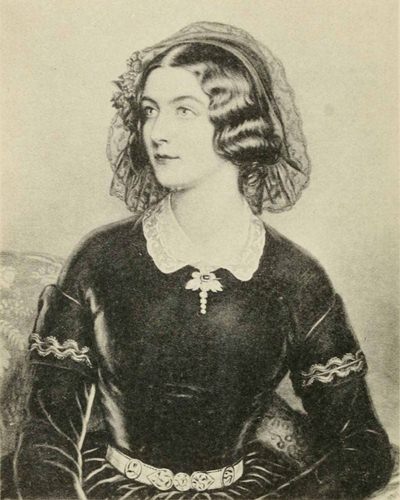
It is indisputable that in this, her twenty-sixth year, Lola was extremely
beautiful. Her bitterest detractors have never denied her the possession
of almost magical loveliness. This was informed by sparkling vivacity, and
a force of personality, without which we should never have heard the name
of Lola Montez. A human masterpiece of this sort is as much a source of
trouble in a community as a priceless diamond. Everyone’s cupidity is
excited, probity and honour melt away in the fierce heat of temptation.
The upright think that here at last is a prize worth the sacrifice of all
the standards that have hitherto guided them. St. Anthony, after forty
years of sainthood, succumbs—and is glad that he does. Even miserable
Poland for a moment forgot her woes when she looked on Lola; and her stern
conqueror, the terrible Paskievich, felt a new spring pervading his grim,
sixty-year-old frame. He, the master of many legions, he at whose frown a
nation paled—why should he not grasp this treasure? Who should say him
nay?
I will let Lola tell the story in her own words.
“While Lola Montez was on a visit to Madame Steinkiller the wife of
the principal banker of Poland, the old viceroy sent to ask her
presence at the palace one morning at eleven o’clock. She was assured
by several ladies that it would be neither politic nor safe to refuse
to go; and she did go in Madame Steinkiller’s carriage, and heard from
the viceroy a most extraordinary proposition. He offered her the gift
of a splendid country estate, and would load her with diamonds
besides. The poor old man was a comic sight to look upon—unusually
short in stature, and every time he spoke, he threw back his head and
opened his mouth so wide as to expose the artificial gold roof of his
palate. A death’s-head making love to a lady could not have been a
more disgusting or horrible sight. These generous gifts were most
respectfully and very decidedly declined. But her refusal to make a
bigger fool of one who was already fool enough was not well received.
[This, I take it, is the only instance of the word fool being applied to
one of the ablest, if most ruthless, men Russia has ever produced.]
“In those countries where political tyranny is unrestrained, the
social and domestic tyranny is scarcely less absolute.
“The next day His Majesty’s tool, the colonel of the gendarmes and
director of the theatre, called at her hotel to urge the suit of his
master.
“He began by being persuasive and argumentative, and when that availed
nothing, he insinuated threats, when a grand row broke out, and the
madcap ordered him out of her room.
“Now when Lola Montez appeared that night at the theatre, she was
hissed by two or three parties who had evidently been instructed to do
so by the director himself. The same thing occurred the next night;
and when it came again on the third night, Lola Montez, in a rage,
rushed down to the footlights, and declared that those hisses had been
set at her by the director, because she had refused certain gifts
from the old prince, his master. Then came a tremendous shower of
applause from the audience; and the old princess, who was present,
both nodded her head and clapped her hands to the enraged and fiery
Lola.
“Here, then, was a pretty muss. An immense crowd of Poles, who hated
both the prince and the director, escorted her to her lodgings. She
found herself a heroine without expecting it, and indeed without
intending it. In a moment of rage she had told the whole truth,
without stopping to count the cost, and she had unintentionally set
the whole of Warsaw by the ears.
“The hatred which the Poles intensely felt towards the government and
its agents found a convenient opportunity of demonstrating itself, and
in less than twenty-four hours Warsaw was bubbling and raging with the
signs of an incipient revolution. When Lola Montez was apprised of the
fact that her arrest was ordered, she barricaded her door; and when
the police arrived she sat behind it with a pistol in her hand,
declaring that she would certainly shoot the first man dead who should
break in. The police were frightened, or at least they could not agree
among themselves who should be the martyr, and they went off to inform
their masters what a tigress they had to confront, and to consult as
to what should be done. In the meantime, the French Consul gallantly
came forward and claimed Lola Montez as a French subject, which saved
her from immediate arrest; but the order was peremptory that she must
quit Warsaw.”
I have no means of verifying this account. Riots were of frequent
occurrence in Warsaw during the ’forties, but, thanks to a rigid
censorship of the Press, the particulars concerning them have failed to
reach us. That the citizens would at once side with any one who for any
reason whatsoever was “agin the Government” is not to be doubted, and Lola
was quite clever enough to make a slight to her appear as an insult to
the Warsaw public. In defending herself with the pistol, she only gave
proof of the manlike courage and resolution conspicuous throughout her
whole career. As to the cause of the row, one of Lola’s recent biographers
remarks that if Prince Paskievich had made the offer alleged, it is quite
certain that she would have closed with it. It is far from being certain.
The Russian Viceroy was definitely repugnant to her, and her subsequent
experiences show that she never bestowed herself upon a man whom she could
not, or did not, love. She was new, too, to her rôle of adventuress.
Altogether, there is no good reason for doubting that Lola’s relation of
her experiences in the Polish capital is substantially true.
On the other hand, vanity certainly betrayed her into several deviations
from the truth in her reminiscences of St. Petersburg. She went thither,
she informs us, upon her expulsion from Poland—an odd refuge! Of her
journey in a calèche across the wastes of Lithuania and through the dark
forests of Muscovy; of St. Petersburg, still half an Oriental city, where
all men below the rank of nobles wore the long beard and caftan of the
Asiatic—our raconteuse has nothing to say. She introduces us at once to
the Tsar and the innermost arcanum of his Court.
“Nicholas was as amiable and accomplished in private life as he was
great, stern, and inflexible as a monarch. He was the strongest
pattern of a monarch of this age, and I see no promise of his equal,
either in the incumbents or the heirs-apparent of the other thrones of Europe.”
Lola, we see, speaks as an authority on crowned heads. In her estimate
of Nicholas I. she seems to have forgotten the republican principles she
generally professed. The Tsar was, no doubt, the most commanding figure of
his time, and Russia’s influence in the counsels of Europe has never since
had as much weight as in the earlier part of his reign. His fine
proportions, as much as his strength of character, probably excited Lola’s
admiration, and blinded her to defects, physical and temperamental, which
did not escape the notice of more keen-eyed critics. She did not see that
the autocrat’s majestic demeanour was a pose, that his stern, hawk-like
glance was deliberately cultivated, and that he had only three expressions
of countenance, all put on at will. Horace Vernet, who knew Nicholas well,
was firmly convinced that he was not wholly sane. As to his amiability in
private life, he is said to have been, like many tyrants, a good husband,
and he often condescended to take tea with his nurse, “a decent Scotch
body.” It was to this respectable exile that the members of the imperial
family owed that fluent and colloquial English, which often as much
astonished as gratified our countrymen. It is recorded that one of the
Grand Dukes genially accosted the British chaplain at St. Petersburg with
the enquiry: “God damn your eyes, and how the devil are you?”—language,
very properly remarks an Early Victorian writer, which no man on earth had
the right to address to a person in Holy Orders.
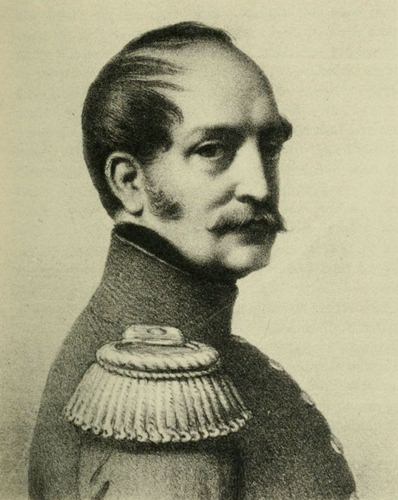
NICHOLAS I.
The Tsar himself was better bred. His relations with Mademoiselle Montez
were characterized by politeness and liberality. Not only he, but his
right-hand man, the astute Livonian, Benkendorf, held the lady’s political
acumen in high esteem. While she and the Emperor and the Minister of the
Interior were in a somewhat private chat about vexatious matters connected
with Caucasia, airily relates Lola, a humorous episode occurred.
“It was suddenly announced that the superior officers of the Caucasian
army were without, desiring audience. The very subject of the previous
conversation rendered it desirable that Lola Montez should not be seen
in conference with the Emperor and the Minister of the Interior; so
she was thrust into a closet, and the door locked. The conference
between the officers and the Emperor was short but stormy. Nicholas
got into a towering rage. It seemed to the imprisoned Lola that there
was a whirlwind outside; and womanly curiosity to hear what it was
about [did she then understand Russian?], joined with the great
difficulty of keeping from coughing, made her position a strangely
embarrassing one. But the worst of it was, in the midst of this grand
quarrel the parties all went out of the room, and forgot Lola Montez,
who was locked up in the closet. For a whole hour she was kept in this
durance vile, reflecting upon the somewhat confined and cramping
honours she was receiving from Royalty, when the Emperor, who seems to
have come to himself before Count Benkendorf did, came running back
out of breath, and unlocked the door, and not only begged pardon for
his forgetfulness, in a manner which only a man of his accomplished
address could do, but presented the victim with a thousand roubles,
saying laughingly: ‘I have made up my mind whenever I imprison any of
my subjects unjustly, I will pay them for their time and suffering.’
And Lola Montez answered him: ‘Ah, sire, I am afraid that rule will
make a poor man of you.’ He laughed heartily, and replied: ‘Well, I am
happy in being able to settle with you, anyhow.’”
Lola makes here a rather heavy draft on the reader’s credulity. However,
from the nice things she has to say about His Imperial Majesty, it is
clear that she had been admitted at one time or another to his presence.
Had not Nicholas I. been a pattern of the domestic virtues, we might have
attributed his embarrassment at Lola’s being discovered in his closet, and
the donation of the thousand roubles, to reasons entirely unconnected with
the Caucasus. After all, Lola may have argued, if she had been courted by
a king, why should she not have been consulted by an emperor?
Before or after her visit to St. Petersburg the dancer saw the Tsar at
Berlin. Mounted on a fiery Cordovan barb, she was among the spectators at
a review given by King Frederick William in honour of his imperial guest.
The horse was scared by the firing, and bolted, carrying its rider
straight into the midst of the Royal party. Lola was not sorry to find
herself in such company, but a gendarme struck at her horse and
endeavoured to drive it away. An insult of this sort Lola was the last
woman to tolerate. Raising her whip, she slashed the policeman across the
face. Out of respect for the Royal party, the incident was allowed to end
there, for the moment; but the next day the dancer was waited upon with a
summons. She instantly tore the document to pieces, and threw them into
the face of the process-server. Such contempt for the law might have been
attended with very serious consequences, but Lola went, as a matter of
fact, scot-free. Perhaps her friends in high places interceded for her;
but it is hard to believe, as she afterwards declared, that the gendarme
came to her lodgings to sue for her pardon.[7] In every capital of Europe
it soon became known that the beautiful Spanish dancer was able and
prepared to defend herself against the most determined antagonists of
either sex.
But a nobler quarry than Tsar and Viceroy was now to fall before the
shafts from Lola’s eyes.