There is still preserved a letter from England, written in a fine hand,
with red ink, dated Obeydon? Feb. 5, 1641, and directed,
“to her very loveing sonne
Samuel Boreman,
Ipswich in New England
give this with
haste.”
The letter is as follows:
“Good sonne, I have receaved your letter: whereby I understand that you
are in good health, for which I give God thanks, as we are all—Praised
be God for the same. Whereas you desire to see your brother Christopher
with you, he is not ready for so great a journey, nor do I think he dare
take upon him so dangerous a voyage. Your five sisters are all alive and
in good health and remember their love to you. Your father hath been
dead almost this two years, and thus troubleing you no further at this
time, I rest, praying to God to bless you and your wife, unto whome we
all kindly remember our loves.
Your ever loving mother,
“Julian Borman.”
This letter exhibits many of the characteristics of the Puritans to whom
the Bormans belonged. They were intensely religious; this short letter
contains the name of God three times and speaks of both prayer and
praise. The Puritans were an intelligent people, reading and writing;
this letter is a specimen of the correspondence carried on between the
earliest settlers and their kindred whom they had left in England. They
were an affectionate people, “remembering their loves” to one another;
and praying, for one another, as this mother did for her son and his
wife. This short letter has the word “love” four times.
They were a persistent people, those who came hither did not shrink from
the hardships around them. They came to stay, and sent back for their
friends. Samuel desired Christopher to follow him. Many of their
families were large, there were at least nine members of this Puritan
household. Samuel was born probably about 1610; he had emigrated from
England in 1635 or 1636. His name is found at Ipswich, Mass., about 1637
where land was assigned to him. Ipswich had been organized in 1635 with
some of the most intelligent and wealthy colonists. His father died
after Samuel’s emigration to America, in 1639. His wife’s name was Mary;
their oldest child, so far as we have record, was Isaac, born at
Wethersfield, Ct., Feb. 3, 1642. He probably journeyed through the
wilderness from Ipswich, Mass., which is twenty-six miles north of
Boston, to Wethersfield, Ct., about one hundred and fifty miles, in 1639
or 1640.
Between 1630 and 1640 many of the best families in England sent
representatives to America. It is said that Oliver Cromwell was at one
time on the point of coming. Between February and August, 1630,
seventeen ships loaded with families, bringing their cattle, furniture
and other worldly goods, arrived. One ship of four hundred tons brought
one hundred and forty passengers, others perhaps a larger number. Among
them were Matthew and Priscilla Grant, from whom Gen. Grant was of the
eighth generation in descent. Bancroft says, “Many of them had been
accustomed to ease and affluence; an unusual proportion were graduates
of Cambridge and Oxford. The same rising tide of strong English sense
and piety, which soon overthrew tyranny forever in the British Isles,
under Cromwell, was forcing the best blood in England to these shores.”
The shores of New England says George P. Marsh, were then sown with the
finest of wheat; Plymouth Rock had but just received the pilgrims; the
oldest cottages and log-cabins on the coast were yet new, when Samuel
Boreman first saw them. The Puritans were a people full of religion,
ministers came with their people; they improved the time on the voyage,
Roger Clap’s diary, kept on shipboard 1630, says, “So we came by the
good hand of our God through the deep comfortably, having preaching
and expounding of the word of God every day for ten weeks together by
our ministers.” Mr. Blaine says that the same spirit which kept
Cromwell’s soldiers at home to fight for liberty after 1640, impelled
men to America before that time, so that there was probably never an
emigration, in the history of the world, so influential as that to New
England from 1620 to 1643.
It is possible that Christopher Boreman fought and perhaps fell in the
army of the commonwealth. But why did so many of the early settlers,
quickly leave the Atlantic coast for the Connecticut valley? Their first
historians say there was even then “a hankering for new land.” They
wished also to secure it from occupation by the Dutch who were entering
it. Reports of its marvelous fertility, says Bancroft, had the same
effect on their imagination, as those concerning the Genesee and Miami
have since exerted, inducing the “western fever,” “Young man go West.”
The richness of the soil of the Wethersfield meadows has been celebrated
as widely as the aroma of its onions. It is only three miles from
Hartford and was for two centuries one of the most prominent communities
in Connecticut. There was scarcely a more cultured society anywhere. “It
were a sin,” said the early colonists “to leave so fertile a land
unimproved.” The Pequod war had annihilated a powerful and hostile tribe
on the Thames in 1637. Six hundred Indians perished, only two whites
were killed. Connecticut was long after that comparatively safe from
Indians. In 1639, the people formed themselves into a body politic by a
voluntary association. The elective franchise belonged to all the
members of the towns who had taken the oath of allegiance to the
commonwealth. It was the most perfect democracy which had ever been
organized. It rested on free labor. “No jurisdiction of the English
monarch was recognized; the laws of honest justice were the basis of
their commonwealth. They were near to nature. These humble emigrants
invented an admirable system. After two centuries and a half, the people
of Connecticut desire no essential change from the government
established by their Puritan fathers.” (Bancroft).
The first emigration of Puritans to the Connecticut river is supposed to
have been to “Pyquag,” now Wethersfield, in 1634. The next year 1635,
witnessed the first to Windsor and Hartford; while in the following year
1636, Rev. Thomas Hooker and his famous colony made the forest resound
with psalms of praise, as in June, they made their pilgrimage from the
seaside “to the delightful banks” of the Connecticut. Hooker was
esteemed, “The light of the western churches,” and a lay associate, John
Haynes, had been governor of Massachusetts. The church at Wethersfield
was organized while Mrs. Boreman’s letter given above, was on its way,
Feb. 28, 1641; Samuel and Mary Boreman were undoubtedly among its
earliest members. His first pastor there was Rev. Richard Denton, whom
Cotton Mather describes, as “a little man with a great soul, an
accomplished mind in a lesser body, an Iliad in a nutshell; blind of an
eye, but a great seer; seeing much of what eye hath not seen.” In the
deep forests, amid the cabins of settlers, and the wigwams of savages,
he composed a system of Divinity entitled “Soliloquia Sacra.” Rev. John
Sherman, born in Dedham, England, Dec. 26, 1613, educated at Cambridge,
who
came to America in 1634, also preached here for a short time. He
was afterwards settled at Watertown Mass., had twenty-two children and
died in 1685. The colony at New Haven, which was soon united with them,
was founded in 1638, under Rev. John Davenport and Gov. Theophilus
Eaton. They first met under an oak and afterward in a barn. After a day
of fasting and prayer they established their first civil government on a
simple plantation covenant “to obey the Scriptures.” Only church members
had the franchise; the minister gave a public charge to the governor to
judge righteously, with the text: “The cause that is too hard for you
bring it unto me, and I will hear it,” “Thus,” says Bancroft, “New Haven
made the Bible its statute book, and the elect its freemen.” The very
atmosphere of New Haven is still full of the Divine favor distilled from
the honor thus put upon God’s word in the foundation of its
institutions. There were five capital qualities which greatly
distinguished the early New England Puritans. I. Good intellectual
endowments; they were of the party of Milton and Cromwell. II. Intense
religiousness; the names Pilgrim and Puritan, are synonymous with
zealous piety. III. Education; many were graduates of colleges; they
founded Harvard in 1636. IV. Business thrift; godliness has the promise
of the world that now is, as well as of that which is to come. V. Public
spirit; they immediately built churches, schools, court houses, and
state houses.
The newly married son to whom Julian Borman, the Puritan widow, with
seven children, wrote from
England in 1641, obviously partook of these
common characteristics. He was soon recognized as a young man to be
relied upon. “Few of the first settlers of Connecticut,” says Hinman,
author of the genealogy of the Puritans, “came here with a better
reputation, or sustained it more uniformly through life.”
In 1646-7-8. He was a juror.
1649. Appointed by the Gen. Court, sealer of weights and measures.
1657-8-9-60-61-62-63, and many years afterward, representative of
Wethersfield in the Legislature of Connecticut, styled “Deputy to the
General Court.”
Hinman says, few men, if any, in the colony, represented their own town
for so many sessions.
1660. On the grand jury of the colony.
1670. Nominated assistant.
1662. Distributor of William’s estate.
1662. Appointed by Gen. Court on committee to pay certain taxes.
1665. Chairman of a committee appointed by the Legislature, to settle
with the Indians the difficulty about the bounds of land near
Middletown, “in an equitable way.”
1660. On a similar committee to purchase of the Indians Thirty Mile
Island.
1665. Chairman of a committee of the Legislature to report on land,
petitioned for by G. Higby.
1663. Appointed chairman of committee to lay out the bounds of
Middletown.
He died just two hundred and twelve years ago in April, 1673. His estate
was appraised by the selectmen of Wethersfield, May 2, 1673 at £742,
15s, about $4,000. His son Isaac then 31 years old is not named in the
settlement of the estate, and had perhaps received his patrimony. He had
ten children, seven sons and three daughters, of whom the youngest was
six years old; he had three grandchildren, the children of his oldest
son, Isaac. All his children received scriptural names, as was common in
Puritan families. His descendants are now doubtless several thousands in
number. Only a very small part, after two hundred and fifty years, of a
man’s descendants bear his name. His daughters and their descendants,
his sons’ daughters and their descendants, one-half, three-quarters,
seven-eights, diverge from the ancestral name, etc., till but a
thousandth part, after a few centuries retain the ancestral name, and
those who retain it owe to a hundred others as much of their lineage as
to him. Such is God’s plan; the race are endlessly interwoven together;
no man liveth unto himself. But a few comparatively, of the descendants
of Samuel Borman can now be traced. His own name, however, has been
carried by them into the United States Senate; into the lower house of
Congress; into many State Legislatures; to the bar and to the bench;
into many pulpits, and into several chairs of collegiate and
professional instruction. Yet these can represent but a few of his
descendants who have
been equally useful. Probably a larger number of
them are still to be found in Connecticut than in any other state. Among
them is the family of Rev. Noah Porter, D. D., LL. D., the President of
Yale College, who married a daughter of Rev. Dr. N. W. Taylor. The
prayers of Julian Borman for “her good sonne”—“her very loving sonne,
Samuel Boreman” already reach, under the covenant promise of Him who
remembers mercy to a thousand generations, a widely scattered family.
In the above letter the name is spelled both with and without the letter
“e” after “r;” the letter “d” is not found until 1712. The letter
“a,” was not inserted until 1750; so that the descendants of Samuel,
may still bear all these names, Borman, Boreman, Bordman or Boardman,
according to the generation at which the line traced, reaches the parent
stock. It is said that the name, however spelled, is still pronounced
“Borman,” at Wethersfield. The rise of Cromwell in England, the long
Parliament, the Westminster Assembly, the execution of Charles the
First, the establishment of the commonwealth, its power by sea and land,
the death of the Protector, the restoration of Charles the Second, were
events of which Samuel must have heard by letter from his brother and
sisters, as well as in other ways. He doubtless had numerous kinsmen on
the side of both his father and his mother, who were involved in these
movements of the times in England. Perhaps Richard Boardman, one of the
first two “Traveling Methodist Preachers on the
continent,” who came
here from England in 1769, was among the descendants.
At the same time the pioneer legislator in the Colonial General Court
just established in the wilds of America, was aiding to lay Scriptural
foundations for institutions of civil and religious liberty in the New
World. He left a Thomas Boreman, perhaps an uncle, in Ipswich, Mass.
During the thirty-seven years of his life, after his emigration, he saw
new colonies planted at many points along the Atlantic coast. He saw the
older colonies constantly strengthened by fresh arrivals, and by the
natural increase of the population. Several other Boremans came to New
England very early, some of whom may have been his kindred. He
accumulated and left a considerable estate for that day, derived in part
undoubtedly, from the increase in the value of the new lands, which he
had at first occupied, and which he afterward sold at an advanced price.
Some in every generation, of his descendants have done likewise; going
first north, and east, and then further and further west. One of the
descendants of his youngest son Nathaniel, now living, a man of
distinguished ability, Hon. E. J. H. Boardman of Marshalltown, Iowa, is
said to have amassed in this manner a large fortune.
Samuel Boreman died far from his early home and kindred. He was not
buried beside father or mother, or by the graves of ancestors who had
for centuries lived and died and been buried there; but on a continent
separated from them by a great ocean. He was
doubtless buried on the
summit of the hill in the old cemetery at Wethersfield, in a spot which
overlooks the broad and fertile meadows of the Connecticut river. In the
same plot his children and grandchildren lie, with monuments, though no
monument marks his own grave. In his childhood, he may have seen
Shakespeare and Bacon. He lived cotemporary with Cromwell; and Milton,
who died, a year after he was buried at Wethersfield. His wife Mary, the
mother of us all, died eleven years later, in 1684, leaving an estate of
$1,300. As his body was lowered into the grave, his widow and ten
children may have stood around it, the oldest, Isaac, aged 31, with his
two or three little children; the second, Mary, Mrs. Robbins, at the age
of twenty-nine; Samuel, Jr., twenty-five; Joseph twenty-three; John
twenty-one; Sarah, eighteen; Daniel, fifteen; Jonathan, thirteen;
Nathaniel, ten; Martha, seven. Most of these children lived to have
families, and left children, whose descendants now doubtless number
thousands. Isaac had three sons and one daughter and died in 1719, at
the age of seventy-seven. Samuel had two sons and three daughters, and
died in 1720, at seventy-two years of age. Daniel, then fifteen; from
whom Timothy Boardman, the author of the Log-Book, was descended; had
twelve children, nine sons and three daughters, and died in 1724, at the
age of seventy-six. Jonathan had two sons and three daughters, and died
September 21, 1712, at the age of fifty-one. Nathaniel married in
Windsor, at the age of forty-four, and had but one son, Nathaniel, and
died two months after his next older
brother Jonathan, perhaps of a
contagious disease, November 29, 1712; at the age of forty-nine. The
descendants of Nathaniel are now found in Norwich, Vt., and elsewhere;
and those of Samuel in Sheffield, Mass., and elsewhere. But the later
descendants of the other sons, except Samuel, Daniel and Nathaniel, and
of the daughters, I have no means of tracing. They are scattered in
Connecticut and widely in other states. During the lives of this second
generation occurred King Phillip’s war, which decimated the New England
Colonies, and doubtless affected this family with others. Within their
time also, Yale College was founded, and went into operation first at
Wethersfield, close by the original Borman homestead.
The writer of this has made sermons in the old study of Rector Williams,
the president of the college, near the old Boardman house, which was
standing in 1856, the oldest house in Wethersfield. The second
generation of Boardmans, of course occupied more “new lands.” Daniel,
the fifth son of Samuel, owned land in Litchfield and New Milford, then
new settlements, as well as in Wethersfield. Jonathan married in
Hatfield, Mass.
The third generation, the grandchildren of Samuel, the names of
twenty-nine of whom (seventeen grandsons and twelve grand-daughters),
all children of Samuel’s five sons, are preserved; went out to occupy
territory still further from home. We have little account however,
except of the nine sons of Daniel, the seventh child of Samuel. Daniel
the
great-grandfather of Timothy, the author of the Log-Book, was
married to Hannah Wright just a hundred years before the marriage of
that great-grandson, June 8, 1683, while the war-whoop of King Phillip’s
Narraganset savages was still resounding through the forest. Of his
twelve children, two sons, John and Charles, died before reaching full
maturity, John at the age of nineteen, near the death of two of his
uncles, Jonathan and Nathaniel, in 1712; and Charles the youngest child,
at the age of seventeen, very near the time of his father’s death, in
1724. One son died in infancy. Of his daughters, Mabel, married Josiah
Nichols, and for her second husband John Griswold of New Milford; Hannah
married John Abbe of Enfield; and Martha married Samuel Churchill of
Wethersfield. Of his six surviving sons, Richard was settled at
Wethersfield; he married in Milford, and had three children. His second
son Daniel, born July 12, 1687, was graduated at Yale College in 1709,
became the first minister of New Milford in 1712 and died in the
ministry with his people, August 25, 1744. Hinman says: “He gave
character and tone to the new settlement, by his devotion and active
service.”
He was a man of deep piety, and of great force of character. It is
related that an Indian medicine man, and this Puritan pastor met by the
sick-bed of the same poor savage. The Indian raised his horrid clamor
and din, which was intended to exorcise according to their customs the
evil spirit of the disease. At the same time Mr. Boardman lifted up his
voice in prayer to
Him who alone can heal the sick. The conflict of
rival voices waxed long and loud to see which should drown out the
other. Mr. Boardman was blessed with unusual power of lungs like his
nephew Rev. Benjamin Boardman, tutor at Yale and pastor in Hartford, who
for his immense volume of voice, while a chaplain in the Revolutionary
army was called by the patriots the “Great gun of the gospel.” The
defeated charmer, acknowledged himself outdone and bounding from the
bedside hid his defeat in the forest. Mr. Boardman died about the time
his parishioners and neighbors were on the famous expedition to Cape
Breton and the capture of Louisburg and when Whitfield’s preaching was
arousing the church. He was twice married and had six children. His
second wife, the mother of all but his oldest child was a widow, Mrs.
Jerusha Seeley, one of nine daughters of Deacon David Sherman of
Poquonnoch. Their children were:
I. Penelopy, Mrs. Dr. Carrington.
II. Tamar, wife of Mr. Boardman’s successor in the pastorate at New
Milford, Rev. Nathaniel Taylor; mother of Major-General Augustine
Taylor, of the war of 1812; and grandmother of Prof. Nathaniel W.
Taylor, D.D., of New Haven.
III. Mercy, the wife of Gillead Sperry, and grandmother of Rev. Dr.
Wheaton of Hartford.
IV. Jerusha, wife of Rev. Daniel Farrand of Canaan, Ct., and mother of
Hon. Daniel Farrand (Yale, 1781), Judge of the Supreme Court of Vermont.
This judge
had nine daughters, one of whom married Hon. Stephen Jacobs,
of Windsor, also a Judge of the Supreme Court of Vermont.
Rev. Daniel Boardman left but one son, the Hon. Sherman Boardman, who
was but sixteen years old at the time of his father’s death. From the
age of twenty-one he was for forty-seven years constantly in civil or
military office. He was for twenty-one sessions a member of the General
Assembly of Connecticut, of which his great-grandfather Samuel, had been
so long a member. His four sons, Major Daniel (Yale, 1781), Elijah,
Homer, and David Sherman (Yale, 1793), were all members of the
Connecticut Legislature, in one or both branches, for many years. Elijah
was also elected a United States Senator, from Connecticut in 1821. He
founded Boardman, Ohio, and died while on a visit there Aug. 18, 1823.
His son, William W. Boardman (Yale, 1812), was speaker of the house of
the Connecticut Legislature, and elected to Congress in 1840. He left an
ample fortune, and his large and comely monument stands near the centre
of the old historic cemetery of New Haven, Ct., in which city he
resided. This branch of the family, second cousins of the author of the
Log-Book, though descended from the Puritan pastor Daniel Boardman, are
now associated with the Protestant Episcopal church.
The brothers of the pastor, grandsons of Samuel, were scattered in
various places. Richard settled in Wethersfield, as already noticed.
Israel settled at Stratford, and
had two sons and one daughter. Joshua,
received by his father’s will the homestead, but afterward removed to
Springfield, Mass. Benjamin settled at Sharon, and received from his
father lands in Litchfield and New Milford, lands which the family had
probably purchased while the son and brother was preaching there.
Timothy, the ninth child of Daniel, only twelve years old when his
brother became pastor at New Milford, died only a few days before the
birth of his namesake, and first grandchild, the author of the Log-Book.
He lived and died in Wethersfield. His enterprise however, like that of
his grandfather who emigrated from England, and that of his father who
acquired lands in Litchfield and New Milford, went out, as that of many
of their descendants does to-day, in the west, for “more land.” He and
his brother Joshua, and other thrifty citizens of Wethersfield, fixed
upon the province of Maine as the field of their enterprise. Timothy and
Joshua owned the tract of land, thirty miles from north to south, and
twenty-eight from east to west, which now, apparently, constitutes
Lincoln Co. They had a clear title to eight hundred and forty square
miles, about twenty-two townships, along or near the Atlantic coast. By
the census of 1880, the assessed valuation of real estate in this county
was $4,737,807; of personal property $1,896,886. Total $6,634,693. It
embraces 3,213 farms; 146,480 acres of improved land, valued, including
buildings and fences at $4,403,985; affording an annual production,
valued at $759,560. The population was 24,326 of whom 23,756 were
natives of Maine.
This tract which should have been called “Boardman county,” had been
originally purchased of the Indians by one John Brown, probably as early
as the close of King Phillip’s war. It was purchased by the Boardman
brothers in 1732, from the great-grandchildren of John Brown, requiring
a considerable number of deeds which are now on record in the county
clerk’s office at York, Maine. These deeds were from Wm. Huxley, Eleazar
Stockwell, and many others, heirs of John Brown, and of Richard Pearse
his son-in-law. Two of them show $2,000 each as the sums paid for their
purchase.
William Frazier, a grandson of Timothy, and an own cousin of the author
of the Log-Book, received something more than two townships, and
although German intruders early settled upon these lands, many of whose
descendants are now among the leading citizens of that county, yet there
seems to be little reason to doubt that if, after the close of the
Revolutionary war, the author of the Log-Book and other heirs had gone
in quest of those ample possessions, something handsome, perhaps half of
the county, might have been secured. There is a tradition that the true
owners were betrayed as non-resident owners of unimproved lands often
are, by their legal agents, who accepted of bribes to defraud those
whose interests they had promised to secure.
Timothy Boardman 1st, died in mid-life, at the age of fifty-three, and
this noble inheritance was lost to his heirs. The county became thickly
settled, and the Boardman titles though acknowledged valid, were it is
said, confiscated by the Legislature of Massachusetts in favor of the
actual occupants of the soil, as the shortest though unjust settlement
of the difficulty.
The fourth generation, the great-grandsons of Samuel included several
men of prominence, some of whom have been already noticed. Hon. Sherman
Boardman of New Milford; Rev. Benjamin Boardman, the army chaplain, of
Hartford, and others. The majority of the family, however, were plain
and undistinguished men of sterling Puritan qualities, and of great
usefulness in their several spheres, in the church and in society. Many
were deacons and elders in their churches, these were too numerous for
further especial mention, except in a single line. The third child of
Timothy, the Maine land proprietor, only four years old when Lincoln
Co., Me. was purchased by his father, became a carpenter, ship-builder
and cabinet maker, and settled in Middletown, Ct., which his
great-grandfather Samuel had surveyed nearly a century before. He
married Jemima Johnson, Nov. 14, 1751, and his oldest child, born Jan.
20, 1754, was the author of the Log-Book. The preaching of Whitfield,
and the “Great Awakening” of the American churches, North, South and
Central, at this time, and for a whole generation, immediately preceding
the Revolutionary war, had very much quickened the religious life even
of the children of the New England Puritans. The Boardman family
obviously felt the influence of this great revival. The country was anew
pervaded with intense religious influences.
Many letters and other papers remain from different branches of the
family of this and of more recent dates, exhibiting a deeply religious
spirit. The boy Timothy grew up in an atmosphere filled with such
influences. Many of the habits and feelings brought by the Puritans from
England still prevailed. To the day of his death he retained much of the
spirit of those early associations. He left a double portion to his
oldest son. He inherited the traits of the Puritans; intelligence;
appreciation of education; deference for different ages and relations in
society; piety, industry, economy and thrift. His advantages at school
in the flourishing village of Middletown must have been exceptionally
good; he early learned to write in an even, correct and handsome hand,
which he retained for nearly three-quarters of a century; his school
book on Navigation is before me.
More attention was paid to a correct and handsome chirography, at that
time, the boyhood of Washington, Jefferson, Sherman and Putnam, than at
a later day when a larger range of studies had been introduced. “The
Young Secretary’s Guide,” a volume of model letters, business forms,
etc., is preserved; it bears on the first leaf “Timothy Boardman, his
Book, A.D. 1765.” The hand is copy-like, and very handsome, and
extraordinary if it is his, as it seems to be; though he was then but
eleven years old. A large manuscript volume of Examples in Navigation,
obviously in his handwriting, doubtless made in his youth, is also
before me. The writing and diagrams are like copper-plate. No descendant
of his, so far as known to the writer could
have exceeded it in
neatness and skill. In his early boyhood the French and Indian war
filled the public mind with excitement; reports of the exploits of Col.
Israel Putnam were circulated, as they occurred. The conquest of Canada
under Gen. Wolf filled the colonies with pride and patriotism. But
already disaffection between the mother country and the colonies had
arisen. Resistance to the tea tax and other offensive measures were
discussed at every fireside. The writer before he was seven years old
caught from the author of the Log-Book, then over eighty, something of
the indignant feeling toward England which the latter had acquired at
the very time when the tea was thrown overboard into Boston harbor.
Timothy Boardman was ripe for participation in armed resistance when the
war came. He was just twenty-one as the first blood was shed at
Lexington and Concord, April 19, 1775. Putnam who had left his plow in
the furrow, was with his Connecticut soldiers, in action, if not in
chief command at Bunker hill. Timothy Boardman joined the army which
invested Boston, under Washington in the winter of 1775-1776. He was
stationed, doubtless with a Connecticut regiment, on Dorchester Heights,
now South Boston.
After completing this service, in the great uprising of the people to
oppose the southward progress of Burgoyne, he was called out and marched
toward Saratoga, but the surrender took place before his regiment
arrived. With his father he had worked at finishing houses, and the
inside of vessels built on the Connecticut river, on
which Middletown
is situated. In the winter he was employed largely in cabinet work, in
the shop; I have the chest which he made and used on the Oliver
Cromwell.
Congress early adopted the policy of sending out privateers or armed
vessels to capture British merchant vessels. These vessels became prizes
for the captors. The Oliver Cromwell was chartered by Connecticut,
with letters of marque and reprisal from the United States. Captain
Parker was in command. The Defence accompanied the Oliver Cromwell;
they sailed from New London; Timothy Boardman then twenty-four years of
age enlisted and went on board; he commenced keeping the Log-Book April
11, 1778; he seems to have been head carpenter on board the ship, and to
have had severe labors. His assistants appear to have deserted him
before the close of the voyage. It was his duty to make any needful
repairs after a storm, or in an engagement and to perform any such
service necessary even at the time of greatest danger. In a terrific
storm it was decided to cut away the mast. His hat fell from his head,
but he scarcely felt it worth while to pick it up, as all were liable so
soon to go to the bottom. In action, his place was below deck, to be in
readiness with his tools and material to stop instantly, if possible,
any leak caused by the enemies’ shot. At one time the rigging above him
was torn and fell upon him, some were killed; blood spattered over him,
and it was shouted “Boardman is killed.” He, however, and another man on
board, a Mr. Post, father of the late
Alpha Post of Rutland, were
spared to make their homes for half a century among the peaceful hills
of Vermont.
In the following year 1779, he seems to have sailed down the Atlantic
coast on an American merchant vessel. He was captured off Charleston, S.
Carolina, by the British, but after a few days’ detention, on board his
Majesty’s vessel, it was thought cheaper to send the prisoners on shore
than to feed them, and he and his companions were given a boat and set
at liberty. They reached Charleston in safety. The city was under
martial law, and the new-comers were for about six weeks put upon
garrison duty. About this time Lord Cornwallis was gaining signal
advantages in that vicinity, while Gen. Gates, who had received the
surrender of Burgoyne, three years before, was badly defeated. After
completing this service the author of the Log-Book, started to walk home
to Connecticut. He proceeded on foot to North Carolina, where Andrew
Jackson was, then a poor boy of twelve years. Jackson’s father, a young
Irish emigrant died within two years after entering those forests, and
his widow soon to become the mother of a President, was “hauled” through
their clearing, from their deserted shanty, to his grave, among the
stumps, in the same lumber wagon with the corpse of her husband. He had
been dead twelve years when the pilgrim from Connecticut passed that
way. Overcome, probably by fatigue and by malaria, his progress was
arrested in North Carolina by fever, and he lay sick all winter among
strangers.
In the spring of 1780, unable probably, to proceed on foot, he embarked
from some port, on a merchant ship bound for St. Eustatia, a Dutch
island, in the West Indies. He was again captured and taken prisoner by
the British.
He was, however, transferred to a British merchant vessel on which he
rendered a little service by way of commutation, when he was set at
liberty on St. Eustatia. The island has an area of 189 square miles,
population 13,700; latitude 17°, 30', North. Climate generally healthy,
but with terrific hurricanes and earthquakes, soil very fertile and
highly cultivated by the thrifty Hollanders, with slave labor. It has
belonged successively to the Spanish, French, English and Dutch. Having
been enfeebled by his fever of the winter before, Timothy Boardman now
twenty-six years old, worked for several months at his trade with good
wages. I have heard him say that there the tropical sun shone directly
down the chimney. He used to relate also, how fat the young negroes
would become in sugaring time, when the sweets of the canefield flowed
as freely as water. He returned home to Connecticut probably late in the
year 1780. Vermont was then the open field for emigration. It was
rapidly receiving settlers from Connecticut. I have no knowledge that he
ever made any account of the immense tract in Maine, purchased and held
by deeds, still on record at York, Me., by his grandfather, and in which
he, as the oldest grandson, born a few days after his grandfather’s
death and named for him, might have been expected to be interested.
He was now twenty-seven. A large family of younger children had long
occupied his father’s house. He sought a home of his own. His younger
brothers Elisha and Oliver were married and settled before him. He seems
to have inherited something of the ancestral enterprise of the Puritans,
“hankering for new land.” All his brothers and sisters settled in
Connecticut, but he made his way in 1781 to Vermont. For a year
1781-1782, he worked at his trade in Bennington. During this time, he
purchased a farm in Addison, it is supposed of Ira Allen, a brother of
the redoubtable Ethan Allen; but the title proved, as so often happened,
with the early settlers to be defective. He recovered, many years
afterward, through the fidelity and skill of his lawyer, the Hon. Daniel
Chipman of Middlebury, the hard earned money which he had paid for the
farm at Chimney Point. It shows how thrifty he must have been, and how
resolute in his purpose to follow a pioneer life in Vermont, that after
this great loss he still had money, and a disposition to buy another
farm among the Green Mountains. Having put his hand to the plow, he did
not turn back. He did not perhaps like to have his Connecticut kindred
and friends think he had failed in what he had undertaken. He had saved
a good portion of his wages for six or seven years. He had received, as
the most faithful man in the crew, a double share in the prizes taken by
the Oliver Cromwell. He had perhaps received some aid from his father.
Though he had paid for and lost one unimproved farm, he was able to buy,
and did purchase another. He came to Rutland, Vt., in 1782 and
bought
one hundred acres of heavily timbered land from the estate of Rev.
Benajah Roots, whose blood has long flowed in the same veins, with his
own. He perhaps thought that if he bought of a minister, he would get a
good title. He may have known Mr. Roots, at least by reputation, in
Connecticut, for he had been settled at Simsbury, Ct., before coming to
a home missionary field in Rutland. The owner of the land was in doubt
whether to sell it.
The would-be purchaser had brought the specie with which to buy it, in a
strong linen bag, still it is supposed preserved in the family, near the
same spot. “Bring in your money,” said a friend, “and throw it down on a
table, so that it will jingle well.” The device was successful, the
joyful sound, where silver was so scarce, brought the desired effect.
The deed was soon secured, for the land which he owned for nearly sixty
years.
A clearing was soon made on this land at a point which lies about
one-half mile south of Centre Rutland, and a-half mile west of Otter
creek on the slope of a high hill. It was then expected that Centre
Rutland would be the capital of Vermont. In 1783, he erected amid the
deep forests, broken only here and there by small clearings, a small
framed house. He never occupied a log-house; as he was himself a
skillful carpenter, house-joiner and cabinet maker and had been reared
in a large village, a city, just as he left it, his taste did not allow
him to dispense with so many of the comforts of his earlier life as many
were compelled to relinquish.
He returned to Middletown, and was married, Sept. 28th, 1783, to Mary,
the eighth child and fifth daughter of Capt. Samuel Ward of Middletown,
who had twelve children. The Ward family were of equal standing with his
own. The newly married couple were each a helpmeet unto the other, and
had probably known each other from early life in the same church and
perhaps in the same public school. They were both always strongly
attached to Middletown, their native place; it cost something to tear
themselves away and betake themselves to a new settlement, which they
knew must long want many of the advantages which they were leaving. I
remember the pride and exhileration with which, in his extreme old age,
he used to speak of Middletown, as he pointed out on his two maps, one
of them elaborate, in his native city, the old familiar places. He
revisited it from time to time during his long life, the last time in
1837, only a year and a-half before his death.
In his journeys between Rutland and Middletown, which he visited with
his wife, the second year after their marriage, he must have met many
kindred by the way. His Uncle Daniel Boardman lived in Dalton, and his
Uncle John in Hancock, Mass., while three brothers of his wife, and a
sister, Mrs. Charles Goodrich, resided in Pittsfield. Mrs. Ward, his
mother-in-law, lived also in Pittsfield with her children, till 1815,
when she was ninety-six years old, her oldest son seventy-six, and her
eighth child, Mrs. Boardman, over sixty. She and her son-in-law, Judge
Goodrich, the founder of
Pittsfield, who was of about her own age,
lived, it is said to be the oldest persons in Berkshire Co. He had also
a cousin Mrs. Francis at Pittsfield, and a favorite cousin Elder John
Boardman, at Albany and another cousin, Capt. George Boardman in
Schenectady. These three cousins were children of his uncle Charles of
Wethersfield. His grandmother Boardman, the widow of the Maine land
proprietor, also spent her last days in Dalton, and died there at her
son Daniel’s, about the time when Timothy first went to Vermont.
His youngest brother William, distinctly remembered my grandfather’s
playing with him, and bantering him when a little child, and also the
September morning when with his father and mother he rode over in a
chaise to Capt. Ward’s to attend Timothy’s wedding. He told me that when
Timothy was there last, he shed some tears, as he cut for himself a
memorial cane, by the river’s bank, where he used to play in boyhood,
and said he should never see the place again. William, whom he used to
call “Bill,” named a son for him, Timothy.
The spot where he built his first house, and called on the name of the
Lord, and where his first two or three children were born, is now off
the road, at a considerable distance, about a-half mile north-east of
the house, occupied by his grandson, Samuel Boardman, Esq., of West
Rutland. It is near a brook, in a pasture, cold, wet, bunchy and stony,
and does not look as if it had ever been plowed. He had better land
which he cultivated afterward, and which yielded abundantly. But at
first
he must have wrung a subsistence from a reluctant soil. Yet the
leaf-mould and ashes from burned timber on fields protected by
surrounding forests would produce good wheat, corn and vegetables. Near
that spot still stands one very old apple tree and another lies fallen
and decaying near by. So tenacious are the memorials of man’s occupancy,
even for a short time.
After a few years he removed this small framed house, fifty rods
westward and dug and walled for it a cellar which still remains, a pit
filled with stones, water and growing alders. He then made some
additions to the house as demanded by his growing family. He also built
near it a barn. His house was still on the cold, bushy land which slopes
to the north-east, and is now only occupied for pasturage. Here seven
young children occupied with him his pioneer home.
The tradition used to be, that at first he incurred somewhat the
derision of his neighbors, better skilled in backwoodsman’s lore than
himself, by hacking all around a tree, in order to get it down. It is
said that some imagined his land would soon be in the market, and sold
cheap; that the city bred farmer, better taught in navigation and
surveying, than in clearing forests and in agriculture, would become
tired and discouraged and abandon his undertaking. But he remained and
persevered, and his good Puritan qualities, industry, frugality, good
management, and persistency for the first ten or fifteen years,
determined his whole subsequent career and that of his family. He was
never rich, but he secured a good home, dealt well with his
children,
and became independent for the remainder of his life. Indeed, like most
New England Puritans, of resolute and conscientious industry, and of
moderate expenditures, he was always independent after he was of age.
A man of such character, and of so fair an education would, of course,
soon be valued in any community, and be especially useful in a new
settlement where skill with the pen and the compass are rarer than in
older places.
He was appreciated and was soon made town clerk of Rutland, and county
surveyor for Rutland county. He was also in time made captain of the
militia, in recognition perhaps, in part, of his Revolutionary services.
He was also made clerk of the Congregational church, I have some of his
church records. On Nov. 20th, 1805, he was elected a deacon. He was also
on the committee to revise the Articles of Faith and Rules of
Discipline. About 1792, he bought fifty acres of good land lying west of
his first purchase, and on this ground, one hundred rods west of his
previous home, and about half a mile south-west of the spot first
occupied, he erected in 1799, a good two-story house, which is still in
excellent preservation, where till his death, he lived in a home as
ample and commodious as the better class of those with which he had been
familiar in his native state.
In sixteen years after coming to the unbroken forest on what has since
been called “Boardman hill,” he had won a good position in society and
in the church,
and a comfortable property. He was afflicted in the
death of his oldest daughter and child, Hannah, October 26, 1803. But
this was the only death that occurred in his family for more than
fifty-three years. His six remaining children lived to an average age of
about eighty.
The Congregational church in West Rutland, one of the oldest in Vermont,
had been formed in 1773, nine years before his arrival. He became a
member in 1785, and his wife in 1803. Not long after his coming, Rev.
Mr. Roots, the pastor, died, and the widely known Rev. Samuel Haynes, a
devout, able and witty man, became their pastor, and so continued for
thirty years, until his dismission in 1818. Timothy Boardman’s children
were early taken to church, were trained and all came into the church
under, the ministry of Rev. Mr. Haynes.
He said that he would sooner do without bread than without preaching,
and he was always a conscientious and liberal supporter of the church.
He appreciated and co-operated with his pastor. In the great revival of
1808, five of his children were gathered into the church. One of them,
perhaps all of them, were previously regarded by their parents as
religious.
In politics he was a Federalist. In respect to the war with Great
Britain 1812-1815, his views did not entirely coincide with those of
some others, including his associate in the diaconate, Dea. Chatterton,
who was a rigid Democrat. This eminently devout and useful man, was so
burdened with Dea. Boardman’s
lukewarmness in promoting the second war
with Great Britain, against whose armies both had fought in the
Revolution, that he felt constrained to take up a labor with him, hoping
to correct his political errors by wholesome church discipline. It must
have been a scene for a painter.
Perhaps no better man or one more effective for good, ever lived in West
Rutland than Dea. Chatterton. In both politics and religion he was
practical and fervid. The church meeting was crowded.
The occasion compelled my grandfather, as Paul was driven, in his
epistle to the Corinthians, and as Demosthenes was forced in his oration
for the crown, to enter somewhat upon his own past record. Though a very
modest and unpretentious man, yet it is said that the author of the
Log-Book, on this memorable occasion straightened himself up, and boldly
referred his hearers to the glorious days of the war for Independence,
which had tried men’s souls, and when he had forever sealed the
genuineness of his own patriotism, by hazarding his life both by sea and
land for his country.
Weighed in the balances on his own record, so far from being found
wanting, his patriotism was proved to be of the finest gold; and his
place like that of Paul, not a whit behind that of the chiefest apostle.
Though he did not feel it to be his duty to fall in behind the tap of
the drum, and volunteer to fight, beside the aged democratic veteran who
served with him at the communion table; yet he showed that the older was
not a
better soldier; that with diversities of politics, there was the
same loyalty, and that his own patriotism was no less than his
brother’s.
The tremendous strain which the struggle for American Independence put
upon the generation who encountered it, was touchingly illustrated in
the lives of these two men, a generation, or two generations after the
struggle had been successfully closed. Amid the quiet hills of Vermont,
the minds of both were affected for a time, with at least partial
derangement. Dea. Boardman labored temporarily under the hallucination,
that he was somehow liable to arrest, and prepared a chamber for his
defence. He was obliged, for a time to be watched, though he was never
confined. A journey to Connecticut, on horseback, with his son Samuel,
when he was perhaps sixty years old, effected an entire cure. Dea.
Chatterton in his extreme old age, after a life of remarkable piety,
became a maniac and was obliged to be confined. He had suffered peculiar
hardships, perhaps on the prison-ships, in the Revolution; and his
incoherent expressions, in his insanity, sixty years afterward, and just
before his death, were full of charges against the “British.”
Timothy Boardman’s supreme interest in life, however, was in his loyalty
to Christ, and his intense desires were for the extension and full
triumph of Christ’s kingdom. The revivals which prevailed in the early
part of the century and the consequent great expansion of aggressive
Christian work, were in answer to his life-long prayers, as well as
those of all other
Christians; and he entered heartily, from the first,
into all measures undertaken for the more rapid spread of the gospel. He
was greatly interested in the formation of the American Board of
Commissioners for Foreign Missions, and read the Missionary Herald,
with interest from its first publication, until his death. The formation
of the Bible Society, Tract Society, Seaman’s Friend Society, Sunday
School Society, American Home Missionary Society, etc., engaged his
interest, and received his support. He made himself an honorary member
of the A. B. C. F. M. near the close of his life, in accordance with the
suggestion of his sister Sarah, whom he greatly valued, the wife of Rev.
Joseph Washburn, and afterward of Dea. Porter, both of Farmington, Ct.,
by the contribution to Foreign Missions, at one time, of one hundred
dollars.
In social and domestic life, he was a son of the Puritans and of the
Connecticut type. He exacted obedience, and somewhat of reverence from
his children. They did not dare, to the last, to treat him with
unrestrained familiarity. His wife and children stood, waiting at their
chairs, until he was first seated at the table. He gave his children a
good education for the time, sending them to “Master Southard.” His
habitual temper of mind was one of deep reverence toward God. He sat in
awe during a thunder storm, and a cyclone which passed over his home
deeply impressed him. His letters abound in affectionate and in
religious sentiments. He was scrupulous in
the observance of the
Sabbath; required it of his children, and he expected it of the stranger
within his gates. The family altar probably never failed from the day he
first entered with his newly married wife, into their pioneer home, amid
the forests, till his death. He was solemn, earnest and felicitous in
prayer. The atmosphere of his home was eminently that of a christian
household. Two of his four sons became officers in their churches, and
also both his sons-in-law. Four of his grandsons entered the Christian
ministry, and a granddaughter is the wife of a clergyman. Those who
regard the Puritans in general, as too severe in industry, in frugality,
in morals and in religious exercises, would have regarded him as too
exacting in all these directions. He certainly could not on one hundred
and fifty acres of land, which he found wild, and not all of it very
good, have reared a large family, and supported public institutions as
he did; have given each of his sons at settlement in life, six hundred
dollars, and left to each at his death, eight hundred, if he had not
practiced through life, a resolute industry, and a somewhat rigid
economy.
It is worthy of notice that like his grandfather, Timothy Boardman of
Wethersfield, he owned, what by a little change of circumstances, might
have brought, not a competence merely but wealth to his heirs. Early in
his residence at Rutland, he became possessed, with many others of a
small lot in what was called the “Cedar Swamp.” These lots were valued
almost
exclusively for the enduring material for fences which they
afforded. Their cedar posts supplied the town. They obtained also on the
rocky portions of these lands a white sand, which was employed for
scouring purposes, and also for sprinkling, by way of ornamentation,
according to the fashion of the times, the faultlessly clean, white
floors of the “spare rooms.” Timothy Boardman’s cedar lot, is now one of
the largest marble quarries in Rutland, a town which is said to furnish
one-half of all the marble produced in the United States. It brought to
one of his sons, a handsome addition to farm profits, but was disposed
of just before its great value was appreciated and lost, as in case of
the Maine lands.
His grandfather Timothy Boardman, is said to have been “a short, stocky
man;” his monument, and until recently that of his father Daniel, son of
the emigrant from England, might both be seen, near together in the old
cemetery at Wethersfield.
The author of the Log-Book, was a little below the average height, of
rather full face, with a peach-bloom tinge of red on each cheek in old
age, and of light complexion, and light hair. His motions were quick,
and his constitution healthful, though he was never strong. He had
undoubtedly a mind of fair ability; inclined perhaps to conservative
views, and acting as spontaneously, it may be in criticism, as in any
other exercise of its energies. I remember to have received reproof and
instruction in manners, from him when I was five
or six years of age.
He was careful of his possessions, and articles belonging to him, were
very generally marked “T. B.”
It is a tradition among the older kindred, that the writer, though he
does not remember it, finding at the age of five or six, on grandpa’s
premises, some loose tufts of scattered wool, and being told that they
were his, expressed the candid judgment, that it could not be so,
“because they were not marked T. B.”
I am not aware that he was much given to humor, yet he would seem not to
have been entirely destitute of it from the philosophical account he
gave of the advantages of his position, when some one ventured to
condole with him on the steep hill of nearly a mile which lay between
his house and the church. He said it afforded him two privileges, first
that of dropping down quickly to meeting, when he had a late start; and
secondly, that of abundant time for reflection on the sermon while he
was going home.
His wife, undoubtedly his equal in every respect, to whom much of his
prosperity, usefulness, and good repute, as well as that of his family
was due, after a married life of fifty-three years and three months,
died in Dec., 1836. She had long been feeble. Her children watched
around her bedside on the last night in silence till one of her sons,
laying his hand upon her heart, and finding it still, said “we have no
longer a mother.” I remember the hush of the next morning, throughout
the house, when we young children awoke. It was
lonely and cold in
grandma’s room, and only a white sheet covered a silent form.
At eighty-three he was alone, and he deeply felt, as was natural, that
loneliness. Yet he had affectionate children, and with his youngest son,
who had four daughters, to him kind and pleasant granddaughters, he made
his home for the remainder of his life. With the oldest of these he made
in 1837, as already noticed, his last visit to Connecticut, going as far
as New Haven and the city of New York. On this journey he went in his
own carriage. He visited us, once at least in Castleton, at the house
where the Log-Book was so long concealed. I remember his figure there,
as that of a “short and stocky man,” who seemed to me very old. He died
while on a visit to Middlebury, where two of his children had been
settled for more than twenty years, at the house of his youngest
daughter and youngest child, Betsey, then the widow of Dea. Martin Foot.
She and her six daughters did everything possible for his comfort. A
swelling made its appearance upon his shoulder, and the disease advanced
steadily to a fatal termination. His appointed time had come. From his
death-bed he sent to his children a final letter of affectionate
greeting and counsel. The feeble hand, whose lines had been so fair and
even for nearly three-quarters of a century, wanders unsteadily across
the pages, expressive of a mind perhaps already wandering with disease.
And so the fingers that had traced the neat lines of the Log-Book, on
board the Oliver Cromwell, in 1778, “forgot” sixty years afterwards
“their
cunning,” and wrote no more. He was buried beside his wife, in
the cemetery at West Rutland, near the church where he had worshipped
nearly sixty years.
On the death of his wife, he had ordered two monumental stones to be
prepared just alike, except the inscriptions; one of which was to be for
her, and the other for himself. They may be seen from the road, by one
passing, of bluish stone standing not very far from the fence, and about
half way from the northern to the southern side of the lot. On these
stones was inscribed at his direction, where they may now be read, the
words, contained in Rev. 14: 13, divided between the two stones; on the
one: “I heard a voice from heaven saying unto me, write Blessed are the
dead, which die in the Lord from henceforth;” and on the other: “Yea
saith the Spirit that they may rest from their labors and their works do
follow them:”
His children were:
Hannah, born July 23, 1784; died Oct. 26, 1803.
Timothy, born March 11, 1786; settled in Middlebury, and died there
April, 1857.
Mary, born Jan. 27, 1788; married Dea. Robert Barney of East Rutland
1824; died at her son’s house, in Wisconsin, 1871.
Dea. Samuel Ward, born Nov. 27, 1789; died in Pittsford, Vt., May 13,
1870.
Dea. Elijah, born March 9, 1792; died Sept. 24, 1873.
Capt. Charles Goodrich, born Feb. 19, 1794; died Dec. 17, 1875.
Betsey, born, 1796; married Dea. Martin Foot of Middlebury; died April
26, 1873.
The proclivity of the Puritans for education is illustrated in the fact,
that only five years after the foundation of Yale College one of this
family, Daniel a grandson of Samuel, the emigrant from England, became a
student there and was graduated in 1709, and that wherever different
branches of the family have since been settled they have generally sent
sons to the nearest colleges, not only many to Yale, but several to
Dartmouth, Williams, Middlebury, Union, and others. The eighth and ninth
generations are now in the process of education, in various institutions
east and west. The descendants of Timothy Boardman who have entered
professional life, are:
Hon. Carlos Boardman (grad. Middlebury College 1842), a lawyer and
judge, in Linnaeus, Mo., oldest son of Capt. Charles. G. Boardman, of
West Rutland.
Rev. George Nye Boardman, D.D. (Middlebury College 1847). Prof. of
Systematic Theology, in Chicago Theological Seminary, Chicago, Ill.
Rev. Samuel W. Boardman, D.D. (Midd. Col., 1851). Pastor of the First
Presbyterian Church, Stanhope, N.J.
Rev. Simeon Gilbert Boardman (Midd. Col., 1855). Pastor of the
Presbyterian Church, Champlain, N.Y.
Charles Boardman, a member of the class of 1850, in Middlebury College,
and who died of typhoid fever in
the sophomore year, doubtless had in view the Christian ministry.
These four were sons of Dea. S. W. Boardman, of Castleton.
Horace Elijah Boardman, M.D. (Midd. Col., 1857), in practice at Monroe,
Wis., youngest son of Dea. Elijah Boardman, of West Rutland.
Harland S. Boardman M.D., (Midd., 1874), a grandson of Timothy 4th, and
son of Timothy 5th, of Middlebury, was graduated at the Homeopathic
Hospital College of Cleveland, Ohio, 1877. He is now practicing at
Ludlow, Vt.
William Gilbert Boardman, in practice of dentistry in or near Memphis,
Tenn., a grandson of Dea. Elijah Boardman.
Edgar William Boardman, M.D., son of Dr. Horace E., now practicing at
Janesville, Wis.; both he and his father were graduated at the “Hahneman
Medical College and Hospital, of Chicago.”
—— Webster, M.D., grandson of Mary, Mrs. Dea. Robert Barney, in
practice in Schuylerville, N.Y.
Dea. Martin Foote, the husband of Betsey, was a student in Middlebury
College for two years, it is believed, in the distinguished class of
1813, but by reason of impaired health, he was unable to complete the
course.
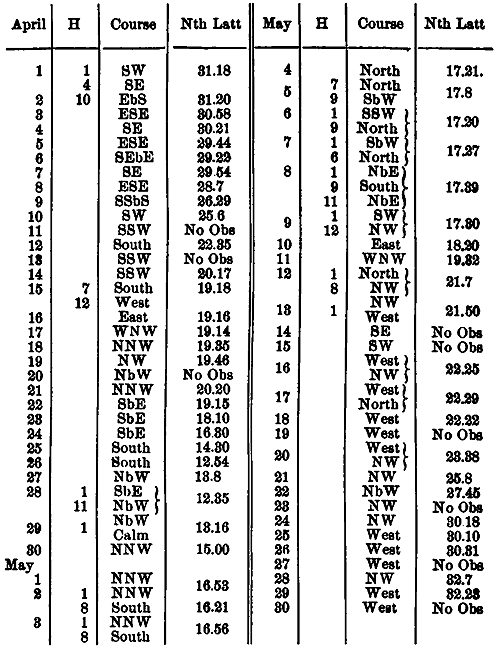
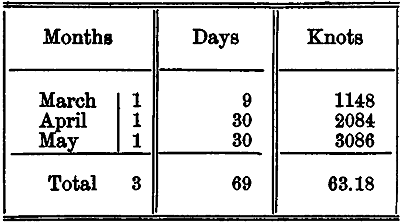
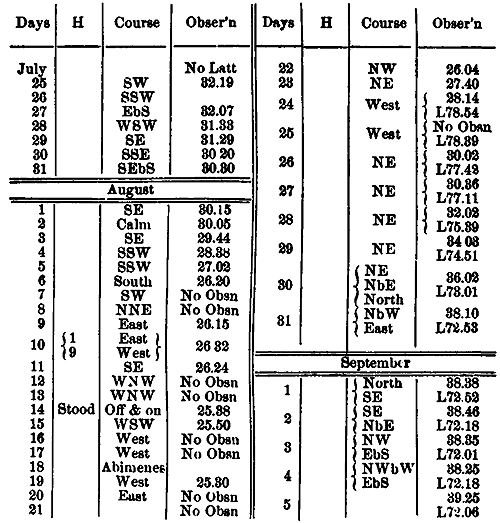
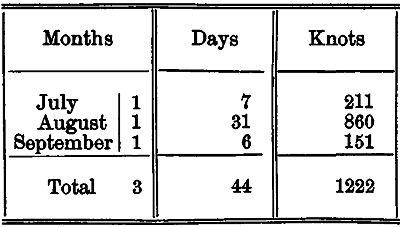
A few words in regard to the Log-Book may not be inappropriate. It seems
to be a mere waif that has floated on the current, and among a thousand
things that have perished, to have been, as it were by accident,
preserved. A portion of the volume seems to be a kind of a private
journal kept by my grandfather, for a few weeks in 1778. He does not
appear to have valued it greatly, as on the blank leaves, he has made
some entries of his business, as town clerk, and some as county
surveyor, and afterward, a few notes of account with his son Elijah, who
took a part of his farm. His last entry in it, as if it were in part a
waste blank book, was made forty-eight years after he left the Oliver
Cromwell, in 1826.
It must have come into my father’s hands with some other papers, on the
division of his father’s effects in 1839. Both seem to have been
reluctant to destroy anything, though they did not much value it. My
father, at last, weary of keeping it, would seem to have given it to me
merely for its blank pages, as scribbling paper. Six leaves, apparently
blank, were torn out. Several pages are covered with mere vacant
scrawling by my boyish hand; whether I threw it away in utter contempt,
or concealed it back of the old chimney, in curious conjecture whether
some unborn generations, would not at some distant day discover it, and
puzzle over it, I cannot tell. I have no recollection of it whatever;
except that I had a general impression that we used to have more of
grandfather’s writings than we possessed in later years. Whether we had
still others I know not. How little of such writing survives for a
century! It was lost for forty years, till a quarter of a century after
we had sold and left the house. It was found in 1884, in a dark recess,
back of the chimney, in the garret, by Master Fred. Jones, the son of an
esteemed friend, who in her childhood, about the time of the loss of
this manuscript, was a member of my father’s household. Many years
afterwards, she became the worthy mistress of the house, and this lad,
exploring things in general, came across this old Log-Book. If it is of
any interest or value; to him and to Dr. J. M. Currier, the accomplished
secretary of the Rutland County Historical Society, and to James
Brennan, Esq., an old schoolmate who took an interest in the manuscript,
is due all the credit of its publication.