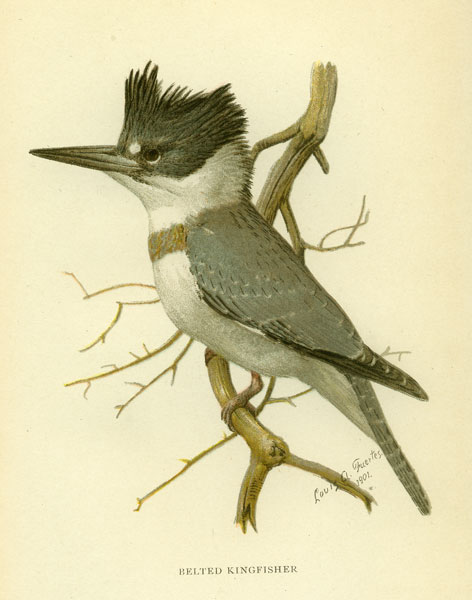
The halcyon or kingfisher is a good guide when you go to the woods. He will not
insure smooth water or fair weather, but he knows every stream and lake like a
book, and will take you to the wildest and most unfrequented places. Follow his
rattle and you shall see the source of every trout and salmon stream on the
continent. You shall see the Lake of the Woods, and far-off Athabasca and
Abbitibbe, and the unknown streams that flow into Hudson’s Bay, and many
others. His time is the time of the trout, too, namely, from April to
September. He makes his subterranean nest in the bank of some favorite stream,
and then goes on long excursions up and down and over woods and mountains to
all the waters within reach, always fishing alone, the true angler that he is,
his fellow keeping far ahead or behind, or taking the other branch. He loves
the sound of a waterfall, and will sit a long time on a dry limb overhanging
the pool below it, and, forgetting his occupation, brood upon his own memories
and fancies.
The past season my friend and I took a hint from him, and, when the dog-star
began to blaze, set out for Canada, making a big detour to touch at salt water
and to take New York and Boston on our way.
The latter city was new to me, and we paused there and angled a couple of days
and caught an editor, a philosopher, and a poet, and might have caught more if
we had had a mind to, for these waters are full of ’em, and big ones,
too.
Coming from the mountainous regions of the Hudson, we saw little in the way of
scenery that arrested our attention until we beheld the St. Lawrence, though
one gets glimpses now and then, as he is whirled along through New Hampshire
and Vermont, that make him wish for a fuller view. It is always a pleasure to
bring to pass the geography of one’s boyhood; ’tis like the
fulfilling of a dream; hence it was with partial eyes that I looked upon the
Merrimac, the Connecticut, and the Passumpsic,—dusky, squaw-colored
streams, whose names I had learned so long ago. The traveler opens his eyes a
little wider when he reaches Lake Memphremagog, especially if he have the luck
to see it under such a sunset as we did, its burnished surface glowing like
molten gold. This lake is an immense trough that accommodates both sides of the
fence, though by far the larger and longer part of it is in Canada. Its western
shore is bold and picturesque, being skirted by a detachment of the Green
Mountains, the main range of which is seen careering along the horizon far to
the southwest; to the east and north, whither the railroad takes you, the
country is flat and monotonous.
The first peculiarity one notices about the farms in this northern country is
the close proximity of the house and barn, in most cases the two buildings
touching at some point,—an arrangement doubtless prompted by the deep
snows and severe cold of this latitude. The typical Canadian dwelling-house is
also presently met with on entering the Dominion,—a low, modest structure
of hewn spruce logs, with a steep roof (containing two or more dormer windows)
that ends in a smart curve, a hint taken from the Chinese pagoda. Even in the
more costly brick or stone houses in the towns and vicinity this style is
adhered to. It is so universal that one wonders if the reason of it is not in
the climate also, the outward curve of the roof shooting the sliding snow
farther away from the dwelling. It affords a wide projection, in many cases
covering a veranda, and in all cases protecting the doors and windows without
interfering with the light. In the better class of clapboarded houses the
finish beneath the projecting eaves is also a sweeping curve, opposing and
bracing that of the roof. A two-story country house, or a Mansard roof, I do
not remember to have seen in Canada; but in places they have become so enamored
of the white of the snow that they even whitewash the roofs of their buildings,
giving a cluster of them the impression, at a distance, of an encampment of
great tents.
As we neared Point Levi, opposite Quebec, we got our first view of the St.
Lawrence. “Iliad of rivers!” exclaimed my friend. “Yet
unsung!” The Hudson must take a back seat now, and a good way back. One
of the two or three great watercourses of the globe is before you. No other
river, I imagine, carries such a volume of pure cold water to the sea. Nearly
all its feeders are trout and salmon streams, and what an airing and what a
bleaching it gets on its course! Its history, its antecedents, are
unparalleled. The great lakes are its camping-grounds; here its hosts repose
under the sun and stars in areas like that of states and kingdoms, and it is
its waters that shake the earth at Niagara. Where it receives the Saguenay it
is twenty miles wide, and when it debouches into the Gulf it is a hundred.
Indeed, it is a chain of Homeric sublimities from beginning to end. The great
cataract is a fit sequel to the great lakes; the spirit that is born in vast
and tempestuous Superior takes its full glut of power in that fearful chasm. If
paradise is hinted in the Thousand Islands, hell is unveiled in that pit of
terrors.
Its last escapade is the great rapids above Montreal, down which the steamer
shoots with its breathless passengers, after which, inhaling and exhaling its
mighty tides, it flows calmly to the sea.
The St. Lawrence is the type of nearly all the Canadian rivers, which are
strung with lakes and rapids and cataracts, and are full of peril and
adventure.
Here we reach the oldest part of the continent, geologists tell us; and here we
encounter a fragment of the Old World civilization. Quebec presents the anomaly
of a mediæval European city in the midst of the American landscape. This air,
this sky, these clouds, these trees, the look of these fields, are what we have
always known; but the houses, and streets, and vehicles, and language, and
physiognomy are strange. As I walked upon the grand terrace I saw the robin and
kingbird and song sparrow, and there in the tree, by the Wolfe Monument, our
summer warbler was at home. I presently saw, also, that our republican crow was
a British subject, and that he behaved here more like his European brother than
he does in the States, being less wild and suspicious. On the Plains of Abraham
excellent timothy grass was growing and cattle were grazing. We found a path
through the meadow, and, with the exception of a very abundant weed with a blue
flower, saw nothing new or strange,—nothing but the steep tin roofs of
the city and its frowning wall and citadel. Sweeping around the far southern
horizon, we could catch glimpses of mountains that were evidently in Maine or
New Hampshire; while twelve or fifteen miles to the north the Laurentian
ranges, dark and formidable, arrested the eye. Quebec, or the walled part of
it, is situated on a point of land shaped not unlike the human foot, looking
northeast, the higher and bolder side being next the river, with the main part
of the town on the northern slope toward the St. Charles. Its toes are well
down in the mud where this stream joins the St. Lawrence, while the citadel is
high on the instep and commands the whole field. The grand Battery is a little
below, on the brink of the instep, so to speak, and the promenader looks down
several hundred feet into the tops of the chimneys of this part of the lower
town, and upon the great river sweeping by northeastward like another Amazon.
The heel of our misshapen foot extends indefinitely toward Montreal. Upon it,
on a level with the citadel, are the Plains of Abraham. It was up its high,
almost perpendicular, sides that Wolfe clambered with his army, and stood in
the rear of his enemy one pleasant September morning over a hundred years ago.
To the north and northeast of Quebec, and in full view from the upper parts of
the city, lies a rich belt of agricultural country, sloping gently toward the
river, and running parallel with it for many miles, called the Beauport slopes.
The division of the land into uniform parallelograms, as in France, was a
marked feature, and is so throughout the Dominion. A road ran through the midst
of it lined with; trees, and leading to the falls of the Montmorenci. I imagine
that this section is the garden of Quebec. Beyond it rose the mountains. Our
eyes looked wistfully toward them, for we had decided to penetrate the Canadian
woods in that direction.
One hundred and twenty-five miles from Quebec as the loon flies, almost due
north over unbroken spruce forests, lies Lake St. John, the cradle of the
terrible Saguenay. On the map it looks like a great cuttlefish with its
numerous arms and tentacula reaching out in all directions into the wilds. It
is a large oval body of water thirty miles in its greatest diameter. The season
here, owing to a sharp northern sweep of the isothermal lines, is two or three
weeks earlier than at Quebec. The soil is warm and fertile, and there is a
thrifty growing settlement here with valuable agricultural produce, but no
market nearer than Quebec, two hundred and fifty miles distant by water, with a
hard, tedious land journey besides. In winter the settlement can have little or
no communication with the outside world.
To relieve this isolated colony and encourage further development of the St.
John region, the Canadian government is building a wagon-road through the
wilderness from Quebec directly to the lake, thus economizing half the
distance, as the road when completed will form with the old route, the Saguenay
and St. Lawrence, one side of an equilateral triangle. A railroad was projected
a few years ago over nearly the same ground, and the contract to build it given
to an enterprising Yankee, who pocketed a part of the money and has never been
heard of since. The road runs for one hundred miles through an unbroken
wilderness, and opens up scores of streams and lakes abounding with trout, into
which, until the road-makers fished them, no white man had ever cast a hook.
It was a good prospect, and we resolved to commit ourselves to the St. John
road. The services of a young fellow whom, by reason of his impracticable
French name, we called Joe, were secured, and after a delay of twenty-four
hours we were packed upon a Canadian buckboard with hard-tack in one bag and
oats in another, and the journey began. It was Sunday, and we held up our heads
more confidently when we got beyond the throng of well-dressed church-goers.
For ten miles we had a good stone road and rattled along it at a lively pace.
In about half that distance we came to a large brick church, where we began to
see the rural population or habitans. They came mostly in two-wheeled
vehicles, some of the carts quite fancy, in which the young fellows rode
complacently beside their girls. The two-wheeler predominates in Canada, and is
of all styles and sizes. After we left the stone road, we began to encounter
the hills that are preliminary to the mountains. The farms looked like the
wilder and poorer parts of Maine or New Hampshire. While Joe was getting a
supply of hay of a farmer to take into the woods for his horse, I walked
through a field in quest of wild strawberries. The season for them was past, it
being the 20th of July, and I found barely enough to make me think that the
strawberry here is far less pungent and high-flavored than with us.
The cattle in the fields and by the roadside looked very small and delicate,
the effect, no doubt, of the severe climate. We saw many rude implements of
agriculture, such as wooden plows shod with iron.
We passed several parties of men, women, and children from Quebec picnicking in
the “bush.” Here it was little more than a “bush;” but
while in Canada we never heard the woods designated by any other term. I
noticed, also, that when a distance of a few miles or of a fraction of a mile
is to be designated, the French Canadian does not use the term
“miles,” but says it’s so many acres through, or to the next
place.
This fondness for the “bush” at this season seems quite a marked
feature in the social life of the average Quebecker, and is one of the original
French traits that holds its own among them. Parties leave the city in carts
and wagons by midnight, or earlier, and drive out as far as they can the
remainder of the night, in order to pass the whole Sunday in the woods, despite
the mosquitoes and black flies. Those we saw seemed a decent, harmless set,
whose idea of a good time was to be in the open air, and as far into the
“bush” as possible.
The post-road, as the new St. John’s road is also called, begins twenty
miles from Quebec at Stoneham, the farthest settlement. Five miles into the
forest upon the new road is the hamlet of La Chance, the last house till you
reach the lake, one hundred and twenty miles distant. Our destination the first
night was La Chance’s; this would enable us to reach the Jacques Cartier
River, forty miles farther, where we proposed to encamp, in the afternoon of
the next day.
We were now fairly among the mountains, and the sun was well down behind the
trees when we entered upon the post-road. It proved to be a wide, well-built
highway, grass-grown, but in good condition. After an hour’s travel we
began to see signs of a clearing, and about six o’clock drew up in front
of the long, low, log habitation of La Chance. Their hearthstone was outdoor at
this season, and its smoke rose through the still atmosphere in a frail column
toward the sky. The family was gathered here and welcomed us cordially as we
drew up, the master shaking us by the hand as if we were old friends. His
English was very poor, and our French was poorer, but, with Joe as a bridge
between us, communication on a pinch was kept up. His wife could speak no
English; but her true French politeness and graciousness was a language we
could readily understand. Our supper was got ready from our own supplies, while
we sat or stood in the open air about the fire. The clearing comprised fifty or
sixty acres of rough land in the bottom of a narrow valley, and bore
indifferent crops of oats, barley, potatoes, and timothy grass. The latter was
just in bloom, being a month or more later than with us. The primitive woods,
mostly of birch with a sprinkling of spruce, put a high cavernous wall about
the scene. How sweetly the birds sang, their notes seeming to have unusual
strength and volume in this forest-bound opening! The principal singer was the
white-throated sparrow, which we heard and saw everywhere on the route. He is
called here le siffleur (the whistler), and very delightful his whistle
was. From the forest came the evening hymn of a thrush, the olive-backed
perhaps, like but less clear and full than the veery’s.
In the evening we sat about the fire in rude homemade chairs, and had such
broken and disjointed talk as we could manage. Our host had lived in Quebec and
been a school-teacher there; he had wielded the birch until he lost his health,
when he came here and the birches gave it back to him. He was now hearty and
well, and had a family of six or seven children about him.
We were given a good bed that night, and fared better than we expected. About
one o’clock I was awakened by suppressed voices outside the window. Who
could it be? Had a band of brigands surrounded the house? As our outfit and
supplies had not been removed from the wagon in front of the door I got up,
and, lifting one corner of the window paper, peeped out: I saw in the dim
moonlight four or five men standing about engaged in low conversation.
Presently one of the men advanced to the door and began to rap and call the
name of our host. Then I knew their errand was not hostile; but the weird
effect of that regular alternate rapping and calling ran through my dream all
the rest of the night. Rat-tat, tat, tat,—La Chance; rat-tat,
tat,—La Chance, five or six times repeated before La Chance heard and
responded. Then the door opened and they came in, when it was jabber, jabber,
jabber in the next room till I fell asleep.
In the morning, to my inquiry as to who the travelers were and what they
wanted, La Chance said they were old acquaintances going a-fishing, and had
stopped to have a little talk.
Breakfast was served early, and we were upon the road before the sun. Then
began a forty-mile ride through a dense Canadian spruce forest over the drift
and boulders of the paleozoic age. Up to this point the scenery had been quite
familiar,—not much unlike that of the Catskills,—but now there was
a change; the birches disappeared, except now and then a slender white or paper
birch, and spruce everywhere prevailed. A narrow belt on each side of the road
had been blasted by fire, and the dry, white stems of the trees stood stark and
stiff. The road ran pretty straight, skirting the mountains and threading the
valleys, and hour after hour the dark, silent woods wheeled past us. Swarms of
black flies—those insect wolves—waylaid us and hung to us till a
smart spurt of the horse, where the road favored, left them behind. But a
species of large horse-fly, black and vicious, it was not so easy to get rid
of. When they alighted upon the horse, we would demolish them with the whip or
with our felt hats, a proceeding the horse soon came to understand and
appreciate. The white and gray Laurentian boulders lay along the roadside. The
soil seemed as if made up of decayed and pulverized rock, and doubtless
contained very little vegetable matter. It is so barren that it will never
repay clearing and cultivating.
Our course was an up-grade toward the highlands that separate the watershed of
St. John Lake from that of the St. Lawrence, and as we proceeded the spruce
became smaller and smaller till the trees were seldom more than eight or ten
inches in diameter. Nearly all of them terminated in a dense tuft at the top,
beneath which the stem would be bare for several feet, giving them the
appearance, my friend said, as they stood sharply defined along the crests of
the mountains, of cannon swabs. Endless, interminable successions of these
cannon swabs, each just like its fellow, came and went, came and went, all day.
Sometimes we could see the road a mile or two ahead, and it was as lonely and
solitary as a path in the desert. Periods of talk and song and jollity were
succeeded by long stretches of silence. A buckboard upon such a road does not
conduce to a continuous flow of animal spirits. A good brace for the foot and a
good hold for the hand is one’s main lookout much of the time. We walked
up the steeper hills, one of them nearly a mile long, then clung grimly to the
board during the rapid descent of the other side.
We occasionally saw a solitary pigeon—in every instance a
cock—leading a forlorn life in the wood, a hermit of his kind, or more
probably a rejected and superfluous male. We came upon two or three broods of
spruce grouse in the road, so tame that one could have knocked them over with
poles. We passed many beautiful lakes; among others, the Two Sisters, one on
each side of the road. At noon we paused at a lake in a deep valley, and fed
the horse and had lunch. I was not long in getting ready my fishing tackle,
and, upon a raft made of two logs pinned together, floated out upon the lake
and quickly took all the trout we wanted.
Early in the afternoon we entered upon what is called La Grande Brûlure,
or Great Burning, and to the desolation of living woods succeeded the greater
desolation of a blighted forest. All the mountains and valleys, as far as the
eye could see, had been swept by the fire, and the bleached and ghostly
skeletons of the trees alone met the gaze. The fire had come over from the
Saguenay, a hundred or more miles to the east, seven or eight years before, and
had consumed or blasted everything in its way. We saw the skull of a moose said
to have perished in the fire. For three hours we rode through this valley and
shadow of death. In the midst of it, where the trees had nearly all
disappeared, and where the ground was covered with coarse wild grass, we came
upon the Morancy River, a placid yellow stream twenty or twenty-five yards
wide, abounding with trout. We walked a short distance along its banks and
peered curiously into its waters. The mountains on either hand had been burned
by the fire until in places their great granite bones were bare and white.
At another point we were within ear-shot, for a mile or more, of a brawling
stream in the valley below us, and now and then caught a glimpse of foaming
rapids or cascades through the dense spruce,—a trout stream that probably
no man had ever fished, as it would be quite impossible to do so in such a maze
and tangle of woods.
We neither met, nor passed, nor saw any travelers till late in the afternoon,
when we descried far ahead a man on horseback. It was a welcome relief. It was
like a sail at sea. When he saw us he drew rein and awaited our approach. He,
too, had probably tired of the solitude and desolation of the road. He proved
to be a young Canadian going to join the gang of workmen at the farther end of
the road.
About four o’clock we passed another small lake, and in a few moments
more drew up at the bridge over the Jacques Cartier River, and our forty-mile
ride was finished. There was a stable here that had been used by the
road-builders, and was now used by the teams that hauled in their supplies.
This would do for the horse; a snug log shanty built by an old trapper and
hunter for use in the winter, a hundred yards below the bridge, amid the
spruces on the bank of the river, when rebedded and refurnished, would do for
us. The river at this point was a swift, black stream from thirty to forty feet
wide, with a strength and a bound like a moose. It was not shrunken and
emaciated, like similar streams in a cleared country, but full, copious, and
strong. Indeed, one can hardly realize how the lesser water-courses have
suffered by the denuding of the land of its forest covering, until he goes into
the primitive woods and sees how bounding and athletic they are there. They are
literally well fed, and their measure of life is full. In fact, a trout brook
is as much a thing of the woods as a moose or deer, and will not thrive well in
the open country.
Three miles above our camp was Great Lake Jacques Cartier, the source of the
river, a sheet of water nine miles long and from one to three wide; fifty rods
below was Little Lake Jacques Cartier, an irregular body about two miles
across. Stretching away on every hand, bristling on the mountains and darkling
in the valleys, was the illimitable spruce woods. The moss in them covered the
ground nearly knee-deep, and lay like newly fallen snow, hiding rocks and logs,
filling depressions, and muffling the foot. When it was dry, one could find a
most delightful couch anywhere.
The spruce seems to have colored the water, which is a dark amber color, but
entirely sweet and pure. There needed no better proof of the latter fact than
the trout with which it abounded, and their clear and vivid tints. In its lower
portions near the St. Lawrence, the Jacques Cartier River is a salmon stream,
but these fish have never been found as near its source as we were, though
there is no apparent reason why they should not be.
There is perhaps no moment in the life of an angler fraught with so much
eagerness and impatience as when he first finds himself upon the bank of a new
and long-sought stream. When I was a boy and used to go a-fishing, I could
seldom restrain my eagerness after I arrived in sight of the brook or pond, and
must needs run the rest of the way. Then the delay in rigging my tackle was a
trial my patience was never quite equal to. After I had made a few casts, or
had caught one fish, I could pause and adjust my line properly. I found some
remnant of the old enthusiasm still in me when I sprang from the buckboard that
afternoon and saw the strange river rushing by. I would have given something if
my tackle had been rigged so that I could have tried on the instant the temper
of the trout that had just broken the surface within easy reach of the shore.
But I had anticipated this moment coming along, and had surreptitiously undone
my rod-case and got my reel out of my bag, and was therefore a few moments
ahead of my companion in making the first cast. The trout rose readily, and
almost too soon we had more than enough for dinner, though no
“rod-smashers” had been seen or felt. Our experience the next
morning, and during the day and the next morning, in the lake, in the rapids,
in the pools, was about the same: there was a surfeit of trout eight or ten
inches long, though we rarely kept any under ten, but the big fish were lazy
and would not rise; they were in the deepest water and did not like to get up.
The third day, in the afternoon, we had our first and only thorough sensation
in the shape of a big trout. It came none too soon. The interest had begun to
flag. But one big fish a week will do. It is a pinnacle of delight in the
angler’s experience that he may well be three days in working up to, and,
once reached, it is three days down to the old humdrum level again. At least it
is with me. It was a dull, rainy day; the fog rested low upon the mountains,
and the time hung heavily on our hands. About three o’clock the rain
slackened and we emerged from our den, Joe going to look after his horse, which
had eaten but little since coming into the woods, the poor creature was so
disturbed by the loneliness and the black flies; I, to make preparations for
dinner, while my companion lazily took his rod and stepped to the edge of the
big pool in front of camp. At the first introductory cast, and when his fly was
not fifteen feet from him upon the water, there was a lunge and a strike, and
apparently the fisherman had hooked a boulder. I was standing a few yards
below, engaged in washing out the coffee-pail, when I heard him call
out:—
“I have got him now!”
“Yes, I see you have,” said I, noticing his bending pole and
moveless line; “when I am through, I will help you get loose.”
“No, but I’m not joking,” said he; “I have got a big
fish.”
I looked up again, but saw no reason to change my impression, and kept on with
my work.
It is proper to say that my companion was a novice at fly-fishing, never having
cast a fly till upon this trip.
Again he called out to me, but, deceived by his coolness and nonchalant tones,
and by the lethargy a glimpse of the fish, I gave little heed. of the fish, I
gave little heed. I knew very well that, if I had struck a fish that held me
down in that way, I should have been going through a regular war-dance on that
circle of boulder-tops, and should have scared the game into activity if the
hook had failed to wake him up. But as the farce continued I drew near.
“Does that look like a stone or a log?” said my friend, pointing to
his quivering line, slowly cutting the current up toward the centre of the
pool.
My skepticism vanished in an instant, and I could hardly keep my place on the
top of the rock.
“I can feel him breathe,” said the now warming fisherman;
“just feel of that pole!”
I put my eager hand upon the butt, and could easily imagine I felt the throb or
pant of something alive down there in the black depths. But whatever it was
moved about like a turtle. My companion was praying to hear his reel spin, but
it gave out now and then only a few hesitating clicks. Still the situation was
excitingly dramatic, and we were all actors. I rushed for the landing-net, but
being unable to find it, shouted desperately for Joe, who came hurrying back,
excited before he had learned what the matter was. The net had been left at the
lake below, and must be had with the greatest dispatch. In the mean time I
skipped about from boulder to boulder as the fish worked this way or that about
the pool, peering into the water to catch a glimpse of him, for he had begun to
yield a little to the steady strain that was kept upon him. Presently I saw a
shadowy, unsubstantial something just emerge from the black depths, then
vanish. Then I saw it again, and this time the huge proportions of the fish
were faintly outlined by the white facings of his fins. The sketch lasted but a
twinkling; it was only a flitting shadow upon a darker background, but it gave
me the profoundest Ike Walton thrill I ever experienced. I had been a fisher
from my earliest boyhood. I came from a race of fishers; trout streams gurgled
about the roots of the family tree, and there was a long accumulated and
transmitted tendency and desire in me that that sight gratified. I did not wish
the pole in my own hands; there was quite enough electricity overflowing from
it and filling the air for me. The fish yielded more and more to the relentless
pole, till, in about fifteen minutes from the time he was struck, he came to
the surface, then made a little whirlpool where he disappeared again.
But presently he was up a second time, and lashing the water into foam as the
angler led him toward the rock upon which I was perched net in hand. As I
reached toward him, down he went again, and, taking another circle of the pool,
came up still more exhausted, when, between his paroxysms, I carefully ran the
net over him and lifted him ashore, amid, it is needless to say, the wildest
enthusiasm of the spectators. The congratulatory laughter of the loons down on
the lake showed how even the outsiders sympathized. Much larger trout have been
taken in these waters and in others, but this fish would have swallowed any
three we had ever before caught.
“What does he weigh?” was the natural inquiry of each; and we took
turns “hefting” him. But gravity was less potent to us just then
than usual, and the fish seemed astonishingly light.
“Four pounds,” we said; but Joe said more. So we improvised a
scale: a long strip of board was balanced across a stick, and our groceries
served as weights. A four-pound package of sugar kicked the beam quickly; a
pound of coffee was added; still it went up; then a pound of tea, and still the
fish had a little the best of it. But we called it six pounds, not to drive too
sharp a bargain with fortune, and were more than satisfied. Such a beautiful
creature! marked in every respect like a trout of six inches. We feasted our
eyes upon him for half an hour. We stretched him upon the ground and admired
him; we laid him across a log and withdrew a few paces and admired him; we hung
him against the shanty, and turned our heads from side to side as women do when
they are selecting dress goods, the better to take in the full force of the
effect.
He graced the board or stump that afternoon, and was the sweetest fish we had
taken. The flesh was a deep salmon-color and very rich. We had before
discovered that there were two varieties of trout in these waters, irrespective
of size,—the red-fleshed and the white-fleshed,—and that the former
were the better.
This success gave an impetus to our sport that carried us through the rest of
the week finely. We had demonstrated that there were big trout here, and that
they would rise to a fly. Henceforth big fish were looked to as a possible
result of every excursion. To me, especially, the desire at least to match my
companion, who had been my pupil in the art, was keen and constant. We built a
raft of logs and upon it I floated out upon the lake, whipping its waters right
and left, morning, noon, and night. Many fine trout came to my hand, and were
released because they did not fill the bill.
The lake became my favorite resort, while my companion preferred rather the
shore or the long still pool above, where there was a rude makeshift of a boat,
made of common box-boards.
Upon the lake you had the wildness and solitude at arm’s length, and
could better take their look and measure. You became something apart from them;
you emerged and had a vantage-ground like that of a mountain peak, and could
contemplate them at your ease. Seated upon my raft and slowly carried by the
current or drifted by the breeze, I had many a long, silent look into the face
of the wilderness, and found the communion good. I was alone with the spirit of
the forest-bound lakes, and felt its presence and magnetism. I played
hide-and-seek with it about the nooks and corners, and lay in wait for it upon
a little island crowned with a clump of trees that was moored just to one side
of the current near the head of the lake.
Indeed, there is no depth of solitude that the mind does not endow with some
human interest. As in a dead silence the ear is filled with its own murmur, so
amid these aboriginal scenes one’s feelings and sympathies become
external to him, as it were, and he holds converse with them. Then a lake is
the ear as well as the eye of a forest. It is the place to go to listen and
ascertain what sounds are abroad in the air. They all run quickly thither and
report. If any creature had called in the forest for miles about, I should have
heard it. At times I could hear the distant roar of water off beyond the outlet
of the lake. The sound of the vagrant winds purring here and there in the tops
of the spruces reached my ear. A breeze would come slowly down the mountain,
then strike the lake, and I could see its footsteps approaching by the changed
appearance of the water. How slowly the winds move at times, sauntering like
one on a Sunday walk! A breeze always enlivens the fish; a dead calm and all
pennants sink, your activity with your fly is ill-timed, and you soon take the
hint and stop. Becalmed upon my raft, I observed, as I have often done before,
that the life of Nature ebbs and flows, comes and departs, in these wilderness
scenes; one moment her stage is thronged and the next quite deserted. Then
there is a wonderful unity of movement in the two elements, air and water. When
there is much going on in one, there is quite sure to be much going on in the
other. You have been casting, perhaps, for an hour with scarcely a jump or any
sign of life anywhere about you, when presently the breeze freshens and the
trout begin to respond, and then of a sudden all the performers rush in: ducks
come sweeping by; loons laugh and wheel overhead, then approach the water on a
long, gentle incline, plowing deeper and deeper into its surface, until their
momentum is arrested, or converted into foam; the fish hawk screams; the bald
eagle goes flapping by, and your eyes and hands are full. Then the tide ebbs,
and both fish and fowl are gone.
Patiently whipping the waters of the lake from my rude float, I became an
object of great interest to the loons. I had never seen these birds before in
their proper habitat, and the interest was mutual. When they had paused on the
Hudson during their spring and fall migrations, I had pursued them in my boat
to try to get near them. Now the case was reversed; I was the interloper now,
and they would come out and study me. Sometimes six or eight of them would be
swimming about watching my movements, but they were wary and made a wide
circle. One day one of their number volunteered to make a thorough
reconnoissance. I saw him leave his comrades and swim straight toward me. He
came bringing first one eye to bear upon me, then the other. When about half
the distance was passed over he began to waver and hesitate. To encourage him I
stopped casting, and taking off my hat began to wave it slowly to and fro, as
in the act of fanning myself. This started him again,—this was a new
trait in the creature that he must scrutinize more closely. On he came, till
all his markings were distinctly seen. With one hand I pulled a little revolver
from my hip pocket, and when the loon was about fifty yards distant, and had
begun to sidle around me, I fired: at the flash I saw two webbed feet twinkle
in the air, and the loon was gone! Lead could not have gone down so quickly.
The bullet cut across the circles where he disappeared. In a few moments he
reappeared a couple of hundred yards away. “Ha-ha-ha-a-a,” said he,
“ha-ha-ha-a-a,” and “ha-ha-ha-a-a,” said his comrades,
who had been looking on; and “ha-ha-ha-a-a,” said we all, echo
included. He approached a second time, but not so closely, and when I began to
creep back toward the shore with my heavy craft, pawing the water first upon
one side, then the other, he followed, and with ironical laughter witnessed my
efforts to stem the current at the head of the lake. I confess it was enough to
make a more solemn bird than the loon laugh, but it was no fun for me, and
generally required my last pound of steam.
The loons flew back and forth from one lake to the other, and their voices were
about the only notable wild sounds to be heard.
One afternoon, quite unexpectedly, I struck my big fish in the head of the
lake. I was first advised of his approach by two or three trout jumping clear
from the water to get out of his lordship’s way. The water was not deep
just there, and he swam so near the surface that his enormous back cut through.
With a swirl he swept my fly under and turned.
My hook was too near home, and my rod too near a perpendicular to strike well.
More than that, my presence of mind came near being unhorsed by the sudden
apparition of the fish. If I could have had a moment’s notice, or if I
had not seen the monster, I should have fared better and the fish worse. I
struck, but not with enough decision, and, before I could reel up, my empty
hook came back. The trout had carried it in his jaws till the fraud was
detected, and then spat it out. He came a second time and made a grand
commotion in the water, but not in my nerves, for I was ready then, but failed
to take the fly, and so to get his weight and beauty in these pages. As my luck
failed me at the last, I will place my loss at the full extent of the law, and
claim that nothing less than a ten-pounder was spirited away from my hand that
day. I might not have saved him, netless as I was upon my cumbrous raft; but I
should at least have had the glory of the fight, and the consolation of the
fairly vanquished.
These trout are not properly lake trout, but the common brook trout. The
largest ones are taken with live bait through the ice in winter. The Indians
and the habitans bring them out of the woods from here and from Snow
Lake, on their toboggans, from two and a half to three feet long. They have
kinks and ways of their own. About half a mile above camp we discovered a deep
oval bay to one side of the main current of the river, that evidently abounded
in big fish. Here they disported themselves. It was a favorite feeding-ground,
and late every afternoon the fish rose all about it, making those big ripples
the angler delights to see. A trout, when he comes to the surface, starts a
ring about his own length in diameter; most of the rings in the pool, when the
eye caught them, were like barrel hoops, but the haughty trout ignored all our
best efforts; not one rise did we get. We were told of this pool on our return
to Quebec, and that other anglers had a similar experience there. But
occasionally some old fisherman, like a great advocate who loves a difficult
case, would set his wits to work and bring into camp an enormous trout taken
there.
I had been told in Quebec that I would not see a bird in the woods, not a
feather of any kind. But I knew I should, though they were not numerous. I saw
and heard a bird nearly every day, on the tops of the trees about, that I think
was one of the crossbills. The kingfisher was there ahead of us with his loud
clicking reel. The osprey was there, too, and I saw him abusing the bald eagle,
who had probably just robbed him of a fish. The yellow-rumped warbler I saw,
and one of the kinglets was leading its lisping brood about through the
spruces. In every opening the white-throated sparrow abounded, striking up his
clear sweet whistle, at times so loud and sudden that one’s momentary
impression was that some farm boy was approaching, or was secreted there behind
the logs. Many times, amid those primitive solitudes, I was quite startled by
the human tone and quality of this whistle. It is little more than a beginning;
the bird never seems to finish the strain suggested. The Canada jay was there
also, very busy about some important private matter.
One lowery morning, as I was standing in camp, I saw a lot of ducks borne
swiftly down by the current around the bend in the river a few rods above. They
saw me at the same instant and turned toward the shore. On hastening up there,
I found the old bird rapidly leading her nearly grown brood through the woods,
as if to go around our camp. As I pursued them they ran squawking with
outstretched stubby wings, scattering right and left, and seeking a
hiding-place under the logs and débris. I captured one and carried it into
camp. It was just what Joe wanted; it would make a valuable decoy. So he kept
it in a box, fed it upon oats, and took it out of the woods with him.
We found the camp we had appropriated was a favorite stopping-place of the
carmen who hauled in supplies for the gang of two hundred road-builders. One
rainy day near nightfall no less than eight carts drew up at the old stable,
and the rain-soaked drivers, after picketing and feeding their horses, came
down to our fire. We were away, and Joe met us on our return with the unwelcome
news. We kept open house so far as the fire was concerned; but our roof was a
narrow one at the best, and one or two leaky spots made it still narrower.
“We shall probably sleep out-of-doors to-night,” said my companion,
“unless we are a match for this posse of rough teamsters.”
But the men proved to be much more peaceably disposed than the same class at
home; they apologized for intruding, pleading the inclemency of the weather,
and were quite willing, with our permission, to take up with pot-luck about the
fire and leave us the shanty. They dried their clothes upon poles and logs, and
had their fun and their bantering amid it all. An Irishman among them did about
the only growling; he invited himself into our quarters, and before morning had
Joe’s blanket about him in addition to his own.
On Friday we made an excursion to Great Lake Jacques Cartier, paddling and
poling up the river in the rude box-boat. It was a bright, still morning after
the rain, and everything had a new, fresh appearance. Expectation was ever on
tiptoe as each turn in the river opened a new prospect before us. How wild, and
shaggy, and silent it was! What fascinating pools, what tempting stretches of
trout-haunted water! Now and then we would catch a glimpse of long black
shadows starting away from the boat and shooting through the sunlit depths. But
no sound or motion on shore was heard or seen. Near the lake we came to a long,
shallow rapid, when we pulled off our shoes and stockings, and, with our
trousers rolled above our knees, towed the boat up it, wincing and cringing
amid the sharp, slippery stones. With benumbed feet and legs we reached the
still water that forms the stem of the lake, and presently saw the arms of the
wilderness open and the long deep blue expanse in their embrace. We rested and
bathed, and gladdened our eyes with the singularly beautiful prospect. The
shadows of summer clouds were slowly creeping up and down the sides of the
mountains that hemmed it in. On the far eastern shore, near the head, banks of
what was doubtless white sand shone dimly in the sun, and the illusion that
there was a town nestled there haunted my mind constantly. It was like a
section of the Hudson below the Highlands, except that these waters were bluer
and colder, and these shores darker, than even those Sir Hendrik first looked
upon; but surely, one felt, a steamer will round that point presently, or a
sail drift into view! We paddled a mile or more up the east shore, then across
to the west, and found such pleasure in simply gazing upon the scene that our
rods were quite neglected. We did some casting after a while, but raised no
fish of any consequence till we were in the outlet again, when they responded
so freely that the “disgust of trout” was soon upon us.
At the rapids, on our return, as I was standing to my knees in the swift, cold
current, and casting into a deep hole behind a huge boulder that rose four or
five feet above the water amidstream, two trout, one of them a large one, took
my flies, and, finding the fish and the current united too strong for my
tackle, I sought to gain the top of the boulder, in which attempt I got wet to
my middle and lost my fish. After I had gained the rock, I could not get away
again with my clothes on without swimming, which, to say nothing of wet
garments the rest of the way home, I did not like to do amid those rocks and
swift currents; so, after a vain attempt to communicate with my companion above
the roar of the water, I removed my clothing, left it together with my tackle
upon the rock, and by a strong effort stemmed the current and reached the
shore. The boat was a hundred yards above, and when I arrived there my teeth
were chattering with the cold, my feet were numb with bruises, and the black
flies were making the blood stream down my back. We hastened back with the
boat, and, by wading out into the current again and holding it by a long rope,
it swung around with my companion aboard, and was held in the eddy behind the
rock. I clambered up, got my clothes on, and we were soon shooting downstream
toward home; but the winter of discontent that shrouded one half of me made sad
inroads upon the placid feeling of a day well spent that enveloped the other,
all the way to camp.
That night something carried off all our fish,—doubtless a fisher or
lynx, as Joe had seen an animal of some kind about camp that day.
I must not forget the two red squirrels that frequented the camp during our
stay, and that were so tame they would approach within a few feet of us and
take the pieces of bread or fish tossed to them. When a particularly fine piece
of hard-tack was secured, they would spin off to their den with it somewhere
near by.
Caribou abound in these woods, but we saw only their tracks; and of bears,
which are said to be plentiful, we saw no signs.
Saturday morning we packed up our traps and started on our return, and found
that the other side of the spruce-trees and the vista of the lonely road going
south were about the same as coming north. But we understood the road better
and the buck-board better, and our load was lighter, hence the distance was
more easily accomplished.
I saw a solitary robin by the roadside, and wondered what could have brought
this social and half-domesticated bird so far into these wilds. In La Grande
Brûlure, a hermit thrush perched upon a dry tree in a swampy place and sang
most divinely. We paused to listen to his clear, silvery strain poured out
without stint upon that unlistening solitude. I was half persuaded I had heard
him before on first entering the woods.
We nooned again at No Man’s Inn on the banks of a trout lake, and fared
well and had no reckoning to pay. Late in the afternoon we saw a lonely
pedestrian laboring up a hill far ahead of us. When he heard us coming he
leaned his back against the bank, and was lighting his pipe as we passed. He
was an old man, an Irishman, and looked tired. He had come from the farther end
of the road, fifty miles distant, and had thirty yet before him to reach town.
He looked the dismay he evidently felt when, in answer to his inquiry, we told
him it was yet ten miles to the first house, La Chance’s. But there was a
roof nearer than that, where he doubtless passed the night, for he did not
claim hospitality at the cabin of La Chance. We arrived there betimes, but
found the “spare bed” assigned to other guests; so we were
comfortably lodged upon the haymow. One of the boys lighted us up with a candle
and made level places for us upon the hay.
La Chance was one of the game wardens, or constables appointed by the
government to see the game laws enforced. Joe had not felt entirely at his ease
about the duck he was surreptitiously taking to town, and when, by its
“quack, quack,” it called upon La Chance for protection, he
responded at once. Joe was obliged to liberate it then and there, and to hear
the law read and expounded, and be threatened till he turned pale beside. It
was evident that they follow the home government in the absurd practice of
enforcing their laws in Canada. La Chance said he was under oath not to wink at
or permit any violation of the law, and seemed to think that made a difference.
We were off early in the morning, and before we had gone two miles met a party
from Quebec who—must have been driving nearly all night to give the black
flies an early breakfast. Before long a slow rain set in; we saw another party
who had taken refuge in a house in a grove. When the rain had become so brisk
that we began to think of seeking shelter ourselves, we passed a party of young
men and boys—sixteen of them—in a cart turning back to town,
water-soaked and heavy (for the poor horse had all it could pull), but merry
and good-natured. We paused awhile at the farmhouse where we had got our hay on
going out, were treated to a drink of milk and some wild red cherries, and when
the rain slackened drove on, and by ten o’clock saw the city eight miles
distant, with the sun shining upon its steep tinned roofs.
The next morning we set out by steamer for the Saguenay, and entered upon the
second phase of our travels, but with less relish than we could have wished.
Scenery hunting is the least satisfying pursuit I have ever engaged in. What
one sees in his necessary travels, or doing his work, or going a-fishing, seems
worth while, but the famous view you go out in cold blood to admire is quite
apt to elude you. Nature loves to enter a door another hand has opened; a
mountain view, or a waterfall, I have noticed, never looks better than when one
has just been warmed up by the capture of a big trout. If we had been bound for
some salmon stream up the Saguenay, we should perhaps have possessed that
generous and receptive frame of mind-that open house of the heart—which
makes one “eligible to any good fortune,” and the grand scenery
would have come in as fit sauce to the salmon. An adventure, a bit of
experience of some kind, is what one wants when he goes forth to admire woods
and waters,—something to create a draught and make the embers of thought
and feeling brighten. Nature, like certain wary game, is best taken by seeming
to pass by her intent on other matters.
But without any such errand, or occupation, or indirection, we managed to
extract considerable satisfaction from the view of the lower St. Lawrence and
the Saguenay.
We had not paid the customary visit to the falls of the Montmorenci, but we
shall see them after all, for before we are a league from Quebec they come into
view on the left. A dark glen or chasm there at the end of the Beauport Slopes
seems suddenly to have put on a long white apron. By intently gazing, one can
see the motion and falling of the water, though it is six or seven miles away.
There is no sign of the river above or below but this trembling white curtain
of foam and spray.
It was very sultry when we left Quebec, but about noon we struck much clearer
and cooler air, and soon after ran into an immense wave or puff of fog that
came drifting up the river and set all the fog-guns booming along shore. We
were soon through it into clear, crisp space, with room enough for any eye to
range in. On the south the shores of the great river appear low and
uninteresting, but on the north they are bold and striking enough to make it
up,—high, scarred, unpeopled mountain ranges the whole way. The points of
interest to the eye in the broad expanse of water were the white porpoises that
kept rolling, rolling in the distance, all day. They came up like the perimeter
of a great wheel that turns slowly and then disappears. From mid-forenoon we
could see far ahead an immense column of yellow smoke rising up and flattening
out upon the sky and stretching away beyond the horizon. Its form was that of
some aquatic plant that shoots a stem up through the water, and spreads its
broad leaf upon the surface. This smoky lily-pad must have reached nearly to
Maine. It proved to be in the Indian country in the mountains beyond the mouth
of the Saguenay, and must have represented an immense destruction of forest
timber.
The steamer is two hours crossing the St. Lawrence from Rivière du Loup to
Tadousac. The Saguenay pushes a broad sweep of dark blue water down into its
mightier brother that is sharply defined from the deck of the steamer. The two
rivers seem to touch, but not to blend, so proud and haughty is this chieftain
from the north. On the mountains above Tadousac one could see banks of sand
left by the ancient seas. Naked rock and sterile sand are all the Tadousacker
has to make his garden of, so far as I observed. Indeed, there is no soil along
the Saguenay until you get to Ha-ha Bay, and then there is not much, and poor
quality at that.
What the ancient fires did not burn the ancient seas have washed away. I
overheard an English resident say to a Yankee tourist, “You will think
you are approaching the end of the world up here.” It certainly did
suggest something apocryphal or antemundane,—a segment of the moon or of
a cleft asteroid, matter dead or wrecked. The world-builders must have had
their foundry up in this neighborhood, and the bed of this river was doubtless
the channel through which the molten granite flowed. Some mischief-loving god
has let in the sea while things were yet red-hot, and there has been a time
here. But the channel still seems filled with water from the mid-Atlantic, cold
and blue-black, and in places between seven and eight thousand feet deep (one
and a half miles). In fact, the enormous depth of the Saguenay is one of the
wonders of physical geography. It is as great a marvel in its way as Niagara.
The ascent of the river is made by night, and the traveler finds himself in
Ha-ha Bay in the morning. The steamer lies here several hours before starting
on her return trip, and takes in large quantities of white birch wood, as she
does also at Tadousac. The chief product of the country seemed to be
huckleberries, of which large quantities are shipped to Quebec in rude board
boxes holding about a peck each. Little girls came aboard or lingered about the
landing with cornucopias of birch-bark filled with red raspberries; five cents
for about half a pint was the usual price. The village of St. Alphonse, where
the steamer tarries, is a cluster of small, humble dwellings dominated, like
all Canadian villages, by an immense church. Usually the church will hold all
the houses in the village; pile them all up and they would hardly equal it in
size; it is the one conspicuous object, and is seen afar; and on the various
lines of travel one sees many more priests than laymen. They appear to be about
the only class that stir about and have a good time. Many of the houses were
covered with birch-bark,—the canoe birch,—held to its place by
perpendicular strips of board or split poles.
A man with a horse and a buckboard persuaded us to give him twenty-five cents
each to take us two miles up the St. Alphonse River to see the salmon jump.
There is a high saw-mill dam there which every salmon in his upward journey
tries his hand at leaping. A raceway has been constructed around the dam for
their benefit, which it seems they do not use till they have repeatedly tried
to scale the dam. The day before our visit three dead fish were found in the
pool below, killed by too much jumping. Those we saw had the jump about all
taken out of them; several did not get more than half their length out of the
water, and occasionally only an impotent nose would protrude from the foam. One
fish made a leap of three or four feet and landed on an apron of the dam and
tumbled helplessly back; he shot up like a bird and rolled back like a clod.
This was the only view of salmon, the buck of the rivers, we had on our
journey.
It was a bright and flawless midsummer day that we sailed down the Saguenay,
and nothing was wanting but a good excuse for being there. The river was as
lonely as the St. John’s road; not a sail or a smokestack the whole
sixty-five miles. The scenery culminates at Cape Trinity, where the rocks rise
sheer from the water to a height of eighteen hundred feet. This view dwarfed
anything I had ever before seen. There is perhaps nothing this side the
Yosemite chasm that equals it, and, emptied of its water, this chasm would far
surpass that famous cañon, as the river here is a mile and a quarter deep. The
bald eagle nests in the niches in the precipice secure from any intrusion.
Immense blocks of the rock had fallen out, leaving areas of shadow and clinging
overhanging masses that were a terror and fascination to the eye. There was a
great fall a few years ago, just as the steamer had passed from under and blown
her whistle to awake the echoes. The echo came back, and with it a part of the
mountain that astonished more than it delighted the lookers-on. The pilot took
us close around the base of the precipice that we might fully inspect it. And
here my eyes played me a trick the like of which they had never done before.
One of the boys of the steamer brought to the forward deck his hands full of
stones, that the curious ones among the passengers might try how easy it was to
throw one ashore. “Any girl ought to do it,” I said to myself,
after a man had tried and had failed to clear half the distance. Seizing a
stone, I cast it with vigor and confidence, and as much expected to see it
smite the rock as I expected to live. “It is a good while getting
there,” I mused, as I watched its course: down, down it went; there, it
will ring upon the granite in half a breath; no, down—into the water, a
little more than halfway! “Has my arm lost its cunning?” I said,
and tried again and again, but with like result. The eye was completely at
fault. There was a new standard of size before it to which it failed to adjust
itself. The rock is so enormous and towers so above you that you get the
impression it is much nearer than it actually is. When the eye is full it says,
“Here we are,” and the hand is ready to prove the fact; but in this
case there is an astonishing discrepancy between what the eye reports and what
the hand finds out.
Cape Eternity, the wife of this colossus, stands across a chasm through which
flows a small tributary of the Saguenay, and is a head or two shorter, as
becomes a wife, and less rugged and broken in outline.
From Rivière du Loup, where we passed the night and ate our first
“Tommy-cods,” our thread of travel makes a big loop around New
Brunswick to St. John, thence out and down through Maine to Boston,—a
thread upon which many delightful excursions and reminiscences might be strung.
We traversed the whole of the valley of the Metapedia, and passed the doors of
many famous salmon streams and rivers, and heard everywhere the talk they
inspire; one could not take a nap in the car for the excitement of the big fish
stories he was obliged to overhear.
The Metapedia is a most enticing-looking stream; its waters are as colorless as
melted snow; I could easily have seen the salmon in it as we shot along, if
they had come out from their hiding-places. It was the first white-water stream
we had seen since leaving the Catskills; for all the Canadian streams are black
or brown, either from the iron in the soil or from the leechings of the spruce
swamps. But in New Brunswick we saw only these clear, silver-shod streams; I
imagined they had a different ring or tone also. The Metapedia is deficient in
good pools in its lower portions; its limpid waters flowing with a tranquil
murmur over its wide, evenly paved bed for miles at a stretch. The salmon pass
over these shallows by night and rest in the pools by day. The Restigouche,
which it joins, and which is a famous salmon stream and the father of famous
salmon streams, is of the same complexion and a delight to look upon. There is
a noted pool where the two join, and one can sit upon the railroad bridge and
count the noble fish in the lucid depths below. The valley here is fertile, and
has a cultivated, well-kept look.
We passed the Jacquet, the Belledune, the Nepissisquit, the Miramichi
(“happy retreat”) in the night, and have only their bird-call names
to report.