FOREWORD TO THE TALE, TELLING WHAT BEFELL AT THE
HOUSE OF BALMAGHIE IN THE YEAR OF GRACE 1685,
AND HOW MY LADY WELLWOOD PARTED TWO YOUNG
LOVERS
"Aye," said Mistress Crombie, house-keeper to Roger
McGhie, Laird of Balmaghie, a considerable house in the
south-lying and better-cultivated part of the wild lands
of Galloway—"aye, indeed, ye may well say it, Alisoun
Begbie. It is a wondrous and most ungentle thing when
the doe seeks the hart—panting and brayin' for a man, as
the Guid Buik says. And saw ye ever sic feathers?—I
declare they nearly soopit the floor. My Lady Wellwood,
or no my Lady Wellwood, I trow she didna come ridin'
by the hoose o' Balmaghie only to ask the time o' day,
upsetting besom that she is!"
During this harangue Alisoun Begbie was clattering
about among her bottles and dishes in the stone-flagged,
slate-shelved still-room which constituted her pantry. A
few minutes before she had cried mischievously out of
the window to Lang Wat, the new under-gardener of Balmaghie,
to the effect that "siccan a guid-lookin' chiel
should be seen oftener about the house—but that she,
Alisoun Begbie, was not wanting anything to do with the
likes of him. She could get plenty of lads, and it was
weel-kenned that the Glenkens' folk aye took up wi' their
ain folk at ony rate." But as soon as the "bauchles"A
of Mistress Crombie, the shrill-tempered house-keeper,
were heard scuffling up the stairs, Alisoun made a pretty
warning face of silence at Lang Wat, and tossed her head
to intimate that some one approached from behind; so
that, without making any verbal answer, the under-gardener
resumed his occupation of the moment, which was
the pruning and grafting of sundry rose-bushes—the
pride and care of Mistress Kate McGhie, the "young
leddy" of the great house of Balmaghie.
"Na, 'deed, Alisoun Begbie," cried Mistress Crombie
once more, from the cheek of the door, "believe me
when I tell ye that sic a braw city madam—and a widow
forbye—doesna bide about an auld disjaskit rickle o'
stanes like the Hoose o' the Grenoch withoot haeing mair
in her head than just sending warnings to Clavers aboot
the puir muirland folk, that keep their misguided conventicles
up ayont there, and pray a' nicht in the lirks o' the
hills and the black hags o' the peat-mosses."
"Aye, ye may say so, 'deed, mistress," agreed Alisoun,
keeping an eye upon the window of her pantry, through
which she could see Lang Wat bending his back among
the rose-bushes. Spite of his good looks, he had proved
himself a singularly flinty-hearted fellow-servitor, and ill
to set to the wooing. But Alisoun had still hopes of
him. She had succeeded with some difficult—indeed,
almost hopeless—cases in her time, and the very unresponsive
nature of the young Glenkens' gardener stirred
her ambition to brighter and more inviting glances, as
well as to gayer and ever daintier ribbons.
But in spite of both loving looks and lovers' knots,
Lang Wat neither succumbed nor yet appeared so much
as conscious of her regard. Truly a marvellous young
man—such as had never come within the sphere of the
comely handmaiden's influence before.
"Weel, I'se warrant my lady needna set her cap at our
maister," said Alisoun Begbie, willing to agree with the
powerful and cantankerous house-keeper: "Na, Roger
McGhie o' Balmaghie has his wits aboot him. Surely it
is a terrible thing when a woman so far forgets hersel' as
to set her cap for a man."
And pretty Alisoun glanced at the silver salver she was
polishing, in order to be sure that her silken snood was
in its proper place, and that the braids of her hair were
drawn back smoothly and daintily from her brow. Being
reassured on these points, she resumed the salver with
renewed complaisance. Lang Wat was now standing
meditatively outside, quite near the house, and with his
face turned towards her window. He was leaning upon
his spade; any moment he might look up. Pretty Alisoun
Begbie breathed upon the silver with a certain
seductive pouting of her lips, rubbed the place clear,
breathed again upon it, and last of all frowned alluringly
at it—for the very excellent reason that one of her former
admirers had incautiously told her that such frowning
became her mightily. But in spite of all, Lang Wat
remained rapt in abstractest meditation. At which Alisoun
Begbie tossed her head and frowned again—not this
time for picturesque reasons, but in good earnest.
"He micht at least have kissed his hand, the silly
cuif!" she said, half to herself, looking resentfully at the
impervious under-gardener of Balmaghie.
"What!" cried Mistress Crombie, "kissed his hand,
indeed, ye daft-speaking, licht-headed hizzie! I hope
that my maister has something else to do than to gang
kissin' his hand to a' the high-flyin' madams that likes to
come aboot the hoose—wi' their auld guidmen hardly
cauld in their coffins, and as much paint on their impudent
faces as wad serve for the body o' a trail cart. Kiss
his hand to her, indeed! Na, na, set her up; a deal less
than that will serve her."
A stir was heard at the top of the stairs which led up
from the still-room, among the cool recesses of which this
conversation had been proceeding between Mistress Crombie
and her favorite assistant.
"Dear sirs, that's the maister himsel', I declare," said
the house-keeper, looking cautiously up, "and dressed in
his Sunday breeks—mercy on us!—and his best coat wi'
the new lace on the collar, and the cuffs that I laid aside
for the next burial or siclike festivity. But—Lord preserve
us!—here on a Wednesday he maun gang and put
them on! The man's surely gane clean mad. He shall
sup sorrow like sowens for this yet, and that will be
seen."
"Maybe he has been kissin' mair than his ain hand,"
said Alisoun Begbie, slyly. She was still smarting from
her rebuke by the house-keeper; besides which, Lang Wat
would not look up.
Mistress Crombie started as if she had been stung.
"Save us!" she cried, "do ye think so? Then a' our
good days aboot the hoose o' the Balmaghie are numbered!
Oh, the bonny place, where I thocht to end my
days wi' a guid maister and a kindly! Oh, women, women—what
hae ye no to answer for, upsettin' a' plans, stirrin'
up a' ill, pu'in' doon a' guid! Eh, Alisoun, but what a
paradise the world wad be wi' only men in it, and no a
woman frae end to end o't—forbye mysel'—whatna Gairden
o' Eden wad that no make!"
But the eyes of Alisoun Begbie were fastened on a certain
shaded nook among the rose-bushes, wherein a
pretty enough comedy was being enacted; though, be it
said, one little to the taste of the still-room maid. Mistress
Crombie, had she been observant, might have discovered
abundant cause to find fault with her maid's diligence
and attention to the details of her duty during the
next half-hour. But luckily for Alisoun Begbie, that
good though suspicious lady had betaken herself indignantly
up-stairs. There, with haughty head tossing in the
air and a certain ominously aggrieved silence, she proceeded
to meditate upon the other details of her master's
attire—his Sunday shoes with silver buckles, his ribbons
of pale blue at the knee, and especially the grand new wig
of the latest court fashion, which Colonel John Graham
of Claverhouse had brought all the way in his saddle-bag
from Robin Rae's, the periwig-maker in the Lawnmarket,
the last time he rode to Edinburgh to consult with the
Lords of the Privy Council.
Now, what Alisoun Begbie watched behind the rosebushes
was this:
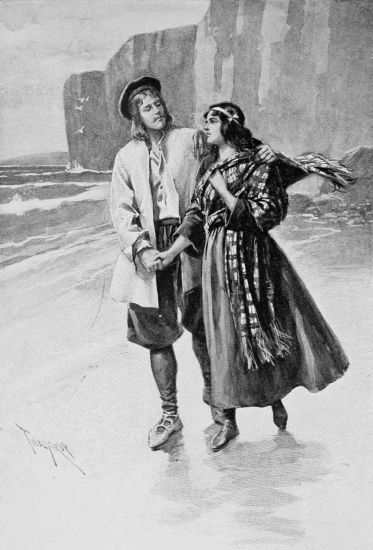
She saw the under-gardener, "Lang Wat o' the Glenkens,"
as he was called about the house, in close and
kindly converse with Mistress Kate McGhie, the only
daughter of the house and heiress of her father's wide
estates. She had come, a tall and graceful maid attired
in white, lightfoot down a shady garden-path, the sunshine
and the leaves together flecking her white dress
with wavering shadows, her dark, shapely head thrown
a little back, her chin tilted somewhat defiantly in the
air, and her broad summer hat a-swing in her left hand.
Fitfully she hummed a tune, but whenever she forgot
the words (which was very often) the song dropped, and,
without the least break of continuity, proceeded on its
way as a whistle. And in either case the sounds proceeded,
so thought the under-gardener, from the prettiest
and most appetizing mouth in the world.
Indeed, as soon as Mistress Kate came within hearing
distance of him, Lang Wat promptly swept his broad
bonnet from his head in salute, and told her so. Which,
when one thinks of it, was a considerable liberty for an
under-gardener to take.
But the lady received the compliment not amiss, being
to all appearance neither elated nor astonished. Was
she not Kate McGhie of Balmaghie, and had she not
been accustomed to be told that she was beautiful as
long as she could remember? Consistent and continuous
admiration had become familiar to her as the air she
breathed, and had done her as little harm. It seemed
to Kate as natural that she should be assured that she
was winsome as to be told that she had a good appetite.
And the information affected her equally in either case.
Since her very tenderest years there had been but one
dissentient voice in this chorus of universal love and
admiration—a certain small boy from the Glenkens, a
laird's son, one Walter Gordon of Lochinvar, who had
come to the house of Balmaghie on a visit with his
father, and had enshrined his dissent in a somewhat
memorable form.
For, by the common bruit of the country-side, the
girl had been denominated—while yet but a child with
great hazel eyes that promised dangerous things, and a
tossing fleece of curls—the Pride of Balmaghie. And
the maid herself, when asked her name, was accustomed
to reply frankly:
"I is little Kate McGhie—
What everybody loves."
But this same Gordon lad from the Glenkens, scornful
in the pride of half a dozen years of superior age,
never heard the phrase without adding his own contemptuous
disclaimer, "Little brute, I don't love her."
Nevertheless, the time came when the scorner recanted
his renunciation. And that time was now, under the
garden trees of the house of Balmaghie and the jealous
eyes of Alisoun Begbie. For "Lang Wat o' the Glenkens,"
under-gardener to Roger McGhie of Balmaghie,
was none other than Walter Gordon, the young laird of
Lochinvar, fallen into ill-odor with the King's government—both
in the matter of the wounding of my Lord
of Wellwood, and as being suspected of companying and
intercommuning with the wild Whigs of the hills. For
the times bore hard on all such as were of doubtful loyalty,
and fines and confiscations were the least those had
to expect who refused to side openly with the blusterous
riders and galloping compellers of the King's forces.
The blaze of muskets in face of a stone wall, the ever-busy
rope in the Grassmarket of Edinburgh (where during
two brisk years of the "Killing Time" the hangman
needed a new "tow" every month from the Town Council,
and the pay of an additional assistant whenever "he
was overthrong with the hanging of so many Westland
men")—these and other symptoms of troublous times
sent many well-disposed and innocent folk into hiding.
But it was not alone the superior advantages of Balmaghie
as a hiding-place which had brought Wat Gordon
of Lochinvar thither in search of shelter. It might
rather be the sweeping, darksome under-curve of Kate
McGhie's eyelashes, and the little specks of light which
swam and sparkled in the depths of her hazel eyes, like
the shredded gold in that rare liqueur which John Scarlett,
the famous master-at-arms, had brought back with
him last year from Dantzig.
Not that Wat Gordon was very deeply or seriously in
love. He dallied and daintied with it rather. True—he
thought about love and the making of it night and
day, and (for the time being) his ideal and liege lady
was the young mistress of the house of Balmaghie.
And Kate McGhie, knowing him for what he was,
and being (unlike her father, but like most of the women-folk
of Scotland) a sympathizer with the oppressed of
the Covenant, showed no small kindness to the under-gardener.
She was a maiden left much alone. She was at the age
when love is still an insubstantial, rosy dream, yet few
youths of her own quality were ever encouraged to come
about her father's house. So that her pity and her admiration
were the more easily engaged on behalf of the
handsome and unfortunate young laird who told her at
least ten times a day (when he had the chance) that he
was as willing as any Jacob to serve seven years, and
seven to the back of that, in the hope of such a Rachel.
For even before he began to do more than play with true
love, Wat Gordon had a gift of love-making which might
have wiled a bird off a tree.
Yet, for all that, when he came to practise on Kate
McGhie, he wiled in vain. For the girl was buttressed
and defended by a lifetime of admiration from all who
came about her—by her father's adoration, the devotion
of every man, woman, and child about the house of Balmaghie,
and, above all, by the repute of reigning beauty
athwart all the country-side. So, though she might
think well enough of Wat Gordon, that handsome exile
from his heritages and lordships now in picturesque
hiding as her father's under-gardener, she was (so at
least she told herself) in no danger of permitting that
liking to develop into any feeling more dangerous or
more exacting.
So these two fenced, each of them in their own way,
right gallantly with lightsome love; while the love that
is not lightsome, but strong as death, smiled out upon
them from behind the rose-bushes, and lay in wait for
one and the other.
Presently, while they were yet talking and Alisoun
Begbie still carefully observant of them, the front door
of the house of Balmaghie opened wide, and the laird
himself came down the steps looking a little dashed and
shamefaced, for Mistress Crombie had ushered him to
the door with ironic state and ceremony.
"Dootless your honor is on his way to pay duty to
the King's Commissioner at Kirkcudbright," she said,
with pointed sarcasm which the shy laird did not know
well how to parry. "But ye hae forgotten your pearl
studs in your sark, and the wee hangie-swordie o' the
court that will no draw oot o' its scabbard, nor so muckle
as hurt a flea."
"I thank you, mistress," said Roger, not daring to
look at his too faithful domestic, "but I go not so far
afield as to see His Majesty's Commissioner. 'Tis but
the matter of a visitor whom we must expect this forenoon.
See that some collation is prepared for her."
"Her!" ejaculated Mistress Crombie, with an indescribable
accent of surprise, not unmingled with scorn.
"Her—we are to hae the company o' a great lady, nae
doot. And this the first that your humble servant and
house-keeper has heard o' the matter! 'Collation,' quo'
he? Whatna dinner do ye think can be got ready between
eleven and twa o' the clock on a Wednesday, wi'
a' the lasses at the washin' except Alisoun Begbie, and
nocht in the larder forbye twa pookit chuckie-hens, that
came frae the Boat Craft less than half an hour since?"
"But, surely, these will do very well," said Roger
McGhie, with increasing nervousness. "'Tis only my
Lady of Wellwood, who rides over from the Grenoch."
For in truth he had been afraid to mention the matter
to Mistress Crombie, and so had put off till it was too
late—as the manner of men is.
"I forgot to acquaint you with the fact before; it—ah—it
altogether escaped my memory," said he, beginning
to pull his gloves on as he descended the steps.
"But ye didna forget to put on your Sunday claes,
Laird Balmaghie," cried the privileged domestic after
him, sarcastically; "nor did your best silken hose nor
your silver buckles escape your memory! And ye minded
brawly to scent your ruffles wi' cinnamon and rosemary.
Ye dinna forget ony o' thae things—that were
important, and maitters o' life and death, as one might
say. It only escaped your memory to tell your puir feckless
auld house-keeper to mak' ony provision for your
dainty dames and court leddies. Ou aye, it maitters little
for the like o' her—Marion Crombie, that has only
served ye for forty year, and never wranged ye o' a fardin's-worth.
Dinna waste a thought on her, puir auld
woman, though she should die in a hedge-root, so long
as ye can hae a great repair o' powdered weemen and
galloping frisk-me-denties to come ridin' aboot your
hoose."
But whatever else Mistress Crombie might have had
to say to her master was lost in the clatter of hoofs and
the stir and bustle of a new arrival.
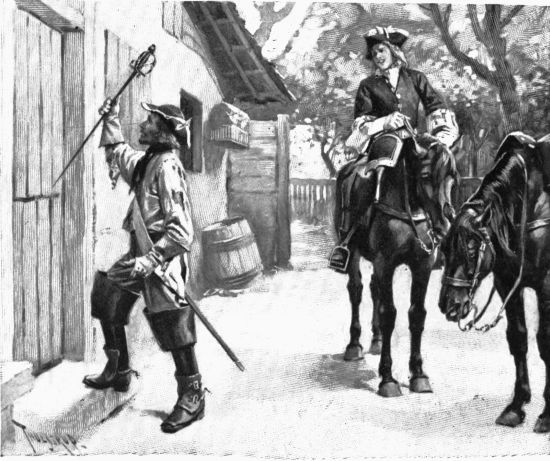
Up the avenue came a bold horsewoman riding a
spirited bay, reining it like a man as she stayed her
course on the river gravel before the front door and sent
the stones spraying from its fore-feet at the halt. The
new-comer wore a plumed hat and the riding-dress of
red, which, together with her warm sympathies with the
"persecutors," caused my Lady Wellwood to be known
in the country-side as "The Scarlet Woman." She was
a handsome dame of forty, or mayhap a little more; but,
save for the more pronounced arching of her haughty
nose and the rounding curves of her figure, she might
well have passed for ten or twelve years younger.
The Laird of Balmaghie went eagerly forward to meet
his visitor. He took gratefully enough the hand which
she reached to him a little indulgently, as one might
give a sweetmeat to a child to occupy its attention. For
even as he murmured his welcomes the lady's eyes were
certainly not upon her host, but on the erect figure of his
under-gardener, who stood staring and transfixed by the
rose-bush which he had been pruning.
"My Lady Wellwood," said Roger McGhie, "this is
indeed an honor and a privilege."
"Who may this youth be?" interrupted the lady, imperiously
cutting short his sober courtesies and pointing
to Lang Wat of the Glenkens.
"It is but one of my gardeners; he has lately come
about the house," answered Roger McGhie, "a well-doing
carle enough and a good worker. But hark ye, my
lady, perhaps a wee overfond of Whiggery and such
strait-lacedness, and so it may be as well to give his
name the go-by when John Graham comes this way."
My Lady of Wellwood never took her eyes off the gardener's
face.
"Come hither and help me to dismount," she said,
beckoning with her finger.
Wat Gordon went reluctantly enough, dragging one
foot after the other. He realized that the end had come
to his residence among the flower-closes of Balmaghie,
and that he must e'en bid farewell to these walks and
glades as of Paradise, upon which, as upon his life, the
hazel eyes of Kate McGhie had lately rained such sweet
influences. Meanwhile the laird stood meekly by. The
caprices of great court-ladies were not in his province,
but, having set out to humor them, he was not to
be offended by the favor shown his servitor. He had
heard of such things at Whitehall, and the memory rather
kindled him than otherwise. He felt all the new life
and energy which comes of being transported into a new
world of new customs, new ideas, and even of new laxities.
Wat gave my Lady Wellwood his hand in the courtliest
manner. The habit and gait of the under-gardener
seemed to fall from him in a moment at the sound of
that voice, low and languorous, with a thrill in it of
former days which it irked him to think had still power
to affect him.
"You have not quite forgotten me, then, sweet lad of
Lochinvar?" asked the Duchess of Wellwood softly in
his ear. For so in the days of his sometime madness she
had been wont to call him.
"No," answered Wat, sullenly enough, as he lifted her
to the ground, not knowing what else to say.
"Then meet me at the head of the wood on my way
home," whispered the lady, as she disengaged herself
from his arm, and turned with a smiling face to Roger
McGhie.
"And this is your sweet daughter," she murmured,
caressingly, to Kate, who stood by with drooping eyelids,
but who, nevertheless, had lost no shade of the colloquy
between Wat Gordon and her father's guest.
The Lady Wellwood took the girl's hand, which lay
cold and unresponsive in her plump white fingers. "A
pretty maid—you will be a beauty one day, my dear,"
she added, with the condescension of one who knows she
has as yet nothing to fear from younger rivals.
To this Kate answered nothing. For her flatterer was
a woman. Had the Duchess of Wellwood been a man
and condescended to this sort of left-handed praise,
Kate would have flashed her eyes and said, "I have not
seldom been told that I am one already." Whereupon
he would have amended his sentence. As it was, Kate
said nothing, but only hardened her heart and wondered
what the great court lady had found to whisper to the
man who, during these last months, had daily been avowing
himself her lover. And though Kate was conscious
that her heart sat secure and untouched on its virgin
throne, it had, nevertheless, been not unpleasant to
listen to the lad. For of a surety Wat Gordon told his
tale wondrously well.
Roger McGhie conducted the lady gallantly through
the garden walks towards the house. But she had not
gone far when she professed herself overcome by the
heat, and desired to be permitted to sit down on a rustic
seat. She was faint, she said; yet, even as she said
it, the keen eye of Kate McGhie noted that her color
remained warm and high.
"A tass of water—nay, no wine," she called after the
Laird of Balmaghie; "I thank you for your courtesy."
And Kate's father hastened away a little stiffly to
bring it. She knew that his Sunday shoes irked him.
It served him right, she thought. At his age he ought
to know better—but there remained the more important
matter of the under-gardener.
"Come and sit by me, pretty one," said the Lady Wellwood,
cooingly, to Kate.
The "pretty one" would infinitely rather have set herself
down by the side of an adder sunning itself on a
bank than shared the woodland seat with the bold horsewoman
of Grenoch.
"Ah! sly one," she said, "I warrant you knew that
your under-gardener there, that handsome lad, was not
the landward man he seemed."
She shook her finger reproachfully at her companion
as she spoke.
Kate blushed hotly, and then straightway fell to despising
herself for doing it almost as much as she hated
my lady for making her. Lady Wellwood watched her
covertly out of the corner of her eyes. She cultivated a
droop of the left eyelid on purpose.
"I know that he is proscribed, and has a price set
on his head," Kate said, quietly, looking after Wat with
great indifference as he went down the avenue of trees.
"And do you know why?" asked the duchess, somewhat
abruptly.
"No," answered Kate, wondering at her tone.
"It was for wounding my late husband within the
precincts of Holyrood," said Lady Wellwood.
But Kate McGhie's anger was now fully roused, and
her answer ran trippingly off her tongue.
"And was it for that service you spoke so kindly to
him just now, and bade him meet you at the head of the
wood as you went home?"
The duchess stared a little, but her well-bred calmness
was not ruffled.
"Even so," she said, placidly, "and for the further
reason that Walter Gordon was on his way to see me on
the night when it was his ill fortune to meet with my
husband instead."
"I do not believe it," cried the girl, lifting her head
and looking Lady Wellwood straight in the eyes.
"Ask him, then!" answered the duchess, with the
calm assurance of forty answering the chit of half her
years. For at first sight my lady had envied and hated
the clear, blushful ivory of the girl's cheek and the natural
luxuriance of her close-tangled curls. And since
all the art of St. James's could not match with these,
she was now getting even with Kate in ways of her
own.
The girl did not speak. Her heart only welled within
her with contradiction and indignation.
"Or if you will not do that, sit down half an hour
hence and read your book in the little arbor by the
end of the avenue, and you will hear news. Whether
you may like it or not is another question. But, at all
events, you shall not have cause to say again that a
Duchess of Wellwood lied."
Kate rose and walked away without answering a word.
She cared no jot for Wat Gordon, so she told herself.
He was nothing to her, save that she desired his safety
and had risked much to give him shelter. Yet this
Duchess of Wellwood—that woman of whom the gross
popular tongue whispered commonly the most terrible
things! Had Lochinvar made love to her? Was he to
meet her at the end of the avenue? She could not believe
it. It was, indeed, no matter if he did. What did
she care? Go to the arbor, become an eavesdropper—not
for any man alive, least of all for Wat Gordon!
Thank God, she had a tongue in her head, and was not
afraid to ask Wat Gordon, or any living soul, whatever
she desired to know.
But after a little hesitation she went up-stairs to her
chamber, and, denying herself the listening of the ear,
she listened with her eyes instead. For she watched my
Lady Wellwood being helped into her saddle right courteously
by her father. She saw her looking down at
him the while with a glance professionally tender—a
glance that lingered in the memory by reason of the
quiver of an eyelid and the pressure of a soft, reluctant
hand. And Roger McGhie bowed over her plump fingers
as though he had been bidding farewell to some angelic
visitant.
For the first time in her life Kate McGhie despised
her father. And, lo! to hurt her heart yet more, and
to convince her of the ultimate falsity of all men, there
was Wat, his tall figure overtopping the hawthorn hedge,
walking briskly in the direction of the pinewood at the
end of the avenue.
Kate went down-stairs with a set, still face. She would
not cry. She did not care. She was only bitterly disappointed
with the whole race of mankind, nothing more.
They were all no better than so many blind fools, ready
to be taken in by a plausible tongue and a rolling eye.
A fine figure of a woman, and—Lord, where was the best
of them?
But her Wat—and with the Duchess of Wellwood; she
could not believe it! Why, she might be his—well,
hardly that—but his mother at the very least.
Not that she cared; she had her work to think about;
and Kate McGhie went down to the little suckling lamb
she had fed daily with warm milk out of a wooden spoon,
and which, though now almost of the greatness of a full-grown
sheep, still leaped and fawned upon her. She
fetched her pail and mixed pet Donald's mid-day meal.
Outside the garden wall the lamb was standing, bleating
indignant petitions, and there Katie McGhie fed him
with a gradually swelling heart. As the last drops disappeared
into the moist black muzzle, Kate put her arms
about the woolly neck and sobbed aloud.
"Oh, Donald, Donald, my lamb, you are the only
friend I have! I do not love anybody else, and no one
in the world loves me. But I am not sorry—I am glad,
and I will not cry. It is not that I love him, Donald;
but, oh! he might not have done it!"
That same evening Wat Gordon, as was his custom,
came walking slowly through the garden pleasaunce.
Kate McGhie met him by the rose-bush he had been
pruning that morning.
"Is it true," she asked, looking at him bravely and directly,
"that you are in hiding because, when going to
visit the Duchess of Wellwood, you encountered her husband
instead?"
"This much is true," answered Wat, promptly, "that
while passing down the Canongate one snowy night, my
cousin, Will Gordon of Earlstoun, and I were beset by a
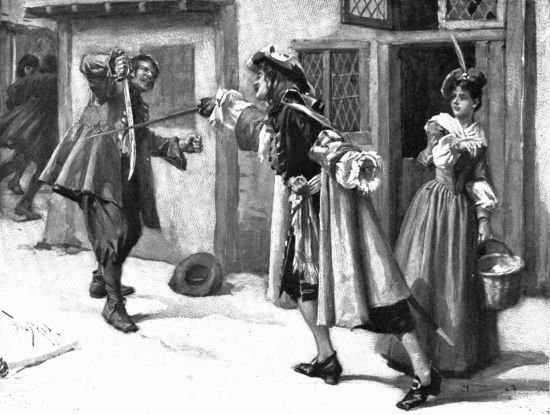
band of ruffians in the pay of the Duke of Wellwood,
and that in defending ourselves the Duke himself was
hurt."
"And when you went out of your lodging that night,
was it to walk with your cousin or to visit my Lady of
Wellwood in her boudoir?"
Wat Gordon took his breath hard. The manner of the
question left him no escape with honor. But he could
not lie. And he would offer no excuse.
"I went out to visit my Lady Wellwood!" he said,
very shortly.
Kate McGhie held out her hand.
"I bid you good-bye," she said; "you will find your
ancient friend and hostess at the Grenoch. There is
nothing to detain you any longer about the poor house of
Balmaghie."
And so saying the girl turned on her heel and walked
slowly through the garden garth and past the pruned
rose-bushes. She crossed the grassy slope to the door
and there disappeared, leaving Wat Gordon standing silent,
shamed, and amazed.