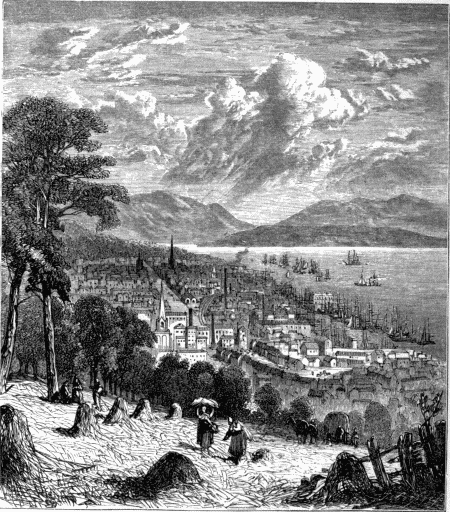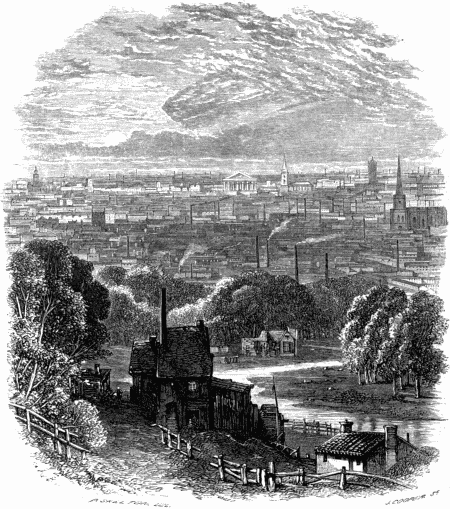
BIRMINGHAM.
[By Percival Skelton.]
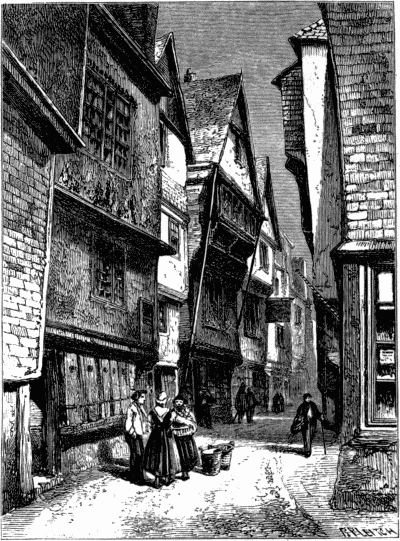
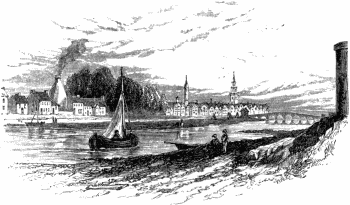
From an early period, Birmingham has been one of the
principal centres of mechanical industry in England.
The neighbourhood abounds in coal and iron, and has
long been famous for the skill of its artisans. Swords
were forged there in the time of the Ancient Britons.
The first guns made in England bore the Birmingham
mark. In 1538 Leland found “many smiths in the
town that use to make knives and all manner of cutting
tools, and many loriners that make bittes, and a great
many nailers.” About a century later Camden described
the place as “full of inhabitants, and resounding with
hammers and anvils, for the most part of them smiths.”
As the skill of the Birmingham artisans increased, they
gradually gave up the commoner kinds of smithery, and
devoted themselves to ornamental metal-work, in brass,
steel, and iron. They became celebrated for their
manufacture of buckles, buttons, and various fancy
articles; and they turned out such abundance of toys
that towards the close of last century Burke characterised
Birmingham as “the great toy-shop of Europe.”
The ancient industry of Birmingham was of a staid
and steady character, in keeping with the age. Each
manufacturer kept within the warmth of his own forge.
He did not go in search of orders, but waited for the
orders to come to him. Ironmongers brought their
money in their saddle-bags, took away the goods in exchange,
or saw them packed ready for the next waggon
before they left. Notwithstanding this quiet way of
doing business, many comfortable fortunes were made in
the place; the manufacturers, like their buttons, moving
off so soon as they had received the stamp and the gilt.
Hutton, the Birmingham bookseller, says he knew men
who left the town in chariots who had first approached
it on foot. Hutton himself entered the town a poor
boy, and lived to write its history, and make a fortune
by his industry.
Until towards the end of last century the town was
not very easy of approach from any direction. The
roads leading to it had become worn by the traffic of
many generations. The hoofs of the pack-horses, helped
by the rains, had deepened the tracks in the sandy soil,
until in many places they were twelve or fourteen feet
deep, so that it was said of travellers that they approached
the town by sap. One of these old hollow
roads, still called Holloway-head, though now filled
up, was so deep that a waggon-load of hay might pass
along it without being seen. There was no direct communication
between Birmingham and London until
about the middle of the century. Before then, the
Great Road from London to Chester passed it four
miles off, and the Birmingham manufacturer, when
sending wares to London, had to forward his package
to Castle Bromwich, there to await the approach of the
packhorse train or the stage-waggon journeying south.
The Birmingham men, however, began to wake up, and
in 1747 a coach was advertised to run to London in two
days “if the roads permit.” Twenty years later a stage-waggon
was put on, and the communication by coach
became gradually improved.
When Hutton entered Birmingham in 1740, he was
struck by the activity of the place and the vivacity of
the inhabitants, which expressed itself in their looks as
he passed them in the streets. “I had,” he says, “been
among dreamers, but now I saw men awake. Their
very step showed alacrity. Every man seemed to know
and to prosecute his own affairs.” The Birmingham
men were indeed as alert as they looked—steady
workers and clever mechanics—men who struck hard
on the anvil. The artisans of the place had the advantage
of a long training in mechanical skill. It had
been bred in their bone, and descended to them from
their fathers as an inheritance.[95] In no town in England
were there then to be found so many mechanics capable
of executing entirely new work; nor, indeed, has the
ability yet departed from them, the Birmingham artisans
maintaining their individual superiority in intelligent
execution of skilled work to the present day. We are
informed that inventors of new machines, foreign as
well as English, are still in the practice of resorting
to them for the purpose of getting their inventions embodied
in the best forms, with greater chances of success
than in any other town in England.
About the middle of last century the two Boultons,
father and son, were recognised as among the most enterprising
and prosperous of Birmingham manufacturers.
The father of the elder Matthew Boulton was
John Boulton of Northamptonshire, in which county
Boultons or Boltons have been settled for a long period,
and where there are records of many clergymen of the
name. About the end of the seventeenth century, this
John Boulton settled at Lichfield, where he married
Elizabeth, heir of Matthew Dyott of Stitchbrooke, by
whom he obtained considerable property. His means
must, however, have become reduced; in consequence
of which his son Matthew was sent to Birmingham to
enter upon a career of business, and make his own
way in the world. He became established in the place
as a silver stamper and piecer, to which he added other
branches of manufacture, which his son Matthew afterwards
largely extended.
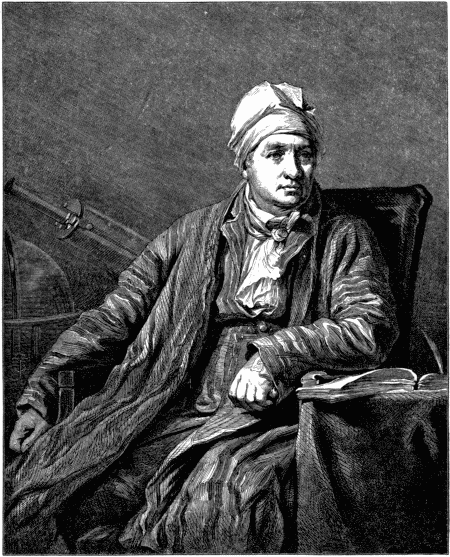
Matthew Boulton the younger was born at Birmingham
on the 3rd September, 1728. Little is known of
his early life, beyond that he was a bright, clever boy,
and a general favourite with his companions. He received
his principal education at a private academy at
Deritend, kept by the Rev. Mr. Ansted, under whom
he acquired the rudiments of a good ordinary English
education. Though he left school early for the purpose
of following his father’s business, he nevertheless continued
the work of self-instruction, and afterwards
acquired considerable knowledge of Latin and French,
as well as of drawing and mathematics. But his chief
pleasure was in pursuing the study of chemistry and
mechanics, in which, as we shall shortly find, he became
thoroughly accomplished. Long after he joined his
father in business, he delighted to revert to his classical
favourites. From an entry in his private memorandum-book
of expenses at the age of about thirty, though then
very economical in other respects, we find him expending
considerable sums in experiments on electricity,
and on one occasion laying out a guinea on a copy of
Virgil, from which it appears that trade had not spoilt
his taste for either science or letters.
Young Boulton appears to have engaged in business
with much spirit. By the time he was seventeen he
had introduced several important improvements in the
manufacture of buttons, watch-chains, and other trinkets;
and he had invented the inlaid steel buckles which
shortly after became the fashion. These buckles were
exported in large quantities to France, from whence
they were brought back to England and sold as the
most recent productions of French ingenuity. The
elder Boulton, having every confidence in his son’s discretion
and judgment, adopted him as a partner so soon
as he came of age, and from that time forward he took
almost the entire management of the concern. Although
in his letters he signed “for father and self,” he always
spoke in the first person of matters connected with the
business. Thus, in 1757, we find him writing to
Timothy Holles, London, as to the prices of “coat-link
and vest buttons,” intimating that to lower them would
be to beat down price and quality until it became no
business at all; “yet,” said he, “as I have put myself
to greater expense than anybody else in erecting the
best conveniences and the completest tools for the purpose,
I am not willing that any interlopers should run
away with it.” We find him at the same time carrying
on a correspondence with Benjamin Huntsman, of Sheffield,
the celebrated inventor of cast-steel.[96] On the 19th
January, 1757, he sends Huntsman “a parcel of goods
of the newest patterns,” and at the same time orders a
quantity of Huntsman’s steel. “When thou hast some
of a proper size and quality for me, and an opportunity
of sending it, thou may’st, but I should be glad to have
it a little tougher than the last.” He concludes—“I
hope thy Philosophic Spirit still laboureth within thee,
and may it soon bring forth Fruit useful to mankind,
but more particularly to thyself, is the sincere wish of
Thy Obliged Friend.” With a view to economy, Boulton
in course of time erected a steel-house of his own
for the purpose of making steel; and he frequently used
it to convert the cuttings and scraps of the small iron
wares which he manufactured, into ordinary steel, afterwards
melting and converting it into cast-steel in the
usual way.
From the earliest glimpses we can get of Boulton as a
man of business, it would appear to have been his aim
to be at the top of whatsoever branch of manufacture he
undertook. He endeavoured to produce the best possible
articles in regard of design, material, and workmanship.
Taste was then at a low ebb, and “Brummagem”
had become a byword for everything that was
gaudy, vulgar, and meretricious. Boulton endeavoured
to get rid of this reproach, and aimed at raising the
standard of taste in manufacture to the highest point.
With this object, he employed the best artists to design
his articles, and the cleverest artisans to manufacture
them. Apart from the question of elevating the popular
taste, there can be no doubt that this was good policy on
his part, for it served to direct public attention to the
superior and honest quality of the articles produced by
his firm, and eventually brought him a large accession
of business.
In 1759, Boulton’s father died, bequeathing to him
the considerable property which he had accumulated by
his business. The year following, when thirty-two
years of age, Matthew married Anne, the daughter of
Luke Robinson, Esq., of Lichfield. The lady was a
distant relation of his own; the Dyotts of Stitchbrooke,
whose heir his grandfather had married, being nearly
related to the Babingtons of Curborough, from whom
Miss Robinson was lineally descended—Luke Robinson
having married the daughter and co-heir of John
Babington of Curborough and Patkington. Considerable
opposition was offered to the marriage by the
lady’s friends, on account of Matthew Boulton’s occupation;
but he pressed his suit, and with good looks
and a handsome presence to back him, he eventually
succeeded in winning the heart and hand of Anne
Robinson. He was now, indeed, in a position to have
retired from business altogether. But a life of inactivity
had no charms for him. He liked to mix with men in
the affairs of active life, and to take his full share in the
world’s business. Indeed, he hated ease and idleness,
and found his greatest pleasure in constant occupation.
Instead, therefore, of retiring from trade, he determined
to engage in it more extensively. He entertained
the ambition of founding a manufactory that should be
the first of its kind, and serve as a model for the manufacturers
of his neighbourhood. His premises on Snow-hill,[97]
Birmingham, having become too small for his
purpose, he looked about him for a suitable spot on
which to erect more commodious workshops; and he
was shortly attracted by the facilities presented by the
property afterwards so extensively known as the famous
Soho.
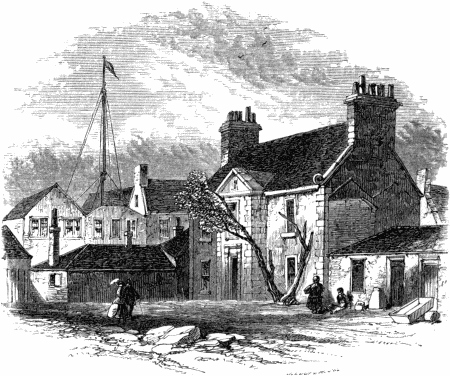
Soho is about two miles north of Birmingham, on the
Wolverhampton road. It is not in the parish of Birmingham,
nor in the county of Warwick, but just over
the border, in the county of Stafford. Down to the
middle of last century the ground on which it stands
was a barren heath, used only as a rabbit-warren.
The sole dwelling on it was the warrener’s hut, which
stood near the summit of the hill, on the spot afterwards
occupied by Soho House; and the warrener’s well is still
to be found in one of the cellars of the mansion. In
1756, Mr. Edward Ruston took a lease of the ground
for ninety-nine years from Mr. Wyerley, the lord of
the manor, with liberty to make a cut about half a mile
in length for the purpose of turning the waters of
Hockley Brook into a pool under the brow of the hill.
The head of water thus formed was used to drive a
feeble mill below, which Mr. Ruston had established for
laminating metals. He also built a small dwelling-house
about 150 yards from the mill, and expended
upon the place a sum of about 1000l. in all. When
Mr. Boulton was satisfied that the place would suit his
purpose, he entered into arrangements with Mr. Ruston
for the purchase of his lease,[98] on the completion of
which he proceeded to rebuild the mill on a large scale,
and in course of time removed thither the whole of his
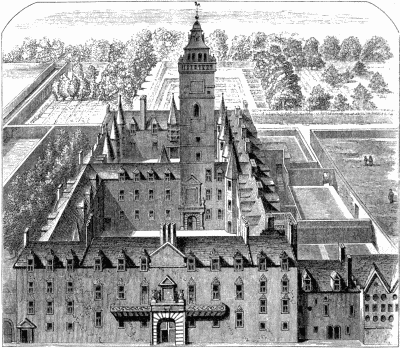
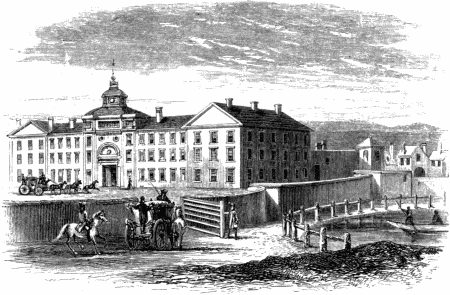
tools, machinery, and workmen. The new manufactory,
when finished, consisted of a series of roomy workshops
conveniently connected with each other, and capable of
accommodating upwards of a thousand workmen. The
building and stocking of the premises cost upwards of
20,000l.
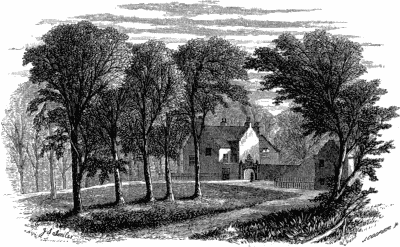
SOHO MANUFACTORY.
Before removing to Soho, Mr. Boulton took into
partnership Mr. John Fothergill, with the object of
more vigorously extending his business operations. Mr.
Fothergill possessed a very limited capital, but he was
a man of good character and active habits of business,
with a considerable knowledge of foreign markets. On
the occasion of his entering the concern, stock was taken
of the warehouse on Snow Hill; and some idea of the
extent of Boulton’s business at the time may be formed
from the fact, that his manager, Mr. Zaccheus Walker,
assisted by Farquharson, Nuttall, Frogatt, and half-a-dozen
labourers, were occupied during eight days in
weighing metals, counting goods, and preparing an
inventory of the effects and stock in trade. The partnership
commenced at midsummer, 1762, and shortly
after the principal manufactory was removed to Soho.
Steps were immediately taken to open up new connexions
and agencies at home and abroad; and a large
business was shortly established with many of the principal
towns and cities of Europe, in filagree and inlaid
work, livery and other buttons, buckles, clasps, watch-chains,
and various kinds of ornamental metal wares.
The firm shortly added the manufacture of silver plate
and plated goods to their other branches,[99] and turned
out large quantities of candlesticks, urns, brackets, and
various articles in ormolu. The books of the firm indicate
the costly nature of their productions, 500 ounces of
silver being given out at a time, besides considerable
quantities of gold and platina for purposes of fabrication.
Boulton himself attended to the organization and
management of the works and to the extension of the
trade at home, while Fothergill devoted himself to
establishing and superintending the foreign agencies.
From the first, Boulton aimed at establishing a
character for the excellence of his productions. They
must not only be honest in workmanship, but tasteful
in design. He determined, so far as in him lay, to
get rid of the “Brummagem” reproach. Thus we find
him writing to his partner from London:—“The prejudice
that Birmingham hath so justly established
against itself makes every fault conspicuous in all
articles that have the least pretensions to taste. How
can I expect the public to countenance rubbish from
Soho, while they can procure sound and perfect work
from any other quarter?”
He frequently went to town for the express purpose
of reading and making drawings of rare works in metal
in the British Museum, sending the results down to
Soho. When rare objects of art were offered for sale,
he endeavoured to secure them. “I bid five guineas,”
he wrote his partner on one occasion, “for the Duke of
Marlborough’s great blue vase, but it sold for ten....
I bought two bronzed figures, which are sent herewith.”
He borrowed antique candlesticks, vases, and
articles in metal from the Queen and from various
members of the nobility. “I wish Mr. Eginton,” he
wrote, “would take good casts from the Hercules and
the Hydra, and then let it be well gilt and returned
with the seven vases; for ’tis the Queen’s. I perceive
we shall want many such figures, and therefore we
should omit no opportunity of taking good casts.”
The Duke of Northumberland lent Boulton many of
his most highly-prized articles for imitation by his
workmen. Among his other liberal helpers in the same
way, we find the Duke of Richmond, Lord Shelburne,
and the Earl of Dartmouth. The Duke gave him an
introduction to Horace Walpole, for the purpose of
enabling him to visit and examine the art treasures of
Strawberry Hill. “The vases,” said he, in writing to
Boulton, “are, in my opinion, better worth your seeing
than anything in England, and I wish you would have
exact drawings of them taken, as I may very possibly
like to have them copied by you.” Lord Shelburne’s
opinion of Boulton may be gathered from his letter to
Mr. Adams, the architect, in which he said:—“Mr.
Boulton is the most enterprising man in different ways
in Birmingham, and is very desirous of cultivating Mr.
Adams’s taste in his productions, and has bought his
Dioclesian by Lord Shelburne’s advice.”
Boulton, however, did not confine himself to England;
he searched the Continent over for the best specimens
of handicraft as models for imitation; and when he
found them he strove to equal, if not to excel them in
style and quality. He sent his agent, Mr. Wendler, on
a special mission of this sort, to Venice, Rome, and
other Italian cities, to purchase for him the best
specimens of metal-work, and obtain for him designs
of various ornaments—vases, cameos, intaglios, and
statuary. On one occasion we find Wendler sending
him 456 prints, Boulton acknowledging that they
will prove exceedingly useful for the purposes of his
manufacture. At the same time, Fothergill was travelling
through France and Germany with a like object,
while he was also establishing new connexions with a
view to extended trade.[100]
While Boulton was ambitious of reaching the highest
excellence in his own line of business, he did not confine
himself to that, but was feeling his way in various
directions outside of it. Thus to his friend Wedgwood
he wrote on one occasion, that he admired his vases so
much that he “almost wished to be a potter.” At one
time, indeed, he had serious thoughts of beginning the
fictile manufacture; but he rested satisfied with mounting
in metal the vases which Wedgwood made. “The
mounting of vases,” he wrote, “is a large field for
fancy, in which I shall indulge, as I perceive it possible
to convert even a very ugly vessel into a beautiful
vase.”[101]
Another branch of business that he sought to establish
was the manufacture of clocks. It was one of his leading
ideas, that articles in common use might be made
much better and cheaper if manufactured on a large
scale with the help of the best machinery; and he
thought this might be successfully done in the making
of clocks and timepieces. The necessary machinery
was erected accordingly, and the new branch of business
was started. Some of the timepieces were of an
entirely novel arrangement. One of them, invented
by Dr. Small, contained but a single wheel, and was
considered a piece of very ingenious construction.
Boulton also sought to rival the French makers of
ornamental timepieces, by whom the English markets
were then almost entirely supplied; and some of the
articles of this sort turned out by him were of great
beauty. One of his most ardent encouragers and admirers,
the Hon. Mrs. Montagu, wrote to him,—“I
take greater pleasure in our victories over the French
in the contention of arts than of arms. The achievements
of Soho, instead of making widows and orphans,
make marriages and christenings. Your noble industry,
while elevating the public taste, provides new occupations
for the poor, and enables them to bring up their
families in comfort. Go on, then, sir, to triumph over
the French in taste, and to embellish your country with
useful inventions and elegant productions.”
Boulton’s efforts to improve the industrial arts did
not, however, always meet with such glowing eulogy as
this. Two of his most highly finished astronomical
clocks could not find purchasers at his London sale; on
which he wrote to his wife at Soho, “I find philosophy
at a very low ebb in London, and I have therefore
brought back my two fine clocks, which I will
send to a market where common sense is not out of
fashion. If I had made the clocks play jigs upon bells,
and a dancing bear keeping time, or if I had made a
horse-race upon their faces, I believe they would have
had better bidders. I shall therefore bring them back
to Soho, and some time this summer will send them to
the Empress of Russia, who, I believe, would be glad
of them.”[102] During the same visit to London, he
was more successful with the king and queen, who
warmly patronised his productions. “The king,” he
wrote to his wife, “hath bought a pair of cassolets,
a Titus, a Venus clock, and some other things, and
inquired this morning how yesterday’s sale went. I
shall see him again, I believe. I was with them, the
queen and all the children, between two and three
hours. There were, likewise, many of the nobility
present. Never was man so much complimented as I
have been; but I find that compliments don’t make
fat nor fill the pocket. The queen showed me her
last child, which is a beauty, but none of ’em are equal
to the General of Soho or the fair Maid of the Mill.[103]
God bless them both, and kiss them for me.”
In another letter he described a subsequent visit to
the palace. “I am to wait upon their majesties again
so soon as our Tripod Tea-kitchen arrives, and again
upon some other business. The queen, I think, is much
improved in her person, and she now speaks English
like an English lady. She draws very finely, is a great
musician, and works with her needle better than Mrs.
Betty. However, without joke, she is extremely sensible,
very affable, and a great patroness of English
manufactures. Of this she gave me a particular instance;
for, after the king and she had talked to me
for nearly three hours, they withdrew, and then the
queen sent for me into her boudoir, showed me her
chimneypiece, and asked me how many vases it would
take to furnish it; ‘for,’ said she, ‘all that china shall
be taken away.’ She also desired that I would fetch
her the two finest steel chains I could make. All
this she did of her own accord, without the presence of
the king, which I could not help putting a kind construction
upon.”[104]
Thus stimulated by royal and noble patronage,
Boulton exerted himself to the utmost to produce articles
of the highest excellence. Like his friend Wedgwood,
he employed Flaxman and other London artists to
design his choicer goods; but he had many foreign
designers and skilled workmen, French and Italian, in
his regular employment. He attracted these men by
liberal wages, and kept them attached to him by kind
and generous treatment. On one occasion we find the
Duke of Richmond applying to him to recommend a
first-class artist to execute some special work in metal
for him. Boulton replies that he can strongly recommend
one of his own men, an honest, steady workman,
an excellent metal turner. “He hath made for me
some exceeding good achromatic telescopes [another
branch of Boulton’s business].... I give him two
guineas a week and a house to live in. He is a
Frenchman, and formerly worked with the famous M.
Germain; he afterwards worked for the Academy of
Sciences at Berlin, and he hath worked upwards of
two years for me.”[105]
Before many years had passed, Soho was spoken of
with pride, as one of the best schools of skilled industry
in England. Its fame extended abroad as well as at
home, and when distinguished foreigners came into
England, they usually visited Soho as one of the
national sights. When the manufactory was complete[106]
and in full work, Boulton removed from his house
on Snow-hill to the mansion of Soho, which he had
by this time considerably enlarged and improved.
There he continued to live until the close of his life,
maintaining a splendid hospitality. Men of all nations,
and of all classes and opinions, were received there by
turns,—princes, philosophers, artists, authors, merchants,
and poets. In August, 1767, while executing the two
chains for the queen, we find him writing to his London
agent as his excuse for a day’s delay in forwarding it:
“I had lords and ladies to wait on yesterday; I have
French and Spaniards to-day; and to-morrow I shall
have Germans, Russians, and Norwegians.” For many
years the visitors at Soho House were so numerous and
arrived in such constant succession, that it more resembled
an hotel than a private mansion.
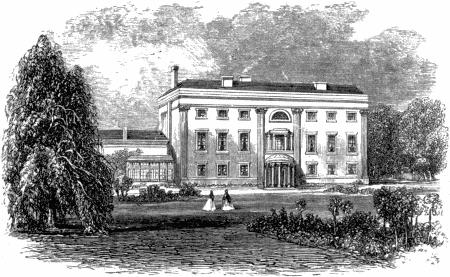
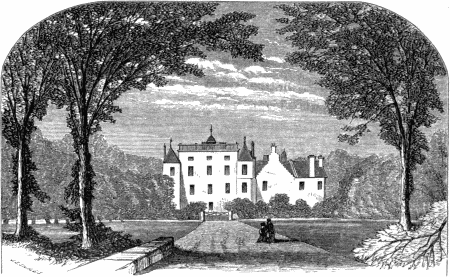
SOHO HOUSE.
The rapid extension of the Soho business necessarily
led to the increase of the capital invested in it. Boulton
had to find large sums of money for increased stock,
plant, and credits. He raised 3000l. on his wife’s
estate; he borrowed 5000l. from his friend Baumgarten;
and he sold considerable portions of the property
left him by his father, by which means he was
enabled considerably to extend his operations. There
were envious busybodies about who circulated rumours
to his discredit, and set the report on foot, that to carry
on a business on so large a scale would require a capital
of 80,000l. “Their evil speaking,” said he to a correspondent,
“will avail but little, as our house is founded
on so firm a rock that envy and malice will not be able
to shake it; and I am determined to spare neither pains
nor money to establish such a house as will acquire
both honour and wealth.” The rapid strides he was
making may be inferred from the statement made to
the same correspondent, which showed that the gross
returns of the firm, which were 7000l. in 1763, had
advanced to 30,000l. in 1767, with orders still upon the
increase.
Though he had a keen eye for business, Boulton
regarded character more than profit. He would have
no connexion with any transaction of a discreditable
kind. Orders were sent to him from France for base
money, but he spurned them with indignation. “I
will do anything,” he wrote to M. Motteaux, his
Paris agent, “short of being common informer against
particular persons, to stop the malpractices of the
Birmingham coiners.” He declared he was as ready
to do business on reasonable terms as any other person,
but he would not undersell; “for,” said he, “to run
down prices would be to run down quality, which could
only have the effect of undermining confidence, and
eventually ruining trade.” His principles were equally
honourable as regarded the workmen of rival employers.
“I have had many offers and opportunities,” he said to
one, “of taking your people, whom I could, with convenience
to myself, have employed; but it is a practice
I abhor. Nevertheless, whatever game we play at, I
shall always avail myself of the rules with which
’tis played, or I know I shall make but a very indifferent
figure in it.”[107]
He was frequently asked to take gentlemen apprentices
into his works, but declined to receive them,
though hundreds of pounds’ premium were in many
cases offered with them. He preferred employing
the humbler class of boys, whom he could train up
as skilled workmen. He was also induced to prefer
the latter for another reason, of a still more creditable
kind. “I have,” said he, in answer to a gentleman
applicant, “built and furnished a house for the reception
of one kind of apprentices—fatherless children,
parish apprentices, and hospital boys; and gentlemen’s
sons would probably find themselves out of place in
such companionship.”
While occupied with his own affairs, and in conducting
what he described as “the largest hardware
manufactory in the world,” Boulton found time to take
an active part in promoting the measures then on foot
for opening up the internal navigation of the country.
He was a large subscriber to the Grand Trunk and
Birmingham Canal schemes, the latter of which was
of the greater importance to him personally, as it
passed close by Soho, and thus placed his works in
direct communication both with London and the northern
coal and manufacturing districts.[108]
Coming down to a few years later, in 1770, we find
his business still growing, and his works and plant
absorbing still more capital, principally obtained by
borrowing. In a letter to Mr. Adams, the celebrated
architect, requesting him to prepare the design of a
new sale-room in London, he described the manufactory
at Soho as in full progress, from 700 to 800 persons
being employed as metallic artists and workers in
tortoiseshell, stones, glass, and enamel. “I have almost
every machine,” said he, “that is applicable to those
arts; I have two water-mills employed in rolling, polishing,
grinding, and turning various sorts of lathes. I
have trained up many, and am training up more plain
country lads into good workmen; and wherever I find
indications of skill and ability, I encourage them. I
have likewise established correspondence with almost
every mercantile town in Europe, and am thus regularly
supplied with orders for the grosser articles in
common demand, by which I am enabled to employ
such a number of hands as to provide me with an
ample choice of artists for the finer branches of work;
and I am thereby encouraged to erect and employ
a more extensive apparatus than it would be prudent
to provide for the production of the finer articles
only.”
It is indeed probable—though Boulton was slow to
admit it—that he had been extending his business more
rapidly than his capital would conveniently allow;
for we find him becoming more and more pressed for
means to meet the interest on the borrowed money
invested in buildings, tools, and machinery. He had
obtained 10,000l. from a Mr. Tonson of London; and
on the death of that gentleman, in 1772, he had considerable
difficulty in raising the means to pay off the
debt. His embarrassment was increased by a serious
commercial panic, aggravated by the failure of Fordyce
brothers, by which a considerable sum deposited with
them remained locked up for some time, and he was
eventually a loser to the extent of 2000l. Other failures
and losses followed; and trade came almost to a standstill.
Yet he bravely held on. “We have a thousand
mouths at Soho to feed,” he says; “and it has taken so
much labour and pains to get so valuable and well-organised
a staff of workmen together, that the operations
of the manufactory must be carried on at whatever
risk.” He continued to receive distinguished visitors
at his works. “Last week,” he wrote Mr. Ebbenhouse,
“we had Prince Poniatowski, nephew of the King
of Poland, and the French, Danish, Sardinian, and
Dutch Ambassadors; this week we have had Count
Orloff, one of the five celebrated brothers who are
such favourites with the Empress of Russia; and only
yesterday I had the Viceroy of Ireland, who dined
with me. Scarcely, a day passes without a visit from
some distinguished personage.”
Besides carrying on the extensive business connected
with his manufactory at Soho, this indefatigable man
found time to prosecute the study of several important
branches of practical science. It was scarcely to be
supposed that he had much leisure at his disposal; but
in life it often happens that the busiest men contrive
to find the most leisure; and he who is “up to the ears”
in work, can, nevertheless, snatch occasional intervals
to devote to inquiries in which his heart is engaged.
Hence we find Boulton ranging at intervals over a
wide field of inquiry; at one time studying geology,
and collecting fossils, minerals, and specimens for his
museum; at another, reading and experimenting on
fixed air; and at another studying Newton’s works
with the object of increasing the force of projectiles.[109]
But the subject which perhaps more than all interested
him was the improvement of the Steam Engine, which
shortly after led to his introduction to James Watt.
Want of water-power was one of the great defects of
Soho as a manufacturing establishment, and for a long
time Boulton struggled with the difficulty. The severe
summer droughts obliged him to connect a horse-mill
with the water-wheel. From six to ten horses were employed
as an auxiliary power, at an expense of from five
to eight guineas a week. But this expedient, though costly,
was found very inconvenient. Boulton next thought
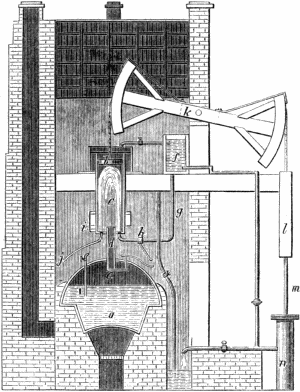
of erecting a pumping-engine after Savery or Newcomen’s
construction, for the purpose of raising the water
from the mill-stream and returning it back into the reservoir—thereby
maintaining a head of water sufficient to
supply the water-wheel and keep the mill in regular work.
“The enormous expense of the horse-power,” he wrote
to a friend, “put me upon thinking of turning the mill
by fire, and I made many fruitless experiments on the
subject.”
In 1766 we find him engaged in a correspondence
with the distinguished Benjamin Franklin as to steam
power. Eight years before, Franklin had visited Boulton
at Birmingham and made his acquaintance. They were
mutually pleased with each other, and continued to correspond
during Franklin’s stay in England, exchanging
their views on magnetism, electricity, and other subjects.[110]
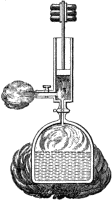
When Boulton began to study the fire-engine with a
view to its improvement, Franklin was one of the first
whom he consulted. Writing him on the 22nd February,
1766, he said,—
“My engagements since Christmas have not permitted me to make
any further progress with my fire-engine; but, as the thirsty season
is approaching apace, necessity will oblige me to set about it in
good earnest. Query,—Which of the steam-valves do you like best?
Is it better to introduce the jet of cold water at the bottom of the
receiver, or at the top? Each has its advantages and disadvantages.
My thoughts about the secondary or mechanical contrivances of the
engine are too numerous to trouble you with in this letter, and yet
I have not been lucky enough to hit upon any that are objectionless.
I therefore beg, if any thought occurs to your fertile genius which
you think may be useful, or preserve me from error in the execution
of this engine, you’ll be so kind as to communicate it to me, and
you’ll very greatly oblige me.”
From a subsequent letter it appears that Boulton, like
Watt—who was about the same time occupied with his
invention at Glasgow—had a model constructed for experimental
purposes, and that this model was now with
Franklin in London; for we find Boulton requesting
the latter to “order a porter to nail up the model in the
box again and take it to the Birmingham carrier at the
Bell Inn, Smithfield.” After a silence of about a month
Franklin replied,—
“You will, I trust, excuse my so long omitting to answer your
kind letter, when you consider the excessive hurry and anxiety I
have been engaged in with our American affairs.... I know not
which of the valves to give the preference to, nor whether it is best
to introduce your jet of cold water above or below. Experiments
will best decide in such cases. I would only repeat to you the hint
I gave, of fixing your grate in such a manner as to burn all your
smoke. I think a great deal of fuel will then be saved, for two
reasons. One, that smoke is fuel, and is wasted when it escapes
uninflamed. The other, that it forms a sooty crust on the bottom of
the boiler, which crust not being a good conductor of heat, and preventing
flame and hot air coming into immediate contact with the
vessel, lessens their effect in giving heat to the water. All that is
necessary is, to make the smoke of fresh coals pass descending
through those that are already thoroughly ignited. I sent the
model last week, with your papers in it, which I hope got safe to
hand.”[111]
The model duly arrived at Soho, and we find Boulton
shortly after occupied in making experiments with it,
the results of which are duly entered in his note-books.
Dr. Erasmus Darwin, with whom he was on very intimate
terms, wrote him from Lichfield, inquiring what
Franklin thought of the model and what suggestions he
had made for its improvement. “Your model of a steam-engine,
I am told,” said he, “has gained so much approbation
in London, that I cannot but congratulate you
on the mechanical fame you have acquired by it, which,
assure yourself, is as great a pleasure to me as it could
possibly be to yourself.”[112] Another letter of Darwin to
Boulton is preserved, without date, but apparently written
earlier than the preceding, in which the Doctor lays
before the mechanical philosopher the scheme of “a fiery
chariot” which he had conceived,—in other words, of a
locomotive steam-carriage. He proposed to apply an
engine with a pair of cylinders working alternately, to
drive the proposed vehicle;[113] and he sent Boulton some
rough diagrams illustrative of his views, which he begged
might be kept a profound secret, as it was his intention,
if Boulton approved of his plan and would join him as a
partner, to endeavour to build a model engine, and, if it
answered, to take out a joint patent for it. But Dr.
Darwin’s scheme was too crude to be capable of being
embodied in a working model; and nothing more was
heard of his fiery chariot.
Another of Boulton’s numerous correspondents about
the same time was Dr. Roebuck, of Kinneil, then occupied
with his enterprise at Carron, and about to engage
in working the Boroughstoness coal mines, of the results
of which he was extremely sanguine. He also wished
Boulton to join him as a partner, offering a tenth share
in the concern, and to take back the share if the result
did not answer expectations. But Boulton’s hands
were already full of business nearer home, and he declined
the venture. Roebuck then informed him of the
invention made by his ingenious friend Watt, and of
the progress of the model engine. This was a subject
calculated to excite the interest of Boulton, himself occupied
in studying the same subject, and he expressed a
desire to see Watt, if he could make it convenient to
visit him at Soho.
It so happened that Watt had occasion to be in London
in the summer of 1767, on the business connected with
the Forth and Clyde Canal Bill, and he determined to
take Soho on his way home. When Watt paid his promised
visit, Boulton was absent; but he was shown over
the works by his friend Dr. Small, who had settled in
Birmingham as a physician, and already secured a high
place in Boulton’s esteem. Watt was much struck with
the admirable arrangements of the Soho manufactory,
and recognised at a glance the admirable power of organisation
which they displayed. Still plodding wearily
with his model, and contending with the “villanous bad
workmanship” of his Glasgow artisans, he could not but
envy the precision of the Soho tools and the dexterity of
the Soho workmen. Some conversation on the subject
must have occurred between him and Small, to whom he
explained the nature of his invention; for we find the
latter shortly after writing Watt, urging him to come to
Birmingham and join partnership with Boulton and
himself in the manufacture of steam-engines.[114] Although
nothing came of this proposal at the time, it had probably
some effect, when communicated to Dr. Roebuck, in
inducing him to close with Watt as a partner, and thus
anticipate his Birmingham correspondents, of whose
sagacity he had the highest opinion.
In the following year Watt visited London on the
business connected with the engine patent. Small wrote
to him there, saying, “Get your patent and come to
Birmingham, with as much time to spend as you can.”
Watt accordingly again took Birmingham on his way
home. There he saw his future partner for the first
time, and they at once conceived a hearty liking for
each other. They had much conversation about the
engine, and it greatly cheered Watt to find that the sagacious
and practical Birmingham manufacturer should
augur so favourably of its success as he did. Shortly
after, when Dr. Robison visited Soho, Boulton told him
that although he had begun the construction of his proposed
pumping-engine, he had determined to proceed no
further with it until he saw what came of Watt and
Roebuck’s scheme. “In erecting my proposed engine,”
said he, “I would necessarily avail myself of what I
learned from Mr. Watt’s conversation; but this would
not now be right without his consent.” Boulton’s conduct
in this proceeding was thoroughly characteristic of
him, and merely affords another illustration of the general
fairness and honesty with which he acted in all his
business transactions.
Watt returned to Glasgow to resume his engine experiments
and to proceed with his canal surveys. He
kept up a correspondence with Boulton, and advised
him from time to time of the progress made with his
model. Towards the end of the year we find him sending
Boulton a package from Glasgow containing “one dozen
German flutes at 5s., and a copper digester 1l. 10s.”
He added, “I have almost finished a most complete model
of my reciprocating-engine: when it is tried, I shall
advise the success.” To Dr. Small he wrote more confidentially,
sending him in January, 1769, a copy of the
intended specification of his steam-engine. He also spoke
of his general business: “Our pottery,” said he, “is
doing tolerably, though not as I wish. I am sick of the
people I have to do with, though not of the business,
which I expect will turn out a very good one. I have
a fine scheme for doing it all by fire or water mills, but
not in this country nor with the present people.”[115] Later,
he wrote: “I have had another three days of fever, from
which I am not quite recovered. This cursed climate
and constitution will undo me.” Watt must have told
Small when at Birmingham of the probability of his
being able to apply his steam-engine to locomotion; for
the latter writes him, “I told Dr. Robison and his pupil
that I hoped soon to travel in a fiery chariot of your
invention.” Later, Small wrote: “A linendraper at
London, one Moore, has taken out a patent for moving
wheel-carriages by steam. This comes of thy delays. I
dare say he has heard of your inventions.... Do come
to England with all possible speed. At this moment,
how I could scold you for negligence! However, if you
will come hither soon, I will promise to be very civil,
and buy a steam-chaise of you and not of Moore. And
yet it vexes me abominably to see a man of your superior
genius neglect to avail himself properly of his great
talents. These short fevers will do you good.”[116] Watt
replied: “If linendraper Moore does not use my engines
to drive his chaises, he can’t drive them by steam. If
he does, I will stop them. I suppose by the rapidity
of his progress and puffing he is too volatile to be dangerous....
You talk to me about coming to England,
just as if I was an Indian that had nothing to remove
but my person. Why do we encumber ourselves with
anything else? I can’t see you before July at soonest,
unless you come here. If you do I can recommend you
to a fine sweet girl, who will be anything you want
her to be if you can make yourself agreeable to her.”
Badinage apart, however, there was one point on which
Watt earnestly solicited the kind services of his friend.
He had become more than ever desirous of securing the
powerful co-operation of Matthew Boulton in introducing
his invention to public notice:—
“Seriously,” says he, “you will oblige me if you will negotiate
the following affair:—I find that if the engine succeeds my whole
time will be taken up in planning and erecting Reciprocating
engines, and the Circulator must stand still unless I do what I have
done too often, neglect certainty for hope. Now, Mr. Boulton wants
one or more engines for his own use. If he will make a model of
one of 20 inches diameter at least, I will give him my advice and as
much assistance as I can. He shall have liberty to erect one of any
size for his own use. If he should choose to have more the terms
will be easy, and I shall consider myself much obliged to him. If
it should answer, and he should not think himself repaid for his
trouble by the use of it, he shall make and use it until he is repaid.
If this be agreeable to him let me know, and I will propose it to the
Doctor [Roebuck], and doubt not of his consent. I wish Mr. Boulton
and you had entered into some negotiation with the Doctor about
coming in as partners. I am afraid it is now too late; for the nearer
it approaches to certainty, he grows the more tenacious of it.[117]
For my part, I shall continue to think as I did, that it would be for
our mutual advantage. His expectations are solely from the
Reciprocator. Possibly he may be tempted to part with the half of
the Circulator to you. This I say of myself. Mr. Boulton asked
if the Circulator was contrived since our agreement. It was; but
it is a part of the scheme, and virtually included in it.”[118]
From this it will be seen how anxious Watt was
to engage Boulton in taking an interest in his invention.
But though the fly was artfully cast over the
nose of the fish, still he would not rise. The times
were out of joint, business was stagnant, and Boulton
was of necessity cautious about venturing upon new
enterprises. Small doubtless communicated the views
thus confidentially conveyed to him by Watt; and
in his next letter he again pressed him to come to
Birmingham and have a personal interview with
Boulton as to the engine, adding, “bring this pretty
girl with you when you come.” But, instead of Watt,
Roebuck himself went to see Boulton on the subject.
During the time of this visit, Watt again communicated
to Small his anxiety that Boulton should join in the
partnership. “As for myself,” said he, “I shall say
nothing; but if you three can agree among yourselves,
you may appoint me what share you please, and you
will find me willing to do my best to advance the
good of the whole; or, if this [the engine] should not
succeed, to do any other thing I can to make you
all amends, only reserving to myself the liberty of
grumbling when I am in an ill humour.”[119]
Small’s reply was discouraging. Both Boulton and
he had just engaged in another scheme, which would
require all the ready money at their command. Possibly
the ill-success of the experiment Watt had by
this time made with his new model at Kinneil may
have had some influence in deterring them from engaging
in what still looked a very unpromising speculation.
Watt was greatly cast down at this intelligence,
though he could not blame his friend for the
caution he displayed in the matter.[120] He nevertheless
again returned to the subject in his letters to Small;
and at last Boulton was persuaded to enter into a conditional
arrangement with Roebuck, which was immediately
communicated to Watt, who received the
intelligence with great exultation. “I shake hands,”
he wrote to Small, “with you and Mr. Boulton in our
connexion, which I hope will prove agreeable to us
all.” His joy, however, proved premature, as it
turned out that the agreement was only to the effect,
that if Boulton thought proper to exercise the option
of becoming a partner in the engine to the extent of
one-third, he was to do so within a period of twelve
months, paying Roebuck a sum of 1000l.; but this
option Boulton never exercised, and the engine enterprise
seemed to be as far from success as ever.
In the mean time Watt became increasingly anxious
about his own position. He had been spending more
money on fruitless experiments, and getting into more
debt. The six months he had been living at Kinneil
had brought him in nothing. He had been neglecting
his business, and could not afford to waste more
time in prosecuting an apparently hopeless speculation.
He accordingly returned to his regular work, and
proceeded with the survey of the river Clyde, at the
instance of the Glasgow Corporation. “I would not
have meddled with this,” he wrote to Dr. Small, “had
I been certain of being able to bring the engine to
bear. But I cannot, on an uncertainty, refuse every
piece of business that offers. I have refused some
common fire-engines, because they must have taken
my attention so up as to hinder my going on with
my own. However, if I cannot make it answer soon,
I shall certainly undertake the next that offers, for I
cannot afford to trifle away my whole life, which—God
knows—may not be long. Not that I think
myself a proper hand for keeping men to their duty;
but I must use my endeavours to make myself square
with the world, though I much fear I never shall.”[121]
Small lamented this apparent abandonment of the
engine to its fate. But though he had failed in inducing
Boulton heartily to join Watt in the enterprise,
he did not yet despair. He continued to urge
Watt to complete his engine, as the fourteen years
for which the patent lasted would soon be gone. At
all events he might send drawings of his engine to
Soho; and Mr. Boulton and he would undertake to
do their best to have one constructed for the purpose
of exhibiting its powers.[122] To this Watt agreed, and
about the beginning of 1770, the necessary drawings
were sent to Soho, and an engine was immediately
put in course of execution. Patterns were made and
sent to Coalbrookdale to be cast; but when the castings
were received, they were found exceedingly imperfect,
and were thrown aside as useless. They were then
sent to an ironfounder at Bilston to be executed; but
the result was only another failure.
About the beginning of 1770, another unsuccessful
experiment was made by Watt and Roebuck with
the engine at Kinneil. The cylinder had been repaired
and made true by beating, but as the metal of which
it was made was soft, it was feared that the working
of the piston might throw it out of form. To prevent
this, two firm parallel planes were fixed, through which
the piston worked, in order to prevent its vibration.
“If this should fail,” Roebuck wrote to Boulton, in
giving an account of the intended trial, “then the
cylinder must be made of cast-iron. But I have great
confidence that the present engine will work completely,
and by this day se’nnight you may expect to hear the
result of our experiments.”[123] The good news, however,
never went to Birmingham; on the contrary, the
trial proved a failure. There was some more tinkering
at the engine, but it would not work satisfactorily; and
Watt went back to Glasgow with a heavy heart.
Small again endeavoured to induce Watt to visit
Birmingham, to superintend the erection of the engine,
the materials for which were now lying at Soho. He
also held out to Watt the hope of obtaining some
employment for him in the midland counties as a
consulting engineer. But Watt could not afford to
lose more time in erecting trial-engines; and he was
too much occupied at Glasgow to leave it for the
proposed uncertainty at Birmingham. He accordingly
declined the visit, but invited Small to continue the
correspondence; “for,” said he, “we have abundance
of matters to discuss, though the damned engine
sleep in quiet.” Small wrote back, professing himself
satisfied that Watt was so fully employed in his
own profession at Glasgow. “Let nothing,” he said,
“divert you from the business of engineering. You
are sensible that both Boulton and I engaged in the
patent scheme much more from inclination to be in
some degree useful to you than from any other principle;
so that if you are prosperous and happy, we do
not care whether you find the scheme worth prosecuting
or not.”[124] Replying to Small’s complaint of
himself, that he felt ennuyé and stupid, taking pleasure
in nothing but sleep, Watt said: “You complain of
physic; I find it sufficiently stupifying to be obliged
to think on any subject but one’s hobby; and I really
am become monstrously stupid, and can seldom think
at all. I wish to God I could afford to live without
it; though I don’t admire your sleeping scheme. I
must fatigue myself, otherwise I can neither eat nor
sleep. In short, I greatly doubt whether the silent
mansion of the grave be not the happiest abode. I am
cured of most of my youthful desires, and if ambition
or avarice do not lay hold of me, I shall be almost
as much ennuyé as you say you are.”[125]
Small again recurred to the subject of Watt’s removal
to Birmingham, informing him that he had provided
accommodation for him, “having kept a whole house
in my power, in hopes you may come to live here.”
Watt’s prospects were, however, brightening. He
was then busily occupied in superintending the construction
of the Monkland Canal. He wrote Small
that he had a hundred men working under him, who
had “made a confounded gash in a hill,” at which
they had been working for twelve months; that by
frugal living he had contrived to save money enough
to pay his debts, and that he had plenty of remunerative
work before him. He had also become concerned in
a pottery, which, he said, “does very well, though we
make monstrous bad ware.”[126] He had not, indeed, got
rid of his headaches, though he was not so much
afflicted by low spirits as he had been. But he confessed
that after all he hated the business of engineering,
and wished himself well rid of it, for the reasons
stated in a preceding chapter.
This comparatively prosperous state of Watt’s affairs
did not, however, last long. The commercial panic
of 1772 put a sudden stop to most of the canal schemes
then on foot. The proprietors of the Monkland Canal
could not find the necessary means for carrying on the
works, and Watt consequently lost his employment
as their engineer. He was thus again thrown upon
the world, and where was he to look for help? Naturally
enough, he reverted to his engine. But it was
in the hands of Dr. Roebuck, who was overwhelmed
with debt, and upon the verge of insolvency. It
was clear that no help was to be looked for in that
quarter. Again he bethought him of Small’s invitations
to Birmingham, and of the interest that Boulton
had taken in the engine scheme. Could he be induced
at last to become a partner? He again broached the
subject to Small, telling him how business had failed
him; that he was now ready to go to Birmingham
and engage in English surveys, or do anything that
would bring him in an honest income. But, above all,
would Boulton and Small, now that Roebuck had failed,
join him as partners in the engine business?
By this time Boulton himself had become involved
in difficulties arising out of the commercial pressure of
the time, and was more averse than ever to enter
upon such an enterprise. But having lent Roebuck a
considerable sum of money, it occurred to Watt that
the amount might be taken as part of the price of
Boulton’s share in the patent, if he would consent to
enter into the proposed partnership. He represented
to Small the great distress of Roebuck’s situation, which
he had done all that he could to relieve. “What little I
can do for him,” he said, “is purchased by denying
myself the conveniences of life my station requires,
or by remaining in debt, which it galls me to the bone
to owe.” Reverting to the idea of a partnership with
Boulton, he added, “I shall be content to hold a very
small share in it, or none at all, provided I am to be
freed from my pecuniary obligations to Roebuck, and
have any kind of recompense for even a part of the
anxiety and ruin it has involved me in.” And again:
“Although I am out of pocket a much greater sum
upon these experiments than my proportion of the
profits of the engine, I do not look upon that money
as the price of my share, but as money spent on my
education. I thank God I have now reason to believe
that I can never, while I have health, be at any loss
to pay what I owe, and to live at least in a decent
manner; more, I do not violently desire.”[127]
In a subsequent letter Watt promised Small that he
would pay an early visit to Birmingham, and added, “there
is nowhere I so much wish to be.” In replying, Small
pointed out a difficulty in the way of the proposed partnership:
“It is impossible,” he wrote, “for Mr. Boulton
and me, or any other honest man, to purchase, especially
from two particular friends, what has no market
price, and at a time when they might be inclined to
part with the commodity at an under value.”[128] He
added that the high-pressure wheel-engine constructing
at Soho, after Watt’s plans, was nearly ready, and that
Wilkinson, of Bradley, had promised that the boiler
should be sent next week. “Should the experiment
succeed, or seem likely to succeed,” he said, “you ought
to come hither immediately upon receiving the notice,
which I will instantly send. In that case we propose to
unite three things under your direction, which would
altogether, we hope, prove tolerably satisfactory to you,
at least until your merit shall be better known.”[129]
But before the experiment with the wheel-engine
could be tried at Soho, the financial ruin of Dr. Roebuck
brought matters to a crisis. He was now in the hands
of his creditors, who found his affairs in inextricable
confusion. He owed some 1200l. to Boulton, who, rather
than claim against the estate, offered to take Roebuck’s
two-thirds share in the engine patent in lieu of the
debt. The creditors did not value the engine as worth
one farthing, and were but too glad to agree to the
proposal. As Watt himself said, it was only “paying
one bad debt with another.” Boulton wrote to Watt
requesting him to act as his attorney in the matter. He
confessed that he was by no means sanguine as to the
success of the engine, but, being an assayer, he was
willing “to assay it and try how much gold it contains.”
“The thing,” he added, “is now a shadow; ’tis merely
ideal, and will cost time and money to realise it. We
have made no experiment yet that answers my purpose,
and the times are so horrible throughout the mercantile
part of Europe, that I have not had my thoughts sufficiently
disengaged to think of new schemes.”[130]
So soon as the arrangement for the transfer of Roebuck’s
share to Boulton was concluded, Watt ordered
the engine in the outhouse at Kinneil to be taken to
pieces, packed up, and sent to Birmingham.[131] Small
again pressed him to come and superintend the work
in person. But before he could leave Scotland it was
necessary that he should complete the survey of the
Caledonian Canal, which was still unfinished. This
done, he promised at once to set out for Soho. In any
case, he had made up his mind to leave his own country,
of which he declared himself “heart-sick.”[132] He hated
its harsh climate, so trying to his fragile constitution.
Moreover, he disliked the people he had to deal with.
He was also badly paid for his work, a whole year’s
surveying having brought him in only about 200l.
Out of this he had paid some portion to Dr. Roebuck to
help him in his necessity, “so that,” he said, “I can
barely support myself and keep untouched the small
sum I have allotted for my visit to you.”[133]
Watt’s intention was either to try to find employment
as a surveyor or engineer in England, or obtain
a situation of some kind abroad. He was, however,
naturally desirous of ascertaining whether it was yet
possible to do anything with the materials which now
lay at Soho; and with the object of visiting his friends
there and superintending the erection of the trial-engine,
he at length made his final arrangements to
leave Glasgow. We find him arrived in Birmingham
in May, 1774, where he at once entered on a new and
important phase of his professional career.
Watt had now been occupied for about nine years in
working out the details of his invention. Five of these
had passed since he had taken out his patent, and he
was still struggling with difficulty. Several thousand
pounds had been expended on the engine, besides much
study, labour, and ingenuity; yet it was still, as Boulton
expressed it, “a shadow, as regarded its practical
utility and value.” So long as Watt’s connexion with
Roebuck continued, there was indeed very little chance
of getting it favourably introduced to public notice.
What it was yet to become as a working power depended
in no small degree upon the business ability,
the strength of purpose, and the length of purse of his
new partner.
Had Watt searched Europe through, probably he
could not have found a man better fitted than Matthew
Boulton for bringing his invention fairly before the
world. Many would have thought it rash on the part
of the latter, burdened as he was with heavy liabilities,
to engage in a new undertaking of so speculative a
character. Feasible though the scheme might be, it
was an admitted fact that nearly all the experiments
with the models heretofore made had proved failures.
It is true Watt firmly believed that he had hit upon
the right principle, and he was as sanguine as ever of
the eventual success of his engine. But though inventors
are usually sanguine, men of capital do not
take up their schemes on that account. Capitalists are
rather disposed to regard sanguine inventors as visionaries,
full of theories of what is possible rather than of
well-defined plans of what is practicable and useful.
Boulton, however, amongst his many other gifts possessed
an admirable knowledge of character. His judgment
of men was almost unerring. In Watt he had
recognised at his first visit to Soho, not only a man
of original inventive genius, but a plodding, earnest,
intent, and withal an exceedingly modest man; not given
to puff, but on the contrary rather disposed to underrate
the merit of his inventions. Different though their
characters were in most respects, Boulton at once conceived
a hearty liking for him. The one displayed in
perfection precisely those qualities which the other
wanted. Boulton was a man of ardent and generous
temperament, bold and enterprising, undaunted by difficulty,
and possessing an almost boundless capacity for
work. He was a man of great tact, clear perception,
and sound judgment. Moreover, he possessed that
indispensable quality of perseverance, without which
the best talents are of comparatively little avail in the
conduct of important affairs. While Watt hated business,
Boulton loved it. He had, indeed, a genius for
business,—a gift almost as rare as that for poetry, for
art, or for war. He possessed a marvellous power of organisation.
With a keen eye for details he combined a
comprehensive grasp of intellect. While his senses were
so acute, that when sitting in his office at Soho he could
detect the slightest stoppage or derangement in the
machinery of that vast establishment, and send his message
direct to the spot where it had occurred, his
power of imagination was such as enabled him to look
clearly along extensive lines of possible action in Europe,
America, and the East. For there is a poetic as well
as a commonplace side to business; and the man of
business genius lights up the humdrum routine of daily
life by exploring the boundless region of possibility
wherever it may lie open before him.
Boulton had already won his way to the very front
rank in his calling, honestly and honourably; and he
was proud of it. He had created many new branches
of industry, which gave regular employment to hundreds
of families. He had erected and organised a manufactory
which was looked upon as one of the most complete of
its kind in England, and was resorted to by visitors from
all parts of the world. But Boulton was more than a
man of business: he was a man of culture, and the friend
of cultivated men. His hospitable mansion at Soho was
the resort of persons eminent in art, in literature, and
in science; and the love and admiration with which
he inspired such men affords one of the best proofs
of his own elevation of character. Among the most
intimate of his friends and associates were Richard Lovell
Edgeworth,[134] a gentleman of fortune, enthusiastically
devoted to his long-conceived design of moving land-carriages
by steam; Captain Keir, an excellent practical
chemist, a wit and a man of learning; Dr. Small, the
accomplished physician, chemist, and mechanist; Josiah
Wedgwood, the practical philosopher and manufacturer,
founder of a new and important branch of skilled
industry; Thomas Day, the ingenious author of ‘Sandford
and Merton;’ Dr. Darwin, the poet-physician; Dr.
Withering, the botanist; besides others who afterwards
joined the Soho circle,—not the least distinguished of
whom were Joseph Priestley and James Watt.[135]
Boulton could not have been very sanguine at first
as to the success of Watt’s engine. There were a thousand
difficulties in the way of getting it introduced
to general use. The principal one was the difficulty of
finding workmen capable of making it. Watt had
been constantly worried by “villanous bad workmen,”
who failed to make any model that would go properly.
It mattered not that the principle of the engine was
right; if its construction was beyond the skill of
ordinary handicraftsmen, the invention was practically
worthless. The great Smeaton was of this opinion.
When he saw the first model working at Soho, he admitted
the excellence of the contrivance, but predicted
its failure, on the ground that it was too complicated,
and that workmen were not to be found capable of
manufacturing it on any large scale for general uses.
Watt himself felt that, if the engine was ever to
have a fair chance, it was now; and that if Boulton,
with his staff of skilled workmen at command, could
not make it go, the scheme must be abandoned henceforward
as impracticable. Boulton must, however, have
seen the elements of success in the invention, otherwise
he would not have taken up with it. He knew the
difficulties Watt had encountered in designing it, and
he could well appreciate the skill with which he had
overcome them; for Boulton himself, as we have seen,
had for some time been occupied with the study of the
subject. But the views of Boulton on entering into his
new branch of business, cannot be better expressed than
in his own words, as stated in a letter written by him
to Watt in 1769, when then invited to join the Roebuck
partnership:—
“The plan proposed to me,”[136] said he, “is so very different from
that which I had conceived at the time I talked with you upon the
subject, that I cannot think it a proper one for me to meddle with,
as I do not intend turning engineer. I was excited by two motives
to offer you my assistance—which were, love of you, and love of a
money-getting ingenious project. I presumed that your engine
would require money, very accurate workmanship, and extensive
correspondence, to make it turn out to the best advantage; and that
the best means of keeping up our reputation and doing the invention
justice, would be to keep the executive part out of the hands of the
multitude of empirical engineers, who, from ignorance, want of
experience, and want of necessary convenience, would be very liable
to produce bad and inaccurate workmanship; all which deficiencies
would affect the reputation of the invention. To remedy which, and
to produce the most profit, my idea was to settle a manufactory near
my own, by the side of our canal, where I would erect all the conveniences
necessary for the completion of engines, and from which
manufactory we would serve the world with engines of all sizes.
By these means and your assistance we could engage and instruct
some excellent workmen, who (with more excellent tools than would
be worth any man’s while to procure for one single engine) could
execute the invention 20 per cent. cheaper than it would be
otherwise executed, and with as great a difference of accuracy as
there is between the blacksmith and the mathematical instrument
maker.”
He went on to state that he was willing to enter
upon the speculation with these views, considering
it well worth his while “to make engines for all
the world,” though it would not be worth his while
“to make for three counties only;” besides, he declared
himself averse to embark in any trade that he had not
the inspection of himself. He concluded by saying,
“
Although there seem to be some obstructions to our
partnership in the engine trade, yet I live in hopes that
you or I may hit upon some scheme or other that may
associate us in this part of the world, which would
render it still more agreeable to me than it is, by the
acquisition of such a neighbour.”[137]
Five years had passed since this letter was written,
during which the engine had made no way in the
world. The partnership of Roebuck and Watt had
yielded nothing but vexation and debt; until at last,
fortunately for Watt—though at the time he regarded
it as a terrible calamity—Roebuck broke down, and
the obstruction was removed which had prevented
Watt and Boulton from coming together. The latter
at once reverted to the plan of action which he had
with so much sagacity laid down in 1769; and he
invited Watt to take up his abode at Soho until the
necessary preliminary arrangements could be made.
He thought it desirable, in the first place, to erect
the engine, of which the several parts had been sent
to Soho from Kinneil, in order, if possible, to exhibit
a specimen of the invention in actual work. Boulton
undertook to defray all the necessary expenses, and
to find competent workmen to carry out the instructions
of Watt, whom Boulton was also to maintain
until the engine business had become productive.[138]
The materials brought from Kinneil were accordingly
put together with as little delay as possible;
and, thanks to the greater skill of the workmen who
assisted in its erection, the engine, when finished,
worked in a more satisfactory manner than it had
ever done before. In November, 1774, Watt wrote Dr.
Roebuck, informing him of the success of his trials;
on which the Dr. expressed his surprise that the
engine should have worked at all, “considering the
slightness of the materials and its long exposure to the
injuries of the weather.” Watt also wrote to his
father at Greenock. “The business I am here about
has turned out rather successful; that is to say, the
fire-engine I have invented is now going, and answers
much better than any other that has yet been made;
and I expect that the invention will be very beneficial
to me.”[139] Such was Watt’s modest announcement of
the successful working of the engine on which such
great results depended.
Much, however, remained to be done before either
Watt or Boulton could reap any benefit from the
invention. Six years out of the fourteen for which the
patent was originally taken had already expired; and
all that had been accomplished was the erection of this
experimental engine at Soho. What further period
might elapse before capitalists could be brought to recognise
the practical uses of the invention could only be
guessed at; but the probability was that the patent right
would expire long before such a demand for the engines
arose as should remunerate Boulton and Watt for their
investment of time, labour, and capital. And the patent
once expired, the world at large would be free to make
the engines, though Watt himself had not recovered
one farthing towards repaying him for the long years
of experiment, study, and ingenuity bestowed by him in
bringing his invention to perfection. These considerations
made Boulton hesitate before launching out the
money necessary to provide the tools, machinery, and
buildings, for carrying on the intended manufacture on
a large scale and in the best style.
When it became known that Boulton had taken an
interest in a new engine for pumping water, he had
many inquiries about it from the mining districts. The
need of a more effective engine than any then in use
was every year becoming more urgent. The powers of
Newcomen’s engine had been tried to the utmost. So long
as the surface-lodes were worked, its power was sufficient
to clear the mines of water; but as they were carried
deeper, it was found totally inadequate for the work,
and many mines were consequently becoming gradually
drowned out and abandoned. The excessive consumption
of coals by the Newcomen engines was another
serious objection to their use, especially in districts such
as Cornwall, where coal was very dear. When Small
was urging Watt to come to Birmingham and make
engines, he wrote: “A friend of Boulton’s, in Cornwall,
sent us word a few days ago that four or five copper-mines
are just going to be abandoned because of the
high price of coals, and begs us to apply to them instantly.
The York Buildings Company delay rebuilding their
engine, with great inconvenience to themselves, waiting
for yours. Yesterday application was made to me by a
Mining Company in Derbyshire to know when you are
to be in England about the engines, because they must
quit their mine if you cannot relieve them.” The necessity
for an improved pumping power had set many
inventors to work besides Watt, and some of the less
scrupulous of them were already trying to adopt his
principle in such a way as to evade his patent. Moore,
the London linendraper, and Hatley, one of Watt’s
Carron workmen, had brought out and were pushing
engines similar to Watt’s; the latter having stolen and
sold for a considerable sum working drawings of the
Kinneil engine.
From these signs Boulton saw that, in the event of
the engine proving successful, he and his partner would
have to defend the invention against a host of pirates;
and he became persuaded that he would not be justified
in risking his capital in the establishment of a steam-engine
manufactory unless a considerable extension of
the patent-right could be secured. To ascertain whether
this was practicable, Watt proceeded to London in the
beginning of 1775, to confer with his patent agent and
take the opinion of counsel on the subject. Mr. Wedderburn,
who was advised with, recommended that the
existing patent should be surrendered, and in that case
he did not doubt that a new one would be granted.
While in London, Watt looked out for possible orders for
his engine: “I have,” he wrote Boulton, “a prospect of
two orders for fire-engines here, one to water Piccadilly,
and the other to serve the south end of Blackfriars
Bridge with water. I have taken advice of several
people whom I could trust about the patent. They all
agree that an Act would be much better and cheaper, a
patent being now 130l., the Act, if obtainable, 110l.
The present patent has eight years still to run, bearing
date January, 1769. I understand there will be an
almost unlimited sale for wheel-engines to the West
Indies, at the rate of 100l. for each horse’s power.”[140]
Watt also occupied some of his time in London in
superintending the adjustment of weights manufactured
by Boulton and Fothergill, then sold in considerable
quantities through their London agent. That he continued
to take an interest in his old business of mathematical
instrument making is apparent from the visits
which he made to several well-known shops. One of
the articles which he examined with most interest was
Short’s Gregorian telescope. At other times, by Boulton’s
request, he went to see the few steam-engines then at
work in London and the neighbourhood, and make
inquiries as to their performances. With that object he
examined the engines at the New River, Hungerford,
and Chelsea. At the latter place, he said, “it was impossible
to try the quantity of injection, and the fellow
told me lies about the height of the column of water.”
But Watt soon grew tired of London, “running from
street to street all day about gilding,” inquiring after
metal-rollers, silver-platers, and button-makers. He did
his best, however, to execute the commissions which
Boulton from time to time sent him; and when these
were executed, he returned to Birmingham to confer
with his friends as to the steps to be taken with respect
to the patent. The result of his conferences with Boulton
and Small was, that it was determined to take steps to
apply for an Act for its extension in the ensuing session
of Parliament.
Watt went up to London a second time for the purpose
of having the Bill drawn. He had scarcely arrived
there when the sad intelligence reached him of the
death of Dr. Small. He had long been ailing, yet
the event was a shock alike to himself and Boulton.
The latter wrote Watt in the bitterness of his grief, “If
there were not a few other objects yet remaining for
me to settle my affections upon, I should wish also to
take up my abode in the mansions of the dead.” Watt
replied, reminding him of the sentiments of their departed
friend, as to the impropriety of indulging in unavailing
sorrow, the best refuge from which was the more sedulous
performance of duty. “Come, my dear sir,” said
he, “and immerse yourself in this sea of business as
soon as possible. Pay a proper respect to your friend by
obeying his precepts. I wait for you with impatience,
and assure yourself no endeavour of mine shall be wanting
to render life agreeable to you.”
It had been intended to include Small in the steam-engine
partnership on the renewal of the patent. He
had been consulted in all the stages of the proceedings,
and one of the last things he did was to draw up Watt’s
petition for the Bill. No settled arrangement had yet
been made—not even between Boulton and Watt. Everything
depended upon the success of the application for
the extension of the patent.
Meanwhile, through the recommendation of his old
friend Dr. Robison, then in Russia officiating as Mathematical
Professor at the Government Naval School at
Cronstadt, Watt was offered an appointment under
the Russian Government, at a salary of about 1000l.
a year. He was thus presented with a means of escape
from his dependence upon Boulton, and for the first
time in his life had the prospect before him of an
income that to him would have been affluence. But he
entertained strong objections to settling in Russia: he
objected to its climate, its comparative barbarism, and,
notwithstanding the society of his friend Robison, to
the limited social resources of St. Petersburg. Besides,
Boulton’s favours were so gracefully conferred, that the
dependence on him was not felt; for he made the recipient
of his favours feel as if the obligation were entirely
on the side of the giver. “Your going to Russia staggers
me,” he wrote to Watt; “the precariousness of your
health, the dangers of so long a journey or voyage, and
my own deprivation of consolation, render me a little
uncomfortable; but I wish to assist and advise you for
the best, without regard to self.” The result was, that
Watt determined to wait the issue of the application for
the extension of his patent.
The Bill was introduced to Parliament on the 28th of
February, 1775, and it was obvious from the first that
it would have considerable opposition to encounter. The
mining interest had looked forward to Watt’s invention
as a means of helping them out of their difficulties and
giving a new value to their property by clearing the
drowned mines of water. They therefore desired to
have the free use of the engine at the earliest possible
period; and when it was proposed to extend the patent
by Act of Parliament, they set up with one accord the
cry of “No monopoly.” Up to the present time, as we
have seen, the invention had been productive to Watt of
nothing but loss, labour, anxiety, and headaches; and it
was only just that a reasonable period should be allowed
to enable him to derive some advantage from the results
of his application and ingenuity. But the mining
interest took a different view of the matter. They
did not see the necessity of recognising the rights of the
inventor beyond the term of his existing patent, and
they held that the public interests would suffer if the proposed
“monopoly” were granted. Nor were they without
supporters in Parliament, for among the most strenuous
we find the name of Edmund Burke,—influenced, it is
supposed, by certain mining interests in the neighbourhood
of Bristol, which city he then represented.
There is no doubt that the public would have benefited
by Watt’s invention having been made free to all. But
it was not for the public merely that Watt had been
working at his engine for fifteen long years. He
was a man of comparatively small means, and had
been buoyed up and stimulated to renewed exertion
during that time by the hope of ultimate reward in
the event of its success. If labour could give a man
a title to property in his invention, Watt’s claim was
clear. The condensing-engine had been the product of
his own skill, contrivance, and brain-work. But there
has always been a difficulty in getting the claims of
mere brain-work recognised. Had he expended his
labour in building a house instead of in contriving a
machine, his right of property would at once have been
acknowledged. As it was, he had to contend for justice
and persuade the legislature of the reasonableness of
granting his application for an extension of the patent.
In the “Case” which he drew up for distribution amongst
the members of the Lower House, on the motion being
carried for the recommittal of the Bill, he set forth that
having, after great labour and expense extending over
many years, succeeded in completing working engines
of each of the two kinds he had invented, he found that
they could not be carried into profitable execution without
the further expenditure of large sums of money in
erecting mills, and purchasing the various materials
and utensils necessary for making them; and from the
reluctance with which the public generally adopt new
inventions, he was afraid that the whole term granted
by his patent would expire before the engines should
have come into general use and any portion of his
expenses be repaid:—
“The inventor of these new engines,” said he, “is sorry that
gentlemen of knowledge, and avowed admirers of his invention,
should oppose the Bill by putting it in the light of a monopoly.
He never had any intention of circumscribing or claiming the
inventions of others; and the Bill is now drawn up in such a
manner as sufficiently guards those rights, and must oblige him
to prove his own right to every part of his invention which may at
any time be disputed.... If the invention be valuable, it has been
made so by his industry, and at his expense; he has struggled with
bad health, and many other inconveniences, to bring it to perfection,
and all he wishes is to be secured in the profits which he may
reasonably expect from it,—profits which he cannot obtain without an
exertion of his abilities to bring it into practice, by which the public
must be the greatest gainers, and which are limited by the performance
of the common engines; for he cannot expect that any
person will make use of his contrivance, unless he can prove to them
that savings will take place, and that his demand for the privilege
of using the invention will amount only to a reasonable part of
them. No man will lay aside a known engine, and stop his work
to erect one of a new contrivance, unless he is certain to be a very
great gainer by the exchange; and if any contrivance shall so
far excel others as to enforce the use of it, it is reasonable that the
author of such a contrivance should be rewarded.”
These weighty arguments could not fail to produce
an impression on the minds of all reasonable men, and
the result was, that Parliament passed an Act extending
Watt’s patent right for the further term of twenty-four
years. Watt wrote Boulton on the 27th May,—“I
hope to be clear to come away by Wednesday or Thursday.
I am heartily sick of this town and fort ennuyée
since you left it. Dr. Roebuck is likely to get an order,
out of Smeaton’s hands, for an engine in Yorkshire that,
according to Smeaton’s calculation, will burn 1200l. per
annum in coals. But this has had one bad effect. It
has made the Doctor repent of his bargain and wish
again to be upon the 1-10th [profits]; but we must see
to keep him right if possible, so don’t vex yourself about
it.” Dr. Roebuck had been finally settled with before
the passing of the Act. It had been arranged that
Boulton should pay him 1000l. out of the first profits
arising from his share in the engine, making about
2200l. in all paid by Boulton to Roebuck for his two-thirds
of the patent.[141]
Watt returned to Birmingham to set about the
making of the engines for which orders had already been
received. Boulton had been busily occupied during his
absence in experimenting on the Soho engine. A new
18-inch cylinder had been cast for it at Bersham by John
Wilkinson, the great ironfounder,[142] who had contrived a
machine for boring it with accuracy. This cylinder was
substituted for the tin one brought from Kinneil, and
other improvements having been introduced, the engine
was again set to work with very satisfactory results.
Watt found his partner in good spirits; not less elated
by the performances of the model than by the passing
of the Act; and arrangements were at once set on foot
for carrying on the manufacture of engines upon an
extensive scale. Applications for terms, followed by
orders, shortly came in from the mining districts; and
before long the works at Soho were resounding with
the clang of hammers and machinery employed in
manufacturing steam-engines for all parts of the civilised
world.
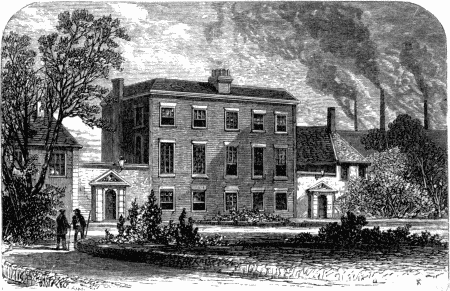
WATT’S HOUSE, HARPER’S HILL, BIRMINGHAM.
Watt now arranged to take up his residence in Birmingham
until the issue of the steam-engine enterprise
could be ascertained, and he went down to Glasgow to
bring up his two children, whom he had left in charge
of their relatives. Boulton had taken a house on Harper’s
Hill, which was in readiness for the reception of the
family on their arrival about the end of August, 1775.
Regent’s-place, Harper’s Hill, was then the nearest house
to Soho on that side of Birmingham. It was a double
house, substantially built in brick, with stone facings,
standing on the outskirts of the town, surrounded by
fields and gardens. St. Paul’s, the nearest church, was
not built until four years after Watt took up his abode
there. But the house at Harper’s Hill is in the country
no longer: it is now surrounded in all directions by
dense masses of buildings, and is itself inhabited by
working people.
The first engine made at Soho was one ordered by
John Wilkinson to blow the bellows of his ironworks at
Broseley. Great interest was, of course, felt in the
success of this engine. Watt took great pains with
the drawings; the workmen did their best to execute
the several parts accurately, for it was understood that
many orders depended upon whether it worked satisfactorily
or not. Wilkinson’s iron-manufacturing neighbours,
who were contemplating the erection of Newcomen
engines, suspended their operations until they
had an opportunity of seeing what Boulton and Watt’s
engine could do; and all looked forward to its completion
with the most eager interest. When all was
ready at Soho, the materials were packed up and sent
to Broseley, Watt accompanying them to superintend
the erection. He had as yet no assistant to whom he
could intrust such a piece of work, on which so much
depended. The engine was erected and ready for use
about the beginning of 1776. As it approached completion
Watt became increasingly anxious to make a
trial of its powers. But Boulton wrote to him not to
hurry—not to let the engine make a stroke until every
possible hinderance to its successful action had been
removed; “and then,” said he, “in the name of God,
fall to and do your best.” The result of the extreme
care taken with the construction and erection of the
engine was entirely satisfactory. It worked to the admiration
of all who saw it, and the fame of Boulton and
Watt became great in the midland counties.
While Watt was thus occupied, Boulton was pushing
on the new buildings at Soho. He kept his partner fully
advised of all that was going on. “The new forging-shop,”
he wrote, “looks very formidable: the roof is
nearly put on, and the hearths are both built.” Tools and
machinery were being prepared, and all looked hopeful
for the future. Orders were coming in for engines.
One in hand for Bloomfield Colliery was well advanced.
Many inquiries had come from Cornwall. Mr. Papps, of
Truro, was anxious to introduce the engine in that county.
Out of forty engines there, only eighteen were in work;
so that there was a fine field for future operations. “Pray
tell Mr. Wilkinson,” Boulton added, “to get a dozen
cylinders cast and bored, from 12 to 50 inches diameter,
and as many condensers of suitable sizes. The latter
must be sent here, as we will keep them ready fitted up,
and then an engine can be turned out of hand in two or
three weeks. I have fixed my mind upon making from
twelve to fifteen reciprocating and fifty rotative engines
per annum. I assure you that of all the toys and trinkets
which we manufacture at Soho, none shall take the place
of fire-engines in respect of my attention.”[143]
Boulton was not, however, exclusively engrossed by
engine affairs. Among other things he informed Watt
that he had put his little boy Jamie to a good school,
and that he was very much occupied, as usual, in entertaining
visitors. “The Empress of Russia,” he wrote,
“is now at my house, and a charming woman she is.”
The Empress afterwards sent Boulton her portrait, and
it was long one of the ornaments of Soho. Amidst
his various occupations he contrived to find leisure for
experiments on minerals, having received from a correspondent
in Wales a large assortment of iron-ores to
assay. He was also trying experiments on the model
engine, the results of which were duly communicated to
his partner.[144]
On Watt’s return to Soho, Boulton proceeded to
London on financial affairs, as well as to look after
engine orders. He there found reports in circulation
among the engineering class that the new engine had
proved a failure. The Society of Engineers in Holborn,
of which Smeaton was the great luminary, had settled
it that neither the tools nor the workmen existed that
could manufacture so complex a machine with sufficient
precision, and it was asserted that all the ingenuity and
skill of Soho had been unable to conquer the defects of
the piston. “So said Holmes, the clockmaker,” wrote
Boulton,—Holmes being the intimate friend of Smeaton;
“but no language will be sufficiently persuasive on that
head except the good performance of the engines themselves.”[145]
Boulton, therefore, urged the completion of
the engine then in hand for Cooke and Company’s distillery
at Stratford-le-Bow, near London. “Wilby,”
[the managing partner,] said he, “seems very impatient,
and so am I, both for the sake of reputation as well as
to begin to turn the tide of money,”—the current of
which had as yet been all outwards. Boulton went to
see the York Buildings engine, which had been reconstructed
by Smeaton, and was then reckoned one of the
best on the Newcomen plan. The old man who tended
it lauded the engine to the skies, and notwithstanding
Boulton’s description of the new engines at work in
Staffordshire, he would not believe that any engine in
existence could excel his own.
In the course of the summer Watt again visited Glasgow,—this
time for the purpose of bringing back a
wife. The lady he proposed to marry was Miss Anne
Macgregor, daughter of a respectable dyer. The young
lady’s consent was obtained, as well as her father’s, to
the proposed union; but the latter, before making any
settlement on his daughter, intimated to Watt that he
desired to see the partnership agreement between him
and Boulton. Now, although the terms of partnership
had been generally arranged, they had not yet been put
into legal form, and Watt asked that this should be done
for the cautious old gentleman’s satisfaction without
delay.[146] About his love affair Watt wrote,—
“Whether a man of the world, such as you, look upon my present
love as the folly of youth or the dotage of age [Watt was then in his
fortieth year], I find myself in no humour to lay it aside, or to look
upon it in either of these lights, but consider it as one of the wisest
of my actions, and should look upon a disappointment in it as one
of the greatest of my misfortunes.... I have had better health
since I left you than has been my lot for years, and my spirits have
borne me through my vexations wonderfully. I have lost all dread
of any future connexion with Monsieur la Verole, and, if I carry
my point in this matter, I hope to be very much more useful to
you than has hitherto been in my power. The spur will be
greater.”[147]
While in Scotland Watt obtained orders for several
engines; amongst others, he undertook to supply one
for the Torryburn Colliery, in Fife, on the terms of
receiving one-third of the savings effected by it compared
with the engine then at work, with such further
sum as might be judged fair. Another was ordered
by Sir Archibald Hope for his colliery near Edinburgh,
on similar terms. At the same time Watt proceeded
with the collection of his old outstanding debts,
though these did not amount to much. “I believe,”
he wrote to Boulton, “I shall have no occasion to draw
on you for any money, having got in some of my old
scraps, which will serve, or nearly serve, my occasions
here.”
The deed of partnership not arriving, Watt wrote
again, pressing Boulton for some communication from
him to satisfy the old gentleman as to his situation.
“Don’t let me be detected in a falsehood,” said he, “or accused of
imprudence. The thing which sticks most in his [Mr. Macgregor’s]
stomach is, that somehow or other, in case of the failure of success,
I may be brought into a load of debt which may totally ruin me.
I hope you will excuse his caution in this matter, as I do, when
you consider that he is disposing of a favourite child, and consequently
must expect all the security possible for her wellbeing.
I must also do him the justice to say that he has behaved to me in
a very open and friendly manner; and, when he found that his
daughter’s affections were engaged beyond recall, gave his consent
with a good grace.... I have nothing to write you in the way of
news. I am bandied about like a football, and perfectly impatient
to leave this country, but do not care to come away without my
errand. I long vastly to hear from you, how you all are, and how
matters go on. I hope Jemmy is minding his school and is well:
you need not tell him nor anybody else that I am going to bring
him home a mamma.”[148]
Boulton’s reply was perfectly satisfactory. He confirmed
the heads of the agreement, as sketched out by
Watt himself, adopting his own words. He warmly
congratulated him on his approaching marriage, being
convinced that it was the goddess of wisdom that had
led him to the altar of love. But he thought Watt
might be over delicate as to money matters.
“You certainly,” said he, “have a right to expect from the lady’s
father a child’s share, both present and reversionary; and you
certainly have a right to expect some ready money, as a small sum
may be of more importance to you in the meridian of life than a
large one at the close of it. I have always heard you speak of the
old gentleman as a man of exceeding good sound sense, and therefore
I should think you will have the less difficulty in settling matters
with him. No doubt he will expect some settlement to be made
upon his daughter, and all that I advise is, that you do not undervalue
(according to your custom) your own abilities or your
property. It may be difficult to say what is the value of your
property in partnership with me. However, I will give it a name,
and I do say that I would willingly give you two or perhaps three
thousand pounds for the assignment of your third part of the Act of
Parliament; but I should be sorry to make you so bad a bargain,
or to make any bargain at all that tended to deprive me of your
friendship, acquaintance, and assistance,—hoping, as I do, that we
shall harmoniously live to wear out the twenty-five years together,
which I had rather do than gain a Nabob’s fortune by being the
sole proprietor.... I wish I had more time to tell you all the
circumstances that have occurred in the engine trade; but that
shall be the subject of my next. All is well, and when you return
you’ll be quite charmed at the simplicity and quietness of the Soho
engine.”[149]
With his usual want of confidence in himself, Watt
urged Boulton to come down to Glasgow and assist him
in concluding matters with the old gentleman.
“I am afraid,” he wrote, “that I shall otherwise make a very
bad bargain in money matters, which wise men like you esteem the
most essential part, and I myself, although I be an enamoured
swain, do not altogether despise. You may perhaps think it odd
that in the midst of my friends here I should call for your help;
but the fact is, that from several reasons I do not choose to place
that confidence in any of my friends here that would be necessary
in such a case, and I do not know any of them that have more to
say with the gentleman in question than I have myself. Besides,
you are the only person who can give him satisfactory information
concerning my situation.”
But Boulton was too busy at the time to go down to
Glasgow to the help of his partner. He was full of
work, full of orders, full of Soho. He replied,—
“Although I have added to the list of my bad habits by joking
upon matrimony, yet my disposition and my judgment would lead
me to marry again were I in your case. I know you will be
happier as a married man than as a single one, and therefore it is
wisdom in you to wed; and if that could not be done without my
coming to Scotland, I certainly would come if it were as far again;
but I am so beset with difficulties, that nothing less than the
absolute loss of your life, or wife—which is virtually the same
thing—could bring me.”
He further explained that a good deal of extra work
had fallen upon him, through the absence of some of his
most important assistants. Mr. Matthews, his London
financial agent, like Watt, was about to be married, and
would be absent abroad for a tour on a wedding trip, in
which he was to be accompanied by Fothergill, Boulton’s
partner in the toy and button trade. Mr. Scale, the
manager, was also absent, added to which the button
orders were in arrear some 16,000 gross; so that, said
Boulton, “I have more real difficulties to grapple with
than I hope ever to have in any other year in my life.”
There were also constant visitors arriving at Soho:
among others the Duke of Buccleuch, who had called to
see the works and inquire after Mr. Watt; and Mr.
Moor, of the Society of Engineers in the Adelphi, who
had come to see with his own eyes whether the reports
in circulation against the new engine were true or false.
The perfecting of the details of the engine also required
constant attention.
“Our copper bottom,” said Boulton, “hath plagued us very much
by steam leaks, and therefore I have had one cast (with its
conducting pipe) all in one piece; since which the engine doth not
take more than 10 feet of steam, and I hope to reduce that quantity,
as we have just received the new piston, which shall be put in and
at work to-morrow. Our Soho engine never was in such good
order as at present. Bloomfield and Willey [engines] are both
well, and I doubt not but Bow engine will be better than
any of ’em.”
Boulton was almost as full of speculation as Watt himself
as to the means of improving the engine. “I did not
sleep last night,” he wrote, “my mind being absorbed by
steam.” One of his speculations was as to the means of
increasing the heating surface, and with that object he
proposed to apply the fire “in copper spheres within the
water.” His mind was also running on economising
power by working steam expansively, “being clear that
the principle is sound.”
Later, he wrote Watt that he had an application from
a distiller at Bristol for an engine to raise 15,000 gallons
of ale per hour 15 feet high; another for a coal mine in
Wales, and two others for London distilleries. To add to
his anxieties, one Humphry Gainsborough, a dissenting
minister at Henley-on-Thames, had instituted proceedings
against Watt for an alleged piracy of his invention!
On this Boulton wrote to his partner,—“I have just
received a summons to attend the Solicitor-General next
week in opposition to Gainsborough, otherwise the
solicitor will make his report. This is a disagreeable
circumstance, particularly at this season, when you are
absent. Joseph [Harrison] is in London, and idleness
is in our engine-shop.” There was therefore every
reason why Watt should make haste to get married, and
return to Soho as speedily as possible. On the 28th July,
1776, Watt wrote to apologise for his long absence, and
to say that the event was to come off on the following
Monday, after which he would set out immediately for
Liverpool, where he proposed to meet Boulton, unless
countermanded. He also intimated that he had got
another order for an engine at Leadhills.[150] Arrived at
Liverpool, a letter from Boulton met him, saying he
had been under the necessity of proceeding to London.
“Gainsborough,” said he, “hath appointed to meet me at Holt’s,
his attorney, on Monday, when I shall say little besides learning
his principles and invention. If we had a hundred wheels [wheel-engines]
ready made, and a hundred small engines, like Bow engine,
and twenty large ones executed, we could readily dispose of them.
Therefore let us make hay while the sun shines, and gather our
barns full before the dark cloud of age lowers upon us, and before
any more Tubal Cains, Watts, Dr. Faustuses, or Gainsboroughs,
arise with serpents like Moses’s to devour all others.... As to
your absence, say nothing about it. I will forgive it this time,
provided you promise me never to marry again.”[151]
Watt hastened back to Birmingham, and after settling
his wife in her new home, proceeded with the execution
of the orders for engines which had come in
during his two months’ absence. Mr. Wilby was impatient
for the delivery of the Bow engine, and as
soon as it was ready, which was early in September,
the materials were forwarded to London with Joseph
Harrison, to be fitted and set to work. Besides careful
verbal instructions, Watt supplied Joseph with full
particulars in writing of the measures he was to adopt
in putting the engine together. Not a point in detail
was neglected, and if any difficulty arose, Joseph was
directed at once to communicate with him by letter.
When the engine was set to work, it was found that the
steam could not be kept up, on which Watt suggested
that as it had been calculated to make only ten strokes
per minute—that being enough to raise the quantity of
water desired—the reason of the defect must be that, as
it was going at fourteen or fifteen strokes the minute, it
must be going too fast. He also pointed out that probably
the piston was not quite good, and perhaps there
was some steam-leak into the inner cylinder, or by the
regulators into the condenser; or it was possible that the
injection might spout too far up the horizontal steam-pipe
and throw water into the inner nozzle. All these
points Joseph must carefully look to. On further trials
the engine improved; still its performances did not come
up to Watt’s expectations, and there were consequently
more directions from him as to the packing of the pistons
and measures for the prevention of leaks. But to
see that his suggestions were properly carried out, Watt
himself went up to town in November, and had the
machine put in complete working trim. His partner,
however, could not spare him long, as other orders were
coming in. “We have a positive order,” wrote Boulton,
“for an engine for Tingtang mine, and, from what I
heard this day from Mr. Glover, we may soon expect
other orders from Cornwall. Our plot begins to thicken
apace, and if Mr. Wilkinson don’t bustle a little, as well
as ourselves, we shall not gather our harvest before sunset.”
... “I hope to hear,” he added, “that Joseph
hath made a finish, for he is much wanted here....
I perceive we shall be hard pushed in engine-work; but
I have no fears of being distanced when once the exact
course or best track is determined on.”[152] Joseph Harrison
got quite knocked up and ill through his anxiety about
the Bow engine, on which Boulton wrote Watt to send
at once for Dr. Fordyce to attend him, “let the expense
be what it will, until you think him safe landed.”
A letter reached Soho from the Shadwell Waterworks
Company relative to a pumping-engine, and Boulton
asked Watt, while in town, to wait upon them on the
subject; but he cautioned Watt that he “never knew a
Committee but, in its corporate capacity, was both rogue
and fool, and that the Shadwell Committee were rich
rogues.” Watt, by his own account, treated them very
cavalierly. “Yesterday,” said he, “I went again to
Shadwell to meet the deputies of the Committee, and
to examine their engines when going. We came to no
terms further than what we wrote them before, which I
confirmed, and offered moreover to keep the engine in
order for one year. They modestly insisted that we
should do so for the whole twenty-five years, which I
firmly refused. They seemed to doubt the reality of the
performances of the Bow engine; so I told them we did
not solicit their orders and would wait patiently until
they were convinced,—moreover, that while they had
any doubts remaining, we would not undertake their
business on any terms. I should not have been so sharp
with them had they not begun with bullying me, selon
la mode de Londres. But the course I took was not
without its effect, for in proportion as they found I
despised their job, they grew more civil. After parting
with these heroes I went down to Stratford, where I
found that the engine had gone very well. I caused it
to be kept going all the afternoon, and this morning I
new-heat the piston and kept it going till dinner time
at about fifteen strokes per minute, with a steam of one
inch or at most two inches strong, and the longer it went
the better it grew.... I propose that Joseph should
not leave it for a few days, until both his health and
that of the engine be confirmed. A relapse of the
engine would ruin our reputation here, and indeed
elsewhere.”[153]
The Bow engine had, however, a serious relapse in
the following spring, and it happened in this way:—Mr.
Smeaton, the engineer, having heard of its success, which
he doubted, requested Hadley, Boulton’s agent, to go
down with him to Stratford-le-Bow to witness its performances.
He carefully examined the engine, and
watched it while at work, and the conclusion he arrived
at was, that it was a pretty engine, but much too complex
for practical uses. On leaving the place Smeaton
gave the engineman some money to drink, and he drank
so much that next day he let the engine run quite wild,
and it was thrown completely out of order. Mr. Wilby,
the manager, was very wroth at the circumstance. He
discharged the engineman and called upon Hadley to
replace the valves, which had been broken, and make
good the other damage that had been done to the engine.
When the repairs were made, everything went satisfactorily
as before.
Watt had many annoyances of this sort to encounter,
and one of his greatest difficulties was the incapacity and
unsteadiness of his workmen. Although the original
Soho men were among the best of their kind, the increasing
business of the firm necessarily led to the introduction
of a large number of new hands, who represented
merely the average workmen of the day. They were
for the most part poor mechanics, very inexpert at
working in metal, and greatly given to drink.[154]
In organising the works at Soho, Boulton and
Watt found it necessary to carry division of labour to
the farthest practicable point. There were no slide-lathes,
planing-machines, or boring-tools, such as now
render mechanical accuracy of construction almost a
matter of certainty. Everything depended upon the
individual mechanic’s accuracy of hand and eye; and
yet mechanics generally were then much less skilled
than they are now. The way in which Boulton and
Watt contrived partially to get over the difficulty was,
to confine their workmen to special classes of work, and
make them as expert in them as possible. By continued
practice in handling the same tools and fabricating the
same articles, they thus acquired great individual proficiency.
“Without our tools and our workmen,” said
Watt, “very little could be done.”
But when the men got well trained, the difficulty
was to keep them. Foreign tempters were constantly
trying to pick up Boulton and Watt’s men, and induce
them by offers of larger wages to take service abroad.
The two fitters sent up to London to erect the Bow engine
were strongly pressed to go out to Russia.[155] There were
also French agents in England at the same time, who
tried to induce certain of Boulton and Watt’s men to go
over to Paris and communicate the secret of making the
new engines to M. Perrier, who had undertaken to pump
water from the Seine for the supply of Paris. The
German States also sent over emissaries with a like object,
Baron Stein having been specially commissioned by his
Government to master the secret of Watt’s engine—to
obtain working plans of it and bring away workmen
capable of making it,—the first step taken being to
obtain access to the engine-rooms by bribing the workmen.
Besides the difficulties Boulton and Watt had to encounter
in training and disciplining their own workmen,
they had also to deal with the want of skill on the part
of those to whom the working of their engines was
intrusted after they had been delivered and fixed complete.
They occasionally supplied trustworthy men of
their own; but they could not educate mechanics fast
enough, and needed all the best men for their own work.
They were therefore compelled to rely on the average
mechanics of the day, the greater part of whom were
comparatively unskilled and knew nothing of the steam-engine.
Hence such mishaps as those which befell the
Bow engine, through the engineman getting drunk and
reckless, as above described. To provide for this contingency
Watt endeavoured to simplify the engine as
much as possible, so as to bring its working and repair
within the capacity of the average workman.
At a very early period, while experimenting at Kinneil,
he had formed the idea of working steam expansively,
and altered his model from time to time with that object.
Boulton had taken up and continued the experiments at
Soho, believing the principle to be sound and that great
economy would attend its adoption. The early engines
were accordingly made so that the steam might be cut
off before the piston had made its full stroke, and expand
within the cylinder, the heat outside it being maintained
by the expedient of the steam-case. But it was shortly
found that this method of working was beyond the
capacity of the average engineman of that day, and it
was consequently given up for a time.
“We used to send out,” said Watt to Robert Hart, “a cylinder of
double the size wanted, and cut off the steam at half stroke. This
was a great saving of steam so long as the valves remained as at
first; but when our men left her to the charge of the person who
was to keep her, he began to make or try to make improvements,
often by giving more steam. The engine did more work while the
steam lasted, but the boiler could not keep up the demand. Then
complaints came of want of steam, and we had to send a man down
to see what was wrong. This was so expensive that we resolved to
give up the expansion of the steam until we could get men that
could work it, as a few tons of coal per year was less expensive than
having the work stopped. In some of the mines a few hours’
stoppage was a serious matter, as it would cost the proprietor as
much as 70l. per hour.”[156]
The principle was not, however, abandoned. It was
of great value and importance in an economical point of
view, and was again taken up by Watt and embodied in
a more complete form in a subsequent invention. Since
his time, indeed, expansive working has been carried to
a much farther extent than he probably ever dreamt of,
and has more than realised the beneficial results which
his sagacious insight so early anticipated.
The Cornish miners continued baffled by their attempts
to get rid of the water which hindered the working of
their mines. The Newcomen engines had been taxed to
the utmost, but were unable to send them deeper into
the ground, and they were accordingly ready to welcome
any invention that promised to relieve them of their
difficulty. Among the various new contrivances for
pumping water, that of Watt seemed to offer the greatest
advantages; and if what was alleged of it proved true—that
it was of greater power than the Newcomen engine,
while its consumption of fuel was much less,—then it
could not fail to prove of the greatest advantage to
Cornish industry.
Long before Watt’s arrival in Birmingham, the Cornishmen
had been in correspondence with Boulton, making
inquiries about the new Scotch invention, of which they
had heard; and Dr. Small, in his letters to Watt, repeatedly
urged him to perfect his engine, with a view
to its being employed in the drainage of the Cornish
mines. Now that the engine was at work in several
places, Boulton invited his correspondents in Cornwall
to inquire as to its performances, at Soho, or Bedworth,
or Bow, or any other place where it had been erected.
The result of the inquiry and inspection was satisfactory,
and several orders for engines for Cornwall were received
at Soho by the end of 1776. The two first that were
ready for erection were those ordered for Wheal Busy,
near Chacewater, and for Tingtang, near Redruth. The
materials for the former were shipped by the middle of
1777; and, as much would necessarily depend upon the
successful working of the first engines put up in Cornwall,
Watt himself went to superintend their erection in
person.
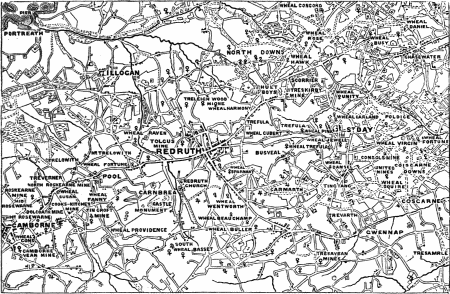
MAP OF UNITED MINES DISTRICT.
Watt reached his destination after a long and tedious
journey over bad roads. He rode by stage as far as
Exeter, and posted the rest of the way. At Chacewater
he found himself in the midst of perhaps the richest
mining district in the world. From thence to Camborne,
which lies to the west, and Gwennap to the south, is a
constant succession of mines. The earth has been burrowed
in all directions for many miles in search of ore,
principally copper—the surface presenting an unnaturally
blasted and scarified appearance by reason of the
“deads” or refuse run out in heaps from the mine-heads.
Engine-houses and chimneys are the most prominent
features in the landscape, and dot the horizon as far as
the eye can reach.
When Watt arrived at Chacewater he found the
materials for the Wheal Busy engine had come to hand,
and that some progress had been made with its erection.
The materials for the Tingtang engine, however, had
not yet been received from Soho, and the owners of the
mine were becoming very impatient for it. Watt wrote
to his partner urging despatch, otherwise the engine
might be thrown on their hands, especially if the Chacewater
engine, now nearly ready for work, did not give
satisfaction. From Watt’s account, it would appear that
the Cornish mines were in a very bad way. “The
Tingtang people,” he said, “are now fairly put out by
water, and the works are quite at a stand.” The other
mines in the neighbourhood were in no better plight.
The pumping-engines could not keep down the water.
“Poldice has grown worse than Wheal Virgin was:
they have sunk 400l. a month for some months past, and
700l. the last month; they will probably soon give up.
North Downs seems to be our next card.”[157] The owners
of the Wheal Virgin mine, though drowned out, like
many others, could not bring their minds to try Watt’s
engine. They had no faith in it, and stuck by the old
atmospheric of Newcomen. They accordingly erected
an additional engine of this kind to enable them to go
about eight fathoms deeper, “and they have bought,”
wrote Watt, “an old boiler of monstrous size at the
Briggin, which they have offered 50l. to get carried to
its place.”
At Chacewater Watt first met Jonathan Hornblower,
son of the Joseph Hornblower who had come into Cornwall
from Staffordshire, some fifty years before, to erect
one of the early Newcomen engines. The son had followed
in his father’s steps, and become celebrated in the Chacewater
district as an engineer. It was natural that he
should regard with jealousy the patentees of the new
engine; for if it proved a success, his vocation as a
maker of atmospheric engines would be at an end.
Watt thus referred to him in a letter to Boulton: “Hornblower
seems a very pleasant sort of old Presbyterian:
he carries himself very fair, though I hear that he is an
unbelieving Thomas.” His unbelief strongly showed
itself on the starting of the Wheal Busy engine shortly
after, when he exclaimed, “Pshaw! it’s but a bauble: I
wouldn’t give twopence halfpenny for her.” There were
others beside Hornblower who disliked and resented what
they regarded as the intrusion of Boulton and Watt in
their district, and indeed never became wholly reconciled
to the new engine, though they were compelled to admit
the inefficiency of the old one. Among these was old
Bonze, the engineer, a very clever mechanic, who positively
refused to undertake the erection of the proposed
new engine at Wheal Union if Boulton and Watt were
to be in any way concerned with it. But the mine-owners
had to study their own interest rather than the
humour of their former engineers, and Watt secured
the order for the Wheal Union engine. Several other
orders were promised, conditional on the performances
of the Wheal Busy engine proving satisfactory. “Ale
and Cakes,”[158] wrote Watt, “must wait the result of Chacewater:
several new engines will be erected next year,
for almost all the old mines are exhausted, or have got
to the full power of the present engines, which are
clumsy and nasty, the houses cracked, and everything
dropping with water from their cisterns.”[159]
Watt liked the people as little as he did their engines.
He thought them ungenerous, jealous, and treacherous.
“Certainly,” said he, “they have the most ungracious
manners of any people I have ever yet been amongst.”
At the first monthly meeting of the Wheal Virgin adventurers,
which he attended, he found a few gentlemen,
but “the bulk of them would not be disgraced by being
classed with Wednesbury colliers.” What annoyed him
most was, that the miners invented and propagated all
sorts of rumours to his prejudice. “We have been accused,”
said he, “of working without leather upon our
buckets, and making holes in the clacks in order to
deceive strangers.... I choose to keep out of their
company, as every word spoken by me would be bandied
about and misrepresented. I have already been accused
of making several speeches at Wheal Virgin, where, to
the best of my memory, I have only talked about eating,
drinking, and the weather. The greater part of the adventurers
at Wheal Virgin are a mean dirty pack, preying
upon one another, and striving who shall impose most
upon the mine.”[160] Watt was of too sensitive and shrinking
a nature to feel himself at home amongst such people.
Besides, he was disposed to be peevish and irritable, easily
cast down, and ready to anticipate the worst. It had
been the same with him when employed amongst the
rough labourers on the Monkland Canal, where he had
declared himself as ready to face a loaded cannon as to
encounter the altercations of bargain-making. But Watt
must needs reconcile himself to his post as he best could;
for none but himself could see to the proper erection of
the Wheal Busy engine and get it set to work with any
chance of success. Meanwhile, the native engineers were
stimulated by his presence, and by the reputed power of
the new engine, to exert themselves in improving the
old one. Bonze was especially active in contriving new
boilers and new arrangements, by which he promised to
outstrip all that Watt could possibly accomplish.[161]
A letter from Mrs. Watt to Mrs. Boulton, dated
Chacewater, September 1st, 1777, throws a little light
on Watt’s private life during his stay in Cornwall. She
describes the difficulty they had in obtaining accommodation
on their arrival, “no such thing as a house or
lodging to be had for any money within some miles of
the place where the engine was to be erected;” hence
they had been glad to accept of the hospitality of Mr.
Wilson, the superintendent of the mine.
“I scarcely know what to say to you of the country. The spot
we are at is the most disagreeable in the whole county. The face
of the earth is broken up in ten thousand heaps of rubbish, and
there is scarce a tree to be seen. But don’t think that all Cornwall
is like Chacewater. I have been at some places that are very
pleasant, nay beautiful. The sea-coast to me is charming, but not
easy to be got at. In some cases my poor husband has been obliged
to mount me behind him to go to some of the places we have been
at. I assure you I was not a little perplexed at first to be set on a
great tall horse with a high pillion. At one of our jaunts we were
only charged twopence a piece for our dinner. You may guess
what our fare would be from the cost of it; but I assure you I
never ate a dinner with more relish in my life, nor was I ever
happier at a feast, than I was that day at Portreath.... One thing
I must tell you of is, to take care Mr. Boulton’s principles are well
fixed before you trust him here. Poor Mr. Watt is turned Anabaptist,
and duly attends their meeting; he is, indeed, and goes to chapel
most devoutly.”
At last the Chacewater engine was finished and ready
for work. Great curiosity was felt about its performances,
and mining men and engineers came from
all quarters to see it start. “All the world are agape,”
said Watt, “to see what it can do.” It would not have
displeased some of the spectators if it had failed. But
to their astonishment it succeeded. At starting, it made
eleven eight-feet strokes per minute; and it worked with
greater power, went more steadily, and “forked” more
water than any of the ordinary engines, with only about
one-third the consumption of coal. “We have had
many spectators,” wrote Watt, “and several have
already become converts. I understand all the west-country
captains are to be here to-morrow to see the
prodigy.”[162] Even Bonze, his rival, called to see it, and
promised not only to read his recantation as soon as convinced,
but never to touch a common engine again.
“The velocity, violence, magnitude, and horrible noise
of the engine,” Watt added, “give universal satisfaction
to all beholders, believers or not. I have once or twice
trimmed the engine to end its stroke gently, and to
make less noise; but
Mr. Wilson cannot
sleep without it
seems quite furious,
so I have left it to
the engine-men;
and, by the by, the
noise seems to convey
great ideas of
its power to the
ignorant, who seem
to be no more taken
with modest merit
in an engine than
in a man.” In a
later letter he
wrote, “The voice
of the country
seems to be at present
in our favour;
and I hope will be
much more so when
the engine gets on its whole load, which will be by Tuesday
next. So soon as that is done, I shall set out for home.”
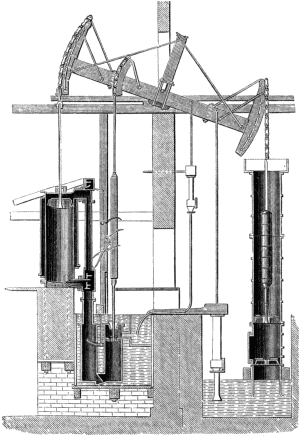
WATT’S SINGLE-ACTING PUMPING-ENGINE FOR MINES.
A number of orders for engines had come in at Soho
during Watt’s absence; and it became necessary for him
to return there as speedily as possible, to prepare the
plans and drawings, and put the work in hand. There
was no person yet attached to the concern who was
capable of relieving him of this part of his duties; while
Boulton was fully occupied with conducting the commercial
part of the business. By the end of autumn
he was again at home; and for a week after his return
he kept so close to his desk in his house on Harper’s
Hill, that he could not even find time enough to go out
to Soho and see what had been doing in his absence.
At length he felt so exhausted by the brain-work and
confinement that he wrote to his partner, “a very little
more of this hurrying and vexation will knock me
up altogether.” To add to his troubles, letters arrived
from Tingtang, urging his return to Cornwall, to erect
the engine, the materials for which had at last arrived.
“I fancy,” said Watt, “that I must be cut in pieces, and
a portion sent to every tribe in Israel.”
After four month’s labour of this sort, during which
seven out of the ten engines then in hand were finished
and erected, and the others well advanced, Watt again
set out for Cornwall, which he reached by the beginning
of June, 1778. He took up his residence at Redruth, as
being more convenient for Tingtang than Chacewater,
hiring a house at Plengwarry, a hamlet on the outskirts
of the town. Redruth is the capital of the mining
districts of Camborne, Redruth, and Gwennap. It is
an ancient town, consisting for the most part of a long
street, which runs down one hill and up another.
All round it the country seems to have been disembowelled;
and heaps of scoriæ, “deads,” rubbish, and
granite blocks cover the surface. The view from the
lofty eminence of Carn Brea, a little to the south of
Redruth, strikingly shows the scarified and apparently
blasted character of the district, and affords a prospect
the like of which is rarely to be seen.
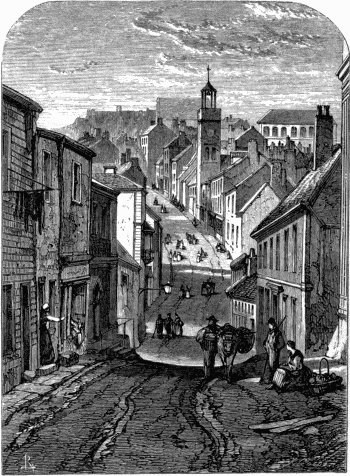
REDRUTH HIGH STREET.
[By R. P. Leitch.]
On making inquiry as to the materials which had
arrived during his absence, Watt was much mortified to
find that the Soho workmen had made many mistakes.
“Forbes’s eduction-pipe,” he wrote, “is a most vile job,
and full of holes. The cylinder they have cast for Chacewater
is still worse, for it will hardly do at all. The
Soho people have sent here Chacewater eduction-pipe
instead of Wheal Union; and the gudgeon pipe has not
arrived with the nozzles. These repeated disappointments,”
said he, “will undoubtedly ruin our credit in
the country; and I cannot stay here to bear the shame
of such failures of promise.”
Watt had a hard time of it while in Cornwall, what
with riding and walking from mine to mine, listening
to complaints of delay in the arrival of the engines from
Soho, and detecting and remedying the blunders and
bad workmanship of his mechanics. Added to which,
everybody was low-spirited and almost in despair at the
bad times,—ores falling in price, mines filled with water,
engine-men standing idle, and adventurers bemoaning
their losses. Another source of anxiety was the serious
pecuniary embarrassments in which the Soho firm had
become involved. Boulton had so many concerns going
that a vast capital was required for the purpose of
meeting current engagements; and the engine business,
instead of relieving him, had hitherto only proved a
source of additional outlay, and increased his difficulties
at a time of general commercial depression. He wrote
Watt, urging him to send remittances for the Cornish
engines; but the materials, though partly delivered, were
not erected; and the miners demurred to paying on
account until they were fixed complete and at work.
Boulton then suggested to Watt that he should try to
obtain an advance from the Truro bankers, on security
of the engine materials. “No,” replied Watt, “that
cannot be done, as the knowledge of our difficulties
would damage our position in Cornwall, and hurt our
credit. Besides,” said he, “no one can be more cautious
than a Cornish banker; and the principal of the firm
you name is himself exceedingly distressed for money.”[163]
Nor was there the least chance, in Watt’s opinion, even
if they had the money to advance, of their accepting
any security that Boulton and Watt had to offer. “Such
is the nature of the people here,” said he, “and so little
faith have they in our engine, that very few of them
believe it to be materially better than the ordinary one,
and so far as I can judge, no one I have conversed with
would advance us 500l. on a mortgage of it.”[164]
All that Watt could do was to recommend that the
evil day should be staved off as long as possible, or at
all events until the large engines he was then erecting
were at work, when he believed their performances
would effect a complete change in the views of the
adventurers. The only suggestion he could offer was
to invite John Wilkinson, or some other moneyed
man, to join them as partner and relieve them of their
difficulties; for “rather than founder at sea,” said he,
“we had better run ashore.”[165] Meanwhile, he urged
Boulton to apply the pruning-knife and cut down expenses,
assuring him that he himself was practising all
the frugality in his power. But as Watt’s personal
expenses at the time did not amount to 2l. a week, it is
clear that any savings he could effect, however justifiable
and laudable, were but a drop in the ocean compared
with the liabilities to be met, and which must be provided
without delay to avoid insolvency and ruin.
Fothergill, Boulton’s other partner, was even more
desponding than Watt. When Boulton left Soho on
his journeys to raise ways and means, Fothergill pursued
him with dolorous letters, telling him of mails
that had arrived without remittances, of bills that must
be met, of wages that must be paid on Saturday night,
and of the impending bankruptcy of the firm, which he
again and again declared to be “inevitable.” “Better
stop payment at once,” said he, “call our creditors together,
and face the worst, than go on in this neck-and-neck
race with ruin.” Boulton would hurry back to
Soho, to quiet Fothergill, and keep the concern going;
on which another series of letters would pour in upon
him from Mr. Matthews, the London financial agent,
pressing for remittances, and reporting the increasingly
gloomy and desperate state of affairs.
Boulton himself was, as usual, equal to the occasion.
His courage and determination rose in proportion to the
difficulties to be overcome. He was borne up by his invincible
hope, by his unswerving purpose, and above all
by his unshaken belief in the commercial value of the
condensing engine. If they could only weather the storm
until its working powers could be fully demonstrated,
all would yet be well.
In illustration of his hopefulness, we may mention
that in the midst of his troubles a fire took place in the
engine-room at Soho, which was happily extinguished,
but not before it had destroyed the roof and done serious
damage to the engine, which was brought to a standstill.
Boulton had long been desirous of rebuilding the
engine-house in a proper manner, but had been hindered
by Watt, who was satisfied with alterations merely sufficient
to accommodate the place to the changes made
from time to time in the engine which he called
“Beelzebub.”[166] On hearing of the damage done by the
fire, Boulton, instead of lamenting over it, exclaimed,
“Now I shall be able at last to have the engine-house
built as it should be.”
After many negotiations, Boulton at length succeeded
in raising a sum of 7000l. by granting a Mr. Wiss
security for the payment of an annuity, while the
London bankers, Lowe, Vere, and Williams, allowed
an advance of 14,000l. on security of a mortgage
granted by Boulton and Watt on the royalties derived
from the engine patent, and of all their rights and privileges
therein. Though the credit of the house was thus
saved, the liabilities of Boulton and his partners continued
to press heavily upon them for a long time to
come. Meanwhile, however, a gleam of light came from
Cornwall. Watt sent the good news to Soho that “both
Chacewater and Tingtang engines go on exceedingly
well, and give great satisfaction. Chacewater goes 14
strokes of 9 foot long per minute, and burns about 128
bushels per 24 hours. The water has sunk 12 fathoms
in the mine, and the engine will fork [i. e. pump out]
the first lift this night. No cross nor accident of any
note has happened, except the bursting of a pump at
Tingtang, which was soon repaired.” Four days later
Watt wrote, “The engines are both going very well,
and Chacewater has got the water down 18½ fathoms;
but after this depth it must make slower progress, as
a very large house of water begins there, and the feeders
grow stronger as we go deeper.”[167]
Watt looked upon the Chacewater trial as the experimentum
crucis, and continued to keep his partner duly
informed of every circumstance connected with it.
“They say,” he wrote, “that if the new engine can fork
the water from Chacewater, it can fork anything, as that
is the heaviest to fork in the whole county.” On the
15th of August he wrote, “Chacewater is now down to
10 fathoms of the second lift, and works steady and
well; it sinks 9 feet per day. Chacewater people in
high spirits: Captain Mayor furiously in love with the
engine.” On the 29th he wrote again, “Chacewater
engine is our capital card, for should it succeed in forking
this mine all doubts will then be removed.” The adventurers
of the great Poldice mine watched the operations
at Chacewater with much interest. Two common
engines, pumping night and day for months, had failed
to clear their mine of water; and now they thought of
ordering one of the new engines to take their place;
“but all this,” said Watt, “depends on the success of
Chacewater, which God protect: it is now down 31½
fathoms, and will be in fork of this lift to-morrow, when
it is to be put down three fathoms lower, and fixed
there.” On the 17th he wrote, “I have been at Chacewater
to-day, where they are in fork of the second lift
34½ fathoms. The great connexion-rod still unbalanced.
The engine went yesterday 14 strokes per minute. To-morrow
I go to Wheal Union, and on Saturday to Truro,
to meet Poldice adventurers.... By attending to the
business of this county alone,” said he, “we may at least
live comfortably; for I cannot suppose that less than
twelve engines will be wanted in two or three years,
but after that very few more, as these will be sufficient
to get ore enough; though you cannot reckon the average
profits to us at above 200l. per engine.”
When Boulton and Watt first started the manufacture
of steam-engines, they were mainly concerned
to get orders, and were not very particular as to the
terms on which they were obtained. But when the
orders increased, and the merits of the invention gradually
became recognised, they found it necessary to require
preliminary agreements to be entered into as to
the terms on which the patent was to be used. It
occurred to them, that as one of its principal merits
consisted in the saving of fuel, it would be a fair
arrangement to take one-third of the value of such
saving by way of royalty, leaving the owners of the
engines to take the benefit of the remaining two-thirds.
Nothing could be fairer than the spirit of
this arrangement, which, it will be seen, was of even
more advantage to the owners of the engines than to
the patentees themselves. The first Cornish engines
were, however, erected without any condition as to
terms; and it was only after they had proved their
power by “forking” the water, and sending the miners
twenty fathoms deeper into the ground, that the question
of terms was raised. Watt proposed that agreements
should be entered into on the basis above indicated.
But the Cornish men did not see the use of agreements.
They had paid for the engines, which were theirs, and
Boulton and Watt could not take them away. Here was
the beginning of a long series of altercations, which
ended only with the patent right itself. The miners
could not do without the engine. It was admitted to
be of immense value to them, rendering many of their
mines workable that would otherwise have been valueless.
But why should they have to pay for the use
of such an invention? This was what they never could
clearly understand.
To prevent misunderstandings in future, Watt wrote
to Boulton, recommending that no further orders for
engines should be taken unless the terms for using
them were definitely settled beforehand. “You must
excuse me,” he added, “when I tell you that, for my
part, I will not put pen to paper [i. e. make the requisite
drawings] on a new subject until that is done.
Until an engine is ordered, our power is greater than
that of the Lord Chancellor; as I believe even he cannot
compel us to make it unless we choose. Let our terms
be moderate, and, if possible, consolidated into money
à priori, and it is certain we shall get some money,
enough to keep us out of jail, in continual apprehension
of which I live at present.”[168]
To meet the case, a form of agreement was drawn up
and required to be executed before any future engine
was commenced. It usually provided that an engine of
certain given dimensions and power was to be erected
at the expense of the owners of the mine; and that the
patentees were to take as their recompense for the use
of their invention, one-third of the value of the fuel saved
by it compared with the consumption of the ordinary
engine. It came to be understood that the saving of
fuel was to be estimated according to the number of
strokes made. To ascertain this, Watt contrived an ingenious
piece of clockwork, termed the Counter, which,
being attached to the main beam, accurately marked and
registered, under lock and key, the number of its vibrations.
Thus the work done was calculated, and the
comparative saving of fuel was ascertained.
Though the Cornish miners had been full of doubts
as to the successful working of Watt’s engine, they
could not dispute the evidence of their senses after it
had been erected and was fairly at work. There it
was, “forking water” as never engine before had been
known to “fork.” It had completely mastered the
water at Wheal Busy; and if it could send the workmen
down that mine, it could in like manner send them
down elsewhere. Wheal Virgin was on the point of
stopping work, in which case some two thousand persons
would be thrown out of bread. Bonze’s new atmospheric
engine had proved a failure, and the mine continued
flooded. It had also failed at Poldice, which was
drowned out. “Notwithstanding the violence and prejudice
against us,” wrote Watt, “nothing can save the
mines but our engines.... Even the infidels of Dalcoath
are now obliquely inquiring after our terms!
Cook’s Kitchen, which communicates with it, has been
drowned out some time.” Watt, accordingly, had
many applications about engines; and on that account
he entreated his partner to come to his help. He continued
to hate all negotiating about terms, and it did
not seem as if he would ever learn to like it. He had
neither the patience to endure, nor the business tact to
conduct a negotiation. He wanted confidence in himself,
and did not feel equal to make a bargain. He
would almost as soon have wrestled with the Cornish
miners as higgled with them. They were shrewd, practical
men, rough in manner and speech, yet honest
withal;[169] but Watt would not encounter them when he
could avoid it. Hence his repeated calls to Boulton to
come and help him. Writing to him about the proposed
Wheal Virgin engine, he said, “Before I make any
bargain with these people, I must have you here.” A
few days after, when communicating the probability of
obtaining an order for the Poldice engine, he wrote,—“I
wish you would dispose yourself for a journey here,
and strike while this iron is hot.” A fortnight later he
said, “Poldice people are now welding hot, and must
not be suffered to cool. They are exceedingly impatient,
as they lose 150l. a month until our engine is going....
I hope this will find you ready to come away. At
Redruth, inquire for Plengwarry Green, where you
will find me.”
Boulton must have been greatly harassed by the
woes of his partners. Fothergill was still uttering
lamentable prophecies of impending ruin; his only
prospect of relief being in the success of the engine.
He urged Boulton to endeavour to raise money by the
sale of engine contracts or annuities, in order to avert
a crash. Matthews, the London agent, also continued
to represent the still urgent danger of the house, and
pressed Boulton to go to Cornwall and try to raise money
there upon his engine contracts. Indeed, it was clear
that the firm of Boulton and Fothergill had been losing
money by their business for several years past; and
that, unless the engine succeeded, they must, ere long,
go to the wall. But when Boulton turned to Cornwall,
he found little comfort. Though the engines there
were successful, Watt could not raise money upon them.
The adventurers were poor,—were for the most part
losing by their ventures, in consequence of the low
price of the ore; and they almost invariably put off
payment by excuses. Thus, while Boulton was in
London trying to obtain accommodation from his
bankers, the groans of his partner in Birmingham were
more than re-echoed by the lamentations of his other
partner in Cornwall, who rang the changes of misery
through all the notes of the gamut.
At length, about the beginning of October, 1778,
Boulton contrived to make his long-promised journey
into Cornwall.[170] He went round among the mines, and
had many friendly conferences with the managers. He
found the engine had grown in public favour, and that
the impression prevailed throughout the mining districts
that it would before long become generally
adopted. Encouraged by his London financial agent,
he took steps to turn this favourable impression to
account.[171] Before he left Cornwall, where he remained
until the end of the year, he succeeded in borrowing
a sum of 2000l. from Elliot and Praed, the Truro
bankers, on security of the engines erected in the
county; and the money was at once forwarded to
the London agents for the relief of the Birmingham
firm. He also succeeded in getting the terms definitely
arranged for the use of several of the more important
engines erected and at work. It was agreed that
700l. a year should be paid as royalty in respect of
the Chacewater engine,—an arrangement even more
advantageous to the owners of the mine than to the
patentees, as it was understood that the saving of coals
amounted to upwards of 2400l. a year. Other agreements
were entered into for the use of the engines
erected at Wheal Union and Tingtang, which brought
in about 400l. per annum more, so that the harvest of
profits seemed at length fairly begun.
Watt remained at Cornwall for another month, plodding
at Poldice and Wheal Virgin engines, and returned
to Birmingham early in January, 1779. Though the
pumping-engine had thus far proved remarkably successful,
and accomplished all that Watt had promised, he
was in no better spirits than before. “Though we have,
in general, succeeded in our undertakings,” he wrote
Dr. Black, “yet that success has, from various unavoidable
circumstances, produced small profits to us; the
struggles we have had with natural difficulties, and with
the ignorance, prejudices, and villanies of mankind,
have been very great, but I hope are now nearly come
to an end, or vanquished.”[172] His difficulties were not,
however, nearly at an end, as the heavy liabilities of
the firm had still to be met. More money had to be
borrowed; and Watt continued to groan under his intolerable
burden. “The thought of the debt to Lowe,
Vere, and Co.,” he wrote to his partner, “lies too heavy
on my mind to leave me the proper employment of my
faculties in the prosecution of our business; and, besides,
common honesty will prevent me from loading the scheme
with debts which might be more than it could pay.”[173]
A more hopeful man would have borne up under
these difficulties; for the reputation of the engine was
increasing, and orders were coming in from various
quarters. Soho was full of work; and, provided their
credit could be maintained, it was clear that the undertaking
on which the firm had entered could not fail to
prove remunerative. Watt could not see this, but his
partner did; and Boulton accordingly strained every
nerve to keep up the character of the concern. While
Watt was urging upon him to curtail the business,
Boulton sought in all ways to extend it. He sent
accounts of his marvellous engines abroad, and orders for
them came in from France[174] and Holland. Watt was
more alarmed than gratified by the foreign orders,
fearing that the engine would be copied and extensively
manufactured abroad, where patents had not yet
been secured. He did not see that the best protection
of all was in the superiority of his tools and mechanics,
enabling first-class work to be turned out,—important
advantages, in which the Soho firm had the start of the
world. It is true his mechanics were liable to be
bribed, and foreigners were constantly haunting Soho
for the purpose of worming out the secrets of the manufacture,
and decoying away the best men. Against
this every precaution was taken, though sometimes in
vain. Two Prussian engineers came over from Berlin
in 1779, to whom Watt showed every attention; after
which, in his absence, they got into the engine-room,
and carefully examined all the details of “Old Bess,”
making notes. When Watt returned, he was in high
dudgeon, and wrote to his partner that he “could not
help it unless by discountenancing every foreigner who
does not come avowedly to have an engine.”[175]
Their principal reliance, however, was necessarily on
home orders, and these came in satisfactorily. Eight
more engines were wanted for Cornwall, those already
at work continuing to give satisfaction. Inquiries were
also made about pumping engines for collieries in
different parts of England. But where coals were cheap,
and the saving of fuel was of less consequence, the
patentees were not solicitous for orders unless the purchasers
would fix a fair sum for the patent right, or
rate the coals used at a price that would be remunerative
in proportion to the savings effected. The
orders were, indeed, becoming so numerous, that the
firm, beginning to feel their power, themselves fixed
the annual royalty, though it was not always so easy
to get it paid.
The working power of Watt himself was but limited.
He still continued to suffer from intense headaches; and,
as all the drawings of new engines were made by his
own hands, it was necessary in some measure to limit
the amount of work undertaken. “I beg,” he wrote to
his partner in May, 1779, relative to proposals made for
two new engines, “that you will not undertake to do
anything for them before Christmas. It is, in fact,
impossible, at least on my part; I am quite crushed.”
But he was not always so dispirited, for in the following
month we find him writing Boulton an exultant letter,
announcing orders for three new engines from Cornwall.[176]
Watt continued for some time longer to suffer great
annoyance from the shortcomings of his workmen.
He was himself most particular in giving his instructions,
verbally, in writing, and in drawings. When he
sent a workman to erect an engine, he sent with him
a carefully drawn up detail of the step by step proceedings
he was to adopt in fitting the parts together.
Where there was a difficulty, and likely to be a hitch,
he added a pen and ink drawing, rapid but graphic, and
pointed out how the difficulty was to be avoided. It
was not so easy, however, to find workmen capable of
intelligently fitting together the parts of a machine so
complicated and of so novel a construction. Moreover,
the first engines were in a great measure experimental,
and to have erected them perfectly, and provided by anticipation
for their various defects, would have argued
a knowledge of the principles of their construction
almost as complete as that of Watt himself. He was
not sufficiently disposed to make allowances for the workmen’s
want of knowledge and want of experience, and
his letters were accordingly full of complaints of their
shortcomings. He was especially annoyed with the
mistakes of a foreman, named Hall, who had sent the
wrong articles to Cornwall, and he urged Boulton to
dismiss him at once. But Boulton knew better. Though
Watt understood engines, he did not so well understand
men. Had Boulton dismissed such as Hall because they
made mistakes, the shop would soon have been empty.
The men were as yet but at school, learning experience,
and Boulton knew that in course of time they would
acquire dexterity. He was ready to make allowance for
their imperfections, but at the same time he did not
abate in his endeavours to find out and engage the best
hands, wherever they were to be found—in Wales, in
Cornwall, or in Scotland. He therefore kept on Hall,
notwithstanding Watt’s protest, and the latter submitted.[177]
Watt was equally wroth with the enginemen at Bedworth.
“I beg and expect,” he wrote Boulton, “that so
soon as everything is done to that engine, you will instantly
proceed to trial before creditable witnesses, and
if possible have the whole brood of these enginemen
displaced, if any others can be procured; for nothing
but slovenliness, if not malice, is to be expected of
them.” It must, however, be acknowledged that the
Bedworth engine was at first very imperfect, having
been made of bad iron, in consequence of which it frequently
broke down. In Cornwall the men were no
better. Dudley, Watt’s erector at Wheal Chance and
Hallamanin, was pronounced incapable and a blunderer.
“If something be not very bad in London, I wish you
would employ Hadley to finish those engines, and send
Joseph here to receive his instructions and proceed to
Cornwall, otherwise Dudley will ruin us.”[178]
The trusty “Joseph” was accordingly despatched to
Cornwall to look after Dudley, and remedy the defects
in Wheal Chance and Hallamanin engines; but when
Watt arrived at Chacewater shortly after, he found that
Joseph, too, had proved faithless. He wrote to Boulton,
“Joseph has pursued his old practice of drinking in the
neighbourhood in a scandalous manner, until the very
enginemen turned him into ridicule.... I have not
heard how he behaved in the west; but that he gave
the ale there a bad character.”[179] Notwithstanding, however,
his love of strong potations, Joseph was a first-rate
workman. Two days later, Watt wrote, “Though
Joseph has attended to his drinking, he has done much
good at his leisure hours, and has certainly prevented
much mischief at Hallamanin and some at Wheal Union.
He has had some hard and long jobs, and consequently
merits some indulgence for his foibles.” By the end of
the month “Joseph had conquered Hallamanin engine,
all but the boiler,” but Watt added, “His indulgence
has brought on a slight fit of the jaundice, and as soon
as the engine is finished, he must be sent home.”[180]
By this time Watt had called to his aid two other
skilled workmen, Law and Murdock, who arrived in
Cornwall in the beginning of September, 1779. In
Watt’s letters we find frequent allusions to Murdock.
Wherever any work had to be done requiring more
than ordinary attention, Watt specially directed that
“William” should be put to it. “Let William be sent
for from Bedworth,” he wrote from Cornwall in 1778,
“to set the patterns for nozzles quite right for Poldice.”
Boulton wished to send him into Scotland to erect the
engine at Wenlockhead, but Watt would not hear of it.
“William” was the only man he could trust with the
nozzles. Then William was sent to London to take the
charge of Chelsea engine; next to Bedworth, to see to
the completion of the repairs previous to the final trial;
then to Birmingham again to attend to some further
special instructions of Watt; and now we find him in
Cornwall, to take charge of the principal engines
erecting there.
William Murdock was not only a most excellent and
steady workman, but a man of eminent mechanical
genius. He was the first maker of a model locomotive
in this country; he was the introducer of lighting by
gas, and the inventor of many valuable parts of the
working steam-engine, hereafter to be described. His
father was a millwright and miller, at Bellow Mill, near
Old Cumnock, in Ayrshire, and was much esteemed for
his probity and industry, as well as for his mechanical
skill. He was the inventor of bevelled cast-iron gear
for mills, and his son was proud to exhibit, on the lawn
in front of his house at Sycamore Hill, Handsworth, a
piece of the first work of the kind executed in Britain.
It was cast for him at Carron Ironworks, after the pattern
furnished by him, in 1766. William was born in
1754, and brought up to his father’s trade. On arriving
at manhood, he became desirous of obtaining a larger
experience of mill-work and mechanics than he could
acquire in his father’s little mill. Hearing of the fame
of Boulton and Watt, and the success of their new
engine, he determined to travel south, and seek for a
job at Soho. Many Scotchmen were accustomed to call
there on the same errand, probably relying on the
known clanship of their countrymen, and thinking that
they would find a friend and advocate in Watt. But
strange to say, Watt did not think Scotchmen capable
of becoming first-class mechanics.[181]
When Murdock called at Soho, in the year 1777, to
ask for a job, Watt was from home, but he saw Boulton,
who was usually accessible to callers of every rank. In
answer to Murdock’s inquiry whether he could have a
job, Boulton replied that work was rather slack with
them then, and that every place was filled up. During
the brief conversation that ensued, the blate young
Scotchman, like most country lads in the presence of
strangers, had some difficulty in knowing what to do
with his hands, and unconsciously kept twirling his hat
with them. Boulton’s attention was directed to the
twirling hat, which seemed to be of a peculiar make. It
was not a felt hat, nor a cloth hat, nor a glazed hat;
but it seemed to be painted, and composed of some unusual
material. “That seems to be a curious sort of
hat,” said Boulton, looking at it more closely; “why,
what is it made of?” “Timmer, sir,” said Murdock,
modestly. “Timmer! Do you mean to say that it is
made of wood?” “Yes, sir.” “Pray, how was it made?”
“I turned it mysel’, sir, in a bit lathey of my own
making.” Boulton looked at the young man again.
He had risen a hundred degrees in his estimation. He
was tall, good-looking, and of open and ingenuous countenance;
and that he had been able to turn a wooden
hat for himself in a lathe of his own making was proof
enough that he was a mechanic of no mean skill. “You
may call again, my man,” said Boulton. “Thank you,
sir,” said Murdock, giving his hat a final twirl.
When Murdock called again, he was at once put upon
a trial job, after which he was entered as a regular
hand. We learn from Boulton’s memorandum-book
that he was engaged for two years, at 15s. a week when
at home, 17s. when from home, and 18s. when in London.
Boulton’s engagement of Murdock was amply
justified by the result. Beginning as a common mechanic,
he applied himself diligently and conscientiously
to his work, and became trusted. More responsible
duties were confided to him, and he strove to perform
them to the best of his power. His industry and his
skilfulness soon marked him for promotion, and he rose
from grade to grade until he became Boulton and Watt’s
most trusted co-worker and adviser in all their mechanical
undertakings of importance.
When Murdock went into Cornwall to take charge
of the engines, he gave himself no rest until he had
conquered their defects and put them in thorough
working order. He devoted himself to his duties
with a zeal and ability that completely won Watt’s
heart. He was so filled with his work, that when he
had an important job in hand, he could scarcely sleep
at nights for thinking of it. When the engine at
Wheal Union was ready for starting, the people of
the house at Redruth, in which Murdock lodged, were
greatly disturbed one night by a strange noise in his
room. Several heavy blows on the floor made them
start from their beds, thinking the house was coming
down. They rushed to Murdock’s room, and there
was he in his shirt, heaving away at the bedpost
in his sleep, calling out, “Now she goes, lads!
now she goes.”
Murdock was not less successful in making his
way with the Cornishmen with whom he was brought
into daily contact; indeed, he fought his way to their
affections. One day at Chacewater, some half-dozen
of the mining captains came into the engine-room and
began bullying him. This he could not stand, and
adopted a bold expedient. He locked the door, and
said, “Now, then, you shall not leave this place until
I have it fairly out with you.” He selected the biggest,
and put himself in a fighting attitude. The Cornishmen
love fair play, and while the two engaged in battle, the
others, without interfering, looked on. The contest was
soon over; for Murdock was a tall, powerful fellow,
and speedily vanquished his opponent. The others,
seeing the kind of man they had to deal with, made
overtures of reconciliation; and they shook hands all
round, and parted the best of friends.[182]
Watt continued to have his differences and altercations
with the Cornishmen, but he had no such way
of settling them. Indeed, he was almost helpless
when he came in contact with rough men of business.
Most of the mines were then paying very badly, and
the adventurers raised all sorts of objections to making
the stipulated payment of the engine dues. Under such
circumstances, altercations with them took place for
which Watt was altogether unprepared. He was under
the apprehension that they were constantly laying their
heads together for the purpose of taking advantage of
him and his partner. He never looked on the bright
side of things, but always on the darkest. “The rascality
of mankind,” said he to Dr. Black, “is almost
beyond belief.” Though his views of science were large,
his views of men were narrow. Much of this may have
been the result of his recluse habits and closet life, as
well as of his constant ill-health. With his racking
headaches, it was indeed difficult for him to be cheerful.
But no one could be more conscious of his own defects—of
his want of tact, his want of business qualities, and
his want of temper—than he was himself. He knew
his besetting infirmities, from which even the best and
wisest are not exempt. His greatness was mingled with
imperfections, and his strength with weakness, else had
he been more than human. It is not in the order of
Providence that the gifts and graces of life should be
concentrated in any one perfectly adjusted character.
Even when we inquire into the “Admirable Crichton”
of biography, and seek to trace his life, it vanishes almost
into a myth.
In the midst of his many troubles and difficulties,
Watt’s invariable practice was to call upon Boulton for
help. Boulton was satisfied to take men as he found
them, and try to make the best of them. Watt was a
man of the study; Boulton a man of the world. Watt
was a master of machines; but Boulton, of men.
Though Watt might be the brain, Boulton was the
heart of the concern. “If you had been here,” wrote
Watt to Boulton, after one of his disagreeable meetings
with the adventurers, “If you had been here, and gone
to that meeting with your cheerful countenance and brave
heart, perhaps they would not have been so obstinate.”
The scene referred to by Watt occurred at a meeting of
the Wheal Union Adventurers, at which the savings
effected by the new engine were to be calculated and
settled. Here is Watt’s own description of the affair,
and his feelings on the occasion, which will give a good
idea of the irksomeness of his position, and the disagreeable
people he had occasionally to encounter:—
“At Wheal Union account our savings were ordered to be charged
to the interest of Messrs. Edwards and Phillips; but when to be
paid, God knows! Bevan said in a month. After all this was
settled, in came Capt. Trevithick, I believe on purpose, as he came
late and might have heard that I was gone there. He immediately
fell foul of our account, in a manner peculiar to himself ... laboured
to demonstrate that Dalcoath engines not only surpassed the table,
but even did more work with the coals than Wheal Union did, and
concluded with saying that we had taken or got the advantage of
the adventurers. I think he first said the former and then hedged
off by the latter statement. Mr. Phillips defended, and Mr. Edwards,
I thought, seemed staggered, though candid. Mr. Phillips desired
the data that he might calculate it over in his way. Mr. Edwards
slipped away, but I found afterwards that he was in another room
with Capt. Gundry (who, and Hodge also, behaved exceedingly well—I
believe Gundry to be a very sincere, honest man). I went out
to speak to Joseph, and on my return found only Trevithick, Bevan,
Hodge, and some others. Soon after, Mr. Edwards called out
Trevithick to him and Gundry. I heard them very loud, and
waited their return for an hour; but they not seeming ready to return,
night coming on, and feeling myself very uncomfortable, I came away—so
know not what passed further. During all this time, I was so
confounded with the impudence, ignorance, and overbearing manner
of the man that I could make no adequate defence, and indeed could
scarcely keep my temper; which however I did, perhaps to a fault;
for nothing can be more grievous to an ingenuous mind than the
being suspected or accused of deceit. To mend the matter, it had
been an exceedingly rainy morning, and I had got a little wet going
thither, which had rather hurt my spirits. Yesterday I had a
violent headache and could do nothing.... Some means must be
taken to satisfy the country, otherwise this malicious man will hurt
us exceedingly. The point on which Mr. Edwards seemed to lay
the most stress was the comparing with a 77 1⁄10 cylinder, as he
alleged they would not have put in so large an engine; and in this
there is some reason, as I do not think they believed that the engine
would be so powerful as it is. Add to this, that the mine barely
pays its way. Trevithick made a great noise about short strokes at
setting on, &c. The Captains seemed to laugh at that; and I can
demonstrate that, were it allowed for, it would not come to 2s. 6d.
per month. I believe they can be brought to allow that they would
have put in a 70-inch. Now, query if we ought to allow this to be
calculated from a 70 (at which it will come to near 400l. a year),
and on making this concession insist on our having a good paymaster
to pay regularly once a month, and not be obliged to go like
beggars to their accounts to seek our due and be insulted by such
scoundrels into the bargain. As to Hallamanin, they have not met
yet, and when they do meet, I shall not go to them. I cannot bear
such treatment, but it is not prudent to resent it too warmly just
now. I believe you must come here. I think fourteen days would
settle matters. Besides my inability to battle such people, I really
have not time to bestow on them.”[183]
In subsequent letters Watt continued to urge Boulton
to come to him. His headaches were constant, unfitting
him for work. Besides, he could scarcely stir out of
doors for the rain. “It rains here,” said he, “prodigiously.
When you come, bring with you a waxed
linen cloak for yourself, and another for me, as there is
no going out now for a few miles without getting wet to
the skin. When it rains in Cornwall, and it rains often,
it rains solid.”
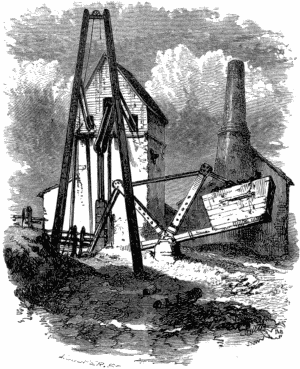
CARDOZOS PUMPING-ENGINE, UNITED MINES.
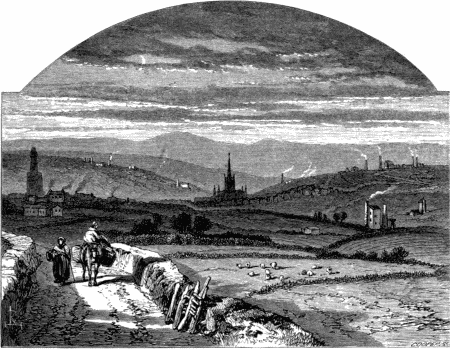
UNITED MINES DISTRICT—ST. DAY IN THE MIDDLE DISTANCE.
[By R. P. Leitch.]
Boulton again went to Watt’s help in Cornwall at the
end of autumn, 1779. He could not afford to make a
long stay, but left so soon as he had settled several
long-pending agreements with the mine proprietors.
The partners then returned to Birmingham together.
Before leaving, they installed Lieutenant Henderson as
their representative, to watch over their interests in
their absence. Henderson was a sort of Jack-of-all-trades
and master of none. He had been an officer of marines,
and afterwards a West India sugar-planter. He lost
all that he possessed in Jamaica, but gained some knowledge
of levelling, draining, and machinery. He was
also a bit of an inventor, and first introduced himself
to Boulton’s notice by offering to sell him a circular
motion by steam which he alleged he had discovered.
This led to a correspondence, which resulted in his engagement
to travel for the firm, and to superintend the
erection of engines when necessary.
Henderson experienced the same difficulty that Watt
had done in managing the adventurers, and during his
stay in Cornwall he was never done calling upon Boulton
to hasten to his assistance and help him, as he said, “to
put them in good spirits and good temper.” As the
annual meetings drew near, Henderson anticipated a
stormy time of it, and pleaded harder than ever for
Boulton to come to him. It seemed as if it would be
necessary for Boulton to take up his residence in Cornwall;
and as the interests at stake were great, it might
be worth his while to do so. By the summer of 1780,
Boulton and Watt had made and sold forty pumping-engines,
of which number twenty were erected and at
work in different parts of Cornwall; and it was generally
expected that before long there would scarcely be
an engine of the old construction at work in the county.
This was, in fact, the only branch of Boulton’s extensive
concerns that promised to be remunerative.[184] He had
become loaded with a burden of debt, from which the
success of the engine-business seemed to offer the only
prospect of relief.
Boulton’s affairs seemed indeed fast approaching to a
crisis. He had raised money in all directions to carry
on his extensive concerns. He had sold the Patkington
estate, which came to him by his wife, to Lord Donegal,
for 15,000l.; he had sold the greater part of his father’s
property, and raised further sums by mortgaging the
remainder; he had borrowed largely from Day,[185] Wedgwood,
and others of his personal friends, and obtained
heavy advances from his bankers; but all this was found
insufficient, and his embarrassments seemed only to increase.
Watt could do nothing to help him with money,
though he had consented to the mortgage of the steam-engine
royalties to Mr. Wiss, by which the sum of 7000l.
had been raised. This liability lay heavy on the mind
of Watt, who could never shake himself free of the
horror of having incurred such a debt; and many were
the imploring letters that he addressed to Boulton on
the subject. “I beg of you,” said he, “to attend to
these money affairs. I cannot rest in my bed until they
[i. e. the mortgage and banker’s advance] have some
determinate form. I beg you will pardon my importunity,
but I cannot bear the uneasiness of my own
mind, and it is as much your interest as mine to have
them settled.”[186]
The other partner, Fothergill, was quite as downhearted.
He urged that the firm of Boulton and
Fothergill should at once stop payment and wind up;
but as this would have seriously hurt the credit of the
engine firm, Boulton would not listen to the suggestion.
They must hold on as they had done before, until better
days came round. Fothergill recommended that at least
the unremunerative branches of the business should be
brought to a close. The heaviest losses had indeed been
sustained through Fothergill himself, whose foreign
connexions, instead of being of advantage to the firm,
had proved the reverse; and Mr. Matthews, the London
agent, repeatedly pressed Boulton to decline further
transactions with foreigners.
There was one branch of the Boulton and Fothergill
business which Boulton at once agreed to give up.
This was the painting and japanning business; by
which, as appears from a statement prepared by Mr.
Walker, now before us, the firm were losing at the rate
of 500l. a year.
The picture-painting business seems to have been
begun in 1777, and was carried on for some years under
the direction of Mr. Eginton, who afterwards achieved
considerable reputation at Birmingham as a manufacturer
of painted glass. A degree of interest has been
recently raised on the subject of the Soho pictures,
in consequence of the statements hazarded as to the
method by which they are supposed to have been produced.
It has been surmised that they were taken by
some process resembling photography. We have, however,
been unable to find anything in the correspondence
of the firm calculated to support this view. On
the contrary, they are invariably spoken of as “mechanical
paintings,” “pictures,” or “prints,” produced by
means of “paints” or “colours.” Though the precise
process by which they were produced is not now known,
there seems reason to believe that they were impressions
from plates prepared in a peculiar manner. The impressions
were taken “mechanically” on paper; and
both oil and water colours[187] were made use of. Some
of the pictures were of large size—40 by 50 inches—the
subjects being chiefly classical. This branch of the business
being found unproductive, was brought to a close
in 1780, when the partnership with Eginton was at the
same time dissolved.
Another and more fortunate branch of business into
which Boulton entered with Watt and Keir, about the
same time, was the manufacture of letter-copying machines.
Watt made the invention, Boulton found the
money for taking out the patent, and Keir conducted
the business. Watt was a very voluminous correspondent,
and the time occupied by him in copying letters, the
contents of which he desired to keep secret from third
parties, was such that in order to economise it he
invented the method of letter-copying in such common
use. The invention consisted in the transfer, by
pressure, of the writing made with mucilaginous ink,
to damped and unsized transparent copying-paper, by
means either of a rolling press or a screw press. Though
Watt himself preferred the rollers, the screw press is
now generally adopted as the more simple and efficacious
process.
This invention was made by Watt in the summer of
1778. In June we find him busy experimenting on
copying-papers of different kinds, requesting Boulton to
send him specimens of “the most even and whitest unsized
paper;” and in the following month he wrote
Dr. Black, “I have lately discovered a method of
copying writing instantaneously, provided it has been
written the same day, or within twenty-four hours.
I send you a specimen, and will impart the secret if
it will be of any use to you. It enables me to copy
all my business letters.”[188] For two years Watt kept
his method of copying a secret; but hearing that
certain persons were prying into it with the view of
turning it to account, he determined to anticipate them
by taking out a patent, which was secured in May,
1780. By that time Watt had completed the details
of the press and the copying-ink. Sufficient mahogany
and lignum-vitæ had been ordered for making 500
machines, and Boulton went up to London to try and
get the press introduced in the public offices. He first
waited upon several noblemen to interest them in the
machine, amongst others on Lord Dartmouth, who proposed
to show it to George III. “The King,” said
Boulton, in a letter to Watt, “writes a great deal, and
takes copies of all he writes with his own hand, so that
Lord Dartmouth thinks it will be a very desirable thing
for His Majesty.” Several of those to whom the machine
was first shown, apprehended that it would lead to increase
of forgery—then a great source of terror to commercial
men. The bankers concurred in this view, and
strongly denounced the invention; and they expostulated
with Boulton and Watt’s agent for offering the
presses for sale. “Mr. Woodmason,” wrote Boulton,
“says the bankers mob him for having anything to do
with it; they say that it ought to be suppressed.”
Boulton was not dismayed by this opposition, but proceeded
to issue circulars to the members of the Houses
of Lords and Commons, descriptive of the machine,
inviting them to an inspection of it, after which he
communicated the results to his partner:—
... “On Tuesday morning last I waited on some particular
noblemen, according to promise, at their own houses, with the press,
and at one o’clock I took possession of a private room adjoining the
Court of Requests, Westminster Hall, where I was visited by several
members of both Houses, who in general were well pleased with the
invention; but all expressed their fears of forgery, which occasioned
and obliged me to exercise my lungs very much. Many of the
members tried to copy bank notes, but in vain. I had a full
audience till half-past eight o’clock.... I had quite a mob of
members next day; some of them mobbed me for introducing such
wicked arts; however, upon the whole, I had a greater majority
than Lord North hath had this year.
On Thursday ... at half-past two ... I had a tolerable good
House, even a better than the Speaker, who was often obliged to
send his proper officer to fetch away from me the members to vote,
and sometimes to make a House. As soon as the House formed into
a Committee upon the Malt-tax, the Speaker left the chair and sent
for me and the machine, which was carried through the gallery in
face of the whole House into the Speaker’s Chamber. I found him
full of fears about the dreadful consequences, which I quieted before
I left him, and he with his two friends subscribed. I attended again
on Friday, but, from a very thin House and curiosity abating, I had
very few [subscriptions]. Mr. Banks came to see the machine on
Thursday. I thought it might be of service to show it to the Royal
Society that evening.... After the business of the Society was over,
he announced Mr. Watt’s invention, and my readiness to show it,
and it was accordingly brought in and afforded much satisfaction to
a crowded audience. I did not show the list of subscribers and the
proposals, nor dishonour philosophy by trade in that room....
I spent Friday evening with Smeaton and other engineers at a
coffee-house, when a gentleman (not knowing me) exclaimed against
the copying-machine, and wished the inventor was hanged and the
machines all burnt, which brought on a laugh, as I was known to
most present.... There are great names enough already among
the subscribers to give a sanction and authority to it, as well as to
make it fashionable, which has more influence upon the minds
of three-fourths of the Londoners than the intrinsic merit of the
thing, and without which it would have been some years in making
its way.”[189]
By the end of the year, the 150 machines first made
were sold off, and more orders were coming in. Thirty
were wanted for exportation abroad, and a still greater
number were wanted at home. The letter-copying machine
gradually and steadily made its way, until at
length there was scarcely a house of any extensive
business transactions in which it was not to be found.
Watt himself, writing of the invention some thirty years
later, observed that it had proved so useful to himself that
it had been worth all the trouble of inventing it, even had
it been attended with no pecuniary profit whatever.
Boulton’s principal business, however, while in town,
was not so much to push the letter-copying machine, but
to set straight the bankers’ account, which had been
overdrawn to the amount of 17,000l. He was able to
satisfy them to a certain extent by granting mortgages
on the engine royalties payable in Cornwall, besides
giving personal bonds for repayment of the advances
within a given time. It was necessary to obtain Watt’s
consent to both these measures; but, though Watt was
willing to agree to the former expedient, he positively
refused to be a party to the personal bonds.[190] Boulton
was therefore under the necessity of arranging the
matter himself. He was thereby enabled to meet the
more pressing claims upon the firm, and to make
arrangements for pushing on the engine business with
renewed vigour. Watt was, however, by no means so
anxious on this score as Boulton was. He was even
desirous of retiring from the concern, and going abroad
in search of health. “Without I can spare time
this next summer,” he wrote, “to go to some more
healthy climate to procure a little health, if climate
will do, I must give up business and the world too.
My head is good for nothing.”[191] While Boulton was
earnestly pressing the invention on the mining interest,
and pushing for orders, Watt shuddered at the prospect
of one. He saw in increase of business only increase of
headaches. “The care and attention which our business
requires,” said he, “make me at present dread a fresh
order with as much horror as other people with joy
receive one. What signifies it to a man though he
gain the whole world, if he lose his health and his life?
The first of these losses has already befallen me, and
the second will probably be the consequence of it, without
some favourable circumstances which at present I
cannot foresee should prevent it.”
Judging by the correspondence of Watt, his sufferings
of mind and body at this time must have been excessive;
and the wonder is how he lived through it. But “the
creaking gate hangs long on its hinges,” and he lived to
the age of eighty-three, long surviving his stronger and
more courageous partner. Intense headache seemed to
be his normal state, and his only tolerable moments
were those in which the headache was less violent than
usual. His son has since described how he remembered
seeing his father about this time, sitting by the fireside
for hours together, with his head leaning on his elbow,
suffering from most acute sick-headaches, and scarcely
able to give utterance to his thoughts. “My headache,”
he would write to Boulton, “keeps its week-aversary
to-day.” At another time, “I am plagued with the
blues; my head is too much confused to do any brain-work.”
Once, when he had engaged to accompany his
wife to an evening concert, he wrote, “I am quite eat
up with the mulligrubs, and to complete the matter I
am obliged to go to an oratorio, or serenata, or some
other nonsense, to-night.” Mrs. Watt tried her best to
draw him out of himself, but it was not often that she
could divert him from his misery. What relieved him
most was sleep, when he could obtain it; and, to recruit
his powers, he was accustomed to take from nine to
eleven hours sleep at night, besides naps during the
day. When Boulton had erysipelas, in Cornwall, and
could not stir abroad, he wrote to his partner complaining
of an unusual lowness of spirits, on which
Watt undertook to be his comforter in his own peculiar
way. “There is no pitch of low spirits,” said he,
“that I have not a perfect notion of, from hanging
melancholy to peevish melancholy: conquer the devil
when he is young.” Watt experienced all the tortures
of confirmed dyspepsia, which cast its dark shadow over
the life of every day. His condition was often most
pitiable. It is true, many of the troubles which beset
him were imaginary, but he suffered from them in idea
as much as if they had been real. Small evils fretted
him, and great ones overwhelmed him. He met them
all more than halfway, and usually anticipated the
worst. He had few moments of cheerfulness, hopefulness,
or repose. Speaking of one of his violent headaches,
he said, “I believe it was caused by something
making my stomach very acid;” and unhappily, as
in the case of most dyspeptics, the acidity communicated
itself to his temper. When these fits came upon him,
and the world was going against him, and ruin seemed
about to swallow him up quick, he would sit down and
pen a long gloomy letter to his partner, full of agony
and despair. His mental condition at the time shows at
what expense of suffering in mind and body the triumphs
of genius are sometimes achieved.
In the autumn of 1780, Boulton went into Cornwall
for a time to look after the business there. Several new
engines had been ordered, and were either erected or
in progress, at Wheal Treasury, Tresavean, Penrydee,
Dalcoath, Wheal Chance, Wheal Crenver, and the United
Mines. One of the principal objects of his visit was to
settle the agreements with the mining companies for the
use of these engines.
It had been found difficult to estimate the actual savings
of fuel, and the settlement of the accounts was a constant
source of cavil. There was so much temptation
on the one side to evade the payments according to the
tables prepared by Watt, and so much occasion for suspicion
on the other that they had been evaded by unfair
means, that it appeared to Boulton that the only practicable
method was to agree to a fixed annual payment
for each engine erected, according to its power and the
work it performed. Watt was very averse to giving up
the tables which had cost him so much labour to prepare;
but Boulton more wisely urged the adoption of the plan
that would work most smoothly, and get rid of the
heartburnings on both sides. Boulton accordingly sent
down to Watt a draft agreement with the Wheal Virgin
adventurers, who were prepared to pay the large sum
of 2500l. a year in respect of five new engines erected
for their firm; and urged him to agree to the terms.
“You must not be too rigid,” said he, “in fixing the
dates of payment. A hard bargain is a bad bargain.”
Watt replied in a long letter, urging the accuracy of
his tables, and intimating his reluctance to depart from
them. To this Boulton responded, “Now, my dear Sir,
the way to do justice to our own characters, and to
trample under our feet envy, hatred, and malice, is to
dispel the doubts, and to clear up the minds of the
gentlemanly part of this our best of all kingdoms; for
if they think we do wrong, it operates against us
although we do none, just as much as if we really did
the wrong. Patience and candour should mark all our
actions, as well as firmness in being just to ourselves
and others. A fair character and standing with the
people is attended with great advantage as well as satisfaction,
of which you are fully sensible, so I need say
no more.”[192]
Watt did not give up his favourite tables without
further expostulation and argument, but at length he
reluctantly gave his assent to the Wheal Virgin agreement,
by which the annual payment of 2500l. was
secured. Though this was really an excellent bargain,
Watt seemed to regard it in the light of a calamity.
In the letter intimating his reluctant concurrence, he
observed: “These disputes are so very disagreeable to
me, that I am very sorry I ever bestowed so great a
part of my time and money on the steam-engine. I can
bear with the artifices of the designing part of mankind,
but having myself no intention to deceive others, I
cannot brook the suspicions of the honest part, which
I am conscious I never merited even in intention, far
less by any actual attempt to deceive;”[193] Two days later
Watt again wrote, urging the superiority of his tables,
concluding thus: “I have been so much molested with
headaches this week, that I have perhaps written in a
more peevish strain than I should have done if I had
been in better health, which I hope you will excuse.”
Boulton replied, expressing regret at his lowness of
spirits and bad health, advising him to cheer up. “At
your leisure,” said he, “you may amuse yourself with a
calculation of what all the engines we shall have in
eighteen months erected in Cornwall will amount to;
you will find it good for low spirits.” “I assure you,”
he said at another time, “you have no cause for apprehension
as to anything in this country; all is going on
well.” Boulton seemed to regard his partner in the
light of a permanent invalid, which he was; and on
writing to his various correspondents on matters of
business at Soho, he would abjure them not to cross
Mr. Watt. To Fothergill he wrote respecting the
execution of an order, “the matter must be managed
with some delicacy respecting Mr. Watt, as you know
that when he is low-spirited he is vexed at trifles.”
Another important part of Boulton’s business in
Cornwall, besides settling the engine agreement, was
to watch the mining adventures themselves, in which
by this time Boulton and Watt had become largely
interested. In the then depressed state of the mining
interest, it was in many cases found difficult to raise
the requisite money to pay for the new engines; and the
engineers must either go without orders or become
shareholders to prevent the undertakings dropping
through altogether. Watt’s caution impelled him at
first to decline entering into such speculations. He
was already in despair at what he considered the bad
fortunes of the firm, and the load of debts they had
incurred in carrying on the manufacture of engines.
But there seemed to be no alternative, and he at length
came to the conclusion with Boulton, that it was better
“not to lose a sheep for a ha’porth of tar.”[194]
Rather than lose the orders, therefore, or risk the
losses involved by the closing of the mines worked by
their engines, the partners resolved to incur the risk of
joining in the adventures, and in course of time they
became largely interested in them. They also induced
friends in the North to join them, more particularly
Josiah Wedgwood and John Wilkinson, who took
shares to a large amount.
Boulton now made it his business to attend the
meetings of the adventurers, in the hope of improving
their working arrangements, which he believed were
very imperfect. He was convinced of this after his first
meeting with the adventurers of the Wheal Virgin
mine. He found their proceedings conducted without
regard to order. The principal attention was paid to
the dining, and after dinner and drink little real
business could be done. No minutes were made of the
proceedings; half the company were talking at the same
time on different subjects; no one took the lead in conducting
the discussions, which were disorderly and
anarchical in the extreme. Boulton immediately addressed
himself to the work of introducing order and
despatch. He called upon his brother adventurers to do
their business first, and dine and talk afterwards. He
advised them to procure a minute-book in which to enter
the resolutions and proceedings. His clear-headed
suggestions were at once agreed to; and the next meeting,
for which he prepared the agenda, was so entirely
different from all that had preceded it, in respect of
order, regularity, and the business transacted, that his
influence with the adventurers was at once established.
“The business,” he wrote to Watt, “was conducted with
more regularity, and more of it was done, than was
ever known at any previous meeting.” He perceived,
however, that there was still room for great improvements,
and added, “somebody must be here all next
summer ... I shall be here myself the greater part of
it, for there will want more kicking than you can do....
Grace au Dieu! I neither want health, nor spirits,
nor even flesh, for I grow fat.”[195]
To increase his influence among the adventurers, and
secure the advantages of a local habitation among them,
Boulton deemed it necessary to take a mansion capable
of accommodating his family, and which should serve
the same purpose for his partner when sojourning
in the neighbourhood. Boulton’s first idea was to have a
portable wooden house built and fitted up in the manner
of a ship’s cabin, which might readily be taken to pieces
and moved from place to place as business required.
This plan was, however, eventually abandoned in favour
of a residence of a more fixed kind. After much searching,
a house was found which promised to answer the intended
purpose,—an old-fashioned, roomy mansion, with
a good-sized garden full of fruit trees, prettily situated
at Cosgarne, in the Gwennap valley. Though the
United Mines district was close at hand, and fourteen
of Boulton and Watt’s engines were at work in the
immediate neighbourhood, not an engine chimney was
to be seen from the house, which overlooked Tresamble
Common, then an unenclosed moor. Here the partners
by turns spend much of their time for several successive
years, travelling about from thence on horseback from
mine to mine to superintend the erection and working
of their engines.
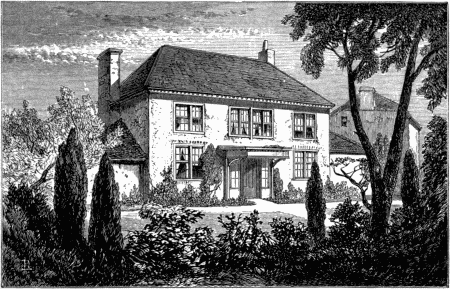
COSGARNE HOUSE.
By this time the old Newcomen engines had been
almost completely superseded, only one of that construction
remaining at work in the whole county of Cornwall.
The prospects of the engine business were, indeed, so
promising, that Boulton even contemplated retiring altogether
from his other branches of business at Soho, and
settling himself permanently in Cornwall.[196]
Notwithstanding the great demand for engines, the
firm continued for some time in serious straits for money,
and Boulton was under the necessity of resorting to
all manner of expedients to raise it, sometimes with
Watt’s concurrence, but oftener without. Watt’s inexperience
in money matters, conjoined with his extreme
timidity and nervousness, made him apprehend ruin and
bankruptcy from every fresh proposition made to him
on the subject of raising money. He was kept so
utterly wretched by his fears as to be on occasions quite
unmanned, and he would brood for days together on the
accumulation of misery and anxiety which his great
invention had brought upon him. His wife was kept
almost as miserable as himself, and as Matthew Boulton
was the only person, in her opinion, who could help him
out of his troubles, she privately appealed to him in the
most pathetic terms:—
“I know,” she wrote, “the goodness of your heart will readily
forgive me for this freedom, and your friendship for Mr. Watt will,
I am sure, excuse me for pointing out a few things that press upon
his mind. I am very sorry to tell you that both his health and
spirits have been much worse since you left Soho. It is all that
I can do to keep him from sinking under that fatal depression.
Whether the badness of his health is owing to the lowness of his
spirits, or the lowness of his spirits to his bad health, I cannot
pretend to tell. But this I know, that there are several things that
prey so upon his mind as to render him perfectly miserable. You
know the bond that he is engaged in to Vere’s house has been the
source of great uneasiness to him. It is still so, and the thought of
it bows him down to the very ground. He thinks that company
has used both you and him very ill in refusing to release him, when
you can give them security for a vast deal more than you are bound
for. Forgive me, dear Sir, if I express myself wrong. It is a
subject I am not used to write on. I know if you can you will set
his mind at rest on this affair. I need not tell you that the seeing
him so very unhappy must of consequence make me so. There is
another affair that sits very heavy on his mind; that is, some old
accounts that have remained unsettled since the commencement of the
business. They never come across his mind but he is rendered
unfit for doing anything for a long time. A thousand times have I
begged him to mention them to you.... I am sure he would suffer
every kind of anxiety rather than ask you to do a thing you seemed
not to approve of. I know the humanity of your nature would
make you cheerfully give relief to any of the human race that was
in distress, as far as was within your power. The knowledge of
this makes me happy in the thought that you will exert every nerve
to give ease to the mind of your friend. Believe me, there is not
on earth a person who is dearer to him than you are. It causes
him pain to give you trouble. The badness of his constitution, and
his natural dislike to business, make him leave many things undone
that he knows ought to be done, and, when it is perhaps too late, to
make himself unhappy at their being neglected.... In his present
state of weakness, every ill, however trifling, appears of a gigantic
size, while on the other hand every good is diminished. Again,
I repeat, that from the certain knowledge I have of his temper,
nothing could contribute more to his happiness and make him go
on cheerfully with business than having everything finished as he
goes along, and have no unsettled scores to look back to and brood
over in his mind.”[197]
Mrs. Watt concluded by entreating that no mention
would be made to her husband of her having written
this letter, as it would only give him pain, and explaining
that she had adopted the expedient merely in
the hope that something might be done to alleviate his
sufferings. This, however, was a very difficult thing
to do. Boulton could remind his hopeless partner of
the orders coming in for engines, and that such orders
meant prosperity, not ruin; but he could not alter the
condition of a mind essentially morbid. Boulton was
himself really in far greater straits than Watt. He
had risked his whole fortune on the enterprise; and
besides finding money for buildings, plant, wages, materials,
and credits, he was maintaining Watt until the
engine business became productive. We find from the
annual balance-sheets that Watt was regularly paid
330l. a year, which was charged upon the hardware
business; and that this continued down to the year
1785. Till then everything had been out-go; the profits
were all to come. It was estimated that upwards of
40,000l. were invested in the engine business before it
began to yield profits; and all this was found by Boulton.
In one of his letters to Matthews he wrote, “I find myself
in the character of P, pay for all,” but so long as
his credit held good, Watt’s maintenance was secure.
So soon, however, as it became clear that the enterprise
would be a success, and that the demand for engines
must shortly become national, the firm was threatened
with a danger of another kind, which occasioned almost as
much alarm to Boulton as it did to Watt. This was the
movement set on foot in Cornwall and elsewhere with
the object of upsetting their patent. Had the engine been
a useless invention, no one could have questioned their
right of property in it; but, being recognised as of boundless
utility, it began to be urged that the public ought
to be free to use it without paying for it. It was
alleged that it had become indispensable for the proper
working of the mines, and that the abolition of the
patent right would be an immense boon to the mining
interest, and enable them to work the ores at a much
reduced cost, while the general industry of the country
would also be greatly benefited.
When Boulton wrote Watt from Cornwall, informing
him that the Cornishmen were agitating the repeal of
the special Act by which their patent had been extended,
and getting up petitions with that object, Watt replied,
“I suspected some such move as this; and you may
depend upon it they will never be easy while they pay
us anything. This is a match of all Cornwall against
Boulton and Watt; and though we may be the better
players, yet they can hold longer out. However, if we
do die, let us die hard.”[198]
But would Parliament really take away that right of
property in the invention which they had granted, and
deprive Watt and his partner of the fruits of their long
labour and anxiety, and their heavy outlay, now that
the superiority of the engine had become established?
Would the legislature consign them to certain ruin
because it would be for the advantage of the Cornish
miners to have the use of the invention without paying
for it? Watt would not for a moment believe this, and
both he and Boulton felt strong in the conviction that
their patent right would be maintained.
Time was, when Watt would have gladly parted with
his invention for a very small sum, and made the engine
free to all, so far as he was concerned. Even after
it had been perfected at Soho, after repeated and costly
experiments, he declared his willingness to sell all
his interest in it for 7000l., which would have barely
remunerated him for the time and labour he had
bestowed upon it, then extending over nearly twenty
years of the best period of his life. And now, after six
years of the partnership had run, and the heavy expenditure
incurred by Boulton in introducing the engine
was still unproductive, he regarded it as cruel in the
extreme to attempt to deprive him of his just reward.
To Boulton he disburdened himself fully, in strong and
sometimes bitter terms. “They charge us,” he said, “with
establishing a monopoly, but if a monopoly, it is one
by means of which their mines are made more productive
than ever they were before. Have we not
given over to them two-thirds of the advantages
derivable from its use in the saving of fuel, and reserved
only one-third to ourselves, though even that has been
still further reduced to meet the pressure of the times?
They say it is inconvenient for the mining interest to be
burdened with the payment of engine dues; just as it is
inconvenient for the person who wishes to get at my
purse that I should keep my breeches-pocket buttoned.
It is doubtless also very inconvenient for the man who
wishes to get a slice of the squire’s land, that there
should be a law tying it up by an entail. Yet the
squire’s land has not been of his own making, as the
condensing engine has been of mine. He has only
passively inherited his property, while this invention
has been the product of my own labour, and of God
knows how much anguish of mind and body;”—
“Why don’t they,” he asked, “petition Parliament to take
Sir Francis Bassett’s mines from him? He acknowledges that he
has derived great profits from using our engines, which is more
than we can say of our invention; for it appears by our books that
Cornwall has hitherto eaten up all the profits we have drawn from
it, as well as all that we have got from other places, and a good sum
of our own money into the bargain. We have no power to compel
anybody to erect our engines. What, then, will Parliament say to
any man who comes there to complain of a grievance he can avoid,
and which does not exist but in his own imagination? Will
Parliament give away our property without an equivalent?
Will they not collect that equivalent from the county of Cornwall?
Will they adjudge them to pay us any less sum than it has cost
ourselves? Will they not further add some reward for the quantity
of life that has been devoted to the pursuit of what is evidently for
the advantage of others, but hitherto has not been for our own?
Lastly, will Parliament compel us to work for anybody without a
remuneration adequate to our experience, or will they oblige us to
labour for any one without our consent? We are in the state of
the old Roman who was found guilty of raising better crops than
his neighbours, and was therefore ordered to bring before the
assembly of the people his instruments of husbandry, and to tell
them of his art. He complied, and when he had done said, ‘These
O Romans, are the instruments of our art; but I cannot bring into
the forum the labours, the sweats, the watchings, the anxieties, the
cares, which produced these crops.’ So, every one sees the reward
which we may yet probably receive from our labours; but few
consider the price we have paid for that reward, which is by no
means a certain annuity, but a return of the most precarious sort.
To put an end, as far as lies in my power, to all disputes with the
people of Cornwall, let them pay my debts and give me a reasonable
sum for the time I have lost, and I will resign my part in their
favour, and think myself well off by the bargain. Or, if you can
find any man who is agreeable to yourself, I’ll sell him my share
on reasonable terms, and, like the sailor, I will promise to contrive
no more fire-engines. In short, my dear Sir, with a good cause in
hand, I do not fear going before Parliament or anywhere. I am
sure that if they did anything they would put us in a better position
than we are in now.”[199]
The petition to Parliament, though much talked
about, was not, however, presented; and the schemers
who envied Boulton and Watt the gains which they
had now the prospect of deriving from the use of their
engine, shortly after resorted to other means of participating
in them, to which we shall hereafter refer.
In the mean time Boulton, at the urgent entreaty of
Watt, who described himself as “loaded to 12 lbs. on the
inch,” returned to Birmingham; though he had scarcely
left before urgent entreaties were sent after him that he
must come back again to Cornwall.[200]
While Boulton was in Cornwall, the principal manufacturers
of Birmingham, dissatisfied with the bad and
dear supply of copper, resolved to form themselves into
a company for the purpose of making brass and spelter;
and they wrote to Boulton offering to raise the requisite
means, provided he would take the lead in the management
of the concern. He could not but feel gratified at
this best of all proofs of the esteem in which his townsmen
held him, and of their confidence in his business
qualities. Boulton, however, declined to undertake so
large an addition to his labours. He felt that he would
soon be an old man, and that it would be necessary for
him to contract rather than extend the field of his operations;
besides, the engine business was already sufficiently
prosperous to induce him to devote to it the chief
share of his attention. But he promised to his Birmingham
friends that he would always be glad to give them
his best advice and assistance. He accordingly furnished
them with a plan of operations, and drew up a scheme
for their consideration, which was unanimously adopted,
and the whole of the share capital was at once subscribed
for. He also made arrangements with his Cornish
friends for a regular supply of copper direct from the
mines on the best terms. On his return to Birmingham,
we find him entering upon an elaborate series of experiments,
to determine the best constituents of brass; in
the course of which he personally visited the principal
calamine works in Wales and Derbyshire, for the purpose
of testing their different produce. He diligently
read all the treatises on the subject, and made inquiries
as to the practice adopted in foreign countries. Finding,
however, that the continuance of his connexion with the
brass company was absorbing more of his time than he
could afford to bestow upon it, he shortly withdrew from
the concern,—partly also, because he was dissatisfied with
what he considered the illiberal manner in which the
managing committee were conducting its affairs.
Another subject which occupied much of Boulton’s
attention about the same time, was the improvement
of engine boilers. At an early period he introduced
tubes in them, through which the heated air of the
furnace passed, thereby greatly increasing the heating
surface and enabling steam to be raised more easily and
rapidly. We find him in correspondence with Watt
on the subject, while residing at Redruth in the autumn
of 1780. He first suggested iron tubes; but Watt
wrote, “I cannot advise iron for the tubes of boilers, but
they may be thought of.”[201] Next Boulton suggested
the employment of copper tubes; to which Watt replied,
“I approve of what you observe about making copper
flanches to the boiler pipes in future, and Ale and Cakes
can easily be converted to that way whenever they put
up a second boiler.” We find Boulton introducing four
copper tubes 20 inches in diameter into the Wheal Busy
boiler, which was 26 feet in length,—the fire passing
through two of the tubes, and returning through the
other two. Here, therefore, we have Boulton anticipating
the invention of the tubular boiler, and clearly adopting
it in practice, before the existence of the locomotive,
for which it was afterwards re-invented. In fact, the
multitubular boiler is but a modification and extension
of Boulton’s principle, as applied by him at so early
a period in the Cornish boilers.
The numerous MS. books left by Boulton show the
care with which he made his experiments, and the scrupulousness
with which he recorded the results. Copies
of his observations and experiments on boilers were
sent to Watt, to be entered by him in “the calculation
book,” in which was recorded the tabulated experience
of the firm. Boulton was also an excellent mechanical
draughtsman, as appears from his tablets, which contain
a number of beautifully executed drawings of engines
and machinery, with very copious and minutely-written
instructions for erecting them. Some of the drawings
of sugar-mills are especially well executed, and delicately
coloured. A rough sketch is given in one of the books,
with a written explanation in Boulton’s hand, of a
mode of applying power in taking canal-boats through
tunnels. It consists of an engine-boat, with toothed
claws attached to it for the purpose of catching metal
racks fastened along the sides of the tunnel, such being
his design for working boats upon canals. While in
Cornwall, he occupied his evenings in drawing sections
of various mines, showing the adits, and the method of
applying the pumping machinery, to which were also
added numerous elaborate calculations of the results of
engine working. He also continued to devise improvements
in the construction and working of the steam-engine,
on which subject he exchanged his views with
Watt at great length. In one of his letters he says:
“I like your plan of making all the principal wearing
parts of tempered steel, and the racks of best Swedish
iron, with the teeth cut out. Query: Would it not be
worth while to make a machine for dividing and cutting
the teeth in good form out of sectors? The iron would
be less strained by that mode of cutting.” At other
times, when the steam-engine subject seemed exhausted,
he proceeded with the designing of road-carriages, in
which he was an adept, filling a quarto drawing-book,
entitled ‘Thoughts on Carriages,’ with sketches of
different kinds of vehicles, some in pencil and Indian
ink, and others in colours, beautifully finished. Such
were the leisure employments of this indefatigably
industrious man.
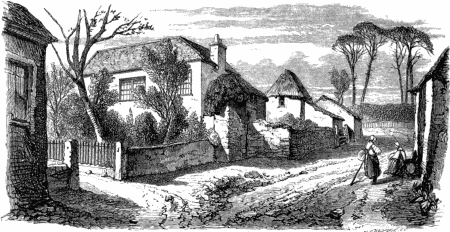
ENTRANCE TO COSGARNE HOUSE.
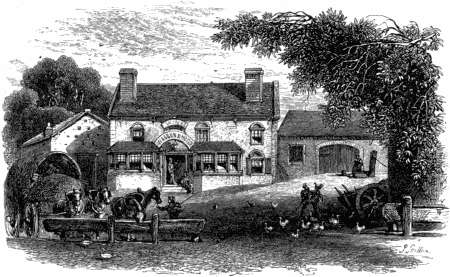
THE ‘WAGGON AND HORSES,’ HANDSWORTH.
Watt’s presence being much wanted in Cornwall, he
again proceeded thither, accompanied by his wife and
family, and arrived at Cosgarne towards the end of
June, 1781. He found that many things had gone
wrong for want of the master’s eye, and it was some
time before he succeeded in putting affairs in order.
The men had been neglecting their work, “going
a-drinking.” Cartwright had “contracted a fever in
his working arm, and been swallowing ale for a cure,”
until he heard Watt had come, when the fever left him.
Mrs. Watt also found occasion to complain of sundry little
grievances, and favoured Boulton with a long catalogue
of them. Gregory and Jessy had caught cold on the
journey, and workmen were hammering about the house
making repairs. There was, however, one gleam of
brightness in her letter: “James’s spirits were surprisingly
mended since his arrival.”
Watt was a most voluminous correspondent. He wrote
Boulton several times a week great folio sheets, written
close, in small hand. The letters must have occupied
much of his time to write, and of Boulton’s to read.
The latter, seeing his partner’s tendency to indulge in
“worrit” about petty troubles, advised him in a kindly
spirit not to vex himself so much about such matters,
but to call philosophy to his aid. Why should he not
occupy some of his spare time in writing out a history
of all his steam-engine contrivances, to be dedicated to
Sir Joseph Banks, and published in the ‘Transactions of
the Royal Society’? But Watt was extremely averse
to writing anything for publication, and the suggestion
was not acted on. Then, knowing Watt’s greatest
pleasure to be in inventing, Boulton in a subsequent
letter advised him to take up afresh, and complete a
plan which they had often discussed, of producing rotary
motion, by which the engine might be applied to work
mills and drive machinery.
Watt had from the first regarded the employment of
the steam-engine in producing continuous rotary motion
as one of its most useful applications, and with this
object he invented his original wheel-engine. No steps
were taken to introduce the invention to practical use;
but it occurred to Watt that the same object might be
better effected by employing the ordinary engine for
the purpose, with certain modifications.[202] The subject
had partially occupied his attention during his first visit
to Cornwall; for we find him writing Boulton from
Chacewater, in 1779, “As to the circular motion, I will
apply it as soon as I can, but foresee that I shall be very
busy shortly, and much out of doors.” On his subsequent
return to Birmingham, after frequent conferences with
his partner on the subject, he proceeded to prepare
a model, in which he made use of a crank connected
with the working beam of the engine to produce
the rotary motion. There was no originality in the
employment of the crank, which was an expedient that
Watt had long before made use of.[203] The crank was,
indeed, one of the most common of mechanical appliances.
It was in daily use in every spinning-wheel,
in every grindstone turned by hand, in every turner’s
and knife-grinder’s foot-lathe, and in every potter’s wheel.
It was one of the commonest,
as it must have been one of
the oldest, of mechanical expedients.
“The true inventor
of the crank rotative
motion,” said Watt, “was
the man who first contrived
the common foot-lathe: applying
it to the engine was
like taking a knife to cut
cheese which had been made to cut bread.”
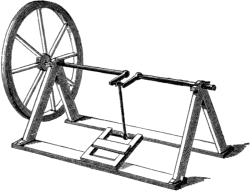
THE CRANK AS APPLIED IN THE
FOOT-LATHE.
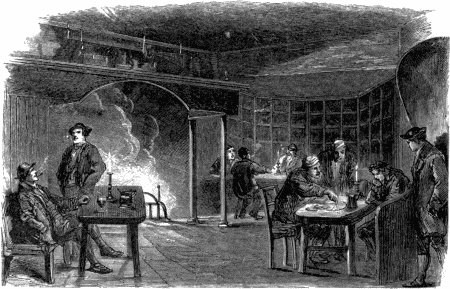
INTERIOR OF THE “WAGGON AND HORSES.”
[By Percival Skelton.]
Though Watt had become very reserved, especially to
strangers, about his inventions, he could not altogether
keep from the knowledge of his workmen the contrivances
on which his thoughts were occupied. He
was under the necessity of employing them to make
patterns after his drawings, from which any ingenious
man might readily apprehend what he was aiming at.
The Soho workmen were naturally curious about the
new inventions and adaptations which Watt was constantly
producing, and these usually formed the subject
of conversation at their by-hours. While the model of
the crank engine was under construction at Soho in
the summer of 1780, a number of the workmen met
one Saturday evening, according to custom, to drink
together at the “Waggon and Horses,” a little old-fashioned,
low-roofed, roadside public-house, still standing
in the village of Handsworth. The men were seated
round the little kitchen-parlour, talking about their
work, and boasting, as men will do over their beer, of
the new and wonderful things which they were carrying
forward in the shops. Dick Cartwright, the pattern
maker, was one of the loudest of the party. He was
occupied upon a model for the purpose of producing
rotary motion, which he declared would prove one of
the best things Mr. Watt had ever brought out. The
other men were curious to know all about it, and to
illustrate the action of the machine, Cartwright proceeded
to make a rude sketch of the crank upon the
wooden table with a bit of chalk. A person who sat in
the kitchen corner in the assumed garb of a workman,
drank in greedily all that the men had been saying;
for there were many eavesdroppers constantly hanging
about Soho, some for the purpose of picking up surreptitious
information, and others to decoy away skilled workmen
who were in the secrets of the manufacture. Watt
himself had never thought of taking out a patent for
the crank, not believing it to be patentable; but the
stranger aforesaid had no such hesitation, and it is said
he posted straight to London and anticipated Watt by
securing a protection for the contrivance.[204]
Watt was exceedingly wroth when he discovered the
trick which had been played him, and he suspected that
Matthew Washborough was at the bottom of it. Washborough
was a Bristol mechanic, who carried on several
branches of mechanical trade, amongst others that of
clock-making on a large scale. Watt had employed
Washborough to make nozzles for several of the Cornish
engines, but was not satisfied with his work; for we find
him writing to his partner, “If Washborough makes no
better engines than he does eduction-pipes, he will soon
be blown: the Wheal Union pipe is the worst job you
ever saw, being worse than Forbes’s, which was very bad;
I scarce know what to do with it.” It would appear from
this that Washborough had begun to make engines,
thereby turning to account the knowledge he had
acquired in Cornwall. One of the first he made was for
the purpose of driving the lathes of his own manufactory
at Bristol; and it affords a clear proof of Washborough’s
ingenuity that in this engine he employed
both the fly-wheel and the crank. He has been styled
the inventor of the fly-wheel, but he was no more its
inventor than he was of the crank; the Irish Professor
Fitzgerald having proposed to employ it as part of a
Papin’s engine as early as the year 1757. Washborough
shortly after erected an engine after the same plan for
a manufacturer on Snow Hill, Birmingham; and then
it was that Watt learned that he had been “bolted out,”
as he termed it, from making use of the crank.
At first he was puzzled what to do to overcome the
difficulty, but his prolific mind was rarely at a loss, and
before many months were over he had contrived several
other methods for effecting rotary motion. “I dare
not, however,” he wrote to Boulton, “make my new
scheme, lest we be betrayed again; I believe we had
best take the patent first.” At the same time Watt
was persuaded that no contrivance could surpass the
crank[205] for directness, simplicity, and efficiency. He was
therefore desirous, if possible, of making use of it in his
rotative engine, as originally proposed; and he wrote to
Boulton, then at Redruth, “I think you ought to call
upon Washborough as you return, and let him know that
we will dispute his having an exclusive right to those
cranks.”[206] Boulton called upon Washborough accordingly,
and gave him notice to this effect. But Watt
hesitated to use the crank after all. Although the contrivance
was by no means new, its application to the
steam-engine was new; and, notwithstanding the unfair
way in which Pickard had anticipated him, Watt
did not like to set the example of assailing a patent,
however disputable, as it might furnish a handle to
those who were at the time seeking to attack his
own. The proposal was made to him that he should
allow the Washborough Company to use his steam-engine
in exchange for their allowing him to use the
crank; but this he positively refused to agree to, as he
felt confident in yet being able to produce a circular
motion without employing the crank at all.
Thus matters stood until the beginning of the year
1781, when Washborough, having entered into an arrangement
with the Commissioners of the Navy to
erect an engine for grinding flour at the Deptford
Victualling Yard,[207] a formal application was made to
Boulton and Watt to apply their engine for the purpose.
Watt protested that he could not bring himself to
submit to such an indignity. If the Commissioners
thought proper to employ him to erect the necessary
engine, rotative motion, and machinery, he would exert
every faculty which God had given him in doing so,
but he “would never consent to hold the candle to
Washborough.”
“Had I esteemed him,” he wrote to Boulton, “a man of ingenuity
and the real inventor of the thing in question, I should not have
made any objection; but, when I know that the contrivance is my
own, and has been stolen from me by the most infamous means, and,
to add to the provocation, a patent been surreptitiously obtained
for it, I think it would be descending below the character of a man
to be found in any way aiding or assisting him in his pretended
invention.... I think, therefore, that you should propose to the
Honourable Board to undertake the direction of the whole; and,
provided you can agree with them about the customary premium
for the savings by our engine, you should do the whirligig part [the
rotative motion] for love. If this proposal should not be accepted,
I beg of you to decline having any concern with it, and leave the
field clear to Washborough. We may perhaps gain more by so
doing than we can lose, as I assure you I have a very mean opinion
of the mechanical abilities of our opponents. They have committed
many gross errors in such of their works as I have had occasion to
know about, and we may get honour by rectifying their mistakes.
Perhaps this may seem to you to savour of vanity. If it does,
excuse it on account of the very provoking circumstances which
have extorted the confession. If these engineers had let us alone, I
should not have meddled with them; but, as it is, I think we should
be wanting in common prudence if we suffered a marriage between
our machine and theirs, and if we did not do all we could to strip
them of their borrowed feathers, which I hope there is justice
enough left in England to enable us to do.”[208]
Boulton acted on his partner’s advice, and declined
the proposed connexion. The Navy Board were placed
in a dilemma by this decision. They then referred
the matter to Mr. Smeaton, and requested him to report
to them as to the most suitable plan of a flour-mill,
and the steam-engine best calculated to drive it. To
the great surprise of Watt as well as Washborough,
Smeaton reported that both their engines were alike
unsuited for such a purpose. “I apprehend,” he said,
“that no motion communicated from the reciprocating
lever of a fire-engine can ever produce a perfect circular
motion, like the regular efflux of water in turning
a water-wheel!” This report relieved the Commissioners.
They abandoned their scheme, and the order for
Washborough’s engine was at once countermanded.[209]
So soon as Watt had got fairly settled at Cosgarne,
in the summer of 1781, he proceeded to work out the
plan of a rotary-working engine. Boulton was making
experiments with the same object at Soho, communicating
to him the results from day to day. He was stimulated
to prosecute the inquiry by the applications which
he received from many quarters for steam-engines
suitable for driving mills. He therefore urged Watt
to complete the invention, and to prepare the drawings
and specification, declaring his readiness at any time to
provide the money requisite for taking out a patent.
“The people in London, Manchester, and Birmingham,”
said he, “are steam-mill mad. I don’t mean to hurry
you, but I think that in the course of a month or two
we should determine to take out a patent for certain
methods of producing rotative motion from the vibrating
or reciprocating motion of the fire-engine,—remembering
that we have four months in which to describe the particulars
of the invention.”[210]
Watt proceeded to put his ideas in a definite shape as
fast as his bad health and low spirits would allow.
Every now and then a fit of despair came upon him
about his liability to the bankers, and so long as it lasted
he was unmanned, and could do nothing. At the very
time that Boulton was writing the letter last quoted,
Watt was thus bewailing his unhappy lot:—
“When I executed the mortgage,” said he, “my sensations were
such as were not to be envied by any man who goes to death in a
just cause; nor has time lessened the acuteness of my feelings....
I thought I was resigning in one hour the fruits of the labour of my
whole life,—and that if any accident befell you or me, I should have
left a wife and children destitute of the means of subsistence, by
throwing away the only jewel Fortune had presented me with....
These transactions have been such a burden upon my mind that I
have become in a manner indifferent to all other things, and can take
pleasure in nothing until my mind is relieved from them; and
perhaps, from so long a disuse of entertaining pleasing ideas, never
may be capable of receiving them any more.”[211]
Boulton made haste to console his partner, and promised
to take immediate steps to relieve his mind of the
anxiety that weighed so heavy upon it; and he was
as good as his word. At the same time he told Watt
that he must not suppose he was the only man in the
world who had cares and troubles to endure. Boulton
himself had, perhaps, more than his share, but he
tried to bear them as lightly as he could. With
his heavy business engagements to meet, his large concerns
to keep going, he was not a man much to be
envied; yet he continued to receive his visitors as
usual at Soho, and to put on a cheerful countenance.
“I am obliged,” he wrote, “to smile, to laugh, to be
good-humoured, sometimes to be merry, and even go to
the play! Oh, that I were at the Land’s End!” Such
was his playful way of reminding Watt of the necessity
of cheerfulness to enable one to get through work
pleasantly.[212] But Watt’s temperament was wholly different.
His philosophy never rose to the height of
taking things easy. He could not cast his cares behind
him, nor lose sight of them; but carried them about
with him by day, and took them to bed with him at
night; thus making life a sort of prolonged vexation—a
daily and nightly misery.
But a new and still more alarming source of anxiety
occurred to disturb the mind of poor Watt, and occasion
him many more sleepless nights. The movement to
abolish the patent by repeal of the Act of Parliament
having broken down, attempts were now made in many
quarters to evade it by ingenious imitations, in which
the principle of Watt’s engine was adopted in variously
disguised forms. But to do this successfully would have
required an inventive faculty almost as potent as that of
Watt himself; and he had drawn the specification of his
patent too carefully to be easily broken through by
the clumsy imitators who made the attempt. It was,
however, only natural that the success of the new engine
should draw the attention of ingenious mechanics to
the same subject. Watt had drawn a great prize,
and why should not they? though they little knew the
burden of sorrow which his prize had brought upon
him. They only knew of the large annual dues—probably
exaggerated by the tongue of rumour—which
were being paid to the patentees for the use of their
engines; and they not unnaturally sought to share in the
good fortune. There might possibly be other mechanical
methods by which the same objects were to be accomplished,
without borrowing from Watt; at all events it
was worth trying. Hence the number of mechanical
schemers who made their appearance almost simultaneously
in all parts of the country, and the number of
new methods of various kinds contrived by them for
the production of motive power.
Watt was very soon informed of the schemes which
were on foot in his immediate neighbourhood—much
too soon for his peace of mind. He at once wrote to
his partner: “Some Camborne gentlemen (supposed
to be Bonze and Trevithick) have invented a new
engine which they say beats ours two-thirds, and one of
the partners has gone to London to procure a patent
for it. A Mr. Vice says he has also invented a new
engine, and that they have stolen his and compounded
it with ours; he intends to take out a caveat against
them.”[213] Though Bonze was an excellent engineer,
and elicited the admiration of Watt himself, it turned
out that he had no concern with the new invention.
Its projectors proved to be the Hornblowers, also engineers
of considerable local repute. Watt had befriended
the family, and employed them in erecting his engines,
by which means they became perfectly familiar with
their construction and mode of action. Jonathan Hornblower
had a large family of sons, of whom Jabez,
Jesse, Jethro, and Jonathan were engineers, like their
father. Jabez, one of the cleverest, had spent some
time in Holland, from whence he had returned with
some grand scheme in his head for carrying out an
extensive system of drainage in that country. Like his
father and the other sons, he was employed in erecting
Watt’s engines,[214] which had the effect of directing his
attention to the invention of a new power which should
supersede that of his employer.
It was for some time doubtful what was the precise
character of the new engine. Indeed the Hornblowers
themselves long remained undecided about its
actual form, being still in the throes of invention.
They knew that they must copy discreetly, so as not to
lay themselves too open to attack; and though they
urged the superiority of their engine so strongly as
to induce several of the mining companies to believe
in them, and even to withhold orders from Boulton
and Watt, they refrained as yet from publishing
their invention. Watt wrote to his partner that he
understood the Hornblowers’ engine was on some new
principle, and the only novelty he could think of
was a caloric air-engine. He therefore asked Boulton
to make all the inquiries he could as to the respective
bulks and prices per 1000 feet of all possible kinds
of air in their most expanded states. “I am much
vexed,” he continued, “by this affair. Jabez does
not want abilities: the rest are fools. If they have
really found a prize, it will ruin us.... Bankruptcy
might ensue to both. But I don’t fear getting
my bread independent of engines, though much easier
with them.”[215] Watt was, however, in error as to the
nature of the Hornblowers’ engine, which he discovered
three days later, when he wrote Boulton,—
“The matter is this: Ever since the ungrateful, idle, insolent
Hornblowers knew anything about our engines, they have laboured
to evade our Act, and for that purpose have long been possessed of
a copy of our specification. They made an attempt at Wheal Maid
two years ago, by connecting two cylinders together and injecting
into one of them, which did not succeed, although they had gathered
together numbers of their friends in order to make a great exhibition.
Since that, Jonathan the coppersmith, who, like Alexander of the
like trade, hath done me much evil, has laboured close at some more
successful evasion, which he says he has now completed and taken
a patent for,—concerning which I hear as follows from public
reports, propagated by Jethro’s confidants:—1st. That Jonathan
Hornblower is the inventor and patentee; that Winwood, Jones and
Company, of Bristol, are his partners and supporters with money (that
Winwood was lately in this country on a sleeveless errand is certain);
that they have made their model work to 14 lbs. on the inch, and
expect it will work to 18 lbs. 2ndly. That they press the piston down
by steam, and maintain they have a right to do so, because, say
they, it can be proved that such was done before my patent.
I suppose by this they allude to Gainsborough’s bauble, which, by-the-by,
was after the patent. If they do not mean this I am at a
loss, as I now declare that I do not know of any one having done it
before the patent except myself. However, it behoves us to inquire
into this, and if the exhibition was not a public one it avails not.
3rdly. That they pretend to condense the steam in the cylinder;
but I have heard that they do it in a separate vessel within the
cylinder, or close to it. 4thly. That they do not use an air or
water pump, from which I conjecture that they let the hot water
down the shaft by a pipe more than 30 feet long, as you know I
proposed but had several objections to. You will remember, and
I dare say Joseph and Peploe also do, that we made the 18-inch
Soho cylinder work by blowing the hot water out of the eduction-pipe
and used no air-pump, but found a waste of steam by so doing.
There is also some confused report about a wheel being employed
on their engine, which makes me suspect that M. Washborough may
be the Bristol man concerned with them.”[216]
Two days later Watt wrote,—“My principal hope is
that almighty Nature will prove Lord Chancellor, and
put a negative on their scheme. Amen, so be it! I
abhor lawsuits, and reckon a cause half lost that is
litigated.”
On the 23rd of July he returned to the subject:—
“The Horners,” said he, “continue bragging of what they are to
do, and I hear the country in general takes part with them, as even
the aversion they have to the Horners does not equal the pleasure
they would feel at our undoing.... The Horners say they can
make a common engine equal to ours, but that their new engine is
one-third better. We must now attend to making use of all the
elastic power of the steam, which, unless I am much deceived, will
save one-half over our best engines, and at any rate it may easily
be applied to work the condenser, which will save about one-eighth.
I will not conceal from you that I am rendered very unhappy by
one thing and another, but fight with it all I can.”
In the mean time Boulton continued to urge Watt to
complete the specification and drawings of his rotative
engine, informing him of the success of the model
which he had now completed at Soho:—
“Though you studied a thousand years,” said he, “I do not
think you could make one ten per cent. better than a small model
with two cones which Joseph has executed after my drawings. It
has little friction, goes sweeter than anything of the kind you have
yet touched, and has not the least shake. It is so perfect that I
don’t consider it worth while even to think of any other for horizontal
motions. I am therefore positively decided in my mind as
to the necessity of taking out a patent and including in it all the
principles and constructions you please; for if it be not secured
soon we may lose it.”[217]
In the same letter, Boulton communicated to Watt the
rumours that had reached him from Scotland of more
inventions of engines that were to beat Watt’s out of the
field. “The cry is still, they come!” said he. “Hatley
from Scotland is going with Lord Dunmore to Virginny;
says that he and somebody else in Scotland have invented
an engine that is three times better than yours.”
Boulton recommended that a search should be made at
the Patent-Office, to ascertain what was going on in
new engine patents. Watt entirely approved of this,
and urged that the search should be made at once. “I
do not think we are safe a day to an end,” he wrote,
“in this enterprising age. One’s thoughts seem to be
stolen before one speaks them. It looks as if Nature
had taken an aversion to monopolies, and put the same
thing into several people’s heads at once to prevent
them; and I begin to fear that she has given over
inspiring me, as it is with the utmost difficulty that I
can hatch anything new.”
Notwithstanding this confession on the part of Watt,
his inventive faculties were really never at any period
of his life more vigorous than now; for he was rapidly
maturing his rotative engine, with its various ingenious
methods for securing circular motion; and working out
the details of the double-cylinder expansion engine, with
its many admirable contrivances hereafter to be described.
Boulton continued to receive applications at
Soho, from various quarters, for engines capable of
working flour-mills and other machinery, and Watt
himself was urged by like inquiries from manufacturers
in Cornwall. “Mr. Edwards,” he wrote Boulton, “waits
impatiently the success of our rotative machine. He
wants a power able to lift a hammer of 700 lbs., 2 feet
high, 120 times per minute.... In relation to the
circular engine, an experiment should be made on a
large scale, and to work a hammer. I want your ideas
on that head.”[218] A fortnight later, Watt had matured
his own ideas, and made the necessary declaration of
his invention before a magistrate, preliminary to making
the usual application for a patent.[219]
Watt was exceedingly busy about this time in superintending
the erection of new engines. No fewer than
twelve were in progress in different parts of the county.
As he travelled about from one mine to another on
horseback, and spent a good deal of his time in the open
air, his mind was diverted from preying upon itself
according to his ordinary habit, and his health and
spirits improved accordingly. Boulton was equally busy
at Soho, where he was erecting a powerful engine for
blowing the furnaces at Walker’s ironworks at Rotherham,
and another for Wilkinson’s forges at Bradley, in
which he proposed to employ a double cylinder, with a
double crank[220] and a pair of fly-wheels. At intervals
he went into Yorkshire, Lancashire, and Shropshire, to
look after various other engines in progress; writing
Watt cheerful letters as to the improving prospects of
the firm. He found the steam-engine everywhere
gaining in public estimation. “The more it is known,”
he wrote, “the more it will be in demand. As to the
scheme of the Hornblowers, they shall sooner press me
down into the earth than they shall press down a piston
with steam.” And again, “Give yourself no uneasiness
about the Horners’ engine. Our title to the invention is
as clear as can be; and it is as well secured as an Act of
Parliament can make it—
“Doubt that the sun is fire,
Doubt all the powers of sight,
Doubt truth to be a lyer,
But never doubt our right.”
Watt’s first surmise, that the Hornblowers intended
to work their engine by heated air or gas, had set
Boulton upon a series of inquiries and experiments on
the subject, in which he was assisted by Dr. Priestley,
who had shortly before settled in Birmingham, and was
a willing co-operator in all investigations of this nature.
Their object was to ascertain whether it was practicable
to produce mechanical power by the absorption and
condensation of gas on the one hand, and by its disengagement
and expansion on the other.
“What you propose,” Watt wrote, “is exceeding probable, and
akin to what I have long contemplated—the use of mixed air
and steam, which have a wonderful expansion and contraction.
Nevertheless, I fear that there is in all such cases a proportional
assumption of latent heat; but be it tried though it be beginning a
new series of vexations and expense.... I suspect that a forcible
compression would hinder the gas from separating from the water,
and on the contrary any tolerable degree of vacuum would hinder
the water from attracting it; but perhaps part of both may be used....
My greatest hope is in the expansive engine with double or
single cylinder, which I consider as proved by many facts, and
shall send you my ideas of the execution of it very soon. At the
same time I am clear to take the air patent, which, as I have worded
the petition, may include some other improvements on the steam-engine....
I hope my last letters have relieved you, as the
knowledge of the Horners’ being a steam-engine working on our
principle relieved me. I have some trust in the judges, though I
have little in the law; and I think impartial people will regard us
as injured persons, and not suffer the thief of our horse to escape
because he has painted him of another colour.”[221]
Watt’s fears for his patent were about this time
excited anew by the great Arkwright trial, in which
Arkwright was nonsuited, and compelled to forego the
rights derived from his improvements and combinations
of spinning-machinery. The principal ground on which
the patent was set aside was that the specification was
unintelligible. On this, Watt observed,—
“Though I do not love Arkwright, I don’t like the precedent of
setting aside patents through default of specification. I fear for our
own. The specification is not perfect according to the rules lately
laid down by the judges. Nevertheless, it cannot be said that we
have hid our candle under a bushel. We have taught all men to
erect our engines, and are likely to suffer for our pains.... I begin
to have little faith in patents; for, according to the enterprising
genius of the present age, no man can have a profitable patent but
it will be pecked at, and no man can write a specification of a fire-engine
that cannot be evaded, if the words and not the true intent
and meaning be attended to. As kissing goes by favour, and as, in
dubious cases, men are actuated by their prejudices, so, where a blue
is very like a green they may decide either way.”[222]
Watt continued to be alarmed by the rumours of
the forthcoming Hornblowers’ engine. “I have heard,”
he wrote, “that a female confidant of Jonathan’s has
seen the engine, and says that they evaporate half
a hogshead of water with one ounce of coals! ...
that in a few days they are to publish in print what
their invention is, illustrated with a copper-plate.
Then we shall see and admire, if God pleaseth; I hope
we shall not believe and tremble.” Later he wrote,—“Our
cause is good, and yet it has a bad aspect.
We are called monopolists, and exactors of money from
the people for nothing. Would to God the money and
price of the time the engine has cost us were in our
pockets again, and the devil might then have the
draining of their mines in place of me. Yet all are not
alike. Some are just, and I believe do not grudge us,
and some are friendly. All this is to no purpose. The
law must decide whether we have property in this affair
or not, and we must submit to what we cannot help.”[223]
At length Watt learnt the precise nature of the Hornblowers’
invention. “It is no less,” he wrote Boulton,
“than our double-cylinder engine, worked upon our
principle of expansion.” This was an old idea of Watt’s,
which he had pursued while labouring upon his model
at Kinneil. “It is fourteen years,” he said, “since I
thought of the double-cylinder engine, and I think that
I mentioned it to Mr. Smeaton, when I explained the
expansion engine to him in your parlour, some years
ago. Wm. Murdock and Mr. Henderson can testify to
my having mentioned it to them; but this of the
Horners seems to be a different thing, being hung on
the same beam.”[224] As early as May, 1769, he had communicated
to Dr. Small a clear and explicit description
of his method of working steam expansively; and he
adopted the principle in the Soho engine, in 1778, as
well as in the Shadwell engine erected in the same year.
He was, however, prevented carrying it out extensively
in practice by the inexpertness of the workmen.
“Though the effect of the steam,” he explained to a correspondent,
“is thereby increased 50 per cent. (by theory
100 per cent.), it cannot be done without rendering the
machine more complicated than we wish; and simplicity
is a most essential point in mechanics. There are other
contrivances known to us which would increase the
effect in an inferior degree, say from one-fourth to one-sixth,
but they are all attended with peculiar inconveniences
which forbid their use until the illiterate and
obstinate people who are intrusted with the care of the
engines become more intelligent and better acquainted
with the machine.”[225]
Though suffering much from his usual headaches,
which frequently disabled him from thinking, Watt
finished the drawings of the rotary engine in a week,
and forwarded them to Boulton at Soho. “I believe,”
he said in a later letter, “a well-regulated expansive-engine
is the ne plus ultra of our art.” But he intimated
that a new trouble had come upon him in the shape of
another inventor of a steam-engine in which all the distinctive
principles of his own invention were embodied.
“If he be engine mad,” said Watt, “and if it be agreeable
to you, he shall have my share of them, provided
he will come to my price. I wish to retire, and eat my
cake in peace, but will not go without the cake. All
mankind seem to have resolved to rob us. Right or
wrong, they will pluck the meal from our mouths.”[226]
Boulton, on his next journey to London, called upon the
alleged inventor, a Mr. Ewer, and declared to Watt that
the invention, so far as it was new, was not worth a
farthing, and that all that was good in it was borrowed
from their engine. “Though the white marks on your
cow or your horse,” said he, “may be changed to black,
the cow and horse are not the less your property.” He
therefore counselled Watt to relieve himself of all
anxiety on this account. Watt replied, “Ewer seems to
have a genius more capable of inventing than of prudently
examining the merits of his invention. Poets
lose half the praise they would otherwise get did they
but tell us what they discreetly blot. We must publish
a book of blots.”
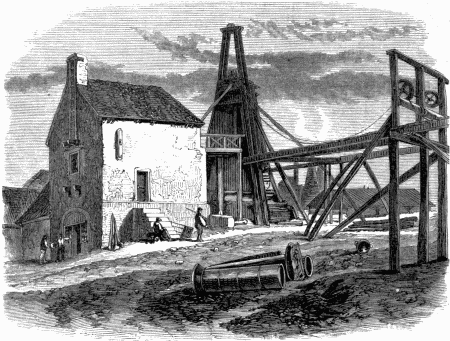
OLD ENGINE-HOUSE AT DALCOATH.
[By R. P. Leitch.]
Meanwhile Watt went on inventing, even while he
was complaining of his inability to invent, and of the
uselessness of inventing. Invention had grown into a
habit with him, which he could not restrain. In the
very letter in which he wrote “It is of no use inventing—everybody
is seizing upon our schemes,” he communicated
to Boulton that he had contrived a machine, then
erecting at Dalcoath, for the purpose of stopping the
engine when at full speed, when any accident happened
to the rods or outside chains,—first taking away the
power, and then holding the bob fast whenever it might
be at the turn.[227] A few days later he communicated
that he had contrived a new way of opening the regulators.
He was also finishing his plan of the new
equalising beam, and the double expansion engine,
which he requested might be proceeded with at once.
“I have shown the equalising beam,” said he, “to no
person whatever. Please push it on. It is our dernier
ressort, and may perhaps be all that villany will leave
us, and that not long.”[228] Boulton wrote back, bidding
his partner to be of good heart. “If our spirits don’t
fail us,” said he, “I think our engine won’t.”
At the same time Watt was inventing his new
jointed top-working gear, which he reported answered
exceedingly well with the Dalcoath engine; and, in
pursuance of an idea thrown out by Boulton, he perfected
the model of a horizontal-axled elliptical with one
pulley, which he described as performing à merveille,
being free from all untoward frictions. He was also
busy inventing a new method of an equalising beam,
by causing the gudgeon to change its place; and
another by means of a roller acting upon a curve in
the nature of the working gear. Besides his experiments
in mechanics, he was prosecuting investigations
as to the properties of nutgalls in combination with
various chemical substances, for the purpose of obtaining
the best kind of ink for use with his copying machines;
and at another time we find him contriving various
iron cements for joints, confessing that he had “lost all
faith in putty;” the result of which was his discovery of
the well-known metallic cement.
In the correspondence between the partners on these
various topics, we seem to see the ideas out of which so
many inventions grew, in their various stages of birth,
growth and development. They concealed nothing
from each other, but wrote with the most perfect
unreserve. Each improved on the other’s ideas,—Watt
upon Boulton’s, and Boulton upon Watt’s; both experimenting
on the same subject at the same time, and
communicating the results in the most elaborate detail.
The phrase often occurs in their letters: “I write thus
fully that you may see exactly what is passing in my
mind.” The letters were sometimes of extraordinary
length, one of Boulton’s (dated 25th September, 1781)
extending to eight pages folio, closely written, containing
upwards of 4000 words. Scarcely a day passed
without their spending several hours in writing to each
other. Boulton also kept up a correspondence with
Mrs. Watt, in addition to his elaborate letters to her
husband. The lady entered into various matters of personal
interest, describing her occupations and domestic
pursuits, and communicating the state of her husband’s
health, which was a matter of no less interest to Boulton
than to herself.
As the autumn set in with its fogs and rains, Watt’s
headaches returned with increased severity, and he
repeatedly complained to Boulton of being “stupid and
ill, and scarcely able to think.” “I tremble,” said he,
“at the thought of making a complete set of drawings.
I wish you could find me out a draughtsman of abilities;
as I cannot stand it much longer.”[229] Watt’s temper was
also affected by the state of his health; and he confessed
that he felt himself not at all cut out for the
work he had to do, so far as related to business: “I am
not philosopher enough,” he said, “to despise the ills of
life; and when I suffer myself to get into a passion,
I observe it hurts me more than it does anybody else.
I never was cut out for business, and wish nothing so
much as not to be obliged to do any; which perhaps
will never fall to my lot; therefore I must drag on a
miserable existence the best way I can.”[230]
Watt was very busy at this time in preparing the
specification and drawings of the circular motion, which
he said he found an extremely difficult job owing to the
distracted state of his head. The letters patent for
the invention had been secured on the 25th October,
1781, and he had four months allowed him in which to
prepare and lodge the full description. He laboured at
his work late and early, his mind being for months in the
throes of invention. In the beginning of November we
find him writing to Boulton, sending him the “first three
yards of the specification,” written out on folio sheets
joined together. Watt’s letters to his partner at this
time contain numerous rough sketches of his proposed
methods for securing circular motion without using the
crank, from which he conceived himself to be in a
measure precluded by Pickard’s patent. He devised
no fewer than five distinct methods by which this object
might be accomplished, by means of wheels of various
sorts rotating round an axis.
The method eventually preferred
was the one invented
by Wm. Murdock, and commonly
known as the sun and
planet motion.[231] “It has the
singular property,” said Watt,
“of going twice round for each
stroke of the engine, and may
be made to go oftener round
if required without additional
machinery.”
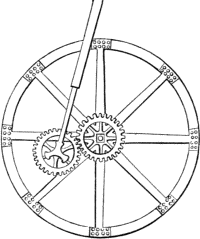
SUN AND PLANET MOTION.
Rough sketches of these various
methods were forwarded to Soho in order that the
requisite careful drawings of them might be prepared in
time to be lodged with the specification; but when they
reached Watt in Cornwall, he declared them to be so
clumsily executed that he could not for very shame send
them in; and though greatly pressed by mining business,
and suffering from “backache, headache, and lowness
of spirits,” he set to work to copy them with his own
hands. He worked up his spare time so diligently,
that in ten days he had the plans finished and returned
to Boulton, whom he wrote saying that he had improved
the construction of several of the machines,
and “got one copy of the specification drawing finished
in an elegant manner upon vellum, being the neatest
drawing he had ever made.”[232] The necessary measures
being then taken to perfect the patent, it was duly
enrolled on the 23rd February, 1782.
During the time that Watt was busy completing the
above specification and drawings, his mind was full of
other projects, one of which was the perfecting of his
new expansive engine.[233] It is curious to find him, in
his letters to Boulton, anticipating the plan of superheating
the steam before entering the cylinders, which
has since been carried into effect with so much success.
By the middle of March he had sufficiently matured
his ideas of a reciprocating expansive engine to enable
him to take out letters patent, and the invention was
enrolled on the 4th of July in the same year. It
included the double engine and double-acting engine
(steam pressing the piston upwards as well as downwards),
the employment of steam on the expansive
principle, various methods of equalising the power of
the engine, the toothed rack and sector for guiding
the piston-rod, and a rotative engine or steam-wheel.
While perfecting these beautiful adaptations, Watt was
often plunged in the depths of distress through many
causes,—by sickness, headaches, and low spirits; by
the pecuniary difficulties of the firm; by the repeated
attempts of the Cornish miners to lower their dues; and
by threatened invasions of his patent from all quarters.
Another of his worries was the unsteadiness of his
workmen. His letters to Boulton were full of complaints
on this score. Excepting Wm. Murdock, who
was in constant demand, there was scarcely one of them
on whom he could place reliance. “We have very
little credit, indeed,” said he, “in our Soho workmen.
James Taylor has taken to dram-drinking at a most
violent rate,—is obstinate, self-willed, and dissatisfied.”
And again, “Cartwright’s engine has been a continued
scene of botching and blunders. J. Smith and the rest
are ignorant, and all of them must be looked at daily,
or worse follows. Had I had any one man of common
prudence and experience, who would have attended
from morning till night, these things might have been
avoided, and my life would have been more comfortable.
As things are, it is much otherwise.”[234] Three months
later, matters had not mended. J. Smith is pronounced
“a very slow hand,” and “J. Taylor is sometimes three
days together at the alehouse, except when he judged I
should be going my rounds.... Dick Cartwright
also continues too much devoted to beer.... I have
read all our men lectures upon industry and good
hours, though I fear it will not be to much purpose;
idleness is ingrained in their constitution.”[235] Boulton
wrote to him to “send home the most rascally of the
Sohoites;” but this was impracticable, as better men to
replace them were not at that time to be had. Things
were quite as bad at Soho itself; for early in 1782 we
find Boulton writing thus: “The forging-shop wants a
total reformation; Peploe and others constantly drunk;
spoke mildly to them at first, then threatened, and am
now looking out for good hands, which are very
scarce.”[236]
William Murdock was by far the ablest and most
efficient of the Soho men, and won golden opinions
in all quarters; so much so, that he was in constant
request. We find him described as “flying from mine
to mine,” putting the engines to rights. If anything
went wrong, Murdock was immediately sent for. He
was active, quick-sighted, shrewd, indefatigable, and an
excellent workman. His wages, down to 1780, were
only 20s. a week, and, thinking himself worth more, he
asked for an advance to two guineas. Boulton, instead
of refusing, adroitly managed to obtain a present of ten
guineas from the owners of the United Mines, to which
he added other ten, in acknowledgment of the admirable
manner in which he had erected their new engine; Mr.
Beauchamp, the Chairman of the Company, having
publicly declared that “he regarded William as the
most obliging and industrious workman he had ever
known.” Though Murdock’s wages were not then
raised, and though Bonze, the Cornish engineer—a man
of means as well as of skill and experience—invited
him to join in an engineering partnership, William
remained loyal to the Boulton and Watt firm, and in
due time he had his reward.
Murdock’s popularity with the Cornishmen increased
so much that Watt seems to have grown somewhat
jealous of him, for when William was to be had, they
preferred him to Watt himself.[237] At Wheal Virgin,
the adventurers insisted upon having him all to themselves;
but this was not practicable, as there were other
engines in progress requiring constant attention,—Wheal
Crenver, which Watt described as “in the
enemy’s country, Pool hardly completed yet, and Dalcoath
in its childhood.”
“I cannot now leave Wheal Virgin a single day,” wrote Watt,
“without running the risk of some vile blunder, particularly as the
boilers are now setting. Wm. Murdock was at Wheal Virgin one
day this week, and that day was taken up with Mr. Wedgwood,[238] so
that it was partly lost. Yesterday he was taken away by Crenver
people and is not returned. I fear I cannot get much of his help,
and I assure you I need it much, for there cannot be a greater
plague than to have five engines making by ignorant men and no
helpmate to look after them. I have been tolerably well these few
days, but cannot get up my spirits, from having too much to think
upon.”
Combined with the troubles arising out of the perversities,
blunderings, and bad conduct of his workmen,
Watt had also to struggle against torment of mind and
body, aggravated by bad news from home. Boulton
was in the crisis of his troubles with his partner
Fothergill, from which he was desperately struggling
to shake himself free.[239]
Watt was made additionally miserable by the state of
the bankers’ account, which was still overdrawn to a
very large amount. The bankers were urgent for
repayment, but neither of the partners saw where the
money was to come from. Watt again thought of
giving up altogether, and selling his share of the
business as the only means of relief which presented
itself.
“I am almost moved,” he wrote, “if Lowe, Vere, and Williams
will free me from any demands on my future industry, to give up
my present property altogether, and trust to Providence for my
support. I cannot live as I am with any degree of comfort. The
want of the superfluities of life is a trifle compared with continual
anxiety. I do not see how you can pay L. V. & W. 1000l. per
quarter; I am sure it cannot be from the engine business, unless
we can reduce the amount of our general expenses to 0 and live
upon air ourselves.... Though you and I should entirely lose this
business and all its profits, you will get quit of a burdensome debt;
and as both of us lived before it had a being, so we may do afterwards.
Therefore consider what can be done, and do it without
reluctance, or with as little as you can; and depend upon it that I
am sincerely your friend, and shall push you to nothing that I do
not think to be for your advantage.”[240]
Two days later, while still in a heavily desponding
humour, he wrote thus:—
“If matters were to come to the worst, many methods may be
fallen upon whereby we may preserve some consequence in the
world. A hundred hours of melancholy will not pay one farthing
of debt. Summon up your fortitude and try to turn your attention
to business, and to correct the abuses at Soho.... All the idlers
should be told that in case they persevere in want of attention, then
dismission must ensue.... The Soho part of the business has been
somehow a perpetual drain to us, and if it cannot be put on a better
footing, must be cut off altogether by giving out the work to be
done by others.”[241]
To add to their troubles, a fire broke out in the house
of Boulton and Watt’s London agent for the sale of their
copying machines, and the building, with its contents,
was burnt to the ground, thereby causing a loss to the
firm of above a thousand pounds. The mining trade
was also wretchedly bad in Cornwall, several of the
more important mines being unproductive, while ore
was selling at low prices. The adventurers were
accordingly urging Watt to abate the agreed dues for
the use of their engines, and in several cases threatened
to close the mines unless he did so. The United Mines
asked to be reduced 50l. a month. Watt having refused
to make the abatement, the mine was ordered to be
stopped, on which he consented to give up the dues
altogether for a period of six months. “There seemed,”
he wrote to Boulton, “to be no other course, if we
would maintain our right, and at the same time do
justice to the poor people, who must otherwise absolutely
starve, and are already riotously disposed through the
stopping of Wheal Virgin.”[242] “In short,” said he,
“almost the whole county is against us, and look upon
us as oppressors and tyrants, from whose power they
believe the horned imps of Satan are to relieve them.”
Watt was indeed thoroughly sick of Cornwall, and
longed to get back to Birmingham. He confessed he
did not see how, under the present state of things, he
could be of any more use there. The weather was very
tempestuous, and he felt the fatigue of travelling from
mine to mine too much for him to endure. On the 4th
of April he wrote,—“I returned from the coast to Cosgarne
last night with an aching head, after a peregrination
of two days in very stormy weather.” “Upon the
whole,” he wrote to Boulton, “I look upon our present
Cornish prospects as very bad, and would not have you
build too much upon them nor upon the engine business,
without some material change. I shall think it prudent
to look out for some other way of livelihood, as I expect
that this will be swallowed up in merely paying its
burdens.”[243] Watt, accordingly, finding that he could
do no more good in Cornwall, left it about the middle
of April, and returned with an aching head and heavy
heart to Birmingham.
The battle of the firm had hitherto been all up-hill.
Nearly twenty years had passed since Watt had made
his invention. His life since then had been a constant
struggle, and it was a struggle still. Thirteen years
had passed since the original patent had been taken
out, and seven since the Act had been passed for its
extension. But the engine had as yet yielded no
profit, and the outlay of capital continued. Notwithstanding
Boulton’s energy and resources, the partners
were often in the greatest straits for money, and sometimes,
as Saturday nights came round, they had to beat
about among their friends for the means of paying the
workmen’s wages.
Though Watt continued to imagine himself on the
brink of ruin, things were not really so gloomy as
he supposed. We find Boulton stating in a confidential
letter to Matthews, that the dues payable on
the pumping-engines actually erected in 1782 amounted
to 4320l. a year; and that when all the engines in
progress had been finished, they would probably amount
to about 9000l. It is true, the dues were paid with
difficulty by the mining interest, still in a state of
great depression, but Boulton looked forward with confidence
to better days coming round. Indeed, he already
saw his way through the difficulties of the firm, and
encouraged his doleful partner to hope that in the course
of a very few years more, they would be rid of their
burdens.
As Cornwall was, however, now becoming well supplied
with pumping-engines, it became necessary to open
up new branches of business to keep the Soho manufactory
in full work. With this object, Boulton became more
and more desirous of applying the engine to the various
purposes of rotary motion. In one of his visits to
Wales, in 1781, he had seen a powerful copper-rolling
mill driven by water, and when told that its defect was
that it was liable to be stopped in summer during drought,
he immediately asked—“Why not use our engine? It
goes night and day, summer and winter, and is
altogether unaffected by drought.” Immediately on his
return home, he made a model of a steam rolling-mill,
with two cylinders and two beams, connecting the
power by a horizontal axis; and by the end of the year
he had a steam forge erected at Soho on this plan.
“It answers very well,” he wrote to Matthews, “and
astonishes all the ironmasters; for, although it is a
small engine, it draws even more steel per day than
a large rolling-mill in this neighbourhood draws by
water.” Mr. Wilkinson was so much pleased with it
that he ordered one to be made on a large scale for the
Bradley ironworks; and another was shortly after
ordered for Rotherham. But the number of iron mills
was exceedingly limited, and Boulton did not anticipate
any large extension of business in that quarter. If, however,
he could once get the rotary engine introduced as
the motive power for corn and flour mills, he perceived
that the demand would be considerable. Writing to
Watt on the subject, he said, “When Wheal Virgin is
at work, and all the Cornish business is in good train,
we must look out for orders, as all our treaties are
seemingly at an end, having none now upon the tapis.
There is no other Cornwall to be found, and the most
likely line for increasing the consumption of our engines
is the application of them to mills, which is certainly an
extensive field.”
Watt, on his return to Birmingham from Cornwall,
proceeded to embody his plan for securing rotary motion
in a working engine, so that he might be enabled to
exhibit the thing in actual work. He was stimulated to
action by the report which reached his ears that a
person in Birmingham had set agoing a self-moving
steam rotator, in imitation of his, on which he exclaimed,
“Surely the Devil of Rotations is afoot! I hope he
will whirl them into Bedlam or Newgate.”[244] Boulton,
who had by this time gone to Cornwall for the winter,
wrote to him from Cosgarne, “It is certainly expensive;
but nevertheless I think, as we have so much at stake, that
we should proceed to execute such rotatives as you have
specified.... You should get a good workman or two
to execute your ideas with despatch, lest they perish.
The value of their wages for a year might be 100l., but
it would be the means of our keeping the start that we
now have of all others. But above all, there is nothing
of more importance than the perfect completion of the
double expansive reciprocating engine as soon as may
be.”[245] Watt replied that he was busily occupied in getting
the rotative motion applied to one of the Soho engines.
“These rotatives,” said he, “have taken up all my time
and attention for months, so that I can scarcely say that
I have done anything which can be called business.
Our accounts lie miserably confused. We are going on
in a very considerable weekly expense at Soho, and I
can see nothing likely to be produced from it which will
be an equivalent.” Speaking of the prospect of further
improvements, he added, “It is very possible that,
excepting what can be done in improving the mechanics
of the engine, nothing much better than we have
already done will be allowed by Nature, who has fixed
a ne plus ultra in most things.”[246]
While thus hopelessly proceeding with the rotative
engine, Watt was disquieted by the intelligence which
reached him from Boulton, as to the untoward state of
affairs in Cornwall. At some of the most important
mines, in which Boulton and Watt held shares, the
yield had considerably fallen off, and the price of the
ores being still very low, they had in a great measure
ceased to be remunerative. Hence appeals were made
to Boulton on all sides for an abatement of the engine
dues. Unwilling to concede this, the adventurers proceeded
to threaten him with the Hornblowers, whose
engine they declared their intention of adopting. As,
however, Boulton and Watt’s engines were all going
exceedingly well, and as the Hornblowers had not yet
been able to get one of their boasted engines to work
satisfactorily,[247] the adventurers hesitated for the present
to take any overt steps in the matter.
Boulton had a long and disagreeable battle to fight
with the adventurers on this point, which lasted for
many months, during which the Hornblowers continued
to stimulate them with the agreeable prospect of
getting rid of the dues payable in respect of the savings
of fuel by the condensing engines. Boulton resisted
them at every point single-handed; the battle being, as
he said, “Boulton and Watt against all Cornwall.”[248] He
kept Watt fully informed from day to day of all that
passed, and longed for more rapid means of communication,—the
postal service being then so defective that no
less than thirteen days elapsed before Boulton, at Truro,
could receive an answer from Watt at Birmingham.
On one occasion we find Watt’s letter eleven days on
the road between the two places. The partners even
had fears that their letters were tampered with in
transit; and, in order to carry on their correspondence
confidentially, Watt proposed to employ a shorthand
alphabet, which he had learnt from Dr. Priestley, in
which to write at least the names of persons, “as our
correspondence,” he observed, “ought to be managed
with all possible secrecy, especially as to names.”
Boulton, as usual, led a very active life in Cornwall.
Much of his time was occupied in riding from
mine to mine, inspecting the engines at work, and
superintending the erection of others. The season
being far advanced, the weather was bad, and the
roads miry; but, wet or dry, he went his rounds. In
one of his letters he gives an account of a miserable
journey home on horseback, on a certain rainy, windy,
dark night in November, when he was “caught in water
up to 12 hands.” “It is very disagreeable,” he adds, “that
one cannot stay out till dark upon the most emergent
business without risking one’s life.” But once at home
he was happy. “The greatest comfort I find here,” he
says, “is in being shut out from the world, and the
world from me. At the same time I have quite as
much visiting as I wish for.” One of his favourite
amusements was collecting and arranging fossils, some
for his friend Wedgwood, and others for his own “fossilry”
at Soho. Boulton was well supported out of
doors by William Murdock, now regarded as “the right
hand” of the concern in Cornwall.
“Murdock hath been indefatigable,” he wrote Watt, “ever since
they began [at Wheal Virgin new Engine]. He has scarcely been
in bed or taken necessary food.... After slaving day and night on
Thursday and Friday, a letter came from Wheal Virgin that he
must go instantly to set their engine to work or they would let out
the fire. He went and set the engine to work: it worked well for
the five or six hours he remained. He left it and returned to the
Consolidated Mines about eleven at night, and was employed about
the engines till four this morning, and then went to bed. I found
him at ten this morning in Poldice Cistern, seeking for pins and
casters that had jumped out, when I insisted on his going home to
bed.”[249]
On one occasion, when an engine superintended by
Murdock stopped through some accident occurring to
it, the water rose in the mine, and the miners were
drowned out. Upon this occurring, they came “roaring
at him” for having thrown them out of work, and
threatened to tear him to pieces. Nothing daunted, he
went through the midst of the men, and proceeded to
the invalided engine, which he succeeded in very shortly
repairing and setting to work again. The miners were
so rejoiced that they were carried by their feelings
into the opposite extreme; and when he came out of
the engine-house they cheered him vociferously, and
insisted upon carrying him home on their shoulders
in triumph!
About this time, Boulton became increasingly anxious
to ascertain what the Hornblowers were doing. They
continued to brag of the extraordinary powers of the
engine erected by them at Radstoke, near Bristol,
whither he proposed to go, to ascertain its construction
and qualities, as well as to warn the persons who
were employing them as to the consequences of their
infringing the existing patent. But he was tied to
Cornwall by urgent business, and could not leave his
post for a day. “During the forking of these two great
mines,” said he, “I dare not stir two miles from the
spot, and it will yet be six weeks before I regain my
liberty.”[250] He determined, therefore, to send over
James Law, a Soho man on whom he could rely, to
ascertain, if possible, the character of the new engine,
and he also asked his partner Watt to wait upon the
proprietors of Radstoke so soon as he could make it
convenient to do so. Law accordingly proceeded to
Radstoke, and soon found out where the engine was;
but as the Horners were all in the neighbourhood,
keeping watch and ward over it turn and turn about,
he was unable to see it except through the engine-house
window, when it was not working. He learnt, however,
that there was something seriously wrong with
it, and that the engineers were considerably crestfallen
about its performances.
Watt proceeded to Bristol, as recommended by his
partner, for the purpose of having a personal interview
with Hornblower’s employers. On his arrival, he
found that Major Tucker, the principal partner, was
absent; and though he succeeded in seeing Mr. Hill,
another of the partners, he could get no satisfactory
reply from him as to the intentions of the firm with
respect to the new engine. Having travelled a hundred
miles on his special errand, Watt determined not to
return to Birmingham until he had seen the principal
partner. On inquiry he found that Major Tucker had
gone to Bath, and thither Watt followed him. At Bath
he found that the Major had gone to Melcompton. Watt
took a chaise and followed him. The Major was out
hunting; and Watt waited impatiently at a little alehouse
in the village till three o’clock, when the Major
returned—“a potato-faced, chuckle-headed fellow, with
a scar on the pupil of one eye. In short,” said Watt,
“I did not like his physiog.” After shortly informing
the Major of the object of his visit, who promised to
bring the subject under the notice of his partners at a
meeting to be held in about three weeks’ time, Watt,
finding that he could do no more, took his leave; but,
before he left Bristol, he inserted in the local papers an
advertisement, prepared by Boulton, cautioning the
public against using the Hornblowers’ engine, as being
a direct infringement of their patent. For the present,
indeed, there seemed but little reason to apprehend
danger from the Hornblowers, whose engine was still
undergoing alterations in detail, if not in principle; and
it appeared doubtful, from the trials which had been
made of it, whether it would ever prove an economical
working engine.
Watt then returned to Birmingham, to proceed with
the completion of his rotary motion. Boulton kept
urging that the field for pumping-engines was limited,
that their Cornish prospects were still gloomy, and that
they must very soon look out for new fields. One of
his schemes was the applying of the steam-engine to
the winding of coals. “A hundred engines at 100l.
a year each,” he said, “would be a better thing than all
Cornwall.” But the best field of all, he still held, was
mills. “Let us remember,” said he, “the Birmingham
motto, to ‘strike while the iron is hot.’”
Watt, as usual, was not so sanguine as his partner,
and rather doubtful of the profit to be derived from
this source. From a correspondence between him and
Mr. William Wyatt, of London, on the subject, we
find him discouraging the scheme of applying steam-engines
to drive corn-mills; on which Boulton wrote
to Wyatt,—
“You have had a correspondence with my friend Watt, but I
know not the particulars.... You must make allowance in what
Mr. Watt says ... he under values the merits of his own works....
I will take all risks in erecting an engine for a corn-mill....
I think I can safely say our engine will grind four times the quantity
of corn per bushel of coal compared with any engine hitherto
erected.”[251]
About the same time we find Boulton writing to
Watt,—
“You seem to be fearful that mills will not answer, and that you
cannot make Reynolds’s amount to more than 20l. a year. For my
part, I think that mills, though trifles in comparison with Cornish
engines, present a field that is boundless, and that will be more
permanent than these transient mines, and more satisfactory than
these inveterate, ungenerous, and envious miners and mine lords.
As to the trouble of small engines, I would curtail it by making a
pattern card of them (which may be done in the course of next year),
and confine ourselves to those sorts and sizes until our convenience
admits of more.”[252]
In the mean time Watt, notwithstanding his doubts,
had been proceeding with the completion of his rotative
machine, and by the end of the year applied it with
success to a tilt-hammer, as well as to a corn-mill at
Soho. Some difficulties presented themselves at first,
but they were speedily surmounted. The number of
strokes made by the hammer was increased from 18 per
minute in the first experiment, to 25 in the second;
and Watt contemplated increasing the speed to even
250 or 300 strokes a minute, by diminishing the height
to which the hammer rose before making its descending
blow. “There is now no doubt,” said he, “that fire-engines
will drive mills; but I entertain some doubts
whether anything is to be got by them, as by any computation
I have yet made of the mill for Reynolds
[recently ordered] I cannot make it come to more than
20l. per annum, which will do little more than pay
trouble. Perhaps some others may do better.”[253]
The problem of producing rotary motion by steam-power
was thus solved to the satisfaction even of Watt
himself. But though a boundless field for the employment
of the engine now presented itself, Watt was
anything but elated at the prospect. For some time
he doubted whether it would be worth the while of the
Soho firm to accept orders for engines of this sort.
When Boulton went to Dublin to endeavour to secure
a patent for Ireland, Watt wrote to him thus:—“Some
people at Burton are making application to us for an
engine to work a cotton-mill; but from their letter and
the man they have sent here, I have no great opinion
of their abilities.... If you come home by way of
Manchester, please not to seek for orders for cotton-mill
engines, because I hear that there are so many mills
erecting on powerful streams in the north of England,
that the trade must soon be overdone, and consequently
our labour may be lost.” Boulton, however, had no
such misgivings. He foresaw that before long the
superior power, regularity, speed, and economy, of
the steam-engine, must recommend it for adoption in
all branches of manufacture in which rotative motion
was employed; and he had no hesitation in applying
for orders notwithstanding the opposition of his partner.
The first rotary engine was made for Mr. Reynolds, of
Ketley, towards the end of 1782, and was used to drive
a corn-mill. It was some time before another order was
received, though various inquiries were made about
engines for the purpose of polishing glass, grinding
malt, rolling iron, and such like.[255] The first engine of
the kind erected in London was at Goodwyn and Co.’s
brewery; and the second, still working, though in an
altered form, at the Messrs. Whitbread’s. These were
shortly followed by other engines of the same description,
until there was scarcely a brewery in London
that was not supplied with one.
In the mean time, the works at Soho continued to be
fully employed in the manufacture of pumping-engines.
But as the county of Cornwall was becoming well
supplied,—no fewer than twenty-one having now been
erected there, only one of the old Newcomen construction
continuing in work,—it was probable that before
long the demand from that quarter must slacken, if
not come to an end. There were, however, other
uses to which the pumping-engine might be applied;
and one of the most promising was the drainage of
the Fen lands. Some adventurers at Soham, near
Cambridge, having made inquiries on the subject, Watt
wrote to his partner, “I look upon these Fens as
the only trump card we have left in our hand.”[256] The
adventurers proposed that Boulton and Watt should
take an interest in their scheme by subscribing part of
the necessary capital. But Watt decidedly objected
to this, as he did not wish to repeat his Cornish difficulties
in the Fens. He was willing to supply engines
on reasonable terms, but as for shares he would have
none of them. The conclusion he eventually arrived at
with respect to his proposed customers was this,—“Consider
Fen men as Cornish men, only more cunning.”
In the midst of his great labours, Boulton was reminded
that he was human. He had for years been
working at too high pressure, and the tear and wear
began to tell upon his health. Watt expostulated with
him, telling him that he was trying to do half-a-dozen
men’s work; but in vain. He was committed to so
many important enterprises—he had so much at stake—the
liabilities he had to meet from day to day were so
heavy—that he was in a measure forced to be active.
To his friend Matthews he lamented that he was under
the necessity of “slaving from morning till night,
working fourteen hours a day, in the drudgery of a Birmingham
manufacturer and hardware merchant.” But
this could not last, and before long he was threatened
with a break-down. His friends Drs. Withering and
Darwin urged him at once to “knock off” and take a
long holiday—to leave Soho and its business, its correspondence,
and its visitors, and get as far away from it
as possible.
Acting on their advice, he resolved on making a long-promised
visit to Scotland, and he set out on his tour
in the autumn of 1783. He went by Newcastle, where
he visited the principal coal mines, and from thence to
Edinburgh, where he had some pleasant intercourse
with Dr. Black and Professor Robison. It is evident
from his letters that he did not take much ease during
his journey, for he carried about with him his steam-engine—at
least in his head. “I talked with Dr. Black
and another chemical friend,” he wrote, “respecting my
plan for saving alkali at such bleach-grounds as our fire-engines
are used at instead of water-wheels: the Doctor
did not start any objections, but, on the contrary, much
approved it.” From Edinburgh he proceeded to the
celebrated ironworks at Carron, a place in which he
naturally felt a peculiar interest. There his friend
Roebuck had started his great enterprise, and there
Watt had erected his first engine. His visit there,
however, was not so much for curiosity or pleasure, but
for business and experiment. “During my residence in
Scotland,” said he, “one month of my time was closely
employed at Carron Ironworks in settling accounts, but
principally in making a great number of experiments
on all their iron ores, and in putting them into the train
of making good bar-iron, in which I succeeded to my
wishes, although they had never made a single bar of
tough iron at Carron before.”[257] In the course of his
journey he made a large collection of fossils for his
museum, and the weight of his bags sensibly increased
almost daily. On his way through Ayrshire he called
on Lord Dundonald, a kindred spirit in chemical and
mechanical scheming, and examined his mineral tar
works. He wrote to Mr. Gilbert, the Duke of Bridgewater’s
manager at Worsley, that “the tar is better for
the bottoms of vessels than the vegetable tar; and the
coal-oil hath many uses. Query—if such a work might
not be a useful appendage to your colliery and canal.”
Boulton returned to Soho greatly improved in health,
and was shortly immersed as before in the business of
the factory. He found considerable arrears of correspondence
requiring to be brought up. Several of the
letters waiting for him were from schemers of new
inventions connected with the steam-engine. Whenever
an inventor thought he had discovered anything new,
he at once rushed to Boulton with it. He was looked
upon as the lord and leader of steam power. His reputation
for enterprise and business aptitude, and the
energetic manner in which he had pushed Watt’s invention,
were now so widely known, that every new
schemer saw a fortune within his reach could he but
enlist Boulton on his side. Hence much of his time
was occupied in replying to letters from schemers,—from
inventors of perpetual motion, of flying-machines,
of locomotion by steam, and of various kinds of rotary
motion. In one of his letters we find him complaining
of so much of his time being “taken up in answering
great numbers of letters he had lately been plagued
with from eccentric persons of no business;” for it was
his practice never to leave a letter unanswered, no
matter how insignificant or unreasonable his correspondent
might be.[258]
After a short visit to London, Boulton proceeded into
Cornwall to look after the engines there, and watch the
progress of the mining operations in which by this time
he had become so largely interested. He found the
adventurers in a state of general grumble at the badness
of the times, the lowness of prices, the losses incurred
in sinking for ore that could not be found, and the
heaviness of the dues for engine-power payable to
Boulton and Watt. At such times, the partners were
usually beset with applications for abatement, to which
they were under the necessity of submitting to prevent
the mines being altogether closed. Thus the dues at
Chacewater were reduced from 2500l. to 1000l. a year,
and the adventurers were still pressing for further
reductions.[259] What provoked Boulton most, however,
was, not the loss of dues so much as the threats which
were constantly held out to him that unless the demands
of the adventurers were complied with, they would
employ the Hornblowers.
“It is a disagreeable thing,” he wrote, “to live amongst one’s
enemies, and all the adventurers are so, except Phillips and the Foxes,
who are fair men although they would rather have engines free. I
have had many hints given me that the Trumpeters were reviving
their mischief, and many causes for uneasiness, but I did not wish
you to partake of them, and therefore have been silent; but they
are now striking at the root of us, and therefore we must defend
ourselves or fall.... I think if we could but keep up our spirits
and be active we might vanquish all the host. But I must own
that I have been low-spirited ever since I have been here—have
been indolent, and feel as if the springs of life were let down.”
It does not, however, appear from the letter to Watt
in which this complaint occurs, that Boulton had been
at all indolent, as he speaks of being in almost daily
attendance at the miners’ meetings; one day at Poldice,
the next at Consolidated Mines, and so on. Of the
latter meeting he says,—
“There was a full attendance; Jethro looked impudent, but
mortified to see the new little engine drawing kibbles from two pits
exceedingly well and very manageable, and afterwards it worked
six stamps each 2½ = 14 cwt., lifted twice at each revolution, or
four times for every stroke of the engine. I suppose there were a
thousand people present to see the engine work.”
Watt was, on his part, rather opposed to making
further concessions, which only seemed to have the effect
of inviting demands for more.
“People,” said he, “do not employ us out of personal regard, but
to serve themselves; and why should not we look after ourselves
in like manner.... John Taylor died the other day worth 200,000l.,
without ever doing one generous action. I do not mean that we
should follow his example. I should not consent to oppression or to
take any unfair advantage of my neighbour’s necessity, but I think
it blameable to exercise generosity towards men who display none
towards us. It is playing an unfair game when the advantage is
wholly on their side. If Wheal Virgin threatened to stop unless
we abated one-half, they should stop for me; but if it appeared that,
according to the mode settled in making the agreement, we had
too high a premium, I should voluntarily reduce it to whatever was
just.”
While Boulton was fighting for dues in Cornwall,
and labouring as before to improve the business
management of the mines in which he was interested
as a shareholder, Watt was busily occupied at Soho in
turning out new engines for various purposes, as well
as in perfecting several long-contemplated inventions.
The manufactory, which had for a time been unusually
slack, was again in full work. Several engines
were in hand for the London brewers. Wedgwood had
ordered an engine to grind flints;[260] and orders were
coming in for rotative engines for various purposes,
such as driving saw-mills in America and sugar-mills in
the West Indies. Work was, indeed, so plentiful that
Watt was opposed to further orders for rotatives being
taken, as the drawings for them occupied so much time,
and they brought in but small profit. “I see plainly,”
said he, “that every rotation engine will cost twice the
trouble of one for raising water, and will in general pay
only half the money. Therefore I beg you will not
undertake any more rotatives until our hands are clear,
which will not be before 1785. We have already more
work in hand than we have people to execute it in the
interval.”[261]
One reason why Watt was more than usually economical
of his time was, that he was then in the throes of
the inventions patented by him in the course of this
year. Though racked by headaches which, he complained,
completely “dumfounded” him and perplexed
his mind, he could not restrain his irrepressible instinct
to invent; and the result was the series of inventions
embodied in his patent of 1784, including, among other
things, the application of the steam-engine to the
working of a tilt-hammer for forging iron and steel, to
driving wheel-carriages for carrying persons and goods,
and for other purposes. The specification also included
the beautiful invention of the parallel motion, of which
Watt himself said, “Though I am not over anxious after
fame, yet I am more proud of the parallel motion than of
any other mechanical invention I have ever made.” Watt
was led to meditate this contrivance by the practical
inconvenience which he experienced in communicating
the direct vertical motion of the piston-rod by means of
racks and sectors, to the
angular motion of the
working beam. He was
gradually led to entertain
the opinion that some
means might be contrived
for accomplishing this object
by motions turning
upon centres; and, working
upon this idea, he
gradually elaborated his
invention. So soon as he
caught sight of the possible means of overcoming the
difficulty, he wrote to Boulton in Cornwall,—
“I have started a new hare. I have got a glimpse of a method of
causing a piston-rod to move up and down perpendicularly by only
fixing it to a piece of iron upon the beam, without chains or
perpendicular guides or untowardly friction, arch heads, or other
pieces of clumsiness; by which contrivance it answers fully to
expectation. About 5 feet in the height of her house may be saved
in 8-feet strokes, which I look upon as a capital saving, and it will
answer for double engines as well as for single ones. I have only
tried it in a slight model yet, so cannot build upon it, though I
think it a very probable thing to succeed. It is one of the most
ingenious, simple pieces of mechanism I have ever contrived, but I
beg nothing may be said on it till I specify.”[262]
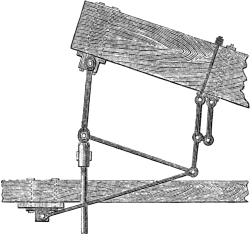
THE PARALLEL MOTION.
He immediately set to work to put his idea to the
practical proof, and only eleven days later he wrote,—
“I have made a very large model of the new substitute for racks
and sectors, which seems to bid fair to answer. The rod goes up
and down quite in a perpendicular line without racks, chains,
or guides. It is a perpendicular motion derived from a combination
of motions about centres—very simple, has very little friction, has
nothing standing higher than the back of the beam, and requires
the centre of the beam to be only half the stroke of the engine
higher than the top of the piston-rod when at lowest, and has
no inclination to pull the piston-rod either one way or another, only
straight up and down.... However, don’t pride yourself on it—it
is not fairly tried yet, and may have unknown faults.”[263]
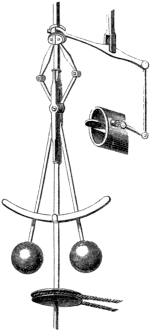
THE GOVERNOR.
Another of Watt’s beautiful inventions of the same
period, was the Governor, contrived for the purpose of
regulating the speed of the engine. This was a point
of great importance in all cases where steam-power was
employed in processes of manufacture. To modify the
speed of the piston in the single-acting pumping-engine,
Watt had been accustomed to use what is called a
throttle valve, which was regulated by hand as occasion
required. But he saw that to ensure perfect uniformity
of speed, the action of the engine must be made automatic
if possible, and with this object he contrived the
Governor, which has received no improvement since it
left his hand. Two balls are fixed to the ends of arms
connected with the engine by a moveable socket, which
plays up and down a vertical rod revolving
by a band placed upon the
axis or spindle of the fly-wheel. According
to the centrifugal force with
which the balls revolve, they diverge
more or less from the central fixed
point, and push up or draw down the
moveable collar; which, being connected
by a crank with the throttle-valve,
thereby regulates with the most
perfect precision the passage of the
steam between the boiler and the
cylinder. When the pressure of steam
is great, and the tendency of the engine
is to go faster, the governor
shuts off the steam; and when it is less, the governor
opens the throttle-valve and increases the supply. By
this simple and elegant contrivance the engine is made
to regulate its own speed with the most beautiful precision.
Among the numerous proposed applications of the
steam-engine about this time, was its employment as
a locomotive in driving wheel-carriages. It will be
remembered that Watt’s friend Robison had, at a very
early period, directed his attention to the subject; and
the idea had since been revived by Mr. Edgeworth,
who laboured with great zeal to indoctrinate Watt with
his views. The latter, though he had but little faith in
the project, nevertheless included a plan of a locomotive
engine in his patent of 1784; but he took no steps to
put it in execution, being too much engrossed with
other business at the time. His plan contemplated the
employment of steam either in the form of high-pressure
or low-pressure, working the pistons by the force of
steam only, and discharging it into the atmosphere
after it had performed its office, or discharging it into
an air-tight condenser made of thin plates or pipes, with
their outsides exposed to the wind or to an artificial
current of air, thereby economising the water which
would otherwise be lost.
Watt did not carry his design into effect; and, so far
as he was concerned, the question of steam locomotion
would have gone no further. But the subject had
already attracted the attention of William Murdock,
who had for some time been occupied during his leisure
hours in constructing an actual working model of a
locomotive. When his model was finished, he proceeded
to try it in the long avenue leading to the parsonage at
Redruth, in the summer of 1784; and in so doing
nearly frightened out of his wits the village pastor,
who encountered the hissing, fiery little machine, while
enjoying his evening walk.[264]
When Watt heard of this experiment, he wrote to
Boulton, advising that Murdock should be gently counselled
to give up his scheme, which might have the
effect of withdrawing him from the work of the firm,
in which he had become increasingly useful.
“As to my own part,” wrote Watt, “I shall form no obstacle to
the scheme. My only reasons against it were that I feared it would
deprive us of a valuable man; that it would, if we were to be concerned
in it, divert us from more valuable business, and perhaps
prove a sinking fund; and lastly, that I did not like that a scheme
which I had revolved in my mind for years and hoped to be able at
some favourable time to bring to perfection, if capable of it, should
be wrested from me, or that I should be compelled to go into it as a
secondary person. But I have now made the latter objection give
way. And as to the first, I think it will take place at any rate, so
we must make the best of it.”[265]
Boulton was accordingly recommended in the first
place to endeavour to dissuade Murdock from pursuing
the subject further, but if he could not succeed in that,
rather than lose him, he was to let him have an advance
to the extent of 100l., to enable him to prosecute his
experiments; and if within a year he succeeded in
making an engine capable of drawing a postchaise
carrying two ordinary persons and the driver, with
200 lbs. of luggage, fuel for four hours, and water for
two hours, going at the rate of four miles an hour, then
a partnership was to be entered into, in which Boulton
and Watt were to find the capital, and Murdock was to
conduct the business and take his share of the profits.
Murdock, however, had so many urgent matters to
attend to, that, sanguine though he continued to be as
to the success of his scheme, he could not find time
to pursue it. He was a man after Boulton’s own heart,
unsparing of himself and indefatigable in whatsoever
he undertook; nor was Boulton sparing of praises of
him in his confidential letters to Watt.
“We want more Murdocks,” he wrote on one occasion, “for, of all
our men he is the most active. He is the best engine erector I ever
saw, and of his energy I had one of the best proofs this day. They
stopped Poldice lower engine last Monday and took her all to pieces;
took out the condenser, took up out of the shaft the greatest part of
the pumps, took the nozzles to pieces, cut out the iron seatings and
put in brass ones with new valves, mended the eduction-pipe,
and did a great number of repairs about the beam and engine; put
the pumps down into the new engine shaft, did much work at the
new engine; and this done, about noon both the engines, new and
old, were set to work again complete. When I look at the work
done it astonishes me, and is entirely owing to the spirit and
activity of Murdock, who hath not gone to bed for three nights,
and I expect the mine will be in full fork again by Wednesday
night. I have got him into good humour again without any
coaxing, have prevailed on him not to give up Wheal Virgin
engine, which he had been resolved to do from the ungenerous
treatment he received from the captains. I have also prevailed on
him to put off his determined journey to Scotland until North
Downs engines are got to work, and have quieted his mind about
wheel carriages till then.”[266]
Notwithstanding Watt’s fears of a falling off, the
engine business still continued to prosper in Cornwall.
Although the mining interests were suffering from
continued depression, new mines were being opened
out, for which pumping-engines were wanted; and
Boulton and Watt’s continued to maintain their superiority
over all others. None of their threatened rivals
had yet been able to exhibit an engine in successful
work; and those of the old construction had been
almost completely superseded. In 1784, new engines
were in course of erection at Poldice, New Poldory,
Wheal Maid, Polgooth, and other mines. Almost the
last of the Newcomen engines in Cornwall had been
discarded at Polgooth in favour of one of Boulton and
Watt’s 58-inch cylinder engines.
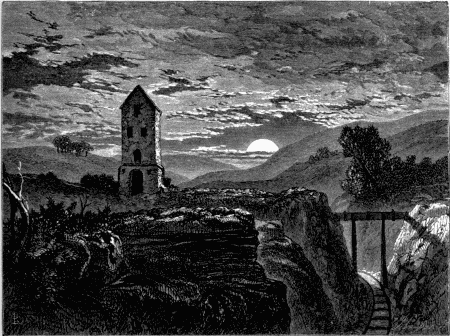
POLGOOTH.
[By R. P. Leitch.]
The dues paid yearly in respect of these and other
engines previously erected were very considerable;
Boulton estimating that, if duly paid, they would
amount to about 12,000l. a year. There seemed, therefore,
every reasonable prospect of the financial difficulties
of the firm at last coming to an end.
Boulton’s visit to Cornwall on this occasion was enlivened
by the companionship of his wife, and her friend
Miss Mynd. Towards midsummer he looked forward with
anticipations of increased pleasure to the visit of his two
children—his son Matt and his daughter Nancy—during
their school holidays. It was a source of much regret to
him, affectionate as his nature was, that the engrossing
character of his business prevented him enjoying the
society of his family so much as he desired. But he
endeavoured to make up for it by maintaining a regular
correspondence with them when absent. His letters to
his children were full of playfulness, affection, and good
advice. To his son at school he wrote telling him of
his life in Cornwall, describing to him the house at
Cosgarne, the garden and the trees he had planted
in it, the pleasant rides in the neighbourhood, and the
visit he had just been paying to the top of Pendennis
Castle, from which he had seen about a hundred sail of
ships at sea, and a boundless prospect of land and water.
He proceeded to tell him of the quantity of work he did
connected with the engine business, how he had no
clerk to assist him, but did all the writing and drawing
of plans himself: “When I have time,” said he, “I
pick up curiosities in ores for the purpose of assays, for
I have a laboratory here. There is nothing would so
much add to my pleasure as having your assistance in
making solutions, precipitates, evaporations, and crystallisations.”
After giving his son some good advice as
to the cultivation of his mind, as calculated to render
him an intelligent and useful member of society, he proceeded
to urge upon him the duty of cultivating polite
manners, as a means of making himself agreeable to
others, and at the same time of promoting his own
comfort. “But remember,” he added, “I do not wish
you to be polite at the expense of honour, truth, sincerity,
and honesty; for these are the props of a manly
character, and without them politeness is mean and
deceitful. Therefore, be always tenacious of your honour.
Be honest, just, and benevolent, even when it appears
difficult to be so. I say, cherish those principles, and
guard them as sacred treasures.”
At length his son and daughter joined him and took
part in his domestic and out-door enjoyments. They
accompanied him in his drives and rides, and Matt took
part in his chemical experiments. One of their great
delights was the fabrication of an immense paper balloon,
and the making of the hydrogen gas to fill it
with. After great preparations the balloon was made and
filled, and sent up in the field behind the house, to the
delight of all concerned. To Mrs. Watt he wrote
expressing to her how much pleasanter his residence in
Cornwall had become since his son and daughter’s visit.
“I shall be happier,” he said, “during the remainder of
my residence here than in the former part of it; for I
am ill calculated to live alone in an enemy’s country,
and to contest lawsuits. Besides, the only source of
happiness I look for in my future life is in my children.
Matt behaves extremely well, is active and good-humoured;
and my daughter, too, has, I think, good
dispositions and sentiments, which I shall cherish, and
prevent as much as possible from being sullied by
narrow and illiberal-minded companions.” After a few
months’ pleasant social intercourse with his family at
Cosgarne, varied by occasional bickerings with the
adventurers out of doors about dues, Boulton returned
to Birmingham, to enter upon new duties and undertake
new enterprises.
When Boulton returned to Birmingham, he was urgently
called upon to take part in a movement altogether foreign
to his habits. He had heretofore been too much engrossed
by business to admit of his taking any active part in
political affairs. Being, however, of an active temperament,
and mixing with men of all classes, he could not
but feel an interest in the public movements of his time.
Early in 1784, we find him taking the lead in getting
up a loyal address to the King on the resignation of the
Portland Administration and the appointment of Mr.
Pitt as Prime Minister. It appears, however, that Pitt
disappointed his expectations. One of his first projects
was a scheme of taxation, which he introduced for the
purpose of remedying the disordered state of the finances,
but which, in Boulton’s opinion, would, if carried, have
the effect of seriously damaging the national industry.
The Minister proposed to tax coal, iron, copper, and
other raw materials of manufacture, to the amount of
about a million a year. Boulton immediately bestirred
himself to oppose the adoption of the scheme. He held
that for a manufacturing nation to tax the raw materials
of wealth was a suicidal measure, calculated, if
persevered in, to involve the producers of wealth in
ruin. “Let taxes,” he said, “be laid upon luxuries, upon
vices, and if you like upon property; tax riches when
got, and the expenditure of them, but not the means of
getting them; of all things, don’t cut open the hen that
lays the golden eggs.”[267]
Petitions and memorials were forthwith got up in the
midland counties, and presented against the measure;
and Boulton being recognised as the leader of the
movement in his district, was summoned by Mr. Pitt to
London to an interview with him on the subject. He
then took the opportunity of pressing upon the Minister
the necessity of taking measures to secure reciprocity of
trade with foreign nations, as being of vital importance
to the trade of England. Writing to his partner
Scale, he said, “Surely our Ministers must be bad politicians,
to suffer the gates of nearly every commercial
city in the world to be shut against us.” “There is no
doubt,” he wrote to his friend Garbett, “but the edicts,
prohibitions, and high duties laid upon our manufacturers
by foreign powers will be severely felt, unless
some new commercial treaties are entered into with
such powers. I fear our young Minister is not sufficiently
aware of the importance of the subject, and I
likewise fear he will pledge himself before Parliament
meets to carry other measures in the next session that
will be as odious to the country as his late attempts.”
As Boulton had anticipated, the Ministry introduced
several important measures, calculated to have a highly
injurious effect upon English industry, and he immediately
bestirred himself, in conjunction with Josiah
Wedgwood, of Etruria, to organise a movement in
opposition to them. Wedgwood and Boulton met at
Birmingham in February, 1785, and arranged to
assemble a meeting of delegates from the manufacturing
districts, who were to meet and sit in London
“all the time the Irish commercial affairs were pending.”
A printed statement of the objects of the movement
was circulated, and Boulton and Wedgwood wrote to
their friends in all quarters to meet and appoint delegates
to the central committee in London. Boulton was
unanimously appointed the delegate for Birmingham,
and he proceeded to London furnished with a bundle of
petitions from his neighbourhood. The delegates proceeded
to form themselves into a Chamber of Manufacturers,
over the deliberations of which Wedgwood,
Boulton, or John Wilkinson usually presided.
The principal object of these meetings and petitionings
was to prevent, if possible, the imposition of the proposed
taxes on coal, iron, and raw materials generally,
as well as the proposed export duties on manufactured
articles. At a time when foreign governments
were seeking to exclude English manufactures
from their dominions by heavy import duties, it was felt
that this double burden was more than English industry
could bear. The Irish Parliament were at the same time
legislating in a hostile spirit towards English commerce;
imposing taxes upon all manufactures imported into
Ireland from England, while Irish manufactures were
not only sent into England duty free, but their own
parliament encouraged them by a bounty on exportation.
The committee strongly expostulated against the partial
and unjust spirit of this legislation, and petitioned for
free interchange on equal terms. So long as such a
state of things continued, the petitioners urged that
“every idea of reciprocity in the interchange of manufactures
between Britain and Ireland was a mere
mockery of words.”
Although Watt was naturally averse to taking any
public part in politics, his services were enlisted in the
cause, and he drew up for circulation “An answer to the
Treasury Paper on the Iron Trade of England and
Ireland.” The object of his statement was to show that
the true way of encouraging manufactures in Ireland
was, not by bounties, not by prohibitions, but by entire
freedom of industry. It was asserted by the supporters
of the propositions, that the natives of Ireland were
ignorant, indolent, and poor. “If they be so,” said Watt,
“the best method of giving them vigour is to have
recourse to British manufacturers, possessed of capital,
industry, and knowledge of trade.” The old covenanting
spirit of his race fairly breaks out in the following
passage:—
“It is contemptible nonsense to argue that because Ireland has
never had iron manufactories she cannot soon have them.... One
hundred years ago the Irish had no linen manufacture; they
imported linen; and now they sell to us to the amount of a million
annually. How came this about? The civil wars under Charles I.,
and the tyranny of the Scotch Privy Council under Charles II.,
chased the people out of Scotland, because they were Presbyterians.
Ireland received and protected them; they peopled the northern
provinces; many of them were weavers; they followed their
business in Ireland, and taught others. Philip II. chased the
inhabitants out of Flanders, on account of religion; Queen Elizabeth
received and protected them; and England learnt to manufacture
woollen cloth. The persecutions of Lewis XIV. occasioned the
establishment of a colony in Spitalfields. And the Parliament
of Britain, under the auspices of —— and ——, and others, imposed
oppressive duties on glass; and ——’s Act gave the Irish liberty to
export it to our Colonies; the glass-makers fled from the tyranny
of the Excise; Ireland has now nine glass-houses. Britain has lost
the export trade of that article! More examples of the migrations
of manufactures could be adduced, but it seems unnecessary; for it
cannot be denied that men will fly from tyranny to liberty, whether
Philip’s Priests, Charles’s Dragoons, or our Excisemen be the
instruments of the tyranny. And it must also be allowed that
even the Inquisition itself is not more formidable than our Excise
Laws (as far as property is concerned) to those who unhappily are
subjected to them.”
Towards the end of the statement he asks, “Would it
not be more manly and proper at once to invite the Irish
to come into a perfect union with Britain, and to pay
the same duties and excises that we do? Then every
distinction of country might with justice be done away
with, and they would have a fair claim to all the
advantages which we enjoy.”
The result of the agitation was that most of the proposals
to impose new taxes on the raw materials of
manufacture were withdrawn by the Ministry, and the
Irish resolutions were considerably modified. But the
relations of British and Irish industry were by no means
settled. The Irish Parliament might refuse to affirm
the resolutions adopted by the British Parliament, in
which case it might be necessary again to oppose the
Ministerial measures; and to provide for this contingency,
the delegates separated, with the resolution to
maintain and extend their organisation in the manufacturing
districts. Watt did not, however, like the
idea of his partner becoming engrossed in political
agitation, even in matters relating to commerce. He
accordingly wrote to Boulton in London, “I find myself
quite unequal to the various business now lying behind,
and wish much you were at home, and that you would
direct your attention solely to your own and to Boulton
and Watt’s business until affairs can be brought into
reasonable compass.”[268] Later he wrote,—“At Manchester
they are busy making a collection for the Chamber of
Manufacturers, which I fancy will be in vogue again
next winter. But I hope that neither you nor I will be
mad enough to be demagogues then. Let us leave that
to those who can defy Ministers, and get our property
secured, which may be done in the confusion.”
Watt was at this time distressed by an adverse decision
against the firm in one of the Scotch courts. “I have
generally observed,” he wrote, “that there is a tide in
our affairs. We have had peace for some time, but now
cross accidents have begun, and more are to be feared.”
His anxieties were increased by the rumour which
reached his ears from several quarters of a grand combination
of opulent manufacturers to make use of every
beneficial patent that had been taken out, and cut them
down by scire facias, as they had already cut down
Arkwright’s. It was said that subscriptions had
been obtained by the association amounting to 50,000l.
Watt was requested to join a counter combination of
patentees to resist the threatened proceedings. To this,
however, he objected, on the ground that the association
of men to support one another in lawsuits was
illegal, and would preclude the members from giving
evidence in support of each other’s rights. “Besides,”
said he, “the greater number of patentees are such as
we could not associate with, and if we did it would do
us more harm than good.”[269]
Towards the end of 1785 the engines which had been
in hand were nearly finished, and work was getting
slacker than usual at Soho. Though new orders gave
Watt trouble, and occasioned him anxiety, still he would
rather not be without them. “It will be well,” he
wrote to his partner, “if we can get some orders now
for engines worth while. What we have been doing
lately has been very trifling, and if we don’t get orders
soon, our men will be idle. As it happens at present,
we have at least three engineers too few here, there
being eight engines to be done in two or three months,
and only three engineers.”[270] It was matter of gratification
to Watt to be able to report that the engines
last delivered had given great satisfaction. The
mechanics were improving in skill, and their workmanship
was becoming of a superior character. “Strood
and Curtis’s engine,” said he, “has been at work some
time, and does very well. Whitbread’s has also been
tried, and performs exceedingly well.” The success of
Whitbread’s engine was such that it had the honour
of a visit from the King, who was greatly pleased with
its performances. Not to be outdone, “Felix Calvert,”
wrote Watt, “has bespoken one, which is to outdo
Whitbread’s in magnificence.”
The slackness of work at Soho was not of long continuance.
Orders for rotative engines came in gradually;
one from Harris, of Nottingham; another from Macclesfield,
to drive a silk-mill; a third from Edinburgh,
for the purposes of a distillery; and others from different
quarters. The influx of orders had the effect at the
same time of filling Soho with work, and plunging
Watt into his usual labyrinth of perplexity and distress.
In September we find him writing to Boulton,—
“My health, is so bad that I do not think I can hold out much
longer, at least as a man of business, and I wish to consolidate
something before I give over.” ... Again, “I cannot help being
dispirited, because I find my head fail me much, business an
excessive burden to me, and little prospect of my speedy release
from it. Were we both young and healthy, I should see no reason
to despair, but very much the contrary. However, we must do the
best we can, and hope for quiet in heaven when our weary bones
are laid to rest.”[271]
A few months later, so many more orders had come
in, that Watt described Soho as “fast for the next four
months,” but the additional work only had the effect of
increasing his headaches. “In the anguish of my mind,”
he wrote, “amid the vexations occasioned by new and
unsuccessful schemes, like Lovelace I ‘curse my inventions,’
and almost wish, if we could gather our money
together, that somebody else should succeed in getting
our trade from us. However, all may yet be well.
Nature can be conquered if we can but find out her
weak side.”
We return to the affairs of the Cornish copper-miners,
which were now in a very disheartening condition.
The mines were badly and wastefully worked; and the
competition of many small companies of poor adventurers
kept the copper trade in a state of permanent
depression. In this crisis of their affairs it was determined
that a Copper Company should be formed, backed
by ample capital, with the view of regulating this important
branch of industry, and rescuing the mines and
miners from ruin. Boulton took an active part in its
formation, and induced many of his intimate friends in
the north to subscribe largely for shares. An arrangement
was entered into by the Company with the adventurers
in the principal mines, to buy of them the whole
of the ore raised, at remunerative prices, for a period of
eleven years. At the first meeting, held in September,
1785, for the election of Governor, Deputy-Governor,
and Directors, Boulton held in his hands the power of
determining the appointments, representing, as he did
by proxy, shares held by his northern friends to the
amount of 86,000l. The meeting took place in the
Town-hall at Truro, and the proceedings passed off
satisfactorily; Boulton using his power with due discretion.
“We met again on Friday,” he wrote to
Matthews, “and chose the assayers and other subordinate
officers, after which we paid our subscriptions,
and dined together, all in good humour; and thus this
important revolution in the copper trade was finally
settled for eleven years.”
Matters were not yet, however, finally settled, as
many arrangements had to be made for setting the
Company to work, in which Boulton took the leading
part; the Governor and Directors pressing him not to
leave Cornwall until they were definitely settled. It
happened to suit his convenience to remain until the
Wheal Fortune engine was finished—one of the most
formidable engines the firm had yet erected in Cornwall.
In the mean time he entered into correspondence
with various consumers of copper at home and abroad,
with the object of finding a vend for the metal. He
succeeded in obtaining a contract through Mr. Hope, of
Amsterdam, for supplying the copper required for the
new Dutch coinage; and he opened out new markets for
the produce in other quarters. Being a large holder of
mining shares, Boulton also tried to introduce new and
economical methods of working the mines; but with
comparatively little result. To Wilkinson he wrote,—“Poldice
is in a desponding way, and must give up
unless better managed. North Downs is managed as
badly by incapable, ignorant, drunken captains, who
hold their posts not by merit, but by their cousinship to
some of the adventurers.... I should spend a great
part of next year in Cornwall, and make myself master
of the minutiæ. I think I could then accomplish many
necessary regulations.”[272]
Though actively bestirring himself for the good of
the mining interest, Boulton had but small thanks for
his pains. The prominence of his position had this
disadvantage, that if the price of the ore went down,
or profits declined, or the yield fell off, or the mines
were closed, or anything went wrong, the miners were
but too ready to identify him in some way with the evil;
and the services which he had rendered to the mining
interest[273] were in a moment forgotten. On one occasion
the discontent of the miners broke out into open revolt,
and Boulton was even threatened with personal violence.
The United Mines having proved unprofitable in the
working, notice was given by the manager of an intended
reduction of wages, this being the only condition
on which the mines could be carried on. If this could
not be arranged, the works must be closed, as the
adventurers declined to go on at a loss. On the announcement
of the intended lowering of wages being
made, there was great excitement and discontent among
the workpeople. Several hundreds of them hastily
assembled at Redruth, and took the road for Truro, to
pull down the offices of the Copper Mining Company,
and burn the house of the manager. They were especially
furious with Boulton, vowing vengeance on him, and
declaring that they would pull down every pumping-engine
he had set up in Cornwall. When the rioters
reached Truro, they found a body of men, hastily armed
with muskets taken from the arsenal, stationed in front
of the Copper Mining Company’s premises, supported
by six pieces of cannon. At sight of this formidable demonstration
the miners drew back, and, muttering threats
that they would repeat their visit, returned to Redruth
as they had come. Two companies of soldiers and two
of local militia were brought into the town immediately
after; and the intended assault was not made. When
Watt was informed of the violence with which his
partner had been threatened, he wrote,—“In my opinion
nothing can be more ungrateful than the behaviour of
those people who endeavour to make you the object
of the resentment of the mob, at a time when (setting
aside former services) you are doing all that lies in your
power to serve them.... If you still find the same
spirit continue, for God’s sake leave them immediately.
The law can reach the adventurers, if it cannot the
miners.”
This was, however, but the wild and unreasoning
clamour of misguided and ignorant men. Boulton was
personally much esteemed by all who were able to
appreciate his character, and to understand the position
of himself and his partner with reference to the engine
patent. The larger mining owners invited him to
their houses, and regarded him as their friend. The
more intelligent of the managers were his strenuous
supporters. First and foremost among these was Mr.
Phillips, manager of the Chacewater mines, of whom he
always spoke with the highest respect, as a man of the
most scrupulous integrity and honour. Mr. Phillips
was a member of the Society of Friends, and his wife
Catherine was one of the most celebrated preachers of
the body. Boulton and Watt occasionally resided with
them before the house at Cosgarne was taken, and
conceived for both the warmest friendship. If Watt was
attracted by the Cornish Anabaptists, Boulton was equally
so by the Cornish Quakers. We find him, in one of his
letters to Mrs. Boulton, describing to her a great meeting
of Friends at Truro which he had attended, “when,”
he said, “I heard our friend Catherine Phillips preach
with great energy and good sense for an hour and a
half, although so weak in body that she was obliged to
lie abed for several days before.” Boulton afterwards
dined with the whole body of Friends at the principal
inn, being the only person present who was not of the
Society; and he confessed to have spent in their company
a very pleasant evening.[274]
We return to the progress of the engine business at
Soho. The most important work in hand about this
time was the double-acting engine intended for the
Albion Mill, in Southwark.[275] This was the first rotative
with a parallel motion erected in London; and as
the more extended use of the engine would in a great
measure depend upon its success, the firm naturally
looked forward with very great interest to its performances.
The Albion Mill scheme was started by Boulton
as early as 1783. Orders for rotatives were then
coming in very slowly, and it occurred to him that if he
had but the opportunity of exhibiting the powers of the
new engine in its best form, and in connexion with
the best machinery, the results would be so satisfactory
and conclusive as to induce manufacturers generally
to follow the example. On applying to the London
capitalists, Boulton found them averse to the undertaking;
and at length Boulton and Watt became persuaded
that if the concern was to be launched at all, they
must themselves find the principal part of the capital.
A sufficient number of shareholders was got together to
make a start, and application was made for a charter of
incorporation in 1784; but it was so strongly opposed by
the millers and mealmen, on the ground that the application
of steam-power to flour-grinding would throw wind
and water mills out of work, take away employment
from the labouring classes, and reduce the price of
bread,[276] that the charter was refused; and the Albion
Mill Company was accordingly constituted on the ordinary
principles of partnership.
By the end of the year the Albion Mill engines, carefully
designed by Watt, were put in hand at Soho; the
building was in course of erection, after the designs of
Mr. Wyatt, the architect; while John Rennie, the
young Scotch engineer, was engaged to design and fit
up the flour-grinding and dressing machinery. “I am
glad,” wrote Boulton to Watt, “you have agreed with
Rennie. Mills are a great field. Think of the crank—of
Wolf, Trumpeter, Wasp, and all the ghosts we
are haunted by.” The whole of the following year
was occupied in the erection of the buildings and machinery;
and it was not until the spring of 1786 that
the mill was ready to start. Being the first enterprise
of the kind, on an unprecedented scale, and comprising
many novel combinations of machinery, there
were many “hitches” before it could be got to work
satisfactorily. After the first trial, at which Boulton
was present, he wrote his partner expressing his dissatisfaction
with the working of the double-acting
engine, expressing the opinion that it would have been
better if they had held by the single-acting one.[277] Watt
was urged to run up to town himself and set matters to
rights; but he was up to the ears in work at Soho, and
could not leave for a day.
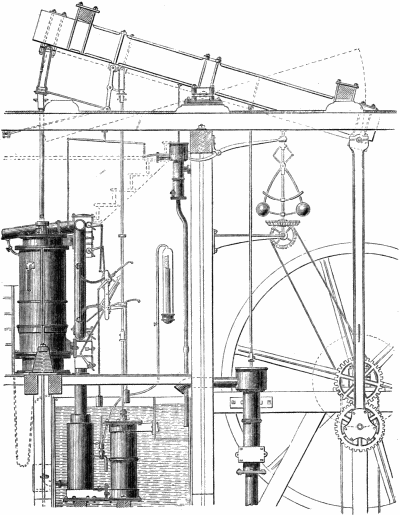
DOUBLE-ACTING ENGINE, ALBION MILL.
“I can by no means leave home at present,” he wrote, “otherwise
we shall suffer much greater losses than can come from the Albion
Mill. The work for Cornwall which must be planned and put in
train is immense, and there will more come from that quarter.
Besides, I am pulled to pieces by demands for forwardness from
every side. I have lost ten days by William Murdock, Wilson,
Wilkinson, and headaches, and I have neither health nor spirits to
make the necessary exertions. If I went to London I should be in
torment all the while with the thoughts of what was lying behind
here.”
After pointing out what course should be taken to
discover and remedy the faults of the engine, he proceeded:—
“Above all, patience must be exercised and things coolly
examined and put to rights, and care be taken not to blame
innocent parts. Everything must, as much as possible, be tried
separately. Remind those who begin to growl, that in new, complicated,
and difficult things, human foresight falls short—that time
and money must be given to perfect things and find out their defects,
otherwise they cannot be remedied.”[278]
Not being able to persuade Watt to come to his help,
Boulton sent to Cornwall for Murdock, always ready to
lend a hand on an emergency, and in the course of a
few weeks he was in town at work upon the engines.
The result is best told in Wyatt’s letter to Boulton, who
had by this time returned to Birmingham:—
“Mr. Murdock has just set the engine to work. All the rods are
altered. I think he has done more good than all the doctors
we have had before; and his manner of doing it has been very
satisfactory—so different from what we have been used to. He
has been through all the flues himself, and really takes uncommon
pains. Pray write to him; thank him for his attention. He will
not have left town before he gets your letter, and press him to stay
as long as he can be essentially serviceable.”
There was, however, so great a demand for Murdock’s
presence in Cornwall, that he could not be spared for
another day, and he hurried back again to his multifarious
duties at the mines.
The cost of erecting the mill proved to be considerably
in excess of the original estimate, and Watt early
feared that it would turn out a losing concern. He had
no doubt about the engines or the machinery being
able to do all that had been promised; but he feared
that the absence of business capacity on the part of the
managers would be fatal to its commercial success.[279] He
was especially annoyed at finding the mill made a
public show of, and that it was constantly crowded with
curious and frivolous people, whose presence seriously
interfered with the operations of the workmen. It
reached his ears that the managers of the mill even
intended to hold a masquerade in it, with the professed
object of starting the concern with eclat! Watt
denounced this as sheer humbug. “What have Dukes,
Lords, and Ladies,” said he, “to do with masquerading
in a flour-mill? You must take steps to curb the
vanity of ——, else it will ruin him. As for ourselves,
considering that we are much envied at any rate,
everything which contributes to render us conspicuous
ought to be avoided. Let us content ourselves with
doing.”[280] It was also found that the mill was becoming
a nest for schemers and speculators occupied in devising
all manner of new projects. Boulton bestirred himself
to put matters in a more business-like train. Steps
were taken to close the mill against the crowd of idle
visitors; and Boulton shortly after reported that “the
manufacturing of Bubbles and new schemes is removed
from the Mill to a private Lodging.”
When the mill was at length set to work, it performed
to the entire satisfaction of its projectors. The
engine, on one occasion, ground as much as 3000
bushels of wheat in twenty-four hours. The usual rate
of work per week of six days was 16,000 bushels of
wheat, cleaned, ground, and dressed into fine flour
(some of it being ground two or three times over); or
sufficient, according to Boulton’s estimate, for the weekly
consumption of 150,000 people. The important uses of
the double rotative engine were thus exhibited in the
most striking manner; and the fame of the Albion Mill
extended far and wide. It so far answered the main
purpose which Boulton and Watt had in view in originally
embarking in the enterprise; but it must be
added that the success was accomplished at a very
serious sacrifice. The mill never succeeded commercially.
It was too costly in its construction and its
management, and though it did an immense business it
was at a loss. The concern was, doubtless, capable of
great improvement, and, had time been allowed, it
would probably have come round. When its prospects
seemed to be brightening,[281] it was set on fire in several
places by incendiaries on the night of the 3rd of March,
1791. The villains had made their arrangements with
deliberation and skill. They fastened the main cock of
the water-cistern, and chose the hour of low tide for
firing the building, so that water could not be got to
play upon the flames, and the mill was burnt to the
ground in a few hours. A reward was offered for
the apprehension of the criminals, but they were never
discovered. The loss sustained by the Company was
about 10,000l. Boulton and Watt were the principal
sufferers; the former holding 6000l., and the latter
3000l. interest in the undertaking.[282]
Meanwhile orders for rotative engines were coming
in apace at Soho,—engines for paper-mills and cotton-mills,
for flour-mills and iron-mills, and for sugar-mills in
America and the West Indies. At the same time pumping-engines
were in hand for France, Spain, and Italy.
The steam-engine was becoming an established power,
and its advantages were every day more clearly recognised.
It was alike docile, regular, economical, and
effective, at all times and seasons, by night as by day,
in summer and in winter. While the wind-mills were
stopped by calms and the water-mills by frosts, the
steam-mill worked on with untiring power. “There
is not a single water-mill now at work in Staffordshire,”
wrote Boulton to Wyatt in December; “they are all
frozen up, and were it not for Wilkinson’s steam-mill,
the poor nailers must have perished; but his mill goes
on rolling and slitting ten tons of iron a day, which is
carried away as fast as it can be bundled up; and thus
the employment and subsistence of these poor people
are secured.”
As the demand for rotative engines set in, Watt
became more hopeful as to the prospects of this branch
of manufacture. He even began to fear lest the firm
should be unable to execute the orders, so fast did
they follow each other. “I have no doubt,” he wrote
to Boulton, “that we shall soon so methodize the rotative
engines as to get on with them at a great pace.
Indeed, that is already in some degree the case. But
we must have more men, and these we can only have
by the slow process of breeding them.”[283] A fortnight
later he wrote, “Orders for rotative engines are coming
in daily; but, if we part with any more men here, we
must stop taking them in.” Want of skilled workmen
continued to be one of Watt’s greatest difficulties. When
the amount of work to be executed was comparatively
small, and sufficient time was given to execute it, he
was able to turn out very satisfactory workmanship;[284]
but when the orders came pouring in, new hands were
necessarily taken on, who proved a constant source of
anxiety and trouble. Even the “old hands,” when sent
to a distance to fit up engines, being left, in a great
measure, to themselves, were apt to become careless and
ill-conditioned. With some, self-conceit was the stumbling-block,
with others temper, but with the greater
number, drink. “I am very sorry to hear,” wrote
Watt to Boulton, “that Malcolm Logan’s disease increases.
I think you should talk to him roundly upon
it, and endeavour to procure him to make a solemn
resolution or oath against drinking for some given
term.” Another foreman sent to erect an engine in
Craven was afflicted with a distemper of a different
sort. He was found to have put the engine very badly
together, and, instead of attending to his work, had
gone a-hunting in a pig-tail wig! “If the half of this
be true,” wrote Watt, “as I fear it is, he will not do to
be sent to New River Head [where an engine was about
to be erected], and I have at present nobody else here....
I suppose I shall be obliged to send Joseph over,
for we must not have a bad engine if it can be helped....
We seem to be getting into our old troubles
again.”[285]
William Murdock continued, as before, an admirable
exception. He was as indefatigable as ever, always
ready with an expedient to remedy a defect, and willing
to work at all hours. A great clamour had been raised
in Cornwall during his stay in London while setting
the Albion Mill to rights, as there was no other person
there capable of supplying his place, and fulfilling his
numerous and responsible duties. Boulton deplored
that more men such as Murdock were not to be had;—“He
is now flying from mine to mine,” he wrote,
“and hath so many calls upon him that he is inclined
to grow peevish; and if we take him from North
Downs, Chacewater, and Towan (all of which engines
he has the care of), they will run into disorder and
ruin; they have not a man at North Downs that is
better than a stoker.”
Towards the end of 1786 the press of orders increased
at Soho. A rotative engine of forty-horse power was
ordered by the Plate Glass Company to grind glass.
A powerful pumping-engine was in hand for the Oxford
Canal Company. Two engines, one of twenty and the
other of ten horse power, were ordered for Scotch distilleries,
and another order was shortly expected from
the same quarter. The engine supplied for the Hull
paper-mill having been found to answer admirably,
more orders for engines for the same purpose were
promised. At the same time pumping-engines were
in hand for the great French waterworks at Marli.
“In short,” said Watt, “I foresee I shall be driven
almost mad in finding men for the engines ordered here
and coming in.” Watt was necessarily kept very full
of work by these orders, and we gather from his letters
that he was equally full of headaches. He continued to
give his personal attention to the preparation of the
drawings of the engines, even to the minutest detail.
On an engine being ordered by Mr. Morris, of Bristol,
for the purpose of driving a tilt-hammer, Boulton wrote
to him,—“Mr. Watt can never be prevailed upon to
begin any piece of machinery until the plan of the
whole is settled, as it often happens that a change in
one thing puts many others wrong. However, he has
now settled the whole of yours, but waits answers to
certain questions before the drawings for the founder
can be issued.”[286]
At an early period his friend Wedgwood had strongly
urged upon Watt that he should work less with his own
head and hands, and more through the heads and hands
of others.[287] Watt’s brain was too active for his body,
and needed rest; but rest he would not take, and persisted
in executing all the plans of the new engines
himself. Thus in his fragile, nervous, dyspeptic state,
every increase of business was to him increase of brain-work
and increase of pain; until it seemed as if not only
his health, but the very foundations of his reason must
give way. At the very time when Soho was beginning
to bask in the sunshine of prosperity, and the financial
troubles of the firm seemed coming to an end, Watt
wrote the following profoundly melancholy letter to
a friend:—
“I have been effete and listless, neither daring to face business,
nor capable of it, my head and memory failing me much; my stable
of hobby-horses pulled down, and the horses given to the dogs for
carrion.... I have had serious thoughts of laying down the
burden I find myself unable to carry, and perhaps, if other
sentiments had not been stronger, should have thought of throwing
off the mortal coil; but, if matters do not grow worse, I may
perhaps stagger on. Solomon said that in the increase of knowledge
there is increase of sorrow; if he had substituted business for knowledge,
it would have been perfectly true.”[288]
As might be expected, from the large number of
engines sold by the firm to this time, and the increasing
amounts yearly payable as dues, their income from the
business was becoming considerable, and promised,
before many years had passed, to be very large. Down
to the year 1785, however, the outlay upon new foundries,
workshops, and machinery had been so great, and
the large increase of business had so completely
absorbed the capital of the firm, that Watt continued
to be paid his household expenses, at the rate of so
much a year, out of the hardware business, and no division
of profits upon the engines sold and at work had
as yet been made, because none had accrued. After the
lapse of two more years, matters had completely changed;
and after long waiting, and indescribable distress of mind
and body, Watt’s invention at length began to be productive
to him. During the early part of his career,
though his income had been small, his wants were
few, and easily satisfied. Though Boulton had liberally
provided for these from the time of his settling at
Birmingham, Watt continued to feel oppressed by the
thought of the debt to the bankers for which he and
his partner were jointly liable. In his own little business
he had been accustomed to deal with such small
sums, that the idea of being responsible for the repayment
of thousands of pounds appalled and unnerved him;
and he had no peace of mind until the debt was discharged.
Now at last he was free, and in the happy
position of having a balance at his bankers. On the
7th of December, 1787, Boulton wrote to Matthews,
the London agent,—“As Mr. Watt is now at Mr. Macgregor’s,
in Glasgow, I wish you would write him a
line to say that you have transferred 4000l. to his
own account, that you have paid for him another
1000l. to the Albion Mill, and that about Christmas
you suppose you shall transfer 2007l. more to him, to
balance.”
But while Watt’s argosies were coming into port
richly laden, Boulton’s were still at sea. Though the
latter had risked, and often lost, capital in his various
undertakings, he continued as venturesome, as enterprising
as ever. When any project was started calculated
to bring the steam-engine into notice, he was
immediately ready with his subscription. Thus he
embarked 6000l. in the Albion Mill, a luckless adventure
in itself, though productive in other respects. But
he sadly missed the money, and as late as 1789, feelingly
said to Matthews, “Oh that I had my Albion Mill
capital back again!” When any mining adventure
was started in Cornwall for which a new engine was
wanted, Boulton would write, “If you want a stopgap,
put me down as an adventurer;” and too often
the adventure proved a failure. Then, to encourage
the Cornish Copper Mining Company, he bought large
quantities of copper, and had it sent down to Birmingham,
where it lay long on his hands without a
purchaser. At the same time we find him expending
5000l. in building and rebuilding two mills and a warehouse
at Soho, and an equal amount in “preparing for
the coinage.” These large investments had the effect of
crippling his resources for years to come; and when the
commercial convulsion of 1788 occurred, he felt himself
in a state of the most distressing embarrassment. The
circumstances of the partners being thus in a measure
reversed, Boulton fell back upon Watt for temporary
help; but, more cautious than his partner, Watt had
already invested his profits elsewhere, and could not
help him.[289] He had got together his store of gains with
too much difficulty to part with them easily; and he was
unwilling to let them float away in what he regarded as
an unknown sea of speculation.
To add to his distresses, Boulton’s health began to fail
him. To have seen the two men, no one would have
thought that Boulton would have been the first to break
down; but so it was. Though Watt’s sufferings from
headaches, and afterwards from asthma, seem to have
been almost continuous, he struggled on, and even grew
in strength and spirits. His fragile frame bent before
disease, as the reed bends to the storm, and rose erect
again; but it was different with Boulton. He had
toiled too unsparingly, and was now feeling the effects.
The strain upon him had throughout been greater than
upon Watt, whose headache had acted as a sort of safety-valve
by disabling him from pursuing further study
until it had gone off. Boulton, on the other hand, was
kept in a state of constant anxiety by business that
could not possibly be postponed. He had to provide the
means for carrying on his many businesses, to sustain
his partner against despondency, and to keep the whole
organisation of the firm in working order. While
engaged in bearing his gigantic burden, disease came
upon him. In 1784 we find him writing to his wine-merchant,
with a cheque in payment of his account,—“We
have had a visit from a new acquaintance—the
gout.” The visitor returned, and four years later we
find him complaining of violent pain from gravel and
stone, to which he continued a martyr to the close of his
life. “I am very unwell indeed,” he wrote to Matthews
in London; “I can get no sleep; and yet I have been
obliged to wear a cheerful face, and attend all this week
on M. l’Abbé de Callone and his friend Brunelle.”[290] He
felt as if life was drawing to an end with him: he asked
his friend for a continuance of his sympathy, and promised
to exert himself, “otherwise,” said he, “I will lay
me down and die.” He was distressed, above all things,
at the prospect of leaving his family unprovided for,
notwithstanding all the labours, anxieties, and risks
he had undergone. “When I reflect,” he said, “that I
have given up my extra advantage of one-third on all
the engines we are now making and are likely to make,[291]—when
I think of my children, now upon the verge of
that time of life when they are naturally entitled to
expect a portion of their patrimony,—when I feel the
consciousness of being unable to restore to them the property
which their mother intrusted to me,—when I see
all whom I am connected with growing rich, whilst I
am groaning under a load of debt and annuities that
would sink me into the grave if my anxieties for my
children did not sustain me,—I say, when I consider all
these things, it behoves me to struggle through the small
remaining fragment of my life (being now in my 60th
year), and do my children all the justice in my power by
wiping away as many of my incumbrances as possible.”
It was seldom that Boulton wrote in so desponding a
strain as this; but it was his “darkest hour,” and
happily it proved the one “nearest the dawn.” Yet,
we shortly after find him applying his energies, apparently
unabated, in an entirely new direction—that of
coining money—which, next to the introduction of the
steam-engine, was the greatest enterprise of his life.
As men are known by the friends they make and the
books they read, as well as by the recreations and pursuits
of their leisure hours, it will help us to an appreciation
of the characters of Boulton and Watt if we
glance briefly at the social life of Soho during the
period we have thus rapidly passed under review.
Boulton was of a thoroughly social disposition, and
made friends wherever he went. He was a favourite
alike with children and philosophers, with princely
visitors at Soho, and with quiet Quakers in Cornwall.
When at home, he took pleasure in gathering about
him persons of kindred tastes and pursuits, in order at
the same time to enjoy their friendship, and to cultivate
his nature by intercourse with minds of the highest culture.
Hence the friendships which he early formed for
Benjamin Franklin, Dr. Small, Dr. Darwin, Josiah
Wedgwood, Thomas Day, Lovell Edgeworth, and others
equally eminent; out of which eventually grew the
famous Lunar Society.
Towards the close of last century, there were many
little clubs or coteries of scientific and literary men
established in the provinces, the like of which do not
now exist,—probably because the communication with
the metropolis is so much easier, and because London
more than ever absorbs the active intelligence of England,
especially in the higher departments of science,
art, and literature. The provincial coteries of which
we speak, were usually centres of the best and most
intelligent society of their neighbourhoods, and were
for the most part distinguished by an active and liberal
spirit of inquiry. Leading minds attracted others of
like tastes and pursuits, and social circles were formed
which proved in many instances the source of great
intellectual activity as well as enjoyment. At Liverpool,
Roscoe and Currie were the centres of one such
group; at Warrington, Aikin, Enfield, and Priestley, of
another; at Bristol, Dr. Beddoes and Humphry Davy
of a third; and at Norwich, the Taylors and Martineaus
of a fourth. But perhaps the most distinguished of
these provincial societies was that at Birmingham, of
which Boulton and Watt were among the most prominent
members.
From an early period, the idea of a society, meeting
by turns at each other’s houses, seems to have been
entertained by Boulton. It was probably suggested in
the first place by his friend Dr. Small. The object of
the proposed Society was to be at the same time friendly
and scientific. The members were to exchange views
with each other on topics relating to literature, art, and
science; each contributing his quota of entertainment
and instruction. The meetings were appointed to be
held monthly at the full of the moon, to enable distant
members to drive home by moonlight; and this was
the more necessary as some of them—such as Darwin
and Wedgwood—lived at a considerable distance from
Birmingham.
When Watt visited Soho in 1768, on his way home
from London to Glasgow, some of the members of the
Society—Dr. Small, Dr. Darwin, and Mr. Keir—were
invited to meet him at l’hôtel de l’amitié sur Handsworth
Heath, as Boulton styled his hospitable mansion. The
Society must, however, have been in a somewhat undefined
state at even a considerably later period, as we
find Boulton writing to Watt in 1776, after the latter
had settled in Birmingham, “Pray remember that the
celebration of the third full moon will be on Saturday,
March 3rd. Darwin and Keir will both be at Soho.
I then propose to submit many motions to the members
respecting new laws and regulations, such as will tend
to prevent the decline of a Society which I hope will
be lasting.” The principal members, besides those
above named, were Thomas Day, R. Lovell Edgeworth,
Samuel Galton, Dr. Withering, Baskerville the printer,
Dr. Priestley, and James Watt. Each member was at
liberty to bring a friend with him, and thus many
visitors of distinction were present at the meetings of
the Society, amongst whom may be named Mr. Smeaton,
Dr. Parr, Sir Joseph Banks, Sir William Herschel,
Dr. Solander, De Luc, Dr. Camper, and occasional
scientific foreigners.
Dr. Darwin was regarded as the patriarch of the
Society. His fame as a doctor, philosopher, and poet,
was great throughout the Midland Counties. He was
extremely speculative in all directions, even in such matters
as driving wheel-carriages by steam,—also a favourite
subject of speculation with Mr. Edgeworth.[292] Dr. Darwin’s
time, however, was so much engrossed by his
practice at Lichfield, that he was not very regular in
his attendance at the meetings, but would excuse himself
for his absence by such a letter as the following:—
“Dear Boulton,—I am sorry the infernal divinities who
visit mankind with diseases, and are therefore at perpetual
war with Doctors, should have prevented my seeing all your great
men at Soho to-day. Lord! what inventions, what wit, what
rhetoric, metaphysical, mechanical, and pyrotechnical, will be on
the wing, bandied like a shuttlecock from one to another of your
troop of philosophers! while poor I, I by myself I, imprison’d in a
postchaise, am joggled, and jostled, and bump’d, and bruised along
the King’s high-road, to make war upon a stomach-ache or a
fever!”[293]
While Dr. Darwin and Mr. Edgeworth were amongst
the oldest members of the Society, Dr. Priestley, the
discoverer of oxygen and other gases, was one of
the most recent. We find Boulton corresponding
with him in 1775,[294] principally on chemical subjects,
and supplying him with parcels of fluor spar for purposes
of experiment. Five years later, in 1780, he was
appointed minister of the Presbyterian Congregation
assembling in the New Meeting-house, Birmingham;
and from that time forward he was one of the most
active members of the Lunar Society, by whom he was
regarded as a great acquisition.
Dr. Priestley was a man of extraordinary gifts and
accomplishments. He had mastered many languages
before he was twenty years old. He was well versed
in mechanical philosophy and metaphysics, a skilled
dialectician, and the most expert chemist of his time.
Possessed by an irrepressible activity and untiring perseverance,
he became an enthusiast on whatever subject
he undertook, whether it was an inquiry into history,
theology, or science. He himself likened experimental
philosophy to hunting, and in his case it was the pursuit
of facts that mainly concerned him. He was cheerful,
hopeful, and buoyant; possessed of a most juvenile temperament;
happiest when fullest of work; ranging from
subject to subject with extraordinary versatility; laying
aside metaphysics to pursue experiments in electricity,
next taking up history and politics, and resting from
these to experiment on gases,—all the while carrying on
some public controversy on a disputed point in religion
or politics. For it is a curious fact; that gentle, affectionate,
and amiable though Priestley was,—devout
in temperament, and single-minded in the pursuit of
truth,[295]—he was almost constantly involved in paper
wars. He described himself, and truly, as “one of the
happiest of men;” yet wherever he went, in England or
America, he stirred up controversy and exasperated
opponents, seeming to be the very Ishmael of polemics.
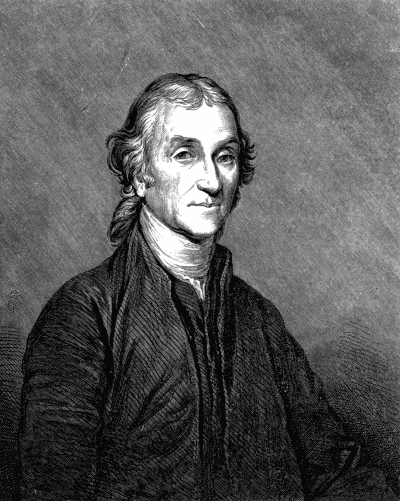
DR. PRIESTLEY.
At the time when he settled at Birmingham,
Priestley was actively engaged in prosecuting inquiries
into the constitution of bodies. He had been occupied
for several years before in making investigations as
to the gases. The discovery of carbonic acid gas
by Dr. Black of Edinburgh, had attracted his attention;
and, living conveniently near to a brewery at
Leeds, where he then was, he proceeded to make experiments
on the fixed air or carbonic acid gas evolved
during fermentation. From these he went on to other
experiments, making use of the rudest apparatus,—phials,
tobacco-pipes, kitchen utensils, a few glass tubes,
and an old gun-barrel. The pursuit was a source of
constant pleasure to him. He had entered upon an
almost unexplored field of science. Then was the childhood
of chemistry, and he gazed with large-eyed wonder
at the marvels which his investigations brought to light.
He had no teacher to guide him—nothing but experiment;
and he experimented constantly, carefully noting
the results. Observation of facts was his great object;
the interpretation of the facts he left to others. Such
was Priestley, and such were his pursuits, when he
settled at Birmingham in 1780.
There can be little doubt that his enthusiasm as an
experimenter in chemistry exercised a powerful influence
on the minds of both Boulton and Watt, who, though
both full of work, anxiety, and financial troubles,
were nevertheless found taking an active interest from
this time forward in the progress of chemical science.
Chemistry became the chief subject of discussion at
the meetings of the Lunar Society, and chemical experiments
the principal recreation of their leisure
hours.
“I dined yesterday at the Lunar Society (Keir’s house),” wrote
Boulton to Watt; “there was Blair, Priestley, Withering, Galton,
and an American ‘rebel,’ Mr. Collins. Nothing new except that
some of my white Spathos Iron ore was found to contain more air
than any ore Priestley had ever tried, and, what is singular, it
contains no common air, but is part fixable and part inflammable.”[296]
To Henderson, in Cornwall, Boulton wrote, two
months later,—
“Chemistry has for some time been my hobby-horse, but I am
prevented from riding it by cursed business, except now and then
of a Sunday. However, I have made great progress since I saw you,
and am almost an adept in metallurgical moist chemistry. I have
got all that part of Bergmann’s last volume translated, and
have learnt from it many new facts. I have annihilated Wm.
Murdock’s bedchamber, having taken away the floor, and made
the chicken kitchen into one high room covered over with shelves,
and these I have filled with chemical apparatus. I have likewise
set up a Priestleyan water-tub, and likewise a mercurial tub for
experiments on gases, vapours, &c., and next year I shall annex
to these a laboratory with furnaces of all sorts, and all other utensils
for dry chemistry.”[297]
The “Priestleyan water-tub” and “mercurial tub,”
here alluded to, were invented by Priestley in the course
of his investigations, for the purpose of collecting and
handling gases; and the pneumatic trough, with glass
retorts and receivers, shortly became part of the furniture
of every chemical laboratory.
Josiah Wedgwood was another member of the Lunar
Society who was infected by Dr. Priestley’s enthusiasm
for chemistry; and, knowing that the Doctor’s income
from his congregation was small, he and Boulton took
private counsel together as to the best means of providing
him with funds so as to place him in a position of comparative
ease, and enable him freely to pursue his investigations.
The correspondence which took place on
the subject is creditable to all parties concerned; and
the more so to Boulton, as he was embarrassed at the
time by financial difficulties of the most distressing kind,
as has been already explained in a preceding chapter.
Wedgwood had undertaken to sound Dr. Priestley, and
he thus communicated the result to Boulton:—
“The Doctor says he never did intend or think of making any
pecuniary advantage from any of his experiments, but gave them to
the public with their results, just as they happened, and so he should
continue to do, without ever attempting to make any private
emolument from them to himself.
“I mentioned this business to our good friend, Dr. Darwin,
who agrees with us in sentiment, that it would be a pity that
Dr. Priestley should have any cares or cramps to interrupt him in
the fine vein of experiments he is in the midst of, and is willing
to devote his time to the pursuit of, for the public good. The
Doctor will subscribe, and has thought of some friends who, he is
persuaded, will gladly do the same....
“You will see by the enclosed list that one cannot decently
exceed ten guineas unless it be under the cover of a friend’s name,
which method I shall take if I think it necessary to write more
than ten; but that is the subscription I shall begin with, and for
three years certain.
“Dr. Darwin will be very cautious who he mentions this affair
to, for reasons of delicacy which will have equal weight with us all.
I mentioned your generous intention to Dr. P., and that we thought
of 20l. each; but that, you will perceive, cannot be, and the Doctor
says much less will suffice, as he can go on very well with 100l. per
annum.”[298]
Boulton wrote Wedgwood in reply, requesting that
the money subscribed should be collected and paid to
Dr. Priestley in such a way as not to wound his sensitive
feelings. He suggested that in order to avoid this,
it might be better if, instead of an annual subscription, a
dozen gentlemen were found willing to give a hundred
pounds each for the purpose of buying an annuity, or
investing the amount in stock for the Doctor’s benefit.
“I have never yet spoken to him on the subject,” he added; “I
wish to avoid it, and so doth my neighbour Galton. Therefore
I beg you will manage the affair so that we may contribute our
mites to so laudable a plan, without the Doctor knowing anything of
the matter, and favour us with a line on the subject at your leisure.”[299]
In a subsequent part of the same letter he indicated
the subject of Priestley’s experiments at the time:—
“We have long talked,” said he, “of Phlogiston without knowing
what we talked about; but now that Dr. Priestley hath brought the
matter to light, we can pour that element out of one vessel into
another, can take it out of one metal and put it into another,
can tell how much of it, by accurate measurement, is necessary
to reduce a calx to a metal, which is easily done, and without
putting that calx into contact with any visible thing. In short,
this goddess of levity can be measured and weighed like other matter.
For the rest, I refer you to the Doctor himself.”
The discussions at the Lunar Society were not, however,
exclusively chemical, but were varied according to
the visitors who from time to time honoured the
members with their presence. Thus, in the autumn of
1782, the venerable Smeaton, having occasion to be in
Birmingham upon canal business, was invited to attend
a meeting of the Society held in Watt’s house at Harper’s
Hill. Watt thus described the evening’s proceedings in
a letter to Boulton, then in London:—
“He [Smeaton] grows old, and is rather more talkative than
he was, but retains in perfection his perspicuity of expression
and good sense. He came to the Philosophers’ Meeting at my
house on Monday, and we were receiving an account of his experiments
on rotatives and some new ones he has made, when unluckily
his facts did not agree with Dr. Moyes the blind philosopher’s
theories, which made Moyes contradict Smeaton, and brought
on a dispute which lost us the information we hoped for, and
took away all the pleasure of the meeting, as it lasted two hours
without coming half an inch nearer to the point.”[300]
A few days later, we find De Luc paying his first
visit to Watt at Birmingham, accompanied by Baron
Reden, who desired to inspect the Soho works. “M.
De Luc,” wrote Watt, “is a modest ingenious man.
On Wednesday, Wilkinson, Reden, and he sent for me
to ‘The Castle’ after dinner, and kept me to supper.
On the following day De Luc came to breakfast, and
spent the whole forenoon, insensing[301] himself with steam
and steam-engines. He is making a book, and will
mention us in it. Dr. Priestley came also to dinner,
and we were all good company till six o’clock, when
Wilkinson set off for Broseley, and they for London.”
Meanwhile Priestley continued to pursue his investigations
with indefatigable zeal, discovering one gas
after another,[302] and immediately proclaiming the facts
which he brought to light, so that other minds might be
employed on them besides his own. He kept nothing
secret. Perhaps, indeed, he was too hasty in publishing
the results of experiments still unfinished, as it occasionally
led him into contradictions which a more cautious
method of procedure would have enabled him to avoid.
But he was thoroughly honest, ingenuous, and single-minded
in all his proceedings, entertaining the conviction
that in the end truth would vindicate itself, and
that all that was necessary was to inquire ardently, to
experiment incessantly, and to publish freely.
One of the most interesting speculations to which
Priestley’s experiments gave rise was the composition of
water. The merit of discovering the true theory has
been variously attributed to Watt, to Cavendish, and
to Lavoisier; and perhaps no scientific question has been
the subject of more protracted controversy. It had
been known for some years that a certain mixture of
inflammable and dephlogisticated air (hydrogen and
oxygen), or common air and hydrogen, could be fired
by the electric spark. The experiment had been made
by Volta and Macquer in 1776–7; and in the spring
of 1781 Priestley made what he called a “random experiment”
of the same kind, to entertain some philosophical
friends. He exploded a mixture of common air
and hydrogen in a glass globe by sending an electric
spark through it, and when the explosion had taken
place it was observed that the sides of the glass were
bedewed with moisture. Mr. Warltire, a lecturer on
Natural Philosophy at Birmingham,[303] was present at the
experiment, and afterwards repeated it in a copper flask
for the purpose of trying “whether heat is heavy or
not.” In the mean time, Mr. Cavendish, who had for
some years been occupied in the special study of pneumatic
chemistry, and satisfactorily solved the question of
the true composition of atmospheric air, having had his
attention directed to Mr. Warltire’s experiment, repeated
it in London, in the summer of 1781, employing a
glass vessel instead of a copper one; and again the
deposit of dew was observed on the sides of the glass.
This phenomenon, which Priestley had disregarded,
appeared to him to be of considerable importance, and
“likely to throw great light” upon the subject of the
disappearance of oxygen during combustion, which he
had been pursuing experimentally by means of his
well-known eudiometer. “The liquid which resulted
from the detonations was very carefully analysed, and
proved in all the experiments with hydrogen and air,
and in some of those with hydrogen and oxygen, to be
pure water; but in certain of the latter it contained a
sensible quantity of nitric acid. Till the source of this
was ascertained, it would have been premature to conclude
that hydrogen and oxygen could be turned into
pure water.”[304] These experiments, however, were not
published, being still regarded as inconclusive. But
with the communicativeness which distinguishes the
true man of science, Cavendish made them known to
Priestley, and, through his friend Dr. Blagden, to Lavoisier.
It was not until January, 1784, that he communicated
the results of his long series of experiments
on the subject to the Royal Society.
In the mean time Watt’s attention had been directed
to the same subject by the experiments of Priestley, and
he was led to the same conclusions as Cavendish, though
altogether independent of him, and by means of a different
class of experiments. We find him writing to
Boulton, then at Cosgarne, as follows, in 1782:—
“You may remember that I have often said that if water could
be heated red hot, or something more, it would probably be
converted into some kind of air, because steam would in that case
have lost all its latent heat, and that it would have been turned
wholly into sensible heat, and probably a total change of the
nature of the fluid would ensue. Dr. Priestley has proved this by
experiment. He took lime and chased out all the fixed air, and
made it exceedingly caustic by long-continued and violent heat.
He then added to it two ounces of water, and as expeditiously
as possible subjected it again to a strong heat, and he obtained two
ounces’ weight of air; and, what is most surprising, a balloon which
he interposed between the retort and receiver was not sensibly
moistened, nor at all heated that could be observed. The air
produced was but very little more than common air, and contained
scarce any fixed air. So here is a plain account of where the
atmospheric air comes from. The Doctor does me justice as to
the theory.”[305]
The results of this experiment were by no means conclusive.
That water was composed, at least in part, of
air or gas of some kind was obvious; but what the gas
was, and whether it existed in combination with other
gases, was still a matter of conjecture. But Priestley,
having proceeded to repeat Cavendish’s experiment[306] of
exploding a mixture of oxygen and hydrogen in a glass
vessel, which was followed by the usual deposit of water,
communicated the fact to Watt, and this at once put
him on the track of the true theory. In a letter to
Dr. Black, he communicated the result of Dr. Priestley’s
experiments, stating that “when quite dry pure inflammable
air (hydrogen) and quite dry pure dephlogisticated
air (oxygen) are fired by the electric spark in
a close vessel, he finds, after the vessel is cold, a
quantity of water adhering to the vessel equal, or very
nearly equal, to the weight of the whole air.... Are
we not then authorised to conclude, that water is
composed of dephlogisticated and inflammable air or
phlogiston deprived of part of their latent heat; and
that dephlogisticated or pure air is composed of water
deprived of its phlogiston and united to heat and light;
and if light be only a modification of heat, or a
component part of phlogiston, then pure air consists of
water deprived of its phlogiston or latent heat?”[307]
At the same time Watt wrote to Priestley,—who did not
himself see the force of the experiments as establishing
the true composition of water,—demonstrating the conclusions
which they warranted, and which were identical
with those already drawn by Cavendish.
Whether Priestley had communicated to Watt the
theory of Cavendish does not appear; but it is probable
that both arrived at the same conclusions independently
of each other; Cavendish from the result of his own
experiments, and Watt from those of Priestley. Each
was quite competent to have made the discovery; nor is
it necessary for the fame of either to strip a leaf of
laurel from the brow of the other. Moreover, we are
as unwilling to believe that Cavendish would have
knowingly appropriated to himself the idea of Watt, as
that Watt would have knowingly appropriated the idea
of Cavendish. As it was, however, Cavendish and
Watt both claimed priority in the discovery; the
advocates of Watt’s claim resting their case mainly on
the fact of his having first stated his views on the
subject in writing, in a letter which he wrote to Dr.
Priestley for the purpose of being read to the Royal
Society in April, 1783. Before that letter was read,
Watt asked that it should be withheld until the results
of some new experiments of Dr. Priestley could be
ascertained. These proving delusive, Watt sent a
revised edition of the letter to his friend De Luc, in
November, but the reading of it was delayed until the
29th April, 1784, before which time, on the 15th
January, Cavendish’s paper on the same subject had
been communicated to the Society. Watt was much
annoyed at the circumstance, and alleged that Cavendish
had been guilty of “plagiarism.”[308] At a late period
of his life, when all bitter feelings on the subject had
subsided, Watt declared himself indifferent to the
subject of controversy: “After all,” said he, “it matters
little whether Cavendish or I discovered the composition
of water; the great thing is, that it is discovered.”
Pneumatic chemistry continued to form the principal
subject of discussion at the Lunar Society, as we find
from numerous references in Boulton and Watt’s letters.
“The Lunar Society,” wrote Watt to his partner, “was
held yesterday at Mr. Galton’s at Barr. It was rather
dull, there having been no philosophical news lately
except Mr. Kirwan’s discovery of an air from phosphorus,
which takes fire of itself on being mixed with
common or dephlogisticated air.”[309] Among Watt’s
numerous scientific correspondents was M. Berthollet,
the eminent French chemist, who communicated to
him the process he had discovered of bleaching by
chlorine. Watt proceeded to test the value of the discovery
by experiment, after which he recommended his
father-in-law, Mr. Macgregor, of Glasgow, to make trial
of it on a larger scale. This, however, was postponed
until Watt himself could find time to superintend it in
person. At the end of 1787, we find him on a visit
to Glasgow for the purpose, and writing Boulton that
he is making ready for the trial. “I mean,” he writes,
“to try it to-morrow, though I am somewhat afraid
to attack so fierce and strong a beast. There is almost
no bearing the fumes of it. After all, it does not appear
that it will prove a cheap way of bleaching, and it
weakens the goods more than could be wished, whatever
good it may do in the way of expedition.”[310] The experiment
succeeded, and we find Mr. Macgregor, in the
following February, “engaged in whitening 1500 yards
of linen by the process.” The discovery, not being
protected by a patent, was immediately made use of by
other firms; but the offensive odour of the chlorine was
found exceedingly objectionable, until it was discovered
that chlorine could be absorbed by slaked lime, the
solution of which possessed great bleaching power, and
this process in course of time superseded all the old
methods of bleaching by chlorine.
It has been recently surmised that the action of light
upon nitrate of silver formed the subject of discussion at
the Lunar Society, and of experiments by Boulton and
Watt; but we find no indications of this in their correspondence.
They were so unreserved with each other
on all matters of business as well as science that, had
any phenomena of so remarkable a character as those
which have issued in the art of photography become
known to either Boulton or Watt, we feel confident that
they must have formed the subject of much personal
discussion, and of many written communications. But
both correspondents are alike entirely silent on the
subject; and we infer that no such experiments were
made by them, or, if made, that they led to no results![311]
Among the many foreigners who were attracted
by this distinguished circle of scientific men, we find
M. Faujas-Saint-Fond, who visited Birmingham in the
course of his tour in England in 1785, while the circle
was as yet unbroken, and Watt, Boulton, Priestley, and
the rest, were in the full tide of business, invention,
and inquiry. Saint-Fond had the pleasure of dining
one day with Watt when Dr. Priestley was present,
and describes in glowing terms the interest of their
conversation. “Watt,” he says, “joins to the frankness
of a Scotchman the amiability and kindness of a man of
the world. Surrounded by charming children, well
educated and full of talent, he enjoys in their midst the
happiness of regarding them as his friends, while he
is almost worshipped by them as the best of fathers.”
A subsequent visit which he paid to Dr. Priestley in
company with Dr. Withering, leads him to describe the
philosopher’s house at Fairhill, then about a mile and a
half from Birmingham. “It is,” he says, “a charming
residence, with a fine meadow on one side, and a beautiful
garden on the other. There was an air of perfect
neatness about the place within and without.” He
describes the Doctor’s laboratory, in which he conducted
his experiments, as “situated at the extremity of a
court, and detached from the house to avoid the danger
of fire.”
“It consists of several apartments on the ground floor. On
entering it, I was struck with the sight of a simple and ingenious
apparatus for making experiments on inflammable gas extracted
from iron and water reduced to vapour. It consisted of a tube,
tolerably long and thick, made out of one piece of copper to avoid
soldering. The part exposed to the fire was thicker than the rest.
He introduced into the tube cuttings or filings of iron, and instead
of letting the water fall into it drop by drop, he preferred
introducing it as vapour. The furnace was fired by coke instead of
coal, this being the best of combustibles for intensity and equality
of heat.... Dr. Priestley kindly allowed me to make a drawing of
his apparatus for the purpose of communicating it to the French
chemists who are engaged in the same investigations as himself....
The Doctor has embellished his rural retreat with a philosophical
cabinet, containing all the instruments necessary for his
scientific labours; as well as a library, containing a store of the most
valuable books. He employs his time in a variety of studies.
History, moral philosophy, and religion, occupy his attention by
turns. An active, intelligent mind, and a natural avidity for
knowledge, draw him towards the physical sciences; but a soft and
impressible heart again leads him to religious and philanthropic
inquiries.... I had indeed the greatest pleasure in seeing this
amiable savant in the midst of his books, his furnaces, and his
philosophical instruments; at his side an educated wife, a lovely
daughter, and in a charming residence, where everything bespoke
industry, peace, and happiness.”[312]
Only a few years after the date of this visit, while
Priestley was still busied with his chemical investigations,
his house at Fairhill, thus described by Saint-Fond,
was invaded by a brutal mob, who ruthlessly
destroyed his library, his apparatus, and his furniture,
and forced him to fly from Birmingham, glad to escape
with his life.
The Lunar Society continued to exist for some years
longer. But one by one the members dropped off.
Dr. Priestley emigrated to America; Dr. Withering,
Josiah Wedgwood, and Dr. Darwin, died before the
close of the century; and, without them, a meeting
of the Lunar Society was no longer what it used to
be. Instead of an assembly of active, inquiring men,
it was more like a meeting of spectres with a Death’s
head in the chair. The associations connected with the
meeting—reminding the few lingering survivors of
the losses of friends—became of too painful a character
to be kept alive; and the Lunar Society, like the members
of which it was composed, gradually expired. Its
spirit, however, did not die. The Society had stimulated
inquiry, and quickened the zeal for knowledge of all
who had come within the reach of its influence; and
this spirit diffused and propagated itself in all directions.
Leonard Horner, who visited Soho in 1809, thus referred
to the continued moral influence of the association:—“The
remnant of the Lunar Society,” he says, “and the
fresh remembrance in others of the remarkable men who
composed it, are very interesting. The impression
which they made is not yet worn out, but shows itself,
to the second and third generation, in a spirit of scientific
curiosity and free inquiry, which even yet makes
some stand against the combined forces of Methodism,
Toryism, and the love of gain.”[313]
The manufacture of counterfeit money was very common
at Birmingham about the middle of last century,—so
common, indeed, that it had become an almost recognised
branch of trade. The machinery which was capable of
making a button with a device and letters stamped upon
one side of a piece of metal, was capable, with a few
modifications, of making a coin with a device and letters
stamped upon both sides. It was as easy to counterfeit
one kind of coin as another—gold and silver, as well as
copper; the former only requiring a little extra skill in
manipulation, to which the button-makers were found
fully equal.
The profits of this illegal trade were of course very
large; and so long as the coiners could find a vend for
their productions, they went on producing. But at
length the public, smarting from many losses, acquired
sufficient experience to detect the spurious issues of the
Birmingham mints; and when an unusually bright
shilling or guinea was offered, they had little difficulty
in pronouncing upon its “Brummagem”[314] origin. But
though profitable, the prosecution of this branch of
business was by no means unattended with risks. While
some who pursued it on a large scale contrived to
elevate themselves among the moneyed class, others,
less fortunate, secured an elevation of a very different
kind,—one of the grimmest sights of those days being
the skeletons of convicted coiners dangling from gibbets
on Handsworth Heath.[315]
The production of counterfeit gold and silver coins
came to be avoided as too dangerous; but the production
of counterfeit copper money continued active at
Birmingham down to the middle of last century, when
numerous illegal mints were found in active operation.
A Royal proclamation was issued on the 12th July,
1751, warning the coiners against the consequences of
their illegal proceedings; and shortly after, the Solicitor
for the Mint went down to Birmingham, and had many
of the more noted offenders tried, convicted, and sentenced
to two years’ imprisonment. The principal
manufacturers and traders of the town met and passed
strong resolutions, condemning the practice of illegal
coining; but the evil still continued; and in 1753 it
was estimated that not less than half the copper coin
in circulation was counterfeit. This disgraceful state of
the coinage suggested, and partly justified, companies,
firms, and local bodies, in circulating copper coinages of
their own. These were followed by provincial pence
and halfpence, which were, in their turn, counterfeited
by pieces of baser metal. Most of the new copper coins
of all sorts, good and bad, were executed at Birmingham;
and thus coining shortly became one of the leading
branches of business there.
Boulton, as the owner of the largest and best-equipped
manufactory in the neighbourhood, might have done
any amount of coining that he desired; but the disreputable
character of the business deterred him from
entering upon it, and he refused all orders for counterfeit
money, whether for home or abroad.[316] He took
an active part in the measures adopted by the leading
manufacturers to prevent illegal coining; and the
interest which he felt in commercial questions generally
continued to keep his attention directed to the
subject. One of the greatest evils of debased coinage,
in his opinion, consisted in the serious losses that
it occasioned to the labouring people; many of the
lower classes of traders and manufacturers buying counterfeit
money from the coiners at half its current value,
and paying it in wages at full value, thereby wronging
and defrauding the workmen of their hire. He came
to the conclusion that the public interest imperatively
required that the whole of the so-called copper coinage
in circulation should be swept away and superseded
by the issue of new coins, the intrinsic value and superior
workmanship of which should be so palpable as
effectually to suppress counterfeiting and its numerous
evils. He had many interviews with the ministers of
state on the subject; and we find him alleging in one
of his letters to a friend that “his principal reason for
turning coiner was to gratify Mr. Pitt in his wishes
to put an end to the counterfeiting of money.”[317]
Other circumstances, doubtless, concurred in keeping
his attention directed to the subject. Thus, he had
become largely interested in the copper-trade of Cornwall
through the shares he held in the mines as well as
in the Copper Mining Company; and he was himself a
large holder of copper, which he had purchased from
that Company at a time when they could not dispose of
it elsewhere. It was also one of his favourite ideas to
apply the power of the steam-engine to the stamping
of money,—an idea of which he has the exclusive merit.
As early as 1774, Watt says Boulton had many conversations
with him on the subject; but it was not until
the year 1786 that he successfully applied the engine
for the first time in executing his contract with the East
India Company for above a hundred tons of copper
coin. James Watt, in his MS. memoir of his friend
Boulton, gives the following account of the origin of
his connexion with the coining business:—
“When the new coinage of gold took place in 178–, Mr. Boulton
was employed to receive and exchange the old coin, which served to
revive his ideas on the subject of coinage, which he had long
considered to be capable of great improvement. Among other
things, he conceived that the coin should all be struck in collars, to
make it exactly round and of one size, which was by no means
the case with the ordinary gold pieces; and that, if thus made, and
of one thickness, the purity of the gold might be tested by passing
it through a gauge or slit in a piece of steel made exactly to fit a
properly made coin. He had accordingly a proof guinea made, with
a raised border, and the letters en creux, somewhat similar to the
penny pieces he afterwards coined for Government. This completely
answered his intention, as any piece of baser metal which
filled the gauge was found to be considerably lighter; or, if made
to the proper weight, then it would not go through the gauge.
Such money was also less liable to wear in the pocket than the
common coin, where all the impression was prominent. The
proposals on this head were not however approved by those
who then had the management of His Majesty’s Mint, and there
the matter rested for the time.
“In 1786 Mr. Boulton and I were in France, where we saw a
very fine crown-piece executed by Mr. P. Droz in a new manner.
It was coined in a collar split into six parts, which came together
when the dies were brought in contact with the blank, and formed
the edge and the inscription upon it. Mr. Droz had also made
several improvements in the coining-press, and pretended to
others in the art of multiplying the dies. As, to his mechanical
abilities, Droz joined that of being a good die-sinker, Mr. Boulton
contracted with him to come over to England at a high salary and
work at Soho, Mr. B. having then the prospect of an extensive
copper coinage for the East India Company as well as a probability
of one from Government. In anticipation of this contract, a number
of coining-presses were constructed, and a steam-engine was applied
to work them.
“Mr. Droz was found to be of a very troublesome disposition.
Several of his contrivances, being found not to answer, were obliged
to be better contrived or totally changed by Mr. Boulton and his
assistants. The split collar was found to be difficult of execution,
and being subject to wear very soon when in use, it was consequently
unfit for an extensive coinage. Other methods were therefore
invented and applied by Mr. Boulton, and the use of Droz’s collar
was entirely given up.”[318]
Although the machinery of the “Hôtel de Monnaie,”
which Boulton erected at Soho, was found sufficient for
the execution of his contract with the East India Company,
its action was “violent and noisy,” and did not
work to his satisfaction. He accordingly, with his usual
determination to reach the highest degree of mechanical
perfection, proceeded to remodel the whole of his coining
machinery, in the course of which he introduced many
entirely new contrivances and adaptations. In this he
was ably assisted by William Murdock, Peter Ewart,
James Lawson, and John Southern; but he himself was
throughout the leading spirit, and took the principal
part of the work. He originated numerous essential
improvements in the rolling, annealing, and cleaning
of the metal,—in the forging, multiplying, and tempering
of the dies,—and in the construction of the
milling and cutting-out machines,—which were worked
out in detail by his assistants, after various trials,
examined and tested by himself; while the arrangement
and methodising of the system of coining—in a word,
the organisation of the mint—was entirely his own
work. “To his indefatigable energy and perseverance,”
wrote Murdock many years later, “in pursuit of this,
the favourite and nearly the sole object of the last
twenty years of the active part of Mr. Boulton’s life,
is, in a great measure, to be attributed the perfection to
which the art of coining has ultimately attained.”[319]
While thus labouring at the improvement of his
presses, dies, and the application of the steam-engine
to the process of coining, Boulton was actively engaged
in stirring up public opinion on the subject of an
improved copper coinage. Six presses were fitted and
ready for work at Soho by the end of 1788;[320] but the
only considerable orders which had as yet been executed
were the copper coinage of the East India Company,
another for the American Colonies, and a silver coinage
for the Sierra Leone Company; so that the Soho mint,
notwithstanding the capital, skill, and labour bestowed
upon it, remained comparatively idle. Boulton continued
to stir up the Government through his influential
friends;[321] and he was at length called before the Privy
Council and examined as to the best means of preventing
the issue of counterfeit money. He stated
his views to them at great length; and the members
were so much impressed by his statements that they
authorised him to prepare and submit to them a model
penny, halfpenny, and farthing. This he at once
proceeded to do, and forwarded them to the Privy
Council, accompanied by an elaborate report, setting
forth the superiority of the new coins over those then
issued from the Mint; demonstrating that their adoption
would effectually prevent counterfeiting of base copper
money, and offering to guarantee the execution of a
contract for a new coinage, at “not exceeding half
the expense which the common copper coin hath always
cost at his Majesty’s Mint.”[322]
Although the specimens submitted by Boulton to the
Privy Council were approved and eventually adopted,
the officials of the Mint were enabled, by mere passive
resistance, to delay the adoption of the new copper
coinage for more than ten years. With their lumbering
machinery they could not execute one-third part of the
copper coin required for the ordinary purposes of
currency; but they could not brook the idea of inviting
a private individual to do that which they were found
unable to do with all the powers of the State at their
back. Rather than thus publicly confess their incompetency,
they were satisfied to execute only one-third
of the copper coinage, leaving it to the forgers and
private coiners to supply the rest.
Boulton began to fear that the coining presses which
he had erected with so much labour, contrivance, and
expenditure of money, in anticipation of the expected
Government contract, would remain comparatively idle
after all. But he did not readily give up the idea of
executing the new coinage. “Of all the mechanical
subjects I ever entered upon,” he wrote Mr. Garbett,
“there is none in which I ever engaged with so much
ardour as that of bringing to perfection the art of
coining in the reign of George III., as well as of checking
the injurious and fatal crime of counterfeiting.”
It occurred to him that it might be possible to overcome
the obstructiveness of officialism by means of
public opinion; and he proceeded with his usual vigour
to rouse the trading interests throughout the country
on the subject. He had a statement printed and extensively
circulated among the leading merchants and
manufacturers, to whom he also sent specimens of his
model penny and halfpenny, the superiority of which
to the rubbishy government and counterfeit coin then
in circulation, was made apparent at a glance. He
also endeavoured to act upon the Ministry through
the influence of the King, to whom he presented copies
of his model gold, silver, and copper coins; but though
his Majesty expressed himself highly pleased with them,
the question of their adoption still remained as much in
suspense as ever. The appeals to the public were followed
by numerous petitions to Parliament and memorials
to the Privy Council against counterfeit money,
and in favour of the proposed Boulton coinage.[323]
In the mean time, to find employment for the coining
presses he had set up, Boulton sought for orders from
foreign and colonial governments. In 1790 and 1792
he executed a large quantity of beautiful copper coin[324]
for the revolutionary government of France while we
remained at peace with that country. The coin was
afterwards suppressed when the government was overturned,
to the great loss of the French contractors, who,
nevertheless, honourably fulfilled their engagement with
Mr. Boulton. In 1791 he executed for the colony of
Bermuda a penny coinage; about the same time he
turned out a large number of provincial halfpenny
tokens;[325] and in 1794 he supplied the Madras Presidency
with its four-faluce and two-faluce coinage. By way
of exhibiting the artistic skill of Soho, and its ability to
turn out first-class medal work, Boulton took advantage
of the King’s recovery in 1789, to execute a very fine
medal commemorative of the event. He sent the first
specimen to his friend M. De Luc, the Queen’s Librarian
at Windsor, for presentation to her Majesty, who
expressed herself much pleased with the medal. In his
letter to De Luc, Boulton stated that he had been the
more desirous of turning out a creditable piece of workmanship,
as the art of medalling was one of the most
backward in England, and had made the least progress
of any during the reign of his present Majesty. In
preparing this medal, he had the co-operation of
Benjamin West, President of the Royal Academy,
who rendered him valuable assistance in supplying the
best models and portraits of the King from which
a satisfactory likeness could be made, and he also inspected
and corrected the engraving of the dies.
The success of the medal commemorative of the
King’s preservation was such as to induce Boulton to
prosecute this department of business,—not that it was
attended with profit, for some of his most costly medals
were produced for presentation to individuals, and not
for sale,—but that it increased the reputation of Soho,
and reflected new credit upon the art manufacture of
England.
In preparing the dies for his various coins and
medals, we find Boulton seeking and obtaining the
assistance of Nollekens, Flaxman, Bacon, and Wilton
(sculptors); Mayer (King’s miniature painter); Gossett
(modeller); but above all, he was mostly indebted for
friendly help to Benjamin West, who cordially entered
into his views of “establishing elegant records of the
medallic arts in the reign of George III.” Boulton also
executed a series of medals commemorative of the great
events of the French Revolution, for which there must
have been a considerable demand, as we find him
sending at one time not less than twenty tons of historical
medals to Messrs. Monneron his Paris agents.
Amongst these, we may mention his medals of the
following subjects:—The Emperor of Russia; Assassination
of the King of Sweden; Restoration of the King
of Naples; Final Interview of the King of France;
Execution of the King of France; Execution of the
Queen of France; Serment du Roi; Lafayette; J. J.
Rousseau; and Respublica Gallica.[326]
The Boulton MS. contains a brief description, in
Mr. Boulton’s handwriting, of the Soho Mint in 1792,
from which we make the following extract:—
“This Mint consists of eight large coining-machines, which are
sufficiently strong to coin the largest money in current use, or even
medals; and each machine is capable of being adjusted in a few
minutes, so as to strike any number of pieces of money from fifty to
one hundred and twenty per minute, in proportion to their diameter
and degree of relief; and each piece being struck in a steel collar,
the whole number are perfectly round and of equal diameter.
Each machine requires the attendance of one boy of only twelve
years of age, and he has no labour to perform. He can stop his
press one instant, and set it going again the next. The whole of
the eight presses are capable of coining, at the same time, eight
different sizes of money, such as English crowns, 6-livre pieces,
24-sous pieces, 12-sous, or the very smallest money that is used in
France. The number of blows at each press is proportioned to the
size of the pieces, say from fifty to one hundred and twenty blows
per minute, and if greater speed is wanted, he has smaller machines
that will strike 200 per minute.
“As the blows given by Mr. B.’s machinery are much more
uniform than what are given by the strength of men’s arms when
applied to the working of the common press, the dies are not so
liable to break, nor the spirit of the engraving to be so soon
injured; yet nevertheless, from the natural imperfections of steel,
and other unavoidable causes, some time will be lost in changing the
dies and other interruptions. However, it is decided by experience
that Mr. Boulton’s new machinery works with less friction, less
wear, less noise, is less liable to be out of order, and can strike very
much more than any apparatus ever before invented; for it is
capable of striking at the rate of 26,000 écus or English crowns,
or 50,000 of half their diameter, in one hour, and of working night
and day without fatigue to the boys, provided two sets of them work
alternately for ten hours each.”
When Boulton’s eight presses were in full work,
the quantity of copper coin they turned out was very
large. They could work off with ease twelve hundred
tons of coin annually. The quantity of copper thus
consumed was so great that a difficulty began to be
experienced in keeping up the supply. Instead of
being glutted with the metal, as Boulton had been
before the Mint was started, he had now considerable
difficulty in obtaining sufficient for his purposes.
He seems to have been, in some measure, the
victim of a combination to keep him out of a supply;
for when the holders of copper found out that his
contract with the East India Company required him
to deliver the coin within a given time, and that he
must have the metal, they raised the prices upon him,
and copper went up about 6l. a ton. On this, the Birmingham
white metal button-makers lowered the wages
of their workmen, alleging as the cause the rise in
the price of copper, “for which they must thank Mr.
Boulton.” The usual strikes followed, with meetings
of trades delegates and street commotions. Though
Boulton had confidence in the Birmingham workmen
generally, among whom he had the reputation of being
a good master, he feared that, in their excited state,
malice might stir them to mischief; and he apprehended
an attack upon his manufactory. For this he
accordingly made due preparation, placing a strong
armed guard of his own workmen upon Soho, having
the fullest confidence in their fidelity. Writing to his
friend Wilson in Cornwall, he said,—
... “From the misrepresentations that have been made by the
delegates, this town has been greatly misguided, and I expect every
hour riots of a serious nature.
“Workmen are parading the streets with cockades in their hats.
They are assembled by beat of drum, and headed by Ignorance and
Envy, with their eyes turned towards Soho.
“Yet I am no competitor with the Birmingham trades. I follow
no business but what I have been myself the father of, and I have
done much more for the Birmingham manufactures than any other
individual. I have declined the trade of White Metal Buttons,
which is the article so much affected by the rise of metals, and
that in which the rioters are employed.
“I mix with no clubs, attend no public meetings, am of no party,
nor am I a zealot in religion; I do not hold any conversation with
any Birmingham persons; and therefore I know no grounds but
what may be suggested by wicked and envious hearts for supposing
me to be the cause of the late rise of copper.
“However, I am well guarded by justice, by law, by men, and
by arms.”[327]
The danger, however, shortly passed, and the threatened
attack was not made.
It was not until the year 1797 that Boulton was
employed to execute a copper coinage for Britain.
Ten years before, encouraged by the Lords of the
Treasury, he had fitted up the Mint machinery at a
heavy cost, in anticipation of this very order; and
now, after executing coinages for many foreign governments,
the order came at last. The new coins consisted
of twopenny, penny, halfpenny, and farthing pieces.
Altogether, about 4200 tons of these coins were issued
from the Soho Mint between 1797 and 1806. So
sensible were the authorities at the Royal Mint of
the advantages of Mr. Boulton’s improvements in
coining machinery, that they employed him to erect the
new Mint on Tower Hill, one of the most complete
establishments of the kind until then in existence.
The plans of the new Mint, as regarded the distribution
of the buildings connected with the mechanical department,
were arranged by him; and the coining machinery
and steam-engines were executed at Soho under
his immediate direction, though he was at the time
labouring under the infirmities of age as well as
suffering under the pressure of a painful disease. He
had also the honour of supplying Royal Mints for
the Russian, Spanish, and Danish governments; and
at a later period for Mexico, Calcutta, and Bombay.
“In short,” said Mr. Watt, in the MS. memoir from
which we have already quoted, “had Mr. Boulton done
nothing more in the world than he has accomplished in
improving the coinage, his name would deserve to be
immortalised; and if it be considered that this was done
in the midst of various other important avocations, and
at enormous expense,—for which, at the time, he could
have had no certainty of an adequate return,—we shall
be at a loss whether most to admire his ingenuity, his
perseverance, or his munificence. He has conducted
the whole more like a sovereign than a private manufacturer;
and the love of fame has always been to him
a greater stimulus than the love of gain. Yet it is
to be hoped that, even in the latter point of view, the
enterprise answered its purpose.”
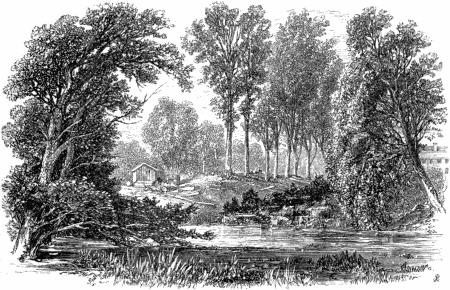
SITE OF THE SOHO MINT, NOW REMOVED.
The steam-engine had now become firmly established
as a working power. Beginning as a water pumper
for miners, it had gradually been applied to drive corn
and cotton mills, to roll and hammer iron, to coin
money, to work machinery, and to perform the various
labour in which the power of men and horses, of wind
and water, had before been employed. The numerous
orders for new engines which came in at Soho kept the
works increasingly busy. Many skilled workmen had
by this time been trained into expertness and dexterity;
and, being kept to their special departments of work,—fathers
training their sons to work with them at the
same benches,—a degree of accuracy and finish was
reached which contributed to establish and maintain
the prestige of the manufactory. The prosperity of
the firm was also materially promoted by the able
assistants who had been trained at Soho, and were in
due time promoted to superintend special departments
of the business. Among these were Murdock, Walker,
Southern, Ewart, and Lawson, who enjoyed the fullest
confidence of their chiefs, and repaid it with unswerving
loyalty.
When the concern had become thoroughly organised
under these able heads of departments, Boulton and
Watt began to breathe more freely. Their financial
difficulties had now disappeared, and instead of laying
out capital, they had begun to accumulate it. They
had laboured hard for their reward and richly earned
it; and after their long up-hill struggle, they well
deserved rest and peace at last. They now began to
take occasional journeys of recreation, with which they
varied their journeys of business. Thus, in the autumn
of 1789, we find Boulton making a tour in Derbyshire,
during which he was overtaken at Buxton by a letter
from the Lords of the Privy Council on coining business,
giving him “marching orders for London;” but a
party having been formed to visit the Peak Cavern, he
decided “to obey the Ladies rather than the Lords.”
Three days later, however, we find him in London,
“writing in a full chattering coffee-house at Charing
Cross,” and desiring his friend Mr. Barrow to pay his
respects to the ladies whom he had so hurriedly left.
While in London, he received a letter inviting him to
pay a visit to Holland and stand godfather to his friend
Mr. Hoofletter’s son; to which he replied, that he would
be glad to stand godfather to the boy and have the
name of Boulton associated with an honest race, but
was sorry that he could not assist at the christening or
at the dinner. “But pray act for me,” he added; “do
everything that’s proper (as is the custom in the
country); give the nurse five guineas from me, and I
will repay you. My best respects to Mrs. Hoofletter,
and my blessing on the young Christian.”
Watt’s troubles and anxieties also were in course
of gradual abatement. Though still suffering from
headaches, asthma, and low spirits, he seems on the
whole to have become more satisfied with his lot.
Prosperity agreed with him as it does with most people.
It is a condition easy to bear, and Watt took to it
kindly. As years passed over his head, he became
placid, contented, and even cheerful. His health
improved, and he enjoyed life in his old age as he had
never done in his youth. He ceased longing for the
rest of the grave, and gave over “cursing his inventions.”
On the other hand, he took pleasure in looking
back over the long and difficult road he had traversed,
and in recounting the various steps by which he had
perfected his great inventions. Nor did he cease to
invent; for he went on inventing new things to the
close of his life; but he followed the pursuit as a
recreation and delight, and not as a business and a
drudgery.
Watt too, like his partner, began to make tours of
pleasure, for the purpose at the same time of gathering
health and seeing the beauties of nature. In August,
1789, he wrote Boulton from Cheltenham, that he had
been making a delightful journey through the Western
Counties, by way of Worcester, Malvern, Hereford, and
Chepstow, and that he felt in better health and spirits
than he had been for a very long time. Occasional
letters reached him from Birmingham about orders
received for engines, nothing being done without first
consulting him. That the concern was thriving, may
be inferred from the comparative indifference with
which he now regarded such orders. An engine having
been ordered by a doubtful person, Watt wrote—“I
look upon such orders as of little value. They are so
precarious in their duration, and in this case there is
risk of bad payment or swindling. Whatever care we
take, he is like a shaved pig with a soaped tail.” On a
demand being made upon him for abatement of dues, he
wrote—“We have never made concessions to anybody
but they have been attended with loss to us and half a
dozen more; and it would appear that, if our patent
lasted long enough, the power of a horse would grow
to that of an elephant.”[328]
In the course of the following summer, Watt visited
the pleasantest spots in the neighbourhood of London,
and amongst other places took Windsor in his way,
where he had the honour of an interview with the
King. He had already met his Majesty at Whitbread’s
brewery in the early part of 1787, for the purpose of
explaining to him the action of the new rotary engine;
and the King had expressed the desire to see him again
when in the neighbourhood of Windsor. The following
is Watt’s brief account of the visit:—
“At Windsor I had a short conversation with the King. He never
mentioned you nor the coinage, nor anything that led to it;
therefore I could not bring it on; nor do I believe it could have
been of any service. He asked about engines, and how the Albion
mill was going on?—Answer: Very well in respect to grinding, but
not so well in regard to the trade. Asked: Who was the manager?—Answer:
Mr. J. Wyatt, who made the wooden hospitals. He
observed, that Wyatt was not bred to the milling business; how
had he learnt it?—Answer: That he was a man of ability and
observation. Asked: What sort of engines were we making?—Answer:
For almost everything, but at present principally for
brewers, distillers, cotton-spinners, iron-men, &c.—Asked: How we
were paid for them?—Answer: By horses power, 5l. a year in the
country, and that we made none under four-horses power.—Asked:
If these premiums afforded sufficient profit?—Answer: That they did
in large engines, but not in small.”[329]
As Boulton and Watt advanced in years they looked
forward with pleasure to the prospect of their two
eldest sons—Matthew Robinson Boulton and James
Watt, junior—joining them in the business they had
established, and relieving them of the greater part
of their anxieties and labours in connexion with it.
Both were young men of intelligence and character,
carefully educated, good linguists, and well versed in
practical science. We find many references to the
education of the two young men in the letters of
Boulton; few or none in those of Watt. The former
alike attracted young people and was attracted by
them, entering heartily into their pursuits; the latter
was too much absorbed by study, by inventions, and by
business, to spare time for the purpose. Besides, he
was, like his countrymen generally, reserved and undemonstrative
in all matters relating to the feelings and
affections.
Both boys were trained and educated so as to follow
in their fathers’ steps. Every pain was taken to give
them the best culture, and to imbue them with the
soundest principles. The two boys usually spent their
holidays together at Soho; and, growing up together,
they learnt to think, and feel, and work together.
“Jim returns to school this evening,” wrote Boulton, to Watt in
Cornwall; “he has behaved exceedingly well, and not a single bill
of indictment has been found against him. He had got it into
his head that he would not be an engineer, which I did not
contradict, but I gave him and Matt the small wooden water-wheel,
which they proceeded to erect below my duck-pond, and
there worked a forge; but not having water enough, necessity
has put them upon erecting a Savery’s engine, which is not yet
finished, though they are both exceedingly keen upon it. We have
killed many poor robins by pouring fixable air upon them, and had
some amusement in our electrical and chemical hobby-horsery,
which the young ones like much better than dry Latin. Jim
desires me to ask you to give him leave to learn French.”
At the same time Boulton’s own son was making good
progress under the Rev. Mr. Stretch, to whom Boulton
wrote,—
“Baron Reden has gone to the North. On his return, he will
leave his son with you for a year or two, and then invites Matt to
return with him to Germany. Youth is the time to learn languages,
and the Baron’s offer is certainly a great temptation ... let him
[Matt] not neglect the present, but apply himself so as to become
well grounded in Grammar and Latin ... he is capable, but not
of close application, to which he must be inured, as no proficiency
of any kind can be acquired without it.”
The Baron’s offer was not, however, accepted; but
desirous that his son should acquire proficiency in
French, Boulton took him over to Paris, towards the
end of 1786, and placed him under a competent master.
Many kindly letters passed between father and son
during the latter’s stay at Paris. The young man
spent rather more money than his father thought could
do him good. He therefore asked him to keep an
account of his personal expenses, which “must balance
exactly,” and implored him above all things to “keep
out of bad company.”
“The future reputation and happiness of your life,” wrote the
anxious father, “depend upon your present conduct. I must
therefore insist that you do not go strolling about Sodom and
Gomorrah under any pretence whatever.... It will not be
pleasant to you to read this, but I must do my duty to you or I
shall not satisfy my own conscience. I therefore hope you will
do your duty to yourself, or you cannot do it to me. There is
nothing on earth I so much wish for as to make you a man, a good
man, a useful man, and consequently a happy man.”[330]
The father’s anxieties abated with time; the son
applied himself assiduously to French and German, and
gave promise of becoming a man of ability and character.
Writing to his friend Matthews, Boulton said—“Matt
is a tolerable good chemist.... He hath
behaved very well, and I shall be glad when the time
arrives for him to assist me in the business.” In the
summer of 1788, young Boulton paid his father a
holiday visit at Soho, returning again to Paris to finish
his studies. Writing of his departure, to Matthews in
London, the father said—“I hope that my son is set off
for Dover: my heart overflows with blessings and love
to him.”[331]
The education of young Watt was equally well cared
for. After leaving school at Birmingham, his father
sent him for a year to Mr. Wilkinson’s ironworks at
Bersham, to learn carpentry in the pattern shop.[332] He
then returned to his father’s, from whence he was sent
to school at Geneva, where he remained for three years
perfecting himself in the modern languages. On his
return to England in 1788, we find Boulton writing
to Mr. Barrow of Manchester, asking him to obtain a
position for young Watt in some respectable counting-house,
with a view to his acquiring a thorough commercial
training. He was eventually placed in the
house of Messrs. Taylor and Maxwell, where he remained
for about two years, improving himself in his
knowledge of business affairs. His father’s reputation
and standing, as well as his own education and accomplishments,
served to introduce the young gentleman
to many friends in Manchester; and, although far from
extravagant in his habits, he shortly found that the
annual sum allowed him by his father was insufficient
to pay for his board, clothing, and lodging, and at the
same time enable him to keep clear of debt. Knowing
Boulton’s always open hand and heart, and his sympathy
for young people, the embarrassed youth at once applied
to him for help. Why he did not apply to his father
will be best understood from his own letter:—
“I am at this moment,” he explained, “on the best footing
possible with my father, but were I to inform him of my necessities,
I do not know what would be the consequence. Not that I suppose
the money in itself would be an object to him, but because he would
look upon it in the light of encouraging what he would call my
extravagances. Never having been a young man himself, he is
unacquainted with the inevitable expenses which attend my time
of life, when one is obliged to keep good company, and does not
wish to act totally different from other young men. My father’s
reputation, and his and my own station in life, require that I should
live at least on a decent footing. I am not conscious of having
committed any foolish extravagances, and I have avoided company
as much as possible; but I have also constantly avoided the
reputation of avarice, or of acting meanly on any occasion. My
father, unfortunately for me, measures the present times and circumstances
by those when he was of my age, without making the
proper allowances for their immense disparity; consequently it is
in vain for me to endeavour to convince him of the necessity of my
conduct.”[333]
He concluded by expressing his sense of Mr. Boulton’s
many friendly acts towards him, and confessing that
there was no other person on whom he could so
confidently rely for help in his emergency. The reply
of Boulton was all that he could desire. With sound
fatherly advice,[334] such as he would have given to his
own son under similar circumstances, he sent him a
draft for 50l., the amount required by young Watt to
clear him of his debts.
Among the friendships which he formed at Manchester,
was one of an intimate character with Mr.
Cooper, a gentleman engaged in an extensive business,
fond of books, and a good practical chemist. We find
young Watt requesting Boulton to recommend to Mr.
Cooper “a person to keep his library in order and to
make experiments for him, he not having time enough
to attend to the details of them himself.”[335] Cooper was
besides a keen politician, and took an active interest
in the discussion of the important questions then agitating
the public mind. Watt was inflamed by the
enthusiasm of his friend, and with the ardour of youth
entered warmly into his views as to the regeneration of
man and the reconstruction of society.
Mrs. Schimmelpenninck has, in her autobiography,
given a vivid picture of the interest excited in the circle
of friends amongst whom she moved, by the thrilling
events then occurring in France, and which extended
even to the comparatively passionless philosophers
of the Lunar Society. At one of the meetings held
at her father’s house in the summer of 1788 “Mr.
Boulton,” she says, “presented to the company his son,
just returned from a long sojourn at Paris. I well
remember my astonishment at his full dress in the
highest adornment of Parisian fashion; but I noticed,
as a remarkable thing, that the company (which consisted
of some of the first men in Europe) all with one
accord gathered round him, and asked innumerable
questions, the drift of which I did not fully understand.
It was wonderful to me to see Dr. Priestley, Dr. Withering,
Mr. Watt, Mr. Boulton himself, and Mr. Keir,
manifest the most intense interest, each according to his
prevailing characteristics, as they almost hung upon his
words; and it was impossible to mistake the indications
of deep anxiety, hope, fear, curiosity, ardent zeal, or
thoughtful gravity, which alternately marked their
countenances, as well as those of my own parents. My
ears caught the words ‘Marie Antoinette,’ ‘The Cardinal
de Rohan,’ ‘diamond necklace,’ ‘famine,’ ‘discontent
among the people,’ ‘sullen silence instead of shouts of
“Vive le Roi!”’ All present seemed to give a fearful
attention. Why, I did not then well know, and, in a
day or two, these things were almost forgotten by me;
but the rest of the party heard, no doubt, in this young
man’s narrative, the distant, though as yet faint rising
of the storm which, a year later, was to burst upon
France and, in its course, to desolate Europe.”[336] A few
short months passed, and the reign of brotherhood
began. “One evening, towards the end of July,”
continues Mrs. Schimmelpenninck, “we saw at a
distance a vehicle (usually employed to carry servants
to town or church) returning at more than its usual
speed. After some minutes the door of the drawing-room
opened, and in burst Harry Priestley, a youth of
sixteen or seventeen, waving his hat, and crying out,
‘Hurrah! Liberty, Reason, brotherly love for ever!
Down with kingcraft and priestcraft. The majesty of
the people for ever! France is free, the Bastille is
taken!’”[337] “I have seen,” she adds, “the reception of
the victory of Waterloo and of the carrying of the
Reform Bill; but I never saw joy comparable in its
intensity and universality to that occasioned by the
early promise of the French Revolution.”
The impressionable mind of Dr. Priestley was moved
in an extraordinary degree by the pregnant events which
followed each other in quick succession at Paris; and
he entered with zeal into the advocacy of the doctrines
of liberty, equality, and fraternity, so vehemently promulgated
by the French “friends of man.” His chemical
pursuits were for a time forgotten, and he wrote and
preached like one possessed, of human brotherhood, and
of the downfall of tyranny and priestcraft. He hailed
with delight the successive acts of the National Assembly
abolishing monarchy, nobility, church, corporations, and
other long established institutions. He had already
been long and hotly engaged in polemical discussions
with the local clergy on disputed points of faith; and
now he addressed a larger audience in a work which he
published in answer to Mr. Burke’s famous attack on the
‘French Revolution.’ Burke, in consequence, attacked
him in the House of Commons; while the French Revolutionists
on the other hand hailed him as a brother, and
admitted him to the rights of French citizenship.[338]
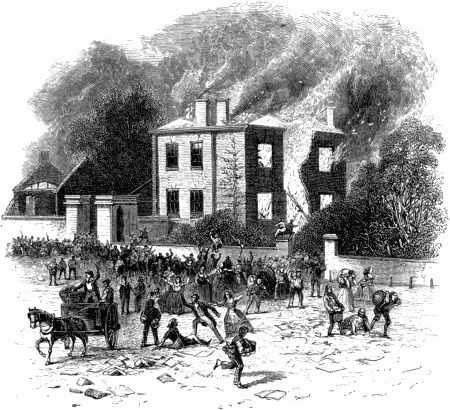
BURNING OF DR. PRIESTLEY’S HOUSE AT FAIRHILL.[339]
These proceedings concentrated on Dr. Priestley an
amount of local exasperation that shortly after burst forth
in open outrage. On the 14th of July, 1791, a public
dinner was held at the principal hotel to celebrate the
second anniversary of the French Revolution. About
eighty gentlemen were present, but Priestley was not of
the number. A mob collected outside, and after shouting
“Church and King,” they proceeded to demolish the
inn windows. The magistrates shut their eyes to the
riotous proceedings, if they did not actually connive at
them. A cry was raised, “To the New Meeting-house,”
the chapel in which Priestley ministered; and
thither the mob surged. The door was at once burst
open, and the place set on fire. They next gutted the
old Meeting-house, and made a bonfire of the pews and
bibles in the burying-ground. It was growing dusk,
but the fury of the mob had not abated. They made
at once for Dr. Priestley’s house at Fairhill, about a
mile and a half distant. The Doctor and his family had
escaped about half an hour before their arrival; and
the house was at their mercy. They broke in at once,
emptied the cellars, smashed the furniture, tore up the
books in the library, destroyed the philosophical and
chemical apparatus in the laboratory, and ended by
setting fire to the house. The roads for miles round
were afterwards found strewed with shreds of the
valuable manuscripts in which were recorded the results
of twenty years labour and study,—a loss which
Priestley continued bitterly to lament until the close of
his life.
Thus an utter wreck was made of the philosopher’s
dwelling at Fairhill. The damage done was estimated
at upwards of 4000l., of which the victim recovered
little more than one-half from the county. The next
day, and the next, and the next, the mob continued to
run riot, burning and destroying. On the second day,
about noon, they marched to Easyhill and attacked and
demolished the mansion of Mr. Ryland, one of the most
munificent benefactors of the town. Bordesley Hall, the
mansion of Mr. Taylor, the banker, was next sacked
and fired. The shop of the estimable William Hutton,
the well-known bookseller and author, was next broken
open and stripped of everything that could be carried
away; and from his shop in the town they proceeded
to his dwelling-house at Bennett’s Hill in the country,
and burnt it to the ground.[340] On the third day, six
other houses were sacked and destroyed; three of them
were blazing at the same time. On the fourth day,
which was a Sunday, the rioters dispersed in bands
over the neighbourhood, levying contributions in
money and drink; one body of them burning on their
way the Dissenting chapel-house and minister’s dwelling-house
at Kingswood, seven miles off. Other Dissenters,
of various persuasions, farmers, shopkeepers, and
others, had their houses broken into and robbed in open
day. It was not until the Sunday evening that three
troops of the Fifteenth Light Dragoons entered Birmingham
amidst the acclamations of the inhabitants,
who welcomed them as deliverers. At the instant of
their arrival, the mob had broken into Dr. Withering’s
house at Edgbaston Hall, and were rioting in his wine-cellars,
but when they heard that “the soldiers” had
come at last, they slunk away in various directions.
The members of the Lunar Society, or “the Lunatics,”
as they were popularly called, were especially marked
for attack during the riots. A common cry among the
mob was “No philosophers—Church and King for
ever!” and some persons, to escape their fury, even
painted “No philosophers” on the fronts of their
houses! There could be no doubt as to the meaning of
this handwriting on the wall. Priestley’s house had
been sacked, and Withering’s plundered. Boulton and
Watt were not without apprehensions that an attack
would be made upon them, as the head and front of the
“Philosophers” of Birmingham. They accordingly
prepared for the worst; called their workmen together,
pointed out to them the criminality of the rioters’ proceedings,
and placed arms in their hands on their
promising to do their utmost to defend the premises if
attacked. In the mean time everything portable was
packed up and ready to be removed at a moment’s
notice. Thus four days of terror passed, but the mob
came not; Watt attributing the safety of Soho to the
fact that most of the Dissenters lived in another direction.[341]
Many of the rioters were subsequently apprehended,
and several of them were hanged; but the damage
inflicted on those whose houses had been sacked was
irreparable, and could not be compensated. As for
Dr. Priestley, he shook the dust of Birmingham from
his feet, and fled to London; from thence emigrating
to America, where he died in 1804.
While such was the blind fury of the populace
of Birmingham, the principles of the French Revolution
found adherents in all parts of England. Clubs
were formed in London and the principal provincial
towns, and a brisk correspondence was carried on between
them and the Revolutionary leaders of France.
Among those invested with the rights of French
citizenship were Dr. Priestley, Mr. Wilberforce, Thomas
Tooke, and Mr. (afterwards Sir) James Mackintosh.
Thomas Paine and Dr. Priestley were chosen members
of the National Convention; and though the former
took his seat for Calais, the latter declined, on the
ground of his inability to speak the language sufficiently.
Among those carried away by the political
epidemic of the time, were young James Watt
and his friend Mr. Cooper of Manchester. In 1792
they were deputed, by the “Constitutional Society”
of that town, to proceed to Paris and present an
address of congratulation to the Jacobin Club, then
known as the “Société des Amis de la Constitution.”[342]
While at Paris, young Watt seems to have taken an
active part in the fiery agitation of the time. He was
on intimate terms with the Jacobin leaders. Southey
says that he was even the means of preventing a duel
between Danton and Robespierre, to the former of
whom he acted as second.[343] Robespierre afterwards
took occasion to denounce both Cooper and Watt as
secret emissaries of Pitt, on which young Watt sprang
into the tribune, pushing Robespierre aside, and defended
himself in a strain of vehement eloquence, which completely
carried the assembly with him. From that
moment, however, he felt his life to be unsafe, and he
fled from Paris without a passport, never resting until
he had passed the frontier and found refuge in Italy.
The public part he had taken in French Revolutionary
politics could not fail to direct attention to him
on this side of the channel. His appearance at a
public procession, in which he carried the British
colours, to celebrate the delivery of some soldiers
released from the galleys, was vehemently denounced
by Mr. Burke in the House of Commons. The
notoriety which he had thus achieved, gave his father
great anxiety; and after young James’s return to
England in 1794, he was under considerable apprehensions
for his safety. Several members of the London
political Societies had been apprehended and lodged in
the Tower, and Watt feared lest his son might in some
way be compromised by his correspondence with those
societies. Boulton, then in London, informed him of
the severe measures of the Government, and of the
intended suspension of the Habeas Corpus Act; to which
Watt replied,—
“I thank you for your intelligence, which I have communicated
with due caution to Mr. S. and my son. The former says he has
had no correspondence whatever with any of these societies,
nor has frequented any here,—that he may have uttered unguarded
or foolish words in private companies, but that he knows nothing of,
nor is he concerned in, any plot or political scheme whatsoever.
The latter says he never corresponded with any of them at any
time, though he once executed a commission for one of them, and
sent his answer to Mr. Tr.,—that for these two years he has had no
sort of connexion with any of them, and for more than a year all
his correspondence has been recommending his friends not to
intermeddle with public affairs. As he proposes to see you to-morrow,
he will explain himself, and I need not bid you council him for the
best.”[344]
A few days later, his apprehensions of danger to his
son not being removed, he wrote Boulton again as
follows:—
“I am made very uneasy on account of James by this Bastille Act[345]
now (I fancy) passed, and which I cannot help thinking un peu trop.
I submit whether it might not be best for you to endeavour to make
his peace with M[inist]ry by a candid avowal of his errors, and
of his subsequent change of sentiment and renunciation of all
correspondence with these traitors. In the mean time he had better
make the best of his way to here, Liverpool, or Scotland; from
either of the latter he might find his way to America if necessary.
In any case let him not go in company with any of the persons who
have laid themselves open to suspicion. I would not, however,
have him rashly run out of the country. M[inist]ry must know
who have been the active abettors of the plot, and, if they act
wisely, will not molest those who have seen their error or have had
the good sense to resist all temptations of engaging in plots against
the peace of the country, whatever their opinions about parliamentary
representation might be.... Query, whether Denmark,
Hamburg, or Norway, might not be preferable to America, lest
we go to war with the latter. If you find he is obnoxious, his
letters to me should be directed by another hand, and not
signed.”[346]
Four days later, Watt’s alarm was not abated by the
appearance in Birmingham of king’s messengers making
seizures of persons concerned in seditious correspondence.
“They have taken up,” he wrote, “one Pare,
who kept a reforming club at his house, and one or two
others. The soldiers were ordered under arms to
prevent tumult. I hear also that Wilkinson has been
threatened with a mob at Bradley, and has prepared to
defend himself with cannon, pikes, &c., but that matters
are now quiet there. In respect to James, you must
advise him, I cannot; but I think he would be better
at home, following his business, than elsewhere.”[347]
James eventually returned to Birmingham, where we
find him from this time forward taking an increasingly
active part in the affairs of the concern. He took
entire charge of the manufacture of the letter-copying
machines, now become a considerable branch of
the business; and he shortly after entered the engine
firm as a partner, in conjunction with Mr. Boulton’s
eldest son, Matthew Robinson.
The infusion of young blood had the effect of imparting
new vigour to all the branches of manufacture
at Soho, and at the same time of relieving the senior
partners from a considerable amount of labour and
anxiety. The business was now in a very thriving
state; there was abundance of orders for engines
coming in; and the principal difficulty of the firm
was in finding skilled workmen enough to execute
them. Thus we find Watt junior writing to Boulton
junior in January, 1795,—“We must have additional
men, rather too many than too few, until we have got
the start of our orders, for without that we shall always
feel ourselves embarrassed and clogged. I shall therefore
desire Rennie to renew his applications at Lancaster,
which appear as yet to have been unsuccessful.”
The junior members of the firm were also useful
in protecting the engine patent right, the infringement
of which had become general all over the country.
This was a disagreeable part of their business; but, if
not attended to, the patent must be given up as worthless.
The steam-engine was now regarded as an indispensable
power in manufacturing operations. It
had become employed in all important branches of
industry; and it was, of course, the interest of the manufacturers
to avoid the payment of dues wherever they
could. An instance of this evasion was detected at the
Bowling Ironworks near Bradford, and notice was
given of proceedings against the Company for recovery
of dues. On this the Bowling Company offered to
treat, and young Watt went down to Leeds for the
purpose of meeting the representatives of the Bowling
Company on the subject. On the 24th February, 1796,
he wrote his friend Matthew Robinson Boulton as
follows:—
“Inclosed you have a copy of the treaty of peace, not amity,
concluded at Leeds, on Saturday last, between me, Minister
Plenipotentiary to your Highnesses on the one part, and the Bowling
Pirates in person on the other part. I hope you will ratify the
terms, as you will see they are founded entirely upon the principle
of indemnity for the past and security for the future. The diameter
and length of stroke of their different engines, four in number,
I have; the times of their commencing to work will be sent you by
Mr. Paley; and the amounts of the premiums may be definitively
calculated upon my arrival, which will be about the latter end of
this week.”
Another engine constructed after Watt’s patent was
discovered working at a mill at Carke, in Cartmel,
Lancashire. Mr. Stockdale, son of the proprietor, tells
the following story of its detection. He states that the
first engine employed at the works was one on Newcomen’s
construction, which was used to pump water
into the reservoir which supplied the water-power by
which the mill was driven. It was then determined
to apply the steam-power direct to the machinery,
and a new engine was ordered from Manchester,
without communicating with the patentees. The mill
was in full work when a stranger called, representing
that he belonged to the concern of Boulton and Watt,
and requesting to inspect the engine. The request
was complied with, and Mr. Stockdale afterwards
invited him to stay to dinner; but it was the dearest
dinner he ever gave, as only a few weeks later a claim
for 1800l. was made by Boulton and Watt for dues
upon the engine, which was, however, eventually compromised
by the payment of 400l.
The most unscrupulous pirates, however, were the
Cornishmen who, emboldened by the long quiescence
of Boulton and Watt, and knowing that the patent
had only five or six more years to run, believed
that they might set the patentees at open defiance,
which they proceeded to do. Notwithstanding the
agreements entered into and ratified on both sides,
they refused point blank to pay further dues; and
Boulton and Watt were thus at last driven to have
recourse to the powers of the law. Had they remained
passive, it might have been construed into a tacit
admission that the patent right had from the first been
indefensible, and that the sums which they had up to
that time levied for the use of their engine had been
wrongfully paid to them. But neither had ceased to
have perfect faith in the validity of their patent, and
both determined, even at this late stage, to defend it.
“The rascals,” wrote Watt to Boulton, “seem to have
been going on as if the patent were their own.... We
have tried every lenient means with them in vain; and
since the fear of God has no effect upon them, we must
try what the fear of the devil can do.”[348] Legal proceedings
were begun accordingly. The two actions
on which the issues were tried were those of Boulton
and Watt v. Bull, and Boulton and Watt v. Hornblower
and Maberley; and they were fought on both
sides with great determination. The proceedings extended
over several years, being carried from court to
court; but the result was decisive in both cases in favour
of Boulton and Watt. It was not until January, 1799,
that the final decision of the judges was given;[349] almost
on the very eve of expiry of the patent, which had not
then a full year to run. It was not, however, with
a view to the future that these costly, anxious, and protracted
legal proceedings had been carried on, but
mainly for the recovery of dues under existing agreements,
and for dues on engines erected in various
quarters in infringement of the patent. Most of the
Cornish adventurers had paid nothing for years. Thus
Poldice had paid nothing since October, 1793, and was
in arrear 2330l. Wheal Gons had paid nothing since
May, 1793, and was in arrear 4290l. The Wheal
Treasure adventurers, and many others, had set Boulton
and Watt at open defiance, and paid nothing at all.
On the issue of the proceedings against Bull, Boulton
and Watt called upon the Mining Companies to “cash
up,” and arrears were shortly collected, though with
considerable difficulty, to the amount of about 30,000l.
Young Boulton went into Cornwall for the purpose
of arranging the settlements, and managed the business
with great ability. “I am now to congratulate you,”
Watt wrote to his partner from Glasgow, whither he
had gone on a visit, “on the success of Mr. R. Boulton’s
very able transactions in Cornwall; and I hope that at
last we may be freed from the anxiety of the issue of
law which has so long attended us, and enjoy in peace
the fruits of our labours. When you write to Mr. B.
I beg you will present my best wishes and best respects
to him, expressing my warmest approbation of his
exertions.” On another occasion, while the cause was
in progress before the courts of law, Watt wrote,—“In
the whole affair, nothing was so grateful to me
as the zeal of our friends and the activity of our young
men, which was unremitting.”
The senior members of the firm had for some time
been gradually withdrawing from the active management
of the concern. We find Watt writing to Dr.
Black in 1798,—“In regard to the engine business, I
now take little part in it, but it goes on successfully.”
Four years later he wrote,—“Our engine trade thrives;
the profits per cent. are, however, very, very moderate;
it is by the great capital and expensive establishment of
engineers, &c., that we keep it up; without our tools
and men very little could be done, as we have many
competitors, some of whom are men of abilities.” But
the business was now safe in the hands of the young
and active partners, who continued to carry it on for
many years, with even greater success than their fathers
had done. They reaped the harvest of which the
others had sown the seed. The patent right expired in
1800; but the business of the firm, nevertheless, became
larger and more remunerative than it had ever been
before. The superior plant which they had accumulated,
their large and increasing capital, the skilled
workmen whom they had trained, and the first-class
character of the work which they turned out, gave the
establishment of Boulton and Watt a prestige which
they long continued to maintain.
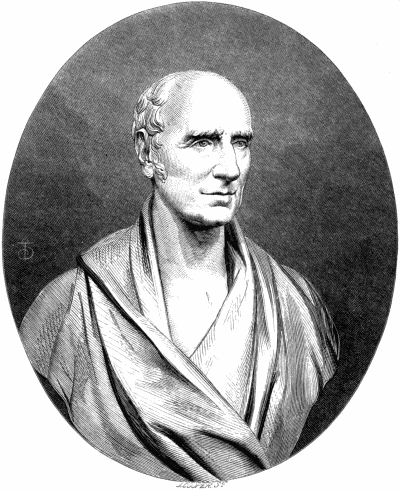
WILLIAM MURDOCK.
The young partners had also the great advantage
of the skilled heads of the different departments, who
had been trained by long and valuable experience.
For many years William Murdock was the Mentor
of the firm. Though tempting offers of partnerships
were made to him, he remained loyal to Boulton and
Watt to the last. They treated him generously, and he
was satisfied to spend his life in their service. He had
gradually worked his way to the foremost place in their
establishment, besides achieving reputation as an inventor
and a man of practical science. His model
locomotive of 1784 was the first machine of the kind
made in this country; and it is to be regretted that he
did not pursue the subject. But Murdock was a very
modest, unambitious man, content to keep in the background,
and not possessed by that “pushing” quality
which helps so many on to fortune. We have already
stated that he invented the sun and planet motion,
which was eventually adopted by Watt in preference to
his own method of securing rotary motion. His daily
familiarity with pumping-engines in Cornwall also led
him to suggest and introduce many improvements in
their details, which Boulton and Watt were always
ready to adopt. He was a great favourite in Cornwall,
and not less esteemed for his estimable and manly
qualities than for his mechanical skill. When the
adventurers heard of his intention to return to Soho,
in 1798, they offered him 1000l. a year to continue at
the mines, but he could not be tempted to remain.
Returned to Soho, Murdock was invested with the
general supervision and management of the mechanical
department, in which he proved of essential value. He
was regarded as “the right hand” of Boulton and
Watt. He proceeded to introduce great improvements
in the manufacture of the engines, contriving numerous
machines for casting, boring, turning, and fitting the
various parts together with greater precision. His
plan of boring cylinders by means of an endless screw
(turned by the moving power) working into a toothed
wheel, whose axis carried the cutter head, instead of by
spur gear, was found very useful in practice, and produced
a much more smooth and steady motion of the
machine. As early as 1785, he invented the first
oscillating engine,[350] which still continues in use in
various improved forms. His invention of the double
D slide valve, in place of the four poppet valves in Watt’s
double engine,[351] was also found of great value; saving
steam, and ensuring greater simplicity in the construction
and working of the engine. In his oscillating engine
the motion is given to the slide valve by the oscillation
of the cylinder, and engines of small power still continue
to be worked in this manner. Another of his improvements
in engine construction was his method of casting
the steam cases for cylinders in one piece, instead of
in separate segments bolted together, according to the
previous practice. He also invented a rotary engine
of an ingenious construction; but though he had one
erected to drive the machines in his private workshop,
where it continued employed for about thirty years, it
never came into general use.[352] Murdock had a good
deal of the temperament of Watt: he was always
scheming improvements, and was most assiduous in
carrying them out. In such cases he would not
trust to subordinates, but executed his designs himself
wherever practicable; and he sometimes carried his
labours so far into the night that the rising sun found
him at his anvil or his turning lathe.
Murdock is also entitled to the merit of inventing
lighting by gas. The inflammable qualities of the air
obtained by distillation of coal had long been known,[353]
but Murdock was the first to apply the knowledge to
practical uses. The subject engaged much of his attention
in the year 1792, when he resided at Redruth.
As his days were fully occupied in attending to his
employers’ engine business, it was only in the evenings,
after the day’s work was over, that he could pursue the
subject. It is not improbable that he was led to undertake
the investigation by Mr. Boulton’s chemical enthusiasm,
which communicated itself to all with whom he
came in contact. It will be remembered that the latter
occupied much of his leisure at Cosgarne in analysing
earths, minerals, and vegetable substances, trying to
find out the gases they contained; and Murdock was
his zealous assistant on these occasions. In the paper
which he communicated to the Royal Society on the
subject of lighting by coal-gas in 1808, for which they
awarded him their large Rumford Gold Medal, he observed,—
“It is now nearly sixteen years since (1792), in the course of
experiments I was making at Redruth, in Cornwall, upon the
quantities and qualities of the gas produced by distillation from
different mineral and vegetable substances, that I was induced by
some observations I had previously made upon the burning of coal,
to try the combustible property of the gases produced from it, as
well as from peat, wood, and other inflammable substances; and
being struck with the great quantities of gas which they afforded,
as well as the brilliancy of the light, and the facility of its
production, I instituted several experiments with a view of
ascertaining the cost at which it might be obtained, compared with
that of equal quantities of light yielded by oils and tallow. My
apparatus consisted of an iron retort, with tinned iron and copper
tubes, through which the gas was conducted to a considerable
distance; and there, as well as at intermediate points, was burnt
through apertures of various forms and dimensions. The experiments
were made upon coal of different qualities, which I procured
from different parts of the kingdom for the purpose of ascertaining
which would give the most economical results. The gas was also
washed with water, and other means were employed to purify it.”[354]
Murdock put his discovery to the best practical test
by lighting up his house and offices at Redruth with
gas; and he had a gas lantern constructed, with a jet
attached to the bottom of the lantern and a bladder of
gas underneath, with which he lighted himself home
at night across the moors when returning from his
work to his house at Redruth.[355] On the occasion of
a visit which he made to Soho in 1794, he took the
opportunity of mentioning to Mr. Watt the experiments
he had made, and their results; expressing
his conviction of the superior economy, safety, and
illuminating qualities of coal-gas, compared with oils
and tallow. He then suggested that a patent should
be taken out for the application, and at various subsequent
periods he urged the subject upon the attention
of his principals. But they were at the time so harassed
by litigation in connexion with their own steam-engine
patent, that they were unwilling to enter upon any
new enterprise which might possibly lead them into
fresh embroilments; and nothing was done to protect
the invention.
On Murdock’s return to Soho in 1798, he proceeded
with his investigations, and contrived an apparatus
for making, purifying, and storing the gas
on a large scale; and several of the offices in the
building were regularly lighted by its means. On
the general illumination which took place in celebration
of the Peace of Amiens in 1802, the front of Soho
Manufactory was brilliantly illuminated with gas, to
the astonishment and admiration of the public. The
manageableness, the safety, the economy, and the brilliancy
of the new light being thus proved, Boulton and
Watt in 1803 authorised Murdock to proceed with the
general fitting up of the manufactory with pipes and
burners, and, from that date, it continued to be regularly
lit up with coal-gas. Several large firms followed
their example; amongst others Phillips and Lee, Burley,
and Kennedy, at Manchester, and Gott and Sons, at
Leeds; and the manufacture of gas-making apparatus
became one of the regular branches of business at Soho.
Several years later, in 1805, when Watt went down to
Glasgow, he found gas in pretty general use.
“The new lights,” he wrote to Boulton, “are much in vogue
here; many have attempted them, and some have succeeded tolerably
in lighting their shops with them. I also hear that a cotton-mill
in this neighbourhood is lighted up with gas. A long account of
the new lights was published in the newspapers some time ago, in
which they had the candour to ascribe the invention to Mr. Murdock.
From what I have heard respecting these attempts, I think there is
full room for the Soho improvements,[356] though, when once they see
one properly executed, it will have numerous imitations.”
Several years after the introduction of the new light,
a German, named Wintzer or Winsor, brought out (in
1809) a scheme similar to one projected in Paris by
Le Bon, for lighting the streets by gas. He proposed
a Joint Stock Company, with a capital of 300,000l.,
and held forth to subscribers the prospect of a profit
of ten thousand per cent.![357] He applied to Parliament
for a Bill, against which Murdock petitioned,
and was examined before the Committee. Though
they were staggered by the crudities of Winsor, they
had some difficulty even in accepting the more modest
averments of Murdock as to the uses of coal-gas for
lighting purposes. “Do you mean to tell us,” asked
one member, “that it will be possible to have a light
without a wick?” “Yes, I do, indeed,” answered Murdock.
“Ah, my friend,” said the legislator, “you are
trying to prove too much.” It was as surprising and
inconceivable to the honourable member as George
Stephenson’s subsequent evidence before a Parliamentary
Committee to the effect that a carriage might be drawn
upon a railway at the rate of twelve miles an hour
without a horse.
No wonder that strange notions were entertained
about gas in those early days. It seemed so incredible
a contrivance, to make air that could be sent
along pipes for miles from the place at which it was
made to the place at which it issued as jets of fire, that
it ran entirely counter to all preconceived notions on
the subject of illumination. Even Sir Humphry Davy
ridiculed the idea of lighting towns with gas, and asked
one of the projectors if it were intended to take the
dome of St. Paul’s for a gasometer; and Sir Walter
Scott made many clever jokes about the absurdity of
lighting London with smoke, though he shortly after
adopted the said “smoke” for lighting up his own
house at Abbotsford. It was popularly supposed that
the gas was carried along the pipes on fire, and that
hence the pipes must be intensely hot. Thus, when the
House of Commons was first lighted up with gas,
the architect insisted on the pipes being placed several
inches from the wall for fear of fire, and members might
be seen applying their gloved hands to them to ascertain
their temperature, expressing the greatest surprise
on their being found as cool as the adjoining walls.[358]
The advantages of the new light, however, soon
became generally recognised; and gas companies were
established in most of the large towns. Had Murdock
patented the invention, it must have proved exceedingly
remunerative to him; but he derived no advantage
from the extended use of the new system of lighting
except the honour of having initiated it,—though of
this more than one attempt was made to deprive him.
As he himself modestly said, in his paper read before
the Royal Society, “I believe I may, without presuming
too much, claim both the first idea of applying, and
the first actual application of this gas to economical
purposes.”
Murdock’s attention was, however, diverted from
prosecuting his discovery of the uses of gas to a profitable
issue by his daily business, which was of a very
engrossing character. He continued, nevertheless, an
almost incessant contriver, improver, and inventor;
following, like his master Watt, the strong bent of
his inclinations. One of his most cherished schemes
was the employment of compressed air as a motive
power. He contrived to work a little engine of
12-inch cylinder and 18-inch stroke, which drove the
lathe in the pattern-shop, by means of the compressed
air of the blast-engine employed in blowing the cupolas
at the Soho Foundry; and this arrangement continued
in use for a period of about thirty-five years. He also
constructed a lift worked by compressed air, which
raised and lowered the castings from the Boring-mill
to the level of the Foundry and the Canal Bank.[359] He
used the same kind of power to ring the bells in his
house at Sycamore Hill; and the contrivance was afterwards
adopted by Sir Walter Scott at Abbotsford.[360] He
experimented on the power of high-pressure steam in
impelling shot, and contrived a steam-engine in 1803,
with which he made many trials at Soho, in anticipation
of Perkins’s apparatus. He was the inventor of the well-known
cast-iron cement so extensively used in engine
and machine work; and the manner in which he was
led to it affords a striking illustration of his quickness of
observation. Finding that some iron-borings and sal-ammoniac
had got accidentally mixed together in his
tool-chest and rusted his saw-blade nearly through, he
took note of the circumstance, mixed the articles in
various proportions, and at last arrived at the famous
cement, which eventually became an article of extensive
manufacture at the Soho works, completely superseding
the cement invented by Watt. In 1810 he took out
a patent for boring stone pipes for water, and cutting
columns out of solid blocks by one operation. In 1815
he invented an apparatus for heating the water for the
Baths at Leamington by the circulation of water
through pipes from a boiler,—a method since extensively
adopted for heating buildings and garden-houses.
While occupied in erecting the apparatus at Leamington,
a heavy cast-iron plate fell upon his leg and severely
crushed it, laying him up for many months.
His ingenuity was constantly at work, even upon
matters which lay entirely outside his special calling.
Mr. Fairbairn informs us that he contrived a variety
of curious machines for consolidating peat moss, finely
ground and pulverised, under immense pressure, and
moulding it into beautiful medals, armlets, and necklaces,
which took the most brilliant polish, and had the appearance
of the finest jet. Observing that fish-skins might
be used as an economical substitute for isinglass, he went
up to London to explain to the brewers the best method
of preparing and using them.[361] While in town on this
errand, it occurred to him that there was an enormous
waste of power in the feet of men and animals treading
the streets of London, which might be economised and
made productive; and he conceived the idea of using
the streets as a grand treadmill, under which the waste
power was to be stored up by mechanical methods,
and turned to account! Another of his ingenious
schemes—though then thought equally impracticable
with that last mentioned—was his proposed method
of transmitting letters and packages through a tube
exhausted by an air-pump. This idea seems to have
led to the projection of the Atmospheric Railway, the
success of which, so far as it went, was again due to
the practical ability of Murdock’s pupil Samuel Clegg.
Though the atmospheric railway was eventually abandoned,
it is remarkable that Murdock’s original idea
has since been revived, and practised with success, by
the London Pneumatic Despatch Company.
Such is a brief sketch of the life and works of this
estimable and ingenious mechanic, for so many years
the mainstay of the Soho works. Mr. Fairbairn, who
first made his friendship at Manchester in 1816, speaks
of him as one of the most distinguished veterans in
mechanical engineering then living,—“tall and well-proportioned
in figure, with a most intelligent and
benevolent expression of countenance.” He was a man
of robust constitution, and though he sorely taxed it, he
lived to an old age, surviving the elder Boulton and
Watt by many years.[362]
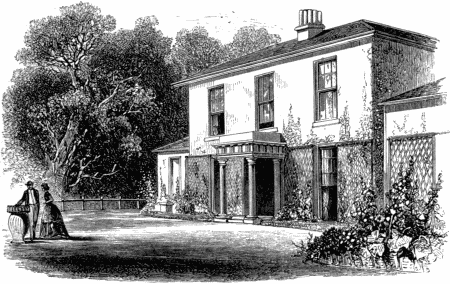
MURDOCK’S HOUSE, SYCAMORE HILL, HANDSWORTH.[363]
It will be remembered that one of the early speculations
of Roger Bacon related to the employment of engines of
navigation without oarsmen, “so that the greatest river
and sea ships, with only one man to steer them, may
sail swifter than if they were fully manned,”—that one
of the uses to which Papin proposed to apply the steam-engine
was to “propel ships against the wind and
tide,” in illustration of which he constructed his model
steamboat,—and that, shortly after Newcomen’s engine
had become generally introduced as a pumping power,
Jonathan Hulls took out a patent with the object of
applying it to tow ships into and out of harbours.
Hulls was followed, after a long interval, by Jouffroy
in France and by Fitch in America, but none of their
experiments proved successful; and it was not until
Watt invented the condensing engine that it was found
practicable to employ steam as a regular propelling
power in navigation.
It was natural that the extraordinary success of Watt’s
invention should direct attention anew to the subject.
The engine, in the powerful, compact, economical, and
manageable form, into which he had brought it, was
found able to effect rotary motion in the various processes
of manufacture; and, in a maritime country like
England, the thought that would naturally occur to
many minds would be this: If the steam-engine can
drive mill-wheels, why may it not in like manner be
employed to drive the wheels of carriages by land and
the paddle-wheels of vessels by sea? The subject was,
indeed, often brought under the notice of both Boulton
and Watt; but the anxiety, annoyance and expense
to which they had been subjected in defending their
original patent, deterred them from venturing on this
new field of enterprise. Watt never made his proposed
locomotive engine for running on common roads; and
the model constructed by Murdock at Redruth in 1784,
remained a model still.
The subject was, however, shortly after taken up
by William Symington, at Wanlockhead, in Scotland,
where his father was employed as engineman in superintending
the working of one of Boulton and Watt’s
pumping-engines. The sight of this engine, and his
father’s employment upon it, had probably the effect
of first directing his attention to steam-power and its
extended uses; and having heard of Murdock’s ingenious
design from Boulton and Watt’s men, who were constantly
visiting and inspecting the pumping-engine,[364] it
occurred to him to try whether he could not himself
construct the model of a steam-carriage for use on
common roads. He succeeded in making his model, and
when it was finished, Mr. Meason, the manager of the
Wanlockhead Lead Mines, was so much pleased with it
that he asked the young man to accompany him to
Edinburgh, to show it to the leading men of science
in that city. Mr. Meason allowed it to be exhibited
at his own house, Symington being in attendance to
give explanations. Some of the Edinburgh professors,
who came to see the model, were so much pleased with
the youthful inventor (then only about twenty years of
age), and the indications of mechanical genius which
his machine displayed, that they strongly recommended
Mr. Meason to enter him as a student at the University,
which he readily assented to, and Symington accordingly
matriculated at Edinburgh College in 1786, and, amongst
other lectures, attended those of Dr. Black on Chemistry
in the following session.
The Scotch roads were in too bad a condition at the
time to admit of their being run over by a locomotive,
and Symington eventually abandoned his proposed
scheme. But he had also an idea that the steam-engine
might be economically applied to the working of boats
on canals, or ships at sea; and with that object he
invented an engine specially adapted for the purpose.
This clearly appears from his correspondence with
Thomas Gilbert, M.P., brother to the Duke of Bridgewater’s
land steward. Mr. Gilbert had inspected the
model of the steam-carriage while on a visit to Edinburgh,
and at the same time had some conversation with
Symington as to the employment of the steam-engine
in hauling canal-boats, the result of which was that
Symington promised to write him more fully on both
topics. He proceeded to do so in a letter dated Wanlockhead,
24th September, 1786; in which, after describing
the dimensions, power, mode of working, and the probable
price (about 70l.) of a full-sized locomotive, he proceeded—
“But an engine of the same power and apparatus for working
boats on canals, will only coast about fifty pounds, and will only
weight 110 st. Each strock of the engine will have a force equall to
160 st. weight when applied, which undoubtedly will be able to drag
a great weight upon water, when we run the proportion between
it and what a man can do in a boat with common oars, whose
exertion does not exceed more than 7 stones; but of this you will
be a better judge than me. The engine we propose for working
the land-carriage is Mr. Watt’s, with some very material alterations;
and before we can use it we must make an agreement with him,
which we intend to propose immediately. But the engine we
propose to work boats or ships with is an engine intirely of our own
invention, and more powerful and better adapted for the purpose
than Mr. Watt’s engine. This engine of our own we have presently
at worke here is a large moddle, by which we have properly ascertained
its power, and found it exceed Mr. Watt’s engine nearly two
pounds upon each square inch on the piston, without any greater
consumpt of coals. Another advantage attending our engine is its
being little more complicated than the old engine that works with
an atmospheric pressure. We are to use our endeavours immediately
for a patent for this engine as well as our carriage; your assistance,
when we get application made, will be of great service to us, and
thankfully received by, Sir, &c. &c., William Symington.”[365]
About the same time that Symington was exhibiting
his model carriage in Edinburgh, Mr. Miller of Dalswinton
was trying experiments at Leith in propelling boats
by paddle-wheels worked by men at a capstan. He
had a triple vessel built, with wheels placed inside, on
turning which the vessel was impelled forward. It
will be observed that this was but a repetition of the
old experiment of Blasco Garay at Barcelona, and
of Savery on the
Thames. The experiments
were on
the whole successful,
but the power
employed in propelling
the vessel
was felt to be defective,
and the
turning of the capstan
was very hard work, at which men could not be
brought to work continuously for any long period.
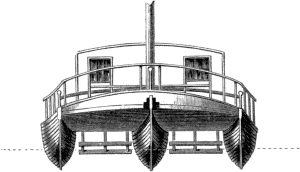
MILLER’S TRIPLE VESSEL.
Mr. Miller, being curious as to all mechanical novelties,
went, amongst others, to see Symington’s model
locomotive; and in the course of conversation with the
inventor informed him of his own project, describing
the difficulty he had experienced in getting his paddles
turned for lack of power. The immediate remark of
Symington was, “Why don’t you use the steam-engine?”
He proceeded to show how easily the engine might be
connected with the wheels of the boat, using the model
of the steam-carriage before him to explain his meaning.
Mr. Miller appeared to have been struck by the suggestion,
and in the pamphlet which he shortly after
published describing his new vessel, he referred to the
probable employment of steam-power for the purpose of
driving the paddles. “I have reason to believe,” he
said, “that the power of the steam-engine may be
applied to work the wheels, so as to give them a quicker
motion, and consequently to increase that of the ship.
In the course of this summer, I intend to make the
experiment; and the result, if favourable, shall be communicated
to the public.”[366]
Mr. Miller subsequently contrived and constructed a
double vessel, 60 feet in length, worked by a paddle-wheel
placed amidships between the two halves of the
ship, with a clear waterway in the middle in which
the paddle was worked, propelling the vessel. An
experiment with this new ship was tried in June, 1787,
which was considered successful. “The vessel being
put in motion by the water-wheel, wrought by five
men at the capstern, was steered so as to keep the wind
right ahead, and her rate of going was found by the
log to be three and a half miles in the hour.”[367] A sailing-match
was arranged by Mr. Miller, in which he was
to run his vessel from Inchcolm (a small island in the
Frith of Forth) to Leith, against a Custom-house wherry
which was reckoned a fast sailer. In this race the
double vessel beat by a few minutes. A young man
named James Taylor, who officiated in Mr. Miller’s
family as tutor to his two younger sons, was on board
the vessel, and took his turn in working the wheels,
which he found to be “very severe exercise.” In consequence
of this trial and its results, Taylor became persuaded
that unless a more commanding power than that
of men could be applied, the invention of the paddle-ship
would prove of little use; and on turning the matter
over in his mind, he suggested to Mr. Miller the use
of the steam-engine. This, however, was no new
idea, as, from what we have already stated, it is clear
that it had already occurred to Symington, who had
even contrived an engine for the express purpose of
propelling ships. As Taylor was intimate with Symington,
and a fellow-student with him at Edinburgh College
in the session of 1786–7, it is probable that Taylor
obtained from him his first idea of the application of the
steam-engine to Mr. Miller’s paddle-boat.
The result of Symington’s and Taylor’s suggestion
was, that Mr. Miller resolved to make a further experiment;
and he ordered a double boat to be built and
fitted with a steam-engine for trial on Dalswinton Loch,
near his country-seat in Dumfriesshire, in the course
of the following summer. Symington prepared the
plans of the engine, the castings of which were executed
by George Watt, an Edinburgh founder; and when the
parts were ready, Symington and Taylor went together
to Wanlockhead, in the summer of 1788, to have the
engine erected and placed in the boat in readiness for
the proposed trial.
In the mean time, other projects of a similar kind
were afoot; and Boulton and Watt continued to be
solicited from different quarters on the subject of engines
for sailing ships. To these they continued to turn
a deaf ear. They were willing to execute engines to
order, but they declined to undertake them as speculations.
Thus, in the spring of 1788, we find Sir John
Dalrymple, one of the barons of the Court of Exchequer
at Edinburgh, addressing Boulton on the subject of
the proposed application of the steam-engine to the
propulsion of ships, and the reply of the latter clearly
shows what were then the views of the Soho firm on
the subject:—
“Sir,—I have just received the honour of your letter of the
23rd inst., by which I observe you are intent upon applying
the power of steam to the navigation of ships, boats, &c.
“It is one of the applications of our engine which Mr. Watt and
I have often talked of, but we were deterred from the prosecution
of it more from political than mechanical difficulties, as well as from
some prudential reasons; besides which, we thought we could be
more useful to the public and to ourselves by confining our attention
to such subjects as were within the limits of our own powers and
our own country. We still continue of that opinion, and are
persuaded that it would be folly in us (who have our hands and
heads full of solid and important business) to engage in any set of
new experiments, or, like Charles XII., go in quest of conquest
in foreign kingdoms, and leave our own to be conquered.
“If you or your friends want any of our steam-engines for any
purpose you may think proper to apply them to, we shall be
very glad to serve you upon the usual terms; although I must
confess that I should be sorry to see them applied to one purpose
which perhaps may be of as much importance to this country
some time or other as Admiral Drake’s fire-ship was on a former
emergency.
“I beg the favour of you not to consider me or Mr. Watt as
schemers or projectors, but as men who are following their regular
established trade and manufactures of great extent,—amongst
others that of steam-engines,—and engineers, in which capacity we
shall always be found attentive to your commands.”[368]
Symington had many difficulties to encounter in
erecting his engine at Leadhills. Though it was of
very small size, being of only about two horses power,
with a four-inch cylinder, it required as much skill to
construct as a much larger engine would have done.
The arrangement of the power was new, as well as the
application; and, as in the case of every new machine,
where unforeseen defects were brought to light, new
expedients had to be contrived for the purpose of overcoming
them. Mr. Miller became impatient for its completion,
and repeatedly wrote from Edinburgh urging
despatch, fearing lest some other projector should get
the start of him in applying the steam-engine to the
driving of ships. Taylor, who managed the corresponding
part of the enterprise, replied, “You need be under
very little apprehension as to any person getting
before you in this. It is easy in conversation, but very
different in execution. However, as such a circumstance
would be equally unpleasant to us, to prevent it you may
depend upon the greatest expedition being used.”[369]
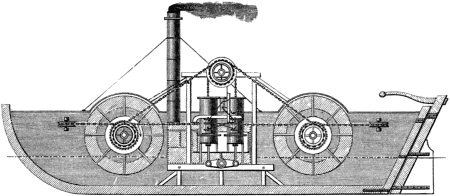
SYMINGTON’S FIRST STEAMBOAT ENGINE.
Taylor being further urged by his employer, again
wrote from Leadhills on the 12th September, 1788,—“Mr.
Symington and I are as busy here as we possibly
can be. We work from six o’clock in the morning
till dark in the evening, without losing a moment; also,
to forward us the more, we have called in the aid
of a watchmaker here, who works along with us. We
are now in great forwardness, and will not be long
of finishing. I could not ascertain to a day when it
will happen, but believe we shall have it at Dalswinton
some time before the end of the month.”[370]
The engine was shortly after finished, mounted in a
strong oak frame, and taken to Dalswinton. It was
then placed on the deck of Mr. Miller’s double pleasure-boat,
twenty-four feet long and seven broad, which had
been prepared for its reception.
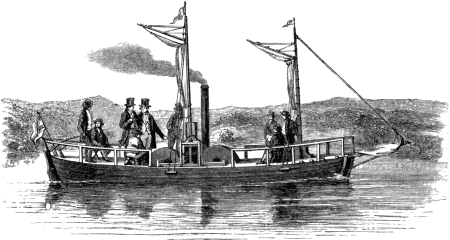
MR. MILLER’S EXPERIMENTAL STEAMBOAT.
The engine was placed on one side of the boat, the
boiler on the other side to balance it, and the paddle-wheels
in the middle; the rotary motion being obtained
from the engine by chains, ratchet-wheels, and catches.
The first experiment was tried on the 14th of October,
1788, and proved successful, the engine being propelled
at the rate of five miles an hour.[371] Among the persons
present on the occasion, besides Miller, Symington, and
Taylor, were Alexander Nasmyth, the landscape painter,
and Robert Burns, the poet, then a tenant of Mr. Miller
on the neighbouring farm of Ellisland. After a few
further experiments the engine was taken out of the
boat and carried into Mr. Miller’s house, where it
remained for many years, and was eventually deposited
in the Museum of Patents at Kensington, where it is
now to be seen.
The experiments made with this first steamboat were
so satisfactory that Mr. Miller resolved to try one upon
a larger scale. By this time Messrs. Allen and Stewart,
of Leith, had built for him another double vessel, ninety
feet in length; and he wrote to Symington, requesting
his estimate of the cost of fitting it with a suitable
steam-engine. Symington’s reply was to the effect
that a proper-sized engine for such a vessel would,
in his opinion, be about 250l., including the float-wheels.
The necessary order was given, and Symington
proceeded to the Carron Ironworks for the purpose of
constructing it. The vessel arrived at Carron on the
24th June, and by the month of November following
the engine was finished and put on board ready for
trial.[372] The result was not so satisfactory as in the case
of the experiment on Dalswinton Loch. The paddle-wheels
were too weak; first one float and then another
broke off; and the trial had to be suspended until the
defects were remedied. The next trial was, however,
more satisfactory. The vessel reached a speed of seven
miles an hour; and this was repeated with the same
result. There must, however, have been some defect
in the engine performances; for, in a letter written by
Miller to Taylor, who was present throughout, he
expressed the opinion that Symington’s engine was
altogether unsuitable for giving motion to a vessel.[373]
He accordingly ordered the engine to be taken out
and placed in the Carron Works, and the vessel itself
to be laid up at Bruce Haven.
Thus matters remained until the spring of the following
year, when Mr. Miller decided on applying to
Boulton and Watt for an engine of a proper construction,
offering at the same time to associate them with
him in his enterprise. The negotiation was opened by
Robert, afterwards Lord Cullen, who addressed Watt
on the subject; but his reply was not encouraging.
Like his partner, Watt was averse to new speculations;
and he had had too much anxiety and worry in connexion
with his original enterprise to enter upon any
new one. It will also be observed that he entertained
doubts as to the eventual success of ocean navigation by
steam. The following was his reply:—
“Dear Sir,—We have heard of Mr. Miller’s ingenious experiments
on double ships from Sir John Dalrymple, and also some
vague accounts of the experiments with the steam-engine, from which
we could gather nothing conclusive, except that the vessel did move
with a considerable velocity.
“From what we heard of Mr. Symington’s engines, we were
disposed to consider them as attempts to evade our exclusive
privilege; but as we thought them so defective in mechanical
contrivance as not to be likely to do us immediate hurt, we thought
it best to leave them to be judged by Dame Nature first before we
brought them to any earthly court.
“We are much obliged to Mr. Miller for his favourable opinion
of us and of our engines, which we hope experience would more and
more justify. We are also fully sensible of his kind intentions in
offering to associate us with him in his scheme; but the time of life
we have both arrived at, and the multiplicity of business we are at
present engaged in, must plead our excuse for entering into any
new concern whatever as partners; but as engineers and engine-makers
we are ready to serve him to the best of our abilities, at our
customary prices, for rotative engines, and to assist in anything we
can do to bring the scheme to perfection.
“We conceive that there may be considerable difficulty in making
a steam-engine to work regularly in the open sea, on account of the
undulating motion of the vessel affecting the vis inertiæ of the matter;
however, this we should endeavour to obviate as far as we could.
“It may not be improper to mention that Earl Stanhope has
lately taken a patent for moving a vessel by steam, but not by
wheels. His Lordship has also applied to us for engines; but we
believe we are not likely to agree with him, as he lays too much
stress upon his own ingenuity.
“We cannot conclude without observing, that were we disposed
to enter into any new concern whatever, there is no person we
should prefer to Mr. Miller as an associate, being fully apprised
of his worth and honour, and admirers of the ingenuity and industry
with which he has pursued this scheme.
“Permit me now, Sir, to return you my thanks for your obliging
attention to me, and for the trouble you have taken in this affair,
and to ask the favour of your presenting Boulton and Watt’s
respectful compliments to Mr. Miller.—I remain, dear Sir, &c. &c.,
“James Watt.”[374]
Mr. Miller proceeded no further with his experiments,
on which he had already expended a large sum of
money. He seems to have lost faith in the applicability
of the steam-engine to the propulsion of ships, and
reverted to his original idea, as we find him taking out
a patent in 1796 for a new kind of flat-bottomed ship,
which he proposed to impel during calms by means of
wheels worked by capstans; but he makes no mention
whatever of the use of the steam-engine.
Symington was greatly disappointed with the result
of his experiments. Being without the means of carrying
the steamboat further, he feared that all his past
labours would prove in vain, and that some more
fortunate speculator would carry off the prize that
seemed almost within his grasp. The subject was not,
however, allowed to sleep. Fitch and Evans were
pursuing the invention in America; Rumsey, another
American, came over to England in 1788, with a scheme
for propelling boats by steam; and Fourness and Earl
Stanhope were making experiments in the same direction;
but none of them had yet succeeded in constructing
a practicable working steamboat. Thus ten
more years passed, during which other inventors came
forward, took out patents, made their trials, failed, and
disappeared.
In the year 1801 Symington had another chance.
Lord Dundas, Governor of the Forth and Clyde Canal
Company, had been revolving in his mind whether
some more expeditious and economical method than
horse-power might not be contrived for hauling the
boats along the canal; and, being aware of the experiments
made by Miller and Symington ten years before,
he determined to give Symington’s engine another trial.
A boat was accordingly built for the purpose of the
experiment, and named the ‘Charlotte Dundas,’ after
his Lordship’s daughter. For this vessel Symington
contrived a steam-engine of a greatly improved character.
It was a direct-acting engine, the steam acting
on each side of the piston, after the method invented
by Watt, whose patent had now expired; the rotary
motion of the paddle-wheels being secured by means of
a connecting-rod and crank, instead of by chains and
ratchet-wheels, as in the first two boats.
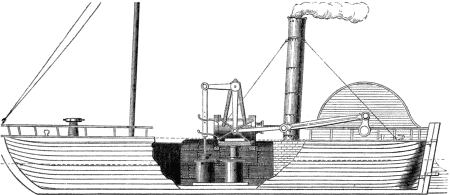
MACHINERY OF THE ‘CHARLOTTE DUNDAS.’
The first trial of the vessel was perfectly satisfactory.
After making a trip to Glasgow, she was employed in
towing vessels along the canal. She was also occasionally
sent down the Frith to bring up ships detained
by contrary winds to the canal entrance at Grangemouth.[375]
Fortune at length seemed to smile on poor Symington,
and his spirits were proportionately elated at the
result of these important experiments. He had, in
fact, achieved a decided success in the ‘Charlotte
Dundas,’—in which he combined together, for the first
time, those improvements which constitute the present
system of Steam Navigation. Indeed Mr. Woodcroft,
a competent judge, says that “the vessel might, from
the simplicity of its machinery, have been at work at
this day with such ordinary repairs as are now occasionally
required to all steamboats.”[376]
Lord Dundas was so well satisfied with the performances
of the vessel that he proposed to introduce the
inventor to the Duke of Bridgewater, the great canal
proprietor, who had expressed to him his wish to
employ some method of hauling his boats more effective
than horse-power. His Lordship accordingly directed
Symington to have a model of his steamboat constructed
for the purpose of showing it to the Duke.
Symington went up to London himself to explain its
mechanical arrangements, and the Duke was so much
pleased with it that he ordered eight boats of the same
construction to be made as speedily as possible for use
upon his canal. Symington returned to Scotland to
proceed with the execution of this important order.
But in the moment of his apparent triumph fate
again proved hostile to the inventor. Though Lord
Dundas was fully satisfied with the performances of
the ‘Charlotte Dundas,’ and hailed the use of steam
as the beginning of a new era in navigation, the
proprietors of the canal became seriously alarmed
lest the banks should be washed away by the waves
which the steamboat raised in its wake, and they
came to the resolution of prohibiting all further experiments.
To add to Symington’s vexation, the very
same day on which this adverse decision of the canal
managers reached him, he received intelligence of
the death of the Duke of Bridgewater, and an order
to suspend the erection of the eight steamboats until
fresh instructions had been given. By this time Lord
Dundas had expended about 7000l. on his experiments,
and was not disposed to proceed any further with them.
The ‘Charlotte Dundas,’ the first successful steamboat,
was accordingly laid up at Bainsford, in a creek of the
canal; and the attempt to introduce steam navigation
on canals was from that time suspended.[377]
Symington’s experiments, though they proved most
unfortunate as respected himself, nevertheless led to the
adoption of the system of navigation by steam both in
America and Scotland. Among the many visitors who
inspected the ‘Charlotte Dundas’ were Fulton the
American artist, and Andrew Bell the engineer, of
Glasgow. Fulton was on board the first vessel in the
month of July, 1801, when she made a run of eight
miles on the Forth and Clyde Canal in an hour and
twenty minutes; on which occasion he narrowly inquired
into the action of the engine and paddle-wheels, and
made careful sketches of the vessel and her machinery.[378]
Andrew Bell also made frequent visits to the ‘Charlotte
Dundas,’ as well as to the pattern shop where the
models of the machinery were kept; and there is little
doubt that, like Fulton, he obtained his ideas of steam
navigation principally from what Symington had accomplished.
Fulton and Bell were well acquainted with
each other,[379] and kept up a correspondence on the subject
of steamboats. Bell, according to his own account,
supplied Fulton with information and drawings of
steamboat machinery; and it was by his recommendation
that Fulton ordered the engine for his first successful
steamboat from Boulton and Watt.
With the information obtained at Grangemouth, Fulton
proceeded to Paris, where we shortly find him in
communication with Mr. Livingstone, the United States’
envoy, who, like Fulton, took much interest in the subject
of steam navigation. They had a model steamboat
built for trial on the Seine; but when on the
point of making the first experiment, the weight of
the machinery broke the boat in two, and the whole
went down together. Fulton’s greatest difficulty, as was
to be expected, consisted in finding a suitable engine to
propel his proposed boat, and he wrote to his friends
in England on the subject. In March, 1802, we find
him addressing Dr. Cartwright, who had invented an improvement
in the steam-engine, which he thought would
render it more suitable for driving vessels, requesting to
be informed of the cost of one of six horse power, with
particulars of its size and weight. Fulton communicated
to his correspondent that, besides his proposed
steamboat, he was experimenting on his ‘Nautilus’ or
diving-boat for navigating under water; the object of
this invention being to blow up the English ships
of war which were then blockading the French ports.
The experiments with the ‘Nautilus’ under water were
said to have proved tolerably successful, though it had not
yet succeeded in blowing up any of the English ships.
Not being able to obtain any satisfactory information
from Dr. Cartwright, Fulton addressed a letter to
James Watt, jun., of Soho, requesting to be informed
of the price of a light and compact engine for his
proposed vessel. “The object of my investigation,”
he said, “is to find whether it is possible to apply
the engine to working boats up our long rivers in
America. The persons who have made such attempts
have commenced by what they call improving Watt’s
engine, but without having an idea of the physics which
lie hid in it from common observers; but such improvements
have appeared to me like the improvements of
the preceptor of Alcibiades, who corrected Homer for
the use of his scholars. Their ill success, and their
never having found a good mode of taking a purchase
in the water, are the reasons why they have all failed.
Having, during the course of my experiments on submersive
navigation, found an excellent mode of taking
a purchase on the water, I wish to apply the engine to
the movement. The only thing wanting is to arrange
the engine as light and compact as possible.”[380]
The information asked for was duly communicated to
Fulton, and a few months later he sent Boulton and
Watt the drawings of parts of an engine which he
requested them to make for him. By this time the
rumour had gone abroad of the destructive powers of
the ‘Nautilus,’ and Lord Stanhope publicly called
attention to the subject in the House of Lords, representing
the dangerous character of the invention. On
Fulton’s order reaching Soho, Boulton suspected that it
might really be intended for the ‘Nautilus,’ and he at
once communicated with Government on the subject.
To Lord Hawkesbury he wrote,—
“I presume your Lordship is not unacquainted with the name
of Fulton. I mean Fulton the engineer and pretended inventor of
an infernal machine for destroying the British Navy. He is the
same person whom Lord Stanhope alluded to in some of his speeches
in the House of Peers.
“I never had any transaction or acquaintance with him.
However, he has written to my house (Boulton and Watt) from
Paris, and has transmitted drawings of sundry parts of a steam-engine.
The remainder, he says, is to be executed under his own
directions, and though he orders them to be shipped for America,
it is not impossible but they may be transhipped before they reach
there.
“The drawings and letter were delivered to my house in London-street
by a Mr. Barlow; and as he refers to Sir Francis Baring for
payment, I directed my agent (Mr. John Woodward) to call upon
Sir Francis, and in consequence thereof he wrote to my house a letter,
of which I enclose a correct copy as well as of Mr. Fulton’s.
“Whatever doubts we may have of his project, we have none
respecting the propriety of acquainting your Lordship with every
particular as to this matter that has come to our knowledge.”[381]
Boulton concluded by requesting instructions how to
act; but all necessity for further caution was shortly
after removed by Fulton coming over to England and
imparting his secret to the British Government. An
old Danish brig was placed at his disposal in Walmer
Roads, and after two days’ effort, during which he
was assisted by Sir Home Popham, he eventually succeeded
in blowing up the vessel; but he accomplished
his purpose with so much difficulty, that from that time
no further fears were entertained of the much dreaded
‘Nautilus.’
In the following year the steam-engine ordered by
Fulton for his proposed boat was proceeded with at
Soho. It was of about nineteen horse power. The
cylinder was 24 inches in diameter, and the stroke
four feet. The dimensions were as nearly as possible
the same as those of Symington’s ‘Charlotte Dundas’
engine; and Mr. Woodcroft pertinently remarks that
“such similarity in the dimensions cannot easily be
imagined to have been accidental.” The engine, when
finished, was sent to America early in 1805. She was
there fitted on board the vessel which had been prepared
for her reception; and the first voyage of Fulton
and Livingstone’s ‘Clermont’ was made in August,
1807, when a speed of nearly four miles an hour was
attained. This was the first vessel that ran regularly
for commercial purposes and for the benefit of her
owners; and though Fulton neither invented the ship,
nor the engine by which she was driven, nor the combination
of the two, he was entitled to every merit for
the perseverance and ability with which he carried his
important enterprise to a successful issue.
A few years later Henry Bell, in like manner, introduced
steam navigation on the Clyde. He had at an
early period pressed the subject on the consideration
of the Government, but failed to induce them to take
up the scheme.[382] He then resolved himself to start a
steamboat, as the best and most practical method of
exhibiting its powers; and the ‘Comet,’ of thirty tons
burthen, was built to his order by Messrs. John Wood
and Company, of Port Glasgow. The vessel began
to ply regularly between Glasgow and Greenock in
August, 1812;[383] and before long Clyde steamers were
known all over the world.
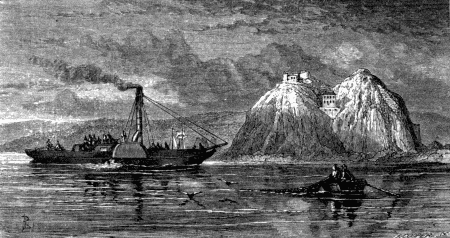
THE ‘COMET’ PASSING DUMBARTON.
[By R. P. Leitch.]
It will thus be observed how very gradual has been
the invention of the steamboat. It has been made step
by step, by many men living in many ages. First, we
have Blasco Garay making experiments with paddle-wheels
in the harbour of Barcelona three hundred years
ago, the revival probably of some old and half-forgotten
method of propelling ships; then the repetition of
the experiment by Prince Rupert and Savery in the
Thames more than a hundred and fifty years later; next
Savery’s invention of his steam-engine, followed by
Papin’s idea of combining the engine with the paddles,
and his construction of a model to illustrate its practicability.
Later, we have Jonathan Hulls’s patent
for his steamboat, in which the engine was worked
by atmospheric pressure, followed by numerous experiments
with a like object, in England, France, and
America. The invention of the condensing engine of
Watt, and its application to rotary motions, was the
next great step. Miller’s revival of the experiments
with paddle-wheels led to the application by Symington
of Papin’s idea of combining the steam-engine with the
paddles, which he at length successfully worked out in
the ‘Charlotte Dundas.’ And finally the invention was
applied to practical purposes by Fulton and Livingstone
in America, and by Bell in Scotland.
And thus became established, in the eloquent words
of George Canning, “the new and mighty power, new
at least in the application of its might, which walks
the waters like a giant rejoicing in its course, stemming
alike the tempest and the tide, accelerating intercourse,
shortening distances, creating, as it were, unexpected
neighbourhoods, and new combinations of social and
commercial relations, and giving to the fickleness of
winds and the faithlessness of waves the certainty and
steadiness of a highway upon the land.” But it is a
noteworthy fact, that it was not until the invention of
James Watt was applied to the purposes of steam
navigation that its practicability was established and
its success secured. Until then, all the experiments
which had been made were regarded as comparatively
fruitless, though they were leading step by step to the
great result; and to this day the engines constructed
after Watt’s principle continue to be the great motive
power alike of river and ocean navigation.
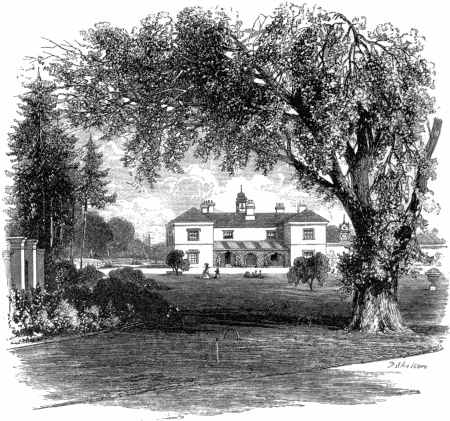
WATT’S HOUSE, HEATHFIELD.
[By Percival Skelton.]
On the dissolution of the original partnership between
Boulton and Watt at the expiry of the patent in 1800,
Boulton was seventy-two years old, and Watt sixty-four.
The great work of their life had been done, and
the time was approaching when they must needs resign
into other hands the great branches of industry which
they had created. Watt, though the younger of the
two, was the first to withdraw from an active share in
the concerns of Soho. He could scarcely be said to
taste the happiness of life until he had cast business
altogether behind him.
It was far different with Boulton, to whom active
occupation had become a second nature. For several
years, indeed, his constitution had been showing signs
of giving way, and nature was repeating her warnings,
at shorter recurring intervals, that it was time to retire.
But in the case of men such as Boulton, with whom
business has become a habit and necessity, as well as a
pleasure and recreation, to retire is often to die. He
himself was accustomed to say that he must either
“rub or rust;” and as the latter was contrary to his
nature, he rubbed on to the end, continuing to take
an active interest in the working of the great manufactory
which it had been the ambition of his life to
build up.
The department of business that most interested him
in his later years was the coinage. His chief pleasure consisted
in seeing his new and beautiful pieces following each
other in quick succession from the Soho Mint. Nor did
he cease occupying himself with new inventions; for we
find him as late as 1797 taking out a patent for raising
water by impulse, somewhat after the manner of Montgolier’s
Hydraulic Ram, to which he added many
ingenious improvements. His house at Soho continued
to be the resort of distinguished visitors; and his
splendid hospitality never failed. But, as years advanced
and his infirmities increased, we find him
occasionally expressing a desire for quiet. He would
then retire to Cheltenham for the benefit of the waters,
requesting his young partners to keep him advised
from time to time of the proceedings at Soho. Thus
we find young Watt writing him during his absence on
one occasion,—“Everything is going on well here: the
Mint works six presses at present with ease; but,
unless you have secured a supply of copper, I fear
they will soon work out the present stock.” In the
same letter his young friend advised him that he had
duly despatched the chemical apparatus; for even at
Cheltenham Boulton could not be idle, but undertook
a careful analysis of all the waters of the place, the
results of which he entered, in minute detail, in his
memorandum-books.
An alarming incident occurred at Soho towards the
end of 1800, which is worthy of passing notice, as
illustrative of Boultons vigour and courage even at
this advanced period of his life. A large gang of
Birmingham housebreakers, knowing the treasures
accumulated in the silver-plate house, determined to
break into it and carry off the silver, as well as
the large sum of money usually accumulated in the
counting-house for the purpose of paying the wages
of the workmen, upwards of 600 in number, on Christmas
Eve. They had provided false keys for most of
the doors, and bribed the watchman, who communicated
the plot to Boulton, to admit them within the gates.
He took his steps accordingly, arming a number of men,
and stationing them in different parts of the building.
The robbers made the attempt on three several occasions.
On the first night they tried their keys on the
counting-house door, but failed to open it, on which
they shut their dark lantern and retired. Boulton sent
an account of the proceedings each night to his daughter
in London. On the first attempt being made, he wrote,—“The
best news I can send you is that we are all alive;
but I have lost my voice and found a troublesome
cough by the agreeable employment of thief-watching.”
Two nights after, the burglars came again, with altered
keys, but still they could not open the counting-house
door. The third night they determined to waive
art, and break in by force. They were allowed to
break in and seize their booty, and were making off
with 150 guineas and a load of silver, when Boulton
gave the word to seize them. A quantity of tow soaked
with turpentine was instantly set fire to, numerous
lights were turned on, and the robbers found themselves
surrounded on all sides by armed men. Four of them
were taken after a desperate struggle; but the fifth,
though severely wounded, contrived to escape over
the tops of the houses in Brook-row.
Writing to his friend Dumergue, in London, of the
exploit, Boulton said,—“You know I seldom do things
by halves; so I have sent the four desperate wolves to
Stafford Gaol, and I believe the fifth is much wounded.
If I had made my attack with a less powerful army
than I did, we should probably have had a greater list
of killed and wounded.”[384] It was in allusion to this
exploit that Sir Walter Scott said of Boulton to Allan
Cunningham, “I like Boulton; he is a brave man, and
who can dislike the brave?”[385] The incident, when
communicated to Scott during one of his visits to Soho,
is said to have suggested the scene in ‘Guy Mannering,’
in which the attack is made on Dirk Hatterick in the
smuggler’s cave.
With Watt, occupation in business was not the necessity
that it was to Boulton; and he was only too glad
to get rid of it and engage in those quiet pursuits in
which he found most pleasure. In the year 1790, he
removed from the house he had so long occupied on
Harper’s Hill, to a new and comfortable house which
he had built for himself at Heathfield in the parish of
Handsworth, where he continued to live until the close
of his life. The land surrounding the place was, until
then, common, and he continued to purchase the lots
as they were offered for sale, until, by the year 1794,
he had enclosed about forty acres. He took pleasure
in laying out the grounds, planting many of the trees
with his own hands; and in course of time, as the
trees reached maturity, the formerly barren heath became
converted into a retreat of great rural beauty.
Annexed to the house, in the back yard, he built
a forge, and upstairs, in his “Garret,” he fitted up
a workshop, in which he continued to pursue his
mechanical studies and experiments for many years.
While Watt was settling himself for the remainder of
his life in the house at Heathfield, Boulton was erecting
his large new Mint at Soho, which was completed
and ready for use in 1791.
When the lawsuits, which had given Watt so much
anxiety, were satisfactorily disposed of, an immense
load was removed from his mind; and he indulged in
the anticipation of at last enjoying the fruits of his
labour in peace. Being of frugal habits, he had already
begun to save money, and indeed accumulated as much
as he desired. But when the heavy arrears of Cornish
dues were collected, about the period of expiry of the
patent, a considerable sum of money necessarily fell
to Watt’s share; and then he began to occupy himself
in the pleasant recreation of looking out for an investment
of it in land. He was, however, hard to please,
and made many journeys before he succeeded in buying
his estate.
“I have yet met with nothing to my mind,” he wrote from
Somerton; “Lord Oxford has some very considerable estates to sell
near Abergavenny, but the roads to them are execrable, and it
seemed that it would be a sort of banishment to live at them,
though the parts I saw are in themselves pleasant. I am to-day
informed of one with a house near Dorchester, which I have sent to
inquire about, though I have my doubts that it will prove like the
rest. I propose, if nothing hinders, to be at Taunton to-morrow
night, and shall then visit the Wedgwoods, who at present live at
Upcot, near that place. Afterwards, I propose making a tour
through the eastern part of Devonshire, and returning by Dorsetshire
to Bath; but my resolves may be altered by the attractions of
various magnets, so that I cannot tell you where to write to me till
I get some fixed residence.”[386]
A fortnight later he was at Exmouth, but still undecided.
“In respect to estates,” he writes,—“I have seen nothing that
pleases me. Most of them, as you know by experience, are
surrounded with bad roads, beggarly villages, or some other
nuisance, and one need not purchase plagues. On the whole,
something nearer home seems more suitable to me than anything
in these western counties, which, though they have more luxuriant
vegetation, and perhaps a milder climate, are not exempt from cold,
as I experience here colder weather than we had last autumn in
Scotland. But the greatest drawback is the absence of such society
as one is used to, and their abominably hilly roads, as they never
flinch, but go straight up any hill which comes in their way, and
Nature has bestowed plenty upon them.”[387]
Eventually Watt made several purchases of land at
Doldowlod, on the hanks of the Wye, between Rhayader
and Newbridge, in Radnorshire. There was a pleasant
farmhouse on the property, in which he occasionally
spent some pleasant months in summer time amidst
beautiful scenery; but he had by this time grown too
old to root himself kindly in a new place; and his
affections speedily drew him back again to the neighbourhood
of Soho, and to his comfortable home at
Heathfield.
During the short peace of Amiens in the following
year, he made the longest journey in his life. Accompanied
by Mrs. Watt, he travelled through Belgium,
up the banks of the Rhine to Frankfort, and home by
Strasburg and Paris. While absent, Boulton wrote
him many pleasant letters, telling him of what was
going on at Soho. The brave old man was still at the
helm there, and wrote in as enthusiastic terms as ever
of the coins and medals he was striking at his Mint.
Though strong in mind, he was, however, growing
feebler in body, and suffered much from attacks of his
old disease. “It is necessary for me,” he wrote, “to
pass a great part of my time in or upon the bed; nevertheless,
I go down to the manufactory or the Mint
once or twice a day, without injuring myself as heretofore,
but not without some fatigue. However, as
I am now taking bark twice a day, I find a daily
increase of strength, and flatter myself with the pleasure
of taking a journey to Paris in April or May next.”[388]
On Watt’s arrival in London, a letter of hearty
welcome from Boulton met him; but it conveyed, at
the same time, the sad intelligence of the death of
Mrs. Keir, a lady beloved by all who knew her, and
a frequent inmate at Soho and Heathfield. One by
one the members of the circle were departing, leaving
wide gaps, which new friends could never fill up. The
pleasant associations which are the charm of old friendships,
were becoming mingled with sadness and regret.
The grave was closing over one after another of the
Soho group; and the survivors were beginning to live
for the most part upon the memories of the past. But it
is one of the penalties of old age to suffer a continuous
succession of such bereavements; and that state would
be intolerable but for the comparative deadening of
the feelings which mercifully accompanies the advance
of years. “We cannot help feeling with deep regret,”
wrote Watt, “the circle of our old friends gradually
diminishing, while our ability to increase it by new
ones is equally diminished; but perhaps it is a wise
dispensation of Providence so to diminish our enjoyments
in this world that when our turn comes we
may leave it without regret.”[389]
One of the deaths most lamented by Watt was that
of Dr. Black of Edinburgh, which occurred in 1799.
Black had watched to the last with tender interest
the advancing reputation and prosperity of his early
protégé. They had kept up a continuous and confidential
correspondence on subjects of mutual interest
for a period of about thirty years. Watt, though
reserved to others, never feared unbosoming himself to
his old friend, telling him of the new schemes he had on
foot, and freely imparting to him his hopes and fears,
his failures and successes. When Watt visited Scotland
he rarely failed to take Edinburgh on his way, for
the purpose of spending a few days with Black and
Robison. The latter went express to London, for the
purpose of giving evidence in the suit of Watt against
the Hornblowers, and his testimony proved of essential
service. “Our friend Robison,” Watt wrote to Black,
“
exerted himself much; and, considering his situation,
did wonders.” When Robison returned to Edinburgh,
his Natural Philosophy class received him with three
cheers. He proceeded to give them a short account
of the trial, which he characterised as “not more
the cause of Watt versus Hornblower, than of science
against ignorance.” “When I had finished,” said he, “I
got another plaudit, that Mrs. Siddons would have
relished.”[390]
No one was more gratified at the issue of the trial
than Dr. Black, who, when Robison told him of it, was
moved even to tears. “It’s very foolish,” he said, “but
I can’t help it when I hear of anything good to Jamie
Watt.” The Doctor had long been in declining health,
but was still able to work. He was busy writing another
large volume, and had engaged the engraver to come
to him for orders on the day after that on which he
died. His departure was singularly peaceful. His
servant had delivered to him a basin of milk, which
was to serve for his dinner, and retired from the room.
In less than a minute he returned, and found his master
sitting where he had left him, but dead, with the basin
of milk unspilled in his hand. Without a struggle, the
spirit had fled. As the servant expressed it, “his poor
master had given over living.” He had twice before
said to his doctor that “he had caught himself forgetting
to breathe.” On hearing of the good old man’s
death, Watt wrote to Robison,—“I may say that to
him I owe, in a great measure, what I am; he taught
me to reason and experiment in natural philosophy,
and was a true friend and philosopher, whose loss
will always be lamented while I live. We may all
pray that our latter end may be like his; he has truly
gone to sleep in the arms of his Creator, and been spared
all the regrets attendant on a more lingering exit.
I could dwell longer on this subject; but regrets are
unavailing, and only tend to enfeeble our own minds,
and make them less able to bear the ills we cannot
avoid. Let us cherish the friends we have left, and
do as much good as we can in our day!”[391]
Lord Cockburn, in his ‘Memorials,’ gives the following
graphic portrait of the father of modern chemistry:—“Dr.
Black was a striking and beautiful person; tall,
very thin, and cadaverously pale; his hair carefully
powdered, though there was little of it except what was
collected into a long thin queue; his eyes dark, clear,
and large, like deep pools of pure water. He wore
black speckless clothes, silk stockings, silver buckles,
and either a slim green silk umbrella, or a genteel brown
cane. His general frame and air was feeble and slender.
The wildest boy respected Black. No lad could be
irreverent towards a man so pale, so gentle, so elegant,
and so illustrious. So he glided, like a spirit, through
our rather mischievous sportiveness, unharmed.”[392]
Of the famous Lunar Society, Boulton and Watt now
remained almost the only surviving members. Day
was killed by a fall from his horse in 1789. Josiah
Wedgwood closed his noble career at Etruria in 1795,
in the sixty-fifth year of his age. Dr. Withering, distinguished
alike in botany and medicine, died in 1799,
of a lingering consumption. Dr. Darwin was seized by
his last attack of angina pectoris in 1802, and, being
unable to bleed himself, as he had done before, he called
upon his daughter to apply the lancet to his arm; but,
before she could do so, he fell back in his chair and
expired. Dr. Priestley, driven forth into exile,[393] closed
his long and illustrious career at Northumberland in
Pennsylvania in 1803. The Lunar Society was thus all
but extinguished by death; the vacant seats remained
unfilled; and the meetings were no longer held.
But the bereavements which Watt naturally felt the
most, were the deaths of his own children. He had two
by his second wife, a son and a daughter, both full of
promise, who had nearly grown up to adult age, when
they died. Jessie was of a fragile constitution from her
childhood, but her health seemed to become re-established
as she grew in years. But before she had
entered womanhood, the symptoms of an old pulmonary
affection made their appearance, and she was carried
off by consumption. Mr. Watt was much distressed
by the event, confessing that he felt as if one of the
strongest ties that bound him to life was broken, and
that the acquisition of riches availed him nothing when
unable to give them to those he loved. In a letter to
a friend, he thus touchingly alluded to one of the most
sorrowful associations connected with the deaths of
children:—“Mrs. Watt continues to be much affected
whenever anything recalls to her mind the amiable child
we have parted with; and these remembrances occur
but too frequently,—her little works of ingenuity, her
books and other objects of study, serve as mementoes of
her who was always to the best of her power usefully
employed even to the last day of her life. With me,
whom age has rendered incapable of the passion of grief,
the feeling is a deep regret; and, did nature permit, my
tears would flow as fast as her mother’s.”
To divert and relieve his mind, as was his wont,
he betook himself to fresh studies and new inquiries.
It is not improbable that the disease of which his
daughter had died, as well as his own occasional sufferings
from asthma, gave a direction to his thoughts,
which turned on the inhalation of gas as a remedial
agent in pulmonary and other diseases. Dr. Beddoes
of Bristol had started the idea, which Watt now took
up and prosecuted with his usual zeal. He contrived
an apparatus for extracting, washing, and collecting
gases, as well as for administering them by inhalation.
He professed that he had taken up the subject not
because he understood it, but because nobody else did,
and that he could not withhold anything which might
be of use in prompting others to do better. The result
of his investigations was published at Bristol under the
title of ‘Considerations on the Medicinal use of Fictitious
Airs,’ the first part of which was written by
Dr. Beddoes, and the second part by Watt.
But a still heavier blow than the loss of his only
daughter, was the death of his son Gregory a few years
later. He was a young man of the highest promise,
and resembled Watt himself in many respects—in mind,
character, and temperament. Those who knew him
while a student at Glasgow College, spoke of him long
after in terms of the most glowing enthusiasm. Among
his fellow-students were Francis, afterwards Lord Jeffrey,
and the poet Campbell. Both were captivated not
less by the brilliancy of his talents than by the charming
graces of his person. Campbell spoke of him as
“a splendid stripling—literally the most beautiful youth
I ever saw. When he was only twenty-two, an eminent
English artist—Howard, I think—made his head the
model of a picture of Adam.” Campbell, Thomson, and
Gregory Watt, were class-fellows in Greek, and avowed
rivals; but the rivalry only served to cement their
friendship. In the session of 1793–4, after a brilliant
competition which excited unusual interest, the prize
was awarded to Thomson; but, with the exception of
the victor himself, Gregory was the most delighted
student in the class. “He was,” says the biographer of
Campbell, “a generous, liberal, and open-hearted youth;
so attached to his friend, and so sensible of his merit,
that the honours conferred on Thomson obliterated all
recollections of personal failure.”[394] Francis Jeffrey was
present at the commemoration of the first of May, two
years later, and was especially struck with the eloquence
of young Watt, “who obtained by far the greatest
number of prizes, and degraded the prize-readers most
inhumanly by reading a short composition of his own,
a translation of the Chorus of the Medea, with so much
energy and grace, that the verses seemed to me better
perhaps than they were in reality. He is a young man
of very eminent capacity, and seems to have all the
genius of his father, with a great deal of animation and
ardour which is all his own.”[395]
Campbell thought him born to be a great orator,
and anticipated for him the greatest success in Parliament
or at the Bar. His father had, however,
already destined him to follow his own business. Indeed,
Gregory was introduced a partner into the Soho
concern about the same time as Mr. Boulton, jun., and
his elder brother James. But he never gave much
attention to the business. Scarcely had he left college,
before symptoms of pulmonary affection showed themselves;
and, a physician having been consulted, Mr. Watt
was recommended to send his son to reside in the
south of England. He accordingly went to Penzance
for the benefit of its mild climate, and, by a curious
coincidence, he took up his abode as boarder and lodger
in the house of Humphry Davy’s mother. The afterwards
brilliant chemist was then a boy some years
younger than Gregory. He had already made experiments
in chemistry, with sundry phials and kitchen
utensils, assisted by an old glyster apparatus presented
to him by the surgeon of a French vessel wrecked on
the coast. Although Gregory possessed great warmth
of heart, there was a degree of coldness in his manner
to strangers, which repelled any approach to familiarity.
When his landlady’s son, therefore, began talking to
him of metaphysics and poetry, he was rather disposed
to turn a deaf ear; but when Davy touched upon
the subject of chemistry, and made the rather daring
boast for a boy, that he would undertake to demolish
the French theory in half an hour, Gregory’s curiosity
was roused. The barrier of ice between them was at once
removed; and from thenceforward they became attached
friends.[396] Young Davy was encouraged to prosecute
his experiments, which the other watched with daily
increasing interest; and in the course of the following
year, Gregory communicated to Dr. Beddoes, of Bristol,
then engaged in establishing his Pneumatic Institution,
an account of Davy’s experiments on light and heat,
the result of which was his appointment as superintendent
of the experiments at the Institution, and the
subsequent direction of his studies and investigations.
Gregory’s health having been partially re-established
by his residence at Penzance, he shortly after returned
to his father’s house at Birmingham, whither Davy frequently
went, and kept up the flame of his ambition
by intercourse with congenial minds. Gregory heartily
co-operated with his father in his investigations on air,
besides inquiring and experimenting on original subjects
of his own selection. Among these may be mentioned
his inquiries into the gradual refrigeration of basalt, his
paper on which, read before the Royal Society, would
alone entitle him to a distinguished rank among experimentalists.[397]
By the kindness of his elder brother James, Gregory
Watt was relieved of his share of the work at Soho,
and was thereby enabled to spend much of his time in
travelling about for the benefit of his health. Early
in 1801, we find him making excursions in the western
counties in company with Mr. Murdock, jun.; and
looking forward with still greater anticipations of
pleasure to the tour which he subsequently made
through France, Germany, and Austria. We find him
afterwards writing his father from Freiburg, to the
effect that he was gradually growing stronger, and
was free from pulmonary affection. From Leipzig he
sent an equally favourable account of himself, and gave
his father every hope that on his return he would find
him strong and sound.
These anticipations, however, proved delusive, for
the canker was already gnawing at poor Gregory’s
vitals. Returned home, he busied himself with his
books, his experiments, and his speculations; assisting
his father in recording observations on the effects of
nitrous oxide and other gases. But it was shortly found
necessary to send him again to the south of England
for the benefit of a milder climate. In the beginning of
1804, his father and mother went with him to Clifton,
where he had an attack of intermittent fever, which left
him very weak. From thence they removed to Bath,
and remained there for about a month, the invalid
being carefully attended by Dr. Beddoes. During their
stay at Bath, Gregory’s brother paid him a visit, and
was struck by his altered appearance. The fever had
left him, but his cough and difficulty of breathing were
very distressing to witness. As usual in such complaints,
his mind was altogether unaffected. “Indeed,”
wrote his brother, “he is as bright, clear, and vigorous,
upon every subject as I ever knew him to be. His
voice, too, is firm and good, and when he enters into
conversation I should lose the recollection of his complaint
if his appearance did not so forcibly remind me of
it. It is fortunate that he does not suffer much bodily
pain, or, so far as I can discover, any mental anxiety as
to the issue of his complaint.”[398]
When Gregory was sufficiently recovered from the
debilitating effects of his fever, he was moved to Sidmouth,
where he appeared to improve; but he himself
believed the sea air to be injurious to him, and insisted
on being again removed inland. During all this time
his father’s anxiety may be imagined, though he bore
up with as much equanimity as was practicable under
circumstances so distressing. “Ever since we left
Bath,” he wrote to Mr. Boulton at Soho, “ours has
been a state of anxiety very distressing to us, and the
communication of which would not have been pleasing
to our friends. To add to this, I have myself been
exceedingly unwell, though I am now much better.
Gregory suffered very much from the journey, which
was augmented by his own impatience; and though he
seemed to recover a little from his fatigue during the
first week, his breath became daily worse, until we
were obliged to remove him, on Thursday last, to the
neighbourhood of Exeter, where he now is with his
aunt.”[399] The invalid became rapidly worse, and survived
his removal only a few days. “This day,” wrote
the sorrowing father to Boulton, “the remains of poor
Gregory were deposited in a decent, though private
manner, in the north aisle of the cathedral here, near
the transept.... I mean to erect a tablet to his
memory on the adjoining wall; but his virtues and
merits will be best recorded in the breasts of his friends....
As soon as we can settle our accounts, we shall
all return homewards, with heavy hearts.”[400]
Davy was deeply affected by Gregory Watt’s death;
and in the freshness of his grief he thus unbosomed
himself to his friend Clayfield:—
“Poor Watt! He ought not to have died. I could not persuade
myself that he would die; and until the very moment when I was
assured of his fate, I would not believe he was in any danger. His
letters to me, only three or four months ago, were full of spirit, and
spoke not of any infirmity of body, but of an increased strength of
mind. Why is this in the order of Nature,—that there is such
a difference in the duration and destruction of his works? If the
mere stone decays it is to produce a soil which is capable of
nourishing the moss and the lichen; when the moss and the lichen
die and decompose, they produce a mould which becomes the bed of
life to grass, and to a more exalted species of vegetables. Vegetables
are the food of animals,—the less perfect animals of the more
perfect; but in man, the faculties and intellect are perfected,—he
rises, exists for a little while in disease and misery, and then would
seem to disappear, without an end, and without producing any
effect.
“We are deceived, my dear Clayfield, if we suppose that the
human being who has formed himself for action, but who has been
unable to act, is lost in the mass of being; there is some arrangement
of things which we can never comprehend, but in which his
faculties will be applied.... We know very little; but, in my
opinion, we know enough to hope for the immortality, the individual
immortality of the better part of man. I have been led into all
this speculation, which you may well think wild, in reflecting upon
the fate of Gregory! My feeling has given wings to my mind.
He was a noble fellow, and would have been a great man. Oh!
there was no reason for his dying—he ought not to have died.”[401]
More deaths! A few years later, and Watt lost
his oldest friend, Professor Robison of Edinburgh, his
companion and fellow-worker at Glasgow College
nearly fifty years before. Since then, their friendship
had remained unchanged, though their respective
pursuits kept them apart. Robison continued busily
and usefully occupied to the last. He had finished
the editing of his friend Black’s lectures, and was
occupied in writing his own ‘Elements of Mechanical
Philosophy,’ when death came and kindly released him
from a lingering disorder which had long oppressed
his body, though it did not enervate his mind. A few
years before his death he wrote Watt, informing him
that he had got an addition to his family in a fine little
boy, a grandchild, healthy and cheerful, who promised
to be a source of much amusement to him. “I find this
a great acquisition,” said he, “notwithstanding a serious
thought sometimes stealing into my mind. I am infinitely
delighted with observing the growth of its little
soul, and particularly with the numberless instincts,
which formerly passed unheeded. I thank the French
theorists for more forcibly directing my attention to the
finger of God, which I discover in every awkward
movement and every wayward whim. They are all
guardians of his life, and growth, and powers. I regret
that I have not time to make infancy, and the development
of its powers, my sole study.”[402] In 1805 he was
taken from his little playfellow, and from the pursuit
of his many ingenious speculations.[403] Watt said of him,
“he was a man of the clearest head and the most science
of anybody I have ever known, and his friendship to
me ended only with his life, after having continued for
nearly half a century.... His religion and piety,
which made him patiently submit without even a
fretful or repining word in nineteen years of unremitting
pain,—his humility, in his modest opinion
of himself,—his kindness, in labouring with such industry
for his family during all this affliction,—his
moderation for himself, while indulging an unbounded
generosity to all about him,—joined to his talents,
form a character so uncommon and so noble, as can
with difficulty be conceived by those who have not,
like me, had the contemplation of it.”
Little more remains to be recorded of the business
life of Boulton and Watt. The former, notwithstanding
his declining health and the frequent return of his
malady, continued to take an active interest in the
Soho coinage. Watt often expostulated with him, but
in vain, urging that it was time for him to retire
wholly from the anxieties of business. On Boulton
bringing out his Bank of England silver dollar, with
which he was himself greatly pleased, he sent some
specimens to Watt, then staying at Clifton, for his
inspection. Watt replied,—“Your dollar is universally
admired by all to whom we have shown it, though your
friends fear much that your necessary attention to the
operation of the coinage may injure your health.”[404] And
again he wrote from Sidmouth,—“We are all glad to
hear of your amendment, which we hope will be progressive,
and possibly it might be better if you could
summon up resolution enough to rid yourself of some
of those plagues you complain of; but while you suffer
yourself to be intruded upon in the manner you do, you
can never enjoy that quiet which is now so necessary
to your health and comfort.”[405] Mrs. Watt joined her
entreaties to those of her husband, expressing the wish
that, for Mr. Boulton’s sake, it might rain every day,
to prevent his fatiguing himself by walking to and
from the works, and there occupying himself with the
turmoils of business. Why should he not do as Mr.
Watt had done, and give up Soho altogether, leaving
business and its anxieties to younger and stronger
men? But business, as we have already explained,
was Boulton’s habit, and pleasure, and necessity. Moreover,
occupation of some sort served to divert his
attention from the ever-present pain within him; and,
so long as his limbs were able to support him, he
tottered down the hill to see what was going forward at
Soho.
As for Watt, we find that he had at last learnt
the art of taking things easy, and that he was trying
to make life as agreeable as possible in his old age.
Thus at Cheltenham, from which place Mrs. Watt
addressed Boulton in the letter of advice above referred
to, we find the aged pair making pleasant excursions in
the neighbourhood during the day, and reading novels
and going to the theatre occasionally in the evening.
“As it is the fashion,” wrote Mrs. Watt,—“and wishing
to be very fashionable people, we subscribe to the library.
Our first book was Mrs. Opie’s ‘Mother and Daughter,’
a tale so mournful as to make both Mr. Watt and myself
cry like schoolboys that had been whipped; ... and
to dispel the gloom that poor Adeline hung over us,
we went to the theatre last night to see the ‘Honeymoon,’
and were highly pleased.”
Towards the end of 1807 Boulton had a serious
attack of his old disease, which fairly confined him to
his bed; and his friends feared lest it should prove his
last illness. He was verging upon his eightieth year,
and his constitution, though originally strong, was
gradually succumbing to confinement and pain. He
nevertheless rallied once more, and was again able
to make occasional visits to the works as before. He
had promised to send a box of medals to the Queen, and
went down to the Mint to see them packed. The box
duly reached Windsor Castle, and De Luc acknowledged
its reception:—
“As no words of mine,” he said, “could have conveyed your
sentiments to Her Majesty so well as those addressed to me in your
name, I contented myself with putting the letter into her hands.
Her Majesty expressed her sensibility for the sufferings you had
undergone during the period of your silence, and at your plentiful
gift, for which she has charged me to thank you; and as, at the
same time that you have placed the whole at her own disposal, you
have mentioned the Princesses, Her Majesty will make them partakers
in the present.”
De Luc concluded by urging Mr. Boulton to abstain
from further work and anxiety, and reminded him that
after a life of such activity as his had been, both body
and mind required complete rest.
“Life,” said he, “in this world is a state of trial, and as long as
God gives us strength we are not to shun even painful employments
which are duties. But in the decline of life, when the strength
fails, we ought to drop all thought of objects to which we are no
longer equal, in order to preserve the serenity and liberty of mind
with which we are to consider our exit from this world to a better.
May God prolong your life without pain for the good you do
constantly, is the sincere wish of your very affectionate friends (father
and daughter),
“De Luc.”[406]
Boulton’s life was, indeed, drawing to a close. He
had for many years been suffering from an agonising
and incurable disease—stone in the kidneys and bladder—and
waited for death as for a friend. The strong
man was laid low; and the night had at length come
when he could work no more. The last letter which he
wrote was to his daughter, in March, 1809; but the
characters are so flickering and indistinct as to be
scarcely legible. “If you wish to see me living,” he
wrote, “pray come soon, for I am very ill.” Nevertheless,
he suffered on for several months longer. At last
he was released from his pain, and peacefully expired
on the 17th of August, 1809, at the age of eighty-one.
Though he fell like a shock of corn in full season, his
death was lamented by a wide circle of relatives and
friends. A man of strong affections, with an almost
insatiable appetite for love and sympathy, he inspired
others with like feelings towards himself; and when he
died, they felt as if a brother had gone. He was alike
admired and beloved by his workmen; and when he
was carried to his last resting-place in Handsworth
Church, six hundred of them followed the hearse, and
there was scarcely a dry eye among them.[407]
Matthew Boulton was, indeed, a man of truly noble
nature. Watt, than whom none knew him better,
was accustomed to speak of him as “the princely
Boulton.” He was generous and high-souled, a lover
of truth, honour, and uprightness. His graces were
embodied in a manly and noble person. We are
informed through Dr. Guest that on one occasion, when
Mr. Boulton’s name was mentioned in his father’s
presence, he observed, “the ablest man I ever knew.”
On the remark being repeated to Dr. Edward Johnson,
a courtly man, he said,—“As to his ability, other persons
can better judge. But I can say that he was the best
mannered man I ever knew.” The appreciation of both
was alike just and characteristic, and has since been confirmed
by Mrs. Schimmelpenninck. She describes with
admiration his genial manner, his fine radiant countenance,
and his superb munificence: “He was in person
tall, and of a noble appearance; his temperament was
sanguine, with that slight mixture of the phlegmatic
which gives calmness and dignity; his manners were
eminently open and cordial; he took the lead in conversation;
and, with a social heart, had a grandiose manner,
like that arising from position, wealth, and habitual
command. He went about among his people like a
monarch bestowing largesse.”
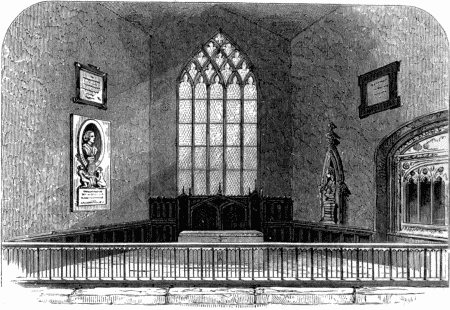
BOULTON’S MONUMENT IN HANDSWORTH CHURCH.[408]
Boswell was equally struck by Boulton’s personal
qualities when he visited Soho in 1776, shortly after
the manufacture of steam-engines had been begun there.
“I shall never forget,” he says, “Mr. Boulton’s expression
to me when surveying the works. ‘I sell here,
sir, what all the world desires to have, Power.’ He
had,” continues Boswell, “about seven hundred people
at work. I contemplated him as an iron chieftain, and
he seemed to be a father of his tribe. One of the men
came to him complaining grievously of his landlord for
having distrained his goods. “Your landlord is in the
right, Smith,” said Boulton; “but I’ll tell you what—find
a friend who will lay down one half of your rent,
and I’ll lay down the other, and you shall have your
goods again.””
It would be a mistake to suppose that there was any
affectation in Boulton’s manner, or that his dignified
bearing in society was anything but natural to him.
He was frank, cheerful, and affectionate, as his letters
to his wife, his children, and his friends, amply demonstrate.
None knew better than he how to win hearts,
whether of workmen, mining adventurers, or philosophers.
“I have thought it but respectful,” he wrote
Watt from Cornwall, “to give our folks a dinner at
a public-house near Wheal Virgin to-day. There were
present William Murdock, Lawson, Pearson, Perkins,
Malcolm, Robert Muir, all Scotchmen, and John Bull,
with self and Wilson,—for the engines are all now
finished, and the men have behaved well, and are
attached to us.” At Soho he gave an entertainment
on a much larger scale upon his son coming of age in
1791, when seven hundred persons sat down to dinner.
Boswell’s description of him as the father of his tribe is
peculiarly appropriate. No well-behaved workman was
ever turned adrift. On the contrary, fathers introduced
their sons into the factory, and brought them up under
their own eye, watching over their conduct and their
mechanical training. Thus generation after generation
of workmen followed in each other’s footsteps at Soho.
There was, no doubt, good business policy in this;
for Boulton knew that by attaching the workmen to
him, and inspiring them with pride in the concern,
he was maintaining that prestige which, before the
days of machine tools, would not have been possible
without the aid of a staff of carefully-trained and
highly-skilled mechanics. Yet he had many scapegraces
amongst them—hard drinkers, pugilists,[409] cock-fighters,
and scamps. Watt often got wholly out of
patience with them, and urged their dismissal, whatever
might be the consequence. But though none knew
so well as Watt how to manage machines, none
knew so ill how to manage men. Boulton’s practical
wisdom usually came to the rescue. He would
tolerate any moral shortcoming save treachery and
dishonesty. But he knew that most of the men
had been brought up in a bad school, often in no
school at all. “Have pity on them, bear with them,
give them another trial,” he would say; “our works
must not be brought to a standstill because perfect men
are not yet to be had.” “True wisdom,” he observed
on another occasion, “directs us, when we can, to turn
even evils into good. We must take men as we find
them, and try to make the best of them.”
Still further to increase the attachment of the workmen
to Soho, and keep together his school of skilled industry,
as he called it, Boulton instituted a Mutual Assurance
Society in connexion with the works; the first of the
kind, so far as we are aware, established by any large
manufacturer for the benefit of his workmen. Every
person employed in the manufactory, in whatsoever condition,
was required to be a member. Boys receiving
2s. 6d. a week paid a halfpenny weekly to the box;
those receiving 5s. paid a penny a week, and so on, up
to men receiving 20s. a week, who contributed 4d.;
payments being made to them out of the fund during
sickness and disablement, in proportion to their contributions
during health. The effects of the Society were
most salutary; it cultivated habits of providence and
thoughtfulness amongst the men; bound them together
by ties of common interest; and it was only in the
cases of irreclaimable drunkards that any members of
the Soho Friendly Society ever came upon the parish.
But this was only a small item in the constitution
of the Soho manufactory. Before its establishment,
comparatively little attention had been given to the
organisation of labour on a large scale. Workshops
were so small that everything went on immediately
under the master’s eye, and workmen got accustomed
to ply at their work diligently, being well watched.
But when manufacturing was carried on upon so large
a scale as at Soho, and separate processes were conducted
in different rooms and workshops, it was impossible
that the master’s eye should be over all his
workers, or over even any considerable portion of
them at the same time. It was therefore necessary
to introduce a new system. Hence the practice of
inspection by deputy, and the appointment of skilled
and trustworthy foremen for the purpose of enforcing
strict discipline in the various shops, and at the same
time economising labour and ensuring excellence of
workmanship. In carrying out this arrangement,
Boulton proved remarkably successful: and Soho came
to be regarded as a model establishment. Men came from
all parts to see and admire its organisation; and when
Wedgwood proceeded to erect his great pottery works at
Etruria, he paid many preliminary visits to Soho for the
purpose of ascertaining how the difficulties occasioned
by the irregular habits of the workpeople had been so
successfully overcome by his friend, and applying the
results of his experience in the organisation of his own
manufactory.
Though Boulton could not keep his eye directly on
the proceedings in the shops, he was quick to discern
when anything was going wrong. While sitting in
the midst of his factory, surrounded by the clang of
hammers and the noise of engines, he could usually
detect when any stoppage occurred, or when the
machinery was going too fast or too slow, and issue
his orders accordingly. The sound of the tools going,
and the hammers clanging, which to strangers was
merely an intolerable noise, was an intelligible music
in his ears; and, like the leader of an orchestra, who
casts his eye at once in the direction of the player of a
wrong note, so Boulton was at once conscious of the
slightest dissonance in the performances of his manufactory,
and took the necessary steps immediately to
correct it.
From what we have already said, it will be sufficiently
clear that Boulton was a first-rate man of
business. He had a hearty enthusiasm for his calling,
and took a just pride in it. In conducting it, he was
guided by fine tact, great knowledge of character, and
sound practical wisdom. When fully satisfied as to the
course he should pursue, he acted with remarkable
vigour and promptitude, bending his whole mind to
the enterprise which he had taken in hand. It was
natural that he should admire in others the qualities
he himself desired to possess. “I can’t say,” he wrote
to Watt, “but that I admire John Wilkinson for his
decisive, clear, and distinct character, which is, I think,
a first-rate one of its kind.” Like Wilkinson, Boulton
was also distinguished for his indomitable pluck; and
in no respect was this more strikingly displayed than in
his prosecution of the steam-engine enterprise.
Playfair has truly said, that had Watt searched
all Europe over, he could not have found another
person so fitted to bring his invention before the public
in a manner worthy of its merits and importance. Yet
Boulton was by no means eager to engage in the
scheme. Watt could with difficulty persuade him to
take it up; and it was only in exchange for a bad debt
that he at length became a partner in it. But when
once fairly committed, he threw himself into the enterprise
with an extraordinary degree of vigour. He
clearly recognised in the steam-engine a power destined
to revolutionise the industrial operations of the world.
To M. Argand, the famous French lamp inventor, he
described it as “the most certain, the most regular,
the most durable, and the most effective machine in
Nature, so far as her powers have yet been revealed
to mortal knowledge;” and he declared to him that,
finding he could be of more use to manufactures and to
mankind in general by employing all his powers in the
capacity of an engineer, than in fabricating any kind
of clincaillerie whatsoever, he would thenceforward devote
himself wholly to his new enterprise.
But it was no easy work he had undertaken. He
had to struggle against prejudices, opposition, detraction,
and difficulties of all kinds. Not the least difficulty
he had to strive against was the timidity and faint-heartedness
of his partner. For years Watt was on the
brink of despair. He kept imploring Boulton to relieve
him from his troubles; he wished to die and be at rest;
he “cursed his inventions;” indeed he was the most
miserable of men. But Boulton never lost heart. He
was hopeful, courageous, and strong—Watt’s very backbone.
He felt convinced that the invention must
eventually succeed, and he never for a moment lost faith
in it. He braved and risked everything to “carry the
thing through.” He mortgaged his lands to the last
farthing; borrowed from his personal friends; raised
money by annuities; obtained advances from bankers;
and had invested upwards of 40,000l. in the enterprise
before it began to pay.
During this terrible struggle he was more than once
on the brink of insolvency, but continued as before to
cheer and encourage his fainting partner. “Keep your
mind and your heart pleasant if possible,” he wrote to
Watt, “for the way to go through life sweetly is not
to regard rubs.” To those about Watt he wrote, “Do
not disturb Mr. Watt, but keep him as free from
anxiety as you can.” He himself took the main share
of the burden,—pushing the engine amongst the
Cornish miners, bringing it under the notice of London
brewers and water companies, and finding money to
meet the heavy liabilities of the firm.
So much honest endeavour could not fail. And at
last the tide seemed to turn. The engine became
recognised as a grand working power, and there was
almost a run upon Soho for engines. Then pirates
sprang up in all directions, and started new schemes
with the object of evading Watt’s patent. And now
a new battle had to be fought against “the illiberal,
sordid, unjust, ungenerous, and inventionless misers,
who prey upon the vitals of the ingenious, and make
haste to seize upon what their laborious and often
costly application has produced.”[410] At length this
struggle, too, was conclusively settled in Boulton and
Watt’s favour, and they were left at last to enjoy the
fruits of their labour in peace.
Watt never could have fought such a series of battles
alone. He would have been a thousand times crushed;
and, but for Boulton’s unswerving courage and resolute
determination, he could neither have brought his engine
into general use, nor derived any adequate reward for
his great invention. Though his specification lodged
in the Patent Office might clearly establish his extraordinary
mechanical genius, it is most probable that he
himself would have broken his heart over his scheme,
and added only another to the long list of great martyr
inventors.
None was more ready to acknowledge the immense
services of Boulton in introducing the steam-engine to
general use as a working power, than Watt himself.
In the MS. memoir of his lately deceased friend
deposited among the Soho papers, dated Glasgow, 17th
September, 1809, Watt says,—“Through the whole of
this business Mr. Boulton’s active and sanguine disposition
served to counterbalance the despondency and
diffidence which were natural to me; and every assistance
which Soho or Birmingham could afford was
procured. Mr. Boulton’s amiable and friendly character,
together with his fame as an engineer and active
manufacturer, procured us many and very active friends
in both Houses of Parliament.... Suffice it to say,
that to his generous patronage, the active part he took
in the management of the business, his judicious advice,
and his assistance in contriving and arranging many of
the applications of the steam-engine to various machines,
the public are indebted for great part of the benefits
they now derive from that machine. Without him, or
some similar partner (could such a one have been found),
the invention could never have been carried by me
to the length that it has been.
“Mr. Boulton was not only an ingenious mechanic,
well skilled in all the arts of the Birmingham manufacturers,
but he possessed in a high degree the faculty
of rendering any new invention of his own or of others
useful to the public, by organising and arranging the
processes by which it could be carried on, as well as of
promoting the sale by his own exertions and those of his
numerous friends and correspondents. His conception
of the nature of any invention was quick, and he was
not less quick in perceiving the uses to which it might
be applied, and the profits which might accrue from
it. When he took any scheme in hand, he was rapid
in executing it, and on those occasions spared neither
trouble nor expense. He was a liberal encourager
of merit in others, and to him the country is indebted
for various improvements which have been brought
forward under his auspices....
“In respect to myself, I can with great sincerity say
that he was a most affectionate and steady friend and
patron, with whom, during a close connexion of thirty-five
years, I have never had any serious difference.
“As to his improvements and erections at Soho—his
turning a barren heath into a delightful garden, and the
population and riches he has introduced into the parish
of Handsworth, I must leave such subjects to those
whose pens are better adapted to the purpose, and whose
ideas are less benumbed with age than mine now are.”[411]
We have spoken of Boulton’s generosity, which was
in keeping with his whole character. At a time when
he was himself threatened with bankruptcy, we have
seen him concerting a scheme with his friend Wedgwood
to enable Dr. Priestley to pursue his chemical investigations
free from pecuniary anxiety. To Watt he
was most liberal, voluntarily conceding to him at different
times profits derived from certain parts of the
steam-engine business, beyond the proportions stipulated
in the deed of partnership. In the course of his correspondence
we find numerous illustrations of his generosity
to partners as well as to workmen; making up
the losses they had sustained, and which at the time perhaps
he could ill afford. His conduct to Widow Swellengrebel
illustrates this fine feature in his character. She
had lent money to Fothergill, his partner in the hardware
business, and the money was never repaid. The
consequence was, that the widow and her family were
seriously impoverished, and on their return to their
friends in Holland, Boulton, though under no obligation
to do so, remitted her an annuity of fifty pounds a year,
which he continued to the close of her life. “I must
own,” he wrote, “I am impelled to act as I do from
pity, as well as from something in my own disposition
that I cannot resist.”[412]
In fine, Matthew Boulton was a noble, manly man,
and a true leader of men. Lofty-minded, intelligent,
energetic, and liberal, he was one of those who constitute
the life blood of a nation, and give force and dignity
to the national character. Working in conjunction
with Watt, he was in no small degree instrumental
in introducing and establishing the great new working
power of steam which has exercised so extraordinary an
influence upon all the operations of industry.
The fragile and sickly Watt outlived the most robust of
his contemporaries. He was residing at Glenarbach,
near Dumbarton, with relatives, when the intelligence
reached him of the death of his partner. To his son
James he wrote at once, expressing his deep sorrow at
the loss of his “very worthy and beloved friend.”[413] To
Mr. Boulton’s son and successor he wrote,—“However
we may lament our own loss, we must consider, on the
other side, the torturing pain he has so long endured,
and console ourselves with the remembrance of his
virtues and eminent qualifications. Few men have possessed
his abilities, and still fewer have exerted them
as he has done; and if to these we add his urbanity, his
generosity, and his affection to his friends, we shall
make up a character rarely to be equalled. Such was
the friend we have lost, and of whose affection we have
reason to be proud, as you have to be the son of such
a father.”[414]
The deaths of his friends, one by one, reminded Watt
of his own mortality, and frequent references to the
subject occur in his letters about this time. He felt as
if he were in danger of being left in the world alone.
But he did not give himself up to melancholy, as he
had been prone to do at the earlier periods of his life.
Shortly after his son Gregory died, he wrote to a relative,—“I
know that all men must die, and I submit
to the decrees of Nature, I hope with due reverence to
the Disposer of events. Yet one stimulus to exertion is
taken away, and, somehow or other, I have lost my
relish for my usual occupations. Perhaps time may
remedy that in some measure; meanwhile I do not
neglect the means of amusement which are in my
power.”
Watt was at no loss for occupation to relieve the
tedium of old age. He possessed ample resources in
himself, and found pleasure alike in quiet meditation
and in active work. His thirst for knowledge was still
unslaked, and he sought to allay it by reading. His
love of investigation was as keen as ever, and he
gratified it by proceeding with experiments on air, on
light, and on electricity. His inventive faculty was still
potent, and he occasionally varied his occupation by
labouring to produce a new machine or to improve an
old one. At other times, when the weather allowed,
he would take a turn at planting in his grounds and
gardens; and occasionally vary his pleasure by a visit
to Scotland, to London, or to his estate in Wales.
Strange to say, his health improved with advancing
age, and though occasionally dyspeptic, he was now
comparatively free from the racking headaches which
had been the torment of his earlier years. Unlike
Boulton, who found pleasure in the active pursuit of
business, Watt had always regarded it as a worry, and
he was now glad to have cast it altogether behind
him. His mind was free from harassing cares; his
ambition in life was satisfied; he was no more distressed
by fears of Cornish pirates; and he was content to
enjoy at last the fruits of his labour in peace. And
thus it was that Watt’s later years may be pronounced
to have been the happiest of his life.
He had, indeed, lost nearly all his old friends, and
often thought of them with a melancholy regret, not,
however, unmingled with pleasure. But other young
friends gathered about him, sat at his feet, and looked up
to him with an almost reverential admiration. Among
these we find Rennie and Telford the engineers, Campbell
the poet, Humphry Davy, Henry Brougham,
Francis Horner, and other rising men of the new
generation. Lord Brougham bears testimony to Watt’s
habitual cheerfulness, and his enjoyment of the pleasures
of society during the later years of his life. “I
can speak on the point,” he says, “with absolute certainty,
for my own acquaintance with him commenced
after my friend Gregory’s decease. A few months
after that event, he calmly and with his wonted acuteness
discussed with me the composition of an epitaph
to be inscribed on his son’s tomb. In the autumn and
winter of 1805 he was a constant attendant at our
Friday Club, and in all our private circles, and was the
life of them all.”[415]
To the close of his life Watt continued to take great
pleasure in inventing. It had been the pursuit of his
life, and in old age it became his hobby. “Without
a hobby-horse,” said he, “what is life?” He proceeded
to verify his old experiments, and to live over again
the history of his inventions. When Mr. Kennedy of
Manchester asked him, at one of his last visits to Heathfield,
if he had been able, since his retirement from
business, to discover anything new in the steam-engine,
he replied, “No; I am devoting the remainder of my
life to perfect its details, and to ascertain whether in
any respect I have been wrong.”
But he did not merely confine himself to verifying
his old inventions. He also contrived new ones. One
of the machines that occupied his leisure hours for many
years, was his machine for copying statuary. We find
him busy with it in 1810, and he was still working
upon it in the year of his death, nearly ten years later.
The principle of the machine was to make a cutting tool
or drill travel over the work to be executed, in like
ratio with the motion of a guide-point placed upon the
bust to be copied. It worked, as it were, with two
hands; the one feeling the pattern, the other cutting
the material into the required form. The object could
be copied either of the full size, or reduced with the
most perfect accuracy to any less size that might be
required.[416] In preparing the necessary tools, Watt had
the able assistance of his friend Murdock, who was
always ready with his kindly suggestions and criticisms.
In January, 1813, Watt wrote him,—“I have done a
little figure of a boy lying down and holding out one
arm, very successfully; and another boy, about six inches
high, naked, and holding out both his hands, his legs
also being separate. But I have been principally
employed in making drawings for a complete machine,
all in iron, which has been a very serious job, as invention
goes on very slowly with me now. When you
come home, I shall thank you for your criticisms and
assistance.”[417]
The material in which Watt executed his copies of
statuary were various,—marble, jet, alabaster, ivory,
plaster of Paris, and mahogany. Some of the specimens
we have seen at Heathfield are of exquisite
accuracy and finish, and show that he must have
brought his copying-machine to a remarkable degree
of perfection before he died. There are numerous
copies of medallions of his friends,—of Dr. Black, De
Luc, and Dr. Priestley; but the finest of all is a reduced
bust of himself, being an exact copy of Chantrey’s
original plaster-cast. The head and neck are beautifully
finished, but there the work has stopped, for the
upper part of the chest is still in the rough. Another
exquisite work, than which Watt never executed a
finer, is a medallion of Locke in ivory, marked “January,
1812.” There are numerous other busts, statuettes,
medallions,—some finished, others half executed, and
apparently thrown aside, as if the workman had been
dissatisfied with his work, and waited, perhaps, until he
had introduced some new improvement in his machine.
Watt took out no patent for the invention, which he
pursued, as he said, merely as “a mental and bodily
exercise.” Neither did he publish it,—but went on
working at it for several years before his intentions
to construct such a machine had become known. When
he had made considerable progress with it, he learned,
to his surprise, that a Mr. Hawkins, an ingenious
person in his neighbourhood, had been long occupied
in the same pursuit. The proposal was then made to
him that the two inventors should combine their talents
and secure the invention by taking out a joint patent.
But Watt had already been too much worried by patents
to venture on taking out another at his advanced age.
He preferred prosecuting the invention at his leisure
merely as an amusement; and the project of taking out
a patent for it was accordingly abandoned. It may not
be generally known that this ingenious invention of
Watt has since been revived and applied with sundry
modifications by our cousins across the Atlantic, in
fashioning wood and iron in various forms; and powerful
copying-machines are now in regular use in the
Government works at Enfield, where they are employed
in rapidly, accurately, and cheaply manufacturing gun-stocks!
Watt carried on the operations connected with this
invention for the most part in his Garret, a room immediately
under the roof at the kitchen end of the house
at Heathfield, and approached by a narrow staircase.
It is a small room, low in the ceiling, and lighted by a
low broad window, looking into the shrubbery. The
ceiling, though low, inclines with the slope of the roof
on three sides of the room, and, being close to the slates,
the place must necessarily have been very hot in
summer, and very cold in winter. A stove was placed
close to the door, for the purpose of warming the apartment,
as well as enabling the occupant to pursue his
experiments, being fitted with a sand-bath and other
conveniences. But the stove must have been insufficient
for heating the garret in very cold weather, and
hence we find him occasionally informing his correspondents
that he could not proceed further with his
machine until the weather had become milder.
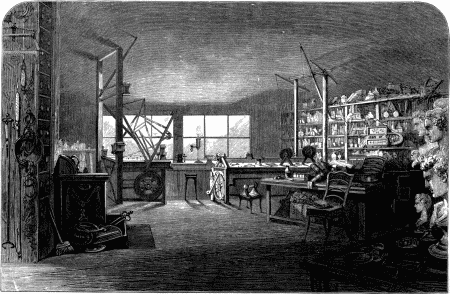
WATT’S GARRET AT HEATHFIELD.
[By Percival Skelton.]
His foot-lathe was fixed close to the window, fitted
with all the appliances for turning in wood and metal
fifty years since; while a case of drawers fitted into the
recess on the left-hand side of the room, contained a
large assortment of screws, punches, cutters, taps, and
dies. Here were neatly arranged and stowed away
many of the tools with which he worked in the early
part of his life, one of the drawers being devoted to his
old “flute tools.” In other divisions were placed his
compasses, dividers, scales, decimal weights, quadrant
glasses, and a large assortment of instrument-making
tools. A ladle for melting lead, and a soldering-iron
were hung ready for use near the stove.
Crucibles of metal and stone were ranged on the
shelves along the opposite side of the room, which
also contained a large assortment of bottles filled with
chemicals, boxes of fossils and minerals, jars, gallipots,
blowpipes, retorts, and the various articles used in
chemical analysis. In one corner of the room was a
potter’s lathe. A writing-desk was placed as close to
the window, for the sake of the light, as the turning-lathe
would allow; and in the corner was the letter-copying
machine, conveniently at hand.
In this garret Watt spent much of his time during
the later period of his life, only retiring from it when
it was too hot in summer, or too cold in winter to
enable him to prosecute his work. For days together
he would confine himself here, without even descending
to his meals. He had accordingly provided himself,
in addition to his various other tools, with sundry
kitchen utensils,—amongst others, with a frying-pan
and Dutch oven—with which he cooked his meals.
For it must be explained that Mrs. Watt was a
thorough martinet in household affairs, and, above all
things, detested “dirt.” Mrs. Schimmelpenninck says
she taught her two pug-dogs never to cross the hall
without first wiping their feet on the mat. She hated
the sight of her husband’s leather apron and soiled
hands while he was engaged in his garret-work, so he
kept himself out of her sight at such times as much
as possible. Some notion of the rigidity of her rule
may be inferred from the fact of her having had a
window made in the kitchen wall, through which she
could watch the servants, and observe how they were
getting on with their work. Her passion for cleanliness
was carried to a pitch which often fretted those about
her by the restraints it imposed; but her husband, like
a wise man, gently submitted to her rule. He was fond
of a pinch of snuff, which Mrs. Watt detested, regarding
it only as so much “dirt;” and Mr. Muirhead says
she would seize and lock up the offending snuff-box
whenever she could lay hands upon it. He adds that
at night, when she retired from the dining-room, if Mr.
Watt did not follow at the time fixed by her, a servant
would enter and put out the lights, even when a friend
was present, on which he would slowly rise and meekly
say, “We must go.” One can easily understand how,
under such circumstances, Watt would enjoy the perfect
liberty of his garret, where he was king, and could
enjoy his pinch of snuff in peace, and make as much
“dirt” with his turning-lathe, his crucibles, and his
chemicals, as he chose, without dread of interruption.
One of the fears which haunted Watt as old age
advanced upon him was, that his mental faculties, in
the exercise of which he took so much pleasure, were
deserting him. To Dr. Darwin he said, many years
before,—“Of all the evils of age, the loss of the few
mental faculties one possessed in youth is most grievous.”
To test his memory, he again began the study of
German, which he had allowed himself to forget; and
he speedily acquired such proficiency as enabled him to
read the language with comparative ease. But he gave
still stronger evidence of the integrity of his powers.
When in his seventy-fifth year, he was consulted by
the Glasgow Waterworks Company as to the best mode
of conveying water from a peninsula across the Clyde
to the Company’s engines at Dalmarnock,—a difficulty
which appeared to them almost insurmountable; for it
was necessary to fit the pipes, through which the water
passed, to the uneven and shifting bed of the river.
Watt, on turning over the subject in his mind, shortly
hit upon a plan, which showed that his inventive
powers were unimpaired by age. Taking the tail of
the lobster for his model, he devised a tube of iron
similarly articulated, of which he forwarded a drawing
to the Waterworks Company; and, acting upon his
recommendation, they had the tube forthwith executed
and laid down with complete success. Watt declined
to be paid for the essential service he had thus rendered
to the Waterworks Company; but the directors made
handsome acknowledgment of it by presenting him with
a piece of plate of the value of a hundred guineas,
accompanied by the cordial expression of their thanks
and esteem.

WATER-PIPE IN THE BED OF THE CLYDE.
Watt did not, however, confine himself to mechanical
recreations at home. In summer-time he would proceed
to Cheltenham, the air of which agreed with him, and
make a short stay there; or he would visit his friends
in London, Glasgow, or Edinburgh. While in London,
his great delight was in looking in at the shop-windows,—the
best of all industrial exhibitions,—for there he
saw the progress of manufacture in all articles in
common use amongst the people. To a country person,
the sight of the streets and shop-windows of London
alone, with their display of objects of art and articles
of utility, is always worth a visit. To Watt it was
more interesting than passing along the finest gallery
of pictures.
At Glasgow, where he stayed with his relatives the
Macgregors, he took pleasure in revisiting his old
haunts, dined with the College Professors,[418] and noted
with lively interest the industrial progress of the
place. The growth of Glasgow in the course of his
lifetime had, indeed, been extraordinary, and it was in no
small degree the result of his own industrial labours. The
steam-engine was everywhere at work; factories had
sprung up in all directions; the Broomielaw was silent
no longer; the Clyde was navigable from thence to
the sea, and its waters were plashed by the paddles of
a thousand steamers. The old city of the tobacco lords
had become a great centre of manufacturing industry;
it was rich, busy, and prosperous; and the main source
of its prosperity was the steam-engine. A long time
had passed since Watt had first taken in hand the
repair of the little Newcomen engine in Glasgow
College, and afterwards laboured in the throes of his
invention in his shop in the back court in King Street.
There were no skilled mechanics in Glasgow then, and the
death of the “old white-iron man” who helped him had
been one of his sorest vexations. Things were entirely
changed now. Glasgow had already become famous
for its engine-work, and its factories contained among
the most skilled mechanics in the kingdom. Watt’s
early notion that Scotchmen were incapable of becoming
first-rate mechanics, like Englishmen, was confuted by
the experience of hundreds of workshops; and to
none did the practical contradiction of his theory give
greater pleasure than to himself. He delighted to visit
the artisans at their work, and to see with his own eyes
the improvements that were going forward; and when
he heard of any new and ingenious arrangement of
engine-power, he would hasten to call upon the mechanic
who had contrived it, and make his acquaintance.
One of such calls, which Watt made during a visit
to Glasgow, in 1814, has been pleasantly related by
Mr. Robert Hart, who, with his brother, then carried on
a small steam-engine factory in the town. “One forenoon,”
he says, “while we were at work, Miss Macgregor
and a tall elderly gentleman came into the shop.
She, without saying who he was, asked if we would
show the gentleman our small engine. It was not
going at the time, and was covered up. My brother
uncovered it. The gentleman examined it very minutely,
and put a few pointed questions, asking the reason for
making her in that form. My brother, seeing he understood
the subject, said that she had been so made to try
what we thought was an improvement; and for this
experiment we required another cistern and air-pump.
He was beginning to show what was properly Mr.
Watt’s engine, and what was not; when, at this observation,
Miss Macgregor stopped him, saying,—‘Oh, he
understands it; this is Mr. Watt.’ I never at any
time saw my brother so much excited as he was at that
moment. He called on me to join them, saying,—‘This
is Mr. Watt!’ Up to this time I had continued to work
at what I was doing when they came; and, although I
had heard all that was said, I had not joined the party
till I learned who he was. Our supposed improvement
was to save condensing water, and was on the principle
introduced by Sir John Leslie, to produce cold by
evaporation in a vacuum. Mr. Watt took much interest
in this experiment, and said he had tried the same thing
on a larger scale, but without the vacuum, as that invention
of Professor Leslie’s was not known at the
time. He tried it exposed to the air, and also kept
wet; and at one of the large porter-breweries in
London he had fitted up an apparatus of the same
nature. The pipes forming his condenser were laid
in the water of the Thames, but he could not keep them
tight, from the expansion and contraction of the metal,
as they were exposed to various temperatures.” The
conversation then diverged to the subject of his early
experiments with the Newcomen engine, the difficulties
he had encountered in finding a proper material
for steam-pipes, the best method of making steam-joints,
and the various means of overcoming obstacles
which occur in the prosecution of mechanical experiments,
in the course of which he reverted to the many
temporary expedients which he had himself adopted in
his early days.
Watt was so much pleased with the intelligence of
the brothers Hart, that he invited them to call upon
him that evening at Miss Macgregor’s, where they
found him alone with the ladies. “In the course of
conversation,” continues Mr. Hart, “which embraced
all that was new at the time, the expansion and the
slow contraction of metals were touched on. This led
to a discussion on iron in engine-making,” in which
Watt explained the practice which experience had led
him to adopt as the best. The conversation then turned
upon the early scene of his inventions, the room in the
College, the shop in King Street, the place on Glasgow
Green near the Herd’s house where the first idea of a
separate condenser flashed upon his mind, and the various
steps by which he had worked out his invention. He went
on to speak of his experience at Kinneil and Boroughstoness,
of the Newcomen engine he had erected and
worked there for the purpose of gaining experience,
and incidentally referred to many of the other interesting
events in his past career. At a late hour the
brothers took their leave, delighted, as they well might
be, with the affability and conversableness of “the great
Mr. Watt.”
But it was not mechanics alone that Watt fascinated
by his powers of conversation and his stores of knowledge
relating to the special business of his life: he
was equally at home amongst philosophers, women,
and children. When close upon his eighty-second year,
he formed one of a distinguished party assembled
in Edinburgh, at which Sir Walter Scott, Francis
Jeffrey, and others were present. He delighted the
northern literati with his kindly cheerfulness, not less
than he astonished them by the extent and profundity
of his information. “This potent commander of the
elements,” says Scott,—“this abridger of time and
space, this magician, whose cloudy machinery has produced
a change in the world, the effects of which, extraordinary
as they are, are perhaps only now beginning
to be felt,—was not only the most profound man of
science, the most successful combiner of powers, and
combiner of numbers, as adapted to practical purposes,—was
not only one of the most generally well-informed,
but one of the best and kindest of human beings. There
he stood, surrounded by the little band of Northern
literati, men not less tenacious, generally speaking, of
their own opinions, than the national regiments are
supposed to be jealous of the high character they have
won upon service. Methinks I yet see and hear what
I shall never see or hear again. The alert, kind, benevolent
old man had his attention alive to every one’s
question, his information at every one’s command. His
talents and fancy overflowed on every subject. One
gentleman was a deep philologist, he talked with him
on the origin of the alphabet as if he had been coeval
with Cadmus; another, a celebrated critic, you would
have said the old man had studied political economy
and belles-lettres all his life; of science it is unnecessary
to speak, it was his own distinguished walk.”[419]
Indeed, the extent of his knowledge was the wonder
of all who came in contact with him. “It seemed,”
said Jeffrey, “as if every subject that was casually
started had been that which he had been occupied in
studying.” Yet, though no man was more ready to
communicate knowledge, none could be less ambitious
of displaying it. In company, when not spoken to,
he sat as if tranquilly pursuing his own meditations,
with his head bent forward or leaning on his hand.
But as he could not fail to be a prominent feature in
any society that he entered, it was seldom that he was
left outside the circle of social talk. Men of letters,
men of science, artists, ladies and children, thronged
about him. Once when on a visit to his friend Rennie
in London, he accompanied him to an evening party at
Sir George Warrender’s. At first he sat by himself,
quiet and abstracted, until some young ladies engaged
him in conversation, which gradually turned upon the
mystery of the fabrics they wore, the insignificant
materials out of which they were formed, and the beauty
and value given to them by the industry and ingenuity
of man; and, other auditors being attracted by his
descriptions, he shortly found himself the centre of a
group of fair and admiring listeners.
He seemed to be alike at home on all subjects, the
most recondite and the most common, the most special
and the most general. Mrs. Schimmelpenninck[420] relates
how he took her upon his knee when a little girl, and
explained to her the principles of the hurdy-gurdy, the
piano, the Pan’s-pipe, and the organ; teaching her how
to make a dulcimer and improve a Jew’s-harp. To
a Swedish artist he communicated the information that
the most pliant and elastic painting-brush was to be
made out of rats’ whiskers. He advised ladies how to
cure smoky chimneys, how to warm and ventilate dwellings,
and how to obtain fast colours, while he would
willingly instruct a maid-servant as to the best way
of cleaning a grate.[421] A lady still living, who remembers
Watt, informs us that he used to carry a
carpenter’s foot-rule in the side pocket of his breeches,
and would occasionally bring it out in after-dinner conversation
or elsewhere, to illustrate the subject under
discussion.
He was full of anecdotes relating to all manner of
subjects, which he was accustomed to tell in a very
effective way.[422] He spoke in a low grave tone, with a
broad Scottish accent. The late Mr. Murdock mentioned
to us one of his favourite stories relating to two smugglers
pursued by excisemen. The two smugglers had reached
the mouth of a coal-pit and got into the corve-cage with
their apparatus, the excisemen only coming up in time
to see them descending the shaft, where they were soon
out of sight. On the ascending corves coming up to the
settle-board, the excisemen asked to be sent down after
the smugglers, and they were sent down accordingly.
Halfway down the shaft they met the smugglers in the
other cage coming up! And so the relator kept them
ascending and descending, passing and repassing each
other,—his auditors being in convulsions of laughter,
while he himself seemed wholly unmoved. Campbell,
the poet, who paid Watt a visit in February, 1819,
only six months before his death, describes him as
so full of anecdote that he spent one of the most
amusing days he had ever enjoyed with a man of science
and a stranger to his own pursuits. To the last he
was a great reader of novels; and Mrs. Watt and he
had many a hearty cry over the imaginary woes of
love-lorn heroes and heroines. Scott says no novel
of the least celebrity escaped his perusal, and that this
gifted man of science was as much addicted to productions
of this sort as if he had been a very milliner’s
apprentice of eighteen. A lady, still living,[423] informs
us that she remembers the admiration which Watt
expressed for the Waverley novels, then making their
appearance in rapid succession, and used to quote his
opinion as a great authority for her own devotion to
such works,—forgetting that, as the old frame requires
the arm-chair after the heat and burden of the day,
so the taxed mind needs rest and recreation after long
years of study, anxiety, and labour.
Mr. Stockdale, of Carke, gives the following account
of a visit which his sister, a cousin of Mr. Boulton’s,
paid to Heathfield in 1818, shortly before Mr. Watt’s
death:—“When tea was announced to Mr. Watt, he
came from his ‘garret,’ and on being told who my sister
was, he asked after her relations in the kindest way,
and then sat down in his arm-chair. A cup of tea was
handed to him, and alongside of it was placed a small
cup containing a yellow powder, of which he took a
spoonful and put it into his tea, observing that he
had long been plagued with a stomach complaint, for
which he had found this powder of mastich a sovereign
remedy. He talked more than my sister expected.
Sometimes he fell into a reverie, appearing absorbed in
thought, his eyes fixed on space, and his head leaning
over his chest. After a while, he retired to his study,
and my sister returned to Soho.” Mr. Hollins, of
Birmingham, sculptor, supplies the following further
reminiscence. When a youth in a local architect’s
office, he was sent out to Heathfield one afternoon, to
submit to Mr. Watt the plans of certain proposed alterations
in the parish church of Handsworth. The church
stood a few fields off, and its spire rose above the trees
within sight of the drawing-room windows. It was his
parish church, in which his friend Boulton had been
buried, and where he himself was to lie. When the
young man mentioned his errand, Mr. Watt said he was
just about to take his afternoon’s nap. “But you can sit
down there and read that newspaper, and when I have
got my nap I will look at the plans.” So saying he
composed himself to rest in his arm-chair; the youth
scarce daring to turn the page for fear of disturbing
him. At length, after a short sleep, he woke full up
and said, “Now let me see them.” He looked over the
plans, examined them in detail, and criticised them
keenly. He thought the proposed alterations of a paltry
character, unworthy of the wealth and importance of
the parish; “Why,” said he, “if these plans be carried
out, preaching at Handsworth will be like pitching the
word of God out of a keyhole!” When Mr. Watt’s
decided views as to the insufficiency of the design was
reported to the committee, steps were taken greatly
to enlarge it, and Handsworth Church was thus
indebted to his suggestions for much of its present
beauty.
He proceeded with the completion of his sculpture-copying
machine until nearly the close of his life.
When the weather was suitable, he would go up stairs
to his garret, don his woollen surtout and leather apron,
and proceed with his work. He was as fastidious as
ever, and was constantly introducing new improvements.
It was a hobby and a pursuit, and served him
as well as any other. To M. Berthollet he wrote,—“Whatever
may be its success, it has at least had the
good effect of making me avoid many hours of ennui,
by employing my hands when I could not employ my
head, and given me some exercise when I could not go
out.” It also pleased him to see the invention growing
under his hands as of old, though it is possible that
during his later years he added but little to the machine.
Indeed, it seems to have been as nearly as possible
complete by the year 1817, if we may judge by the
numerous exquisitely-finished specimens of reduced
sculpture—busts, medallions, and statuary—laid away
in the drawers of the garret at Heathfield. He took
pleasure in presenting copies to his more intimate
friends, jocularly describing them as “the productions
of a young artist just entering his eighty-third year.”
Shortly after, the hand of the cunning workman was
stopped by death. The machine remained unfinished,
according to its author’s intentions; and it is a singular
testimony to the skill and perseverance of a man
who had accomplished so much, that it is almost his
only unfinished work.
In the autumn of 1819 he was seized by his last
illness. It could scarcely be called a seizure, for he
suffered little, and continued calm and tranquil, in the
full possession of his faculties, almost to the last. He
was conscious of his approaching end, and expressed
from time to time his sincere gratitude to Divine
Providence for the worldly blessings he had been permitted
to enjoy, for his length of days, and his exemption
from the infirmities of age. “I am very sensible,” said
he to the mourning friends who assembled round his
deathbed, “of the attachment you show me, and I hasten
to thank you for it, as I feel that I am now come to
my last illness.” He parted with life quietly and peacefully,
on the 19th of August, 1819, in the eighty-third
year of his age. He was buried near his deceased friend
and partner Mr. Boulton, in Handsworth Church. Over
his remains, which lie in a side aisle, was placed a
monument by Chantrey, perhaps his finest work,
justifying the compliment paid to the sculptor that he
“cut breath;” for when first uncovered before the old
servants assembled round it at Soho, it so powerfully
reminded them of their old master, that they “lifted up
their voices and wept.”
Watt has been fortunate in his monumental honours.
The colossal statue of him in Westminster Abbey, also
from the chisel of Chantrey, bears upon it an epitaph
from the pen of Lord Brougham, which is beyond comparison
the finest lapidary inscription in the English
language; and among its other signal merits, it has one
which appertains rather to its subject than its author,
that, lofty as is the eulogy, every word of it is true.[424]
The monument was raised by public subscriptions, initiated
at a meeting in London presided over by the
Prime Minister, and attended by the most illustrious
statesmen, men of science, men of letters, and men of
art, of the time, who met for the purpose of commemorating
in some suitable manner the genius of Watt.
“It has ever been reckoned one of the chief honours of
my life,” says Lord Brougham, “that I was called upon
to pen the inscription upon the noble monument thus
nobly reared.”
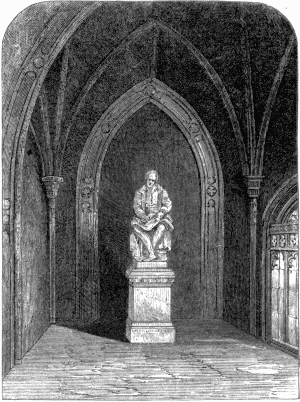
WATT’S STATUE IN HANDSWORTH CHURCH.
Watt was also honoured during his lifetime. Learned
Societies were proud to enrol him amongst their members.
He was a Fellow of the Royal Societies of London
and Edinburgh, a Foreign Associate of the Institute
of France, and a Member of the Batavian Society. The
University of Glasgow conferred on him the degree of
Doctor of Law. Lord Liverpool offered him a baronetcy;
but, consistent with the simplicity of his character, he
declined the honour. He was invited to serve as Sheriff
on two occasions, for Staffordshire and for Radnorshire;
but he strongly pleaded to be excused undertaking the
office. He was “a timid old man,” and hoped that he
“should not have a duty imposed upon him that he was
totally unfit for, nor have his grey hairs weighed down
with a load of vexatious cares. My inventions,” he
said, “are giving employment to the best part of a
million of people, and having added many millions to
the national riches, I have a natural right to rest in my
extreme age.” His pleas were in both cases regarded
as sufficient, and he was excused the office.
It is altogether unnecessary to pronounce a panegyric
on the character and achievements of James Watt. This
has already been done by Lord Jeffrey in language
that cannot be surpassed. Sir James Macintosh placed
him “at the head of all inventors in all ages and
nations;” and Wordsworth the poet, twenty years after
his death, said, “I look upon him, considering both the
magnitude and the universality of his genius, as perhaps
the most extraordinary man that this country ever produced:
he never sought display, but was content to
work in that quietness and humility, both of spirit and
of outward circumstances, in which alone all that is
truly great and good was ever done.”
Watt was himself accustomed to speak of his inventions
with the modesty of true genius. To a nobleman
who expressed to him his wonder at the greatness of
his achievements, he said, “the public only look at my
success, and not on the intermediate failures and uncouth
constructions which have served as steps to enable me to
climb to the top of the ladder.” Watt looked back upon
his twenty long years of anxiety and labour before the
engine succeeded, and heaved a sigh. “Without affecting
any maidenly coyness,” he wrote to Dr. Darwin,
who proposed to eulogise him in his ‘Botanic Garden,’
“you really make me appear contemptible in my own
eyes by considering how far short my pretensions, or
those of the invention, were of the climax of human
intellect,—I that know myself to be inferior to the
greatest part of enlightened men in most things. If
I have excelled, I think now it has been by chance, and
by the neglects of others. Preserve the dignity of a
philosopher and historian; relate the facts, and leave
posterity to judge. If I merit it, some of my countrymen,
inspired by the amor patriæ, may say, ‘Hoc a
Scoto factum fuit.’”
Although the true inventor, like the true poet, is
born, not made,—and although Watt pursued his inventions
because he found his highest pleasure in inventing,—yet
his greatest achievements were accomplished
by unremitting application and industry. He was a
keen observer and an incessant experimenter. “Observare”
was the motto he deliberately adopted; and it
expresses the principle and success of his life. He was
always on the watch for facts, noting and comparing
them. He took nothing for granted; and accepted no
conclusions save on experimental evidence. “Nature
can be conquered,” he said, “if we can but find out her
weak side.” His patience was inexhaustible. He was
never baffled by failure, from which he declared that he
learnt more than from success. “It is a great thing,”
he once observed to Murdock, “to find out what will
not do: it leads to one finding out what will do.”
“Give me facts,” he once said to Boulton, “I am sick
of theory: give me actual facts.” Yet, indispensable
though facts are, theory is scarcely less so in invention;
and it was probably because Watt was a great theorist,
that he was a great inventor. His invention of the
separate condenser was itself the result of a theory,
the soundness of which he proved by experiment. So
with the composition of water, the theory of which he
at once divined from the experiments of Priestley.
He continued theorising during the whole progress of
his invention of the steam-engine. New facts suggested
new arrangements and the application of entirely new
principles, until in course of time the engine of Newcomen
became completely transformed.
Watt’s engine was not an invention merely—it might
almost be called a creation. “The part which he played,”
says M. Bataille, “in the mechanical application of the
force of steam, can only be compared to that of Newton
in astronomy, and of Shakspeare in poetry. And is
not invention the poetry of science? It is only when
we compare Watt with other mechanicians that we are
struck by his immense superiority,—when we compare
him, for example, with Smeaton, who was, perhaps, after
him, the man who had advanced the farthest in industrial
mechanism. Smeaton began, about the same time
as Watt, his inquiries as to the best means of improving
the steam-engine. He worked long and patiently, but
in an entirely technical spirit. While he was working
out his improvements, Watt had drawn forth from his
fertile imagination all those brilliant inventions to which
we owe the effective working steam-engine. In a word,
Smeaton knew how to improve, but Watt knew how to
create.”[425]
As for the uses of the steam-engine, they are too
widely known to stand in need of illustration. Had
Watt, at the outset of his career, announced to mankind
that he would invent a power that should drain
their mines, blow their furnaces, roll and hammer their
metals, thrash and grind their corn, saw their timber,
drive their looms and spindles, print their books, impel
ships across the ocean, and perform the thousand offices
in which steam is now regularly employed, he would
have been regarded as an enthusiast, if not as a madman.
Yet all this the steam-engine has done and is now doing.
It has widely extended the dominion of man over
inanimate nature, and given him an almost unbounded
supremacy over the materials which enter into his daily
use. It has increased his power, his resources, and his
enjoyments. It is the most universal and untiring of
labourers,—the steam-power of Great Britain alone being
estimated as equal to the manual labour of upwards
of four hundred millions of men, or more than double
the number of males supposed to inhabit the globe.[426]
It is, indeed, no exaggeration to say that the steam-engine
of Watt is, without exception, the greatest invention
of modern times; and that it has been
instrumental in effecting the most remarkable revolution
in all departments of industry that the world has
ever seen.
Some months since, we visited the little garret at
Heathfield in which Watt pursued the investigations of
his later years. The room had been carefully locked up
since his death, and had only once been swept out. Everything
lay very much as he left it. The piece of iron he
was last employed in turning lay on the lathe. The ashes
of the last fire were in the grate, the last bit of coal was
in the scuttle. The Dutch oven was in its place over the
stove, and the frying-pan in which he cooked his meal
was hanging by its accustomed nail. Many objects lay
about or in the drawers, indicating the pursuits which
had been interrupted by death,—busts, medallions, and
figures, waiting to be copied by the sculpture-machine,—many
medallion moulds, a store of plaster of Paris, and
a box of plaster casts from London, the contents of which
do not seem to have been disturbed. Here are Watt’s
ladles for melting lead, his foot-rule, his glue-pot, his
hammer. Reflecting mirrors, an extemporised camera
with the lenses mounted on pasteboard, and many
camera-glasses laid about, indicate interrupted experiments
in optics. There are quadrant-glasses, compasses,
scales, weights, and sundry boxes of mathematical instruments,
once doubtless highly prized. In one place a
model of the governor, in another of the parallel motion,
and in a little box, fitted with wooden cylinders mounted
with paper and covered with figures, is what we suppose
to be a model of his proposed calculating machine. On
the shelves are minerals and chemicals in pots and jars,
on which the dust of nearly half a century has settled.
The moist substances have long since dried up, the
putty has been turned to stone, and the paste to dust.
On one shelf we come upon a dish in which lies a
withered bunch of grapes. On the floor, in a corner,
near to where Watt sat and worked, is a hair-trunk—a
touching memorial of a long past love and a long dead
sorrow. It contains all poor Gregory’s school-books,—his
first attempts at writing, his boy’s drawings of
battles, his first school exercises down to his College
themes, his delectuses, his grammars, his dictionaries,
and his class books,—brought into this retired room,
where the father’s eye could rest upon them. Near
at hand is the sculpture-machine, on which he continued
working to the last. Its wooden framing is worm-eaten
and dropping into dust, like the hands which made it.
But though the great workman has gone to rest, with
all his griefs and cares, and his handiwork is fast
crumbling to decay, the spirit of his work, the thought
which he put into his inventions, still survives, and will
probably continue to influence the destinies of his race
for all time to come.
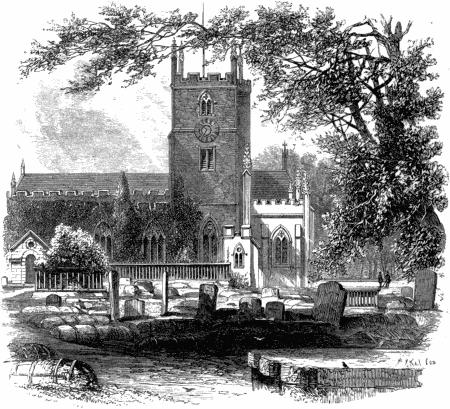
HANDSWORTH CHURCH.
THE BURIAL-PLACE OF BOULTON, WATT, AND MURDOCK.
[By Percival Skelton.]