How to set about conveying the sense
of this great mass of minutely reticulated
architecture without instantly
growing too pedantic on the one hand
or too vaguely general on the other—that
is the problem—always, in this
business of civic portraiture, a very present
one—that now begins to grow
especially insistent. For the Docks, after
all, in spite of their unhuman magnitude,
do resolve themselves, as we have
seen, into a fairly compact cycle of
recurrences; and the Suburbs, again, unfolding
themselves in their order, do provide
a clear and vital method of attack;
and the Slums, unhappily, cling loyally
throughout to one dolorous code. But
here, in this imposing van of the civic
army, there is neither loyalty to sole
effect nor specific rotation of several
effects. Each building is more or less
deeply individualized; every street has
its especial quality; and about the bases
of all these fretted cliffs, down all these
changeful ravines, the mutable tides of
the traffic charge and ebb unceasingly....
How is the sense of all these innumerable
aspects going to be squeezed
into a pitiful couple of thousand
words?...
One would like, for example, to distinguish
street from street: to speak of
Lord Street, say, with its inevitable air
of well-groomed alertness, brisk and
personable even under gloom, its rather
superficial architecture pleasantly asnap,
its traffic and its shops equally avoiding
the dully commercial, equally achieving
a confident glitter that only just falls
short of a swagger. One would like to
contrast it with one of the ways that
branch out from it—with North John
Street, for instance, bleak-faced and
sombre, constantly resonant with heavy
traffic from the Docks, but made suddenly
magnificent by the rocketting
cream and gold of the foreshortened
Royal Insurance building at its head;
or with Whitechapel, again—a street,
for all its proximity, of so profoundly
different a quality: a street that seems
always to be attempting to override, by
dint of cheap cafés, clothiers, boot-shops,
and the like, the coarse utilitarian
note that insists on lumbrously
emerging from Crosshall Street, from
Stanley Street, from the neighbouring
clangorous Goods depots: a country
tripper of a street, shamefacedly endeavouring
to conceal the presence of
its obviously autochthonous companions.
And one would like, again, to speak of
Stanley Street itself, chief of those
autochthonous companions, a narrow
and difficult ravine, mostly sunless, always
noisy, whose bed is encumbered
from end to end with floats and lorries
and waiting carters, and whose walls are
provision offices, provision warehouses,
and the sheer grey flanks of the G.P.O.
From a gash in those grey flanks a
blood-red stream of post-office vans and
motors is jerked out intermittently. The
air is thick with swinging boxes and
heavy or keen with the most astounding
range of odours: with slab cheesy
odours and searching fruity ones; with
exotic odours that one sniffs uncertainly,
for which one can find no closer definition
than nice or nasty; and, supereminently,
running through them all, the
wild decivilizing smell of wet deal cases—a
smell that always arouses a certain
unemotional cotton-broker of one’s acquaintance
to an inconvenient but
rather touching hunger for some particular
place of dim forest silences.
BOLD STREET.
And then one would like to appraise
the elusive atmosphere of Bold Street—that
intimate, elegant avenue of rare
fabrics and shopping women and the
ripe, drumming ripple of automobiles—the
Bond Street of Liverpool, whose
wood pavements make a sudden chosen
silence in the midst of the clatter, which
is held beautifully inviolate from electric
cars and sandwichmen, and at the head
of whose discreet vista the tower of
St. Luke’s rises gravely up, faintly remindful
of the manner in which the
towers of Sainte Gudule survey that
other road of women and priceless elegancies
in Brussels. And with this so
purely feminine apartment one would
proceed to contrast, properly enough,
some such exclusively male possession
as Brunswick Street. It, too, is highly
chosen and conserved, and the sober,
archaic front of the old Heywood’s Bank
at the upper end of it prepares one at
the outset for exactly the unostentatious
sobriety of the lower, where it passes
under the influence of the Corn Exchange.
It seems to reflect, and the
brokers one meets there seem exceptionally
to reflect as well, something of
the spirit of that fine race of merchants
who wore leathern watchguards but
stocked a most excellent port, whose
word was good for thousands and who
lunched at the little tavern which still
stands there, like an old-fashioned waiter,
with so engaging an air of homely dignity.
And it would be impossible, of course,
to avoid comparing Brunswick Street
with that other exclusively masculine
quarter, Victoria Street, which passes,
in spite of its consistent virility, through
three successive phases. In the first,
where it lies between North John Street
and the Post Office, it has an almost
Stanley Street-like aspect—a wider and
less viscid Stanley Street, with the red
stream of mail-vans exchanged for a
black swarm of clerks and merchants,
hiving about the Produce Exchange.
In the second it grows aridly official,
the fidgety pomp of the Post Office
towering away on the right, the Revenue
Offices marching with much cold grey
dignity on the left. And, finally, in its
third phase, it grows positively dramatic
and unintentionally spectacular: the
offices of the town’s protagonistic newspapers,
the Post and the Courier, confront
one another threatfully—silent at sunset,
but romantically vociferous towards
dawn, and, from close beside them, one
gets (especially on a morning of sunshine)
the most delightful glimpse of the
entirely noble sweep of architecture that
rises up—dreaming, reduced, subtile—beyond
the quick, green flash that sings
out from among the statuary of St. John’s
Gardens.
And so one could go on, disengaging
the essential spirit of street after street,
hoping that all the readings, taken together,
would build up into the gross
effect of the whole thing, would cleanly
spell out the essential spirit of the City.
As, indeed, they no doubt would. But
in the way of the adoption of that course
there lies one rather serious objection.
To make its final result veracious, it
would have to be followed with uncompromising
thoroughness; and if it were
followed with uncompromising thoroughness
this chapter would never end.
So, then, although it carries us a certain
distance, that bundle of street
analyses, even if it were considerably
enlarged, must not be looked upon as
final. The alternative method, of course,
is the eclectic—a searching out of
“notes,” of the vistas, the groupings,
the buildings, that leap incisively out
from the mass and engage the memory—an
arrangement of these things in some
considered order.
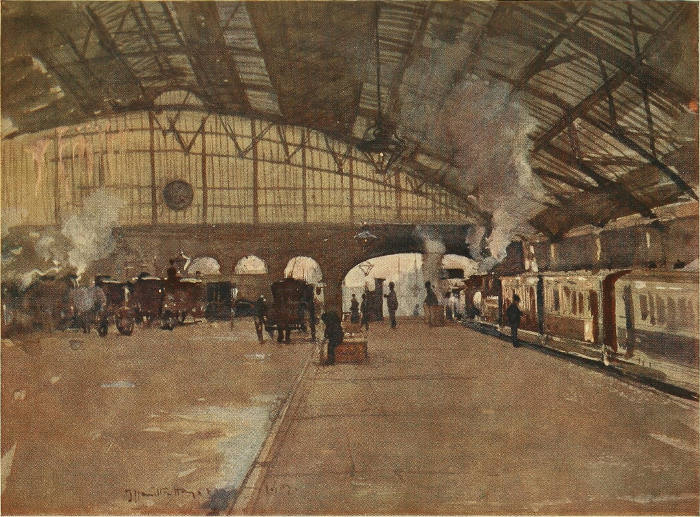
LIME STREET STATION
And to such a collection that bunch
of street-portraits (their subjects, to be
frank, having been chosen rather less
off-handedly than might appear) forms
an admirable nucleus. And since it is
at the moments of arrival and departure
that the nerves are most sensitive to
aspects—since it is, in consequence, the
first or the last glimpse of a place that
remains, for most of us, its practical,
portable symbol—the collection should
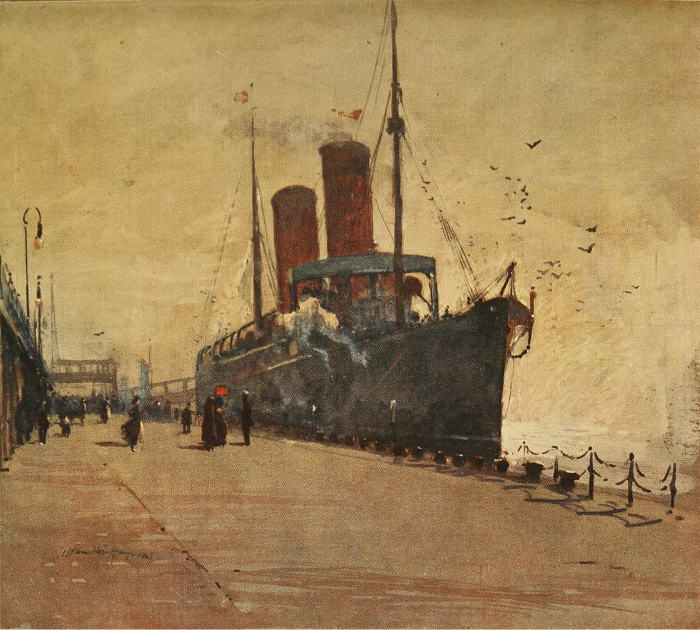
next include a note of the way Liverpool
reveals herself at each of her four great
vestibules—at the Landing Stage, at the
Exchange Station, at Lime Street Station,
at the Central Station.
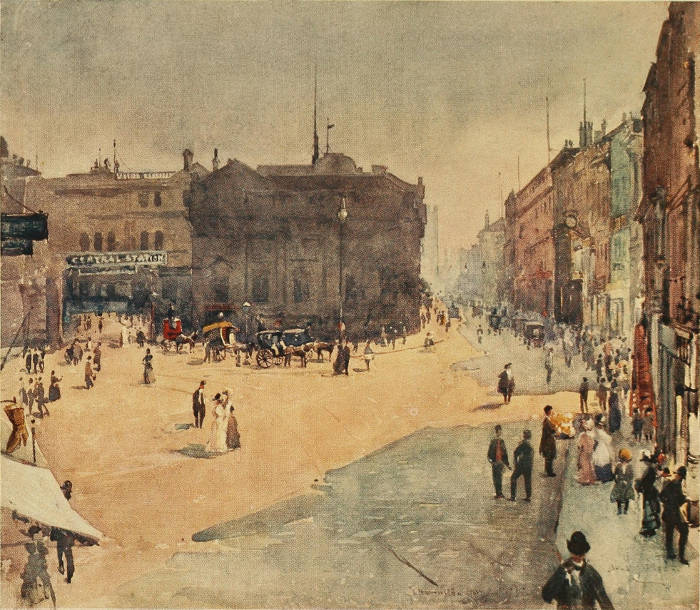
From within the railings that fringe
the tiny courtyard outside the last, for
instance, it is as a neatly compacted
vista of twinkling shops, of converging
roofs, minarets, and flag-poles,
that, in the day-time, she rather alluringly
presents herself. There is much
delicate cross-hatching of shade and
shine, much blithe gold-lettering on
the walls. There are flower-sellers on
the kerb, a string of hansoms glisten
in the roadway, an electric car, double-decked
and yellow, surges down the
hill from Ranelagh Street and provides
the due top-note.... Emphatically,
a most efficient place, this Liverpool,
glossy and high-stepping, at once elegant
and active. And with nightfall it
emerges as a place of quite exceptional
loveliness. That checked curve of the
receding buildings, giving the prospect
depth without diminution, grades the
lights without disparting them, knits
them together, both the near and the far,
into one exquisitely modulated chorus.
Moon-green, mistletoe-white, orange,
amethyst, and pearl, are their principal
colours, and in this chamber of converging
lines the massed clusters branch and
leap and linger with the most wonderful
effect of tender ardency.... Emphatically,
a place, this Liverpool, possessing
very singular possibilities of beauty.
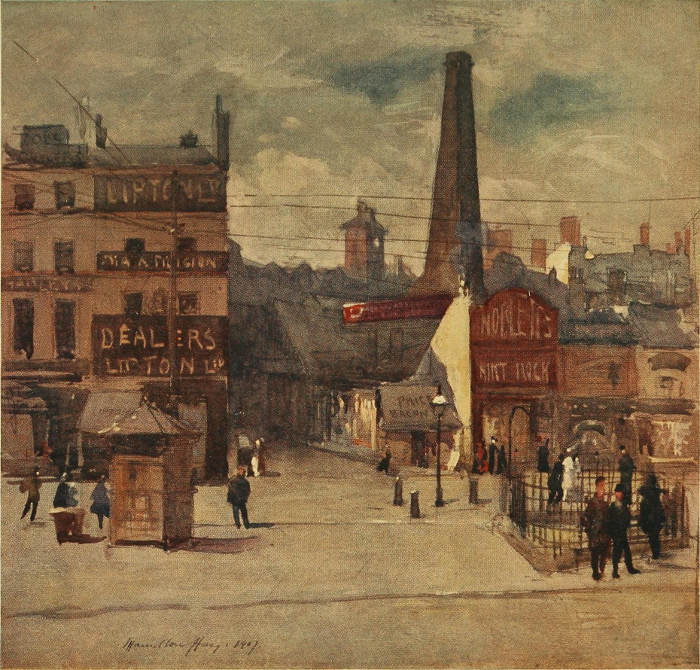
The Liverpool that awaits one outside
the orifices that lead from Exchange
Station, however, is of a vastly different
quality.[3] Roofed with a remote, unimportant
sky, floored (say) with a
vague shimmer from recent rain, and
hung monotonously about with carefully
unobtrusive buildings, it seems less like
one of the central spaces of the City than
a mere ante-chamber to rooms—possibly
magnificent, possibly squalid—that
lie somewhere beyond; and in the mornings,
when the hosts from the northern
suburbs are pouring silently through,
that effect is irresistibly emphasized. It
is all neutral, non-committal. The solitary
stains of colour are the hoardings
that flame up before the Moorfields entrance,
and the immemorial fruit-barrow
that picks out against the grey in
Bixteth Street.
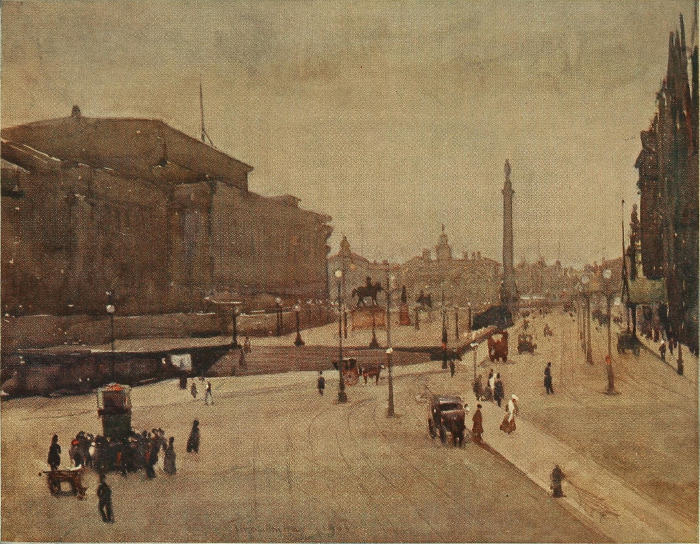
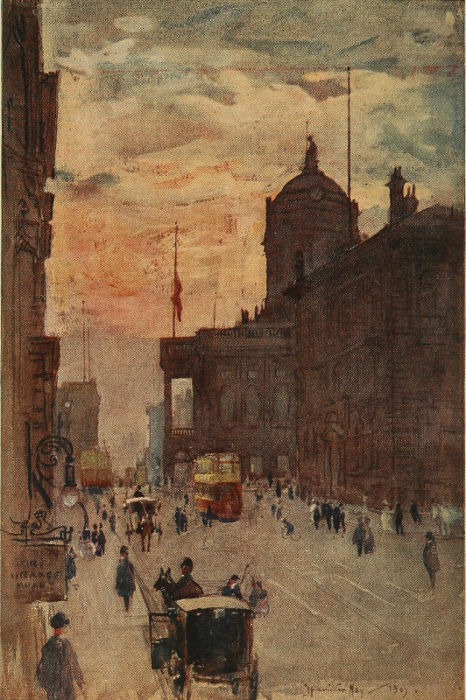
LIME STREET, WITH WELLINGTON MONUMENT.
One’s impression of the Lime Street
Liverpool, again, is always tinged by the
consciousness of that superb stretch of
“smutted Greek,” Liverpool’s most deliberate
effort in the direction of sustained
architectural spectacle, which one
sees just the moment before or just the
moment after. Without that consciousness,
the flat-chested, multi-windowed,
watery-complexioned hotels that droop,
perhaps a little dismally, down the hill
opposite, and the uncertain traffic that
spreads itself thinly out upon the vast
road-spaces in between, would probably
not convince one that their claim to
dignity was extraordinary. But as it is,
they do seem to catch a kind of magnificence,
a magnificence that is positively
almost shared by the little ragged sentry-box
of the Punch and Judy show set oddly
down, like a grandfather’s clock, plump
in the middle distance—a queer axis for
the cars that curve clangorously about
it. As one advances, the black chine of
St. George’s Hall, a long grey ripple
of steps lapping its base, thrusts forward
more and more emphatically, and so one
passes into sight of that plateau of
classicism—St. George’s Hall, the Museum,
the Library, the Walker Art
Gallery, which Mr. Hay has described so
perfectly upon another page.
Deliberately majestical here, gravely
featureless in Tithebarn Street, elegant
from the Central, Liverpool achieves
within the last of her four porticoes an
order of effects more urgent and memorable
still. For it is behind the Landing
Stage that many of the car routes of
the City terminate, and the great space
of unshadowed roadway, empty of all
buildings save the new-sprung Dock
Offices, is really a brave platform on
which the cars endlessly wheel and interlace.
By daylight it is wonderful enough:
the long files of maroon and yellow
monsters curving, separating, recoiling;
the constant scream and clangour of
their onset; the rich white bulk of the
Dock Board building floating serenely
above the press. But towards evening,
when every car becomes a great cresset
of prisoned flame, the golden plenty of
it all, the intricate splendour of this
vast terrace of racing and receding fire,
is a thing to leave the senses glutted and
overborne. Liverpool is no longer a
place of architecture, grave or dignified.
It is a mere spectacle, a piece of golden
pageantry. And even the beauty of the
dominating building, ivory and pale rose
as it accepts the sunset, luminous and
firm-bodied as an eastern cloud at the
end of a day of wind, seems no more than
a fit accessory to the fabric of woven
lights astir below.
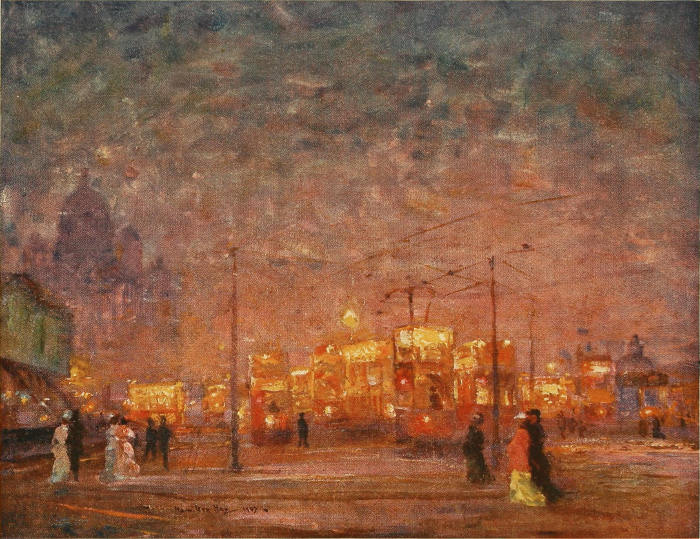
ELECTRIC CAR TERMINUS—PIER HEAD.
It is one or other of those vignettes
that stands for Liverpool in the minds
of all but all those who live without her
walls; but there still remains another
touch or two to add before the symbol
we are attempting to create can be called
completed, before this inevitable, initial
slab of what must begin to appear
uncommonly like sheer “word-painting”
(crude word for a cruder occupation)
can be brought to a close. Already
we have taken the sense of a group of
her central ways; already we have surprised
her at each of her four great doorways.
It now remains to brush in a
connecting note or two, an episode or
so from the less formal interspaces:
An appreciation, say, of one of those
admirable fortalice-like structures, the
warehouses, which clamp all the lower
end of the mass and convert the little
connecting roadways into canyons of
sumptuous gloom. Four-square and massive,
they are always shapely; the old
stock brick, hand-made, of which so
many of them are built, gives them a fine
hunger for ripe colouring; and from their
vertical lines of doorways—six, eight,
ten, a dozen, of them superimposed in
a slot that runs from roof to base—they
gain the power to charge their austerity
with something very near to positive
elegance....
A reference to one other of the connecting
ways: thin sabre wounds of
light drawn across the dense body of
offices—to such a one as Leather Lane,
for instance, slipping stealthily from
Tithebarn Street to Dale Street, a sun-bright
tremor of traffic, dainty and
diminished as an image in a lens,
flickering delicately across its outlet....
An impression of some such typical
grouping of the mobile and the architectural
as one gets, say, at the top of
one of the three parallel ways—Chapel
Street, Water Street, James Street—which
run down from the centre towards
the River: a crawling steep of men, cars,
carriages, and drays; the flags and signs
of a horde of shipping offices accompanying
its descent; slow masts and a couple
of great funnels moving seriously beyond.
Or of such another grouping as
one finds being repeated, over and over
again, at the base of the brown stone curtain
that falls from St. Nicholas’ Churchyard
to the street below: a troop of
sandwichmen, their beat ended, piling
their placards against the wall; a couple
of ramping Clydesdales—head-chains
glinting, feet asplay for purchase—taking
the Chapel Street hill; an aproned carter
swinking at their heads; a white-flecked
mound of cotton-bales lurching stolidly
at their heels; high over all, sailing
equably against the blue, the fretted top-gallant
of the Church....
A memorandum of one of the older
(not the old—there are none) scraps of
the City, pushed a little to one side,
antiquated before they are antique:
of that jolly little pot-bellied barber’s
shop at the foot of Mount Pleasant (Mr.
Hay has described that, too), and of how
the slick new mass of the juxtaposed
University Club crushes it into insignificance—a
ready-made metaphor; or
of that delightful Georgian residence in
Wolstenholme Square, not far from Bold
Street, with lorries clattering about
its mild old cobbles, and a trio of
extremely dirty tinsmiths bullying a
carter from the top of its dignified
stairway....
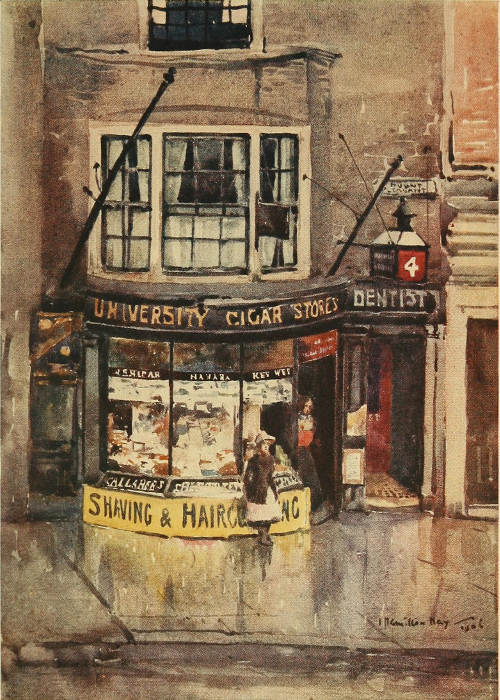
THE LITTLE SHOP, MOUNT PLEASANT.
An appreciation of that tumultuary
roofscape one surveys from the steps of
the Art Gallery, a thing to be seen against
the afterglow, a clean-verged, leaping
monochrome of mauve on chrysoprase....
And there you have the main letters
in the alphabet of masonry which Liverpool
uses to write out some part of her
confessions.
Now, it may be observed that I
have made no reference whatever to
some of the most conspicuous majuscules
in that alphabet. I have said nothing,
for instance, about the Municipal Offices,
nor of the Town Hall, nor of the Sailors’
Home, nor of the new Cotton Exchange,
nor of the old Custom House, nor of a
dozen other much-photographed architectural
plums. This is not laxity, nor a
sudden dearth of adjectives, nor a disgust
with the business of scene-painting.
There is, as they say, a reason; and if
I disclose that reason, the confessions
which those dropped capitals bestud
may tend to grow more legible. Such
disclosure might serve, at all events, to
suggest a co-ordinating theory, to provide
a kind of zoetrope into which those
detached impressions and Mr. Hay’s
pictures may equally be fitted, and which,
judiciously twirled, may induce them all
to swim into a single animate and breathing
image.
The fact is, then, that when Liverpool
desires most to impress she expresses
least. When she draws herself together
for a splendid outburst, she grows inarticulate.
Her considered effects are
mostly affectations. So that to pick out
those effects, to arrange all the majuscules
together, is not merely to print her confession
in another type: it is to print a
confession of another type. One omits
these deliberate, self-consciously impressive
things from one’s notes, not
because Liverpool contains very little
of such things, but rather because such
things contain very little of Liverpool.
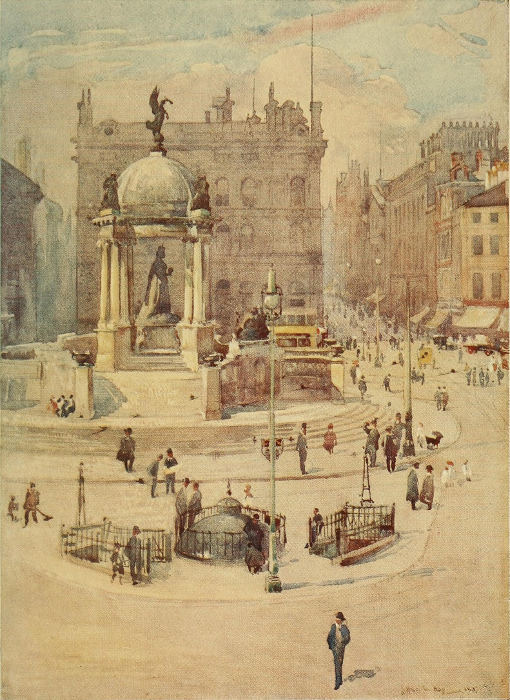
THE QUEEN VICTORIA MEMORIAL.
For the spirit behind this fabric is
essentially a spirit absorbed in other
matters than the deliberate, preconsidered
capture of the beautiful.... Out of the
several characteristics we have already
noted—the swiftness of the City’s growth,
its glittering modernity, its tireless, deft
adjustment of alien activities to a common
end, its tenacious efficiency and
alertness—out of these things in conjunction
does there not already begin
to emerge (we are all invincible anthropomorphists
in these matters) some kind
of quite consistent Personality—the
genius of the place, if you will—the
handy embodiment, at any rate, of the
main instincts which this specially environed
congeries has tended to throw
into exceptional relief? For myself, I
see it always as a blunt Rodinesque
figure, sternly thewed, tensely poised,
strenuously individual, tenacious of the
actual, impatient of mere dreams, energetic
rather than adventurous, a lover,
above everything, of efficiency—efficiency,
testing and twisting things with
earnest, untiring fingers, whittling things
down to the valid, irreducible core....
It is not from fingers like those that one
looks to receive many frail white images
of beauty. And whether this reading of
the essential psychology of the place be
true or false, it is certain that the men of
Liverpool have never been overprone to
sheer æstheticism. The vivid day of
their City has been crammed with leaping
episodes, it has left no spare strength for
flourishes, and they have expressed themselves
throughout in terms of a naked
and practical utility. Such purely
decorative effects as have from time to
time been judiciously introduced become
in consequence effects which it is vastly
easy to misunderstand. Take, for instance,
that lordly plateau-load of classical
furniture at Lime Street—a feature
that would seem utterly to contradict,
but that in reality beautifully confirms,
this non-æsthetic reading of the City’s
nature. Raking among the ruins of the
place a thousand years hence, when
steamships are unknown and the Mersey
is silted up, some earnest archæologist
will come upon those (in both senses of
the word) imposing remains, and will
promptly be deceived. He will speak
with rapture of the “sharp bright edge
of high Hellenic culture” that must have
glittered about the community which
could produce such stately monuments;
and he will probably have a good deal
to say about the civic decadence of his
contemporaries. But archæology (not,
perhaps, for the first time) will have
been mistaken. These clean-limbed
columns and great porticoes and pediments
were not upreared by a race of
Phryne-worshipping hedonists. Directly
regarded, therefore, they are misleading,
uncharacteristic; but in an indirect way
they are very characteristic indeed. One
would ask for no better proof of a man’s
lack of native appetite for literature
than that he had read through, in turn,
the whole of the hundred best books.
Similarly, this wholesale, uncompromising
adoption of an architectural mode already
traditional, already innumerable times
approved, is a most convincing proof of
the existence of that spirit of honest and
tenacious practical efficiency of which I
have spoken. When it came to a matter
of beauty, they made beauty a business,
they captured it by brute strength and
logic. There was nothing tentative, experimental,
about the effort; there was
no attempt at realizing some splendid,
unprecedented dream; line for line, mass
for mass, it was the stolid, efficient reproduction
of masses and lines about whose
loveliness there was no possibility of
question. And so the beautiful sequence
of buildings which stands for Liverpool’s
most deliberate piece of architectural
æstheticism is really a testimony to the
beauty-disregarding spirit of naked utilitarianism
which her endless and imminent
activities have made inevitable.
And it is precisely to this beauty-disregarding
spirit of utilitarianism again
that one traces some of the most memorable
and significant pieces of beauty that
the place possesses—more memorable
and significant than the St. George’s
Hall group, because vastly more vital and
characteristic. For Liverpool, in spite
of herself, and quite unconsciously, is a
place of exceeding beauty. Out of that
hard turmoil of tangible interests and
endeavours a very splendid and reassuring
happening has sprung. In honest
and shrewd response to instant necessities,
the city has been carved and
kneaded into the lean lines of practical
effectiveness; and those lines have joined
wonderfully together to make any number
of unpremeditated glories. Loveliness
has descended unawares. Built frankly
for use, it seems to have attained, by
processes almost as organic as those of
outer nature, a very singular and moving
impressiveness. That drama of leaping
roof-tops seen from the Walker Art
Gallery, that chamber of co-ordinated
lights seen from the Central Station, that
racing flood of gold beneath the Dock
Board building, are examples of the sort
of thing I mean. It is in these natural
and instinctive creations, frankly utilitarian,
and not in her self-conscious
trafficking with loveliness, that Liverpool
grows most sensuously magnificent. A
curve of sunless canal with clustered
chimneys rising solemnly about; a pit
of railway sidings, warehouses ranged
round, one proud white plume of smoke
moving slowly across it; long glittering
reaches at the Docks; a black stretch of
suburb crawling out, myriad-speared,
across the sunset; a mass of warehouses
blotting out the stars; hot vistas in the
markets, ripe and fierce with colour;
burning evening skies, unintentionally
clipped and framed by the pillars of the
Town Hall portico; roof-adjusted rods
of sunlight creating unexpected carnivals;
perspectives forming and vanishing; great
horses moving in procession; swift, imperative
assonances—momentary, irrecoverable—between
traffic and grouped
buildings: these and a thousand others
of the same spontaneous kind are the
passages of her life, the native gestures,
that linger in the memory like a cadence,
that colour her aspect with an abiding
dignity and graciousness.
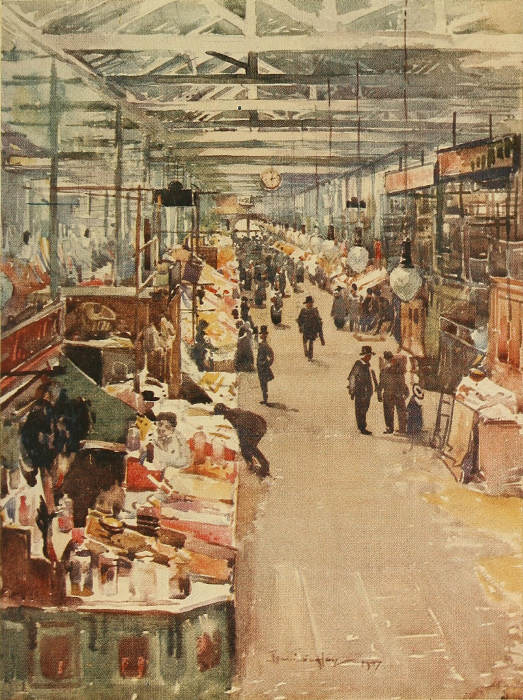
ST. JOHN’S MARKET.
And this is, after all, to say little more
than that Liverpool possesses in deep
measure that strange accidental beauty
of the modern city which is a thing so
new to the world that the arts have
not yet learned to teach men how to
enjoy it. But in Liverpool (exceptional,
once more, because typical, typical because
exceptional) that beauty exists in
a state of singular purity. It is a beauty
that is the result, above everything, of a
naked response in stone and iron to
certain clear imperative necessities: such
a response catching, as it would seem,
some of the beauty and authority that
inevitably attach to every articulate
expression of a vital impulse. And in
Liverpool those responses have been
especially clean and unentangled. The
place is self-contained: it has never run
to booths and show-places; it has no
associations, romantic or historic, to
attract the gaper; it has never had to
sustain a pose, and only rarely been
tempted to attempt one; and these
facts, and the fact that its growth has
been continuous, that there has nowhere
been any shrinkage or debilitation, have
made it possible for the garment of
buildings to be fitted to the authentic
body of its energies with an absolute
closeness and integrity. There are no
loose folds, no adaptations, very few
adhesive insincerities. The whole thing
is supremely vital and athletic; and
therefore it everywhere discloses that
strong and moving graciousness, as yet
almost wholly uncelebrated, which is as
elemental and unaffected as the strong,
forthright graciousness of its River.
Thus far I have spoken chiefly of the
setting of this central stage, its scenery
and back-cloths. Let me now attempt
to indicate, as uninvidiously as may be,
one or two of the more prominent actors:
themselves, of course, equally symptomatic,
equally the choice and the mouthpiece
of that Rodinesque deus ex machina
couched invisibly behind.
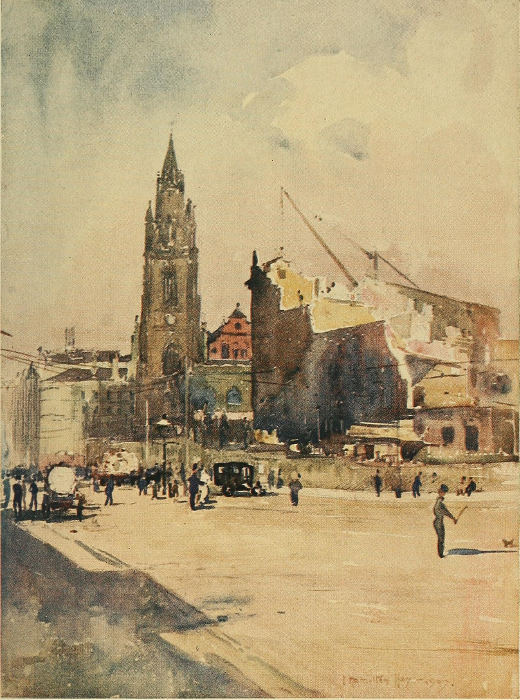
ST. NICHOLAS CHURCH AND THE LAST OF TOWER BUILDINGS.
Place aux dames, by all means.... Of
the maturer actresses, however, I confess
I speak with a certain degree of diffidence.
It is always dangerous to generalize on
such a topic, and when the generalization
inclines to be not wholly laudatory, to the
danger of being guilty of inaccuracy is
added that of floundering into blank discourtesy.
But I will have, at least, the
courage of my impressions. Sifting them,
I incline to suggest that the more mature
of the women-folk whom one discerns
here, among the central shops—driving,
walking, shopping—seem somehow not
wholly to succeed. The efforts of an
earlier day seem to have left their marks—sometimes
in a certain exiguity, more
often in a certain inexiguity; and, facially,
one rather deplores the absence of anything
in the nature of that enduring
patrician basis which sometimes makes
(as one seems to remember) the inevitable
touches of attrition touches almost to
be welcomed—touches that refine, clarify,
take distinction a delicate step further.
Here and there, in a Bold Street carriage,
or in some one of the more guarded
roadways of the south-eastern suburbs,
a silvery face will flash out with a cameo-like
precision; but their incidence is
rare—quite rare enough, it seems to me,
to be accepted as significant. The general
note wavers instead between something
almost touchingly fade and something
too tenacious of qualities which, however
charming in themselves, have rather lost
their personal propriety.... So one
hesitatingly generalizes. For the rest,
there is an infinitude of kindliness; and
one suspects that it would sometimes
much prefer to break away, more often
than it has the right to do, into frankest
homeliness. One is never tempted to
deplore a too vulgar display of mere
culture.
But of the younger of the female
players I speak with a notable access
of assurance. There, beyond question,
do I seem to detect the presence of a
very distinct type, and (still more reassuring)
of a type that is vastly pleasant.
More, I have, for the first part at least
of this judgment, the confirmation of a
friend in whose flair for social qualities
I repose, for the best of reasons, the most
absolute confidence. “I can tell them
anywhere, anywhere,” she assures me:
in Paris, at Nice, in Scotland, it seems,
the Liverpool jeune fille stands apart.
To the latter part of my judgment, it
is true, she subscribes only an assent
that is dimmed by a vague qualification
or so, perhaps not wholly inexplicable.
She hints, for one thing, at a kind of
gaucherie; but that, I am convinced, is
unfair. One may suggest, indeed, not
without justice, a certain lack of finesse,
but that is by no means the same thing.
Gaucherie implies a kind of inefficiency,
an inadequacy that trends towards clumsiness,
and anything short of an absolute
efficiency is flatly uncharacteristic of the
sort of girl I mean. Whether she speaks
or walks, buys a hat or wears one, plays
golf or the piano, it is always the consummate
apportionment of means to
end that most impresses one; and if one
rarely finds her indulging in the frailer,
more elusive, artifices of femininity—in
those so alluringly deliquescent touches of
speech, voice, emotion, gesture, and so
forth—in all the subtle craft of implication,
for instance—it is by no means
because her methods stumble before they
reach her ideals, but simply because
her ideals include none of those fine,
diaphanous practices. Her vision of
the world is as distinct and sharp as
Mr. Bernard Shaw’s (Mr. Shaw, indeed,
would unreservedly admire her); her
emotions are robustious and definite;
and she makes all this instantly quite
clear, even to the outsider, in her
manner of speaking to her coachman as
she steps into her brougham, or in the
strong delicacy of the colours with which
she so charmingly and undisguisedly
emphasizes the clear colour of her eyes.
I grow intimate, it will be perceived,
and, in order to grow more intimate still,
let me appoint a flesh-and-blood heroine.
She is a woman who always seems to
me perfectly to achieve exactly what her
sister-players, one in this way, one in
that, succeed in attaining only approximately.
She certainly, at any rate,
perfects and epitomizes, in the most
delightful fashion, what one singles out
as their main tendencies—their main
physical tendencies, that is, and therefore,
no doubt, their main sub-physical
tendencies as well. She is tall and large-limbed,
more Hebe than Diana, with
the grace of swiftness rather than of
languor, and a mode of gowning that
deals directly with the body’s needs, and
so, the body being so admirably fashioned,
immensely rejoices the eye. Bronze and
rose (here one inevitably tends toward
dithyramb; but these Liverpool complexions,
too good to be untrue, are
really quite memorable) meet distractingly
in her face’s colouring, and I will
not deny an occasional freckle or so.
She speaks an English that is clean and
well picked in a voice that is so satisfied
that it needs all its firmness to keep it
from complacency, and she has no discoverable
accent. She lives at Sefton
Park in one of the rather ineffective
houses we will criticize in the next
chapter, and, as often as not, comes to
town by electric car. (London, I hear,
still looks askance at its County Council
cars, but in Liverpool they are, and
always have been, quite the thing.) She
is most herself when she walks. Her
stride is not evasive. Golf has helped
to solidify it. She writes a most excellent
letter, reads a good deal, cares
nothing for Mr. Yeats, a great deal for
Tolstoi, is (rather unexpectedly) a
devotee of Bach, and can play the Chaconne
very vividly. She is at once
shrewd and tender, cool-headed and
warm-hearted. And although she protests
that she has “a soul above self-coloured
papers,” her regard for sacred
things, on the one hand, is as free from
sickliness as her regard for secular things,
on the other, is free from crudity and
ill-taste.

SAINT PETER’S CHURCH.
She stands, then, that highly satisfactory
young animal, for all that, in their
several ways, the majority of the younger
women-folk tend to rival; not only those
who pass from brougham to shop in
the clear morning brightness of Church
Street and Bold Street, but also those
others, even more truly native to these
central quarters, whom one observes
hurrying here a few hours earlier, and
leaving, with something more of leisureliness,
in the neighbourhood of six and
seven: the less fortunate, but scarcely
less reassuring sisterhood whose business
it is to wait at the thither end of that
passage from brougham to shop, and
produce such hats, ribbons, laces, flowers,
as our heroine may desire. Physically,
indeed, these shop-girls of Liverpool have
a charm that rather astonishes the
stranger; and they, too, are remarkably
efficient self-gowners. To pass down
Lord Street and Church Street on some
spring evening, with the ebbing daylight
tactfully erasing any of the lines the stress
of the long, close hours may have left
on the young faces, and the flowering
lights of the City flinging little splashes
of piquancy among them, is to be
charmed into accepting the physical
beauty of women as one of the especial
attributes of these rapid commercial
streets.
As for the male members of the company,
they avow, of course, an unusually
complete immersion in occupations unmuscular
and theoretical: Liverpool’s
exceptional freedom from industrialism—other
than the secluded industrialism of
the Docks—making her, in this conspicuous
white-fingered urbanity of her
workers, once more especially typical
of one of the chief modes of modern
civic life. All manual labour being,
broadly speaking, tidily banished to the
Docks, these central spaces are left entirely
at the disposal of the dock-labourer’s
soft-handed collaborators—the
clerk, the merchant, the broker. Every
morning, from nine to ten, the tide of
these spruce actors pours astonishingly in.
They cram and encrust the cars, they
traverse, with a neat, fashionable air,
that mild ante-room in Tithebarn Street;
they flood thickly up from the River—an
agreeably apparelled army that gives
a fine air of prosperity to all the streets,
and that will shortly settle down, in a
thousand unseen cells, to its extraordinary
and so modern labours, dealing always
with symbols instead of actualities, with
signatures instead of people, with bills
of lading instead of bales and boxes,
flinging tons of merchandise from continent
to continent with the flick of a pen—a
queer, Shalott-like existence of whispers
and reflections.
But in spite of these unmuscular rites,
and in spite of those elegant costumes, it
must not be imagined that the ritualists
are themselves unmuscular. It is by no
means a white-faced and dyspeptic clan,
this clerical tribe of Liverpool. And,
for my own part, I like to believe that it
is the River once more which has secured
for these clerks, merchants, bankers,
brokers, their rather conspicuous emancipation
from the proverbial physical
defects of the sedentary. The place,
anyhow, is very clearly pledged to
athleticism, as those rows of physical
culture magazines which chromatically
tessellate the pavements of Water Street
and Chapel Street would alone suffice
to make quite evident. And certainly,
even if it be not wholly responsible for
this remorseless pursuit of muscularity,
the River gives that pursuit all manner of
exceptional advantages. The long series
of famous golf-links that lie amongst the
sand-dunes at New Brighton, at Leasowe,
at Hoylake, at Formby, at Blundellsands,
at Birkdale; the numerous salt-water
swimming-baths; the sailing clubs;
the briny, gale-cleansed spaces of aromatic
gold, free to all who care to use them,
that curve endlessly about the coast;
the mere proximity of the Landing Stage
and the presence of the cordial and
bracing airs that enfilade the streets of
offices behind it—all these things must
have tended to give athleticism an
especial point and vigour. The River has
made one-half of Liverpool a race of
quill-drivers; but it has also made them
a race of exceptionally deep-lunged and
brown-faced quill-drivers.
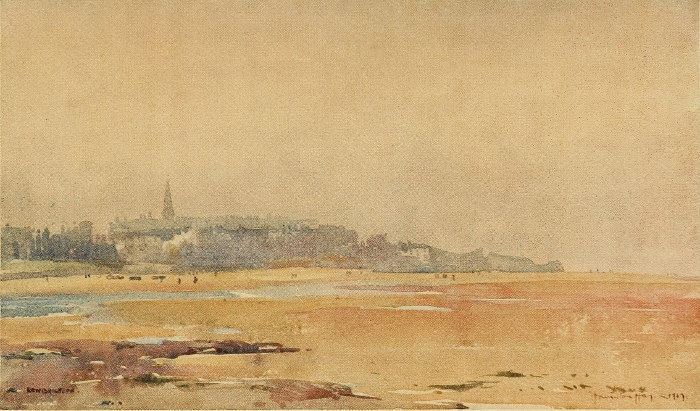
EVENING AT NEW BRIGHTON.
Take, for instance, the case of L——.
L——, nearer twenty than thirty, is a
clerk in a bank here, and he, like our
free-striding heroine, presents a clear and
accurate summary of the tendencies one
notes in the innumerable clerks who
fill the close-packed offices all about him.
He lives “across the water” at New
Brighton, choosing that because of the
half-hour’s river crossing morning and
evening. (He spends that half-hour
walking steadfastly round and round the
upper deck, hat in hand, practising—if
he can do so unobtrusively—an elaborate
and, I am sure, highly painful system of
respiration.) He goes to the swimming-bath
twice a week in winter, five or six
times in summer, dodging down there,
if possible, at moments that are perhaps,
from a mere purist’s point of view, not
entirely his own. But in these matters
L—— is no mere purist. He does his
work well (he is really a most excellent
servant), and that suffices. He is paid
£140 a year for doing it well, and that,
too, suffices. It suffices for three
£3 3s. suits per annum, for subscriptions
to a football club, to a cricket club, to a
tennis club, for a sixth share of the
expenses of running a small yacht, for
a £13 summer holiday, and for his
various trim necessities. He is a close
student of the science of “fitness,” regarding
“fitness” (very properly) as a
thing much superior to any mental
abnormality, and the shilling which
suffices for his daily lunch is not expended
without due dietetical considerations.
Just now it is vegetarianism. Thereafter
he repairs to one of those surprising
underground smoking cabarets—places
where an Oriental easefulness and languor
loom dimly through a blue narcotic veil—which
Liverpool, probably because of
her emphatic clericalism, provides in
such extreme abundance, and there, in
the company of other seekers after fitness,
he sips, and smokes, and nibbles one of
the two biscuits with which he is provided
(never both—that would be a grave faux
pas), and discusses athleticism until a
quarter of an hour after the time he
should be back at his desk. He is lithe,
clean-shaven, temperate, unmarried, and,
in spite of his contes, probably strictly
celibate as well. He reads, but books
are of interest to him chiefly because
they remind him of life, give him a fresh
appetite for the fit and pleasant things
of life; thus, he praises Harland because
his people—Anthony and the rest—are
“so immensely decent.” He is not
inordinately religious, but the traditional
piety of his people is a thing he contentedly
accepts. He may one day
migrate (“going abroad” is a familiar
topic in this City of lowly paid clerks and
multitudinous cheap and obvious modes
of exit), and if he does he will certainly
score. If he stays at home he will wind
up with a small bank managership and
as much in the way of golf and week-ends
as £250 a year will permit him to use as
a salve for the obedient monotony of
small bank management.
That is one type of player. Another,
and much older, is to be found gravely
pacing among those sober buildings in
Brunswick Street. Self-made, but never
blatant; successful because of his common
sense and his genius for hard work,
and remaining common-sensible and
hard-working in spite of his success;
vested with a dignity that sometimes
verges on stolidity; suspicious of sentiment
in life, but an admirer of Bouguereau
in art, he is pre-eminently the
kind of man who ought always to be
commemorated in a steel engraving, never
in a photograph. He has had much to
do with the creation of his City, and
certain of her newer propensities awaken
in him a vague sensation of alarm.
Wealthy, he is a collector rather than an
amateur, but a friend rather than a host.
Not without a rich vein of humour, he
still takes politics quite seriously. His
house (if his family be amenable) has a
strong mahogany flavour; if his family
be vigorous, that vague feeling of disquietude
pursues him there, where he is
compelled to fit into an incongruous
bungalow-full of art nouveau tenuities.
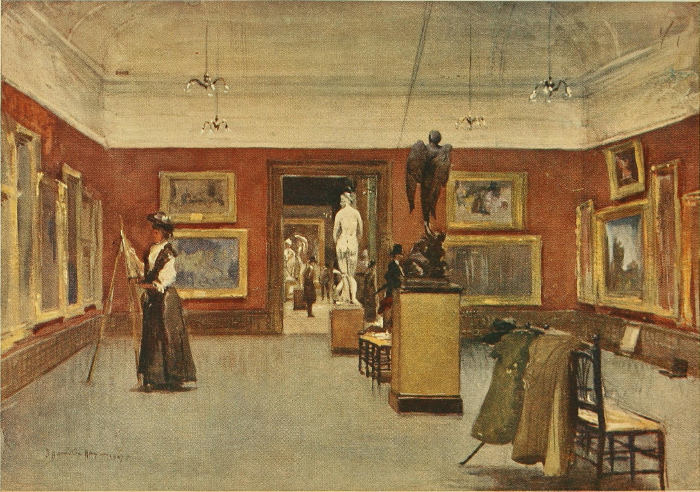
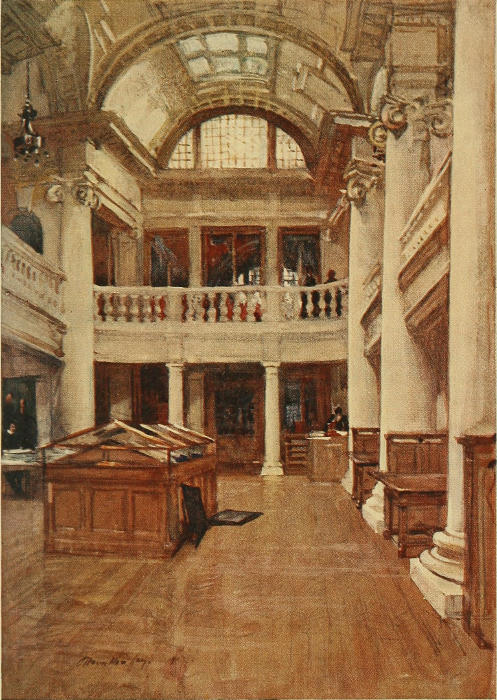
THE WALKER ART GALLERY—INTERIOR.
Thus, in spite of the fact that he, more
than any of the others, often startles
one by his resemblance to the tense
Rodinesque figure beyond, he finds himself
already being surrounded by a steady
flow of new modes and influences. E——,
for example, is the vigorous son of one
of these admirable persons; and E——
believes in bungalows, thinks consistent
dignity undignified, and has acquired for
mahogany a distaste which he believes to
be instinctive. I doubt, myself, whether
he has the essential capacity of his parent;
but his practice (he is a solicitor) is
good and whenever one catches his alert,
rather thin, diligently groomed face in
the City, he seems extraordinarily full of
business. He is a member of a club, but
uses it rarely: there is little club life in
Liverpool. His idea of conversation is
to get one alone, and talk shop with
extreme diligence and (to be just)
much charm. In spite of his art nouveau
proclivities, he has less sincere taste for
the arts than his Bouguereau-appreciating
father; but he has a great stock of
criteria, numbers a local portrait-painter
among his friends, and at the Private
View of the Autumn Exhibition has a
neat, intelligent appraisement for every
notable picture in the room. He never
makes discoveries there, and of course
his range is limited. He has a word of
judicious praise for Hornel (whom his
father still honestly dislikes), but Steer
has not yet emerged from the unimportant
section he vaguely calls Impressionist;
but within those limits his efficiency is
surprising: yes, he is unmistakably intelligent.
He is not quite sure of the
University: actually, unconsciously, he
is just a little afraid of all that it stands
for; and the University, although it
makes a friend of him, has, in private,
an attitude not wholly antithetical to
pity.... That splitting up—that
friendly specialization and intelligent
exchange when needed—of culture, of
business instincts, of dilettantism—so
different from the inclusive interests,
almost the independent universality, both
of demand and supply, that marked his
father—I find quite profoundly characteristic
of the Liverpool of the present
moment.
Well, there, in their most characteristic
rôles, are some of the chief of the
players who step efficiently, efficiently,
through the six days’ traffic of this well-set
central stage. I have said nothing, it
will be seen, of their nationalities. That
is partly because national characteristics
in Liverpool have a way of bowing to the
local spirit—or rather, to put it more
accurately, because various national
characteristics have contributed to a
local spirit that an Englishman, a Scotchman,
or a Welshman finds it easy and
proper to adopt. Thus, there are any
number of clerks in the North and South
Wales Bank (whose Head Office is here)
who are perfect replicas of L——, and
E—— père, for all his typical Liverpolitanism,
is really a pure-bred Scot. And
it is partly, too, because any real consideration
of this alluring question of
race would lead to what would be, in this
most cosmopolitan of places, a quite
endless business: the discussion, namely,
of how the pattern of the local spirit has
been affected by the presence of those
charming peoples who draw such bright
exotic threads through the social fabric.
Into all that, unhappily, I have here
no space to enter, nor can I even, much
as I would desire, describe the changes
of cast and play which occasionally take
place: the pale Maeterlinckian drama,
for instance, which is invariably presented
at the close of the six days’
traffic, making a mild hyphen between
Saturday’s curtain and Monday’s overture—a
coming and going of unknown
people among wide echoes and empty
roadways, with the sleepy Sunday buildings
looking down in a kind of vacant
puzzlement.... Or that other performance,
not in the least Maeterlinckian,
by which the Sunday quiet is succeeded—the
great Rabelaisian drama of the
Bank Holiday, presented by an entirely
fresh company with new costumes and
new effects. The lumpish dialect of
South Lancashire echoes everywhere
about the stage on such occasions. The
Landing Stage is a prolonged ballet in red
and white and inordinately electric blue.
And although the Cotton Market and the
Stock Exchange are utterly deserted, the
appearance in the streets of a strange,
pinkish, tissue-wropt substance described
(perhaps apocryphally?) as “Liverpool
Rock” would seem to testify to the
discovery, and to the whole-souled encouragement,
of a hitherto unsuspected
local industry.
And I would have liked, too, to celebrate
in some measure the change that
sweeps over the City with the oncoming of
night. It is in her native unconsidered
gestures, as I have said, far more than
in her studied poses, that the essential
beauty of Liverpool is most perfectly
revealed; and it is at night, when the
aid of the sunlight is ended and the
sky is a forgotten tale and even the
stars are of as little moment as moths
that palely flutter outside the windows
of a lighted palace, that Liverpool becomes
most elemental and instinctive.
Abandoned by external nature, she becomes
most natural, and therefore attains
her most conspicuous beauty. Those
electric cars, of course, designed purely
for utility, with no thought of spectacle,
give to her nocturnes their special individualizing
note; so that whilst she
has nothing to correspond to that
astonishing golden spray of hansoms
which makes midnight Piccadilly a
place of almost intolerable magnificence,
she has her own rich code, just
as characteristic, and of but little less
a loveliness. Down London Road, down
Renshaw Street, the crocus-coloured
rivers pour into the vortex of light
that boils beneath the great cliffs of
Saint George’s Hall, so terrible in their
nocturnal shapelessness. Moon-green arc-lamps,
that only Baudelaire could properly
describe, hang, strange fruits, above
the golden turmoil; and it is through
courses fledged by sun-gold and canopied
by this moon-green that the fluent
saffron finally escapes. It sweeps down
Dale Street and Water Street, it sweeps
down Church Street and James Street,
and so pours out, in the end, upon that
streaming terrace by the water-side.
So, inevitably, we return in the end
to the River, the beautiful source of all
this beauty, the magnificent architect
of all this golden triumph. I have
spoken already of its daylight loveliness,
of the elemental hungers that it both
feeds and fosters, of its cordial ministry
to all that is most panic in men’s blood.
But with the advent of night it, too,
suffers a deep and splendid change.
Renouncing this medicative disloyalty,
it frankly surrenders itself to the City’s
rule, and becomes a peaceful province of
urbanity. The lights of the City make
golden chains about it, golden lights
from the City patrol its deep recesses. It
is the hour of reconciliations. The City
is more elemental than by day, the River
is less elemental, and a long sustained
harmony unites the flaming tides of the
streets and the darkened causeway of
the tide. Even the boats have shared
the transformation. So eminently business-like
beneath the sun, they are now
changed to shining presences, romantically
visiting the night. Topaz, emerald,
and ruby are their chosen favours, and
widespread robes of cramoisie and gold
reflections trail sumptuously about them
as they move.
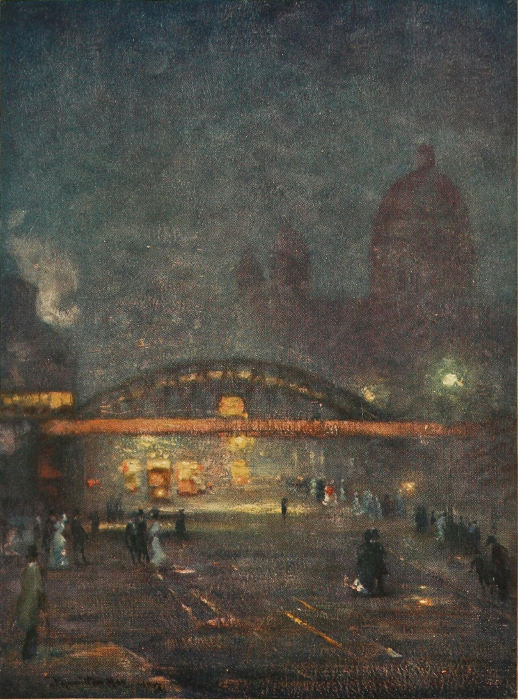
OVERHEAD RAILWAY FROM JAMES STREET.