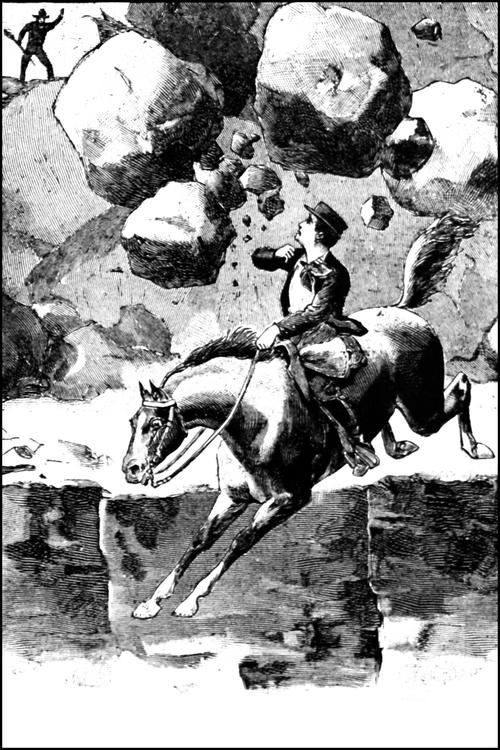
The dark bay horse—as fine a specimen of equine
beauty and worth as ever came from the famed Blue
Grass regions—ridden by the Postboy of the Kanawha,
came to a standstill simultaneously with the utterance of
the earnest, pleading tone, knowing in its almost human
intelligence that its rider would be challenged at this particular
spot and the question repeated which had been
asked daily without variation for six months.
Little Snap had expected it, and on the watch, had discovered,
a quarter of a mile back, a tall, gaunt figure
clothed in skins and leaning heavily on a gnarled staff,
standing by the wayside, under the shadows of a huge
live oak.
An additional wildness was lent to the strange man's
8figure by the presence of a gray squirrel on either shoulder,
while others gamboled at his feet, or ran up and down
his lank form.
"Not to-day," replied the postboy, with an unusual
softness in his voice; "not to-day, Uncle Solitaire."
"Please excuse me for troubling you, but I felt sure
she would send me that letter to-day. I have waited so
long. But take this to her, and I am certain that to-morrow
I shall get my letter."
Then, as he had done so many times before, he handed
the postboy a carefully folded piece of coarse paper,
thanked him in a tremulous voice as he took it, to vanish
the next moment into the heart of the wilderness hemming
in the wild landscape.
"I wonder who he can be," said Little Snap, speaking
his thoughts aloud, moved as he always was by the pathos
of the meetings in this lonely place. "I would give my
quarter's salary to know his life secret; but that is something
no one I have ever met knows. It is singular that
he should be able to bury himself in these woods so completely
as to defy all attempts to find his stopping place.
I suppose this paper is as blank as all the others have
been."
9Though he could not have told the reason for it, he had
always unfolded these scraps of paper before throwing
them away. He always felt, too, a sort of awed feeling as
he gazed on the spotless pages, innocent of conveying any
message, unless outside of the power of pen or pencil.
His surprise may be imagined on this occasion, therefore,
when he unfolded the sheet to find a few lines of
closely written manuscript.
His astonishment increasing, he read:
"Keep your eyes open; step lightly on Eagle's Tracks;
fly through the Devil's Wash Bowl!"
The paper contained no signature, and puzzled over
its meaning, Little Snap read it several times before he
crumpled it in the hollow of his hand.
"Some foolish whim of his," he said to himself. "Come,
Jack, we must move faster than we have, or we shan't
get to Six Roads until midnight."
As young as he was, Little Snap, whose name, by the
way, was Dix Lewis, though he was seldom addressed
thus, had been carrying the mail between Upper Loop
on the Kanawha and Union Six Roads, at the very base
of the backbone of the Alleghany Mountains, for about
two years.
10The distance between the two isolated towns was nearer
forty than thirty miles, but he had never lost a trip yet,
and he had never felt in better spirits than on this particular
afternoon.
The valley of the Great Kanawha, as the lower section
of this "River of the Woods" is called, is one of the
most fertile regions to be found in West Virginia; but
beginning near the Greenbrier Uplands, the stream finds
its course often through rocky gateways. Particularly
is this the case where a narrow gorge in the Great Flat
Top Mountains allow the water to escape from the rock-bound
basin lying between that rugged ridge of earth
and Greenbrier Mountain.
The gnarled live oak, with its blasted top, where Little
Snap had met Old Solitaire so many times, stood on the
west side of the ascent leading to the Narrows, where
the road wound over a spur of the mountain, to descend
into one of the wildest valleys even the hackneyed landscape
of the Old Dominion can show.
For nearly a mile, a natural shelf of rock formed the
roadbed, which actually hung out over the chasm of the
Kanawha, that found its way along the rocky bottom a
hundred feet below.
11Just beyond the Narrows in the first stage of the descent
was a place called "Eagle's Tracks," where a bolt
of lightning or some other work of nature had torn the
rocks asunder so as to make the passage more difficult
than at any other spot.
As he reached this locality the postboy instinctively
looked about him, as if expecting some unseen foe would
spring upon him from behind the bowlders piled one on
the other.
Almost at his feet lay the rock-rimmed valley known
by the grewsome name of "Devil's Wash Bowl."
The ascent on the opposite side was less abrupt, while
in the far distance, rising high above all the lesser ranges,
loomed the Alleghany Mountains, looking like a mighty
wave on the sea of space.
But Little Snap had passed through this rugged scenery
too often for his gaze to rest upon it now.
"Pah!" he exclaimed, "I am foolish. Of course, they
were but idle words, though it does——"
"Hold up, younker!" suddenly broke in a harsh voice,
giving an abrupt ending to his low speech. "We have
a word to say to ye."
Simultaneous with the command, two burly figures
12sprang from behind a big bowlder by the wayside, and
while he who spoke leveled a short-barreled shotgun at
his head, the second seized hold of Jack's bit.
"What do you mean by? stopping me?" demanded the
surprised postboy. "Let go there, Hawk Burrnock, so I
can pass on."
"In a minnit, Dix Lewis; don't git onpatient, fer ye
hev got time 'nough to git to Six Roads on tick. Ye
hev a letter we want."
"Then come along with me and you can get it at the
post office."
"We want it here—now!" and the firearm in the man's
hand shook ominously.
"But I have no right to open the mail pouch on the
road like this. If I am not mistaken, your mail comes
to the Hollow Tree. Mr. Shag will let you have it there."
"He won't, younker, 'cos ye air goin' to let us hev it
here!"
Little Snap knew the man by sight, but better by reputation
as one of the most dangerous men living, and belonging
to a gang called "bushbinders."
"I tell you I am not allowed to open the mail anywhere.
Come along——"
13"Mebbe ye air 'fraid we'll rob it; but to show ye thet
we air on th' square, we'll stand back ten feet, while ye
git out th' document. It's sent to dad, Bird Burrnock.
Kem, don't keep us waitin' till dark. I sw'ar no Dan
Shag shall open a letter b'longin' to our family."
"Yas; hurry up," added the other, who was a brother
of the first speaker.
Little Snap knew that his situation was a desperate
one, and that there was small chance of his getting off
without yielding to the ruffians. Still he quickly decided
to baffle them if it lay in his power.
How to do that was a difficult question.
"Air ye goin' to do it?" demanded Burrnock, "or shall
we hev to take it from ye? 'Pears to me ye oughter
thank us fer bein' perlite 'nough to let ye handle the ol'
sack."
"I repeat that I cannot do it, as much as I would like
to oblige you. It would be against——"
"Bah! ye could do yit ef ye felt like yit. Uncle Sam
need never know ye hev tampered with yit, 'less ye air
fool 'nough to tell. Kem, once more, an' fer the las' time,
I ax ye to hand over dad's letter. Why, it's his'n, an' ye
hev no bizness to keep yit."
14Little Snap had already formed a plan of action, which,
if desperate, was only in keeping with his situation.
He said:
"You say you will stand back ten feet, and will not
touch me while I am finding the letter?"
"Ye hev coined my idee, only there's to be no foolin'.
Shoot ye, true ez preachin', ef ye show the fust sign o'
treachery. D'ye cave?"
"I'll do all I agree, if you will keep your word. As I
dismount, you must step back, and upon your knees you
must promise you will never tell a living soul I opened
that mail pouch."
As Little Snap spoke he slipped from the saddle into
the middle of the road, the outlaws at the same time
falling back a few feet.
"Rip th' ol' sack open lively, 'cos we an't got enny time
to fool 'way," growled Buzzard Burrnock, as he loosened
his hold on the bridle.
"You promise never to betray me?" questioned the
postboy, putting his hand up to the mail pouch, though not
to remove it from its position on faithful Jack's back,
but to be sure that it was securely in place.
15"We promise," declared the outlawed brothers in the
same breath.
"Away, Jack, old boy!" cried Little Snap, sharply, dealing
his trained horse a smart blow with the flat of his
hand. "On to Greenbrier!"
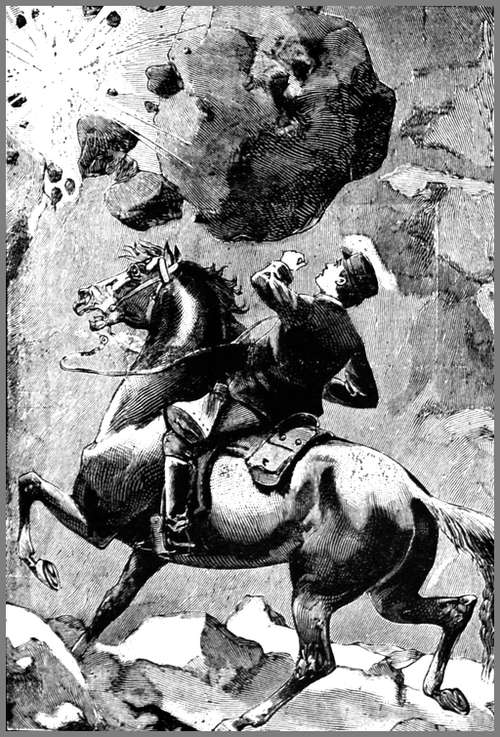
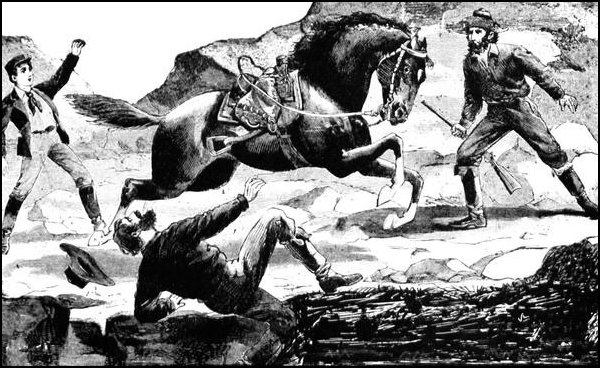
Then, before the surprised twain could recover enough
to prevent him, the gallant Jack leaped forward at the
top of his speed, his body swaying to and fro, striking
Buzzard Burrnock in such a way as to send him headlong
down the abyss yawning on the right side of the
road.
Hawk Burrnock uttered a yell of dismay as he witnessed
his brother's fate, and saw the horse dash onward
down the descending way.
"The fiends take——"
He was raising his gun to fire at Little Snap as he
spoke; but, in the midst of his speech and action, the intrepid
postboy snatched his revolver from under his
jacket, and, springing forward, dealt the outlaw a blow
with its butt over the head that caused him to sink to the
ground with a groan.
"I didn't like to do it," said Little Snap, as he stood
over the prostrate figure, "but he drove me to it. I do
16not think he is killed. He will soon come around all right.
Wonder how Buzz Burrnock has fared," stepping at the
same time to the edge of the bluff to look into the depths.
A dark object caught in a thicket of bushes clinging
to the side of the chasm twenty or thirty feet below soon
resolved itself into the figure of a man.
"He isn't as bad off as he might be," mused Little Snap.
"Well, I will leave the precious pair to look after themselves."
The clatter of a horse's hoofs in the Devil's Wash Bowl
at that moment told that Jack had reached the foot of the
descent and was beginning to climb the opposite heights.
The postboy quickly placed his hand to his lips in such
a way as to emit a short, sharp whistle, which rang up and
down the valley with a peculiar clearness.
CHAPTER II. THE MISSING MAIL.
17
No sooner had Little Snap's shrill note rang on the
air than the sound of the hoof strokes suddenly ceased,
and a glad whinny answered him.
"Noble Jack!" exclaimed the postboy; "I wouldn't give
you for all the horses I ever knew, and I love them all.
You are the best friend I have."
"Quickening his pace, he descended into the huge basin
denominated the Wash Bowl, meeting Jack, who was retracing
his course at the bottom.
"Good Jack!" said the young master, gently, while he
patted the head of the faithful steed affectionately. "But
we must tarry here no longer. On, my boy, to Greenbrier."
Then Little Snap bounded lightly into the saddle, and,
with a hasty glance backward, urged Jack away from the
lonely place, half expecting to be attacked by some foe
springing from behind the frowning rocks at every moment.
18But, to his relief, the ascent was made without molestation,
and from the summit he looked down upon the
little town of Greenbrier in the valley of the river of that
name with a feeling of comparative safety.
The post office at this lively hamlet was managed by a
woman by the odd name of Budd Grass, who had received
her appointment about the time Little Snap had
begun to carry the mail.
The postboy dashed along the crooked street, lined
with its rude habitations, until he came in sight of the
post office, where he saw the postmistress standing in the
doorway, an anxious look upon her handsome features.
She was a woman of about thirty, and had won Little
Snap's friendship at the first.
"You are late," she said, by way of greeting. "I began
to get anxious about you, for I have heard reports of
trouble among the bushbinders, and I was fearful they
might molest you. You have had trouble of some kind."
Two or three loafers were in the office, and just outside
of the door Little Snap saw a younger brother of the
twain he had met so unceremoniously on Eagle's Tracks,
so he did not say what he wished.
Instead he said:
19"Did you ever know me to run into any trouble I could
not get out of, Budd?"
"Not a bit, Dix Lewis," replied the postmistress, taking
the pouch and retiring to the little room dignified by the
name of "private office."
While she was sorting the mail, Little Snap returned
to the side of Jack, and caressing the animal's arched
neck, began to talk to it in a way he often did.
In the midst of his affectionate treatment of his loved
horse, the postboy felt a hand laid on his shoulder, and,
turning, he saw Pewee Burrnock standing by his side.
"Meet Hawk and Buzz up yonder?" asked the bushbinder,
tersely, jerking his thumb over his shoulder as he
spoke, in the direction of the mountain crossing.
At first thought the postboy was at a loss how to reply,
but he quickly decided that it was best to tell the truth if
he said anything, so he replied:
"Yes."
"Any trouble?"
"None but what we could settle among ourselves."
"Good. An' here I want to tell yer it'll be best fer ye to
be on the square with th' boys. Understand!"
20"I think I do. At any rate, I shall try and do my duty,
Mr. Burrnock."
A puzzled look came over the swarthy countenance of
the bushbinder, as he was not fully satisfied with the postboy's
reply, but before he could speak again, Budd Grass
appeared upon the scene with the mail bag. As she
handed it to Little Snap, she whispered:
"Look sharp! you are threatened with trouble."
Dix Lewis would fain have asked her what she meant,
but he could not do so without arousing the attention of
Pewee Burrnock, which he did not think advisable to do.
Accordingly, he bade her "good-day," and rode away
from the office at a smart canter.
Before leaving Greenbrier, however, he called upon
one of the leading citizens, whom he believed he could
trust, to give him an account of the attack of the Burrnock
brothers, the other listening to his story with amazement.
"By Jones, Dix! I don't like the looks of that. But I
don't want to scare you off the route. You may not hear
anything more from them. I will see that Rimmon goes
up that way to find out if they have taken care of themselves.
If there is any further trouble of this kind, let me
know."
"Jack leaped forward, his body striking Buzzard Burrnock and sending him headlong down the side of the abyss."
21Thanking Mr. Drayton for his kind words, Little Snap
resumed his journey, meeting with no adventure until he
reached the next office on his route.
This was no doubt one of the most singular post offices
in the country. It was called the Hollow Tree, and there
was not a house within sight of the lonely spot.
As Little Snap reined up at the place, a man with a
slouching figure, and a sort of hangdog look upon his
sunburned features, stepped from a hollow pine to reach
for the pouch.
He was Dan Shag, a notorious character in that vicinity,
of whom nothing very bad was known, though he
was a person of few friends.
This office afforded the mail facility for the inhabitants
of "Blazed Acre," an isolated settlement of lawless people,
among whom dwelt the bushbinders. The place
was three miles and a half back from the post road, and
reached only by a bridle path.
"It's purty light to-day," said the postmaster, as he
took the mail pouch from the postboy and carried it into
the Hollow Tree, that had been fitted up in a rude sort of
22way with recesses for the few letters and papers making
up the intercourse the people of the Blazed Acre had with
the outside world.
While Dix waited for Dan Shag to sort the mail, a
quartet of ill-looking men, whom he recognized as representatives
of the isolated settlement, emerged from the
growth surrounding the Hollow Tree and shambled up to
the spot.
"Meet th' boys up yonder?" asked the foremost of the
newcomers, jerking his thumb over his shoulder after the
manner of Pewee Burrnock.
He was Robin, another of the brothers of that name,
more repulsive-looking than any of the others, if that
were possible.
Little Snap nodded.
"Any trouble?"
Before the postboy could reply, Dan Shag reappeared
upon the scene with a startled look upon his face.
"What does this mean, boy?" he demanded, fiercely.
"I don't understand you," replied Little Snap, in surprise.
"Where's the package for Hollow Tree? The letters
23and things, I mean," he added, seeing Little Snap's look
of amazement.
"In the bag with the rest," said the postboy.
"There ain't a dratted thing, an' there's alwus a big
bundle o' Wednesdays."
"You must have overlooked it, Dan. I heard Belmont,
at the Salt Works, say there was a larger package than
common. It must be there."
CHAPTER III. "I WILL BE BACK."
24
By this time the loafers about Hollow Tree were thoroughly
alive to the situation, and Little Snap imagined
that Robin Burrnock was looking on with great satisfaction.
"Of course there was!" exclaimed the excited Shag.
"What hev ye done with it, you young scamp?"
"What do you think I have done with it, Mr. Shag?"
demanded Little Snap, fearlessly. "If it is not there now,
I know no more where it is than you do."
"Say I have taken it, do yer?" cried Shag, fiercely. "Ye
shall eat 'em words, boy."
"That's it, Dan!" broke in one of the spectators, a big,
red-whiskered bushbinder. "If ye want enny help, call on
me.
"Reckon I can handle sich a leetle ginger bub es he,"
replied the postmaster. "Here's the sack; see if the Hollow
Tree package is there fer yerself."
Little Snap was standing by the side of Jack, and about
25six feet from the entrance to the Hollow Tree. Bidding
the horse to remain quiet, he entered the opening, upon the
bottom of which lay the mail pouch.
Giving this a kick toward him, Shag returned to his
retreat behind a barrier of poles with which the inclosure
had been partitioned off.
"It is not here," said Little Snap, when he had hastily
examined the small amount of mail matter left in the
pouch.
"Then where is it?"
"I do not know."
"I should like to know if it isn't your bizness to know?
I shall take the trouble to report yer at headquarters. It
isn't th' fust time I have missed letters, though I hev
waited to git dead evidence agin' yer afore I blowed.
"Boys, I call on yer to prove thet he 'lows th' Hollow
Tree mail ain't here."
"P'raps he's got yit 'bout his duds," ventured Robin
Burrnock.
"S'arch him," exclaimed one of the speaker's companions.
The four started forward as if they would carry out
the intention.
26Little Snap had picked up the sack, and, with it lying
across his left arm, stood in the opening answering for a
doorway to the "office."
The quartet stopped suddenly in their advance, either
lacking the courage to attack the determined boy, or waiting
for an order from the postmaster to do so.
"It's no use for us to git mixed up in th' muss," said
the latter, directly. "He's under Uncle Sam; but ye can
count on me to report him in short meter."
Without replying, Little Snap threw the pouch over
Jack's back and fastened it to a ring in the pommel of the
saddle. Then, while the five looked on in silence, he
sprang into his seat.
"This is only th' beginnin' o' th' end," said Dan Shag,
shaking his fist after the departing postboy.
The country, after leaving the Hollow Tree, was less
broken, the post road winding through a desolate region,
thinly populated, and often lonely in the extreme.
While trying in his mind to solve the mystery of the
disappearance of the Hollow Tree mail, Little Snap allowed
Jack to take his own gait, until the Greenbrier
River had been reached and he had passed over the pole
bridge.
27"It is hardly possible that Budd Grass dropped it when
she sorted the mail at her office, though it is not very
likely," he thought. "I will speak to her about it to-morrow.
But if she did do that, she has found it before
this and sent it on to Hollow Tree. Of course it will
come out all right, for I can't see as I am to blame. At
any rate, I expect more trouble from those Burrnocks
than from the loss of that mail. What can be on foot
among the bushbinders? I have it! Perhaps some of
them stole the missing mail! But, how?"
Jack quickened his pace, and, naturally light-hearted,
his rider was putting the thoughts of his late adventures
from his mind, when a sharp voice called upon him to
stop, while a wild, elfish-looking figure sprang suddenly
into the middle of the road at the imminent risk of being
trampled under the feet of the post horse.
"Hello!" exclaimed Little Snap, reining in Jack, with
an abruptness which threw the creature back upon its
haunches. "What is the trouble? and how is it you throw
yourself under my horse's very feet?"
"Oh, mister! father is lost! Jim is gone, too! An' we
can't find Fenn. So come with me—quick!"
The speaker was a girl of thirteen or fourteen, who
28would not have been bad looking had it not been for the
coatings of tan and dirt masking her pinched face. She
was quite tall for her age, with a slender figure clothed
in a gingham gown several sizes too large for her. Her
head and feet were bare, except for the thick covering
of dirt on the latter and the heavy mat of brown hair on
the former.
She was fearfully excited over something, and while
she spoke she sawed the air with her long arms in a
frantic manner.
"What has happened?" asked the postboy, in genuine
alarm.
"Oh, dad and the boys are gone!"
"Gone where? Calm yourself, and then tell me what
you want."
"I can't stop. Mebbe they are killing now! They
crawled into that dark place, and they ain't never come
out. Ye must go with me!" and she caught hold of Little
Snap's arms, nearly pulling him from his seat.
I don't understand you. Stop right where you are
until you can begin at the beginning and tell me what has
happened. Who are you?"
I'm Tag Raggles, and me and my folks have jess come
29from Little Forks, and was going to the Blazed Acres.
We stopped jess ayont here, when, seeing a big, black
hole in the ground, dad 'lowed it mought lead somewhere.
So he crawled inter it; but he ain't come back!
Jim went arter him, and he ain't got back. Fenn, he went
arter 'em, and he ain't come back. Marm got scared well
nigh to death, and she sent me down here to hail the fust
person to go past. You'll come with me, mister?"
"I can't stop. Don't be alarmed about them; they will
come back all right in a short time. No doubt they have
come before this."
"No, no! Marm and me hollered and hollered, but it
weren't any good. I 'lowed I weren't afraid to go in there,
but marm, she wouldn't let me. She's erbout crazy. You
must go with me. It's only a little way, and you can ride
up there on your hoss if you want ter."
As much as he disliked to lose the time, Little Snap
felt that it was his duty to go to the assistance of the bereaved
family. There could be no deception in the girl's
action. She was too much in earnest for that.
"You will go?"
"Yes; lead the way."
Her face brightened, as with a low exclamation of delight,
30she bounded away from the road along a faintly
defined path leading into the depths of the wilderness.
At intervals Little Snap saw the marks of wheel tracks
in the sparsely grown sward, and the footprints of oxen's
feet occasionally were to be seen.
Presently, when he had begun to think he had gone far
enough, they entered a clearing in the growth near to the
banks of a small stream, which flowed on toward the
Greenbrier.
On the farther side of this valley the postboy discovered
a white-topped wagon drawn up in the shadows of
the forest, while a short distance away a pair of cattle
lazily clipped the long grass.
But he quickly turned from these, as a tall, slatternly-dressed
woman of uncertain age advanced swiftly from
the base of bluff overlooking the northern side of the
opening, saying, in an excited tone:
"Yer found one, Tag. I'm so glad yer hev come, sir.
It's a desprit fix we air all in."
Though her explanation was hardly more easily understood
than the girl's had been, Little Snap learned that
soon after her family had stopped in the valley for a rest
in their journey, her husband had discovered the entrance
31to a cavern, and curious to know where it led, he had
crawled into the opening, but did not return.
Growing anxious over his long absence, her oldest
boy, man grown, had followed his father, without giving
any sign of his fate. In great excitement by this time,
the second son had gone after his father and brother, and,
like the others, nothing more had been seen or heard of
him.
"It is terrible!" moaned the woman, wringing her
hands. "They must be dead, and I am left here alone in
this wilderness with these three little girls. Isn't there
anything you can do?"
Little Snap had begun to examine the mouth of the
cave, but as far as he could look in he could only see the
rugged walls of the narrow passage leading gradually
downward into the earth until lost in the darkness of the
underground retreat.
The opening was about two by three feet, and had been
concealed by overhanging bushes.
"I thought a bad smell kem from th' place," said the
woman. "Perhaps they were stifled by gas. I have heard
of sich things."
"Or been eat up by snakes," said Tag Raggles.
32Thrusting his head and shoulders into the gloomy recess,
Little Snap shouted at the top of his voice to the
missing men, but only the hollow echoes of his cries,
which seemed to reverberate from a long distance away,
answered him.
"Thet ain't enny use, fer I hev hollered till I'm hoarse,"
declared Mrs. Raggles, the tears coursing down her thin
cheeks, while she wrung her hands in the abandon of her
grief. "Durst ye go in there, mister?"
"Yes; I am going," replied the postboy, preparing to
enter the mysterious place.
"Do be careful," implored Mrs. Raggles. "You won't
be gone long, will you?"
"I will be back in a few minutes—if I come at all. I
shall——"
Little Snap's speech ended with a startling exclamation.
CHAPTER IV. WHAT LITTLE SNAP SAW.
33
Before entering the unknown dangers of the mysterious
cave, Little Snap had seen that Jack was standing a
short distance away, as complacently as might be.
"If I do not come back, Jack, go on to Daring's Diamond
with the mail," he said, speaking as if to a human
being.
The intelligent animal pricked up his ears, and answered
with a low whinny.
The postboy's body was inside the mouth of the cavern
when he had begun the speech to Mrs. Raggles.
It was too dark for him to see more than that the underground
pathway descended at an angle of about forty-five
degrees. But the moment his feet touched upon this
portion of the rock he suddenly found himself slipping
down the decline at a rapid rate.
In vain he threw out his hands to stop himself. The
surface was like glass, over which he shot with the rapidity
of lightning.
34He may have uttered a cry at the outset, but the shock
was so sudden and thrilling that he was unconscious of
it if he did so. His whole attention was centered upon
trying to check his fearful momentum.
He was carried onward near to the right wall, and he
succeeded in catching upon the rough surface twice during
his wild passage.
The first time his hands slipped upon the wet, slimy
rock, the mishap seemed to give greater impetus to his
descent. Profiting by this failure, he seized upon another
projection with a firmer hold, but the rocky knob
broke away beneath his weight, and the piece went flying
from his bleeding fingers ahead of him on the downward
course.
Its collision with the glassy floor caused a dull reverberation
to go through the subterranean recesses, quickly
followed by a sharp splash of water!
This last sound came from below him, and Little Snap
had barely time to understand that an abyss of great
depth yawned at his feet before he was upon its very
brink.
The warning from the stone came barely in season for
35him to renew his efforts to catch on the rugged wall,
which he did with more vigor than before.
Again he found his hold broken, by the fearful momentum
with which he was carried on, but the shock was
such that he was lifted up clear from the rock and carried
completely over the chasm.
Striking on the very rim of the farther side, he managed
to keep from falling backward into the pit by a herculean
effort.
The next moment, quite overcome by the ordeal, he
sank upon the rock in a sort of stupor. He soon rallied,
however, when he tried to penetrate the gloom around
him sufficiently to note his surroundings.
Though his eyes grew more accustomed to the blinding
gloom in a few minutes, and it was less painful to his
gaze, he was unable to see the nearest object with any
certainty. Singularly enough, a dull, gray ring lay at his
feet.
This he knew marked the abyss which he had so narrowly
escaped. The spot was oblong in shape, and about
six feet in width by ten or twelve in length.
Not a sound broke the oppressive stillness of the cavern,
36save a faint murmur borne up from the depths like the
gentle plashing of slowly moving water.
By this time Little Snap had come to the conclusion that
the unfortunate Raggles, father and sons, had come to an
untimely fate by falling into the abyss, having been
killed outright by the fall.
With no way to estimate the distance to the bottom of
the place, all that seemed possible for him to do was to
return to the outside world.
But was this possible for him to do?
He had crossed over the abyss, but how was he to get
back? Little Snap, as fertile as he was in resources, for
once was baffled.
Finding that there was no chance for him to pass over
by clinging to the wall on either side, he concluded to
explore the passage beyond, with the hope that he might
find some other way of exit.
Slowly and carefully he groped his way along for several
yards, finding that the passageway followed a zig-zag
course as it penetrated deeper and deeper into the
heart of the earth.
Its course, however, was no longer downward, but on a
37comparatively level plane. This gave him additional courage
to press on.
The walls had been high enough for him to stand
upright soon after passing the entrance.
With but a faint idea of how far he was going from
the mouth of the cavern, he pursued the winding passage
for what seemed a long time to him, when, suddenly,
after turning an abrupt angle, a light flashed in the
space ahead.
This caused him to stop with surprise, and he was
about to shout for joy, feeling that he had at last found
his way to daylight, when his outburst was checked by
the sound of a human voice!
Naturally of a cautious disposition, he carefully suppressed
all sound, until he should know whom he was to
meet in that most unlikely place.
He soon realized that it was not daylight which had
sent such a ray of hope to his heart, but the flickering
glare of a torch stuck in one of the crevices of the cavern's
rocky walls.
The first voice was quickly followed by another, and
unable to see the speakers, he crept forward as silently as
possible on his hands and knees, until he found himself
38at the end of the passage, and where it opened out into a
large underground room—larger than he could see by
the feeble light of the resinous pine knot.
Near the flickering torch, sitting squat upon the rocky
floor, he was amazed to behold four men, evidently holding
an earnest conversation.
Ordinarily, the postboy would have made his presence
known at once, but the words already being spoken by
one of the quartet were of such a nature that he checked
the salutation upon his lips and listened, with bated
breath, to the following dialogue:
"The first person to get out of the way is that postboy."
The speaker was a man above medium height, judging
as he sat upon the bottom of the cavern, and he spoke in a
deep, guttural tone.
He had small, snakish eyes, and the most prominent
feature of his round face was a heavy, reddish mustache.
He had the appearance of being a military person.
All of the four were strangers to Little Snap, who
was listening intently for the next utterance.
The following speaker was a short, thickset man, with
a closely-trimmed gray beard, who said:
39"That won't be a big job."
"I ain't so sure o' it," remarked a third, younger than
the others, and smaller of stature. "Shag says——"
A warning gesture from the first spokesman caused
him to stop with his sentence unfinished.
"No names are allowed to be spoken here," growled
he who was evidently leader of the party. "Don't fergit
yourself again, man."
"I reckon we air safe 'nough here," retorted the other.
"I'll warrant there ain't a soul nearer'n Hollow Tree."
"Never can be too careful; rocks have ears sometimes.
I could have sworn I heard a man's voice not ten minutes
ago. But it's you we came here to hear talk," nodding
his head toward the last person of the quartet, who had
remained quiet so far. "What have you learned?"
"Much that is mighty pleasing," replied the last, in a
tone which caused the concealed postboy to start with
surprise.
"Hark! I thought I heard some move!" exclaimed the
chief, half starting to his feet.
"'Pears to me ye air mighty skeery to-day," growled
he who had accidentally spoken the name of the postmaster
at Hollow Tree.
40Little Snap crouched closer to the rock in breathless
silence, fearful he had betrayed himself.
When he had become reassured that such was not the
case, he scrutinized the fourth speaker more closely, but
without discovering a familiar feature. In the midst of
his speculative study the man said:
"Yes; everything is working in our favor. I have seen
him at Six Roads, and he tells me he will back us in all
we undertake. He will look after that end of the route.
We have already got at least three of the offices under
our thumb. He says he can cook the goose of that upstart
who thinks he can run the Kanawha any way he
chooses. The governor says for us to keep still until he
can carry out a little plan of his, and then——"
"Men get rusty lying around in the damp," said the
chief.
"Better get a little rusty than to take too much risk.
It's my opinion we can do no better than to wait his
move."
"What will the Acreites do while we loll around?"
"Let 'em do what they please; we ain't going to leave
a grease spot of them before we get through. I tell you it
is the biggest scheme ever afoot since the days of old
41Burr, and when we have carried out our plans we can
snap our fingers at even Uncle Sam."
"That all sounds well, but I ain't so much confidence
in that old duffer at Six——Hello! what's up?"
The abrupt appearance of a newcomer upon the fitful
scene caused every man of the four to spring to his feet,
and instinctively each sought the firearm he carried at
his side.
"It is only our guard," said the chief, as he recognized
the intruder. "What is up, Blake? Anything wrong?"
"There are strangers in the valley!" replied the newcomer.
CHAPTER V. CLOSE QUARTERS.
42
"Have we been found?" asked the four in the same
breath.
"Not that I know of. The party that I meant seem to
be a family stopped here for a rest, though I could not
see anything of the men folks. They may be off gunning."
"If there is no danger, what did you alarm us for?"
demanded the chief.
"I ain't through yet," replied the other, doggedly.
"There is some one else in the valley besides them. Perhaps
he came with them."
"Who is this other? Why don't you pack your ideas
up together?"
"I ain't seen the chap himself," continued the man,
in his deliberate way, "but the postboy of the Kanawha
is somewhere around about these diggings."
Had a thunderbolt fallen among them the men could
not have shown greater surprise.
43"Where is he?" the four asked, again using the same
words.
"I tell you I don't know. His horse is on the other
side of the bluff, feeding as quietly as you please. The
mail sack in on his back. Perhaps he has throwed his
rider."
"Dix Lewis in this region!" exclaimed the chief, ignoring
the last statement of the messenger. "There is work
for us to do, boys! Come——"
At this juncture, the torch, which, unnoticed by all,
had been dying out, flared up for an instant and then
went out, leaving the little group enveloped in darkness.
"The furies!" cried one of the men. "Who's got anything
to make a light?"
"Follow me!" commanded the chief, "and let the light
alone. We must find that boy without any loss of time.
His presence here at this——"
Little Snap failed to catch the rest, but he had heard
enough to know that he must be active, too. From the
sounds, he knew the party were leaving their underground
rendezvous.
Aware that it would not do for these men to capture his
horse with the mail, his mind was filled with conflicting
44plans of action. His first impulse was to return the way
he had come, but he realized that it would be impossible
for him to cross the chasm, even could he scale the slippery
ascent beyond. Possibly, if he were coming the opposite
way, he might leap the abyss, though that would be
extremely doubtful.
Only one avenue of escape seemed open to him, and
that was to follow upon the heels of his enemies!
He had not a moment to lose if he did this, and, without
further consideration, he glided across the cavern
room in the direction taken by the five men.
Guided by the sounds of their advance, while moving
as noiselessly as possible himself, Little Snap threaded
the circuitous passage, keeping but a few yards behind
them.
After a short distance, the way began to ascend by
irregular stone steps, to climb which Little Snap had to
exercise great caution not to betray his presence. Once,
as the party suddenly paused, he found himself within a
few feet of the group, but owing to the darkness he was
not discovered.
"Hang it!" exclaimed the chief, after a moment's
stop, "I have dropped that letter somewhere. I think it
45must be where we were sitting. Blake, go back and find
it; and then keep a watch over the entrance to the cave
until we return."
Little Snap held his breath at the sound of this order,
and when he heard the man turning back, he felt that he
was lost.
Without losing his presence of mind, he shrank back
as close to the nearest wall as he could, and silently
awaited the approach of the other.
He hadn't long to wait, for the next moment Blake's
heavy step told that he was near at hand. Then the
postboy felt his bulky form brush against him!
"I shall be glad when we get out of this place!" muttered
the man, as he stumbled on past the crouching figure
of our hero.
During this time the others were leaving the cavern,
and as soon as he dared, Little Snap started forward,
feeling now that every moment was of infinite value to
him.
A little farther on a streak of daylight struggling into
the dismal pathway told that they were approaching the
end of the passage.
46In fact, the men were already crawling out of the small
aperture that afforded an exit from the cave.
As closely as he dared, Little Snap followed after them,
and when he could no longer hear their movements he
ventured to peer out. As at the other place of entrance, the
mouth of the cavern was overgrown with stunted bushes,
so as to be well concealed from sight. He found, too,
that the spot was nearly twenty-five feet from the ground,
it being midway up the side of the bluff.
A small stone rattling down the side of the declivity,
passing within a few inches of his head, warned him of the
close proximity of his enemies.
It also told him that they had ascended to the top of
the cliff. In fact, that seemed the only way of escape
from the place, as the rock descended smooth and perpendicular
to the bottom.
With greater caution than ever, he noiselessly scaled
the ascent in the footsteps of the four men, who were
hastening to find him.
As his head came on a level with the top of the rocky
heights, he discovered them approaching the opposite
side, creeping cautiously toward the edge overlooking the
47clearing where the Raggles family had camped, and
where he had left Jack.
A movement below him at that moment warned him
of the return of Blake from his search for the missing
letter. Glancing downward, he saw the head of the other
appearing in the mouth of the cave!
Little Snap began to realize that he was in close quarters.
To retreat would be to throw himself into the arms
of the enemy behind, while it would be even greater madness
to ascend to the summit.
No sooner had Little Snap taken a hasty survey of his
situation than he decided that by following along the side
of the bluff he might reach a place where he could descend
in safety to the valley.
With an agility belonging to one of his years, he advanced
on the side of the cliff, finding a foothold in some
crevice of the ledge or on a bush, and clinging with a
tenacious hold to its precarious support.
But he had not gone half a dozen yards before a sharp
cry from Blake told that he had been discovered.
"Here he goes!" shouted the excited man, regardless
of all caution now.
48The cries were answered by a great commotion among
those on the summit, and he heard the chief call out
some question he did not understand.
"He's climbin' along th' rock!" cried Blake. "Head
him off, an' ye hev got him!"
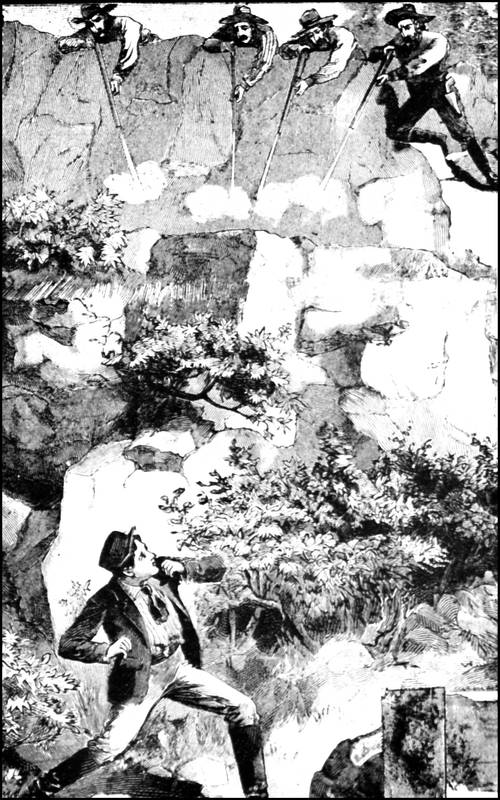
The next instant four heads were thrust over the brink
within a rod of where Little Snap was suspended in midair!
"Hold up where you are!" commanded the chief, whose
sharp eyes had discovered the fugitive.
Without stopping to reply, the postboy dropped from
the bush supporting him in a diagonal direction to another
several feet below.
"Don't let him get away!" cried the chief.
"Hold up there, boy, where you are, and we won't
hurt you! Stop, or we will end your career at once. We
hold your life in our hands."
Little Snap knew enough of the natures of the men
menacing his life to feel that he was running no greater
risk in trying to get away from them than he would in
allowing himself to fall into their power.
Accordingly, without paying any heed to the warning,
he swung himself forward and downward to a narrow
49shelf on the side of the ledge, where he found himself
in sight of the clearing in front of the bluff.
Casting a swift glance over the scene, he saw Jack
standing nearly where he had left him. He also saw Mrs.
Raggles and her three girls picking up the rude utensils
they had used in getting their lunch, and tossing them into
the wagon. But what surprised him the most was the
sight of old man Raggles and his two boys, in the act of
hitching the oxen to the vehicle!
He barely took this all in at a glance, without having
time to give it a second thought.
He was now about fifteen feet from the foot of the
ledge, and seeing that the way was clear beyond, he unhesitatingly
dropped from his precarious perch into the
bushes growing near to the mouth of the cave.
As he did so, the reports of the outlaws' firearms rang
out sharply on the silence of the wild woods.
Quickly regaining his equilibrium, Little Snap bounded
toward the side of the surprised Jack, who looked up with
wonder at his sudden approach.
CHAPTER VI. LITTLE SNAP'S TROUBLES INCREASE.
50
Though Little Snap was aware that he was running the
gantlet of the rifles of the bushbinders, he kept on undaunted,
until he had reached the side of his horse.
The next moment he sprang lightly into the saddle,
and gathering up the reins, shouted:
"Away, Jack! show them a light pair of heels!"
The faithful steed needed no urging to do this, and
with the reports of the baffled men's firearms and the cries
of the startled Raggles family ringing in his ears, the
postboy of the Kanawha dashed furiously down the path
leading to the main road from Greenbrier to Six Roads.
Not a word escaped his tightly compressed lips, until
the highway was reached, when he patted his horse on
the neck, saying, gently:
"Easy, now, Jack, old boy; the danger is over for the
present. It was a close call, but a miss is as good as a
mile, though I don't care to go through that experience
again."
51Slackening his gait to an easy canter, Jack bore his
rider on without further urging. The truth was, the
postboy's mind was busy trying to solve the subject of the
meeting in the cave of the four unknown men. He was
also puzzled to understand the actions of the Raggles
family. While he could not believe that their story to get
him into the cave had been a hoax, he was unable to understand
their reappearance upon the scene.
The postboy was still trying to solve these problems,
when he reached a small town called by the singular name
of Daring's Diamond.
He found the postmaster, Mr. Anderson, impatiently
awaiting his appearance.
"Late again," greeted the official, in a disagreeable
tone.
"I could not very well help it," replied Little Snap,
handing him the mail pouch.
"That is what you say every time. You are an hour
overdue. Mr. Meiggs, who has just gone out, has been
talking pretty loud about you. If I were in your place, I
would not let this happen again. People who are having
mail want it on time. It may not make any difference to
52the Blazed Acre cattle, but it does to civilized people, I
have noticed."
It wasn't so much what the postmaster said as the way
in which he said it that nettled Little Snap, though he
made no reply. This Mr. Meiggs referred to was one
of the postboy's bondsmen.
"I suppose you know Dan Shag has gone up to see
Jason Warfield about the Hollow Tree mail?" said the
postmaster, as he handed over the sack. "Of course you
know; what a fool I am! He must have passed you
'tween here and the Tree."
To this Little Snap made no reply. He knew Anderson
was saying these things to draw him out. The postmaster,
for some unknown reason, had never acted
friendly toward him.
He never could understand why.
It was never Little Snap's practice to hold much conversation
with those he met on his route, and on this occasion
he felt less like talking than common.
He was due at Union Six Roads, the end of his route,
at eight o'clock, and it was already past that hour, it having
been sunset at the time of his escape from his enemies
at the cave.
"The reports of the outlaws' firearms rang out sharply on the silence of the wild woods as Little Snap bounded toward Jack."
53Thus he took the mail pouch from Mr. Anderson's
hands, and throwing it on its accustomed hook, sprang
into his seat before that worthy could realize he was
leaving.
"Hold up a minnit!" he exclaimed, as the postboy
dashed away, but not loud enough for him to hear. "Go
it!" muttered the other, "I shan't forget it in my report.
I reckon you'll wish you hadn't been in so much of a
hurry when you come to meet old Warfield."
Little thinking of what was in store for him at his
home town, the postboy urged Jack on at greater speed
than common, until at last he dashed up in front of the
Six Roads post office, kept by John Rimmon, who also
had a small trade in groceries.
The postmaster met him at the door, with a troubled
look upon his features.
"What in the world have you been doing all this time,
Dix Lewis? Hold on! don't dismount. Jason Warfield
left word here for me to tell you to come right up to his
house the minute you got in. He wants to see you on
matters of vital importance. Them's just his words."
"Well, I will run up and see just as soon as I have put
Jack in the stable."
54"But he said you mustn't stop for that. He said for you
to be sure and come the minute you got here. By his
looks and actions, it must be something of very great importance."
The Honorable Jason Warfield, as that rather pompous
gentleman desired to be known, was considered one of
the richest men in Monroe County. In some way, not
easily understood by the easy-going inhabitants of Six
Roads, a large proportion of the property in town was in
his name, and it was doggedly repeated that "he had a
mortgage on the rest."
Be that as it may, no move of any importance was
made without consulting him, and his sanction to any
undertaking was deemed sufficient to insure its success.
Of course, such a man had his enemies, but as a rule he
was liked.
His was the first name on the Postboy of the Kanawha's
bond, and it was generally supposed that he had been
principally instrumental in securing Little Snap his situation.
It was no wonder then that the postmaster looked surprised
when our hero said that he was going to care
for his horse before he visited Mr. Warfield.
55"I wouldn't take any such chances," declared the
worthy minion of the government, with an ominous shake
of his grizzled locks.
Little Snap's home was but a short distance from the
post office, so he was quickly there, to be met at the door
by his mother and two sisters, both of the latter being
younger than he, the three looking very anxious.
"Where have you been, my son?" asked his mother.
"We have been so worried about you. And Mr. Warfield
has been here, acting very much put out. He wants you
to come up to his house as soon as possible. Something
terrible has happened, I know."
"Nothing to be alarmed about, mother. But if Bess
will take care of Jack, I will go right up to Mr. Warfield's,
though I cannot imagine what he is so anxious to see me
for."
"He is terribly excited about something. I would go
at once, if I were you, and I will have your supper warm
for you when you get back."
"Is father at home?" asked Little Snap.
"No; I have not seen him to-day. He stays away more
than ever of late. Why did you ask?"
"Oh, nothing. Give Jack a good supper, Bess, and see
56that he is comfortable for the night. There, mother, don't
be worried any more. I won't be gone long this time."
It was nothing unusual, as Mrs. Lewis had inferred,
for John Lewis, our hero's father, to be away from home.
In fact, it was very seldom he was there, and when he
was he hardly ever did any work or business. He was a
man of a few words and very peculiar habits. His neglect
of his family had made it necessary that Dix do something
for their support.
Kissing his mother, as was his practice when leaving
home, Little Snap turned away to start on his visit to
Mr. Warfield's, when he saw a party of men approaching
the house.
"Why, it's Mr. Warfield in front!" exclaimed his
mother. "He got impatient waiting for you. And there
is Mr. Meiggs and Daniel Shag, of Hollow Tree, and—and
Mr. Bardy, the sheriff. Oh, Dix! what does it mean?"
"Nothing to be alarmed over, I am sure, mother, so be
calm."
In a louder tone of voice, he greeted the newcomers,
saying:
"Good-evening, gentlemen. I was starting to come
up to your house, Mr. Warfield."
57"Was that the direction I left at the post office for you
to follow, young man?" demanded Mr. Warfield, sternly.
"No, sir; but Jack was so tired that I thought——"
"So you put more importance upon the condition of
your horse than you do the affairs of Uncle Sam?"
"Not exactly that; but I did not know you wished to
see me upon government matters. I——"
"It seems to me, young man, that you should have been
very anxious to see me, if I was not to see you, after
what has happened to-day. Mr. Shag was so much concerned
about it that he rode up here posthaste to let me
know. He tells me you have lost the Hollow Tree packet
of mail."
"Mr. Shag said it was missing, sir, when I got to his
office; but I trust you do not think it any of my fault.
Mr. Belmont——"
"The horse does not seem very badly winded," broke
in Sheriff Brady, who had approached Jack, and was
running his hand over the creature's body. "Ha! Mr.
Warfield, I hardly think we shall have to look much
farther for the missing mail. Here it is, fast enough."
Little Snap uttered a low exclamation of astonishment,
as he saw the sheriff take from the little pouch he had fastened
58to the saddle for his convenience in carrying small
articles to and fro on his trips, the missing package of
mail matter!
All feelings imaginable were depicted upon the countenances
of the little group surrounding the postboy.
CHAPTER VII. "THE TRUTH IN A NUTSHELL."
59
"This explains why he did not wish to come up to your
house with his hoss, squire," said Dan Shag, nodding his
head toward the recovered package. "I thought it was
best to git here as soon as possible."
The sheriff was examining the package more closely,
while Mr. Warfield looked from him to the postboy with a
peculiar expression upon his face.
"What does all this mean?" asked Mrs. Lewis, in an
anxious voice. "My boy has done nothing wrong; I am
sure of that."
"Do not be alarmed, mother," said Little Snap, gently.
"Please go into the house, and I will explain it to these
men."
"So you confess to the theft?" inquired Mr. Warfield,
quickly, without giving Mrs. Lewis time to speak.
"No, sir. In fact, I do not know as there has been any
theft."
"Don't get excited, my boy," said Mr. Warfield, in a
60more kindly tone than he had previously used. "We are
all your friends, and are not here to injure you. Mr.
Shag came up to tell me about the missing package, and
I thought it was best for us to see you before it had been
noised all over town. Own up to the truth and we will not
be hard with you."
"I am not going to tell you anything but the truth, Mr.
Warfield. How that package of mail came in my saddle
pocket is more than I can explain. I certainly did not
put it there, nor did I know it was there."
"Ask him if he can explain where he has been the past
two hours. I came straight up here from th' Tree, an'
he was sartinly not on th' road. P'raps he has a cross
road by which he carries th' mail. I s'pose thet would
give him more chance to look over th' letters; but is thet
the way Uncle Sam expects him to carry it?"
"Mr. Warfield," said Little Snap, knowing it was not
best for him to speak too freely before the rest, "I would
like to see you alone for a few minutes. I think I can
explain this matter in a satisfactory manner."
"Don't be afraid to speak right up before these gentlemen,"
said Mr. Warfield. "They are all my friends, and
my friends are yours."
61But Little Snap was too crafty to divulge his secret
to Dan Shag, whom he did not dare to trust.
"I cannot speak here where I am liable to be heard by
some one even you would not care to have hear. If you
will come into my house, Mr. Warfield, I will say what I
wish you to know."
"Don't ye risk yer life in his hands," said Shag. "He
is armed an' a desprit chap."
"Hadn't I better arrest him now, and then give him his
chance to talk?" asked the sheriff.
"Arrest my boy?" cried Mrs. Lewis. "You do—you
cannot mean it."
"Be calm, mother. You have nothing to fear. They
can arrest me if they wish, but I am innocent of any
charge they can bring against me. On what complaint did
you think you could arrest me, Mr. Brady?"
"I don't believe I would harm him yet, Jim," Mr. Warfield
hastened to say. "If you have anything you wish
to say to me alone, Dix, I am ready to listen."
"Come into the house, please, Mr. Warfield. I won't
detain you very long."
"We'll see he don't git away," said Shag.
62Without noticing Dan Shag's speech, Mr. Warfield followed
Little Snap into the house in silence.
As soon as they had entered the humble sitting-room,
and Mr. Warfield had sunk into the proffered chair, the
postboy said to his guest:
"What I am going to tell you, Mr. Warfield, is not so
much in my defense as it is to show up a startling discovery
I have made. If you will allow me, I will begin
with an adventure I had on Eagle's Tracks, and tell you
just how I came in late to-night."
"Go ahead, only make your story as short as you can."
Then Little Snap gave a succinct account of all that
had befallen him after leaving Uncle Solitaire until he had
effected his escape from the cave, often interrupted by his
listener with startling exclamations and puzzling questions.
"You are romancing, boy! I cannot realize half you
say. Why, from your talk I should say you had unearthed
a band of plotters against the government."
"I do not know just what they meant, but I do know
they are a gang of evil men, who would hesitate at no
means to carry their ends."
"While I am surprised at what you have said, your
63statements are lacking in the elements that would make
them valuable as evidence. You say you did not get the
real drift of the talk between the four men, and that you
recognized none of them."
"I do not think I ever saw them before, though the
voice of one sounded very familiar."
"Will you describe the party?"
Little Snap did so, Mr. Warfield listening intently, to
say, at his conclusion:
"I do not believe we should attribute any harmful meaning
to what they said. The very fact that they were
strangers to both of us, and I know nearly every one in
Monroe County, would seem to warrant us in believing so.
By the way, do you realize the error you made in neglecting
your duty to run after those worthless Raggles—I
think that was the name you called those vagabonds?"
"I am aware, sir, it was a mistake. I——"
"Mistake? It was criminal neglect of duty, young
man. The rules and regulations laid down by Uncle Sam
are very strict. You are to keep all the mail intrusted to
your hands in sight at all times, and here you went off
for an hour and, according to your own story, left the
mail pouch entirely unprotected. Why, that very act was
64enough to cost you your situation. Remember I am not
upbraiding you, but speaking to you as a father would to
his son."
"I know I did wrong, Mr. Warfield, but the circumstances
were such that I could scarcely do different. Mrs.
Raggles——"
"Don't mention their names again. From your own
words, the worthless vagabonds could not have been in
trouble. It seems they were safe enough when you got
clear of your troubles."
"I do not understand it, Mr. Warfield. I have carried
the Kanawha mail for two years without failing to do my
duty, and I hope you have confidence in me to think I
can fulfill my term."
"I did at the outset, or I should never have obtained
the place for you. But I must feel that you are attending
to your duties. My political prospects are such that I am
expecting piles of mail matter, and I want to know that it
is coming to me safely. My very election to Congress may
depend upon it."
Mr. Warfield had been a seeker after the nomination
as member for Congress from that district almost as long
as our hero could remember, and he well knew that he
65was still in the field—"in the hands of his friends," as he
expressed it.
"Mr. Warfield," said the postboy, in his quiet, determined
way, "I am not going to make any new promise,
but I repeat those I have made, and when you have found
me faithless to my duty I will willingly make room for
Mr. Shag or any other man."
The mention of the name of the postmaster of Hollow
Tree made the politician wince.
"Bah! he isn't half so competent to carry the mail as
your horse, Jack."
"Still he is making all of this trouble, simply because
he is mad with me for getting the route when he wanted
it. There you have the truth in a nutshell."
CHAPTER VIII. "I AM STANDING ON MY OWN FEET."
66
"I don't know but you are right, Dix. Still, you
haven't explained the worst feature of your case. How
came the missing package of mail in your possession?"
"I cannot tell. Some one must have put it there, but
who or when, I cannot say."
"You said it was missing before you got to Hollow
Tree?"
"No, sir. I said it was not in the pouch when I looked
for it at the request of Mr. Shag; but you must remember
I did not see the pouch until after he had examined it,
and had had the opportunity to take it out if he had
chosen."
"Be careful how you make any charges you cannot back
up. I must say you are exceedingly outspoken."
"I am standing on my own feet, Mr. Warfield, and I
am going to tell you just what I believe is the truth. I
will know the mystery of that packet of mail before I get
67through. You seem to forget the attack of the Burrnocks."
"On the contrary, I have been thinking of them very
much, and this leads me to give you a bit of advice. I
advise you to give up this mail route at once. You were
too young to have undertaken it."
Little Snap looked up with surprise.
"I hardly expected that from you, Mr. Warfield."
"Excuse me, I was thinking only of your good. Those
Burrnocks are desperate men, and I fear it will cost you
your life to continue. Perhaps you think you cannot afford
to give up so good a job, but you can better spare it
than your life."
"Our living depends on my work," replied the postboy,
with a quivering lip. "More than that, and what I prize
infinitely higher, my honor is at stake. If I give up now,
it will look as if I was guilty of the charge of taking
the mail. I feel it thus my duty to stay where I am, until
I have been able not only to prove my innocence but to
show up the guilty ones."
"You cannot do this alone, and, of course, if those who
have put you in this place do not think it prudent to back
you up in your rashness, you cannot blame them."
68Little Snap understood more by this statement than the
mere words told, as the speaker intended he should.
Drawing his boyish figure to its full height with an air
which made the politician start with surprise, if not fear,
he said:
"Mr. Warfield, I want to know who my friends are,
and you and I might as well have an understanding at
the outset as later. Of course I am very grateful to you
for signing my bond and helping me so far as you have.
Now, if you wish to withdraw, I shall have no ill feeling;
but you must remember that Mr. Marion Calvert owns the
contract for this route, and as long as he has confidence
in me to carry the mail I do not expect to give way."
Little Snap was bolder in his speech than he might
otherwise have been, as he knew that Mr. Warfield was
anxious to keep on friendly terms with this Mr. Calvert,
who had a strong political backing.
Mr. Warfield's reply, which came after a moment's
hesitation, was more friendly than he had dared to expect.
"Bravo for you, Dix Lewis! Give me your hand. You
are made of just the stuff to succeed, and I can see that
you will do better than nine men out of ten. Your words
69have opened my eyes. Go ahead, and count upon me to
lend you all the assistance in my power. Every dollar I
have got in this world and all of my personal influence is
enlisted in your behalf. I don't know how the other
bondsmen feel, but you know my state of mind.
"I suppose the others are anxiously awaiting us, so let's
adjourn this meeting. I will make it all right with
Brady."
Little Snap, after thanking Mr. Warfield for his words,
sought his mother to allay her fears.
Whatever the politician said to the Hollow Tree postmaster
and Sheriff Brady he did not know, but the entire
party went away at once.
"It's all right, mother," he said to her, as soon as the
men had gone, "so have no further concern."
"I wish I could think so, my son; but somehow I fear
there is trouble in store for you. Mr. Brady has been
telling me about those Burrnocks, and he says they will
kill you at the first opportunity. They are dreadful men,
and I fear they would not hesitate at any crime. I wish
you would give up carrying the mail, Dix; we can live
somehow."
70"It isn't all a living, mother; my good name is at stake
now."
"The boy has too much of the blood of old John Lewis
in his veins to do that, Mary," said a new voice, breaking
in upon the scene before Mrs. Lewis could reply, and
mother and son turned to see with surprise a tall, middle-aged
man standing in the doorway.
He was Little Snap's father.
"Why, John! Where have you been?" asked Mrs.
Lewis, starting toward him. "I have been so worried
about you."
"No need of that, Mary. I think I ought to have
shown you by this time that I am able to take care of myself."
Mr. Lewis was a man who was a mystery to all who
knew him. He was generally considered mildly insane,
but more often spoken of as "the man without a memory."
His past life seemed to be a void to him, except at rare
intervals, when a ray of light would suddenly flash
across his darkened mind, to go as quickly as it had
come. Of late years he had been at home but very little,
though where he spent his time not even those at home
71knew. Of course his wife worried over his strange conduct,
but as long as he was harmless and seemed, as he
had said, able to care for himself, it was not thought best
to keep him at home by force.
The Lewis family was one of the oldest and most respected
in the valley of the Kanawha, our hero being
directly descended from those gallant pioneers of the dark
days of the Old Dominion, John and Samuel Lewis, well
known to the pages of Virginia history.
"John," said the anxious wife, "I wish you would not
be away from home so much. What is it calls you away
so much? You look pale and haggard; there is some
trouble."
"There is trouble, Mary, and I have been trying to
think what it is. For the present we must wait, though
it will all come round in good season.
"Did I tell you, my son, that you had aroused the
snakes of Blazed Acre? You must carry a level head.
Most of all, look out for those who profess the greatest
friendship. There, that is all I can think of now. I
must leave you now, Mary. I will be back again to stop
longer next time."
72Then, in spite of their remonstrances, he went out of
the house and was not seen again that night.
Though it was late before our hero retired, he was on
hand at his usual hour the following morning, and
promptly at six he called at the post office for the mail
pouch.
According to his instructions he was expected to leave
Six Roads at six o'clock and arrive at Upper Loop at
eleven in the forenoon; returning, he was to start from the
last office at two in the afternoon, to get back to the home
office at eight in the evening. To do this, he made a shift
of horses at Salt Works, with extra animals at the end
of the route to go every other day.
This was the day for Jack to rest, Little Snap riding a
small, brown mare that he had named Fairy. Though not
as intelligent as the bay, she was even fleeter of foot and
perfectly obedient to the will of her young master.
"So you are going to try it again," said the postmaster,
as he handed out the pouch. "I advise you to keep your
eyes open, and not to lose sight of your business again."
Hardly knowing how to take this speech, the postboy
nodded in assent, and touching Fairy lightly, dashed down
the descending road toward Daring's Diamond.
73It was a beautiful day in early autumn, and it was but
natural a seventeen-year-old boy, full of life and activity,
should throw off the cares and anxieties of his position, to
break forth into snatches of song.
"I never felt so light-hearted in my life!" he cried,
"and I hail it as a good omen. I can't think that you and
I, Fairy, will find any such hornets' nest to come through
as Jack and I did yesterday."
Thus, with a cheerfulness which puzzled those who
knew of his adventures the previous day, Little Snap kept
on without interruption, until he was about halfway between
Hollow Tree and Greenbrier, when he was surprised
to see Tag Raggles spring from the bushes by the
wayside into his path.
"I want to speak to you, mister," she said.
"Well," said the postboy, reining up Fairy, and waiting
for the elfin-like girl to speak.
Giving a hurried glance around, as if expecting to see
some one in pursuit of her, she said:
"Dad sent me, an' he said he did yit for the kindness
you tried to do him yesterday. He said for you not to
74go on alone. Them bad Burrnocks are laying in the rock
in Devil's Wash Bowl to kill you as you go erlong! Fact!"
seeing Little Snap's look of doubt on his face.
"Don't tell who told you," and before he could speak
she had vanished into the depths of the woods.
CHAPTER IX. A TERRIFIC TRAP.
75
It would have been difficult to describe Little Snap's
feelings, as he listened to the sounds of Tag Raggles' retreat,
following her strange warning.
"It may have been only a scare, after all," he mused, as
he resumed his journey. "I judge the source whence it
came is not very reliable. It would do me no good to
speak of the affair at Greenbrier. The mere mention of
the name of Burrnock is enough to give them the fits
there. But I will keep my eyes open if I decide to go it
alone."
Though at first he thought of mentioning the matter to
the postmistress, Little Snap concluded to say nothing of
the threatened danger, while determined not to be caught
off his guard.
Thus he rode into the Wash Bowl that day with uncommon
nervousness, and an ear and an eye trained for
whatever might come. The rustling of a leaf would
76cause him to start, and once he felt sure he saw the outlines
of a man's form behind one of the bowlders.
But no manifestation of danger presented itself, and
with rising hopes he ascended the way to the Narrows,
expecting now that if he was attacked at all it would be
on Eagle's Tracks, where he had so narrowly escaped
from the desperadoes of Blazed Acre the day before.
The trepidation on the part of the postboy does not
by any means go to show that he was lacking in true courage,
but it was rather the natural consequence under the
circumstances.
He drew a good, long breath of relief as at last he
passed over the summit and caught a wide view of the
broadening valley of the Kanawha.
"The warning was a scare, or Raggles was mistaken,"
he said, aloud. "But I will confess it was trying. Move
a little faster, Fairy."
Little Snap was never accosted by the old hermit on
his downward trips, so he met with no interruption until
Salt Works was reached, where he changed horses and resumed
his journey with less than fifteen minutes' delay.
"Our future congressman seems to be well favored to-day,"
remarked the postmaster at Upper Loop, when Little
77Snap was ready to start on his return trip at two o'clock.
"He has no less than six registered letters, and I imagine
some of them are valuable."
The postboy paid little heed to this careless speech, not
realizing how vividly he was to recall it before he got
home.
"Well, well," said the gossipy clerk at the Salt Works
office, "the Honorable Jason is in luck this time. Six
registered letters, and a nomination in each one, I suppose.
To speak the truth, I suspicion he would give all
these letters for a seat in Congress."
Once more borne by a good steed, Little Snap began his
tedious ascent over the mountain forming the huge backbone
between the valleys of the Great and Little Kanawha
and Greenbrier.
He found Uncle Solitaire awaiting him under the live
oak, with the usual question and melancholy message,
after which he reached Greenbrier without adventure.
"Six registered letters for Mr. Warfield," said the postmistress
at Greenbrier, as if there was a conspiracy to
keep this fact fresh in Little Snap's mind.
However, he heard nothing further of the precious letters
until he had accomplished his hard day's work and
78given the mail pouch into the hands of Mr. Rimmon at
Six Roads.
Nothing unusual had occurred at home during the day,
and after supper the postboy went into the post office,
where he found a dozen or more men gathered.
Whatever the subject of their conversation had been,
it was suddenly dropped upon his appearance.
He did not intend to stop, and inquiring if there was
any mail for those at his home, he was turning away,
when he heard Mr. Warfield, in his loud tone:
"Only three, Mr. Rimmon? I am sure there ought to
be more."
"That is all reaching this office, Mr. Warfield."
"They may get along to-morrow, but I was expecting
three or four others, and two of them I was certain would
come to-day. You must have overlooked them."
Little Snap's attention was held by these words, and
instantly his mind reverted to the six registered letters.
Had one-half of them failed to reach their destination?
In the midst of his speculations Mr. Warfield approached
him, to inquire about his day's trip.
"Don't fail to let me know if anything unusual happens,
Dix, though I hope you will get along without further
79trouble. Perhaps you will. By the way, I do not suppose
you know anything about my registered letters?"
"I would not be expected to, would I, Mr. Warfield?"
replied Little Snap, answering him with another question.
"No; I hardly suppose you would. Still you want to
keep your eyes and ears open. I had some letters due
to-night which have not come. But to-morrow will bring
them or explain the reason of their not coming."
At the first opportunity Little Snap inquired of Mr.
Rimmon concerning the letters, to learn that there were
really three less than had passed through the offices on his
route as far as Greenbrier to his knowledge.
"Why, there were six, Mr. Rimmon, started from
Loop, and Budd Grass said there were as many at her
office."
"What! That don't seem possible," replied Mr. Rimmon,
in great surprise. "Who would dare to stop them?"
"That is what is puzzling me."
"Say, Dix," cried the postmaster, abruptly, "if I were
you I wouldn't mention this to any one else. Don't you
see, it looks bad for you."
"But I haven't had the handling of them."
80"I know; but at the same time it might cause a suspicion
against you. I hope they will come to-morrow. I
won't say anything about them, and we will see what a
day brings forth."
Not wishing to give his mother any unnecessary alarm,
Little Snap said nothing of the missing letters at home,
though he was troubled not a little in his mind concerning
their fate.
Mr. Rimmon did not mention them the following morning,
nor did any of the other postmasters on his route,
so nothing disturbed the even tenor of his trip, until he
was entering the gloomy region of the Devil's Wash Bowl
and thoughts of the Burrnocks of Blazed Acre succeeded
those of the missing letters.
Naturally enough Little Snap's gaze was fixed upon the
rugged scene ahead, with that intentness born of the intuition
of danger. He was passing that point in the descent
into the Bowl where for a few minutes the craggy
heights would be hidden from his view, when he was surprised
to see a white speck appear for a moment upon the
dark background.
Quickly stopping Jack, he soon saw a similar object rise
81above the beetling rocks of the Narrows, and after wavering
for a moment in the air sink out of sight.
At a loss to know what these meant, he watched the
place for several minutes, though he saw nothing further
to explain the mystery.
Resolved not to be caught off his guard, if any harm
was intended him, he rode cautiously forward into the
valley and on up the Devil's Stairs leading to Eagle's
Tracks.
Not a sound broke the solemn silence of the wild scene,
save the steady tread of Jack's feet, and Snap began to
breathe easier as he approached the upper edge of the
Tracks and drew near the Narrows.
"In a moment I shall be around the point of rock
and——"
A terrific explosion suddenly cut short his thoughts,
and looking backward, he was startled to see a huge portion
of the cliff overhanging the narrow road topple over
and fall with a deafening crash on the spot he had just
passed.
Jack jumped madly forward at the startling sound,
unchecked by his rider, who was as anxious as the steed
to get beyond the frowning wall of rocks.
82The next moment he reached the Narrows and was almost
at the angle where the way suddenly wound around
to the other side of the cliff, when a second explosion,
more startling than the first, broke upon the air. Looking
up with dread expectations of what he was to witness,
the postboy reeled back in his saddle as he saw the whole
side of the ledge falling upon him, while huge blocks of
stone were sent flying over his head into the chasm yawning
upon his left hand.
Too late to reach safety ahead, unable to turn back, a
shudder ran through his frame, as he realized that the
next moment he must be crushed into a shapeless mass by
the rending rock!
CHAPTER X. LITTLE SNAP'S REMARKABLE RIDE.
83
The thrill of terror which ran through the postboy's
form at sight of the reeling cliff swiftly descending upon
him was quickly followed by the ready decision of action
so natural to him.
Given but an instant in which to think and act, a less
level-headed person must have been caught under the massive
block of granite. Not one in a hundred would
have had the nerve to do what Dix Lewis dared in that
awful moment.
A glance showed him that there was only one way of
escape from the falling slice of ledge, and even that led
to what seemed as certain death in another form.
But there was one chance in a thousand, and that hope
was enough to nerve him to action.
The sheer descent to the Kanawha was over a hundred
feet at this spot, but in a wild leap down this fearful
chasm lay his sole hope.
With a sharp cry of encouragement to Jack, he spurred
84the faithful steed forward—forward to the brink of the
frightful depths, where for a moment horse and rider
seemed suspended in midair.
Another shout to the trembling horse, a wild glance
backward, and the Postboy of the Kanawha made the
flying leap to what seemed instant death!
As he was carried downward as if on wings of air, a
sharp cry rang on his ears, while his last look at the cliff
had shown him the well-known figure of Buzzard Burrnock
outlined with vivid distinctness on the uppermost
point of the bluff.
Then his breath almost left him, and a suffocating sensation
came over him, quickly ended by a loud splash of
water, and the furious struggling of the gallant Jack, as
he reached the surface of the rolling Kanawha.
Little Snap seemed to lose his senses for a time, and
the battle which ensued on the part of his noble horse was
not fully realized by him.
Fortunately, the river at this point was clear of the
huge bowlders that strewed its course only a short distance
above, and the deep water flowed sullenly on its
way.
When our hero began to comprehend somewhat where
"As Little Snap was carried downward, a sharp cry rang on his ears."
85he was, he found that Jack was swimming with the current
in the middle of the stream.
Then it slowly dawned upon him that he had escaped
from that wild leap with his life.
He found to his joy that the mail pouch was still hanging
from its usual position.
"Saved, Jack!" he murmured. "What a fearful chance,
but you brought me safely through. Keep up courage,
my noble fellow, and we will soon be safe on dry land
again."
This desperate ride of Little Snap's finds an equal in
the mad leap of McCulloch, the brave pioneer of earlier
days in Virginia, who, hunted by a party of Indians, in
the vicinity of Wheeling Hill, was driven upon the bluff
overhanging the creek, and, preferring death in the
waters of the stream, rode off the precipice, the banks of
which were higher than those of the Kanawha, where
Little Snap took his fearful choice. Both the brave McCulloch
and his horse escaped, as is verified by the pages
of history. I know of no other instance of this kind on
record, though there may be many.
Little Snap had passed beyond the point of rocks, so
86he had lost sight of the Narrows, though the awful sound
of the breaking rock still rang in his ears.
Seeing there was no possible place for Jack to gain
a foothold on either side of the river, he allowed the horse
to swim on at the steed's own will.
He had lifted the mail pouch above the water, and feeling
that its contents were not injured, he calmly waited
the end of his adventure.
Jack must have swum nearly a mile down the stream
before his rider saw a place where a landing could be
effected, when he guided the course of the steed in that
direction.
After a severe struggle, during which Little Snap several
times felt that the attempt must be given up, the
brave bay succeeded in gaining a foothold upon terra
firma.
The postboy then sprang to the ground, while Jack
shook the water from his dripping sides.
When he had found that the mail matter had not suffered
from the water, he remounted and rode on toward
Salt Works, finding his way slowly along the rugged
mountain side, until at last he was gladdened by the sight
of the road.
87Jack soon increasing his gait to a smart canter, the distance
to Salt Works was speedily passed, at which place
Little Snap told his story to a wondering circle of listeners,
whom it was plain to see failed to think that his
story could be the truth in full.
"The road will have to be cleared before I can get
back," said our hero. "It must be completely blocked by
the rock."
"It doesn't come in our district," said the postmaster,
"but I will endeavor to get word up to Greenbrier about
it. They would never find it out if I didn't."
Leaving Jack here, Little Snap continued his journey
with his relief horse, making his trip to Upper Loop and
return without adventure.
To his disappointment here, however, he learned that
the rocky débris had not been cleared away at the Narrows.
"It will not be your fault if you do not go through,"
said the postmaster. "I advise you to remain with us
until the road has been opened."
But Little Snap did not like to do this if it was possible
for him to get to Six Roads. Besides feeling it his duty
88to carry the mail through, he was anxious to get home
on his mother's account.
"I will ride up to the Narrows, and if I find it impossible
to go farther I will come back," he replied, starting
at once upon his way.
After leaving the noisy settlement of Salt Works, he did
not expect to see a person until he should reach Greenbrier,
should he be so fortunate as to pass the Narrows,
with the exception of Uncle Solitaire. Thus, as he came
in sight of the live oak, as he had always done, he looked
for the old hermit, wishing that the one from whom he
hoped to receive tidings might send the long looked for
letter.
As he drew near to the place, the chirping of the squirrels
reached his ears, and he saw them running across
the road and up and down the tree. As he continued to
approach, one of the frisky creatures ran down to meet
him, darting to and fro in the road as he advanced.
Something seemed to trouble the little troupe of noisy,
uneasy denizens of the forest, which was accounted for
when the postboy came to look for the old man in vain.
Uncle Solitaire was not at his post!
89Little Snap paused, thinking he might be coming near
at hand, and when he failed to appear he shouted his
name. Only the chirping of the squirrels answered him.
One of these, as if anxious to tell him why its master
was not on hand, actually ran up to the postboy's shoulder,
remaining there as he rode on, wondering what had
caused the strange man's non-appearance.
When he had gone a few rods the squirrel jumped to
the ground, and with a louder chirp, ran back to rejoin its
mates.
"It is the first time in six months, rain or shine, he has
failed to be here. I wonder if he is sick?"
He was still thinking of the old hermit, when he was
startled by the sudden appearance of a gaunt, stooping
figure beside his horse as he began the ascent to the Narrows.
"Don't be skeert, younker," said a harsh, grating voice
from the stranger. "We kem es friends. I'm Ab Raggles,
an' this hyur is my fust boy, Beeline Raggles."
As he finished speaking a second figure, very similar
to the first, save for the changes made by the difference
in years, suddenly stepped from the growth by the wayside
90and unconcernedly stalked on the other side of the
postboy.
Little Snap, not knowing what to make of such company,
stopped Jack, and facing the older of the singular
twain, demanded:
"What do you want?"
"To pay off an ol' debt by befriendin' ye. We wuz off
our toes 'bout 'em Burrnocks yesterday, an' we didn't
ketch onto their plans in season to help yer this mornin',
but mebbe we can do yer a good turn now. The rock ain't
out o' th' path up yender."
Notwithstanding the uncouth appearance of the speaker,
and his illiterate speech, there was an evidence of honesty
in both that did not escape the keen perception of Little
Snap.
"In what way can you help me?" he asked.
"Wull, it's jess like this: I s'pose ye air purty anxious
to get on to Six Roads?"
"What if I am? I cannot do so if the road is blocked."
"That's jess whar ye air barkin' up th' wrong tree, es
I 'lowed ye would. I know a path right over through th'
growth wot'll bring ye round to Hollow Tree slick es a
coon whistlin' on a stump."
91"I shall miss Greenbrier?"
"Sart'inly; sorter go round yit. Then, too, ye'll hev to
go through Blazed Acre. Mebbe ye won't care to do thet.
Th' Burrnocks think they scooped ye clean this morn'.
It'd open their eyes fit to bustin'. Wot d'ye say—go?"
CHAPTER XI. THE RIDE THROUGH BLAZED ACRE.
92
Little Snap hesitated a moment before replying to this
rather broken speech, during which time Ab Raggles
moved restlessly to and fro.
"Yit's a bit likely to brung ye trubble, I'll 'low, younker,
but th' boy an' I'll stand by ye like fun. Yit's th' only
way fer ye to git home."
"What motive have you, a stranger to me, to offer to do
this?" asked the postboy.
"Motif? Didn't ye kem to our risky yesterday? The
Raggles may be pore cattle, but they ain't them es fergits
their friends."
"But I did you no service. How was it you escaped
from that cave so easily?"
"'Twan't easy, younker. Ye see we fell kerslap inter
thet sink, but th' water wuz deep 'nough, so we weren't
hurt, an' findin' there wuz chance, we swum 'way in an
underground stream, which kem out lower down in th'
93valler. We weren't hurted; hope ye weren't, younker.
See?"
The explanation seemed plausible, and Little Snap
knew that if he decided to accept the proffered assistance
of his guides he must not delay if he wished to get beyond
Blazed Acre before dark. Thus he questioned Ab Raggles
more closely in regard to the route, finally deciding
to go that way.
A short distance above, the mountaineer led the advance
into the forest, following a narrow pathway leading
over the mountainside. Little Snap had often noticed
this well-worn track, and wondered where it led.
It was barely wide enough to admit the passage of a
horseman, so our party was obliged to go in single file, Ab
Raggles in front, carrying his long, rusty-looking firearm
slung across his left arm, Beeline bringing up the rear,
his weapon of defense being simply a stout club.
Not a word was spoken as they slowly wended their way
in and out among the dark clumps of stunted forest
growth, or around huge piles of rocks and steep bluffs of
earth and stone, until at last the backbone of the heights
had been reached, and they were in plain sight of the descent
reaching away to the region of the Blazed Acre.
94"Mebbe yit'll be best fer us not to strike the settlement
till after dark," said Ab Raggles, "an' mebbe we sh'n't ef
we keep pushin' on."
"Let us keep moving," replied Little Snap, "but keep
our eyes open."
The country was less rugged on this slope of the mountains,
so they advanced more rapidly, though the shades
of night were beginning to fall as at last the isolated settlement
of the Burrnocks and their associates was seen
half a mile away.
Little Snap had never been in that vicinity before, so
he looked with curious gaze upon the place. The dwellings
of these people deserved no better name than huts,
for the most of them were made of sods and boughs of
trees. These rude habitations were arranged in a semicircle,
standing on the north side of the clearing, and
facing the south.
At the farther side could be seen a corral containing
such horses as the community owned; but what struck
Little Snap the most forcibly was the number of dogs running
about, yelping at each other and jumping to and fro
in their wild freedom.
It was getting too dark to see anything with distinctness,
95even had the postboy time to watch the scene long.
They had stopped on a knob of earth high enough to look
quite over the level land making up the Acre, but as soon
as they resumed their course, all this was lost to their
sight.
"Our path passes jess to th' right o' th' village," whispered
Ab Raggles, "an' we hev got to move moughty
sly to slip by 'em. I don't s'pose yit'd be bes' fer 'em goslings
o' Bird Burrnock to ketch eyes on me. Yit mought
not be healthy fer somebuddy."
Little Snap had noticed that as they neared the settlement
Raggles had begun to show uneasiness, which increased
as they advanced. He no longer carried his firearm
in the hollow of his arm, but held it low upon his
other side, as if wishing to conceal it from the gaze of
any chance person they might meet. He realized that he
could depend very little upon the Raggles in case of an
attack from his enemies.
Suddenly the sound of footsteps fell on their ears, when
the older guide dropped to the ground as quickly as if he
had been shot, his son imitating his example the next moment.
Little Snap reined in Jack in season to avoid having
96him step on the prostrate figure of Ab Raggles, while at
the same time the form of a man burst through the bushes
into plain sight.
"Hello!" exclaimed the stranger. "Who mought ye
be who invades these peaceful regions?"
"A friend," replied the postboy; "belated in my journey
over the mountains."
"Who in the name of darkness air ye who knows th'
way?" and the speaker stepped nearer to get a better view
of the boyish rider.
It was too dark for him to distinguish Little Snap's
features. At any rate, he did not seem to recognize him.
"My name is Lewis, and I live beyond Daring's Diamond."
"Purty late ridin'," muttered the man, passing on, without
further words, much to our hero's relief.
Little Snap resolved to get away from that vicinity as
speedily as possible, and he turned to request Raggles to
go on, when he was surprised to find the mountaineer
missing!
Neither was Beeline Raggles to be seen!
As brief as had been his interview with the stranger,
this pair had managed somehow to get away unobserved
97by him. He did not think it best to call to them, and,
though at a loss to account for this singular conduct, he
felt that it would make little difference to him. He had
seen enough to know they would be of no real assistance
in case he should meet the Burrnocks.
Though it was now quite dark in the shades of the
growth, he believed he would have little difficulty in finding
his way to Hollow Tree, and he urged Jack forward
without delay.
Dim lights from the dwellings of the inhabitants of
Blazed Acre were springing up on his left, and he hadn't
gone far before a confused sound of voices was borne to
him on the still air.
"Faster, Jack!" he whispered, as the path swung around
a clump of live oaks to come in full sight of the village.
"On, my boy!"
Breaking into a trot, the horse and his rider quickly
gained the cover of the forest again, where it was difficult
to follow the winding course of the path.
But anxious to get away before the inhabitants of
Blazed Acre, whom he felt sure would pursue him had they
learned he was in the vicinity, he continued to urge Jack
98onward at a smart trot, until there came a sudden ending
to his retreat.
Without the least warning, Jack stumbled and fell headlong
to the earth, Little Snap at the same time being flung
over his head and into the bushes several yards away!
CHAPTER XII. THE POSTBOY'S ARREST.
99
Instinctively, as he found himself going, Little Snap
tried to catch upon the saddle, but instead he seized upon
the mail pouch, and this he carried with him on his flying
trip through the air.
Partially deprived of his senses by his fall, as he regained
a sitting posture on the ground, he heard sharp
cries from the pathway, and the dusky figures of half a
dozen men appeared about the place where Jack had
tripped and fallen.
"Don't let him get clear!" he heard some one say, and
then a furious rush was made toward the horse struggling
to regain its feet.
Little Snap's first thought was to rush to Jack's assistance,
but the fact that he still held the mail pouch in his
possession caused him to quickly change his mind.
While the party were attacking the animal, frantically
trying to regain its feet, in the belief the postboy was
100somewhere beneath its body, it was possible he might get
beyond their harm.
Finding their mistake, they would not likely injure
Jack, and with this hope in his heart, Snap dashed lightly
away in the direction he expected the path led.
He soon proved his good judgment by coming suddenly
upon the well-worn way leading to Hollow Tree.
The sounds of the struggle had not ended, though he
fancied they were nearly over. In this surmise he was
correct, for he had not gone much farther before he
heard the same voice as had spoken before, saying:
"Th' leetle satan isn't hyur. He's got 'way, boyees!
Look clus thet he don't escape!"
Anxious to know what had been the fate of poor Jack,
the postboy did not dare to remain a moment where he
was. As long as the mail was in his hands he was in duty
bound to look to its safety above everything else.
Accordingly, he fled along the path at the top of his
speed, and he was a pretty good runner, too. The sounds
of his enemies were soon lost to hearing, and he pursued
his way without interruption until he felt certain he must
be near Hollow Tree, when he slackened his gait.
As he came in sight of the singular post office, he saw
101that a light was burning within, by which he knew the
postmaster was there.
Then the sound of voices fell on the stillness of the
evening, and surprised to hear his own name mentioned,
he paused just outside the roughly made door.
"There is one thing certain," Dan Shag was saying, "he
is out o' th' way now."
"And there ain't no danger of his taking off being laid
to our door," said another, by whose voice Little Snap
recognized Morton Meiggs, one of his bondsmen.
"Cert. Them air Acreites hes done us one good turn,
an' I feel it is our duty to pay 'em fer it."
"I wouldn't advise you to say too much about that.
They'll be likely to ask for more'n we can allow them.
"Say, that was an audacious movement. I wonder how
old Warfield felt when he heard of Dix Lewis' fate?"
"I dunno. Thet man beats me. He hes promised to
stand by me, but I ain't more faith in him than I hev in
thet light's burning all night."
"He's going to get to Congress, all the same, and it's
our interest to stand by him, or pretend so, at least."
"Guess I know which side my bread is buttered on.
102What I'm figgerin' on now is to git my hands on to thet
mail bag. I'll make some dollars out'n thet, bet yer hat."
"Be crafty," warned the other. "That Calvert is a
long-headed dog. But as it is long past the mail hour,
you aren't obliged to keep the office open any longer.
Let's start for Six Roads, to lay our plans for the next
move."
Little Snap stopped to listen no more, but stepping
somewhat heavily, he advanced toward the office, meeting
the twain in the doorway as they were coming out.
Dan Shag was ahead, and a yell of terror left his lips,
as he beheld the postboy before him.
"Good-evening, Mr. Shag; you seem surprised. I am
a little late to-night, but better late than never, you know."
"Dix Lewis! alive and here!" gasped Morton Meiggs.
"You seem surprised, Mr. Meiggs, but I am worth a
dozen dead men."
If Little Snap expected to be plied with questions, he
was disappointed, for the postmaster took the sack without
another word, and ran through the mail with uncommon
celerity.
"Hark! I hear a horseman coming," exclaimed Mr.
Meiggs. "I think I will be moving on toward Six Roads."
103Little Snap was about to ask him for help in getting
home, but the hoof strokes of the approaching horse
brought a feeling of gladness to his heart.
"It's Jack!" he exclaimed, aloud, and even as he spoke
the faithful horse dashed upon the scene.
The postboy fairly wept for joy, as he caressed the head
of his favorite steed, which seemed as delighted as he.
"Good Jack!" said Little Snap; "I am so glad you escaped
unhurt."
"Mail!" said Shag, sharply, throwing the pouch at his
feet.
Flinging the sack over its accustomed position, the postboy
swung himself into the saddle and was away before
the others could speak.
As he dashed down the road toward the bridge he
heard a body of horsemen galloping toward Hollow Tree,
whom he felt certain were the Burrnocks, of Blazed Acre.
However, he saw nothing further of them, and a little over
an hour later he rode into Union Six Roads, to be met at
the post office by a wondering crowd.
In his anxiety to get home and thus relieve his mother
104of the suspense he knew she must be suffering, Little Snap
answered the questions asked of him as briefly as possible,
hurriedly leaving the office as soon as he had delivered
the mail pouch.
"He acts mighty queer," said one of the bystanders by
the name of Clevis Claverton, who was the third man on
the postboy's bond. "Ha! here comes Meiggs, with Dan
Shag and a party from Greenbrier. They will explain
the matter, I imagine."
Little Snap found his mother nearly distracted with the
reports circulated concerning his fate, but which were
happily ended with his safe appearance.
Knowing it would be best for him to return to the post
office as soon as possible, to give a more intelligible account
of what had befallen him, he was about leaving the
house immediately after eating his supper, when he was
surprised by the appearance of a body of men at the
door.
Foremost of the party was Sheriff Brady, who said, as
the postboy opened the door:
"I arrest you, Dix Lewis, in the name of the United
105States Government. Will you come with me peacefully
as my prisoner?"
"Arrest me? What have I done now, Mr. Brady, to
cause my arrest?"
"Done? I should say there was enough to send you
to prison for life. Will you allow me to handcuff you?"
CHAPTER XIII A CURIOUS COURT.
106
For a moment Little Snap could not comprehend the
meaning of Sheriff Brady's order.
Mrs. Lewis had been standing but a few feet away, and
at the officer's demand she rushed forward to throw herself
between Dix and the other.
"You shall not harm him!" she cried. "I——"
"Be calm, Mrs. Lewis!" commanded the officer. "It
is a painful duty I am compelled to perform, but you only
make it the harder by your nonsense."
Mrs. Lewis was about to reply, when Little Snap said:
"Do not mind it, mother; I shall come out all right.
There, be calm, and know that I have done nothing that
I am afraid to answer for.
"Mr. Brady, I will accompany you without opposition,
so you will not be obliged to fasten my hands."
"I am not so sure of that. 'Safe bind sure to find,' I
have always noticed. Hold out your hands, young man."
Little Snap was inclined to rebel against this unnecessary
107treatment, but, fortunately, his better judgment prevailed,
and he held out his wrists to receive the bonds
Sheriff Brady was so anxious to snap upon them.
"We were lucky to get him so easily," said the officer.
"Now we will take him before Squire Claverton at once."
With these words the sheriff marched away from the
home he had so ruthlessly entered, his arm locked in that
of the prisoner, the crowd following in increasing numbers
as the procession kept on.
Mrs. Lewis, without stopping to throw anything over
her head, persisted in keeping close by the side of Dix,
though he tried to have her remain at home, knowing that
her presence would be of no avail to him.
Squire Claverton, who was a brother to Clevis Claverton,
prided himself upon being "the great legal light" of
Six Roads. He was a man not generally liked, being too
willing to mix in whatever petty quarrels came up, without
regard to the matter of justice. In fact, he had little,
if any, idea of the fundamental principle of law. He
seemed to labor under the belief that might made right,
and that it was his business to crush the weak.
He must have been expecting his callers, for he showed
108no surprise at their appearance, but chuckled with evident
delight at his prospects.
"I thought it was best to bring him right to your
honor," declared the sheriff. "It seems to me it will be
best to settle this matter with as little delay as possible."
"Exactly," replied the justice, who looked upon the
prisoner with a malicious smile on his thin lips.
For some reason known only to himself, he had long
cherished a grudge against the Lewis family, and he
fondly believed the time had come for him "to get even."
Little Snap looked over the crowd that had filed into
the room, until it was completely packed, without seeing
any one who seemed to show him any favor. He was
puzzled to understand this, and began to think his case
might prove more serious than he had anticipated.
Postmaster Rimmon was there, and his words gave the
postboy his first ray of hope.
"Isn't this rather premature?" he asked. "It is now
nearly nine o'clock in the evening, and the prisoner will
have no chance to call his friends to his assistance. Why
not wait until to-morrow?"
"You forget, Mr. Rimmon," replied the sheriff, respectfully,
but showing that he did not like this interruption,
109"that it is necessary to come to some decision
in this matter to-night, so a man can be obtained to fill
his place of duty in the morning. It seems to me we have
been very easy with him, and in return he has shown the
greatest contempt. What do you think of his coming
home this evening, and without saying a word of what he
had or had not done, going immediately to his home?
This, too, with the grave charges hanging over him."
"I think he deserves great credit for what he has done
to-day," replied Mr. Rimmon, warmly. "There is not one
in a hundred who would or could have brought the mail
through from Salt Works under the circumstances."
"How did you learn all this?"
"From his own lips."
"So he made you his confidant?"
"So far as to give me an inkling of his adventures."
"And you doubtless thought it was sufficient for him
to tell you. Were you the proper person for him to give
his excuses to?"
"Yes, sir; the most proper person in Six Roads. I presume
the rest of you would have learned the truth had you
given him time."
"We propose to learn the truth and the whole truth in
110our own time," retorted the officer, sharply. "I would like
to ask you if he didn't owe something of an apology to
Mr. Meiggs and Mr. Claverton here, both of whom have
a financial interest at stake in this matter?"
"Financial fiddlesticks!" exclaimed Mr. Rimmon, impulsively.
"If good reputations were for sale at ten cents
apiece, and they had all the privilege in the world to buy,
they couldn't get enough to supply their own households."
At this thoughtless speech a murmur of indignation ran
over the spectators, and the postmaster realized that he
had said more than he ought.
"Excuse me, I do not wish to get mixed up in this affair;
but I would like to see the boy have fair play."
"Is Mr. Warfield in town?" asked a voice from the
crowd.
"He is not," replied Sheriff Brady, "but his private
secretary, Mr. Jones, is here, prepared to speak for the
colonel."
"Order!" commanded Justice Claverton, at this juncture.
"Who prefers the charges against the prisoner?"
"I do," replied Morton Meiggs.
"State them."
"Criminal neglect of duty, theft of valuable letters,
111conduct unbecoming an employee of the United States
Government."
"Hum!" commented his honor. "State your case."
Mr. Meiggs was then put under oath, when he told how
the Hollow Tree mail had not been found in the mail
pouch by its postmaster, but was later found in the possession
of the postboy. He then described the disappearance
of the registered letters, showing that while six
could be traced as far as the Greenbrier office, only three
reached the person for whom they were intended, Mr.
Jason Warfield.
"He has been very irregular in the performance of his
duties, coming in some nights before his time, and on
others an hour or more late. To-day he has capped the
climax of his careless handling of the mail by coming
over Greenbrier Mountain, through the woods, going the
Lord only knows where. I forgot to mention that one
day this week he actually left his horse, with the mail
sack on its back, at least an hour, alone in the woods,
while he explored a cave or did some such foolish thing,
showing that he hasn't proper regard for the welfare of
the property in his keeping."
112"John Dix Lewis, what have you to say to these
charges?"
"Not guilty, sir," replied the postboy. "I——"
"Be careful how you put on airs, young man. You
should remember that you are addressing the honorable
court of the United States. Call your first witness, Mr.
Meiggs."
Dan Shag took the stand, confirming Meiggs' testimony
in regard to the loss of the Hollow Tree mail and the
finding of it in the postboy's keeping.
"We have plenty of witnesses to prove the fact that the
mail was in the pouch at Greenbrier," broke in Sheriff
Brady. "I was present at——"
The sheriff was interrupted at this moment by a great
commotion near the door, and it soon became evident that
some one was trying to force an entrance into the room.
CHAPTER XIV. AN UNEXPECTED CLIMAX.
113
"Order!" thundered "his honor."
The command of the court received but slight attention,
as one and all turned to see what the commotion meant.
To the intense surprise of the onlookers, a tall, gray-bearded
man, with long, white hair falling about his shoulders,
was trying to force his way through the excited
throng. Seeming to tower above those around him, the
wild grandeur of the new arrival was given an additional
picturesqueness by the presence of a gray squirrel standing
boldly upright on either shoulder!
Few in the room had ever seen the newcomer, though
all had heard of Old Solitaire, the mysterious hermit of
the Kanawha range.
Squire Claverton looked upon him with dismay, demanding:
"What means this intrusion?"
"I have come to speak for the boy!" cried the strange
man. "There is a conspiracy afoot to put him down, but,
by the Great Kanawha! it shall not be done. He has——"
114"Order!" cried Justice Claverton, turning very red in
the face.
"Order and justice and equal rights!" cried the hermit.
"These stories they have told are all false."
"Stop!" yelled Claverton. "Are we to be interrupted by
a crazy man?"
"Put him down!" some one shouted.
"Silence!" commanded the sheriff, his words bringing
the desired effect. "I will look after this madman," pushing
his way through the crowd to the stranger's side.
"I am here only in the cause of justice," said the old
man, trembling in every limb as he spoke. "The boy has
done nothing wrong."
"Then he will not be injured," replied Sheriff Brady.
"You can go on with your examination if you wish, your
honor."
Amid a profound silence, Leonard Jones, the private
secretary of Mr. Warfield, was asked to tell what he knew
about the case, when he stated that his employer, expecting
so many letters and not getting them, had sent him to ascertain
if they had not been delayed on the route, and that
he had learned that three more than he had received had
115really got as far as the Greenbrier office, after which no
trace of them could be found.
Mr. Rimmon at this juncture seemed about to speak,
but he remained silent, knowing that he had not helped
the postboy any by his previous hasty words.
Following Mr. Jones' evidence, Dan Shag and two or
three others were called upon the stand to testify to such
circumstances as they knew in regard to the postboy's last
trip.
"If it please your honor," said Mr. Rimmon at this
juncture, "I think the boy should be given a chance to
show why he was late and how he came in as he did."
"He shall have the opportunity to speak for himself,
Mr. Rimmon. Prisoner at the bar, what have you to say
to coming in here an hour after you were due on Wednesday?"
"It was unavoidable, sir."
"Was it a part of your duty to go off gunning after
caves and leaving your mail unprotected for a full hour?"
"No, sir."
"I thought not."
"If it please your honor, I would like to tell how I
came to do so."
116"Your admission that you did so is sufficient. You
acknowledge the package of Hollow Tree mail was found
in your possession?"
"It was taken from the pocket I have on my saddle, but
I——"
"That is sufficient, sir. You acknowledge that you
came in to-night an hour late, in a condition unfitting an
employee of the government?"
"I was late, sir, on account of coming over a path
through the wilderness of the Greenbrier district."
"Does Uncle Sam say that you are to carry his treasures
through the wilderness?"
"No, sir. But I want to explain how I was obliged to
come that way if I got here at all."
"It is not necessary."
"It seems to me," said Mr. Rimmon, "and I have more
interest in that matter than any one present, that it is not
only necessary, but an act of justice to the court itself
that your honor listen to Mr. Lewis' account. He came
over the mountains by a tedious footpath, not from choice,
but from necessity. He deserves our praise rather than our
condemnation for his heroic conduct. If our road surveyors
117had done their duty, his duty would have been
easy."
"Let me speak," cried the hermit, at this juncture. "It
was all an infamous scheme——"
"Order!" thundered the court. "We can't be broken
into by a mad fool. Put him out if necessary, Mr.
Brady."
"Another word, and I'll pitch you into the road," said
the sheriff.
Old Solitaire showed that he was laboring under great
excitement, though he did not offer to speak.
"This is no place for senseless stories told by boys," said
"his honor." "If you have any reasonable excuse to offer
for your folly, Dix Lewis, you will have plenty of opportunity
to give it in the higher court. You have admitted
enough to condemn you to prison for the rest of your days,
and I can do no different than to place you under indictment
on at least three charges, which I now do."
"Sheriff Brady, you will please take the prisoner to a
safe place, until you are called upon to deliver him up by a
higher authority."
By this time great confusion was reigning in the room.
Mrs. Lewis was weeping and wringing her hands in
118wild abandon of grief, while Little Snap was trying to
speak an encouraging word.
"They shan't take my boy off to jail! He has done
nothing wrong!"
In vain Justice Claverton called for order, until the
voice of Mr. Rimmon silenced the babel of sounds.
"Your honor, you cannot ignore the rights of the prisoner
thus. He has certain privileges you cannot and shall
not deny him. He is at least entitled to bail, as no capital
charge has been made against him."
"Yes, I might do it as a matter of form, but it would
make no difference in the result, for who is there would go
on his bonds?"
"Fix the sum."
"Five thousand dollars."
"An outrageous amount; but how will the names of
Jason Warfield and myself do?"
"Mr. Warfield is not in town, Mr. Rimmon."
"I understand he has just returned. Make out the
papers, and I will see that he signs them with me."
A deep silence now hung over the scene.
"Bah! this makes it all a farce!" exclaimed the rasping
119tone of Morton Meiggs. "I give notice here and now that
I withdraw from the prisoner's mail bond."
"So do I!" echoed Clevis Claverton.
"I appoint Daniel Shag as mail carrier between Six
Roads and Upper Loop offices, with all the privileges and
responsibilities that pertain to the route. He is to begin
his duties to-morrow at six o'clock," declared Justice
Claverton.
Immediately following this announcement renewed confusion
began, the excited words ensuing proving that the
postboy had many friends present, though they were not in
a position to help him.
Without much delay, the signature of Jason Warfield
was secured for the bail, which, with that of Mr. Rimmon,
gained Little Snap his freedom until the convening of the
court.
"Have good courage, Dix," said Mr. Rimmon, as Little
Snap left the building, accompanied by his mother, "and
we will hope you will come out all right. I hardly think
the road authorities will get the way clear for you to go
through to-morrow, but you had better be on hand to go.
Don't let it be any fault of yours if the mail does not go
through."
120"But Mr. Claverton appointed Mr. Shag to go in my
place."
"Come to the office at six in the morning for the mail
and you will get it. I don't know anything of Dan Shag
in that capacity. Justice Claverton's appointment seems
to me very irregular, to put it mildly."
After thanking the postmaster for his kindness, Little
Snap sought his home in better spirits than he had felt
before the ending of the scene at Lawyer Claverton's
office.
Though no one seemed to notice it, not even the postboy,
Old Solitaire had disappeared immediately after the
discharge of the prisoner.
CHAPTER XV. A LONG AND A VAIN WATCH.
121
Mrs. Lewis was still very nervous concerning the trouble,
though she grew calmer as Little Snap spoke so confidently
of his ultimate success.
"I have it, mother. I'll tell you just what I am going
to do. I am going to see Mr. Calvert.
"I would, my son."
"He is just the man for me to find. He has the contract
for carrying the mail on this route, and when he sublet
it to me, he told me if I had the least bit of trouble to
let him know. He ought to know it, too."
"Mr. Calvert can clear up the affair, if any one can.
I wish he was here now."
"I'll have him here before long, and then we shall have
no further reason to worry. I wonder I hadn't thought
of him before."
"Well, don't let the matter trouble you any longer. It
is getting late, and you had better retire. You will need
all the rest you can get."
122"Rest, mother? I am not going to sleep until I have
seen Mr. Calvert, and explained the matter to him."
"But you cannot see him to-night."
"I must."
"Why, he lives fifty miles from here. Didn't Mr. Rimmon
ask you to be at the office in the morning?"
"Yes, and so I will. I know it is a long ride to Volney,
Mr. Calvert's home, but I shall take both Jack and Fairy,
and I will fetch around before six in the morning, never
fear."
"I am afraid you cannot. What if you shouldn't?"
"I will not fail, mother, so please do not object any
longer. Every moment is precious to me. The horses
have had their supper, and I will be away in less than three
minutes."
It was little wonder if Mrs. Lewis looked with anxious
foreboding upon this movement, for it certainly did seem
a hopeless undertaking. Little Snap, in his boyish enthusiasm,
did not stop to count the cost. Neither did he
realize the possible consequence of his absence at that
time. Whoever may be inclined to censure him for such
a rash attempt must remember that he acted upon the
impulse of the moment, and not with the clear judgment
123he would have shown a few years later. I speak of this
now in slight extenuation of the startling result to follow.
Losing no further time in talk, the postboy threw the
saddle on Fairy's back, and when she was in readiness for
a start, he led Jack out of his stall, and slipped the bridle
on his head.
"I wouldn't do it, Jack, old fellow, only I must. We
have a long ride before us, and a strange one."
The next moment he was in the saddle and ready for a
start.
"Don't get worried, mother, whatever happens. I can
look out for myself. I count on getting to Volney about
one o'clock; then I shall rest an hour and a half before
starting back. I will get home, if nothing happens, at
half-past five."
"I wish you weren't going. But you must speak to
Mr. Rimmon as you go past his house. You will, won't
you?"
Promising that, Little Snap bent over to give his good-by
kiss, and the following moment he was speeding
swiftly away on his long journey.
124"I have done wrong, I know I have, in letting him go,"
she said, to herself, as she watched him out of sight.
With no thought of sleep, she returned to the house to
begin her lonely vigil.
Dix had not been gone more than fifteen minutes before
a loud thumping upon the door startled her from her
unhappy reverie.
Looking out of the window, she was still further terrified
by the appearance of half a dozen men in front of the
house.
"What is wanted?" she asked, in a tremulous voice.
"We want that precious scamp, Dix Lewis!" came the
reply in the well-known voice of Sheriff Brady.
"Oh, dear! what does this mean?" she exclaimed.
"Are you going to open the door, or shall we have to
break it down?"
"My son is not here—he is gone!" she cried. "He
has——"
Renewed thumping on the door drowned the conclusion
of her sentence.
"Gone?" demanded the furious tone of the sheriff.
"Woman, what do you mean? Stave in the door, men!"
125"No—no! I am opening it. How my hand does
shake. Wait a moment, please."
Trembling so she could hardly stand alone, Mrs. Lewis
soon threw open the door, saying:
"What has happened now?"
"Happened? Jason Warfield has decided not to stand
on your son's bail, and Judge Claverton has found out
that Rimmon is no good there, as he is already in the employ
of the government. So we want the body of the
boy. Where is he hiding?"
It was useless for Mrs. Lewis to try and make the
sheriff and his posse believe Little Snap had gone away
as she had said, until they had searched the house from
top to bottom. Then they unanimously decided that he
had run away!
In the midst of the excitement Mr. Rimmon appeared
on the scene, when the distracted mother appealed to him.
"He told you that he was going to Volney, didn't he,
Mr. Rimmon?"
The postmaster shook his head.
"I have not seen him since we parted after the trial. I
am sorry this has happened."
"Well, it puts me in a hard place," said the sheriff,
126"and I tell you what I shall be obliged to do. If he don't
turn up before morning, I shall raze this house to the
ground and put every one of you in jail! So if you know
where the precious scamp is hiding, bring him forth, or
the worst will be your own."
In vain Mrs. Lewis explained, pleaded with the obdurate
men. The only hope she could have was in the
promise that nothing should be done until six o'clock in
the morning. If Little Snap failed to come then, no mercy
would be shown to the family.
"He will! he will! I am sure of that!"
"Then be calm and wait. We must keep a guard about
the house."
At daylight it seemed that every inhabitant of Six
Roads was astir, and anxious, excited groups began to
collect here and there.
Excepting Mrs. Lewis, Mr. Rimmon was perhaps the
most anxious person, and he kept an almost continual
watch up and down the road.
"It was the height of folly for him to have started off
in that way. It is utterly impossible for him to get here
by six, and if he don't, God have mercy on his home. I
127am powerless to help them. What! Can it be so near
six? Here comes Shag for the mail bag."
Mounted upon a tall, raw-boned horse, the postmaster
of Hollow Tree rode up in front of the post office.
"Good-morning, Mr. Rimmon. I s'pose ye heerd what
th' judge sed las' evenin' thet I'm to carry th' mail arter
this. I hev resigned the Tree office, so it's all regular.
Seein' I'm new to th' bizness, I thought mebbe ye wouldn't
object to lettin' me start a leetle arly th' fust time."
"I shall object, most decidedly, Mr. Shag."
"Hev yit yer own way, Mr. Rimmon, though ye'll find
I ain't a boy to be run over. Ye'll let me hev it at six
sharp, or thar'll be war in th' United States camp."
To this the postmaster made no reply, while one and all
waited the outcome of this trying scene.
In the midst of the fearful ordeal the sun rose above the
crest of the distant mountains, and then a murmur ran
along the expectant crowd.
"It's six o'clock!" cried Sheriff Brady, consulting his
watch. "The time is up, Mrs. Lewis, and the boy has not
come, as I knew he wouldn't. I have kept my word, and
you cannot expect any more."
"It's six!" exclaimed Dan Shag, moving uneasily in his
128saddle. "Hand over thet mail bag, Mr. Rimmon, fer ye
can't hol' it enny longer."
The postmaster cast a last, anxious gaze down the road
before he replied, and then a cry of great relief left his
lips.
"He is coming!"
Eagerly the spectators looked down the road, and a
murmur of joy arose on the air, as they saw the figure of
a horse galloping rapidly toward the town. But the look
of relief on the faces of all turned to one of dread expectancy,
as they discovered that the creature was riderless!
It was Jack, the postboy's favorite steed, his sides covered
with foam, and his breath coming in quick, short
gasps, as he sped like the wind toward his home, but Little
Snap was not on his back!
CHAPTER XVI. A LONELY NIGHT RIDE.
129
During this long, anxious night how has it fared with
Little Snap? Is the return of Jack without him a good
or an evil omen?
Let us see.
His most direct course to Volney was by the post road
to Greenbrier, after which he must take a more southerly
direction by following the left bank of the Little Kanawha
to the Blue Stone River. From this junction he was to
ride ten miles within sound of this stream, when he must
leave the river road for one leading over the hills to the
east.
Though there was no moon, the night was made pleasant
by a myriad of stars in the mellow autumn sky,
so he rode on with a hopeful heart that he should have
no trouble in finding his way.
Not a light was to be seen at Daring's Diamond, but
quite unexpectedly a dim blaze shone from Hollow Tree,
130though he had not supposed the postmaster had had time
to get home from Six Roads.
But every moment was of value to him, so he dashed
past the lonely place without slackening his pace, until
he reached the homely village of Greenbrier.
Even then he was rushing on at the same headlong pace
he had followed since leaving home, when suddenly a
familiar voice arrested his flight.
"What in the name of George Washington are you
riding like that for, Dix Lewis?"
The speaker was a Mr. Renders, whom Little Snap had
always considered friendly to him, so he reined in Fairy
and quickly explained the object of his long ride.
"I am afraid it will prove a wild-goose ride, Dix, but I
wish you success. Say, I'll tell you how I can help you.
I have a brother living at the corner of the Blue Stone
and Mountain roads, and he has a horse you can get to
finish your journey with, and leave yours there to rest till
you come back. I think it is about ten miles from my
brother's to Volney. A shift of horses will come in
mighty handy about that time. Let me write a line to
Joe, which will make your chances doubly sure."
Mr. Renders wasn't long in carrying out his intentions,
131and, thanking him for his kindness, the postboy again
urged Fairy on, the trusty Jack keeping beside his mate
without attention from his master.
The Little Kanawha road was an extremely lonely one,
but being nearly level, Little Snap sped on with unabated
speed.
Thus he had swung around a sharp bend in the highway,
when he was surprised by a beseeching voice calling
out:
"Hold up, mister, a minute! Don't be scart, for I ain't
a highwayman, but I want a ride!"
The speaker rose so nearly from the middle of the road
that Jack had to shy in order to avoid running over him.
"I can't go no farther, mister! so please have pity on
me."
Owing to the thick growth by the roadside, it was too
dark for the boy rider to distinguish the features of the
stranger. He was a burly framed man, and seemed to
be shabbily dressed. He carried a short, heavy stick,
whether for a cane or a weapon of defense Little Snap had
no time to consider.
"You have a spare horse," continued the other, without
giving the postboy opportunity to reply to him. "Let me
132ride him, and you'll do the greatest favor of your life. It
is a case of got to with me, or I would not ask it. I am
on my way to see a dying mother, and I have walked till
I can't get one foot ahead of the other any longer."
He had caught hold of Jack's rein, for Little Snap had
put a bridle on the horse before starting, and he was in
the act of climbing into the saddle.
"Hold on, sir!" exclaimed Dix Lewis, sharply. "I do
not doubt your honesty——"
"It's a case of must, mister! Let me ride him if for
only a mile. He's doing you no good."
"I have got a long journey ahead—so long that I must
have him fresh to help me get there. I am sorry to refuse
you."
"It's such a small thing I ask of you, and you can do
it just as well as not. Think if your mother was dying
and you were thirty miles from her, and you should ask
a man to let you ride a spare horse he had to see her. I
will give you a hundred dollars if you will let me ride ten
miles."
Uttered in a pleading, earnest tone, the words touched
the postboy's heart.
"Where do you wish to go?"
133"To the town of Volney. If you are any acquainted
there you may know Marion Calvert. He is my cousin.
My name is Atwin, and I live in Frankfort."
"You know Marion Calvert? I am going to see him!"
"You don't say so! Perhaps you are a relation of his?"
"No, sir. I am going to see him on business. Every
moment is precious to me, too, for I must get back before
morning."
"I am sorry to have bothered you, but it was a case of
necessity. You are going to let me ride?"
Little Snap was never so puzzled in his life. While
not wishing to refuse the man, he still knew it would
jeopardize his chances of getting back to Six Roads in
season.
While he hesitated a moment, the stranger moved
nearer Jack, and gathering himself to spring into the
seat, said:
"I shall never—whoa! Stand still, you brute!"
Jack had begun to step backward, and flinging up his
head, broke the man's hold from the bridle.
Then uttering a snort, Jack darted forward to Little
Snap's side.
"What sort of a confounded hoss have you got here?"
134cried the unknown, again seizing the bridle, this time
leaping nimbly into the saddle.
"What is the trouble, Jack, old boy?" asked his master,
wondering at the creature's singular and unusual action.
No sooner had the stranger gained the seat than the
horse sprang abruptly to one side, and rearing into the
air, sent the man flying heels over head into the bushes by
the roadside.
All of this was done so suddenly that Little Snap had
not found time to express his amazement.
As if impelled by a newborn fear, Jack bounded up the
road, with a whinny of terror.
"Hi, there! help—quick—he'll get away from me!"
cried the man, staggering to his feet and bursting through
the bushes into the road.
Though startled by this unexpected turn in affairs,
the postboy had presence of mind enough to see that the
stranger was no longer a supplicant for favors, but that
a fierce determination to gain his ends was apparent on
his features and in his voice.
He started to catch hold of Fairy's bridle, but with a
snort of defiance the creature threw back her head, and
135Little Snap, reading the other's purpose, touched her
smartly with the spur.
At that moment the tramp of feet came from the
growth, and the burly figures of three or four men sprang
into sight.
CHAPTER XVII. LITTLE SNAP'S DISAPPOINTMENT.
136
"He's getting away!" shouted the man who had hailed
the postboy. "Come on, you lubbers!"
If Little Snap had been taken off his guard at first, he
was wide awake enough now, and giving Fairy an encouraging
cry, he was borne swiftly away by the fleet-footed
mare.
Glancing back once more, he saw the four men in pursuit
of him, but as long as they were on foot, he had but
little to fear from them.
With their hoarse shouts ringing in his ears, he sped
around a curve in the road and out of their sight.
After he had gone a couple of miles, finding that he
was not likely to be troubled by their pursuit, he slackened
Fairy's speed, and improved his first opportunity to bend
over and pat Jack's head close beside him, saying:
"Noble boy, you knew more than your master that
time. I wonder where I should be now if you hadn't
read that fellow's intentions better than I did? I wasn't
137quite satisfied with him, but his story did throw me off
my guard. I have got to keep my eyes open sharper than
that."
Talking thus, half to his animal friends and half to
himself, he rode swiftly on toward Volney, the soft,
clayey soil muffling the hoof strokes of his horses so that
they gave back no sound, his advance scarcely breaking
in upon the silence of the night.
Soon after his escape from the waylayers, whom he
judged the men to be, he shifted upon Jack, giving Fairy
a rest.
To his joy he at last came to what he was confident was
the corner of the Blue Stone and Mountain roads spoken
of by Mr. Renders.
If he had had any lingering doubts about this, they were
driven away at sight of a farmhouse standing back a
short distance from the latter highway and nearly concealed
by a clump of trees, and which he knew must be
the house of Mr. Renders' brother.
An unnatural stillness seemed to hang over the place,
and at first he was inclined to ignore Mr. Renders' advice
and keep on. But he knew only too well that Jack
138and Fairy needed all the rest they could get before completing
their long journey.
Accordingly, he advanced boldly to the door, and seizing
the heavy brass knocker, he raised a noise that must
have aroused every inmate of the house.
Heads quickly began to appear from the windows, until
he imagined he had awakened a house full of people.
"Who's there, and what is wanted at this unseemly
hour?" demanded a voice he felt sure belonged to the
host.
Little Snap quickly explained his situation, and as he
finished speaking, handed Mr. Renders the note sent by
his brother.
"Wait till I can strike a light, when I will read it, and if
I think favorable of what he says, I will be out in a
moment."
Then the window was closed, while a minute later a
light shone from the apartment.
This last soon began to move about, and it was not
long before the door was opened, when Mr. Renders appeared
fully dressed.
"Hope you will excuse my delay, but I didn't keep you
139waiting longer than I could help. So you have come from
Six Roads?"
"Yes, sir; and I have got to get back there before
six o'clock this morning, or I would never have troubled
you."
"Never mind that. I have called better men than I am
out of their nests on worse nights than this. In regard
to a horse, I have one which can take you to Volney
and back in one hour, though I don't care about having
you crowd him quite as hard as that, unless it is necessary."
"I will not hurt the horse. Can you let me have him?
I will pay you well——"
"A fig for the pay! Dismount and turn your animals
into that pen. I claim a horse can rest better by having
a chance to move about if he wants to. I will feed them
as soon as they have cooled off somewhat. I will lead
out my horse."
Hardly able to comprehend that he was so well favored,
Little Snap did as he was told, and by the time he had
seen Fairy and Jack in comfortable quarters, Mr. Renders
had his horse ready for him to spring into the saddle.
"He may need a little urging, but don't spare him. It
140is eleven miles to Volney, and he is good for the trip and
return without any more stop than you will wish to make
with Mr. Calvert. I think you will be fortunate enough
to find that gentleman at home."
Mr. Renders then described Mr. Calvert's house to him,
so he would have no difficulty in finding it, when Little
Snap began the second stage of his journey.
The road now more broken than it had been since leaving
Greenbrier, Little Snap rode on over hill and through
valley, finding the horse loaned him by Mr. Renders an
exceptionally fine animal. He had consulted his watch
to find it was a quarter of two, when he looked ahead to
see what he believed to be the village of Volney.
"Almost there," he muttered. "How glad I am. Now
if I find Mr. Calvert at home I shall be soon on my return
journey. That is the house Mr. Renders described, I am
sure. How still it looks around it!"
Speaking his thoughts thus aloud, Little Snap dashed
into the spacious grounds surrounding the quaint, old-fashioned
dwelling he supposed was the home of the man
he had ridden so far to see.
The occupant of the house proved to be more wakeful
than he had expected, for he had barely pulled rein under
141the enormous willow growing by the door before a chamber
window was opened, and a man's voice demanded.
"Who's there?"
"My name is Lewis, and I am from Union Six Roads.
Does Mr. Calvert live here?"
"That's my name, sir, though I do not recognize yours."
"I carry the mail on the Kanawha route. Of course,
you remember Dix Lewis, to whom you sub-let the line?"
"Wait a minute and I'll be down there."
Giving the finishing touches to his toilet, as he appeared,
Mr. Calvert soon opened the heavy door and
stepped out into the night.
He was a man in the vicinity of forty, with a frank,
good-natured looking countenance, who seemed rather
brusque in his movements and manner of speaking.
"I hardly remember your countenance, Mr. Lewis," he
said, as he stepped forward and extended his right hand;
"but that is nothing strange, as we never met but that
once. What in the name of Congress has brought you
here at this unexpected hour? But excuse me, dismount,
put your horse in the barn, and come into the house before
you begin your talk. I would call one of the negroes,
142but they are so sleepy at this time of night they are no
good."
"I can't stop," said Little Snap, as soon as he could find
an opportunity to speak. "I have to get back to Six
Roads in season to take the mail to the Loop to-day."
"You won't do it, all the same. But what's up?"
The postboy then made the other acquainted with all
that had happened, interrupted several times by Mr. Calvert,
who finally exclaimed:
"A bad pickle, I should say. But I am glad you have
come to me. Of course the only thing for you to do is to
get out of it."
"I cannot do that with honor to myself," said Little
Snap, who had not expected this from the contractor. "It
would look as if I was really to blame for all they have
said."
"Better let it look like that than to get your neck in the
halter, or a bullet through your head."
The postboy could not help showing his surprise. Was
it for this he had ridden so far, and with such high-colored
hopes? He had not dreamed of anything other
than assistance from the man who was behind him in his
undertaking.
CHAPTER XVIII. A PERILOUS UNDERTAKING.
143
"You will go up to Six Roads and see what can be
done?" he asked, while his hopes sank lower and lower.
"I can't. Say, tell you what I will do. I am intending
to start for Washington to-day; but when I get through
there, and it won't take me more than a week. I will
come back by way of the Six Roads. I wish I had let the
plaguey route alone."
"That will be too late to help me," said Little Snap.
"I tell you, you want to get out of it as quick as you
can. Let this Shag you speak of carry the mail until I
can get around."
"I am afraid you do not understand the situation, Mr.
Calvert. There is some sort of a conspiracy to rob the
government, and this Dan Shag is one of those at the
bottom of it."
"Oh, nonsense! you have your suspicions and jump at
conclusions. It may be that some of them are trying to
crowd you a little, seeing you are a boy, but we all have
144to put up with such things. We laugh at them when we
grow older. Come into the house and have some refreshments
and a few hours' sleep before you attempt your
long journey home. Jove! you showed good grit in undertaking
it."
"I undertook it in the good faith that you would stand
by me in this affair, Mr. Calvert, and though it is worth
something for me to know how you feel about it, I am disappointed
to find you do not care for the welfare of the
route, for whose success or failure you are really responsible."
"You are pretty blunt, I will say that for you. I am
inclined to think you will be a hard one for them to bluff
down."
"I shall stand up for my rights, Mr. Calvert, as long
as I can. Can't you come to Six Roads before you go to
Washington? They are expecting you."
"You said Mr. Warfield still stands by you?"
"Yes, sir."
"Then, I think I can fix you all right. I will give you
a note to him to stand by you until I come to town, though
I still advise you to get out of it."
Little Snap saw that it was no use to urge him more, so
145he remained silent, while Mr. Calvert hastily scribbled
away on a slip of paper he took from his pocket. When
he had finished, he read:
"Volney, Va., Sept. 18.
"Mr. Jason Warfield, Union Six Roads, Va.
"Dear Sir: Stand by the bearer of this, Mr. Dix Lewis,
in his troubles as far as you think prudent, until I can see
you.
Your obt. servant,
Marion Calvert."
"There, I think that will do the business. Sorry you
don't feel like coming in to rest until daylight. It's a
long, lonesome ride before you."
Thanking him, Little Snap took the piece of paper,
and carefully placing it in one of his pockets, he wheeled
the horse about to start homeward.
"Hold on!" cried Mr. Calvert, as the postboy gained
the road.
Little Snap turned the horse and galloped back into the
yard, wondering and hoping.
"I wanted to say that you will no doubt see the wisdom
of my advice before you get home."
"If that is all you have to say to me farther, Mr. Calvert,"
said our hero, somewhat sharply, "I will bid you
good-night! My name is at stake in this matter, and I
146will know the right and the wrong of it before I am
driven out."
The postboy spoke more sharply than he intended, but
the other's last words had cut like a knife. Without waiting
for a reply, he touched the horse smartly with the
spurs and sped down the road at a furious pace.
"I should know he was a Lewis if I hadn't heard his
name," muttered the mail contractor, as he watched the
boyish rider out of sight. "I ought to have known better
than to have let him fool with the business at the outset,
but Rimmon said he could do it. Well, I must get ready
for my start to the capital."
His hopes crushed, so far as expecting any aid from
Mr. Calvert was concerned, Little Snap pursued his
homeward journey with a gloomy mind. Since midnight
the sky had become overcast, so it was quite dark—too
dark for him to note his surroundings with any clearness.
The ride back as far as Mr. Renders' seemed shorter
than he had expected, and he found that gentleman awaiting
his coming.
"You went pretty quick, but Jim don't show his journey
a bit. I tell you that horse can't be beat very easy.
Pay? I don't want a red cent. I have fed your horses,
147so they are all right to start. How'd you find Calvert?
He's cranky sometimes, but a fairly good sort of a fellow
as men go. Wish he might go to Congress rather than
that old Warfield. Never liked that old duffer; he's deceitful.
Nothing of that kind about Cal. Hello! Starting?"
While Mr. Renders had been running on in his sort of
haphazard way, Little Snap had put the saddle on Jack's
back and sprung into the seat.
"I wish you would take pay for the use of your horse,
Mr. Renders, but if you won't, I am a thousand times
obliged to you, and I hope I can do you a favor some
time. Good-night."
"He's right after his business!" said the other to himself,
as the clatter of horses' hoofs died out in the distance.
"That boy is bound to succeed."
Riding swiftly homeward, Little Snap was saying to his
dumb companions:
"I have to fight my own battles, and this trip has been
for nothing. No; not for nothing, for I know just what
to do now. You needn't crowd on quite so hard, Jack;
we have plenty of time."
Shifting from one animal to the other when he thought
148best, Little Snap rode on through the night, unmindful
of the gathering stormclouds, though he kept a sharp
gaze as he drew near the lonesome spot where he had
been accosted by the stranger.
Not a sound broke the deathlike silence, save the
dull tramp of his horses' feet, and with a feeling of
relief he had soon left the place a mile behind.
At Greenbrier the postboy shifted steeds, giving Jack
another rest, intending to return to him at Daring's Diamond.
No one was astir at this place yet, neither was there
any sign of life at Hollow Tree. But he hadn't gone a
dozen rods beyond the Tree before a sharp voice commanded
him to stop, and he suddenly found his way
blocked with a body of armed men.
Three or four caught upon Fairy's bit with a force
which dragged her back upon her haunches, and Little
Snap was nearly pulled from his seat.
Realizing his desperate situation, the postboy dextrously
slipped the bridle from the mare's head, at the same time
shouting for her to rush on. Rallying, she made the
wild attempt, and Jack, having already cleared a way
through the party, she followed upon his heels.
149Shots rang about the fleeing postboy's head, some of
the bullets flying uncomfortably near, but he fancied he
was going to get away, when he dashed furiously down
the descent leading to Greenbrier bridge.
As he came in sight of the stream with its high, precipitous
banks, a cry of dismay left his lips. Every bridge
plank had been removed, and only the stringers spanned
the dark chasm of foaming waters!
Retreat cut off, with no possible chance to ford the
stream, Little Snap saw at a glance that he was rushing
into a veritable deathtrap!
The cries of his pursuers rang exultantly in his ears.
CHAPTER XIX. THE BUSHBINDERS' PLANS.
150
Little Snap's first impulse, as he saw the trap into which
he had been driven, was to turn at bay and meet his
enemies in a hand-to-hand struggle, as hopeless as his
chances were.
But at that moment Jack had reached the bank of the
stream, and the fleeing horse, instead of checking his
speed or turning aside, sped like an arrow out over one
of the bridge stringers toward the other side!
The postboy was not far behind the gallant steed, but
he had opportunity to see the horse rush safely the
length of the timber, to reach the clear way beyond.
With a snort, as if of triumph, Jack renewed his swift
flight now in comparative safety.
The sight of this feat caused the hopes of Little Snap
to rise, and he resolved to follow the example set by his
equine friend.
"On, Fairy!" he cried; "it is our only chance!"
151The pursuers suddenly stopped, as they beheld with
amazement the daring deed attempted by the fugitive.
Fairy, seeming to realize the desperate part she was
to act in the startling undertaking, rushed fearlessly in
the steps of her mate.
Sitting firmly in his saddle, the postboy felt himself
carried out over the dark chasm, and he caught a gleam of
the foaming waters hurling their forces madly against
the rock walls of the channel. The next instant he felt
a quiver run through the frame of the faithful steed, and
he knew that she was falling!
Under the weight of her burden the mare somehow
missed her footing, her feet slipped on the treacherous
way, and she tried in vain to recover her equilibrium.
Finding that she was falling, Little Snap freed his
feet from the stirrups just as horse and rider shot headlong
into the boiling river!
At that moment the pursuing party halted on the bank
of the stream, amazed witnesses of the mishap.
Little Snap was carried completely over a stringer
running parallel with the first, and, lighter than the
horse, struck in the water farther down the stream.
Fortunately, he escaped the jagged rocks of the banks,
152though the fall deprived him for a time of his senses.
When he came to a realization of his situation, he found
himself struggling in a mass of débris which had clogged
the river a short distance below the crossing.
In the midst of his efforts to extricate himself, he
heard a voice just above him. Then, as he peered out
from his retreat, he saw some of his enemies coming
rapidly toward the place.
"I can see him!" cried the foremost. "I knew he came
down this way."
"Give up, younker!" called another voice. "Ye mought
as well, fer we air sure to git yer."
Letting go the branch upon which he had found himself
clinging, Little Snap hoped to elude his foes by
swimming down the stream. But he found himself so
entangled in the mass of floating wood about him, that
before he could get clear, the party was in the water
beside him.
A sharp struggle ensued, but at its end the postboy
was dragged out of the water by the hands of the Burrnock
gang.
"Bind him, boys!" said the leader, exultantly. "That's
153gittin' him what I call mighty easy. I tole yer the bridge
racket would fix him."
"What do you mean by this treatment?" demanded the
postboy, as he found himself bound hands and feet.
"Keep cool an' ye'll find out quick 'nough, younker.
Tote him erlong, boys."
Little Snap looked for some trace of Fairy, but in
vain.
Nothing further was said by his captors, while he
was borne away into the depths of the forest, subject to
such thoughts and feelings as may be imagined. What
would they think at home of his non-appearance when
the time for his return came? Then he thought of Jack,
and wondered if the horse would keep on until he had
reached Six Roads. He was certain the steed would, and
this gave him the only hope he felt in his captivity.
At last the captors and their prisoner reached the
little opening marking the top of the bluff overhanging the
cave, where Little Snap had once sought Ab Raggles.
In the party which had effected his capture he saw
Buzzard and Hawk Burrnock, while the leader of the
gang was none other than he who had been chief spokesman
154in the cavern. This man the postboy soon found
was Bird Burrnock, the father of the four brothers.
As soon as the underground room was reached, Bird
Burrnock addressed the captive as follows:
"Time is too mighty short, younker, fer us to perlaver
with yer. 'Tis true we mought hev saved a good leetle
slice o' yit by knockin' ye in th' head when we pulled ye
out'n th' river. To speak th' truth, I hoped th' river
would fix yer; but seein' yit wan't likely to, we got round
in season to take enny idee o' escape ye mought hev hed
out yer head.
"We know yer air wanted mighty bad up to th' Roads,
but we want yer wuss hyur, though they air playin' inter
our hands. Still, yer mought give 'em th' slip. Yer
can't us! But this ain't bizness.
"To say nothin' o' th' shabby way yer treated th' boys,
we hev a double puppose in gittin' yer inter our grips.
Yit don't make enny difference to ye wot it is, so long
es 'tis so. Now we hev got yer, we hev got a leetle
proposition to make yer, on which yer future happiness
depends, es th' parson would say.
"'Tan't enny use fer me to deny, but we hev got our
eye on thet mail route, 'cos we think yit can be made a
155mighty payin' investment. Shag wants to run in shacks
with us, but we like yer grit well 'nough to make a bargain
with ye. Now, if ye'll 'gree to stand in with us,
an' do th' square thing, we'll not only give ye a shake in
th' profits, but we'll see thet ye don't hev enny trubble.
All ye'll hev to do will be to stop yer hoss long 'nough
fer us to look th' baggage over. Mind ye, we do th'
sortin'. Further, we promise thet ye won't hev enny
further trubble at Six Roads, or ennywhere else. Is't a
trade, younker?"
Little Snap was so amazed at this audacious scheme
that at first he could not find tongue to reply to Bird
Burrnock.
"What if I refuse to enter into any such a contract?"
"Then our own safety demands thet we put ye where
ye can't trubble us enny more. But ye won't?"
"I'll not stand in with you!"
At this declaration the little knot of listeners started
excitedly, and Bird Burrnock, the leader, uttered a fearful
oath.
"Then ye wanter die, younker?" he hissed.
"Of course I do not, sir! But I cannot lend my aid to
any such infamous scheme. Why, it's robbery of the
156worst sort, and you cannot carry it on for any length of
time without being caught."
"Thet's our lookout. Mebbe ye air shaky in thet direction,
but I can tell yer we air well heeled thet way. Why,
th' most' influential citizens o' th' Roads air in with us.
There's th' judge, an' the colonel. Then, too, we'll take
keer o' Shag. Once more, will yer fall with th' plan,
or shall we be 'bliged to take desprit measures with yer?"
Little Snap realized that he was in the power of men
who would hesitate at nothing to carry out their unlawful
purpose, and he thought of his mother even then anxiously
awaiting his return home, and imagined the anguish
she would feel upon his failure to come. He
thought of his father, so helpless to aid the others, and
his younger sister and brother, and the sorrow they
would experience. Still, with these sad reflections in his
mind, and the dread consequence if he refused to comply
with the demands of his captors plainly before him, he
hesitated but a moment in his reply.
"I cannot accept your terms."
"Fetch erlong th' rope, boys," ordered Bird Burrnock,
tersely. "I reckon 'twon't take us long to change his
mind."
CHAPTER XX. A STARTLING DISCOVERY.
157
Buzzard Burrnock quickly entered one of the dark
recesses of the cavern, returning a moment later with a
coil of rope on his arm.
"Make a loop in one end," commanded the elder Burrnock.
"Be lively, too, fer we don't want to fool with
him hyur all day."
When the rope had been arranged to their satisfaction,
the noose was slipped over Little Snap's shoulders, so the
cord encircled his body under the arms.
"Drag him to th' pit!" cried the leader. "Reckon a
leetle consideration there'll take th' starch out'n him."
Buzzard Burrnock and Hawk seized hold of the postboy,
one on either side, and half dragging him, he was
swiftly taken along a winding passage leading from the
underground room, until the sharp voice of Bird Burrnock
ordered a halt.
"Swing forward th' torch so's he can see wot's ahead,"
158said the chief, when Little Snap saw to his horror that
he stood at the brink of a huge fissure in the rock.
"'Tis bottomless, es fur es we know. At enny rate, it's
deep 'nough to send you into eternity. Now, boys, lower
him over th' hole, an' let him down till he says he's willin'
to agree to our terms. Hev it over es quick es possible."
"Look here!" exclaimed the postboy; "if you are in
such haste and time is so valuable to you, I will tell you
how you can save this delay. You waste time in thinking
you can make me agree to your terms. My answer was
final."
The outlaw waved his hand impatiently, when his followers
pushed Little Snap over the edge of the abyss, so
he dangled from the rope held in their hands.
"Lower him away!" ordered Burrnock. "I reckon
a taste o' thet darkness'll bring him to his senses. Lower!"
A thrill of dread ran through the postboy's frame
as he sank lower and lower into the unknown depths.
"Why don't ye yell out?" demanded the outlaw chief,
his dark visage appearing over the rim of the rock. He
was evidently disappointed at the coolness of their victim.
"Yell at th' top o' yer lungs; needn't be 'fraid o' ennybuddy
hearin' ye! Haw! haw!"
159Then the speaker's coarse face disappeared, and Snap
was dropped several feet in a jerky manner.
Though he felt that there was no avenue of escape for
him, Little Snap did not lose courage, and as he descended
he threw out his hands to catch upon the rugged wall.
Once his fingers touched a rough edge of rock, but
they slipped away, and he found himself again sinking,
when he brushed against a shelf, which was wide enough
for him to gain a good hold.
Hope lending him strength, he clutched at the projection,
to find that he was able to hang there for a short
time. He had, at the same moment, the presence of mind
not to allow the rope to slacken, and by holding on the
ledge with one hand, he held firmly on the line with the
other, managing to keep it straight.
In a moment the men stopped lowering the rope, when
the voice of their leader demanded:
"Air ye ready now?"
"No! Do your worst; I will never yield!"
Little Snap was really anxious to bring about a crisis
now, knowing he could not remain in his position long.
"Let him go!" cried Bird Burrnock. "We can't fool
with him. We can trade with Shag."
160"Dix Lewis, th' consequence o' this is on yer own
head. Good-by."
The next moment the men let go the rope, when it went
down with a rattling sound. At the same time, in order
to keep up the deception, the imperiled boy uttered a piercing
scream, which rang through and through the subterranean
passages with a startling effect, echo after echo
succeeding it, until it seemed they would never end.
"He's done fer fas' 'nough," declared Buzzard Burrnock,
peering into the dark depths with a hasty glance, as
if frightened at the place.
A minute later Little Snap drew a breath of relief as he
listened to the sound of their retreating footsteps.
Then he shifted his position so as to be more comfortable,
while he waited for them to get out of hearing.
Though he had found a narrow support for his feet, his
weight hung largely on his arms, which were beginning
to ache so that he knew he must soon loosen his hold upon
the rocks.
In this dilemma he moved one foot to and fro, up and
down, on the rocky wall, hoping he might find a better
standing place.
In this he was so far successful that he changed his
161position to one of comparative ease, when he drew his
first long breath since entering the place.
It was too dark for him to see anything of his surroundings,
and he soon began to realize that there was small
chance for him to ascend to the top of the chasm. He
hardly dared to move, for fear he should lose his hold and
fall headlong into the pit yawning below him. Such attempts
as he did make showed him the utter impossibility
of climbing the perpendicular side of the rocky wall.
He made a discovery, however, which gave him a ray
of hope. The shelf upon which he stood extended farther
than he could reach with his foot.
Carefully then he moved along the precarious path,
inch by inch, until he had traveled several feet. Stopping
then for rest, he happened to thrust out one hand, when
to his unbounded joy, he touched the opposite wall!
The fissure had narrowed so the sides here came within
a short distance of each other.
Again he tried to climb to the top, and by pressing
against the two sides, he managed to ascend.
With what gladness he finally found he was near the
surface need not be told. He was so weak from the ordeal
162that he fell exhausted a short distance away from the
brink.
Quickly rallying, he tried to penetrate the gloom enough
to enable him to get away from the place; but only blinded
by the cimmerian blackness, he was forced to feel his way
along as best he could, knowing that he was likely to
stumble upon his enemies at any moment.
In fact, he had not gone far before the sound of voices
reached his ears. Listening a moment, he heard the
harsh tones of Bird Burrnock give some command to his
followers.
Obliged to advance, if he moved at all, he crept nearer
to the outlaw gang, moving with extreme caution, until
he knew from the sound of their voices he was close upon
them. As if to verify this, a faint gleam of light from
their torch fell across his pathway.
The leader of the party was saying something as he
stopped, which he did not hear plain enough to understand.
Listening more intently for the reply, he came
near betraying his presence by a low cry, not at the words
spoken, but the tone in which they were given.
It was his father's voice!
CHAPTER XXI. "WHAT JACK RIMMON SAYS, GOES."
163
The little crowd about the post office at Six Roads
looked with speechless amazement upon the riderless
horse as the animal approached at a furious pace.
"Something has happened to Dix!" exclaimed Mr.
Rimmon. "I feared it. Come here, Jack; where is your
master?"
With a low neigh, the panting horse stopped beside
him, the creature trembling in every part.
Even Dan Shag was moved to emotion, and for the
time he forgot to repeat his request for the mail pouch.
"I wish you could speak, Jack," said the postmaster,
patting the horse's head. "Where did you leave him?"
"It's pas' six!" broke in Shag. "Reckon ye'll let me hev
th' government traps?"
"Not yet, Dan. Wait till we learn the fate of Little
Snap."
"Don't see wot thet hes to do with me. I hev been
'p'inted to carry thet mail, an' every minnit ye keep yit
164frum me makes ye liable fer damages. Reckon ye
wouldn't want 'em to know at Washington 'bout this yer
foolery."
Mr. Rimmon paid no heed to these words, which fact
perhaps enraged the impatient Shag more than any reply
would have done.
"Look hyur, Jack Rimmon! air ye goin' to let me hev
thet mail—right off—ter wunst?"
Mr. Rimmon's reply fairly took away his breath.
"No, sir!"
At first the would-be mail carrier could not believe his
ears.
"Wot's thet ye say, Jack Rimmon?"
"Stand aside now, Mr. Shag; there is more important
matter on hand than your business. I will talk with
you about this mail matter when I have more leisure."
With these words, Mr. Rimmon, leading Jack by the
bridle, started toward the home of the Lewises.
"Great guns!" exclaimed Shag, as soon as he could
speak; "wot in creation do ye mean? Foolin' with me, a
United States officer, in thet way! Where's Judge Claverton?
I'll hev him tear this ol' shebang o' a post offis
down, but I'll hev thet mail bag!"
165A few of the spectators cheered him, but the majority
followed the postmaster toward the more exciting scene
around the besieged house.
At least that is what it looked to Mr. Rimmon, as he
approached, with Jack walking by his side.
Foremost in the excited throng that had surrounded
the home of the postboy, was Sheriff Brady, who was
speaking to Mrs. Lewis and the crowd at his heels in
almost the same breath.
"Wait a minute longer, boys! Tell us where he has
gone, Mary Lewis, and we won't molest you."
The overwrought woman was standing in the doorway
with one of her children on either side. Her inflamed
eyes told that she had been weeping. It had been a night
she would never forget.
"I repeat, Mr. Brady," she said, for the twentieth time,
"that he has gone to Volney to see Mr. Calvert, and that
he will be back at six!"
"Tell us something else; it will at least make a change,
Mrs. Lewis. Of course, we know better than that. You
are knowing to where he has hid himself."
"It's past six!" cried some one from the crowd.
"So 'tis," cried the sheriff. "I don't like to resort to any
166violence with a woman. Wait one minnit longer. While
we wait, tell us the truth, woman."
In vain she reiterated the truthfulness of her statement.
The frenzied spectators would listen to nothing reasonable.
At this critical moment little Sammy Lewis, dragging
his boyish figure to its full height with manly dignity,
stepped in front of his imperiled mother, crying:
"You shall not hurt her! She has told the truth of
Dix. We do not know why he does not come; but he
went to see Mr. Calvert. He will come back as soon as
he can."
"What means all this outcry?" demanded the clear
voice of Mr. Rimmon. "Sheriff Brady, is it thus you
perform the duties of your office with such a rabble at
your back?"
Every one started in surprise at the appearance of the
postmaster, and low exclamations came from the lips of
all at sight of the postboy's horse.
Mrs. Lewis seemed to comprehend the worst at a single
glance.
"My boy! what has happened to him?" she cried, rushing
forward to Mr. Rimmon.
167"Be calm, Mary. Let us trust he is safe."
"But how came Jack here without him?"
The appearance of the horse was then told in a few
words, while numerous conjectures were offered in regard
to the rider.
"You say he went away with both his horses," said
Mr. Rimmon. "The fact that this one has come back
without any saddle shows that he must have been riding
Fairy at the time Jack got away from him, or was perhaps
sent ahead by his master to tell us that he is safe.
I look upon it as a good sign.
"Cheer up, Mrs. Lewis; I guarantee that no harm shall
come to you. Mr. Brady, I advise you to withdraw your
men. Dix Lewis will not be hard to find when he comes."
"If he comes!" said the sheriff. "You may not be
aware, Mr. Rimmon, that Warfield has concluded not to
stand the boy's bail, and thus we must have him."
"I know nothing of this," replied the postmaster,
sharply. "Why didn't you or Mr. Warfield come to me
in regard to the matter?"
"Of course I did not suppose you would care to stand
in for the runaway, if Mr. Warfield did not. In that
168case it was my duty to capture the scamp as soon as possible."
"Give yourself no farther concern in that direction, Mr.
Brady. I will answer for the boy. Is that sufficient?"
Mr. Rimmon was not the right man for Sheriff Brady
to antagonize. Besides being a person of good financial
standing, he was known to be a man of sterling integrity,
and, to use a cant expression, "What Jack Rimmon says,
goes." So the officer said:
"Of course, Mr. Rimmon. But I want to tell you that
you are making the greatest mistake of your life."
"That's my lookout. Now go to your homes, every
man of you, and when Dix Lewis is wanted I will guarantee
he will be on hand, or there will be good reason
for his not being there."
Mr. Rimmon had barely finished speaking, when the
clatter of a horse's hoofs broke the silence following his
words.
The sound came from the road below the crowd, and
looking hastily in that direction, one and all saw a riderless
horse coming swiftly toward them.
Every one recognized the animal as Fairy, the brown
mare so often ridden by the postboy. She was more
169exhausted than the bay had been, and in addition to the
flecks of foam dappling her sides, were clots of blood.
If any evidence of a mishap to Little Snap had been
wanting before, it seemed supplied now.
With a cry of anguish the bereaved mother fell in a
swoon.
The kind heart of the postmaster was deeply moved
by this scene, and he ordered the onlookers to stand back,
until she could be restored to consciousness.
"This looks bad for the boy," he said. "Some of you
care for the mare and the horse, too. I want half a dozen
of you to go with me in search of him as soon as possible."
Mrs. Lewis soon returned to life, when she was taken
into the house, and comforted as best she could be, her
friends assuring her that everything would be done to
find Dix that was possible.
Mr. Rimmon had meanwhile ordered his own horse to
be saddled, and was ready to start in quest of the missing
boy, as Dan Shag returned to the post office, accompanied
by Justice Claverton and Morton Meiggs.
"Reckon I'll take thet mail bag now," said Shag, with
a sort of grim humor in his looks. "Ye hev kept me
waitin' quite a spell."
170Mr. Rimmon glanced hastily at the speaker and his
companions, and then toward the half dozen horsemen
who were to go with him, before he said:
"I am sorry to be obliged to refuse your request, Mr.
Shag, but the fact is I cannot recognize you."
"Wot's thet mean?" gasped the amazed man.
"Let me say a word," interposed Claverton. "Aren't
you getting into rather deep water, Mr. Rimmon?"
"I am a good swimmer, judge, and——"
"Hold on! that isn't the idee at all. Dix Lewis is out
of the mail business, and I have in my official capacity appointed
Mr. Shag mail carrier on the Kanawha route.
Haven't I the authority in my official capacity to do so?"
"I haven't time in my present situation to argue that
point, but I will say that I am not going to be governed
by your order at this time.
"Come, men, if you are ready for a start, we will not
delay any longer. Bid Mrs. Lewis to be of good cheer,
and assure her that we will send her word as soon as we
have learned anything in regard to his fate.
"Good-morning, Judge Claverton, Mr. Shag, and Mr.
Meiggs."
171While the surprised trio stood speechless witnesses, the
little cavalcade dashed down the road at a smart canter.
"Did ye ever see ennything like thet?" asked Shag, as
soon as he had recovered his breath.
"Rimmon is carrying a high hand," acknowledged
Claverton.
"Why can't we help ourselves to thet ol' sack? He ain't
no right to keep it arter this time o' day. Say th' word an'
I'll git it in a jiffy."
"Better let it alone. Jack Rimmon ain't a good man to
buck against. All we can do is to see what will happen
next."
Though both of his companions were prone to object to
this inactivity, they could do no better than to submit.
CHAPTER XXII. AN UNDERGROUND RACE.
172
Let us see how it is faring with Little Snap.
As we have seen, his surprise knew no bounds, as he
listened to the sound of the voice which was unmistakably
his father's.
Anxious to see if he could learn what his father's presence
there meant, while Bird Burrnock was speaking he
cautiously advanced, crawling upon his hands and knees.
He soon paused as he found himself in a position to
look into the cavern room containing the speakers, though
they were not in sight of him.
He stopped abruptly as he heard his father's voice
again answering the outlaw chief.
"The last of them must be put out of the way!" he was
saying, "and I am the man to do it."
"Of course ye air," replied Bird Burrnock. "How soon
can ye do yit?"
Little Snap was about to make another move forward,
hoping to be able to get a view of the speakers, his hearing
173strained to its utmost tension to catch every word that
was spoken.
He heard his father's voice again falling on the unnatural
stillness of the place, when suddenly he was
startled by a sound behind him which he recognized as the
stealthy footstep of a man swiftly approaching him.
Expecting to meet none but enemies there, he put the
voice from his mind instantly, and turned to look for some
way of escape.
As he glanced into the gloom encircling him, he saw
the faint outlines of a man's figure a few feet away. At
the same time he perceived the entrance to a passage running
off to his left.
It was his only avenue of escape, and without stopping
to think whether it might lead him to safety or into
worse dangers, he darted along its course.
"Help!" cried the man in pursuit of him. "Quick! that
boy! He's gone this way!"
While giving utterance to the exciting alarm, the
speaker rushed upon the heels of Little Snap, who found
the way so crooked and filled with bowlders that he could
advance only with great difficulty.
The cries of his pursuers were quickly answered by the
174others, and then the fugitive heard the entire party in
pursuit of him.
The foremost almost within reach of him, the postboy
continued his flight as rapidly as possible, at one
time actually feeling the hand of his enemy on his shoulder,
as he ran against one of the rocks often blocking his
way. But gliding around the obstruction, he succeeded
in eluding his pursuer.
For several yards he found a clearer course, while a
faint halo of light filled the underground place.
The cause of this was explained in a moment, when he
came upon the opening in the rocky passage discovered by
him in his search for the Raggles.
Unable to cross this chasm, he suddenly found his flight
cut off!
Feeling sure of their victim now, with renewed cries,
the outlaws rushed to effect his capture.
Little Snap's first thought was that he was fairly
caught! But no sooner had he recognized the spot than
a desperate resolution entered his mind, and he felt no
hesitation in carrying it out.
Ab Raggles had said that the water at the bottom of
the fissure formed an underground stream leading to the
175valley below, and that he and his sons had followed it
without trouble to safety. Why could not he do the
same?
Wild cries came from his pursuers, as they saw him
keep on to the very brink of the abyss without checking his
speed. Then, to their greater amazement, they saw him
plunge into the opening, to disappear instantly from their
sight.
"Let th' fool go!" said Bird Burrnock. "He's saved
us a heap o' trouble in lookin' after him. He's out o'
our way sure nough now."
The fall to the water was greater than Little Snap had
expected, and he was nearly deprived of his breath by
the force with which he struck the subterranean river.
But he quickly recovered himself, and as the current was
not swift, he was soon swimming along with the tide at a
leisurely rate.
The stream was nearly straight, and the postboy had
not gone far before a streak of daylight told him that he
was nearing its outlet.
The mouth of the river seemed to be in the midst of the
Greenbrier, and so completely was the smaller stream
swallowed up by the larger that, excepting a slight increase
176in the current, there was no sign of the addition of
water.
But Greenbrier River, as we have seen, was rapid in
this vicinity, so our hero had to look sharp for himself, as
he followed its course to a place where he could scale its
precipitous bank.
This he did not succeed in doing until he had got within
a short distance of the wrecked bridge, where he had had
his thrilling experience that morning.
"Poor Fairy!" he thought, as he looked for trace of
her, "you must have been killed outright by the fall. It
was a fearful chance, but—hark! I hear horsemen coming."
Not caring to take any risk, he sought the concealment
of the bushes, to await the appearance of the riders.
He didn't have to wait long before they dashed into
sight, pulling up smartly at the sight of the chasm of
roaring waters where the bridge should have been.
A glad cry left Little Snap's lips, as he saw that the
foremost horseman was John Rimmon of Six Roads, and
regardless of his personal appearance, he bounded into
the road.
"Why! Dix Lewis, as I live!" cried the postmaster.
177"Where in the world have you been, and what has happened?
You look as if you had been through fire and
water."
"I have nearly that," replied Little Snap, with a laugh.
"I am glad you have come along, for I am afoot and pretty
well used up. I have lost both of my horses. Poor Fairy
will carry me no more on my trips to the Loop."
"Don't be too sure of that, lad. She's safe and sound
in your stable at this blessed minute. So is Jack, too!
You see, their coming without you was what started us
in your quest.
"But the folks are too anxious about you at home for
us to tarry here. Jump up here behind me, and as we
ride along you can tell me your story. When we get
to Diamond we'll hunt you up an extra horse and a dry
suit of clothes.
"Right-about face, boys, and seeing that you can get
ahead faster than we, you can go on and tell them we
have found the missing sheep all right."
Mr. Rimmon's companions willingly complied with
this request, without dreaming that it was a clever artifice
on his part to hear Little Snap's full story alone.
He had anticipated there might be some startling disclosures,
178and he was not disappointed, as the postboy
told him all that had happened to him since leaving Six
Roads, omitting the single fact of his father's presence
among the outlaws in the cave. He hadn't the heart to
tell that part.
"My stars! adventures enough for a trip around the
world. But say, Dix, if you had let me know that you
were going, I should have put a stop to it, though I can
see that it has resulted in gaining some valuable truths,
which might not otherwise have been gained."
"I promised mother that I would let you know I was
going. I did call up to your house, but no one was stirring,
and I thought it was too bad to disturb you. I did
not think it would make any difference."
"All's well that ends well, they say. By the by, I do
not believe it will be best to tell all you know of this affair
just at present. There is a mystery to me concerning
the origin of all this trouble, and I don't understand the
actions of some of our leading citizens. In my humble
opinion it will be best to watch and wait in this matter a
while. I will stand by you if no one else does. Shag
came round in a terrible stew to have the mail pouch,
but I knew better than to let him.
179"You can say that you went to Volney and saw Mr.
Calvert, and in coming back you undertook to cross the
bridge stringers and fell in, which will be the truth as far
as you go.
"In regard to that gang you saw in the cave, I don't
know what to do with them. We can't exactly arrest
them, even could we catch them, as it would bother us to
prove anything against them. They are desperate characters
to handle, too. No doubt as soon as they find you
have escaped they will pitch into you again. If you have
any scruples about continuing on your route, I will get
a trusty man to take your place. I wouldn't blame you if
you did, and it might be better so for a time. You shall
have your job back again when it is over."
"I don't wish to give it up at this time, Mr. Rimmon.
I thank you for your kindness, and I want to go through
with this. I am going to get at the bottom of this matter
if it is possible."
"Spoken just like a Lewis. Well, you have one who
will see you through. You are true grit."
"I am afraid I shall be late at the Loop, to say nothing
of the other offices," said Little Snap, with a slight laugh.
180"You won't be expected to go at all. If Uncle Sam's
servants do not keep the way open, he certainly cannot expect
you to perform your task. Perhaps by to-morrow
it will be so you can go."
"I will be ready then," replied the postboy, earnestly.
CHAPTER XXIII. THE REGISTERED LETTERS AGAIN.
181
Though his coming had been announced by those who
had preceded Mr. Rimmon and himself on their return to
Six Roads, Little Snap's appearance was hailed with
various feelings of demonstration.
The joy of those at his home knew no bounds, while his
friends greeted him with manifestations of delight.
Others shook their heads, as if there was something
wrong, while still others openly avowed that they would
have been better suited if he had never come, or "words
to that effect."
"We have had such a terrible experience since you went
away," said Mrs. Lewis. "I dread to have you carry that
mail again, and I wish you would not, my son."
"I shall not have to go to-day, mother, and Mr. Rimmon
says it is possible I shall not have to go to-morrow,
as it is proving quite a job to clear the road at the Narrows,
to say nothing of repairing Greenbrier bridge."
182"I am afraid you will be killed, Dix. Sheriff Brady
says the Blazed Acre folks are bound to kill you."
"Mother, I have no greater enemy or worse one than
Mr. Brady, though I do not understand why he is against
me. Has father been home since I started for Volney?"
he asked, suddenly changing the subject.
"No. I am growing more and more anxious about him.
He seems to grow more moody every day. I am so sorry
for him, and I know not what can be done."
Little Snap offered such encouraging words as he could,
though he could not forget the fact of his father's presence
among the outlaws of Greenbrier cave. It was true he
had not seen his countenance, but he was none the less
certain of the truth of the situation. He trembled for the
ultimate outcome of the mystery.
Another thing puzzled him not a little, and that was
the mention of the names of "judge" and "colonel" by
Bird Burrnock. He was at a loss to understand who these
associates of the desperadoes of Blazed Acre could be.
Justice Claverton was often called "judge," and Mr. Warfield
in the same tone frequently spoken of as "the colonel."
With all the enmity the first bore toward him, he
could not think he was the one meant by the outlaw, while
183it seemed preposterous that Mr. Jason Warfield, the ambitious
politician, could be spoken of in this connection.
Naturally enough the affairs of the past few days were
the general themes of conversation at Six Roads.
Though he kept aloof from the crowds that daily collected
at all of the public places, Little Snap heard sufficient
for him to know he was the object of many unfavorable
remarks. It was certain his enemies were improving
the time to set public opinion against him as
much as possible.
Dan Shag seemed everywhere present, repeating, in a
loud tone, his grievances, and continuing his threats
against the postmaster, who offered him no reply.
Mr. Warfield was out of town, but in the afternoon of
the same day he got home from Volney, Little Snap was
paid a visit by the politician's secretary.
"I felt it my duty to call upon you," said Mr. Jones,
"relative to the matter I know must be fresh in your
mind."
"I do not understand what you refer to," replied Dix,
not at all pleased with this call.
"Nothing is so hard to understand as what we do not
wish to understand," said the other. "Of course you
184have not forgotten those missing registered letters of Mr.
Warfield's."
"No, sir; still I do not know why you should come to
me about them. I suppose the affair is being investigated."
"No one would be more likely to know than you," was
the significant reply. "But to be frank with you, I have
come for a confidential talk with you, confessing that it
was suggested by Mr. Warfield. He bears you no ill will.
In fact, he desires to help you all in his power, as his past
actions have shown. Now, upon his guarantee I can assure
you that nothing will be done with you if you will
tell us the whole truth in regard to this matter.
"Please do not think we suppose you have taken the
letters knowingly, but we suppose that in some way you
have lost them. Of course you are not directly to blame
in that case, though it does look bad for you, particularly
as you have denied it so stoutly. If you will candidly acknowledge
that this is the case, we will let the affair drop
here, save to explain that you have not been in any way
to blame."
Little Snap had listened to this speech without any interruption,
and at its close he said:
185"Mr. Jones, it is evident that you think I am either a
fool or a thief. I have told all I have to say in regard
to the matter. Before you come to me please investigate
your post offices. I——"
"So you call Mr. Rimmon a robber of the United States
mail? It is a bold utterance, for even a rash-headed youth
to make, and I can promise you it shall be taken for all
it is worth. Good-day."
"Perhaps I was too outspoken with him," said the postboy
to his mother, when he had explained the object of the
other's visit, "but I could not help it. That man is one
of those who is at the bottom of my troubles, and he it
is who has caused Mr. Warfield to do as he has."
The afternoon of the following day, as he had heard
nothing definite concerning the progress made in repairing
the road, Little Snap called at the post office, to
find the place literally surrounded by loafers and men engaged
in discussing politics and the prospects of who was
to carry the mail on the Kanawha route.
"I tell you that young Lewis isn't going," some one in
the background was saying, as Little Snap entered the
building. "I hear Mr. Warfield is going to fix up the
matter in the way it should be."
186"Well, here comes Mr. Warfield to speak for himself,"
said another, and our hero was somewhat surprised to see
the politician appear upon the scene.
"It looks as though the road would be clear for you
to-morrow," said Mr. Rimmon.
Then noticing Mr. Warfield, he added:
"Glad to see you here, colonel. I wish you would step
inside here, as I have something of importance to say to
you."
"Have my letters been found, Mr. Rimmon?"
"I regret to say——"
"Yes, they have been found!" broke in Meiggs, in the
midst of Mr. Rimmon's words. "Here they are!" holding
up one hand, in which were clasped three or four badly
soiled and abused letters.
"I found them in an old stump between Hollow Tree
and Greenbrier," continued the speaker, while great excitement
instantly began to come over the crowd. "They
have been opened, and I found with them a letter belonging
to Dix Lewis!"
CHAPTER XXIV. DRIVEN TO THE WALL.
187
The excitement following Morton Meiggs' announcement
of the finding of the lost registered letters, and the
sight of them in his hand, was so great that Mr. Rimmon
attempted to speak several times before he could make
himself heard.
"We would like to hear the particulars in regard to the
finding of the letters, Mr. Meiggs," said the postmaster.
"I can give them in a very few words, Mr. Rimmon. I
was riding up from Greenbrier, and got up to within
about a mile of Hollow Tree, when I thought I heard the
rustling of paper in the bushes by the roadside. Stopping
my horse, I hadn't listened a great while before I knew
I was right."
"Still I didn't think anything strange of that, and I
was just going to start along, when I thought I saw a bit
of paper sticking out of a hollow stump growing, or
rather standing, for I suppose it had got done growing,
two or three rods away from the road.
188"I had the curiosity to investigate, so I got off my
horse and went up to the stump of a tree. Sure enough,
there was a letter a-sticking out of a crack in the dead
tree. I pulled it out to find it was one of them registered
letters which had been lost or something done with them.
"I began to look about the place, and to reward me for
my trouble I found all three of them registered letters of
Mr. Warfield's, and I also found one telltale letter sent
to Dix Lewis. All of them were opened just as I show
them to you."
It seemed a long time before any one spoke, after Mr.
Meiggs' statement.
"Let me see the letters," said the postmaster, reaching
out his hand for them.
"Reckon that will be all the evidence you will need to
show who the guilty party is," said Meiggs, as he passed
the letters to the other.
"These are no doubt the missing letters," allowed the
postmaster, "but I fail to see how this proves that Dix
Lewis put them there."
"Who did, if he didn't?" demanded Clevis Claverton.
"I do not pretend to answer that. It is a mystery that
remains to be cleared up."
189"Has the contents been taken from all of them?" asked
Mr. Warfield, looking over Mr. Rimmon's shoulder, as
the latter examined the pieces of mail matter.
"The letters are here, but the money which they evidently
contained is missing."
"Of course," said Dan Shag, with a shake of his head;
"that was what he was after."
Little Snap had remained silent during this scene, but
he was about to speak, when the gruff voice of Justice
Claverton fell on the ears of the anxious throng.
"Mr. John Rimmon, I feel obliged to say to you that
I have so far examined the laws and statutes as to find
that you are not eligible to be on this young culprit's bail,
seeing that you are already holding an office under the
United States Government. Uncle Sam is pretty careful
in that respect.
"In that case, Mr. Warfield, of course, wishes to be released,
so the prisoner is left without any bonds. It is
therefore my duty to command Sheriff Brady to take him
to jail, there to await his trial at the next term of court.
"Mr. Brady, in my official capacity, I now order you
to carry out the mandates of the law."
At this announcement greater excitement than ever
190reigned, during which the sheriff pushed his way through
the crowd toward the postboy.
"This is too bad," said Mr. Rimmon. "Hold on a few
minutes, Brady, while I can say a word to the boy."
"Talk fast, then," said the officer. "I think we have
been too easy with him so far."
Unheeding this last remark, the postmaster motioned
Little Snap to come inside the office.
"I have been expecting this," were his first words. "I
fear I am powerless to help you any farther, though I am
none the less your willing friend. Do you think of anybody
who would be likely to help you through?"
"Not unless Mr. James Renders, of Greenbrier, will."
"He would not be sufficient alone, supposing he would
do it. Say, I am going to call in Mr. Warfield, and see
what he will do and what he won't do. He has acted
funny lately."
In answer to the request of the postmaster the politician
reluctantly joined the two in their private consultation.
"We wanted to speak to you alone, Jason," said Mr.
Rimmon, "in regard to your feelings toward the boy here.
You have seemed to be his friend in times past."
191"So I have, John; so I have," declared Mr. Warfield;
"and I was never more his friend than now."
"That is what I thought. So these rumors of your
withdrawal from his bail are false? You are willing to
stand by him longer, supposing we could get some such
a person as James Renders, of Greenbrier, to stand in with
you?"
"I—well—ahem—do you suppose Renders will? I
hardly think it."
"Will you? I wish to know that before I speak to him
or any one else. So many stories are afloat that we don't
know what to believe."
"I think you can remain there," replied the other, ignoring
the question asked. "As far as I know there is nothing
against it in the law."
"Still, there is a doubt there, and until that is cleared
away I am of no good to the boy, though I am willing to
do anything I can. But before I can do anything, I must
know just what you are willing to do. I ask that you
remain on his bail as a personal favor to me as well as to
the boy. Remember, you have never asked me for a
favor in vain."
To the surprise of his companions, Mr. Warfield seemed
192laboring under some great mental strain. The perspiration
stood out in beads all over his face, while he trembled
and moved uneasily.
"I—the truth is, John, I wish I could grant you this
favor. I don't think the boy unworthy of all the assistance
I could give him; but the truth is, John, unavoidable
circumstances over which I have no control make it impossible——"
"Ain't you 'bout through there?" broke in Sheriff
Brady's voice. "The judge is getting anxious that I do
my duty."
"I am coming," replied Little Snap, quickly. "Mr.
Rimmon, I thank you for your kindness; and you, Mr.
Warfield, I do not wish to have you do anything for me
against your wishes.
"Sheriff Brady, I am ready to go with you, though I am
going to tell you at the outset that somebody is going to
suffer for this."
"I don't do this, Dix, from choice," said the officer, laying
his hand on the postboy's shoulder. "I think myself
Judge Claverton is a little severe on you. By the way,
I can save you the disgrace of this going to jail if you
will listen to reason. Resign this mail route without
193further opposition, and I guarantee the matter shall rest
here. I know what I am saying, though I don't care for
the mob to hear it. You will resign and save all farther
trouble?"
The sheriff had lowered his voice to a tone a little above
a whisper, but Little Snap's ringing reply was loud enough
for every person to hear.
"Never, Mr. Brady! Take me to jail if you wish, but
I will not betray the slightest trust reposed in me. I am
innocent of the charges you bring against me, and there
can be no disgrace until you have proved me guilty."
CHAPTER XXV. STARTLING SURPRISES.
194
"Bravo!"
Sheriff Brady stopped suddenly in his movement to put
the handcuffs on his prisoner, and every person in the
crowd of spectators uttered an exclamation of surprise
at the unexpected word spoken so sharply and with the
ring of admiration in it.
Turning abruptly around, the spectators were amazed
to see a horseman nearby, he having ridden upon the
scene unobserved by all.
"Bravo for you, Dix Lewis!" cried the newcomer.
"Upon second thought I concluded that I did not give
you the answer I ought, so I have come up to see you,
and help settle your trouble. What's up here, anyway?"
"Marion Calvert, as I live!" exclaimed Jason Warfield.
Little Snap had already seen the horseman, and his
countenance had taken on a brighter look.
"I am glad to see you, Mr. Calvert. They have accused
195me of doing that of which I am innocent, and there
don't seem to be any one able to help me out."
"Don't, eh? Well, let me see what I can do," urging
his horse forward through the crowd to the post office
door as he spoke. "Mr. Brady, what do you think you are
doing?"
"I—the fact is, Mr. Calvert, there has been a little irregularity
in the boy's business, and we thought it was
time to look into it. We didn't mean him any harm, only
we did it as a matter of self-protection."
"I see," replied the mail contractor, in a tone which
puzzled his hearers. "The boy was down to see me about
it, but I answered him rather hastily at the time. Luckily
I saw my duty before it was too late, and at the sacrifice
of some business obligations I am here. I think I came
at a good time, too.
"I learned at Greenbrier that the road had not been
fully cleared at Kanawha Narrows yet. The bridge across
the Greenbrier is not in passable shape. But I have left
word that if the post road is not passable to-morrow morning
I will have every official indicted. I should like to
know what you have been doing."
196"Attending to our own business," retorted Claverton,
showing his displeasure.
"I should think you had been doing little else than to
make war upon this boy. You seem to forget that if there
is any fault to be found I am the one to complain to. I
am under bonds to the United States Government to see
that the mail is carried on the Kanawha route in a proper
manner."
"You can't stand between us and justice," replied Claverton.
"My court has found the youngster guilty of high
misdemeanors, and if you wish to father them, all right.
Otherwise he goes to jail inside of——"
"Go to jail yourself and take your court along with
you!" cried the imperturbable Calvert. "I will see the boy
through now."
"Defy the law, do you?" demanded Claverton, sharply.
"Your law, yes! I forgot more last night than you
ever knew. I want to see you at your home, Mr. Lewis."
"I give you warning, sir," said Claverton, as a last
desperate resort, "that the boy's bondsmen have thrown
him over. He stands without any backing."
"Is that so? How is it, Mr. Warfield? I believe your
name was first on his paper."
197"Yes, sir, I—I——"
"That's all right. How is it with the others?"
"I have asked to have my name taken off," said Meiggs.
"But I am on Mr. Shag's bond."
"I am off young Lewis' paper, but on Mr. Shag's,"
said Clevis Claverton.
"Very well. I don't care a picayune about you two, or
this Shag. You will sign a new bond for the boy, Mr.
Warfield?"
To the surprise of Mr. Rimmon and Little Snap, the
politician replied, after a moment's hesitation:
"Certainly, Mr. Calvert; anything I can do for him I
will. I hope I may have a little talk with you before you
leave the town."
"Yes. Now, Mr. Lewis, I would like to see you alone
a little while. I will see that that bond is fixed up all
satisfactory, Mr. Claverton."
"You can come right into my office," said Mr. Rimmon.
"I will send my man to take care of your horse, Mr.
Calvert."
Notwithstanding the bold utterances of Marion Calvert,
the majority of the spectators looked with favor upon him,
and there were many outspoken words in admiration of
198him. The crowd generally falls in with him who shows
a fearless attitude, even if he slightly oversteps the line
drawn for him, rather than the one who is weak and vacillating,
though he represents the cause they intended to
espouse. Mr. Warfield had recently acted in a manner
disliked by several, and not understood by any.
While the outsiders were discussing the situation pro
and con, Little Snap and his two friends were trying to
decide upon the best course of action. Finally, when he
had been made acquainted with the true state of affairs,
Mr. Calvert said:
"I will look after the bonds on your mail contract,
Lewis, and to give Claverton and his backers no opportunity
to make a fuss, I will see that the proper bail is
secured for you. To-morrow I will go to Salt Works with
you, and stay there to come home with you. I do not
believe you will have any farther trouble. I must go to
Washington on the next day. Be sure and keep your
eyes and ears open, and at the least suspicion of interference
let me know. Mr. Rimmon will also be on the watch
for you."
"You needn't be afraid but Warfield will stand by you
after this, for he knows his chances of getting into Congress
199depend too much on what I do for him to act differently."
Having reached this decision, the plan was carried out
as rapidly as possible, and with complete success, so the
following morning Little Snap was promptly on hand for
the mail pouch.
So was Dan Shag, and in his disappointment, he exclaimed:
"The day o' reckonin' ain't fur off, Dix Lewis, so carry
a high hand while ye can."
As he had promised, Mr. Calvert accompanied the postboy
on his trip as far as Salt Works and return, though
nothing occurred to hint of any further trouble.
The following day the contractor left for Washington,
while Little Snap started on his daily route alone.
Naturally, he never rode through the Wash Bowl and
along the Narrows without recalling his startling experiences
there and looking sharply about him.
Thus an uneventful week passed, until one afternoon,
after having met and passed Old Solitaire at his lonely
vigil, he was suddenly made aware that his battle was not
over.
Descending into the Bowl with his usual caution, he
200was passing a particularly lonely place in the road, where
an overhanging rock nearly touched his head as he rode
along, when his attention was attracted by a shrill cry
off to his right and lower down the basin.
Turning for a moment to look in that direction, he was
just in season to catch a glimpse of the mail pouch as it
was being whisked out of sight over his head!
Stopping Jack with a sudden jerk of the rein, it was
fully a minute before the surprised postboy could comprehend
what had taken place.
CHAPTER XXVI. A LIFE FOR A LIFE.
201
Little Snap, it is safe to say, was never more thoroughly
surprised in his life.
In the brief glance he had obtained of the disappearing
mail pouch, he had also seen that it had been snatched
from its resting place by a pole, with a hook attached at
the end, in the hands of a man concealed behind the
bowlder.
Then a movement among the rocks on the side of the
mountain told him that the audacious thief was making
off with his booty.
Without stopping to count the cost of the hopelessness
of pursuit, the postboy rose in his seat to an upright position,
when he found he could grasp a clump of stunted
bushes growing on the side of the ledge and high enough
to enable him to gain the summit of the rock.
The next moment he climbed upward with the agility of
a cat, reaching the side of the bowlder in season to see
202the robber fleeing around another, somewhat higher on
the mountainside.
He was armed, but before he could bring his weapon to
bear upon the escaping man, the other had disappeared
behind another pile of rocks.
Evidently he had not discovered the fact that he was
pursued, and being careful only to keep his body from
sight of the road, he ascended higher with what celerity
he was capable of exercising.
Little Snap followed with swifter and lighter steps, carrying
in his right hand his heavy revolver for instant use.
Confident that there had been but one doing the robbery,
he advanced with the firm determination to have that mail
pouch back in his possession, unless the fugitive was
smarter than he.
Up, up, climbed the robber, watching the road intently,
and stopping every few steps to see why he had not
aroused some outcry by his bold theft. Evidently he was
bothered to understand what the silence meant, for he
soon crept behind a sheltering bowlder, where he crouched
in waiting for several minutes, peering cautiously out from
his retreat.
During this time Little Snap lay flat on one of the
203jagged shelves of rock jutting out on the mountain, his
body concealed by a bunch of bushes.
The other was out of his sight, but knowing his position,
the postboy held his weapon in readiness to cover
him the moment he should move. He felt certain he had
an advantage over his enemy which would result in his
success.
In a short time he heard the man again moving, though
his body was hidden from him by the rock. Knowing it
would not do for him to allow the other to get too much
the start of him, the postboy once more moved cautiously
forward.
Around the rocky point concealing his foe from him he
darted, to come suddenly into full view of the man, whom
he quickly recognized as Robin Burrnock.
The outlaw saw him at the same moment, and with a
fierce imprecation he whipped out a pistol and aimed
point-blank at the postboy's head.
Fortunately the weapon missed fire, and before he
could repeat his attempt, Little Snap leveled his revolver
at Burrnock's heart, crying:
"Stand where you are or I will fire!"
204With a hoarse laugh, the outlaw, unheeding the threat,
leaped forward upon a wider shelf of rock.
Though not wishing to kill him, the postboy fired at the
man's lower limbs, hoping thus to stop his escape. But
he missed his mark, and as he cocked the weapon for a
second shot, Burrnock hurled his own useless weapon
with such unerring precision at him that he dashed the
revolver from Little Snap's clutch.
"Come on ef ye want me!" cried the outlaw, and vexed
at his blundering work, the postboy sprang nimbly up to
the ledge beside the robber, taking him so much by surprise
that he was forced to drop the mail pouch and defend
himself against the attack of the plucky boy.
Little Snap had thought to seize the sack and spring
down upon the lower rim of ledge out of the outlaw's
reach before he could stop him. But Robin Burrnock
proved himself almost as nimble as his young assailant,
so the postboy found himself caught in the man's strong
arms, when the twain became locked in a hand-to-hand
struggle for life or death.
"The old Nick take ye!" howled the desperado of
Blazed Acre, "I'll show ye yer match wunst."
The shelf was not more than four feet in width and six
205in length, while the descent was nearly perpendicular to
the road a hundred feet below, so the combatants had
small chance for operation, but each did his best, knowing
it was a fight to the bitter end.
Little Snap particularly realized that it was life or
death with him, and though smaller and weaker than his
antagonist, he made such a desperate resistance that the
outlaw found himself for once matched.
To and fro, back and forth the two struggled, first one
reeling back against the steep side of the mountain and
then the other, each in turn recovering himself, to renew
the contest with more earnestness than before.
Burrnock had succeeded in getting in a vise-like grip
upon Little Snap's throat, and our hero tried in vain to
break from it.
"Now, my leetle bantam, I'll see who is master!"
With all the power he could muster, the postboy caught
upon the wrist of Burrnock's uplifted arm with his right
hand, while with the other he tried in vain to tear away
the clutch at his throat.
CHAPTER XXVII. LITTLE SNAP'S SURPRISE.
206
In the brief time he felt himself succumbing to the overmastering
strength of Robin Burrnock, a thousand
thoughts seemed to flit through Little Snap's mind. It
was a moment he would never forget.
Once more rallying to throw off his antagonist, he
struggled with renewed power at the hand grasping his
throat, while with the other he kept aloft the brawny arm
of the outlaw.
"Think ye ken whup me, blast yer!" growled the
aroused robber, maddened to find himself thwarted, if but
for a while, by the postboy.
Little Snap was standing on the very brink of the shelf,
with his back toward the precipice, and as Robin Burrnock
redoubled his exertions to overpower him, he felt
his footing give way and himself reeling backward over
the chasm.
Instinctively, he loosened his hold on the outlaw's
207wrist, to throw out his arm in a wild effort to save himself.
In vain!
With a cry of horror on his lips, he saw the fist of
Burrnock descend, and at the same time he went backward
over the abyss!
His cry was swiftly followed by one from the outlaw,
as he, too, staggered to and fro on the brink.
Little Snap's fall caused him to lose his foothold, and
while the postboy fell, the outlaw was carried heels over
head down the declivity, another yell of horror awakening
the silence of the lonely scene with its startling intonations.
Half stunned by the force of his fall, Little Snap found
himself clinging to the edge of the shelf, with the mail
bag underneath him.
Finding he had received no serious injury, he crawled
to a safe position on the rock, nearly overjoyed to find that
he had really come out of the ordeal alive.
It was several minutes before he could realize he was
safe and unhurt, but as he finally knew, the force of his
fall had been broken by the mail pouch, and, saved from
going down the rugged declivity, his life had been spared.
Anxious to know what had become of Robin Burrnock,
208he looked down the descent to see his body near the bottom,
lying as motionless as if he were dead.
In the road near where he had left him, he saw the
faithful Jack still awaiting his coming.
"Noble fellow!" he exclaimed; "I will be with you in
a minute," beginning his descent into the valley.
Though he found this no easy task, he soon succeeded
in reaching the highway, the mail pouch safely in his
hands.
Finding the outlaw had not yet moved, he went to his
side, and turning him over, saw that his neck had been
broken.
"I am sorry," said the postboy, "but I cannot see that
I am to blame. I was in duty bound to protect——"
"Have no misgivings over what you have done, my
boy," said a voice near at hand, and, turning quickly,
Little Snap saw with amazement Old Solitaire at his elbow.
"I witnessed the whole affair," declared the hermit,
"but I was powerless to help you, though in another
moment I should have fired a shot at whatever risk. You
should thank Heaven that your life was spared."
209"It was a narrow escape, Uncle Solitaire, and at one
time I felt that it was all over with me."
"So thought I. But now that you are safe, I advise
you to ride on to Greenbrier and tell Mr. Renders what
has happened. The authorities will look after the body of
the wretch."
Little Snap would fain have said more to the strange
man, but the old man started back toward the Narrows
as fast as he could walk.
"Well, Jack, nothing is left for us but to go on," which
he did, without meeting any further adventure until
Greenbrier was reached.
Delivering the mail pouch over to the postmistress, he
then sought Mr. Renders, who listened with unfeigned
wonder to his account of his meeting with Robin Burrnock
in the Wash Bowl.
"Egad, Dix! that was a tough one, but I don't doubt
your story. I will speak to Squire Moran, and we will
go up at once to look after the body. You may be wanted
later to give your evidence at the inquest, but I don't apprehend
you will have any further trouble. Better keep
a sharp lookout, though, for those hounds of Blazed Acre
210will be likely to pay you off for getting rid of one of their
number."
Thanking him, the postboy returned to the post office
for the mail.
"Any trouble to-day, Dix?" asked Budd Grass, who
seemed to divine that something unusual had been happening.
"Nothing more serious than the falling of one of the
Burrnock brothers down the side of Greenbrier and breaking
his neck. Mail all right?"
"It seems to be, and, judging by the size of the package,
the Hollow Tree folks won't have reason to complain this
time. But you have not told me all about this Burrnock's
falling and—was he killed? Oh! how I fear those men,
and I tremble for you every time you go past. Which one
was this?"
"Robin; but I can't give you any particulars. Good-day."
The postboy found the postmaster at Hollow Tree impatiently
waiting for him.
"Late again!" he growled. "I wonder what the Washington
chaps would say if they knowed 'bout it?"
Without replying, Little Snap tossed him the pouch,
211amusing himself while the other sorted the mail by stroking
the neck of Jack and talking to the horse as was his
wont.
In the midst of his simple talk Shag rushed out of his
office, looking uncommonly red in the face, as he shouted:
"No mail for the Tree again! What does that mean?"
Looking toward the speaker with surprise, Little Snap
did not know what reply to make.
"Oh, ye needn't look so innercent, ye thievin' rat!
Mebbe ye think ye can make th' racket work ag'in, but
I'll show ye ye can't! Where's th' mail ye should hev
fer this offis?"
"In that sack, if anywhere. That is where it should be,
if you haven't taken it out."
"I haven't, an' I can prove it by th' boys hyur," pointing
to the three men who had followed him from the
building.
Little Snap's surprise was great, though he did not
have any doubt in his mind that Dan Shag had taken out
the package and was intending to bluff him down.
"Mr. Shag, if you haven't that mail in your office, then
I do not know where it is. I do know there was a lot for
212you here, or I know, at least, Budd Grass, at Greenbrier,
said so."
"Projuce, then!" cried the postmaster. "I can prove
by these men that I haven't taken a thing out o' thet bag
thet b'longed hyur."
Little Snap stepped into the office, but, of course, the
missing package was not in sight.
"I'll know the whys an' whurfor's o' this afore dark,"
cried the excited postmaster, closing the door with a
slam. "I'm goin' to Union Six Roads, boys, an' ef enny
one wants to know why th' offis is shut tell 'em."
"T'other lot wuz found in th' feller's saddle pocket,
Dan," said one of the bystanders; "why don't ye look there
fer this?"
"'Tain't likely he'd do the same thing over ag'in," replied
the postmaster. "He'd be more sly this time."
Little Snap had taken the pouch and was throwing it on
the horse's back at the time.
"You can look if you want to, but you will not find——"
Little Snap did not finish his sentence, for while speaking
he had thrust his hand into the depths of the pocket,
and finding a bundle in his grasp, he pulled out the missing
parcel of mail!
CHAPTER XXVIII. THE STRANGE HORSEMAN.
213
The postboy's surprise was genuine, and had he pulled
out a handful of gold dollars he could not have been more
astonished, though it might have been in a different vein.
"Wot'd I tell yer?" cried the man, exultantly. "Needn't
look fur fer yer letters, Dan."
"I shall look fur an' sharp afore this matter is settled,"
retorted Shag, taking the package. "Ye air all witnesses
to wot has been done?"
"O' course," was the general reply.
Knowing it was useless for him to say more to them,
Little Snap rode on toward Daring's Diamond in anything
but an enviable frame of mind.
"We have got to look sharper than this, Jack," he said,
speaking to his horse. "There is something and some one
at the bottom of all this, and I do not understand it. One
thing is certain; that package was not in my pocket when
I left Greenbrier. And another thing equally certain is the
214fact that I saw no one after I left that post office. Then
how came it there?"
Trying to solve this problem, Little Snap kept on
toward Daring's Diamond, and then to Six Roads.
While stopping to have the mail sorted at the Diamond,
he saw Dan Shag ride past, and he knew the postmaster
was hastening on to Six Roads to spread the news of his
latest trouble.
"I have got to keep my eyes open sharper than this or
they will get the best of me yet. Push on, Jack! I am
anxious to know how I shall be received at the home office."
About the same crowd as usual was gathered around
the office at Six Roads, and to the postboy's surprise,
nothing was hinted of his recent adventures.
After supper he sought Mr. Rimmon, to tell him the
particulars of his last trip, the postmaster showing greater
surprise than ever.
"Whew! that is a tough one. Those Blazed Acreites
mean you the worst kind of harm, I fear. At least they
will after this. You were gritty, though. Let me advise
you to take a guard from this time on for at least a week."
"I would if that would end the matter, but I do not
215believe it would. The Burrnocks would naturally keep
out of sight during that time, to begin their work as soon
as I went alone, so it would only prolong the affair."
"I don't know but you are right, Dix, but it puts you
in a tight box. If the Honorable Jason was in town I
would call him for a consultation."
"That would do no good. He is no real friend to me,
though he feels obliged to stand on my bond because Mr.
Calvert says so."
"Dix Lewis, you have hit the nail right on the head!
In his anxiety to get a nomination to Congress he is catering
to every one, and he is getting into the hands of some
that are going to wreck him; mark my words. What do
you propose to do?"
"Keep on; only, I promise you, Mr. Rimmon, I won't
be caught like that again."
"Good! I hope you will come out at the top of the
heap."
The following morning, as the postboy was leaving the
little village of Six Roads, he was accosted by a man on
horseback, who was a stranger to him, and who showed
by his personal appearance that he had ridden several
miles.
216"Young man," he said, "are you the postboy of the
Kanawha?"
"I carry the mail, sir, between this place and Upper
Loop."
"I thought I wasn't mistaken. I want to go to Greenbrier,
and possibly to a place called Salt Works, and
as the road is a strange one to me, perhaps you will have
the kindness to allow me to ride with you. I can't promise
that I shall be very good company, but I will at least be
civil."
He spoke with an air of honesty, and he looked like a
straightforward person. He was about forty years of age,
and he rode a horse that Little Snap saw was to all outward
appearances the equal of his Jack.
"Do you object to my company?" he asked, as Little
Snap hesitated a moment in his reply. "If you have any
suspicions of me, I won't object to riding a little in front
of you, so you can keep your eye on me all of the time."
"I think I can trust you, sir."
"Thank you. My name is Austin Goings, and I am
not ashamed to say that I am a Kentuckian, though it has
been several years since I bade adieu to the scenes of my
nativity. May I ask your name?"
217"It is Dix Lewis, Mr. Goings. I am afraid you will
find me to be poor company, as I have been so used to only
the companionship of my horse that I must be dull."
"Fine-looking horse, Dix," said the Kentuckian, at once
assuming a social companionship. "I should judge he
might be fleet of foot. I am rather proud of my own
horse here, and if agreeable to you, we will have a little
spurt when we come to a suitable road."
"I never race Jack, sir, unless it is a case of necessity.
His work is hard enough without my adding to it by any
unnecessary hard driving."
"Good on your head, Dix Lewis! I like that kind of
talk. We shall get along famously. How long have you
been carrying this mail?"
"Two years."
"Must have begun pretty young."
"Was a little over sixteen when I made my first trip."
"I'll venture you are a gritty one. Ever have any
trouble?"
"None that I could not look after."
"Don't be offended at my questions. I should judge
there might be some tough characters in this vicinity, and,
naturally, one in your position would be likely to run
218across them. If I am not mistaken, the Raggles settled in
this locality."
"I never knew but one family by that name, and they
have come recently."
"I may have been mistaken. They were a bad gang,
anyway."
Little Snap making no reply to this, Mr. Goings
dropped the conversation, so that very little was said until
reaching Hollow Tree.
Dan Shag showed his surprise at seeing a companion
with the postboy.
"Reckon it's a purty good thing to hev a guard," he
said, in a low tone. "Had the colonel got home this
mornin'?"
"No, sir. Everything all right this morning?"
"Alwus is goin' right, this way."
It did not need Dan Shag to tell him this. Neither did
it need this postmaster to tell him that the trouble all centered
at his office.
"You can put that man down as a cutthroat," declared
Mr. Goings, as they rode away from the Tree. "But isn't
that a singular office. By the way, I have seen that man's
face somewhere before," continued the talkative Mr.
219Goings. "It may have been when I was this way before.
Oh, yes, I have been over this same road—let me see—fifteen
years ago. Time enough for me to have forgotten
how everything looked. I do remember that the next
place we shall come to is Greenbrier. It is situated at the
junction of the river we have just crossed and the Little
Kanawha, the streams making the Great Kanawha. Am
I right?"
"Yes, sir."
Little Snap was growing suspicious of this voluble
stranger, and he wished he might escape his company
farther.
CHAPTER XXIX. A RIVER LET LOOSE.
220
Nothing of interest occurring at Greenbrier, the postboy
resumed his journey, with the talkative stranger still beside
him.
"I was in luck," he declared, "when I chanced to meet
you. I should have hated to have gone over this lonely
road without company. I don't see how you can do it. Is
it as lonesome below Salt Works?"
"Until I get to Hutsland I think it is more dreary,
though I have got so used to it I never stop to think of
that."
"Just so. Say, Dix, what do you think of Jason Warfield?"
This question was asked so abruptly that Little Snap
glanced up with a look of wonder.
"I don't know as I have anything against him," he replied,
after a moment's pause.
"A safe answer. But I am going to tell you that I think
221he is a sneaking rascal. How long has he been in Six
Roads?"
"Fifteen years, I think."
"Right the first time. I know, because he came there
at the time I was through here before. Never'll get the
nomination for Congress, will he?"
"Feels confident of it."
"Well, he is sure to get disappointed. Marion Calvert
is the man."
"So you know Mr. Calvert?"
"By reputation. I have a mind to do a little electioneering
while I am scouting over the country. Gee whiz!
isn't this a wild country!" he concluded, for they were already
entering the Devil's Bowl.
Mr. Goings' exclamation of astonishment increased as
they rode up the Tracks and approached the Narrows.
"I want you to show me where you rode off the cliff
into the river," said Little Snap's companion, very much
to his surprise. "Oh, I heard of that a long way from
here. Such news travels far and fast. Jerusalem! is it
possible you went off there and came out alive? I never
should have dared to do that. Now, you must tell me all
about it. I am interested."
222The postboy retold his thrilling adventure, and as he
began to talk he grew animated, and before Salt Works
was reached he had given Mr. Goings a more extended
account of himself and his adventures than he had realized
while telling it.
"It is a great satisfaction to have met you, Dix, and if
I can arrange my business in season I am going back with
you as far as Diamond."
These were Mr. Goings' parting words, and as Little
Snap left Salt Works, where he had changed horses, he
said, to himself:
"I don't know whether I am anxious or not for your
company, Mr. Goings. If you do go back with me, I
shall ask you a few questions in regard to yourself."
Below Salt Works the road wound down the valley
for a couple of miles, when the base of Flat Top Mountains
was reached, where a long ascent had to be made.
As at the Narrows, though the passage was wider, the
Great Kanawha found its way along a rocky gorge, the
banks of which were in places hundreds of feet in height.
Near the summit of the post road's greatest elevation,
was a shelf of rock overhanging the stream, that was
223called "Lover's Leap," one of the three hundred dizzy
crags in the United States bearing that favorite name.
After passing this spot, the post road, in making its
descent on the west side of the mountain, wound away
from the Kanawha, until the sullen roar of that river was
supplanted by the musical ripple of a smaller stream, called
Tripping Waters.
About two-thirds the way up this narrow valley the
road led across this river, following its west bank to its
outlet into the Kanawha at a point where the rugged
mountain defile opened out into the broad basin of the
western slope.
Little Snap was leisurely approaching the pole bridge
that spanned Tripping Waters, when all at once a deep
roaring sound reached his ears.
Abruptly reining in his horse, he listened for a moment,
to find that the sound was rapidly increasing.
It seemed nearer, too, and more deadly in its sound!
He glanced wildly up the valley, but from his position
he could see nothing to explain the heavy, booming
thunder still growing louder and louder!
He had never heard anything like it.
224The ground beneath him began to tremble and the
mountain to shake!
He touched his horse smartly, fearing to remain there
longer.
But the animal had not taken the second bound before
the heart of Little Snap seemed to come into his mouth,
as he suddenly realized the meaning of the awful sound.
A mile above, a dam had been built across the river to
hold back the water for the benefit of a mill at the lower
end of the valley.
This barrier had broken down, and the flood let loose!
"Fly, Tom!" he cried to his horse. "It is a race for
life! On! on! It is overtaking us! We are lost!"
CHAPTER XXX. A RACE WITH A RUNAWAY RIVER.
225
Though the Postboy of the Kanawha was not borne on
by his gallant Jack in that fearful ride with the flood of
Tripping Waters, he sped down the post road at a flying
pace.
The blooded bay that he rode seemed to have a realization
of the awful peril from that pursuing wall of water.
Higher and higher rose that deafening thunder, until it
dulled the postboy's hearing and fairly made his senses
reel.
Glancing wildly back he saw that the foaming avalanche
of water was sweeping everything before it!
The narrow valley was completely filled from mountainside
to mountainside!
There was no way for him to scale the rugged heights
overhanging him in season to escape the flood.
His only hope lay in continued flight—in reaching the
mouth of the valley before he could be overtaken by the
monster at his heels!
226Every moment saw it so much nearer, but while life
and his fleet-footed horse were left him he was bound not
to lose courage.
Just before reaching the extension of the mountain
gorge, the defile made an abrupt turn, bringing him who
followed its course into a sudden view of the wider regions
beyond.
Almost the first sight to greet the comer's eye was
a rambling wooden building standing half on the land
and half over the stream.
This was called Swett's Mills, and a few rods below
stood the house of the owner.
Even under the spell of his own great danger, Little
Snap realized the deadly peril of every one at this place.
Thus, as he dashed on, he shouted to them a warning
of their impending doom.
"The river has broken through the dam! Flee for
your lives!"
The men at the mill had already been called from
their work by the unaccountable noise up the valley, and
as the postboy sped into sight, they saw behind him the
frightful wall of water.
Instantly Mr. Swett recognized peril, and shouted:
227"Run for your lives, boys! Help me save my family."
Little Snap was already abreast of the mills, and he
saw Mrs. Swett and her little child just leaving the house,
with cries of terror.
"Run, Mary!" shrieked her husband. "The flood is
upon us!"
In her fright, the poor woman started to run, catching
at her child and missing it.
With a loud cry the little one fell to the earth, Mr.
Swett running toward it as fast as he could.
Little Snap sped past him, and reining his bay close
to the struggling child, he leaned over in his seat until
he could reach the helpless one.
Then he lifted it up in front of him, and keeping on
with unabating speed, swept down the valley.
Mr. Swett's companions had sought safety on the
mountainside, and he himself ran down the road after
his terrified wife.
A short distance beyond, the valley of the Kanawha
was reached, and the great danger was mainly over.
None too soon was this escape accomplished, for
Little Snap had not checked the speed of his horse, as
he dashed up the side of the declivity near the road, when
228a deafening crash told him that the runaway river had
reached the mills.
The next moment the floodwall seemed to burst, the
water spreading out on either hand with startling effect.
It was such a sight as those few witnesses had never
seen before and never wanted to again.
The deep channel of the Kanawha was suddenly filled
to overflowing, so the entire valley was under water.
Trees, earth, rocks, many of them of large size, and
débris of everything it had found in its course was scattered
high and low by the swollen stream.
"It was a narrow escape!" exclaimed Mr. Swett. "We
owe our lives to you, Dix Lewis, for in saving Flossie
here you gave the rest of us a chance to get away. See!
the old mill is gone, and everything in it! But we must
be thankful that no lives were lost."
The flood subsided almost as quickly as it had come,
leaving the marks of its awful desolation.
Not a tree was left standing in the whole range of its
fearful path, nor an object that its giant power could
move.
The road, as far as could be seen, was entirely obliterated,
229only a rock-strewn gulley showing where it had
been.
Not a piece of the timber of Swett's Mills was to be
seen, and the foundation itself had been swept away!
The house had been lifted bodily up and carried several
rods, but standing higher than the mills, it had
escaped the heavier part of the onset, so it had not been
utterly ruined.
Mr. Swett was inclined to take his loss philosophically.
"I don't understand the cause of that breakage, for it
was only yesterday that I was examining that dam, and
could find no sign of a leak."
Seeing that he could be of no benefit to the sufferers, as
soon as he had given his horse a breathing spell, the
postboy resumed his journey, feeling extremely thankful
over his providential escape.
"I shall prize you next to Jack now, Tom," he said,
stroking the faithful creature's neck. "If you had been
one whit less fleet it would have been all over with me.
How I tremble now, though it is all over!"
At Hutsland, Little Snap's first stopping place—in
fact, the first town he came to—he told of the disaster
230in Tripping Waters Valley, his story being listened to
with open-mouthed wonder.
With as little delay as possible, a gang of men started
to the scene, ready to do what they could toward restoring
the fortunes of Mr. Swett and his family.
Meeting with no adventure, the postboy reached Upper
Loop, and upon his return he was accompanied by a
party of a dozen men, who were going up to see the
work of desolation.
Thus when Little Snap got back to the place he found
a large crowd gathered about the mouth of the valley.
"You will have hard work to get through, Dix, but I
suppose it would be hard work to stop you. Some of us
will go up with you, if you wish it."
CHAPTER XXXI. A STARTLING RELIC OF THE FLOOD.
231
Declining this kind offer, the postboy continued on
toward his destination, often finding it difficult to get
along.
But slowly he worked his way up the valley, until he
reached the spot where in the forenoon the river had
been spanned by the pole bridge.
Of course there was no trace of this left. In fact,
there was not a single familiar feature on the landscape
of that doomed valley.
The stream had subsided, so he had no trouble in
fording it a little above where the bridge had been.
Every vestige of vegetable growth was swept away,
leaving the scene but a waste of rocks, and he could now
look up the defile even to where the ruined dam stood out
like a skeleton of rock.
Little Snap stopped for several minutes to gaze upon
the sight, but he was about to move on, knowing that
he had already lost so much time that he would be a
232couple of hours late, when a dark object, suspended from
the branches of a tree on the mountainside above the
reach of the flood, caught his attention.
Riding a little nearer to it, he saw that it was a man's
coat.
"Is it possible some one was in the valley above here at
the time?" he exclaimed. "Stand where you are, Tom,
and I will get it."
With considerable hard climbing, he gained a position
from which he secured the coat.
It was a blue jean jacket, looking the worse for wear.
"No great loss to the owner nor prize to me," he
thought, as he returned to the side of his horse. "But it
has a decidedly familiar look. I wonder if there is anything
in its pockets to tell the owner's name?"
Beginning an investigation, he quickly drew forth a
sheet of paper, which, from its crumpled condition,
showed that it had been thrust away hastily.
Smoothing it out as best he could, he saw that one
side was written over in a coarse, sprawling hand.
He easily read, while a look of anxiety came over his
features:
"Sirs: Why is it you do not act more promptly and
233effectively? This delay is dangerous, and I am not going
to brook it any longer. It puts every man of us in
double the danger we should risk in quick, decisive
action. I am going away for a few days, and I shall
expect this work to have been finished before I get back.
Look sharp, then, and get that route clear. We have
fooled with that boy too long already."
There was no address nor signature to this obscure
message, while the writing was in a hand unknown to
Little Snap.
He read it over several times, and then examined
the coat more closely.
No other paper was found, but when he had finished
his survey of the garment he exclaimed:
"I have seen that jacket before, I am sure. I have it!
It was on Pewee Burrnock's back!
"How about this letter. It is evident I am the one
that is meant. Ha! I have a clew in regard to that,
though I never saw that handwriting before. It looks as
if the writer was trying to disguise his hand. That
paper is just like that Mr. Rimmon and Mr. Warfield
used in making out my bail, but I don't know which
furnished it."
234The hoof strokes of a horse caused the postboy to
look up, when he discovered a horseman approaching
from the direction of Salt Works.
A second look showed him that it was Austin Goings.
"I hoped I had seen the last of him. But I don't believe
I will let him see this coat."
Little Snap quickly decided to conceal the garment
under his saddle, and he had just accomplished this purpose
as the horseman rode up.
"Hello, Mr. Lewis! I am glad to meet you again. I
have heard of your adventure here, and I could not refrain
from riding down to see the place. Particularly as
I hoped to have the pleasure of your company back."
Little Snap was remounting his horse, and he made
no reply to the speech.
Mr. Goings was extravagant in his praises of the postboy's
ride for life.
"It must have been a thrilling situation. At Salt
Works, where the whole account is known, they look
upon you as a hero."
"But you seem to be in a hurry to move on, so I
won't detain you. We can talk as we ride along."
"I am two hours behind time," said Little Snap.
235"But no one can blame you for that, under the circumstances.
They should reward you for heroic conduct
instead."
The postboy making no reply to this, nothing farther
was said, until, as they were leaving Tripping Waters
Valley they met a party from Salt Works going down
to view the scene of the flood.
Little Snap had to speak briefly to them, but he hardly
stopped his horse.
At the post office he was again plied with questions,
all of which he answered as briefly as possible.
"I suppose you are anxious to get on toward home,"
said the postmaster. "I don't blame you. Before you
get along to-morrow we will fix up the road as best
we can for you, though it will be some time before it
will be in the condition it was this morning. I see that
Goings is intending to ride up with you."
"Yes; do you know anything of him?"
"Not a thing; supposed he was a friend of yours. As
near as I can make, he is looking after the political
interests of Colonel Warfield, though he is doing it on
the sly."
236"He didn't speak very favorably of Mr. Warfield to
me as we were coming down this morning."
"It's a funny way he has of drawing people out. All
the same, he is working his best for Warfield. There is
going to be a mass meeting here soon."
Without stopping to say more, Little Snap left the
office to find Mr. Goings waiting for him at the door.
Springing into the saddle, the postboy resumed his
journey at a pace which made it impossible for his companion
to keep up a conversation, until they came in
sight of the live oak, where Old Solitaire was wont to be
seen.
Little Snap discovered him as soon as he came in sight
of the place, and the next moment his companion exclaimed:
"Look! what old duffer is that!"
"Has my letter come to-day?" came the old, familiar
question, while the squirrels suddenly stopped their nimble
movements, and began to chatter as if with fear.
It may have been the sight of the strange horseman
which had alarmed them.
The old hermit himself was eying the latter closely,
as Little Snap gave his oft-repeated reply.
237"I am sorry to trouble you," said the disappointed man,
"but I have waited so long. Take this to her, and I am
certain that to-morrow I shall get my letter."
The postboy took the proffered missive, and he and
Mr. Goings were about to ride on, when the hermit
suddenly stepped in front of the latter, saying:
"Who is this who rides with you to-day Postboy of
the Kanawha?"
CHAPTER XXXII. THE NEWS THAT REACHED HOME.
238
"A friend, old man. Stand aside and let me pass,"
said Austin Goings, quickly.
"Does he speak the truth, boy?" demanded Old Solitaire,
catching hold of the rein of the stranger's horse.
"Indeed, uncle, I do not know," admitted Little Snap,
frankly, surprised nearly as much as his companion at
this interference. "He asked my company this morning,
and we rode to Salt Works together. He has appeared
friendly."
"You do wrong to trust any man at this time. Stranger,
you will tarry with me while the boy rides on."
An exclamation of displeasure left Austin Goings' lips,
and he struck his horse smartly, intending to break the
animal from the old man's grasp.
But the hermit's hold proved stronger than might have
been expected, for the struggling horse failed to clear
itself from the hand laid on its bit.
"Let go that rein, old man!" cried the aroused rider,
239"or I shall forget your years and lay violent hands on
you."
"Ride on, Dix!" ordered Old Solitaire. "I will look
after this man."
Fearing that the opposition might end in more serious
trouble, the postboy hesitated. If the two men should
come to blows, he felt certain this Austin Goings would
handle the old hermit roughly.
"I do not think he means me any harm, uncle. I will
look out for myself."
"He has no business here with you," said the hermit.
"Man, if you are honest, go back the way whence you
have come."
"Who are you who dares to interfere with my conduct?"
demanded the other, sharply.
"Were I to tell you, you would still be as ignorant as
I am concerning your identity. Let the boy go on in
peace. When he has been gone ten minutes you shall
follow if you wish."
Austin Goings looked from the speaker to the astonished
postboy, and then back to the old hermit, the squirrels
all the while keeping up a continuous chattering, as
they ran excitedly to and fro.
240Finally he said:
"It may be best to humor the old man, Dix Lewis;
so ride on, and I will abide his pleasure. I will not harm
him, neither shall he me."
Little Snap was impatient to go on, and though not
without some misgivings, he resumed his tedious journey
toward Kanawha Narrows.
Looking back as he turned an angle in the road, the
last that he saw of the singular twain they had not
moved.
Old Solitaire was still holding the stranger's horse
by the bit, while the horseman was gazing intently at
him.
"It all beats me!" thought Little Snap. "I don't see as
I can do any better than to keep on. I think Old Solitaire
is able to take care of himself. At any rate, Tom,
you and I have evidently all we can look after."
The postboy found that the account of the flood in
Tripping Waters Valley had preceded him to Greenbrier,
and the postmistress asked him for the full particulars.
What a ride that must have been, Dix! I don't see
how you escaped. But have you heard," she continued,
241lowering her voice to a whisper, "that any one was concerned
in the affair. I mean that any one had tampered
with the dam?"
"No, Miss Grass. I hope no one has that fearful work
to answer for."
"And you neither saw nor heard of any one at the time
or after?" she asked, unheeding his words.
"I saw no one, Budd. Neither did I hear any one.
Have you heard that any one was concerned in it?"
"Oh, no. That was one of my foolish questions."
Little Snap had made up his mind not to mention the
finding of Pewee Burrnock's coat until he had met Mr.
Rimmon, so he said nothing of it, but took the mail
pouch and left the office.
As might have been expected, knowing the man as he
did, he found the Hollow Tree office closed, and for a
wonder, no one was around its door.
In this case the postboy could do no better than to
carry the mail belonging here on to the next place.
"I suppose Mr. Shag will try and make me trouble
because I am late. But in this case I have a reasonable
excuse, I think."
Of course it was now an hour after dark, and though
242he was urging Tom on at more than his usual pace, he
could not manage to get in at Six Roads until after the
hour of closing the post office.
Riding at the gait he was following it was not likely
that Mr. Goings would overtake him, supposing the
latter should follow him.
But Little Snap was within half a mile of Daring's
Diamond, when he heard the sound of a horseman, who,
he fancied at first, was pursuing him.
In a moment the rider came into view from ahead,
however, and he was not long in recognizing Sammy
mounted on Fairy!
At sight of him his brother stopped, when our hero
exclaimed:
"Why, Sam Lewis! What has brought you here?"
The little fellow was so excited and out of breath that
it was some time before he could speak.
Then he gasped in an almost inaudible tone:
"Where—where have you been, Dix?"
"Why, on my way home, of course. What has happened?"
"Everything bad! We heard that you had been killed.
Mother—father!"
243Then, overcome by the ordeal through which he had
passed, Sammy fell forward on Fairy's neck in a faint,
and he would have fallen to the ground had not Little
Snap caught hold of him.
"What can have happened?" exclaimed the postboy,
as he took the limp figure in his arms.
CHAPTER XXXIII. THE GATHERING STORM.
244
It seemed a long time to the anxious postboy before
his brother opened his eyes.
"I found you, Dix," he said. "I told mother I would
if she would let me go on Fairy."
"What has happened, Sammy?"
"I don't know just what it is, Dix; but mother has
been crying all the afternoon. She got a letter somehow,
saying that you had been killed, and that if she and father
valued their lives, to move out of Six Roads before to-morrow
morning. Then, when you did not come, she
was sure you had been killed, and she is nearly crazy."
"Well, it is not as bad as she thought, for you see I
am as well as ever. Now let us hasten home as fast as
we can, so as to relieve her suspense."
Sammy having fully recovered his usual self by this
time, he remounted Fairy, and, side by side, the brothers
galloped on toward Daring's Diamond.
It had been Little Snap's idea to have his brother ride
245on, to get home as soon as possible, while he stopped to
have the mail sorted.
"Tell mother I am all right, and that I will be along
as soon as possible. Let Fairy go at her best."
With Sammy's good-night ringing in his ears, Little
Snap dashed up in front of the post office, where he was
met by an excited crowd.
The postmaster was just locking the door of his store,
in which he kept the post office.
"Here he comes, as true as you live!" said the well-known
voice of Morton Meiggs.
"You have done your worst to-night, it seems, Mr.
Lewis," he added, turning to the postboy.
"The mail, Mr. Anderson," said Little Snap, paying
no heed to the words of Meiggs.
"The hour is past for me to keep the office open," replied
that official, "and I refuse to accept the mail pouch
unless you can show proper reason for coming in at this
late hour."
"That's it, Anderson; stand up for your rights," interposed
Meiggs. "We will soon know how long we
have got to put up with this treatment. I expected letters
to-night, which it is dollars' damage to me not to
246get before this time. But, as I said, we shall soon know
how much longer Uncle Sam is going to permit this way
of doing business."
Little Snap waited until Meiggs had finished speaking,
when he said to the postmaster:
"Mr. Anderson, if you have heard of the terrible disaster
in Tripping Waters Valley to-day, you know I
have sufficient reason for coming in late. If you have
not heard of it, you will in due season. Will you take the
mail or not?"
"Bring it in," was the curt reply.
"It does not belong to me to do that. I have brought
it as far as the law requires me to. I will wait here
the allotted seven minutes; if at the end of that time you
have not sorted the mail, I shall go on to the next office."
"Bully for you, Little Snap!" cried some one from the
crowd.
Without speaking, the postmaster stepped down from
the step and took the pouch, to carry it into the office.
A part of the crowd followed him into the building,
Meiggs among the rest.
Little Snap was beginning to get impatient over the
247long time the postmaster was taking in sorting the mail,
when the latter appeared at the door.
"Look here, Lewis! There are letters missing. I
have advice that there were a certain number of registered
letters in the mail, and five are not here. How do
you account for that?"
"I do not know, Mr. Anderson. Why should you
expect me to know?"
"For the very best reason in the world!" broke in
Meiggs. "The reason that you know about their loss
and where they are."
"Is the pouch ready for me, Mr. Anderson?" asked
the postboy. "The time is up."
"Hear the impudence!" again broke in Meiggs. "Are
you going to let him bluff you like this, Anderson?"
"I don't understand it," admitted the postmaster, hesitating
in his manner. "You must be knowing to this."
"Are you going to let me have that mail, or must I go
on without it?" asked Little Snap.
"How is it the Tree mail has not been taken out?"
asked Mr. Anderson.
"The office was closed when I came along, and I
248could do no better than to bring its mail along. I will
leave it in the morning."
"I should think you would—after you have had a
night to look it over."
"I don't see as I can do any better than to let him
have the bag," said Mr. Anderson.
"Do so, and you will lose your own head," cried
Meiggs. "This has gone as far as it is going. I understand
two of those missing letters were for me. I want
my letters. Now, Mr. Lewis, give up those letters, or
you don't leave this yard."
"I should like to see you stop me," replied Little
Snap. "I know my footing, and, for the last time, I demand
that mail pouch, Mr. Anderson. I am needed at
home at this very moment. I have enough to contend
with outside of those who should be my supporters."
Little Snap showed by his tone that he was in earnest,
and as he concluded, the postmaster threw the pouch
across Tom's withers, saying:
"Where is the man who went down with you?"
"Coming on the road now, as far as I know. Come,
Tom, we must get home."
At that moment Morton Meiggs stepped forward to
249catch hold of the bridle rein, motioning to some of his
followers to surround the postboy.
"Stand back, sir! I warn you to get out of my pathway."
He touched Tom lightly as he spoke, when the horse
bounded forward at a smart canter, sending Meiggs reeling
backward to the ground.
Without farther interference Little Snap rode on
toward Six Roads.
"I wonder what has come over Mr. Anderson," he
thought. "And I am more puzzled than ever for the
disappearance of those letters—if any are gone this time.
It don't look now as if Dan Shag had a hand in it."
In consideration of the fact that he had been more
than commonly on the watch on this trip, it was no wonder
he felt more than ever anxious.
Then the thought of the trouble at home drove the
matter from his mind for the time.
Little Sammy Lewis must have urged Fairy on at a
rattling pace, for Little Snap did not overtake him, until
as the latter was turning up at the post office, he saw his
brother riding up the street toward their home.
250"Is Mr. Rimmon in the office?" asked the postboy, as
he handed over the mail pouch to the clerk.
"No; he left town this forenoon, and we do not expect
him back for two or three days. How is it you are so
late to-night, Dix? Some of them have been raising a
great hurrah because you have not come before. I told
them there must be good reasons for your delay. What
has happened?"
CHAPTER XXXIV. LITTLE SNAP FINDS A CLEW.
251
In his anxiety to get home, Little Snap did not stop
to answer the clerk's question, other than to say:
"I will tell you all about it in the morning. I am
sorry Mr. Rimmon is not here."
This fact was a great disappointment to him, and he
did not know of any one else to whom he cared to
divulge what he had learned.
But before he did anything else he must know what
had taken place at home, which he reached a minute
later.
Sammy had already dismounted from the panting
Fairy, and was explaining to his mother what he had
done.
"Why, here he comes, mother! He got here almost
as quick as I did."
At sight of Dix, Mrs. Lewis ran forward to meet
him.
252"Oh, my son, where have you been? They said you
were dead, and I have suffered untold agony."
"But you see I am safe and sound, mother, so cheer
up. I got belated on my downward trip, that is all.
Has anything new taken place since I went away?"
"Let Sammy take care of the horses, Dix. Come into
the house; I have something I want to say to you."
"Has father been at home to-day?" asked Little Snap,
as he followed his mother into the house.
"Yes; he was here nearly all of the forenoon. He took
Gyp and went away about half-past twelve. I have never
seen him so strange appearing. He walked the floor
nearly all of the time, and he kept talking to himself.
Oh, Dix, I am worried to death. He had hardly left
the house, before this piece of paper was thrown into
the window. I did not see who brought it. You can
read it yourself."
This was what the postboy read:
"Mr. John Lewis: You are advised to leave Union
Six Roads as soon as possible—you and your family.
That boy of yours will be dead before you get this. A
word to you ought to be sufficient."
Like the message Little Snap had found in Pewee
253Burrnock's coat pocket, there was neither address nor
signature to the note.
He saw, too, that the handwriting and the kind of
paper were the same as the other.
"I will keep this, mother," he said, folding the sheet
and putting it into his pocket. "Do you know what
called Mr. Rimmon out of town to-day? It must have
been something of importance, or he would have told
me."
"I don't know, my son, though Sammy has heard
some startling stories about town in regard to him.
Here comes Sammy; he can tell you. I have been too
worried to think of anything."
"Mr. Rimmon has failed!" said Sammy, who had
heard enough of his brother's question to reply. "They
say his accounts at the post office are short, and that he
has gone off with all of the money he could get hold of.
He has beat Johnson Jewett out of two thousand dollars."
"Hold on, Sam Lewis! That can't be true!"
"It is; everybody says so."
"It seems to me, my son, that we have enough to think
of at home without troubling ourselves about Mr. Rimmon,
or any one else."
254"So we have, mother, but Mr. Rimmon's troubles
concern us. At least, I have depended on his help to
meet these enemies of ours. I am at a loss to know
who could have sent that message, but I am sure no
harm will come of it."
"Why should they say you were dead, Dix?"
"It's all a mystery, mother, and I will confess that the
worst part of it is, I don't seem near to a solution."
"What shall we do?"
"There is but one thing we can do, mother; and that
is to keep our eyes and ears open, and go along about
our business."
"I should feel better if your father was in a different
state of mind."
"Can you not think of any possible reason for his
present condition? He was not always so."
"Indeed he was not. John Lewis was considered one
of the likeliest young men in Munroe County when I
married him. I wish we had always stayed there. But
he thought he could better his fortune by emigrating to
Boone Lick."
"How long did you live there?"
255"Three years. You were a baby when we came away."
"Didn't father do as well as he had expected?"
"No; and, besides, he got into trouble with a family
by the name of Raggles, and——"
"What was the first name of that man, mother?" asked
Little Snap, showing excitement.
"I never knew exactly, but I think it was Nick. I
know there was a big family."
"Did you ever hear of an Absalom Raggles?"
"I have heard your father speak the name. I think
he was a cousin of the others."
"Did father ever have trouble with him?"
"Never, that I know of. Hark! I believe there is
some one at the door."
"It is a noise at the barn. I must go out and see if
Sammy has cared for the horses properly. It has been
a hard day for them. Come, cheer up, mother, and it
will come out all right."
"But aren't you going to eat any supper?"
"When I come in, perhaps. To speak the truth, I am
not hungry."
Little Snap talked until late in the night with his
mother, and when they retired both felt in better spirits.
256"At last I have got a clew," he said to himself. "I
can't realize it, but it looks as if Ab Raggles had something
to do with all this trouble. Just now I am bothered
to know what these stories mean about Mr. Rimmon."
Though he did not sleep much, Little Snap was on
hand at the post office the following morning, where he
found a large crowd of men collected.
He noticed prominent among them Sheriff Brady and
Justice Claverton, who nodded their heads and whispered
something to each other at sight of him.
"I have heard it threatened that this shall be your
last trip," said the post office clerk, as he handed the
mail pouch to the postboy.
"What do these stories mean that we hear about Mr.
Rimmon?"
"I don't know. Of course, I do not believe them.
He was called away very suddenly, and it was something
in regard to the post office. I believe there is a
government detective somewhere around, looking into
the trouble. All the things make the people talk. I
wanted to tell you last night that another complaint has
been sent in by Claverton and the others."
CHAPTER XXXV. THE TRUTH AT LAST.
257
Little Snap, without stopping to reply, sprang into
the saddle and dashed away, meeting no one until he
reached Daring's Diamond.
"I owe you an apology, Dix," was the postmaster's
greeting, as he came down the steps to meet him. "Since
you were here last evening I have heard of your thrilling
experience with that runaway river, and I hope you
will forgive me for speaking as I did. You deserve
special reward for your bravery, and you are going to
get it, too."
To the postboy's surprise, a dozen others pressed
around him, with kind words of praise.
"What is that we hear about Mr. Rimmon?" asked
Mr. Anderson. "Of course, I don't believe the stories,
and Jason Warfield's friends are making a mistake in
circulating them. By the way, boys, I suppose you all
know there is to be a big rally here to-night for the ambitious
258colonel. He is to address the people on the issues
of the day, as he calls them."
"Have you found anything of those missing letters?"
asked Little Snap.
"Not a sign. That beats me. It is the first time we
have lost anything here. But the culprit is sure to be
found out soon."
Then, stepping nearer to the postboy, he whispered:
"There's a government detective somewhere in these
parts. But mum's the word."
His spirits still in the ascendant, Little Snap pursued
his way, to be met at the Hollow Tree with an altogether
different reception.
"'Pears to me yer stock of imperdence is equal to yer
rascality," said Shag, who was sitting in the doorway,
smoking a black clay pipe.
"Here is the mail pouch, Mr. Shag. You were not
here last evening, so I could not leave yesterday's up
mail."
"The rules and regulations don't say I shall keep the
offis open all night to 'commodate a postman who comes
erlong when he's a mind to."
259"You knew well enough I would come as soon as circumstances
would permit."
"I know a mighty sight better thet ye won't hev a
chance to repeat yer slipshod way o' doin' bizness arter
to-day. Put thet in yer pipe an' smoke it."
Having delivered this speech, Mr. Shag entered his
humble office to sort the mail, followed by Little Snap,
who had firmly decided to watch every postmaster on
the route as he handled the mail.
When Shag had clumsily gone through with his examination,
he handed the pouch back to the postboy
without comment.
Though plied with questions, Little Snap made his
trip without any incident worth recording, until he got
back to Salt Works, when he was met with the surprising
statement:
"What does this mean, Dix Lewis? Here is a letter
directed to 'Old Solitaire, care of Dix Lewis.'"
Unable to credit his ears, Little Snap leaned forward
so he could read the address. There was no mistake,
though he could hardly believe it.
"It's for the old man, sure," said the postmaster. "At
last his long-looked-for letter has come."
260"Yes, and I am so glad. I will take it to him, Mr.
Rawson."
Never had Little Snap watched for the old hermit as
he did that day, while he climbed the ascent leading to
the live oak.
"He is there! I wonder what he will say? I hope he
will let me know the message it brings.
"Hurrah, Uncle Solitaire!" he cried, the next moment,
rising in his seat and waving the missive over his head;
"it has come at last!"
Somehow, he was disappointed at the calm manner in
which the other took the letter.
"All things come to the patient, and I knew it would
come some time. Please accept my thanks, Postboy of
the Kanawha, and if you do not find me at my post to-morrow,
you shall meet me elsewhere."
With these words he turned away, and Little Snap had
nothing to do but to ride on.
"Who can it have been from, and does it contain good
news or bad? I would give considerable to know. What
could he have meant by saying I might see him elsewhere?"
261Busy in his mind over such reflections, the postboy
safely passed the wildest part of his long journey, to
come into Greenbrier on time.
"Well," said Budd Grass, the postmistress, as she took
the pouch from his hands, "I judge by your promptness
that you have got through to-day without trouble."
"No trouble; but I have got a bit of news to tell.
Uncle Solitaire has got his letter at last."
"You don't say! How I would like to look over his
shoulder while he reads it. I have always felt a strange
interest in that man. There is a new book on the shelf
near you. Perhaps you would like to look it over while
I am sorting the mail. I find it is terribly tedious to wait
in idleness."
Little Snap took the book, as she had suggested, but
while apparently scanning its pages, he stood so his gaze
did not leave her.
No postmaster on the route had escaped his scrutiny
so far, and he was determined that even the fair Budd
Grass should not escape. More than that, he was resolved
to be doubly vigilant, for it had at last dawned
262upon his mind that at this office he had more reason for
suspicion than at any other.
It so happened that no one was in sight, a fact that he
regretted.
With deft fingers the postmistress ran through the
several pieces of mail matter, until the postboy's heart
fairly stopped its beating, as he saw a letter thrust dextrously
up one of her flowing sleeves.
Scarcely had this letter disappeared before it was followed
by another!
Still turning the leaves of the book, Little Snap stood
there and saw her secrete four letters in that same roomy
receptacle.
Then she calmly closed the pouch, and fastened the
strap as she had done hundreds of times before.
Little Snap felt a peculiar feeling of wonder and pity
steal over him as he realized what his discovery meant.
But as she started to hand him the pouch, he exclaimed,
sharply:
"Hold, Budd Grass! You move at the peril of your
life!"
263Her countenance suddenly lost its color, as she asked,
in a husky voice:
"What do you mean, Dix Lewis?"
"Just what I say, Miss Grass. You are not to move
until I tell you that you may!"
CHAPTER XXXVI. OLD SOLITAIRE'S SECRET.
264
The postmistress turned still paler as Little Snap resolutely
faced her, and the mail bag fell from her hand.
"You are trying to frighten me, Dix," she said, but the
sound of footsteps at the door caused her to leave the
sentence unfinished, while a wild, desperate look came
into her eyes.
The newcomer was Austin Goings.
"Whew! what is the trouble, Dix Lewis?" he asked.
"I wish you would call in Mr. Renders as soon as possible."
"What! have you caught the thief, my boy?" asked
Mr. Goings, as his countenance lightened. "In that case,
I am more capable of helping you than Mr. Renders. I
am post office inspector, and I am here with full authority
to arrest whomever I find has been tampering with Uncle
Sam's property. What is your charge against this
woman, Dix Lewis?"
265"She has four letters in her sleeve, and I have reason
to——"
"It's a mistake!" she broke in, excitedly. "If there
are any letters in my sleeve they got there by accident.
They are large—oh, my Lord, there are!"
The last exclamation was called forth by the sudden
appearance of the concealed mail as she held her arm so
the sleeve was turned downward.
Austin Goings was already entering the private office,
when she turned to him with an agonizing look, saying:
"Don't arrest me, sir! It was an accident."
"If it was, you shall have ample time to prove it. But
for the present, Miss Grass, you must consider yourself
my prisoner."
By that time a crowd had begun to collect about the
office, among the rest Mr. Renders, to whom the inspector
said:
"I shall have to put the office in your charge for a
short time, Mr. Renders."
As may be imagined, the arrest was causing great
wonder.
"Have you made any farther discovery, Dix?" asked
Mr. Goings of the postboy.
266"No, sir."
"This was a good day's work, my boy. I hope you
will excuse all uneasiness I may have caused you, but
to carry out my purpose it was best no one should know
my identity. Mr. Calvert assured me you were all right,
but I wished to prove it to my own satisfaction. If you
will wait long enough for me to put this prisoner under
proper care, I will ride up with you."
Hardly able to comprehend the strange turn of affairs,
Little Snap gladly waited until the inspector could join
him.
"She takes her arrest hard," said the latter. "Mark
my word, she will soon make a confession, and if we
don't get the gang before, we shall have no trouble in
hunting them down now. You have earned a good reward."
"She was the last one I suspected," said Little Snap.
"She always seemed so friendly, but yesterday I felt sure
the trouble was there."
"Well, I came in the nick of time to see the fun. Calvert
claimed that you could handle them, only give you
time. But the government has had so many complaints
267lately that it thought it was best to investigate. None
of us dreamed that you were so well assisted."
They were still talking about the arrest of Budd Grass,
when they came in sight of Hollow Tree, to see a dozen
mounted men in front of the place.
"I sent some of the boys on ahead, for we have got to
pay Blazed Acre a visit. Hello! what is up?"
Ab Raggles had suddenly appeared upon the scene,
looking more uncouth and haggard than ever. His
clothing was torn almost in shreds, and his hands and
face were bleeding from several scratches and cuts.
He seemed to see no one but Little Snap, to whom he
cried:
"Come with me, Dix Lewis, to Greenbrier Cave."
"What is it?" asked the postboy.
"Oh, such doings! They have got 'em all fast in th'
cave. You must come to once—you an' the rest."
"But what is wanted?"
"I can't tell you. Your father sent me. It's 'em Raggles-Burrnocks,
an' yer father's there with the rest!"
Little Snap afterward declared that was the most terrible
moment of his life. In an instant his discovery in
the cave flashed through his mind. The brief rejoicing
268he had felt the moment before to think that his troubles
were near an end, were now more than counterbalanced
by the feeling of dread that crept over his soul.
"Let us get there as soon as possible," said Mr. Goings.
"I half expected something of this kind. You can
go with us, Dix. I will be responsible—hello! here
comes Calvert himself. He will take charge of the mail
until we get back. I calculate there will be no complaining
if you do not get in late to-night, with the news that
you will bring."
Little Snap could make no reply to these hurried
words, and all too soon it seemed to him they were ready
to start toward the cave, Ab Raggles leading the way.
"Reckon you fellers will hev an easy time o' it a baggin'
th' game some one else has nabbed fer ye."
"Fast are they?" asked Mr. Goings.
"I should say so. He's got 'em shut up in th' cave—every
galoot o' 'em. Jess fixed a rock so es to slide it
down over the hole thet led inter the place. Then, when
they was all in he shot th' stone on."
Ha! there's th' old duffer now, a-waitin' for us!"
They had got in sight of the cave, and sure enough,
269on the summit of the rock overlying the place stood the
figure of the victor, as described by Ab Raggles.
Little Snap looked up to recognize Old Solitaire!
The old hermit's garb was sadly disarranged, and the
flowing white beard and hair were hanging on one side
of his head, presenting a ridiculous appearance!
"We came as soon as we could, Mr. Lewis," said the
inspector.
"No need to fret, Mr. Goings, for I have them as safe
as a squirrel in a box trap."
Little Snap started at the sound of that voice, and then
as he looked closer, he cried:
"Father! father!"
CHAPTER XXXVII. CONCLUSION.
270
He whom the postboy had known simply as Old Solitaire
tore off the balance of his disguise, and, rushing
to Dix's side, said:
Thank God, my son, for this hour. I will tell you all
when we get home. But now we must look after our
prisoners."
"Did you have any trouble in catching them?" asked
Mr. Goings.
"None after I had overpowered the guard. You will
find him on the shelf below. When I had secured him,
I slipped the rock down over the mouth, and there they
were. They have been doing some tall growling, but
they seem quiet now."
"How had we better get at them?"
"Let all of us get down in front of the place, and
when we have moved the stone enough, tell them to
come out one by one. The passage isn't wide enough to
271admit of more than one at a time, and I think they are
glad enough to get out by this time."
Acting upon this suggestion, in less than half an hour
it had been found that the imprisoned men were willing
to come forth upon the terms proposed.
Then, the inspector and his men standing in readiness
to receive the outlaws, they were commanded to appear
one at a time.
"Attempt to make a rush and we will shoot you down
like dogs."
The first man to come forth was Bird Burrnock, and
he was followed by his sons, Hawk and Buzzard.
The appearance of the fourth created a sensation.
It was Jason Warfield!
"I can explain this," he said, with some of his oldtime
independence.
"So he can explain," said Mr. Lewis; "but that explanation
will send him to State's prison for life."
Four other men were captured—all of them belonging
to the inhabitants of Blazed Acre.
With what talk and wonder the return to Hollow
Tree was made my readers may imagine.
"I think there will be no more trouble," said Inspector
272Goings, "though I can claim small share in the honor of
the victory."
During the ride to Daring's Diamond, where the prisoners
were to be left for safe keeping, the wonderful
surprises of the recent developments of affairs were
talked over and discussed.
The following facts were then learned by those who
had not dreamed of them before, though I cannot do better
than to let Mr. Lewis tell them in his own words:
"You wonder, my son, more than the others, perhaps,
my reason for being in this disguise. To explain it
I must go back to the days when I lived in Boone Lick,
and you were nothing more than a prattling babe.
"There I incurred the lifelong enmity of a numerous
family by the name of Raggles, Nicholas Raggles being
at the head of the crowd. In a hand-to-hand fight with
three of them one day I was nearly killed, and it was
years before I fully recovered from the effects of that
blow.
"As soon as I was able I removed to Six Roads to live,
my old home. You may judge of my surprise, when I
found myself soon afterward followed by one of my
enemies. But he came under another name, and, throwing
273off the ways of his father, he aspired to move among
the better class of people.
"I hoped he had forgotten, or overlooked, his ill feeling
toward me, and I think I should not have been
troubled by him had not the rest of his relatives come
after him, to settle nearby, but under names not their
own. I felt all this boded me ill, so I put myself on my
guard.
"I need not tell you now that the first of those to follow
me was he you have known as Jason Warfield. The
others were the Burrnocks, of Blazed Acre.
"But I had no open trouble with them, no doubt partly
because they considered me an imbecile, until you began
to carry the mail of the Kanawha. At almost that very
time they planned their systematic scheme of robbery,
aided and abetted by Trencher Raggles, known to you
as Jason Warfield.
"Then it was that I conceived the idea of assuming
the disguise of the hermit, in order to watch over you
and to lay some trap whereby I might bring my enemies
to justice. Later I joined them under another disguise
to learn their secrets, but they proved too wily for a long
time.
274"When this stranger, whom we now know as Mr. Goings,
appeared, I was puzzled, and I stopped him as I
did below the Narrows. When you were beyond hearing,
he and I soon came to an understanding, and have
worked together since.
"He sent me the letter I got to-day, apprising me that
the time to strike at the cave had come. To explain how
I could get back and forth so quickly and readily, I would
say that I found a passage through the mountain which
served me an admirable purpose.
"With all that I knew of the Raggles, I will confess
that I had not had any suspicions against the postmistress
of Greenbrier, but now I believe her to be connected
with the Raggles', if not to be one of them.
"You must pardon me for the way in which I have
deceived even you. I considered it would be safest,
though I have often had hard work to keep from betraying
my secret. It is over at last, I am thankful to say,
and I am sure that I am myself as of yore."
"How glad mother will be," Little Snap exclaimed. "I
can hardly believe it all."
"A good job of work has been done," said Mr. Goings.
275"By the way, Dix, had you missed the postmaster
of Hollow Tree?"
"I did when I came back from the cave. I had not before."
"He has gone on ahead of us under an escort, though
I do not believe we shall prove anything against him.
He was more of a tool in the hands of our political
friend ahead. His audience will be somewhat surprised,
I anticipate. Fool! he might have succeeded had he followed
the right road."
The surprise at Six Roads was only equaled by the
joy of those most interested in the events as our party
reached that place.
Mr. Rimmon was on hand to welcome our hero, and
none showed greater pleasure outside of those at home.
Here were many tears of joy wept that night, and as
long as they lived, the family would never forget that
occasion.
And now, with a few words of explanation, we must
bid them farewell.
Old Solitaire's part has, no doubt, been sufficiently described.
It will be remembered that he appeared only
in the afternoons, and immediately after Little Snap
276passed him he would cross the mountain to be on the
watch on the other side.
Ab Raggles, though a cousin to Bird, was not in sympathy
with the other, and he afterward, with such help
as was given him for the part he acted in the capture,
became quite a respectable citizen. In regard to the postboy's
adventure the night he came over the mountain on
horseback, he was thrown from Jack's back by a wire
having been stung across the path by the Burrnocks.
She who was known as Budd Grass confessed to the
entire plot of the Raggles' of whom she proved to be a
sister. She had stolen all of the mail, and either put it
into Little Snap's saddle pocket when he was not looking,
or secreted it in the tree where Shag once found it.
She, with her relatives, had to pay the penalty of
wrongdoing.
Trencher Raggles, alias Jason Warfield, received the
severest punishment of them all, though he was more
talented and had higher aspirations than the others. His
downfall was a startling surprise to the citizens of Six
Roads.
The Clavertons and Morton Meiggs, who had been
tools of his, disappeared soon after his arrest.
277As Mr. Goings had said, nothing could be proved
against Dan Shag, so he was allowed his freedom, though
he was postmaster of Hollow Tree no longer. In fact,
that office was discontinued at once, and to-day not a
house stands where once existed Blazed Acre "City."
It was found that the Burrnocks had caused the
breakage in the dam of Tripping Waters, and in that
awful undertaking Pewee lost his life. The note found
by Little Snap in his pocket was written by Jason Warfield.
Of course, the stories told of Mr. Rimmon were false,
and he remained the postboy's friend as long as he lived.
Marion Calvert obtained the office of congressman,
and he served his constituents with entire satisfaction.
Mr. Lewis had fully recovered from his sufferings,
and he led a useful life.
Little Snap finished his term of carrying the mail
without further trouble. Here I wish to say that Warfield's
conduct toward him had been about what might
have been expected of a man in his situation. He had
pretended to help him for the name of it, while at the
same time he was plotting against him. I will say this
in his favor, which he claimed at his trial, that he would
278have been a different man had it not been for his relatives
dragging him down. They knew his secret, and
were continually threatening to expose him if he did not
help them in their unlawful work.
When he finished carrying the mail our hero was assisted
to a more congenial occupation by Mr. Calvert, and
eventually became an honored citizen of the Old Dominion,
though he never did her a better service than
when he was known as Little Snap, the Postboy.
THE END.
279Did you like this story?
Yes? Then let us help
you to select another.
Some of Street & Smith's
Books for Young People
by Popular Authors....
A COMPLETE LIST WILL BE SENT
.... UPON APPLICATION ....
280STREET & SMITH'S BOOKS FOR YOUNG PEOPLE.
BOOKS FOR BOYS.
THE CREAM OF JUVENILE FICTION.
Boys' Own Library.
A selection of the best books written by
the most popular authors for boys.
The titles in this splendid juvenile series have been selected
with care, and as a result all the stories can be relied upon for
their excellence. They are bright and sparkling, not overburdened
with lengthy descriptions, but brimful of adventure from the first
page to the last—in fact, they are just the kind of yarns that
appeal strongly to the healthy boy who is fond of thrilling exploits
and deeds of heroism. Among the authors whose names are included
in Boys' Own Library are Horatio Alger, Jr., Edward S.
Ellis, James Otis, Arthur M. Winfield and Frank H. Converse.
For sale by all booksellers, or sent, postpaid, on receipt of price
by the publishers. Street & Smith, 238 William St., New York City.
281Boys' Own Library.
Adventures of a Telegraph Boy
Horatio Alger, Jr.
Adventures of a Young Athlete
Matthew White, Jr.
Arthur Helmuth
Edward S. Ellis.
Beach Boy Joe
Lieut. James K. Orton.
Boats, Bats and Bicycles
Ernest A. Young.
Bob Porter at Lakeview Academy
Walter Morris.
Bound for Annapolis
Ensign Clarke Fitch, U. S. N.
Boy Boomers
Gilbert Patten.
Boy Cattle King
Gilbert Patten.
Boy from the West
Gilbert Patten.
Boys in the Forecastle
George H. Coomer.
Butcher of Cawnpore
William Murray Graydon.
Cadet's Honor, A
Lieut. Fred'k. Garrison, U. S. A.
Cadet Kit Carey
Lieut. Lounsberry.
Camp in the Snow, The
William Murray Graydon.
282Campaigning with Braddock
William Murray Graydon.
Canoe and Camp-Fire
St. George Rathborne.
Captain Carey
Lieut. Lounsberry.
Centreboard Jim
Henry Harrison Lewis.
Chased Through Norway
James Otis.
Check Number 2134
Edward S. Ellis.
Clif, the Naval Cadet
Ensign Clarke Fitch, U. S. N.
Commodore Junk
George Manville Fenn.
Cryptogram
William Murray Graydon.
Cruise of the Training Ship
Ensign Clarke Fitch, U. S. N.
Dean Dunham
Horatio Alger, Jr.
Dingo Boys
George Manville Fenn.
Don Kirk's Mine
Gilbert Patten.
Ensign Merrill
Henry Harrison Lewis.
Eric Dane
Matthew White, Jr.
283Erie Train Boy
Horatio Alger, Jr.
Five Hundred Dollar Check
Horatio Alger, Jr.
For Home and Honor
Victor St. Clair.
Frank Merriwell's Bravery
Burt L. Standish.
Frank Merriwell Down South
Burt L. Standish.
Frank Merriwell's Schooldays
Burt L. Standish.
Frank Merriwell's Chums
Burt L. Standish.
Frank Merriwell's Foes
Burt L. Standish.
Frank Merriwell's Trip West
Burt L. Standish.
From Canal Boy to President
Horatio Alger, Jr.
From Farm Boy to Senator
Horatio Alger, Jr.
From Lake to Wilderness
William Murray Graydon.
From Switch to Lever
Victor St. Clair.
From Tent to White House
Edward S. Ellis.
From Port to Port
Ensign Clarke Fitch, U. S. N.
284Gay Dashleigh's Academy Days
Arthur Sewell.
Giant Islanders
Brooks McCormick.
Gilbert, the Trapper
C. B. Ashley.
Gold of Flat Top Mountain
Frank H. Converse.
Golden Magnet
George Manville Fenn.
Golden Rock
Edward S. Ellis.
Grand Chaco
George Manville Fenn.
Gulf Cruisers, The
St. George Rathborne.
Guy Hammersley
Matthew White, Jr.
Happy-Go-Lucky Jack
Frank H. Converse.
Heir to a Million
Frank H. Converse.
How He Won
Brooks McCormick.
In Barracks and Wigwam
William Murray Graydon.
Inland Waterways
James Otis.
In Search of an Unknown Race
Frank H. Converse.
285In Fort and Prison
William Murray Graydon.
In Southern Seas
Frank H. Converse.
In the Sunk Lands
Walter F. Burns.
Jack Wheeler
Capt. David Southwick.
Jud and Joe
Gilbert Patten.
Jungles and Traitors
William Murray Graydon.
King of the Island
Henry Harrison Lewis.
Kit Carey's Protégé
Lieut. Lounsberry.
Land of Mystery
Edward S. Ellis.
Last Chance Mine
Lieut. James K. Orton.
Lieut. Carey's Luck
Lieut. Lounsberry.
Little Snap, the Postboy
Victor St. Clair.
Mark Dale's Stage Venture
Arthur M. Winfield.
Mark Stanton
Horatio Alger, Jr.
Midshipman Merrill
Henry Harrison Lewis.
286My Mysterious Fortune
Matthew White, Jr.
Mystery of a Diamond
Frank H. Converse.
Nature's Young Noblemen
Brooks McCormick.
Ned Newton
Horatio Alger, Jr.
Neka, the Boy Conjuror
Captain Ralph Bonehill.
New York Boy
Horatio Alger, Jr.
Off for West Point
Lieut. Fred'k. Garrison, U. S. A.
Old Man of the Mountain
George H. Coomer.
On the Trail of Geronimo
Edward S. Ellis.
On Guard
Lieut. Fred'k. Garrison, U. S. A.
Paddling Under Palmettos
St. George Rathborne.
Perils of the Jungle
Edward S. Ellis.
Phil, the Showman
Stanley Norris.
Pirate Island
Harry Collingwood.
Randy, the Pilot
Lieut. Lounsberry.
287Rajah's Fortress
William Murray Graydon.
Reuben Green's Adventures at Yale
James Otis.
Rival Battalions
Brooks McCormick.
Rival Canoe Boys
St. George Rathborne.
Secret Chart, The
Lieut. James. K. Orton.
Shifting Winds
St. George Rathborne.
Smugglers Cave, The
Annie Ashmore.
Spectre Gold
Headon Hill.
Strange Cruise, A
Ensign Clarke Fitch, U.S.N.
Sword and Pen
Henry Harrison Lewis.
That Treasure
Frank H. Converse.
Tiger Prince
William Dalton.
Tom Brace
Horatio Alger, Jr.
Tom Tracy
Horatio Alger, Jr.
Tom Havens with the White Squadron
Lieut. James K. Orton.
288Tour of a Private Car
Matthew White, Jr.
Tom Truxton's Ocean Trip
Lieut. Lounsberry.
Tom Truxton's School Days
Lieut. Lounsberry.
Tour of the Zero Club
Capt. Ralph Bonehill.
Treasure of the Golden Crater, The
Lieut. Lounsberry.
Unprovoked Mutiny
James Otis.
Valley of Mystery, The
Henry Harrison Lewis
Voyage to the Gold Coast
Frank H. Converse.
Walter Griffith
Horatio Alger, Jr.
War Tiger
William Dalton.
West Point Treasure, A
Lieut. Fred'k. Garrison, U. S. A.
West Point Rivals, The
Lieut. Fred'k. Garrison, U. S. A.
Weathercock
George Manville Fenn.
Wheeling for Fortune
James Otis.
White Elephant
William Dalton.
289White King of Africa
William Murray Graydon.
White Mustang
Edward S. Ellis.
With Boer and Britisher
William Murray Graydon.
Won at West Point
Lieut. Lounsberry.
Yankee Boys in Japan
Henry Harrison Lewis.
Young Acrobat
Horatio Alger, Jr.
Young Actor, The
Gayle Winterton.
Young Bank Clerk, The
Arthur M. Winfield.
Young Editor
Matthew White, Jr.
Young Showman's Rivals, The
Stanley Norris.
Young Showman's Pluck, The
Stanley Norris.
Young Showman's Triumph, The
Stanley Norris.
Young Bridge Tender, The
Arthur M. Winfield.
Zig Zag, the Boy Conjuror
Victor St. Clair.
Zip, the Acrobat
Victor St. Clair.
290BOOKS FOR BOYS.
Boys' Popular Library
57 Titles
A new series of handsome 12mos, well printed and well bound,
stamped in colors, containing the most popular stories by
OLIVER OPTIC,
GEORGE A. HENTY,
CAPT. MAYNE REID,
GORDON STABLES,
W. H. G. KINGSTON,
HORATIO ALGER, JR.
and other authors equally well known.
There has long been a demand for a low-priced series of first-class
books for young people, and we believe that we have here
just what the boys want.
PRICE, FIFTY CENTS PER VOLUME.
291BOOKS FOR BOYS.
Boys' Popular Library.
All Aboard
Oliver Optic.
Battle and a Boy, A
Blanche Willis Howard.
Boat Club, The
Oliver Optic.
Boy Crusoes
Jefferys Taylor.
Boy Tar, The
Captain Mayne Reid.
Brave and Bold
Horatio Alger, Jr.
By England's Aid
G. A. Henty.
By Pike and Dyke
G. A. Henty.
By Right of Conquest
G. A. Henty.
Captain Bayley's Heir
G. A. Henty.
Catmur's Cave
Richard Dowling.
Cliff Climber, The
Captain Mayne Reid.
Cruise of the Snow Bird, The
Gordon Stables.
Dick Cheveley
W. H. G. Kingston.
For the Temple
G. A. Henty.
292From Powder Monkey to Admiral
W. H. G. Kingston.
Hendricks, the Hunter
W. H. G. Kingston.
In the Wilds of New Mexico
George Manville Fenn.
In Freedom's Cause
G. A. Henty.
In Times of Peril
G. A. Henty.
James Braithwaite
W. H. G. Kingston.
Jerry
Walter Aimwell.
Joe Nichols
Alfred Oldfellow.
Little by Little
Oliver Optic.
Life at Sea
Gordon Stables.
Lion of St. Mark, The
G. A. Henty.
Lion of the North, The
G. A. Henty.
Lone Ranch, The
Capt. Mayne Reid.
Mark Seaworth's Voyage on the Indian Ocean
W. H. G. Kingston
Midshipman Marmaduke Merry
W. H. G. Kingston.
293Now or Never
Oliver Optic.
Paul, the Peddler
Horatio Alger, Jr.
Phil, the Fiddler
Horatio Alger, Jr.
Peter Trawl
W. H. G. Kingston.
Peter, the Whaler
W. H. G. Kingston.
Ran Away to Sea
Capt. Mayne Reid.
Robinson Crusoe
Daniel Defoe.
Shore and Ocean
W. H. G. Kingston.
Silver Ship, The
Leon Lewis.
Slow and Sure
Horatio Alger, Jr.
Strive and Succeed
Horatio Alger, Jr.
Strong and Steady
Horatio Alger, Jr.
Swiss Family Robinson
Montelieu & Wyse.
Three Years at Wolverton
A Wolvertonian.
Try Again
Oliver Optic.
294Try and Trust
Horatio Alger, Jr.
Under Drake's Flag
G. A. Henty.
Uncle Nat
Alfred Oldfellow.
Way to Success
Alfred Oldfellow.
Whistler
Walter Aimwell.
Wild Adventures 'Round the Pole
Gordon Stables.
With Lee in Virginia
G. A. Henty.
With Wolfe in Canada
G. A. Henty.
Young Carthaginian, The
G. A. Henty.
Young Vagabond, A
Z. R. Bennett.
Young Explorer, The
Gordon Stables.
295BOOKS FOR BOYS.
The Rockspur Athletic Series
By GILBERT PATTEN.
Consists of three books, each being a good, clean story of
athletic training, sports and contests, such as interest every
healthy, growing boy of to-day.
While aiming to avoid the extravagant and sensational, the
stories contain enough thrilling incidents to please the lad who
loves action and adventure. The description of their Baseball and
Football Games and other contests with rival clubs and teams
make very exciting and absorbing reading; and few boys with
warm blood in their veins, having once begun the perusal of one of
these books, will willingly lay it down till it is finished.
1—The Rockspur Nine.
A story of Baseball.
2—The Rockspur Eleven.
A story of Football.
3—The Rockspur Rivals.
A story of Winter Sports.
Each volume contains about 300 pages, 12mo in size, cloth binding,
per volume. . . . $1.00
296BOOKS FOR BOYS.
A TALE OF TRUE PATRIOTISM.
Out With Commodore Decatur.
By LIEUT. LIONEL LOUNSBERRY.
Being the first volume of the Boys of Liberty Series.
Tells of the stirring adventures of a youth who serves as a
middy under Commodore Stephen Decatur during the War of
1812. The historical setting is correct, and the volume will prove
inspiring to any boy. Handsomely bound in cloth, fully illustrated.
PRICE, $1.00
DARING ADVENTURES IN THE PHILIPPINES.
Cast Away in the Jungle.
By VICTOR ST. CLAIR.
Being the first volume of the Round World Series.
Here is the tale of two wide-awake American lads who, as
civil engineers just from college, journey to the island of Luzon
to lay out a road through the trackless forest for a lumber company.
The volume is filled with adventures of a healthy kind and
gives in addition much information concerning the Philippines and
their strange inhabitants. Finely illustrated and bound in cloth,
stamped in colors and gold.
PRICE, $1.25
297BOOKS FOR BOYS.
Rob Ranger's Mining Venture;
Or, Determined to Win.
A STORY OF A BOY'S VIM AND GRIT.
By LIEUT. LIONEL LOUNSBERRY.
A capital story of what can be accomplished by a boy of ability
and courage. Rob Ranger goes West to assist his uncle in the
management of a mine. But he has great difficulty in finding his
uncle, who has mysteriously disappeared. He sets out to locate
him. In this effort Rob meets with all sorts of exciting adventures,
and is more than once in great danger at the hands of lawless
men. He comes near to failure at times, but finally wins out by
means of his cleverness and indomitable pluck. In the end he
rescues his uncle from a band of outlaws and saves a large treasure,
which those outlaws were trying to obtain. Rob's horse,
Silent Sam, and his dog, Trumps, play an important part in the
story, and cannot fail to win admiration and affection. Rob himself
is a hero whose example of courage, honesty and manliness
can be followed with profit. There is not a dull page from beginning
to end of the book, and no better story for bright, healthy
boys could well be imagined.
Handsomely illustrated. Bound in cloth, stamped in colors
and gold. Price, per volume, $1.25
Transcriber's Note
The original spelling and punctuation has been retained.
Variations in hyphenation and compound words have been
preserved.