Mr. Littlefield came to see Pollio while
he was lame, and brought some fine honey
which his wife “Liddy” had sent.
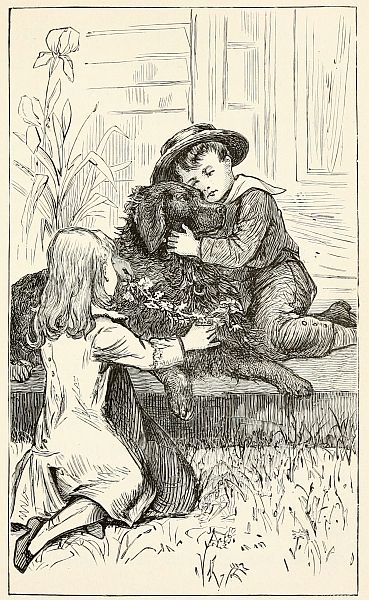
“Beppo was hugged half to Death by the Children.”
“It is hard for thee to learn the lesson of
patience so young; but it will do thee good,
my boy,” said he, patting Pollio’s head with
a smile.
“Is Dr. Field any ’lation to you, Mr. Littlefield?”
asked Pollio anxiously; and was
very glad to learn he was not. Pollio loved
Mr. Littlefield dearly; but he would never
love the doctor on account of his dreadful
jokes.
While Mr. Littlefield was at the house,
something happened to Beppo which I must
tell you about.
Now, Beppo was not only a pleasant playfellow
for the children, he was also a dog of
very fine character. But he had one fault:
he would bark in the night whenever the
least noise roused him, and bark so furiously,
too, that he waked everybody in the house.
For this reason it was thought best that he
should sleep in the stable; but even there he
sometimes made such a noise as to disturb
the family.
The children had often heard their father
say he meant to punish Beppo for this; but
they did not believe he would ever do it, for
he was as gentle-hearted as a woman, and
extremely fond of the good dog.
But, on the very night when the Quaker
was visiting them, the judge and his wife
were wakened by the terrific barking of
Beppo. It kept on and on, louder and
louder, till the judge grew very nervous.
“Why haven’t I whipped that dog long
ago?” said he.
“I think you ought to have done it,” replied
his wife. “He is a dear old fellow, but
it is our duty to cure him of his faults.”
“I declare I’ve a great mind to go out to
the stable this minute,” said the judge.
“Well, if you do go, you won’t whip him,
my dear: so I advise you to take brother
Rufus with you.”
“Rufus, indeed! Why, I’m not quite a
baby,” said the judge, springing out of bed:
“if I make up my mind to whip that dog,
I can do it.”
I dare say if Mrs. Pitcher had not spoken
of calling uncle Rufus, her husband would
not have gone, and then Beppo would not
have been punished.
I must confess he did not hurt the dog
one bit. Beppo did not feel the horse-whip
any more than if it had been a wisp of
straw; but he hung his head in grief, for
it was the first blow he had ever received.
When all was over, he gave a side-glance
at his master, as if to say, “I’ll never do so
again: I won’t bark any more.” And then
he lay down very meekly on a cushion of
hay; and the judge went back to bed, thinking
he had done his duty, but feeling sorry
enough to cry.
There was no more noise that night from
Beppo; though two or three carriages passed,
and he must have heard them, and wanted
to bark.
Next morning he lingered about the yard,
ashamed to come into the house.
“Poor fellow, he takes it to heart!” said
the judge; and then told what happened.
The children looked sober; and Posy
gazed through her tears at Pollio, who
winked hard, and tried to brave it out.
Friend Littlefield was glad to see that they
all cared so much for the dog.
But, just as the breakfast-bell rang, Teddy
rushed into the parlor, exclaiming,—
“Papa, our pears are stolen!”
“Pears, child! What pears?”
“Why, you know those two trees bending
down to the ground,—the nicest pears there
are in the world. Well, there isn’t a thing
left but just the leaves!”
“And that must have been what Beppo
was barking for. No doubt he heard the
thieves at work, and was trying to let us
know it. The faithful old creature!” said
the judge, looking distressed, but thinking
much more about the dog than about the
pears.
“O papa! And you w’ipped him!” cried
Pollio, whirling round and round on the
floor.
“Yes,” sighed papa, “I whipped him.”
Pollio didn’t try any longer to brave it
out: he swept through the room like a
hurricane, to go and have a cry on his dear
dog’s neck.
“How’d I feel if my papa had w’ipped
me when I wasn’t naughty!” said he. But
he couldn’t possibly imagine it; for he had
never been punished even by a “love-pat”
in his whole little life.
Beppo was hugged half to death by the
children; and the judge himself stroked his
head, called him “fine fellow,” and fed him
from his own hand with broiled beef-steak.
“Does he know you’re sorry, papa?”
asked Pollio.
“Well, I think he has some notion of it:
at any rate, he knows we’re good friends
once more. See, he wags his tail, and looks
quite cheerful again.”
“So he does,” laughed Posy, clapping her
hands. “Real cheerful! I guess he’ll get
over it, don’t you? He won’t think you
are a bad man now.”
Posy could not bear to have him think
her father a bad man; and it was plain that
he did not, for he licked the judge’s hand
after finishing the steak, and looked up in
his face as if he trusted him with his whole
heart.
“Dogs know ’most as much as folks,” said
Posy. “I’ll make a chain of flowers, and
we’ll put it on his neck, and I guess he’ll
like it; don’t you?”
Pollio was sure he would be charmed.
And, whether Beppo enjoyed the flowers or
not, he must have known he was treated
uncommonly well that day; for he had a
dish of cream for dessert, and was allowed
to spend most of his time in the parlor.
Now, what follows is not a dream or a
fairy-story, though I know it will sound very
strange. It really happened that morning,
while the twins and uncle Rufus were in the
parlor, and Beppo was lying on the rug,
watching Pollio.
There was nothing remarkable about
Beppo, except that he was a large, handsome
dog. His eyes just now had an asking look,
as if he longed to say something: but you
have seen that sort of look in any dog’s
eyes; it isn’t at all uncommon.
“Beppo wants to speak, I know he does,”
said Pollio to Posy.
The dog wagged his tail, as if to reply,
“You understand my feelings, my dear little
master.”
“Well, try it: see if you can’t speak.”
Beppo raised his eyes, wagged his tail again,
and, to the intense surprise of the children,
said, or seemed to say, in a fine, piping
voice,—
“I was w’ipped last night.”
Pollio rolled over; and Posy sprang up,
exclaiming,—
“Who said that?”
“Why, who did?” cried Pollio, almost
turning a somerset.
There was no person in the room but
themselves and Nunky, who was too busy
reading the newspaper to take any notice.
Who had spoken? It couldn’t be Beppo!
“Your papa w’ipped me!” said the piping
voice again, Beppo still gazing straight at
Pollio.
How wonderful! It was exactly the sort
of voice a dog would be likely to speak with,
if he could speak at all: it was thin and
babyish.
“Oh, oh!” cried Posy.
“My sakes!” cried Pollio.
They knew as well as you do that dogs
are dumb animals; but here was Beppo
looking right up in their faces, and talking.
They were greatly excited.
“Uncle Rufus, uncle Ru-fus!”
But they had to run up to him, and pull
his sleeve, before he would pay any attention.
“Uncle Ru-fus! Beppo is talking!”
“Oh! is he? Well, why shouldn’t he talk?
He has lived so long among chatter-boxes
that I should think he might by this time.”
“But you needn’t make fun, Nunky. He
did talk just now. I’ll leave it to Posy.”
“That’s so!” replied Beppo, wagging his
tail.
“Oh, hear him!” exclaimed Posy, dancing
about in a great flutter; while Pollio rolled
over and over, and jerked his elbows, crying,—
“I never, never, never! Did you ever,
uncle Rufus?”
“Your papa w’ipped me!” repeated Beppo.
Uncle Rufus seemed very much interested
now, and watched the dog closely; but he
was a man who was seldom surprised at any
thing.
“No, I never heard a dog talk before; but
what is there so very remarkable about it?
Parrots can talk; and parrots don’t know
half as much as dogs.”
“O Nunky, Nunky! it is queer,” exclaimed
Pollio, astonished at his uncle’s
coolness. “Why, he has lived here ever
so long, and didn’t ever talk before.”
“No,” said Posy; “no more’n the cat.”
“How did he happen to speak now?”
“Why, I asked him to.”
“Oh! you did, did you?”
“But don’t you think it’s queer, Nunky?
don’t you think it’s queer?”
“Well, rather so, perhaps; but I always
knew Beppo was a bright dog.—Come here,
old fellow, and tell us why you never talked
before.”
“Afraid you’d laugh at me,” replied Beppo,
looking up in Mr. Gilman’s face rather bashfully.
“Oh, I must tell mamma! I must tell
everybody!” burst forth the twins with
one voice.
Mamma was busy up stairs with her dressmaker;
and nobody was to be found but
Teddy, who smiled in the most provoking
way when told that Beppo was talking.
“You expect me to believe that story, do
you?” said he, entering the parlor with a
curling lip.
“Now see!” cried Pollio. “There, Beppo,
sir, this is Teddy. Now say, ‘How do you
do, Teddy?’”
Beppo held out his paw as he had been
taught to do, but said nothing.
“That’s the way he talks, is it?” said
Teddy scornfully. “I’ve seen him do as
much as that a good many times.”
“Oh! but he did talk, now truly.—We
didn’t cheat; did we, Posy?—Talk again,
Beppo. Say, ‘Your papa w’ipped me,’ and
I’ll give you some cream.”
Beppo rolled his soft brown eyes as if
trying to speak, but not a sound passed his
lips.
“Say one word; say ‘Teddy,’ and I’ll
give you some chicken.”
No answer.
“Well, say some other word. I don’t care
what word.”
Still Beppo was speechless.
“Poh! I can’t stop any longer for this: it’s
too foolish,” said Teddy.
“Oh! just a minute, Teddy. He did talk
before you came in. I’ll leave it to Nunky.—Didn’t
Beppo talk?”
Uncle Rufus dropped his newspaper upon
his knee with a roguish smile.
“Teddy, will you believe me if I say he
did?”
“No, sir: I can’t believe you,” said Teddy
stoutly, “because there’s no common sense
in saying a dog talks.”
“Then I sha’n’t say it.”
“O Nunky, that’s too, too bad!” cried
Posy.
“Up and down mean!” cried Pollio; “for
you heard him talk.”
“I, my child? Why, I never heard a dog
talk in my life!”
“O Nunky, Nunky Gilman! When you
were the very one that sat right there and
looked straight at Beppo, and heard him say,
‘Your papa w’ipped me.’”
“I heard him say nothing of the kind,”
returned uncle Rufus, rising, and planting
himself on the rug, with his arms folded.
“There, there! I knew better all the
time,” said Teddy, snapping his fingers.
This was very trying.
“O Nunky, Nunky!” cried angry Pollio,
“you’ve told a”—
“You’ve made a little mistake,” struck in
Posy, as angry as her brother, but more
polite.
“They say ‘little Pitchers have great
ears,’” said uncle Rufus, smiling: “perhaps
they hear what isn’t to be heard. Think a
minute, children, and see if you can’t be
wrong. If a dog should talk, it would be
a miracle.”
“But we heard him,” said Pollio.
“Did you see his lips move?”
“Oh! I—I don’ know. I didn’t think of
that.”
“Well, I want to teach you to think, my
boy; and that is why I have teased you a
little. Beppo will speak again; and perhaps
you’ll watch his lips this time, won’t you?”
“Your papa w’ipped me,” squeaked the
fine little voice; but the twins both observed
that Beppo never opened his mouth. They
saw now that their uncle had been playing
a trick upon them.
“Oh, now I know, now I know! Nunky
did it himself.”
“Of course he did, you goosie! ’Fore
I’d be so silly as you and Posy,” said
Teddy, proud of his own wisdom.
“Not so fast, Teddy,” said his uncle.
“I could have cheated you in the same
way a year or two ago. And I don’t believe
now you can tell how I do it. Look
at me while I speak so again.”
Teddy did look; but uncle Rufus scarcely
stirred his lips, as he said in a voice that
seemed to come from the very depths of
the cellar,—
“I’m a rat! I’m drowning in the pork-barrel!”
“Oh! how do you do it?” cried Teddy.
“How can you make your voice sound way
off, and so different from your voice? Do
you do it down in your stomach?”
“Yes, I suppose so. It is called ‘ventriloquism.’
I have cheated wiser people than
our little Pitchers in this way.”
“Well, you can’t cheat me again,” said
little Pollio, deeply mortified.
“No: because next time you will think.
But here comes friend Littlefield. Now,
Teddy, don’t you tell him about this; please
don’t.”
It was well Nunky said that; for Teddy
was rather apt to report “the children’s”
little mistakes, and they were very sensitive
about it.
Pollio had now been lame for several
weeks, and everybody thought it might be
months before he would get well. But, one
morning not long after this, Posy swung
open the dining-room door, drawing her
brother after her, and saying gleefully,—
“O mamma! O papa! my Pollio can
walk!”
Yes, he was actually walking. Never was
Napoleon Bonaparte any prouder after a
great victory than our little hero as he
stalked into that dining-room.
They all rose from the table just as surprised
as they had been on the first morning
when he couldn’t walk. Then what a clapping
of hands, what a shouting! Eliza
Potter and Jane Roarty, who were in the
kitchen, wondered what could have happened;
and so did Ike, who was passing by
the dining-room windows.
Ike saw Mrs. Pitcher hugging Pollio as if
he were the best boy in the world, just
because his legs had stopped feeling like
India-rubber boots; and then they hugged
him all round, and his father tossed him up
to the ceiling.
“Let’s celebrate; let’s have a picnic at
Rocky Brook,” said Dick.
“But Pollio can’t walk so far,” objected
Edith.
“Why, yes, I can. I can walk all over the
world,” exclaimed Pollio, trying to dance,
but tipping backward against Teddy.