My children have often asked me to write out some of my experience while
a medical officer in the United States Army on the frontier, and I have
often resolved to do so. But for many years after leaving the service my
time was so thoroughly taken up in an effort to make a living and
educate the children that my good resolutions received scant attention.
Now in my 78th year the apathy of old age is such a handicap, that great
effort is required to do things that at one time I could have done
cheerfully but did not.
I think my experiences during the Civil War gave me something of a taste
for military duty, for when in the summer or early fall of 1868 I
noticed that an Army Medical Board was in session at New York, I at once
made application to appear before it for examination for a position in
the regular service. I was examined in October, 1868, and as the board
continued in session for some time afterwards I waited with some anxiety
and misgivings as to the result of my examination. I had the impression
that the examination would be severe and was doubtful of my ability to
pass. In this connection it is proper to say that some had failed in
these examinations that afterwards became noted medical men. Among them,
I was informed, was Dr. Austin Flint, Sr., whose work on the practice of
medicine was standard and considered the best when I was a student. His
son, Dr. Austin Flint, Jr., also became famous as our great Physiologist
and his work on that subject is standard today. It was not until the
following January that I heard from my examination, and was then
directed to report at St. Louis to be mustered into the service as
Acting Assistant Surgeon in the United States Army. There was
necessarily some delay in disposing of the few things we had, some of
which we sold and some of which we stored. Finally everything being
disposed of, we left our home in Washington, Iowa, and from there, after
a day with friends, took a train for Burlington, thence to Keokuk, where
my wife remained visiting relatives, I going on to St. Louis to report.
I was mustered into the service January 29th, 1869, and ordered to
report to the Medical Director, Department of the Missouri at
Leavenworth, Kansas, for assignment to duty. The Department of the
Missouri at the time comprised the States of Missouri, Kansas, Colorado,
New Mexico, The Indian Territory, and I think Arkansas.
General Sheridan was the commanding officer of the department at that
time. He also had a brother who was a captain and who was also stationed
at Leavenworth. Dr. Miles was the Medical Director of the Department and
Dr. McGruder was Post Surgeon at Leavenworth. I was on waiting orders at
Fort Leavenworth for something over a month during which time I got my
first impression of the rank and file of the Regular Army. The officers
impressed me as very self important, exceedingly courteous and cordial,
and charming in their broad-gauge views of current events and their
unreserved candor in discussing all subjects. I must except one subject,
however, and that was politics. An army officer is supposed to have no
politics, or if he has he keeps them in reserve. Seldom during nearly
seven years of my life in the army did I hear politics mentioned. An
army officer is supposed to do his duty regardless of who holds
political authority over him, and this he does most loyally. The
enlisted men impressed me as a clean, attractive and well disciplined
body of soldiers. Another thing that impressed me was the absolute
separation of the officers and enlisted men. It may be different now but
at that time there seemed to be nothing of even a fraternal interest.
The officer commanded and the soldier obeyed. In this way they seemed as
distinct as oil and water, and it was a rather surprising contrast to
the volunteer service during the war, where enlisted men and officers
often from the same town and nearly always from the same community
fraternized and often addressed each other by their given names; while
in the regular service there was nothing of the kind. An officer when
passing an enlisted man always received a salute. The men or man
standing at attention when giving it and the officer was required to
return the salute. The men may be sitting down, say outside of their
barracks, and when an officer approaches and gets within a certain
distance they all rise at once, stand at attention, and give the salute,
and this is the extent of their relations with each other.
The officers mess at Leavenworth was quite a large one, mostly of
unmarried men, although there were maybe two or three married couples,
and was exceedingly cordial and sociable with each other. Those of the
rank of Captain or higher up in rank were always addressed by their
military title of Captain or Major, as it might be, but the Lieutenants
were addressed as Mister, or by their surnames, as Mr. Jones or simply Jones.
The first of March came and with it came pay-day, a matter that seemed
of much interest to the officers. It did not take me long to learn its
importance for army officers at that time as a rule literally lived up
their salaries. I finally learned that an officer was considered by many
other officers as a little off color if he was close-fisted and tried to
save money out of his pay. To me it was a matter of importance because I
was poor and needed it. I sent most of my first month's pay, after
paying mess bill and a few other necessary expenses, to my wife, not
keeping enough, as I afterward learned, for an emergency that might
arise. Expecting to be ordered to some frontier post, I took the
precaution to invest in a pistol, a very ridiculous thing to do, as I
now think of it. The further history of that pistol will appear later on
in this story.
While at Leavenworth the officers gave a hop. I never knew why it was
called a hop instead of a dance, but it was always so designated in the
army. Officers came from other places, particularly Fort Riley, among
whom was General Custer of cavalry fame during the Civil War, and a
noted Indian fighter on the frontier. I watched him with a good deal of
interest, for at that time he was a distinguished man in the service,
and I must say that I was rather disappointed in his appearance. He
seemed to me to be under-sized and slender, and at first blush to be
effeminate in appearance. Maybe his long hair, almost reaching to his
shoulders, gave this impression, but the face was something of a study
and hard to describe. Something of boldness or maybe dash, a quick eye,
and he was intensely energetic, giving the impression that he would be a
veritable whirlwind in an engagement. He did not convey the idea of a
great character. He was a very graceful dancer. His career ended at the
famous battle in our Indian warfare, that of the Little Big Horn. Not a
man of his command escaped to tell the story.
I think it was about the 8th or 9th of March that I received orders to
report to the Chief Medical Officer, District of New Mexico, for
assignment to duty. The quartermaster furnished transportation, that is
to say, orders to the transportation companies, railroads, stage-lines,
etc., to carry the officer to point of destination. This, together with
the order of assignment to duty, would carry one wherever the assignment
directed. At this time the so-called Kansas-Pacific railroad was built
out pretty well towards the west line of the state, but there were no
transcontinental lines finished until the following summer. The Union
and Central Pacifics joining that year in Utah in July.
I left Fort Leavenworth in the morning and before night was out on the
plains. From Leavenworth to Topeka there was some settlement. The towns
as I remember them were mere railroad stations, except Lawrence, which
was more pretentious, and the scattering farmhouses were small and
primitive in style. Topeka seemed to be something of a town, but from
there west the country was only partially inhabited. Fort Hayes stood
out prominently to the left of the railroad but the whole country seemed
one great sea of desolation unlimited in extent. At that time I would
not have given ten dollars per square league for what has since become
one of the famous wheat fields of the country. The evening of the second
day we arrived at a place called Sheridan which was the terminus of the
railroad. It was a straggling place of tents and wooden shacks, dance
halls, bawdy houses, gambling houses and saloons. Murders were of
frequent occurrence and it was considered dangerous to be on the street
at night. There was only one street in the town. I started out on this
street about dusk, thinking I had better go to the stage office and
arrange for my transportation on to Santa Fe. The landlord happened to
notice me and called for me to wait a minute and when he had joined me
he inquired where I was going. He said he would go with me as it might
not be safe for me to be alone, and told me of a killing in front of the
hotel the night before.
My bed that night was on the second story, merely floored, and not
plastered or sealed, and the roof slanted down close to the bed. The
space between the floor and the edge of the roof was open and I could
look down into the saloon. I watched the patrons of this place for some
time for it was altogether a new experience. The clinking of glasses;
the loud talk; the dim lights; and the thorough abandonment of the
motley crowd remains quite vividly in my memory. It finally occurred to
me that in the event of a shooting scrape, even there in bed was not a
very safe place, so I edged over to the far side of the bed and soon
dropped to sleep, not waking until called in the morning.
We got an early start and I had the stage mostly to myself until we
crossed the Raton spur of the mountain. The nights were chilly and I was
not over-warmly clad, but I managed after the first night to get a fair
amount of sleep. I felt some fear of Indians although it was too early
in the season for them to go on the war-path. The summer before had been
a particularly bad one on the plains. Forsythe's command was almost
annihilated in October, 1868, on the Ariskaree Fork of the Republican
river, and at every stage station until after we reached Trinidad,
Colo., the first salutation between the men at the station and our
conductor was whether either had seen any Indians. The apprehension was
not that the Indians would go on the war-path at that time of the year,
because their ponies could not exist until the grass was well started,
but that some of the venturesome young bucks might take it into their
heads to attack the stage coach. I peeked out of the coach at night and
wondered if there was any probability of Indians attacking us and
thought of my pistol, but was not proud of it, or of my ability to use it.
The stage stations were interesting to me. On the plains proper they
were uniformly built, underground as far up as the sidewalls extended,
and was located near some water hole and at an elevation that would
command a view of the surrounding country for some distance. Above the
dirt walls large logs were laid, upon which the cross timbers were
placed for supporting the roof. These logs were raised from the ground
enough, say three or four inches, to give the occupants a good view of
the surrounding country, and an opportunity of using their carbines
against attack from the Indians, with comparative safety to themselves.
The roof was covered with dirt. The stables were built the same way with
underground passages or open ditches connected with the station proper.
Both station and stable were connected in the same way with the water
hole. At these stations on the plains proper, were stationed a small
squad of soldiers, maybe a half dozen, under the command of a
noncommissioned officer, generally a sergeant, and you can readily see
that the Indians would be a little cautious about getting too near such
a place although during the summer season they often attacked the stage
between stations. The stations were at variable distances apart,
depending on the water supply, generally from eight to twenty miles
apart, and were supplied by government trains on their way to the
military posts of the West. There was not much to attract attention in
approaching these stations, no building in sight, no sign of life. The
first thing you knew some one would hollow "Hello!" and "Hello!" would
come back. "Have you seen any Indians?" and there you are. The last
inquiry was natural enough when you consider the near approach of
spring, when the grass would be green enough to furnish feed for Indian
ponies. Indians would not appear in large numbers at this time of the
year, but little roving bands, maybe one or two venturesome bucks might
be seen almost daily at a safe distance, evidently spying out the
prospects for more serious work later in the season. Of course we got
our meals at these stations, consisting generally of bacon, hot
corn-bread or biscuit, a vegetable or two, and black coffee. This menu
varied some after we crossed the Raton Mountains and were practically
out of Indian troubles, when we had a greater variety, and it was
better prepared.
We got to Trinidad late at night, the first town after crossing the
plains, and located just at the base on the north side of the Raton
Range near the Purgatory river. This was a mining town of some
importance in those days, and had the usual quota of dance halls,
gambling dens and other equipment of a typical mining town.
We got to Dick Wooton's early the following morning and had a good
breakfast. His place was located near the top of Raton Pass and
consisted at that time of a rambling lot of log buildings; one for a
house proper, which was clean, comfortable, and attractive inside, and
the others for stables, blacksmith and wagon shops, and in fact anything
and everything where repairs to transportation could be made. Dick
himself was an attractive personality, was large, quite above the
average in size, with a cheery open face giving little evidence of the
frontier man, and yet he was almost as noted as Kit Carson with whom he
was associated as pioneer and scout. Both were noted men on the
frontier. Wooton, however, took a more practical view of life than
Carson and conceived the idea of building a wagon road over the Raton
Pass. This road was completed and I think had been for some time before
I crossed the pass. If I remember correctly we crossed a little stream
coming down from near the top of the range thirteen times before we came
to the top of the pass. Wooton had some kind of permit or authority from
the government for building this road and was authorized to make it a
toll road. He was reported to have made quite a fortune from the revenue
derived from it.
A little place called Cimarron, (which in Spanish means mountain of
sheep) or Maxwell's ranch was the next place of interest to me. This is
some distance south of the Raton Range, maybe half way from Trinidad to
Fort Union. It seemed that Maxwell married a high class Spanish woman
whose family owned an immense estate in what was Mexico before it was
ceded to the United States. In the division of the estate Maxwell's wife
got a grant of many thousands of acres on the head waters of the
Cimarron, a tributary of the Canadian, which I understand was very much
reduced as a result of extended litigation with the government as to
title. We traveled for miles on what was then called Maxwell's Ranch,
where great herds of sheep, cattle and horses were to be seen, with an
adobe house here and there, where herders lived. It was a great pleasure
to stop even for one meal at such a place as Maxwell's. The house was
commodious and handsomely furnished and everything was prosperous and
home-like. Some years later I had the pleasure of acquaintance of a
daughter of Mr. Maxwell's who married a lieutenant in the army and we
were serving at the same post.
We passed Fort Union in the night and I did not get to see much of it,
but I understand it to be only a military post and base of supplies, for
the Quarter-Master or Commissary Department of the army for the District
of New Mexico.
My first view of Las Vegas (The Meadows, in Spanish) was over a
beautiful wide valley, some three or four miles across, through which a
pretty little stream of water, the source of the Pecos river, was
wending its way. The view was beautiful and the town looked to be a
place of importance, but proved to be disappointing on a closer acquaintance.
Not far from Las Vegas we passed what was called the old Pecos church.
It was only a little distance from the road and said to have been built
in the seventeenth century. It stood alone in its desolation and had
partially fallen into decay. The roof was off, the walls partly broken
down and it looked to be as old as reported.
We arrived in Santa Fe late in the evening and stopped at the hotel or
fonda, as it is called in Spanish. At first one feels that he is in a
different country; something foreign and out of the usual, and this
feeling grows with closer acquaintance. For instance you go direct from
the street to your room if your wife is with you, or to a kind of a
lobby or sitting room with a bar at one side if alone.
I was thankful that the stage ride was ended. We had been going night
and day since leaving the railroad at Sheridan, Kans., a distance of
nearly four hundred miles, and although I had the stage to myself most
of the way, one passenger got on at Cimarron that I will feel grateful
to the balance of my days, and from Fort Union to Santa Fe the coach was
crowded all the way. The stage lines in those days had a conductor who
went to the end of the route, much as our railroad conductors do today,
while the drivers like our engineers, only went to what might be called
division points, say twelve-hour trips.
The conductor has charge, and is responsible for the United States mail
and the express packages which are carried in what is called the front
boot, and where the conductor curls up among the mail sacks and packages
and sleeps at night. The back boot is devoted to baggage. Inside there
are generally two seats facing each other and wide enough for three
persons if not too big, on each seat. The stage coach had a great
swinging body resting on two immense leather straps for springs, one on
each side underneath and extending from front to back. These flexible
springs gave the coach an easy side swing and it was not a particularly
unpleasant thing to ride in.
Having arrived in Santa Fe late Saturday evening I did not report until
next morning, and about noon an orderly brought to the hotel my orders
from the Chief Medical officer directing me to report to the commanding
officer at Fort Selden, New Mex., for assignment to duty. This was
startling news, for Fort Selden was the last military post before
reaching the Mexican border and I had only $2.50 in my pocket and my
hotel bill to pay. Being new in the service and something of a
tenderfoot I did not want to go to the other officers for help. I left
my room and went down to the hotel lobby and among others who were there
was the gentleman who got on the stage at Cimarron. We had traveled
together from Cimarron to Santa Fe with hardly the exchange of the usual
courtesies. I was not a good mixer and he had nothing to say, but my
case was very desperate. I had to talk to someone so I asked if he was
acquainted in Santa Fe and he said "some." I told him my troubles and
that I had a good watch and a good pistol (that pistol was a hoodoo by
this time) that I would put up as security for a few dollars to pay my
expenses on the way to Fort Selden. He said: "Well, nobody would give
you anything for them things. If I had the money I would let you have
it." This in a rather slow drowning voice. I took this as a matter of
course. Anybody would talk the same way, I thought, whether they had it or not.
Dinner was soon ready. The dining room was away to the rear end of this
somewhat rambling hotel building. We passed through a billiard hall and
maybe some store rooms before reaching it. I think, however, there was a
different route for the ladies. I suppose the dinner was good but do not
remember much about it. I do remember, however, on the way back through
the pool hall I stopped to glance around the room which was a very long
one with many tables and many players. The second table away became very
interesting to me for near it stood my man of short acquaintance
apparently talking to one of the players, a large fine looking man who,
laying his cue across the corner of the table, pulled out such a wad of
bills as I had never seen before and commenced counting out the money to
my newly made acquaintance. I passed and went up to my room wondering if
he would keep his word, now that he had the money. I tried to read but
made poor headway. Pretty soon there was a light tap on the door and I
said "come in." The door opened and there was my new found friend who
took a seat in a rather deliberate way and said nothing. I made some
remark about the weather which seemed to meet his approval but directly
he asked me: "About how much money do you think you will need?" I told
him I thought about twenty dollars would be enough. He brought from his
pocket a great bunch of bank notes and counted out twenty dollars and
handed it to me. When I offered my security he politely turned them down
saying he would take chances. When I asked him if he had never lost
money that way he replied, "Yes, some." And when I said I would feel
better myself if he would take something to make himself safe he said,
"Oh no, I'll take chances." When next I inquired about his knowledge of
Santa Fe and the west generally he became more communicative and
informed me that he had spent all his life from a youngster as a
prospector, sometimes striking it good and selling out and trying it
again; sometimes having plenty of money, and at other times having
nothing. Someone else would then furnish him a "grub-stake" as he called
it with which to try again. He and his partners had just sold out a gold
mine at Cimarron and I presume the money I saw him receive from the big
man at the pool table was part of the proceeds of that sale. He finally
asked me if I cared to walk about the town some. I think I would have
gone with him anywhere, so I responded very promptly that I would like
to. The town was utterly strange to me, so different from anything I had
ever seen: adobe walls, adobe houses, and the people were as strange
looking as the houses. The women wore some kind of a wrap over their
head called a mantilla (pronounced man-tee-ya, with the accent on the
second syllable) leaving a little open space for one eye to peep out at
people they met, and the men with the wide brimmed, high peaked hats
that I afterwards learned are the universal costumes of the Mexican
people. After looking around a bit my companion asked me if I would like
to see a cock-fight. Sure thing, of course I would, although having been
raised a strict Scotch Presbyterian I felt some qualms of conscience
about witnessing such an exhibition on the "Sabbath."
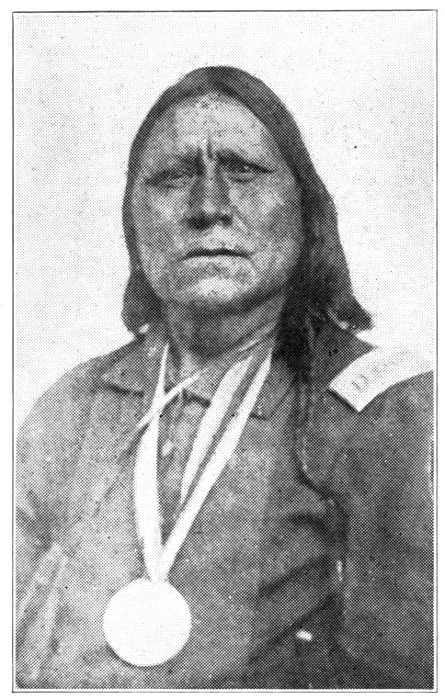
SATANTA
War Chief of the Kiowas
Original in our possession, taken by Soule,
of Boston, while we were
stationed
at Fort Sill
The amphitheater in which the exhibition was given was without cover and
enclosed by a high adobe wall. It was crowded with men and women, mostly
Mexicans, in gala dress, some very richly dressed women and some whose
attire attested poverty, but even these wore bright colors. The head
covering was universal but as varied in colors and quality as the fancy
and wealth of the wearers suggested. I think some of the hats of the men
must have cost a small fortune. The exhibition itself was not very
attractive to me. I could see the chickens sparring around as though for
a good opening and finally one of the cocks would drive the gaff home
with deadly effect and the people would shout and clap their hands and
exchange the money they had wagered on the result. The management would
then bring in another pair of birds for another contest. The betting
consisted not only of money but all kinds of trinkets and valuables. I
saw one woman take off her white slippers handsomely ornamented with
gold braid and spangles and bet them on the result of the contest. The
affair was conducted in Spanish-Mexican and I could not understand
anything that was said, but they all seemed to be delighted with the
exhibition. To me it was not only cruel but was uninteresting. We did
not stay until the finish but went out and saw some more of the town,
then returned to our hotel.
My newly made friend came up to my room after supper, and spent part of
the evening with me. I found his experiences interesting. The old story
of ups and downs, money to spare, and grub-stakes furnished by some one
else, to give him another start. He gave me his address and I was very
prompt in returning his twenty dollars as soon as I got to Fort Selden,
which by the way, I borrowed from the post trader until pay-day. In
answer to my remittance I received a post card without address or date
saying, "You needn't have been in such a hurry." Thus ended an
acquaintance and experience that I think could not have happened
anywhere else than on the American frontier. His name was Robert
Daugherty and nothing could give me greater pleasure than to meet him
again and furnish him a "grub-stake" if he needed it.
Santa Fe (Holy Faith, in Spanish) was an old town when the Pilgrims
landed at Plymouth Rock. About 1606 according to Colonel R. E.
Twitchell, the best authority on the early history of New Mexico, it was
made the capital of one of the Spanish provinces, and had been built on
the site of two small Indian pueblos. I believe if I had been dropped
down in some town in the interior of China and had found a few Americans
to talk to it would not have seemed more strange to me. The office of
the chief medical officer of the district was located in a building on
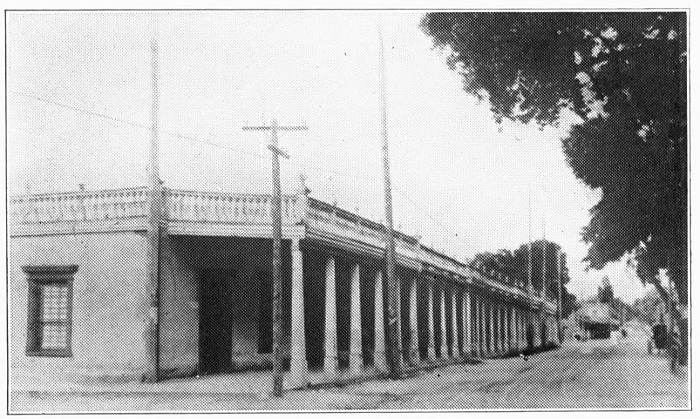
the plaza that someone told me was the old palace, but which I thought
did not look much like a palace, and which I understand is now used as a
museum in which are to be found the most remarkable collection of
archaeological specimens in America.