As we write this sketch, we have in
mind the familiar picture of Robert
Louis Stevenson, stretched out
on a couch in his Samoan home, ailing,
working. There is a sad sweetness in the
sharpened face, and in the eyes is a gleam
of bravery or determination. The Scot
whom the entire reading world still loves
so dearly, and will continue to love, it
seems, when the babes of to-day are trembling
graybeards, knew the strenuous life
much more intimately than most of its new
advocates; but it was a part of his art, and
the artist conceals his art. Stevenson's
sentences glitter, for they are gems of literature;
but the glitter was given them at
the expense of sublime patience and infinite
pains. Unconsciously he presented an example
of heroism; consciously he showed
the young writers of his day that anything
approaching perfection must be the product
of scrupulous industry. Like the diamond
polisher, he was never satisfied with
a merely smooth facet: the facet dazzled or
he was not content.
We have Stevenson in mind at this time
for many reasons. In the first place, the
subject of this chapter, Robert Neilson
Stephens, may know of the letter of congratulation
which, when he was writing for
the Philadelphia Press, some of the young
men of that journal sent to the distinguished
writer on the Pacific island; and
possibly he may have seen the answer that
Stevenson sent—an answer filled with
modest thanks and sound advice and sincere
good wishes. The letter ended with
the remark that if the young Philadelphians
labored skillfully and ambitiously they
would surely make their mark. If Stevenson
had lived he would have congratulated
Robert Neilson Stephens four years ago.
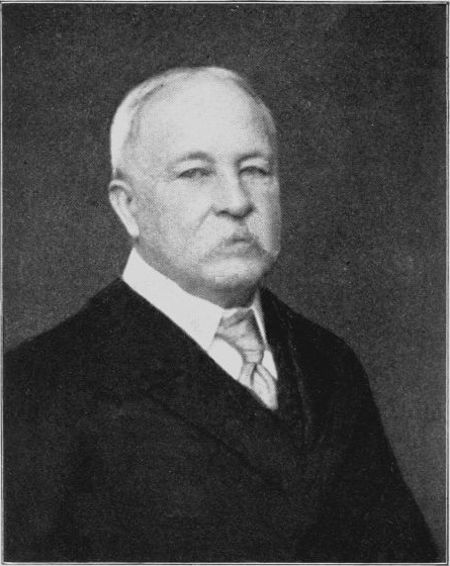
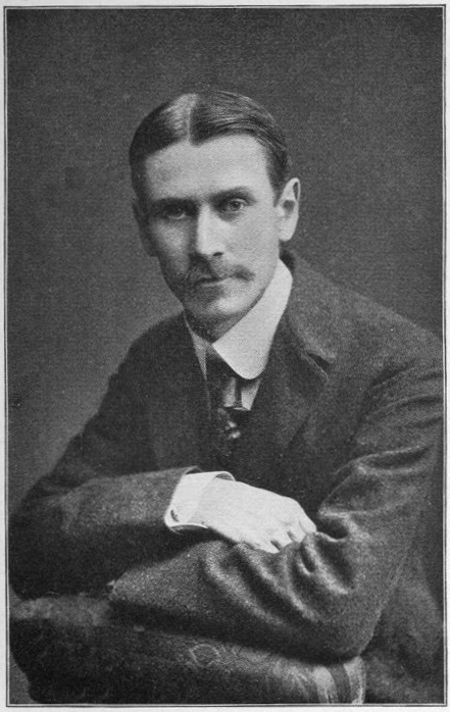
You will notice that there is a certain
similarity between the features of the author
of "The Master of Ballantrae" and the
author of "Philip Winwood"—the same
delicacy, the same lurking kindness, the
same suggestion of indomitable intellectuality.
And the resemblance extends beyond
the features, also. Stevenson, in his
youth, suffered from poverty; so did Stephens.
The Scotchman for a long time
dipped his pen in water, making no impression,
receiving no encouragement, entertaining
no luck; so, also, did the American.
It is a story almost as old as the world, a
story illustrated occasionally in the skies.
Astronomers tells us that light, fast as it
travels, takes years upon years to come to
us. Often it is the same with men of
genius: they blaze long before our narrow
vision gives any sign of recognition.
Someone, by the way, once sympathized
with Stephens on his ill health. Yes, he
was far from strong, he admitted; "but,"
he said, "they may say what they please—those
who have never been poor—I would
rather be ill and well-to-do, as I am, than
poor and in good health, as I was for many
years. I have had many sorrows, but hardly
a sorrow that was not aggravated, if not
caused, by poverty, or that very moderate
wealth would not have ameliorated or prevented.
The difference between pecuniary
ease and poverty is oftentimes simply as the
difference between heaven and hell."
We may not all agree with the sentiment
suggested, that riches in most circumstances
or under most conditions are preferable to
poverty with good health, but no one can
fail to discern in the sentiment the bitter
memory of a man who has been acquainted
with great distress. At any rate, his is a
philosophy based on experience. To experience,
also, we may ascribe Stephens's
animadversion regarding friendship.
"When a man makes any kind of success,
however small," he says, "he finds
that his old friends resolve themselves into
three classes. The first class turn sullen,
and show their envy in many mean ways.
The second class wax more friendly than
ever, and come showering their attentions.
The third class show a reasonable pleasure
at your success, and remain just as they
were before. God bless the last kind! God
mend the second! and God pity the first!"
Before generalizing farther it might be
better to reveal some of Stephens's career.
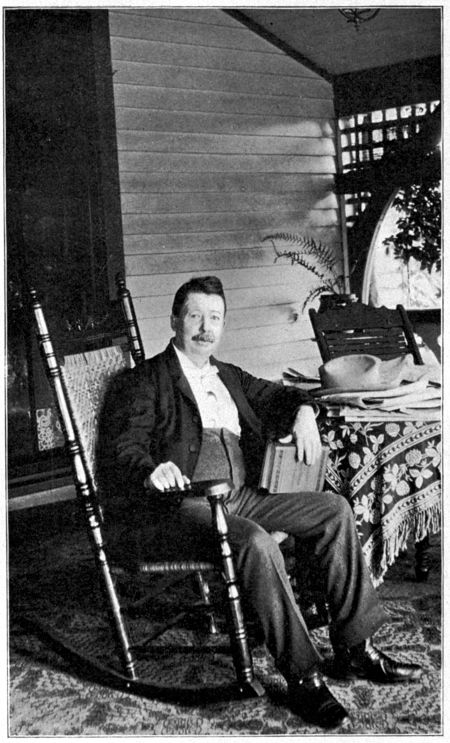
Robert Neilson Stephens, a descendant of
the Jacobite fugitive who was grandfather
of Alexander H. Stephens, of Georgia, was
born on July 22, 1867, in New Bloomfield,
a little town in Central Pennsylvania. The
house in which he was born lay a stone's
throw from the academy founded by his
grandfather and conducted by his father.
The first distressful event came into
Robert's life when, at the age of nine, some
seven years after the family had moved
from New Bloomfield to Huntingdon, on
the Juniata River, his father died. His
mother, to support her children, took a position
as a school teacher. Notwithstanding
the lack of wealth, however, Robert
went through the public high school. After
leaving school he went to work, for three
dollars and a half a week, in a bookstore
connected with a stationery factory. Aside
from his pride and his poverty, which seem
to have influenced him to no small extent,
he was a delicate youth, and his steadiest
companions were books. Besides, he cultivated
assiduously the faculty of observation.
This cultivation shows itself in his books.
He is unsurpassed among the novelists of
the day for mastery of the life of bygone
periods.
The work in the bookstore was distasteful
to him in many ways. The narrowness
and the ignorance of the factory hands
chafed his delicate sensibilities; the nature
of the work itself jarred on his always
strengthening mental equipment. He looked
about him for a means of escape from this
sort of prison, incarceration in which was
little sweetened by the fact that in the second
year his salary was raised to four dollars
and a half. One of the modes of
escape which he attempted was stenography.
By assiduous practice he acquired such facility
in this branch of writing that the
Hon. John Scott, solicitor-general of the
Pennsylvania Railroad, aided by Mr. William
B. Wilson, an old friend of the boy's
father, before long secured him a position
in the railroad company's office in Philadelphia.
When settled down, Robert
brought his mother and brother to the city
on the Delaware.
But, pleasant as its environment was, the
young stenographer saw in his new position
no very rosy future. It was not—as it is
not to-day—his disposition to confound
mere comfort with success. We have
quoted his remark that he would rather be
rich and sick than poor and well; but we
venture to think that the riches of Mr.
Rockefeller would fail to give him absolute
satisfaction so long as the feeling of professional
success were absent from him. At
any rate, we judge by his present pursuits
and aims that his ideal is nearer to the revered
and affluent workman, like Zola, for
example, than like to a man whose sole object
is the enjoyment and disbursement of
dollars and cents.
From the Pennsylvania road he went to
the Philadelphia Press, which in those days
was a veritable cradle of authors. Here
his literary instinct took hold of him. It
had taken hold of him once before, in Huntingdon,
one vacation, when he had worked
as printer's devil in the office of a weekly
newspaper, and, as often happens to "devils,"
had been stricken down with what
may be called typographical fever. The
great are not alone in the enjoyment of
authorship. We believe that Mr. Stephens's
first literary offering, an article describing
the joys and woes of budding printers, appeared
in that Huntingdon weekly.
That, however, was a mere juvenile spasm.
It was nothing like the powerful impulse
that came to him just previous to his début
as a writer of theatrical notices for the
Press. He showed so marked an aptitude
for this employment that within a year he
was virtually in full charge of the paper's
important dramatic column. Stephens's
career on the Press was as varied as that
of the average newspaper man, and, consequently,
as interesting and precious. For
the patience that, like the steam-drill, bores
its way through every obstacle; for accumulative
industry, for tireless zeal, for unaffected
modesty dashed with power, for
knowledge of the overt and covert ways of
men—for such a unique mixture of crude
virtue and wisdom combined commend us
to the enthusiastic journalist.
Stephens unconsciously heeded Stevenson's
caution and retired from journalism
before its hypnotic spell had taken complete
possession of him. One of the reasons
for his retirement from journalism was the
singular rule made by the Press that members
of its staff must not write for any other
periodical. Stephens had been fortunate in
placing his extra work, and naturally he
felt that the rule shut out promising opportunities.
Besides, in 1889, he had married—Mrs.
Stephens was, before her marriage, Miss
Maude Helfenstein, of Chicago—and there
were other reasons for his practical view
of the situation. There was no risk in the
retirement, for he had made many friends
while on the Press, especially among the inhabitants
of the theatrical world. He received
and accepted, in 1893, an offer to
become general agent for a firm of theatrical
managers.
Incidentally he was required to write
cheap plays—plays for the vulgar public
that Gautier despised and ridiculed. These
dutiful efforts are hardly noteworthy, but we
must mention "On the Bowery," a melodrama
which afforded the picturesque and
withal good-hearted Steve Brodie a chance
to be heroic some sixty-four times a week.
But although this grade of work was uncongenial
to the author, it opened the way
to a better field, and, in September, 1896,
his play, "An Enemy to the King," written
during the winter of 1894-95, was produced
in New York by E. H. Sothern. As
this was his first ambitious production, the
author displayed some lack of nerve. Instead
of accompanying his wife to the theatre,
he shrank back to a nearby comfortable
refuge, whither, between the acts, a friend
brought him tidings of the performance.
The call for him was led by Richard Harding
Davis and DeWolf Hopper, who, running
across him outside the theatre, half
suffocated him with congratulatory embraces.
By and by Mr. Sothern took the
successful play to Boston; and there happened
the circumstance which established
the author's fame.
The play was seen in Boston by Mr. L.
Coues Page, the Boston publisher, who,
recognizing in it the elements which constitute
a popular semi-historical romance,
and foreseeing the extensive demand for
that branch of literature, sought the author
and proposed that he should make a novel
out of his play. The proposal was readily
accepted; in fact the contract was signed
twenty-four hours after the author and publisher
had first met.
The instantaneous popularity of the book,
which was published in the fall of 1897,
had a two-sided effect: it induced the author
to abandon hack-work entirely and devote
his best energy and proficiency to fiction.
It is deeply to be regretted that Stephens's
health declined simultaneously with his
procession to the seats of the famous, yet
these distressing conditions are hardly discernible
in either the quantity or the quality
of his work. In April, 1898, his second
novel, "The Continental Dragoon," appeared,
and in the following June the latest
of his plays, "The Ragged Regiment," was
produced at the Herald Square Theatre,
New York. In October of that year appeared
his third novel, "The Road to
Paris"; in May, 1899, "A Gentleman
Player"; in May, 1900, his highly popular
Revolutionary romance, "Philip Winwood,"
written almost entirely in England,
and published on the same day in England,
Canada, and the United States. His latest
novel, "Captain Ravenshaw," in which he
returns to the scene of "A Gentleman
Player"—Elizabethan London—has just
reached the public.
Shortly after the publication of "A
Gentleman Player," the novelist, in the
assurance of a handsome income and of
consequent ease, went abroad with his wife.
Abroad he has lived ever since. This fall,
we understand, he will spend traveling on
the Continent. The first part of the winter
he plans to pass in Italy or in Sicily, the
second part on the Riviera. The spring
of 1902 will find him in Paris, whence, by
the end of spring, he expects to start for
home. We say "home" purposely, for we
are told that his protracted residence abroad
has served if anything to deepen and enliven
his loyalty to his native land.
We have been privileged to read the
preface to "Captain Ravenshaw." The
main part of it is a spirited and well-pointed
defence of the neo-romanticists against the
eccentric assault of Mr. William Dean
Howells. Then, referring to the book itself,
Stephens goes on to say:
"Now, as to this little attempt at romance
in a certain kind, I wish merely to
say, for the benefit of those who turn over
the first leaves of a novel in a bookstore or
library, before deciding whether to take it
or leave it, that it differs from the usual
adventure story in being concerned merely
with private life and unimportant people.
Though it has incidents enough, and perils
enough, it deals neither with war nor with
state affairs. It contains no royal person;
not even a lord—nor a baronet, indeed,
for baronets had not yet been invented at
the period of the tale. The characters are
every-day people of the London of the time,
and the scenes in which they move are the
street, the tavern, the citizen's house and
garden, the shop, the river, the public resort—such
places as the ordinary reader
would see if a miracle turned back time
and transported him to London in the closing
part of Elizabeth's reign. The atmosphere
of that place and time, as one may
find it best in the less known and more
realistic comedies of Shakespeare's contemporaries,
in prose narratives and anecdotes,
and in the records left of actual transactions,
strike us of the twentieth century as
a little strange, somewhat of a world which
we can hardly take to be real. If I have
succeeded in putting a breath of this
strangeness, this (to us) seeming unreality,
into this busy tale, and yet have kept the
tale vital with a human nature the same
then as now, I have done something not
altogether bad. Bad or good, I have been
a long time about it, for I have grown to
believe that though novel-reading properly
comes under the head of play, novel-writing
properly comes under the head of work.
My work herein has not gone to attain the
preciosity of style which distracts attention
from the story, or the brilliancy of dialogue
which—as the author of 'John Inglesant'
says, 'declares the glory of the author
more pregnantly than it increases reality
of effect.' My work has gone, very much,
to the avoidance of anachronisms. This
is a virtue possessed by few novels which
deal with the past, as only the writers of
such novels know. It may be a virtue
not worth achieving, but it was a whim of
mine to achieve it. Ill health forbade
fast writing, the success of my last previous
work permitted slow writing, and I
resolved to utilize the occasion by achieving
one merit which, as it required neither
genius nor talent, but merely care, was
within my powers. The result of my care
must appear as much in what the story
omits as in what it contains. The reader
may be assured at the outset, if it matters
a straw to him, that the author of this
romance of Elizabethan London (and its
neighborhood) is himself at home in Elizabethan
London; if he fails to make the
reader also a little at home there in the
course of the story, it is only because he
lacks the gift, or skill of imparting."
Months ago the demand for "Captain
Ravenshaw" was so great that the publishers
were forced to issue an unprecedentedly
large first edition. The present
circumstance is an eloquent commentary
on the increase of the author's power and
popularity.
That power and that popularity seem
destined to grow larger book by book.
The master of a most graceful style and of
diction unsurpassed for simplicity and clearness;
a trained observer, as every successful
writer must be; a diligent and uncommonly
perspicacious student of the periods
from which he takes his characters, the
author of "Captain Ravenshaw" promises
ably to sustain his already high reputation.
As the fulfilment of this promise depends
largely on the state of his health, we wish
him well, confident that in expressing the
wish we but echo the sentiment of his wide
circle of admirers.
CHARLES G. D. ROBERTS.