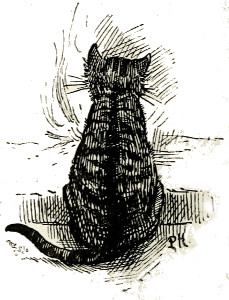
'Something has gone very wrong,' said Cincinnatus to himself in the cat
language. 'I don't pretend to understand it. This, is one of those many
matters that I should be glad to take my cousin the Sacristan's cat's
opinion upon. Dear me! what a misfortune it is to live here in the
country, away from the centre of social intercourse and civilisation.'
Then Cincinnatus fell to washing his face with his paws, for he
had lately had his five o'clock saucer of milk, you see; and it is
etiquette in cat-land always to wash after meals, not before them as we
do.
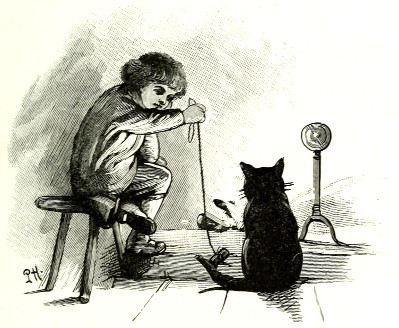
The yellow earthenware stove was lighted in the bedroom, and
Cincinnatus sat opposite to the open door of it, and blinked at the
heart of crimson wood embers, set in a fringe of flaky, grey ashes.
It was very warm there, but Cincinnatus blinked and washed his face
slowly. As to the heat, it soothed him, and inclined him to make a
number of reflections.
'At the risk of repeating myself, I must observe that men are poor,
improvident, thoughtless creatures,' he went on presently; 'subject to
illness and accidents of all kinds. However, a thoughtful cat will not
be hard upon them. Noblesse oblige. Those who have the advantage can
afford to be generous. Fancy coming into this world, now, where the
weather is so extremely uncertain, all pink and bare as they do, poor
things, without any comfortable fur to cover them; and having to make
up for it by enclosing themselves in all sorts of shapeless, foreign
substances, prepared from sheep's wool or vegetables. And no tail
either! Imagine being deprived of that most dignified and expressive
member. Yet, you must give them their due. Necessity has certainly
made them very ingenious.'
Cincinnatus stretched himself lazily in the hot glow of the stove fire.
'But with all their ingenuity only one life,' he said yawning. 'And
that one, as I observed just now, subject to all manner of illness and
accident. We have nine lives! Who would be one of them if he could help
it? Poor things, no wonder if they envy us.'
Then Cincinnatus went across the boarded floor with his noiseless
tread, and jumped up on to little Peter's bed, and began purring in
the most amiable and engaging manner, sticking out all his claws and
then drawing them in again and making a nice tight little fist, as he
trampled on the bed-clothes, first with one fore-foot and then with the
other. He even went so far as to rub his head along against the little
boy's shoulder, which, considering his opinion of the relative position
of cats and mankind in the universal scale of being, was really very
condescending of him, to my thinking.
But little Peter did not speak or pay any attention to Cincinnatus.
He only sighed in his sleep, and turned his round, black head on the
pillow. Poor little Peter had lain just like that, quite still and
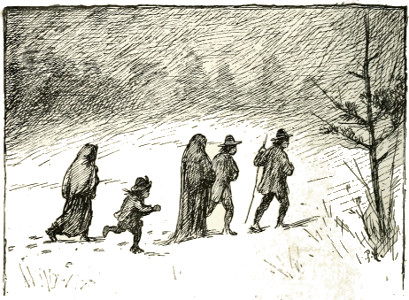
quiet, in bed ever since his father and the charcoal-burner had placed
him there when they had got home from that terrible walk in the snow,
about four o'clock in the morning. The ice-fairies, who really are
very elegant people and not at all disagreeable when you know them,
had come at sunrise and spread the most beautiful patterns—crowns and
crosses, and stars and diamonds, and ice flowers of a hundred exquisite
shapes—all over the window panes; but little Peter had been too tired
and sleepy to get up and look at them. And when, in the afternoon,
not without struggle and difficulty, for the road was dangerous with
snow-drifts, the kind, old doctor, with his red nose and his snuffbox,
had ridden over from Nullepart, and sat by the little boy's bed and
felt his pulse, and examined him carefully, with a face as wise as an
owl's, from behind his large spectacles, Peter had been too fired and
sleepy to look at him either. The old doctor had taken an extra pinch
of snuff, and shaken his head quite seriously, I am sorry to say, at
leaving.
Now it was past five o'clock, and Peter still lay in his little bed
dozing and sleeping—dreaming too, but not of the snow and the pain
of the winter. He dreamed of sunshine and of pleasant places, of the
singing of birds and the sound of the cow-bells in the flowery fields
in the spring-time. The elder boys and their father had gone to see the
doctor safe part of his way home again. And Susan Lepage had sunk down
in the big chair in the kitchen, and had fallen asleep, worn out with
fatigue and anxiety. And Eliza, hearing Gustavus come into the back
kitchen with the milk-pans, had slipped downstairs from watching beside
the child, just to have a word with him.
'Poor fellow,' she said, 'he really is so over-joyed at my being
restored to him, that there is no saying if he won't mix this evening's
milk with this morning's, or ruin the cream by shaking it, or commit
some other folly. He is not clever, and my family will certainly
reproach me with having married beneath me; but he has a good heart,
and I think he really appreciates me as he ought to, does Gustavus.'
So it happened that little Peter was left quite alone, but for the
society of the cat, up in the bedroom.
John Paqualin came along the flagged path to the front of the house;
and pressing his face close against the glass, for it was difficult
to see through them, the panes being frosty, looked in at the kitchen
window. Then he went to the house door, lifted the latch carefully,
entered, and stood still, listening. There was no sound save the
singing of the kettle, and Eliza's chatter in the distant dairy, with
the clump of the cowherd's boots on the flags and the clink of the
milk-pans. From the rows of copper kettles and saucepans, and the china
high on the dresser, to the red tiled floor under the charcoal-burner's
feet, the large kitchen actually shone with exquisite cleanliness. The
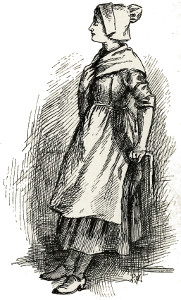
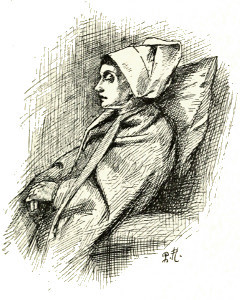
light of the lamp on the table fell upon Susan Lepage's high, white
cap, showing it and her pure, grave profile, as she leaned her head
back in the arm-chair, clear cut against the ruddy dusk of the chimney
corner behind her.
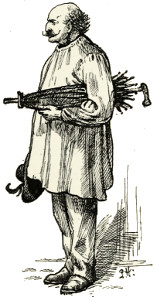
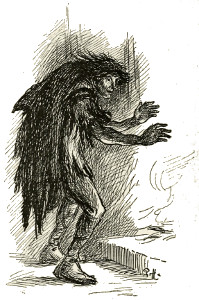
Paqualin, as he stood there silent and watchful, with his sunken eyes,
ungainly figure, and dilapidated garments, seemed strangely out of
place. He shaded his eyes with his hand, for the light dazzled him,
as he looked for a minute or two at the sleeping mother. Then he went
quietly across the kitchen and up the wide, wooden staircase.
'The house is asleep,' he murmured in his high, cracked tones:—'or
would be but for the voice of Eliza. Pah! the woman's tongue cuts like
a whip. But her sweetheart, the ass, has a good thick hide of his own;
he finds the lash only pleasantly tickling.'
Paqualin went into the warm, dimly-lighted bedroom above.
'The house is asleep,' he repeated. 'Hey-ho, Sleep's a kindly fellow,
with his turban of nodding poppies. He cures the heart-ache. But he's
forgetful, sadly forgetful. He hasn't been near me these five nights;
and God knows, I have had the heart-ache as badly as any of the others.'
He knelt down by little Peter's bed, and looked closely at the child.
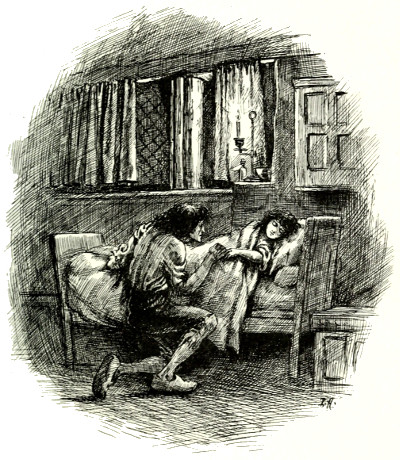
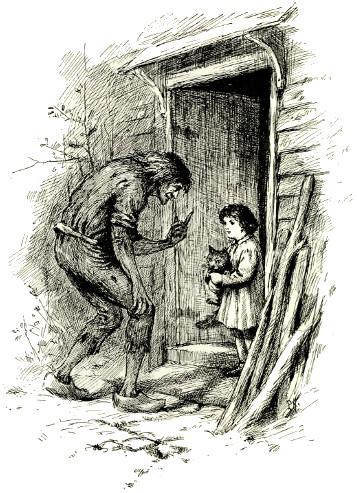
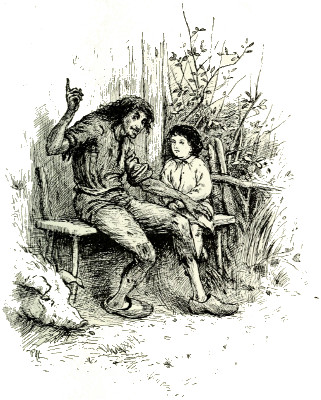
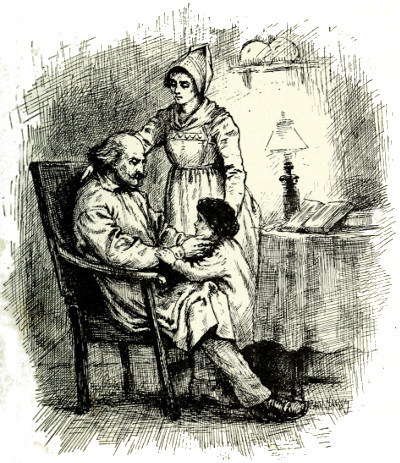
THE CHARCOAL-BURNER VISITS LITTLE PETER.
Page 150.
'Eh! Sleep is hardly a kind friend to you, I'm afraid, though,' he said
under his breath. 'A little
too much of the smell of the drowsy poppies here to be quite healthful.'
As he spoke, Cincinnatus, who had been curled up comfortably in a nice,
warm depression in the bed-clothes, jumped down on to the floor with
glaring eyes and a great tail.
'I won't spit though,' he said. 'It really isn't worth the trouble.
No, an air of absolute indifference will be even more impressive and
chilling.'
So he walked away very stiffly, and sat down opposite the open stove
door again.
The charcoal-burner placed one of his lean hands on the little boy's
soft, pudgy one, that lay palm upward on the pillow, and with the other
patted him tenderly on the cheek.
'Little Peter,' he said, 'wake up. Come back to us, dear, little mouse.
You said you loved me—nobody ever said that to me before. Don't go
away from me, do not desert me.'
He paused a minute, and then went on pleadingly:—
'Think of all the stories I have told you, remember the nuts and the
apples.—Eh! wake up, little lad, and come back to poor, ugly John
Paqualin, to whom his fellow men have shown such scant mercy.'
But the child lay quite still; his long, black eyelashes resting on his
pale cheeks, and his pretty, round mouth a wee bit open as he sighed
softly in that strange stupor of sleep.
Tears dimmed the charcoal-burner's eyes. He bent his wild shock head
and rested it down on the white coverlet.
'Ah, great God!' he murmured, 'Thou who art all powerful, listen to me.
See here, can't we make an exchange?—Take my poor, battered, weary,
old soul instead of his fresh, innocent, white one. Let me give him
my life for his mother's sake, the sweetest and most compassionate
of women. She will grieve if she loses him, her darling, her baby;
and kind as she is, she won't miss me very much. Why should she?—an
outcast of nature, a shameful, misshapen mistake; one sorry sight the
less in the world when I'm gone, that's all.—Death's dreadful, they
say—yes, I know I am afraid of it. But, after all, it can't be so very
much worse than life—at least for some of us.'
He threw back his head, and clasped his hard hands together.
'Here, take me,' he cried. 'I will come. A trifle of suffering, more or
less, what does it matter? Spare the little lamb, O Lord, and take me,
John Paqualin, as ransom.'
Now the charcoal-burner was not quite right in his head, you see, and
that accounts for his eccentric prayer and very original behaviour. You
had better bear this in mind. I won't tell you why; you will probably
find out for yourselves when you have seen more of the world and grown
rather older.
Paqualin knelt on there for some time, looking up as though he expected
a direct and visible answer to his singular petition. But nothing
happened save that Eliza came upstairs on the tips of her toes—a way
of stepping which she intended to be particularly quiet, but which
was, in fact, particularly noisy—and peeped into the room. Seeing the
charcoal-burner kneeling by the bed-side, she gave a fearful gasp, and
sank down into the nearest chair.
'The saints help and preserve us!' she exclaimed in a loud whisper,
holding her side, 'what next? Ah! how it startled me. The helpless,
sick child in the arms of that ogre! Go away, John Paqualin, go away.
How on earth did you get here? I've only been downstairs three minutes
giving some necessary instructions to Gustavus.—He really is beside
himself with joy, poor fellow.—Go away, I say; if Peter woke up
suddenly he would have a fit at seeing you. Look at yourself in the
looking-glass, and you'll understand why, fast enough. A rush of blood
to the head from fright and the child would be dead. And if half the
stories one hears of you are true, there is enough down on the wrong
side of your account already without adding wilful murder. Go along
with you.—Ah! I am so weak—my poor heart, how it beats.'
Eliza advanced, creaking across the boarded floor, towards the
charcoal-burner. He had risen to his feet.
'There is no answer,' he said, in a low voice. 'You fool, learn your
lesson. God doesn't want your wretched, worthless soul, John Paqualin.
Who are you, indeed, that you should try to strike a bargain with the
Almighty, and offer such miserable refuse and offscourings as your life
in place of that of the pure and sinless child there?'
He looked back towards the bed.
'Good-bye,' he said, 'dear, little Peter. When you are gone there will
be nothing left on earth to love me; and in heaven it's clear they can
do very well without me yet awhile.'
Then, as Eliza came close to him, whispering, pointing towards the
door, and signing to him, he turned upon her with a terrible face.
'Woman, leave me alone,' he said. 'Have not I enough to bear already,
without the maddening gnat-bites of your spiteful ignorance and cruel
folly?'
And the grasshopper man went out of the room, and down the stairs, and
into the dark frosty night.
Eliza leant up against the bottom of the bed, with her eyes half shut.
'Are you gone yet,' she murmured, 'you savage, wild animal?—If the
child had woke up and screamed there would have been a fine fuss, and
all the blame would have been laid on me, of course. It isn't fair
that crazy men like that should be allowed to persecute respectable,
young servant-women. I'll get Gustavus to lay an information against
him at the police station at Nullepart for using threatening language
to me. Of course it is all jealousy; but I can't help my good looks.'
Eliza opened her eyes again, arranged the mauve silk handkerchief about
her neck, and smiled complacently.
'It is a comfort to know that you have no cause to be ashamed of your
face—or of your disposition, for that matter, either,' she added.
Now this all happened on Monday evening, as no doubt you have made out
already. Very early, before it was light on Wednesday morning, little
Peter, who all that long time had lain sleeping unconscious of what
went on around him, suddenly seemed to find himself very wide awake
indeed. There was a strange light in the room, bright and yet soft like
an early summer dawn. And as the little boy opened his eyes, he saw
that at his bedside there stood a young man, with a calm, beautiful
face and shining hair. He was clothed down to the feet in a long,
white, linen garment.
As Peter looked up wonderingly, the young man bent over him. There
was something very still and gentle in his glance, and the little boy
smiled, for it seemed to him that the young man's face was that of an
old friend, though he could not remember ever to have seen him before.
Then the young man spoke to him, and said:—
'Little Peter, you have been sick and tired. Will you come away with me
to a far-off country where there is no more sickness and trouble, and
where the children play all the year round among blooming flowers in
green, sunny pastures by the river-side?'
Peter did not feel a bit afraid; but he thought of his parents and his
brothers, and asked:—
'But, please, will my mother, and father, and Paul, and Antony, and my
cat Cincinnatus, come too? Paul is very kind, and he makes such nice
mill-wheels to turn in the brook, and weathercocks to stick up in the
pear-tree and show which way the wind blows. And Cincinnatus would be
dull and lonely if I left him behind. He likes to come to bed with me
in the morning, and the old grey wolf might come out of the wood and
catch him, and make him into soup for little wolves when I was gone.'
The young man smiled as he answered:—'Never fear. Your mother and
father and Paul and Antony will certainly join you some day if they are
good. Time seems very short while we wait in that happy country. And
as to Cincinnatus, who knows but that he may come also? In any case,
he will be quite safe, for our Heavenly Father loves all his living
creatures—not only angels and men, but fish, and birds, and beasts as
well. Will you come, little Peter?'
'Ah! but there's John Paqualin,' said the boy. 'You know whom I
mean—the charcoal-burner. I can't leave him very well, you see,
because he is often very unhappy; and he says nobody will ever care for
him because he is rather odd and ugly-looking. And I do care for him
very much indeed.'
Then the young man bent lower and looked into little Peter's eyes.
'Why, why you are John Paqualin!' cried the child.
'Yes,' said the other, and his face was radiant with the peace that
passes understanding. 'I am John Paqualin. God be praised.'
'But how you have changed!' little Peter said; for he was a good deal
surprised, you know, and no wonder.
'With the Lord one day is as a thousand years,' answered the young man.
'Will you come with me now, little Peter?'
Then Peter stretched out his hands and laughed out loud with joy; he
was so very glad about quite a number of things—the thought of his
playfellows in that fair and happy country, and of the coming of his
parents and brothers, and of Cincinnatus the cat, and most of all at
the delightful change for the better that had taken place in the
personal appearance of his friend the charcoal-burner.
'Yes,' he said, 'I'll come.'
So then the young man took him up very tenderly in his strong arms, and
laid the little, tired head upon his breast and carried little Peter
away.
Now it happened, strangely enough, that though both Susan Lepage and
her husband sat watching by their child's bedside, they neither of them
saw the young man with the calm face and shining hair, or heard a word
he said. They only saw that the little boy opened his eyes suddenly
and seemed to gaze at something with a kind of glad wonder, and that
he smiled, and that his dear, little lips moved, and then that he
stretched out his hands and laughed joyfully. After that he lay very
still.
Susan Lepage waited a moment or two, then she rose and took a candle
that stood on the oak chest near the bed's head. Shading it with her
hand, she stooped down and looked closely at the child.
'Ah, my little one!' she cried.
She put the candle back again, and coming round the foot of the bed,
stood by Master Lepage, with her hand resting on his shoulder.
'My husband,' she said, 'our child will suffer no more. The dear Lord
loved him and has called for him. A child has died on earth. A child is
born in Paradise.'
There was a long silence. Master Lepage sat bolt upright with his arms
hanging down at his sides—more as though he was standing before the
general officer on parade, than sitting in the rush-bottomed chair in
his own bedroom. The big tears ran down over his cheeks and fell from
his moustache on to his blue blouse as thick as a summer shower.
'My wife,' he said slowly, 'our paths have joined at last—joined
beside an open grave, but better there than nowhere. There shall be no
more silence between us. The God whom you have served so faithfully
in time will surely heal the smart of your sorrow. And perhaps He
will condescend to listen to the prayers of a foolish, vain-glorious,
wrong-headed, old soldier, whom grief and repentance have humbled.
Pardon me, my wife. I have been wrong and you right all along.'
Lepage stood up, took her two hands in his, and kissed her.
'Ah, my dear, let us talk only of love and hope, not of pardon,' Susan
Lepage answered gently.
She turned and looked at little Peter, still and smiling, with his
round, black head resting so cosily on the white pillow.
'The autumn child has brought a blessing to the house,' she murmured.
'Ten thousand plagues!' broke out Master Lepage hoarsely. 'Twenty
thousand cut-throat Prussians!—but I loved the little one.'
And is that the end of the story?
Well, yes, as far as a story can be said to have an end—most stories
go on for ever, only we get tired or stupid and leave off reading
them—if the story has an end, I say, I suppose this is it. Still there
are just one or two little things I can mention which you might like
to know. For instance, when next day Gustavus happened to pass the
charcoal-burner's hut, he heard such a horrible barking, and yelling,
that, though he was not of a very active or curious order of mind, he
really had to go and see what was the matter. And on getting to the
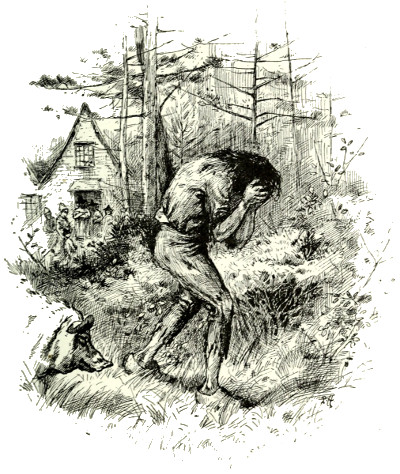
back of the hut he found Madelon, the sow, standing up on her hind legs
in her sty, with her fore-feet resting on the rough, wooden door of it,
her long, black snout high in the air, her floppety ears shaking, her
great mouth wide open as she squealed aloud, and not a single scrap of
food in her trough. This seemed to Gustavus such a singular thing, that
though he had no great fancy for the society of the charcoal-burner, he
thought he would just look inside the hut door, which stood half open.
The snow had drifted in at it and lay thick on the mud floor within,
there was no fire on the hearth, and the place was deathly chill. Yet
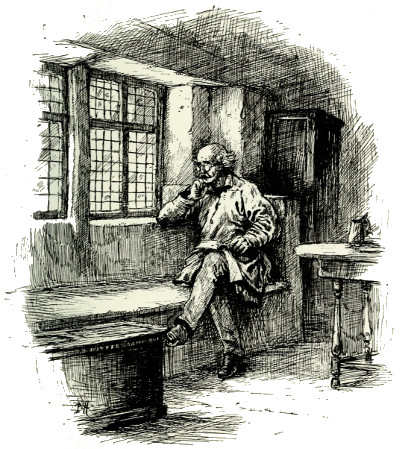
Paqualin sat there sure enough, on a wooden bench, with his elbows on
the table in front of him, and his head resting on his hands. His back
was towards Gustavus. The cowherd did not quite like to go inside the
hut somehow. He stood in the snow on the door-sill and called. At
last he plucked up his courage, and going forward pulled at Paqualin's
ragged sleeve.
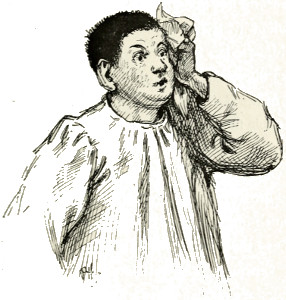
'Umph,' said Gustavus, as he stumbled out again in a desperate hurry.
He took off his hat and wiped his face round, for notwithstanding the
frosty day, he felt quite uncomfortably warm.
'Here, I'll give you something, granny,' he called out to the sow. 'If
you wait till your master brings it you'll wait a long time for your
breakfast to-day. Bless me! but I shall have something to tell our
Eliza this evening at supper that'll make her open her eyes!'
Antony has gone to serve his time in the army; and when his time is up
and he comes back again to the old, wooden farm-house in the forest, I
think it is very likely that the wish he wished in the dining-room of
the Red Horse at Nullepart, when he shared the double filbert kernel
with pretty Marie Georgeon, may really come true. Paul is apprenticed
to an engineer in Paris, and lives among whirling machines in the
great, crowded workshops; and his employers are much impressed with
his ability and talent, and prophesy that he will make a name for
himself some day. Cincinnatus is quite an old cat now, and his whiskers
are almost white; but he still sits opposite the glowing wood fire
in the kitchen, and blinks his big, yellow eyes and reflects on the
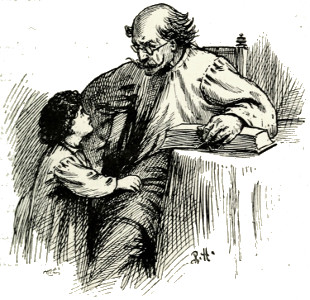
superiority of cats to men. And Master Lepage still reads the history
of the famous Roman Republic in the winter evenings, and takes off his
spectacles and wipes them with his red pocket-handkerchief; but he
rarely talks politics now, and never sits in the wine-shop, though on
fine Sundays he often walks with his gentle, sweet-faced wife through
the forest, and kneels humbly beside her in the church, and prays God
to guide and teach him, and forgive him all his sins.
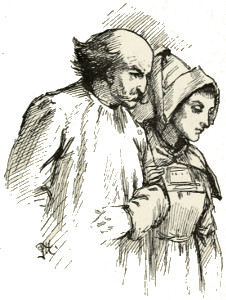
And is this a true story?
Yes, as true as I can make it, and I have taken a good deal of pains.
But did it all really happen?
Ah! that is quite another question. For you will find as you grow
older, that some of the very truest stories are those which, as most
people in this world count happening, have never happened at all.
And if you can't understand how that can be, I advise you, the first
fine day, to ask your way to Nullepart and take the opinion of the
Sacristan's cat upon the matter. He is a scholar, you know, so he is
sure to be able to explain it.
THE END.
PRINTED BY
SPOTTISWOODE AND CO., NEW-STREET SQUARE
LONDON
Transcriber's Note:
Variations in hyphenation have been retain as in the original
publication. Punctuation has been standardised.