"Well, Kirke, my lad, you need not mope indoors any longer," said Dr.
Wyman, calling in at the Rowes the next Monday morning. "I pronounce
you quite well enough to go to school."
"Rather stay at home, a great sight," muttered Kirke, playing with the
"tip-tail kitten."
"Nonsense! Why, I thought you liked to go to school."
"Did like it when Miss Bailey was there; but now they've put that tall,
strapping Miss Cumstan in her place, and"—
"And Miss Cumstan is to blame, I suppose, for being tall and
strapping,—whatever that may be."
"Oh, she's homely, and she's cross; and, besides all that, she's mean!
She bangs the boys against the piano, and gets it out of tune, and
then, sir, she makes 'em pay for tuning it."
"Easy, my boy, easy. Mustn't tell tales," said Dr. Wyman gravely. "I
dare say Miss Cumstan isn't half so black as the scholars have painted
her; but, anyway, she won't be likely to come in your way again very
soon, for Miss Bailey's arm has got well, and she is going back to
school this morning."
"Good, good, good!" cried Kirke, dropping the kitten and skipping out
into the back-yard, where Weezy was, to relieve his feelings by turning
a summersault.
"I don't see how you'll get along without me to amuse you, miss," said
he loftily; "but I'm going to school. Miss Bailey's come back, and I'm
going a-kiting."
"Be still stepping on my dollies," said Weezy, not at all impressed
by the news, if indeed she had heard it. She was very, very busy; for
she had a garden to make, and nothing to do it with but an iron spoon
and a tin mustard-box.
"Hoh! call those dollies, do you?" cried Kirke, hopping cautiously
over a row of poppies standing on their heads on the lower step. "I
should call 'em posies."
He need not have gone off laughing. The poppies, in their ruffled
scarlet skirts, made very nice dollies for a little girl used to dolls
without arms; and their green-leaf aprons were neat and becoming.
"Jingle, jingle," up the street.
"Spect that's the beggar-man," said Weezy, tumbling over her spoon in
her haste to tell Lovisa.
"Beggar-man's coming! Beggar-man's coming!" shouted she, running
into the kitchen, where her mother was helping about the fruit-cake.
"Dear me! if he is a tramp, I don't want him to come into the house,"
exclaimed Mrs. Rowe. "Do take him out something to eat, Lovisa."
Lovisa hurried to the pantry as fast as she could, for a bowl of bread
and milk; then she heard the man coming up the walk, and she ran back
to the kitchen to hand it to him before he should have time to enter.
"Here's something for you," said she, opening the door just far enough
to put the bowl through. "You can sit down outside on the doorstep and
eat it."
Instead of taking the bowl, the man began to laugh; and Lovisa opened
the door wider, and saw he was Mr. Blake, the baker.
"Beg your pardon, sir," stammered she, very much confused. "The little
girl said you were a beggar-man." And upon that she began to laugh,
too, and laughed so hard that Mrs. Rowe herself had to give the order
for "two graham loaves and a loaf of sponge-cake."
"Run, dear, and get mamma's purse off the bureau," said she to Weezy.
"I want to pay Mr. Blake some money."
The child brought the purse, and looked on while the bread and cake
were being paid for.
"Here, dear," said her mother, shaking some soiled visiting-cards out
of the portmonnaie, "you may have these to play with. Now put mamma's
purse back where you found it."
Weezy was gone some time, but presently she ran down again to her
garden. Mrs. Rowe would not have felt so easy stoning raisins in the
pantry if she had known the baker had left the gate unfastened.
Weezy was not long in discovering the fact. Unfortunately, she still
held the cards in her hand. They gave her an idea.
"Weezy'll go a-calling," said she, whisking through the gateway, with a
backward glance to see if anybody was looking. She felt quite equal to
the undertaking; for hadn't she been visiting once with her mother, and
carried the card-case all the way?
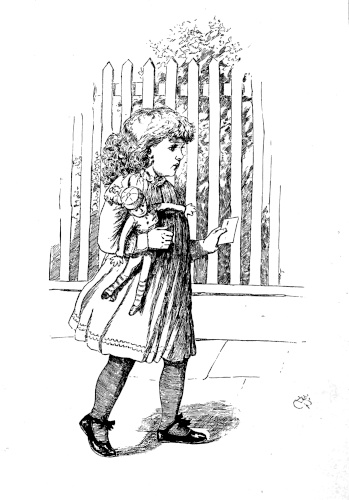
"'WEEZY'LL GO A-CALLING,' SAID SHE, WHISKING THROUGH THE GATEWAY."
"'Come in, you pretty little pet;' that's what the lady'll say," she
prattled on to herself, climbing the steps of the first house around
the corner, dragging armless Sambo after her by the stocking-yarn hair.
"Oh, what a high-up bell!"
Even on tiptoe she could not reach it. She laid Sambo down and stood on
top of him, but even then could only touch the bell-knob with the tips
of her fingers.
"Oh, my suz! guess I'll have to knock."
And she did knock, so very gently that nobody in the world could have
heard her.
"People's gone away off," said she, slipping a card under the door, as
she had seen her mamma do when nobody answered her ring.
"Weezy'll give 'em a card for when they come back. Don't want to be a
selfish girl."
After that she did not try to pull any more bell-knobs, but contented
herself with leaving cards at every house on that side of the street.
One happened to be a church, and another an oyster-saloon; but it was
all the same to Weezy.
When she reached the provision-store on the second corner from home,
she had only a single card left. As the door stood open, she carried it
in, and ran up to a pleasant-looking clerk, who was sorting apples.
"I've come calling," said she blandly, sitting down on a pile of
codfish.
"What upon earth!" cried the young man, starting in surprise at the
droll little figure.
"Me and Sambo, we've come a-calling," repeated Weezy, holding up the
long-suffering dolly. "Sambo's tired. Take him, please."
"Thank you, no; you must excuse me. What's your name,—Grandmother
Gripsey?"
"Weezy Rowe," replied she, drumming her small boot-heels against the
codfish, in some resentment at being called "grandmother."
"Where do you live?"
What made folks for ever and ever ask her that? She drew in her lips
till there wasn't a snip of scarlet to be seen, she was so afraid she
should tell; for she shrewdly suspected the man wanted to send her
home. In offering Sambo to the clerk, she had dropped her card; and
it lay on the floor, face upward, with "Mrs. Edwin Rowe, No. 6 Oak
Street," written very clearly upon it.
"Is that yours?" asked the young man, reading the address.
"It's my mamma's. We use 'em when we go a-calling," said she, with a
longing glance at the apples. "I like apples, I do."
The clerk ran to the door and called out to a boy in a market-wagon,
"Here, Jim, you have orders on Oak Street: leave this bundle at number
six, will you?"
Then, almost before Weezy knew it, he had lifted her and Sambo upon the
seat, and given the boy the card, so he could not mistake the direction.
The horse trotted off at a brisk pace, and the square baskets on the
floor of the wagon danced up and down the middle. These were filled
with vegetables and other articles that people had ordered for their
dinners, and Weezy's driver stopped every now and then at a door to
leave one. She found it great fun to go about in this fashion, and was
having a most delightful time when they drew up at her father's house
on Oak Street.
"But I don't want to be home," said she, with a twinge of conscience
at the thought of meeting her mother; for in the depths of her little
heart she knew it was wrong to run away.
But, when the boy lured her with a paper of figs, she was wonderfully
soothed. She let him lift her down at once, and skipped past him
through the back-gate.
Of course, he ought to have gone in with her, and told her mother where
he had found her; but, being a bashful boy, he did no such thing. He
watched her in at the kitchen-door, and then drove off.
Nobody had missed Weezy. Her mother was up-stairs combing her hair,
when the child came in with her frock full of figs.
"See what I've got for mamma."
"Why, where did you get them, child?"
"'Way, 'way off," replied Weezy evasively. "Isn't they good?"
Mrs. Rowe looked at her little daughter in amazement. She had run
against a molasses barrel in the store, and smeared her dress, and then
whitened it in spots with flour; and, as her mother raised her on her
lap, she perceived an unmistakable odor of fish about her.
"Weezy, where have you been?" said she sternly: "tell mamma the truth."
"Riding 'way, 'way off," persisted the child, sobbing now.
"But who gave you the figs?"
"Oh, the queer old boy I went a-riding with!"
Mrs. Rowe opened the window, and gazed up street and down, but did not
see any "queer old boy."
What could be the meaning of this wild story? Lovisa knew nothing about
it.
"And surely," thought Mrs. Rowe, "if a man had brought my baby home, he
would have left her in somebody's care."
Could Weezy have got the figs at the grocery opposite? Her mother had
sometimes let her run over there to buy a cent's worth of peanuts,
while she stood in the doorway watching her. But the grocer was not
fond of children. That he should have given her the figs, seemed
unlikely.
Mrs. Rowe's purse still lay on the bureau where Weezy had put it. Mrs.
Rowe unclasped it with an uneasy feeling. She distinctly remembered,
that, after paying the baker, there had been left a dime and a roll of
bills; and now the dime was gone. Mrs. Rowe recollected with a throb of
pain that Weezy had been a long time in carrying back the portmonnaie.
"Mamma has lost some money," said she. "Does Weezy know any thing about
it?"
"No'm," sobbed the child, terrified by her mother's solemn tone.
"Didn't my little daughter buy figs with it? Think a minute."
"No, she didn't," said Weezy, smothering herself in her apron.
Mrs. Rowe was distressed.
"It was very naughty to spend mamma's money," said she gravely; "but
it would be a great deal naughtier if Weezy should tell a wrong story
about it."
"I didn't mean to. I'm so sorry," cried the baby. "Weezy will be
good."
"And mother's darling won't ever do such a dreadful thing again, will
she?" said Mrs. Rowe, much relieved. "Don't you think mamma ought to
tie those wicked hands, to make them remember?"
"Yes'm," said Weezy meekly.
Five minutes after, Lovisa knocked at the door. Weezy sat on the bed,
her chubby wrists bound together by a neck-ribbon.
"Here's a dime, Mrs. Rowe, that I found under the kitchen-table. I
suppose you dropped it in making change."
"Weezy didn't take mamma's money," shouted the little gypsy
gleefully. "Isn't it so nice Weezy didn't take mamma's money?"
"The next time I punish Weezy I will try to be sure we both know what
the punishment is for," thought Mrs. Rowe, as, between laughing and
crying, she untied the child's hands. "How shall I ever learn to bring
up my baby?"