Dorothy May was a dear little girl, whose
soft eyes met yours with a twinkle in their
brown depths. She was very fond of Cousin
Ray, a bright-haired boy all curves and dimples,
who lived quite near and often came to play
with her.
These two little people wondered about the
great world around them; about the trees and
flowers, the birds and the blue sky.
Of course the fairies loved them, because
fairies love all children, and hover around them
to whisper strange sounds in their childish ears
and picture wonderful sights for their innocent
eyes. At least Aunt Polly said so, and told
beautiful stories to prove it. But there, if I am
going to tell you about the adventures of these
two little folks, I must begin with The Funny
Pudding.
CHAPTER I. THE FUNNY PUDDING.
LITTLE MISS DOROTHY.
DOROTHY and Ray were making
mud pastry on Aunt Polly’s back
steps. “Get me a little more water,
please; this paste is too thick,” said
Dorothy, and Ray brought the water from
Aunt Polly’s bright kitchen. They made mud
pies and mud cakes and took tiny sticks, with
which they traced lines, circles, and faces on
them.
“Wouldn’t it be nice to make real pies and
cakes?” said Dorothy.
“Yes,” answered Ray, “if you knew how.”
“Why, anybody can make them!” exclaimed
Dorothy. “It’s just raisins and things!”
“If I could make real pies and cakes I’d eat
them all the time,” said Ray.
“So would I!” exclaimed Dorothy.
“O no! you wouldn’t,” said a wee voice behind
them. The children turned and there stood a
little old woman about as high as your twelve-inch
rule. She wore a white cap and blue
apron and carried a tiny spoon in her hand.
“You couldn’t eat sweets all the time,” cried
the little old woman.
“Just try us,” said Ray. “I think I could.”
“I know I could,” cried Dorothy. “I love
tarts, I could live on tarts.”
“And pudding,” said Ray; “I could eat it
all day long.”
“So could I,” replied Dorothy; “I wish I had
some pudding now.”
“You shall have all the pudding you want,”
said the old woman, “if you do as I say. Sit
close together; close your eyes and when I say
‘Salt’ open them.”
The children did as the old woman said and
sat very still with their eyes closed while she
sang these words:—
“Listen, children, while I tell
How to make a pudding well:
Sift your flour fine and white,
And a quart will be all right;
Sugar, just a cup—no more;
Eggs, well beaten—put in four;
Lump of butter melt, and—halt!
Don’t forget a pinch of—Salt.”
The children opened their eyes at the magic
word. The old woman had disappeared, and
instead of Aunt Polly’s back steps they were in
the kitchen of a great castle.
“How funny you look, Ray,” said Dorothy,
“with that cap and apron on just like a
baker.”
“Well, you look funny too,” replied Ray;
“there’s a big daub of flour on your nose.”
Dorothy tried to brush it off and asked, “Is
it off?”
“No,” replied Ray; “it looks bigger than
ever.”
“Never mind it,” said Dorothy, “let’s go to
work and make a pudding, a sweet, juicy, delicious
pudding.”
“Good,” cried Ray; “my mouth waters
already. What can I do?”
“You can help,” said his cousin; “first of all,
we’ll get a large pan to mix things in.”
Over the fireplace in the great kitchen hung
shining pans of all sorts and sizes.
“I’ll have that large one,” said Dorothy,
pointing to one, and Ray started to get it. But
imagine their surprise when a round face appeared
on the pan that grinned at them, and all
at once the pan jumped down from its place
and began to waltz around the floor. It looked
so funny with its round body and short legs
that the children laughed aloud. All of a sudden
it gave a jump on to the table, where it
remained quiet, like any sensible pudding pan.
“Now for the flour,” said Dorothy; and no
sooner did she say the words than a barrel of
flour came dancing into the kitchen on long
spindle legs with the funniest face you ever saw,
and with its hands folded on its great stomach.
The children laughed so heartily at this droll
sight that the tears rolled down their cheeks;
and when the funny barrel made a low bow in
the middle of the floor, Dorothy was laughing
so hard that she could not speak, but Ray went
to the barrel and took out a quart of flour.
Then the barrel made another bow and walked
with a swagger out of the kitchen.
“Eggs next,” said Dorothy, “and here they
are.”
Four eggs appeared walking on stilts into the
kitchen. All at once they jumped off the stilts
and began to chase each other. The children
gave peals of laughter as they watched the
activity of the four eggs: at last Ray cried out,
“Let’s catch them.” The children began to run
after the eggs. Dorothy caught one and broke
it in the pan, and then the three other eggs
scrambled in as fast as they could. “This is the
funniest pudding I ever heard of,” said Dorothy.
“I wonder what comes next.” Just then a voice
sang—
“Listen, children, while I tell
How to make a pudding well:
Sift your flour fine and white,
And a quart will be all right;
Sugar, just a cup—no more;
Eggs, well beaten—put in four;
Lump of butter melt, and—halt!
Don’t forget a pinch of—Salt.”
“Get the sugar and salt, and I’ll melt the
butter,” said Dorothy; and no sooner did she say
the words than sugar, salt, and butter dropped
into the pan before their eyes.
Then a great spoon walked up to the pan
and began to mix the pudding while Dorothy
and Ray looked on in wonder.
“I forgot raisins,” said Dorothy; and just
then a shower of raisins fell into the pudding.
The children watched the wonderful pudding
making itself. “I wonder whose castle this is,”
said Ray; “let us walk around and see if we can
find out who lives here.”
“And when we come back the pudding will
be all made,” exclaimed Dorothy.
They walked out of the kitchen and came to
a great dining-room where a table was spread
with all sorts of good things. There were two
chairs at the table, and it did not take the children
a minute to sit in them and sample the
goodies. Ray passed Dorothy a plate that was
heaped with flaky jam tarts, and in a very few
minutes there wasn’t a tart left on the plate.
They ate plum cake and mince pies, and when
these were disposed of a great steaming pudding
appeared in the center of the table.
“Perhaps it’s our pudding all cooked,” said
Ray, “how good it smells.”
They piled their plates with the pudding
again and again, forgetting their good manners
until it was all eaten up.
When everything on the table was eaten they
arose and walked into another room. They
found a table filled with fruit, candies and bon-bons.
In a short time these were all eaten up and
another room in the castle explored.
“Suppose we go outside,” cried Dorothy. “I
couldn’t eat any more, could you?”
“No,” said Ray; “I don’t feel very well.”
“I don’t either,” said the little girl, and they
took each other’s hands and went outside into
a garden.
There was a beautiful fountain playing in the
sunlight, but the children never noticed it. To
tell the truth they had eaten so much that they
did not feel happy at all, and could not enjoy
the lovely garden.
“I shan’t go another step,” said Ray, with a
frown; “I’m going to rest on this bench.”
“Don’t be so cross,” cried Dorothy. “I’m
going to sit down too.”
Just as Dorothy sat down there was a loud
noise, and in the distance the children saw a
great giant approaching.
“Let’s hide,” said Dorothy, and quick as a
flash the children got behind the bench before
the giant had seen them.
There was a hole in the back of the bench
and they could peek through. The giant walked
right over to the bench and sat down, while
close behind it, the children were hiding as
frightened as could be.
They didn’t dare speak, but they thought
that the giant was the ugliest monster they had
ever seen.
After a while he put up his great arms and
yawned. The bench groaned and creaked with
his immense weight, and all at once it broke
down and the giant lay sprawling on the
ground. The children jumped from their
hiding-places, but not before the giant had
seen them.
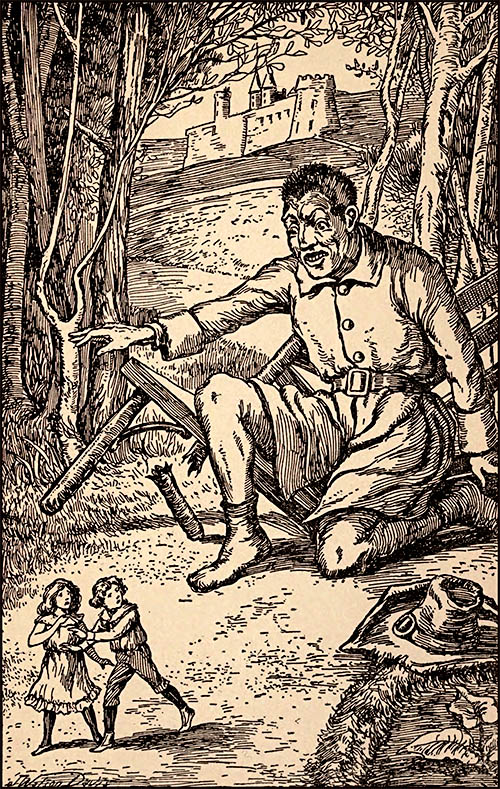
“What are you doing in my garden?” roared
the giant, getting on his feet.
“If you please, we got here by mistake,” said
Ray.
“We were in the castle,” explained Dorothy,
“where we ate so many tarts and things that
we had to come out here.”
“So ho!” roared the giant. “Did you know
that whoever enters my castle belongs to me?”
The children trembled, and the monster continued:
“This is the kingdom of the greedy,
and I am the ruler; henceforth and forever you
belong to me.”
“Oh, please let us go home,” said Dorothy;
“we don’t like your castle.”
“Silence!” roared the giant. “If you disobey
me I’ll boil you in my pot of soup.”
The children were very quiet after that terrible
threat and did not dare raise their eyes
to look at the giant. They felt very badly.
Dorothy had a pain in her stomach and Ray’s
head ached.
“What are you doing in my garden?” roared
the giant, getting on his feet.—Page 10.
Little Miss Dorothy.
Suddenly a great bell rang and the giant
jumped saying: “There’s the dinner-bell, come
with me.”
“Please, Sir Giant, we don’t want any dinner,”
said Ray, timidly.
“Silence!” roared the giant, “if you disobey
me I’ll boil you in my pot of soup.”
Poor sick, surfeited children! They followed
the giant into the castle and sat at the very
table where they had eaten so much.
The table was all piled high with a fresh
supply of pastry and the great greedy giant soon
devoured everything in sight. The table of
goodies made Ray frown, and Dorothy’s head
ache. When the greedy monster had eaten
everything in sight, he leaned back in his chair,
closed his eyes, and in a few minutes began to
snore.
“Now is our chance,” whispered Ray, and he
took Dorothy’s hand and they stole on tiptoe
out of the room. Just as they reached the door
a voice sang out, “I’m all ready.”
The children turned and there stood their
great pudding that had made itself. They
started to run away, but the pudding ran after
them calling:
“Come back, come back!” On and on ran
the children, and every now and then a slice
of pudding struck them on the back as they
ran.
Down the long garden, through winding paths,
over hedges the children fled from the funny
pudding and the kingdom of the greedy.
At last they reached a gate and when they
were outside the very first person they met was
the little old woman with the white cap and
blue apron. “What!” she exclaimed, “you are
not running away from all the good things in
the castle, are you?”
“Yes, we are,” cried Ray, “we want to go
home.”
“But think of all the pies and tarts and
puddings in there!” cried the little woman.
“I would rather have my nice bread and
milk than all the tarts in the world,” said
Dorothy.
“But you said you could live on sweets and
eat pudding all day long,” said the old woman.
“We didn’t mean it,” replied Ray. “We don’t
want any more pudding and we do want to get
away from the kingdom of the greedy and this
terrible giant.”
“Well, well!” said the old woman; “I don’t
blame you for that; he is certainly a very ugly
giant, and little boys and girls ought not to
belong to his kingdom.”
“Never,” said Ray.
“You know,” continued the old woman,
“when little boys and girls are greedy and
want more than mamma thinks is good for
them, they belong to the kingdom of the greedy
and this giant is their ruler.”
“He is such a horrid giant, too,” said Dorothy,
“so ugly and impolite.”
“Yes,” cried Ray, rubbing his stomach, “he
gives me a pain.”
Then the little old woman touched them
lightly with her spoon and vanished with a
smile and the children found themselves on
Aunt Polly’s back steps in the midst of their
dear mud pies.
CHAPTER II. THE LITTLE ROSEBUD CALENDAR.
WHEN Ray was only a baby he
would hold the woolly lamb that
grandma had brought him in his
chubby little fists, saying, “I love
oo, lamb,” and there was a great colored ball that
he liked to roll across the floor and say, “Oo ball,
tum back, tum back.” Then he would run and
catch it and hold it up to his dear little dimpled
chin.
But when he grew to be quite a little man
and could walk from room to room it pleased
him to sit in the big chairs, look at the pictures
and talk to them all by himself. There was
one small picture card on his papa’s desk that
Ray liked very much. It was the picture of a
golden-haired girl standing beside a large vase,
with a bunch of roses in her hand and a wreath
of rosebuds on her head.
“I think she looks just like my cousin
Dorothy,” said Ray, “only she wears her dress
right down to her slippers and Dorothy’s dress
is short.”
His mamma had told him that the picture
girl was little Miss Calendar, but Ray liked to
call her Rosebud.
One afternoon Ray was feeling rather tired.
He sat all curled up in his papa’s easy-chair at
the desk.
“Please, Rosebud, I wish you would talk to
me,” said Ray wistfully, looking at little Miss
Calendar with tired eyes.
The picture-girl smiled at him and whispered,
“How do you do, Ray?”
“I’m very well, thank you,” answered the little
boy; “but I didn’t know that you knew me.”
“Didn’t you?” replied Rosebud. “I know
you very well indeed.”
“That seems strange,” said Ray; “how do you
know me so well?”
“I see you every day and hear your mamma
talking to you,” was the answer.
“Yes, of course you do, I never thought of
that,” said Ray. “Perhaps you see everything
I do.”
“I do indeed,” replied the picture-girl;
“that is, I see everything you do in this
room.”
“You must excuse me for throwing all the
books on top of you when I was putting my
papa’s desk in order. I hope it did not hurt
you.”
“Of course I don’t like to have books thrown
at me, it hurts my feelings,” said Rosebud
sweetly.
“I wouldn’t do that for anything and I shall
be more careful,” added Ray.
“Do you ever play?” asked the little boy
thinking what a sweet little playmate Rosebud
would be.
“O yes, when I’m not busy.”
“What do you do when you are busy?”
asked Ray with curiosity.
“Well, you see,” said Rosebud, “all the days
of the year are numbered right under my feet,
and when people come in to see my calendar I
smile and hold up my roses, so that they may
know that it is a beautiful day and smile also.”
“But suppose it isn’t a beautiful day,” said
the boy; “suppose it happens to be dark and
rainy.”
“But every day is beautiful and if it is a
little dark I try to look all the brighter.”
“I don’t like rainy days very well,” said Ray,
“but perhaps they are nice.”
“Indeed they are,” answered Rosebud; “how
bright the flowers look after a shower! And
the dear rain washes everything, you know.”
“Rainy days are good, I forgot about the
flowers and things,” said Ray and then added
quickly, “If you were not busy now you might
play with me.”
“I’ll tell you a story,” said Rosebud, “if you
would like to hear me.”
Ray was delighted to hear a story and sat
very still while Rosebud began:—
Once upon a time there was a little brown
mouse whose name was Nibble. He built himself
a snug house not far from the coal-bin in a
nice warm cellar. Every day he attended to
his household duties, called at his grocery store
(the pantry up-stairs) and then went out for a
quiet walk. One day he met Mrs. Ratt, who
lived across the street, and he stopped to have
a friendly chat with her.
“How do you like your tenants?” asked Mrs.
Ratt.
“Very much indeed,” replied Nibble. “They
are so exclusive that they won’t even tolerate a
cat. Of course that shows their good sense,
because of all creatures I do dislike cats, they
are so——”
“Grasping,” sneered Mrs. Ratt.
“Yes,” assented Nibble, “and nosy, if I may
use a vulgar expression.”
“And sly,” quoth Mrs. Ratt, shaking her
head.
“Yes, indeed,” replied Nibble, “if those horrid
cats had their way they would drive us out of
existence.”
“Well, thank goodness, I’m not annoyed by
the ill-bred creatures,” he added with a satisfied
blink.
“No,” sighed Mrs. Ratt, “you are rich and
prosperous while I have to scratch for a bite to
eat.”
Nibble gloried in his good fortune, so he told
Mrs. Ratt about all the good things he had to
eat, and to crown this air of plenty he invited
Mrs. Ratt and all her family to a party the
following night. Then they parted and Nibble
went home to arrange his house in neat order
for his guests.
He had some fine old cheese and was going
to make a rarebit for his friends, but he got so
hungry that he ate it all up, and on the night
of the party he found that he had but one
cracker and a piece of an old shoe. He was
disappointed, because he wanted to impress
Mrs. Ratt with his abundance. He had just
made up his mind to go to the grocery store
before she came when he heard a little squeal
outside his house, and on opening the door
there stood Mrs. Ratt and all her children.
“Good evening,” said Mrs. Ratt, “I’m afraid
we are a little late, but the fact is I’m rather
timid, you know, and waited until it was quite
safe.”
“You did perfectly right,” said Nibble. “I’m
afraid you live in a very dangerous locality.”
“I should say so,” replied Mrs. Ratt, and she
raised her eyes in horror. “There have been no
less than five hold-ups within the last week,
all my relations too,” she added with a squeal.
“Who is the desperado?” asked Nibble.
“Who should it be but our ancient enemy,”
groaned Mrs. Ratt, shaking her head. “A precious
pair of rascals by name Thomas and
Maria, they are the terror of our peaceful community.”
“Horrors!” exclaimed Nibble, “those two
midnight prowlers!”
“Yes,” sighed Mrs. Ratt, “not only committing
deeds of violence, but disturbing the
whole neighborhood with their orgies.”
“Well, well,” said Nibble, “there’ll be an end
to it some time,” and Mrs. Ratt added quickly,
“Yes, if there isn’t an end to us first.”
“I wonder people put up with their behavior!”
exclaimed Nibble.
“Put up with it!” echoed Mrs. Ratt, with
scorn, “they like it and encourage those cats in
their evil doing. Why, only the other day I
happened to be peeking through the blinds
and there stood a man stroking this same
notorious Maria and calling her pet names.”
“The idea!” said Nibble, “and what did she
do, the pampered thing?”
“Why, even then, she had her back up
about something,” was the answer.
“Suppose we think of something more pleasant
to talk about,” ventured Nibble, in his
sweetest tones, “these cats grate on my nerves.”
Just then the baby rat cried out, “I’m hungry,”
and Nibble had to give him the only cracker to
eat.
“Now, what shall I do?” thought Nibble;
“there isn’t a thing in my house except that
old shoe, and that will only sharpen their appetites.”
All at once a new thought struck him and
he said, “I have a little surprise in store for
you, my dear Mrs. Ratt; instead of having the
party in my humble place, I thought we might
go up-stairs where there is more light and
air.”
“How delightful!” exclaimed Mrs. Ratt,
while Nibble added, “Of course we will be
just as quiet as possible to show the folks that
we do not hold our gatherings after the manner
of those ill-bred cats.”
“Certainly,” assented all the rats, and they
followed their host out of the cellar and up the
stairs so quietly that you would never have
heard them.
They had supper in the pantry, and a most
tempting repast it was! Crackers, cheese, apples,
lump sugar and a delicious morsel of
mince pie.
“How thoughtful your tenants must be!”
said Mrs. Ratt, “this pie is really good.”
“Just like mother used to make,” said Nibble
with a wink.
“But what have we here?” cried Mrs. Ratt,
smelling a stone jug.
She got the stopper off and after taking a
deep whiff exclaimed: “Elderberry wine as
I live!” Then she raised her eyes and said:
“Ah, Nibble, you are indeed blessed with the
good things of this life!” Nibble waved one of
his front feet as much as to say, “This is really
nothing at all, you know,” when all at once those
young rats knocked over the jug of wine. It
made a terrible noise and very soon footsteps
were heard approaching the pantry. In a second
Nibble had started with all his friends behind
him and never stopped running until he reached
his house in the cellar quite breathless with
excitement.
No sooner did he get in bed than he heard a
terrible squeal in the street and he knew that
something dreadful had happened to Mrs. Ratt
and her family.
As he never saw them again he had strong
suspicions that Thomas and Maria had added
another crime to their long list of misdeeds.
Whether it was owing to the elderberry wine
or the hasty flight, Nibble slept very sound that
night and all the next day.
After that he felt better, and one morning he
ventured to peep out.
Imagine his surprise when there sat a bold,
bad cat looking at him.
“Good morning,” said Maria, pleasantly.
“How do you do?” returned Nibble with great
dignity.
“O, won’t you come and play with me?”
asked Maria in her most coaxing tones.
“No, thank you,” said Nibble, “I’m too busy.”
“How doth the little busy mouse
Improve each shining minute.
She softly travels through the house
And gets the best that’s in it.”
Thus sang Maria, and then laughed long and
loud, but even this little serenade would not
tempt Nibble from his cosy house.
“You are the handsomest mouse in these
parts,” said the cat.
Nibble pricked up his ears; he did love to be
flattered, and whispered, “Think so?”
“I’m sure of it,” answered Maria; “and if it
was not for the fact that you’ve lost your tail
you’d be the prince of fine fellows.”
“But I haven’t lost my tail,” declared Nibble;
“it is very long indeed.”
“I can hardly believe that,” said Maria, “because
the other day when you went up-stairs to
the pantry I could not see any tail.”
“Did you see me the other day going into
the pantry?” asked Nibble in surprise.
“O yes, indeed!” answered the cat.
Now this statement of Maria’s was not true, as
she had never seen Nibble until that moment,
but the foolish little mouse believed it, and
thought if the cat did not hurt
him
on that other day she would not now.
“I’ll just run across the cellar and then you
can see for yourself what a nice tail I have,” said
the vain Nibble.
That was all the cat wanted. She caught
Nibble and that was the last that was seen of him.
When Rosebud had finished this story she
danced all around on her dainty toes. Then she
glided slowly forward and backward, making
low courtesies to the little boy. After a while
her steps became faster and faster. She shook
her pretty curls and beckoned to Ray, and before
he knew it he was dancing too.
Rosebud took his hand, and together they
danced all around the room.
The strangest part of it was that they danced
over chairs and tables as lightly as if they were
not there. O it was delightful, and Ray felt that
if there had been a window open they would
have danced right out and up to the blue sky.
At last they stopped a minute, and just then
there was a step in the hall and somebody
opened the door.
It was Ray’s dear mamma who had missed her
little boy and had come to find him.
“O mamma!” exclaimed Ray, “I want you to
meet my little playmate.”
Ray turned to find Rosebud, but she was not
there. Then he looked behind the chairs and in
every corner but he could not find her.
He was just beginning to feel very much disappointed
when he happened to looked on his
papa’s desk. There was Rosebud in her old
place on the picture standing with her bunch of
roses and smiling at him.
CHAPTER III. THE BOY IN THE TEAPOT.
ON Aunt Polly’s table stood a blue
china teapot. Such a pretty little
teapot it was, with strange leaves
and figures all over it, and right
in the center was a queer little boy with two
great birds, one on each side of him. He was
dressed queerly too, not at all like the little boys
you know. He wore a loose sack with very
wide sleeves and a broad sash that went under
his arms. His trousers were very wide and he
had on the dearest little slippers with curled up
toes.
Ray liked to look at Ah Lee (that was the
teapot boy’s name) and wondered about him.
And as our little boy often visited Aunt Polly
he became very well acquainted with the strange
little boy in the teapot.
One afternoon his auntie had company and
Ray was among the guests. After having a cup
of delicious tea, made in the blue china teapot,
everybody looked at Ray and then stole softly
into the parlor.
He was lying on his back on an old-fashioned
lounge, his hands under his head, thinking about
the teapot boy.
Imagine his surprise when all at once somebody
said, “I think I’ll go home this afternoon.”
“Excuse me,” said Ray, who was not quite
sure, “did you speak, Ah Lee?”
“Yes,” answered the boy in the teapot, “I’m
going to take a flying trip home. Would you
like to come?”
“Thank you,” said Ray, “I would like it very
much, if you don’t stay too late.”
“Come along then,” replied Ah Lee, stepping
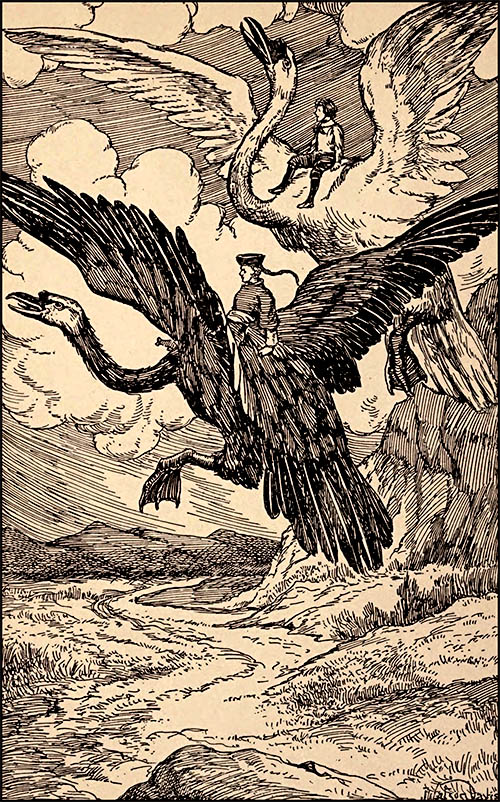
down from the teapot and the two great birds
with him. He jumped on the back of one of
the birds and said to Ray, “Follow me,” and
almost before he knew it, Ray was on the back
of the other bird flying through the air behind
the teapot boy. They flew over houses and high
church steeples, over the tree-tops and telegraph
poles, over deep woods and open green meadows.
At last they came to a very large lake.
“Let us fly down here and water our birds,”
said Ah Lee, beginning to descend on his great
bird. Ray did the same, and when they were
near enough to the water the birds put their
long bills into it and took a deep drink. Then
they rose into the air again and continued their
journey over the land and over the sea.
“Is it very far?” asked Ray, as they flew along
faster and faster all the time.
“We are almost there,” answered Ah Lee,
and in a very few minutes they began to descend
down, down, down, until they touched the
ground.
The boys got off the birds and Ray looked
about him. He had never seen such queer
sights before. The people around him looked
just like Ah Lee.
Almost before he knew it, Ray was on the back
of the other bird flying through the air behind the teapot
boy.—Page 32. Little Miss Dorothy.
They were dressed in soft, bright-colored silks
and had long braids of straight black hair.
Ah Lee took Ray’s hand and they walked
along till they came to a queer little house with
a garden.
“Now you sit here and wait for me,” whispered
Ah Lee, and he went into the house while Ray
waited on a small black stool. He thought the
flowers were very pretty about him, and he was
just going to take one when a voice called out,
“The Princess comes to the garden!” Ray
turned to see who had spoken and beheld a little
girl, who smiled at him and held a fan behind
her ear. She asked him who he was and whence
he came and when he had told his story she said:
“My name is Yan Lu and I attend the Princess.”
“How I would like to see her!” exclaimed
Ray.
“Then follow me,” said Yan Lu. “I will hide
thee behind a great plant and thou canst see
the Princess when she comes.”
Ray followed Yan Lu and as they went along
he could not help looking at her feet. Such
tiny feet he had never seen! They were so
small that she could hardly walk. She took
little mincing steps and rested a great many
times, looking behind at Ray and smiling.
“Are your shoes too tight?” asked our little
boy, feeling sorry for Yan Lu and glad that his
own shoes were so comfortable.
But Yan Lu looked down at her little feet
and only laughed and then glanced slyly at Ray
and laughed again. He began to think that
perhaps they did not hurt her, she laughed so
much about it.
Ray noticed that her hair was all done up in
rolls and had great pins sticking through it.
“She is really a very odd little girl,” thought
Ray.
They came to a large plant and Yan Lu told
Ray to stand behind it. Then she waved her
fan to him and took her little mincing steps
again and walked off. In a few seconds Ray
saw a procession coming. He kept very still,
and as it came nearer he saw that four tall men
were carrying a sort of chair in which a little
girl was sitting.
“That must be the Princess,” thought Ray,
and just then he caught sight of his little friend
Yan Lu who walked behind the chair.
When they reached the spot where Ray was
hiding the four tall men placed the chair on the
ground and the little Princess arose and stepped
out of it. She waved her hand and the men
took the chair and walked away. Ray was not
afraid of the Princess, but still he did not want
her to see him, so he kept as still as a mouse
behind the great plant.
She looked all round and suddenly peered
through the leaves at Ray. Their eyes met
and the little Princess said softly, “Peek-a-Boo!”
Ray could not help smiling, but he quickly
stepped to the other side of the plant. The
Princess did the same and, smiling through the
leaves, whispered again, “Peek-a-Boo!” Then
Ray came from behind the plant and stood face
to face with the Princess and Yan Lu.
“Won’t you please tell me your name?” asked
Ray, and the little Princess replied:
“Why, my friend, I have told it to you twice.
My name is Peek-a-Boo.”
“Are you carried in that chair all the time?”
asked Ray, and Peek-a-Boo replied:
“Most of the time; you see my feet are so
small that I cannot walk very well, they are
smaller even
than
Yan Lu’s.”
“What a pity,” cried Ray; “I hope they
will grow bigger.”
“O no, little boy; they are all bandaged up
so that they cannot grow!”
“It must hurt,” replied Ray.
“Well, perhaps it does a little,” said Peek-a-Boo
with a giggle; “but in my country it is
considered very nice for girls to have tiny
feet.”
“My cousin Dorothy is a little girl like you,”
remarked Ray, “and her feet are almost as large
as mine.”
Both girls gave a little shriek at this piece of
news and Peek-a-Boo said, “O-o-o! that must
be dreadful!”
“O, no, it isn’t,” answered Ray quickly; “I
think it is fine to have feet that you can run
and jump with.”
Yan Lu laughed aloud and Peek-a-Boo giggled
behind her fan.
“Would you like to play?” asked Peek-a-Boo
suddenly.
Before Ray could answer Yan Lu whispered
something to the Princess and she said, “Truly
I forgot it is the great kite-flying day and my
grandfather flies a ship.” She turned to Ray and
said, “Come quickly.” He followed the two
little girls down the garden path and all at once
he saw the queerest sight. A number of people,
old and young, were flying kites.
They were very much interested in it and
Ray had never seen such queer-looking kites
before. They were all sorts and sizes, and all at
once Peek-a-Boo clapped her hands and cried,
“There is my grandfather with his great ship.”
Ray looked and saw an old man with a kite
shaped like a great ship, and he was running
hither and thither with it like a boy.
It was fun for Ray to watch him and he grew
so excited that he ran to the old man and asked
if he might help.
After much effort the great kite rose in the
air and everybody seemed pleased. Ray watched
a small boy whose kite was so far up in the air
that it looked like a tiny white speck. All at
once the boy began to draw down the kite, and
when he caught it Ray saw that it was in the
shape of a great fish.
When he had seen all the queer kites Yan Lu
whispered:
“You must be hungry, come with me and get
some dinner.”
Peek-a-Boo remained near her grandfather
viewing the kites, while Ray followed Yan Lu
into the house and sat at a table right beside his
old friend Ah Lee. A small bowl was placed
before him and two little wooden sticks. Ray
forgot where he was for a minute and started
to drum with them, but Ah Lee gently touched
his foot and Ray remembered that it was not
polite to drum on the table.
Ray had a dish of chop suee and a tiny
cup of black tea which tasted very good indeed.
As they arose from the table he could hear
voices singing in another room and it sounded
just like this:—
“Oo luck ging foo,
Chow chow wing choo,
Ah Lee chee chee,
O chee O chee.”
It sounded so funny to Ray that he laughed
aloud, but Ah Lee shook his head and Ray said
quickly, “Please excuse me.”
“Are we going home soon?” asked Ray, as
they went into the garden.
“Yes,” answered Ah Lee, “we are going now.”
He took Ray’s hand and they ran quickly to the
spot where the great birds were waiting for
them.
Just as they jumped on the birds, Ray saw
Yan Lu and the little Princess Peek-a-Boo waving
their fans and saying “Good-by, come again
from the land of big feet.”
Ray smiled at the two little girls and rose in
the air on his bird.
In another minute he was flying; over lakes
and rivers, mountains and valleys, and far over
a great deep ocean where large ships were
sailing.
Ray held on to his bird with all his might
when they were flying over the dark water so
that he would not fall.
Again they flew over steeples and house-tops
and reached Ray’s country. Right down to
Aunt Polly’s house flew the birds, but how they
got into the house and how Ah Lee and his
great birds got back to their old places on the
teapot, and how Ray found himself on the
lounge, I leave you, my dear little readers, to
guess.
However, it was all done so quickly that nobody
knew what had happened except Ray and
the Boy in the Teapot.
CHAPTER IV. THE BRONZE WOMAN.
THE bronze woman held a brown
jar on her head and stood on a
rug in Dorothy’s parlor. One
night just before bedtime Dorothy
sat on the rug and tried to talk to the
bronze woman, but she remained very silent, so
after awhile Dorothy said “good night” and
went with her nurse to bed. When she was
alone, all tucked nicely in her little white bed
she felt a draft of cold air blow right in her
face and at the same time her window opened.
There stood the bronze woman on the window-sill
with her brown jar on her head looking at
Dorothy.
“Where are you going?” asked the child,
watching the woman in the moonlight.
“I’m going for water,” was the answer almost
in a whisper.
“Can I help you?” asked Dorothy, who was a
dear little maid, willing to help everybody.
“No, thank you,” said the bronze woman, “I
am used to carrying it, but I’ll give you a ride
on my head.”
“How good that would be!” exclaimed Dorothy,
and she got into the jar which held her nicely
and away she went with the bronze woman.
Her head came up to the top of the jar and
she could look up at the stars and moon and
wondered if she were going up to them.
But they did not seem to be going towards
the sky as they passed along through the air.
After awhile it grew so very dark that Dorothy
could not see where she was going. However,
she was not at all afraid, as she was safe in the
brown jar, and enjoyed the queer ride very much.
It seemed a very long time to her before it grew
light again, but at last it was brighter, and the
bronze woman stopped and sat down on the
ground.
“Now, little girl,” said the bronze woman,
“you may run about and play, while I go for
the water.”
Dorothy was very glad to come out of the
jar, because her legs were a little cramped.
For several minutes she ran about, jumping and
skipping to limber them up. At last she stopped
and found herself on the bank of a very wide
river. There was something that looked like a
great black fish on top of the water, and Dorothy
going nearer, saw that it was a crocodile. She
had a picture of it at home, and papa had told
her all about it.
While she was looking, a great many crocodiles,
large and small, appeared on the surface
of the water, and then came to the bank and sat
in a row. Dorothy hid behind a small tree and
watched them, and very soon more crocodiles
came out of the water. Last of all, a long
crocodile appeared, and he took a seat facing all
the others.
“Why, it looks just like a school,” said
Dorothy to herself, and in a few minutes she
saw that it really was a school.
“It seems so funny to see crocodiles at
school,” said the little girl, and she crept softly
a little nearer. One large crocodile sat apart from
the others with a great dunce-cap on his head.
Suddenly the teacher opened a book and said
to the first crocodile, “Spell your name.”
“C-r-o-c-k-o-d-i-l-e,” spelled the crocodile who
sat in the No. 1 seat.
“Wrong,” said the teacher. “Who can spell
it?”
“I can,” said Dorothy, jumping up from her
hiding-place. She forgot all about being afraid,
and stood before the crocodiles and spelled the
word correctly. It was Dorothy’s pet word and
she often spelled it for papa.
“That is right,” said the teacher, “and you
may stand at the head.”
The poor little crocodile who failed had to
go to the foot of the class. He began to cry so
hard that Dorothy felt very sorry for the poor
thing and almost wished that she had not taken
his place, but a great crocodile who stood beside
her whispered in her ear:
“Those are only crocodile tears, you know,”
and Dorothy felt better.
“Now tell me, what is the shape of the earth?”
said the teacher to a small crocodile.
“Flat,” was the answer, and the teacher said,
“very flat.”
This did not seem just right to Dorothy, and
she was trying to think where she had heard
that the earth is round. All at once it came to
her mind that mamma had told her.
“The earth is round like an orange,” said
Dorothy, jumping out of her place.
“It isn’t,” shouted a great fat crocodile, “the
earth is flat and I’ll prove it.”
When he stood the whole school groaned,
and the teacher said: “Sit down,” in a terrible
voice. Somebody tried to pull the fat crocodile
down in his seat, and several mud-balls were
thrown at him. There was a great uproar for
several minutes, and the teacher jumped up
calling “order.”
“What a very unruly school,” thought
Dorothy, and just then the teacher turned to
her and said:
“How much are five and five?”
“Five and five are ten,” answered Dorothy
promptly.
“Wrong,” said the teacher; “next.”
But before the crocodile could answer, Dorothy
said in great excitement:
“If you please, Miss Crocodile, five and five
are ten, because five and five couldn’t be anything
else, you know.”
Then all the crocodiles giggled and the
teacher looked very cross. But Dorothy stood
very straight and said:
“Just look at my fingers,” holding up her
dear little hands. “I have five fingers on this
hand, and five on the other, and now I’ll count
them.” She did it very nicely, and then said:
“Now, don’t you see that five and five are ten?”
“But, little girl,” replied the crocodile teacher
in a very solemn voice, “perhaps to boys and
girls, five and five make ten, but to crocodiles
five and five make——”
“Trouble,” shouted the crocodile with the
dunce-cap on, who had been watching something
else all the time.
At this word the whole school darted into
the river, and not a trace of them could be seen.
Dorothy looked around to see if she could find
the cause of their hasty flight, and she beheld
five little brown men, with long spears, dancing
in the moonlight. Behind them came five
others, and they all danced up to the edge of
the river, waving their spears over their heads.
Suddenly they stopped, and looking into the
water gave a deep grunt saying:
“They have gone again.”
Dorothy kept very quiet, and the little brown
men did not seem to notice her at all. After
a while they danced away and were soon out
of sight.
No sooner had the little men disappeared
than Dorothy heard a great noise, and almost
immediately a baby elephant came running up
to her. He stared at Dorothy and began
crying “boo-ho-o-oo!” in a most heart-rending
manner. Dorothy sat on the ground, and tucking
her night-dress under her toes, said: “What
are you crying for?”
“I’ve lost my mamma,” cried the elephant
louder than ever.
“You’re a big baby,” said Dorothy scornfully.
“What do you mean?” roared the elephant
in a very angry voice.
“I mean you’re the largest baby I’ve ever
seen,” answered Dorothy, smiling.
“Say what you mean,” said the elephant
gruffly. Dorothy did not like to see anybody
crying, not even a baby elephant, so she tried to
talk to him.
“Excuse me,” said Dorothy, “but haven’t I
seen you before—at the circus, you know.” She
regretted the words as soon as spoken, because
the elephant set up such a terrible roar and
cried louder than ever.
“You never saw me at the circus,” he cried
between sobs and boo-hoos, “it was my
brother.”
“Well, never mind,” replied Dorothy cheerfully;
“all babies, I mean elephants, look alike
to me.”
Just then another elephant came along and
Dorothy was glad to see that he was laughing.
He stood right beside the crying elephant and
he laughed so heartily that his sides shook. It
was a very funny sight. Dorothy did not
know just what to do, so she remained perfectly
quiet and looked at them.
After a while the laughing elephant stopped
a minute and making a very funny face, he said
to the crying elephant:
“Tan’t oo find oo mammer?” Then he gave
Dorothy a very naughty wink and laughed
again. Dorothy could not help smiling at him.
Suddenly he rolled on his back and the crying
elephant ran away as fast as he could. Dorothy
was very glad when he had gone and hoped he
would find his mamma.
However, she was so very much interested in
the funny elephant that she forgot about the
other. The good-natured elephant did all kinds
of wonderful tricks for her, laughing all the
time. He stood on his head and put his hind
feet right up in the air. Dorothy clapped her
hands, and asked the elephant to do it again.
All at once he caught the little girl in his
trunk and placed her carefully on his back.
They trotted around and Dorothy had a splendid
ride. Then he put her on the ground and
tramped away. “O do come back!” she called
after him, but just then the bronze woman with
her jar appeared. “Did you get the water?”
asked Dorothy.
“Yes, my child, and I carried it to my master’s
house, now you must go home.” Dorothy got
snugly into the jar again and the woman placed
it on her head. Away they went through the
still air towards home, and when they reached
it the bronze woman tucked Dorothy in her
little bed and left her.
CHAPTER V. THE FAIRY BELL.
THERE was a pretty little silver
bell on papa’s desk, but the children
never knew that it was a fairy
bell until one summer afternoon.
It all happened in this way. They had been
playing school and Dorothy was the teacher.
She said:—
“When I ring this bell once you must sit up
straight and when I ring it twice you must
stand!” They played all the afternoon, and
the teacher romped with the pupil and they
both rang the bell until they were tired of it.
All at once, as they sat in the great leather-covered
chair, the bell began to ring itself, but
instead of the little tinkle, tinkle, it sounded just
like joyous wedding-bells.
The children rubbed their eyes and looked
at the little silver bell, and there right on the
top of it stood a beautiful little fairy with
silver wings and a dress that shone like silver.
She smiled at the children and said. “You
rang for me and I am here.”
“Who are you, please?” asked Ray.
“I am the fairy of the silver bell and my
name is Tinkle.”
“Where do you live?” said Dorothy timidly.
“I live in Prince Jingle’s country, but when
anybody rings for me I come to attend.”
“How I would love to visit Prince Jingle’s
country!” exclaimed Dorothy. “Wouldn’t you,
Ray?”
“Yes, indeed,” replied Ray, “it would be
fine.”
“Very well,” said the fairy, “you shall go.
Take hold of the tongue of the bell with both
hands and don’t let go till I tell you.” The
children did as the fairy told them and in a few
moments they were moving through the air
under the silver dome of the bell.
“Don’t be afraid, children,” cried the fairy,
“I am sitting on the top and will guide you
safely.”
“Thank you,” said Ray, “what fun this is!
Be careful, Dorothy, to hold on tight.”
All at once they stopped. The children felt
something hard under their feet, and the fairy
Tinkle said, “Come out, children, and go where
you please.” Then she disappeared and the
children looked around to see their new surroundings.
“I suppose this is Prince Jingle’s country,”
said Ray; “let us walk through it.” Just as they
started to walk, they heard the most beautiful
bells ringing. It was like sweet music and far
clearer and prettier than any chimes. In a
short time they came in sight of a beautiful
silver castle. Silver coaches and carriages were
standing outside and lovely ladies were walking
into the castle on the arms of handsome men.
“We must go in the castle, too,” said Ray.
But Dorothy exclaimed, “O dear, I couldn’t,
because I’m not dressed nice enough.”
“Never mind that,” said Ray, “come along.”
“O, no,” cried Dorothy, “I’m not going, because
I’ve nothing to wear.”
“Bother,” said Ray, “you girls are always
saying that; do you ever feel that you are
dressed nice enough?”
“N—no, I don’t think we ever do; still, if I
had on my best dress, I’d go in.”
“Well, if you won’t come, I’m going alone,”
returned Ray, and he started off and left Dorothy
standing there.
“O Ray, come back! come back!” called
Dorothy. “I’ll go with you.” But Ray was so
far ahead that he never heard his little cousin
calling, and the last Dorothy saw of him he was
just going into the castle. Dorothy felt so
badly to think that she was left alone she sat
on the silvery ground and began to cry. Then
a very queer thing happened. The first tear
that rolled down Dorothy’s cheeks congealed
into a tiny solid silver ball, and fell in her
lap.
Dorothy stopped crying and gazed at the
tear that had become a silver ball. She took
it up in her hand, and all of a sudden it began
to grow larger and larger. Then it changed a
little in shape, and almost before Dorothy knew
it her silver tear-drop had turned itself into the
dearest little silver bell you ever saw.
“How pretty!” exclaimed Dorothy, and she
rang the tiny bell that had been made from a
tear-drop in her own blue eye.
It gave the prettiest little tinkling sound
in the world and she liked it so well that she
rang it again and again.
Suddenly there appeared before Dorothy a
beautiful fairy in a shimmering gown of silvery
gray.
“I am sorry you had to ring so many times
for me,” said the fairy, “but I was busy dressing
Princess Bell and I could not get here
sooner.”
“I did not ring for you,” answered Dorothy,
“but I am very glad you came.”
“Whenever that bell is rung I come,” said
the fairy. “Pray tell me what I can do for
you?”
The thought struck Dorothy that perhaps the
fairy could give her something pretty to wear,
and then she would go into the silver castle.
“If you please, good fairy, I would love to
go to the castle, if you would help me with a
pretty dress.”
“Certainly,” answered the fairy, and she
touched Dorothy lightly on the shoulder. Instantly
Dorothy’s white pinafore changed into
a silvery robe all spangled and dazzling in its
beauty.
Then she touched Dorothy’s ankle ties and
they became silver slippers with a satin rosette
on each one.
“O, thank you,” said the happy little girl,
looking down at her beautiful dress.
“You are very welcome,” returned the fairy,
and then added, “Shall I call a chariot?”
“If you please,” said Dorothy, who wasn’t quite
sure what it was, but had a strong feeling that
she wanted it. The fairy blew a tiny silver horn
and immediately there appeared a silver chariot
drawn by four silvery white ponies. A coachman
and a footman in silver livery attended
Dorothy, and before she knew it she was sitting
in the beautiful chariot driving over silvery
roads.
She felt so happy that she wanted to sing, but
just then the chariot stopped at the entrance to
the silver castle and Dorothy jumped out and
walked up to the beautiful door.
When she was inside a scene of fairy splendor
presented itself to her astonished eyes. Beautiful
ladies—each one a Princess—were dancing
with brave, handsome men,—each one a Prince,
and the music was just like sweet bells, all ringing
in tune.
Dorothy stood a minute and then the bravest
Prince in the room came up to her and said:
“I am Prince Jingle. May I have the pleasure
of dancing with the most beautiful guest in my
castle?”
Dorothy took his arm with one of her most
winning smiles, and the next minute she
was dancing around the room with the
Prince.
“It’s lovely,” thought Dorothy. “If only Ray
could see me now I don’t think he would run
off and leave me.”
“I don’t think he would either,” said the
beautiful Prince.
“O,” said Dorothy surprised, “I was only
thinking—I didn’t speak, you know.”
“I know you didn’t speak in words,” answered
the Prince, “but your face spoke.”
“I didn’t know I could speak with my face,”
cried Dorothy, smiling to herself, and she
thought, “I don’t believe I can, either.”
“O, yes, you can,” said the Prince, with a
merry laugh, and Dorothy blushed to think that
he knew just what she thought.
“I wonder how he can tell what is in my
mind,” thought Dorothy, but she said nothing.
“It’s the easiest thing in the world to tell
what is in a little girl’s mind,” said the Prince,
“you can see it in her face, I tell you.”
“Will you please tell me how?” asked Dorothy,
who was very much surprised to find that the
Prince seemed to know exactly what she was
thinking about all the time.
They stopped dancing and the Prince said:
“A little girl’s face is a mirror and shows
all her thoughts.”
“I don’t quite understand,” replied Dorothy;
“do you mean that you can tell what kind of
little girls we are, by our faces?”
“That is just what I mean,” answered Prince
Jingle. “Come with me and I’ll prove it to
you.”
Dorothy followed the Prince down the long
hall until he stopped at a door that opened into
a road.
“Must you go outside to prove it?” asked
Dorothy, who was loath to leave the beautiful
castle.
“Yes, indeed,” said Prince Jingle; “we don’t
have anything like that in our castle.”
At last the Prince stopped in front of a large
building. Over the entrance it read in large
letters
POUT & CO.
The Prince rang the bell and after waiting
quite a long time, a little girl came to the
door. Before she opened her mouth to speak
Dorothy thought to herself, “O dear, what a
cross little girl, she looks just as if she were
going to snap at you.”
“How do you do?” said the Prince politely.
“Are your sisters at home?”
“Don’t know, find out for yourself.”
Whew! how she snapped it out and then
disappeared.
“Didn’t you see it in her face before she
spoke?” said the Prince turning to Dorothy.
“Yes, every word of it,” replied Dorothy,
and then she thought, “I don’t want to
look like that, so I must never be cross and
snappy.”
They stepped inside, and the very first thing
they saw was a little girl standing near a table
with her head down.
She looked up a moment, and Dorothy
thought how pretty she would have been, if
she didn’t look so sulky.
“Good morning, Miss Sulk,” said the Prince,
but she shrugged her shoulders, hung her head
lower, and never answered.
“Do come away,” cried Dorothy, and in her
mind she said, “I never want to be like that,
so I must never, never sulk.”
“Just a minute,” said the Prince, “that looks
like Miss Temper in the garden, we must see her.”
Dorothy followed the Prince into the garden,
where a girl was crying and stamping her feet.
“Oh, such a face,” thought Dorothy, while
the Prince said:
“What is the matter, Miss Temper, can I
help you?”
“No! no! no!” roared the ugly little girl,
and she stamped harder than ever. Dorothy
felt ashamed to think that any little girl could
act so badly, and look so ugly.
She wanted to run away from the dreadful
sight, and she cried:
“Goodness! Gracious! I hope that I will
never give way to temper, for it would be awful
to look like that.”
“Have you seen enough?” asked the Prince.
“Yes indeed, quite enough,” replied Dorothy.
“I never knew that little girls’ faces showed
everything.”
“It is too true,” said Prince Jingle, “when
they are cross, and have unkind thoughts, they
look ugly, and nobody cares to have them around,
but when they are good and kind, obedient and
happy, their faces are so beautiful, that every
one likes to see them.”
Prince Jingle took Dorothy’s hand, and they
hurried back to the castle, and in a few minutes
he brought Dorothy a dish of silvery ice-cream
and a piece of silver cake.
Just then Ray appeared with a beautiful
princess, and they came over to Dorothy and
sat down. The Prince got some cream and cake
for them, and Ray exclaimed:
“O Dorothy, I’ve been to see such an ugly
boy. His name was Temper, and he had two
brothers, Sulk and Pout.”
“I saw their sisters,” said Dorothy. “Weren’t
they homely?”
“Yes, they were,” said Ray eating the last
delicious mouthful of his ice-cream.
“I don’t want to hurry you, my dears,” said
Prince Jingle; “but don’t you have to catch a
train or something?”
“Of course,” answered Ray, “we have to catch
a bell.”
Then the children thanked Prince Jingle and
hurried out of the castle, where they found
Fairy Tinkle waiting for them, with the little
silver bell.
In a few minutes they were swinging through
the air, holding on to the tongue of the bell.
All at once, so quick that you could not see it
done, they found themselves safe in papa’s study
sitting in the big leather chair.
The fairy bell was in its old place on the desk,
but Fairy Tinkle had disappeared.
CHAPTER VI. THE ROSE-JAR BABY.
THE rose-jar baby had tiny wings, but
no one had ever seen them while
he slept on the cover of the rose-jar
in mamma’s room. One drowsy
summer day Ray raised the cover from the rose-jar.
Instantly there was wafted about a faint
delicious odor and the lovely little baby opened
his eyes and smiled at Ray. Then he began to
fly around the room like a great butterfly, indeed
he was not any larger than one. Ray followed
him about the room and out into the garden and
thence down a long path to the edge of the
woods.
In this place some very beautiful roses were
growing and the rose-jar baby flew right into
the heart of one of them. He whispered something
to the rose and all at once out of its very
center peeped a bright little face. Then other
faces appeared, until every rose on the bushes
showed a lovely, smiling countenance.
“These are my brothers and sisters,” said the
rose-jar baby, introducing them to Ray, who was
delighted to meet them.
The baby talked with his brothers and sisters
about many things. They told him about some
butterflies who had been visiting them that
morning, and other friends. They spoke about
the fine weather, and the rose-jar baby said:
“I will not stay any longer because I am on
my way to Glen Fair. I suppose I will see you
there later.”
“Yes,” answered all the roses together, “we
are coming very soon.”
The baby then started to fly into the woods
and Ray followed until he began to feel very
tired.
“Will you please rest a moment?” said Ray
to the rose-jar baby, “and tell me if it is far
to Glen Fair.”
“It is only a short distance from here,” said
the baby, “we will soon be there.”
“And what is Glen Fair?” asked the little boy.
“Well, my dear little friend,” said the baby,
“Glen Fair is a beautiful place, where all the
flowers that live about here, and many creatures
as well, may go to enjoy themselves.”
“What do they all do there?” asked Ray
with interest.
“That you will see for yourself,” was the
answer.
“It seems strange,” continued the child, “that
I have never seen it in these woods.”
“It is not strange,” said the rose-jar baby,
“that you have never seen it. No mortal has
ever seen it, and yet there is a Glen Fair in every
bit of woods.”
“Why can’t we see it?” asked Ray.
“Because it belongs to the fairies and no
mortal can find it unless guided there by one of
us.”
“You are very kind to guide me,” said Ray,
and with these words the rose-jar baby continued
his flight. Ray followed him until he stopped
at some high rocks. The baby flew right over
them and Ray was left alone. “I must climb
over those rocks,” said Ray to himself, “for that
must be Glen Fair.” He began to climb with
hands and feet and was soon on the other side
safe and sound. He sat on the grass behind a
rock and as he looked around him, he thought
Glen Fair was indeed a beautiful place. Ray
never knew that flowers had such sweet, smiling
faces.
There were ever so many buttercups standing
near him laughing and talking together, their
faces shining just as if they had been washed
with soap. A group of daisies near the buttercups
looked very neat with white collars around
their necks. Some beautiful butterflies were in
a constant flutter of excitement and a row of
grasshoppers wore tiny spectacles that made
them look just like professors. In a few
moments Ray saw all the brothers and sisters of
the rose-jar baby coming into Glen Fair, and
at their head a very large beautiful rose lady.
All the flowers bowed to her and called her
queen. A handsome butterfly with a velvet cape
edged with gold flew to meet her and escorted
her to a mossy throne.
When the queen of the roses was seated,
some bees who had been buzzing around all the
flowers placed some tiny packages at her feet,
saying, “A present of our choicest honey for
our beautiful queen.”
“Thank you, my good friends,” said the queen,
and bowed her stately head.
Just then a group of dear little violets in blue
caps and white aprons, who had kept out of sight
all the time, stepped forth and spread a white
cloth on a long table. The queen of the roses
took her place at the head and all the others sat
around her. Ray could not see what they had
to eat, but he heard the queen say, “This dew
is so refreshing,” and she passed her tiny cup to
a bluebell to have it filled again. The flowers
nodded and chatted, and one of them, Jack-in-the-pulpit,
proposed a toast to the queen. Then
all the flowers nodded, and somebody called out,
“Speech!” everybody took it up and said,
“Speech, speech!”
Little Jack arose and said: “Ladies and
gentlemen and my fat friend the bullfrog yonder,
this is a very joyous occasion, so let us all
be jolly,—if there is a croaker here” (he glanced
at the bullfrog) “we hope he may change his
tune. We shall always do our best to make
things bright for mortals; all we ask of them is
a little consideration and room to grow. When
we have that—well, my friends, you have only
to look at our beautiful lady to see the result.
Ladies and gentlemen, I drink to the Queen of
the Roses.”
They all raised their tiny cups and drank
with nods of approval at little Jack. When
the spread was over, there was dancing and the
music was furnished by a band of bullfrogs.
They played on reeds and wind instruments,
uniformed in green and yellow. Ray thought
it was very pretty to see the rose-jar baby dancing
with a tiny humming-bird. After they had
danced a while some of them began to play
games. Ray was very much surprised to see
some squirrels playing at baseball. They used
a round nut for a ball and a straight twig for a
bat. What fun they seemed to have! The
pitcher did not seem in any hurry to throw the
ball. He rolled it round and round and then
over his head and once or twice twisted his
whole body. Indeed, he had all the airs and
manners of a professional. At last Ray grew
impatient and called out from behind the rock,
“Play ball!” At the same instant the pitcher
lightly tossed the ball and the gray squirrel at
the bat knocked it away over some bushes.
Ray clapped his hands with delight and watched
the fun for a long time. His attention was then
attracted to some bullfrogs. Of course they
were playing leap-frog. That is their national
game, and Ray laughed aloud when a great fat
frog would jump over a small one. Some
spiders were playing tennis over one of their
own webs, and it was very interesting to watch
them. Suddenly a jolly circle of little brown
field-mice scampered to the very rock that was
hiding Ray. Their eyes twinkled when they
saw him and they began to play ring-ring-a-ring-around,
with Ray in the middle. He never enjoyed
anything so much and clapped his hands
while they skipped around. All at once they
began to play tag, scampering everywhere, trying
to catch each other. Ray grew very much
excited watching them, and at last jumped to
his feet, saying, “Catch me, catch me.” Then
he started to run, with all the little brown field-mice
after him. They ran over twigs and stones
and in and out of winding paths. They passed
tall pine trees and dodged in among green
bushes. Ray never knew before that he could
run so fast, but at last he was out of breath and
had to stop.
The mice ran right past him and were soon
out of sight. Ray looked around and found that
he was at the edge of the woods quite near
home. He stretched on the warm grass to rest
a minute, and while he was looking up at the
blue sky the rose-jar baby flew over his head
and straight down the garden path to the house.
After resting awhile Ray arose and followed,
singing softly to himself:—
“Ring-a-ring-around!
A little boy was found
By some merry field-mice:
Don’t you think that was nice
Ring-a-ring-around!”
CHAPTER VII. THE DOLL’S PARADISE.
IT was a very wet day and Dorothy
could not go out, so she went to
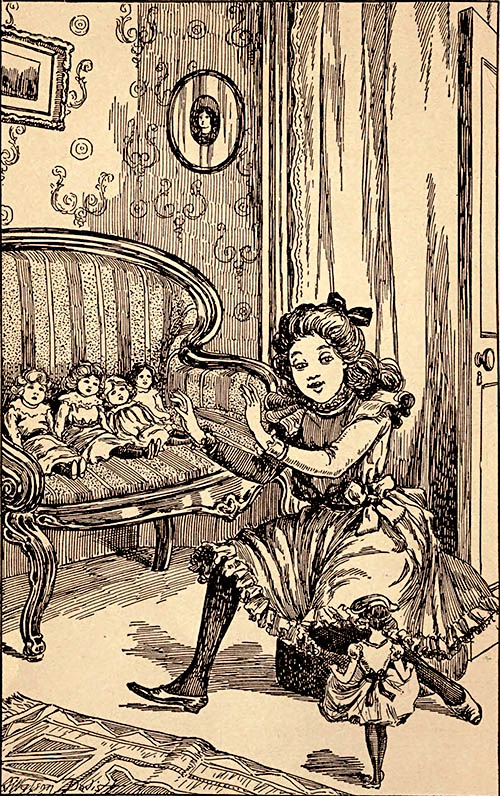
her own little playroom to have a
good time with her dolls. Susan
Ida was a large wax doll with black eyes and
golden hair, that is to say, she had golden hair
when Santa Claus brought her, but owing to an
accident this beautiful hair, which should have
been hanging down her back, was suspended
from a hook in the closet.
I am sorry to say Susan Ida was bald.
Kathleen had once been a handsome china
doll with black wavy hair parted right in the
middle, but, alas! Kathleen was a cripple for
the rest of her doll existence, having lost both
legs.
Dinah was a lovely colored baby, but somehow
she had lost an arm and had one eye
knocked out, while Jessop, who was a clown-doll
with bells in his cap, had a broken nose
and wore very ragged clothes. Dorothy set
them all in a row and looked at them with a
frown on her sunny face.
“I’m really ashamed of you all,” said Dorothy,
“you look so badly with your old torn clothes,
and I am sure if you did not play so roughly you
wouldn’t break your noses and things. One
would think that you were all foot-ball players,”
she continued. The dolls looked very sorry,
all except Jessop. He had a smile on his face.
“You needn’t smile, Jessop,” said Dorothy.
“As for you, Susan Ida, I’m just going to whip
you, because you are such a big doll you ought
to know better,” and she shook her finger at her
largest dolly. She was just going to take Susan
Ida across her knee when she heard the queerest
little “squeak, squeak,” right behind her.
Dorothy turned to see who made the sound,
and just as she did the door of her play-room
opened and there stood the dearest little doll
with coal black curls and coral-pink cheeks.
All at once the strange doll began to grow
larger and larger until she towered over everything
in the room and was the greatest doll
Dorothy had ever seen. Then she did a strange
thing. She walked slowly to the place where
Dorothy was sitting. She raised her hands and
drew them lightly over Dorothy’s face, arms and
legs, in fact over her entire body, and a most
wonderful thing happened. Dorothy felt herself
becoming hard and rigid in every joint.
The stranger had turned little Dorothy into a
wax doll. At first she thought it rather nice
to be a doll, but when she tried to stand and
found that she could not she did not like it very
well. She had also grown very much smaller,
and was not any larger than one of her own
dolls, but she knew everything that was going
on around her. The strange doll, who had done
such a wonderful thing to Dorothy, began to
skip around the room and laugh and sing. She
didn’t seem to be a doll any longer, but was just
like a little girl.
Dorothy watched her hopping about. “O
dear me,” sighed Dorothy almost in terror, “I
do hope she won’t jump on me,” but no sooner
did the thought come to her, when plump came
the stranger right on Dorothy’s legs.
“Well, I declare,” said the strange doll-girl
lightly, “you are always getting in my way,”
and she continued to skip about the room.
“O my poor feet!” said Dorothy to herself,
and all at once she saw that both her legs below
the knees had been broken off. “I wish I
could scream,” sighed Dorothy, but no matter how
hard she tried, she could not open her mouth.
All of a sudden the strange doll-girl stopped
jumping and said to Dorothy, “You bad doll,
you’ve lost a leg.”
Dorothy was just going to say “Two of them,”
when she was caught up by the stranger, and
got a terrible shaking. Then she fell in a heap
on the floor, feeling utterly wretched. After
a while the stranger said, “Now you must sit
up and let me braid your hair.”
Dorothy’s hair hung in soft curls and she did
not like the idea of having it braided. But of
course she could not say anything and had to
submit to another rough handling. This proved
to be the hardest trial yet, because no sooner
did the combing begin than the pulling was
almost unbearable. Suddenly the doll-girl got
very angry. “I never saw such snarls,” she
cried, and caught poor Dorothy by the hair of
the head and dragged her around the room. In
a few moments her hair came off and she was
as bald as Susan Ida.
“Alas!” said poor little Dorothy, “I shall
be lame and bald and nobody cares.” She
tried to cry, but even that consolation was
denied her.
The stranger who had done these dreadful
things was looking out of the window, calmly
watching the rain, when suddenly she turned
and said, “Would you like to look out of the
window, I think it would do you good?” She
took Dorothy by one poor limp arm and
carried her across the room to the window.
After she dangled Dorothy a while by one arm
she raised the window and put her outside in
the rain, saying, “Out there you can get cooled
off.” She skipped around the room again clapping
her hands and having a good time. Poor
little Dorothy outside the window, as frightened
as could be, but unable to stir an inch!
The rain spattered in her face, and on her
bald head and in a very short time her dress
became soaked. Suddenly a great gust of wind
came around the corner, and before Dorothy
realized it she was blown from her place and
down she fell in the garden prone on her face.
Then she fainted, and did not know anything
for a long time.
When she recovered she was surprised to
find that she was not in the garden, but in a
strange beautiful place. It looked
like
the hall of
a magnificent castle with beautiful pictures and
elegant surroundings. On a throne, at one end
of the hall, sat the most beautiful doll in the
world. She was tall and stately, and in her
right hand carried a golden wand.
But the strangest sight of all was a single
file of dolls, the most wretched, forlorn-looking
things that Dorothy had ever seen.
Standing one behind the other the line extended
from the throne of the beautiful doll
away down the hall as far as the eye could see.
Dorothy was the fifth in the line, and she knew
that she looked as badly as anybody, but as
she was watching the queen of the dolls she
forgot about her looks. Just then the first doll
in the line limped up to the throne and stood
before the queen.
“My poor subject,” said the queen, in a sweet,
gentle voice, “how came thee, who left this
house bright and beautiful, in this sad plight?
Tell thy sad story.”
“Alas!” said the poor doll, who had only one
eye, one arm and half a kid leg, “a little girl,
who was a most careless mistress, let me fall so
often that I was completely undone and my
beauty destroyed.”
The doll bowed her head and the queen touched
it with her golden wand, saying:—“Arise, my
child, and be as perfect as thou should’st,” and immediately
the doll, who had looked so badly before,
arose whole and beautiful. She bowed low
to the queen and left the throne.
Dorothy saw many beautiful dolls, waiting on
the other side of the hall. They ran up and
kissed the doll who had been made beautiful
and she walked away with them. But the
second doll in the line was already before the
queen telling her story, and Dorothy listened to
every word.
She was a china doll and looked something
like Kathleen; she said with sobs:
“At first my mistress was very kind to me.
She rocked me to sleep every night, dressed me
in silken frocks in the afternoon and took me
out to ride in a beautiful doll’s-carriage. After
awhile she did not care for me at all, and
one day when I fell out of the carriage, her
little dog Fido caught me in his teeth and
shook me so badly that I never quite recovered
from the shock, in fact I was all broken
up.”
Truly it was a sad story and Dorothy felt
sorry for the poor china doll. The golden wand
touched her and she became very lovely, and
went to the other side with her happy companions.
Now the third doll in the line was the most
disreputable-looking one that Dorothy had ever
seen. She was a wax doll with just one spear
of hair on the top of her head. Her nose was
broken and her front teeth knocked out. She
did not have on even a doll’s chemise, and worse
than all there was a great hole in her back.
Dorothy had been looking at a group of lovely
dolls at the other side of the hall who were eating
ice-cream when her attention was called by
a very familiar name.
“I was a beautiful French doll,” said the
third. “I had been well educated and people
said that I knew how to talk, I must admit that
I was clever and knew when to shut my eyes.
My name was Fanchette” (Dorothy gave a start
at this name). “Well,” continued Fanchette, “to
make a long story short, bad treatment soon reduced
me to my present condition, this dreadful
hole in my back was made by my cruel little
mistress, she said she wanted to see what was
inside of me. After that I was cast aside until
one day a housemaid threw me into an ash-barrel,
which occasioned my death.”
This story was strangely interesting to
Dorothy and she watched eagerly to see what
the doll would be like when the wand touched
her. Imagine Dorothy’s surprise to see her own
Fanchette, that Uncle John had brought her
from Paris a long time ago. Dorothy could
hardly believe her eyes, but there stood Fanchette
as dainty and beautiful as ever. She
was just going to cry out “Fanchette,”
but No. 4 was talking and as she came next
she was very attentive. No. 4 was a boy doll.
He wore a worsted jacket and said he was German.
He did not have any broken limbs, but
seemed very much shrunken. He had fallen
into a tub of water, he said, and had been
drowned. When the queen touched him he
went off smiling and happy with some other
boy dolls.
Now it was Dorothy’s turn, how she got
up to the throne she did not know. She
thought of her poor bald head and her sad appearance.
“Excuse me,” said Dorothy, “I haven’t a leg
to stand on.”
The queen smiled sadly at her and then
arose from the throne tall and beautiful, saying:—
“I cannot hear any more sad stories to-day,
but you may all file up and I will make you
beautiful.” She touched Dorothy lightly on the
head with the golden wand and the little girl
became her own dear self again. She felt so
happy she wanted to jump for very joy. She
ran off with some beautiful dolls, her brown
curls brushing her smiling face and her eyes
sparkling with merriment. Down the beautiful
hall she tripped and just as she reached the
door that led into a golden room, she looked
back. The queen was just in the act of touching
the last one of the poor broken dolls.
Dorothy entered the golden room and found
herself amid a scene of fairy splendor with the
beautifullest dolls in the world.
There were big dolls and little dolls, dolls in
silks and satins, and sweet tidy dolls in cap and
apron who were maids to wait upon them.
Some dainty little dolls were dancing with
handsome boy-dolls, and others were sitting
about in groups laughing and talking. Dorothy
passed through the golden room and out into
a garden. Here there were more dolls, some
of them swinging in snug little doll-hammocks,
others were gathering flowers, and on a fine
stretch of lawn was the dearest little party
playing croquet. Dorothy walked through the
garden and came to a pond. There were pretty
boats on it and a little doll man, dressed like a
sailor, stepped up and touched his cap, at the
same time asking Dorothy if she would take a
sail.
“With pleasure, thank you,” answered Dorothy
and she stepped into a boat and began to
sail around the pond. She was so happy and
felt so comfortable that she just fell back on the
soft cushions of the boat and closed her eyes.
It was all so soft and dreamy that she drifted
into a sound sleep. When she awoke where
do you think she found herself?
CHAPTER VIII. THE SUGAR-BOWL FAIRY.
RAY was very fond of sugar. Did
you ever see the boy or girl who
was not? One day he wanted a
lump and asked mamma if he might
have it. She gave him permission to take just
one lump, so he raised the cover of the sugar bowl
and peeped in.
“How nice it looks in there,” said Ray, “I
wish I could get inside.”
No sooner did he say the words than he
began to grow smaller and smaller. He dwindled
down until he was only as large as a lump
of sugar and he gave a little jump right into the
sugar bowl. At first it seemed quite dark in there,
but after a while he grew accustomed to it and
could see very well. The first thing that surprised
him was the size of the place. He had
always thought that the inside of a sugar-bowl
was very small in area, but on the contrary it
“stretched away into stately halls,” with doors
and windows and numerous little people like
himself walking about. Ray sat on a little
white sofa near a window and a dear little man
came and sat beside him.
“I am the
Sugar-bowl Fairy,”
said the little man, “would you like to take a walk through
the house?”
“Thank you,” replied Ray, “what do you do
all day in the sugar-bowl?”
“We play and have a good time,” answered
the little man, “except when the great giant
comes, then we are all afraid and run to hide.”
“Who is this great giant?” asked Ray.
“I will tell you a true story about my brother
and sister and then you will know all about the
great giant,” said the Sugar-bowl Fairy.
“My sister’s name was Sweetness and my
brother’s was Sugar-Boy. One day they were
put in a large barrel and taken away to the
giant’s house. They remained in the barrel for
several days, when one morning they were
taken out and put in a beautiful silver sugar
bowl on the giant’s table. In a few minutes
the giant sat down to breakfast with his little
daughter Mabel.
“They talked and laughed together, and while
the little girl drank her bowl of milk the giant
poured a cup of tea for himself.
“‘Now,’ whispered Sweetness to my brother,
‘if he puts us in that cup of tea we must surely
be drowned.’ She trembled and snuggled up
closer to my brother.
“The giant took the silver sugar-tongs and
looked into the sugar bowl. It was a moment
of terrible suspense. All at once he caught
Sweetness and dropped her into his cup of tea.
The last my brother saw of her she was dissolved
in tears. And that was the end of my sister
Sweetness.
“‘Won’t it be dreadful if he catches me?’
said my brother, when lo! the tongs descended
into the sugar bowl again and this time caught
Sugar-Boy, but he squirmed himself out and
rolled down to the very bottom of the bowl
and the giant took another.
“When breakfast was over and the giant and
his little daughter had risen from the table, she
whispered something to her father and all at
once looked into the sugar bowl. Then she put
her dear little hand inside and caught my
brother in her rosy finger tips.
“‘There,’ said Mabel, ‘you’re the nicest looking
lump of sweetness in the sugar bowl and I
am going to give you to Queen Bess.’
“Sugar-Boy wondered who Queen Bess could
be, but he did not have much time to think
because Mabel hurried out of the room and
ran after her father. They went into a stable
and Sugar-Boy could hear the tramp of horses.
At last they stood before a beautiful black horse.
Mabel took the lump of sugar (which wasn’t a
lump of sugar at all, you know, but my dear
little brother) and held it up to the horse, saying,
‘See, Queen Bess, what I have brought
you.’ My poor Sugar-Boy trembled with fear
and thought his end was at hand, but just as
the horse opened his mouth to swallow him the
girl let Sugar-Boy fall and down he went into
a tiny hole where it was very dark. He could
hear Mabel say, ‘That is too bad, Queen Bess,
but I shall get another nice lump for you.’
“‘I hope I am safe here,’ said Sugar-Boy, but
no sooner did he say the words than he saw two
little bright eyes peering at him. Again his
heart went pit-a-pat, and in another moment a
fat brown mouse came over to the dark hole.
‘This is a very lucky find,’ said the brown
mouse, ‘I must take this lump of sugar to my
mother.’ Sugar-Boy was frightened when the
brown mouse caught him up carefully and
started across the barn floor; and he was
just beginning to think that this would be the
last of him, when all at once a gray cat sprang
out and the mouse dropped Sugar-Boy and ran
for his life. There was Sugar-Boy in the
middle of the floor where anybody could step
on him and crush him to death.
Mabel took the lump of sugar, and held it
up to the horse, saying, “See, Queen Bess, what I have brought
you.”—Page 94. Little Miss Dorothy.
“He was feeling very much worried about it
when suddenly a boy came into the barn. The
boy walked around whistling a lively tune, and
all at once picked up Sugar-Boy and put him
in his pocket.
“My brother thought he was safe in the boy’s
pocket, at least for a while. He found himself
in the company of a jackknife, ten marbles, two
rusty nails, a ball of twine, a bent pin, a piece
of tar, an old butternut and a few other articles
that I cannot remember.
“‘I wonder how many more things are coming
into this pocket,’ said the marbles, ‘we would
like a little space to roll around.’ Just then
the boy put his hand into the pocket for the
jackknife and those selfish marbles pushed
Sugar-Boy out with the knife and he fell in the
yard and the boy never knew it. My brother
found himself beside a small stone, and he soon
discovered that a certain Mr. Worm lived under
the stone.
“He was very lazy, sleeping most of the time,
but one day the stone happened to get overturned
by a boy, and then Mr. Worm began
to squirm around at a great rate. Sugar-Boy
watched him until a dozen little sparrows began
to chirp around him, and in a remarkably short
time they had made a meal of Mr. Worm. But
they had also seen Sugar-Boy, and as soon as
they had eaten Mr. Worm they tried a peck at
Sugar-Boy.
“They made a great fuss and scolded each
other because they could not carry Sugar-Boy,
he was so heavy. In the height of the excitement
a great black crow flew into the midst of
the sparrows, and, taking Sugar-Boy in her beak,
flew far away. Deep into the woods went the
crow and perched on a high tree, and in another
minute Sugar-Boy was in a nice warm nest with
some little baby crows. They opened their
mouths very wide and the mother crow began
to feed them. She tried a peck at Sugar-Boy’s
coat and he felt very badly about it. After a
while she caught him up and one of the babies
tried to take a little peck. It pleased the mother
crow so much to see such a smart baby that she
wanted to kiss the little mouth. She loosened
her hold on Sugar-Boy and before she could catch
him he had fallen from the nest in the high tree-top
down to the path in the woods. He was
there quite a long time when two girls came
along gathering wood for their mother’s fire.
“‘O, see,’ cried one of the girls, ‘I have found
a lump of sugar! I’m going to take it home to
Gretchen!’
“She put Sugar-Boy in the basket with her
twigs and sticks and he was carried safely
through the woods to their mother’s cottage. A
plump little maid with two long braids of golden
hair came running to meet the girls who had
been gathering sticks.
“‘See what I found for thee, Gretchen,’ said
one of the girls, holding up Sugar-Boy. Gretchen
took him in her little fat hands and cried:
“‘Ach! it is mine sugar.’
“‘The fairies put it in the woods for thee,
Gretchen,’ said her sister; ‘take it and run
away.’
“Gretchen ran away with Sugar-Boy, and sat
in her little garden.
“‘If it is a fairy lump I will plant it,’ said
the child, ‘and then a fairy tree will grow with
lumps of sugar.’
“She dug a tiny hole with her hands and
placed my brother in it, covering him over with
the soft earth. Then she watered her new bed
and went away to tell about her fairy sugar
tree.
“Now it so happened that not far from the
spot where Sugar-Boy was planted lived a colony
of ants. One long-legged fellow chanced to
see Gretchen dispose of a nice lump of sugar
and he ran to the hill where the queen of the
ants lived and told her about it.
“She sent an army of faithful ants at once,
and Sugar-Boy was removed little by little to
the queen’s palace.
“Then the queen decided to give a grand
party, inviting all her sisters, cousins and ants
and in a short time the long-legged fellow was
despatched with written invitations that read as
follows:
“‘The queen invites you to be present at a
grand dinner party, given in the courtyard of
the imperial palace (Ant Hill—southwest) on
Monday at Ten A. M.’
“There was great excitement among the ants
when they learned about the party and they
vied with each other in their efforts to thank
the queen. When the morning of the party arrived
you might have seen swarms of ants hurrying
to the palace on Ant Hill.
“Of course they all had a splendid time at the
party and they actually devoured Sugar-Boy.”
The Sugar-bowl Fairy, who had been telling
this story, stopped suddenly and Ray asked, “Is
that all?”
“No, that is not the end,” replied the fairy,
“but I hear your mamma calling you.” He raised
the cover of the sugar bowl and Ray climbed
out.
As soon as he was outside he began to grow
to his normal size and he ran to mamma and
told her all about his adventure inside the sugar-bowl.
CHAPTER IX. A STRANGE TRIP TO TOY-LAND.
ONE afternoon Mrs. Fussy, who
lived next door, came to call on
Dorothy’s mamma. When they
had exchanged greetings Mrs.
Fussy exclaimed:
“Dear, dear, what shall I do! Cook has left
me without a moment’s notice—the third this
month. It is really discouraging.”
Dorothy was drinking in every word that fell
from the visitor’s lips, and mamma said, “Run
away, dear, and play with your dolls.”
Dorothy ran to her play-room and took down
all her dolls and toys to have a real good time.
She decided to play house, so she said, “Now I’m
going to be Mrs. Fussy.”
She gazed earnestly at her dolls and sighed,
“Dear, dear, what shall I do! Cook has left
without a moment’s notice—the third this month.
It is really ’raging.”
Suddenly all the dolls jumped up and began
to roll up their sleeves.
“We’ll help,” they cried, and Dorothy was so
surprised that she could not speak for a minute.
“I’m glad you are so willing,” said the little
girl at last. “Suppose you go into the kitchen
and cook the dinner, Dinah.”
“Yeth, ma’am,” replied Dinah with a sweeping
bow and hurriedly left the room.
“Susan Ida may go into the laundry and
iron, while you, Kathleen, had better dust the
hall.”
“What shall I do?” asked Jessop with his
usual grin, and his little mistress told him to
make himself generally useful.
When they had gone to do their work
Dorothy breathed a sigh of relief and said, “I
think I’ll rest a minute.” She took out her
Mother Goose and was so very much interested
in Little Bo-Peep that she did not notice anything
going on around her. But when she
raised her eyes from her book she was surprised
to find herself quite alone.
“Why, where are all my toys?” exclaimed
Dorothy. “I sent the dolls to work, but those
naughty toys had no business to leave this
room.”
Then she decided to go into the kitchen and
see how Dinah was getting along with the
dinner. She tripped down-stairs and the minute
she opened the kitchen door there was a strong
odor of something burning. But worse than
that, there stood her tin soldier with his arm
around Dinah’s waist. Dorothy ran for the tin
soldier, but he dodged her and jumped out of
the window. Dinah threw back her head and
began to swing a soup ladle, while her indignant
little mistress exclaimed, “I’m ashamed of
you, Dinah, and you can go to your room at
once.” Dinah sulked out of the kitchen and
Dorothy took up the burned potatoes.
“Now I’m going to give Dinah a good whipping,”
said Dorothy; but the minute she opened
the kitchen door she heard loud voices on the
stairs. Hurrying to the spot, there stood
Kathleen (her quiet, gentle Kathleen) brandishing
a feather duster in the most threatening
manner at Jessop.
Dorothy was astonished. “Why, Kathleen,”
she cried, “what is the matter?”
“Well, he isn’t going to call me doll-faced,”
said Kathleen, looking very angry at Jessop.
“She said I was a clown,” shouted Jessop,
“and I won’t stand it.”
“Go to your room both of you; not another
word,” exclaimed Dorothy shaking her finger at
Kathleen, who walked off with her head in the
air.
“Well, I declare,” sighed the mistress, “I
wonder what will happen next!” She started
for the laundry to see how Susan Ida was getting
along, and found her crying bitterly and no
work done.
“Why, Susan Ida, what have you been doing
all this time?”
“Nothing, ma’am,” was the answer. “It’s all
his fault. Boo-hoo-o!” and she pointed to
Dorothy’s toy rooster, who was calmly standing
on the table watching them.
“What are you doing here, Dick?” asked
Dorothy, turning to the rooster; “the idea of
coming into the laundry!”
“He came to crow over me, ma’am,” exclaimed
Susan Ida between her sobs.
“I don’t care,” cried Dick; “she said she’d
take my head off.”
“Get out both of you,” and Dorothy made a
rush for the bad toys, but they nearly fell over
each other in their efforts to get out of the
kitchen.
“I’ll go up-stairs and give them a good whipping
and put them to bed,” said Dorothy; but
when she reached the stairs she stopped in
amazement. There was Toto her toy monkey
sliding down the banister, while her toy puppy
barked with all his might. A toy broom was
whacking the stairs at a grinning Jack-in-the-box,
who was trying to stand on his head.
“Toto,” cried Dorothy, and she was just
going to catch him, when her toy cat flew past
chasing the toy mouse.
“Goodness! he must not catch my mouse,”
cried Dorothy, and she caught up the toy broom
and hurried after the toy cat. The toy puppy
and the monkey followed, and the Jack came
out of his box and joined in the chase. Across
the hall they flew, and as the door happened to
be opened, down the steps and into the yard.
It was the strangest race you ever saw, and as
they ran through the street people came to the
windows and shouted at them. A great many
soldiers left their barracks in the toy shops and
hurried after the procession.
On and on they ran through the street, into
another, across vacant lots, over stones and
hedges, through the green fields, up the hills,
down the lanes, and never stopped until they
came to Toy-land.
The minute they got there the mouse was
still, the cat curled himself like a ball and went
to sleep, the puppy stretched out and began to
snore, the Jack-in-the-box remained perfectly
quiet, and the monkey sat upright and scratched
his head.
Dorothy sank into a toy chair exclaiming,
“Such an exciting race I never had in my
life.”
“You must be tired,” said a voice at her
elbow, and Dorothy turned and there stood
Little Bo-Peep.
“How do you do?” said Dorothy. “Have
you found the sheep that were lost?”
“Not yet,” replied Bo-Peep, “but I am looking
for them.”
“I will help you,” cried Dorothy, and she
jumped up and taking Little Bo-Peep’s hand
walked all over Toy-land looking for the lost
sheep. Suddenly they met the old woman who
lived in a shoe with her whole brood of children
hurrying along.
“Whither away so fast, good woman?” asked
Dorothy.
“To the grand parade, my dear,” was the
answer, while Little Bo-peep exclaimed, “Sure
enough, it is the first of April, the birthday of
our dear Mother Goose, you know.”
“Let us go too,” cried Dorothy, and they
hurried after the old woman.
They passed Little Boy Blue fast asleep
under a hay-mow, but Bo-Peep gave him a little
shake and he awoke and followed them.
They reached a bridge just in time to see
Mother Goose and all her followers passing
along. All Toy-land clapped and shouted; and
what with dogs barking and cocks crowing
there was a merry time.
Dorothy was delighted, and the toy soldiers
who marched in the procession were straighter
than any real soldiers that she had ever seen.
“What beautiful times you have in Toy-land!”
exclaimed Dorothy.
But Bo-Peep did not answer, she was looking
at the end of the procession.
“There they are now!” she cried, and Dorothy
saw the lost sheep following the crowd.
“I must hide,” said Bo-Peep and she tried to
stand behind Dorothy, but the sheep spied their
little friend and they all ran to her and began
to frisk about. It made Dorothy laugh to see
them, but when a great black sheep tried to
stand on his head Dorothy was afraid and ran
away.
She tripped over the fields until she came to
the village green where she found Mother Goose
and the whole procession resting.
As she approached, Dorothy saw that they
were all watching something in the center of
the green. She turned to Simple Simon who
was standing near, and asked him what they
were all waiting for.
“To see the cow jump over the moon, of
course,” replied Simple Simon, grinning at
Dorothy.
Just then the cow rose in the air and gave a
great jump to the sky and right over the moon.
Everybody laughed, even Dorothy’s little toy
dog; and Simple Simon rolled on the grass, he
thought it was so funny.
Dorothy ran off laughing and turned into a
street that was called Doll Avenue. Beautiful
doll houses lined both sides of the street, and
Dorothy met several lovely dolls who were out
taking an airing. All at once Dorothy came to
the end of Doll Avenue and found a pond
where toy swans were sailing around. The
dearest little doll that Dorothy had ever seen
was all alone, throwing pebbles into the pond.
“What is your name, dear?” asked Dorothy,
walking up to the doll.
“My name is Rosy,” said the doll; and Dorothy
exclaimed, “O, you are just lovely, I’d like
to take you home with me!”
“I can go with you,” replied Rosy, “if you
don’t step on dirt.”
“Good,” cried Dorothy, clapping her hands.
“I know what you mean. You must step
on stones, if you walk on the earth you’re
poisoned. I’ve played that game very often.”
Dorothy took Rosy in her arms and started
to walk home.
“You shall be my best doll,” whispered Dorothy,
“and I’ll make you a lovely silk dress.” She
crossed and recrossed stones and rocks, being
careful not to touch the ground. She was getting
along nicely when all at once she tripped
and her feet touched the earth. In a second
Rosy was on the ground running away from her
as fast as she could.
“Come back, come back,” shouted Dorothy;
but Rosy only ran the faster.
Dorothy started after the lovely little doll,
but all at once she was stopped by a great toy
policeman.
“What is the matter?” asked he of the blue
coat and brass buttons.
“I want to catch that doll. O, please let me
get her,” said Dorothy.
“Does she belong to you?” shouted the
policeman in a gruff voice.
“N-no, not exactly; that is,”—said Dorothy,
beginning to explain.
But the policeman looked very angry and
said, “I arrest you for trying to take something
that does not belong to you.”
“But please, Mr. Policeman, I didn’t know I
was doing wrong,” sobbed Dorothy.
“Neither did I,” roared the policeman.
“But I never was arrested before,” cried
Dorothy.
“That isn’t my fault,” said the policeman.
Just then Little Bo-Peep came along with all
her sheep.
“Why, what is the trouble?” asked Little
Bo-Peep, looking from Dorothy to the toy policeman.
“He’s going to arrest me,” answered Dorothy.
“You mustn’t do that,” cried Bo-Peep; “she’s
a friend of mine.”
“But she was breaking the law,” said the
policeman.
“That’s too bad,” whispered Bo-Peep, putting
her arm around Dorothy’s neck.
“You know, dear, that you can break everything
in Toy-land except the law.”
“However,” she continued, “as you are a
visitor you cannot be arrested.”
“I think I had better go home now,” said
Dorothy, “I wonder where all my animals are?”
“I’ll blow my whistle,” said the policeman,
“and they will come.”
No sooner did the whistle sound than all her
animals appeared.
The policeman locked them up in Noah’s Ark,
but Dorothy stepped into a train of toy cars and
was soon safe home.
CHAPTER X. THE LAUGHING ROCK.
ONE summer Ray went to the country
to visit Uncle Josiah. At first
he was so much interested in
everything around the farm that
he did not find time to take any walks in the
pleasant fields and woods.
He liked to watch the busy hens and the
downy little chicks. Every day he talked to a
dear little bossy calf that had great soft velvety
eyes. But after a while, when he had become
well acquainted with the plump little rabbits
and Bonnie Bess, a good old horse, he started in
to see some of the pretty places around him.
Not far from the house was a long shady lane
path called “Lovers’ Lane,” and one summer
afternoon Ray found himself sitting on the grass
in Lovers’ Lane with his back against a large
rock. It was a very warm day and Ray felt so
sleepy that his eyes began to close in spite of
himself.
Suddenly something tickled his nose and he
brushed it away. He closed his eyes again to
have a little nap when something tickled his ear
and he quickly brushed that off. Once more
he settled for a sleep when a very pronounced
tickling at his neck made him jump to his feet.
“I wonder what is tickling me so?” exclaimed
Ray, looking around.
All at once he caught sight of a little man so
tiny that you could have taken him up and put
him in your pocket. He stood right on the top
of the rock and as his clothes were just the color
of it, you could not see him unless you looked
sharp. But there stood the tiny little fellow
with his hands in his pockets, his legs far apart
and a broad smile on his face as he winked at
Ray.
“Did you tickle me when I was trying to go
to sleep?” asked Ray.
The grin on the face of the little man broadened
and he began to shake all over, he laughed
so heartily.
“Excuse me,” he said; “I was only putting in
my winter coal.”
Ray was greatly surprised, he didn’t know
just what to think of the little fellow. He
thought he had better introduce himself, so he
said,
“My name is Ray, and I live in that white
house with Uncle Josiah and Aunt Prudence.”
“My name is Pebble and I live in this brown
rock with Mrs. Pebble and all the little Pebbles,”
said the tiny man, laughing harder than
ever.
In fact he laughed so heartily that he began
to slap his knee with his little fat hands. Ray
laughed too and slapped his knee and shook all
over like the little man. Every now and then
in the midst of the laughter Mr. Pebble would
catch something that flashed like sunbeams in
his hand, but he did it so quickly that Ray
could not make out just what he was doing.
“It’s really very funny,” said Ray; “but I’m
not laughing at you, Mr. Pebble.”
“I’m not laughing at you,” returned little Mr.
Pebble.
“What are you laughing at, may I ask?” said
Ray politely.
“This is my busy season,” replied the little
fellow; “that is why I laugh.”
Ray did not quite understand, but thinking
he would find out later on in the conversation
asked, “Did you say you lived inside this rock?”
“Yes, my boy, that is where we live.”
“Isn’t that strange?” murmured Ray to himself.
“Not at all,” replied Mr. Pebble, “my family—that
is the entire Pebble branch—always live
in rocks.”
“I’d like to see the inside of your house,”
exclaimed Ray.
“Well, come home to dinner with me,” said
Mr. Pebble, and he gave three little taps on the
rock.
All at once it opened and before Ray knew
it he was inside. A tiny fat woman with a crowd
of children tugging at her skirts, came up and
greeted Mr. Pebble. The little Pebbles skipped
and hopped about, cutting up all sorts of capers.
It was all so funny that Ray was laughing all
the time and Mr. and Mrs. Pebble and all the
little Pebbles laughed too.
“How about the coal, my dear,” said Mrs. Pebble
suddenly; “did you get any this morning?”
“Oh, yes,” replied her husband, “I have
been very busy.”
“Well, I hope you will get a good supply,
because I think it is going to be a hard winter.
Don’t you think so, Ray?”
“I don’t see what you want coal for,” said
Ray; “inside a big rock I should think it would
be nice and warm.”
“So it would be, my dear,” returned Mrs.
Pebble; “but there are two great cracks in this
house and they let in all the cold air. Why,
last winter Tommy Pebble had the measles.”
“Which is Tommy?” asked Ray, looking
around at the brood of Pebbles.
“I’m Tommy,” shouted a pompous little
fellow standing on his tiptoes and throwing out
his chest.
“Well, you needn’t feel so stiff about it,” said
Ray, “you’re not the only Pebble;” whereupon
Mr. and Mrs. Pebble and all the children except
Tommy roared with laughter.
Suddenly Ray noticed a coal-bin in one
corner of the house, and taking up a piece he
cried, “What queer-looking coal, it doesn’t look
like the kind we use.”
“It’s not the same kind, you know,” said Mr.
Pebble; “my coal is made from laughter.”
“Well,” said Mr. Pebble, “if there is any
laughter going around I catch it and turn it
into coal. I’ll throw a piece into my fire and
you will see what I mean.”
The coal burned with a blue flame, and all at
once Ray could see in the midst of the flame his
Uncle Josiah holding a horse and talking to a
strange farmer as plainly as if they were standing
before him.
Suddenly the farmer led the horse away and
when they were out of sight Ray could hear
his uncle laugh—
“Haw, haw! haw, haw, haw!
Best trade I ever saw!
Haw, haw, haw, haw!”
Ray laughed aloud, although he really didn’t
know why, and all the Pebbles shook with
laughter.
“Did my uncle sell that horse to the farmer?”
asked Ray.
“Yes,” said Mr. Pebble, “the bargain was
made sitting on this rock and I got in a good
load of coal that day.”
“But I don’t see anything to laugh about in
that,” exclaimed Ray.
“The farmer that got the horse didn’t either,”
cried Mr. Pebble.
Ray was puzzled, but he took up another
piece of coal and threw it on the fire. It burned
with a beautiful rose-colored flame, and Ray
could see two lovers sitting on the rock looking
into each other’s eyes.
Suddenly he heard a giggle and then:
“He, he, ha, ha, ha! You are, you know you
are!”
Ray was laughing again. “What does it all
mean?” he asked.
“I’m sure I don’t know,” said Mr. Pebble,
who was almost doubled in two laughing.
“They came here last summer a great deal,”
continued the little fellow. “They’re married
now and live in the village. I don’t see them so
often, but there are others, and I must say they
belong to one of the best sources of my coal
supply in the world.”
“Try this one,” said Ray, and he threw a
piece of coal on the fire that burned with the
most beautiful flame of all. A group of merry
children were playing together in the bright
flame, and their laughter was like sweet
music.
“What good times they are having!” said
Ray, and Mr. Pebble cried:
“Yes, indeed, I love little children, and would
rather hear their laughter than any other sound
in the world.”
“Is that why you tickled me?” questioned
Ray, and the little man replied:
“Well, of course, it’s my business to make
people laugh. I was looking out for some more
coal, you know.”
“You certainly have a very large family to
keep warm,” remarked Ray.
“Yes,” answered Mr. Pebble, “and it grows
larger every year, and more than all, Tommy is
a great care.”
“Is he mischievous?” said Ray.
“O, very,” replied the happy father. “I wonder
what he is doing now. Tommy, Tommy,”
called his father, “where are you?” but Tommy
did not answer, and his numerous brothers
and sisters could not find him.
“I think I had better go now,” said Ray, “I’ll
stay to dinner some other day.”
“We’re going to have pudding,” cried one of
the tiniest Pebbles, but Ray was afraid Aunt
Prudence would think he was lost, so he said
good-by to the funny Pebbles and quietly left
the rock. When he was outside on his way
to the farmhouse he happened to put his hand in
his pocket and there sat Tommy Pebble as comfortable
as possible.
“Why, Tommy, how did you get into my
pocket?” cried Ray.
“Jumped in, when you weren’t looking,” replied
the little fellow.
“But what will your father say?” exclaimed
Ray; “they were all looking for you in the
rock.”
“O, I’ve taken little trips before,” said
Tommy, “and when I come back my papa always
says to me, ‘Tommy, a rolling stone gathers
no moss.’”
Ray laughed because he seemed such a mischievous
little fellow, and as for Tommy he
rolled all around the pocket in his mirth.
“I don’t think you ought to leave your home,”
said Ray, but Tommy replied quickly:
“I want to see the world, and I never had a
better chance than to travel in a boy’s pocket.”
“Well, if you are very quiet and don’t get
into mischief, I’ll let you stay for a while.”
Ray returned to the house with Tommy
Pebble safe in his pocket, and just then Aunt
Prudence called him to dinner.
When Ray was sitting at the table he was
going to tell about his adventure with the Laughing
Rock when he felt something in his mouth.
He was eating some jam, and imagine his surprise
to find that Tommy Pebble had got into
the jam and was walking around the roof of
his mouth. Ray removed Tommy as quickly
and quietly as possible to his pocket and ate
the rest of his dinner in silence.
“Now, look here, Tommy,” said Ray after
dinner, “don’t you ever get into the jam again,
it’s not nice at all.” Tommy began to laugh
and shake his fat little body. But he promised
to be more careful in the future. After a while
Ray thought he would go to the barn, but the
minute he started something tickled the sole of
his right foot. He sat right down on the grass
and took off his shoe, and there was Tommy
Pebble in his stocking grinning at him.
“O, you rogue!” cried Ray. “How did you
ever get down there?” but Tommy only laughed
while Ray put him in his pocket again. Tommy
was quiet for a long time, and it was not till
bedtime that Ray remembered his existence.
When Ray was in bed and his Auntie had said
good night, he felt something between the sheets
that wiggled around his toes.
“Is that you, Tommy Pebble?” asked Ray,
but there was only the sound of laughing and
Ray knew that Tommy was up to his old tricks
again.
Ray squirmed himself down to the foot of the
bed and caught Tommy Pebble.
“I’ve a great mind to throw you out of the
window,” said Ray.
“Do,” pleaded Tommy, “I like to be out after
dark.”
Ray caught the little fellow up between his
thumb and finger and tossed him lightly out
of the window. As Tommy was a Pebble of
course it did not hurt him. Ray turned over
and tried to go to sleep, but it was impossible,
as Tommy was knocking on the window pane
for him.
“Come out, come out, Ray,” cried Tommy,
“there’s going to be a party to-night.”
“What a mischievous little rogue Tommy is,”
said Ray to himself, “I won’t mind him at all,”
and he turned on the other side to have a sleep.
“If you won’t come out, please take me in,
Ray,” whispered Tommy in his most coaxing
voice. “You know I’ve had the measles and the
night dews are so bad for my chest.”
Ray could not resist this appeal, so he jumped
up and put on his clothes as quickly as possible.
He stole softly out of the window and
climbed down the low shed.
“Where are you, Tommy?” cried Ray, when
his feet touched the ground.
“Here I am,” replied Tommy, and there he
stood with a tiny lantern in his hand.
“Where did you get that lantern?” asked Ray.
Tommy was laughing and his eyes twinkled
as he said, “A Will-o’-the-wisp let me take it to
go to the party.”
“What party?” asked the astonished Ray.
“Why, there’s a grand ball to-night in Jack-o’-lantern’s
Hall, and everybody is going.”
“You can’t go,” cried Ray; but Tommy suddenly
started off and ran as fast as he could
down the hill with Ray after him.
Ray could see the flash of light from the lantern
every now and then, and he tried hard to
catch Tommy. All of a sudden the lantern disappeared,
and Ray was alone in the darkness.
All at once he became aware of two eyes
staring at him, and looking up he saw a great
owl sitting on the low branch of a tree.
“O wise owl, will you please tell me where
Jack-o’-lantern’s Hall is?” asked Ray.
“Go over the hill to the marsh-land and you
will find it, my boy,” said the wise owl.
“Did you see Tommy Pebble pass by with a
lantern just now?”
“They all carry lanterns who go there,” replied
the owl.
“Why don’t you go to the party?” asked
Ray.
“Because I have an engagement with another
party,” was the answer.
“I hope you have a pleasant time,” remarked
the boy; but the owl said in a very solemn
voice:
“This is a business engagement with a field
mouse or two; I might say it is business and
pleasure combined.”
Just then several lanterns went past and Ray
left the wise owl to follow the flittering light.
On and on he ran and never stopped until he
was quite out of breath. He found himself at
the Laughing Rock, and on top of it was Mr.
Pebble, sitting cross-legged, smiling at him.
“Where’s Tommy?” asked the jolly papa.
“I don’t know,” replied Ray, “he’s up to
some mischief very likely.”
Then he told Mr. Pebble about Tommy’s running
off to the party. Mr. Pebble roared with
laughter, and Ray found himself sitting on the
rock laughing so hard that it shook.
All of a sudden he saw Mr. Pebble roll up
his sleeves and work very fast, while flashes like
sunbeams seemed to shoot out of the rock.
At last Ray stopped laughing and Mr.
Pebble disappeared, saying softly:—“Good supply
of coal to-day.”
CHAPTER XI. THE TALKING CHAIR.
YOU would never have thought that
the chair could talk if you had
seen it, and perhaps it would not
have said a word for you and me,
but it certainly did for Dorothy. It was a solid
wooden chair and very old-fashioned. It had
a face quaintly carved on its straight back,
and Aunt Polly thought a great deal of this
old chair because it had belonged to her great-grandmother.
One day Dorothy was visiting
Aunt Polly with her best doll, Susan Ida. The
little girl sat on a hassock and put Susan Ida
in the old chair in front of her.
“How do you do, Susan?” said a voice. “I’m
real glad to see you; make yourself comfortable.”
Dorothy looked all around to see who had been
talking, but there wasn’t a soul in sight. Then
she saw the carved face on the chair smiling at
her.
“Were you talking just now?” asked Dorothy.
“Yes,” answered the chair, “I like to talk
to little children.”
“Do you really,” said Dorothy; “then perhaps
you could tell me a story?”
“Nothing easier,” replied the chair, “which
would you prefer to hear; ‘The Enchanted
Horse,’ ‘The Three Boxes,’ or ‘The Beautiful
Princess Isabelle’?”
“O,” said Dorothy, “tell me about the beautiful
Princess Isabelle.”
“Very well,” said the chair, “you shall hear.”
“Excuse me,” said Dorothy, “before you begin.
Do you mind Susan Ida sitting on you?
She’ll be very quiet.”
“Not at all,” was the answer, “I don’t mind
being sat on,” and the chair began the story:—
Once upon a time there lived a beautiful
little princess whose name was Isabelle. She
had exquisite dolls, wonderful toys and lived in
a most beautiful castle. But she was not quite
happy because she had no little brother or sister
or cousin to play with. She did not have even
a little friend to visit. She lived quite alone in
the great castle with the servants and sometimes
she felt very lonely. Every day she walked in
the castle garden and longed for a playmate.
One day as she sat in her little summer-house
she said aloud, “O, how I would like somebody
to play with.” She tapped her foot on the
ground and sighed.
All at once as she sat there a little old woman
appeared before her.
She wore a pointed hat and carried a crooked
staff, and said in a squeaky voice:
“Well, my dear, you tapped for me; what
would you like? Think a long time before you
speak, because I cannot come again for seven
years.”
But little Isabelle did not wait a moment.
She said eagerly, “Give me a playmate.”
“You shall have one,” said the old woman,
and she struck the floor three times with her
crooked stick, saying:
“A nick, a knock, a knack.
A beak, a beck, a back.
O blow a crow to Isabelle!
And here it comes, so now farewell.”
The old woman disappeared with a loud laugh
and immediately a great black crow flew into
the summer-house. Poor little Isabelle, she felt
so disappointed that she could have cried. She
had asked for a playmate, and the wicked old
woman had given her a crow. But she was a
kind good little girl as well as a beautiful
princess, and she felt sorry for the poor black
crow. It looked so lonesome as it perched on
the back of a chair that Isabelle said sweetly:
“Poor crow, I wonder what name I had better
call you?”
“Call me Thalia,” said the crow.
“Thalia,” repeated Isabelle. “What a pretty
name, where did you hear it?”
“It is my right name,” answered the crow,
“and that wicked old woman calls me a crow.”
“But, Thalia,” said Isabelle, “you look just
like a crow.”
“Alas! I know it,” replied the bird; “but I
was once a little princess like yourself. That
old woman turned me into a crow and kept me
in her enchanted castle, until to-day, when she
called me here.”
Isabelle was very much surprised to hear
Thalia’s story and said, “I wish I could turn
you back into a princess again.”
“O, how I wish you could!” exclaimed the
crow; “but as there is only one way to do it, I
fear that I can never be changed.”
“Tell me,” said Isabelle, “the way that it
can be done.”
“If you could get the old woman’s crooked
stick you could change me back into my right
shape, but you never could get the stick,” said
the crow.
“But why not?” asked Isabelle. “Couldn’t
I go to the old woman’s enchanted castle and take
the stick while she was asleep?”
“But she never sleeps,” said the crow, “and
she never lets the stick out of her hand.”
“Then I don’t see how we could ever get
it,” cried Isabelle sorrowfully. The poor crow
looked very sad, and Isabelle was quiet for a
long time thinking hard. “I am going to try,”
she cried all at once. “I shall go to the enchanted
castle and see if I can get the crooked
staff.”
The crow shook her head saying, “I’m afraid
you’ll never find the castle, and even if you did,
you could never get the crooked staff.”
“There is nothing like trying, you know,” replied
the brave little girl; and the next morning,
bright and early, the beautiful Princess
Isabelle started out on a long journey to find
the old woman’s enchanted castle.
She walked a long distance, then she came
to a little red house. Isabelle knocked on the
door and a fox with a bushy tail opened it.
“Will you please tell me how to find the
enchanted castle of the old woman with the
pointed hat and crooked staff?” asked the
Princess.
“If I tell you,” said the fox, “will you promise
to come back?”
“I promise,” answered Isabelle.
“Turn to your right,” said the fox, “and
climb the first hill you see.”
“Thank you,” replied Isabelle, and she did
just as the fox told her to do.
When she climbed to the top of the hill she
came to another little red house, and on knocking
at the door a goat appeared.
“Will you please tell me how to find the enchanted
castle of the old woman with the
pointed hat and the crooked staff?”
“If I tell you,” said the goat, “will you promise
to come back to me?”
“I promise,” was the answer, and the goat
said:
“Turn to your right and go up the first hill
you see.”
Isabelle thanked the goat, and followed his
directions. When the top of the second hill
was reached she stood before another little red
house.
She knocked, and a green parrot came to the
door.
“Will you please tell me how to get to the
enchanted castle of the old woman with the
pointed hat and the crooked staff?” asked the
little girl.
“If I tell you, will you promise to come
back?” said the parrot.
“I promise,” said Isabelle.
“Then be very careful,” cried the parrot,
“for you are almost there. Walk until you
come to a dense woods, take the narrow path
and you will find the enchanted castle.”
“Thank you,” returned Isabelle, and she
started off in the direction of the woods. She
found the narrow path, and after walking a long
way she came to the old woman’s castle.
At first she hid behind some bushes and
looked around, but after a while she decided to
walk boldly up to the castle. She had gone
but a few steps when somebody touched her on
the shoulder, and turning around she found herself
face to face with the wicked old woman of
the pointed hat and crooked staff.
“How do you do, Isabelle?” said the old
woman in a cracked voice; “and how do you
like your new playmate? Ha! ha! ha!” and
she laughed aloud and struck the ground with
her crooked staff.
Isabelle greeted the old woman politely and
said, “I have heard that you are a very powerful
fairy, is it true?”
“Indeed it is,” said the old woman very
much pleased. “I can do wonderful things.”
Isabelle greeted the old woman politely
and said, “I have heard that you are a very powerful fairy;
is it true?”—Page 140. Little Miss Dorothy.
“So I have heard,” replied Isabelle, “that
you can even turn people into different shapes
and animals, but I don’t believe it.”
“It is all true,” cried the old woman, “I can
prove it to you; just ask me to change something
and you will see for yourself.”
“Well,” said Isabelle, “if you are a powerful
fairy, turn your crooked staff into a little bird.”
“O, that is very easy,” said the old woman,
and she swung her staff around her head three
times saying:—
“O crooked staff, become a bird,
And let thy tuneful voice be heard;
Fly all about the trees and land,
Then light on Isabelle’s fair hand.”
In the twinkling of an eye the crooked staff
had disappeared and a little yellow bird began
to fly over their heads, singing all the time.
Isabelle watched it as it flew over the trees
and all at once it came right down into her
hand.
“Now,” said the old woman, “do you believe
my power?”
“It is wonderful,” replied Isabelle, “but can
you turn the bird back to the crooked staff?”
“Certainly, I have but to wet my fingers and
touch the bird; see——”
Now Isabelle was on the alert and the minute
the old woman touched the bird the little
Princess held on to it with all her might. The
bird changed to the crooked staff in her hand
and she had it at last.
“You see that I am a powerful fairy,” said
the old woman, “and now give me my crooked
staff.”
“Not so fast,” replied Isabelle, “I have it
and I mean to do some good with it.”
The old woman was terribly angry when she
saw how foolishly she had lost her crooked
staff, and promised everything to Isabelle if she
would give it up. But the little Princess would
not let go of the crooked staff for anything.
Then the wicked old woman began to threaten
and Isabelle waved the wonderful staff and
said:
“I want this old woman to return to her
castle and stay there forever.”
Instantly the old woman disappeared and
was never seen again.
Isabelle walked out of the woods and retraced
her steps as fast as she could to the
green parrot’s house.
The parrot was waiting at the door and the
minute Isabelle appeared said, “Touch me with
the crooked staff.”
Isabelle touched the green parrot lightly and
all at once the bird had disappeared and in its
place stood a beautiful queen.
“Thank you, Isabelle,” said the lovely lady.
“You have saved me from a terrible fate.”
“I am very glad to be able to do so,” replied
the Princess. “Tell me how this dreadful
thing happened.”
“I was a queen beloved of all my people,
but one day the wicked old woman with the
pointed hat and the crooked staff turned me
into a parrot. I was then transported to this
little red house, and I have never seen my
husband the king or my two children since.”
“Come with me,” said Isabelle; “perhaps we
can find them.”
They hurried to the next little red house and
the goat was already waiting for them. Without
a word Isabelle touched the goat with the
crooked staff and it changed into a handsome
man.
“My husband the king,” said the happy queen,
and they embraced each other with tears of joy.
“Now we have one more little red house to
visit,” cried Isabelle, and they all walked rapidly
until they reached the third little red house.
The instant they appeared the fox came out
of the house, and in a shorter time than I can
tell you Isabelle, by means of the crooked staff,
had turned the fox into a beautiful little boy
who ran to the king and queen, calling them
“papa” and “mamma.”
“Our dear child,” cried the queen, “how glad
we are to have you with us again! If we could
only see our lovely Thalia once more!”
“‘Thalia,’ did you say?” asked Isabelle.
“Yes,” replied the king, “she was our little
daughter. But, alas! we do not even know of
her existence.”
Isabelle smiled when she thought of the pleasant
surprise she had in store for her new friends.
She waved the crooked staff and wished that
she, with the king, queen, and boy might be
transported to the summer-house in her own
garden. In a second they were all there, and
the very first thing they saw was the black
crow perched on the chair.
“Dearest Thalia,” said Isabelle, at the same
time waving the crooked staff, “become thy beautiful
self again.”
O what a wonderful change! In place of
the poor black crow stood a lovely little girl.
She kissed her father and mother and threw
her arms around her brother’s neck.
Words would fail to tell how much they all
loved the beautiful little Princess Isabelle.
But she was very happy, because she had
gained two little playmates, Thalia and her
brother.
The king and queen decided to live in Isabelle’s
castle, so you see she was never lonely again.
“Thank you,” said Dorothy, when the Talking
Chair had finished the story.
“Will you tell me another story some time?”
“With pleasure, my dear,” said the chair, and
the carved face smiled at Dorothy.
CHAPTER XII. THE ENCHANTED HORSE.
DOROTHY May had told her cousin
Ray about the Talking Chair,
and the very next time he went
to visit Aunt Polly, Ray sat in the
chair and asked for a story.
“Won’t you please tell me about the enchanted
horse?” said Ray.
The Talking Chair gave a low laugh, saying:
“How would you like to have the enchanted
horse yourself, Ray?”
“O, that would be fine!” exclaimed Ray.
“Then do as I tell you and you will find it,”
said the Talking Chair.
“First close your eyes, now take a deep
breath; when I count ten open your eyes and
go wherever you please.”
Ray did exactly as the Talking Chair directed,
and when he opened his eyes he found himself
in a strange country. He started to walk across
a field and met a beautiful little boy.
The boy smiled at Ray and said, “My name
is Stanzill, I am the keeper of the enchanted
horse.”
“Are you?” exclaimed Ray. “How I would
like to see it!”
“You may see it and have it for your own if
you can guess my riddle.”
“Let me hear it,” said Ray, and Stanzill
began:
“I waded in the brook one day
And saw a little boy at play.
I smiled at him, he smiled at me;
I clapped my hands, and so did he.
Then out I ran, nor stopped until
I reached the round tower on the hill.
I called to him. ‘Hello!’ I said;
‘Hello!’ he answered overhead.
His name, pray tell what can it be,
The boy who looks and talks like me.”
Ray had heard riddles before but he was not
very good at guessing them.
“Will you please say it once more?” said Ray,
and Stanzill smiled and repeated the riddle.
“Now be very careful,” said Stanzill, “because
you only have three guesses.”
“Is it a fish?” asked Ray. Stanzill shook
his head.
“Is it a bird?”
Again Stanzill
shook his head and said, “Now
you have just one more guess, if you wish I
can tell you the right answer, but if I do, you
can never see the enchanted horse.”
“Then don’t tell me,” said Ray. “I’ll try
very hard to guess it this time.”
“You may have a day to guess it,” said Stanzill.
“I shall leave you now, but to-morrow
meet me at this spot; if you have the answer,
you shall have the enchanted horse; if not, you
will never see me again.”
Stanzill disappeared and Ray sat on the grass
to think of the answer to the riddle. He repeated
the words of the riddle slowly.
“What can it be?” said Ray to himself, and
looking up he chanced to see a pond of water
in the center of the field. He ran over to the
pond and taking off his shoes and stockings he
waded in the edge of the pond. The water was
smooth as glass, and all of a sudden Ray saw
his own image reflected in the shining surface.
Ray smiled and his shadow smiled back, then
he clapped his hands and the boy in the pond
did the same.
“Now I know,” said Ray, and he jumped
out of the water and put on his shoes and stockings.
He started to run and never stopped till
he reached a stone tower on a hill. Ray ran into
the tower and shouted “Hello!” “Hello!”
shouted the echo, “I am Ray,” shouted the boy
“I am Ray,” shouted the echo.
Ray was delighted; he ran out of the tower
and down the hill to wait for Stanzill. In a few
moments he saw the boy appear. Stanzill approached
and said:
“I waded in the pond one day
And saw a little boy at play.
I smiled at him, he smiled at me;
I clapped my hands, and so did he.
Then out I ran, nor stopped until
I reached the round tower on the hill.
I called to him. ‘Hello!’ I said.
‘Hello!’ he shouted overhead.
His name, pray tell what can it be,
The boy who looks and talks like me.”
“Your shadow and echo, his name is Stanzill,”
answered Ray.
“You are right,” said the stranger, “and you
shall have the wonderful enchanted horse.”
“Shall I have it to keep for my own?” asked
Ray.
“It shall be yours forever if you remember
one thing,” said Stanzill.
“It is a fairy horse, as you know, and can do
all things; but when once on its back, you must
never look behind—if you do, it will be lost to
you forever.”
So saying Stanzill disappeared and in his
place stood a beautiful white horse, just tall
enough for Ray. After stroking the handsome
horse, he swung himself into the saddle. “Away
to fairyland,” said Ray, waving his hand.
Right up into the air rose the enchanted horse,
with Ray on his back, and swift as thought he
flew through the air. Over the fair land to the
other end of the earth went the horse, and then
came down so that Ray could look about. It
was midday in fairyland and many of the
fairies were asleep on the bosom of the flowers.
Others were sailing past on silvery clouds, and
on the leaves of an aspen tree near by Ray saw
several fairies playing see-saw. It was all very
still and dreamy at midday in fairyland and
Ray was afraid he would fall asleep if he remained,
so he jumped on the enchanted horse,
and said, “Away to the Ice King’s country.”
Again the horse rose in the air and followed
the course of the north wind. The air was
sharp and cold, and sometimes they passed
through places where snow was falling. At
last Ray looked down and beheld a country of
snow-fields and ice castles. He saw stretches
of cold blue water where immense icebergs
moved like floating mountains.
Great white bears roamed over the snow-fields
and seals and walrus floated on the icebergs.
It was all very beautiful, but piercing cold,
and Ray did not dismount.
“I think we had better start for a warmer
climate,” said Ray, leaning forward and stroking
the horse. “I would like to go to the end
of the rainbow,” he whispered softly.
No sooner did he say the words than the enchanted
horse turned and started south. It was
a very wonderful ride, and Ray saw many strange
sights, but when he reached the country at the
end of the rainbow he dismounted and was lost
in admiration. He had always heard that there
were bags full of gold at the end of the rainbow,
but in reality he found that the streets were
paved with gold and silver, inlaid with precious
stones. The sun tinted the fields with the blue of
the midday sky and the hills with the rose color
of the twilight. The flowers looked like our
own beautiful ones, the only difference being,
that when you plucked them from the stem, they
hardened into permanent shapes of beauty and
the heart of each flower showed a beautiful gem.
In the center of every rose a drop of dew had
crystallized into a sparkling diamond, while
every lily contained a pearl of priceless beauty
hidden in its bosom.
“The end of the rainbow is the loveliest
place in the world,” exclaimed Ray; “but now
I must visit some other place. I think that I
would like to visit the clouds,” he said, and in
a second he was on the back of the horse and
up he rose into the balmy air toward the clouds.
He passed a great gray cloud castle that was
moving very rapidly. He watched its great
domes and towers and suddenly a giant appeared
on the castle wall. “I am the Rain
Giant,” said he, but before Ray could speak, the
giant on the castle wall had passed, and Ray
remembered that he must not look behind.
Suddenly another castle was seen approaching
and over the great entrance it read, “Castle
of the Thunder Giant.” The noise around the
castle was almost deafening, and Ray saw
two great giants in the castle garden fencing
with golden swords. Every time their swords
clashed a streak of lightning went through the
sky. Ray moved so fast on the enchanted
horse, that the thunder castle was soon far behind.
Away in the distance Ray could see
something that looked like a ball of fire. Suddenly
the horse stopped and Ray jumped off,
and stood on a cloud hill. Just then he caught
sight of a beautiful little girl who was hiding
behind a soft white cloud. Ray tried to catch
her, but she ran in and out and he had to chase
her a long time before he could get her.
“What is your name?” asked Ray.
“They call me Sunbeam,” replied the little
girl.
“What do you do all day?” asked Ray, and
little Sunbeam replied:
“All the good I can.”
“But were you not playing when I came
along?” said Ray.
“Yes,” replied Sunbeam, “but it was to make
some one else happy. Look down,” and she
pointed to the earth.
Ray looked and saw a little boy with a white
face lying in a bed. He was watching with
sad eyes a corner of his little room. Suddenly
a smile broke over his face, and Ray saw Sunbeam
playing hide-and-seek in the very corner,
and the sick boy’s face brightened and he forgot
his pain.
“I steal into dark places to lighten them,”
said Sunbeam, “and sometimes I steal into
people’s hearts that are darker than the places.”
“I think I would like to be a sunbeam!”
exclaimed Ray.
“But you are,” said his companion. “All
little children are sunbeams, and when they
show smiling faces and willing hands they bring
happiness to everybody.”
When she said these words she darted off and
Ray mounted his horse and continued his journey.
“Now I want to visit the country where all
the bad giants live,” said Ray, and once more
the enchanted horse headed his course for a
new journey.
This journey was very exciting, because they
passed witches and goblins on the road and
some of them attempted to follow Ray. His
horse went like the wind and Ray was not
afraid until all at once he saw an old woman
mounted on a broomstick coming toward him.
He quickly turned his horse’s head the other
way and was soon ahead of the witch on the
broomstick.
But Ray could hear her laugh behind him
and suddenly she called out in a cracked voice,
“Come, goblins; come, witches, let us all join in
the merry chase.”
Faster and faster flew the enchanted horse,
but Ray could hear the loud voices and laughter
close behind. He grew frightened and forgot
that he should not look behind. With his
horse going like mad, he suddenly turned
around and looked back. The old woman on
the broomstick gave a loud laugh, and all at
once disappeared. Ray rubbed his eyes and
looked around him. The enchanted horse was
gone and his rider was sitting safe and sound in
the Talking Chair.
CHAPTER XIII. THE THREE BOXES.
DOROTHY climbed on the Talking
Chair and sat with her back to
the quaintly carved face. She
turned her head and whispered:
“Please tell me another story, like a good
chair.”
“Which shall it be to-day?” asked the chair.
“O, tell me about ‘The Three Boxes’!” exclaimed
Dorothy, “I have been thinking about
them.”
“Listen, I’ll begin,” said the chair:—
Once upon a time in a beautiful castle lived
a prince. He was honest, brave and as wise
as he was handsome. His name was Prince
Charming, and everybody loved him. There
was only one thing that his people desired him
to do, and that was to give them a queen. But
although beautiful maidens lived in his country
and many a lovely princess had visited his
castle, he had never seen one that he cared to
make queen.
One day at a grand fête his greatest captain
said to him:
“Ah! Prince Charming, your people love
you, but they are disappointed because there is
no queen to welcome them.”
“I must have a queen,” replied the prince,
“and to-morrow I shall start on a long journey.
I will visit all the kingdoms on the earth to
find a queen that I can truly love.”
The next morning he started out alone on
his long journey. Taking the path that led to
the woods he walked quickly. He had gone
but a short distance when he was surprised by
loud voices, and through an opening in the trees
he beheld two men about to rush on each other
with drawn swords. Prince Charming stepped
out and stood before the angry men.
“Halt! I command you,” he said, and the
men seeing their Prince dropped back and put
up their swords.
“Halt! I command you,” he said, and the men,
seeing their Prince, dropped back and put up their
swords.—Page 161. Little Miss Dorothy.
“Tell me why you quarrel?” asked the
Prince.
“We were walking through the woods,” said
one of the men, “and I spied a purse of gold in
the mud of yonder thicket. I told my companion
and we started to run for the purse.
On the way my foot got caught in a trap and I
could not move. My friend here got the purse
and then came back and helped me out of the
trap, but he will not give up the purse to me.”
“Nor should he do so,” said the Prince. “It
is true that you saw the purse, but it was your
friend who dug it out of the mud. You must
both go to my captain and tell him about the
purse. He will try to find the owner, but if no
one appears to claim the purse, you shall divide
the gold between you, and each have an equal
share.”
The men promised to obey their Prince and
they went on their way in friendship, well satisfied.
A little farther on in the woods Prince Charming
came suddenly on two old women who were
quarreling about a young goat. They stopped
when they saw the Prince approach and one of
them said, “O Prince, the kid is mine, and I
must have it.”
“Nay, good Prince,” said the other, “the kid
is mine and I need it much.”
The Prince turned to the old woman who
had spoken first and said:
“Prove to me that the kid is thine.”
“I live in yonder cottage,” said the old
woman, “with a pig and a cow and a brood of
little chicks. This kid gives me milk and it is
mine.”
“Now,” said the Prince to the other old
woman, “how canst thou prove the kid is
thine?”
“Alas!” said the poor old woman, “I can
only say that it is mine. I live in the cottage
beside this dame. I have neither pig nor cow,
but a little garden and this good kid. It feeds
from my hand and comes to me when I call its
name.”
“I shall buy the kid and carry it far away
with me,” said the Prince. “How much will you
ask for it?”
“O,” said the first old woman, rubbing her
hands, “I will sell it to thee for a piece of gold.”
“How much do you ask for it?” said Prince
Charming to the second old woman.
She took the corner of her apron and wiped
the tears from her kind eyes. “I will not sell
my kid,” she said. “It is all I have. I love
the gentle creature and rather than have it go
far away I will let this dame keep it.”
“I see that the kid is yours and you shall have
it,” said the Prince. “Take it and go thy way.”
“As for you, wicked old woman, tell me the
truth at once.”
Whereupon the greedy old woman began to
mumble excuses, but the Prince was very angry
and said:
“You have a pig and a cow and yet are so
grasping that you would take the kid of your
neighbor; now if you are not more honest I will
put thee in my great prison.”
The Prince continued his way and deep in
the woods he met a boy gathering fagots. He
was working very hard and would not stop a
second.
“Why do you work so fast?” said the Prince.
“Because my master is waiting,” answered
the boy, “and if I am not back at a certain time
he will be angry and beat me.”
The Prince helped the boy gather the fagots
and when the basket was filled he carried it
through the woods. As they approached the
cruel master’s house the Prince said to the boy:
“Go thou and hide behind that woodpile and
I will see thy master.”
Prince Charming knocked on the door and
the cruel master appeared.
“I want a boy,” said the Prince. “Dost thou
know of one to travel with me?”
“No, Prince,” was the answer. “I have one,
but he is lazy and does not earn his bread and
butter.”
“Then I will take him,” said the Prince. “If
he were a help I would not rob thee of his good
service, but as he is lazy I will take him off thy
hands.”
The cruel master began to stammer and
stutter.
“Alas! Prince, I beg you to forgive me. He
is a most worthy boy and helps me very much.
You would not take him away from me?”
“Thou art a cruel master,” said the Prince,
“and thou hast spoken an untruth of the
boy.”
The master trembled when he saw the Prince
angry and he begged for mercy.
“This much mercy I will have for thee,” said
the Prince, “from this day thou shalt treat the
boy with all kindness. I will leave him here
and he will help thee fairly, but on my return I
will come and if thou hast been cruel or neglectful
I will put thee in my great prison.”
The Prince then continued his journey and
was soon in the heart of the forest. When
night came he spread his cloak on the ground
and slept under a great oak, and the fairies
watched over him because he was good and they
loved him. The next morning he was awakened
by the joyous singing of the birds. He took
some bread and cheese from his wallet, and when
he had eaten, he arose to go on his way. Suddenly
there appeared before him a beautiful
fairy. The Prince made a low courtesy to the
fairy, who smiled at him and held three small
boxes in her hand.
“Prince Charming,” said the fairy, “these
boxes are a gift from the fairies, continue thy
journey until you reach a great castle surrounded
by a high wall. Stop at this high wall and
open these boxes, they will help you find your
queen.”
“Thank you, beautiful fairy,” said Prince
Charming, and he took the three boxes and carefully
placed them in his pocket.
The fairy disappeared, and the Prince walked
on his way. All that day he traveled over hill
and dale, and when night came he slept in the
cottage of an old woman. The next morning
he gave the old woman a piece of gold and
started out again. He had gone a long distance
when he saw before him a great castle surrounded
by a wall of stone.
The wall was so high that you could only see
the top of the castle. The Prince walked all
around the stone wall, but there was no gate,
and he wondered how he was going to climb it.
Suddenly he remembered the fairy boxes and
he took one out of his pocket. On opening the
box he found a tiny brown seed and under it
was written in very small letters the word
“plant.”
The Prince took the brown seed and put it in
the ground close to the stone wall, covering it
lightly with the soft earth. All at once a small
sprout appeared, which began to grow larger
and larger, coiling itself against the stone wall
and spreading like a great vine, thick and strong.
In a few minutes it had grown to the top of the
great wall and its stalk was so large that the
Prince could easily climb it.
It did not take him very long to get over the
high wall by means of the fairy vine. When
he was safe on the other side he found himself
in the pathway of a beautiful garden. He
walked along till he came to the great door of
the castle, where he knocked loudly, but no one
came. He knocked again and again, and still
nobody opened the door. Just then he thought
of the fairy boxes, and he took the second one
out of his pocket. He opened it and found a
tiny key and under it read the word “unlock.”
He immediately tried the key, and in a second
the castle door flew open and he walked in. A
powerful king was sitting on the throne in a
large hall and he welcomed Prince Charming,
who told his errand.
“I have three daughters,” said the King, “and
you can choose for yourself. It would be a great
honor to have you make one of them your queen.”
“May I see your daughters?” asked the Prince.
“Yes,” said the King; “they are somewhere
about the castle, but I will have them here at
once.” The king blew a trumpet and suddenly
a beautiful princess appeared and walked to her
father’s throne.
“This is the Princess Vanity,” said the King,
and Prince Charming bowed low to the
beautiful girl, who made a graceful courtesy.
“How lovely she is!” thought the Prince,
but just then another princess appeared and the
King said, “This is the Princess Haughty.”
She bowed and held three fingers to the Prince,
who was charmed with her stately beauty.
“And here is my third little daughter,” said the
King, as a beautiful golden-haired maiden
tripped up to the throne, with a face as smiling
as a sunbeam, “the Princess Goodness.”
What a pleasant greeting she gave Prince
Charming and how sweet and low her voice!
“Now, Prince,” said the King, “I hope you
will be our guest for a long time and my
daughters will entertain you.”
The Prince thanked the King, and was soon
enjoying the company of the three beautiful
daughters. As the days went on it was hard
to make up his mind which was the most beautiful
of the three girls, and one night when the
Prince was sitting in his chamber he thought he
was in love with all three of them. “But I
cannot marry all of them. I can only take one
for my queen,” said he, and he was puzzled.
Suddenly he thought of the third box in his
pocket, and he took it out and quickly opened
it. Inside there was a beautiful gold ring and
underneath was written
“She whose finger I fit right
Is your queen, your heart’s delight.”
Prince Charming smiled and placed the ring
carefully in his pocket.
The next morning as he strolled through the
castle he caught sight of Princess Vanity in her
parlor. The Prince tapped gently and entered,
but she was so intently admiring herself in the
glass that she never saw the Prince. She was
bedecked and beribboned with jewels and laces,
and she smirked and smiled at her reflection in
the mirror.
“Hem!” coughed Prince Charming to attract
her attention, but she never heard him. “Hem-em”
coughed the Prince very loud, and Princess
Vanity turned quickly.
“Why, Prince, how you surprised me!” and
she gave him one of the smiles that she had been
practising for several minutes.
“My beautiful Princess, I do not wish to
disturb you, but will you let me see your left
hand.”
She smilingly held up her hand and he tried
on the fairy ring, but it would not fit and the
Prince bowed and left her.
“How glad I am that it is not the Princess
Vanity,” said Prince Charming. “She is beautiful
but that is all.”
Suddenly as he walked along he saw Princess
Haughty. She was just going up-stairs and never
a pleasant good morning did she say to her
women who were standing about.
Prince Charming followed quickly and overtook
Princess Haughty on the stairs.
“Will you please try on this ring?” asked the
handsome Prince.
She took it in her finger-tips and tried it on,
but it would not fit her at all, and she returned
it to Prince Charming with a sneer on her beautiful
face.
The Prince thanked her and hurried off, knowing
in his heart that he was glad.
“Her heart is proud and she is cold; I do not
want a queen like that,” said the Prince to himself.
“Now to find Goodness, and if the ring does
not fit her I must continue my journey, for I am
bound to bring a queen home to my people.”
He looked all over the castle, but could not
find the Princess Goodness. He went into the
garden, and just as he turned into a path he
caught a glimpse of her. The Prince watched
her through some bushes and saw that she was
helping an old woman to carry a heavy basket,
and her cheery voice was like sweet music to
Prince Charming’s ear.
The Prince stepped out and took the basket,
which he carried to the castle. When he returned
to the garden the Princess Goodness was
gathering flowers. She held a beautiful rose in
her hand, and said to the Prince: “Is it not
lovely?” Then she gave it to him.
“It is not half as lovely as yourself,” whispered
Prince Charming, and he caught the little
hand of the Princess. He slipped the ring out
of his pocket and on to her finger, which it fitted
perfectly.
Prince Charming bent his handsome head and
kissed Princess Goodness, saying softly:—“My
Queen.”
CHAPTER XIV. THE TWO BROTHERS.
ONE afternoon the face on the Talking
Chair smiled at Ray, who was
sitting on the floor.
“A story?” whispered the
Talking Chair.
“Yes, if you please,” replied Ray, and he sat
very still while the Talking Chair began:—
Once upon a time in a distant land there
lived two brothers whose names were Mansur
and Elrick. When they reached a certain age
they wanted to travel and see the world, so they
went to their father, who was the king, and
asked him if they could go.
“No doubt you would like to reach King
Fortune’s country,” said their father.
“That we would, Sire,” replied Mansur;
“will you please tell us how to get there?”
“Before I do that,” returned the king, “let me
tell you that many have started for King Fortune’s
country who have never reached it.”
“And why?” questioned the brothers.
“Because the road is long and beset with
dangers.”
“We are not afraid to try it,” said Mansur,
bravely.
“Then, my boys, take the road straight
ahead, keep going forward, and remember
these words: Be brave, honest, and never
give up.”
Then the King gave each of the brothers a
sword, an ax, and a purse of gold, and they started
on their journey.
They walked all day and towards night entered
a deep forest.
“Where can we sleep?” asked Elrick.
“There is no place in these woods; let us go
back.”
“We will never go back for such a small
thing as that,” said Mansur, and he started to
make a bed of dry leaves. In a few minutes
the bed was made, and very soft and comfortable
it seemed to the tired travelers.
The brothers slept soundly, but just as morning
broke, they were awakened by a terrible
roar. They jumped to their feet and in the
distance, coming toward them, was a great lion
with eyes like balls of fire.
“We shall be eaten by the lion,” cried Elrick,
and he trembled where he stood.
“Draw your sword,” said Mansur.
“What good will that do?” replied Elrick.
“We are no match for a lion.”
“I shall fight for my life,” returned Mansur,
and with the words the lion approached and
made a spring, but Mansur was all ready for
him, and the brave boy plunged his good sword
into the very heart of the lion, who rolled at his
feet dead.
The brothers continued their journey and
were soon out of the forest. Suddenly they
came to a great lake and there was neither boat
nor craft of any kind to take them across.
“What shall we do?” exclaimed Elrick.
“There is no way to get across the lake.”
“We must try,” said Mansur, and he took his
ax and began to cut down some trees.
When he had enough he trimmed off all the
branches, and tied them together, making a very
good raft. In a short time they had crossed
the lake and were on land again.
They journeyed on until they came to a high
mountain, where they sat down to rest. They
bought some bread from an old woman, and
while they were eating it Elrick said:
“I am tired of traveling. This mountain is
too high to climb, let us go back.”
“Never,” replied his brother, “until I have
reached King Fortune’s country.” So saying he
arose and started to climb the high mountain.
Elrick followed slowly and murmured all the
way, but Mansur kept right on without a word
of complaint. They had gone about half way
up the mountain when all at once they fell, and
before they could stop themselves, they rolled
over and over down the mountain side and
never stopped until they reached its base.
“It is too bad,” exclaimed Elrick, picking
himself up, “when we were so far up the
mountain, to fall. I am not going to climb it
again, are you?”
“Yes, indeed I am,” replied Mansur, and began
to climb the steep mountain again as fast
as he could.
Elrick did not want to do it, but he felt a
little ashamed when he saw his brother, so he
arose and followed him.
On and on they struggled, it was very hard
work and they were both tired. They had almost
reached the top of the mountain, when they
stumbled and once more they fell, rolling over
and over, and never stopped until they were in
their old place at the very foot of the mountain.
“That is truly discouraging,” said Elrick,
“and I for one will not try again.”
“Then I must climb it alone,” said Mansur.
“I am bound to get over this mountain.”
“But I am sure you cannot,” replied Elrick.
“I’ll try,” said Mansur, and he started all over
again.
Elrick grumbled all the way, but after a long
tiresome journey they reached the top. It did
not take them very long to go down the other
side of the mountain, and they saw a river before
them.
Elrick sat on the bank and wondered how he
was going to get across, while Mansur took off
his clothes and having made them into a bundle
tied it on his head and swam across the river.
“I’m afraid,” said Elrick. “I think I’ll turn
back, there are too many hard places to go over
to reach King Fortune’s country.”
But faint-hearted Elrick turned his footsteps
homeward and was soon out of sight. Mansur
continued his journey alone amid many a danger
and hardship. Sometimes it was high mountains
to climb, at other times there were wide rivers
to cross. Often he met wild animals and had to
fight for his life, and very often wicked people
tried to lure him from the right path. Throughout
it all Mansur was brave, honest and hopeful;
his favorite motto was, “I’ll try,” and in spite of
rough places he always succeeded. The purse
of gold that his father had given him was
empty, and he had to work for his food and
sleep on the roadside.
One day as he journeyed on he met an old
man, who greeted him pleasantly.
“Will you tell me, good sire, how far it is to
King Fortune’s country?” questioned Mansur.
“You are almost there,” replied the old man.
“You have only to travel through that forest.”
He pointed to a stretch of woods just ahead of
them and Mansur said joyfully, “I am glad it is
so near, for I have traveled far.”
“Ah! my son,” said the old man, “the hardest
part of the journey is still before you.”
“How can that be?” asked Mansur; “the
wood is not large and I will soon be out of it.”
“It is the abode of three terrible giants,” said
the old man, “and they will surely kill you. It
would be death to go through that wood.”
“I’ll try,” was the answer, and the brave
Mansur started for the wood.
He walked very cautiously, looking to the
right and left, but saw no sign of the giants.
When night came he slept in the midst of some
bushes and as he closed his eyes he wondered if
the giants would find him. Early the next
morning he arose and when he had eaten some
berries and a slice of bread he continued his
way through the wood. Suddenly he spied in
the distance an immense giant coming toward
him.
The giant was looking on the ground and
had not seen Mansur, who quick as a flash
climbed a tree and was hidden among its
branches.
Mansur did not get out of the way a minute
too soon, because the giant approached with
heavy steps. He passed right under the tree
where Mansur was hiding, and the boy had a
good look at him.
The most remarkable thing about the giant
was his hair. It was pale green in color
and gave him a most weird and terrible
aspect.
When the giant was out of sight Mansur stole
softly down from the tree. He looked all around
and suddenly his eye caught sight of a stout
cord. The boy took the cord and quickly
climbed into the tree again saying, “Now I’ve
got him if he comes back.”
In a very few minutes the terrible giant with
the green hair was seen returning. He was
looking eagerly on the ground as if he saw footsteps.
When he reached the tree where Mansur was
hiding he began to sniff the air like an animal.
All at once Mansur let down the noose that he
had made in the cord and slipped it over the
giant’s head. Before he knew it the green-haired
monster was caught and held fast. The boy
then drew the cord around a strong branch of
the tree and the bad giant was left hanging
there.
“There is one gone,” said Mansur to himself,
and he went on his way.
Suddenly as he walked along a strange sight
met his eyes. Right before him, stretched on
the grass, asleep, was a monster with blue hair.
He was larger than the green-haired giant and
so ugly even in his sleep, that Mansur trembled.
Our hero stood perfectly still and looked
around. In order to go on his way he would
have to step over the giant. “I’ll do it,” said
Mansur; and drawing his sword he stepped on
the giant’s silver belt. The blue-haired monster
opened his eyes and was just going to jump
when Mansur plunged his sword into the bad
giant’s heart. “There are two of them gone,”
said Mansur; “I wonder what the third is
like.”
He traveled on till he came to a great castle,
in the very heart of the forest, and as he was hungry
he went up to the great door and knocked.
A terrible voice asked:
“Who is there?”
“Mansur,” was the reply.
“Enter,” said the terrible voice.
The great door flew open and Mansur entered.
He found himself in the presence of the most
fearful monster of all. His great head was
covered with a tangled mass of purple hair and
he was dreadful to behold.
The purple-haired giant was sitting on a great
throne, and he glared at Mansur, saying in a
voice of thunder: “How did you pass my
brothers?”
Mansur made a low bow and said: “You
had better ask them, you will find them in the
path.”
“What!” roared the giant, “do you mean to
say that my brothers saw you?”
“Indeed they did,” replied Mansur, “as plainly
as you do.”
“Then I will kill them first,” said the purple-haired
giant. “They have disobeyed me and
they must die.”
“In what way have they disobeyed you?”
asked the boy.
“No human being,” roared the giant, “must
pass through this forest to King Fortune’s
country. It was my command; you shall die,
but I will first destroy them.” He crossed the
room with a terrible stride and slammed the
door as he went out.
“Now is my chance,” said Mansur and he
tried to open the door, but it was locked fast.
He ran to the windows but they had iron bars
across them and he knew that he was a prisoner.
“Alas!” cried Mansur, “if he returns he will
kill me in the twinkling of an eye. I must
try to get out, I must try.”
He saw a heavy curtain at the end of the
room. He drew it aside and saw that it hid a
great door. Our brave little hero opened the
door and saw a long flight of stairs, which he
began to climb as fast as he could. Higher and
higher he went. It seemed as if they would
never end; but at last he reached the very top
and saw a great iron door. He opened it
quickly and found himself in the giants’ treasure
room filled with gold and silver.
“Where can I go now?” exclaimed Mansur,
looking in vain for a door.
“Here,” said a voice, and Mansur turned and
beheld a beautiful fairy.
She touched the wall and it suddenly opened
and the boy was safe.
He was in a beautiful room and the fairy
said: “The purple-haired giant does not know
of this room, so he can never find you here.”
“I thank you, beautiful fairy,” said Mansur,
and he dropped on his knee like the brave
knight that he was.
“Arise,” said the fairy; “you deserve all
help, because you always try, and are brave
and honest. But you are not yet out of
danger,” she continued. “This purple-haired
giant is such a powerful monster that no one
has ever escaped him. Kings and brave knights
have come to fight him with wonderful swords
and battle axes only to meet defeat.”
Mansur pointed to his own trusty sword and
said: “Yet I have had success with this.”
“That is true,” said the fairy; “but you must
know that no sword or instrument of any kind
can kill this monster, and when he has discovered
that his brothers are dead he will tear you to
pieces if he sees you.”
“Then what can I do?” asked Mansur.
“There is just one way to kill the purple
giant.”
“And that?” asked Mansur eagerly.
“To let him see his own face in a mirror,”
said the fairy. “There is nothing of the kind in
this castle or forest, but, if he once sees his own
terrible countenance he will be destroyed forever.
“Now, Mansur,” continued the fairy, “you
will hide in this room until it is dark. Then
steal softly out of the castle and go to the edge
of the woods, where you will find a mirror; return
with it and everything in this castle shall
be yours and there is something here far more
precious than gold or silver.”
The fairy disappeared, and all at once Mansur
heard a beautiful voice in another part of the
castle, singing a sweet sad song.
Suddenly the voice stopped, there was a terrible
noise and he knew that the giant had returned.
Putting his ear to the wall, Mansur
could hear the monster climbing the stairs.
Nearer and nearer sounded the footsteps, and
at last the giant stood in his treasure room.
“Where is he, where is the pigmy, till I grind
him to pieces!” roared the giant. He knocked
over bags of gold in his rage, but at last he gave
up the search and went to look in other places.
Mansur waited patiently until darkness came, and
then he heard three little taps, the wall opened,
and he stepped out and stole softly down the
long stairs. In a few minutes he was out of the
castle and he hurried through the woods. Early
the next morning he reached the edge of it
where he found a large looking-glass.
“Now if I only had a swift horse I would fly
to the giant’s castle,” thought Mansur, and no
sooner did he have the wish than a beautiful
white horse stood beside him. Mansur mounted
the noble steed and holding the mirror before
him headed for the forest. The white horse
went like the wind, and in a short time the giant’s
castle appeared in sight.
“We will be there very soon,” said Mansur,
and just then the purple-haired giant came in
sight. The monster was walking in the path,
ahead, and turning suddenly he beheld Mansur.
The giant gave a terrible roar and dashed forward
to meet the boy, but just as he came up Mansur
held the mirror before the giant’s face. For a
minute the monster gazed into the glass that
reflected his own horrible countenance, then he
staggered backward and fell to the ground with
a groan, dead.
“Hurrah!” shouted Mansur as he jumped
off the horse and ran to the castle. “Now I shall
find out who has the sweet, sad voice.”
He ran into every room and at last came to a
beautiful chamber where he found a princess as
fair as the morning.
“Have you come to save me?” asked the
princess.
Mansur bowed and laid his sword at her feet
saying, “Command me, fair lady, and I obey.”
“O, take me to my father, King Fortune,” said
the princess. “The wicked giant who lives in
this castle brought me here, and every year my
father has to pay him with bags of gold or the
monster will kill me.”
“He will never harm thee more,” said
Mansur. “Come, fair princess,” and he led her
to his white charger that bore them safely to
her father.
King Fortune rejoiced to see his daughter.
When he heard that the three terrible giants
were dead he praised Mansur for the bravest
knight in the world. King Fortune sent his
men to the giant’s castle and they got all the
treasure. But he gave Mansur all the gold
that he wanted, and, what was far more precious,
his beautiful daughter.
Mansur thanked King Fortune and said,
“Now I am satisfied. I have traveled and seen
the world, so I will return to my own country
with thee, my beautiful princess.”
“And o’er the hills and far away
Beyond their utmost purple rim,
Beyond the night, across the day,
Thro’ all the world she followed him!”
CHAPTER XV. LITTLE MISS HELPFUL.
“YOU tell such good stories,” said
Dorothy, “I would like very much
to hear one to-day.”
The chair laughed merrily and
said: “I think I will tell you about Little
Miss Helpful.”
Little Miss Helpful was a dear little girl,
who lived in a dear little cottage with a dear
little grandmother. In front of the cottage
was a pretty garden, with balsams and four-o’clocks
and lazy hollyhocks basking in the
sunshine. There was also a little bed of crisp
lettuce, another of tender string beans, and best
of all, a strawberry patch.
In the back of the cottage was a large yard
where a busy mother hen and a brood of twelve
downy chicks scratched and chuckled all day
long. The little girl that I am going to tell you
about was no larger than yourself, but she was
such an industrious little body that every one
called her Little Miss Helpful. While the chicks
were just toddling about in the yard, she would
sit and watch them because a certain black cat
in the neighborhood had his eye on them and
longed to get one for his dinner. Sometimes
she hemmed a kerchief, or made a little duster
while she was “minding” the chickens, and
sometimes she read fairy stories all by herself.
Every day she managed to get a few minutes to
weed the garden, especially the strawberry patch.
I cannot tell you about all the steps she
saved her dear old grandmother. It would
take too long. I will merely mention the fact
that she could dust as nicely as a tidy housemaid,
wipe the dishes so carefully that none got
broken and she could gather a basket of chips
for her grandma’s fire in the shortest possible
time.
One day she was sitting in the back yard
“minding” the chickens. It was dreamy summer
weather, and soft white clouds floated in the
blue sky. Suddenly a bluebird lighted on a
branch over her head and began to sing. The
little girl listened to the bird and when he had
finished he flew right down on her head. She
was very much surprised and put up her
hand to catch the bird. But he had flown
away and on her head was a blue silk bonnet
with long strings. She was so excited that she
arose from her little chair and lo! her gingham
dress disappeared and she had on the most
beautiful blue silk frock and dear little blue
satin slippers.
“Are you ready?” said a voice, and Little
Miss Helpful saw a beautiful fairy sitting in a
golden chariot.
“Please, good fairy, I cannot leave the chicks,”
said the little girl; “a cat might take one.”
“She will watch the chickens until you return,”
said the fairy, and she pointed to a little
girl in her little chair that looked just like Miss
Helpful.
Then Little Miss Helpful stepped into the
golden chariot and was soon driving through the
woodlands beside the beautiful fairy.
“I am going to take you to a party this afternoon;
would you like to go?”
“Very much indeed, thank you,” replied the
little girl, and she looked down at her blue silk
dress and her little satin slippers and smiled
with pleasure.
Suddenly they stopped before a great golden
castle, and in a few minutes Little Miss Helpful
was walking up the steps with the beautiful fairy.
When they were inside the castle the fairy
said: “Now I must leave you, but you can
find the way yourself. Go down the long hall
and open the golden door.”
The fairy disappeared and Miss Helpful
started to walk down the long hall. As she
went along she saw a pin on the floor, and being
a careful little soul she stopped and picked it
up. The instant she took the pin from the
floor it turned into a beautiful fairy who said,
“I will bestow upon thee this gift, thou shalt
always be clean and bright as a new pin.”
The fairy disappeared when she had said the
words and Little Miss Helpful continued to
walk toward the golden door.
Suddenly she saw a half-wilted rose lying in
a corner. She picked it up and it turned into a
beautiful fairy who said, “Thou shalt be as
lovely as a rose, and thy helpful ways like its
fragrance bring delight to all who know thee.”
This fairy also disappeared and just then the
little girl found herself before the golden door.
She opened it and entered a magnificent room
where beautiful kings and queens were dancing.
They were all dressed in spangled white robes,
but Little Miss Helpful had the most beautiful
dress in the room.
A handsome prince came forward to meet
Little Miss Helpful and the next minute she
was dancing around the room with him.
She was feeling very happy when all at once
she heard a chicken squeal. “A cat!” cried
Little Miss Helpful, and she darted for the door,
ran through the hall and out into the woodlands
as fast as she could go. The wind was blowing
and suddenly her blue silk bonnet fell off. She
never stopped to pick it up, but ran on toward
her grandmother’s cottage. She never noticed
in her hurry that the minute her blue bonnet
came off the silk dress disappeared and she had
on her old gingham frock again.
She was quite out of breath when she reached
the back yard. She hurriedly counted the
chicks and to her dismay found only eleven.
One was missing and she could have cried she
felt so disappointed. She called, “Grandma,
grandma!”
“What is it, dearie?” said the old lady, coming
to the door.
“Alas! grandma, one of the chicks is missing,”
cried the little girl, and two big tears rolled
down her cheeks.
“Don’t cry,” said her grandmother, “but look
around and see if you can find it. I will watch
the chickens till you return.”
Little Miss Helpful walked all around the field,
calling, “Chick, chick, come chickey, chickey.”
“Perhaps it strayed away,” she said to herself
and she took the path for the woods and looked
behind the bushes, but she could not find her
chicken. All at once she saw a little girl coming
toward her. The girl was swinging a blue
silk bonnet in her hand and as she came nearer
Little Miss Helpful saw that it was her cousin,
Nannie Worthless, who lived in the village.
“See,” said Nannie, holding up the blue bonnet,
“I found it in the woods and I am going to
keep it.”
“It belongs to me,” cried Little Miss Helpful,
“I lost it a little while ago.”
“You lost it,” said Nannie with scorn. “Why,
you never had a bonnet like this in your
life.”
“You may keep the bonnet, I don’t want it,”
replied Miss Helpful; “but tell me, did you see
a little chick?”
Nannie laughed loudly and said:
“Did you lose the chick when you lost the
bonnet?”
Then Little Miss Helpful knew that Nannie
was making fun of her, so she went quietly on
her way and did not answer, while her cousin
continued homeward with the beautiful bonnet.
Little Miss Helpful looked everywhere but
the chick could not be found, so at last she
turned her footsteps home, feeling very sad.
She had almost reached her grandmother’s
gate, when she met Johnny Wander, a village
lad.
“Have you seen anything of a little chick?”
asked the girl, and Johnny rolled his eyes and
said he thought he saw a chick running toward
the village.
“Perhaps it is mine,” cried Miss Helpful, and
she ran toward the village, but not a trace of
the lost chicken could be seen. Suddenly she
heard a loud trumpet call, and all the people
seemed to be hurrying to the village green.
“What is the matter?” asked Miss Helpful
of an old woman she met on the way.
“Why, child,” said the old woman, “don’t you
know that all the village maidens are assembled
on the Green by order of the Prince. He is
going to select a princess. I must hurry to see
who is the lucky maid!”
Little Miss Helpful thought with a pang
that she might have been with all the village
maidens, if it had not been for the lost chicken.
“I will go home now to grandma,” said
the little girl; “the black cat must have
caught it.”
Just then she reached the village green and
there were all the maidens standing in a row
waiting for the Prince.
They looked very pretty, especially Nannie
Worthless, who wore the blue silk bonnet.
In a few minutes the Prince drove up in his
golden chariot and dear Little Miss Helpful
saw that it was the very Prince that she had
danced with in the golden castle. But alas! he
never looked at her in her old gingham dress.
He saw Nannie Worthless, and making a low
courtesy before her, said, “Ah! I think I have
seen this bonnet before.”
Nannie blushed and smiled at the Prince, who
helped her into the golden chariot. Little Miss
Helpful stood apart from the crowd and felt
sad indeed when she realized that the blue
bonnet had won the Prince’s heart. All at
once a great gust of wind came along and blew
the bonnet off Nannie’s head. The handsome
Prince jumped out of the chariot and ran to
catch it. Away went the bonnet with the
Prince after it until all of a sudden it dropped
right on the head of Little Miss Helpful and
stayed there as nice as could be.
Now a strange thing happened. No sooner
did the blue bonnet touch Little Miss Helpful,
than her gingham dress changed to the blue
silk frock and her feet were encased in the dear
little blue satin slippers again. In fact there
she stood just as she had appeared in the golden
castle.
Everybody was very much surprised, and
Nannie had to get out of the golden chariot
before all the people.
The Prince bowed low before Little Miss
Helpful, saying, “This is my true princess,”
and he helped her into his golden chariot.
The people were all delighted because they
loved Little Miss Helpful and knew her goodness.
The Prince drove through the village
while all the folks cheered and showed their
good will. All except Nannie Worthless, who
was very angry. As the Prince approached
Little Miss Helpful’s cottage, there stood her
dear old grandmother at the gate and in her
hand was the lost chicken.
The Prince bowed low before Little Miss Helpful, saying, “This is my true
princess.”—Page 204. Little Miss Dorothy.
“Why, grandma, where did you find the
chicken?” asked the little girl. Her grandmother
laughed and said, “I found it sound
asleep in my best lace cap.”
CHAPTER XVI. THE WONDERFUL JOURNEY WITH THE SCREEN GIRL .
“DON’T you love to watch the fire?”
said Dorothy.
“Yes, I do,” answered Ray.
“Just see that little fireman
in the coals!”
“But do look at that lovely tree in the coals!”
exclaimed Dorothy.
The children were sitting before a large open
fire. It was two days before Christmas, and
Dorothy was on a visit to cousin Ray.
The screen girl had been listening to them,
and after a few minutes she whispered softly:—“Stand
close together, children, then draw the
screen around you and I’ll take you far away,
where you will see wonderful sights.”
Ray drew the screen around himself and
Dorothy, and in a few seconds they were moving
softly somewhere, but of course as the screen
was around them they could not see where they
were going.
After a long time they stopped moving, the
screen opened and the children looked about
them. They were in a beautiful country. The
ground was covered with snow that gleamed
and glistened like diamonds, while all the trees
looked just like Christmas trees.
“Put on these jackets,” said the screen girl,
“so you won’t catch cold,” and she wrapped
them up in white woolly suits that covered them
from head to foot. “Now, children, you can
take a walk in Santa Claus land,” and they
started off, hand in hand, to see the sights.
The first thing they came to was a lake all
frozen over, and the ice was a pale yellow color.
“O see,” said Ray, stooping down to find two
little pairs of skates right on the edge of the
lake.
“Let’s put ’em on,” said Dorothy, “and skate
around.”
The children put on the skates, and never
before did they have such glorious skating.
“It’s as smooth as glass,” said Ray; “you can
just fly over it.”
Just as he said the words Dorothy fell. It
did not hurt her, as it was only a jolly tumble,
but it broke a little piece of the ice.
Ray helped Dorothy up and at the same time
took up the broken piece of ice and put it in
his mouth. “O Dorothy,” said Ray, taking it
out again, “take a suck of this ice, it’s perfectly
lovely.”
When Dorothy had tasted, she exclaimed,
“Why, Ray, it isn’t ice at all, it’s lovely lemon
candy!” It was true; they were skating on a
pond of the most delicious lemon candy in the
world.
“Let’s not skate any longer,” said Dorothy,
“let’s just sit down and eat it.”
Down they sat and broke off pieces of the
ice, and enjoyed themselves until they couldn’t
eat any more. They arose from the pond, and
when they had taken off their skates, they started
to walk over the glistening snow. They passed
several ponds of different-colored ice and every
one of them was a pond of candy. They walked
on the ponds to sample each kind and found
orange, peppermint, checkerberry and many
other flavors.
As they walked towards the beautiful trees,
they came to a very large one.
“Isn’t it the most beautiful tree you ever
saw?” exclaimed Dorothy.
“Yes, it is,” said Ray. “I wonder who Santa
Claus means it for!”
“Just see that lovely red sled up there!”
cried Ray, clapping his hands. “It’s just what
I want,” he said with glee. “O Dorothy, do
look, it says on the side of it ‘Dart.’”
“Yes, yes,” answered Dorothy, dancing about,
“but look at that beautiful doll near the top;
isn’t she lovely?”
“O Dorothy, look quick; there’s a little horse
and wagon.”
“I see it,” said the little girl, “it’s right near
the gingerbread man. And, Ray, just look at
the Noah’s Ark.”
“Did you ever see such big gingerbread
hearts?” exclaimed Ray. “I’d like to have one
to eat, wouldn’t you?”
“Yes,” replied Dorothy, “but I wonder what
is in the boxes and packages that are all tied
up with ribbon?”
“Presents,” answered Ray, who was a year
older and that much wiser than his little
cousin.
For a long time the children gazed at the
beautiful tree, with all its precious burden, and
every moment new treasures were discovered.
Then they walked to the next Christmas tree
and looked at that. When they had seen many
of the trees they thought that they would walk
on and see the other sights. After walking a
short distance they came to a beautiful snow
castle. They opened the door, peeped in, and
what do you suppose they saw? A long row
of boxes the whole length of the room. The
first box was very large, the one next to it was
a little smaller, the next still smaller, and so on
until they dwindled down to a tiny box on the
end.
“I wonder what is in them?” said Ray with
curiosity.
“Open one and see,” replied Dorothy quickly.
Ray just touched the lid of the large box,
when up it flew and there jumped out the largest
Jack-in-the-box the children had ever seen.
The minute he jumped he grinned at them
and said “Rubber.”
It was so sudden that the children started
back, but when he disappeared in the box again,
they laughed loudly and clapped their hands.
“I wonder what he meant?” said Ray, and
just then he caught sight of a small rubber button,
on the side of the box. Ray pressed the
button and lo! every Jack in the long row of
boxes bobbed up with a grin and disappeared in
the twinkling of an eye. Such a row of grinning
faces made the children laugh harder than
ever. They walked into another room in the
castle and found that it was filled with toys of
all sorts and sizes. The smallest thing was a
tiny rooster on a monkey’s back, and the largest
toy was a great horse with a real saddle.
They passed through the toy-room and came
to a great closet; its shelves had stacks of cakes,
pies and goodies piled high in flaky abundance.
All sorts of sweets that boys and girls love made
the little mouths water. The next room they
entered was filled with picture-books. In the
center of this picture-book room stood an object
that looked something like a street hand-organ.
Over it was written in large letters these words:—
“MACHINE FOR RHYMES, TURN CRANK AND HAVE
ONE.”
“I like rhymes,” said Dorothy, “let’s hear
one.” Ray turned the crank and got the following:—
Said Tommy Tid
To Johnny Bid,
“Let’s run away forever;
We’ll go to-day
So far away
That none will find us ever.”
So they took hands
For far-off lands,
They climbed the back fence over,
And never stayed
For man or maid,
But reached the field of clover.
Said Tommy Tid
To Johnny Bid,
“We’ll sit and rest a minute;”
And out he took
His pocket-book—
There were two pennies in it.
Then down they sat,
And in his hat
Did Tommy count them over.
Until at last
These two were fast
Asleep amid the clover.
“Turn it again,” said Dorothy, “and we’ll
have another.”
The next rhyme was this:—
A little dog said, “Bow-wow!
I guess that I know how
To bark and bite,
To growl and fight
And chase the spotted cow.”
The old cow said, “I knew
This naughty dog would rue.”
So she tossed him high
Right up to the sky,
Then the old cow said, “Moo-oo-o.”
“The poor little dog,” exclaimed Dorothy,
“but he shouldn’t have teased the cow. Let me
turn the handle this time, and see what I can
get.”
Ray stepped aside, and when Dorothy took
the handle she turned out the following:—
A little maid was sitting on the very lowest stair
A-combing and a-braiding of her dollie’s golden hair;
Her little brother Bobbie was standing in his place
With a tub of soap and water to wash the dollie’s face.
But suddenly it happened that over went the tub,
And Bobbie ran away with it and played “rub-dubby-dub.”
Rub-dub-a-dub-a-dub, “Come back here with my tub,”
His sister cried; but Bobby hied
Away and out with hurried feet
A soldier marching down the street
And playing on his sister’s tub,
Rub—rub—rub—rub—rub-dub-a-dub.
“That will do for jingles,” said Ray. “Suppose
we look in some other room.” They left
the picture-books and the machine for rhymes
and walked to another door. A large sign over
it read:—
“OFFICE OF SANTA CLAUS.
NO ADMITTANCE EXCEPT ON BUSINESS.
THIS IS MY BUSY DAY.”
“He must be terribly busy,” said Ray, “we’d
better not go in; he might not like it, you know.”
They turned away, and as they were a little
tired of the castle they decided to go outside
again. When their feet touched the sparkling
snow Ray pointed to a hill a short distance
away saying, “We will climb that hill and see
the view.”
“All ready,” said Dorothy, and away they
started.
As they were going up the hill Ray took up
a handful of the snow and put it in his mouth.
What do you suppose it was? Not snow at all,
but ice-cream, a whole hill of it.
Of course they had to rest right then and
there, so down they sat and refreshed themselves
with as much ice-cream as they could eat.
“What a wonderful place Santa Claus Land
is,” said Dorothy, “the ponds are candy, the
trees all Christmas trees, and the hills made of
ice-cream.”
“Well, you know,” said Ray, “Santa needs so
much of everything because he has to supply
the world.”
“This is the sweetest ice-cream I’ve ever
tasted, don’t you think so?”
“Yes,” answered Ray, “but I think I’ve had
enough, haven’t you?”
“Ye-es,” assented Dorothy, taking one more
delicious mouthful.
“Now let us climb to the top of the hill,” said
Ray helping his little cousin to rise.
They reached the top of Ice-Cream hill and
what do you think they found! A great! red!
candy! double-runner!
“O!” said Ray clapping his hands, “let us get
on it and coast down-hill.”
He got in front to steer, while Dorothy sat
behind and held on with both hands. The
double-runner started and away they went down
Ice-Cream hill. When they reached the foot of
the hill there was a candy pond (peppermint
flavor) and right across the pond swift as a bird
they sped to the other side. Here the screen
girl was waiting to take them home.
Now comes the most wonderful part of this
story.
On Christmas morning, when Dorothy and
Ray went into the parlor, what do you suppose
they saw? The very Christmas tree that they
had seen away up in Santa Claus Land. The
lovely doll on top was for Dorothy and the red
sled “Dart” was for Ray.
CHAPTER XVII. A QUEER LITTLE STOREKEEPER.
“PLEASE may I have another piece
of plum-cake?” asked Ray.
“No, dear,” answered Aunt
Polly. “I am afraid you have
had more than is good for you already.”
“Just one little, teeney, weeney piece,”
pleaded Ray.
“No, dear, not any more to-day.”
When Aunt Polly said these last words in
her firm, pleasant voice, Ray’s sunny face
clouded. I am sorry to say that he pouted and
did not look at all like the kind of boy he
really was.
You must know that he was visiting dear
Aunt Polly again, and he was very fond of her
delicious plum-cake. But like many other little
boys and a great many big ones he wanted
more than was good for him, and Aunt Polly
gently and wisely refused. I would not like
to tell you how he hung his head, thrust his
hands into his pocket and scuffled out of the
room, because I do not like to draw disagreeable
pictures. And yet, that is just what he
did, and muttered to himself as he went,
“stingy.”
Aunt Polly heard him, and looked very much
hurt, but Ray did not seem to mind. He
walked out of the house, into the beautiful
June sunlight and wandered off, all by himself.
He had walked quite a distance before he
decided to sit on the warm grass and rest a
minute.
“When I’m a man, I’ll have all the plum-cake
I want,” said Ray to himself, “and I shan’t
be stingy like Aunt Polly.”
“Poor Aunt Polly!” whispered a wee voice in
Ray’s ear.
Ray jumped to his feet to see who had
spoken, but he could not see anybody.
“Who said ‘poor Aunt Polly’?” asked Ray,
looking all around him. No one answered, so
he sat on the grass again.
“Dear, good, kind Aunt Polly,” whispered
the wee voice again. Once more Ray jumped
to his feet but could not see the least sign of
anybody.
All at once, as he looked around, he realized
that he was in a strange place. He had wandered
into Aunt Polly’s old-fashioned garden
with its wealth of roses and its quaint beds of
four-o’clocks and mignonette.
At least Ray supposed he was in her garden,
but, as his eyes rested on the strange sight
before him, he said to himself, “Surely this is
not Aunt Polly’s beautiful garden.”
It looked dark and gloomy, and strangest of
all, the flowers were all a peculiar shade of blue.
Ray walked to some rosebushes, and could
scarcely believe his eyes, when he discovered
great, blue roses.
“Who ever heard of a blue rose?” said Ray,
stooping to smell of one.
There was not the least odor, and the little
boy was disappointed.
“Old, blue roses,” muttered Ray. “I’d rather
have red roses that scent the whole garden
with their perfume.”
He tried some of the other flowers, and found
the same story to be told of them. They
were blue in color, and had not the slightest
odor.
Ray walked all over the garden. He was
getting very tired of the same blue shade to
everything, when he happened to spy a narrow
staircase, near the garden wall.
It led downward and Ray, without thinking,
walked down the tiny stairs.
At the very end of the staircase he came to
a small, iron door, which, like everything else,
had a bluish tinge.
Ray opened the door and walked into a room
that was fitted up with shelves and a grand
show-case. It looked very much like a store.
In the center of the room sat a little old man,
dressed in blue, with a queer, blue cap on the
top of his head.
“Well, my boy, what can I do for you to-day,”
asked the little blue man, jumping to his
feet and making a low bow to Ray.
“Nothing, thank you,” said Ray, looking
curiously around.
“Then you don’t care to buy,” said the little
blue man, and it seemed to Ray that his whole
appearance became a deeper blue, and he seemed
disappointed.
“What have you to sell?” asked Ray.
“Manners,” answered the little man quickly.
“Manners!” repeated Ray, “how funny, I
didn’t know that manners were for sale.”
“O yes, they are,” was the answer; “and some
are very cheap indeed.”
“How much?” asked Ray, wondering.
“I have heard,” said the little blue man, “of
people selling their manners for a piece of plum-cake.”
Ray was very quiet for several minutes, when
he heard this. Suddenly he said, “Are the manners
that you have to sell in those boxes?” (Ray
pointed to the show-case, where several gaudy
boxes stood in a row.)
“Yes,” replied the little storekeeper, “that
is where I keep some of them.”
“And when people buy them, what do they
do with them,” asked the boy.
“Well, my boy, they take them out of the
boxes and put them on, very much as they do
their clothes. These manners are very cheap,
they are not the best kind, of course.”
“Where do you keep the best kind?” asked
the child.
The little blue man’s face brightened. He
walked behind the show-case and disappeared
for a minute.
He returned with a very tiny box of no particular
color. It was a sort of brownish green,
but the shade was so quiet and restful to the
eyes that one liked to look at it.
He held it before Ray and raised the lid. It
was only for a second, but there was something
so bright and beautiful in the tiny box that
Ray’s eyes sparkled and he cried:
“O let me have this box—I’d like to buy
these manners!”
The little blue man smiled and said:
“But this box contains good manners, and
they are not for sale.”
Ray felt terribly disappointed. There was
something so pleasing and altogether delightful
about the little box that he wanted it very
much.
“Are you quite sure that you don’t want
any of these other boxes?” asked the little
storekeeper.
“No, thank you,” replied Ray. “I don’t care
for them, after seeing this little box of good
manners.”
“I’m very glad to hear you say so,” said the
blue man, “because I don’t get any profit from
these boxes, and still I sell more of them in one
week than I do of the other kind in a month.”
“I’d like to have the box of good manners,”
said Ray, “but if it is not for sale I don’t see
how I can get it.”
“I’ll tell you,” said the little man; “you can
earn it. It is a fairy box, and can do the most
wonderful things. I have known this little box
to get into a boy’s pocket and thence into his
very skin. It settles up near his heart in some
good place and there it remains, bringing him
all sorts of good fortune.”
Ray looked eagerly at the little box.
“Listen,” continued the little storekeeper,
“and I’ll tell you a true story about this wonderful
little box.”—
Once there was a little, ragged boy named
Hans, so poor that his good mother could not
afford to buy him shoes. All day long he
trudged, weary and footsore, from door to door
to sell mats that he braided from straw.
Sometimes people were kind and smiled at
his bright little face, even though they could
not buy the mats.
A smile made Hans happy for a whole day.
Sometimes people did not buy, but they gave
him a nice bowl of milk and a piece of bread.
This made Hans happy for two whole days.
And sometimes people bought his mats and
praised them as they put a piece of money in
his honest brown hands.
This made Hans so very happy that he forgot
about his poverty and his sore, bare feet,
and he would run all the way home to give the
money to his mother.
But one weary day, Hans wandered into a
strange village to sell his mats, where the people
were so poor that they could not afford a
smile; so selfish that they would not give a
hungry boy a drink of milk, and so mean that
they would not look at his mats, although they
were rich and lived in grand houses.
Poor little Hans turned homeward after a
day of disappointments. He did not feel at all
happy, and his poor, bare feet were very sore.
Just outside the village he met an old man
carrying a heavy basket, who was so feeble
that he had to stop every now and then to rest.
When Hans saw the old man he forgot all
about himself and his sore bare feet.
“Let me help you, sir,” said Hans, and the
old man was very thankful. Hans carried the
basket for the feeble man until they reached a
great castle.
The old man stopped at its gate and said:
“Thank you, boy, and here is a piece of gold
for your trouble.”
Hans touched his faded cap and thanked the
old man. Full of joy, he put the piece of gold
in his pocket. It was more than he could earn
in a whole year selling his mats.
“You see Hans had the little box of good
manners very near his heart, and it brought him
good fortune.
“Here is another story of the wonderful little
box.”—
Once upon a time in a magnificent castle
lived a princess. She was so beautiful that
many kings and rich lords had sought her hand
in marriage, but she had refused them all.
One day the Princess had a grand birthday
party, and everybody, rich and poor, was invited.
Many kings and rich lords came to do honor to
the beautiful Princess.
There was beautiful music in the castle garden,
and after a while the people took hands
and began a merry dance.
The beautiful Princess, surrounded by lords
and ladies, looked on, much pleased, while the
good people enjoyed themselves.
All at once an old woman, who had been
standing alone, watching the dancers, loosened
the red handkerchief that she wore on her head.
In an instant the wind blew it off and wafted
it about till it fell at the very feet of the
Princess.
Many lords and ladies had seen the old handkerchief,
but not one of them attempted to pick
it up. The beautiful Princess was just going
to reach for it herself, when a certain great king
saw the action and tossed the old woman’s
handkerchief aside with his foot.
Just then a young man emerged from the
crowd, and going straight to the place where
the red handkerchief was hidden, said:
“Pardon me, Princess,” as he brushed aside
her skirt. Taking up the old woman’s handkerchief
as carefully as if it were made of the
finest silk, he carried it to the owner. Bowing
before the old woman, he said gently: “Allow
me, madame, it is yours, I think.”
Many who had laughed in scorn at the poor
woman’s loss now looked on in amazement.
When she thanked the young man, he bowed
as politely as if it were the Princess, instead of
a poor old woman.
The Princess (whose face flushed with pleasure
when she saw the kindly act), inquired the
name of the gallant young man.
“He has traveled from a distant country and is
called the Prince of the Golden Heart,” said one.
“He is Prince of my heart,” said the Princess,
and they were both happy ever after.
“The Prince, my boy, was a true gentleman,
and he carried the magic box of good manners
inside his skin.”
“O please tell me how I can earn it,” cried
Ray, when the little blue man had finished.
“Well, let me think a minute,” said the little
man.
“By the way, have you said or done anything
to-day to hurt anybody’s feelings?”
Ray’s conscience began to pinch a little as he
answered: “I’m afraid I was very rude to
Aunt Polly. I wanted another piece of plum-cake,
and when she refused I scuffled my feet
and said ‘stingy.’”
“Dear, good, kind Aunt Polly,” said the
little man in a wee voice, and then Ray knew who
had whispered in his ear in the blue garden.
“Do you like blue roses?” asked the storekeeper.
“No, sir, I do not care for them,” replied Ray.
“Why?” asked the blue man.
“In the first place,” said Ray, “because they
have no sweet perfume.”
“Ah!” said the little man, “that is also true
of little children, who are rude and sell their
good manners. They are like blue roses and
have no perfume.”
“Now, Ray,” continued the queer little storekeeper,
“who is it that always has a pleasant
smile and a kind word for everybody?”
“Aunt Polly,” said Ray.
“Who is it that knits nice, warm mittens for
a little boy called Ray.”
“Aunt Polly,” was the answer.
“Who is it makes the nicest plum-cake in
the world and always gives some to a little boy
called Ray.”
“Aunt Polly,” cried the boy.
“Who is it tells such delightful stories and
has a heart so big that there is a little corner in
it for every child in the wide world?”
“My Aunt Polly,” shouted Ray, jumping to
his feet, “and I’m going to tell her how rude I’ve
been and how sorry I am for behaving badly
to the best auntie in the world.”
He started to run, but the little blue man
cried out, “Wait a minute.”
The queer little storekeeper put the charming
little box inside Ray’s pocket, who never
stopped running until he reached Aunt Polly’s
sitting-room.
He knocked gently and her cheery voice
said, “Come in.”
Like a little gentleman Ray walked over to
Aunt Polly and said: “I’m sorry, auntie, for
having had such bad manners this morning.
Will you forgive me for being so impolite?”
“Yes, dear,” said Aunt Polly with a kiss.
And just then Ray felt so happy that he knew
the little box had settled close to his heart.
CHAPTER XVIII. A PAIR OF OLD SHOES.
“LET’S cuddle up in the Talking
Chair,” said Dorothy, one wet
afternoon, “and perhaps we’ll
hear a new story.”
“I’m ready,” cried Ray squeezing in beside
his little cousin.
“You don’t look quite comfortable, children,”
said Aunt Polly smiling. “I’ll tell you what
we’ll do,” she continued, “let me sit in the Talking
Chair; Dorothy can sit on my lap and Ray
on the little hassock at my feet. Then perhaps
the chair will whisper a new story to me.”
“I feel something tickling my ear now,” said
Aunt Polly, when they were all settled, and
she told this story about
A PAIR OF OLD SHOES.
Once upon a time in a far, northern country
lived a little boy named Lars. His home was
a rude cottage on the seashore, but it was a
very happy one to Lars, because it contained
all that he loved—his good father, who was a
great fisherman, and his thrifty mother who
knitted his warm socks.
Day after day Lars watched the great ocean
and sailed tiny ships on its blue surface. He
played hide-and-seek among the rocks and
listened to the cry of the sea-birds in their
flight.
He held beautiful shells close to his ear to
hear the sound of breakers imprisoned there by
sea-fairies and every delight that a fisher-boy
loves was known to Lars.
Among other things that he liked to do was
this:—he would take a small piece of wood
and stretch fishing lines or twine of any kind
from end to end, making a sort of rude fiddle.
Then he would play on the cords and enjoyed
the sounds very much.
One day the father of Lars found an old
violin that had been saved from a wrecked ship.
He brought it home to his little boy, who
danced with delight when he saw it. From
that day Lars was a very busy boy. He sat
on the rocks and played on the old violin, to
his heart’s content.
He had listened to the sea-birds so long that
he could make their cries out, and his ear was
so acute that he could imitate the moaning of
the north wind.
When Lars grew older his fame as a fiddler
had spread among the fisher-folk far and
wide.
He played for them at every marriage feast
and merry-making, and the good people rejoiced
at his skill.
But his own people were very poor. His
father was growing old and his mother’s
busy fingers were not so active as they had
been.
Lars told his dear violin that he wanted to
do something to help them. He played the
story on the old fiddle, one moonlight night
until it dropped out of his hands and he fell
fast asleep among the rocks, on the beach.
Then the mermaids came and whispered
wonderful murmurs in his ear and sang of
wealth and power beyond the ocean.
They touched his ears, kissed his hands and
one tuned the cords of the old violin.
And Lars awoke a new being. He caught
up his violin and hurried to the cottage to tell
of his wonderful dream.
“And I’m going away,” said Lars, “far
away to play for strange people, and perhaps I
can earn some money for you, my father and
mother.”
The day came that Lars was to start out
into the great world. When he was ready his
father and mother appeared with a pair of shoes
for him. Lars was overjoyed.
He put on the shoes, and taking his old violin
under his arm, bade his good parents farewell.
He had not walked very far, when he met
an old woman, bent with age.
“Where are you going, son?” asked the old
woman.
“To seek my fortune, good mother,” Lars
answered.
“And prithee where did you get the shoes?”
asked the dame.
“From my good parents,” was the reply.
“Ah!” said the old woman, “you will never
know the struggle they have had. They did
not send you out into the world barefooted.
Never forget them, my son, and never part with
the shoes—if you do your good fortune will
depart forever.”
Then she disappeared and Lars continued his
journey. He traveled in many strange cities.
At first he played on the streets and the people
passing by stopped to listen to the wonderful
music. They filled his cap with pieces of money
and wished him good fortune. After awhile
men came to Lars and asked him to play in a
great theater.
Crowds of people, rich and poor came to hear
him. Lars played as never before. He was a
little homesick, and instead of rows of strange
faces in a grand theater he saw a group of
fisher-folk near his own cottage.
He made music for them to dance, and the
heart of the great audience before him bounded
to the measure and their feet tingled to quaint
steps. When his fisher-folk grew tired he
played soft music for them; the swish of the
tide lapping the rocks, the call of the sea-birds
and the moaning of the north wind.
When he had finished, the great audience sat
spellbound, while Lars shuffled off behind the
stage. Then the people jumped to their feet.
Men shouted, women wept; never had they
heard such wonderful music.
Men gave Lars so much gold that he was
dazzled and wondered what he would do with
it all. But he did not forget the old folks, and
a good part of his gold found its bright way to
the cottage in the far northern country. If he
did forget sometimes there was always the shoes
to remind him, and Lars wore them constantly
and lovingly.
Now it so happened that a certain rich woman
heard of the wonderful genius of Lars.
She invited him to play in one of her numerous
palaces and offered him more money than he
had ever earned.
Lars played at her palace and was covered
with new honors. Other wealthy people followed
her example, invited Lars to their mansions
and he found himself courted and admired
on all sides.
At first he did not care for it at all, and went
only because it brought him gold for the far-off
cottage.
After awhile the smiles of rich men and the
soft words of beautiful women became as precious
to the great musician, as the gold.
Then he began to feel dissatisfied with himself.
He thought less of the far-off cottage and
more of the glittering palaces.
He began to find fault with everything connected
with himself, and most of all with the
pair of old shoes that his parents had given him.
One night he was going to play in the palace
of a king. When he was all ready to start he
happened to notice his shoes.
“They are old-fashioned,” said Lars, “and
people will laugh at them.”
Poor, foolish Lars! He took them off and put
them away in a corner. Then he encased his
feet in very stylish shoes and went to the
palace. But the new shoes, although very fine
to look at, pinched his feet and made Lars feel
awkward and uncomfortable.
The old shoes had always been so easy that
they seemed a part of himself and he never
knew he had them on. But with the new shoes
it was all different. He could not keep his
thoughts away from them, and the night he
played before the king his mind was filled with
the new shoes that pinched his feet, instead of
his beloved music.
For the first time in his career Lars was a failure.
Other failures followed, for the new shoes tried
him sorely. As time went on people became
disappointed. When he first came among them,
they had found Lars charming because he was
natural. That was the time he wore the old shoes.
The people had never noticed these shoes that
Lars wore with such ease and grace. Now they
began to notice the new shoes. Men nudged
each other and ladies smiled behind their fans.
One by one they dropped him out of their
lives, and one morning Lars awoke to find himself
quite alone and almost as poor as when he
had left the northern cottage.
It was a long time since he had thought of
the dear, northern cottage and a mighty longing
came into his heart to see it.
It was a long time since he had seen the pair
of old shoes. He remembered them now and
he went to the corner where he had left them,
but they had disappeared.
He searched for them everywhere, but they
could not be found.
He traveled day and night, and reached the
dear, northern cottage. It was empty. The
pair of old shoes, dear old shoes that had been
left in the corner so long had disappeared. A
strange loneliness crept into the heart of Lars.
He threw himself on the shore of the great
ocean and cried himself to sleep.
The North-wind found him and kissed his
cheek. She is a great, beautiful woman with
long, flowing hair and she likes well Lars’
northern country.
At first Lars shivered at her touch, but it did
not sting like the ridicule of the great world he
had lived in.
After a while the kiss of the North-wind was
a magic touch to Lars. He became a boy again.
He nestled on the back of the North-wind and
played with her flowing hair. He drew it in
shining threads to his finger-tips and made
music as he used to do on his old violin.
“What would you like to have more than all
else in the world?” whispered the North-wind
caressingly.
“The pair of old shoes,” murmured Lars.
The North-wind sighed, and rising in the
air with Lars nestling among her tresses, swept
over the house-tops, peeking down the chimneys
and into cracks and crevices.
And on cold nights when little boys and girls
are warm in bed, and they hear the North-wind
go sweeping by, they must know that Little
Lars is playing on her hair and sighing for “a
pair of old shoes.”
CHAPTER XIX. JOCK O’ THE PIPES.
ONE summer afternoon the Talking
Chair told the following story to
Aunt Polly, who told it to Dorothy,
who told it to me:—
Once upon a time in a bright country lived
the most beautiful little queen in all the world.
She was called Content, and while she reigned,
there was great happiness among her people.
Indeed, they were so very happy that a certain
wicked old woman who rides through the
air on a broomstick grew very jealous.
She did not like to see anybody happy, so
she began to plot and plan a way to get rid of
Queen Content.
“If I could only drive her out of the hearts
of these simple people all would be well,” said
the old woman. Then she went about among
the people doing all sorts of mischief; telling
stories, spoiling their lovely gardens, and predicting
all kinds of misfortune. But in spite of all
her evil doings the people cherished Queen Content,
and they scarcely noticed the wicked old
woman.
At last she grew very angry. She took her
old broom and swept great clouds of dust that
filled the good people’s eyes, so that they could
not see clearly at all. Then they became dissatisfied,
and one day they sent their beautiful
Queen away and put another in her place.
The new queen began her reign with a great
flourish of trumpets. She was not beautiful at
all, and was called Queen Discord.
She found fault with everything and was
never at rest. Costly festivals, cruel wars, and
foolish undertakings were all the time going
on, and the people became poorer and more
unhappy every day.
When the old woman on the broomstick saw
this state of affairs, she laughed long and loud,
and sailed away to do mischief elsewhere. In
the meantime Queen Content had moved into a
small cottage on the outskirts of the village. It
contained only two rooms, but in the lovely
Queen’s eyes it was as dear as any palace. The
beautiful flower fields were her gardens and she
rejoiced in the still walks of the green woods.
Sometimes rumors reached her of the doings
of Queen Discord, but they never disturbed her
peace of mind.
One dark night a traveler knocked at Queen
Content’s door. He was a rollicking, roving
merry lad, and his name was Jock.
When Queen Content opened the door Jock
made a low bow, saying, “I have traveled far
and am weary; may I enter your cottage?”
“Whoever knocks at my door may find rest.
Enter and welcome,” was the answer.
Jock entered and Queen Content gave him a
good supper. It was only bread and milk, to be
sure, but no dainties at the table of a king ever
tasted better. And although the bed that Jock
slept on was made of straw, he had never
rested so well in his life.
The next morning Jock continued his journey
to the village. He had not been there very
long when he discovered the true state of affairs.
He realized that the foolish people had put
away the most beautiful queen in the world for
the most disagreeable.
“I’m going to help these foolish people,” said
Jock to himself, and he shook all over with
merriment at the mere thought of doing them a
good turn.
Straight he went to the palace of Queen Discord
and begged an audience with her most obnoxious
majesty.
“What do you want, good-for-nothing?” said
the haughty Queen, frowning on Jock, who
stood cap in hand with a quizzical look on his
merry face.
“I have good news for your majesty,” said
Jock with a grin.
“Good news!” thundered the horrid queen.
“It is against our laws. You shall be thrown
into prison; we don’t want people who go
about telling good news.”
Jock’s grin broadened, but he saw his mistake
and quickly added: “Ah! your majesty, I
have just traveled through your uncle’s kingdom—King
Hate—and I found nothing there
but strife and confusion and bitterness of spirit.
Your people are so much happier that I was
only going to remind you of the fact. Surely
that is good news.”
When Jock made this little speech the Queen’s
eyes (they were great, green jealous eyes) flashed,
but she was silent for a moment.
“Strife, confusion, and bitterness of spirit.”
The words were sweet as honey to Queen Discord’s
taste, and she repeated them over and
over to herself. They are just what I want,
thought the queen, and she regarded Jock with
great interest, saying:
“Tell me how to stir up strife, confusion and
bitterness of spirit in this old kingdom and
your reward shall be great.”
“I know that it will,” thought Jock grinning
all over. Aloud he said, “Give me three days
and I’ll return with something that will surely
please your most sea-green majesty.”
So saying he almost doubled in two with
laughter, and tossing his bright cap into
the air, left the presence of the frowning
queen.
Straight to the heart of the merry green
woods ran Jock. He played leap-frog with elves
and danced with wood-nymphs. They all loved
him because he was so merry, and he feared no
one because his heart was innocent as that of a
little child.
By and by Jock told about his conversation
with Queen Discord, and when he had finished
such a merry shout went up from every elf,
wood-nymph and fairy that the very leaves
shook and an acorn fell to the ground.
“Now you must help me,” said Jock; “you
must tell me, good friends, what to do.”
“’Tis the pipes, ’tis the pipes that you want,”
said a jolly elf, “that is the remedy for Queen
Discord.”
Then they all whispered something in Jock’s
ear, which made him shake all over with mirth.
Every elf, wood-nymph and fairy had a little
secret for him, and they told it so softly that
even a gray squirrel who listened with all his
might could not hear.
When they had told the secret they were
merrier than ever. They all took hands and
with Jock in the middle, danced a jolly ring
around him.
“Jock o’ the pipes, Jock o’ the pipes,” sang
the merry elves, as they tripped round and
round, stopping now and then to whisper some
new idea. Jock laughed himself to sleep. Then
the fairies left him.
When Jock awoke, he rubbed his eyes and
looked around him. His late adventure was still
fresh in his mind and he laughed aloud. Just
then he spied a small bag made of skin, on the
ground at his feet.
“I know what that is for,” said Jock with a
broad grin. He recalled the secrets that the
merry elves had whispered.
Jock slung the bag across his shoulder and
away he ran out of the woods with peals of
laughter waiting on his steps.
He traveled fast and at moonlight stood near
a fence in a big city laughing softly to himself.
Suddenly strange sounds filled the still air.
Jock looked up and beheld a band of cats on
the fence. At first he thought they were merely
giving a concert to the good people of the
neighborhood, but very soon he saw his mistake.
As he looked they began to slap each other
right in the face, with uplifted paws and spat
at each other with angry jaws. Suddenly a
battered, yellow, one-eyed, tailless Tommy got
his back up about something and cried like a
baby. His granddaughter rebuked him with a
gentle scratch. Then there was a rush, and instead
of thirty-two cats in a line there were
thirty-two cats in a ball. And it wasn’t football
either.
There were howls, shrieks, moans, and cat-calls.
In the very midst of it all Jock opened his bag.
In the twinkling of an eye the fighting cats
dropped into the bag, which shut up tight again,
and Jock continued his journey.
But he was laughing so hard that he had to
stand a moment to recover himself.
A little farther on he heard loud barking.
“’Tis the watch-dog’s honest bark,” quoted
Jock; but just then he heard a terrible uproar
and he realized his mistake.
He came upon a crowd of snapping, snarling,
barking curs. He listened to their disputes for
three minutes. “Ha-a, now I see,” said Jock
with a chuckle; “these dogs, that I supposed
were honest watch-dogs, are all politicians.
’Tis a meeting of their common council.”
Just then the chairman gave a fierce bark,
whereupon all the others howled in concert
and made a spring for the chairman’s collar.
When the dismal yells were at the very worst
Jock opened his bag. In a second every barking,
snapping, snarling dog went head first into
it. Not another sound out of them. Jock
laughed heartily and hurried on.
You must not forget, little reader, that it
was a fairy bag, and no matter how much went
into it, it did not get an inch larger or an ounce
heavier. In his path Jock met many other occupants
for his bag. A scolding wife, a grouty
husband, a croaking gossip all found their way
into the wonderful bag, and after each addition
Jock was merrier than ever.
He passed a church and heard music.
“That’s in my line,” said Jock with a grin,
and he stole softly into the choir. The female
soprano had the floor and the ceiling too, while
a long-suffering congregation tried not to look
grieved.
Just as she reached a top note with a shivering
little curleycue attached, Jock saw a
nervous brother clutch his seat and a sympathetic
sister gasp. That note had been
issued just thirty-seven years and Jock had come
to collect it. The little bag opened and plumb
into it went the shrieking soprano.
It was several minutes before Jock recovered
from the fit of merriment that followed the last
disappearance. Then he went on.
In the meantime he bagged the piano next
door, the cornet across the street, the concertina
up-stairs and a few other simple but effective
species, including, “dot leetle German band.”
“It is useless, I cannot go another step until
I have had my laugh out,” said Jock as he sat
himself down on the steps of a great building
and shook all over for a good ten minutes.
In the midst of his hilarity, he heard a voice.
It jarred him. “That’s a school marm addressing
her pupils,” quoth Jock. For a second he
made a wry face, then his eyes twinkled, and he
arose and stole into the school-room, hiding behind
a great globe.
The teacher had forgotten how to talk in
natural tones and was yelling in an A sharp
and D flat voice.
“The poor children,” sighed Jock, looking
serious for one second. Then he grinned,
opened the bag and the unnatural tones vanished
right into it.
Continuing his journey he caught “Annie
Ould R-r-rags” and all her relations.
Suddenly Jock found himself in a western
city and was delighted to hear that a meeting of
birds was in progress, for the elation and elevation
of their sex (they were all ladies, by
the way). Jock loved the ladies, so he stole
softly in to their meeting. But oh, what a shock
did little Jock get! The birds were having a
terrible battle with their tongues and Jock was
so surprised that he even forgot about his bag.
It was all on account of a poor little bird
who wanted to attend the meeting and would
not be permitted to. And why? Because she
was black and the other birds were white (outside).
“But I thought this meeting was good of all
birds,” ventured one fair-minded little creature.
Whereupon there was a storm of wrath and
scorn. This brought Jock to his senses.
Cautious, as a good fisherman, for birds have
wings, Jock opened his bag, and every unjust,
discordant vibration was swallowed up.
“I’m a bit weary now,” said Jock with a
chuckle, “so I’ll return without looking farther.”
So saying, he hurried along and stopped up
his ears, so that he would not hear any more
discord.
That night Jock slept in the merry green
woods with the fairy bag for a pillow.
The elves came when he was dreaming and
examined the contents of the bag.
“It will do very well,” said a jolly elf, and he
attached two tiny pipes to the top of Jock’s
bag.
The elves reveled all night and whispered
new secrets in Jock’s ear. When the first streak
of dawn came through the trees they hurried
away to fairyland, but not before the jolly elf
dropped a small chain at Jock’s feet.
Bright and smiling Jock awoke.
“It is the third day,” sang Jock as he washed
his merry face in a buttercup of dew.
“Now I must hurry to the Castle,” said he,
stooping to pick up his bag.
All at once he noticed the pipes, which made
him shake all over with mirth.
“It looks for all the world like bagpipes now,”
cried Jock, “and maybe it is a new kind.”
Then he spied the chain, which he slipped
into his pocket.
“O that jolly elf, he never forgets anything,”
said Jock, and just then some merry recollection
of the jolly elf flashed into Jock’s mind and he
rolled over and over with laughter.
Suddenly he jumped to his feet, took up his
pipes and was soon out of the woods.
When he reached the castle he found Queen
Discord on her throne, surrounded by a host of
unwilling followers.
Jock approached the throne, bowed low and
said: “’Tis the pipes, ’tis the pipes that you
want. That is the remedy for Queen Discord.”
So saying he slipped the chain out of his pocket
and presented it to the Queen, who immediately
fastened it around her neck. Quick as a
flash Jock’s deft fingers attached the chain to
the pipes.
Queen Discord arose from her throne and began
to speak. But horrors! no sooner did she
open her mouth than the pipes began to play—and
you know what was in that bag. The
most awful, horrid, harsh, discordant sounds
rent the air and the people fled in terror.
When Queen Discord saw the effect of the
pipes, she tried to pull them off. But they
were fastened around her neck by a fairy chain
and no mortal power could remove them. She
hurried from the throne and ran out of the
castle, the awful pipes playing all the time.
Women and children ran from her in horror,
but a crowd of angry men with sticks and
stones chased her out of the village.
On and on ran Queen Discord, making nature
groan with her horrid pipes. At last she
was out of hearing and the people never saw
her again. In a few days they restored beautiful
Queen Content and were once more happy.
One summer evening many years later a
traveler came to Queen Content’s country. He
had traveled far and was weary, but he stopped
to listen to the most beautiful music he had
ever heard.
It was Queen Content’s Symphony Orchestra
playing on the Green.
Do you know, little reader, what a symphony
orchestra is? No? Then ask papa and mamma.
If you live in Boston they will tell you
about delightful Saturday evenings in winter,
when they go to a concert. Or better still ask
big sister. Watch her face light up as she tells
you about “dreamy” Friday afternoons; her
“magnificent” conductor, the “perfectly exquisite”
first violin, etc., etc.
The adjectives are big sister’s—not mine.
Well, dear, in Queen Content’s country, love
was the leader of the symphony orchestra, and
he was assisted by faith, hope, peace, industry,
thrift, health and many other players.
The traveler watched a band of laughing
children on the green and the sounds of the
beautiful orchestra gladdened his ears.
He closed his tired eyes and fell asleep.
Queen Content found the traveler on her way
and kissed his bonny face. It was Jock o’ the
Pipes.
CHAPTER XX. THE PROFESSOR’S SPECTACLES.
MY dear little readers, I have told
you about dear Aunt Polly, who
was so kind to Ray and Dorothy,
but I have not said a word about
their Uncle John Philip.
Uncle John Philip was a very learned professor.
He lived in a great, gloomy house that
was filled with queer-looking specimens from
all parts of the world.
There were cabinets, the shelves of which
contained stones of every variety, besides queer-looking
stuffed birds and animals.
There were great, thick volumes on his
library shelves, and strange maps and charts on
the walls. It was very seldom that the children
went to visit Uncle John Philip, but whenever
they did they were so awed by all the strange
sights in the lonely house that they were always
glad to go home.
One night there was a fire and the professor’s
house with all its strange furniture was totally
destroyed. Then Uncle John Philip came to
live at Dorothy May’s for awhile, and she became
better acquainted with the great professor.
Now it so happened that Uncle John Philip,
though a very wise professor, was a very foolish
uncle.
He had studied and could explain many
wonderful laws of nature, but he did not understand
the heart of a little child.
One day when dear little Dorothy was asking
him about the man in the moon he said,
“Tut, tut, child, uninhabitable, no water, no
atmosphere.”
Dorothy did not understand in the least what
he meant, but she said:
“Don’t you like Mother Goose, where the
cow jumped over the moon?”
“Cow, sea-cow, that reminds me,” cried Uncle
John Philip, and he darted into his study.
Dorothy did not see him again until supper.
But she did not give up hopes, and the very
next day she asked him for a fairy story.
“Fairies, nonsense,” said the great professor,
“there are no fairies.”
“O uncle,” cried Dorothy in grieved surprise,
“how can you say that? Aunt Polly says there
are, and besides it tells all about them in my
Santa Claus book.”
“Tut, tut, tut,” said the wise professor.
“But, uncle dear, don’t you love dear old
Santa Claus and Mother Goose?” pleaded the
wistful voice.
“Rubbish, romance,” muttered the learned man.
Dorothy waited to hear no more. She ran
out of the room, and never stopped until she
reached her own little playroom. She felt
terribly disappointed.
“My uncle doesn’t believe in the lovely
fairies,” sighed poor little Dorothy, “he’ll never
have nice times, will he, Susan Ida?”
The doll thus addressed, stared in blank
amazement, and Dorothy somehow felt better
for Susan Ida’s sympathy.
Just then from the window in her playroom
Dorothy saw her uncle go down the steps and
out of the house. She watched his tall, slightly
bent form until it was out of sight.
She left the playroom and roamed all over
the house. As she walked through the hall,
she saw Uncle John Philip’s study door partly
open. At first she just took a peek, then she
walked into his study.
The first thing she noticed was that he had
left his great spectacles on the desk.
“He’s forgotten his glasses,” said Dorothy,
and her first impulse was to run after Uncle
John Philip and return them.
But he was probably out of sight so Dorothy
decided to keep them for him.
“What a dear little star-fish!” said Dorothy,
as her eyes fell on a small one, lying on a
shelf.
Dorothy had gathered star-fishes and sea-urchins
in the summer, among the rocks at the
seashore, and she knew all about them.
“I’ll put on Uncle John Philip’s glasses,” said
the child, “and make believe I’m a professor.”
I’m afraid the frolicsome fairies were playing
a trick on Dorothy, because no sooner did she
put on the professor’s spectacles, than the most
wonderful change occurred.
The pretty little star-fish assumed the proportions
of a gigantic octopus, and Dorothy was
so frightened that she quickly took off the
glasses, and stared in wonder.
“O,” cried the child, “what a dreadful-looking
thing!” and she backed away as far as possible
from the harmless little star-fish.
“It’s only a star-fish,” cried Dorothy to reassure
herself, and once more put on the glasses.
Again the dreadful octopus was before her and
off came the glasses with a jump.
Just then she spied a bottle filled with water
on a table. “That’s nothing but a bottle of
water,” said the little girl, “I’m not afraid of
that,” and again she clapped on the professor’s
spectacles.
But horrors! as Dorothy looked through the
glasses, the bottle became as large as a tub and
right in the center was a strange, black monster,
with two eyes and a tail swimming around.
The glasses were pulled off in a second and
poor little Dorothy began to cry.
“Now I know why uncle doesn’t believe
in the beautiful fairies,” cried the child, “it’s all
on account of these horrid spectacles—they
make him see dreadful things.”
She ran out of the study and down the steps
to the garden still holding the professor’s glasses.
“I’m glad I’m out of that terrible room, it’s
just filled with monsters, I’m not afraid out here,”
said Dorothy seating herself on a rustic bench.
Now it so happened that a certain, plump
caterpillar was taking a walk across that very
bench and Dorothy happened to see him. On
went the spectacles and up jumped Dorothy.
The little caterpillar had turned into a brown,
furry snake and Dorothy ran for her life.
She tried to take off the glasses, but they
would not come, and she walked quickly on.
Some daisies that grew near by looked like
immense sunflowers, and their beautiful white
petals were swarming with black bugs.
Suddenly she came upon a gray, maltese
monster, curled up asleep in a corner of the
garden. Of course it was Chuff, her own pussy,
but she never recognized him and ran on more
frightened than ever.
A cow dozing near a hedge became a red
horned monster and Dorothy fled in terror.
Suddenly a giant appeared in the path before
her. He was looking on the ground to the right
and left and never saw Dorothy, who ran behind
some bushes, almost frightened out of her
wits.
As he came near the bushes where Dorothy
was hiding she recognized Uncle John Philip,
but she was so thoroughly frightened since he
had turned into a giant that she dared not call
or make her presence known.
When he had passed she emerged from the
bushes and ran into the woods.
At last thoroughly tired she threw herself on
the ground, under a great oak tree and cried herself
to sleep with the professor’s spectacles on
her dear little nose.
When Dorothy was fast asleep the good
fairies removed the spectacles and put them in
her lap. They felt so sorry to think that Dorothy
had looked through the ugly glasses that
they kissed her pretty eyelids and whispered
beautiful dreams in her little pink ears.
They placed her on a swing, made of a single,
silver spider thread, suspended between two
trees, and Dorothy swung her little feet while
the fairies sang:
“Where the bee sucks, there lurk I,
In a cowslip’s bell I lie.
There I crouch where owls do cry;
On the bat’s back I do fly,
After summer merrily,
Merrily, merrily shall I live now
Under the blossom that hangs on the bow.”
The song was followed by a merry dance,
and Dorothy watched the fairies with delight.
All at once as the fairies danced a strange
footstep was heard approaching. In the
twinkling of an eye, every fairy disappeared,
Dorothy’s silver swing broke in the middle,
and she found herself under the oak tree, with
the professor’s spectacles in her lap.
She looked up and there stood Uncle John
Philip looking down at her, a puzzled smile on
his face.
“My dear child,” said the professor, “how
did you get here and what are you doing with
my spectacles?”
Dorothy looked at the glasses in her lap
and two big tears rolled down her cheek.
She began to cry bitterly, and Uncle John
Philip sat beside his little niece and tried to
comfort her.
“Don’t cry, don’t cry, don’t cry, my dear!” said
the great man over and over.
“O Uncle John Philip,” sobbed the little
girl, “I know why you don’t believe in the
beautiful fairies. It’s all on account of these
horrid spectacles.”
Then she told him all about her adventure
in his study and questioned him between sobs
and tears.
“That dear little star-fish isn’t a great creepy
thing is it, uncle?”
“No dear, no dear, no dear!” declared the
professor.
“And you don’t keep black monsters in
bottles of water, now, do you, uncle?”
“No, no, no, no!” cried the great man.
“You’re not a wicked giant and you do
believe in fairies, don’t you, uncle?”
“Surely, surely, I do, I do.”
“Mother Goose isn’t rubbish, is she?” pleaded
Dorothy.
“Never,” declared Uncle John. “Mother
Goose is a luxury—a positive luxury, my dear.”
“And Santa, dear old Santa, he’s good, too,
isn’t he?” coaxed the child.
“A necessity, my pet, a real necessity, splendid
fellow!” exclaimed the man.
“O, I’m so glad to hear you say so,” cried
Dorothy, and she cuddled up closer to the great
professor and put her little hands confidingly
in his.
“There is a man in the moon?” questioned
Dorothy suddenly.
“There is, there is, my pet,” cried Uncle John
Philip, “and a lady too, and baby stars, and—and
all that sort of thing, my dear.”
“O, goody, do tell me about it!” cried
Dorothy.
Uncle John Philip smiled at the eager little
face that looked into his, full of confidence.
The touch of childish hands sent a thrill
through the great professor. He felt twenty
years younger, and forty years happier.
A strange something crept into his heart and
stole up to his busy brain. Something was at
work brushing away dusty old facts, and
underneath them all bright fancies made themselves
known.
Uncle John Philip, the great professor began
to half sing and partly recite a song about the
moon.
Lady Moon, Lady Moon, up in the sky,
What do you do, up there so high?
Do you watch your baby stars all night
And smile into their faces bright?
Ah! Lady Moon, I’ve watched you play
At hide-and-seek with clouds in gray.
Lady Moon, Lady Moon, in your golden car,
Do you ride on the milky way afar,
Smiling down on this great world,
Stooping to kiss the waters curled
On its breast with rippling grace,
Rising to meet your beaming face?
Lady Moon, Lady Moon, your song I know
When the night is still; it’s sweet and low.
The drowsy tree-tops nod their heads,
The birdies dream it in their beds,
The west wind sings your lullabys,
While all the world in slumber lies.
“There now,” said Uncle John Philip,
“there’s a song about the lady, and some time
I’ll tell you the most wonderful fairy story you
ever heard.”
“You are the best uncle in the world,” said
Dorothy, now smiling and happy.
“Here are your spectacles. I don’t believe
they’ll ever make you see dreadful things again.”
“Dorothy, child,” said the wise man, “my
spectacles were blurred and dim, but they have
been washed in the tears of a little child, and
henceforth I shall see better.”
THE END.
A. L. Burt’s Catalogue of Books for
Young People by Popular Writers, 52–58
Duane Street, New York
BOOKS FOR GIRLS.
Alice’s Adventures in Wonderland. By Lewis Carroll.
12mo, cloth, 42 illustrations, price 75 cents.
“From first to last, almost without exception, this story is delightfully
droll, humorous and illustrated in harmony with the story.”—New York
Express.
Through the Looking Glass, and What Alice Found
There. By Lewis Carroll. 12mo, cloth, 50 illustrations, price 75 cents.
“A delight alike to the young people and their elders, extremely funny
both in text and illustrations.”—Boston Express.
Little Lucy’s Wonderful Globe. By Charlotte M.
Yonge. 12mo, cloth, illustrated, price 75 cents.
“This story is unique among tales intended for children, alike for pleasant
instruction, quaintness of humor, gentle pathos, and the subtlety with
which lessons moral and otherwise are conveyed to children, and perhaps
to their seniors as well.”—The Spectator.
Joan’s Adventures at the North Pole and Elsewhere.
By Alice Corkran. 12mo, cloth, illustrated, price 75 cents.
“Wonderful as the adventures of Joan are, it must be admitted that
they are very naturally worked out and very plausibly presented. Altogether
this is an excellent story for girls.”—Saturday Review.
Count Up the Sunny Days: A Story for Girls and Boys.
By C. A. Jones. 12mo, cloth, illustrated, price 75 cents.
“An unusually good children’s story.”—Glasgow Herald.
The Dove in the Eagle’s Nest. By Charlotte M.
Yonge. 12mo, cloth, illustrated, price $1.00.
“Among all the modern writers we believe Miss Yonge first, not in
genius, but in this, that she employs her great abilities for a high and
noble purpose. We know of few modern writers whose works may be so
safely commended as hers.”—Cleveland Times.
Jan of the Windmill. A Story of the Plains. By Mrs.
J. H. Ewing. 12mo, cloth, illustrated, price $1.00.
“Never has Mrs. Ewing published a more charming volume, and that
is saying a very great deal. From the first to the last the book overflows
with the strange knowledge of child-nature which so rarely survives
childhood; and moreover, with inexhaustible quiet humor, which
is never anything but innocent and well-bred, never priggish, and never
clumsy.”—Academy.
A Sweet Girl Graduate. By L. T. Meade. 12mo, cloth,
illustrated, price $1.00.
“One of this popular author’s best. The characters are well imagined
and drawn. The story moves with plenty of spirit and the interest does
not flag until the end too quickly comes.”—Providence Journal.
Six to Sixteen: A Story for Girls. By Juliana
Horatia Ewing. 12mo, cloth, illustrated, price $1.00.
“There is no doubt as to the good quality and attractiveness of ‘Six to
Sixteen.’ The book is one which would enrich any girl’s book shelf.”—St.
James’ Gazette.
The Palace Beautiful: A Story for Girls. By L. T.
Meade. 12mo, cloth, illustrated, price $1.00.
“A bright and interesting story. The many admirers of Mrs. L. T.
Meade in this country will be delighted with the ‘Palace Beautiful’ for
more reasons than one. It is a charming book for girls.”—New York
Recorder.
A World of Girls: The Story of a School. By L. T.
Meade. 12mo, cloth, illustrated, price $1.00.
“One of those wholesome stories which it does one good to read. It
will afford pure delight to numerous readers. This book should be on
every girl’s book shelf.”—Boston Home Journal.
The Lady of the Forest: A Story for Girls. By L. T.
Meade. 12mo, cloth, illustrated, price $1.00.
“This story is written in the author’s well-known, fresh and easy style.
All girls fond of reading will be charmed by this well-written story. It
is told with the author’s customary grace and spirit.”—Boston Times.
At the Back of the North Wind. By George Macdonald.
12mo, cloth, illustrated, price $1.00.
“A very pretty story, with much of the freshness and vigor of Mr. Macdonald’s
earlier work.... It is a sweet, earnest, and wholesome fairy
story, and the quaint native humor is delightful. A most delightful volume
for young readers.”—Philadelphia Times.
The Water Babies: A Fairy Tale for a Land Baby.
By Charles Kingsley. 12mo, cloth, illustrated, price $1.00.
“The strength of his work, as well as its peculiar charms, consist in
his description of the experiences of a youth with life under water in the
luxuriant wealth of which he revels with all the ardor of a poetical nature.”—New
York Tribune.
Our Bessie. By Rosa N. Carey. 12mo, cloth, illustrated,
price $1.00.
“One of the most entertaining stories of the season, full of vigorous
action, and strong in character-painting. Elder girls will be charmed with
it, and adults may read its pages with profit.”—The Teachers’ Aid.
Wild Kitty. A Story of Middleton School. By L. T.
Meade. 12mo, cloth, illustrated, price $1.00.
“Kitty is a true heroine—warm-hearted, self-sacrificing, and, as all
good women nowadays are, largely touched with the enthusiasm of humanity.
One of the most attractive gift books of the season.”—The Academy.
A Young Mutineer. A Story for Girls. By L. T.
Meade. 12mo, cloth, illustrated, price $1.00.
“One of Mrs. Meade’s charming books for girls, narrated in that simple
and picturesque style which marks the authoress as one of the first among
writers for young people.”—The Spectator.
Sue and I. By Mrs. O’Reilly. 12mo, cloth, illustrated,
price 75 cents.
“A thoroughly delightful book, full of sound wisdom as well as fun.”—Athenæum.
The Princess and the Goblin. A Fairy Story. By
George Macdonald. 12mo, cloth, illustrated, price 75 cents.
“If a child once begins this book, it will get so deeply interested in
it that when bedtime comes it will altogether forget the moral, and will
weary its parents with importunities for just a few minutes more to see
how everything ends.”—Saturday Review.
Pythia’s Pupils: A Story of a School. By Eva
Hartner. 12mo, cloth, illustrated, price $1.00.
“This story of the doings of several bright school girls is sure to interest
girl readers. Among many good stories for girls this is undoubtedly one
of the very best.”—Teachers’ Aid.
A Story of a Short Life. By Juliana Horatia Ewing.
12mo, cloth, illustrated, price $1.00.
“The book is one we can heartily recommend, for it is not only bright
and interesting, but also pure and healthy in tone and teaching.”—Courier.
The Sleepy King. A Fairy Tale. By Aubrey Hopwood
and Seymour Hicks. 12mo, cloth, illustrated, price 75 cents.
“Wonderful as the adventures of Bluebell are, it must be admitted that
they are very naturally worked out and very plausibly presented.
Altogether this is an excellent story for girls.”—Saturday Review.
Two Little Waifs. By Mrs. Molesworth. 12mo,
cloth, illustrated, price 75 cents.
“Mrs. Molesworth’s delightful story of ‘Two Little Waifs’ will charm
all the small people who find it in their stockings. It relates the adventures
of two lovable English children lost in Paris, and is just wonderful
enough to pleasantly wring the youthful heart.”—New York Tribune.
Adventures in Toyland. By Edith King Hall. 12mo,
cloth, illustrated, price 75 cents.
“The author is such a bright, cheery writer, that her stories are
always acceptable to all who are not confirmed cynics, and her record of
the adventures is as entertaining and enjoyable as we might expect.”—Boston
Courier.
Adventures in Wallypug Land. By G. E. Farrow.
12mo, cloth, illustrated, price 75 cents.
“These adventures are simply inimitable, and will delight boys and girls
of mature age, as well as their juniors. No happier combination of
author and artist than this volume presents could be found to furnish
healthy amusement to the young folks. The book is an artistic one in
every sense.”—Toronto Mail.
Fussbudget’s Folks. A Story for Young Girls. By
Anna F. Burnham. 12mo, cloth, illustrated, price $1.00.
“Mrs. Burnham has a rare gift for composing stories for children. With
a light, yet forcible touch, she paints sweet and artless, yet natural and
strong, characters.”—Congregationalist.
Mixed Pickles. A Story for Girls. By Mrs. E. M.
Field. 12mo, cloth, illustrated, price 75 cents.
“It is, in its way, a little classic, of which the real beauty and pathos
can hardly be appreciated by young people. It is not too much to say
of the story that it is perfect of its kind.”—Good Literature.
Miss Mouse and Her Boys. A Story for Girls. By
Mrs. Molesworth. 12mo, cloth, illustrated, price 75 cents.
“Mrs. Molesworth’s books are cheery, wholesome, and particularly well
adapted to refined life. It is safe to add that she is the best English prose
writer for children. A new volume from Mrs. Molesworth is always a
treat.”—The Beacon.
Gilly Flower. A Story for Girls. By the author of
“Miss Toosey’s Mission.” 12mo, cloth, illustrated, price $1.00.
“Jill is a little guardian angel to three lively brothers who tease and
play with her.... Her unconscious goodness brings right thoughts
and resolves to several persons who come into contact with her. There is
no goodiness in this tale, but its influence is of the best kind.”—Literary
World.
The Chaplet of Pearls; or, The White and Black Ribaumont.
By Charlotte M. Yonge. 12mo, cloth, illustrated, price $1.00.
“Full of spirit and life, so well sustained throughout that grown-up
readers may enjoy it as much as children. It is one of the best books of
the season.”—Guardian.
Naughty Miss Bunny: Her Tricks and Troubles. By
Clara Mulholland. 12mo, cloth, illustrated, price 75 cents.
“The naughty child is positively delightful. Papas should not omit the
book from their list of juvenile presents.”—Land and Water.
Meg’s Friend. By Alice Corkran. 12mo, cloth,
illustrated, price $1.00.
“One of Miss Corkran’s charming books for girls, narrated in that simple
and picturesque style which marks the authoress as one of the first among
writers for young people.”—The Spectator.
Averil. By Rosa N. Carey. 12mo, cloth, illustrated,
price $1.00.
“A charming story for young folks. Averil is a delightful creature—piquant,
tender, and true—and her varying fortunes are perfectly realistic.”—World.
Aunt Diana. By Rosa N. Carey. 12mo, cloth, illustrated,
price $1.00.
“An excellent story, the interest being sustained from first to last.
This is, both in its intention and the way the story is told, one of the
best books of its kind which has come before us this year.”—Saturday
Review.
Little Sunshine’s Holiday: A Picture from Life. By
Miss Mulock. 12mo, cloth, illustrated, price 75 cents.
“This is a pretty narrative of child life, describing the simple doings
and sayings of a very charming and rather precocious child. This is a
delightful book for young people.”—Gazette.
For sale by all booksellers, or sent postpaid on receipt of price by the
publisher, A. L. BURT, 52–58 Duane Street, New York.
Transcriber’s Note:
The cover image has been created by the transcriber
using elements from the original publication and placed in the public
domain.
Punctuation has been standardised. Spelling and hyphenation has been
retained as it appears in the original publication except as follows:
Page 27
thought if the cat did not hurt her changed to
thought if the cat did not hurt him
Page 36
smaller even that changed to
smaller even than
Page 82
looked the hall of a changed to
looked like the hall of a
Page 91
I am the sugar-bowl fairy changed to
I am the Sugar-bowl Fairy
Page 149
Stanzil shook his head changed to Stanzill shook his head
Page 206
JOURNEY WITH THE SCREEN-GIRL changed to
JOURNEY WITH THE SCREEN GIRL