"Come. Tell me. Quick!" Madame Villard breezed into the Major's house
with Margot following. They were both breathless, excited. "What have
you found out, dear Major? Tell me."
Major d'Artrot bade the eager grandmother be seated and rest herself.
Then he asked one of his own little girls to take Margot outside.
"We can't find the little girl," said the Major's eldest to Margot, when
they were outside in the garden. "When we came out this morning she was
gone."
"What little girl?" asked Margot.
"Why, Jeanne," said the Major's daughter. "That little girl from the
city. Papa brought her here last night."
When Margot learned that it was Jeanne—Auntie Sue's Jeanne, "the little
model"—she rushed into the house.
"Oh, Grandmother, Jeanne was here. But now she is gone," she cried.
The Major looked astonished.
Grandmother had been crying.
"What is that you say, my dear?" asked the Major. "She is gone?"
"Yes. The children cannot find her."
Then the Major left Grandmother and Margot alone, while he went out to
search for Jeanne.
And Grandmother held Margot very close, while she repeated the tale
that the Major had just told her.
"And so, my dear little Margot," she added, "Jeanne is your own cousin."
Margot could not speak. Her heart was too full. She only hugged
Grandmother like a little bear. Then, more like a swift jack rabbit, she
flew out of the house. She flew out in search of Jeanne, her own
cousin.
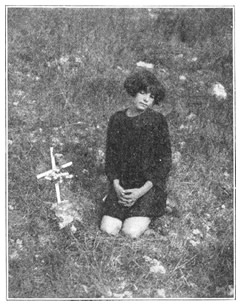 JEANNE WAS KNEELING BESIDE A CROOKED LITTLE BROWN CROSS
All the d'Artrots were looking for Jeanne, but Margot came upon her
first.
Jeanne was kneeling beside a crooked little brown cross. There were
flowers on it.
Jeanne had made the crooked little brown cross herself, and she was
praying. She had made it for her soldier daddy.
Margot came up behind Jeanne.
"What are you doing, Jeanne?" she asked.
Jeanne thought she had never before seen Margot's face this way. It
seemed that Margot was about to cry, but not the usual Margot cry.
She was not acting spoiled. She was not commanding anything. She seemed
so sweet and kind and sympathetic.
"I—I was praying," said Jeanne. "But what are you doing here, Margot?"
Margot sat down beside the little, black-aproned figure and took
Jeanne's hand.
"I came to play with you, Jeanne," she said. "I came to tell you about a
new play."
Jeanne could not understand it at all.
With head bent, she whispered, "But Margot dear, I have not brought
Pierrot. We cannot play without Pierrot."
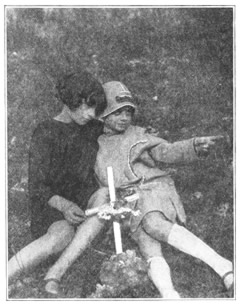 THEN MARGOT TOLD A STORY TO JEANNE
Margot answered, "We do not need Pierrot for this play. You see there
is only one heroine, and that is you."
Then Margot told a story to Jeanne—a curious story of a little baby who
was kept away from her grandmother and her cousin. Yes; the baby was
really kept for a number of years from a home of love and protection and
made to work. She had very little time to play. She did not even know
her real name. How could she? It had never been told to her.
She told Jeanne of another little girl who lived in that home and had
everything. The other little girl could have played always but didn't
know how. She didn't know how to play until the first little girl came
and showed her how.
Then Margot told about a kind man who received a letter from a sick lady
telling what a terrible deed she had done.
The lady begged the kind man to take the little girl to his home in the
country and then to send for her grandmother and little cousin.
So he did. And when the grandmother and little cousin arrived, they
found that the child was Jeanne!
Jeanne started, and her eyes grew big and round.
Margot put her arm about Jeanne's shoulders. Just then they heard a
step.
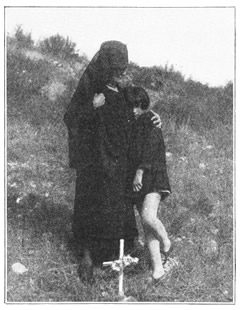 SHE TOOK JEANNE IN HER ARMS
There was Grandmother Villard standing among a group of young d'Artrots.
Grandmother left the group and came over to the two little girls.
She took Jeanne in her arms. She cried.
And then she said, "Jeanne, my little one! My own little grandchild!"
The d'Artrots left, and Jeanne and Margot and Grandmother sat together
for a long time. They sat silently.
But suddenly Jeanne exclaimed, "Oh, poor Auntie Sue! I must go to her. I
must go."
Grandmother held her back.
"No," she said. "Auntie Sue is all right, Jeanne. She only wants you to
be happy."
"Ah, but how can poor Auntie Sue sell the dresses now, when I am not
there to show them for her?" asked Jeanne.
"She will not have to sell dresses any more," said Grandmother.
"Grandmother will ask Auntie Sue to live with us always, Jeanne, if—"
"If what, Grandmother?"
"If you want her to," continued Madame Villard.
"Oh, poor dear Auntie Sue!" cried Jeanne. "She has been kind and good to
me. She could not help doing what she did. I love Auntie Sue, and I want
her to live with us always and always!"
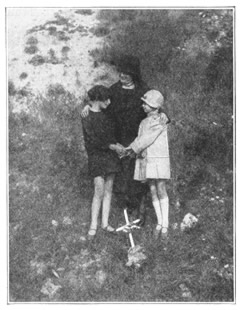 "LET US GO HOME NOW AND PLAY"
"You are a good little girl, Jeanne. Your father would have been proud
of you," said Grandmother softly.
Then Grandmother continued, and her voice was husky, "You have been as
brave a soldier as he, Jeanne."
Grandmother arose. The two little girls followed her to the white dotted
graveyard. They knelt before one of the white slabs. Jeanne saw her own
father's name in letters before her. She tried to pray and to keep her
eyes on those words, "Paul Villard." But the letters ran together.
A little breeze seemed to be whispering over and over to her, "Jeanne
Villard, Jeanne Villard—that is your name."
Grandmother and Margot at last arose. Margot put her arm lovingly about
Jeanne's shoulder.
"Come, Jeanne, little cousin," she said. "Let us go home now and play."

 LITTLE JEANNE OF FRANCE