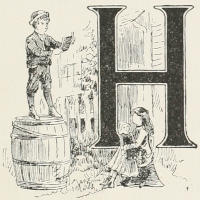
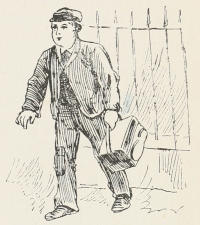
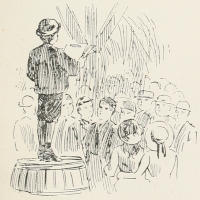
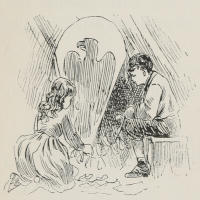
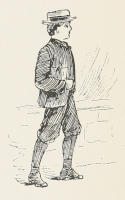
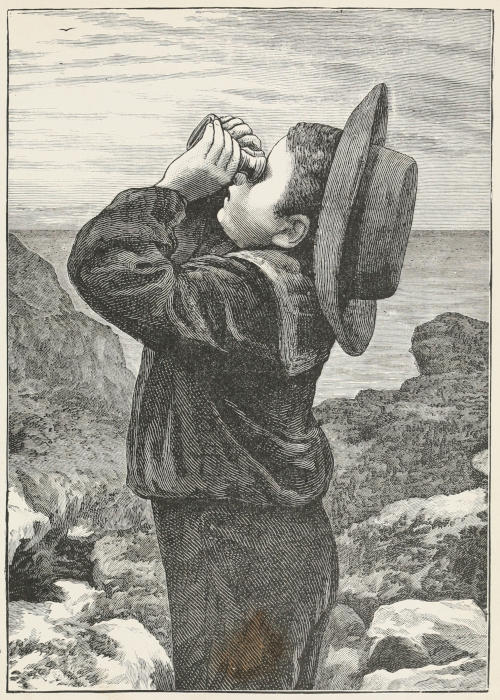
His name was Johnny Leslie, and he was
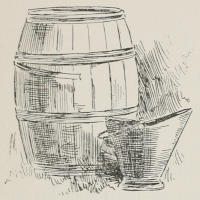
standing on an empty flour barrel; in his
hand was his United States History, and
he was shouting at the top of his little
voice,—
“All men are born free and equal,
and endowed with certain in-in-alienable
rights, such as life, liberty, and the pursuit of happiness.”
He stopped a minute to draw a long breath, and his audience,
who was sitting in an easy position upon the upturned kitchen
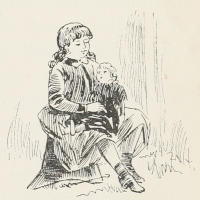
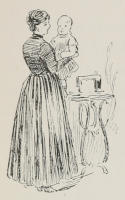
coal scuttle, with her oldest child in
her arms, took the opportunity to ask
meekly,—
“What does that dreadful long
word mean, Johnny? I never heard
of that kind of rights before.”
“You’ll know when you’re older,
Tiny,” said Johnny, loftily, and he was
going on with his oration, but the audience
was not to be silenced in this easy manner, and persisted,—
“But I want to know right away, now! I don’t believe you
know yourself, Johnny Leslie!”
“Well, I don’t believe I do,” said Johnny, candidly, and in
his own natural voice. “We might
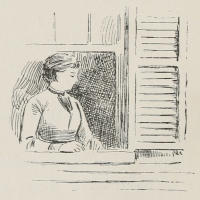
ask mamma, she’s up there at her
window, I can see the back of her
head. O mamma!”
There was no doubt about Mrs.
Leslie’s hearing; if she had been in
the top of the apple tree, at the foot
of the garden, she could have heard
that “O mamma!” perfectly well.
A pleasant face appeared where
Johnny had seen the head, and a sweet voice said, “O Johnny!”
“Mamma, what does in-a-li-en-able mean?” shouted the
orator, still loudly enough for the top of the apple tree.
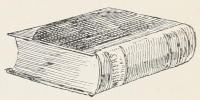
“I’ve the greatest mind in the
world to drop my new ‘Webster’s
Unabridged’ on your head, you
wild Indian,” said Mrs. Leslie,
holding the big dictionary threateningly,
over the edge of the
window-sill, and Johnny’s head.
“Don’t you suppose I have any
inalienable rights? And do you
think I can even pursue my happiness,
much less catch it, with all this hullaballoo under my
window when I am trying to write a letter?”
“Well, mamma, Tiny and I would just as lief go to the
barn,” replied Johnny, in a reasonable
tone of voice, “if you’ll just
please tell us first what that word
means. You see, as Tiny’s asked me,
maybe some of the boys might ask,
and I ought to be able to tell them.”
“Come up here, then, if you please,” said Mrs. Leslie. “I
am not a Fourth-of-July orator, and so I do not need to practise
shouting, just now.”
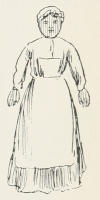
So Johnny and Tiny and Veronica—who was Tiny’s oldest
child, and was made of what had once been white muslin, with
cotton stuffing—came upstairs, and had it explained to them
that inalienable meant that which cannot be separated, or taken
away.
“But, I don’t see how that works,” said Johnny, looking
puzzled, “for folks do take our rights away; I’m having lots of
mine taken away, all the time. I’m very fond of you, mammy,
and you know it, but still you sometimes take away my rights
yourself.”
“For a Fourth-of-July orator,” said Mrs. Leslie, gravely,
“you are showing a painful amount of ignorance. We will
suppose, for the sake of argument, that I take away, or deprive
you of, certain things to which you have a right, but the right
to have them is there, all the same. Taking away the things
does not touch that. Do you see what I mean?”
“Yes, mamma, I think I do,” answered Johnny, thoughtfully,
“but it’s kind of puzzling. It’s most as bad as ‘if a herring and
a half cost a cent and a half, how much will three herrings
cost?’ But I did get that through my head, and I suppose I
can get this.”
“But, sometimes,” said Mrs. Leslie, “people’s ‘inalienable
rights’ seem to conflict; I say seem, for they never really do.
For instance, as you have a gentleman for a father, and a woman
who tries to be a lady for a mother, I feel as if I had an inalienable
right to a gentleman for a son, and a lady for a daughter;
and when my son talks about getting a thing through his head,
I begin to wonder what is becoming of my rights!”
“Now, mamma,” said Johnny, appealingly, “that’s just
nothing at all to what some of the boys say. But I’d like to
hear anybody say that you aren’t a lady, or that papa isn’t a
gentleman!” and Johnny doubled his fists fiercely at the bare
idea of such a statement.
“You may live to have that pleasure,” said Mrs. Leslie, “if
you let the boys have more of a right in you than I have.”
Johnny caught his mother in a “bear hug.” “I never
thought of it that way,” he said. “No ma’am! You’ve the
very first, best right and title to me, Mrs. Mother, and the boys
may go bang—oh, there I go again! I mean the boys may—what
shall I say?”
“You might say that the boys may exercise their inalienable
rights over somebody else,” said his mother, laughing and kissing
him. “But now I’ll tell you what we will do—I really
don’t think it would look well for a Fourth-of-July orator to
read his oration out of an United States History, so when papa
comes home, I will ask him to have the Declaration of Independence
printed on two or three sheets of paper for you, and we’ll
tie them together with a handsome bow of blue ribbon, and
meanwhile, if you’ve no objection, you will practise in the
barn.”
“Of course I will, you loveliest woman alive!” said Johnny,
rapturously, “and I shall try not to have my rights treading on
anybody else’s rights’ toes!” with which extraordinary declaration,
he pranced off to the barn, closely followed by Tiny and
Veronica.
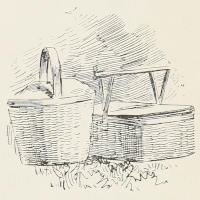
There was to be a picnic on the Fourth-of-July. Mr. and
Mrs. Leslie and three or four neighbor families had agreed to
take their dinners in baskets and
butter-kettles, to a very pretty
grove which grew obligingly near to
the little village-city where they
lived, and where Mr. Leslie edited
the one newspaper of the place,
which fact enabled him to have the
Declaration conveniently printed for
Johnny, who had been chosen by
the boys for the orator of the day, because he stood highest in
his reading and declamation classes. It wanted three or four
days, yet, of the “glorious Fourth,” and Johnny was diligently
practising his voice, for he was afraid, notwithstanding his
mother’s earnest assurances to the contrary, that it was not loud
enough for an open air oration!
Johnny was a very sociable and friendly little boy, and he
had recently made acquaintance with a boy somewhat older than
himself, whose profession was bootblacking. This boy had a
cool, knowing, and business-like air, which had greatly taken
Johnny’s fancy, and it occurred to him that a partnership with
Jim Brady might be a very good thing. Jim had happened to
mention that he owned a wheelbarrow,
and Johnny owned an
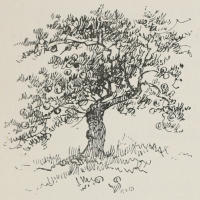
apple tree, which had been planted
by his father on the day of Johnny’s
birth, and which, this season, was
full of promising apples. So Johnny
resolved, if Jim improved on acquaintance,
and showed symptoms
of honor and honesty, to propose
to him, when the apples should be
ripe, to take his wheelbarrow and peddle them “on shares.”
He would probably have made Jim the offer on the second
day of their acquaintance, but his
mother advised him to wait a little.
She felt sure that Johnny would tell
her at once, if Jim should use bad
language, or say or do anything
which would make him a dangerous
acquaintance for her boy, and she thought it would be time
enough then to break off the intercourse which might put a little
pleasure into the hard life of the bootblack, whose sturdy figure
and face she had often noticed in passing his stand, and she had
also noticed that he was almost always busy, even when other
boys of his trade were idle.
Johnny was such a very small boy that it had never entered
his mother’s head to forbid him to smoke. She thought of
it once in a while, and hoped that
when the time came for him to choose
about it, he would elect to go without
a habit which is certainly useless,
and which in many cases involves a
great deal of selfishness. She wished
Johnny’s wife, if he should be so fortunate
as to have a good wife some
day in the far future, to love him altogether,
not with a “putting-up” with
one thing, and “making allowances” for another; and she meant,
when the time came, to lay the whole subject plainly before him,
and let him choose rationally for himself. It was quite true that
his father smoked; but he smoked very moderately, never where it
could annoy any one, and, whenever he bought cigars, he deposited
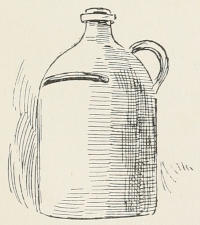
a sum equal to that spent for them, in the little earthern
jug with which he presented his wife once
a year, and this money was neither “house
money” nor “pin money”; it was for
Mrs. Leslie to spend absolutely as she
liked. And Johnny’s mother meant him,
if he should smoke at all, to be just such a
smoker as his father was.
But on the third of July, as “Johnny
came marching home,” he met Jim at the usual corner, and Jim
had a long cigar in his mouth! Johnny felt a good deal awed.
He thought Jim looked very manly indeed.
“Have a cigar?” asked Jim affably. “One of my best customers
gave me this,” he added, “and the one I’m smoking, and
I tell you it’s not many fellows I’d offer this to, for they’re
prime! It was a regular joke on him—he’s always poking fun
at me, and this morning, when I said I’d give anything to be a
sailor, he just pulls these out of his pocket, and says, seriously,
‘Smoke these, my boy, and you’ll be as sure you’re at sea as
you ever will if you really get there!’ He thought I wouldn’t
take ’em, but I did,” and Jim chuckled, “I thanked him kindly,
and told him I’d learned to smoke years ago!”
“Learned?” said Johnny, “why, what is there to learn? It
looks easy enough.”
“So it is,” said Jim, with another chuckle, “it’s like what
the Irishman said about his fall; ‘Sure, it’s not the fall, it’s the
fetch up that hurts!’ I wasn’t sea-sick after that first cigar?
Oh, no! not at all!” and he gave an indescribable wink.
All this time Johnny held the cigar doubtfully in his hand.
Was it worth while deliberately to make himself “sea-sick?”
That long, coarse, black thing did not look as if it would taste
nice.
“What are you waiting for?” asked Jim, “a light? Here’s
one,” and he drew a match from his pocket, struck it, and
handed it to Johnny, who, prevented by a false and foolish
shame, from saying what was in his mind, lighted the cigar,
hastily thanked Jim, and walked off, smoking.
But he had not gone a block before a queer, dizzy feeling, and
a bitter, puckery taste in his mouth, which reminded him of a
green persimmon, made him resolve to finish his cigar another
time; so he put it out, wrapped it carefully in paper, thrust
it into his trousers pocket, and then hurried home.
When he kissed his mother, she exclaimed, “Why, Johnny!
You smell exactly as if you had been
smoking!”
Johnny had never, in all his life,
concealed anything from his mother;
what made him wish to, now?
“I stopped to talk to Jim,” he
said, hastily, “and he was smoking
a cigar that a gentleman had given
him.”
“I’m sorry to hear that,” said Mrs. Leslie, gravely; “I must
speak to Jim. He is too young to begin to smoke.”
Johnny said nothing, but his mind was made up; he was not
going to be beaten by that cigar! There were no lessons to be
learned for the next day, and he could give the whole afternoon,
and the whole of his mind to it.
He did. I am not going into particulars, they are not agreeable;
but late that afternoon, as a heavy thunderstorm was
coming up, Mrs. Leslie grew uneasy about Johnny, who had not
been seen since dinner.
“Run to the barn, Tiny,” she said, “and see if he is there—though
I don’t think he can be, for I haven’t heard a word of
the oration.”
Tiny ran, and came back in five minutes, breathless, and
with a horrified face.
“Oh, mamma!” she exclaimed, “Johnny’s cap and his speech
are on the barn floor, and the most dreadfullest groans are
coming out of the haymow!”
Mrs. Leslie was running to the barn before Tiny had finished.
“Johnny!” she called wildly. “My darling! What has
happened?”
A pale face, a rough-looking head, with hay sticking out of
its hair, appeared at the top of the ladder, and Johnny staggered
weakly down.
“Oh, mamma!” he groaned, “I think I must be going to
die! I never felt this way before!”
His mother caught him in her arms, and as she did so, the
smell of the rank cigar which Johnny, with wasted heroism,
had smoked to the end, struck her indignant nose.
“Johnny!” she exclaimed, reproachfully, “you’ve been smoking,
and you told me what was just as bad as a lie about it!”
And the warm-hearted, offended little mother burst out crying,
and sobbed with her head on Johnny’s dusty shoulder.
Nothing she could have said would have gone to Johnny’s
heart of hearts as those sobs did. He forgot his alarming illness
as he caught her in his arms, and said, imploringly,—
“Oh, mammy, my darling mammy, please don’t cry like
that; I’ll die before I’ll ever tell you a lie, or act you one,
again. Oh, please say you forgive me!”
Of course Tiny felt obliged to help with the crying, and
when Mr. Leslie, coming home to a deserted house, traced his
family to the barn, he came upon a place of wailing.
At first, he was inclined to laugh, but when he heard of the
deceit which had followed Johnny’s first effort at smoking, he
looked very grave. No one, however, could doubt Johnny’s
penitence, and as he lay on the lounge in his mother’s room,
while the heavy thunder and sharp lightning seemed to fill the
air, and waves of deathly sickness rolled over him, he made
some very good resolutions, which were not forgotten, as such
resolutions sometimes are, after his recovery.
The orator of the day was somewhat paler than he usually
was when he took his place upon the barrel which he had previously
assisted to the grove, the
next morning.
He read the Declaration of Independence
in a voice which reached
the ears of his most distant listener
with perfect distinctness, and when
he had finished, and the applause
had subsided, he added, “out of his
head,” as Tiny proudly announced.
“I’ve got a declaration of my
own to make, now—it’s not at all
long, so you needn’t worry—it’s
just this: Folks sometimes think
they’re being independent, when
they’re only being most uncommonly
foolish, and you never need
think that anything you’re afraid
to have anybody know is independence—it’s
pretty sure to be sneaking meanness! And I’ve
heard somebody that knows more than all of us put together,
say that if we want to be presidents and things, and govern
other folks, we’d better begin on ourselves!”
And Johnny stepped, in a dignified manner, from the barrel
to a box, and thence to the ground, amid a storm of applause,
while Mr. Leslie rose and bowed gracefully, from his place
among the audience, in acknowledgment of the tribute paid
him by the orator.
A prisoner in a dungeon may be one of those “freemen whom
the Truth makes free,” and an absolute monarch may be “the
servant of sin.” Each one of us must frame for himself his own
especial Declaration of Independence.
CHAPTER II. THINKING AND THINKEPHONES.
It is a great pity that little boys’ legs
are so short; they have to hurry so
much, and a pair of good long legs, like
those of the stately giraffe, for instance,
would be such a convenience to a small
boy, who wished to run home from
school—half a mile—ask his mother
something, and be back again, inside of five minutes.
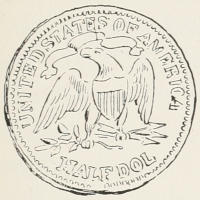
It is difficult to think and run both at once, but something
like this was passing through Johnny’s mind, as he tore home to
ask if he might spend his shiny new
half dollar in going to the circus
with “the other boys.”
Flaming posters on all the available
fences and walls, had been
announcing for some days that Barnum
was coming, and that there
would be two afternoon and two
evening performances, “presenting
in every respect the same attractions.”
Mr. Leslie had an engagement for the first afternoon,
but he had promised to take Tiny and Johnny, and as many
neighbor children as chose to join the party—with mothers’ and
fathers’ consent, of course—on the second afternoon, and with
this promise Johnny had been well content.
But when he went to school, on the morning of the first day,
he found that several of his schoolmates had arranged to go that
afternoon, and they soon succeeded in talking him into a belief
that life would not be worth living unless he could join them.
“You see, Johnny,” said Ned Grafton, solemnly, “some of
the ‘feats of strength and agility’ are about as hard to do as it
would be for you or me to turn ourselves inside out and back
again, and it stands to reason that they’ll not do them so well
the second day as they will the first, when they’ve just had a
rest; and the beasts and things always roar and fight more the
first day, because they’re mad at having been shut up in their
boxes and jolted about so; and then, forty things may happen
to hinder your father from taking you to-morrow, and just think
how you’d feel, if you were the only fellow at school who hadn’t
been! You couldn’t stand it at all! So just cut home, and
explain it to your mother, and ask her to let you come with us
to-day, and we’ll wait for you here.”
“I’ll tell you what I can do,” said Johnny, eagerly, “I’ve
half a dollar, all my own, left from my apple money, so I’ll take
that, and then I can go with papa to-morrow, too,—I wouldn’t
like to hurt his feelings, nor Tiny’s either.”
“Well, I should think your mother’d have to say yes to
that,” said Ned, “and you’ll be luckier than the rest of us, if
you go twice; but hurry up—you know it begins at three, and
it’s after two, now.”
So Johnny hurried up, and was so perfectly breathless when
he reached home, that he gasped for several minutes before he
could begin to shout through the house for his mother.
His very first shout was enough; it was given at the foot of
the front stairs, and, as his mother was in the dining-room, it
reached her instantly, and without losing anything by the way.
She came out at once, and boxed his ears lightly with the
feather-duster, saying,—
“Johnny Leslie! This is not a deaf and dumb asylum. Did
you imagine, when you came in that it was?”
“I didn’t know you were so near, mammy dear,” panted
Johnny, “and I’m in the worst kind—I mean, a dreadful hurry,
I don’t see why there couldn’t be a thinkephone, so that we
could just think things at each other, it would save so much
time. The boys are all waiting for me, and they want me to go
to the circus with them this afternoon, because Ned Grafton says
the first performance is always the best, before the beasts get the
roar out of them, and before the people are tired, so mayn’t I
take my own half dollar, and go with them, and then I can go
with papa and Tiny to-morrow, too—it isn’t that I don’t want
to go with him, but I want to have the best of it!”
“Is any grown person going with the ‘boys’?” asked Mrs.
Leslie.
“N-o, mamma,” replied Johnny, hesitatingly, “at least, they
didn’t say there was, and I don’t believe there is, but some of
the boys are quite old, you know—Charley Graham is ’most
fifteen—and there isn’t any danger; all the things are in cages,
except the Tattooed Man.”
“I’m ever so sorry, dear,” said his mother, putting her arm
around him, “but indeed I don’t feel willing to have you go
without some grown person. There will be a very great crowd,
and I don’t know all the boys with whom you want to go, and
you might be led into all sorts of dangers. And it is all nonsense
about the beasts getting the roar out of them by to-morrow;
poor things! they’ll keep on roaring as long as they
are caged. So you must be patient. I really think you’ll
enjoy it more with papa to explain things, and Tiny to
help you.”
“But they’re all waiting for me!” said Johnny, choking
down a sob, “and something may happen between now and to-morrow—it’s
a great while! Oh, please, dear mammy! I’ll
be just as careful as if papa were there, and come right straight
home when it’s out!”
Johnny’s mother looked nearly as sorry as he did.
“Dear little boy,” she said, “I know just how hard it is, and
how foolish it seems to you that I am afraid to trust you there
without papa, or some other grown person, and you know how
dearly I love you, and now you have a chance to wear my sleeve
in earnest; you must run back and tell the boys that you cannot
go till to-morrow, and then come home to me, and I’ll comfort
you.”
Johnny turned away without a word; he did not quite shake
off his mother’s arm, but he drew away from under it, and ran,
not to keep the boys waiting, back to the schoolhouse. But it
was not the light-footed running which had brought him home,
and although, before he reached the playground, he had conquered
his tears, because he was ashamed for the boys to see
them, his voice trembled as he said,—
“Mother says I can’t go to-day,—that I must wait till to-morrow,
and go with papa.”
The boys all knew Johnny’s mother, more or less; those who
knew her more adored her, and those who knew her less admired
her profoundly, so there were no jeers or tauntings upon this
announcement, but they all looked sorry, and Ned Grafton
said,—
“We’re awfully sorry, old fellow, but we can’t wait—it
wants only five minutes of three now; good by.”
There was a general rush, and the boys were gone. Johnny
walked home very slowly, thinking bitter thoughts.
“I just believe it is because
mamma never was a boy!” he
thought. “If papa had been at
home, and I’d asked him first, he’d
have let me go! Ladies don’t know
about boys—they can’t. Mamma
knows more than most ladies, but
even she doesn’t know everything.”
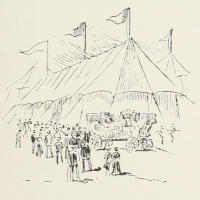
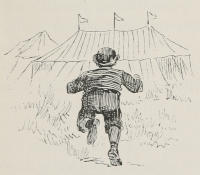
The circus tent was in plain sight all the way home; it stood
on a vacant lot about half way between the school and Mr.
Leslie’s house, and, just as Johnny entered the gate, a burst of
gay music came to his ears. His mother stood on the porch
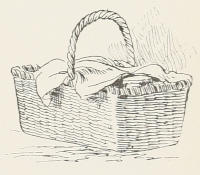
with a little basket in her hands. It was very full, and covered
with a pretty red doily. Tiny and little Pep Warren, from
next door, were jumping up and down on the porch, and the
baby was tottering from one to the other, chuckling, and talking
in what they called “Polly-talk.”
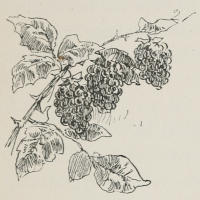
“Johnny,” said his mother, eagerly, as he came heavily up
the walk, “Tiny says there are lots of blackberries in our
field, and I want you and Pep to go
with her and get some for tea. You’ll
have to eat up what is in the basket
first, and then you can fill it with
blackberries. And I’m going to lend
you Polly!”
Johnny’s dull face brightened a
little; he and Pep were great friends;
he liked picking blackberries when he
did not have to pick many, and to have Polly lent to them for
even so short and safe an expedition as this was an honor which
he appreciated.
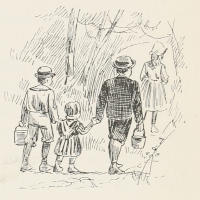
“Oh, thank you, mamma!” he said, almost heartily, as he
took the basket, and they started down the lane together, he
and Pep holding Polly between them, with one of her chubby
hands in a hand of each, and Tiny marching on in front. Pep
sympathized deeply upon hearing of Johnny’s woe, but added, at
the same time:—
“I can’t help being sort of glad, Johnny, that you’ll not
see it before I do. You know mamma is going to let me go
with all of you to-morrow.”
Johnny thought this was a little selfish in Pep, but he did
not say so, and the party reached the blackberry bushes in harmony.
Polly was even funnier than usual. She was just at that
interesting age when babies begin trying to say all the words they
hear, and the children were never
tired of hearing her repeat their
words in “Polly-talk.”
It was necessary to empty the
basket first, of course, so they chose
a nice grassy spot at the edge of the
field, where the woods kept off the
afternoon sun, spread the little red
shawl which Tiny had brought,
seated Polly on it, and themselves
around it, and opened the basket. There were two or
three “lady-fingers,” labelled “For Polly,” three dainty
sandwiches, three generous slices of loaf cake, and three
oranges.
“I think your mother is the very nicest lady I know, except
my mother!” said Pep, through a mouthful of loaf-cake, and
Johnny, who had just bitten deeply into his sandwich, nodded
approvingly.
The lunch was soon finished, and then they began, not very
vigorously, to fill the basket with blackberries, laughing at
Polly as she tangled herself in a stray branch, and then
scolded it.
Johnny put his hand in his pocket for his knife to cut the
branch, and drew it out again, as if something had stung it—there
was his half dollar! Then he remembered that he had
taken it when he went to school in the morning, because he had
half made up his mind to buy a monster kite. At that moment
the music struck up once more in the distant tent. Johnny
stopped his ears desperately.
“If I keep on hearing that, I shall go!” he said to
himself.
He could not pick blackberries and stop his ears at the same
time. The music swelled louder and louder. Then came a cheer
from the audience. Johnny looked round for the other children.
They were all standing together; Pep was holding down
a branch for Polly, and he and Tiny were laughing as the
little lady stained her pretty fingers and lips with the ripe
berries.
“She’s all safe with them; they’ll take her home,” he whispered
to himself, as he slipped into the wood, unseen by the
other children.
“Suppose you had your thinkephone now, Johnny Leslie!”
somebody seemed to say inside of his head, “you’d like your
mother to know what you’re
thinking now, wouldn’t you?”
“Papa would have let me
go—mamma’s never been a boy,
and she don’t know anything
about it!” said Johnny, stubbornly,
and speaking quite
aloud. He ran fast as soon as
he was through the wood, and,
never stopping, handed his half dollar to the doorkeeper, and
went in. The vast crowd bewildered him; he could not see a
vacant seat anywhere, nor a single boy that he knew, but a good-natured
countryman pushed him forward,
saying:—
“Here, little fellow, there’s a seat on the
front bench for a boy of your size.”
He struggled past the people into the
place pointed out to him, and leaned eagerly
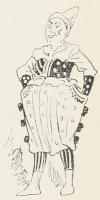
over the rope. The clown was in the ring
performing with the “trick donkey,” and everybody was roaring
with laughter.
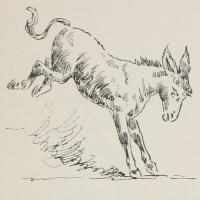
The donkey wheeled around suddenly, and flashed out his
heels, just as Johnny, recognizing a boy on the
other side of the tent, leaned still farther forward
and nodded.
Johnny had a dim impression that he had been
struck by lightning; the roaring of the crowd
sounded like thunder; he did not remember
what came next.
It was some minutes before the other children
missed him; then they called him several
times at the top of their voices, and, when he
neither came nor answered, Tiny began to cry. Pep wished to
explore the wood, but Tiny fairly howled at the idea of being
left alone with Polly.
“I just believe,” she sobbed, “that some of the elephants and
tigers and things have broken out of the circus, and got into the
wood, and eaten my Johnny all up, and if we stay here they’ll
eat us up, too!”
And, taking Polly’s hand, she set off up the lane toward
the house. Pep followed her, greatly troubled. If the “elephants
and tigers and things”
really were in the wood, he was
missing a glorious opportunity!
His heart swelled at the thought
of throwing a big stone at the
elephant, demolishing the tiger
with a club, and leading the
rescued Johnny home to his glad
and grateful mother! But Tiny
was only a girl, and a badly frightened one at that; they had
been trusted with baby Polly, and something seemed to tell
him that it was his duty to see his charge safely home, and
lay the case before Mrs. Leslie, rather than to rush into the
wood and leave them frightened and alone.
Mrs. Leslie was sitting in the back porch, peacefully sewing,
when the three children came up the garden walk, and she saw
at once that something was the matter.
“Why, where’s Johnny, Pep?” she asked, anxiously, “and
what has happened?” and she sprang up, dropping her sewing.
“We don’t know, ma’am,” said Pep, looking scared, “Tiny
and I were holding down the branches for Polly to pick, and
when we looked ’round, Johnny was gone, and I’m afraid he
went into the wood, and that some of the circus beasts have
carried him off!”
“Have any of them broken loose? Did anybody tell you?”
gasped Mrs. Leslie.
“No ma’am,” said Pep, “but I don’t see what else could
have gone with him.”
“Run home, dear,” said Mrs. Leslie, “I’m sorry to send you
away, but I must go look for Johnny. Take Polly to the
nursery, Tiny, and I’ll send Ann up to you.”
And, only stopping to speak to the servant, Mrs. Leslie
sped down the lane and into the wood, calling “Johnny!
Johnny!”
It was a very small wood, and she soon satisfied herself that
her boy was not there. She ran up the lane, intending to go to
Mr. Leslie’s office, and see what
he thought had better be done
next, when the front gate
opened, and the man who had
shown Johnny to a seat, came
in with the poor little boy in his
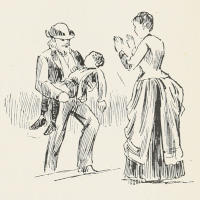
arms.
Johnny was still insensible,
and at the first glance, his
mother thought that he was
dead. Her face grew as white as his, and it was with great
difficulty that she kept herself from falling.
“Don’t be scared, ma’am,” said the farmer, kindly, “the little
feller’s only fainted, and his hurt ain’t but a trifle—the
donkey’s hoof just grazed him kind of sideways. If it had
struck him square, it would have finished him, but a miss is as
good as a mile.”
While he was speaking, the farmer had laid Johnny on the
bench in the porch, and now he went hastily to the pump, and
brought a dipperful of water to Mrs. Leslie.
“A little of that will bring him to,” he said, and as she
gently bathed Johnny’s face and head, his new friend fanned
him gently with his own large straw hat, and in two or
three minutes the little boy “came to,” and sat up, feeling
strangely dizzy, and wondering where he was, and what had
happened.
“There!” said the farmer, putting on his hat, and then
making a bow, “Good afternoon, ma’am—he’ll do now,” and
he was gone before Mrs. Leslie could even thank him.
“I went to the circus, mammy!” said Johnny, feebly, and
throwing his arms around his mother’s neck as he spoke, “and
the donkey was quite right to break my head, only I don’t see
how he knew, or how you knew, and if I’d really had the thinkephone,
then you could have stopped me. But I’m not good
enough to wear your sleeve any more—you’ll have to take it
back!”
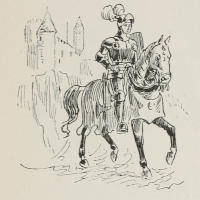
Johnny had been very much interested about knights, a few
weeks before, when his mother had told him some stories of the
Knights of the Round Table, and how each one chose a lady
whom he might especially honor, and for whom he was always
ready to do battle, and wore her token, a glove, or a silken
sleeve, or something of the kind that she had given him, and
how Launcelot wore the sleeve of the fair Elaine. They were
ripping up a silk gown of Mrs. Leslie’s, which was to be made
over for Tiny, at the time of one of these talks; it was a summer
silk, soft, and of a pretty light gray color, and he had
begged one of the sleeves. His mother had humored him, and
twisted the sleeve around his straw hat.
“Be my own true knight,” she had said, as she gave him his
decorated hat, and Johnny had fully intended to render her all
knightly service and homage. So that now, when he had so
flagrantly deceived and disobeyed her, he felt that he was
degraded, and had no longer any right to wear her token.
“We will not talk about that now, dear,” said his mother,
very gently and gravely, “You must go to bed at once, and
have a mustard plaster on the back of your neck. Does your
head ache much?”
“I should think it did!” said Johnny, feebly, “it feels as big
as the house, with an ache in every room!” and he closed his
eyes.
He was feverish at bedtime, and his mother, too anxious to
go to bed, put on a soft wrapper, and drew the easy-chair to his
bedside. She had sent for the doctor, but he was not at home,
and she could not hope to see him now, until morning.
Johnny moaned and muttered a good deal in his sleep,
through the night, but toward morning he grew quiet, and when
he woke, the pain was nearly gone, but he felt very weak and
forlorn. The doctor came, and said he had better stay in bed
until the next day, and against this advice he felt no desire to
rebel.
“Mamma,” he said, earnestly, when the doctor had gone, “I
wish I felt well enough to want to go with papa and Tiny and
Pep and the rest of them, right badly. I don’t feel punished
enough.”
His mother stooped to kiss him.
“The punishing will not help you for next time,” she said,
“unless you see just where the fault was. When did the going
wrong begin?”
Johnny was silent for a few moments; then he said,—
“I think it began when I said to myself that you didn’t
know about boys because you were a lady. Then, when I found
I had my half dollar in my pocket, and heard the music, that
seemed to make it all right,—I made myself believe that if
papa had been at home, he would have let me go,—only I didn’t
really and truly believe it, for he never does let me do things
that you don’t.
“But, mamma, don’t you think it would be a splendid thing
if there really were thinkephones? Something like telephones,
you know, only for thinks instead of words? You see, if you
and I had one, you would always be able to stop me when I was
going to do anything bad! I had such a queer dream last night,
when my head hurt so; I thought somebody had really and
truly invented thinkephones, and I was hearing everybody think,
and some of the people that I had liked ever so much were
thinking such disagreeable things that I did not like them any
more, and they heard me think that, and then they didn’t like
me any more, and things were getting into a most dreadful mess
when you came in and cut the wires, and then the dream
stopped, and I went into a nice quiet sleep.”
“So you see,” said his mother, smiling at this remarkable
dream, “that if anybody ever should invent the thinkephone, it
will make more trouble than pleasure, for no one, not even the
best people, would be ready to have all their thoughts known to
any other human being. But, dear Johnny, Who is it to whom
all our thoughts lie bare, Who hears them just as if we spoke,
Who, if we ask Him, can take away the wicked ones, and put
good and holy ones in their place?”
“It is the Saviour, mamma,” said Johnny, reverently, “and
if I had just asked Him yesterday, when I heard the music, and
found the half dollar in my pocket, that would have been better
than stopping my ears. But it seems to me that just when I
am most bad and need Him the most, I forget all about Him.”
“We can teach our minds, as well as our bodies, to have
habits,” said his mother, “and the habit of sending up a quick,
earnest prayer, whenever we are especially tempted, will often
save us from yielding to the temptation, when there is nothing
else to do it. Even if I could read your thoughts, I cannot
always be with you, and I could not always help you, but the
Saviour is always near, and always ‘mighty to save,’ from small
things as well as great, and you can think to Him, and know
that it will be just the same as if you had spoken.”
Johnny was obliged to keep rather quiet for several days, but he
was much more patient and gentle than he had ever been before
during a slight illness, and he seemed sincerely pleased when he
heard what a good time Tiny and Pep and the rest of his small
friends had had at the circus.
Tiny had been much impressed by seeing the identical donkey
that had come so near to breaking Johnny’s head.
“I didn’t half like that part,” she said. “I wanted that
donkey punished for kicking you, Johnny.”
“He didn’t do it on purpose, Tiny,” said Johnny, indulgently.
“You see, I stuck my head out over the rope, and,
though I couldn’t help thinking at first that he knew and did it
to punish me, I know now that that was foolish. And I’m
really very much obliged to him! If nothing ever happened to
folks, I don’t believe they’d think of anything!”
Mrs. Leslie left Johnny to decide for himself whether or not
he should give her back her sleeve, and, very sorrowfully, he
brought her his hat to have the “token” ripped off.
“It wouldn’t be fair for me to keep it on, mamma,” he said,
“when I deserted Polly and Tiny and you all at once. But
please don’t cut it up, or anything,—just put it away safely,
and the very first time I’ve been tempted right hard, and
remembered what you said, and been helped through, then I’ll
ask you to put it on my hat again!”
CHAPTER III. LETTER AND SPIRIT.
Tiny and Johnny congratulated themselves,
and each other, at least once a week,
upon being the children of an editor.
You will think, perhaps, that they had
literary tendencies, and hoped to grow up
into co-editors? Not in the least! They
each wondered, as they groaned over
“composition day,” how anybody could
be found willing to spend the greater part of his time either in
writing, or in reading what other people had written; they
knew that at least a column of the
“large print” in their father’s paper, was
always written by himself, and they had
often seen him plodding through pages
of bad writing, which must be read and
decided upon, so that, proud as they were
of him for being able to do these things,
and much as they admired him, I am
afraid they pitied him even more.
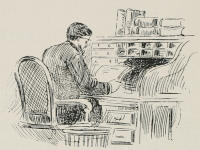
“Poor papa!” they would say to
each other, when they saw him at his desk, with a mountain of
manuscript before him; and sometimes, I must confess, Mr.
Leslie echoed this sigh, for an editor’s life is not invariably
“a happy one,” any more
than a policeman’s is.
No, their pleasure in having
an editor for their father
was a very practical one;
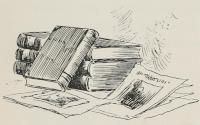
among the many books which
were sent to him for review
were numbers of nice story
and picture books for children;
among the “exchanges” which
came to the office were delightful picture papers, selected, apparently,
with a view
to playroom walls
and scrap-books.
And last, but by no
means least, there
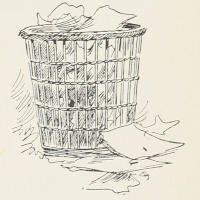
was the waste-paper
basket! They had
learned the signs
and tokens, and whenever a very fat manuscript was being read,
they would ask eagerly,—
“Did she send any stamps, papa?”
They were so nearly sure that the fat manuscript would
prove “not available for the purposes of, etc.,” that the whole
thing hinged on the stamps—if she had sent them, why then,
of course, she must have her “old manuscript” back, if she
wished it; but if she had not, then, oh, then! there were all
those sheets of paper, perfectly blank on one side, anyhow.
And what with colored envelopes, and pamphlets printed on pink
and blue paper, and envelope bands, and monograms, and occasional
coats-of-arms, that waste paper basket, with skilful handling
of its contents, had yielded many a handsome kite.
Its contents had been given over to Johnny, and those of the
rag-bag to Tiny, at the same time, but they preferred to make
partnership affairs of both. As the rag-bag yielded sails for
boats, and covers for balls, and “bobs” for kites, so did the
waste-paper basket yield colored paper wherewith to dress paper
dolls, and stiff cards which made excellent cardboard furniture,
not to mention those pieces of blank-on-both-sides writing paper,
which could be cut into small sheets and envelopes. And if a
monogram is really handsome, why should
not one person use it as well as another?
Johnny was beginning to be famous
for his kites, and as he was a warm-hearted
and generous little boy, with a
large number of friends, he frequently
made a kite to give away. Tiny was
always ready to help him, and was particularly
“handy” at making the devices of
bright paper with which the kites were
generally ornamented, and pasting them neatly on. When the
kite was very large, she did even more than this, and Johnny
never gave one away, without explaining that Tiny had shared
in the making.
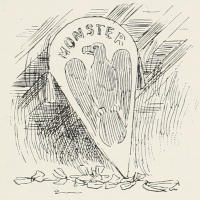
They had been saving all the best paper of every sort lately
for the largest kite they had ever undertaken; it was so large
that it was already named the Monster, and it was stretched,
half finished, upon the floor of the spare garret, where it would
not be disturbed. It was designed for a birthday present to one
of Johnny’s very best friends, and everybody in the house was
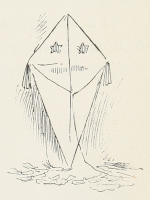
interested in it. It was to be pure white, with a pair of wings,
and a bird’s head and tail, in brilliant red paper, pasted upon
one side, and on the other, in large blue letters, the initials of
the boy for whom it was intended.
But, with the perversity of things in general, or rather
because it had been a very warm summer, and most of the poor
authors had been taking holidays as much as they could, the
waste-paper basket of late had not been worth the trouble of
emptying.
So it was with no very great expectations that Johnny went
to it one Saturday morning to see if by chance there should be
a rejected manuscript of sufficient length to satisfy the Monster.
No, there was nothing there but a
letter written on both sides of the
paper, a few pamphlets, likewise
without blank sides, and some
envelopes and postal cards.
Johnny was turning away with a
natural sigh, and the conviction
that, if the Monster was ever to
be finished, he must make a small
appropriation out of his Christmas money, when behold! on the
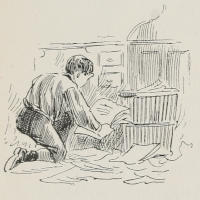
floor, just under the edge of the desk, and hidden by the basket,
he spied a lovely manuscript; large sheets, firm, white, unruled
paper, written upon only on one side.
He jumped for it with a joyful exclamation, but stopped as
suddenly—had it been thrown down, and missed the basket, or
had it fallen, and been neglected for
the moment, because it was hidden
by the desk and basket?
If Mr. Leslie had only been
there, how quickly these questions
could have been answered! But
alas! he had left home that very
morning, to be gone two days; and
must a whole precious Saturday be
lost on account of what was, perhaps,
after all, only a needless and foolish scruple?
Then the two Johnnys—you may have observed that
there are two of you?—began an argument something like
this:—
Johnny No. 1. You’d better not take that thing till you’ve
asked your father about it. It looks to me as if it had merely
fallen from the table.
Johnny No. 2. But papa won’t be back till Monday morning,
and I can’t wait. Bob’s birthday is next Wednesday, and
the kite’s only half done now!
No. 1. That makes no difference. It is not the question.
And you might at least ask your mother what she thinks, and
let her decide.
No. 2. Mamma never knows anything about papa’s papers;
I’ve heard her say so a dozen times. And why should it have
been on the floor if it was worth anything?
No. 1. You know quite well that your father never throws
on the floor things which are meant for the basket, and that it
looks much more as if it had fallen from the table. Come, put
it back, and either wait till Monday, or go and buy the rest of
the paper you need.
No. 2. Papa’s a very careful man, and he wouldn’t have
gone off for two days and left anything worth while on the floor.
It was almost in the basket, and it’s all the same, and I mean to
take it, so there!
The other Johnny made no reply to this conclusive argument—in
fact, he had no time, for the wrong Johnny rushed out of
the library, shouting:—
“Tiny! Oh, Tiny! come at once! Here’s enough to finish
the Monster, tail and all!”
Tiny dropped some very important
work for her best doll
without a moment’s hesitation,
and reached the garret almost
as soon as Johnny did.
“Oh, that’s perfectly lovely!”
she panted, “and it’s more than
enough! But oh, Johnny,”
she added, in a changed tone,
“if we should ever write poems and stories and things, after
we’re grown up, do you believe that some dreadful editor will
let his children make kites out of them?”
“I’m afraid he will, of mine,” said Johnny, frankly, “for
that’s about all they’d be good for, but you write much better
compositions than I do, Tiny, for all you’re so much younger
than I am, so perhaps the editors will print yours. But it
does seem a sort of shame, when you think of all the time it
must take them to do it, and how flat they must feel when it
turns out to have been for nothing. Now this one”—looking
at it critically—“is really beautifully written, and on such good
paper. Why, even the paper must cost them ever so much! I
say, Tiny, it’s just as if we had to put on five dollar gold pieces,
or gold dollars, for bait when we go fishing, and then had them
nibbled off without catching anything. I’ll tell that to papa—I
think he might make a story, or a poem, or a fable, or something
out of it—don’t you?”
“Yes, it’s just the kind of thing they use for a fable,” said
Tiny, approvingly, and so, in steady work at the kite, enlivened
by such intellectual conversations as this, the day flew by, and
by evening the Monster was finished, tail and all.
There had been more than enough of the strong white paper
for everything, and Tiny had carefully cut the “bobs” out of
it, fringing each one at both ends. The colored paper for the
enterprise had been on hand for some time, and Mrs. Leslie put
the crowning glory on, by drawing a monogram to take the
place of the separate initials of Bob’s name, which were to have
adorned one side of the kite. This monogram was cut by Tiny’s
deft fingers from pink and blue paper, and carefully pasted
together in the middle of one side.
Johnny had so entirely succeeded in silencing his scruples
about the manuscript, that he would probably never have
thought of it again, if it had not been rather forcibly recalled to
his memory. It had not occurred to Tiny to ask any questions
about it; such streaks of luck had come to them before,
and she had perfect faith in Johnny. So when, at the dinner-table,
on Monday, Mr. Leslie said to his wife,—
“I’ve somehow mislaid a very bright article by Mrs. ——
which I meant to use in the next number. Did you empty the
waste basket, dear, or did the children?”
Before his mother could answer, Johnny, with a very red
face, and a lump in his throat, had told the whole story.
Mr. Leslie looked exceedingly grave.
“I am very much annoyed by the loss of this manuscript,”
he said, “for even should Mrs. —— have a rough draft of it,
she will be obliged to take the trouble of making a second copy,
and should she not, it will be necessary for me to pay her for it,
as if I had used it. But that is not the worst of it, Johnny.
If we deliberately stifle our consciences, after a while, we cease
to hear from them. Do you remember asking me what ‘Quench
not the Spirit’ means?”
“Yes, papa,” said Johnny, in a choked voice.
“I think, then, that you remember what I told you, my boy,
and I shall pray that you may not again forget it. And now,
the next thing is, reparation, so far as you can make it. You
must write to Mrs. —— and tell her the whole story.”
“Oh, papa! please! I’ll do anything else!” said Johnny,
piteously. “But won’t you please write for me, and let me sign
it, or put that it’s all true, at the bottom?”
“No, my son,” said his father, firmly, “you must do this
yourself, and I shall take it as a proof of real repentance, if you
do it promptly, and without complaint.”
Johnny said not another word, and that evening, when he bade
his father good-night, he handed him a letter, saying meekly,—
“You’ll direct it for me, won’t you, papa?”
“Certainly, I will, my dear boy,” said his father, throwing
his arm around Johnny’s shoulder, and drawing him near for
another kiss.
“And you’ll read it, and see if it will answer? Indeed, I did
my very best!” said poor Johnny.
“I don’t doubt it, dear boy,” said his father, warmly, “and
I shall add a few lines to tell Mrs. —— so.”
“Oh, will you do that? Thank you very much, dear papa!”
said Johnny, and he went to bed with a wonderfully lightened
heart.
This was his letter:—
“Dear Mrs. —— Perhaps you will think I have no right to
call you that, when you hear what I have done. I took a story
of yours, which I heard papa say was a very bright one, and
used nearly all of it to finish a Monster Kite, which Tiny and I
were making. Tiny is my sister, but she knew nothing about
the way in which I took the story. It was this way. Papa lets
us have everything which he puts into the waste-paper basket,
but people don’t seem to have written much lately, and we had
not near enough. On Saturday morning I went to look. There
was nothing of any account in the basket, but your story had
fallen on the floor, and I made myself believe that I thought it
had been thrown at the basket, and missed it. Papa was away
and was not coming back till Monday, and we were in a great
hurry to finish the Monster for Bob Lane’s birthday, so I just
took it, and let Tiny think I found it in the basket, which was
as bad as a lie, though I didn’t say so. Now, I am so sorry that
I don’t know how to tell you, but that is not enough. If I
could unpaste your story, I would, but we put on a great deal of
paste—you have to, you know, or it don’t stick—and some of
it is all cut into fringe, for the bobs. But what I mean to say
is this: if you have any little boys, or little nephews, or know
anybody you would like to give that kite to, I will send it right
on. I have money enough, I am pretty sure, to pay for expressing
it, and I know a way of fixing it so that it will not break.
I sent one to my cousin. Will you please let me know at once,
if I may send it, and oblige,
“Yours very sorrowfully and very respectfully,
“John Leslie.”
It had taken Johnny three good hours to write and copy that
letter. His father made no alteration in it, merely adding a few
courteous lines to express his own regret for what had happened,
and to say that he believed his boy had repented his fault very
sincerely, and had done his best with the enclosed letter.
Mrs. —— was not a monster, if the kite was. She laughed
till she cried, and then cried a little till she laughed again, over
Johnny’s letter. Then she answered it, and this is what she
said:—
“My dear John,—You have my hearty forgiveness. And I
would like very much to have the kite for my son, who is nearly
as old as I imagine you are, and has never yet made one. But
you must allow me to pay the expressage; I can only accept it
on that condition. I have a rough copy of the article which
helped to make the Monster, and from this I will make a fair
copy for your father to-day and to-morrow. Please tell him so,
with my kindest regards,—and that I hope it will circulate as
widely as will the first one, and in as high circles! I should
very much like to hear from you again; if you will write once
in a while, so will I, and some day, I hope, you and my boy
will meet and be friends. In the meantime, believe me sincerely
and cordially your friend,
“Mary ——.”
Johnny proved the sincerity of his repentance still further by
the perfect willingness with which he packed the Monster for
his journey. Tiny helped him, having first, by working very
carefully, soaked off the monograms, not much the worse for
wear, and, as they were so fortunate as to have some gilt paper
in stock, the rough spot was covered with a shining star.
An explanation was made to Bob, who, not having expected
a kite, or indeed any birthday present at all from Tiny and
Johnny, was quite resigned to wait, with so brilliant a prospect
ahead of him, until one or two more unfortunates had contributed
a large enough supply of waste paper. If they had known
how eagerly it was welcomed, it might have helped to console
them a little, poor things!
The children built a third Monster for themselves, after Bob’s
was finished, and on this they pasted, in large gilt letters, upon
a blue ground, the motto they intended to use if they should ever
have a coat-of-arms—“Be sure you’re right, then go ahead.”
“Only I suppose it will have to be in Latin then,” said Johnny,
as he smoothed down the last letter of the last word, “and
perhaps, by that time, I’ll know enough Latin to do it myself!”
CHAPTER IV. THE FIRST MOVE.
There were just two things which could
keep Johnny quiet for more than two
minutes at a time; one was having some
one read aloud to him, and the other was
playing checkers. He could read to himself,
more or less, but stopping once in a
while to spell a long word, or to wonder
what it means, breaks the thread of the most entertaining story,
so whenever anything very attractive-looking in the way of
books and magazines came into the Leslie family, Johnny coaxed
his mother to read it aloud.
But it is one thing to hear reading because you have begged
for it, and have been running and jumping enough to make
keeping still not only possible but really quite pleasant, and
another to hear it because your mother asks you to stay in the
house until it clears up, or your cold is well.
New Year’s Day had been bitterly cold and raw, and Johnny,
coming from the well-warmed church in the morning, had
stopped on the way home to do a little snowballing. He had
“cooled off,” as he expressed it, rather too quickly, and the
result was an unpleasant cough. Now Johnny did not in the
least object to drinking the agreeable beverage made of Irish
moss and lemons and sugar, which his mother had prepared for
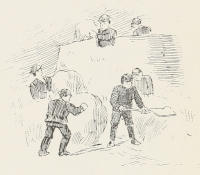
him, but it was hard work to
stay in the house when all the
other boys were building a
snow-fort, and making ready
for a magnificent battle.
“Oh, mammy dear!” he
implored, “if you’d ever in
your life been a boy, you’d
know how I feel when I look
out of the window! If you’ll
let me out for just one little
hour, right in the middle of the day, I’ll put on my rubber-boots,
and my overcoat, and my fur cap, and my ear-tabs, and wind
my neck all up in Tiny’s red scarf, and not stand still one single
moment—oh, please, please! They’re just building the tower!”
“Poor Johnny!” said Tiny, with much sympathy, “would it
hurt him that way, mamma?”
“Yes, dear, I’m afraid it would,” said Mrs. Leslie, and turning
to Johnny, she asked, “My Johnny, were you quite in
earnest, when you said you would try to win back my sleeve?”
“Why mammy! of course I was!” he answered, opening
his eyes very wide, and for a moment forgetting his woes. No
opportunity which he considered large enough had yet occurred,
for him to try to win back his mother’s “silken sleeve,” which
he had worn twisted around his hat to show that he meant to
render her knightly service, and which he had given back to her
the day after the circus, because he felt that he was unworthy to
wear it, and he often looked at it sorrowfully as it hung, where
he had placed it, above his mother’s picture, in his little room.
“Very well,” she said, gently pulling him down upon her lap,
and turning his face away from the distracting window.
“Imagine that you are really a
knight, and that you are storm bound
in my castle, as the foreign knight
was in Sintram’s. You’d be too
polite, in that case, I hope, to be
grumbling and howling because you
were compelled to pass a whole day in
the charming society of the lady of
the castle—now, wouldn’t you?”
“Well, yes, mamma, I suppose I
should,” admitted Johnny, reluctantly, “but somehow it doesn’t
seem exactly the same thing. You see, the snow may all be
melted before you let me out again, and when the real old
knights were storm bound, or anything, they always knew that
their enemies and battles and things would keep!”
“Very well then,” replied his mother, promptly, “that gives
you a chance to be just so much more knightly than the ‘real old
knights’ were! And if you don’t give another howl, or scowl,
or grumble, all day, but are my very best Johnny, instead of my
second best or third best, I’ll twist my sleeve around your new
school cap this very night!”
“Oh, mammy! will I really and truly be winning it, that
way?” asked Johnny, eagerly.
“Indeed you will,” said his mother, kissing him, “for you’ll
never, even if you should some day be a soldier, and fight for
your country, find a worse enemy, or one that will take more
conquering, than my third-best Johnny Leslie!”
Johnny returned the kiss with interest, and then, resolutely
turning his back to the window, he said,—
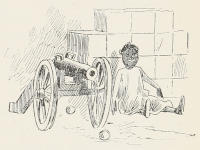
“Tiny, if you’ll bring your old black Dinah here, I’ll get out
all the blocks, and my pea-shooter, and my little brass cannon,
and we’ll make a huge fort, and put Dinah in the tower, and
storm it! You don’t mind
our making a muss here,
mammy, if we clear it up
again, do you?”
“Not a bit,” said his
mother, cheerfully, while
Tiny, with a little scream of
delight rushed off for Dinah.
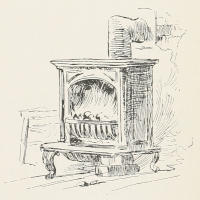
The playroom stove was out
of order, and the children were obliged to play in the dining-room,
which made Johnny’s imprisonment all the harder to bear.
Tiny came back presently, with an assorted cargo, presided
over by Dinah, in the basket.
“I brought all my tin housekeeping things,” she explained,
as she proceeded to unload. “I thought we could put them on
top, and they’d make such a lovely clatter when the fort fell!”
“Now, that’s what I call really bright!” and Johnny nodded
his head approvingly. “It’s almost a pity you’re a girl, Tiny—you’d
be such a jolly little fellow if you were only a boy!”
It made Tiny very happy when Johnny approved of her, so
the building of the fort went merrily on with so much laughing
and talking that Mrs. Leslie, who
was in the kitchen, not “eating
bread and honey,” but making
doughnuts, looked in once or twice
to see if any of the children’s
friends had called. And when the
stately fort, with its tin battlements,
at last yielded to the fierce attack
of the brass cannon and the pea-shooter,
used after the manner of battering-rams, she rushed to
the scene of conflict with the dreadful certainty that the stove
had been knocked over, but an invitation to help hurrah for the
victory quieted her fears.
The ruins had just been picked up and repacked in the basket,
when Ann came in to set the dinner table, and Johnny found, to
his astonishment, that the morning was gone.
“But there’s all the great long afternoon yet!” he thought,
ruefully, “and mamma will have to lie down, I’m afraid, and
Tiny’s going to that foolish doll-party, and—hello! if I keep
on this way I shall say something, and, if I do, Tiny will stay at
home; it would be just like her, she’s such a good little soul.
Brace up, Johnny Leslie, and win your sleeve!”
And Johnny marched up and down, and tried to sing “Onward,
Christian Soldier!” but only succeeded in coughing.
“Mamma, I wish to whisper something to you,” said Tiny,
after dinner. “Don’t listen, please, Johnny,” and she whispered,
“Don’t you think it would be dreadfully mean for me to go to
the doll-party, mamma, when poor Johnny has such a cough and
can’t go out? Because if you do, I’ll stay at home, and I
wouldn’t mind it, or not so very much, if Johnny would play
with me as he has played this morning.”
“No, darling,” whispered her mother, “Johnny would not be
so selfish as to wish you to stay; and the other little girls you
are to meet would be disappointed, for they all know about your
new Christmas doll. So run and get ready, and Ann will carry
you and your daughter across the street. You will have a great
deal to tell us when you come home, you know.”
Tiny went, but not very briskly, and, when she was gone,
Johnny said,—
“I’ll bet—I mean I think I know what Tiny said, mamma;
didn’t she offer to stay at home from her doll-party?”
“What a brilliant boy!” said his mother, smiling. “She
did, but I knew you would not like her to make such a sacrifice;
she has been counting upon the party for a week.”
“No, indeed!” said Johnny, warmly, “I hope I’m not such
a great bear as all that! But it was a jolly thing for the dear
little soul to do, and I’ll not forget it.”
“Would you like me to read to you again, dear?” asked his
mother, when she had put the finishing touches to Tiny’s dress,
and seen her off.
“No, Mrs. Mother, thank you,” said Johnny, stoutly, “I am
going to read to myself, and you are going upstairs to lie down
for at least an hour. You’re making your back ache face, and if
you don’t lie down I’ll not eat one single doughnut or gingerbread—so
there!”
“I couldn’t stand that, of course,” said his mother, laughing,
and kissing him, “and I find my back does ache, now you mention
it, so I will take you at your word, my own true knight!”
If they had been looking out of the window just then, they
would have seen a bright-faced little girl running up the walk,
and before Mrs. Leslie had started upon her upward journey the
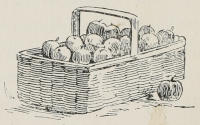
door-bell rang, and there was Johnny’s especial friend, Kitty
McKee, with a little basket of rosy apples, and permission to
spend the afternoon, “if it would be convenient.”
To say that Johnny was glad to see her but faintly expresses
his feelings. She was a year or two older than he was, and he
considered her friendship for him a flattering thing. She played
checkers so well that his occasional victories over her were
triumphs indeed, and, what was better still, she never lost her
temper with her game. So, after performing a war dance
around her while she took off her cloak and hood, Johnny rushed
for the checker-board, and Mrs. Leslie, with an easy mind and a
tired body, went upstairs for a delightful nap.
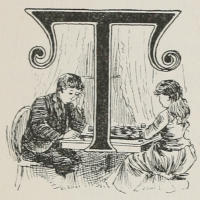
Johnny took a white checker in one hand, and a black one in
the other, mixed them up under the table, and held up his
hand, asking,—
“Which’ll you have?”
“Right,” said Kitty, and, as it happened, that gave Johnny
the first move.
The battle was fierce, but the advantage which the first move
had given Johnny was followed up until he felt so sure of victory
that he began to grow a little careless, and was startled by
losing a king and seeing Kitty gain one in rapid succession.
Then he resumed his caution; his hand hung poised over the
piece he was about to move until he had taken in all the possible
consequences. Slowly he pushed his man to the back row; two
more well-considered moves and the game was his!
Perhaps the triumph of winning the first game made him too
self-confident; at any rate, victory perched upon Kitty’s banner
for the rest of the afternoon, and when the early dusk fell they
drew their chairs to the cheerful fire, quite willing to exchange
their battle for Tiny’s eager account of the doll-party.
Mrs. Leslie had come down, rested and refreshed, and presently
Mr. Leslie was heard stamping the snow from his boots in
the porch, and Kitty said she really must go, if she did live only
next door but one, and Mr. Leslie said it was highly personal for
her to rush off the minute she heard his fairy footsteps, and he
should step in and tell her mother they were keeping her to tea.
Kitty thanked him with a kiss, and the supper was a very cheerful
one. When it was over, the meeting adjourned to the parlor,
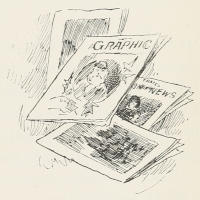
and Mr. Leslie found a Christmas
Graphic and a London News and
a number of Punch in his pockets,
and it was time for Kitty to go
home and for Johnny to go to
bed before anybody knew it.
Tiny had gone an hour ago, too
sleepy even to wish to sit up
longer.
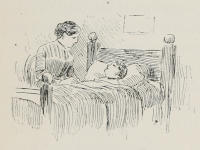
When Mrs. Leslie came to
tuck Johnny up and give him his last dose of cough mixture and
last good-night kiss, she took down the sleeve, saying,—
“You’ll find it on your cap in the morning, my own true
knight.”
“But, indeed, mamma,” said Johnny, earnestly, “I don’t
think I’ve half won it. It hasn’t been hard at all, but the very
pleasantest day since Christmas Day.”
“And why has it been so pleasant?” asked his mother, drawing
a chair to the bedside and sitting down. “Begin at the
beginning, and tell me.”
“Why, you know all that happened, mammy,” replied
Johnny. “But I’ll go over it, if you like. First, I had some
good fun with Tiny, because
she played fort so nicely, and
then you made us laugh with
the doughnut woman and gingerbread
man, and then Kitty
came with those beautiful
apples, and then I beat her
the very first game of checkers
we played—and I don’t see why in thund—I mean why I
didn’t beat her any more, for we played six games after that,
and she beat me every single one. And then Tiny made us
laugh telling about the doll-party, and then papa kept Kitty to
tea, and gave us those jolly papers, and if that isn’t a pretty
good day, I should like to know what is!”
“But you didn’t begin at the beginning,” said his mother.
“Now I am going to suppose. Suppose, when you found you
could not go out this morning, you had kept on looking out of
the window and watching the boys until your vexation and disappointment
had made you cry, I am very certain that would
have set you to coughing, and then your body would have felt
worse, as well as your mind. Suppose that, instead of offering
to play with Tiny, and doing it heartily, you had been cross and
sulky, and hurt her feelings, and had spent the morning bemoaning
your hard fate, and thinking how ill-used you were; you
would have been in such a bad way by dinner-time that my
doughnut woman and gingerbread man would scarcely have
made you smile, and by the time Kitty came, the sight of your
face would have been enough to make her turn round and go
home again. Fretting and fuming all the afternoon would have
left you too tired of yourself and everything else to care for
Tiny’s account of the party and papa’s papers. In short, everything
would have looked to you the ugly color of your own dark
thoughts.”
“Then it’s just like checkers!” exclaimed Johnny, sitting up
in bed; “if you get the first move, and make that all right, the
rest is pretty sure to come straight.”
“Yes,” said his mother. “There is a French proverb which
means, ‘It is only the first step that costs.’ If we make the
first step, or the first move, in the right direction, we have gone
a good deal more than one step toward the right end.”
“And it’s like checkers in another way,” said Johnny,
thoughtfully; “if we’re too uncommonly sure we’re all right,
and can’t go wrong, we get tripped up before we know it. I do
believe that the reason why Kitty beat me every time but that
one, was because I felt so stuck up about the first game that I
didn’t try my best afterward; I thought I could beat her anyhow.”
“That is very likely,” answered his mother. “And now you
see how needful it is to ask that we may obey God’s ‘blessed
will’ in all things—not only large, important-looking things,
which only come once in a while, but in the veriest trifles, or
what seem to us like trifles, that are coming all the time.
Sometimes I think that there is no such thing as a trifle, Johnny.
Good-night, darling—you will find my sleeve on your helmet
in the morning, my own true knight!”
CHAPTER V. INALIENABLE RIGHTS.
As time went on, from that Fourth of
July when Johnny had reason to
change his views about independence,
and as he thought more about that,
and other matters connected with it, he
grew only the more firmly convinced
that any of his rights which trod upon
the toes of other people’s rights, were only wrongs under a
false name.
The boys at his school nearly all liked him; he “went into
things” so heartily, that he was wanted on both sides in all the
games that had more than one. But with all his love of fun,
the boys soon found that there were some sorts of fun—or what
they called so—for which it was useless to ask his help. So
when recess came, the morning before school closed for the
summer, a group of boys gathered in a corner of the playground,
whispering together, and did not ask him to join them. He
felt a little left out in the cold, for some of his best friends were
in the group, but he was not naturally suspicious, and his
mother had brought him up in a wholesome fear of imagining
himself injured or slighted.
“Always take good-will for granted, Johnny,” she said to
him once, when he fancied himself neglected by somebody, “at
least until you have the most
positive proof of ill-will.”
So he joined some of the
smaller boys, who did not seem
to have been invited to the conference,
and made them supremely
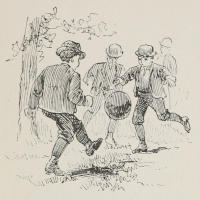
happy by getting up a game
of football.
He had just parted from one
of the larger boys, on his way
home from school that afternoon, and was near his gate, when
a little fellow, the youngest of all his schoolmates, stuck his
head cautiously out of the nearly closed gate, and, after seeing
that the coast was clear, said in a mysterious whisper,—
“Hold on, Johnny, will you? I’ve got something to tell
you, but if you ever say I told you, you’ll get me into the awfullest
scrape that ever was!”
If little Jamie Hughes had been talking to anybody but
Johnny, he would have exacted a very solemn “indeed and
double deed and upon my sacred honor I’ll never tell!”
But the boys all felt very sure, by this time, that Johnny
would not do them an ill-turn, no matter what chance he
might have; so Jamie went hurriedly on, linking his arm in
Johnny’s as he spoke, and drawing him inside the gate and up
the walk, as if he feared being seen.
“You see, they didn’t mean me to hear,” said Jamie, talking
very fast, “but it wasn’t my fault. I was up the apple tree cutting
my name, and two of them were under it, and one of them
said, ‘The old gentleman will open his eyes, for once in his life,’
and then the other said, kind of uneasy, ‘I don’t think we need
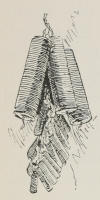
take cannon crackers; wouldn’t the small ones do just as well?’
and then I began to sing, and they never let on they heard me,
but the first fellow said: ‘My dear boy, my grandfather
expressly requested that the salute in his honor should be fired
with cannon-crackers!’ and then they both burst out laughing,
and walked away, and I never thought, till ever so long afterward,
that that one who spoke last hadn’t a grandfather to his
name, and I’m sure they’re going to do something to—to Mr.
Foster.”
“What makes you think that, Jamie?” asked Johnny, kindly,
“It may be all a joke; perhaps they saw you up there, and are
just putting up a game on you.”
Jamie shook his head.
“No, they’re not!” he said, very positively, “they both
jumped like everything when I began to sing, and the one
who said little crackers would do turned as red as a beet.
Now, Johnny, I came to you because I knew you wouldn’t
give me away, and because I thought you could think of some
way to checkmate them, and you’d just better believe it’s what I
think! You know Mr. Foster always leaves his window wide
open at night, and the ceilings are so low in that house where
he boards that anybody could throw a pack of crackers into a
second-story window easy enough. I was in his room once, and
his bed’s right opposite the window, and suppose those fellows
should throw so hard that the crackers would hit him in the
face, or light in the bed and set the clothes afire? I can’t tell
you all I know, or you’d believe me, and spot the fellows in
a minute, and then they’d spot me, and I
wouldn’t give much for my skin if they did!”
Jamie would have been a good deal more
nervous than he was if he had known that
Johnny had already, and without the least difficulty,
“spotted the fellows.” Jamie was a
timid little boy, and his affection for Mr.
Foster, who was the teacher of mathematics
at the school, had grown out of that gentleman’s
patient kindness to him. Mr. Foster
never mistook timidity for stupidity, but he was a very clear-headed
man, with little patience for boys who tried to make
shifts and tricks do duty for honestly-learned lessons. So the
school was divided into two pretty equal camps concerning
him. The boys who really studied hard were his enthusiastic
admirers, and those who studied only enough to “pull through,”
as they expressed it, were very much the reverse. But when it
came to a question of “fun,” things were sometimes a little
mixed, and it seemed, in this particular case, as if some of the
boys had thoughtlessly gone over to the enemy, and then been
somewhat dismayed when they saw where they were being led.
Johnny was very much troubled by what he had heard, and
the more he thought of it the less he liked it. A pack of cannon-crackers,
flung at random through a window, and flung all
the harder by reason of the flinger’s haste to put himself out of
sight, might do untold mischief. Beside the possibility that
they would start a fire in the room, there was another even
worse one—they might explode dangerously near the face of
the sleeping victim.
No, the thing must be stopped; but how to stop it? He
thought of asking the boys, point-blank, what they were whispering
about, but, even should any of them give him a truthful
answer, they would probably suspect that somebody had suggested
the question to him, and then, of course, remember
Jamie’s presence in the tree. He thought of giving Mr. Foster
a confidential warning, but, if it took effect, it would be open to
the same objection, and he did not like to think of the life Jamie
would lead for the next few months were he even suspected of
being the informer.
Johnny’s face wore so puzzled and hopeless an expression, that
evening after he had learned his lessons, that his father said,
kindly,—
“There’s nothing so desperate that it can’t be helped somehow,
my boy; what’s the special desperation this evening?
Grief at the prospect of a temporary separation from your
beloved studies?”
Johnny laughed a little at that.
“Oh, no, papa!” he said. “I like one or two of them well
enough, but I think I can stand it without them for a while. I
wish I could tell you all about what’s the matter, but I haven’t
any right to. I will ask you a question, though. Can you
think of any kind of game, or spree, or anything that would
make the fellows at school take such an early start on the
Fourth that they wouldn’t have time for anything else first?”
Mr. Leslie had not in the least forgotten how he had felt and
acted when he was a boy, and he also remembered various things
which Johnny had said from time to time about the way in
which Mr. Foster was regarded by the boys, so he had no great
difficulty in guessing that some mischief was on foot which
Johnny was anxious to forestall, but could not hinder by attacking
the enemy on high moral grounds.
“I should not be much of an editor if I had not enough
invention and to spare for such an emergency as that,” said Mr.
Leslie, smiling; “How many fellows are there, altogether?”
Johnny thought a minute, and then said,—
“Only thirty, papa, since the mumps broke loose—we had
over forty before that.”
“I’ll call around to-morrow, just before the exercises are
over,” said Mr. Leslie, “and ask permission to address the meeting.
By a curious coincidence, a plan for jollifying the Fourth
was seething in my brain before you spoke, and I think a trifling
alteration will make it fit the case to a nicety.”
Johnny fell upon his father’s neck with smothering affection,
and went to bed with a light and easy heart; if “papa” undertook
the business, all would go right.
“And he didn’t ask me a single question, except about how
many of us there were!” said Johnny to himself, proudly,
“What a first-class boy he must have been himself!”
Mr. Leslie was on very good terms with the principal of
Johnny’s school, and had no difficulty in obtaining leave to
“address the meeting.” His address was an invitation to attend
an all-day picnic, on the Fourth of July, and included teachers
as well as scholars. Two hay-wagons, half filled with hay, were
to be the vehicles, and a brass band was to be in attendance.
The refreshments, Mr. Leslie
stated, would be simple, but
abundant, nobody need feel
called upon to bring anything,
but anybody who
chose to bring fruit, and
could bring it from home,
would have the thanks of
the community.
“It is not usual,” concluded
Mr. Leslie, “to impose
conditions in giving an invitation, but I must ask a promise
from all of you, as we are to start at seven, sharp, on our collecting
tour, not to leave your homes that morning until you are
called for. We shall have a long drive to take, and I wish to
have it over before the heat of the day begins. Will all the
boys who agree to grant me this favor raise their right hands?”
Most of the right hands flew up as if their owners had nothing
to do with it; there was a very short pause, and then the
remainder followed. Johnny drew a long breath of intense
relief. He knew that, although some of the boys were anything
but strictly truthful, they would consider it “a little too mean”
to break their pledge to their entertainer, and besides, Mr. Leslie
had said, emphatically, that there would be no hunting for
absentees, but simply a call at each door.
That picnic was unanimously pronounced the most brilliant of
this, or of any, season. Mr. Leslie was voted “as good as forty
boys,” and the woods rang again with laughter and joyous
shouting. But when a long tin horn had given the signal which
had been agreed upon, and the boys were gathered together for
the return, Mr. Leslie mounted a convenient stump.
“Boys!” he said, as the noisy throng grew silent to listen,
“No Fourth of July celebration is complete without a speech, so
I feel called upon to make a short one. How does the Declaration
of Independence begin?”
“‘All men are born free and equal, and endowed with certain
inalienable rights!’” shouted at least half the party.
“And what does ‘inalienable’ mean?” pursued the orator.
Silence. And then somebody said doubtfully, “Something
you can’t lose or give away?”
“Exactly,” said Mr. Leslie. “So, as we travel through life,
we are to bear in mind this fact, that no matter how great, or
wise, or rich, or powerful, or poor, or oppressed, or injured we
may be, we are bound to respect the ‘inalienable rights’ of other
people, and that we shall never gain anything really worth gaining,
or that will bring a blessing with it, by disregarding those
rights.
“I will not undertake to tell you what they are; I think we
can generally tell nearly enough for all practical purposes by
two ways; remembering what we consider our own rights,
and imagining what we should consider our rights, were
we in the places of the people with whom we are dealing. We
have had a happy day, I think; I know I have——”
“So have we!” in a vast shout from the audience——
“——and I have been pleased to see what good Republicans
you all may be, if you choose. I see you are pleased with my
pleasure, and I want to ask you all to remember, as each day
closes, leaving its record of good or evil, that the longest life
must close some time, and that nothing will be of much value to
us then, but the Master’s ‘Well done, good and faithful
servant.’ Thank you for listening to me so patiently. This
day will be a pleasant memory, I hope, for all of us.”
“Three cheers for Mr. Leslie!” shouted the “fellow” who
had not any grandfather, and the amount of noise that followed
was truly astonishing.
But a good many people’s ideas of what it is to be manly
underwent a gradual change from that evening.
“If Johnny’s father thinks so—why, there’s nothing mean
about Johnny’s father! I should hope we all knew that!”
CHAPTER VI. LEANING.
A pair of shiny steel skates had been
among Johnny’s Christmas presents, and
had very nearly eclipsed all the rest,
although he had many pretty and useful
things beside.
He had never yet learned to skate,
for the only good skating-pond was at
some little distance from his home, and he had no big brother to
take him in hand, and see that he had only the number of falls
which must be accepted by nearly every one who ventures on
skates for the first time.
But the winter following the famous picnic of which I have
just told you, Pep Warren’s almost grown-up brother Robert
was at home, because he had strained his eyes, and been
forbidden to study for a month or two; but, as he sensibly observed,
he didn’t skate on his eyes, and, being a big, jolly, good-natured
fellow, he gave Pep a pair of skates exactly like
Johnny’s, and offered to teach both the little boys to skate.
He had made this offer privately to Johnny’s mother and
father before Christmas, for he had heard Johnny bewailing himself,
and saying he didn’t believe he ever should learn to skate
till he was as old as papa, and then he wouldn’t wish to!
Robert said nothing at the time, but made his kind offer in
season for Kriss Kringle to learn that nothing he could bring
Johnny Leslie would so delight his heart as a pair of steel skates
would.
Johnny came home from his trial trip on the new skates with
his transports a little moderated. He was “not conquered, but
exhausted with conquering,” and quite ready to go to bed early
that night, and to submit to a thorough rubbing with arnica
first. His head ached a little. Some of the numerous and hitherto
unknown stars which he had seen still danced before his
eyes, and he felt as if he had at least half-a-dozen each of elbows
and knees.
“You see, mamma,” he said, confidentially, as his mother’s
soft, warm hand, wet with comforting arnica, passed tenderly
over the black and blue places,
“I looked at the other fellows,
and it seemed to me it was just as
easy as rolling off a log. Rob was
cutting his name and figures of
eight and all sorts of things while
Pep and I were putting on our
skates, and I thought I had nothing
to do but sail in—begin, I
mean, and it would sort of come naturally, like walking!
“I think Pep must have been born sensible—he hardly ever
wants to do foolish things, the way I do, and, when Rob held
out his hand, Pep just took it, and went very slowly at first, exactly
as Rob told him, and, if you’ll believe it, he could really
stand alone, and even strike out a little, before we came home!
“But I started out alone to meet Rob, and, first thing I
knew, my feet went up in the air, as if they had balloons on, and
down I came, whack! right on
the back of my head! I tell you,
I saw Roman candles and rockets,
but Rob helped me up, and only
laughed a little, though I must
have looked dreadfully funny, and
then he took my hand, and told
me how to work my feet, and I
got along splendidly, till I felt
sure my first flop was only an
accident, and that I could go alone well enough. So I let go of
Rob’s hand, and kept up about two minutes, and was just crowing
to myself when everything seemed to give way at once, and
the ice flew up and hit all my knees and elbows, and there I was
in a heap, with my skates locked together as if they were a padlock.
Rob sorted me out, and tried not to laugh, till I told him to
go ahead, and then he just roared! He said if I’d only been
lighted, I’d have made such a gorgeous pin-wheel!
“Perhaps you’ll think I’d had enough—I thought I had
then myself, but just before we started for home I believed I
really had got the hang of it this time, so I let go again. I
struck out all right, and went ahead for two or three yards, and
Rob and Pep had just begun to clap their hands and hurrah when
before I knew what had happened I was sure I felt my backbone
coming out of the top of my head, and there I was again, sitting
down as flat as a pancake, and feeling a good deal flatter! I
didn’t try any more after that, but just took off my skates and
came home.”
Mrs. Leslie could not help smiling at this graphic account of
Johnny’s first attempt at skating, but when she tucked him up
and gave him his last kiss, she said,—
“Johnny, do you know of what your adventures to-day have
made me think? A verse in the Bible—‘Let him that thinketh
he standeth take heed lest he fall.’ Nearly all our falls come
from being very sure we can stand, and from refusing the offered
help.”
“Pep didn’t fall once,” said Johnny, thoughtfully, “though
it was his first skate, too, and he’s younger than I am. Yes,
I see what you mean, mamma, and I hope I’ll remember it
at the right time—but I’m so apt not to remember till
afterward!”
“That is why we are taught to ask that God’s grace ‘may
always prevent’—that is, go before to smooth the way—‘and
follow us,’” replied his mother, as she stooped to give him
another last kiss.
Johnny applied his lesson to his next attempt at skating, and
came home triumphant, saying,—
“We didn’t fall once, mamma, either of us, and Rob let us
go a little way alone, but he skated backward, just in front of
us, and caught us every time we staggered much.”
But in two weeks, during which time the skating remained
good, Rob’s pupils ventured fearlessly all about the pond, without
a helping hand, and had even begun to try to cut letters and
figures—though not, it must be admitted, with any great
amount of success. Mrs. Leslie declared that she must see some
of the wonderful performances of which she heard so much, so
one bright afternoon, when the mildness of the air threatened to
spoil their fun before long, she wrapped Tiny and Polly warmly
up, hired Mr. Chipman’s safest horse and best wagon, and drove
in state to the pond.
The boys were delighted, and did their best, but of course, in
his eagerness to excel himself, Johnny managed to fall once or
twice, and Rob was obliged to testify that this was now quite
unusual.
Then they begged for Polly—Tiny had been allowed to leave
the wagon when it first arrived, and was successfully and joyfully
sliding.
“Oh, do let us have Polly, if it’s just for five minutes,
mamma!” said Johnny, eagerly. “We’ll take off our skates
and give her a slide. It’s first-rate sliding, here by the bank,
and it’s quite safe.”
So Miss Polly, chuckling with delight, was lifted from the
wagon, while Johnny and Pep pulled off their skates, but she
was a little frightened when she felt the slippery ice under her
feet, and “hung down like a rag doll,” as Johnny said, instead
of putting herself in sliding position.
THE SKATING LESSON.
“Stand up straight, Polly, and put your feet down flat, so,”
said Johnny, as Polly slid helplessly along on the backs of her
heels, resting all her little weight confidingly upon the boys.
And, after two or three earnest explanations from Johnny and
Pep, she suddenly seemed to understand; she stiffened up,
grasped a hand on each side, and went off in such style that the
boys had almost to run to keep up with her, and she obeyed her
mother’s call very unwillingly.
“Wasn’t it fun to see her little face, though!” said Johnny,
as he and Pep walked home, having declined the proffered drive
for the sake of a little more skating. “I think she thought
something had made her feet slippery, all of a sudden—she’d
never been on ice before.”
The thaw came very soon after this, as thaws will come, even
when people have new steel skates, but happily, there are always
tops and marbles, and, as
some wise person has remarked,
“When one door
shuts, another opens.”
Johnny did not play
marbles “for keeps”; his
father had explained to him
that taking anything without
giving a fair return for
it is dishonesty, and as he
quite understood this, he had no desire to “win” marbles
from boys who could not shoot so well as he could, but he
enjoyed playing fully as much as anybody did, and found
the game exciting enough when played merely for the hope of
victory.
It was in the midst of a very even game that the school bell
rang one morning. Johnny and one other boy were the champions;
the rest had “gone out.” They lingered for one more
shot—two more—then just a third to finish the game, and
then, as they hurried into the schoolroom, they found that the
roll had been called, and they were marked late.
Johnny had intended to take one more look at his history
lesson, but there was no time. He was sure of it all, except two
or three dates, and of course, one of those dates came to him—or
rather, didn’t come; it was the question that came. The next
boy gave the answer, and Johnny’s history lesson for the first
time that term, was marked “Imperfect.”
This vexed him so, that he gave only a small half of his mind
to his mental arithmetic, and he lost his place in the class,—lost
it to a boy who was almost certain to keep it, too.
Thinking of this misfortune, he dropped a penful of ink on
his spotless new copy-book, and, although he promptly licked it
off, an ugly smear remained, and the writing teacher reproved him
for untidiness. So he was very glad when two o’clock struck,
and he could go home and tell his mournful story, for he had an
uncomfortable feeling, under the injured one, that the real,
responsible cause of his misfortunes was one Johnny Leslie.
When his mother had heard it all with much sympathy, she
paused a moment, and then repeated these words,—
“‘That they who do lean only upon the hope of Thy
Heavenly grace, may evermore be defended by Thy mighty
power.’”
A sudden light came into Johnny’s face, and he exclaimed,—
“That was it, mamma dear! I wasn’t leaning on it at all,
and of course, I went down! I know all about it now. I didn’t
get up when you called me the first time, and I said my prayers
in a hurry, just as if they were the multiplication table, and I
didn’t wait to read the verse in my little book—I meant to do
it after breakfast, but the marbles rattled in my pocket, and I
forgot all about it, I was in such a hurry to have a game before
school. And I wouldn’t stop to think, when the bell rang,
except a sort of make-believe think that a minute more would
not make me too late to answer to my name, and so I lost the
chance to go over those dates. And the question I missed in
mental arithmetic was a mean little easy thing, if I’d had my
wits about me, but I was worrying about the history, and I
made that dreadful blot because I was thinking of both, and did
not look, and dug my pen down to the bottom of the inkstand.
It’s just like ‘The House that Jack built.’”
“Yes,” said his mother, “I don’t think anything,
the smallest thing, stands quite alone;
it is fast to something else that it pulls after
it, so we must keep a sharp lookout for the
first things. We can’t rub out this bad day—it
is like the blot on your copy book; you
will keep seeing the mark, even if you don’t
make another. But then, you can use the
mark, with the dear Saviour’s help, to keep
you from making another. To-morrow will be another day.
You know Tiny and you like Tennyson’s ‘Bugle Song’ so much,
here is something else he said,—
‘Men may rise on stepping-stones
Of their dead selves, to higher things.’
So to-morrow you must stand on this thoughtless, careless
Johnny, who forgets what he ought to remember, and be the
Johnny you can be, if you ‘lean only on the hope’ of that
Heavenly grace which God gives to His faithful children.”
It was an humble, but bright and hopeful Johnny who sprang
up at the first call the next morning, and started for school,
with fresh courage and resolution.
Try not to be defeated, little soldier, but, if defeats come, do
you too try to make them stepping-stones to victory.
CHAPTER VII. THE EXTRA HORSE.
Johnny did not have a great deal of time
for thinking. It is difficult to think
when one is running, or jumping, or hammering,
or shouting, and still more difficult
when one is asleep! He often
intended to “take a think” about something
that bothered him, after he was in
bed, and before he went to sleep, but somehow, no matter how
wide awake he supposed he was before he began thinking, he
always found, before he had finished, that it was next morning,
and time to get up.
But he actually walked all the way home from school, one
day, without shouting once at anybody; he came and sat down
in the sewing-room, after he had put his books away, and was
so quiet for five minutes that his mother was just going to ask
him if his head ached, when he suddenly asked her,—
“Mamma, would you object to my keeping a peanut-stand—out
of school hours, you know, I mean?”
“Not at all,” replied Mrs. Leslie, “if you were obliged to
earn your living at once, and that were the only way in which
you could possibly do it. But papa and I are both anxious that
you should earn your living in a way which will help as many
people as possible to earn theirs, and if you were to set up a peanut-stand
now, while you are trying to learn a better way, I am
afraid it would hinder our plans for you.”
Johnny’s eyes had sparkled when his mother began with
“Not at all,” and now he looked a good deal disappointed.
“Yes, mamma,” he said, meekly, “I see that’s your side of
it, but may I just tell you my side?”
“Of course you may!” said Mrs. Leslie, smiling, and stopping
her sewing long enough to give him a hug and kiss. “I
always like to hear your side, even if I can’t agree with it, and
I know you trust me enough to come over to my side, even
when you can’t see why.”
“It would be queer if I didn’t, mamma,” he said, drawing
his stool closer, and resting his arms on her knees, “you’ve come
out right so often when I was pretty sure you wouldn’t, you
know. Now, its just this way—I know you and papa aren’t
rich, and I know I oughtn’t to ask you for any more money than
you give me now, but I do want more, dreadfully, sometimes!
F’r instance, here’s Tiny’s birthday next week, and I’ve only
twenty-five cents to buy her a birthday present with, and she
really needs a new doll; that old dud she carries about isn’t fit
to be seen, but what kind of a doll can you buy for twenty-five
cents? And then your birthday will be coming along, and then
papa’s and then Easter, and I want to give presents and send
cards to lots and lots of people, and how can I do it without any
money?”
Mrs. Leslie could not help laughing.
“O Johnny, Johnny!” she said, “you’re as bad as the old
woman who called her lazy maids on Monday morning: ‘Come
girls! Get up! It’s washing day, and to-morrow’s ironing day,
and Wednesday’s baking day—here’s half the week gone, and
you not out of bed yet!’ Dear little boy, we can’t have more
than one day at a time, and here you are borrowing trouble for
almost a whole year!”
“Well, anyhow, mamma,” said Johnny, laughing in spite of
himself, and looking a little foolish, “Tiny’s birthday is, most
here, and if I might buy a quarter’s worth of peanuts, and sell
them, and then invest the money again, I do believe I’d have a
dollar before it was time to buy her present.”
“And I wonder,” said his mother, “how many of your
lessons you would learn, and on how many errands you would
go for me, and how many steps you would save for papa, when
he comes home tired, and how much carpentering you would do
for Tiny and her little friends? No, darling, if you can’t quite
see what I mean, you must just trust me. You can help a great
many people, in a great many ways, without money, and it is all
beautiful practice for you, against the time when you can help
them with money too; but just now, your main business is to
see that papa and I are not disappointed in the man that, with
the dear Father’s help, we are trying to help you to grow into.
Keep your heart and your eyes open, and you’ll see plenty of
chances without the peanut-stand.”
Johnny looked, and felt, a good deal disappointed, but he
was a boy of his word, so he said resolutely,—
“I promised to trust you, mamma, and I will, for although
you never were a boy, papa was, and I sometimes think he’s a
kind of one yet; but you see I can’t help feeling pretty badly
about it. Perhaps it’s partly from sitting still so long—my legs
are all cramped up. Come out and race me just twice ’round
the house,” he added, coaxingly. “I should think your legs
would be as stiff as pokers, sitting sewing here the way you do,
for half a day at a time!”
“They do feel a little stiff,” said Mrs. Leslie, springing up,
and dropping her sewing into the never-empty basket, “but for
all that, I think I can beat you yet, Mr. Johnny.”
She took off her apron and tucked up her skirt a little, and
Johnny made a line on the gravel-walk with a stick.
“Now, mamma, are you ready? One, two, three, off!” and
away they skimmed, down the walk, across the grassplot; into
the walk again, over the line, around once more, and then—
“There!” said Mrs. Leslie, triumphantly, “you’re beaten
again, Johnny Leslie!”
“I don’t care,” said Johnny, panting, and very red in the
face, “you’re only a foot ahead this time, mamma, and at that
rate, I’ll be two feet ahead, next time.”
The dinner-bell rang while Mrs. Leslie was smoothing her
tumbled hair and straightening her dress.
“I have an errand that will take me almost to the park this
afternoon, Johnny,” she said, at dinner, “Tiny is going with
me, and if you’d like to go, I will call for you at three, and ask
to have you excused from the writing hour, and then we can
have a whole hour in the park before we need come home to
supper. Shall I?”
This was an extremely pleasing arrangement, and when the
time arrived, a happy party took seats in the horse car, for the
park was more than two miles from Mr. Leslie’s house, and the
last part of the way was decidedly an “up-grade.”
“Oh mamma!” exclaimed Tiny, “how will these two poor
horses pull such a car full of people up that steep hill? It’s too
much for them! Suppose we get out and walk?”
Tiny was always on the watch about the comfort of horses
and dogs and cats.
Just then the car stopped, and a third horse, that had been
standing patiently under a tree near the sidewalk, was fastened
to the pole in front of the other
two, and, with his help, the car
went easily up the slope.
“That’s nice,” said Tiny, looking
greatly relieved, “I didn’t
remember that they kept an
extra horse here, mamma; how
good it must make him feel,
when the poor tired horses stop
and say, ‘That hill’s a great deal
too steep for us to drag this great heavy car up it’; and then
he says, ‘Hold on, I’m coming. You can do it easily, with me
to help you!’”
“But, then,” said Mrs. Leslie, “just think how much of his
time he spends standing under the tree, doing nothing but
wait.”
“Why, mamma,” put in Johnny, “you know he knows the
car will be along presently, and while he’s waiting he’s resting
from the last trip, and getting up his muscle for the next one,
so it isn’t exactly doing nothing, even when he’s standing still.”
“And you don’t imagine that it makes him feel sorry that
he hasn’t a special car of his own to pull, but must just help
other horses pull theirs?” pursued Mrs. Leslie.
“I should think he’d be pretty foolish if he felt that way,”
said Johnny, confidently; “he’s doing something just as good,
in fact, I think perhaps it’s better, for he must make the two
regular horses feel good every time they come ’round there. Oh
mamma, you’re laughing! You’ve made me catch myself the
worst ki—I mean dreadfully! I see just what you mean; you
might as well have said it; you think that till I am old enough
to have a car of my own, I ought to be an extra horse!”
“But how could Johnny be a horse, mamma?” asked Tiny,
deeply puzzled.
They were out of the car by this time, and Tiny amiably
joined in the laugh which greeted this question.
“I’ll explain how he could when we sit down by the lake,
darling,” said her mother, “You and Johnny walk on slowly,
now, while I stop here for a few minutes and leave my work—the
parcel, Johnny, please!”
For Johnny was marching off with the parcel under one arm,
and Tiny under the other.
When they were comfortably seated on the shady green bank
by the lake, Mrs. Leslie explained to Tiny that she did not really
expect Johnny to turn into a horse, but that everybody who is
looking out for chances to help other people over their hard
places will be sure to find plenty to do.
“The world has a great many tired people in it,” said Mrs.
Leslie, “and a great many sick and sorrowful and discouraged
and disappointed people, and what a beautiful thought it is that
the very smallest and weakest of us may give help, and comfort,
and encouragement, every day of our lives, if we only will.”
“You do, mamma,” said Johnny, softly, stealing his hand
into his mother’s as he spoke, “and so does papa, but I’m afraid
I’ve been too busy with my own fun and things to try to help
the poor tired ones pull, but I truly mean to turn over a new
leaf. I shall put it in my prayers,” he added, reverently, and—“when,
do you think, is a good time for me to think, mamma?
The time never seems to come.”
“While you are dressing in the morning and undressing at
night would be very good times,” said his mother, “just before
you say your prayers, you know. You can think over in the
morning what you need most for that day, and at night what
you have done and left undone. I know your dressing and
undressing don’t take long,” she added, smiling, “but one can
do a good deal of thinking in a few minutes, if one gives the
whole of one’s mind to it.”
The red sun, peeping under the tree beneath which they were
sitting, reminded Mrs. Leslie to look at her watch. It was high
time to start for home, and Tiny and Johnny, as the car went
down the steep hill, looked out with much affectionate interest
for the “extra horse,” and softly called good bye to him, as he
stood quietly under the tree, panting a little from his last pull,
and patiently waiting for the next.
I wonder how many of the dear little men and women who
will read this are training for their own life race by watching for
chances to help the hard-pressed runners who have started.
Here is a motto for all of you; the motto which a noble and
earnest man has already given to many people—“Look up, not
down; look out, and not in; look forward, not back; and lend
a helping hand.”
And if you want his authority for this beautiful motto, it is
easily found, for you will all know where to look for these
words,—
“Bear ye one another’s burdens, and so fulfil the law of
Christ.”
CHAPTER VIII. “LONG PATIENCE.”
Tiny and Johnny were planting their gardens,
and Jim Brady was helping them.
Johnny had happened to mention to Jim
that he liked a garden very well, after the
things were up, but that he did hate digging;
and Jim, after thinking hard for a
minute, had said,——
“See here! If you’ll teach me some of the things you’re
learning at school, of evenings, after my day’s work is done, I’ll
dig your garden for you, and do it better than you can, for I’m
a good sight stronger than you are, and I’ll help you keep it
clean all summer, too. Is it a bargain?”
Johnny hesitated. He did not like Jim’s tone. It was quite
true that Jim was the stronger of the two, but Johnny thought
it showed bad taste to mention it in that defiant sort of manner.
And he did not see any particular fun in teaching Jim, especially
on summer evenings. But it would be a great thing to have
such good help with his garden as he knew Jim would give, so
he swallowed his pride, and said, as graciously as he could,—
“All right. You come up after tea this evening, and we’ll
begin. We have tea at six, and I’ll hurry through mine, and
then, when it’s too dark to work any more, we can come into
the playroom and have the lesson.”
You will remember that it was this Jim Brady who had
given Johnny his first, and—there is reason to believe—his last
cigar, and so led him, though quite unintentionally, into his first
act of deceit to his mother. And the remembrance of this act
was a very sorrowful one, for although Johnny, as you know,
had both confessed and repented, and had been freely forgiven,
the shameful act remained, never to be undone. Do you ever
think of that, when you are tempted to do some mean, wicked
thing?
Mrs. Leslie had called on Jim, at his bootblacking stand,
soon after this occurrence, and had a long talk with him, and
the next time the boys met, Jim had said, severely,—
“If I had an Angel for a mother, Johnny Leslie, I’d be shot
before I’d behave anyhow but on the square to her, and now I’ll
put you on your honor—if you find you’re learning anything
she wouldn’t like, from me, you’ve only to let me know, and I’ll
cut you dead!”
This was a rather mixed statement, but Johnny understood
it, and felt himself blushing. It seemed to him that Jim had
somehow got things backward, but his recent downfall had
humbled him, in more ways than one, so instead of replying, as
he was greatly tempted to, that if anybody did any cutting, he
would be the person to do it, he merely said, rather shortly,—
“Very well, I guess I know a little more about my mother
than you do, so you attend to your mother-minding, and I’ll
attend to mine!”
“Glad to hear it,” said Jim, easily, “but my mother’s what
the dictionary-talkers call a traydition; I never saw her, so I’d
find it a little impossible to mind her, don’t you see? But I’ll
tell you one thing—if your mother ever cares enough about me
to give me a little extra minding to do for her, I’ll see what I’m
equal to in that line, perhaps!”
Johnny had reported this speech to Mrs. Leslie, and she had
begun to work on the suggestion. Jim had already set his mark
to a promise not to smoke until he was twenty-one, and, although
he did not know it, Mrs. Leslie was trying to find him a situation
where he would have a certain, if small, salary, and be less
exposed to temptation than he now was. She was very glad
when she heard of the bargain which Johnny had made, and she
presented the new scholar with a
slate and spelling book, at once.
She also gave the schoolmaster a
little advice.
“You must remember, Johnny,”
she said, “that Jim has had no
chance to learn anything, compared
with your chances, and you
mustn’t look superior, whatever you
do. Whenever you feel very
grand, just imagine how it would be if papa should write to you
in Greek, and talk to you in French and Latin, and then call you
a little stupid because you could not understand him.”
Tiny looked rather mournful when she heard of the new
arrangement, but she brightened up, presently.
“Is he a very big boy indeed, Johnny?” she asked.
“Why, no,” said Johnny, considering, “at least, he’s not
much bigger than I am, Tiny. He’s only about half a head
taller, but he’s a good deal thicker.”
“What did you say you’d teach him?” pursued Tiny.
“Oh, all the things I’m learning at school, I s’pose!” replied
Johnny, “we didn’t settle about that, exactly, for I don’t know
yet how much he knows—he can’t write, but maybe he can read
a little—I hope so, for it must be awfully stupid work to teach
people their letters. But why do you want to know, Tiny?”
“I have a reason,” said Tiny, nodding her head wisely. “You
needn’t think you know all of everything, Johnny Leslie!”
“I never said I did!” retorted Johnny, warmly; then he
looked at Tiny, and began to laugh, she was so little, and was
trying so hard to look wise and elderly.
“You may laugh if you like,” she said, serenely, “I don’t mind.
But if you don’t know what you are going to teach him, perhaps
you know what you’re not. Are you going to teach him to sing?”
Johnny accepted Tiny’s gracious permission, and laughed a
good deal, but at last he answered,—
“No, Tiny, I’m not going to teach him to sing. I am quite
sure about that. Mamma says I can sing straight ahead first
rate, but she never knew me to turn a tune yet. I wish I could
sing the way you do,” he added, regretfully, “I’m so full of sing
sometimes that I don’t know what to do, but I can’t make it
come out.”
They were sitting on the back porch, pasting their scrap-books,
and Mrs. Leslie was sewing at the window.
“Never mind, Johnny,” she said, consolingly, “you’ll not ‘die
with all your music in you’ while you do so much shouting.”
“Very well, then,” said Tiny, with a look of great satisfaction,
“when Jim comes, I shall tell him that if he will dig my garden
for me, I will teach him to sing.”
Mrs. Leslie expected to hear Johnny first laugh, and then try
to dissuade Tiny from carrying out her plan, but to her surprise,
he did neither. He said,—
“I shouldn’t wonder if he’d do it, Tiny; he’s all the time
whistling, and he whistles just like a blackbird, so very likely
he’ll be glad to learn to sing, too.”
When Jim came that evening, Tiny and Johnny were both
in the garden, and as Tiny had not yet met Jim, Johnny introduced
them thus,—
“Tiny, this is Jim. Jim, this is my sister Tiny, and she
wants to be in our bargain, too. Go ahead, Tiny.”
And so encouraged, Tiny went ahead.
“I have a garden, too,” she said, “but Johnny knows more
of everything than I do, except singing, and I thought perhaps
you’d like to learn to sing, and if you would, I’ll teach you that,
and then, if you think it is worth it, will you just do the hard
digging for me? I can do the rest myself, watching you and
Johnny.”
A very gentle look came over Jim’s bold face, as he
answered,—
“If you’ll teach me how to sing, Miss Tiny, it will be worth
as much to me as all Johnny can teach me of other things, and
I’ll be proud and happy to take charge of your garden.”
“Oh, thank you very much!” said Tiny, warmly. “What
a nice, kind boy you are! Do you mind if I watch you while
you dig?”
“Not a bit!” said Jim, cheerfully, “I’m not bashful. But
you’d better sit down.”
“Wait a minute, and I’ll bring you your camp-chair, Tiny,”
said Johnny, and he raced to the porch for Tiny’s small chair,
while Jim pulled off the coat which he had put on as a mark of
respect to Mrs. Leslie, whom he hoped to see before the evening
was over, and went valiantly to work with the spade.
“What nice big spadefuls you make!” Tiny said, after
watching him a while. “When I dig, it ’most all slides off
while I am picking up the spade.”
“That’s because you are not quite so strong as I am,” said
Jim, smiling, and turning over an extra large spadeful by way of
proving his statement.
The two little gardens were thoroughly dug by the time that
it was too dark to work any more, and Johnny had hoed and
raked Tiny’s smooth, while Jim was digging his. Then they
went into the playroom, and Mrs. Leslie brought them a lamp
to light up the lesson.
“We will have a little singing
first,” she said, opening the organ.
“Tiny and I will sing the evening
hymn, and you must listen, Jim, and
try to catch the tune.”
Jim listened, and by the time
they reached the Doxology, he had
joined them, and went through the
tune without a mistake, seeming
even to know the words. His voice was a very sweet tenor,
and Tiny exclaimed delightedly,—
“It will be just as easy as anything to teach him to sing,
mamma!”
“I’d have come in sooner,” said Jim, looking very much
pleased, “but that last verse was the only one I knew. I went
to Sunday-school a few times when I was a little boy, and that
verse came back to me as soon as you began to sing it.”
Then Johnny and his pupil sat down by the table, and Mrs.
Leslie took Tiny’s hand and went to the parlor, thinking that
the two boys would manage their undertaking better without an
audience.
Johnny felt very much embarrassed, but he plunged in boldly,
as the best way of overcoming his feelings.
“I’ll do you the way they did me, the first day I went to
school,” he began, and taking his First Reader, he opened it, and
handed it to Jim, saying,—
“Just read a little, will you?”
Jim burst out laughing.
“It’s heathen Greek to me,” he said. “I don’t know more
than half the letters. Why, if I’d known how to read, I could
have picked up the rest somehow, and that’s why I asked you
to teach me.”
Johnny was about to whistle, but he suddenly recollected his
mother’s warning.
“All right,” he said, composedly; “we’ll begin with the
letters, and I’ll teach you the way mamma teaches Tiny—it’s
easier than the way they do in school. Wait a minute, and I’ll
borrow her card, the letters are so much larger than they are
in the spelling-book.”
He came back with a large card, covered with letters in
bright colors, and pointing to A, asked,
“Now, what does that look like to you?”
“It looks something like the tents those soldiers put up when
they camped near here,” said Jim, after looking at it for a
moment.
“Very well; that’s A. Now, when you say ‘A tent,’ there
you have it, all right.”
“That’s easy enough to remember,” said Jim, “I thought it
would be harder.”
“I’ll tell you what this second fellow looks like, to me,”
said Johnny, delighted with Jim’s quickness, “it always
makes me think of a bumble-bee, and
its name’s B.”
“That’s queer,” answered Jim, “it
does look like a big, fat bee, sure
enough. I guess I can remember that,
too.”
It was not easy to find likenesses
like these for all the letters, but when
Johnny could not think of anything in
the way of a likeness, he told Jim of something strange or funny
that the letter “stood for,” and felt quite sure, when the alphabet
had been “gone through,” that every letter was firmly impressed
upon Jim’s memory.
“Do you want to begin to learn to write now, or wait till
you’ve learned to read?” inquired Johnny, when the reading-lesson
was finished.
“I don’t know,” said Jim, “what’s the first thing you do
when you learn to write, anyhow?”
“You make ‘strokes’ first, like that—” and Johnny made
a few rapidly on the slate—“to sort of get your hand in, and
then, when you can make them pretty well, you go on to ‘pot-hooks
and trammels’—like these”—and he illustrated on the
slate again—“and when you can make them pretty well, then
you begin to make letters.”
“Well, then, I might as well begin right off,” said Jim, “I
don’t have to know how to read before I can make ‘strokes,’
that’s plain, and if it takes so long just to get your hand in, the
sooner I start, the better!”
“Yes, I think so too,” said Johnny, encouragingly, “for of
course, you needn’t know how to read, to make ‘strokes’ or
‘pot-hooks and trammels’ either, and you see you’ll be all
ready, this way, to make the letters, by the time you can read
printing—maybe before. Here, I’ll rule your slate, but I’ll ask
mamma to set you the copy. I can’t make as good strokes—or
anything else for that matter—as she can, and papa says a
copy, any kind of a copy, ought to be perfect.”
Mrs. Leslie willingly set the copy, and guided Jim’s hand
over the first row. Nothing in her look or manner suggested to
Jim that her soft white fingers felt any objection to taking
hold of his grimy ones, but from that time he always asked
Johnny for soap and water, when the gardening was done, and
came to his lessons with hands as clean as vigorous scrubbing
could make them.
When he had covered both sides of his new slate with
“strokes,” which Johnny assured him were quite as good as the
first ones he had made, they both decided that the lesson had
been long enough for that time, and parted with cordial good-nights.
“I didn’t know it was so easy to teach people, mamma!”
said Johnny, exultingly, as soon as his pupil was out of hearing,
“why, it’s no trouble at all!”
Mrs. Leslie smiled.
“Jim seems to be a bright boy,” she said, “but you must
remember that his mind is like your garden; things must be
planted in it, and you must wait a while for them to come up.
I don’t wish to discourage you, dear, but learning is a new business
to him, as teaching is to you, and I think this would be a
good text for both of you to start with—‘Let not him that
girdeth on his harness boast himself as he that putteth it
off.’”
CHAPTER IX. A CONTRACT.
A three days’ rain which set in the morning
after Johnny’s first appearance as a
schoolmaster, put a stop to gardening,
and Jim decided for himself that he was
not entitled to any more lessons until he
had done some more work.
This had not been Tiny’s and Johnny’s
idea of the contract at all; they expected Jim to help them
whenever they needed help, and intended to keep on regularly
with their teaching, unless some very special engagement should
prevent them. But, as they remembered when they came to
talk it over, they had not made this plain to Jim, and they
decided to draw up a contract, and have it ready for his signature,
or rather his “mark,” if, as Johnny said rather mournfully,
“it should ever clear up again.” They lamented very much not
having planted anything before the rain.
“It would be soaking and swelling all the time,” mourned
Johnny, “and come bouncing up the minute the sun comes
out!”
They tried shooting some radish seed at the beds with
Johnny’s pea-shooter, from an upstairs window, and had the
pleasure of seeing a flock of hungry sparrows make a breakfast
of the seed almost before it had touched the ground. Johnny
was indignant, but Tiny said tranquilly,—
“I’m glad I saw that. It was in last Sunday’s lesson, you
know, Johnny,—about the fowls of the air devouring it up.
When things don’t come up in my head, now, I shall know it
was because I didn’t plant them deep enough.”
It was after it had rained for two days and part of another,
that they drew up the contract, and thus it ran,—
“We are going to teach James Brady all we know, that he
wants to learn, and he is to come every evening, unless we ask
him not to, which we shall not do except for something very
particular, like a birthday party, or having folks here to tea.
And he is going to help us work in our gardens, when we want
help, but he is to come all the same in the evening, whether he
has helped that day or not.
“Signed,
“Clementine and John Leslie
“James Brady.”
X HIS MARK
They admired this production so much, that they made
arrangements for framing it, when Jim should have added, “his
mark.” The arrangements consisted chiefly of an old slate-frame,
which Tiny painted bright red, using up her entire cake
of vermillion to do it, and Johnny was obliged to copy the
contract in very large letters, to make it fill the frame.
A day of brilliant sunshine followed the three days’ rain.
Johnny passed Jim’s stand on his way from school, reproached
Jim for his absence, told him of the contract, and secured his
promise to come that evening at a quarter past six, sharp. Tiny
carefully practised a little song for which she could herself play
the accompaniment, and both the children had their stock of
seeds in readiness, before tea.
When Jim appeared, punctually at the appointed time, Mrs.
Leslie came out on the porch, and wished him good evening, and
she noticed with much pleasure that he had on a clean shirt, and
that a fresh patch covered the knee of his trousers, where a
gaping rent had been, four days ago. His face and hands shone
with scrubbing, and his hair with brushing, and he made the
best bow at his command, as he came up the steps.
“You’ll have to come too, mamma,” said Tiny, “for we
haven’t quite made up our minds where the things are to go, and
we want you to help us.”
“I’ll bring a camp-stool, and a board for your feet, mamma
dear,” chimed in Johnny, “and you can ‘sit on a cushion as
grand as a queen,’ and watch us work.”
“But I haven’t given papa his second cup of tea yet,” remonstrated
Mrs. Leslie, “nor eaten my piece of cake.”
“You can pour out the tea, and then ask papa to please
excuse you, and you can bring your cake with you,” said Johnny,
coaxingly, and to this Mrs. Leslie consented, although she said
something about tyrants. She came out, presently, with two
pieces of cake on a plate, and insisted upon Jim’s eating one of
them, which he did without the slightest reluctance, and then
went vigorously to work. You might have thought a large
farm was being planted, if you had heard the earnest discussion,
and the number and variety of seeds named, and dusk overtook
them before they were half done. It was decided that Tiny’s
lesson should be given first, as her bedtime came before Johnny’s
did. The little song was quite new to Jim, and he could not
join in it as readily as he had joined in the hymn, but Tiny
went patiently over it, again and again, until he caught the air,
and knew the words of one verse, and she did not stop until
they were singing together in perfect harmony.
Then she gave him up to Johnny, and considerately left the
room. Johnny brought out the card with a flourish, saying
confidently,—
“We’ll just run over the letters again, to make sure, and
then we’ll go on to the a-b-abs. Oh, here’s the contract—you
just put your mark to it there, where we’ve left a place, and
then we’ll frame it and give it to you.”
Jim listened thoughtfully, while Johnny read him the
contract, but he made no motion toward affixing his mark
to it.
“It don’t seem to me to be fair,” he said, “you’ll not need
much work done in those little gardens, and here you’ve promised
to teach me nearly every evening; I think I ought only to
have a lesson when I’ve done some work.”
“Oh fiddlesticks!” said Johnny, impatiently, “you’ve worked
like everything already, and besides, we like to teach you;
papa says it’s the very best way to learn things, teaching them
to somebody, so you see it’s just as good for us as it is for you.
Come, put your mark there, where we left the hole for it,” and
Johnny dipped the pen in the inkstand, and handed it to his
pupil, who reluctantly made his mark in the “hole.”
“I’ll frame it to-morrow,” said Johnny, “Now for the letters.
What’s that?” and he pointed to V.
Jim pondered a moment, then,—
“That’s A,” he said, confidently.
Johnny controlled himself by a violent effort, pointed out the
difference between A and V, and then “skipped” Jim through
the rest of the alphabet. To his utter consternation, Jim only
remembered about half the letters, and of some of these he was
not perfectly certain.
“I didn’t think I was such a stupid,” said poor Jim, humbly,
“but I suppose that’s because I never tried to learn anything
before. I thought I knew half the letters before I began, but
the boys must have fooled me—I’m certain somebody told me
that was K,” and he pointed to R.
This made Johnny laugh, and Jim’s humility gave him such
a comfortable feeling of superiority, that he took courage, and
went through the alphabet once more, with tolerable patience.
But Jim was too keen-sighted not to notice the effort which
Johnny was making, and when the lesson was at last over, he
said,—
“It’s going to be more of a job than you thought it would,
Johnny; I can see that, and if you want to be off your bargain,
I’ve nothing to say.”
But he looked so dull and disappointed, that Johnny’s conscience
reproached him with selfishness, and he said cheerfully,—
“Oh, you mustn’t give up the ship so soon, Jim. I’ll stick to
it as long as you will, and it will get easier after you’ve once
learned the letters. You’d better take your spelling-book
home with you to-night, and then to-morrow you can try
to pick out the letters whenever you have a little time, you
know.”
“I will do that,” said Jim, brightening, “and I’ll not forget
this on you, Johnny—you’ll see if I do!”
Johnny went into the parlor, when Jim was gone, and
dropped his head on his mother’s shoulder.
“O mamma!” he said, dolefully, “he’d forgotten nearly
every single letter, and I could see he hardly believed me, when
I told him that R wasn’t K!”
Mrs. Leslie gently pulled Johnny down on her lap.
“You must go out bright and early to-morrow morning, and
see if your seeds are up,” she said.
Johnny looked at her in amazement.
“Why, mamma!” he exclaimed, “they’re only just planted!
It will be several days before they show the least little nose
above ground.”
“Oh!” said Mrs. Leslie, but she said nothing more, only
looking into Johnny’s eyes with a little smile in hers.
He suddenly clapped his hands, exclaiming,—
“I see what you mean, mamma! I’m sowing seeds in Jim’s
head, and expecting to see them come up before they’re fairly
planted! But indeed, it’s harder work than digging.”
“‘Fair exchange is no robbery,’” said Mrs. Leslie, laughing
at Johnny’s mournful face. And then she said, quite seriously,—
“I will give you another text, dear; one that I thought of
when I was watching you plant your seeds this evening. ‘The
husbandman waiteth for the precious fruit of the earth, and hath
long patience for it, until he receive the early
and latter rain.’ You see, the patience is
needed not only before the seeds come up, but
while the plants are blossoming, and while the
fruit is forming, and while it is ripening. It is
not being patient just for a day, or a week, or
a month, but for the whole season, for it says
‘the early and latter rain.’ Now a great
many of us can have a little—a short patience,
but it takes much more grace to have the long
patience, and this is what my little boy must strive for.”
“I don’t think I’m naturally patient, mamma,” said Johnny,
with a sigh.
“No, I don’t think you are,” replied his mother, “but Tiny
is, and her patience will be a great help to you, if you will only
let it, just as your courage and energy are a help to her, for she
is naturally timid, and a little inclined to be faint-hearted. You
have a chance now to win a great victory, and, at the same time,
you are running the risk of a great defeat; but you must not try
to have patience for the whole thing at once—ask every day
for just that day’s patience. You know when it is that we don’t
receive; it is when we ‘ask amiss.’ All our fighting for our
Great Captain will be in vain, unless we are ‘strengthened with
all might, according to His glorious power, unto all patience and
long-suffering, with joyfulness.’ We will see, next Sunday, how
many times we can find this word ‘patience’ in the Gospels and
Epistles; you will be surprised, I think, to find how often it is
used.”
“It will be a help to remember, mamma,” said Johnny, with
a more hopeful look, “working in the garden, first. And I
shall say ‘long patience’ to myself ever so many times, before
we begin our lessons.”
So instead of going to bed with the discouraged feeling which
the lesson had left, Johnny went with a vigorous determination
not to be beaten, and he added to his evening prayer a petition
for patience.
“If it hadn’t been for that contract, I wouldn’t have come a
step to-night,” said Jim, as they finished planting the gardens,
the next evening, “but I thought I would try one more shot,
and then, if it’s like last night, you must just let me off, and
burn the contract up.”
“Indeed I shall not!” said Johnny, stoutly, “there it is, all
framed and glazed, and here I am, and there you are, and you’ll
not get off till you know how to read, and then
you’ll not wish to!”
We will not follow Johnny through all the
discouragements and encouragements which attended
his career as a teacher; but you will be
glad to hear that, with that help which is
always near, he conquered, and that by the
time he and Jim were husking the corn which
the little gardens had yielded, Jim could read
as fluently as his teacher could, and was beginning
to write a legible, if somewhat uncertain hand. He
had shown a real talent for music, and, having learned all that
Tiny could teach him, was joyfully and gratefully taking lessons
from Mrs. Leslie.
“And just suppose my patience had turned out to be only
the short kind, Tiny!” said Johnny, as Tiny and he, with
heads close together, proudly popped the corn from their own
farms.
CHAPTER X. NEIGHBORS.
The desk next to Johnny’s had been
vacant for a long time, and he did not
like this much, for he was a sociable
boy, and although of course, no great
amount of conversation was permitted
during school hours, it is something to
be able to make faces to a sympathetic
desk-mate. There was not an absolute rule against talking in
the school which Johnny attended. The teacher had said, at
the beginning of the term,—
“Now, boys, I don’t forbid you to speak to each other during
school hours, if you have anything really worth saying on your
minds, and will speak so that you will not disturb your neighbors,
but all long conversations can be saved till school is out,
and I hope you will be honorable enough not to talk foolishly,
or to take advantage of this permission. If I find it necessary,
I shall resort to a rule, so you have the matter in your own
hands.”
It had not been found necessary, so far, although the school
was full, excepting that one vacant seat next to Johnny’s.
“It may be a coincidence, you know, Tiny,” said Johnny,
one day, when he had been lamenting his lonely lot to his sister,
“but I don’t know—I have a kind of a sort of an idea that it
isn’t.”
“What is a coincidence, anyhow, Johnny?” inquired Tiny,
who was never above asking for information.
“It’s two things happening together, accidentally, that look
as if they had been done on purpose,” explained Johnny, with
the little air of superior wisdom that he always wore when Tiny
asked him a question that he could answer. I am afraid he
sometimes hunted up one or two long words, to be worked into
his next conversation with Tiny, purely for the purpose of
explaining to her! It was so pleasant to see her large eyes
raised admiringly to his face.
“But why shouldn’t it be a really and truly coincidence,
Johnny?” pursued Tiny.
“Oh well, because Mr. Lennox said one day that he thought
Harry Conover and I might be shaken up together, and equally
divided, to advantage, and Harry’s the quietest boy I ever knew,
so it’s pretty plain what he meant by that. And I’ve noticed
how he does with the other boys; he finds out where their weak
spots are, and then tries to brace them up there, but while he’s
trying, he sort of keeps things out of their way that would be
likely to make them slip up, and so I s’pose that is what he is
doing to me. But it’s very stupid to be all alone, and I wish
another boy would come—then he’d have to use that desk, for
it’s the only one that’s left.”
Two or three days after this talk with Tiny, Johnny rushed
in from school in a state of great excitement, exclaiming, as he
entered the room where his mother and sister were sitting,—
“The seat’s taken, mamma! And it wasn’t a coincidence,
Tiny! Mr. Lennox made a little sort of a speech to me, all by
myself, after school; he knew this boy was coming, and he saved
the seat on purpose for him, and I’m dreadfully afraid he’s a
prig! He didn’t act the least bit like a new boy, he just studied
and ciphered and wrote as if he’d been going there all his life!
And whenever I spoke to him, he just looked at me—so!” and
Johnny’s round face assumed an expression of mild and reproachful
surprise, which made Tiny laugh, and even made his mother
smile, though she shook her head at him at the same time,
saying reprovingly,—
“Johnny, Johnny, you know I don’t like you to mimic
people, dear!”
“I beg your pardon, mammy darling!” and Johnny poked
his rough head into his mother’s lap, “that sort of went off of
itself! But indeed, I didn’t talk much to him, and it was about
very useful things. He hadn’t any sponge, and I offered him
mine, and he was hunting everywhere but in the right place for
the Danube river, and I just put my finger on the map, and
said, ‘Here it is,’ and he didn’t so much as say ‘thank you!’
And at recess I said, ‘Do you love cookies, Ned?’—his name is
Ned Owen—and he said, with a sort of a sniff, ‘I don’t love
anything to eat,’ so I thought I’d—I’d see him further before
I’d give him one of your cookies, mamma!”
“Now Johnny Leslie,” said his mother, smoothing his hair
softly with her nice little cool hands, “you’ve taken a prejudice
against that poor boy, and if you don’t stop yourself, you’ll be
quarrelling with him before long! Something I read the other
day said that, when we find fault with people, and talk against
them, there is always envy at the bottom of our dislike. I don’t
think it is quite always so, but I do believe it very often is.
While you are undressing to-night, I want you to sort yourself
out, and put yourself just where you belong.”
Johnny hung his head; he did not have to do a great deal
of sorting to find the truth of what his mother had said.
There was a careful completeness about everything the new
boy had done, which, to a head-over-heels person, was truly
exasperating.
And as days passed on, this feeling grew and strengthened.
There was a curious little stiffness and formality about all Ned
Owen said and did, which Johnny found very “trying,” and
which made him overlook the boy’s really pleasant side; for he
had a pleasant side, as every one has, only, unfortunately, we do
not always take as much pains to find it as we do to find the
unpleasant one.
It seemed to most of the boys that Ned did not mind the fun
which was certainly “poked” at him in abundance, but Johnny
was very sure that he did. The pale, thin face would flush suddenly,
the slender hands would be clinched, either in his pockets,
or under cover of his desk. Johnny generally managed to keep
himself from joining in the fun, as it was considered by all but
the victim, but he did this more to please his mother than
because he allowed his conscience to tell him the truth.
Boys are not always so funny and witty as they mean to be
and think they are. There was nothing really amusing in calling
Ned “Miss Nancy,” and asking him what he put on his
hands to whiten them, and yet these remarks, and others of the
same lofty character, could raise a laugh at any time.
But deep under Johnny’s contempt for Ned, was the thorn of
envy. Before Ned came, Johnny had stood first in just one
thing. Twice a week the “Scholar’s Companion” class was
required to write “sentences”; that is, each boy must choose a
word out of the spelling and defining lesson, and work it into a
neatly turned sentence of not less than six, or more than ten
lines. Johnny liked this; it seemed to him like playing a game,
and he had stood at the head of the class for a long time, for it
so happened that no other boy in the class shared his feeling
about it. But now, Ned went above him nearly every other
time, and they changed places so regularly, that this too became
a standing joke among the other boys.
Johnny was walking home from school one day with such
unnatural deliberation, that Jim Brady, whose stand he was
passing without seeing where he was, called out with much pretended
anxiety,—
“You’re not sunstruck, or anything, are you, Johnny? I’ve
heard that when folks are sunstruck, they don’t recognize their
best friends!”
Johnny laughed, but not very heartily.
“I beg your pardon, Jim,” he said, “I didn’t see you, really
and truly—I was thinking.”
“All right!” said Jim, cordially, “it’s hard work, thinking
is, and sort of takes a fellow’s mind up! I know how it is
myself.”
While he was speaking, a little lame boy, ragged, dirty, and
totally unattractive-looking, shuffled up, and waited to be
noticed.
“Well, Taffy,” said Jim, with a gentleness which Johnny had
only seen displayed to his mother and Tiny, before, “did you
sell them all?”
“I did, Jimmy!” and the ugly, wizened
little face was brightened with a smile, “every
one I sold—and look here, will you?” and he
held up a silver quarter.
“Well done, you!” and Jim patted him
approvingly on the back. “Now see here;
here’s two tens and a five I’ll give you for it;
you’ll give me one of the tens, to buy your
papers for you in the morning, and the fifteen
will get you a bed at Mother Rooney’s, and buy your supper and
breakfast. You’d better peg right along, for it’s quite a walk
from here. Be along bright and early, and I’ll have the papers
ready for you.”
The little fellow nodded, and limped away.
“Who is he, anyhow?” asked Johnny, when he was out of
hearing.
“Oh, I don’t know!” and Jim looked embarrassed, for the
first time in his life, so far as Johnny’s knowledge of him went.
“He’s a little beggar whose grandmother or something died last
week, and the other people in the room kicked him out. You
see, your mother had just been reading us that piece about
neighbors—about that old fellow that picked up the one that
was robbed, and gave him a ride, and paid for him at the tavern,
and then she said it ought to be just the same way now—we
ought to be looking out for chances to be neighborly, and it just
happened—”
Jim had grown quite red in the face, and now he stopped
abruptly.
“I think that was jolly of you,” said Johnny, warmly, “how
near you did he live, before he was kicked out?”
“About two miles off, I should say, if I was to survey it,”
and Jim grinned, recovering his composure as he did so.
“I often wonder at you, Johnny Leslie,” he continued, “and
think maybe you came out of a penny paper story, and were
swapped off for another baby, when you were little!”
“What on earth do you mean?” asked Johnny, impatiently.
He was somewhat afraid of Jim’s sharp eyes and tongue.
“Oh, nothing much,” replied Jim, “it’s just my little lively
way, you know. But your mother don’t think neighbors need
to live next door to each other; you ask her if she does!”
“Oh!” said Johnny, “why can’t you say what you mean
right out, Jim?”
“Well, I might, possibly, I suppose,” and Jim looked thoughtful,
“but I’ve a general idea it wouldn’t always give satisfaction
all round, and I’m the last man to hurt a fellow-critter’s feelings,
as you ought to know by this time, Johnny!”
“I must go home,” said Johnny, suddenly, “Goodbye,
Jim.”
“Goodbye to you,” responded Jim, affably, “I’ll be along as
usual, if you’ve no previous engagement.”
“All right—but look here, Jim,” and Johnny wheeled
abruptly round again, “why do you buy that little Taffy’s
papers for him?”
“You’d better go home, Johnny—you might be late for
your tea, my dear boy!”
“Now, Jim Brady, you tell me!”
“Because the big boys hustle him, and he can’t fight his way
through because he’s lame. Now get out!”
Johnny obeyed, but he was thinking harder than ever, now.
And a sort of refrain was running through his mind—a sentence
from the story Jim had recalled to him: “And who is my
neighbor?”
“Do you know, Johnny,” said Tiny, a few days after Johnny
had met Jim, and heard about Taffy, “I don’t believe you mean
to—but you are growing rather cross. Perhaps you don’t feel
very well?”
Johnny burst out laughing; Tiny’s manner, as she said this,
was so very funny. It was what her brother called her “school-marm
air.”
“That’s much better!” said Tiny, nodding her head with a
satisfied look, “I was ’most afraid you’d forget how to laugh,
it’s so easy to forget things.”
“Now Tiny!” said Johnny, with the fretful sound in his
voice which had struck her as a sign that he didn’t feel well,
“you say a thing like that, and you think you’re smart, but it
isn’t easy to forget things at all, some things, I mean. I do
believe folks forget all they want to remember, and remember all
they want to forget!”
“I don’t know of anything I want to forget,” remarked Tiny,
“and I should not think you would either. Is it a bad dream?”
“No,” replied Johnny, “I don’t suppose it is, though sometimes
it kind of seems to me as if it might be, and I’m a little in
hopes I’ll wake up and find it is, after all!”
“But I do not wish to forget my bad dreams,” said Tiny,
“for after they’re over, they are very interesting to remember,
like that one about walking on the ceiling, you know, like a fly.
It was dreadful, while it lasted, but it pleases me to think of it
now. Aren’t you going to tell me what it is that you ’most
hope is a dream?”
“I don’t know,” said Johnny, doubtfully, “you are a very
nice little girl, Tiny, for a girl, but you can’t be expected to
know about things that happen to boys. Though to be sure,
this sort of thing might happen to girls, I suppose, if they went
to school. You know that new boy I told you about?”
Tiny nodded.
“Well, he isn’t having much of a good time. The other
fellows plague him. But I don’t see that’s it’s any of my business,
now; do you?”
“I’m afraid—” began Tiny, and then stopped short.
“Out with it!” said Johnny, impatiently, “you’re afraid—what?”
“I’m afraid that’s what the priest and the Levite said,” finished
Tiny, slowly.
“What do you?—oh yes, I suppose you mean about the
Good Samaritan, and, ‘now which of these was neighbor?’ Is
that what you’re driving at?”
Tiny nodded again, even more earnestly than before.
“Now that’s very queer,” said Johnny, musingly, “but Jim
said almost exactly the same thing. He’s picked up a little lame
fellow—no relation to him at all, and no more his concern than
anybody’s else—and he’s keeping the boys off him, and behaving
as if he was the little chap’s grandmother, and I do believe
it is all because of things mamma has said to him. He doesn’t
know about Ned Owen; what he said was because I happened
to catch him grandmothering this little Taffy, as he calls him,
but it was just exactly as if he had known all about everything.
It’s very well for him; he isn’t all mixed up with the other
bootblacks, the way I am with the boys at school, and he can
do as he pleases, but don’t you see, Tiny, what a mess I should
get myself into, right away, if I began to
take up for that boy against all the
others?”
Tiny replied with what Johnny considered
needless emphasis,—
“I don’t see it at all, Johnny Leslie,
and what’s more, I don’t believe you do
either! The boys at school would only
laugh at you, if the worst came to the
worst, and I’m pretty sure, from things Jim has told mamma,
that the kind of boys he knows would just as lief kick him, or
knock him down, if they were big enough, as to look at him!
And if you’d stand up for that poor little boy, I think some
more of them would, too. Don’t you remember, papa said boys
were a good deal like sheep; that if one went over the fence,
the whole flock would come after him; sometimes, I wish I
could do something for that boy! I don’t see how you can bear
to let them all make fun of him, and never say a word, when it
made you so mad, that time, when those two dreadful boys tried
to hang my kitten. It seems to me it’s exactly the same
thing!”
Tiny’s face was quite red by the time she had finished this
long speech, and Johnny’s, though for a very different reason,
was red too. He had been angry with Tiny, at first, but
before she stopped speaking, his anger had turned against himself.
She was a little frightened at her own daring in “speaking
up” to Johnny in this way, but she soon saw that her fright
was needless.
“Tiny,” he said, solemnly, after a rather long pause, “you
can’t expect me to wish I was a girl, you know, they do have
such flat times, but I will say I think its easier for them to be
good than it is for boys,—in some ways, anyhow,—and I think
I must be the beginning of a snob! You didn’t even look
foolish the day mamma took Jim with us to see the pictures, and
we met pretty much everybody we knew, and my face felt red
all the time. I’m really very much obliged to you for shaking
me up. I shall talk it all out with mamma, now, and see if I
can’t settle myself. To think how much better a fellow Jim is
than I am, when I’ve had mamma and papa and you, and he
don’t even know whether he had any mother at all!” And
Johnny gave utterance to his feelings in something between a
howl and a groan. To his great consternation, Tiny burst into
a passion of crying, hugging him, and trying to talk as she
sobbed. When he at last made out what she was saying, it was
something like this,—
“I thought you were going to be mean and horrid—and
you’re such a dear boy—and I couldn’t bear to have you like
that—and I love you so—oh, Johnny!”
Johnny may live to be a very old man; I hope he will, for
good men are greatly needed, but no matter how long he lives,
he will never forget the feelings that surged through his heart
when he found how bitter it was to his little sister to be disappointed
in him. He hugged her with all his might, and in a
very choked voice he told her that he hoped she’d never have to
be ashamed of him again—that she shouldn’t if he could possibly
help it.
And after the talk with his mother that night, he hunted up
the “silken sleeve,” which he had worn until it was threadbare,
and then put away so carefully that he had a hard time to find
it. It was too shabby to be put on his hat again, but somehow
he liked it better than a newer one, and he stuffed it into his
jacket, when he dressed the next morning, about where he supposed
his heart to be. He reached the schoolhouse a few minutes
before the bell rang, and found everybody but Ned Owen
laughing and talking. He was sitting at his desk with a
book, on which his eyes were intently fixed, held before him,
but his cheeks were flushed, and his lips pressed tightly
together.
Johnny did not hear anything but a confusion of voices, but
he could easily guess what the talk had been about. He walked
straight to his desk, and, laying his hand with apparent carelessness
on Ned’s shoulder, he glanced down at the open history,
saying, in his friendliest manner, which was very friendly,—
“It’s pretty stiff to-day, isn’t it? I wish I could reel off the
dates the way you do, but every one I learn seems to drive out
the one that went in before it!”
The flush on Ned’s face deepened, and he looked up with an
expression of utter astonishment, which made Johnny tingle with
shame from the crown of his head to the soles of his feet. And
Johnny thought afterward how, if the case had been reversed,
he would have shaken off the tardy hand and given a rude
answer to the long-delayed civility.
Ned replied, very quietly,—
“It is a little hard to-day, but not half so hard as—some
other things!”
And just then the laughing and talking suddenly stopped,
for Mr. Lennox opened the door, but Johnny had already heard
a subdued whistle from one quarter and a mocking “Since
when?” from another, and, what, was worse, he was sure Ned
had heard them too.
To some boys it would have been nothing but a relief to find
that, as Tiny had suggested, Ned’s persecutors were very much
like sheep, and, with but few exceptions, followed Johnny’s lead
before long, and made themselves so friendly that only a very
vindictive person could have stood upon his dignity, and refused
to respond. Ned was not vindictive, but he was shy and reserved;
he had been hurt to the quick by the causeless cruelty
of his schoolmates, and it was many days before he was “hail
fellow well met” with them, although he tried hard not only to
forgive, but to do what is much more difficult—forget.
As for Johnny, when he saw how, after a trifling hesitation,
a few meaningless jeers and taunts, the tide turned, and Ned
was taken into favor, his heart was full of remorse. It seemed
to him that he had never before so clearly understood the meaning
of the words, “Inasmuch as ye did it not to the least of
these My brethren, ye did it not to Me.”
Some one has likened our life to a journey; we keep on, but
we can never go back, and, as “we shall pass this way but
once,” shall we not keep a bright lookout for the chances to
help, to comfort, to encourage? How many loads we might
lighten, how many rough places we might make smooth for tired
feet! Not a day passes without giving us opportunities. Think
how beautiful life might be made, and, then,—think what most
of us make of it! Travellers will wander fearlessly through
dark and winding ways with a torch to light their path, and a
slender thread as a clue to lead them back to sunlight and
safety. The Light of the World waits to “lighten our darkness,
that we sleep not in death.” If we “hold fast that which
is good,” we have the clue.
CHAPTER XI. BATTLE AND VICTORY.
“It’s a queer world, and no mistake.”
Jim looked unusually grave, as he gave
Johnny the benefit of these words of wisdom.
Johnny was on his way home from
school, and he had stopped to show Jim a
certain knife, about which they had conversed
a good deal, at various times. It
had four blades, one of them a file-blade; it was strongly made,
but pretty too, with a nice smooth white handle, and a little
nickel plate on one side, for the fortunate owner’s name.
They had first made its acquaintance from the outside of a
shop-window, where it lay in a tray with
about a dozen others of various kinds,
all included in the wonderful statement,—
“Your choice for fifty cents!”
Johnny and Jim had both chosen immediately,
but as Johnny, who was beginning to take an interest
in politics, remarked, it was one thing to nominate a knife,
and quite another to elect it! A slight difficulty lay in the way
of their walking boldly into the store, and announcing their
choice; neither of them had, at that precise moment, floating
capital to the amount of fifty cents!
“And some fellow who has fifty cents will be sure to snap up
such a bargain before the day’s over,” said Johnny, mournfully.
“What fun it must be to be rich, Jim; just to walk into a store
when you see anything you like, and say, ‘I’ll take that,’ without
even stopping to ask how much it is.”
“Yes, it sounds as if it would be,” said Jim, “but though I
can’t exactly say that I’m intimate with many of ’em, it does
seem to me, looking at it from the outside, as it were, that they
get less sugar for a cent than some of us ’umble sons of poverty
do!”
And Jim winked in a manner which Johnny admired all the
more because he was unable to imitate it.
“I don’t see how you can tell,” said Johnny, “and I think
you must be mistaken, Jim.”
“Well now, for instance,” replied Jim, who delighted in an
argument, “I’m taking what the newspaper-poetry-man would
call an ever-fresh delight in those three jolly warm nightshirts
your mother had made for me. I’d never have saved the money
for ’em in the world, if she hadn’t kept me up to it, and I feel
as proud as Cuffee, every time I put one on, to think I paid for
every stitch of it—I can’t help feeling sort of sorry that it
wouldn’t be the correct thing to wear them on the street. Now
do you suppose your millionaire finds any fun in buying nightshirts?
I guess not! And that’s only one thing out of dozens
of the same sort. See?”
“Yes,” answered Johnny, thoughtfully, “I see what you
mean; I didn’t think of it in that way, before. But, all the
same, I’d be willing to try being a millionaire for a day or two.
And I do wish the fellow in there would kind of pile up the
other knives over that white one till I can raise money enough
to buy it!”
It is needless to say that the shopkeeper did not act upon
this suggestion—perhaps because he did not hear it; and yet,
by some singular chance, day after day passed, and still the
white-handled knife remained unsold. And then Johnny’s uncle
came to say goodbye, before going on a long business journey,
and just as he was leaving, he put a bright half dollar in his
nephew’s hand, saying,—
“I’ll not be here to help keep your birthday this year, my
boy, so will you buy an appropriate present for a young man of
your age and inches, and give it to yourself, with my love?”
Would he? Uncle Rob knew all about that knife, in less
than five minutes, and then, as soon as he was gone, Johnny
begged hard to be allowed to go out after dark, “just this once,”
to secure the knife; he felt so entirely sure that it would be
gone the next morning!
But it was not. And its presence in his pocket, during school
hours, had a rather bad effect upon his pursuit of knowledge.
On his way home, as I have said, he stopped to show his newly-acquired
treasure to Jim, and he was a little disappointed that
Jim did not seem more sympathetic with his joy, but simply said,
thoughtfully,—
“It’s a queer world, and no mistake!”
THE NEW KNIFE.
“I don’t see anything so very queer about it, myself,” said
Johnny, contentedly, adding, with a little enjoyment of having
the best of it, for once, with Jim, “papa says, that if we think
more than two people are queer to us, we may be pretty sure
that we are the queer ones, and that the rest of the world is
about as usual—at least, that’s the sense of what he said; I
don’t remember the words exactly.”
“I wasn’t thinking of myself just then, for a wonder!” said
Jim, with the slightly mocking expression on his face which
Johnny did not like. “It’s a good enough world for me, but
when I see a little chap like Taffy getting all the kicks and none
of the halfpence, I don’t know exactly what to think. He’s
taken a new turn, lately; twisted up with pain, half the time,
and as weak as a kitten, the other half.”
“Where is he, anyhow?” asked Johnny.
“Well,” said Jim, turning suddenly red under his coat of tan,
“I’ve got him round at my place. The fact is, it was too
unhandy for me to go and look after him at that other place; it
was noisy, too. He didn’t like it.”
Several questions rose to Johnny’s lips, but he repressed
them; he had discovered that nothing so embarrassed Jim as
being caught in some good work. So he only asked,—
“But how did my new knife make you think of Taffy?”
“Oh, never mind!” and Jim began to walk away.
“But I do mind!” said Johnny, following him and catching
his arm. “And I do wish you wouldn’t think it is smart to be
so dreadfully mysterious. Come, out with it!”
“Very well, then,” said Jim, stopping suddenly, “if you
don’t like it, maybe you’ll know better another time. It made
me think of him because I have been meaning to buy him one of
those knives as soon as I could raise the cash, but I’ve had to
spend all I could make lately for other things. The little chap
keeps grunting about a knife he once found in the street, and
lost again; and he seems to fancy that when he’s doing something
with his hands he don’t feel the pain so much. He cuts
out pictures with an old pair of scissors I happened to have,
whenever I can get him any papers, but he likes best to whittle,
and he broke the last blade of that old knife of mine the other
day; he’s been fretting about it ever since. I’m glad you’ve
got the knife, Johnny, since you’re so pleased about it, and
wanted it so, but I couldn’t help thinking—” and here Jim
abruptly turned a corner, and was gone before Johnny could
stop him.
“I should just like to know what he told me all that yarn
for!” said Johnny to himself; a little crossly. “He surely
doesn’t think I ought to give my knife, my new knife, that
uncle Rob gave me for a birthday present, to that little Taffy?
Why, I don’t even know him!”
And Johnny tried to banish such a ridiculous idea from his
mind at once. But somehow it would not be banished. The
thought came back to him again and again; how many things
he had to make life sweet and pleasant to him; how few the
little lonely boy, shut up all day in Jim’s dingy bed room, the
window of which did not even look on a street, but on a
narrow back yard, where the sun never shone. The more he
thought of it, the more it appealed to his pity. And here was a
chance,—but no, surely people could not be expected to make
such sacrifices as that.
He managed to shake off the troublesome thought for a few
minutes, when he showed the knife to his mother and Tiny.
They both admired it to his heart’s content, and said what a
bargain it was, and what a wonder that nobody had bought it
before, and what a suitable thing for him to buy for Uncle Rob’s
birthday present to him. But, when he went up to his room,
the question again forced itself upon him, and would not be
shaken off. Over and over again in his mind, as they had done
that other time, the words repeated themselves,—
“And who is my neighbor?”
He did not see Jim again for several days, and this made
him unreasonably angry. It seemed to him that Jim had taken
things for granted altogether too easily. How did Jim know
that he, Johnny, was not waiting for a chance to send the knife
to poor little Taffy?
But was he? He really hardly knew himself until one day
when, by dint of hard running, he caught Jim, and asked him,—
“See here! How’s that little chap, and what’s gone with
you lately?”
“He’s worse,” said Jim, gruffly, “and I’m busy—that’s
what’s gone with me. I can’t stop, I’m in a hurry.”
“Oh, very well!” said Johnny, in an offended tone. “I
thought we were friends, Jim Brady, but I’ll not bother you
any more. Goodbye.”
“Johnny,” said Jim, putting his hand on Johnny’s shoulder
as he spoke, “can’t you make any allowance for a fellow’s being
in trouble? I can’t stop now, I really and truly can’t, but I’ll
be on the corner by the library this afternoon, and if you choose
to stop, I’ll talk all you want me to.”
“All right, I’ll come,” said Johnny, his wounded self-love
forgotten at sight of Jim’s troubled face.
He hurried home, and, with the help of an old table knife, he
managed to work ten cents out of the jug that he had “set up”
for a Christmas present fund. With this he bought the largest
picture paper he could find for the money. Then he gathered
together a handful of pictures he had been saving for his scrap
book, wrapped the knife first in them, then in the large paper,
and then tied the whole up securely in a neat brown paper
parcel.
When he saw Jim that afternoon he asked him as cautiously
as he could about Taffy’s needs, and at last he said,—
“Jim, why haven’t you told mamma about him, and let her
help you?”
“It seemed like begging. I didn’t like—” and Jim stopped,
looking very much embarrassed.
“Well, I mean to tell her as soon as I go home,” said Johnny,
resolutely, “for I know she’ll go and see him, and have something
done to make him better, and—Jim, I must go now, but
will you please give this to Taffy, with my love?”
And, putting the parcel in Jim’s hand, Johnny turned, and
ran home.
But was he really the same Johnny? Had wings grown on
his feet? Had his heart been suddenly changed into a feather?
He whistled, he sang, he stopped to turn somersets on the
grass in the square. No one but his Captain had known of the
battle. None, but the Giver of it, knew of the victory.
CHAPTER XII. FASTING.
Johnny had been talking to his mother,
as he often talked, about a Bible verse
which he did not fully understand—
“But thou, when thou fastest, anoint
thine head and wash thy face, that thou
appear not unto men to fast, but unto thy
Father which seeth in secret,”—and she
had told him that a sacrifice, to be real and whole-hearted, must
be made not only willingly, but cheerfully; “not grudgingly,
or of necessity, for God loveth a cheerful giver.”
“I don’t wonder at all at that, mamma,” Johnny had replied,
“when you think how hateful it is to have people do things for
you as if they didn’t wish to. I’d rather go without a thing,
than take it when people are that way.”
“Yes,” said Mrs. Leslie, “people do sometimes say ‘oh
bother’ when ‘certainly’ would be more appropriate,”—Johnny
laughed, but he blushed a little, too—“and ‘directly,’
or ‘in a minute,’” continued his mother, “when it would be
more graceful, to say the least of it, to go at once, without any
words. We forget too often that ‘even Christ pleased not Himself,’
and we fret over the disturbing of our own little plans and
arrangements, as if we were all Great Moguls.”
“You don’t, mammy,” and Johnny kissed his mother in the
particular spot, just under her chin, where he always kissed her
when he felt unusually affectionate.
“Oh, yes I do, dear, oftener than you know,” said Mrs. Leslie,
“but I am trying all the time, and when I am nearly sure
that I am going to be cross, I go away by myself, if I can, for a
few minutes, where I can fight it out without punishing any one
else, and when I can’t do that, I ask for strength just to keep
perfectly still until pleasant words will come.”
“You’ve been practising so long, mamma,” said Johnny,
wistfully, “that you’re just about perfect, I think; but I don’t
believe I will be, if I live to be as old as Methusaleh! I wish I
had some sort of an arrangement to clap on the outside of my
mouth, that would hold it shut for five minutes!”
“But don’t you see, dear,”—and Mrs. Leslie laughed a little
at Johnny’s idea—“that if you had time to remember to clap
on your ‘arrangement,’ you would have time to stop yourself in
another and better way?”
“Yes, mamma, I suppose I should,” admitted Johnny, “but
it somehow seems as if the other way would be easier, especially
if I had the ‘arrangement’ somewhere where I could always
see it.”
“But don’t you remember, dear,” said his mother, “that
even after Moses lifted up the brazen serpent, the poor Israelites
were not saved by it unless they looked up at it? That
came into my mind the other day when we were playing the
new game—‘Hiding in plain sight,’ you know. Every time
we failed to find the thimble, it was in such ‘plain sight’ that
we laughed at ourselves for being so stupid, and then I thought
how exactly like that we are about ‘the ever-present help.’
It is always ready for us, and then we go looking everywhere
else, and wonder that we fail! And I think you
would find it so with your ‘arrangement.’ You would see it
and use it, perhaps, for a day or two, and then you would
grow used to it, and it would be invisible to you half the time,
at least.”
This game of “Hiding in plain sight” was one which Ned
Owen had recently taught them, and it was very popular both
at school and in the different homes. A thimble was the favorite
thing to hide; all but the hider either shut their eyes or
went out of the room, while he placed the thimble in some place
where it could be very plainly seen—if one only knew where to
look for it! Sometimes it would be on a little point of the gas
fixture; sometimes on top of a picture-frame or mantel-ornament,
and then the hider generally had the pleasure
of seeing the seekers stare about the
room with puzzled faces, and finally give it
up, when he would point it out triumphantly,
and they would all exclaim at their stupidity.
The rule was, that if any one found it, he was merely to say
so, and not to point it out to the rest.
Johnny was very much impressed with his mother’s comparison,
and resolved, as he said to himself, to “look sharper” for
the small chances of self-denial which come to all of us, while
large chances come but to few, or only at long intervals. There
was a poem of which Mrs. Leslie was very fond, and which
Tiny and Johnny had learned just to please her, which had
this verse in it:—
“I would not have the restless will
That hurries to and fro,
Seeking for some great thing to do,
Or secret thing to know.
I would be dealt with as a child,
And guided where to go.”
And another verse ended with,—
“More careful, than to serve Thee much,
To please Thee perfectly.”
Tiny and Johnny were given to “making believe” all sorts of
startling and thrilling adventures, in which they rescued people
from avalanches, and robbers, and railway-accidents; and, to do
Tiny justice, all this making
believe did not in
the least interfere with
the sweet obedience and
thoughtfulness for the
comfort of others which
marked her little life every day. She was much more practical
than Johnny was, and would never have thought of these wonderful
“pretends” by herself, but she was always ready to join
him in whatever he proposed, unless she knew it to be wrong,
and he was quite proud of the manner in which she had learned
from him to invent and suggest things in this endless game of
“pretending.”
But while it did her no harm at all, I am afraid it sometimes
made Johnny feel that the small, everyday chances which came
in his way were not worth much, and this was why his mother
had made her little suggestions about self-denial. So, though
Johnny still hoped that he could think of, or discover, some
“great thing,” he resolved to be very earnest, meanwhile, in
looking out for the small ones.
He had just begun to study Latin, and it was costing him
many groans, and a good deal of hard work. He did not
exactly rebel against it, for he knew how particularly his father
wished him to be a good Latin scholar, but he expressed to Tiny,
freely and often, his sincere wish that it had never been invented.
He went back to school immediately after dinner, one day, in
order to “go over” his lesson once more. He had studied it
faithfully the afternoon before, but one great trouble with it was
that it did not seem to “stay in his head” as his other lessons
did when he learned them in good earnest.
“It’s just like trying to hang your hat up on nothing,
mamma,” he said, mournfully, as he kissed his mother goodbye.
He had counted on having the schoolroom entirely to himself,
so he felt a little vexed when he saw one of the smaller
boys already at his desk in a distant corner, and his “Hello,
Ted! What’s brought you back so early?” was not so cordial as
it was inquiring.
He realized this, and felt a little ashamed of himself when
Ted answered, meekly,—
“I didn’t think I’d be in anybody’s way, Johnny, and if I
don’t know my map questions this afternoon, I’ve got to go
down to the lower class!”
The little boy’s face looked very doleful as he said this; it
would not be pleasant to have his stupidity proclaimed, as it
were, in this public manner. Not that his teacher was doing it
with any such motive as this. Teddy had missed that particular
lesson so frequently, of late, that Mr. Lennox was nearly sure it
was too hard for him, and that it would be only right, for
Teddy’s own sake, to put him in a lower class; and this was
why, if to-day’s lesson, which was unusually easy, proved too
hard for him, the change was to be made.
“You’re not in my way a bit, Ted,” said Johnny, heartily,
“and this bothering old Latin is as hard for me as your map
questions are for you, so we’ll be miserable together—‘misery
loves company’ you know.”
With that Johnny sat down and opened his book, but his
mind, instead of settling on the lesson, busied itself with the
unhappy little face in the corner.
“But if I go over there and help him,” said Johnny, to himself,
almost speaking aloud in his earnestness, “I’ll miss my own
lesson, sure!”
“And suppose you do,” said the other Johnny, “you will
only get a bad mark in a good cause, but if Teddy misses his,
he will be humiliated before the whole school.”
“But papa doesn’t like me to have bad marks.”
“Don’t be a mean little hypocrite, Johnny Leslie! If your
father knew all about it, which would he mind most, a bad
mark in your report, or a worse one in your heart? And
besides, you’ve twenty-five minutes, clear. You can do both, if
you’ll not be lazy.”
That settled it—that, and a sort of fancy that he heard his
mother saying,—
“Even Christ pleased not Himself.”
He sprang up so suddenly that Teddy fairly “jumped,” and
went straight over to the corner, saying, as he resolutely sat
down,—
“Here, show me what’s bothering you, young man, and
perhaps I can help you. Don’t stop to palaver—there’s no
time!”
But Teddy really couldn’t help saying,—
“Oh, thank you, Johnny!” and then he went at once
to business.
“It’s all the capitals,” he said, “I can learn them fast
enough, when I’ve found them, but it does seem to me that the
folks who make maps hide the capitals and rivers and mountains,
on purpose. Now, of course Maine has a capital, I s’pose,
but can you see it? I can’t, a bit.”
“Why, here it is, as plain as the nose on your face,” said
Johnny, and put his finger on it without loss of time.
Teddy screwed up his eyes and forehead as he looked at the
map, saying finally,—
“So it is! I saw that, but it looked like ‘Atlanta,’ and I
didn’t see the star at all.”
This was repeated with almost every one; Teddy was unusually
quick at committing to memory, but he made what at first
seemed to Johnny the most stupid blunders in seeing. However,
the lesson was learned, or rather, Teddy was in a fair way to
have it learned, and Johnny was back at his Latin, fifteen minutes
before the bell rang. And, to his astonishment, the Latin
no longer refused to be conquered. He had done good work at
it, the day before, better work than he knew, and now, feeling
how little time he had left, he studied with unusual spirit and
resolution. When the bell rang, he was quite ready for it, and
his recitation that afternoon was entirely perfect, for the first
time since he began that terrible study. He did not know how
much more he had gained in the conquest of his selfishness; but
all large victories are built upon many small ones, and the same
is, if possible, even truer of all large defeats. Habit is powerful,
to help or to hinder.
And a most unexpected good to little Ted grew out of that
day’s experience; one of the things which prove, if it needs
proving, that we never can tell where the result of our smallest
words and deeds will stop. One of Johnny’s young cousins had
recently been suffering much from head-ache, which was at last
found to be caused wholly by a defect in her eyes. They saw
unequally, and a pair of spectacles remedied the defect and
stopped the head-ache, beside affording much enjoyment for the
cousinhood over her venerable appearance. Johnny was puzzling
over Teddy’s apparent stupidity in one way, and evident
brightness in another, when he suddenly remembered his cousin
Nanny, and clapped his hands, saying to himself as he did so,—
“That’s it, I do believe! He can’t see straight!”
Johnny lost no time in suggesting this to Teddy, who, in his
turn, spoke of it to his mother. She had already begun to
notice the strained look about his eyes, and she took him at once
to an oculist. The result was, that he shortly afterward
appeared in a pair of spectacles, and told Johnny with some
little pride,—
“The eye doctor says that, as far as
seeing goes, one of my eyes might about
as well have been in the back of my head;
and it seems queer, but everything looks different—I didn’t
know so many things were straight! And you won’t catch me
missing my map questions any more! Why, the places seem
fairly to jump at me, now. And—and—I do hope I can do
something for you before long, Johnny, for it’s all your doing,
you know. If you hadn’t helped me that day, there’s no telling
when I’d have found it out.”
“Don’t you worry about doing something for me, Ted,” said
Johnny, kindly. “You’ve done enough, just putting on those
spectacles. You look exactly like your grandfather seen through
the wrong end of a spyglass!”
CHAPTER XIII. A CHANCE FOR A KNIGHTLY DEED.
After that first perfect Latin lesson, Johnny’s
road to success seemed in a measure
broken, and though he by no means
achieved perfection every time, his failures
were less total and humiliating, day by
day, and, to use his own beautiful simile
about the hat, he began to find “pegs” in
his head whereon he could hang his daily stint of Latin. But
it was still hard work; there was no denying that; and if his
affection for his father had not been very strong and true, the
task would have been still more difficult. But somehow, whenever
Mr. Leslie came home looking more tired than usual, or
turned into a joke one of the many little acts of self-denial and
unselfish courtesy which helped to make his home so bright, it
seemed to Johnny that it would be mean indeed to grumble
over this one thing, which he
was doing to please his father.
He had been much impressed
by the manner in
which he had learned that first perfect lesson, for, on the previous
Sunday, when he had recited the verses which told how
the five barley loaves and two small fishes had fed the hungry
multitude in the wilderness, he had thought, and said, that it
must have been easier for those people who saw the Master perform
such miracles, to follow him, than it was now for those
who must “walk by faith” entirely, with no gracious face and
voice to draw them on.
His mother did not contradict him, just then; she rarely did,
when he said anything like that; she preferred to wait, and let
him find out for himself, with more or less help from her. So
she only answered, this time,—
“Was the thimble really hidden last night, Johnny? You
know I was called away before anybody found it, and you were
all declaring that this time, you were sure, it couldn’t be ‘in
plain sight.’”
Johnny laughed, but he looked a little foolish, too, as he
answered,—
“Why no, mamma—it was perched on the damper of the
stove. I declare, that game puzzles me more and more every
time we play it; I might as well be an idiot and be done with
it! But what made you think of that just now, mamma dear?”
“I suppose it came into my mind because I want you to look
a little harder before you let yourself be quite certain about the
miracles,” replied his mother, “and I will give you a sort of
clue. You know papa’s business is a very absorbing one, and
you often hear people wondering how he finds time for all the
other things he does, but I never wonder; it seems to me that
he gives all his time to the Master, and that he is so free from
worrying care—so sure he will have time enough for all that is
really needful, that he loses none in fretting or hesitating; he
just goes right on. There is a dear old saying of the Friends
that I always like—‘Proceed as the way opens.’ Now if you
will think about it, and about how uses for money, and for all
our gifts and talents, come in some way to all who are in
earnest about using them rightly, perhaps you will see what I
mean. ‘A heart at leisure from itself’ can do a truly wonderful
amount of work for other people.”
A dim idea of his mother’s meaning had come into Johnny’s
mind, even then, and suddenly, after he had done work which
he had thought would fill half an hour, in fifteen minutes, a
flash of light followed, and he “saw plainly.”
I cannot tell you of all the small chances which came to him
daily, but many of them you can guess by looking for your own.
He tried hard to remember what his mother had said about
willing service and cheerful giving. “Oh bother!” was not
heard very often, now, and when it was, it was generally
followed speedily by some “little deed of kindness” which
showed that it had been repented of.
He was rushing home from school one day in one of his
“cyclones,” as Tiny called the wild charges which he made upon
the house when he was really in a hurry. It was a half-holiday,
and most of the boys had agreed to go skating together, just as
soon as some ten or fifteen mothers could be brought within
shouting distance. The ice was lasting unusually late, and the
weather was delightfully clear and cold, but everybody knew
that a thaw must come before long, in the nature of things, and
everybody who skated felt that it really was a sort of duty to
make the most of the doomed ice, while it lasted.
Johnny was like the Irishman’s gun in one respect—he could
“shoot round a corner;” but he did not always succeed in hitting
anything, as he did to-day. The anything, this time,
happened to be Jim Brady, and as Jim was going very nearly as
fast as Johnny was, neither had breath enough left, after the
collision, to say anything for at least a minute. Then Jim managed
to inquire, between his gasps,—
“Any lives lost on your side, Johnny?”
“No, I b’lieve not,” said Johnny, rather feebly, and then
they both leaned against the fence, and laughed.
“I was coming after you, Johnny,” began Jim, and then he
stopped to breathe again.
“Well, you found me!” said Johnny, who, being smaller and
lighter than Jim, was first to recover from the shock, “but tell
me what it is, please, quick, for I’m in a hurry!”
And almost without knowing that he did so, he squared his
elbows to run on again. Jim saw the motion, and his face
clouded over.
“I can’t tell you everything I had to say in half a second, so
I’ll not bother you; maybe, I can find somebody else,” and Jim
began to walk off.
Johnny sprang after him, caught his arm, and gave him a
little shake, saying as he did so,—
“See here, Jim Brady, if you don’t stop putting on airs at
me like this, I’ll—I’ll—” and he stopped for want of a threat
dire enough for the occasion.
“I would,” said Jim, dryly, “but if I were you, I’d find out
first what airs was—were—and who was putting ’em on. I see
you’re in a hurry, and I’m sorry I stopped you. Let go of my
arm, will you?”
“No, I won’t!” said Johnny, “so there now! And if you
won’t be decent, and turn ’round, and walk towards home with
me, why, I’ll walk along with you till you tell me what you
were going to say. I never did see such a—” and again Johnny
stopped for want of a word that suited him.
Jim made no answer, and his face remained sullen, but he
turned at once, and the two walked on arm in arm, toward
Johnny’s home.
“Well,” said Johnny, presently, “we’re ’most there. Are
you going to say anything?”
“I wouldn’t, if it was for myself—not if you hung on to me
for a week!” and Jim’s face worked; Johnny even thought his
voice trembled a little.
“Taffy’s sick,” continued Jim, “and I can’t find out what ails
him. He says he don’t hurt anywhere, but he won’t eat, and as
far as I can make out he don’t sleep much, and he feels as if he
was red hot. And all he cares for is when I am with him evenings,
and read to him. That old Turkess where I have the
room sort of looks after him; she knows I’ll look after her if
she doesn’t! But it must be lonesome for the little chap all
day, and yet I daresn’t lose any more time with him than I do
now, or I wouldn’t have the money—I mean—oh, I can’t
leave my business for anybody! And I thought, maybe, you’d
give him an hour two or three times a week, Johnny; so I set a
fellow to mind my stand, and if you can come, and your mother
doesn’t mind, I’ll show you the way.”
Johnny was silent a moment. How the sun shone, and how
the pond sparkled and glittered! Three or four of the boys, at
a distant street corner, beckoned frantically to him with their
skates, to hurry him.
Perhaps you think Johnny must have been very selfish, to
hesitate even for a moment, but then, you know, you are looking
at him, and not at yourself! Before Jim’s sensitive pride had
time to take fire again, the answer was ready.
“I’ll do it, Jim,” said Johnny, cordially, “if you’ll wait half
a second till I ask mamma—she always likes to know where
I am.”
“Thank you,” said Jim, briefly, and then, with a sudden
thought, he asked,—
“Have you had your dinner yet?”
“Why no! I forgot all about it!” and Johnny suddenly
realized that he was alarmingly hungry.
“You see,” he added, “I had a big
sandwich at recess, and somebody gave
me an apple, so I can just ask mamma
to save me something, and go right along
with you; you can’t be away from your
stand all the afternoon, I suppose.”
“You’ll do nothing of the kind!” said
Jim, firmly, “I’ll wait for you out here,
so go in, and eat as much as you can
hold. I’m in no hurry whatsomever!”
And Jim leaned against the fence with as much composure as
if the keen March wind had been a June zephyr.
He felt a little surprise, however, when Johnny, without another
word, marched into the house and left him there; a surprise
which did not last long, for in less than five minutes, Mrs.
Leslie’s hand was on his shoulder, and she was gently pushing
him up the steps, and into the dining-room.
“Oh please, Mrs. Leslie!” and Jim’s face grew suddenly red,
“I’m not fit. I didn’t wait to fix up—I’m not a bit hungry!”
His distress was so evidently real, that Mrs. Leslie paused,
half way to the table.
“I’ll compromise,” she said, laughing, “since you are too
proud to come in anything but full dress, you shall hide yourself
here, and we’ll pretend you didn’t come in at all!”
She opened the door into the neat, cosey inner kitchen. No
one was there, and Jim sat down by the fire with a feeling of
great relief. For dinner had just been
put on table, in the dining-room; Tiny,
in spotless white apron and shining
yellow curls, stood by her chair, and he
murmured to himself,—
“I’d ’a’ choked to death, first mouthful!”
The dining-room door was not quite closed, and presently he
heard Tiny saying,—
“Oh, please let me, mamma! I want to—please!”
And then she came softly in with a tempting plate of dinner,
which she set upon the table.
“There!” she said, “there’s some of everything there, except
the pudding, and I’ll bring you that when we have ours. I’m
so glad you came to-day, because there’s a Brown Betty. I
think you’d better sit this way, hadn’t you? Then you can look
at the fire; it looks nice, such a cold day.”
It was all said and done with such simple sweetness and good-will,
that Jim’s defences gave way at once.
“Thank you, Miss Tiny,” he said, with the grave politeness
which never failed him when he spoke either to her or to her
mother, and he sat down at once in the place she had chosen—for
worlds he would not have wounded that gentle spirit. And
he found it no hardship, after all, to eat the dinner she had
brought him; what “growing boy” could have resisted it?
After dinner, when the comforting food had done more than
he knew to put him in good-humor, Mrs. Leslie asked him many
questions about Taffy, filling a basket as she talked, with jelly and
delicate rusks and oranges. A few of the questions were by way
of making sure that the place was a safe
one for Johnny. She meant to go herself,
the next day, to see the little boy,
but she did not wish to interfere to-day
with the arrangement which Jim had
made. So the two boys went off together,
and Jim, sure now of Johnny’s
good-will, and a little ashamed of his own “cantankerousness,”
as he called it to himself, talked about Taffy all the way, but
only as they neared the door of the dreary lodging-house did Jim
succeed in saying what lay nearest his heart.
“I haven’t told you the worst of it, Johnny,” he said, in a
troubled voice, from which all the usual mocking good-nature
was gone, “the little chap has somehow found out that he’s
dying, and—he’s afraid!”
There was no time for more; they were already on the stairs,
and Johnny gave a sort of groan; who was he to comfort that
little trembling soul?
“Oh,” he thought, “if mamma were only here!”
CHAPTER XIV. THE VALLEY OF THE SHADOW.
The room they entered was much more
neat and clean than Johnny had expected
to find it, and there was even
some attempt at decoration, in the way
of picture cards and show bills tacked
upon the dingy walls. A stove, whose
old age and infirmities were concealed
by much stove-blacking, held a cheerful
little fire, and the panes of the one window were bright and
clear. The bed, which looked unpleasantly hard, and was
scantily furnished, had been pulled to a place between the fire
and the window, and Taffy, sitting
up against a skilfully arranged
chair-back and two thin
pillows, looked eagerly towards
the door as it opened. The
sharp, thin little face brightened
with a smile, as he saw Jim, but
he did not speak.
“Taffy,” said Jim, gently,
“here’s Johnny Leslie. He’s
come to see you, and read to you a little bit. He’s Miss Tiny’s
brother, you know, and Mrs. Leslie’s son. Won’t you shake
hands with him?”
Taffy held out his hand, nodding to Johnny with much
friendliness.
“Oh, yes,” he said, in a voice so low and hoarse that Johnny
bent nearer to catch his meaning. “I’ll shake hands with him;
I thought it was some strange boy, but that’s different.”
“And see,” continued Jim, opening the basket, and setting
out the things upon a rough pine table, which held a pitcher
of water and a tumbler, two or
three medicine bottles, a very
small orange, and a big red
apple, which Johnny recognized;
he had given it to Jim a day or
two ago. The little fellow’s
eyes sparkled as he saw the
pretty eatables come out of the
basket, one after another, and
he stroked the glass which held
the bright-colored jelly, saying hoarsely,—
“That’s pretty, that is. His folks must be rich,” and he
nodded toward Johnny.
“I must go now,” Jim said, not noticing this last remark of
Taffy’s, “but Johnny will stay awhile, and after that it won’t
be long till I’m home. Be a good boy, and don’t bother Johnny;
he’s not used to you like I am.”
Jim went, with a very friendly goodbye; and Johnny was
left alone with Taffy, who eyed him shyly, but did not speak.
“Wouldn’t you like some of this jelly?” asked Johnny, hastily;
“I can put some in this empty tumbler for you, you know,
so as not to muss it all up at once.”
Taffy shook his head.
“Well, then, an orange?” went on Johnny. “I know a first-rate
way to fix an orange, the way they do ’em in Havana,
where they grow. Papa showed me, the winter he went there.
Shall I do one for you? I don’t believe you ever ate one that
way.”
Taffy nodded eagerly, opening his parched lips, but still not
speaking. So Johnny hunted up a fork, and then, with Taffy’s
knife, cut a round, thick slice of skin, about the size of a half-dollar,
off the stem and blossom ends of the orange. These
pieces of skin he put together, and stuck the fork through them.
Then he peeled half the orange, cutting off all the white skin,
as well as the yellow, then he stuck it on the fork, at the peeled
end, finished peeling it, and handed it to Taffy, who had been
looking on with breathless interest.
“There!” said Johnny, “you just hold on to the fork, and
bite, and you’ll get all the good part of the orange, and none of
the bad.”
“Now wasn’t that first-rate?” he asked, as Taffy handed
him back the fork, with the “bad” of the orange on it.
Taffy laughed delightedly. His shyness was quite gone, but
Johnny saw that his breath came with difficulty, and that it cost
him an effort to speak.
“When I get well, and go sellin’ papers again,” he said, “I’ll
fix up oranges that way on sticks. Folks would buy ’em, hot
days; now don’t you think they would?”
“Why, yes,” said Johnny, seeing he was expected to answer,
“I daresay they would.”
“The old woman down there,” and Taffy pointed to the
floor, “she says I’m dyin’. Don’t you think she’s just tryin’ to
scare me? Now don’t you, Johnny Leslie?”
Johnny was dismayed. What should he say? He sent up a
swift, silent prayer for help, then he spoke, very gently.
“Taffy, you’ve heard Jim tell about my mother, haven’t
you?”
Taffy silently nodded.
“Well, suppose, while I’m here, my sister Tiny was to come,
to say mother wanted me to go home; do you think I’d be
afraid to go—home, to mother and father, you know?”
Taffy shook his head.
“Then, don’t you see,” pursued Johnny, and in his earnestness
he took the little hot hands, and held them fast. “That
when our Father in Heaven says He wants us, we needn’t be
afraid to go? Mother says we oughtn’t to be—not if we love
Him.”
Johnny was afraid that Taffy would not understand, but he
did. Since Jim had taken charge of him, he had begun to go to
Sunday-school, and having quick ears and a good memory, he
had learned fast.
“But s’pos’n we ain’t minded him?” and the feverish grasp
on Johnny’s hands grew tighter.
“We haven’t minded Him, any of us,” said Johnny, softly,
“and that’s why our Saviour died for us. Now see here, Taffy;
if a big boy was going to whip you, because you’d taken something
of his, and Jim stepped up, and said, ‘Here, I’ll take the
whipping, if you’ll let him go,’ then you wouldn’t be whipped
at all. Don’t you see?”
“I didn’t know it meant just that,” said Taffy, “what made
Him do it, anyhow, if He didn’t have to?”
“Because He loved us—because He was so sorry for us!”
Johnny’s voice trembled as he said this; it seemed to him that
he had never before fully realized what the Saviour had done for
the world. “He wanted to have us all safe and happy with
Him in Heaven, after we die, and it’ll be only our own fault, if
we don’t get there—just the same as if a wonderful doctor was
to come in, right now, and tell you to take his medicine, and
he’d make you well, and then you wouldn’t take the medicine.”
“But I would, though!” said Taffy, eagerly, and as if he half
believed it would happen. “I’d take it, if it was ever so nasty,
but the doctor Jim fetched, he said he couldn’t do nothing for
me, only make me a little easier. Do you s’pose he knew?”
“Yes,” said Johnny, gravely, “I’m afraid he did, Taffy; but
we needn’t be afraid, either of us. The Saviour is stronger, and
cares more about us, than all the doctors in the world.”
Taffy did not answer; he lay back, looking up through the
window at the little patch of blue sky that showed between the
tops of the tall houses. Johnny could not tell whether or not
his words had given any comfort. He read a little story from a
paper Tiny had sent, and Taffy listened with eager interest;
then a distant clock struck four, and Johnny rose to go. Taffy
made no objection to being left alone, but when Johnny took
his hand for goodbye, he said,—
“Come to-morrow. I want to hear more about Him.”
“I will if I can,” said Johnny, “but I go to school, you
know. To-day was a half holiday.”
Taffy made no answer to this, but he nodded and smiled, as
Johnny backed out of the door.
Mrs. Leslie went the next day to see the poor little boy, and
many times after that; Tiny was allowed to go once or twice,
but she was not so strong as Johnny was, and felt everything
more keenly, so her mother did not think it best to let her
go often.
And now Johnny had a full chance to test his desire for self-denial.
Taffy could not himself have told why he preferred
Johnny to every one else, but so it was, and many were the hidden
battles which Johnny fought with self-love, not always coming
off conqueror, but struggling up again, after each defeat, with a
fresh sense of his own helplessness, and a stronger dependence
on the “One who is mighty.”
It was hard to tell just when Taffy passed out from under the
cloud of fear into the full sunshine of the “knowledge and love
of God,” but, as his poor little body grew weaker, the eager soul
seemed to strengthen, and be filled with love and joy. Then he
began to express his wish that “everybody” might be told
about the Saviour, and he lost no chance of telling, himself,
when kind-hearted neighbors came in to help Jim with him.
The words “obedient unto death” having once been read and
explained to him, seemed constantly in his mind, and once, after
lying still for a long while, he said,—
“They killed Him—cruel! cruel!—and He never stopped
’em, and now see how nice and easy He lets me lie here and die
in my bed!”
It was the evening before Easter Sunday, that lovely festival
which is finding its way into all hearts and churches; the last
bell was ringing for evening service, and Johnny had just taken
his seat, with his mother and Tiny, in the church which they
attended, when, to his great surprise,
Jim stepped quietly in, and
sat down beside him. Jim was very
neatly dressed in his Sunday suit,
but the flaming necktie which he
usually wore was replaced by a
small bow of black ribbon. His face
had a gentle and subdued expression
quite unusual to it, and Johnny felt
sure, at once, that Taffy was gone.
As the boys knelt side by side in the closing prayer, their
hands met in a warm, close grasp, and a smothered sob from
Jim told how deeply his heart was touched.
Taffy had died that evening, very peacefully, in his sleep, a
few minutes after Jim came home from his work.
“And I somehow felt as if, maybe, I’d get a little nearer to
him, if I was to come to church,” said Jim, in a subdued voice,
as he walked part of the way home with Mrs. Leslie, “and I
thought, maybe, you wouldn’t mind if I came to your pew, it
seemed sort of lonesome everywhere.”
Mrs. Leslie made him very sure that she did not “mind,”
and would not, no matter how often he came there.
And he came regularly, after that. At first he sat with his
friends; then he chose a sitting among the free seats in the
church, and sat there, but he found that, in this way, he was apt
to have a different place every Sunday, and this he did not like.
It made him feel as if he did not “belong anywhere,” he told
Johnny; so, as soon as he could command the money, he rented
half a pew for himself, and after that he nearly always brought
some one with him. Once or twice it was the old woman who
kept the eating-stand where he usually bought his lunch; sometimes
it was a wild, rather frightened-looking street Arab, sometimes
a fellow bootblack.
He evidently enjoyed doing the honors of his half pew, but
there was a deeper and better motive under that; the soul that
has heard its own “call” is eager that other souls should
hear, too.
CHAPTER XV. MORE CHANCES.
Perhaps, if you had seen Johnny starting
for school on a certain Thursday of which
I mean to tell you, you would have
thought that somebody was imposing on
his good nature, for he carried in his book-strap
a very large bundle, so large, that
there was scarcely room enough left in the
strap for his geography and arithmetic. But a glance at his
face would have told you that he did not feel in the least “put
upon,” for he looked very well satisfied, and ran back, when he
reached the gate, to give his mother an extra kiss.
The bundle contained a great deal of sewing for a woman in
whom Mrs. Leslie was interested, and it meant that Johnny was
to be trusted to go quite alone to this woman’s home, which was
a long way from his own, and near the park. He was to go
after school, and when he had done his errand, he was to be
allowed to go to the park, and watch a base-ball match which
was to take place that afternoon, until it should be time to come
home to tea. And this was not all. By way of saving precious
time, he was to take his dinner to school with him, and eat it at
the noon recess, and there it was in Tiny’s new straw basket—three
sandwiches, two hard-boiled eggs, with a little paper of salt,
a very large and a middling-sized piece of gingerbread, and a
slice of yesterday’s “queen of puddings.”
“You’d better save a sandwich and the gingerbread to eat at
the park,” said Mrs. Leslie, as she packed this delightful dinner,
“you can wrap them in this nice piece of paper—see, it is that
large brown envelope in which
my handkerchiefs came—for it
will not be best to take Tiny’s
basket with you, you might so
easily lose it. You can leave it
in your desk, and bring it home
to-morrow. And be sure to ask
somebody what time it is, as
soon as the sun is down to the
tops of the trees in the park—you
can see them quite well from the base-ball ground, you
know—and don’t stay later than half past five, dear.
“All right, mamma,” said Johnny, cheerfully, “what a jolly
dinner! I hope I shan’t be too hungry at twelve to save the
cake and sandwich, but I don’t know!”
Mrs. Leslie laughed, but she made another sandwich, and cut
another slice of cake, and perhaps it was the recollection of this
generous deed which sent Johnny back for one more kiss.
He had hard work to keep his thoughts where they belonged
during school hours, but he succeeded pretty well, for he thought
it would be “mean” not to behave at least as well as usual, with
such a treat in prospect. He also succeeded in saving the cake
and sandwich. “But I couldn’t have done it,” he thought, as
he wrapped them in the nice brown envelope, ready for an immediate
start, when school should be out, “if mamma hadn’t put in
that last sandwich and piece of cake!”
Some proverb maker has said that “chosen burdens are
light,” and Johnny certainly did not seem weighed down by his
burden, as he hailed a horse car, and stepped gayly on board.
When they came to the “up-grade” he felt like shaking hands
with the patient extra horse, and telling him how many good
thoughts he had caused. And then he resolved to be more on
the lookout for chances to help the heavily-laden; perhaps he
had kept too near home with his efforts; he would try to
do more.
He did not put into words, in his mind, the feeling that he
had so many things to make him happy, that he ought to hand
some of his happiness on to less favored people, but it was some
such feeling as this which prompted his resolve, and made him
shyly offer his envelope-full of lunch to a very ragged and dirty
little newsboy, who was being hustled out of the car by the conductor.
It was accepted without the least shyness, and also without
any very special thanks; but Johnny, craning his neck
backward as the car moved on, saw the delighted face of the
little fellow, as he opened the envelope, and was more than satisfied.
It set him thinking of Taffy, and that was a thought
which always filled his heart with a sort of quiet Sunday
happiness.
He found the house where he was to leave the bundle,
without any trouble, and his knock was answered by the
woman for whom it was intended. She was a gentle-faced,
tired-looking little woman, and she held on one arm a sturdy
baby-boy, who seemed trying to make himself heavier by
kicking and struggling. She attempted to
take the bundle with her free hand, but
Johnny held it fast, saying pleasantly,—
“If you’ll tell me where you want it
put, Mrs. Waring, I’ll take it in for you.”
“Oh, thank you,” she answered, “you’re
very kind—right in here, please,” and she
led the way to a room which would have
been quite pretty and attractive, if it had
been in order, but it was evident that
Master Baby had had everything his own way, at least for the
past few hours.
“I can’t keep things straight five minutes,” said his mother,
wearily, “as fast as I get settled with my work at the machine,
he’s into something, and I have to
jump up and take it away from him.
Some of the kind ladies I sew for
have given him nice playthings, but
no—he just wants everything he
can’t have, and he’s got so heavy,
lately, that I can’t take him about
with me as I did. There’s a parcel
of work that I promised to take home
this afternoon, and I don’t see how
I’m going to do it, for the neighbor that offered to mind him
had to leave home unexpectedly, and it isn’t safe to trust him
for five minutes, let alone two hours!”
“Maybe I could leave it on my way home,” said Johnny,
“where’s it to go?”
“You’re very kind,”—she said, gratefully, “but it’s quite the
other way from your house, and besides, I’ve forgotten the
number, though I know the house when I come to it. No, I’ll
just have to wait till to-morrow, but I did want the money to-night.”
Johnny stood irresolute for a minute or two; could he give
up his chance to watch that game of base-ball? But was not
this another chance? Yes, he would do it!
“See here, Mrs. Waring,” he said, earnestly, “if it’s only to
watch the little chap, and keep him out of mischief, I could do
that, as well as anybody. He doesn’t seem afraid of me, and he
has lots of things here to play with. You just go, and I’ll stay
here till you come back—I suppose you’ll be back by five?”
“Oh yes, easily,” she replied, “and I’d trust you with the
baby quick enough, for there’s not many boys would offer, but
I’m afraid your mother will worry about you if you stay so long.
And besides, I’d hate to keep you in the house such a nice,
bright afternoon.”
“Mamma wouldn’t worry,” said Johnny. “She doesn’t
expect me home till tea time; and you needn’t mind keeping me
in, just for once.”
There was a little more talk about it, and then Mrs. Waring
consented to go, and Johnny was left alone with the baby, whose
name, as he had ascertained, was Phil, and who seemed quite
pleased with his new nurse. He was a good-natured, rollicking
baby, and he pulled Johnny about the room, talking in his own
fashion, and trying one sort of mischief after another, looking
up with roguish laughter as Johnny gently stopped him. But
at last his fat legs seemed to grow tired, and he subsided on
the floor, where he actually remained quiet for five minutes,
trying to make his wooden horse
“eat” a large India-rubber ball.
Johnny found he was tired, too,
and he sat down on the sofa, where,
unfortunately, he had thrown his
school books. He picked up his
mental arithmetic.
“I’ll not study,” he said, as if
he were answering some one, “but
I just want to see if to-morrow’s lesson is hard.”
It began with,—
“If it takes four men three days to build five miles of stone
wall, how much can one man
build in a day?”
What a question! Johnny’s
forehead puckered, he grasped
the book as if he would pinch
the answer out, and gradually
slipped down on the sofa, until
he came near joining the baby
on the floor. Meanwhile,
Master Phil, tired of feeding a horse who would not eat, began
to wrestle with the table-cover, and a large Bible, which lay
near the edge of the table, fell to the floor with a bang, narrowly
missing the baby’s head.
MINDING THE BABY.
Johnny sprang to his feet, thoroughly roused and frightened,
for Phil, startled by the crash, and also expecting the
“Naughty baby!” and little slap on his hands which always followed
any unusual piece of mischief, burst into a roar, although
he was quite unable to squeeze out a single tear.
But this Johnny was too much alarmed to notice, and, picking
up the offender as if he had been made of glass, the amateur
nurse felt him very carefully all over, to find out if any bones
were broken!
When he came to the little sinner’s ribs, Phil made up his
baby mind that he was being tickled instead of scolded, and
roared again, but this time with laughter, in which Johnny could
not help joining, though he was provoked both with his interesting
charge and himself.
“You little rascal!” he said, catching Phil up, and rolling
him on the sofa; “don’t you dare to wriggle off there till I
straighten up the muss you’ve made—do you hear me?”
“Phil vely good boy now!” saying which, the baby folded
his fat hands together, and actually sat still until the table was
restored to order.
Johnny gave the whole of his mind to his business, after this,
and when Mrs. Waring came back, she paused outside the window
to look and listen, and she laughed as she had not laughed
for many a day. For there was her “troublesome comfort,” on
Johnny’s back, shouting and shrieking with laughter, while
Johnny cantered up and down the room, rearing, bolting, plunging,
and whinnying.
“I don’t know how to thank you enough, dear,” she said,
gratefully, when she at last opened the door. “I’ve got my
money, and bought all I shall need for three or four days, and
the walk’s done me good, and you’ve given baby such a game of
romps as he hasn’t had in a month of Sundays. Poor little soul,
it goes to my heart to pen him up so, but how am I to help it?
He’ll sleep like a top to-night, and so shall I. You tell your
dear mother that I say she has a son to be proud of.”
Johnny colored high with pleasure, and plans for missionary
work among unplayed-with babies began to flock into his mind.
He said nothing of them, however, remembering, just in time,
one of his father’s rules,—
“Never promise the smallest thing which you are not sure of
being able to perform.”
So he only said, heartily,—
“I’m very glad if I’ve helped you, Mrs. Waring; he’s a jolly
little chap, and it has really been good fun for both of us. But
I ought to tell you—I began to study a little, when he seemed
busy with his toys, and next thing I knew, he pulled off the
table-cover and that large Bible, and it wasn’t my doings that it
didn’t smash him!”
“Oh well, it didn’t! And a miss is as good as a mile,” said
Mrs. Waring, cheerfully. She was so used to Phil’s hair-breadth
escapes, that this one did not seem worth mentioning.
But Johnny went home, thinking at a great rate. Learning
lessons was not wrong, nobody could say that it was. But it
seemed that a thing good in itself could be made wrong, by
being allowed to get out of place.
“It’s like what mamma said about ‘watching,’” he thought;
“it isn’t that we must not ever do anything besides, but we
mustn’t let anything ‘come between.’ If that little scamp had
gone to sleep, now, it would have been no harm at all to pull
my chair up to the sofa, so that he couldn’t roll off, and study
till he woke. But he didn’t go to sleep!”
He had almost forgotten the base-ball match, and his brief,
but very sharp feeling of disappointment. The “reward” is
sure; not praise and petting, not the giving back to you that
which you have foregone, but “the answer of a good conscience,”
the “peace which the world cannot give,” the fresh strength
which comes with every victory, however small, and which may,
by God’s grace, be wrested even from defeat, when defeat is
made the stepping-stone to conquest.
CHAPTER XVI. ENLISTING.
It was Sunday, and Jim was walking home
from church with the Leslies. A gradual,
but very great change had come over him
since Taffy’s death. He had grown nearly
as cheerful as he was before it happened,
and did not seem to be exactly unhappy,
but only the day before, Johnny had said
to his mother,—
“I don’t think Jim can be well, mamma; he let slip the best
kind of a chance for taking me off, the way he’s so fond of
doing, this morning, and when I come to think of it, he hasn’t
said any of those things for a good while.”
Mrs. Leslie smiled at Johnny’s conclusion; she did not think
that was the reason, and she said,—
“He looks perfectly well, dear. He is growing fast, and
so getting thinner, but I don’t see any signs of ill health
about him.”
“There’s something about him,” said Johnny, in puzzled
tones, “I never knew him to miss a chance of saying one of his
sharp things, till lately; in fact, I used to think he was watching
out for them!”
Johnny had not been mistaken in thinking so. Somebody has
said that if we look to the very root of our ill-will against anyone,
we shall find that it is envy; and though this does not,
perhaps, always hold good, it certainly does in many instances.
Ever since Jim had known Johnny, there had been in his heart
an unacknowledged feeling of envy, of which he was himself
only dimly aware. Why should Johnny have been given that
safe, pleasant home, with a father and mother and sister of
whom he could be both fond and proud, while he, Jim, was left
to fight for even his daily bread, with no ready-made home and
friends, such as most people had? For even among the boys
with whom he was chiefly thrown, many had some place which
they called home, and somebody who cared, were it ever so little,
whether they lived or died. He persuaded himself that it was
because Johnny was “foolish,” and “needed taking down” that
he said disagreeable things to him, but, since Taffy died, he had,
as he expressed it to himself, been “sorting himself out, and
didn’t think much of the stock.”
His face, this morning, wore a troubled look, which Mrs.
Leslie was quick to notice, but she had learned that, in dealing
with Jim, she must use very much the same tactics that one uses
in trying to tame some little wild creature of the woods—a
sudden attack, or even approach, scared him off effectually; and
although now he no longer ran, literally, as he had done at first,
he would take refuge in silence, or an awkward changing of the
subject.
She had stopped asking him to take meals with them, when
she saw how it distressed him. He was painfully conscious of
his want of training, and shrank from exposing it, and he was
shrewd enough to know that there is no surer test of “manners”
than behavior at the table.
But the evening visits, begun with the making of the gardens,
and the reading and singing lessons, she had managed to have
continued after the gardens were frostbitten, and the early
nightfall made the evenings long. Yet even about this she had
been obliged to exercise a great deal of tact and care. Jim had
announced that the lessons were to end the moment there was
no more work for him to do, and she knew that he meant what
he said, so, after thinking a good deal, she appealed to Mr.
Leslie for help.
“You don’t happen to want kindling-wood just now, perhaps?”
he asked, after thinking a little.
“Don’t I?” she replied. “Why, we always want kindling-wood!
I believe that fair kitchen-maid could burn ‘the full of
the cellar,’ as she would put it, in a week, if she could get that
much to burn.”
“Oh, well then,” said Mr. Leslie, cheerfully, “It’s all right.
I happen to know where I can get a wagon load of pine logs
and stumps, in comparison with which a ram’s horn is a ruler!
I should think half a stump, or one log, an evening might be
considered a fair allowance, and you shall have them before the
gardens are done for, to make sure. You can explain to your
muscular scholar that, by having a few days’ allowance chopped
at a time, the reckless maiden can be kept within bounds. But
Jim will have my sympathy when he comes to those stumps!”
“He will like it all the better for being so hard, I do believe,”
replied Mrs. Leslie, and this proved to be true. When
Jim had wrestled for half an hour with a stump which looked
like a collection of buffaloes’ heads, he sat down to his lesson
with calm satisfaction; no one could say that he had not
earned it.
Mrs. Leslie had been very much pleased by his consent to
share the Sunday evening talk—for it could scarcely be called
a lesson—without offering to do anything in return, and,
although he had always been respectfully attentive, she had
noticed a growing interest and earnestness, since Taffy’s death,
which made her feel very glad and hopeful.
She could not help thinking, to-day, as she glanced at Jim, of
the great change in his appearance. He had bought a cheap,
but neat and well-fitting suit of dark clothes, and he still wore
the little black necktie. This suit he kept strictly for Sundays,
except that he always brought the coat on his lesson evenings,
and put it on when his chopping was done. He was very careful,
now, to be clean and neat, even when he wore his old
clothes.
Extraordinary patches and darns had taken the place of rents
and holes, about which, formerly, he had neither thought nor
cared. His face had always been honest and cheerful, and a
new gentleness made it, now, very pleasant to look at. And he
was growing tall. He had always been somewhat taller than
Johnny, and now he overtopped him by a head, a fact which
gave Johnny no satisfaction whatever. Mrs. Leslie bade Jim
goodbye at the gate, with an allusion to their meeting in the
evening, and he assured her that he was coming.
“Something is troubling Jim,” she said to the children, as
they all went upstairs, “and I want very much, if I can do it
without asking impertinent questions, to find out what it is.
Perhaps we could help him.”
“You could, mamma dear,” said Johnny, “even if Tiny and I
couldn’t. Jim’s queer; he doesn’t like to talk things out, the way
I do—and I’ll tell you what, Tiny, I think you and I had better
leave Jim alone with mamma a little while, when we’ve finished
talking about our verses. He’d be much more apt to tell her if
there were nobody else there.”
Mrs. Leslie kissed her boy very lovingly. He was growing in
the grace of unselfishness and thoughtfulness for others, in a way
that warmed her heart.
Jim brought a great bunch of wild roses to Mrs. Leslie, when
he came that evening, and she
thanked him warmly.
“I did not think they had come
yet,” she said, “and I never feel as
if summer were really here to stay
until the roses come. Where did
you find them, dear?”
Jim’s heavy face brightened for
a moment. He saw that Mrs.
Leslie had called him “dear” without
knowing it—just as naturally
as she said it to Johnny, and a wave of happy feeling went
over his heart.
“Away out in the country, down a lane,” he said, “but I
don’t know just where. I walked further than I’ve ever gone
yet, this afternoon, straight out into the fields. I meant to go
to church, but I felt full of walk, somehow, and as if my legs
wouldn’t keep still, and I got to thinking, as I went along, and
first thing I knew, I was about half a mile beyond the church!
So I just kept right on, and I
don’t see what folks live in cities
for, anyhow—even little cities
like this. I was under a big
tree, lying on the grass, for an
hour or so, and—”
Jim stopped suddenly, for want
of words that exactly suited him.
Mrs. Leslie thanked him again
for the roses, and Tiny ran to
fill the “very prettiest” vase with
water. And then they settled down to their talk about the Sunday-school
lesson which they had all recited that morning. It
was the story of Nicodemus; his “coming
by night” to the Saviour, and hearing about
the “new birth unto righteousness.”
For these Sunday evening talks, they
always sat in the library, and, unless the
evening was quite too warm, a little wood
fire sparkled on the hearth, and no other
light disputed its right to make the room
cheerful. Tiny and Johnny had become
skilful in building these little fires, in a way
to make them give light, rather than warmth, so to-night,
although the windows were open to the soft summer-twilight air,
three or four pine-knots blazed
upon the hearth, and sent dancing
shadows about the room. Mrs.
Leslie had noticed that, in this
close companionship and half light,
the reserve and restraint which
sometimes tied Jim’s tongue seemed
taken away.
The cause of the trouble which
showed so plainly in his face came
out by degrees, as the lesson was discussed.
“I felt somehow, when Taffy died,” he said, “as if I’d been
walking the other way, and I’ve been trying to turn ’round, and
travel towards where I hope he is. And I don’t mean, either,
that I’ve been trying just by myself; I’ve been asking, you
know, for help, and it seemed to me I got it, whenever I asked
in dead earnest. And then, when I was going over the lesson
for to-day, it seemed to mean that people who got religion got it
all of a sudden, and didn’t want to do, or say, or think any of
the bad things they’d been full of, any more, and down I went,
right there, for no matter how I try, and ask, and mean, to keep
straight, I don’t do it; in fact, it’s seemed to me lately, that the
more I try the more I don’t, and—and—if it wasn’t for Taffy,
and all of you, Mrs. Leslie, I’d just give the whole thing up, and
try to forget it, and be comfortable! It’s too much to ask of
anybody, if it’s that way!”
He spoke with increasing warmth, and in a curiously injured
tone, almost as if he thought he had been deceived.
Mrs. Leslie laid her hand gently on his, saying,—
“Dear Jim, God never asks impossibilities. The new birth
is the giving ourselves wholly to Him, the full surrender, keeping
back nothing from His service. The other part, the making
into His likeness, is always the work of a lifetime. And He
knows that; He knows all we have to contend with. Don’t
you remember—‘He knoweth whereof we are made, He remembereth
that we are but dust’—so, while we must not make
excuses for ourselves, beforehand, we may be very sure that,
after every unwilling fall, He will help us up again, and freely
forgive us.”
“But there’s something else”—and Jim’s face still looked
cloudy—“I don’t see how it is, anyhow, that after we say we’ll
be His, and try to do what we think He would like, He lets us
fall. Couldn’t He keep us up, and keep us going, in spite of
ourselves?”
“My dear,” said Mrs. Leslie, very solemnly, “that is the
question which has puzzled and staggered God’s people for ages,
or rather, the people who are only partly His. And there is no
answer for it. All we know is just this, that there are two
great powers abroad in the world, the power of God, and that of
the devil; that if we choose God’s service and protection, He
will join His mighty will to our weak ones, and that then we
can be ‘more than conquerors,’ but that if we let go this stronghold,
we are at the mercy of every sinful impulse and wicked
desire. With His help, we may attain to strength, and victory,
and peace, and if we do not, it is simply because we refuse this
‘ever-present help.’ And when we turn away from Him, when
we withhold our allegiance, we never know how many others
will be turned away by our example, nor how terribly we may
be hindering the coming of God’s kingdom. Questioning and
doubting are worse than useless; we are told that we shall
‘know hereafter,’ and where we place our love we may well
place our trust. Now, I wish you to do something for me. I
wish you to notice how those who are really, with heart and soul,
following the Master are held above the things which other
people count troubles and trials. There are too many who are
only half-heartedly following, and how can these expect more
than half a blessing? And one more thing; you have not yet
confessed your allegiance. If you wished to be a soldier in
your country’s army, what would be the very first thing for
you to do?”
“Go to headquarters, and say so, and have my name put
down,” said Jim, slowly and reluctantly.
“Yes. And that is the first thing, now. Own to the world
that you are His, that you mean, with his help, to ‘fight manfully
under his banner,’ and then He will ‘surely fulfil’ His part
of the contract. Will you do this, dear?”
There was a breathless pause. Tiny’s hand stole into Jim’s
on one side, Johnny’s on the other; Mrs. Leslie’s motherly hand
was pressed lightly on his head. With a sudden burst of tears,
he said, brokenly,—
“I will! I will! I knew I ought to, but the devil’s been
putting me off with all this—this—” he stopped as suddenly
as he had begun.
Mrs. Leslie rose and knelt, and the others knelt with her.
Briefly and fervently she prayed for a blessing upon Jim’s
resolve, and that he might be “strengthened with all might” to
carry it out.
“Nothing is so dreadful as the want of love and faith,” she
said, presently, “and against this you must fight and pray.
Times will come to you, as they come to all of us, dear, when it
must be just a sheer holding on to that which you have proved;
but never, never listen to those who would take away your
stronghold, and who offer less than nothing in exchange.”
Mrs. Leslie’s good-night kiss when he rose to go—the first
kiss he could remember having received—seemed to him like a
seal upon all that she had said. He felt brave, and strong, and
free; the fears which had held him down were gone, and when,
on the following Sunday afternoon, he took the vows of allegiance
to the great Captain of our salvation, there was a ring of
glad triumph in his strong young voice, as if, at the beginning
of the battle, he saw the victor’s crown.
CHAPTER XVII. THE WRONG END.
There was no doubt about it—Johnny
had, to use one of his own expressions,
“got up wrong end foremost,” that morning.
Not that he had really and literally
come out of bed upon his head instead of
his feet; that would not have mattered at
all, for he would have been right end up
again in a minute. No, it was much worse than that, for the
plain English of it was, that he was in a very bad humor, and
did not know it!
What he thought he knew was, that everything went wrong.
The fire had gone out in the furnace, the night before, and his
room, although by no means freezing cold, was uncomfortably
chilly. A button snapped off his new school jacket as he was
dressing; the bell rang before he was quite ready, and he had
intended, lately, to be punctual at every meal, “really and
truly”; it was one of the ways in which, without saying anything
about it, he was trying to do right.
He was only a moment or two late, after all; the rest of the
family had only just sat down, and he was in time for grace, but
he felt “flustered.” He was ashamed to grumble aloud when
he found the smoking brown batter-cakes were “only flannel-cakes,”
instead of his favorite buckwheats, but his face certainly
grumbled.
He strapped his books together, after breakfast, with a good
deal of needless force; the strap suddenly gave way, and the
books flew about the floor in various directions.
“Bother the old strap!” said Johnny, savagely, as he gathered
up his books.
“I think the old strap has bothered you!” said Tiny, merrily,
as she stooped to help him.
“I wouldn’t be so silly, if I were you, Tiny!” and Johnny
turned his nose up, and the corners of his mouth down, all
at once.
“Oh yes you would, don’t you see, Johnny, if you were me!”
and Tiny laughed again. She thought Johnny was being solemn
“for fun,” or she would not have laughed.
Johnny grunted something which sounded a little like “thank
you,” as she handed him the last book, and a nice strong piece
of twine, which was conveniently lying in a little coil on the
table. The strap had broken in the middle, so there was no use
in trying to do anything with it, and he discontentedly used the
twine instead. His mother passed through the hall just as he
was tying up his books, and, seeing the broken strap, said
pleasantly,—
“So the new jacket must needs have a new strap to keep it
company? How much will it be? Fifteen cents? Well, here
it is—you can buy one as you come home from school, I am
afraid you would hardly have time before.”
Johnny thanked his mother, and kissed her goodbye, with a
pretty good grace; he even said, of his own accord,—
“I’m afraid I pulled a little harder than I needed to, mamma,
but the old thing couldn’t have been good for much, anyway, to
break just for that!”
“It will make lovely trunk-straps; and a shawl-strap too.
May I have it, Johnny?” and Tiny measured the pieces approvingly
on her finger, as she spoke. It is needless to say that the
articles she mentioned were for the latest addition to her doll
family.
“Oh yes, you may have it, but how girls can be so foolish
about dolls—!” and Johnny marched off, leaving Tiny to make
the most of this gracious permission.
“I was afraid he would want it for a sling or something,”
she said, contentedly. “You don’t think dolls are foolish, do
you, mamma?”
“No, darling, or I wouldn’t have helped papa to give you
that beauty for Christmas. I cared more for my dolls than for
all the rest of my toys put together, and while you are such a
good mother to your family, and make such neat clothes for it,
and at the same time are such a good little daughter to me, I
shall find no fault with either the dolls or their mamma.”
Tiny looked very much pleased, and went, in her usual orderly
manner, to put the strap away, until she could coax Johnny into
cutting it up for her. It was remarkable, considering his contempt
for the whole doll race, how much he had done to better
its condition! Trunks and furniture, vehicles of various sorts,
and even a complete summer residence, had in turn been coaxed
from him, and not a few of Tiny’s small playmates openly
expressed the wish that they had brothers “just like Johnny
Leslie.”
Though the cloud had lifted for a moment, it lowered again
as Johnny walked to school. The twine cut his hand, the wind
blew his hat off, as he was passing Jim’s stand, and I am afraid
that Jim’s kindness in picking up and restoring the wanderer,
just before it reached the gutter, was quite lost sight of because
Jim clapped it on Johnny’s head with rather more force than
was strictly necessary.
“Got the toothache?” asked Jim, sympathizingly, as he
caught sight of Johnny’s glum face.
“No; what makes you think I have?” and Johnny
“bristled”; he was not a little afraid of Jim’s sharp tongue.
“Oh, I thought I saw a sort of a swelled-out look around
your mouth,” said Jim, very gravely, “and you don’t look happy;
and those two things are what I heard a big doctor call symptom-atic!”
Johnny’s face cleared a little.
“Look out you don’t choke, Jim,” he said, briskly, and, with
a nod by way of good morning, began to run, to make up for
lost time.
He barely did it, and he felt that he was looking red and
breathless, while everybody else had a particularly cool and comfortable
expression—“as if they’d been here a week!” he
grumbled to himself.
Things went on in this style all day. He nearly quarrelled
with one of his best friends, at recess, about such a mere trifle
that he was ashamed to remember it, afterward. His sums
“came wrong”; he lost a place in one of his classes; he tripped
and tumbled, scattering his books again, just as he was starting
for home; the stationery store was entirely out of book straps,
and although the polite stationer promised to have a very superior
one, direct from the saddle-and-harness-maker’s, by the next
afternoon, at latest, Johnny was not consoled.
So, altogether, he came home in a rather worse humor than
that in which he had gone away, and although, fortunately,
nothing happened to cause an explosion, he certainly did not
add to the general happiness at the tea table. He studied his
lessons in silence, for the half hour after tea which was all the
evening time he was allowed for study, and then took up a book
in which he had been very much interested, but it seemed suddenly
to have turned dull, and he rose with unusual promptness,
when the clock struck nine, and bade his father good night.
His good night to his mother came later, when he was snugly
in bed.
“Don’t you feel well to-night, my boy?” asked Mr. Leslie,
laying a kind hand on Johnny’s head, as he spoke.
“Oh, yes, papa, I’m all right, I suppose,” replied Johnny,
soberly, “but it just seems as if everything had gone sort of
upside down, to-day, somehow!”
“Will you allow me to try a simple and comparatively painless
experiment upon you, John?”
Mr. Leslie spoke very seriously, but there was a twinkle in
his eye which Johnny well knew meant mischief. It meant fun,
too, though, and Johnny replied with equal gravity,—
“Certainly, papa, unless it is very painful.”
He had hardly finished speaking when, with alarming suddenness,
he found himself standing on his head, his feet held
firmly up in the air by his father’s strong hands. He was
reversed, immediately, and Mr. Leslie inquired,—
“How did the world—or what you saw of it—look to you
while you were standing on your head, my son?”
“Why, upside down, papa, of course!” said Johnny, laughing
in spite of himself as he recalled the queer effect which had
come from seeing everything, apparently, hanging from the ceiling,
“without visible means of support.”
“Do you believe,” continued Mr. Leslie, “that the world
really was upside down for a moment?”
“Why no, papa; I’m not such a goose as all that, I hope!”
“And yet,” said Mr. Leslie, thoughtfully, “I think you remarked,
a while ago, that it seemed as if everything had sort of
gone upside down to-day.”
“But that’s quite different, papa,” said Johnny, hastily.
“Oh!” said Mr. Leslie, “When mamma comes to tuck you
up, suppose you ask her to tell you the story of The Little Boy
and the Field Glass. Good night, my dear little son, and pleasant,
right-side-up dreams to you!”
Johnny went off, almost in a good humor. It was not the
first time he had taken what his father called “an order for
a story” to his mother, and he knew he should hear something
entertaining, even though, as his heart misgave him, he should
also be made to feel the point of the story a little.
His mother laughed when she, heard the “order.”
“I must make haste,” she said, “or you’ll lose your beauty
sleep; but, fortunately, it is not a long story.”
“Once upon a time there was a little boy about five years
old, who had been very ill indeed, and, when he grew well
enough to be up and dressed, the doctor said he must be taken
to the sea-side. So his mother took
him for two weeks to a beautiful
rocky place on the New England
coast.”
“Like Prout’s Neck, mamma?”
“Very much like Prout’s Neck,
dear. And she put a little blue
flannel suit, and a big hat on him,
and tried to keep him out in the
salt air and the sunshine all day.
But he was weak, and grew tired very soon, and did not seem to
feel able to play with the healthy, strong little children, of
whom there were plenty about, and
he used to beg to go indoors, and
be read to, so that his mother was
very glad when the kind-hearted
old sailor, whose wife kept the
boarding-house, offered them the
use of a fine field-glass.
“‘The little man can lie on the
rocks and watch the ships go by,’
said the captain, ‘and he’ll soon
lose that peak-ed look he has, and be as brown as a berry.’
THE FIELD-GLASS.
“And sure enough, the boy was quite willing, now, to go out
and sit on the rocks, for he was eager to use the wonderful glass,
which was to make the great ships seem almost within reach of
his hand. He took the glass, and when his mother had screwed
it to the right length, he put it to his eyes, and slowly turned
about, first toward the sea, then toward the house where they
were lodging, and last to his mother; then he let the glass
drop, with a puzzled, almost frightened look on his little face.
“‘Why, mamma!’ he said, ‘the ships look miles and miles
and miles farther away, and the captain’s house looks like
a pigeon-house, and
you look like a little
bit of a girl at the
end of a great long
lane. And the captain
said it would
make everything
look large and
near.’” Johnny began
to laugh.
“What a little goose!” he said. “He’d turned the
wrong end foremost, hadn’t he, mamma?”
“That was just what he had done,” said Mrs. Leslie, smiling,
“and you should have seen his face clear, and have heard his
exclamations of delight, when his mother showed him how to
use the glass, and he turned it the right way. There was no
more trouble about keeping him out of doors, after that. And
now, perhaps you’d like to know who he was. His name was
Johnny Leslie, and he had just had measles.”
“Oh, mamma! Really and truly? I remember all about the
sea and the rocks, but I’d forgotten about the glass. What a
little simpleton I must have been! And I do believe I’ve been
growing into a bigger one ever since! I see what papa meant,
now. But just look here, mamma—how could things have
seemed right to-day, any way I looked at them?”
And Johnny gave a rapid sketch of his various annoyances
and misfortunes.
“It’s too late to settle all that to-night,” said his mother,
“and besides, I’d rather have you think it all out for yourself,
first, so we will postpone the ‘how’ till to-morrow night. Can
you say ‘Let me with light and truth be blest,’ for me, before
I go?”
It was the psalm Johnny had learned for the previous Sunday,
and he said it very perfectly, for he had liked it, and so
remembered it better than he did some things. His mother
tucked him up, and kissed him, and left him with his heart full
of love and repentance, and a determination to “begin all over
again” the next morning.
CHAPTER XVIII. TURNING THE GLASS.
Johnny did a good deal of thinking, at
odd times, the next day, and the more he
thought, the more he saw why his mother
had wanted him to think, before their
next talk. As he picked up his injuries,
and looked at them one by one, trying to
do it as if he had been somebody else,
they looked so very different, that he wondered how he could
have been so blind, and when his mother came, as usual, for the
talk, he was inclined to beg off from going into particulars.
But he decided not to, for he was very certain that he had never
yet been sorry for talking things out with his mother. So he
faced the music, and declared himself ready to “begin at the
beginning and go on to the end.”
“What was the first thing that went wrong?” inquired Mrs.
Leslie, as she touched up Johnny’s hair with her nice soft fingers,
adding, before he could answer, “You shall tell me how the
things looked to you yesterday, and then I will turn the glass
for you.”
“The first thing,” said Johnny, “was, that when I got up
my room was cold—or no, not exactly cold, perhaps, but sort of
chilly and uncomfortable, and when I opened the register, only
cold, cellar-y air came up; and you know, mamma, that generally,
when I turn on the heat, it’s warm in five minutes.”
“What a comfortable state of things!” said his mother, “to
have, always, a nice warm room in which to wash and dress, and
what a good thing it was that on the very night when, for the
first time in weeks, the furnace fire went out, the weather was
so mild that the house was only chilly, not really cold. Next!”
“A button came off my new jacket, and though it was the
last one, and didn’t matter much, just for one day, it provoked
me to have it come off then, when I was in a hurry.”
“It was such a good thing that it wasn’t the top button!”
said his mother, brightly, “and that I had a new jacket at all,
at all! Next!”
“I said my prayers too fast, mamma, and I’m afraid I didn’t
think them much.”
“There is nothing to make up for that, dear,” said his
mother, gravely and sadly; “but the ‘hearty repentance,’ and
‘steadfast purpose’ can follow even that downfall, as I think
you know.”
“I’d be in a bad way if I didn’t, mamma, for it does seem to
me that I go down just as fast as I get up! Then I was provoked
that I came so near being late for breakfast; I was only
just in time, you know, for all I’d got up when I was called.”
“But you were in time, dear, and it was not your fault that
the button came off your jacket, and delayed you, so that should
not have worried you. Well, what came next?”
“Oh mamma, you’ll think I’m only a baby!” and Johnny
hid his face in his mother’s neck. “I was vexed because
we had flannel cakes for breakfast, instead of buckwheat
cakes!”
“But they were such very good flannel cakes. And that new
maple syrup would almost have made them seem good, even if
they had been poor.”
“I know—it was only because I was in such a bad humor.
The next was my book strap; I suppose I did pull too hard, for
I felt like pulling something. But it was such a nice strap,
when it was new, and such a bother to carry my books in a piece
of twine! And the ridiculous things went flying all over the
entry—or ’most all over.”
“And a kind little sister flew to the rescue, and was too
loving even to know that she was growled at,” answered Mrs.
Leslie, “and a dear old mother came forward in the handsomest
manner, without even waiting to be asked, and subscribed the
price of a new strap for the sufferer.”
“A dear young, lovely, beautiful mother!” and Johnny gave
her a hug which made her beg for mercy. Then he went on.
“My hat blew off just as I was passing Jim’s place, and he
clapped it on my head about five times as hard as he needed to,
but you’ll have to let me tell the other end of that, mamma. It
was nearly in the gutter when he caught it, and the gutter was
full of dirty water and mud, and I never half thanked him,
because I was afraid he was making fun of me. Then I had to
run to make up the time I had lost talking to Jim, and I just
saved my distance—the bell rang before I was fairly in my seat.”
“Then you were in time to answer to your name, and didn’t
get a bad mark. That was a comfort. Next!”
“I was ’most ready to fight Ned, because he said he was
taller than I am, and he walked off and left me, and didn’t come
near me all the rest of the day.”
“And so avoided having a quarrel with you, for I suppose he
saw that if you stayed together you would be very apt to quarrel.
I think that was sensible.”
“Yes, I know it was, now, and I’m very glad he did it, but
it only made me more provoked, then. The next was, I had to
do all my sums over twice, and some of them three times, and I
missed a question, and lost my place in the mental arithmetic
class—my place that I’ve kept all this term, next but one to
the head, and ’most all the boys in the class are older than I am.”
“I have noticed that you were careless about your arithmetic
lessons lately,” said his mother, “I think you have depended too
much upon your natural quickness, and not enough upon study,
and I hope that these two little defeats will be the cause of far
greater victories.”
“Yes, mamma, I think they will. I didn’t think it was
worth while to study that lesson much, but I know it is, now.
Then I had a most ridiculous tumble, just as I was leaving the
playground, and my books went flying again. I was glad there
was nobody by but one of the little fellows, and he didn’t laugh
a bit. He asked me if I was hurt, as if he’d been my grandfather,
and helped me pick up my books, too; he’s a good little
chap; so that’s the other end of that! Then they hadn’t any
book straps left at the store, and Mr. Dutton couldn’t promise
me one for certain till this afternoon, because he had to have it
made at Skilley’s.”
“Then you will be sure of a good strong, well-made one, for
all the work they do at Skilley’s seems to be well done. It was
worth waiting, to have a better strap, wasn’t it?”
“Yes, mamma, such a little wait as that. I got it this afternoon,
and it is a beauty—nearly twice as long as the old one,
and with such a nice strong buckle. And he didn’t charge a bit
more, either. Yes, I see it, now; I was looking through the
wrong end of the spyglass, all yesterday. But how can anybody
see a thing when he doesn’t see it, mamma? I couldn’t have
seen everything this way yesterday, no matter how hard I might
have tried.”
“Are you quite sure about that, dear?” asked Mrs. Leslie.
“If you had tried very hard, from the beginning, don’t you
think you could have turned your spyglass, by school time at
latest? When things seem to be going wrong, we have only to
behave as we should do if we had lost some earthly possession,
that we valued very much,—look carefully back to where the
trouble seemed to begin, and then, if we can, set straight whatever
went wrong there. You may be very sure, always, when
you feel as you felt yesterday morning, that you are the one
chiefly, if not wholly, in fault, and you should lose no time in
arresting yourself, and pronouncing sentence.
“And another thing; you had far better accuse yourself
wrongly a dozen times, than anybody else once. Few things
grow upon people so fast as complaining, and suspecting, and
fault-finding do; and few faults cause more unhappiness to the
people who commit them, for to anybody on the look out for
slights and disagreeable things, they are to be found everywhere,
and all the time. So watch the beginnings, dear. There is the
whole thing, in two words, ‘Watch and pray.’”
“I hope I’m not going to be one of those dreadful people!”
and Johnny sighed. The “Hill Difficulty” looked rather long
and steep, just then.
“I don’t think you are, my darling,” said his mother, cheerfully.
“Knowing the danger is half the battle, and I think you
are awake to it, now. If you wish to think kindly of people,
make them think kindly of you; lose no opportunity to help,
and comfort, and do good, and you will find it more and more
easy to believe in the good-will of every one around you.”
“You’ve turned the field-glass around for me again, mamma.
What a poor concern I’d be if it wasn’t for you! But as long
as you don’t give up, I’ll try not to, though it’s pretty discouraging
sometimes; now isn’t it?”
“It would be,” said his mother, with another loving kiss, “if
we did not so well ‘know in whom we have believed.’ He
lets us cast all our care on Him, for He is ‘mighty to save.’
Now good-night, darling. It is high time you were asleep.
To-morrow will be a bright, brand-new day!”
CHAPTER XIX. AT THE FARM.
When Tiny and Johnny had measles, as
they had so many things, together, one
spring, they were both left rather weak
and good-for-nothing, so Mr. Leslie, after
a good deal of hunting, found a farmhouse
which seemed to him about what
he wanted, and took board there for the
whole summer, and the whole family.
He meant to arrange his work so that he could often take a
two-or-three-days’ holiday, beside going home every evening, for
he was never so busy
in the summer as he
was in the winter, and
he felt the need of rest
and change.
It was a “really and
truly farmhouse,” as
Tiny said, standing
back from the road, at
the end of a long green
lane, shaded by tall,
thick pine trees. And, better still, the nearest railway station
was five miles away, and a large, old-fashioned stage, drawn by
two tall, thin horses, met the morning and evening trains.
The farmhouse was long and low, with a gambrel roof and
great dormer windows, and what
garrets that combination makes!
It was whitewashed all over the
outside—and the inside, too,
for that matter—and had faded
green shutters. There was a
large porch at the front door,
with benches at each side, and
a small one at the back door,
and a wide hall ran straight
through the middle of the house, from one porch to the other.
The farm was no make-believe affair of a few acres, with
only two or three horses and
cows, and a flock of chickens.
Orchards and grain fields,
meadows and “truck-patches,”
stretched away on all sides,
almost as far as one could see.
Twenty sleek cows came meekly
every morning and evening to
be milked; six horses were to
be watered three times a day;
at least a hundred solemn black
chickens, with white topknots, scratched about the great barn.
Turkeys strutted, ducks and geese quacked, and there was
even a pair of proud peacocks. In short, Johnny informed
Tiny, before they had been there a day, that it was exactly the
sort of farm he meant to have
when he was grown up; the
only difference he should make
would be to have the slide down
the side of the haymow a little
higher, and to turn half the farmhouse
into a gymnasium.
Mr. and Mrs. Allen, who
owned this land of enchantment,
and let people live in it for six
dollars a week, apiece, were kind, comfortable people, who liked
to see their boarders eat heartily, and drink plenty of milk.
They had two tall sunburnt “boys,” who did most of the
farm work, except in the very busy
season, when three or four “hired
men” helped them. And they had
two daughters, one a fine, handsome
girl, twenty years old, and the other
three or four years older, and with no
beauty in her face but that of a very
sweet and pleasant expression. It
was this one, whose name was Ann,
who showed the tired travellers to
their rooms, on the evening of their
arrival, and waited on them while they ate their supper, and
brought a pitcher of fresh water and a lighted lamp, when she
heard Mrs. Leslie tell the children it was bedtime. She seemed
surprised, they thought, when Mrs. Leslie gently thanked her.
They found, the next day, that the other daughter was
named Julia, and as time went on, and they saw more and more
of the daily life on the farm, they could not help noticing that,
while Julia did her share of the general work cheerfully and
well, it was always Ann
who seemed to think of
little uncalled-for kindnesses
and helps, although
she did this so quietly and
unobtrusively, that it was
some time before they observed
it.
Her mother and sister
were in the habit of asking her to “just” do this or that, to run
upstairs or “down-cellar” for something; her father and the
boys nearly always came to her for
any chance bit of sewing they wanted
done, and even the great watch dog
and the sober old yellow cat seemed
to take for granted that she should
be the one to feed them. And the
children saw that to all these calls
upon her time and attention she
responded not only willingly, but
gladly.
Mrs. Allen, good-tempered as she usually was, was sometimes
“tried,” as she expressed it, when things “went contrary,” and
Julia, although generally in a good humor, and sometimes
even frolicsome, was inclined to be fretful if her wishes and
plans were crossed; but the pleasant serenity of Ann’s face was
seldom ruffled, and before long the children found themselves
going to her for help and sympathy in their plans and arrangements,
just as her own family did.
“And I tell you, Tiny, she’s first rate!” said Johnny, warmly,
one day, when “Miss Ann” had left her sewing to help him find
his knife, and had found it, too. “Mrs. Allen’s very kind and
nice, and Miss Julia’s thundering—I mean very—pretty, but I
do think Miss Ann has one of the pleasantest faces I ever saw,
and I’d be willing to lose my knife, and have it stay lost, if I
could find out how she manages always to know just what
everybody wants, and to do it as if it was what she wanted
herself. I’ve three quarters of a mind to ask her. Would
you?”
“Why, yes, I don’t see why you shouldn’t,” said Tiny, after
thinking a minute; “only I would put in, to please not tell
unless she really and truly didn’t mind, for you know she might
not like to tell, and yet not like to say so. I’d make her
promise that first, before you say what it is.”
“I sometimes think you have more sense than I have, Tiny—about
some things, that is,” said Johnny, nodding his head
approvingly. “I’ll fix her that way; and if you see her off in
the orchard, or anywhere where it would be a good chance,
I wish you’d tell me.”
To this Tiny agreed, and for several days she and Johnny
kept watch over their unconscious victim, hoping for a chance to
see her alone, growing quite impatient, at last, and declaring
that they didn’t believe she ever did sit down!
“Except to eat her breakfast and dinner and supper,” amended
Johnny.
“And to put on and take off her shoes and stockings,”
added Tiny; “though you can do even that sort of hopping
about on one foot, for I’ve tried it.”
“Well, I should think she would be just about tired to death,
every night of her life,” said Johnny; “and yet she’s every bit
as nice and pleasant when she says good night, as she is when
we go down to breakfast in the morning. I tell you what it is,
Tiny Leslie, I’m tired of waiting for her just to happen to sit
down where we can catch her. I mean to write her a note, and
ask her to meet us in the haymow, and fix her own time!”
“Why, yes,” said Tiny, joyfully; “that’s the very thing.
Why didn’t we think of it sooner, I wonder? Will you write it
right away, Johnny, or wait till after dinner?”
“Oh, right away,” said Johnny; “dinner won’t be ready for
an hour and more.”
So Johnny asked his mother for a sheet of paper and an
envelope, and wrote very carefully,—
“Dear Miss Ann:—We want to speak to you about something,
but you don’t ever sit down, or at least we never see you.
Can you meet us in the haymow this afternoon, at four o’clock?
If you haven’t time, we will do something to help you, if you
will let us.
“Very respectfully yours,
“John Leslie.
“P. S. If you can come, please let us know at dinner time.
Any other time would do.
“J. L.”
The note was duly delivered across the ironing-board, and
when they went to dinner Miss Ann smiled, and nodded mysteriously
at Johnny, to his great delight, and whispered to him, as
she handed him his plate,—
“I’ll be there, and you needn’t help me, dear; but I’m just
as much obliged to you as if you did.”
But when she said this, she did not know that a carriage-load
of cousins would arrive that afternoon at half past three,
and respond to the very first cordial request to “Take off your
things, now do, and stay to tea?”
So four o’clock found Miss Ann in the kitchen, not by any
means eating bread and honey,
but mixing light biscuit for tea;
and when Johnny and Tiny,
having waited impatiently in the
haymow for fully five minutes,
went to hunt her up, they found
her so engaged, and she said,
pleasantly,—
“I hope it’ll keep till to-morrow,
dear, for I shall be busy
right on from now till bedtime,
I’m afraid. Cousin Samuel’s folks don’t come here often, and
mother’s set her heart on giving them a real good tea.”
“But where’s Miss Julia?” asked Johnny, without stopping
to think that he had no right to ask this question; for he was
very much disappointed.
“Oh, she’d just dressed herself all clean for the afternoon,”
said Miss Ann, cheerfully; “so I told her to go along in and
talk to ’em, while mother fixed up. I’d rather cook than talk
to a lot of folks, any day in the year!” And she laughed so
contentedly that Tiny and Johnny found themselves laughing
too.
Two or three more days passed, and still Miss Ann was hindered
from keeping her mysterious appointment, until Tiny
and Johnny, growing desperate, marched into the kitchen one
afternoon, at four o’clock, and appealed to Mrs. Allen, who was
sitting in the old green rocking-chair, knitting a stocking,
while Miss Ann, her round face flushed with heat, stood by the
stove, waiting for her third and last kettleful of blackberries to
be ready to go into the jars.
“Mrs. Allen,” said Johnny, solemnly, “we’ve been trying for
one week to catch Miss Ann; we want her up in the haymow
for something very particular, and every day something happens,
and we’ve never seen her sit down once since we’ve been here,
and you’re her mother, and we thought perhaps you’d not mind
telling her she must come!”
Mrs. Allen laughed heartily, but she did something better,
too; she put down her knitting, and, marching up to Miss Ann,
took the spoon out of her hand, saying with good-natured
authority,—
“There! you go right along with the children, and don’t
show your head in this kitchen till tea’s ready! Because you’re
a willing horse, is no reason you should be drove to death, and
I’m quite as able to finish up these blackberries as you are!”
So, in spite of her laughing protests, the children dragged
their victim off in triumph, and never let go of her until they
had throned her in state upon a pile of hay.
CHAPTER XX. THE TIN MUG.
“Now, Miss Ann,” said Johnny, taking
charge of the meeting, and quite forgetting
to ask “if she would mind telling,”
“we want you to please tell us
how you manage always to seem to like
what you are doing, and to want to do
what everybody wants you to do and
not to—not have any yourself at all!”
Miss Ann’s pleasant round face turned even redder than it
had been as she bent over the blackberries, and she seemed too
astonished to speak, for a moment; then she put an arm about
each of the children, and gave each a hearty kiss, and somehow,
although Johnny had begun to think he was too old to be kissed,
he did not mind it at all.
“You dear little souls!” said Miss Ann, and Tiny thought
there was a sort of quaver in her voice, “it’s only your own
good-nature that makes you feel that way. Why, I’ve never
been able to hold a candle to mother for work, nor to father and
Julia and the boys for smartness, and there was a time, five or
six years ago, when I felt sort of all discouraged. They couldn’t
help laughing at me when I said silly things, and made stupid
blunders, and my ugly face worried me every time I looked in
the glass.”
“But you’re not ugly at all!” burst in both the children,
indignantly.
Again the color swept over Miss Ann’s face, but she laughed
in a pleased, childlike way, as she said,—
“There you go, again! What sweet little souls you are.
I’m real glad you feel that way, dears, but I know too well it’s
only your kind hearts that make you think so. And it seemed
to me that I might about as well give up, I couldn’t make
myself pretty, no matter how hard I tried, nor how I fixed my
molasses-candy-colored hair—every way seemed to make me a
little uglier than the last. And I was so slow,—I was always
thinking about that poor man in the Bible, that wanted so to
get into the pool, and while he was coming somebody else would
step down before him. Mother would lose her patience, and
Julia and the boys would laugh, a dozen times a day, and then
I would get all of a tremble with nervousness, and like as not
say something I’d be sorry for the minute it was said, and maybe
wind up with a crying spell. They didn’t any of them know
how I really felt, or they wouldn’t have laughed and joked about
it, for kinder folks than mine you couldn’t find in a day’s walk,
and somehow, though it sounds crooked to say so, that very
thing made it hurt all the more. And when mother said she
calculated to take boarders that summer, for we’d had two or
three bad years, and things were getting behindhand, I came
near running away, and taking a service place where nobody
knew me. But I couldn’t quite bring myself to that, and I can’t
tell you how thankful I’ve been ever since, that I couldn’t, for
I’d have missed the best thing that ever happened to me, besides
shirking a plain duty, like a coward. The first boarders that
came that season were a dear old lady and her husband. He
was real nice, and not a bit of trouble, but she! I lost my
heart to her the first time I saw her, and I kept losing it more
and more all the time she stayed. She hadn’t very good health,
but most well people will give twice the trouble she did, and
never stop to think of it. She was going to stay all summer,
and the way I came to begin waiting on her was a sort of an
accident. Julia made me take up the pail of fresh water to fill
her pitcher, just to plague me, and I found her with her trunk
and the top bureau drawer open, and she sitting down between
them, looking very white and weak.
“‘I’m not good for much, my dear, you see,’ she said, with
that sweet, gentle smile I grew to love so, ‘I thought I would
begin to unpack and settle
things a little, but it’s too
soon after the journey; I
must have patience for a
day or two—there is nothing
here that will not keep.’
“I wouldn’t have believed
it, if anybody’d told me beforehand
that I would do it,
but I said, just as free as if
I’d known her all my life,
‘If you don’t mind my big rough hands, ma’am, I’ll take out
your things for you. There’s a real nice closet, and your dresses
will be all creased if they stay too long in the trunk.’
“She looked as if I’d given her a gold mine, and thanked me,
and said she wasn’t a bit afraid of my hands, but could I be
spared? Wasn’t I busy downstairs? Now I’d only just broke
one of the best dishes, and mother’d told me my room was
better than my company, so I said, sort of ugly, that she needn’t
worry; nobody wanted me downstairs, nor anywhere else.
“She put her little soft, thin hand on my great big red one,
and said, so nice and quietly,—
“‘I want you, dear. Will you begin with the tray, and put
the things in the top drawer. There are a few that I want
put on that convenient shelf, and that pretty corner-bracket, but
I’ll tell you as you go along.’
“Now most folks would just have said ‘bracket’ and ‘shelf,’
but that was her, all over! She never missed a chance to say a
pleasant word, I do believe—any more than she ever took one
to say anything ugly—and yet you didn’t feel as if it was all
soft-sawder, and just to your face, the way you do with some
people. It seems to me—though I’ve a poor memory, in common—that
I can remember almost every word that was said
that first day, for I turned a corner then, if ever anybody did.
“I’ve wondered, ever since, if it was just one of those blessed
chances, as we call them, for want of a better word, that the
Lord sends to help us along, or whether she’d seen, already, just
how things were, and meant to help me, without letting on she
saw—which, as far as I’ve seen, is the best sort of help, by a
long shot! Anyhow, she made some little pleasant talk about
almost everything I took out, a little history of where it came
from, or something like that, and every other thing, it seemed
to me, of her books and pretty nick-nacks, was given to her by
her grandson or granddaughter. In the middle of the tray was
a little bundle of raw cotton, as I thought, but she smiled, and
said to please unwrap it, and I found it was only cotton wrapped,
of all things, round an old tin mug. I’ve such a foolish face, it
always shows what I’m thinking, and she answered, just as if I’d
spoke,—
“‘It doesn’t look worth all that tender care, my dear, does
it? But look inside, and see what it is guarding.’
“And then I saw, wrapped in tissue-paper, and just fitting
nicely into the old mug, a little tumbler, and when I unwrapped
it, it was so thin, I was ’most afraid
to touch it, and it looked just like
the soap-bubbles Julie and I used to
blow, all the colors of the rainbow,
when the light caught it.
“‘I was puzzling myself how to
carry my precious little tumbler,’ she
said, ‘when Nelly—my granddaughter—came
in, and she thought
of the mug; it was one she had bought
for five cents of a tin-pedler, thinking
it was silver, dear little soul! She had played with it till it was
tarnished, and then put it away in the nursery till she should go
to the country; it would do so nicely for picnics, she said. I
did not like to take it, at first, but I want them to learn to give,
so I tried the tumbler in it, and was surprised to find that it
fitted very well, with a little paper put in between, so I thanked
her, and kissed her, and she was more pleased, I really believe,
than she was when she thought her mug was made of silver.’
“Mrs. Anstiss—her name was Anstiss—didn’t say any
more just then, but after a little she took up the mug, and put
it on the shelf in the little chimney closet. ‘I must take care of
it,’ she said, ‘for I feel now that it is the safekeeper of my dear
little tumbler, as well as my Nelly’s gift. We can’t all be’—I
didn’t catch the name she called the glass, it was some great long
word—‘but if we feel like being discouraged because we are
not, why then our best plan is to try to do something for our
superiors. That we can all do; the weakest and humblest of us
can help to clear the way, to make straight paths, and remove
stumbling-blocks for the strong and the capable, and the dear
Father will look upon this work, done for His, as done for Him.’
“She never said another word about the glass all the time
she stayed, and somehow I do believe that was one thing made
me remember and treasure up what she did say. I turned it
over and over and over in my slow mind, and the more I thought
of it, the more it seemed to me I’d been too foolish to live! I’d
just been thinking of nobody at all but my stupid self, instead
of trying to help on the smart ones all I could. And now I’d
once begun, you’d be surprised to know how soon things began
to come easy. I couldn’t be thinking of my own awkwardness
when I was looking out for chances to help the others along,
and the more I forgot about myself and my ways, the happier I
seemed to get. And before long, for once that they’d laugh at
me and tell me I was clumsy, there’d be twice that one of them
would say, ‘Where’s Ann?’ or ‘Here, Ann, will you just do this?
You did it so well last time.’ And I do believe”—and the
plain, broad face, without one really pretty feature, grew radiant
and almost beautiful with the light of love—“I do believe
there isn’t one of them, now, that wouldn’t miss me like everything,
if I was to die!”
“I should rather think!” said Johnny, and found himself
unable to say anything more, just because there were so many
things he wished to say.
“Oh, please don’t stop!” said Tiny, breathlessly, “it’s such
a lovely, lovely story.”
Miss Ann laughed heartily now.
“Well, of all things!” she said, “I never thought I’d live to
tell a story! Who knows but I’ll be writing one, next? I don’t
see how I’ve come to say all this, only you’ve made so much of
me, and sort of flattered me on with your sweet little loving
faces, but I’ve talked quite enough for all summer; only I would
like to say to you a little bit out of a hymn that Mrs. Anstiss
sent me after she went away. I’ve tried to learn it all, over and
over, but I’ve such a poor memory, and I don’t get much time to
sit down, but I did like this verse best of all, and perhaps that’s
one reason why it stayed in my head, though I mayn’t have it
quite straight as to all the words,—
“‘I ask Thee for a thankful love,
Through constant watching, wise,
To meet the glad with joyful smiles,
And to wipe the weeping eyes;
And a heart at leisure from itself,
To soothe and sympathize.’
I do think that’s lovely, now; don’t you?”
“Yes, indeed!” cried the children, both together, and Tiny
added, warmly,—
“It’s all lovely, as lovely as it can be, and that hymn is one
of mamma’s favoritest hymns—aren’t you glad of that? Dear
Miss Ann, I wonder if we can grow up like you, if we begin to
try right away?”
Miss Ann looked absolutely startled.
“Oh, my dears!” she said, softly, “like me! You don’t
know what you’re saying. When I think of the Perfect Pattern,
and my poor blundering—” she stopped, and hid her face in her
hands, and they both fell upon her and hugged her so hard that
it was a good thing that the distant sound of the tea bell made
her spring up and rush to the house, saying, in
conscience-stricken tones,—
“I declare! While I’ve been sitting here,
chattering like a magpie, mother and Julie have
been doing all my work! I ought to be ashamed
of myself.”
“Umph?” grunted Johnny, as Tiny and he
followed her more slowly. “She ought to be
ashamed of herself! I wonder what we ought to be? Tiny,
let’s begin right straight off. I kept the best whistle myself,
when I made those two to-day; here it is, and you needn’t say a
word—you must just swap with me right away, whether you
want to or not.”
CHAPTER XXI. SEEING WHY.
It was a bright, fresh Saturday afternoon
in October, and Johnny, who had found
it a little hard to settle down into school
habits again, after the boundless freedom
of the vacation at the farm, remarked at
the dinner-table that he knew just how
the horses felt when they went kicking
up their heels all over the pasture, after having been in harness
all day.
“And where do you propose to kick up your heels this afternoon?”
inquired Mrs. Leslie, as she filled Johnny’s plate for the
second time with Indian pudding.
“That’s just what I wanted
to consult with you about,
mamma,” said Johnny, “there’s
a base-ball match over at the
south ground, and a tennis match
at the new court; it’s just the
same to get in for either. I’ve
enough of my birthday money
left, and I thought if Tiny’d like to go, I’d take her to see the
tennis, I mean, of course, if you’re willing—but if she couldn’t
go, I’d go to see the base-ball match.”
Now Tiny, although she was only a small girl, had that
treasure which Miss Ann considered so desirable—“a heart at
leisure from itself,” and she felt very sure that Johnny would
rather help do the hurrahing at one base-ball match, than watch
a dozen games of tennis, so she said at once,—
“Oh thank you, Johnny, you’re very kind, but if mamma
will let me, I’m going to ask Kitty to come this afternoon,
and help me dress my new doll, and cover the sofa you made me.”
Mrs. Leslie understood quite well the little sudden sacrifice
which Tiny had made, but she was not going to spoil it by talking
about it, so she only said,—
“Yes indeed—I always like you to play with Kitty. Ask
her to come to tea, and then Johnny will have a share of her
too. And if you’ll ‘fly ’round,’ you and I can make some ginger
snaps, first, and then, with the cold chicken and some dressed
celery, we shall have quite a company tea.”
Tiny’s face fairly shone. Of all things, she enjoyed helping
her mother make cake, and it would be especially nice to-day,
because the maid-of-all-work was going out for the afternoon,
and they would have the kitchen quite to themselves. And
Johnny, who really did prefer the base-ball match very much, was
entirely satisfied. He could take his fun without feeling that he
was taking it selfishly. It was only one o’clock, and the match
did not begin until two, so Johnny sprang up, saying,—
“I’ll help you ‘fly ’round’! Load me up for the cellar, Tiny.”
Two loadings up cleared the table of all the eatables, and a
race, which was a little dangerous to the dishes, was just beginning,
when Mrs. Leslie said,—
“If you’ll do an errand for me, Johnny, I can take a nice
little nap, after Tiny and I have finished. I don’t think it will
make you late for your base-ball match, if you start at once, for
you need not come home again before you go to the ground.”
“Now, mamma!” and Johnny’s tone was slightly injured as
he spoke, “don’t you suppose I’d do it for you, and like to do it,
even if it made me late? You shouldn’t say ‘if’ at all!
Waiting orders!”
And he stood up stiffly, drawing his heels together, and
touching his cap.
Mrs. Leslie laughed, but she kissed him, too.
“There’s a bundle in it,” she said, “quite a large bundle—some
work to be taken to your friend Mrs. Waring, upon whom
you have called so many times at my invitation. I’m afraid,
from what one of her neighbors told me yesterday, that the poor
woman has had very little work lately, and less than very little
money; so I have hunted up all I could for her. And please
tell her, Johnny, that I have some things for Phil, which I will
give her when she brings the work home; and to please bring
it as soon as she can. She will find two car tickets in the
bundle.”
“Couldn’t you roll ’em up with the work, and let me take
’em to her now, mamma?” asked Johnny.
“Why, yes,” said Mrs. Leslie, “if it would not be too heavy
for you; but the other bundle is quite as large as this, dear. Do
you think you can manage so much?”
Johnny lifted Tiny, swung her round once, and set her down
with a triumphant “There!”
“The double load would certainly not be so heavy as Tiny,”
said Mrs. Leslie, “so I will tie them together at once.”
While his mother did this, Johnny marched up and down,
whistling, with Polly on his shoulder. Then a bright idea struck
him: he put Polly down, ran for his shinny stick, thrust it
through the twine, and slung the bundle over the shoulder
where Polly had just been.
“I’ll pretend I’m an emigrant, starting for the ‘Far West,’”
he said. “Goodbye, my dear mother, my dear sisters!” and,
with a heart-rending sob, followed by a wild prance down the
walk, Johnny was gone.
Now the particular horse car which he was to take only came
along every half-hour. He saw one as he walked up the cross
street, about a block away, and was just going to shout, when he
heard a crack and a “flop”; the shinny stick flew up in the air,
and, turning round, he saw his bundle, a bundle no longer, but a
confused heap. The twine, worn through by the stick, had
given way, and the paper had been burst by the fall.
Johnny gathered up the things as best he could, and was
vainly trying to put them once more into portable shape, when
a shop door opened, and a good-natured voice called,—
“Fetch them in here, sonny, and I’ll tie them up in a strong
paper for you.”
He was only too glad to accept this good offer, and the
pleasant-faced woman who had called him made a very neat
parcel out of the wreck which he had brought her, and tied it
with a stout string. He thanked her very heartily, afraid
of offending her if he offered to pay for the paper and
string and looking about the little shop for something he
could buy.
A soft ball of bright-colored worsted caught his eye, and
when he found the price of it was only ten cents, he quickly
decided to buy it for Phil. He had missed his car, and had
nearly half an hour to wait. He would be late for the match,
but—
“Never mind,” he thought, “here’s a first-rate chance to keep
from getting mad!”
So he talked cheerfully with the woman as she wrapped up
the ball, and before the car appeared they were on very friendly
terms, and parted with cordial goodbyes.
But his troubles were not over yet. He had not gone half a
mile, when a “block” took place on the car track, and it was
another half-hour before they were free to move on. But for
the bundle, Johnny would have jumped out and walked, and as
it was he started up once or twice, but each time the driver
announced that they were “’most through,” and he sat down
again.
He reached the house at last, and knocked vigorously; he felt
that he had no time to lose. There was no answer, and he
knocked again, and then again, until he was satisfied that anybody,
no matter how sound asleep she might have been, in that
house, could not have failed to hear him. He was strongly
tempted to leave the bundle on the step, and run; but he
resisted the temptation, and at last, tired of knocking, sat down
on the step, saying doggedly to himself,—
“She’ll have to come home to her supper!”
And as he said it, she turned the corner of the nearest street,
in a provokingly leisurely manner, leading her baby boy by the
hand. Johnny dropped the bundle and ball on the step, rushed
to meet her, poured out his message, and was gone before the
bewildered little woman quite realized who he was. On he sped,
as if he had wings on his heels, to be suddenly and most unexpectedly
stopped by a violent collision with a very small girl,
who had toddled across his path just in time to be knocked down.
Very much frightened—for, “Suppose anybody did that to
Polly!” he thought—he picked up the baby girl, petted, coaxed
and cuddled her, until she laughed before her tears were dry.
He found, to his great relief, that she was much more frightened
than hurt, and was trying to make her tell him where she lived
when her mother appeared, and carried her off, scolding and
kissing her all at once.
“I declare,” thought Johnny, “those old fellows who talked
about the Fates would say I’d better give up this base-ball business!
It’s a little too provoking! I wonder what kind of a
trap I’ll find in this field.”
For he had at last come to the open space from which the
base-ball ground had been fenced off; one of those left-out regions
consisting of several fields, which one often finds on the edge of
a town or city. It was covered with high grass and coarse weeds,
and in a far distant corner two or three cows were feeding.
But, as Johnny neared the high fence, thinking that his
troubles were certainly over now, and wondering why he had
never before taken this short cut, something bright caught his eye;
a little scarlet hood, not so very much above the tops of the rank
grasses and weeds, and there was another baby! One hand was
full of the ragged purple asters, which grew among the grass,
and her little face was grave and intent. Nobody else was near,
and once more Johnny thought, “Suppose it was Polly!”
The child looked fearlessly up at him as he advanced, and
nodded.
“What are you doing, baby, all by yourself, in this big
field?” asked Johnny, in the kind, hearty voice which made him
more friends than he knew of, and the baby answered, gravely,—
“Picking f’owers for my mamma! And I’m not baby.
Baby at home.”
“Come on, then, let’s go see him;” and Johnny took the
little hand, groaning to himself,—
“I can’t leave this mite all alone in a field with cows,—suppose
it was Polly!”
At that moment a wild shout went up from the base-ball
ground. The quiet cows in the
corner raised their heads; one
stepped forward, caught sight of
the scarlet hood, gave a vicious
bellow, and began to run straight
for the baby; and when Johnny,
breathless and almost exhausted,
scrambled over the rail fence,
which ran around three sides of
the field, with the baby in his
arms, he was only just in time—the sharp horns struck the fence
as he and his charge struck the ground, and the enraged cow
stood there, bellowing and “charging,” as long as the hood
remained in sight.
The little girl, quite unconscious of her narrow escape, took
Johnny’s hand once more, and led
him gravely on for nearly a block;
then she pointed out a pretty little
frame house, standing in a small
lawn, and said, in a satisfied voice,
“There!” He rang the bell, and
was almost angry to find that the
child had not even been missed.
“Sure,” said the Irish nursemaid,
“I tould her to play in the
front yard a bit, and I thought she
was there.”
“There’s a cross cow in that field where she was,” said
Johnny, briefly. “You’d better not let her out by herself again,
I should think.”
He turned away without stopping for farther explanation.
But he did not go to the ball ground; he walked slowly home,
with his mind full of confused thoughts, eager to pour it all out
to his mother. How vexed he had been at the various delays!
How needless, how troublesome they had seemed! And yet, if
that shout had risen five minutes sooner—he shuddered, and
left the picture unfinished. Dear little girl, with her innocent
hands full of “f’owers for mamma!”
Kitty was there when he reached home, and she and Tiny
were merrily setting the table. They were full of sympathy
when they found he had not seen the match, and Tiny’s face
glowed with joyful pride in him, when he told about the baby’s
narrow escape.
But the real talk was when his mother came for her last kiss,
after he was in bed; and it was a talk that he never forgot.
“This time, dear,” Mrs. Leslie said, “you can see and understand
the great good which came of the hindrances and
interruptions of your plan, and I love to think that the
dear Father has sent you this lesson so early in your life, just to
make you trust him hereafter, when you cannot see. You know
what the loving Saviour said to his weak and doubting disciple:
‘Thomas, because thou hast seen, thou hast believed. Blessed
are they who have not seen, and yet have believed.’
“I do not mean that we are to excuse ourselves, and give up
weakly, for every small hindrance, but that, when honest effort
fails to overcome the barriers in our path, we are to believe,
with all our hearts, that it is because the dear Father wishes us
to go some other way. That is all, Johnny, darling, ‘the conclusion
of the whole matter,’—just to rest on His love.”
“Mamma,” said Johnny, holding his mother fast in a long,
close hug, “I don’t think I ever loved Him so much as I
do to-night; and I don’t think I’ll ever be really worried, or not
long, anyhow, when things seem to go crosswise again.”
CHAPTER XXII. THE WAY OF ESCAPE.
“It must have been most beautiful,” said
Tiny, “I wonder if it looked at all like
that?” and she pointed to a large, bright
star, which seemed quite alone in the sky,
for the sun had only just set, and no other
star could yet be seen near this one.
“I think it was much larger, Tiny,”
said Johnny, who was standing close beside her. “You know
if it hadn’t been quite different from the other stars, no one
would have thought it was anything in particular, and the wise
men said, quite positively, ‘We have seen His star in the east,
and are come to worship Him.’ So you see, it must have been
different.”
“Yes,” said Tiny, “I didn’t think of that. And how glad
they must have been to see it, for they seemed perfectly certain
about what it meant. They didn’t ask if He really had come,
or if the people at Jerusalem thought He had, but just ‘Where is
He?’ And then they found out right away; I don’t believe
they would, if they hadn’t been so certain.”
“And just think,” said Johnny, “how splendid it must have
been for them to be the first ones to tell the people about it,
when they got back to their ‘own country.’ That was even
better than it is to be a missionary now. I wonder if any of
the people they told it to laughed at them, and didn’t believe
them.”
“I don’t see how they could,” said Tiny. “Why, you know
everybody was looking for the Saviour, then; and so when the
wise men told them how He had been born just where the
prophets had said He would be, and that they had really seen
Him, how could anybody not believe them?”
Tiny and Johnny were standing by the library window, waiting
for their mother and Jim, for it was Sunday evening, and
time for the “talk.” The lesson was about the leading of the
star, and it seemed to the children unusually beautiful, although
there was never any lack of interest in these talks. They were
growing impatient, when Jim came in sight, walking fast, as if
he were afraid of being late, but they hastily agreed not to question
him; for Johnny had found that this always annoyed him
as nothing else did. He had a keen eye for “chances” to help
his less fortunate neighbors, and more than once, Johnny had
accidentally caught him giving time, and thought, and even
money, although, industrious as he was, he seldom made more
in a day than sufficed his actual needs. But he seemed so
thoroughly disconcerted when anything of this kind was discovered,
that Johnny tried hard to resist the temptation to tease
him which was offered by his sensitiveness on this point.
Mrs. Leslie came down a few minutes after Jim arrived, and
a beautiful talk followed. She had brought an old book about
the Holy Land, which she had recently found at a second-hand
book store, and it described in such good, clear language the
state of affairs throughout the world, and the manners and customs
of the people at the time of the birth of our Saviour, that
the children, deeply interested, felt as if they had never before
so clearly realized it all.
And Johnny spoke once more of the happiness of the wise
men, in being the bearers of this great news back to their own
country.
“I think it must have been much more interesting to be alive
then, than it is now,” he said, with a little discontent in his
voice, “for don’t you believe, mamma, that it seemed a great
deal more wonderful about the Saviour then, when it was all
happening, than it seems now, after so many, many years?”
“Perhaps it did,” said Mrs. Leslie, “but you know how it
was when the apostles began to tell the good news. Besides
being disbelieved, and persecuted, and imprisoned, and banished,
they had to endure something which, to some people, would be
hardest of all—we are told that they were ‘mocked’; that is
what you would call at school, being made fun of.”
“I never thought of that before,” said Johnny, “I do believe
that must have been the hardest of all! You see, a person can
screw himself up to something pretty bad, like having a tooth
out, or being killed, or anything; but to see a whole lot of
people making faces and laughing at you—do you believe you
could ever stand that, mamma?”
“It would be very hard, and yet it is part of their daily work
for some of our missionaries, at this very day,” said Mrs. Leslie,
“I have heard a missionary who had been preaching and teaching
in India say that nothing delighted some of the natives more
than to bait and worry a teacher until it was next to impossible
for him to keep his temper. And no doubt the wise men had
that very thing to contend with, when they went back to their
own country. I think every one has, at some time or other.
And then is, above all other times, the time to ‘let our light so
shine before men that they may glorify our Father which is in
Heaven.’ When people see that the power of God is a power, it
nearly always makes some impression on them. So here is a
chance for every one to ‘make manifest,’ and how beautiful the
blessing is! ‘That which doth make manifest is light.’ We are
allowed to carry to others the Light of the World.”
This was the end of the talk, for that time, and it made more
impression upon Jim and Johnny than it did upon Tiny, for Jim,
as we have said, carried his sensitiveness too far, often—as in
the case of little Taffy—allowing it to hinder him from asking
for help for others, when he had come to the end of his own
ability, but not the needs of the case, and when such help would
have been most gladly and efficiently given; as for Johnny, he
was foolishly alive to ridicule, and many of the slips of temper
which he afterwards lamented were due solely to this cause. A
jeering laugh or a mocking speech always had power to make
his face flush and his hands clinch, and the effect did not always
stop there—he often said things for which he was bitterly sorry
as soon as the rush of angry feeling was past. And somehow it
seemed to him that the attacks upon his temper always took
place when he was unusually off his guard, and open to them.
POOR KATY.
The effect of this talk upon Jim was very marked. He
began, from that time, shyly to take Mrs. Leslie into his confidence,
whenever he felt that she could help him, and he schooled
himself to bear, without wincing, any and all allusions to the
various and unobtrusive acts of kindness which he was able to
perform. And he very soon had the encouragement of finding
his usefulness greatly increased, while he still had the satisfaction
of doing many things which were known only to himself
and those whom he helped. To his firm and resolute character,
the plan of the campaign was more than half the battle, while
Johnny, who was naturally more heedless and forgetful, found
great difficulty in keeping his good resolutions where he could
find them in a hurry.
He had, for the time being, quite forgotten this talk about
the wise men, when, one day during the following week, as he
was playing with the boys at recess, a
little girl strayed into the playground,
with a basket of apples and cakes, hoping
to sell some of her wares to the schoolboys.
Johnny remembered her at once,
for she was one of the many people whom
Mrs. Leslie had helped and befriended;
she had found the poor child in great
trouble and destitution, a few months
before, and had put her to board with an
old woman who only demanded a very
moderate amount of work in payment for the care which she
gave the little girl.
Katy employed her spare time in trying to sell whatever she
could pick up most cheaply, whenever she had a few cents at her
command; matches, sometimes, and what Tiny called “dreadful”
cakes of soap; very thick china buttons, blunt pins, or,
when she had not enough even for these investments, a few
apples or oranges, and unpleasant-looking cakes.
She was a solemn and anxious-looking child, and although,
through Mrs. Leslie’s care and teaching, her clothes were nearly
always whole and clean, they had a look of not belonging to
her, and Tiny and Johnny, while they pitied her very much, and
were always willing to help her in any way they could, did not
admire her.
It had never before occurred to her to visit the playground
with her basket, a fact over which Johnny had secretly rejoiced,
and it was with a feeling of dismay quite beyond the occasion
that he saw her come in at the gate. She did not see him, just
at first, and he was attacked, as he afterward told Tiny, with a
mean desire to “cut and run.” Before he could make up his
mind to do this, however, she recognized him, and a smile broke
over her solemn countenance.
“Why!” she said, in the drawl which always “aggravated”
Johnny, “I didn’t know you went to school here, Johnny Leslie!
I’m right glad I came in. Don’t you want to buy an apple?
And don’t some of these other boys want to? They’re real nice—I
tried one.”
“I haven’t any money here, Katy,” said Johnny, briefly,
“and I don’t believe the other boys have, either. And I
wouldn’t come here, again, if I were you; it’s not a good place
to sell things at all—at least, some things,” he added hastily,
as he remembered how a basketful of pop-corn candy had vanished
in that very yard, a few days before.
Katy’s face grew solemn again, and she was turning to go,
with the meekness which, to Johnny, was another of her offences.
But a few of the boys who were standing near, and who had
heard the conversation, saw how anxious Johnny was to get rid
of her, and one of them called out mockingly, loud enough to be
heard all over the playground,—
“Boys! Here’s a young lady friend of Johnny Leslie’s, with
some wittles to sell! His friends in this crowd ought to patronize
her!”
The mischief was done, now; the boys flocked around Katy,
and being, most of them, good-natured fellows, as boys go, they
said nothing unmannerly to her, but they contrived, in their
politely worded remarks, which she did not in the least understand,
to sting Johnny to the verge of desperation. And yet,
when he thought it over afterwards, nothing had been said which
was really worth minding; it was the manner, not the matter,
and the mocking laughter, which had roused him.
“I think your friends are real nice, Johnny Leslie,” said
Katy, as she turned, with her empty basket, and her hand full
of small coins, to leave the yard, “and I won’t come back, if you
don’t like me to, but I don’t see why you don’t!” and she
walked dejectedly away.
But before she reached the gate, Johnny had fought his battle—and
won it. He sprang after her, and held open the gate, as
he would have done for his mother, saying, loud enough for
every one to hear him,—
“I’m glad you’ve had such good luck, Katy! Come back
every day, if you like, and you wait for me here after school,
and I’ll show you a first-rate place to buy things, where the man
won’t cheat you!”
She thanked him all too profusely, as she went slowly
through the gate, and then he turned, feeling that his face was
fiery red, to receive the volley which he fully expected, and had
braced himself to bear. But it was not exactly the sort of volley
for which he was prepared.
“Hurrah for Johnny Leslie!” called one of the little boys;
the others caught it up with a deafening cheer, and an unusual
amount of “tiger,” and Johnny saw that they were quite in
earnest.
And then came back to his mind once more the words which
had so often come there, since he had read the quaint and beautiful
story of “The Pilgrim’s Progress from this world to a
better,”—“The lions were chained.”
The fact was, several of the boys had heard about Katy
through Tiny and their sisters, but they could not, or rather
would not, resist the temptation to tease Johnny, when they saw
the foolish annoyance which her coming had caused him. It
has often been noticed how a word, or even a look, will turn the
tide, in affairs like this, and even in much larger ones, and
Johnny’s bold championship of Katy had done this at once.
It was a good day for her when she invaded the playground,
for Johnny kept his word about showing her where to buy, and,
knowing as he did the things which would be most likely to sell
well, the result was that, after a few lessons, poor little Katy,
who was slow rather than stupid, began to show real judgment
in her purchases. She was always modest and quiet in her
manner to the boys, and the result of this was that their chaffing
never passed the bounds of harmless fun. They called her “The
Daughter of the Regiment,” and threatened her with dire penalties,
should she not always come “first and foremost” to their
playground with her new stock.
“I’ve often thought, Tiny,” said Johnny, long afterward,
when Katy had made and saved enough to buy a second-hand
counter, have shelves put in the front room of the two which
she and the old woman occupied, and start a small but promising
business. “I’ve often thought of how it would have been if I
had cut and run. And it seems to me that the ‘way of
escape’—about temptations, you know—is right straight
ahead!”
CHAPTER XXIII. THE CIRCULAR CITY.
Mr. Leslie made a discovery.
He had remarked, early in the spring,
that when he was really rich, when he
had five or six millions of dollars, he
was going to build a city in the form of
a very large circle, only two streets
deep, and inside of this circle was
to be an immense farm.
“I shall begin,” he said, “by finding and buying a ready-made
farm, for the farmhouse and barns and orchard and garden
must all be old. I shall put all this in perfect order, without
making it look new. Then I shall build twenty-five Swiss
cottages, each with three rooms and a great deal of veranda. I
shall buy twenty-five excellent tents, and hide them about in the
orchard and shrubberies, and I shall invite my friends, fifty
families at a time, to come and stay a month with me on my
farm; and if my friends should all be used up before the summer
is over, I will ask some of them to nominate some of their
friends. And in the meantime,” he added, dropping his millionaire
tone of voice suddenly, “if we can find the farm and the
farmhouse, we will make a beginning by going there for the
summer, and planning the rest out.”
The others laughed at this dreadful coming down, but after
that it became a favorite amusement to make additions to the
“circular city,” and I could not begin to tell you all the plans
which were made for the comfort and happiness and goodness of
the “circular citizens,” as one thought of one thing, and one of
another. And the best of this popular “pretend” was, that it
set everybody thinking, and it was surprising to find how many
of the plans for the dream-city might, in much smaller ways, of
course, be carried out without waiting for all the rest.
For instance, when Tiny said that all the little girls should
have dolls, her mother reminded her that she knew how to make
very nicely those rag dolls which one makes by
rolling up white muslin—a thick roll for the
body, and a thin one for the arms; coarse
thread sewed round where the neck ought to be,
the top of the head “gathered” and covered
with a little cap, eyes and nose and mouth
inked, or worked in colored thread, upon the face,
and the fact that the infant has only one leg
concealed by a nice long petticoat and frock.
Mrs. Leslie promised to supply as many “rags” as Tiny
would use, in the making and dressing of these dolls, and it
became the little girl’s delight to carry one of them in her
pocket, when she was going for a walk, and to give it to the
poorest, most unhappy-looking child she could find. There are
very few small girls who do not love to mother dolls, and Tiny’s
heart would feel warm all day, remembering the joyful change
in some little pinched face, and the astonished,—
“For me? For my own to keep?”
And when Johnny said that all the sick people should have
flowers every day, his mother reminded him that the “can’t-get-aways”
were glad even of such common things as daisies and
buttercups and clover blossoms. And after that he took many a
long walk to the fields outside the town, where these could
be found.
They had all hoped to go back to Mr. Allen’s for the summer,
but when Mrs. Leslie wrote to ask Mrs. Allen if they could be
received, Mrs. Allen replied, that since Ann had married and
left them, half the house seemed gone, and she really didn’t
think she could take any boarders this summer.
“Perhaps you did not hear that Ann was married,” she
wrote; “but I miss her so,
all the time, that I feel as if
everybody must know it. She’s
married a widower with two
little children,—a nice, quiet,
pleasant sort of a man,—but
we all told Ann she only took
him because she fell in love
with the children! And she
does seem as happy as a queen,
and, for that matter, so does
he; but it provokes me to think how little we set by her, considering
what she was worth, till after we’d lost her.”
It was a week or two after this letter was received, that Mr.
Leslie made his discovery. He found the farmhouse, the “very
identical” farmhouse, for which he was longing, and he found
it when he was not looking for it, as he was riding a horse
which a friend had lent him.
The gate of the long lane which led up to the house was only
half a mile from the railway station, and only eight miles from
the town where the Leslies lived, and two dear old Quaker
people, who “liked children,” lived there all alone, save for their
few servants.
“No, they had never taken boarders,” Friend Mercy said,
“and she was afraid the children—her married boys and girls—might
not quite like it.”
But Mr. Leslie, at her hospitable invitation, dismounted, and
tied his horse and sat down on the “settee,” under the lilac
bushes, and drank buttermilk and ate gingerbread, and I am
afraid he talked a good deal, and the result of it all was, that,
just as he was going away, Friend Mercy said,—
“Well, thee bring thy wife and little ones to-morrow afternoon,
Friend Leslie, and have a sociable cup of tea with us. I
will talk with Isaac in the meantime, and with thy wife when
she comes, and—we’ll see.”
Mr. Leslie had no desire to break his children’s hearts, so,
although it was hard work not to, he did not tell them all
that Friend Mercy and he had said to each other, for fear
she should not “see her way clear” to take them; so he only
told of his pleasant call, and of this magnificent invitation
to a real country tea, in the “inner circle”; and they were
so nearly wild over that, that it was a very good thing he
stopped there!
Friend Mercy had suggested the four o’clock train, which
would give the children time for
“a good run” before the six
o’clock tea. So, while Tiny and
Johnny played in the hay, and
sailed boats on the brook, the
older people talked; and the
result was, that the Leslies were
to be permitted to come and
board in the “inner circle,” until
the end of September.
A little talk which Friend
Mercy had with her husband
that evening, after the guests were gone, and when he said he
was “afraid it wouldn’t work,” will explain this.
“Thee sees, Isaac,” she said, “those two dear little things
have played here half the
afternoon, and there was
no quarrelling, or tale-bearing,
or cruelty. They
did not stone the chickens
and geese, nor tease
Bowser and the cat; and
when I asked John to
drive the cows to the
spring—which, I will confess,
I did with a purpose—he used neither stick nor stone. I
would not have any children brought here who would teach bad
tricks to Joseph’s and Hannah’s children, for the world; but
with these I think we should
be quite safe. Did thee notice
how they put down the
kittens, and came at once,
when their father called them
to go to the train? When
they obey so implicitly such
parents as these seem to be,
there is nothing to fear.”
“Thee has had thy own way too long for me to begin to cross
thee now, I’m afraid, mother,” said Friend Gray, with an indulgent
smile. “So, if thy heart is really set upon it, let them
come! The trouble of it will fall chiefly on thee, I fear.”
It did not seem to fall very heavily. The one strong, willing
maid-of-all-work declared she could “do for a dozen like them.”
Mrs. Leslie and Tiny made the three extra beds, and dusted
the rooms every morning; and both Tiny and Johnny found
various delightful ways of helping “Aunt Mercy and Uncle
Isaac,” as the dear old host and hostess were called by everybody,
before a week was out.
The days went by on swift, sunny wings, and everybody was
growing agreeably fat and brown. But, when they stopped to
think of it, there was a shadow over the children’s joy.
They were in the “inner circle”—even the five or six millions,
they thought, could do no more for them; but, oh, the
hundreds and hundreds who were hopelessly outside!
It was not very long, you may be sure, before Aunt Mercy
heard all about the “circular city”; and although at first she
treated the whole matter as a joke, she soon caught herself making
valuable suggestions. And then, when Tiny and Johnny
began to lament to her about all the “outsiders,” she began to
think in good earnest, and the day before the next market day
she spoke, and this is what she said,—
“Father is going to take some chickens to town, to-morrow,
and there will be a good deal of spare room in the wagon.
That’s half. He passes right
by the house where a good
city missionary lives. That’s
the other half. And the whole
is, that if two little people I
know would pick up all those
early apples that the wind
blew down last night, in the
orchard, and make some nice
big bunches of daisies and
clover, with a sweet-william
or a marigold in the middle of each, father would leave
them at Mr. Thorpe’s door, to be given round to the poor
people.”
Tiny and Johnny went nearly as wild over this announcement
as they had gone over the news that they were to spend
the summer in the inner circle—and then they went to work.
By great good fortune, two of the grand-children came that very
day, and asked nothing better than to help; and when, the next
morning, at the appointed hour, which was five o’clock, these
four conspirators brought out their treasures, there was a barrel
of apples, and another barrel of bouquets.
Uncle Isaac laughed, and said he had
no idea what a “fix” he was getting himself
into, when he let Mercy make that
speech, but he took the fruit and flowers,
all the same. And after that, it was really
surprising to see the number of things
which, it was found, “might as well go to
those poor little ones as to the pigs.”
Wild raspberries, dewberries, blackberries,
whortleberries, were all to be had
for the picking; Johnny was told that it
was only fair for him to keep one egg out of every dozen for
which he had hunted, and these eggs, which he at first refused
to take, and afterward, when he found that Aunt Mercy was
“tried” about it, accepted, were
very carefully packed, and plainly
labelled, “For the sickest children.”
Then a very brilliant idea
occurred to Tiny.
“Do the pigs have to eat all
that bonny-clabber, Aunt Mercy?”
she asked, one morning, as David,
the “hired man,” picked up two
buckets full of the nice white curds, and started for the
pig-pen.
“Why no, deary,” Aunt Mercy replied, “I was saying to
father, only yesterday, that I was afraid we were over-feeding
them, but we don’t know what else to do with it. Had thee
thought of anything, dear?”
“If you really don’t need it,” said Tiny, hesitating a little,
“I’ve watched thee make cottage cheese till I’m sure I could do
it; and I wouldn’t be in the way—I’d
be ever so careful, and
clear up everything when I was
done. And I thought dear little
round white cheeses, tied up in
clean cloths, would be such lovely
things to send! Don’t thee think
so, Aunt Mercy?”
Tiny was trying very hard to
learn the “plain language”;
she thought it was so pretty.
“Yes, indeed!” said Aunt Mercy, “and of course thee shall!
That’s one of the best things thee’s thought of, dear. Father
shall buy us plenty of that thin cotton cloth I use for my cheese
and butter rags, the very next time he goes to town, and thee
shall have all the spare clabber, after this.”
“But you must let Johnny and me pay for the cotton cloth,
Aunt Mercy,” said Tiny, earnestly. “We’ve been saving up
for the next thing we could think of, and we’ve forty-five
cents.”
Aunt Mercy had her mouth open to say “No indeed!” but
she shut it suddenly, and when it opened again, the words which
came out were,—
“Very well, deary.”
So Johnny cut squares of cheese cloth, which was three cents
a yard at the wholesale place where Uncle Isaac bought it, and
Tiny scalded and squeezed and molded the white curd into
delightful little round cheeses, and then Johnny tied them up in
the cloths.
“And the cloths will be beautiful for dumplings, afterward!”
said Tiny.
“Yes, if they can get the dumplings, poor things!” answered
Johnny, soberly.
“There’s a way to make a crust, if the poor souls only knew
it,” said Aunt Mercy, “that’s real wholesome and good for boiled
crust and very cheap. It’s just to scald the flour till it’s soft
enough to roll out, and put in a little salt. And another way,
that’s most as cheap, and better, is to work flour into hot mashed
potatoes, till it makes a crust that will roll out.”
The next time there was a barrel of “windfall” apples to go,
Tiny and Johnny came to Aunt Mercy, each with a sheet of
foolscap paper and a sharp lead pencil, and Tiny said, “Aunt
Mercy, will thee please tell us, quite slowly, those two cheap
ways to make apple-dumpling crust?”
So Aunt Mercy gave out the recipes as if they were a school
dictation, and each of her scholars made twelve copies. It took
a long time, and was a tiresome piece of work, but it was a fine
thing when it was done!
The twenty-four copies were put in a large yellow envelope,
addressed to “Mr. Thorpe,” and Johnny added a note, in the
best hand he had left, after all that writing,—
“Dear Mr. Thorpe,—Will you please put one of these
recipe papers with each batch of apples you give away? They
are all right.
“Very respectfully,
“T. & J.”
This was the beginning of a most interesting correspondence.
When Uncle Isaac came home the next evening, he brought an
envelope addressed to “T. and J.,” and inside was a card, with
“John Thorpe” on one side of it, and on the other, in a clear,
firm hand,—
“God bless you both, my dear T. and J. You will never
know how many sad lives you have gladdened, this summer. Is
there any moss in your land of plenty? Have any of your wild-flowers
roots? And may I not know your names?”
Now this was, as Tiny said, “Too beautiful for anything!”
especially as the early apples and all the berries were about gone,
and the children were beginning to wonder what they could find
to send next.
CHAPTER XXIV. THE CIRCULAR CITY, CONTINUED.
They wrote to Mr. Thorpe. Of course
they did! They promised the moss and
roots, and told him how glad they were
that the people had been pleased with
what they sent, and would he be so very
kind as to write and tell them whether
he had heard of anybody who had tried
the apple dumplings?
“And if any of your people are ill, dear Mr. Thorpe,” wrote
Tiny, in her share of the letter, “and there is anything particular
that you would like for them, will you please tell us, and perhaps
it will be something we can send you.”
The answer to this letter was delightfully prompt. Yes, several
of the women who had shared the apples had “tried” the
dumplings, and been much pleased with them. Were there any
more nice cheap dishes? And would it be too much trouble to
print the recipes in large, clear letters? Some of the poor
people who could read print quite easily could not read writing
at all. And there was “something particular.” It was almost
impossible for any of “his people” to buy pure milk, and he felt
sure that many little children were suffering and dying for want
of proper food. If he might have only two or three quarts a
week of really pure, sweet milk, he would give it to those who
most needed it.
“But perhaps,” he wrote, “it is not in your power to supply
this want, and if it is not, you must not be troubled. God never
asks for any service which we cannot, with His help, render to
Him, and the knowledge of this should keep us from fretting
when we cannot carry out all our wishes and plans.”
Tiny and Johnny each received ten cents a week for spending
money, and it did not take them long to decide that, if Uncle
Isaac would sell them three quarts
of milk a week, and lend them a
milk can, they would send that
milk, if it took every cent of
their allowance. Uncle Isaac entered
into the plan with spirit;
if they took three quarts of milk
a week “straight along,” he said,
it would only be four cents a
quart, and he would lend them a can, and deliver it, with
pleasure.
“But that would be skimmed milk, wouldn’t it, Uncle
Isaac?” asked Tiny, doubtfully.
“Oh no,” he answered, “not at all! It shall either be from
the milking over night, with all the cream on it, or, if Johnny
chooses, I’ll call him in time to milk the three quarts that very
morning—perhaps that would be best, for then some of it would
keep till next day, if Mr. Thorpe could find a cold place for it.”
The children were jubilant. There would still be eight cents
a week left, and they admitted to each other that it would have
been “very bad” to be reduced to “nothing at all a week!”
And Johnny agreed at once to do the milking. He had been
learning to milk “for fun,” and could do it quite nicely.
“And that’s a real blessing, Tiny,” he said, “for the milk
will be so nice and fresh, as Uncle Isaac says, that Mr. Thorpe
can keep some till next day. I do hope he has a refrigerator.”
You will begin to see, by this time, that the things which
these little people were doing by way of sharing their happiness,
were not by any means all play, and that some of them were
very downright work. Picking berries in the hot sun, or even
flowers, when one picks them
by the bushel, is not amusing.
It always seemed to
Johnny, on the milking
mornings, that he had only
just fallen asleep when Uncle
Isaac gave him the gentle
shaking which had been
agreed upon, because a
knock or call would wake
the rest of the family needlessly
early. Very often
most interesting things, such as building a dam, or digging a
pond, or making a house of fence rails, had to be put aside for
hours, that the “consignment,” whatever it happened to be that
time, might be ready for Uncle Isaac over night. But how
sweet and happy was the play which followed their labors of
love, and how small their sacrifices seemed, when they thought
of the little children, crowded, packed, into narrow, foul-smelling
courts and alleys, and, inside of these again, into stifling
rooms!
The long rambles, in which Mrs. Leslie always, and Mr. Leslie
sometimes, joined, in search of mosses and wild-flower roots,
were only a delight, and quite paid for the work of printing the
simple rules for cheap cookery, which Aunt Mercy told them
from time to time, as she could remember.
They caught Uncle Isaac, nearly every time that he took one
of their cargoes, slipping in something on his own account—vegetables,
or fruit, or eggs, and even, sometimes, a piece of
fresh meat, when one of his own sheep had been killed to supply
the table.
“That’s a first-rate way to make a stew, that thy Aunt Mercy
gave thee yesterday,”
he said, gravely, to
Tiny, on one of these
occasions; “but I
thought if I took the
mutton, and a few
carrots and potatoes,
along with it, it would
stand a good deal
better chance of getting made than if I didn’t!”
And Tiny and Johnny delightedly agreed that it would.
Mr. Leslie came home, one evening, looking a little troubled.
“I haven’t seen Jim at his usual place for two or three
days,” he said; “and if I could only have remembered the street
and number of his lodgings, I would have made time to go and
ask after him. Please write the address on a card for me, dear,
and I’ll go to-morrow, or send if I can’t go.”
The happy days in the country had by no means made Tiny
and Johnny forget Jim, in the hot and weary city; and, as Mr.
Leslie often saw him at his stand, messages were exchanged, and
gifts of fruit and flowers sent, which cheered his loneliness not
a little, for he missed them more than even they could guess.
Aunt Mercy and Uncle Isaac had heard a good deal about him,
too, by this time; and it so happened that they had come to a
decision concerning him that very day.
So now Aunt Mercy said,—
“I was going to speak to thee of that lad this very evening,
Friend Leslie. Our hired man, David, is obliged to leave us next
month, and I have taken a notion to ask thy young friend to
take his place. The work will not be heavy through the winter,
and by spring, with good care and good food in the meantime, he
might well be strong enough to keep on with David’s work, until
our time for hiring extra help comes. And we think it would
be well if he could come at once, while David is still here to
instruct him, and we would pay him half wages until David
leaves. Would thee object to laying our proposal before him, if
thee sees him to-morrow?”
The applause which followed this speech quite embarrassed
Aunt Mercy; but she was made to understand very clearly that
Mr. Leslie would not have the slightest objection to undertaking
her mission.
Tiny and Johnny were confident that Jim would come the
very next day; and when Mr. Leslie saw the blank faces which
greeted him as he returned, the next evening, alone, he pretended
that he meant to go back to the office immediately.
“For the office cat is always glad to see me,” he said, “and
especially so when I come alone!”
He received, immediately, an overwhelming apology and
testimonial, all in one. But when it was over, Tiny asked,—
“Why didn’t Jim come with you, papa, really and truly?”
“Jim is slightly ill at his lodging,” said Mr. Leslie. “It is
nothing serious,” he hastened to add, as he saw the anxious
faces. “I took the doctor to see him, and he says Jim has
a slight touch of bilious fever. He is wretchedly uncomfortable,
of course, for the old woman of the house does as little for him
as she decently can; but I gave her a talking to, and the
doctor says, he hopes to have Jim on his legs again in two
or three days, though, of course, he will be rather weak for
a while.”
This news caused much lamentation, which was instantly
changed to joy, when Uncle Isaac said, quietly, and as if it were
the only thing to be said under the circumstances,—
“If thee will give me the address, Friend Leslie, I will drive
in for the lad to-morrow. Mercy can arrange a bed in the bottom
of the spring wagon, and I think the slight risk we shall cause
him to run will be justifiable, under the circumstances. The
kitchen-chamber is vacant, and he can sleep there, until David
goes.”
Mr. Leslie clasped the old man’s hand with affectionate
warmth, nor could he help saying softly, so that only Uncle
Isaac heard,—
“‘I was a stranger, and ye took Me in; sick, and in prison,
and ye visited Me.’”
Aunt Mercy asked Tiny and Johnny to help her make ready
the kitchen chamber, the next day, and Johnny will never receive
any more delightful flattery than her gentle,—
“Thee is such a carpenter, Johnny, and so handy, that I
thought perhaps thee could bore a gimlet-hole in the floor, here
by the bed, and then fix a piece of twine along one of the rafters
in the kitchen, till it reached the
door-bell—no one-ever rings that,
thee knows, and that poor boy may
want something, and be too weak to
call.”
So Johnny arranged the bell-pull,
while Aunt Mercy and Tiny tacked
up green paper shades, and white
muslin curtains, to the two windows
and spread the straw mattress, first
with three or four folded “comfortables,”
and then with lavender-scented sheets and a white bed-spread,
and put a clean cover on the bureau, and on the little one-legged
and three-footed table which was to stand by the bed.
Two or three braided rugs were laid upon the floor, and then,
when Tiny had decorated the bureau with a bunch of the brightest
flowers she could find, the room was all ready, “and too
lovely for anything,” as Tiny said.
Jim was afraid, at first, that his new
friends would not understand why he could
not, try as he might, find voice to say anything,
when Uncle Isaac and David carried
him upstairs, and gently placed him on the
white bed. There was a lump in his throat
which would not let any words pass it, but
he raised his eyes to Aunt Mercy’s face, with
a look which somehow made her stroke his
hot forehead with her soft, cool hands, and
say tenderly,—
“There, my dear, thee is safe and at home, and all thee has
to do is to lie here and get well as fast as thee can!”
He did it, and with everything to help forward his recovery,
his strong young frame soon shook off disease and languor.
Three weeks after he came
to the farm, he was “all about
again,” as Aunt Mercy said, and
so eager for work, that he soon
left David little to do. And
what famous help he was about
the “mission!” He seemed to
have an especial faculty for finding
the places where shy mosses
and delicate wild-flowers hid; he
had “spotted” every nut tree
within five miles before the nuts
were ripe, and he packed their various findings in a way which
excited wonder and admiration.
The “beautiful time” in the inner circle came to an end at
last, or rather, to a pause; nobody was willing to believe it the
end. There were plans and hopes for next year, and for the
winter which must come first, but, in spite of all the hopes,
nobody looked very cheerful when the last evening came, and if
Mrs. Leslie and Aunt Mercy did not mingle their tears with
those of Tiny and Johnny, the next morning, it was only because
they felt that they must set a good example even if nobody were
able to follow it!
And you, who are reading this? Are you trying, ever so
little, to share your happiness? Think about it. No one is too
poor to do this. Those of you who enjoy, every summer, a free,
happy holiday in the country, can be “faithful in much,” and
those who are themselves suffering privation can give, always,
love and sympathy, and often the “helping hand” which does
so much beside the actual help it gives. And remember, dear
children who are listening to me, that with the “Inasmuch as
ye did,” comes the far more solemn “Inasmuch as ye did it not,
unto the least of these My brethren, ye did it not to Me.”
THE DEAD DOLL And Other Verses.
By MARGARET VANDEGRIFT.
Author of “Little Helpers,” etc.
1 Vol. Square 8vo. Fully illustrated. Uniform with “Davy
and the Goblin,” etc. $1.50.
A charming collection of wise and witty verses for children, many of
which, like “THE DEAD DOLL,” “THE FATE OF A FACE-MAKER,” etc., are very
popular, and have been copied all over the country; and are household
words in thousands of families, where this complete and beautiful edition
will be eagerly welcomed. Among the other poems are
THE GALLEY CAT.
SLUMBER-LAND.
AT SUNSET.
WINNING A PRINCESS.
THE CAT AND THE FIDDLE.
A DREAM OF LITTLE WOMEN.
THE CLOWN’S BABY.
THE KING’S DAUGHTER.
These poems are not only very attractive and interesting to children, but
they also have a great fascination for all who care for children, and for
sweetness and innocence of life.
Sent, postpaid, on receipt of price, by the publishers, TICKNOR & CO., Boston.
AT CLOSE QUARTERS THE FIRST DAY AT GETTYSBURG.
The Recollections of a Drummer Boy.
By Rev. HARRY M. KIEFFER, Late of the 150th Pennsylvania Volunteers.
Copiously illustrated with scenes in camp and field. 1 vol. Square 8vo.
Revised and enlarged, and printed from entirely new plates. $1.50.
A new and enlarged edition of this admirable book, which is particularly
adapted for youths, and should be placed in the hands of every lad in the
country, to impart a knowledge of the old war days.
The position of the author, as a clergyman of the Reformed Church,
gives the book a certain value to all persons interested in true and
pure literature, which is also of the greatest power of attraction.
“The Recollections of a Drummer Boy” has become a very popular book for
Sunday-school libraries; and should be read by all old soldiers and their
children. The great demand for the book has compelled the publishers to
issue this enlarged and beautified new edition.
“The author describes the war fever and enlistment, the advance to
Virginia, the battles of Chancellorsville, Gettysburg, the Wilderness,
Petersburg, and the end, with a simplicity and straightforwardness that
are full of pathos. The evening camps, the frugal ‘hard tack,’ the long
marches over ‘the sacred soil,’ the Bucktail cantonments under the
dark Virginia pines, the whir of the long roll, the silent watch of
midnight pickets, the songs of the camp, the moans of the hospital, the
white tents on Maryland hills, the joyous rush of artillery coming into
action, the imposing splendors of Presidential reviews—all these and
a thousand other phases of that exciting era are reproduced here with
picturesque fidelity; and once more its readers are ‘Tenting on the old
Camp-ground.’”—Washington Herald.
Sent, postpaid, on receipt of price, by the Publishers, TICKNOR & CO., Boston.
JUAN and JUANITA.
By FRANCES COURTENAY BAYLOR.
Author of “On Both Sides,” etc.
1 vol. Square 4to. With many illustrations $1.50.
Miss Baylor’s charming and “ower true” tale has formed (though only
given in part) the chief attraction of the “St. Nicholas” for a year,
and in its present and complete form will be heartily welcomed, most
of all by those who have already learned to love its little hero and
heroine, and will eagerly look for the full story of their adventures.
The locale of these events, amid the romantic scenery of Northern
Mexico and Western Texas, is brilliantly and accurately described, with
the ways and habits of the Texans, Mexicans, and Indians. With these
are the records of the young hero and heroine, in and beyond the Cañon
of Roses, and their numerous strange and diverting adventures, making a
volume of rare and permanent interest for young or old.
THREE GOOD GIANTS.
By FRANÇOIS RABELAIS.
Translated by John Dimitry. With 175 Pictures by Gustave Doré
and Anton Robida.
$1.50. Uniform with “Davy and the Goblin,” etc.
“The present beautiful edition of an amusing book cannot fail to amuse
thousands of little ones, who perhaps in these days are growing tired of
‘Gulliver’s Travels,’ ‘Robinson Crusoe,’ ‘Alice in Wonderland,’ and ‘The
Arabian Nights.’”—The Week.
“Coleridge classes Rabelais with ‘the great creative minds, Shakspeare,
Dante, and Cervantes.’ In ‘Three Good Giants,’ children, young and
old, will find a story which will vie in delightful interest with
‘Robinson Crusoe.’ The adventures of the hearty, good-natured old king
Grandgousier, his son Gargantua, and his grandson Pantagruel, all of them
mighty heroes and doers of wonderful deeds, will be read and re-read with
ever-increasing enjoyment. In paper, printing, and binding, ‘Three Good
Giants’ is everything that a choice holiday hook should be.”—Washington
Transcript.
Sent, postpaid, on receipt of price by the publishers,
TICKNOR & CO., BOSTON.