"Chouse, will you promise to be a really
good dog if we take you with us?"
Chouse answered Greta by barking three
times, which meant, "Yes, I will."
Chouse had not been allowed to go with
the girls since the evening at Tivoli. Greta
didn't want to send home any more bad reports
about him. Even now, she was almost
afraid to open her father's letters, for each
day she expected him to write that he had
found a new home for Chouse. Sometimes
Greta wished that her visit in Copenhagen
could go on forever. Then she would never
have to part with her pet.
"We'll climb up in the Round Tower first
of all," said Anna, as she and Greta and
Chouse started off gaily for a day's wandering.
"Then you can look over the city and
decide what you want to see next."
As they walked through the winding
streets of the business district of Copenhagen,
Anna told Greta the story of the famous
Round Tower.
"It was built more than three hundred
years ago by King Christian the Fourth,"
she explained. "He wanted to do something
that would make the people remember him
always, so he built this high tower as an observatory,
where scientists could study the
stars."
The Round Tower stood in the very heart
of the city. At the time it was built it was the
tallest building in Copenhagen, but now the
Marble Church rose high above it.
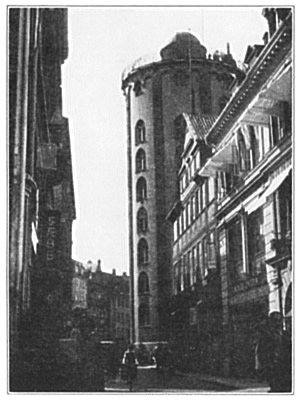 THE ROUND TOWER
Just before they reached the tower, Anna
surprised Greta by saying, "This Tower is
over a hundred feet high, but you won't have
to climb a single step to reach the top."
"But how do we get to the top?"
"You'll see in just a minute, Greta."
"Come, Chouse," called Greta, as the girls
reached the door of the Round Tower. The
dog had started down the street ahead of
them. He seemed to be looking for something,
but he ran back quickly when his little
mistress called.
Once inside the tower, the children started
up a sloping walk that went up and up and
up. At the same time it went round and
round and round, like a corkscrew. Every
little while Chouse dashed on ahead and then
came running back, barking joyously.
"This is the funniest tower I have ever
seen," said Greta. "Does this walk go to the
very top?"
"Yes," answered Anna. "They say that
a long time ago, when Peter the Great, the
Czar of Russia, visited Denmark he rode up
here on horseback, and at another time the
Empress Catherine drove her coach and four
up to the very top of the Round Tower."
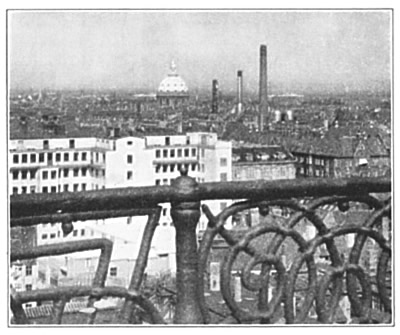 THE MARBLE CHURCH, AS SEEN FROM
THE TOP OF THE ROUND TOWER
THE MARBLE CHURCH, AS SEEN FROM
THE TOP OF THE ROUND TOWER
Greta stopped a moment to look at the
winding, sloping walk. "I guess one really
could drive a coach up here. It seems to be
wide enough."
From the platform on the top of the tower,
the girls could look out over the city and the
harbor. Wherever they looked, they saw
towers and spires—on the Parliament Building,
on the Stock Exchange, on the castles,
on the churches. Some of them were gilded
and they gleamed brightly in the sunshine.
Some of them were shiny green, like the
dome of the Marble Church.
"What is that building whose tower has a
crown at the top?" asked Greta.
"That is Christiansborg Castle, where
the Parliament meets," explained Anna.
"Would you like to visit it?"
"Yes. Let's go there next, if it isn't too far
away," said Greta.
As they walked to Christiansborg, Anna
told Greta a funny story about the Round
Tower.
"Once upon a time a Norwegian was visiting
Copenhagen. The people he visited were
eager to show him all the wonderful and
beautiful things in the city. The Norwegians
are very proud of their own country,
you know, and they like to boast about
it. When they came to the Round Tower, the
Danish people said, 'I'm sure you haven't
anything like the Round Tower in Norway.'
The Norwegian looked at it a minute and
then answered, 'No, but if we had, it would
be bigger and rounder.'"
Greta laughed. "But it couldn't be
rounder, could it, Anna?"
"No, of course not. If a thing is round, it's
round; you can't make it more or less round."
When they came to the entrance of Christiansborg,
the guard told them that dogs
were not allowed inside the castle.
"What will we do with him, Greta?" asked
Anna.
"He will have to wait here at the door for
us," said Greta. Turning to the dog she
spoke to him very sternly, "Chouse, you must
be a good dog and stay right here until Anna
and I come out."
Chouse barked twice, as if to say, "All
right," and then he lay down on the floor beside
the guard.
"There has been a castle on this spot for
eight hundred years," said Anna, as they
walked through the long hall.
"But this castle looks quite new."
"Oh, there have been three or four castles
here. When one burned down, they built
another one. This one is about forty years
old. It was really built as a home for the
King, but he has never lived here. He likes
Amalienborg better."
"I think I would, too," said Greta. "These
rooms are so large and the ceilings are so
high that it wouldn't seem like a home at all."
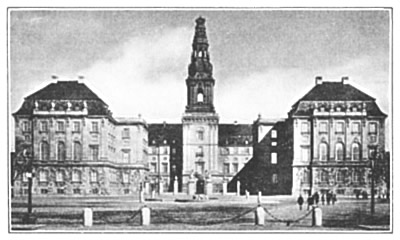 CHRISTIANSBORG CASTLE
In one part of the castle there were two
large halls, where the Parliament meets. One
hall was for the House of Commons and the
other was for the Upper House. Parliament
did not meet during the summer, so Greta
and Anna were allowed to visit both these
stately halls. Greta thought they had seen
everything in Christiansborg, when Anna
suddenly announced, "We're going downstairs
now, Greta. The most interesting
part of Christiansborg is under the ground."
They went down a narrow stairway and
carefully made their way through a dark,
underground passage. Soon they came to a
scattered heap of stones that marked the outlines
of an old, old castle.
"This is the very first castle that was built
here," explained Anna. "It was built by
Bishop Absalon in 1167, when Copenhagen
was just a little fishing village. Here is the
old well that has been used for hundreds of
years," she said as they walked on farther,
"and here is a part of the Blue Tower where
Princess Leonora Christina was kept a
prisoner for many years."
"Oh, how could they keep anyone in such
a terrible dungeon?" asked Greta, who
shivered at the thought of spending even an
hour in this gloomy place. "Let's go upstairs,
Anna."
"All right," agreed Anna. "I wonder how
Chouse and the guard have been getting
along."
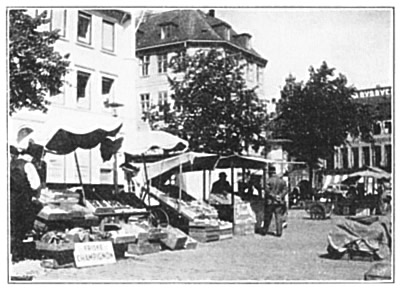 THE MARKET PLACE IN COPENHAGEN
The guard looked extremely worried when
the girls appeared. Chouse was nowhere in
sight.
"I turned my back for just a minute," he
said, "but when I turned around again your
little dog was gone. He must have run outside,
for you can see that he isn't here in the
entrance hall."
Greta was so upset that she couldn't say a
word.
"Come on, Greta. We shall have to go and
hunt for him," said the practical Anna.
"You go in one direction and I'll go in the
other, and we'll meet here at Christiansborg
in one hour."
There wasn't anything for Greta to do but
to start looking. There was no use in telling
Anna that she didn't know one street from
another. There was no use in saying that she
didn't have the faintest idea of where to look.
Anna had already started in the other direction
and Greta heard her calling, every now
and then, "Here, Chouse. Come, Chouse."
So Greta started off bravely by herself.
Christiansborg was built on a small island, so
she crossed the Marble Bridge to the mainland
and began walking slowly along the
street by the side of the water. The shore
was lined with fishing boats and on the sidewalk
there were hundreds of little stands
where the women were selling fresh fish
which they took right out of the boats. Now
and then Greta stopped to ask one of them
if she had seen a little
black and white dog.
Not a one of them had
seen him.
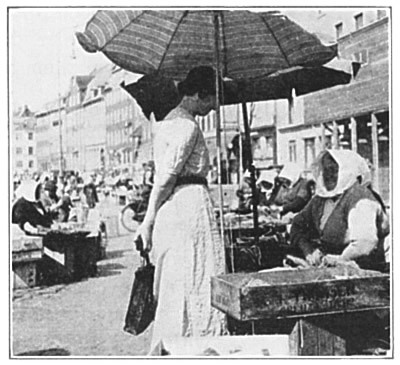 FRESH FISH FOR SALE
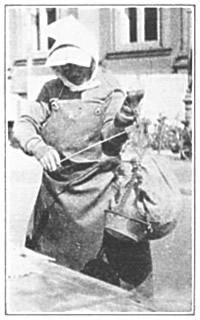 WEIGHING A LOAD OF
FISH
WEIGHING A LOAD OF
FISH
Greta decided that
Chouse had not come
along this street, so she
walked back to the
bridge and started
down another street.
Soon she came into a
large open square filled
with fruit and vegetable
stands. The housewives of Copenhagen
came here every morning during the summer
to get the finest of fresh foods. Greta went
from one stand to another, asking if they had
seen her dog. Surely someone had seen him.
Finally she came to the very last stand, where
a pretty girl was selling flowers. By this time
tears had filled Greta's eyes and there was
such a lump in her throat that she could
hardly speak.
"Why, yes," said the pretty girl. "I did
see a little black and white dog not very long
ago, but I don't know which way he went
from here."
Greta smiled happily at this news. At last
she was on the right trail. She left the market
and took one of the narrow, winding
streets that led through the main business
district. Every little while she called, "Here,
Chouse. Come, Chouse." But no little dog
came in answer to her call. Maybe she had
taken the wrong street after all.
Half blinded with tears she started across
one of the large open squares. When part
way across she saw Chouse trotting down the
street ahead of her. Greta started to run
and almost bumped into a bicycle. She was
not used to city streets, crowded with bicycles
and automobiles. By the time she had
crossed the square, Chouse had disappeared.
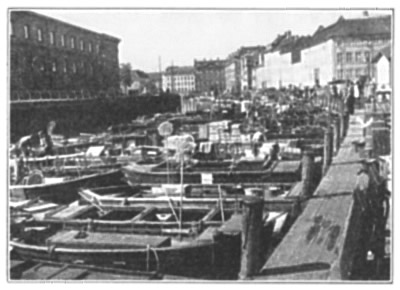 FISHING BOATS CROWD THE CANALS
Greta was tired and hungry, but she didn't
stop to think about that. She was very much
afraid that she couldn't find her way back to
Christiansborg, but she didn't dare to think
about that. Chouse was somewhere on the
street in front of her, and she must find him.
So the little girl kept on walking. The street
had many curves, like all the older streets in
Copenhagen. In some places the sidewalk
was so narrow that Greta had to step out in
the street to pass the people who stood looking
in the shop windows.
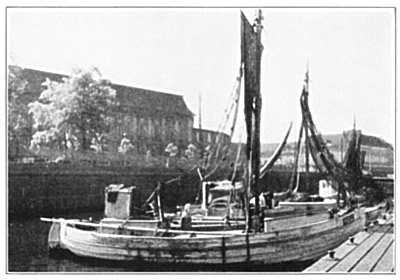 SAILBOATS IN THE HEART OF COPENHAGEN
Suddenly a terrible fear came over Greta.
What if she never found Chouse? But she
simply must find him—and keep him. She
knew now just how dear he was to her. As
she walked along, the tears which filled her
eyes spilled over on her cheeks. She had
never been in this part of the city before, and
now she was lost just as completely as Chouse
was. Oh, if only she could find him, nothing
else would matter. In some way she would
get back to Christiansborg and Anna. In
some way she would persuade her father not
to send Chouse away. She looked at her
watch. Goodness, she had already been
walking an hour and a half! Anna would be
worried about her. But Greta felt that she
must keep on looking for her dog. She knew
now that she was on the right street, at least.
Suddenly Greta came into a large open
square that seemed familiar. She stopped a
minute to look around. Maybe she wasn't
really lost, after all. What was that large
building over to the left? Then the tears
stopped and her face broke into a happy
smile. Why, it was the railroad station,
where she had first come into Copenhagen.
She lost all her fears about being lost, but a
great wave of homesickness came over the
little girl. Without quite knowing why, she
crossed the busy square and went into the
station.
She would sit down in the station and rest
a little bit before going on with her search.
Just as she found a seat on one of the long
benches a familiar little black and white figure
caught her eye. Tired as she was, Greta
ran down the long station. Everyone turned
to watch the excited little girl who was running
so desperately. At last she reached
him, and it really was her beloved Chouse.
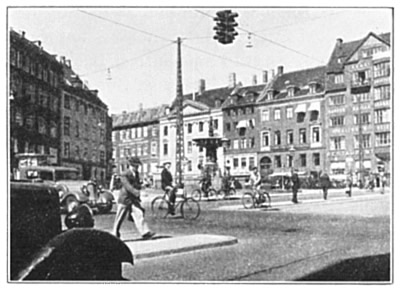 A BUSY SQUARE IN COPENHAGEN
He jumped up at her and barked joyously.
"Oh, Chouse, why did you run away?" Greta
took him in her arms and hugged him close.
Then all of a sudden she understood why he
had gone away. Right in front of her was
the gate to the very train that she would take
back home. Chouse was homesick, too. That
was why he had come straight to the railroad
station.
"Everything is all right, Chouse. We will
be going home soon," said Greta, as a single
happy tear fell on his black and white fur.


 THE LITTLE MERMAID


