Canada is partly separated from the
country south of it by a chain of beautiful
lakes called the “Five Great
Lakes.” They are so large that a person can
sail many days on them, passing from one to
another and sometimes losing sight of land. At
times the water is so rough that the traveler
becomes ill from the rolling of the big steamer
and says, “I am seasick,” although he is far
from the ocean. The northern waters of these
lakes wash the shores of Canada, while on the
south the children of the United States play on
the beaches and swim in the waves.
These children are proud of the fact that
they live in the United States, and call their
country “The land of the free and the home of
the brave.” Their people have come from many
lands. French, German, Irish, Polish and
Jewish boys and girls, besides those of many
129
other countries, sit side by side in the schoolrooms
and play happily together with their tops
and dolls.
The United States of America, for that is the
full name of this country, reaches from the Atlantic
to the Pacific, and from Canada on the
north to Mexico and the Gulf of Mexico on
the south. It is a country of high mountains,
fertile valleys, broad plains and mighty rivers.
Its children know neither the terrible cold of
the far north nor the burning heat of the equator,
for they live in the temperate belt of the earth.
No season of the year is long enough to tire
them, for spring follows close upon the winter,
and is soon followed by the pleasant warmth of
summer. Then comes the autumn when the
leaves change their color and Mother Nature
makes ready for her winter’s rest. At last the
snow falls and covers the earth with her white
mantle.
In the long ago a strange people lived in the
United States. They left no books to tell their
story, but here and there through the country
mounds of earth which they built are still standing.
130
Some of them are shaped like birds with
wings outspread, others have the forms of fishes,
snakes, and human beings. Still other mounds
show that they must have been used as altars
upon which sacrifices were burned, and others,
again, contain tools, dishes, idols and ornaments.
Some of the ornaments and dishes were decorated
with the finest carvings. Heads of people,
frogs and birds are still to be seen on the pipes
that have been preserved in the mounds all these
years. Tools have been found to show the
mound-builders, as we call these people, knew
how to work metal, and other things tell the
story that the men of that long ago were wise
in many ways and could not have been savages.
There are earthworks near some of the mounds
that seem to have been built as forts, so they
probably fought in wars. Yet we can only guess
as to their life, for no one knows their history.
When the first white men visited America
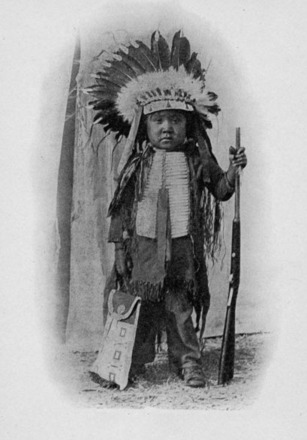
they found Indians living throughout the country,
along the banks of the rivers and on the
shores of the ocean. Their homes were for the
most part tents covered with bark or the skins
131
of animals. When the boys were still tiny little
fellows they learned to use bows and arrows so
that as they grew up they would be good hunters
and warriors like their fathers.
In some parts of the country the girls helped
their mothers tend fields of maize which to this
day is called Indian corn. Cakes were made of
this and eaten with the fish and game killed by
the men.
In other places the women and children gathered
the wild rice that grew in the shallow
ponds. This, together with the berries picked
by the girls, the honey taken from the nests of
wild bees by the boys, and the sap from the
maple trees, added a good deal to the daily
fare of meat and fish.
The red children were taught to bear cold
and hunger without complaining. There were
days when they feasted and had all the good
things to eat they could wish for. But their
parents did not understand the need of looking
ahead. During the summer the berries and the
honey, the fish and the game were plentiful,
and the people did not seem to remember that
winter would soon follow when the earth’s
mantle of snow and the ice on the rivers would
132
make it harder for them to get food. So there
were times when they and their little ones went
hungry to bed and woke up in the morning
with no breakfast before them.
The boys grew up with a love of war, and
looked admiringly at the men when they went
away from the village with hideous, painted
faces, and with tomahawks and hatchets at their
sides, to take other unfriendly tribes by surprise
and to scalp as many of their enemies as possible.
While the boys were busy with mock battles
and hunts in the forests after game with their
fathers, the girls worked with their mothers
weaving baskets and tanning the skins of the
wild animals brought home by the men. They
also got wood for the fires and helped in the
simple cooking. They played games with their
brothers, too, and both boys and girls were never
so happy as when sitting around the lodge fire,
listening to the fairy tales told by their grandmothers
and to stories of war and the chase by
the “braves,” as they called their warriors.
The parents of these red children did not need
to work so hard for food and clothing as did
the Indians of Canada, because summer in the
133
United States is longer and warmer, and winter
is not so cold.
With soft moccasins on their feet the Indians
stole noiselessly over the forest paths, and in their
light birch canoes they glided along the streams,
with never a hat on the head and with light
clothing on the body. They feared nothing save
the war-whoop of enemies.
There came a day when a white man and
his followers appeared in the country. It was
Leif, the son of Eric the Red, who had left
his home in Greenland and started out in search
of adventure. He steered his course southward
and came in time to Newfoundland, but the
country did not please him. So he continued
on his way till he reached the eastern coast of
the United States, and there he landed. During
his stay Leif and his companions met no other
people, but to their great delight they found
vines from which hung large clusters of grapes,
and for this reason they called the place Vinland.
When they were ready to leave they
loaded their vessel with grapes, together with
lumber from the forests, which was even more
precious to them than the grapes, because as
you know, there were no trees in Greenland.
134
Then they set sail for home to tell of the land
they had visited which had seemed so warm and
beautiful to them.
After Leif, other Norsemen came who settled
along the shore of this country and lived here
for a while. They met the dark-skinned natives
with whom they had trouble. After a while
they went away, never to come again. During
their stay here a Norse baby was born, to whom
the name Snorri was given, and this boy was,
no doubt, the first white child born in the United
States.
More than four hundred years passed by and
the red men lived on in their own savage way,
hunting, fishing, and making war upon each
other. Then something happened which led in
time to great changes for the red children. It
was in the year 1492 that Columbus discovered
a small island of the West Indies, lying southeast
of the United States. The natives, who
were gentler and less war-like than the other
Indians of North America, greeted him with
delight and brought him presents of fruit and
gold.
135
Not long after the coming of Columbus many
Spaniards, hearing of the rich treasures of the
West Indies, followed him there and settled.
One of them, named Ponce de Leon, stayed long
enough to gain great riches. But he was fast
growing old and all his wealth could not keep
him young. Then he began to listen to the stories
the Indians told him of a land not far away,
in which there was such a wonderful fountain
that a person had but to drink of its waters to
live forever. They called it “The fountain of
youth.”
Ponce de Leon’s eyes grew bright. If only
he could find that fountain! He set sail with
a few followers, and one beautiful Easter Sunday
he came in sight of a land rich in flowers.
Such a land, he thought, must be the one to
contain the fountain he was seeking.
The sails were furled and the Spaniard and
his friends stepped on shore. “Let us call the
place Florida, for it is a land of flowers,” he
said, and so this peninsula, reaching out from
the southeastern part of the United States, has
been called Florida to this day.
Ponce de Leon remained in the country for
some time, wandering about and drinking the
136
water of stream and lake, yet as you may believe,
he failed to discover the fountain he sought.
And, alas! instead of youth, he met death, for,
as he was about to leave, he was pierced by the
poisoned arrow of an Indian who did not trust
the white men like his brothers of the West
Indies.
Through Ponce de Leon’s discovery on that
beautiful Easter Sunday other Spaniards followed
him to Florida and settled there with their
wives and children.
French settlers followed the Spaniards to the
New World, but except in Canada, they did not
stay long.
Nearly a hundred years passed when at last
English ships began to visit the country north
of Florida. They carried home wonderful stories
of necklaces set with pearls as big as peas
and worn commonly by the Indian maidens, of
countless hares and deer in the woods, of delicious
grapes, cucumbers and melons that grew
wild on the vines, and of rich forests of oak trees
that grew larger and better than those of England.
Then, too, a strange plant grew abundantly in the fields.
137
This plant the Indians put
in pipes and smoked.
“A colony should certainly be planted in that
beautiful country,” Sir Walter Raleigh told the
queen.
She listened thoughtfully to what he said, and
not long afterwards a party of men and women
sailed from England and crossed the ocean to
live in Virginia, as the new home was called
in honor of the virgin queen, Elizabeth. Governor
Dare was the leader.
The colony settled on an island near the shore,
and here was born the first English white child
of the United States. The new baby, whose
grandfather was Governor Dare, was called Virginia
like her home, but sad to say, no one knows
how long she lived nor what befell her, for
Governor Dare went back to England for a time,
and when he returned little Virginia and her
people had disappeared and there was no one
to tell where they had gone. Perhaps the Indians
had killed them, or had made slaves of
them and taken them far inland. At any rate,
none of the neighboring red men would tell
what had happened to the white strangers who
had come to live among them.
138
Other English settlers followed soon afterwards,
however, and built villages among the
Indians; and among the oak forests of Virginia
little white children were born in rough log
houses and played on the beaches along the shore.
Their fathers planted fields of corn, and tobacco
which they had learned to smoke. They hunted
deer, hares, and wild turkeys in the forests.
These early English settlers built walls around
their villages in case of sudden attack, for they
could not trust their red neighbors, who were not
pleased to have the white strangers settling in
the country around them.
The little English children were generally
happy. The country around them was beautiful,
the birds sang sweet songs in the trees near
by, and there were flowers and fruits in plenty.
When Christmas came they watched the Yule
log burn in the big fireplace, and gathered
around tables loaded with roasted turkeys, venison
and other good things to eat.
Years passed by, and other settlers came to
America. Most of them were from England,
but there were some from Holland and Sweden
and other countries of Europe.
139
Among the newcomers were the Quakers under
William Penn, who called their new home in
America Pennsylvania, meaning, Penn’s woods.
They were gentle and peaceful and had little
trouble with their Indian neighbors.
Then there were the Pilgrims who landed at
Plymouth in New England one bleak November
day. They were quiet and sober-faced.
They left their old home to seek one in which
they would be free to worship God in the way
they thought best. As it happened, they chose
for themselves the coldest corner of the United
States in which to settle and they had before
them years of struggle and hard work.
They found the winters in New England
colder than those they had known in England
and the sharp winds crept in between the cracks
in the walls of their rough log houses, chilling
their backs even when they were gathered around
the blazing logs in the big fireplaces. The
crops of corn and beans were often scanty, because
the soil was poor, and around them not
far away were the Indians, some of whom
scowled and muttered ugly words when they
spoke of the white settlers who were hunting
140
the game in the forests, and planting gardens on
the land to which they thought they alone had
the right.
The children of the Pilgrims were taught to
be very quiet and sober in their ways. They
loved to listen to the squirrels chattering in the
trees, and to watch the rabbits scamper across
the paths. They gathered blueberries and blackberries
in summer and chestnuts and hickory
nuts in the autumn. The boys dragged their
sisters on rough sleds over the snow in winter
and waded with them in the brooks as the days
grew warmer, and at such times they laughed
and chattered like all happy children. But
when they reached home their faces became sober
and their voices low, for they were taught
that among older folks children should be seen
and not heard.
When evening came they sat in straight chairs
in the big kitchen which was the “living room”
as well, while the men talked over the day’s
work, and the women knit socks for the family.
Sometimes as the little Pilgrims settled themselves
for the night’s sleep they were roused by
the howling of wolves outside. They shuddered
as they thought, “Suppose that had been the war
141
whoop of the Indians coming to attack our village.”
On Sunday when the Pilgrims went to church
the men led the way armed with muskets which
might be needed at any moment in defending
their families.
After the Pilgrims, the Puritans came to New
England. They were even more sober and
strict in their ways than the Pilgrims, and they,
too, had trouble with their Indian neighbors.
Perhaps the jolliest people who came from
Europe were the Dutch, who settled on the
Hudson River in New York. You remember
poor Henry Hudson who was left to his sad fate
in Hudson Bay. Before he went there he discovered
the beautiful river of that name, and
when he went back to Europe he told the king
of Holland about the Indians he had met, and
of the loads of rich furs which they brought
home from their hunting trips.
His words were not forgotten, and so it came
to pass that the thrifty Dutchman made settlements
in that part of the New World which
they claimed through the discovery of Henry
Hudson. They were not poor, like the Pilgrims
east of them. They brought chests of linen and
142
silver from Holland, and they built comfortable
homes for themselves on the banks of the
Hudson River, with porches where they sat with
their children on summer evenings, telling fairy
stories and laughing together in their own jolly
way. The children’s eyes grew bright as they
listened to the stories, and as they looked out on
the woods and fields in the silvery moonlight,
they fancied they could see fairies in gauzy green
robes dancing on the grass and little brown
gnomes stepping out from under the rocks.
The Dutch children had the grandest time at
Christmas. They hung up their stockings by
the fireplace the night before and then, as they
lay in their beds, too much excited to sleep, they
fancied they heard the reindeer of the good
Santa Claus pawing away the snow on the roof
overhead. Of course there were presents the
next morning and a lovely Christmas tree, followed
by a feast of all good things that grew
about the new home. Yes, Christmas was the
best day in all the year to the rosy-cheeked roly-poly
Dutch children with blue eyes and flaxen
hair.
While they were having such good times, their
fathers were trading with the Indians with whom
143
they had less trouble than the Pilgrims and
Puritans. They sold the red men beads and
blankets, guns and trinkets, and in exchange
took furs of the marten and mink, the beaver
and otter, which the Indians shot or trapped in
the country around. Once in a while a big ship
from Holland sailed into New York Harbor,
bringing tea and sugar, blankets and dress-goods
for the Dutchmen and their families, and were
then reloaded with the furs obtained from the
Indians.
As time passed by the settlements along the
shores of the United States grew larger and
more numerous. The Indians scowled more
and more deeply and there were dreadful wars
between them and the white men. In their spare
time the settlers made roads through the country
and cleared away some of the forests. In
the north they traded with the Indians for furs
and planted fields of corn and other grains and
vegetables. Farther south tobacco and cotton
were raised on the plantations. Sheep were
tended on the hillsides and the wives of the settlers
carded and spun the wool and wove it in
hand-looms into clothing for their families.
Cargoes of Negro slaves were brought from
144
Africa to work on the plantations. The cotton
that was raised there was sent across the Atlantic
to be made into cloth in the factories of Europe.
During all these years the white men did not
move far inland because of the Indians, and of
mountains which must be crossed. At last, however,
some brave men ventured out alone into
the wilderness beyond. They found there were
valleys between the mountains, and through
these they passed to the other side. They often
had to hide from the watchful Indians, not daring
even to make camp-fires lest they should be
discovered.
These explorers found that on the other side
of the Appalachian Mountains, for that was
the name given to them, was a beautiful country,
richer by far than that on the eastern side
where they had been living. There were also
many rivers flowing westward, making the soil
rich and fertile. Forests of maple and elm
trees, as well as pines, spruces, and oaks which
were abundant along the coast, were to be seen
there.
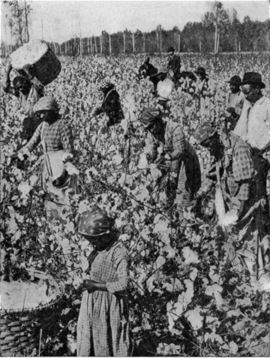 Picking Cotton on a Georgia Plantation.
When the explorers returned home they told
such bright stories of the country to the west
that the families of some of them agreed to go
there and live. In those days there were no
trains to carry them and not a single road
through the mountain passes. The journey had
to be made on foot or on horseback, and few
household goods could be carried. At any moment
the travelers might be surprised by Indians,
so the men were obliged to keep their muskets
loaded and ready to shoot every moment of the
way.
When the place for the new home was
reached the men and boys set to work to cut
down the trees and make a clearing, while the
women prepared the meals. Everyone must eat
and sleep outdoors while a rough log house
was being built. All through the night a big
fire was kept blazing to keep the wolves and
other wild animals at a distance.
The new house was easily furnished. A few
chairs, a rough table, and some bedsteads were
made from the trees that had been cut down.
The feather beds brought from the old home
were spread on the slats of the bedsteads; the
family Bible was laid on the table; the kettles,
also brought from home, were hung on cranes
over the fireplace, and housekeeping in the
wilderness began.
146
Notwithstanding the hard life, the girls and
their brothers grew up brave and strong and
ready to push still farther into the wilderness
than their fathers had done. West of them,—far
west as it seemed then—was a mighty river
flowing from north to south through the country.
It was the Mississippi, or Father of
Waters, as the Indians well called it, because so
many large streams flowed into it on either side.
The Frenchmen from Canada had long since
sailed along the Great Lakes and down the whole
length of the Mississippi, and for this reason had
claimed the land on both sides and made settlements
at different places.
Now, as the English settlers moved westward,
they did not wish the French to own any part
of the country. By and by there was a great
war between the two peoples—the French who
held Canada and the Mississippi, and the English
colonies who were living in the eastern
part of the United States. Then came the battle
of Quebec and the French gave up their rights
in North America.
But there were other troubles still, for
wars took place with the Indians who had become
bitter enemies, but they were beaten
147
again and again, and driven still farther west
till few tribes were left east of the Mississippi.
Then there was another war—a very great
one this time—and with England herself. The
Revolution was fought through seven long years.
With General Washington as their leader, the
people fought on to victory, when they in truth
made their country the free and independent
United States of America.
After this more and more men took their wives
and children and traveled west in search of new
homes. They had found by this time that in
many places there were great plains where they
did not need to make a clearing, for the ground
was covered with grass for miles in every direction.
Some of these grassy plains, or prairies,
were quite level. Others stretched in long, low
waves of earth. The soil was rich and the grass
grew long and thick. There could be no better
place in the world for raising corn, wheat and
hay, or feeding cattle.
Rough roads had been built through the wilderness
by this time, so the women and children,
together with the bedding and dishes, were
bundled into big clumsy wagons with rounded,
canvas tops called prairie-schooners. Horses or
148
oxen were harnessed to the wagons and cows
were hitched behind. Then away started the
family for the distant prairies.
All day long the people traveled, but when
evening came the animals were unhitched from
the “schooner” and allowed to feed on the grass;
supper was cooked over the camp-fire, and beds
were made upon the bottom of the wagon, where
the family would sleep during the night.
Many days were often spent on the journey,
but like everything else, it came to an end at last.
Think if you can, of a sea of grass stretching
around you as far as the eyes can see; not a
building of any kind in sight; not even the smoke
of a passing train to remind you that there are
other people in the world; no sound in the air
except the chirping of the crickets or the howling
of the wolves; in summer, the blinding sun dazzling
your eyes and turning the grass a withered
brown; in winter, a carpet of snow stretching
around you over the earth in every direction.
This was the life in store for the boys and girls
who went out on the prairies to seek a home in
the early days of this country.
To be sure a herd of bison sometimes appeared
near the children’s home, and then the men
149
hurried out with their guns to kill as many as
possible before the animals were put to flight.
Before the coming of the white men these bison
roamed together in thousands and the Indians of
the plains made their tents and clothing from
their skins and feasted on the flesh of the bison.
Every year since that time they have grown
scarcer till only a few are left in the country,
and these are on exhibition in the parks of the
west.
After the sun set in the evening sky the children
of the prairie did not venture far from
home, both on account of prowling wolves, and
for fear of the Indians who might be skulking
near by.
Not many years after the Revolution Thomas
Jefferson, the third president, did many things
for the good of the United States. Through his
advice the people purchased a great deal of land
in the southern part of the country from France,
to whom it had been given by Spain. It was
called the Louisiana Purchase.
Jefferson was not satisfied yet. He thought,
“There is a vast country beyond us of which we
150
know nothing. No one of our people has yet
crossed it and reached the Pacific. This should
certainly be done.”
He knew it would be a dangerous journey, for
it was a wild country, roamed over by tribes of
fierce Indians. Two men, however, offered to
lead the expedition. Their names were Meriwether
Lewis and William Clarke.
In the summer of 1803 they started out at the
head of a party of men, carrying with them presents
for the Indians they might meet, three
canoes, two horses which should help them in
hunting game, and a few blankets and cooking
utensils.
During the winter they camped on the banks
of the Mississippi, and with the coming of spring
they began their journey up a broad river which
emptied into it and which we know now as the
Missouri. As the men followed the course of
the river they moved farther and farther into
the west. All summer long they slept under
the stars, but as the cold winter set in and deep
snows fell, they made rough cabins in which to
live, and went no farther on their journey for
several months. They killed bison and other
game which furnished them with food, but they
151
could not keep the biting cold out of their huts,
and they suffered with the cold. Fierce Indian
tribes were around them on all sides, friends were
far away, but they had no thought of turning
back. So, with the second spring, they pushed
on.
When they reached the source of the Missouri
there were high mountains before them, much
higher than the Appalachian, and with their
summits crowned with snow. After a long, hard
journey they reached the other side, and
launched their canoes on a small stream which
grew ever broader till it entered a large river.
This was the Columbia, along which they
traveled till the Pacific Ocean lay spread before
their eyes. They had journeyed more than four
thousands miles since they left the banks of the
Mississippi and were the first white men to cross
the United States. They had visited the homes
of Indians who had never seen a white person
before or even known there were such beings.
They had crossed broad plains where thousands
of bison fed on the rich grass. They had discovered
broad rivers shaded by lofty forests and
crossed mountains containing mines of gold and
silver, which before long would be opened up
152
to give their rich stores to the people of the
United States. They still had before them the
long and dangerous journey home, which they
reached two years and four months after they had
left it.
There was great rejoicing among the people
when the news spread of the safe return of the
travelers and of the wonders they had to tell.
From that time many boys and girls looked forward
to moving into the great, far-western
country with their parents.
Many of the children of the prairies live on
farms where wheat is raised. As the sun shines
down on the broad fields, the tiny grains sprout
and grow with astonishing quickness. Then,
when the heavy dews fall at night and the earth
cools, they get new strength for the next day,
so that the farmers gather abundant crops.
As the summer days pass by and the wheat
ripens, the children in the big farm house get
ready for an exciting time. Their mother makes
dozens of pies and loaves of bread and cake. A
cow and perhaps a hog or two, are killed and
cut up, for an extra number of “hired hands”
begin to arrive. The farmer himself is unusually
busy. Big machines and engines are
brought out from the barns to be cleaned and
oiled, for the wheat is about to be harvested.
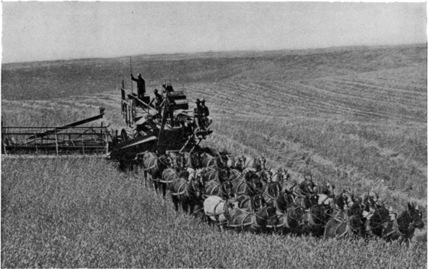 How They Harvest Wheat on the Prairies.
It is interesting to watch the work go on in
the fields, it is so different from that of the old
days before the threshing and binding machines
were invented. It seems almost like magic to
the watching children as acre after acre of waving
grain is cut down, bound into sheaves and
threshed, almost in the “twinkling of an eye.”
Then away it is whisked in big wagons to the
flour mills in the town near by from which it is
sent far and wide to be made into delicious bread
for hungry boys and girls.
In the northern part of the prairies wheat
grows best because it can bear a great deal of
cool weather. But corn is different; warm,
moist nights suit it well. So, although we can
see corn growing all over the eastern part of
the United States, it thrives best in the southern
part of the prairies where the weather is much
warmer than in the north.
Corn is very fattening, so the farmers who
154
raise this grain usually keep herds of cattle and
many hogs. He stores much of the harvest in
the barns to feed the “live stock” and raise them
for market.
The boys of the prairie help their fathers, not
only in the wheat and corn fields, but also in
raising herds of cattle, flocks of sheep, and great
numbers of hogs.
Beyond the prairies, yet east of the Rocky
Mountains, are wide stretches of land called the
Western Plains. Grass grows on these plains,
but the soil is not so rich as on the prairies and
is therefore not so good for farming.
As the people moved farther west, settling on
the prairies, they began to think what use could
be made of the plains beyond. They decided
that cattle could be raised there. But first the
tribes of Indians who were roaming freely about
must be forced to stay in certain parts of the
country which the government of the United
States reserved for them.
Sad to say, many a little red child growing up
on such a reservation had hate in his heart for
the white men who had seized the land that was
155
once the free hunting ground of the Indians.
Again and again the red children watched their
older brothers and fathers go out to attack the
men who had ventured into the “wild west.”
Again and again the soldiers of the United States
were sent against them.
It was a dangerous life for the ranchmen, so
that many of those who undertook to raise cattle
on the Western Plains, left their families behind
them. It was not a safe place for women and
little children. The ranchmen had to live in the
roughest manner. They had immense herds of
cattle which were allowed to roam for miles over
the grassy plains and were rounded up from time
to time by “cowboys,” as they are called.
These cowboys were bold and daring fellows
who carried pistols at their belts, rode half-wild
horses called mustangs, and were ever ready for
danger, since at any moment a stampede might
arise among the cattle.
Imagine a herd of untrained cattle feeding
together. An unusual sound is heard which
fills them with a sudden fright. They toss their
heads, kick up their heels and dash wildly away.
This is called a stampede. Now, if the cowboy
in charge is not quick to use his wits he will be
156
knocked down and trampled to death by the
hoofs of the fleeing cattle.
On Lake Michigan, one of the Five Great
Lakes, is the large city of Chicago. The children
who live there grow up in the midst of
noise and bustle, for a great deal of business is
going on about them all the time. Every day
long trains of cars come rolling into the stations
bringing wheat and corn, cattle and hogs. All
of these have been raised on the plains and
prairies south and west of Chicago. Many of
the animals are killed and dressed in the city
and then sent away to be sold in the eastern
markets. Others are loaded on big steamers
waiting at the wharves and sent on a long journey
through the Great Lakes and St. Lawrence
River and across the ocean to Europe.
The children who live in the southern part
of the United States have warm weather nearly
all the year. They need few of the woolen garments
or the furs which feel so comfortable in
winter to the people north of them. Their
clothing is mostly of cotton or linen, and they
eat less meat and more fruit than their northern
157
brothers. Their homes require little heat, and
even the cooking is often done in a small building
separate from the house so that it shall not
be made uncomfortably warm.
Let us make a short visit to a cotton plantation
“down south.” We shall be made welcome,
without a doubt, because the southern
people are very hospitable. The planter has
been told when to expect us and a low, comfortable
carriage drawn by a span of beautiful
horses is at the station when we arrive. A black
coachman in livery helps us into our seats,
cracks his whip, and away start the horses at a
lively trot. We pass forests of yellow pine
trees, and possibly some tobacco fields. The
air is fragrant with the odor of flowers and we
listen to the songs of the blackbirds and mocking
birds. All too soon the horses are turned
into a driveway shaded by tall trees, at the end
of which is a large house with broad verandas.
Our host and his family are awaiting us and
give us a cordial greeting.
After we have rested and eaten a delicious
dinner, the children of the home show us over
the cotton fields where Negro workmen are
busy among the long rows of plants. The cotton would
158
not ripen in a short summer. It
must have months of heat and moisture. Then
the flowers will go to seed and long fibers will
reach out and wrap them in blankets of cotton.
The cotton is separated from the seeds by the
work of a machine, called the cotton gin. The
seeds are ground into meal which is used in
fattening cattle. Many herds of cattle in the
south are fed on cotton-seed meal which takes
the place of the corn given them in other parts
of the country.
As we walk about over the fields the children
of the planter tell us many stories of the Negro
workmen, what fun-loving creatures they are,
and how fond they are of good things to eat.
Water melons please them especially and a
group of “darkies” is never so happy as when
they can sit around a pile of the juicy melons
and feast to their hearts’ content. In many of
the Negro cabins there is sure to be some one
who plays the banjo, to whose music big folks
and little dance merrily when the day’s work is
over. Once the Negroes were the slaves of the
white planters, but they are now free and support
themselves like other workmen.
Our little southern friends ask us if we have
159
ever seen ’possums, as the black people call the
animals. After everyone on the plantation has
gone to sleep, then the cunning opossum steals
from his home in the woods to pay a visit to
the hen-house. He springs up and seizes one
after another of the fowls on the roost, whose
blood he sucks till no more is left in their bodies.
The Negroes are very fond of a ’possum hunt.
Soon after dark they arm themselves with clubs
and axes and go into the woods with a few dogs
to scent the game, carrying torches to light the
way. The axes are used to chop down the trees
where the animals climb to get out of the way
of the hunters.
A mother opossum with her little ones is a
queer sight. The babies are scarcely larger
than mice and they hang on to their mother’s
body by winding their own tiny tails around
her larger one. The Negroes go on ’coon hunts
too, for they can sell the skins, while the meat is
nearly as delicious as that of the opossum.
Raccoons have long bushy tails and belong to
the bear family, though they are much smaller.
They catch birds in the trees, sucking their
blood and eating the eggs whenever they find
them. They like green corn, too, which they
160
steal at night as it is growing in the fields.
Our little friends go with us to the stables
and show us their ponies, telling us of the lovely
morning rides we may have through the country
if we will stay with them for a few days.
But we must bid them good-by and travel to
the busy towns of the east where many of the
people work in factories and stores and have
little time to spend in the beautiful outdoor
world. Before we leave the sunny south we
would like to take a peep at a rice plantation
in the low marshy country, and to watch the
men gathering tobacco leaves and hanging them
to dry in large sheds, but the northern train is
waiting and we cannot linger.
The children of a factory town often know
little of the free, happy days that a farm gives
to its boys and girls. Long rows of houses
where the workmen live, and large brick buildings
where the machines are noisily running
from Monday morning till Saturday night—these
are what a person sees on every hand.
The country settled by the Pilgrims and Puritans,
and much more east of the Appalachian
161
Mountains has such poor and stony soil that
it is not good for farms. In such places we
find the manufacturing towns where the cotton
raised in the south and the wool from the sheep
of the western plains are made into cloth for
millions of people in the United States. Here
also are large tanneries where the hides of cattle
are prepared for harnesses, shoes, bags and many
other things for which leather is used. In New
England there are many factories where thousands
of boots and shoes are made for the boys
and girls of America.
Long ago, before the days of the factories,
many ships sailed away from New England
ports after whales in the Arctic waters. Now-a-days
whale-bone is still valuable, but the oil
is not needed so much as in the old times before
gas and electricity came into use, so that whaling
is not so common. But many men are still
busy fishing for herring, halibut and cod, which
are plentiful in the waters along the northeast
coast and off the Grand Banks of Newfoundland.
Many a boy living on the coast goes on
fishing trips with his father and becomes so fond
162
of the free life of the sea that he decides to be
a sailor for the rest of his life.
Many lobsters and clams are also obtained
along the coast, and farther south are rich beds
of oysters. In Chesapeake Bay more than one-third
of all the oysters eaten in the world are
grown, and most of these are shipped from the
beautiful city of Baltimore, at the head of the
bay. Thousands of men and women there are
busy, day after day, opening the shells and taking
out the oysters which are then put into tubs
and cans for shipment.
When the white men first came to the United
States, almost all the land between the Atlantic
Ocean and the Mississippi River was covered
with forests. Most of these were cut down to
make clearings for the settlers’ homes. Some
of them, fortunately, were left. Among the
largest forests still standing to-day are those near
the Great Lakes, where the lumber-men work
in much the same way as their Canadian brothers.
When the snow is thick over the ground,
they leave home with their teams of oxen and
163
horses and go to the distant woods, where they
build log-houses for themselves and stables for
the animals. There they live during the cold
months of the year. Sometimes they stop long
enough in their work to go bear and deer hunting
and so get fresh meat which makes a little
change in their daily fare of bread, beans and
salt-pork.
The logs are carried to the nearby streams on
sledges which move easily over the ice and snow.
When spring comes they are floated along the
streams and lakes to the saw-mills where they are
made into lumber.
Many of the children living in the Appalachian
Mountains to-day have their homes near
coal mines and their fathers are busy digging out
the coal that brings warmth and comfort during
the winter to so many people. In some places
the rocks have been washed away, but in others
the coal is still so far underground that the
miners have to work day after day where the
sunlight never shines.
Iron is also found in large quantities near the
164
coal mines, and trains of freight cars carry both
these minerals to cities not far away where they
are used together in making steel.
Great quantities of iron are found in the low
mountains near Lake Superior, where the miners
are constantly at work with the help of steam
engines and powerful machines.
The richest copper mines of the United
States are also found near the shores of Lake
Superior. A pig, we are told, discovered the
best one of all in a curious way. It had strayed
from home and fallen into a pit, where it
scratched and rooted in its struggle to get out.
In doing this, it laid bare some copper, which
was discovered by its master when he went to
look for the missing pig.
Hunters are fond of visiting the Rocky Mountains,
where they still find the fierce puma, or
mountain lion, with its sharp teeth and claws,
and bright eyes. Night is its favorite time to
roam and it is then that the mountain goat needs
to beware, for the cat-like puma shows no mercy.
Children who live in the western part of the
165
United States have sometimes seen a grizzly
bear brought home by a friend after a hunting
trip among the Rocky Mountains. It is the
strongest and most dangerous of all the bear
family. One blow of its paw is powerful
enough to kill, yet if it is not disturbed a person
has little to fear. It does not care for the flesh
of other animals but is contented with a dinner
of berries and tender shoots like its brothers, the
brown and black bears.
One of the most graceful animals the children
of the west have ever seen is the bighorn, or
Rocky Mountain sheep. It browses on the grass
found on the steep slopes where the hunter has
hard work to reach it. Its ears are quick to
hear the slightest sound, when it will toss its head
and flee from possible danger with long leaps.
Among the Rocky Mountains are mines of
silver, gold, and copper which have brought fortunes
to many people of the United States. The
silver mines especially are among the richest in
the world. The men who work in them generally
leave their families at home, and go away
to “rough it” as they say, for a mining town seldom
has many comforts and the boys and girls
166
who do go there to live miss the good schools,
and many other things to which they have been
used.
About fifty years ago gold was discovered in
the state of California which lies on the shores
of the Pacific Ocean. The news filled the country
with excitement. As time passed by the
gold mines did not prove as rich as the people
expected, but they discovered that the country
was valuable in other ways. Trees grew to enormous
size there and the warm, moist climate of
the western coast was the best possible for raising
fruit. To-day the children of California
feast on pears, plums, apricots, grapes, peaches,
oranges, and still other fruits which grow very
large and beautiful. There are many wheat
farms, too, in California where rich harvests reward
the men who own them.
Beyond the Rocky Mountains and lying between
them and a lower range called the
Sierra Nevada, is a high plateau, where the
rain falls into streams which dry up or form
lakes before they can make their way to the sea.
The largest of these is called the Great Salt
Lake whose water is four times as salty as that
of the sea.
167
There are still other plateaus southeast of the
Great Basin where the streams have worn away
deep valleys called canyons. The largest of
these rivers is the Colorado, whose canyon is
so wonderful that travelers in the west always
wish to visit it.
In some parts of the canyon the steep cliffs
rise on either side for about a mile up into the
air. As the traveler in the valley below looks
up he can see the stars shining in broad daylight.
The rocks at the sides are of different colors—gray,
brown, red and purple. The best time to
visit the canyon is at sunrise or sunset. Then
the light from above falls first upon one color
and then upon another, making a beautiful sight
as the shadows change from moment to moment.
The United States is a great country, as its
people believe, and certainly no others in the
world can boast of a park so large as theirs.
When Lewis and Clark had traveled a long
distance up the Missouri River they reached that
part of the country which is now called the Yellowstone
168
Park. A better name would be “Wonderland”
for such it is to the thousands of people
from all over the world who visit it every year.
This great reservation is sixty-five miles from
north to south and fifty-five miles from east to
west. It contains not one, but many charming
parks, lovely valleys, sparkling waterfalls, high
mountains, deep valleys and one beautiful lake,
called the Yellowstone Lake.
We can travel in a comfortable parlor car
to the very entrance of the Wonderland where
we will first visit the Mammoth Hot Springs
whose waters are as clear as a mirror. They
contain lime and iron, and for this reason many
people drink the water which they take as medicine.
The largest of the Hot Springs bursts out of
the ground near the summit of a high hill, from
which it pours down over the slope and as it
falls, makes deep basins in the earth below.
Some of these basins are tiny and others quite
large. They are of different colors—red, green,
and yellow, and the edges are worn away into
the prettiest sort of beadwork by Mother Nature.
Now let us leave the Hot Springs and visit
the geysers about fifty miles away. Each has
169
a name of its own. There is the Giantess, which
from time to time throws up a great quantity
of water for a short distance. You must be careful
not to venture too near when the Giantess
wakes up, or you will be soaked with water in an
instant.
Another geyser is called Old Faithful, because
you can depend on his appearance at just such
a time. He shows off his accomplishments once
every sixty-five minutes. Old Faithful sends
up a few little jets of water at first but every
moment they become larger and stronger, till
suddenly, with a tremendous roar, the water
spouts up one hundred and thirty feet in the
air. By the end of five minutes the water subsides
and only a small stream rises.
Still another geyser is called the Beehive, on
account of the shape of its cone. The water
does not fall to the ground again but moves up
through the air as fine spray.
One of the most interesting of all the geysers
is the Castle. As you near it, the air around
may be perfectly quiet. Then, all at once, you
you will hear a loud rumbling noise as though
quantities of stones were rolling over each other,
and at the same time the lashing of water is
170
heard under the earth. The noise becomes almost
deafening, the earth trembles under your
feet, and if you are wise you will hasten to some
spot quite a distance away. Suddenly a column
of water rises straight up into the air at least
one hundred and fifty feet. The spray from it
falls over the ground around like heavy rain
and those who have not been wise enough to
flee like yourself are drenched with hot water.
We must not leave the Wonderland without
visiting Yellowstone Lake. It is very beautiful
and stretches its long arms in among the mountains
as though to embrace them. On the western
shore of this lake you may catch trout if
you will. Then, if you are hungry, you may
take a few steps and drop the fish, still on the
hook, into a boiling spring. Behold! your dinner
of delicious trout is ready for your eating.
Yellowstone River flows out of this wonderful
lake and at first moves smoothly and quietly.
Then, as it is about to make its way through a
mountain-pass, it makes leaps and bounds in the
form of cascades and waterfalls, wearing the
earth into a deep canyon, which is as full of
interest as that of the Colorado.
In your visit to the Rocky Mountains you
171
will, no doubt, wish to climb Pikes Peak. It
is named for Major Pike, who tried to climb to
the summit but failed.
“Only a bird could succeed,” he afterwards
said. Now-a-days, however, hundreds of travelers
go every year to the top of Pikes Peak.
Nearly every one who travels over the United
States takes a trip up the beautiful Hudson
River, and goes to the top of Mount Washington
in New England, by using the railroad built
up the side of the mountain, and over which the
train moves slowly with the help of a double
engine.
Perhaps the most wonderful and interesting
of all sights are the Falls of Niagara, between
Canada and the United States. Out of Lake
Erie, one of the Five Great Lakes, flows the
Niagara River, which soon reaches a cliff over
which it pours its whole body of water with a
sound like thunder. If you stand near the foot
of the falls you must wear waterproof garments,
or the dashing spray will drench you in a few
moments. The longer you look, the more wonderful
the sight appears and before long you
172
feel as though you would like to stay there forever,
watching those mighty waters falling, ever
falling, and never resting in their course for a
single moment.
In winter the spray covers every bush and
tree near the foot of the Falls and as it freezes
almost instantly, strange forms are built up on
the twigs and branches. Then in the bright sunlight
the world around seems like fairyland.
Masses of ice are carried along with the water
of the cataract and become piled up below, making
a bridge of ice across the river.
The children who visit Niagara Falls are sure
to wish to enter the deep cave in the cliff directly
under the falling waters. No matter how carefully
they may enter, they will be drenched by
the spray unless they are clad in waterproof
from head to foot. They have a strange feeling
while they are in the cave. The loud rumbling
of the water and the trembling of the earth fill
them with a sort of fear and they are glad when
they are once more out in the sunlight and at
a safe distance from the mighty cataract.
173
There are many large and beautiful cities in
the United States, each of which is particularly
dear to the children who live there. Sometimes
they think of their brothers and sisters of a hundred
years ago who warmed themselves in winter
before burning logs in big fireplaces, who
traveled in lumbering stage-coaches and were
lighted to bed by home-made candles or smoky
whale-oil lamps. Many of the children of to-day
have steam-heated houses, lighted by gas
or electricity; they travel short distances in electric
cars or automobiles, and longer ones in
comfortable trains moved by steam-engines; or
perhaps they take water trips in roomy steamboats
where they can move about as freely as in
their own homes. They talk with distant
friends by merely taking down the receiver of
a telephone. Steam, gas, electricity—all these
conveniences are found not only in the cities of
the United States, but on the distant prairies for
the use of farmers and their families.
Washington is the capital of the United States.
It is the place where the business of the country
is attended to and the laws are made for the
174
protection of the people. It is a wonderfully
clean and beautiful city, and has many grand
buildings which may well be called palaces.
The White House, the home of the president,
is the copy of a palace in Ireland which was
built for the Duke of Leinster. The National
Library is very large and some people think the
building devoted to it is the most beautiful in
the world. The Rogers Bronze Door which
opens into the Capital is a great work of art.
The most important things in the life of Columbus
and the discovery of America are pictured
in the bronze. This one door cost thirty
thousand dollars.
There are large art galleries in Washington
and many other buildings where you can pass
day after day and constantly find new things
to interest you. But before you leave the city
you must be sure to visit the beautiful marble
monument built in honor of George Washington.
 Children Working in the Cotton Factory in a Big City.
At the mouth of the Hudson River is the great
city of New York, next to the largest in the
whole world. It contains many beautiful
homes, fine churches, lovely parks, and business
buildings many stories in height which, like
others in Chicago, are called “sky scrapers.”
On an island in New York Harbor stands the
famous Statue of Liberty given to this country
by France. Persons who wish to do so may
climb up into the head of this statue which is in
the form of a beautiful woman with a torch in
her uplifted hand. The crown on the head is
composed of windows from which there is a fine
view of New York Harbor.
Another island in the harbor is called Ellis
Island, where most of the emigrants who have
left their homes in other countries, land when
they reach the United States. Irish and Poles,
Italians and Russians, men with children clinging
to their sides, and women with arms clasped
around tiny babies, all dressed in the fashion
of their old homes, step from the big ships and
take their first breath of the free air of America
almost under the shadow of the Statue of Liberty.
New York is the greatest manufacturing centre
in the United States. Clothing, books, cigars,
furniture, leather goods and many other things
are made here for the people of this and other
countries.
The good old city of Boston is on the eastern
176
coast of Massachusetts. It has a fine harbor
like its sister city in New York, and many large
ships from all over the world are seen at its
wharves.
Ten years after the Pilgrims landed at
Plymouth the Puritans founded Boston. It is
a quaint city with narrow, winding streets, much
unlike Chicago and New York and many other
cities built later on. The State House on Beacon
Hill has a gilded dome which can be seen
in the sunlight for miles around. This is often
called “Boston’s breastpin.” There are many
old buildings in the city, around which are
woven interesting stories of the early days of
this country. Here stands Faneuil Hall where
many stirring words were spoken. For this
reason it is spoken of as the Cradle of Liberty.
Then there is the Old South Church a “meeting
house” of the olden times from which the Boston
Tea Party started out to throw the tea which
had come from England into Boston Harbor.
The cemeteries, in which some of the greatest
men of the early days of the country were buried,
are still kept with the greatest care and are
visited by travelers throughout the year. Boston
177
is a manufacturing city and is the largest
market in the world for boots, shoes and leather
goods.
In the state of Pennsylvania, settled as you
know by the Quakers, is the city of Philadelphia.
This name was chosen for it by William
Penn because of its meaning, “brotherly
love,” and the peaceful spirit of that great man
is felt even now in the quiet streets, lined with
quaint old houses.
Philadelphia was once the largest city in the
United States. It is still a very busy one.
Quantities of coal from the mines not far away
are sent to this city and from there shipped to
other places. Iron and steel goods are made
in its factories and many of its people are busy
in the cotton mills. On the river front near by
there are large shipyards where ships have been
built for the United States navy.
The children of Philadelphia are especially
proud of Independence Hall where the famous
Declaration of Independence was signed and
the bell rang out to tell of what brave men had
dared to do. This “Liberty Bell” has been carefully
preserved and may be seen even now after
all these years.
178
There are many other large and beautiful
cities in the country. One of these, San Francisco,
lies on the far western coast, on the borders
of the Pacific Ocean. It has a deep harbor, into
which come sailing many ships from China and
Japan, bringing cargoes of silk and tea. Many
Chinamen are to be seen on the streets of the
city, and pretty Japanese children with black
eyes and soft yellow skins play in the parks with
the little Americans. More wheat is exported
from the city of San Francisco than from any
other in the United States.
There is so much to tell of this great country
and of the children who live here in happy
homes, that it is hard to stop, but we must leave
it for the present and travel south to Mexico.