Crimson and gold.
As far as one
could see across
the moor it was
one broad expanse
of purply
heather, kindled
into a glowing
crimson by the
blaze of ruddy
sunshine, and
lighted here and
there by bright
patches of the
thorny golden
rod. Dame Nature
had evidently
painted
out of her summer
paint-box, and had not spared her best and
brightest colours. Crimson-lake, children; you know
what a lovely colour it is, and how fast it goes, for
you are very fond of using it, and there is only one
cake in each of your boxes. But here was crimson-lake
enough to have emptied all the paint-boxes in
the world, you might suppose, and the brightest of
goldy yellows, and the greenest of soft transparent
greens, such as no paint-box ever did, nor ever will,
possess; and over all the most azure of blues,
flecked with floating masses of soft indescribable
white, looking to Elsie like the foamy soapsuds
at the top of the tub when mother had been
having a rare wash, but to Duncan like lumps
of something he had once tasted and never
forgotten, called cocoa-nut ice.
It seemed a pity when Dame Nature had spent
her colours so lavishly that there should be no one
to see her bright handiwork. Yet, sad to tell, there
lay the broad sheet of crimson and gold day after
day unnoticed and unheeded, till, in despair, it
at length began to wither and blacken and die.
For this was a lonely moor, where the heather
and gorse bloomed so bravely, so lonely that even
along the road which skirted it the number of those
who passed by in a day could be counted on the
fingers of your hand; and as for the moor itself, it
seldom had any visitors but the cows from the little
farm which nestled away in one corner; and do you
suppose such lazy, cupboard-loving creatures cared
whether the heather bloomed or not, so long as
they found grass enough to eat?
But the glorious moor had a worse indignity than
this to endure, for there was a cottage here and there
whose inhabitants frequently crossed by the beaten
tracks, and never so much as lifted their eyes as
they passed along, to notice the gorgeous dress
their moor had put on. They were so used to it.
Had she not worn it every year since they could
remember? and so they sauntered by, thinking about
eating or drinking, or how they would serve their
neighbours out, sometimes even quarrelling loudly,
and never giving so much as a passing thought
to all the beauty God had spread around them, and
which we who dwell in towns would give so much
to see.
The sun was shining down very hotly, but it had
not yet begun to wither the heather and gorse, on
the day when I want you to notice two little
children going across the moor. I told you there
were cottages here and there, and in a pretty little
green hollow just beyond a fair-sized hillock was
one where lived the MacDougalls. These two
children were Elsie and Duncan MacDougall.
They very often crossed the moor, for the farm was
on the other side of it, and the milk and butter had
all to be fetched from it, the milk twice a day,
whether the sun blazed, or the chilly Scottish
drizzle blotted out the hills in a misty haze, or the
north wind swept across it, and shook the gaunt fir-trees
to and fro in its noisy wrath.
"Ain't you coming on, Elsie?" Duncan cried
impatiently, for Elsie had seated herself on a big
stone, pushed back her sun-bonnet from her damp
freckled forehead, crossed her brown arms defiantly
over her holland pinafore, and was swinging her
bare feet as if she never meant to move another
step to-night.
"No, I ain't coming, Duncan, and that's all
about it," Elsie replied, sulkily, only she said it in
a broad Scottish accent which you would hardly
have understood had you heard it, and certainly
could make nothing of if I were to try to write it.
"Then we'll get beaten when we get back,"
Duncan said, miserably. "Mother's always scolding,
and it's your fault, Elsie."
Elsie looked at him contemptuously. "Go on
by yourself," she cried; "I ain't afraid. It's only
Robbie that they're in such a hurry to get the
milk for, and I'm not going to hurry for Robbie.
Go on by yourself, do."
But this was more than Duncan dared do, and
Elsie knew it, for, in the first place, it would have
seemed as if he sided with Robbie against Elsie,
which would have been quite untrue; and, in the
second, it would have got Elsie into trouble with
their mother, and that Duncan would not have done
for anything in the world. If Elsie had been a
queen, then Duncan would have been one of her
most willing subjects, and done her bidding whatever
it might cost.
So there stood Duncan, fidgeting to get on, yet
bound to the spot where Elsie stayed by a bond
stronger than links of iron. It was in vain that he
fidgeted from one bare foot to the other, or vented
his impatience by flinging his Scottish bonnet high
in the air and catching it again. Elsie was immovable,
for Elsie was in one of her very contrariest
moods to-day, and I can hardly describe to
you how very contrary she could be.
At last, very slowly and deliberately, she got off
the stone, and began slowly to stretch herself. "Do
make haste!" cried Duncan, almost tired out.
"I can't be hurried," Elsie replied, with a grand
air, stooping down to pick up the milk-can, which
she had deposited at the side of the stone. "It's
much too hot and I'm much too tired, and I don't
see why I should be expected to fetch the milk at
all. You and Robbie ought to do it. You're boys,
and I'm a girl. It's a shame, and I mean to tell
mother so."
Duncan gazed at her in amazement. He knew
Elsie was very daring, but did she really mean to
tell their mother that?
"Me and Robbie?" he gasped. "Robbie never
goes nowhere with us, Elsie, don't you know?"
"Yes, I know, child," Elsie replied, with a lofty
toss of her head. "It's just what I do know.
Robbie stops at home while you and me do all the
errands and everything else too, and it isn't fair."
"But you wouldn't like Robbie to come with us:
you know you wouldn't," Duncan exclaimed, in
perplexity.
"With us! No, indeed," Elsie cried, with a little
contemptuous laugh. "I don't want any spoilt
little namby-pamby cry-babies along with me; but
that's no reason why I, a girl, should fetch milk
for Robbie to drink while he stays at home. Can't
you see that, stupid-head?"
Duncan said "Yes," but he didn't, all the same.
He and Elsie went together, and it never had occurred
to him that it ought to be different. He
didn't care for Robbie: Elsie didn't, and so he
didn't. Elsie said he was a spoilt baby, therefore
Duncan knew he must be one; and certainly
he couldn't scamper over the moor, and climb the
trees, and fly here, there, and everywhere, like he
and Elsie could.
Elsie had begun to move slowly along, carrying
the basin, in which was butter wrapped in wet
cloths and a cool cabbage-leaf. Duncan had the
milk-can, and would have been almost home by
now, had he not been obliged to keep on waiting
for Elsie to come up with him, his eager footsteps
continually carrying him far on ahead of her sauntering
pace.
"I'm just not going over that hill," she said,
deliberately, when at length they reached the
purple hillock on the other side of which stood
the cottage. "Come on, Duncan; I'm going round."
"But it's ever so much longer, and we're so
late," grumbled Duncan.
"Who cares?" cried Elsie, stolidly. "I'm a girl
and I'm not going to climb up the hill in this
heat."
Duncan stared again. He had never heard
Elsie complain of the hill before. Usually they
scampered up it, and rolled down the steepest side—not,
truly, when there was milk to carry, but at other
times. And now Elsie was walking along in a
languid, mincing fashion, as if she had no more
fun in her than Robbie himself, and had never
scampered bare-foot over the moor six days out of
every week, no matter what the weather might be.
"There's Robbie at the garden gate beckoning
us. I expect mother's very angry," cried Duncan,
despairingly.
"Who cares? let him beckon," Elsie replied, with
the most provoking indifference. "Run on by yourself
if you're afraid."
Most unkind taunt of all. Did not Elsie well
know that Duncan was bound to her by the chains
of a most unswerving, unquestioning loyalty? and
that though he was, so to speak, ready to jump
out of his skin with impatient anxiety, to forsake
Elsie would never enter his simple little head.
When Robbie saw that they did not hurry, he came
running towards them, calling out, "Elsie, Duncan,
do make haste! Mother's so cross. You are late."
"Are we? And are you in a hurry, Robbie? because
if you are you'd better fetch the milk yourself
another time. Duncan and I are not your servants,"
Elsie replied, loftily.
Robbie stared, as well he might. "I only know
mother's very cross," he reiterated dubiously, as if
not quite knowing what to say; "and I don't think
you know how late it is."
"Look here," cried Elsie, standing stock still:
"suppose I tip this milk over on to the heather,
what'ud you say to that?" and she lifted up the lid,
and tilted the can, until the foaming white milk
was just ready to pour over the side.
"Oh! Elsie, Elsie, what are you doing?" cried
Duncan, in a panic; while Robbie exclaimed,
"Wouldn't mother make you go back and fetch some
more, Elsie, with the pennies out of your box?"
Perhaps Elsie thought it might be so. Any way,
she put the can straight, and moved on again, but as
she did so she said to Robbie, "You'd like to tell
mother what I said, wouldn't you, duckie? So you
can if you like; I don't care what you tell mother."
"No, I don't want to tell," Robbie said, almost
angrily, with a pink face and a moist look in the
eyes.
As the three children walked along you could
hardly help noticing what a difference there was
between the two elder and Robbie. Elsie and
Duncan were big-limbed, ruddy-cheeked children,
with high cheek-bones, fair-skinned, but well
freckled and tanned by the sun. Their younger
brother was like them, and yet so different. His
skin was fair, but of milky whiteness, showing too
clearly the blue veins underneath it. The ruddy
colour in their faces was in his represented by the
palest tinge of pink. His bare arms were soft and
white and thin. Their abundant straw-coloured
hair had in his case become palest gold, of silky
texture, falling in curling locks almost on to his
shoulders. He was, in short, a smaller, weaker,
more delicate edition of these two elder ones. They
looked the very embodiment of health and strength,
he fragile, timid, and delicate. No wonder he never
scampered across the heath or rolled down the hillsides.
The mists were too chilly for him, the sun
too hot; and so it came about that Elsie and
Duncan went together, and Robbie was left behind,
for Elsie was selfish, and hadn't it in her nature to
wait about for the little one, and suit her steps or
her play to his, and Duncan did whatever she did.
Perhaps their mother did not care to trust the
little fellow with Elsie, knowing too well that she
was thoughtless, and unable in her own robust
strength to understand the fatigue and listlessness
of her little brother. Elsie told him he would run
well enough without shoes and stockings, but their
mother had most particularly charged him that he
was never to take them off without special permission,
for he was too delicate to run the risk of
damping his feet. Elsie and Duncan thought it
great nonsense, and both pitied and despised
Robbie for being such a miserable molly-coddle.
"Now here's mother herself coming after us,"
cried Duncan, anxiously scanning Elsie's face to
see how she would act now.
But Elsie was still unflurried. Duncan almost
held his breath, for there were signs of a
storm. Mrs. MacDougall's face was red, her
mouth ominously screwed up; she waved her
hand angrily towards them—an action which Elsie
pretended not to see.
"Where have you been all this time, madam?"
she burst forth, when they reached her. "I will
teach you to hasten your footsteps. Did I not
send Robbie to the gate to beckon you to be quick?
You suppose you may do as you like, but you are
mistaken, you lazy, ill-behaved wench. The new
frock I had bought you shall be given to Nannie
Cameron, and you shall wear your old one to the
kirk. How will that suit your vanity? And you
may be off to bed now directly, without any supper.
There are twigs enough for a birch rod, my lady,
if bed does not bring you to a better frame of
mind. Run in now, and don't let me see your face
before six o'clock to-morrow morning."
What could Elsie be thinking of? She did not
run. Robbie looked at her in piteous distress;
Duncan was beside himself. He cast a beseeching
glance at Elsie, a momentary one of resentful
anger at his mother, an impatient one at Robbie,
the unfortunate messenger of their mother's anger.
Then a look of great determination settled over
their mother's face. "Do you dare me?" she
cried. "Did I ever threaten and not perform?
Will you compel me to whip you? Then if you
would not have it so, hasten your footsteps at
once."
Duncan caught hold of Elsie's hand and tried
to pull her, but those sturdy, legs had the very
spirit of obstinacy in them. "Be quiet," she said;
"I want to be whipped."
"Mother means it," Duncan cried. "She has
never done it before, but she will now, Elsie."
Elsie had often dared her mother, but never
so flagrantly as this; and Mrs. MacDougall was
not a woman to be dared with impunity. Elsie was
going a little too far; every one saw that except
herself.
"Stay here," Mrs. MacDougall said sternly to
the two boys when they entered the cottage
kitchen. Then she took Elsie by the shoulder, and
marched her up the few stairs. Robbie and Duncan
stood stock still, looking blankly at each other.
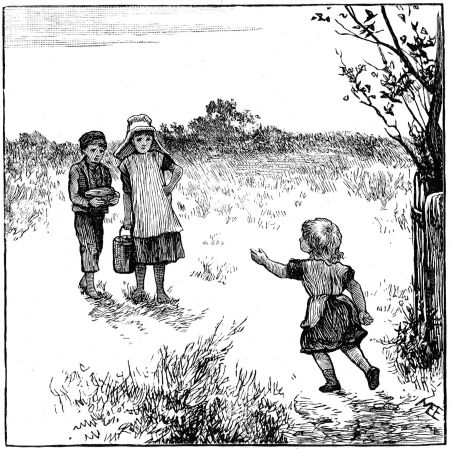
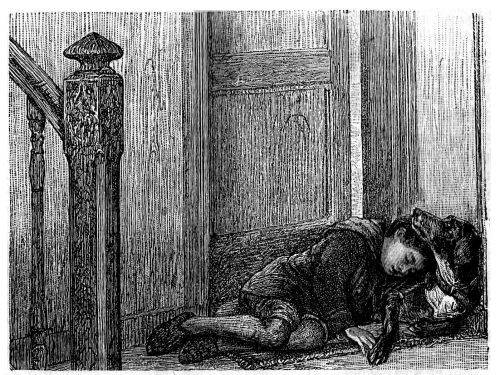
he came running towards them (p. 3).
Presently there came from the room overhead a
low sobbing sound, and a minute or two afterwards
Mrs. MacDougall appeared, stern and frowning.
It was an unhappy supper they sat down to.
Robbie was very wretched, and as for Duncan,
each mouthful threatened to choke him. Mrs.
MacDougall wore a troubled face. After it was
ended Duncan crept away to his sister's room.
"I knew mother would," he said, sympathisingly,
"and I know she'll do it again, if you do it. You
wouldn't, would you, Elsie? Mother never whipped
you before, never in all our lives, Elsie, but you
didn't care. What was the matter with you?"
"You little stupid!" Elsie replied patronisingly;
"I won't fetch the milk at all, not if mother whips
me every day. I don't care. You don't know what
I know, and you don't know what I'm going to do,
but I know myself; and you little cowardy custard, you
don't know what secret I could tell you if I liked."
D
uncan
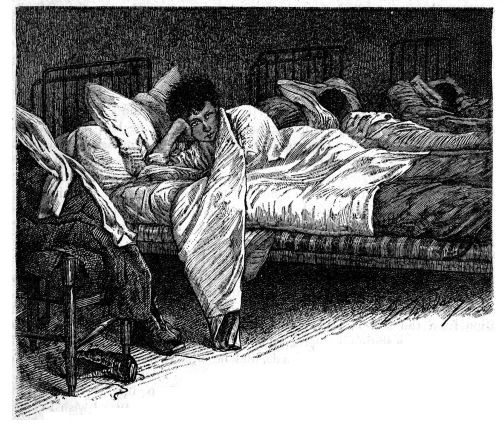
crept away to his own little bedchamber
with an uneasy feeling of trouble.
It was next to Elsie's, separated from it
only by a little square bit of landing, and,
like hers, was a tiny apartment under the roof,
with a ceiling of the bare rafters which supported
the tiles. In each was a small wooden bedstead,
a deal stand, with basin and jug of coarse white
earthenware, and a small deal box, which served
both to keep clothes in and as a chair.
Everything was scrupulously clean, even to the
dimity vallance that hung across the low window.
In autumn and winter the bleak wind whistled
through the chimneys and rattled the casements in
a way that would have prevented a town-bred child
from sleeping, and up in those bare rooms there
was cold enough to pinch you black and blue; but
Elsie and Duncan had never thought much of
that, for they had been accustomed to it from babyhood,
and only threw on their thick homespun
garments in greater haste.
Just now the weather was unusually hot, and the
little lofts had gone to the other extreme, and
were more like ovens than anything else. Duncan
had scarcely taken off his jacket when he heard
Elsie calling. He ran to see what she wanted. "I
s'pose you won't go telling any tales about what I
said just now," she exclaimed shortly.
"Of course I shan't," Duncan replied, indignantly;
"but what was it you said? There
wasn't anything to tell tales about except that you
said you weren't going to fetch the milk."
Elsie's mind was so full of her own affairs that it
was quite a shock to her to find that Duncan had
taken so little heed of her words. "It's a good
thing I'm not such a silly baby as you are," she
said, contemptuously—a way in which she so often
spoke to Duncan that he quite believed Elsie to be
the cleverest, most daring, and bravest creature in
existence.
"This place is like a furnace," she cried, irritably
throwing the sheet which covered her down
on to the floor. "Why should I be poked up here
and Robbie sleep downstairs with mother and
grandmother, eh, Duncan?"
"I s'pose it's because he always does," Duncan
replied dubiously.
"Stupid-head!" cried Elsie. "And why does
he always?"
Duncan thought a minute. "P'raps it's because
he's the youngest, and was the baby when you and
me was bigger," he answered presently.
Elsie turned over with an angry grunt. "It
isn't anything of the sort," she cried; "and you
might have known I didn't want you to answer
me."
"I thought you asked me," Duncan said, in
much perplexity.
"You ought to have said you didn't know, and
then you'd have told the truth," Elsie said shortly.
"Hush! there's some one coming up. Crawl
under the bed, in case they come in."
A slow dragging footstep came up the steep
stairs, and presently a voice called softly, "Dooncan?"
Duncan began to crawl out from under the
bedstead, answering as he did so, "Yes, grandmother,
here I am."
Elsie dangled her foot over the side of the bed,
and gave Duncan a pretty sharp kick as he
emerged.
"What's that for?" he stopped to ask.
"Only because you're such a ridiculously silly
little softie, that nobody could put a grain of sense
into your head," Elsie replied, angrily. "Supposing
it had been mother. A nice row you'd have got us
into. Why couldn't you keep quiet, and she'd
have thought we were both in bed and asleep."
"But I knew it was grandmother's voice," said
Duncan.
"Dooncan," called the voice again, "I want
you."
Duncan opened the door this time. His grandmother
did not seem to notice that he was in a
forbidden place, but asked, with an anxious quaver
in her voice, "Did mother beat Elsie, Duncan?"
"I think so," Duncan replied indignantly.
"Eh, well, Duncan," she said, consolingly,
"mother's often threatened and never done it
before, and Elsie's a wilful child, with a spirit and
temper that must needs be broken. But what was
the matter now?"
"It was about fetching the milk," Duncan
replied. "Elsie don't like it, and she wouldn't be
quick."
"Eh, well; but it's the place of the young to fetch
and carry," said the old woman, in a much more
cheerful tone than she had used before. "But
Duncan, my laddie, have you picked up a wee bit
of paper with writing on it, what grandmother has
dropped?"
"No, granny, I haven't never picked up a piece,"
Duncan replied.
"Nor seen it lying about neither, dearie? Come
now, think if you picked it up and threw it in the
fire. I won't be angry if you tell the truth."
"I never saw it at all," said Duncan again.
"Ah, well! I thought perhaps that it was about
that mother was angry with Elsie, but it wasn't,
after all; you're sure of that, Duncan?"
"Oh no; it was about the milk," Duncan returned,
readily.
"And Elsie's asleep now. Well, well, youth
must be chastised sometimes," crooned the old
woman, softly. "You needn't talk about the paper
I've lost, Duncan. It's safe enough in the fire, no
doubt; but if you see a scrap of paper lying anywhere,
bring it to grandmother, and she'll give you
a penny for sharp eyes."
Then the old dame went cautiously downstairs,
feeling the way with her thick stick, and Duncan
once more went off to bed.
He woke very early the next morning, wondering
whether Elsie would keep her vaunted threat of
refusing to fetch the milk, and if so, what would
happen: for if Elsie were obstinate, their mother
was firm as a rock in doing a duty, and Duncan
well knew she would not be overborne by any one.
So it was with a vague uneasiness that he put on
his clothes and went downstairs. To his surprise
and relief, Elsie was already in the kitchen and was
busily, though with a sulky-enough expression,
rinsing out the can. Elsie's valour, like that of
many an older person, was greater in words than
action, and there is no doubt that the previous
night's punishment had had its effect.
But that Duncan should think so was the
last thing that Elsie would wish. Directly they
were outside the door, she said in a careless tone,
"It's nice and cool this morning across the moor:
much better out here than in that little loft."
"And won't you come this afternoon?" asked
simple, straightforward Duncan.
"I don't know," Elsie answered sharply. "It
depends upon whether I feel inclined. Duncan,
what was that granny was asking about a piece of
paper?"
"She only asked me if I'd picked a piece up
with writing on it, and said she'd give me a penny
if I found it."
"I dare say she would," laughed Elsie; "but you
won't ever get the penny, Duncan, so don't expect
it. She didn't ask if I'd picked it up?"
"No, she didn't; but have you found it, Elsie?
because I'll take it to her, and give you the penny,"
Duncan remarked.
"A penny indeed!" laughed Elsie contemptuously.
"I wonder whether you really could keep a
secret, Duncan?"
Duncan was rather hurt at the implied doubt.
"I never told tales of you, Elsie, never," he said,
earnestly.
"Look here," Elsie exclaimed, "I was weeding
my bit of garden just under the kitchen window
yesterday, and granny was sitting at the window,
yet never saw me. She was reading some old
letters, peering at them ever so hard through her
spectacles, and talking to herself all the time. I
expect she'd taken them out of mother's drawer, for
she kept on looking round to see if any one was
coming, and the best of it was I was watching all
the time, and she never knew it. I saw her put
one piece of paper down on the window-sill; she
was saying very funny things to herself. 'Meg
shouldn't have done it; she wouldn't take my advice.
Ah! she'll rue it some day, I well believe,' and all
on like that. Of course Meg means mother, and I
was just wondering what it was she was talking
about, when the wind blew quite a puff, and blew
the piece of paper right on to my garden. I was just
going to peep at it, and see what it was mother
shouldn't have done. Then granny gets up, and goes
peering all round to see where the paper's gone. She
pulled all the cushions out of the chair, and turned
up the matting, and looked over her letters ever so
many times, and never noticed that it had blown out
of the window. Presently I put my head through the
window, and cried out, 'What's the matter, granny?'
'It's only I've dropped a little bit of paper, my
dear,' she says to me. 'Just come and see if your
young eyes can find it.' I went in and looked all
round. Of course I didn't find it, and I was
almost dying of laughing all the time."
"And have you got it now, Elsie?" Duncan asked,
with wide eyes.
"Yes, I have," Elsie replied shortly; "and it's
much more interesting than I thought it would be.
It's about you and me."
"You and me?" echoed Duncan, who was of a
matter-of-fact mind, and was always content with
things just as he found them.
"Yes, stupid," said Elsie, crossly; "I always said
mother favoured Robbie, and so she does. Why
he has new things much oftener than you, and
you're older too. Do you and me have boots and
stockings for week-a-days? then why should Robbie?
Don't you wonder why mother pets him so?"
"No," Duncan answered truthfully. "He's ever
so much more babyish than me."
"Well, I say it's a shame," continued Elsie.
"Look at this old sun-bonnet. Do you think I ought
to wear such a thing as that? Didn't I always say
I'd love a long feather like the ladies at the manse?
and why shouldn't I have one, and a silk pelisse,
and gloves upon my hands, and sweet little shoes
for walking in?"
"Why, you'd be just a lady," Duncan said.
Elsie laughed a pleased soft laugh. "A lady,
just a bonny lady," she said over to herself; "and
wouldn't you love to be a little laird, Duncan?"
"I don't know what it's like, Elsie," Duncan said
thoughtfully.
"It isn't like fetching milk and sleeping in a loft,"
Elsie said sharply. "It isn't like porridge for breakfast
and porridge for supper. It would be like——everything
that's nice," she said, after a minute
or two's pause, for she really did not know anything
about it, and was suddenly pulled up in her description
by that fact.
T
he boy walked along, silently thinking over
what Elsie had been saying, in a muddly,
confused sort of way. Robbie, and granny's
letter, and Elsie's beating, lairds and ladies,
and something secret and mysterious that Elsie
knew, were mingled hazily in his mind, in such
chaotic fashion that he had nothing to say, not
knowing how to put his ideas into the form of a
question.
It was not until they were on their road home
again that he suddenly asked, "Whose letter is it,
Elsie?"
"What do you mean?" Elsie returned, with
more than usual quickness. "I say it's mine and
yours. Mother'd say 'twas hers, most likely; perhaps
granny might say 'twas hers; I say it's ours
as much as ever it's theirs, and the person what
wrote it is our father; so there, Duncan."
"Mine too!" Duncan echoed, in greater bewilderment
than before. "Then, if it's mine too, Elsie—
"Well, what?"
"I ought to read it, an' see what's in it."
Elsie laughed. "Of course you ought," she
replied encouragingly. "That's just what I said to
myself when I caught sight of it; and when I'd read
it, an' saw that it was all about you and me, an' told
a secret too, what granny an' mother have always
kept away from us, d'you think I was goin' to
give it up? no, not if I know it. An' to think they
fancy it's lost—leastways, granny does—an' mother
don't know anything about it at all. What fun it
is! D'you know, Duncan, I don't so very much
like mother."
Duncan looked at her in alarm. Scottish
children of all classes are brought up in very
strict notions of filial duty and affection, and
these were no exceptions to the rule. Duncan
looked all round anxiously, as though he feared a
bird might carry the dreadful treason to their
mother's ears.
Elsie looked as if she were enjoying the sensation
she had made. "I've got a good reason," she said,
nodding her head knowingly. "You'll see it when
you've read the letter. I always thought I wasn't
so very fond of her, and now I see why it was. It
wouldn't have been right if I had; an' when she
beat me, I can't tell you how I felt. I couldn't
like any one who beat me!" Elsie continued,
grinding her teeth together with rage at the
memory, "even if it was my own mother."
"You seemed as if you wanted to make mother
do it," said Duncan, who was often much distracted
between his allegiance to rebellious Elsie and the
strict sense of duty and obedience in which he
had always been trained.
"P'raps I did," Elsie replied. "But I don't
care; and mother shan't have the chance again.
I don't think our father'd let her if he knew it."
"Our father?" faltered Duncan. "Why, our
father's dead."
"Is he?" asked Elsie, enigmatically. "Robbie's
father is."
"And isn't that ours?" Duncan asked contemptuously.
"That's just it," Elsie replied, with some excitement.
"That's just what the letter's about. Now,
if you sit down here I'll read it to you."
"We shall be late again," Duncan said, nervously.
"Don't let's stop now, Elsie, and make mother
cross. Could we do it after school?"
"P'raps I'd better tear it up, or give it back to
granny," Elsie said, with a taunting air. "It don't
matter to you."
"Oh, don't!" pleaded Duncan, divided again
between the sense of duty, his own curiosity, and a
fear of offending Elsie. "Do keep it till after
school."
"Yes, I will," Elsie replied. "And mind you
bring home an atlas with you, for, now I think of
it, I must have a map of England and Scotland."
"But we mustn't bring home books," Duncan
urged.
"Never mind; you must do it by mistake. We
must have a map, I tell you; and if I've had the
trouble of getting the letter, you can take the
trouble to get the map. Mind you do, now, or else
I shan't tell you anything about it. You can take
it back in the afternoon. 'Tisn't stealing."
No, nor disobedience, nor deceit, nor telling a
lie, eh, Elsie? Evidently Elsie did not stop to
think of that any more than she had stopped to
consider whether she had any business to read that
old letter of her mother's when it fluttered out of
the window.
They reached the cottage in good time. Robbie
and their grandmother had only just come downstairs.
Mrs. MacDougall seemed to be in an
unusually pleasant temper this morning. "I'm
glad you've hastened, my child," she said to Elsie.
"Sit down to the table, and get slicing that
cucumber I've just cut. It'll be more refreshing
with some bread-and-butter and a cup o' milk than
the porridge, and a change too."
Duncan glanced at Elsie with a half shame-faced
expression, as much as to say, "Mother is kind,
you see, when you're good. She's sorry you had to
be beaten last night." But Elsie only replied by a
look of defiance, as though to say, "That doesn't
make up at all."
"Let's see: what's to-day?" Mrs. MacDougall
continued, pleasantly, as she poured out the milk
into the children's cups. "Can it be the thirty-first?"
"No, no, Meg; surely not," quavered the old
grandmother, who, for reasons of her own, wished
to appear ignorant. Was it not to refresh her
failing memory about what happened just about
this time of year, a long while ago, that she had
gone to her daughter's desk, and got out those old
faded letters? Mrs. MacDougall would not have
minded her reading them, but she would mind having
them lost, for she was very methodical; and besides,
many of these letters were important ones, written
by hands long since folded in death.
"And to-morrow's Robbie's birthday," Mrs.
MacDougall continued, laying her rough, strong
hand very gently on the child's fair curls. "Very
well do I remember this time seven years ago."
"Yes," sighed the old grandmother. "Poor
little dears! and Nannie a bonny lass too."
Mrs. MacDougall glanced at her mother with
something like a frown. "I never think of Robbie's
birthday without thinking about poor Aunt Nannie,"
she said to the children.
They knew well enough why, for they had heard
the tale often enough. Their Aunt Nannie had
been their mother's beautiful young sister, and the
news of her death had come to them when Robbie
was a baby of a week old. They had never even
seen her, for Duncan was but a year old, and
Elsie not three, when she died, and she had been
living in England with her English husband at
the time.
"Robbie reminds me so of her," Mrs. MacDougall
said softly. "She was fair. He takes after her
wonderfully, doesn't he, mother?"
"Very much indeed," the old dame replied.
"Ah well! Robbie must have some fresh cakes
to-morrow for his birthday and a plate of plums,
and you can have your tea under the big alder
an' Elsie shall pour it out."
"Oh, thank you, mother, how nice!" the little
boys exclaimed. Elsie's ungracious silence passed
unnoticed by all but Duncan.
"P'raps I shan't be here to pour it out," she
said, in a careless tone, when they were outside the
door. "Mind you don't forget the atlas, Duncan."
Then they started off to school. It was a longish
walk across the moor and along a dusty road
to the nearest village. Robbie, although seven
years old, was exempted from going on account of
the distance and his delicacy. Elsie bore in mind
that Duncan had gone before he was that age, but
Robbie was such a petted baby. He was not
nearly so strong as Duncan had been at his age.
Duncan's was a very placid, slow sort of mind.
He went through his tasks without any excitement
or distraction, although occasionally a vague
curiosity as to what Elsie could want the atlas for,
and what the letter said about them, did wander
through his brain. When school was ended he
slipped out unobserved with a small atlas, which
he had had difficulty to secure, under his jacket.
Elsie was waiting for him at the edge of the moor.
They sat down on some stones, and Elsie pulled
the letter from inside the neck of her dress.
"I shan't say anything; I shall read it to you,"
she began; "and if you can't make anything of it I
s'pose I must explain it afterwards. It's from our
father to Mrs. MacDougall."
"What, to mother?" Duncan asked.
"H'm, you'll see presently," Elsie said impatiently.
"Worst of it is, there's a piece torn off all along,
which makes it difficult to read. It begins, 'Dear
Mrs. MacDougall.' Oh, I forgot. It's put at the
top, 'Kensington, London.' That's the capital of
England, you know, and it means that the person
what wrote it lived there."
"But father didn't, did he?" began Duncan.
"Hold your tongue till I've read it," Elsie replied.
"I can't stop to explain beforehand. This is it:—
"'Dear Mrs. MacDouga
I have to be
teller of very bad new
sister, my poor wife die
morning. It will not be a
shock to you than it wa
me. I had no thought
it was likely to happen
a few hours previous
sent her love to you
her mother.
The two little things ar
but I have been
what I can do with th
I have not seen them'"
(here the page turns over and the missing words
are from the commencement of the line)—
"'night and I don't feel
to see them yet. The sound
ir voices is too much for
hat can I, a helpless
wer do for them. They
be better off among their
kinsfolk than left
mercy of strangers. I often
I made a mistake in
nging poor Nannie to this
cat crowded city away from
ive moors.
The children I am told
eak and delicate. There
be a chance for them'"
(here the fresh page begins)—
"'in their mother's native
The woman who has charge
trustworthy. She shall brin
to you, if you will take
they live, bring them up with
your own, and as your own.
the girl turns out anything
her mother, she will be we
enough. I shall not interfe
the children. All I want to
is that they are well care
In a year or two I may
able to interest myself
them. For the pres'"
(fresh page)—
"'likely I shall wander
t, Reply at once
Yours truly,
R. Grosvenor.'"
When Elsie had finished reading she sat looking
at Duncan. "It doesn't seem very plain," he
ventured to say, presently; "and there wasn't
anything about you or me in it. You said there
was."
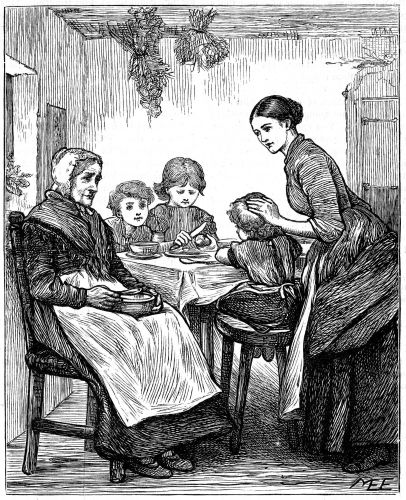
mrs. macdougall glanced at her mother (p. 8).
"Stupid little thing! isn't there some of it torn
off? and when you put the words in it's easy
enough to read. I've put them in to myself. First
of all, it's about Aunt Nannie dying, isn't it?"
"I s'pose it is," Duncan agreed; "and it's writ
by Uncle Richard, isn't it?"
"If you call him Uncle Richard. I say it's our
father what wrote it—yours and mine, Duncan."
Duncan stared at her in puzzled silence. "But
Aunt Nannie was our Aunt Grosvenor, wasn't
she?" he asked.
"If you call her Aunt Grosvenor. I say she
was our mother. I'm sure she was," said Elsie.
"Our mother!" Duncan said, under his breath.
"What do you mean, Elsie?"
"The letter says something about two little
babies," Elsie began.
"Does it?" Duncan asked. "I didn't hear it."
"Well, it says, the 'little things,' and that's the
same; and it's all about sending them to Aunt
Nannie's native place. Well, this is Aunt Nannie's
native place; and who were the two little things,
eh?"
"I'm sure I dunno," Duncan said slowly.
"Well, they weren't Robbie, were they? Then,
who were they? Why, you an' me, of course.
It says 'the girl' somewhere, an' of course that's
me. So now, isn't the letter about us? an' that's
why granny was so afraid of losing it. Do you
see now, little silly? It's plain enough."
"But why did they?" murmured Duncan.
"That's the funny part of it. They ought to
have told us. Why didn't she?"
"Who?"
"Why, Robbie's mother, of course. She isn't
our mother, an' I'm not going to call her mother;
I shall call her 'she.' You can call her what you
like. Why does she pretend to be our mother when
she isn't? It's different with granny, 'cos she's
our granny right enough. Didn't I hear her say
'Meg 'ud rue it?' It's a shame to have made a
secret of it."
Duncan had been turning it over in his poor
little mind. He formed ideas very slowly, but
there was often more sense in them when formed
than in the quick conclusions of cleverer children.
"But if Uncle Grosvenor is our father, Elsie, why
don't we live with him? He never's been to see
us, never. He'd be sure to know Aunt Nannie
was our mother, and not—you know—'she.'"
"I believe," said Elsie, in a mysterious voice,
"that 'R. Grosvenor' thinks we're dead."
"Oh, Elsie! but we aren't at all," gasped Duncan.
"No, I shouldn't, think so. Doesn't the letter
say they are weak and delicate (what a beautiful
letter it is, Duncan. I'm sure R. Grosvenor is a
grand gentleman), and 'bring them up with your
own and as your own for a year or two?' That
was till we got strong; and she's kept us always.
Of course R. Grosvenor (I'm not going to say
uncle), doesn't know that we're quite well now. I'm
sure he thinks we're dead. Who does 'your own'
mean but Robbie. Oh, how dull you are, Duncan!
Can't you see now why she pets that boy so, and
makes such a fuss over him? He's her own, and
we're not; she loves him and doesn't love us.
Did she ever beat Robbie?"
"Robbie isn't naughty," Duncan protested; "at
least, only a very little sometimes."
Elsie uttered an impatient exclamation. "Does
Robbie have to fetch milk, and go to school, and
pick up wood? No; he's treated different. Now
you know why I don't like her."
Duncan gave vent to a sigh of perplexity. There
rose up in his mind a sort of uncomfortable feeling
that everything was going topsy-turvy. Somehow
or another he seemed to see Robbie's mother
sitting by the side of Elsie's bed when she had the
fever last winter, and bustling about to get nice
things for her, hushing the others with a strange
look in her eyes that made them quiet at once,
for they could see she was troubled. Or he seemed
to smell the grateful smell of the hot cakes waiting,
crisp and tempting, before the big cheerful fire, to
greet them on their return from afternoon school
on a dreary winter day. She had been kind, though
she was so strict, especially to Elsie, and Duncan
was feeling something very much like sorrow to
think that, after all, she was not their mother.
"What are you going to do, Elsie?" he asked
presently.
"I've just been wondering when you were going
to ask me that. Of course it can't stop like this.
Haven't you heard granny say how rich Uncle
Grosvenor was, and what a grand place it was
where he lived? Well, then, he's a grand laird, an'
if we lived with him you'd be a little laird, and me
a lady. Does he think we have to fetch milk and
butter, and go after the hens, an' all that? But I'm
goin' to let him know all about it."
"How, Elsie?"
"Well," Elsie replied, "I've been thinking of that,
an' it's just a real difficult matter; for I'd never
get time to write all the long explanation, with that
she always prying after me. She'd find it out, an'
stop the letter, even if I could find the paper;
an' I dunno' as I can spell all the long words it 'ud
take to explain it. An' more too, I couldn't wait
an' wait for the answer. We ought to go an' see
Uncle—R. Grosvenor. I've almost made up my
mind, Duncan, that I'll go to England an' find
him."
"You couldn't do it," Duncan said.
"Couldn't I?" Elsie said scornfully, "It isn't so
very far. England's another country, but it joins
on. You only step out o' one into the other, for I
looked most particular; an' there wasn't even
mountains to get over. There's only what folk
call the border, an' I'm sure that isn't much.
P'raps it's a line, or a road, or a ditch, or something
like it. You go straight out of Scotland—as
straight as ever you can go. I've looked on
the map. Give it me now. If you go from Dunster
you've only to keep in a straight line till you
get into England, an' any one'll tell you the way
to London."
"I'm sure it's a dreadful long way," Duncan
said disconsolately. "I should be frightened
while you was gone, till you came back."
"Come back," said Elsie. "I shan't never do
that, I hope. When I find my father he'll take
care o' me. Now then, will you come with me,
Duncan?"
"I don't think I'd go, Elsie. We might get lost,"
Duncan urged. "I wish you could write a letter
instead."
"I've made up my mind to go if I do anything
at all," Elsie said, in a tone of decision. "You
needn't come unless you like."
Duncan looked perplexed again. This was
indeed an awkward predicament. The thought of
running away to England didn't seem nice, somehow,
but if Elsie went and he stayed, how frightened
he'd be all the time about her; and when
they questioned him, how would he be able to
keep her secret, especially if Robbie's mother had
that troubled look in her eyes? and how lonely it
would be going backwards and forwards across
the moor all alone without Elsie.
"I wish you wouldn't go, Elsie," he said to her
presently.
"Most likely I shall," Elsie replied. "Mind you
tell no tales. We must be quick home now. Come
along; I shall have to think of ever so many things
before we go, so you'll have plenty o' time to know
whether you'll come or stay behind. Oh, I know
I shall be a real lady, Duncan, an' have bonny
clothes. Of course I shouldn't like fetching milk
an' things when I'm a little lady born. Isn't it a
shame, Duncan?"
"I dunno; I don't mind," Duncan then said.
"Give me the atlas," Elsie said; "I must get away
an' have a goodish look at it when we get in, for
you must be quite sure and take it back this afternoon."
But Elsie was not to "get away," for Mrs.
MacDougall was waiting at the gate with a
basket by her side.
"You've been loiterin' again," she cried briskly.
"I've been waitin' this half-hour for you to take
these beans down to the shop. Here's a bit o'
bread you can eat along the road, an' you'll have
just to make haste."
Elsie cast a defiant glance at the basket as she
took it slowly up. She knew too well its destination.
The neatly tied-up bundles of young well-grown
beans lying on the fresh cabbage-leaves would be
one of the attractions of the village shop. A day
or two ago all the plums that were ripe had gone
the same way, to the children's disgust. Mrs.
MacDougall was a clever gardener, and had a ready
sale for her small stock of produce. To-day Elsie
and Duncan would get no dinner beyond the bit of
bread. That was the result of their loitering.
They had lost the valuable time through their talk
over the letter.
But Elsie quite lost sight of the fact that she
alone was responsible for losing it, and was very
angry about it.
"I have quite decided," she said to Duncan.
"This is what I'll do; to England I will go!"
(To be continued.)