A whole
week elapsed,
in which Mrs.
MacDougall received
no tidings of the
children. Every
day she trudged
to the market-town
and back,
not able to bear
the suspense
without doing
something. Every
day she received
the same
answer, and turned
away with
a weary sigh.
The men who
answered her
questions noticed her change from day to day, and
shrank from giving her the same hopeless replies
time after time. They were puzzled and astonished,
but still confident that the children would ultimately
be found. In their own minds they believed
the children had fallen in with some wandering
gipsies or other vagrants, and were being closely
guarded. They knew well enough that there were
plenty of ways of stealing children, and keeping
them out of sight in barges, colliers, or gipsies'
vans, and that the time that had elapsed made the
probability of finding the children much less; but
this they kept to themselves.
Mrs. MacDougall, however, was not so easily
blinded. She knew the dangers that were waiting
to engulf them. She called to mind having read,
some years ago in the newspapers, of a little fair,
delicate boy, who was stolen away and never found.
She remembered distinctly enough the agonised
appeal of his parents that every man and woman
would join in the search for the child by keeping
their eyes open wherever they went.
She had been deeply interested, and wondered
how such a thing could happen. She remembered
that, in spite of all, little Charlie (that was the
child's name), had never been discovered, and that
his fate had remained shrouded in mystery, the
supposition being that the child had been stolen
by cruel, wicked people, and perhaps died of fright.
Could such a fate have overtaken her children?
A hundred times a day she cried to God that He
would save them from a life of sin and degradation,
even if by death, and there is no doubt that the
mother's prayers had the reward of keeping them
out of the dangers she feared for them.
The Sabbath came round. Mrs. MacDougall
put on her best clothes, dressed her mother and
Robbie, and went off to the kirk as usual.
"The Lord will not ill-requite me for keeping His
day holy," she said solemnly, when her mother
suggested that news might come in her absence.
"The Lord knows I am in His kirk, and He will
no seek me in the cottage."
Her simple faith was destined to receive its
verification. Early the next morning a messenger
arrived, bringing news. He spread out an official
document on the table, and began with much unnecessary
and tiresome questioning.
"If ye're wanting to send me crazy, you may
just take your own time, but if not, will ye tell me
right out are they found?" she asked sharply.
"Well, yes, they are," the man replied.
"Then tell me how, and where."
"The boy is in Edinburgh, ill of the fever, but
well cared for in a children's hospital. The girl is
in London, in a place she won't be running away
from in a hurry."
"You mean a prison, surely?" Mrs. MacDougall
gasped. "Say the right word, man, and don't
put your own gloss on things. It doesn't make
them any the better."
"It isn't a prison exactly," the man replied,
"except that she can't get free from it without the
permission of them that put her there. She got in
with some people who are now in custody, and as she
will be an important witness, she will be, perhaps,
detained there until the case comes before the
magistrates; but she is safe and sound, according
to our information."
"And can I no rescue her from that place?"
Mrs. MacDougall asked.
"That depends upon many things," the officer
answered cautiously. "I could not undertake to
say."
In a very short time Mrs. MacDougall was
ready for her journey. "Ye will nae gang outside
the gate whiles I'm gone," she said to Robbie, "an'
bless your heart for a good child, I know you will
not disobey me." Then to her mother she added,
"I will just ask our good neighbour Jarrett to look
in an' see ye all right, an' that your wants are
supplied." Then she bade them adieu, and departed.
They walked as far as Dunster, calling at the
farm on their way, then hired a vehicle to convey
them to Killochrie, the nearest place to which the
trains ran—not by the circuitous route that Elsie
and Duncan had found their way there, but by a
direct road.
That night Mrs. MacDougall was in Edinburgh,
and was mightily amazed and confused with the
grandeur and bustle of the place, which she had
never seen before. How her children could have
found their way here, and still more, how they
could ever have been discovered and identified in
such a teeming, bustling, bewildering city, she
could not imagine. She had yet to see London, to
which Edinburgh could not compare for teeming
multitudes, labyrinths of streets, and all the gigantic
bustle and confusion of a vast city.
"Ah! but it's a right wicked place," she exclaimed
in horror, as she passed by some of the foul-smelling
closes, or courts, as we call them, where dishevelled
hag-like old women sat on door-steps, and
filthy, squalid children played in the gutter, where
ill-favoured young people of both sexes hung idly
about the entrances, chaffing or quarrelling with each
other. "Ye police people must be a poor set out,
an' ye can no do away with such dens as these!"
Mrs. MacDougall cried in righteous indignation.
"And the country folk are all for sending their
girls into the towns to get high wages and such
gear. I would not have one of mine come to such
a Babylon as this!"
But Mrs. MacDougall had not time for more
observations, for they were soon at the hospital
where sick children were received. They were at
once admitted. A kind-looking woman came forward,
and asked if it was necessary to see the child.
"Are ye no aware, ma'am, that he is my ain
bairn?" Mrs. MacDougall began; but her companion
interrupted her.
"Our business is to identify the little laddie," he
said, with a tone of authority.
"Then I warn you to be careful," the woman
replied. "He is just in a critical condition, and
must not be spoken to."
"Ye mean well to say his life is in danger?"
Mrs. MacDougall asked quickly.
"I cannot deny it," the matron replied; "but
you must not despair. Children make wonderful
recoveries," she added, kindly.
She led them to the door of the ward, where a
nurse came forward to conduct them to the proper
bed.
"It is my ain little bairnie," Mrs. MacDougall
whispered; "but sairly altered, sairly changed."
"He couldn't have been worse than he's been,"
the nurse said, drawing them a little way from the
bed. "The delirium was just dreadful to see! But
that's past, and we only want him to rally. He's
about exhausted now, and must be kept quiet. I
would not like him to open his eyes and find you
by his side. By my will you would not have been
admitted."
"Then I'll go directly," Mrs. MacDougall said,
quickly. "I will no beg you to be kind to my
bairn, for I can trust your face; but I will pray
for you to be rewarded for every act o' kindness
done to a poor lost little one. When can I come
again?"
"To-morrow's the right day. You can come
then," the nurse replied.
"I'll be near at hand, an' they'll let me know
if a bad change comes," Mrs. MacDougall said
hurriedly. "I'll get the nearest lodging to be had."
When the clothes of the child had been duly
identified, the officer and Mrs. MacDougall departed.
"I shall no leave this place to-night,"
Mrs. MacDougall said, firmly. "The lass is safe
and sound, and Duncan may be dying. I must be
near by."
So a decent lodging was found, in which Mrs.
MacDougall took up her quarters, having first
taken her address to the matron, who promised her
that she should be sent for if immediate danger
developed itself. The officer was somewhat
puzzled by Mrs. MacDougall's determination; but
as his instructions were to proceed with the
identification of both children, he determined to go
on to London at once, armed with the most minute
description Mrs. MacDougall could give him of
the missing child.
It is needless to say that the description tallied
perfectly. As, however, the examination of John
and Lucy Murdoch, known to us by the name of
Donaldson, was expected to take place in a day or
two, the officer remained in London, waiting to
obtain Elsie's full discharge, which could not be
hoped for until after this important event.
Mrs. MacDougall was acquainted with her
perfect safety, and as Duncan remained on the
brink of the grave, she did not, for the present,
attempt to leave Edinburgh.
O
n
a certain morning, not long after her first
appearance before the magistrate, Elsie
was once more brought into court. She
had hailed the appearance of her old acquaintance
with something approaching delight,
for any change was a welcome one from the hard,
dreary, monotonous life she had been leading in
the wards of the workhouse.
"Do you know anything about Duncan?" she
asked, eagerly. "Did they really take him to the
hospital? she didn't turn him into the streets, did
she? Oh! I have been so frightened about it.
They said they didn't know anything about it in
there. You know, don't you?"
"Yes, I know," the man said, gravely.
Elsie looked up in his face questioningly. It
was very grave. "Is he—is he—dead?" she
gasped.
"Not as far as I know," the man replied; "and
he did go into the hospital right enough; but he
was as near dead as possible when your mother
found him there. I don't think it's certain now
whether he'll recover."
"Mother found him!" Elsie cried. "Then—then
she knows where we are?"
"Yes, she knows," the man replied.
Elsie involuntarily drew a long sigh of relief. It
was only afterwards that she began to be worried
with doubts as to what her mother would say or
do. In that first moment her first instinct was
that being found by her mother was the end of all
trouble, and that was, no doubt, a true and natural
instinct.
But the after feeling of fear and doubt soon
came to cloud Elsie's joy at what seemed such good
news. How glad she would be once more to be
back in the clean, sweet cottage on her native moor.
She had thought that life hard, and so wanted to
be a little lady, but it was a perfect paradise compared
with her present life; and as for care, which
is the greatest enemy to happiness that we can
have, she had not known what it meant before
she ran away. Food and clothes, and warm, comfortable
shelter, were all hers without a thought on
her part, and yet she had been so discontented and
cross and disagreeable to everybody because she
had not dainty food and nothing to do. But she
had found out what it felt like to be without a
home or a friend, with coarse food, and nothing
but harsh words; and she had been continually
told that that was far more than she deserved,
and was given to her only out of charity, for
which she ought to be most grateful.
If only Mrs. MacDougall would let her go home
and things be the same as before, she would never
be discontented or ungrateful any more, but she
could hardly believe that she would ever get back
again to that old happy life.
And Duncan? He might die! Then it would
never be the same again. Dear little Duncan, who
did not want to come away, and had always been
contented, but would not forsake his sister. But
for her he would be well and happy now, whereas
everything was dreadful and wretched. It was
quite certain it could never come right. If only
she had known beforehand? It seemed so easy
and so nice. Was it her fault that things had
turned out so different? Was she to blame for not
knowing?
In this way she tried to find some excuse and
consolation where there was indeed little enough,
falling back on the idle excuses people so frequently
make. How many people ask "Was it my fault
that I did not know?" when that was not at all
where the fault lay.
At last the court was reached. Elsie was taken
into a small room, where she had to wait some
time, and had plenty of time for reflection. She
grew very nervous and frightened, and began to
wonder whether they had sent for her to punish
her, whether the white-haired gentleman thought
she had told stories, and was going to send her to
prison. Yet the officer had seemed kind, and they
had promised her that by-and-by she should be
allowed to go home. Could she have told a story
without knowing it? She tried to think over all she
had said. Suddenly it came into her head that
perhaps this clever, wise gentleman knew that her
name was not MacDougall, but Grosvenor, and
would punish her for that. What ought she to have
said? She puzzled and puzzled over it till she grew
quite stupid and bewildered.
By-and-by the officer who had brought her took
her hand and led her forward. As she entered
the great room in which she had been once before,
she noticed that it was thronged with people. She
was presently placed in a small, square, box-like
place, reminding her a little of the pews in the
kirk. Before her she soon detected the old gentleman
who had questioned her, but there were several
others seated near him. Turning her head slightly,
her eyes fell with fright and dismay on the figures
of the "fairy mother" and a man, who was neither
Uncle William nor Grandpapa Donaldson, yet reminded
her of both.
They were looking at her, and Elsie saw something
in their faces that made her tremble. Yet
she could not turn her eyes away till the "fairy
mother" dropped hers, and with a heavy sigh made
a little movement, as if to hide from herself the
sight of her ungrateful child.
Then Elsie caught sight of another face: she
recognised the man Andrew. There were others
whose faces she did not know.
The Bible was handed her, and again she had to
repeat the words of the solemn oath. Again the
old gentleman leaned forward and asked her if
she knew what an oath was, repeating his solemn
warning. Then came the question, "What is your
name?"
"Please, sir, I don't know," Elsie faltered, bursting
into tears.
"The child is just dazed, your honour!" cried a
voice from the crowd, which rang strangely in
Elsie's ears, but the venturesome individual was
silenced immediately.
"You told us the other day," the old gentleman
said kindly. "You have only to tell the truth, then
you need not be frightened."
"I'm afraid it was a story," Elsie exclaimed.
And the "fairy mother" looked round anxiously.
"I don't know whether my name is Elsie MacDougall
or Elsie Grosvenor, because I am not
sure whether Mrs. MacDougall was our mother or
whether Aunt Nannie was."
Again a voice cried out something from the
crowd, but Elsie did not catch the words. The
person was warned that she would be removed if
she interrupted again, and the gentleman continued.
"We will take your name as Elsie MacDougall.
Is it true that you ran away from your home on a
certain Wednesday?"
Elsie replied that she had done so, and then she
was asked a great many questions, first about
herself, then about the companions she had
travelled with, which it would take far too much
room to write down. She was terrified almost
beyond measure at answering such inquiries with
the terrible "fairy mother" standing close by,
especially when other gentlemen began to ask her
questions too in a sharp way that confused and
bewildered her. Every particular of her acquaintance
with these people was drawn from her, and a
great deal of interest displayed in her account of
how she was separated from Duncan, and the
description of "Uncle William's" sudden change
into "Grandpapa Donaldson."
"Now look well at this person. Have you ever
seen him before?" the magistrate asked, pointing
to the man standing near Mrs. Donaldson.
Elsie replied that she had not but he seemed to
remind her a little of some one she had seen.
One of the gentlemen then held up a black wig,
and whiskers, beard, and moustache.
Elsie recognised them at once. "I know what
that is like!" she exclaimed, in great astonishment.
"He had hair like that when he was Uncle
William."
Another wig was then held before Elsie's wondering
eyes. This time it was grey, with a small
close-cut beard and whiskers, such as the old man
in the railway carriage wore.
They were handed in turn to the man standing
by Mrs. Donaldson, with a request that he would
put them on. This, however, he indignantly refused
to do, but Elsie took a steady look, and felt
sure that if he had he would have looked exactly
like Uncle William and Grandpapa Donaldson.
The next astonishing thing shown her was a
light grey coat, the exact counterpart of the one
worn by the gentleman in the carriage and Uncle
William. It was turned inside out, and behold, it
became a completely new overcoat of a drab
colour, like the one worn by Grandpapa Donaldson.
So that was how he had changed himself so
completely, by changing his black hair for grey and
turning his coat inside out. He must have done
it very quickly and quietly, while Mrs. Donaldson
kept Elsie's eyes fixed on her. He stoutly denied
this, but it was very strange that the black wig
should have been discovered in a mysterious pocket
of that cleverly-made coat, and that Mrs. Donaldson's
papa should be so vain as to go about in a
wig, and false whiskers, beard and moustache,
because he had none of his own—very strange
indeed; and so the lawyers and magistrates seemed
to think it.
Elsie was very, very tired with the long examination
she had to undergo. All she could make out
of it was that these people, whose real names were
John and Lucy Murdoch, were suspected of
having stolen a great deal of money from rich
people. At last Elsie was told she might go, and
the officer of whom she had seen so much came
forward to lead her away. As she was passing out,
who should she see coming towards her but Meg.
She lifted her eyes, and looked with a frightened
glance at Elsie. Her eyes were red, and she
looked altogether most wretched and unhappy.
"I haven't told a word," Elsie couldn't help
whispering as she passed close by her; but Meg
did not seem to hear, for she never raised her head
or even smiled.
Elsie wondered what they were going to do with
her, and hoped she would not get into any trouble.
But she could not help thinking of her own miseries.
Now, she supposed, she must go back again to that
dreadful workhouse, with its harsh matron and
dreadful companions, its misery, discomfort, and
loneliness. She could not help shuddering and
gulping back the sorrowful sobs that seemed to
choke her. She was very tired and down-hearted.
The man touched her on the arm. She lifted
her eyes, and saw standing close by, her mother,
Mrs. MacDougall. In a moment Elsie flew
towards her with a cry of joy, exclaiming "Oh!
take me home, mother; take me away, please."
"I've got the discharge from the magistrate,"
Mrs. MacDougall explained. "I applied for it
this morning directly after the court was opened."
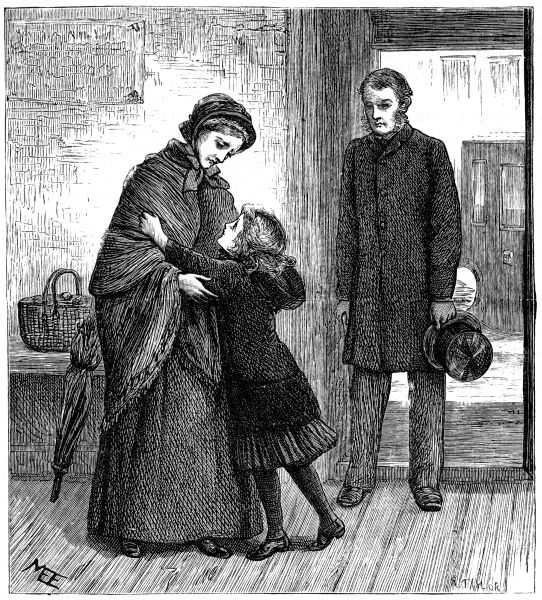 "in a moment elsie flew towards her"
 (
p. 324).
"Quite right, ma'am," the man assented. Then
turning to Elsie, he exclaimed, "Now, my girl,
you're free to go home with your mother; and if
you take my advice, you won't try running away
again. You're just fortunate to have got off
as you have. If it hadn't been for our tracking
the Murdochs just when we did, there's no telling
what would have become of you. They are not
the sort that would hesitate to get rid of you in any
way that came first when they found they didn't
want you; and all I say is you may be thankful you
stand where you do at this moment."
"You've just had a narrow escape of being drawn
into a den of sin and iniquity," Mrs. MacDougall
added fervently, "and I'm right thankful to the
Almighty for the good care He's taken of you.
I'm sure, sir, you're very kind to this erring lass,
and I'm right grateful for all your goodness."
"Mother," Elsie faltered, hardly daring to frame
the question, "where is Duncan?"
"He's in the hospital yet," Mrs. MacDougall
replied. "He lies in a fair way to recover, if no ill
turn befalls him, but I doubt me if he'll ever be the
same laddie again. He's woefully altered, but the
Lord has been good to him too, and put it into the
heart of that poor body they call Meg to take
him to the hospital, though they had no intention for
her to do it. May she be rewarded for her charitable
deed!"
At this moment the officer came back to say that
a cab was ready to take them to the station.
"And am I going with you now?" Elsie asked.
"Yes; we'll be getting back to Edinburgh to-night,"
Mrs. MacDougall replied.
They bade the officer good-bye, and drove away.
Elsie could hardly believe that she was once more
free and on her way home. The revulsion of feeling
was too much; she lay back in the carriage,
and sobbed as if her heart would break.
"I will no reproach you, Elsie," Mrs. MacDougall
said, gently, "for I ken you're punished enough,
but it will do ye no harm to feel sore-hearted for
all the sorrow you've brought on yoursel and
others."
M
rs. macdougall
and Elsie had some
time to wait before the night train started.
They spent it in the waiting-room, Mrs.
MacDougall having first procured for Elsie
as comfortable a tea as her means would allow.
To Elsie it seemed a perfect feast.
While they are waiting I must take the opportunity
of telling all that had been found out about
the Murdochs, and how they came to take charge
of the children. Lucy Murdoch had been, as Meg
said, quite a poor girl, living in one of the miserable
closes in which the old town of Edinburgh abounds.
She was very pretty and clever, but naturally
inclined to deceit and cunning. When she was
about seventeen she went to service, but could
never keep a place, because she was impertinent,
and so fond of dressing herself up in fine clothes
that she at last began to steal things from the
ladies she lived with in order to gratify her vanity.
Her friends said she looked like any lady, and
this so pleased the vain creature that she tried to
pass for one wherever she could, giving herself
great airs in shops she was sent to and when walking
out of doors. At last it was found that she
had been to a shop in Edinburgh and ordered
some things in the name of a young lady, in whose
mother's house she had been a servant. After this
she disappeared from Edinburgh, and her friends
saw nothing of her for many years.
When they heard of her again, she was married.
She came back dressed as a smart lady, and looking
and speaking very much like one. She had
been in London, and had picked up all sorts of
fine ways. Her husband was just such another as
herself: they both disliked honest work, but lived
by their cunning.
One of their tricks was to go to a grand hotel
where there were rich people, make the acquaintance
of some wealthy lady or gentleman, skilfully manage
to rob the unsuspicious individuals of any money
they might have with them, and then depart, letting
the suspicion fall on some unfortunate servant.
Just before they had met Elsie and Duncan they
had been staying at a very fashionable resort in
the Highlands, where Lucy Murdoch, by her dashing
manner and profuse liberality, made a great
many friends and was much admired. There
happened to be among the company an Australian
gentleman just arrived in England, who had
brought with him a pocket-book full of notes, which
he perhaps intended to pay into an English bank.
The gentleman, being boastful and proud of his
money, gave broad hints of the wealth he carried
with him to Lucy Murdoch and her husband,
whom he thought very nice people, and so much
more friendly to a foreigner than the cold, proud
English folk usually are. One morning the gentleman
found his pocket-book gone, notes and all.
He came into luncheon full of it, pouring out his
indignant wrath to his genial friends, the Murdochs,
who commiserated him, and were as indignant as
he. One of the waiters was suspected. The
wretched man declared that he had seen the
gentleman, Mr. Halliwell (the name under which
the Murdochs were then going), coming out of the
Australian gentleman's bedroom, that he had
spoken to him, and that Mr. Halliwell had said
that he had made a mistake and just gone inside,
but had seen directly his error. The man was not
believed, for there were the Halliwells still staying
in the hotel, going and coming as freely as could
be. The next day they paid their bill (a good long
one) and went away, bidding their acquaintances
good-bye, and hoping they should meet in Edinburgh.
After they had gone some way on their journey,
Lucy discovered that she had lost a letter from one
of her bad companions in Edinburgh—no other than
the man Andrew, who was one of their accomplices.
Fearing she might have dropped it in the hotel,
they made all haste to get to London, but their
journey was delayed at a certain point by the
stupidity of a driver, who had undertaken to drive
them to Killochrie, but could not find the way, the
consequence being that they lost their train, and
would be delayed eight hours.
Now Lucy Murdoch had heard of the missing
children, and when she stopped Elsie and Duncan
to ask them the way, she immediately supposed,
from what Elsie said, that these were the very ones.
Being very clever and quick-witted, she saw in a
moment she could make use of them to forward her
own escape. Driving to the nearest town, she
purchased black ready-made garments, retired to a
lonely spot, and dressed herself as a widow, smoothing
back her curled locks under the close round
bonnet. Then she went to the children, dressed
them in the clothes she had bought, walked back
to the station, and went on by train to a little town
some twenty miles off, where she spent the night,
her husband having gone first to secure a lodging.
On the next day they went on to Edinburgh under
the new name of Donaldson, John Murdoch passing
as her brother, and the children as her fatherless
little ones on their way home from school.
Duncan's illness interfered with her plans, and
necessitated her seeking the help of the man
Andrew, while she and her husband went to a
fashionable hotel. But Lucy Murdoch was not to
be daunted. It would do just as well to travel to
London with one child as two, and even serve still
further to destroy her identity. So she would
have cast Duncan off like an old shoe. Elsie's
determination made this difficult, but she soon
devised a plan to get Elsie off by cunning, and
leave Duncan behind. Although she promised
Elsie that Duncan should go to the hospital, she
had left instructions with Meg that he was to be
taken back to Andrew's house. Meg, however,
took him to the hospital, and said (poor ignorant
thing) that she had found him ill in the street.
When she got home she put on her most stupid
air, and declared that she didn't rightly know what
Mrs. Murdoch meant her to do, that she was very
sorry if she'd done wrong, and hadn't she better go
and fetch him back? Andrew abused her, but
at the hospital the child was left. Poor Meg! she
had in her a kind heart, and might have been a
good, happy girl but for bad companions.
The police, however, were on the track of the
Murdochs. They had been watched from place
to place, and evidence collected. When they least
thought of danger they found themselves lodged in
a prison.
Elsie's account greatly helped to prove their
guilt. Meg was examined, and was found to have
known a great deal about their doings; but as
she was not found guilty of any crime, she was
allowed to go free, and advised by the magistrate
to forsake her old companions, and endeavour to
live honestly and respectably. A charitable lady
afterwards took her into a home, being much
touched by the account she gave of Duncan's
illness, and the way she had done what she could
to save his life.
John and Lucy Murdoch were sentenced to be
imprisoned for a great many years. The man
Andrew was also severely punished.
What they intended, to do with Elsie was not
clear. Duncan they had left dangerously ill,
without nursing or medical advice. The magistrate
pointed out to him that they ought to be grateful
to Meg, for if the child had died they would
certainly have been charged with causing his death.
Probably they would have left Elsie to a similar
fate: unless, indeed, they had succeeded in
making her one of themselves, in which case she
would, perhaps, have been tempted to join them in
some hideous crime, and have ended her days in a
prison.
E
lsie
and her mother travelled all night,
and reached Edinburgh early the next
morning. This time it was only a third-class
carriage, crowded by very ordinary-looking
men and women—a very different journey
from the one with the wicked "fairy mother;"
but the unhappy child, tired out with all she had
gone through, leant her head against her mother's
shoulder, and slept through the night with a sweet
sense of safety and protection to which she had
long been a stranger.
They found Duncan still slowly mending, but
looking a mere shadow of his former bonnie
self. Elsie was so overwhelmed at the sight of
his poor little wasted figure, and cried so bitterly,
that the nurse promptly ordered her out of the
ward.
"Tell Elsie I'm quite well now," he said
anxiously to Mrs. MacDougall. "She needn't cry,
because we are going home; aren't we, mother?
You did say we might."
"Yes, well all be happy again together soon,
little lad," Mrs. MacDougall replied.
"Perhaps they hurt Elsie," Duncan continued,
still anxious for Elsie. "They were bad people,
mother;" and the little fellow shuddered.
They were obliged to calm him and turn his
thoughts away. One of the worst points of his
illness had been the fits of terror that came over
him when a recollection of the Fergusons or the
Murdochs passed through his brain. It had been
feared that his mind was seriously affected by the
fright he had undergone.
He was not yet fit to be moved, so Mrs. MacDougall
decided to take Elsie home, and come
again to fetch Duncan when he was ready to
leave, as she had barely money enough left to take
her to Dunster. Duncan was, however, convalescent,
and in a fair way of recovering.
It was only now that Mrs. MacDougall, the
more pressing cares of her mind relieved, had time
to remember Elsie's curious statement before the
magistrates. "What did you mean, child, by
saying that you didn't rightly know your own
name?" she asked. "Surely you were dazed with
the strange faces all round you. I feared you had
lost your reason."
Elsie hung her head sheepishly. Although she
had heard nothing from any one on the subject, she
had somehow a conviction in her mind that she had
been very silly. It was easy to talk grandly to
Duncan, but quite a different thing to tell the
story to Mrs. MacDougall.
"I don't know. I did think that perhaps me
and Duncan were the babies of Aunt Nannie's
what Uncle Grosvenor sent you to take care of,"
Elsie stammered,
growing very red.
"Good patience,
child! What do you
know about your aunt
Nannie's babies?"
Mrs. MacDougall exclaimed,
in amazement.
"Who have
been tattling to you
about what don't
concern them?"
"Then we are
those babies!" Elsie
cried, with a flash
of excitement.
"You!" cried Mrs.
MacDougall; "that
you are not. What
could make you think
such a thing? Whoever
told you so much—an'
I reckon your
foolish old grannie
was the person—might
as well have
told the whole story,
which, however, it
was my great wish
should be kept quite
a secret. Robbie
was your poor Aunt
Nannie's bairn."
"Robbie!" Elsie exclaimed, slowly; "but there
were two babies, mother."
"There were twin babies, but one died the next
day after it reached me, poor bairn. It was a girl
baby, and the one the father took an interest in; but
it died, and he cared little or nothing about Robbie,
so I kept him my own self, for he was but a poor
little lad, and could no bear a rough life. Often
I've been tempted to let the child go back to his
own flesh and blood, but I hadn't the heart,
knowing there was none that would look after him
with the care he needed."
"Is Robbie better than we are, mother?" Elsie
asked, with the old jealousy cropping up once more.
"Uncle Grosvenor is a grand laird, is he not?"
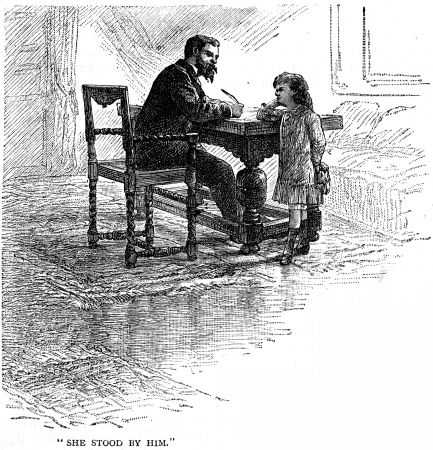
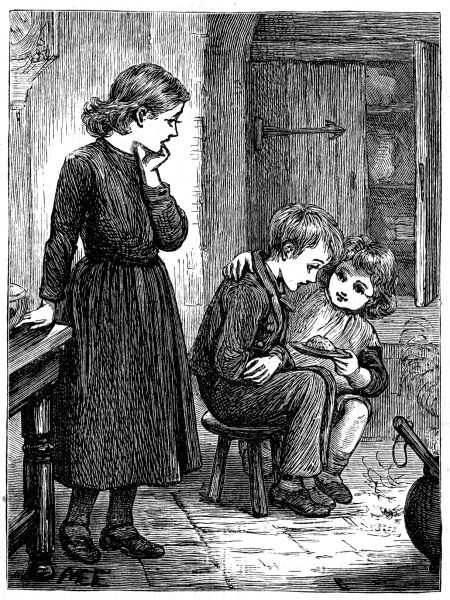 "robbie waited on him"
 (
p. 329).
Mrs. MacDougall laughed. "He's just a well-to-do
tradesman, though he had mighty fine airs when
he used to come to Dunster; but I never liked the
looks of him. He broke his poor wife's heart, and
never believed it till she lay dead, and then he
was sorry, and tried to make some amends. He
was a bit touched when he saw his motherless
bairns, and did a kind deed when he sent them to
me; but he soon grew
blithe and gay again,
and troubled his head
no more. I've never
heard from him from
that day to this, except
that he sends me
payment for the babies
still. He doesn't
even know that the
little one died, for
he has never written;
and I don't know
where he is; but any
day he may come, and
just take it into his
head to fetch poor
Nannie's bairn away
from me: but I hope
he won't, for now that
he's married again
and has many children,
as I am told,
poor Robbie will be
ill-welcomed among
them."
What a different
tale this was from
the one Elsie had
concocted in her own
mind! How utterly
foolish and ashamed
she was feeling. She
would tell all, and would so ease her mind.
"Mother," she said, speaking quickly, "it was
all through a letter I picked up and read, and
because I always thought Robbie was your
favourite more than me and Duncan. I thought
he must be your little boy, and that we were not.
You did buy Robbie more things, and never sent
him for the milk."
"Ye're right enough, Elsie," Mrs. MacDougall
said, with a sigh. "There's many a time, when
I've been sore pressed, I've been tempted to take
the money that Robbie's father sent to buy the
clothes you and Duncan were in need of; but
I've always stood against it, and never spent a
penny of that money for any other purpose than
the right one, and I've taken care of the child
more jealously than if he was my own. But the
Evil One himself must have put it in your heart to
be jealous of that poor little lad. With all my
care, I doubt that he'll ever see manhood. And
as for the letter, I think I know the one you mean.
If you found it, you'd no call to read it."
"But I read it, and I kept it," Elsie confessed,
seeing that her mother had quite failed to comprehend
all that she had tried to tell her. "It was
for that I wanted to run away—to go and find who
I thought was our own father—and I took Duncan
with me. I thought it would be easy. I didn't
mean to hurt Duncan."
"I will be no harsh to you, Elsie," Mrs. MacDougall
said, sorrowfully. "It's a sore thing for
a mother to think of; but God has taught you His
lesson in His own way. I doubt you'll never do
the like again."
It was only by degrees that Mrs. MacDougall
heard the whole history of the children's wanderings,
or Elsie fully understood the terrible dangers
to which she had, by her own act, willingly
exposed herself and Duncan. Never had she fully
realised what the word "home" meant until returning
to it, after having been homeless, lonely,
and outcast, she was received with the glad welcome
that no one else in all the wide world would
have extended to her.
Mrs. MacDougall was, like many of her race, a
woman of few words, and not given to demonstrations
of affection, yet with a deeply-rooted, fervent
feeling of attachment to her own flesh and blood
that nothing could destroy, that was only equalled
by her strong sense of religious duty. In that
terrible week of suspense, when she received no
tidings of the missing children, her hair had
become grey, and her face aged by many years.
In seeking them out, she had spent unhesitatingly
the hardly-scraped savings of years, laid by for the
decent burying of her old mother and herself.
These facts spoke more strongly than words.
Even Elsie knew well enough the terrible degradation
an honest, respectable Scottish woman would
feel it that any of her birth and kin should fall
upon the charity of strangers.
Elsie had been ever a tiresome child. She was
what people call clever—that is to say, she had
from an early age the power of thinking for herself,
and forming her own ideas on many subjects.
This very activity of brain often overwhelmed the
better feelings of her heart, which was not really
bad. It was her own supposed cleverness that had
led her into such a grievous error concerning that
unfortunate letter she had found, her restless
curiosity that had led her into the temptation of
reading it, whereas Duncan's slower brain would
have allowed his heart time to speak its protest
against an action that he had been trained to regard
as mean and dishonourable. Cleverness is
a dangerous gift, apt to lead into very stray paths,
unless there is firm principle to weigh it. Lucy
Murdoch was extremely clever. Better for her to
have been without one talent than to have used all
ten to her own utter ruin.
Mrs. MacDougall gave Elsie no bitter reproaches.
She explained to her how grievous a sin she had
committed, and what sorrow she had brought on
those who had always shown her the truest kindness.
She would allow no one to speak to Elsie
about it, except the good old minister at the manse,
who had known her from her birth. Farmer
Jarrett greatly desired to give her a good talking to,
but Mrs. MacDougall said, in her true Scottish
fashion, "Nay, neighbour; the Lord had pointed His
own moral, an' we can no better it. She has the
little brother she loves always before her eyes to
warn her." And this was true enough. Duncan
had never recovered the effects of the fever. He
seemed to have lost all his old robustness and
vigour, taking little interest in anything, only caring
to sit quiet and undisturbed before the fire. No
words could have affected her more than that most
pitiful sight. Mrs. MacDougall often caught
Elsie's eyes fixed on the child with a wistful, sorrowful
expression. She and Robbie waited on him
continually, with patient unfailing tenderness, and
both the children vied with each other as to who
could be the more kind and thoughtful for him.
Mrs. MacDougall from that time changed her
treatment of Robbie, and moreover, explained to
all three children the circumstances of his birth.
She believed that she had erred in practising even
this well-meant deceit, intended for the good both
of Robbie and her own two children, which had,
however, resulted in the very jealousy she had tried
to prevent. Robbie benefited by the change, and
was certainly far happier. He grew less babyish—stronger
both in mind and body. The old jealousy
died away, and Elsie liked him far better as a
cousin—yet treated in every way like herself—than
she had done as a brother.
For several years no one dared to mention in
Duncan's presence the sad experience he had
lived through. His terror and excitement were so
intense at the mere recollection of it, that the utmost
care was necessary. He could never go out
alone, for if he met a person who seemed to his
morbid fancy to resemble either of the Fergusons
or the Murdochs, his shuddering fear was shocking
to witness. He and Robbie had quite changed
places. It was he now who needed all the anxious,
watchful care that in former days Elsie would have
called petting.
If no one reproached her, it is certain she reproached
herself, more and more bitterly as she
grew older, and understood how grave a misfortune
she had brought upon Duncan, the one person she
was most fond of in this world. She had turned
his very trust in her into the means of sacrificing
him. Sometimes she was so tortured by this
thought that she could hardly bear it. "I will
never leave him as long as I live," she often said
to herself, as a sort of reparation for what he had
suffered. "I will take care of him till I die."
But there is a hope that in course of time, after
he has passed the years of boyhood, he may recover
his old strength, and in this hope Elsie lives.
the end.