NETTIE DECKER sat by the window of
her father's house, looking out into the
beautiful world; taking one last look at the
flowers, and the trees, and the lawn, and all the
beautiful and familiar things. Saying good-by
to them, for in a brief two hours she was to
leave them, and the old home.
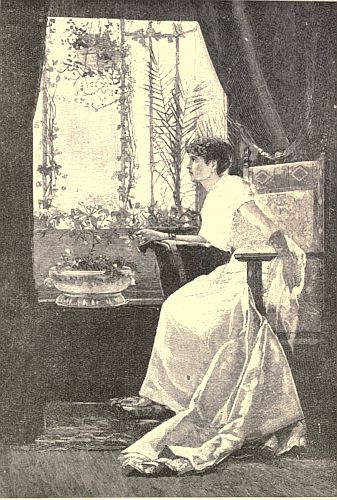
NETTIE DECKER HAS A SUITABLE DRESS AT LAST.
She is Nettie Decker still, but you will not
be able to say that of her in another hour. She
has changed somewhat since you last saw her in
her blue gingham dress a trifle faded, or in her
brown merino much the worse for time.
To-day she is twenty years old. A lovely
summer day, and her birthday is to be celebrated
by making it her wedding day. The blue gingham
has been long gone; so has the brown
merino. The dress she wears to-day looks unlike
either of them. It is white, all white; she
has a suitable dress at last for a gala day. Soft,
rich, quiet white silk. Long and full and pure;
not a touch of trimming about it anywhere.
Not even a flower yet, though she holds one in
her hand in doubt whether she will add it to the
whiteness.
I think it will probably be pushed among the
folds of soft lace which lie across her bosom;
for that would please little Sate's artist eye, and
Nettie likes to please Sate.
While she sits there, watching the birds, and
the flowers, and thinking of the strange sweet
past, and the strange sweet present, there pass
by almost underneath the window two young
ladies; moving slowly, glancing up curiously at
the open casement, from which Nettie draws a
little back, that she may not be seen.
"That is Nettie's room where the window is
open," says one of the ladies. "It is a lovely
room; I was in it once when the circle met
there; it is furnished in blue, with creamy tints
on the walls and furniture. I don't think I
ever saw a prettier room. Nettie has excellent
taste."
"Do you say her brother is to be at the wedding?"
"O, yes indeed! He came day before yesterday;
he is a splendid-looking fellow, and smart;
they say he is the finest student Yale has had
for years. He graduated with the very highest
honors, and now he is studying medicine. I
heard Dr. Hobart say that he would be an honor
to the profession. You ought to hear him play;
I thought he would be a musician, he is so fond
of music, and really he plays exquisitely on the
organ. Last spring when he was home he played
in church all day, and I heard ever so many people
say they had never heard anything finer in
any church."
"I don't remember him. Was he in our set?"
"O no! he wasn't in any set when you were
here. Why, Irene Lewis, you must remember
the Deckers! They weren't in any set."
"Oh! I remember them, of course; don't you
know what fun we used to make of Nettie?
Didn't we call her Nan? I remember she always
wore an old blue and white gingham to
Sunday-school."
"That was years ago; she dresses beautifully
now, and in exquisite taste. She must make a
lovely bride. I should like to get a glimpse of
her."
"The McClintocks are very rich, I have been
told."
"Oh! immensely so; and they say General
McClintock just idolizes Nettie. I don't wonder
at that; she is a perfectly lovely girl."
"Seems to me, Lorena, my dear, about the
time I left this part of the world you did not
think so much of her as you do now. I remember
you used to make all sorts of fun of her,
and real hateful speeches, as schoolgirls will, you
know. I have a distinct recollection of a flower
party where she was, and my conscience, I remember,
troubled me at the time for saying so
many disagreeable things about her that afternoon;
but I recollect I comforted myself with
the thought that you were much worse than I.
You used to lead off, in those days, you know."
"Oh! I remember; I was a perfect little idiot
in those days. Yes, I was disagreeable enough
to Nettie Decker; if she hadn't been a real
sweet girl she would never have forgotten it;
but I don't believe she ever thinks of it, and
really she is so utterly changed, and all the
family are, that I hardly ever remember her as
the same girl."
"What became of that little Irish boy she
used to be so fond of—Jerry, his name was?"
"Now, Irene Lewis! you don't mean to tell
me you have never heard about him! Well,
you have been out of the world, sure enough."
"I have never heard a word of him from the
time I went with Uncle Lawrence out West.
Father moved in the spring, you know, so instead
of my coming back early in the spring as I
expected, I never came until now? What about
Jerry? Did he distinguish himself in any way?
I always thought him a fine-looking boy."
"That is too funny that you shouldn't know!
Why, the Irish boy, Jerry, as you call him, is
the Gerald McClintock whom Nettie Decker is
to marry at twelve o'clock to-day."
"Gerald McClintock! How can that be?
That boy's name was Jerry Mack."
"Indeed it wasn't. We were all deceived in
that boy. It does seem so strange that you
have never heard the story! Why, you see, he
was General McClintock's son all the time."
"Why did he pretend he was somebody else?"
"He didn't pretend; or at least I heard he
said he didn't begin it. It seems that Mrs.
Smith, the car-man's wife, you know, used to
live in General McClintock's family before his
wife died; and Job Smith lived there as coachman.
When they married, General McClintock
broke up housekeeping, and went South with
his family. Then Mrs. McClintock died, and
the General and this one boy boarded in New
York, and Gerald attended school. In the
spring the General was called to California on
some important law business—you know he is a
celebrated lawyer, and they say his son is going
to be even more brilliant than his father—well,
the father had to go, and the boy made him
promise that he might spend the summer vacation
with Mrs. Smith out here. The McClintocks
had been very fond of her and her husband
and trusted them both; so the General agreed
to it, thinking he would be back long before the
vacation closed.
"But he was delayed by one thing and another,
and the boy coaxed to stay on, and study in the
public school here; he was a pupil in Whately
Institute at home. Imagine him taking up with
our common schools! so he stayed until the first
of December, and then his father came.
"Such a time as that was! You see we all
knew of General McClintock, of course, and
when it was found we could get him to lecture,
the people nearly went wild over it. We
couldn't understand why we should have such
good fortune, when we knew ever so many
places—large cities—had been refused; but it
was all explained after he came.
"It was a beautiful day when he came; all
the schools were closed, and we formed a procession
and marched to the depot, and the band
was there, and great crowds. I remember as
though it were yesterday how astonished we
were to see Nettie Decker and that boy in a conspicuous
place on the corner of the platform.
Nettie had on her old brown merino, and looked
so queer and seemed so out of place, that I went
and spoke to father about it, and he advised them
to go down and join the procession; but it
seems the marshal knew what he was about, and
objected to their moving. Then the train came,
and there was a great excitement, and in the
midst of it, the General almost took that boy
Jerry in his arms, and kissed and kissed him!
Then he kissed Nettie Decker, and while we
stood wondering what on earth it all meant,
they all three entered an elegant carriage drawn
by four horses, and were carried to the Keppler
House.
"They had an elegant private dinner, they
three; and in fact all the time the General was
here, he kept Nettie Decker with them; he
treated her more like a daughter than a stranger.
I don't think there was ever such an excitement
in this town about anything as we had at that
time; the circumstances were so peculiar, you
know."
"But I don't understand it, yet. Why did
he call himself Jerry Mack? What was his object
in deceiving us all?"
"He hadn't the slightest intention of doing
so. I heard he said such a thought never entered
his mind until we began it. It seems
when he was a little bit of a fellow he tried to
speak his name, Gerald McClintock, and the
nearest he could approach to it, was, Jerry
Mack. Of course they thought that was cunning,
and it grew to be his pet name; so before
they knew it, the servants and all his boy friends
called him so, all the time. When he came here
Mrs. Smith and her husband naturally used the
old name; then somebody, I'm sure I don't
know who, started the story that he was an
Irish boy working at the Smiths for his board;
and it seems he heard of it, and it amused him
so much he decided to let people think so if
they wanted to; he coaxed the Smiths not to
tell who he was, or why he was here; and they
so nearly worshipped him, that if he had asked
them to say he was a North American Indian I
believe they would have done it. It seems he
liked Nettie Decker from the first, and was annoyed
because she wasn't invited in our set.
But I am sure I don't know how we were to
blame; she had nothing to wear, and how were
we to know that she was a very smart girl, and
real sweet and good? The Deckers were very
poor, and Mr. Decker drank, you know, and
Norm was sort of a loafer, and we thought they
were real low people."
"I remember Ermina Farley was friendly
with Nettie, and with the boy, too."
"O yes, Ermina was always peculiar; she is
yet. I have always thought that perhaps
Ermina knew something about the McClintocks,
but she says she didn't. I heard her say the
other day that somebody told her he was an Irish
boy, whose father had run away and left him;
and the Smiths gave him a home out of pity;
and she supposed of course it was so, and was
sorry for him. Then she always thought he was
handsome, and smart; well, so did I, I must
say."
"I wonder who started that absurd story
about his father deserting him?"
"I don't know, I'm sure; somebody imagined
it was so, I suppose, and spoke of it; such
things spread, you know, nobody seems to understand
quite how."
"Well, as I remember things, Jerry—I shall
always call him that name, I don't believe I
could remember to say Mr. McClintock if I
should meet him now—as I remember him, he
seemed to be as poor as Nettie; he dressed very well,
but not as a gentleman's son, and he
seemed to be contriving ways to earn little bits
of money. Don't you remember that old hen
and chickens he bought? And he used to go to
the Farleys every morning with a fresh egg for
Helen; sold it, you know, for I was there one
morning when Mrs. Farley paid him."
"I know it; he was always contriving ways
to earn money; why, Irene, don't you remember
his selling fish to Ermina Farley that day
when we were talking down by the pond? I
have always thought he heard more than we
imagined he did, that day; I don't clearly remember
what we said, but I know we were running
on about Nettie Decker and about Jerry;
I used to sort of dislike them both, because
Ermina Farley was always trying to push them
forward.
"I would give something to know exactly
what we did say that day. For awhile I did not
like to meet any of the McClintocks; it always
seemed to me as though they were thinking
about that time. But they have been perfectly
polite and cordial to me, always; and Nettie
Decker is a perfect lady. But I know all about
the poverty. It seems the boy Jerry had been
very fond of giving away money, and books, and
all sorts of things to people whom he thought
needed them; and his father began to be afraid
he would have no knowledge of the value of
money, and would give carelessly, you know,
just because he felt like it. So the General had
a long talk with him, and made an arrangement
that while he was gone West, Jerry should have
nothing to give away but what he earned. He
might earn as much as he liked, or could, and
give it all away if he chose; but not a penny
besides, and he was not to appeal to his father
to help anybody in any way whatever. Of
course the father was to pay all his bills for
necessary things—they say he paid a splendid
price to the Smiths for taking care of him. Poor
Mrs. Smith cried when he went away, as though
he had been her own child. Well, of course
that crippled him, in his pocket money, but they
say his father was very much pleased to find
how many schemes he had started for earning
money. That plan about the business was his
from beginning to end, and just see what it has
grown to!"
"What? I don't know; remember, I only
came night before last, and haven't heard anything
about the town since the day I left it."
"Why, the Norman House, the most elegant
hotel in town, is the outgrowth of that enterprise
begun in the Decker's front room! Mr.
Decker owns the whole thing, now, and manages
it splendidly. His wife is a perfect genius, they
say, about managing. She oversees the housekeeping
herself, and the cooking is perfect they
say. General McClintock was so pleased with
the beginning, that he bought that long low
building on Smith street that first time he was
here, and fitted it up for Norman and Nettie to
run. He carried his son away with him, of
course, but they stayed long enough to see
that matter fairly under way. The Norman
House is managed on the same general principles;
strictly temperance, of course. The
General is as great a fanatic about that as the
Deckers are, and the prices are very low—lower
than other first-class houses, while the
table is better, and the rooms are beautifully
furnished. They say it is because Mrs. Decker
is such an excellent manager that they can
afford things at such low prices. Then, besides,
there is a lunch room for young men, where
they can get excellent things for just what they
cost; that is a sort of benevolence. General
McClintock devotes a certain amount to it
each year; and there is a splendid young man in
charge of the room; you saw him once, Rick
Walker, his name is. He used to be considered
a sort of hard boy, but there isn't a more respected
young man in town than he. He is
book-keeper at the Norman House, and has
the oversight of this Home Dining Room. You
ought to go in there; it is very nicely furnished,
and they have flowers, plants, you know, and
birds, and a fountain, and pictures on the walls,
and for fifteen cents you can get an excellent
dinner. Everybody likes Rick Walker; they
say he has a great influence over the boys in
town, almost as great as Norman Decker; he
used to be in charge of it all, before he went
to college."
"Still, I shouldn't think the McClintocks
would have liked Nettie Decker to be in quite
so public a place," interrupted her listener.
"Oh! she wasn't public; why, she went to
New York to a private school the very next winter
after the General came home. She boarded
with them; the General's sister came East with
him, and was the lady of the house; then he sent
her to Wellesley, you know. Didn't you know
that? She graduated at Wellesley a year ago.
Yes, the McClintocks educated her, or began it;
her father has done so well that I suppose he
hasn't needed their help lately. He is a master
builder, you know, and keeps at his business,
and owns and manages this hotel, besides. Oh!
they are well off; you ought to see Mrs. Decker.
She is a very pretty woman, and a real lady;
they say Nettie and Norman are so proud of
her! What was I telling you? Oh! about the
room; they have a library connected with it,
and a reading room, and everything complete;
it is such a nice thing for our young men. A
great many wealthy gentlemen contribute to
the library. There is a little alcove at the
further end of the reading room, where they
keep cake and lemonade, and nuts and little
things of all sorts. They are very cheap, but the
boys can't get any cigars there; I'm so glad of
that. The Norman House is in very great
favor—quite the fashion, and it makes such a
difference with the boys who are just beginning
to imagine themselves young men, and who want
to be manly, to have an elegant place like that
frown on all such things. My brother Dick,
you remember him? He was a little fellow
when you lived here—he went into the Norman
House one day and called for a cigar; he was
just beginning to smoke, and I suppose he did
it because he thought it would sound manly. It
was in the spring when Norman was at home on
vacation, and it seems he expressed so much astonishment
that Dick was quite ashamed; I
don't think he has smoked a cigar since."
"The Deckers seem to be quite a centre of
interest in town."
"Well, they are. They are a sort of exceptional
family someway; their experience has
been so romantic. Mr. Decker has become such a
nice man; Deacon Decker, he is, a prominent
man in the church, and everywhere. Oh! do
you remember those two cunning little girls? I
always thought they were sweet. Susie is a perfect
lady; she is going with Nettie and her husband
to Washington; but little Sate is a beauty.
They say she is going to be a poet and an artist,
and she looks almost like an angel. General
McClintock admires her very much; he says she
shall have the finest art teachers in Europe. I
never saw a family come up as they did, from
nothing, you may say. But then it was all owing
to that fortunate accident of being friends
with Gerald McClintock, and having the Farleys
interested in them. Did I tell you Norman was
engaged to Ermina Farley? O yes! they will
marry as soon as he graduates from the medical
college, and then he will take her abroad and
take a post graduate course in medicine there.
I suppose they will take Sate with them then.
They say that is the plan. No, I certainly never
saw anything like their success in life. Mrs.
Smith doesn't believe in luck, you know, nor
much in money, though since her Job has a position
in the Norman House that pays better than
carting, they have built an addition to their
house, and, Sarah Ann says, "live like folks."
She is housekeeper at the Norman House—Mrs.
Decker's right-hand woman. Mrs. Smith says
the Lord had a great deal to do with the Decker
family; that Nettie came home resolved to be
faithful to Him, and to trust Him to save her
father and brother, and so He did it, of course.
It seems she and Jerry promised each other to
work for Norman and the father in every possible
way until they were converted; and they
did. I must say I think they are real wonderful
Christians, all of them. I like to hear Mr.
Decker pray better than almost any other man
in our meeting; and as for Norman, he leads a
meeting beautifully. They say Mr. Sherrill
thought at first that he ought to preach; but
now he says he is reconciled; there is greater
need for Christian physicians than for ministers.
Mr. Sherrill has always been great friends with
all the Deckers; you remember he was, from the
first. Norman studied with him all the time he
was managing that first little bit of a restaurant
in the square room of the old Decker house.
They tore down that house last month, to make
room for a carriage drive around the back of
their new house, and they say Nettie cried when
the square room was torn up.
"She has some of the quaintest furniture!
Sofas, she calls them, made out of boxes; and a
queer old-fashioned hour-glass stand, and a barrel
chair, which have been sent on with all her
elegant things, to New York; she is going to
furnish a room for Gerald and her with them;
he made them, it seems, when they began that
queer scheme. Who would have supposed it
could grow as it did? It really seems as though
the Lord must have had a good deal to do with
it, doesn't it? I tell you, Irene, it is wonderful
how many young men they have helped save,
those two. It seems a pity sometimes that they
could not have told us girls what they were
about and let us help; but then, I don't know as
we would have helped if we had understood; I
used to be such a perfect little idiot then! Well,
it was Nettie Decker got hold of me at last.
Norman signed the pledge that night when General
McClintock lectured here, and during the
winter he was converted; but it was two years
after that before I made up my mind. I was
miserable all that time, too; because I knew I
was doing wrong. And I didn't treat Nettie
wonderfully well any of the time; but when she
came to me with her eyes shining with tears,
and said she had been praying for me ever since
that day of the flower party, I just broke down.
"O Irene, there's the carriage with the bride
and groom and Norman and Ermina. Doesn't
the bride look lovely! I wish they had had a
public wedding and let us all see her! But they
say General McClintock thinks weddings ought
to be very private. Never mind, we will see
her at the reception next week; but then, she
won't be Nettie Decker; we shall have to say
good-by to her."
And Miss Lorena Barstow stood still in the
street, and shaded her eyes from the sunlight to
watch the bridal party as the carriage wound
around the square, looking her last with tender,
loving eyes, upon Nettie Decker.
CHOICE BOOKS
FOR READERS OF ALL AGES
Pansy Books.
The Pansy for 1888. With colored frontispiece. Edited by
Pansy.
More than 400 pages of reading and pictures for children of
eight to fifteen years in various lines of interest. Quarto, boards,
1.25.
Pansy Sunday Book for 1889. With colored frontispiece.
Edited by Pansy. Quarto, boards, 1.25.
Just the thing for children on Sunday afternoon, when the whole
family are gathered in the home to exchange helpful thought and
gain new courage for future work and study which the tone and
excellence of these tales impart.
Pansy's Story Book. By Pansy. Quarto, boards,
1.25.
Made up largely of Pansy's charming stories with an occasional
sketch or poem by some other well-known children's author to
give variety.
Mother's Boys and Girls. By Pansy. Quarto, boards,
1.25.
A book full of stories for boys and girls, most of them short, so
all the more of them. Easy words and plenty of pictures.
Pansy Token (A); or An Hour with Miss Streator. For
Sunday School teachers. 24mo, paper, 15 cts.
Young Folks Stories of American History and
Home Life. Edited by Pansy. Quarto, cover in colors, 75 cts.
Sketches, tales and pictures on New-World subjects.
Young Folks Stories of Foreign Lands. Edited
by Pansy. First Series, quarto, cover in colors, 75 cts.
Sketches, tales and pictures on Old-World subjects.
Stories and Pictures from the Life of Jesus.
By Pansy. 12mo, boards, 50 cts.
The life of Jesus as recorded in the four gospels simplified and
unified for children.
A Christmas Time. By Pansy, 12mo, boards, 15 cts.
A Christmas story full of Christmas trees and sleigh-rides. Its
lesson is the joy to be got in helping others.
Travel and History for Young
Folks.
Story of the American Indian (The). By Elbridge
S. Brooks. 8vo, cloth, 2.50.
"A thorough compendium of the archæology, history, present
standing and outlook of our nation's wards. . . . We commend
it as the best and most comprehensive book on the Indian for general
reading known to us."—Literary World.
Story of the American Sailor (The). By Elbridge
S. Brooks. Octavo, cloth, 2.50.
The first consecutive narrative yet attempted, sketching the rise
and development of the American seaman on board merchant vessel
and man-of-war.
Ned Harwood's Visit to Jerusalem. By Mrs. S.
G. Knight. Quarto, 1.25.
Travel in the Holy Land. The manuscript was approved by
Rev. Selah Merrill, for many years U. S. Consul at Jerusalem.
The strictest accuracy has thus been secured without impairing
the interest of the story.
Out and About. By Kate Tannatt Woods. Quarto,
boards, 1.25.
Cape Cod to the Golden Gate with a lot of young folks along,
and plenty of yarns by the way.
Sights Worth Seeing. By those who saw them.
Quarto, cloth, 1.50.
Eleven descriptive articles by such writers as Margaret Sidney,
Amanda B. Harris, Annie Sawyer Downs, Frank T. Merrill and
Rose Kingsley. Copiously and beautifully illustrated.
Adventures of the Early Discoverers. By
Frances A. Humphrey. 4to, cloth, 1.00.
Real history written and pictured for readers both sides of ten
years old. It begins with the mythology of discovery and comes
down to the sixteenth and seventeenth century.
The Golden West: as Seen by the Ridgway Club. By
Margaret Sidney. Quarto, boards, 1.75.
Description of a trip through Southern California taken by Mr.
and Mrs. Ridgway and their children. The careful observations
and the fine illustrations make it a treasure for boys and girls.
Days and Nights in the Tropics. By Felix L.
Oswald. Quarto, boards, 1.25.
The collector of curiosities for the Brazilian museum goes on
his quest with his eyes open. A book of adventures and hunters'
yarns.
Illustrated Stories for Young
Folks.
Young Folks' Cyclopedia of Stories. Quarto,
cloth, 3.00.
Contains in one large book the following stories with many illustrations:
Five Little Peppers, Two Young Homesteaders, Royal
Lowrie's Last Year at St. Olaves, The Dogberry Bunch, Young
Rick, Nan the New-Fashioned Girl, Good-for-Nothing Polly and
The Cooking Club of Tu-Whit Hollow.
What the Seven Did; or, the Doings of the Wordsworth
Club. By Margaret Sidney. Quarto, boards, 1.75.
The Seven are little girl neighbors who meet once a week at
their several homes. They helped others and improved themselves.
Me and My Dolls. By L. T. Meade. Quarto, 50 cts.
A family history. Some of the dolls have had queer adventures.
Twelve full-page illustrations by Margaret Johnson.
Little Wanderers in Bo-Peep's World. Quarto,
boards, double lithograph covers, 50 cts.
Polly and the Children. By Margaret Sidney. Boards,
quarto, 50 cts.
The story of a funny parrot and two charming children. The
parrot has surprising adventures at the children's party and wears
a medal after the fire.
Five Little Peppers. By Margaret Sidney. 12mo, 1.50.
Story of five little children of a fond, faithful and capable
"mamsie." Full of young life and family talk.
Seal Series. 10 vols., boards, double lithographed covers,
quarto.
Rocky Fork, Old Caravan Days, The Dogberry Bunch, by
Mary H. Catherwood; The Story of Honor Bright and Royal
Lowrie's Last Year at St. Olaves, by Charles R. Talbot; Their
Club and Ours, by John Preston True; From the Hudson to the
Neva, by David Ker; The Silver City, by Fred A. Ober; Two
Young Homesteaders, by Theodora Jenness; The Cooking Club
of Tu-Whit Hollow, by Ella Farman.
Cats' Arabian Nights. By Abby Morton Diaz. Quarto,
cloth, 1.75; boards, 1.25.
The wonderful cat story of cat stories told by Pussyanita that
saved the lives of all the cats.
Natural History.
Stories and Pictures of Wild Animals. By Anna
F. Burnham. Quarto, boards, 75 cts.
Big letters, big pictures and easy stories of elephants, lions,
tigers, lynxes, jaguars, bears and many others.
Life and Habits of Wild Animals. Quarto, cloth,
1.50.
The very best book young folks can have if they are at all interested
in Natural History. If they are not yet interested it will
make them so. Illustrated from designs by Joseph Wolf.
Children's Out-Door Neighbors. By Mrs. A. E.
Andersen-Maskell. 3 volumes, 12mo, cloth, each 1.00.
Three instructive and interesting books: Children with Animals,
Children with Birds, Children with Fishes. The author has the
happy faculty of interesting boys and girls in the wonderful neighbors
around them and that without introducing anything which is
not borne out by the knowledge of learned men.
Some Animal Pets. By Mrs. Oliver Howard. Quarto,
boards, 35 cts.
The experiences of a Colorado family with young, wild and
tame animals. It is one of the pleasantest animal books we have
met in many a day. Well thought, well written, well pictured,
the book itself, apart from its contents, is attractive. Full page
pictures.
Tiny Folk In Red and Black. Quarto, boards, 35 cts.
The tiny folk are ants and they make as interesting a study as
human folk—perhaps more interesting in the opinion of some.
The book gives a full and graphic description of their many wise
and curious ways—how they work, how they harvest their grain,
how they milk their cows, etc. It will teach the children to keep
eyes and ears open.
My Land and Water Friends. By Mary E. Bamford.
Seventy illustrations by Bridgman. Quarto, cloth, 1.50.
The frog opens the book with a "talk" about himself, in the
course of which he tells us all about the changes through which
he passes before he arrives at perfect froghood. Then the grasshopper
talks and is followed by others, each giving his view of
life from his own individual standpoint.
Young Folks' Illustrated
Quartos.
Wide Awake Volume Z. Quarto, boards, 1.75.
Good literature and art have been put into this volume. Henry
Bacon's paper about Rosa Bonheur, the great painter of horses
and lions, and Steffeck's painting of Queen Louise with Kaiser
William would do credit to any Art publication.
Chit Chat for Boys and Girls. Quarto, boards, 75 cts.
A volume of selected pieces upon every conceivable subject.
As a distinctive feature it devotes considerable space to Home
Life and Sports and Pastimes.
Good Cheer for Boys and Girls.
Short stories, sketches, poems, bits of history, biography and
natural history.
Our Little Men and Women for 1888. Quarto,
boards, 1.50.
No boys and girls who have this book can be ignorant beyond
their years of history, natural history, foreign sights or the good
times of other boys and girls.
Babyland for 1888. Quarto, boards, 75 cts.
Finger-plays, cricket stories, Tales told by a Cat and scores of
jingles and pictures. Large print and easy words. Colored
frontispiece.
Kings and Queens at Home. By Frances A. Humphrey.
Quarto, boards, 50 cts.
Short-story accounts of living royal personages.
Queen Victoria at Home. By Frances A. Humphrey.
Quarto, boards, 50 cts.
Pen picture of a noble woman. It will aid in educating the
heart by presenting the domestic side of the queen's character.
Stories about Favorite Authors. By Frances A.
Humphrey. Quarto boards, 50 cts.
Little literature lessons for little boys and girls.
Child Lore. Edited by Clara Doty Bates. Quarto, cloth,
tinted edges, 2.25; boards, 1.50.
More than 50,000 copies sold. The most successful quarto for
children.
Helpful Books for Young Folks.
Danger Signals. By Rev. F. E. Clark, President of
the United Society of Christian Endeavor. 12mo, cloth, 75 cts.
The enemies of youth from the business man's standpoint.
The substance of a series of addresses delivered two or three
years ago in one of the Boston churches.
Marion Harland's Cookery for Beginners. 12mo,
vellum cloth, 75 cts.
The untrained housekeeper needs such directions as will not
confuse and discourage her. Marion Harland makes her book
simple and practical enough to meet this demand.
Bible Stories. By Laurie Loring. 4to, boards, 35 cts.
Very short stories with pictures. The Creation, Noah and the
Dove, Samuel, Joseph, Elijah, the Christ Child, the Good Shepherd,
Peter, etc.
The Magic Pear. Oblong, 8vo, boards, 75 cts.
Twelve outline drawing lessons with directions for the amusement
of little folks. They are genuine pencil puzzles for untaught
fingers. A pear gives shape to a dozen animal pictures.
What O'Clock Jingles. By Margaret Johnson. Oblong,
8vo, boards, 75 cts.
Twelve little counting lessons. Pretty rhymes for small children.
Twenty-seven artistic illustrations by the author.
Ways for Boys to Make and Do Things. 60 cts.
Eight papers by as many different authors, on subjects that interest
boys. A book to delight active boys and to inspire lazy
ones.
Our Young Folks at Home. 4to, boards, 1.00.
A collection of illustrated prose stories by American authors and
artists. It is sure to make friends among children of all ages.
Colored frontispiece.
Peep of Day Series. 3 vols., 1.20 each.
Peep of Day, Line upon Line, Precept upon Precept. Sermonettes
for the children, so cleverly preached that the children
will not grow sleepy.
Home Primer. Boards, square, 8vo, 50 cts.
A book for the little ones to learn to read in before they are old
enough to be sent off to school. 100 illustrations.
Monteagle. By Pansy. Boston: D. Lothrop
Company. Price 75 cents. Both girls and boys
will find this story of Pansy's pleasant and profitable
reading. Dilly West is a character whom the
first will find it an excellent thing to intimate, and
boys will find in Hart Hammond a noble, manly,
fellow who walks for a time dangerously near
temptation, but escapes through providential influences,
not the least of which is the steady
devotion to duty of the young girl, who becomes
an unconscious power of good.
A Dozen of Them. By Pansy. Boston: D.
Lothrop Company. Price 60 cents. A Sunday-school
story, written in Pansy's best vein, and
having for its hero a twelve-year-old boy who has
been thrown upon the world by the death of his
parents, and who has no one left to look after
him but a sister a little older, whose time is fully
occupied in the milliner's shop where she is employed.
Joe, for that is the boy's name, finds a
place to work at a farmhouse where there is a small
private school. His sister makes him promise to
learn by heart a verse of Scripture every month.
It is a task at first, but he is a boy of his word,
and he fulfills his promise, with what results the
reader of the story will find out. It is an excellent
book for the Sunday-school.
At Home and Abroad. Stories from The Pansy
Boston: D. Lothrop Company. Price, $1.00. A
score of short stories which originally appeared
in the delightful magazine, The Pansy, have been
here brought together in collected form with the
illustrations which originally accompanied them.
They are from the pens of various authors, and
are bright, instructive and entertaining.
About Giants. By Isabel Smithson. Boston:
D. Lothrop Company. Price 60 cents. In this
little volume Miss Smithson has gathered together
many curious and interesting facts relating to
real giants, or people who have grown to an extraordinary
size. She does not believe that there
was ever a race of giants, but that those who are
so-called are exceptional cases, due to some freak
of nature. Among those described are Cutter,
the Irish giant, who was eight feet tall, Tony
Payne, whose height exceeded seven feet, and
Chang, the Chinese giant, who was on exhibition
in this country a few years ago. The volume
contains not only accounts of giants, but also of
dwarfs, and is illustrated.
American Authors. By Amanda B. Harris.
Boston: D. Lothrop Company. Price $1.00. This
is one of the books we can heartily commend to
young readers, not only for its interest, but for
the information it contains. All lovers of books
have a natural curiosity to know something about
their writers, and the better the books, the keener
the curiosity. Miss Harris has written the various
chapters of the volume with a full appreciation of
this fact. She tells us about the earlier group of
American writers, Irving, Cooper, Prescott, Emerson,
and Hawthorne, all of whom are gone, and
also of some of those who came later, among
them the Cary sisters, Thoreau, Lowell, Helen
Hunt, Donald G. Mitchell and others. Miss Harris
has a happy way of imparting information, and
the boys and girls into whose hands this little
book may fall will find it pleasant reading.
Tilting at Windmills: A Story of the Blue
Grass Country. By Emma M. Connelly. Boston:
D. Lothrop Company. 12mo, $1.50.
Not since the days of "A Fool's Errand" has so
strong and so characteristic a "border novel" been
brought to the attention of the public as is now
presented by Miss Connelly in this book which she
so aptly terms "Tilting at Windmills." Indeed, it
is questionable whether Judge Tourgee's famous
book touched so deftly and yet so practically the
real phases of the reconstruction period and the
interminable antagonisms of race and section.
The self-sufficient Boston man, a capital fellow
at heart, but tinged with the traditions and environments
of his Puritan ancestry and conditions,
coming into his strange heritage in Kentucky at
the close of the civil war, seeks to change by instant
manipulation all the equally strong and deep-rooted
traditions and environments of Blue Grass
society.
His ruthless conscience will allow of no compromise,
and the people whom he seeks to proselyte
alike misunderstand his motives and spurn his
proffered assistance.
Presumed errors are materialized and partial
evils are magnified. Allerton tilts at windmills
and with the customary Quixotic results. He is,
seemingly, unhorsed in every encounter.
Miss Connelly's work in this, her first novel, will
make readers anxious to hear from her again and
it will certainly create, both in her own and other
States, a strong desire to see her next forthcoming
work announced by the same publishers in one of
their new series—her "Story of the State of Kentucky."
The Art of Living. From the Writings of
Samuel Smiles. With Introduction by the venerable
Dr. Peabody of Harvard University, and
Biographical Sketch by the editor, Carrie Adelaide
Cooke. Boston: D. Lothrop Company. Price
$1.00.
Samuel Smiles is the Benjamin Franklin of England.
His sayings have a similar terseness, aptness
and force; they are directed to practical ends,
like Franklin's; they have the advantage of being
nearer our time and therefore more directly related
to subjects upon which practical wisdom is of
practical use.
Success in life is his subject all through, The Art
of Living; and he confesses on the very first page
that "happiness consists in the enjoyment of little
pleasures scattered along the common path of life,
which in the eager search for some great and exciting
joy we are apt to overlook. It finds delight
in the performance of common duties faithfully
and honorably fulfilled."
Let the reader go back to that quotation again and
consider how contrary it is to the spirit that underlies
the businesses that are nowadays tempting men
to sudden fortune, torturing with disappointments
nearly all who yield, and burdening the successful
beyond their endurance, shortening lives and making
them weary and most of them empty.
Is it worth while to join the mad rush for the
lottery; or to take the old road to slow success?
This book of the chosen thoughts of a rare philosopher
leads to contentment as well as wisdom;
for, when we choose the less brilliant course because
we are sure it is the best one, we have the
most complete and lasting repose from anxiety.
Transcriber's Notes:
Punctuation errors repaired.
First book list page, "Eaoh" changed to "Each" (Each volume 16mo)
Page 4, "208" changed to "226" to reflect actual first page of Chapter XII.
Page 4, "230" changed to "304" to reflect actual first page of Chapter XVII.
Page 4 and 5, each page number reference increased by two to match actual location
of remaining chapters. (i.e. 318 is now 320 to reflect location of Chapter
XVIII)
Page 29, "botton" changed to "bottom" (for in the bottom of)
Page 69, "nowdays" changed to "nowadays" (the pennies nowadays)
Page 88, "keees" changed to "knees" (soon on her knees)
Page 200, "think" changed to "thing" (thing that I should)
Page 202, "interruped" changed to "interrupted" (of her had interrupted)
Page 212, "sat" changed to "set" (he set the table)
Page 269, "unsual" changed to "unusual" (unusual toilet having)
Page 385, extra word "the" removed from text. Original read (have at the
the windows)
Page 407, "pealed" changed to "peeled" (turnips half-peeled)
Page 437, "esson" changed to "lesson" (lesson is the joy)