The Baron was having a chill. Yet he could not remain indoors when
everyone else was out searching for Greta. So he stepped timidly into
the garden. He sniffed the fragrant air and glanced nervously about. The
night was warm, but the Herr Baron was completely wrapped up in his
great coat.
How unpleasant of Greta to disappear like this! And just when everything
was all planned for the wedding and everyone was so happy! Greta must be
found.
He took a step forward, and as he did so, a figure suddenly appeared out
of the bushes. Herr Baron uttered a sound like a steam whistle with the
croup and began to tremble.
"Good evening, sir," said a clear, young voice.
It was Erik. He had come over to the big house purposely to tell the
Baron the story which he now began.
"Greta was left out on an island," he whispered dramatically. "Out in
the middle of the lake."
The Baron attempted a laugh. It was a sad attempt. He shook his finger
at Erik.
"You naughty b-boy!" he stuttered. "Once b-before you tried to
f-frighten me. I d-do not believe you! R-run away!"
Erik did not run away. "I've told you the truth," he said. "Greta is on
that island, and if you do not go for her, she'll stay there all night."
The Baron bit his lip. "If this is true," he said, "I must send someone
for her at once."
Erik bowed and was silent. But the Baron seemed to sense in his silence
the question, "Why does not Baron Karl go himself? Is he a coward?"
The little man drew himself up. "Where is the island?" he asked.
"Come," said Erik. "I will show you."
He led the way to the edge of the lake. The white night lit up the
countryside and gave to it an elfin beauty. Erik pointed to a deserted
strip of land far out in the center of the lake.
"That," he said, "is the island."
The Baron swallowed a pill. "Where is the boat?" he gulped. His voice
still shook, but Erik began to wonder if perhaps Baron Karl was braver
than he had supposed.
If so, this would be a good joke on Erik. For it was he who had left
Greta on the island. They had rowed there together that afternoon, and
soon after they had landed, Erik had quietly slipped away in the boat.
Greta had cried out to him to come back, but he had paid no attention
to her and had rowed rapidly to shore. He had been carrying out a plan
to prove that Baron Karl was a coward. But now, if the Baron should
really rescue Greta, that plan would fail.
"Where is the boat?" the Baron repeated, and Erik was about to reply,
when the most terrifying scream echoed from across the lake.
Erik gave a violent start. This was no part of his plan. Something real
must have happened to Greta.
He turned to the Baron, but the Baron was gone. He was running away,
toward home. Erik rushed after him.
"Come back!" he cried. He clutched at the Baron's coat. "Please come
back! Now, you must save Greta. She is in real danger."
Baron Karl's teeth were chattering.
"L-let me go!" he quavered. "I'll bring help!"
He broke away and fled toward the big house. Erik was left standing
alone, and out of the silence came another scream.
Erik felt like the boy in the tale who cried, "Wolf, wolf!" for fun, and
then one day was really surrounded by wolves. His harmless trick had
turned into a horrible disaster.
He was too small to think of going to Greta's aid all alone. Nils! He
would go for Nils.
When he reached his father's cottage, he burst into the kitchen where
Nils was studying with the lamp shining on his face. He cried, "Quick,
Nils! Greta is in danger." And in less time than it would seem possible,
they were hurrying toward the lake.
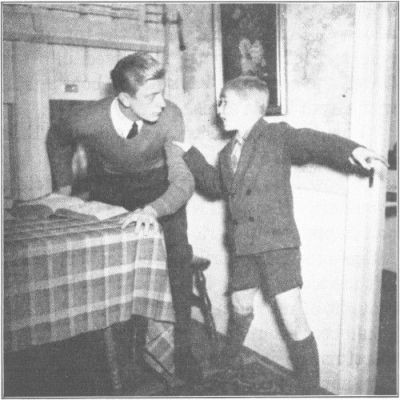
"QUICK, NILS! GRETA IS IN DANGER"
The screams had grown louder. Puffing and panting, Erik followed Nils
into the rowboat. Nils picked up the oars. He pulled them with powerful
arms, and the boat skimmed ahead.
Before they reached the island, however, Erik pointed and cried, "Look,
Nils! There is someone in the water."
It was Greta. She was struggling to keep afloat, sinking, then rising to
the top again. Nils tore off his coat. He dived into the water and soon
was back in the boat again, with Greta in his arms.
"Row to shore, Erik," he said, and Erik picked up the oars.
He saw Nils wrap his coat about Greta's shoulders. He heard Nils asking
Greta what had happened to her.
Greta looked at Erik as she replied, "Erik left me alone on the island.
As night fell, I thought of my mother and how worried she would be. I
found a leaky, old raft and tried to return on it. But it sank, and I
should have sunk, too, if you had not come."
"Why did you do such a terrible thing, Erik?" Nils was glowering, and
Erik saw the scolding in his eyes.
Erik answered, "I did it to prove that Baron Karl is a coward."
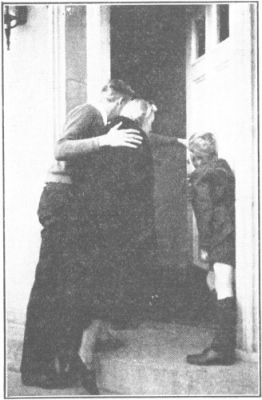
GRETA, NILS AND ERIK ENTERED
Whereupon Erik told them how the Baron had run away. Then he lifted up
his head and began to sing, splashing the oars about in time to his
singing:
"The sun upon the silver lake
Is shining like a wedding cake."
He did not look at Greta and Nils. He did not have to. He knew without
looking that at last they were telling each other the truth. The
"happily ever after" part of their story was coming true.
At the big house, Baron Karl was calling out the strongest and tallest
servants to go with him to the island. He was fussing about in a panic,
and Fru Hansson's nostrils were beginning to quiver with irritation.
Fru Hansson could not help wondering why the Baron had not gone to
Greta's rescue himself. Instead, he had returned to the house with
shaking knees and a green face, whimpering for help.
The band of sturdy servants was now assembled. The Baron placed himself
at their head, announcing that he would lead the way, but cautioning
them to stay close behind him.
Feeling brave, with this great army of muscle to protect him, he started
away, prancing like a perky cockatoo. But hardly had he reached the
front door when Greta, Nils, and Erik entered.
The Baron and his troop halted in amazement. The Baron's mouth fell open
like a hungry baby bird's.
Greta ran into her mother's arms. She explained what had happened, while
Erik added his bit to the story. He did it with enthusiasm, and the
Baron gargled and gurgled and finally cried out that Erik was not
telling the truth. He glared furiously at the two brothers and
commanded Fru Hansson to "send away those common peasants!"
At that, Greta turned upon him. "Nils and Erik are my friends!" she
flared angrily.
The Baron coughed. "Absurd!" he answered her. "And be good enough to
remember that tomorrow you are to become Baroness von Engstrom!"
Now, after what Fru Hansson had seen of the Baron's behavior this
evening, she was at last convinced that he was a coward.
So she lifted her haughty chin and announced in a firm voice, "There
will be no wedding tomorrow. Baron von Engstrom is advised that I
forbid my daughter to marry him."
Next day, Erik watched the Baron's car drive away from Hanssonborg. As
soon as it was out of sight, he raced over to the kitchen and, to Fru
Svenson's astonishment, danced a jig on the kitchen table.
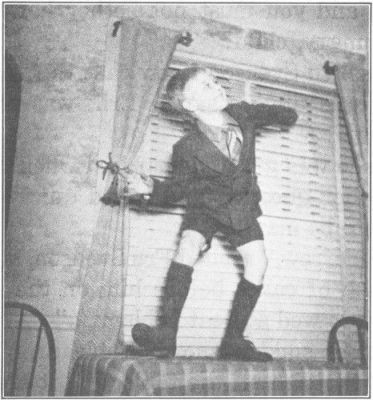
DANCED A JIG ON THE KITCHEN TABLE
Then he fell into the flour bin. He came out white as snow and, though
Fru Svenson wanted to be cross with him, she had to laugh instead.
The months passed. Nils had begun to help Fru Hansson in the running of
the estate. He was proving a clever manager. But he had not yet asked
for Greta's hand in marriage.
With autumn came cleaning time. And what a cleaning it was! Everything
scrubbed and polished and washed! There were harvest festivals, at which
the peasants danced on the threshing floor.
Erik spent as much time as he could visiting Fru Svenson, sitting over
bowls of small shellfish, pulling off the claws, and stuffing himself.
For this was crawfish season in Sweden and crawfish decorated tables
everywhere. They were even designed upon dishes and napkins and painted
upon signs.
Autumn was also shooting season, and hunting parties were given at the
country estates.
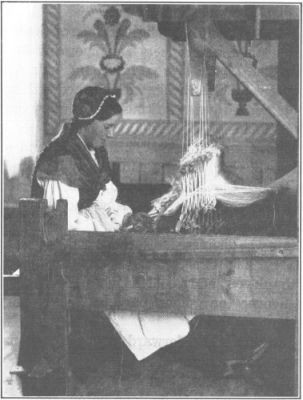
All during the winter, the peasants spun at their looms. Everybody was
busy. Fru Hansson began to count profits.
Yet Nils and Greta still hesitated about asking the proud lady's consent
to their marriage. They feared that she would refuse it. Nils was only a
poor agricultural student.
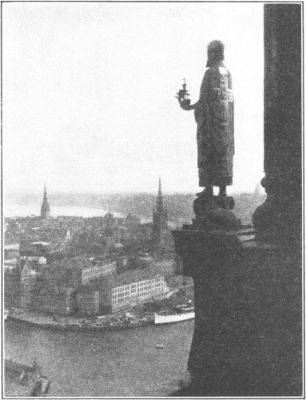
One day Erik received a letter from Johan, the banker's son, inviting
him again to visit the banker's family in Stockholm.
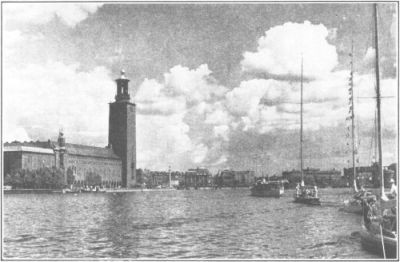
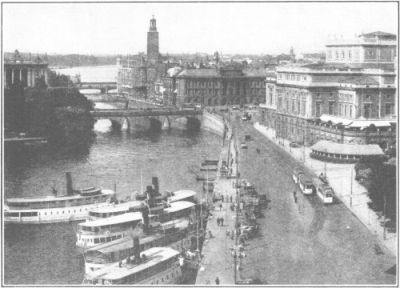
This time, the family did not travel and Erik learned to know Sweden's
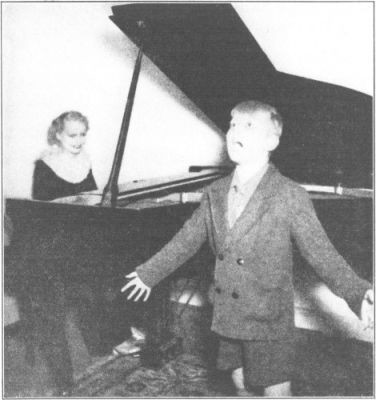
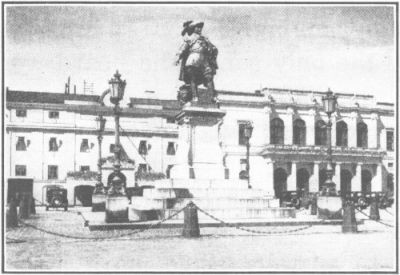
beautiful capital. He even went to the opera. A guest artist sang in a
foreign language, but the other performers sang in Swedish.
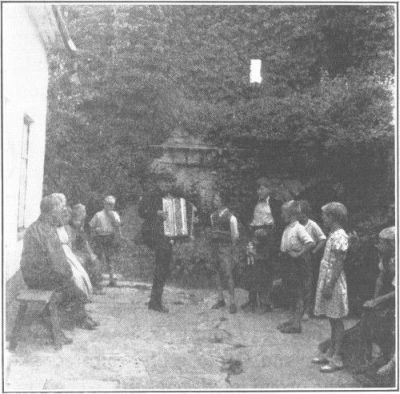
A SWEDISH STREET MUSICIAN
This experience filled Erik with a great desire to become a singer some
day. He sang constantly from that time on, unless he happened to be
eating or sleeping.
When he returned to Hanssonborg, he was eager to hear whether Nils and
Greta had yet obtained Fru Hansson's consent to their marriage.
It was again midsummer, and over the door of his parents' cottage hung
branches of birch trees. This was a yearly custom which started with the
ancient belief that the spirit of the tree will bless the house.
"Mother!" called Erik, running inside. There was no answer. He stood on
the pine floor. It had been covered with fresh birch leaves.
He called again. "Nils!"
Still no answer. Nobody was home.
He went over to the big house, straight to the kitchen, and there he
found things in a state of bustling excitement. Fru Svenson's face was
flaming red. Something was going on—something very important.
"Good day, Fru Svenson," Erik greeted her. "Where is my mother?"
Fru Svenson turned with a bowl of cakes in her hand. "Your mother is
helping the bride, and you must not bother her. Are you hungry,
child?"
Now Fru Svenson knew that this last remark was unnecessary. Erik was
always hungry.
So she was greatly surprised when he ignored her question and asked
quickly, "Is Greta to be married?"
"Tomorrow," replied Fru Svenson, and set the dish of cakes before him on
the table. "She is to wed a great nobleman."
With a sudden shove of his arm, Erik swept the dish off the table, and
it crashed to the floor.
"What!" he cried. "She is not to marry Nils?"
Fru Svenson's two big hands settled upon her fleshy hips. She narrowed
her eyes at the broken dish lying in pieces on the floor. Then she
raised them to Erik's flushed face. He was breathing hard, and the look
he gave her was pathetic. With an unexpected gesture, Fru Svenson swept
him into her arms and hugged him close.
"Bless you, child!" she cried. "Don't look like that. It was your
brother Nils whom I meant when I said that Greta was to marry a great
nobleman. Nils is the greatest nobleman in the land and will make
Hanssonborg a strong and clever manager."
The following day, the golden sun awoke and seemed to know that this was
to be his day. The pagans who lived in ancient times used to worship the
sun, and the Swedish celebration on Midsummer Eve is as joyous and
natural as those festivities which took place many years ago.
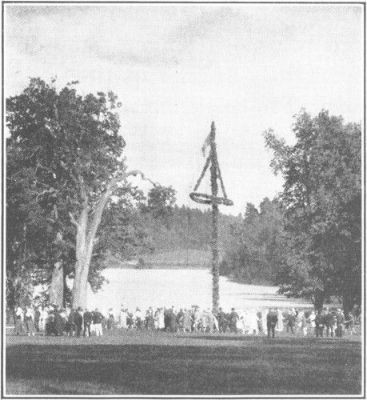
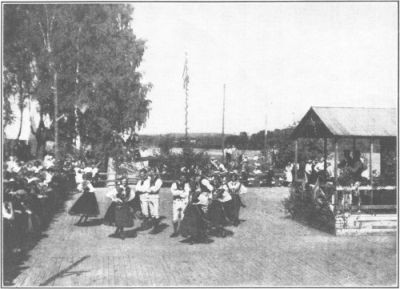
MIDSUMMER EVE FESTIVAL
Greta and Nils were married in the village, in a pretty little church
with a fat, round dome.
A Maypole had been set up on the estate, and peasant and landlord,
servant and master danced about it. Yet this was not the month of May,
for "Maj" (mȧī) means "green leaf" in Swedish. The Maypole was
wound with green leaves and on the top were blue and yellow flowers, the
colors of the country.
Far into the weirdly lit night, the wedding guests danced and sang, and
above all the voices sounded that of a little human nightingale—one who
was too happy to go to bed.