One clear and cold morning in winter,
as Bessie was passing along the road
that led by Nelly's home, she heard
Martin call her from the barn where
he was at work. He saw her passing
and beckoned to her to come to him.
Bessie had the singular habit which
most children possess of stopping to ask
why she was summoned, when at the
same time she fully intended to answer
the call in person. So she stood still,
and in a loud voice cried,
"Mar-TIN, what is it? What do you
want of me?"
"Come and see!" replied Martin, "I've
something nice to show you!" and then
he resumed his place at the hay-cutting
machine, at which he had been busy
when he espied her. He was mincing
the hay for the cattle to eat.
Bessie still stood irresolute. She meant
to come, but she desired her curiosity
to be gratified before she did so.
"Mar-TIN?"
"Well?"
"Can't you tell me now what it is?"
"No," replied Martin, going on with
his hay chopping; "I guess you will
have to come and see for yourself. It
almost splits my throat to be calling
out to you so."
"I think you might tell me," said
Bessie, opening the gate and walking
towards him; "you could have done
it in half the time that you have been
talking about it. Mercy! have you cut
all that pile of hay this morning?"
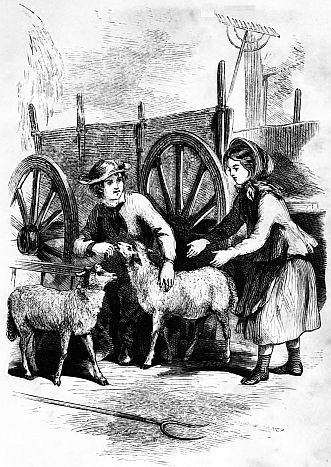
"A couple of white sheep came running eagerly up to Martin's outstretched
hand."—
p. 125
"Yes," said Martin; "it's for the horses.
I sprinkle a little water on it, and they
like it a great deal better than when
it is dry and uncut. It's healthier for
them too."
"I am glad I don't live on it," said
Bessie. "I should be like the horse
that his master fed on shavings,—just
as I got used to it I should die."
"Very likely," said Martin, laughing.
"Come, and I'll show you what I spoke
about." Bessie followed him as he led
the way across the yard to the part of
the barn where the large folding-doors
were situated. They were wide open,
and the clear winter sunshine streamed
on the floor. An old wagon and a ladder
were placed across this opening, so
that no one could come in or go out
without climbing over.
"What is this for?" asked Bessie.
"This wagon don't belong here, Martin.
I never saw it here before."
"That's to keep the cows out," said
Martin, smiling. "We have treasures in
this part of the barn that it would not
do for the cattle to get at. Here Nanny,
here Jinny!"
A pattering of little hoofs was heard
on the wooden floor, and a couple of
white sheep came running eagerly up
to Martin's outstretched hand. They
rubbed themselves against it, and showed
in various other ways how glad they
were to see him.
"Aren't they pretty?" said Bessie
admiringly. "Come here, Nanny."
But Nanny would not touch Bessie's
hand, and backed up the barn, shaking
her head at the sight of it, and kicking
her delicate little heels in the air.
"They don't know you yet," said
Martin, "but they are very tame, and
would soon become acquainted if you
were with them every day as I am.
We have had them two weeks, and
already they let me play with them.
They are cossets."
"Cossets, Martin?"
"Yes; that means the pets of the
flock. The cosset lamb means the pet
lamb."
"Pet is a prettier word than cosset,"
said Bessie; "I should never call them
that. I do wish mother had two such
nice sheep. But why do you keep
them shut up here?"
"You haven't seen all yet," said Martin,
smiling; "just creep through this
place and round by these wheels, and
we will go in and find out why the
cows are kept out and the sheep kept
in."
Martin helped Bessie through the obstructions,
and led her to the back of
the barn where, nestled in a heap of
clean hay that was piled against the
opposite folding doors, she saw a little
bundle of something white, in which
she could just detect two small, glittering
eyes.
"It's a lamb," cried Bessie, skipping
about as if she were one herself.
"Two of 'em," said Martin. "Only
look here!" and he pulled apart the
loose whisps of hay, and there lay
revealed two of the fattest, whitest, and
prettiest lambs that ever were seen.
They did not seem to like being admired,
but gave utterance to a little sharp cry
very much like a baby's. Hearing it,
one of the sheep trotted up, and pushing
between them and Martin, quietly began
to lick them.
"That's their mother," said Martin.
"They are twins, and only two days old.
The other old sheep is a twin of this
old one, and they are so fond of each
other that we cannot keep them separate.
At first we were afraid the aunty
would injure the young ones, and we
shut her out in the barn-yard, but she
came and stood at the door, there by
the wagon, and cried so piteously that
Mr. Brooks told me she might stay in
with her sister and her baby nieces. We
could not bear to hear her bleat so."
"Don't she bite or tread on them?"
asked Bessie.
"No," said Martin, "I think she is
very tender with them. This morning
one of the men threw a handful of hay
accidentally in a lamb's face, and when
it tried to push it off but couldn't, what
does old aunty do but walk up and eat
it away, every whisp. I thought that
was quite bright of her, and kind too.
On the whole I think they are a happy
family."
"Does Nelly like 'em?" asked Bessie,
as she patted the head of the one Martin
called the "aunty."
"Yes," said Martin, "she thinks they
are the handsomest animals on the place.
They grow fonder of her every day."
"I hope her father don't mean to have
them killed," remarked Bessie, a little
sadly.
"No indeed," cried Martin, "he bought
them for pets, and to look pretty running
about the meadow in the summer
time. He says they are too tame and
loving to be killed. I shouldn't like to
think of such a thing, I am sure. There,—do
see old Moolly poking her head
over the wagon! How she does want
to come in! She always was our pet
before, and I suppose it makes her a
little jealous. Poor Moolly,—good little
Moolly."
Martin picked up a corn-cob and
rubbed the cow's ears. She stood quite
still to let him do it, and when he
stopped she stretched out her head for
more and looked at him as if she had
not had half her share.
"Are the little lambs named?" asked
Bessie, as she got up from the hay
to go.
"No," said Martin; "Nelly's father
told her she might call them any thing
she wanted, but she thinks they are
such funny little long-legged things that
she cannot find names pretty enough.
When they grow stronger they will frisk
about and be full of play."
"I mean to run over to the house to
see her and ask her about it," said Bessie.
"I am real glad you called me,
Martin, to look at them."
Martin went back to his hay-cutting,
and Bessie bade him good-by, and skipped
along the path to the house. Bessie
always skipped instead of walking or
running, when she was particularly
pleased with any thing. On knocking
at the farm-house door, she was told to
her great sorrow that Nelly was not
within, but when she heard that she
had just started to pay a visit to herself,
that sorrow was changed to joy, and
she turned to go home with a very
light heart and a pair of very brisk
feet.
"Perhaps I can overtake her," she
said to herself; but go as fast as she
could, she saw nothing of Nelly on the
road. When she reached home, she was
so warm with the exercise that it seemed
to her as though the day were a very
mild one indeed. As she pushed open
the door of the kitchen, her eyes were
so bright and her cheeks so red from
her little run, that her mother looked
up from her work and asked what she
had been doing.
"Only racing down the hill to find
Nelly," panted Bessie, sinking into a
chair as she spoke. "Isn't she here? I
didn't overtake her."
"No," replied her mother, "Nelly has
been here and gone. She was sorry
you were out."
"Gone!" echoed Bessie. "Well, if that
is not too bad! Mrs. Brooks said she
had just started. I am so sorry. Did
she tell you which way she was going?"
"No," said her mother, "she did not,
but she said perhaps she would stop on
her way back. Come, take off your
hat and shawl and hang them up, and
then begin hemming one of these towels.
I am in a great hurry to get them
done. They are Mrs. Raynor's, and I
promised to send them home to-morrow."
Bessie loved to romp and play much
better than to sew, and these words of
her mother's did not consequently fill
her with satisfaction. She knew, however,
that by sewing their living was
to be gained, so she choked down the
fretful words that rose to her lips. She
felt that it was hard enough for her
mother to work, without having her
repinings to endure also. The glow and
cheerful effect of her walk, however,
faded away as she slowly untied her
hood, and hung it with her shawl on a
peg behind the door. She was deeply
disappointed at Nelly's absence.
"I wish she would have waited a
little while," she said; "I don't see her
so often now the winter has set in, that
I can afford to miss her. Mother, have
you seen my thimble?"
"What!" said her mother, "lost again,
Bessie? What shall I do with this careless
girl? There is my old one, you
can use that for a little while."
"Oh, now I remember," cried Bessie,
springing up, "I left it in the garret,
in the drawer of the old table, the last
time I was there. I'll get it, and be
down again in a moment."
She opened the door at the foot of
the stairs, and ran quickly up them.
She did not notice that she left the
door wide open, and that the cold air
rushed into the warm kitchen, nor did
she know that her mother, sighing, was
obliged to rise from her work and shut
it after her.
On went Bessie, and turning the landing,
began the second flight, two steps
at a time, as usual. She was very lightfooted,
and owing to her disappointment
about Nelly, she did not feel quite gay
enough to hum the little tunes which
she generally did when going about the
house, so that altogether she scarcely
made any noise. Perhaps it was owing
to this that, as she reached the head
of the garret stairs, she saw something
run across the floor, evidently alarmed
at her unexpected appearance. She
stood still for a moment, hardly knowing
what it was, and not wishing to go any
further in the fear of frightening it
away before she could get a good look
at it. She decided at once, however,
from its size, that it was not a rat, for
it was far too large. It had taken refuge
behind some old furniture in a corner,
and in the hope that if she kept perfectly
still, it would venture out again,
she sat down on the top step, and fixed
her eyes intently on the spot where she
had beheld it disappear. She had remained
thus but a short time when she
heard hasty footsteps coming from the
kitchen, and a voice that she recognized
as that of Nelly, called her name.
She did not answer, for she wanted to
unravel the mystery, whatever it might
be, and when Nelly, still calling, followed
her up to the stairs on which she sat,
she put her finger on her lip by way
of enjoining silence, and beckoned to
her to come to her. Nelly understood
in a moment, and slipping off her heavy
winter walking shoes, crept up and sat
down beside her.
"Hush!" whispered Bessie, "don't
make a sound. There is some sort of
a little animal concealed behind that
old fire-board, and I want to see it come
out."
She spoke so low that Nelly had difficulty
in getting at the sense of what
she said, but when she did, she nodded
slightly, and the two little girls began
the watch together.
They sat there a long, long time.
Once or twice they thought they
heard a movement behind the fire-board,
but they saw nothing. At last, just as
they were becoming very weary of
remaining so long in the cold, Nelly
caught sight of a small pointed nose,
projecting from one side of the board.
As this nose moved slowly forward, a
pair of bright little eyes came into view
also, rolling restlessly about, as if seeking
to espy danger. It was with difficulty
the children could repress the
exclamations that were on their lips,
but with an effort they did so, and remained
just as quiet as before. Encouraged
by the dead stillness, the animal
advanced still further from its retreat,
peering all the while about it. Its body,
as near as they could see, was spotted
gray and white, and so were its pretty
ears, which were long, and in constant
motion. It ran cautiously from its place
of concealment, and at last, with a
graceful, hurried spring, landed on the
top of Bessie's table. Arrived there, it
sat down and looked about it again.
The children did not move. The drawer
of the table, as usual, was partially open,
according to Bessie's careless habit, and
the little creature put its mites of paws
carefully in the crack, bringing them
out again almost immediately with a
nut, at which at once it commenced to
nibble. It was an odd sight as it sat
there on its hind legs, holding the nut
in its front paws, and twisting and turning
it from side to side in order to find
a good place to plant its sharp teeth.
Nelly glanced at Bessie and longed to
burst into a laugh, but Bessie signified
to her by a movement of her eye-brows
and lips that she must not. It was
plain enough by this time that the little
thief was a squirrel. Bessie was quite
bewildered at the thought that it had
been able to get in the house without
her or her mother's knowledge. She
did not know that the race to which
the animal belonged is proverbial for
its cunning, and that often it steals a
way into the habitations of men for no
other purpose than to find seeds and
grains on which to live.
Some accidental movement which Bessie
made, at length startled the squirrel
from its sense of security. It leaped
lightly from the table to the floor, and
disappeared behind some loose blocks
of wood, near the fire-board. As it did
so, Nelly saw that part of its tail was
missing, looking as if torn off at about
half its length.
"Bessie!" she exclaimed eagerly, as
her companion made a dart for the
blocks of wood, "Bessie, as sure as
you're alive, that's the same squirrel
we saw in the woods, the day we went
nutting."
"I know it," cried Bessie; "at least
I am as sure as I can be, for that one
was like this, spotted white and gray,
and each of them had only a part of
a tail. To think of the little thing
being so hungry as to come after my
nuts! If I can only find its hole, I'll
feed it regularly every day."
"What could bring it so far from the
woods?" cried Nelly, laughing. "I never
heard of any thing more strange, even
in a book."
"You stay here and watch if it comes
out again," said Bessie, "and I'll run
tell mother. Perhaps she can help find
its hiding-place."
Nelly went with her as far as the
foot of the stairs to get her shoes, for
her feet were now growing very cold.
Then she returned to the garret, but
nothing more had been seen of the
squirrel when Bessie appeared with her
mother.
"It was here, just here, that it went
out of sight," cried Bessie; "somewhere
by these blocks and this old fire-board."
Her mother laughed, and said if there
were nothing worse than a squirrel in
the house, she should be glad.
"We must look," she added, "and
perhaps we can discover its nest; that
is, if it has one here, for, Bessie, it has
just occurred to me that this is the
way your Madeira nut disappeared. If
we can find the nest we may find your
money too," and she began to move out
the furniture from the wall.
At the mention of the Madeira nut,
Bessie colored deeply, and really seemed
struck with true shame.
"Oh, mother," she said, "to think that
I have never, all this while, cleaned out
that drawer! Some of the nuts are
still in it, and the other things too, just
as they were that day when I lost my
money. I have meant to clear it out
so many times!"
Her mother turned and looked at her
sorrowfully.
"Bessie," she said, "I have for years
done all I could do, to make a careful,
neat little girl, out of a careless, untidy
one. I am beginning now to leave you
to yourself, hoping that time will help
you to see yourself as others see you.
I have noticed often that your drawer
remained in the same condition, but I
did not speak of it."
"Oh, mother," cried Bessie, frightened,
"don't leave me to myself, don't. I shall
never learn to be good at all, that way.
Oh, don't give me up yet."
"My poor child," said her mother, "if
you will only try, so that I can see you
trying, my confidence in you will come
back, but not otherwise. I want something
more than empty promises. You
forget them as soon as you make them."
"But I will try, I will really try this
time," said Bessie with tears in her
eyes. "I'm lazy, mother, I'm real lazy,
but I am not as bad as I might be.
I'll clean the drawer just as soon as we
look for the nest, sure."
"Well," said her mother, half smiling
at the little girl's doleful tone, "well, I
will give you this one more chance.
We will take the drawer for a new
starting point. Come, Nelly, let us
search now for the squirrel's hole. It
must be somewhere about here, for it
would never come up by the stairs, I
think."
They began a thorough hunt, lifting
up every light article in the out-garret,
where they were, and dragging the more
ponderous furniture from their places.
It was a sort of store-away place for
things not in every-day use, and therefore
it took some time to examine every
thing. An occasional pile of nibbled nut-shells
was all that was brought to light.
"Well," said Nelly, laughing, as she
looked under the last article, a little
broken chair belonging to Bessie. "Well,
I don't see but that Madame Squirrel
has escaped us. I can't meet with a
trace of her, for my part, beyond these
nut-shells."
"Nor I either," wofully added Bessie.
"Yet how could it have run away
from us, since we can find no hole in
the floor, and Nelly did not see it run
into any of these other rooms?" asked
Bessie's mother.
"Perhaps it is hidden in the furniture
itself," remarked Nelly.
"Stop a moment," said Bessie's mother,
as Nelly began to pull out the drawers
of an old bureau, "here are some crossbeams
in the wall by the fire-board,
that look very much as though a set
of sharp teeth had nibbled a hole in
them,—yes, it is so! Well, I think
we've tracked the squirrel now! The
place is such a little way from the floor,
that it could jump in and scamper off
through the walls, before any one could
molest it. Perhaps it is far away in the
woods, laughing at us, at this minute."
The children drew near the beams in
question, with strong curiosity. It was
indeed as Bessie's mother said; there
were the marks of teeth in the wood,
and just where the beams joined was
a hole quite large enough for a squirrel
to pass through.
"It is the same one we saw in the
woods, I know it is," said Nelly, "but
what should bring it here?"
"Perhaps, in time, we can tame it;
that is if we have not already frightened
it away. May I try to tame it, mother?"
"Yes," said her mother. "I think Bunny
will make a pretty pet. We can
strew a few grains of corn, or a few
nuts about its hole every day, until it
learns to regard us as its friends; but
a little girl that I know must get into
the good habit of putting her things in
their proper places, and shutting her
table drawers tight, or it will continue
to help itself to more valuable things,
and make itself a plague to us. I do
not doubt that Bunny has your money
in its nest at this minute. It thought,
probably, that it was carrying off a
good, sound nut."
"Yes," said Bessie, "and I dare say
it was it that ran off with those in my
basket, and all the others in the garden.
Poor, dear Nathan! I must tell him
about it, and ask him to forget my
cross words. One of my Sunday-school
hymns says, 'Kind words can never die.'
I wonder if the unkind words live forever
too. Do they, mother?"
"I hope not," was the answer, "but
many an unkind word leaves a sting in
the mind of the person to whom it is
said, long after the one who uttered it
has entirely forgotten it. I don't believe
Nathan, for instance, will soon cease to
remember that you asked him why he
took your nuts. You acted too impulsively."
"Too what, mother?" asked Bessie,
curiously.
"Too impulsively. That is, you did not
wait to consider the matter, but spoke
out just as you felt, as soon as you saw
him. You must certainly ask him to
excuse you. If you are always very
gentle to him in future, perhaps your
offence will be forgotten. There is no
end to the soothing effect of those 'kind
words that never die!'"
"He was cross enough with me about
it," said Bessie, reflectively. "I think
a few kind words would not hurt him
to say."
"We have nothing to do with Nathan
as to that," said her mother. "If he
chooses to be ill-tempered, it is his own
business, while it is ours to bear it from
him patiently. It is only by such means
that we can teach him how wrong he
is."
"I think that is pretty hard to do,"
said Bessie, shaking her head, "don't
you, Nelly? I always want to answer
right straight back."
"And if you do," said her mother,
"you will find that you invariably make
the case worse than before. A noble
poet, whose works you may read when
you are older, has said, 'Be silent and
endure!' and experience will prove to
you both, that this silence and this
endurance is the true key to happiness.
Now, run down stairs, Bessie, and bring
me up the little saw. The idea has
just come to me, to saw away some
of the board at the side of these beams.
That will give us a good view of what
is going on in the wall, and will not
hurt its appearance much, either."
Bessie soon reappeared with the saw,
which, as it was small, her mother had
no difficulty in handling. She took it
from her and began operations at once,
inserting the sharp end of it in a crevice
in the wood, and moving it gradually
across the grain, until the end of the
board fell on the floor, where the sawdust
already lay.
"Oh, let me see!" cried Bessie, in
wild delight at this exposure of the
squirrel's haunt. And
"Oh, let me see too!" cried Nelly.
But Bessie's mother said she thought
she had better take a peep first, so she
lowered her eyes to the aperture and
looked in. It was dark, and her eyes,
accustomed to the sun-light, at first
could distinguish nothing. Gradually,
however, she found that she could see
a little way around the hole with great
distinctness, and it was not long before
a small heap of rags, apparently,
attracted her attention on one of the
corner beams.
"What is it, mother? what do you
find?" cried Bessie, as her mother put
in her hand to feel what this heap
could be. Something warm met the
touch of her fingers, and she drew back,
slightly startled.
On examining further, she found that
this was indeed the animal's nest, and
that these soft, warm objects, curled up
in it so nicely, were probably her little
young ones.
"There!" she said, laughing, "come
see, children, what I have found! Here
is the squirrel's nest, and two of her
little babies!"
The girls peered eagerly through the
hole at these newly discovered treasures.
"The darlings!" cried Bessie, "we
can surely tame these little creatures,
mother, they are so young. It will be
no trouble at all."
"We must not take them from the
nest," replied her mother. "If we can
tame them by kindness, and by gradually
accustoming them to our harmless
visits, I am very willing to make pets
of them."
"Oh, how pleasant that will be," exclaimed
Bessie, in an ecstasy. "Do look,
Nelly, at their pretty eyes. I don't
know but that I shall be just as well
satisfied with my two little squirrels as
you are with your two lambs."
As she spoke, she put in her hand to
touch the tiny animals on the head,
and smooth them softly, but something
at the side of the nest suddenly arrested
her attention, and she did not do so.
"Oh, mother," she cried, "I do believe
here is my Madeira nut, among this
rubbish and empty hickory shells about
the nest. I do believe it,—I do believe
it! It looks like it, I am positive of
that. It seems whole, too. I don't think
it has been nibbled at all! How glad
I am!"
"Can you reach it?" asked her
mother; "if you can, do so."
Bessie made what she called "a long
arm," and in a moment more she seized
the nut and brought it into open daylight.
"Oh, mother," she said, dancing around
the garret joyfully, "it is my nut! Here
is a little place in the side where the
squirrel has bitten, and you can see the
money right through it! She found that
there was nothing good to eat in it, so
she stopped just in time not to spoil it
entirely. I am so glad—I am so glad!"
THE END.
Transcriber's Notes:
Obvious punctuation errors repaired. The varied hyphenation of
"watercress" and "water-cress" was retained.
Page 20, "lewer" changed to "lower" (the lower half which)